Salzburg – Austria
Salzburg lies along the Salzach River near the northern edge of the Alps, surrounded by forested hills and mountain peaks. The city grew wealthy during the Middle Ages through its control of nearby salt mines, which gave Salzburg both its name and its economic power.
The historic center is filled with elegant Baroque buildings, churches, and narrow streets that reflect the city’s long history as the seat of powerful prince-archbishops. Landmarks such as Mirabell Palace, the cathedral, and the fortress combine to create one of the most beautiful historic cityscapes in Europe.
Salzburg is also internationally known as the birthplace of Wolfgang Amadeus Mozart, adding another cultural dimension to this historic alpine city.

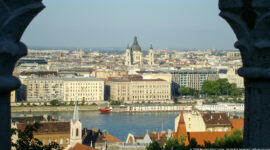
A broad view over the Salzach follows the river past Salzburg’s historic center, where church towers and dense pale façades sit below wooded hills. Autumn foliage traces the embankments, while bridges connect the two sides of the city. The elevated viewpoint turns the river into the organizing axis of the scene and clearly shows the close relationship among Salzburg’s urban fabric, waterway, and surrounding topography.
Caption
A broad view over the Salzach follows the river past Salzburg’s historic center, where church towers and dense pale façades sit below wooded hills. Autumn foliage traces the embankments, while bridges connect the two sides of the city. The elevated viewpoint turns the river into the organizing axis of the scene and clearly shows the close relationship among Salzburg’s urban fabric, waterway, and surrounding topography.

Looking upward through Salzburg Cathedral’s crossing, the sanctuary is set beneath a succession of decorated arches leading to the dome. The vertical composition emphasizes the cathedral’s layered interior elevation: projecting architectural elements and chandeliers at lower level, painted and stuccoed arch surfaces above, then windows admitting daylight around the dome. The sanctuary and altar remain centered below, anchoring the elaborate upward progression.
Caption
Looking upward through Salzburg Cathedral’s crossing, the sanctuary is set beneath a succession of decorated arches leading to the dome. The vertical composition emphasizes the cathedral’s layered interior elevation: projecting architectural elements and chandeliers at lower level, painted and stuccoed arch surfaces above, then windows admitting daylight around the dome. The sanctuary and altar remain centered below, anchoring the elaborate upward progression.

A sweeping elevated panorama looks across Salzburg’s outer neighborhoods and green fields toward the rugged Alpine skyline. Autumn woods frame the city in the foreground, while the mountains rise sharply beyond the urban basin. The broad viewpoint reveals the geographic setting that shaped Salzburg: a compact city occupying low ground between steep wooded hills and the northern edge of the Alps.
Caption
A sweeping elevated panorama looks across Salzburg’s outer neighborhoods and green fields toward the rugged Alpine skyline. Autumn woods frame the city in the foreground, while the mountains rise sharply beyond the urban basin. The broad viewpoint reveals the geographic setting that shaped Salzburg: a compact city occupying low ground between steep wooded hills and the northern edge of the Alps.

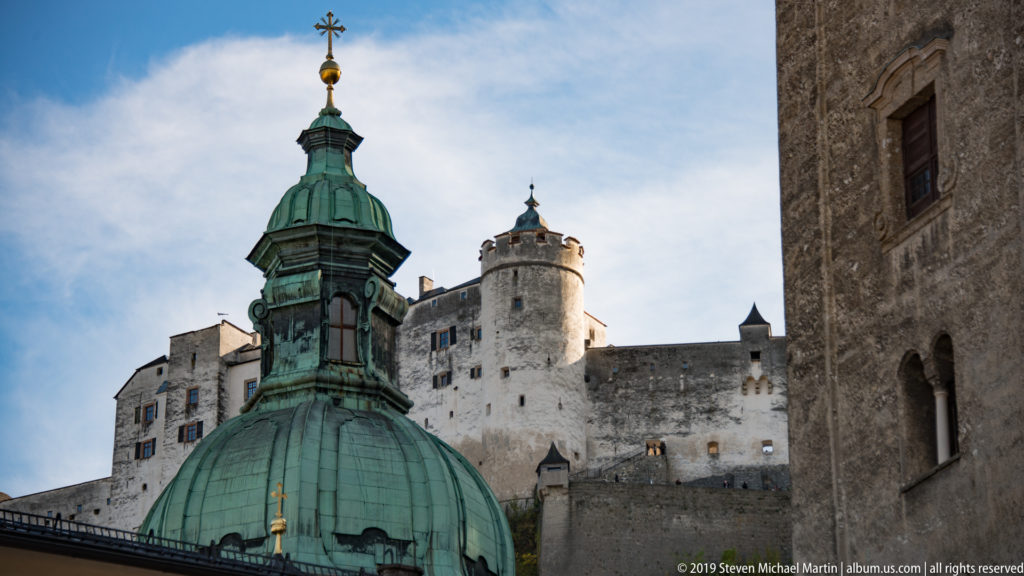
Hohensalzburg Fortress dominates the wooded hill above Salzburg’s Baroque skyline, with green domes and twin church towers clustered along the Salzach below. The river forms the foreground while pale civic and ecclesiastical buildings step upward toward the fortress. This classic city view shows the unusually close spatial relationship among Salzburg’s river, churches, and defensive citadel.
Caption
Hohensalzburg Fortress dominates the wooded hill above Salzburg’s Baroque skyline, with green domes and twin church towers clustered along the Salzach below. The river forms the foreground while pale civic and ecclesiastical buildings step upward toward the fortress. This classic city view shows the unusually close spatial relationship among Salzburg’s river, churches, and defensive citadel.

From Hohensalzburg Fortress, Salzburg Cathedral dominates the old city below with its large green dome and twin towers. Dense gray and red roofs spread around the cathedral toward the Salzach and the modern city beyond. The elevated viewpoint makes the cathedral the visual hinge between Salzburg’s Baroque core and the broader urban basin.
Caption
From Hohensalzburg Fortress, Salzburg Cathedral dominates the old city below with its large green dome and twin towers. Dense gray and red roofs spread around the cathedral toward the Salzach and the modern city beyond. The elevated viewpoint makes the cathedral the visual hinge between Salzburg’s Baroque core and the broader urban basin.

A printed tourist directory presents a dense multilingual list of Salzburg attractions, monuments, churches, museums, and cultural sites. Yellow category bands divide the columns, while individual entries supply a compact overview of the city’s visitor infrastructure. Rather than depicting a place itself, the image documents how Salzburg’s heritage was organized and communicated to travelers.
Caption
A printed tourist directory presents a dense multilingual list of Salzburg attractions, monuments, churches, museums, and cultural sites. Yellow category bands divide the columns, while individual entries supply a compact overview of the city’s visitor infrastructure. Rather than depicting a place itself, the image documents how Salzburg’s heritage was organized and communicated to travelers.

Hohensalzburg Fortress rises above steep autumn-covered slopes, seen from within the old city across a foreground of low arcaded buildings and wrought-iron gates. The lower architecture partially masks the hill, making the fortress appear suddenly above the roofs. The layered composition reinforces how the citadel remains visually present from many confined streets and courtyards in central Salzburg.
Caption
Hohensalzburg Fortress rises above steep autumn-covered slopes, seen from within the old city across a foreground of low arcaded buildings and wrought-iron gates. The lower architecture partially masks the hill, making the fortress appear suddenly above the roofs. The layered composition reinforces how the citadel remains visually present from many confined streets and courtyards in central Salzburg.

The Salzach fills the foreground as a modern bridge spans the river between Salzburg’s built-up banks. Pale riverside buildings rise to the left, while wooded hills and scattered towers frame the distance. With fewer famous monuments than neighboring views, the photograph is especially useful as an urban-context image, showing the river as working infrastructure and open space within the historic city.
Caption
The Salzach fills the foreground as a modern bridge spans the river between Salzburg’s built-up banks. Pale riverside buildings rise to the left, while wooded hills and scattered towers frame the distance. With fewer famous monuments than neighboring views, the photograph is especially useful as an urban-context image, showing the river as working infrastructure and open space within the historic city.
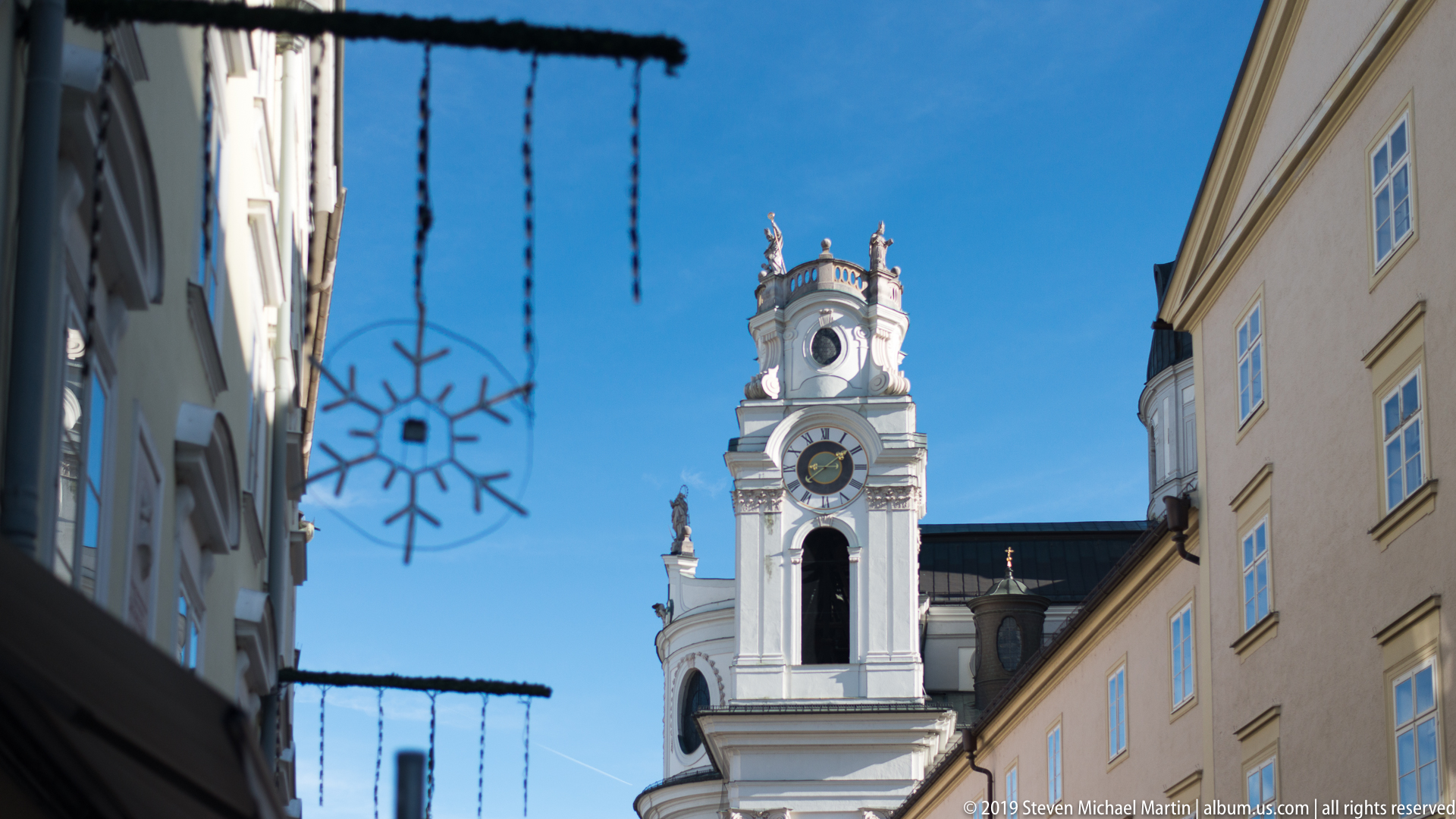
A white Baroque church tower rises between close-set buildings, its clock face, open bell stage, sculptural figures, and small domed crown sharply outlined against a clear blue sky. Seasonal hanging decorations cross the narrow street in the foreground. The compressed upward view emphasizes how Salzburg’s ecclesiastical towers repeatedly appear above the dense lanes of the historic center.
Caption
A white Baroque church tower rises between close-set buildings, its clock face, open bell stage, sculptural figures, and small domed crown sharply outlined against a clear blue sky. Seasonal hanging decorations cross the narrow street in the foreground. The compressed upward view emphasizes how Salzburg’s ecclesiastical towers repeatedly appear above the dense lanes of the historic center.

A white cylindrical tower with a dark conical roof rises from a crenellated wall on a wooded slope. A red flag flies nearby and antennas stand behind the complex, giving the structure a mix of historic and functional character. The low viewpoint isolates the tower against a saturated blue sky and emphasizes its defensive silhouette.
Caption
A white cylindrical tower with a dark conical roof rises from a crenellated wall on a wooded slope. A red flag flies nearby and antennas stand behind the complex, giving the structure a mix of historic and functional character. The low viewpoint isolates the tower against a saturated blue sky and emphasizes its defensive silhouette.

The Salzach curves through Salzburg beneath a long autumn-lined embankment, drawing the eye toward the historic center and Hohensalzburg Fortress. A tall church tower anchors the left bank while Baroque domes and the fortress rise in the distance. The open river surface and low viewpoint give this composition a spacious character, emphasizing the city’s linear development along the water.
Caption
The Salzach curves through Salzburg beneath a long autumn-lined embankment, drawing the eye toward the historic center and Hohensalzburg Fortress. A tall church tower anchors the left bank while Baroque domes and the fortress rise in the distance. The open river surface and low viewpoint give this composition a spacious character, emphasizing the city’s linear development along the water.

A man reads a menu at a restaurant table while two other diners sit nearby in a warmly lit interior. Upholstered banquettes, framed mirrors, pendant lamps, glassware, and a potted plant give the setting an intimate, traditional café or restaurant character. The image records everyday social life in Salzburg rather than a landmark, with shallow focus concentrating attention on the central diner.
Caption
A man reads a menu at a restaurant table while two other diners sit nearby in a warmly lit interior. Upholstered banquettes, framed mirrors, pendant lamps, glassware, and a potted plant give the setting an intimate, traditional café or restaurant character. The image records everyday social life in Salzburg rather than a landmark, with shallow focus concentrating attention on the central diner.

A stark concrete tower rises from a low modern complex beside the Salzach River, its pale vertical mass contrasting with the blue sky and surrounding urban buildings. A bridge or elevated roadway crosses the foreground, while grassy riverbanks frame the water below. The composition emphasizes Salzburg’s modern infrastructure and architecture, providing a counterpoint to the city’s better-known Baroque skyline.
Caption
A stark concrete tower rises from a low modern complex beside the Salzach River, its pale vertical mass contrasting with the blue sky and surrounding urban buildings. A bridge or elevated roadway crosses the foreground, while grassy riverbanks frame the water below. The composition emphasizes Salzburg’s modern infrastructure and architecture, providing a counterpoint to the city’s better-known Baroque skyline.

A smiling man stands beside the Salzach with Salzburg’s historic skyline softened behind him. Hohensalzburg Fortress occupies the hilltop in the distance, while church domes and towers rise from the old city below. The shallow depth of field keeps the portrait primary but preserves enough context to place the sitter unmistakably within Salzburg’s celebrated river-and-fortress setting.
Caption
A smiling man stands beside the Salzach with Salzburg’s historic skyline softened behind him. Hohensalzburg Fortress occupies the hilltop in the distance, while church domes and towers rise from the old city below. The shallow depth of field keeps the portrait primary but preserves enough context to place the sitter unmistakably within Salzburg’s celebrated river-and-fortress setting.

A second riverside portrait places a smiling man against Salzburg’s soft-focus historic skyline. The hilltop mass of Hohensalzburg Fortress dominates the background, while pale Baroque towers and autumn trees line the river below. Compared with the preceding view, the sitter is framed closer to the left edge of the skyline, creating a more compressed relationship between portrait and place.
Caption
A second riverside portrait places a smiling man against Salzburg’s soft-focus historic skyline. The hilltop mass of Hohensalzburg Fortress dominates the background, while pale Baroque towers and autumn trees line the river below. Compared with the preceding view, the sitter is framed closer to the left edge of the skyline, creating a more compressed relationship between portrait and place.

Hohensalzburg Fortress crowns the wooded hill above Salzburg’s Baroque center, where domes, twin towers, and pale church façades cluster close to the Salzach. The river and embankment form a calm horizontal base beneath the steep rise of the city toward the fortress. This compressed telephoto view clearly expresses the vertical hierarchy that makes Salzburg’s historic skyline so distinctive.
Caption
Hohensalzburg Fortress crowns the wooded hill above Salzburg’s Baroque center, where domes, twin towers, and pale church façades cluster close to the Salzach. The river and embankment form a calm horizontal base beneath the steep rise of the city toward the fortress. This compressed telephoto view clearly expresses the vertical hierarchy that makes Salzburg’s historic skyline so distinctive.

The slender red-brick tower of Salzburg’s Evangelical Christ Church rises above trees on the Salzach riverbank. Its pointed dark spire, clock face, and Gothic Revival detailing stand out against a deep blue sky, while low civic and residential buildings flank the church. The riverside lawn in the foreground isolates the tower and makes the church’s vertical profile the dominant architectural feature.
Caption
The slender red-brick tower of Salzburg’s Evangelical Christ Church rises above trees on the Salzach riverbank. Its pointed dark spire, clock face, and Gothic Revival detailing stand out against a deep blue sky, while low civic and residential buildings flank the church. The riverside lawn in the foreground isolates the tower and makes the church’s vertical profile the dominant architectural feature.

Seen from a sharply upward angle, a white Baroque church façade rises in layered curves of pilasters, cornices, arched windows, and sculptural figures. The oblique viewpoint exaggerates the façade’s depth and plasticity, while dark window openings punctuate the bright stucco surface. The image concentrates on architectural composition rather than the whole building, making the ornamental vocabulary itself the principal subject.
Caption
Seen from a sharply upward angle, a white Baroque church façade rises in layered curves of pilasters, cornices, arched windows, and sculptural figures. The oblique viewpoint exaggerates the façade’s depth and plasticity, while dark window openings punctuate the bright stucco surface. The image concentrates on architectural composition rather than the whole building, making the ornamental vocabulary itself the principal subject.

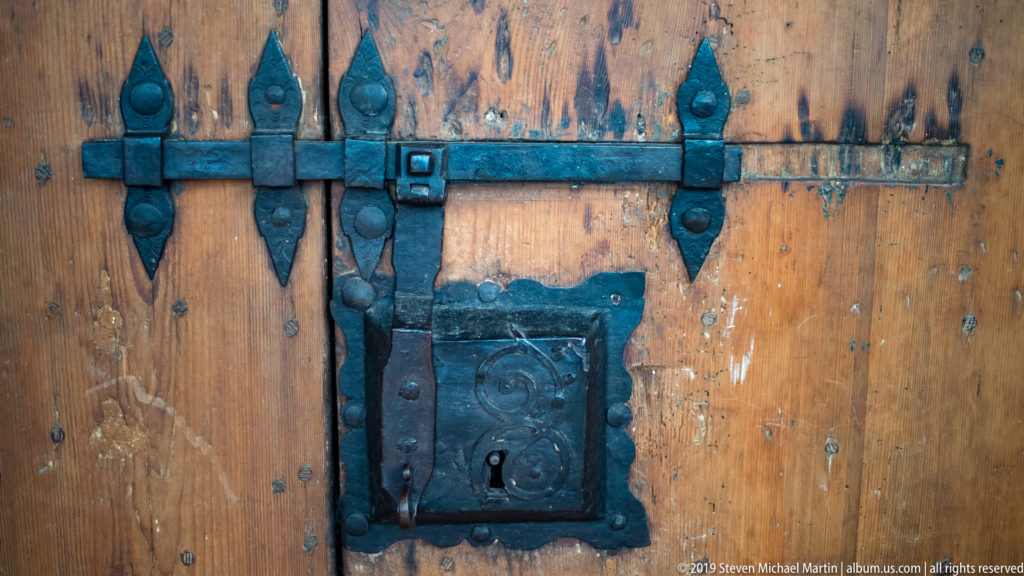
A heavy wooden door is assembled in bold geometric panels radiating around a central metal boss, with rows of iron studs reinforcing the surface. The worn timber, darkened grain, and utilitarian hardware give the entrance a strongly tactile, historic character. A small German sign reading “Bitte Tür drücken” adds an everyday functional detail to the otherwise decorative composition.
Caption
A heavy wooden door is assembled in bold geometric panels radiating around a central metal boss, with rows of iron studs reinforcing the surface. The worn timber, darkened grain, and utilitarian hardware give the entrance a strongly tactile, historic character. A small German sign reading “Bitte Tür drücken” adds an everyday functional detail to the otherwise decorative composition.

A weathered sculpted putto projects into the foreground, its rounded torso, outstretched arm, and small wings modeled in a lively Baroque manner. The pale building behind falls out of focus, isolating the figure’s roughened stone surface and expressive silhouette. The close viewpoint transforms a small decorative element into a characterful study of Salzburg’s sculptural ornament.
Caption
A weathered sculpted putto projects into the foreground, its rounded torso, outstretched arm, and small wings modeled in a lively Baroque manner. The pale building behind falls out of focus, isolating the figure’s roughened stone surface and expressive silhouette. The close viewpoint transforms a small decorative element into a characterful study of Salzburg’s sculptural ornament.

A broad masonry arch cuts through a gray-painted building and frames a small square beyond, where pastel façades and shopfronts catch the light. Decorative painted or carved panels sit above the arch, while overhead wires and the deep shadow of the passage emphasize the transition from one urban space to another. The composition uses the gateway as a natural frame for Salzburg’s dense historic fabric.
Caption
A broad masonry arch cuts through a gray-painted building and frames a small square beyond, where pastel façades and shopfronts catch the light. Decorative painted or carved panels sit above the arch, while overhead wires and the deep shadow of the passage emphasize the transition from one urban space to another. The composition uses the gateway as a natural frame for Salzburg’s dense historic fabric.

A vintage German-language poster for “Die Trapp-Familie” features the film’s principal cast in front of a grand house and alpine imagery. Bold red lettering dominates the lower half, while the title and names Ruth Leuwerik, Hans Holt, and Josef Meinrad remain legible. The poster evokes the von Trapp story’s long-standing place in Salzburg’s popular cultural identity and tourism.
Caption
A vintage German-language poster for “Die Trapp-Familie” features the film’s principal cast in front of a grand house and alpine imagery. Bold red lettering dominates the lower half, while the title and names Ruth Leuwerik, Hans Holt, and Josef Meinrad remain legible. The poster evokes the von Trapp story’s long-standing place in Salzburg’s popular cultural identity and tourism.

A row of narrow multistory façades in muted blue-gray, terracotta, green, and ochre creates a continuous street wall in Salzburg’s historic center. Repeated sash windows and simple shopfronts give the block a restrained rhythm, while signs and lamps mark the active ground floor. The close street-level view emphasizes the intimate scale and layered commercial character of the old city.
Caption
A row of narrow multistory façades in muted blue-gray, terracotta, green, and ochre creates a continuous street wall in Salzburg’s historic center. Repeated sash windows and simple shopfronts give the block a restrained rhythm, while signs and lamps mark the active ground floor. The close street-level view emphasizes the intimate scale and layered commercial character of the old city.

Pedestrians move along Getreidegasse beneath projecting wrought-iron shop signs and tightly spaced historic façades. Modern brand names occupy traditional storefronts, while the narrow perspective funnels the view toward the mountain backdrop beyond the old city. The photograph captures one of central Salzburg’s defining contrasts: an inherited medieval street pattern adapted to contemporary retail and tourism.
Caption
Pedestrians move along Getreidegasse beneath projecting wrought-iron shop signs and tightly spaced historic façades. Modern brand names occupy traditional storefronts, while the narrow perspective funnels the view toward the mountain backdrop beyond the old city. The photograph captures one of central Salzburg’s defining contrasts: an inherited medieval street pattern adapted to contemporary retail and tourism.

Autumn ivy spreads across a pale pink façade surrounding a small shopfront marked “SCHUBERT.” A warm display window, traditional lantern, trelliswork, and flower planters create a carefully composed historic-commercial frontage. The seasonal foliage is the dominant visual element, softening the wall and turning an ordinary storefront into a richly textured detail of Salzburg’s pedestrian center.
Caption
Autumn ivy spreads across a pale pink façade surrounding a small shopfront marked “SCHUBERT.” A warm display window, traditional lantern, trelliswork, and flower planters create a carefully composed historic-commercial frontage. The seasonal foliage is the dominant visual element, softening the wall and turning an ordinary storefront into a richly textured detail of Salzburg’s pedestrian center.

A shop display is packed with Mozart-themed sweets and souvenirs, including portrait wrappers, blue-and-silver round confections, and boxed chocolates arranged in orderly rows. The repetition of Mozart’s likeness underscores how strongly the composer’s image functions within Salzburg’s tourism economy. Reflective glass and ornate framing make the display feel almost like a cabinet of miniature portraits and branded keepsakes.
Caption
A shop display is packed with Mozart-themed sweets and souvenirs, including portrait wrappers, blue-and-silver round confections, and boxed chocolates arranged in orderly rows. The repetition of Mozart’s likeness underscores how strongly the composer’s image functions within Salzburg’s tourism economy. Reflective glass and ornate framing make the display feel almost like a cabinet of miniature portraits and branded keepsakes.

A brightly wrapped articulated city bus crosses an intersection in the old city while Hohensalzburg Fortress rises high above the street. Historic façades and a green onion-domed church tower frame the vehicle, compressing modern transit and monumental Salzburg into a single view. The contrast makes the photograph especially effective as a record of everyday mobility within a protected historic urban landscape.
Caption
A brightly wrapped articulated city bus crosses an intersection in the old city while Hohensalzburg Fortress rises high above the street. Historic façades and a green onion-domed church tower frame the vehicle, compressing modern transit and monumental Salzburg into a single view. The contrast makes the photograph especially effective as a record of everyday mobility within a protected historic urban landscape.

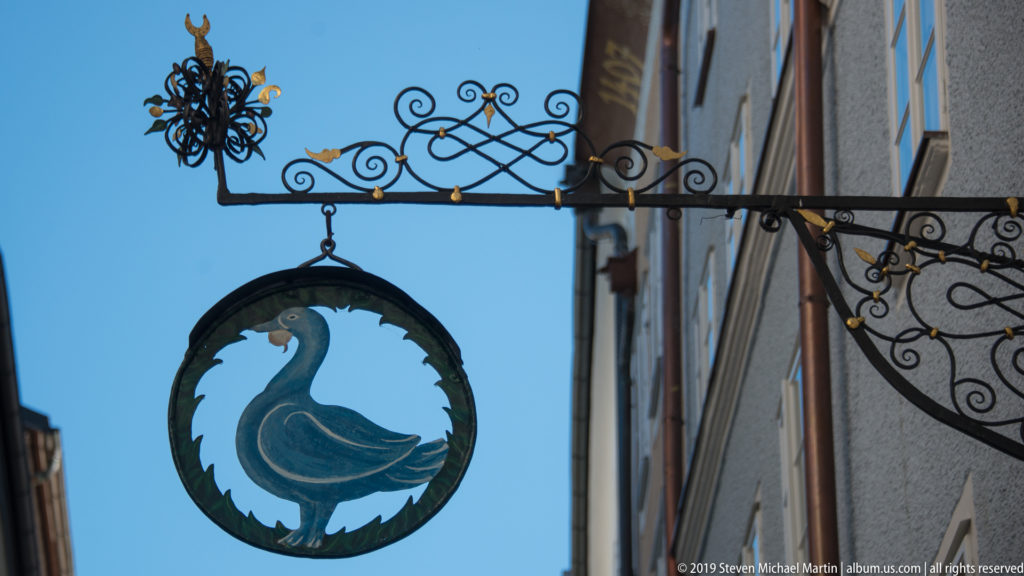
An ornate wrought-iron bracket projects from a Salzburg façade, curling into painted scrolls and floral motifs around a small gilded figure. A simple street lantern hangs nearby, while autumn trees and pale masonry fall softly out of focus behind. The close framing isolates the craftsmanship of the sign, a characteristic feature of Salzburg’s historic commercial streets.
Caption
An ornate wrought-iron bracket projects from a Salzburg façade, curling into painted scrolls and floral motifs around a small gilded figure. A simple street lantern hangs nearby, while autumn trees and pale masonry fall softly out of focus behind. The close framing isolates the craftsmanship of the sign, a characteristic feature of Salzburg’s historic commercial streets.

The Pferdeschwemme horse pond stands against the rock face at Herbert-von-Karajan-Platz, with a sculpted horse centered before painted equestrian scenes set into the long white wall. Classical architectural framing, a pedimented central section, and decorative reliefs turn the former horse-washing place into a theatrical Baroque urban monument. The cliff behind makes the ensemble distinctly Salzburg.
Caption
The Pferdeschwemme horse pond stands against the rock face at Herbert-von-Karajan-Platz, with a sculpted horse centered before painted equestrian scenes set into the long white wall. Classical architectural framing, a pedimented central section, and decorative reliefs turn the former horse-washing place into a theatrical Baroque urban monument. The cliff behind makes the ensemble distinctly Salzburg.

A weathered stone head in classical style has been repurposed as a planter, with a dense crown of white daisy-like flowers emerging from the top. The sculpted face turns in profile, its softened features contrasting with the fresh petals above. The unusual combination of sculpture and horticulture creates a whimsical decorative detail within Salzburg’s historic streetscape.
Caption
A weathered stone head in classical style has been repurposed as a planter, with a dense crown of white daisy-like flowers emerging from the top. The sculpted face turns in profile, its softened features contrasting with the fresh petals above. The unusual combination of sculpture and horticulture creates a whimsical decorative detail within Salzburg’s historic streetscape.

Two small rustic wooden café tables stand on the pavement beside a stone-framed service window, suggesting a compact street-side food or drink counter. Bottles, cups, and small containers sit on the ledge, while the rough timber surfaces contrast with the textured masonry and plaster wall. The photograph records an intimate, functional detail of everyday hospitality in Salzburg.
Caption
Two small rustic wooden café tables stand on the pavement beside a stone-framed service window, suggesting a compact street-side food or drink counter. Bottles, cups, and small containers sit on the ledge, while the rough timber surfaces contrast with the textured masonry and plaster wall. The photograph records an intimate, functional detail of everyday hospitality in Salzburg.

A rectangular stone plaque set into a pink stucco wall bears the carved inscription “Storthamer Salzburg” around a central emblem resembling a coopered barrel or tub with radiating lines. Weathering and surface wear soften the lettering but preserve the object’s hand-worked character. The image functions as a documentary close-up of historic commercial or guild signage embedded in Salzburg’s streetscape.
Caption
A rectangular stone plaque set into a pink stucco wall bears the carved inscription “Storthamer Salzburg” around a central emblem resembling a coopered barrel or tub with radiating lines. Weathering and surface wear soften the lettering but preserve the object’s hand-worked character. The image functions as a documentary close-up of historic commercial or guild signage embedded in Salzburg’s streetscape.

Two small reindeer ornaments stand behind glass, each with antlers, painted faces, striped legs, and a dramatic white feathered body. Their exaggerated proportions and playful materials give them the character of seasonal shop-window decorations rather than realistic animal figures. The shallow focus and reflections isolate the pair as a lighthearted detail of Salzburg’s retail scene.
Caption
Two small reindeer ornaments stand behind glass, each with antlers, painted faces, striped legs, and a dramatic white feathered body. Their exaggerated proportions and playful materials give them the character of seasonal shop-window decorations rather than realistic animal figures. The shallow focus and reflections isolate the pair as a lighthearted detail of Salzburg’s retail scene.

A sidewalk chalkboard lists Austrian classics in handwritten German, including Wiener Schnitzel, Cordon Bleu, and Rindsgulasch, each with prices and brief accompaniments. Positioned beside evergreen foliage, the sign offers a direct glimpse of the traditional dishes marketed to diners in Salzburg’s historic center. The lettering and menu content make food culture, rather than architecture, the central subject.
Caption
A sidewalk chalkboard lists Austrian classics in handwritten German, including Wiener Schnitzel, Cordon Bleu, and Rindsgulasch, each with prices and brief accompaniments. Positioned beside evergreen foliage, the sign offers a direct glimpse of the traditional dishes marketed to diners in Salzburg’s historic center. The lettering and menu content make food culture, rather than architecture, the central subject.

A tall weathered metal door occupies the center of a recessed entrance, its surface reinforced by diagonal bands forming a large X and punctuated by rows of rivets. A decorative iron railing runs across the foreground, partially obscuring the lower panels. The austere geometry and aged patina create a strong contrast with the lighter surrounding wall and suggest a long-used service or ecclesiastical entrance.
Caption
A tall weathered metal door occupies the center of a recessed entrance, its surface reinforced by diagonal bands forming a large X and punctuated by rows of rivets. A decorative iron railing runs across the foreground, partially obscuring the lower panels. The austere geometry and aged patina create a strong contrast with the lighter surrounding wall and suggest a long-used service or ecclesiastical entrance.

A broad stone staircase curves upward beneath a shallow arch, its worn treads edged by reddish bands and accompanied by a simple wrought-iron balustrade. A small heavy wooden door with decorative iron hardware sits at the base, emphasizing the building’s historic fabric. The composition focuses on circulation and craftsmanship, showing how substantial masonry and compact spatial planning shape Salzburg’s older interiors.
Caption
A broad stone staircase curves upward beneath a shallow arch, its worn treads edged by reddish bands and accompanied by a simple wrought-iron balustrade. A small heavy wooden door with decorative iron hardware sits at the base, emphasizing the building’s historic fabric. The composition focuses on circulation and craftsmanship, showing how substantial masonry and compact spatial planning shape Salzburg’s older interiors.

A man stands in a softly lit vaulted passage lined with glass display cases and shop windows. Repeating arches and warm overhead lights draw the corridor into the distance, while the shallow focus keeps the portrait dominant. The setting suggests one of Salzburg’s enclosed historic shopping passages, where old masonry circulation routes have been adapted to contemporary retail use.
Caption
A man stands in a softly lit vaulted passage lined with glass display cases and shop windows. Repeating arches and warm overhead lights draw the corridor into the distance, while the shallow focus keeps the portrait dominant. The setting suggests one of Salzburg’s enclosed historic shopping passages, where old masonry circulation routes have been adapted to contemporary retail use.

A whimsical black-and-white cow sculpture faces the viewer, its surface covered with reflective sequins and its horns painted warm ochre. Pink ears, blue eyes, and a bright muzzle give the piece an intentionally playful character. Displayed indoors beside a menu board, the object reads as decorative commercial art rather than a naturalistic animal representation.
Caption
A whimsical black-and-white cow sculpture faces the viewer, its surface covered with reflective sequins and its horns painted warm ochre. Pink ears, blue eyes, and a bright muzzle give the piece an intentionally playful character. Displayed indoors beside a menu board, the object reads as decorative commercial art rather than a naturalistic animal representation.

A narrow pedestrian street runs between tall historic buildings, with rows of bicycles parked tightly along the right-hand wall. Shop signs project from the façades while pedestrians move through alternating bands of sun and shadow. The compressed perspective conveys the intimate scale of Salzburg’s old city and the way contemporary cycling and retail activity occupy its inherited street pattern.
Caption
A narrow pedestrian street runs between tall historic buildings, with rows of bicycles parked tightly along the right-hand wall. Shop signs project from the façades while pedestrians move through alternating bands of sun and shadow. The compressed perspective conveys the intimate scale of Salzburg’s old city and the way contemporary cycling and retail activity occupy its inherited street pattern.

Green patterned banquettes, mismatched wooden chairs, and small round tables fill a colorful Salzburg café or restaurant interior. A compact bar glitters with hanging stemware and bottles, while framed landscape photographs decorate the wall. The image emphasizes the room’s layered textures and informal hospitality, offering an everyday interior counterpart to the city’s monumental architecture.
Caption
Green patterned banquettes, mismatched wooden chairs, and small round tables fill a colorful Salzburg café or restaurant interior. A compact bar glitters with hanging stemware and bottles, while framed landscape photographs decorate the wall. The image emphasizes the room’s layered textures and informal hospitality, offering an everyday interior counterpart to the city’s monumental architecture.

A monumental human head stands in the center of a paved courtyard, its simplified profile formed from closely stacked horizontal bands. The striated surface creates a strong sense of contour and movement, while the surrounding pale institutional façades provide scale. The work’s contemporary abstraction contrasts sharply with Salzburg’s historic architectural setting.
Caption
A monumental human head stands in the center of a paved courtyard, its simplified profile formed from closely stacked horizontal bands. The striated surface creates a strong sense of contour and movement, while the surrounding pale institutional façades provide scale. The work’s contemporary abstraction contrasts sharply with Salzburg’s historic architectural setting.

An illustrated tourist map shows central Salzburg divided by the Salzach, with streets, bridges, parks, major monuments, and the fortress complex rendered in perspective. The old city appears tightly packed beneath green hills while newer districts spread across the opposite bank. The map functions as a compact visual explanation of the city’s geography and the relationship between topography and historic development.
Caption
An illustrated tourist map shows central Salzburg divided by the Salzach, with streets, bridges, parks, major monuments, and the fortress complex rendered in perspective. The old city appears tightly packed beneath green hills while newer districts spread across the opposite bank. The map functions as a compact visual explanation of the city’s geography and the relationship between topography and historic development.

A classical nude figure reclines in a shallow basin before a deep grotto-like niche lined with rough dark stone. Painted architectural ornament in cream, ochre, and red frames the recess with rosettes and geometric motifs. The contrast between polished sculpture and deliberately rugged grotto surface gives the fountain a theatrical garden character.
Caption
A classical nude figure reclines in a shallow basin before a deep grotto-like niche lined with rough dark stone. Painted architectural ornament in cream, ochre, and red frames the recess with rosettes and geometric motifs. The contrast between polished sculpture and deliberately rugged grotto surface gives the fountain a theatrical garden character.

A white marble male figure is viewed from below beneath a richly decorated vaulted ceiling. The statue’s twisting torso and extended arm lead upward into painted arabesques, shell motifs, and colorful ornamental panels that envelop the niche. The dramatic low angle binds sculpture and architecture together, emphasizing the theatrical visual language of a Baroque courtly interior.
Caption
A white marble male figure is viewed from below beneath a richly decorated vaulted ceiling. The statue’s twisting torso and extended arm lead upward into painted arabesques, shell motifs, and colorful ornamental panels that envelop the niche. The dramatic low angle binds sculpture and architecture together, emphasizing the theatrical visual language of a Baroque courtly interior.

A tall arched doorway punctuates a restrained pale façade, framed by an elaborate stone surround with scrolls, cartouche-like ornament, and a sculpted figure placed inside the opening. The symmetrical windows around it heighten the portal’s ceremonial character. The photograph concentrates on the contrast between the façade’s flat classical order and the entrance’s richer sculptural treatment.
Caption
A tall arched doorway punctuates a restrained pale façade, framed by an elaborate stone surround with scrolls, cartouche-like ornament, and a sculpted figure placed inside the opening. The symmetrical windows around it heighten the portal’s ceremonial character. The photograph concentrates on the contrast between the façade’s flat classical order and the entrance’s richer sculptural treatment.

Two dark horses pull a traditional carriage through a stone-arched passage, with drivers seated high at the front and passengers behind. Harnesses, leather tack, and the narrow wheels are sharply visible. The scene records Salzburg’s horse-drawn Fiaker tradition as living street activity, connecting present-day tourism with an older form of urban transport.
Caption
Two dark horses pull a traditional carriage through a stone-arched passage, with drivers seated high at the front and passengers behind. Harnesses, leather tack, and the narrow wheels are sharply visible. The scene records Salzburg’s horse-drawn Fiaker tradition as living street activity, connecting present-day tourism with an older form of urban transport.

The Salzach stretches calmly through the frame, reflecting blue sky and autumn trees along both embankments. A church tower anchors the left bank while Hohensalzburg Fortress appears in the distance above the old city. The broad open water and low river-level perspective give this view an expansive quality distinct from Salzburg’s denser street scenes.
Caption
The Salzach stretches calmly through the frame, reflecting blue sky and autumn trees along both embankments. A church tower anchors the left bank while Hohensalzburg Fortress appears in the distance above the old city. The broad open water and low river-level perspective give this view an expansive quality distinct from Salzburg’s denser street scenes.

A large stylized feline sculpture stands outdoors, its entire body wrapped in a dense black-and-white typographic or patterned surface. The elongated tail, crouched stance, and exaggerated paws give the work an animated silhouette against the pale courtyard architecture. The piece introduces a playful contemporary note within Salzburg’s more formal historic setting.
Caption
A large stylized feline sculpture stands outdoors, its entire body wrapped in a dense black-and-white typographic or patterned surface. The elongated tail, crouched stance, and exaggerated paws give the work an animated silhouette against the pale courtyard architecture. The piece introduces a playful contemporary note within Salzburg’s more formal historic setting.

Seen through a dark stone arch, the white façade of a small chapel stands inside Hohensalzburg Fortress. A clock tower rises above the gabled roof, while a relief panel and arched doorway mark the entrance. The framing emphasizes the enclosed character of the fortress courtyards, with the chapel appearing as a compact sacred building embedded within the defensive complex.
Caption
Seen through a dark stone arch, the white façade of a small chapel stands inside Hohensalzburg Fortress. A clock tower rises above the gabled roof, while a relief panel and arched doorway mark the entrance. The framing emphasizes the enclosed character of the fortress courtyards, with the chapel appearing as a compact sacred building embedded within the defensive complex.

An elaborate painted sundial spreads across the abbey façade, combining a blue hour field, Roman numerals, zodiac-like markings, and scrolling ochre ornament. A painted Benedictine monk or saint appears above the dial, while crossed keys decorate the cartouche below, turning a practical timekeeping device into a prominent devotional and architectural feature.
Caption
An elaborate painted sundial spreads across the abbey façade, combining a blue hour field, Roman numerals, zodiac-like markings, and scrolling ochre ornament. A painted Benedictine monk or saint appears above the dial, while crossed keys decorate the cartouche below, turning a practical timekeeping device into a prominent devotional and architectural feature.

A long white barrel vault is covered with a rhythmic field of blue-green rosettes and larger gilded relief ornaments along the walls. A hanging lantern marks the centerline, while an arched opening at the far end draws daylight into the corridor. The repeated decorative elements transform a utilitarian passage into a highly ornamental transitional space.
Caption
A long white barrel vault is covered with a rhythmic field of blue-green rosettes and larger gilded relief ornaments along the walls. A hanging lantern marks the centerline, while an arched opening at the far end draws daylight into the corridor. The repeated decorative elements transform a utilitarian passage into a highly ornamental transitional space.
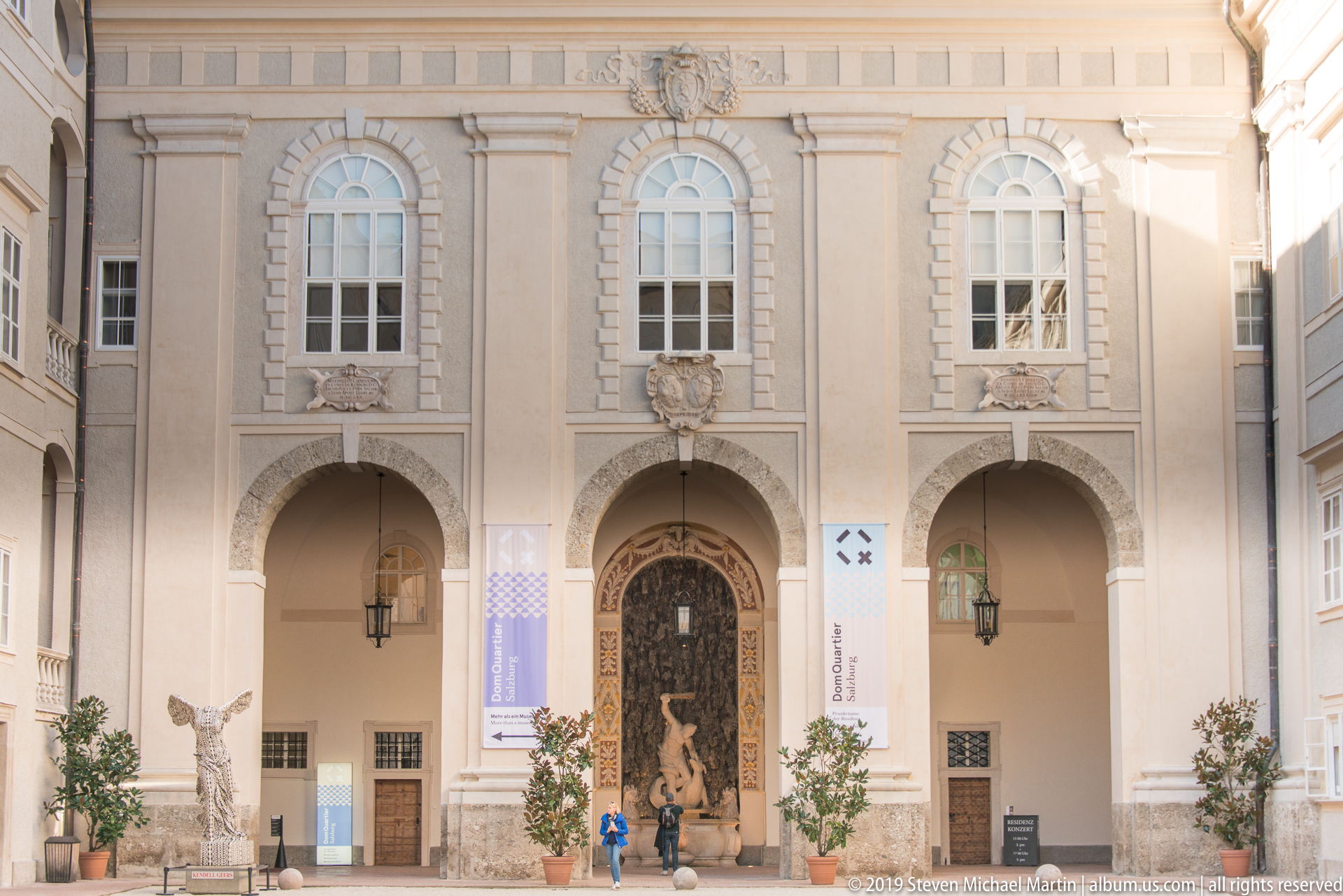
A pale Baroque courtyard façade rises in three levels above a sequence of large ground-floor arches. Tall windows are framed by sculptural masks and rusticated surrounds, while a richly decorated central doorway holds a statue at its base. Potted trees and a freestanding sculpture soften the formal symmetry, giving the courtyard a ceremonial but lived-in character.
Caption
A pale Baroque courtyard façade rises in three levels above a sequence of large ground-floor arches. Tall windows are framed by sculptural masks and rusticated surrounds, while a richly decorated central doorway holds a statue at its base. Potted trees and a freestanding sculpture soften the formal symmetry, giving the courtyard a ceremonial but lived-in character.

A covered arcade opens toward an outdoor area lined with small wooden stalls beneath mature trees. Stone columns and repeated arches frame the view, while a bilingual-looking sign reading “Eingang / entrance” hangs overhead. The scene records a practical threshold between an interior passage and an active public space, likely serving visitors within central Salzburg.
Caption
A covered arcade opens toward an outdoor area lined with small wooden stalls beneath mature trees. Stone columns and repeated arches frame the view, while a bilingual-looking sign reading “Eingang / entrance” hangs overhead. The scene records a practical threshold between an interior passage and an active public space, likely serving visitors within central Salzburg.

Hundreds of colorful padlocks cover the metal mesh railing of a pedestrian bridge over the Salzach. The dense accumulation of red, blue, brass, and silver locks creates a shimmering surface in the foreground, while Salzburg’s riverside buildings and autumn trees sit softly beyond. The image focuses on a contemporary visitor ritual superimposed on the city’s river infrastructure.
Caption
Hundreds of colorful padlocks cover the metal mesh railing of a pedestrian bridge over the Salzach. The dense accumulation of red, blue, brass, and silver locks creates a shimmering surface in the foreground, while Salzburg’s riverside buildings and autumn trees sit softly beyond. The image focuses on a contemporary visitor ritual superimposed on the city’s river infrastructure.

Elegant riverside buildings line the Salzach beneath a wooded hill, their pale façades and ornamental roofs fronted by an autumn row of trees. The embankment and river edge lead diagonally toward a bridge, while a castle-like structure is partly visible higher on the slope. This view emphasizes the refined architectural character of Salzburg’s right-bank riverfront.
Caption
Elegant riverside buildings line the Salzach beneath a wooded hill, their pale façades and ornamental roofs fronted by an autumn row of trees. The embankment and river edge lead diagonally toward a bridge, while a castle-like structure is partly visible higher on the slope. This view emphasizes the refined architectural character of Salzburg’s right-bank riverfront.

The railing of a pedestrian bridge is densely packed with colorful love locks, forming a textured foreground against a broad view up the Salzach. Church towers, autumn trees, and pale riverside buildings extend into the distance. By combining a contemporary romantic ritual with the historic cityscape, the image links personal visitor gestures to Salzburg’s public river landscape.
Caption
The railing of a pedestrian bridge is densely packed with colorful love locks, forming a textured foreground against a broad view up the Salzach. Church towers, autumn trees, and pale riverside buildings extend into the distance. By combining a contemporary romantic ritual with the historic cityscape, the image links personal visitor gestures to Salzburg’s public river landscape.
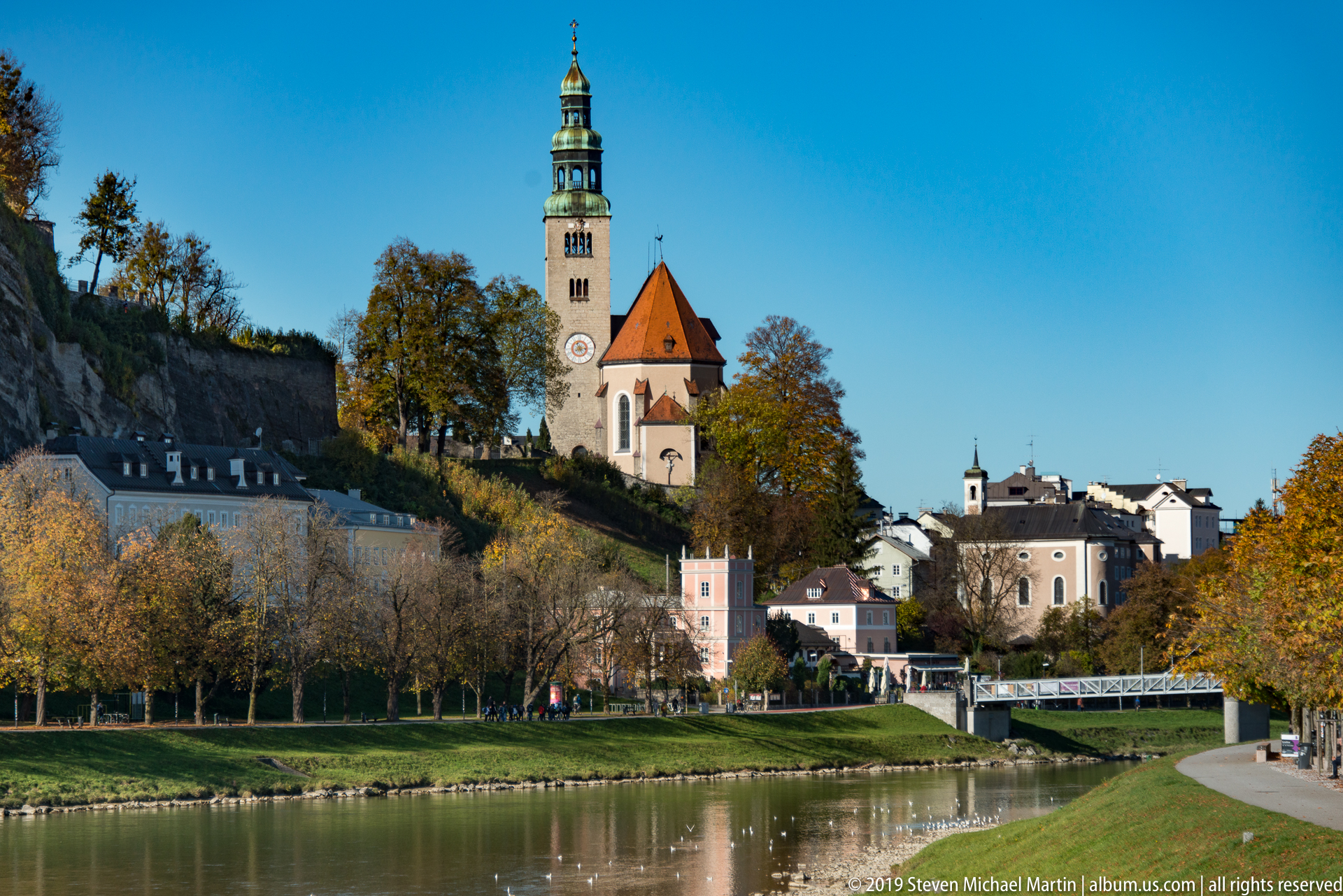
The tall tower of the Müllner Kirche rises above the Salzach, its green upper stages and clock face paired with the red-roofed church body below. Autumn trees line the river, while the wooded Mönchsberg slope and nearby buildings frame the landmark. The image presents the church as part of Salzburg’s layered relationship between riverbank, hillside, and ecclesiastical architecture.
Caption
The tall tower of the Müllner Kirche rises above the Salzach, its green upper stages and clock face paired with the red-roofed church body below. Autumn trees line the river, while the wooded Mönchsberg slope and nearby buildings frame the landmark. The image presents the church as part of Salzburg’s layered relationship between riverbank, hillside, and ecclesiastical architecture.

Müllner Kirche rises at the left above the Salzach while a dense line of golden autumn trees sweeps along the riverbank toward the foreground. A second slender spire appears beyond the trees, adding depth to the skyline. The composition gives more visual weight to the landscaped embankment than the church itself, emphasizing Salzburg’s seasonal river scenery.
Caption
Müllner Kirche rises at the left above the Salzach while a dense line of golden autumn trees sweeps along the riverbank toward the foreground. A second slender spire appears beyond the trees, adding depth to the skyline. The composition gives more visual weight to the landscaped embankment than the church itself, emphasizing Salzburg’s seasonal river scenery.

A pale historic façade is organized by arched windows, delicate wrought-iron balcony rails, and exuberant stucco ornament around the openings. Sculpted flourishes and cornices cast crisp shadows across the wall, giving the otherwise restrained surface strong depth. The close crop turns the façade into a study of Salzburg’s refined urban ornament rather than a complete building portrait.
Caption
A pale historic façade is organized by arched windows, delicate wrought-iron balcony rails, and exuberant stucco ornament around the openings. Sculpted flourishes and cornices cast crisp shadows across the wall, giving the otherwise restrained surface strong depth. The close crop turns the façade into a study of Salzburg’s refined urban ornament rather than a complete building portrait.

A woman pauses with a small dog beneath a tall wrought-iron gateway opening onto a formal garden. Clipped hedges, stone gateposts, sculptural finials, and bright autumn foliage are visible beyond the shaded threshold. The strong contrast between dark passage and sunlit garden creates a theatrical entrance sequence centered on everyday human movement.
Caption
A woman pauses with a small dog beneath a tall wrought-iron gateway opening onto a formal garden. Clipped hedges, stone gateposts, sculptural finials, and bright autumn foliage are visible beyond the shaded threshold. The strong contrast between dark passage and sunlit garden creates a theatrical entrance sequence centered on everyday human movement.

A monolithic pale-stone volume forms the modern façade of the Universität Mozarteum, its restrained rectangular surfaces broken by a low glazed entrance. Two people stand near the doorway, giving the building scale, while bicycles and adjoining structures mark its urban campus setting. The minimalist architecture provides a striking contemporary contrast to Salzburg’s ornate historic center.
Caption
A monolithic pale-stone volume forms the modern façade of the Universität Mozarteum, its restrained rectangular surfaces broken by a low glazed entrance. Two people stand near the doorway, giving the building scale, while bicycles and adjoining structures mark its urban campus setting. The minimalist architecture provides a striking contemporary contrast to Salzburg’s ornate historic center.

The words “UNIVERSITÄT MOZARTEUM” are mounted directly on a wall of large rectangular stone panels. The simple metal lettering and tight crop reduce the institution to name, material, and surface, creating a graphic architectural detail. The image serves as direct documentary confirmation of the university’s identity within Salzburg.
Caption
The words “UNIVERSITÄT MOZARTEUM” are mounted directly on a wall of large rectangular stone panels. The simple metal lettering and tight crop reduce the institution to name, material, and surface, creating a graphic architectural detail. The image serves as direct documentary confirmation of the university’s identity within Salzburg.

An arched stone entrance frames glazed doors marked “UNIVERSITÄT MOZARTEUM.” The warm reddish masonry surround and carved architectural details contrast with the modern glass frontage inside the historic-looking opening. Reflections in the glazing reveal the street beyond, making the photograph both an institutional sign view and a compact study of old and new materials meeting at the threshold.
Caption
An arched stone entrance frames glazed doors marked “UNIVERSITÄT MOZARTEUM.” The warm reddish masonry surround and carved architectural details contrast with the modern glass frontage inside the historic-looking opening. Reflections in the glazing reveal the street beyond, making the photograph both an institutional sign view and a compact study of old and new materials meeting at the threshold.

A long arcaded building runs directly beneath the exposed rock face of the Mönchsberg, its repeated round arches and flower boxes forming a strong horizontal band below the cliff. The juxtaposition of architecture and raw geology is unusually dramatic, showing how Salzburg’s built fabric presses tightly against the steep natural escarpment. A small roofed projection punctuates the otherwise regular façade.
Caption
A long arcaded building runs directly beneath the exposed rock face of the Mönchsberg, its repeated round arches and flower boxes forming a strong horizontal band below the cliff. The juxtaposition of architecture and raw geology is unusually dramatic, showing how Salzburg’s built fabric presses tightly against the steep natural escarpment. A small roofed projection punctuates the otherwise regular façade.

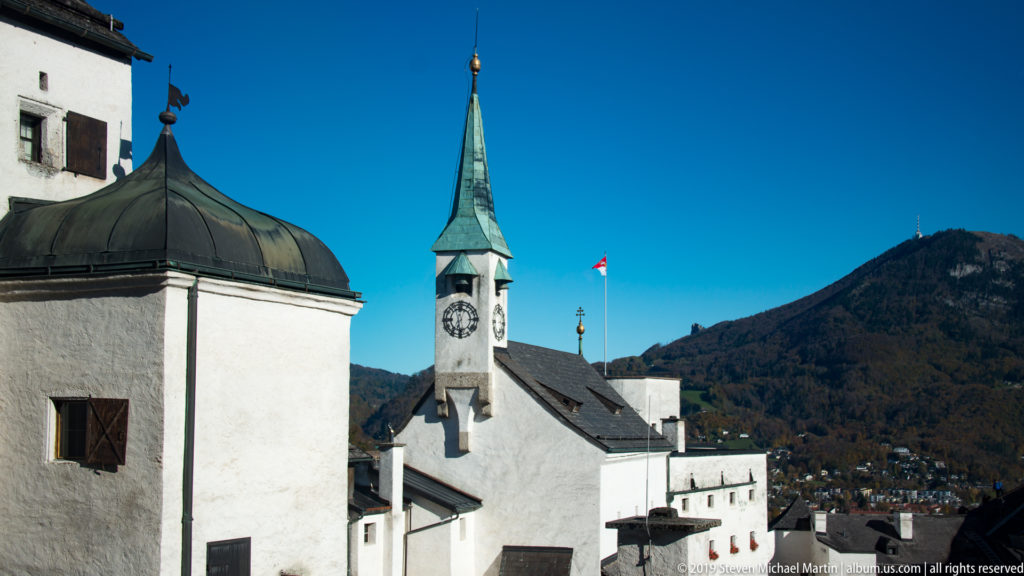
A white clock tower with a steep green-patinated spire rises among the interior buildings of Hohensalzburg Fortress. The compact composition layers pale fortified walls, dark metal roofs, a red-and-white Austrian flag, and the wooded Salzburg hills beyond. Rather than presenting the citadel from a distance, this view records the architectural variety encountered inside the hilltop complex.
Caption
A white clock tower with a steep green-patinated spire rises among the interior buildings of Hohensalzburg Fortress. The compact composition layers pale fortified walls, dark metal roofs, a red-and-white Austrian flag, and the wooded Salzburg hills beyond. Rather than presenting the citadel from a distance, this view records the architectural variety encountered inside the hilltop complex.

A detailed scale model reconstructs Hohensalzburg Fortress as a dense complex of courtyards, towers, red-tiled roofs, curtain walls, and projecting defensive works. Viewed from above, the model clarifies relationships that are difficult to read at full scale, especially the way successive enclosures and building ranges occupy the summit. The object functions as an interpretive overview of the fortress’s compact plan.
Caption
A detailed scale model reconstructs Hohensalzburg Fortress as a dense complex of courtyards, towers, red-tiled roofs, curtain walls, and projecting defensive works. Viewed from above, the model clarifies relationships that are difficult to read at full scale, especially the way successive enclosures and building ranges occupy the summit. The object functions as an interpretive overview of the fortress’s compact plan.

This upward-angled view emphasizes the vertical richness of St. Peter’s Abbey Church, where tall side altars and monumental religious paintings rise toward a luminous painted vault. At the far end, an organ loft or gallery spans the nave above a broad arch, visually layering architecture, painting, gilding, and stucco within the Baroque interior.
Caption
This upward-angled view emphasizes the vertical richness of St. Peter’s Abbey Church, where tall side altars and monumental religious paintings rise toward a luminous painted vault. At the far end, an organ loft or gallery spans the nave above a broad arch, visually layering architecture, painting, gilding, and stucco within the Baroque interior.

An oval ceiling fresco is set within a field of pale Rococo stucco, depicting a heavenly religious scene with figures gathered below and angels or saints rising through clouds above. The curving painted composition and surrounding ornamental plaster form part of the integrated ceiling decoration of St. Peter’s Abbey Church.
Caption
An oval ceiling fresco is set within a field of pale Rococo stucco, depicting a heavenly religious scene with figures gathered below and angels or saints rising through clouds above. The curving painted composition and surrounding ornamental plaster form part of the integrated ceiling decoration of St. Peter’s Abbey Church.

The Parish Church of Mülln, dedicated to the Assumption of Mary, rises above a grassy slope with its square tower, clock face, green tiered crown, and steep red-tiled roof. Seen from below through trees, the church appears as a compact hilltop landmark. The late-season foliage and oblique viewpoint emphasize the building’s elevated position above the Salzach district of Mülln.
Caption
The Parish Church of Mülln, dedicated to the Assumption of Mary, rises above a grassy slope with its square tower, clock face, green tiered crown, and steep red-tiled roof. Seen from below through trees, the church appears as a compact hilltop landmark. The late-season foliage and oblique viewpoint emphasize the building’s elevated position above the Salzach district of Mülln.

The tower and red roof of Mülln Parish Church rise above a pink riverside building and autumn trees, giving the church a strong landmark presence within the neighborhood. Its square masonry tower transitions to an open green upper stage and lantern-like crown. The lower viewpoint includes café terraces and street activity, placing the historic church within the everyday urban fabric of Mülln.
Caption
The tower and red roof of Mülln Parish Church rise above a pink riverside building and autumn trees, giving the church a strong landmark presence within the neighborhood. Its square masonry tower transitions to an open green upper stage and lantern-like crown. The lower viewpoint includes café terraces and street activity, placing the historic church within the everyday urban fabric of Mülln.

Dense rows of graves fill Petersfriedhof beside St. Peter’s Abbey, where wrought-iron crosses, carved stone markers, flowers, votive candles, and low planted plots create an intimate cemetery landscape. The view emphasizes the close spacing of memorials and the variety of grave forms within the historic monastic precinct at the foot of Salzburg’s Mönchsberg.
Caption
Dense rows of graves fill Petersfriedhof beside St. Peter’s Abbey, where wrought-iron crosses, carved stone markers, flowers, votive candles, and low planted plots create an intimate cemetery landscape. The view emphasizes the close spacing of memorials and the variety of grave forms within the historic monastic precinct at the foot of Salzburg’s Mönchsberg.

A courtyard-like passage within the St. Peter’s Abbey precinct is enclosed by pale monastic buildings and the steep rock face of Mönchsberg. Above the complex, Hohensalzburg Fortress appears on the ridge, linking the abbey visually to Salzburg’s fortified skyline. Grave monuments and arcaded cemetery structures remain visible at ground level, tying the scene to the adjoining Petersfriedhof.
Caption
A courtyard-like passage within the St. Peter’s Abbey precinct is enclosed by pale monastic buildings and the steep rock face of Mönchsberg. Above the complex, Hohensalzburg Fortress appears on the ridge, linking the abbey visually to Salzburg’s fortified skyline. Grave monuments and arcaded cemetery structures remain visible at ground level, tying the scene to the adjoining Petersfriedhof.

Bright chrysanthemums and berry-laden plants fill the foreground while the white curving façade of Salzburg’s Kollegienkirche rises behind them. The low angle juxtaposes an everyday market display with the church’s monumental Baroque surfaces, tall windows, pilasters, and sculpted cornices. The contrast turns the architectural landmark into a backdrop for the active commercial life of the old city.
Caption
Bright chrysanthemums and berry-laden plants fill the foreground while the white curving façade of Salzburg’s Kollegienkirche rises behind them. The low angle juxtaposes an everyday market display with the church’s monumental Baroque surfaces, tall windows, pilasters, and sculpted cornices. The contrast turns the architectural landmark into a backdrop for the active commercial life of the old city.

A dynamic white stone sculptural group rises from a rocky fountain base in Mirabell Gardens. Intertwined human and animal forms twist upward in a vigorous Baroque composition, set against dense green foliage and the formal garden balustrade. Strong side light accentuates the carved anatomy and rough stone base, turning the fountain into a dramatic focal point within the garden.
Caption
A dynamic white stone sculptural group rises from a rocky fountain base in Mirabell Gardens. Intertwined human and animal forms twist upward in a vigorous Baroque composition, set against dense green foliage and the formal garden balustrade. Strong side light accentuates the carved anatomy and rough stone base, turning the fountain into a dramatic focal point within the garden.

Centered against the dark sky, an ornate patinated copper roof spreads outward in layered, curling forms above a pale masonry tower. Floodlights pick out seams, ribs, openings, and the central finial, turning the roof into a study of sculptural metalwork. The tighter framing excludes most of the clock faces visible in the neighboring view and concentrates attention on the roof itself.
Caption
Centered against the dark sky, an ornate patinated copper roof spreads outward in layered, curling forms above a pale masonry tower. Floodlights pick out seams, ribs, openings, and the central finial, turning the roof into a study of sculptural metalwork. The tighter framing excludes most of the clock faces visible in the neighboring view and concentrates attention on the roof itself.

The Kollegienkirche presents its monumental white Baroque façade directly to the square, with a rounded central bay, tall arched windows, sculpted pilasters, and twin flanking towers. The low viewpoint exaggerates the vertical sweep from the entrance to the curved pediment and roofline. Sparse market structures at ground level provide scale without distracting from the church’s strongly modeled exterior.
Caption
The Kollegienkirche presents its monumental white Baroque façade directly to the square, with a rounded central bay, tall arched windows, sculpted pilasters, and twin flanking towers. The low viewpoint exaggerates the vertical sweep from the entrance to the curved pediment and roofline. Sparse market structures at ground level provide scale without distracting from the church’s strongly modeled exterior.

Tall clustered columns rise into the ribbed Gothic vaults of Salzburg’s Franziskanerkirche, while a richly gilded Baroque high altar glows at the eastern end. The photograph makes the church’s layered architectural history visually legible: austere vertical stonework and pointed vaulting frame an exuberant later altar. Side chapels and sculpted ornament crowd the edges without overwhelming the nave’s powerful upward rhythm.
Caption
Tall clustered columns rise into the ribbed Gothic vaults of Salzburg’s Franziskanerkirche, while a richly gilded Baroque high altar glows at the eastern end. The photograph makes the church’s layered architectural history visually legible: austere vertical stonework and pointed vaulting frame an exuberant later altar. Side chapels and sculpted ornament crowd the edges without overwhelming the nave’s powerful upward rhythm.

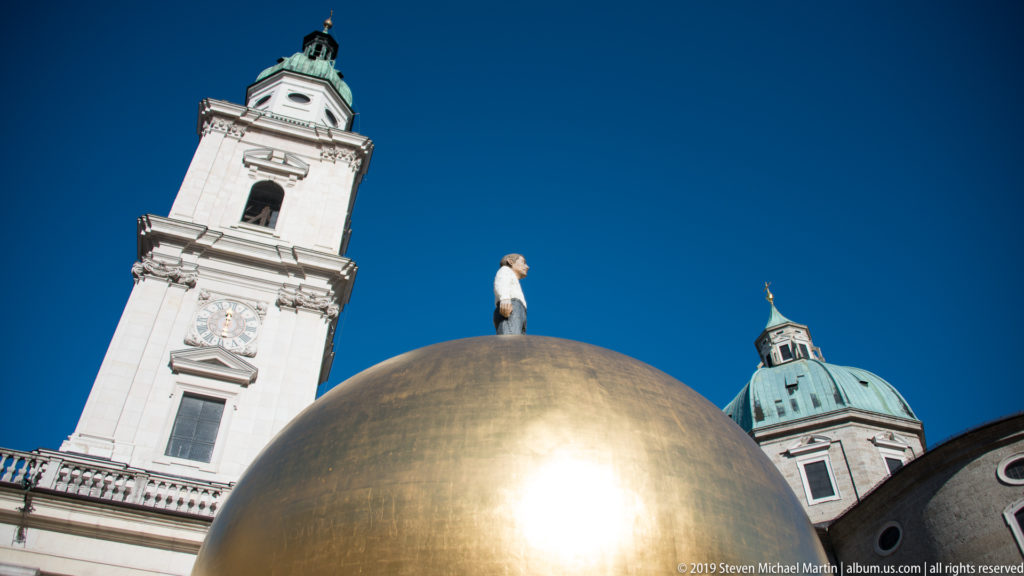
A large gilded sphere and its small standing figure dominate this low-angle view beside Salzburg Cathedral. One pale stone bell tower rises at left while a green-patinated dome and lantern appear beyond the sphere, setting contemporary public art against the cathedral’s monumental historic architecture.
Caption
A large gilded sphere and its small standing figure dominate this low-angle view beside Salzburg Cathedral. One pale stone bell tower rises at left while a green-patinated dome and lantern appear beyond the sphere, setting contemporary public art against the cathedral’s monumental historic architecture.

A recumbent stone lion fills the frame, its deeply drilled mane, open mouth, muscular forelegs, and curling tail rendered in vigorous relief. The close view isolates the sculptural details and weathered surface, emphasizing the ornamental carving rather than the surrounding cathedral architecture.
Caption
A recumbent stone lion fills the frame, its deeply drilled mane, open mouth, muscular forelegs, and curling tail rendered in vigorous relief. The close view isolates the sculptural details and weathered surface, emphasizing the ornamental carving rather than the surrounding cathedral architecture.

Looking straight upward, the crossing opens into an octagonal drum and lantern surrounded by richly modeled white stucco and painted narrative panels. Four great arches curve into the composition from the corners, making the photograph a geometric study of the cathedral’s Baroque dome structure and integrated pictorial decoration.
Caption
Looking straight upward, the crossing opens into an octagonal drum and lantern surrounded by richly modeled white stucco and painted narrative panels. Four great arches curve into the composition from the corners, making the photograph a geometric study of the cathedral’s Baroque dome structure and integrated pictorial decoration.

The crossing dome is centered as a precise geometric pattern, with its octagonal inner ring encircled by windows, painted panels, and sculpted moldings. Four adjoining vaults radiate outward, each carrying additional frescoes and medallions, giving a clear view of the coordinated architectural and pictorial program overhead.
Caption
The crossing dome is centered as a precise geometric pattern, with its octagonal inner ring encircled by windows, painted panels, and sculpted moldings. Four adjoining vaults radiate outward, each carrying additional frescoes and medallions, giving a clear view of the coordinated architectural and pictorial program overhead.

Four rectangular religious paintings surround a small circular center within an exceptionally dense white stucco ceiling. Sculpted figures, foliage, scrolls, and cartouches fill nearly every interval between the painted panels. The axial upward view presents the decoration as a unified geometric scheme and distinguishes this bay by its four-part pictorial arrangement and strongly modeled plaster relief.
Caption
Four rectangular religious paintings surround a small circular center within an exceptionally dense white stucco ceiling. Sculpted figures, foliage, scrolls, and cartouches fill nearly every interval between the painted panels. The axial upward view presents the decoration as a unified geometric scheme and distinguishes this bay by its four-part pictorial arrangement and strongly modeled plaster relief.

A transparent glass pyramid pavilion occupies the foreground of a paved square, its steel framework silhouetted against historic façades and a slender church tower. The modern geometric structure contrasts sharply with the masonry buildings, pitched roof, and ecclesiastical spire behind it. People beside the pavilion establish scale and make this a contextual view of the cathedral’s surrounding urban precinct rather than the cathedral itself.
Caption
A transparent glass pyramid pavilion occupies the foreground of a paved square, its steel framework silhouetted against historic façades and a slender church tower. The modern geometric structure contrasts sharply with the masonry buildings, pitched roof, and ecclesiastical spire behind it. People beside the pavilion establish scale and make this a contextual view of the cathedral’s surrounding urban precinct rather than the cathedral itself.

A tiered stone fountain dominates the foreground, crowned by a small standing figure and set against a white clock tower with an open belfry and green roof. The low viewpoint aligns the fountain and tower as two vertical markers within the square. Crisp sunlight, autumn foliage, and the blue sky separate their sculptural silhouettes from the surrounding historic architecture.
Caption
A tiered stone fountain dominates the foreground, crowned by a small standing figure and set against a white clock tower with an open belfry and green roof. The low viewpoint aligns the fountain and tower as two vertical markers within the square. Crisp sunlight, autumn foliage, and the blue sky separate their sculptural silhouettes from the surrounding historic architecture.

An octagonal central dome anchors a four-way ceiling composition in which decorated vault arms radiate toward the edges of the frame. Painted religious scenes, colored medallions, architectural ribs, and sculpted white stucco fill the curved surfaces. The precise upward alignment turns the crossing into an almost diagrammatic plan, revealing the cathedral’s geometric organization through its ceiling decoration.
Caption
An octagonal central dome anchors a four-way ceiling composition in which decorated vault arms radiate toward the edges of the frame. Painted religious scenes, colored medallions, architectural ribs, and sculpted white stucco fill the curved surfaces. The precise upward alignment turns the crossing into an almost diagrammatic plan, revealing the cathedral’s geometric organization through its ceiling decoration.

A reddish stone memorial plaque set into a darker wall bears the prominent gilded inscription “KAISER FRANZ JOSEF I.” Smaller German text above and below records a commemorative message associated with the emperor. Weathering has softened parts of the lettering, but the imperial name remains clear, making the plaque a direct documentary artifact within the Mirabell Palace and gardens complex.
Caption
A reddish stone memorial plaque set into a darker wall bears the prominent gilded inscription “KAISER FRANZ JOSEF I.” Smaller German text above and below records a commemorative message associated with the emperor. Weathering has softened parts of the lettering, but the imperial name remains clear, making the plaque a direct documentary artifact within the Mirabell Palace and gardens complex.
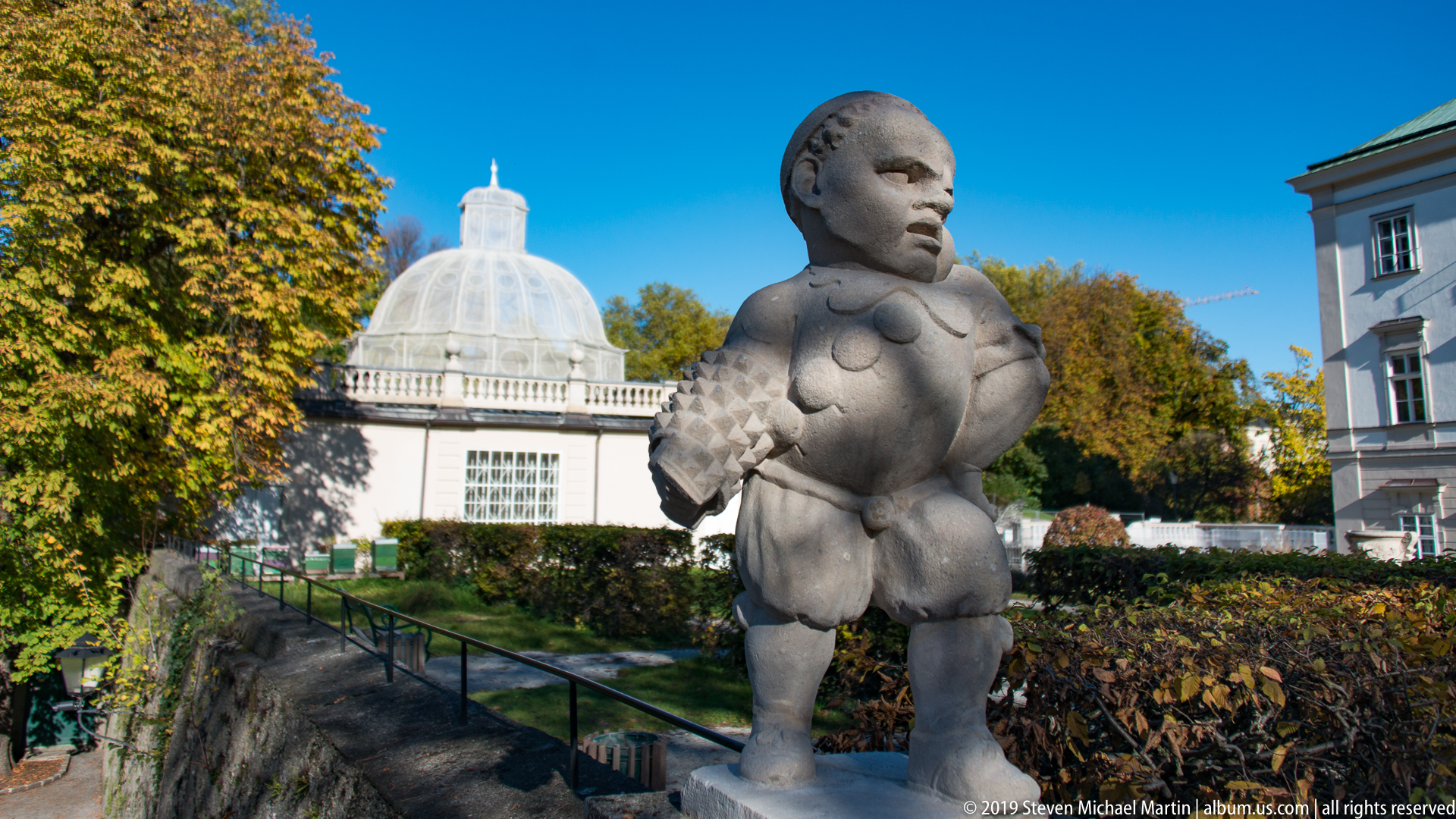
A stout stone dwarf figure stands in the Mirabell Gardens, posed with one arm behind its back and dressed in exaggerated period costume. The sculpture’s compact proportions and expressive face are characteristic of the garden’s famous group of Baroque dwarf statues. A glass-domed pavilion and clipped planting appear behind, placing the figure within the carefully designed garden ensemble.
Caption
A stout stone dwarf figure stands in the Mirabell Gardens, posed with one arm behind its back and dressed in exaggerated period costume. The sculpture’s compact proportions and expressive face are characteristic of the garden’s famous group of Baroque dwarf statues. A glass-domed pavilion and clipped planting appear behind, placing the figure within the carefully designed garden ensemble.

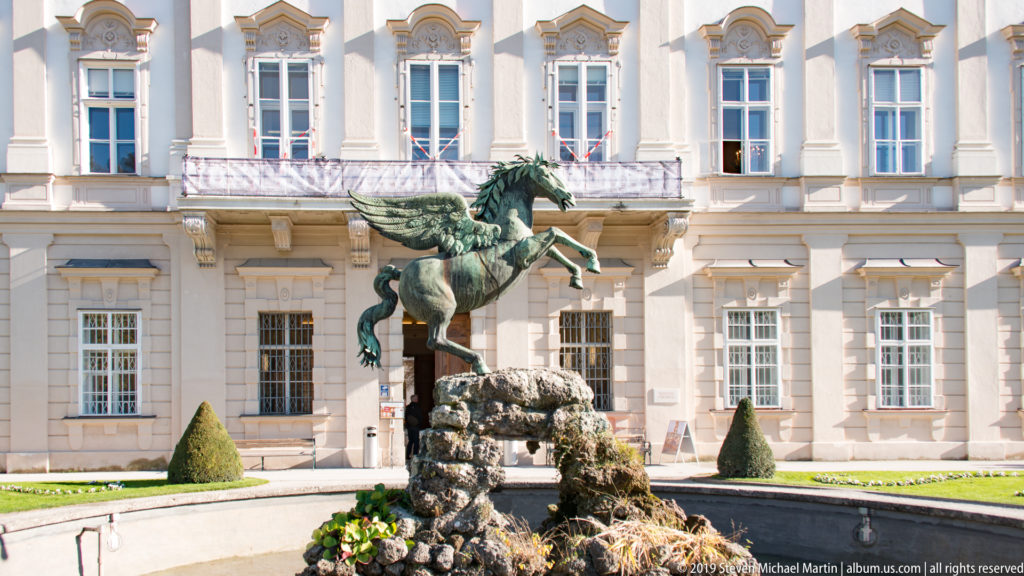
A bronze-green winged horse rears above a rocky base in front of Mirabell Palace, its spread wings, lifted forelegs, and flowing mane forming a dramatic silhouette. The sculpture represents Pegasus, one of the best-known features of the Mirabell Gardens. Set against the pale palace façade, the mythological figure becomes a vivid emblem of the garden’s theatrical Baroque character.
Caption
A bronze-green winged horse rears above a rocky base in front of Mirabell Palace, its spread wings, lifted forelegs, and flowing mane forming a dramatic silhouette. The sculpture represents Pegasus, one of the best-known features of the Mirabell Gardens. Set against the pale palace façade, the mythological figure becomes a vivid emblem of the garden’s theatrical Baroque character.

Two turquoise human figures hold hands beneath a small glowing heart, their bodies built from a grid of bright points against black. The image reads like an enlarged pedestrian-signal pictogram, but the tight crop removes its surrounding hardware and turns it into a luminous nighttime graphic. One figure extends an arm outward, adding motion to the otherwise symmetrical pair.
Caption
Two turquoise human figures hold hands beneath a small glowing heart, their bodies built from a grid of bright points against black. The image reads like an enlarged pedestrian-signal pictogram, but the tight crop removes its surrounding hardware and turns it into a luminous nighttime graphic. One figure extends an arm outward, adding motion to the otherwise symmetrical pair.

Two red human silhouettes stand close together against a black background, with one figure's arm extending across the other's shoulders. Rows of individual light points remain visible within the bodies, making the image feel both digital and handcrafted. The simplified embrace-like gesture distinguishes this pictogram from the other paired figures in the sequence and gives the nighttime light display a warm social theme.
Caption
Two red human silhouettes stand close together against a black background, with one figure's arm extending across the other's shoulders. Rows of individual light points remain visible within the bodies, making the image feel both digital and handcrafted. The simplified embrace-like gesture distinguishes this pictogram from the other paired figures in the sequence and gives the nighttime light display a warm social theme.

Seen across the Salzach at night, a church with a tall square clock tower and steep red roof stands brightly illuminated against the dark hillside. Warm floodlights pick out nearby trees, while a continuous row of white lamps traces the lower riverfront and bridge or promenade. The composition separates the landmark into three horizontal layers: water and lights, dark urban slope, and the glowing vertical church.
Caption
Seen across the Salzach at night, a church with a tall square clock tower and steep red roof stands brightly illuminated against the dark hillside. Warm floodlights pick out nearby trees, while a continuous row of white lamps traces the lower riverfront and bridge or promenade. The composition separates the landmark into three horizontal layers: water and lights, dark urban slope, and the glowing vertical church.

Two tall glasses of Edelweiss Weizenbier stand side by side on a table, each holding cloudy golden wheat beer beneath a diminishing cap of white foam. The black-and-blue Edelweiss branding is sharply legible on the glass fronts, while the softly blurred background keeps attention on the drink itself. The paired presentation gives the image the relaxed, social character of an evening stop in Salzburg.
Caption
Two tall glasses of Edelweiss Weizenbier stand side by side on a table, each holding cloudy golden wheat beer beneath a diminishing cap of white foam. The black-and-blue Edelweiss branding is sharply legible on the glass fronts, while the softly blurred background keeps attention on the drink itself. The paired presentation gives the image the relaxed, social character of an evening stop in Salzburg.

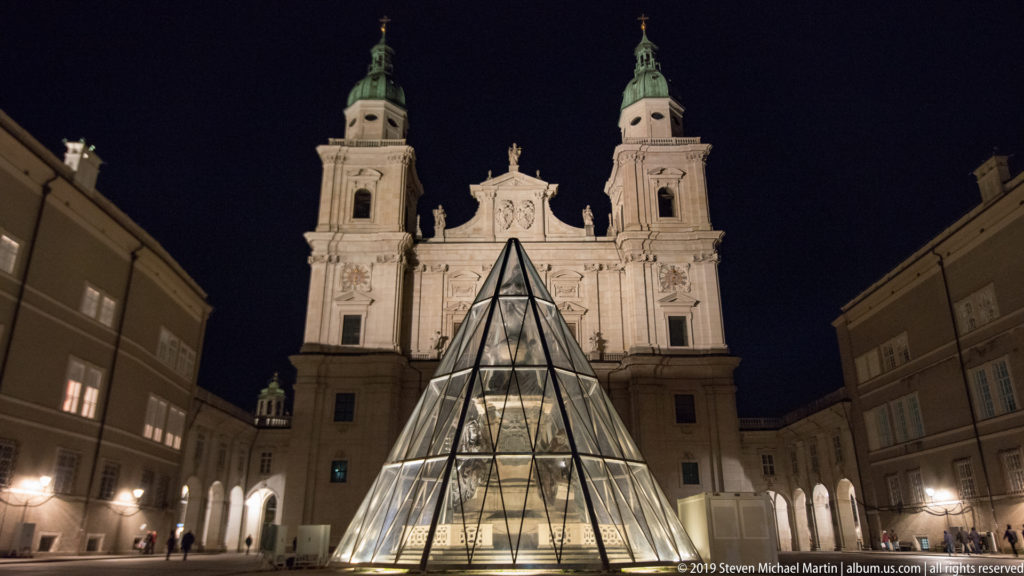
Salzburg Cathedral rises brightly illuminated behind a large transparent glass pyramid in the foreground. The cathedral's twin towers, sculpted facade, and green copper spires form a monumental backdrop to the pyramid's dark geometric frame. Seen at night across the open square, the composition deliberately contrasts Baroque sacred architecture with a contemporary transparent structure.
Caption
Salzburg Cathedral rises brightly illuminated behind a large transparent glass pyramid in the foreground. The cathedral's twin towers, sculpted facade, and green copper spires form a monumental backdrop to the pyramid's dark geometric frame. Seen at night across the open square, the composition deliberately contrasts Baroque sacred architecture with a contemporary transparent structure.

A painted relief panel shows a seated craftsman at work, surrounded by hand tools and implements arranged across the lower portion of the scene. The figure wears a white shirt and apron-like clothing and appears to work at a bench or block, suggesting a traditional trade. The exact craft is difficult to confirm from the proof sheet, but the display functions as a visual guild or business sign.
Caption
A painted relief panel shows a seated craftsman at work, surrounded by hand tools and implements arranged across the lower portion of the scene. The figure wears a white shirt and apron-like clothing and appears to work at a bench or block, suggesting a traditional trade. The exact craft is difficult to confirm from the proof sheet, but the display functions as a visual guild or business sign.

A round Mirabell package for 'Echte Salzburger Mozartkugeln' fills the frame, centered on a painted portrait of Wolfgang Amadeus Mozart in a red coat and white wig. Gold packaging, circular red-and-green bands, and curved German lettering reinforce the confection's Salzburg identity. The close focus turns a familiar souvenir sweet into a compact piece of local commercial iconography.
Caption
A round Mirabell package for 'Echte Salzburger Mozartkugeln' fills the frame, centered on a painted portrait of Wolfgang Amadeus Mozart in a red coat and white wig. Gold packaging, circular red-and-green bands, and curved German lettering reinforce the confection's Salzburg identity. The close focus turns a familiar souvenir sweet into a compact piece of local commercial iconography.

A small Salzburg hotel entrance is presented frontally at night, with individually lit letters spelling HOTEL across the stone lintel. A glass door opens onto a bright interior, while a narrow red carpet and two tall potted evergreens create a formal axis at the threshold. Dark side doors and windows balance the composition and make the central entrance glow more strongly.
Caption
A small Salzburg hotel entrance is presented frontally at night, with individually lit letters spelling HOTEL across the stone lintel. A glass door opens onto a bright interior, while a narrow red carpet and two tall potted evergreens create a formal axis at the threshold. Dark side doors and windows balance the composition and make the central entrance glow more strongly.
⭐ Highlights
- Old Town (Altstadt): A UNESCO World Heritage site with one of the best-preserved Baroque city centers in Europe.
- Hohensalzburg Fortress: A massive medieval fortress overlooking the city from above.
- Salzburg Cathedral: A grand Baroque cathedral at the heart of the historic center.
- Mirabell Palace & Gardens: A Baroque palace and gardens aligned with views toward the old town and fortress.
- Getreidegasse: A historic street known for its narrow passages and traditional shop signs.
- Salzach River: The river that divides the old and new town and defines the city’s layout.
🏙️ Salzburg Field Guide
Major features observed during this visit:
Salzburg is one of Europe’s most visually cohesive historic cities, set along the Salzach River and framed by surrounding hills and mountains. Its Old Town, designated a UNESCO World Heritage Site, preserves a dense collection of Baroque architecture shaped by centuries of ecclesiastical power and cultural influence. Dominated by Hohensalzburg Fortress above and anchored by churches, squares, and palaces below, the city presents a continuous urban landscape that blends history, music, and dramatic setting.
🏛️ Signature Landmarks
- Hohensalzburg Fortress – One of the largest fully preserved castles in Central Europe, overlooking the city from Festungsberg hill.
- Salzburg Cathedral – A major Baroque landmark forming the spiritual and architectural center of the old town.
- Mirabell Palace & Gardens – A Baroque complex known for its geometric gardens and views toward the historic skyline.
- Getreidegasse – A historic shopping street lined with narrow façades and traditional iron signs.
- Residenz Square – A central open space connecting the cathedral, palace, and surrounding historic buildings.
🧠 Historical Significance
- UNESCO World Heritage Site – The historic center was designated in 1996 for its architectural and cultural importance.
- Ecclesiastical Power – Salzburg was ruled for centuries by prince-archbishops who shaped its Baroque character.
- City of Mozart – Birthplace of Wolfgang Amadeus Mozart, whose legacy is visible throughout the city.
- Baroque Urban Form – The city reflects a unified architectural vision shaped during the 17th and 18th centuries.
🌄 Urban Landscape & Setting
- Salzach River – Divides the city into historic Old Town and newer districts.
- Fortress Above – The elevated fortress creates a strong vertical focal point across the skyline.
- Alpine Surroundings – Hills and mountains frame the city and enhance its dramatic setting.
- Walkable Core – The compact historic center allows continuous exploration on foot.