Pfarre Mülln (Augustinerkirche) – Salzburg, Austria
The Augustinerkirche in Mülln, often referred to as Pfarre Mülln, stands on the northern side of the Mönchsberg hill overlooking the Salzach River. Founded during the 14th century, the church forms part of a historic Augustinian monastery complex.
The church interior is known for its tall Gothic nave and richly decorated altars, reflecting the religious traditions of the Augustinian order. Adjacent to the church is the well-known Augustiner Bräu tavern, where monks historically brewed beer that continues to be served today.
The setting of the church beneath the cliffs of the Mönchsberg gives the area a particularly atmospheric historic character within Salzburg.

The tower is seen almost frontally, placing its large circular clock face directly beneath paired rows of arched openings. Above, a tiered green-patinated lantern rises from the pale stone shaft; below and to the right, red-tiled church roofs enter the frame. The composition emphasizes the tower’s layered vertical structure and its role as the most prominent exterior landmark of the complex.
Caption
The tower is seen almost frontally, placing its large circular clock face directly beneath paired rows of arched openings. Above, a tiered green-patinated lantern rises from the pale stone shaft; below and to the right, red-tiled church roofs enter the frame. The composition emphasizes the tower’s layered vertical structure and its role as the most prominent exterior landmark of the complex.

A broad stucco arch frames a view from the church precinct into a compact Salzburg streetscape of pale façades, pedestrians, lamps, and stone retaining walls. The church-side entrance at left and the curved passage opening create a transitional view between the sacred complex on the Mülln hillside and the urban neighborhood immediately beyond.
Caption
A broad stucco arch frames a view from the church precinct into a compact Salzburg streetscape of pale façades, pedestrians, lamps, and stone retaining walls. The church-side entrance at left and the curved passage opening create a transitional view between the sacred complex on the Mülln hillside and the urban neighborhood immediately beyond.

The Parish Church of Mülln, dedicated to the Assumption of Mary, rises above a grassy slope with its square tower, clock face, green tiered crown, and steep red-tiled roof. Seen from below through trees, the church appears as a compact hilltop landmark. The late-season foliage and oblique viewpoint emphasize the building’s elevated position above the Salzach district of Mülln.
Caption
The Parish Church of Mülln, dedicated to the Assumption of Mary, rises above a grassy slope with its square tower, clock face, green tiered crown, and steep red-tiled roof. Seen from below through trees, the church appears as a compact hilltop landmark. The late-season foliage and oblique viewpoint emphasize the building’s elevated position above the Salzach district of Mülln.

A wider hillside view shows Pfarre Mülln rising above lower neighborhood buildings and autumn vegetation, with its square tower and green lantern dominating the skyline. A second, smaller church-like tower appears at right, while the main church’s pale walls and steep red roof stand out against the wooded slope, broadening the view from a single monument to its immediate ecclesiastical setting.
Caption
A wider hillside view shows Pfarre Mülln rising above lower neighborhood buildings and autumn vegetation, with its square tower and green lantern dominating the skyline. A second, smaller church-like tower appears at right, while the main church’s pale walls and steep red roof stand out against the wooded slope, broadening the view from a single monument to its immediate ecclesiastical setting.

A low-angle view isolates the massive square tower of Pfarre Mülln against a clear blue sky. Paired arched openings punctuate the pale masonry, a large clock face sits near the lower edge of the frame, and the tower culminates in a multi-tiered polygonal lantern capped in green-patinated metal, visually separating the vertical tower from the red-tiled roof below.
Caption
A low-angle view isolates the massive square tower of Pfarre Mülln against a clear blue sky. Paired arched openings punctuate the pale masonry, a large clock face sits near the lower edge of the frame, and the tower culminates in a multi-tiered polygonal lantern capped in green-patinated metal, visually separating the vertical tower from the red-tiled roof below.

The tower and red roof of Mülln Parish Church rise above a pink riverside building and autumn trees, giving the church a strong landmark presence within the neighborhood. Its square masonry tower transitions to an open green upper stage and lantern-like crown. The lower viewpoint includes café terraces and street activity, placing the historic church within the everyday urban fabric of Mülln.
Caption
The tower and red roof of Mülln Parish Church rise above a pink riverside building and autumn trees, giving the church a strong landmark presence within the neighborhood. Its square masonry tower transitions to an open green upper stage and lantern-like crown. The lower viewpoint includes café terraces and street activity, placing the historic church within the everyday urban fabric of Mülln.

The upper register of the high altar rises beneath the church clock in a complex composition of dark architectural curves, gilded rays, angels, and sculpted figures. Tall arched windows flank the ensemble, while the pale vault’s painted ornament provides a luminous background that separates the dense altar carving from the surrounding architecture.
Caption
The upper register of the high altar rises beneath the church clock in a complex composition of dark architectural curves, gilded rays, angels, and sculpted figures. Tall arched windows flank the ensemble, while the pale vault’s painted ornament provides a luminous background that separates the dense altar carving from the surrounding architecture.

A frontal sanctuary view shows the complete vertical organization of Pfarre Mülln’s high altar: red-brown marble columns, gilded saints, a dark central architectural core, and an elevated sculptural crown. Tall clear-glazed windows brighten the altar from both sides, while paired candlesticks and framed paintings establish the liturgical symmetry of the chancel.
Caption
A frontal sanctuary view shows the complete vertical organization of Pfarre Mülln’s high altar: red-brown marble columns, gilded saints, a dark central architectural core, and an elevated sculptural crown. Tall clear-glazed windows brighten the altar from both sides, while paired candlesticks and framed paintings establish the liturgical symmetry of the chancel.

A small devotional wall painting is set into the stucco façade above an oval street-number plaque marked “18 Müllner Hauptstr.” The weathered sacred scene, protected by a shallow metal hood, places religious imagery directly within the streetscape around Pfarre Mülln and shows how devotional art is embedded in the surrounding historic architecture.
Caption
A small devotional wall painting is set into the stucco façade above an oval street-number plaque marked “18 Müllner Hauptstr.” The weathered sacred scene, protected by a shallow metal hood, places religious imagery directly within the streetscape around Pfarre Mülln and shows how devotional art is embedded in the surrounding historic architecture.
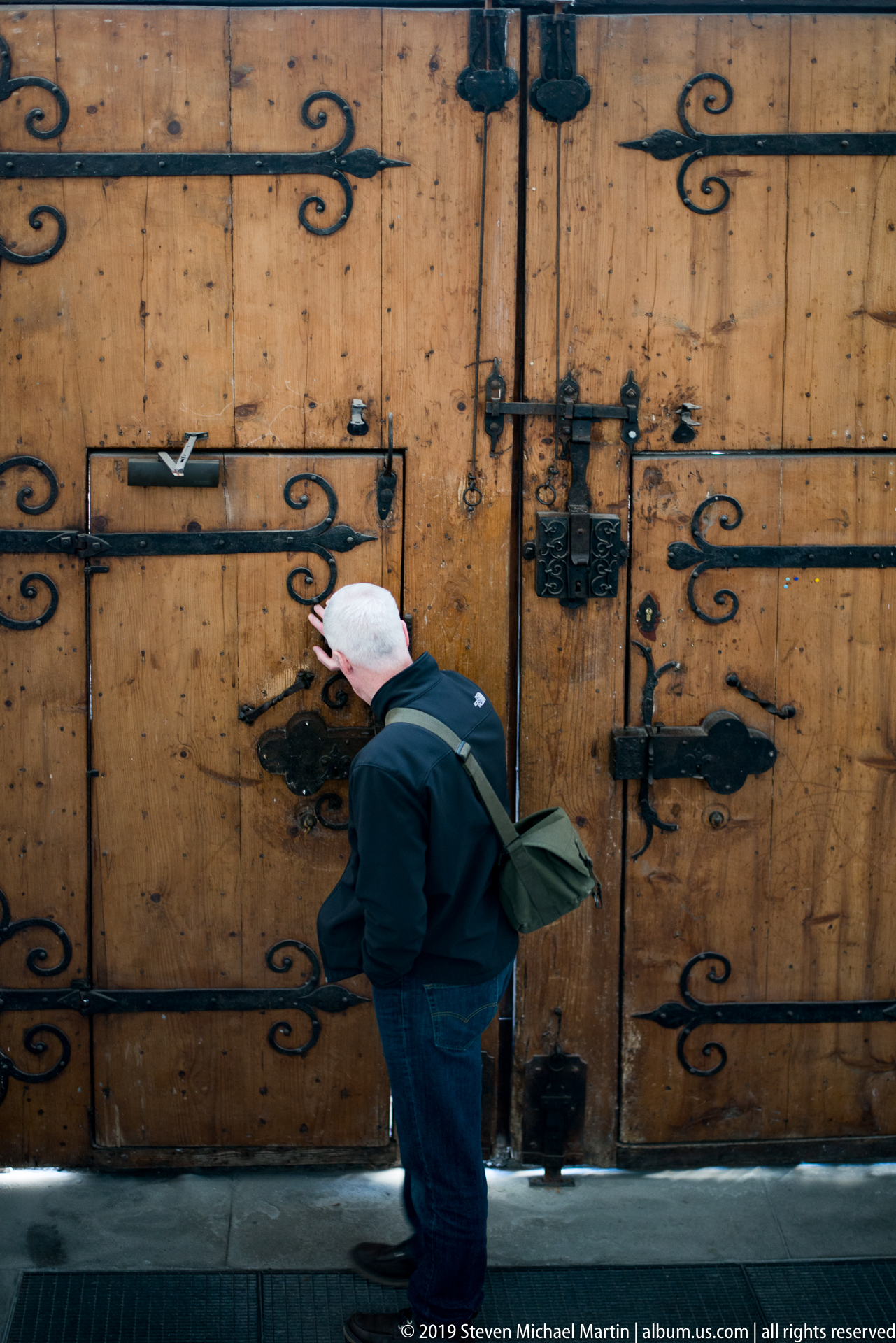
A large timber church door is reinforced with an unusually dense system of black wrought-iron straps, scrolls, hinges, locks, and studded fittings. A visitor standing close to the entrance provides scale, while the broad wooden leaves and functional metalwork emphasize the fortified visual character of this historic access point at Pfarre Mülln.
Caption
A large timber church door is reinforced with an unusually dense system of black wrought-iron straps, scrolls, hinges, locks, and studded fittings. A visitor standing close to the entrance provides scale, while the broad wooden leaves and functional metalwork emphasize the fortified visual character of this historic access point at Pfarre Mülln.

A broad flight of pale stone steps rises through a white vaulted interior toward an elaborately furnished liturgical space. Framed paintings line the right wall, chandeliers hang from the ceiling, and a crucifix is suspended above the distant altar zone, creating a strong axial approach from the lower circulation level toward the sacred interior of Pfarre Mülln.
Caption
A broad flight of pale stone steps rises through a white vaulted interior toward an elaborately furnished liturgical space. Framed paintings line the right wall, chandeliers hang from the ceiling, and a crucifix is suspended above the distant altar zone, creating a strong axial approach from the lower circulation level toward the sacred interior of Pfarre Mülln.

An oval enamel address plaque identifies number 14 on Müllner Hauptstraße in Salzburg. Its black Fraktur-style lettering, bold numerals, white field, and rust-colored rim form a compact piece of historic wayfinding within the neighborhood of Pfarre Mülln, contrasting sharply with the plain rendered wall on which it is mounted.
Caption
An oval enamel address plaque identifies number 14 on Müllner Hauptstraße in Salzburg. Its black Fraktur-style lettering, bold numerals, white field, and rust-colored rim form a compact piece of historic wayfinding within the neighborhood of Pfarre Mülln, contrasting sharply with the plain rendered wall on which it is mounted.

The closed double doors of Pfarre Mülln display a symmetrical network of wrought-iron scrolls, strap hinges, locking plates, and lower reinforcement fittings across warm, vertically boarded timber. Small framed religious images flank the doorway inside the vestibule, while stone basins at either side help define the threshold as a functional and devotional entrance zone.
Caption
The closed double doors of Pfarre Mülln display a symmetrical network of wrought-iron scrolls, strap hinges, locking plates, and lower reinforcement fittings across warm, vertically boarded timber. Small framed religious images flank the doorway inside the vestibule, while stone basins at either side help define the threshold as a functional and devotional entrance zone.

A painted female saint presents a white cloth bearing the faint image of Christ’s face, the traditional attribute of Saint Veronica and the Veil of Veronica. The figure’s dark mantle and red garment stand against a cool blue-green background, while the cloth itself occupies the center of the composition as the principal devotional focus.
Caption
A painted female saint presents a white cloth bearing the faint image of Christ’s face, the traditional attribute of Saint Veronica and the Veil of Veronica. The figure’s dark mantle and red garment stand against a cool blue-green background, while the cloth itself occupies the center of the composition as the principal devotional focus.

An ornate pulpit projects from the wall in a dense display of gilded carving, dark painted panels, sculptural ornament, and a large canopy. Its curving balcony overlooks the nave beside an arched window and decorative ironwork, while surrounding ceiling paintings and stucco place the preaching platform within the richly furnished Baroque interior of Pfarre Mülln.
Caption
An ornate pulpit projects from the wall in a dense display of gilded carving, dark painted panels, sculptural ornament, and a large canopy. Its curving balcony overlooks the nave beside an arched window and decorative ironwork, while surrounding ceiling paintings and stucco place the preaching platform within the richly furnished Baroque interior of Pfarre Mülln.

A side altar rises in layers of white sculpted figures, gilded clouds, rays, and architectural framing around a small central Marian image. Angels and saints cluster beneath an elaborate canopy while painted and stucco ceiling decoration fills the surrounding space, producing a theatrical upward movement characteristic of the church’s richly ornamented Baroque interior.
Caption
A side altar rises in layers of white sculpted figures, gilded clouds, rays, and architectural framing around a small central Marian image. Angels and saints cluster beneath an elaborate canopy while painted and stucco ceiling decoration fills the surrounding space, producing a theatrical upward movement characteristic of the church’s richly ornamented Baroque interior.

A close view isolates the working hardware of the church entrance: a rectangular iron lock plate, a heavy horizontal strap, pointed decorative terminals, and riveted fittings set against weathered timber boards. Scratches and surface wear reveal long use, turning a functional locking system into a detailed study of traditional metalwork and carpentry at Pfarre Mülln.
Caption
A close view isolates the working hardware of the church entrance: a rectangular iron lock plate, a heavy horizontal strap, pointed decorative terminals, and riveted fittings set against weathered timber boards. Scratches and surface wear reveal long use, turning a functional locking system into a detailed study of traditional metalwork and carpentry at Pfarre Mülln.

A richly ornamented pipe organ rises from the rear gallery beneath a pale vaulted ceiling traced with delicate painted and gilded decoration. The organ’s tall central pipe field and flanking cases are integrated with the curving gallery balustrade, creating a symmetrical musical and architectural focal point opposite the church’s principal liturgical furnishings.
Caption
A richly ornamented pipe organ rises from the rear gallery beneath a pale vaulted ceiling traced with delicate painted and gilded decoration. The organ’s tall central pipe field and flanking cases are integrated with the curving gallery balustrade, creating a symmetrical musical and architectural focal point opposite the church’s principal liturgical furnishings.

The lower register of the high altar is crowded with gilded standing saints, small angels, dark architectural backing, and a brilliant central tabernacle framed by silver-toned scrollwork. Red-brown marble columns and the white altar table anchor the composition, while candles and flowers mark this as the active liturgical focus of the sanctuary.
Caption
The lower register of the high altar is crowded with gilded standing saints, small angels, dark architectural backing, and a brilliant central tabernacle framed by silver-toned scrollwork. Red-brown marble columns and the white altar table anchor the composition, while candles and flowers mark this as the active liturgical focus of the sanctuary.

A closer frontal view of the side altar centers a framed image of the Virgin and Child above an altar table. Large white sculpted figures stand to either side, with cherubs, gilded rays, and twisting columns drawing attention upward to the devotional image. Candles and a small statue at the base reinforce the altar’s liturgical function.
Caption
A closer frontal view of the side altar centers a framed image of the Virgin and Child above an altar table. Large white sculpted figures stand to either side, with cherubs, gilded rays, and twisting columns drawing attention upward to the devotional image. Candles and a small statue at the base reinforce the altar’s liturgical function.

A gilded sculptural figure of a bearded male saint stands dynamically on a wall-mounted rococo-style console, one hand extended and the other holding a long staff. A radiating halo encircles his head, while the inscription panel below is only partly legible. The isolated placement makes the figure a distinct devotional accent within the church interior.
Caption
A gilded sculptural figure of a bearded male saint stands dynamically on a wall-mounted rococo-style console, one hand extended and the other holding a long staff. A radiating halo encircles his head, while the inscription panel below is only partly legible. The isolated placement makes the figure a distinct devotional accent within the church interior.

A large round clock with Roman numerals is set into the decorated vault above a gilded sculptural figure and the crest of the principal altar. Black and gold clock hands stand out against the pale dial, while painted arabesques and gilded ornament integrate the timepiece into the church’s ceremonial interior rather than treating it as a separate utilitarian object.
Caption
A large round clock with Roman numerals is set into the decorated vault above a gilded sculptural figure and the crest of the principal altar. Black and gold clock hands stand out against the pale dial, while painted arabesques and gilded ornament integrate the timepiece into the church’s ceremonial interior rather than treating it as a separate utilitarian object.

Rows of dark wooden pews lead through the bright church interior toward the high altar, emphasizing the longitudinal axis of the nave. The altar’s gilded sculpture and red-brown columns are framed by tall windows and a delicately ornamented white vault, giving this view a broader sense of how congregational space, sanctuary, light, and decoration work together.
Caption
Rows of dark wooden pews lead through the bright church interior toward the high altar, emphasizing the longitudinal axis of the nave. The altar’s gilded sculpture and red-brown columns are framed by tall windows and a delicately ornamented white vault, giving this view a broader sense of how congregational space, sanctuary, light, and decoration work together.

A formal stone portal is set into a smooth ochre façade, reached by a short flight of steps and framed by heavy architectural moldings. Above the wooden door, a sculpted relief occupies the broken or projecting pediment area, giving the entrance a ceremonial emphasis distinct from the plainer surrounding wall and rectangular windows.
Caption
A formal stone portal is set into a smooth ochre façade, reached by a short flight of steps and framed by heavy architectural moldings. Above the wooden door, a sculpted relief occupies the broken or projecting pediment area, giving the entrance a ceremonial emphasis distinct from the plainer surrounding wall and rectangular windows.

A weathered religious painting occupies a molded frame on the exterior wall, protected above by a dark curved hood. The scene appears to show a sacred figure bending over another body or figure, but age and surface loss obscure the exact episode. Its placement on the church exterior makes it part of the devotional imagery encountered before entering the building.
Caption
A weathered religious painting occupies a molded frame on the exterior wall, protected above by a dark curved hood. The scene appears to show a sacred figure bending over another body or figure, but age and surface loss obscure the exact episode. Its placement on the church exterior makes it part of the devotional imagery encountered before entering the building.