Santiago de Compostela
Santiago de Compostela developed as a major religious center associated with the pilgrimage routes leading to the cathedral dedicated to Saint James. The historic urban layout reflects the importance of accommodating pilgrims traveling from across Europe. Narrow streets, plazas, and religious institutions illustrate the city’s role in medieval spiritual life.
The growth of Santiago de Compostela was closely tied to the expansion of pilgrimage traditions that influenced economic and cultural exchange throughout the region. Monasteries, hospices, and civic buildings supported travelers undertaking the journey. The city became an important destination connecting religious devotion with cultural interaction.
Santiago de Compostela represents the influence of pilgrimage networks in shaping the development of European cities. Its preserved historic environment reflects centuries of religious and cultural continuity.

Stone towers and richly articulated church masonry rise beyond a formal garden edged with clipped planting and tall slender trees. Scaffolding on one tower records active conservation, while the oblique viewpoint situates Santiago’s cathedral complex within adjoining historic buildings rather than isolating its principal façade.
Caption
Stone towers and richly articulated church masonry rise beyond a formal garden edged with clipped planting and tall slender trees. Scaffolding on one tower records active conservation, while the oblique viewpoint situates Santiago’s cathedral complex within adjoining historic buildings rather than isolating its principal façade.

A broad exterior stair rises between carved stone balustrades to an elevated terrace framed by masonry buildings. Heavy corbels support the projecting central landing, while urn-like finials and metal balcony rails add ornament above. The frontal composition emphasizes the symmetry, weight, and civic or institutional character of this granite architectural ensemble.
Caption
A broad exterior stair rises between carved stone balustrades to an elevated terrace framed by masonry buildings. Heavy corbels support the projecting central landing, while urn-like finials and metal balcony rails add ornament above. The frontal composition emphasizes the symmetry, weight, and civic or institutional character of this granite architectural ensemble.

An illuminated equestrian figure of Saint James rises sharply against the black night sky, the saint mounted on a rearing horse and holding a raised standard. The upward viewpoint isolates the sculptural group from its architectural setting, turning the traditional iconography of Santiago into the sole visual subject. Smaller figures and the stone pedestal remain visible beneath the horse, adding depth to the dramatic silhouette.
Caption
An illuminated equestrian figure of Saint James rises sharply against the black night sky, the saint mounted on a rearing horse and holding a raised standard. The upward viewpoint isolates the sculptural group from its architectural setting, turning the traditional iconography of Santiago into the sole visual subject. Smaller figures and the stone pedestal remain visible beneath the horse, adding depth to the dramatic silhouette.

A dramatically tilted nighttime view sets the cathedral’s illuminated clock tower against a broad, nearly empty square. Warm light under the long arcaded building at left contrasts with the pale stone of the tower, while the wide foreground emphasizes the scale of the surrounding civic and ecclesiastical ensemble.
Caption
A dramatically tilted nighttime view sets the cathedral’s illuminated clock tower against a broad, nearly empty square. Warm light under the long arcaded building at left contrasts with the pale stone of the tower, while the wide foreground emphasizes the scale of the surrounding civic and ecclesiastical ensemble.

A sculptural fountain rises in silhouette before the brightly illuminated cathedral tower, creating a layered nighttime composition of civic space and sacred architecture. The tower’s clock, tall pilasters, upper belfry, and ornate crown remain legible behind the darker fountain, while the cathedral entrance and steps anchor the lower left.
Caption
A sculptural fountain rises in silhouette before the brightly illuminated cathedral tower, creating a layered nighttime composition of civic space and sacred architecture. The tower’s clock, tall pilasters, upper belfry, and ornate crown remain legible behind the darker fountain, while the cathedral entrance and steps anchor the lower left.

From street level, the cathedral’s tall clock tower rises beyond broad entrance steps while a sculptural fountain occupies the near foreground. The narrow framing between neighboring stone buildings emphasizes the tower’s height and the transition from urban lane to cathedral precinct.
Caption
From street level, the cathedral’s tall clock tower rises beyond broad entrance steps while a sculptural fountain occupies the near foreground. The narrow framing between neighboring stone buildings emphasizes the tower’s height and the transition from urban lane to cathedral precinct.

A tall stone column rises from a circular basin at the center of a small historic square enclosed by arcaded and balconied buildings. A sculpted figure crowns the shaft, while the low fountain basin and surrounding paving create a compact civic focal point. The streetscape shifts attention away from the cathedral itself to the dense urban fabric of central Santiago de Compostela.
Caption
A tall stone column rises from a circular basin at the center of a small historic square enclosed by arcaded and balconied buildings. A sculpted figure crowns the shaft, while the low fountain basin and surrounding paving create a compact civic focal point. The streetscape shifts attention away from the cathedral itself to the dense urban fabric of central Santiago de Compostela.

A quiet stone-paved space opens between narrow historic buildings with granite trim, wrought-iron balconies, and enclosed white-painted galleries. Ground-floor storefronts and café furniture mark contemporary use within the older urban fabric. The receding street and restrained pedestrian scale typify the tightly knit historic center of Santiago de Compostela without requiring a specific plaza identification.
Caption
A quiet stone-paved space opens between narrow historic buildings with granite trim, wrought-iron balconies, and enclosed white-painted galleries. Ground-floor storefronts and café furniture mark contemporary use within the older urban fabric. The receding street and restrained pedestrian scale typify the tightly knit historic center of Santiago de Compostela without requiring a specific plaza identification.

A long two-story granite building stretches across the edge of a broad paved plaza. Repeated semicircular arches form a shaded ground-floor arcade, while evenly spaced rectangular windows organize the upper story beneath a hipped roof and central chimney. The frontal view emphasizes repetition and civic scale rather than decorative detail.
Caption
A long two-story granite building stretches across the edge of a broad paved plaza. Repeated semicircular arches form a shaded ground-floor arcade, while evenly spaced rectangular windows organize the upper story beneath a hipped roof and central chimney. The frontal view emphasizes repetition and civic scale rather than decorative detail.

A man in a gray zip-neck sweater stands in the foreground with arms crossed, while a weathered granite church and its domed bell tower rise behind him. The shallow separation between portrait and architecture makes the historic building an active part of the environmental portrait rather than a distant backdrop.
Caption
A man in a gray zip-neck sweater stands in the foreground with arms crossed, while a weathered granite church and its domed bell tower rise behind him. The shallow separation between portrait and architecture makes the historic building an active part of the environmental portrait rather than a distant backdrop.

A man in a gray sweater stands near a stone parapet at sunset, with the same sculptural church roofline and domed bell tower rising behind him. The tilted composition opens toward the distant city and warm horizon, combining a casual travel portrait with an elevated architectural view.
Caption
A man in a gray sweater stands near a stone parapet at sunset, with the same sculptural church roofline and domed bell tower rising behind him. The tilted composition opens toward the distant city and warm horizon, combining a casual travel portrait with an elevated architectural view.

A compact upper landing combines exposed granite masonry with dark timber floors, a decorative iron balustrade, and a paneled wooden door. A red runner and warm table lamp soften the heavy stone enclosure, while a glazed roof opening admits daylight from above. The view records the intimate scale and adapted historic fabric of an interior in Santiago de Compostela.
Caption
A compact upper landing combines exposed granite masonry with dark timber floors, a decorative iron balustrade, and a paneled wooden door. A red runner and warm table lamp soften the heavy stone enclosure, while a glazed roof opening admits daylight from above. The view records the intimate scale and adapted historic fabric of an interior in Santiago de Compostela.
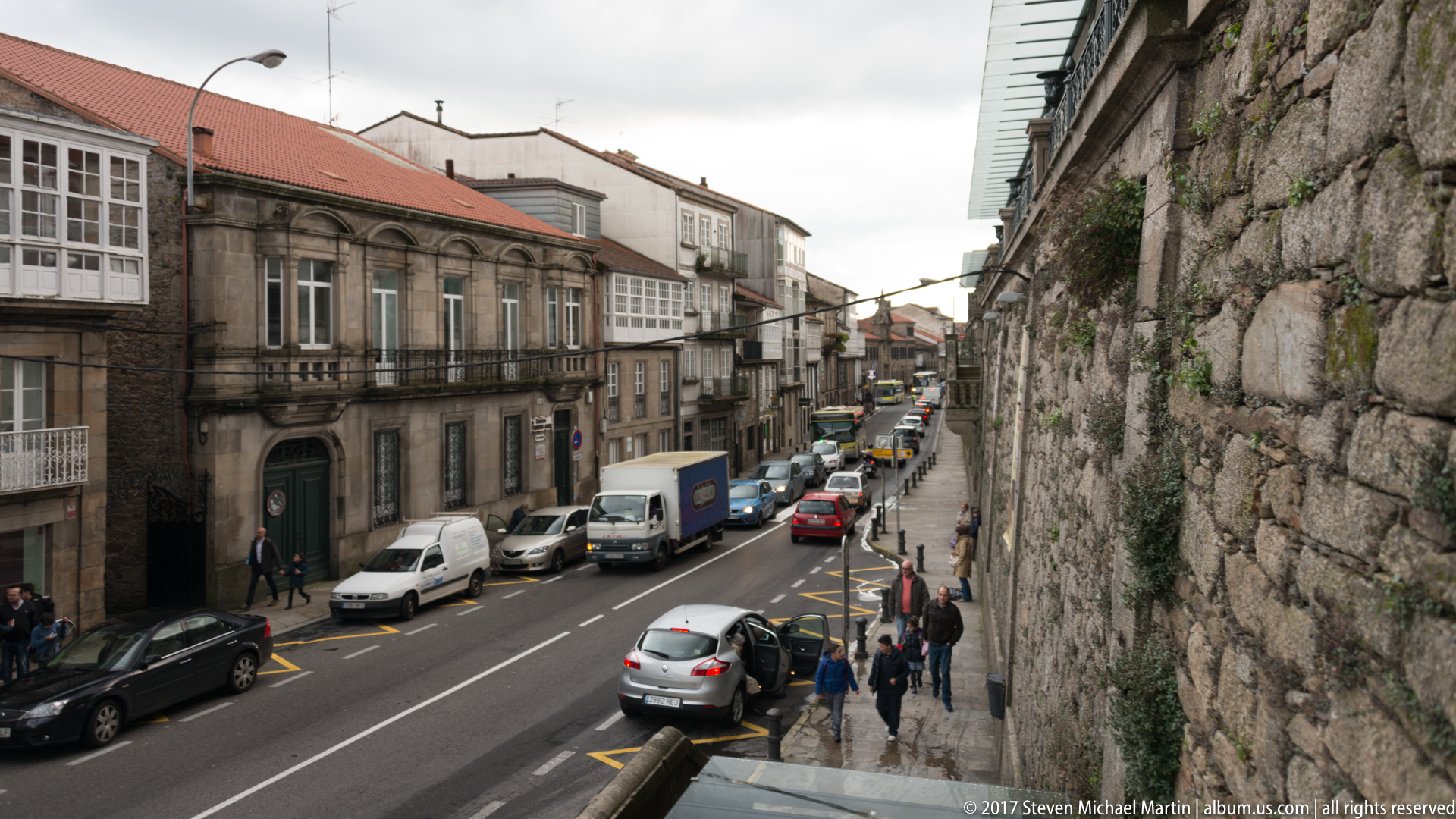
Traffic and pedestrians share a narrow city street running alongside a tall, rough-faced granite wall. Across the roadway, traditional multi-story buildings present enclosed glazed galleries, balconies, and stone façades. The elevated viewpoint contrasts the monumental masonry edge at right with the everyday movement and dense historic streetscape of central Santiago de Compostela.
Caption
Traffic and pedestrians share a narrow city street running alongside a tall, rough-faced granite wall. Across the roadway, traditional multi-story buildings present enclosed glazed galleries, balconies, and stone façades. The elevated viewpoint contrasts the monumental masonry edge at right with the everyday movement and dense historic streetscape of central Santiago de Compostela.

A restrained stone church façade faces a narrow urban space, its central doorway framed by heavy pilasters and surmounted by a rectangular window and shallow pediment. Scaffolding and blue protective mesh rise immediately to the right, while adjoining multi-story buildings press close on the left. The view records the dense ecclesiastical streetscape around the cathedral complex without assigning the building a specific name unsupported by the proof sheet.
Caption
A restrained stone church façade faces a narrow urban space, its central doorway framed by heavy pilasters and surmounted by a rectangular window and shallow pediment. Scaffolding and blue protective mesh rise immediately to the right, while adjoining multi-story buildings press close on the left. The view records the dense ecclesiastical streetscape around the cathedral complex without assigning the building a specific name unsupported by the proof sheet.

A broad semicircular arch opens through a pale stone façade, its blue-green doors standing open beneath a formal arrangement of pilasters, cornices, and a heraldic relief. The low, upward-tilted viewpoint makes the entrance appear monumental and reveals the shadowed passage beyond. Moss along the lower masonry contrasts with the light stone and emphasizes the building’s weathered exterior.
Caption
A broad semicircular arch opens through a pale stone façade, its blue-green doors standing open beneath a formal arrangement of pilasters, cornices, and a heraldic relief. The low, upward-tilted viewpoint makes the entrance appear monumental and reveals the shadowed passage beyond. Moss along the lower masonry contrasts with the light stone and emphasizes the building’s weathered exterior.

A compact stone church front rises above a dark wooden entrance, with paired pilasters supporting an ornamented upper register centered on a niche containing a robed religious figure. A triangular pediment and cross crown the façade, while adjacent masonry and a projecting street lantern reveal the tight urban setting. The low viewpoint stresses the vertical sequence from doorway to saint niche and roofline.
Caption
A compact stone church front rises above a dark wooden entrance, with paired pilasters supporting an ornamented upper register centered on a niche containing a robed religious figure. A triangular pediment and cross crown the façade, while adjacent masonry and a projecting street lantern reveal the tight urban setting. The low viewpoint stresses the vertical sequence from doorway to saint niche and roofline.

A wide exterior view extends from the cathedral tower across a long, richly articulated side elevation, where repeated portals, sculptural niches, balustrades, and finials form a continuous stone frontage. Scaffolding and protective sheeting rise at the far right, documenting active restoration at the time of the visit. The wider framing emphasizes the breadth of the complex and the contrast between historic masonry and temporary conservation structures.
Caption
A wide exterior view extends from the cathedral tower across a long, richly articulated side elevation, where repeated portals, sculptural niches, balustrades, and finials form a continuous stone frontage. Scaffolding and protective sheeting rise at the far right, documenting active restoration at the time of the visit. The wider framing emphasizes the breadth of the complex and the contrast between historic masonry and temporary conservation structures.

An oblique view from the plaza combines the cathedral’s tall clock-and-bell tower with a long lower façade of portals, sculptural niches, balustrades, and rooftop finials. The angle gives greater weight to the building’s horizontal extent than the preceding tower portrait, showing the tower as one component of a larger architectural ensemble. Sparse pedestrians at ground level underscore the monumental scale.
Caption
An oblique view from the plaza combines the cathedral’s tall clock-and-bell tower with a long lower façade of portals, sculptural niches, balustrades, and rooftop finials. The angle gives greater weight to the building’s horizontal extent than the preceding tower portrait, showing the tower as one component of a larger architectural ensemble. Sparse pedestrians at ground level underscore the monumental scale.

Seen from the open plaza, the cathedral tower rises in successive arcaded stages above a large clock, with a smaller domed roof and balustraded stonework extending to the right. The broader viewpoint reveals how the vertical tower relates to the complex’s lower roofscape, while the gray sky and uncluttered foreground keep attention on the architecture’s silhouette and layered massing.
Caption
Seen from the open plaza, the cathedral tower rises in successive arcaded stages above a large clock, with a smaller domed roof and balustraded stonework extending to the right. The broader viewpoint reveals how the vertical tower relates to the complex’s lower roofscape, while the gray sky and uncluttered foreground keep attention on the architecture’s silhouette and layered massing.

A tall iron-gated entrance is embedded in a dense sculptural program of standing saints and rectangular relief panels. A larger robed figure occupies the niche above the arch, while smaller figures and narrative scenes form vertical bands on either side. The frontal composition records the doorway as an integrated work of architecture and religious sculpture rather than isolating a single statue.
Caption
A tall iron-gated entrance is embedded in a dense sculptural program of standing saints and rectangular relief panels. A larger robed figure occupies the niche above the arch, while smaller figures and narrative scenes form vertical bands on either side. The frontal composition records the doorway as an integrated work of architecture and religious sculpture rather than isolating a single statue.

Three weathered stone saints occupy a richly articulated exterior wall, with a larger pilgrim figure centered beneath a rounded arch and two smaller statues set in flanking niches. The central figure’s staff and broad pilgrim attributes distinguish it from its companions. Lichen, darkened joints, scrolls, and layered moldings give the ensemble a strongly aged surface character.
Caption
Three weathered stone saints occupy a richly articulated exterior wall, with a larger pilgrim figure centered beneath a rounded arch and two smaller statues set in flanking niches. The central figure’s staff and broad pilgrim attributes distinguish it from its companions. Lichen, darkened joints, scrolls, and layered moldings give the ensemble a strongly aged surface character.

A weathered stone figure dressed as a pilgrim stands beneath a shell-like halo or canopy, holding a long staff and a book or object at the opposite side. The statue occupies a deep architectural niche framed by dark, lichen-marked masonry. Pilgrim attributes strongly evoke the devotional imagery associated with Santiago, while the close view preserves the sculpture’s surface wear and setting.
Caption
A weathered stone figure dressed as a pilgrim stands beneath a shell-like halo or canopy, holding a long staff and a book or object at the opposite side. The statue occupies a deep architectural niche framed by dark, lichen-marked masonry. Pilgrim attributes strongly evoke the devotional imagery associated with Santiago, while the close view preserves the sculpture’s surface wear and setting.

A crowned heraldic shield fills the center of a carved stone architectural panel above a cathedral entrance. Scrollwork and relief ornament surround the arms beneath a shallow classical pediment, while weathering softens the pale masonry surface. The close framing separates this emblematic decoration from the doorway below and records the façade’s civic or institutional heraldic language without relying on an uncertain attribution.
Caption
A crowned heraldic shield fills the center of a carved stone architectural panel above a cathedral entrance. Scrollwork and relief ornament surround the arms beneath a shallow classical pediment, while weathering softens the pale masonry surface. The close framing separates this emblematic decoration from the doorway below and records the façade’s civic or institutional heraldic language without relying on an uncertain attribution.

A monumental doorway is organized as a formal stone composition of paired columns, carved floral ornament, a projecting pediment, and a large heraldic panel above blue-green paneled doors. The frontal view concentrates on the craftsmanship of the entrance rather than the cathedral’s overall mass, with the human figure at the threshold reinforcing the scale of the portal.
Caption
A monumental doorway is organized as a formal stone composition of paired columns, carved floral ornament, a projecting pediment, and a large heraldic panel above blue-green paneled doors. The frontal view concentrates on the craftsmanship of the entrance rather than the cathedral’s overall mass, with the human figure at the threshold reinforcing the scale of the portal.

The cathedral’s monumental clock-and-bell tower is shown nearly full height, allowing its stacked architectural stages to be read from the restrained lower masonry to the increasingly ornate belfry and lantern above. Adjoining rooflines and smaller turrets place the tower within the larger complex, while the low viewpoint accentuates its dominance over the surrounding stonework.
Caption
The cathedral’s monumental clock-and-bell tower is shown nearly full height, allowing its stacked architectural stages to be read from the restrained lower masonry to the increasingly ornate belfry and lantern above. Adjoining rooflines and smaller turrets place the tower within the larger complex, while the low viewpoint accentuates its dominance over the surrounding stonework.

An ornate cathedral tower rises against an overcast sky, its clock face set below open belfry stages and increasingly elaborate upper tiers. Carved moldings, balustrades, pinnacles, and a crowning lantern create a strongly vertical composition. The close upward viewpoint isolates the tower’s sculptural stonework and timekeeping function from the broader cathedral façade.
Caption
An ornate cathedral tower rises against an overcast sky, its clock face set below open belfry stages and increasingly elaborate upper tiers. Carved moldings, balustrades, pinnacles, and a crowning lantern create a strongly vertical composition. The close upward viewpoint isolates the tower’s sculptural stonework and timekeeping function from the broader cathedral façade.

Massive stone columns frame an ornamented portal and dark paneled doors beneath a shallow sculpted arch. The sheltered viewpoint emphasizes the transition between the heavy masonry of the portico and the brighter carved façade beyond, while a standing visitor provides scale. The composition records a distinct architectural threshold within the Santiago de Compostela Cathedral complex.
Caption
Massive stone columns frame an ornamented portal and dark paneled doors beneath a shallow sculpted arch. The sheltered viewpoint emphasizes the transition between the heavy masonry of the portico and the brighter carved façade beyond, while a standing visitor provides scale. The composition records a distinct architectural threshold within the Santiago de Compostela Cathedral complex.

A shallow stone basin projects from a granite wall beneath a carved scallop shell, the emblem most closely associated with pilgrimage to Santiago. Behind the basin, a dark inset panel with a pale cross forms a compact devotional arrangement, linking a functional liturgical vessel with a recognizable pilgrim motif.
Caption
A shallow stone basin projects from a granite wall beneath a carved scallop shell, the emblem most closely associated with pilgrimage to Santiago. Behind the basin, a dark inset panel with a pale cross forms a compact devotional arrangement, linking a functional liturgical vessel with a recognizable pilgrim motif.

A monumental green door fills the arched opening, divided into a grid of rectangular relief panels punctuated by metal studs. Pale carved stone surrounds the doorway, and the repeated panel pattern gives the entrance a strongly geometric surface distinct from the cathedral’s sculptural stone façades.
Caption
A monumental green door fills the arched opening, divided into a grid of rectangular relief panels punctuated by metal studs. Pale carved stone surrounds the doorway, and the repeated panel pattern gives the entrance a strongly geometric surface distinct from the cathedral’s sculptural stone façades.

An enthroned religious figure, traditionally associated with Saint James in the cathedral’s sanctuary, sits at the center of an elaborate silver-and-gold altar ensemble. Candlesticks, embossed metalwork, columns, and curling ornament surround the figure, while the frontal viewpoint emphasizes its role as the devotional focus of the composition.
Caption
An enthroned religious figure, traditionally associated with Saint James in the cathedral’s sanctuary, sits at the center of an elaborate silver-and-gold altar ensemble. Candlesticks, embossed metalwork, columns, and curling ornament surround the figure, while the frontal viewpoint emphasizes its role as the devotional focus of the composition.

A circular heraldic or devotional emblem is mounted on a granite wall, centered on a broad cross and surrounded by a raised inscription. A crescent and other small symbols occupy the quadrants, while the weathered metal and stone textures make the object read as a historic marker rather than architectural decoration alone.
Caption
A circular heraldic or devotional emblem is mounted on a granite wall, centered on a broad cross and surrounded by a raised inscription. A crescent and other small symbols occupy the quadrants, while the weathered metal and stone textures make the object read as a historic marker rather than architectural decoration alone.

The cathedral sanctuary glows with dense gilded ornament between massive dark stone piers. Sculptural figures, silver-toned lamps, columns, and layered decorative work surround the central altar, creating a brilliant focal point at the end of the nave and a striking contrast with the weight of the surrounding masonry.
Caption
The cathedral sanctuary glows with dense gilded ornament between massive dark stone piers. Sculptural figures, silver-toned lamps, columns, and layered decorative work surround the central altar, creating a brilliant focal point at the end of the nave and a striking contrast with the weight of the surrounding masonry.

Rows of pews and towering stone piers lead the eye toward the cathedral’s brightly gilded sanctuary. The centered composition emphasizes the long axial approach to the altar, with side arches opening into adjoining spaces and the luminous metalwork of the sanctuary standing out against the darker Romanesque masonry.
Caption
Rows of pews and towering stone piers lead the eye toward the cathedral’s brightly gilded sanctuary. The centered composition emphasizes the long axial approach to the altar, with side arches opening into adjoining spaces and the luminous metalwork of the sanctuary standing out against the darker Romanesque masonry.

Looking upward, two richly carved organ cases project from opposite sides of the cathedral interior, their dark pipes and gilded sculptural ornament framing the central vault and crossing. The symmetrical perspective turns the organ lofts into architectural walls of sound and decoration while leaving the pale masonry and dome visible between them.
Caption
Looking upward, two richly carved organ cases project from opposite sides of the cathedral interior, their dark pipes and gilded sculptural ornament framing the central vault and crossing. The symmetrical perspective turns the organ lofts into architectural walls of sound and decoration while leaving the pale masonry and dome visible between them.
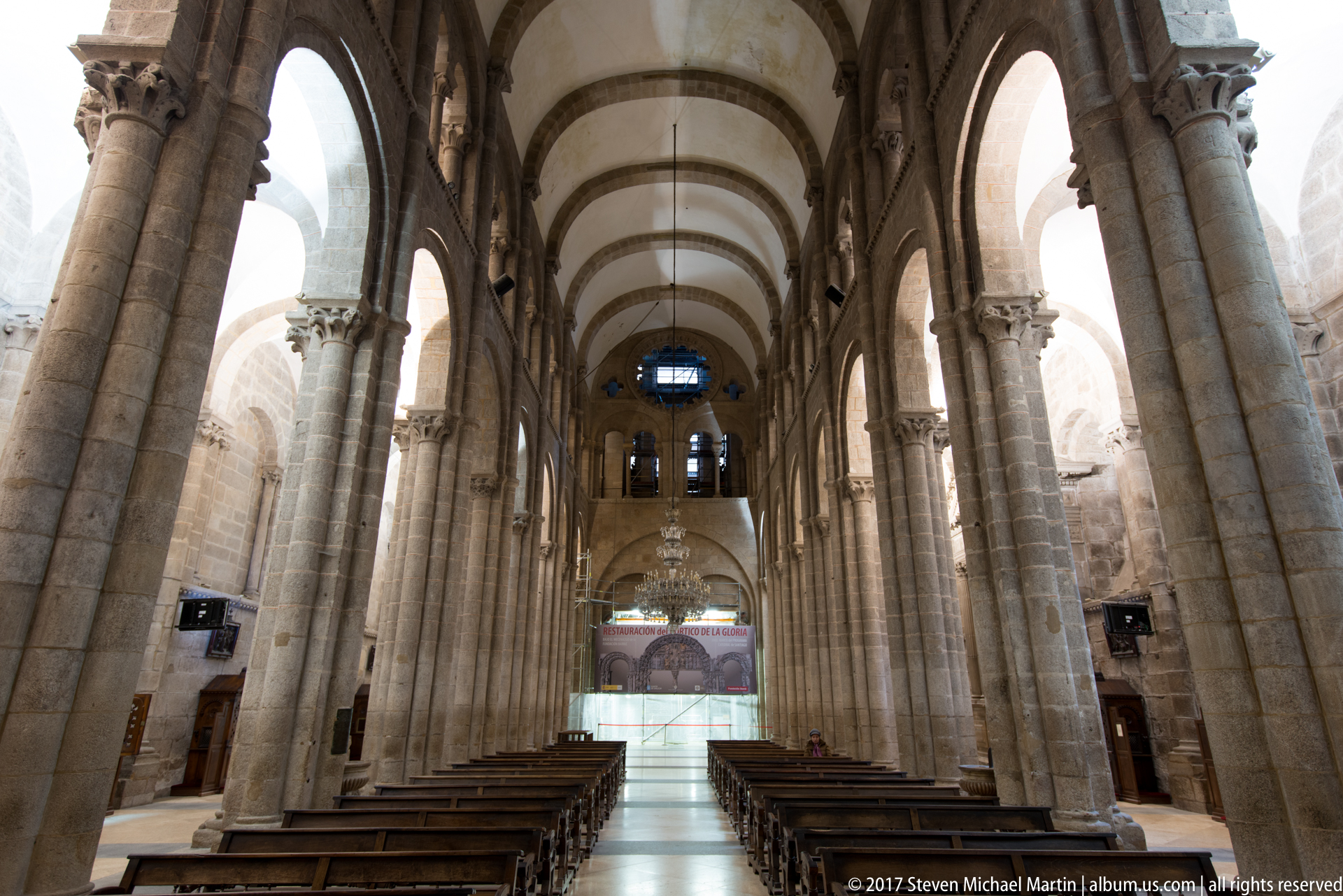
A tall nave of rounded arches and massive compound piers extends toward the far end of the cathedral. Wooden pews line the central aisle, while bright clerestory and side openings soften the heavy granite structure; the restrained view emphasizes proportion, repetition, and the monumental scale of the Romanesque interior.
Caption
A tall nave of rounded arches and massive compound piers extends toward the far end of the cathedral. Wooden pews line the central aisle, while bright clerestory and side openings soften the heavy granite structure; the restrained view emphasizes proportion, repetition, and the monumental scale of the Romanesque interior.

Seen from slightly farther back, the cathedral’s enormous crystal chandelier hangs within a crossing of heavy stone arches. Its layered glass drops and radiating arms form a dense central mass, while the symmetrical arcades and upper gallery behind it reveal how the fixture occupies the larger architectural volume.
Caption
Seen from slightly farther back, the cathedral’s enormous crystal chandelier hangs within a crossing of heavy stone arches. Its layered glass drops and radiating arms form a dense central mass, while the symmetrical arcades and upper gallery behind it reveal how the fixture occupies the larger architectural volume.

A monumental crystal chandelier fills the frame beneath the cathedral’s stone arches. Multiple rings of glass arms, pendants, and candle-like lights descend from a central metal core, while the surrounding columns and rounded arches provide scale and situate the elaborate fixture within the vast interior.
Caption
A monumental crystal chandelier fills the frame beneath the cathedral’s stone arches. Multiple rings of glass arms, pendants, and candle-like lights descend from a central metal core, while the surrounding columns and rounded arches provide scale and situate the elaborate fixture within the vast interior.

A broad stone arch frames a chapel or transept bay centered on a luminous altar, with a chandelier suspended beneath the high vaulted ceiling. Heavy piers, cornices, and side sculpture create a layered architectural frame, while daylight from the far window draws attention toward the liturgical focus.
Caption
A broad stone arch frames a chapel or transept bay centered on a luminous altar, with a chandelier suspended beneath the high vaulted ceiling. Heavy piers, cornices, and side sculpture create a layered architectural frame, while daylight from the far window draws attention toward the liturgical focus.

A central aisle runs between rows of wooden pews and massive stone piers toward a brightly lit sanctuary in the distance. Suspended high above the aisle is an enormous multi-tiered glass chandelier, whose scale and sparkle contrast with the restrained gray masonry and Romanesque spatial rhythm of the nave.
Caption
A central aisle runs between rows of wooden pews and massive stone piers toward a brightly lit sanctuary in the distance. Suspended high above the aisle is an enormous multi-tiered glass chandelier, whose scale and sparkle contrast with the restrained gray masonry and Romanesque spatial rhythm of the nave.

A tall, multi-tiered altarpiece stands against walls covered with painted architectural and decorative schemes. White and gilded columns frame several religious figures, while a small altar and floral arrangement occupy the base; the surrounding arches and murals make the retable part of a larger, richly ornamented chapel ensemble.
Caption
A tall, multi-tiered altarpiece stands against walls covered with painted architectural and decorative schemes. White and gilded columns frame several religious figures, while a small altar and floral arrangement occupy the base; the surrounding arches and murals make the retable part of a larger, richly ornamented chapel ensemble.

A broad wooden confessional is set against a pale stone wall, its paired screened openings punctuated by star-shaped cutouts. A dark carved relief hangs above, and a small central inscription crowns the furniture, presenting the confessional as a distinct functional object within the cathedral interior.
Caption
A broad wooden confessional is set against a pale stone wall, its paired screened openings punctuated by star-shaped cutouts. A dark carved relief hangs above, and a small central inscription crowns the furniture, presenting the confessional as a distinct functional object within the cathedral interior.

An upward view fills the frame with an octagonal, ribbed vault whose surfaces are densely painted and gilded. Geometric panels, heraldic or emblematic motifs, and surrounding mural decoration converge toward a small central opening, while the edge of a chandelier enters at the bottom.
Caption
An upward view fills the frame with an octagonal, ribbed vault whose surfaces are densely painted and gilded. Geometric panels, heraldic or emblematic motifs, and surrounding mural decoration converge toward a small central opening, while the edge of a chandelier enters at the bottom.

A large chandelier hangs beneath a richly painted and gilded vault, its branching lights spreading across the center of the composition. Decorative wall panels, arches, and emblematic motifs surround the fixture, while the top of an altarpiece appears at the lower edge, linking lighting, ceiling decoration, and liturgical space.
Caption
A large chandelier hangs beneath a richly painted and gilded vault, its branching lights spreading across the center of the composition. Decorative wall panels, arches, and emblematic motifs surround the fixture, while the top of an altarpiece appears at the lower edge, linking lighting, ceiling decoration, and liturgical space.

A monumental gilded wooden structure rises steeply above a dark stone-and-marble base, its projecting cornices crowded with carved figures, foliage, and architectural ornament. A central glazed or open panel interrupts the dense carving, while the low viewpoint emphasizes the height and sculptural complexity of the ensemble.
Caption
A monumental gilded wooden structure rises steeply above a dark stone-and-marble base, its projecting cornices crowded with carved figures, foliage, and architectural ornament. A central glazed or open panel interrupts the dense carving, while the low viewpoint emphasizes the height and sculptural complexity of the ensemble.

A compact stone chapel contains a gilded altarpiece centered on a niche with a religious figure, with additional sculptural and architectural ornament arranged above and below. A small table and red-upholstered chairs stand before the altar, giving the space an intimate devotional character distinct from the cathedral’s larger nave.
Caption
A compact stone chapel contains a gilded altarpiece centered on a niche with a religious figure, with additional sculptural and architectural ornament arranged above and below. A small table and red-upholstered chairs stand before the altar, giving the space an intimate devotional character distinct from the cathedral’s larger nave.

Viewed upward, a circular gilded ceiling spreads outward in a radial pattern from a central medallion, with a hanging lamp descending along the axis. An oval decorated opening and richly carved surrounding architecture occupy the lower part of the frame, creating a layered study of Baroque interior ornament.
Caption
Viewed upward, a circular gilded ceiling spreads outward in a radial pattern from a central medallion, with a hanging lamp descending along the axis. An oval decorated opening and richly carved surrounding architecture occupy the lower part of the frame, creating a layered study of Baroque interior ornament.

Dense gilded carving surrounds an oval opening or panel, with layered moldings, scrollwork, small sculptural forms, and reflective surfaces filling the frame. The close view concentrates on craftsmanship and material richness rather than the larger chapel or architectural setting.
Caption
Dense gilded carving surrounds an oval opening or panel, with layered moldings, scrollwork, small sculptural forms, and reflective surfaces filling the frame. The close view concentrates on craftsmanship and material richness rather than the larger chapel or architectural setting.

A richly decorated side chapel combines a central sculptural relief, painted and gilded architectural panels, flanking saint figures, and a small altar beneath. The compact space is enclosed by stone arches but visually dominated by vivid color and dense ornament, distinguishing it from the cathedral’s more austere masonry.
Caption
A richly decorated side chapel combines a central sculptural relief, painted and gilded architectural panels, flanking saint figures, and a small altar beneath. The compact space is enclosed by stone arches but visually dominated by vivid color and dense ornament, distinguishing it from the cathedral’s more austere masonry.

A narrow stone passage leads directly to a small devotional altar set beneath a shallow arch. A pale altar frontal, flowers, and a bright metal or gilded element at the back draw the eye through the darker masonry, while the geometric black-and-white floor marks the threshold.
Caption
A narrow stone passage leads directly to a small devotional altar set beneath a shallow arch. A pale altar frontal, flowers, and a bright metal or gilded element at the back draw the eye through the darker masonry, while the geometric black-and-white floor marks the threshold.

A bronze-toned wall plaque bears the name “JUAN PABLO II” and Spanish text recalling the pope’s pilgrimage to Santiago de Compostela, dated 9 November 1982. Lit from above, the inscription is presented as the primary subject, with the papal name and commemorative purpose clearly legible.
Caption
A bronze-toned wall plaque bears the name “JUAN PABLO II” and Spanish text recalling the pope’s pilgrimage to Santiago de Compostela, dated 9 November 1982. Lit from above, the inscription is presented as the primary subject, with the papal name and commemorative purpose clearly legible.

A glass display case assembles Camino de Santiago material culture: guidebooks and maps, scallop-shell motifs, small devotional objects, and a figurine associated with pilgrimage. The varied printed matter and souvenirs present the route through contemporary objects designed for visitors and pilgrims.
Caption
A glass display case assembles Camino de Santiago material culture: guidebooks and maps, scallop-shell motifs, small devotional objects, and a figurine associated with pilgrimage. The varied printed matter and souvenirs present the route through contemporary objects designed for visitors and pilgrims.

A compact stone plaza opens between arcaded buildings and richly detailed historic façades, with a sculptural fountain set near the center. Pedestrians crossing the paving provide scale, while balconies, carved cornices, and the surrounding granite architecture define the enclosed civic space of central Santiago de Compostela.
Caption
A compact stone plaza opens between arcaded buildings and richly detailed historic façades, with a sculptural fountain set near the center. Pedestrians crossing the paving provide scale, while balconies, carved cornices, and the surrounding granite architecture define the enclosed civic space of central Santiago de Compostela.

The long symmetrical façade of the Pazo de Raxoi stretches across the plaza beneath an overcast sky. A continuous ground-level arcade supports the formal upper stories, while the central pediment and roofline sculpture mark the building’s principal axis across the broad open space of Praza do Obradoiro.
Caption
The long symmetrical façade of the Pazo de Raxoi stretches across the plaza beneath an overcast sky. A continuous ground-level arcade supports the formal upper stories, while the central pediment and roofline sculpture mark the building’s principal axis across the broad open space of Praza do Obradoiro.

The Fountain of the Horses rises in front of an ornate granite façade, with four powerful horse forms grouped around the lower basin and a tall sculptural centerpiece above. The close viewpoint isolates the fountain’s dynamic modeling while retaining enough of the surrounding square to establish its architectural setting.
Caption
The Fountain of the Horses rises in front of an ornate granite façade, with four powerful horse forms grouped around the lower basin and a tall sculptural centerpiece above. The close viewpoint isolates the fountain’s dynamic modeling while retaining enough of the surrounding square to establish its architectural setting.

A wide, low-framed view places the Pazo de Raxoi beneath an expansive field of gray cloud, reducing the plaza architecture to a strong horizontal band. The building’s central pediment, regular windows, roofline ornament, and arcaded base remain legible while the sky dominates the composition.
Caption
A wide, low-framed view places the Pazo de Raxoi beneath an expansive field of gray cloud, reducing the plaza architecture to a strong horizontal band. The building’s central pediment, regular windows, roofline ornament, and arcaded base remain legible while the sky dominates the composition.

A weathered bronze sculptural group is viewed from below against a pale sky, bringing overlapping human and animal forms into sharp silhouette. A mounted figure and additional figures cluster around the composition, while a cross-like staff rises above them, giving the monument a strong pilgrimage or religious visual vocabulary.
Caption
A weathered bronze sculptural group is viewed from below against a pale sky, bringing overlapping human and animal forms into sharp silhouette. A mounted figure and additional figures cluster around the composition, while a cross-like staff rises above them, giving the monument a strong pilgrimage or religious visual vocabulary.

A daylight view shows the cathedral’s twin towers rising above a central façade almost completely enclosed by scaffolding and blue netting. Temporary stairs and work platforms fill the lower center, while pedestrians at the base provide scale and underscore the extent of the conservation campaign.
Caption
A daylight view shows the cathedral’s twin towers rising above a central façade almost completely enclosed by scaffolding and blue netting. Temporary stairs and work platforms fill the lower center, while pedestrians at the base provide scale and underscore the extent of the conservation campaign.

An exceptionally ornate stone portal punctuates the otherwise restrained façade of the Hostal dos Reis Católicos. Multiple tiers of sculpted figures, heraldic panels, pilasters, and dense relief carving frame the arched entrance, presenting the building’s principal doorway as a monumental work of late Gothic and early Renaissance decorative architecture.
Caption
An exceptionally ornate stone portal punctuates the otherwise restrained façade of the Hostal dos Reis Católicos. Multiple tiers of sculpted figures, heraldic panels, pilasters, and dense relief carving frame the arched entrance, presenting the building’s principal doorway as a monumental work of late Gothic and early Renaissance decorative architecture.

A dramatic bronze rider on a rearing horse is isolated against a pale sky. The figure raises a standard or staff incorporating a cross, while the horse’s lifted forelegs and flowing mane give the composition strong upward movement; the tight crop concentrates attention on the monument’s modeled forms.
Caption
A dramatic bronze rider on a rearing horse is isolated against a pale sky. The figure raises a standard or staff incorporating a cross, while the horse’s lifted forelegs and flowing mane give the composition strong upward movement; the tight crop concentrates attention on the monument’s modeled forms.

A closer architectural study isolates the upper portion of a granite church: a domed bell tower rises above a balustraded parapet lined with standing statues. Weathering and vegetation mark the stone surfaces, while the tight framing emphasizes the sculptural silhouette against a heavy gray sky.
Caption
A closer architectural study isolates the upper portion of a granite church: a domed bell tower rises above a balustraded parapet lined with standing statues. Weathering and vegetation mark the stone surfaces, while the tight framing emphasizes the sculptural silhouette against a heavy gray sky.

A compact granite church occupies the corner of a sloping street, its façade crowned by a central domed bell tower and a balustraded roofline populated with statues. The elevated viewpoint reveals the building’s sculptural skyline, restrained lower façade, and relationship to the dense red-roofed city beyond.
Caption
A compact granite church occupies the corner of a sloping street, its façade crowned by a central domed bell tower and a balustraded roofline populated with statues. The elevated viewpoint reveals the building’s sculptural skyline, restrained lower façade, and relationship to the dense red-roofed city beyond.

A large heraldic relief is set into a weathered stone wall, centering a quartered shield beneath a crown-like crest and broad winged forms. Carved supporters flank the arms, while smaller ornamental motifs occupy the surrounding panel, turning the façade into a formal display of institutional or noble identity.
Caption
A large heraldic relief is set into a weathered stone wall, centering a quartered shield beneath a crown-like crest and broad winged forms. Carved supporters flank the arms, while smaller ornamental motifs occupy the surrounding panel, turning the façade into a formal display of institutional or noble identity.

Through a glass entrance, the stone paving and arcaded buildings of central Santiago appear outside while reversed lettering identifies a Paradores property and “Hostal Reyes Católicos.” The frame combines a contemporary glazed threshold with the historic square beyond, visually linking the lodging to its monumental urban setting.
Caption
Through a glass entrance, the stone paving and arcaded buildings of central Santiago appear outside while reversed lettering identifies a Paradores property and “Hostal Reyes Católicos.” The frame combines a contemporary glazed threshold with the historic square beyond, visually linking the lodging to its monumental urban setting.

A long iron balcony projects from a pale granite façade on a dense sequence of carved stone corbels. Repeated volutes and sculpted supports create a rhythmic underside, while small plants along the balcony edge soften the otherwise severe masonry elevation of the historic street.
Caption
A long iron balcony projects from a pale granite façade on a dense sequence of carved stone corbels. Repeated volutes and sculpted supports create a rhythmic underside, while small plants along the balcony edge soften the otherwise severe masonry elevation of the historic street.

Concentric carved archivolts surround the upper portion of a doorway, each band filled with repeating floral, geometric, and figurative ornament. Below, a radiating metal fanlight converges on a small central emblem bearing a cross, creating a layered study of masonry carving and metalwork at the entrance.
Caption
Concentric carved archivolts surround the upper portion of a doorway, each band filled with repeating floral, geometric, and figurative ornament. Below, a radiating metal fanlight converges on a small central emblem bearing a cross, creating a layered study of masonry carving and metalwork at the entrance.

A deeply paneled wooden reception counter sits beneath a broad stone arch, with framed heraldic plaques, lantern-style lighting, and a staff member behind the desk. The combination of carved timber, masonry, and restrained display gives the interior the character of a historic Santiago lodging adapted to modern hospitality.
Caption
A deeply paneled wooden reception counter sits beneath a broad stone arch, with framed heraldic plaques, lantern-style lighting, and a staff member behind the desk. The combination of carved timber, masonry, and restrained display gives the interior the character of a historic Santiago lodging adapted to modern hospitality.

A long, white-walled salon is arranged as a formal lounge, its beamed ceiling punctuated by crystal chandeliers and its walls lined with sculpture and decorative objects. Upholstered seating, lamps, rugs, and a distant fireplace create a residential sequence within what appears to be a historic hospitality interior.
Caption
A long, white-walled salon is arranged as a formal lounge, its beamed ceiling punctuated by crystal chandeliers and its walls lined with sculpture and decorative objects. Upholstered seating, lamps, rugs, and a distant fireplace create a residential sequence within what appears to be a historic hospitality interior.

A symmetrical granite church façade rises between surrounding urban buildings, framed by two bell towers and a central pediment. The broad rectangular window, carved portal, niches, and restrained Baroque ornament are legible from the frontal viewpoint, while the street-level signs and neighboring façades place the monument firmly within Santiago’s dense historic center.
Caption
A symmetrical granite church façade rises between surrounding urban buildings, framed by two bell towers and a central pediment. The broad rectangular window, carved portal, niches, and restrained Baroque ornament are legible from the frontal viewpoint, while the street-level signs and neighboring façades place the monument firmly within Santiago’s dense historic center.

A monumental stone pilgrim dominates the frame, wearing a broad-brimmed hat and heavy cloak while smaller figures cluster around the base. The rough-textured carving and emblematic pilgrim dress connect the sculpture visually to Santiago’s long pilgrimage culture without requiring a specific monument attribution.
Caption
A monumental stone pilgrim dominates the frame, wearing a broad-brimmed hat and heavy cloak while smaller figures cluster around the base. The rough-textured carving and emblematic pilgrim dress connect the sculpture visually to Santiago’s long pilgrimage culture without requiring a specific monument attribution.

A steeply angled view follows a massive granite wall upward to a small barred window and the narrow edge of an adjoining building. The oblique composition stresses masonry scale, heavy joints, ironwork, and the compressed spatial character of Santiago’s historic streets rather than identifying a single landmark.
Caption
A steeply angled view follows a massive granite wall upward to a small barred window and the narrow edge of an adjoining building. The oblique composition stresses masonry scale, heavy joints, ironwork, and the compressed spatial character of Santiago’s historic streets rather than identifying a single landmark.

Warm evening light strikes a twin-towered granite church as a tall sculptural monument rises in the foreground. The low viewpoint emphasizes the contrast between vertical bell towers, carved stone figures, and the heavy masonry façade, creating a layered civic-religious composition rather than a straight architectural elevation.
Caption
Warm evening light strikes a twin-towered granite church as a tall sculptural monument rises in the foreground. The low viewpoint emphasizes the contrast between vertical bell towers, carved stone figures, and the heavy masonry façade, creating a layered civic-religious composition rather than a straight architectural elevation.

A weathered winged stone figure kneels on a roofline beside a large cross, isolated against a clear blue sky. The close view concentrates on the sculptural silhouette, folded drapery, wings, and aged stone surface, separating this devotional detail from the larger church architecture on adjacent frames.
Caption
A weathered winged stone figure kneels on a roofline beside a large cross, isolated against a clear blue sky. The close view concentrates on the sculptural silhouette, folded drapery, wings, and aged stone surface, separating this devotional detail from the larger church architecture on adjacent frames.

A large stone cross crowns a triangular pediment, flanked by two carved religious figures posed against the sky. The low-angle crop isolates the roofline ensemble, making the gestures, wings or drapery, and sharply profiled cornice the principal subject rather than the full building below.
Caption
A large stone cross crowns a triangular pediment, flanked by two carved religious figures posed against the sky. The low-angle crop isolates the roofline ensemble, making the gestures, wings or drapery, and sharply profiled cornice the principal subject rather than the full building below.

A circular metal utility cover set into wet stone paving bears the word “SANTIAGO” and a central municipal emblem. The close, downward view turns a small piece of city infrastructure into a location marker, with the damp pavement and raised lettering providing tactile detail.
Caption
A circular metal utility cover set into wet stone paving bears the word “SANTIAGO” and a central municipal emblem. The close, downward view turns a small piece of city infrastructure into a location marker, with the damp pavement and raised lettering providing tactile detail.

An elaborate granite façade fills the frame with paired arched doorways, tall pilasters, sculpted coats of arms, and a richly ornamented upper stage. The symmetrical composition and monumental scale suggest a major ecclesiastical or institutional building in Santiago, while the image itself supports the architectural reading more strongly than a precise name.
Caption
An elaborate granite façade fills the frame with paired arched doorways, tall pilasters, sculpted coats of arms, and a richly ornamented upper stage. The symmetrical composition and monumental scale suggest a major ecclesiastical or institutional building in Santiago, while the image itself supports the architectural reading more strongly than a precise name.

Seen from an angle, the richly carved granite façade is joined by portions of Santiago’s dense historic skyline, including tall ornate towers in the background. This wider view clarifies how the monumental frontage occupies the surrounding urban fabric and distinguishes it from the tighter, almost elevation-like view in the preceding frame.
Caption
Seen from an angle, the richly carved granite façade is joined by portions of Santiago’s dense historic skyline, including tall ornate towers in the background. This wider view clarifies how the monumental frontage occupies the surrounding urban fabric and distinguishes it from the tighter, almost elevation-like view in the preceding frame.

A broad granite façade is organized around a ceremonial central entrance reached by a sweeping stair. Giant columns, a balcony, carved heraldry, and a sculpted upper crown establish a formal institutional character, while evenly spaced windows extend across the long wings to either side.
Caption
A broad granite façade is organized around a ceremonial central entrance reached by a sweeping stair. Giant columns, a balcony, carved heraldry, and a sculpted upper crown establish a formal institutional character, while evenly spaced windows extend across the long wings to either side.

Massive stone columns rise around a deeply modeled entrance, with a niche figure above the doorway and a carved heraldic crest crowning the central bay. The low viewpoint exaggerates the verticality and sculptural depth of the portal, drawing attention to architectural hierarchy rather than the building’s full extent.
Caption
Massive stone columns rise around a deeply modeled entrance, with a niche figure above the doorway and a carved heraldic crest crowning the central bay. The low viewpoint exaggerates the verticality and sculptural depth of the portal, drawing attention to architectural hierarchy rather than the building’s full extent.

A formal parterre of clipped hedges, flowering beds, and a small tree occupies the foreground of a grand granite institutional façade. The central stair and columned entrance are seen obliquely, allowing the landscaped garden to become an equal subject and showing how monumental architecture is framed by carefully ordered civic space.
Caption
A formal parterre of clipped hedges, flowering beds, and a small tree occupies the foreground of a grand granite institutional façade. The central stair and columned entrance are seen obliquely, allowing the landscaped garden to become an equal subject and showing how monumental architecture is framed by carefully ordered civic space.

A compact stone bellcote rises as a dark silhouette at the bottom of a wide, cloud-filled sky. The tiny cross and open bell arch provide just enough architectural detail to identify a religious roofline, while the dominant subject is the dramatic evening atmosphere over Santiago.
Caption
A compact stone bellcote rises as a dark silhouette at the bottom of a wide, cloud-filled sky. The tiny cross and open bell arch provide just enough architectural detail to identify a religious roofline, while the dominant subject is the dramatic evening atmosphere over Santiago.

A carved stone relief is set within an ornate architectural frame, showing a group of seated and standing sacred figures beneath a curved Latin inscription. Scrollwork, columns, and layered molding surround the narrative scene, making the panel read as an integrated Baroque devotional element rather than a freestanding sculpture.
Caption
A carved stone relief is set within an ornate architectural frame, showing a group of seated and standing sacred figures beneath a curved Latin inscription. Scrollwork, columns, and layered molding surround the narrative scene, making the panel read as an integrated Baroque devotional element rather than a freestanding sculpture.

A rectangular stone plaque set into a rough masonry wall reads “PRAZA DE CERVANTES” in red capital letters. The tight framing removes surrounding distractions and records the Galician place name as a direct urban marker within Santiago’s historic center.
Caption
A rectangular stone plaque set into a rough masonry wall reads “PRAZA DE CERVANTES” in red capital letters. The tight framing removes surrounding distractions and records the Galician place name as a direct urban marker within Santiago’s historic center.

Rows of open burlap sacks hold green herbs, pale seeds, red pepper-like pieces, and other dried goods, each supplied with a scoop or small label. The warm interior light and narrow aisle create the densely stocked character of a specialty food shop or market stall in central Santiago.
Caption
Rows of open burlap sacks hold green herbs, pale seeds, red pepper-like pieces, and other dried goods, each supplied with a scoop or small label. The warm interior light and narrow aisle create the densely stocked character of a specialty food shop or market stall in central Santiago.

Tall white galerías project from neighboring façades, their tight grids of glass panes catching the soft light of dusk. The oblique street view highlights this characteristic enclosed-balcony form in Galicia while rooftops and darker masonry recede toward the pale evening sky.
Caption
Tall white galerías project from neighboring façades, their tight grids of glass panes catching the soft light of dusk. The oblique street view highlights this characteristic enclosed-balcony form in Galicia while rooftops and darker masonry recede toward the pale evening sky.

Night lighting reveals a restrained granite church front centered on tall doors beneath a broad semicircular fanlight. A small bellcote rises above the roofline while surrounding glazed façades frame the compact religious building, emphasizing the contrast between its heavy masonry and the illuminated urban square.
Caption
Night lighting reveals a restrained granite church front centered on tall doors beneath a broad semicircular fanlight. A small bellcote rises above the roofline while surrounding glazed façades frame the compact religious building, emphasizing the contrast between its heavy masonry and the illuminated urban square.

A tall stone column rises from a broad polygonal fountain basin at the center of an illuminated square. Arcaded and balconied façades enclose the open space, while the night lighting reveals the fountain’s worn masonry and turns the surrounding paving into a quiet civic setting.
Caption
A tall stone column rises from a broad polygonal fountain basin at the center of an illuminated square. Arcaded and balconied façades enclose the open space, while the night lighting reveals the fountain’s worn masonry and turns the surrounding paving into a quiet civic setting.

Dozens of faceted clear crystals are arranged in concentric openwork rings, producing a jewel-like sphere that catches pinpoints of reflected light. The tight macro view isolates the object against a dark background, emphasizing repeated geometry, transparency, and sparkle rather than its surrounding interior.
Caption
Dozens of faceted clear crystals are arranged in concentric openwork rings, producing a jewel-like sphere that catches pinpoints of reflected light. The tight macro view isolates the object against a dark background, emphasizing repeated geometry, transparency, and sparkle rather than its surrounding interior.

An imposing granite church façade fills the square at night, its sculpted central tiers, niches, oval window, and flanking masonry picked out by floodlighting. A broad stone stair and balustrade lead toward the entrance, giving the building a strong processional approach within the surrounding urban space.
Caption
An imposing granite church façade fills the square at night, its sculpted central tiers, niches, oval window, and flanking masonry picked out by floodlighting. A broad stone stair and balustrade lead toward the entrance, giving the building a strong processional approach within the surrounding urban space.

A closer nighttime view concentrates on the central portion of the church façade, where multiple tiers of niches and carved figures rise above a dark doorway and barred semicircular opening. Floodlighting brings out the texture of granite blocks and deep relief, while the balustrade cuts across the lower foreground.
Caption
A closer nighttime view concentrates on the central portion of the church façade, where multiple tiers of niches and carved figures rise above a dark doorway and barred semicircular opening. Floodlighting brings out the texture of granite blocks and deep relief, while the balustrade cuts across the lower foreground.

A sequence of granite arches and columns recedes through a covered pedestrian passage in Santiago de Compostela’s historic center. Warm lamps create alternating pools of light and shadow along the stone pavement, while heavy wooden shutters punctuate the wall at right. The long perspective focuses on the sheltered circulation space itself rather than a single monument, revealing the intimate scale of the old city after dark.
Caption
A sequence of granite arches and columns recedes through a covered pedestrian passage in Santiago de Compostela’s historic center. Warm lamps create alternating pools of light and shadow along the stone pavement, while heavy wooden shutters punctuate the wall at right. The long perspective focuses on the sheltered circulation space itself rather than a single monument, revealing the intimate scale of the old city after dark.

At night, a tall illuminated stone tower rises above an arcaded cathedral façade, with broad steps and a fountain occupying the foreground. The oblique view separates the vertical mass of the tower from the lower Romanesque and later architectural elements, while artificial light picks out carved openings, balustrades, and masonry against the dark sky.
Caption
At night, a tall illuminated stone tower rises above an arcaded cathedral façade, with broad steps and a fountain occupying the foreground. The oblique view separates the vertical mass of the tower from the lower Romanesque and later architectural elements, while artificial light picks out carved openings, balustrades, and masonry against the dark sky.

Curving stone balustrades sweep around a sunken landing and stair system directly before a church doorway. The nighttime viewpoint brings the weathered granite rails, steps, and pavement into the foreground, making the ceremonial approach the primary subject while only a portion of the sculpted façade remains above.
Caption
Curving stone balustrades sweep around a sunken landing and stair system directly before a church doorway. The nighttime viewpoint brings the weathered granite rails, steps, and pavement into the foreground, making the ceremonial approach the primary subject while only a portion of the sculpted façade remains above.

Viewed from above, a complex stone staircase divides into mirrored flights around a rounded central landing. Heavy balustrades trace the curves, while warm nighttime lighting accentuates worn steps and the geometry of the descent, turning circulation itself into the architectural subject.
Caption
Viewed from above, a complex stone staircase divides into mirrored flights around a rounded central landing. Heavy balustrades trace the curves, while warm nighttime lighting accentuates worn steps and the geometry of the descent, turning circulation itself into the architectural subject.

A frontal nighttime view looks toward the lower level of a monumental stone stair, where broad side flights rise to a balustraded terrace above a central doorway. The symmetrical arrangement and strongly lit urban façades beyond clarify the stair’s relationship to the surrounding square and adjoining buildings.
Caption
A frontal nighttime view looks toward the lower level of a monumental stone stair, where broad side flights rise to a balustraded terrace above a central doorway. The symmetrical arrangement and strongly lit urban façades beyond clarify the stair’s relationship to the surrounding square and adjoining buildings.

Warm amber lighting washes over worn granite steps and curving balustrades in a close, oblique study of the monumental stair. The low vantage point emphasizes texture, shadows, and the interlocking flights, providing a more intimate architectural detail than the wider symmetrical views in the preceding frames.
Caption
Warm amber lighting washes over worn granite steps and curving balustrades in a close, oblique study of the monumental stair. The low vantage point emphasizes texture, shadows, and the interlocking flights, providing a more intimate architectural detail than the wider symmetrical views in the preceding frames.

Granite flights curve and divide around the celebrated triple-ramp staircase of San Domingos de Bonaval, now associated with the Museo do Pobo Galego. Designed by Domingo de Andrade, the interlocking stairways rise independently through the former convent, creating a striking sequence of balustrades, landings, and stone arcs. This close elevated view concentrates on the geometry and weathered texture of the masonry.
Caption
Granite flights curve and divide around the celebrated triple-ramp staircase of San Domingos de Bonaval, now associated with the Museo do Pobo Galego. Designed by Domingo de Andrade, the interlocking stairways rise independently through the former convent, creating a striking sequence of balustrades, landings, and stone arcs. This close elevated view concentrates on the geometry and weathered texture of the masonry.

The monumental Baroque front of the Monastery of San Martiño Pinario rises above a broad central stair at night. Giant columns frame the entrance while sculptural and heraldic ornament builds vertically toward the crowning ensemble above the roofline. The symmetrical illuminated façade faces Praza da Inmaculada, emphasizing the monastery’s scale within Santiago de Compostela’s historic ecclesiastical precinct.
Caption
The monumental Baroque front of the Monastery of San Martiño Pinario rises above a broad central stair at night. Giant columns frame the entrance while sculptural and heraldic ornament builds vertically toward the crowning ensemble above the roofline. The symmetrical illuminated façade faces Praza da Inmaculada, emphasizing the monastery’s scale within Santiago de Compostela’s historic ecclesiastical precinct.

An ornate side elevation of the cathedral is illuminated against the night sky, its sculpted central frontispiece framed by taller towers receding at either side. Arched doorways, pilasters, pinnacles, and layered rooflines give the view a strongly vertical rhythm, while street lamps and surrounding masonry establish the building within the historic center.
Caption
An ornate side elevation of the cathedral is illuminated against the night sky, its sculpted central frontispiece framed by taller towers receding at either side. Arched doorways, pilasters, pinnacles, and layered rooflines give the view a strongly vertical rhythm, while street lamps and surrounding masonry establish the building within the historic center.

The richly carved entrance of the Hostal dos Reis Católicos stands out in warm night illumination on Praza do Obradoiro. An elaborate stone portal surrounds the arched doorway with dense sculptural and heraldic decoration, while the long granite façade extends horizontally on both sides. Founded as a royal hospital for pilgrims, the building remains one of the defining monuments facing Santiago Cathedral.
Caption
The richly carved entrance of the Hostal dos Reis Católicos stands out in warm night illumination on Praza do Obradoiro. An elaborate stone portal surrounds the arched doorway with dense sculptural and heraldic decoration, while the long granite façade extends horizontally on both sides. Founded as a royal hospital for pilgrims, the building remains one of the defining monuments facing Santiago Cathedral.

Extensive scaffolding and blue protective netting cover the central portion of a monumental twin-towered cathedral façade. The frontal nighttime view records conservation work as part of the building’s visible history, with the towers, flanking stone wings, temporary access structures, and work platforms all clearly distinguishable.
Caption
Extensive scaffolding and blue protective netting cover the central portion of a monumental twin-towered cathedral façade. The frontal nighttime view records conservation work as part of the building’s visible history, with the towers, flanking stone wings, temporary access structures, and work platforms all clearly distinguishable.

A long arcaded façade glows across Praza do Obradoiro as the Pazo de Raxoi is illuminated at night. Repeated ground-floor arches support the restrained upper stories, while the central pediment and rooftop sculpture mark the building’s formal axis. Standing opposite the cathedral, the palace gives the square its monumental civic edge and today houses Santiago de Compostela’s municipal government.
Caption
A long arcaded façade glows across Praza do Obradoiro as the Pazo de Raxoi is illuminated at night. Repeated ground-floor arches support the restrained upper stories, while the central pediment and rooftop sculpture mark the building’s formal axis. Standing opposite the cathedral, the palace gives the square its monumental civic edge and today houses Santiago de Compostela’s municipal government.

The Colexio de San Xerome closes the south side of Praza do Obradoiro in this quiet nighttime view. Its comparatively restrained granite façade is centered on a richly carved historic portal, while the cathedral complex rises at the left edge of the square. Now associated with the University of Santiago de Compostela, the building forms the academic counterpart to the religious, civic, and hospitality monuments surrounding the plaza.
Caption
The Colexio de San Xerome closes the south side of Praza do Obradoiro in this quiet nighttime view. Its comparatively restrained granite façade is centered on a richly carved historic portal, while the cathedral complex rises at the left edge of the square. Now associated with the University of Santiago de Compostela, the building forms the academic counterpart to the religious, civic, and hospitality monuments surrounding the plaza.