Mirabell Palace – Salzburg, Austria
Mirabell Palace stands along the western bank of the Salzach River in Salzburg and is famous for its elegant Baroque gardens and formal landscaping. The palace was originally built in the early 17th century by Prince-Archbishop Wolf Dietrich von Raitenau as a residence just outside the historic city walls.
The gardens are arranged with symmetrical flower beds, statues, fountains, and tree-lined pathways that frame views toward Hohensalzburg Fortress rising above the old town. One of the most famous features is the Pegasus Fountain, surrounded by sculpted figures representing classical mythology.
The palace and gardens have become one of the most recognizable landmarks of Salzburg and offer one of the most picturesque views of the city’s historic skyline.

The garden-facing façade of Mirabell Palace rises behind a straight approach path, its pale Baroque elevation articulated by tall windows, decorative surrounds, a central pediment, and a green metal roof. Clipped hedges and garden sculptures frame the approach. The frontal composition emphasizes the palace’s ordered rhythm and its close integration with the formal garden.
Caption
The garden-facing façade of Mirabell Palace rises behind a straight approach path, its pale Baroque elevation articulated by tall windows, decorative surrounds, a central pediment, and a green metal roof. Clipped hedges and garden sculptures frame the approach. The frontal composition emphasizes the palace’s ordered rhythm and its close integration with the formal garden.

Broad lawns and curving flower beds form the ornamental parterre of Mirabell Gardens, their low yellow plantings drawing the eye toward a clipped-tree avenue. Hohensalzburg Fortress rises on the distant hill above the garden axis. The wide composition shows how the formal planting scheme opens a long visual connection from the palace grounds toward Salzburg’s fortified skyline.
Caption
Broad lawns and curving flower beds form the ornamental parterre of Mirabell Gardens, their low yellow plantings drawing the eye toward a clipped-tree avenue. Hohensalzburg Fortress rises on the distant hill above the garden axis. The wide composition shows how the formal planting scheme opens a long visual connection from the palace grounds toward Salzburg’s fortified skyline.

A reddish stone memorial plaque set into a darker wall bears the prominent gilded inscription “KAISER FRANZ JOSEF I.” Smaller German text above and below records a commemorative message associated with the emperor. Weathering has softened parts of the lettering, but the imperial name remains clear, making the plaque a direct documentary artifact within the Mirabell Palace and gardens complex.
Caption
A reddish stone memorial plaque set into a darker wall bears the prominent gilded inscription “KAISER FRANZ JOSEF I.” Smaller German text above and below records a commemorative message associated with the emperor. Weathering has softened parts of the lettering, but the imperial name remains clear, making the plaque a direct documentary artifact within the Mirabell Palace and gardens complex.

A side view along Mirabell Palace shows a pale palace wing bordering clipped hedges, stone urns, statuary, and an iron garden fence. Autumn-red vines climb the wall ahead, drawing the eye toward an arched opening at the far end. The elevated viewpoint emphasizes the layered transition from architecture to formal garden enclosure.
Caption
A side view along Mirabell Palace shows a pale palace wing bordering clipped hedges, stone urns, statuary, and an iron garden fence. Autumn-red vines climb the wall ahead, drawing the eye toward an arched opening at the far end. The elevated viewpoint emphasizes the layered transition from architecture to formal garden enclosure.

A dynamic white stone sculptural group rises from a rocky fountain base in Mirabell Gardens. Intertwined human and animal forms twist upward in a vigorous Baroque composition, set against dense green foliage and the formal garden balustrade. Strong side light accentuates the carved anatomy and rough stone base, turning the fountain into a dramatic focal point within the garden.
Caption
A dynamic white stone sculptural group rises from a rocky fountain base in Mirabell Gardens. Intertwined human and animal forms twist upward in a vigorous Baroque composition, set against dense green foliage and the formal garden balustrade. Strong side light accentuates the carved anatomy and rough stone base, turning the fountain into a dramatic focal point within the garden.

A reclining stone lion raises its head above a low plinth, its deeply carved mane forming sweeping locks around the face and neck. The low viewpoint brings the animal close to the skyline, separating the pale sculpture from brilliant blue sky and autumn foliage. Weathering along the muzzle and paws gives the ornamental garden figure a visibly aged surface.
Caption
A reclining stone lion raises its head above a low plinth, its deeply carved mane forming sweeping locks around the face and neck. The low viewpoint brings the animal close to the skyline, separating the pale sculpture from brilliant blue sky and autumn foliage. Weathering along the muzzle and paws gives the ornamental garden figure a visibly aged surface.

A long pleached arbor forms a shaded tunnel through Mirabell Gardens. Closely spaced trunks and branches are trained over a metal framework, creating a repeating arch that narrows toward a dark vanishing point. Fallen leaves and patches of sunlight along the gravel path give the formal structure a distinctly autumnal character.
Caption
A long pleached arbor forms a shaded tunnel through Mirabell Gardens. Closely spaced trunks and branches are trained over a metal framework, creating a repeating arch that narrows toward a dark vanishing point. Fallen leaves and patches of sunlight along the gravel path give the formal structure a distinctly autumnal character.

A low arched passage cuts through a planted garden embankment, its rough stone opening leading to a shadowed cobbled walkway. Fallen leaves blanket the slope above and gather at the entrance, while a small posted notice is fixed beside the arch. The view records one of the garden’s more intimate circulation spaces rather than its open parterres.
Caption
A low arched passage cuts through a planted garden embankment, its rough stone opening leading to a shadowed cobbled walkway. Fallen leaves blanket the slope above and gather at the entrance, while a small posted notice is fixed beside the arch. The view records one of the garden’s more intimate circulation spaces rather than its open parterres.

The formal garden axis of Mirabell Gardens leads across clipped lawns, patterned beds, sculptural ornaments, and a central fountain toward Hohensalzburg Fortress on the distant hill. Mirabell Palace lines the left edge of the view, while autumn foliage softens the symmetry. The photograph shows one of Salzburg’s most recognizable spatial relationships between the palace gardens and the fortress above the old city.
Caption
The formal garden axis of Mirabell Gardens leads across clipped lawns, patterned beds, sculptural ornaments, and a central fountain toward Hohensalzburg Fortress on the distant hill. Mirabell Palace lines the left edge of the view, while autumn foliage softens the symmetry. The photograph shows one of Salzburg’s most recognizable spatial relationships between the palace gardens and the fortress above the old city.

A carved stone heraldic cartouche projects from a dark masonry wall, its scrolling frame surrounding a worn central coat of arms. Beneath it, a draped tablet carries a Latin inscription with a date rendered in Roman numerals. The close view isolates the craftsmanship of the relief, including shell-like volutes, folded stone “fabric,” and the contrast between pale carving and weather-darkened wall.
Caption
A carved stone heraldic cartouche projects from a dark masonry wall, its scrolling frame surrounding a worn central coat of arms. Beneath it, a draped tablet carries a Latin inscription with a date rendered in Roman numerals. The close view isolates the craftsmanship of the relief, including shell-like volutes, folded stone “fabric,” and the contrast between pale carving and weather-darkened wall.

A dramatic Baroque sculpture group rises from a carved pedestal in Mirabell Gardens. Muscular figures twist and lean across the composition, producing strong diagonal movement against autumn foliage. The low viewpoint emphasizes the theatrical anatomy, flowing drapery, and layered silhouettes that distinguish the garden’s sculptural program from the clipped hedges and architectural geometry nearby.
Caption
A dramatic Baroque sculpture group rises from a carved pedestal in Mirabell Gardens. Muscular figures twist and lean across the composition, producing strong diagonal movement against autumn foliage. The low viewpoint emphasizes the theatrical anatomy, flowing drapery, and layered silhouettes that distinguish the garden’s sculptural program from the clipped hedges and architectural geometry nearby.

A muscular male garden figure stands atop a rugged rockwork base, one arm raised in a forceful gesture while the body turns sharply through the torso. The pale stone is strongly lit against dark autumn foliage, making the figure’s exaggerated movement and theatrical pose especially prominent. Decorative reliefs on the base add another layer of Baroque ornament.
Caption
A muscular male garden figure stands atop a rugged rockwork base, one arm raised in a forceful gesture while the body turns sharply through the torso. The pale stone is strongly lit against dark autumn foliage, making the figure’s exaggerated movement and theatrical pose especially prominent. Decorative reliefs on the base add another layer of Baroque ornament.

A Baroque fountain group fills the foreground of Mirabell Gardens, combining a large central figure, smaller attendant figures, and a broad stone basin. The sculpture is set against clipped hedges and a modern glazed building beyond the garden edge. Strong sunlight models the pale stone forms and reveals the layered arrangement of the ensemble.
Caption
A Baroque fountain group fills the foreground of Mirabell Gardens, combining a large central figure, smaller attendant figures, and a broad stone basin. The sculpture is set against clipped hedges and a modern glazed building beyond the garden edge. Strong sunlight models the pale stone forms and reveals the layered arrangement of the ensemble.

A densely composed Baroque garden sculpture places a standing figure beneath a rearing or mounted figure, all raised on a heavily carved pedestal. Deep shadows sharpen the silhouettes of limbs, drapery, and the large animal form. The nearby palace façade provides architectural context and reinforces the sculpture’s placement within the formal Mirabell garden setting.
Caption
A densely composed Baroque garden sculpture places a standing figure beneath a rearing or mounted figure, all raised on a heavily carved pedestal. Deep shadows sharpen the silhouettes of limbs, drapery, and the large animal form. The nearby palace façade provides architectural context and reinforces the sculpture’s placement within the formal Mirabell garden setting.

A carved dwarf figure from the Mirabell Gardens’ Dwarf Garden strides forward while balancing a large rounded object in one hand. Exaggerated facial features, a prominent belly, textured sleeves, and compact proportions give the sculpture its deliberately comic character. Autumn trees form a warm backdrop behind the pale stone.
Caption
A carved dwarf figure from the Mirabell Gardens’ Dwarf Garden strides forward while balancing a large rounded object in one hand. Exaggerated facial features, a prominent belly, textured sleeves, and compact proportions give the sculpture its deliberately comic character. Autumn trees form a warm backdrop behind the pale stone.

A small classical garden building with a symmetrical white façade stands beyond a broad ornamental basin in Mirabell Gardens. Tall sash windows, a triangular central pediment, and restrained pale detailing give the structure a refined pavilion-like character. Statues, clipped greenery, and visitors around the basin place the architecture firmly within the formal garden landscape.
Caption
A small classical garden building with a symmetrical white façade stands beyond a broad ornamental basin in Mirabell Gardens. Tall sash windows, a triangular central pediment, and restrained pale detailing give the structure a refined pavilion-like character. Statues, clipped greenery, and visitors around the basin place the architecture firmly within the formal garden landscape.
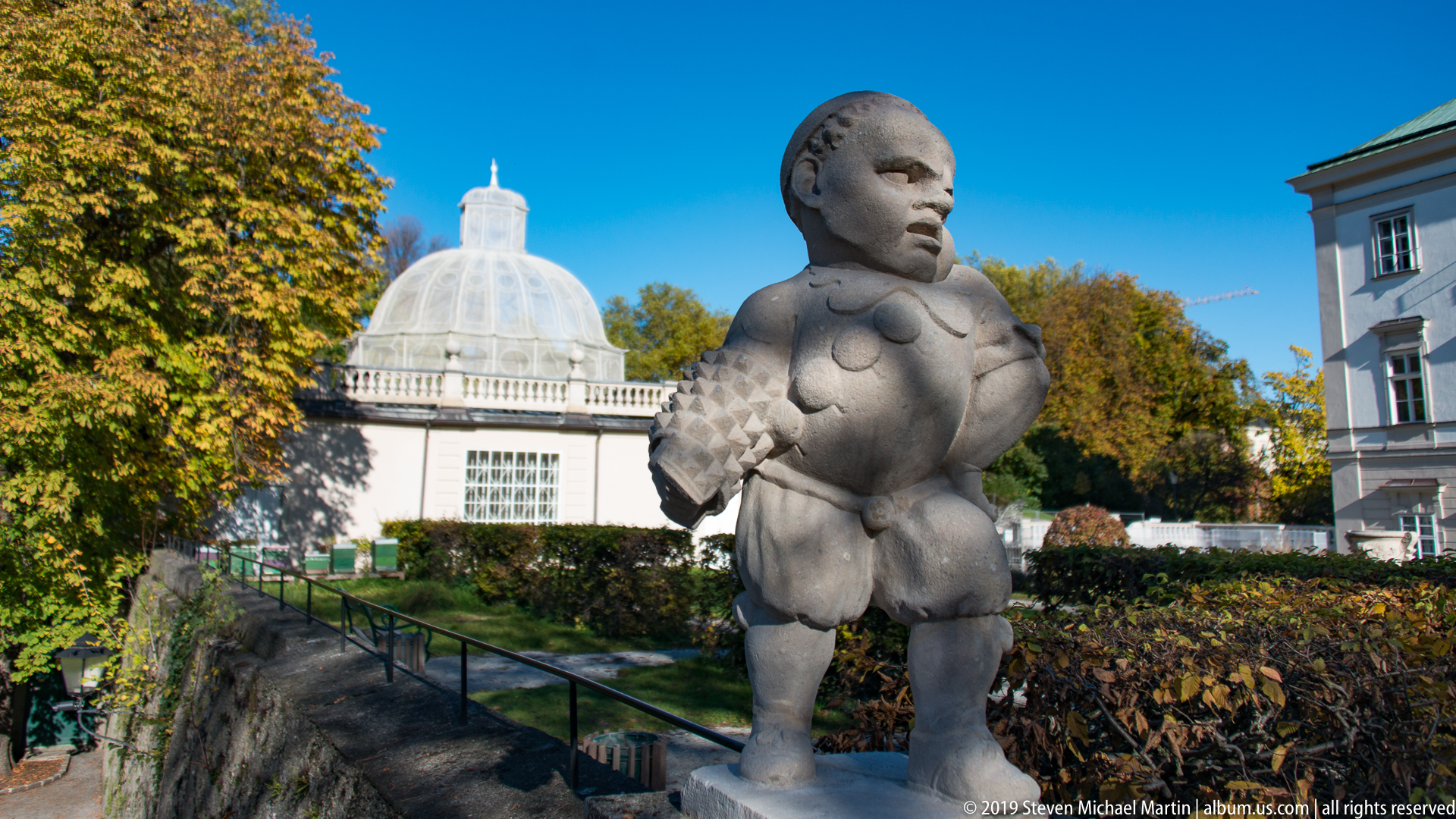
A stout stone dwarf figure stands in the Mirabell Gardens, posed with one arm behind its back and dressed in exaggerated period costume. The sculpture’s compact proportions and expressive face are characteristic of the garden’s famous group of Baroque dwarf statues. A glass-domed pavilion and clipped planting appear behind, placing the figure within the carefully designed garden ensemble.
Caption
A stout stone dwarf figure stands in the Mirabell Gardens, posed with one arm behind its back and dressed in exaggerated period costume. The sculpture’s compact proportions and expressive face are characteristic of the garden’s famous group of Baroque dwarf statues. A glass-domed pavilion and clipped planting appear behind, placing the figure within the carefully designed garden ensemble.

A stooped, bearded dwarf sculpture leans heavily on a long staff, his rounded body and deeply modeled face exaggerated for comic effect. The figure’s bent posture and oversized head contrast with the graceful formalism elsewhere in Mirabell Gardens. Dappled sunlight and fallen leaves emphasize the weathered texture of the stone.
Caption
A stooped, bearded dwarf sculpture leans heavily on a long staff, his rounded body and deeply modeled face exaggerated for comic effect. The figure’s bent posture and oversized head contrast with the graceful formalism elsewhere in Mirabell Gardens. Dappled sunlight and fallen leaves emphasize the weathered texture of the stone.

A smiling dwarf figure stands frontally while holding a large vessel against the abdomen. A broad hat, ruff-like collar, and compact body amplify the caricatured costume and proportions typical of the Dwarf Garden sculptures. The shallow depth of field isolates the pale stone figure against an autumn garden background.
Caption
A smiling dwarf figure stands frontally while holding a large vessel against the abdomen. A broad hat, ruff-like collar, and compact body amplify the caricatured costume and proportions typical of the Dwarf Garden sculptures. The shallow depth of field isolates the pale stone figure against an autumn garden background.

A costumed dwarf sculpture turns in profile beneath a broad, floppy hat while carrying a bulky bundle of objects over one shoulder. The exaggerated costume, compact body, and animated pose create a theatrical silhouette. Sunlit stone stands out against green grass and scattered autumn leaves in the Dwarf Garden.
Caption
A costumed dwarf sculpture turns in profile beneath a broad, floppy hat while carrying a bulky bundle of objects over one shoulder. The exaggerated costume, compact body, and animated pose create a theatrical silhouette. Sunlit stone stands out against green grass and scattered autumn leaves in the Dwarf Garden.

A rounded dwarf figure advances with produce gathered across both hands, one arm raised while the other cradles a cluster near the waist. The figure wears an elaborate cap and patterned costume, with the exaggerated face and body modeled in broad, humorous forms. Bright autumn light gives the pale stone strong surface definition.
Caption
A rounded dwarf figure advances with produce gathered across both hands, one arm raised while the other cradles a cluster near the waist. The figure wears an elaborate cap and patterned costume, with the exaggerated face and body modeled in broad, humorous forms. Bright autumn light gives the pale stone strong surface definition.

A hooded dwarf sculpture leans forward with both hands extended, its compact body wrapped in layered clothing. The strongly carved face, drooping cap, and exaggerated proportions give the figure a lively, theatrical presence. Fallen leaves and the soft garden background contrast with the crisply lit stone surface.
Caption
A hooded dwarf sculpture leans forward with both hands extended, its compact body wrapped in layered clothing. The strongly carved face, drooping cap, and exaggerated proportions give the figure a lively, theatrical presence. Fallen leaves and the soft garden background contrast with the crisply lit stone surface.

A stout dwarf figure stands with a cylindrical container slung over one shoulder and a textured woven object tucked at the opposite side. Richly patterned clothing, a broad cap, and exaggerated facial features reinforce the comic Baroque character of the Dwarf Garden ensemble. Strong side light reveals the weathered surface and carved costume details.
Caption
A stout dwarf figure stands with a cylindrical container slung over one shoulder and a textured woven object tucked at the opposite side. Richly patterned clothing, a broad cap, and exaggerated facial features reinforce the comic Baroque character of the Dwarf Garden ensemble. Strong side light reveals the weathered surface and carved costume details.

A smiling dwarf sculpture kneels or crouches with one hand lifted beside a large ruff collar. Puffy sleeves, rounded cheeks, and deliberately compressed proportions create a playful silhouette. The close framing isolates the pale stone figure against a softly focused garden floor and autumn trees.
Caption
A smiling dwarf sculpture kneels or crouches with one hand lifted beside a large ruff collar. Puffy sleeves, rounded cheeks, and deliberately compressed proportions create a playful silhouette. The close framing isolates the pale stone figure against a softly focused garden floor and autumn trees.

A female dwarf figure stands in a simple dress with a gathered apron, one hand resting at the waist while the other steadies a large jug or vessel beside her. The broad cap, rounded features, and compact proportions place her within the humorous sculptural language of the Dwarf Garden. Sunlight reveals the folds of the costume and the smooth stone surface.
Caption
A female dwarf figure stands in a simple dress with a gathered apron, one hand resting at the waist while the other steadies a large jug or vessel beside her. The broad cap, rounded features, and compact proportions place her within the humorous sculptural language of the Dwarf Garden. Sunlight reveals the folds of the costume and the smooth stone surface.

A bearded dwarf in an oversized broad-brimmed hat gestures outward with one hand while a small satchel or container hangs at his side. The deeply cut beard, wrinkled face, and compact stance create a vivid comic character. The pale sculpture is strongly lit against green lawn and shaded trees.
Caption
A bearded dwarf in an oversized broad-brimmed hat gestures outward with one hand while a small satchel or container hangs at his side. The deeply cut beard, wrinkled face, and compact stance create a vivid comic character. The pale sculpture is strongly lit against green lawn and shaded trees.

A weary-looking dwarf sculpture leans against a long staff, head tilted heavily to one side and one hand pressed to the face. The drooping pose and exaggerated features give the figure a distinctly comic, almost sleepy character. Strong sunlight picks out the rounded clothing and carved folds against a dark garden background.
Caption
A weary-looking dwarf sculpture leans against a long staff, head tilted heavily to one side and one hand pressed to the face. The drooping pose and exaggerated features give the figure a distinctly comic, almost sleepy character. Strong sunlight picks out the rounded clothing and carved folds against a dark garden background.

A seated or crouching dwarf figure faces forward wearing an unusual round, mask-like facial covering with large circular eyes and mouth. The hands rest across the torso and knee, while the compact body is wrapped in heavy clothing. The strange headgear makes this one of the most visually distinctive figures in the Dwarf Garden sequence.
Caption
A seated or crouching dwarf figure faces forward wearing an unusual round, mask-like facial covering with large circular eyes and mouth. The hands rest across the torso and knee, while the compact body is wrapped in heavy clothing. The strange headgear makes this one of the most visually distinctive figures in the Dwarf Garden sequence.
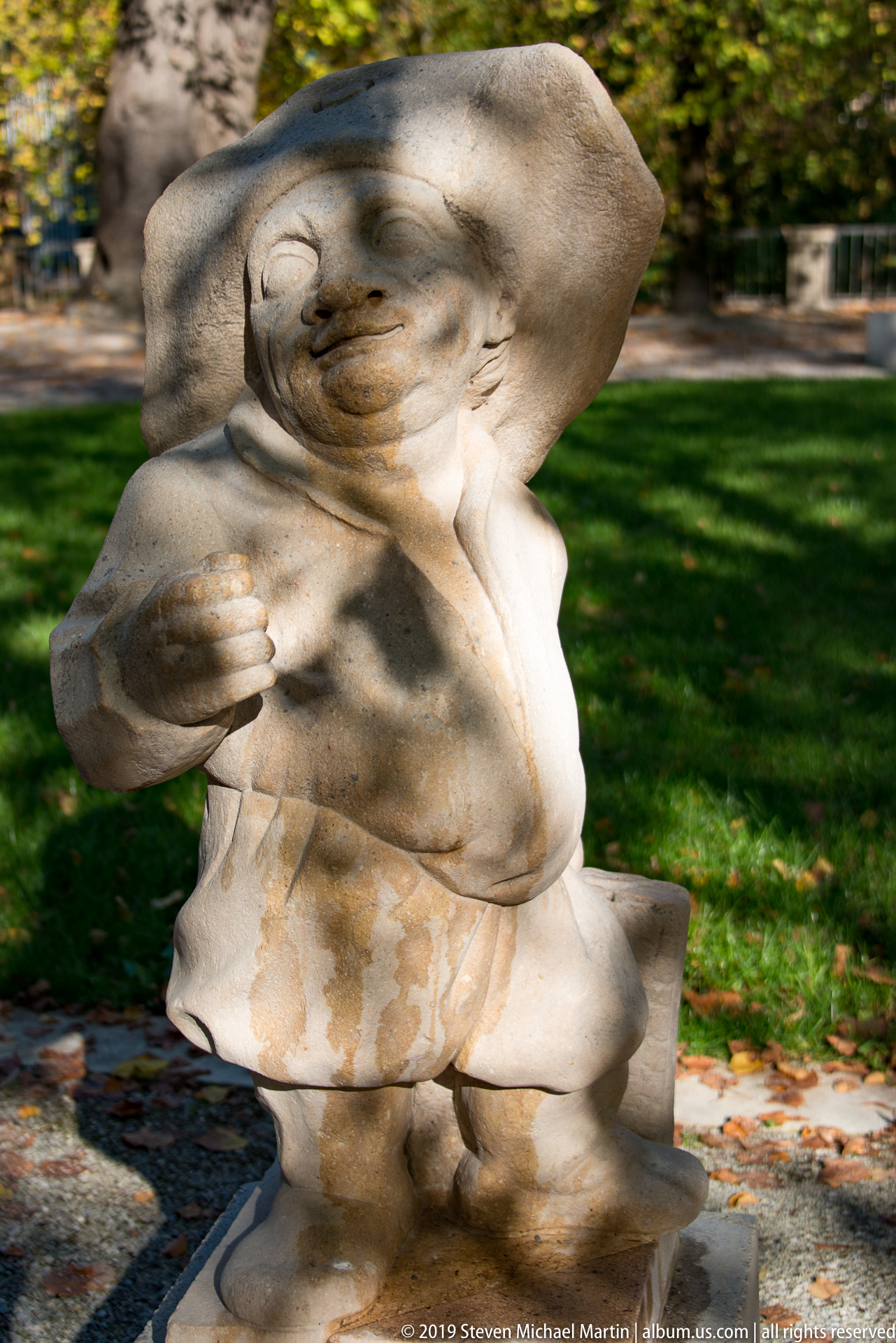
A compact dwarf figure wears a broad hood or cap that frames a rounded, smiling face. One hand is clenched near the chest while the other arm rests by the side, giving the figure a jaunty, self-contained pose. Dappled sunlight across the stone surface accentuates the large head, short limbs, and carved costume folds.
Caption
A compact dwarf figure wears a broad hood or cap that frames a rounded, smiling face. One hand is clenched near the chest while the other arm rests by the side, giving the figure a jaunty, self-contained pose. Dappled sunlight across the stone surface accentuates the large head, short limbs, and carved costume folds.

A dwarf figure braces both hands against an oversized ribbed stone basin, turning the comic garden sculpture into a functional or pseudo-functional support. The broad vessel dominates the composition, dwarfing the compact figure beneath it. Side lighting reveals the carved fluting of the basin and the folds of the figure’s costume.
Caption
A dwarf figure braces both hands against an oversized ribbed stone basin, turning the comic garden sculpture into a functional or pseudo-functional support. The broad vessel dominates the composition, dwarfing the compact figure beneath it. Side lighting reveals the carved fluting of the basin and the folds of the figure’s costume.

A bearded dwarf leans over a bird-like carved form held or positioned in front of him. The figure’s soft cap, prominent beard, and concentrated downward gaze give the composition a more narrative quality than neighboring portraits. Shallow focus separates the pale stone sculpture from the autumn garden beyond.
Caption
A bearded dwarf leans over a bird-like carved form held or positioned in front of him. The figure’s soft cap, prominent beard, and concentrated downward gaze give the composition a more narrative quality than neighboring portraits. Shallow focus separates the pale stone sculpture from the autumn garden beyond.

A dwarf in a broad hat and ruff-like collar holds a large handled vessel against the abdomen, both hands wrapped around its body and handle. The frontal pose highlights the rounded belly, short legs, and exaggerated facial features characteristic of the Dwarf Garden figures. Soft autumn light brings out the weathering and shallow carving on the stone surface.
Caption
A dwarf in a broad hat and ruff-like collar holds a large handled vessel against the abdomen, both hands wrapped around its body and handle. The frontal pose highlights the rounded belly, short legs, and exaggerated facial features characteristic of the Dwarf Garden figures. Soft autumn light brings out the weathering and shallow carving on the stone surface.
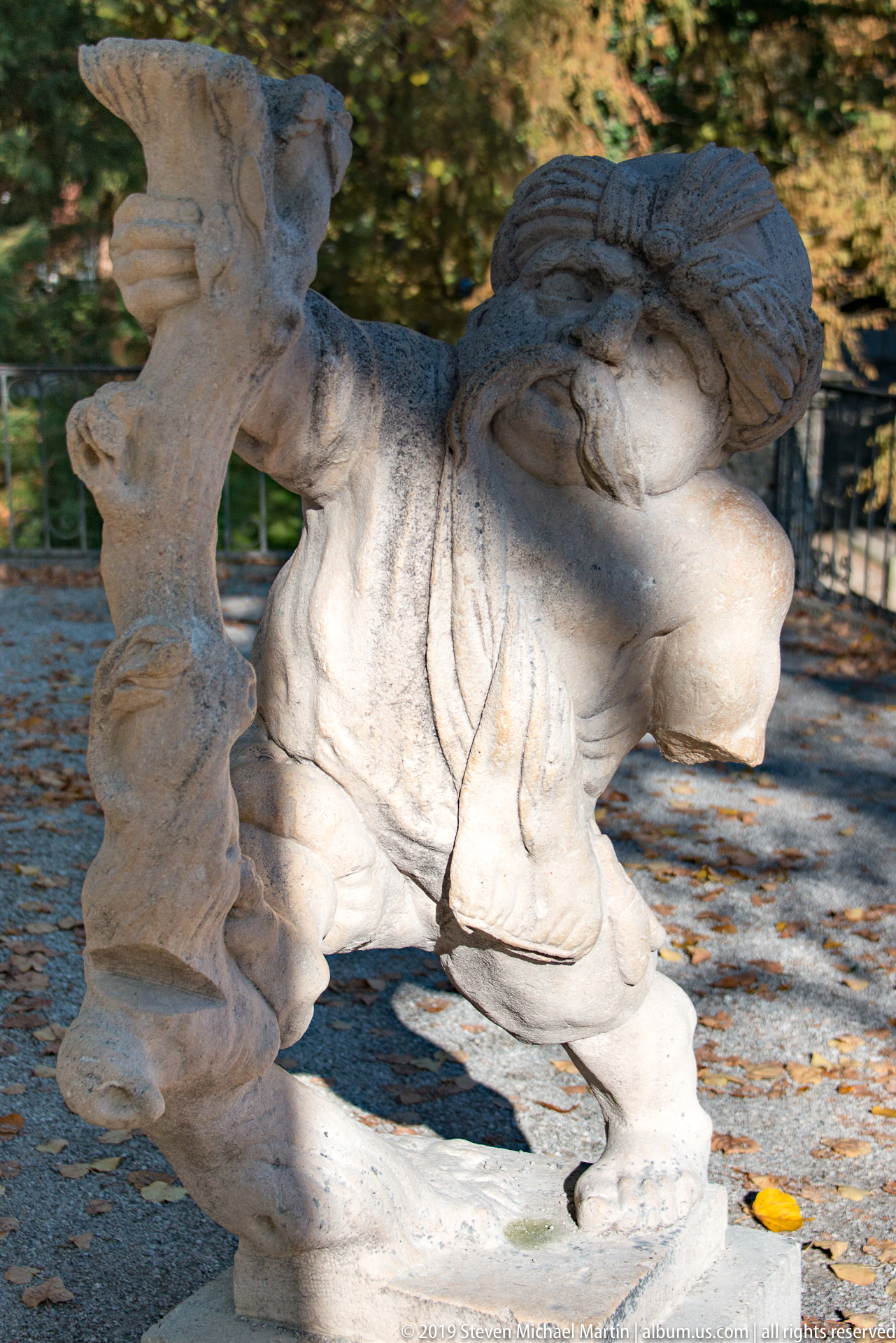
A dwarf figure bends deeply forward under the weight of a large mass carried across the back, one hand gripping a vertical support or staff for balance. The crouched pose exaggerates the sense of effort and gives the sculpture a strongly diagonal profile. Autumn leaves scattered on the ground frame the weathered stone figure.
Caption
A dwarf figure bends deeply forward under the weight of a large mass carried across the back, one hand gripping a vertical support or staff for balance. The crouched pose exaggerates the sense of effort and gives the sculpture a strongly diagonal profile. Autumn leaves scattered on the ground frame the weathered stone figure.
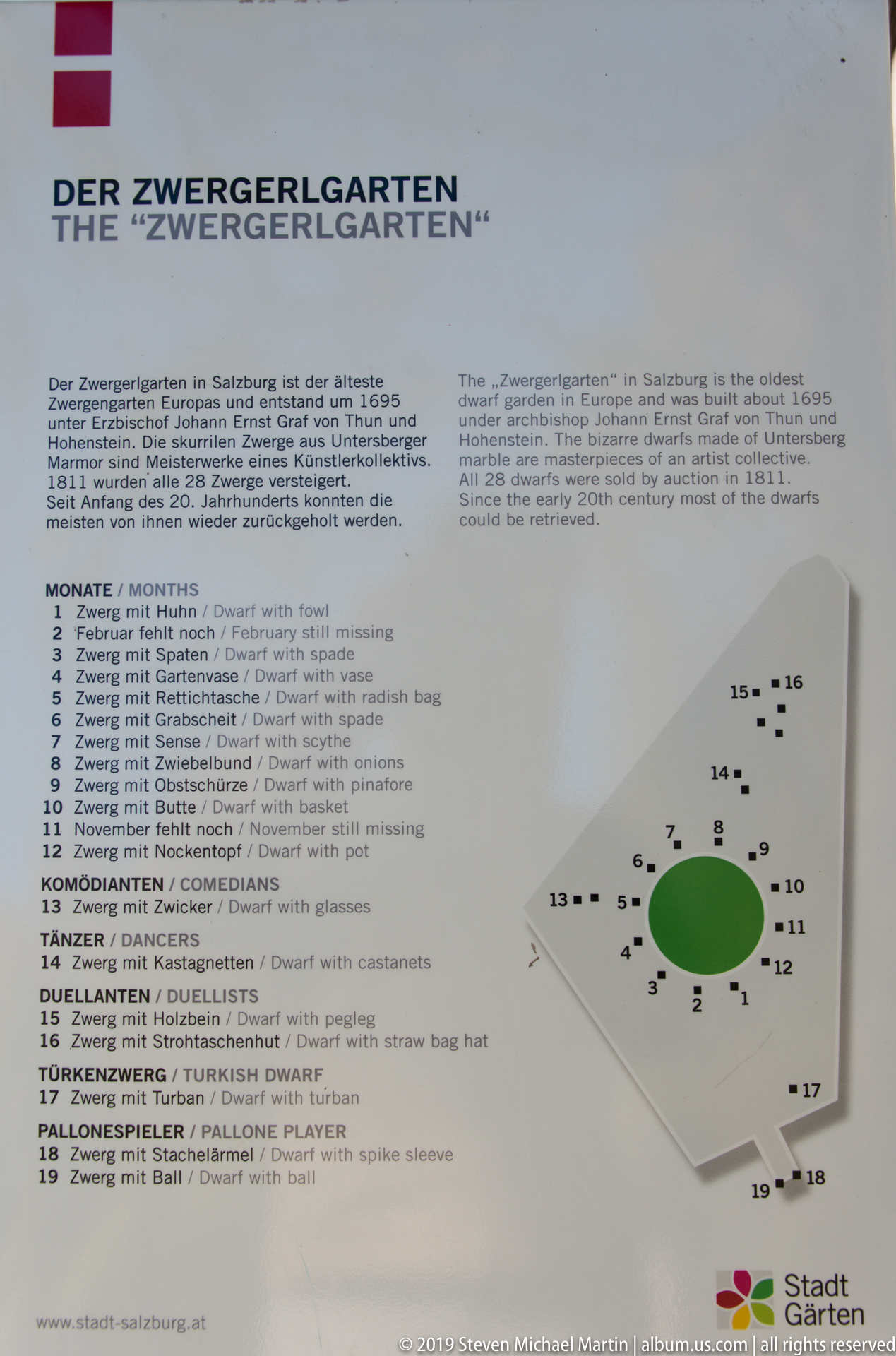
An interpretive panel for Salzburg’s Zwerglgarten, or Dwarf Garden, combines German and English text with a numbered plan locating the surviving sculptures. The sign organizes the figures by groups and names, providing visitors with a key to the garden’s unusual Baroque ensemble. Its diagram also shows the sculptures arranged around the central lawn and paths.
Caption
An interpretive panel for Salzburg’s Zwerglgarten, or Dwarf Garden, combines German and English text with a numbered plan locating the surviving sculptures. The sign organizes the figures by groups and names, providing visitors with a key to the garden’s unusual Baroque ensemble. Its diagram also shows the sculptures arranged around the central lawn and paths.

A monumental carved stone urn stands on a square pedestal beside the Mirabell garden fence. Thick garlands, scrolling handles, floral forms, and a prominent central decorative motif cover the vessel, creating a dense Baroque surface. The palace façade and patterned flower beds appear softly behind it, placing the ornamental object within the formal garden ensemble.
Caption
A monumental carved stone urn stands on a square pedestal beside the Mirabell garden fence. Thick garlands, scrolling handles, floral forms, and a prominent central decorative motif cover the vessel, creating a dense Baroque surface. The palace façade and patterned flower beds appear softly behind it, placing the ornamental object within the formal garden ensemble.

A straight garden walkway crosses a narrow bridge between clipped hedges, with two of Mirabell’s carved dwarf figures standing on stone piers at the entrance. Additional sculptures continue along the axis beneath autumn trees. The composition places the whimsical figures within the formal circulation pattern of the Dwarf Garden rather than isolating them as individual portraits.
Caption
A straight garden walkway crosses a narrow bridge between clipped hedges, with two of Mirabell’s carved dwarf figures standing on stone piers at the entrance. Additional sculptures continue along the axis beneath autumn trees. The composition places the whimsical figures within the formal circulation pattern of the Dwarf Garden rather than isolating them as individual portraits.

Seen almost head-on, a reclining stone lion rests on a low garden plinth with one forepaw extending toward the viewer. The frontal angle emphasizes the broad muzzle, symmetrical mane, and alert expression, while blue sky and autumn trees provide a vivid backdrop. This view complements the neighboring profile by concentrating on the sculpture’s face and stance.
Caption
Seen almost head-on, a reclining stone lion rests on a low garden plinth with one forepaw extending toward the viewer. The frontal angle emphasizes the broad muzzle, symmetrical mane, and alert expression, while blue sky and autumn trees provide a vivid backdrop. This view complements the neighboring profile by concentrating on the sculpture’s face and stance.

A bronze-green winged horse rears above a rocky base in front of Mirabell Palace, its spread wings, lifted forelegs, and flowing mane forming a dramatic silhouette. The sculpture represents Pegasus, one of the best-known features of the Mirabell Gardens. Set against the pale palace façade, the mythological figure becomes a vivid emblem of the garden’s theatrical Baroque character.
Caption
A bronze-green winged horse rears above a rocky base in front of Mirabell Palace, its spread wings, lifted forelegs, and flowing mane forming a dramatic silhouette. The sculpture represents Pegasus, one of the best-known features of the Mirabell Gardens. Set against the pale palace façade, the mythological figure becomes a vivid emblem of the garden’s theatrical Baroque character.

The Pegasus Fountain stands centered before Mirabell Palace, the rearing winged horse rising from a rocky basin while the palace’s symmetrical windows and balcony fill the background. This wider view shows the sculpture as part of the formal garden composition, with clipped conifers and lawn balancing the fountain on either side. The arrangement links mythological ornament, water feature, and palace architecture in a single axis.
Caption
The Pegasus Fountain stands centered before Mirabell Palace, the rearing winged horse rising from a rocky basin while the palace’s symmetrical windows and balcony fill the background. This wider view shows the sculpture as part of the formal garden composition, with clipped conifers and lawn balancing the fountain on either side. The arrangement links mythological ornament, water feature, and palace architecture in a single axis.
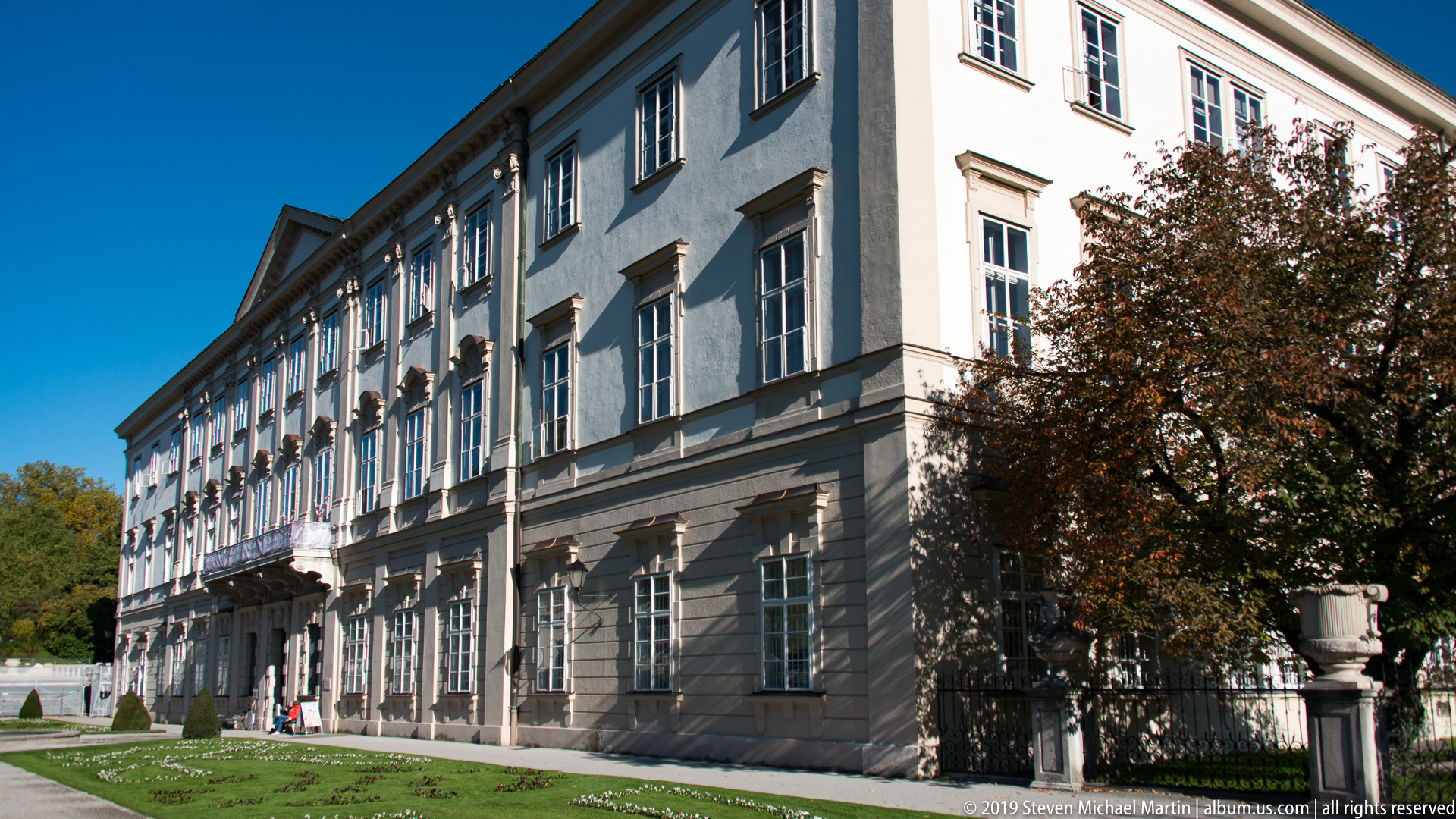
A long side elevation of Mirabell Palace extends diagonally across the frame, its regular rows of tall windows and restrained decorative surrounds catching strong afternoon light. A narrow strip of lawn, clipped plantings, and ornamental stonework separates the building from the garden path. The oblique viewpoint emphasizes the palace’s length and repetitive façade rhythm.
Caption
A long side elevation of Mirabell Palace extends diagonally across the frame, its regular rows of tall windows and restrained decorative surrounds catching strong afternoon light. A narrow strip of lawn, clipped plantings, and ornamental stonework separates the building from the garden path. The oblique viewpoint emphasizes the palace’s length and repetitive façade rhythm.
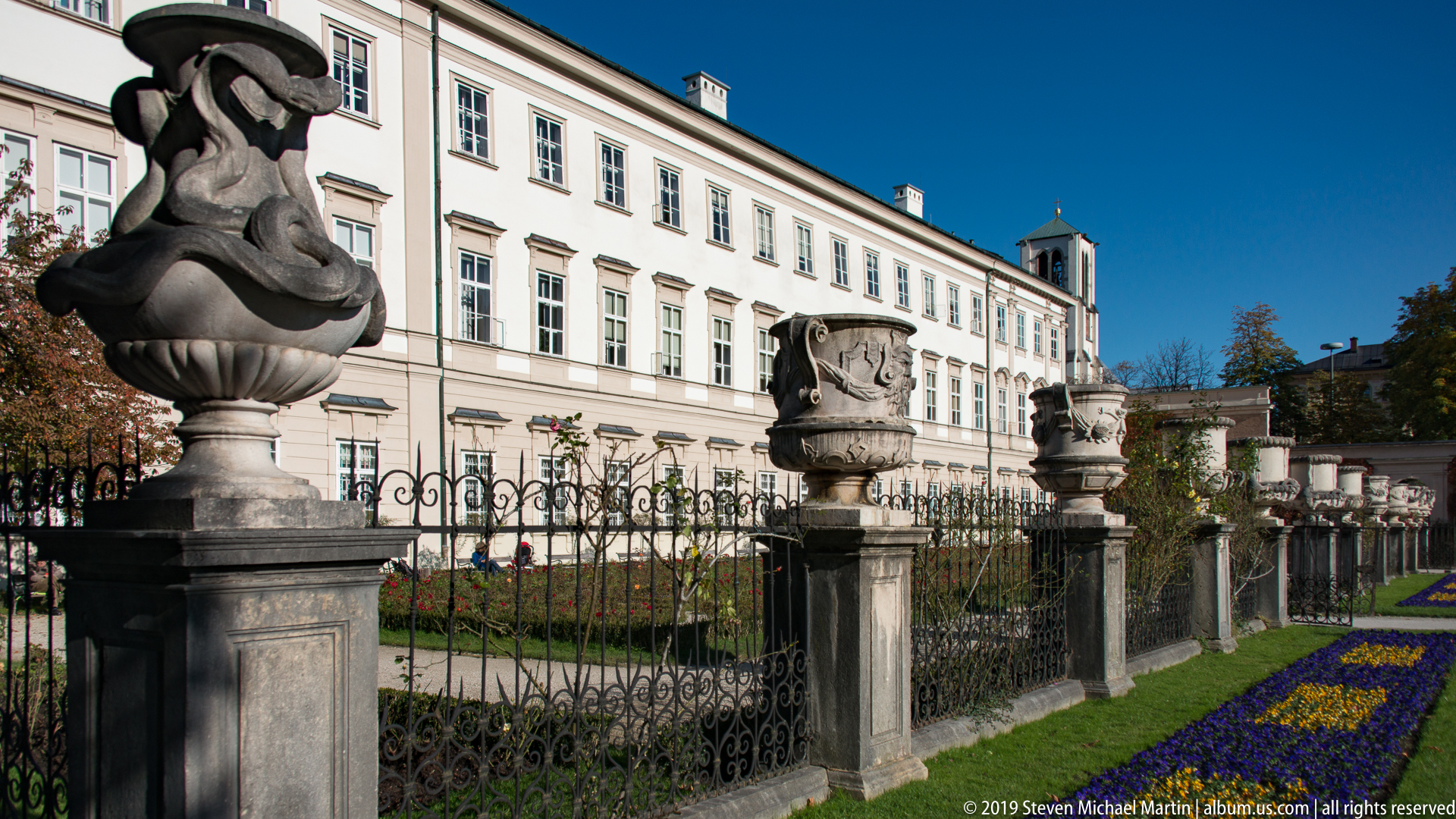
An ornamental iron fence runs alongside Mirabell Palace, punctuated by stone posts carrying exuberantly carved urns and floral finials. Beyond the fence, the palace’s long pale façade forms a continuous backdrop, while a narrow flower bed adds bands of autumn color at ground level. The close oblique view highlights the garden’s decorative boundary treatment.
Caption
An ornamental iron fence runs alongside Mirabell Palace, punctuated by stone posts carrying exuberantly carved urns and floral finials. Beyond the fence, the palace’s long pale façade forms a continuous backdrop, while a narrow flower bed adds bands of autumn color at ground level. The close oblique view highlights the garden’s decorative boundary treatment.

A small pale garden building with a ribbed domed roof and balustraded terrace appears through mature trees at the edge of Mirabell Gardens. Its symmetrical windowed façade and low wings are partly screened by trunks, clipped shrubs, and visitors. The view emphasizes the pavilion-like structure as a destination within the larger landscaped grounds.
Caption
A small pale garden building with a ribbed domed roof and balustraded terrace appears through mature trees at the edge of Mirabell Gardens. Its symmetrical windowed façade and low wings are partly screened by trunks, clipped shrubs, and visitors. The view emphasizes the pavilion-like structure as a destination within the larger landscaped grounds.

A contemporary bronze sculpture portrays a seated female figure with an elongated, stylized profile, one arm extended while small birds perch on her head, shoulder, and hand. The rough, expressive surface and blue-green patina distinguish the work from Mirabell’s pale historic stone statuary. Cropped closely against the garden path, the figure reads as an intimate modern intervention within the palace grounds.
Caption
A contemporary bronze sculpture portrays a seated female figure with an elongated, stylized profile, one arm extended while small birds perch on her head, shoulder, and hand. The rough, expressive surface and blue-green patina distinguish the work from Mirabell’s pale historic stone statuary. Cropped closely against the garden path, the figure reads as an intimate modern intervention within the palace grounds.
⭐ Highlights
- Mirabell Gardens: Geometric Baroque gardens with fountains, sculptures, and formal layouts.
- Pegasus Fountain: A central focal point of the gardens, surrounded by symmetrical pathways and statues.
- Marble Hall: An ornate interior space used for concerts and ceremonies.
- Baroque Design: A cohesive combination of architecture, sculpture, and landscape planning.
- Garden Axes and Symmetry: Carefully aligned pathways and sightlines connecting the palace to the city.
- Salzburg Setting: Views across the gardens toward the Old Town and surrounding hills.
🌸 Mirabell Palace & Gardens Field Guide
Major features observed during this visit:
Mirabell Palace and its gardens form one of the most refined Baroque spaces in Salzburg. Originally built in 1606 by Prince-Archbishop Wolf Dietrich von Raitenau, the palace was later redesigned in a grand Baroque style, while the gardens were laid out with precise geometric planning and sculptural detail. Today, the site represents a carefully composed relationship between architecture, landscape, and urban setting.
🏛️ Signature Features
- Mirabell Gardens – A formal Baroque garden with symmetrical layouts, trimmed hedges, and sculptural elements.
- Pegasus Fountain – A central focal point anchoring the garden’s main axis.
- Marble Hall – An ornate interior space used for concerts and ceremonial events.
- Garden Sculpture – Mythological figures integrated into the landscape design.
- Hedge Theater – A rare Baroque garden theater formed by shaped hedges.
🧠 Historical Significance
- Built in 1606 – Commissioned as a residence outside the medieval city walls.
- Baroque Transformation – Redesigned in the 18th century into a unified palace and garden complex.
- UNESCO Context – Part of Salzburg’s historic center and cultural landscape.
- Cultural Role – Associated with music, ceremonies, and Salzburg’s artistic traditions.
🌄 Landscape & Setting
- Garden Geometry – Formal axes and symmetry guide movement and perspective.
- Urban Connection – The gardens visually link to Salzburg’s Old Town.
- Open Space – Provides contrast to the dense historic core across the river.
- Framed Views – Sightlines emphasize both the palace and the surrounding city.