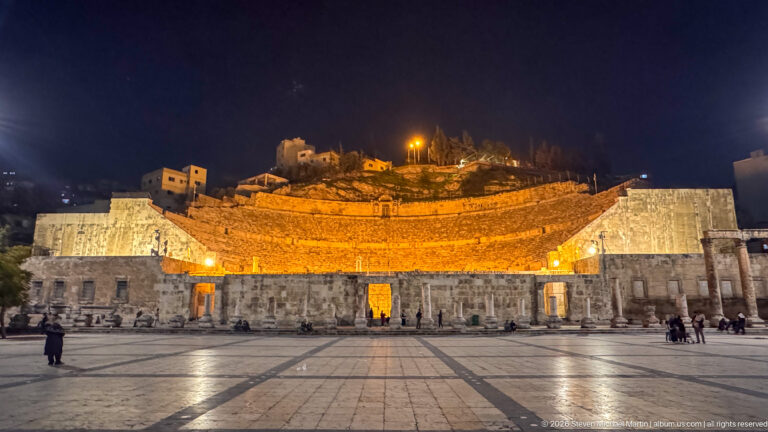
Amman
Amman – Jordan Amman, the capital of Jordan, lies among a series of hills in the northwestern part of the […]
Explore Portfolio
Jordan preserves a cultural landscape shaped by ancient trade routes connecting Arabia, the eastern Mediterranean, and the broader Near East. For centuries, merchants, travelers, and empires passed through the region, contributing to a layered historical environment influenced by Nabataean, Roman, Byzantine, and later Islamic traditions. The geography of desert plateaus and rugged sandstone formations helped shape settlement patterns that reflect both strategic necessity and adaptation to a challenging natural environment.
The capital city of Amman illustrates the continuity of urban development across multiple historical periods, where archaeological remains coexist with a modern city that continues to serve as an important cultural center in the region. The surrounding landscape reflects the broader historical importance of Jordan as a crossroads between civilizations that shaped the eastern Mediterranean world.
The ancient city of Petra represents one of the most remarkable archaeological sites in the world, where monumental structures carved directly into rose-colored sandstone cliffs demonstrate the engineering and artistic achievements of the Nabataean civilization. The relationship between architecture and natural landscape creates a visually distinctive environment that illustrates how geography influenced both defensive strategy and aesthetic expression. Together, these sites reflect Jordan’s historical role as a meeting point of cultures whose influence extended across the ancient world.

The following itineraries include locations in this country:
