Burana Tower
Burana Tower is a minaret dating to the eleventh century and represents one of the most important surviving structures from the city of Balasagun, an early Silk Road settlement in present-day Kyrgyzstan. The tower reflects the influence of Islamic architecture introduced through trade and cultural exchange across Central Asia. Its construction demonstrates the spread of religious and architectural traditions along caravan routes.
Balasagun served as a significant urban center within the Kara-Khanid Khanate, illustrating the development of political authority supported by regional trade. The tower’s brick construction reflects building techniques adapted to available materials in the region. Archaeological remains surrounding the tower provide insight into settlement patterns associated with Silk Road cities.
Burana Tower illustrates the presence of Islamic scholarship and architecture within Central Asia. Its preserved structure reflects the importance of Silk Road cities as centers of cultural and intellectual exchange.
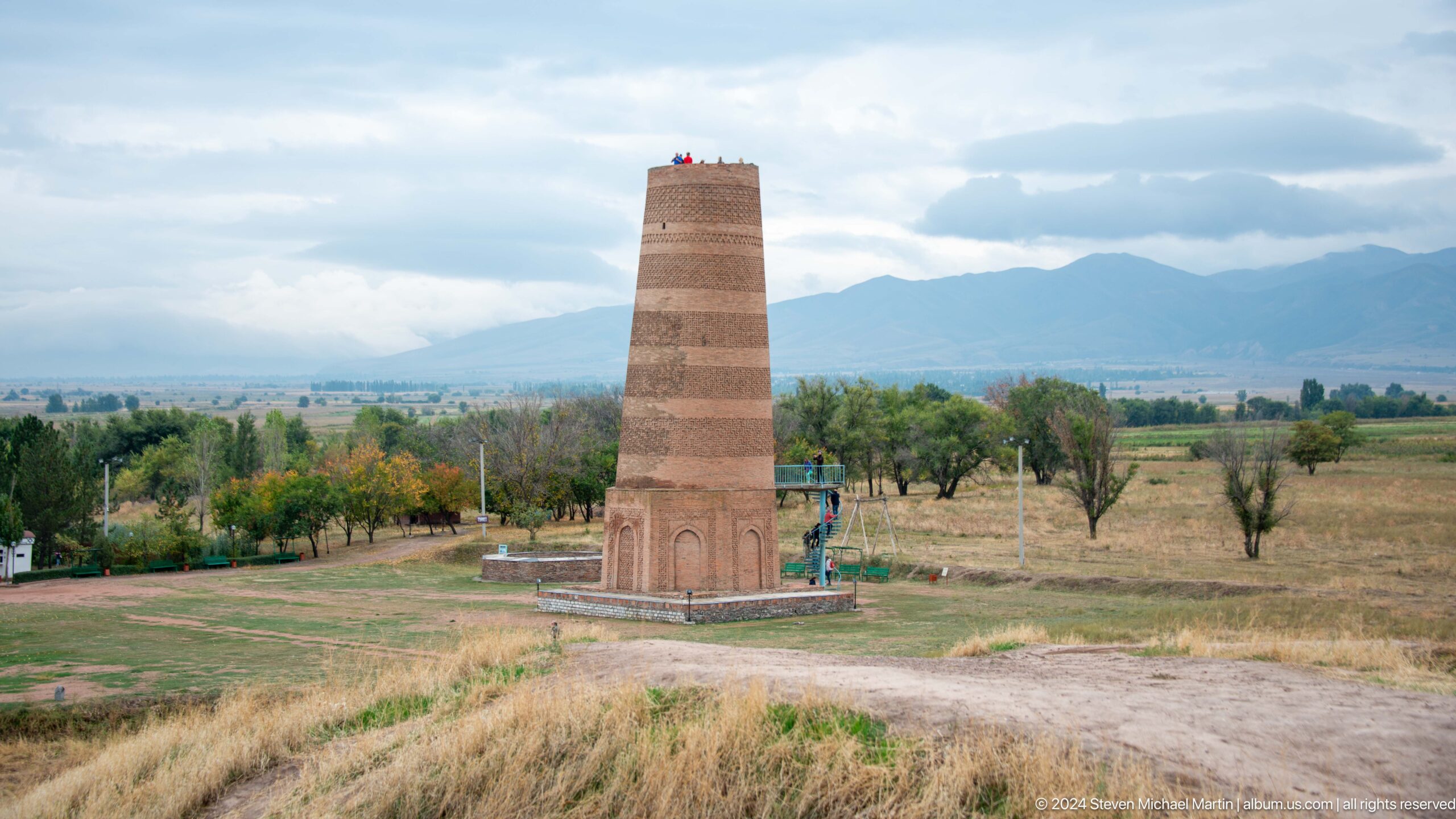
Burana Tower panorama stands as the principal surviving monument of medieval Balasagun. The tower stands within its archaeological grounds against distant mountains. The eleventh-century brick minaret reflects the spread of Islamic architecture and urban culture across Central Asia during the Kara-Khanid period.
Caption
Burana Tower panorama stands as the principal surviving monument of medieval Balasagun. The tower stands within its archaeological grounds against distant mountains. The eleventh-century brick minaret reflects the spread of Islamic architecture and urban culture across Central Asia during the Kara-Khanid period.

Burana Tower façade highlights the sophisticated masonry of the Kara-Khanid minaret. A tall blind arch is framed by intricate brick ornament on the lower façade. Alternating textures, recessed arches, and geometric brick patterns gave visual richness to a structure built largely from fired brick and connected with the medieval Silk Road city of Balasagun.
Caption
Burana Tower façade highlights the sophisticated masonry of the Kara-Khanid minaret. A tall blind arch is framed by intricate brick ornament on the lower façade. Alternating textures, recessed arches, and geometric brick patterns gave visual richness to a structure built largely from fired brick and connected with the medieval Silk Road city of Balasagun.

Burana Tower landscape stands as the principal surviving monument of medieval Balasagun. The minaret stands far across the grassland under a broad cloudy sky. The eleventh-century brick minaret reflects the spread of Islamic architecture and urban culture across Central Asia during the Kara-Khanid period.
Caption
Burana Tower landscape stands as the principal surviving monument of medieval Balasagun. The minaret stands far across the grassland under a broad cloudy sky. The eleventh-century brick minaret reflects the spread of Islamic architecture and urban culture across Central Asia during the Kara-Khanid period.

Burana archaeological landscape stands as the principal surviving monument of medieval Balasagun. The minaret rises beyond scattered carved stones and dry grass. The eleventh-century brick minaret reflects the spread of Islamic architecture and urban culture across Central Asia during the Kara-Khanid period.
Caption
Burana archaeological landscape stands as the principal surviving monument of medieval Balasagun. The minaret rises beyond scattered carved stones and dry grass. The eleventh-century brick minaret reflects the spread of Islamic architecture and urban culture across Central Asia during the Kara-Khanid period.
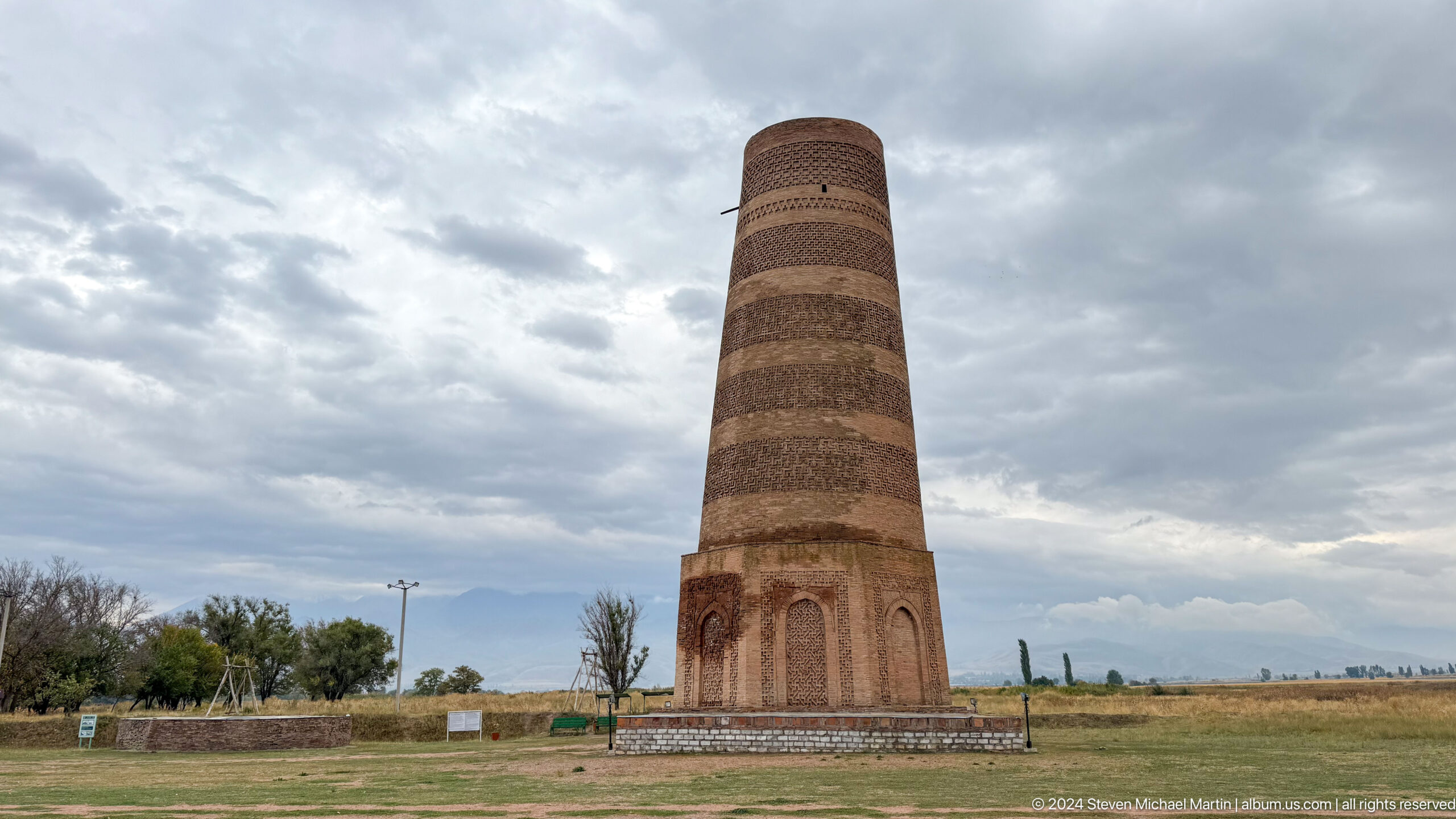
Burana Tower stands as the principal surviving monument of medieval Balasagun. The minaret stands alone in the grassland with mountains beneath a cloudy sky. The eleventh-century brick minaret reflects the spread of Islamic architecture and urban culture across Central Asia during the Kara-Khanid period.
Caption
Burana Tower stands as the principal surviving monument of medieval Balasagun. The minaret stands alone in the grassland with mountains beneath a cloudy sky. The eleventh-century brick minaret reflects the spread of Islamic architecture and urban culture across Central Asia during the Kara-Khanid period.
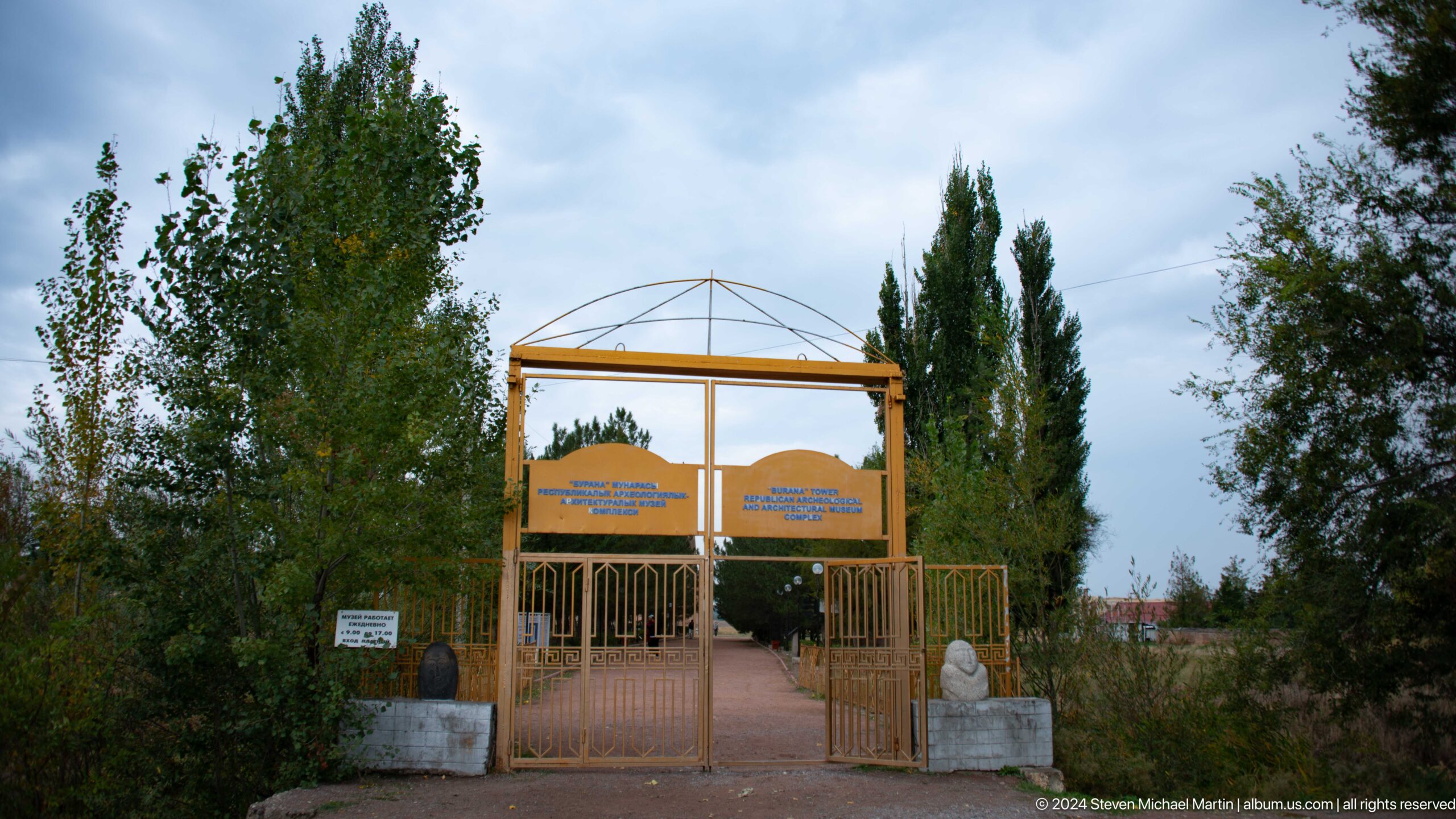
Burana site entrance documents the contemporary and historical landscape surrounding Burana Tower. A simple roofed entrance structure marks access to the archaeological site. The scene contributes context for understanding the archaeological site as part of a living rural region shaped by settlement, agriculture, transport, and cultural memory.
Caption
Burana site entrance documents the contemporary and historical landscape surrounding Burana Tower. A simple roofed entrance structure marks access to the archaeological site. The scene contributes context for understanding the archaeological site as part of a living rural region shaped by settlement, agriculture, transport, and cultural memory.

Manas equestrian monument commemorates the heroic figure central to Kyrgyz national tradition. A mounted warrior figure raises one arm while seated on a rearing horse. Photographed en route to Burana, the monument situates the archaeological visit within the modern cultural landscape of Kyrgyzstan.
Caption
Manas equestrian monument commemorates the heroic figure central to Kyrgyz national tradition. A mounted warrior figure raises one arm while seated on a rearing horse. Photographed en route to Burana, the monument situates the archaeological visit within the modern cultural landscape of Kyrgyzstan.
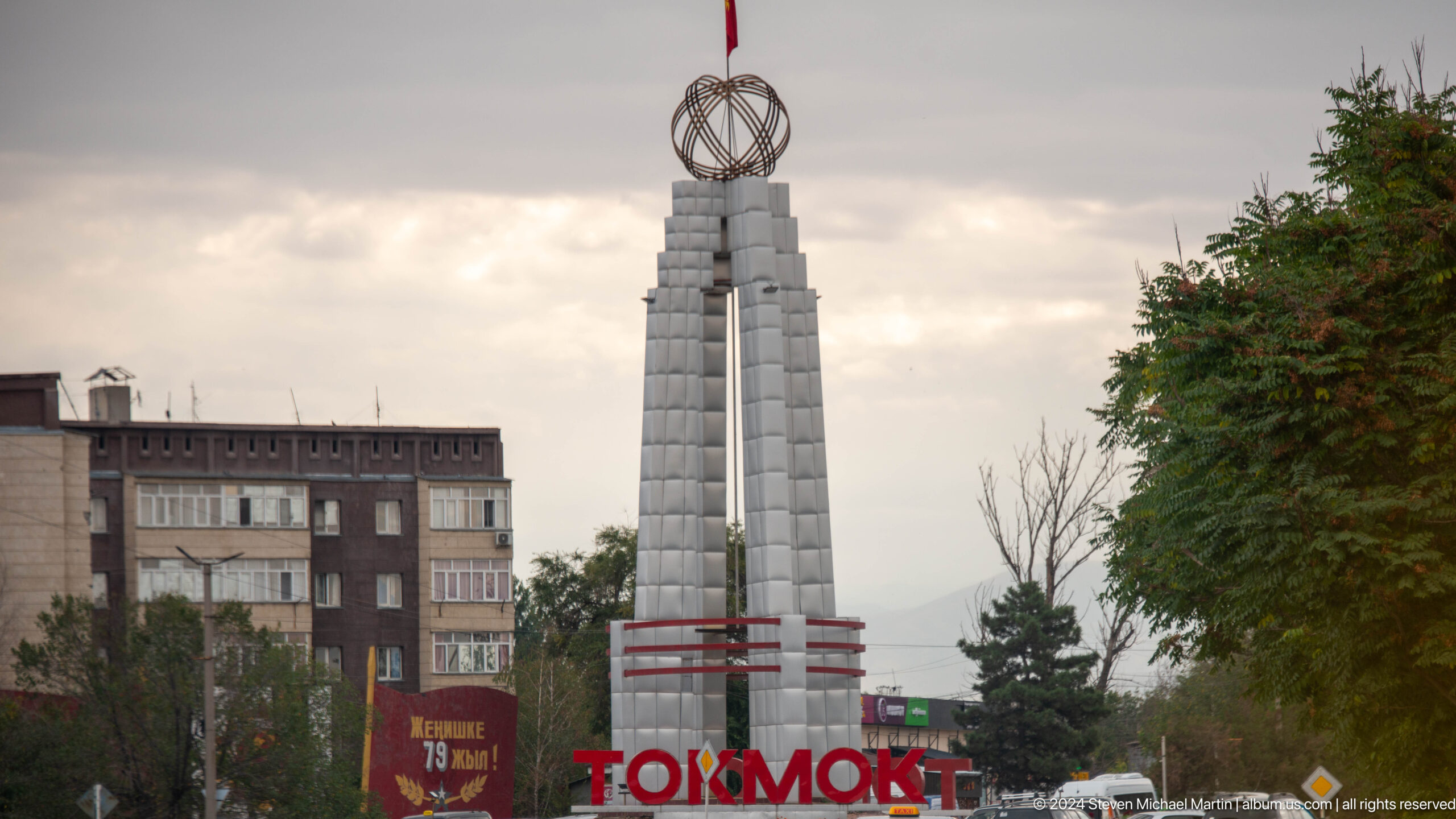
Modern urban monument documents the contemporary and historical landscape surrounding Burana Tower. A tall pale monument rises above large red Cyrillic lettering in a city streetscape. The scene contributes context for understanding the archaeological site as part of a living rural region shaped by settlement, agriculture, transport, and cultural memory.
Caption
Modern urban monument documents the contemporary and historical landscape surrounding Burana Tower. A tall pale monument rises above large red Cyrillic lettering in a city streetscape. The scene contributes context for understanding the archaeological site as part of a living rural region shaped by settlement, agriculture, transport, and cultural memory.

Burana Tower interior stair reveals the confined circulation system within the monument. A narrow brick-vaulted passage curves upward inside the minaret. The narrow brick passage illustrates how access to the upper levels was fitted inside the tapering eleventh-century minaret, one of the principal surviving structures of the medieval city of Balasagun.
Caption
Burana Tower interior stair reveals the confined circulation system within the monument. A narrow brick-vaulted passage curves upward inside the minaret. The narrow brick passage illustrates how access to the upper levels was fitted inside the tapering eleventh-century minaret, one of the principal surviving structures of the medieval city of Balasagun.
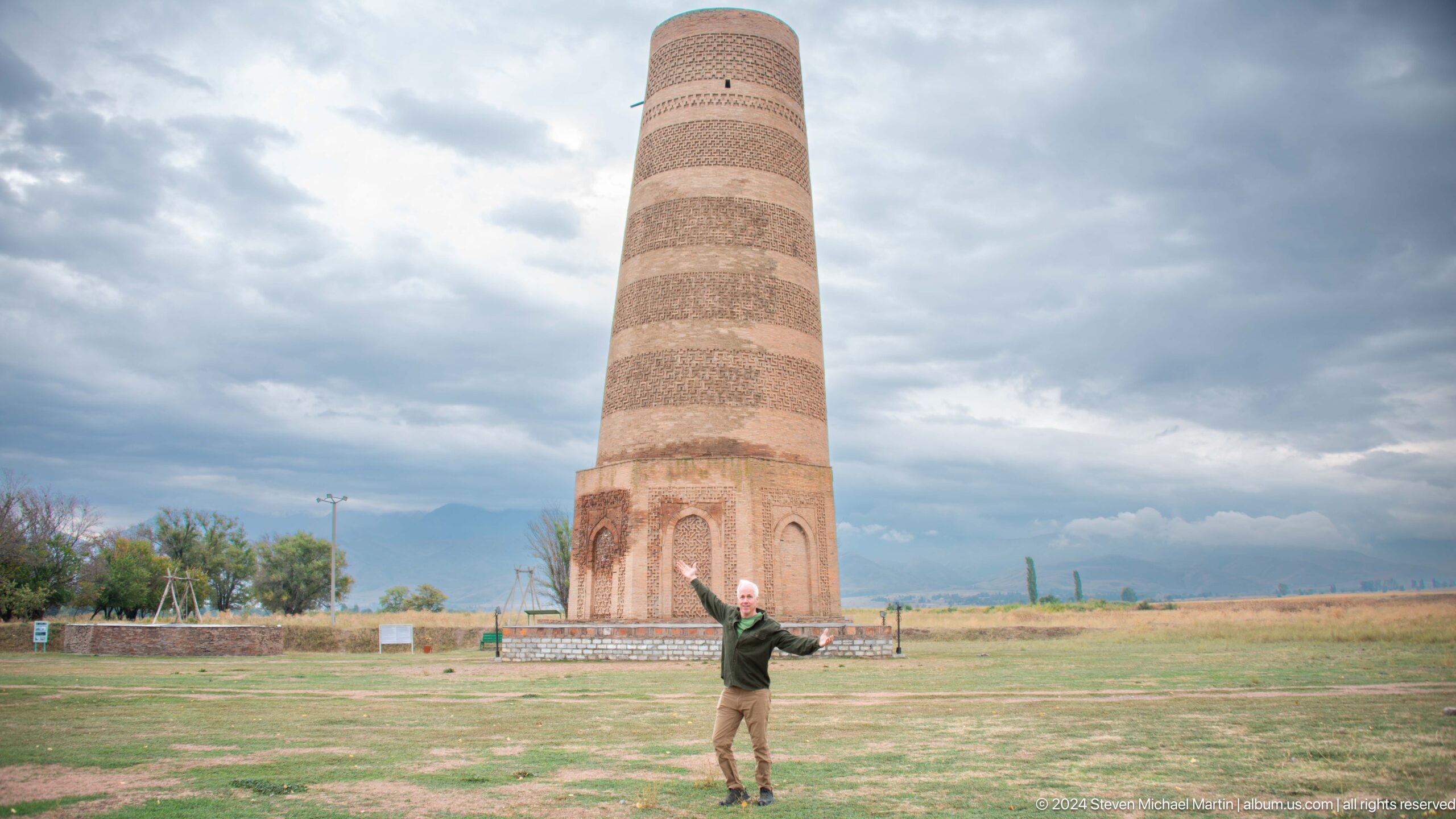
Visitor portrait at Burana Tower stands as the principal surviving monument of medieval Balasagun. A visitor stands with arms raised before the distant minaret. The eleventh-century brick minaret reflects the spread of Islamic architecture and urban culture across Central Asia during the Kara-Khanid period.
Caption
Visitor portrait at Burana Tower stands as the principal surviving monument of medieval Balasagun. A visitor stands with arms raised before the distant minaret. The eleventh-century brick minaret reflects the spread of Islamic architecture and urban culture across Central Asia during the Kara-Khanid period.
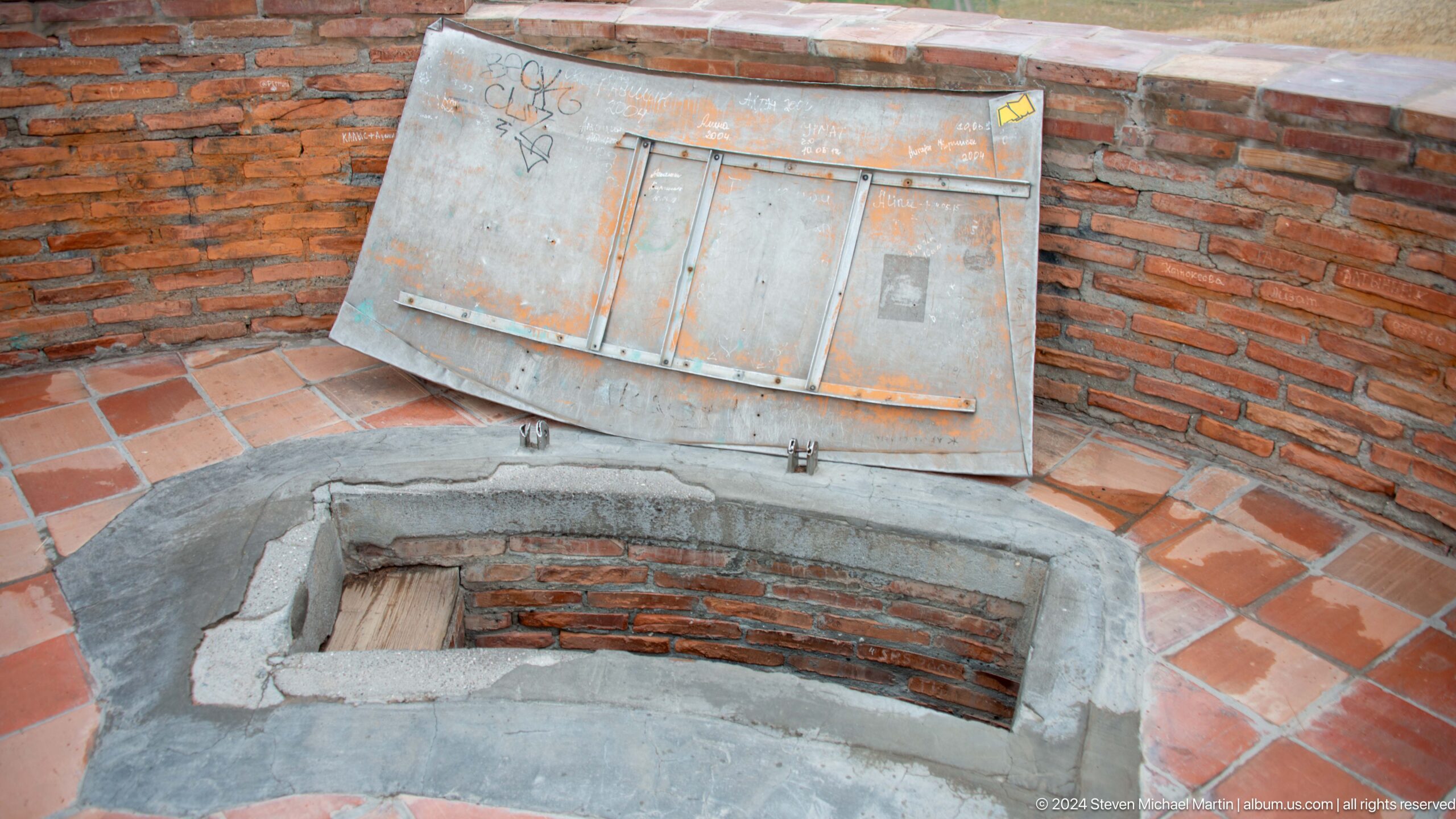
Burana Tower roof hatch reveals the confined circulation system within the monument. An open metal-covered hatch provides access to the top platform. The narrow brick passage illustrates how access to the upper levels was fitted inside the tapering eleventh-century minaret, one of the principal surviving structures of the medieval city of Balasagun.
Caption
Burana Tower roof hatch reveals the confined circulation system within the monument. An open metal-covered hatch provides access to the top platform. The narrow brick passage illustrates how access to the upper levels was fitted inside the tapering eleventh-century minaret, one of the principal surviving structures of the medieval city of Balasagun.
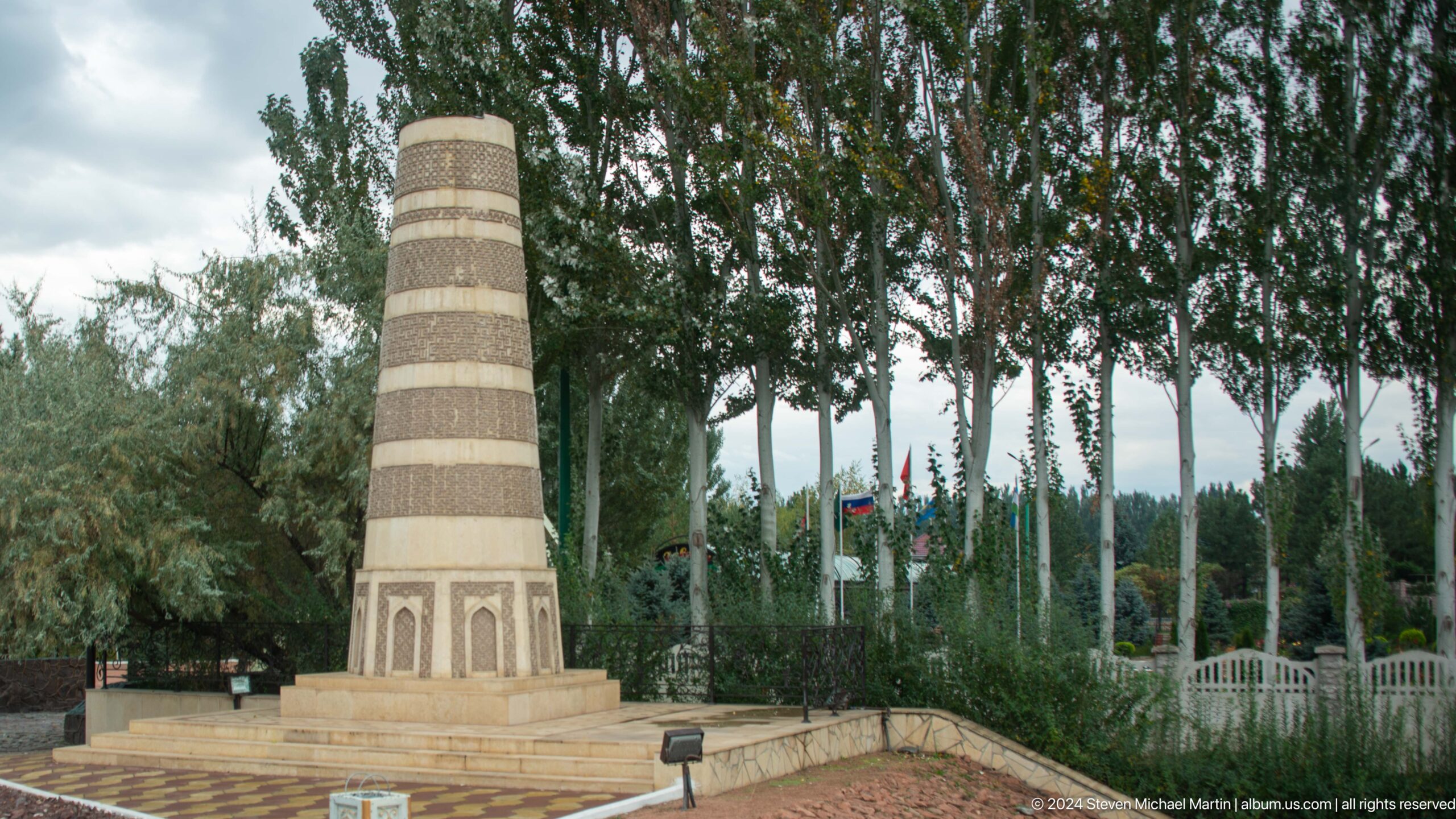
Modern roadside monument documents the contemporary and historical landscape surrounding Burana Tower. A tall striped decorative tower stands within a landscaped roadside setting. The scene contributes context for understanding the archaeological site as part of a living rural region shaped by settlement, agriculture, transport, and cultural memory.
Caption
Modern roadside monument documents the contemporary and historical landscape surrounding Burana Tower. A tall striped decorative tower stands within a landscaped roadside setting. The scene contributes context for understanding the archaeological site as part of a living rural region shaped by settlement, agriculture, transport, and cultural memory.

Chuy District entrance gateway marks a transition through the contemporary landscape surrounding Burana. A broad roadside gateway spans the highway with Kyrgyz and Russian district lettering. The structure and its Cyrillic signage document the modern settlements and transport routes through which visitors approach the medieval archaeological site.
Caption
Chuy District entrance gateway marks a transition through the contemporary landscape surrounding Burana. A broad roadside gateway spans the highway with Kyrgyz and Russian district lettering. The structure and its Cyrillic signage document the modern settlements and transport routes through which visitors approach the medieval archaeological site.
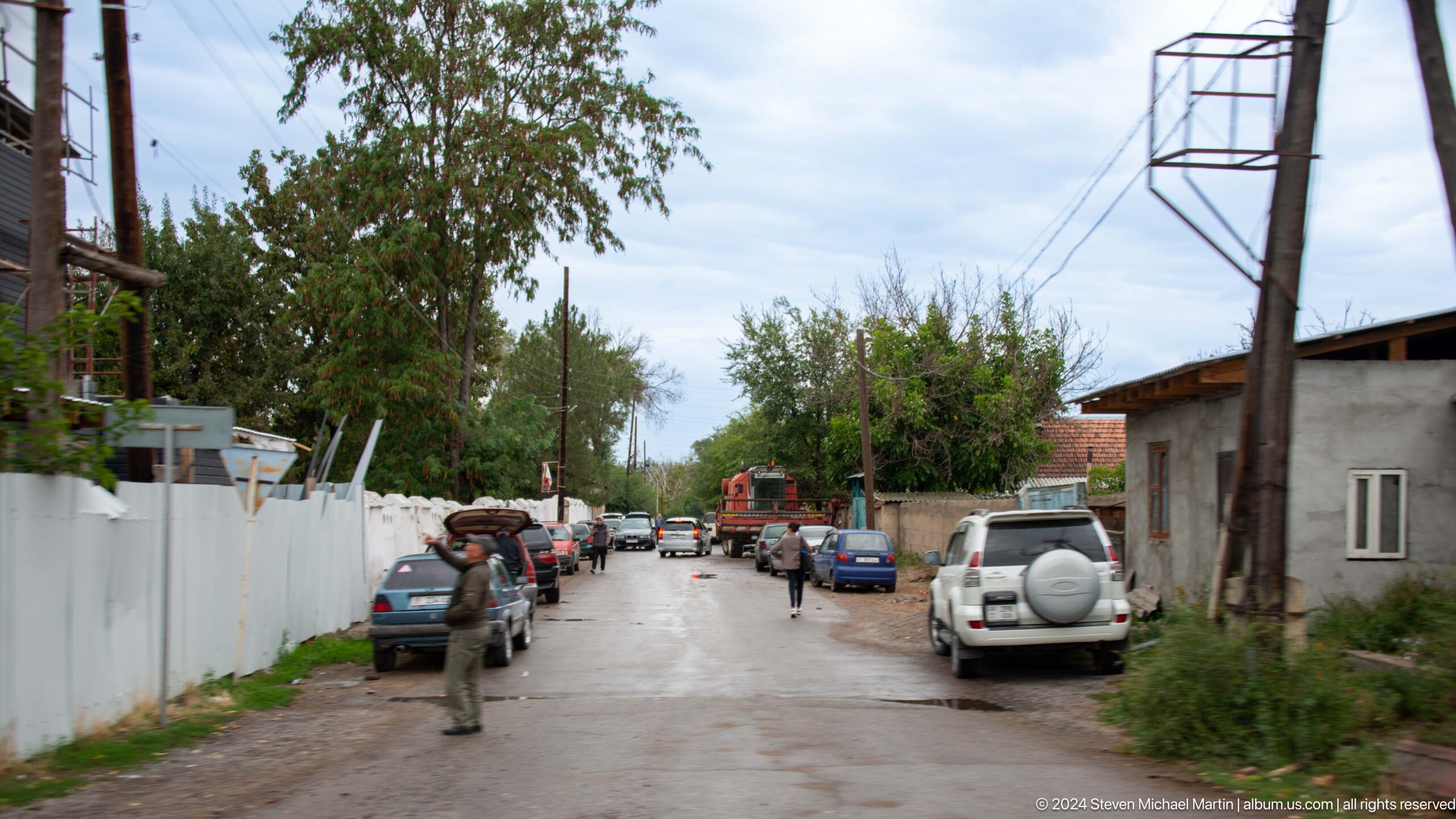
Village streetscape documents the contemporary and historical landscape surrounding Burana Tower. A quiet unpaved street is lined with low houses, utility poles, parked vehicles, and trees. The scene contributes context for understanding the archaeological site as part of a living rural region shaped by settlement, agriculture, transport, and cultural memory.
Caption
Village streetscape documents the contemporary and historical landscape surrounding Burana Tower. A quiet unpaved street is lined with low houses, utility poles, parked vehicles, and trees. The scene contributes context for understanding the archaeological site as part of a living rural region shaped by settlement, agriculture, transport, and cultural memory.

Local commercial storefront documents the contemporary and historical landscape surrounding Burana Tower. Colorful roadside shopfronts display Cyrillic signs for a cafeteria and bakery. The scene contributes context for understanding the archaeological site as part of a living rural region shaped by settlement, agriculture, transport, and cultural memory.
Caption
Local commercial storefront documents the contemporary and historical landscape surrounding Burana Tower. Colorful roadside shopfronts display Cyrillic signs for a cafeteria and bakery. The scene contributes context for understanding the archaeological site as part of a living rural region shaped by settlement, agriculture, transport, and cultural memory.
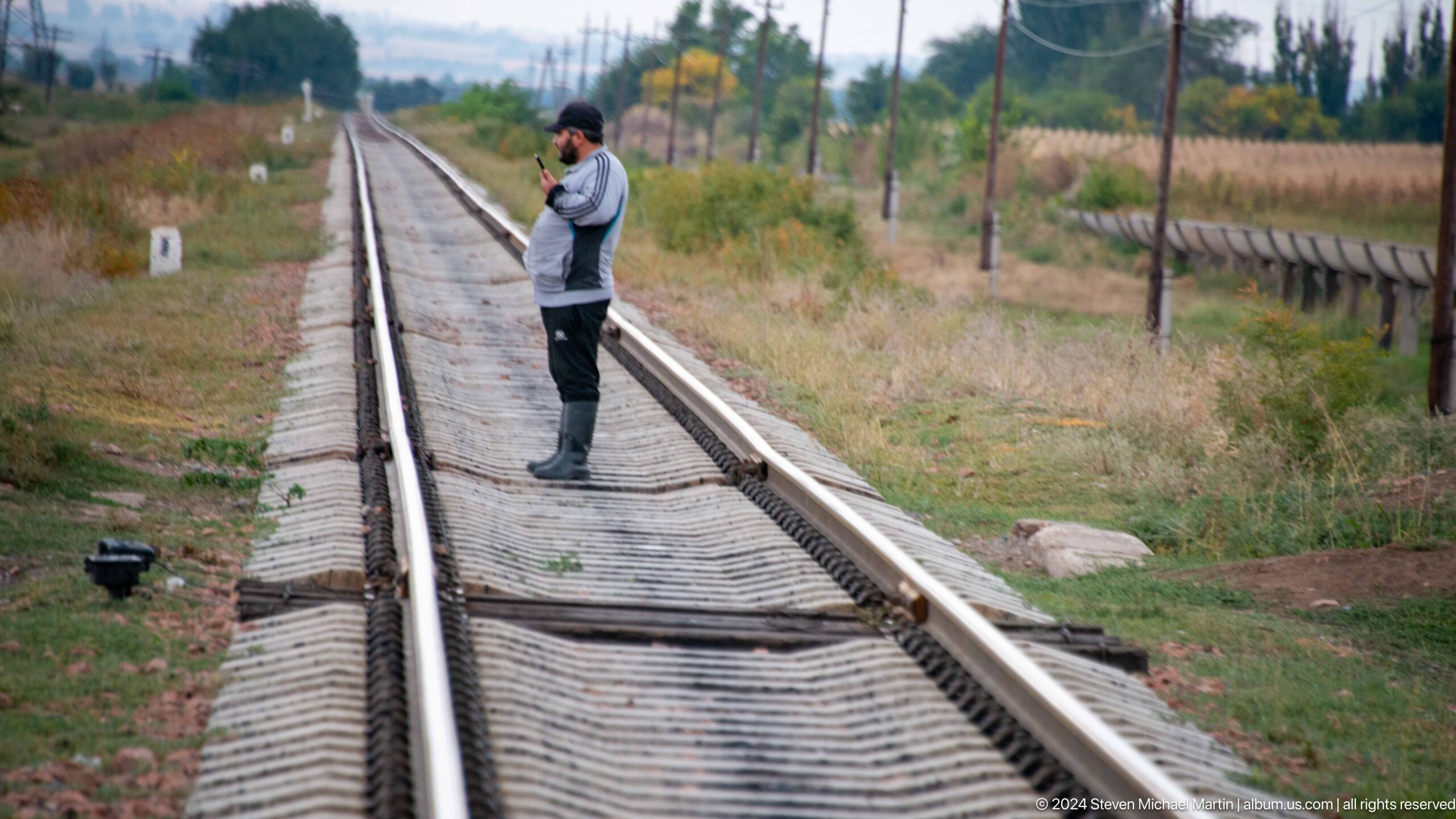
Railway crossing documents the contemporary and historical landscape surrounding Burana Tower. A person carefully steps across parallel railway rails in an open rural area. The scene contributes context for understanding the archaeological site as part of a living rural region shaped by settlement, agriculture, transport, and cultural memory.
Caption
Railway crossing documents the contemporary and historical landscape surrounding Burana Tower. A person carefully steps across parallel railway rails in an open rural area. The scene contributes context for understanding the archaeological site as part of a living rural region shaped by settlement, agriculture, transport, and cultural memory.
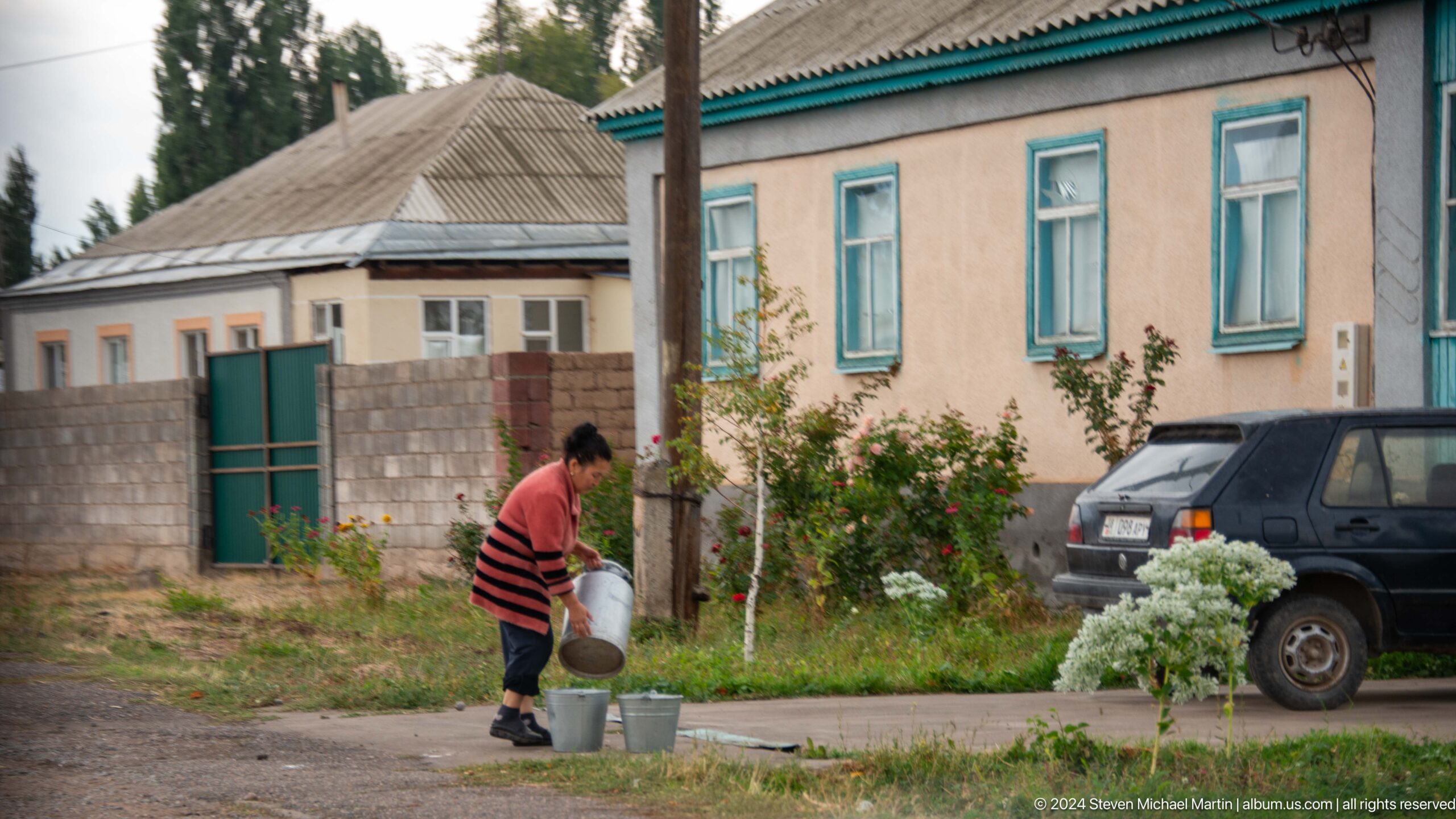
Village domestic scene documents the contemporary and historical landscape surrounding Burana Tower. A woman walks beside a modest blue-trimmed house while carrying a bucket. The scene contributes context for understanding the archaeological site as part of a living rural region shaped by settlement, agriculture, transport, and cultural memory.
Caption
Village domestic scene documents the contemporary and historical landscape surrounding Burana Tower. A woman walks beside a modest blue-trimmed house while carrying a bucket. The scene contributes context for understanding the archaeological site as part of a living rural region shaped by settlement, agriculture, transport, and cultural memory.

Agricultural equipment documents the contemporary and historical landscape surrounding Burana Tower. Two long farm trailers stand beside a low rural dwelling. The scene contributes context for understanding the archaeological site as part of a living rural region shaped by settlement, agriculture, transport, and cultural memory.
Caption
Agricultural equipment documents the contemporary and historical landscape surrounding Burana Tower. Two long farm trailers stand beside a low rural dwelling. The scene contributes context for understanding the archaeological site as part of a living rural region shaped by settlement, agriculture, transport, and cultural memory.
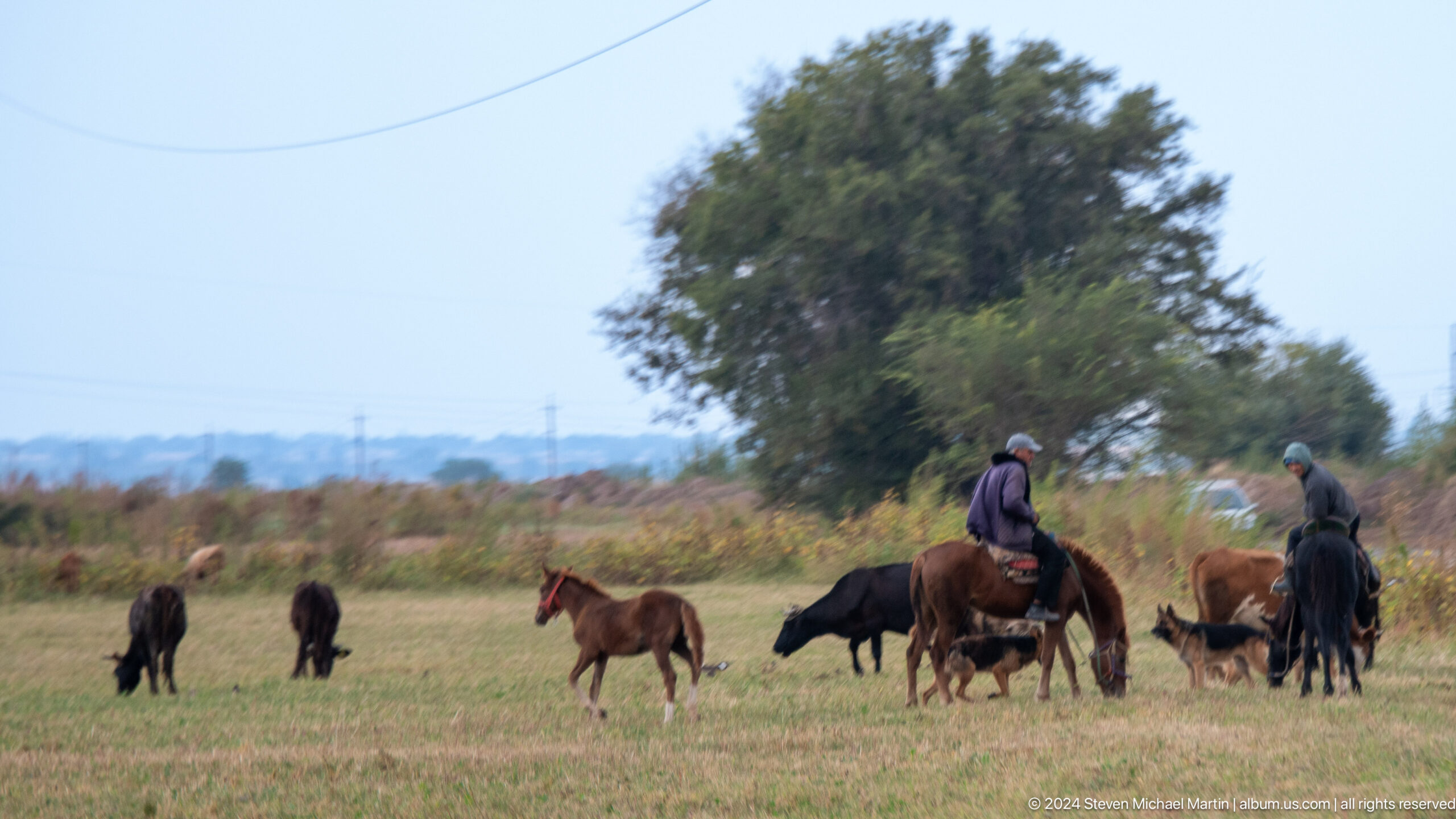
Pastoral herding scene documents the contemporary and historical landscape surrounding Burana Tower. A rider on horseback guides cattle across open grassland. The scene contributes context for understanding the archaeological site as part of a living rural region shaped by settlement, agriculture, transport, and cultural memory.
Caption
Pastoral herding scene documents the contemporary and historical landscape surrounding Burana Tower. A rider on horseback guides cattle across open grassland. The scene contributes context for understanding the archaeological site as part of a living rural region shaped by settlement, agriculture, transport, and cultural memory.
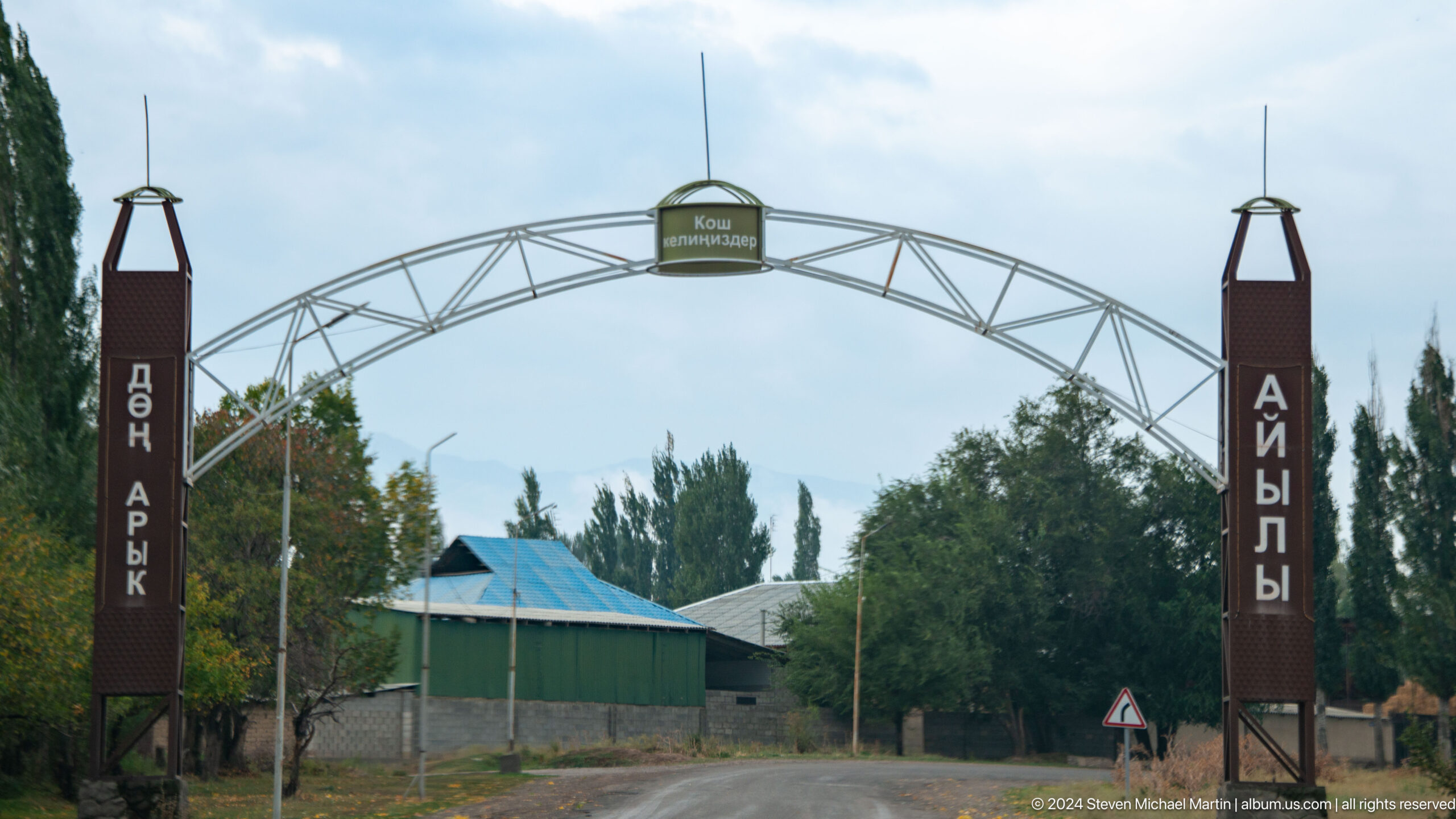
Village entrance gateway marks a transition through the contemporary landscape surrounding Burana. A metal arch with Cyrillic lettering marks the entrance to a tree-lined settlement. The structure and its Cyrillic signage document the modern settlements and transport routes through which visitors approach the medieval archaeological site.
Caption
Village entrance gateway marks a transition through the contemporary landscape surrounding Burana. A metal arch with Cyrillic lettering marks the entrance to a tree-lined settlement. The structure and its Cyrillic signage document the modern settlements and transport routes through which visitors approach the medieval archaeological site.
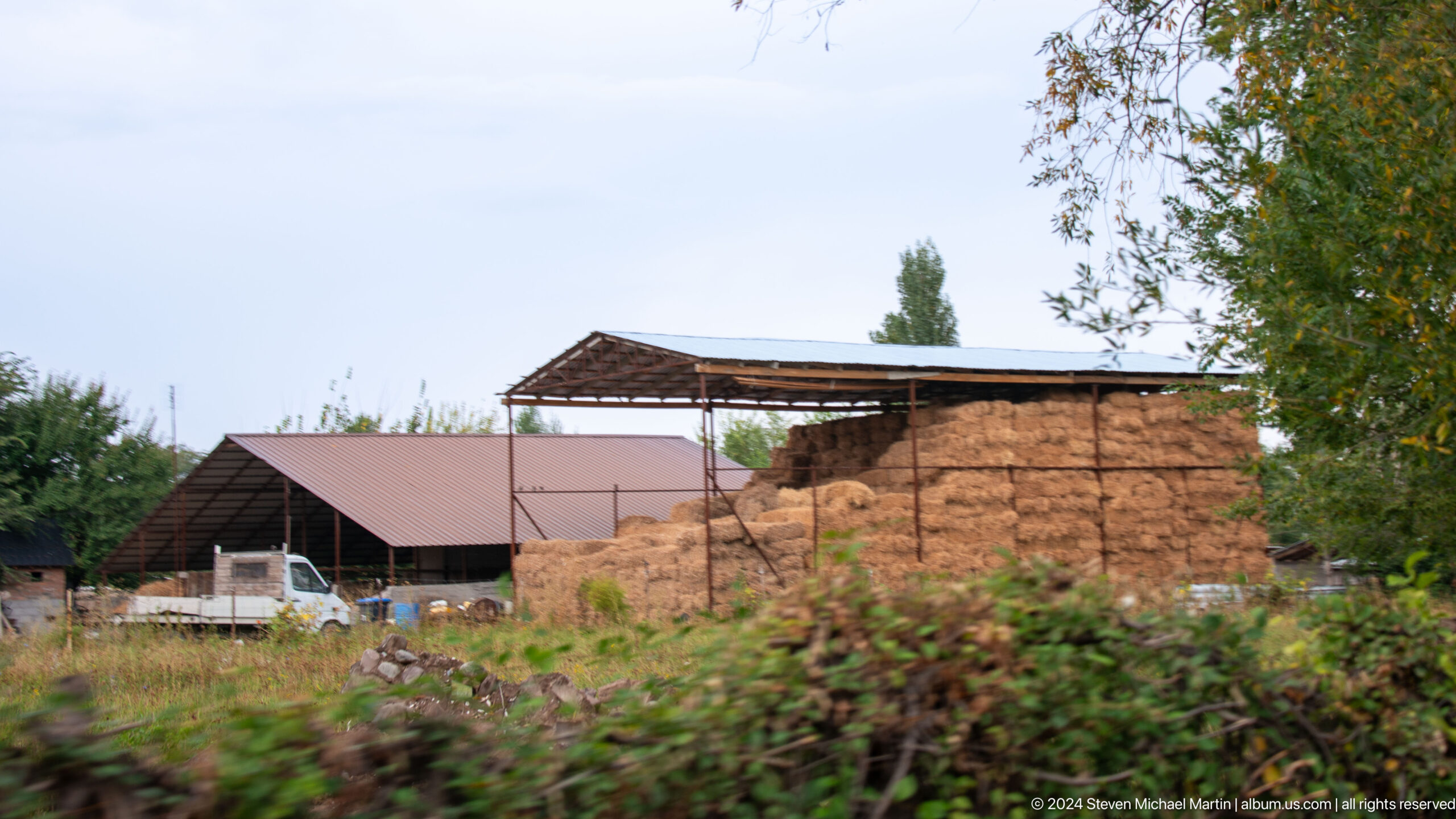
Traditional rural construction documents the contemporary and historical landscape surrounding Burana Tower. Earthen walls and farm structures stand beside fields on the approach to Burana. The scene contributes context for understanding the archaeological site as part of a living rural region shaped by settlement, agriculture, transport, and cultural memory.
Caption
Traditional rural construction documents the contemporary and historical landscape surrounding Burana Tower. Earthen walls and farm structures stand beside fields on the approach to Burana. The scene contributes context for understanding the archaeological site as part of a living rural region shaped by settlement, agriculture, transport, and cultural memory.
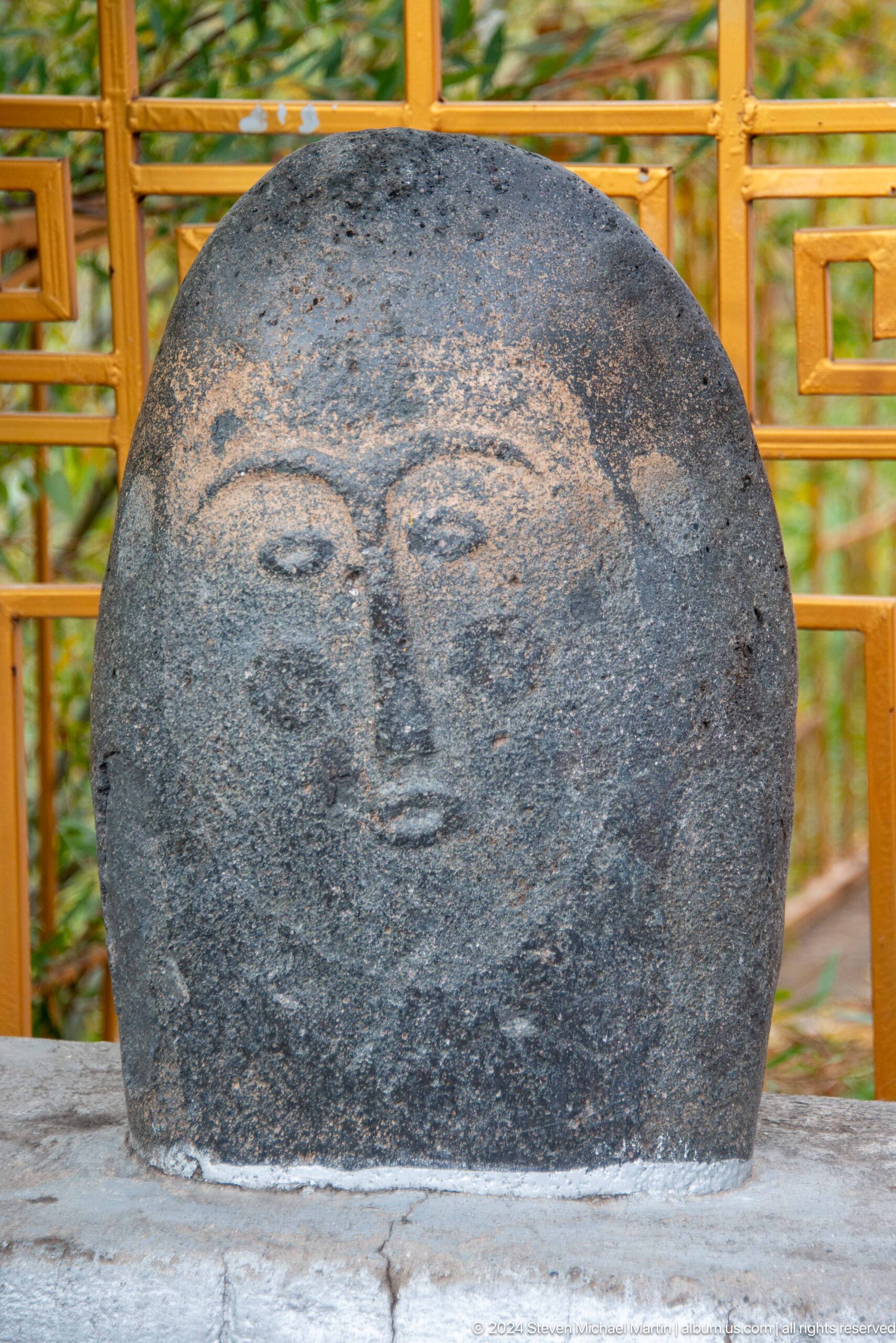
Turkic balbal is one of the carved stone figures displayed across the Burana archaeological complex. A weathered stone head preserves a broad face with simplified eyes, nose, and mouth. Such balbals are associated with Turkic memorial traditions and help document the diverse cultural landscape that preceded and accompanied the development of medieval Balasagun.
Caption
Turkic balbal is one of the carved stone figures displayed across the Burana archaeological complex. A weathered stone head preserves a broad face with simplified eyes, nose, and mouth. Such balbals are associated with Turkic memorial traditions and help document the diverse cultural landscape that preceded and accompanied the development of medieval Balasagun.
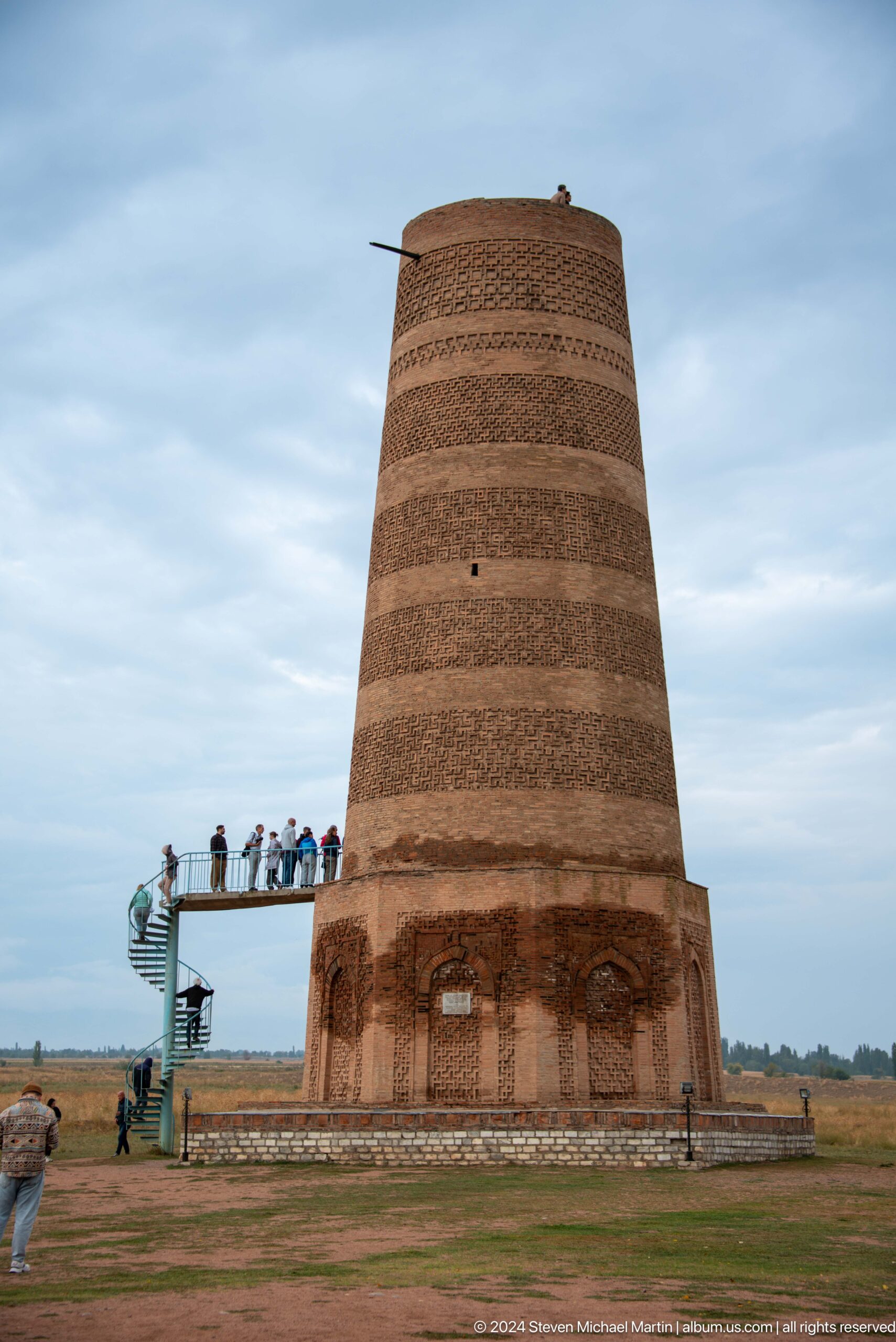
Burana Tower base stands as the principal surviving monument of medieval Balasagun. Visitors stand on the raised base of the brick minaret, emphasizing its monumental scale. The eleventh-century brick minaret reflects the spread of Islamic architecture and urban culture across Central Asia during the Kara-Khanid period.
Caption
Burana Tower base stands as the principal surviving monument of medieval Balasagun. Visitors stand on the raised base of the brick minaret, emphasizing its monumental scale. The eleventh-century brick minaret reflects the spread of Islamic architecture and urban culture across Central Asia during the Kara-Khanid period.
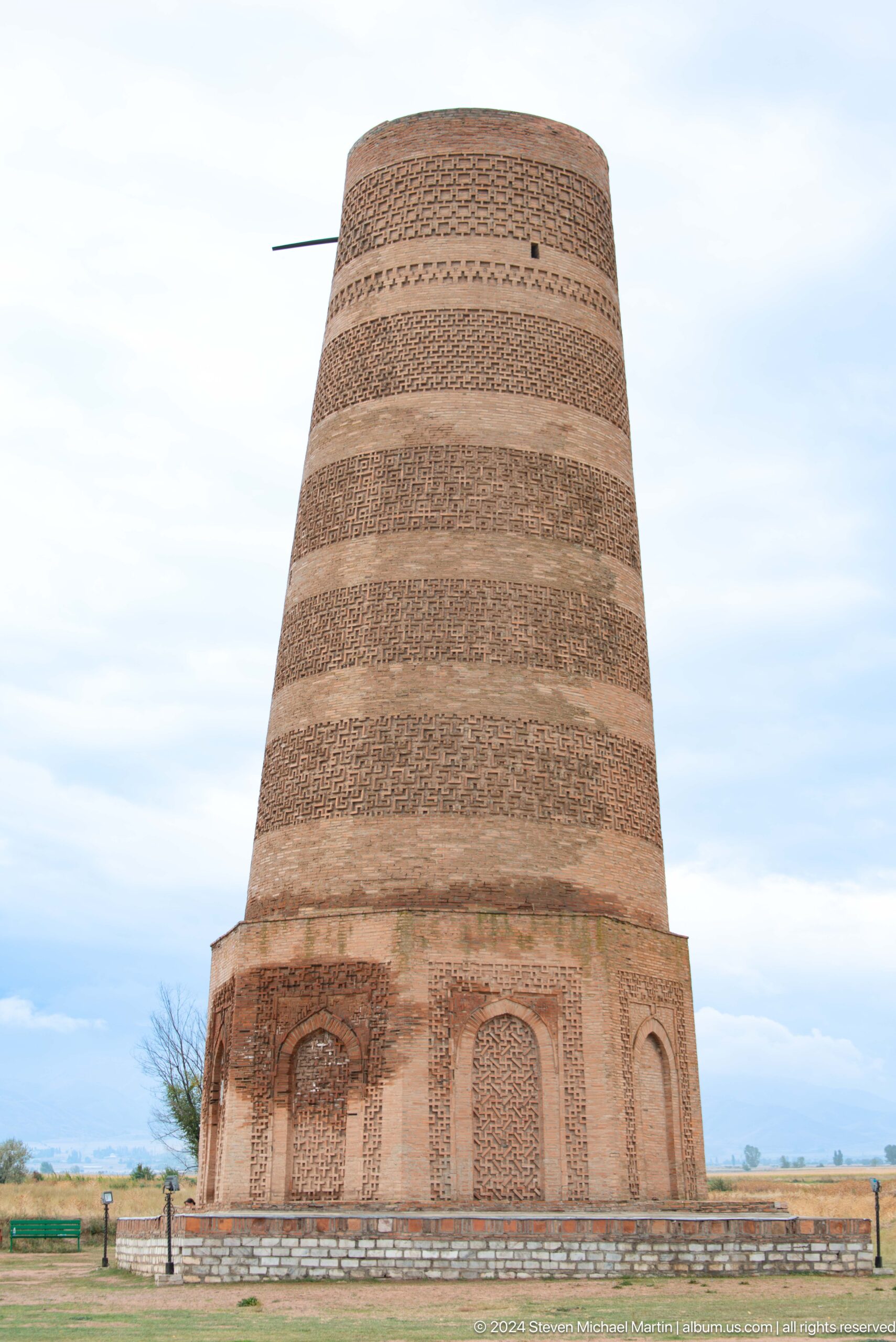
Burana Tower shaft highlights the sophisticated masonry of the Kara-Khanid minaret. The tapering cylindrical brick shaft rises against a cloudy sky. Alternating textures, recessed arches, and geometric brick patterns gave visual richness to a structure built largely from fired brick and connected with the medieval Silk Road city of Balasagun.
Caption
Burana Tower shaft highlights the sophisticated masonry of the Kara-Khanid minaret. The tapering cylindrical brick shaft rises against a cloudy sky. Alternating textures, recessed arches, and geometric brick patterns gave visual richness to a structure built largely from fired brick and connected with the medieval Silk Road city of Balasagun.
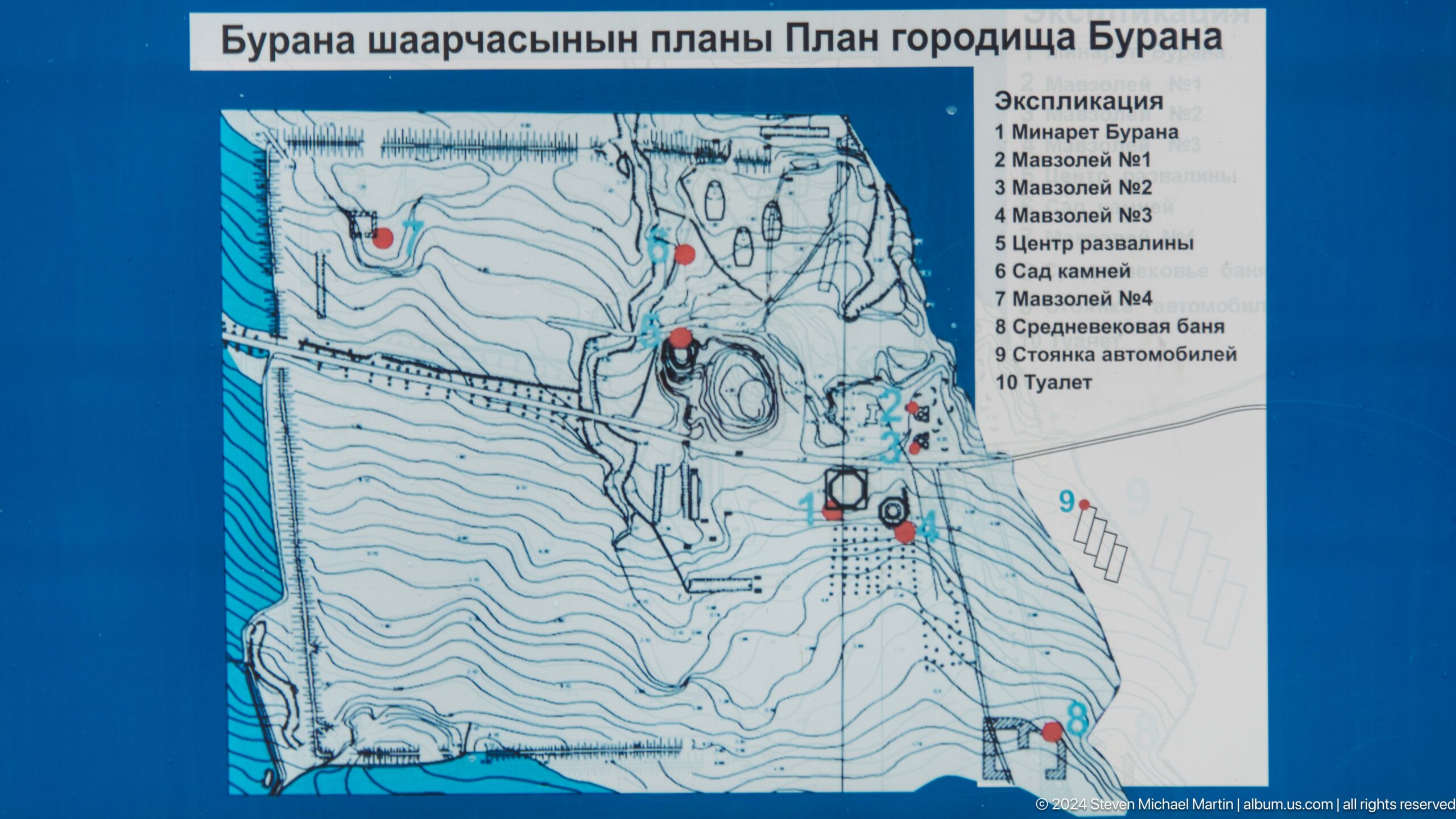
Burana archaeological site map helps visitors interpret the archaeological and historical significance of Burana and ancient Balasagun. An illustrated visitor map identifies monuments and pathways within the complex. The display connects surviving monuments and artifacts with excavation history, regional chronology, and the site's role within Central Asian trade and cultural exchange.
Caption
Burana archaeological site map helps visitors interpret the archaeological and historical significance of Burana and ancient Balasagun. An illustrated visitor map identifies monuments and pathways within the complex. The display connects surviving monuments and artifacts with excavation history, regional chronology, and the site's role within Central Asian trade and cultural exchange.
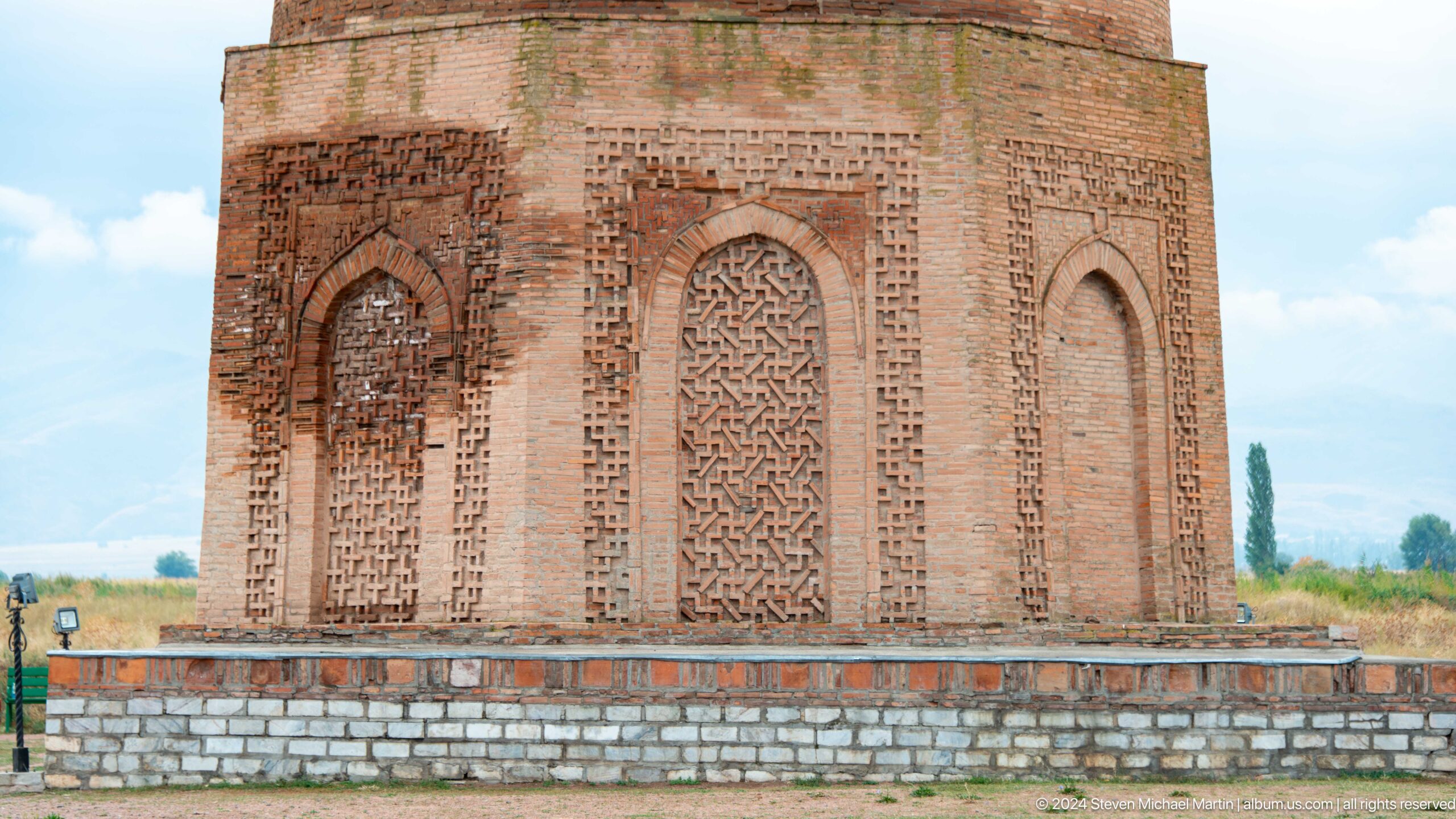
Burana Tower lower section highlights the sophisticated masonry of the Kara-Khanid minaret. Blind arches and intricate brick patterns decorate the tower's square lower base. Alternating textures, recessed arches, and geometric brick patterns gave visual richness to a structure built largely from fired brick and connected with the medieval Silk Road city of Balasagun.
Caption
Burana Tower lower section highlights the sophisticated masonry of the Kara-Khanid minaret. Blind arches and intricate brick patterns decorate the tower's square lower base. Alternating textures, recessed arches, and geometric brick patterns gave visual richness to a structure built largely from fired brick and connected with the medieval Silk Road city of Balasagun.
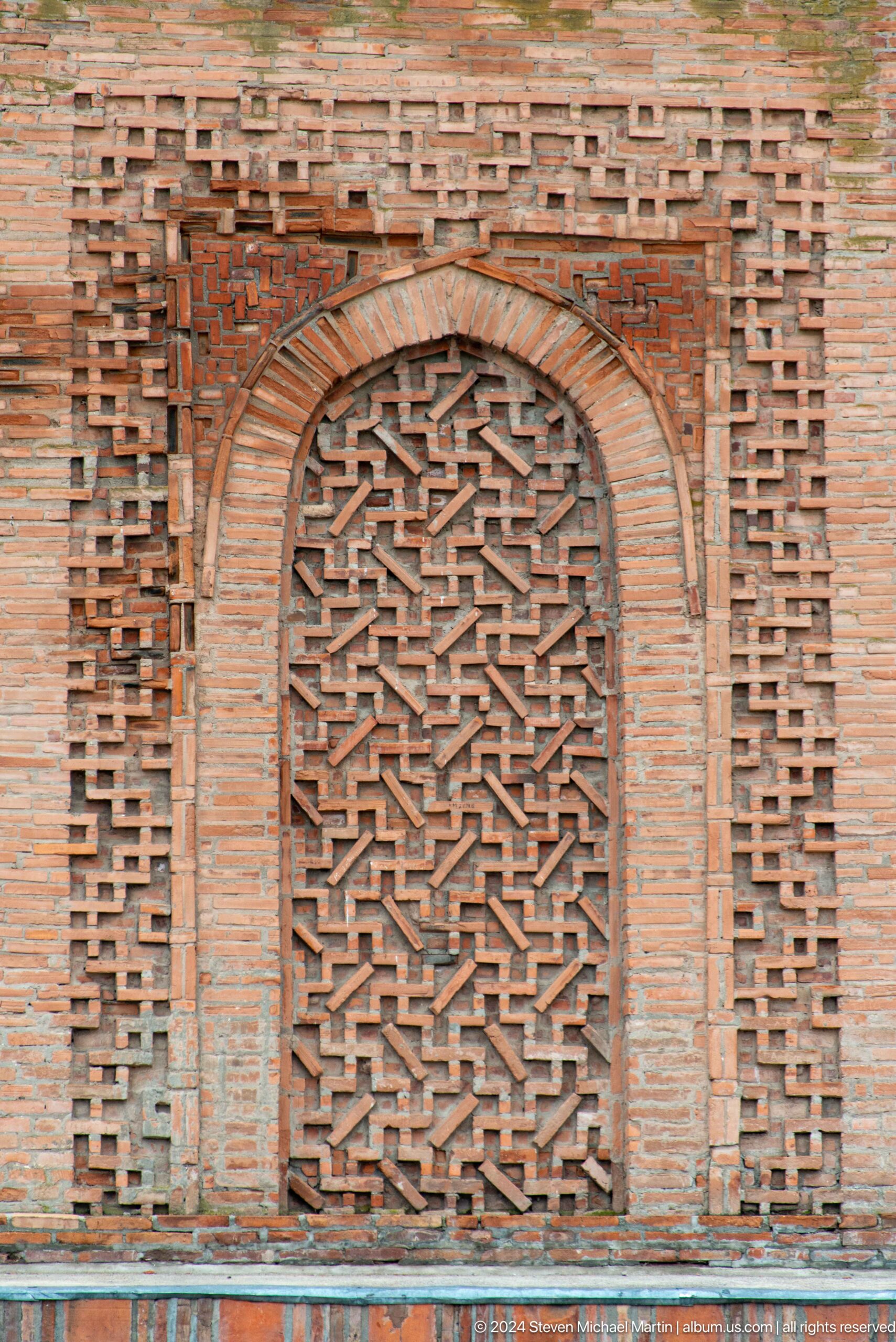
Decorative brickwork highlights the sophisticated masonry of the Kara-Khanid minaret. Interlocking geometric brickwork fills a tall recessed panel on the minaret. Alternating textures, recessed arches, and geometric brick patterns gave visual richness to a structure built largely from fired brick and connected with the medieval Silk Road city of Balasagun.
Caption
Decorative brickwork highlights the sophisticated masonry of the Kara-Khanid minaret. Interlocking geometric brickwork fills a tall recessed panel on the minaret. Alternating textures, recessed arches, and geometric brick patterns gave visual richness to a structure built largely from fired brick and connected with the medieval Silk Road city of Balasagun.
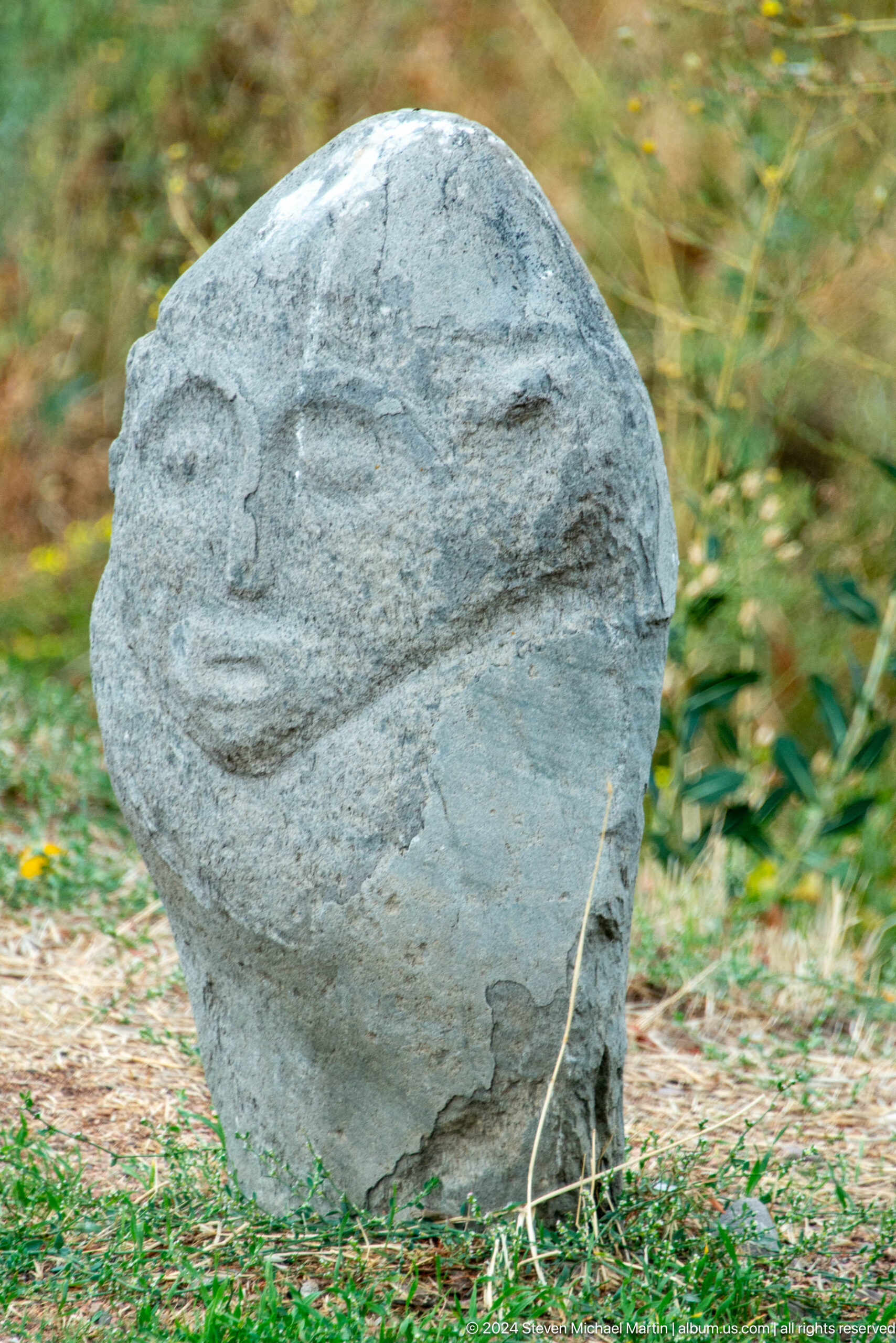
Turkic balbal is one of the carved stone figures displayed across the Burana archaeological complex. A small rounded stone preserves a simplified human face in shallow relief. Such balbals are associated with Turkic memorial traditions and help document the diverse cultural landscape that preceded and accompanied the development of medieval Balasagun.
Caption
Turkic balbal is one of the carved stone figures displayed across the Burana archaeological complex. A small rounded stone preserves a simplified human face in shallow relief. Such balbals are associated with Turkic memorial traditions and help document the diverse cultural landscape that preceded and accompanied the development of medieval Balasagun.

Turkic balbal is one of the carved stone figures displayed across the Burana archaeological complex. A standing stone figure retains facial features and a faintly carved torso. Such balbals are associated with Turkic memorial traditions and help document the diverse cultural landscape that preceded and accompanied the development of medieval Balasagun.
Caption
Turkic balbal is one of the carved stone figures displayed across the Burana archaeological complex. A standing stone figure retains facial features and a faintly carved torso. Such balbals are associated with Turkic memorial traditions and help document the diverse cultural landscape that preceded and accompanied the development of medieval Balasagun.

Decorative masonry band documents the contemporary and historical landscape surrounding Burana Tower. A dense repeating geometric pattern wraps around the tower's cylindrical shaft. The scene contributes context for understanding the archaeological site as part of a living rural region shaped by settlement, agriculture, transport, and cultural memory.
Caption
Decorative masonry band documents the contemporary and historical landscape surrounding Burana Tower. A dense repeating geometric pattern wraps around the tower's cylindrical shaft. The scene contributes context for understanding the archaeological site as part of a living rural region shaped by settlement, agriculture, transport, and cultural memory.

Turkic balbal is one of the carved stone figures displayed across the Burana archaeological complex. A dark irregular stone bears a weathered human figure carved in low relief. Such balbals are associated with Turkic memorial traditions and help document the diverse cultural landscape that preceded and accompanied the development of medieval Balasagun.
Caption
Turkic balbal is one of the carved stone figures displayed across the Burana archaeological complex. A dark irregular stone bears a weathered human figure carved in low relief. Such balbals are associated with Turkic memorial traditions and help document the diverse cultural landscape that preceded and accompanied the development of medieval Balasagun.
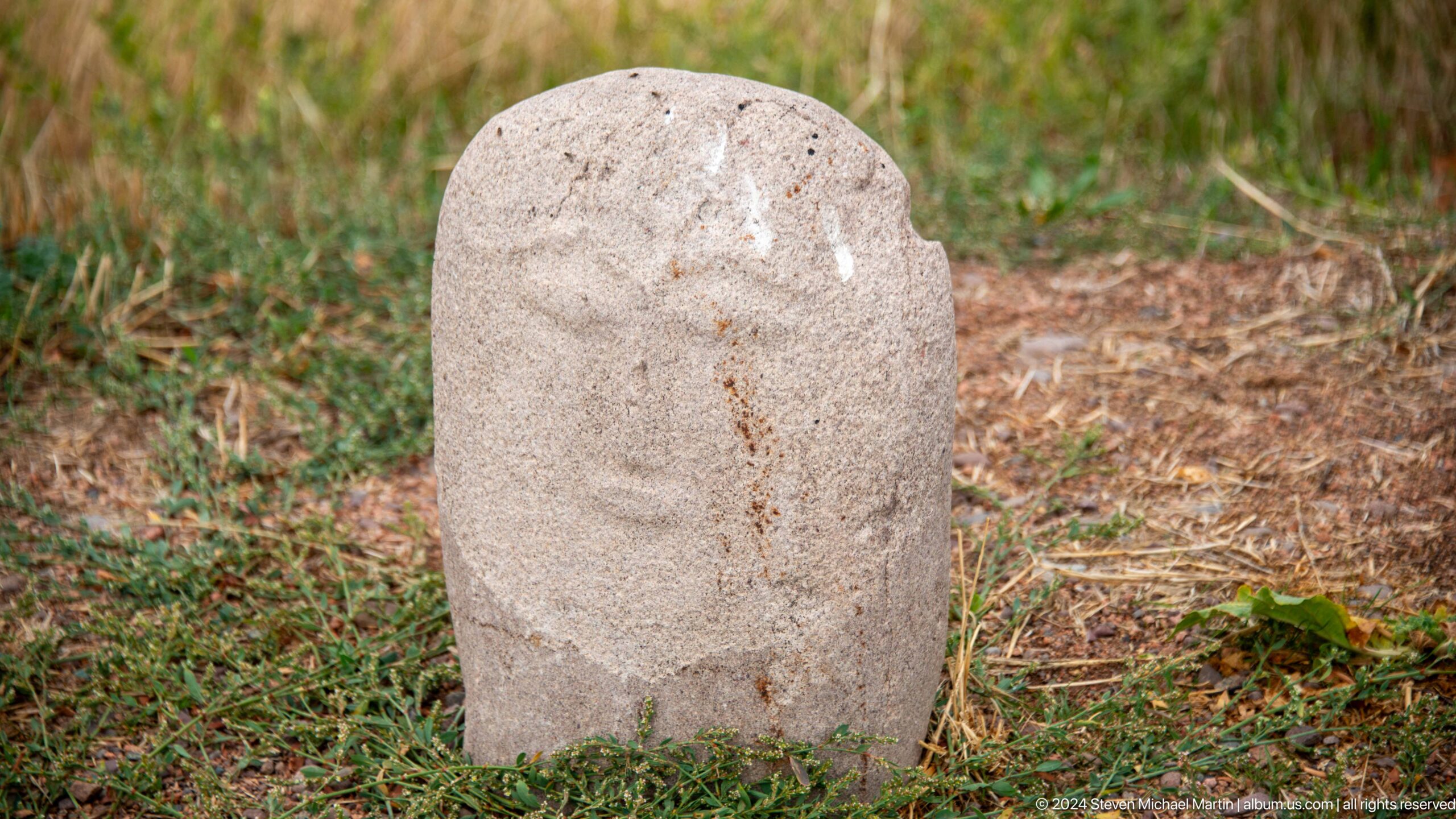
Turkic balbal is one of the carved stone figures displayed across the Burana archaeological complex. A compact upright stone displays a broad stylized face. Such balbals are associated with Turkic memorial traditions and help document the diverse cultural landscape that preceded and accompanied the development of medieval Balasagun.
Caption
Turkic balbal is one of the carved stone figures displayed across the Burana archaeological complex. A compact upright stone displays a broad stylized face. Such balbals are associated with Turkic memorial traditions and help document the diverse cultural landscape that preceded and accompanied the development of medieval Balasagun.
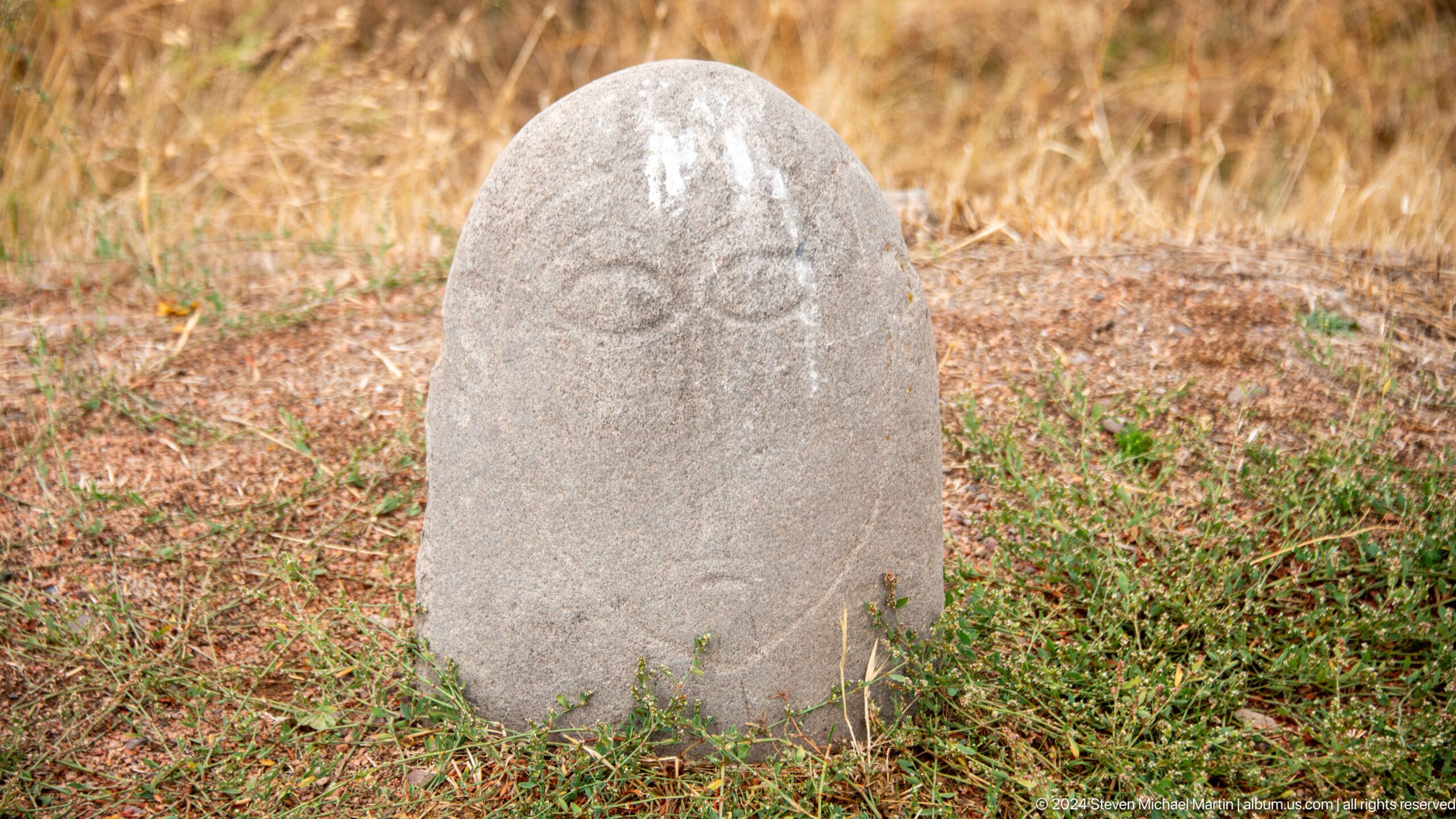
Turkic balbal is one of the carved stone figures displayed across the Burana archaeological complex. A pale rounded memorial stone bears a simplified human face and shallow carved marks. Such balbals are associated with Turkic memorial traditions and help document the diverse cultural landscape that preceded and accompanied the development of medieval Balasagun.
Caption
Turkic balbal is one of the carved stone figures displayed across the Burana archaeological complex. A pale rounded memorial stone bears a simplified human face and shallow carved marks. Such balbals are associated with Turkic memorial traditions and help document the diverse cultural landscape that preceded and accompanied the development of medieval Balasagun.
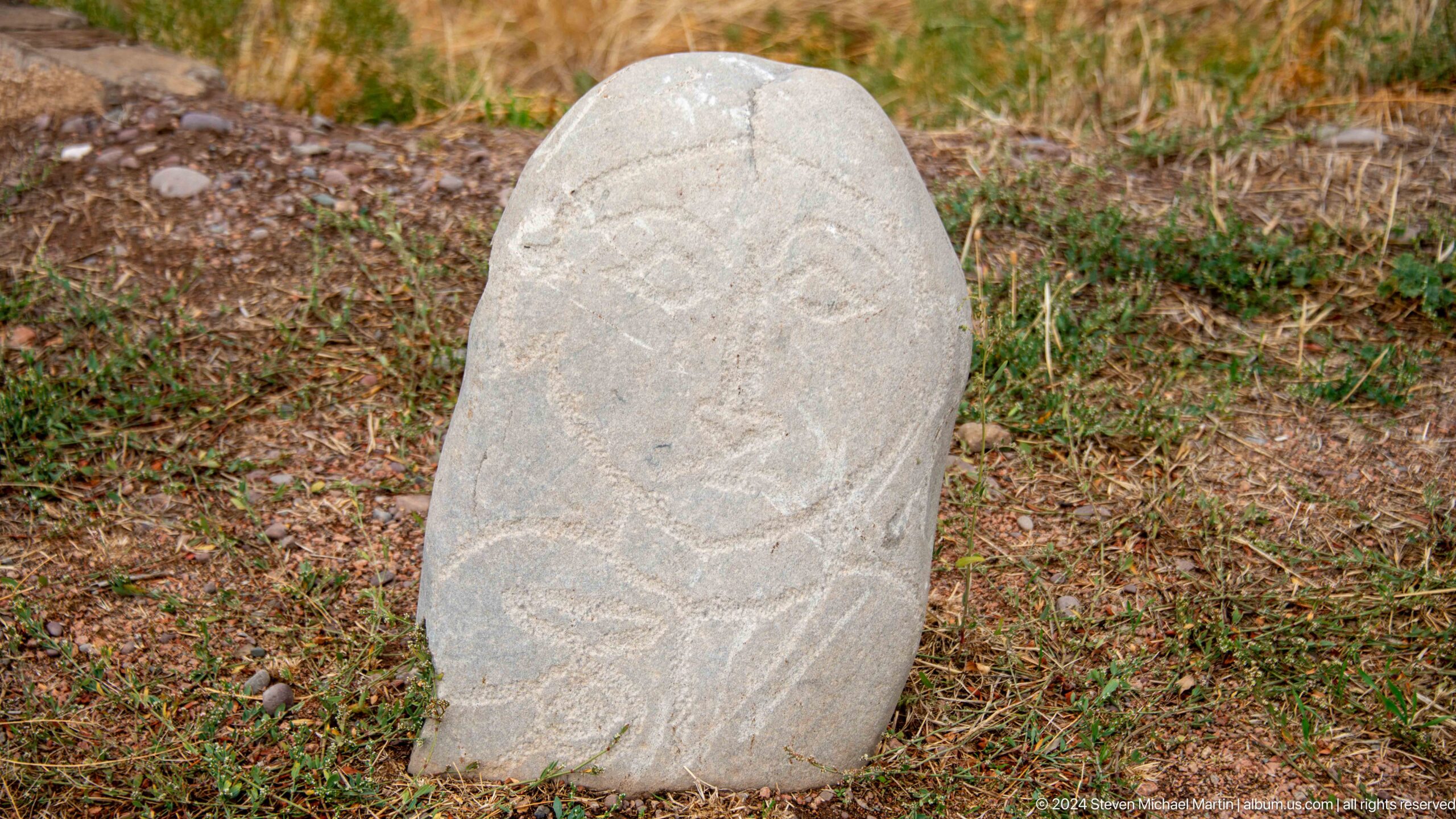
Turkic balbal is one of the carved stone figures displayed across the Burana archaeological complex. An oval stone figure carries a stylized face and looping incised decoration. Such balbals are associated with Turkic memorial traditions and help document the diverse cultural landscape that preceded and accompanied the development of medieval Balasagun.
Caption
Turkic balbal is one of the carved stone figures displayed across the Burana archaeological complex. An oval stone figure carries a stylized face and looping incised decoration. Such balbals are associated with Turkic memorial traditions and help document the diverse cultural landscape that preceded and accompanied the development of medieval Balasagun.

Burana Tower stands as the principal surviving monument of medieval Balasagun. The isolated brick minaret stands in open grassland beneath a dramatic sky. The eleventh-century brick minaret reflects the spread of Islamic architecture and urban culture across Central Asia during the Kara-Khanid period.
Caption
Burana Tower stands as the principal surviving monument of medieval Balasagun. The isolated brick minaret stands in open grassland beneath a dramatic sky. The eleventh-century brick minaret reflects the spread of Islamic architecture and urban culture across Central Asia during the Kara-Khanid period.

Visitor portrait at Burana Tower stands as the principal surviving monument of medieval Balasagun. Two visitors raise their arms in a playful pose with the tower centered behind them. The eleventh-century brick minaret reflects the spread of Islamic architecture and urban culture across Central Asia during the Kara-Khanid period.
Caption
Visitor portrait at Burana Tower stands as the principal surviving monument of medieval Balasagun. Two visitors raise their arms in a playful pose with the tower centered behind them. The eleventh-century brick minaret reflects the spread of Islamic architecture and urban culture across Central Asia during the Kara-Khanid period.

Visitor portrait at Burana Tower stands as the principal surviving monument of medieval Balasagun. Two visitors stand side by side in the open field with the minaret behind them. The eleventh-century brick minaret reflects the spread of Islamic architecture and urban culture across Central Asia during the Kara-Khanid period.
Caption
Visitor portrait at Burana Tower stands as the principal surviving monument of medieval Balasagun. Two visitors stand side by side in the open field with the minaret behind them. The eleventh-century brick minaret reflects the spread of Islamic architecture and urban culture across Central Asia during the Kara-Khanid period.
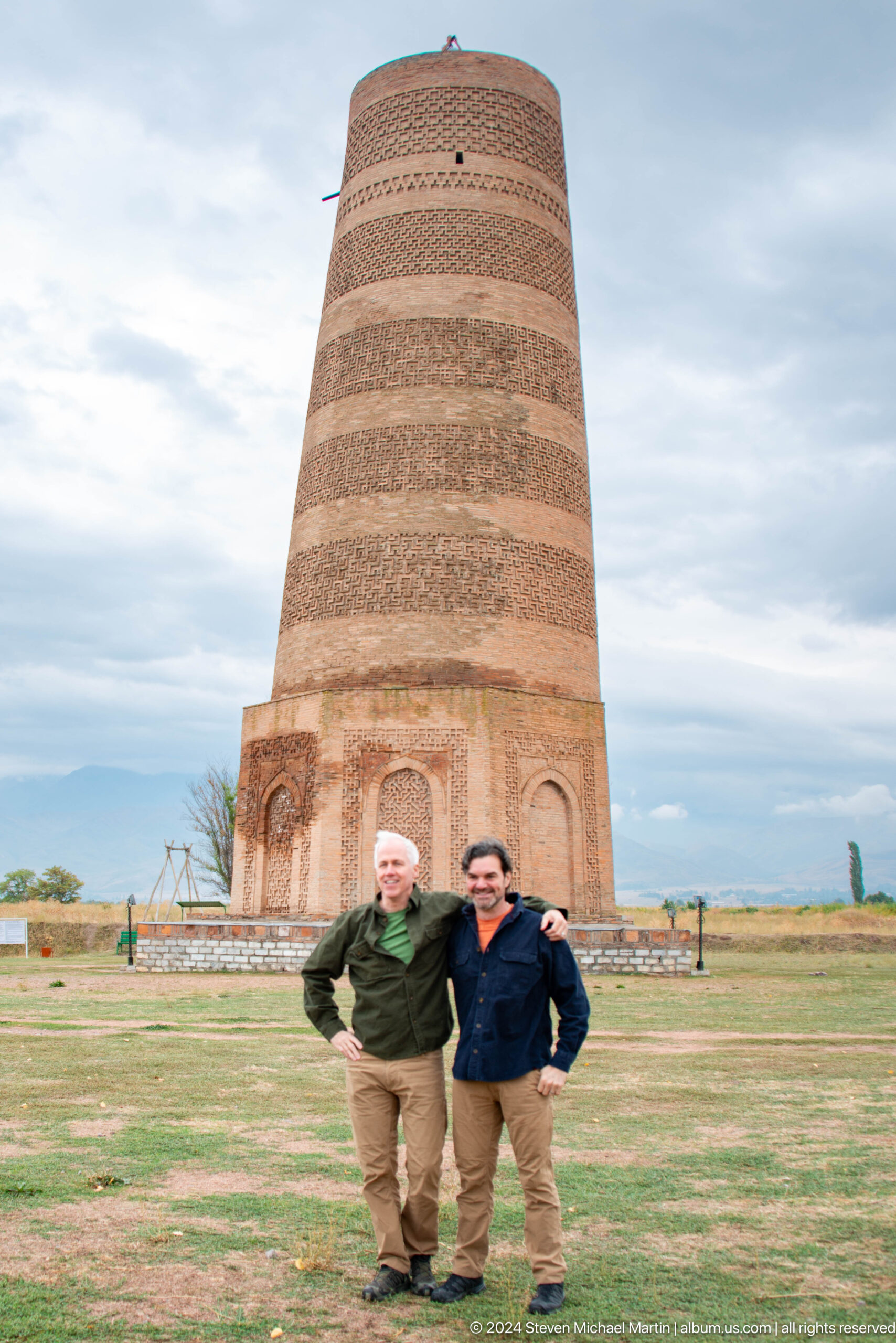
Visitor portrait at Burana Tower stands as the principal surviving monument of medieval Balasagun. Two visitors are framed closely against the tower's lower section. The eleventh-century brick minaret reflects the spread of Islamic architecture and urban culture across Central Asia during the Kara-Khanid period.
Caption
Visitor portrait at Burana Tower stands as the principal surviving monument of medieval Balasagun. Two visitors are framed closely against the tower's lower section. The eleventh-century brick minaret reflects the spread of Islamic architecture and urban culture across Central Asia during the Kara-Khanid period.
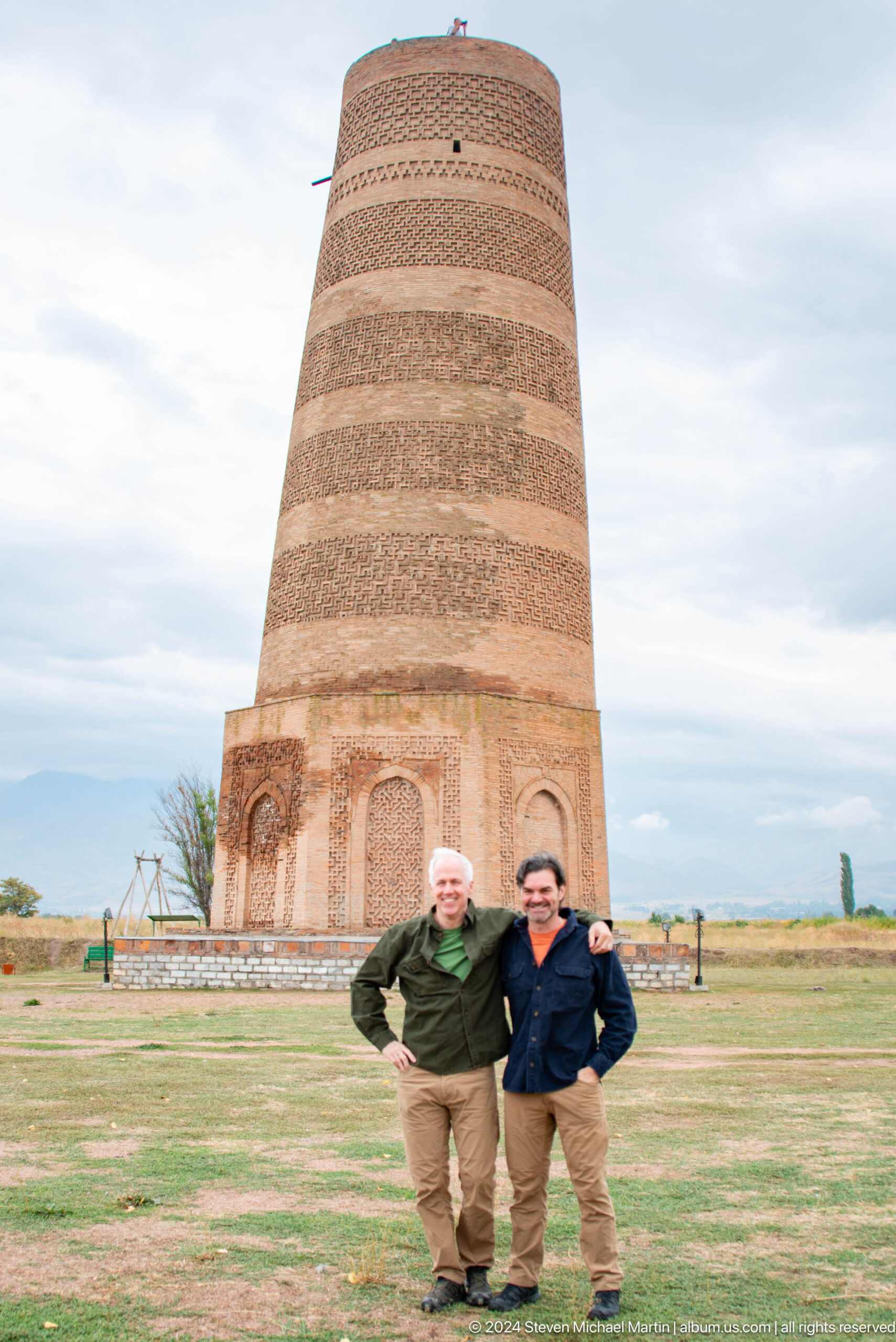
Visitor portrait at Burana Tower stands as the principal surviving monument of medieval Balasagun. Two visitors smile in a close portrait with the brick minaret rising behind them. The eleventh-century brick minaret reflects the spread of Islamic architecture and urban culture across Central Asia during the Kara-Khanid period.
Caption
Visitor portrait at Burana Tower stands as the principal surviving monument of medieval Balasagun. Two visitors smile in a close portrait with the brick minaret rising behind them. The eleventh-century brick minaret reflects the spread of Islamic architecture and urban culture across Central Asia during the Kara-Khanid period.
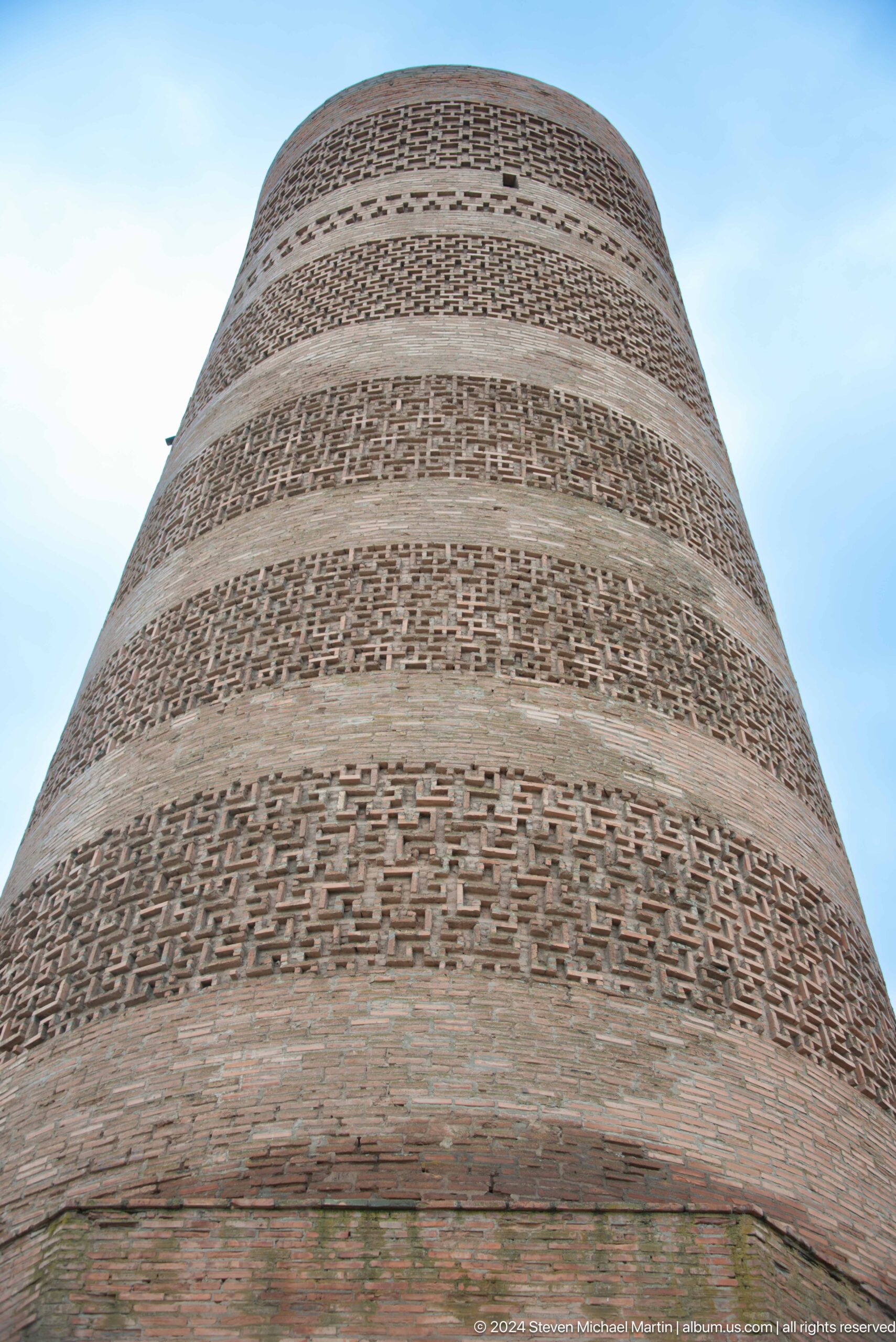
Burana Tower brickwork highlights the sophisticated masonry of the Kara-Khanid minaret. The camera looks steeply upward along alternating bands of patterned masonry. Alternating textures, recessed arches, and geometric brick patterns gave visual richness to a structure built largely from fired brick and connected with the medieval Silk Road city of Balasagun.
Caption
Burana Tower brickwork highlights the sophisticated masonry of the Kara-Khanid minaret. The camera looks steeply upward along alternating bands of patterned masonry. Alternating textures, recessed arches, and geometric brick patterns gave visual richness to a structure built largely from fired brick and connected with the medieval Silk Road city of Balasagun.

Burana Tower masonry detail highlights the sophisticated masonry of the Kara-Khanid minaret. Projecting bricks form a maze-like ornamental pattern in weathered masonry. Alternating textures, recessed arches, and geometric brick patterns gave visual richness to a structure built largely from fired brick and connected with the medieval Silk Road city of Balasagun.
Caption
Burana Tower masonry detail highlights the sophisticated masonry of the Kara-Khanid minaret. Projecting bricks form a maze-like ornamental pattern in weathered masonry. Alternating textures, recessed arches, and geometric brick patterns gave visual richness to a structure built largely from fired brick and connected with the medieval Silk Road city of Balasagun.
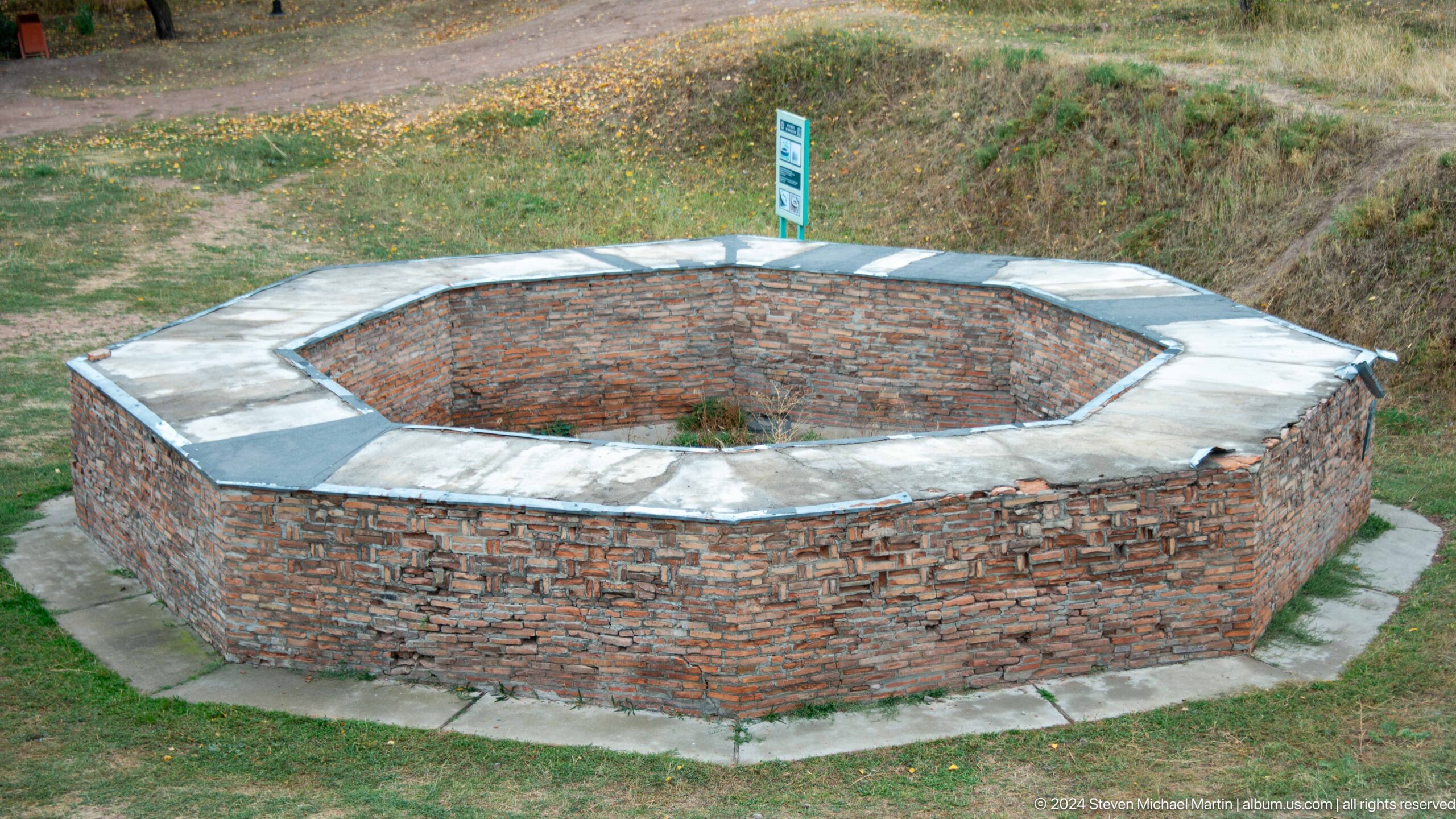
Excavated circular structure documents the contemporary and historical landscape surrounding Burana Tower. A low circular brick foundation or reconstructed feature lies within the site. The scene contributes context for understanding the archaeological site as part of a living rural region shaped by settlement, agriculture, transport, and cultural memory.
Caption
Excavated circular structure documents the contemporary and historical landscape surrounding Burana Tower. A low circular brick foundation or reconstructed feature lies within the site. The scene contributes context for understanding the archaeological site as part of a living rural region shaped by settlement, agriculture, transport, and cultural memory.
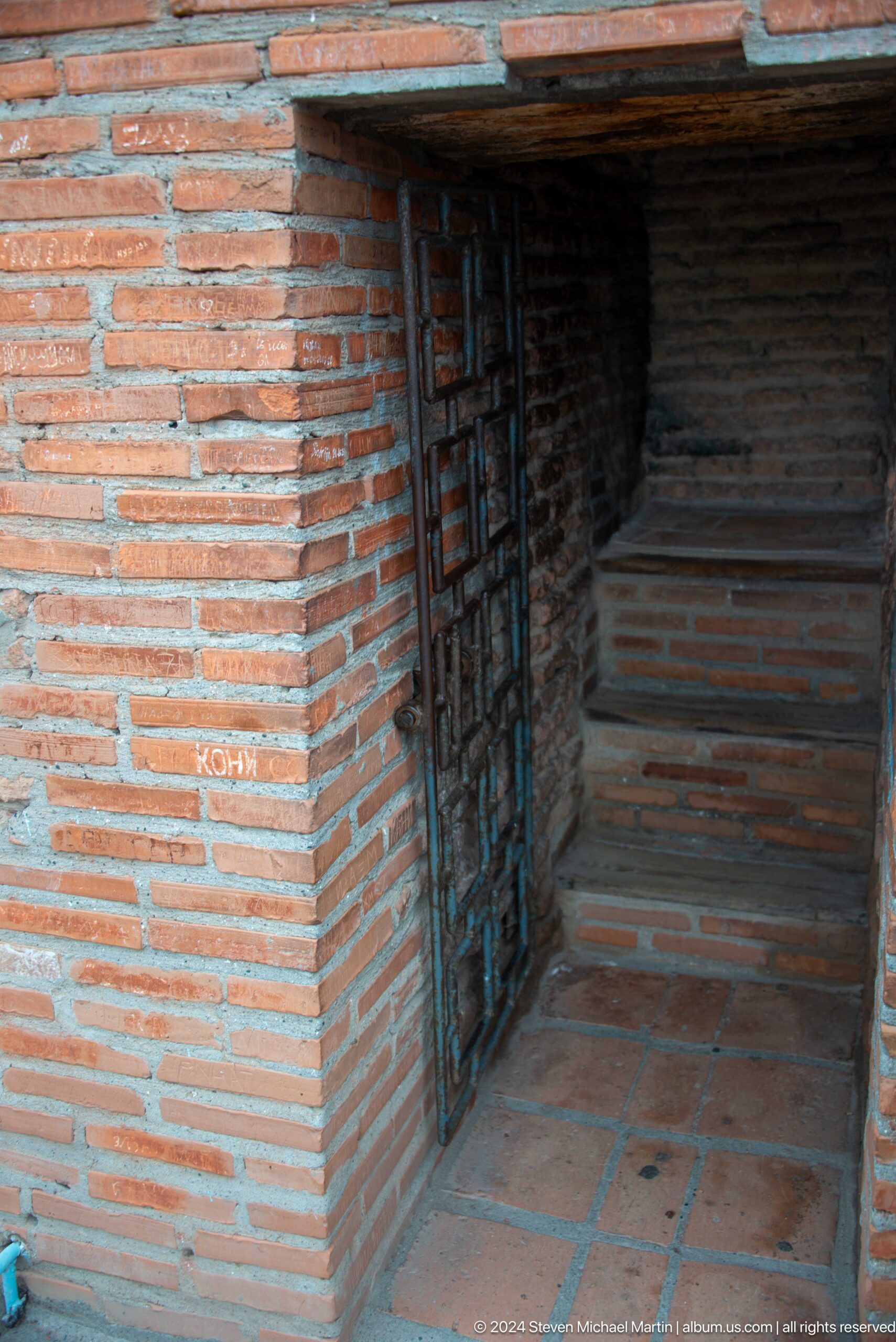
Burana Tower interior access reveals the confined circulation system within the monument. A narrow doorway opens onto steep brick steps within the tower. The narrow brick passage illustrates how access to the upper levels was fitted inside the tapering eleventh-century minaret, one of the principal surviving structures of the medieval city of Balasagun.
Caption
Burana Tower interior access reveals the confined circulation system within the monument. A narrow doorway opens onto steep brick steps within the tower. The narrow brick passage illustrates how access to the upper levels was fitted inside the tapering eleventh-century minaret, one of the principal surviving structures of the medieval city of Balasagun.
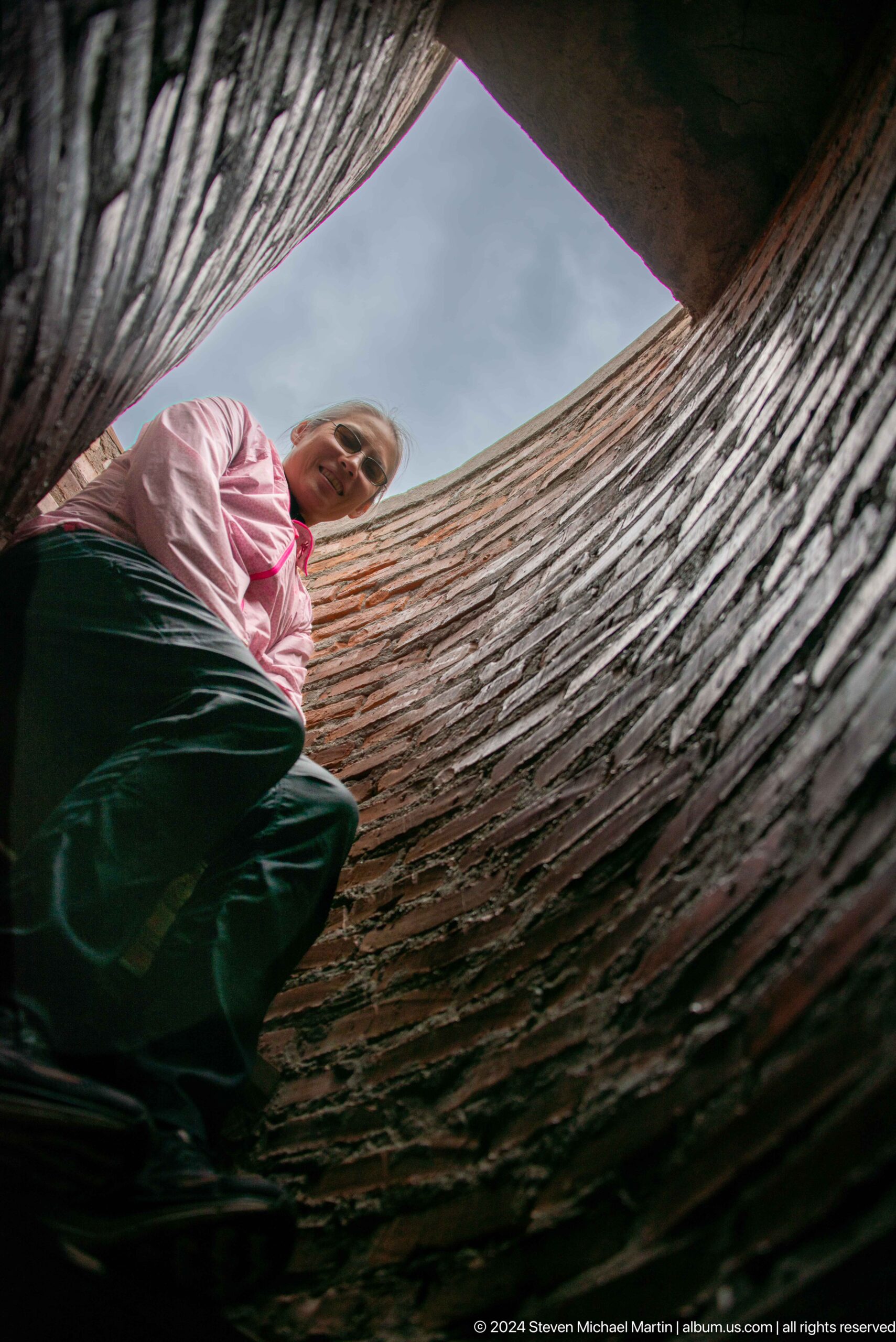
Visitor inside Burana Tower reveals the confined circulation system within the monument. A visitor ascends the steep confined passage of the tower interior. The narrow brick passage illustrates how access to the upper levels was fitted inside the tapering eleventh-century minaret, one of the principal surviving structures of the medieval city of Balasagun.
Caption
Visitor inside Burana Tower reveals the confined circulation system within the monument. A visitor ascends the steep confined passage of the tower interior. The narrow brick passage illustrates how access to the upper levels was fitted inside the tapering eleventh-century minaret, one of the principal surviving structures of the medieval city of Balasagun.

Architectural fragments are arranged within the outdoor archaeological collection at Burana. Long cylindrical stone fragments are arranged in rows on the ground. These surviving stone elements provide material evidence for the buildings, monuments, and working environment of Balasagun beyond the celebrated brick minaret.
Caption
Architectural fragments are arranged within the outdoor archaeological collection at Burana. Long cylindrical stone fragments are arranged in rows on the ground. These surviving stone elements provide material evidence for the buildings, monuments, and working environment of Balasagun beyond the celebrated brick minaret.
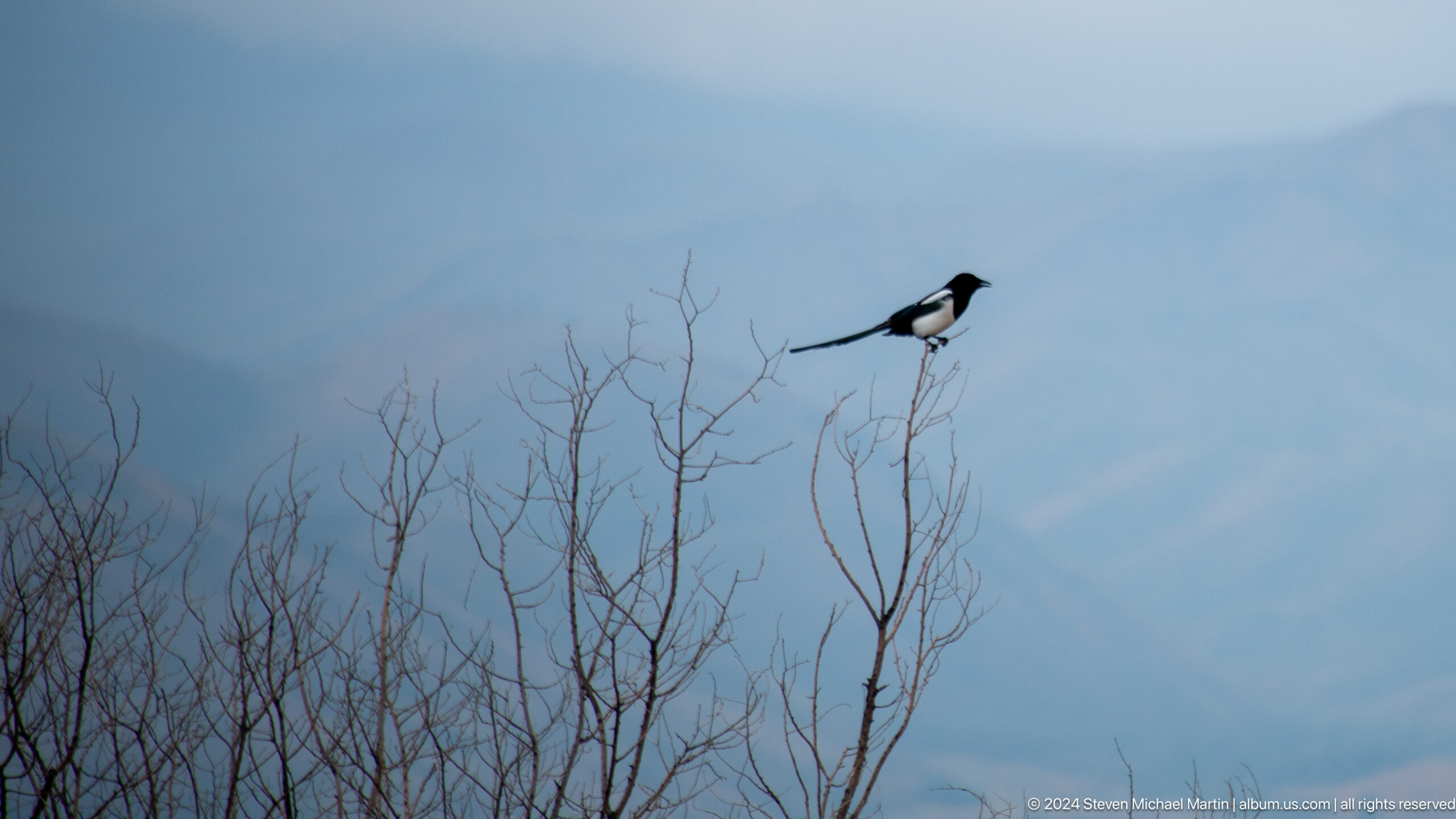
Black-billed magpie documents the contemporary and historical landscape surrounding Burana Tower. A black-and-white magpie perches at the top of a leafless branch against the sky. The scene contributes context for understanding the archaeological site as part of a living rural region shaped by settlement, agriculture, transport, and cultural memory.
Caption
Black-billed magpie documents the contemporary and historical landscape surrounding Burana Tower. A black-and-white magpie perches at the top of a leafless branch against the sky. The scene contributes context for understanding the archaeological site as part of a living rural region shaped by settlement, agriculture, transport, and cultural memory.
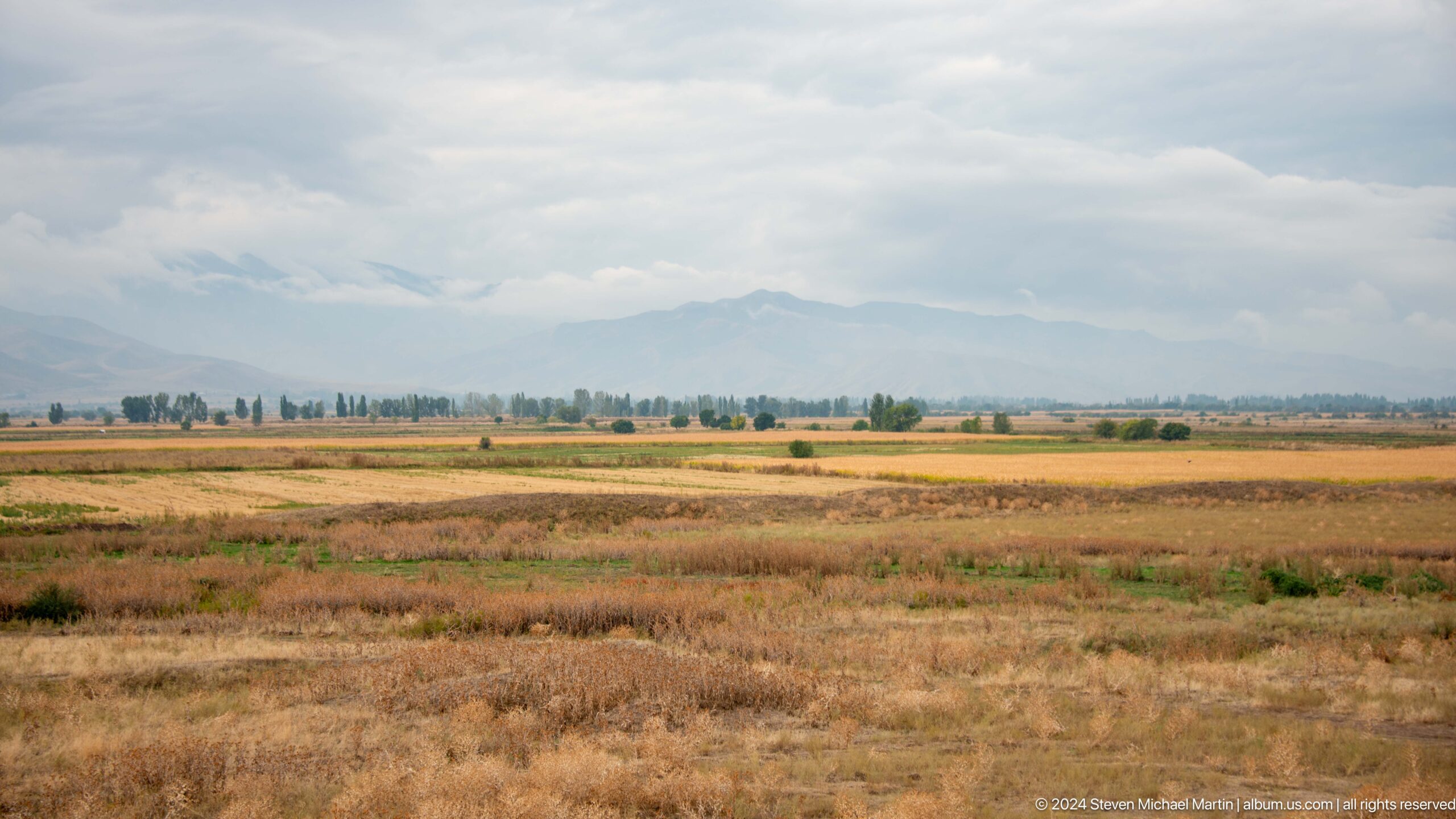
Chuy Valley landscape places the Burana complex within the broad agricultural plain of the Chuy Valley. Fields and distant mountains extend across the horizon from an elevated viewpoint. The open fields and distant mountain ranges provide essential geographic context for Balasagun, a medieval city positioned within the networks of movement and exchange across Central Asia.
Caption
Chuy Valley landscape places the Burana complex within the broad agricultural plain of the Chuy Valley. Fields and distant mountains extend across the horizon from an elevated viewpoint. The open fields and distant mountain ranges provide essential geographic context for Balasagun, a medieval city positioned within the networks of movement and exchange across Central Asia.

Dog within archaeological landscape places the Burana complex within the broad agricultural plain of the Chuy Valley. A small dog stands on a dirt path viewed from above. The open fields and distant mountain ranges provide essential geographic context for Balasagun, a medieval city positioned within the networks of movement and exchange across Central Asia.
Caption
Dog within archaeological landscape places the Burana complex within the broad agricultural plain of the Chuy Valley. A small dog stands on a dirt path viewed from above. The open fields and distant mountain ranges provide essential geographic context for Balasagun, a medieval city positioned within the networks of movement and exchange across Central Asia.
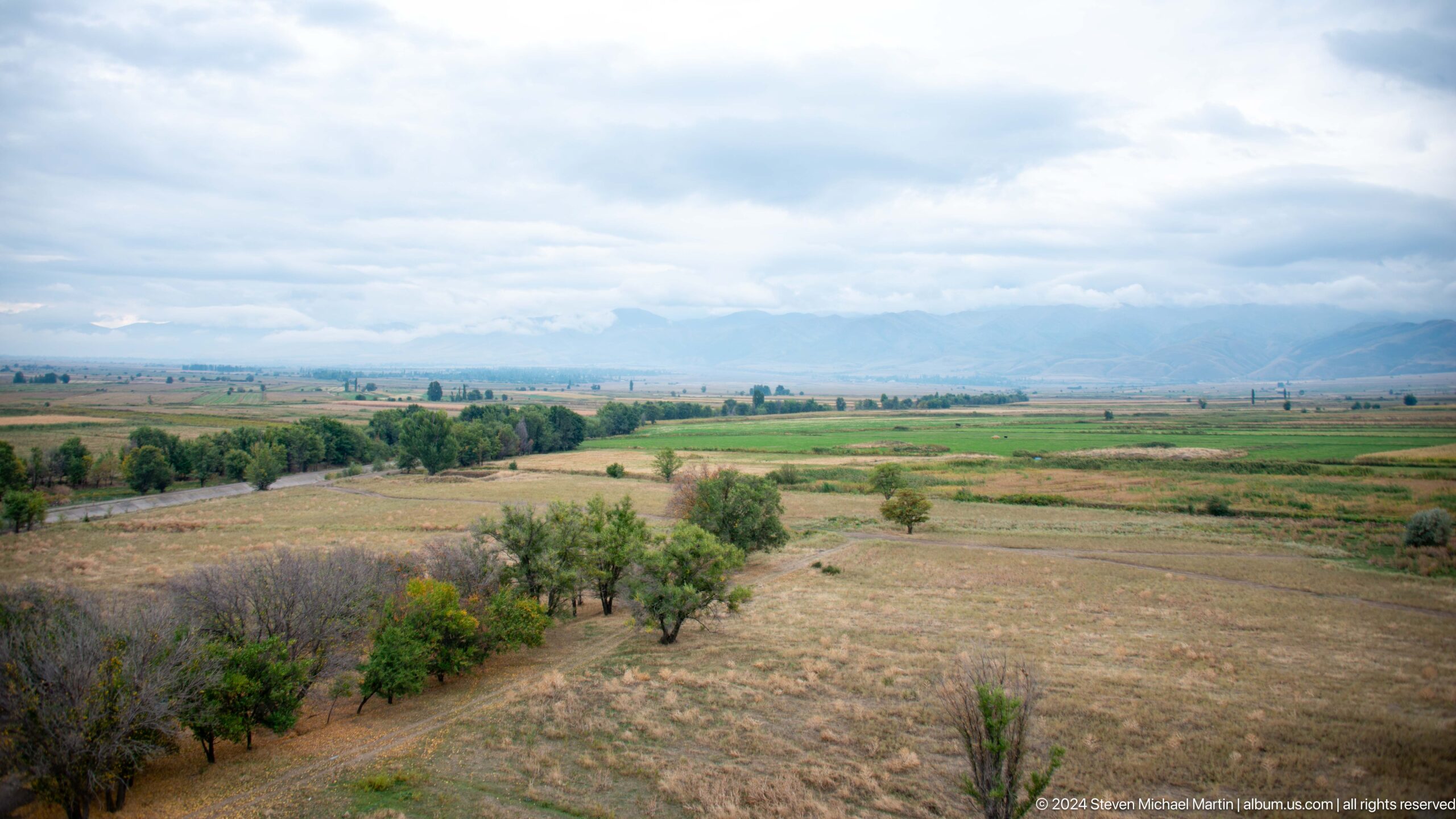
Chuy Valley panorama places the Burana complex within the broad agricultural plain of the Chuy Valley. Patchwork fields, trees, and distant mountains spread beyond the archaeological site. The open fields and distant mountain ranges provide essential geographic context for Balasagun, a medieval city positioned within the networks of movement and exchange across Central Asia.
Caption
Chuy Valley panorama places the Burana complex within the broad agricultural plain of the Chuy Valley. Patchwork fields, trees, and distant mountains spread beyond the archaeological site. The open fields and distant mountain ranges provide essential geographic context for Balasagun, a medieval city positioned within the networks of movement and exchange across Central Asia.

Chuy Valley panorama places the Burana complex within the broad agricultural plain of the Chuy Valley. A broad agricultural plain stretches toward a hazy mountain range. The open fields and distant mountain ranges provide essential geographic context for Balasagun, a medieval city positioned within the networks of movement and exchange across Central Asia.
Caption
Chuy Valley panorama places the Burana complex within the broad agricultural plain of the Chuy Valley. A broad agricultural plain stretches toward a hazy mountain range. The open fields and distant mountain ranges provide essential geographic context for Balasagun, a medieval city positioned within the networks of movement and exchange across Central Asia.

Burana Tower interior stair reveals the confined circulation system within the monument. The camera looks down a confined brick stair passage inside the minaret. The narrow brick passage illustrates how access to the upper levels was fitted inside the tapering eleventh-century minaret, one of the principal surviving structures of the medieval city of Balasagun.
Caption
Burana Tower interior stair reveals the confined circulation system within the monument. The camera looks down a confined brick stair passage inside the minaret. The narrow brick passage illustrates how access to the upper levels was fitted inside the tapering eleventh-century minaret, one of the principal surviving structures of the medieval city of Balasagun.
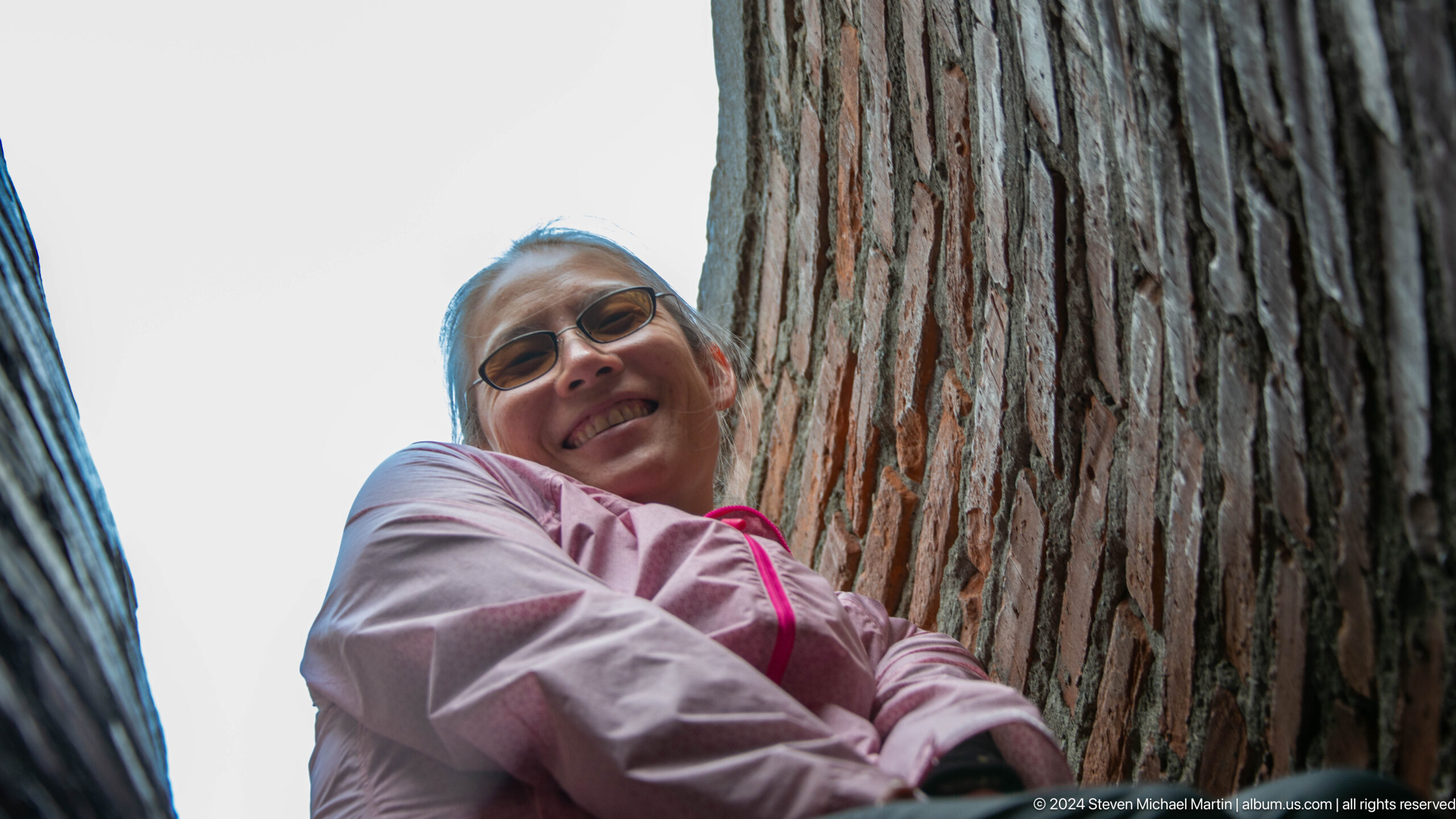
Visitor inside Burana Tower reveals the confined circulation system within the monument. A visitor wearing glasses looks toward the camera from the narrow brick shaft. The narrow brick passage illustrates how access to the upper levels was fitted inside the tapering eleventh-century minaret, one of the principal surviving structures of the medieval city of Balasagun.
Caption
Visitor inside Burana Tower reveals the confined circulation system within the monument. A visitor wearing glasses looks toward the camera from the narrow brick shaft. The narrow brick passage illustrates how access to the upper levels was fitted inside the tapering eleventh-century minaret, one of the principal surviving structures of the medieval city of Balasagun.
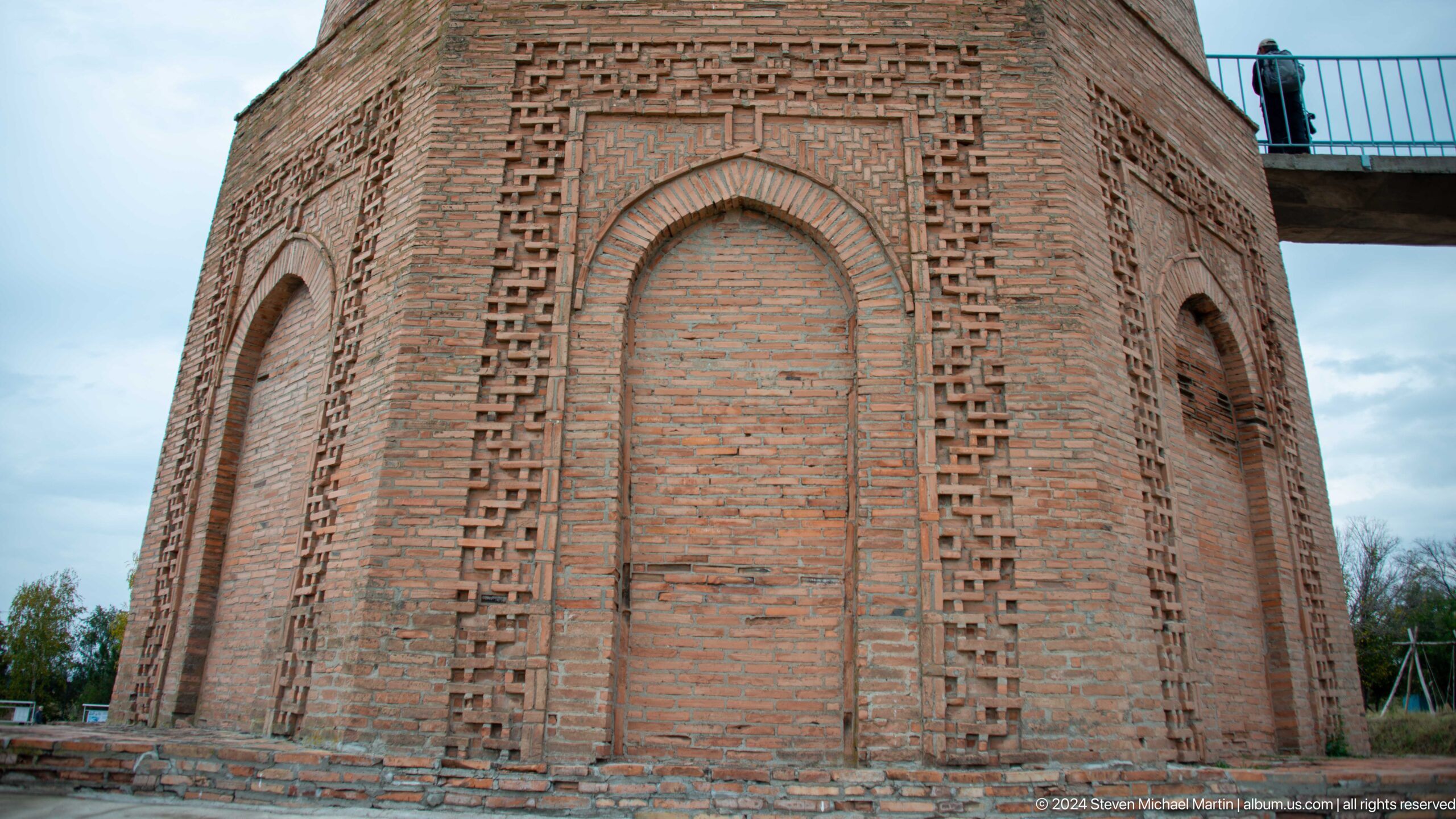
Burana Tower façade highlights the sophisticated masonry of the Kara-Khanid minaret. Two recessed panels with arched heads and geometric brick borders fill the lower wall. Alternating textures, recessed arches, and geometric brick patterns gave visual richness to a structure built largely from fired brick and connected with the medieval Silk Road city of Balasagun.
Caption
Burana Tower façade highlights the sophisticated masonry of the Kara-Khanid minaret. Two recessed panels with arched heads and geometric brick borders fill the lower wall. Alternating textures, recessed arches, and geometric brick patterns gave visual richness to a structure built largely from fired brick and connected with the medieval Silk Road city of Balasagun.

Balbal stone collection is one of the carved stone figures displayed across the Burana archaeological complex. Several carved Turkic stone figures stand across the archaeological landscape. Such balbals are associated with Turkic memorial traditions and help document the diverse cultural landscape that preceded and accompanied the development of medieval Balasagun.
Caption
Balbal stone collection is one of the carved stone figures displayed across the Burana archaeological complex. Several carved Turkic stone figures stand across the archaeological landscape. Such balbals are associated with Turkic memorial traditions and help document the diverse cultural landscape that preceded and accompanied the development of medieval Balasagun.
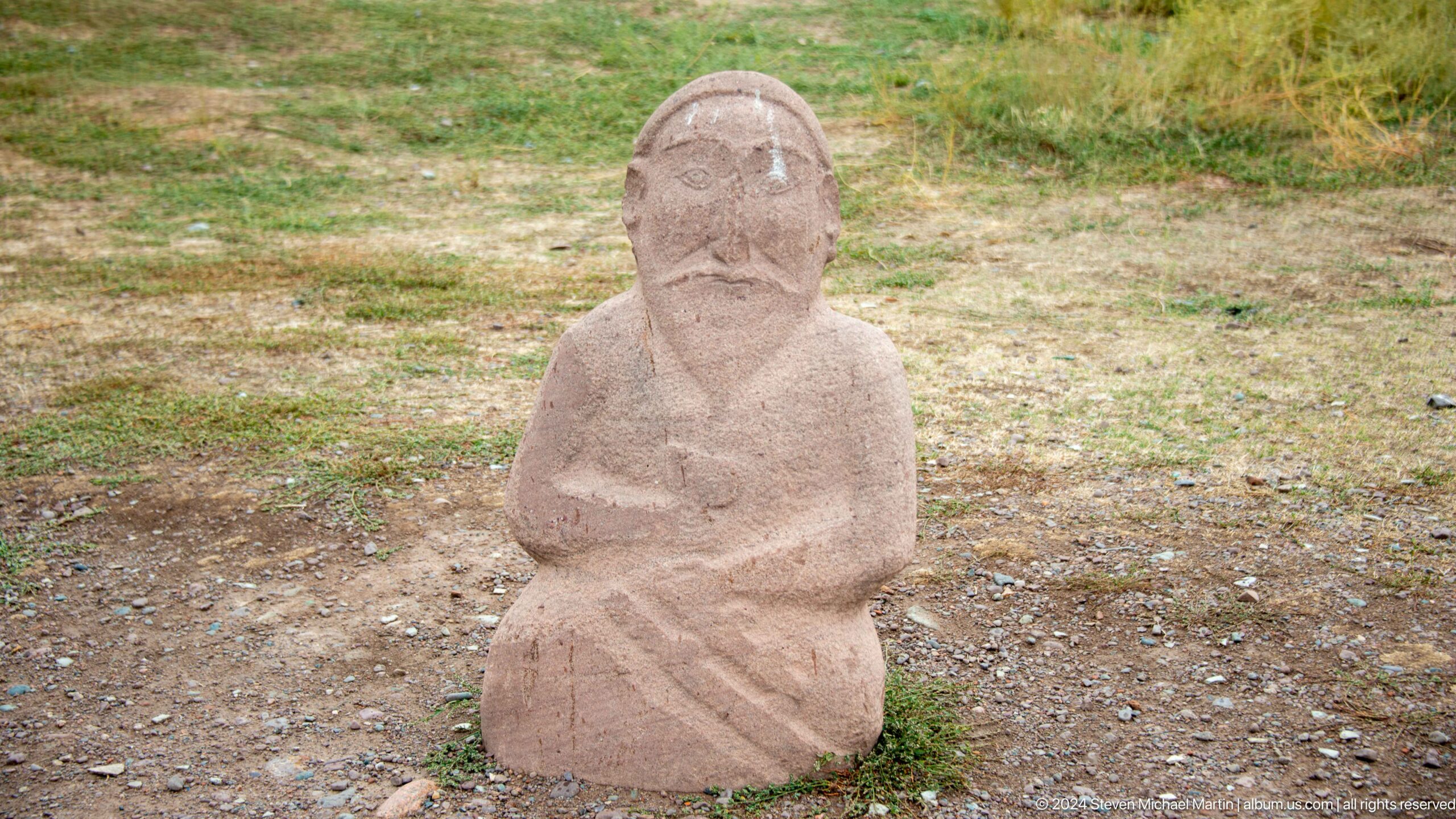
Turkic balbal is one of the carved stone figures displayed across the Burana archaeological complex. A compact carved stone figure sits with arms folded across the torso. Such balbals are associated with Turkic memorial traditions and help document the diverse cultural landscape that preceded and accompanied the development of medieval Balasagun.
Caption
Turkic balbal is one of the carved stone figures displayed across the Burana archaeological complex. A compact carved stone figure sits with arms folded across the torso. Such balbals are associated with Turkic memorial traditions and help document the diverse cultural landscape that preceded and accompanied the development of medieval Balasagun.
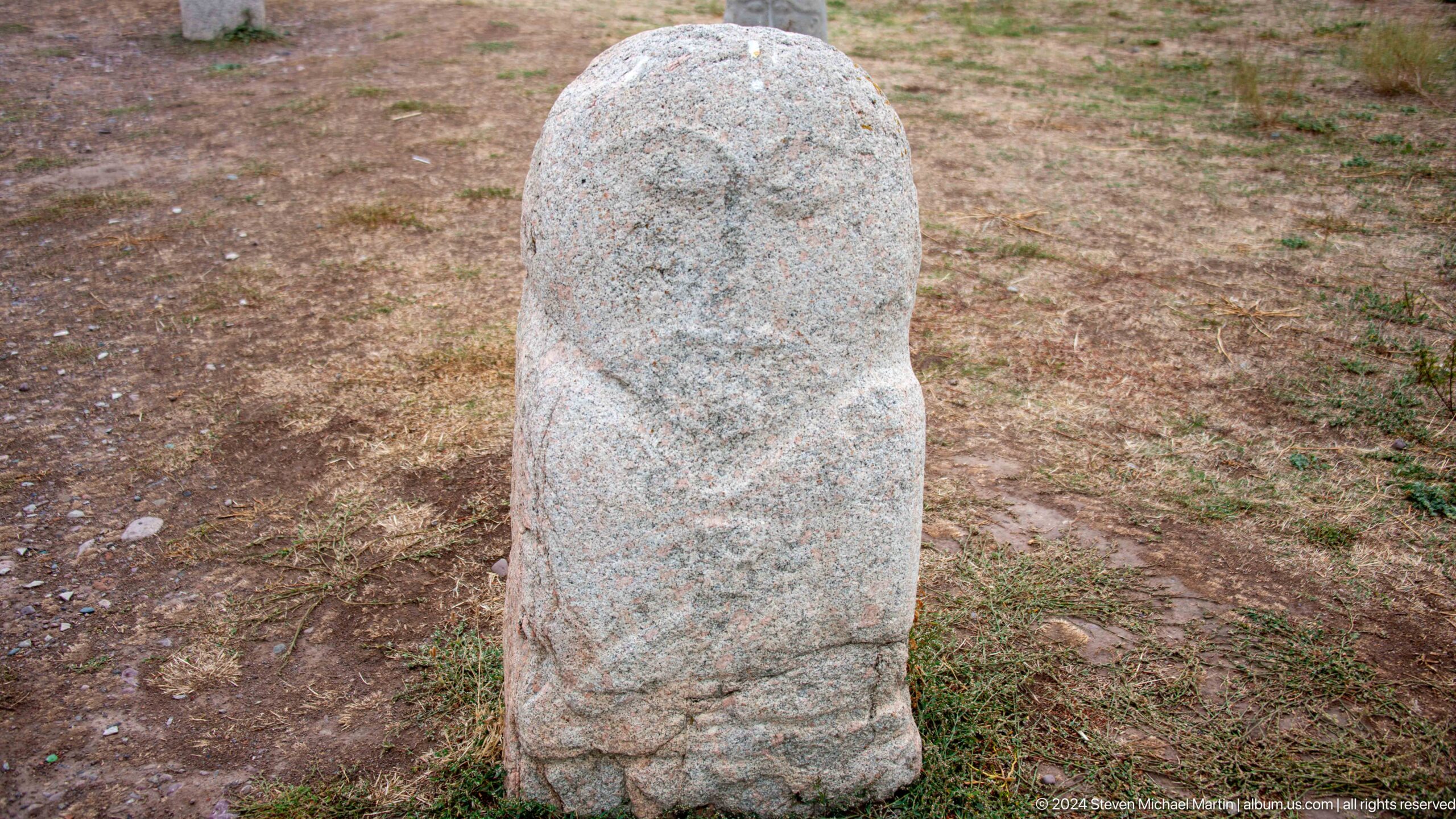
Turkic balbal is one of the carved stone figures displayed across the Burana archaeological complex. A narrow standing stone preserves a faint face and simplified body. Such balbals are associated with Turkic memorial traditions and help document the diverse cultural landscape that preceded and accompanied the development of medieval Balasagun.
Caption
Turkic balbal is one of the carved stone figures displayed across the Burana archaeological complex. A narrow standing stone preserves a faint face and simplified body. Such balbals are associated with Turkic memorial traditions and help document the diverse cultural landscape that preceded and accompanied the development of medieval Balasagun.
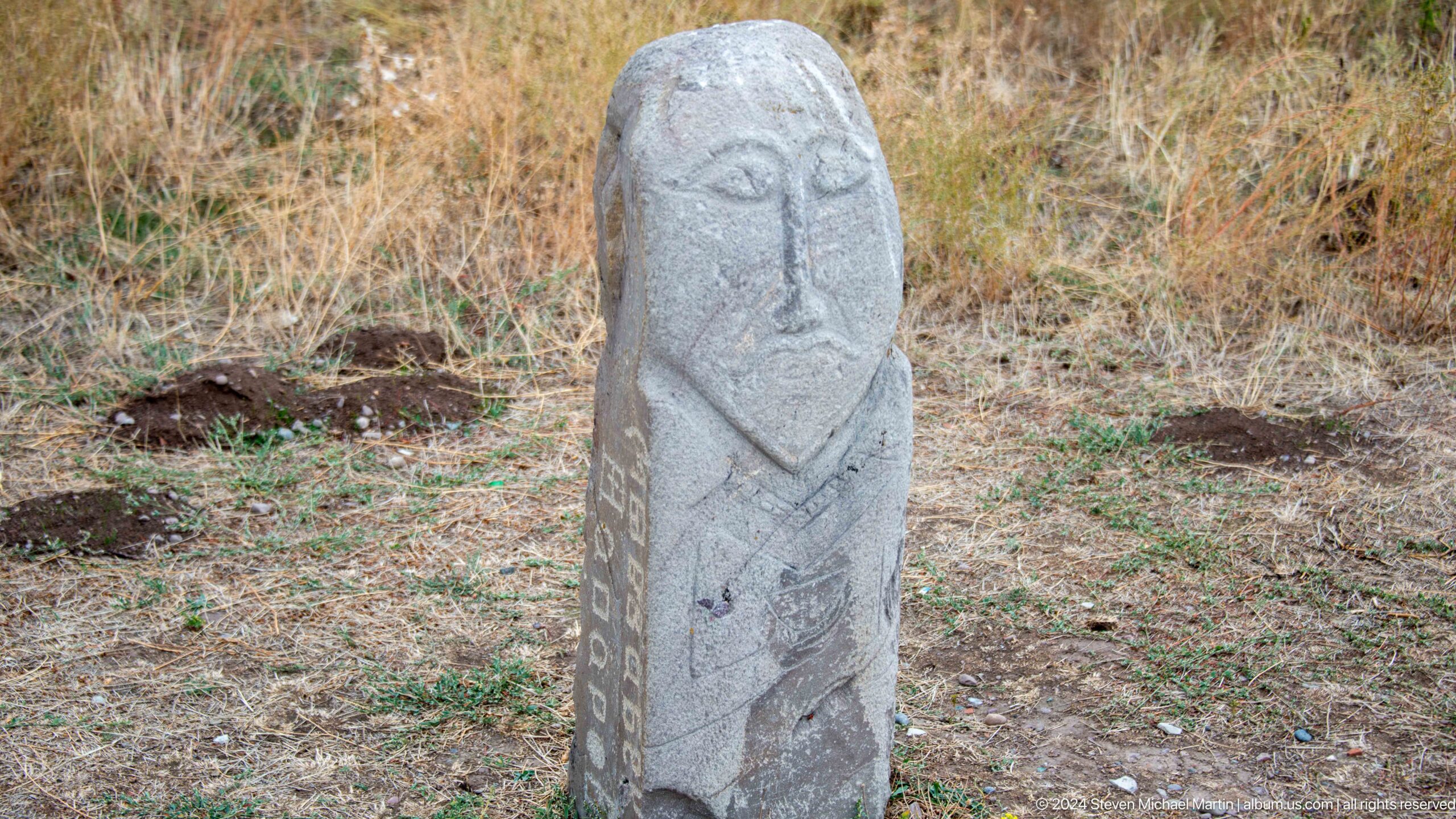
Turkic balbal is one of the carved stone figures displayed across the Burana archaeological complex. A standing stone figure shows an elongated face and hands held before the body. Such balbals are associated with Turkic memorial traditions and help document the diverse cultural landscape that preceded and accompanied the development of medieval Balasagun.
Caption
Turkic balbal is one of the carved stone figures displayed across the Burana archaeological complex. A standing stone figure shows an elongated face and hands held before the body. Such balbals are associated with Turkic memorial traditions and help document the diverse cultural landscape that preceded and accompanied the development of medieval Balasagun.

Turkic balbal is one of the carved stone figures displayed across the Burana archaeological complex. A squat weathered figure appears seated with folded arms. Such balbals are associated with Turkic memorial traditions and help document the diverse cultural landscape that preceded and accompanied the development of medieval Balasagun.
Caption
Turkic balbal is one of the carved stone figures displayed across the Burana archaeological complex. A squat weathered figure appears seated with folded arms. Such balbals are associated with Turkic memorial traditions and help document the diverse cultural landscape that preceded and accompanied the development of medieval Balasagun.
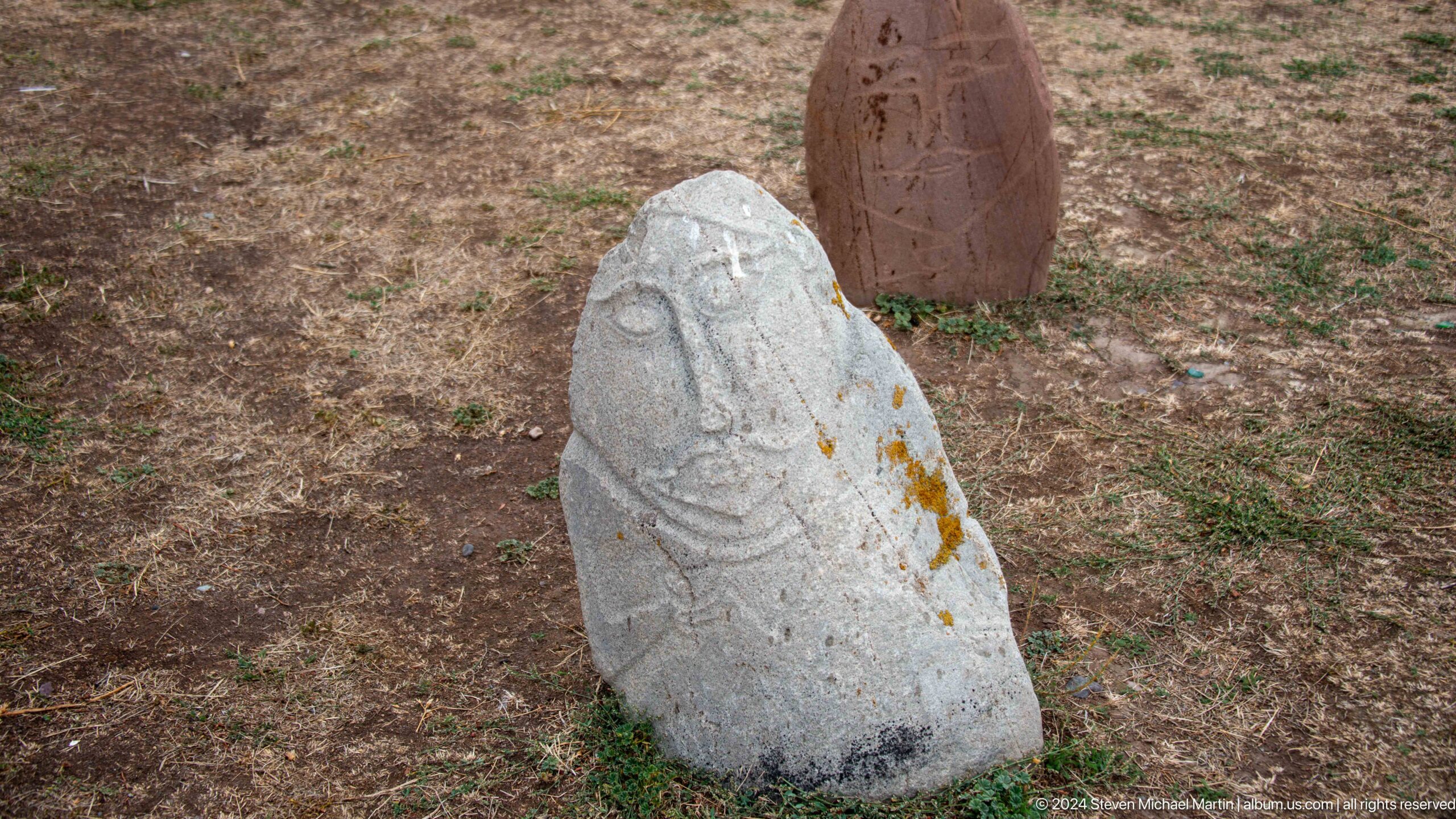
Turkic balbal is one of the carved stone figures displayed across the Burana archaeological complex. A pale rounded stone preserves facial features and linear carving. Such balbals are associated with Turkic memorial traditions and help document the diverse cultural landscape that preceded and accompanied the development of medieval Balasagun.
Caption
Turkic balbal is one of the carved stone figures displayed across the Burana archaeological complex. A pale rounded stone preserves facial features and linear carving. Such balbals are associated with Turkic memorial traditions and help document the diverse cultural landscape that preceded and accompanied the development of medieval Balasagun.
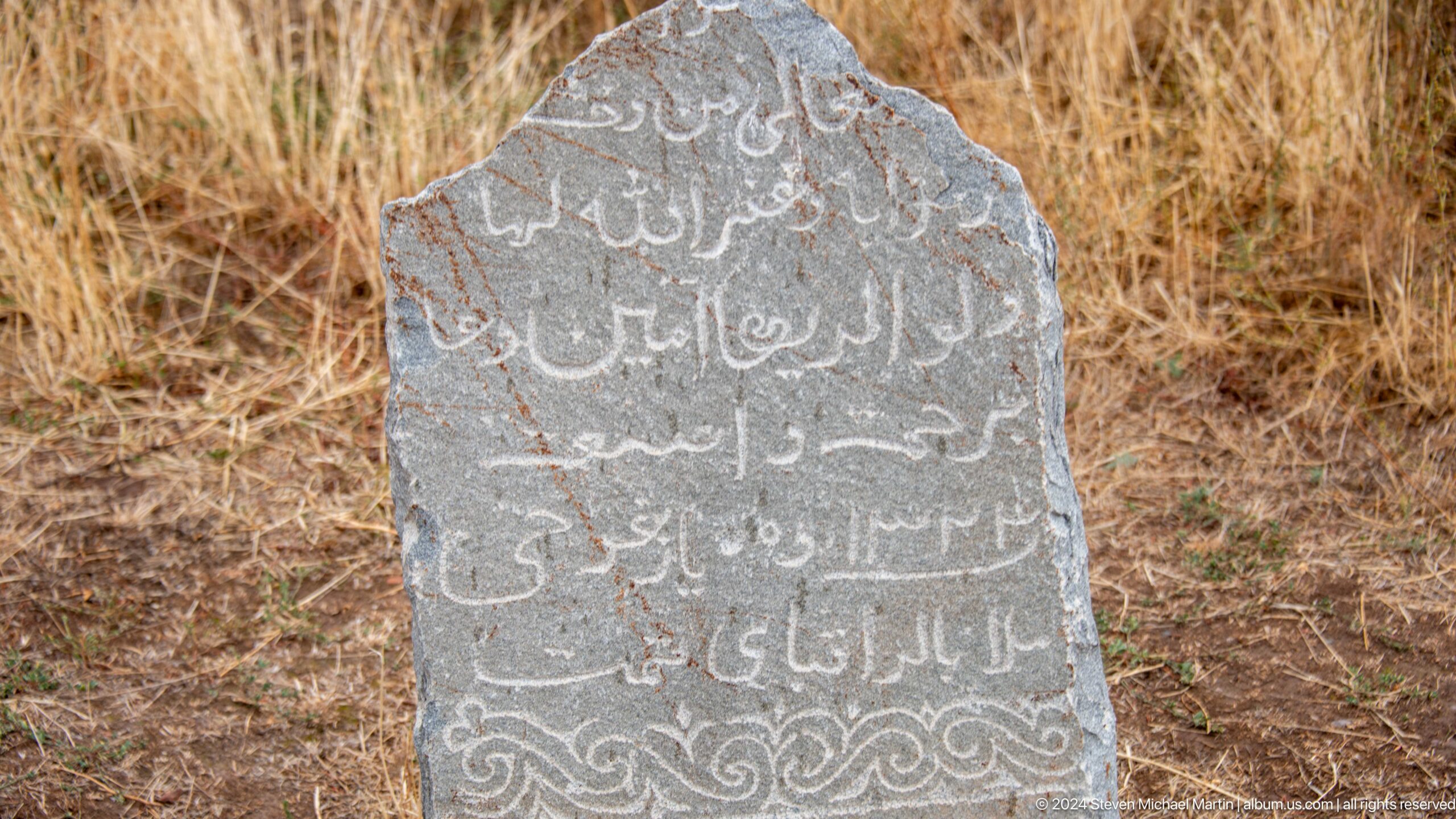
Islamic funerary stele preserves epigraphic evidence from the historic cemetery landscape near Burana. Arabic-script inscription covers the face of an upright stone marker. The carved Arabic script reflects the Islamic religious and funerary traditions that formed part of life in and around medieval Balasagun.
Caption
Islamic funerary stele preserves epigraphic evidence from the historic cemetery landscape near Burana. Arabic-script inscription covers the face of an upright stone marker. The carved Arabic script reflects the Islamic religious and funerary traditions that formed part of life in and around medieval Balasagun.

Architectural fragments are arranged within the outdoor archaeological collection at Burana. Numerous elongated stone pieces lie in an organized outdoor display. These surviving stone elements provide material evidence for the buildings, monuments, and working environment of Balasagun beyond the celebrated brick minaret.
Caption
Architectural fragments are arranged within the outdoor archaeological collection at Burana. Numerous elongated stone pieces lie in an organized outdoor display. These surviving stone elements provide material evidence for the buildings, monuments, and working environment of Balasagun beyond the celebrated brick minaret.
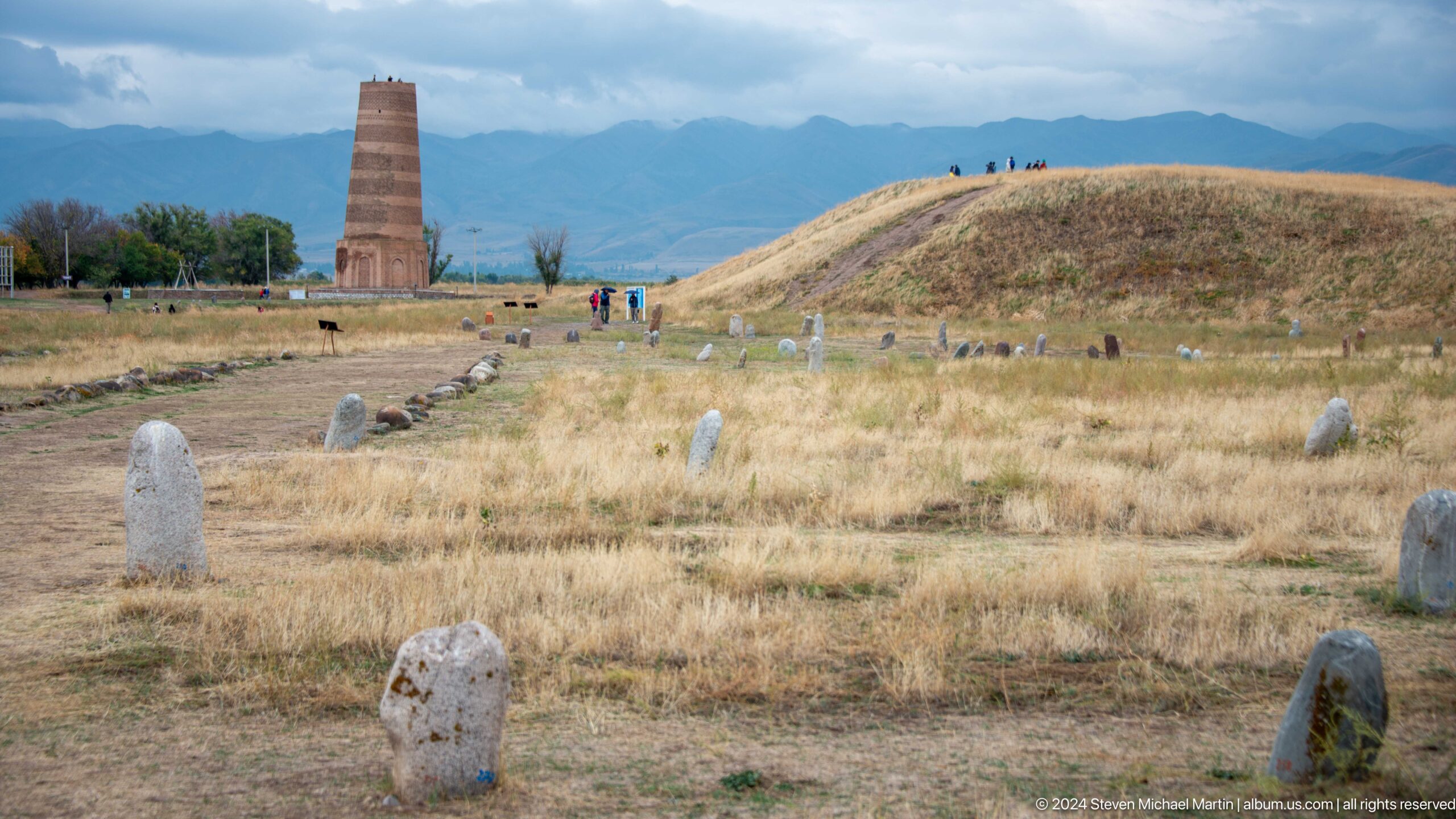
Burana archaeological landscape places the Burana complex within the broad agricultural plain of the Chuy Valley. The tower, balbals, and a low archaeological mound occupy a broad open landscape. The open fields and distant mountain ranges provide essential geographic context for Balasagun, a medieval city positioned within the networks of movement and exchange across Central Asia.
Caption
Burana archaeological landscape places the Burana complex within the broad agricultural plain of the Chuy Valley. The tower, balbals, and a low archaeological mound occupy a broad open landscape. The open fields and distant mountain ranges provide essential geographic context for Balasagun, a medieval city positioned within the networks of movement and exchange across Central Asia.
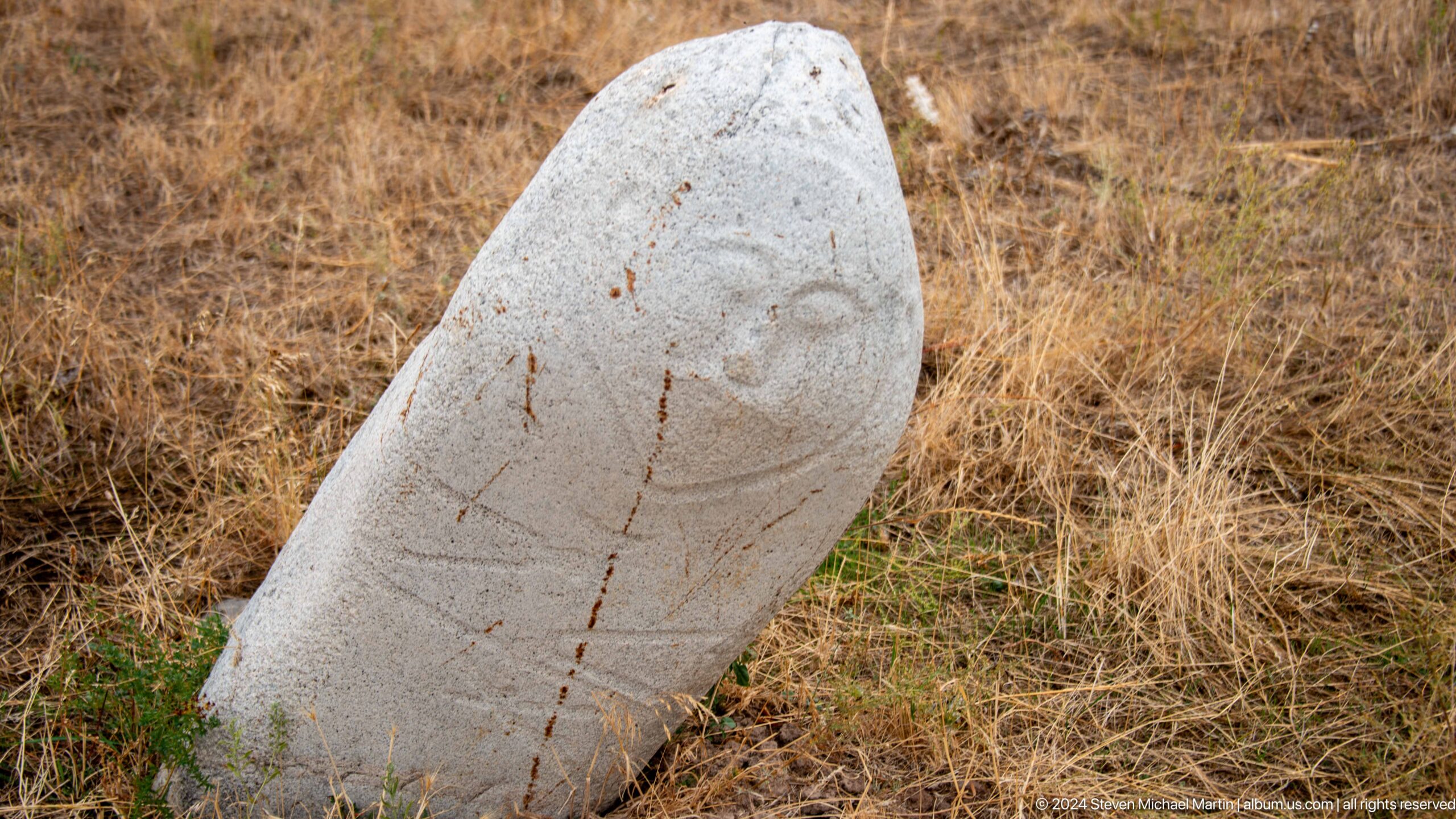
Turkic balbal is one of the carved stone figures displayed across the Burana archaeological complex. A light-colored stone figure bears a simple incised face and weathered surface. Such balbals are associated with Turkic memorial traditions and help document the diverse cultural landscape that preceded and accompanied the development of medieval Balasagun.
Caption
Turkic balbal is one of the carved stone figures displayed across the Burana archaeological complex. A light-colored stone figure bears a simple incised face and weathered surface. Such balbals are associated with Turkic memorial traditions and help document the diverse cultural landscape that preceded and accompanied the development of medieval Balasagun.
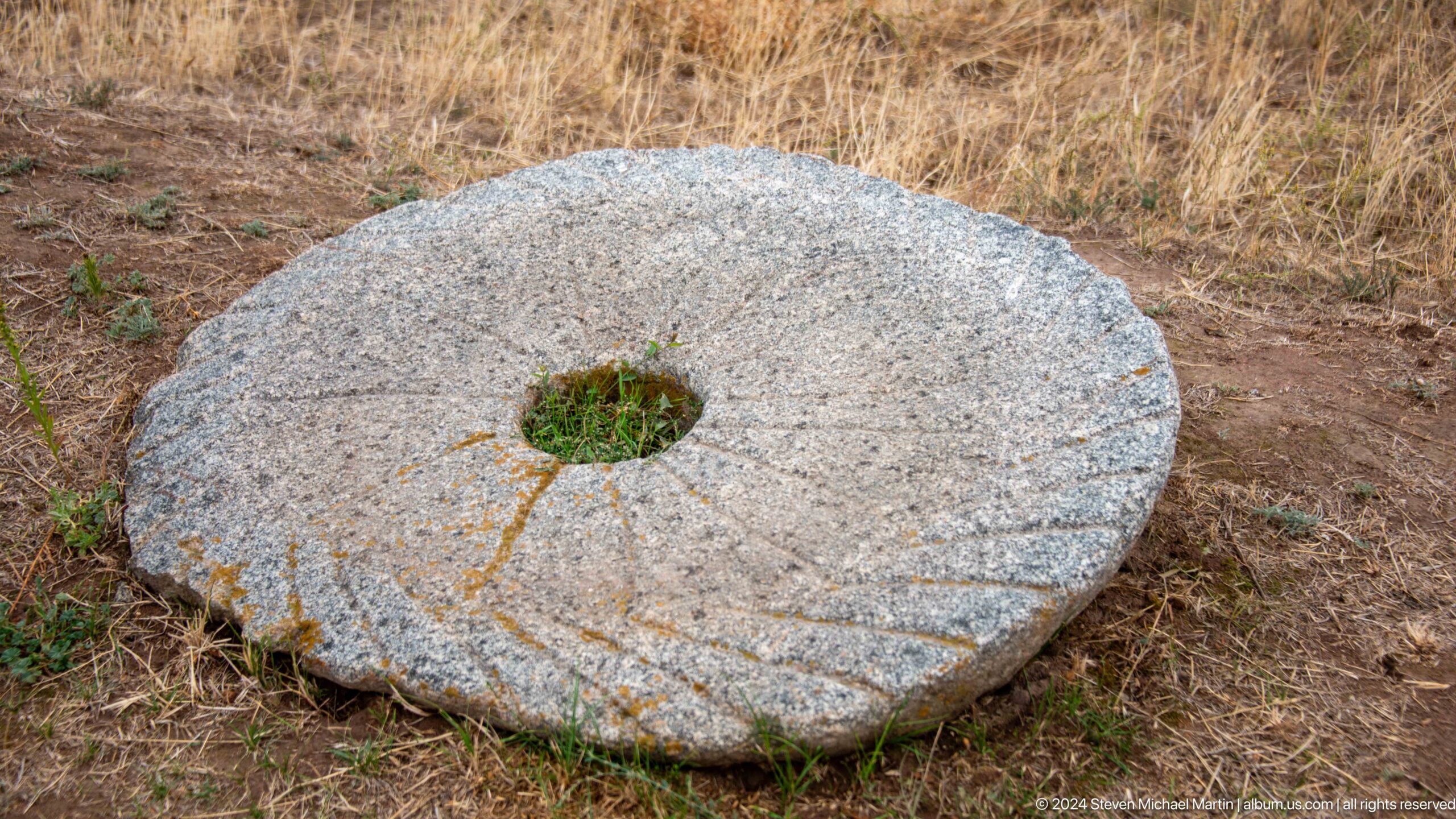
Millstone forms part of the outdoor archaeological display at Burana. A thick circular stone with a central opening lies on the ground. The heavy circular grinding stone is material evidence for everyday food processing and agricultural life within the settlement landscape of medieval Balasagun.
Caption
Millstone forms part of the outdoor archaeological display at Burana. A thick circular stone with a central opening lies on the ground. The heavy circular grinding stone is material evidence for everyday food processing and agricultural life within the settlement landscape of medieval Balasagun.
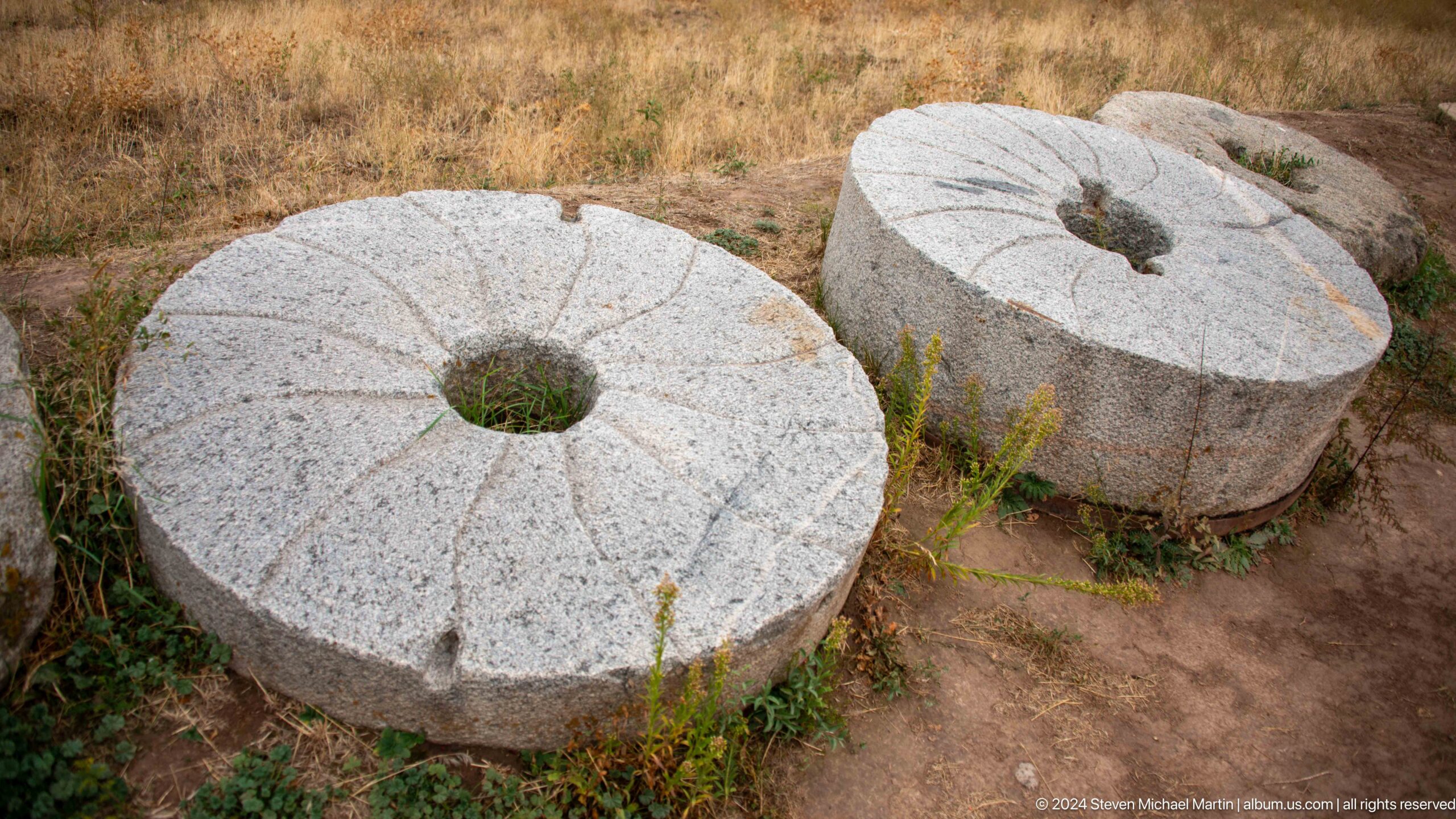
Millstones forms part of the outdoor archaeological display at Burana. Two circular grinding stones with central holes rest side by side. The heavy circular grinding stone is material evidence for everyday food processing and agricultural life within the settlement landscape of medieval Balasagun.
Caption
Millstones forms part of the outdoor archaeological display at Burana. Two circular grinding stones with central holes rest side by side. The heavy circular grinding stone is material evidence for everyday food processing and agricultural life within the settlement landscape of medieval Balasagun.
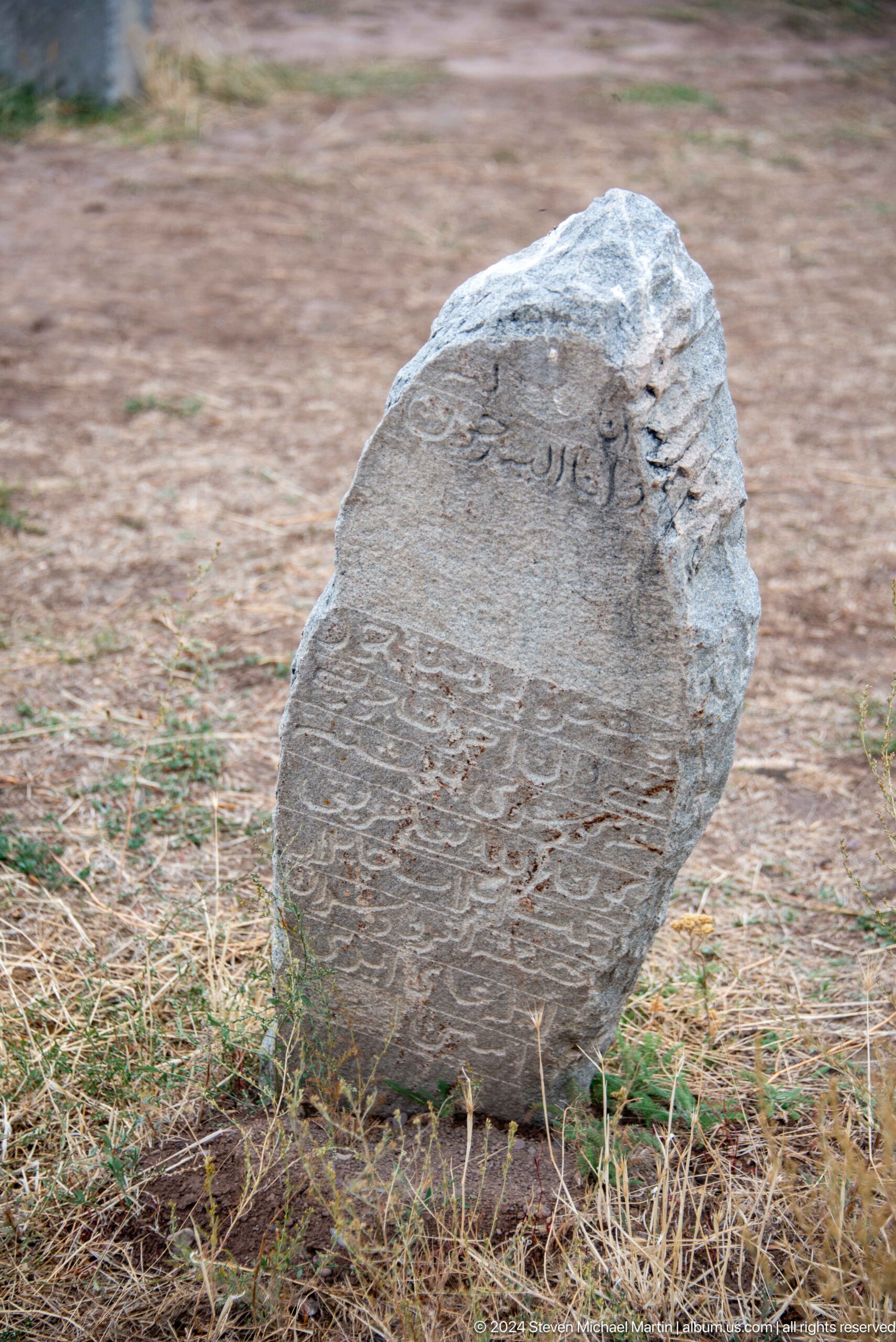
Islamic funerary stele preserves epigraphic evidence from the historic cemetery landscape near Burana. A dark upright stone carries dense flowing Arabic-script inscription. The carved Arabic script reflects the Islamic religious and funerary traditions that formed part of life in and around medieval Balasagun.
Caption
Islamic funerary stele preserves epigraphic evidence from the historic cemetery landscape near Burana. A dark upright stone carries dense flowing Arabic-script inscription. The carved Arabic script reflects the Islamic religious and funerary traditions that formed part of life in and around medieval Balasagun.
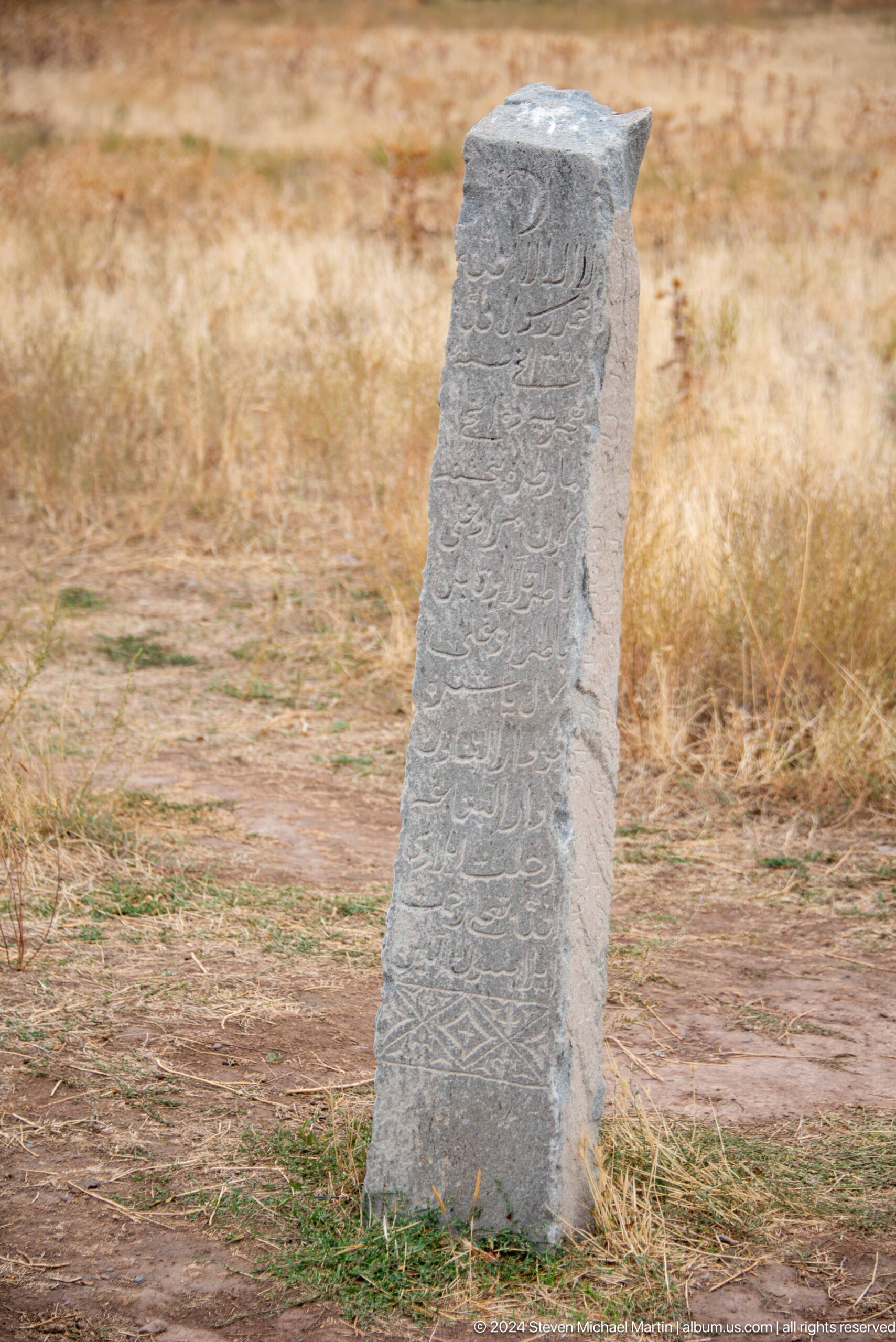
Islamic funerary stele preserves epigraphic evidence from the historic cemetery landscape near Burana. A slender stone marker bears vertically arranged Arabic-script carving. The carved Arabic script reflects the Islamic religious and funerary traditions that formed part of life in and around medieval Balasagun.
Caption
Islamic funerary stele preserves epigraphic evidence from the historic cemetery landscape near Burana. A slender stone marker bears vertically arranged Arabic-script carving. The carved Arabic script reflects the Islamic religious and funerary traditions that formed part of life in and around medieval Balasagun.

Islamic funerary stele preserves epigraphic evidence from the historic cemetery landscape near Burana. The edge and carved face of a tall stone marker are visible in dry grass. The carved Arabic script reflects the Islamic religious and funerary traditions that formed part of life in and around medieval Balasagun.
Caption
Islamic funerary stele preserves epigraphic evidence from the historic cemetery landscape near Burana. The edge and carved face of a tall stone marker are visible in dry grass. The carved Arabic script reflects the Islamic religious and funerary traditions that formed part of life in and around medieval Balasagun.
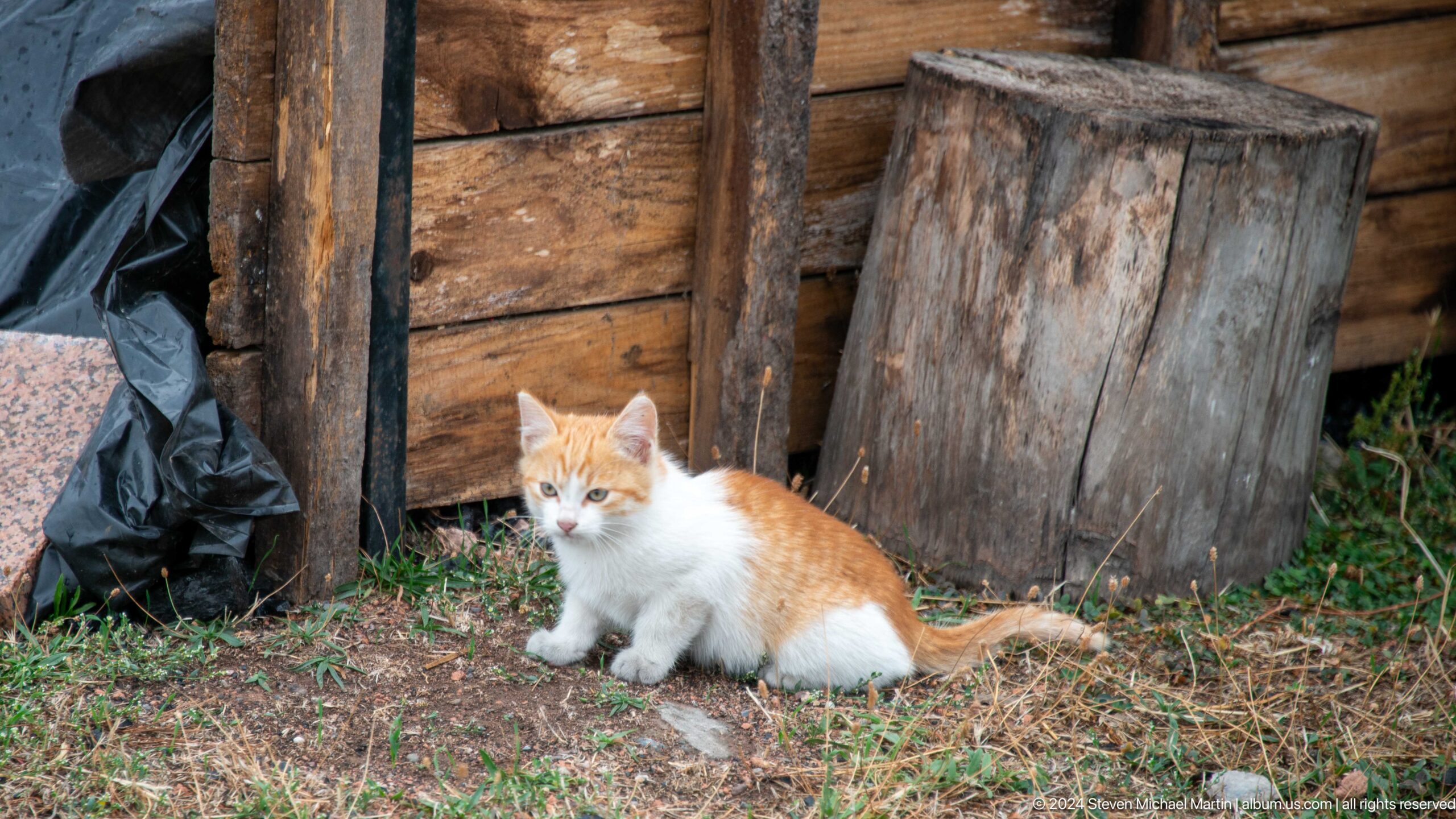
Domestic cat documents the contemporary and historical landscape surrounding Burana Tower. A small kitten rests near rough wooden boards at the site. The scene contributes context for understanding the archaeological site as part of a living rural region shaped by settlement, agriculture, transport, and cultural memory.
Caption
Domestic cat documents the contemporary and historical landscape surrounding Burana Tower. A small kitten rests near rough wooden boards at the site. The scene contributes context for understanding the archaeological site as part of a living rural region shaped by settlement, agriculture, transport, and cultural memory.
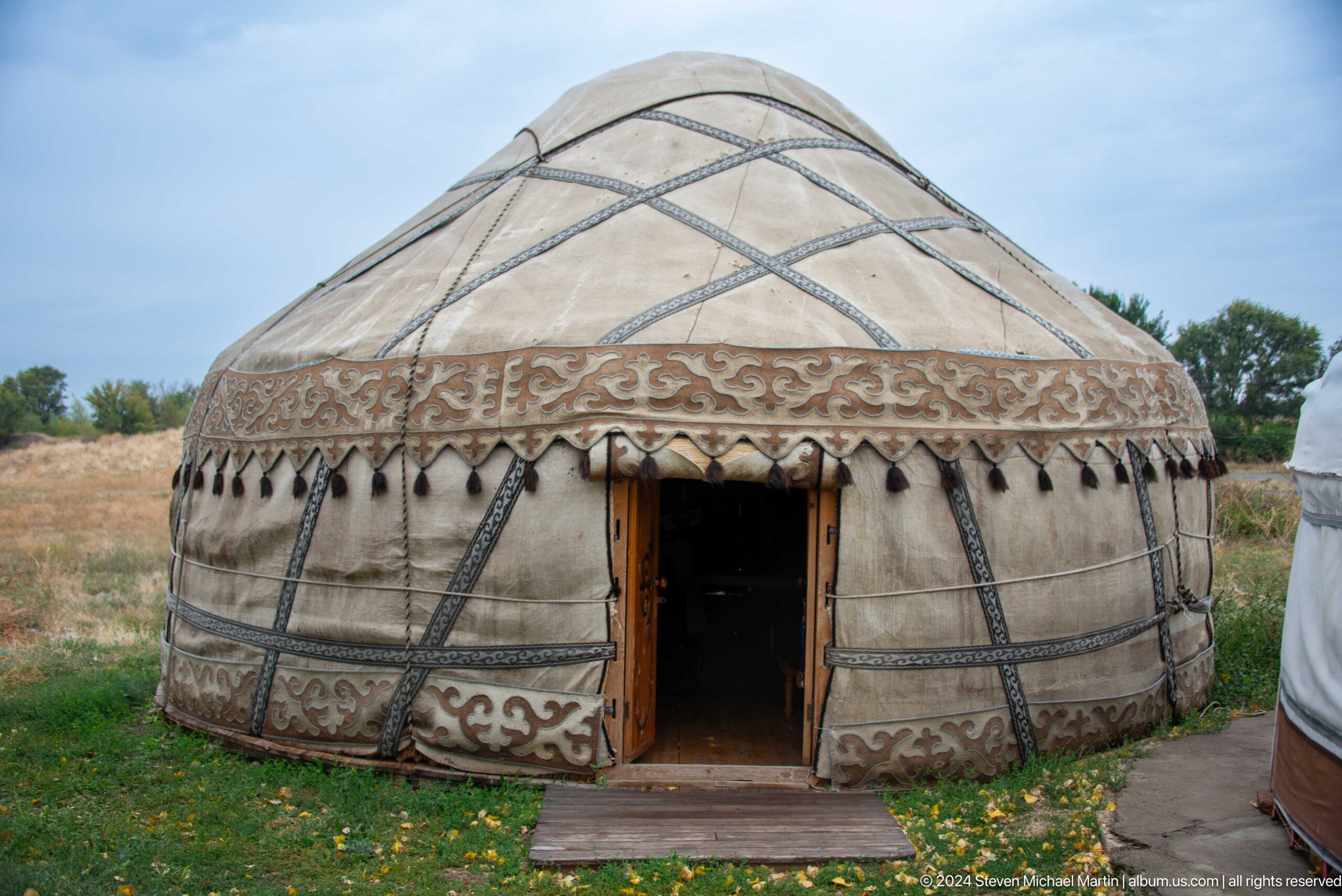
Kyrgyz yurt presents a traditional portable dwelling associated with Kyrgyz pastoral culture. A felt-covered circular yurt displays patterned bands and a dark central doorway. Its circular lattice frame, felt covering, and richly decorated interior demonstrate how architecture, textiles, and household organization are combined in a mobile domestic space.
Caption
Kyrgyz yurt presents a traditional portable dwelling associated with Kyrgyz pastoral culture. A felt-covered circular yurt displays patterned bands and a dark central doorway. Its circular lattice frame, felt covering, and richly decorated interior demonstrate how architecture, textiles, and household organization are combined in a mobile domestic space.
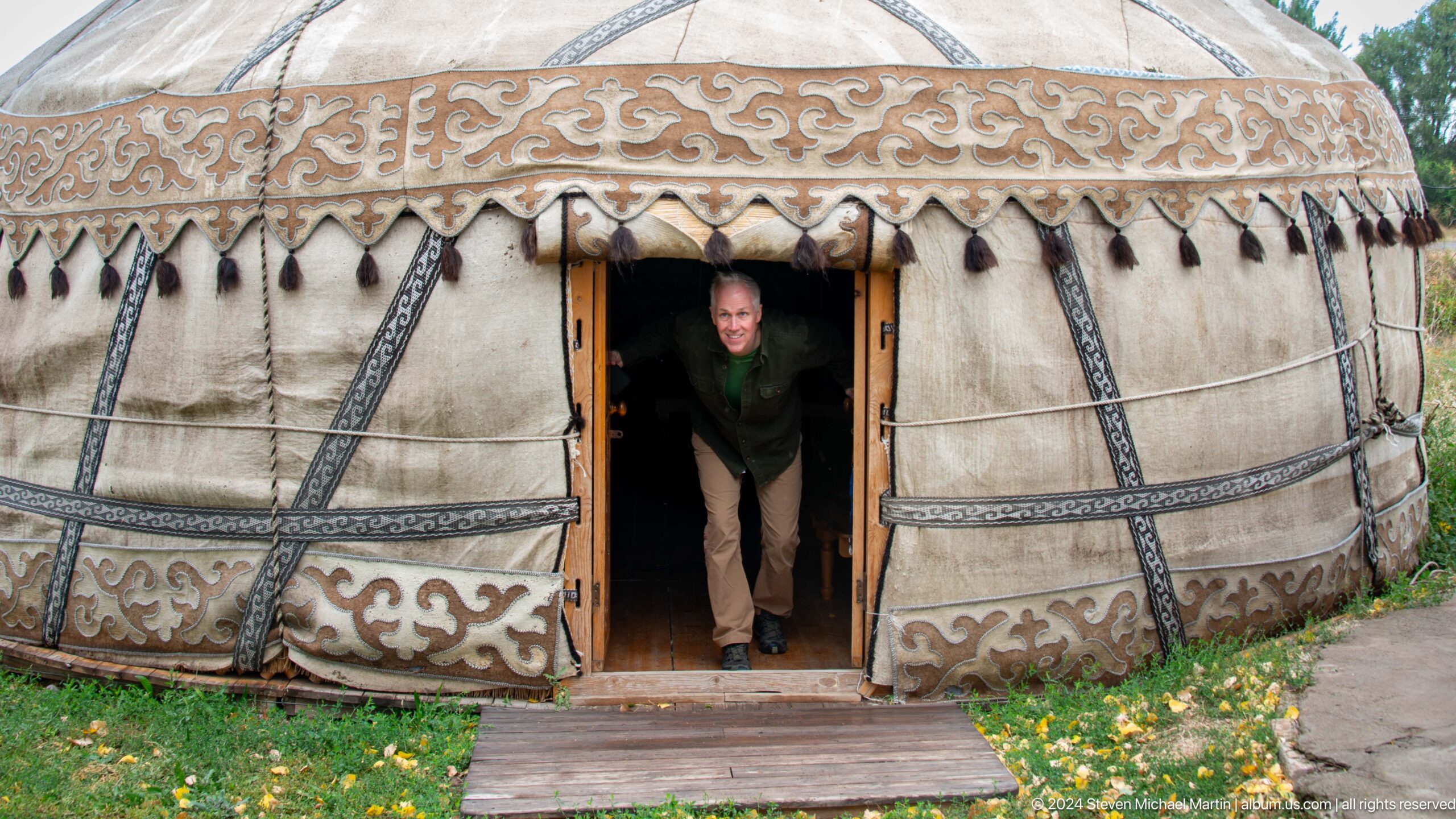
Kyrgyz yurt interior entrance presents a traditional portable dwelling associated with Kyrgyz pastoral culture. A visitor bends through the low doorway of a decorated yurt. Its circular lattice frame, felt covering, and richly decorated interior demonstrate how architecture, textiles, and household organization are combined in a mobile domestic space.
Caption
Kyrgyz yurt interior entrance presents a traditional portable dwelling associated with Kyrgyz pastoral culture. A visitor bends through the low doorway of a decorated yurt. Its circular lattice frame, felt covering, and richly decorated interior demonstrate how architecture, textiles, and household organization are combined in a mobile domestic space.
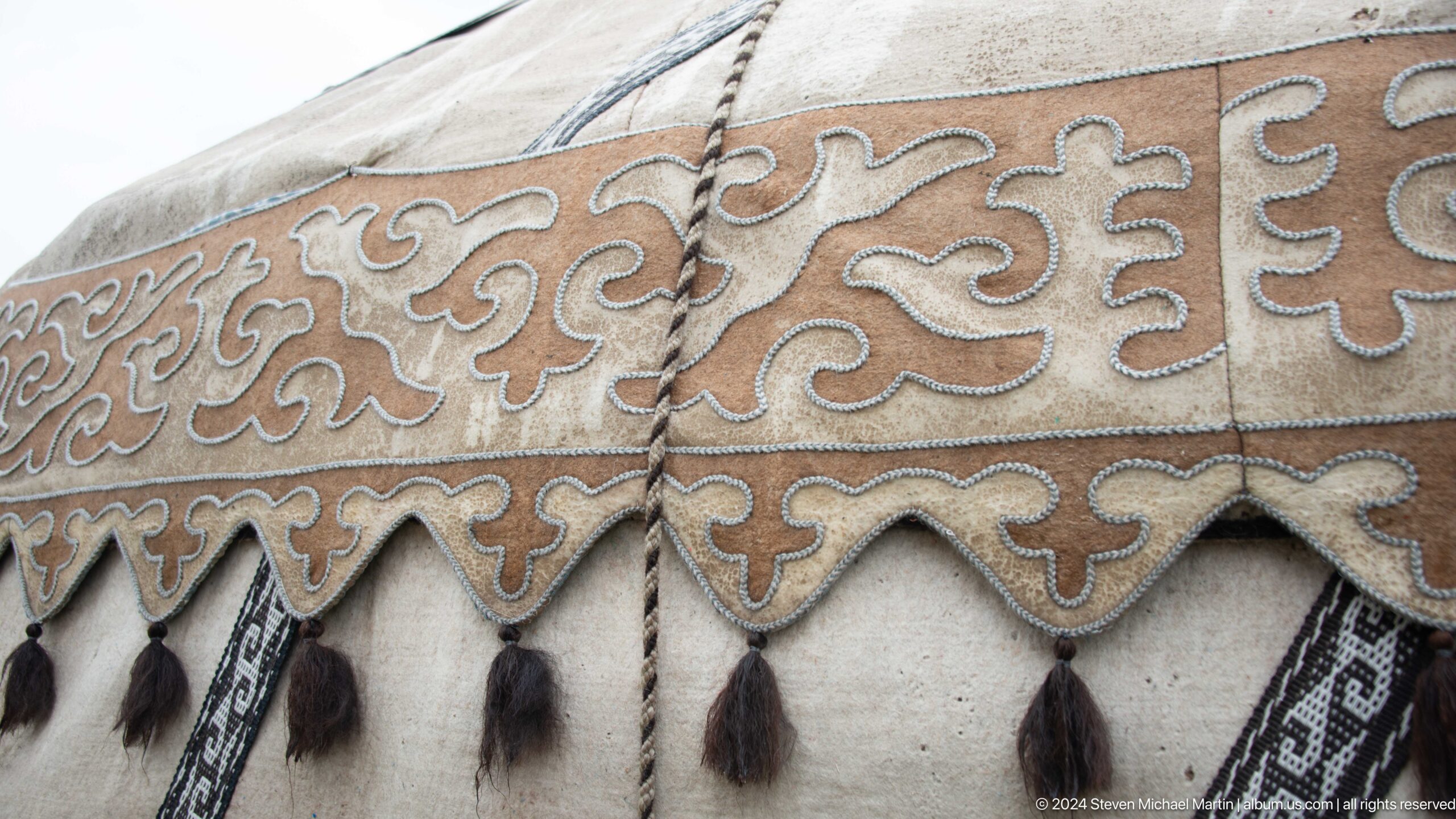
Kyrgyz textile decoration presents a traditional portable dwelling associated with Kyrgyz pastoral culture. Cream and tan felt motifs form scrolling patterns above hanging tassels. Its circular lattice frame, felt covering, and richly decorated interior demonstrate how architecture, textiles, and household organization are combined in a mobile domestic space.
Caption
Kyrgyz textile decoration presents a traditional portable dwelling associated with Kyrgyz pastoral culture. Cream and tan felt motifs form scrolling patterns above hanging tassels. Its circular lattice frame, felt covering, and richly decorated interior demonstrate how architecture, textiles, and household organization are combined in a mobile domestic space.
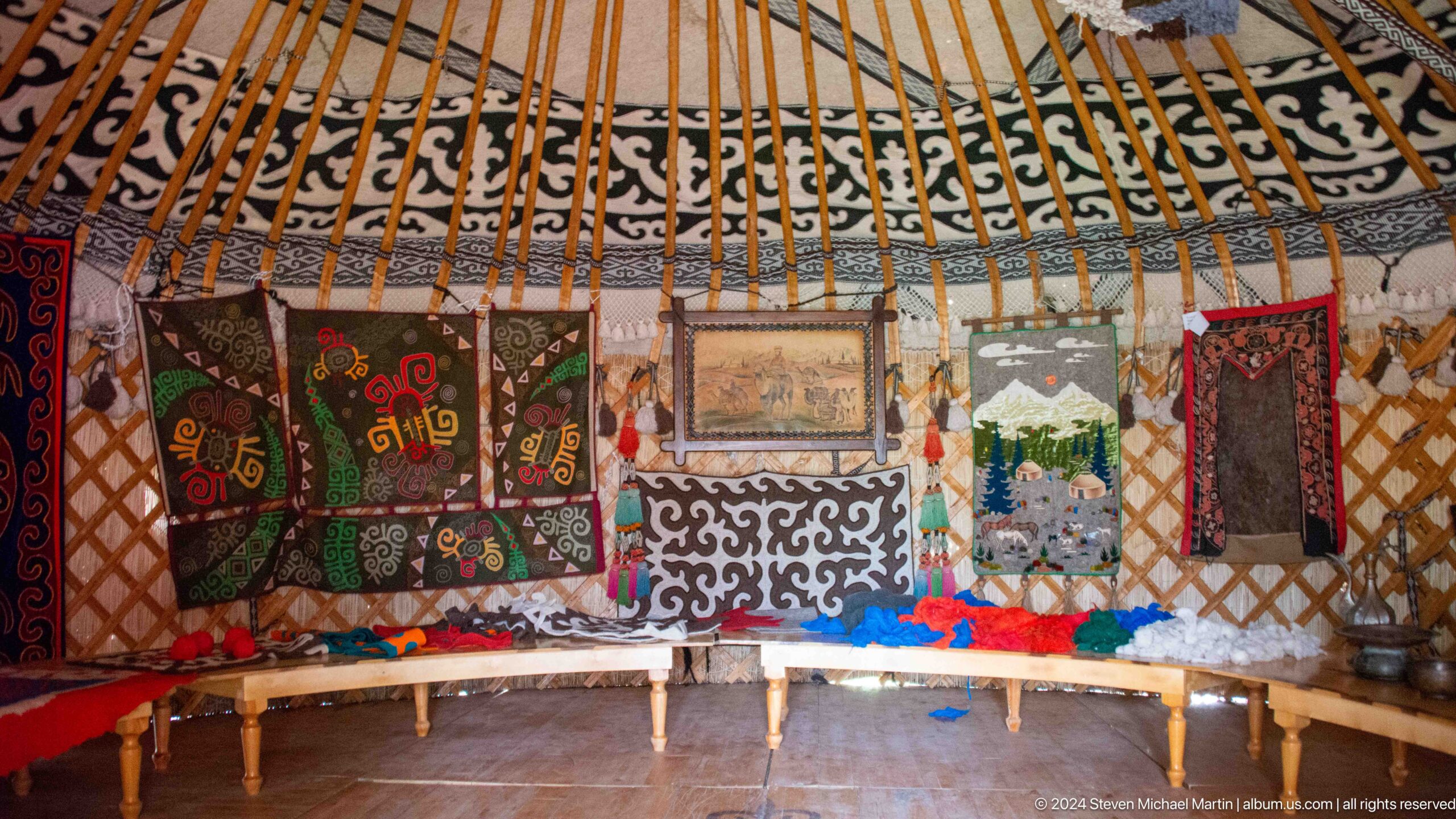
Kyrgyz yurt interior presents a traditional portable dwelling associated with Kyrgyz pastoral culture. Textiles, framed pictures, and household objects line the circular lattice walls. Its circular lattice frame, felt covering, and richly decorated interior demonstrate how architecture, textiles, and household organization are combined in a mobile domestic space.
Caption
Kyrgyz yurt interior presents a traditional portable dwelling associated with Kyrgyz pastoral culture. Textiles, framed pictures, and household objects line the circular lattice walls. Its circular lattice frame, felt covering, and richly decorated interior demonstrate how architecture, textiles, and household organization are combined in a mobile domestic space.

Kyrgyz yurt interior presents a traditional portable dwelling associated with Kyrgyz pastoral culture. A central hearth, low furnishings, carpets, and bright wall hangings fill the interior. Its circular lattice frame, felt covering, and richly decorated interior demonstrate how architecture, textiles, and household organization are combined in a mobile domestic space.
Caption
Kyrgyz yurt interior presents a traditional portable dwelling associated with Kyrgyz pastoral culture. A central hearth, low furnishings, carpets, and bright wall hangings fill the interior. Its circular lattice frame, felt covering, and richly decorated interior demonstrate how architecture, textiles, and household organization are combined in a mobile domestic space.
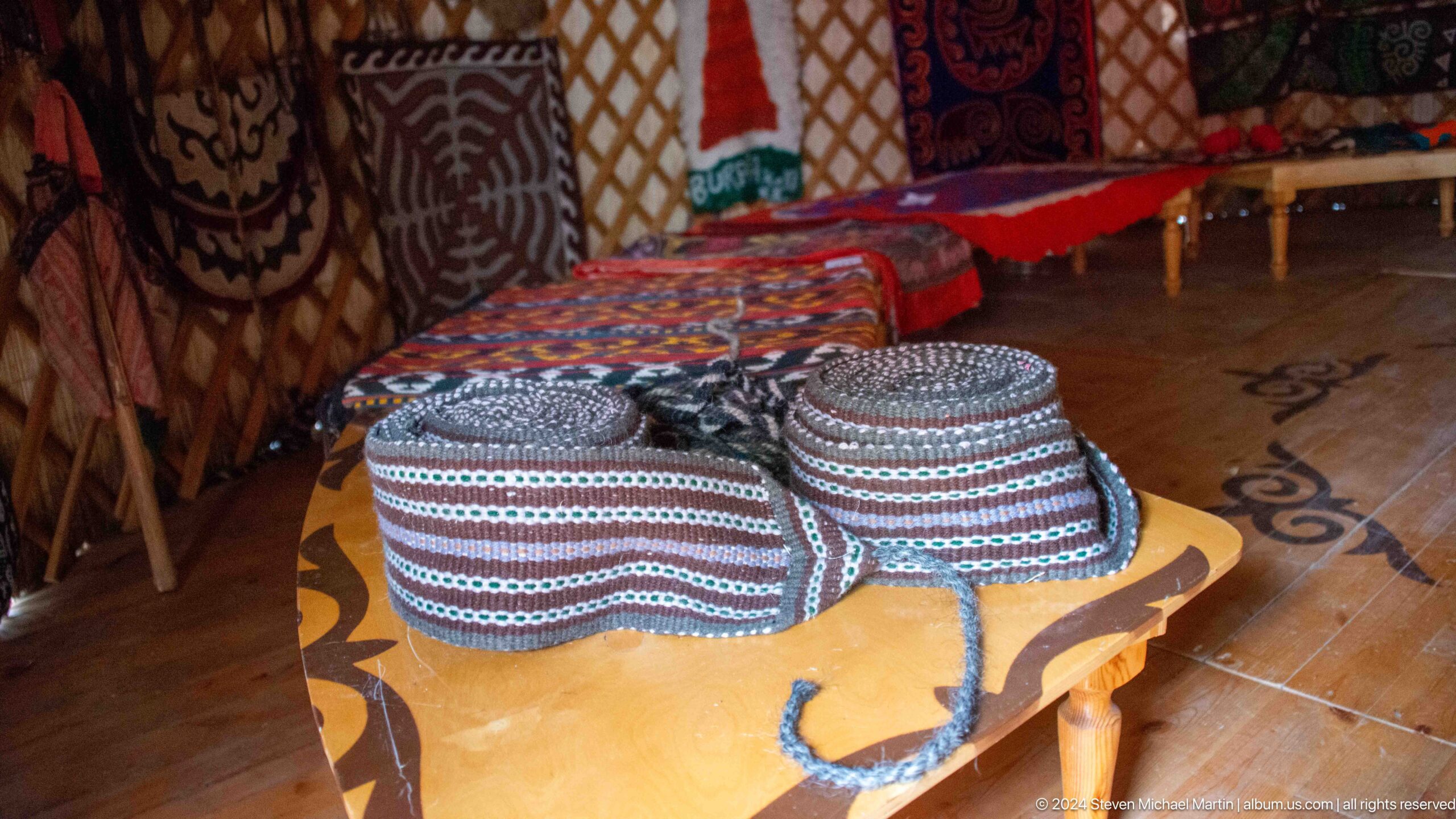
Kyrgyz felt cushions demonstrates the vivid ornamental language of Kyrgyz textile traditions. Round patterned cushions rest on a low table inside the yurt. Bold curvilinear motifs, contrasting felt, embroidery, and repeated symmetrical forms transform practical furnishings into expressive works of domestic decorative art.
Caption
Kyrgyz felt cushions demonstrates the vivid ornamental language of Kyrgyz textile traditions. Round patterned cushions rest on a low table inside the yurt. Bold curvilinear motifs, contrasting felt, embroidery, and repeated symmetrical forms transform practical furnishings into expressive works of domestic decorative art.

Kyrgyz yurt interior presents a traditional portable dwelling associated with Kyrgyz pastoral culture. Decorative felt panels, carpets, and hanging objects cover the lattice walls. Its circular lattice frame, felt covering, and richly decorated interior demonstrate how architecture, textiles, and household organization are combined in a mobile domestic space.
Caption
Kyrgyz yurt interior presents a traditional portable dwelling associated with Kyrgyz pastoral culture. Decorative felt panels, carpets, and hanging objects cover the lattice walls. Its circular lattice frame, felt covering, and richly decorated interior demonstrate how architecture, textiles, and household organization are combined in a mobile domestic space.

Yurt structural framework presents a traditional portable dwelling associated with Kyrgyz pastoral culture. Curved roof poles radiate toward the circular crown above the decorated wall lattice. Its circular lattice frame, felt covering, and richly decorated interior demonstrate how architecture, textiles, and household organization are combined in a mobile domestic space.
Caption
Yurt structural framework presents a traditional portable dwelling associated with Kyrgyz pastoral culture. Curved roof poles radiate toward the circular crown above the decorated wall lattice. Its circular lattice frame, felt covering, and richly decorated interior demonstrate how architecture, textiles, and household organization are combined in a mobile domestic space.
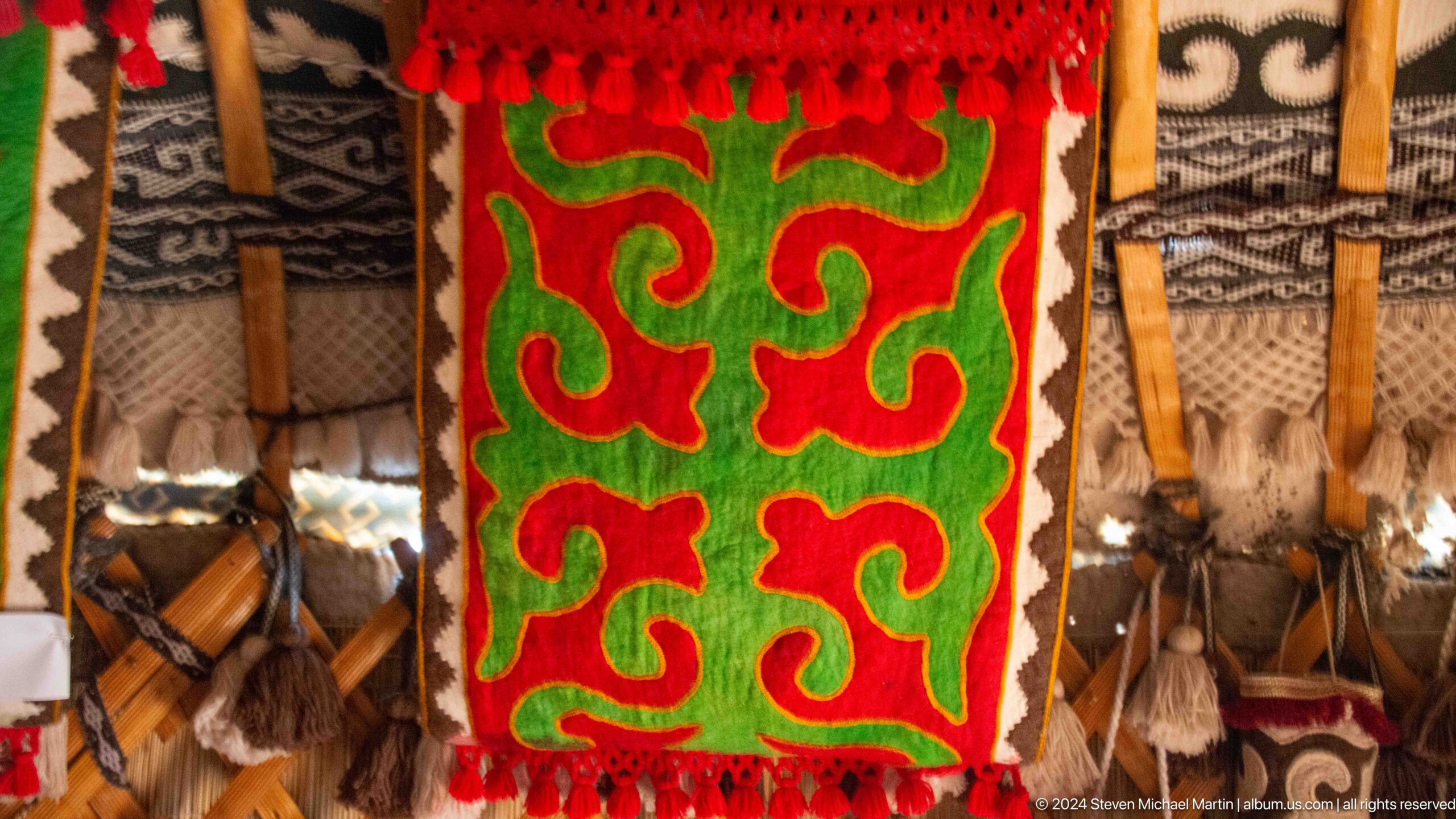
Shyrdak felt textile demonstrates the vivid ornamental language of Kyrgyz textile traditions. Bold red and green scroll motifs form a symmetrical felt design. Bold curvilinear motifs, contrasting felt, embroidery, and repeated symmetrical forms transform practical furnishings into expressive works of domestic decorative art.
Caption
Shyrdak felt textile demonstrates the vivid ornamental language of Kyrgyz textile traditions. Bold red and green scroll motifs form a symmetrical felt design. Bold curvilinear motifs, contrasting felt, embroidery, and repeated symmetrical forms transform practical furnishings into expressive works of domestic decorative art.
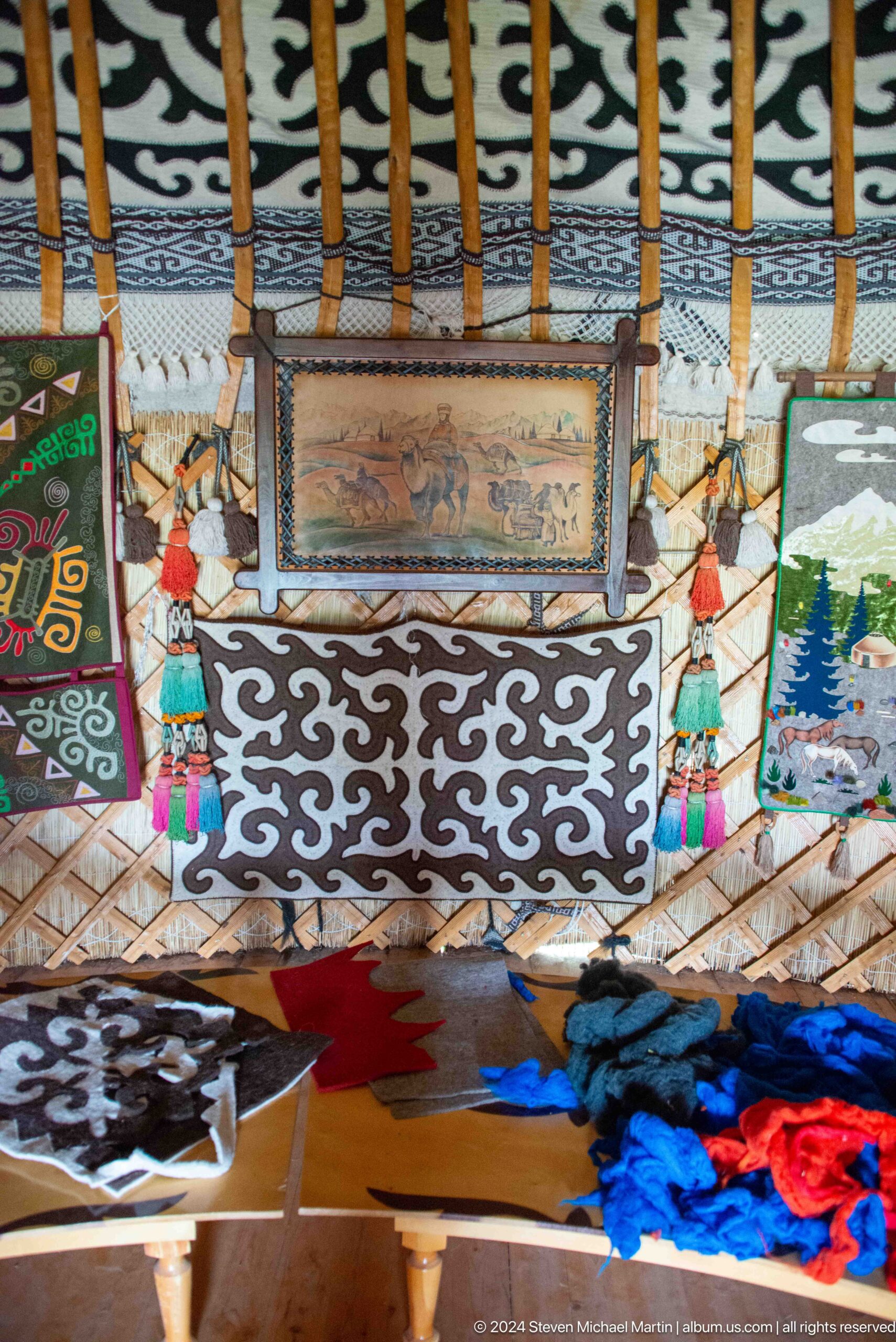
Kyrgyz textile demonstrates the vivid ornamental language of Kyrgyz textile traditions. A black-and-white felt panel with scrolling ornament covers a chest or low furnishing. Bold curvilinear motifs, contrasting felt, embroidery, and repeated symmetrical forms transform practical furnishings into expressive works of domestic decorative art.
Caption
Kyrgyz textile demonstrates the vivid ornamental language of Kyrgyz textile traditions. A black-and-white felt panel with scrolling ornament covers a chest or low furnishing. Bold curvilinear motifs, contrasting felt, embroidery, and repeated symmetrical forms transform practical furnishings into expressive works of domestic decorative art.

Kyrgyz textile art demonstrates the vivid ornamental language of Kyrgyz textile traditions. A textile depicts mountains, trees, water, and yurts in a stylized landscape. Bold curvilinear motifs, contrasting felt, embroidery, and repeated symmetrical forms transform practical furnishings into expressive works of domestic decorative art.
Caption
Kyrgyz textile art demonstrates the vivid ornamental language of Kyrgyz textile traditions. A textile depicts mountains, trees, water, and yurts in a stylized landscape. Bold curvilinear motifs, contrasting felt, embroidery, and repeated symmetrical forms transform practical furnishings into expressive works of domestic decorative art.
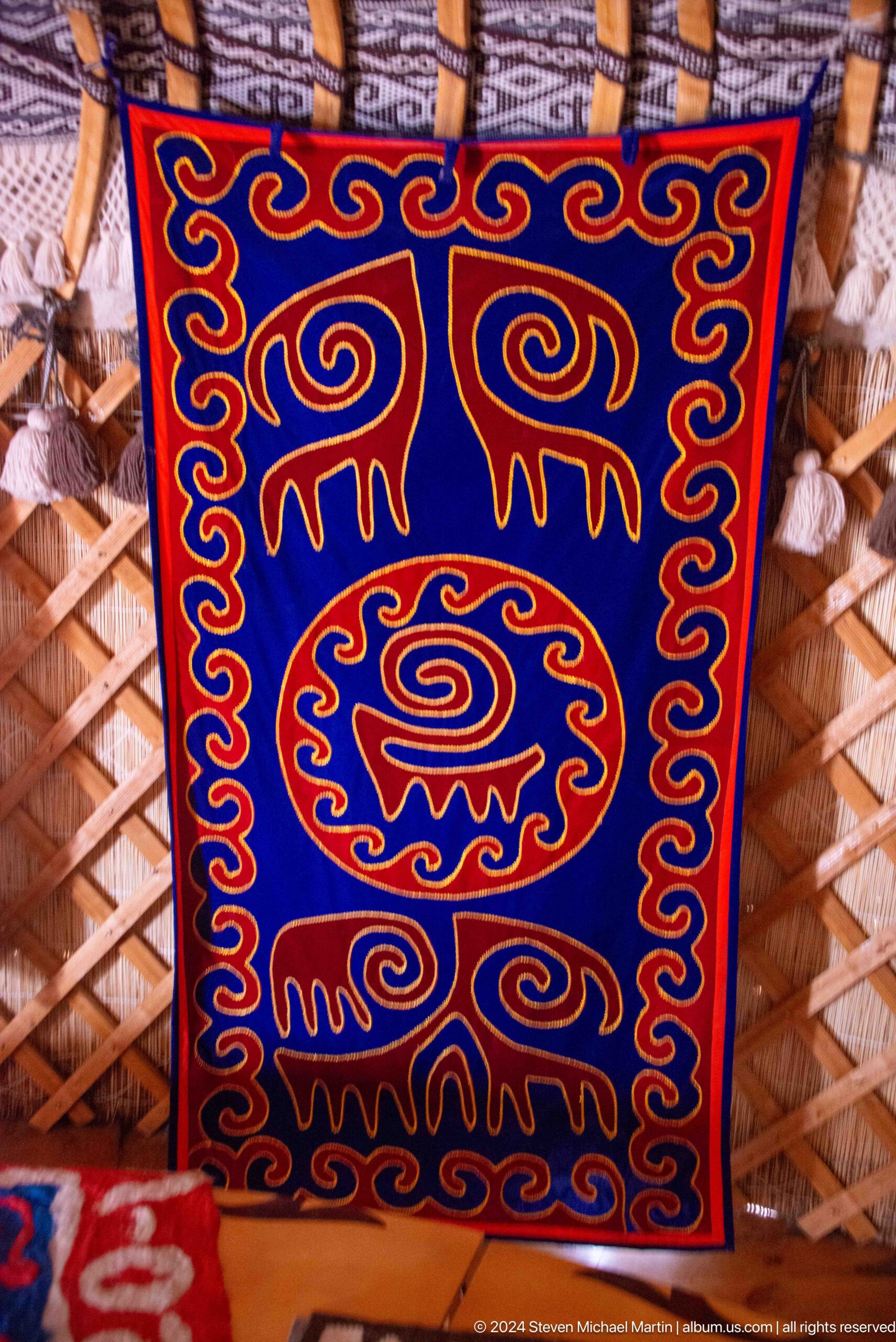
Kyrgyz textile art demonstrates the vivid ornamental language of Kyrgyz textile traditions. A vivid square panel contains a central spiral animal-like motif within a red border. Bold curvilinear motifs, contrasting felt, embroidery, and repeated symmetrical forms transform practical furnishings into expressive works of domestic decorative art.
Caption
Kyrgyz textile art demonstrates the vivid ornamental language of Kyrgyz textile traditions. A vivid square panel contains a central spiral animal-like motif within a red border. Bold curvilinear motifs, contrasting felt, embroidery, and repeated symmetrical forms transform practical furnishings into expressive works of domestic decorative art.
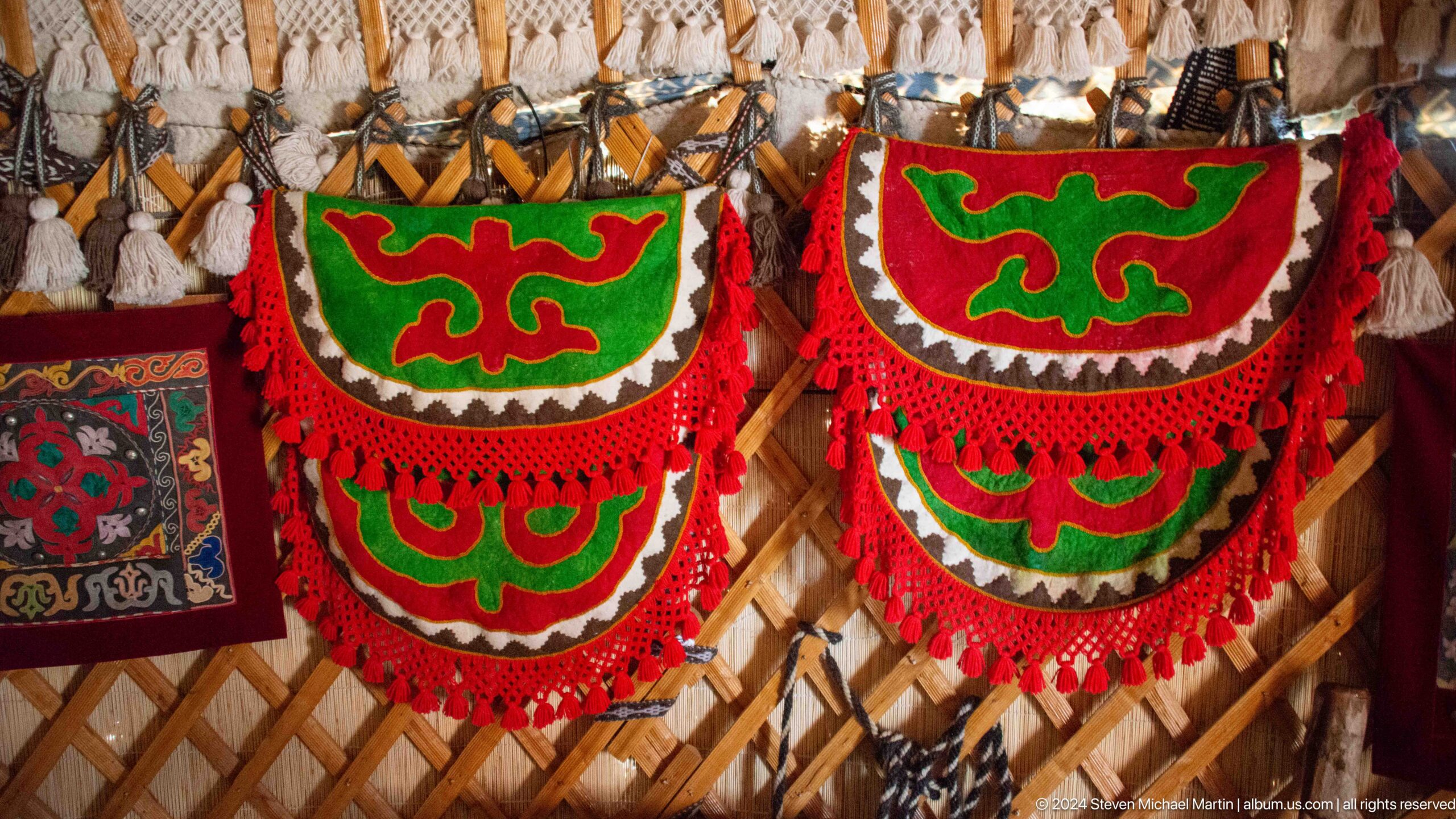
Kyrgyz decorative textiles demonstrates the vivid ornamental language of Kyrgyz textile traditions. Two matching felt panels display vivid red, green, and white curvilinear ornament. Bold curvilinear motifs, contrasting felt, embroidery, and repeated symmetrical forms transform practical furnishings into expressive works of domestic decorative art.
Caption
Kyrgyz decorative textiles demonstrates the vivid ornamental language of Kyrgyz textile traditions. Two matching felt panels display vivid red, green, and white curvilinear ornament. Bold curvilinear motifs, contrasting felt, embroidery, and repeated symmetrical forms transform practical furnishings into expressive works of domestic decorative art.

Kyrgyz cushions demonstrates the vivid ornamental language of Kyrgyz textile traditions. Dark square cushions display colorful floral and geometric embroidery. Bold curvilinear motifs, contrasting felt, embroidery, and repeated symmetrical forms transform practical furnishings into expressive works of domestic decorative art.
Caption
Kyrgyz cushions demonstrates the vivid ornamental language of Kyrgyz textile traditions. Dark square cushions display colorful floral and geometric embroidery. Bold curvilinear motifs, contrasting felt, embroidery, and repeated symmetrical forms transform practical furnishings into expressive works of domestic decorative art.
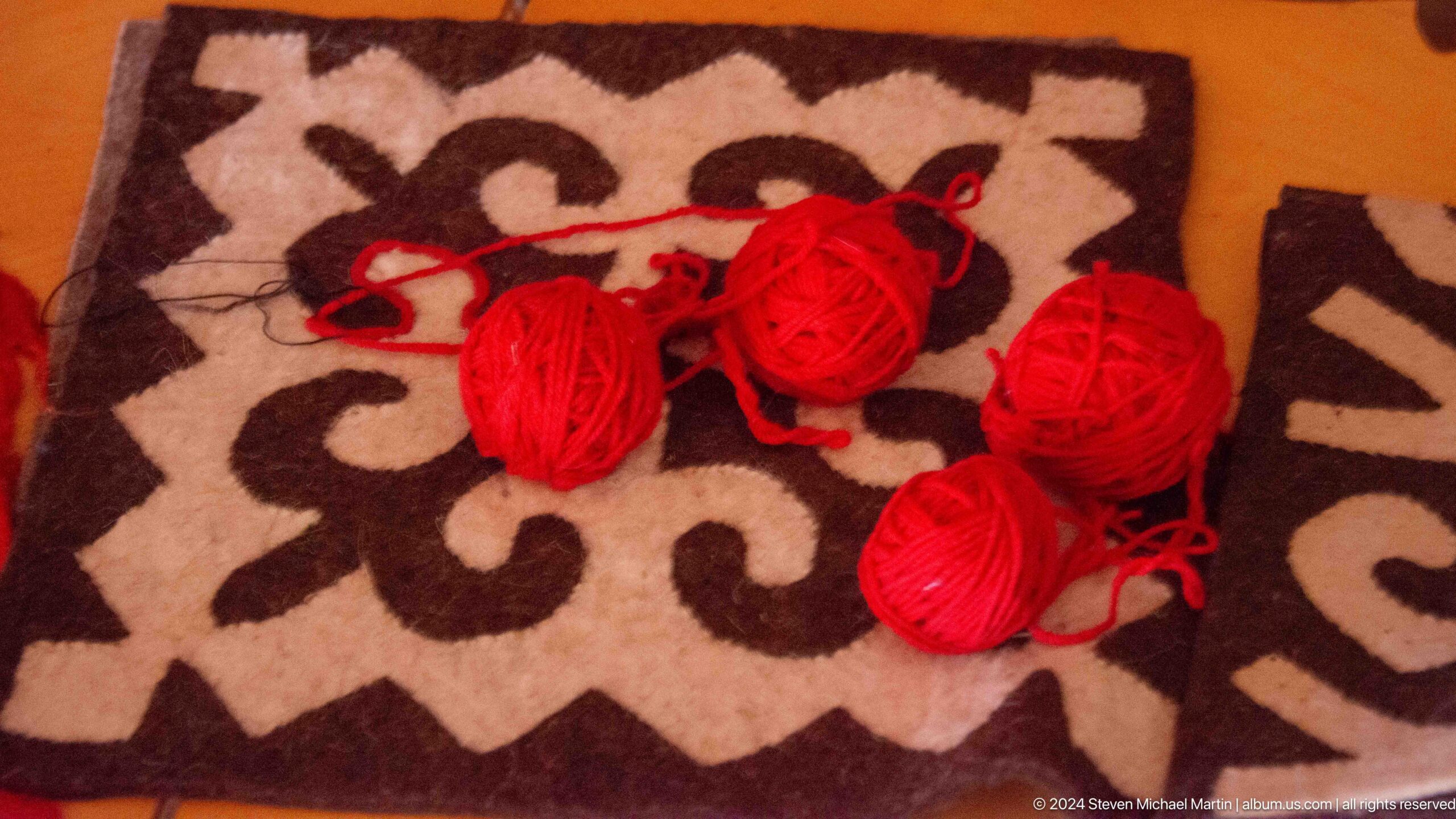
Felt-making materials demonstrates the vivid ornamental language of Kyrgyz textile traditions. Balls of red yarn lie on a patterned felt surface during textile work. Bold curvilinear motifs, contrasting felt, embroidery, and repeated symmetrical forms transform practical furnishings into expressive works of domestic decorative art.
Caption
Felt-making materials demonstrates the vivid ornamental language of Kyrgyz textile traditions. Balls of red yarn lie on a patterned felt surface during textile work. Bold curvilinear motifs, contrasting felt, embroidery, and repeated symmetrical forms transform practical furnishings into expressive works of domestic decorative art.
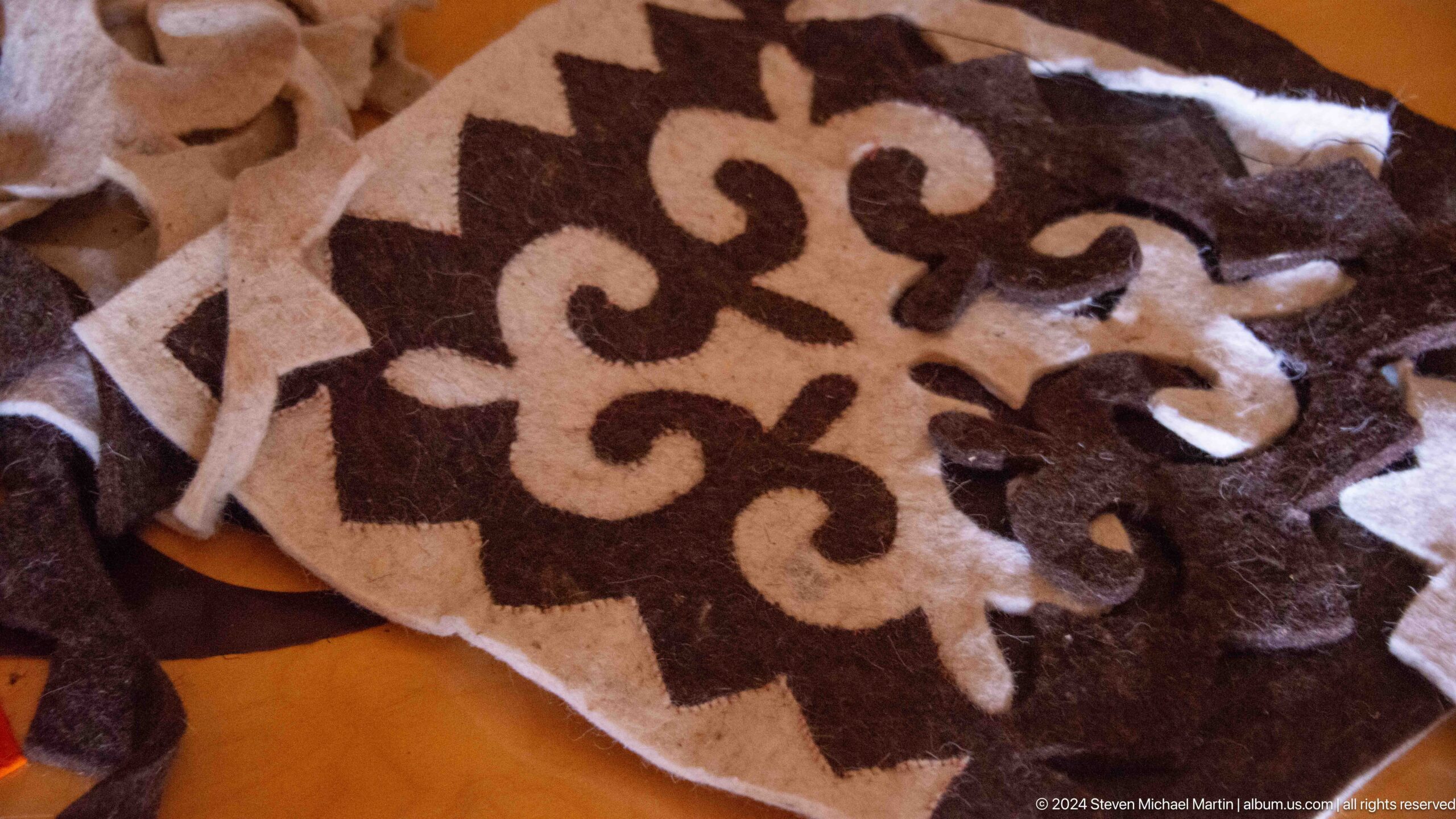
Shyrdak felt components demonstrates the vivid ornamental language of Kyrgyz textile traditions. Cut felt sections with mirrored scrolling motifs are arranged for assembly. Bold curvilinear motifs, contrasting felt, embroidery, and repeated symmetrical forms transform practical furnishings into expressive works of domestic decorative art.
Caption
Shyrdak felt components demonstrates the vivid ornamental language of Kyrgyz textile traditions. Cut felt sections with mirrored scrolling motifs are arranged for assembly. Bold curvilinear motifs, contrasting felt, embroidery, and repeated symmetrical forms transform practical furnishings into expressive works of domestic decorative art.

Kyrgyz yurt interior presents a traditional portable dwelling associated with Kyrgyz pastoral culture. A dark hanging bag with pale radiating ornament is mounted against the lattice wall. Its circular lattice frame, felt covering, and richly decorated interior demonstrate how architecture, textiles, and household organization are combined in a mobile domestic space.
Caption
Kyrgyz yurt interior presents a traditional portable dwelling associated with Kyrgyz pastoral culture. A dark hanging bag with pale radiating ornament is mounted against the lattice wall. Its circular lattice frame, felt covering, and richly decorated interior demonstrate how architecture, textiles, and household organization are combined in a mobile domestic space.
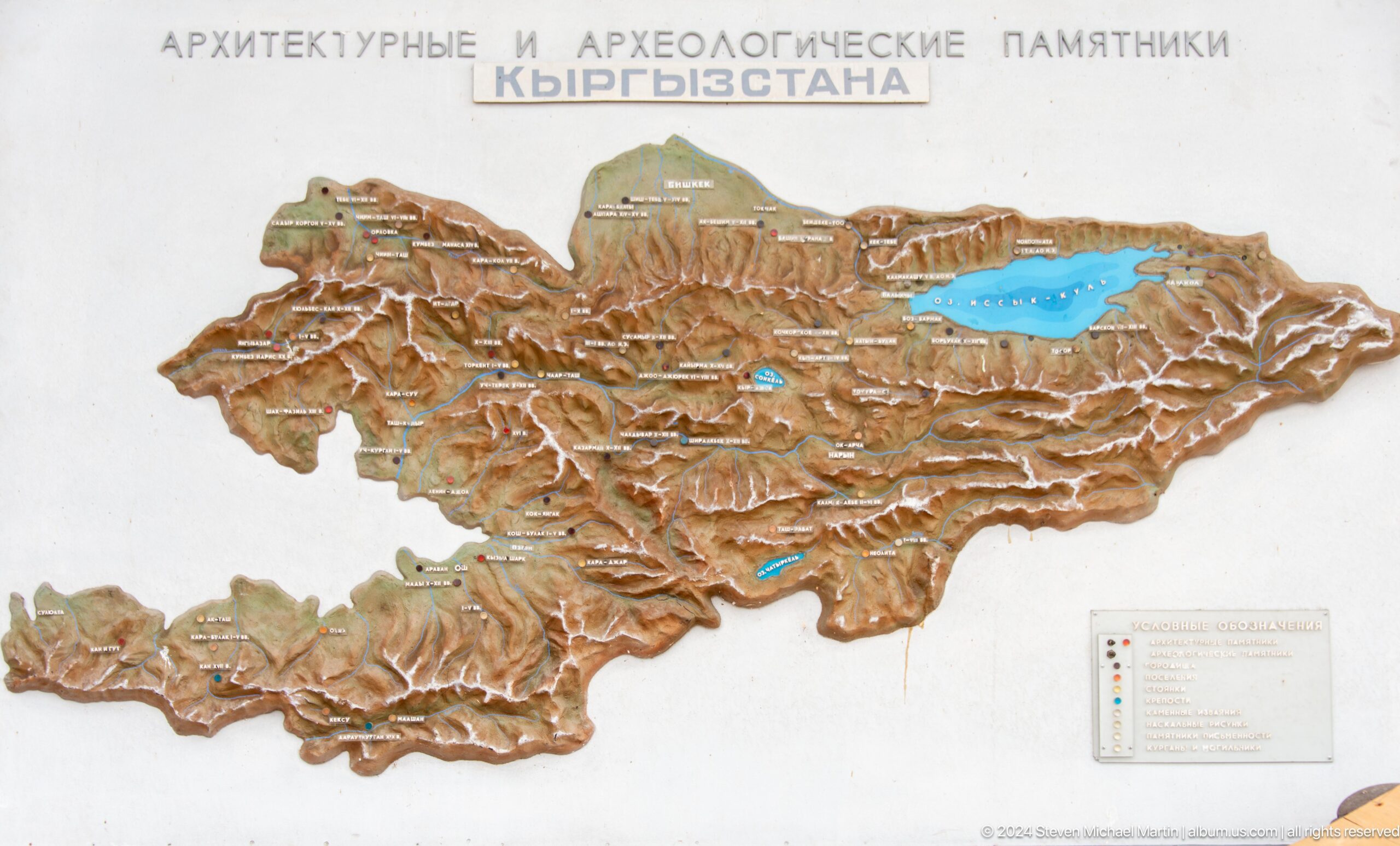
Museum relief map helps visitors interpret the archaeological and historical significance of Burana and ancient Balasagun. A raised map titled in Russian presents archaeological monuments of Kyrgyzstan. The display connects surviving monuments and artifacts with excavation history, regional chronology, and the site's role within Central Asian trade and cultural exchange.
Caption
Museum relief map helps visitors interpret the archaeological and historical significance of Burana and ancient Balasagun. A raised map titled in Russian presents archaeological monuments of Kyrgyzstan. The display connects surviving monuments and artifacts with excavation history, regional chronology, and the site's role within Central Asian trade and cultural exchange.
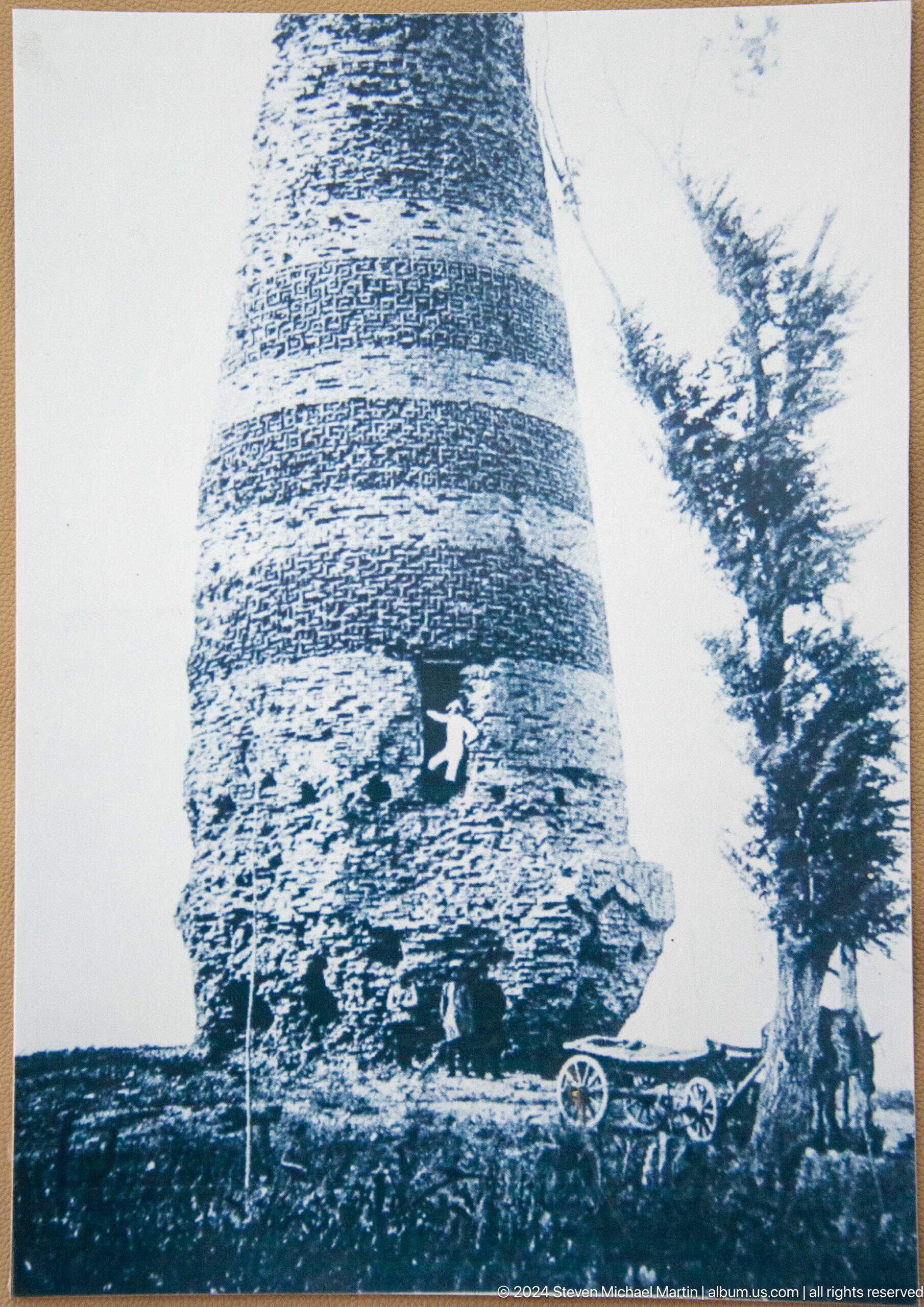
Museum archival photograph stands as the principal surviving monument of medieval Balasagun. A black-and-white historical image shows the tower before modern restoration. The eleventh-century brick minaret reflects the spread of Islamic architecture and urban culture across Central Asia during the Kara-Khanid period.
Caption
Museum archival photograph stands as the principal surviving monument of medieval Balasagun. A black-and-white historical image shows the tower before modern restoration. The eleventh-century brick minaret reflects the spread of Islamic architecture and urban culture across Central Asia during the Kara-Khanid period.

Museum interpretation panel helps visitors interpret the archaeological and historical significance of Burana and ancient Balasagun. Text and archival photographs explain archaeological research at the Burana site. The display connects surviving monuments and artifacts with excavation history, regional chronology, and the site's role within Central Asian trade and cultural exchange.
Caption
Museum interpretation panel helps visitors interpret the archaeological and historical significance of Burana and ancient Balasagun. Text and archival photographs explain archaeological research at the Burana site. The display connects surviving monuments and artifacts with excavation history, regional chronology, and the site's role within Central Asian trade and cultural exchange.
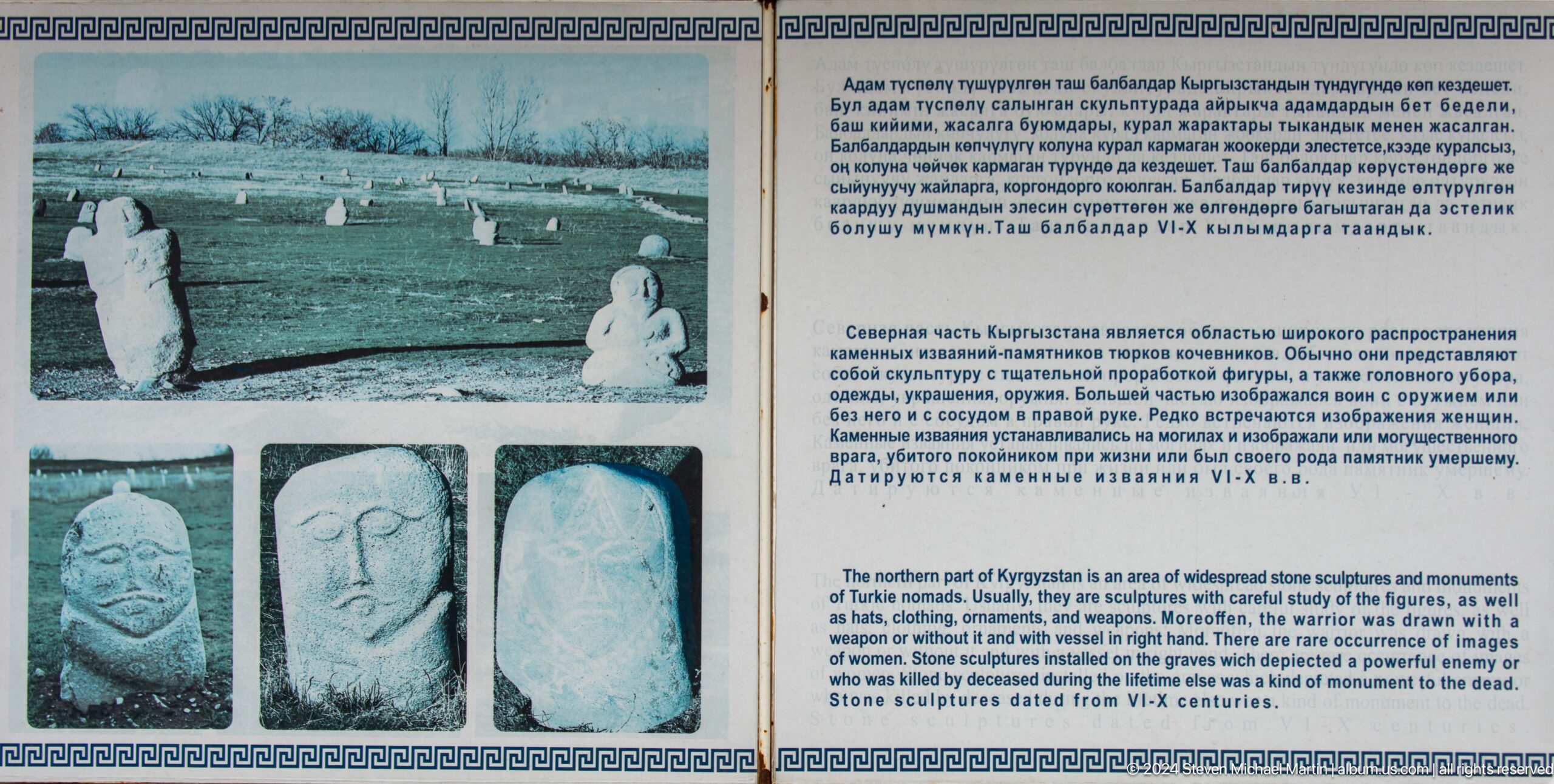
Museum interpretation panel is one of the carved stone figures displayed across the Burana archaeological complex. A bilingual display presents drawings and photographs of carved stone figures. Such balbals are associated with Turkic memorial traditions and help document the diverse cultural landscape that preceded and accompanied the development of medieval Balasagun.
Caption
Museum interpretation panel is one of the carved stone figures displayed across the Burana archaeological complex. A bilingual display presents drawings and photographs of carved stone figures. Such balbals are associated with Turkic memorial traditions and help document the diverse cultural landscape that preceded and accompanied the development of medieval Balasagun.
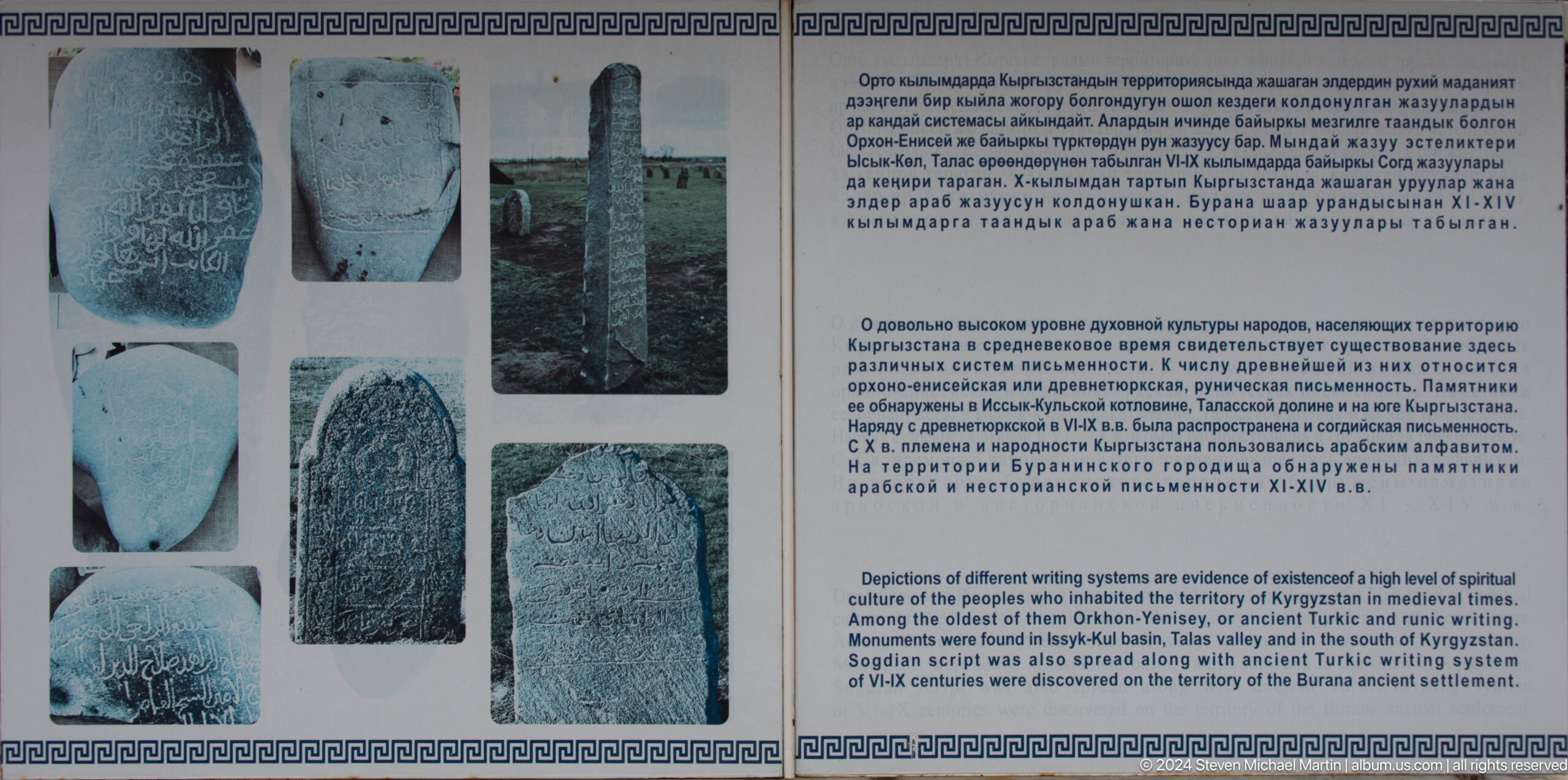
Museum interpretation panel helps visitors interpret the archaeological and historical significance of Burana and ancient Balasagun. Photographs of carved stones accompany explanatory text. The display connects surviving monuments and artifacts with excavation history, regional chronology, and the site's role within Central Asian trade and cultural exchange.
Caption
Museum interpretation panel helps visitors interpret the archaeological and historical significance of Burana and ancient Balasagun. Photographs of carved stones accompany explanatory text. The display connects surviving monuments and artifacts with excavation history, regional chronology, and the site's role within Central Asian trade and cultural exchange.
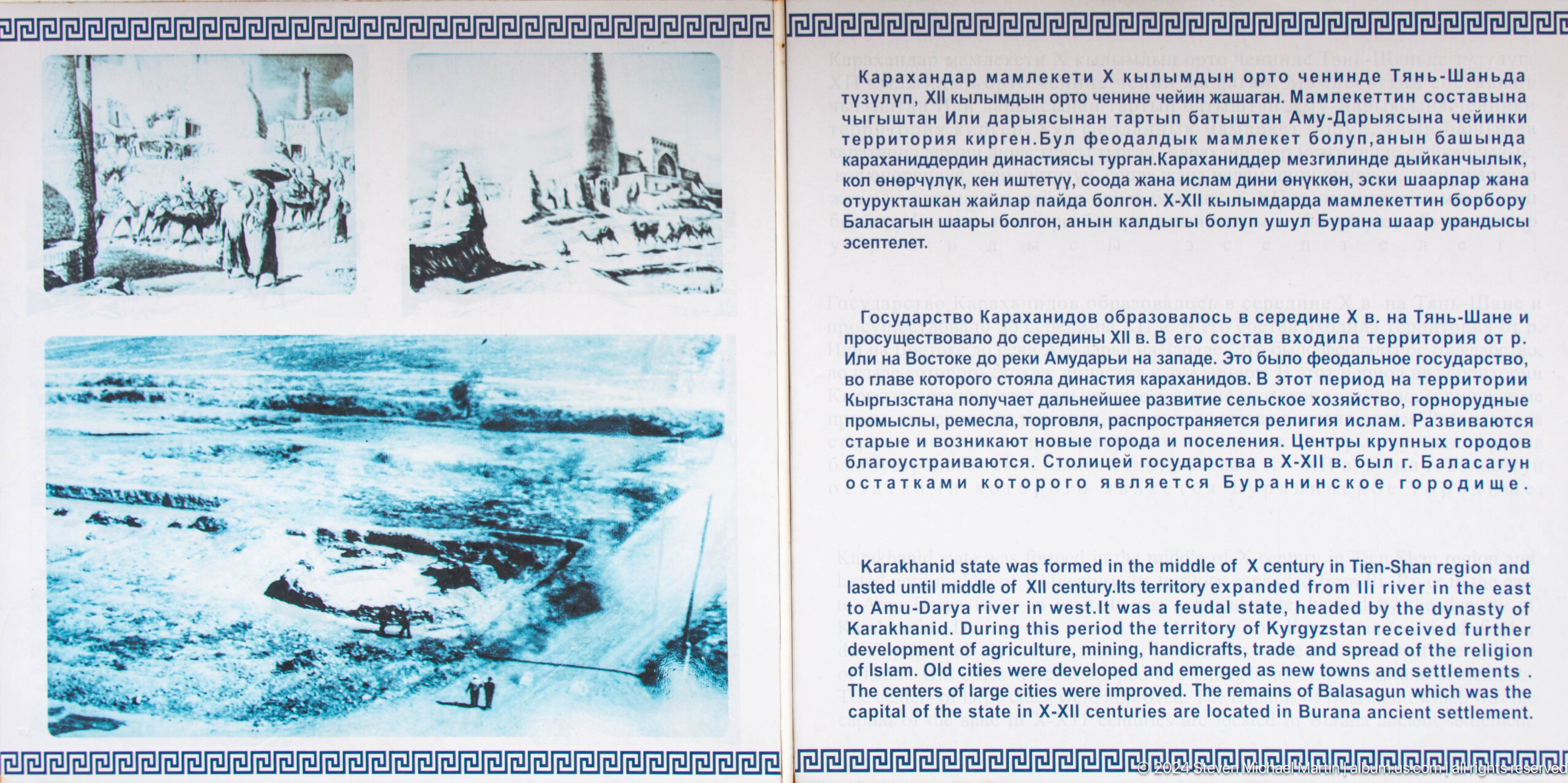
Museum interpretation panel helps visitors interpret the archaeological and historical significance of Burana and ancient Balasagun. Historic excavation imagery and text document research at Balasagun. The display connects surviving monuments and artifacts with excavation history, regional chronology, and the site's role within Central Asian trade and cultural exchange.
Caption
Museum interpretation panel helps visitors interpret the archaeological and historical significance of Burana and ancient Balasagun. Historic excavation imagery and text document research at Balasagun. The display connects surviving monuments and artifacts with excavation history, regional chronology, and the site's role within Central Asian trade and cultural exchange.
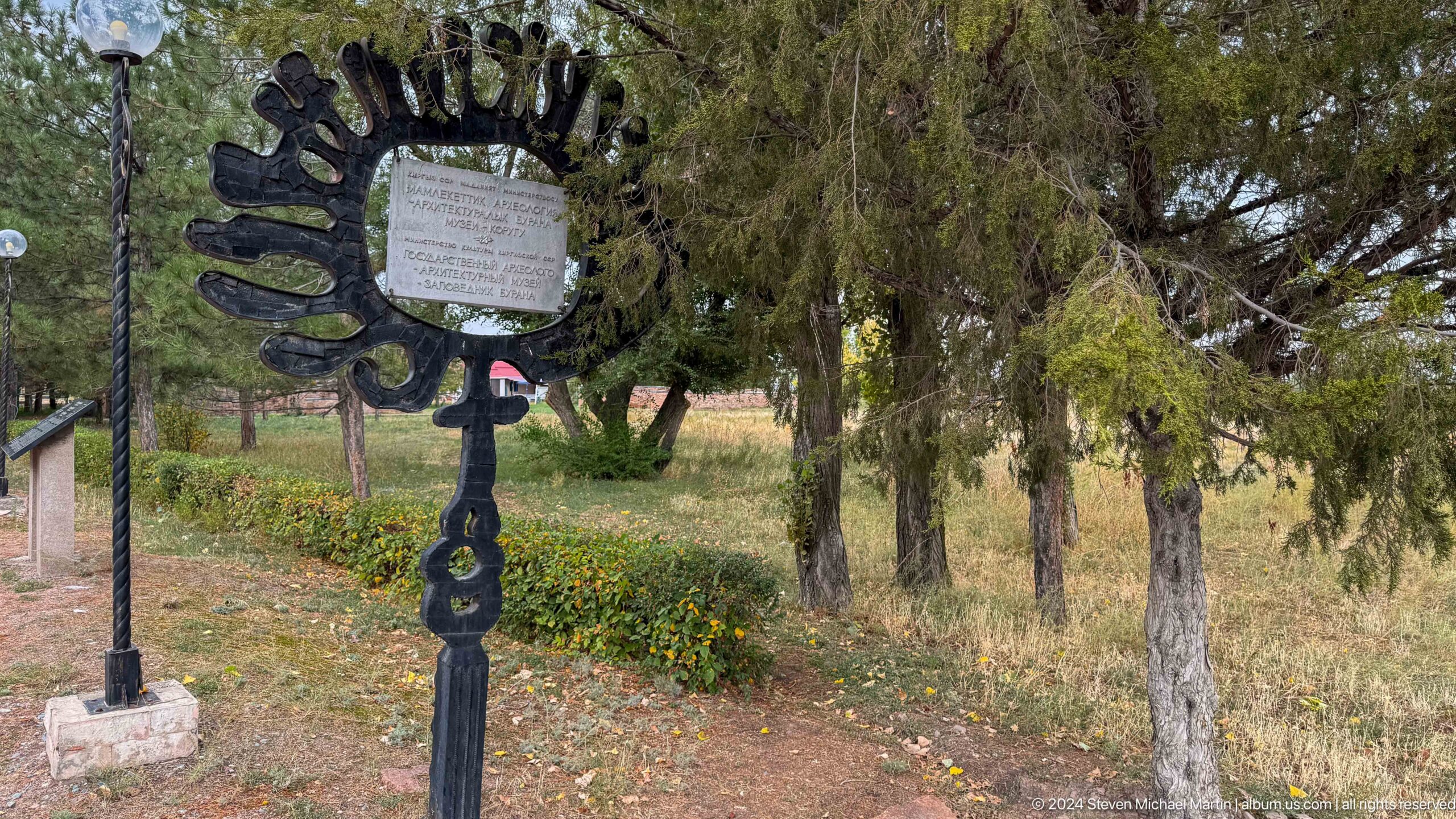
Site interpretation sign helps visitors interpret the archaeological and historical significance of Burana and ancient Balasagun. A metal plaque stands beside a path in the archaeological grounds. The display connects surviving monuments and artifacts with excavation history, regional chronology, and the site's role within Central Asian trade and cultural exchange.
Caption
Site interpretation sign helps visitors interpret the archaeological and historical significance of Burana and ancient Balasagun. A metal plaque stands beside a path in the archaeological grounds. The display connects surviving monuments and artifacts with excavation history, regional chronology, and the site's role within Central Asian trade and cultural exchange.

Turkic balbal and settlement mound is one of the carved stone figures displayed across the Burana archaeological complex. A carved stone figure stands in dry grass before a low mound associated with ancient Balasagun. Such balbals are associated with Turkic memorial traditions and help document the diverse cultural landscape that preceded and accompanied the development of medieval Balasagun.
Caption
Turkic balbal and settlement mound is one of the carved stone figures displayed across the Burana archaeological complex. A carved stone figure stands in dry grass before a low mound associated with ancient Balasagun. Such balbals are associated with Turkic memorial traditions and help document the diverse cultural landscape that preceded and accompanied the development of medieval Balasagun.

Inscribed plaque helps visitors interpret the archaeological and historical significance of Burana and ancient Balasagun. Dense text is engraved across a broad dark stone or metal surface. The display connects surviving monuments and artifacts with excavation history, regional chronology, and the site's role within Central Asian trade and cultural exchange.
Caption
Inscribed plaque helps visitors interpret the archaeological and historical significance of Burana and ancient Balasagun. Dense text is engraved across a broad dark stone or metal surface. The display connects surviving monuments and artifacts with excavation history, regional chronology, and the site's role within Central Asian trade and cultural exchange.
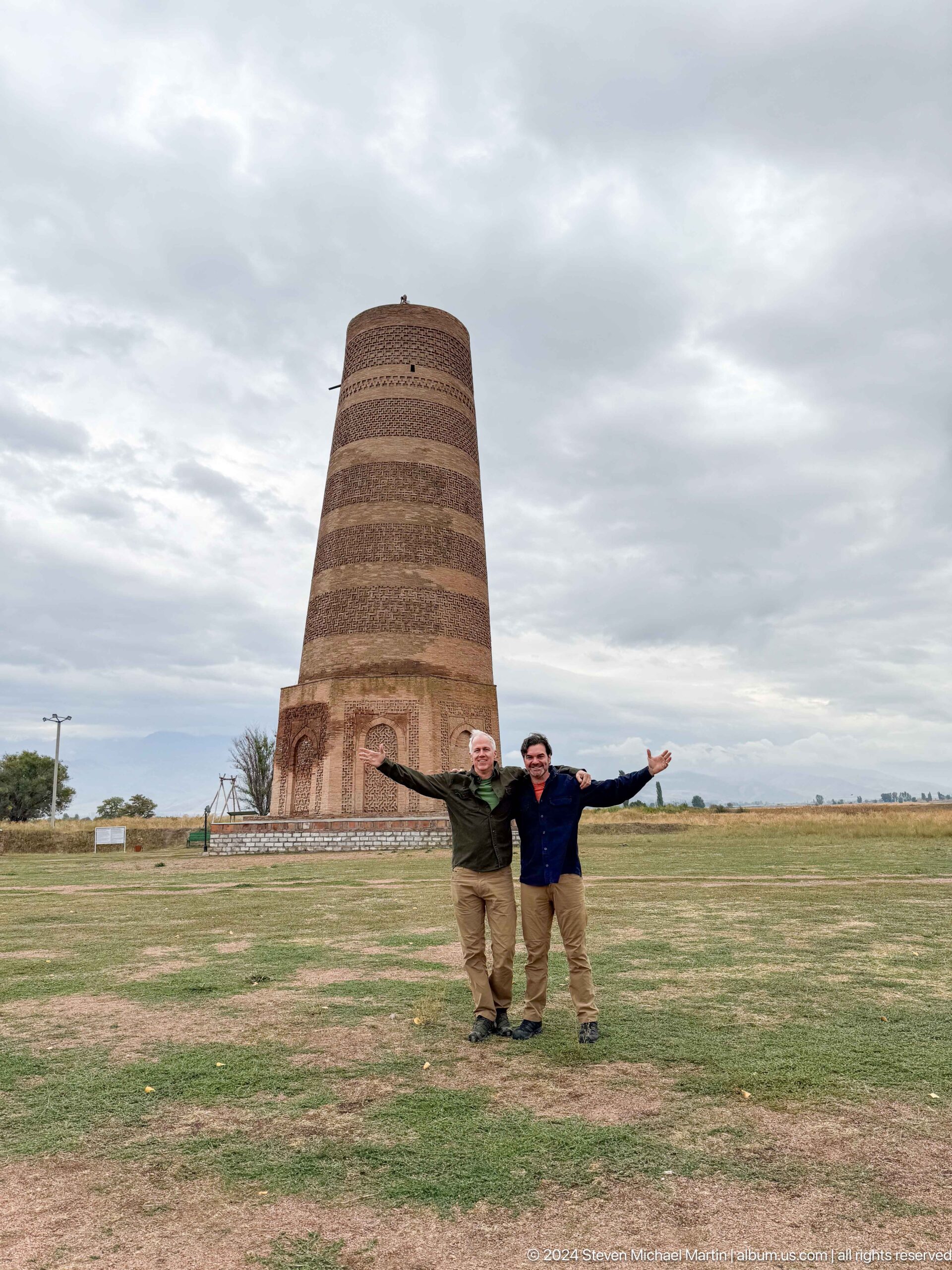
Visitor portrait at Burana Tower stands as the principal surviving monument of medieval Balasagun. A visitor raises both arms in front of the tower. The eleventh-century brick minaret reflects the spread of Islamic architecture and urban culture across Central Asia during the Kara-Khanid period.
Caption
Visitor portrait at Burana Tower stands as the principal surviving monument of medieval Balasagun. A visitor raises both arms in front of the tower. The eleventh-century brick minaret reflects the spread of Islamic architecture and urban culture across Central Asia during the Kara-Khanid period.

Visitor portrait at Burana Tower stands as the principal surviving monument of medieval Balasagun. Two visitors stand in the foreground with the tower rising behind them. The eleventh-century brick minaret reflects the spread of Islamic architecture and urban culture across Central Asia during the Kara-Khanid period.
Caption
Visitor portrait at Burana Tower stands as the principal surviving monument of medieval Balasagun. Two visitors stand in the foreground with the tower rising behind them. The eleventh-century brick minaret reflects the spread of Islamic architecture and urban culture across Central Asia during the Kara-Khanid period.
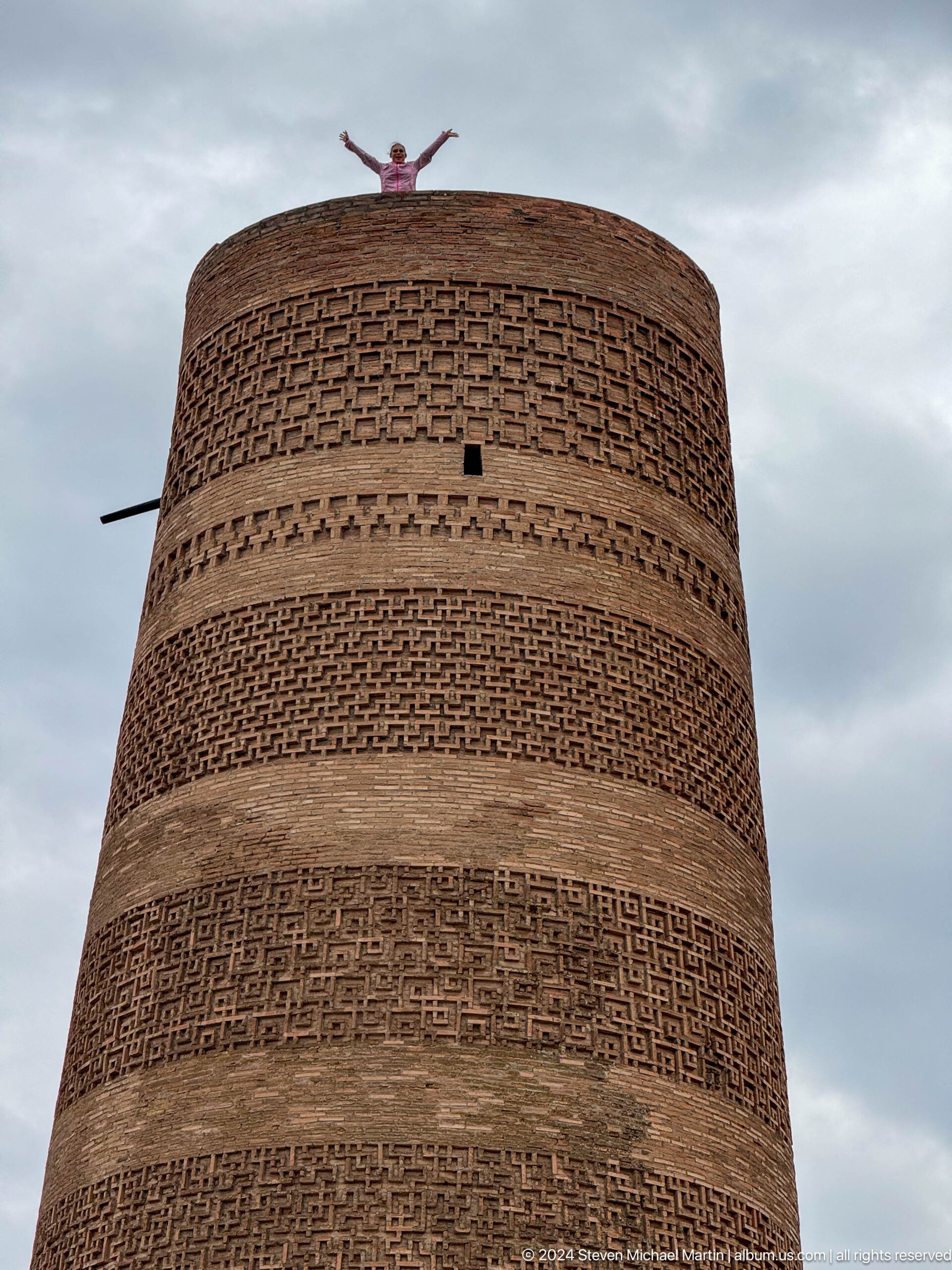
Burana Tower shaft highlights the sophisticated masonry of the Kara-Khanid minaret. Alternating plain and patterned brick bands rise toward the top of the minaret. Alternating textures, recessed arches, and geometric brick patterns gave visual richness to a structure built largely from fired brick and connected with the medieval Silk Road city of Balasagun.
Caption
Burana Tower shaft highlights the sophisticated masonry of the Kara-Khanid minaret. Alternating plain and patterned brick bands rise toward the top of the minaret. Alternating textures, recessed arches, and geometric brick patterns gave visual richness to a structure built largely from fired brick and connected with the medieval Silk Road city of Balasagun.
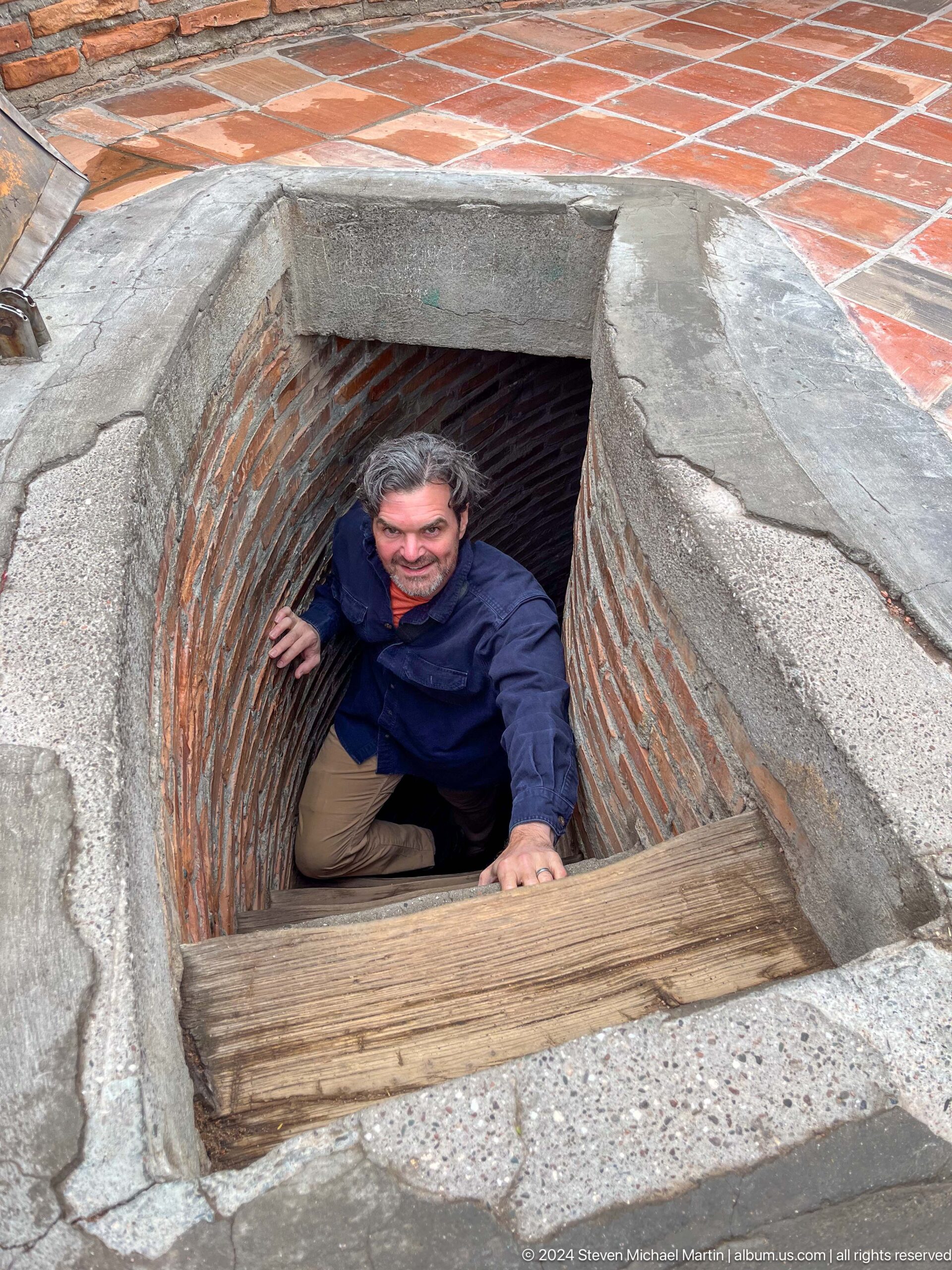
Visitor inside Burana Tower reveals the confined circulation system within the monument. A visitor climbs through a narrow brick opening at the top of the stair passage. The narrow brick passage illustrates how access to the upper levels was fitted inside the tapering eleventh-century minaret, one of the principal surviving structures of the medieval city of Balasagun.
Caption
Visitor inside Burana Tower reveals the confined circulation system within the monument. A visitor climbs through a narrow brick opening at the top of the stair passage. The narrow brick passage illustrates how access to the upper levels was fitted inside the tapering eleventh-century minaret, one of the principal surviving structures of the medieval city of Balasagun.
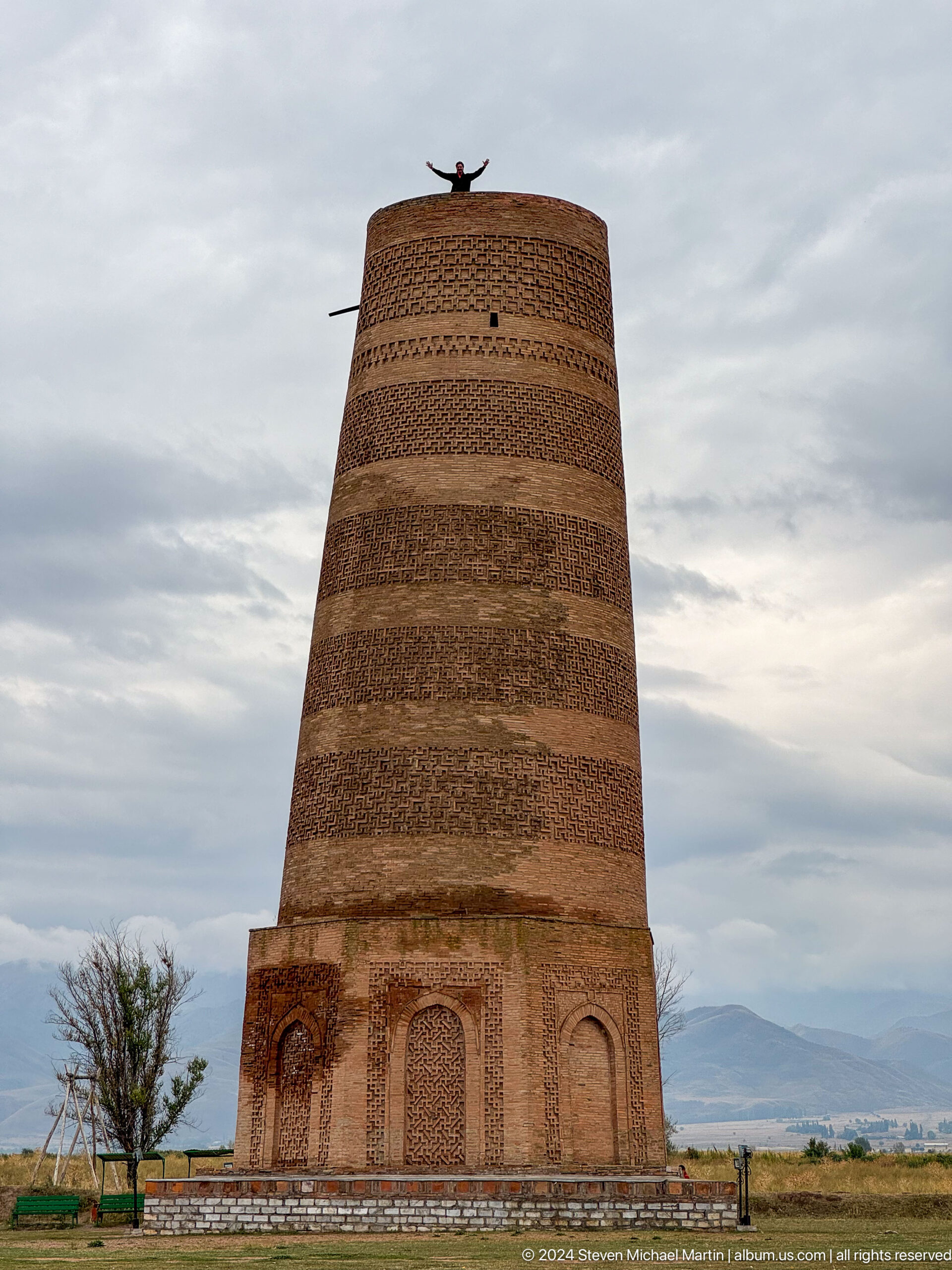
Burana Tower shaft highlights the sophisticated masonry of the Kara-Khanid minaret. The tapering cylindrical shaft fills the frame beneath a gray sky. Alternating textures, recessed arches, and geometric brick patterns gave visual richness to a structure built largely from fired brick and connected with the medieval Silk Road city of Balasagun.
Caption
Burana Tower shaft highlights the sophisticated masonry of the Kara-Khanid minaret. The tapering cylindrical shaft fills the frame beneath a gray sky. Alternating textures, recessed arches, and geometric brick patterns gave visual richness to a structure built largely from fired brick and connected with the medieval Silk Road city of Balasagun.
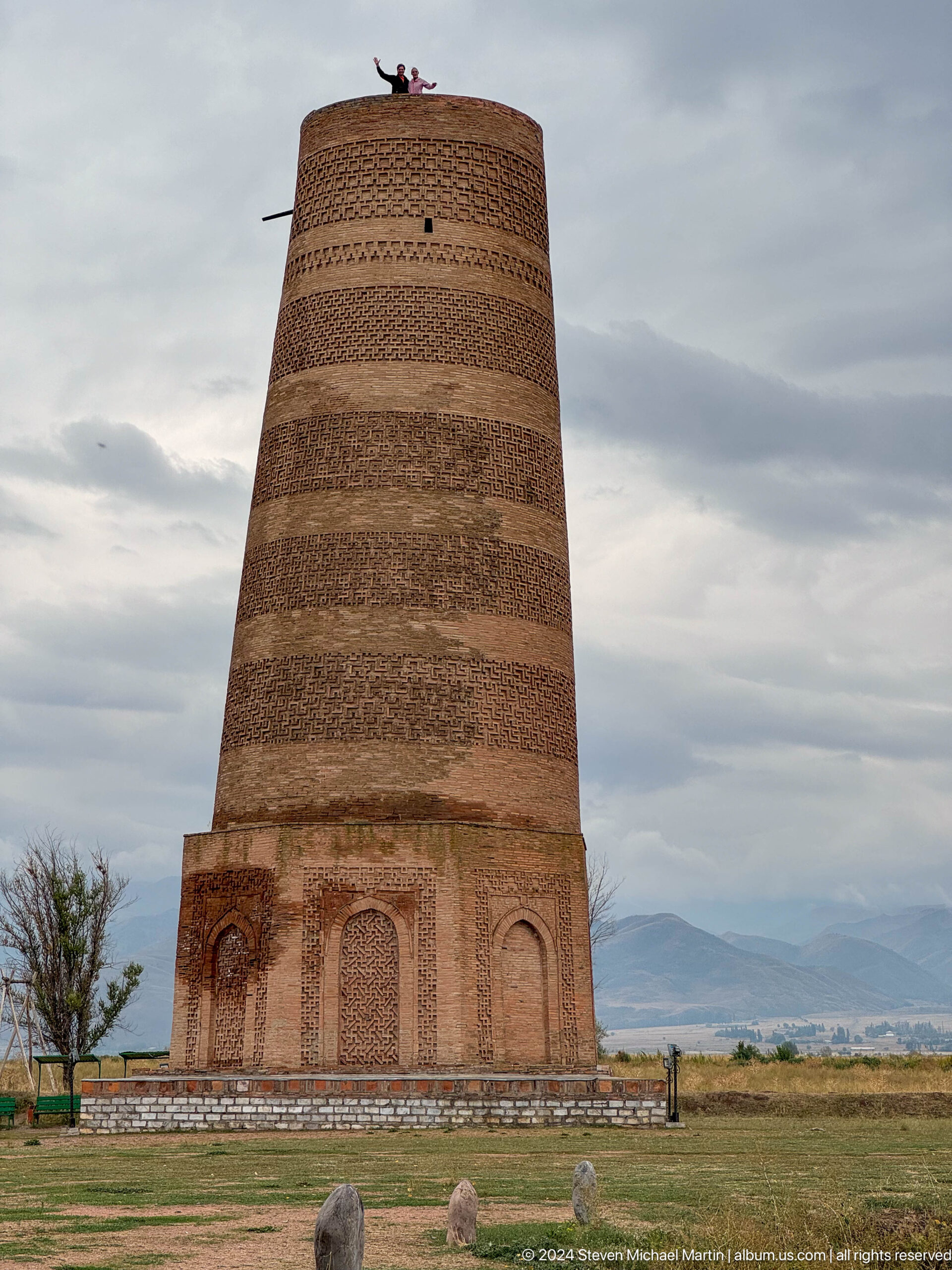
Burana Tower highlights the sophisticated masonry of the Kara-Khanid minaret. The brick minaret is framed vertically from its decorated base into the patterned shaft. Alternating textures, recessed arches, and geometric brick patterns gave visual richness to a structure built largely from fired brick and connected with the medieval Silk Road city of Balasagun.
Caption
Burana Tower highlights the sophisticated masonry of the Kara-Khanid minaret. The brick minaret is framed vertically from its decorated base into the patterned shaft. Alternating textures, recessed arches, and geometric brick patterns gave visual richness to a structure built largely from fired brick and connected with the medieval Silk Road city of Balasagun.
Field Guide
📍 Overview
Burana Tower is one of the most important surviving architectural monuments of the Silk Road in present-day Kyrgyzstan. The tower is all that remains of the ancient city of Balasagun, once a thriving cultural and commercial center along the caravan routes connecting China, Persia, and Central Asia. Today, the tower stands in an open landscape that reflects the historic movement of traders across steppe and mountain environments.
🏛 Historical Significance
Constructed in the 10th and 11th centuries during the Karakhanid period, Burana Tower functioned as a minaret associated with a once larger religious complex. The city of Balasagun was an important political and intellectual center, known for scholarship and literary development in the early Islamic era of Central Asia. Its location along the Silk Road supported cultural exchange between Turkic, Persian, and Islamic societies.
🧱 Architectural Features
The tower is constructed of fired brick arranged in decorative geometric patterns typical of early Islamic architecture in Central Asia. Originally significantly taller, the structure was partially reduced in height due to earthquakes over time. The cylindrical form and minimal exterior ornamentation reflect early regional interpretations of Islamic architectural traditions.
Surrounding the site are stone grave markers known as balbals, carved figures associated with earlier Turkic cultural traditions. These elements illustrate the transition from pre-Islamic belief systems to Islamic cultural influence along Silk Road routes.
🌍 Cultural Importance
Burana Tower reflects the layered cultural history of Central Asia, where nomadic traditions interacted with urban Islamic civilization. The presence of both balbal carvings and Islamic architectural elements demonstrates the blending of belief systems and artistic traditions facilitated by Silk Road exchange.
🧭 Why It Matters on the Silk Road
The site illustrates the geographic reach of Silk Road cultural exchange beyond major urban centers such as Samarkand and Bukhara. Burana Tower provides insight into the spread of religion, architecture, and political influence across Central Asia’s steppe landscapes. It highlights the importance of intermediary cities in maintaining long-distance trade networks.
⭐ Highlights
- Remains of the Silk Road city of Balasagun
- Early Islamic minaret architecture in Central Asia
- Distinctive decorative brick patterns
- Balbal stone carvings reflecting earlier Turkic traditions
- Important transition site between nomadic and urban cultures
📷 Photography Notes
- Wide landscape compositions emphasize the tower’s isolated setting
- Low-angle perspectives highlight the cylindrical brick form
- Detail shots capture geometric brick patterning
- Balbal stone figures provide strong foreground subjects
- Morning or late afternoon light enhances texture in brickwork