Okaukuejo – Afternoon – Etosha National Park
During the warm afternoon hours the landscapes around Okaukuejo Camp reveal the rhythms of wildlife activity in Etosha National Park. Animals move between shaded areas and nearby waterholes as the heat of the day gradually begins to subside.
Elephants, giraffes, and various antelope species often appear along the roads and open plains, while birds gather around small pools of water scattered across the savanna. The changing light of the late afternoon creates dramatic views across the flat landscapes surrounding the Etosha Pan.
Afternoon game drives offer excellent opportunities to observe wildlife before the cooler evening hours bring increased animal activity.
Photos:
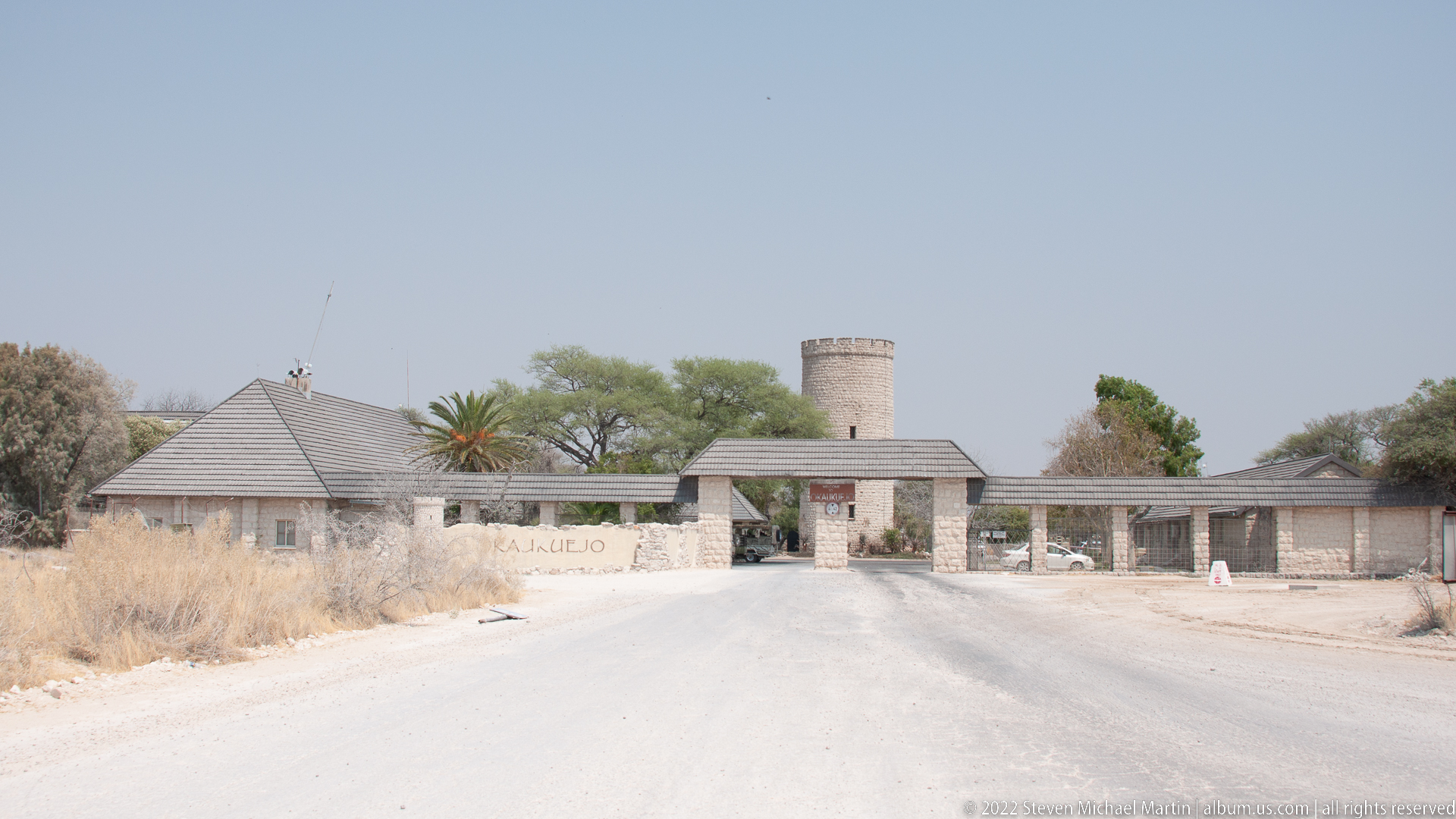
The entrance to Okaukuejo rises from the dry Etosha landscape, its low stone buildings, tiled roofs, and cylindrical tower aligned across the approach road. Pale grasses and scattered trees frame the gateway, establishing the developed camp setting before the wildlife views at the nearby waterhole.
Caption
The entrance to Okaukuejo rises from the dry Etosha landscape, its low stone buildings, tiled roofs, and cylindrical tower aligned across the approach road. Pale grasses and scattered trees frame the gateway, establishing the developed camp setting before the wildlife views at the nearby waterhole.

African bush elephants occupy several sides of Okaukuejo waterhole, with adults and younger animals drinking or approaching across the pale rocky basin. A lone tree marks the center of the broad scene, giving scale to the herd and showing how widely the elephants spread around the limited open water.
Caption
African bush elephants occupy several sides of Okaukuejo waterhole, with adults and younger animals drinking or approaching across the pale rocky basin. A lone tree marks the center of the broad scene, giving scale to the herd and showing how widely the elephants spread around the limited open water.

Springbok spread across the stony flats around Okaukuejo waterhole, dwarfed by a tall, leafless tree that anchors the open composition. The animals are dispersed rather than tightly clustered, revealing how the water source, exposed limestone ground, and sparse woody vegetation structure this dry-season wildlife gathering place.
Caption
Springbok spread across the stony flats around Okaukuejo waterhole, dwarfed by a tall, leafless tree that anchors the open composition. The animals are dispersed rather than tightly clustered, revealing how the water source, exposed limestone ground, and sparse woody vegetation structure this dry-season wildlife gathering place.

A dense springbok herd fills the near shore while plains zebras and several darker wildebeest occupy the water and far bank. The wide view records the waterhole as a multi-species congregation point, with animals distributed from the rocky foreground to the open Etosha plain beyond.
Caption
A dense springbok herd fills the near shore while plains zebras and several darker wildebeest occupy the water and far bank. The wide view records the waterhole as a multi-species congregation point, with animals distributed from the rocky foreground to the open Etosha plain beyond.

Three African bush elephants stand shoulder to shoulder in the shallows while springbok crowd the foreground and opposite bank. The juxtaposition of the massive elephants with the much smaller antelope conveys the mixed-species use of Okaukuejo waterhole and the competition for access to dependable water during Etosha’s dry season.
Caption
Three African bush elephants stand shoulder to shoulder in the shallows while springbok crowd the foreground and opposite bank. The juxtaposition of the massive elephants with the much smaller antelope conveys the mixed-species use of Okaukuejo waterhole and the competition for access to dependable water during Etosha’s dry season.

A long line of springbok occupies the rocky margin of Okaukuejo waterhole, some lowering their heads toward the water while others stand alert. Their warm tan backs and white flanks form a repeating band across the pale Etosha terrain, emphasizing the density of antelope drawn to the pool in the afternoon.
Caption
A long line of springbok occupies the rocky margin of Okaukuejo waterhole, some lowering their heads toward the water while others stand alert. Their warm tan backs and white flanks form a repeating band across the pale Etosha terrain, emphasizing the density of antelope drawn to the pool in the afternoon.

Springbok cluster along the rocky bank with their slender legs and tan bodies mirrored in the still water below. The closer composition turns the waterhole surface into a prominent element, doubling the antelope forms and emphasizing the calm interval between bouts of drinking and movement.
Caption
Springbok cluster along the rocky bank with their slender legs and tan bodies mirrored in the still water below. The closer composition turns the waterhole surface into a prominent element, doubling the antelope forms and emphasizing the calm interval between bouts of drinking and movement.

Four gemsbok occupy the foreground water, their black-and-white facial masks and spear-like horns clearly visible above the surface. Springbok graze and drink on the far bank, creating a layered species comparison and showing the gemsbok cooling or drinking while partly immersed.
Caption
Four gemsbok occupy the foreground water, their black-and-white facial masks and spear-like horns clearly visible above the surface. Springbok graze and drink on the far bank, creating a layered species comparison and showing the gemsbok cooling or drinking while partly immersed.

Three African bush elephants stand at the water’s edge while springbok pass in the foreground and a steep thatched viewing shelter rises behind the fenced boundary. The frame links wildlife activity to the visitor infrastructure at Okaukuejo, showing how close the waterhole lies to the camp’s observation area.
Caption
Three African bush elephants stand at the water’s edge while springbok pass in the foreground and a steep thatched viewing shelter rises behind the fenced boundary. The frame links wildlife activity to the visitor infrastructure at Okaukuejo, showing how close the waterhole lies to the camp’s observation area.
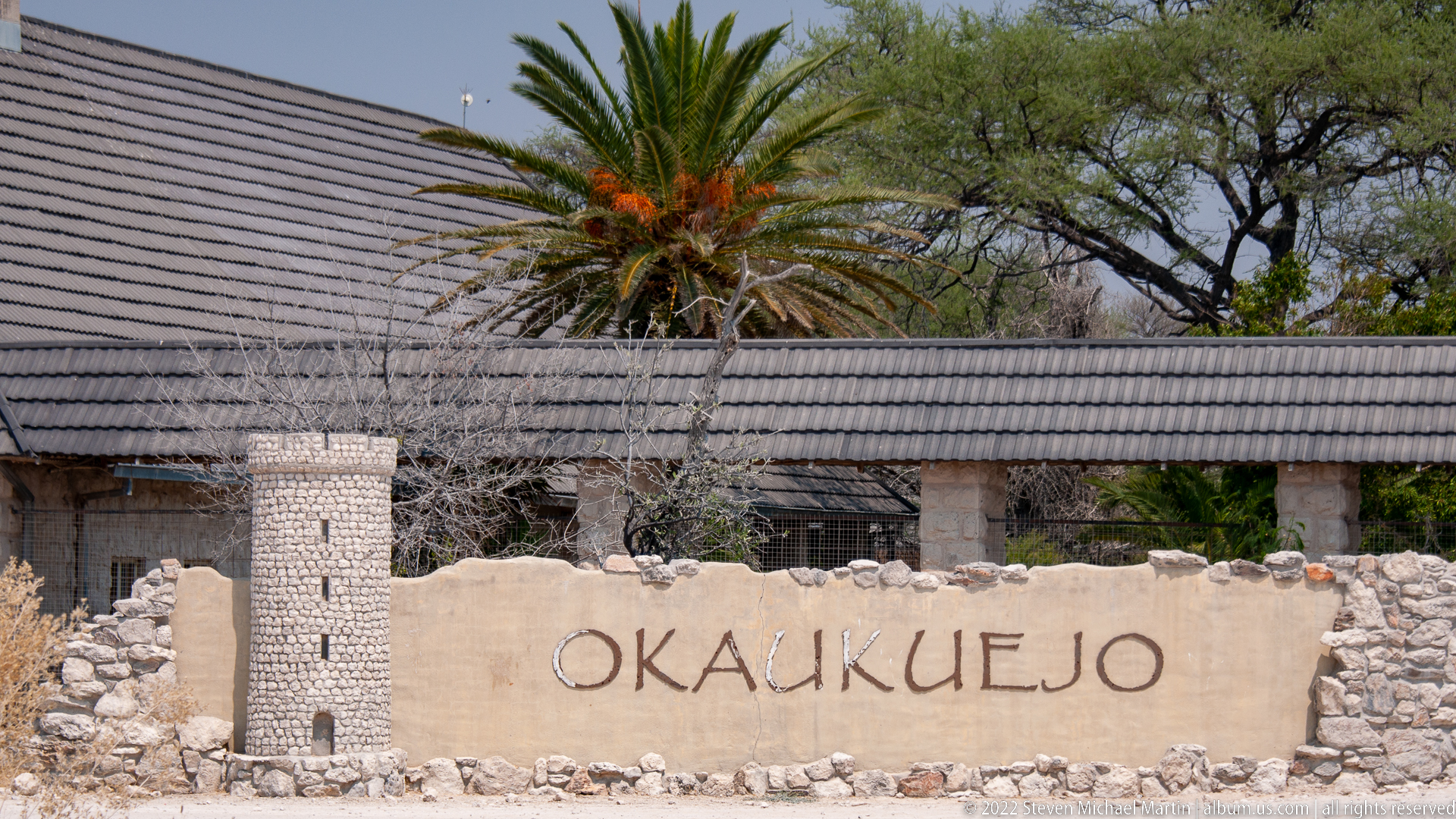
A stone-and-plaster wall spells out “OKAUKUEJO” beside a small round masonry tower, with the camp’s broad tiled roof and a palm rising behind it. The close view isolates the identifying entrance feature and the locally prominent stonework from the wider arrival scene.
Caption
A stone-and-plaster wall spells out “OKAUKUEJO” beside a small round masonry tower, with the camp’s broad tiled roof and a palm rising behind it. The close view isolates the identifying entrance feature and the locally prominent stonework from the wider arrival scene.

African bush elephants gather at the edge of Okaukuejo waterhole beneath a large leafless tree, their gray forms standing out against the pale limestone-strewn ground. The broad view places the small group within the stark dry-season setting, where permanent water concentrates wildlife in an otherwise arid landscape.
Caption
African bush elephants gather at the edge of Okaukuejo waterhole beneath a large leafless tree, their gray forms standing out against the pale limestone-strewn ground. The broad view places the small group within the stark dry-season setting, where permanent water concentrates wildlife in an otherwise arid landscape.
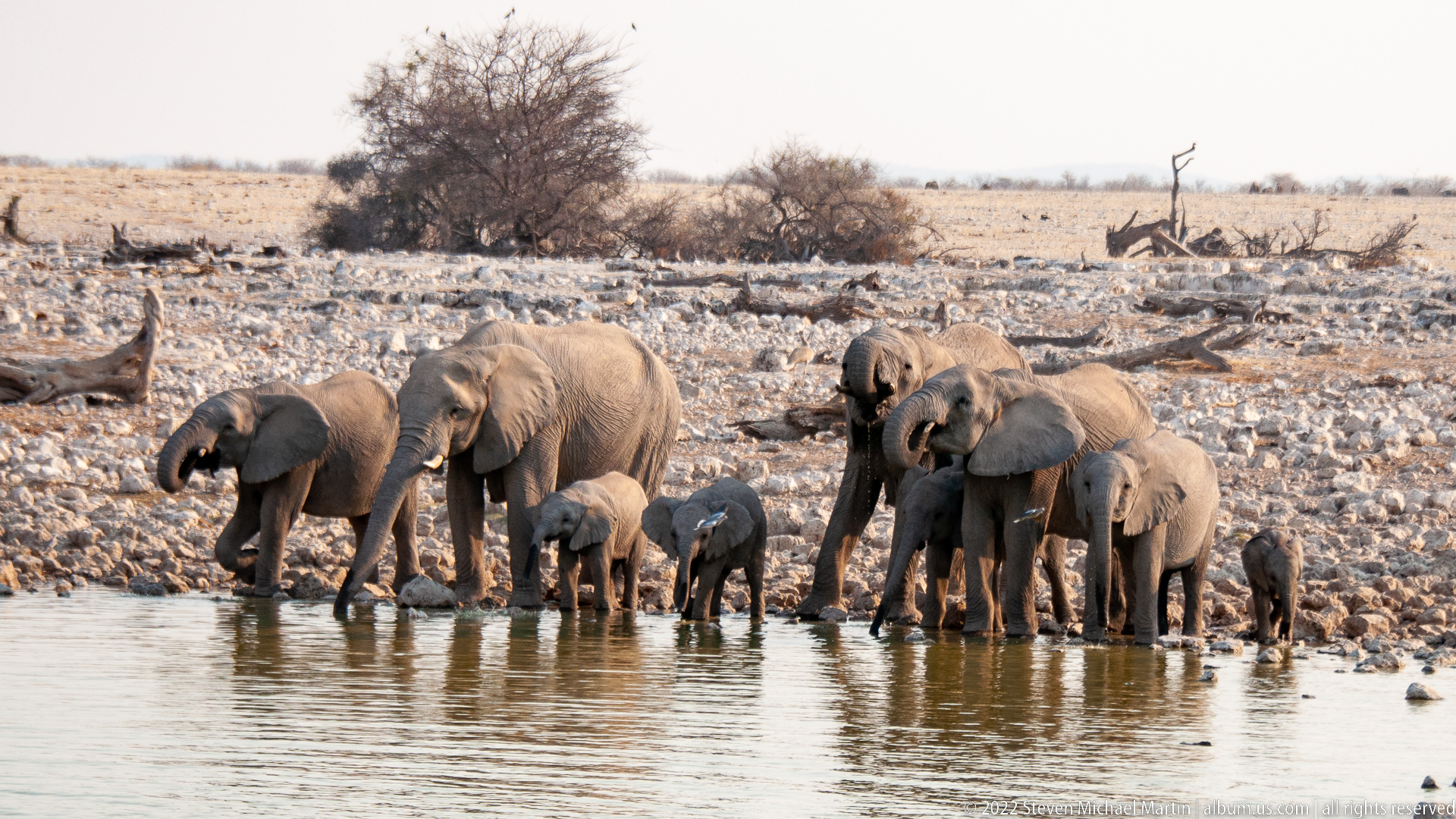
Adults and calves crowd the waterline at Okaukuejo, several lowering their trunks into the pool while young elephants remain protected between larger bodies. The compressed grouping makes the family structure especially legible, with multiple age classes sharing a narrow section of shoreline against the rubble-like limestone background.
Caption
Adults and calves crowd the waterline at Okaukuejo, several lowering their trunks into the pool while young elephants remain protected between larger bodies. The compressed grouping makes the family structure especially legible, with multiple age classes sharing a narrow section of shoreline against the rubble-like limestone background.

A dense elephant group drinks along the far edge of the pool while a single adult in the foreground extends its trunk toward the water among scattered rocks. The separated foreground animal creates depth and contrasts solitary drinking behavior with the tightly packed family groups beyond.
Caption
A dense elephant group drinks along the far edge of the pool while a single adult in the foreground extends its trunk toward the water among scattered rocks. The separated foreground animal creates depth and contrasts solitary drinking behavior with the tightly packed family groups beyond.

Elephants ring much of the visible waterhole, some drinking at the near edge while a larger procession stretches across the far bank. Dry grass, a fallen trunk, and a broad-canopied tree frame the gathering, presenting the herd as part of the wider Etosha waterhole landscape rather than as isolated portraits.
Caption
Elephants ring much of the visible waterhole, some drinking at the near edge while a larger procession stretches across the far bank. Dry grass, a fallen trunk, and a broad-canopied tree frame the gathering, presenting the herd as part of the wider Etosha waterhole landscape rather than as isolated portraits.

A mud-spattered adult African bush elephant stands beside a small calf at the water’s edge, the pair isolated from the larger herd visible behind them. Their side-by-side scale difference and close spacing emphasize the calf’s dependence while wet legs and surrounding shallows record their recent use of the waterhole.
Caption
A mud-spattered adult African bush elephant stands beside a small calf at the water’s edge, the pair isolated from the larger herd visible behind them. Their side-by-side scale difference and close spacing emphasize the calf’s dependence while wet legs and surrounding shallows record their recent use of the waterhole.

Two young African bush elephants face one another in the shallows with trunks lifted and mouths open, suggesting playful jostling or social interaction. A larger elephant passes behind them, while the tight crop concentrates attention on the calves’ expressive trunk positions, wet skin, and animated posture.
Caption
Two young African bush elephants face one another in the shallows with trunks lifted and mouths open, suggesting playful jostling or social interaction. A larger elephant passes behind them, while the tight crop concentrates attention on the calves’ expressive trunk positions, wet skin, and animated posture.

A digital weather display for Etosha National Park shows mostly clear conditions and a multi-day forecast. Unlike the wildlife views that follow, this frame records the practical environmental context for an afternoon at Okaukuejo, including high temperatures near the upper 60s to 70s Fahrenheit and predominantly sunny conditions across the forecast period.
Caption
A digital weather display for Etosha National Park shows mostly clear conditions and a multi-day forecast. Unlike the wildlife views that follow, this frame records the practical environmental context for an afternoon at Okaukuejo, including high temperatures near the upper 60s to 70s Fahrenheit and predominantly sunny conditions across the forecast period.
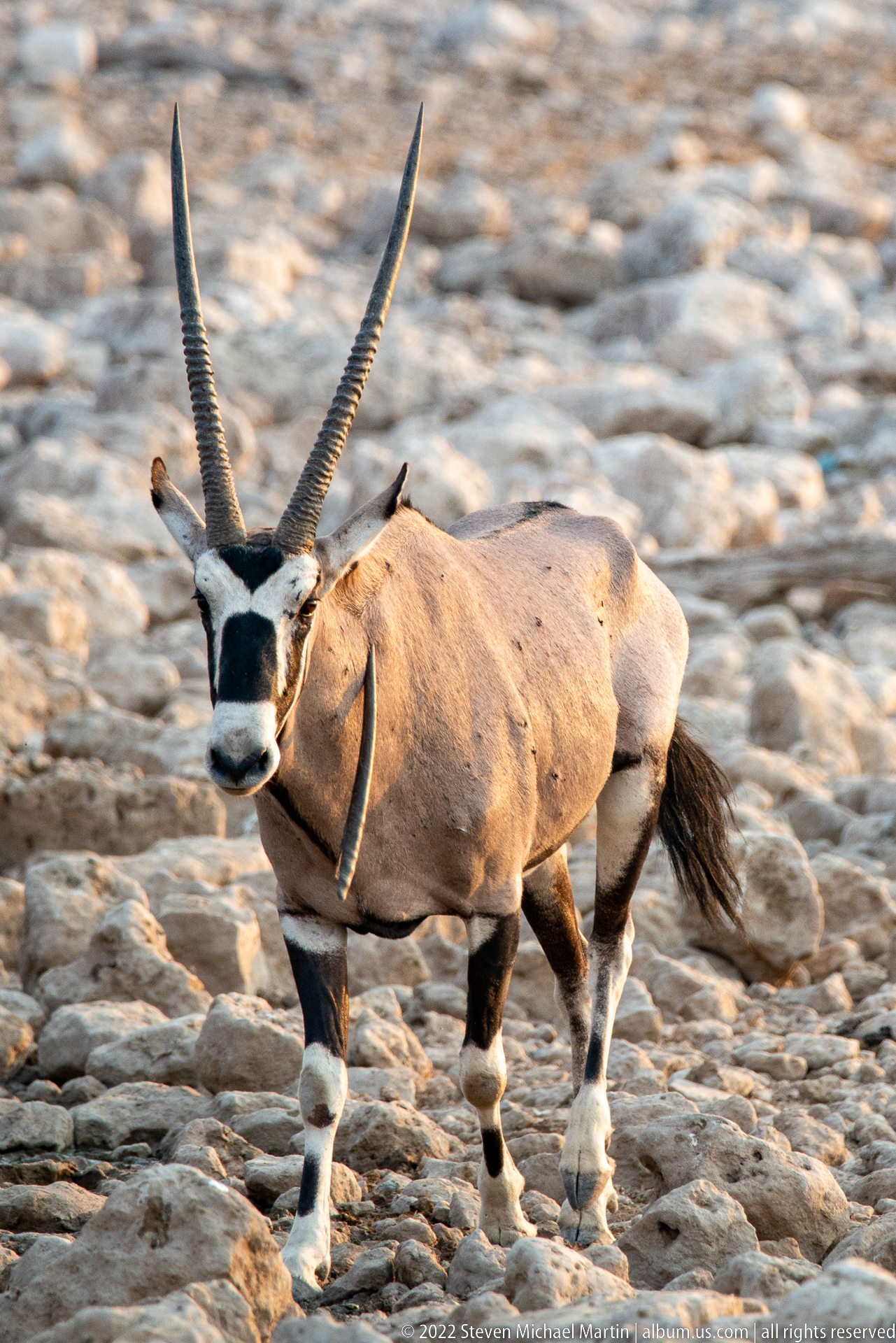
A gemsbok advances across the rocky ground in a front three-quarter view, its paired horns forming a tall V above the sharply patterned face. Black lower legs and bold dark body markings contrast with the warm gray coat, while the low viewpoint gives particular prominence to the antelope’s horn length and symmetry.
Caption
A gemsbok advances across the rocky ground in a front three-quarter view, its paired horns forming a tall V above the sharply patterned face. Black lower legs and bold dark body markings contrast with the warm gray coat, while the low viewpoint gives particular prominence to the antelope’s horn length and symmetry.

A calf stands between two adult African bush elephants in the shallows, the larger animals forming a protective visual frame on either side. One adult faces forward while the other drinks with its trunk lowered, combining a clear family grouping with contrasting alert and feeding postures at the waterhole.
Caption
A calf stands between two adult African bush elephants in the shallows, the larger animals forming a protective visual frame on either side. One adult faces forward while the other drinks with its trunk lowered, combining a clear family grouping with contrasting alert and feeding postures at the waterhole.

An adult and calf move through the shallow margin of Okaukuejo waterhole, seen mostly from behind as their legs disturb the water. Another young elephant sits or kneels low in the shallows to the left, adding an unusual posture to this intimate view of herd activity at the shoreline.
Caption
An adult and calf move through the shallow margin of Okaukuejo waterhole, seen mostly from behind as their legs disturb the water. Another young elephant sits or kneels low in the shallows to the left, adding an unusual posture to this intimate view of herd activity at the shoreline.
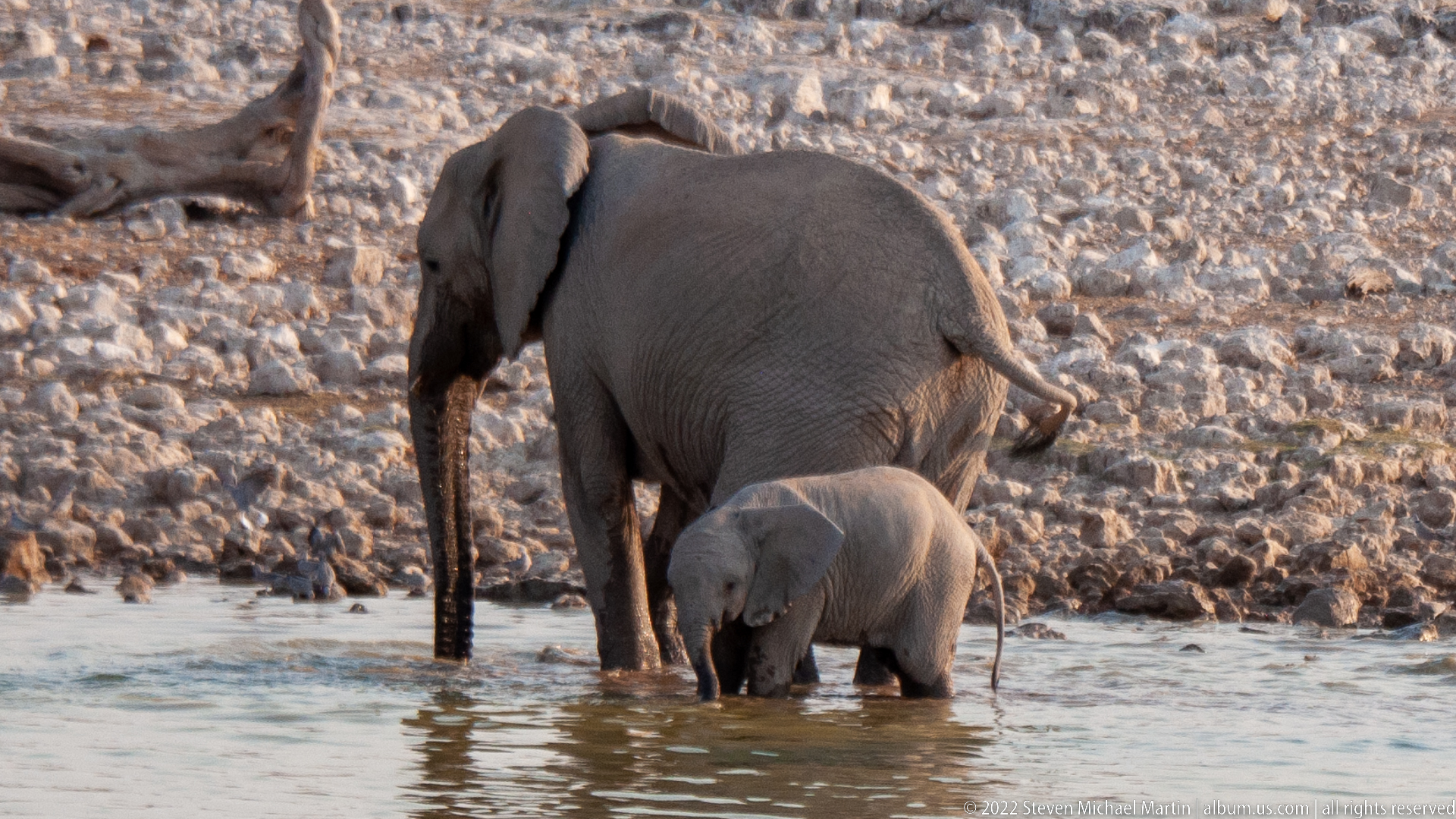
A large African bush elephant and calf wade side by side through the shallow pool, their bodies aligned in profile against the pale rocky bank. The adult’s hanging trunk and the calf’s shorter legs make the age contrast clear, while ripples around their feet mark their slow movement through the water.
Caption
A large African bush elephant and calf wade side by side through the shallow pool, their bodies aligned in profile against the pale rocky bank. The adult’s hanging trunk and the calf’s shorter legs make the age contrast clear, while ripples around their feet mark their slow movement through the water.

A compact cluster of African bush elephants drinks from the near edge of Okaukuejo waterhole, trunks descending in parallel toward the water. More elephants cross the rocky background, so the frame layers active drinkers in front with a broader herd moving through the dry basin behind.
Caption
A compact cluster of African bush elephants drinks from the near edge of Okaukuejo waterhole, trunks descending in parallel toward the water. More elephants cross the rocky background, so the frame layers active drinkers in front with a broader herd moving through the dry basin behind.

Four elephants fill the frame at the shoreline, their trunks reaching down to drink as overlapping bodies create a dense study of ears, tusks, wrinkled skin, and mud stains. The close viewpoint reduces the surrounding landscape and emphasizes the physical adaptations and varied postures of elephants using the water.
Caption
Four elephants fill the frame at the shoreline, their trunks reaching down to drink as overlapping bodies create a dense study of ears, tusks, wrinkled skin, and mud stains. The close viewpoint reduces the surrounding landscape and emphasizes the physical adaptations and varied postures of elephants using the water.

Two African bush elephants meet near the water’s edge with trunks extended toward one another, one mud-darkened and the other pale with dust. Their forward postures suggest a brief social confrontation or sparring interaction, while other herd members remain around the pool in the background.
Caption
Two African bush elephants meet near the water’s edge with trunks extended toward one another, one mud-darkened and the other pale with dust. Their forward postures suggest a brief social confrontation or sparring interaction, while other herd members remain around the pool in the background.

A dust-coated elephant follows closely behind a mud-darkened companion as both stride across the rocky shore, water and dust spraying around their feet. Their raised trunks, flared ears, and rapid movement convey an energetic social exchange distinct from the quieter drinking scenes around the waterhole.
Caption
A dust-coated elephant follows closely behind a mud-darkened companion as both stride across the rocky shore, water and dust spraying around their feet. Their raised trunks, flared ears, and rapid movement convey an energetic social exchange distinct from the quieter drinking scenes around the waterhole.

A mud-darkened elephant and a lighter, dust-covered elephant stop face to face beside the pool, their trunks curling toward one another. The opposing body positions and close trunk contact isolate a moment of elephant social communication or testing behavior against the open water and pale Etosha plain.
Caption
A mud-darkened elephant and a lighter, dust-covered elephant stop face to face beside the pool, their trunks curling toward one another. The opposing body positions and close trunk contact isolate a moment of elephant social communication or testing behavior against the open water and pale Etosha plain.
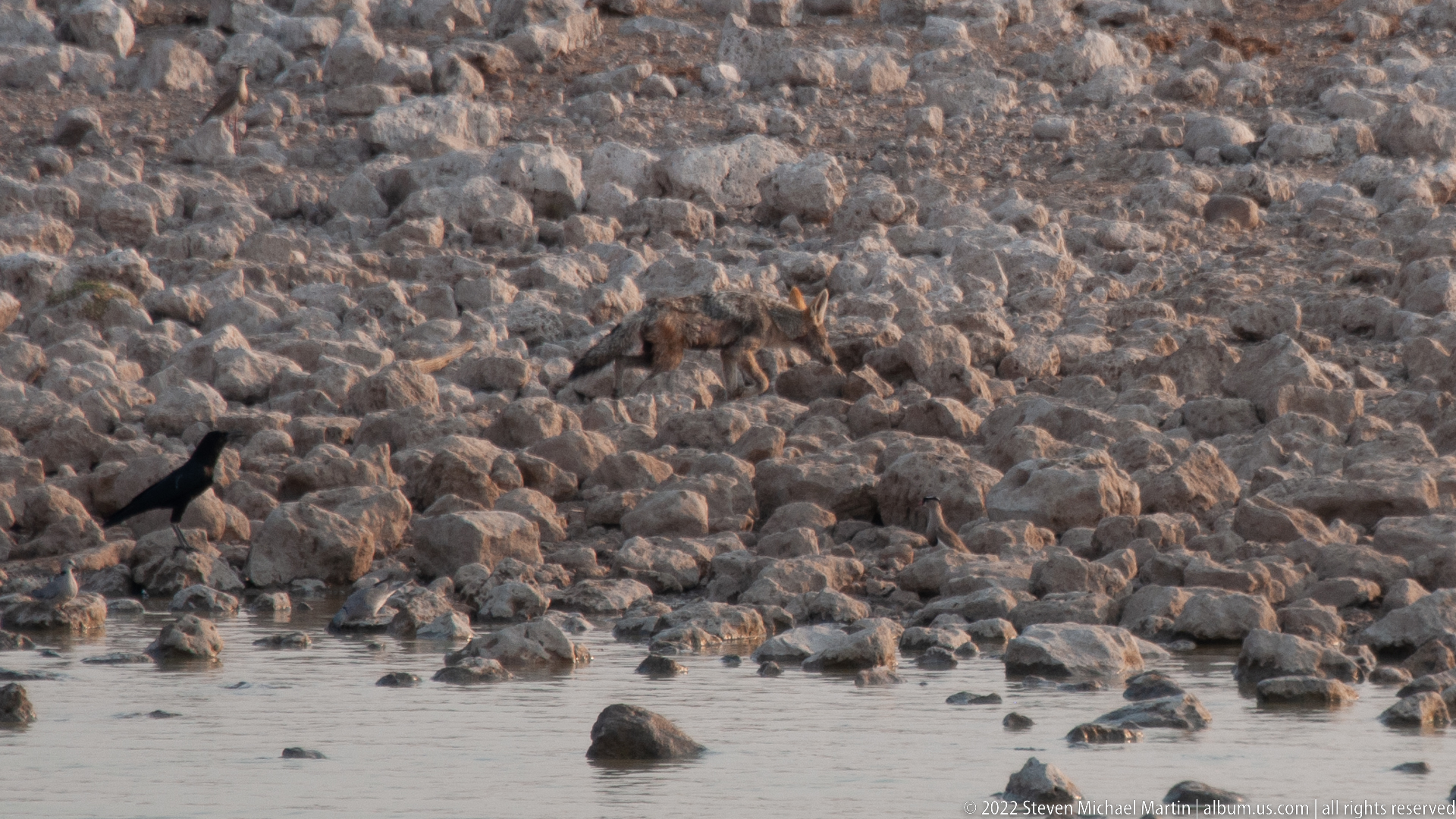
A black-backed jackal picks its way across the pale rocks above the waterline while a dark bird stands nearer the pool. The jackal’s slender build, pointed muzzle, large ears, and dark saddle are visible despite the stony camouflage, making this a quieter predator-scavenger counterpoint to the large herbivore gatherings.
Caption
A black-backed jackal picks its way across the pale rocks above the waterline while a dark bird stands nearer the pool. The jackal’s slender build, pointed muzzle, large ears, and dark saddle are visible despite the stony camouflage, making this a quieter predator-scavenger counterpoint to the large herbivore gatherings.

Springbok browse and stand across the pale rocky bank while a line of dark helmeted guineafowl gathers at the water’s edge below them. Reflections in the shallow pool reinforce the layered composition, pairing terrestrial antelope with ground-feeding birds at the same scarce water source.
Caption
Springbok browse and stand across the pale rocky bank while a line of dark helmeted guineafowl gathers at the water’s edge below them. Reflections in the shallow pool reinforce the layered composition, pairing terrestrial antelope with ground-feeding birds at the same scarce water source.

The Okaukuejo gateway is framed head-on beneath a long tiled canopy, with the round crenellated stone tower rising prominently behind it. A small welcome sign hangs at the center of the entrance, making this view a more formal architectural portrait of the camp’s recognizable arrival ensemble.
Caption
The Okaukuejo gateway is framed head-on beneath a long tiled canopy, with the round crenellated stone tower rising prominently behind it. A small welcome sign hangs at the center of the entrance, making this view a more formal architectural portrait of the camp’s recognizable arrival ensemble.

Several gemsbok stand chest-deep in Okaukuejo waterhole, their long straight horns rising vertically above the water while springbok drink and move along the surrounding shore. The mixed herd shows two characteristic Etosha antelopes using the same pool, with the larger oryx occupying deeper water.
Caption
Several gemsbok stand chest-deep in Okaukuejo waterhole, their long straight horns rising vertically above the water while springbok drink and move along the surrounding shore. The mixed herd shows two characteristic Etosha antelopes using the same pool, with the larger oryx occupying deeper water.

A gemsbok faces the camera while standing chest-deep in the water, its exceptionally long, nearly parallel horns and bold black-and-white facial pattern forming a symmetrical portrait. The tight framing excludes most of the shoreline and emphasizes the oryx’s diagnostic markings and direct gaze.
Caption
A gemsbok faces the camera while standing chest-deep in the water, its exceptionally long, nearly parallel horns and bold black-and-white facial pattern forming a symmetrical portrait. The tight framing excludes most of the shoreline and emphasizes the oryx’s diagnostic markings and direct gaze.

Two gemsbok wade in opposite orientations through the shallow pool, their long horns creating strong diagonal lines above the water. One turns slightly toward its companion while springbok appear on the rocky bank behind, giving the close view a sense of movement and shared use of the waterhole.
Caption
Two gemsbok wade in opposite orientations through the shallow pool, their long horns creating strong diagonal lines above the water. One turns slightly toward its companion while springbok appear on the rocky bank behind, giving the close view a sense of movement and shared use of the waterhole.

A leafless tree rises above the pale limestone margin of the Okaukuejo waterhole while scattered antelope occupy the open ground and elephants stand at the far right. The broad composition places the animals within Etosha’s dry-season landscape, where exposed rock, sparse vegetation, and a small concentration of water structure wildlife activity.
Caption
A leafless tree rises above the pale limestone margin of the Okaukuejo waterhole while scattered antelope occupy the open ground and elephants stand at the far right. The broad composition places the animals within Etosha’s dry-season landscape, where exposed rock, sparse vegetation, and a small concentration of water structure wildlife activity.
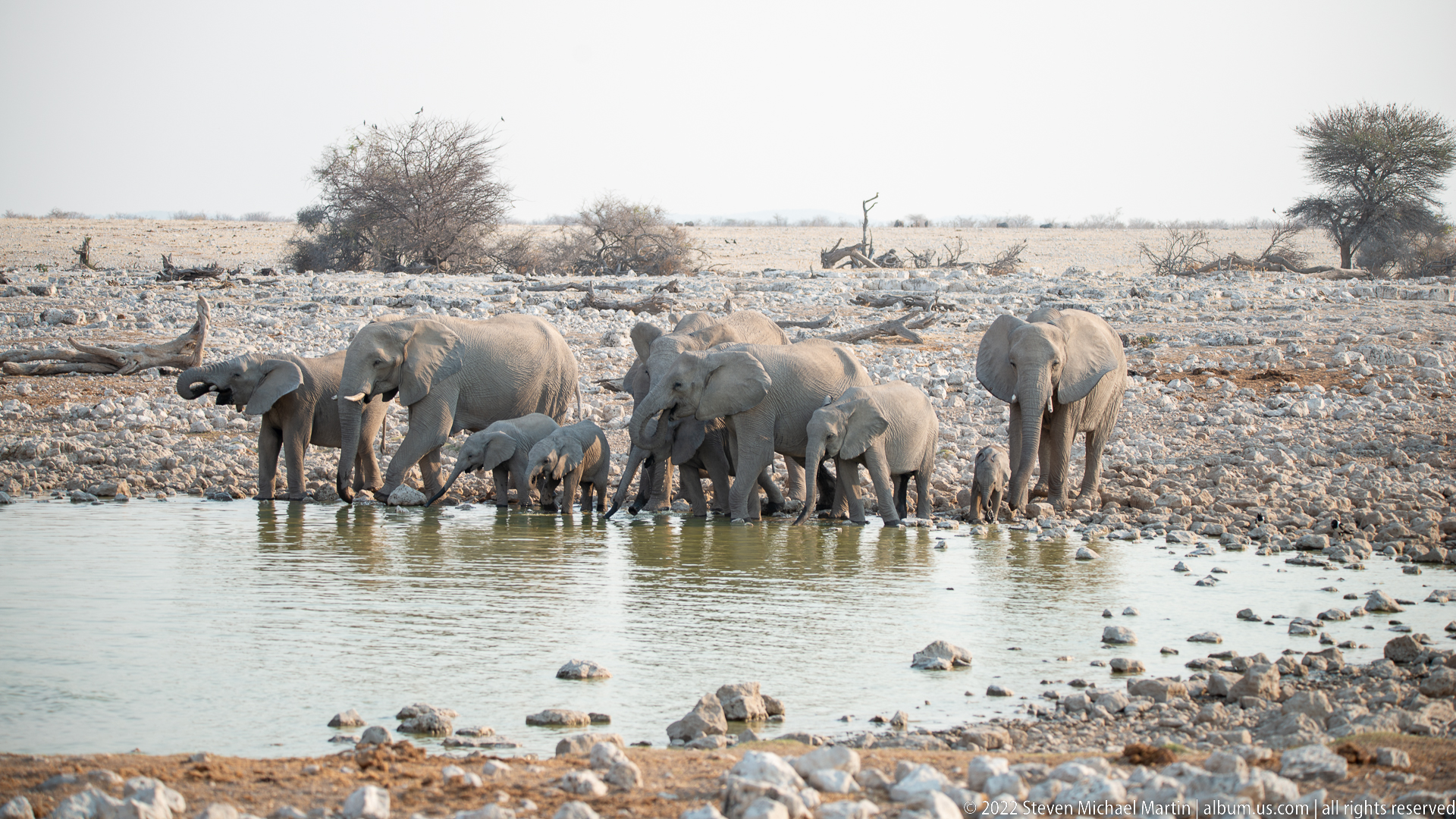
A family group of African bush elephants crowds the water’s edge, adults and calves lowering their trunks to drink among pale rocks. The tight grouping shows several age classes sharing access to the waterhole, with smaller calves sheltered amid larger bodies while the herd forms a nearly continuous line along the shallow margin.
Caption
A family group of African bush elephants crowds the water’s edge, adults and calves lowering their trunks to drink among pale rocks. The tight grouping shows several age classes sharing access to the waterhole, with smaller calves sheltered amid larger bodies while the herd forms a nearly continuous line along the shallow margin.

A young African bush elephant walks alone across the stony ground beside the waterhole, its small tuskless head, compact body, and relatively large ears marking its juvenile proportions. Separated visually from the herd, the calf becomes the sole subject against Etosha’s pale rock and ochre soil.
Caption
A young African bush elephant walks alone across the stony ground beside the waterhole, its small tuskless head, compact body, and relatively large ears marking its juvenile proportions. Separated visually from the herd, the calf becomes the sole subject against Etosha’s pale rock and ochre soil.

A small African bush elephant calf wades toward the camera through shallow water while the herd drinks in a dense row behind it. Its outspread ears and isolated foreground position distinguish the youngster from the adults, turning the scene into a layered view of individual movement against collective waterhole behavior.
Caption
A small African bush elephant calf wades toward the camera through shallow water while the herd drinks in a dense row behind it. Its outspread ears and isolated foreground position distinguish the youngster from the adults, turning the scene into a layered view of individual movement against collective waterhole behavior.

An adult African bush elephant wades through the waterhole with wet mud coating its face, ear, shoulder, and flank. Strong afternoon light reveals the deeply wrinkled skin beneath the drying mud, while the lowered trunk and submerged feet emphasize the animal’s close physical engagement with the shallow water.
Caption
An adult African bush elephant wades through the waterhole with wet mud coating its face, ear, shoulder, and flank. Strong afternoon light reveals the deeply wrinkled skin beneath the drying mud, while the lowered trunk and submerged feet emphasize the animal’s close physical engagement with the shallow water.

Three young African bush elephants stand in the shallows, two larger juveniles facing forward while a smaller calf at left lifts its trunk. Their differing sizes make age structure the central feature of the frame, with the rocky bank filling the background and water covering their lower legs.
Caption
Three young African bush elephants stand in the shallows, two larger juveniles facing forward while a smaller calf at left lifts its trunk. Their differing sizes make age structure the central feature of the frame, with the rocky bank filling the background and water covering their lower legs.

Adults and younger African bush elephants overlap at the water’s edge, creating a compact study of trunks, ears, tusks, and bodies at different scales. One adult raises a curled trunk while another reaches toward the water, capturing several drinking and social postures within the same tightly framed herd.
Caption
Adults and younger African bush elephants overlap at the water’s edge, creating a compact study of trunks, ears, tusks, and bodies at different scales. One adult raises a curled trunk while another reaches toward the water, capturing several drinking and social postures within the same tightly framed herd.
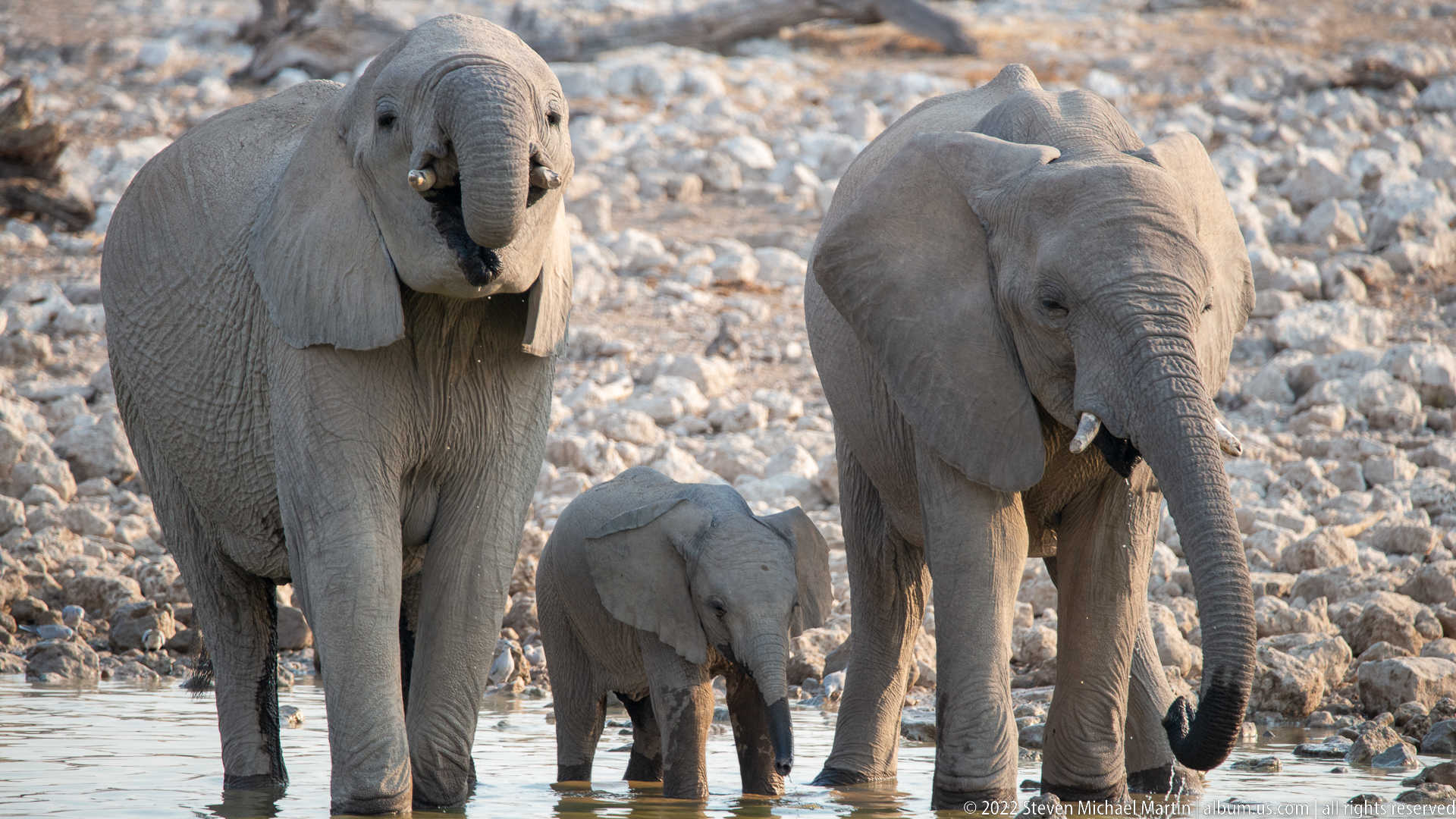
A small elephant calf stands between two much larger African bush elephants at the waterline, framed by their legs and lowered trunks. The protective spatial arrangement makes the calf’s scale especially apparent, while the front-facing adults anchor the family group against the bright, rock-covered shore.
Caption
A small elephant calf stands between two much larger African bush elephants at the waterline, framed by their legs and lowered trunks. The protective spatial arrangement makes the calf’s scale especially apparent, while the front-facing adults anchor the family group against the bright, rock-covered shore.

A line of African bush elephants gathers shoulder to shoulder at the waterhole, several trunks extending down to drink while another curls upward. More elephants cross the pale rocky ground behind them, expanding the scene from a drinking group in the foreground to a larger herd arriving across the dry landscape.
Caption
A line of African bush elephants gathers shoulder to shoulder at the waterhole, several trunks extending down to drink while another curls upward. More elephants cross the pale rocky ground behind them, expanding the scene from a drinking group in the foreground to a larger herd arriving across the dry landscape.

Four African bush elephants stand closely spaced along the water’s edge in profile, their trunks forming different curves as they drink. The compressed view concentrates attention on repeated body forms and synchronized waterhole use, while distant elephants and bleached rocks provide a layered dry-season backdrop.
Caption
Four African bush elephants stand closely spaced along the water’s edge in profile, their trunks forming different curves as they drink. The compressed view concentrates attention on repeated body forms and synchronized waterhole use, while distant elephants and bleached rocks provide a layered dry-season backdrop.

Three African bush elephants dominate the foreground at the shallow margin, their trunks hanging, curling, and reaching in contrasting positions. Behind them, additional herd members stand among pale rocks and fallen branches, giving the close wildlife grouping a clear sense of the larger congregation around Okaukuejo.
Caption
Three African bush elephants dominate the foreground at the shallow margin, their trunks hanging, curling, and reaching in contrasting positions. Behind them, additional herd members stand among pale rocks and fallen branches, giving the close wildlife grouping a clear sense of the larger congregation around Okaukuejo.

Mud-streaked African bush elephants stand knee-deep at the waterhole, one adult in front lowering its trunk while animals behind lift theirs in broad curves. The close grouping highlights wet and dry textures across their skin and the varied trunk movements that accompany drinking and waterhole activity.
Caption
Mud-streaked African bush elephants stand knee-deep at the waterhole, one adult in front lowering its trunk while animals behind lift theirs in broad curves. The close grouping highlights wet and dry textures across their skin and the varied trunk movements that accompany drinking and waterhole activity.

An African bush elephant at the front of the herd raises its trunk high while water splashes beside another elephant at the margin. Multiple overlapping bodies fill the frame, capturing an energetic interval in the herd’s visit when drinking, splashing, and trunk movements occur simultaneously in the crowded shallows.
Caption
An African bush elephant at the front of the herd raises its trunk high while water splashes beside another elephant at the margin. Multiple overlapping bodies fill the frame, capturing an energetic interval in the herd’s visit when drinking, splashing, and trunk movements occur simultaneously in the crowded shallows.

Two African bush elephants face one another at close range, their trunks curling toward each other as dust hangs over the waterhole behind them. The opposing profiles isolate a brief social interaction from the larger herd sequence, emphasizing gesture and proximity rather than drinking behavior.
Caption
Two African bush elephants face one another at close range, their trunks curling toward each other as dust hangs over the waterhole behind them. The opposing profiles isolate a brief social interaction from the larger herd sequence, emphasizing gesture and proximity rather than drinking behavior.

An African bush elephant strides along the waterhole margin with its trunk extended forward and one foreleg lifted mid-step. Dust suspended behind the animal softens the background, separating the pale, sunlit body from the shore and giving this frame a strong sense of purposeful movement away from the crowded water.
Caption
An African bush elephant strides along the waterhole margin with its trunk extended forward and one foreleg lifted mid-step. Dust suspended behind the animal softens the background, separating the pale, sunlit body from the shore and giving this frame a strong sense of purposeful movement away from the crowded water.

A mud-darkened African bush elephant wades through the shallows, lifting a foreleg while curling its trunk tightly toward its mouth. Wet skin and splashed mud contrast with the pale rocks beyond, distinguishing this individual portrait from the wider herd scenes and emphasizing movement through the water.
Caption
A mud-darkened African bush elephant wades through the shallows, lifting a foreleg while curling its trunk tightly toward its mouth. Wet skin and splashed mud contrast with the pale rocks beyond, distinguishing this individual portrait from the wider herd scenes and emphasizing movement through the water.

A heavily mud-coated African bush elephant stands at the edge of the water with its trunk curled across its chest as droplets scatter behind its hindquarters. The side view clearly shows the layered mud on the ear, shoulder, and flank, evidence of recent bathing in the shallow waterhole.
Caption
A heavily mud-coated African bush elephant stands at the edge of the water with its trunk curled across its chest as droplets scatter behind its hindquarters. The side view clearly shows the layered mud on the ear, shoulder, and flank, evidence of recent bathing in the shallow waterhole.

A black-backed jackal picks its way across the pale limestone rubble surrounding the waterhole, mouth open and ears erect. Its dark saddle, reddish-tan flanks, pointed muzzle, and bushy black-tipped tail are clearly visible, allowing the species to stand out sharply against Etosha’s bleached rocky substrate.
Caption
A black-backed jackal picks its way across the pale limestone rubble surrounding the waterhole, mouth open and ears erect. Its dark saddle, reddish-tan flanks, pointed muzzle, and bushy black-tipped tail are clearly visible, allowing the species to stand out sharply against Etosha’s bleached rocky substrate.

A black-backed jackal moves along the far bank above a still section of the waterhole, where its body and the surrounding rocks are mirrored on the surface. The wider composition reduces the animal’s scale and uses the reflection to connect the jackal with the sparse, stony shoreline it is traversing.
Caption
A black-backed jackal moves along the far bank above a still section of the waterhole, where its body and the surrounding rocks are mirrored on the surface. The wider composition reduces the animal’s scale and uses the reflection to connect the jackal with the sparse, stony shoreline it is traversing.

A black-backed jackal descends the uneven limestone bank toward the water, head lowered as it negotiates the rocks. Seen closer than in the preceding reflective view, the dark dorsal saddle and russet legs are prominent while the narrow strip of water at the bottom fixes its approach to the waterhole.
Caption
A black-backed jackal descends the uneven limestone bank toward the water, head lowered as it negotiates the rocks. Seen closer than in the preceding reflective view, the dark dorsal saddle and russet legs are prominent while the narrow strip of water at the bottom fixes its approach to the waterhole.

A gemsbok walks in profile across the pale limestone shore, its exceptionally long straight horns rising above the compact gray-tan body. The black-and-white facial mask, dark flank stripe, black legs, and horse-like tail provide the characteristic markings of this arid-country antelope against the bright Etosha substrate.
Caption
A gemsbok walks in profile across the pale limestone shore, its exceptionally long straight horns rising above the compact gray-tan body. The black-and-white facial mask, dark flank stripe, black legs, and horse-like tail provide the characteristic markings of this arid-country antelope against the bright Etosha substrate.

A black-backed jackal pauses among angular limestone rocks, body angled away while its head turns to the side. Upright ears and an alert stance contrast with the earlier walking views, and the dark saddle across its back is especially clear against the pale stones surrounding the animal.
Caption
A black-backed jackal pauses among angular limestone rocks, body angled away while its head turns to the side. Upright ears and an alert stance contrast with the earlier walking views, and the dark saddle across its back is especially clear against the pale stones surrounding the animal.
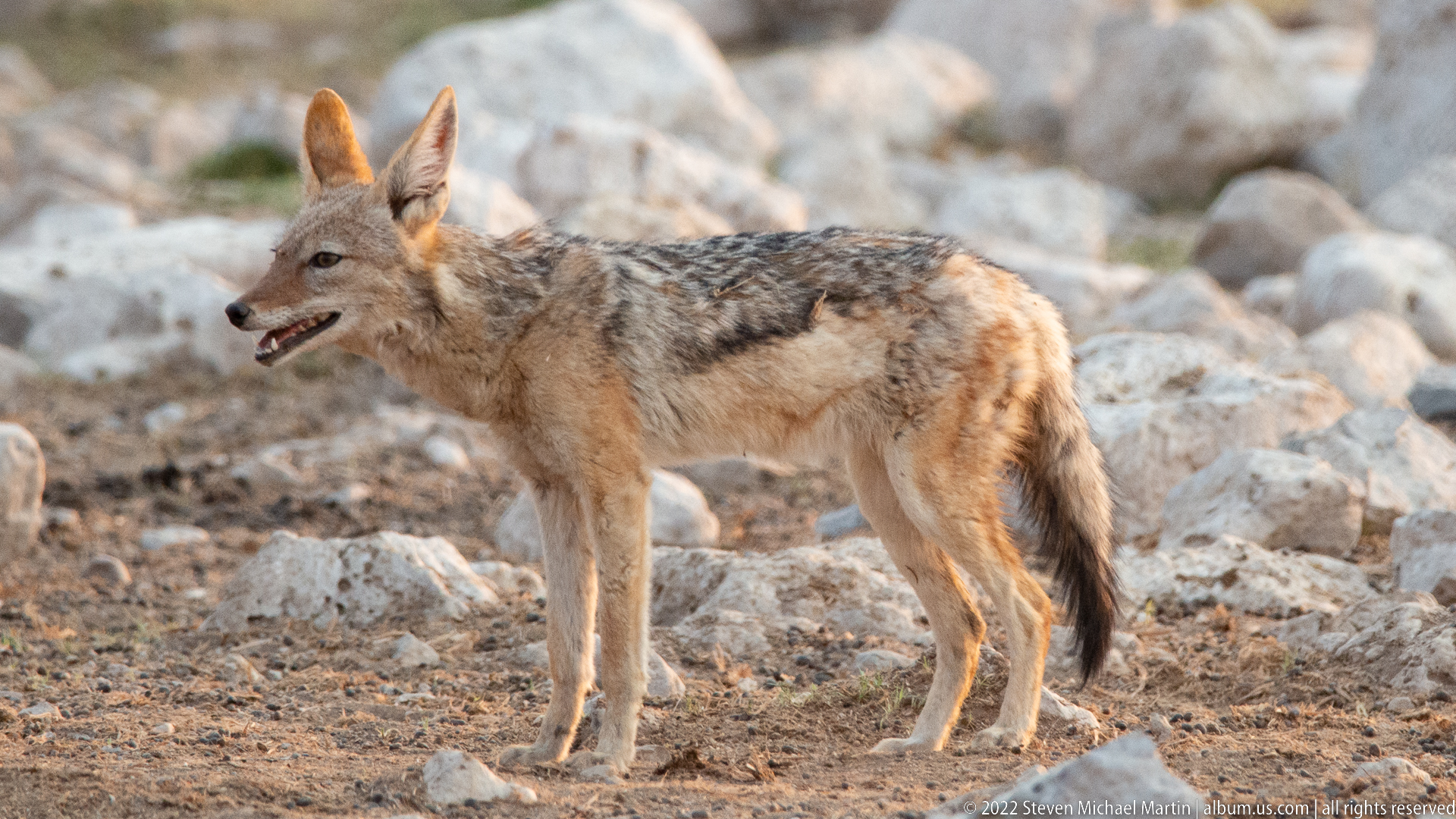
A black-backed jackal stands in clean side profile on dusty ground scattered with pale rocks. Its open mouth, erect triangular ears, grizzled black saddle, tawny legs, and dark bushy tail are all visible, producing one of the portfolio’s clearest field-guide views of the species near Okaukuejo.
Caption
A black-backed jackal stands in clean side profile on dusty ground scattered with pale rocks. Its open mouth, erect triangular ears, grizzled black saddle, tawny legs, and dark bushy tail are all visible, producing one of the portfolio’s clearest field-guide views of the species near Okaukuejo.
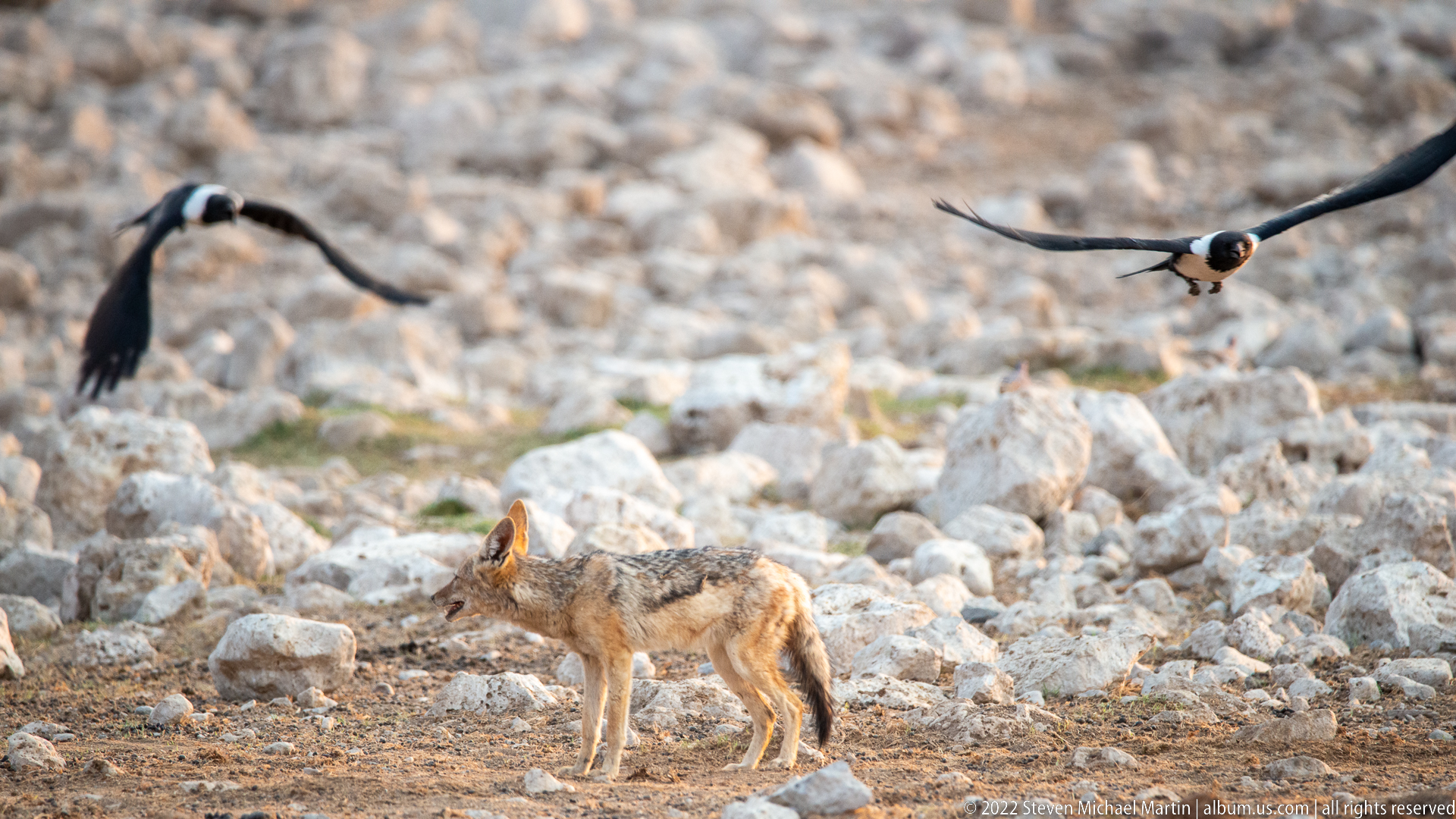
A black-backed jackal stands among the rocks while two dark, long-tailed birds sweep across the frame above it. The unusual cross-species composition shifts attention from a single wildlife portrait to activity in the broader waterhole community, with the jackal remaining grounded beneath the birds’ opposing flight paths.
Caption
A black-backed jackal stands among the rocks while two dark, long-tailed birds sweep across the frame above it. The unusual cross-species composition shifts attention from a single wildlife portrait to activity in the broader waterhole community, with the jackal remaining grounded beneath the birds’ opposing flight paths.
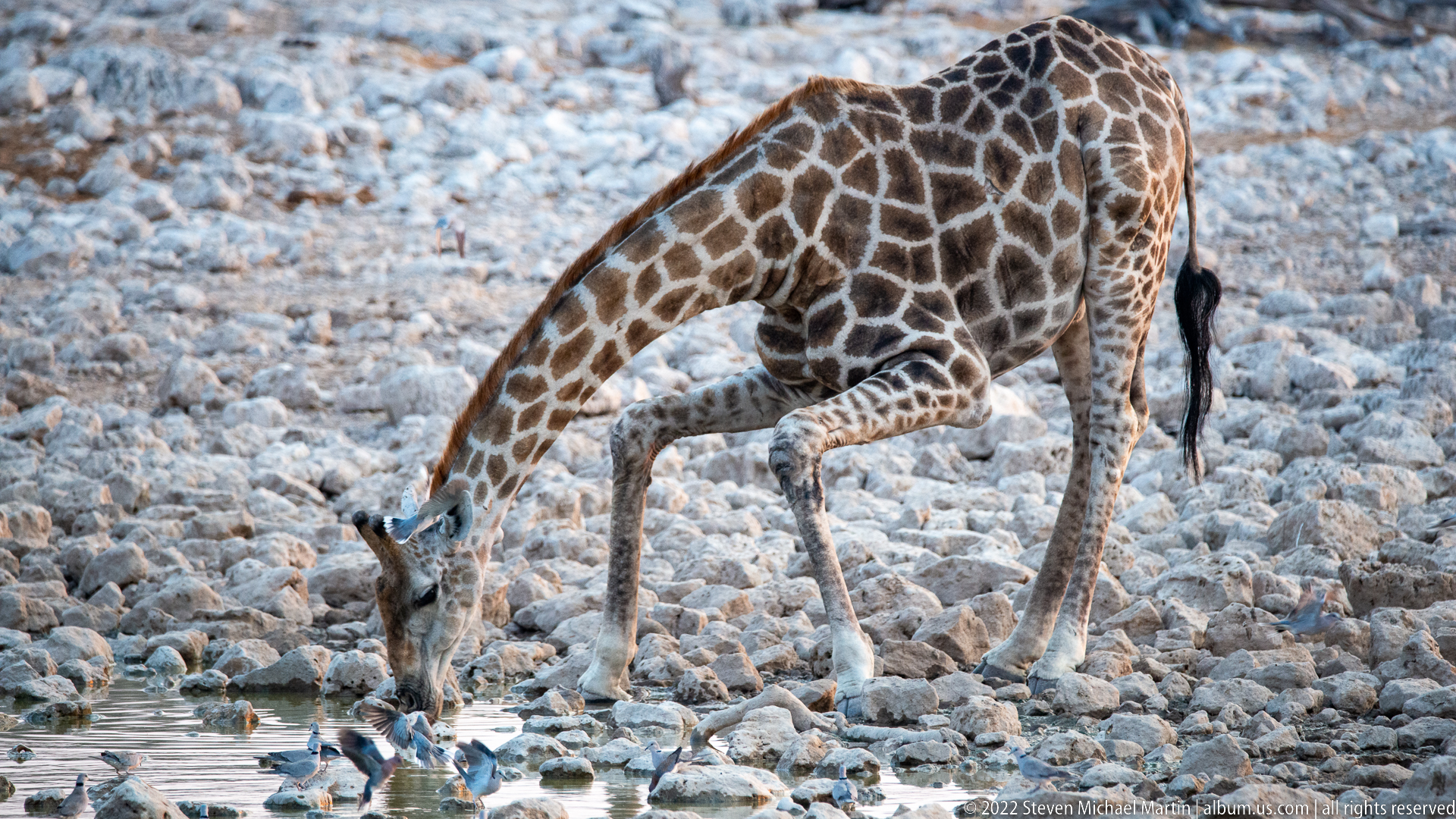
A giraffe spreads its forelegs and bends its long neck steeply to drink, adopting the distinctive splayed stance required to reach the water. Small birds cluster near the muzzle at the shoreline, while the giraffe’s reticulated coat pattern fills the upper frame against the pale limestone bank.
Caption
A giraffe spreads its forelegs and bends its long neck steeply to drink, adopting the distinctive splayed stance required to reach the water. Small birds cluster near the muzzle at the shoreline, while the giraffe’s reticulated coat pattern fills the upper frame against the pale limestone bank.
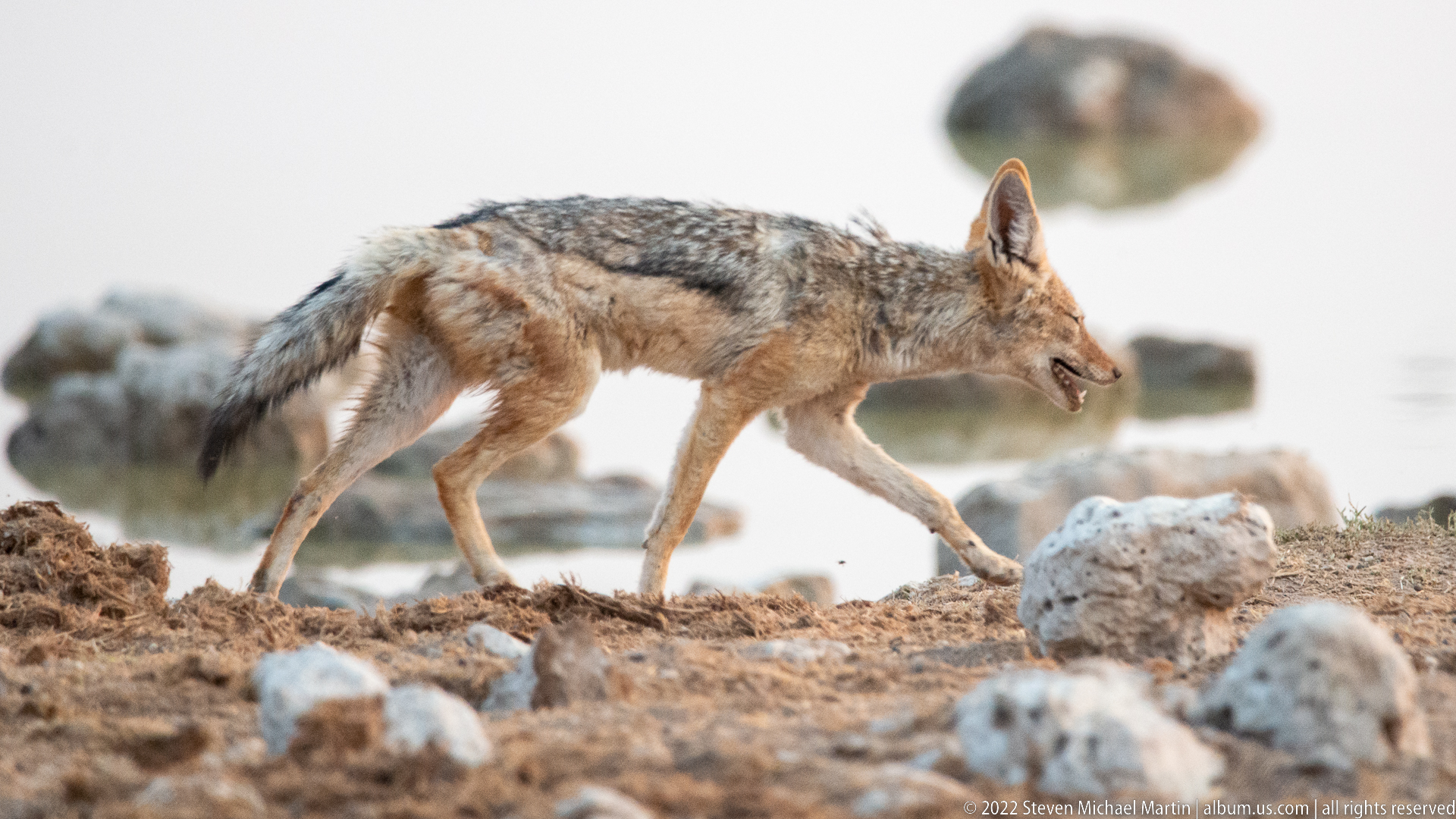
A black-backed jackal walks briskly along the earthen edge of the waterhole, shown in a low side profile with one forepaw lifted. The bright water and isolated rocks behind it create a spare background that clearly outlines the pointed muzzle, large ears, dark saddle, and bushy tail.
Caption
A black-backed jackal walks briskly along the earthen edge of the waterhole, shown in a low side profile with one forepaw lifted. The bright water and isolated rocks behind it create a spare background that clearly outlines the pointed muzzle, large ears, dark saddle, and bushy tail.

Several giraffes stand across the pale Etosha plain beyond the waterhole as the low sun glows through a hazy sky. Their elongated reflections descend into the still foreground water, creating a symmetrical landscape that closes the wildlife sequence with animals, sunset light, and the reflective surface held in a single broad view.
Caption
Several giraffes stand across the pale Etosha plain beyond the waterhole as the low sun glows through a hazy sky. Their elongated reflections descend into the still foreground water, creating a symmetrical landscape that closes the wildlife sequence with animals, sunset light, and the reflective surface held in a single broad view.
The Okaukuejo waterhole is one of the most recognizable wildlife viewing locations in Etosha National Park. In a landscape shaped by limited water resources, the waterhole becomes a natural gathering point where animal movement concentrates and behavior unfolds gradually over time.
During the afternoon, activity builds slowly as herds approach from across the open terrain. Elephants often arrive in family groups, followed by springbok, gemsbok, and giraffe. The pace of observation feels unhurried, allowing patterns of interaction and social structure to become more visible than in many other safari environments.
Highlights
- One of Etosha’s most reliable wildlife gathering locations
- Strong elephant family behavior visible at close range
- Large herds of springbok moving across open mineral plains
- Gemsbok and giraffe approaching water with distinct drinking strategies
- Clear visibility across pale terrain unique to Etosha
Field Guide
📍 Location
Okaukuejo is located in the southern portion of Etosha National Park and serves as one of the park’s primary rest camps. The nearby waterhole provides a dependable source of water in an otherwise dry environment, making it a focal point for wildlife activity.
🌍 Landscape
Etosha is defined by open plains, dry grassland, scattered trees, and pale mineral soils that create a distinctive visual environment. The relative lack of dense vegetation allows animals to be seen from long distances as they approach the waterhole.
Waterholes play a central role in Etosha’s ecology, concentrating wildlife and increasing the likelihood of observing multiple species in the same location.
🦓 Wildlife
A variety of species rely on the Okaukuejo waterhole, particularly during dry conditions when natural water sources become limited. The interaction between species often unfolds gradually as animals approach, drink, and move away in loosely coordinated patterns.
- Elephants: frequently appear in family groups, with calves positioned safely within the herd while adults drink and remain alert.
- Springbok: often gather in large numbers, moving cautiously across open terrain toward the water.
- Gemsbok: highly adapted to arid environments and visually distinctive with long, straight horns.
- Giraffe: occasionally present, lowering their height carefully in order to drink.
- Black-backed jackal: often patrols the margins of the waterhole, taking advantage of the concentration of wildlife.
⏰ Afternoon Patterns
Afternoon observation often reveals a gradual increase in activity as temperatures begin to moderate. Individual animals or small groups may appear first, followed by larger gatherings as confidence builds near the water’s edge.
Soft late-day light helps define texture in the pale soil and dry grasses, contributing to the distinctive Etosha aesthetic.
Story & Experience
Arrival and Anticipation
Unlike mobile game drives where wildlife encounters are unpredictable, waterhole viewing emphasizes patience. Long quiet intervals can be followed by periods of concentrated activity as animals emerge from different directions.
Elephant Social Structure
Elephant family groups often provide the most visually engaging sequences. Calves remain close to adults, and the herd moves with a coordinated rhythm that reflects both caution and familiarity with the environment.
Shared Resource
Multiple species rely on the same limited water supply, creating layered compositions where springbok, gemsbok, giraffe, and elephants may appear within the same visual frame.
Behavior Over Action
The strength of the Okaukuejo waterhole lies in observing patterns rather than isolated moments. Subtle interactions, shifting positions within herds, and gradual movement toward and away from the water create a continuous narrative.
Transition Toward Evening
As the afternoon progresses, the light softens and activity often becomes more relaxed. Reflections in still water and the warm tones of the surrounding landscape contribute to a calm conclusion to the viewing experience.
Photography Notes
- Waterholes allow extended observation of the same subjects over time
- Longer viewing periods increase chances of capturing social interaction
- Pale mineral soil creates a distinctive neutral color palette
- Wider compositions help show relationships between species
- Reflections in still water can add visual balance
- Afternoon light adds warmth to otherwise muted tones
Quick Facts
- Park: Etosha National Park
- Region: Southern Etosha
- Environment: dry grassland and mineral-rich plains
- Key Wildlife: elephant, springbok, gemsbok, giraffe, jackal
- Viewing Style: stationary observation at water source
- Best Time: dry season when animals concentrate at waterholes
Guide Book:
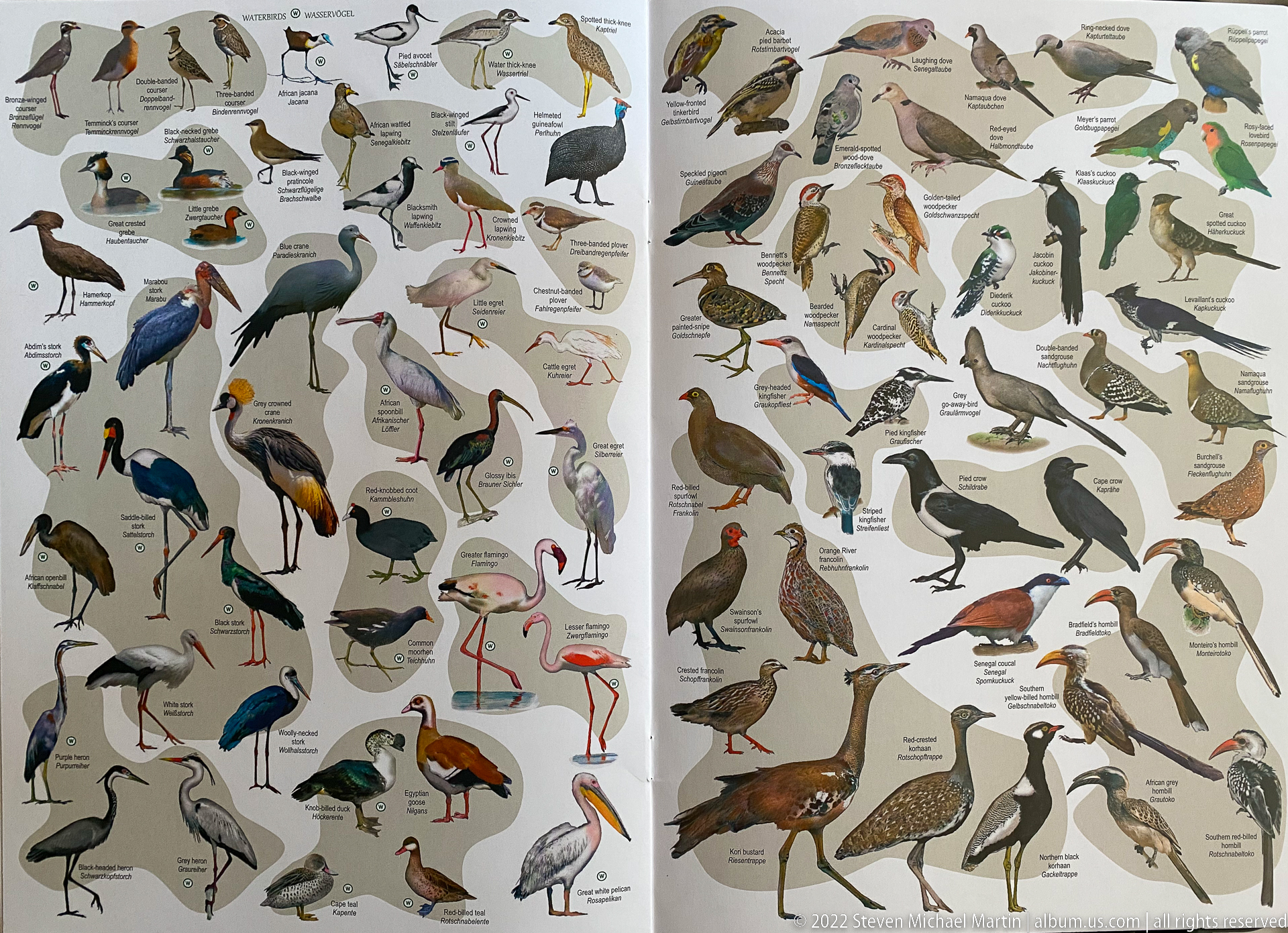
Two densely illustrated bird-identification plates present a wide range of Etosha avifauna in profile. The left page is dominated by long-legged waterbirds and waders, including crane-, stork-, and flamingo-like forms, while the facing page shifts to a broader assortment of terrestrial and wetland birds. Individual labels turn the spread into a compact visual key for field recognition.
Caption
Two densely illustrated bird-identification plates present a wide range of Etosha avifauna in profile. The left page is dominated by long-legged waterbirds and waders, including crane-, stork-, and flamingo-like forms, while the facing page shifts to a broader assortment of terrestrial and wetland birds. Individual labels turn the spread into a compact visual key for field recognition.

The cover of an Etosha wildlife-identification guide combines illustrated mammals and birds with the bilingual title “Map of Etosha / Karte von Etoscha.” A lower panel centers elephants and other animals at a waterhole, signaling the guide’s field-identification purpose. The photographed publication provides contextual reference material for recognizing species and navigating wildlife encounters across the Etosha landscape.
Caption
The cover of an Etosha wildlife-identification guide combines illustrated mammals and birds with the bilingual title “Map of Etosha / Karte von Etoscha.” A lower panel centers elephants and other animals at a waterhole, signaling the guide’s field-identification purpose. The photographed publication provides contextual reference material for recognizing species and navigating wildlife encounters across the Etosha landscape.
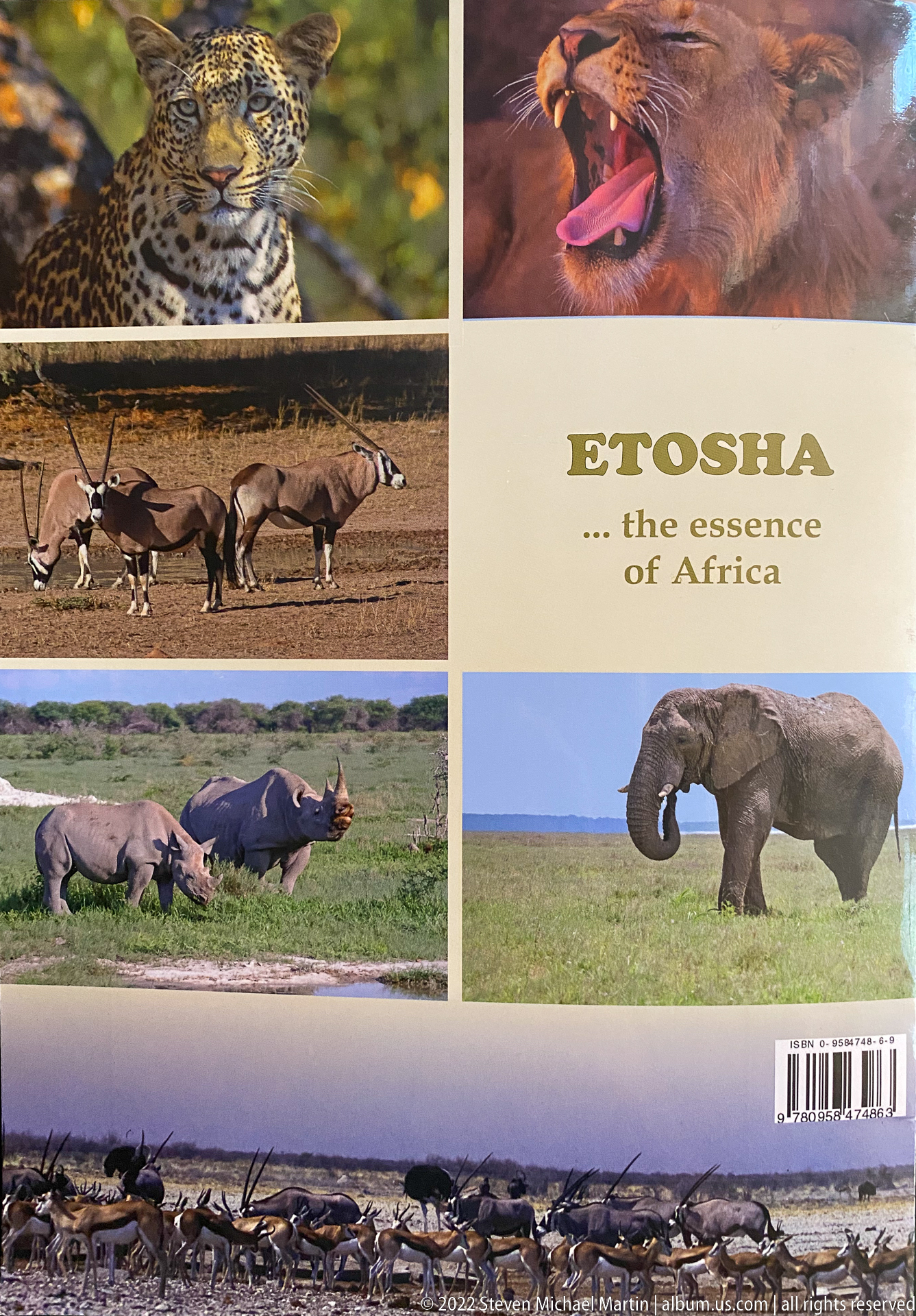
The closing cover of the Etosha guide uses a wildlife collage beneath the phrase “ETOSHA — the essence of Africa.” Separate panels feature close and contextual views of prominent African animals, while a panoramic strip along the bottom shows a large concentration of wildlife across open terrain. The design concludes the field guide by presenting Etosha through the abundance and variety of its fauna.
Caption
The closing cover of the Etosha guide uses a wildlife collage beneath the phrase “ETOSHA — the essence of Africa.” Separate panels feature close and contextual views of prominent African animals, while a panoramic strip along the bottom shows a large concentration of wildlife across open terrain. The design concludes the field guide by presenting Etosha through the abundance and variety of its fauna.

An information spread from the Etosha guide assembles practical park material with natural-history reference: visitor information, timetables, a table of distances, wildlife illustrations, and a color-coded vegetation map. The dense layout shows how field guides integrate route planning with ecological orientation, allowing travelers to relate roads and facilities to the broad vegetation zones that structure wildlife habitat in Etosha.
Caption
An information spread from the Etosha guide assembles practical park material with natural-history reference: visitor information, timetables, a table of distances, wildlife illustrations, and a color-coded vegetation map. The dense layout shows how field guides integrate route planning with ecological orientation, allowing travelers to relate roads and facilities to the broad vegetation zones that structure wildlife habitat in Etosha.
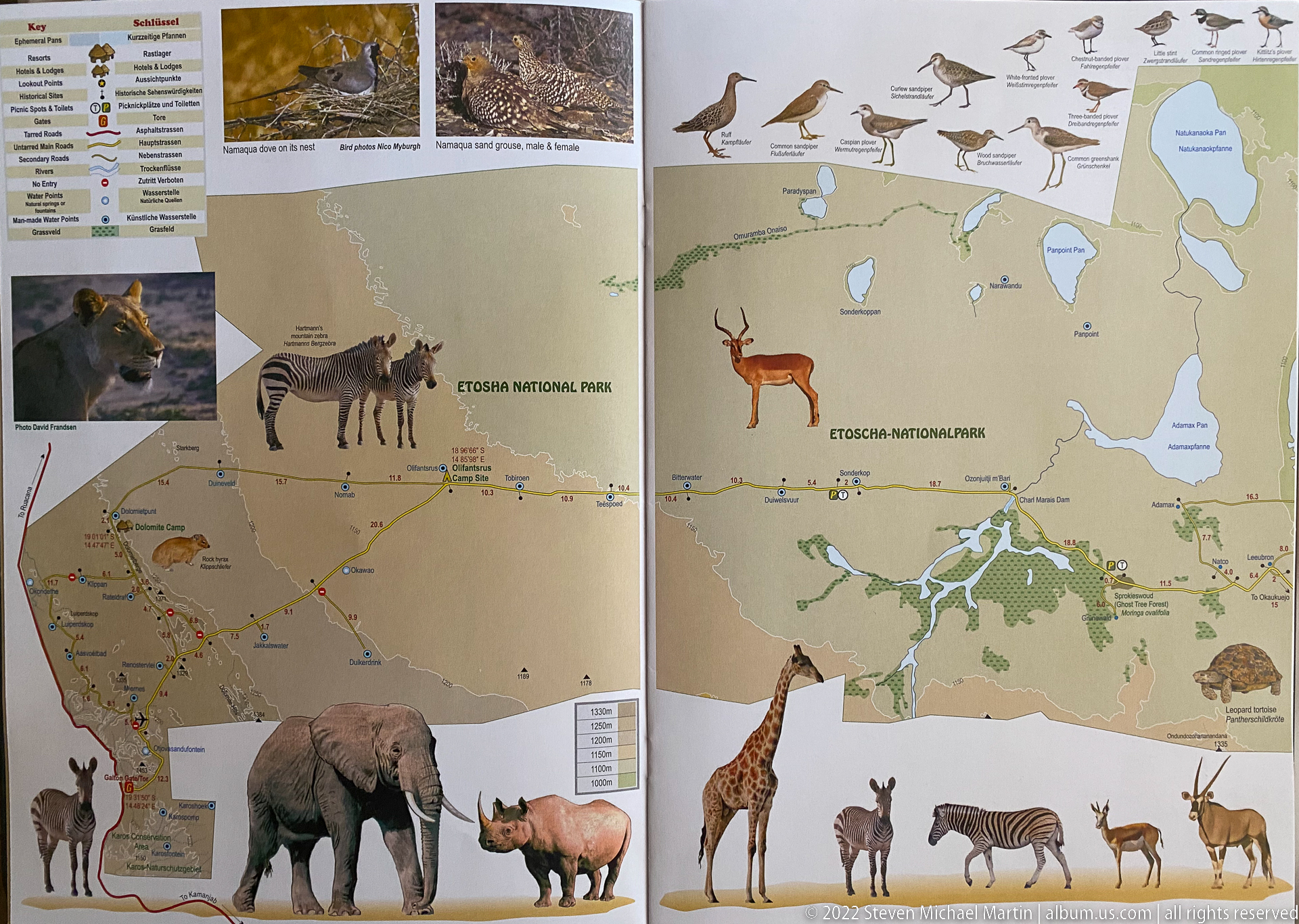
Two facing map pages place Etosha National Park’s road network and water features beneath rows of illustrated wildlife. Large figures of zebra, elephant, rhinoceros, giraffe, antelope, and other species turn the map into a combined navigation and identification aid. The spread visually links animal recognition with the geography of the park, including the broad pale expanse of the Etosha Pan.
Caption
Two facing map pages place Etosha National Park’s road network and water features beneath rows of illustrated wildlife. Large figures of zebra, elephant, rhinoceros, giraffe, antelope, and other species turn the map into a combined navigation and identification aid. The spread visually links animal recognition with the geography of the park, including the broad pale expanse of the Etosha Pan.

A detailed Etosha National Park map spread traces roads, waterholes, settlements, and the margins of the pan across two pages. Wildlife illustrations—including large herbivores and predators—frame the cartography and reinforce the guide’s dual role as route reference and species primer. The layout emphasizes the scale of the protected landscape and the importance of mapped water points to safari movement.
Caption
A detailed Etosha National Park map spread traces roads, waterholes, settlements, and the margins of the pan across two pages. Wildlife illustrations—including large herbivores and predators—frame the cartography and reinforce the guide’s dual role as route reference and species primer. The layout emphasizes the scale of the protected landscape and the importance of mapped water points to safari movement.
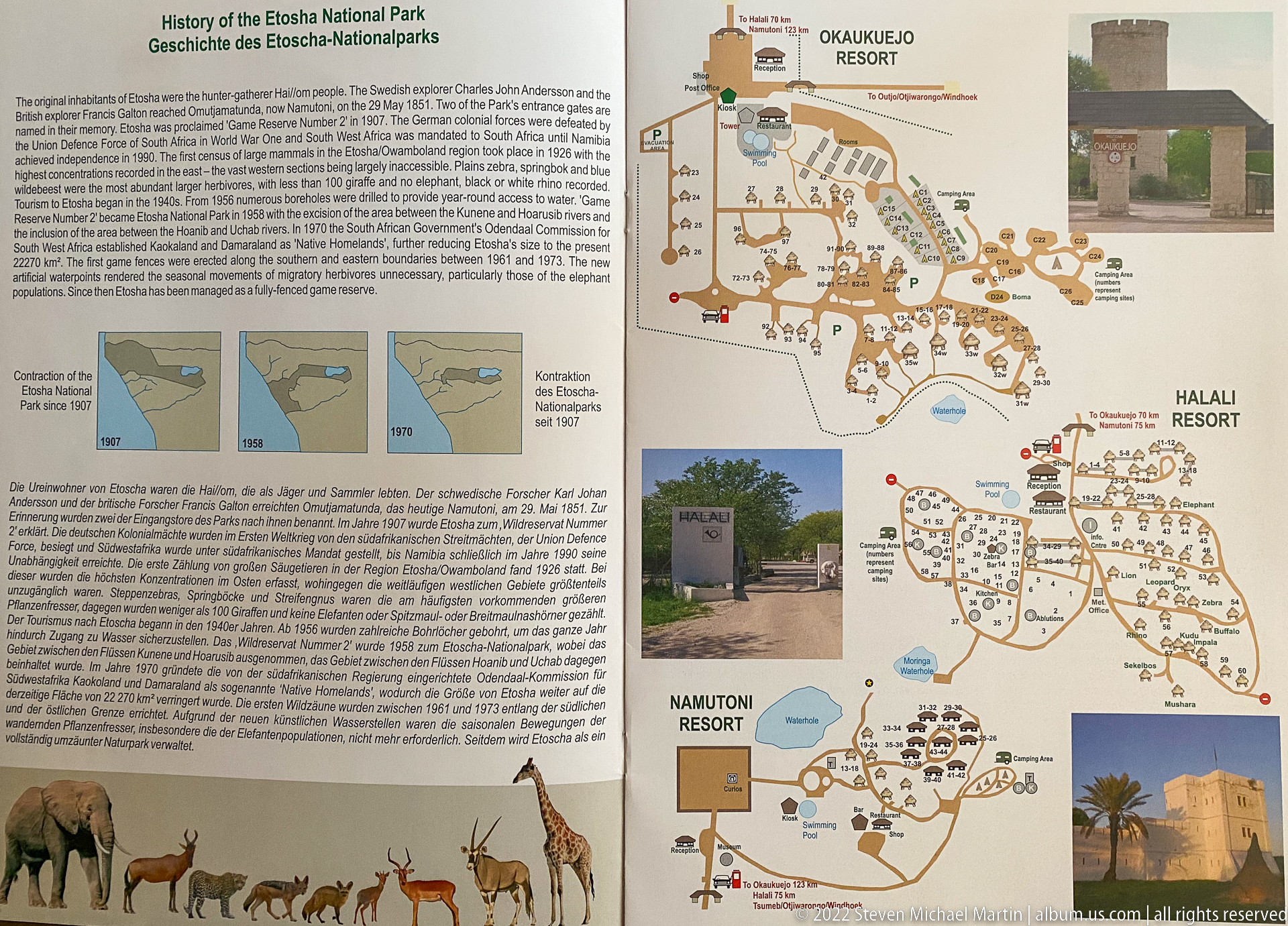
This guide spread pairs a text history of Etosha National Park with schematic plans of three major park resorts: Okaukuejo, Halali, and Namutoni. Small historic and site photographs accompany the maps, while animal illustrations run along the lower margin. The page connects the park’s administrative history with the visitor infrastructure from which many wildlife drives and waterhole observations are organized.
Caption
This guide spread pairs a text history of Etosha National Park with schematic plans of three major park resorts: Okaukuejo, Halali, and Namutoni. Small historic and site photographs accompany the maps, while animal illustrations run along the lower margin. The page connects the park’s administrative history with the visitor infrastructure from which many wildlife drives and waterhole observations are organized.

Photographs and descriptive text survey accommodation and camping facilities associated with Etosha National Park. Separate sections present resort or campsite settings with pools, buildings, shaded grounds, and entrances, giving the spread the character of a practical lodging directory. Rather than wildlife identification, these pages document the visitor infrastructure that supports multi-day travel through the Etosha region.
Caption
Photographs and descriptive text survey accommodation and camping facilities associated with Etosha National Park. Separate sections present resort or campsite settings with pools, buildings, shaded grounds, and entrances, giving the spread the character of a practical lodging directory. Rather than wildlife identification, these pages document the visitor infrastructure that supports multi-day travel through the Etosha region.
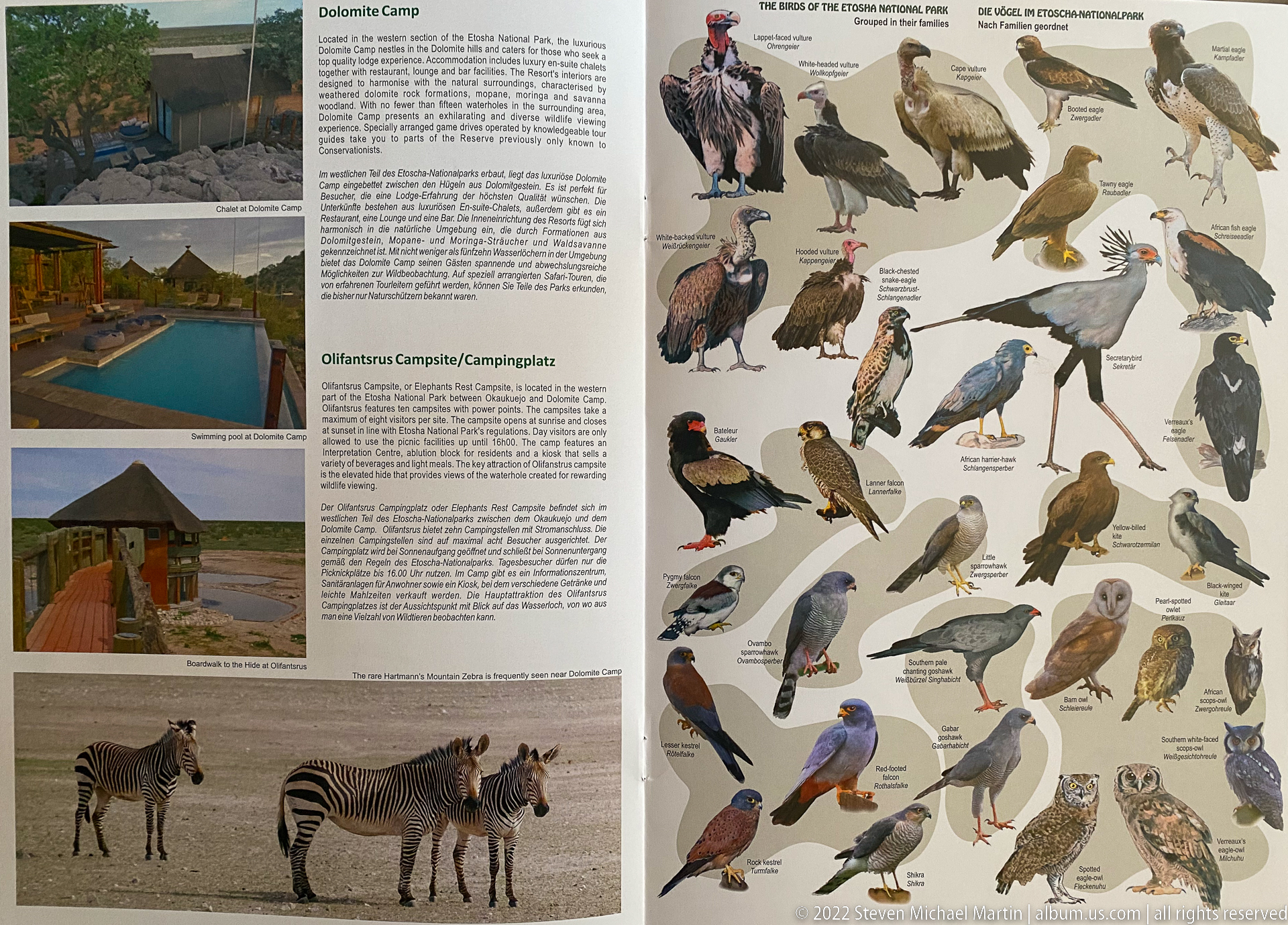
A practical campsite page faces a dense identification plate devoted to birds of prey recorded in the Etosha region. Photographs of lodging, a pool, and zebras occupy the left page, while the right arranges illustrated vultures, eagles, owls, and other raptors with labels. The juxtaposition reflects the guide’s broad scope, moving directly from visitor logistics to field identification.
Caption
A practical campsite page faces a dense identification plate devoted to birds of prey recorded in the Etosha region. Photographs of lodging, a pool, and zebras occupy the left page, while the right arranges illustrated vultures, eagles, owls, and other raptors with labels. The juxtaposition reflects the guide’s broad scope, moving directly from visitor logistics to field identification.
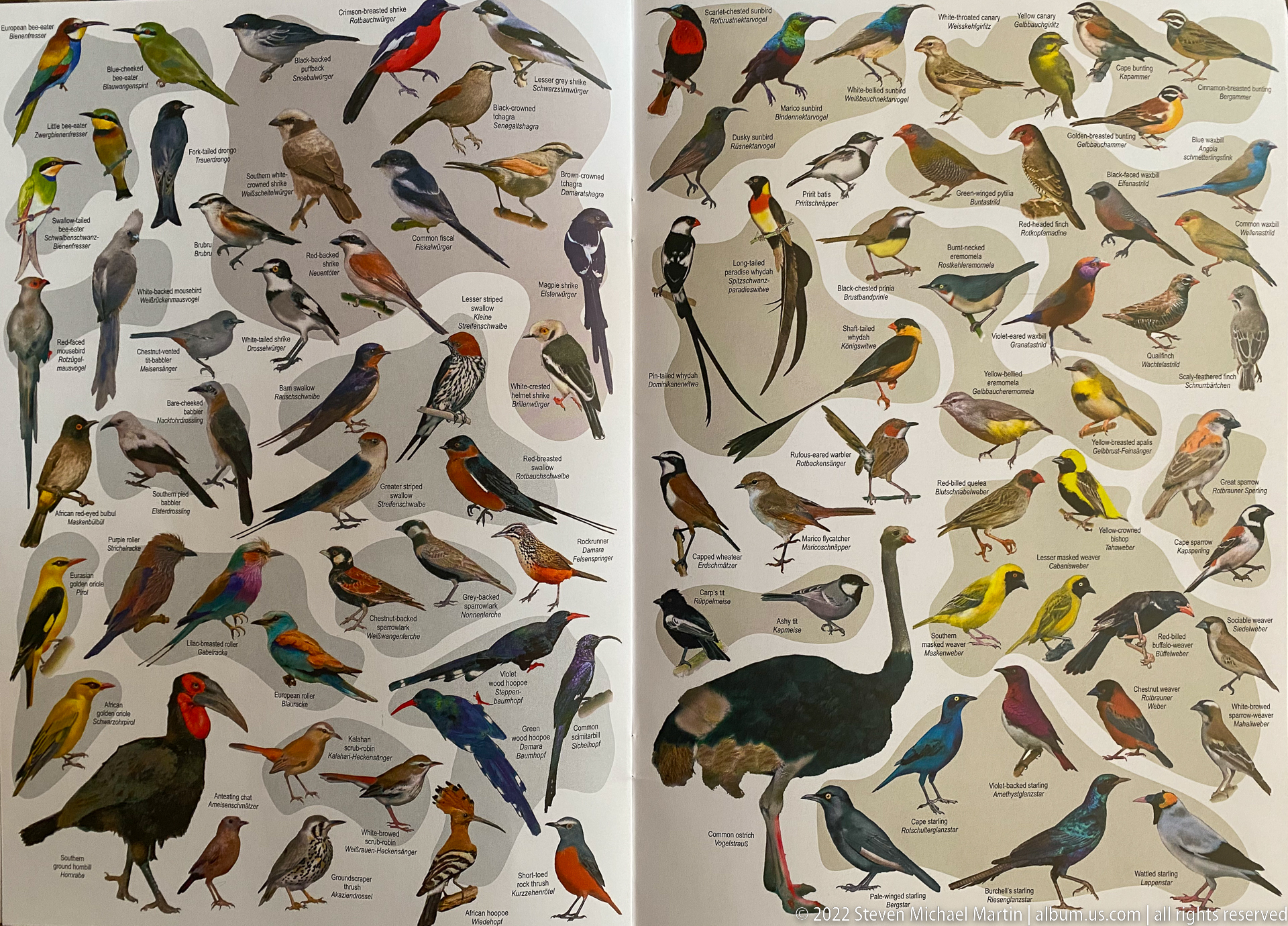
Colorful land birds fill this two-page identification spread, with dozens of labeled species arranged against a pale background. Perching forms dominate, joined by conspicuous larger birds and several vividly patterned species. The compact plate format is designed for visual comparison of plumage, body shape, bill form, and relative proportions—features central to identifying Etosha’s diverse birdlife in the field.
Caption
Colorful land birds fill this two-page identification spread, with dozens of labeled species arranged against a pale background. Perching forms dominate, joined by conspicuous larger birds and several vividly patterned species. The compact plate format is designed for visual comparison of plumage, body shape, bill form, and relative proportions—features central to identifying Etosha’s diverse birdlife in the field.
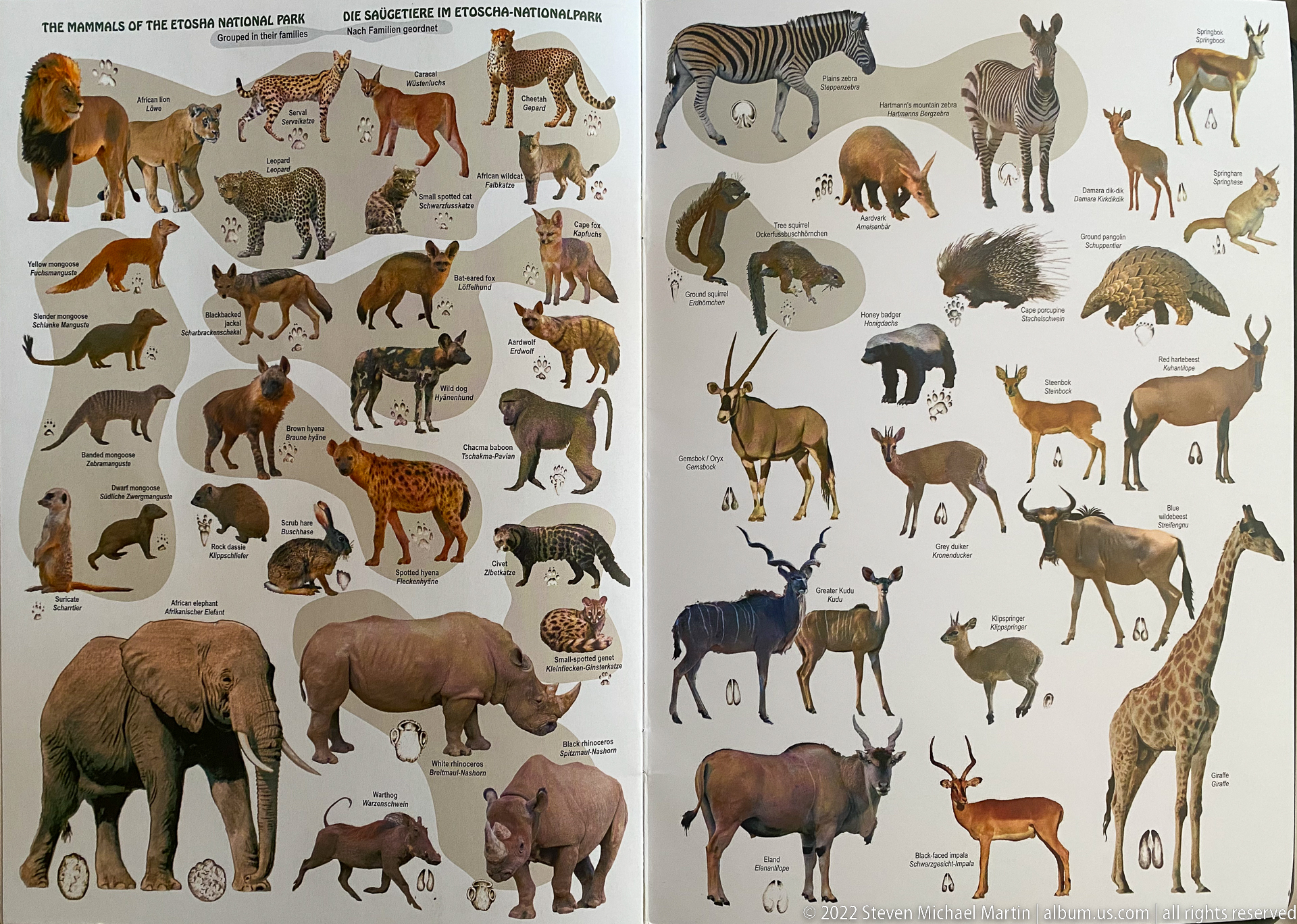
A two-page mammal plate gathers many of Etosha’s characteristic species into a single comparative reference. Carnivores, antelope, equids, primates, small mammals, and large herbivores are shown at differing scales, with elephant, rhinoceros, giraffe, zebra, and wildebeest among the most conspicuous forms. Labeled illustrations emphasize silhouette, coat pattern, horns, and body proportions used in field identification.
Caption
A two-page mammal plate gathers many of Etosha’s characteristic species into a single comparative reference. Carnivores, antelope, equids, primates, small mammals, and large herbivores are shown at differing scales, with elephant, rhinoceros, giraffe, zebra, and wildebeest among the most conspicuous forms. Labeled illustrations emphasize silhouette, coat pattern, horns, and body proportions used in field identification.
Videos: