Museo Egizio – Turin, Italy
The Museo Egizio in Turin houses one of the most important collections of ancient Egyptian artifacts outside of Egypt itself. Established in the early 19th century, the museum grew from collections acquired by the Savoy rulers and later expanded through archaeological expeditions in Egypt.
Today the museum contains thousands of objects including statues, papyri, mummies, and monumental sculptures that illustrate the history of ancient Egyptian civilization. Highlights include massive statues of pharaohs and detailed funerary artifacts recovered from archaeological excavations along the Nile.
The museum has become one of Turin’s most renowned cultural institutions and attracts scholars and visitors from around the world.

The Museo Egizio occupies the monumental former Collegio dei Nobili on Via Accademia delle Scienze, a building begun in 1679 and later adapted for the Egyptian collection after the museum’s foundation in 1824. The long Turin façade is articulated by rusticated stonework, tall windows, and formal Baroque architectural detailing, while yellow museum banners mark the contemporary entrance along the historic street frontage.
Caption
The Museo Egizio occupies the monumental former Collegio dei Nobili on Via Accademia delle Scienze, a building begun in 1679 and later adapted for the Egyptian collection after the museum’s foundation in 1824. The long Turin façade is articulated by rusticated stonework, tall windows, and formal Baroque architectural detailing, while yellow museum banners mark the contemporary entrance along the historic street frontage.

A small painted funerary chest or coffin is shown in profile, its pitched lid covered with repeated rosette-like motifs and a colored border. On the side panel, standing attendants approach seated figures beside an offering table, with a short hieroglyphic inscription above. The intact architectural form makes the object read almost like a miniature shrine, uniting container, image, and ritual narrative.
Caption
A small painted funerary chest or coffin is shown in profile, its pitched lid covered with repeated rosette-like motifs and a colored border. On the side panel, standing attendants approach seated figures beside an offering table, with a short hieroglyphic inscription above. The intact architectural form makes the object read almost like a miniature shrine, uniting container, image, and ritual narrative.

A conservator works at a brightly lit table in a museum laboratory while several small wrapped or mummified objects are displayed in the foreground. Magnification lamps, instruments, and work surfaces make the technical setting explicit. The view shifts from finished gallery display to behind-the-scenes care, showing conservation as an active process of examination, stabilization, and documentation.
Caption
A conservator works at a brightly lit table in a museum laboratory while several small wrapped or mummified objects are displayed in the foreground. Magnification lamps, instruments, and work surfaces make the technical setting explicit. The view shifts from finished gallery display to behind-the-scenes care, showing conservation as an active process of examination, stabilization, and documentation.

A broad stairway rises through a pale, symmetrical interior of the Museo Egizio, terminating beneath a tall arched recess framed by massive pilasters. Brass-toned handrails and dark stone treads accent the otherwise restrained palette. The upward viewpoint emphasizes the museum's axial circulation and the contrast between the historic architectural shell and the controlled, contemporary visitor route.
Caption
A broad stairway rises through a pale, symmetrical interior of the Museo Egizio, terminating beneath a tall arched recess framed by massive pilasters. Brass-toned handrails and dark stone treads accent the otherwise restrained palette. The upward viewpoint emphasizes the museum's axial circulation and the contrast between the historic architectural shell and the controlled, contemporary visitor route.
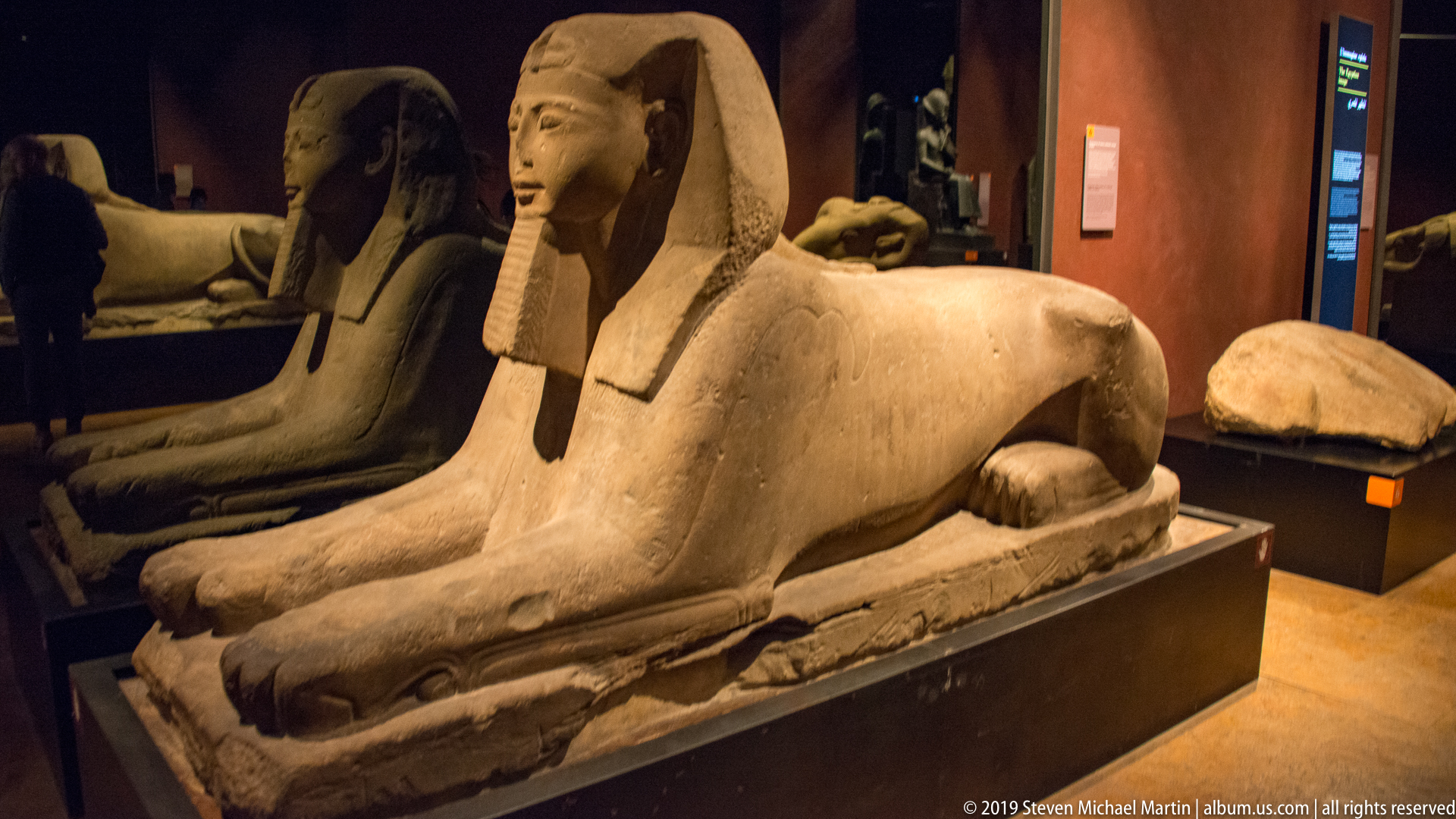
A monumental sphinx combines the body of a reclining lion with the nemes-framed head of an Egyptian king. The sculpture rests on a long plinth, with extended forepaws, powerful haunches, and a formal frontal gaze. Seen in three-quarter view, the hybrid form clearly joins royal portraiture with leonine strength, one of the most enduring visual formulas of pharaonic kingship.
Caption
A monumental sphinx combines the body of a reclining lion with the nemes-framed head of an Egyptian king. The sculpture rests on a long plinth, with extended forepaws, powerful haunches, and a formal frontal gaze. Seen in three-quarter view, the hybrid form clearly joins royal portraiture with leonine strength, one of the most enduring visual formulas of pharaonic kingship.

The upper body of a richly finished anthropoid coffin is viewed obliquely, showing the gilded face, striped wig, and crossed forearms over a reddish-brown chest. Incised and painted lines articulate hair, jewelry, and garment surfaces, while chips and abrasions expose the coffin's long material history. The angle makes the object’s human scale and three-dimensional modeling especially clear.
Caption
The upper body of a richly finished anthropoid coffin is viewed obliquely, showing the gilded face, striped wig, and crossed forearms over a reddish-brown chest. Incised and painted lines articulate hair, jewelry, and garment surfaces, while chips and abrasions expose the coffin's long material history. The angle makes the object’s human scale and three-dimensional modeling especially clear.

A full-length anthropoid coffin lies within a glass case, its golden surface shaped into a wrapped human body with a modeled face, headdress, and crossed forearms. Subtle bands and painted traces remain across the torso, while abrasions and darkened areas record age and handling. The overhead angle reveals the coffin's complete silhouette and the continuity between sculpted body and painted decoration.
Caption
A full-length anthropoid coffin lies within a glass case, its golden surface shaped into a wrapped human body with a modeled face, headdress, and crossed forearms. Subtle bands and painted traces remain across the torso, while abrasions and darkened areas record age and handling. The overhead angle reveals the coffin's complete silhouette and the continuity between sculpted body and painted decoration.

Stacks of brightly colored Museo Egizio publications fill a shop table, with yellow and blue covers prominently repeating the museum's name and graphic identity. Small boxed objects sit among the books, turning the display into a compact field of visitor materials. The overhead view emphasizes typography and repetition, shifting attention from ancient objects to the museum's contemporary educational and retail presence.
Caption
Stacks of brightly colored Museo Egizio publications fill a shop table, with yellow and blue covers prominently repeating the museum's name and graphic identity. Small boxed objects sit among the books, turning the display into a compact field of visitor materials. The overhead view emphasizes typography and repetition, shifting attention from ancient objects to the museum's contemporary educational and retail presence.

Seen in tight frontal view, the lioness-headed goddess Sekhmet is rendered in dark granodiorite with rounded ears, a broad feline muzzle, and the striated tripartite wig of an Egyptian deity. The Museo Egizio preserves a major group of Sekhmet statues made during the reign of Amenhotep III and displayed in the Gallery of Kings, many originating from the great Theban temple complexes at Karnak.
Caption
Seen in tight frontal view, the lioness-headed goddess Sekhmet is rendered in dark granodiorite with rounded ears, a broad feline muzzle, and the striated tripartite wig of an Egyptian deity. The Museo Egizio preserves a major group of Sekhmet statues made during the reign of Amenhotep III and displayed in the Gallery of Kings, many originating from the great Theban temple complexes at Karnak.

A reddish-brown anthropoid coffin rests above a rectangular lower case densely covered with painted hieroglyphs. The lid preserves a modeled head and body with traces of color and ornament, while the box below presents more linear, text-heavy decoration. A separate circular or collar-like object in the foreground adds context to the burial assemblage displayed with the coffin.
Caption
A reddish-brown anthropoid coffin rests above a rectangular lower case densely covered with painted hieroglyphs. The lid preserves a modeled head and body with traces of color and ornament, while the box below presents more linear, text-heavy decoration. A separate circular or collar-like object in the foreground adds context to the burial assemblage displayed with the coffin.

A standing deity occupies the foreground beside a tall rectangular pillar densely carved with vertical hieroglyphs. The figure wears a long garment and distinctive headdress, while smaller sculptural elements emerge around the rear support. Seen in three-quarter view, the ensemble demonstrates how Egyptian statues could combine divine figures, inscriptions, and architectural back-pillars into a single commemorative monument.
Caption
A standing deity occupies the foreground beside a tall rectangular pillar densely carved with vertical hieroglyphs. The figure wears a long garment and distinctive headdress, while smaller sculptural elements emerge around the rear support. Seen in three-quarter view, the ensemble demonstrates how Egyptian statues could combine divine figures, inscriptions, and architectural back-pillars into a single commemorative monument.

A compact stone figure of a standing Egyptian goddess wears a broad disk-like headdress and holds a small vessel against her torso. The frontal pose, close-set limbs, and restrained carving give the sculpture a formal cultic character. Surface wear softens the facial features and details of the headdress, while the dark gallery setting isolates the figure as an individual devotional or temple object.
Caption
A compact stone figure of a standing Egyptian goddess wears a broad disk-like headdress and holds a small vessel against her torso. The frontal pose, close-set limbs, and restrained carving give the sculpture a formal cultic character. Surface wear softens the facial features and details of the headdress, while the dark gallery setting isolates the figure as an individual devotional or temple object.

Viewed from the foot end, an anthropoid coffin presents a striking pattern of alternating dark and gold bands across its rounded lower body. A small modeled or painted face motif appears within the striped decoration, while worn gilding reveals the uneven surface beneath. The unusual viewpoint highlights the coffin's volume and ornamental system instead of its human face.
Caption
Viewed from the foot end, an anthropoid coffin presents a striking pattern of alternating dark and gold bands across its rounded lower body. A small modeled or painted face motif appears within the striped decoration, while worn gilding reveals the uneven surface beneath. The unusual viewpoint highlights the coffin's volume and ornamental system instead of its human face.

A frontal coffin face emerges from a broad striped wig, its gold-toned skin, dark-lined eyes, and blue-green collar details retaining much of their visual force despite surface loss. Abrasion and flaking are especially visible along the wig and lower edge. The direct viewpoint underscores the idealized, timeless expression central to Egyptian funerary portraiture.
Caption
A frontal coffin face emerges from a broad striped wig, its gold-toned skin, dark-lined eyes, and blue-green collar details retaining much of their visual force despite surface loss. Abrasion and flaking are especially visible along the wig and lower edge. The direct viewpoint underscores the idealized, timeless expression central to Egyptian funerary portraiture.

A painted funerary panel combines hieroglyphic columns with a carefully ordered offering scene. Figures in white garments face one another across a table bearing vessels and food, while black wigs, red-brown skin tones, and blue-green details create a vivid register against the pale ground. The close view reveals the compartmentalized storytelling and dense visual language characteristic of decorated Egyptian coffins and burial equipment.
Caption
A painted funerary panel combines hieroglyphic columns with a carefully ordered offering scene. Figures in white garments face one another across a table bearing vessels and food, while black wigs, red-brown skin tones, and blue-green details create a vivid register against the pale ground. The close view reveals the compartmentalized storytelling and dense visual language characteristic of decorated Egyptian coffins and burial equipment.

The gilded face of an anthropoid coffin fills the frame, with large inlaid eyes outlined in dark pigment and blue cosmetic bands extending toward the temples. Fine painted lines across the wig and visible cracking in the gilded surface reveal both decorative craftsmanship and age. The close crop transforms the funerary object into an intimate study of idealized facial features designed for eternal identity.
Caption
The gilded face of an anthropoid coffin fills the frame, with large inlaid eyes outlined in dark pigment and blue cosmetic bands extending toward the temples. Fine painted lines across the wig and visible cracking in the gilded surface reveal both decorative craftsmanship and age. The close crop transforms the funerary object into an intimate study of idealized facial features designed for eternal identity.

A second angled view concentrates on the face and chest of a painted anthropoid coffin. The glossy eyes, blue cosmetic lines, and finely ruled wig contrast with the worn reddish surface of the crossed forearms and torso. Seen from the side, the raised modeling of the head and shoulders becomes more apparent, emphasizing the coffin as a sculptural body rather than a flat decorated surface.
Caption
A second angled view concentrates on the face and chest of a painted anthropoid coffin. The glossy eyes, blue cosmetic lines, and finely ruled wig contrast with the worn reddish surface of the crossed forearms and torso. Seen from the side, the raised modeling of the head and shoulders becomes more apparent, emphasizing the coffin as a sculptural body rather than a flat decorated surface.

Brightly colored notebooks in the museum shop reinterpret Egyptian deities as playful cartoon figures. The visible covers label Seth and Horus, while a third cover presents another stylized pharaonic character on a red field. The display offers a contemporary contrast to the archaeological galleries, showing how ancient iconography is adapted into accessible museum merchandise for visitors.
Caption
Brightly colored notebooks in the museum shop reinterpret Egyptian deities as playful cartoon figures. The visible covers label Seth and Horus, while a third cover presents another stylized pharaonic character on a red field. The display offers a contemporary contrast to the archaeological galleries, showing how ancient iconography is adapted into accessible museum merchandise for visitors.

A cluster of plush mummy toys fills the frame, their white fabric bodies wrapped with black stitched bands and oversized button-like eyes. Red hanging tags identify them as retail items rather than archaeological objects. The whimsical design transforms one of Egyptology's most familiar subjects into a child-friendly souvenir, creating a deliberate contrast with the museum's authentic funerary collections.
Caption
A cluster of plush mummy toys fills the frame, their white fabric bodies wrapped with black stitched bands and oversized button-like eyes. Red hanging tags identify them as retail items rather than archaeological objects. The whimsical design transforms one of Egyptology's most familiar subjects into a child-friendly souvenir, creating a deliberate contrast with the museum's authentic funerary collections.

Soft dolls with dark yarn hair and broad embroidered eyes are grouped closely together in the Museo Egizio shop. Their white garments, colored collars, and gold-toned armbands borrow visual cues from ancient Egyptian dress while remaining unmistakably modern toys. The dense arrangement emphasizes the museum's popular reinterpretation of archaeological imagery for younger visitors and souvenir culture.
Caption
Soft dolls with dark yarn hair and broad embroidered eyes are grouped closely together in the Museo Egizio shop. Their white garments, colored collars, and gold-toned armbands borrow visual cues from ancient Egyptian dress while remaining unmistakably modern toys. The dense arrangement emphasizes the museum's popular reinterpretation of archaeological imagery for younger visitors and souvenir culture.

A red T-shirt stretched over a display form carries a cartoon mummy graphic composed of black-and-white bandages, yellow eyes, and a curled tail-like flourish. The humorous design reduces the wrapped body to a simple mascot-like emblem. Set against the museum-shop display, the shirt illustrates the contemporary commercial afterlife of ancient Egyptian funerary imagery.
Caption
A red T-shirt stretched over a display form carries a cartoon mummy graphic composed of black-and-white bandages, yellow eyes, and a curled tail-like flourish. The humorous design reduces the wrapped body to a simple mascot-like emblem. Set against the museum-shop display, the shirt illustrates the contemporary commercial afterlife of ancient Egyptian funerary imagery.

A monumental seated king dominates this royal statue group, with a smaller standing figure beside the throne and hieroglyphic inscriptions on the supporting elements. The arrangement closely recalls the celebrated Museo Egizio statue of Ramesses II, in which smaller members of the royal family accompany the king and dynastic continuity is expressed through hierarchical scale. The identification is retained cautiously because the proof image does not expose every diagnostic attribute.
Caption
A monumental seated king dominates this royal statue group, with a smaller standing figure beside the throne and hieroglyphic inscriptions on the supporting elements. The arrangement closely recalls the celebrated Museo Egizio statue of Ramesses II, in which smaller members of the royal family accompany the king and dynastic continuity is expressed through hierarchical scale. The identification is retained cautiously because the proof image does not expose every diagnostic attribute.

A seated pharaoh in dark stone rests both forearms across his lap, his feet planted firmly on the base and a striped royal headdress framing the face. Hieroglyphic columns descend along the throne's side. The compact pose, frontal gaze, and block-like integration of body and seat create the enduring monumentality associated with Egyptian royal statuary.
Caption
A seated pharaoh in dark stone rests both forearms across his lap, his feet planted firmly on the base and a striped royal headdress framing the face. Hieroglyphic columns descend along the throne's side. The compact pose, frontal gaze, and block-like integration of body and seat create the enduring monumentality associated with Egyptian royal statuary.

A monumental seated Egyptian king fills the gallery view, wearing a striped royal headdress and extending both hands flat across his knees. Hieroglyphic inscriptions cover the vertical sides of the throne, while the polished stone surface catches scattered reflections from the dark display hall. The rigid symmetry and massive legs give the figure the commanding stillness characteristic of state-sponsored royal sculpture.
Caption
A monumental seated Egyptian king fills the gallery view, wearing a striped royal headdress and extending both hands flat across his knees. Hieroglyphic inscriptions cover the vertical sides of the throne, while the polished stone surface catches scattered reflections from the dark display hall. The rigid symmetry and massive legs give the figure the commanding stillness characteristic of state-sponsored royal sculpture.

A standing Sekhmet wears the solar disk above her lioness head and a long close-fitting dress, one arm lowered while the other holds a vertical emblem against the body. The Museo Egizio’s Gallery of Kings includes multiple standing granodiorite statues of Sekhmet commissioned under Amenhotep III. Their leonine heads and solar associations identify the goddess as the powerful daughter and Eye of the sun god.
Caption
A standing Sekhmet wears the solar disk above her lioness head and a long close-fitting dress, one arm lowered while the other holds a vertical emblem against the body. The Museo Egizio’s Gallery of Kings includes multiple standing granodiorite statues of Sekhmet commissioned under Amenhotep III. Their leonine heads and solar associations identify the goddess as the powerful daughter and Eye of the sun god.

A rectangular funerary panel shows two male figures crouching in opposed positions on a pale ground. One has reddish skin and dark hair; the other is painted darker, and both wear contrasting garments. A narrow vertical motif separates them, while traces of red, green, black, and cream survive around the edges. The compact composition suggests a decorative element from coffin or burial equipment.
Caption
A rectangular funerary panel shows two male figures crouching in opposed positions on a pale ground. One has reddish skin and dark hair; the other is painted darker, and both wear contrasting garments. A narrow vertical motif separates them, while traces of red, green, black, and cream survive around the edges. The compact composition suggests a decorative element from coffin or burial equipment.

The sandstone interior belongs to the rock-cut chapel of Ellesiya, built under Thutmose III in Nubia and reassembled at the Museo Egizio after the international UNESCO campaign to save monuments threatened by the Aswan High Dam. Incised reliefs cover the narrow walls, while the recessed sanctuary at the rear preserves standing divine figures. Egypt presented the chapel to Italy in recognition of its participation in the Nubian rescue effort.
Caption
The sandstone interior belongs to the rock-cut chapel of Ellesiya, built under Thutmose III in Nubia and reassembled at the Museo Egizio after the international UNESCO campaign to save monuments threatened by the Aswan High Dam. Incised reliefs cover the narrow walls, while the recessed sanctuary at the rear preserves standing divine figures. Egypt presented the chapel to Italy in recognition of its participation in the Nubian rescue effort.

A monumental sandstone ram head preserves the animal form of Amun used in Egyptian criosphinxes—sphinxes in which a ram’s head replaces the human head. The broad forehead and heavy curling horns identify the sacred animal unmistakably. The Museo Egizio dates this head to the reign of Amenhotep III and records a probable provenance from the Temple of Khonsu at Karnak.
Caption
A monumental sandstone ram head preserves the animal form of Amun used in Egyptian criosphinxes—sphinxes in which a ram’s head replaces the human head. The broad forehead and heavy curling horns identify the sacred animal unmistakably. The Museo Egizio dates this head to the reign of Amenhotep III and records a probable provenance from the Temple of Khonsu at Karnak.

A fragmentary royal statue survives from the torso upward and across one bent leg, the missing lower portions exposed by a modern support. The figure wears a striped headdress and ceremonial beard and presents a broad horizontal slab or offering surface before him. Strong frontal modeling and compact proportions indicate a formal royal image, while the breaks make its archaeological condition unusually prominent.
Caption
A fragmentary royal statue survives from the torso upward and across one bent leg, the missing lower portions exposed by a modern support. The figure wears a striped headdress and ceremonial beard and presents a broad horizontal slab or offering surface before him. Strong frontal modeling and compact proportions indicate a formal royal image, while the breaks make its archaeological condition unusually prominent.

This sandstone royal head represents Thutmose I wearing the tall White Crown of Upper Egypt. The smooth crown rises above an idealized face with carefully modeled eyes and lips, while the broken neck shows that the head once belonged to a much larger statue. The Museo Egizio dates the sculpture to the Eighteenth Dynasty and records its provenance from the Temple of Amun at Karnak.
Caption
This sandstone royal head represents Thutmose I wearing the tall White Crown of Upper Egypt. The smooth crown rises above an idealized face with carefully modeled eyes and lips, while the broken neck shows that the head once belonged to a much larger statue. The Museo Egizio dates the sculpture to the Eighteenth Dynasty and records its provenance from the Temple of Amun at Karnak.

Amenhotep II kneels in a formal offering pose, wearing the nemes headdress and ceremonial beard while extending two vessels in his upturned hands. Carved in granite, the statue comes from the Temple of Amun at Karnak and belongs to the Eighteenth Dynasty. The compact kneeling posture turns the king into a perpetual ritual participant, eternally presenting offerings before the deity.
Caption
Amenhotep II kneels in a formal offering pose, wearing the nemes headdress and ceremonial beard while extending two vessels in his upturned hands. Carved in granite, the statue comes from the Temple of Amun at Karnak and belongs to the Eighteenth Dynasty. The compact kneeling posture turns the king into a perpetual ritual participant, eternally presenting offerings before the deity.

A dark stone king sits frontally with one hand resting on the knee and the other drawn across his chest to hold a curved staff or crook-like emblem. A royal headdress frames the face, and finely patterned surface treatment covers the torso and kilt. The symmetrical posture, regalia, and monumental calm identify the work as an image of Egyptian kingship intended to project ritual authority.
Caption
A dark stone king sits frontally with one hand resting on the knee and the other drawn across his chest to hold a curved staff or crook-like emblem. A royal headdress frames the face, and finely patterned surface treatment covers the torso and kilt. The symmetrical posture, regalia, and monumental calm identify the work as an image of Egyptian kingship intended to project ritual authority.

A seated Egyptian king is viewed in profile, revealing the projecting royal headdress, straight back, and hands arranged across the lap. Incised decoration appears along the side of the throne, while a row of additional statues recedes into the gallery behind him. The lateral viewpoint emphasizes the depth and bodily construction of Egyptian royal sculpture within the museum's monumental display.
Caption
A seated Egyptian king is viewed in profile, revealing the projecting royal headdress, straight back, and hands arranged across the lap. Incised decoration appears along the side of the throne, while a row of additional statues recedes into the gallery behind him. The lateral viewpoint emphasizes the depth and bodily construction of Egyptian royal sculpture within the museum's monumental display.

From the side, the sandstone ram head reveals the full spiral of its massive horn, elongated muzzle, and block-like broken neck. The fragment belonged to the criosphinx tradition associated with Amun, whose sacred animal form was the ram. Museo Egizio identifies the sculpture as an Eighteenth-Dynasty work from the reign of Amenhotep III, probably from the Temple of Khonsu at Karnak.
Caption
From the side, the sandstone ram head reveals the full spiral of its massive horn, elongated muzzle, and block-like broken neck. The fragment belonged to the criosphinx tradition associated with Amun, whose sacred animal form was the ram. Museo Egizio identifies the sculpture as an Eighteenth-Dynasty work from the reign of Amenhotep III, probably from the Temple of Khonsu at Karnak.

From the front, a monumental sphinx presents a broad lion chest and massive forepaws beneath the idealized face of a king. The nemes headdress and ceremonial beard reinforce the royal identity, while the low viewpoint exaggerates the sculpture's scale. This angle emphasizes symmetry and the deliberate fusion of human authority with the physical power of the lion.
Caption
From the front, a monumental sphinx presents a broad lion chest and massive forepaws beneath the idealized face of a king. The nemes headdress and ceremonial beard reinforce the royal identity, while the low viewpoint exaggerates the sculpture's scale. This angle emphasizes symmetry and the deliberate fusion of human authority with the physical power of the lion.

A bovine mummy head is presented frontally, with short horns, large circular painted eyes, and preserved brown skin stretched across the skull. White painted bands accent the eyes and forehead, while the body behind remains wrapped. The unusual combination of natural remains and added painted features makes the object both anatomical and ritual in appearance.
Caption
A bovine mummy head is presented frontally, with short horns, large circular painted eyes, and preserved brown skin stretched across the skull. White painted bands accent the eyes and forehead, while the body behind remains wrapped. The unusual combination of natural remains and added painted features makes the object both anatomical and ritual in appearance.

A vividly painted anthropoid coffin presents a gold-toned face framed by a broad blue wig and dense orange, green, and black decoration across the chest. Large outlined eyes and patterned jewelry give the upper body exceptional visual intensity. The frontal composition shows how color and geometry transformed the coffin into an idealized protective image of the deceased.
Caption
A vividly painted anthropoid coffin presents a gold-toned face framed by a broad blue wig and dense orange, green, and black decoration across the chest. Large outlined eyes and patterned jewelry give the upper body exceptional visual intensity. The frontal composition shows how color and geometry transformed the coffin into an idealized protective image of the deceased.

A narrow stairway rises between pale walls toward a high arched landing framed by classical molding. Dark steps and brass-toned handrails guide the eye upward, while the restrained architecture creates a calm transition between gallery levels. The view focuses on circulation and proportion, showing the museum's historic interior shell rather than an archaeological object.
Caption
A narrow stairway rises between pale walls toward a high arched landing framed by classical molding. Dark steps and brass-toned handrails guide the eye upward, while the restrained architecture creates a calm transition between gallery levels. The view focuses on circulation and proportion, showing the museum's historic interior shell rather than an archaeological object.

A carved stone panel shows two heraldically opposed winged creatures flanking a central vegetal or shell-like motif. Their spotted bodies, raised wings, and open mouths create a vigorous symmetrical composition framed by damaged architectural carving. The exact mythological identity is uncertain from the proof sheet, but the scene is clearly an ornamental relief built around paired fantastic animals.
Caption
A carved stone panel shows two heraldically opposed winged creatures flanking a central vegetal or shell-like motif. Their spotted bodies, raised wings, and open mouths create a vigorous symmetrical composition framed by damaged architectural carving. The exact mythological identity is uncertain from the proof sheet, but the scene is clearly an ornamental relief built around paired fantastic animals.

A rectangular stone fragment is organized in horizontal bands, with two broad-winged motifs occupying the lower registers and a repeating geometric border above. Feathers are rendered in dense parallel carving, while worn edges and missing corners reveal the fragmentary state. The tightly ordered design suggests a decorative architectural element rather than a free-standing sculpture.
Caption
A rectangular stone fragment is organized in horizontal bands, with two broad-winged motifs occupying the lower registers and a repeating geometric border above. Feathers are rendered in dense parallel carving, while worn edges and missing corners reveal the fragmentary state. The tightly ordered design suggests a decorative architectural element rather than a free-standing sculpture.

A small mummified animal lies on its side, its head exposed while the body remains wrapped in dark textile. Large rounded eye areas and a short muzzle are visible beneath the preserved skin, and a modern catalogue tag is tied around the neck. The close view emphasizes the physical preservation and museum documentation of an animal mummy rather than a human burial.
Caption
A small mummified animal lies on its side, its head exposed while the body remains wrapped in dark textile. Large rounded eye areas and a short muzzle are visible beneath the preserved skin, and a modern catalogue tag is tied around the neck. The close view emphasizes the physical preservation and museum documentation of an animal mummy rather than a human burial.

A highly polished anthropoid coffin face appears against a dark background, framed by a deeply striated wig and an elongated ceremonial beard. Smooth modeling around the eyes, lips, and cheeks contrasts with the dense linear texture of the hair. The intimate close view isolates the idealized funerary portrait from the rest of the coffin, making surface finish and symmetry the dominant visual features.
Caption
A highly polished anthropoid coffin face appears against a dark background, framed by a deeply striated wig and an elongated ceremonial beard. Smooth modeling around the eyes, lips, and cheeks contrasts with the dense linear texture of the hair. The intimate close view isolates the idealized funerary portrait from the rest of the coffin, making surface finish and symmetry the dominant visual features.

A second frontal coffin portrait fills the frame, its idealized face set within a broad, finely grooved wig and a prominent segmented beard. The sharply defined eyes and lips are especially luminous against the dark material. Slight differences in facial modeling and wig contour distinguish this piece from the neighboring coffin, underscoring the individuality within a highly conventional funerary form.
Caption
A second frontal coffin portrait fills the frame, its idealized face set within a broad, finely grooved wig and a prominent segmented beard. The sharply defined eyes and lips are especially luminous against the dark material. Slight differences in facial modeling and wig contour distinguish this piece from the neighboring coffin, underscoring the individuality within a highly conventional funerary form.

Three dark anthropoid coffins stand upright in a gallery, presenting contrasting profiles of funerary design. The left coffin preserves a fully modeled human figure with crossed arms, the central example has a rounded head and dense vertical inscription, and the right coffin is seen mostly from the back or side. Together they reveal variation in shape, decoration, and inscription within Egyptian burial equipment.
Caption
Three dark anthropoid coffins stand upright in a gallery, presenting contrasting profiles of funerary design. The left coffin preserves a fully modeled human figure with crossed arms, the central example has a rounded head and dense vertical inscription, and the right coffin is seen mostly from the back or side. Together they reveal variation in shape, decoration, and inscription within Egyptian burial equipment.

A blue-green beaded net is laid out beside trays of small amulets and fragments in a museum case. The mesh narrows toward one end and incorporates larger decorative elements, while nearby compartments contain many additional turquoise-colored pieces. The display highlights the painstaking assembly of funerary beadwork and the use of small protective ornaments as part of Egyptian burial equipment.
Caption
A blue-green beaded net is laid out beside trays of small amulets and fragments in a museum case. The mesh narrows toward one end and incorporates larger decorative elements, while nearby compartments contain many additional turquoise-colored pieces. The display highlights the painstaking assembly of funerary beadwork and the use of small protective ornaments as part of Egyptian burial equipment.

An elaborately painted anthropoid coffin is displayed open, with the decorated lid raised above the lower case. Dense vertical bands of hieroglyphs and small divine figures cover the lid, while the inner cavity reveals the reddish form of the mummy or inner wrapping below. The open presentation makes the coffin's layered construction especially clear, separating outer image, container, and body space.
Caption
An elaborately painted anthropoid coffin is displayed open, with the decorated lid raised above the lower case. Dense vertical bands of hieroglyphs and small divine figures cover the lid, while the inner cavity reveals the reddish form of the mummy or inner wrapping below. The open presentation makes the coffin's layered construction especially clear, separating outer image, container, and body space.

An unwrapped human mummy lies on a padded support, with the head turned slightly to one side and the upper torso exposed. Desiccated skin, collapsed soft tissue, and the preserved ear are clearly visible, offering a direct view of the physical effects of mummification. The plain display isolates the body itself rather than emphasizing coffin decoration or burial furnishings.
Caption
An unwrapped human mummy lies on a padded support, with the head turned slightly to one side and the upper torso exposed. Desiccated skin, collapsed soft tissue, and the preserved ear are clearly visible, offering a direct view of the physical effects of mummification. The plain display isolates the body itself rather than emphasizing coffin decoration or burial furnishings.

A partially wrapped human mummy is shown from a low angle, the face and head exposed above torn layers of linen. Darkened skin and collapsed facial tissue contrast with the pale woven wrappings across the torso. The close framing reveals how burial textiles and preserved remains survive together, making the material process of mummification especially legible.
Caption
A partially wrapped human mummy is shown from a low angle, the face and head exposed above torn layers of linen. Darkened skin and collapsed facial tissue contrast with the pale woven wrappings across the torso. The close framing reveals how burial textiles and preserved remains survive together, making the material process of mummification especially legible.

A rectangular painted funerary chest is covered with vertical hieroglyphic columns, standing deities, and multicolored borders. The slightly raised lid and block-like form make its container function clear, while small figurines arranged beside it provide scale. The object combines practical storage with dense religious imagery, turning every visible surface into part of the funerary program.
Caption
A rectangular painted funerary chest is covered with vertical hieroglyphic columns, standing deities, and multicolored borders. The slightly raised lid and block-like form make its container function clear, while small figurines arranged beside it provide scale. The object combines practical storage with dense religious imagery, turning every visible surface into part of the funerary program.

A painted funerary textile or shroud is organized around a central rectangular motif, with human-headed and animal-headed figures positioned around it. Red linear bands structure the composition, while hieroglyphic groups occupy the upper register. The light fabric ground and sketch-like painted outlines distinguish the piece from decorated coffin panels, emphasizing textile as a carrier of funerary imagery.
Caption
A painted funerary textile or shroud is organized around a central rectangular motif, with human-headed and animal-headed figures positioned around it. Red linear bands structure the composition, while hieroglyphic groups occupy the upper register. The light fabric ground and sketch-like painted outlines distinguish the piece from decorated coffin panels, emphasizing textile as a carrier of funerary imagery.

An arched recess interrupts a richly painted tomb chamber whose ceiling carries dense geometric patterns and whose walls preserve processions of figures. The large undecorated niche creates a striking contrast with the surrounding bands of color and hieroglyphic imagery. This wider angle clarifies the spatial relationship between architectural opening, painted wall registers, and decorated ceiling.
Caption
An arched recess interrupts a richly painted tomb chamber whose ceiling carries dense geometric patterns and whose walls preserve processions of figures. The large undecorated niche creates a striking contrast with the surrounding bands of color and hieroglyphic imagery. This wider angle clarifies the spatial relationship between architectural opening, painted wall registers, and decorated ceiling.

A tall anthropoid coffin stands upright in a glass case, covered from shoulders to foot in dense bands of painted figures, hieroglyphs, and geometric ornament. The dark wig and modeled face anchor the upper body, while the lower half becomes a continuous field of ritual imagery. Reflections from the gallery emphasize its role as both sculptural container and painted narrative surface.
Caption
A tall anthropoid coffin stands upright in a glass case, covered from shoulders to foot in dense bands of painted figures, hieroglyphs, and geometric ornament. The dark wig and modeled face anchor the upper body, while the lower half becomes a continuous field of ritual imagery. Reflections from the gallery emphasize its role as both sculptural container and painted narrative surface.

A rounded-top funerary stela is divided into horizontal registers packed with hieroglyphs and offering scenes. Seated figures receive offerings in the upper and middle zones, while a procession of standing and kneeling people fills the lower register. The compact organization combines text, genealogy, and ritual action within a single commemorative surface intended for sustained reading.
Caption
A rounded-top funerary stela is divided into horizontal registers packed with hieroglyphs and offering scenes. Seated figures receive offerings in the upper and middle zones, while a procession of standing and kneeling people fills the lower register. The compact organization combines text, genealogy, and ritual action within a single commemorative surface intended for sustained reading.

Rows of painted figures move across a tomb wall beneath a brightly patterned ceiling of zigzags, diamonds, and geometric bands. Areas of loss interrupt the scenes, but surviving reds, yellows, blues, and whites preserve the chamber's visual richness. The oblique viewpoint shows decoration extending continuously across wall and ceiling, making the tomb interior feel architectural rather than merely pictorial.
Caption
Rows of painted figures move across a tomb wall beneath a brightly patterned ceiling of zigzags, diamonds, and geometric bands. Areas of loss interrupt the scenes, but surviving reds, yellows, blues, and whites preserve the chamber's visual richness. The oblique viewpoint shows decoration extending continuously across wall and ceiling, making the tomb interior feel architectural rather than merely pictorial.

A small pyramidion bears a finely carved falcon beneath a solar disk, accompanied by hieroglyphic inscriptions along the sloping face and base. The triangular stone form recalls the miniature pyramid capstones associated with private tomb architecture. Reflections in the glass reveal its museum setting, while the tight framing centers the religious emblem and inscription.
Caption
A small pyramidion bears a finely carved falcon beneath a solar disk, accompanied by hieroglyphic inscriptions along the sloping face and base. The triangular stone form recalls the miniature pyramid capstones associated with private tomb architecture. Reflections in the glass reveal its museum setting, while the tight framing centers the religious emblem and inscription.

Seen from the head end, a reddish anthropoid coffin fills the frame with its modeled face, chest, and rounded shoulders rising above a broad footboard-like edge of the case. Fine painted and incised decoration survives across the surface despite wear. This unusual viewpoint reveals the coffin’s depth and sculptural volume more strongly than a conventional frontal presentation.
Caption
Seen from the head end, a reddish anthropoid coffin fills the frame with its modeled face, chest, and rounded shoulders rising above a broad footboard-like edge of the case. Fine painted and incised decoration survives across the surface despite wear. This unusual viewpoint reveals the coffin’s depth and sculptural volume more strongly than a conventional frontal presentation.

A rounded-top painted stela is divided into several horizontal registers containing seated and standing figures, animals, offerings, and dense hieroglyphic text. The surviving pigments are worn but still preserve red, black, green, and pale tones. Its stacked narrative fields create a compact record of ritual and daily activity, combining inscription and image on a single commemorative surface.
Caption
A rounded-top painted stela is divided into several horizontal registers containing seated and standing figures, animals, offerings, and dense hieroglyphic text. The surviving pigments are worn but still preserve red, black, green, and pale tones. Its stacked narrative fields create a compact record of ritual and daily activity, combining inscription and image on a single commemorative surface.

A paired stone portrait shows a woman and man standing or seated closely together, each with idealized almond-shaped eyes and carefully patterned wigs. Their shoulders touch and one figure's arm extends behind the other, creating an intimate family or couple grouping. The restrained frontal pose and detailed hair treatment place emphasis on social relationship as much as individual likeness.
Caption
A paired stone portrait shows a woman and man standing or seated closely together, each with idealized almond-shaped eyes and carefully patterned wigs. Their shoulders touch and one figure's arm extends behind the other, creating an intimate family or couple grouping. The restrained frontal pose and detailed hair treatment place emphasis on social relationship as much as individual likeness.

A four-sided pyramidion is carved with a kneeling or standing worshipper facing a divine figure, while vertical hieroglyphic columns fill the sloping face. Additional symbols and inscriptions wrap around the base and adjacent sides. Displayed upright in a case, the small monument condenses tomb architecture, prayer, and image into a compact capstone form.
Caption
A four-sided pyramidion is carved with a kneeling or standing worshipper facing a divine figure, while vertical hieroglyphic columns fill the sloping face. Additional symbols and inscriptions wrap around the base and adjacent sides. Displayed upright in a case, the small monument condenses tomb architecture, prayer, and image into a compact capstone form.

A gilded falcon ornament projects from the dark surface of a decorated coffin, its outstretched wings and carefully incised feathers preserved in low relief. Black and gold bands run behind it, creating a strong contrast between sacred emblem and coffin surface. The close view isolates the bird motif as a protective funerary symbol and reveals the craftsmanship of layered paint and gilding.
Caption
A gilded falcon ornament projects from the dark surface of a decorated coffin, its outstretched wings and carefully incised feathers preserved in low relief. Black and gold bands run behind it, creating a strong contrast between sacred emblem and coffin surface. The close view isolates the bird motif as a protective funerary symbol and reveals the craftsmanship of layered paint and gilding.

A close profile focuses on the modeled face of a black-and-gold anthropoid coffin. Inlaid or painted eyes, dark cosmetic lines, and alternating bands across the wig remain vivid despite surface wear and discoloration. Seen from the side, the raised nose, lips, and cheek reveal the coffin's sculptural depth more clearly than a frontal view.
Caption
A close profile focuses on the modeled face of a black-and-gold anthropoid coffin. Inlaid or painted eyes, dark cosmetic lines, and alternating bands across the wig remain vivid despite surface wear and discoloration. Seen from the side, the raised nose, lips, and cheek reveal the coffin's sculptural depth more clearly than a frontal view.

A gilded coffin face is viewed from below and in profile, exposing deep cracks, losses, and darkened areas across the forehead, cheek, and neck. The outlined eye remains sharply legible despite the damaged surface. This angle makes condition especially prominent, showing how the idealized funerary portrait survives through layers of age, fracture, and restoration.
Caption
A gilded coffin face is viewed from below and in profile, exposing deep cracks, losses, and darkened areas across the forehead, cheek, and neck. The outlined eye remains sharply legible despite the damaged surface. This angle makes condition especially prominent, showing how the idealized funerary portrait survives through layers of age, fracture, and restoration.

A second close view of the same or a closely related gilded coffin concentrates on the face and broad wig from a slightly higher angle. Cracks run across the brow and cheek, while the painted eye and black contour line retain strong definition. The wider crop includes more of the shoulder and chest, linking the damaged portrait back to the anthropoid body form.
Caption
A second close view of the same or a closely related gilded coffin concentrates on the face and broad wig from a slightly higher angle. Cracks run across the brow and cheek, while the painted eye and black contour line retain strong definition. The wider crop includes more of the shoulder and chest, linking the damaged portrait back to the anthropoid body form.

A black-painted coffin side is divided into gold-bordered vertical compartments containing standing divine or protective figures and narrow hieroglyphic columns. Above it, a gilded horizontal element preserves additional incised decoration. The alternating dark ground and gold figures create a striking register system, organizing the funerary imagery into a sequence of repeated ritual panels.
Caption
A black-painted coffin side is divided into gold-bordered vertical compartments containing standing divine or protective figures and narrow hieroglyphic columns. Above it, a gilded horizontal element preserves additional incised decoration. The alternating dark ground and gold figures create a striking register system, organizing the funerary imagery into a sequence of repeated ritual panels.

A black-and-gold anthropoid coffin lies horizontally in a display case, its gilded human-shaped lid rising above a darker lower case. Vertical panels along the side contain standing funerary figures framed by gold borders, while striped bands wrap the head and foot. The side view makes the coffin’s layered construction and contrast between sculpted body and painted case especially clear.
Caption
A black-and-gold anthropoid coffin lies horizontally in a display case, its gilded human-shaped lid rising above a darker lower case. Vertical panels along the side contain standing funerary figures framed by gold borders, while striped bands wrap the head and foot. The side view makes the coffin’s layered construction and contrast between sculpted body and painted case especially clear.

A second horizontal coffin is viewed more directly from the side, emphasizing its deep black surface, broad gold bands, and repeated standing figures in rectangular compartments. The raised anthropoid lid follows the contours of the body above the box-like lower case. Alternating stripes at the head and foot reinforce the strong geometric rhythm of the funerary decoration.
Caption
A second horizontal coffin is viewed more directly from the side, emphasizing its deep black surface, broad gold bands, and repeated standing figures in rectangular compartments. The raised anthropoid lid follows the contours of the body above the box-like lower case. Alternating stripes at the head and foot reinforce the strong geometric rhythm of the funerary decoration.

This section of the Book of the Dead of Kha combines dense columns of cursive hieroglyphs with a funerary vignette showing the coffin being drawn toward the tomb. The Museo Egizio’s fourteen-meter papyrus, discovered by Ernesto Schiaparelli in Kha’s intact tomb at Deir el-Medina in 1906, contains thirty-three spells intended to guide, protect, and transform Kha in the afterlife.
Caption
This section of the Book of the Dead of Kha combines dense columns of cursive hieroglyphs with a funerary vignette showing the coffin being drawn toward the tomb. The Museo Egizio’s fourteen-meter papyrus, discovered by Ernesto Schiaparelli in Kha’s intact tomb at Deir el-Medina in 1906, contains thirty-three spells intended to guide, protect, and transform Kha in the afterlife.

The opening vignette of Kha’s Book of the Dead shows Kha and his wife Merit standing in adoration before Osiris, who sits enthroned beneath a richly colored canopy. The scene introduces the fourteen-meter papyrus discovered in Tomb TT8 at Deir el-Medina. Museo Egizio identifies Kha as Overseer of the Works and Merit as Mistress of the House; the manuscript contains thirty-three funerary spells accompanied by selected vignettes.
Caption
The opening vignette of Kha’s Book of the Dead shows Kha and his wife Merit standing in adoration before Osiris, who sits enthroned beneath a richly colored canopy. The scene introduces the fourteen-meter papyrus discovered in Tomb TT8 at Deir el-Medina. Museo Egizio identifies Kha as Overseer of the Works and Merit as Mistress of the House; the manuscript contains thirty-three funerary spells accompanied by selected vignettes.

The Book of the Dead of Kha extends through the long illuminated case, beginning with the painted scene of Kha and Merit before Osiris and continuing through columns of cursive hieroglyphic text and funerary vignettes. The fourteen-meter manuscript was found in 1906 in Kha’s intact tomb, TT8, at Deir el-Medina. Its thirty-three spells were intended to guide and protect the royal-necropolis official in the afterlife.
Caption
The Book of the Dead of Kha extends through the long illuminated case, beginning with the painted scene of Kha and Merit before Osiris and continuing through columns of cursive hieroglyphic text and funerary vignettes. The fourteen-meter manuscript was found in 1906 in Kha’s intact tomb, TT8, at Deir el-Medina. Its thirty-three spells were intended to guide and protect the royal-necropolis official in the afterlife.

A corded wooden bed from the intact tomb of Kha is displayed with woven stools from the same celebrated Deir el-Medina burial assemblage. The bed’s wooden frame supports a lattice of plant fiber, while the low stools preserve related techniques of wood construction and woven seating. These remarkably complete household furnishings accompanied Kha and Merit into Tomb TT8 and provide unusually direct evidence for New Kingdom domestic furniture.
Caption
A corded wooden bed from the intact tomb of Kha is displayed with woven stools from the same celebrated Deir el-Medina burial assemblage. The bed’s wooden frame supports a lattice of plant fiber, while the low stools preserve related techniques of wood construction and woven seating. These remarkably complete household furnishings accompanied Kha and Merit into Tomb TT8 and provide unusually direct evidence for New Kingdom domestic furniture.

A large rectangular textile hangs vertically in the gallery, its plain beige weave interrupted only by subtle seams, worn edges, and a small surviving decorative or attached element near the upper margin. Another textile panel stands beside it for comparison. The restrained presentation shifts attention to fiber, weave, scale, and preservation rather than iconography.
Caption
A large rectangular textile hangs vertically in the gallery, its plain beige weave interrupted only by subtle seams, worn edges, and a small surviving decorative or attached element near the upper margin. Another textile panel stands beside it for comparison. The restrained presentation shifts attention to fiber, weave, scale, and preservation rather than iconography.

An elegant interior hall of the Museo Egizio is framed by pale stone columns, carved capitals, rounded arches, and a hanging lantern. Dark wood doorways and modern wayfinding signs sit beneath the historic architectural envelope, while visitors rest on benches along the walls. The elevated viewpoint emphasizes the building’s layered role as both nineteenth-century architecture and contemporary museum circulation space.
Caption
An elegant interior hall of the Museo Egizio is framed by pale stone columns, carved capitals, rounded arches, and a hanging lantern. Dark wood doorways and modern wayfinding signs sit beneath the historic architectural envelope, while visitors rest on benches along the walls. The elevated viewpoint emphasizes the building’s layered role as both nineteenth-century architecture and contemporary museum circulation space.

A massive granite anthropoid sarcophagus lid presents an idealized face framed by a broad wig, with the arms crossed over the chest. Speckled stone and shallowly carved details give the figure a monumental, durable quality distinct from painted wooden coffins. The frontal view concentrates attention on the formal pose, heavy material, and simplified geometry of elite funerary sculpture.
Caption
A massive granite anthropoid sarcophagus lid presents an idealized face framed by a broad wig, with the arms crossed over the chest. Speckled stone and shallowly carved details give the figure a monumental, durable quality distinct from painted wooden coffins. The frontal view concentrates attention on the formal pose, heavy material, and simplified geometry of elite funerary sculpture.

A granite anthropoid sarcophagus is shown nearly full-length, with an idealized face, broad wig, crossed arms, and a densely inscribed lower body. The compact block shape and rough speckled stone contrast with the carefully organized hieroglyphic surface. This wider view clarifies how portrait, body, and text were integrated into a single durable funerary monument.
Caption
A granite anthropoid sarcophagus is shown nearly full-length, with an idealized face, broad wig, crossed arms, and a densely inscribed lower body. The compact block shape and rough speckled stone contrast with the carefully organized hieroglyphic surface. This wider view clarifies how portrait, body, and text were integrated into a single durable funerary monument.

A dark stone block statue depicts a seated or squatting man wrapped within a compact cubic form, with his head and lower legs projecting from the mass. Hieroglyphic inscriptions cover the front and sides, and additional inscribed stone monuments stand nearby. The tightly compressed pose is characteristic of Egyptian block statuary, designed to create broad surfaces for text while preserving the human figure.
Caption
A dark stone block statue depicts a seated or squatting man wrapped within a compact cubic form, with his head and lower legs projecting from the mass. Hieroglyphic inscriptions cover the front and sides, and additional inscribed stone monuments stand nearby. The tightly compressed pose is characteristic of Egyptian block statuary, designed to create broad surfaces for text while preserving the human figure.

A seated male figure in stone wears a broad wig or headdress and rests his hands across his lap. The body is rendered frontally with strong shoulders and close-set legs, while surface wear softens facial and garment details. The formal pose and throne-like seat identify the work as elite Egyptian statuary, though the individual cannot be securely named from the proof sheet.
Caption
A seated male figure in stone wears a broad wig or headdress and rests his hands across his lap. The body is rendered frontally with strong shoulders and close-set legs, while surface wear softens facial and garment details. The formal pose and throne-like seat identify the work as elite Egyptian statuary, though the individual cannot be securely named from the proof sheet.

A small painted wooden male figure stands with one foot advanced, wearing a short white kilt and dark rounded wig. He holds a long staff in one hand while the other arm hangs at his side. The preserved red-brown skin tone and simple costume are typical of wooden models that represented workers, attendants, or everyday activities in Egyptian funerary assemblages.
Caption
A small painted wooden male figure stands with one foot advanced, wearing a short white kilt and dark rounded wig. He holds a long staff in one hand while the other arm hangs at his side. The preserved red-brown skin tone and simple costume are typical of wooden models that represented workers, attendants, or everyday activities in Egyptian funerary assemblages.

A compact dark stone figure sits with arms crossed over the knees, wearing a broad textured wig that frames a softly modeled face. The body is compressed into a near-cubic pose, with the lower legs and base extending forward. The intimate scale and self-contained posture suggest a private statue of an official or elite individual rather than monumental royal sculpture.
Caption
A compact dark stone figure sits with arms crossed over the knees, wearing a broad textured wig that frames a softly modeled face. The body is compressed into a near-cubic pose, with the lower legs and base extending forward. The intimate scale and self-contained posture suggest a private statue of an official or elite individual rather than monumental royal sculpture.

Viewed in profile, the same or a closely related dark stone figure reveals the heavy fall of the textured wig, projecting nose, crossed arms, and compact seated posture. The lateral angle makes the sculpture's depth and block-like construction easier to read than the frontal view. Light across the polished speckled surface also brings out the dense carved pattern of the hair.
Caption
Viewed in profile, the same or a closely related dark stone figure reveals the heavy fall of the textured wig, projecting nose, crossed arms, and compact seated posture. The lateral angle makes the sculpture's depth and block-like construction easier to read than the frontal view. Light across the polished speckled surface also brings out the dense carved pattern of the hair.

A painted wooden funerary panel centers a large pair of stylized wedjat, or Eye of Horus, motifs beneath a band of hieroglyphs. Blue-green outlines and black pupils stand out against the warm brown surface. Several simple bowls are arranged in front of the panel, creating a display that brings symbolic funerary decoration into dialogue with more ordinary burial goods.
Caption
A painted wooden funerary panel centers a large pair of stylized wedjat, or Eye of Horus, motifs beneath a band of hieroglyphs. Blue-green outlines and black pupils stand out against the warm brown surface. Several simple bowls are arranged in front of the panel, creating a display that brings symbolic funerary decoration into dialogue with more ordinary burial goods.

A heavily wrapped human mummy lies on a laboratory or conservation support, with thick brown linen layers gathered around the body and additional white padding near the head. The clinical surroundings and support structure shift attention away from ritual display toward preservation and study. Frayed textiles and layered wrappings make the physical construction and condition of the mummy especially visible.
Caption
A heavily wrapped human mummy lies on a laboratory or conservation support, with thick brown linen layers gathered around the body and additional white padding near the head. The clinical surroundings and support structure shift attention away from ritual display toward preservation and study. Frayed textiles and layered wrappings make the physical construction and condition of the mummy especially visible.

A museum case groups everyday objects from an Egyptian burial context: coiled rope, ceramic vessels, a dark bowl, and a pair of sandals or sandal soles. Their modest materials and practical forms contrast sharply with elite coffins and sculpture elsewhere in the collection. The assemblage highlights the ordinary technologies of storage, footwear, cordage, and domestic life that accompanied ancient Egyptians into burial.
Caption
A museum case groups everyday objects from an Egyptian burial context: coiled rope, ceramic vessels, a dark bowl, and a pair of sandals or sandal soles. Their modest materials and practical forms contrast sharply with elite coffins and sculpture elsewhere in the collection. The assemblage highlights the ordinary technologies of storage, footwear, cordage, and domestic life that accompanied ancient Egyptians into burial.

A close view isolates a large painted eye on the side of a mummy covering or funerary mask, surrounded by layered brown textile or cartonnage. The dark pupil and bold outline remain striking despite cracking and surface wear. Framing only a small area of the burial covering reveals the painterly detail and material layering that can disappear in a full-length view.
Caption
A close view isolates a large painted eye on the side of a mummy covering or funerary mask, surrounded by layered brown textile or cartonnage. The dark pupil and bold outline remain striking despite cracking and surface wear. Framing only a small area of the burial covering reveals the painterly detail and material layering that can disappear in a full-length view.

Several plain wooden coffins are grouped together in a reconstructed burial display, their thick plank construction, lids, pegs, and weathered surfaces plainly visible. Simple tools and smaller objects lie around them. Unlike painted elite coffins, these containers emphasize carpentry and function, giving a direct sense of the practical wooden architecture used to protect the dead.
Caption
Several plain wooden coffins are grouped together in a reconstructed burial display, their thick plank construction, lids, pegs, and weathered surfaces plainly visible. Simple tools and smaller objects lie around them. Unlike painted elite coffins, these containers emphasize carpentry and function, giving a direct sense of the practical wooden architecture used to protect the dead.

A fully wrapped human mummy lies in a shallow coffin-like support, its body tightly enclosed in pale linen while the face remains darkened and partially exposed. Folded textiles cushion the sides and head. The full-length presentation emphasizes the compact human silhouette created by wrapping and allows the preserved facial area to stand in sharp contrast to the lighter funerary textiles.
Caption
A fully wrapped human mummy lies in a shallow coffin-like support, its body tightly enclosed in pale linen while the face remains darkened and partially exposed. Folded textiles cushion the sides and head. The full-length presentation emphasizes the compact human silhouette created by wrapping and allows the preserved facial area to stand in sharp contrast to the lighter funerary textiles.

A wider burial display surrounds a long plain wooden coffin with additional boxes, vessels, arrows or reed shafts, and bundled objects. Larger wooden containers stand behind it, creating a dense assemblage of practical burial equipment. The broad view is especially useful for understanding scale and relationships among coffins, storage boxes, pottery, tools, and other grave goods.
Caption
A wider burial display surrounds a long plain wooden coffin with additional boxes, vessels, arrows or reed shafts, and bundled objects. Larger wooden containers stand behind it, creating a dense assemblage of practical burial equipment. The broad view is especially useful for understanding scale and relationships among coffins, storage boxes, pottery, tools, and other grave goods.

A painted funerary stela shows a seated couple receiving offerings from standing attendants. Rows of bread, vessels, and other provisions occupy the lower right, while hieroglyphic inscriptions frame the figures around the edges and upper register. Despite surface wear, the red-brown skin tones, white garments, and carefully ordered food offerings remain legible, centering the image on perpetual ritual sustenance.
Caption
A painted funerary stela shows a seated couple receiving offerings from standing attendants. Rows of bread, vessels, and other provisions occupy the lower right, while hieroglyphic inscriptions frame the figures around the edges and upper register. Despite surface wear, the red-brown skin tones, white garments, and carefully ordered food offerings remain legible, centering the image on perpetual ritual sustenance.

A broad oval funerary bundle is tightly enclosed in multiple layers of brown linen, with overlapping strips and gathered seams visible across the surface. No face or body contours are exposed, making the textile wrapping itself the principal subject. The compact form and heavy layering emphasize how cloth could create a protective outer envelope around human or funerary contents.
Caption
A broad oval funerary bundle is tightly enclosed in multiple layers of brown linen, with overlapping strips and gathered seams visible across the surface. No face or body contours are exposed, making the textile wrapping itself the principal subject. The compact form and heavy layering emphasize how cloth could create a protective outer envelope around human or funerary contents.

Rows of bright blue faience shabti figures stand together in a display, many bearing dark hieroglyphic inscriptions down the front. Their mummiform bodies, crossed arms, wigs, and varied facial details create both repetition and individuality across the group. These small funerary servants were made to act on behalf of the deceased in the afterlife, and the clustered presentation emphasizes their collective function.
Caption
Rows of bright blue faience shabti figures stand together in a display, many bearing dark hieroglyphic inscriptions down the front. Their mummiform bodies, crossed arms, wigs, and varied facial details create both repetition and individuality across the group. These small funerary servants were made to act on behalf of the deceased in the afterlife, and the clustered presentation emphasizes their collective function.

A pale sculpted male head emerges from a broad, horizontally striated wig that forms a near-oval frame around the face. The cheeks, lips, and eyes retain traces of modeled and painted detail, while the neck and shoulders end abruptly in a modern display support. The refined hairstyle and calm expression suggest an elite portrait from a larger statue or funerary figure.
Caption
A pale sculpted male head emerges from a broad, horizontally striated wig that forms a near-oval frame around the face. The cheeks, lips, and eyes retain traces of modeled and painted detail, while the neck and shoulders end abruptly in a modern display support. The refined hairstyle and calm expression suggest an elite portrait from a larger statue or funerary figure.

A seated male statue in pale stone wears a broad striated wig and a simple kilt-like garment, with one hand resting on the thigh and the other placed near the knee. The full view shows the figure upright on a block seat with feet set forward. Compared with royal sculpture, the pose and dress read as a more intimate elite or private portrait.
Caption
A seated male statue in pale stone wears a broad striated wig and a simple kilt-like garment, with one hand resting on the thigh and the other placed near the knee. The full view shows the figure upright on a block seat with feet set forward. Compared with royal sculpture, the pose and dress read as a more intimate elite or private portrait.

A small carved wooden figure wears an oversized layered wig and holds both forearms across the chest. The rounded face, compact body, and simplified carving give the object a strongly stylized appearance, while surface abrasion exposes the grain of the wood. Its precise funerary identity is uncertain from the proof sheet, but the pose and scale place it among small ritual or burial figures.
Caption
A small carved wooden figure wears an oversized layered wig and holds both forearms across the chest. The rounded face, compact body, and simplified carving give the object a strongly stylized appearance, while surface abrasion exposes the grain of the wood. Its precise funerary identity is uncertain from the proof sheet, but the pose and scale place it among small ritual or burial figures.

Four canopic jars stand together in a museum case, each carved in pale stone with a rounded body and a distinct lid shaped as a human or animal head. Vertical hieroglyphic inscriptions run down several vessels. The grouped display makes the traditional set of four funerary containers immediately legible, emphasizing both their standardized form and the individuality of their protective heads.
Caption
Four canopic jars stand together in a museum case, each carved in pale stone with a rounded body and a distinct lid shaped as a human or animal head. Vertical hieroglyphic inscriptions run down several vessels. The grouped display makes the traditional set of four funerary containers immediately legible, emphasizing both their standardized form and the individuality of their protective heads.

A dense group of painted wooden figures stands in a museum case, ranging from tall adult forms to smaller attendants. Many retain red-brown skin tones, dark wigs, white garments, and traces of painted detail, while others are heavily worn. The clustered presentation shows the variety of scale and preservation among wooden model figures associated with Egyptian funerary assemblages and representations of everyday activity.
Caption
A dense group of painted wooden figures stands in a museum case, ranging from tall adult forms to smaller attendants. Many retain red-brown skin tones, dark wigs, white garments, and traces of painted detail, while others are heavily worn. The clustered presentation shows the variety of scale and preservation among wooden model figures associated with Egyptian funerary assemblages and representations of everyday activity.

Small Egyptian statuettes stand together in a display, including green-patinated bronze figures and a larger reddish-brown figure crowned by a horned or disk-like headdress. Their compact scale, frontal poses, and divine attributes distinguish them from larger temple or royal sculpture. The grouping highlights the portable devotional and funerary objects through which Egyptian deities were represented in miniature.
Caption
Small Egyptian statuettes stand together in a display, including green-patinated bronze figures and a larger reddish-brown figure crowned by a horned or disk-like headdress. Their compact scale, frontal poses, and divine attributes distinguish them from larger temple or royal sculpture. The grouping highlights the portable devotional and funerary objects through which Egyptian deities were represented in miniature.

From a lower angle, the contracted burial reveals the folded legs, wrapped or preserved torso, and surrounding basketry with greater depth. A circular basket sits beside the body while long narrow implements run along the grave edge. This viewpoint makes the spatial relationship between the deceased and accompanying objects especially clear, showing the burial as an arranged archaeological assemblage rather than an isolated skeleton.
Caption
From a lower angle, the contracted burial reveals the folded legs, wrapped or preserved torso, and surrounding basketry with greater depth. A circular basket sits beside the body while long narrow implements run along the grave edge. This viewpoint makes the spatial relationship between the deceased and accompanying objects especially clear, showing the burial as an arranged archaeological assemblage rather than an isolated skeleton.

A painted funerary face fills the frame, with large outlined eyes, traces of turquoise-blue hair or headdress bands, and a warm brown skin tone. Heavy loss across the nose, mouth, chin, and cheek exposes the underlying material and makes condition a dominant feature. Despite the damage, the idealized face and surviving paint preserve the object’s intended funerary presence.
Caption
A painted funerary face fills the frame, with large outlined eyes, traces of turquoise-blue hair or headdress bands, and a warm brown skin tone. Heavy loss across the nose, mouth, chin, and cheek exposes the underlying material and makes condition a dominant feature. Despite the damage, the idealized face and surviving paint preserve the object’s intended funerary presence.

A selection of small scarab-shaped amulets and seals is displayed from above, showing pale stone, dark glazed, and blue-green examples. Several pieces reveal carved undersides or hieroglyphic inscriptions, while others present the beetle’s modeled back. The close arrangement demonstrates how scarabs could function simultaneously as amulets, personal seals, and compact carriers of names or protective formulae.
Caption
A selection of small scarab-shaped amulets and seals is displayed from above, showing pale stone, dark glazed, and blue-green examples. Several pieces reveal carved undersides or hieroglyphic inscriptions, while others present the beetle’s modeled back. The close arrangement demonstrates how scarabs could function simultaneously as amulets, personal seals, and compact carriers of names or protective formulae.

A large pale pottery or limestone fragment bears several horizontal lines of dark cursive Egyptian writing, with additional marks and corrections scattered across the surface. Smaller inscribed and uninscribed fragments surround it in the case. The informal writing surface contrasts with monumental hieroglyphic texts, illustrating the practical use of ostraca for notes, records, drafts, and everyday written communication.
Caption
A large pale pottery or limestone fragment bears several horizontal lines of dark cursive Egyptian writing, with additional marks and corrections scattered across the surface. Smaller inscribed and uninscribed fragments surround it in the case. The informal writing surface contrasts with monumental hieroglyphic texts, illustrating the practical use of ostraca for notes, records, drafts, and everyday written communication.

A human skeleton or naturally preserved body lies in a tightly contracted position within a shallow reconstructed grave, knees drawn sharply toward the torso. Baskets, vessels, long narrow implements, and other grave goods are arranged around the body. The burial presentation emphasizes the physical posture of the deceased and the intimate placement of everyday objects within an early Egyptian funerary context.
Caption
A human skeleton or naturally preserved body lies in a tightly contracted position within a shallow reconstructed grave, knees drawn sharply toward the torso. Baskets, vessels, long narrow implements, and other grave goods are arranged around the body. The burial presentation emphasizes the physical posture of the deceased and the intimate placement of everyday objects within an early Egyptian funerary context.

The Museo Egizio entrance occupies a large arched opening in a red-brick façade, with bilingual signage reading “INGRESSO / ENTRANCE” above the doors and a ticket office visible on the mezzanine level. Tall yellow museum banners flank the entry. The frontal street-level view clearly marks the transition between Turin’s historic urban architecture and the museum’s contemporary visitor facilities.
Caption
The Museo Egizio entrance occupies a large arched opening in a red-brick façade, with bilingual signage reading “INGRESSO / ENTRANCE” above the doors and a ticket office visible on the mezzanine level. Tall yellow museum banners flank the entry. The frontal street-level view clearly marks the transition between Turin’s historic urban architecture and the museum’s contemporary visitor facilities.

A stone-framed portal bears the words “MVSEO EGIZIO” across a dark horizontal entablature beneath tall windows. Above, the curved arch carries additional lettering for the historic institutional building, while warm interior lighting reveals columns beyond the doorway. The upward angle concentrates on architectural identity, combining carved stone, timber framing, inscription, and the museum’s formal threshold.
Caption
A stone-framed portal bears the words “MVSEO EGIZIO” across a dark horizontal entablature beneath tall windows. Above, the curved arch carries additional lettering for the historic institutional building, while warm interior lighting reveals columns beyond the doorway. The upward angle concentrates on architectural identity, combining carved stone, timber framing, inscription, and the museum’s formal threshold.

A monumental Egyptian stone figure stands beside the Museo Egizio entrance, viewed closely from below. The sculpture’s broad torso, projecting head, and weathered surface contrast with the pale stone columns and exposed brick of the surrounding architecture. A yellow Museo Egizio banner behind the figure links the ancientizing sculptural presence to the museum’s contemporary street frontage.
Caption
A monumental Egyptian stone figure stands beside the Museo Egizio entrance, viewed closely from below. The sculpture’s broad torso, projecting head, and weathered surface contrast with the pale stone columns and exposed brick of the surrounding architecture. A yellow Museo Egizio banner behind the figure links the ancientizing sculptural presence to the museum’s contemporary street frontage.
⭐ Highlights
- World-Class Collection: One of the most important collections of ancient Egyptian artifacts outside Egypt.
- Oldest Egyptian Museum: Founded in 1824, it is the oldest museum dedicated entirely to Egyptian civilization.
- Extensive Artifacts: Thousands of objects including statues, mummies, papyri, and everyday items.
- Temple of Ellesyia: A reconstructed Nubian rock temple housed within the museum.
- Tomb of Kha and Merit: A remarkably preserved tomb assemblage displayed as a complete set.
- Chronological Journey: Exhibits span from prehistoric Egypt to the Coptic period.
🏺 Museo Egizio Field Guide
Major features observed during this visit:
The Museo Egizio in Turin is one of the most significant collections of ancient Egyptian material in the world. Founded in 1824, it was the first museum dedicated entirely to Egyptian civilization. Today, the collection includes tens of thousands of artifacts that trace the development of Egyptian culture across thousands of years.
🏛️ Signature Features
- Statues and Royal Art – Sculptures of pharaohs, gods, and officials reflecting different dynasties.
- Sarcophagi and Mummies – Burial objects providing insight into funerary practices and beliefs.
- Papyri Collection – Texts including religious writings and administrative records.
- Temple of Ellesyia – A reconstructed rock temple relocated from Nubia.
- Tomb Assemblages – Complete burial groups offering context for daily and afterlife practices.
🧠 Historical Significance
- Founded in 1824 – Established as the first museum dedicated entirely to ancient Egypt.
- Major European Collection – One of the most important Egyptological collections outside Egypt.
- Archaeological Expeditions – Early excavations brought thousands of objects to Turin.
- Scholarly Importance – A key center for the study and understanding of ancient Egyptian civilization.
🌄 Setting & Experience
- Historic Building – Housed in a central palace in Turin.
- Immersive Layout – Galleries guide visitors through different periods of Egyptian history.
- Controlled Lighting – Displays emphasize atmosphere and preservation.
- Large-Scale Displays – Monuments and reconstructed spaces create a museum-scale experience.