Madrid
Madrid developed as the political capital of Spain during the early modern period, reflecting the consolidation of royal authority following the Reconquista. Its central location contributed to its selection as the administrative center of a growing global empire. Urban development illustrates the transformation of Spain into a major European power during the Age of Exploration.
Royal palaces, churches, and civic spaces demonstrate architectural influences associated with Spanish monarchy and Catholic tradition. The city’s expansion reflects the wealth generated through overseas trade and colonial connections. Public squares and ceremonial avenues illustrate the role of political authority in shaping the urban environment.
Madrid represents the emergence of Spain as a dominant political and cultural force in early modern Europe. Its preserved historic landmarks reflect the transition from medieval kingdoms to centralized imperial governance.
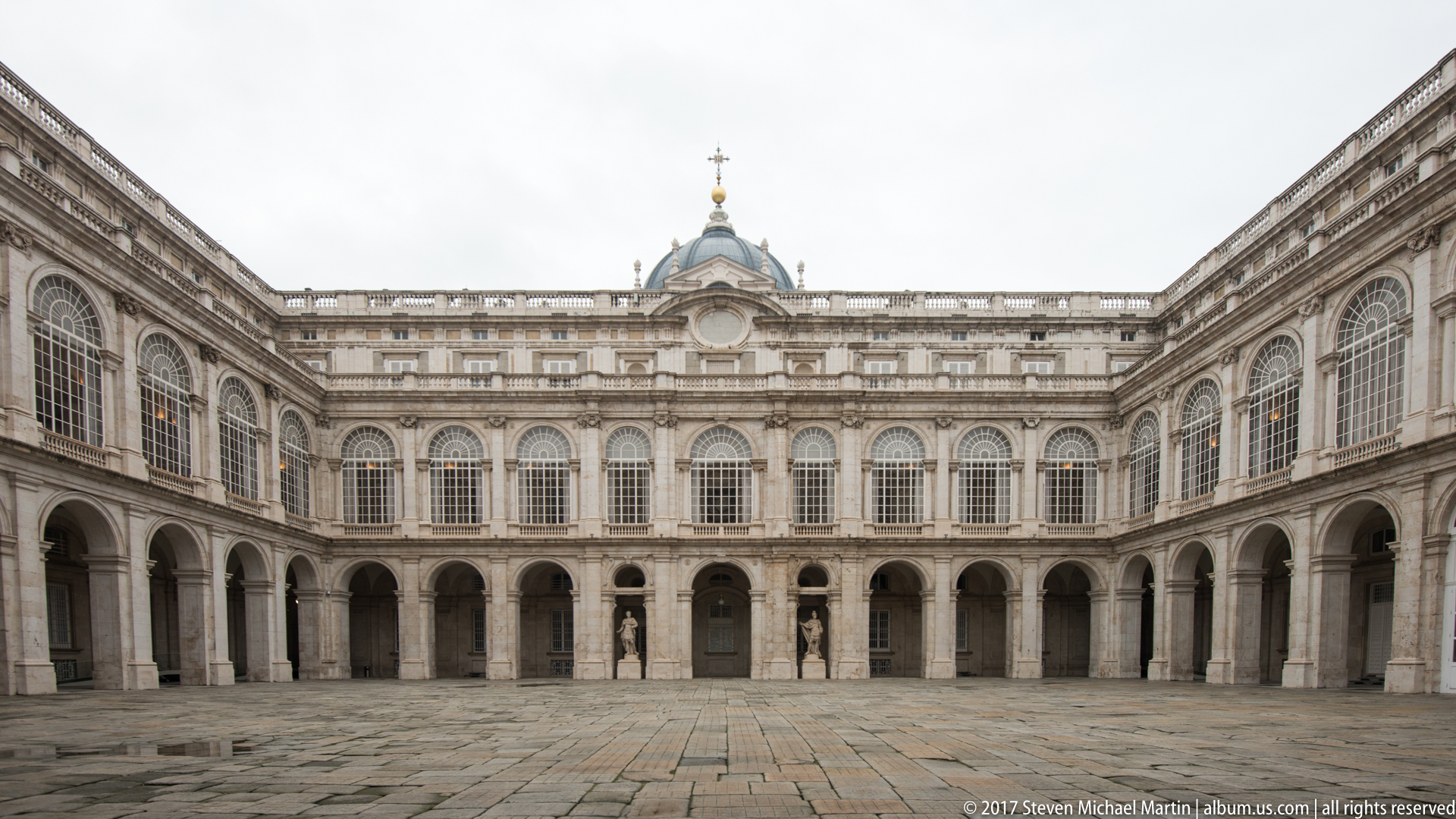
The enclosed courtyard of Madrid’s Royal Palace is presented in a centered, symmetrical view, with arcaded ground floors supporting two tiers of tall windows and a central domed pavilion. Empty stone paving heightens the monumental scale and regularity of the façades, while the restrained gray-and-white palette emphasizes the palace’s disciplined classical order.
Caption
The enclosed courtyard of Madrid’s Royal Palace is presented in a centered, symmetrical view, with arcaded ground floors supporting two tiers of tall windows and a central domed pavilion. Empty stone paving heightens the monumental scale and regularity of the façades, while the restrained gray-and-white palette emphasizes the palace’s disciplined classical order.

A broad city fountain sends a tall central plume above rings of smaller vertical and arcing jets. Evergreen trees and mid-rise residential buildings form the background, placing the water display within a landscaped urban setting rather than a monumental historic square.
Caption
A broad city fountain sends a tall central plume above rings of smaller vertical and arcing jets. Evergreen trees and mid-rise residential buildings form the background, placing the water display within a landscaped urban setting rather than a monumental historic square.

The Biblioteca Nacional de España extends along a rain-wet Madrid streetscape in this broader contextual view, showing the long masonry wing and projecting entrance pavilion rather than concentrating on the portico alone. Pedestrians with umbrellas and reflective paving introduce scale and weather, while a low foreground wall marks the landscaped cultural precinct beside the building.
Caption
The Biblioteca Nacional de España extends along a rain-wet Madrid streetscape in this broader contextual view, showing the long masonry wing and projecting entrance pavilion rather than concentrating on the portico alone. Pedestrians with umbrellas and reflective paving introduce scale and weather, while a low foreground wall marks the landscaped cultural precinct beside the building.

An expansive palace interior rises through tall arched windows to a richly painted ceiling bordered by gilded stucco. Crystal chandeliers, red draperies, tapestries, and a central heraldic hanging reinforce the room’s ceremonial symmetry and scale.
Caption
An expansive palace interior rises through tall arched windows to a richly painted ceiling bordered by gilded stucco. Crystal chandeliers, red draperies, tapestries, and a central heraldic hanging reinforce the room’s ceremonial symmetry and scale.

Passengers sit along facing benches inside a Madrid Metro carriage, framed by bright yellow grab poles and a vivid red floor. The wide-angle view looks down the length of the car, recording the everyday public-transport environment and a cross-section of seated riders.
Caption
Passengers sit along facing benches inside a Madrid Metro carriage, framed by bright yellow grab poles and a vivid red floor. The wide-angle view looks down the length of the car, recording the everyday public-transport environment and a cross-section of seated riders.

A broad blue-hour view places the Royal Palace of Madrid at the far end of an expansive courtyard, with long arcaded wings receding on either side. The palace appears comparatively distant, allowing the scale of the Plaza de la Armería to dominate. Sparse evening lighting and the dark, clouded sky give the ceremonial space a restrained, almost empty atmosphere.
Caption
A broad blue-hour view places the Royal Palace of Madrid at the far end of an expansive courtyard, with long arcaded wings receding on either side. The palace appears comparatively distant, allowing the scale of the Plaza de la Armería to dominate. Sparse evening lighting and the dark, clouded sky give the ceremonial space a restrained, almost empty atmosphere.

A Madrid Metro train stands with its doors open along a tiled underground platform. The system’s red diamond logo is visible on the car, while the yellow platform edge, blue-and-white livery, and passengers inside establish a clear view of the city’s rapid-transit infrastructure.
Caption
A Madrid Metro train stands with its doors open along a tiled underground platform. The system’s red diamond logo is visible on the car, while the yellow platform edge, blue-and-white livery, and passengers inside establish a clear view of the city’s rapid-transit infrastructure.

The monument to Philip IV is isolated against a deep blue evening sky, with the bronze king on horseback crowning a tall sculptural pedestal above cascading fountain basins. Lions, allegorical figures, and carved stonework animate the lower structure. Lighting from below heightens the contrast between bronze, pale stone, and flowing water, turning the central monument of Plaza de Oriente into a dramatic nighttime focal point.
Caption
The monument to Philip IV is isolated against a deep blue evening sky, with the bronze king on horseback crowning a tall sculptural pedestal above cascading fountain basins. Lions, allegorical figures, and carved stonework animate the lower structure. Lighting from below heightens the contrast between bronze, pale stone, and flowing water, turning the central monument of Plaza de Oriente into a dramatic nighttime focal point.

Madrid’s Royal Palace spans the far side of the broad ceremonial square in a wide, nearly symmetrical composition. The central entrance and Spanish flag align with the open paving, while long arcaded wings curve inward at the edges. Scattered visitors provide scale, allowing the photograph to emphasize the immense breadth and formal geometry of the Bourbon royal residence.
Caption
Madrid’s Royal Palace spans the far side of the broad ceremonial square in a wide, nearly symmetrical composition. The central entrance and Spanish flag align with the open paving, while long arcaded wings curve inward at the edges. Scattered visitors provide scale, allowing the photograph to emphasize the immense breadth and formal geometry of the Bourbon royal residence.

A stylized bear reaches toward the fruiting crown of a tree within a rectangular turquoise pavement panel bordered by white stars. The motif references Madrid’s familiar bear-and-strawberry-tree emblem, here translated into a durable street or plaza surface. Surrounding patterned paving places the symbol literally underfoot, embedding municipal identity into the public realm.
Caption
A stylized bear reaches toward the fruiting crown of a tree within a rectangular turquoise pavement panel bordered by white stars. The motif references Madrid’s familiar bear-and-strawberry-tree emblem, here translated into a durable street or plaza surface. Surrounding patterned paving places the symbol literally underfoot, embedding municipal identity into the public realm.
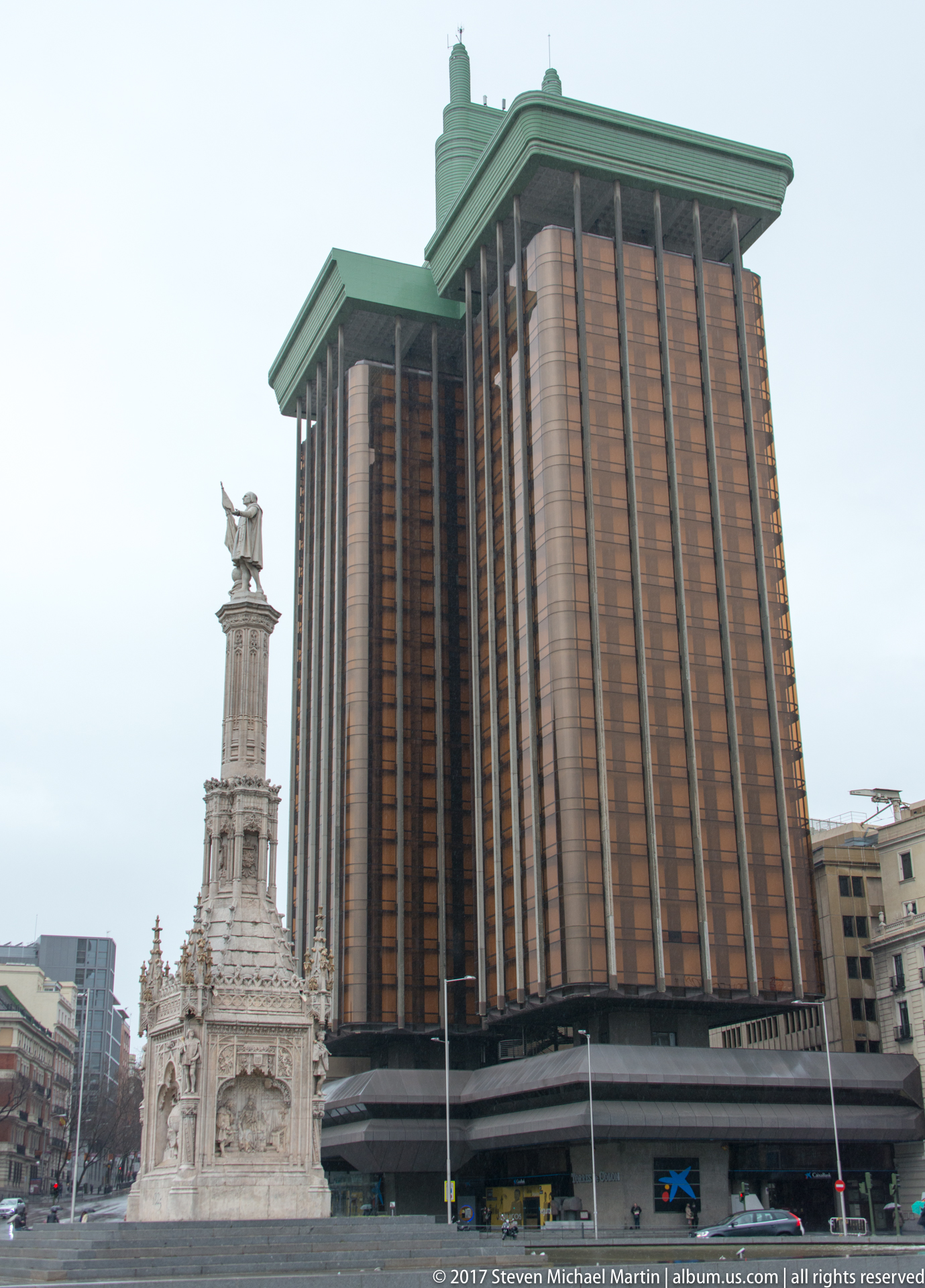
Madrid’s Monument to Columbus rises at the edge of Plaza de Colón beside the tall, copper-toned Torres de Colón, juxtaposing a nineteenth-century commemorative column with late twentieth-century commercial architecture. The view compresses monument, tower, and surrounding city blocks into a single urban study, making the contrast in scale, materials, and architectural eras especially clear.
Caption
Madrid’s Monument to Columbus rises at the edge of Plaza de Colón beside the tall, copper-toned Torres de Colón, juxtaposing a nineteenth-century commemorative column with late twentieth-century commercial architecture. The view compresses monument, tower, and surrounding city blocks into a single urban study, making the contrast in scale, materials, and architectural eras especially clear.

A rain-darkened pedestrian square in central Madrid is animated by a temporary outdoor photography exhibition, with large portrait panels set across the paving and historic façades enclosing the space. The composition records contemporary cultural activity within the older city fabric, while pedestrians, bare winter trees, and wet pavement give the scene a distinctly lived-in, seasonal character.
Caption
A rain-darkened pedestrian square in central Madrid is animated by a temporary outdoor photography exhibition, with large portrait panels set across the paving and historic façades enclosing the space. The composition records contemporary cultural activity within the older city fabric, while pedestrians, bare winter trees, and wet pavement give the scene a distinctly lived-in, seasonal character.

The monumental façade of the Biblioteca Nacional de España is seen frontally, its elevated Corinthian portico rising above arched entrance bays, broad steps, and flanking sculpture. The symmetrical composition emphasizes the institution’s ceremonial approach and nineteenth-century historicist architecture, with the Spanish flag and pediment sculpture marking the roofline against a pale winter sky.
Caption
The monumental façade of the Biblioteca Nacional de España is seen frontally, its elevated Corinthian portico rising above arched entrance bays, broad steps, and flanking sculpture. The symmetrical composition emphasizes the institution’s ceremonial approach and nineteenth-century historicist architecture, with the Spanish flag and pediment sculpture marking the roofline against a pale winter sky.

An elaborate heraldic relief crowns a Madrid stone façade, centering a quartered shield beneath a royal crown and surrounding it with sculpted scrollwork, ribbons, and emblematic devices. Seen close-up, the carving shifts attention from the building as a whole to the civic or institutional symbolism embedded in its architecture, including the deeply modeled crown, shield compartments, and decorative border.
Caption
An elaborate heraldic relief crowns a Madrid stone façade, centering a quartered shield beneath a royal crown and surrounding it with sculpted scrollwork, ribbons, and emblematic devices. Seen close-up, the carving shifts attention from the building as a whole to the civic or institutional symbolism embedded in its architecture, including the deeply modeled crown, shield compartments, and decorative border.

The rounded corner façade of Madrid’s Teatro Calderón rises behind an ornate multi-lantern streetlight, its name clearly set below the dark roof dome. Contemporary theatrical advertising wraps the lower elevation, creating a layered streetscape in which early twentieth-century urban architecture, decorative ironwork, and current entertainment culture occupy the same view.
Caption
The rounded corner façade of Madrid’s Teatro Calderón rises behind an ornate multi-lantern streetlight, its name clearly set below the dark roof dome. Contemporary theatrical advertising wraps the lower elevation, creating a layered streetscape in which early twentieth-century urban architecture, decorative ironwork, and current entertainment culture occupy the same view.

Madrid’s Palacio de Cibeles fills the frame with its highly sculpted white-stone façade and central tower, while a large “REFUGEES WELCOME” banner hangs prominently above the lower roofline. The photograph documents the civic landmark not only as monumental architecture but also as a platform for a contemporary public message, set beside the Spanish flag under an overcast sky.
Caption
Madrid’s Palacio de Cibeles fills the frame with its highly sculpted white-stone façade and central tower, while a large “REFUGEES WELCOME” banner hangs prominently above the lower roofline. The photograph documents the civic landmark not only as monumental architecture but also as a platform for a contemporary public message, set beside the Spanish flag under an overcast sky.

A white marble sculpture presents an elderly, heavily bearded man seated in layered robes, his head bowed toward a tablet or book supported across his lap. The close museum-style view emphasizes the figure’s deeply carved drapery, contemplative posture, and concentrated expression, while the neutral display setting isolates the sculpture from surrounding context.
Caption
A white marble sculpture presents an elderly, heavily bearded man seated in layered robes, his head bowed toward a tablet or book supported across his lap. The close museum-style view emphasizes the figure’s deeply carved drapery, contemplative posture, and concentrated expression, while the neutral display setting isolates the sculpture from surrounding context.

A sculptural civic monument is framed from below, with intertwined nude figures rising above a cylindrical pedestal decorated with garlands and an inscription beginning “IGUALDAD.” The low viewpoint isolates the bronze group against the gray sky and emphasizes the monument’s allegorical character, while a modern glass-fronted building appears at the edge of the composition.
Caption
A sculptural civic monument is framed from below, with intertwined nude figures rising above a cylindrical pedestal decorated with garlands and an inscription beginning “IGUALDAD.” The low viewpoint isolates the bronze group against the gray sky and emphasizes the monument’s allegorical character, while a modern glass-fronted building appears at the edge of the composition.

A richly ornamented iron entrance gate frames the Biblioteca Nacional de España, its gilded architectural details and the inscription “BIBLIOTECA Y MUSEOS NACIONALES” forming a ceremonial threshold to the institution beyond. Through the open gate, the library’s columned façade and arched entrances remain visible, linking decorative street-level ironwork to the monumental building behind.
Caption
A richly ornamented iron entrance gate frames the Biblioteca Nacional de España, its gilded architectural details and the inscription “BIBLIOTECA Y MUSEOS NACIONALES” forming a ceremonial threshold to the institution beyond. Through the open gate, the library’s columned façade and arched entrances remain visible, linking decorative street-level ironwork to the monumental building behind.

An oblique view of the Biblioteca Nacional de España shows the grand portico and triple arched entrance from the landscaped approach, revealing the depth of the staircase, terraces, and projecting central pavilion. Bare branches and evergreen plantings soften the monumental stone architecture, while the angled viewpoint distinguishes this image from the more frontal study of the same façade.
Caption
An oblique view of the Biblioteca Nacional de España shows the grand portico and triple arched entrance from the landscaped approach, revealing the depth of the staircase, terraces, and projecting central pavilion. Bare branches and evergreen plantings soften the monumental stone architecture, while the angled viewpoint distinguishes this image from the more frontal study of the same façade.

Looking straight upward through a multi-story atrium, concentric rings of balconies and glazing surround a large circular ceiling element. The steep perspective turns the interior into an abstract pattern of radial lines, repeating floors, and reflective surfaces, with a warm-toned handrail curving across the foreground and emphasizing the building’s vertical depth.
Caption
Looking straight upward through a multi-story atrium, concentric rings of balconies and glazing surround a large circular ceiling element. The steep perspective turns the interior into an abstract pattern of radial lines, repeating floors, and reflective surfaces, with a warm-toned handrail curving across the foreground and emphasizing the building’s vertical depth.

The brick façade of Madrid’s Plaza de Toros de Las Ventas is viewed upward at close range, revealing its richly patterned Neo-Mudéjar decoration. Horseshoe arches, glazed blue-and-white tile panels, heraldic motifs, and layered brickwork animate the elevation, while the cropped composition concentrates on the bullring’s ornamental surface rather than its overall arena form.
Caption
The brick façade of Madrid’s Plaza de Toros de Las Ventas is viewed upward at close range, revealing its richly patterned Neo-Mudéjar decoration. Horseshoe arches, glazed blue-and-white tile panels, heraldic motifs, and layered brickwork animate the elevation, while the cropped composition concentrates on the bullring’s ornamental surface rather than its overall arena form.

A broader side view reveals the full composition of a Madrid civic monument whose upper pedestal bears the word “IGUALDAD.” Bronze groups cluster around the base, including seated figures and military or industrial motifs, while a second group crowns the monument above. Modern commercial buildings behind it place the allegorical sculpture firmly within the contemporary city.
Caption
A broader side view reveals the full composition of a Madrid civic monument whose upper pedestal bears the word “IGUALDAD.” Bronze groups cluster around the base, including seated figures and military or industrial motifs, while a second group crowns the monument above. Modern commercial buildings behind it place the allegorical sculpture firmly within the contemporary city.

A bronze equestrian group presents a mounted male leader at center, flanked by additional standing and seated figures in period dress. Photographed through leafless trees, the sculptural ensemble is separated from its architectural surroundings and read primarily through gesture and silhouette: the horse faces forward while the surrounding figures create a compact narrative group around the rider.
Caption
A bronze equestrian group presents a mounted male leader at center, flanked by additional standing and seated figures in period dress. Photographed through leafless trees, the sculptural ensemble is separated from its architectural surroundings and read primarily through gesture and silhouette: the horse faces forward while the surrounding figures create a compact narrative group around the rider.

A pale marble pavilion is photographed from within its open structural frame, where thick rectangular piers support broad horizontal roof slabs and create a sequence of framed views to winter trees outside. The restrained geometry, exposed joints, and veined stone surfaces contrast sharply with Madrid’s more ornate historic monuments, making structure and material the principal subjects of the image.
Caption
A pale marble pavilion is photographed from within its open structural frame, where thick rectangular piers support broad horizontal roof slabs and create a sequence of framed views to winter trees outside. The restrained geometry, exposed joints, and veined stone surfaces contrast sharply with Madrid’s more ornate historic monuments, making structure and material the principal subjects of the image.

An ornate palace ceiling unfolds in a symmetrical field of gilded stucco, oval medallions, painted roundels, and a large central mythological fresco. The upward composition emphasizes the theatrical integration of painting, sculpture, and architecture: white relief figures project around the borders while gold ornament and pale blue-gray framing direct the eye toward the densely populated central scene.
Caption
An ornate palace ceiling unfolds in a symmetrical field of gilded stucco, oval medallions, painted roundels, and a large central mythological fresco. The upward composition emphasizes the theatrical integration of painting, sculpture, and architecture: white relief figures project around the borders while gold ornament and pale blue-gray framing direct the eye toward the densely populated central scene.

The long principal façade of Madrid’s Royal Palace stretches across the background while an elaborate black-and-gold multi-lantern streetlight anchors the foreground. The broad paved square, Spanish flag, balustraded roofline, and central entrance establish the palace’s ceremonial scale, with the foreground lamp adding a decorative counterpoint to the building’s formal symmetry.
Caption
The long principal façade of Madrid’s Royal Palace stretches across the background while an elaborate black-and-gold multi-lantern streetlight anchors the foreground. The broad paved square, Spanish flag, balustraded roofline, and central entrance establish the palace’s ceremonial scale, with the foreground lamp adding a decorative counterpoint to the building’s formal symmetry.

A white mid-rise building with a faceted, repeating window grid stands in front of a much taller dark tower composed of stacked horizontal bands. The low street-level viewpoint emphasizes the contrast between the crisp patterned façade and the layered high-rise behind it, presenting Madrid’s modern commercial architecture as a dense composition of competing scales and surfaces.
Caption
A white mid-rise building with a faceted, repeating window grid stands in front of a much taller dark tower composed of stacked horizontal bands. The low street-level viewpoint emphasizes the contrast between the crisp patterned façade and the layered high-rise behind it, presenting Madrid’s modern commercial architecture as a dense composition of competing scales and surfaces.

A wider view of the Monument to Philip IV places the full fountain basin and equestrian statue against the long façade of Madrid’s Royal Palace. The expanded framing shows how the monument occupies the landscaped Plaza de Oriente, with railings, trees, and the broad water basin surrounding the tall pedestal and its celebrated rearing bronze horse.
Caption
A wider view of the Monument to Philip IV places the full fountain basin and equestrian statue against the long façade of Madrid’s Royal Palace. The expanded framing shows how the monument occupies the landscaped Plaza de Oriente, with railings, trees, and the broad water basin surrounding the tall pedestal and its celebrated rearing bronze horse.

The equestrian statue of Philip IV rises above the fountain in Madrid’s Plaza de Oriente, the rearing bronze horse silhouetted against the Royal Palace behind. Water spills from the sculpted basin below the tall pedestal, while reclining stone figures and bronze lions enrich the monument’s layered base, combining royal commemoration, engineering spectacle, and formal garden design.
Caption
The equestrian statue of Philip IV rises above the fountain in Madrid’s Plaza de Oriente, the rearing bronze horse silhouetted against the Royal Palace behind. Water spills from the sculpted basin below the tall pedestal, while reclining stone figures and bronze lions enrich the monument’s layered base, combining royal commemoration, engineering spectacle, and formal garden design.

Two monumental figures stand in dramatic contrast along a Madrid palace balustrade: a dark bronze robed figure extends an arm beside a bright white winged warrior or angel holding a long spear above a crouching form. The tight crop emphasizes gesture, material contrast, and sculptural silhouette rather than the surrounding architecture.
Caption
Two monumental figures stand in dramatic contrast along a Madrid palace balustrade: a dark bronze robed figure extends an arm beside a bright white winged warrior or angel holding a long spear above a crouching form. The tight crop emphasizes gesture, material contrast, and sculptural silhouette rather than the surrounding architecture.

The central pavilion of Madrid’s Royal Palace is isolated in a tighter frontal view, bringing the clock, sculpted pediment, royal heraldry, and three arched entrance bays into sharper focus. The Spanish flag flies above the roofline while small figures at ground level provide scale, turning this frame into a study of the palace’s ceremonial center rather than its full breadth.
Caption
The central pavilion of Madrid’s Royal Palace is isolated in a tighter frontal view, bringing the clock, sculpted pediment, royal heraldry, and three arched entrance bays into sharper focus. The Spanish flag flies above the roofline while small figures at ground level provide scale, turning this frame into a study of the palace’s ceremonial center rather than its full breadth.

A monumental royal coat of arms crowns the balustrade of Madrid’s Royal Palace, flanked by standing stone figures and dense sculptural ornament. The close view isolates the heraldic centerpiece—crown, shield, supporting forms, and trophies—from the larger façade, revealing how dynastic symbolism is embedded directly into the palace roofline and ceremonial architecture.
Caption
A monumental royal coat of arms crowns the balustrade of Madrid’s Royal Palace, flanked by standing stone figures and dense sculptural ornament. The close view isolates the heraldic centerpiece—crown, shield, supporting forms, and trophies—from the larger façade, revealing how dynastic symbolism is embedded directly into the palace roofline and ceremonial architecture.

A row of pale stone royal statues lines the winter trees of Plaza de Oriente, each monarch represented as a standing, robed figure on an individual pedestal. The shallow diagonal perspective lets the sculptures recede through the frame, emphasizing their serial arrangement as part of the formal landscape between the Royal Palace and the surrounding Madrid streets.
Caption
A row of pale stone royal statues lines the winter trees of Plaza de Oriente, each monarch represented as a standing, robed figure on an individual pedestal. The shallow diagonal perspective lets the sculptures recede through the frame, emphasizing their serial arrangement as part of the formal landscape between the Royal Palace and the surrounding Madrid streets.

The dome and twin-towered profile of Madrid’s Catedral de la Almudena rise above the palace precinct under a heavy gray sky. Seen from an oblique angle with an ornate streetlight in the foreground, the cathedral’s layered domes, lanterns, and classical façades form a vertical counterpoint to the long horizontal mass of the adjacent royal complex.
Caption
The dome and twin-towered profile of Madrid’s Catedral de la Almudena rise above the palace precinct under a heavy gray sky. Seen from an oblique angle with an ornate streetlight in the foreground, the cathedral’s layered domes, lanterns, and classical façades form a vertical counterpoint to the long horizontal mass of the adjacent royal complex.

A carved stone relief presents Christ and Saint Peter amid a crowded biblical scene, with the Spanish inscription referring to the giving of the keys. Drapery, figures, waves, and architectural details are modeled in shallow relief across the rectangular panel.
Caption
A carved stone relief presents Christ and Saint Peter amid a crowded biblical scene, with the Spanish inscription referring to the giving of the keys. Drapery, figures, waves, and architectural details are modeled in shallow relief across the rectangular panel.

The principal façade of Madrid’s Catedral de la Almudena rises above a broad flight of steps, framed by twin square towers and a central classical colonnade. Pale stone, restrained ornament, and layered pediments distinguish the cathedral’s exterior from the nearby Royal Palace, while the low viewpoint gives the entrance front a monumental vertical emphasis.
Caption
The principal façade of Madrid’s Catedral de la Almudena rises above a broad flight of steps, framed by twin square towers and a central classical colonnade. Pale stone, restrained ornament, and layered pediments distinguish the cathedral’s exterior from the nearby Royal Palace, while the low viewpoint gives the entrance front a monumental vertical emphasis.

A pale stone Madonna and Child stands within a high architectural opening, backed by a radiant metal halo that creates a luminous crown around the Virgin’s head. The close composition emphasizes devotional iconography and the contrast between carved stone and dark metalwork, while a decorative cross and domed roof element appear through the opening behind.
Caption
A pale stone Madonna and Child stands within a high architectural opening, backed by a radiant metal halo that creates a luminous crown around the Virgin’s head. The close composition emphasizes devotional iconography and the contrast between carved stone and dark metalwork, while a decorative cross and domed roof element appear through the opening behind.

The long formal façade of Madrid’s Royal Palace fills the background across the broad paving of the Plaza de la Armería. A visitor stands in the foreground, giving scale to the palace’s repetitive windows, stone balustrade, central entrance pavilion, clock, and Spanish flag.
Caption
The long formal façade of Madrid’s Royal Palace fills the background across the broad paving of the Plaza de la Armería. A visitor stands in the foreground, giving scale to the palace’s repetitive windows, stone balustrade, central entrance pavilion, clock, and Spanish flag.

A close architectural view isolates the clock and sculptural crest above the principal palace façade. The gilded clock face sits beneath an elaborate Spanish royal coat of arms, framed by allegorical figures, stone ornament, and an intricate iron-and-gilt crown-like structure.
Caption
A close architectural view isolates the clock and sculptural crest above the principal palace façade. The gilded clock face sits beneath an elaborate Spanish royal coat of arms, framed by allegorical figures, stone ornament, and an intricate iron-and-gilt crown-like structure.

Dramatic side lighting falls across a sculpted male figure wearing armor and a mantle, set on a pedestal inside a deep classical niche. Massive columns and the coffered half-dome frame the statue, creating a strongly theatrical play of light and shadow.
Caption
Dramatic side lighting falls across a sculpted male figure wearing armor and a mantle, set on a pedestal inside a deep classical niche. Massive columns and the coffered half-dome frame the statue, creating a strongly theatrical play of light and shadow.

A large red hanging emblazoned with the Spanish royal arms dominates the lower center of an ornate ceremonial interior. Above it, a balustrade, tapestry, frescoed vault, gilded decoration, and massive stone arches layer heraldic imagery with the architecture of royal representation.
Caption
A large red hanging emblazoned with the Spanish royal arms dominates the lower center of an ornate ceremonial interior. Above it, a balustrade, tapestry, frescoed vault, gilded decoration, and massive stone arches layer heraldic imagery with the architecture of royal representation.

A visitor is framed in a waist-up portrait against the softly focused stone architecture of Madrid’s Royal Palace. The shallow depth of field separates the figure from the palace’s arched openings, carved ornament, and pale masonry while retaining a clear sense of place.
Caption
A visitor is framed in a waist-up portrait against the softly focused stone architecture of Madrid’s Royal Palace. The shallow depth of field separates the figure from the palace’s arched openings, carved ornament, and pale masonry while retaining a clear sense of place.

A tilted portrait places a visitor before the twin towers and central dome of Madrid’s Almudena Cathedral, viewed across the open Plaza de la Armería. The composition contrasts the human figure with the cathedral’s pale stone façade and monumental vertical silhouette.
Caption
A tilted portrait places a visitor before the twin towers and central dome of Madrid’s Almudena Cathedral, viewed across the open Plaza de la Armería. The composition contrasts the human figure with the cathedral’s pale stone façade and monumental vertical silhouette.

A white marble figure stands on a pedestal within a monumental semicircular niche, enclosed by paired reddish columns and pale stone arches. Wall-mounted lights illuminate the symmetrical architectural setting, emphasizing the formal ceremonial character of the interior.
Caption
A white marble figure stands on a pedestal within a monumental semicircular niche, enclosed by paired reddish columns and pale stone arches. Wall-mounted lights illuminate the symmetrical architectural setting, emphasizing the formal ceremonial character of the interior.

A heraldic textile hangs directly above a dark marble fireplace in a restrained palace room. Matching gilt console tables, candelabra, wall sconces, and small bronze sculptures create a balanced arrangement on either side, while pale wall panels keep attention on the coat of arms.
Caption
A heraldic textile hangs directly above a dark marble fireplace in a restrained palace room. Matching gilt console tables, candelabra, wall sconces, and small bronze sculptures create a balanced arrangement on either side, while pale wall panels keep attention on the coat of arms.

The camera looks upward into a richly decorated palace vault where a large narrative fresco occupies the central ceiling panel. Gilded moldings, oval and circular windows, sculpted architectural frames, and multiple crystal chandeliers surround the painting in a luminous ceremonial ensemble.
Caption
The camera looks upward into a richly decorated palace vault where a large narrative fresco occupies the central ceiling panel. Gilded moldings, oval and circular windows, sculpted architectural frames, and multiple crystal chandeliers surround the painting in a luminous ceremonial ensemble.

The nave of Madrid’s Almudena Cathedral leads toward the raised sanctuary beneath a tall Gothic-inspired arcade. Slender piers, pointed arches, stained glass, colorful ceiling decoration, and the central crucifix draw the eye through the spacious interior toward the apse.
Caption
The nave of Madrid’s Almudena Cathedral leads toward the raised sanctuary beneath a tall Gothic-inspired arcade. Slender piers, pointed arches, stained glass, colorful ceiling decoration, and the central crucifix draw the eye through the spacious interior toward the apse.

Looking straight upward, the crossing of Almudena Cathedral forms a geometric composition of pale stone ribs and vividly painted ceiling panels. A blue star-patterned central vault surrounds a circular light, while adjoining barrel sections display narrow bands of multicolored decoration.
Caption
Looking straight upward, the crossing of Almudena Cathedral forms a geometric composition of pale stone ribs and vividly painted ceiling panels. A blue star-patterned central vault surrounds a circular light, while adjoining barrel sections display narrow bands of multicolored decoration.

A longitudinal upward view follows the cathedral’s painted barrel vault, divided by pale structural ribs into repeated bays. Narrow multicolored panels run between the ribs, while clerestory openings and carved stone arcades mark the transition to the walls below.
Caption
A longitudinal upward view follows the cathedral’s painted barrel vault, divided by pale structural ribs into repeated bays. Narrow multicolored panels run between the ribs, while clerestory openings and carved stone arcades mark the transition to the walls below.

A richly gilded retable rises behind a crowned Marian figure, its framework divided into multiple painted narrative panels and sculptural compartments. Silver-toned liturgical furnishings and flanking paintings intensify the layered devotional display, combining sculpture, painting, metalwork, and architectural ornament.
Caption
A richly gilded retable rises behind a crowned Marian figure, its framework divided into multiple painted narrative panels and sculptural compartments. Silver-toned liturgical furnishings and flanking paintings intensify the layered devotional display, combining sculpture, painting, metalwork, and architectural ornament.

An elaborate cathedral chapel combines a central Marian altar with patterned wall decoration, white sculpted figures, gilded fittings, and brilliant stained-glass windows. The dense ornamental program contrasts strongly with the pale stone structure visible elsewhere in the church.
Caption
An elaborate cathedral chapel combines a central Marian altar with patterned wall decoration, white sculpted figures, gilded fittings, and brilliant stained-glass windows. The dense ornamental program contrasts strongly with the pale stone structure visible elsewhere in the church.

A large cast-metal relief compresses architecture, clustered figures, and sweeping airborne forms into a dense narrative surface. Deep modeling creates pronounced shadows across the crowd and building façades, while the central seam reveals that the composition spans adjoining metal panels.
Caption
A large cast-metal relief compresses architecture, clustered figures, and sweeping airborne forms into a dense narrative surface. Deep modeling creates pronounced shadows across the crowd and building façades, while the central seam reveals that the composition spans adjoining metal panels.

A massive bronze figure, modeled with blocky layered forms and a strongly textured surface, stands on a stone pedestal beneath a broad architectural arch. The frontal composition emphasizes the sculpture’s heavy torso and head against the opening and urban buildings beyond.
Caption
A massive bronze figure, modeled with blocky layered forms and a strongly textured surface, stands on a stone pedestal beneath a broad architectural arch. The frontal composition emphasizes the sculpture’s heavy torso and head against the opening and urban buildings beyond.

A historic male costume is displayed on a museum mannequin, combining a dark jacket densely embroidered in gold with a red waistcoat patterned in matching metallic thread. White lace at the neck and cuffs and a pale sash complete the highly formal ensemble.
Caption
A historic male costume is displayed on a museum mannequin, combining a dark jacket densely embroidered in gold with a red waistcoat patterned in matching metallic thread. White lace at the neck and cuffs and a pale sash complete the highly formal ensemble.

A seated visitor occupies the center aisle of a vast pale-stone church interior. Repeated round columns, high arches, hanging lamps, and rows of wooden pews recede in strong perspective behind him, emphasizing the monumental scale and restrained palette of the nave.
Caption
A seated visitor occupies the center aisle of a vast pale-stone church interior. Repeated round columns, high arches, hanging lamps, and rows of wooden pews recede in strong perspective behind him, emphasizing the monumental scale and restrained palette of the nave.

Heavy pale-stone columns with elaborately carved capitals frame a view toward stained glass and a luminous devotional shrine. A circular patterned window panel fills the upper arch, while dark metal figures and decorative objects punctuate the bright masonry below.
Caption
Heavy pale-stone columns with elaborately carved capitals frame a view toward stained glass and a luminous devotional shrine. A circular patterned window panel fills the upper arch, while dark metal figures and decorative objects punctuate the bright masonry below.

A brightly colored religious mural fills the curved wall behind a white stone tomb or memorial supported by kneeling angelic figures. Massive columns divide the painted scenes, while the central heavenly composition rises above the sculptural monument in a dramatic devotional setting.
Caption
A brightly colored religious mural fills the curved wall behind a white stone tomb or memorial supported by kneeling angelic figures. Massive columns divide the painted scenes, while the central heavenly composition rises above the sculptural monument in a dramatic devotional setting.

The Madrid Metro emblem fills the frame: a blue rectangular “Metro” wordmark centered on a red diamond-shaped sign with a white border. Cropped support rails and an overcast sky isolate the familiar transit symbol from its surrounding streetscape.
Caption
The Madrid Metro emblem fills the frame: a blue rectangular “Metro” wordmark centered on a red diamond-shaped sign with a white border. Cropped support rails and an overcast sky isolate the familiar transit symbol from its surrounding streetscape.

The monumental entrance façade of Spain’s National Library rises behind a broad staircase, with “Biblioteca Nacional” carved across the entablature. Corinthian columns, arched iron doors, seated stone figures, and a sculpted pediment give the institution a formal nineteenth-century civic presence.
Caption
The monumental entrance façade of Spain’s National Library rises behind a broad staircase, with “Biblioteca Nacional” carved across the entablature. Corinthian columns, arched iron doors, seated stone figures, and a sculpted pediment give the institution a formal nineteenth-century civic presence.

The ornate white façade and central tower of Madrid’s Palacio de Cibeles dominate Plaza de Cibeles, where Spanish flags line the foreground. A large “REFUGEES WELCOME” banner hangs prominently from the central elevation, documenting a specific civic message on the landmark building.
Caption
The ornate white façade and central tower of Madrid’s Palacio de Cibeles dominate Plaza de Cibeles, where Spanish flags line the foreground. A large “REFUGEES WELCOME” banner hangs prominently from the central elevation, documenting a specific civic message on the landmark building.

The Cibeles Fountain occupies the foreground with its sculpted chariot and lions, backed by the elaborate façade of the Palacio de Cibeles. Spanish flags and a “REFUGEES WELCOME” banner add contemporary civic context to this view of one of central Madrid’s best-known monumental ensembles.
Caption
The Cibeles Fountain occupies the foreground with its sculpted chariot and lions, backed by the elaborate façade of the Palacio de Cibeles. Spanish flags and a “REFUGEES WELCOME” banner add contemporary civic context to this view of one of central Madrid’s best-known monumental ensembles.

The Metrópolis Building dominates this oblique street view, its rounded corner tower rising above a richly modeled façade of columns, balconies, and sculptural decoration. The black-and-gold dome provides a strong vertical termination, while neighboring historic commercial buildings recede along the street. The low-angle perspective emphasizes the building’s position at a prominent Madrid intersection.
Caption
The Metrópolis Building dominates this oblique street view, its rounded corner tower rising above a richly modeled façade of columns, balconies, and sculptural decoration. The black-and-gold dome provides a strong vertical termination, while neighboring historic commercial buildings recede along the street. The low-angle perspective emphasizes the building’s position at a prominent Madrid intersection.

The rounded corner tower of Madrid’s Edificio Metrópolis rises above the street beneath its dark slate dome and gilded ornament. The “METROPOLIS” inscription and winged figure crowning the dome identify the landmark, whose ornate stone façades mark the junction of Gran Vía and Calle de Alcalá.
Caption
The rounded corner tower of Madrid’s Edificio Metrópolis rises above the street beneath its dark slate dome and gilded ornament. The “METROPOLIS” inscription and winged figure crowning the dome identify the landmark, whose ornate stone façades mark the junction of Gran Vía and Calle de Alcalá.

The slate-clad dome of Madrid’s Metrópolis Building rises above an ornate white-stone façade, its gilded garlands and sculptural groups concentrated beneath the roofline. The black dome is crowned by a winged Victory figure, while the large METROPOLIS sign anchors the composition. The close upward viewpoint isolates the building’s highly decorative summit against a pale sky.
Caption
The slate-clad dome of Madrid’s Metrópolis Building rises above an ornate white-stone façade, its gilded garlands and sculptural groups concentrated beneath the roofline. The black dome is crowned by a winged Victory figure, while the large METROPOLIS sign anchors the composition. The close upward viewpoint isolates the building’s highly decorative summit against a pale sky.

A tight architectural detail concentrates on the crown of Madrid’s Metrópolis Building. Dark slate scales cover the curved dome, edged by gilded leafwork, cartouches, and sculptural ornament. Above, the winged Victory figure stands silhouetted against the sky, while a seated stone group occupies the lower edge, creating a layered study of the building’s rooftop symbolism and materials.
Caption
A tight architectural detail concentrates on the crown of Madrid’s Metrópolis Building. Dark slate scales cover the curved dome, edged by gilded leafwork, cartouches, and sculptural ornament. Above, the winged Victory figure stands silhouetted against the sky, while a seated stone group occupies the lower edge, creating a layered study of the building’s rooftop symbolism and materials.

A monumental stone figure of Neptune fills the frame from a low viewpoint. The bearded sea god is shown bare-chested, draped at the waist, and holding a tall trident beside him, while another sculpted form projects across his shoulder. The close cropping emphasizes the muscular modeling, weathered stone surface, and unmistakable trident associated with classical representations of Neptune.
Caption
A monumental stone figure of Neptune fills the frame from a low viewpoint. The bearded sea god is shown bare-chested, draped at the waist, and holding a tall trident beside him, while another sculpted form projects across his shoulder. The close cropping emphasizes the muscular modeling, weathered stone surface, and unmistakable trident associated with classical representations of Neptune.

A marble or pale-stone classical male figure stands in an interior display, shown nude except for heavy drapery falling from one shoulder and wrapping behind the body. His right arm extends outward while the left hand is raised, and a support or secondary sculpted form appears beside the leg. Strong side lighting throws a crisp shadow onto the wall behind him.
Caption
A marble or pale-stone classical male figure stands in an interior display, shown nude except for heavy drapery falling from one shoulder and wrapping behind the body. His right arm extends outward while the left hand is raised, and a support or secondary sculpted form appears beside the leg. Strong side lighting throws a crisp shadow onto the wall behind him.

A seated bronze figure of Diego Velázquez occupies a pedestal before a columned façade. The painter holds a palette and brushes, while the pedestal bears the name VELAZQUEZ in large letters. The compact composition connects the artist’s working attributes with the monumental setting, making the sculpture both a portrait and a public statement about Madrid’s artistic heritage.
Caption
A seated bronze figure of Diego Velázquez occupies a pedestal before a columned façade. The painter holds a palette and brushes, while the pedestal bears the name VELAZQUEZ in large letters. The compact composition connects the artist’s working attributes with the monumental setting, making the sculpture both a portrait and a public statement about Madrid’s artistic heritage.

The monument to Pedro Calderón de la Barca rises in a Madrid square, with the seated writer above a richly carved pedestal. The inscription CALDERON DE LA BARCA is plainly visible, while relief panels and allegorical figures animate the base. Surrounding façades place the sculpture within a dense urban setting rather than isolating it as a museum object.
Caption
The monument to Pedro Calderón de la Barca rises in a Madrid square, with the seated writer above a richly carved pedestal. The inscription CALDERON DE LA BARCA is plainly visible, while relief panels and allegorical figures animate the base. Surrounding façades place the sculpture within a dense urban setting rather than isolating it as a museum object.

King Philip III appears on horseback in the bronze equestrian monument at the center of Plaza Mayor. The ruler turns slightly while holding a baton, and the horse advances with one foreleg raised. The red façades of the square form a subdued background, allowing the dark bronze silhouette and modeling of horse, rider, armor, and drapery to dominate the composition.
Caption
King Philip III appears on horseback in the bronze equestrian monument at the center of Plaza Mayor. The ruler turns slightly while holding a baton, and the horse advances with one foreleg raised. The red façades of the square form a subdued background, allowing the dark bronze silhouette and modeling of horse, rider, armor, and drapery to dominate the composition.

A large crowned coat of arms occupies the center of an ornate stone and painted façade above a plaque reading PLAZA MAYOR. Scrollwork, pilasters, and a curved pediment surround the heraldic device, while warm-toned mural decoration fills the adjacent wall surfaces. The close framing turns a civic wayfinding sign into a study of royal symbolism and architectural ornament.
Caption
A large crowned coat of arms occupies the center of an ornate stone and painted façade above a plaque reading PLAZA MAYOR. Scrollwork, pilasters, and a curved pediment surround the heraldic device, while warm-toned mural decoration fills the adjacent wall surfaces. The close framing turns a civic wayfinding sign into a study of royal symbolism and architectural ornament.

Two wrought-iron balconies punctuate a blue façade painted with diagonal white bands, while life-size orange silhouettes of men and women appear across the shuttered windows. A traditional street lantern separates the balconies. The intervention turns ordinary domestic openings into a graphic street-art composition, using flat human forms to animate the architecture without obscuring its historic balcony details.
Caption
Two wrought-iron balconies punctuate a blue façade painted with diagonal white bands, while life-size orange silhouettes of men and women appear across the shuttered windows. A traditional street lantern separates the balconies. The intervention turns ordinary domestic openings into a graphic street-art composition, using flat human forms to animate the architecture without obscuring its historic balcony details.

Plaza Mayor opens across the frame as a broad cobbled civic space enclosed by red-painted, arcaded façades. The equestrian monument to Philip III stands to the left, while the richly decorated Casa de la Panadería forms the architectural focus across the square. Pedestrians and café activity provide scale to the monumental proportions of Madrid’s historic plaza.
Caption
Plaza Mayor opens across the frame as a broad cobbled civic space enclosed by red-painted, arcaded façades. The equestrian monument to Philip III stands to the left, while the richly decorated Casa de la Panadería forms the architectural focus across the square. Pedestrians and café activity provide scale to the monumental proportions of Madrid’s historic plaza.

The Casa de la Panadería fills the frame with its symmetrical arcaded ground floor, frescoed upper façade, and twin slate-roofed towers. Rows of balconies cross the painted surface, while flags hang above the central entrance and crowds gather at the base. The frontal view emphasizes the building’s ceremonial role within Plaza Mayor and the contrast between masonry structure and decorative painting.
Caption
The Casa de la Panadería fills the frame with its symmetrical arcaded ground floor, frescoed upper façade, and twin slate-roofed towers. Rows of balconies cross the painted surface, while flags hang above the central entrance and crowds gather at the base. The frontal view emphasizes the building’s ceremonial role within Plaza Mayor and the contrast between masonry structure and decorative painting.

The bronze equestrian statue of Philip III is framed against one of the towers of Casa de la Panadería, linking Plaza Mayor’s principal monument with its most recognizable façade. The horse’s raised foreleg and the king’s upright pose form a dark silhouette, while the tower clock and slate spire rise behind. The compressed viewpoint visually layers sculpture and architecture within the square.
Caption
The bronze equestrian statue of Philip III is framed against one of the towers of Casa de la Panadería, linking Plaza Mayor’s principal monument with its most recognizable façade. The horse’s raised foreleg and the king’s upright pose form a dark silhouette, while the tower clock and slate spire rise behind. The compressed viewpoint visually layers sculpture and architecture within the square.

A circular dial is set into a small slate-clad roof structure, its face marked with words and symbols rather than conventional clock numerals. The Spanish inscription around the perimeter refers to changing weather, while a central pointer indicates one of the labeled conditions. The tight crop isolates this unusual functional detail from the surrounding building and cityscape.
Caption
A circular dial is set into a small slate-clad roof structure, its face marked with words and symbols rather than conventional clock numerals. The Spanish inscription around the perimeter refers to changing weather, while a central pointer indicates one of the labeled conditions. The tight crop isolates this unusual functional detail from the surrounding building and cityscape.

Painted mythological figures occupy the narrow wall panels between rows of shuttered windows and wrought-iron balconies on the Casa de la Panadería. Warm earth tones, blues, and fleshy pinks animate the façade, while the repeated windows and railings create a strict architectural grid. The detail reveals how figurative mural painting is integrated directly into the building’s residential-looking upper stories.
Caption
Painted mythological figures occupy the narrow wall panels between rows of shuttered windows and wrought-iron balconies on the Casa de la Panadería. Warm earth tones, blues, and fleshy pinks animate the façade, while the repeated windows and railings create a strict architectural grid. The detail reveals how figurative mural painting is integrated directly into the building’s residential-looking upper stories.

Life-size mannequin-like figures stand behind several wrought-iron balconies above the sign for CERVECERIA LA PLAZA. Each figure is posed differently and dressed in bright casual clothing, creating a playful tableau across the residential façade. The repeated balcony bays and shuttered windows frame the display, while the commercial sign below fixes the scene within the lively streets around Plaza Mayor.
Caption
Life-size mannequin-like figures stand behind several wrought-iron balconies above the sign for CERVECERIA LA PLAZA. Each figure is posed differently and dressed in bright casual clothing, creating a playful tableau across the residential façade. The repeated balcony bays and shuttered windows frame the display, while the commercial sign below fixes the scene within the lively streets around Plaza Mayor.

A brightly illuminated confectionery case is packed with rows of pastries, macarons, fruit-topped sweets, chocolates, and other small desserts. Glass shelves divide the colorful assortment into horizontal bands, while individual labels sit among the trays. The close frontal view emphasizes abundance, color, and presentation rather than the broader shop interior or its location.
Caption
A brightly illuminated confectionery case is packed with rows of pastries, macarons, fruit-topped sweets, chocolates, and other small desserts. Glass shelves divide the colorful assortment into horizontal bands, while individual labels sit among the trays. The close frontal view emphasizes abundance, color, and presentation rather than the broader shop interior or its location.

Two elaborate confectionery models reproduce ornate historic buildings beneath signage for Horno San Onofre. White, pink, red, and green icing-like surfaces imitate arches, columns, windows, roofs, and towers in miniature. The display transforms Madrid architecture into edible decorative craft, with the models presented as showpieces rather than ordinary pastries in a retail case.
Caption
Two elaborate confectionery models reproduce ornate historic buildings beneath signage for Horno San Onofre. White, pink, red, and green icing-like surfaces imitate arches, columns, windows, roofs, and towers in miniature. The display transforms Madrid architecture into edible decorative craft, with the models presented as showpieces rather than ordinary pastries in a retail case.

Mercado de San Miguel extends along the street as a long iron-and-glass market hall, its slender dark columns, decorative metalwork, and transparent panels revealing illuminated stalls within. Pedestrians move along the pavement while scooters line the curb. The oblique corner view highlights the building’s lightweight metal frame and the contrast between historic market architecture and contemporary city activity.
Caption
Mercado de San Miguel extends along the street as a long iron-and-glass market hall, its slender dark columns, decorative metalwork, and transparent panels revealing illuminated stalls within. Pedestrians move along the pavement while scooters line the curb. The oblique corner view highlights the building’s lightweight metal frame and the contrast between historic market architecture and contemporary city activity.

Historic civic buildings enclose a quiet corner of Plaza de la Villa. At right, the Casa de la Villa presents a formal stone-and-brick façade with a central clock tower, balconies, sculpted portals, and flags; an older adjoining structure stands to the left. The nearly empty paved square and clipped plantings allow the architecture’s layered façades and differing periods to read clearly.
Caption
Historic civic buildings enclose a quiet corner of Plaza de la Villa. At right, the Casa de la Villa presents a formal stone-and-brick façade with a central clock tower, balconies, sculpted portals, and flags; an older adjoining structure stands to the left. The nearly empty paved square and clipped plantings allow the architecture’s layered façades and differing periods to read clearly.

A crowned heraldic shield dominates a richly carved stone panel set against red brick. Two smaller crowned sculptural emblems flank the central coat of arms, while scrollwork, masks, and pendant ornament fill the composition. The close view isolates the civic heraldry from the larger façade and shows the deliberate contrast between pale carved stone and warm brick masonry.
Caption
A crowned heraldic shield dominates a richly carved stone panel set against red brick. Two smaller crowned sculptural emblems flank the central coat of arms, while scrollwork, masks, and pendant ornament fill the composition. The close view isolates the civic heraldry from the larger façade and shows the deliberate contrast between pale carved stone and warm brick masonry.

The Catedral de la Almudena rises above a busy Madrid street, its large central dome, lantern, pale stone walls, and flanking towers forming a layered silhouette against the evening sky. Traffic, pedestrians, and illuminated street lamps occupy the foreground, contrasting the cathedral’s monumental scale with everyday movement at street level.
Caption
The Catedral de la Almudena rises above a busy Madrid street, its large central dome, lantern, pale stone walls, and flanking towers forming a layered silhouette against the evening sky. Traffic, pedestrians, and illuminated street lamps occupy the foreground, contrasting the cathedral’s monumental scale with everyday movement at street level.

An elaborate wrought-iron gate stretches between massive stone piers topped with sculptural urns, while the illuminated Royal Palace is visible beyond. Relief carvings and decorative lamps enrich the gateposts, and the darkening blue sky gives the ironwork a strong silhouette. The view uses the ceremonial barrier as a foreground frame for the palace complex behind.
Caption
An elaborate wrought-iron gate stretches between massive stone piers topped with sculptural urns, while the illuminated Royal Palace is visible beyond. Relief carvings and decorative lamps enrich the gateposts, and the darkening blue sky gives the ironwork a strong silhouette. The view uses the ceremonial barrier as a foreground frame for the palace complex behind.

The Royal Palace of Madrid spans the far side of the Plaza de la Armería beneath a deep blue evening sky. Its long illuminated façade curves gently across the frame, while arcaded wings and ornate lamp standards define the open courtyard. Wet paving reflects points of light, giving the monumental forecourt a subdued sheen and emphasizing the palace’s scale.
Caption
The Royal Palace of Madrid spans the far side of the Plaza de la Armería beneath a deep blue evening sky. Its long illuminated façade curves gently across the frame, while arcaded wings and ornate lamp standards define the open courtyard. Wet paving reflects points of light, giving the monumental forecourt a subdued sheen and emphasizing the palace’s scale.

The central façade of the Royal Palace of Madrid is shown almost frontally across the open Plaza de la Armería. A Spanish flag flies above the roofline, sculptural figures and balustrades articulate the parapet, and the evenly spaced windows glow softly in the evening light. The largely empty wet pavement creates a reflective foreground and reinforces the formal symmetry.
Caption
The central façade of the Royal Palace of Madrid is shown almost frontally across the open Plaza de la Armería. A Spanish flag flies above the roofline, sculptural figures and balustrades articulate the parapet, and the evenly spaced windows glow softly in the evening light. The largely empty wet pavement creates a reflective foreground and reinforces the formal symmetry.

The principal façade of the Catedral de la Almudena rises dramatically against a saturated blue evening sky. Twin square bell towers flank a central colonnaded front, while warm interior and exterior lighting picks out statues, columns, and upper openings. The low viewpoint exaggerates the cathedral’s verticality and creates a strong contrast between pale stone and the darkening sky.
Caption
The principal façade of the Catedral de la Almudena rises dramatically against a saturated blue evening sky. Twin square bell towers flank a central colonnaded front, while warm interior and exterior lighting picks out statues, columns, and upper openings. The low viewpoint exaggerates the cathedral’s verticality and creates a strong contrast between pale stone and the darkening sky.

A centered, symmetrical view presents the illuminated façade of the Catedral de la Almudena in full, with twin towers, a tall colonnade, sculpted figures, and the central upper structure sharply outlined against the blue night sky. Broad stone walls extend to either side, while street lamps at the lower corners provide scale and frame the monumental front.
Caption
A centered, symmetrical view presents the illuminated façade of the Catedral de la Almudena in full, with twin towers, a tall colonnade, sculpted figures, and the central upper structure sharply outlined against the blue night sky. Broad stone walls extend to either side, while street lamps at the lower corners provide scale and frame the monumental front.

An oblique night view looks along the pale stone buildings beside the Catedral de la Almudena, whose illuminated twin towers rise at the right edge. In the foreground, an arched niche contains a standing statue, and an ornate street lamp glows against the dark blue sky. The composition shifts attention from the cathedral’s frontal symmetry to its adjoining urban and architectural context.
Caption
An oblique night view looks along the pale stone buildings beside the Catedral de la Almudena, whose illuminated twin towers rise at the right edge. In the foreground, an arched niche contains a standing statue, and an ornate street lamp glows against the dark blue sky. The composition shifts attention from the cathedral’s frontal symmetry to its adjoining urban and architectural context.

At blue hour, Madrid’s Teatro Real closes the eastern end of Plaza de Oriente while the monument to Philip IV rises on axis in front of it. Wet paving reflects lamps and the illuminated fountain, and pedestrians cross the broad foreground. The composition links the opera house’s neoclassical façade with the plaza’s central royal monument, emphasizing the ceremonial urban relationship between theatre, garden, and monarchy.
Caption
At blue hour, Madrid’s Teatro Real closes the eastern end of Plaza de Oriente while the monument to Philip IV rises on axis in front of it. Wet paving reflects lamps and the illuminated fountain, and pedestrians cross the broad foreground. The composition links the opera house’s neoclassical façade with the plaza’s central royal monument, emphasizing the ceremonial urban relationship between theatre, garden, and monarchy.

Seen obliquely across Plaza de Oriente, the monument to Philip IV stands beside its illuminated fountain while the long white façade of the Royal Palace stretches across the background. Wet geometric paving catches the light, and a few pedestrians provide scale. The angled viewpoint separates the monument from the theatre-facing axis and instead places it within the larger royal precinct that defines the western edge of central Madrid.
Caption
Seen obliquely across Plaza de Oriente, the monument to Philip IV stands beside its illuminated fountain while the long white façade of the Royal Palace stretches across the background. Wet geometric paving catches the light, and a few pedestrians provide scale. The angled viewpoint separates the monument from the theatre-facing axis and instead places it within the larger royal precinct that defines the western edge of central Madrid.

A stone statue labeled SUINTILA presents the Visigothic king in martial costume, holding a short baton or sword-like attribute while a broad cloak spreads behind him. A shield rests against his left side, and the pedestal inscription gives the reign dates 621 to 633. The figure belongs to the series of Spanish monarchs displayed around Plaza de Oriente, where royal genealogy becomes part of the garden’s sculptural program.
Caption
A stone statue labeled SUINTILA presents the Visigothic king in martial costume, holding a short baton or sword-like attribute while a broad cloak spreads behind him. A shield rests against his left side, and the pedestal inscription gives the reign dates 621 to 633. The figure belongs to the series of Spanish monarchs displayed around Plaza de Oriente, where royal genealogy becomes part of the garden’s sculptural program.

Mercado de San Miguel glows from within on a rainy Madrid night, its iron columns and glass walls revealing brightly lit food stalls and customers inside. Umbrella-carrying pedestrians gather along the pavement while wet stone reflects the market’s warm interior lights. The transparent façade makes the historic market hall read almost like a lantern, contrasting its delicate metal framework with the dense activity of contemporary evening commerce.
Caption
Mercado de San Miguel glows from within on a rainy Madrid night, its iron columns and glass walls revealing brightly lit food stalls and customers inside. Umbrella-carrying pedestrians gather along the pavement while wet stone reflects the market’s warm interior lights. The transparent façade makes the historic market hall read almost like a lantern, contrasting its delicate metal framework with the dense activity of contemporary evening commerce.

Casa de la Panadería fills the frame from a low nighttime viewpoint, its frescoed central façade rising above the illuminated arcades of Plaza Mayor. Twin slate-roofed towers flank the composition, while the royal coat of arms and painted allegorical figures punctuate the upper stories. Warm light spills from the arcades below, sharpening the contrast between the square’s red masonry wings and the richly decorated civic centerpiece.
Caption
Casa de la Panadería fills the frame from a low nighttime viewpoint, its frescoed central façade rising above the illuminated arcades of Plaza Mayor. Twin slate-roofed towers flank the composition, while the royal coat of arms and painted allegorical figures punctuate the upper stories. Warm light spills from the arcades below, sharpening the contrast between the square’s red masonry wings and the richly decorated civic centerpiece.

The bronze equestrian statue of Philip III stands in silhouette at the edge of the frame while Casa de la Panadería forms the illuminated backdrop across Plaza Mayor. The king and horse rise above a stone pedestal, set against the square’s arcaded red façades and frescoed civic centerpiece. The angled nighttime composition links Plaza Mayor’s central royal monument with the building that visually anchors the north side of the square.
Caption
The bronze equestrian statue of Philip III stands in silhouette at the edge of the frame while Casa de la Panadería forms the illuminated backdrop across Plaza Mayor. The king and horse rise above a stone pedestal, set against the square’s arcaded red façades and frescoed civic centerpiece. The angled nighttime composition links Plaza Mayor’s central royal monument with the building that visually anchors the north side of the square.

Plaza Mayor opens as a broad, rain-darkened civic space enclosed by continuous red façades and illuminated ground-floor arcades. The equestrian statue of Philip III stands near the center-right, while pedestrians cross the reflective cobblestones beneath bright lamps. This wide view emphasizes the square’s enclosed geometry and repetitive balcony fronts rather than any single building, showing how architecture and paving create a unified monumental room within the city.
Caption
Plaza Mayor opens as a broad, rain-darkened civic space enclosed by continuous red façades and illuminated ground-floor arcades. The equestrian statue of Philip III stands near the center-right, while pedestrians cross the reflective cobblestones beneath bright lamps. This wide view emphasizes the square’s enclosed geometry and repetitive balcony fronts rather than any single building, showing how architecture and paving create a unified monumental room within the city.

The Real Casa de Correos dominates Puerta del Sol at night, its long brick-and-stone façade centered beneath the illuminated clock tower. In the foreground, a circular fountain churns under bright white lighting and fallen leaves collect in the basin. Street lamps, pedestrians, and traffic frame the building, whose famous clock has made this façade one of Madrid’s most recognizable civic landmarks.
Caption
The Real Casa de Correos dominates Puerta del Sol at night, its long brick-and-stone façade centered beneath the illuminated clock tower. In the foreground, a circular fountain churns under bright white lighting and fallen leaves collect in the basin. Street lamps, pedestrians, and traffic frame the building, whose famous clock has made this façade one of Madrid’s most recognizable civic landmarks.

An open Museo del Prado guide presents a dense visual index of collection highlights under repeated MASTERPIECES headings. Small reproductions are paired with room numbers, artists, and titles, including works by Bosch, Dürer, El Greco, Ribera, Velázquez, Rubens, Goya, and others. The spread functions as a compact orientation tool, translating the museum’s large collection into a room-by-room sequence of recommended works for visitors.
Caption
An open Museo del Prado guide presents a dense visual index of collection highlights under repeated MASTERPIECES headings. Small reproductions are paired with room numbers, artists, and titles, including works by Bosch, Dürer, El Greco, Ribera, Velázquez, Rubens, Goya, and others. The spread functions as a compact orientation tool, translating the museum’s large collection into a room-by-room sequence of recommended works for visitors.