Evoramonte
Evoramonte is a fortified hilltop settlement in the Alentejo region of Portugal, positioned within a landscape shaped by centuries of strategic defense. The castle reflects architectural influences from both medieval military construction and later Renaissance design elements. Its elevated position illustrates the importance of geographic advantage in regional security.
The castle is associated with historical agreements that contributed to political stability within Portugal during the nineteenth century. Earlier defensive structures demonstrate how fortified settlements played a role in protecting trade routes and territorial boundaries. Architectural features reveal adaptation to changing military needs over time.
Evoramonte illustrates the evolution of fortified architecture as political priorities shifted from medieval conflict toward early modern state organization. The preserved structure reflects the continuity of settlement across multiple historical periods.

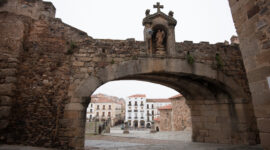
A fortified gateway punctuates Evoramonte’s medieval stone walls, flanked by two round crenellated towers and approached across a flowered grassy slope. Rough rubble masonry, narrow defensive openings, and the deep arched passage contrast with a glimpse of whitewashed buildings inside, marking the transition from the surrounding hillside into the walled settlement.
Caption
A fortified gateway punctuates Evoramonte’s medieval stone walls, flanked by two round crenellated towers and approached across a flowered grassy slope. Rough rubble masonry, narrow defensive openings, and the deep arched passage contrast with a glimpse of whitewashed buildings inside, marking the transition from the surrounding hillside into the walled settlement.

A steep cobbled street descends between whitewashed houses in Evoramonte toward the distant Alentejo horizon. Sunlight strikes the façades and roof tiles while the lane itself remains partly in shadow, emphasizing the settlement’s slope. Ochre trim on the near building adds a regional accent to the compact vernacular streetscape within the fortified village.
Caption
A steep cobbled street descends between whitewashed houses in Evoramonte toward the distant Alentejo horizon. Sunlight strikes the façades and roof tiles while the lane itself remains partly in shadow, emphasizing the settlement’s slope. Ochre trim on the near building adds a regional accent to the compact vernacular streetscape within the fortified village.

Looking down from Evoramonte Castle, the medieval gateway and surrounding defensive walls enclose whitewashed houses at the edge of the ridge. The gate passage is centered in a broad rubble-stone curtain, while angular wall segments and crenellations follow the hilltop perimeter. Roads and wooded countryside far below underscore the strategic elevation of the fortified settlement.
Caption
Looking down from Evoramonte Castle, the medieval gateway and surrounding defensive walls enclose whitewashed houses at the edge of the ridge. The gate passage is centered in a broad rubble-stone curtain, while angular wall segments and crenellations follow the hilltop perimeter. Roads and wooded countryside far below underscore the strategic elevation of the fortified settlement.

Ribbed vaults spring from stout stone columns inside Evoramonte Castle, forming a compact hall of repeated curved bays. The pale plastered ribs converge above carved capitals, while warm reflected light softens the massive supports. This upward-looking view emphasizes the sophisticated interior geometry concealed within the keep’s severe fortified exterior.
Caption
Ribbed vaults spring from stout stone columns inside Evoramonte Castle, forming a compact hall of repeated curved bays. The pale plastered ribs converge above carved capitals, while warm reflected light softens the massive supports. This upward-looking view emphasizes the sophisticated interior geometry concealed within the keep’s severe fortified exterior.

A sweeping panorama from Evoramonte looks across rolling wooded hills and patchwork clearings toward a hazy horizon. Tracks and cultivated plots thread through the middle distance, while the elevated foreground drops steeply away from the fortified village. The view conveys the exceptional visual command afforded by Evoramonte’s hilltop position over the surrounding Alentejo countryside.
Caption
A sweeping panorama from Evoramonte looks across rolling wooded hills and patchwork clearings toward a hazy horizon. Tracks and cultivated plots thread through the middle distance, while the elevated foreground drops steeply away from the fortified village. The view conveys the exceptional visual command afforded by Evoramonte’s hilltop position over the surrounding Alentejo countryside.

From Evoramonte’s elevated ridge, a patterned Alentejo landscape unfolds through cork-oak woodland, open pasture, and orderly rows of cultivated trees. A small white rural building stands amid the groves, providing scale within the broad green terrain. The high viewpoint reveals how the fortified settlement overlooks an extensive agricultural and wooded hinterland.
Caption
From Evoramonte’s elevated ridge, a patterned Alentejo landscape unfolds through cork-oak woodland, open pasture, and orderly rows of cultivated trees. A small white rural building stands amid the groves, providing scale within the broad green terrain. The high viewpoint reveals how the fortified settlement overlooks an extensive agricultural and wooded hinterland.

The four cylindrical towers of Evoramonte Castle rise above the long stone walls and whitewashed buildings of the hilltop village. Seen from across olive- and oak-dotted slopes, the keep forms the dominant landmark while the defensive enclosure runs horizontally along the ridge. The distant view shows the fortified settlement as a coherent architectural ensemble embedded in the Alentejo landscape.
Caption
The four cylindrical towers of Evoramonte Castle rise above the long stone walls and whitewashed buildings of the hilltop village. Seen from across olive- and oak-dotted slopes, the keep forms the dominant landmark while the defensive enclosure runs horizontally along the ridge. The distant view shows the fortified settlement as a coherent architectural ensemble embedded in the Alentejo landscape.

From a high vantage point at Evoramonte Castle, red-tiled roofs and whitewashed houses cluster within the medieval defensive walls. Crenellated ramparts trace the edge of the ridge before the terrain falls into wooded Alentejo countryside, with a modern viaduct visible in the distance. The overview clearly reveals the compact relationship between village, fortifications, and commanding hilltop site.
Caption
From a high vantage point at Evoramonte Castle, red-tiled roofs and whitewashed houses cluster within the medieval defensive walls. Crenellated ramparts trace the edge of the ridge before the terrain falls into wooded Alentejo countryside, with a modern viaduct visible in the distance. The overview clearly reveals the compact relationship between village, fortifications, and commanding hilltop site.

A deeply recessed arched window opens through the massive wall of Evoramonte Castle, illuminating a small chamber paved with terracotta tiles. Stone seats or ledges project at either side of the embrasure, while the thick plastered walls reveal the defensive depth of the keep’s masonry. The sparse composition makes the window recess itself the principal architectural subject.
Caption
A deeply recessed arched window opens through the massive wall of Evoramonte Castle, illuminating a small chamber paved with terracotta tiles. Stone seats or ledges project at either side of the embrasure, while the thick plastered walls reveal the defensive depth of the keep’s masonry. The sparse composition makes the window recess itself the principal architectural subject.

The massive keep of Evoramonte Castle rises from the hilltop on four cylindrical corner towers, its pale masonry sharply defined against a deep blue Alentejo sky. Narrow openings, projecting stone details, and the compact vertical mass give the building its strongly fortified character, while the grassy slope in the foreground reveals the elevated setting of the citadel.
Caption
The massive keep of Evoramonte Castle rises from the hilltop on four cylindrical corner towers, its pale masonry sharply defined against a deep blue Alentejo sky. Narrow openings, projecting stone details, and the compact vertical mass give the building its strongly fortified character, while the grassy slope in the foreground reveals the elevated setting of the citadel.

Two bronze bells hang from timber supports within tall rounded openings of a whitewashed bell structure in Evoramonte. Seen from below, the paired arches frame the bells against bright daylight, emphasizing the contrast between dark metal, warm wood, and smooth white plaster. The close architectural view records the functional bell installation rather than the church exterior.
Caption
Two bronze bells hang from timber supports within tall rounded openings of a whitewashed bell structure in Evoramonte. Seen from below, the paired arches frame the bells against bright daylight, emphasizing the contrast between dark metal, warm wood, and smooth white plaster. The close architectural view records the functional bell installation rather than the church exterior.

Individual blue, yellow, and white patterned ceramic tiles form a cross-like arrangement on a plain white wall. The separated square tiles display scrolling vegetal ornament typical of Portuguese decorative ceramics, creating a small geometric installation whose vivid glazed colors stand apart from the otherwise undecorated surface.
Caption
Individual blue, yellow, and white patterned ceramic tiles form a cross-like arrangement on a plain white wall. The separated square tiles display scrolling vegetal ornament typical of Portuguese decorative ceramics, creating a small geometric installation whose vivid glazed colors stand apart from the otherwise undecorated surface.

A monumental cork oak spreads heavy, twisting limbs over a carpet of green grass outside Evoramonte. Its thick, deeply fissured trunk and broad asymmetrical crown dominate the frame, displaying the sculptural growth typical of mature trees in the Alentejo montado. Dappled light beneath the canopy emphasizes the contrast between rugged bark and the soft groundcover.
Caption
A monumental cork oak spreads heavy, twisting limbs over a carpet of green grass outside Evoramonte. Its thick, deeply fissured trunk and broad asymmetrical crown dominate the frame, displaying the sculptural growth typical of mature trees in the Alentejo montado. Dappled light beneath the canopy emphasizes the contrast between rugged bark and the soft groundcover.

A mature cork oak stands in open grassland, its stout dark trunk dividing into a low, spreading canopy. Additional oaks recede through the sunlit woodland behind it, establishing the characteristic park-like spacing of the Alentejo montado. The side-lit view concentrates attention on the tree’s heavy bark, irregular silhouette, and adaptation to the dry pastoral landscape.
Caption
A mature cork oak stands in open grassland, its stout dark trunk dividing into a low, spreading canopy. Additional oaks recede through the sunlit woodland behind it, establishing the characteristic park-like spacing of the Alentejo montado. The side-lit view concentrates attention on the tree’s heavy bark, irregular silhouette, and adaptation to the dry pastoral landscape.

A narrow lane climbs through Evoramonte between tightly spaced whitewashed houses, their irregular rooflines, chimneys, antennas, and small openings silhouetted against an intensely blue sky. Strong sunlight and deep shadow accentuate the village’s compact hilltop fabric, while the simple plastered façades and tiled roofs convey the vernacular architecture of the Alentejo settlement.
Caption
A narrow lane climbs through Evoramonte between tightly spaced whitewashed houses, their irregular rooflines, chimneys, antennas, and small openings silhouetted against an intensely blue sky. Strong sunlight and deep shadow accentuate the village’s compact hilltop fabric, while the simple plastered façades and tiled roofs convey the vernacular architecture of the Alentejo settlement.

Strong midday light throws two sharply outlined architectural shadows across the uneven cobblestones of Evoramonte. The dark silhouettes, including rounded and cross-like forms, become the principal subject against the textured stone paving, turning a functional village surface into an abstract study of the hilltop settlement’s built environment and intense Alentejo light.
Caption
Strong midday light throws two sharply outlined architectural shadows across the uneven cobblestones of Evoramonte. The dark silhouettes, including rounded and cross-like forms, become the principal subject against the textured stone paving, turning a functional village surface into an abstract study of the hilltop settlement’s built environment and intense Alentejo light.

A whitewashed cemetery wall and yellow-trimmed entrance stand on the edge of Evoramonte, with graves visible beyond the gate and a broad wooded landscape stretching to the horizon. A cross crowns the simple pediment, linking the enclosed burial ground to its religious function while the elevated viewpoint emphasizes the village’s commanding hilltop position.
Caption
A whitewashed cemetery wall and yellow-trimmed entrance stand on the edge of Evoramonte, with graves visible beyond the gate and a broad wooded landscape stretching to the horizon. A cross crowns the simple pediment, linking the enclosed burial ground to its religious function while the elevated viewpoint emphasizes the village’s commanding hilltop position.

A whitewashed church stands on Evoramonte’s hillside beneath a red-tiled gable roof, its long side wall articulated by narrow windows and a stone-framed doorway. A projecting entrance bay with a broad arch anchors the near end. The restrained plaster surfaces and exposed stone trim typify the sober religious architecture visible within the historic settlement.
Caption
A whitewashed church stands on Evoramonte’s hillside beneath a red-tiled gable roof, its long side wall articulated by narrow windows and a stone-framed doorway. A projecting entrance bay with a broad arch anchors the near end. The restrained plaster surfaces and exposed stone trim typify the sober religious architecture visible within the historic settlement.

Rows of white tombs and grave monuments fill Evoramonte’s compact cemetery, many decorated with bright artificial flowers. Behind them, a crenellated stone defensive wall forms an unusual historic backdrop, visually linking the burial ground to the fortified hilltop settlement. The close view emphasizes the density, individual memorial markers, and contrast between white masonry and dark medieval stone.
Caption
Rows of white tombs and grave monuments fill Evoramonte’s compact cemetery, many decorated with bright artificial flowers. Behind them, a crenellated stone defensive wall forms an unusual historic backdrop, visually linking the burial ground to the fortified hilltop settlement. The close view emphasizes the density, individual memorial markers, and contrast between white masonry and dark medieval stone.

A shaded cobblestone lane bends between low whitewashed houses in Evoramonte, drawing the eye toward a tall chimney-like vertical element and sunlit façades farther ahead. Irregular masonry, tiled roofs, small openings, and deep shadow preserve the intimate scale of the walled village, contrasting with the expansive landscape visible from its outer defenses.
Caption
A shaded cobblestone lane bends between low whitewashed houses in Evoramonte, drawing the eye toward a tall chimney-like vertical element and sunlit façades farther ahead. Irregular masonry, tiled roofs, small openings, and deep shadow preserve the intimate scale of the walled village, contrasting with the expansive landscape visible from its outer defenses.

A cork oak leans diagonally across the frame at the edge of a fenced pasture near Evoramonte. Its dark, textured trunk and irregular branches contrast with bright grass in the foreground and dry earth beyond the fence. The composition isolates the working Alentejo landscape at close range, where mature oaks remain dispersed through grazed or cultivated ground.
Caption
A cork oak leans diagonally across the frame at the edge of a fenced pasture near Evoramonte. Its dark, textured trunk and irregular branches contrast with bright grass in the foreground and dry earth beyond the fence. The composition isolates the working Alentejo landscape at close range, where mature oaks remain dispersed through grazed or cultivated ground.

Carved stone fragments are arranged on the terracotta floor of a thick-walled interior room in Evoramonte Castle, leading toward a tall gridded window. The irregular pale blocks appear to preserve architectural ornament and masonry details recovered from the site. Their museum-like presentation within the historic fabric connects the castle’s surviving rooms with material evidence from earlier construction phases.
Caption
Carved stone fragments are arranged on the terracotta floor of a thick-walled interior room in Evoramonte Castle, leading toward a tall gridded window. The irregular pale blocks appear to preserve architectural ornament and masonry details recovered from the site. Their museum-like presentation within the historic fabric connects the castle’s surviving rooms with material evidence from earlier construction phases.

A narrow stone-framed arched doorway opens through a thick interior wall of Evoramonte Castle, flanked by tall reddish timber shutters or door leaves. Beyond, a brighter chamber with terracotta flooring and a substantial central pier is visible. The layered view emphasizes the depth of the masonry and the sequence of vaulted rooms within the fortified keep.
Caption
A narrow stone-framed arched doorway opens through a thick interior wall of Evoramonte Castle, flanked by tall reddish timber shutters or door leaves. Beyond, a brighter chamber with terracotta flooring and a substantial central pier is visible. The layered view emphasizes the depth of the masonry and the sequence of vaulted rooms within the fortified keep.

A close view isolates one of Evoramonte Castle’s carved stone capitals, where a broad rounded molding sits above a band of stylized leaf-like and pointed motifs. Weathering and small losses expose the granular stone surface, while the adjacent vault springing shows how the ornament mediates between the column shaft and the vaulted ceiling.
Caption
A close view isolates one of Evoramonte Castle’s carved stone capitals, where a broad rounded molding sits above a band of stylized leaf-like and pointed motifs. Weathering and small losses expose the granular stone surface, while the adjacent vault springing shows how the ornament mediates between the column shaft and the vaulted ceiling.

Three heavy stone columns support a network of pale rib vaults in the lower interior of Evoramonte Castle. Each support carries a differently weathered carved capital, and one shaft is articulated by a pronounced spiral pattern. Terracotta flooring and exhibition panels indicate the room’s present interpretive use while preserving the spatial rhythm of the historic keep.
Caption
Three heavy stone columns support a network of pale rib vaults in the lower interior of Evoramonte Castle. Each support carries a differently weathered carved capital, and one shaft is articulated by a pronounced spiral pattern. Terracotta flooring and exhibition panels indicate the room’s present interpretive use while preserving the spatial rhythm of the historic keep.

A small white rural building stands amid widely spaced cork oaks on vivid green ground below Evoramonte. The elevated view reveals the patterned openness of the montado, where mature trees cast broad shadows across pasture and cultivated rows. The isolated structure provides a focal point and scale within the wooded agricultural landscape.
Caption
A small white rural building stands amid widely spaced cork oaks on vivid green ground below Evoramonte. The elevated view reveals the patterned openness of the montado, where mature trees cast broad shadows across pasture and cultivated rows. The isolated structure provides a focal point and scale within the wooded agricultural landscape.

A circular whitewashed structure occupies a brick-paved terrace high on Evoramonte Castle, capped by a broad conical stone roof and a tall narrow finial or chimney. Low parapet walls frame the terrace against distant blue hills. The unusual rooftop element provides a close study of the keep’s upper-level architectural forms and exposed materials.
Caption
A circular whitewashed structure occupies a brick-paved terrace high on Evoramonte Castle, capped by a broad conical stone roof and a tall narrow finial or chimney. Low parapet walls frame the terrace against distant blue hills. The unusual rooftop element provides a close study of the keep’s upper-level architectural forms and exposed materials.

A small chapel with whitewashed walls and ochre-yellow trim stands on the hillside below Evoramonte Castle. Its simple gabled façade is crowned by a cross, while the massive four-towered keep rises prominently on the ridge behind. The composition links a modest religious building with the dominant fortified landmark of the settlement.
Caption
A small chapel with whitewashed walls and ochre-yellow trim stands on the hillside below Evoramonte Castle. Its simple gabled façade is crowned by a cross, while the massive four-towered keep rises prominently on the ridge behind. The composition links a modest religious building with the dominant fortified landmark of the settlement.

A cork oak trunk displays the vivid reddish surface left after cork has been harvested from its lower section, sharply contrasting with the thick gray-brown bark retained above. Other similarly treated oaks stand in the background. The close view documents the characteristic cork-harvesting landscape of the Alentejo and the regenerative bark that supports this long-established rural practice.
Caption
A cork oak trunk displays the vivid reddish surface left after cork has been harvested from its lower section, sharply contrasting with the thick gray-brown bark retained above. Other similarly treated oaks stand in the background. The close view documents the characteristic cork-harvesting landscape of the Alentejo and the regenerative bark that supports this long-established rural practice.

The Castle of Evoramonte rises above olive trees and the stone defenses of the hilltop settlement. Its compact pale masonry mass is articulated by four prominent cylindrical corner towers, a distinctive silhouette visible from the surrounding Alentejo countryside. Seen from below, the composition emphasizes the castle’s elevated position and the relationship between the monumental stronghold, enclosing walls, and cultivated landscape.
Caption
The Castle of Evoramonte rises above olive trees and the stone defenses of the hilltop settlement. Its compact pale masonry mass is articulated by four prominent cylindrical corner towers, a distinctive silhouette visible from the surrounding Alentejo countryside. Seen from below, the composition emphasizes the castle’s elevated position and the relationship between the monumental stronghold, enclosing walls, and cultivated landscape.

Evoramonte stretches along a distant ridge beneath the framing branches of a cork oak, with the castle keep and defensive walls silhouetted above orderly agricultural slopes. The foreground tree creates a natural frame for the fortified settlement, while patterned rows on the hillside emphasize the cultivated Alentejo landscape surrounding the historic hilltop.
Caption
Evoramonte stretches along a distant ridge beneath the framing branches of a cork oak, with the castle keep and defensive walls silhouetted above orderly agricultural slopes. The foreground tree creates a natural frame for the fortified settlement, while patterned rows on the hillside emphasize the cultivated Alentejo landscape surrounding the historic hilltop.

Cork oaks stand across a sunlit grassy woodland near Evoramonte, their irregular trunks and broad crowns creating the open, park-like structure characteristic of the Alentejo landscape. Several trunks show dark, textured bark and evidence consistent with cork-oak management. The view records the rural setting surrounding the fortified hill town rather than its monumental architecture.
Caption
Cork oaks stand across a sunlit grassy woodland near Evoramonte, their irregular trunks and broad crowns creating the open, park-like structure characteristic of the Alentejo landscape. Several trunks show dark, textured bark and evidence consistent with cork-oak management. The view records the rural setting surrounding the fortified hill town rather than its monumental architecture.