Great Wall
The Great Wall of China consists of a series of defensive fortifications constructed over many centuries to protect imperial territories from incursions across the northern frontier. Built using stone, brick, and compacted earth, the wall extends across mountain ridges and valleys, demonstrating large-scale engineering capabilities. Watchtowers and fortified passes illustrate the strategic planning involved in frontier defense.
Significant expansion of the wall occurred during the Ming dynasty, when additional reinforcement created the recognizable stone structures visible today. The wall’s alignment across mountainous terrain reflects both defensive considerations and geographic constraints. Its construction required extensive coordination of labor and resources across large regions.
The Great Wall illustrates the importance of territorial protection within imperial governance. The preserved sections demonstrate how architecture and landscape were integrated to form one of the most extensive defensive systems in history.

At Mutianyu, a steep brick-paved rampart of the Ming-era Great Wall descends toward a square watchtower before rising again along the distant mountain ridge, revealing the connected sequence of walls and towers and the dramatic changes in elevation.
Caption
At Mutianyu, a steep brick-paved rampart of the Ming-era Great Wall descends toward a square watchtower before rising again along the distant mountain ridge, revealing the connected sequence of walls and towers and the dramatic changes in elevation.

A steeply descending rampart of the Ming‑period Great Wall at Mutianyu drops through a mountain saddle before climbing the opposite ridge, where watchtowers command each crucial change in elevation.
Caption
A steeply descending rampart of the Ming‑period Great Wall at Mutianyu drops through a mountain saddle before climbing the opposite ridge, where watchtowers command each crucial change in elevation.

A roadside performer manipulates two large red lantern props in the modern visitor approach area to the Great Wall, where contemporary decorative symbols of Chinese culture contrast with the site’s historic military past.
Caption
A roadside performer manipulates two large red lantern props in the modern visitor approach area to the Great Wall, where contemporary decorative symbols of Chinese culture contrast with the site’s historic military past.

Rugged, forested peaks in the Beijing region reveal the demanding terrain that guided the Great Wall’s ridge-top route, emphasizing the sweep of the landscape over the architecture itself.
Caption
Rugged, forested peaks in the Beijing region reveal the demanding terrain that guided the Great Wall’s ridge-top route, emphasizing the sweep of the landscape over the architecture itself.

Looking down a broad brick-paved rampart at Mutianyu, a Ming-era watchtower marks a checkpoint along the Great Wall as the fortified walkway remains visually linked to successive towers climbing the mountain ridge beyond.
Caption
Looking down a broad brick-paved rampart at Mutianyu, a Ming-era watchtower marks a checkpoint along the Great Wall as the fortified walkway remains visually linked to successive towers climbing the mountain ridge beyond.

From a distant vantage, the Great Wall traces a pale crenellated line along an autumn-colored mountain ridge at Mutianyu, its ridge-top route maximizing visibility, defensive control, and a powerful sense of landscape scale.
Caption
From a distant vantage, the Great Wall traces a pale crenellated line along an autumn-colored mountain ridge at Mutianyu, its ridge-top route maximizing visibility, defensive control, and a powerful sense of landscape scale.

From a crenellated Mutianyu battlement, the Great Wall’s Ming-era ramparts and watchtowers unfold in a continuous line across the green mountain ridges, their towers visibly linked along the terrain.
Caption
From a crenellated Mutianyu battlement, the Great Wall’s Ming-era ramparts and watchtowers unfold in a continuous line across the green mountain ridges, their towers visibly linked along the terrain.

A Ming-period Great Wall watchtower at Mutianyu anchors a crenellated ridge-top wall, its brick masonry and arched openings rising above autumn foliage that accentuates the fortification’s role as an elevated observation and communication point.
Caption
A Ming-period Great Wall watchtower at Mutianyu anchors a crenellated ridge-top wall, its brick masonry and arched openings rising above autumn foliage that accentuates the fortification’s role as an elevated observation and communication point.

Randy and Steve stand side by side on the broad stone steps at Mutianyu, their portrait set against a towering Ming‑period Great Wall watchtower whose brick masonry, arched openings, and crenellated roofline once controlled passage along the wall and now emphasizes its monumental scale through their figures.
Caption
Randy and Steve stand side by side on the broad stone steps at Mutianyu, their portrait set against a towering Ming‑period Great Wall watchtower whose brick masonry, arched openings, and crenellated roofline once controlled passage along the wall and now emphasizes its monumental scale through their figures.

Ming‑dynasty watchtowers march along a crenellated Great Wall rampart, its brick-paved walkway climbing a wooded ridge of mixed green and autumn foliage to command long views from the high ground.
Caption
Ming‑dynasty watchtowers march along a crenellated Great Wall rampart, its brick-paved walkway climbing a wooded ridge of mixed green and autumn foliage to command long views from the high ground.

A circular curtain of falling water fronts a gray-brick visitor building with red doors at the modern Mutianyu Great Wall tourist complex, a contemporary amenity separate from the historic fortification itself.
Caption
A circular curtain of falling water fronts a gray-brick visitor building with red doors at the modern Mutianyu Great Wall tourist complex, a contemporary amenity separate from the historic fortification itself.

An open chairlift glides above the steep forested slope at Mutianyu, part of the modern tourism system providing access to the Great Wall through its characteristic wooded mountainside.
Caption
An open chairlift glides above the steep forested slope at Mutianyu, part of the modern tourism system providing access to the Great Wall through its characteristic wooded mountainside.

Randy and Steve smile for a close self-portrait on an open chairlift at Mutianyu, their modern ride to or from the Great Wall framed by forested mountain ridges in the background.
Caption
Randy and Steve smile for a close self-portrait on an open chairlift at Mutianyu, their modern ride to or from the Great Wall framed by forested mountain ridges in the background.

A modern open chairlift glides above the steep, forested slopes at Mutianyu, carrying visitors through the approach terrain separate from the historic Great Wall fortifications.
Caption
A modern open chairlift glides above the steep, forested slopes at Mutianyu, carrying visitors through the approach terrain separate from the historic Great Wall fortifications.

Randy and Steve stand side by side on the brick-paved rampart at Mutianyu as the restored Ming-period Great Wall, lined with crenellated watchtowers, climbs the steep forested mountain ridge behind them.
Caption
Randy and Steve stand side by side on the brick-paved rampart at Mutianyu as the restored Ming-period Great Wall, lined with crenellated watchtowers, climbs the steep forested mountain ridge behind them.

Randy and Steve smile at a parapet on the Mutianyu section of the Great Wall, where the restored Ming-period brick rampart climbs steeply along the mountain ridge toward a watchtower.
Caption
Randy and Steve smile at a parapet on the Mutianyu section of the Great Wall, where the restored Ming-period brick rampart climbs steeply along the mountain ridge toward a watchtower.

A long Ming‑dynasty rampart of the Great Wall at Mutianyu rides the forested mountain ridges, its regularly spaced watchtowers commanding the high ground for surveillance, defense, and signal communication beneath a clear blue sky.
Caption
A long Ming‑dynasty rampart of the Great Wall at Mutianyu rides the forested mountain ridges, its regularly spaced watchtowers commanding the high ground for surveillance, defense, and signal communication beneath a clear blue sky.

Framed by the rough brick curve of a Ming-period watchtower arch at Mutianyu, the Great Wall’s narrow, crenellated rampart dips and rises along the ridge, its controlled passageway recalling how such openings once regulated movement through the defensive system.
Caption
Framed by the rough brick curve of a Ming-period watchtower arch at Mutianyu, the Great Wall’s narrow, crenellated rampart dips and rises along the ridge, its controlled passageway recalling how such openings once regulated movement through the defensive system.

From the dim interior of a Ming-period Great Wall watchtower, a pointed brick arch opens onto the sunlit wall walk, where a silhouetted visitor underscores the shift from thick, defensive masonry to the exposed ramparts outside.
Caption
From the dim interior of a Ming-period Great Wall watchtower, a pointed brick arch opens onto the sunlit wall walk, where a silhouetted visitor underscores the shift from thick, defensive masonry to the exposed ramparts outside.

Stever pauses with his camera in the arched doorway of a Ming-era watchtower at Mutianyu, where the sunlit passage opens directly onto the steep Great Wall stairs beyond, revealing the relationship between tower interior and wall circulation.
Caption
Stever pauses with his camera in the arched doorway of a Ming-era watchtower at Mutianyu, where the sunlit passage opens directly onto the steep Great Wall stairs beyond, revealing the relationship between tower interior and wall circulation.

Steve poses beside the Great Wall’s crenellated parapet, framed by restored Ming-dynasty ramparts and watchtowers stepping across the wooded mountain ridges.
Caption
Steve poses beside the Great Wall’s crenellated parapet, framed by restored Ming-dynasty ramparts and watchtowers stepping across the wooded mountain ridges.

A visitor poses on a raised brick battlement of the Ming-era Great Wall, using its crenellated parapets—once protected firing and observation positions—as a scenic viewpoint above the mountain ridge.
Caption
A visitor poses on a raised brick battlement of the Ming-era Great Wall, using its crenellated parapets—once protected firing and observation positions—as a scenic viewpoint above the mountain ridge.

At Mutianyu, a steep Ming-era Great Wall rampart climbs the wooded ridge in a sharp ascent, its brick-paved walk and crenellated parapets tracing the natural high ground that once sheltered soldiers moving along the line of defense.
Caption
At Mutianyu, a steep Ming-era Great Wall rampart climbs the wooded ridge in a sharp ascent, its brick-paved walk and crenellated parapets tracing the natural high ground that once sheltered soldiers moving along the line of defense.

Rugged, forested mountains in the Beijing region rise above a small valley settlement, their steep ridges revealing why this landscape was chosen for the defensive placement of the Great Wall, even though the wall itself is not visible in the frame.
Caption
Rugged, forested mountains in the Beijing region rise above a small valley settlement, their steep ridges revealing why this landscape was chosen for the defensive placement of the Great Wall, even though the wall itself is not visible in the frame.

A Ming‑period brick watchtower of the Great Wall, its arched openings and crenellated roofline rising above dense forest, once served for observation, shelter, and control of passage along a rampart now partly concealed by vegetation.
Caption
A Ming‑period brick watchtower of the Great Wall, its arched openings and crenellated roofline rising above dense forest, once served for observation, shelter, and control of passage along a rampart now partly concealed by vegetation.

A visitor tackles a sharply rising flight of Great Wall stairs at Mutianyu, where steep stone steps and flanking brick parapets reveal how the Ming‑period rampart was adapted to the mountain gradients that modern walkers still labor to climb.
Caption
A visitor tackles a sharply rising flight of Great Wall stairs at Mutianyu, where steep stone steps and flanking brick parapets reveal how the Ming‑period rampart was adapted to the mountain gradients that modern walkers still labor to climb.

Upper entrance to the polished stainless-steel alpine slide, a modern recreational descent route within the Mutianyu Great Wall visitor complex, marked by a colorful Chinese welcome banner above the curving chute and wooden walkway.
Caption
Upper entrance to the polished stainless-steel alpine slide, a modern recreational descent route within the Mutianyu Great Wall visitor complex, marked by a colorful Chinese welcome banner above the curving chute and wooden walkway.

From the shadowed interior of a Ming-era Great Wall watchtower, a visitor gazes through an arched opening that links this dark passage to a sunlit ridge crowned with another tower and crenellated wall in the wider defensive network.
Caption
From the shadowed interior of a Ming-era Great Wall watchtower, a visitor gazes through an arched opening that links this dark passage to a sunlit ridge crowned with another tower and crenellated wall in the wider defensive network.

Steve with a camera strap poses in the arched opening of a Ming‑period Great Wall watchtower, with distant towers stretching across the landscape beyond.
Caption
Steve with a camera strap poses in the arched opening of a Ming‑period Great Wall watchtower, with distant towers stretching across the landscape beyond.

Through the deep shadow of a Ming-dynasty watchtower arch at Mutianyu, the Great Wall’s crenellated line and intervisible towers trace the contours of the opposing mountain ridge, revealing how the terrain shaped this defensive network.
Caption
Through the deep shadow of a Ming-dynasty watchtower arch at Mutianyu, the Great Wall’s crenellated line and intervisible towers trace the contours of the opposing mountain ridge, revealing how the terrain shaped this defensive network.

A Ming-era Great Wall watchtower rises in thick gray brick with a single arched opening, its elevated flank commanding broad surveillance views over the surrounding mountain valleys.
Caption
A Ming-era Great Wall watchtower rises in thick gray brick with a single arched opening, its elevated flank commanding broad surveillance views over the surrounding mountain valleys.

A Ming-period watchtower at Mutianyu anchors a Great Wall rampart that snakes along the wooded mountain ridge, its repeating towers tracing the crest to enable long-distance signaling and surveillance.
Caption
A Ming-period watchtower at Mutianyu anchors a Great Wall rampart that snakes along the wooded mountain ridge, its repeating towers tracing the crest to enable long-distance signaling and surveillance.

A densely stocked souvenir stall at a Great Wall visitor area, its panda toys, hats, postcards, and carvings illustrating the contemporary tourism economy that surrounds the historic site with commercial keepsakes rather than archaeological objects.
Caption
A densely stocked souvenir stall at a Great Wall visitor area, its panda toys, hats, postcards, and carvings illustrating the contemporary tourism economy that surrounds the historic site with commercial keepsakes rather than archaeological objects.

Visitors queue at the Mutianyu Great Wall toboggan ticket office, where a modern gray-brick service building is accented with red lanterns and traditional color motifs beneath bilingual signage.
Caption
Visitors queue at the Mutianyu Great Wall toboggan ticket office, where a modern gray-brick service building is accented with red lanterns and traditional color motifs beneath bilingual signage.

Open chairs glide past an orange support tower and Chinese safety warning sign on the Mutianyu chairlift, part of the modern access system to the Great Wall through the surrounding forested hillside.
Caption
Open chairs glide past an orange support tower and Chinese safety warning sign on the Mutianyu chairlift, part of the modern access system to the Great Wall through the surrounding forested hillside.

A cluster of modern visitor-service buildings with gray tiled roofs and red trim nestles in dense forest below the Mutianyu section of the Great Wall, their forms echoing traditional Chinese architecture to support tourism and transportation at the site.
Caption
A cluster of modern visitor-service buildings with gray tiled roofs and red trim nestles in dense forest below the Mutianyu section of the Great Wall, their forms echoing traditional Chinese architecture to support tourism and transportation at the site.

Two contemporary visitors smile toward the camera on the open chairlift that carries tourists up through the pine-covered slopes to the Great Wall at Mutianyu.
Caption
Two contemporary visitors smile toward the camera on the open chairlift that carries tourists up through the pine-covered slopes to the Great Wall at Mutianyu.

A gleaming alpine slide at Mutianyu curves through dense forest, tracing the steep wooded slope below the Great Wall’s tourist complex.
Caption
A gleaming alpine slide at Mutianyu curves through dense forest, tracing the steep wooded slope below the Great Wall’s tourist complex.

A gleaming stainless-steel alpine slide stretches in a straight run between timber walkways and colorful flags at Mutianyu, a modern visitor attraction whose side walkway supports operation and maintenance.
Caption
A gleaming stainless-steel alpine slide stretches in a straight run between timber walkways and colorful flags at Mutianyu, a modern visitor attraction whose side walkway supports operation and maintenance.

A tightly clustered run of Ming-period watchtowers and vertiginous brick steps at Mutianyu clings to a forested ridge, its sharply rising and falling ramparts tracing the mountain’s difficult contours to control this hard-to-defend pass.
Caption
A tightly clustered run of Ming-period watchtowers and vertiginous brick steps at Mutianyu clings to a forested ridge, its sharply rising and falling ramparts tracing the mountain’s difficult contours to control this hard-to-defend pass.

An open chairlift to the Mutianyu section of the Great Wall glides above a dense forest canopy, part of the modern infrastructure that carries visitors across the steep terrain.
Caption
An open chairlift to the Mutianyu section of the Great Wall glides above a dense forest canopy, part of the modern infrastructure that carries visitors across the steep terrain.

Modern white Chinese characters sweep across an autumn hillside below the ridge of the Great Wall at Mutianyu, a contemporary landscape inscription distinct from the historic fortification above.
Caption
Modern white Chinese characters sweep across an autumn hillside below the ridge of the Great Wall at Mutianyu, a contemporary landscape inscription distinct from the historic fortification above.

A Ming-period watchtower of the Great Wall rises above dense autumn forest at Mutianyu, its crenellated ramparts tracing the steep mountain ridge where towers mark strategic points along the fortification.
Caption
A Ming-period watchtower of the Great Wall rises above dense autumn forest at Mutianyu, its crenellated ramparts tracing the steep mountain ridge where towers mark strategic points along the fortification.

Randy and Steve pose on a Great Wall platform at Mutianyu, where brick parapets frame an exposed stairway dropping steeply into the forested mountains below.
Caption
Randy and Steve pose on a Great Wall platform at Mutianyu, where brick parapets frame an exposed stairway dropping steeply into the forested mountains below.

Randy and Steve smile on a Mutianyu platform of the Ming-era Great Wall, their presence giving scale to the steep rampart dropping toward a watchtower in the forested valley below.
Caption
Randy and Steve smile on a Mutianyu platform of the Ming-era Great Wall, their presence giving scale to the steep rampart dropping toward a watchtower in the forested valley below.

An extremely steep flight of Great Wall stairs drops between tall Ming-era brick parapets toward a watchtower and the likely modern or restored visitor roofs below, dramatically illustrating the rampart’s adaptation to the mountain terrain at Mutianyu.
Caption
An extremely steep flight of Great Wall stairs drops between tall Ming-era brick parapets toward a watchtower and the likely modern or restored visitor roofs below, dramatically illustrating the rampart’s adaptation to the mountain terrain at Mutianyu.

A dark brick watchtower arch on the Great Wall at Mutianyu frames layered mountain ridges and an autumn-colored valley beyond, emphasizing the strategic mountain outlook these observation openings once commanded.
Caption
A dark brick watchtower arch on the Great Wall at Mutianyu frames layered mountain ridges and an autumn-colored valley beyond, emphasizing the strategic mountain outlook these observation openings once commanded.

Through the shadowed arch of a Ming-era watchtower at Mutianyu, visitors stand along the sunlit rampart of the Great Wall of China, their figures revealing the scale of the crenellated parapets against the forested mountain slope beyond.
Caption
Through the shadowed arch of a Ming-era watchtower at Mutianyu, visitors stand along the sunlit rampart of the Great Wall of China, their figures revealing the scale of the crenellated parapets against the forested mountain slope beyond.

At Mutianyu, the Ming-era Great Wall snakes along the green mountain slope, its brick ramparts and watchtowers viewed in selective focus between blurred masonry in the foreground that visually links near and distant stonework.
Caption
At Mutianyu, the Ming-era Great Wall snakes along the green mountain slope, its brick ramparts and watchtowers viewed in selective focus between blurred masonry in the foreground that visually links near and distant stonework.

An isolated Ming-era Great Wall watchtower crowns a steep rocky summit above layered mountain valleys, its elevated perch maximizing surveillance while the connecting wall disappears into distance and terrain.
Caption
An isolated Ming-era Great Wall watchtower crowns a steep rocky summit above layered mountain valleys, its elevated perch maximizing surveillance while the connecting wall disappears into distance and terrain.

An empty brick-paved wall walk at Mutianyu curves between crenellated parapets toward the mountains, its restored Ming-dynasty rampart providing a broad route once used for troop movement and now accessible to visitors.
Caption
An empty brick-paved wall walk at Mutianyu curves between crenellated parapets toward the mountains, its restored Ming-dynasty rampart providing a broad route once used for troop movement and now accessible to visitors.

Randy and Steve stand smiling on the brick-paved rampart at Mutianyu, their environmental portrait framed by crenellated parapets as the Ming Great Wall and its watchtowers climb the wooded mountain ridge behind them, conveying the scale of the defensive landscape.
Caption
Randy and Steve stand smiling on the brick-paved rampart at Mutianyu, their environmental portrait framed by crenellated parapets as the Ming Great Wall and its watchtowers climb the wooded mountain ridge behind them, conveying the scale of the defensive landscape.

Randy poses beside the brick parapet of the Great Wall at Mutianyu, framed by Ming-period watchtowers and the wall’s sinuous alignment along the mountain ridge.
Caption
Randy poses beside the brick parapet of the Great Wall at Mutianyu, framed by Ming-period watchtowers and the wall’s sinuous alignment along the mountain ridge.

Steve leans against the crenellated parapet at Mutianyu, his presence giving scale to the Ming-era Great Wall as it curves across the mountain ridges toward distant watchtowers.
Caption
Steve leans against the crenellated parapet at Mutianyu, his presence giving scale to the Ming-era Great Wall as it curves across the mountain ridges toward distant watchtowers.

Randy and Steve stand together on the restored Ming‑period rampart at Mutianyu, their environmental portrait set against a sweeping panorama of the Great Wall and its watchtowers tracing the mountain ridges beyond.
Caption
Randy and Steve stand together on the restored Ming‑period rampart at Mutianyu, their environmental portrait set against a sweeping panorama of the Great Wall and its watchtowers tracing the mountain ridges beyond.

An empty, steeply rising rampart of the Great Wall at Mutianyu, its heavily restored brick paving and crenellated parapets climbing directly with the mountain terrain and enclosed by dense forest on both sides.
Caption
An empty, steeply rising rampart of the Great Wall at Mutianyu, its heavily restored brick paving and crenellated parapets climbing directly with the mountain terrain and enclosed by dense forest on both sides.

At Mutianyu, a brick-paved Ming-dynasty rampart climbs an extreme forested ridge, its steep incline framed by close crenellations that emphasize the Great Wall’s defensive parapet design.
Caption
At Mutianyu, a brick-paved Ming-dynasty rampart climbs an extreme forested ridge, its steep incline framed by close crenellations that emphasize the Great Wall’s defensive parapet design.

From the shadowed interior of a Ming-era watchtower at Mutianyu, a steep brick-paved rampart of the Great Wall rises toward the light, flanked by defensive parapets casting rhythmic shadows along the climb.
Caption
From the shadowed interior of a Ming-era watchtower at Mutianyu, a steep brick-paved rampart of the Great Wall rises toward the light, flanked by defensive parapets casting rhythmic shadows along the climb.

A solitary Ming-era watchtower at Mutianyu anchors a strategic bend in the Great Wall, its narrow, steep rampart cutting across a densely forested mountain slope.
Caption
A solitary Ming-era watchtower at Mutianyu anchors a strategic bend in the Great Wall, its narrow, steep rampart cutting across a densely forested mountain slope.

From the shadowed doorway of a Ming-era watchtower at Mutianyu, a sunlit sweep of crenellated wall and towers climbs and dips across the opposing mountain, linking this enclosed post to the wider defensive network and its chain of intervisible lookouts.
Caption
From the shadowed doorway of a Ming-era watchtower at Mutianyu, a sunlit sweep of crenellated wall and towers climbs and dips across the opposing mountain, linking this enclosed post to the wider defensive network and its chain of intervisible lookouts.

A solitary Great Wall watchtower crowns a dark, wooded ridge, its elevated Ming-era vantage point receding into atmospheric haze that reveals the vast mountain landscape near Beijing.
Caption
A solitary Great Wall watchtower crowns a dark, wooded ridge, its elevated Ming-era vantage point receding into atmospheric haze that reveals the vast mountain landscape near Beijing.

Randy and Steve stand on a broad observation platform at Mutianyu, their portrait framed by a winding line of Ming‑period Great Wall ramparts and watchtowers stretching across the mountain ridge.
Caption
Randy and Steve stand on a broad observation platform at Mutianyu, their portrait framed by a winding line of Ming‑period Great Wall ramparts and watchtowers stretching across the mountain ridge.

Two visitors stand on a descending brick walkway at Mutianyu, their figures emphasizing the scale of the Great Wall’s Ming-era rampart as it links successive watchtowers across the steep mountain ridge.
Caption
Two visitors stand on a descending brick walkway at Mutianyu, their figures emphasizing the scale of the Great Wall’s Ming-era rampart as it links successive watchtowers across the steep mountain ridge.

Along the Mutianyu section of the Great Wall, a Ming-dynasty rampart with evenly spaced watchtowers descends from the foreground and then climbs distant wooded ridges, its high-ground route tracing the mountains’ varied elevations to support coordinated defense and signaling.
Caption
Along the Mutianyu section of the Great Wall, a Ming-dynasty rampart with evenly spaced watchtowers descends from the foreground and then climbs distant wooded ridges, its high-ground route tracing the mountains’ varied elevations to support coordinated defense and signaling.

A close view of the Great Wall’s broad, irregular stone steps at Mutianyu reveals how Ming-period stair geometry was adapted to steep terrain and later restoration, creating a physically demanding ascent.
Caption
A close view of the Great Wall’s broad, irregular stone steps at Mutianyu reveals how Ming-period stair geometry was adapted to steep terrain and later restoration, creating a physically demanding ascent.

At Mutianyu, a Ming-era rampart curves down into a forested valley, its watchtowers strung along the ridgeline to keep the Great Wall’s defenses and sightlines continuous across the mountains.
Caption
At Mutianyu, a Ming-era rampart curves down into a forested valley, its watchtowers strung along the ridgeline to keep the Great Wall’s defenses and sightlines continuous across the mountains.
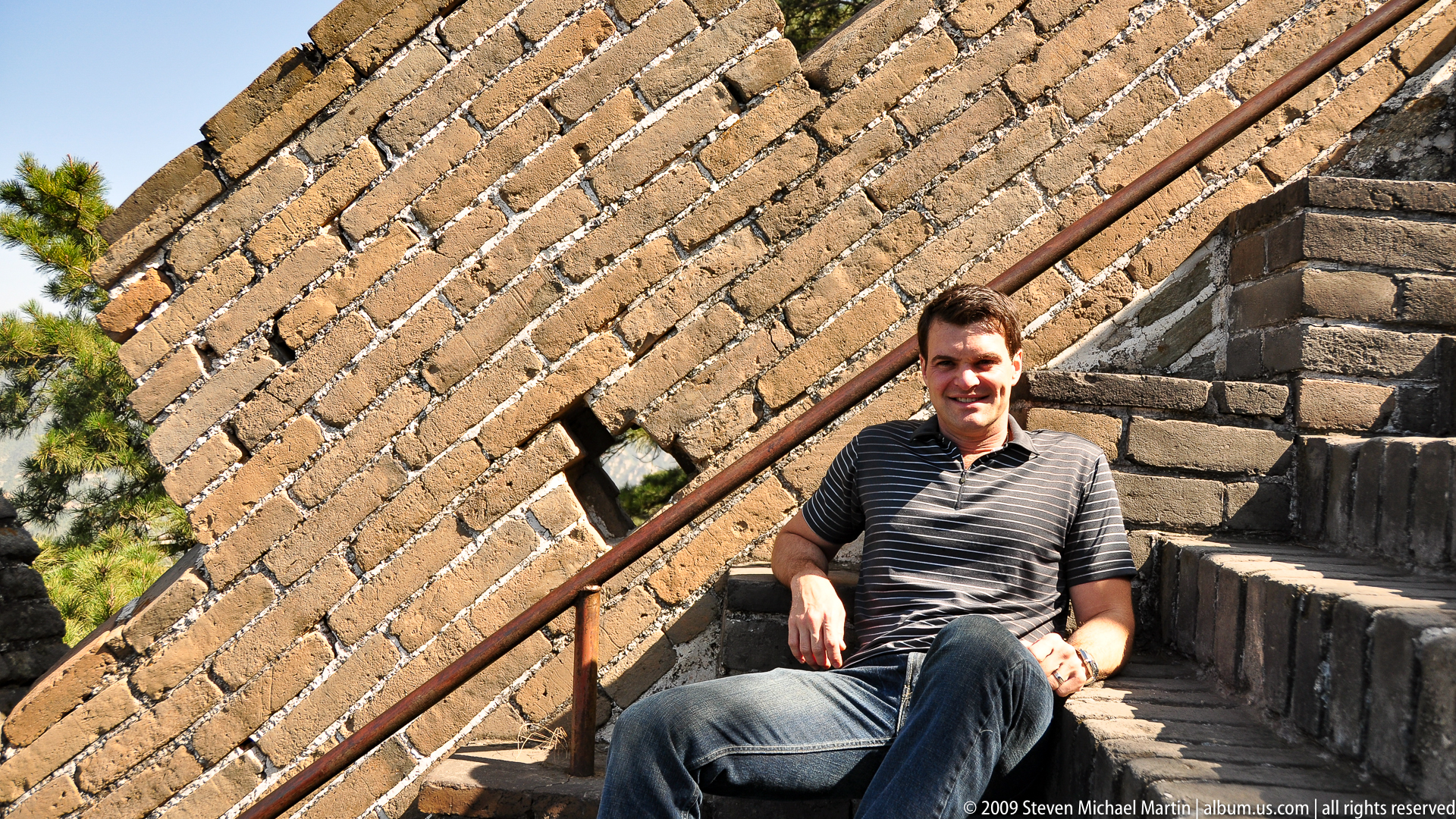
A visitor pauses to rest on the steep brick stairs of the Mutianyu section of the Great Wall, where a modern metal handrail underscores the physical effort required to climb this restored Ming-era rampart.
Caption
A visitor pauses to rest on the steep brick stairs of the Mutianyu section of the Great Wall, where a modern metal handrail underscores the physical effort required to climb this restored Ming-era rampart.

A lone visitor pauses on a narrow landing along the steep Great Wall stairway at Mutianyu, enclosed by high brick walls that once served as defensive circulation through the Ming-era ramparts and watchtowers.
Caption
A lone visitor pauses on a narrow landing along the steep Great Wall stairway at Mutianyu, enclosed by high brick walls that once served as defensive circulation through the Ming-era ramparts and watchtowers.

Randy stands with arms crossed on a rampart at Mutianyu, framed by the Great Wall’s restored Ming-period brickwork as it descends and rises across the mountain ridgeline toward a chain of watchtowers.
Caption
Randy stands with arms crossed on a rampart at Mutianyu, framed by the Great Wall’s restored Ming-period brickwork as it descends and rises across the mountain ridgeline toward a chain of watchtowers.

A close head-and-shoulders portrait of Steve, photographed during a modern Great Wall trip with softly blurred mountains behind him.
Caption
A close head-and-shoulders portrait of Steve, photographed during a modern Great Wall trip with softly blurred mountains behind him.

Randy stands with arms crossed on the Mutianyu section of the Great Wall, framed by descending Ming-era ramparts and watchtowers tracing the distant mountain ridge.
Caption
Randy stands with arms crossed on the Mutianyu section of the Great Wall, framed by descending Ming-era ramparts and watchtowers tracing the distant mountain ridge.

Sunlight slices across the steep interior stair and arched doorway of a Mutianyu watchtower on the Great Wall, revealing the thick Ming-dynasty defensive masonry that once controlled movement through the passage.
Caption
Sunlight slices across the steep interior stair and arched doorway of a Mutianyu watchtower on the Great Wall, revealing the thick Ming-dynasty defensive masonry that once controlled movement through the passage.

At Mutianyu, a small section of the Great Wall’s rampart edges into view above a steep, densely forested mountain slope, emphasizing the surrounding woodland more than the fortification itself.
Caption
At Mutianyu, a small section of the Great Wall’s rampart edges into view above a steep, densely forested mountain slope, emphasizing the surrounding woodland more than the fortification itself.
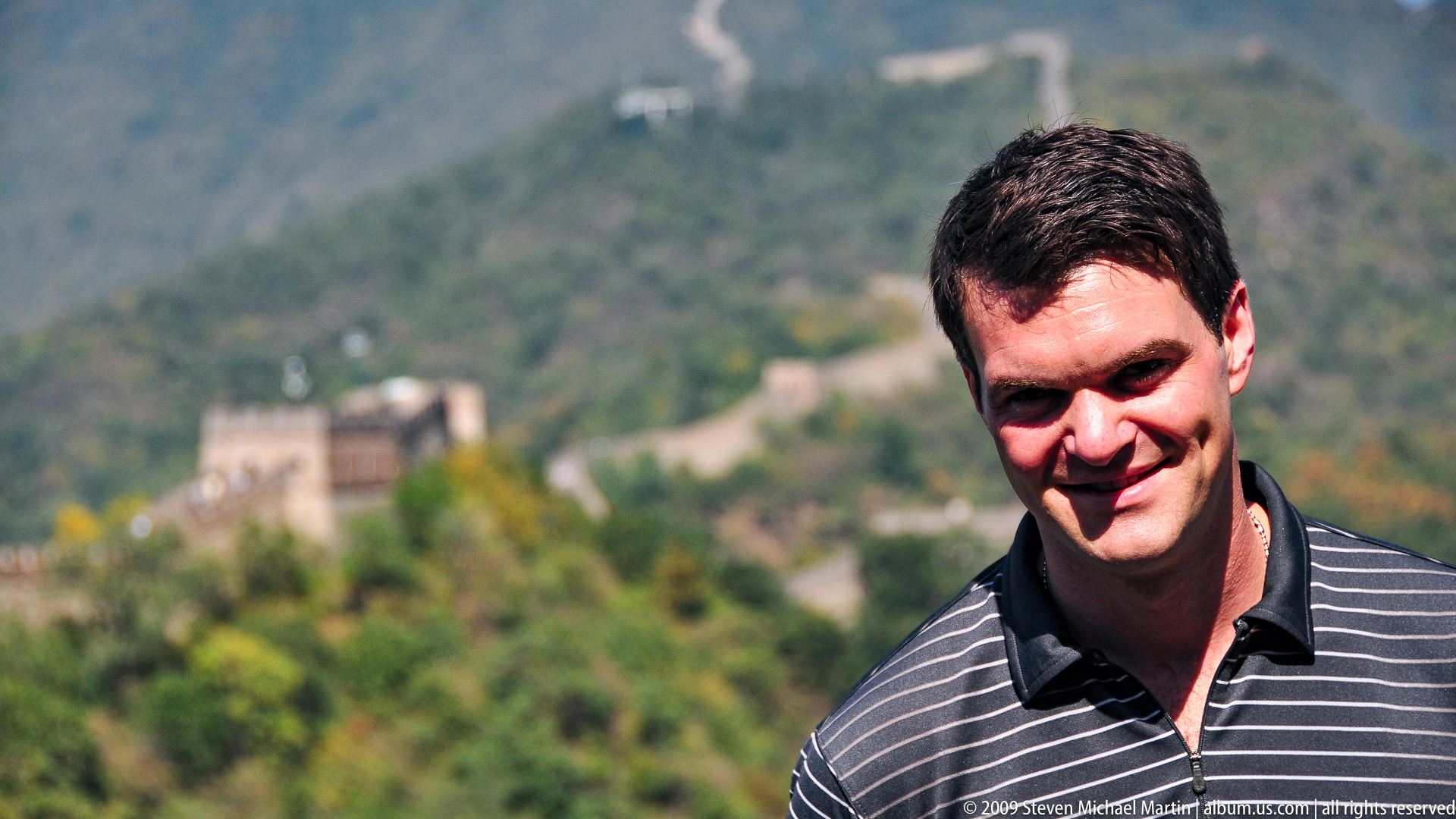
Steve smiles toward the camera on the Great Wall at Mutianyu, a blurred watchtower and forested slope receding softly behind him in shallow depth of field.
Caption
Steve smiles toward the camera on the Great Wall at Mutianyu, a blurred watchtower and forested slope receding softly behind him in shallow depth of field.

Along the Mutianyu sector of the Great Wall, a broad brick rampart slopes toward a watchtower that organizes movement along the Ming-period fortifications, revealing multiple defensive layers stepping across the mountain ridges in depth.
Caption
Along the Mutianyu sector of the Great Wall, a broad brick rampart slopes toward a watchtower that organizes movement along the Ming-period fortifications, revealing multiple defensive layers stepping across the mountain ridges in depth.

Steve eans forward as he climbs a steep brick rampart of the Mutianyu Great Wall, with Ming-period watchtowers stretching across the mountain ridge behind him, emphasizing the physical effort of the ascent.
Caption
Steve eans forward as he climbs a steep brick rampart of the Mutianyu Great Wall, with Ming-period watchtowers stretching across the mountain ridge behind him, emphasizing the physical effort of the ascent.

Steve with a camera stands beside a traditional-style timber-fronted building with lattice windows and a gray-brick base in the Mutianyu visitor area of the Great Wall, a restored or modern service structure whose exact historic function is uncertain.
Caption
Steve with a camera stands beside a traditional-style timber-fronted building with lattice windows and a gray-brick base in the Mutianyu visitor area of the Great Wall, a restored or modern service structure whose exact historic function is uncertain.

From a high vantage at Mutianyu, a chain of gray-tiled Great Wall watchtower roofs steps down the slope, revealing how these enclosed Ming-era passages and shelters align along the rampart above the surrounding forest.
Caption
From a high vantage at Mutianyu, a chain of gray-tiled Great Wall watchtower roofs steps down the slope, revealing how these enclosed Ming-era passages and shelters align along the rampart above the surrounding forest.

A nearly vertical flight of Ming-era Great Wall stairs at Mutianyu climbs through dense forest toward a commanding watchtower, its severe grade revealing how the ramparts were adapted to the mountain ridge for strategic advantage.
Caption
A nearly vertical flight of Ming-era Great Wall stairs at Mutianyu climbs through dense forest toward a commanding watchtower, its severe grade revealing how the ramparts were adapted to the mountain ridge for strategic advantage.

From a high vantage over Mutianyu, closely spaced Ming-period watchtowers and steep ramparts stride down a forested autumn slope, revealing the Great Wall’s integrated defensive system in striking clarity.
Caption
From a high vantage over Mutianyu, closely spaced Ming-period watchtowers and steep ramparts stride down a forested autumn slope, revealing the Great Wall’s integrated defensive system in striking clarity.

From a rider’s sled, the stainless-steel alpine slide at the Mutianyu Great Wall visitor complex curves through dense vegetation in a blur of motion.
Caption
From a rider’s sled, the stainless-steel alpine slide at the Mutianyu Great Wall visitor complex curves through dense vegetation in a blur of motion.

From a rider’s-eye view, shoes jut into the frame as a hand-braked sled glides down the polished metal toboggan track at Mutianyu, curving through dense forest past a warning sign on the modern alpine slide below the Great Wall tourist complex.
Caption
From a rider’s-eye view, shoes jut into the frame as a hand-braked sled glides down the polished metal toboggan track at Mutianyu, curving through dense forest past a warning sign on the modern alpine slide below the Great Wall tourist complex.

An empty stainless-steel toboggan track, part of the Mutianyu tourist descent system, curves through dry grass and dense woodland as it follows the wooded hillside near the Great Wall.
Caption
An empty stainless-steel toboggan track, part of the Mutianyu tourist descent system, curves through dry grass and dense woodland as it follows the wooded hillside near the Great Wall.

A long, stainless-steel toboggan slide at the Mutianyu Great Wall tourist complex stretches in a perfectly straight corridor, flanked by wooden walkways, guard railings, and strings of colorful pennant flags receding in one-point perspective under the open sky.
Caption
A long, stainless-steel toboggan slide at the Mutianyu Great Wall tourist complex stretches in a perfectly straight corridor, flanked by wooden walkways, guard railings, and strings of colorful pennant flags receding in one-point perspective under the open sky.

At Mutianyu, a curving stainless-steel alpine slide snakes past fencing and colorful flags beneath overhead chairlift cables, part of the modern transport systems that move visitors around the Great Wall tourist complex.
Caption
At Mutianyu, a curving stainless-steel alpine slide snakes past fencing and colorful flags beneath overhead chairlift cables, part of the modern transport systems that move visitors around the Great Wall tourist complex.

A blue 25 m sign in Chinese marks rider spacing on the modern stainless-steel toboggan chute at Mutianyu, where the slide and overhead chairlift share the same busy visitor zone.
Caption
A blue 25 m sign in Chinese marks rider spacing on the modern stainless-steel toboggan chute at Mutianyu, where the slide and overhead chairlift share the same busy visitor zone.

A contemporary visitor in a blue shirt speeds downhill on the modern stainless-steel toboggan slide at the Mutianyu Great Wall tourist complex, enclosed by tall safety fencing and a wooden side walkway.
Caption
A contemporary visitor in a blue shirt speeds downhill on the modern stainless-steel toboggan slide at the Mutianyu Great Wall tourist complex, enclosed by tall safety fencing and a wooden side walkway.

Heaped piles of dried fruits and nuts create a colorful market display in contemporary commerce near the Great Wall visitor area.
Caption
Heaped piles of dried fruits and nuts create a colorful market display in contemporary commerce near the Great Wall visitor area.

A central blue-and-white dragon vase is framed by taller red and brown floral vessels, contemporary decorative wares sold as souvenirs that reference traditional Chinese visual culture.
Caption
A central blue-and-white dragon vase is framed by taller red and brown floral vessels, contemporary decorative wares sold as souvenirs that reference traditional Chinese visual culture.

Two small yellow ceramic jars painted with blue dragons rest among open bowls of colored powders in a pottery workshop, suggesting the process of glazing or finishing modern decorative ceramics.
Caption
Two small yellow ceramic jars painted with blue dragons rest among open bowls of colored powders in a pottery workshop, suggesting the process of glazing or finishing modern decorative ceramics.

A tight cluster of brightly painted long-necked souvenir vases showcases modern decorative ceramics for the tourist market, their dense floral and scroll patterns drawing on historic Chinese ornamental vocabularies.
Caption
A tight cluster of brightly painted long-necked souvenir vases showcases modern decorative ceramics for the tourist market, their dense floral and scroll patterns drawing on historic Chinese ornamental vocabularies.

A small modern cloisonne-style souvenir vase features a black-and-white bird amid multicolored flowers and scrolling leaves on a blue ground, echoing a classic bird-and-flower theme in Chinese decorative art.
Caption
A small modern cloisonne-style souvenir vase features a black-and-white bird amid multicolored flowers and scrolling leaves on a blue ground, echoing a classic bird-and-flower theme in Chinese decorative art.

At Mutianyu, a chain of Ming-dynasty watchtowers and ramparts zigzags along the autumn-colored mountain ridges, its brick-paved wall walk and crenellated parapets closely conforming to the terrain in an integrated surveillance system.
Caption
At Mutianyu, a chain of Ming-dynasty watchtowers and ramparts zigzags along the autumn-colored mountain ridges, its brick-paved wall walk and crenellated parapets closely conforming to the terrain in an integrated surveillance system.

A multilingual “No parking” sign rises above the stainless-steel toboggan track at Mutianyu, regulating stops on the modern slide route for international visitors to the Great Wall tourist complex.
Caption
A multilingual “No parking” sign rises above the stainless-steel toboggan track at Mutianyu, regulating stops on the modern slide route for international visitors to the Great Wall tourist complex.

From the shadowed interior of a Ming‑period Great Wall watchtower at Mutianyu, a deep brick arch frames the sunlit rampart outside, where a lone visitor stands at the controlled passage between tower and wall.
Caption
From the shadowed interior of a Ming‑period Great Wall watchtower at Mutianyu, a deep brick arch frames the sunlit rampart outside, where a lone visitor stands at the controlled passage between tower and wall.