Norman Palace and Palatine Chapel – Palermo, Sicily
The historic Norman Palace, also known as the Palazzo dei Normanni, stands at the edge of the historic center of Palermo. Originally constructed during the Arab period and later expanded by the Norman rulers of Sicily, the palace became the royal residence of the Norman kings in the 12th century.
Within the palace lies the extraordinary Palatine Chapel, one of the greatest artistic achievements of medieval Europe. Its interior is covered with dazzling golden mosaics that combine Byzantine artistic traditions with Norman and Islamic architectural influences.
Together the palace and chapel represent the unique cultural blending that characterized Sicily during the Norman period.

The long reddish-stone façade of the Norman Palace stretches across the square, its regular window bays and upper cornice framing the more elaborate central entrance. Flags line the balcony above the doorway, while the heraldic relief and paired columns mark the principal ceremonial access. The oblique wide view provides architectural context for the closer entrance photographs and shows the palace’s imposing civic frontage.
Caption
The long reddish-stone façade of the Norman Palace stretches across the square, its regular window bays and upper cornice framing the more elaborate central entrance. Flags line the balcony above the doorway, while the heraldic relief and paired columns mark the principal ceremonial access. The oblique wide view provides architectural context for the closer entrance photographs and shows the palace’s imposing civic frontage.

A mature tree with a broad, pale trunk and spreading buttress-like roots anchors a shaded garden path near the Norman Palace. Palms and dense subtropical planting surround its base, while late-day sunlight catches the trunk and foliage. The view emphasizes the sculptural form and scale of the tree within the cultivated palace grounds rather than the architecture itself.
Caption
A mature tree with a broad, pale trunk and spreading buttress-like roots anchors a shaded garden path near the Norman Palace. Palms and dense subtropical planting surround its base, while late-day sunlight catches the trunk and foliage. The view emphasizes the sculptural form and scale of the tree within the cultivated palace grounds rather than the architecture itself.

Long vaulted palace loggia overlooking the courtyard. The composition isolates this object or decorative feature within the Norman Palace, emphasizing its visible form, materials, setting, and relationship to the surrounding interior. The viewpoint gives particular attention to scale, ornament, and spatial relationships rather than treating the scene as a generic record of the site.
Caption
Long vaulted palace loggia overlooking the courtyard. The composition isolates this object or decorative feature within the Norman Palace, emphasizing its visible form, materials, setting, and relationship to the surrounding interior. The viewpoint gives particular attention to scale, ornament, and spatial relationships rather than treating the scene as a generic record of the site.

Gold mosaic sanctuary and apse of the Palatine Chapel. The close view records the rich medieval decorative program associated with the Palatine Chapel and Norman Sicily, while keeping the visible composition and architectural setting distinct. The viewpoint gives particular attention to scale, ornament, and spatial relationships rather than treating the scene as a generic record of the site.
Caption
Gold mosaic sanctuary and apse of the Palatine Chapel. The close view records the rich medieval decorative program associated with the Palatine Chapel and Norman Sicily, while keeping the visible composition and architectural setting distinct. The viewpoint gives particular attention to scale, ornament, and spatial relationships rather than treating the scene as a generic record of the site.

Massive pale stone piers rise through a sequence of rounded arches beside a balustraded staircase inside the Norman Palace. The upward view stresses the height and layered circulation of the palace interior, with repeated vaults and openings drawing the eye toward the upper level. The restrained masonry and broad structural forms contrast with the richly decorated rooms and chapel mosaics elsewhere in the complex.
Caption
Massive pale stone piers rise through a sequence of rounded arches beside a balustraded staircase inside the Norman Palace. The upward view stresses the height and layered circulation of the palace interior, with repeated vaults and openings drawing the eye toward the upper level. The restrained masonry and broad structural forms contrast with the richly decorated rooms and chapel mosaics elsewhere in the complex.

Two tiers of arcades frame an interior courtyard of the Norman Palace, with slender columns supporting repeated rounded arches above a balustraded gallery. The nearly symmetrical view emphasizes the courtyard’s ordered geometry and the relationship between the open ground level and upper loggia. Pale stone surfaces and deep shadow under the arches articulate the rhythm of this enclosed palace space.
Caption
Two tiers of arcades frame an interior courtyard of the Norman Palace, with slender columns supporting repeated rounded arches above a balustraded gallery. The nearly symmetrical view emphasizes the courtyard’s ordered geometry and the relationship between the open ground level and upper loggia. Pale stone surfaces and deep shadow under the arches articulate the rhythm of this enclosed palace space.

The sanctuary of the Palatine Chapel glows with gold mosaics extending across the apse, arches, and adjoining wall surfaces. Christ Pantocrator presides above the enthroned Virgin and Child, while saints, biblical scenes, inscriptions, and patterned borders fill the surrounding architecture. Seen from the nave, the symmetrical composition also records choir stalls, candlesticks, marble fittings, and the layered spatial hierarchy of the chapel.
Caption
The sanctuary of the Palatine Chapel glows with gold mosaics extending across the apse, arches, and adjoining wall surfaces. Christ Pantocrator presides above the enthroned Virgin and Child, while saints, biblical scenes, inscriptions, and patterned borders fill the surrounding architecture. Seen from the nave, the symmetrical composition also records choir stalls, candlesticks, marble fittings, and the layered spatial hierarchy of the chapel.

A broad shaded arch and heavy foreground column frame the bright inner courtyard of the Norman Palace. Two levels of pale arcades surround the open space, while a large potted cycad stands near the center and patterned paving spreads across the ground. The contrast between dark foreground masonry and sunlit galleries gives the view strong depth and emphasizes the courtyard’s enclosed, multi-story architecture.
Caption
A broad shaded arch and heavy foreground column frame the bright inner courtyard of the Norman Palace. Two levels of pale arcades surround the open space, while a large potted cycad stands near the center and patterned paving spreads across the ground. The contrast between dark foreground masonry and sunlit galleries gives the view strong depth and emphasizes the courtyard’s enclosed, multi-story architecture.

Massive stone columns in deep shade frame the sunlit courtyard of the Norman Palace, where two tiers of rounded arches rise around patterned paving. A potted cycad anchors the open center, while pale balustrades and repeated openings establish the courtyard’s orderly rhythm. The low, sheltered viewpoint gives unusual weight to the foreground supports and makes the transition from arcade to open court especially clear.
Caption
Massive stone columns in deep shade frame the sunlit courtyard of the Norman Palace, where two tiers of rounded arches rise around patterned paving. A potted cycad anchors the open center, while pale balustrades and repeated openings establish the courtyard’s orderly rhythm. The low, sheltered viewpoint gives unusual weight to the foreground supports and makes the transition from arcade to open court especially clear.

An intricate field of interlaced geometric and vegetal ornament spreads across the vault, punctuated by circular medallions containing lions, birds, and other animals. Gold, red, green, and blue tesserae create a dense surface in which individual creatures emerge from the repeating pattern. The upward view shows the decorative richness and Islamic-influenced ornamental vocabulary associated with the Norman court in Sicily.
Caption
An intricate field of interlaced geometric and vegetal ornament spreads across the vault, punctuated by circular medallions containing lions, birds, and other animals. Gold, red, green, and blue tesserae create a dense surface in which individual creatures emerge from the repeating pattern. The upward view shows the decorative richness and Islamic-influenced ornamental vocabulary associated with the Norman court in Sicily.

Slender columns support a continuous sequence of rounded arches around the upper level of the Norman Palace courtyard. Painted or mosaic wall panels appear in the shadowed bays behind the arcade, while a pale balustrade runs along the gallery edge. Visitors gathered at the railing provide scale and emphasize the courtyard’s function as a circulation space connecting the surrounding palace rooms.
Caption
Slender columns support a continuous sequence of rounded arches around the upper level of the Norman Palace courtyard. Painted or mosaic wall panels appear in the shadowed bays behind the arcade, while a pale balustrade runs along the gallery edge. Visitors gathered at the railing provide scale and emphasize the courtyard’s function as a circulation space connecting the surrounding palace rooms.
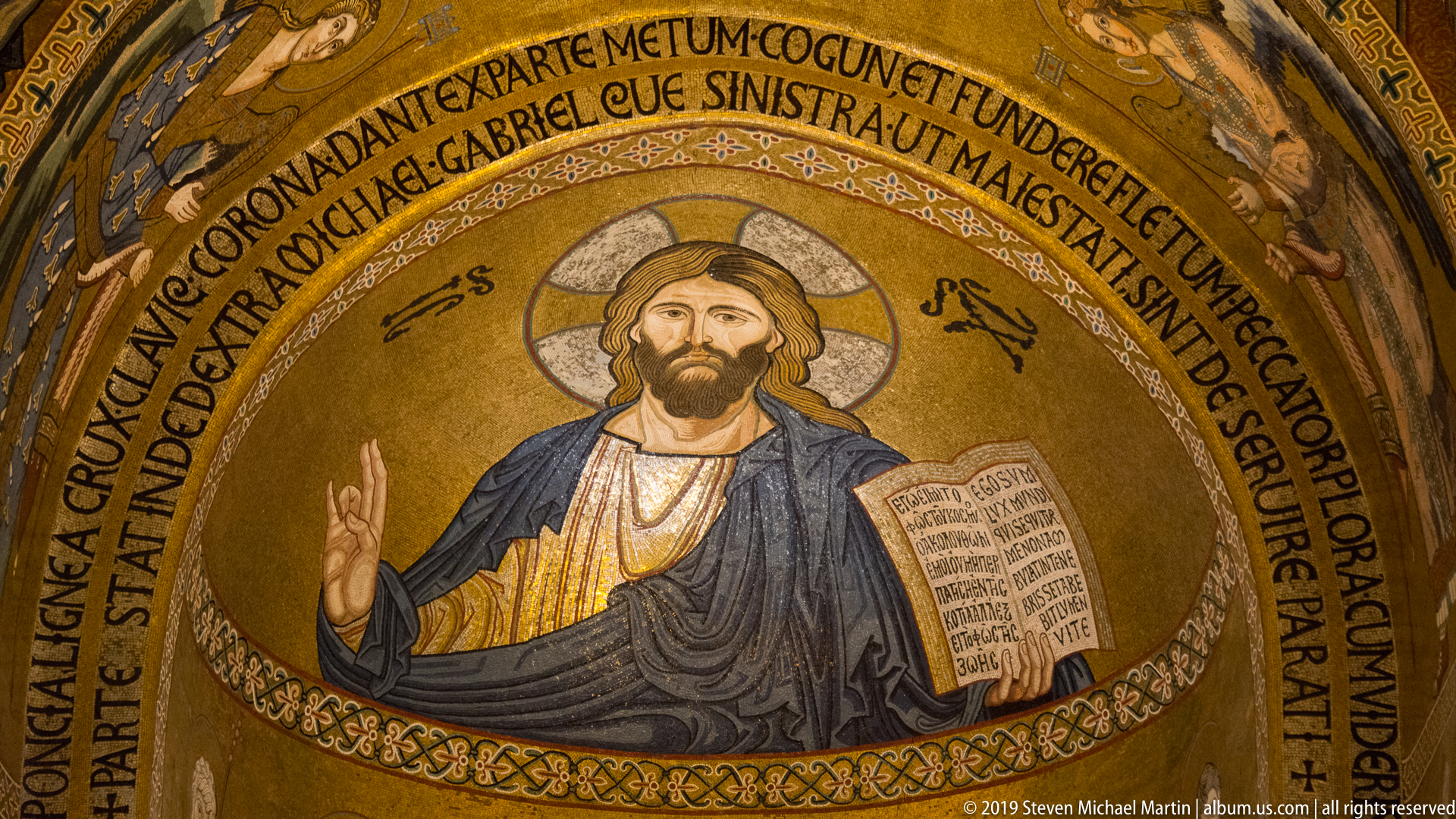
Christ Pantocrator dominates a gold-ground mosaic in the Palatine Chapel, raising his right hand in blessing while holding an open book in his left. The frontal figure, halo, Greek monograms, and encircling Latin inscription create a commanding devotional image characteristic of the chapel’s Byzantine-inflected mosaic program. The close view reveals the tessellated surface and patterned borders surrounding the central figure.
Caption
Christ Pantocrator dominates a gold-ground mosaic in the Palatine Chapel, raising his right hand in blessing while holding an open book in his left. The frontal figure, halo, Greek monograms, and encircling Latin inscription create a commanding devotional image characteristic of the chapel’s Byzantine-inflected mosaic program. The close view reveals the tessellated surface and patterned borders surrounding the central figure.

A densely detailed historic cityscape fills this painting, assembling monumental façades, towers, courtyards, and processional crowds into a broad ceremonial panorama. The elevated viewpoint allows individual architectural masses and lines of figures to be read across several spatial layers. Displayed within the palace collection, the work offers a pictorial record of an elaborate urban and courtly setting rather than a direct view of the present complex.
Caption
A densely detailed historic cityscape fills this painting, assembling monumental façades, towers, courtyards, and processional crowds into a broad ceremonial panorama. The elevated viewpoint allows individual architectural masses and lines of figures to be read across several spatial layers. Displayed within the palace collection, the work offers a pictorial record of an elaborate urban and courtly setting rather than a direct view of the present complex.

A female saint kneels with one hand at her breast and the other extended as an angel reaches toward her with flowers. Dramatic light isolates the figures against a dark, clouded background, while the saint’s upward gaze and flowing brown drapery focus the composition on the devotional encounter. The painting is presented as part of the palace’s interior art collection.
Caption
A female saint kneels with one hand at her breast and the other extended as an angel reaches toward her with flowers. Dramatic light isolates the figures against a dark, clouded background, while the saint’s upward gaze and flowing brown drapery focus the composition on the devotional encounter. The painting is presented as part of the palace’s interior art collection.

A youthful Saint Sebastian stands bound with his arms behind him, his torso pierced by arrows and a draped cloth gathered around his hips. The sculptor emphasizes the saint’s exposed anatomy, restrained posture, and serene expression rather than the violence of the martyrdom. Against the plain display background, the arrows and bindings provide the clearest attributes identifying this familiar Christian subject.
Caption
A youthful Saint Sebastian stands bound with his arms behind him, his torso pierced by arrows and a draped cloth gathered around his hips. The sculptor emphasizes the saint’s exposed anatomy, restrained posture, and serene expression rather than the violence of the martyrdom. Against the plain display background, the arrows and bindings provide the clearest attributes identifying this familiar Christian subject.

A dark-robed female saint stands at the center of an abundant wreath-like field of flowers, her hands crossed over her breast as small winged putti appear around the composition. Roses and other blossoms create a richly decorative frame against the dark ground. The combination of sacred figure, cherubs, and profuse floral imagery marks the work as an elaborate devotional painting within the palace collection.
Caption
A dark-robed female saint stands at the center of an abundant wreath-like field of flowers, her hands crossed over her breast as small winged putti appear around the composition. Roses and other blossoms create a richly decorative frame against the dark ground. The combination of sacred figure, cherubs, and profuse floral imagery marks the work as an elaborate devotional painting within the palace collection.

Orange-red trumpet-shaped blossoms emerge from a tight cluster above broad, glossy green leaves in the palace garden. The shallow depth of field separates the flowers from the soft vegetation behind them, making their flared petals, yellow throats, and projecting stamens the principal subject. This close botanical study records one of the cultivated plantings encountered around the Norman Palace.
Caption
Orange-red trumpet-shaped blossoms emerge from a tight cluster above broad, glossy green leaves in the palace garden. The shallow depth of field separates the flowers from the soft vegetation behind them, making their flared petals, yellow throats, and projecting stamens the principal subject. This close botanical study records one of the cultivated plantings encountered around the Norman Palace.

The massive exterior of the Norman Palace rises along the edge of Piazza del Parlamento, its long masonry wall punctuated by windows and a projecting tower-like section. Seen obliquely from close range, the façade reveals the building’s fortified scale and successive architectural layers. Flags and the open square establish the civic setting of Palermo’s historic royal palace.
Caption
The massive exterior of the Norman Palace rises along the edge of Piazza del Parlamento, its long masonry wall punctuated by windows and a projecting tower-like section. Seen obliquely from close range, the façade reveals the building’s fortified scale and successive architectural layers. Flags and the open square establish the civic setting of Palermo’s historic royal palace.

Clusters of ripe orange fruit hang among glossy evergreen leaves in the Norman Palace garden. The branch fills the frame, allowing individual fruit, stems, and leaf surfaces to stand out against the softly blurred ground beyond. The close view records the productive citrus planting that contributes color and Mediterranean character to the palace’s cultivated outdoor spaces.
Caption
Clusters of ripe orange fruit hang among glossy evergreen leaves in the Norman Palace garden. The branch fills the frame, allowing individual fruit, stems, and leaf surfaces to stand out against the softly blurred ground beyond. The close view records the productive citrus planting that contributes color and Mediterranean character to the palace’s cultivated outdoor spaces.

Heavy yellow lemons hang among green leaves on a citrus tree in the Norman Palace garden. The shallow focus concentrates attention on several textured fruits in the foreground while additional lemons recede into softer focus behind them. Their irregular shapes and thick rinds provide a close botanical counterpoint to the palace architecture and ornamental interiors documented elsewhere in the portfolio.
Caption
Heavy yellow lemons hang among green leaves on a citrus tree in the Norman Palace garden. The shallow focus concentrates attention on several textured fruits in the foreground while additional lemons recede into softer focus behind them. Their irregular shapes and thick rinds provide a close botanical counterpoint to the palace architecture and ornamental interiors documented elsewhere in the portfolio.

Interlocking trunks and heavy lateral branches give this mature garden tree a striking sculptural form. Exposed roots spread across the soil inside a low protective barrier, while dense foliage and neighboring plantings enclose the scene. The close, ground-level view emphasizes age, mass, and branching structure, documenting the established botanical landscape associated with the Norman Palace grounds.
Caption
Interlocking trunks and heavy lateral branches give this mature garden tree a striking sculptural form. Exposed roots spread across the soil inside a low protective barrier, while dense foliage and neighboring plantings enclose the scene. The close, ground-level view emphasizes age, mass, and branching structure, documenting the established botanical landscape associated with the Norman Palace grounds.

A framed painting hangs as the focal point at the top of a broad ceremonial stair, set within a severe stone architectural surround and approached by a central red carpet. The work itself shows a dramatically lit reclining figure, but the photograph primarily records its installation within the palace. Steps, doorway-like framing, and carpet create a formal axial approach to the artwork.
Caption
A framed painting hangs as the focal point at the top of a broad ceremonial stair, set within a severe stone architectural surround and approached by a central red carpet. The work itself shows a dramatically lit reclining figure, but the photograph primarily records its installation within the palace. Steps, doorway-like framing, and carpet create a formal axial approach to the artwork.

Blue walls enriched with gilded moldings and mythological painted panels surround a broad doorway hung with heavy patterned draperies. A neighboring room is visible through the opening, extending the sequence of formal interiors beyond. The photograph emphasizes the theatrical coordination of wall color, classical imagery, textiles, and gilded ornament that shapes this later decorative layer of the Norman Palace.
Caption
Blue walls enriched with gilded moldings and mythological painted panels surround a broad doorway hung with heavy patterned draperies. A neighboring room is visible through the opening, extending the sequence of formal interiors beyond. The photograph emphasizes the theatrical coordination of wall color, classical imagery, textiles, and gilded ornament that shapes this later decorative layer of the Norman Palace.

A dense head of brilliant red-orange blossoms is lit by direct sun against deep green garden foliage. Individual flared flowers and projecting stamens remain visible within the rounded cluster, while broad leaves frame the bloom from below. The tight composition turns a palace-garden planting into a vivid botanical study of color, texture, and flower structure.
Caption
A dense head of brilliant red-orange blossoms is lit by direct sun against deep green garden foliage. Individual flared flowers and projecting stamens remain visible within the rounded cluster, while broad leaves frame the bloom from below. The tight composition turns a palace-garden planting into a vivid botanical study of color, texture, and flower structure.

A dense crown of stiff pinnate fronds surrounds a large central mass of tan, woolly structures and orange-red seeds. Seen from directly in front, the plant’s reproductive center contrasts sharply with the radiating dark-green leaves. The close study records an unusual botanical detail in the palace garden and makes the seed-bearing structure, rather than the broader landscape, the focus.
Caption
A dense crown of stiff pinnate fronds surrounds a large central mass of tan, woolly structures and orange-red seeds. Seen from directly in front, the plant’s reproductive center contrasts sharply with the radiating dark-green leaves. The close study records an unusual botanical detail in the palace garden and makes the seed-bearing structure, rather than the broader landscape, the focus.

A broad stone staircase descends behind a carved balustrade toward the Norman Palace courtyard, where arcaded galleries are visible beyond tall interior piers. A single visitor on the landing provides scale to the monumental circulation space. The elevated viewpoint links staircase, columns, balustrades, and courtyard in one composition, showing how interior routes open onto the palace’s central architectural void.
Caption
A broad stone staircase descends behind a carved balustrade toward the Norman Palace courtyard, where arcaded galleries are visible beyond tall interior piers. A single visitor on the landing provides scale to the monumental circulation space. The elevated viewpoint links staircase, columns, balustrades, and courtyard in one composition, showing how interior routes open onto the palace’s central architectural void.

Three broad rounded arches frame a descending stair and glimpses of the Norman Palace courtyard beyond. Warm interior light falls across pale masonry, patterned flooring, and dark balustrades, creating a layered view from enclosed passage to open court. Unlike the wider staircase view, this composition concentrates on the repeated arch forms that mediate between the palace interior and its central courtyard.
Caption
Three broad rounded arches frame a descending stair and glimpses of the Norman Palace courtyard beyond. Warm interior light falls across pale masonry, patterned flooring, and dark balustrades, creating a layered view from enclosed passage to open court. Unlike the wider staircase view, this composition concentrates on the repeated arch forms that mediate between the palace interior and its central courtyard.

Two matching dark-blue porcelain vases with painted figural reserves stand symmetrically on a slender gilded console table beneath an elaborate framed mirror. Gilt mounts, handles, and decorative furniture details give the arrangement a formal courtly character. The frontal composition records a carefully staged palace interior display, emphasizing symmetry, luxury materials, and the relationship between decorative arts and furnishings.
Caption
Two matching dark-blue porcelain vases with painted figural reserves stand symmetrically on a slender gilded console table beneath an elaborate framed mirror. Gilt mounts, handles, and decorative furniture details give the arrangement a formal courtly character. The frontal composition records a carefully staged palace interior display, emphasizing symmetry, luxury materials, and the relationship between decorative arts and furnishings.

Two peacocks face a slender stylized palm against a luminous gold ground, their long patterned tails extending toward the sides of the arched field. A richly ornamented border of scrolling vegetal motifs surrounds the scene. The symmetrical animal-and-tree composition belongs to the secular decorative vocabulary found within the Norman Palace, where Islamic-influenced motifs coexist with the complex’s Christian and Byzantine imagery.
Caption
Two peacocks face a slender stylized palm against a luminous gold ground, their long patterned tails extending toward the sides of the arched field. A richly ornamented border of scrolling vegetal motifs surrounds the scene. The symmetrical animal-and-tree composition belongs to the secular decorative vocabulary found within the Norman Palace, where Islamic-influenced motifs coexist with the complex’s Christian and Byzantine imagery.

A winged lion strides across the center of a gold mosaic medallion, enclosed by interlacing geometric bands and small cross-like motifs. Blue-gray wings, a raised forepaw, and the animal’s outlined mane stand out against the shimmering ground. The close view isolates one heraldic or symbolic creature from the palace’s richly patterned mosaic decoration, making the individual tesserae and surrounding ornament especially legible.
Caption
A winged lion strides across the center of a gold mosaic medallion, enclosed by interlacing geometric bands and small cross-like motifs. Blue-gray wings, a raised forepaw, and the animal’s outlined mane stand out against the shimmering ground. The close view isolates one heraldic or symbolic creature from the palace’s richly patterned mosaic decoration, making the individual tesserae and surrounding ornament especially legible.

A crowned ruler in red sits at the center of a crowded palace scene while clerics, courtiers, women, and children gather around him. Architectural arches and a distant landscape open the composition behind the throne-like seat. The painting uses costume, gesture, and hierarchical placement to construct a formal historical narrative, with the enthroned figure providing the clear visual center.
Caption
A crowned ruler in red sits at the center of a crowded palace scene while clerics, courtiers, women, and children gather around him. Architectural arches and a distant landscape open the composition behind the throne-like seat. The painting uses costume, gesture, and hierarchical placement to construct a formal historical narrative, with the enthroned figure providing the clear visual center.

A chandelier illuminates a formal palace room lined with painted wall panels and a continuous figural frieze. A small central table, large decorative vase, and ornate cabinets are arranged against the walls, while red-veined marble flooring reinforces the room’s ceremonial character. The wide view records the coordinated ensemble of mural decoration, furniture, lighting, and architectural trim.
Caption
A chandelier illuminates a formal palace room lined with painted wall panels and a continuous figural frieze. A small central table, large decorative vase, and ornate cabinets are arranged against the walls, while red-veined marble flooring reinforces the room’s ceremonial character. The wide view records the coordinated ensemble of mural decoration, furniture, lighting, and architectural trim.

A small painted pastoral scene is embedded within an elaborate gilded surround of scrolling relief ornament. Three figures occupy a wooded setting, including an older seated man and two younger figures, while flowers brighten the foreground. The close detail emphasizes how narrative painting was incorporated into the palace’s decorative furnishings or wall ornament rather than presented as an isolated framed canvas.
Caption
A small painted pastoral scene is embedded within an elaborate gilded surround of scrolling relief ornament. Three figures occupy a wooded setting, including an older seated man and two younger figures, while flowers brighten the foreground. The close detail emphasizes how narrative painting was incorporated into the palace’s decorative furnishings or wall ornament rather than presented as an isolated framed canvas.

A wing-helmeted male figure, identifiable as Mercury by his helmet and caduceus, turns toward a airborne female figure whose green drapery billows behind her. Classical columns frame the blue-ground composition, giving the scene the appearance of an antique-inspired wall panel. The poised bodies and decorative setting integrate mythological imagery into the palace’s later interior decoration.
Caption
A wing-helmeted male figure, identifiable as Mercury by his helmet and caduceus, turns toward a airborne female figure whose green drapery billows behind her. Classical columns frame the blue-ground composition, giving the scene the appearance of an antique-inspired wall panel. The poised bodies and decorative setting integrate mythological imagery into the palace’s later interior decoration.

A long rectangular table surrounded by upholstered chairs occupies the center of a richly appointed palace room. A crystal chandelier hangs above, while green wall panels, red draperies, gilded furnishings, and a small painted figure create a formal setting. The open doorway at left reveals another furnished room, underscoring the connected sequence of ceremonial interiors within the palace.
Caption
A long rectangular table surrounded by upholstered chairs occupies the center of a richly appointed palace room. A crystal chandelier hangs above, while green wall panels, red draperies, gilded furnishings, and a small painted figure create a formal setting. The open doorway at left reveals another furnished room, underscoring the connected sequence of ceremonial interiors within the palace.

A gold-ground mosaic fills the arched wall with a stylized garden of trees and paired animals. Peacocks face a central palm in the upper register, while spotted quadrupeds, birds, and other creatures occupy the lower landscape beneath a dense ornamental border. The symmetrical, courtly imagery reflects the Islamic-influenced secular decorative tradition cultivated in Norman Sicily.
Caption
A gold-ground mosaic fills the arched wall with a stylized garden of trees and paired animals. Peacocks face a central palm in the upper register, while spotted quadrupeds, birds, and other creatures occupy the lower landscape beneath a dense ornamental border. The symmetrical, courtly imagery reflects the Islamic-influenced secular decorative tradition cultivated in Norman Sicily.

Two lions face one another across a fruiting date palm, with tall stylized trees rising at either side against a brilliant gold ground. Their mirrored poses and the strongly symmetrical arrangement give the panel a heraldic quality, while patterned tesserae define manes, trunks, and foliage. The motif exemplifies the palace’s Islamic-influenced secular mosaic decoration within the multicultural visual culture of Norman Sicily.
Caption
Two lions face one another across a fruiting date palm, with tall stylized trees rising at either side against a brilliant gold ground. Their mirrored poses and the strongly symmetrical arrangement give the panel a heraldic quality, while patterned tesserae define manes, trunks, and foliage. The motif exemplifies the palace’s Islamic-influenced secular mosaic decoration within the multicultural visual culture of Norman Sicily.

Marble figural group flanked by matching porcelain vases. The composition isolates this object or decorative feature within the Norman Palace, emphasizing its visible form, materials, setting, and relationship to the surrounding interior. The viewpoint gives particular attention to scale, ornament, and spatial relationships rather than treating the scene as a generic record of the site.
Caption
Marble figural group flanked by matching porcelain vases. The composition isolates this object or decorative feature within the Norman Palace, emphasizing its visible form, materials, setting, and relationship to the surrounding interior. The viewpoint gives particular attention to scale, ornament, and spatial relationships rather than treating the scene as a generic record of the site.

Three ornamental porcelain vases before a painted wall panel. The composition isolates this object or decorative feature within the Norman Palace, emphasizing its visible form, materials, setting, and relationship to the surrounding interior. The viewpoint gives particular attention to scale, ornament, and spatial relationships rather than treating the scene as a generic record of the site.
Caption
Three ornamental porcelain vases before a painted wall panel. The composition isolates this object or decorative feature within the Norman Palace, emphasizing its visible form, materials, setting, and relationship to the surrounding interior. The viewpoint gives particular attention to scale, ornament, and spatial relationships rather than treating the scene as a generic record of the site.

Dancing classical couple in a mythological wall painting. The composition isolates this object or decorative feature within the Norman Palace, emphasizing its visible form, materials, setting, and relationship to the surrounding interior. The viewpoint gives particular attention to scale, ornament, and spatial relationships rather than treating the scene as a generic record of the site.
Caption
Dancing classical couple in a mythological wall painting. The composition isolates this object or decorative feature within the Norman Palace, emphasizing its visible form, materials, setting, and relationship to the surrounding interior. The viewpoint gives particular attention to scale, ornament, and spatial relationships rather than treating the scene as a generic record of the site.

Blue state room with crystal chandelier and mythological wall panels. Furniture, lighting, wall decoration, and architectural framing work together to define the formal character of this palace interior and distinguish it from the medieval chapel spaces. The viewpoint gives particular attention to scale, ornament, and spatial relationships rather than treating the scene as a generic record of the site.
Caption
Blue state room with crystal chandelier and mythological wall panels. Furniture, lighting, wall decoration, and architectural framing work together to define the formal character of this palace interior and distinguish it from the medieval chapel spaces. The viewpoint gives particular attention to scale, ornament, and spatial relationships rather than treating the scene as a generic record of the site.

Oblique view of the blue chandelier-lit state room. Furniture, lighting, wall decoration, and architectural framing work together to define the formal character of this palace interior and distinguish it from the medieval chapel spaces. The viewpoint gives particular attention to scale, ornament, and spatial relationships rather than treating the scene as a generic record of the site.
Caption
Oblique view of the blue chandelier-lit state room. Furniture, lighting, wall decoration, and architectural framing work together to define the formal character of this palace interior and distinguish it from the medieval chapel spaces. The viewpoint gives particular attention to scale, ornament, and spatial relationships rather than treating the scene as a generic record of the site.

Paired lions flanking a fruiting palm in a gold-ground mosaic. The close view records the rich medieval decorative program associated with the Palatine Chapel and Norman Sicily, while keeping the visible composition and architectural setting distinct. The viewpoint gives particular attention to scale, ornament, and spatial relationships rather than treating the scene as a generic record of the site.
Caption
Paired lions flanking a fruiting palm in a gold-ground mosaic. The close view records the rich medieval decorative program associated with the Palatine Chapel and Norman Sicily, while keeping the visible composition and architectural setting distinct. The viewpoint gives particular attention to scale, ornament, and spatial relationships rather than treating the scene as a generic record of the site.

Two-register animal mosaic with quadrupeds, lions, palms, and stylized trees. The close view records the rich medieval decorative program associated with the Palatine Chapel and Norman Sicily, while keeping the visible composition and architectural setting distinct. The viewpoint gives particular attention to scale, ornament, and spatial relationships rather than treating the scene as a generic record of the site.
Caption
Two-register animal mosaic with quadrupeds, lions, palms, and stylized trees. The close view records the rich medieval decorative program associated with the Palatine Chapel and Norman Sicily, while keeping the visible composition and architectural setting distinct. The viewpoint gives particular attention to scale, ornament, and spatial relationships rather than treating the scene as a generic record of the site.

Formal palace portrait gallery with chandelier and patterned carpet. Furniture, lighting, wall decoration, and architectural framing work together to define the formal character of this palace interior and distinguish it from the medieval chapel spaces. The viewpoint gives particular attention to scale, ornament, and spatial relationships rather than treating the scene as a generic record of the site.
Caption
Formal palace portrait gallery with chandelier and patterned carpet. Furniture, lighting, wall decoration, and architectural framing work together to define the formal character of this palace interior and distinguish it from the medieval chapel spaces. The viewpoint gives particular attention to scale, ornament, and spatial relationships rather than treating the scene as a generic record of the site.

Historical court portraits above gilded console tables. The composition isolates this object or decorative feature within the Norman Palace, emphasizing its visible form, materials, setting, and relationship to the surrounding interior. The viewpoint gives particular attention to scale, ornament, and spatial relationships rather than treating the scene as a generic record of the site.
Caption
Historical court portraits above gilded console tables. The composition isolates this object or decorative feature within the Norman Palace, emphasizing its visible form, materials, setting, and relationship to the surrounding interior. The viewpoint gives particular attention to scale, ornament, and spatial relationships rather than treating the scene as a generic record of the site.

Ornate institutional assembly chamber with benches and raised dais. Furniture, lighting, wall decoration, and architectural framing work together to define the formal character of this palace interior and distinguish it from the medieval chapel spaces. The viewpoint gives particular attention to scale, ornament, and spatial relationships rather than treating the scene as a generic record of the site.
Caption
Ornate institutional assembly chamber with benches and raised dais. Furniture, lighting, wall decoration, and architectural framing work together to define the formal character of this palace interior and distinguish it from the medieval chapel spaces. The viewpoint gives particular attention to scale, ornament, and spatial relationships rather than treating the scene as a generic record of the site.

Sculptural chandelier viewed from below against a painted ceiling. The composition isolates this object or decorative feature within the Norman Palace, emphasizing its visible form, materials, setting, and relationship to the surrounding interior. The viewpoint gives particular attention to scale, ornament, and spatial relationships rather than treating the scene as a generic record of the site.
Caption
Sculptural chandelier viewed from below against a painted ceiling. The composition isolates this object or decorative feature within the Norman Palace, emphasizing its visible form, materials, setting, and relationship to the surrounding interior. The viewpoint gives particular attention to scale, ornament, and spatial relationships rather than treating the scene as a generic record of the site.

Large mythological ceiling painting with figures, horses, and clouds. The composition isolates this object or decorative feature within the Norman Palace, emphasizing its visible form, materials, setting, and relationship to the surrounding interior. The viewpoint gives particular attention to scale, ornament, and spatial relationships rather than treating the scene as a generic record of the site.
Caption
Large mythological ceiling painting with figures, horses, and clouds. The composition isolates this object or decorative feature within the Norman Palace, emphasizing its visible form, materials, setting, and relationship to the surrounding interior. The viewpoint gives particular attention to scale, ornament, and spatial relationships rather than treating the scene as a generic record of the site.

Bronze seated draped male figure beside a rectangular block. The composition isolates this object or decorative feature within the Norman Palace, emphasizing its visible form, materials, setting, and relationship to the surrounding interior. The viewpoint gives particular attention to scale, ornament, and spatial relationships rather than treating the scene as a generic record of the site.
Caption
Bronze seated draped male figure beside a rectangular block. The composition isolates this object or decorative feature within the Norman Palace, emphasizing its visible form, materials, setting, and relationship to the surrounding interior. The viewpoint gives particular attention to scale, ornament, and spatial relationships rather than treating the scene as a generic record of the site.

Red-carpeted ceremonial passage with chandeliers and candelabra. Furniture, lighting, wall decoration, and architectural framing work together to define the formal character of this palace interior and distinguish it from the medieval chapel spaces. The viewpoint gives particular attention to scale, ornament, and spatial relationships rather than treating the scene as a generic record of the site.
Caption
Red-carpeted ceremonial passage with chandeliers and candelabra. Furniture, lighting, wall decoration, and architectural framing work together to define the formal character of this palace interior and distinguish it from the medieval chapel spaces. The viewpoint gives particular attention to scale, ornament, and spatial relationships rather than treating the scene as a generic record of the site.

Inlaid marble basin on a pedestal before dark wooden doors. The composition isolates this object or decorative feature within the Norman Palace, emphasizing its visible form, materials, setting, and relationship to the surrounding interior. The viewpoint gives particular attention to scale, ornament, and spatial relationships rather than treating the scene as a generic record of the site.
Caption
Inlaid marble basin on a pedestal before dark wooden doors. The composition isolates this object or decorative feature within the Norman Palace, emphasizing its visible form, materials, setting, and relationship to the surrounding interior. The viewpoint gives particular attention to scale, ornament, and spatial relationships rather than treating the scene as a generic record of the site.

Mosaic-covered nave arcade inside the Palatine Chapel. The close view records the rich medieval decorative program associated with the Palatine Chapel and Norman Sicily, while keeping the visible composition and architectural setting distinct. The viewpoint gives particular attention to scale, ornament, and spatial relationships rather than treating the scene as a generic record of the site.
Caption
Mosaic-covered nave arcade inside the Palatine Chapel. The close view records the rich medieval decorative program associated with the Palatine Chapel and Norman Sicily, while keeping the visible composition and architectural setting distinct. The viewpoint gives particular attention to scale, ornament, and spatial relationships rather than treating the scene as a generic record of the site.

Large monochrome figural wall panels in a formal chamber. Furniture, lighting, wall decoration, and architectural framing work together to define the formal character of this palace interior and distinguish it from the medieval chapel spaces. The viewpoint gives particular attention to scale, ornament, and spatial relationships rather than treating the scene as a generic record of the site.
Caption
Large monochrome figural wall panels in a formal chamber. Furniture, lighting, wall decoration, and architectural framing work together to define the formal character of this palace interior and distinguish it from the medieval chapel spaces. The viewpoint gives particular attention to scale, ornament, and spatial relationships rather than treating the scene as a generic record of the site.

Polychrome geometric pavement with circular stone inlays. The composition isolates this object or decorative feature within the Norman Palace, emphasizing its visible form, materials, setting, and relationship to the surrounding interior. The viewpoint gives particular attention to scale, ornament, and spatial relationships rather than treating the scene as a generic record of the site.
Caption
Polychrome geometric pavement with circular stone inlays. The composition isolates this object or decorative feature within the Norman Palace, emphasizing its visible form, materials, setting, and relationship to the surrounding interior. The viewpoint gives particular attention to scale, ornament, and spatial relationships rather than treating the scene as a generic record of the site.

Narrative gold-ground mosaic cycles above the Palatine Chapel nave arcades. The close view records the rich medieval decorative program associated with the Palatine Chapel and Norman Sicily, while keeping the visible composition and architectural setting distinct. The viewpoint gives particular attention to scale, ornament, and spatial relationships rather than treating the scene as a generic record of the site.
Caption
Narrative gold-ground mosaic cycles above the Palatine Chapel nave arcades. The close view records the rich medieval decorative program associated with the Palatine Chapel and Norman Sicily, while keeping the visible composition and architectural setting distinct. The viewpoint gives particular attention to scale, ornament, and spatial relationships rather than treating the scene as a generic record of the site.

Monochrome classical panel of a falling nude male figure. The composition isolates this object or decorative feature within the Norman Palace, emphasizing its visible form, materials, setting, and relationship to the surrounding interior. The viewpoint gives particular attention to scale, ornament, and spatial relationships rather than treating the scene as a generic record of the site.
Caption
Monochrome classical panel of a falling nude male figure. The composition isolates this object or decorative feature within the Norman Palace, emphasizing its visible form, materials, setting, and relationship to the surrounding interior. The viewpoint gives particular attention to scale, ornament, and spatial relationships rather than treating the scene as a generic record of the site.

Atlas bearing a star-marked celestial sphere in a monochrome panel. The composition isolates this object or decorative feature within the Norman Palace, emphasizing its visible form, materials, setting, and relationship to the surrounding interior. The viewpoint gives particular attention to scale, ornament, and spatial relationships rather than treating the scene as a generic record of the site.
Caption
Atlas bearing a star-marked celestial sphere in a monochrome panel. The composition isolates this object or decorative feature within the Norman Palace, emphasizing its visible form, materials, setting, and relationship to the surrounding interior. The viewpoint gives particular attention to scale, ornament, and spatial relationships rather than treating the scene as a generic record of the site.

Mythological ceiling painting with chariots, horses, and airborne figures. The composition isolates this object or decorative feature within the Norman Palace, emphasizing its visible form, materials, setting, and relationship to the surrounding interior. The viewpoint gives particular attention to scale, ornament, and spatial relationships rather than treating the scene as a generic record of the site.
Caption
Mythological ceiling painting with chariots, horses, and airborne figures. The composition isolates this object or decorative feature within the Norman Palace, emphasizing its visible form, materials, setting, and relationship to the surrounding interior. The viewpoint gives particular attention to scale, ornament, and spatial relationships rather than treating the scene as a generic record of the site.

Stylized lion within an ornamental mosaic roundel. The close view records the rich medieval decorative program associated with the Palatine Chapel and Norman Sicily, while keeping the visible composition and architectural setting distinct. The viewpoint gives particular attention to scale, ornament, and spatial relationships rather than treating the scene as a generic record of the site.
Caption
Stylized lion within an ornamental mosaic roundel. The close view records the rich medieval decorative program associated with the Palatine Chapel and Norman Sicily, while keeping the visible composition and architectural setting distinct. The viewpoint gives particular attention to scale, ornament, and spatial relationships rather than treating the scene as a generic record of the site.

Frontal view of the ornate assembly chamber and raised dais. Furniture, lighting, wall decoration, and architectural framing work together to define the formal character of this palace interior and distinguish it from the medieval chapel spaces. The viewpoint gives particular attention to scale, ornament, and spatial relationships rather than treating the scene as a generic record of the site.
Caption
Frontal view of the ornate assembly chamber and raised dais. Furniture, lighting, wall decoration, and architectural framing work together to define the formal character of this palace interior and distinguish it from the medieval chapel spaces. The viewpoint gives particular attention to scale, ornament, and spatial relationships rather than treating the scene as a generic record of the site.

Four-lobed polychrome stone-and-mosaic pavement medallion. The close view records the rich medieval decorative program associated with the Palatine Chapel and Norman Sicily, while keeping the visible composition and architectural setting distinct. The viewpoint gives particular attention to scale, ornament, and spatial relationships rather than treating the scene as a generic record of the site.
Caption
Four-lobed polychrome stone-and-mosaic pavement medallion. The close view records the rich medieval decorative program associated with the Palatine Chapel and Norman Sicily, while keeping the visible composition and architectural setting distinct. The viewpoint gives particular attention to scale, ornament, and spatial relationships rather than treating the scene as a generic record of the site.

Carved and painted wooden muqarnas ceiling of the Palatine Chapel. The close view records the rich medieval decorative program associated with the Palatine Chapel and Norman Sicily, while keeping the visible composition and architectural setting distinct. The viewpoint gives particular attention to scale, ornament, and spatial relationships rather than treating the scene as a generic record of the site.
Caption
Carved and painted wooden muqarnas ceiling of the Palatine Chapel. The close view records the rich medieval decorative program associated with the Palatine Chapel and Norman Sicily, while keeping the visible composition and architectural setting distinct. The viewpoint gives particular attention to scale, ornament, and spatial relationships rather than treating the scene as a generic record of the site.

Christ Pantocrator in the gold-ground apse mosaic of the Palatine Chapel. The close view records the rich medieval decorative program associated with the Palatine Chapel and Norman Sicily, while keeping the visible composition and architectural setting distinct. The viewpoint gives particular attention to scale, ornament, and spatial relationships rather than treating the scene as a generic record of the site.
Caption
Christ Pantocrator in the gold-ground apse mosaic of the Palatine Chapel. The close view records the rich medieval decorative program associated with the Palatine Chapel and Norman Sicily, while keeping the visible composition and architectural setting distinct. The viewpoint gives particular attention to scale, ornament, and spatial relationships rather than treating the scene as a generic record of the site.

Standing saints in gold-ground mosaics beneath the chapel dome. The close view records the rich medieval decorative program associated with the Palatine Chapel and Norman Sicily, while keeping the visible composition and architectural setting distinct. The viewpoint gives particular attention to scale, ornament, and spatial relationships rather than treating the scene as a generic record of the site.
Caption
Standing saints in gold-ground mosaics beneath the chapel dome. The close view records the rich medieval decorative program associated with the Palatine Chapel and Norman Sicily, while keeping the visible composition and architectural setting distinct. The viewpoint gives particular attention to scale, ornament, and spatial relationships rather than treating the scene as a generic record of the site.

The enthroned Virgin and Child occupy the center of a luminous gold-ground mosaic, flanked by two standing saints beneath the sanctuary arch. Greek and Latin inscriptions accompany the figures, while patterned borders and marble revetment frame the sacred group. The composition emphasizes the chapel’s Byzantine visual language, using frontal poses, hierarchical scale, and shimmering tesserae to create a formal devotional image.
Caption
The enthroned Virgin and Child occupy the center of a luminous gold-ground mosaic, flanked by two standing saints beneath the sanctuary arch. Greek and Latin inscriptions accompany the figures, while patterned borders and marble revetment frame the sacred group. The composition emphasizes the chapel’s Byzantine visual language, using frontal poses, hierarchical scale, and shimmering tesserae to create a formal devotional image.

Rising arches draw the eye toward the mosaic-filled sanctuary of the Palatine Chapel, where Christ Pantocrator appears above the enthroned Virgin and Child. Gold-ground saints and narrative scenes extend onto the adjoining walls and soffits, while patterned borders bind the surfaces together. The steep upward viewpoint gives unusual prominence to the arch structure and reveals how sacred imagery is distributed across multiple architectural planes.
Caption
Rising arches draw the eye toward the mosaic-filled sanctuary of the Palatine Chapel, where Christ Pantocrator appears above the enthroned Virgin and Child. Gold-ground saints and narrative scenes extend onto the adjoining walls and soffits, while patterned borders bind the surfaces together. The steep upward viewpoint gives unusual prominence to the arch structure and reveals how sacred imagery is distributed across multiple architectural planes.

Christ Pantocrator dominates the upper apse of the Palatine Chapel, blessing with his right hand and holding an open book, while the enthroned Virgin and Child appear below between standing saints. Dense inscriptions and ornamental bands follow the curve of the architecture. This tighter sanctuary view clarifies the hierarchical arrangement of the principal sacred figures within the chapel’s Byzantine-influenced mosaic program.
Caption
Christ Pantocrator dominates the upper apse of the Palatine Chapel, blessing with his right hand and holding an open book, while the enthroned Virgin and Child appear below between standing saints. Dense inscriptions and ornamental bands follow the curve of the architecture. This tighter sanctuary view clarifies the hierarchical arrangement of the principal sacred figures within the chapel’s Byzantine-influenced mosaic program.

Christ Pantocrator fills the frame against a brilliant gold mosaic ground, his right hand raised in blessing and his left supporting an open Gospel book. A cruciform halo, Greek monograms, and the encircling inscription reinforce the icon’s formal Byzantine character. The close view makes individual tesserae, facial modeling, garment folds, and the richly patterned border especially legible.
Caption
Christ Pantocrator fills the frame against a brilliant gold mosaic ground, his right hand raised in blessing and his left supporting an open Gospel book. A cruciform halo, Greek monograms, and the encircling inscription reinforce the icon’s formal Byzantine character. The close view makes individual tesserae, facial modeling, garment folds, and the richly patterned border especially legible.

An enthroned Christ occupies the center of a gold-ground wall mosaic, flanked by Saints Peter and Paul beneath the dark carved wooden ceiling. Tall patterned window surrounds and additional sacred figures extend along the adjoining walls, while marble revetment and a dark pedestal-like furnishing anchor the lower register. The broad upward view records the striking meeting of Byzantine mosaic, Islamic-influenced ceiling craftsmanship, and marble decoration.
Caption
An enthroned Christ occupies the center of a gold-ground wall mosaic, flanked by Saints Peter and Paul beneath the dark carved wooden ceiling. Tall patterned window surrounds and additional sacred figures extend along the adjoining walls, while marble revetment and a dark pedestal-like furnishing anchor the lower register. The broad upward view records the striking meeting of Byzantine mosaic, Islamic-influenced ceiling craftsmanship, and marble decoration.

The dark carved wooden ceiling stretches above a richly layered side wall of the Palatine Chapel, where gold-ground sacred figures, narrative mosaics, patterned arches, and stained-glass windows occupy nearly every surface. Marble panels and mosaic borders continue below. The oblique view is especially effective at showing the chapel as a total decorative environment in which ceiling, wall, window, and revetment are visually integrated.
Caption
The dark carved wooden ceiling stretches above a richly layered side wall of the Palatine Chapel, where gold-ground sacred figures, narrative mosaics, patterned arches, and stained-glass windows occupy nearly every surface. Marble panels and mosaic borders continue below. The oblique view is especially effective at showing the chapel as a total decorative environment in which ceiling, wall, window, and revetment are visually integrated.

Christ enthroned occupies the center of this gold-ground mosaic, flanked by Saints Peter and Paul in white robes and marked by identifying inscriptions. The dark honeycombed wooden ceiling hangs immediately above the scene, intensifying the contrast between shimmering wall tesserae and carved timber. A tighter crop than neighboring views, the photograph concentrates on the three sacred figures and their architectural setting.
Caption
Christ enthroned occupies the center of this gold-ground mosaic, flanked by Saints Peter and Paul in white robes and marked by identifying inscriptions. The dark honeycombed wooden ceiling hangs immediately above the scene, intensifying the contrast between shimmering wall tesserae and carved timber. A tighter crop than neighboring views, the photograph concentrates on the three sacred figures and their architectural setting.

A large green central disk is surrounded by four reddish-purple roundels within a square pavement panel of intricate geometric mosaic. Star-filled rings, interlaced bands, and tiny colored tesserae link the five circles into a balanced composition framed by a red border. Viewed directly from above, the design reveals the precision and material variety of the chapel’s medieval marble-and-mosaic floor decoration.
Caption
A large green central disk is surrounded by four reddish-purple roundels within a square pavement panel of intricate geometric mosaic. Star-filled rings, interlaced bands, and tiny colored tesserae link the five circles into a balanced composition framed by a red border. Viewed directly from above, the design reveals the precision and material variety of the chapel’s medieval marble-and-mosaic floor decoration.

Christ sits frontally on a jeweled throne between Saints Peter and Paul, whose names appear beside their haloed figures on the gold mosaic wall. Above, the faceted wooden muqarnas ceiling projects dramatically into the frame, while narrow windows and richly patterned borders flank the sacred group. The close upward composition makes the juxtaposition of Byzantine iconography and Islamic-derived ceiling construction particularly vivid.
Caption
Christ sits frontally on a jeweled throne between Saints Peter and Paul, whose names appear beside their haloed figures on the gold mosaic wall. Above, the faceted wooden muqarnas ceiling projects dramatically into the frame, while narrow windows and richly patterned borders flank the sacred group. The close upward composition makes the juxtaposition of Byzantine iconography and Islamic-derived ceiling construction particularly vivid.

Christ Pantocrator fills the upper apse above the enthroned Virgin and Child, who are flanked by two standing saints against the gold mosaic ground. Inscriptions curve around the apse while richly patterned borders and marble panels define the lower edge. The nearly frontal view clarifies the vertical hierarchy of the sanctuary imagery, from the monumental Christ above to the devotional group below.
Caption
Christ Pantocrator fills the upper apse above the enthroned Virgin and Child, who are flanked by two standing saints against the gold mosaic ground. Inscriptions curve around the apse while richly patterned borders and marble panels define the lower edge. The nearly frontal view clarifies the vertical hierarchy of the sanctuary imagery, from the monumental Christ above to the devotional group below.

The formal entrance of the Norman Palace opens beneath a monumental heraldic relief on the rusticated stone façade. Paired columns frame the doorway, while Italian, European, and regional flags hang from the balcony above and a red carpet marks the approach. The frontal view combines the palace’s governmental identity with its historic architecture, emphasizing the ceremonial entrance rather than the building’s full mass.
Caption
The formal entrance of the Norman Palace opens beneath a monumental heraldic relief on the rusticated stone façade. Paired columns frame the doorway, while Italian, European, and regional flags hang from the balcony above and a red carpet marks the approach. The frontal view combines the palace’s governmental identity with its historic architecture, emphasizing the ceremonial entrance rather than the building’s full mass.

A broad studded wooden gate sits beneath a shallow stone arch, with the Italian tricolor and European Union flag hanging prominently above. A small blue-and-gold emblem is centered over the doorway, while circular windows and pale masonry complete the restrained façade. The direct view records a secondary official entrance associated with the palace complex and its contemporary governmental use.
Caption
A broad studded wooden gate sits beneath a shallow stone arch, with the Italian tricolor and European Union flag hanging prominently above. A small blue-and-gold emblem is centered over the doorway, while circular windows and pale masonry complete the restrained façade. The direct view records a secondary official entrance associated with the palace complex and its contemporary governmental use.

Gold mosaics spread across the apse, arches, vaults, and upper walls of the Palatine Chapel in this expansive upward view. Christ Pantocrator presides above the Virgin and Child, while saints and narrative scenes occupy adjoining surfaces and patterned windows punctuate the architecture. The composition demonstrates how the chapel’s sacred imagery extends continuously across curved and vertical planes rather than functioning as isolated pictures.
Caption
Gold mosaics spread across the apse, arches, vaults, and upper walls of the Palatine Chapel in this expansive upward view. Christ Pantocrator presides above the Virgin and Child, while saints and narrative scenes occupy adjoining surfaces and patterned windows punctuate the architecture. The composition demonstrates how the chapel’s sacred imagery extends continuously across curved and vertical planes rather than functioning as isolated pictures.

A mounted stone plaque identifies the Palazzo Reale e Cappella Palatina as part of Palermo’s Arab-Norman UNESCO World Heritage property. The UNESCO emblem and World Heritage symbol appear above multilingual text naming the site and its inscription within the serial property. The close documentary view provides explicit on-site confirmation of the palace and chapel’s international heritage designation.
Caption
A mounted stone plaque identifies the Palazzo Reale e Cappella Palatina as part of Palermo’s Arab-Norman UNESCO World Heritage property. The UNESCO emblem and World Heritage symbol appear above multilingual text naming the site and its inscription within the serial property. The close documentary view provides explicit on-site confirmation of the palace and chapel’s international heritage designation.

Christ Pantocrator appears in the central medallion of the dome, encircled by ranks of angels whose elongated bodies radiate outward across the gold ground. Prophets or saints occupy the surrounding architectural zones below, while narrow windows admit points of light into the richly ornamented crossing. The steep upward view emphasizes the dome’s celestial hierarchy and the enveloping brilliance of its Byzantine-influenced mosaic program.
Caption
Christ Pantocrator appears in the central medallion of the dome, encircled by ranks of angels whose elongated bodies radiate outward across the gold ground. Prophets or saints occupy the surrounding architectural zones below, while narrow windows admit points of light into the richly ornamented crossing. The steep upward view emphasizes the dome’s celestial hierarchy and the enveloping brilliance of its Byzantine-influenced mosaic program.

A monumental stone heraldic composition projects from the warm masonry façade of the Norman Palace. A crowned central shield is surrounded by elaborate mantling and flanked by large spread wings, with additional shields and sculptural elements arranged below. Set between shuttered windows and above a classical architectural frame, the relief functions as a prominent emblem of royal or governmental authority on the palace exterior.
Caption
A monumental stone heraldic composition projects from the warm masonry façade of the Norman Palace. A crowned central shield is surrounded by elaborate mantling and flanked by large spread wings, with additional shields and sculptural elements arranged below. Set between shuttered windows and above a classical architectural frame, the relief functions as a prominent emblem of royal or governmental authority on the palace exterior.

A richly carved heraldic emblem occupies the junction between two massive stone arches. A crowned shield is framed by scrolling ornament and broad wings, its pale sculptural surface catching strong sunlight against the darker masonry. The upward close view removes most surrounding architecture, concentrating attention on the emblem’s relief carving and its placement high on the palace complex.
Caption
A richly carved heraldic emblem occupies the junction between two massive stone arches. A crowned shield is framed by scrolling ornament and broad wings, its pale sculptural surface catching strong sunlight against the darker masonry. The upward close view removes most surrounding architecture, concentrating attention on the emblem’s relief carving and its placement high on the palace complex.

A gilded map of the Italian peninsula and Sicily appears on a vivid blue oval plaque, accompanied by smaller symbolic figures and an eagle above. The emblem is mounted against a dark architectural surface beside a hanging blue banner. Its simplified geographic forms and heraldic presentation suggest an official decorative symbol rather than a conventional cartographic display.
Caption
A gilded map of the Italian peninsula and Sicily appears on a vivid blue oval plaque, accompanied by smaller symbolic figures and an eagle above. The emblem is mounted against a dark architectural surface beside a hanging blue banner. Its simplified geographic forms and heraldic presentation suggest an official decorative symbol rather than a conventional cartographic display.

Three rounded arches rest on slender pale columns above a stone balustrade, framing tall windows crowned by richly sculpted triangular pediments. Reclining figures and masks animate the pediments, while additional carved heads punctuate the masonry above the arches. The close architectural study isolates the façade’s Renaissance and later decorative vocabulary, contrasting elegant classical proportions with vigorous figural sculpture.
Caption
Three rounded arches rest on slender pale columns above a stone balustrade, framing tall windows crowned by richly sculpted triangular pediments. Reclining figures and masks animate the pediments, while additional carved heads punctuate the masonry above the arches. The close architectural study isolates the façade’s Renaissance and later decorative vocabulary, contrasting elegant classical proportions with vigorous figural sculpture.

A monumental spread-winged eagle fills the sloping tiled roof beneath the small lantern of Porta Nuova, adjacent to the Norman Palace. Yellow, blue, and pale ceramic pieces form the heraldic bird against a dense geometric field, while a metal railing crosses the lower edge. The tight crop highlights the unusual roof decoration and its bold graphic presence against a deep blue sky.
Caption
A monumental spread-winged eagle fills the sloping tiled roof beneath the small lantern of Porta Nuova, adjacent to the Norman Palace. Yellow, blue, and pale ceramic pieces form the heraldic bird against a dense geometric field, while a metal railing crosses the lower edge. The tight crop highlights the unusual roof decoration and its bold graphic presence against a deep blue sky.

The pyramidal roof of Porta Nuova rises against a clear blue sky, its sloping face dominated by a large spread-winged eagle worked into the colored tile surface. A small lantern crowns the roof, while a stone balustrade and sculpted heads mark the transition to the loggia below. This wider view places the heraldic roof decoration within the gateway’s distinctive upper architectural composition.
Caption
The pyramidal roof of Porta Nuova rises against a clear blue sky, its sloping face dominated by a large spread-winged eagle worked into the colored tile surface. A small lantern crowns the roof, while a stone balustrade and sculpted heads mark the transition to the loggia below. This wider view places the heraldic roof decoration within the gateway’s distinctive upper architectural composition.

Monumental male atlantes flank the rusticated arch of Porta Nuova, their torsos projecting from tall sculpted piers beside fan-shaped stone voussoirs. Expressive heads, crossed arms, masks, scrollwork, and dense relief ornament give the gateway a forceful sculptural character. The close frontal view concentrates on the lower triumphal-arch decoration rather than the loggia and eagle roof above.
Caption
Monumental male atlantes flank the rusticated arch of Porta Nuova, their torsos projecting from tall sculpted piers beside fan-shaped stone voussoirs. Expressive heads, crossed arms, masks, scrollwork, and dense relief ornament give the gateway a forceful sculptural character. The close frontal view concentrates on the lower triumphal-arch decoration rather than the loggia and eagle roof above.

A single monumental atlante dominates this close view of Porta Nuova, his bare torso and crossed arms projecting from a richly carved pier beside the gateway arch. A second sculpted head and layered masks appear nearby, while rusticated voussoirs curve into the opening at left. Strong side light reveals the weathered stone surface and the depth of the Renaissance relief carving.
Caption
A single monumental atlante dominates this close view of Porta Nuova, his bare torso and crossed arms projecting from a richly carved pier beside the gateway arch. A second sculpted head and layered masks appear nearby, while rusticated voussoirs curve into the opening at left. Strong side light reveals the weathered stone surface and the depth of the Renaissance relief carving.

Two weathered atlantes stand shoulder to shoulder on one side of Porta Nuova, their bare torsos emerging from ornamental bases beside the radiating blocks of the main arch. One figure crosses his arms while the neighboring torso is more frontal, creating subtle variation within the paired support motif. Masks, scrolls, and relief bands intensify the sculptural density of the gateway façade.
Caption
Two weathered atlantes stand shoulder to shoulder on one side of Porta Nuova, their bare torsos emerging from ornamental bases beside the radiating blocks of the main arch. One figure crosses his arms while the neighboring torso is more frontal, creating subtle variation within the paired support motif. Masks, scrolls, and relief bands intensify the sculptural density of the gateway façade.

Porta Nuova rises in a strongly vertical composition from its monumental rusticated arch to an arcaded upper loggia and pyramidal eagle-decorated roof. Sculpted atlantes flank the lower opening, while repeated arches and a balustrade lighten the upper story before the tiled roof and lantern crown the structure. The full elevation reveals how military triumphal imagery and refined classical architecture are combined in Palermo’s ceremonial gateway beside the Norman Palace.
Caption
Porta Nuova rises in a strongly vertical composition from its monumental rusticated arch to an arcaded upper loggia and pyramidal eagle-decorated roof. Sculpted atlantes flank the lower opening, while repeated arches and a balustrade lighten the upper story before the tiled roof and lantern crown the structure. The full elevation reveals how military triumphal imagery and refined classical architecture are combined in Palermo’s ceremonial gateway beside the Norman Palace.

Two large dark heraldic reliefs flank a central architectural niche containing an ornate urn, with a circular wreath-like emblem above and a commemorative inscription below. The symmetrical arrangement is set into pale stone panels, creating a formal memorial or institutional display. The close frontal view emphasizes the contrast between the dark sculpted emblems, bronze-toned vessel, and restrained architectural surround.
Caption
Two large dark heraldic reliefs flank a central architectural niche containing an ornate urn, with a circular wreath-like emblem above and a commemorative inscription below. The symmetrical arrangement is set into pale stone panels, creating a formal memorial or institutional display. The close frontal view emphasizes the contrast between the dark sculpted emblems, bronze-toned vessel, and restrained architectural surround.

The Italian tricolor and European Union flag project from a stone balustraded balcony on the Norman Palace, framing a tall shuttered window. Warm-toned masonry, restrained carved ornament, and the formal flag display underscore the building’s continuing governmental role. The tightly framed exterior view concentrates on the balcony and official symbols rather than the broader historic façade.
Caption
The Italian tricolor and European Union flag project from a stone balustraded balcony on the Norman Palace, framing a tall shuttered window. Warm-toned masonry, restrained carved ornament, and the formal flag display underscore the building’s continuing governmental role. The tightly framed exterior view concentrates on the balcony and official symbols rather than the broader historic façade.