Warsaw – Poland
Warsaw, the capital of Poland, lies along the banks of the Vistula River in the central part of the country. Founded in the late Middle Ages, the city eventually became the political center of the Polish–Lithuanian Commonwealth and later the capital of modern Poland.
During the Second World War Warsaw was almost completely destroyed following the Warsaw Uprising of 1944. In the decades that followed, the historic Old Town was painstakingly reconstructed using historical records, paintings, and photographs, restoring many of the city’s medieval and Renaissance landmarks.
Today the reconstructed Old Town, a UNESCO World Heritage Site, stands as a symbol of Poland’s resilience and determination to preserve its cultural heritage.

A close exterior view follows the curved red-brick wall of the Warsaw Barbican to a broad arched passage. Crenellations crown the masonry, while small openings and heavy wall thickness emphasize the defensive character of this reconstructed section of the Old Town fortifications.
Caption
A close exterior view follows the curved red-brick wall of the Warsaw Barbican to a broad arched passage. Crenellations crown the masonry, while small openings and heavy wall thickness emphasize the defensive character of this reconstructed section of the Old Town fortifications.

Heavy triangular buttresses rhythmically reinforce a long stretch of Warsaw’s red-brick Old Town wall. Grass and trees occupy the former defensive zone outside the masonry, while reconstructed townhouses rise behind the parapet, showing how the fortifications are woven into the living historic center.
Caption
Heavy triangular buttresses rhythmically reinforce a long stretch of Warsaw’s red-brick Old Town wall. Grass and trees occupy the former defensive zone outside the masonry, while reconstructed townhouses rise behind the parapet, showing how the fortifications are woven into the living historic center.

A pale Baroque church facade is organized around a central pedimented bay flanked by two square towers with dark cupolas. Sculpted saints occupy wall niches and classical pilasters divide the elevation, giving the church a formal monumental presence within Warsaw’s historic New Town streetscape.
Caption
A pale Baroque church facade is organized around a central pedimented bay flanked by two square towers with dark cupolas. Sculpted saints occupy wall niches and classical pilasters divide the elevation, giving the church a formal monumental presence within Warsaw’s historic New Town streetscape.

A broad exterior view shows Warsaw’s Barbican defenses as a continuous red-brick wall punctuated by a projecting tower and reinforced with massive sloping buttresses. Grass fills the former defensive ground below, while nearby housing rises behind the wall, placing the reconstructed fortification within the modern city.
Caption
A broad exterior view shows Warsaw’s Barbican defenses as a continuous red-brick wall punctuated by a projecting tower and reinforced with massive sloping buttresses. Grass fills the former defensive ground below, while nearby housing rises behind the wall, placing the reconstructed fortification within the modern city.

Two young street musicians perform beside the brick fortifications of Warsaw’s Old Town, one standing with a violin and the other seated with an acoustic guitar. Open instrument cases on the pavement reinforce the informal busking setting, while the masonry walls provide a distinctly historic urban backdrop.
Caption
Two young street musicians perform beside the brick fortifications of Warsaw’s Old Town, one standing with a violin and the other seated with an acoustic guitar. Open instrument cases on the pavement reinforce the informal busking setting, while the masonry walls provide a distinctly historic urban backdrop.

Bronze insurgents surge forward from the angular stone setting of the Warsaw Uprising Monument, their bodies compressed into a tense, forward-driving group. Helmets, weapons, and crouching poses convey the urgency of street combat, while the fragmented architectural forms behind them evoke the devastated cityscape of wartime Warsaw.
Caption
Bronze insurgents surge forward from the angular stone setting of the Warsaw Uprising Monument, their bodies compressed into a tense, forward-driving group. Helmets, weapons, and crouching poses convey the urgency of street combat, while the fragmented architectural forms behind them evoke the devastated cityscape of wartime Warsaw.

A second view of the Warsaw Uprising Monument shows a compact bronze group at the foot of steps, with the monumental colonnade and glass architecture of the Supreme Court complex rising behind. The wider framing emphasizes the relationship between commemorative sculpture, civic space, and contemporary institutional architecture.
Caption
A second view of the Warsaw Uprising Monument shows a compact bronze group at the foot of steps, with the monumental colonnade and glass architecture of the Supreme Court complex rising behind. The wider framing emphasizes the relationship between commemorative sculpture, civic space, and contemporary institutional architecture.

A massive brick tower projects from Warsaw’s restored Old Town fortifications, connected to a long curtain wall reinforced by angled buttresses. The view from above reveals the grassy ditch and surrounding paths, clarifying the defensive geometry of the Barbican complex and the scale of its postwar reconstruction.
Caption
A massive brick tower projects from Warsaw’s restored Old Town fortifications, connected to a long curtain wall reinforced by angled buttresses. The view from above reveals the grassy ditch and surrounding paths, clarifying the defensive geometry of the Barbican complex and the scale of its postwar reconstruction.

A large historic church complex dominates an open pedestrian space, combining a long steep-roofed nave, masonry walls, and a pale square bell tower capped by a green cupola. Crowds and temporary displays gather at ground level, emphasizing the church’s continued presence within the active civic life of Warsaw’s historic center.
Caption
A large historic church complex dominates an open pedestrian space, combining a long steep-roofed nave, masonry walls, and a pale square bell tower capped by a green cupola. Crowds and temporary displays gather at ground level, emphasizing the church’s continued presence within the active civic life of Warsaw’s historic center.

A heavy iron gate stands open within a rusticated stone archway, revealing a long covered passage toward a sunlit courtyard beyond. The close frontal view emphasizes the defensive-looking metalwork, worn masonry, and layered threshold characteristic of Warsaw’s reconstructed historic center.
Caption
A heavy iron gate stands open within a rusticated stone archway, revealing a long covered passage toward a sunlit courtyard beyond. The close frontal view emphasizes the defensive-looking metalwork, worn masonry, and layered threshold characteristic of Warsaw’s reconstructed historic center.

A bronze plaque commemorates the rebuilding of Warsaw’s Old and New Towns, noting the social effort devoted to their reconstruction in the years after World War II. Mounted on masonry within the historic center, the inscription turns the reconstructed urban fabric itself into a memorial to the city’s postwar recovery.
Caption
A bronze plaque commemorates the rebuilding of Warsaw’s Old and New Towns, noting the social effort devoted to their reconstruction in the years after World War II. Mounted on masonry within the historic center, the inscription turns the reconstructed urban fabric itself into a memorial to the city’s postwar recovery.

A historic black-and-white photograph shows a group of people standing amid rubble and heavily damaged multi-story buildings. Displayed as part of the Old Town reconstruction interpretation, the scene personalizes the destruction of wartime Warsaw by placing human figures directly within the devastated streetscape.
Caption
A historic black-and-white photograph shows a group of people standing amid rubble and heavily damaged multi-story buildings. Displayed as part of the Old Town reconstruction interpretation, the scene personalizes the destruction of wartime Warsaw by placing human figures directly within the devastated streetscape.

The Palace of Culture and Science rises behind a spraying fountain, its tiered stone mass and clock tower framed by open blue sky. The composition emphasizes the building’s monumental vertical profile and richly articulated crown while the fountain adds a lower, animated foreground to this central Warsaw landmark.
Caption
The Palace of Culture and Science rises behind a spraying fountain, its tiered stone mass and clock tower framed by open blue sky. The composition emphasizes the building’s monumental vertical profile and richly articulated crown while the fountain adds a lower, animated foreground to this central Warsaw landmark.

A dark metal commemorative plaque is mounted on a pale stone base, with a raised map-like relief above a panel of text. The close view concentrates on the memorial’s material contrast and graphic surface, documenting how Warsaw’s public history is embedded in small-scale monuments as well as major architecture.
Caption
A dark metal commemorative plaque is mounted on a pale stone base, with a raised map-like relief above a panel of text. The close view concentrates on the memorial’s material contrast and graphic surface, documenting how Warsaw’s public history is embedded in small-scale monuments as well as major architecture.

A pale neoclassical institutional facade is organized by a central pediment, pilasters, and a columned entrance, with a large blue-and-white emblem projecting above the doorway. The photograph focuses on the building’s formal symmetry and heraldic ornament rather than the surrounding street, making the emblem the principal identifying feature.
Caption
A pale neoclassical institutional facade is organized by a central pediment, pilasters, and a columned entrance, with a large blue-and-white emblem projecting above the doorway. The photograph focuses on the building’s formal symmetry and heraldic ornament rather than the surrounding street, making the emblem the principal identifying feature.

Viewed across a long fountain basin, the Palace of Culture and Science forms a strong central axis at the end of the landscaped approach. Curving water jets lead the eye toward the tower, while trees on both sides soften the symmetry and place the monumental building within its surrounding public space.
Caption
Viewed across a long fountain basin, the Palace of Culture and Science forms a strong central axis at the end of the landscaped approach. Curving water jets lead the eye toward the tower, while trees on both sides soften the symmetry and place the monumental building within its surrounding public space.

Three tall bronze female figures stand beneath the deep overhang of a modern glass-and-stone building. Their elongated forms contrast with reflective curtain walls, polished columns, and sharp structural lines, creating a deliberate dialogue between figurative sculpture and contemporary civic architecture in central Warsaw.
Caption
Three tall bronze female figures stand beneath the deep overhang of a modern glass-and-stone building. Their elongated forms contrast with reflective curtain walls, polished columns, and sharp structural lines, creating a deliberate dialogue between figurative sculpture and contemporary civic architecture in central Warsaw.

The bronze figure of Nike, the Monument to the Heroes of Warsaw, is shown from below against open sky. Her raised arm, wind-swept body, and sword create a strongly diagonal silhouette, turning the city’s personification of victory and resistance into a forceful standalone sculptural image.
Caption
The bronze figure of Nike, the Monument to the Heroes of Warsaw, is shown from below against open sky. Her raised arm, wind-swept body, and sword create a strongly diagonal silhouette, turning the city’s personification of victory and resistance into a forceful standalone sculptural image.

A paved courtyard leads toward a white historic building and square clock tower capped by a small lantern. Later office wings enclose the approach on both sides, highlighting the layered architectural character of central Warsaw, where surviving or reconstructed historic fabric is often embedded within newer institutional development.
Caption
A paved courtyard leads toward a white historic building and square clock tower capped by a small lantern. Later office wings enclose the approach on both sides, highlighting the layered architectural character of central Warsaw, where surviving or reconstructed historic fabric is often embedded within newer institutional development.

A reclining bronze human figure extends dramatically across a low stone plinth in front of the Zachęta gallery. The close framing emphasizes the sculpture’s outstretched limbs and the Polish inscription carved into the base, presenting the memorial as an independent work of public sculpture within the museum district.
Caption
A reclining bronze human figure extends dramatically across a low stone plinth in front of the Zachęta gallery. The close framing emphasizes the sculpture’s outstretched limbs and the Polish inscription carved into the base, presenting the memorial as an independent work of public sculpture within the museum district.

The monumental neoclassical facade of Warsaw’s Grand Theatre fills the frame with a deep central colonnade, broad entablature, and sculptural pediment. Seen from across the street, the building’s horizontal mass and ceremonial entrance dominate the composition, reflecting the formal urban scale of Theatre Square.
Caption
The monumental neoclassical facade of Warsaw’s Grand Theatre fills the frame with a deep central colonnade, broad entablature, and sculptural pediment. Seen from across the street, the building’s horizontal mass and ceremonial entrance dominate the composition, reflecting the formal urban scale of Theatre Square.

A formal gated entrance opens between two symmetrical cream-colored wings topped by red tile roofs. Polish flags, lanterns, and restrained classical detailing reinforce the official character of the complex, while the view through the gate draws attention to a smaller central building set back within the courtyard.
Caption
A formal gated entrance opens between two symmetrical cream-colored wings topped by red tile roofs. Polish flags, lanterns, and restrained classical detailing reinforce the official character of the complex, while the view through the gate draws attention to a smaller central building set back within the courtyard.

A contemporary curved facade is wrapped in repeated vertical glass fins that project outward from the window wall. Photographed from a low angle, the rhythm of the fins produces a layered, almost kinetic surface against the sky, emphasizing Warsaw’s modern commercial architecture rather than a historic landmark.
Caption
A contemporary curved facade is wrapped in repeated vertical glass fins that project outward from the window wall. Photographed from a low angle, the rhythm of the fins produces a layered, almost kinetic surface against the sky, emphasizing Warsaw’s modern commercial architecture rather than a historic landmark.

A broad ornamental fountain fills the foreground, its raised central bowl overflowing into a larger circular basin while side jets arc inward. Mature trees and scattered visitors create a relaxed park setting, shifting the portfolio from monumental city architecture to the designed public landscapes that structure everyday urban life.
Caption
A broad ornamental fountain fills the foreground, its raised central bowl overflowing into a larger circular basin while side jets arc inward. Mature trees and scattered visitors create a relaxed park setting, shifting the portfolio from monumental city architecture to the designed public landscapes that structure everyday urban life.

The ornate facade of Zachęta National Gallery of Art is recognizable by the large inscription “ARTIBUS” beneath its pediment. Temporary seating and equipment occupy the lawn in front, creating a contemporary event setting against the richly modeled late-historicist architecture of one of Warsaw’s principal art institutions.
Caption
The ornate facade of Zachęta National Gallery of Art is recognizable by the large inscription “ARTIBUS” beneath its pediment. Temporary seating and equipment occupy the lawn in front, creating a contemporary event setting against the richly modeled late-historicist architecture of one of Warsaw’s principal art institutions.

The historic bank facade is dominated by a tall central Corinthian portico beneath the inscription “BANK POLSKA KASA OPIEKI SA.” Repeated arched windows and a sculpted pediment give the elevation a ceremonial, institutional character, while the close frontal composition preserves the building’s signage as an integral part of the architectural record.
Caption
The historic bank facade is dominated by a tall central Corinthian portico beneath the inscription “BANK POLSKA KASA OPIEKI SA.” Repeated arched windows and a sculpted pediment give the elevation a ceremonial, institutional character, while the close frontal composition preserves the building’s signage as an integral part of the architectural record.

The Holy Trinity Lutheran Church is presented frontally, its circular body and shallow dome approached through a classical portico of tall columns. The restrained white facade, oculus-like upper windows, and lantern crown distinguish the church’s neoclassical geometry from Warsaw’s more common Baroque and Gothic revival silhouettes.
Caption
The Holy Trinity Lutheran Church is presented frontally, its circular body and shallow dome approached through a classical portico of tall columns. The restrained white facade, oculus-like upper windows, and lantern crown distinguish the church’s neoclassical geometry from Warsaw’s more common Baroque and Gothic revival silhouettes.

A Warsaw Metro entrance is marked by the system’s yellow-and-red “M” roundel above a faceted purple-glass canopy. The low, angular structure contrasts with surrounding masonry buildings and funnels pedestrians down toward the underground station, documenting the distinctive visual language of Warsaw’s modern transit network.
Caption
A Warsaw Metro entrance is marked by the system’s yellow-and-red “M” roundel above a faceted purple-glass canopy. The low, angular structure contrasts with surrounding masonry buildings and funnels pedestrians down toward the underground station, documenting the distinctive visual language of Warsaw’s modern transit network.

The ornamental crest of the University of Warsaw gate combines the crowned Polish eagle with scrolling ironwork and the inscription “UNIWERSYTET.” The close view records the ceremonial gateway’s fine metalwork and heraldic imagery, with a university building softly visible beyond the gate.
Caption
The ornamental crest of the University of Warsaw gate combines the crowned Polish eagle with scrolling ironwork and the inscription “UNIWERSYTET.” The close view records the ceremonial gateway’s fine metalwork and heraldic imagery, with a university building softly visible beyond the gate.

An elaborately modeled historic facade combines arched windows, paired columns, sculpted figures, balconies, and a richly ornamented central bay. Street-level shops and parked cars place the building in active contemporary use, while the upper stories preserve the dense decorative vocabulary of late nineteenth- or early twentieth-century Warsaw architecture.
Caption
An elaborately modeled historic facade combines arched windows, paired columns, sculpted figures, balconies, and a richly ornamented central bay. Street-level shops and parked cars place the building in active contemporary use, while the upper stories preserve the dense decorative vocabulary of late nineteenth- or early twentieth-century Warsaw architecture.

A broad stone civic building rises behind a circular fountain and landscaped forecourt. The severe rectangular mass, tall central window bays, and national flag create an official institutional presence, while the fountain softens the composition and establishes a ceremonial setback from the street.
Caption
A broad stone civic building rises behind a circular fountain and landscaped forecourt. The severe rectangular mass, tall central window bays, and national flag create an official institutional presence, while the fountain softens the composition and establishes a ceremonial setback from the street.

The Main Building of Warsaw University of Technology presents a formal historicist facade with a central portico, sculpted pediment, and shallow green dome. Seen across an open square, the symmetrical elevation emphasizes the academic institution’s ceremonial scale and its prominent place in the city’s architectural landscape.
Caption
The Main Building of Warsaw University of Technology presents a formal historicist facade with a central portico, sculpted pediment, and shallow green dome. Seen across an open square, the symmetrical elevation emphasizes the academic institution’s ceremonial scale and its prominent place in the city’s architectural landscape.

A long white church nave is viewed toward the organ loft, with high barrel vaulting, ornate wall monuments, dark wood pews, and a projecting black-and-gold pulpit along the right side. The restrained white architecture sets off the richly carved furnishings and memorial plaques lining the walls.
Caption
A long white church nave is viewed toward the organ loft, with high barrel vaulting, ornate wall monuments, dark wood pews, and a projecting black-and-gold pulpit along the right side. The restrained white architecture sets off the richly carved furnishings and memorial plaques lining the walls.

The church sanctuary is framed by dark carved choir stalls on both sides and a gilded high altar at the center. Painted and gilded architectural ornament concentrates attention on the altar, while the black-and-white floor and symmetrical wooden stalls create a strong processional axis through the otherwise bright interior.
Caption
The church sanctuary is framed by dark carved choir stalls on both sides and a gilded high altar at the center. Painted and gilded architectural ornament concentrates attention on the altar, while the black-and-white floor and symmetrical wooden stalls create a strong processional axis through the otherwise bright interior.

Looking down the nave toward a gilded high altar, this wider interior view includes a large hanging chandelier, white piers, wall monuments, and side furnishings. The perspective emphasizes the vertical rhythm of the architecture and the contrast between pale plaster surfaces and darker carved liturgical elements.
Caption
Looking down the nave toward a gilded high altar, this wider interior view includes a large hanging chandelier, white piers, wall monuments, and side furnishings. The perspective emphasizes the vertical rhythm of the architecture and the contrast between pale plaster surfaces and darker carved liturgical elements.

A gilded crowned eagle spreads its wings above the University of Warsaw gate, surrounded by stars and ornamental foliage. Isolated against the sky, the emblem becomes a close study of the university’s heraldic decoration and the national symbolism incorporated into its ceremonial entrance on Krakowskie Przedmieście.
Caption
A gilded crowned eagle spreads its wings above the University of Warsaw gate, surrounded by stars and ornamental foliage. Isolated against the sky, the emblem becomes a close study of the university’s heraldic decoration and the national symbolism incorporated into its ceremonial entrance on Krakowskie Przedmieście.

A weathered stone eagle displays a crowned shield in a university courtyard, its spread wings and deeply carved feathers standing out against the pale facade behind. The close composition emphasizes age, texture, and heraldic symbolism within the historic architectural ensemble of the University of Warsaw.
Caption
A weathered stone eagle displays a crowned shield in a university courtyard, its spread wings and deeply carved feathers standing out against the pale facade behind. The close composition emphasizes age, texture, and heraldic symbolism within the historic architectural ensemble of the University of Warsaw.

The main gate of the University of Warsaw opens between paired white pylons with niches, statues, and ornate wrought-iron doors. The crowned eagle crest spans the center above the entrance, while the view into the campus beyond conveys the gate’s role as a ceremonial threshold between Krakowskie Przedmieście and the university grounds.
Caption
The main gate of the University of Warsaw opens between paired white pylons with niches, statues, and ornate wrought-iron doors. The crowned eagle crest spans the center above the entrance, while the view into the campus beyond conveys the gate’s role as a ceremonial threshold between Krakowskie Przedmieście and the university grounds.

Four monumental atlantes flank a richly paneled doorway and support the balcony above, giving the palace entrance a sculptural, theatrical character. The frontal view clarifies the full architectural arrangement seen in the preceding detail: paired male figures function as load-bearing visual supports within an elegant historic facade.
Caption
Four monumental atlantes flank a richly paneled doorway and support the balcony above, giving the palace entrance a sculptural, theatrical character. The frontal view clarifies the full architectural arrangement seen in the preceding detail: paired male figures function as load-bearing visual supports within an elegant historic facade.

Massive carved male figures act as architectural supports beneath a projecting balcony or entablature on a historic Warsaw facade. Their muscular bodies and bent poses transform structural columns into figural sculpture, creating a dramatic late-Baroque or historicist entrance detail within the University of Warsaw precinct.
Caption
Massive carved male figures act as architectural supports beneath a projecting balcony or entablature on a historic Warsaw facade. Their muscular bodies and bent poses transform structural columns into figural sculpture, creating a dramatic late-Baroque or historicist entrance detail within the University of Warsaw precinct.

A dark bronze bust on a high stone pedestal stands before an ornate Baroque church facade, creating a layered view of public commemoration and religious architecture. Flower beds and the paved square soften the foreground, while the church’s pale sculptural front and roofline dominate the historic setting.
Caption
A dark bronze bust on a high stone pedestal stands before an ornate Baroque church facade, creating a layered view of public commemoration and religious architecture. Flower beds and the paved square soften the foreground, while the church’s pale sculptural front and roofline dominate the historic setting.

A richly framed side altar in Warsaw’s Carmelite Church combines large devotional paintings, gilded columns, sculpted angels, and pale architectural paneling. The frontal composition isolates the altar as a self-contained Baroque ensemble, with the checkered floor and white walls providing a restrained setting for its dark paintings and gold ornament.
Caption
A richly framed side altar in Warsaw’s Carmelite Church combines large devotional paintings, gilded columns, sculpted angels, and pale architectural paneling. The frontal composition isolates the altar as a self-contained Baroque ensemble, with the checkered floor and white walls providing a restrained setting for its dark paintings and gold ornament.

An exuberant ensemble of white stucco figures, gilded moldings, and suspended ornamental forms crowns the upper sanctuary of this Warsaw church interior. The upward-looking composition isolates the Rococo decoration from the nave below, emphasizing the theatrical layering of sculpture and architecture beneath the vaulted ceiling.
Caption
An exuberant ensemble of white stucco figures, gilded moldings, and suspended ornamental forms crowns the upper sanctuary of this Warsaw church interior. The upward-looking composition isolates the Rococo decoration from the nave below, emphasizing the theatrical layering of sculpture and architecture beneath the vaulted ceiling.

The sanctuary is framed by tall white columns, gilded accents, sculptural figures, and large devotional paintings set into an elaborate Rococo architectural composition. A polished stone floor and flower-decorated altar table lead toward the dark central tabernacle, creating a formal axial view of the liturgical focal point.
Caption
The sanctuary is framed by tall white columns, gilded accents, sculptural figures, and large devotional paintings set into an elaborate Rococo architectural composition. A polished stone floor and flower-decorated altar table lead toward the dark central tabernacle, creating a formal axial view of the liturgical focal point.

A long central aisle runs between dark wooden pews toward an ornate white-and-gold sanctuary at the far end. Repeated arches, memorial plaques, sculptural details, and a vaulted ceiling give the interior a strong ceremonial rhythm, while the frontal viewpoint records the full spatial organization of the nave.
Caption
A long central aisle runs between dark wooden pews toward an ornate white-and-gold sanctuary at the far end. Repeated arches, memorial plaques, sculptural details, and a vaulted ceiling give the interior a strong ceremonial rhythm, while the frontal viewpoint records the full spatial organization of the nave.

A vertically layered Baroque church facade rises above a narrow entrance, with paired pilasters, sculpted niches, deep cornices, and a shaped upper gable. The frontal view emphasizes the building’s strongly modeled surface and stacked architectural order, characteristic of Warsaw’s ceremonial streetscape along Krakowskie Przedmieście.
Caption
A vertically layered Baroque church facade rises above a narrow entrance, with paired pilasters, sculpted niches, deep cornices, and a shaped upper gable. The frontal view emphasizes the building’s strongly modeled surface and stacked architectural order, characteristic of Warsaw’s ceremonial streetscape along Krakowskie Przedmieście.

A temporary commemorative installation titled “Janusz Korczak — The Last Road” combines explanatory text with a stark white procession of cutout human figures. Set in an urban square beside historic architecture, the display evokes Korczak and the children of his orphanage through a deliberately simplified, processional visual language.
Caption
A temporary commemorative installation titled “Janusz Korczak — The Last Road” combines explanatory text with a stark white procession of cutout human figures. Set in an urban square beside historic architecture, the display evokes Korczak and the children of his orphanage through a deliberately simplified, processional visual language.

Hotel Bristol occupies a prominent corner on Krakowskie Przedmieście, its cream facade wrapped around a rounded bay beneath a small rooftop pavilion. Rows of tall windows, restrained historicist ornament, and street-level awnings convey the scale and elegance of this landmark hotel beside Warsaw’s ceremonial route.
Caption
Hotel Bristol occupies a prominent corner on Krakowskie Przedmieście, its cream facade wrapped around a rounded bay beneath a small rooftop pavilion. Rows of tall windows, restrained historicist ornament, and street-level awnings convey the scale and elegance of this landmark hotel beside Warsaw’s ceremonial route.

The formal entrance to Warsaw’s Presidential Palace is seen across the street, with a low central gate pavilion flanked by ornate iron gates and symmetrical palace wings. Sculptures along the balustrade and the disciplined classical composition create a ceremonial threshold between Krakowskie Przedmieście and the palace forecourt.
Caption
The formal entrance to Warsaw’s Presidential Palace is seen across the street, with a low central gate pavilion flanked by ornate iron gates and symmetrical palace wings. Sculptures along the balustrade and the disciplined classical composition create a ceremonial threshold between Krakowskie Przedmieście and the palace forecourt.

Three memorial panels stand in the foreground of the Presidential Palace courtyard, aligned with the equestrian monument to Prince Józef Poniatowski and the palace beyond. The inscriptions reference the Smolensk catastrophe, placing contemporary national commemoration within one of Warsaw’s most symbolically charged ceremonial spaces.
Caption
Three memorial panels stand in the foreground of the Presidential Palace courtyard, aligned with the equestrian monument to Prince Józef Poniatowski and the palace beyond. The inscriptions reference the Smolensk catastrophe, placing contemporary national commemoration within one of Warsaw’s most symbolically charged ceremonial spaces.

The equestrian monument to Prince Józef Poniatowski stands at the center of the Presidential Palace courtyard, framed symmetrically by clipped trees, flower beds, and the palace wings. The wider viewpoint emphasizes the monument’s axial placement and the controlled ceremonial landscape leading toward the main palace facade.
Caption
The equestrian monument to Prince Józef Poniatowski stands at the center of the Presidential Palace courtyard, framed symmetrically by clipped trees, flower beds, and the palace wings. The wider viewpoint emphasizes the monument’s axial placement and the controlled ceremonial landscape leading toward the main palace facade.

A monumental gilded chandelier fills the frame beneath a white vaulted ceiling, its dense scrollwork, candle arms, and suspended ornament creating a dramatic focal point. The close upward view emphasizes craftsmanship and scale, while glimpses of matching gilded church furnishings around the edges suggest a richly coordinated Rococo interior.
Caption
A monumental gilded chandelier fills the frame beneath a white vaulted ceiling, its dense scrollwork, candle arms, and suspended ornament creating a dramatic focal point. The close upward view emphasizes craftsmanship and scale, while glimpses of matching gilded church furnishings around the edges suggest a richly coordinated Rococo interior.

An ornate side altar fills the frame with gilded columns, sculpted angels, layered pediments, and two large devotional paintings. White wall surfaces and restrained architectural moldings heighten the contrast with the altar’s darker canvases and gold detailing, documenting the richly furnished interior of Warsaw’s Carmelite Church.
Caption
An ornate side altar fills the frame with gilded columns, sculpted angels, layered pediments, and two large devotional paintings. White wall surfaces and restrained architectural moldings heighten the contrast with the altar’s darker canvases and gold detailing, documenting the richly furnished interior of Warsaw’s Carmelite Church.

A young street musician sits on a folding chair playing a large button accordion, with a donation cup placed on the pavement beside him. The close, slightly elevated viewpoint concentrates on the instrument, striped shirt, and active hand position, recording an informal performance along Warsaw’s busy historic center.
Caption
A young street musician sits on a folding chair playing a large button accordion, with a donation cup placed on the pavement beside him. The close, slightly elevated viewpoint concentrates on the instrument, striped shirt, and active hand position, recording an informal performance along Warsaw’s busy historic center.

Looking back through St. Anne’s Church, the organ loft spans the entrance beneath the pastel-painted vault. The richly gilded organ case, tall fluted pilasters, and repeating frescoed bays frame the rear of the nave, providing a complementary view to the altar-facing photographs in the sequence.
Caption
Looking back through St. Anne’s Church, the organ loft spans the entrance beneath the pastel-painted vault. The richly gilded organ case, tall fluted pilasters, and repeating frescoed bays frame the rear of the nave, providing a complementary view to the altar-facing photographs in the sequence.

The high altar of Warsaw’s Carmelite Church is framed by monumental columns and gilded sculptural ornament at the end of a black-and-white checkered sanctuary floor. Flower arrangements and polished altar furnishings add color to the otherwise pale interior, while the centered viewpoint emphasizes the formal liturgical axis.
Caption
The high altar of Warsaw’s Carmelite Church is framed by monumental columns and gilded sculptural ornament at the end of a black-and-white checkered sanctuary floor. Flower arrangements and polished altar furnishings add color to the otherwise pale interior, while the centered viewpoint emphasizes the formal liturgical axis.

The Carmelite Church nave is viewed from the rear toward the sanctuary, where the high altar forms a bright focal point beneath the long white vault. Wooden pews, side chapels, gilded chandeliers, and sculptural memorials line the interior, revealing the church’s restrained spatial envelope and richly ornamented furnishings.
Caption
The Carmelite Church nave is viewed from the rear toward the sanctuary, where the high altar forms a bright focal point beneath the long white vault. Wooden pews, side chapels, gilded chandeliers, and sculptural memorials line the interior, revealing the church’s restrained spatial envelope and richly ornamented furnishings.

The Carmelite Church on Krakowskie Przedmieście presents a monumental neoclassical facade with paired columns, sculpted reliefs, statues in niches, and a broad triangular upper stage. Small green-capped corner elements and a central rooftop feature break the strong horizontal cornice, giving the church a distinctive civic presence along Warsaw’s ceremonial street.
Caption
The Carmelite Church on Krakowskie Przedmieście presents a monumental neoclassical facade with paired columns, sculpted reliefs, statues in niches, and a broad triangular upper stage. Small green-capped corner elements and a central rooftop feature break the strong horizontal cornice, giving the church a distinctive civic presence along Warsaw’s ceremonial street.

The Adam Mickiewicz Monument rises above flower beds and a balustraded enclosure, with the Carmelite Church forming the architectural backdrop. The poet’s standing bronze figure is elevated on a tall pedestal, while the landscaped setting and church facade situate the memorial prominently along Krakowskie Przedmieście.
Caption
The Adam Mickiewicz Monument rises above flower beds and a balustraded enclosure, with the Carmelite Church forming the architectural backdrop. The poet’s standing bronze figure is elevated on a tall pedestal, while the landscaped setting and church facade situate the memorial prominently along Krakowskie Przedmieście.

Elaborate wrought-iron foliage, flowers, scrolls, and heraldic motifs form the decorative fence surrounding the Adam Mickiewicz Monument. The close view shifts attention from the statue to the craftsmanship of the enclosure itself, revealing how botanical ornament and metalwork contribute to the monument’s ceremonial setting.
Caption
Elaborate wrought-iron foliage, flowers, scrolls, and heraldic motifs form the decorative fence surrounding the Adam Mickiewicz Monument. The close view shifts attention from the statue to the craftsmanship of the enclosure itself, revealing how botanical ornament and metalwork contribute to the monument’s ceremonial setting.

A richly decorated historic facade faces a busy pedestrian street, with a central pediment, sculpted reliefs, tall arched windows, and repeated pilasters. Cyclists, pedestrians, restaurant umbrellas, and parked cars animate the foreground, showing how Warsaw’s monumental nineteenth-century architecture remains embedded in everyday urban life.
Caption
A richly decorated historic facade faces a busy pedestrian street, with a central pediment, sculpted reliefs, tall arched windows, and repeated pilasters. Cyclists, pedestrians, restaurant umbrellas, and parked cars animate the foreground, showing how Warsaw’s monumental nineteenth-century architecture remains embedded in everyday urban life.

Five sculpted female figures stand along the roofline of a formal historic facade above the inscription “ROKU 1861.” The tight upward composition emphasizes the allegorical statuary, balustrade, and carved cornice rather than the full building, preserving a dated architectural detail within Warsaw’s nineteenth-century streetscape.
Caption
Five sculpted female figures stand along the roofline of a formal historic facade above the inscription “ROKU 1861.” The tight upward composition emphasizes the allegorical statuary, balustrade, and carved cornice rather than the full building, preserving a dated architectural detail within Warsaw’s nineteenth-century streetscape.

The painted vault of St. Anne’s Church unfolds in a sequence of pastel architectural frames, medallions, and figurative frescoes. Seen directly overhead, the composition emphasizes the illusionistic geometry of the ceiling, where painted scenes and ornamental borders follow the rhythm of the church’s bays and arches.
Caption
The painted vault of St. Anne’s Church unfolds in a sequence of pastel architectural frames, medallions, and figurative frescoes. Seen directly overhead, the composition emphasizes the illusionistic geometry of the ceiling, where painted scenes and ornamental borders follow the rhythm of the church’s bays and arches.

St. Anne’s Church is viewed down the central aisle toward its ornate high altar beneath a richly painted Baroque vault. Dark wooden pews, gilded side altars, tall pilasters, and a large hanging chandelier create a dense ceremonial interior, while the symmetrical perspective draws the eye toward the sanctuary.
Caption
St. Anne’s Church is viewed down the central aisle toward its ornate high altar beneath a richly painted Baroque vault. Dark wooden pews, gilded side altars, tall pilasters, and a large hanging chandelier create a dense ceremonial interior, while the symmetrical perspective draws the eye toward the sanctuary.

The gilded pipe organ of St. Anne’s Church dominates the rear wall above the entrance, its towers of pipes and carved ornament rising between tall pilasters. Seen from the nave, the instrument forms an elaborate architectural centerpiece beneath the painted vault and complements the church’s richly decorated altar ensemble.
Caption
The gilded pipe organ of St. Anne’s Church dominates the rear wall above the entrance, its towers of pipes and carved ornament rising between tall pilasters. Seen from the nave, the instrument forms an elaborate architectural centerpiece beneath the painted vault and complements the church’s richly decorated altar ensemble.

A side altar in St. Anne’s Church is framed by gilded architectural ornament, sculpted figures, and painted decoration beneath the high pastel vault. A prominent green spherical element crowns a projecting structure at left, while the altar itself is centered below a large window and surrounded by flowers.
Caption
A side altar in St. Anne’s Church is framed by gilded architectural ornament, sculpted figures, and painted decoration beneath the high pastel vault. A prominent green spherical element crowns a projecting structure at left, while the altar itself is centered below a large window and surrounded by flowers.

A monumental chandelier hangs beneath the painted vault of St. Anne’s Church, framed by richly gilded side altars and tall fluted pilasters. The upward-angled view emphasizes the vertical layering of furnishings, sculpture, paintings, and ceiling decoration, revealing the interior’s dense late-Baroque visual character.
Caption
A monumental chandelier hangs beneath the painted vault of St. Anne’s Church, framed by richly gilded side altars and tall fluted pilasters. The upward-angled view emphasizes the vertical layering of furnishings, sculpture, paintings, and ceiling decoration, revealing the interior’s dense late-Baroque visual character.

St. Anne’s Church presents its neoclassical facade to Krakowskie Przedmieście, with a broad triangular pediment, tall Corinthian columns, statues set into niches, and a central relief above the entrance. The frontal view emphasizes the classical order applied to one of Warsaw’s most prominent historic churches near Castle Square.
Caption
St. Anne’s Church presents its neoclassical facade to Krakowskie Przedmieście, with a broad triangular pediment, tall Corinthian columns, statues set into niches, and a central relief above the entrance. The frontal view emphasizes the classical order applied to one of Warsaw’s most prominent historic churches near Castle Square.

Participants in red ceremonial cloaks carry a large framed Marian devotional image through a central Warsaw street. The procession combines public ritual, religious imagery, and distinctive dress, with the bearers moving the icon-like painting through the modern streetscape as pedestrians watch from the sidewalks.
Caption
Participants in red ceremonial cloaks carry a large framed Marian devotional image through a central Warsaw street. The procession combines public ritual, religious imagery, and distinctive dress, with the bearers moving the icon-like painting through the modern streetscape as pedestrians watch from the sidewalks.

A pale historic townhouse is articulated by curved balcony rails, carved window surrounds, pilasters, and an exuberant sculpted roofline. Outdoor café tables occupy the ground floor, placing the elaborate upper facade within the active pedestrian environment around Warsaw’s Old Town and Castle Square.
Caption
A pale historic townhouse is articulated by curved balcony rails, carved window surrounds, pilasters, and an exuberant sculpted roofline. Outdoor café tables occupy the ground floor, placing the elaborate upper facade within the active pedestrian environment around Warsaw’s Old Town and Castle Square.

Participants in a religious procession carry a large framed devotional painting draped with red fabric through the open space near St. Anne’s Church. The church’s bell tower rises behind the crowd, anchoring the ceremony in central Warsaw and documenting living religious practice within the historic cityscape.
Caption
Participants in a religious procession carry a large framed devotional painting draped with red fabric through the open space near St. Anne’s Church. The church’s bell tower rises behind the crowd, anchoring the ceremony in central Warsaw and documenting living religious practice within the historic cityscape.

King Sigismund III Vasa stands in armor with a cross and sword atop the capital of Sigismund’s Column. Red-and-white commemorative ribbons have been tied around the bronze figure and cross, adding a contemporary layer to one of Castle Square’s most recognizable royal monuments.
Caption
King Sigismund III Vasa stands in armor with a cross and sword atop the capital of Sigismund’s Column. Red-and-white commemorative ribbons have been tied around the bronze figure and cross, adding a contemporary layer to one of Castle Square’s most recognizable royal monuments.

Sigismund’s Column rises above Castle Square with the Royal Castle’s red clock tower behind it. The low-angle composition brings together two defining landmarks of Warsaw’s historic center: the bronze royal figure atop its tall stone shaft and the reconstructed royal residence crowned by a green copper roof.
Caption
Sigismund’s Column rises above Castle Square with the Royal Castle’s red clock tower behind it. The low-angle composition brings together two defining landmarks of Warsaw’s historic center: the bronze royal figure atop its tall stone shaft and the reconstructed royal residence crowned by a green copper roof.

A white memorial plaque set into a scarred wall marks a place sanctified by the blood of Poles killed for the freedom of their homeland. The inscription records that German forces executed Poles here on 2 September 1944; flowers planted beneath the plaque continue the site’s commemorative function within Warsaw’s urban fabric.
Caption
A white memorial plaque set into a scarred wall marks a place sanctified by the blood of Poles killed for the freedom of their homeland. The inscription records that German forces executed Poles here on 2 September 1944; flowers planted beneath the plaque continue the site’s commemorative function within Warsaw’s urban fabric.

Two glass mugs of amber beer sit in the foreground of an outdoor café on Castle Square, with the Royal Castle deliberately softened behind them. The shallow-focus composition pairs everyday leisure with one of Warsaw’s principal historic landmarks, placing contemporary café culture directly within the reconstructed royal cityscape.
Caption
Two glass mugs of amber beer sit in the foreground of an outdoor café on Castle Square, with the Royal Castle deliberately softened behind them. The shallow-focus composition pairs everyday leisure with one of Warsaw’s principal historic landmarks, placing contemporary café culture directly within the reconstructed royal cityscape.

Members of a religious procession walk together in bright red mantles marked with large white crosses and Polish eagle emblems. The close street-level view emphasizes the ceremonial clothing and group identity, while onlookers and other participants fill the background of the public celebration.
Caption
Members of a religious procession walk together in bright red mantles marked with large white crosses and Polish eagle emblems. The close street-level view emphasizes the ceremonial clothing and group identity, while onlookers and other participants fill the background of the public celebration.

Pastel townhouses line a pedestrian space beside the brick remains and walls of the Royal Castle precinct. Outdoor café seating, strolling visitors, and low masonry terraces animate the foreground, creating an intimate Old Town scene just off Warsaw’s monumental Castle Square.
Caption
Pastel townhouses line a pedestrian space beside the brick remains and walls of the Royal Castle precinct. Outdoor café seating, strolling visitors, and low masonry terraces animate the foreground, creating an intimate Old Town scene just off Warsaw’s monumental Castle Square.

An ornate wrought-iron bracket supports a glazed lantern above an oval sign reading “GALERIA ‘PLAC ZAMKOWY’.” Mounted against a warm plaster facade, the ensemble combines decorative metalwork and commercial signage in the immediate architectural setting of Warsaw’s Castle Square.
Caption
An ornate wrought-iron bracket supports a glazed lantern above an oval sign reading “GALERIA ‘PLAC ZAMKOWY’.” Mounted against a warm plaster facade, the ensemble combines decorative metalwork and commercial signage in the immediate architectural setting of Warsaw’s Castle Square.

A large stone eagle projects from a richly patterned ochre facade, its wings fully spread above a pair of diagonal supports. The close view isolates the sculptural emblem from the building around it, emphasizing the contrast between naturalistic carving and the geometric painted or sgraffito wall decoration.
Caption
A large stone eagle projects from a richly patterned ochre facade, its wings fully spread above a pair of diagonal supports. The close view isolates the sculptural emblem from the building around it, emphasizing the contrast between naturalistic carving and the geometric painted or sgraffito wall decoration.

A barred arched entrance is framed by rusticated stone blocks beneath a carved date ending in 1957. Street-number plaques and the worn plaster surface preserve the practical urban context of the gateway, while the open grille gives a view through the passage toward an interior courtyard.
Caption
A barred arched entrance is framed by rusticated stone blocks beneath a carved date ending in 1957. Street-number plaques and the worn plaster surface preserve the practical urban context of the gateway, while the open grille gives a view through the passage toward an interior courtyard.

The Royal Castle stretches across Castle Square in a broad frontal view, its red facade organized around the central clock tower and flanked by green-capped corner pavilions. Visitors crossing the open square provide scale for the reconstructed royal residence that anchors Warsaw’s UNESCO-listed historic center.
Caption
The Royal Castle stretches across Castle Square in a broad frontal view, its red facade organized around the central clock tower and flanked by green-capped corner pavilions. Visitors crossing the open square provide scale for the reconstructed royal residence that anchors Warsaw’s UNESCO-listed historic center.

A muted green townhouse stands beside a fragment of red-brick wall at the edge of Warsaw’s Old Town, with a narrow pedestrian route continuing past the building. The modest scale, restored plaster facade, and exposed brickwork illustrate the close juxtaposition of domestic architecture and historic defensive fabric around Castle Square.
Caption
A muted green townhouse stands beside a fragment of red-brick wall at the edge of Warsaw’s Old Town, with a narrow pedestrian route continuing past the building. The modest scale, restored plaster facade, and exposed brickwork illustrate the close juxtaposition of domestic architecture and historic defensive fabric around Castle Square.

A carved female figure carrying fruit stands between two shop windows advertising the “World of Amber.” The sculptural pier integrates decorative historic architecture with a contemporary amber-jewelry storefront, placing artisanal commerce within the restored fabric of Warsaw’s Old Town.
Caption
A carved female figure carrying fruit stands between two shop windows advertising the “World of Amber.” The sculptural pier integrates decorative historic architecture with a contemporary amber-jewelry storefront, placing artisanal commerce within the restored fabric of Warsaw’s Old Town.

A radial display presents an array of enamel and metal military insignia around a central red-and-white Polish emblem. Eagles, wings, shields, aircraft motifs, and unit badges create a compact survey of twentieth-century Polish military symbolism, arranged as collectible objects rather than worn decorations.
Caption
A radial display presents an array of enamel and metal military insignia around a central red-and-white Polish emblem. Eagles, wings, shields, aircraft motifs, and unit badges create a compact survey of twentieth-century Polish military symbolism, arranged as collectible objects rather than worn decorations.

A narrow Old Town lane forms a deep architectural corridor toward a pale tower capped by a green copper roof. Tall masonry walls compress the view on both sides, while the brightly lit tower at the end provides a visual landmark within Warsaw’s dense reconstructed medieval street pattern.
Caption
A narrow Old Town lane forms a deep architectural corridor toward a pale tower capped by a green copper roof. Tall masonry walls compress the view on both sides, while the brightly lit tower at the end provides a visual landmark within Warsaw’s dense reconstructed medieval street pattern.

A crowned Marian icon resembling the Black Madonna of Częstochowa is displayed in an ornate shrine before brilliantly colored stained glass. White flowers line the base and metal votive ornament surrounds the image, creating a concentrated devotional focus within the church interior.
Caption
A crowned Marian icon resembling the Black Madonna of Częstochowa is displayed in an ornate shrine before brilliantly colored stained glass. White flowers line the base and metal votive ornament surrounds the image, creating a concentrated devotional focus within the church interior.

A monumental dark stone portal frames a modern memorial chapel with a vivid red rear wall, relief panels, and a central sculptural cruciform figure. The contrast between the heavy historic architectural frame and contemporary liturgical installation gives the chapel a distinctly commemorative character.
Caption
A monumental dark stone portal frames a modern memorial chapel with a vivid red rear wall, relief panels, and a central sculptural cruciform figure. The contrast between the heavy historic architectural frame and contemporary liturgical installation gives the chapel a distinctly commemorative character.

The nave of St. John’s Archcathedral rises beneath a web of reconstructed Gothic rib vaults, with colorful heraldic and military banners suspended between tall brick piers. Viewed toward the entrance and organ, the long interior records the cathedral’s strong connection between sacred space, national memory, and ceremonial display.
Caption
The nave of St. John’s Archcathedral rises beneath a web of reconstructed Gothic rib vaults, with colorful heraldic and military banners suspended between tall brick piers. Viewed toward the entrance and organ, the long interior records the cathedral’s strong connection between sacred space, national memory, and ceremonial display.

Dark carved choir stalls line both sides of the presbytery in St. John’s Archcathedral, rising beneath tall stained-glass windows and Gothic rib vaulting. A simple altar with candles and white flowers stands in the foreground, while the deep woodwork gives the sanctuary a markedly different visual weight from the pale vaulted walls.
Caption
Dark carved choir stalls line both sides of the presbytery in St. John’s Archcathedral, rising beneath tall stained-glass windows and Gothic rib vaulting. A simple altar with candles and white flowers stands in the foreground, while the deep woodwork gives the sanctuary a markedly different visual weight from the pale vaulted walls.

A crucifix stands at the center of a dark marble altar framed by paired columns and a broken pediment, with pale sculpted figures gathered above. Gold capitals and liturgical objects provide restrained highlights against the black stone, producing one of the cathedral interior’s most dramatic devotional settings.
Caption
A crucifix stands at the center of a dark marble altar framed by paired columns and a broken pediment, with pale sculpted figures gathered above. Gold capitals and liturgical objects provide restrained highlights against the black stone, producing one of the cathedral interior’s most dramatic devotional settings.

A wrought-iron gate combines a large cross with a stylized Polish eagle, set against the black-and-white floor of the cathedral interior. Twisted uprights and pointed finials give the barrier a ceremonial character, while the national emblem reinforces the close association of sacred and civic memory within the church.
Caption
A wrought-iron gate combines a large cross with a stylized Polish eagle, set against the black-and-white floor of the cathedral interior. Twisted uprights and pointed finials give the barrier a ceremonial character, while the national emblem reinforces the close association of sacred and civic memory within the church.

An ornate iron grille protects a shallow arched memorial recess within St. John’s Archcathedral. A stone fragment and inscribed plaque sit behind the gate, whose crosses, scrolls, and gilded motifs transform the barrier itself into part of the memorial design.
Caption
An ornate iron grille protects a shallow arched memorial recess within St. John’s Archcathedral. A stone fragment and inscribed plaque sit behind the gate, whose crosses, scrolls, and gilded motifs transform the barrier itself into part of the memorial design.
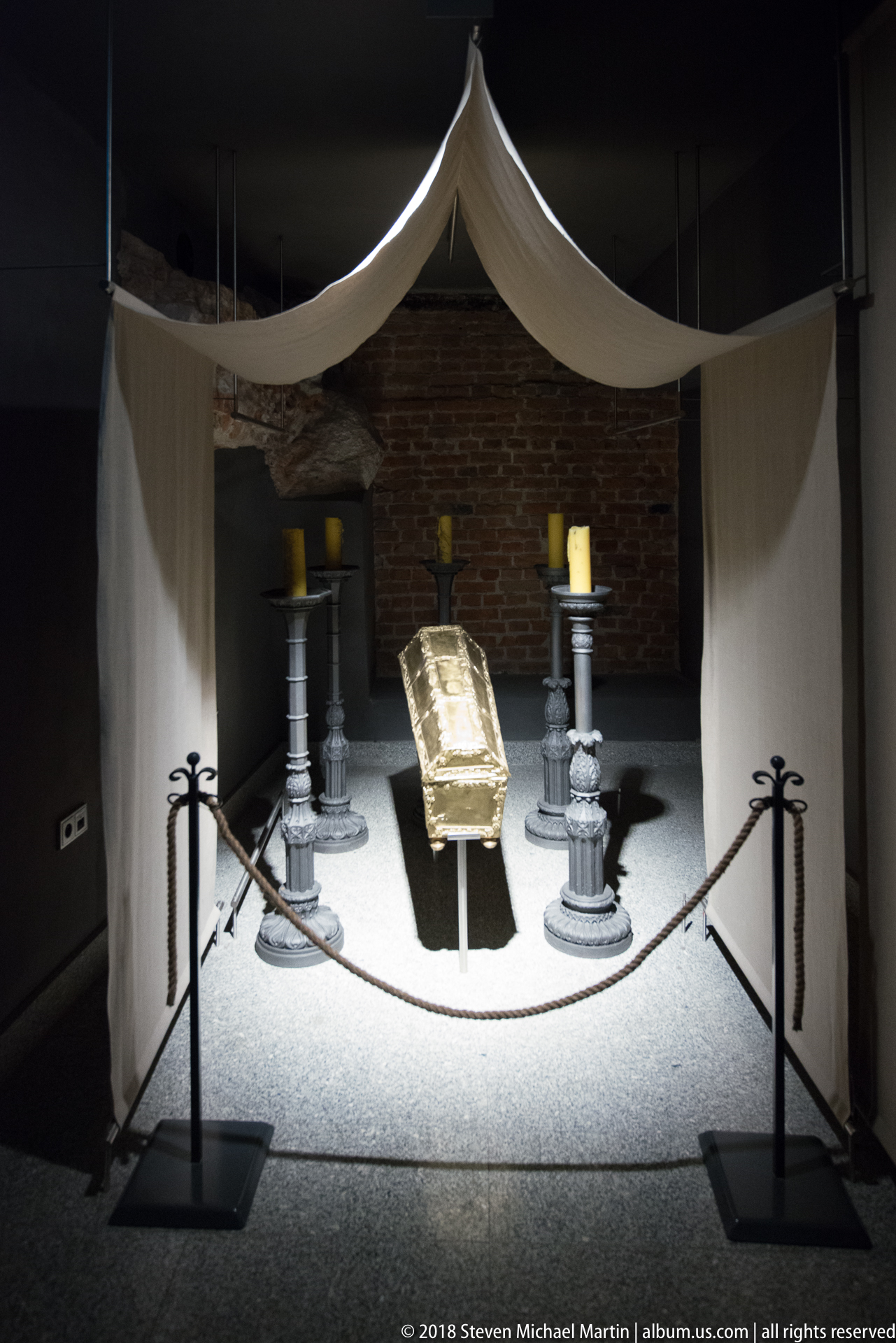
A spotlighted installation in the cathedral crypt places an open book or inscribed object between paired candle stands beneath a tent-like white canopy. Ropes separate the display from visitors, creating a solemn, staged memorial setting against exposed brick walls.
Caption
A spotlighted installation in the cathedral crypt places an open book or inscribed object between paired candle stands beneath a tent-like white canopy. Ropes separate the display from visitors, creating a solemn, staged memorial setting against exposed brick walls.

The green-capped clock tower of Warsaw’s Royal Castle rises at the end of a narrow Old Town street, framed tightly by historic facades on both sides. The compressed perspective turns the tower into an urban landmark glimpsed through the reconstructed street network surrounding Castle Square.
Caption
The green-capped clock tower of Warsaw’s Royal Castle rises at the end of a narrow Old Town street, framed tightly by historic facades on both sides. The compressed perspective turns the tower into an urban landmark glimpsed through the reconstructed street network surrounding Castle Square.

The Old Town clock is shown in a wider architectural context, with a patterned red-and-white surround above a painted ornamental panel dated 1953. The date is a visible reminder of Warsaw’s postwar reconstruction, while the layered decoration deliberately evokes the texture and visual variety of a historic townhouse facade.
Caption
The Old Town clock is shown in a wider architectural context, with a patterned red-and-white surround above a painted ornamental panel dated 1953. The date is a visible reminder of Warsaw’s postwar reconstruction, while the layered decoration deliberately evokes the texture and visual variety of a historic townhouse facade.

A low opening cut through thick stonework leads into a narrow brick-lined passage in the crypt of St. John’s Archcathedral. Recessed floor lighting traces the route through the masonry, emphasizing the contrast between rough stone construction and the carefully adapted visitor path.
Caption
A low opening cut through thick stonework leads into a narrow brick-lined passage in the crypt of St. John’s Archcathedral. Recessed floor lighting traces the route through the masonry, emphasizing the contrast between rough stone construction and the carefully adapted visitor path.

Four carved stone heads are mounted individually on slender stands against a plain wall, where strong directional lighting throws enlarged shadows behind them. The museum-like presentation isolates differences in facial expression, hairstyle, and weathering, suggesting preserved sculptural fragments displayed within the cathedral’s crypt exhibition.
Caption
Four carved stone heads are mounted individually on slender stands against a plain wall, where strong directional lighting throws enlarged shadows behind them. The museum-like presentation isolates differences in facial expression, hairstyle, and weathering, suggesting preserved sculptural fragments displayed within the cathedral’s crypt exhibition.

St. John’s Archcathedral is viewed along the central aisle toward its sanctuary, with tall brick piers supporting a dense network of rib vaults overhead. Heraldic and military banners hang between the bays, while rows of dark wooden pews reinforce the long processional axis of Warsaw’s principal Old Town cathedral.
Caption
St. John’s Archcathedral is viewed along the central aisle toward its sanctuary, with tall brick piers supporting a dense network of rib vaults overhead. Heraldic and military banners hang between the bays, while rows of dark wooden pews reinforce the long processional axis of Warsaw’s principal Old Town cathedral.

A carved stone relief of a multi-masted sailing ship crowns an arched doorway on a warm pink facade in Warsaw’s Old Town. Billowing sails, rigging, and stylized waves turn the entrance into a compact maritime emblem, while the address plaque and surrounding plaster preserve the relief’s architectural context.
Caption
A carved stone relief of a multi-masted sailing ship crowns an arched doorway on a warm pink facade in Warsaw’s Old Town. Billowing sails, rigging, and stylized waves turn the entrance into a compact maritime emblem, while the address plaque and surrounding plaster preserve the relief’s architectural context.

A richly ornamented clock face is set into a red-and-white patterned section of an Old Town facade. Roman numerals, a stylized sunburst center, gilded hands, and concentric decorative bands give the clock an intentionally historic appearance, integrating timekeeping into the reconstructed architectural fabric.
Caption
A richly ornamented clock face is set into a red-and-white patterned section of an Old Town facade. Roman numerals, a stylized sunburst center, gilded hands, and concentric decorative bands give the clock an intentionally historic appearance, integrating timekeeping into the reconstructed architectural fabric.

A black-and-white aerial photograph records dense urban blocks scarred by wartime destruction, with streets and surviving building shells forming a stark pattern across the city center. Displayed as public interpretation in the Old Town, the historic image provides visual evidence for the scale of devastation that preceded Warsaw’s postwar reconstruction.
Caption
A black-and-white aerial photograph records dense urban blocks scarred by wartime destruction, with streets and surviving building shells forming a stark pattern across the city center. Displayed as public interpretation in the Old Town, the historic image provides visual evidence for the scale of devastation that preceded Warsaw’s postwar reconstruction.

A black wrought-iron grille fills a small rectangular window, forming a symmetrical design of curling vines, leaves, and a central flower-like rosette. Set within a pale stone surround, the close view isolates the craftsmanship of this functional yet decorative element in Warsaw’s reconstructed Old Town architecture.
Caption
A black wrought-iron grille fills a small rectangular window, forming a symmetrical design of curling vines, leaves, and a central flower-like rosette. Set within a pale stone surround, the close view isolates the craftsmanship of this functional yet decorative element in Warsaw’s reconstructed Old Town architecture.

A freestanding outdoor display brings together a historic aerial photograph, UNESCO text, a boundary map, and archival images explaining the reconstruction of Warsaw’s historic center. Seen beside a red plaster building, the panel places the World Heritage narrative directly within the streets that were rebuilt.
Caption
A freestanding outdoor display brings together a historic aerial photograph, UNESCO text, a boundary map, and archival images explaining the reconstruction of Warsaw’s historic center. Seen beside a red plaster building, the panel places the World Heritage narrative directly within the streets that were rebuilt.

Bright figurative murals occupy panels between the windows of a pale yellow Old Town townhouse. The upper scene shows intertwined figures, while the lower panel presents a more dynamic group in red, blue, green, and ochre, demonstrating how painted decoration animates otherwise regular reconstructed facades.
Caption
Bright figurative murals occupy panels between the windows of a pale yellow Old Town townhouse. The upper scene shows intertwined figures, while the lower panel presents a more dynamic group in red, blue, green, and ochre, demonstrating how painted decoration animates otherwise regular reconstructed facades.

A UNESCO interpretive panel explains the destruction and reconstruction of Warsaw’s historic center, pairing bilingual text with maps and archival imagery. The display summarizes why the rebuilt Old Town was inscribed on the World Heritage List, making conservation history itself part of the visitor experience.
Caption
A UNESCO interpretive panel explains the destruction and reconstruction of Warsaw’s historic center, pairing bilingual text with maps and archival imagery. The display summarizes why the rebuilt Old Town was inscribed on the World Heritage List, making conservation history itself part of the visitor experience.

A theatrical sculptural group projects from a yellow Old Town facade: a snarling lion-like beast arches above a rounded central shield while curling sea-creature forms spread below. Gilded accents pick out the flowing contours, turning the facade into a vivid example of Warsaw’s reconstructed decorative architecture.
Caption
A theatrical sculptural group projects from a yellow Old Town facade: a snarling lion-like beast arches above a rounded central shield while curling sea-creature forms spread below. Gilded accents pick out the flowing contours, turning the facade into a vivid example of Warsaw’s reconstructed decorative architecture.

A stone relief shows three youthful figures interacting with goats in a playful pastoral scene. One child holds a staff, another raises a vessel, and a third stands beside the animals; the shallow carving reads like a classical frieze adapted as decorative ornament on an Old Town facade.
Caption
A stone relief shows three youthful figures interacting with goats in a playful pastoral scene. One child holds a staff, another raises a vessel, and a third stands beside the animals; the shallow carving reads like a classical frieze adapted as decorative ornament on an Old Town facade.

A row of narrow reconstructed townhouses lines one side of Warsaw’s Old Town Market Square, their varied pastel facades, painted decoration, steep red roofs, and dormers forming a cohesive historic streetscape. Café umbrellas and outdoor tables animate the square below, while the Warsaw Mermaid fountain stands near the center.
Caption
A row of narrow reconstructed townhouses lines one side of Warsaw’s Old Town Market Square, their varied pastel facades, painted decoration, steep red roofs, and dormers forming a cohesive historic streetscape. Café umbrellas and outdoor tables animate the square below, while the Warsaw Mermaid fountain stands near the center.

A pink Old Town townhouse is covered with painted ornament arranged around its windows: birds, vases, scrolling foliage, and a band of portrait medallions. The carefully ordered decorative program turns the reconstructed facade into a pictorial surface while preserving the narrow proportions of Warsaw’s historic market-square houses.
Caption
A pink Old Town townhouse is covered with painted ornament arranged around its windows: birds, vases, scrolling foliage, and a band of portrait medallions. The carefully ordered decorative program turns the reconstructed facade into a pictorial surface while preserving the narrow proportions of Warsaw’s historic market-square houses.

The Warsaw Mermaid, or Syrenka, raises her sword while holding a round shield at the center of the Old Town Market Square fountain. Her bronze fishtail coils above the sculpted base, making the city’s heraldic symbol the focal point against a backdrop of reconstructed historic townhouses.
Caption
The Warsaw Mermaid, or Syrenka, raises her sword while holding a round shield at the center of the Old Town Market Square fountain. Her bronze fishtail coils above the sculpted base, making the city’s heraldic symbol the focal point against a backdrop of reconstructed historic townhouses.

The bronze Warsaw Mermaid fills the frame with sword raised and shield held defensively across her torso. Water-worn surfaces and the curling fish tail are especially prominent in this closer view, while the pastel market-square facades behind place the city emblem within its celebrated Old Town setting.
Caption
The bronze Warsaw Mermaid fills the frame with sword raised and shield held defensively across her torso. Water-worn surfaces and the curling fish tail are especially prominent in this closer view, while the pastel market-square facades behind place the city emblem within its celebrated Old Town setting.

Seen from a lower angle, the Warsaw Mermaid rises dramatically against a dense wall of pastel Old Town facades. Her uplifted sword breaks the roofline while the shield and curling tail anchor the bronze figure, emphasizing the contrast between sculptural monument and reconstructed urban backdrop.
Caption
Seen from a lower angle, the Warsaw Mermaid rises dramatically against a dense wall of pastel Old Town facades. Her uplifted sword breaks the roofline while the shield and curling tail anchor the bronze figure, emphasizing the contrast between sculptural monument and reconstructed urban backdrop.

The Warsaw Mermaid stands on her fountain pedestal in a broad view of the Old Town Market Square, surrounded by reconstructed townhouses, café terraces, and pedestrians. This composition emphasizes the statue’s role as the symbolic center of the square rather than isolating its sculptural details.
Caption
The Warsaw Mermaid stands on her fountain pedestal in a broad view of the Old Town Market Square, surrounded by reconstructed townhouses, café terraces, and pedestrians. This composition emphasizes the statue’s role as the symbolic center of the square rather than isolating its sculptural details.

Warsaw’s Old Town Market Square opens across the foreground beneath a cloudy sky, edged by narrow reconstructed townhouses in muted reds, creams, greens, and ochres. Visitors gather around benches and café areas, giving the square an active civic scale while the varied facades preserve its historic urban rhythm.
Caption
Warsaw’s Old Town Market Square opens across the foreground beneath a cloudy sky, edged by narrow reconstructed townhouses in muted reds, creams, greens, and ochres. Visitors gather around benches and café areas, giving the square an active civic scale while the varied facades preserve its historic urban rhythm.

A chestnut horse pulls a wooden tourist carriage along a cobbled Old Town street, driven by a uniformed coachwoman in a white cap. The close side view emphasizes harness, carriage wheels, and the horse’s forward stride against a backdrop of historic facades and pedestrians.
Caption
A chestnut horse pulls a wooden tourist carriage along a cobbled Old Town street, driven by a uniformed coachwoman in a white cap. The close side view emphasizes harness, carriage wheels, and the horse’s forward stride against a backdrop of historic facades and pedestrians.

A weathered stone relief of three closely grouped human figures occupies a pointed recessed niche high on a pale wall. Their intertwined arms and compressed arrangement create an intimate sculptural motif, while the severe architectural recess isolates the group from the surrounding facade.
Caption
A weathered stone relief of three closely grouped human figures occupies a pointed recessed niche high on a pale wall. Their intertwined arms and compressed arrangement create an intimate sculptural motif, while the severe architectural recess isolates the group from the surrounding facade.

A black marble memorial altar centers a framed Marian painting above a frontal panel marked with a white eight-pointed cross. Red-and-white heraldic shields flank the ensemble, while pale stucco and painted medallions fill the surrounding vault, combining funerary, devotional, and heraldic imagery within the church interior.
Caption
A black marble memorial altar centers a framed Marian painting above a frontal panel marked with a white eight-pointed cross. Red-and-white heraldic shields flank the ensemble, while pale stucco and painted medallions fill the surrounding vault, combining funerary, devotional, and heraldic imagery within the church interior.

A large ceiling painting presents a luminous female figure ascending through clouds amid angels while a group of earthly witnesses gathers below. The composition uses a dramatic vertical division between terrestrial figures and the radiant heavenly scene, consistent with a Marian apotheosis or Assumption subject in a Baroque church interior.
Caption
A large ceiling painting presents a luminous female figure ascending through clouds amid angels while a group of earthly witnesses gathers below. The composition uses a dramatic vertical division between terrestrial figures and the radiant heavenly scene, consistent with a Marian apotheosis or Assumption subject in a Baroque church interior.

A horse-drawn tourist carriage advances through a lively pedestrian street in Warsaw’s Old Town, surrounded by visitors, shopfronts, and tall historic facades. The more distant viewpoint places the carriage within the everyday circulation of the reconstructed center rather than isolating the horse and driver.
Caption
A horse-drawn tourist carriage advances through a lively pedestrian street in Warsaw’s Old Town, surrounded by visitors, shopfronts, and tall historic facades. The more distant viewpoint places the carriage within the everyday circulation of the reconstructed center rather than isolating the horse and driver.

A cobbled path runs between substantial red-brick fortifications near Warsaw’s Barbican, with a polygonal defensive tower rising ahead. Interpretive panels line the elevated walkway, while lower masonry remnants and planted slopes reveal multiple levels of the restored defensive landscape.
Caption
A cobbled path runs between substantial red-brick fortifications near Warsaw’s Barbican, with a polygonal defensive tower rising ahead. Interpretive panels line the elevated walkway, while lower masonry remnants and planted slopes reveal multiple levels of the restored defensive landscape.

A restored brick curtain wall stretches across a landscaped slope beside exposed stone foundations and a short stairway. Visitors stand along the wall-top walk, allowing the photograph to contrast reconstructed brick defenses with surviving or revealed masonry at their base near Warsaw’s Barbican.
Caption
A restored brick curtain wall stretches across a landscaped slope beside exposed stone foundations and a short stairway. Visitors stand along the wall-top walk, allowing the photograph to contrast reconstructed brick defenses with surviving or revealed masonry at their base near Warsaw’s Barbican.

A long pedestrian route follows the restored defensive walls near Warsaw’s Barbican, with a raised brick parapet and metal railing on one side and planted earthworks on the other. The quiet linear view emphasizes the spatial depth of the fortification system and its adaptation as a public walking route.
Caption
A long pedestrian route follows the restored defensive walls near Warsaw’s Barbican, with a raised brick parapet and metal railing on one side and planted earthworks on the other. The quiet linear view emphasizes the spatial depth of the fortification system and its adaptation as a public walking route.

Inside Warsaw’s Barbican, high curved brick walls enclose a cobbled passage that leads through a pointed arch toward the Old Town beyond. Small art displays line the base of the walls, while the heavy masonry, slit openings, and defensive curvature make the passage itself the architectural focus.
Caption
Inside Warsaw’s Barbican, high curved brick walls enclose a cobbled passage that leads through a pointed arch toward the Old Town beyond. Small art displays line the base of the walls, while the heavy masonry, slit openings, and defensive curvature make the passage itself the architectural focus.

A street vendor sits beneath a deep brick arch in Warsaw’s fortifications, surrounded by small framed paintings and prints arranged on tables and leaning against the masonry. The sheltered alcove transforms a defensive architectural recess into an informal gallery within the tourist life of the Old Town.
Caption
A street vendor sits beneath a deep brick arch in Warsaw’s fortifications, surrounded by small framed paintings and prints arranged on tables and leaning against the masonry. The sheltered alcove transforms a defensive architectural recess into an informal gallery within the tourist life of the Old Town.

A narrow paved street descends between pastel historic buildings toward the lower city, creating a long perspective through Warsaw’s New Town. Decorative street lamps, irregular rooflines, and restrained reconstructed facades give the lane an intimate residential scale distinct from the larger ceremonial spaces of the Old Town.
Caption
A narrow paved street descends between pastel historic buildings toward the lower city, creating a long perspective through Warsaw’s New Town. Decorative street lamps, irregular rooflines, and restrained reconstructed facades give the lane an intimate residential scale distinct from the larger ceremonial spaces of the Old Town.

A dark monumental painting shows rows of clergy and attendants gathered before a kneeling ecclesiastical figure, with a standing cleric holding an open book at right. A small painted inscription at the bottom forms part of the work, suggesting a commemorative or historical church scene rather than a purely devotional image.
Caption
A dark monumental painting shows rows of clergy and attendants gathered before a kneeling ecclesiastical figure, with a standing cleric holding an open book at right. A small painted inscription at the bottom forms part of the work, suggesting a commemorative or historical church scene rather than a purely devotional image.

A small vaulted chapel combines a modern Marian image with an array of bronze relief panels mounted asymmetrically on the white wall. The simple altar table and restrained architecture focus attention on the devotional sculpture, while the surrounding plaques create a contemporary commemorative setting within the historic church.
Caption
A small vaulted chapel combines a modern Marian image with an array of bronze relief panels mounted asymmetrically on the white wall. The simple altar table and restrained architecture focus attention on the devotional sculpture, while the surrounding plaques create a contemporary commemorative setting within the historic church.
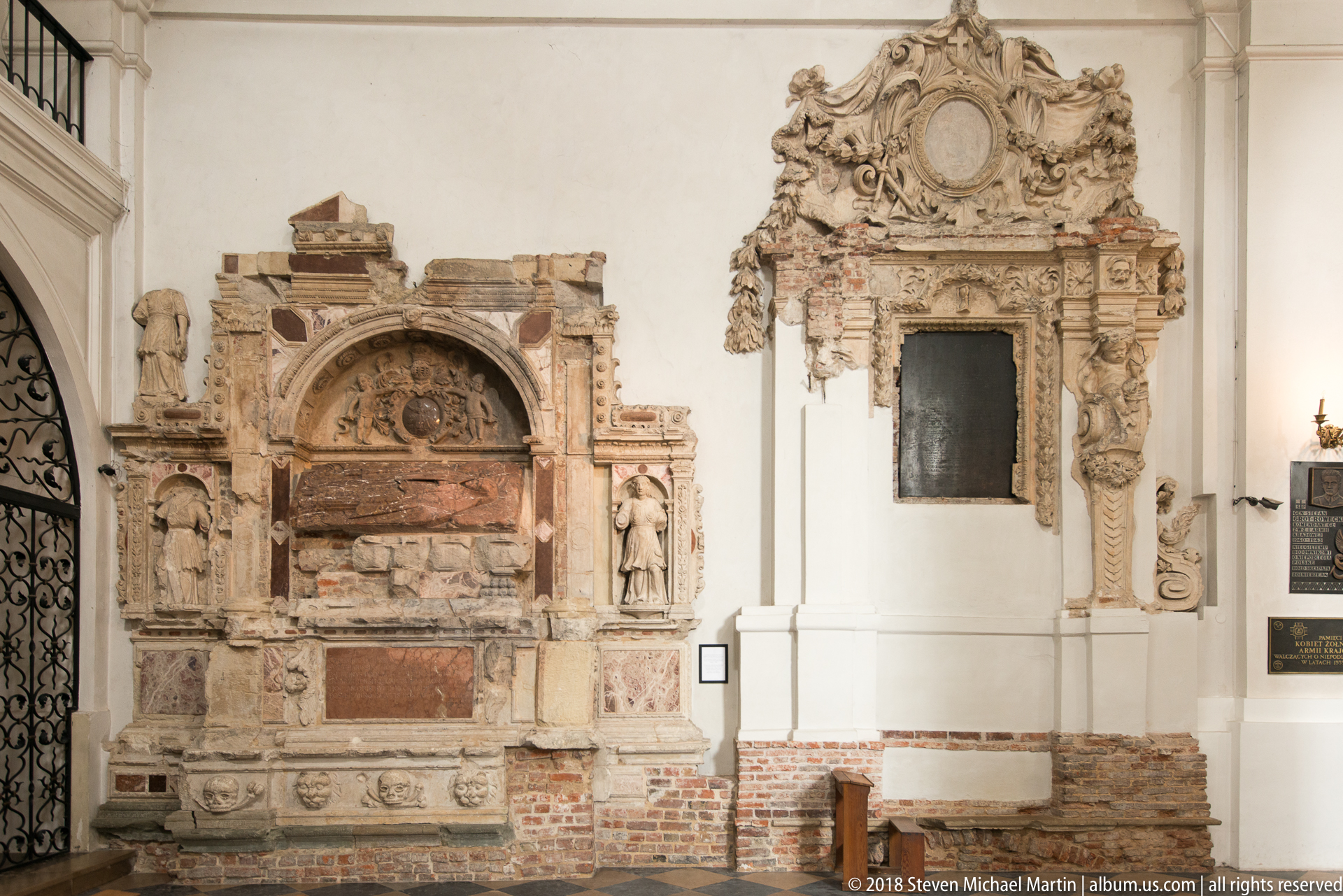
Two elaborate wall monuments stand side by side inside the church: one incorporates a reclining effigy beneath a deeply carved arch, while the other is framed by a richly sculpted vertical surround. Their weathered stone, heraldic ornament, and architectural framing preserve older funerary art within the otherwise bright reconstructed interior.
Caption
Two elaborate wall monuments stand side by side inside the church: one incorporates a reclining effigy beneath a deeply carved arch, while the other is framed by a richly sculpted vertical surround. Their weathered stone, heraldic ornament, and architectural framing preserve older funerary art within the otherwise bright reconstructed interior.

A broad white nave is viewed toward the organ loft, where shallow domical vaults repeat rhythmically above heavy piers and side arches. Wooden pews, restrained wall monuments, and warm metal chandeliers give the reconstructed interior a calm, spacious character despite the historic funerary elements along the walls.
Caption
A broad white nave is viewed toward the organ loft, where shallow domical vaults repeat rhythmically above heavy piers and side arches. Wooden pews, restrained wall monuments, and warm metal chandeliers give the reconstructed interior a calm, spacious character despite the historic funerary elements along the walls.

A monumental black stone portal encloses an ornate wrought-iron screen leading into a funerary or memorial chapel. Pale sculpted ornament crowns the dark architectural frame, while the iron grille reveals a warmly lit altar beyond, creating a layered threshold between nave and commemorative space.
Caption
A monumental black stone portal encloses an ornate wrought-iron screen leading into a funerary or memorial chapel. Pale sculpted ornament crowns the dark architectural frame, while the iron grille reveals a warmly lit altar beyond, creating a layered threshold between nave and commemorative space.

A restaurant or café entrance is framed by an unusually dense arrangement of potted shrubs, flowers, and clipped greenery extending along the sidewalk. The vegetation softens the pale historic facade and turns the narrow pedestrian edge into a small garden-like threshold within Warsaw’s New Town.
Caption
A restaurant or café entrance is framed by an unusually dense arrangement of potted shrubs, flowers, and clipped greenery extending along the sidewalk. The vegetation softens the pale historic facade and turns the narrow pedestrian edge into a small garden-like threshold within Warsaw’s New Town.

The same church is seen along its central aisle toward a bright sanctuary, with a black-and-white checkered floor, wooden pews, white arches, and multiple wall monuments. The symmetrical perspective emphasizes the building’s restrained reconstructed architecture and the concentration of older sculptural memorials along its side walls.
Caption
The same church is seen along its central aisle toward a bright sanctuary, with a black-and-white checkered floor, wooden pews, white arches, and multiple wall monuments. The symmetrical perspective emphasizes the building’s restrained reconstructed architecture and the concentration of older sculptural memorials along its side walls.

A white historic church complex combines a tall central gabled facade with a rounded side chapel capped by a green copper dome and a detached-looking square bell tower. Layered rooflines and pale classical detailing create a distinctive silhouette against the sky in Warsaw’s New Town.
Caption
A white historic church complex combines a tall central gabled facade with a rounded side chapel capped by a green copper dome and a detached-looking square bell tower. Layered rooflines and pale classical detailing create a distinctive silhouette against the sky in Warsaw’s New Town.

A cobbled street in Warsaw’s New Town narrows toward a pale twin-towered church at the far end. Historic townhouses, open windows, shop signs, café umbrellas, and pedestrians create a lively corridor, with the distant church towers serving as the principal visual landmark.
Caption
A cobbled street in Warsaw’s New Town narrows toward a pale twin-towered church at the far end. Historic townhouses, open windows, shop signs, café umbrellas, and pedestrians create a lively corridor, with the distant church towers serving as the principal visual landmark.

St. Casimir Church stands prominently on Warsaw’s New Town Market Square, its white Baroque facade centered beneath a large green copper dome and slender lantern. Low convent buildings with red tile roofs extend to the right, while the open square provides an unobstructed view of the church’s central-plan massing.
Caption
St. Casimir Church stands prominently on Warsaw’s New Town Market Square, its white Baroque facade centered beneath a large green copper dome and slender lantern. Low convent buildings with red tile roofs extend to the right, while the open square provides an unobstructed view of the church’s central-plan massing.

A sidewalk chalkboard for Pollyester Café uses hand-lettered humor to advertise beer, declaring, “Our beer is as cold as your ex’s heart.” The painted pint glass and bold orange-and-white lettering turn a practical menu board into a playful piece of street graphic design.
Caption
A sidewalk chalkboard for Pollyester Café uses hand-lettered humor to advertise beer, declaring, “Our beer is as cold as your ex’s heart.” The painted pint glass and bold orange-and-white lettering turn a practical menu board into a playful piece of street graphic design.

A second Pollyester Café chalkboard promotes cocktails with a joke about “a great story” that never started with someone eating a salad. White and pastel lettering surrounds a simple martini-glass drawing, documenting the informal humor used by Warsaw bars and cafés to attract pedestrians.
Caption
A second Pollyester Café chalkboard promotes cocktails with a joke about “a great story” that never started with someone eating a salad. White and pastel lettering surrounds a simple martini-glass drawing, documenting the informal humor used by Warsaw bars and cafés to attract pedestrians.

A peach-colored palace facade is organized around a projecting central bay with a stone balcony, tall arched window, carved cartouche, and sculpted triangular pediment. Decorative roofline figures and classical window surrounds give the building a formal aristocratic character, while modern signs at street level mark its continued institutional use.
Caption
A peach-colored palace facade is organized around a projecting central bay with a stone balcony, tall arched window, carved cartouche, and sculpted triangular pediment. Decorative roofline figures and classical window surrounds give the building a formal aristocratic character, while modern signs at street level mark its continued institutional use.

The Church of the Holy Spirit presents a narrow Baroque facade squeezed between taller New Town buildings. Paired towers rise above the warm cream elevation, while pilasters, cornices, and a modest central pediment create a vertically layered composition near Warsaw’s northern Old Town approaches.
Caption
The Church of the Holy Spirit presents a narrow Baroque facade squeezed between taller New Town buildings. Paired towers rise above the warm cream elevation, while pilasters, cornices, and a modest central pediment create a vertically layered composition near Warsaw’s northern Old Town approaches.
⭐ Highlights
- Old Town: A UNESCO-listed historic core rebuilt after World War II with extraordinary care and accuracy.
- Royal Castle: The former seat of Polish monarchs and one of the defining landmarks of Warsaw.
- Castle Square: A major public space at the entrance to the Old Town, anchored by Sigismund’s Column.
- Old Town Market Square: A colorful historic square at the heart of the reconstructed old city.
- Royal Route: A ceremonial and historic route linking major royal and civic landmarks.
- Reconstruction Legacy: Warsaw stands as one of the world’s most remarkable examples of urban reconstruction.
🏙️ Warsaw Field Guide
Major features observed during this visit:
Warsaw is a city shaped by both deep historical roots and extraordinary resilience. Its historic center, largely destroyed during World War II, was meticulously reconstructed after the war, creating one of the most remarkable examples of urban restoration in Europe. Today, Warsaw combines royal landmarks, public squares, churches, and reconstructed streets into a cityscape that reflects both memory and renewal.
🏛️ Signature Landmarks
- Royal Castle – The historic residence of Polish rulers and a defining feature of the city’s old center.
- Castle Square – A ceremonial square linking the Old Town with the broader city.
- Old Town Market Square – The visual and social heart of the historic district.
- Sigismund’s Column – One of Warsaw’s most recognizable monuments.
- Royal Route – A historic axis connecting royal, civic, and religious landmarks across the city.
🧠 Historical Significance
- Royal Capital – Warsaw became the political center of Poland and the seat of its rulers.
- World War II Destruction – Much of the historic center was destroyed during the war.
- Postwar Reconstruction – The Old Town was rebuilt with exceptional fidelity using historical records and paintings.
- Symbol of Resilience – Warsaw’s reconstructed center stands as a powerful expression of cultural memory and survival.
🌄 Urban Landscape & Setting
- Historic Core – The Old Town preserves the scale and rhythm of an earlier Warsaw.
- Public Squares – Open spaces structure movement and civic life through the city center.
- Royal Route Axis – A strong urban sequence connects major landmarks and neighborhoods.
- Old and New Contrast – Reconstructed historic areas exist alongside a larger modern capital.