Giant Wild Goose Pagoda
The Giant Wild Goose Pagoda was constructed during the Tang dynasty and is associated with the introduction of Buddhist texts brought from India to China. The structure was originally built to house sacred scriptures translated by the monk Xuanzang, whose travels contributed to the spread of Buddhist teachings. The pagoda reflects the integration of religious architecture within imperial society.
Constructed of brick and rising in multiple tiers, the pagoda illustrates traditional Chinese tower design adapted for religious purposes. The structure demonstrates the influence of Buddhist architectural traditions introduced through cultural exchange along the Silk Road. Its preservation highlights the importance of religion in shaping artistic and intellectual life during the Tang period.
The Giant Wild Goose Pagoda represents the interaction between Chinese civilization and broader religious traditions transmitted through trade routes and scholarly exchange. The monument illustrates the cultural connections linking imperial China with other regions of Asia.

A frontal low-angle view accentuates the seven surviving stories of the Giant Wild Goose Pagoda in Xi'an, its austere, stepped brick facade and dark arched openings exemplifying Tang architecture and contrasting with traditional timber-framed Chinese towers.
Caption
A frontal low-angle view accentuates the seven surviving stories of the Giant Wild Goose Pagoda in Xi'an, its austere, stepped brick facade and dark arched openings exemplifying Tang architecture and contrasting with traditional timber-framed Chinese towers.

The upper tiers of the Giant Wild Goose Pagoda rise behind dense pine branches in Xi'an, their tapering brick mass still clearly legible within the landscaped temple grounds.
Caption
The upper tiers of the Giant Wild Goose Pagoda rise behind dense pine branches in Xi'an, their tapering brick mass still clearly legible within the landscaped temple grounds.

The seven-tiered brick mass of the Giant Wild Goose Pagoda rises beyond tiled temple roofs and trees in the Da Ci'en Temple complex in Xi'an, its framing by nearby buildings revealing the Buddhist monument’s place within the active precinct.
Caption
The seven-tiered brick mass of the Giant Wild Goose Pagoda rises beyond tiled temple roofs and trees in the Da Ci'en Temple complex in Xi'an, its framing by nearby buildings revealing the Buddhist monument’s place within the active precinct.

Randy in a white shirt looks toward the camera amid stone architecture and greenery at the Giant Wild Goose Pagoda complex in Xi'an, captured in an informal travel portrait.
Caption
Randy in a white shirt looks toward the camera amid stone architecture and greenery at the Giant Wild Goose Pagoda complex in Xi'an, captured in an informal travel portrait.

Randy stands in the foreground as the seven-tiered Giant Wild Goose Pagoda rises above the trees and traditional tiled roofs in Xi'an, balancing personal experience with the monument’s commanding presence.
Caption
Randy stands in the foreground as the seven-tiered Giant Wild Goose Pagoda rises above the trees and traditional tiled roofs in Xi'an, balancing personal experience with the monument’s commanding presence.

Randy stands in the broad temple plaza at Da Ci'en Temple in Xi’an, his environmental portrait aligning the courtyard, hall, and the rising tiers of the Giant Wild Goose Pagoda along a single axial view.
Caption
Randy stands in the broad temple plaza at Da Ci'en Temple in Xi’an, his environmental portrait aligning the courtyard, hall, and the rising tiers of the Giant Wild Goose Pagoda along a single axial view.

A telephoto view frames the lower and middle tiers of the seven-story brick Giant Wild Goose Pagoda, its inward-stepping, arched openings and projecting cornices exemplifying Tang-dynasty Buddhist architecture as it rises behind a dark pavilion with upturned eaves in Xi'an.
Caption
A telephoto view frames the lower and middle tiers of the seven-story brick Giant Wild Goose Pagoda, its inward-stepping, arched openings and projecting cornices exemplifying Tang-dynasty Buddhist architecture as it rises behind a dark pavilion with upturned eaves in Xi'an.

A smiling visitor poses for a low-angle travel portrait at Xi’an’s Giant Wild Goose Pagoda, its brick tiers rising steeply behind him through a screen of green leaves.
Caption
A smiling visitor poses for a low-angle travel portrait at Xi’an’s Giant Wild Goose Pagoda, its brick tiers rising steeply behind him through a screen of green leaves.

Layered sacred architecture unfolds along the temple axis at Da Ci’en Temple in Xi’an, where a dark, multi-tiered pavilion with upturned eaves and hanging bells stands before a gray-tiled hall and the centrally rising Giant Wild Goose Pagoda.
Caption
Layered sacred architecture unfolds along the temple axis at Da Ci’en Temple in Xi’an, where a dark, multi-tiered pavilion with upturned eaves and hanging bells stands before a gray-tiled hall and the centrally rising Giant Wild Goose Pagoda.

A large cast bronze temple bell, suspended from a rustic timber frame with red ribbons, stands in the courtyard of Da Ci'en Temple within the Giant Wild Goose Pagoda complex in Xi'an, where such bells are used in Buddhist ritual and timekeeping.
Caption
A large cast bronze temple bell, suspended from a rustic timber frame with red ribbons, stands in the courtyard of Da Ci'en Temple within the Giant Wild Goose Pagoda complex in Xi'an, where such bells are used in Buddhist ritual and timekeeping.

Within the Da Ci'en Temple complex in Xi'an, the seven-tiered brick Giant Wild Goose Pagoda rises beyond gray-tiled roofs and trees, its Tang-era Buddhist form framed by the surrounding active temple precinct.
Caption
Within the Da Ci'en Temple complex in Xi'an, the seven-tiered brick Giant Wild Goose Pagoda rises beyond gray-tiled roofs and trees, its Tang-era Buddhist form framed by the surrounding active temple precinct.

Weathered gray ceramic roof tiles terminate in circular, molded motifs that both shield the roof timbers and add symbolic ornament characteristic of traditional Chinese temple architecture at Da Ci'en Temple in Xi'an.
Caption
Weathered gray ceramic roof tiles terminate in circular, molded motifs that both shield the roof timbers and add symbolic ornament characteristic of traditional Chinese temple architecture at Da Ci'en Temple in Xi'an.

Weathered gray ceramic roof tiles terminate in circular, radiating motifs that both protect the temple timbers and provide symbolic ornament characteristic of traditional Chinese temple architecture.
Caption
Weathered gray ceramic roof tiles terminate in circular, radiating motifs that both protect the temple timbers and provide symbolic ornament characteristic of traditional Chinese temple architecture.

Repeated circular tile ends along the Da Ci'en Temple roofline create a measured rhythm, their molded gray ceramic motifs uniting weather protection with ornament.
Caption
Repeated circular tile ends along the Da Ci'en Temple roofline create a measured rhythm, their molded gray ceramic motifs uniting weather protection with ornament.

Weathered gray ceramic roof components stack in stepped layers, their circular radiating motif and worn surfaces revealing how traditional Chinese temple roofs both protect and adorn the joints of Da Ci'en Temple.
Caption
Weathered gray ceramic roof components stack in stepped layers, their circular radiating motif and worn surfaces revealing how traditional Chinese temple roofs both protect and adorn the joints of Da Ci'en Temple.

Randy in a white shirt pauses for an informal travel portrait amid the stone architecture and greenery of the Giant Wild Goose Pagoda complex in Xi'an.
Caption
Randy in a white shirt pauses for an informal travel portrait amid the stone architecture and greenery of the Giant Wild Goose Pagoda complex in Xi'an.

Randy pauses in the red-painted colonnade of Da Ci'en Temple in Xi'an, framed by the temple's covered corridor and its rhythm of receding columns.
Caption
Randy pauses in the red-painted colonnade of Da Ci'en Temple in Xi'an, framed by the temple's covered corridor and its rhythm of receding columns.
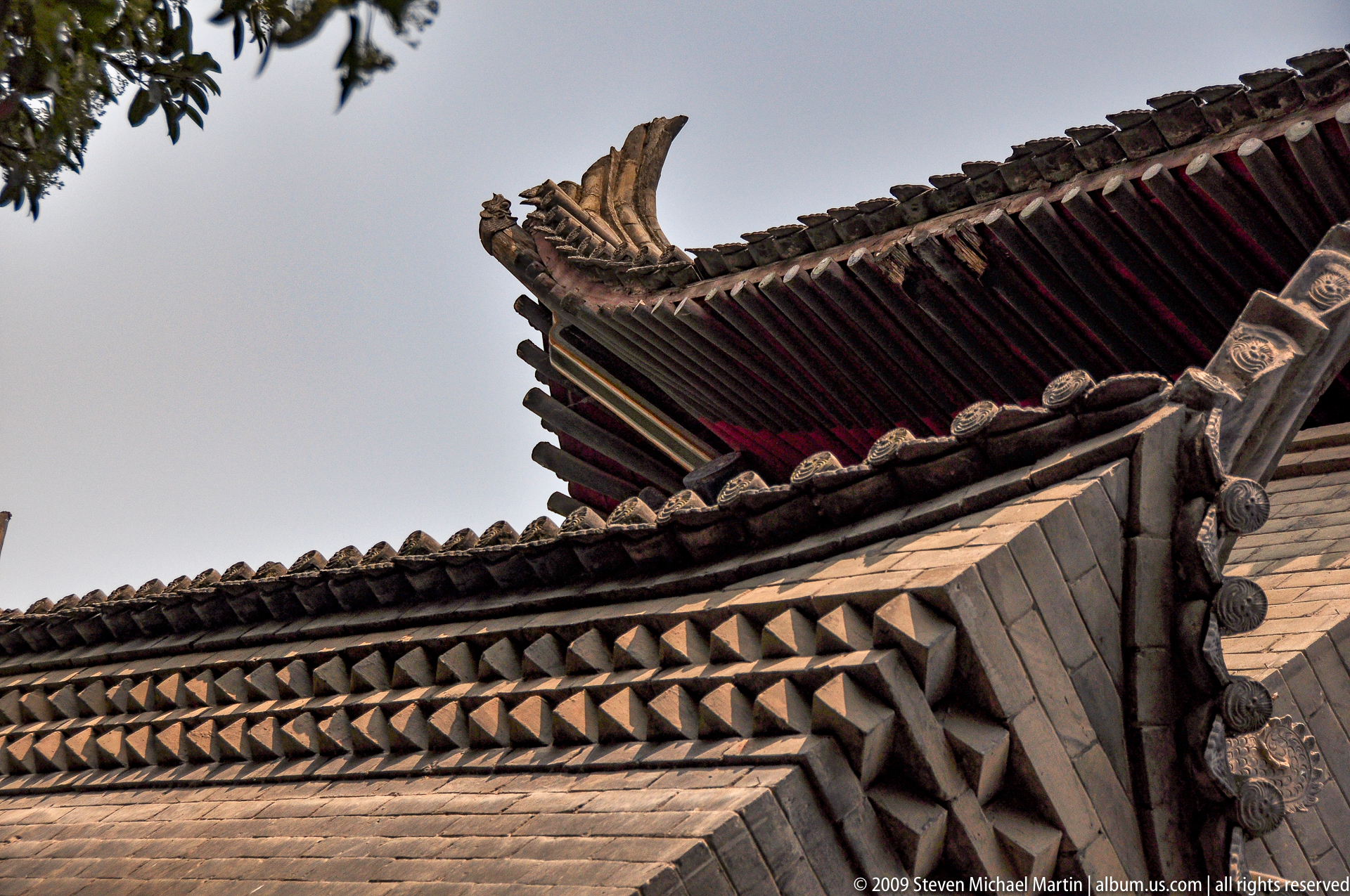
Interlocking gray-tile roofs and upturned eaves at Da Ci'en Temple in Xi'an form a dense pattern of timber structure and ceramic ornament, creating a complex silhouette around the pagoda complex.
Caption
Interlocking gray-tile roofs and upturned eaves at Da Ci'en Temple in Xi'an form a dense pattern of timber structure and ceramic ornament, creating a complex silhouette around the pagoda complex.

Projecting geometric brickwork on a Da Ci'en Temple wall creates deep shadow and texture without applied decoration, emphasizing the transition between the gray masonry wall and the roof above.
Caption
Projecting geometric brickwork on a Da Ci'en Temple wall creates deep shadow and texture without applied decoration, emphasizing the transition between the gray masonry wall and the roof above.

Randy rests on a low stone ledge in the Da Ci'en Temple courtyard in Xi'an, framed by carved stone markers and commemorative religious architecture.
Caption
Randy rests on a low stone ledge in the Da Ci'en Temple courtyard in Xi'an, framed by carved stone markers and commemorative religious architecture.

Randy rests on a low stone ledge in a paved courtyard at Da Ci'en Temple in Xi'an, framed by carved stone ornaments and commemorative markers within the surrounding religious architecture.
Caption
Randy rests on a low stone ledge in a paved courtyard at Da Ci'en Temple in Xi'an, framed by carved stone ornaments and commemorative markers within the surrounding religious architecture.

Steve stands beside a white stone elephant in the courtyard of Da Ci’en Temple, framed by red columns and the rising form of the Giant Wild Goose Pagoda, where Buddhist elephant imagery evokes strength and sacred association within the temple’s ceremonial architecture.
Caption
Steve stands beside a white stone elephant in the courtyard of Da Ci’en Temple, framed by red columns and the rising form of the Giant Wild Goose Pagoda, where Buddhist elephant imagery evokes strength and sacred association within the temple’s ceremonial architecture.

Steve stands beside a white stone elephant in the red-columned courtyard of Da Ci’en Temple, framed by the Giant Wild Goose Pagoda and ceremonial architecture that echo the elephant’s Buddhist symbolism of strength and sacred association.
Caption
Steve stands beside a white stone elephant in the red-columned courtyard of Da Ci’en Temple, framed by the Giant Wild Goose Pagoda and ceremonial architecture that echo the elephant’s Buddhist symbolism of strength and sacred association.

Randy pauses in a covered red colonnade at Da Ci'en Temple in Xi'an, where the receding timber columns create a strong architectural rhythm around his portrait.
Caption
Randy pauses in a covered red colonnade at Da Ci'en Temple in Xi'an, where the receding timber columns create a strong architectural rhythm around his portrait.

Randy pauses for a portrait in the red-painted covered corridor of Da Ci'en Temple in Xi'an, where repeating timber columns create a strong architectural rhythm around him.
Caption
Randy pauses for a portrait in the red-painted covered corridor of Da Ci'en Temple in Xi'an, where repeating timber columns create a strong architectural rhythm around him.

The upper tiers of the Giant Wild Goose Pagoda in Xi'an rise in stepped brick levels adapted from Buddhist tower traditions, their arched openings and strong cornices giving the Tang dynasty monument a fortress-like presence against the clear blue sky.
Caption
The upper tiers of the Giant Wild Goose Pagoda in Xi'an rise in stepped brick levels adapted from Buddhist tower traditions, their arched openings and strong cornices giving the Tang dynasty monument a fortress-like presence against the clear blue sky.

A gilded seated Buddha on a lotus throne, haloed in ornate gold and flanked by two standing attendants, forms a luminous devotional triad within the Da Ci'en Temple in Xi'an.
Caption
A gilded seated Buddha on a lotus throne, haloed in ornate gold and flanked by two standing attendants, forms a luminous devotional triad within the Da Ci'en Temple in Xi'an.

A gilded Buddha in formal devotional pose gazes serenely outward, blue curls and flowing robe framed by an ornate circular halo, as a precise hand gesture suggests teaching or doctrinal exposition within Da Ci’en Temple.
Caption
A gilded Buddha in formal devotional pose gazes serenely outward, blue curls and flowing robe framed by an ornate circular halo, as a precise hand gesture suggests teaching or doctrinal exposition within Da Ci’en Temple.

A low-angle view of the entrance to the Giant Wild Goose Pagoda in Xi'an, with the stone plaque reading 大雁塔 as the tapered brick tower rises above.
Caption
A low-angle view of the entrance to the Giant Wild Goose Pagoda in Xi'an, with the stone plaque reading 大雁塔 as the tapered brick tower rises above.

A large bronze incense cauldron on animal-form legs holds dozens of smoldering sticks, its rising smoke marking a communal act of Buddhist devotion at Da Ci’en Temple.
Caption
A large bronze incense cauldron on animal-form legs holds dozens of smoldering sticks, its rising smoke marking a communal act of Buddhist devotion at Da Ci’en Temple.

A gilded Buddha at Da Ci’en Temple is shown in serene close-up, its halo framing a calm face and an ancient Buddhist swastika on the chest—an auspicious symbol in Buddhist art that predates and should not be confused with its modern extremist appropriation.
Caption
A gilded Buddha at Da Ci’en Temple is shown in serene close-up, its halo framing a calm face and an ancient Buddhist swastika on the chest—an auspicious symbol in Buddhist art that predates and should not be confused with its modern extremist appropriation.

A cast bronze temple bell with decorative panels hangs from heavy timber beams at Da Ci’en Temple in Xi’an, its outdoor placement allowing its ritual sound to carry across the complex.
Caption
A cast bronze temple bell with decorative panels hangs from heavy timber beams at Da Ci’en Temple in Xi’an, its outdoor placement allowing its ritual sound to carry across the complex.

At Da Ci'en Temple, a close view of a white stone guardian lion’s paw and chest ornament reveals how finely carved details convey strength, protective authority, and richly embellished stonework around the sculpture.
Caption
At Da Ci'en Temple, a close view of a white stone guardian lion’s paw and chest ornament reveals how finely carved details convey strength, protective authority, and richly embellished stonework around the sculpture.

Gilded Buddha hands form a precise mudra beneath an auspicious Buddhist swastika, a focused study in devotional iconography at Da Ci’en Temple.
Caption
Gilded Buddha hands form a precise mudra beneath an auspicious Buddhist swastika, a focused study in devotional iconography at Da Ci’en Temple.

A white stone guardian lion sits alert before the bell pavilion at Da Ci'en Temple in Xi'an, its stylized mane and carved pendant merging protective symbolism with refined architectural ornament.
Caption
A white stone guardian lion sits alert before the bell pavilion at Da Ci'en Temple in Xi'an, its stylized mane and carved pendant merging protective symbolism with refined architectural ornament.

Close detail of a small lion‑head pendant carved on a stone guardian lion, a repeated lion motif that intensifies the sculpture’s protective symbolism across multiple scales.
Caption
Close detail of a small lion‑head pendant carved on a stone guardian lion, a repeated lion motif that intensifies the sculpture’s protective symbolism across multiple scales.

Exaggerated features and layered lion-head ornamentation give this white stone guardian lion at Da Ci'en Temple a heightened sense of vigilance and protective power.
Caption
Exaggerated features and layered lion-head ornamentation give this white stone guardian lion at Da Ci'en Temple a heightened sense of vigilance and protective power.

An oblique upper-tier view of the Giant Wild Goose Pagoda in Xi'an reveals its tapering brick profile, where cornice shadows animate the restrained Tang-era surfaces behind a screen of pine branches.
Caption
An oblique upper-tier view of the Giant Wild Goose Pagoda in Xi'an reveals its tapering brick profile, where cornice shadows animate the restrained Tang-era surfaces behind a screen of pine branches.