Beng Mealea
Beng Mealea is a largely unrestored twelfth-century temple constructed during the reign of King Suryavarman II, the same ruler associated with Angkor Wat. The temple’s design reflects the architectural principles of the Angkorian period, including symbolic layouts representing Hindu cosmology. Its remote location contributed to its preservation within a heavily forested environment.
Collapsed galleries, fallen stone blocks, and vegetation growing through the structure illustrate the effects of time and natural forces on historic monuments. The temple’s condition provides insight into the challenges of archaeological preservation in tropical environments. Its layout demonstrates similarities to Angkor Wat, suggesting shared architectural planning traditions.
Beng Mealea illustrates the scale of Khmer temple construction and the enduring presence of Angkorian architecture in the Cambodian landscape. The site provides an opportunity to observe historical structures in a relatively natural state.
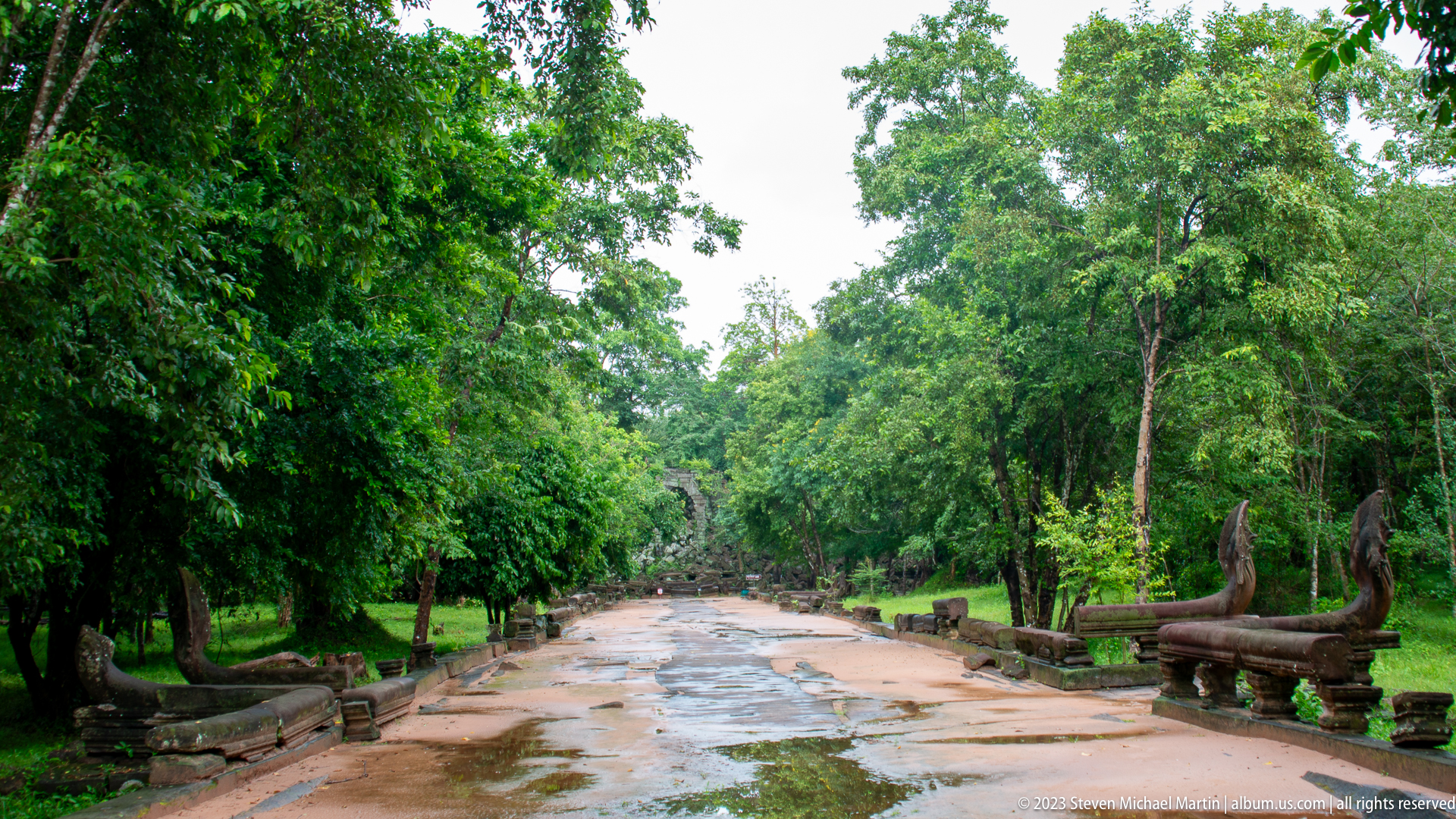
The rain-darkened approach to Beng Mealea extends through dense tropical forest, with surviving sections of the temple’s naga balustrades marking the ceremonial route. The broad stone pavement and low sculptural borders establish the scale of the entrance sequence while the enclosing trees reveal how completely the monument has become integrated with its humid woodland setting.
Caption
The rain-darkened approach to Beng Mealea extends through dense tropical forest, with surviving sections of the temple’s naga balustrades marking the ceremonial route. The broad stone pavement and low sculptural borders establish the scale of the entrance sequence while the enclosing trees reveal how completely the monument has become integrated with its humid woodland setting.
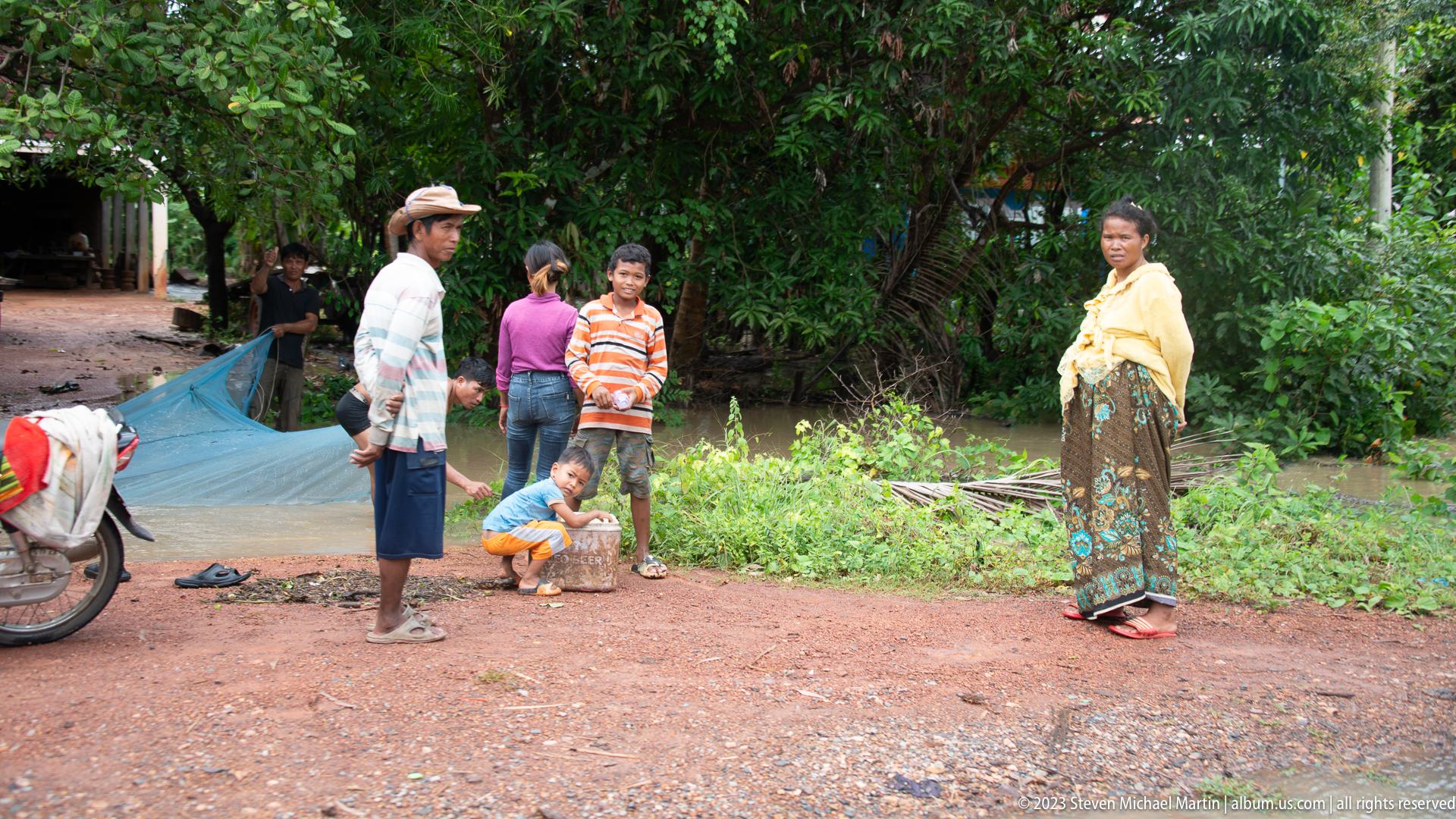
Adults and children gather beside a motorcycle on a red-earth roadside near Beng Mealea. Their informal arrangement suggests a pause in daily activity rather than a posed ceremonial event. Clothing, transport, and the shaded village edge provide a contemporary social counterpoint to the ancient temple, documenting the community through which visitors pass on the approach to the site.
Caption
Adults and children gather beside a motorcycle on a red-earth roadside near Beng Mealea. Their informal arrangement suggests a pause in daily activity rather than a posed ceremonial event. Clothing, transport, and the shaded village edge provide a contemporary social counterpoint to the ancient temple, documenting the community through which visitors pass on the approach to the site.
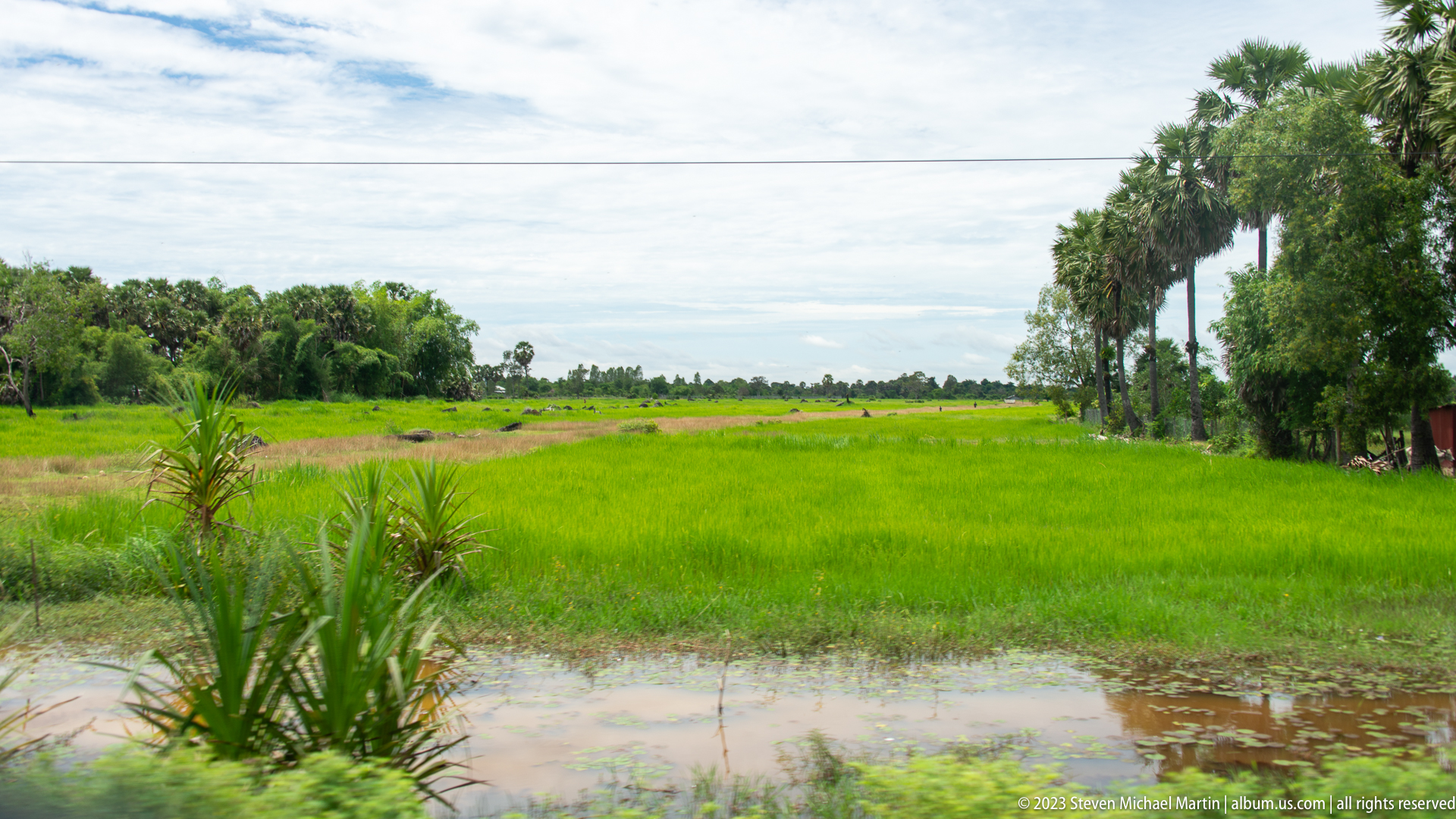
Bright green rice paddies extend across a low, waterlogged plain near Beng Mealea, bordered by palms and scattered trees beneath an overcast sky. Standing water in the foreground reflects recent or seasonal flooding, while the cultivated plots show how agriculture continues within the temple’s surrounding rural landscape. The scene provides environmental context for the monument beyond its forested ruins.
Caption
Bright green rice paddies extend across a low, waterlogged plain near Beng Mealea, bordered by palms and scattered trees beneath an overcast sky. Standing water in the foreground reflects recent or seasonal flooding, while the cultivated plots show how agriculture continues within the temple’s surrounding rural landscape. The scene provides environmental context for the monument beyond its forested ruins.
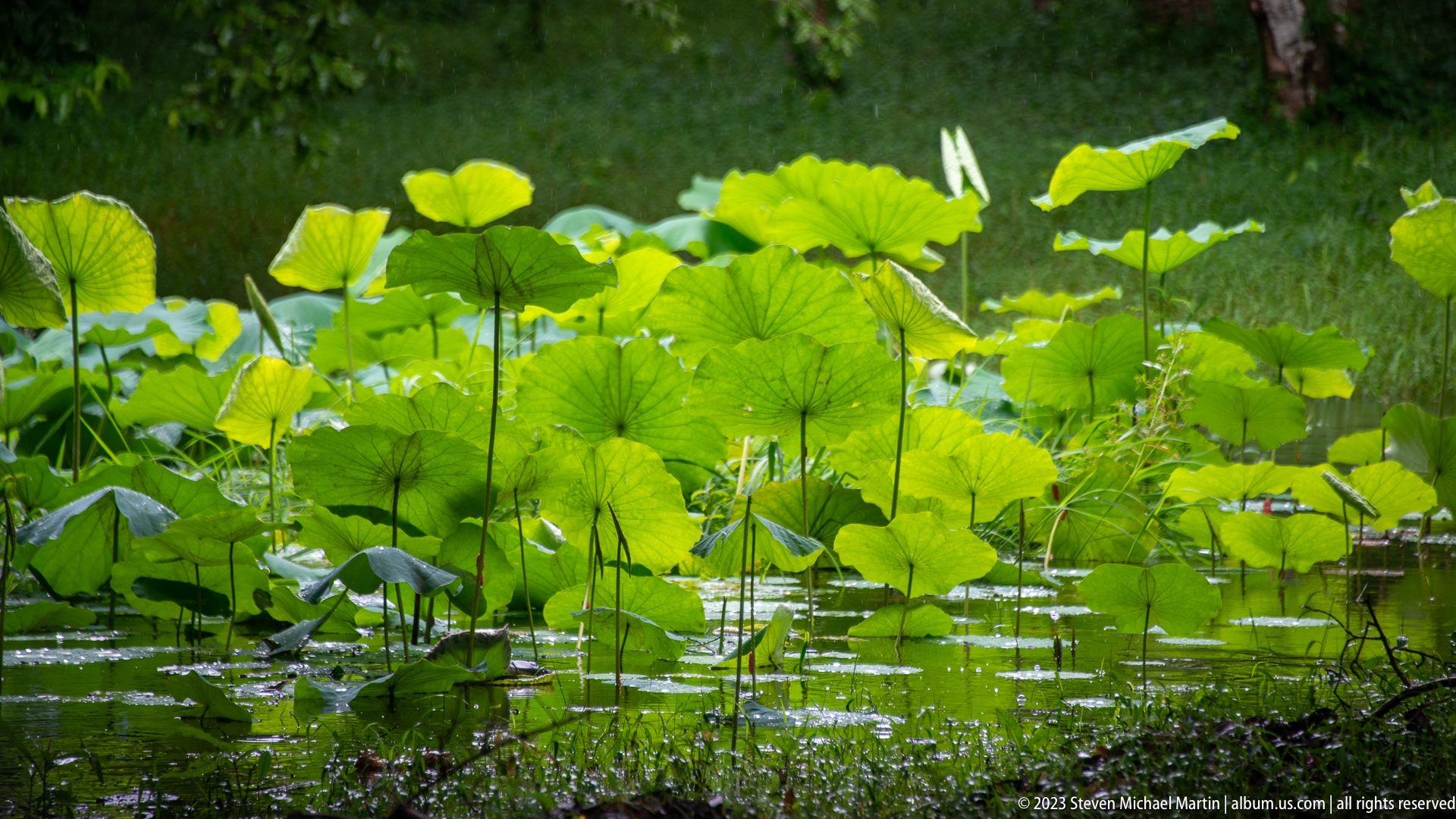
Broad lotus leaves rise from still water in a shallow pond near Beng Mealea, their bright green surfaces catching light against a darker vegetated bank. The image shifts attention from the temple’s stone architecture to the humid lowland environment surrounding the site. Reflections, emergent stems, and overlapping leaves create a layered view of the wetland habitat.
Caption
Broad lotus leaves rise from still water in a shallow pond near Beng Mealea, their bright green surfaces catching light against a darker vegetated bank. The image shifts attention from the temple’s stone architecture to the humid lowland environment surrounding the site. Reflections, emergent stems, and overlapping leaves create a layered view of the wetland habitat.
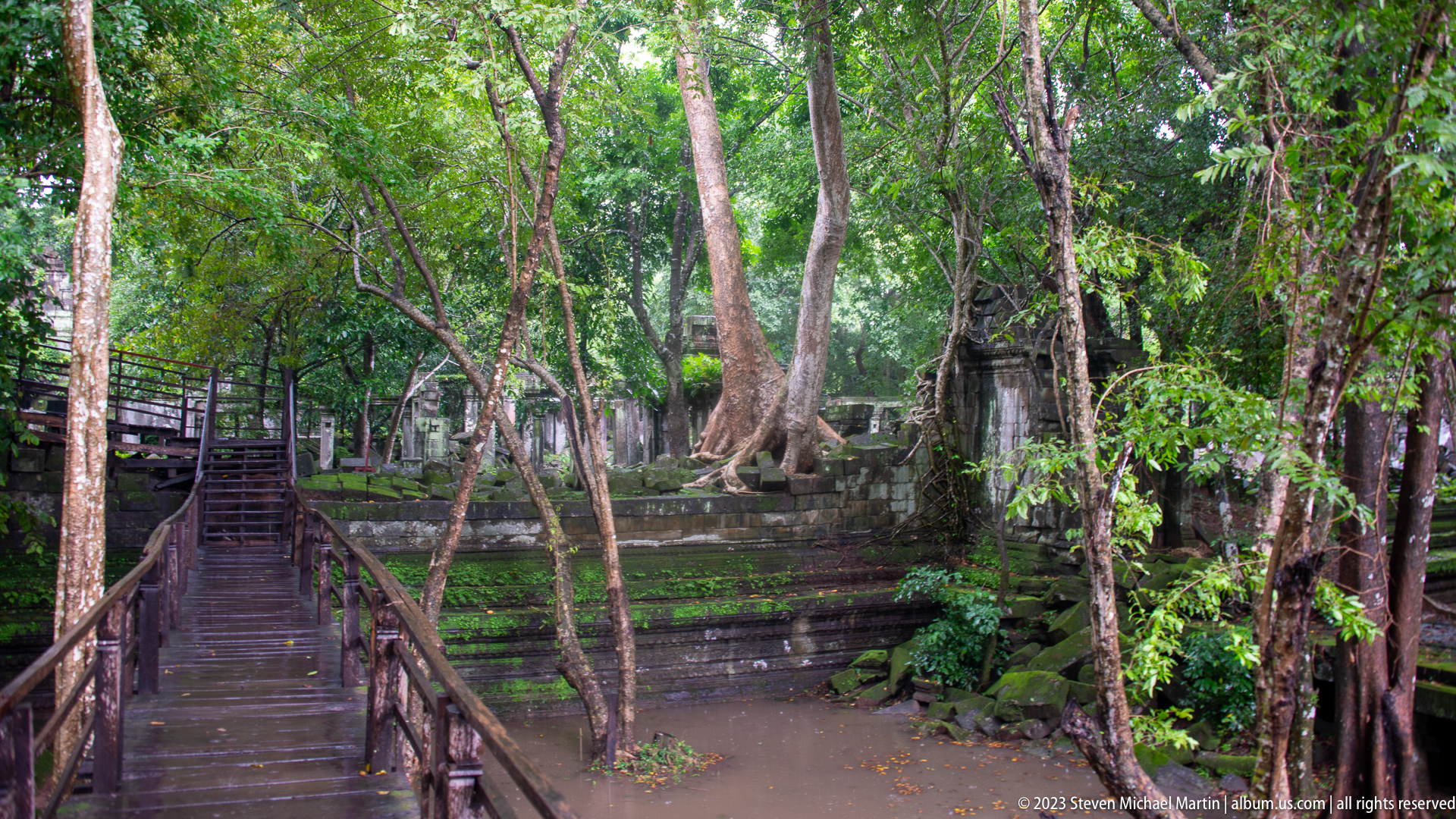
A raised wooden walkway crosses shallow brown water between forested temple remains, guiding visitors through an area where the original stone circulation is flooded or obstructed. The bridge’s narrow linear form contrasts with the irregular trees and masonry beyond. This infrastructure allows access while reducing direct foot traffic across fragile archaeological surfaces.
Caption
A raised wooden walkway crosses shallow brown water between forested temple remains, guiding visitors through an area where the original stone circulation is flooded or obstructed. The bridge’s narrow linear form contrasts with the irregular trees and masonry beyond. This infrastructure allows access while reducing direct foot traffic across fragile archaeological surfaces.
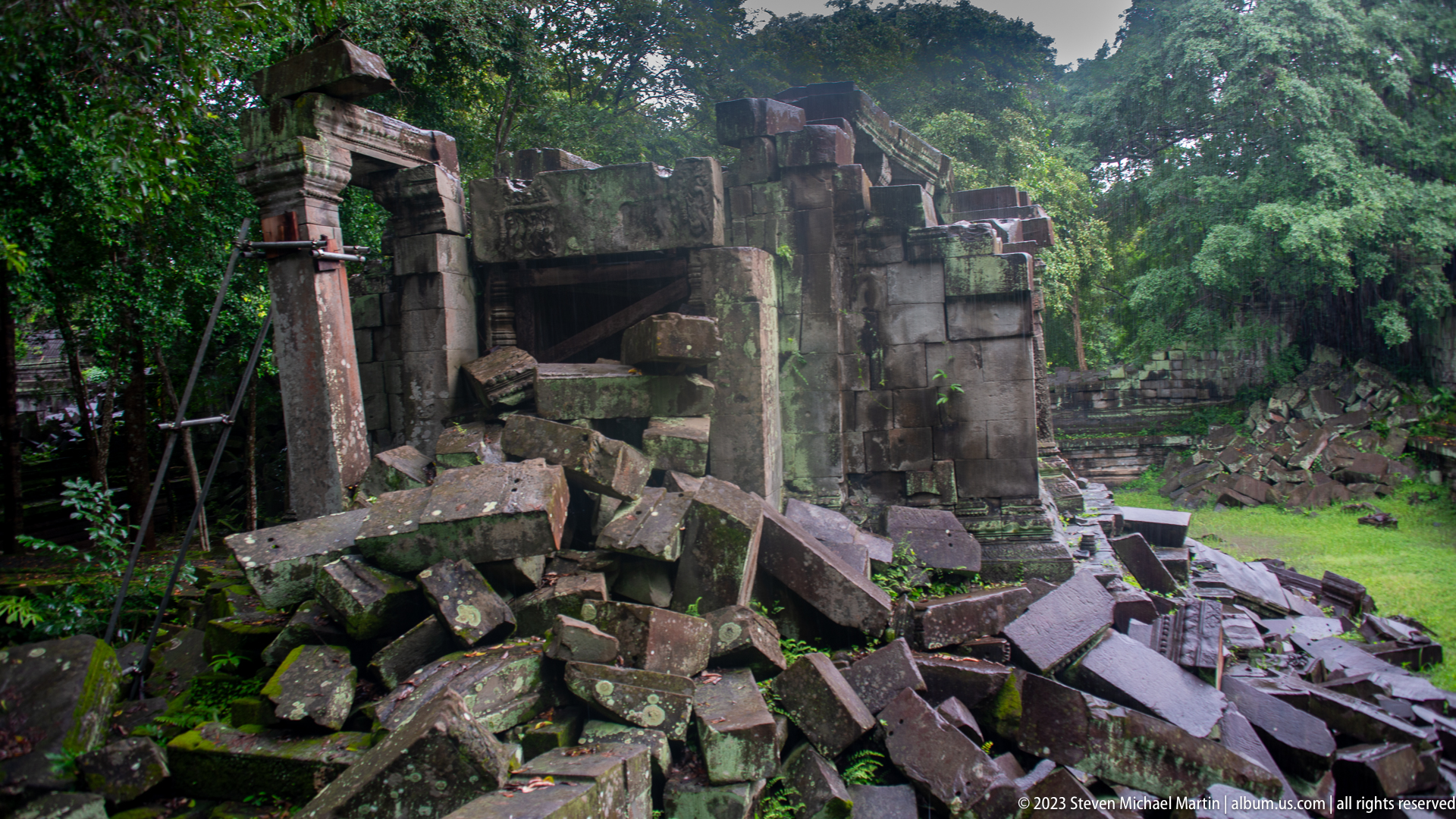
A heavily damaged entrance at Beng Mealea is choked by fallen lintels and wall blocks, while a modern metal support frame braces the surviving masonry at left. The dark opening remains visible behind the debris, preserving the direction of the former passage. This view documents both the severity of structural failure and the practical conservation measures required to keep unstable portions standing.
Caption
A heavily damaged entrance at Beng Mealea is choked by fallen lintels and wall blocks, while a modern metal support frame braces the surviving masonry at left. The dark opening remains visible behind the debris, preserving the direction of the former passage. This view documents both the severity of structural failure and the practical conservation measures required to keep unstable portions standing.

A raised wooden bridge crosses between heavily damaged sandstone structures, passing above collapsed blocks and dense undergrowth. Dark, moisture-streaked walls rise behind the route, showing the depth of the enclosed ruins. The bridge provides controlled access through a space where original floors and passages are no longer safely usable.
Caption
A raised wooden bridge crosses between heavily damaged sandstone structures, passing above collapsed blocks and dense undergrowth. Dark, moisture-streaked walls rise behind the route, showing the depth of the enclosed ruins. The bridge provides controlled access through a space where original floors and passages are no longer safely usable.
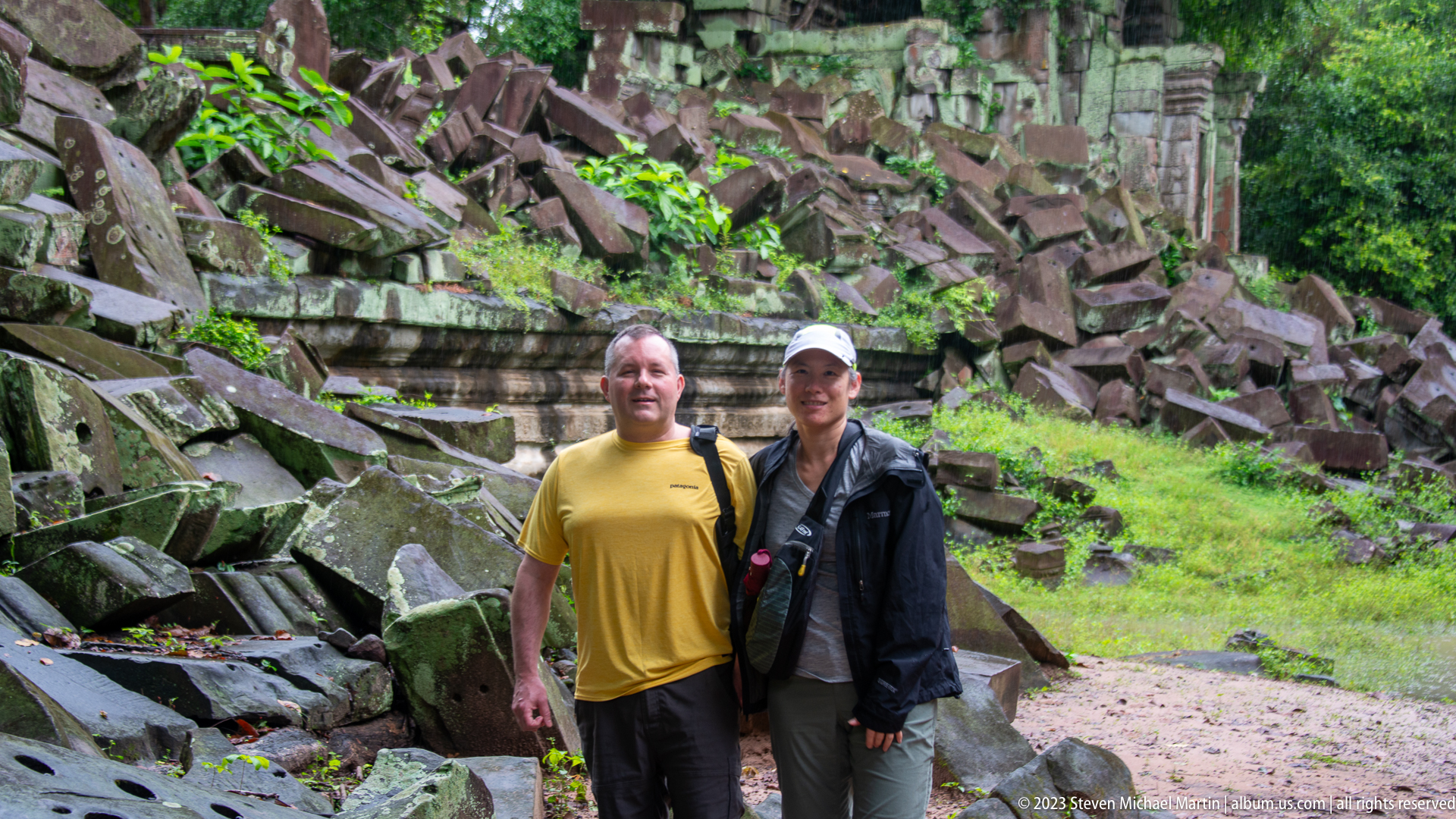
Two visitors stand together before a steep pile of collapsed sandstone blocks and a partially surviving temple wall. Their figures convey the size and depth of the ruin field more effectively than an unpeopled view, while wet ground and dense vegetation suggest the humid conditions of the visit. The photograph functions as both a travel record and an archaeological scale reference.
Caption
Two visitors stand together before a steep pile of collapsed sandstone blocks and a partially surviving temple wall. Their figures convey the size and depth of the ruin field more effectively than an unpeopled view, while wet ground and dense vegetation suggest the humid conditions of the visit. The photograph functions as both a travel record and an archaeological scale reference.
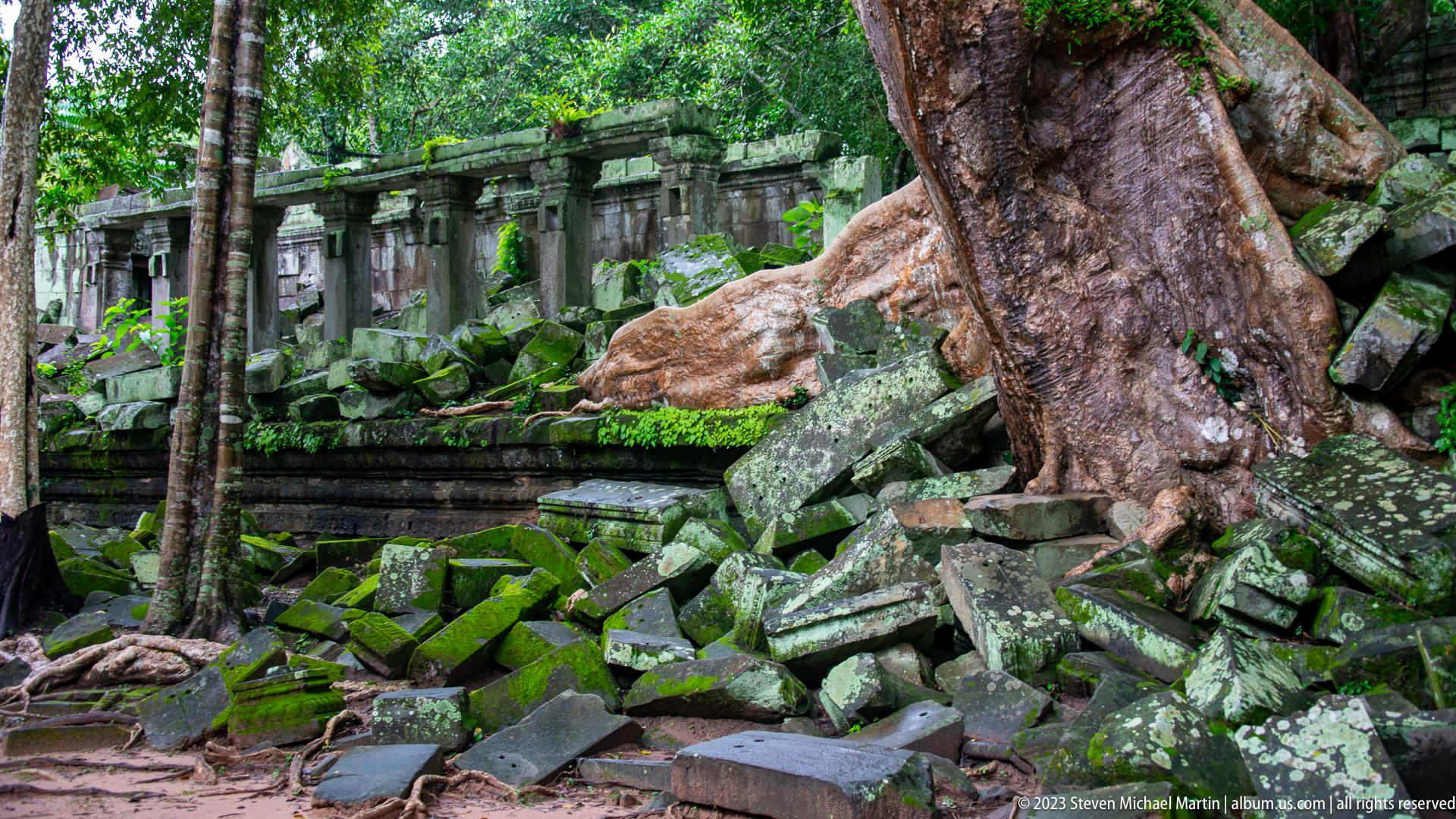
A massive tree trunk and buttress roots dominate this close view, descending into a dense bed of moss-covered architectural blocks. A surviving wall with small openings remains visible behind the tree, but the composition gives priority to the organic structure. The image records how forest growth has become inseparable from the ruined fabric of Beng Mealea.
Caption
A massive tree trunk and buttress roots dominate this close view, descending into a dense bed of moss-covered architectural blocks. A surviving wall with small openings remains visible behind the tree, but the composition gives priority to the organic structure. The image records how forest growth has become inseparable from the ruined fabric of Beng Mealea.
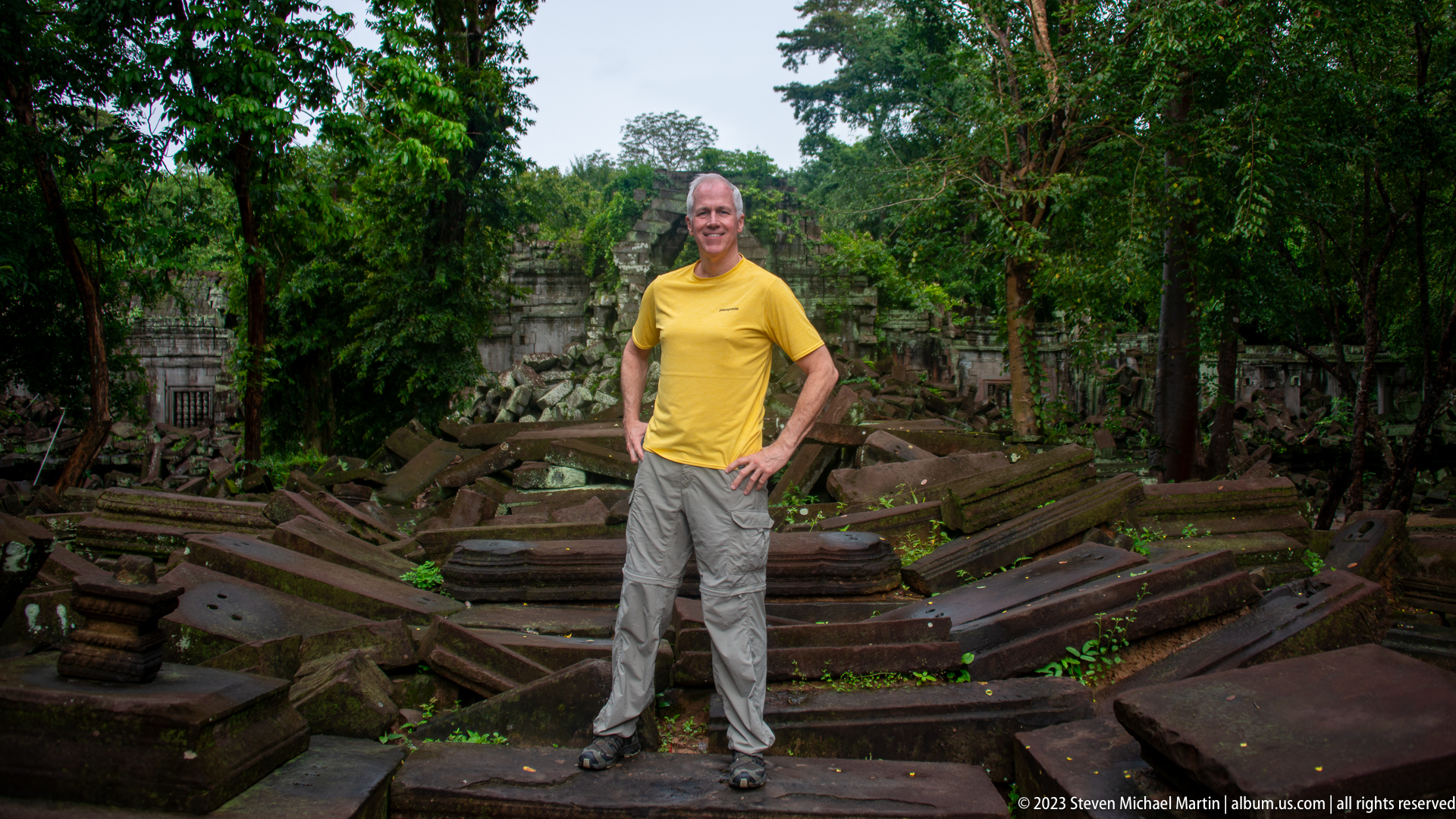
A visitor in a yellow shirt stands amid the collapsed sandstone galleries of Beng Mealea, with a broken gateway visible behind him. His figure provides a direct sense of scale for the massive blocks and the depth of the ruin field. The portrait also records how the site is encountered today: through narrow paths winding among unstable-looking architectural remains and encroaching forest.
Caption
A visitor in a yellow shirt stands amid the collapsed sandstone galleries of Beng Mealea, with a broken gateway visible behind him. His figure provides a direct sense of scale for the massive blocks and the depth of the ruin field. The portrait also records how the site is encountered today: through narrow paths winding among unstable-looking architectural remains and encroaching forest.
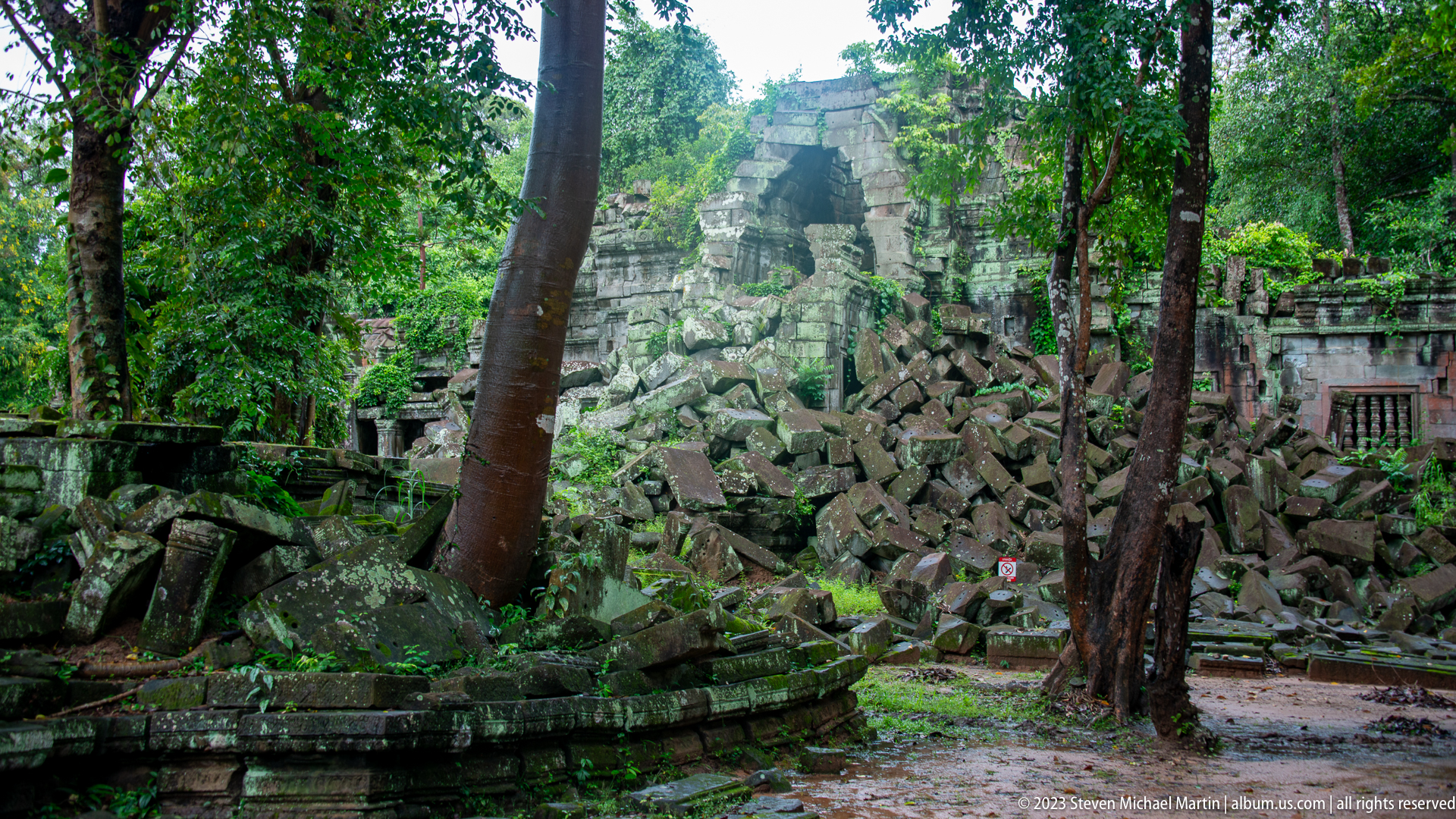
Trees frame a collapsed section of Beng Mealea in which a surviving gateway rises above a broad tumble of sandstone. The lower foreground preserves traces of a circular or curved architectural element, while the background wall and opening show how individual structures remain partially legible within the ruin field. Moss and vegetation soften the boundaries between architecture and forest.
Caption
Trees frame a collapsed section of Beng Mealea in which a surviving gateway rises above a broad tumble of sandstone. The lower foreground preserves traces of a circular or curved architectural element, while the background wall and opening show how individual structures remain partially legible within the ruin field. Moss and vegetation soften the boundaries between architecture and forest.
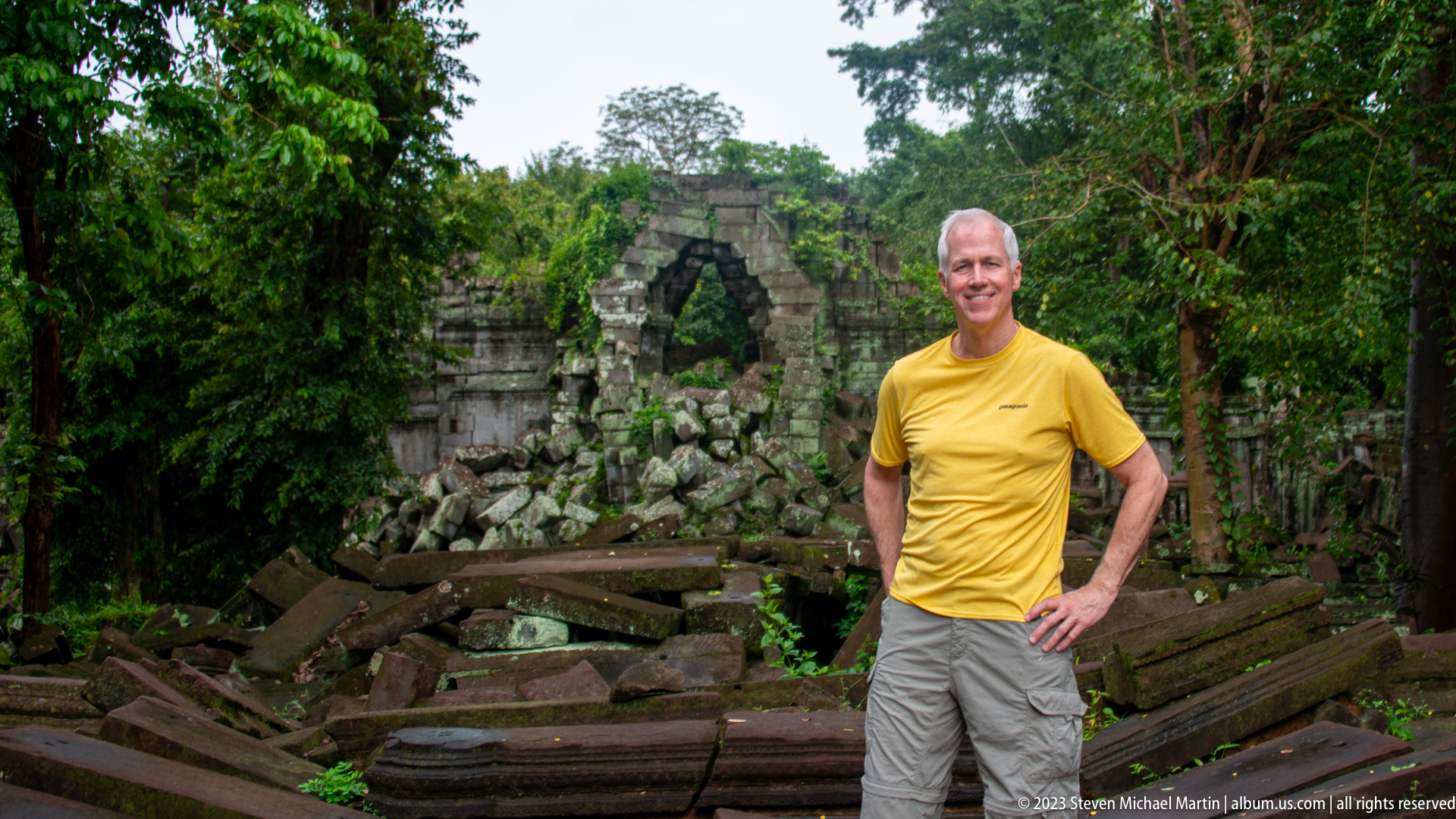
Framed more tightly against the ruins, a visitor stands before Beng Mealea’s broken gateway while long sandstone beams and wall blocks angle across the foreground. The composition emphasizes the contrast between the upright human figure and the disordered architectural mass, turning the portrait into a concise record of the temple’s monumental scale and heavily collapsed condition.
Caption
Framed more tightly against the ruins, a visitor stands before Beng Mealea’s broken gateway while long sandstone beams and wall blocks angle across the foreground. The composition emphasizes the contrast between the upright human figure and the disordered architectural mass, turning the portrait into a concise record of the temple’s monumental scale and heavily collapsed condition.
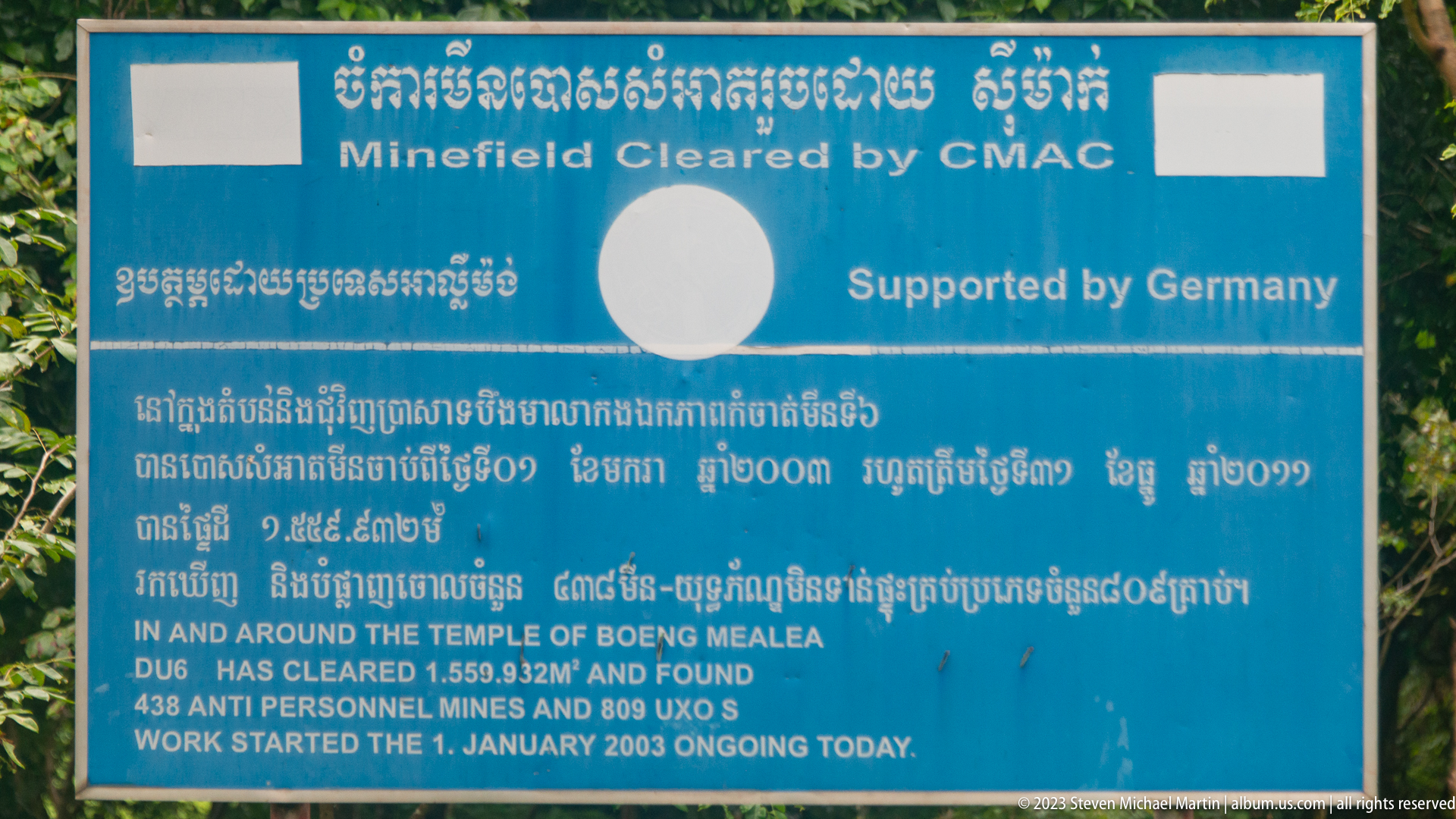
A CMAC information board at the entrance to Beng Mealea records the clearance of landmines and unexploded ordnance in and around the temple. The Khmer and English text notes support from Germany and identifies the area treated by clearance teams, placing the archaeological visit within Cambodia’s continuing work to make historic landscapes safe after decades of conflict.
Caption
A CMAC information board at the entrance to Beng Mealea records the clearance of landmines and unexploded ordnance in and around the temple. The Khmer and English text notes support from Germany and identifies the area treated by clearance teams, placing the archaeological visit within Cambodia’s continuing work to make historic landscapes safe after decades of conflict.
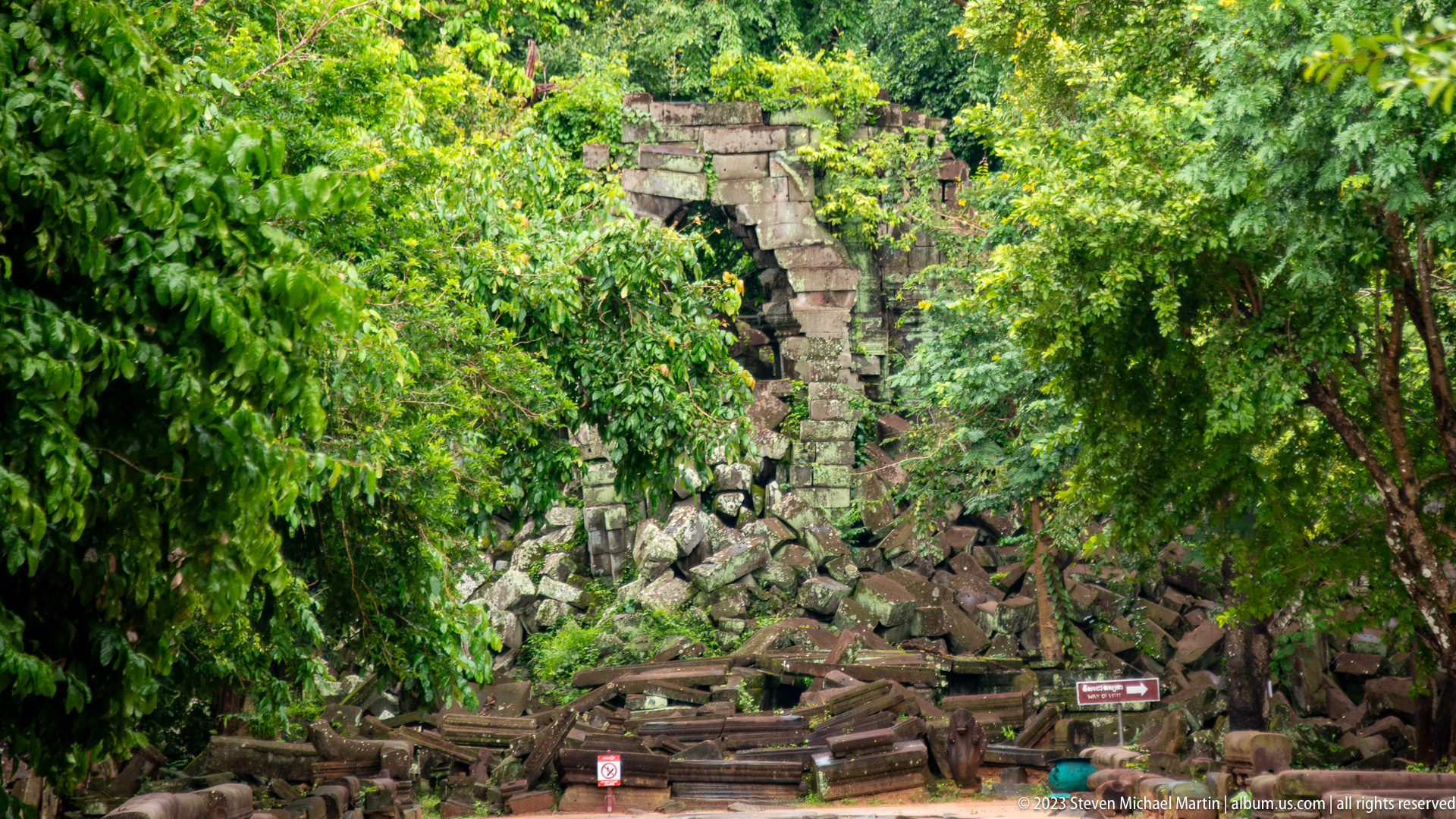
A partially standing gateway rises behind a field of fallen sandstone blocks at Beng Mealea. The pointed opening preserves the line of a former passage, while dislodged lintels, wall stones, and architectural fragments fill the foreground. This view makes the temple’s structural collapse legible as both an archaeological condition and a defining part of the visitor’s experience.
Caption
A partially standing gateway rises behind a field of fallen sandstone blocks at Beng Mealea. The pointed opening preserves the line of a former passage, while dislodged lintels, wall stones, and architectural fragments fill the foreground. This view makes the temple’s structural collapse legible as both an archaeological condition and a defining part of the visitor’s experience.

A monumental naga terminal displays seven fanned cobra hoods above the serpent’s projecting body. Finely patterned scales, radiating hood ornament, and the weathered central faces preserve the ceremonial force of this Khmer architectural sculpture. Positioned along the temple approach, such naga balustrades symbolically framed movement between the outer landscape and the sacred precinct.
Caption
A monumental naga terminal displays seven fanned cobra hoods above the serpent’s projecting body. Finely patterned scales, radiating hood ornament, and the weathered central faces preserve the ceremonial force of this Khmer architectural sculpture. Positioned along the temple approach, such naga balustrades symbolically framed movement between the outer landscape and the sacred precinct.
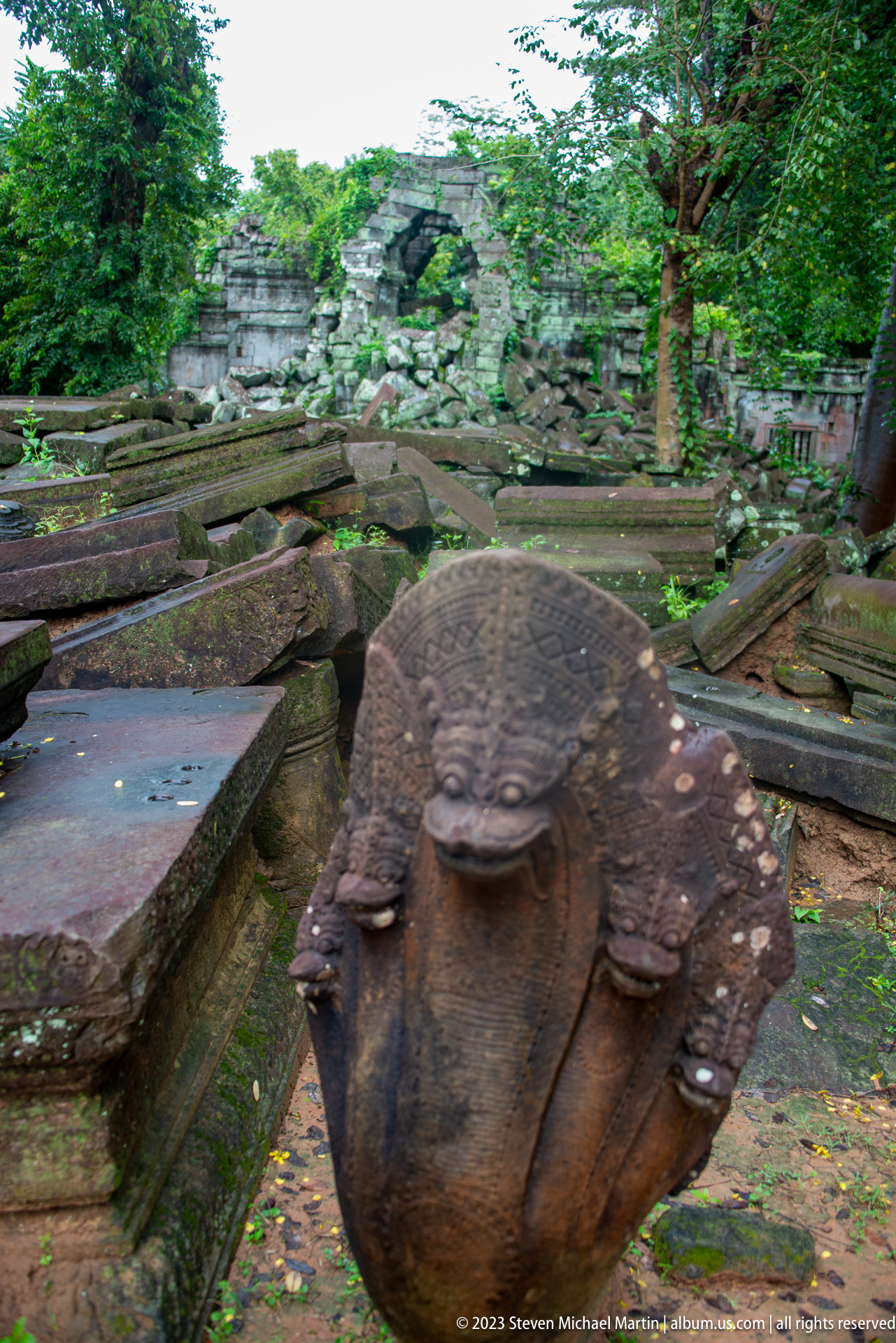
A weathered multi-headed naga rises from the foreground while long fallen sandstone members recede toward the ruined temple. Seen from a lower angle than the earlier frontal view, the sculpture’s broad hood and projecting body stand out against the chaotic masonry. The image links ceremonial ornament directly with the collapse that now defines much of Beng Mealea.
Caption
A weathered multi-headed naga rises from the foreground while long fallen sandstone members recede toward the ruined temple. Seen from a lower angle than the earlier frontal view, the sculpture’s broad hood and projecting body stand out against the chaotic masonry. The image links ceremonial ornament directly with the collapse that now defines much of Beng Mealea.
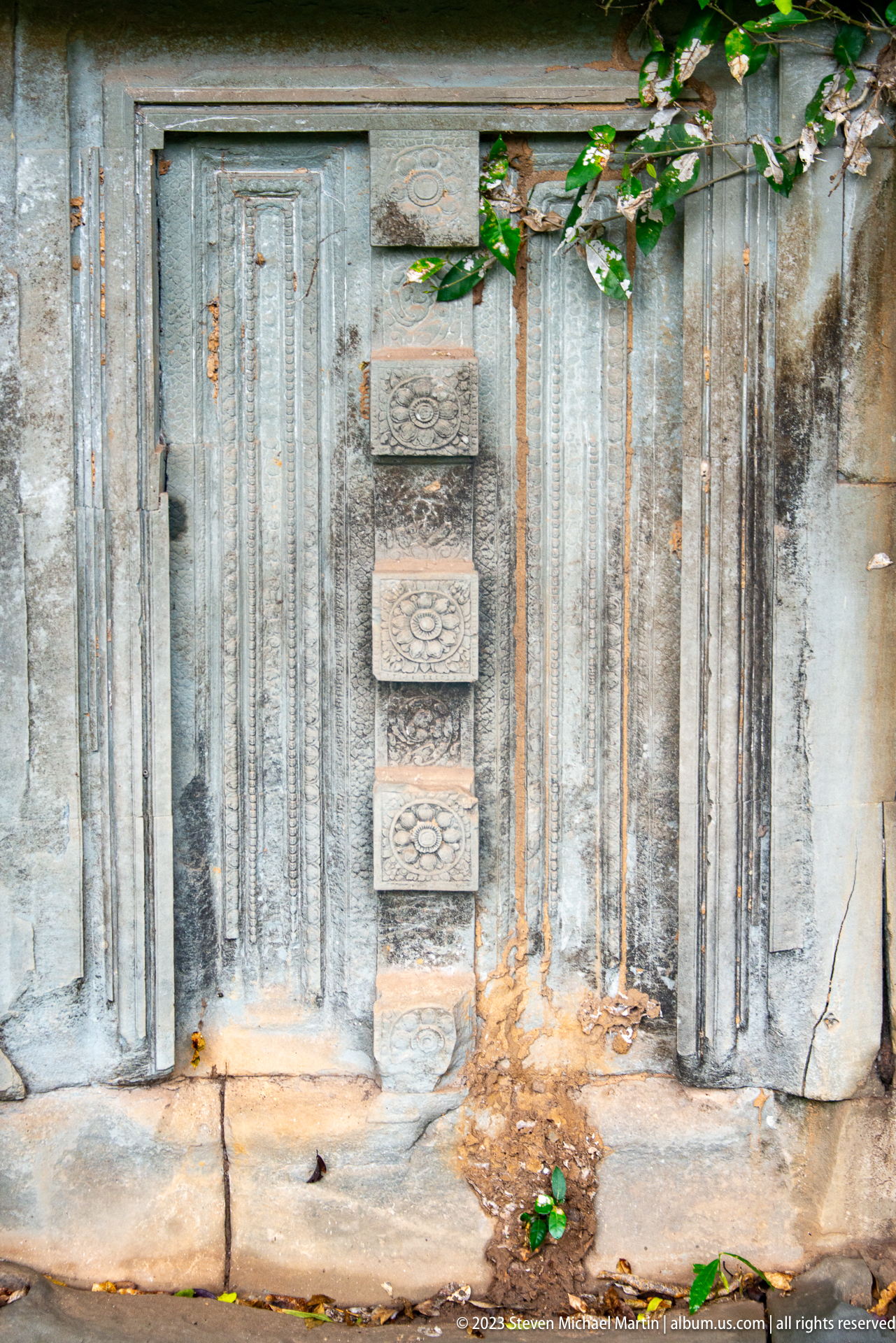
A close architectural study records the lower portion of a sandstone wall articulated by slender colonnettes, recessed vertical panels, and small floral medallions. The alternating projections and grooves create a strong rhythm despite staining and localized damage. Such details reveal the precision of Beng Mealea’s masonry and the decorative care applied even to relatively low wall zones.
Caption
A close architectural study records the lower portion of a sandstone wall articulated by slender colonnettes, recessed vertical panels, and small floral medallions. The alternating projections and grooves create a strong rhythm despite staining and localized damage. Such details reveal the precision of Beng Mealea’s masonry and the decorative care applied even to relatively low wall zones.
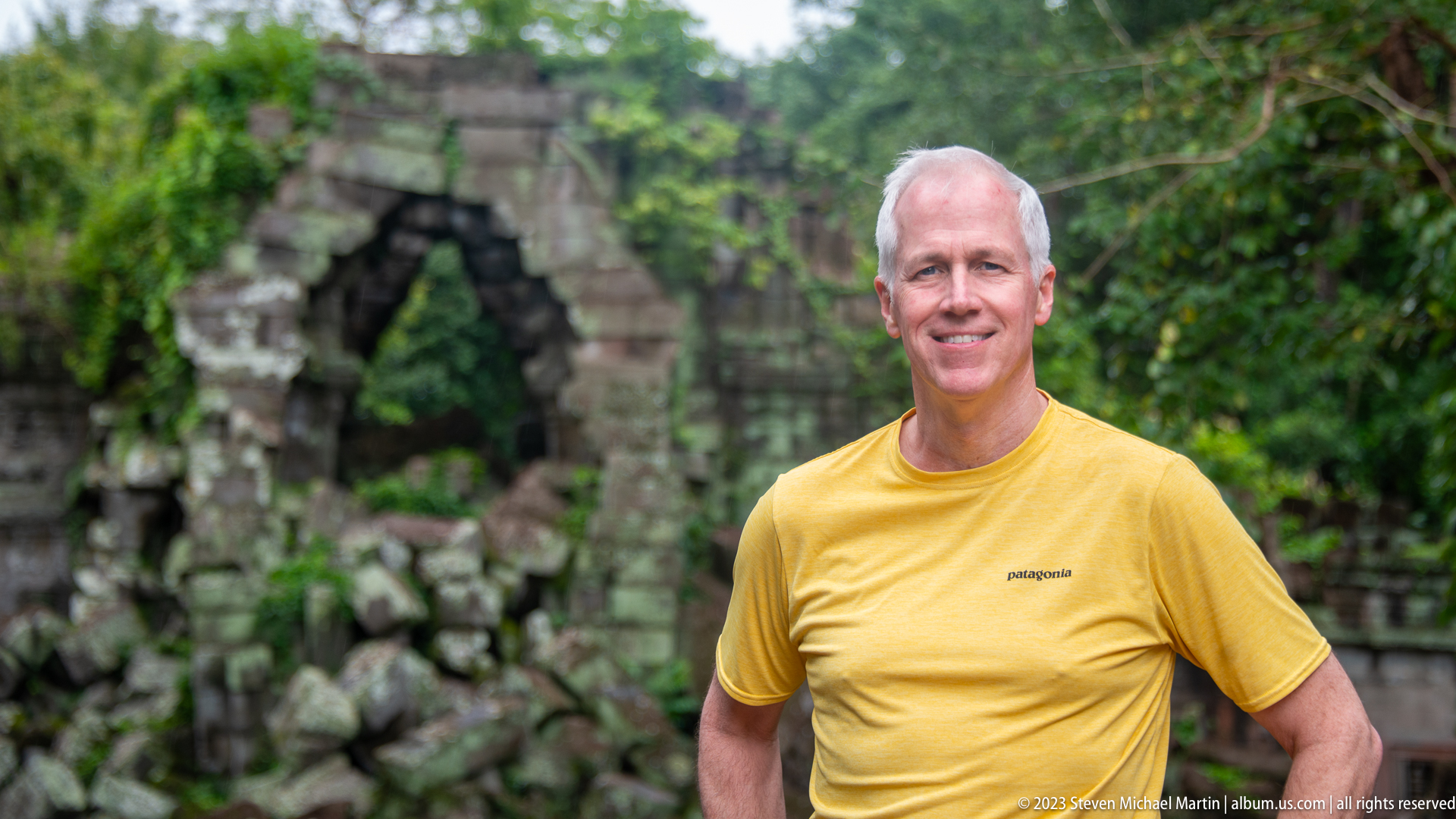
A waist-up portrait isolates the visitor against a softly focused gateway and collapsed stones at Beng Mealea. The shallow depth of field separates the person from the archaeological setting while retaining enough of the pointed opening and rubble to anchor the image in place. This is primarily a travel portrait rather than an architectural record.
Caption
A waist-up portrait isolates the visitor against a softly focused gateway and collapsed stones at Beng Mealea. The shallow depth of field separates the person from the archaeological setting while retaining enough of the pointed opening and rubble to anchor the image in place. This is primarily a travel portrait rather than an architectural record.
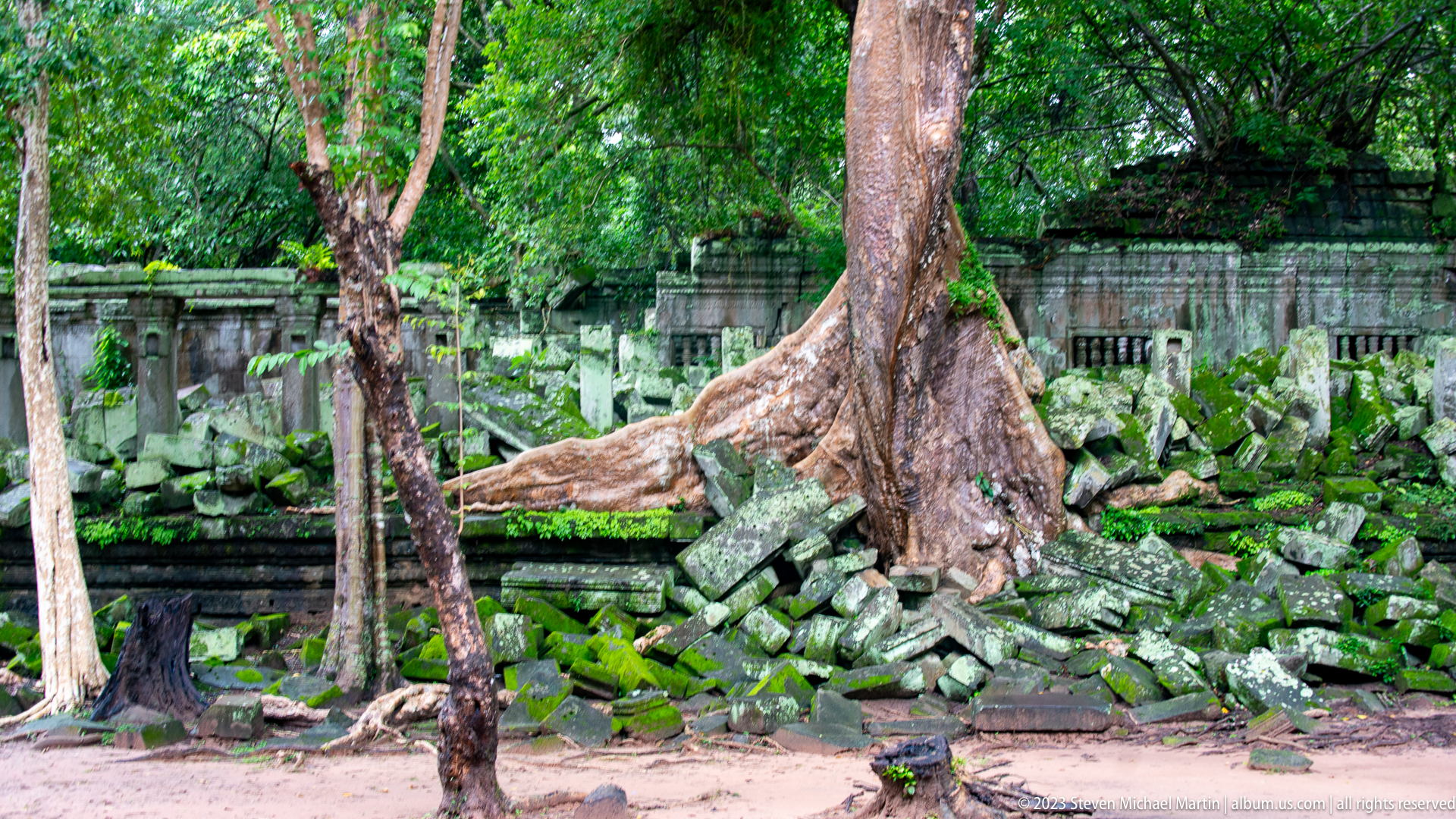
A mature tree spreads exposed roots over collapsed sandstone beside a surviving temple wall. The roots grip and cross displaced blocks rather than merely growing behind them, making the physical interaction between vegetation and architecture especially clear. At Beng Mealea, this long process of biological growth contributes both to the site’s visual character and to the continuing displacement of masonry.
Caption
A mature tree spreads exposed roots over collapsed sandstone beside a surviving temple wall. The roots grip and cross displaced blocks rather than merely growing behind them, making the physical interaction between vegetation and architecture especially clear. At Beng Mealea, this long process of biological growth contributes both to the site’s visual character and to the continuing displacement of masonry.
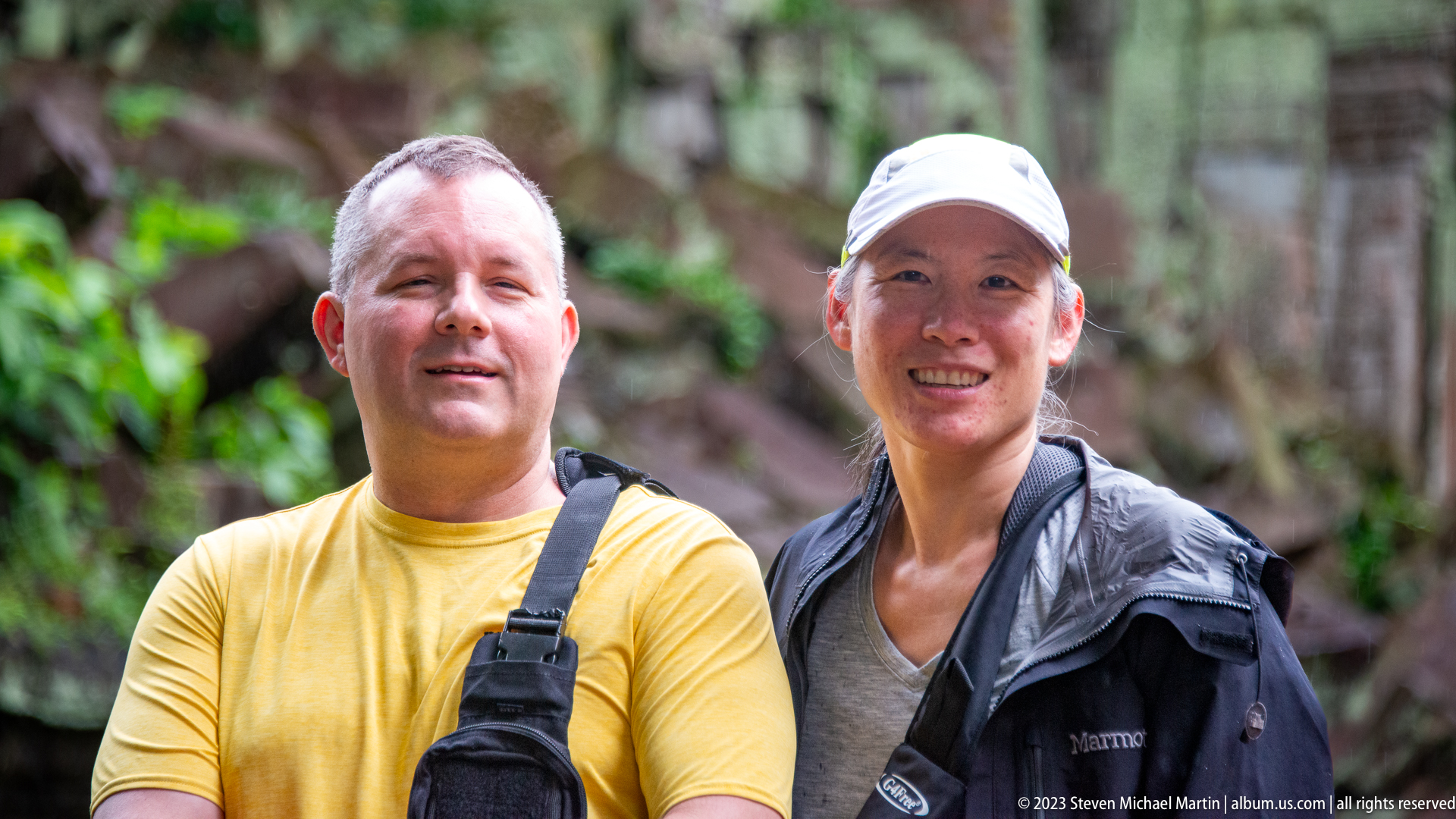
A close portrait brings two visitors forward against a softly blurred background of greenery and temple stone. The framing removes most architectural detail and emphasizes expression, clothing, and companionship, while the muted ruin setting remains just legible enough to preserve the location. This image serves as a personal travel record rather than a site-documentation view.
Caption
A close portrait brings two visitors forward against a softly blurred background of greenery and temple stone. The framing removes most architectural detail and emphasizes expression, clothing, and companionship, while the muted ruin setting remains just legible enough to preserve the location. This image serves as a personal travel record rather than a site-documentation view.
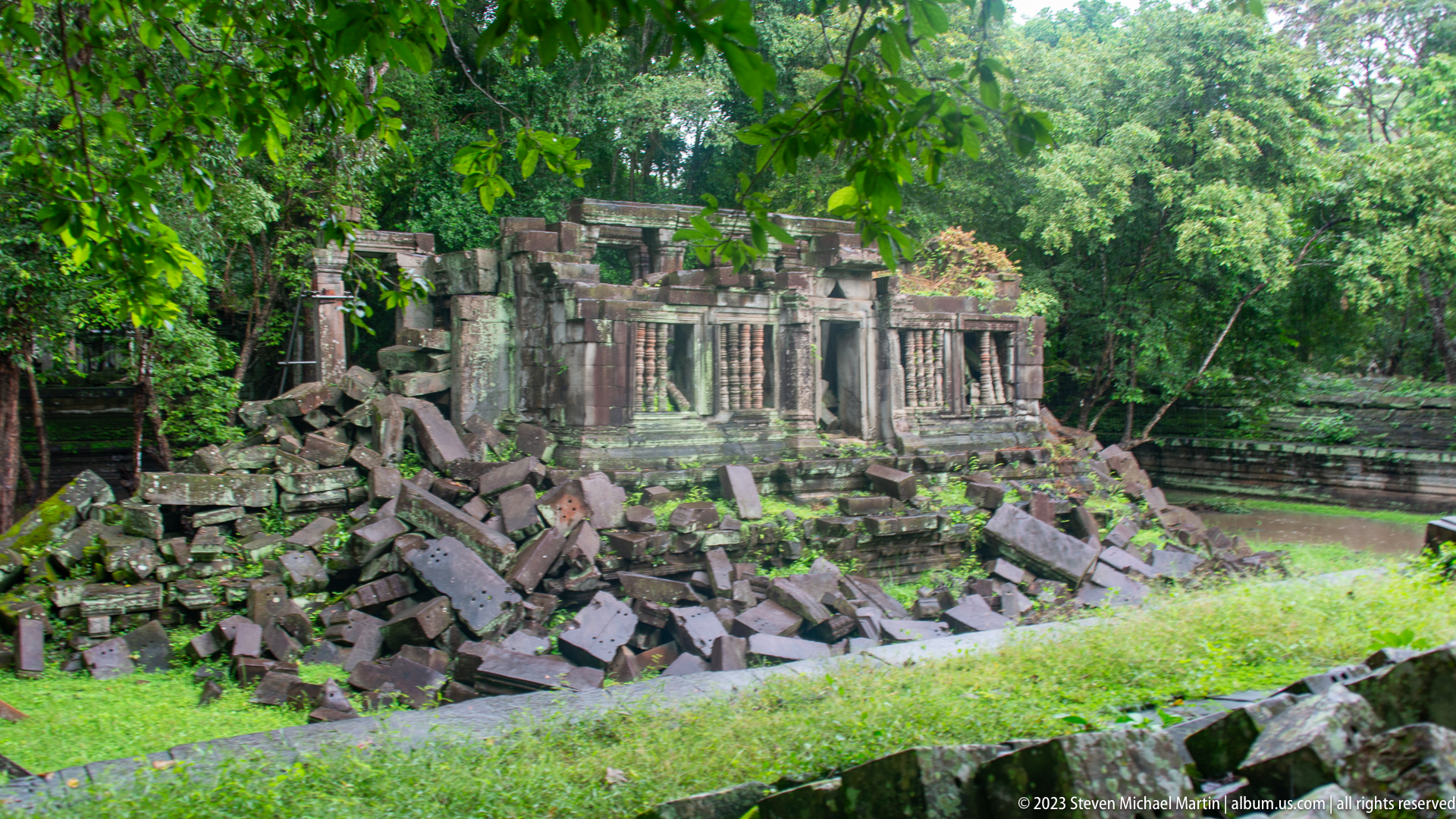
A rectangular temple structure survives with portions of its walls, doorways, and narrow window openings still upright, while a large mass of fallen sandstone has accumulated around its base. The oblique view reveals the building’s compact plan and repetitive wall articulation. Its exact function is uncertain from the image alone, but it is likely one of Beng Mealea’s subsidiary gallery or library buildings.
Caption
A rectangular temple structure survives with portions of its walls, doorways, and narrow window openings still upright, while a large mass of fallen sandstone has accumulated around its base. The oblique view reveals the building’s compact plan and repetitive wall articulation. Its exact function is uncertain from the image alone, but it is likely one of Beng Mealea’s subsidiary gallery or library buildings.
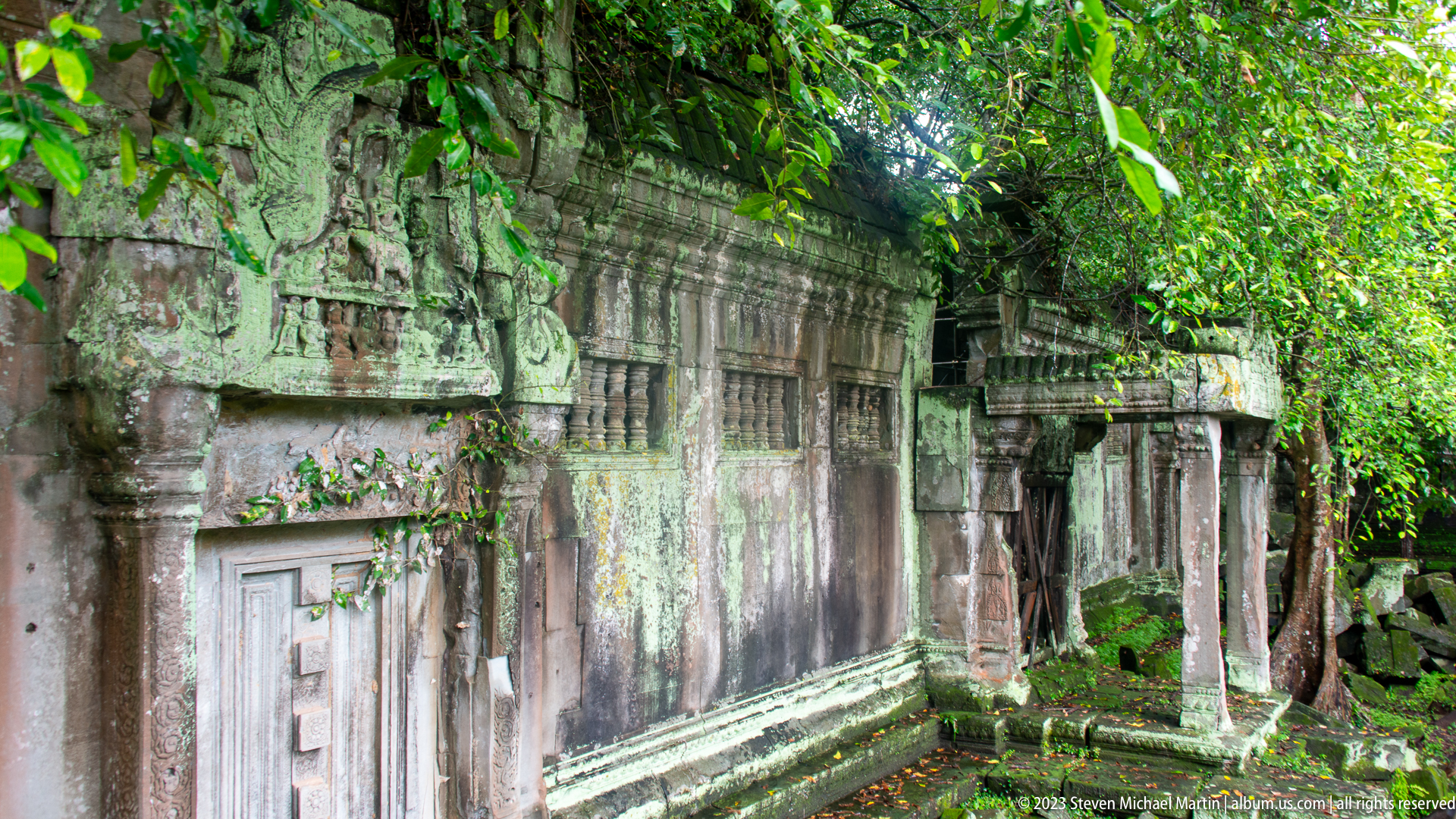
A long exterior wall at Beng Mealea is articulated by shallow pilasters, recessed panels, and multiple openings, with a small projecting porch marking one entrance. Moisture staining, moss, and overhanging foliage animate the otherwise regular architectural rhythm. The oblique viewpoint is especially useful for showing how the façade continues through space rather than presenting it as a flat elevation.
Caption
A long exterior wall at Beng Mealea is articulated by shallow pilasters, recessed panels, and multiple openings, with a small projecting porch marking one entrance. Moisture staining, moss, and overhanging foliage animate the otherwise regular architectural rhythm. The oblique viewpoint is especially useful for showing how the façade continues through space rather than presenting it as a flat elevation.
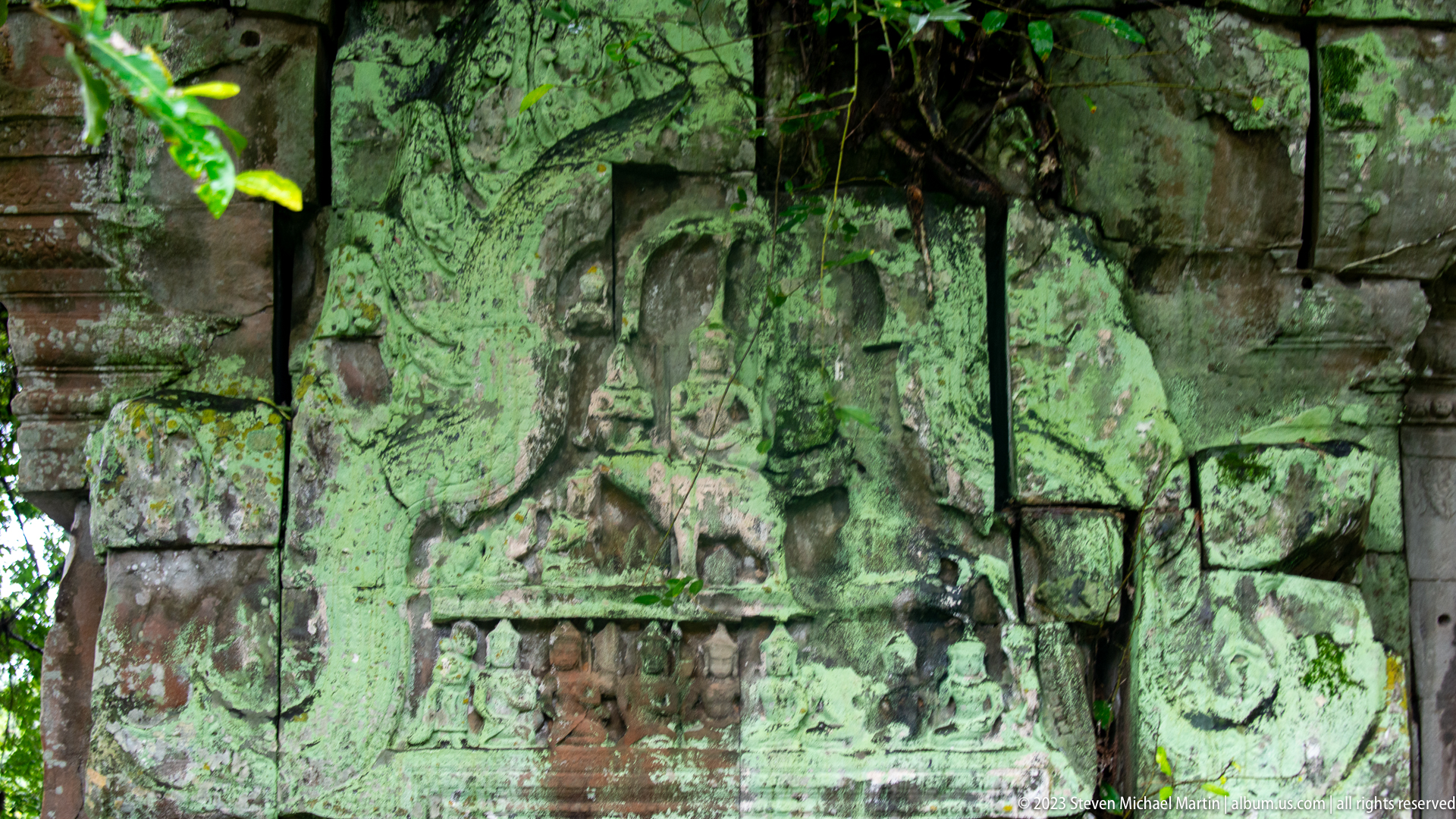
A standing female divinity emerges from a heavily weathered and lichen-covered sandstone panel. The figure’s headdress, narrow waist, jewelry, and frontal pose remain visible despite surface loss and biological growth. The close view demonstrates how carved imagery survives unevenly at Beng Mealea, with iconographic details still readable even where the surrounding stone has darkened and softened.
Caption
A standing female divinity emerges from a heavily weathered and lichen-covered sandstone panel. The figure’s headdress, narrow waist, jewelry, and frontal pose remain visible despite surface loss and biological growth. The close view demonstrates how carved imagery survives unevenly at Beng Mealea, with iconographic details still readable even where the surrounding stone has darkened and softened.
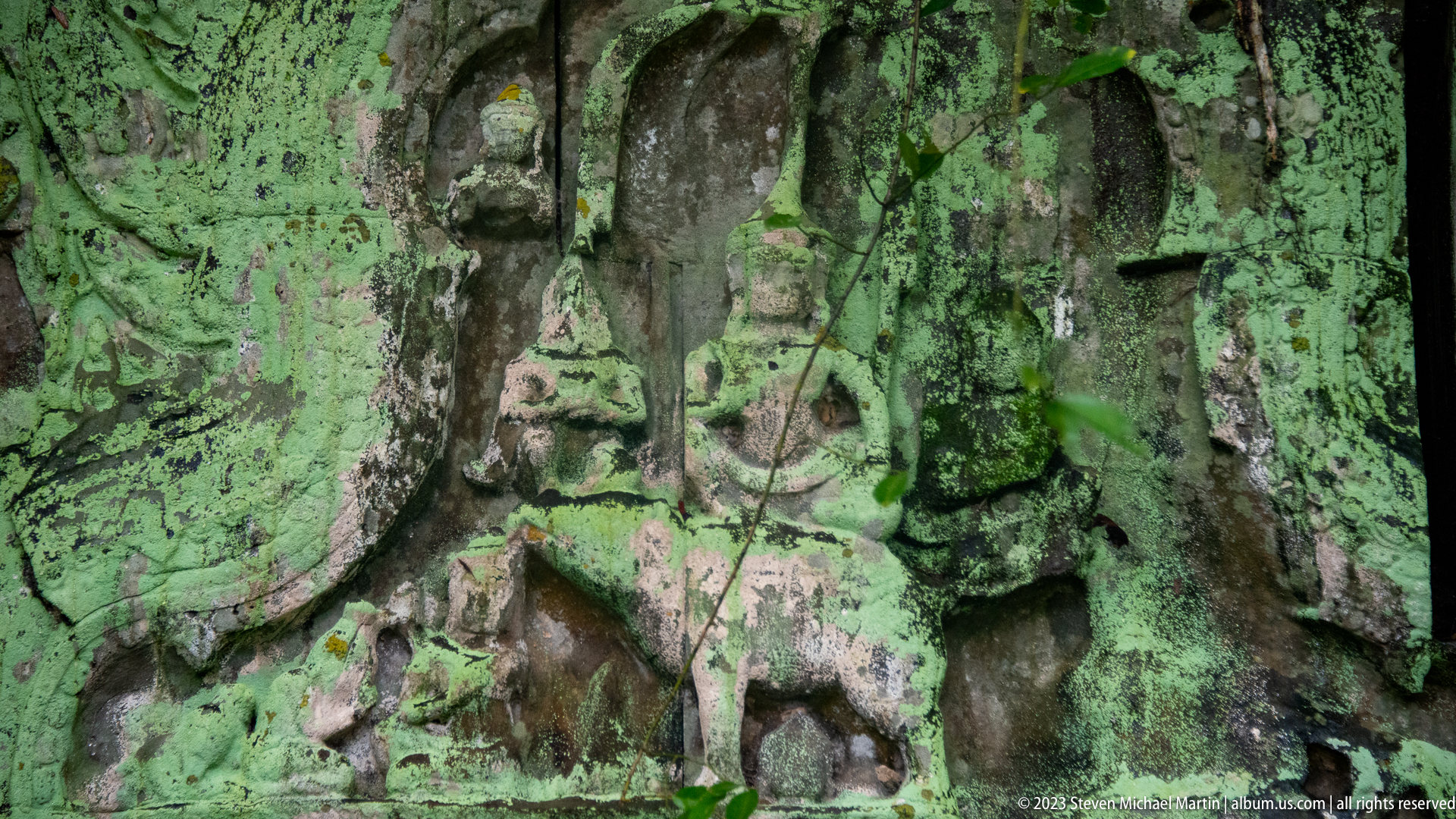
This closer detail isolates a standing female divinity whose face, torso, and ornaments are partly obscured by lichen and erosion. The surviving outline remains legible, but the softened features show the cumulative effects of moisture and biological colonization on Beng Mealea’s sandstone sculpture. The image is particularly valuable as a condition record rather than as a complete iconographic study.
Caption
This closer detail isolates a standing female divinity whose face, torso, and ornaments are partly obscured by lichen and erosion. The surviving outline remains legible, but the softened features show the cumulative effects of moisture and biological colonization on Beng Mealea’s sandstone sculpture. The image is particularly valuable as a condition record rather than as a complete iconographic study.

Five turned sandstone balusters fill a rectangular window opening, each carved with stacked rings and swelling profiles. The surrounding frame retains layers of molding, while lichen and pale mineral staining record long exposure to moisture. This close view highlights one of the most characteristic components of Khmer temple architecture: stone members carved to imitate the form and rhythm of turned wooden elements.
Caption
Five turned sandstone balusters fill a rectangular window opening, each carved with stacked rings and swelling profiles. The surrounding frame retains layers of molding, while lichen and pale mineral staining record long exposure to moisture. This close view highlights one of the most characteristic components of Khmer temple architecture: stone members carved to imitate the form and rhythm of turned wooden elements.
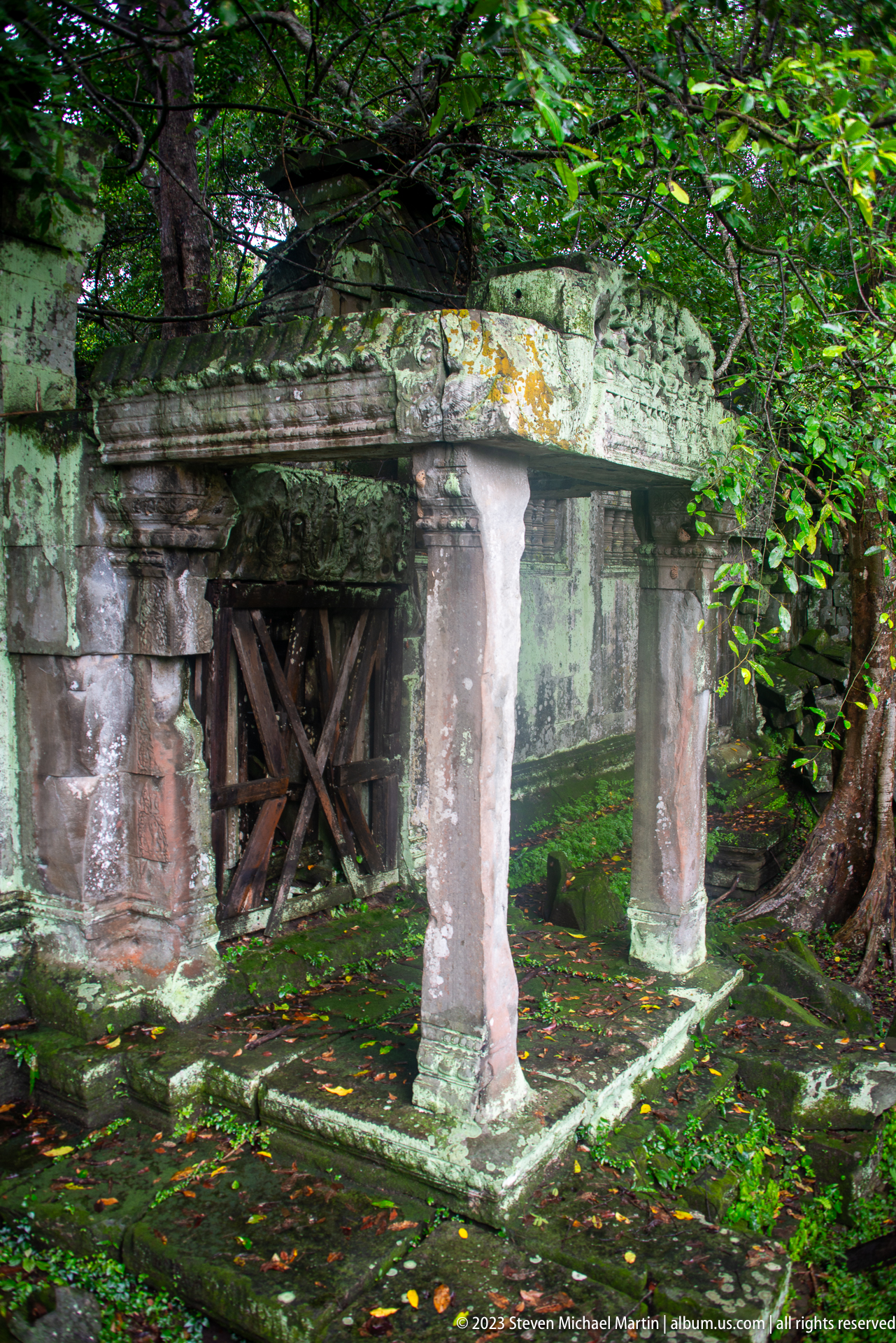
A low sandstone porch or pavilion stands beneath dense foliage, its roof slab supported by four square posts. Timber bracing visible within the opening suggests modern stabilization or access control, while moss and staining mark prolonged exposure to the forest environment. The exact architectural function is not certain from this isolated view, but the structure forms part of Beng Mealea’s subsidiary circulation system.
Caption
A low sandstone porch or pavilion stands beneath dense foliage, its roof slab supported by four square posts. Timber bracing visible within the opening suggests modern stabilization or access control, while moss and staining mark prolonged exposure to the forest environment. The exact architectural function is not certain from this isolated view, but the structure forms part of Beng Mealea’s subsidiary circulation system.
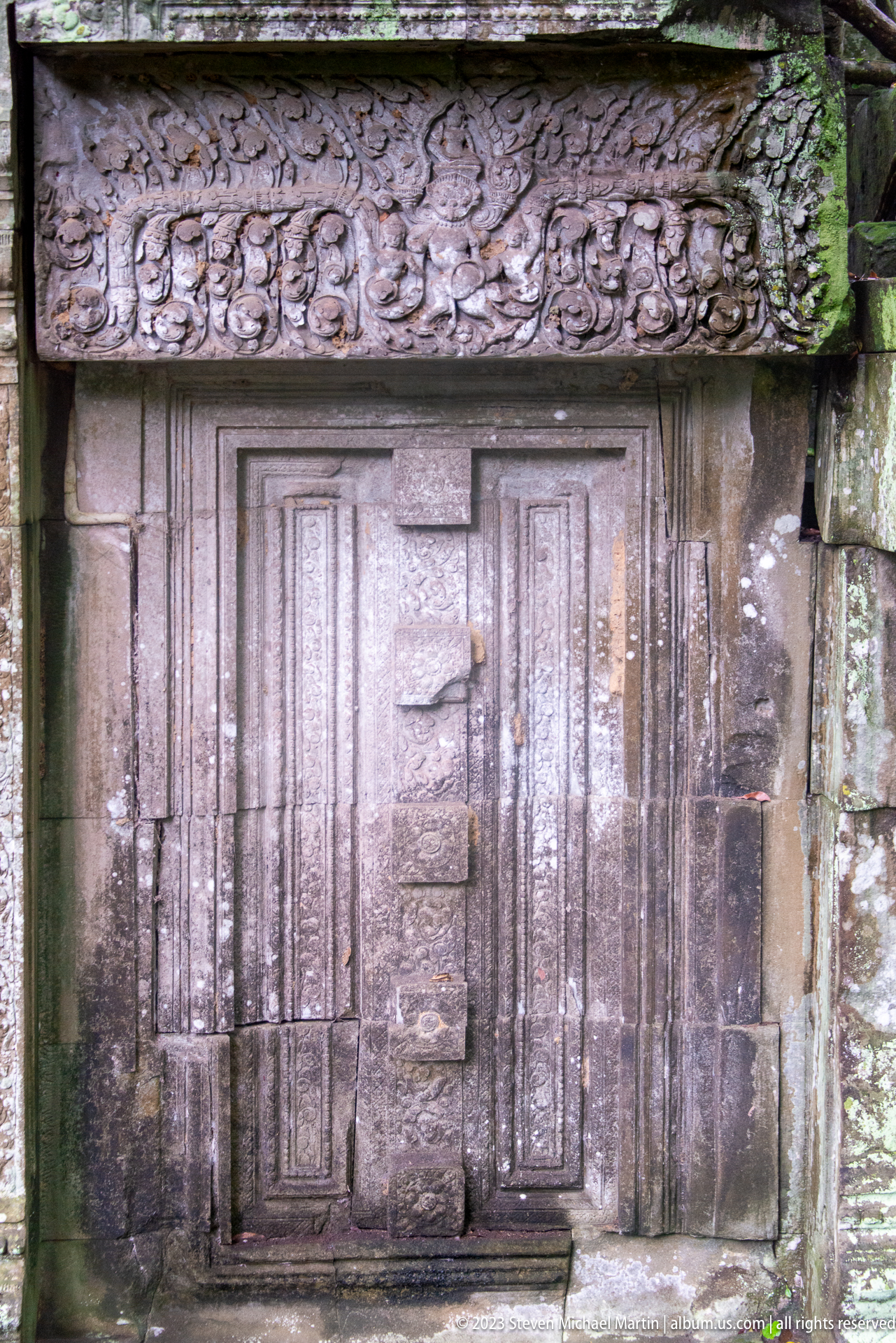
A sandstone false door is composed of deeply recessed, stepped panels that imitate a functional doorway while remaining closed. Above it, a richly carved lintel carries dense vegetal ornament across the threshold zone. The contrast between geometric door moldings and fluid foliage demonstrates the careful coordination of structural simulation and decorative carving in Khmer temple design.
Caption
A sandstone false door is composed of deeply recessed, stepped panels that imitate a functional doorway while remaining closed. Above it, a richly carved lintel carries dense vegetal ornament across the threshold zone. The contrast between geometric door moldings and fluid foliage demonstrates the careful coordination of structural simulation and decorative carving in Khmer temple design.
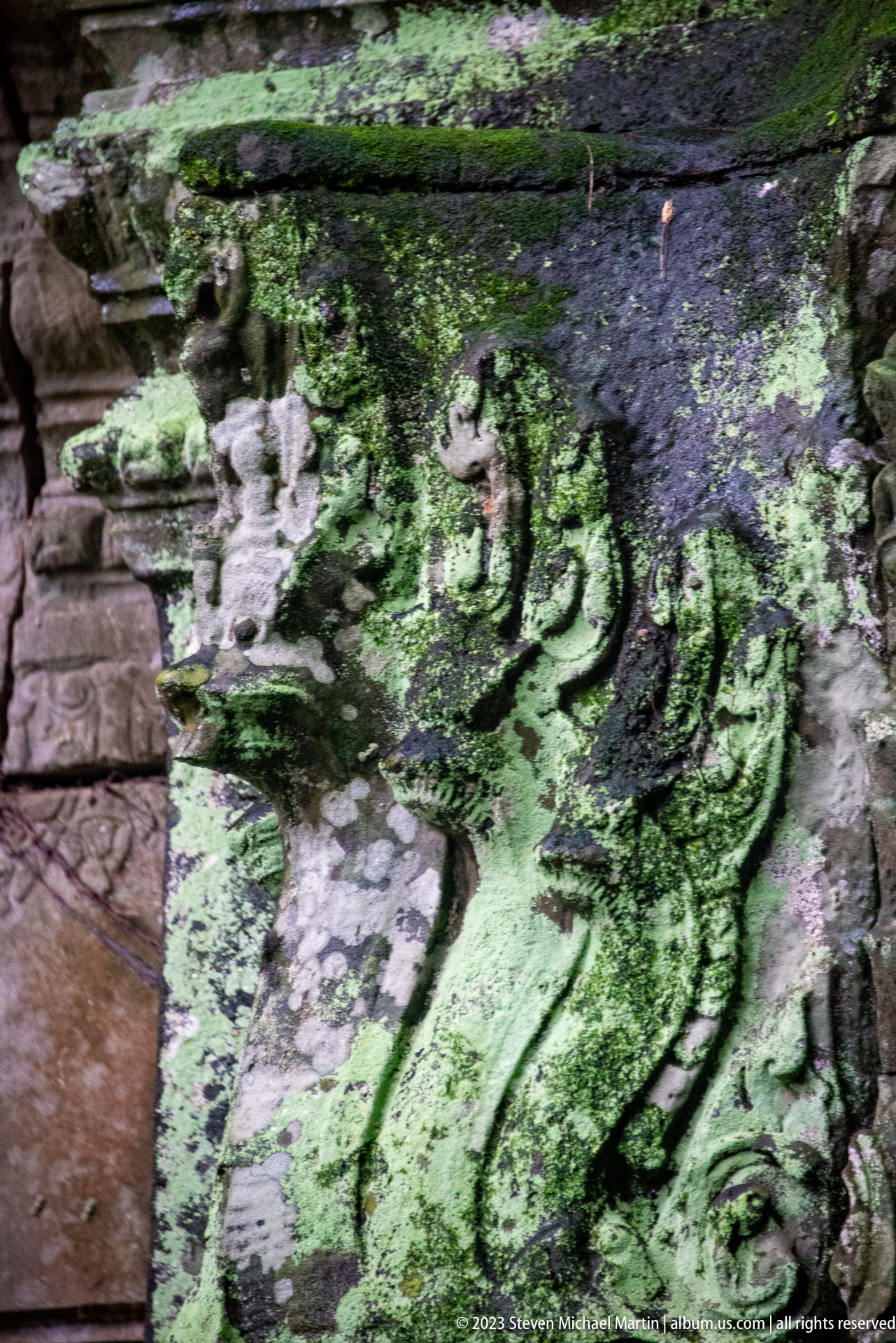
A standing carved figure with an elaborate headdress occupies the center of this weathered sandstone block. Lichen, shadow, and surface loss obscure the face and lower body, while surrounding scrollwork remains visible along the edges. The tight crop emphasizes texture and condition, but the iconographic identity cannot be assigned confidently from the surviving details shown here.
Caption
A standing carved figure with an elaborate headdress occupies the center of this weathered sandstone block. Lichen, shadow, and surface loss obscure the face and lower body, while surrounding scrollwork remains visible along the edges. The tight crop emphasizes texture and condition, but the iconographic identity cannot be assigned confidently from the surviving details shown here.
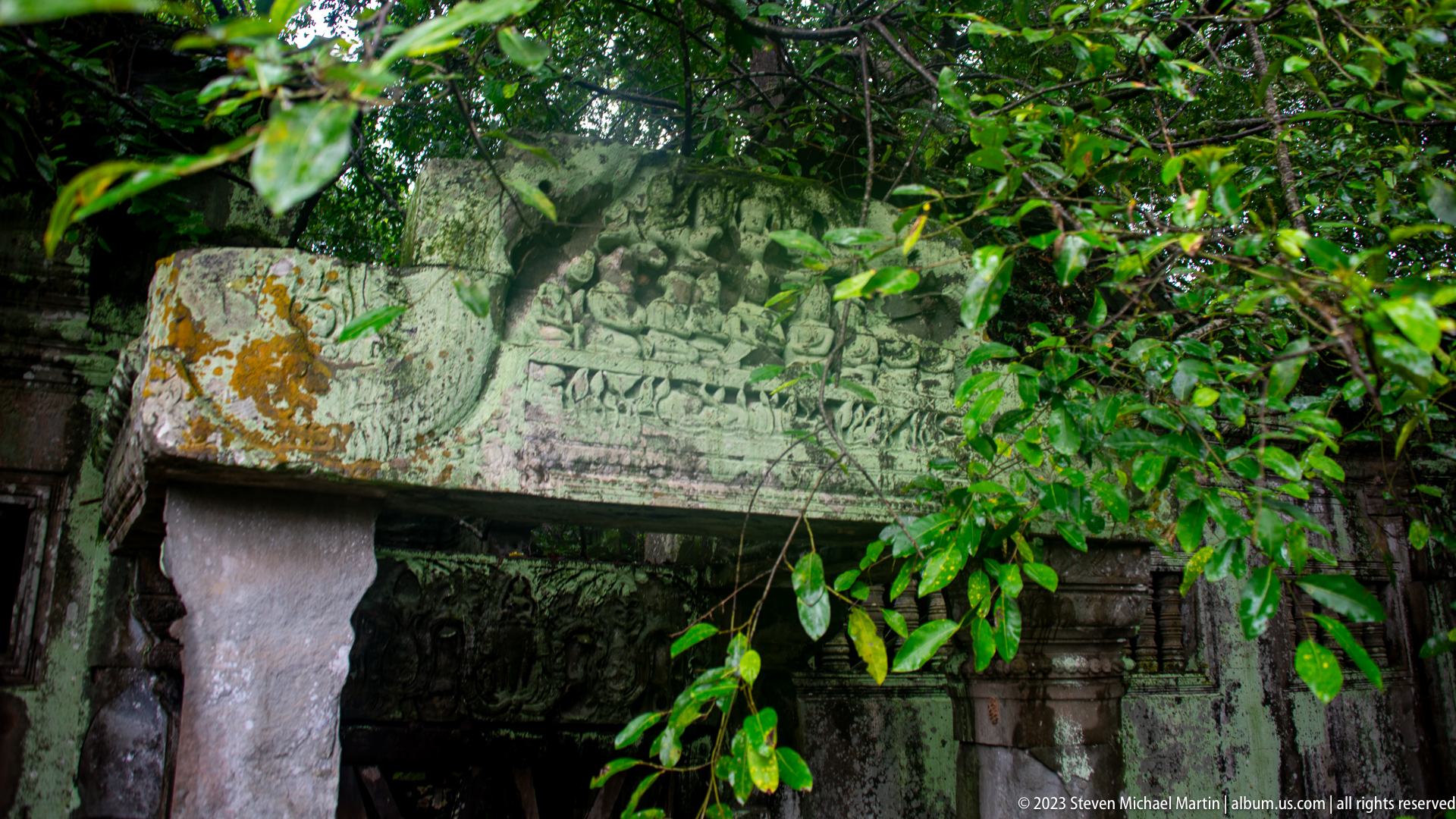
Dense foliate carving spreads across a sandstone lintel above a shadowed entrance, partly concealed by leaves and branches. The central motif and curling vegetal bands remain visible despite surface wear and lichen. By framing the ornament within its doorway context, the photograph shows how sculptural decoration was integrated directly into the temple’s circulation and threshold architecture.
Caption
Dense foliate carving spreads across a sandstone lintel above a shadowed entrance, partly concealed by leaves and branches. The central motif and curling vegetal bands remain visible despite surface wear and lichen. By framing the ornament within its doorway context, the photograph shows how sculptural decoration was integrated directly into the temple’s circulation and threshold architecture.
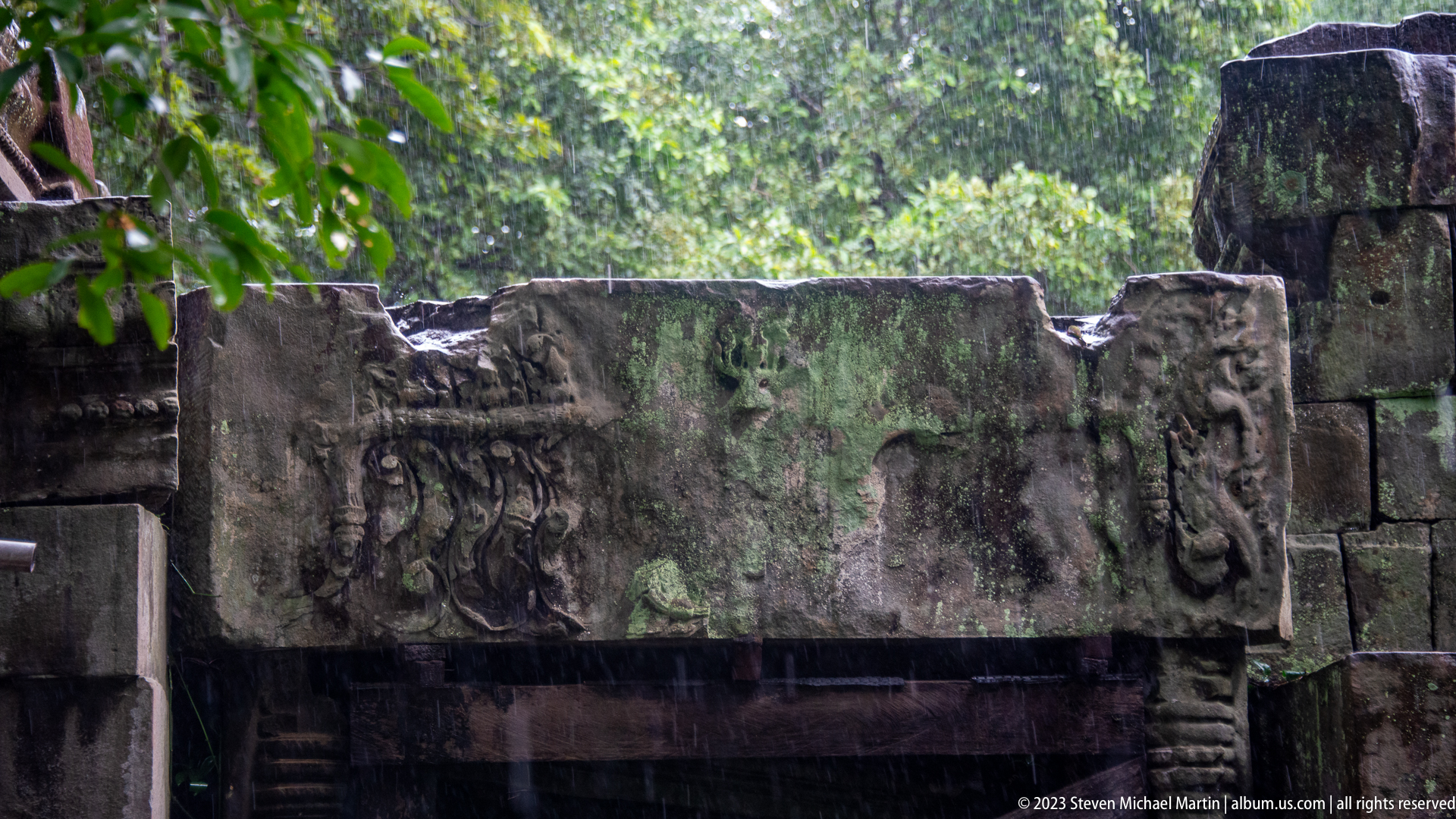
A broad lintel survives above a dark opening, its central carved figure or mask flanked by scrolling vegetal forms. Weathering has softened the iconography, and lichen obscures portions of the relief, but the composition remains broadly symmetrical. The photograph records the lintel’s placement and condition while avoiding an exact mythological identification unsupported by the visible detail.
Caption
A broad lintel survives above a dark opening, its central carved figure or mask flanked by scrolling vegetal forms. Weathering has softened the iconography, and lichen obscures portions of the relief, but the composition remains broadly symmetrical. The photograph records the lintel’s placement and condition while avoiding an exact mythological identification unsupported by the visible detail.
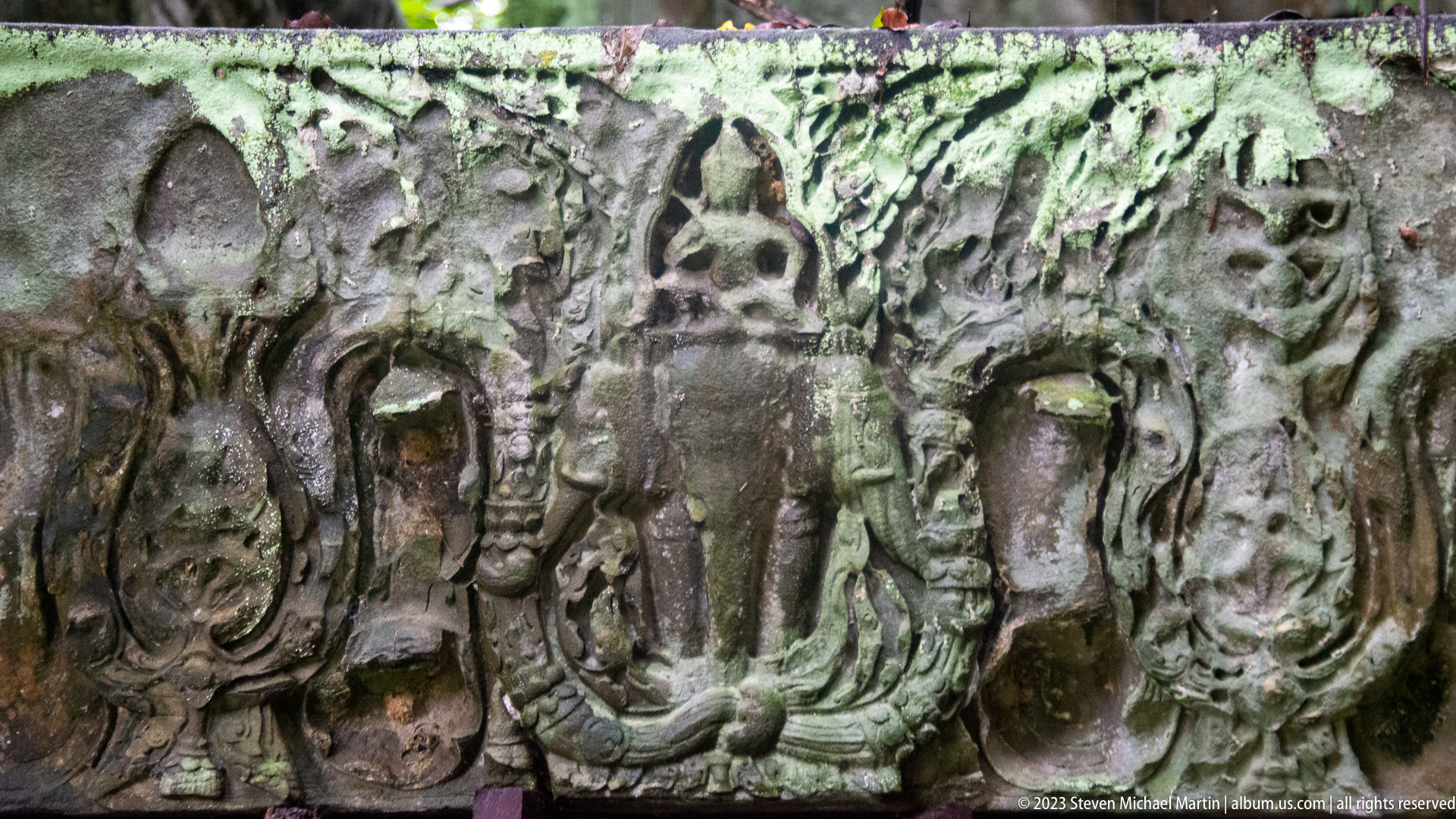
A densely carved sandstone panel contains several human or divine figures arranged around a central vertical element. Heads, torsos, jewelry, and curling decorative forms remain visible, though erosion and biological growth make the narrative difficult to resolve. The close framing is valuable for studying carving technique and condition, but the precise episode should not be named without stronger iconographic evidence.
Caption
A densely carved sandstone panel contains several human or divine figures arranged around a central vertical element. Heads, torsos, jewelry, and curling decorative forms remain visible, though erosion and biological growth make the narrative difficult to resolve. The close framing is valuable for studying carving technique and condition, but the precise episode should not be named without stronger iconographic evidence.
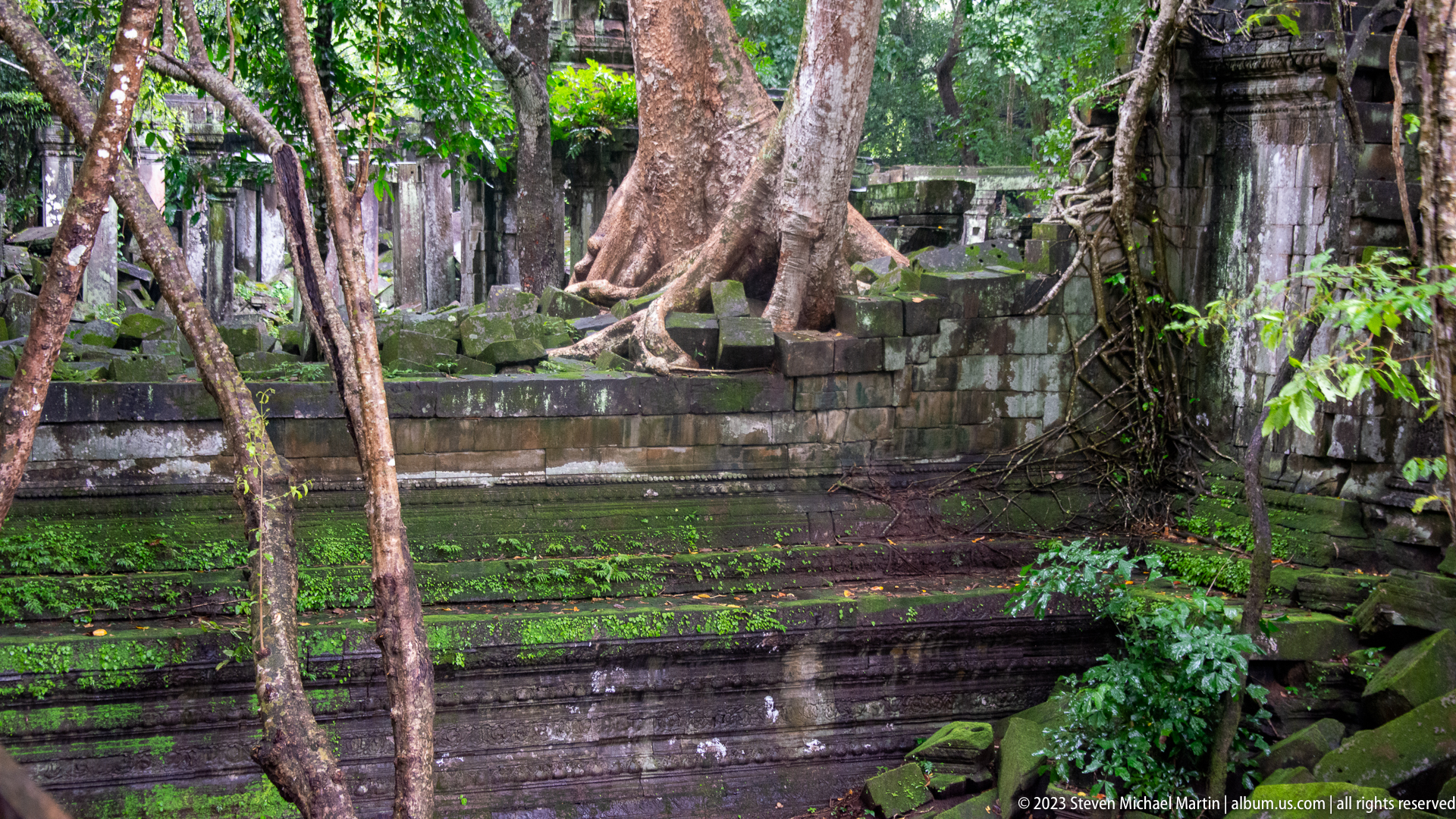
A still water-filled channel borders stepped sandstone terraces beneath mature trees. Moss-covered horizontal courses descend toward the water, while trunks and roots rise from the upper level among scattered blocks. The view emphasizes Beng Mealea’s low-lying, water-sensitive environment and the way drainage, enclosure architecture, and forest growth now overlap within the archaeological landscape.
Caption
A still water-filled channel borders stepped sandstone terraces beneath mature trees. Moss-covered horizontal courses descend toward the water, while trunks and roots rise from the upper level among scattered blocks. The view emphasizes Beng Mealea’s low-lying, water-sensitive environment and the way drainage, enclosure architecture, and forest growth now overlap within the archaeological landscape.
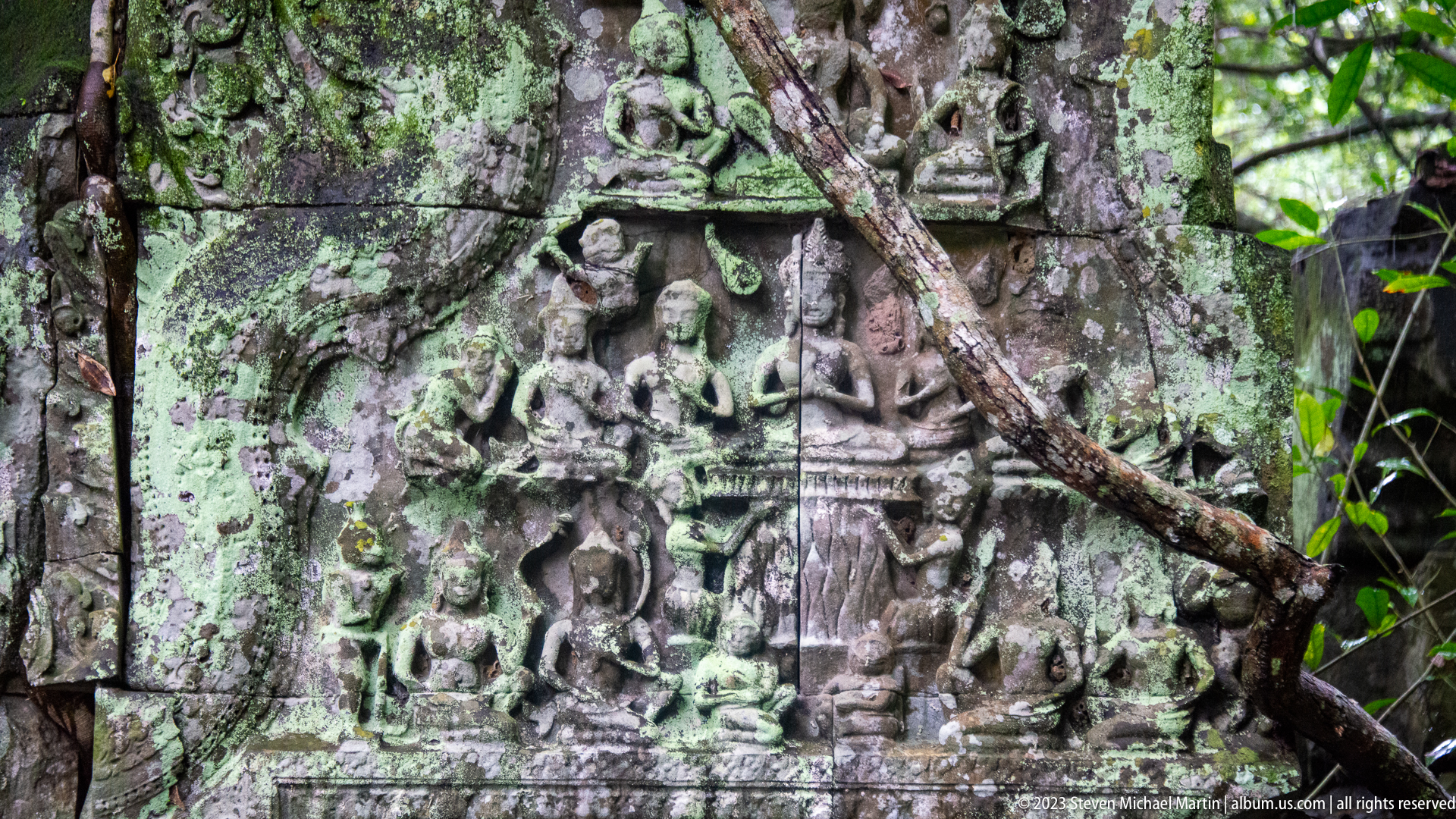
A vertical relief panel centers on a standing figure placed above a pedestal-like base, with smaller figures arranged around the sides and upper register. Branches and lichen partially obscure the carving, yet the hierarchical scale and crowded composition remain visible. The precise identity of the central figure is uncertain, but the panel clearly formed part of Beng Mealea’s sacred narrative decoration.
Caption
A vertical relief panel centers on a standing figure placed above a pedestal-like base, with smaller figures arranged around the sides and upper register. Branches and lichen partially obscure the carving, yet the hierarchical scale and crowded composition remain visible. The precise identity of the central figure is uncertain, but the panel clearly formed part of Beng Mealea’s sacred narrative decoration.
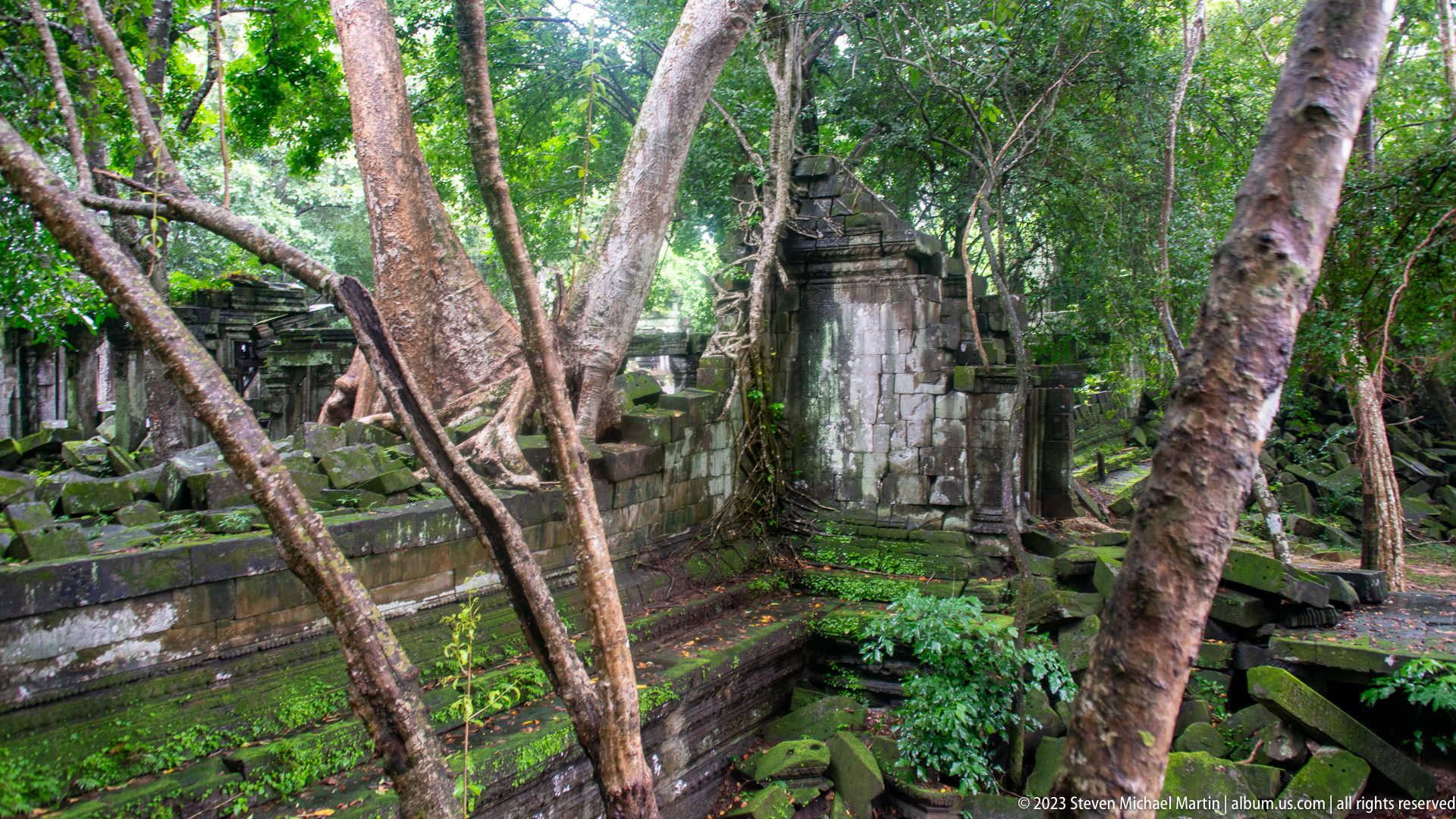
Trees rise directly from a narrow space between surviving sandstone walls, where roots, trunks, and fallen blocks occupy what was once a controlled architectural passage. A projecting tower-like element remains visible beyond the trees. The image emphasizes how vegetation has reshaped circulation through Beng Mealea, turning formal temple corridors into irregular forested channels.
Caption
Trees rise directly from a narrow space between surviving sandstone walls, where roots, trunks, and fallen blocks occupy what was once a controlled architectural passage. A projecting tower-like element remains visible beyond the trees. The image emphasizes how vegetation has reshaped circulation through Beng Mealea, turning formal temple corridors into irregular forested channels.
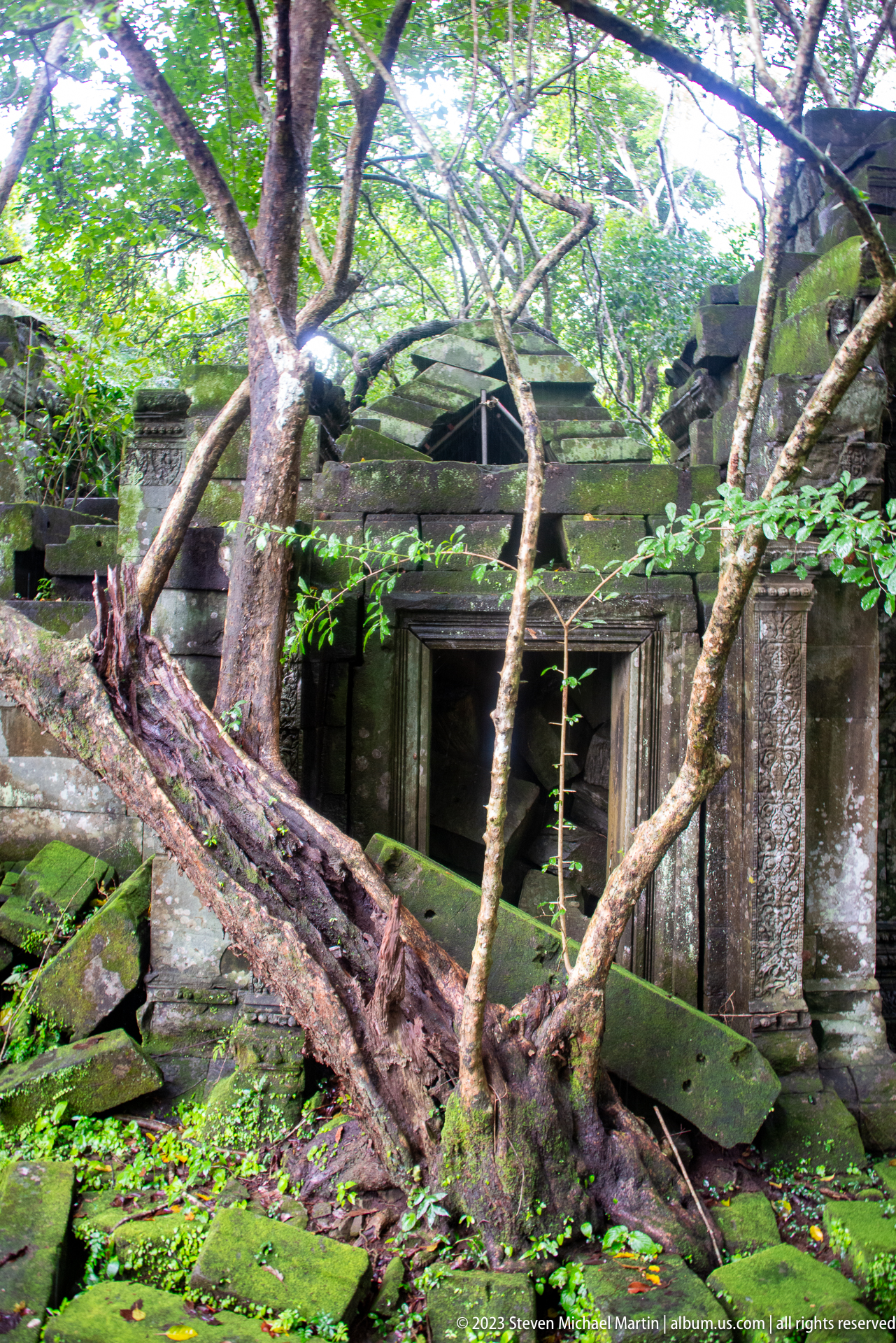
A low sandstone entrance survives beneath heavy vegetation, its dark doorway partly screened by a fallen tree whose branches cross the façade. Horizontal roof stones and squared supports remain intact enough to define the chamber, while displaced blocks gather around the base. The image records both structural survival and the immediate pressure exerted by forest growth on the monument.
Caption
A low sandstone entrance survives beneath heavy vegetation, its dark doorway partly screened by a fallen tree whose branches cross the façade. Horizontal roof stones and squared supports remain intact enough to define the chamber, while displaced blocks gather around the base. The image records both structural survival and the immediate pressure exerted by forest growth on the monument.
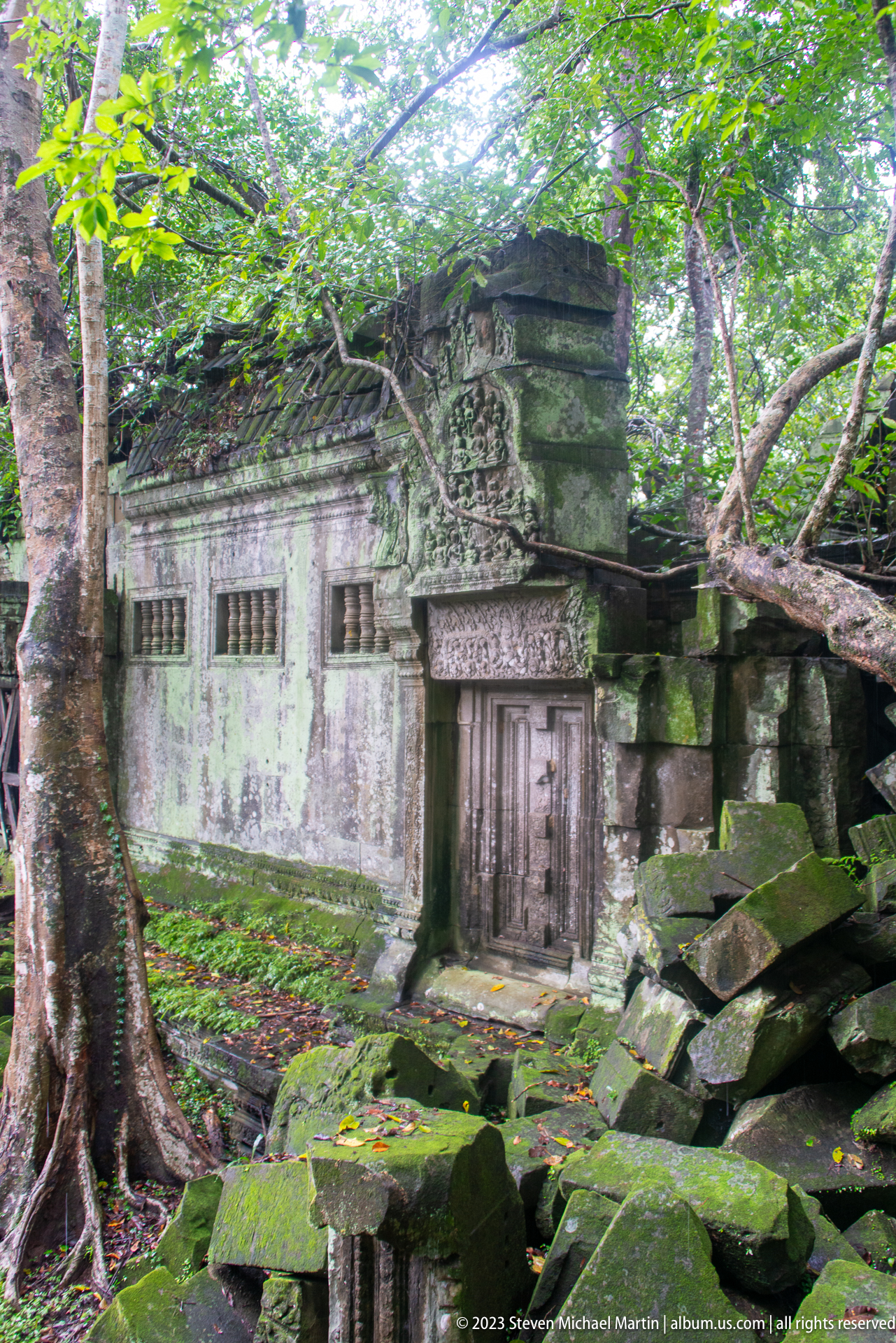
A compact sandstone façade survives beneath spreading tree branches, combining a closed false door with narrow baluster windows and layered cornice moldings. Fallen blocks crowd the foreground, while moss and moisture staining soften the carved surfaces. The view records a relatively intact subsidiary structure set within the broader collapse of Beng Mealea’s forested architectural complex.
Caption
A compact sandstone façade survives beneath spreading tree branches, combining a closed false door with narrow baluster windows and layered cornice moldings. Fallen blocks crowd the foreground, while moss and moisture staining soften the carved surfaces. The view records a relatively intact subsidiary structure set within the broader collapse of Beng Mealea’s forested architectural complex.

A gallery corner survives with a baluster window, recessed wall panels, and heavy roof stones still in place beneath dense vegetation. Roots and plants spread across the upper courses, while displaced blocks gather around the base. The oblique view shows how Beng Mealea’s architectural volumes remain readable even where roofs and walls have begun to separate.
Caption
A gallery corner survives with a baluster window, recessed wall panels, and heavy roof stones still in place beneath dense vegetation. Roots and plants spread across the upper courses, while displaced blocks gather around the base. The oblique view shows how Beng Mealea’s architectural volumes remain readable even where roofs and walls have begun to separate.
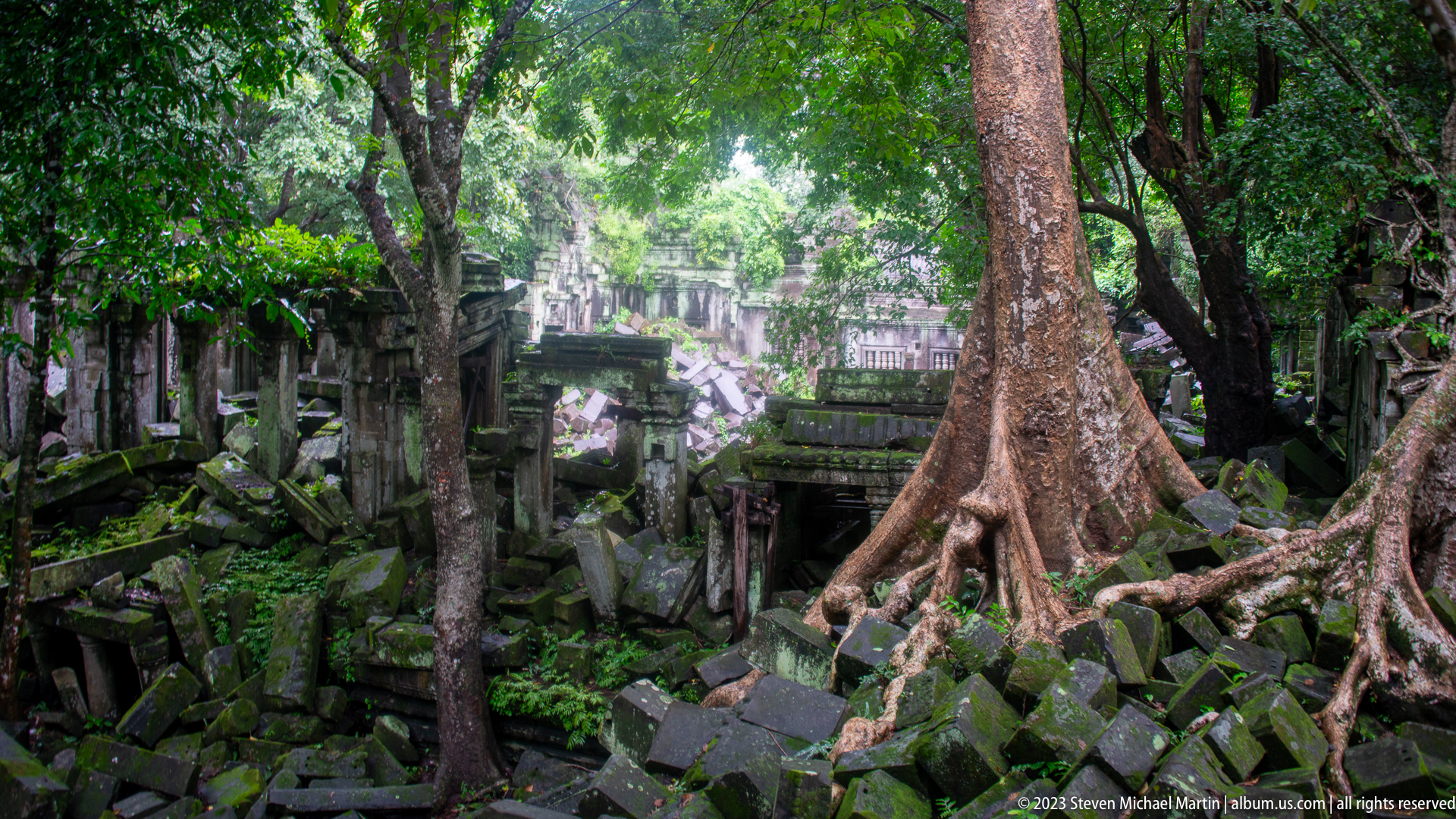
A mature tree with broad buttress roots dominates a deep field of collapsed gallery masonry. The roots descend over squared sandstone blocks while partially standing walls remain visible behind. More than a scenic forest view, the photograph documents the physical scale of collapse and the way mature vegetation now anchors, separates, and obscures Beng Mealea’s surviving architectural fragments.
Caption
A mature tree with broad buttress roots dominates a deep field of collapsed gallery masonry. The roots descend over squared sandstone blocks while partially standing walls remain visible behind. More than a scenic forest view, the photograph documents the physical scale of collapse and the way mature vegetation now anchors, separates, and obscures Beng Mealea’s surviving architectural fragments.
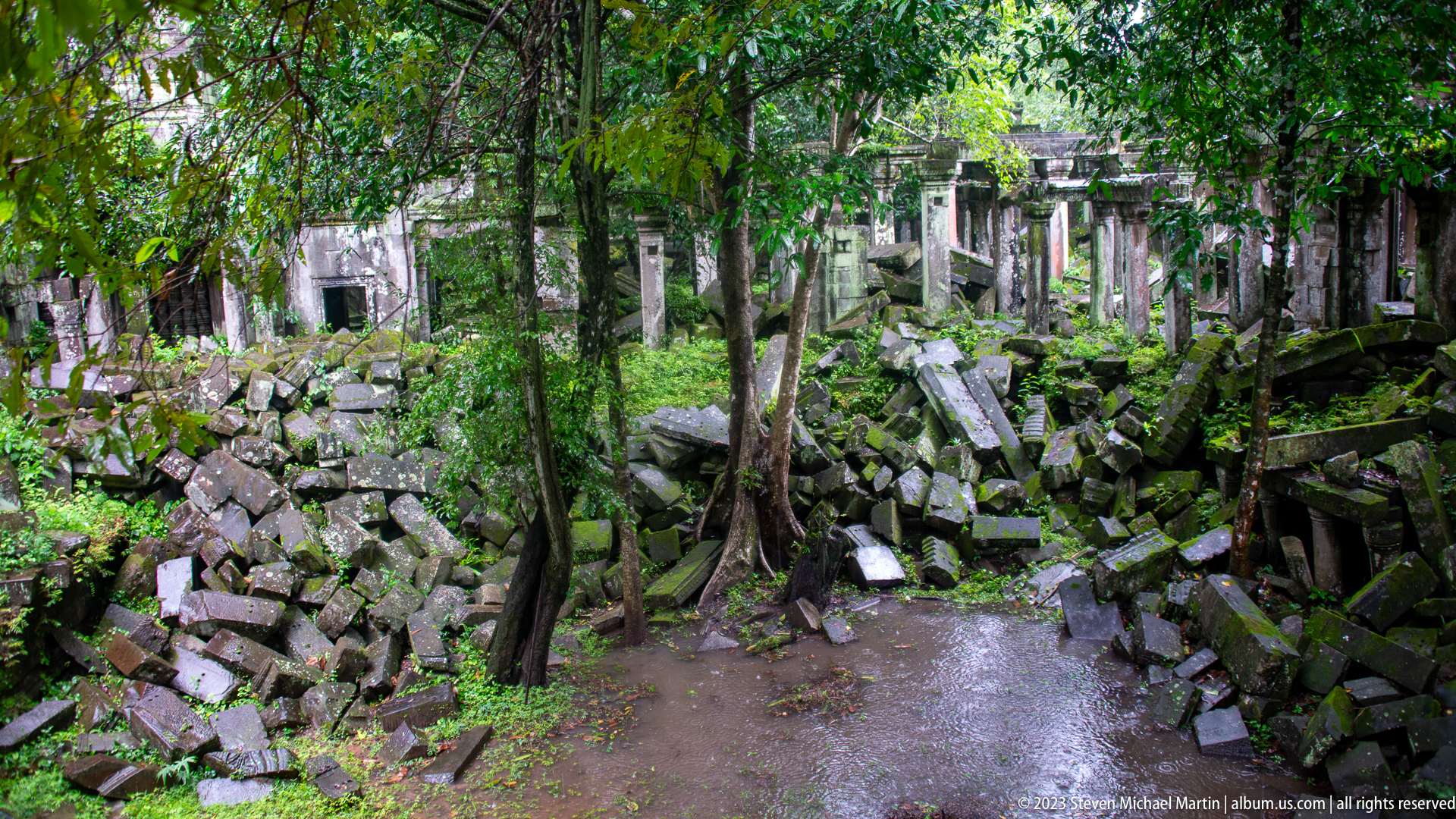
A broad ruin field stretches between partially standing temple galleries, with trees rising from the center and large sandstone blocks scattered across the former circulation space. Repeated door and window openings remain visible beyond the collapse. The elevated viewpoint helps clarify the scale of structural failure and the fragmented relationship between Beng Mealea’s surviving architectural ranges.
Caption
A broad ruin field stretches between partially standing temple galleries, with trees rising from the center and large sandstone blocks scattered across the former circulation space. Repeated door and window openings remain visible beyond the collapse. The elevated viewpoint helps clarify the scale of structural failure and the fragmented relationship between Beng Mealea’s surviving architectural ranges.
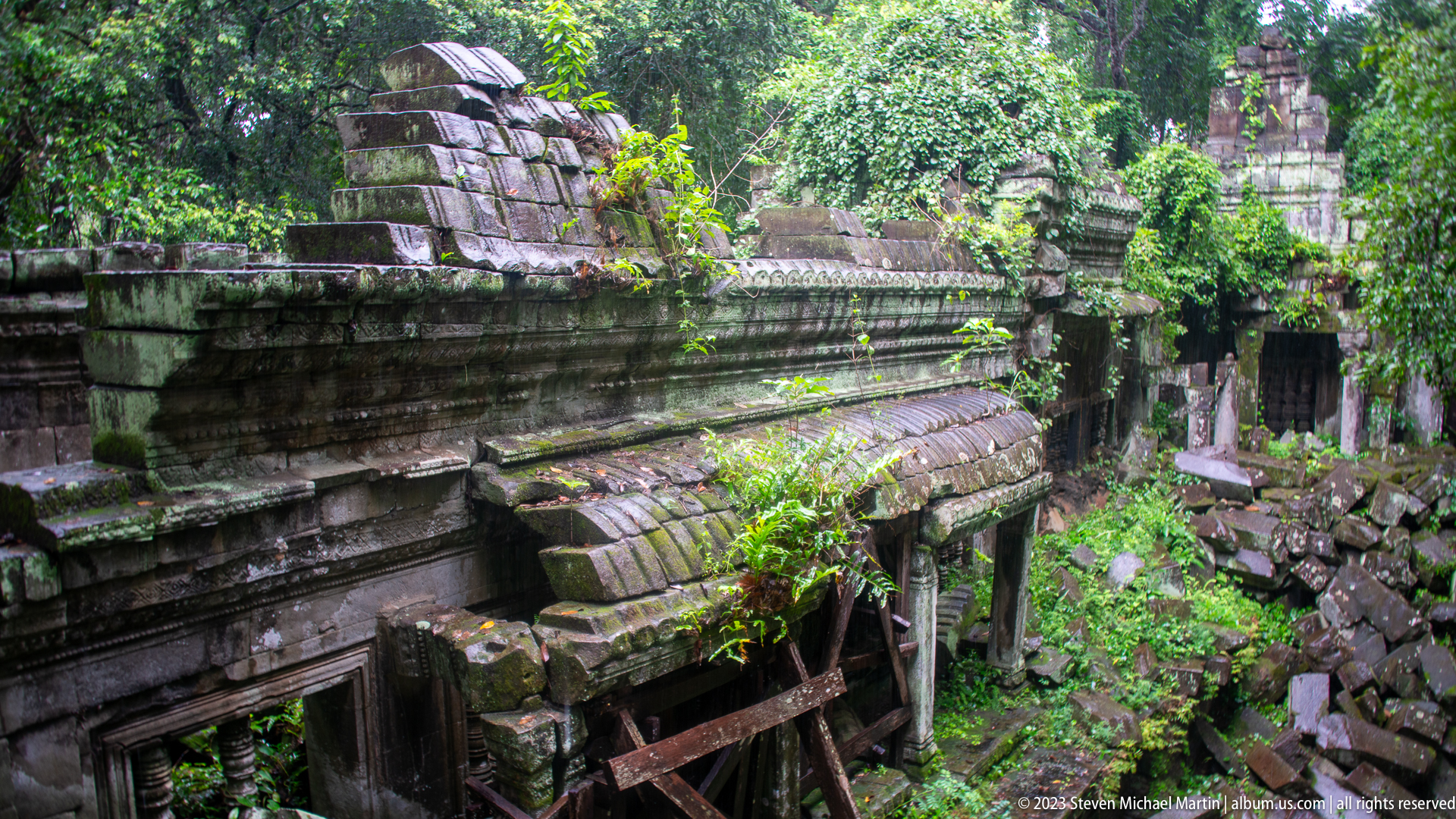
A long gallery retains sections of its corbelled roof, layered cornice moldings, and wall openings, although surrounding masonry has collapsed into the adjoining space. Modern timber bracing supports an entrance below. The oblique view records both the craftsmanship of the surviving roofline and the conservation challenges posed by unstable blocks, vegetation, and water exposure.
Caption
A long gallery retains sections of its corbelled roof, layered cornice moldings, and wall openings, although surrounding masonry has collapsed into the adjoining space. Modern timber bracing supports an entrance below. The oblique view records both the craftsmanship of the surviving roofline and the conservation challenges posed by unstable blocks, vegetation, and water exposure.
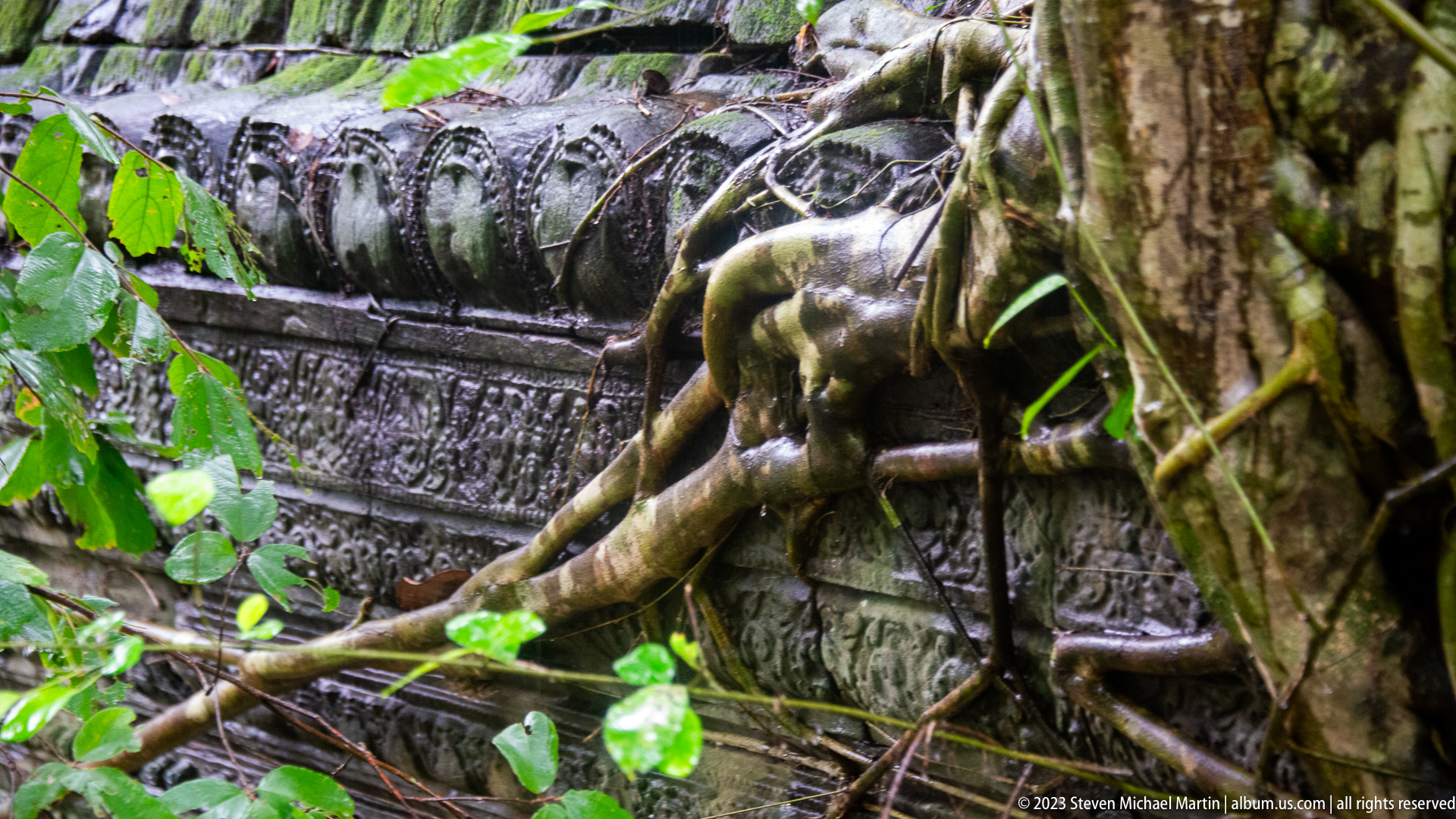
Thick roots curl across a carved sandstone architectural member, pressing against bands of geometric and floral ornament beside the wall. The close view isolates the direct physical contact between living tree and worked stone. It provides a concise condition record of how root growth can obscure carving, shift masonry, and complicate conservation at Beng Mealea.
Caption
Thick roots curl across a carved sandstone architectural member, pressing against bands of geometric and floral ornament beside the wall. The close view isolates the direct physical contact between living tree and worked stone. It provides a concise condition record of how root growth can obscure carving, shift masonry, and complicate conservation at Beng Mealea.
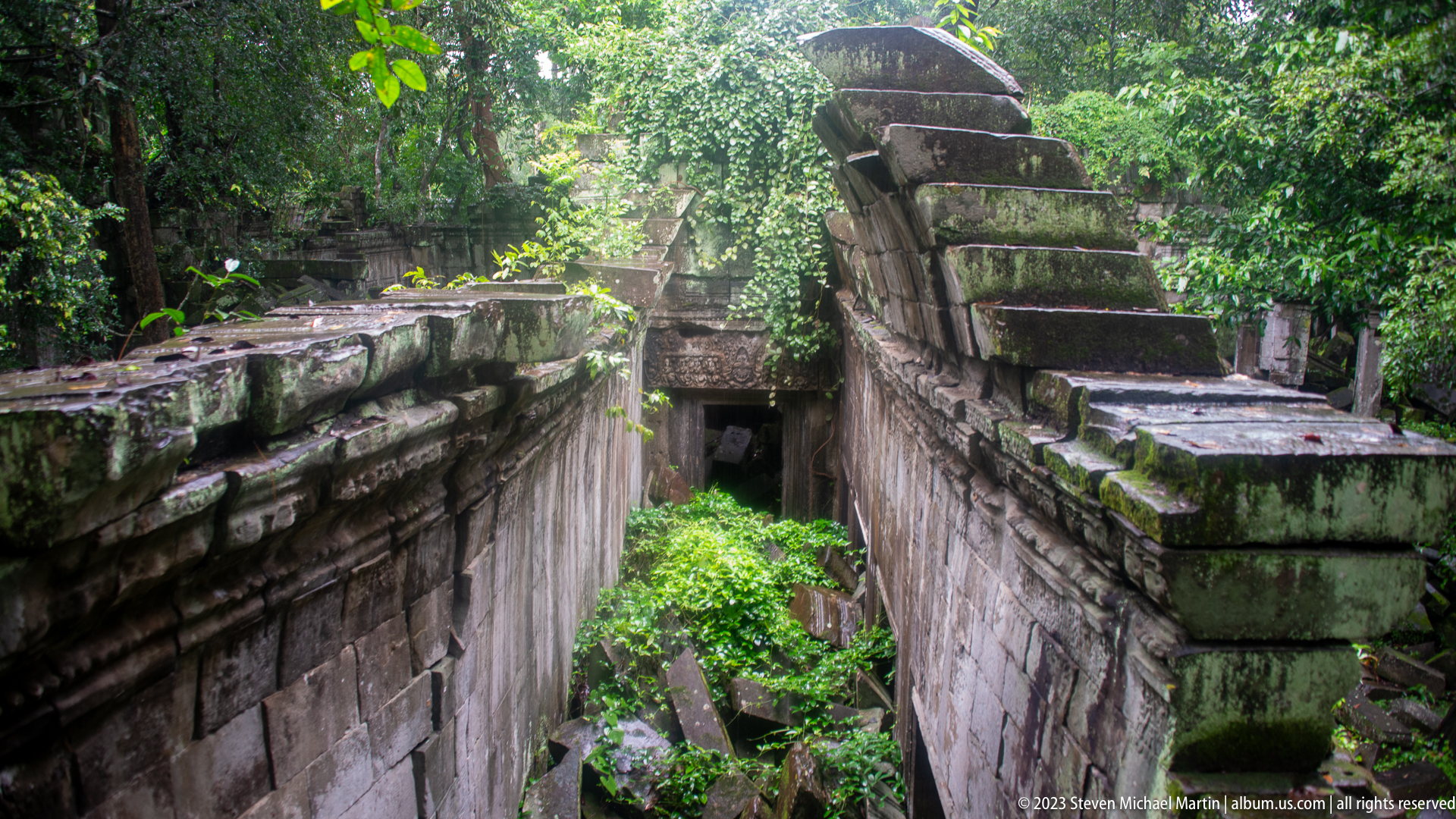
Parallel sandstone walls define a narrow corridor whose roof has largely collapsed into the passage below. Long fallen blocks, moss, and dense vegetation now fill the space, while a dark doorway remains visible in the distance. The linear viewpoint preserves the original direction of movement even as the corridor itself has become impassable.
Caption
Parallel sandstone walls define a narrow corridor whose roof has largely collapsed into the passage below. Long fallen blocks, moss, and dense vegetation now fill the space, while a dark doorway remains visible in the distance. The linear viewpoint preserves the original direction of movement even as the corridor itself has become impassable.
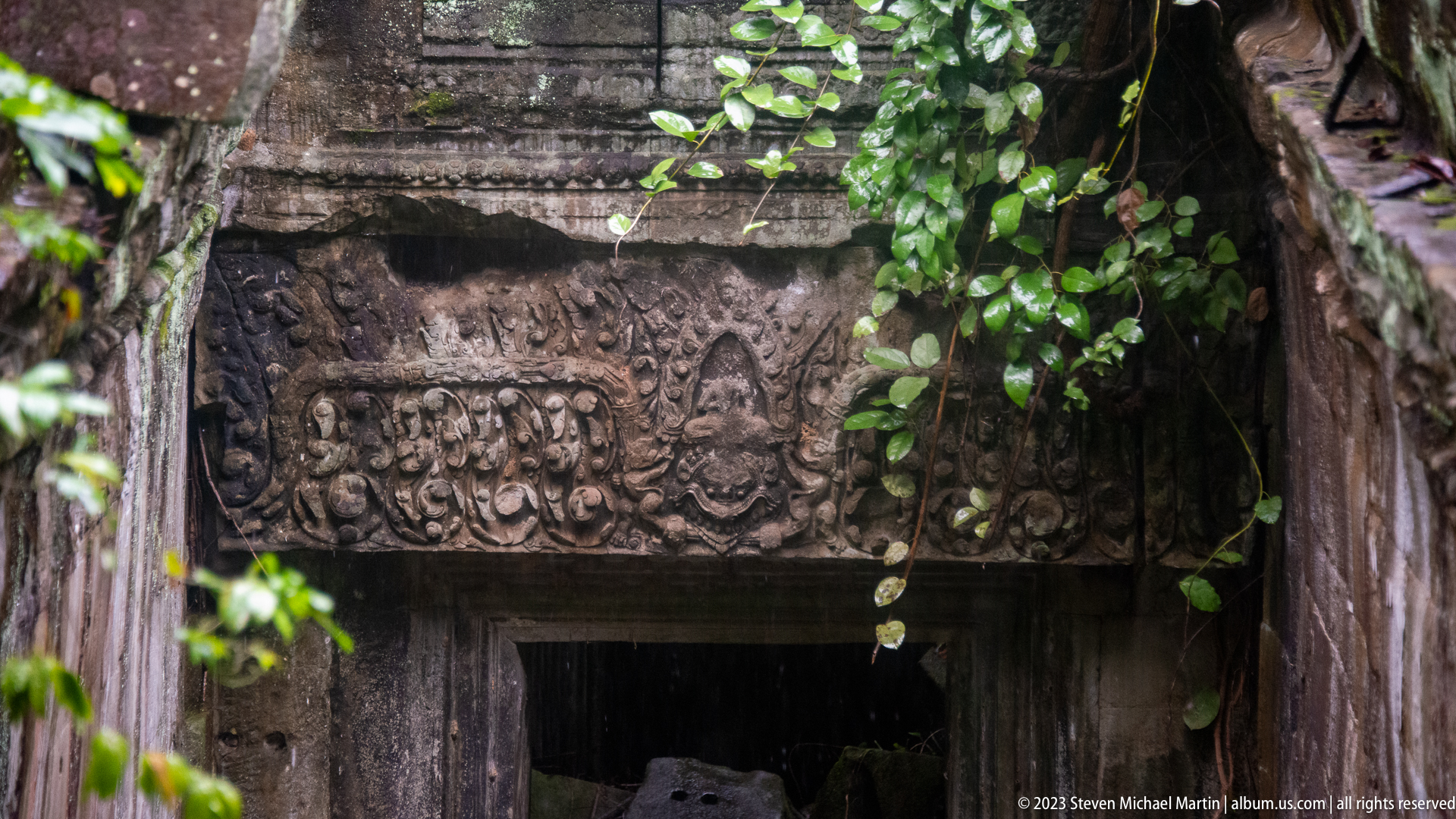
A richly carved lintel spans a dark doorway, with a central mask-like motif framed by symmetrical curling foliage. Leaves spill across the upper edge, partially obscuring the surrounding moldings. The close composition reveals the density of Khmer ornamental carving while preserving enough of the doorway context to show the lintel’s architectural function.
Caption
A richly carved lintel spans a dark doorway, with a central mask-like motif framed by symmetrical curling foliage. Leaves spill across the upper edge, partially obscuring the surrounding moldings. The close composition reveals the density of Khmer ornamental carving while preserving enough of the doorway context to show the lintel’s architectural function.
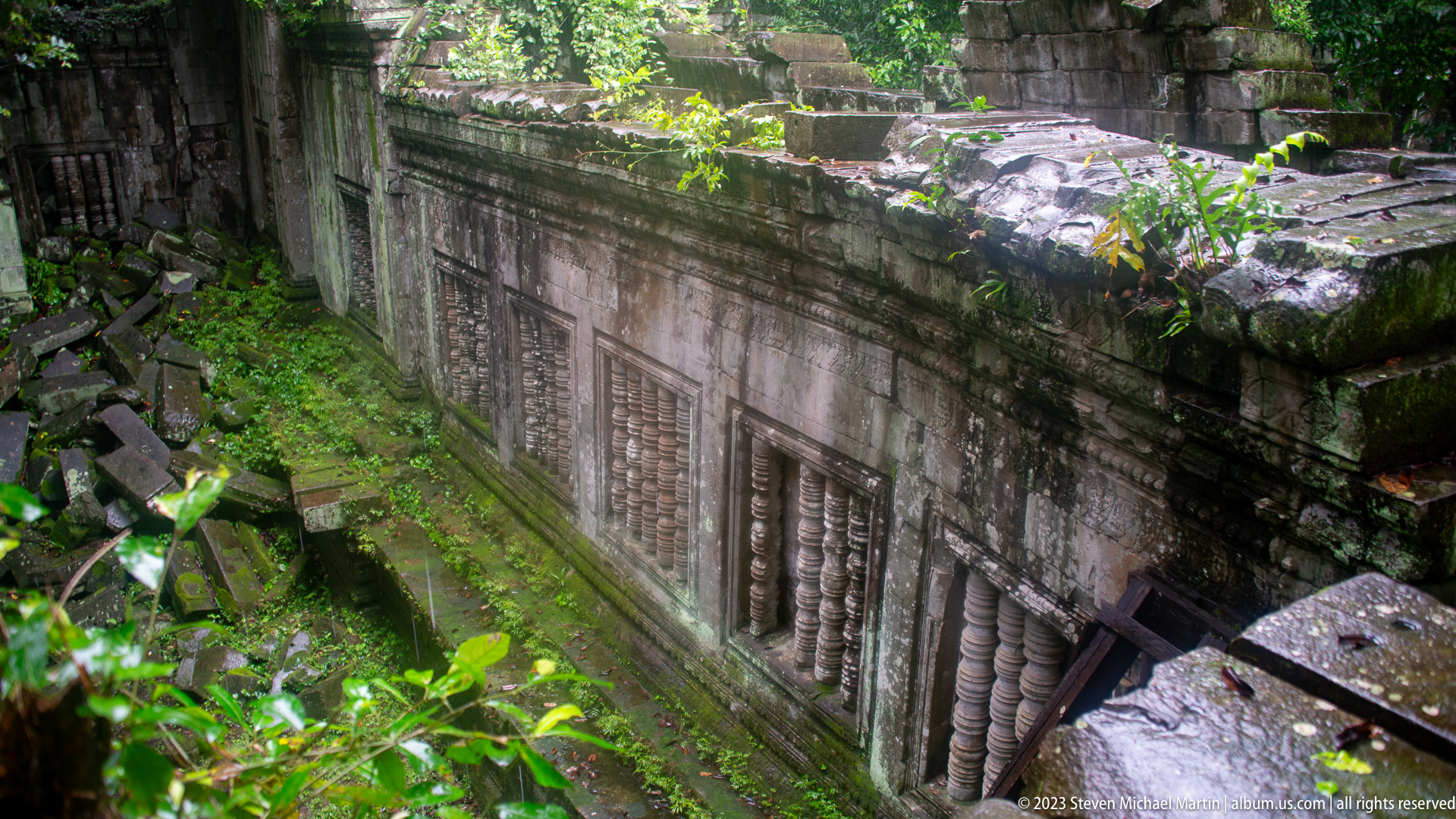
A long gallery wall is rhythmically divided by pilasters and a sequence of narrow windows filled with turned sandstone balusters. Moss traces the lower courses and fallen blocks gather along the base. Seen from above, the façade reads as a continuous architectural system rather than a series of isolated details, demonstrating the repeated modular design of Khmer temple galleries.
Caption
A long gallery wall is rhythmically divided by pilasters and a sequence of narrow windows filled with turned sandstone balusters. Moss traces the lower courses and fallen blocks gather along the base. Seen from above, the façade reads as a continuous architectural system rather than a series of isolated details, demonstrating the repeated modular design of Khmer temple galleries.

A carved lintel lies diagonally across a blocked architectural opening, its scrolling relief still visible despite moss and weathering. Fallen blocks surround the stone, while a surviving baluster and wall moldings remain upright behind it. The image makes the process of collapse unusually legible by showing a once-horizontal decorative element displaced but still close to its original setting.
Caption
A carved lintel lies diagonally across a blocked architectural opening, its scrolling relief still visible despite moss and weathering. Fallen blocks surround the stone, while a surviving baluster and wall moldings remain upright behind it. The image makes the process of collapse unusually legible by showing a once-horizontal decorative element displaced but still close to its original setting.

An enclosed area within Beng Mealea is almost completely filled with fallen sandstone blocks, leaving only narrow traces of the original floor and wall line. Moss and low vegetation spread across the rubble, while partially standing doorways remain visible at the far side. The elevated view records the density of collapse within a confined architectural space.
Caption
An enclosed area within Beng Mealea is almost completely filled with fallen sandstone blocks, leaving only narrow traces of the original floor and wall line. Moss and low vegetation spread across the rubble, while partially standing doorways remain visible at the far side. The elevated view records the density of collapse within a confined architectural space.

Two baluster windows flank a central opening whose interior is blocked by fallen architectural stones. Recessed panels, layered frames, and a bead-like cornice survive across the wall, preserving the façade’s formal symmetry despite the collapse behind it. The frontal view is especially useful for comparing the intact window bays with the disrupted central passage.
Caption
Two baluster windows flank a central opening whose interior is blocked by fallen architectural stones. Recessed panels, layered frames, and a bead-like cornice survive across the wall, preserving the façade’s formal symmetry despite the collapse behind it. The frontal view is especially useful for comparing the intact window bays with the disrupted central passage.
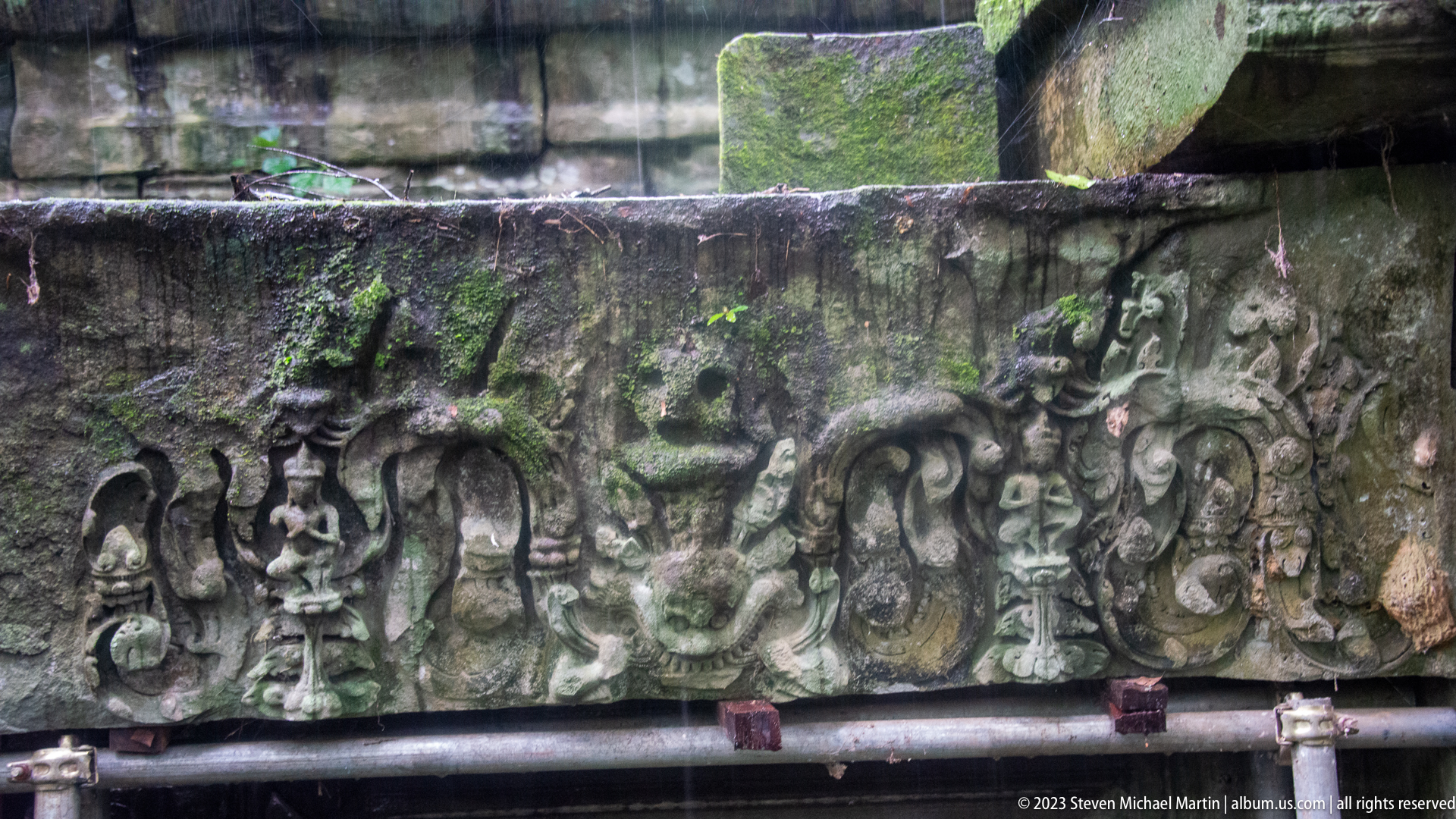
A weathered lintel carries a dense sequence of small seated figures, curling foliage, and a central mask-like form. Lichen and surface loss obscure parts of the composition, while modern supports are visible along the lower edge. The close view documents the complexity of the carving without forcing an exact narrative identification that the surviving details do not securely support.
Caption
A weathered lintel carries a dense sequence of small seated figures, curling foliage, and a central mask-like form. Lichen and surface loss obscure parts of the composition, while modern supports are visible along the lower edge. The close view documents the complexity of the carving without forcing an exact narrative identification that the surviving details do not securely support.

A carved lintel lies horizontally among fallen pillars, wall stones, and other displaced architectural members. Thick green moss accentuates the relief across its face, while upright colonnettes and framed openings survive nearby. The composition records an architectural fragment not as an isolated artwork, but as part of the collapsed structural system from which it fell.
Caption
A carved lintel lies horizontally among fallen pillars, wall stones, and other displaced architectural members. Thick green moss accentuates the relief across its face, while upright colonnettes and framed openings survive nearby. The composition records an architectural fragment not as an isolated artwork, but as part of the collapsed structural system from which it fell.
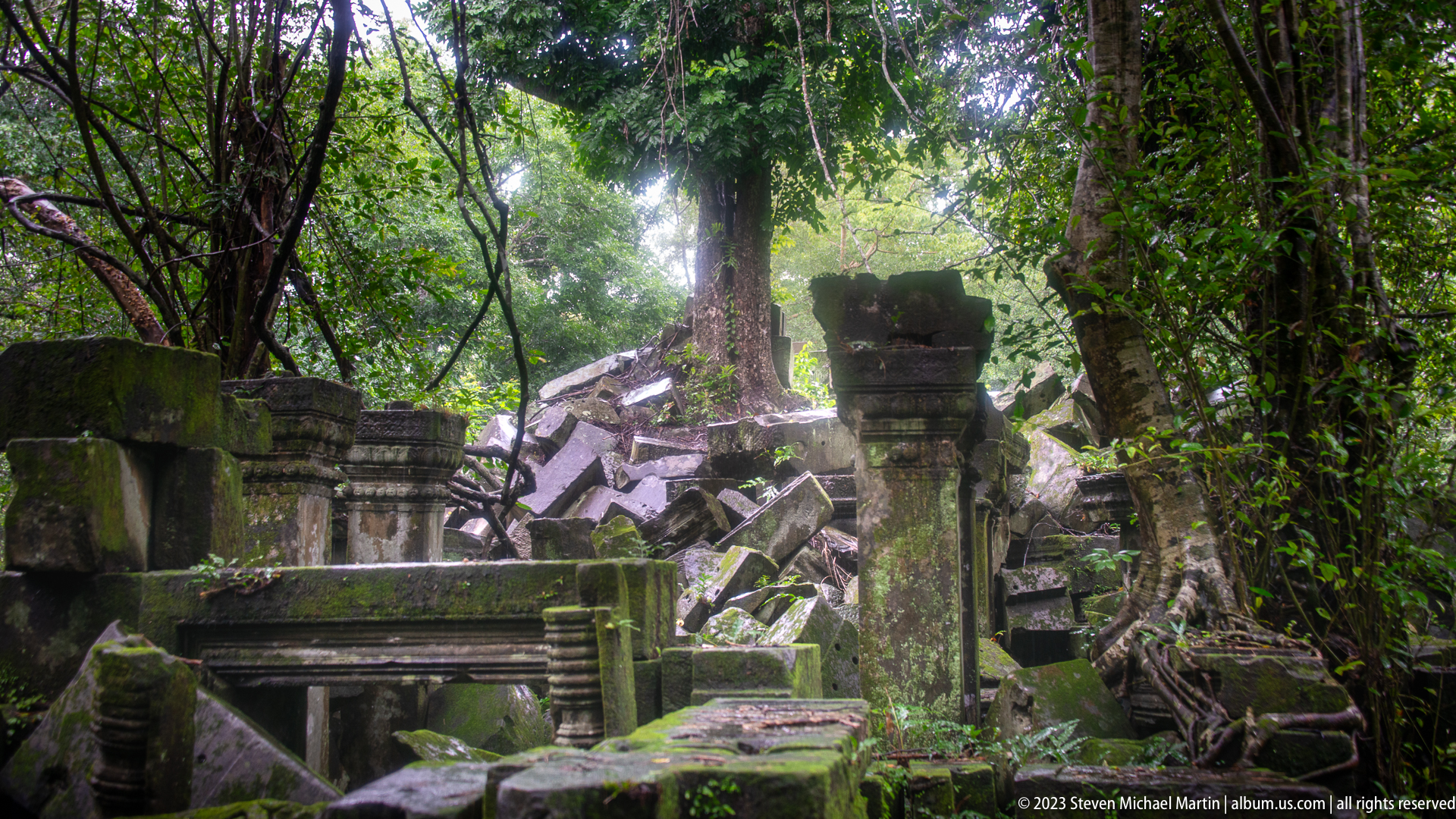
Standing posts and low lintels frame a deep pile of collapsed sandstone beneath the forest canopy. The surviving vertical elements preserve the outline of a former passage, while a bright opening beyond draws attention through the debris. This layered composition emphasizes the contrast between architectural order in the foreground and structural chaos deeper within the temple.
Caption
Standing posts and low lintels frame a deep pile of collapsed sandstone beneath the forest canopy. The surviving vertical elements preserve the outline of a former passage, while a bright opening beyond draws attention through the debris. This layered composition emphasizes the contrast between architectural order in the foreground and structural chaos deeper within the temple.
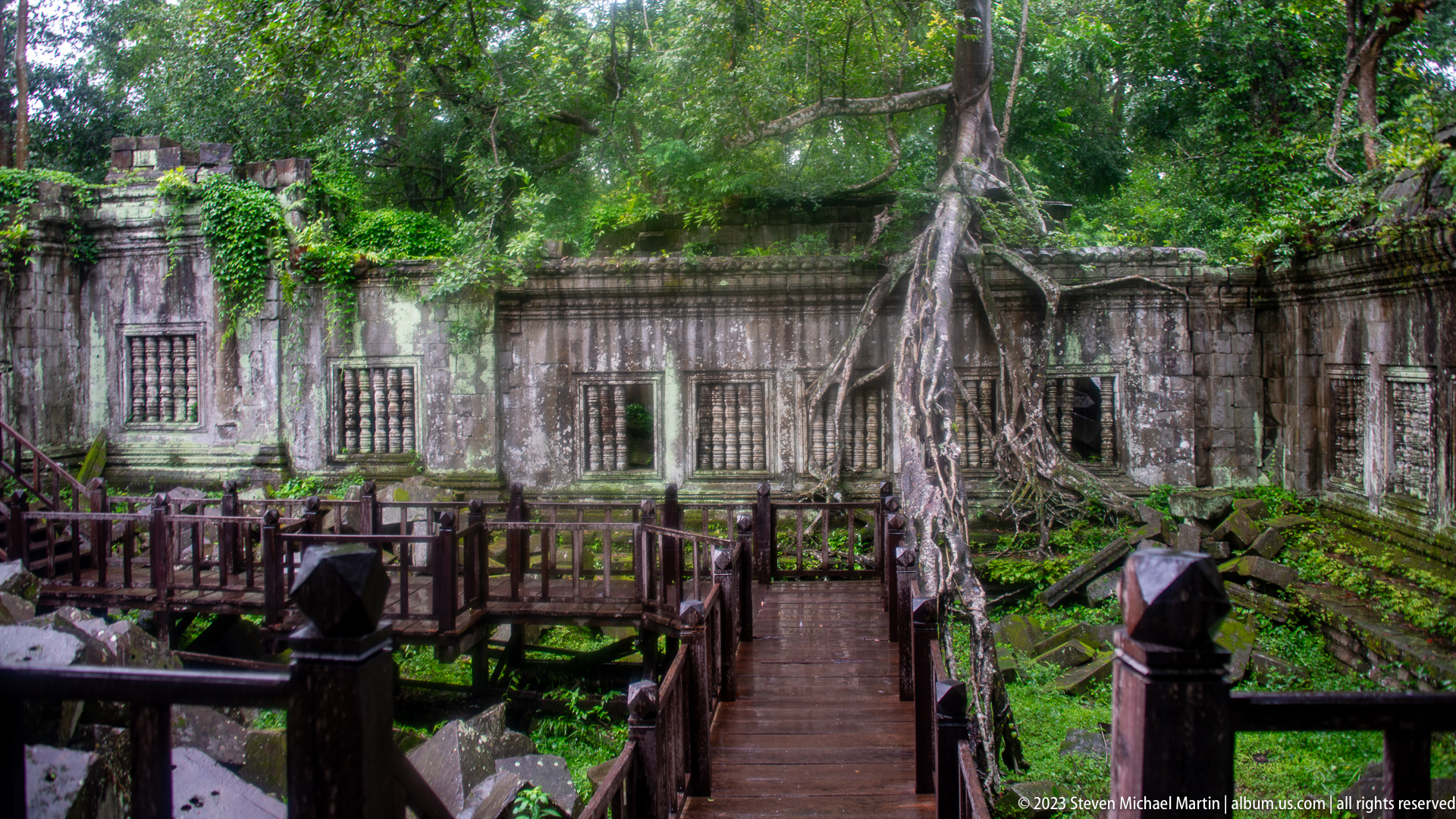
A raised wooden walkway leads toward a long gallery wall whose baluster windows and recessed bays are partly overtaken by a mature tree. Exposed roots descend from the roofline and spread across the masonry, while moss covers the ground below. The carefully routed path allows visitors to view the unstable architecture without walking directly across the ruin field.
Caption
A raised wooden walkway leads toward a long gallery wall whose baluster windows and recessed bays are partly overtaken by a mature tree. Exposed roots descend from the roofline and spread across the masonry, while moss covers the ground below. The carefully routed path allows visitors to view the unstable architecture without walking directly across the ruin field.
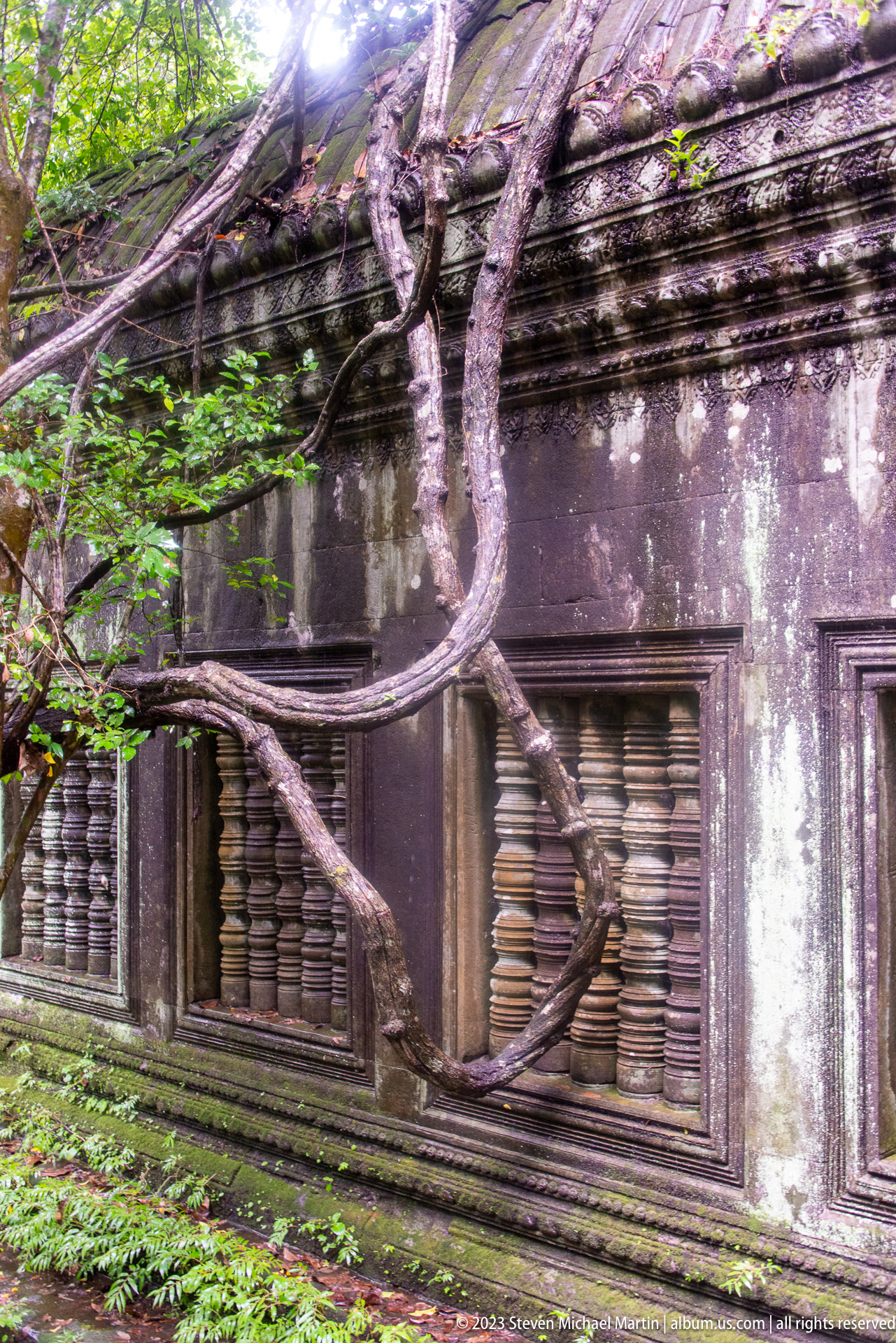
Large roots sweep across a sandstone gallery wall, crossing the frames of two baluster windows and pressing against the molded base. The windows remain legible beneath the organic network, creating a striking record of architectural survival under sustained biological pressure. The image also shows how roots can both obscure ornament and hold displaced masonry in temporary equilibrium.
Caption
Large roots sweep across a sandstone gallery wall, crossing the frames of two baluster windows and pressing against the molded base. The windows remain legible beneath the organic network, creating a striking record of architectural survival under sustained biological pressure. The image also shows how roots can both obscure ornament and hold displaced masonry in temporary equilibrium.
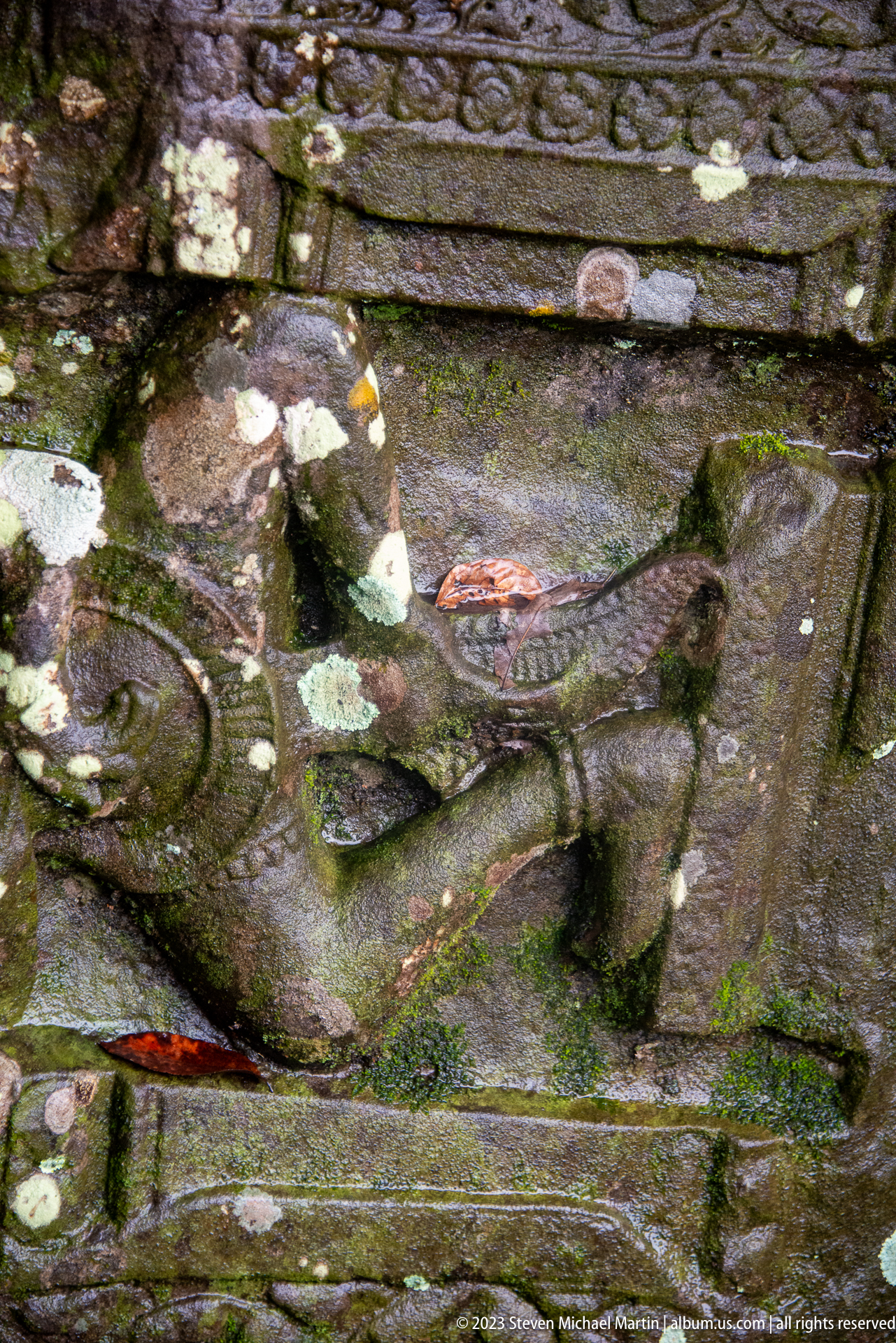
A human figure appears in shallow relief across a weathered sandstone surface, with the head, torso, and bent limbs partly obscured by lichen and staining. The close crop reveals texture and carving depth but not enough surrounding context to identify the precise narrative. It is best understood as a condition-focused detail of Beng Mealea’s figural sculpture.
Caption
A human figure appears in shallow relief across a weathered sandstone surface, with the head, torso, and bent limbs partly obscured by lichen and staining. The close crop reveals texture and carving depth but not enough surrounding context to identify the precise narrative. It is best understood as a condition-focused detail of Beng Mealea’s figural sculpture.

A wooden platform leads directly to a low rectangular doorway cut into a heavily stained sandstone wall. The broad wall surface is articulated by subtle moldings, while damp streaks and discoloration reveal prolonged water exposure. The frontal composition emphasizes the threshold itself and the transition from open visitor route into a darker interior space.
Caption
A wooden platform leads directly to a low rectangular doorway cut into a heavily stained sandstone wall. The broad wall surface is articulated by subtle moldings, while damp streaks and discoloration reveal prolonged water exposure. The frontal composition emphasizes the threshold itself and the transition from open visitor route into a darker interior space.
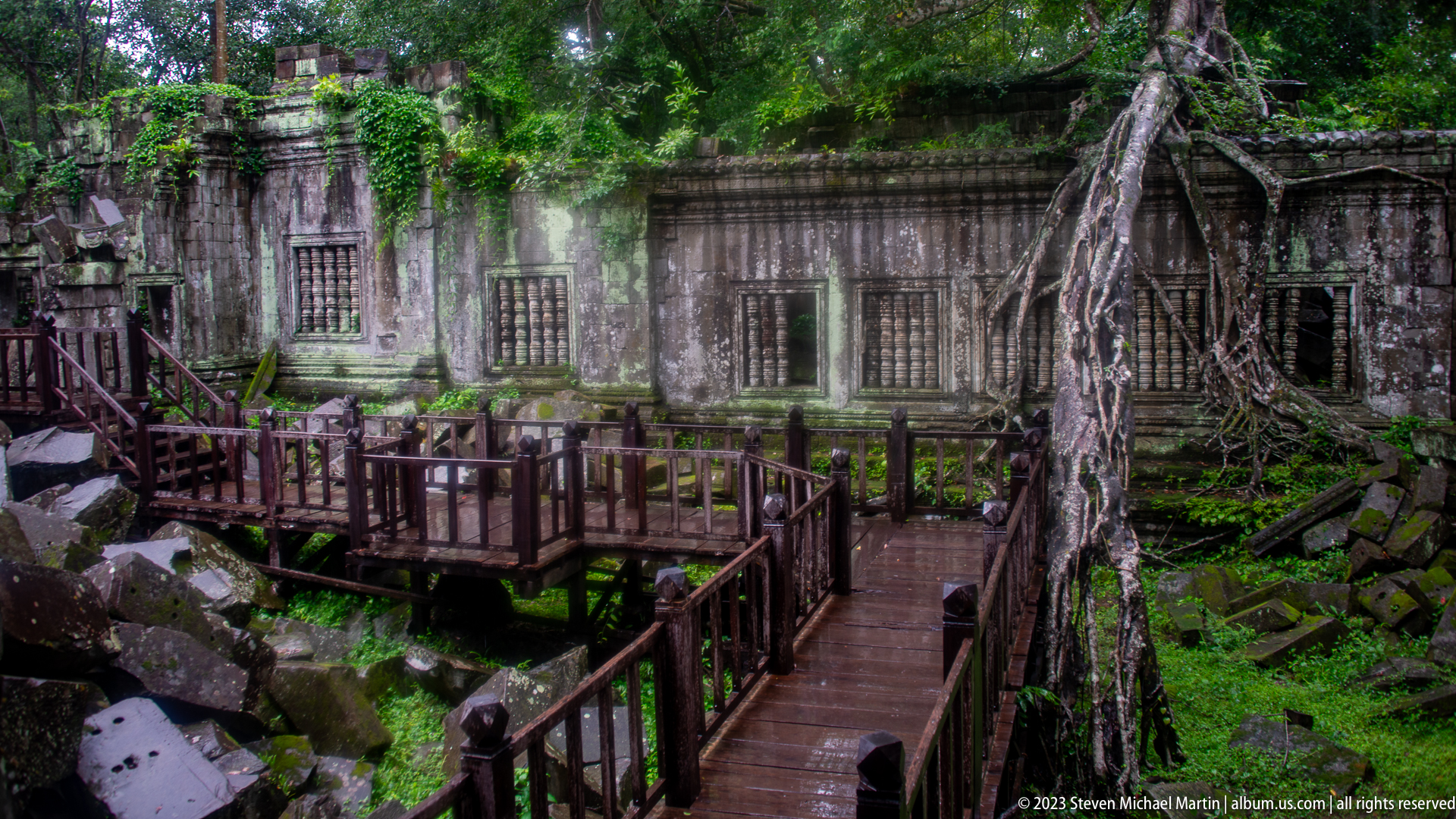
A network of raised wooden walkways and platforms crosses the rubble-filled space before a long balustered gallery wall. Large roots descend from the roofline while moss and scattered blocks cover the ground. The elevated circulation system organizes visitor movement through an area where the original floor is unstable, obscured, or inaccessible.
Caption
A network of raised wooden walkways and platforms crosses the rubble-filled space before a long balustered gallery wall. Large roots descend from the roofline while moss and scattered blocks cover the ground. The elevated circulation system organizes visitor movement through an area where the original floor is unstable, obscured, or inaccessible.

A dense mass of intertwined roots covers much of a gallery façade, obscuring several baluster windows while leaving their repeated forms visible through gaps. The roots descend in thick vertical strands and spread laterally across the stone. This close view makes the scale of biological encroachment especially clear and provides a strong condition record for the wall.
Caption
A dense mass of intertwined roots covers much of a gallery façade, obscuring several baluster windows while leaving their repeated forms visible through gaps. The roots descend in thick vertical strands and spread laterally across the stone. This close view makes the scale of biological encroachment especially clear and provides a strong condition record for the wall.
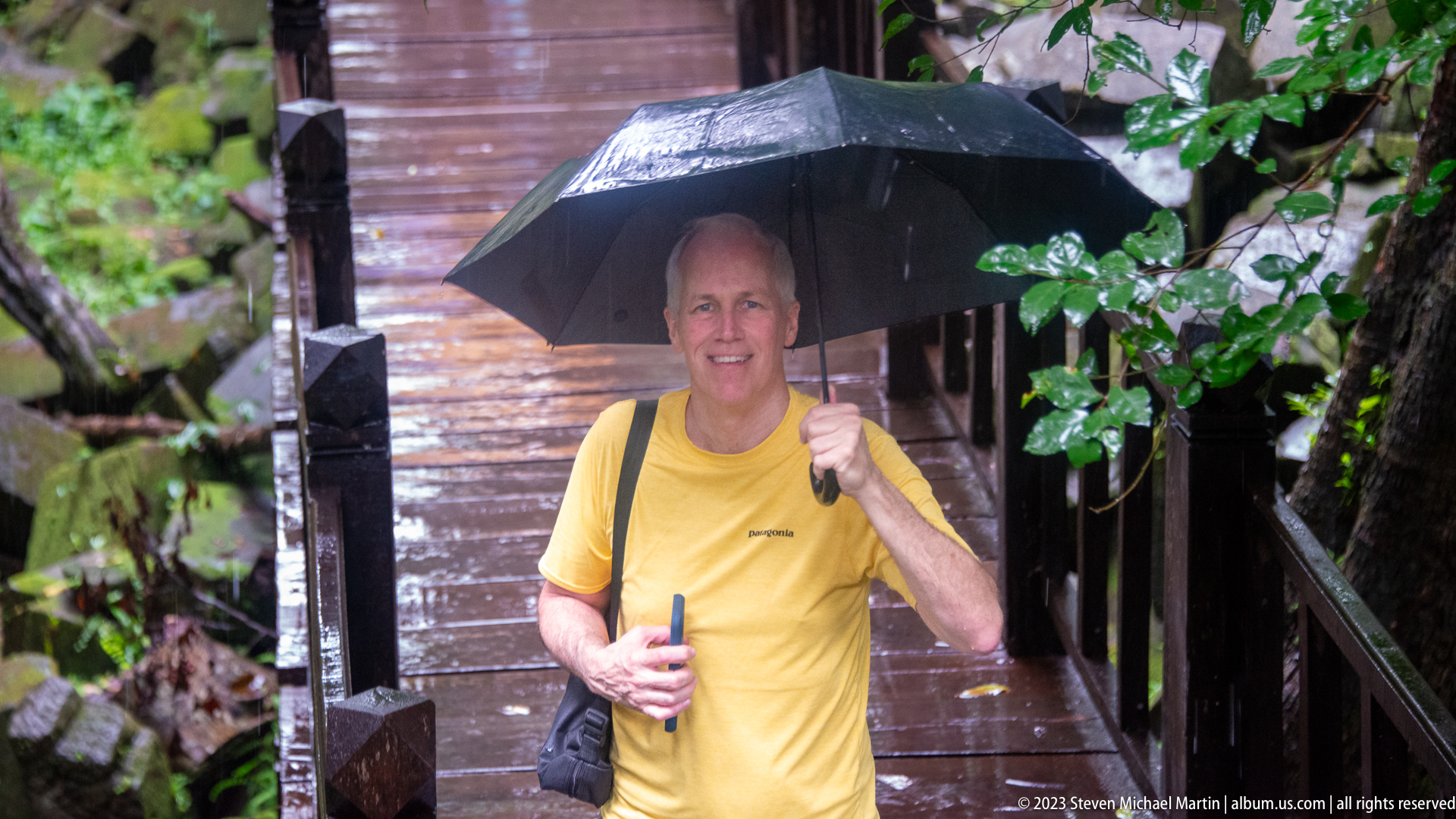
A visitor in a yellow shirt stands beneath a black umbrella on Beng Mealea’s rain-darkened wooden walkway. Wet railings and glossy foliage reinforce the monsoon atmosphere, while the elevated path recedes behind him through the ruins. The portrait records both the conditions of the visit and the modern infrastructure used to navigate the temple safely.
Caption
A visitor in a yellow shirt stands beneath a black umbrella on Beng Mealea’s rain-darkened wooden walkway. Wet railings and glossy foliage reinforce the monsoon atmosphere, while the elevated path recedes behind him through the ruins. The portrait records both the conditions of the visit and the modern infrastructure used to navigate the temple safely.
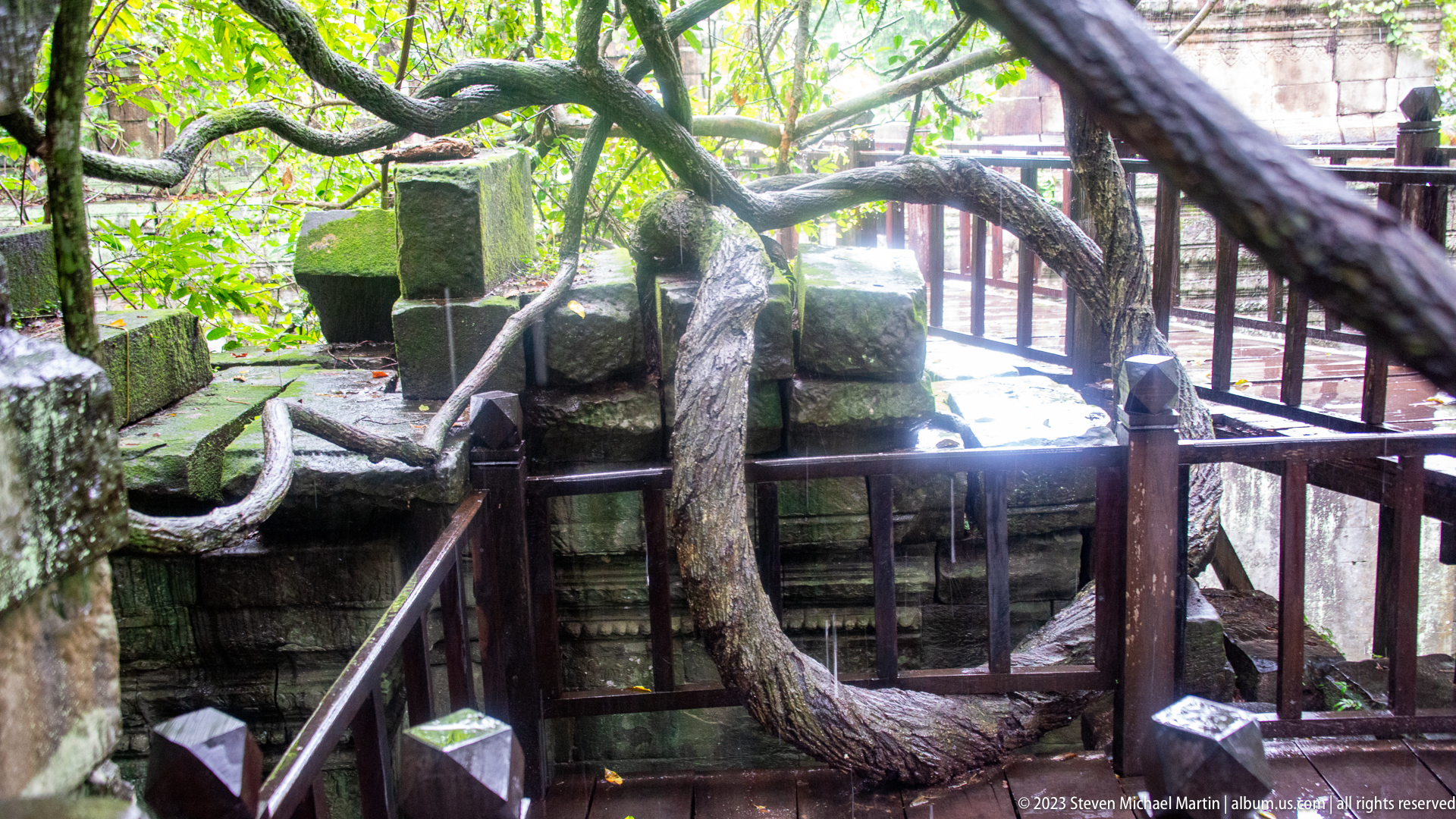
A twisting tree trunk arcs over the wooden visitor walkway, weaving between railings, fallen blocks, and surviving temple walls. The composition shows how the path has been routed around existing vegetation rather than clearing it away. This close relationship between access infrastructure, forest growth, and unstable masonry defines much of the contemporary experience of Beng Mealea.
Caption
A twisting tree trunk arcs over the wooden visitor walkway, weaving between railings, fallen blocks, and surviving temple walls. The composition shows how the path has been routed around existing vegetation rather than clearing it away. This close relationship between access infrastructure, forest growth, and unstable masonry defines much of the contemporary experience of Beng Mealea.
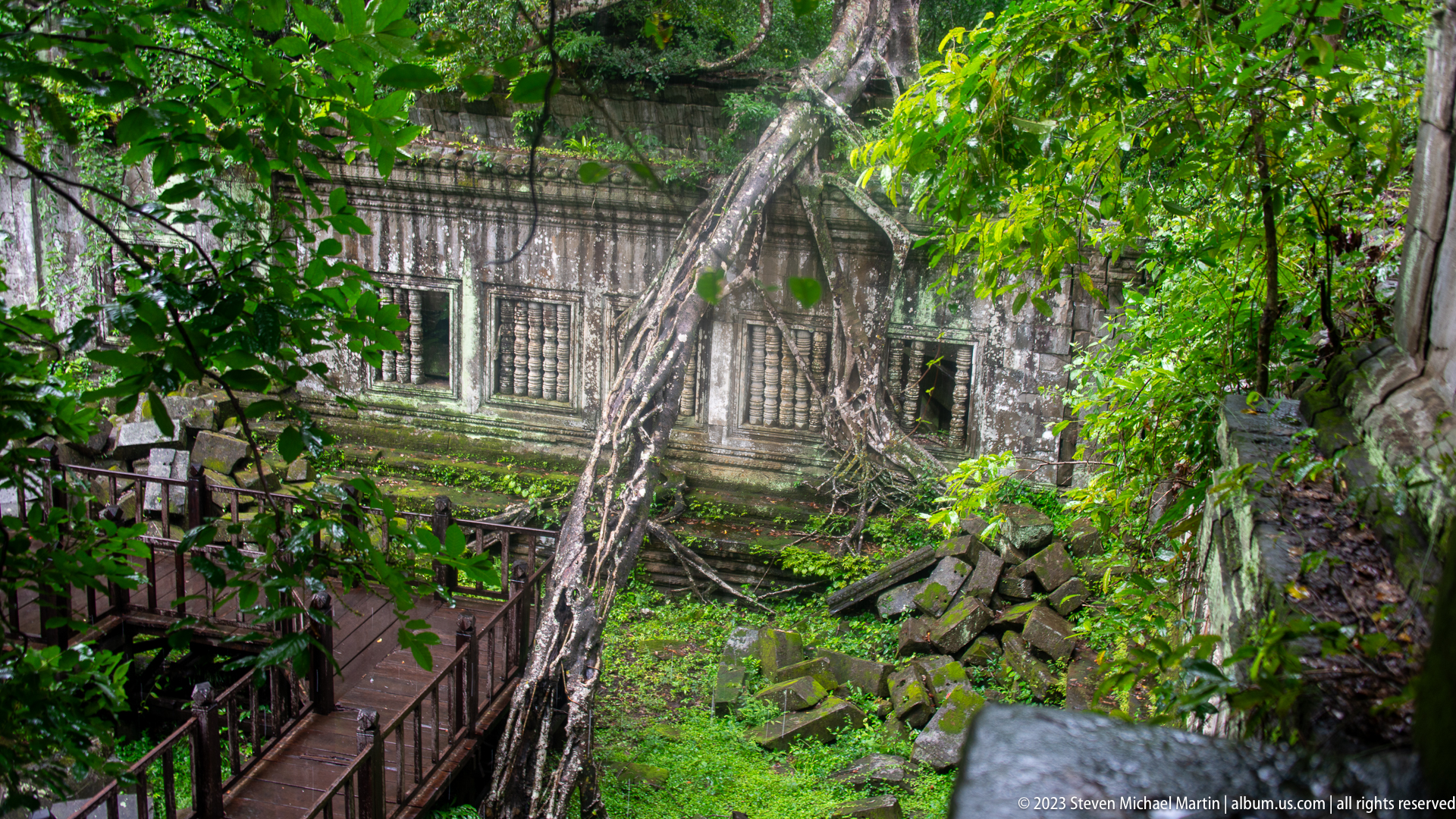
Foliage frames a long gallery wall whose baluster windows are crossed by descending roots and partly screened by trees. A wooden walkway runs below the viewer, while moss and fallen blocks occupy the enclosed ground. The layered viewpoint combines architecture, conservation access, and forest growth in a single spatial overview.
Caption
Foliage frames a long gallery wall whose baluster windows are crossed by descending roots and partly screened by trees. A wooden walkway runs below the viewer, while moss and fallen blocks occupy the enclosed ground. The layered viewpoint combines architecture, conservation access, and forest growth in a single spatial overview.
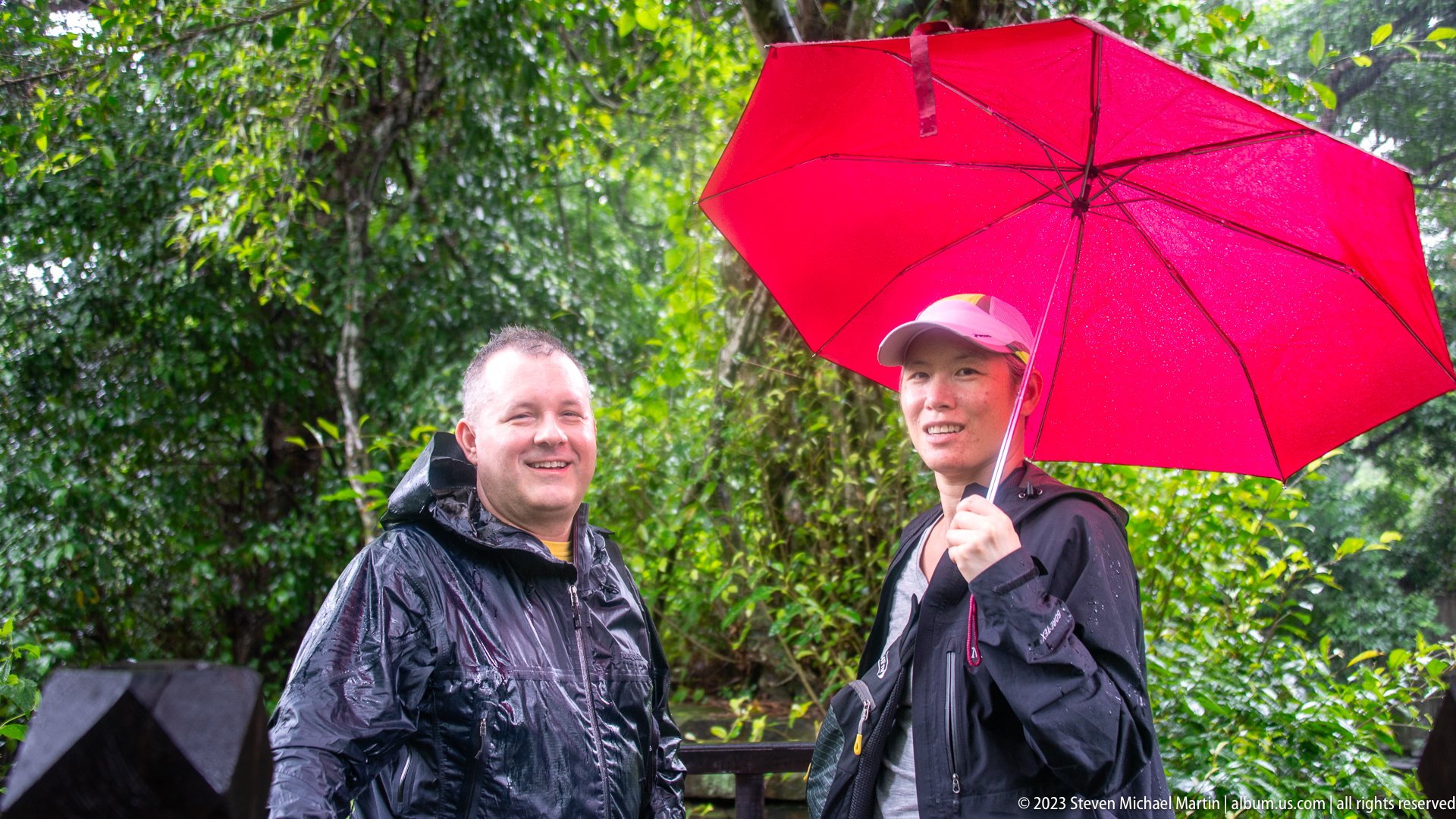
Two visitors pose beneath a vivid red umbrella in the rain-soaked forest at Beng Mealea. Their dark waterproof clothing and the saturated greenery convey the wet conditions, while the umbrella becomes the dominant visual accent. The image serves as a personal travel portrait rooted in the climate and atmosphere of the archaeological visit.
Caption
Two visitors pose beneath a vivid red umbrella in the rain-soaked forest at Beng Mealea. Their dark waterproof clothing and the saturated greenery convey the wet conditions, while the umbrella becomes the dominant visual accent. The image serves as a personal travel portrait rooted in the climate and atmosphere of the archaeological visit.
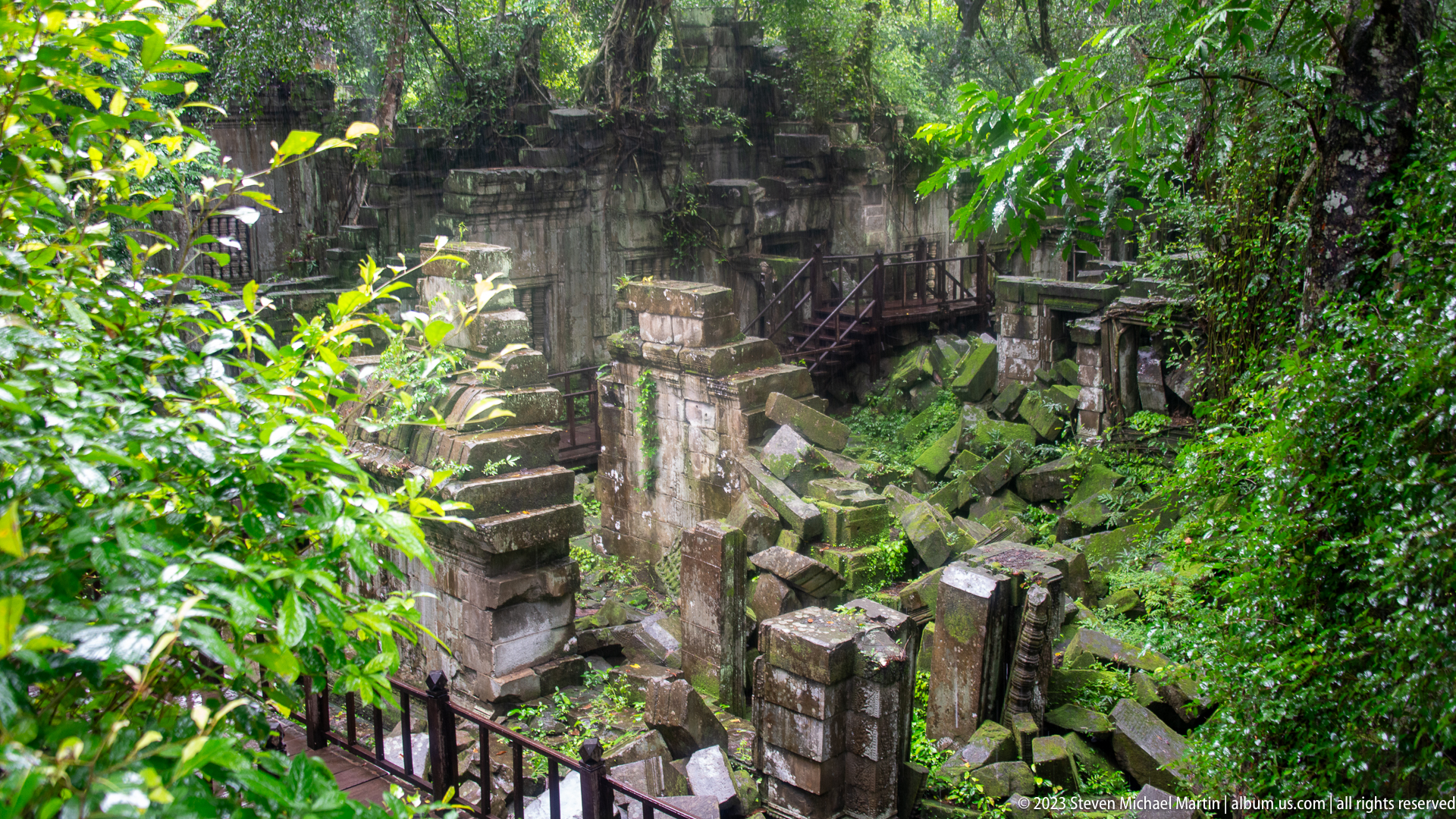
A collapsed gateway complex is seen through dense foliage, with timber stairs and walkways threading between standing piers and fallen blocks. The modern route reveals the original architectural levels while steering visitors around unstable masonry. This overview is especially useful for understanding how conservation access has been integrated into Beng Mealea’s deeply fragmented ruins.
Caption
A collapsed gateway complex is seen through dense foliage, with timber stairs and walkways threading between standing piers and fallen blocks. The modern route reveals the original architectural levels while steering visitors around unstable masonry. This overview is especially useful for understanding how conservation access has been integrated into Beng Mealea’s deeply fragmented ruins.
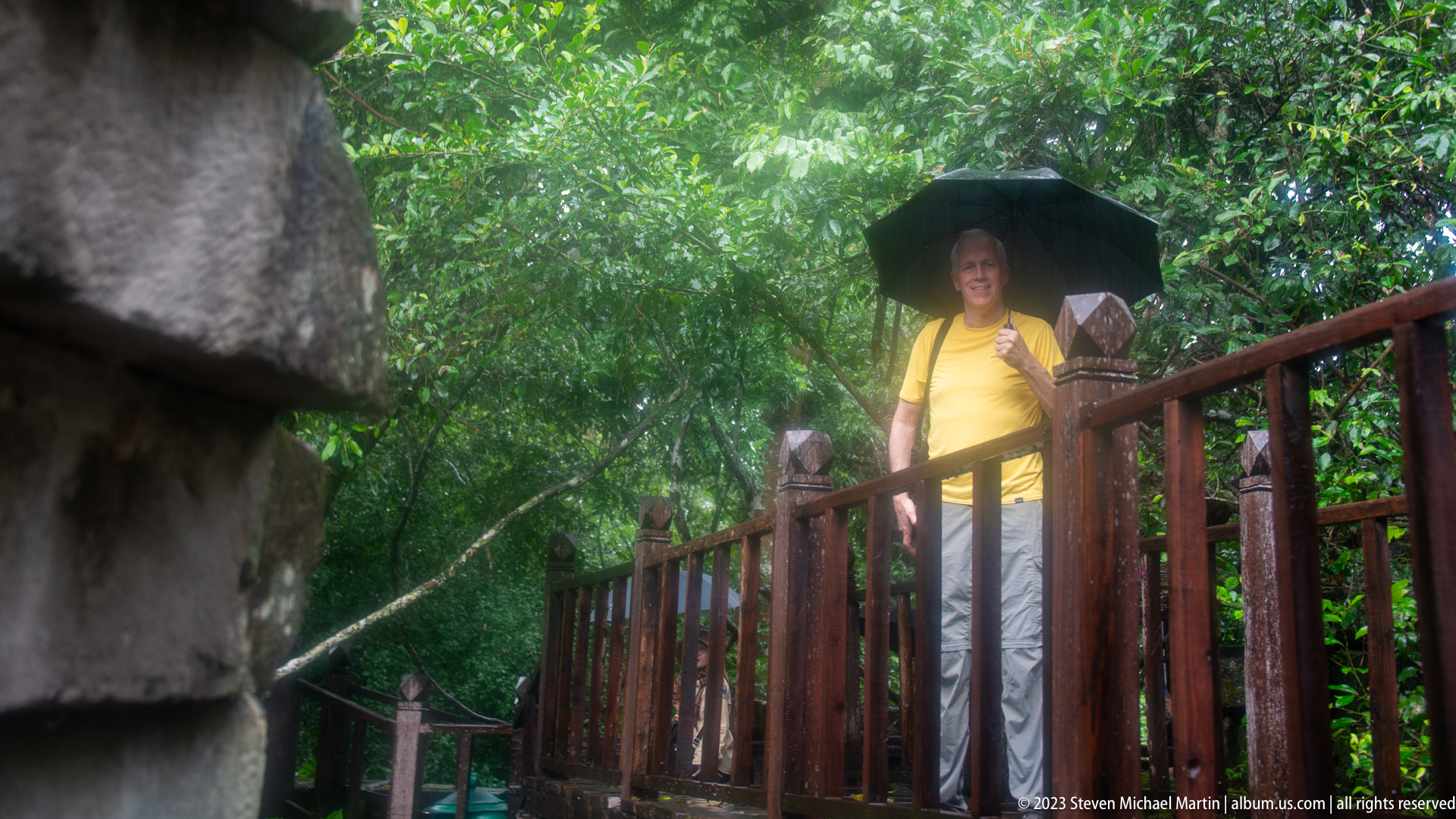
A visitor holding a black umbrella stands on an elevated wooden platform above the forested ruins. Rain-darkened railings, misty light, and wet foliage create a subdued atmosphere, while the raised route separates the traveler from unstable ground below. The image documents the practical realities of visiting Beng Mealea during wet weather.
Caption
A visitor holding a black umbrella stands on an elevated wooden platform above the forested ruins. Rain-darkened railings, misty light, and wet foliage create a subdued atmosphere, while the raised route separates the traveler from unstable ground below. The image documents the practical realities of visiting Beng Mealea during wet weather.
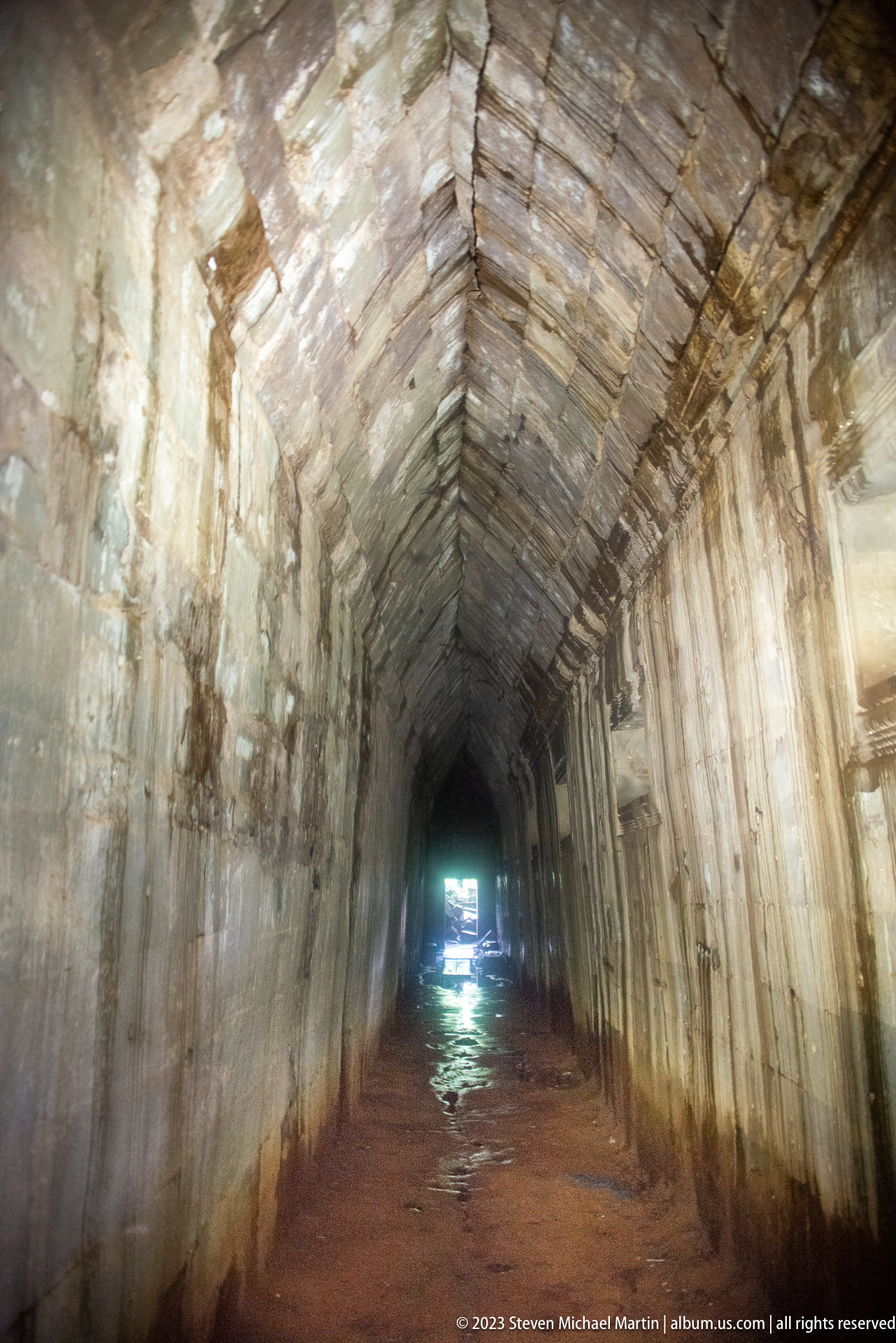
A long interior corridor recedes beneath a pointed corbel vault assembled from progressively projecting sandstone courses. Moisture stains streak the walls and roof, while water and reddish sediment cover the floor. The strong central perspective reveals both the engineering of the Khmer vault and the tunnel-like spatial experience of moving through Beng Mealea’s surviving galleries.
Caption
A long interior corridor recedes beneath a pointed corbel vault assembled from progressively projecting sandstone courses. Moisture stains streak the walls and roof, while water and reddish sediment cover the floor. The strong central perspective reveals both the engineering of the Khmer vault and the tunnel-like spatial experience of moving through Beng Mealea’s surviving galleries.
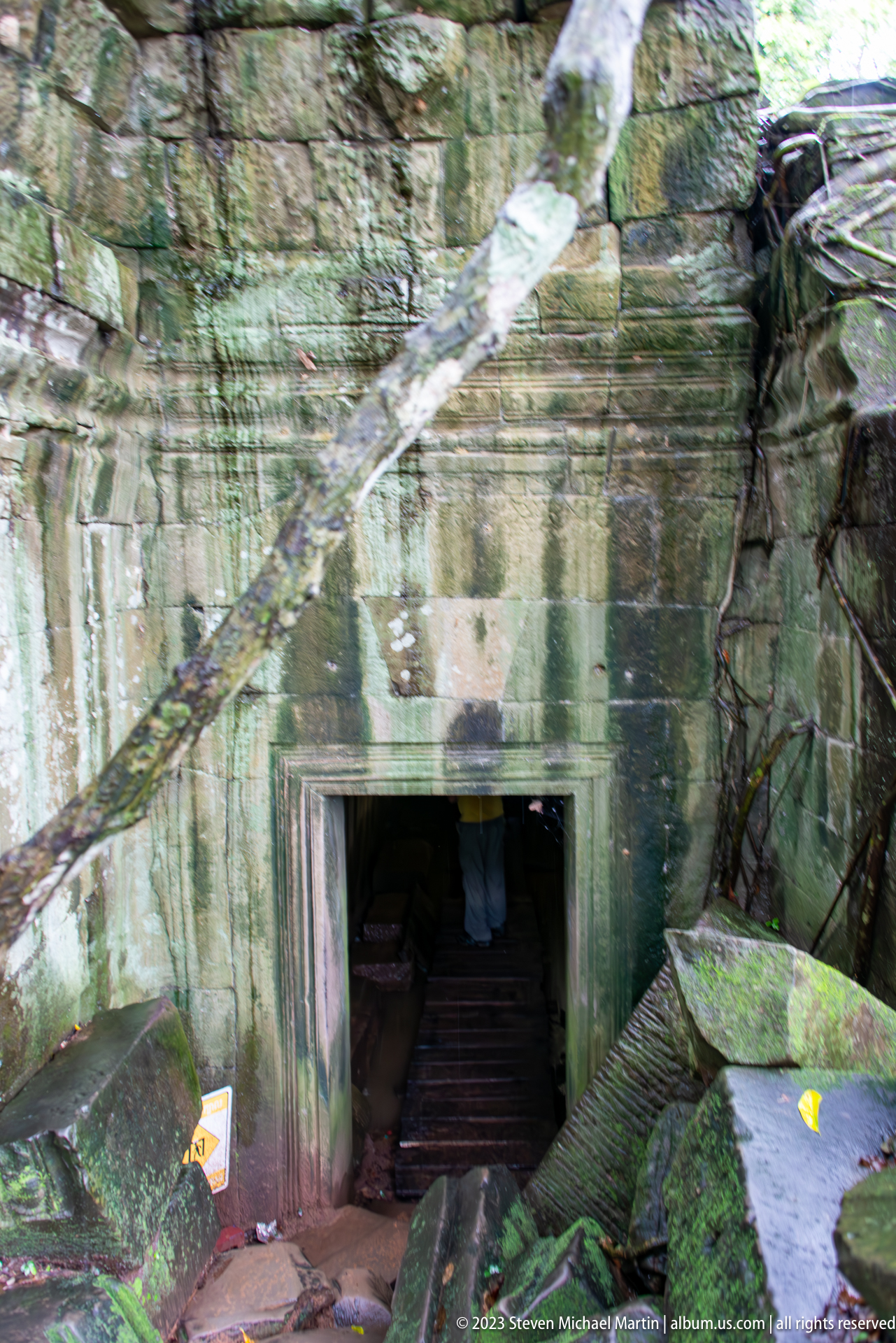
A low rectangular doorway opens into a dark interior passage beneath a heavily stained sandstone wall. Fallen blocks and exposed roots press close to the threshold, while a wooden walkway continues inside. The composition emphasizes the abrupt transition from the open ruin field into Beng Mealea’s enclosed circulation system.
Caption
A low rectangular doorway opens into a dark interior passage beneath a heavily stained sandstone wall. Fallen blocks and exposed roots press close to the threshold, while a wooden walkway continues inside. The composition emphasizes the abrupt transition from the open ruin field into Beng Mealea’s enclosed circulation system.
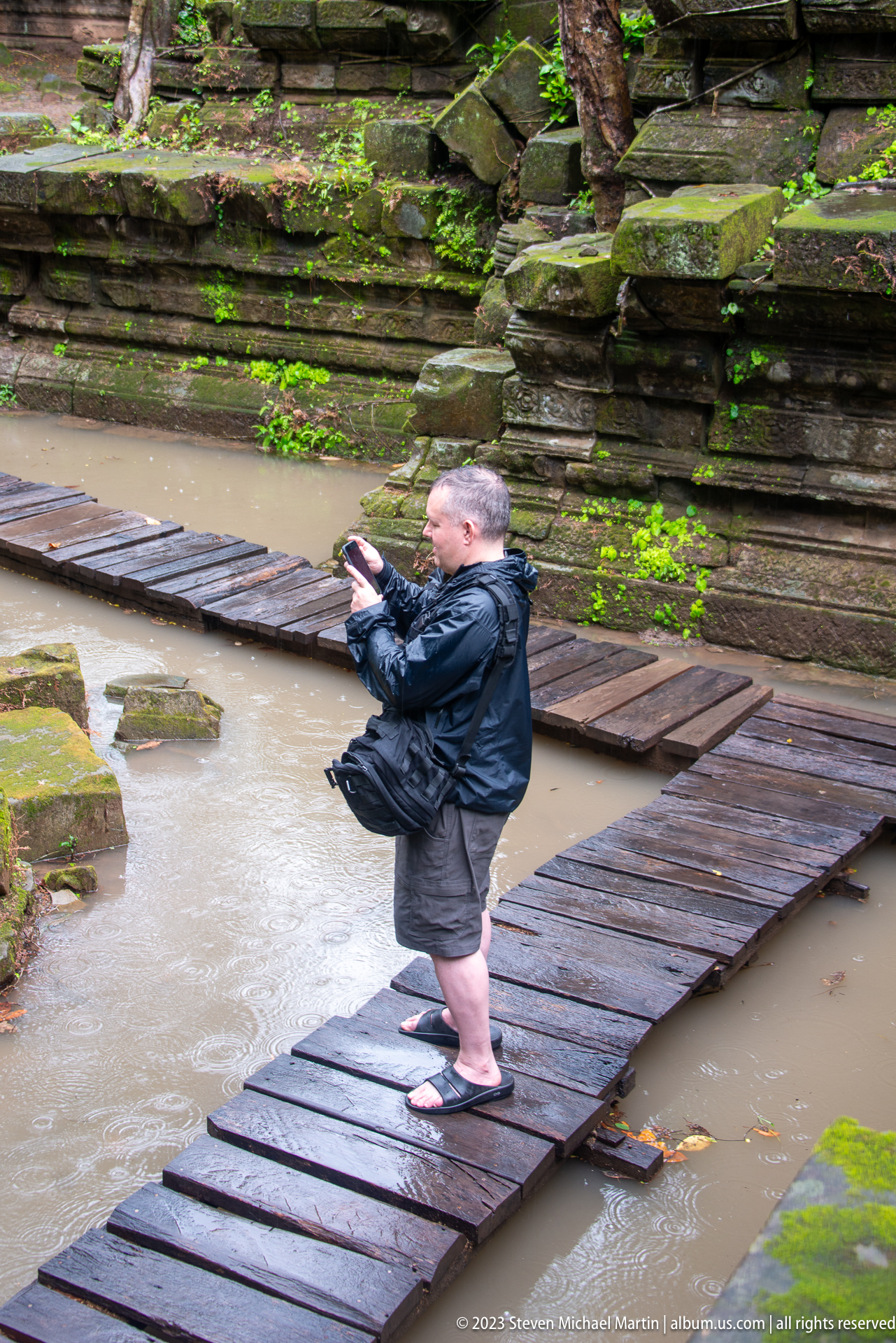
A visitor balances on wet timber boards while photographing the flooded temple grounds. The improvised-looking walkway crosses shallow water beside low sandstone walls, and the visitor’s stance conveys the practical difficulty of moving through the site in rain. The image is both a travel record and a document of visitor circulation.
Caption
A visitor balances on wet timber boards while photographing the flooded temple grounds. The improvised-looking walkway crosses shallow water beside low sandstone walls, and the visitor’s stance conveys the practical difficulty of moving through the site in rain. The image is both a travel record and a document of visitor circulation.
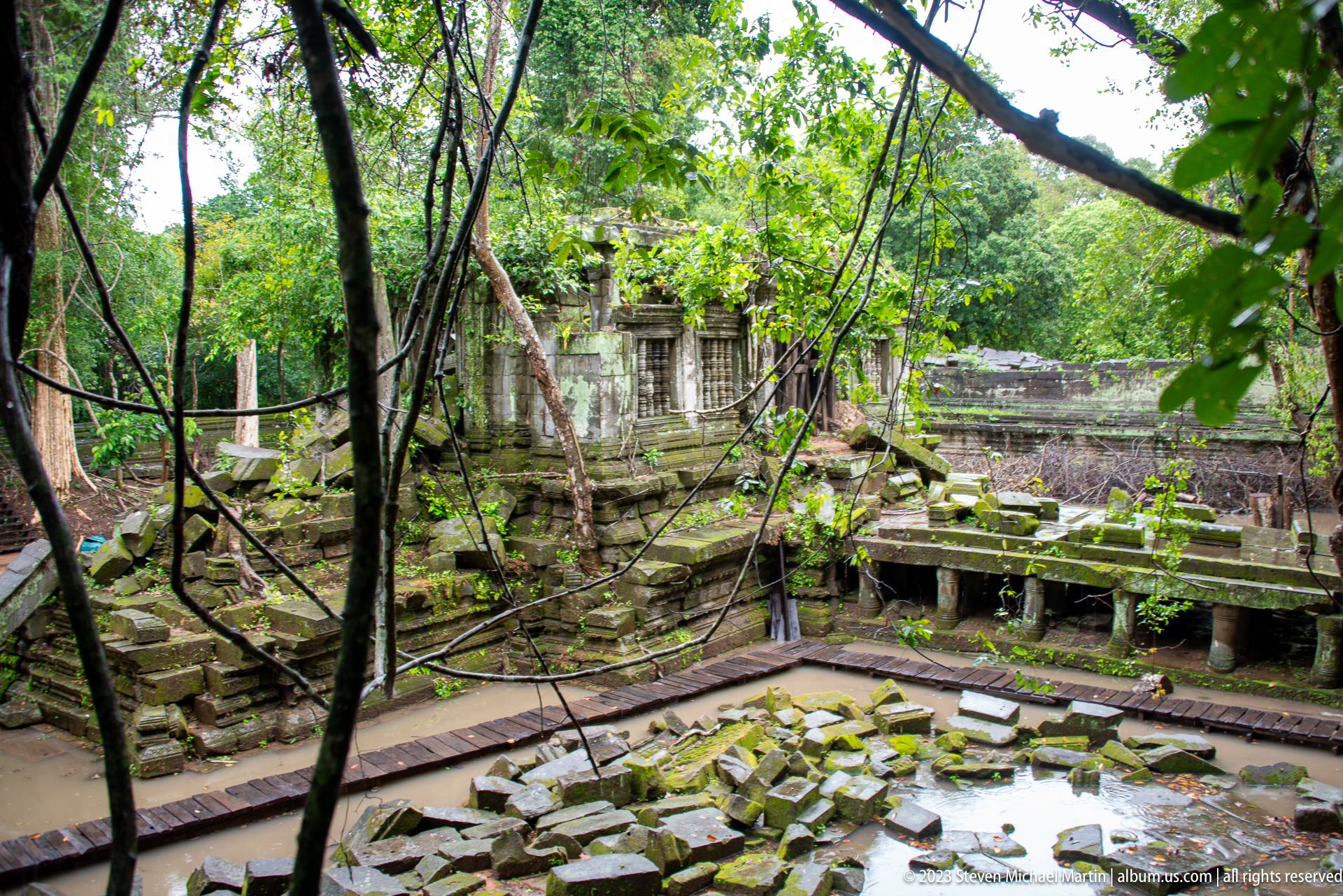
A broad flooded court is crossed by raised wooden paths that weave between fallen sandstone blocks and surviving gallery walls. Reflections, vines, and overhanging branches reinforce the saturated forest environment. The elevated route allows visitors to traverse a space where original paving and drainage are obscured by water and collapse.
Caption
A broad flooded court is crossed by raised wooden paths that weave between fallen sandstone blocks and surviving gallery walls. Reflections, vines, and overhanging branches reinforce the saturated forest environment. The elevated route allows visitors to traverse a space where original paving and drainage are obscured by water and collapse.

A close oblique view follows the base of a sandstone gallery wall, where bead-like molding runs above a narrow drainage channel. Dense moss covers the lower courses and water glistens along the stone edge. The image isolates a functional and decorative zone often overlooked in broader architectural views.
Caption
A close oblique view follows the base of a sandstone gallery wall, where bead-like molding runs above a narrow drainage channel. Dense moss covers the lower courses and water glistens along the stone edge. The image isolates a functional and decorative zone often overlooked in broader architectural views.
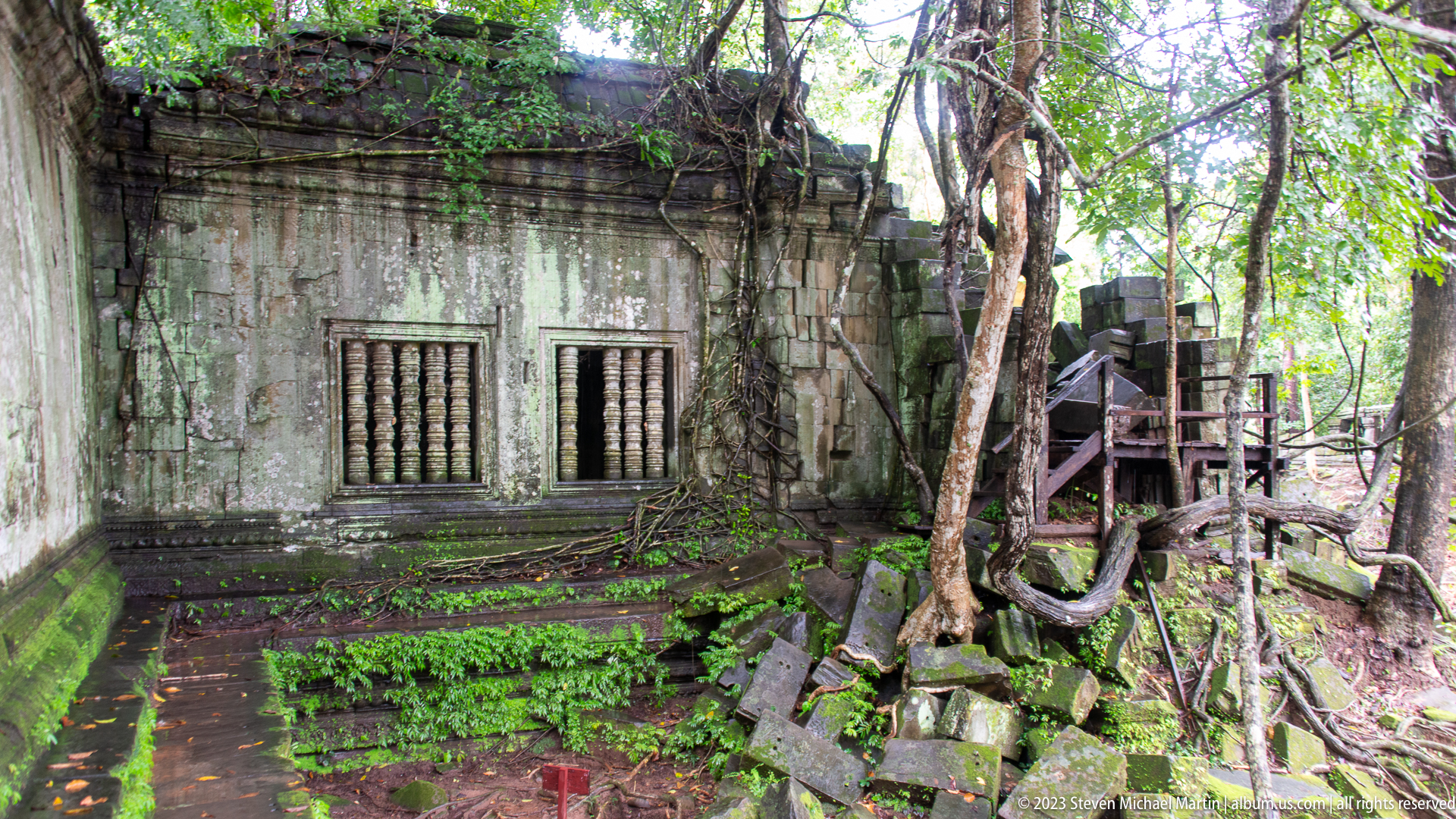
Two narrow baluster windows punctuate a gallery wall partly overtaken by roots and trees. A collapsed passage and wooden stair structure appear at right, while moss spreads across the stepped base. The view combines intact façade rhythm with the local disruption caused by vegetation and structural failure.
Caption
Two narrow baluster windows punctuate a gallery wall partly overtaken by roots and trees. A collapsed passage and wooden stair structure appear at right, while moss spreads across the stepped base. The view combines intact façade rhythm with the local disruption caused by vegetation and structural failure.
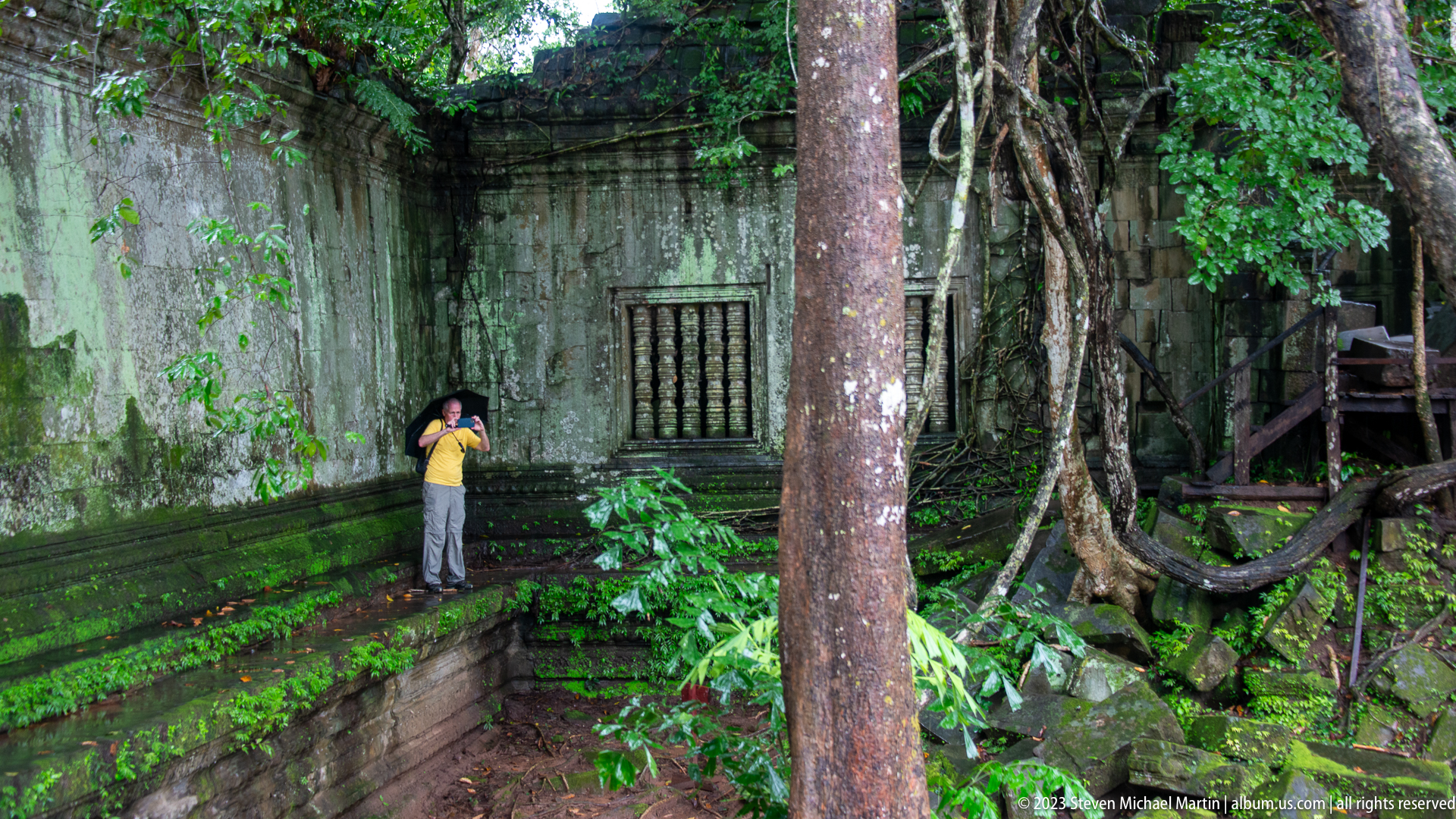
A visitor raises a camera beside a balustered gallery wall as massive roots descend across the adjacent masonry. The human figure provides scale for the wall base and tree trunk while also documenting the act of close observation. Wet surfaces and dense vegetation reinforce the conditions under which Beng Mealea is experienced.
Caption
A visitor raises a camera beside a balustered gallery wall as massive roots descend across the adjacent masonry. The human figure provides scale for the wall base and tree trunk while also documenting the act of close observation. Wet surfaces and dense vegetation reinforce the conditions under which Beng Mealea is experienced.
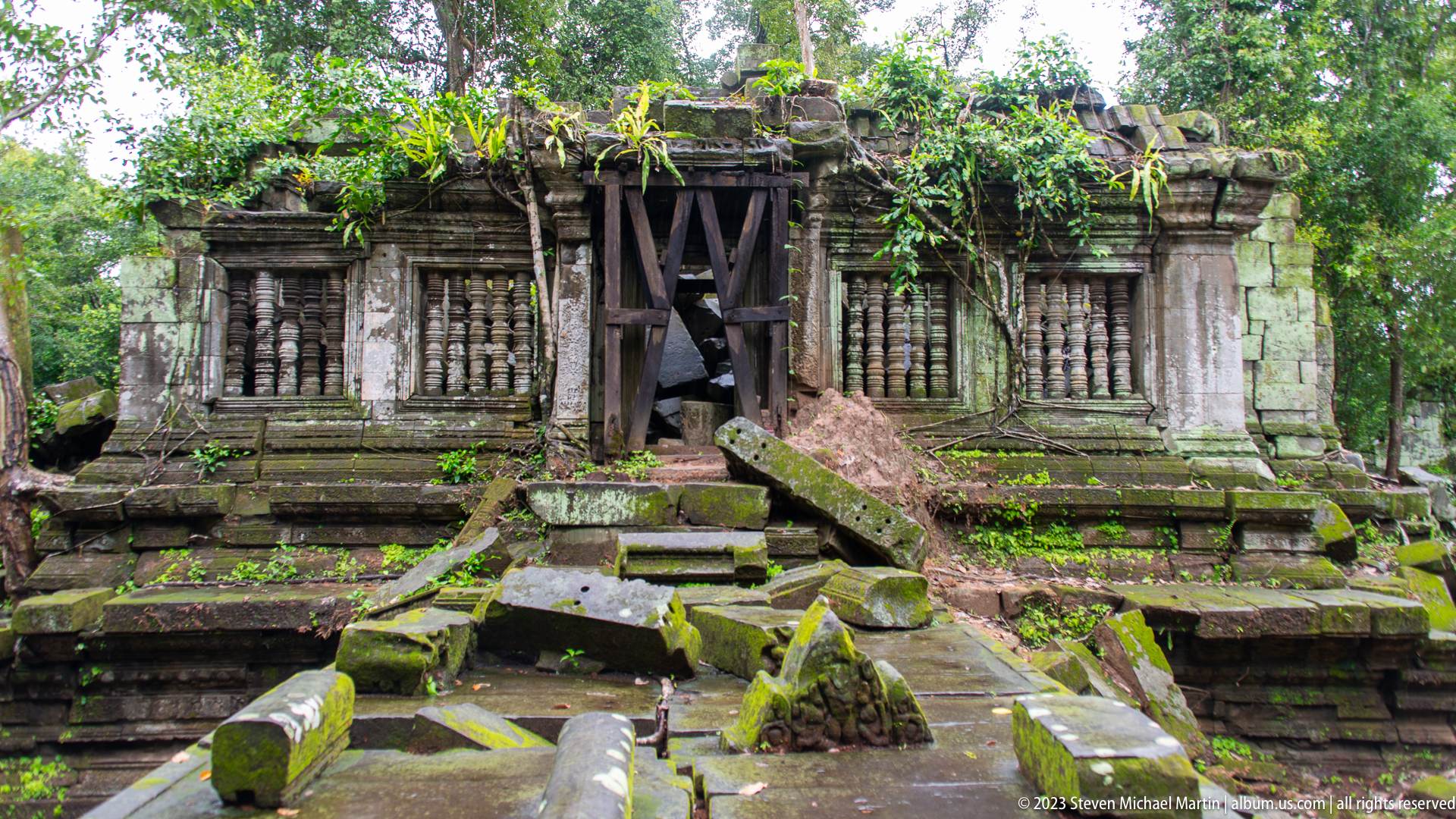
A symmetrical sandstone façade is organized around a central doorway reinforced by heavy timber bracing, with baluster windows set to either side. Fallen blocks and moss-covered steps fill the approach. The frontal view clearly records both the original architectural order and the modern intervention required to stabilize the entrance.
Caption
A symmetrical sandstone façade is organized around a central doorway reinforced by heavy timber bracing, with baluster windows set to either side. Fallen blocks and moss-covered steps fill the approach. The frontal view clearly records both the original architectural order and the modern intervention required to stabilize the entrance.
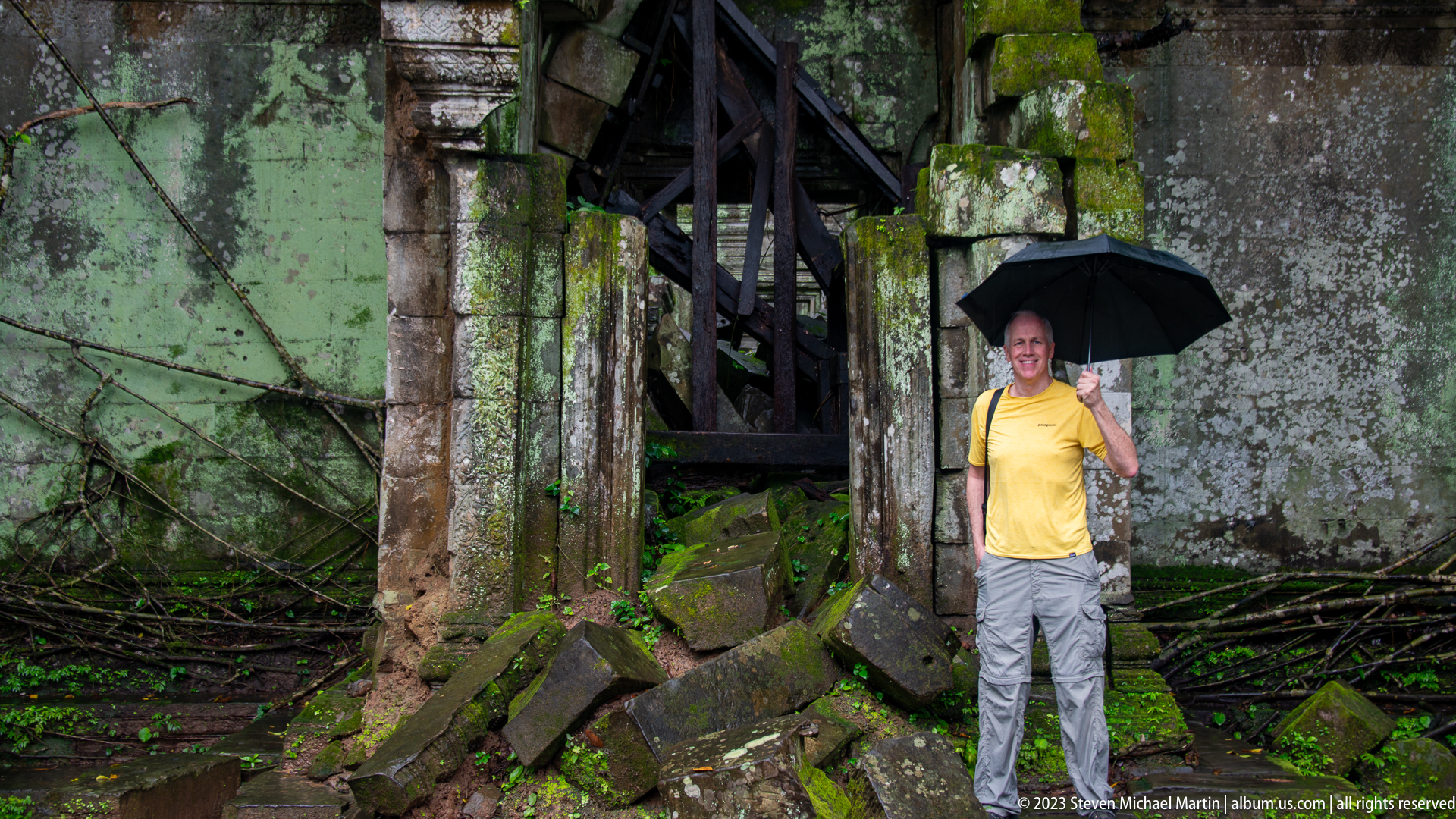
A visitor holding a black umbrella stands beside a doorway reinforced with a dense timber support frame. Fallen sandstone blocks and a tree trunk crowd the narrow space, emphasizing the complexity of access through the ruins. The portrait also records the conservation structure at a human scale.
Caption
A visitor holding a black umbrella stands beside a doorway reinforced with a dense timber support frame. Fallen sandstone blocks and a tree trunk crowd the narrow space, emphasizing the complexity of access through the ruins. The portrait also records the conservation structure at a human scale.

A close portrait isolates the visitor beneath a black umbrella against a softly focused sandstone wall. The framing emphasizes expression, rain gear, and the damp conditions of the visit rather than architectural detail. Subtle wall staining in the background preserves the connection to Beng Mealea’s weathered temple setting.
Caption
A close portrait isolates the visitor beneath a black umbrella against a softly focused sandstone wall. The framing emphasizes expression, rain gear, and the damp conditions of the visit rather than architectural detail. Subtle wall staining in the background preserves the connection to Beng Mealea’s weathered temple setting.
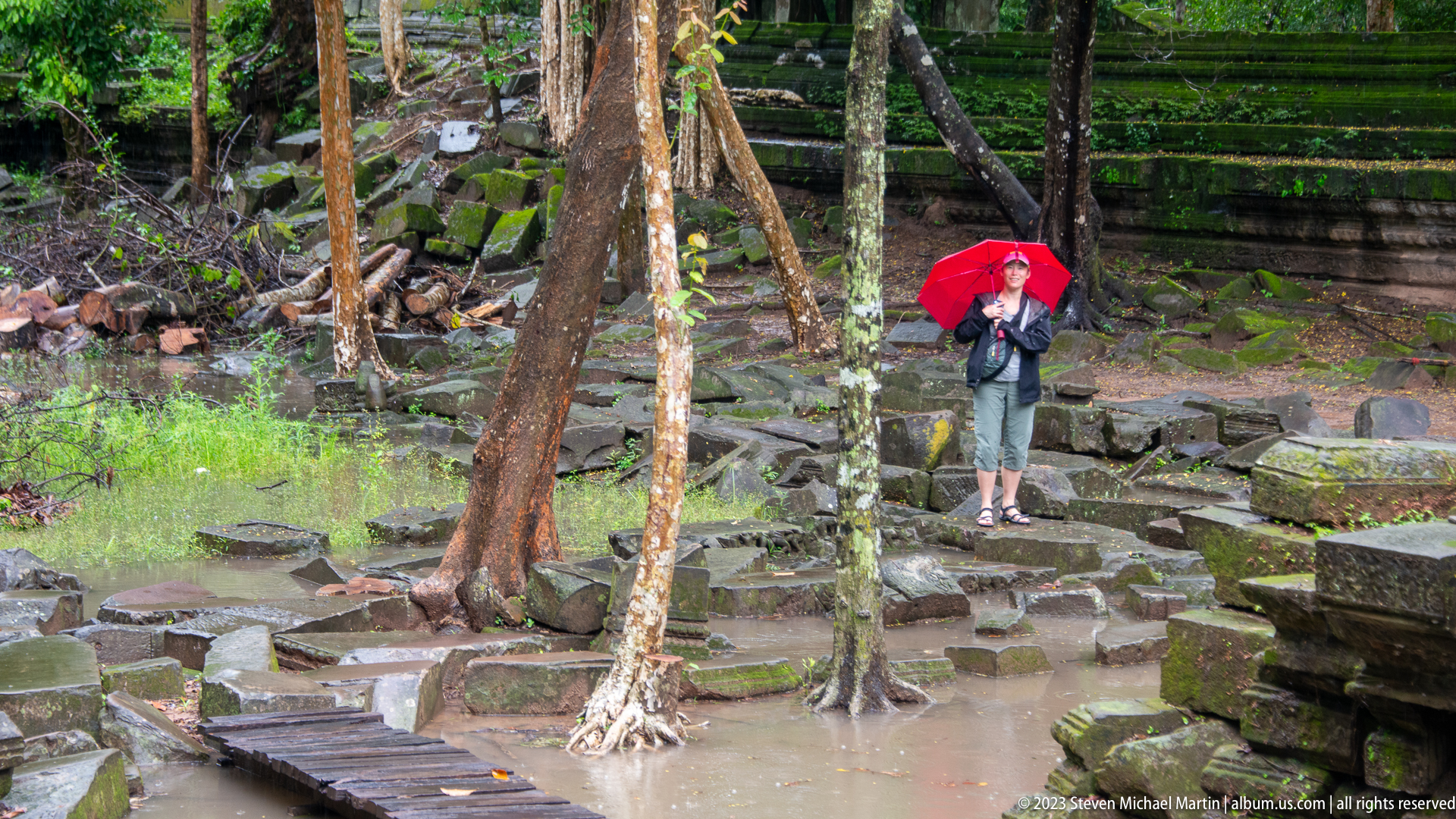
A visitor with a red umbrella stands among waterlogged sandstone blocks and slender trees in a flooded section of Beng Mealea. The vivid umbrella draws attention against muted stone and brown water, while the uneven footing demonstrates why raised walkways are necessary elsewhere in the complex.
Caption
A visitor with a red umbrella stands among waterlogged sandstone blocks and slender trees in a flooded section of Beng Mealea. The vivid umbrella draws attention against muted stone and brown water, while the uneven footing demonstrates why raised walkways are necessary elsewhere in the complex.
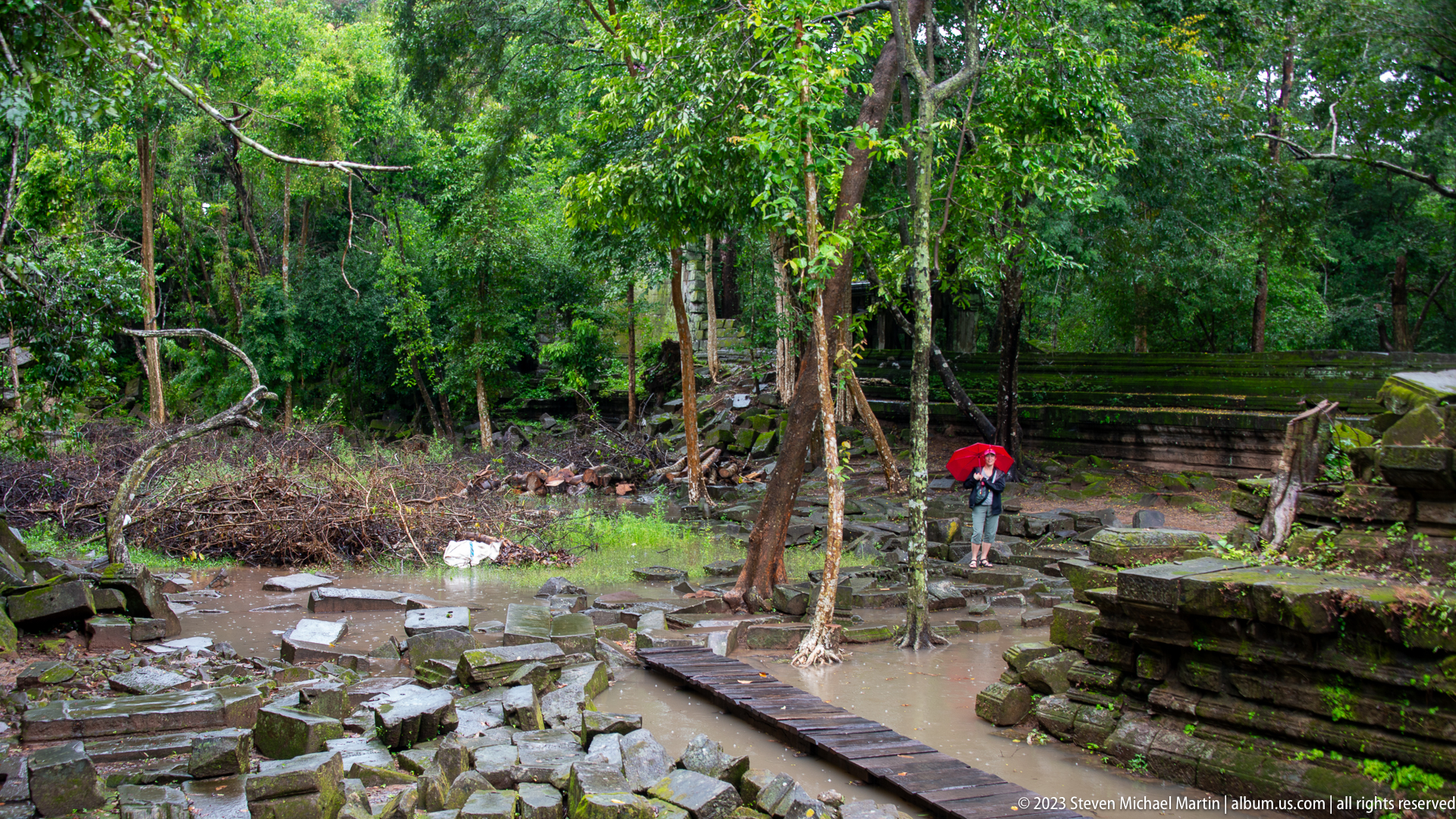
A wide view places a lone visitor beneath a red umbrella within a flooded archaeological landscape of trees, scattered blocks, and low sandstone walls. A narrow timber footpath threads through the water. The composition emphasizes the scale of seasonal inundation and the fragmented survival of architecture across the forest floor.
Caption
A wide view places a lone visitor beneath a red umbrella within a flooded archaeological landscape of trees, scattered blocks, and low sandstone walls. A narrow timber footpath threads through the water. The composition emphasizes the scale of seasonal inundation and the fragmented survival of architecture across the forest floor.
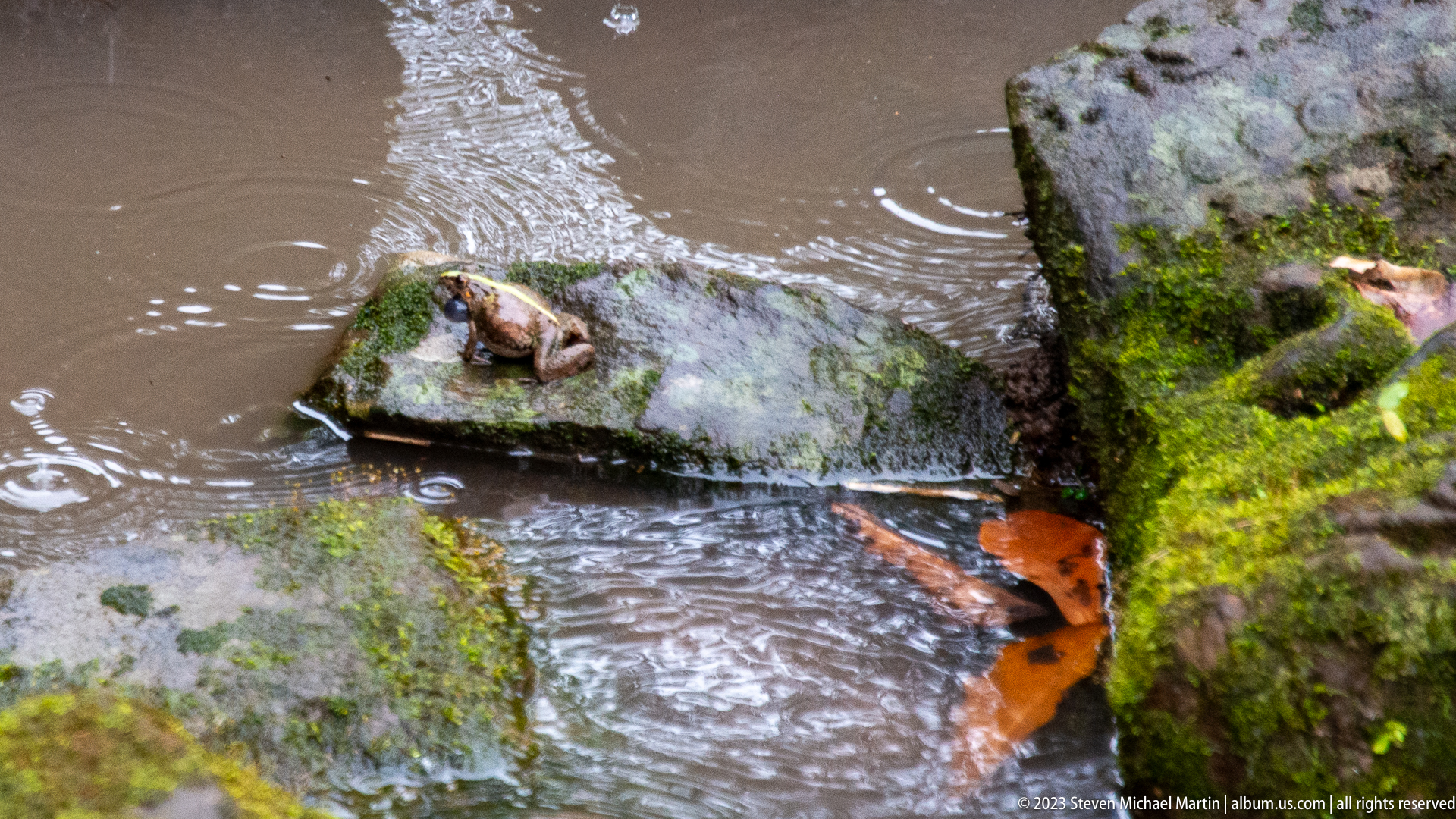
A small brown frog rests on a moss-covered sandstone block partly submerged in rainwater. Ripples and floating leaves surround the animal, linking Beng Mealea’s archaeological fabric with the living wet-season habitat that now occupies the ruins. The species cannot be confirmed from the proof-sheet image alone.
Caption
A small brown frog rests on a moss-covered sandstone block partly submerged in rainwater. Ripples and floating leaves surround the animal, linking Beng Mealea’s archaeological fabric with the living wet-season habitat that now occupies the ruins. The species cannot be confirmed from the proof-sheet image alone.
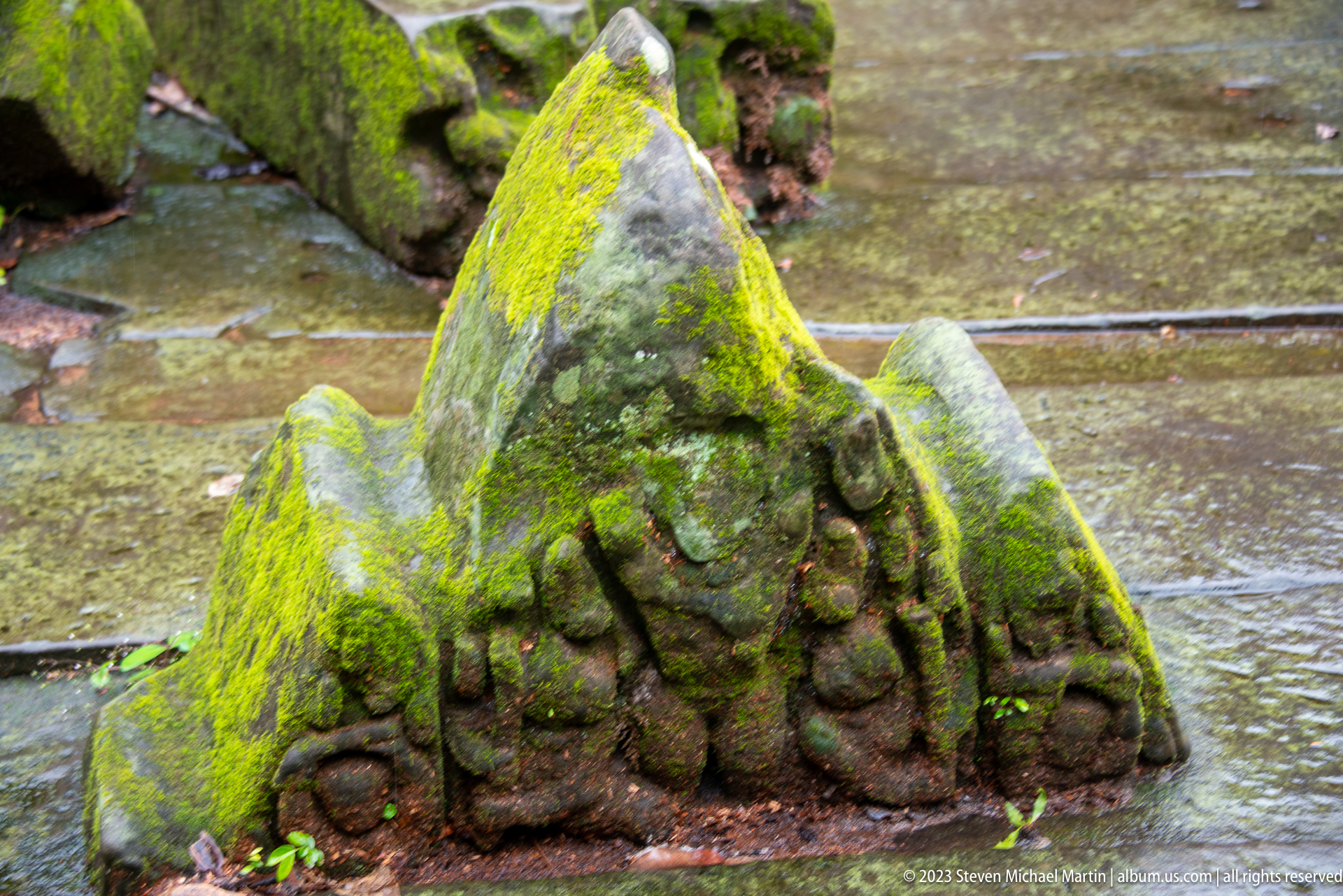
A triangular sandstone fragment rises from the wet ground, its carved surface softened by heavy moss and erosion. The peaked form suggests a roof-edge or pediment ornament rather than a freestanding sculpture. Seen in isolation, it is best cataloged as a displaced architectural finial whose exact original position remains uncertain.
Caption
A triangular sandstone fragment rises from the wet ground, its carved surface softened by heavy moss and erosion. The peaked form suggests a roof-edge or pediment ornament rather than a freestanding sculpture. Seen in isolation, it is best cataloged as a displaced architectural finial whose exact original position remains uncertain.
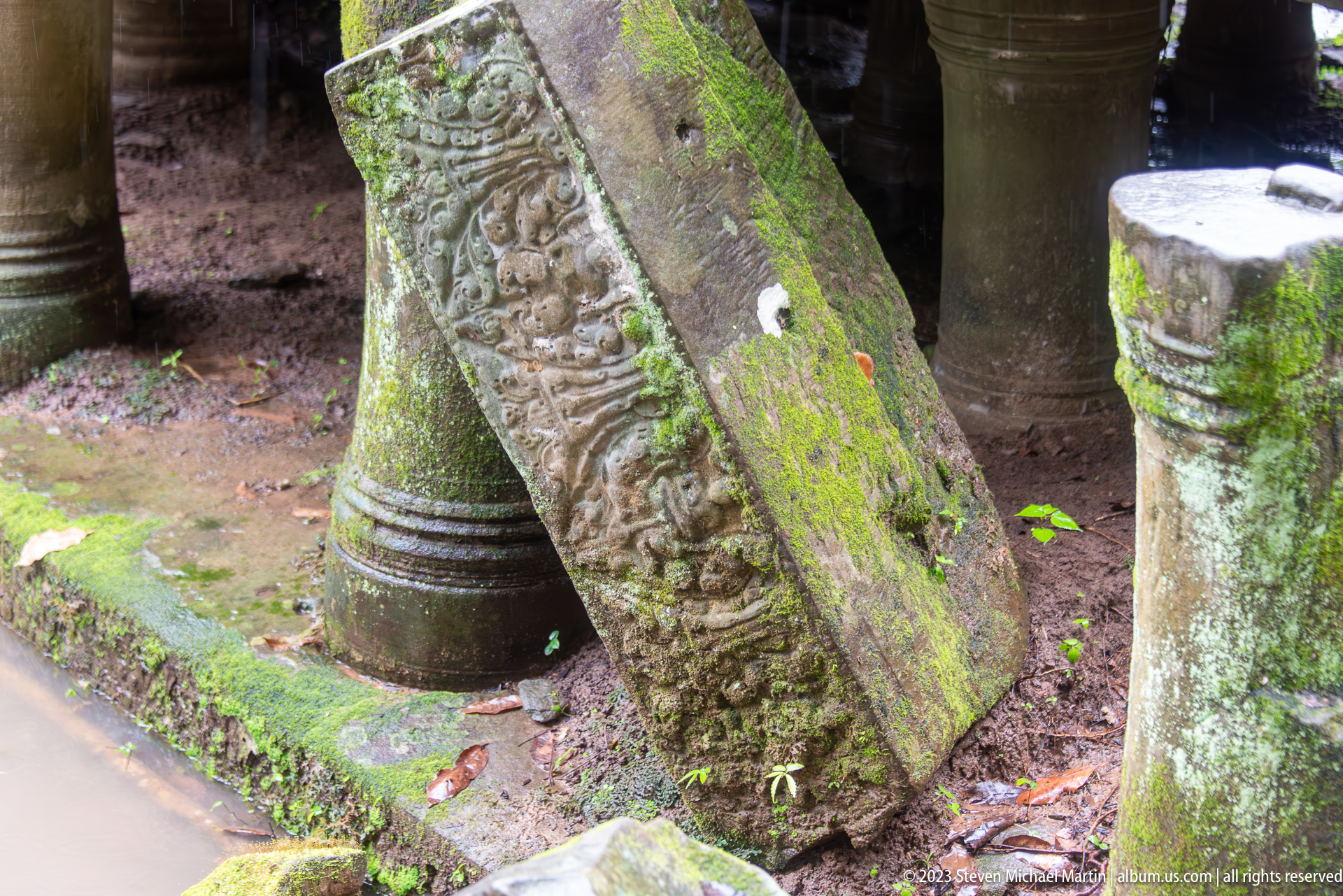
A carved sandstone lintel leans diagonally against large turned stone columns, its relief of small figures and foliage still visible beneath moss. The displaced arrangement reveals how sculptural and structural elements have collapsed together. The image is especially useful for studying the lintel’s carved face and its present archaeological context.
Caption
A carved sandstone lintel leans diagonally against large turned stone columns, its relief of small figures and foliage still visible beneath moss. The displaced arrangement reveals how sculptural and structural elements have collapsed together. The image is especially useful for studying the lintel’s carved face and its present archaeological context.

A brown frog perches on the upper edge of a mossy sandstone slab surrounded by shallow floodwater. The closer viewpoint shows the animal’s crouched posture and wet skin more clearly than the preceding image. The photograph documents the ruins as active amphibian habitat, though species identification remains uncertain.
Caption
A brown frog perches on the upper edge of a mossy sandstone slab surrounded by shallow floodwater. The closer viewpoint shows the animal’s crouched posture and wet skin more clearly than the preceding image. The photograph documents the ruins as active amphibian habitat, though species identification remains uncertain.
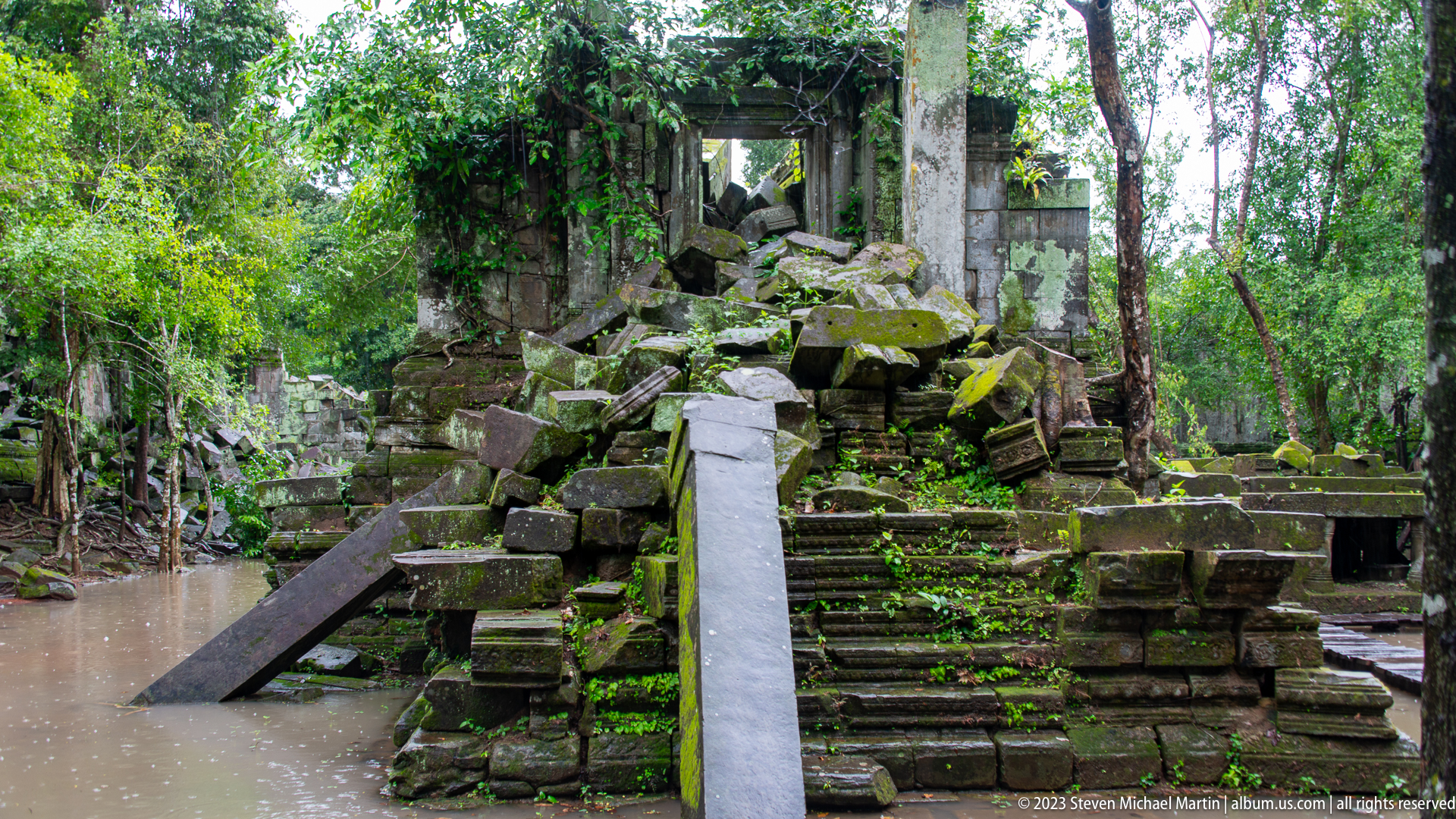
A narrow timber ramp leads toward a raised sandstone structure whose stair and entrance are choked by collapsed blocks. Surviving wall piers and a dark opening remain visible above the rubble. The frontal approach emphasizes both the building’s elevated sacred form and the extent of structural failure at its entrance.
Caption
A narrow timber ramp leads toward a raised sandstone structure whose stair and entrance are choked by collapsed blocks. Surviving wall piers and a dark opening remain visible above the rubble. The frontal approach emphasizes both the building’s elevated sacred form and the extent of structural failure at its entrance.

Standing water surrounds a raised temple structure whose central approach and upper walls have partly collapsed. Timber braces or ramps lean against the masonry, while loose blocks lie scattered across the flooded foreground. The wider composition places the ruined building within Beng Mealea’s saturated forest landscape and reveals the scale of inundation around it.
Caption
Standing water surrounds a raised temple structure whose central approach and upper walls have partly collapsed. Timber braces or ramps lean against the masonry, while loose blocks lie scattered across the flooded foreground. The wider composition places the ruined building within Beng Mealea’s saturated forest landscape and reveals the scale of inundation around it.
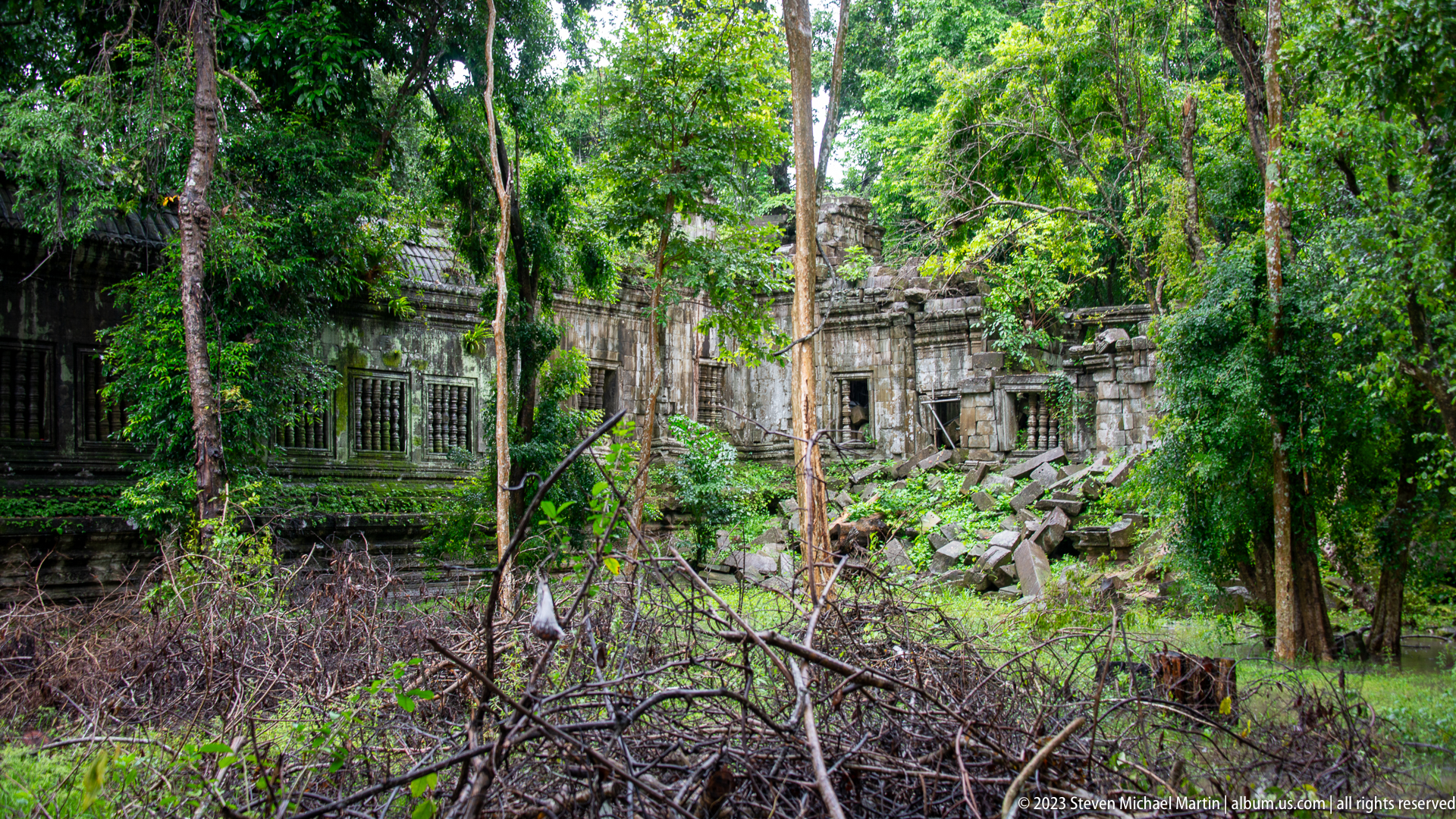
A long gallery wall emerges through dense trees and undergrowth, with baluster windows and recessed bays still visible behind scattered rubble. The distance and vegetation make the architecture appear embedded within the forest rather than isolated from it. This contextual view emphasizes Beng Mealea’s broader archaeological landscape rather than a single architectural detail.
Caption
A long gallery wall emerges through dense trees and undergrowth, with baluster windows and recessed bays still visible behind scattered rubble. The distance and vegetation make the architecture appear embedded within the forest rather than isolated from it. This contextual view emphasizes Beng Mealea’s broader archaeological landscape rather than a single architectural detail.
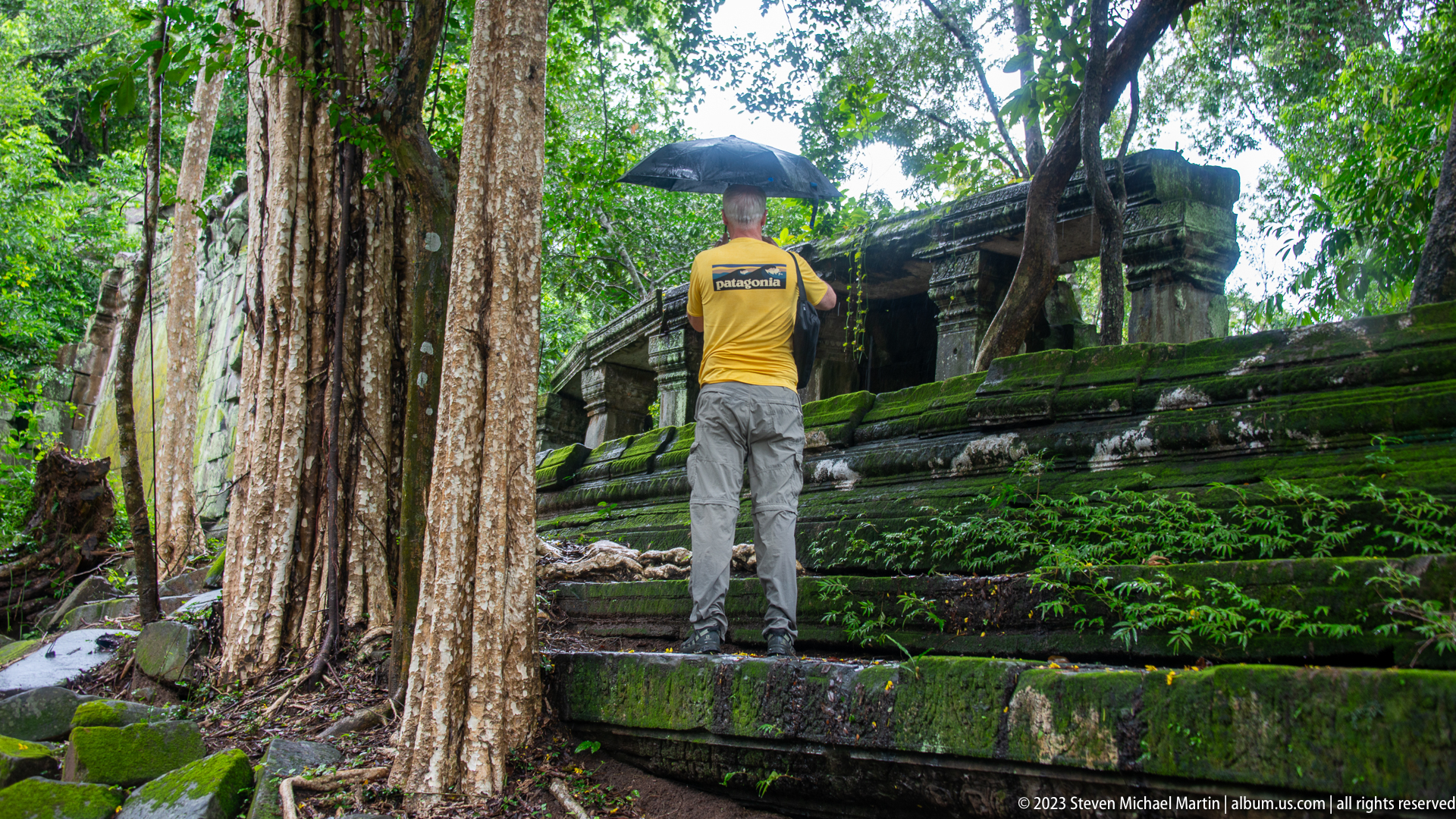
A visitor holding a black umbrella stands on broad moss-covered sandstone steps beside a massive tree trunk. The low viewpoint emphasizes the steep green courses rising toward a ruined structure above. The figure provides scale while the rain-darkened surfaces convey the slippery conditions of the ascent.
Caption
A visitor holding a black umbrella stands on broad moss-covered sandstone steps beside a massive tree trunk. The low viewpoint emphasizes the steep green courses rising toward a ruined structure above. The figure provides scale while the rain-darkened surfaces convey the slippery conditions of the ascent.
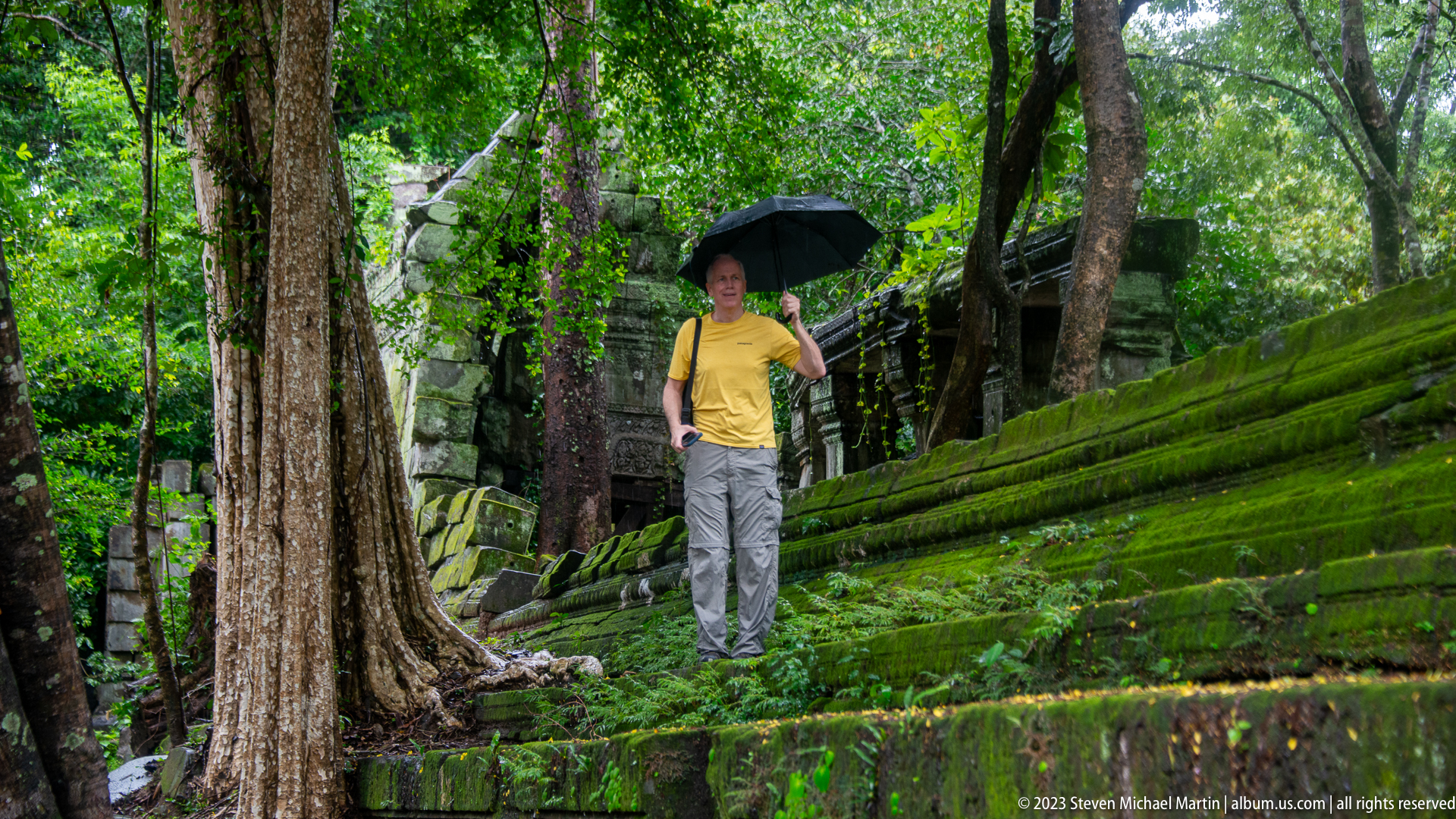
A visitor descends between trees along steep sandstone steps coated in vivid green moss. A ruined wall rises behind him, while the black umbrella reinforces the wet conditions. Compared with the preceding portrait, this wider view emphasizes movement through the terrain and the integration of monumental stairs with mature forest growth.
Caption
A visitor descends between trees along steep sandstone steps coated in vivid green moss. A ruined wall rises behind him, while the black umbrella reinforces the wet conditions. Compared with the preceding portrait, this wider view emphasizes movement through the terrain and the integration of monumental stairs with mature forest growth.
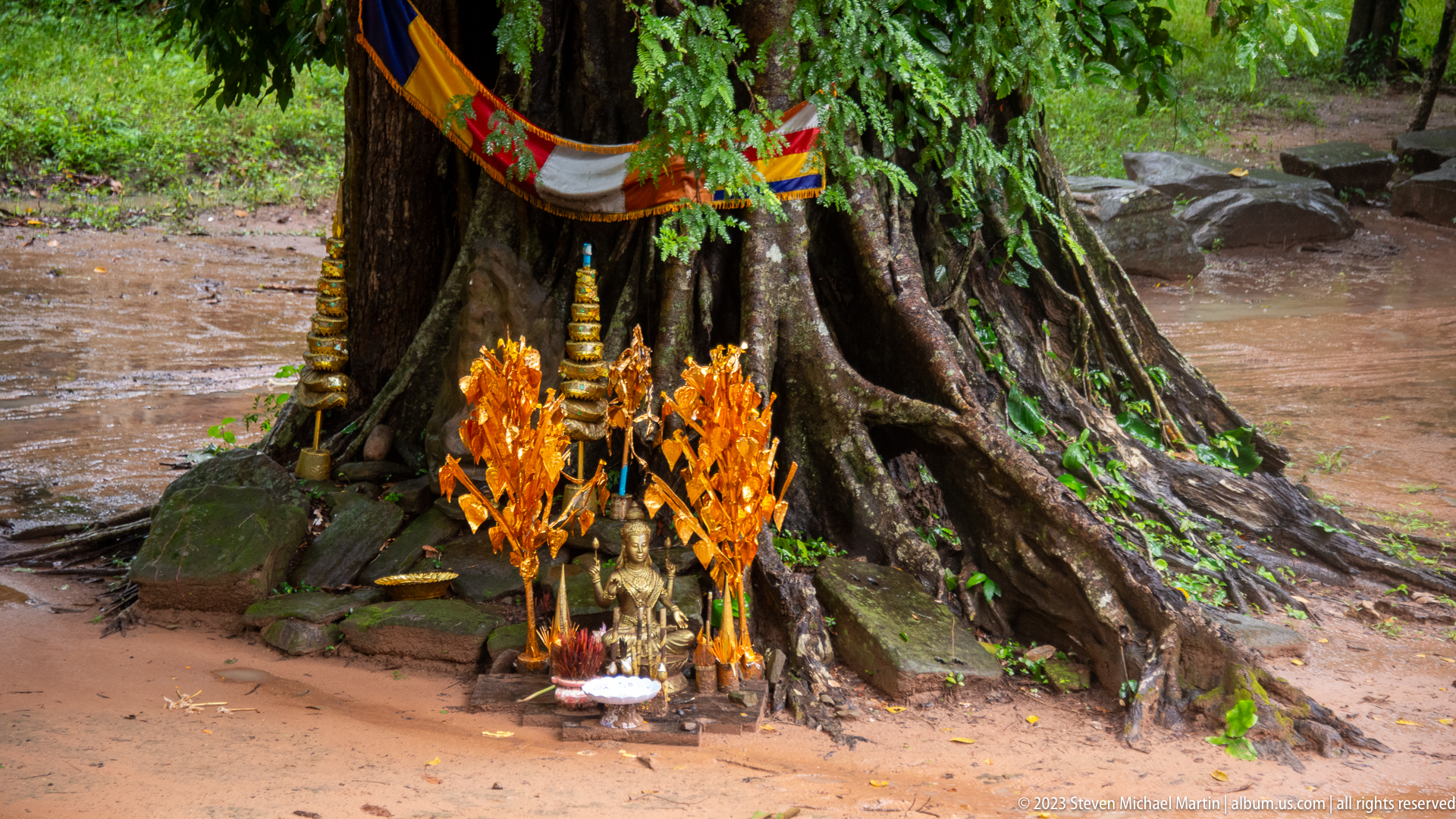
A contemporary devotional shrine stands at the base of a large tree, furnished with small figures, offerings, incense, and bright orange decorations. Fabric is tied around the trunk above. The installation records living religious practice within the archaeological landscape, showing that Beng Mealea remains a place of present-day spiritual engagement as well as historic preservation.
Caption
A contemporary devotional shrine stands at the base of a large tree, furnished with small figures, offerings, incense, and bright orange decorations. Fabric is tied around the trunk above. The installation records living religious practice within the archaeological landscape, showing that Beng Mealea remains a place of present-day spiritual engagement as well as historic preservation.
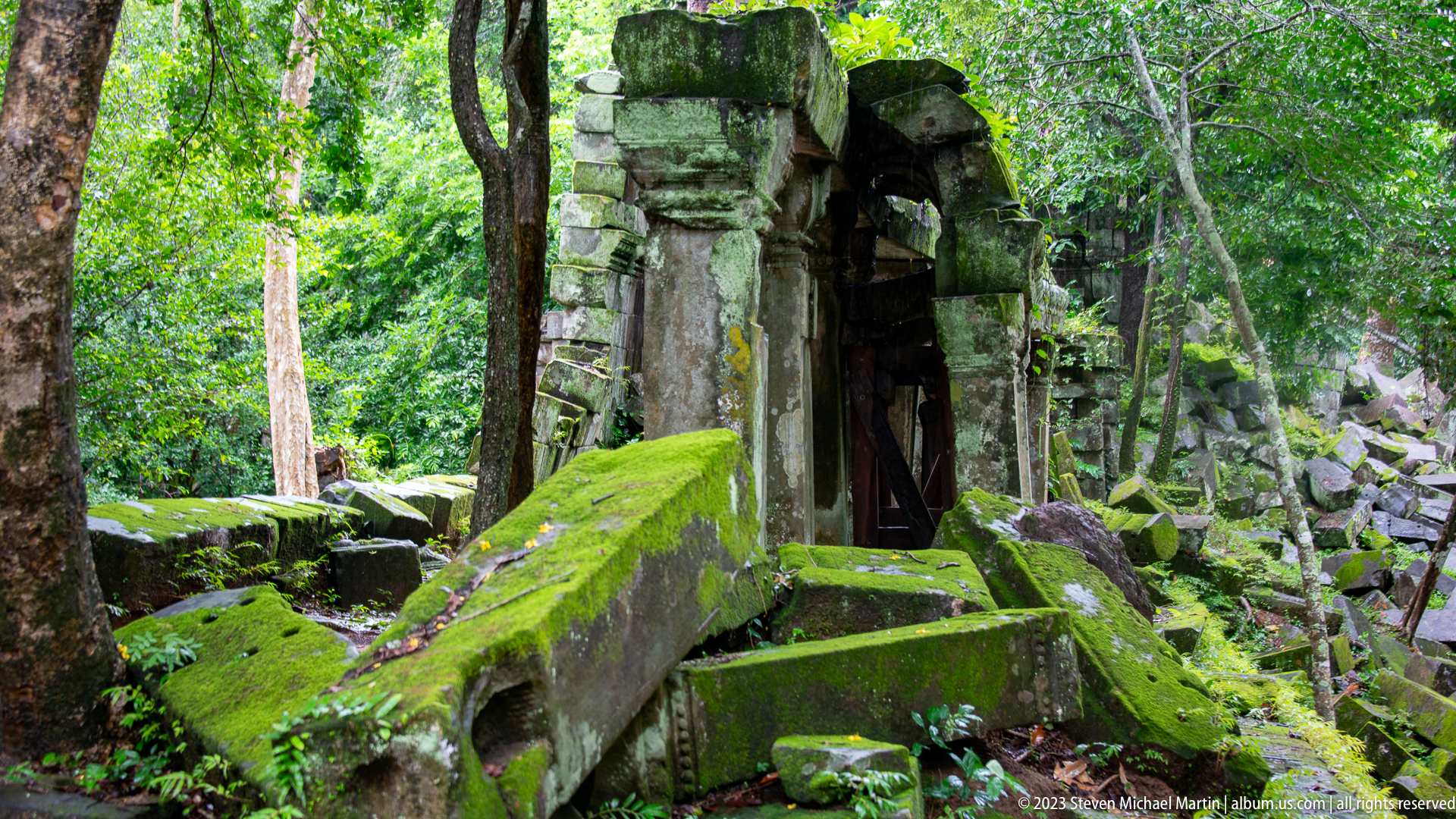
A narrow doorway pier and partial arch-like opening remain upright amid large fallen sandstone blocks. Thick moss covers the debris, while the surviving vertical stone preserves the location of a former passage. The photograph records a localized remnant of architectural order within a much broader field of collapse.
Caption
A narrow doorway pier and partial arch-like opening remain upright amid large fallen sandstone blocks. Thick moss covers the debris, while the surviving vertical stone preserves the location of a former passage. The photograph records a localized remnant of architectural order within a much broader field of collapse.

A low line of large sandstone blocks extends across the forest floor, separating the viewer from distant gallery walls. Moss coats the upper surfaces while trees rise through the intervening space. The restrained composition documents Beng Mealea’s broader enclosure geometry and the quiet persistence of low architectural boundaries within the forest.
Caption
A low line of large sandstone blocks extends across the forest floor, separating the viewer from distant gallery walls. Moss coats the upper surfaces while trees rise through the intervening space. The restrained composition documents Beng Mealea’s broader enclosure geometry and the quiet persistence of low architectural boundaries within the forest.
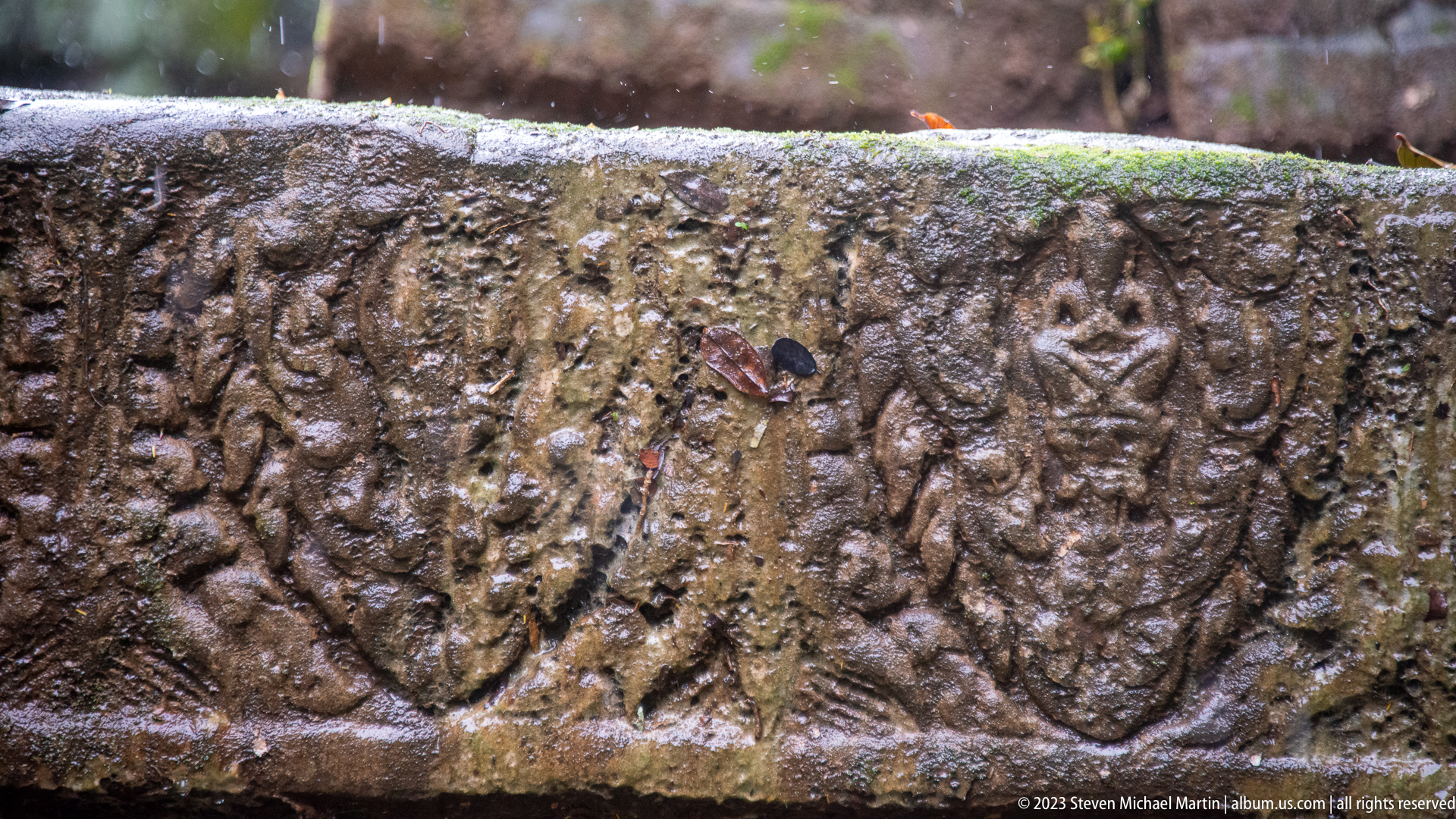
A horizontal sandstone frieze is carved with repeated leaf-shaped medallions joined by curling vegetal bands. Surface wear, staining, and small areas of loss soften the design, but the rhythmic pattern remains legible. The close detail highlights the decorative vocabulary used to enrich architectural moldings throughout Beng Mealea.
Caption
A horizontal sandstone frieze is carved with repeated leaf-shaped medallions joined by curling vegetal bands. Surface wear, staining, and small areas of loss soften the design, but the rhythmic pattern remains legible. The close detail highlights the decorative vocabulary used to enrich architectural moldings throughout Beng Mealea.
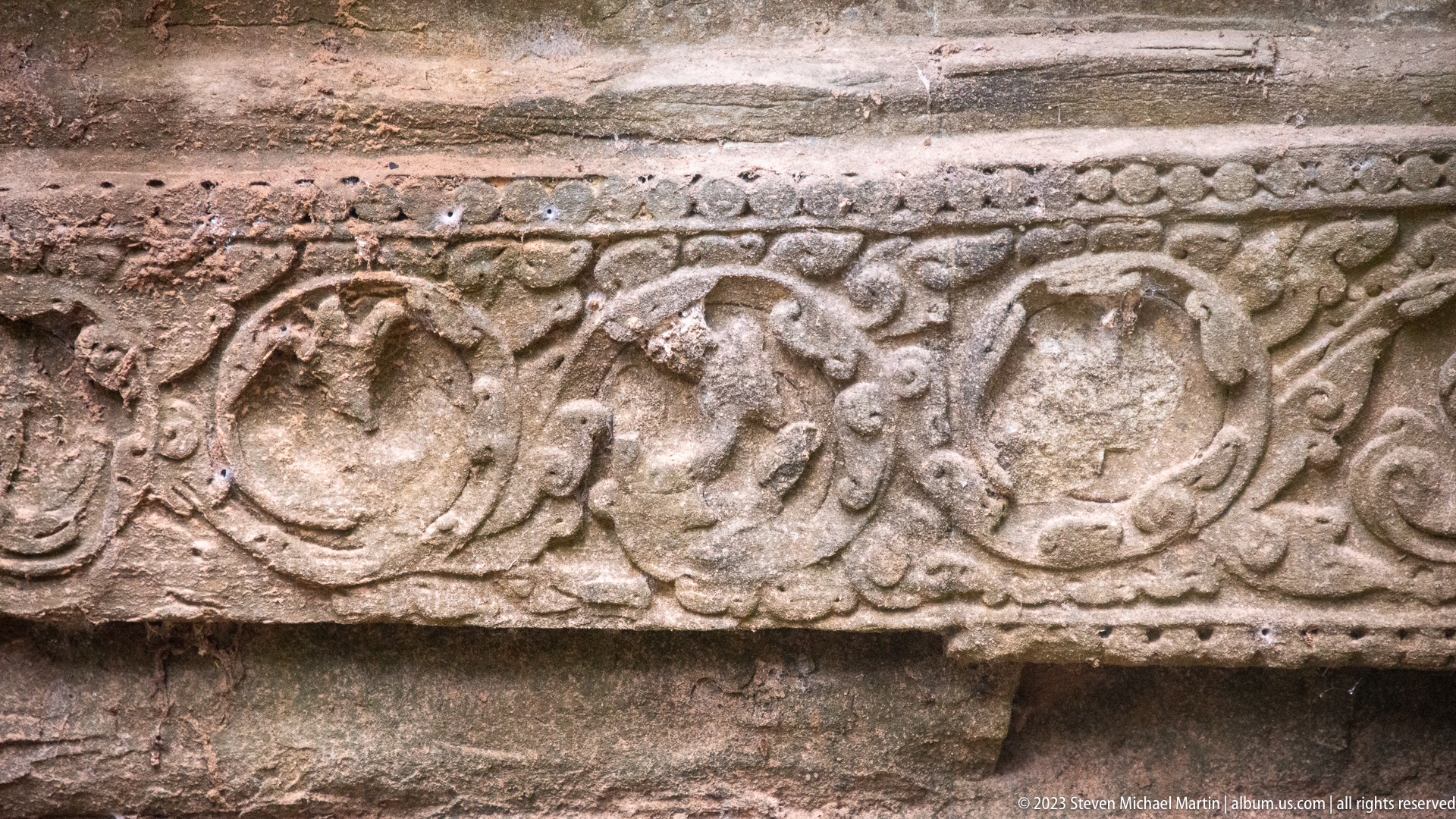
A sandstone band contains a sequence of circular medallions framed by curling foliage and a beaded upper border. Several central motifs are heavily eroded, leaving only partial figures or floral forms. The close view is valuable as a condition record and demonstrates the repeated ornamental rhythm of Beng Mealea’s carved architectural borders.
Caption
A sandstone band contains a sequence of circular medallions framed by curling foliage and a beaded upper border. Several central motifs are heavily eroded, leaving only partial figures or floral forms. The close view is valuable as a condition record and demonstrates the repeated ornamental rhythm of Beng Mealea’s carved architectural borders.

A small central figure with an elaborate headdress appears against dense curling foliage, arms extended within the ornamental field. Moisture, lichen, and surface wear obscure finer attributes, preventing a secure identification. The tight crop nevertheless reveals the figure’s hierarchical placement and the sculptor’s integration of human form with vegetal decoration.
Caption
A small central figure with an elaborate headdress appears against dense curling foliage, arms extended within the ornamental field. Moisture, lichen, and surface wear obscure finer attributes, preventing a secure identification. The tight crop nevertheless reveals the figure’s hierarchical placement and the sculptor’s integration of human form with vegetal decoration.
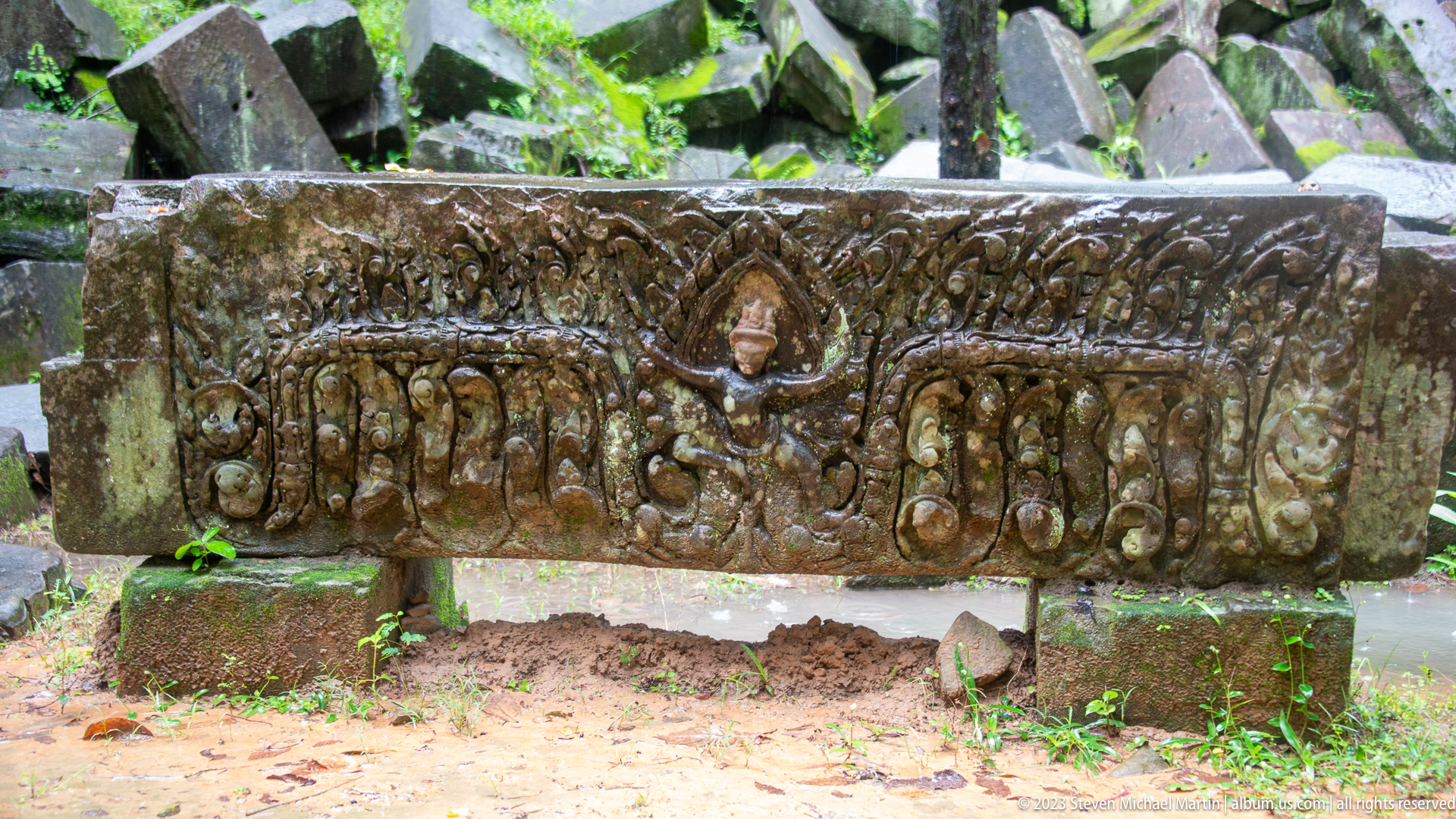
A carved lintel is displayed upright among fallen stones, revealing a central headdress-wearing figure above dense, symmetrical scrollwork. Rows of smaller rounded forms and curling foliage fill the lower band. The frontal presentation makes the carving easier to study than when embedded in a doorway, though the precise iconographic subject remains uncertain.
Caption
A carved lintel is displayed upright among fallen stones, revealing a central headdress-wearing figure above dense, symmetrical scrollwork. Rows of smaller rounded forms and curling foliage fill the lower band. The frontal presentation makes the carving easier to study than when embedded in a doorway, though the precise iconographic subject remains uncertain.
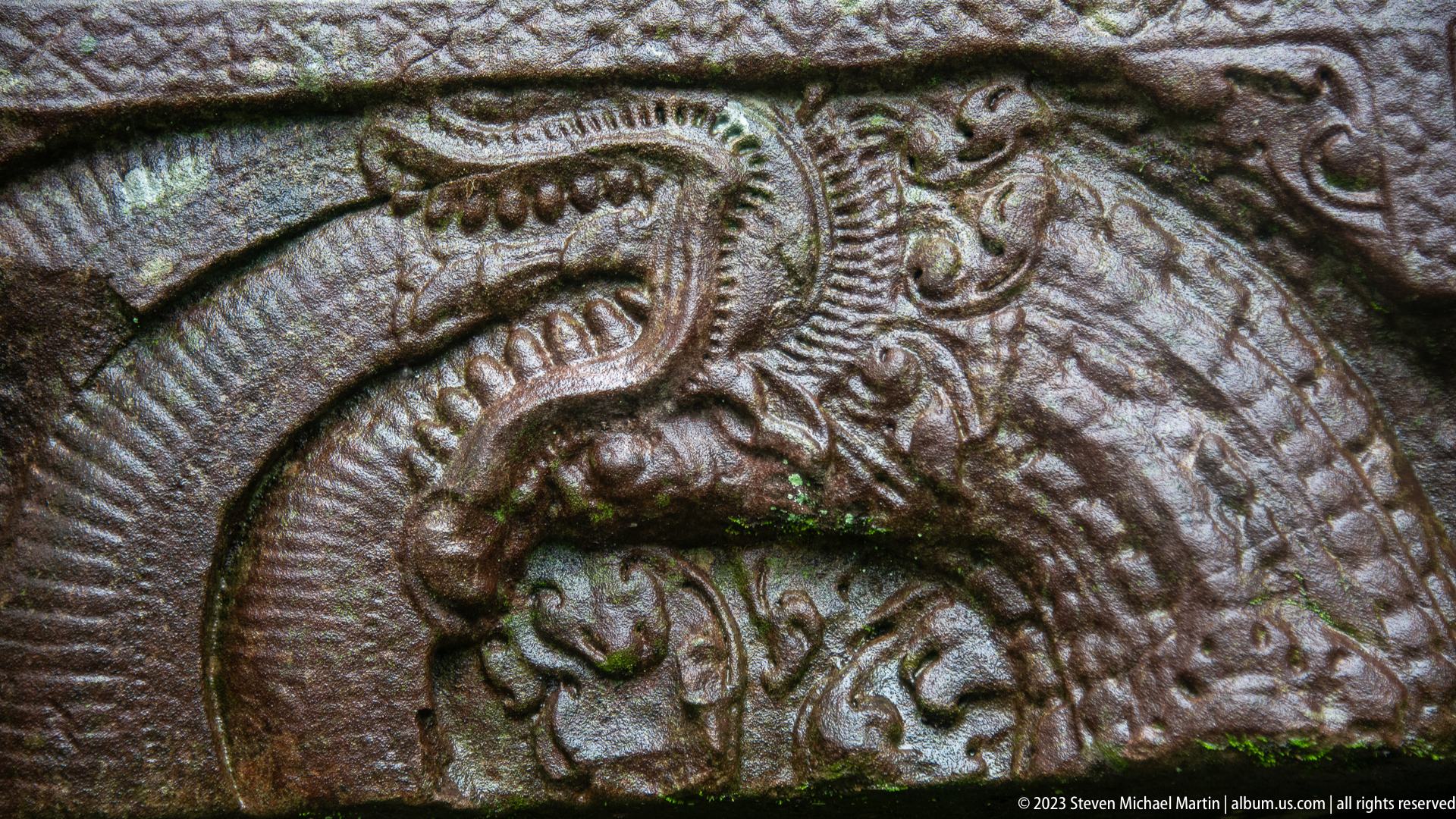
A stylized creature with an open mouth, ridged snout, and curling body emerges from dense vegetal ornament. The form resembles a makara-like architectural motif, but the tight crop and weathered surface limit certainty. The close view emphasizes the carving’s energetic contours, layered textures, and integration into a larger decorative composition.
Caption
A stylized creature with an open mouth, ridged snout, and curling body emerges from dense vegetal ornament. The form resembles a makara-like architectural motif, but the tight crop and weathered surface limit certainty. The close view emphasizes the carving’s energetic contours, layered textures, and integration into a larger decorative composition.
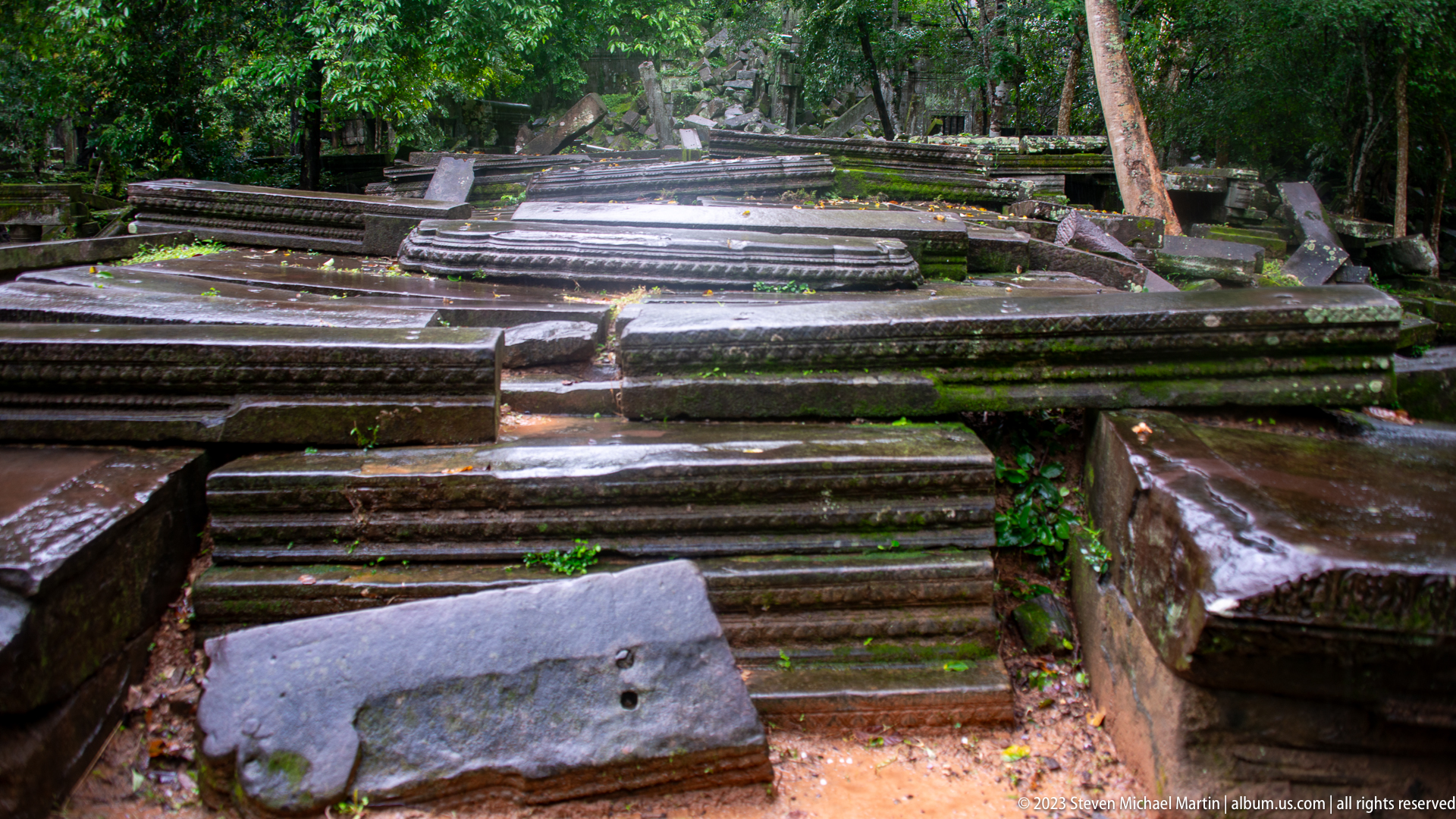
Numerous long sandstone moldings lie stacked and scattered across the ground, including cornice sections, bases, and other linear architectural members. Their repeated profiles reveal how much of Beng Mealea’s original wall and roof articulation survives in displaced form. The image functions as an archaeological inventory view rather than a single-object study.
Caption
Numerous long sandstone moldings lie stacked and scattered across the ground, including cornice sections, bases, and other linear architectural members. Their repeated profiles reveal how much of Beng Mealea’s original wall and roof articulation survives in displaced form. The image functions as an archaeological inventory view rather than a single-object study.
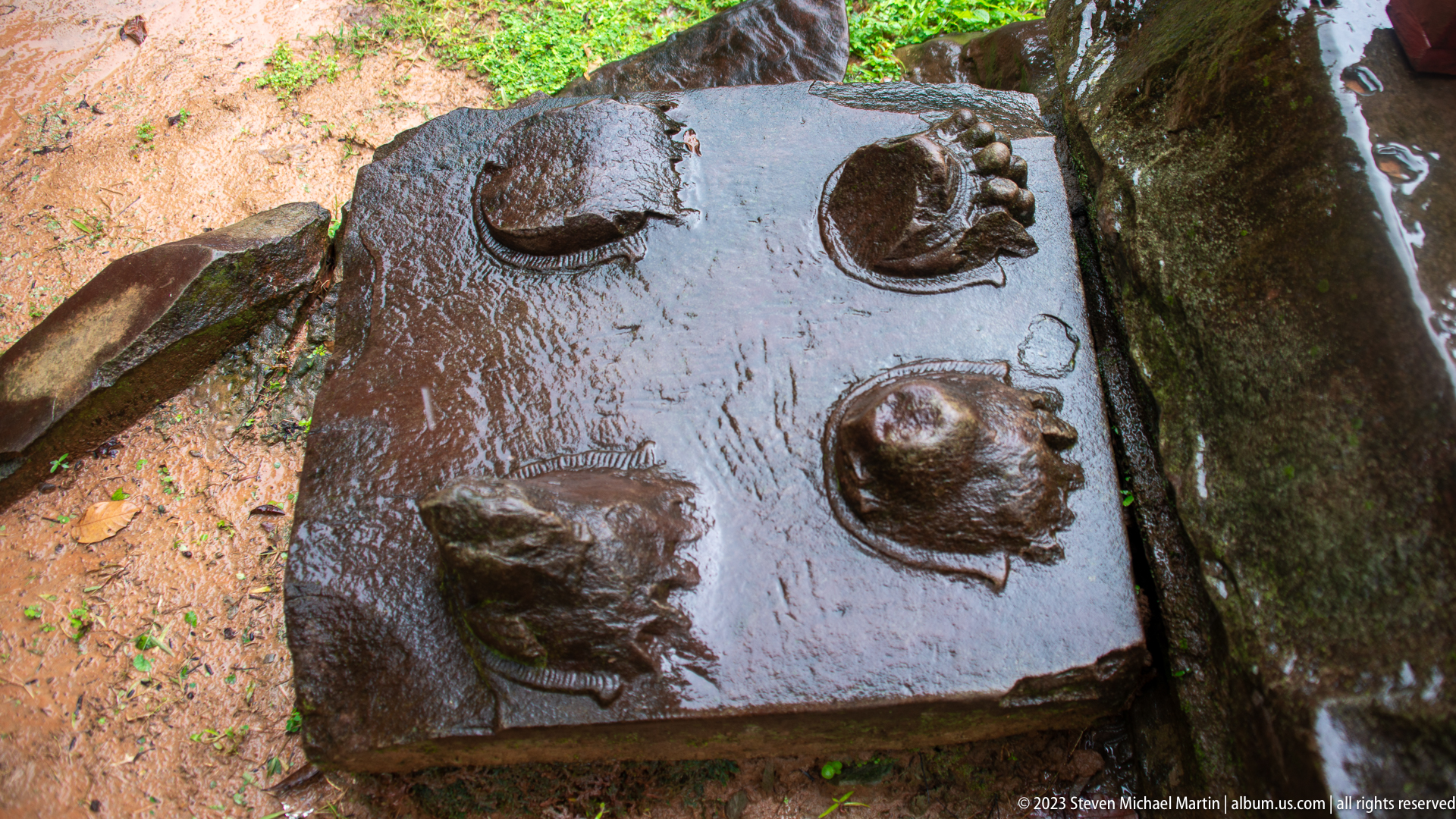
A rectangular sandstone slab bears four raised circular bosses arranged in a grid, each carved with a floral or face-like motif. Water darkens the surface and fills shallow depressions around the carvings. The object’s original architectural function is uncertain, but the repeated reliefs suggest a decorative ceiling, wall, or paving component rather than a freestanding sculpture.
Caption
A rectangular sandstone slab bears four raised circular bosses arranged in a grid, each carved with a floral or face-like motif. Water darkens the surface and fills shallow depressions around the carvings. The object’s original architectural function is uncertain, but the repeated reliefs suggest a decorative ceiling, wall, or paving component rather than a freestanding sculpture.
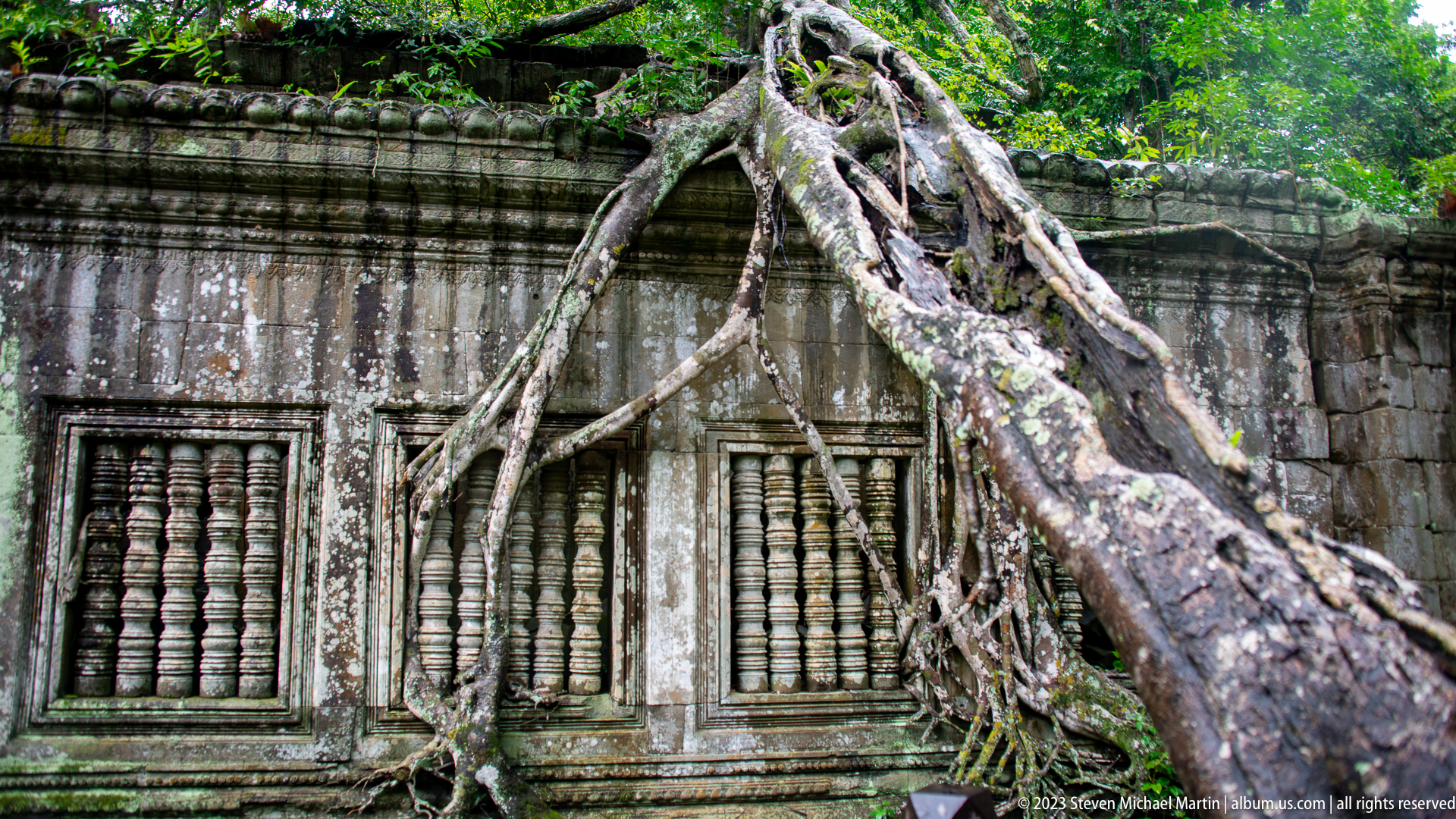
A mature tree spreads heavy roots across the exterior gallery wall at Beng Mealea, pressing against weathered sandstone and partially obscuring two balustered window openings. The contrast between the ordered rhythm of the carved stone balusters and the irregular growth of the roots conveys the site’s long exposure to the surrounding forest and the continuing interaction between architecture and vegetation.
Caption
A mature tree spreads heavy roots across the exterior gallery wall at Beng Mealea, pressing against weathered sandstone and partially obscuring two balustered window openings. The contrast between the ordered rhythm of the carved stone balusters and the irregular growth of the roots conveys the site’s long exposure to the surrounding forest and the continuing interaction between architecture and vegetation.
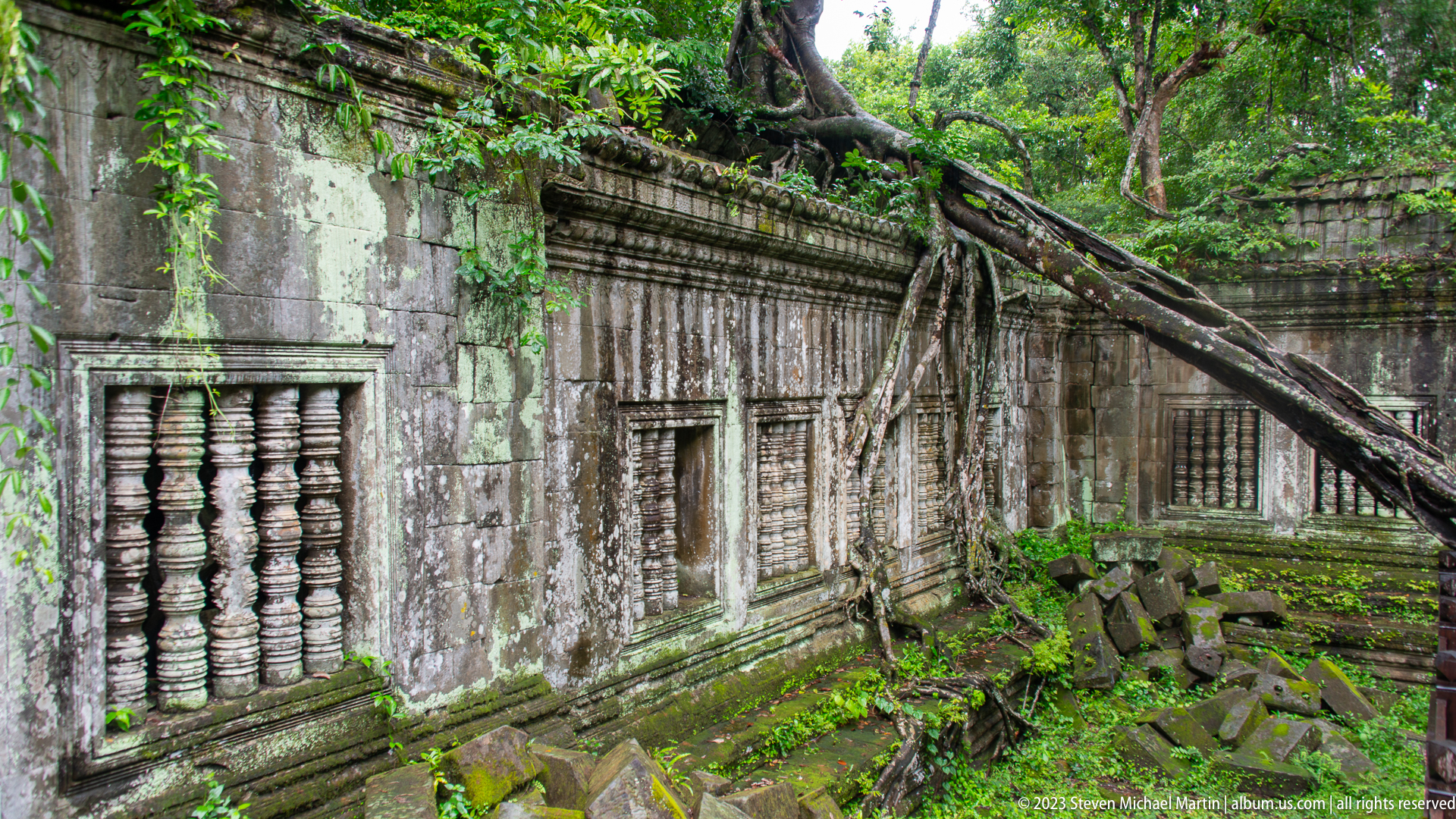
Seen at an angle, this long gallery façade at Beng Mealea preserves a sequence of narrow balustered windows set into deeply weathered sandstone. A large tree leans across the upper wall while fallen blocks collect along the base, revealing both the original architectural repetition and the structural disruption caused by centuries of collapse, moisture, and forest growth.
Caption
Seen at an angle, this long gallery façade at Beng Mealea preserves a sequence of narrow balustered windows set into deeply weathered sandstone. A large tree leans across the upper wall while fallen blocks collect along the base, revealing both the original architectural repetition and the structural disruption caused by centuries of collapse, moisture, and forest growth.
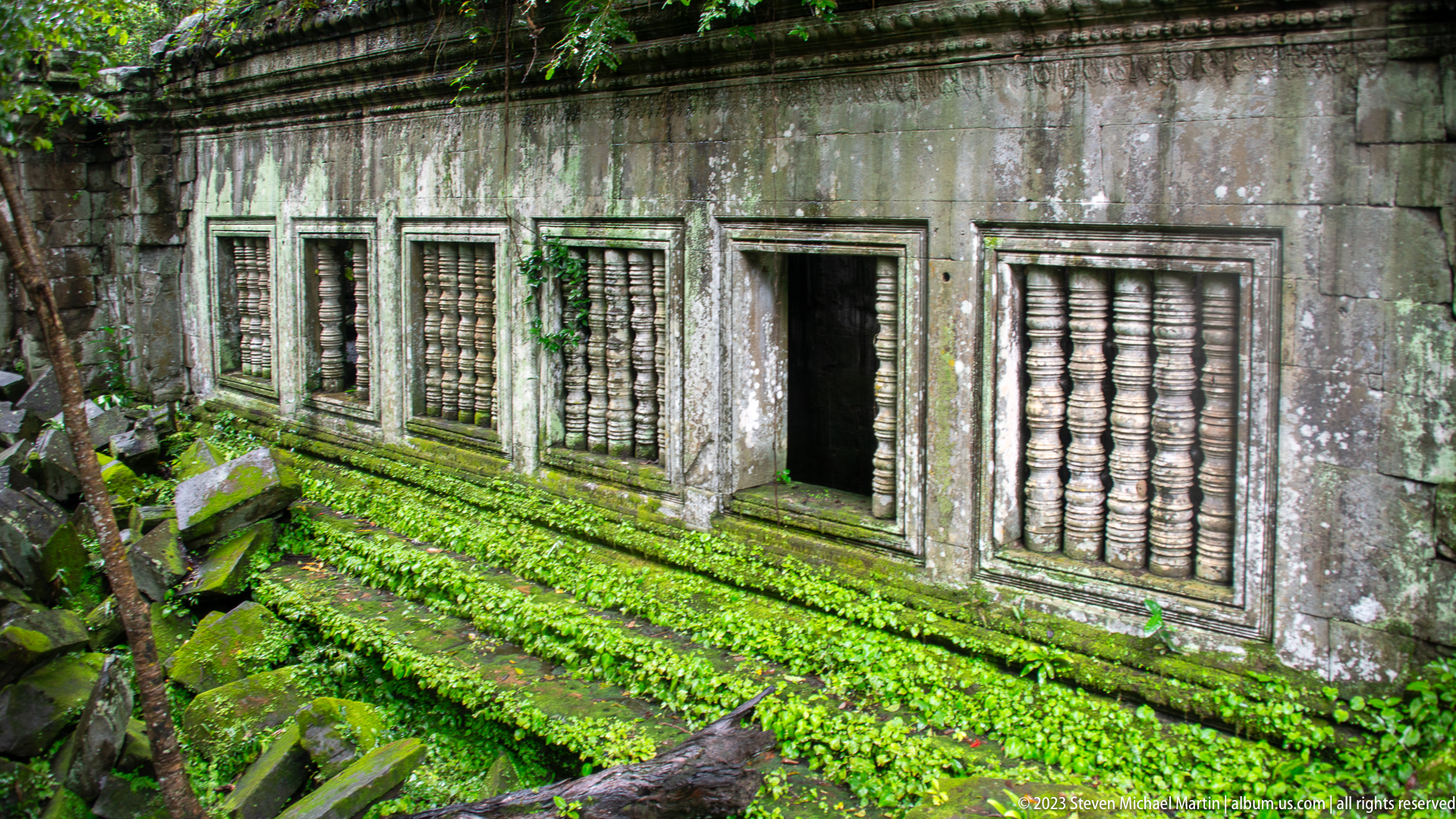
Four closely spaced balustered openings and a dark doorway define this surviving section of Beng Mealea’s outer gallery. The frontal view emphasizes the measured spacing of the façade, while moss-covered lower courses, displaced stones, and creeping plants reveal the building’s deteriorated condition. The open doorway provides a rare visual break in the otherwise repetitive window sequence.
Caption
Four closely spaced balustered openings and a dark doorway define this surviving section of Beng Mealea’s outer gallery. The frontal view emphasizes the measured spacing of the façade, while moss-covered lower courses, displaced stones, and creeping plants reveal the building’s deteriorated condition. The open doorway provides a rare visual break in the otherwise repetitive window sequence.
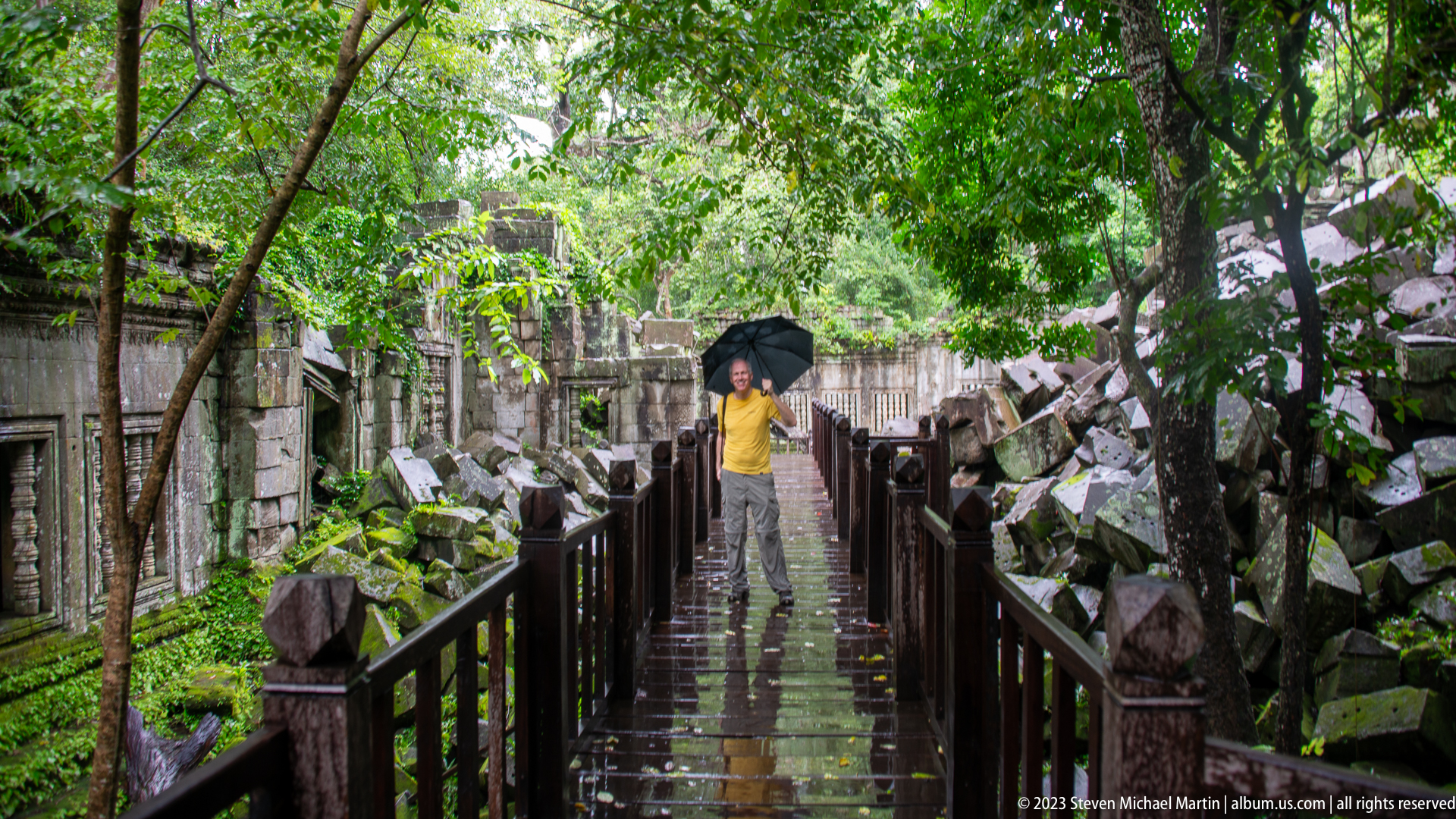
A rain-darkened wooden walkway leads through a corridor of collapsed sandstone blocks at Beng Mealea, with dense forest rising around the ruined walls. A visitor carrying an umbrella provides scale near the center of the composition. The image shows how the site is experienced today: through a carefully defined route suspended above unstable rubble and encroaching vegetation.
Caption
A rain-darkened wooden walkway leads through a corridor of collapsed sandstone blocks at Beng Mealea, with dense forest rising around the ruined walls. A visitor carrying an umbrella provides scale near the center of the composition. The image shows how the site is experienced today: through a carefully defined route suspended above unstable rubble and encroaching vegetation.
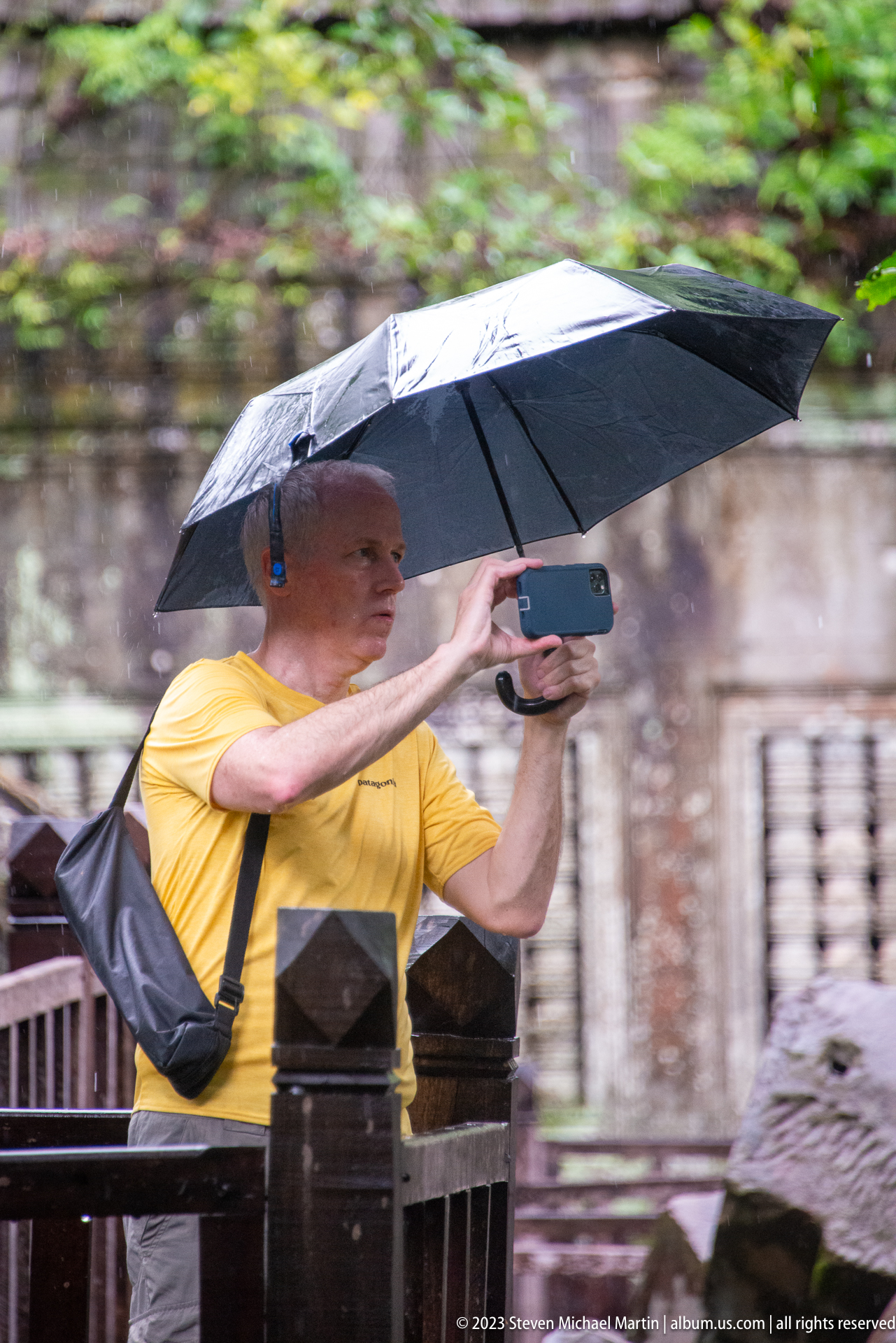
A visitor pauses beneath a black umbrella to photograph Beng Mealea from the raised wooden walkway during wet weather. The yellow shirt and umbrella stand sharply against the muted stone ruins and blurred green background. Beyond documenting tourism at the site, the image records how modern access infrastructure allows visitors to move through unstable archaeological areas without walking directly across fallen masonry.
Caption
A visitor pauses beneath a black umbrella to photograph Beng Mealea from the raised wooden walkway during wet weather. The yellow shirt and umbrella stand sharply against the muted stone ruins and blurred green background. Beyond documenting tourism at the site, the image records how modern access infrastructure allows visitors to move through unstable archaeological areas without walking directly across fallen masonry.
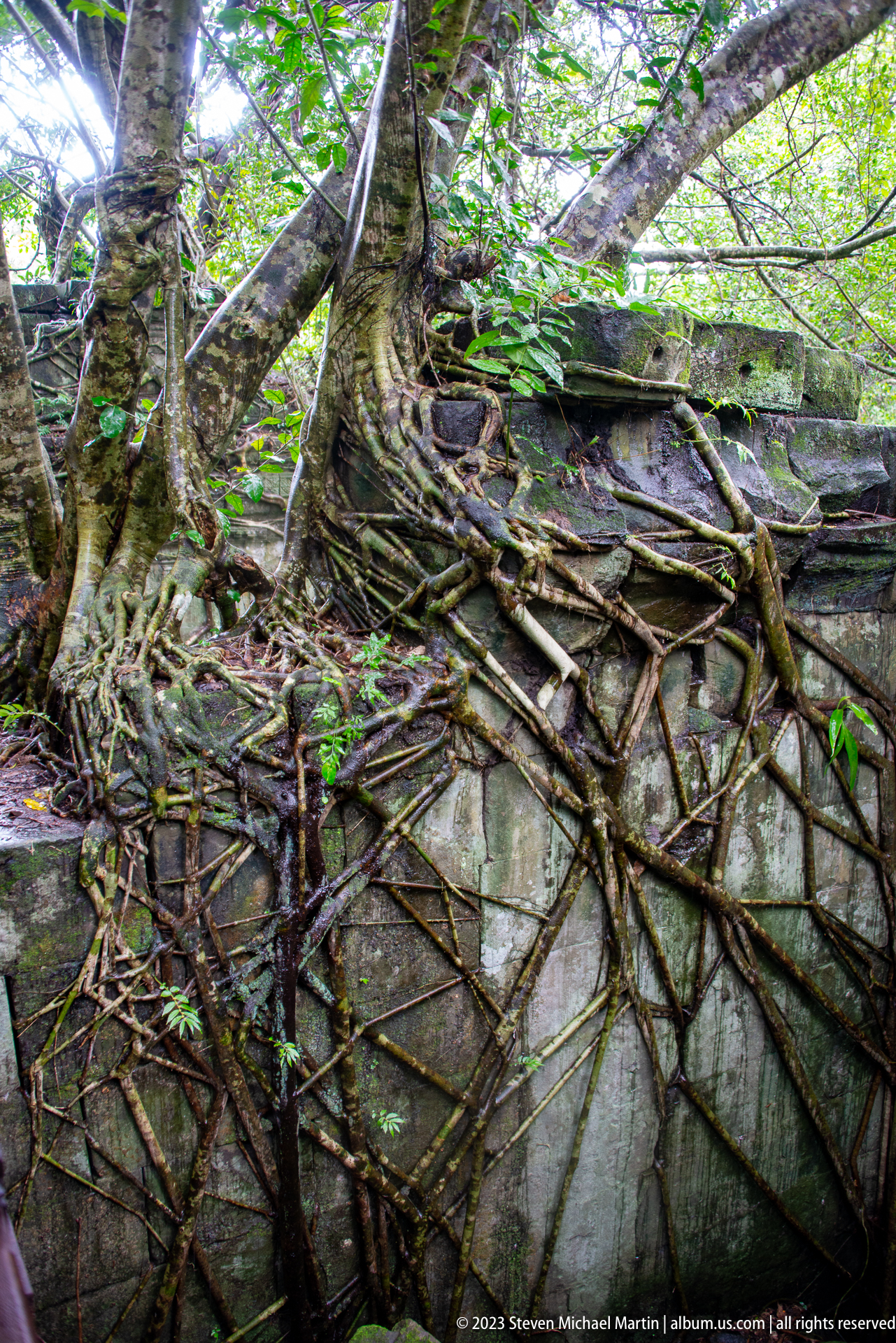
Exposed roots spread over a sloping mass of displaced sandstone blocks at Beng Mealea, gripping joints and crevices within the collapsed masonry. The close view removes most architectural context and concentrates on the physical relationship between forest growth and structural ruin. Some blocks remain aligned while others have shifted, creating an irregular surface gradually stabilized and further disrupted by the expanding roots.
Caption
Exposed roots spread over a sloping mass of displaced sandstone blocks at Beng Mealea, gripping joints and crevices within the collapsed masonry. The close view removes most architectural context and concentrates on the physical relationship between forest growth and structural ruin. Some blocks remain aligned while others have shifted, creating an irregular surface gradually stabilized and further disrupted by the expanding roots.
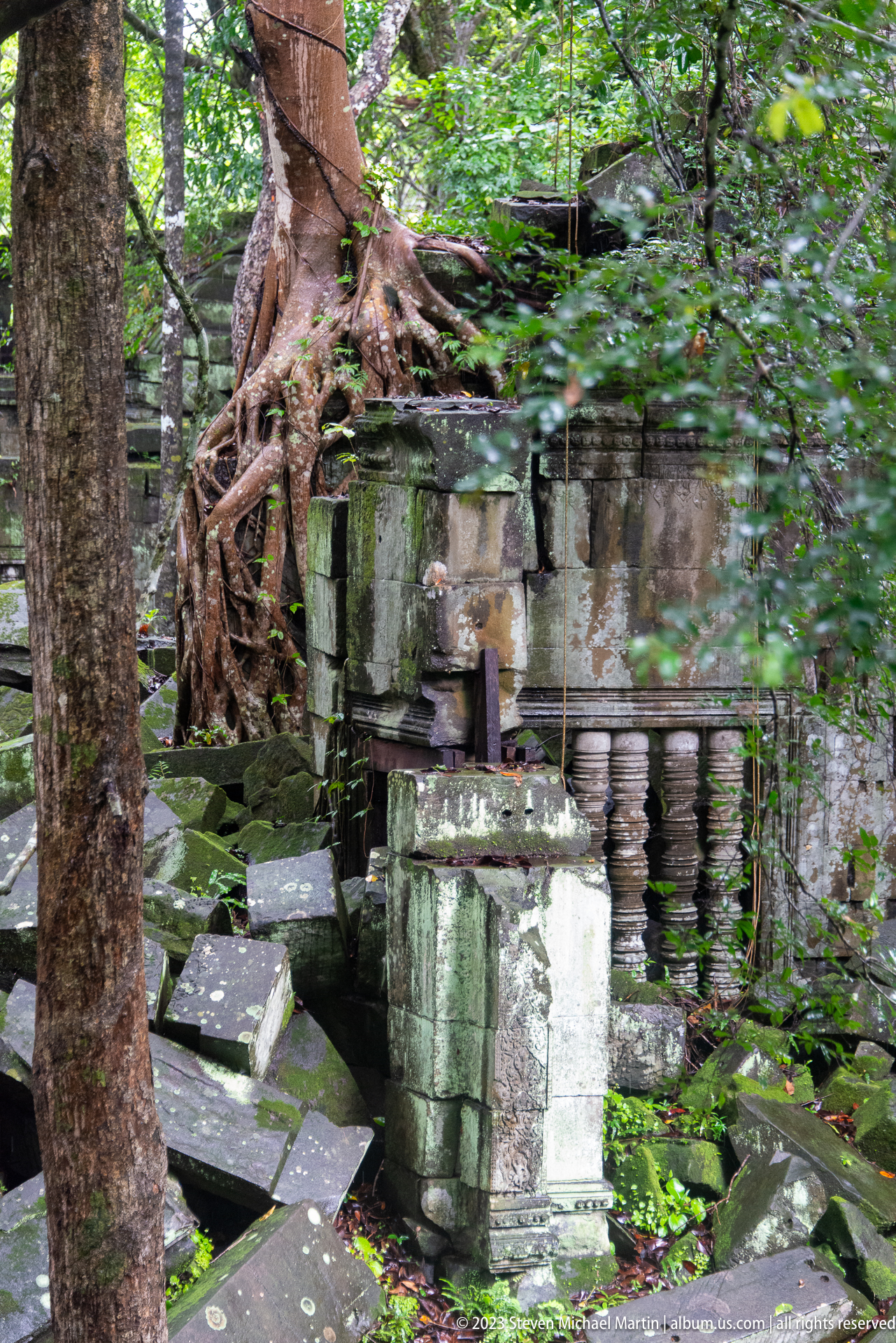
A surviving section of gallery wall stands amid extensive collapse, its balustered window partly screened by trees and scattered masonry. Fallen blocks lie at several angles around the base, while exposed roots spread across the upper structure. The contextual view shows the gallery not as an isolated façade but as one fragment within a broader field of structural failure and forest encroachment.
Caption
A surviving section of gallery wall stands amid extensive collapse, its balustered window partly screened by trees and scattered masonry. Fallen blocks lie at several angles around the base, while exposed roots spread across the upper structure. The contextual view shows the gallery not as an isolated façade but as one fragment within a broader field of structural failure and forest encroachment.
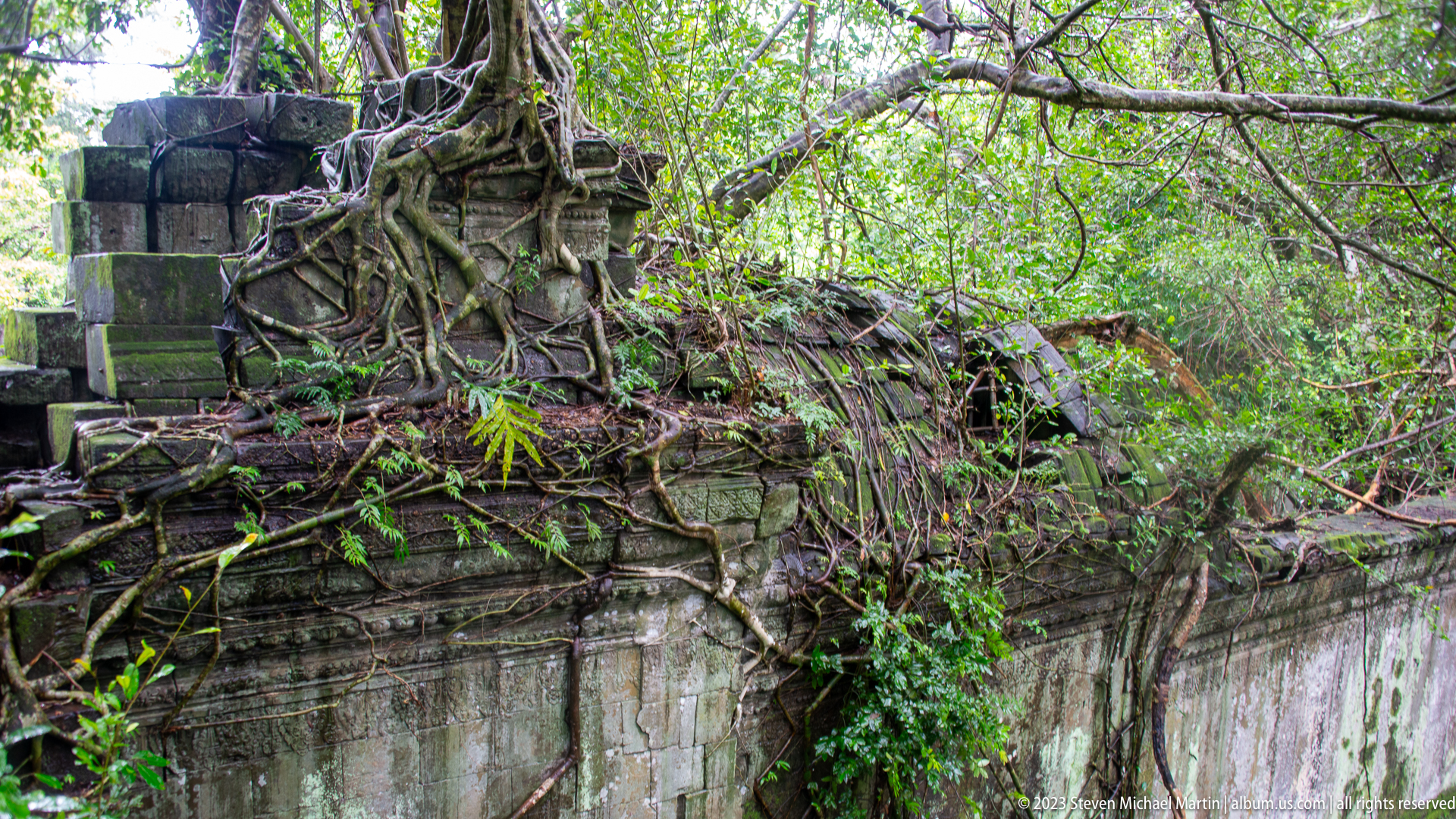
Dense roots and vines spread across the upper courses of a sandstone wall at Beng Mealea, binding together displaced blocks while obscuring the structure’s original profile. The view focuses on the point where forest growth meets the ruined architecture, with branches, leaf litter, and masonry forming a layered surface that makes the boundary between building and vegetation increasingly difficult to separate.
Caption
Dense roots and vines spread across the upper courses of a sandstone wall at Beng Mealea, binding together displaced blocks while obscuring the structure’s original profile. The view focuses on the point where forest growth meets the ruined architecture, with branches, leaf litter, and masonry forming a layered surface that makes the boundary between building and vegetation increasingly difficult to separate.
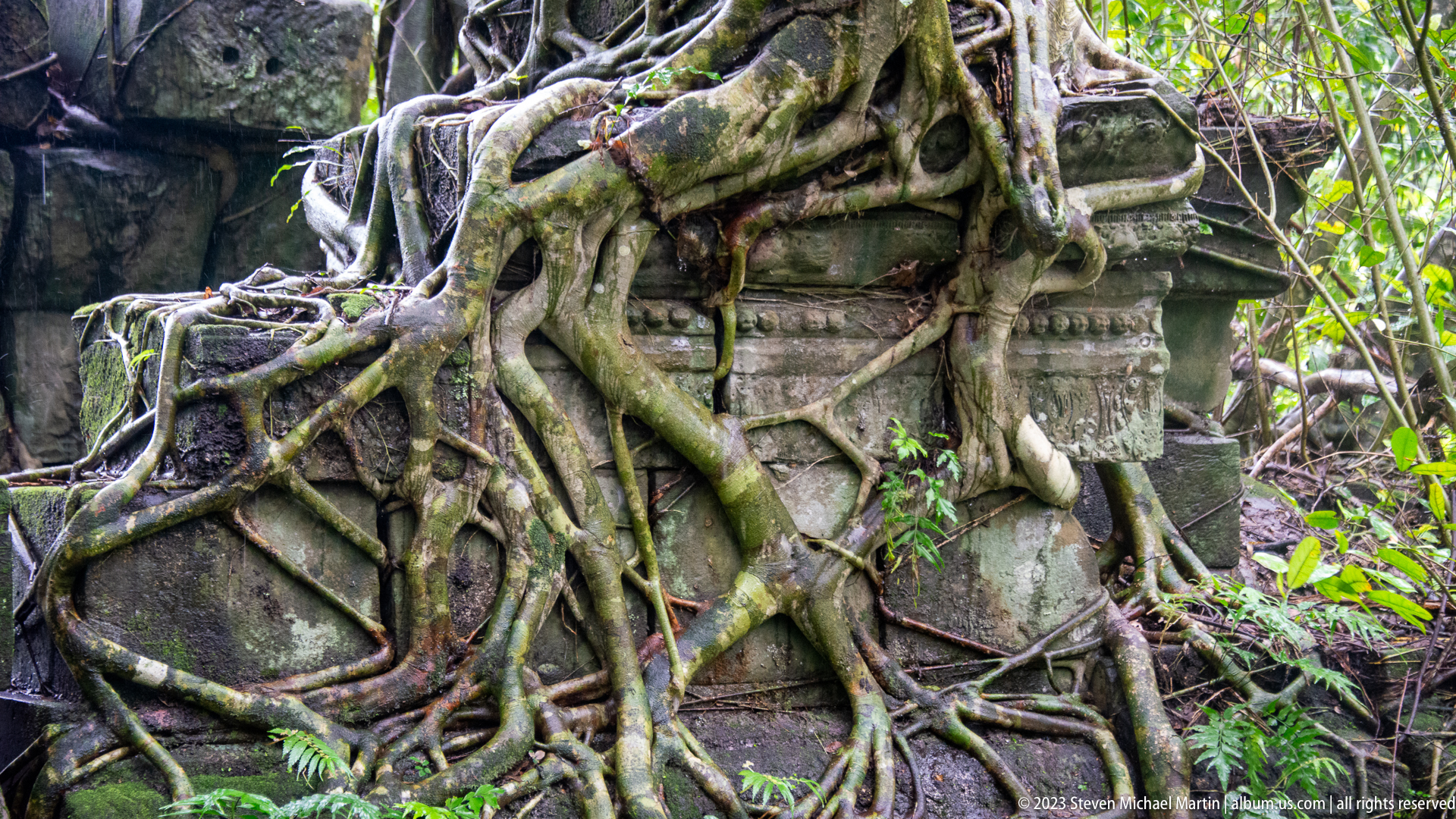
A thick network of roots grips a carved sandstone corner at Beng Mealea, curling around projecting moldings and filling joints between the blocks. The close view reveals how living growth can both hold damaged masonry in place and exert pressure on its carved surfaces. Small plants emerging from crevices reinforce the impression of an architectural fragment being gradually absorbed into the forest.
Caption
A thick network of roots grips a carved sandstone corner at Beng Mealea, curling around projecting moldings and filling joints between the blocks. The close view reveals how living growth can both hold damaged masonry in place and exert pressure on its carved surfaces. Small plants emerging from crevices reinforce the impression of an architectural fragment being gradually absorbed into the forest.
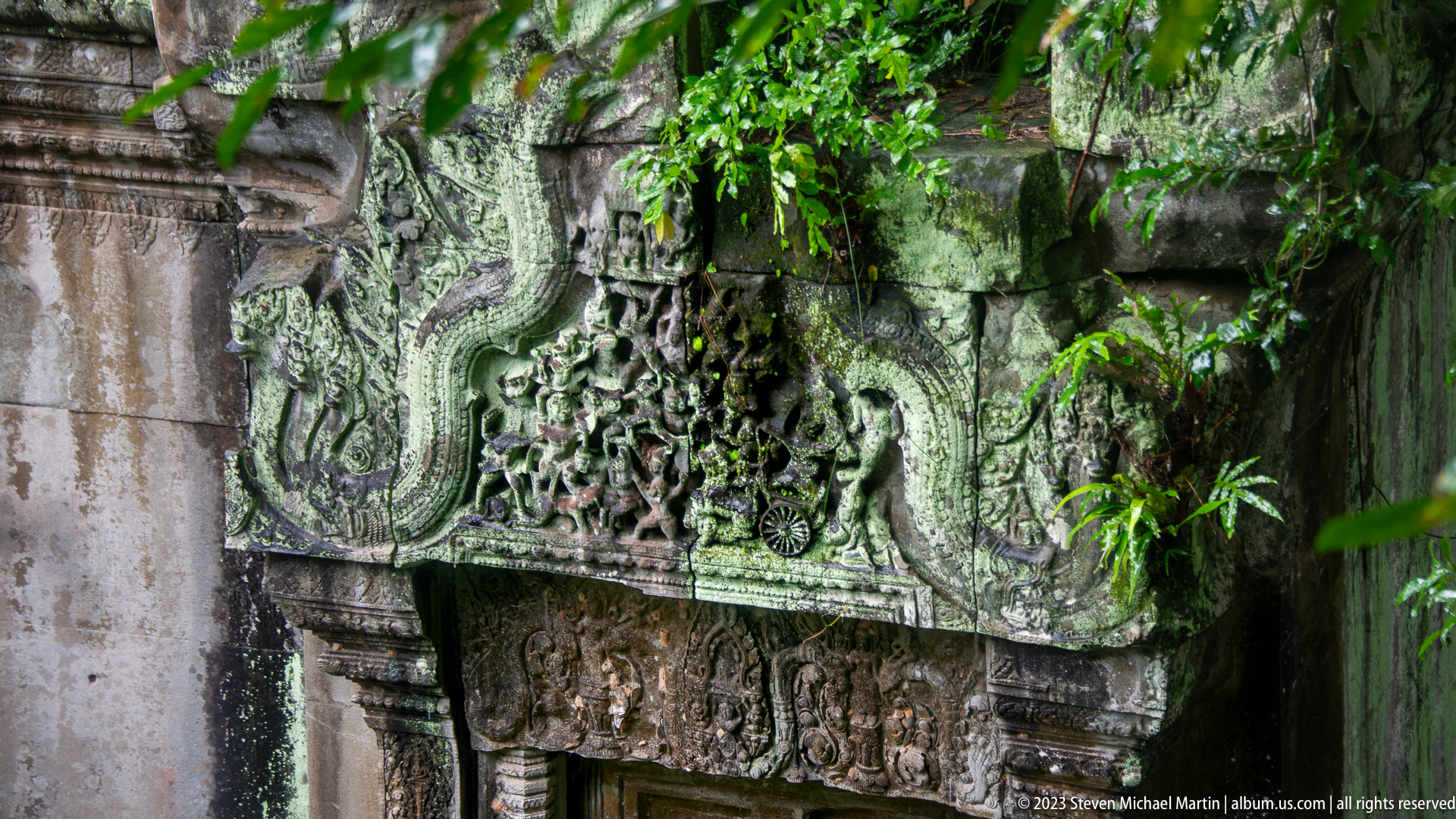
A richly carved sandstone lintel survives above a dark opening at Beng Mealea, its surface filled with layered foliage, scrolling forms, and small figures. Moisture staining and plant growth soften portions of the relief, yet the central composition and framing bands remain legible. The image isolates the decorative program from the surrounding ruin and highlights the refinement of Khmer stone carving within the temple complex.
Caption
A richly carved sandstone lintel survives above a dark opening at Beng Mealea, its surface filled with layered foliage, scrolling forms, and small figures. Moisture staining and plant growth soften portions of the relief, yet the central composition and framing bands remain legible. The image isolates the decorative program from the surrounding ruin and highlights the refinement of Khmer stone carving within the temple complex.
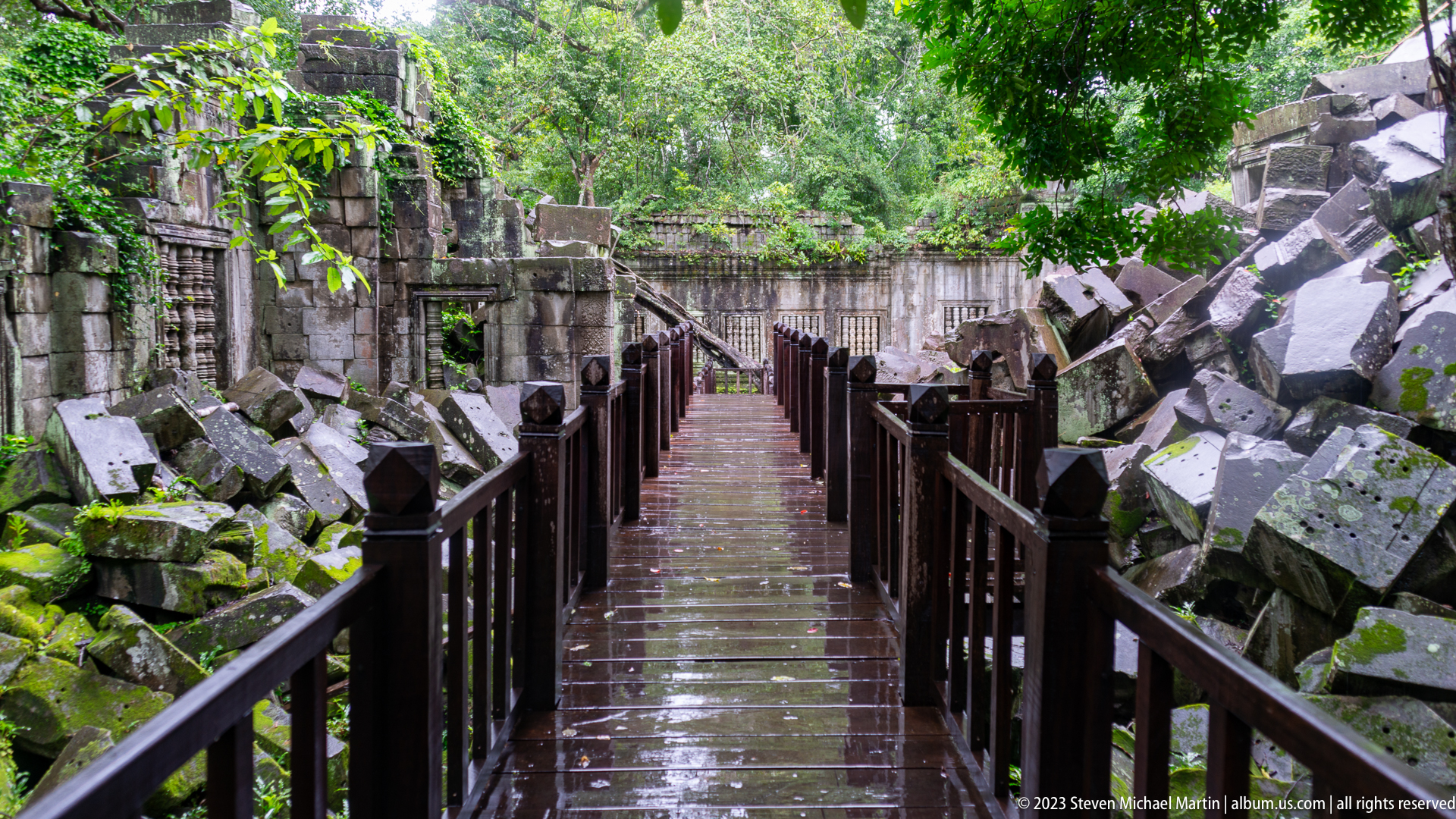
A raised wooden walkway extends through a broad field of fallen sandstone blocks at Beng Mealea, channeling visitors between unstable sections of the ruined complex. The wet boards and dark railings create a strong central line through the composition, while collapsed walls and dense vegetation frame the route. The view emphasizes the scale of the destruction and the modern infrastructure required for safe access.
Caption
A raised wooden walkway extends through a broad field of fallen sandstone blocks at Beng Mealea, channeling visitors between unstable sections of the ruined complex. The wet boards and dark railings create a strong central line through the composition, while collapsed walls and dense vegetation frame the route. The view emphasizes the scale of the destruction and the modern infrastructure required for safe access.
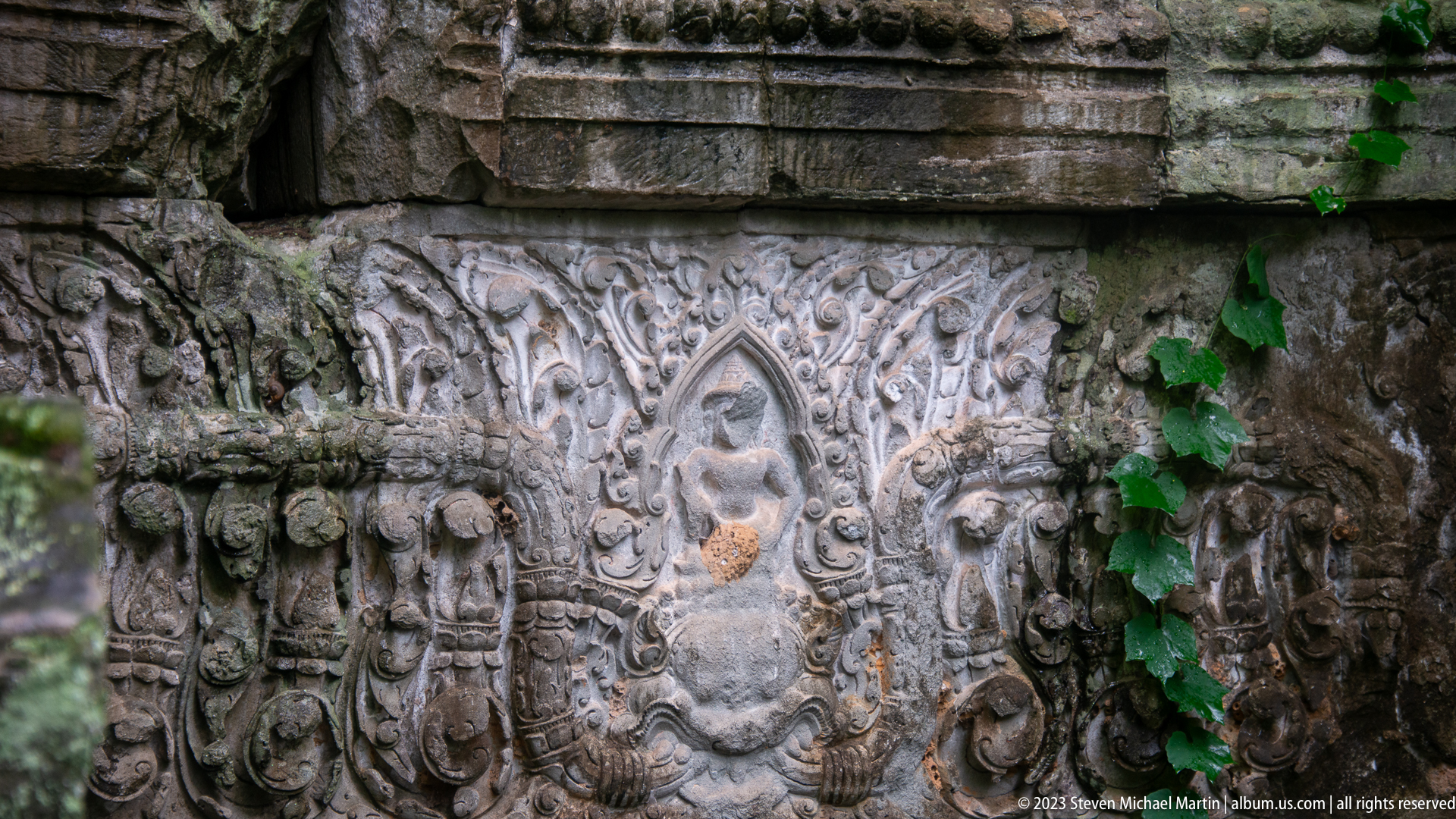
A weathered relief panel centers on a standing figure enclosed by dense scrolling foliage and layered ornamental bands. The carving remains recognizable despite surface loss, staining, and softened edges, while the adjacent blocks show the panel’s original architectural setting. Without a clearer view of attributes or inscriptions, the figure is best treated as an unidentified sacred or decorative personage rather than assigned a specific name.
Caption
A weathered relief panel centers on a standing figure enclosed by dense scrolling foliage and layered ornamental bands. The carving remains recognizable despite surface loss, staining, and softened edges, while the adjacent blocks show the panel’s original architectural setting. Without a clearer view of attributes or inscriptions, the figure is best treated as an unidentified sacred or decorative personage rather than assigned a specific name.
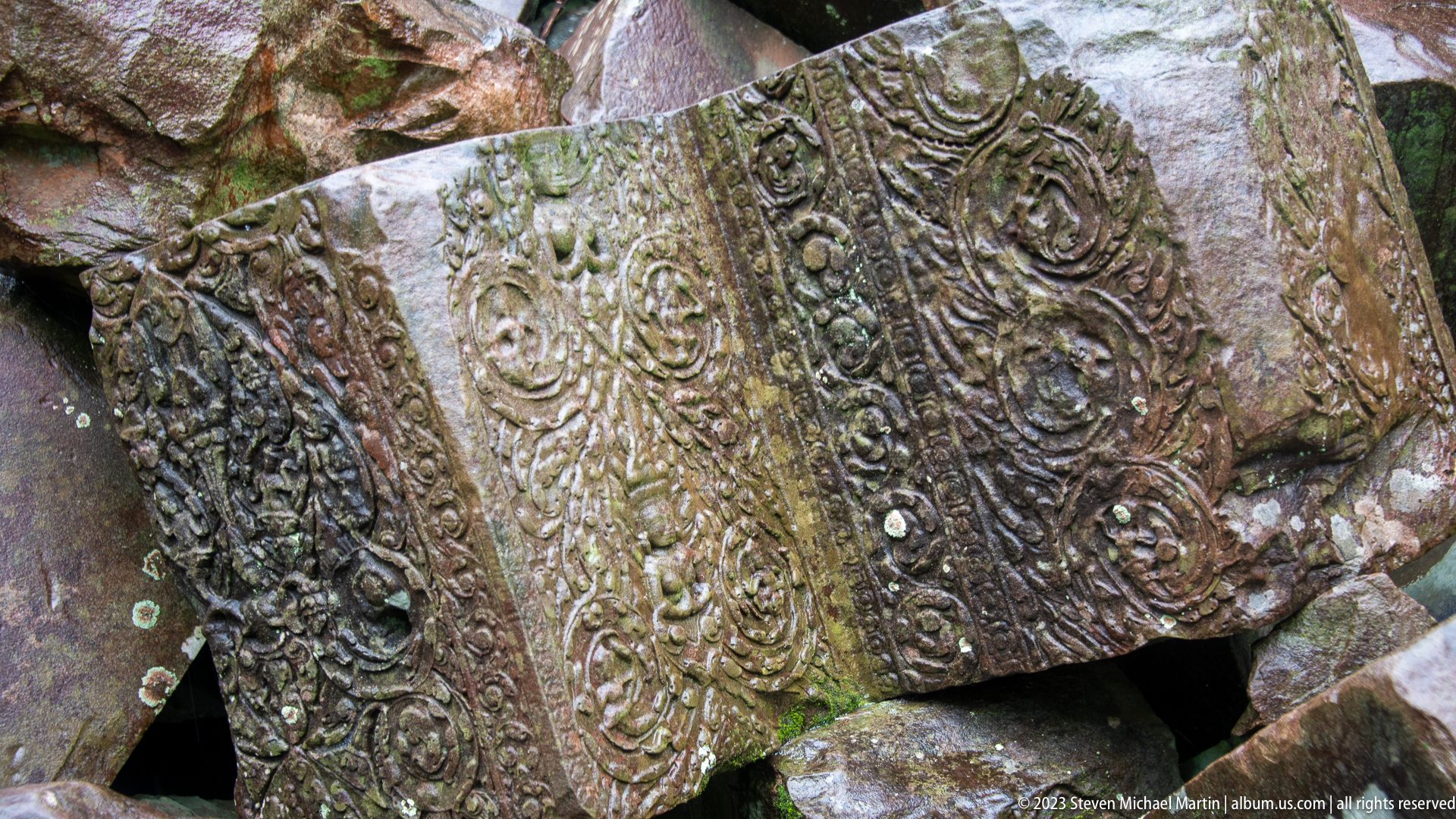
A displaced sandstone block lies among collapsed masonry, preserving a dense pattern of curling vegetal forms separated by beaded and ridged borders. Its tilted position reveals that the carving once belonged to a larger architectural composition but has lost its original orientation and setting. Moisture and surface deposits accentuate the incised lines, making the ornamental pattern especially legible against the surrounding rubble.
Caption
A displaced sandstone block lies among collapsed masonry, preserving a dense pattern of curling vegetal forms separated by beaded and ridged borders. Its tilted position reveals that the carving once belonged to a larger architectural composition but has lost its original orientation and setting. Moisture and surface deposits accentuate the incised lines, making the ornamental pattern especially legible against the surrounding rubble.
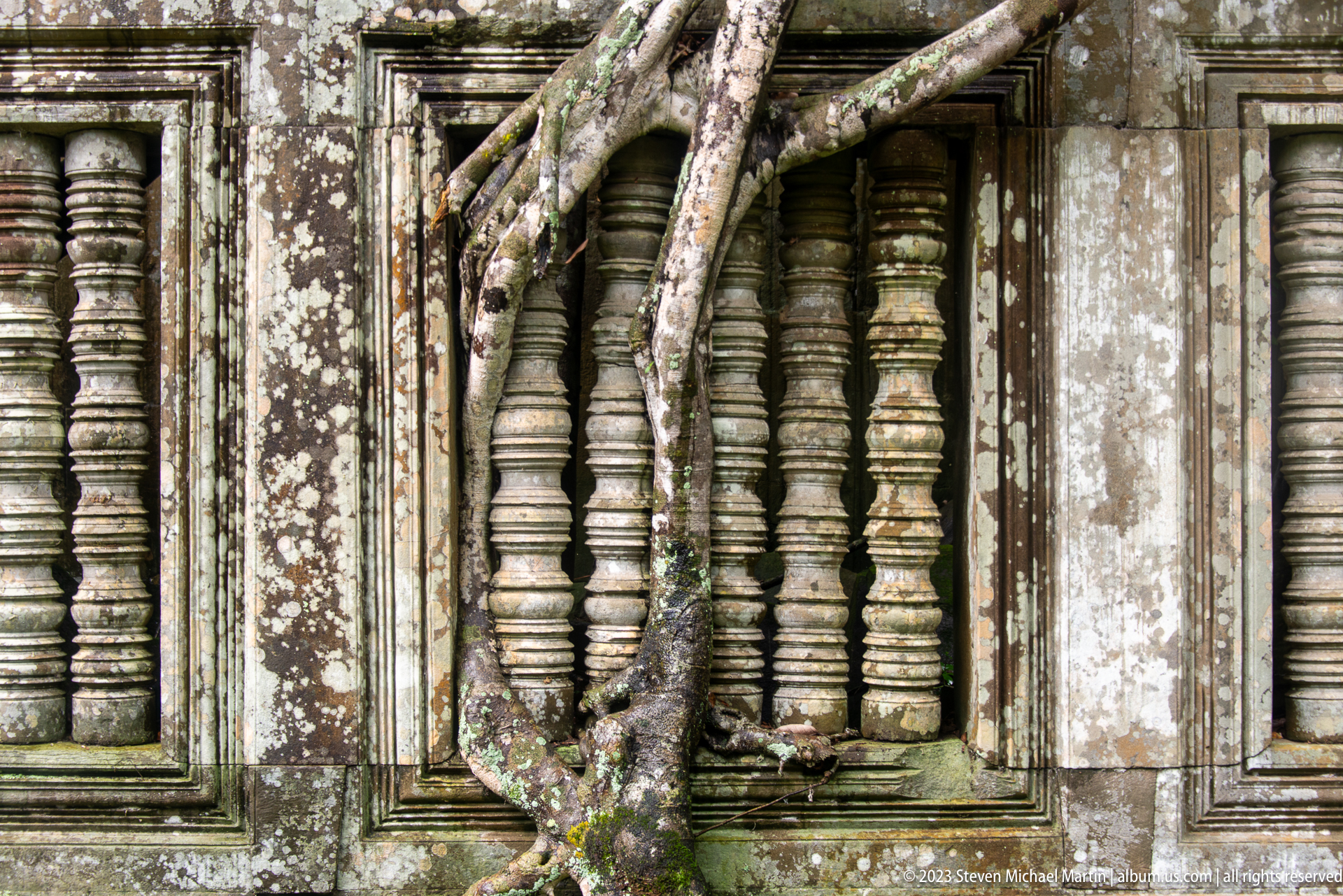
Tree roots descend across a balustered sandstone window at Beng Mealea, interrupting the regular sequence of turned stone columns within the recessed opening. The close frontal view makes the contrast especially clear: carefully repeated architectural forms survive behind an irregular living framework of roots, while lichen, staining, and worn surfaces record prolonged exposure to the humid forest environment.
Caption
Tree roots descend across a balustered sandstone window at Beng Mealea, interrupting the regular sequence of turned stone columns within the recessed opening. The close frontal view makes the contrast especially clear: carefully repeated architectural forms survive behind an irregular living framework of roots, while lichen, staining, and worn surfaces record prolonged exposure to the humid forest environment.
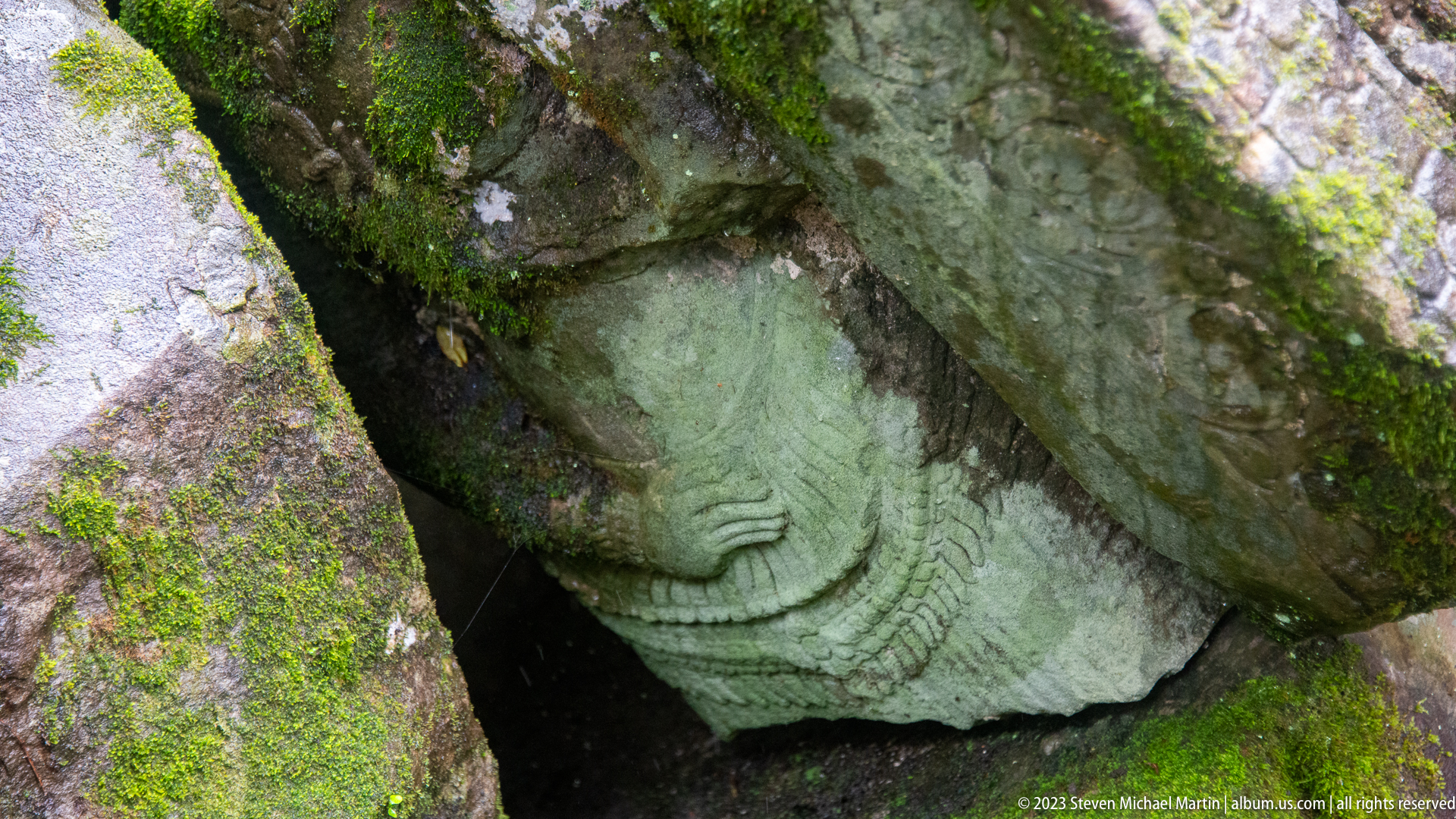
A pale carved sandstone fragment lies wedged beneath larger collapsed blocks, exposing only part of a layered curving design. Repeated ridges and feather- or scale-like forms remain visible despite the fragment’s inverted, compressed setting. The photograph records how decorated architectural elements at Beng Mealea survive out of context within the rubble, where their original orientation and function can be difficult to reconstruct.
Caption
A pale carved sandstone fragment lies wedged beneath larger collapsed blocks, exposing only part of a layered curving design. Repeated ridges and feather- or scale-like forms remain visible despite the fragment’s inverted, compressed setting. The photograph records how decorated architectural elements at Beng Mealea survive out of context within the rubble, where their original orientation and function can be difficult to reconstruct.
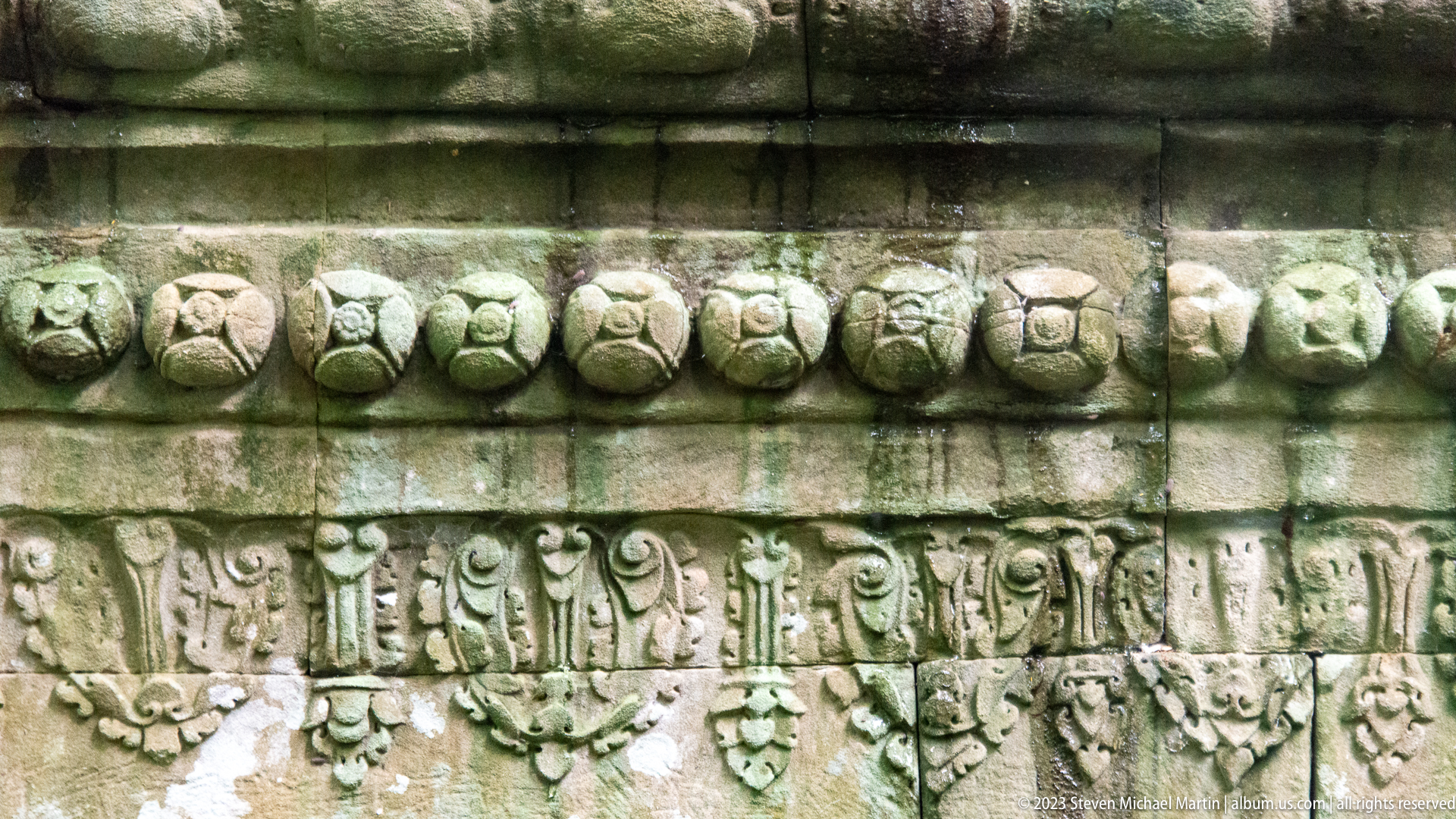
Two horizontal ornamental bands preserve contrasting patterns in Beng Mealea’s sandstone decoration. The upper register consists of rounded, repeating lotus-bud forms, while the lower frieze develops a denser rhythm of pendant leaves and curling foliage. Surface staining and softened edges reveal long weathering, yet the regular repetition still communicates the precision with which decorative motifs were organized across the architecture.
Caption
Two horizontal ornamental bands preserve contrasting patterns in Beng Mealea’s sandstone decoration. The upper register consists of rounded, repeating lotus-bud forms, while the lower frieze develops a denser rhythm of pendant leaves and curling foliage. Surface staining and softened edges reveal long weathering, yet the regular repetition still communicates the precision with which decorative motifs were organized across the architecture.

A vertical sandstone panel beside an opening preserves several small figures arranged within dense foliate ornament and molded borders. Tree roots and dark biological growth cross the carving, while losses and softened details make the original iconographic sequence difficult to read. The close view nevertheless demonstrates how figurative imagery was integrated into the architectural framing rather than treated as a separate freestanding sculpture.
Caption
A vertical sandstone panel beside an opening preserves several small figures arranged within dense foliate ornament and molded borders. Tree roots and dark biological growth cross the carving, while losses and softened details make the original iconographic sequence difficult to read. The close view nevertheless demonstrates how figurative imagery was integrated into the architectural framing rather than treated as a separate freestanding sculpture.
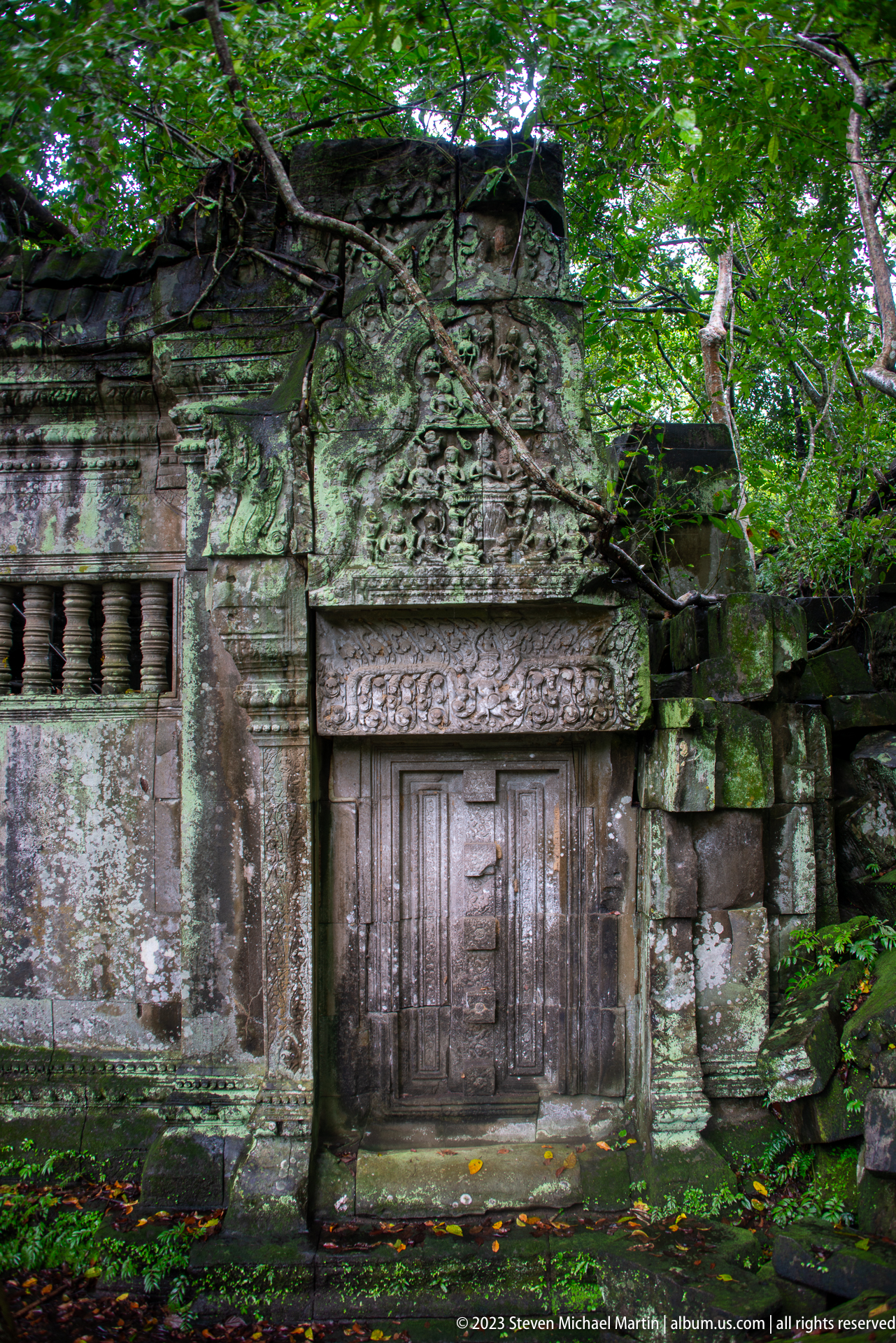
A closed wooden door occupies the center of this weathered sandstone façade at Beng Mealea, framed above by a carved lintel and bordered by projecting stone moldings. A balustered window survives to the left, while displaced blocks and dense vegetation press against the wall at right. The image combines an intact point of enclosure with the surrounding evidence of collapse and overgrowth.
Caption
A closed wooden door occupies the center of this weathered sandstone façade at Beng Mealea, framed above by a carved lintel and bordered by projecting stone moldings. A balustered window survives to the left, while displaced blocks and dense vegetation press against the wall at right. The image combines an intact point of enclosure with the surrounding evidence of collapse and overgrowth.
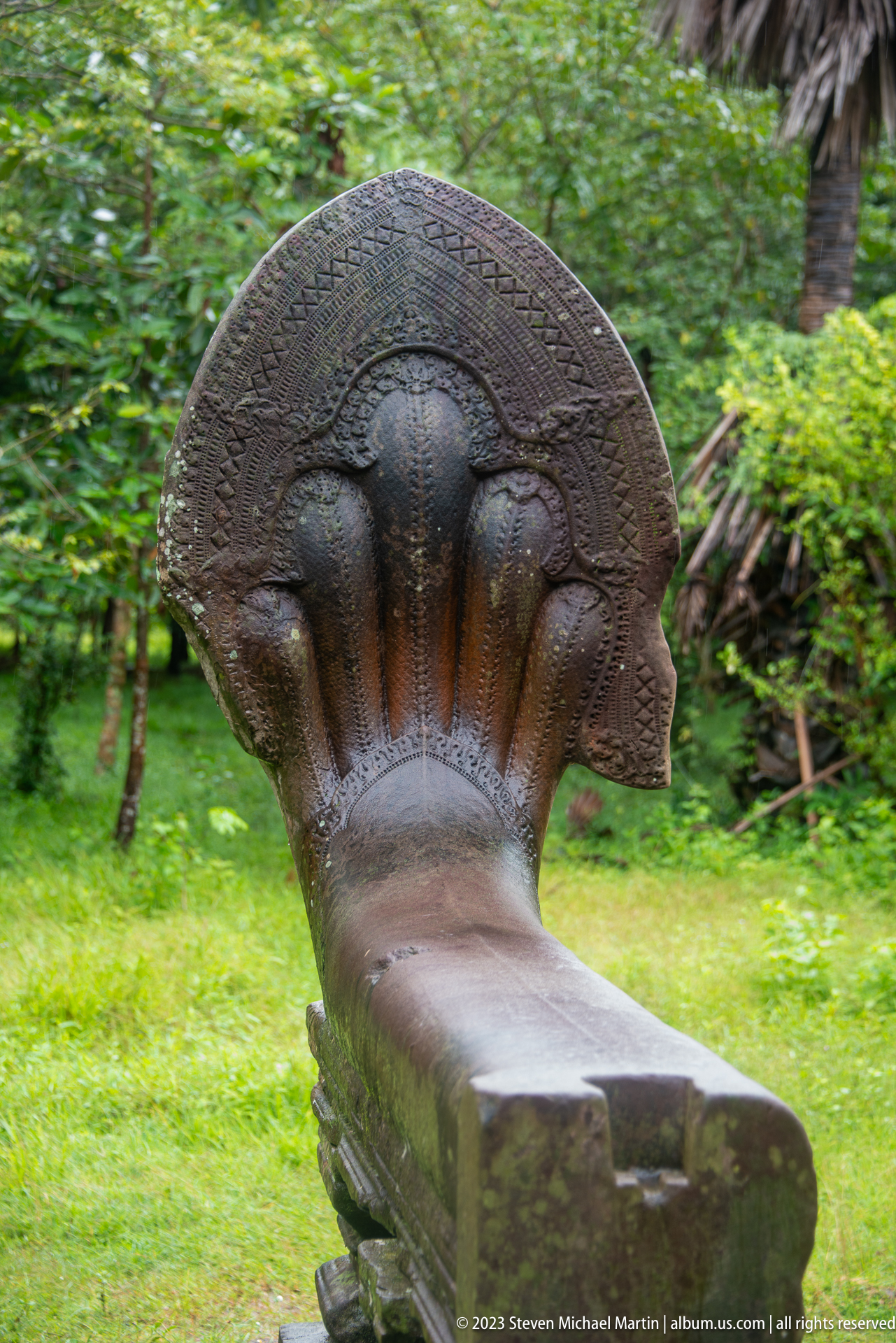
A multi-headed naga rises from the end of a stone balustrade, its cobra hoods spreading into a broad fan above the serpent’s body. The sculpture stands in a grassy setting outside the main field of ruins. Its weathered surface and symmetrical profile preserve one of the most recognizable protective forms associated with Khmer sacred architecture and ceremonial approaches.
Caption
A multi-headed naga rises from the end of a stone balustrade, its cobra hoods spreading into a broad fan above the serpent’s body. The sculpture stands in a grassy setting outside the main field of ruins. Its weathered surface and symmetrical profile preserve one of the most recognizable protective forms associated with Khmer sacred architecture and ceremonial approaches.
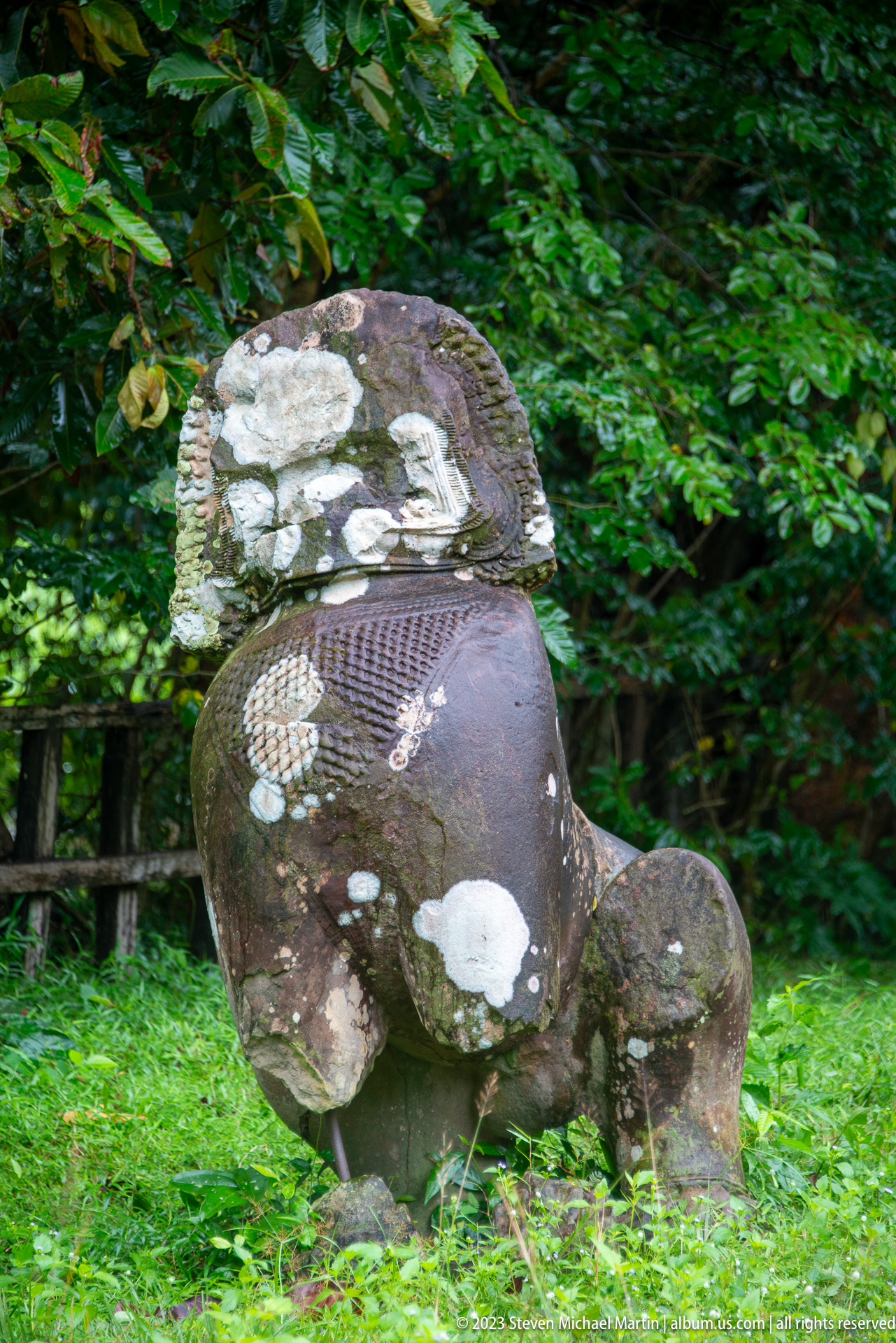
A heavily weathered stone guardian sits on the grass, its compact body and raised head still legible despite extensive surface loss and pale biological deposits. The rounded silhouette suggests a lion-like protective figure, but erosion has removed many identifying details. Isolated from its original architectural setting, the sculpture survives as a fragment of the temple’s former guardian imagery.
Caption
A heavily weathered stone guardian sits on the grass, its compact body and raised head still legible despite extensive surface loss and pale biological deposits. The rounded silhouette suggests a lion-like protective figure, but erosion has removed many identifying details. Isolated from its original architectural setting, the sculpture survives as a fragment of the temple’s former guardian imagery.
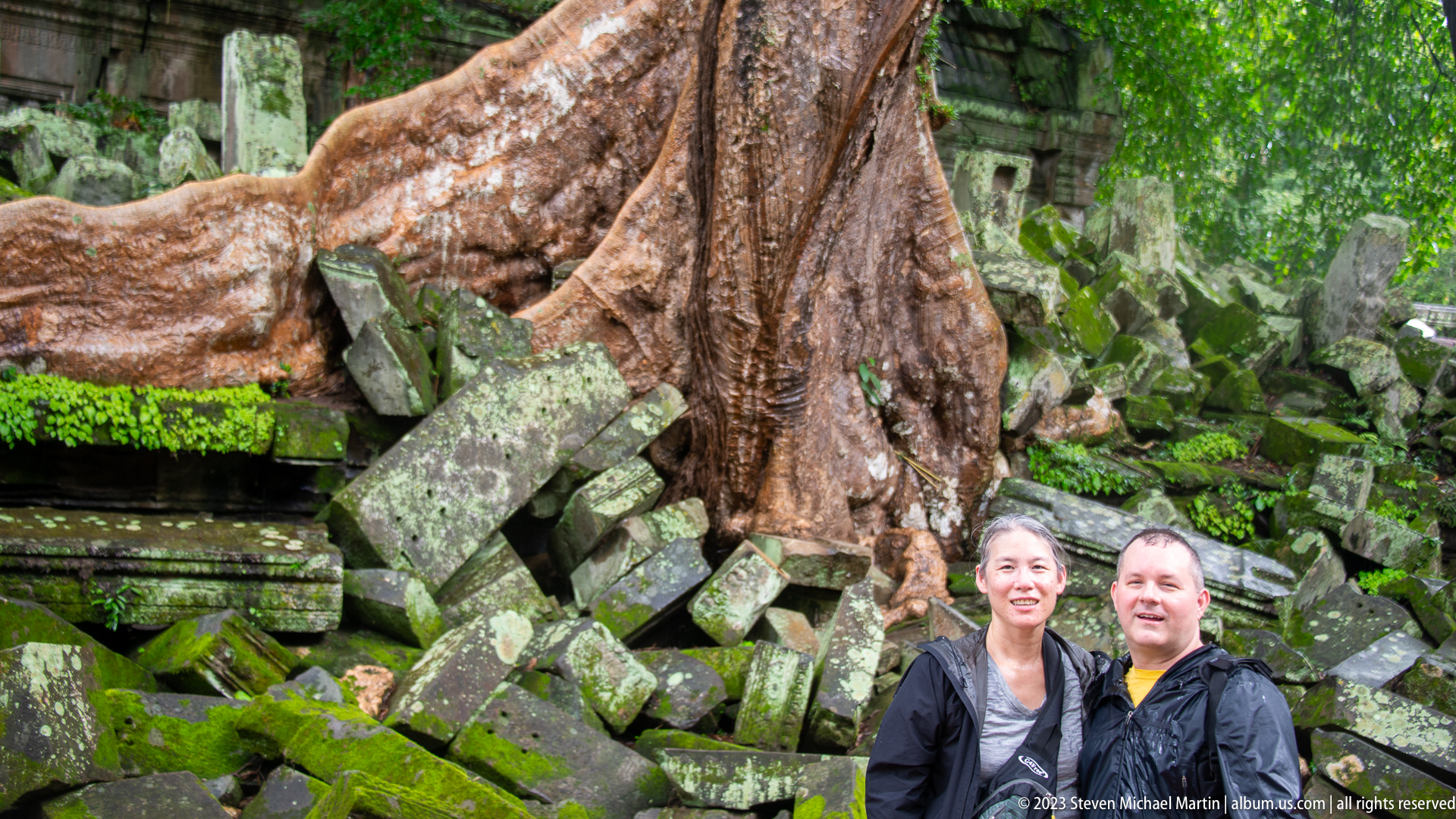
Two visitors stand before a massive tree whose spreading base rises from a field of collapsed sandstone at Beng Mealea. Their scale emphasizes the size of both the trunk and the displaced temple blocks. Moss, roots, and broken masonry form a dense backdrop, turning the portrait into a record of how visitors encounter the site’s defining conjunction of forest growth and architectural ruin.
Caption
Two visitors stand before a massive tree whose spreading base rises from a field of collapsed sandstone at Beng Mealea. Their scale emphasizes the size of both the trunk and the displaced temple blocks. Moss, roots, and broken masonry form a dense backdrop, turning the portrait into a record of how visitors encounter the site’s defining conjunction of forest growth and architectural ruin.
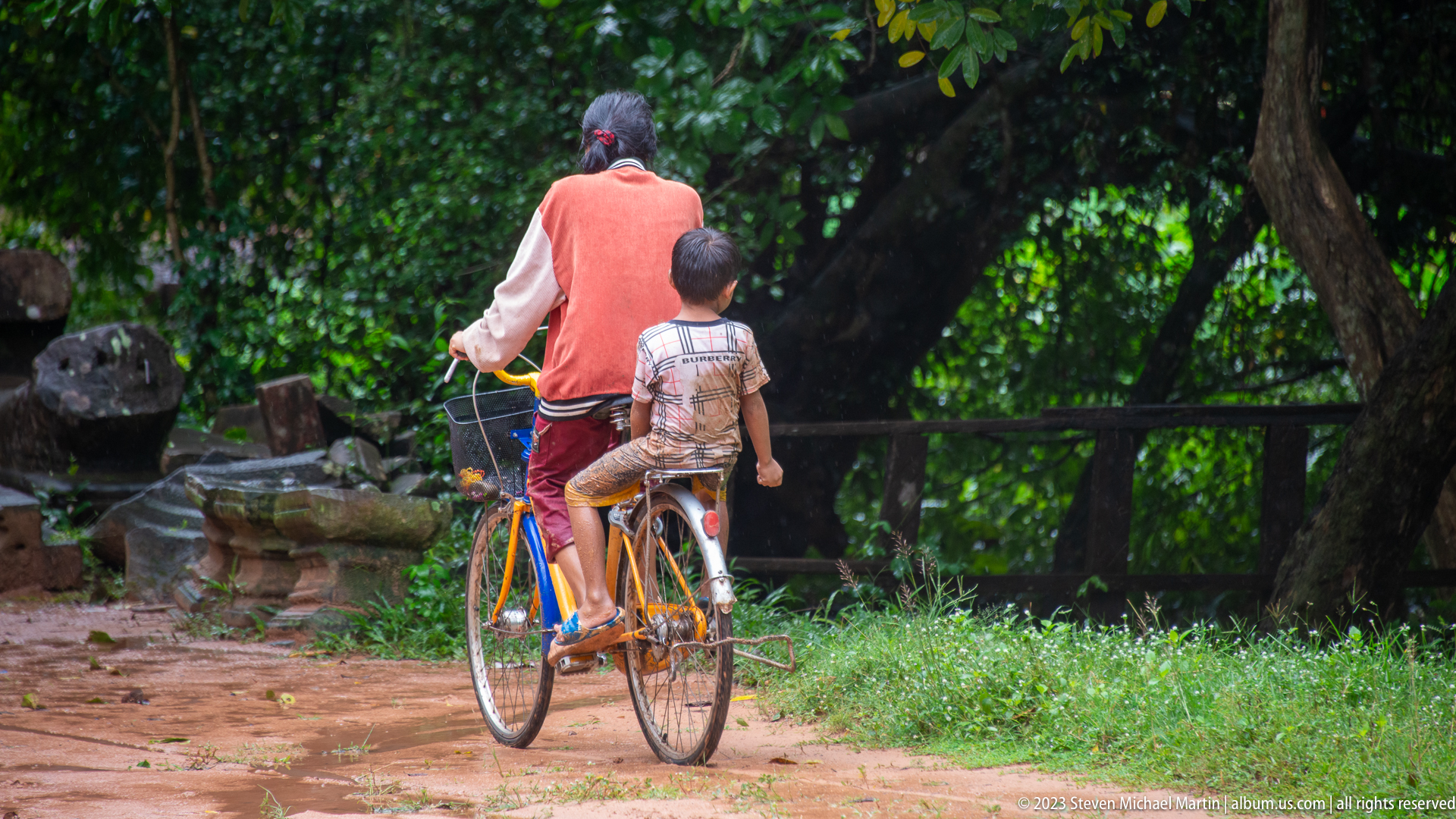
An adult pedals a bicycle along a shaded earthen road while a child rides behind, seated over the rear wheel. The scene records everyday movement in the community surrounding Beng Mealea rather than the monument itself. Their retreating figures, framed by trees and roadside vegetation, connect the archaeological destination to the lived rural landscape through which residents continue to travel.
Caption
An adult pedals a bicycle along a shaded earthen road while a child rides behind, seated over the rear wheel. The scene records everyday movement in the community surrounding Beng Mealea rather than the monument itself. Their retreating figures, framed by trees and roadside vegetation, connect the archaeological destination to the lived rural landscape through which residents continue to travel.
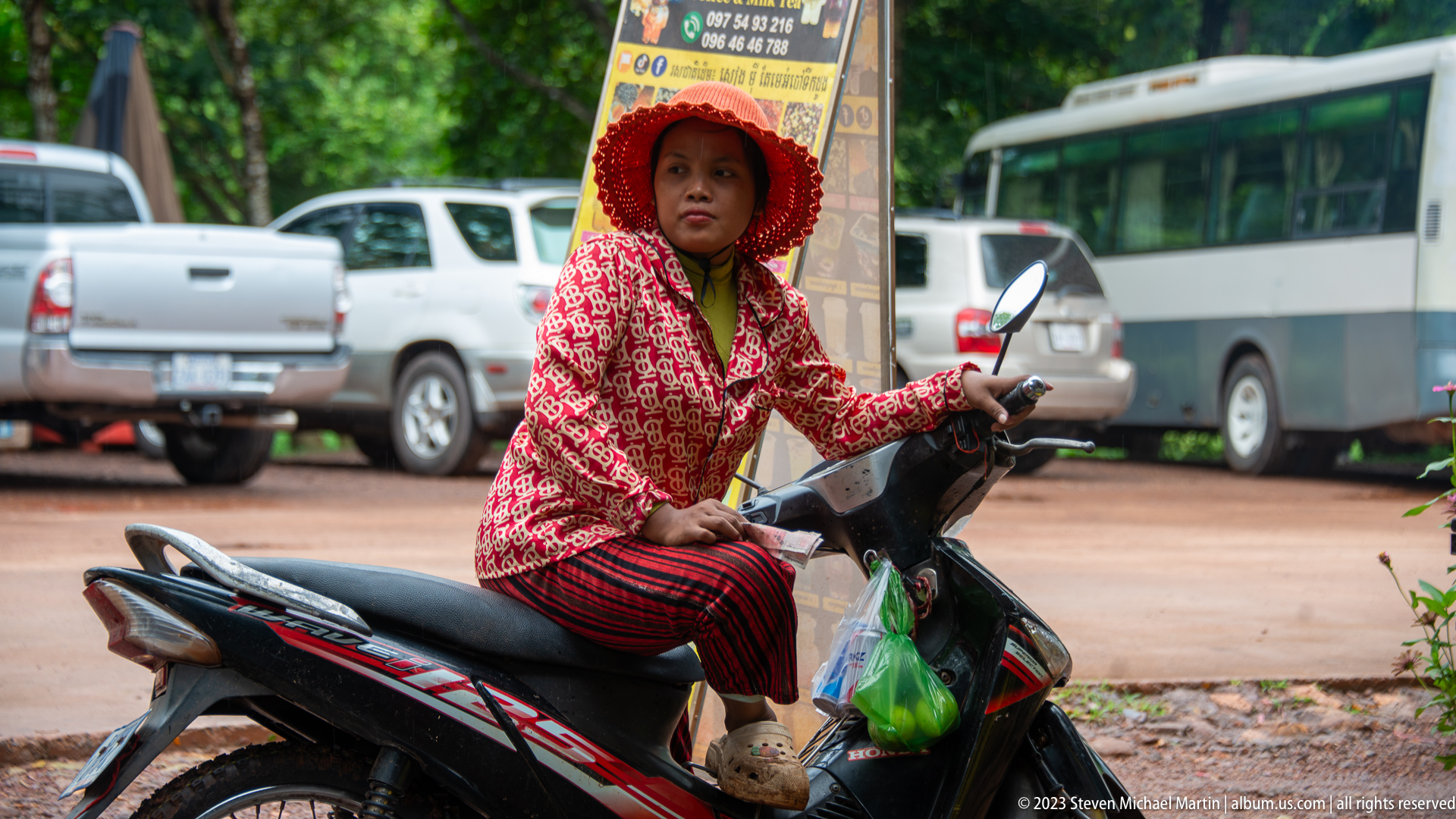
A woman in a red patterned hooded jacket sits astride a motor scooter near the Beng Mealea visitor area, glancing to the side amid parked vehicles and roadside signs. The portrait records contemporary mobility and wet-weather clothing in the community serving the site. Her vivid clothing and attentive expression stand out against the muted transport hub behind her.
Caption
A woman in a red patterned hooded jacket sits astride a motor scooter near the Beng Mealea visitor area, glancing to the side amid parked vehicles and roadside signs. The portrait records contemporary mobility and wet-weather clothing in the community serving the site. Her vivid clothing and attentive expression stand out against the muted transport hub behind her.
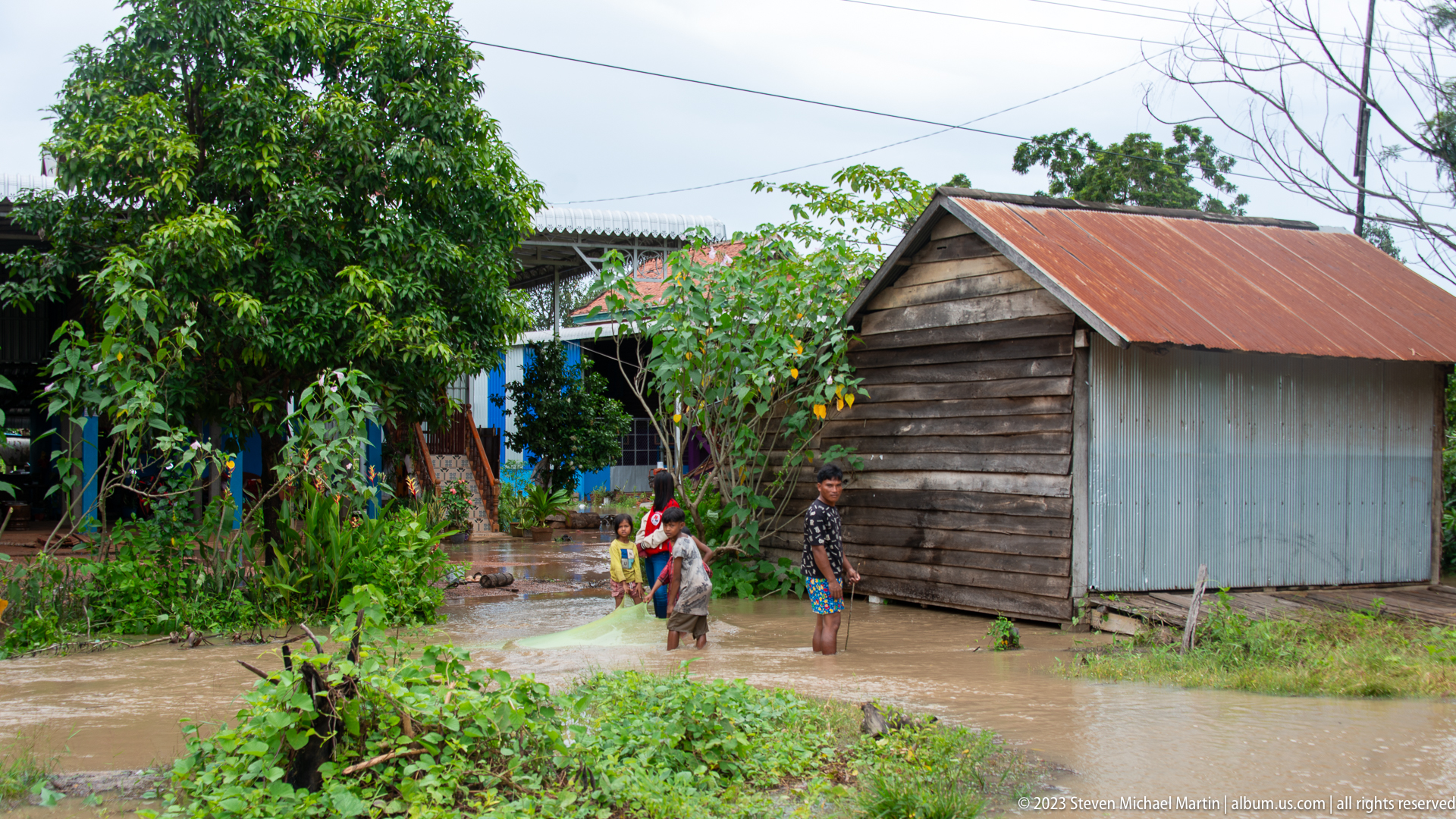
Children stand in shallow floodwater between modest timber and corrugated-metal buildings near Beng Mealea. Water covers the yard and reaches the base of the structures, turning ordinary paths into reflective channels. The scene documents seasonal or recent flooding within the surrounding rural community and places the archaeological destination within a wider inhabited landscape shaped by monsoon conditions.
Caption
Children stand in shallow floodwater between modest timber and corrugated-metal buildings near Beng Mealea. Water covers the yard and reaches the base of the structures, turning ordinary paths into reflective channels. The scene documents seasonal or recent flooding within the surrounding rural community and places the archaeological destination within a wider inhabited landscape shaped by monsoon conditions.
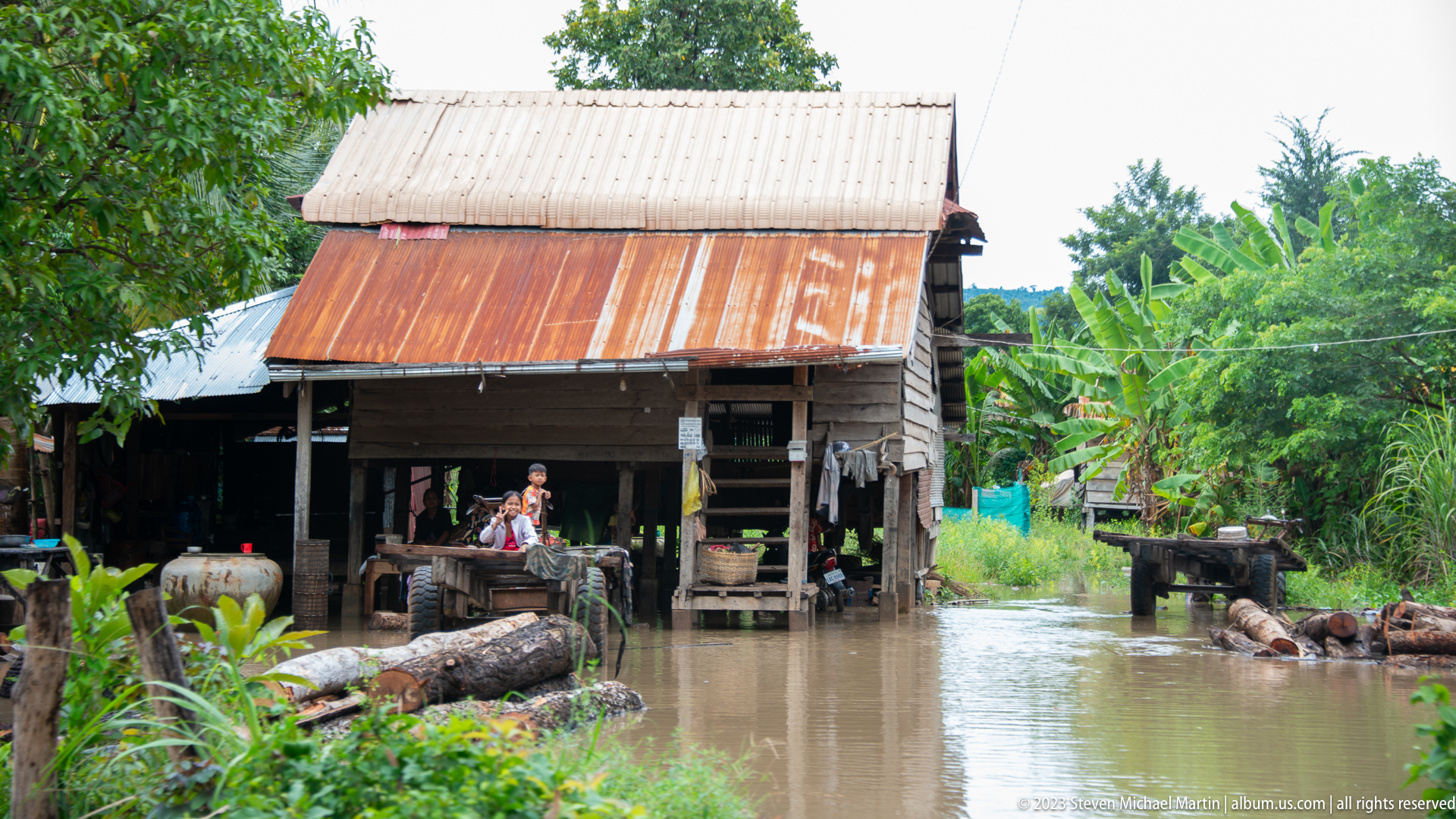
A timber dwelling with a corrugated roof stands above floodwater, its open lower level and raised living space adapted to a low-lying rural environment. Household objects remain visible beneath the structure while water fills the surrounding yard. The image records how vernacular building forms near Beng Mealea respond to seasonal inundation through elevation, open circulation, and lightweight materials.
Caption
A timber dwelling with a corrugated roof stands above floodwater, its open lower level and raised living space adapted to a low-lying rural environment. Household objects remain visible beneath the structure while water fills the surrounding yard. The image records how vernacular building forms near Beng Mealea respond to seasonal inundation through elevation, open circulation, and lightweight materials.

An open-front roadside kiosk displays packaged goods, drinks, and household items beneath a patched corrugated roof. The raised wooden platform keeps merchandise above the damp ground, while a larger timber house stands behind the shop. This small commercial scene documents the local service economy around Beng Mealea and the everyday exchange that supports residents and passing travelers.
Caption
An open-front roadside kiosk displays packaged goods, drinks, and household items beneath a patched corrugated roof. The raised wooden platform keeps merchandise above the damp ground, while a larger timber house stands behind the shop. This small commercial scene documents the local service economy around Beng Mealea and the everyday exchange that supports residents and passing travelers.
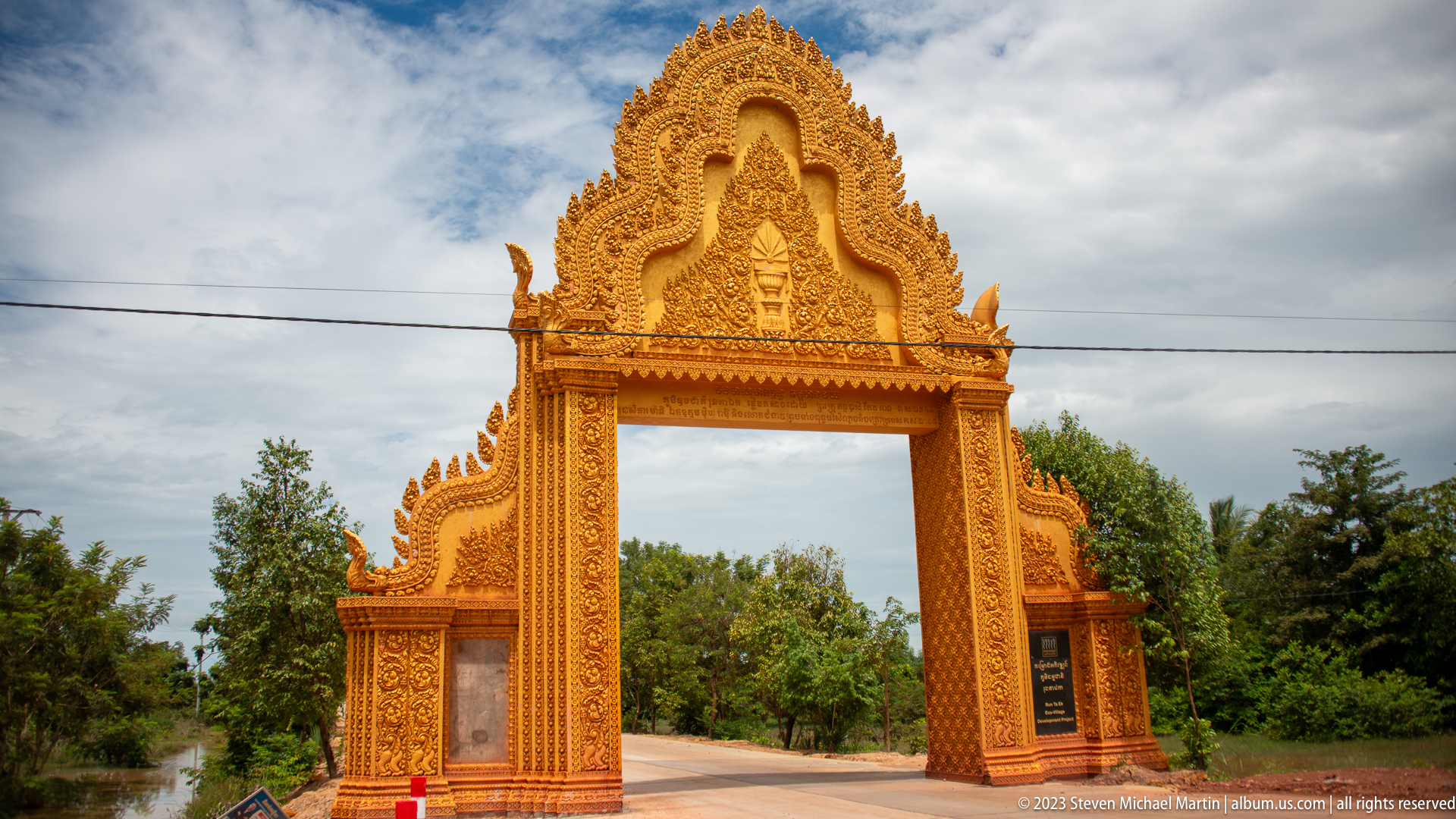
An ornate golden gateway marks the entrance to a Buddhist religious compound near Beng Mealea. Its tall pointed pediment, layered moldings, and dense relief ornament create a ceremonial threshold above the roadway. Although modern in finish, the gateway draws on Khmer decorative vocabulary through its upward-tapering silhouette and richly patterned surface, linking contemporary religious architecture to regional visual traditions.
Caption
An ornate golden gateway marks the entrance to a Buddhist religious compound near Beng Mealea. Its tall pointed pediment, layered moldings, and dense relief ornament create a ceremonial threshold above the roadway. Although modern in finish, the gateway draws on Khmer decorative vocabulary through its upward-tapering silhouette and richly patterned surface, linking contemporary religious architecture to regional visual traditions.
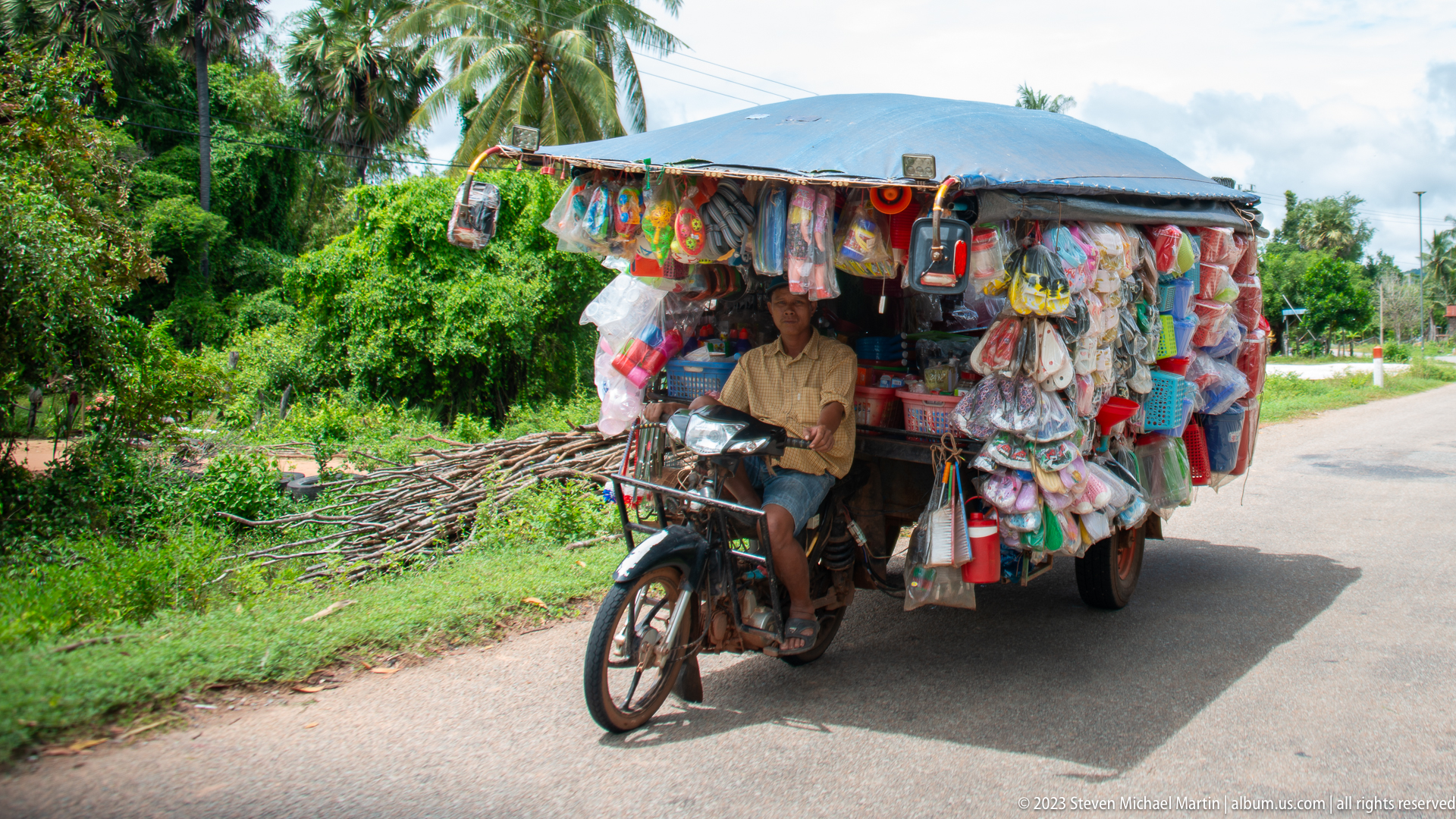
A traveling vendor rides a motorbike almost completely enclosed by a canopy and a dense display of hanging household goods. Colorful plastic items, textiles, and packaged merchandise turn the vehicle into a mobile shop serving dispersed rural customers. Photographed on the road near Beng Mealea, the scene illustrates an adaptable form of commerce designed for communities beyond permanent market centers.
Caption
A traveling vendor rides a motorbike almost completely enclosed by a canopy and a dense display of hanging household goods. Colorful plastic items, textiles, and packaged merchandise turn the vehicle into a mobile shop serving dispersed rural customers. Photographed on the road near Beng Mealea, the scene illustrates an adaptable form of commerce designed for communities beyond permanent market centers.
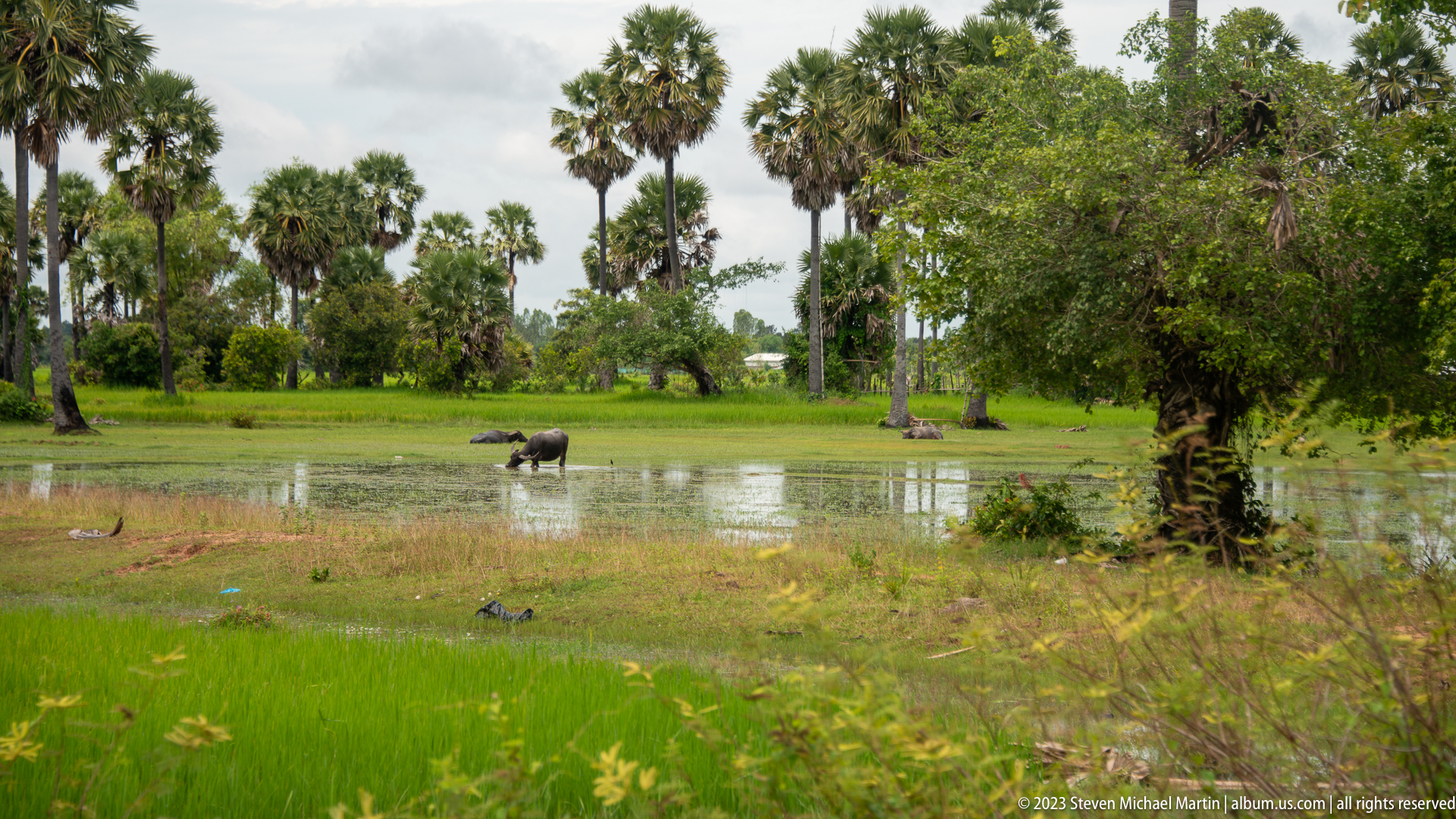
A domestic water buffalo stands in a shallow flooded field framed by tall sugar palms and dense tropical vegetation. The animal occupies the center of a broad rural landscape, where water, pasture, and cultivated land merge during the wet season. This view situates Beng Mealea within a working agricultural region shaped by livestock, seasonal inundation, and palm-dotted lowlands.
Caption
A domestic water buffalo stands in a shallow flooded field framed by tall sugar palms and dense tropical vegetation. The animal occupies the center of a broad rural landscape, where water, pasture, and cultivated land merge during the wet season. This view situates Beng Mealea within a working agricultural region shaped by livestock, seasonal inundation, and palm-dotted lowlands.
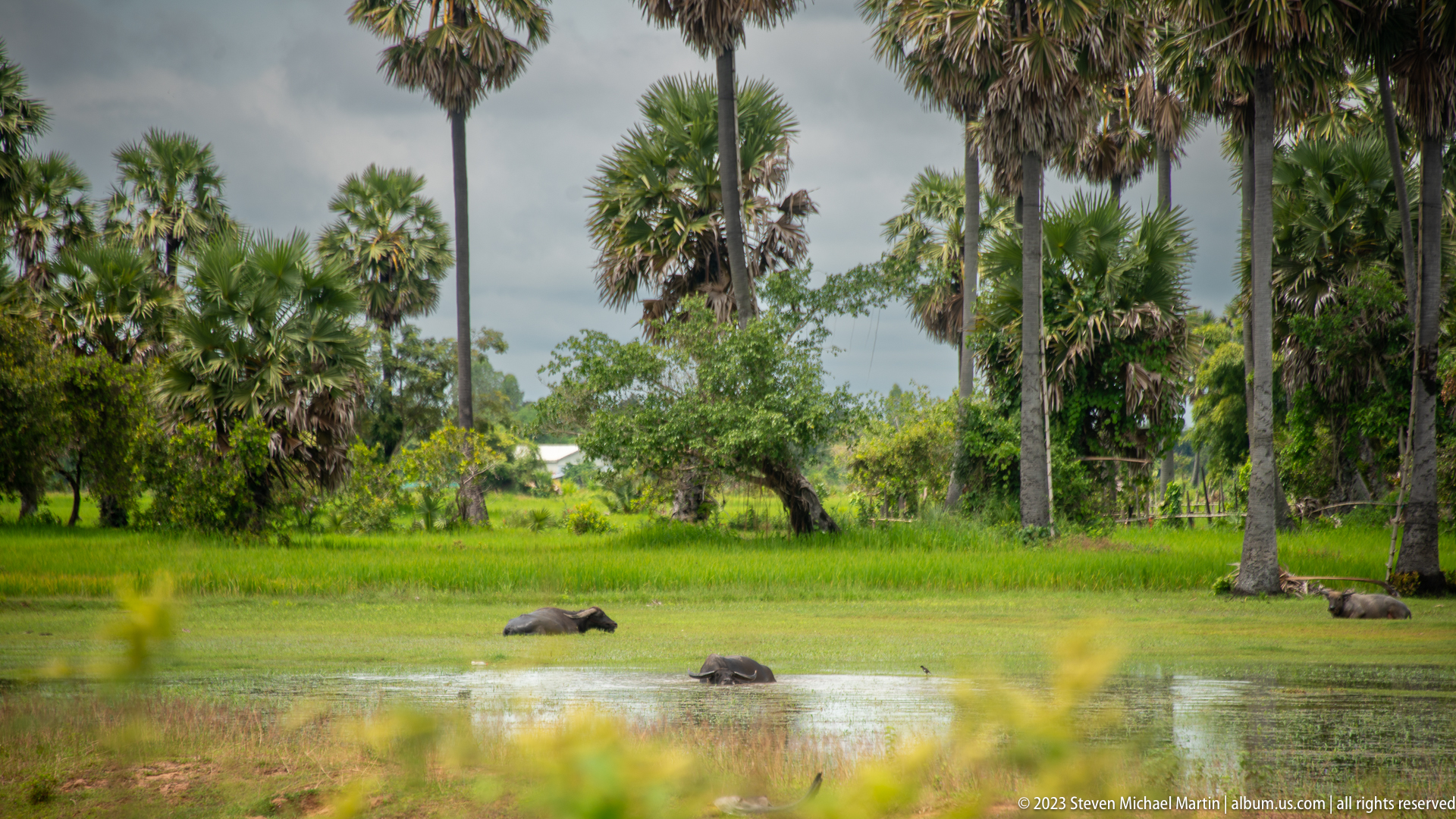
Several water buffalo rest in and beside a shallow flooded pasture beneath tall palms near Beng Mealea. Their dark bodies appear as low forms against bright green grass and reflective water. Unlike the more monumental imagery of the temple, this quiet agricultural scene records the routines of livestock management and the wet lowland ecology that shape everyday life around the archaeological site.
Caption
Several water buffalo rest in and beside a shallow flooded pasture beneath tall palms near Beng Mealea. Their dark bodies appear as low forms against bright green grass and reflective water. Unlike the more monumental imagery of the temple, this quiet agricultural scene records the routines of livestock management and the wet lowland ecology that shape everyday life around the archaeological site.
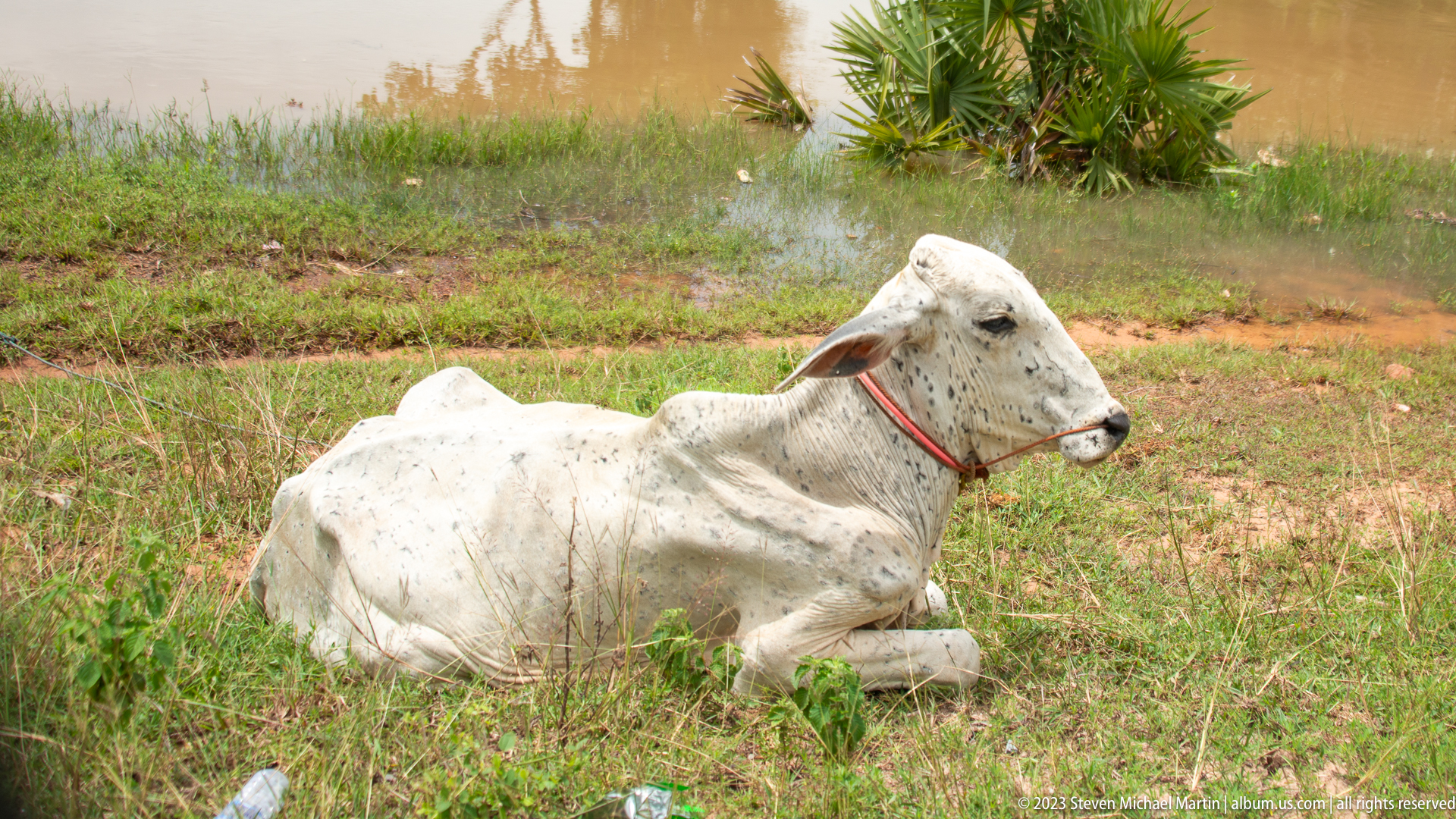
A white humped bovine rests on damp grass beside brown floodwater, wearing a red rope halter around its head. The prominent shoulder hump, loose skin, and upright ears suggest a zebu-type domestic animal adapted to tropical conditions. Photographed near Beng Mealea, the portrait adds a close agricultural subject to the broader sequence of flooded fields and grazing livestock.
Caption
A white humped bovine rests on damp grass beside brown floodwater, wearing a red rope halter around its head. The prominent shoulder hump, loose skin, and upright ears suggest a zebu-type domestic animal adapted to tropical conditions. Photographed near Beng Mealea, the portrait adds a close agricultural subject to the broader sequence of flooded fields and grazing livestock.

A male traveler smiles toward the camera while seated indoors in a blue rain jacket with backpack straps visible. Carved figures and warm-toned architectural details form the background, suggesting a visitor venue associated with the Beng Mealea excursion rather than the temple ruins themselves. The portrait records the human experience of the visit and the wet-weather conditions of the day.
Caption
A male traveler smiles toward the camera while seated indoors in a blue rain jacket with backpack straps visible. Carved figures and warm-toned architectural details form the background, suggesting a visitor venue associated with the Beng Mealea excursion rather than the temple ruins themselves. The portrait records the human experience of the visit and the wet-weather conditions of the day.
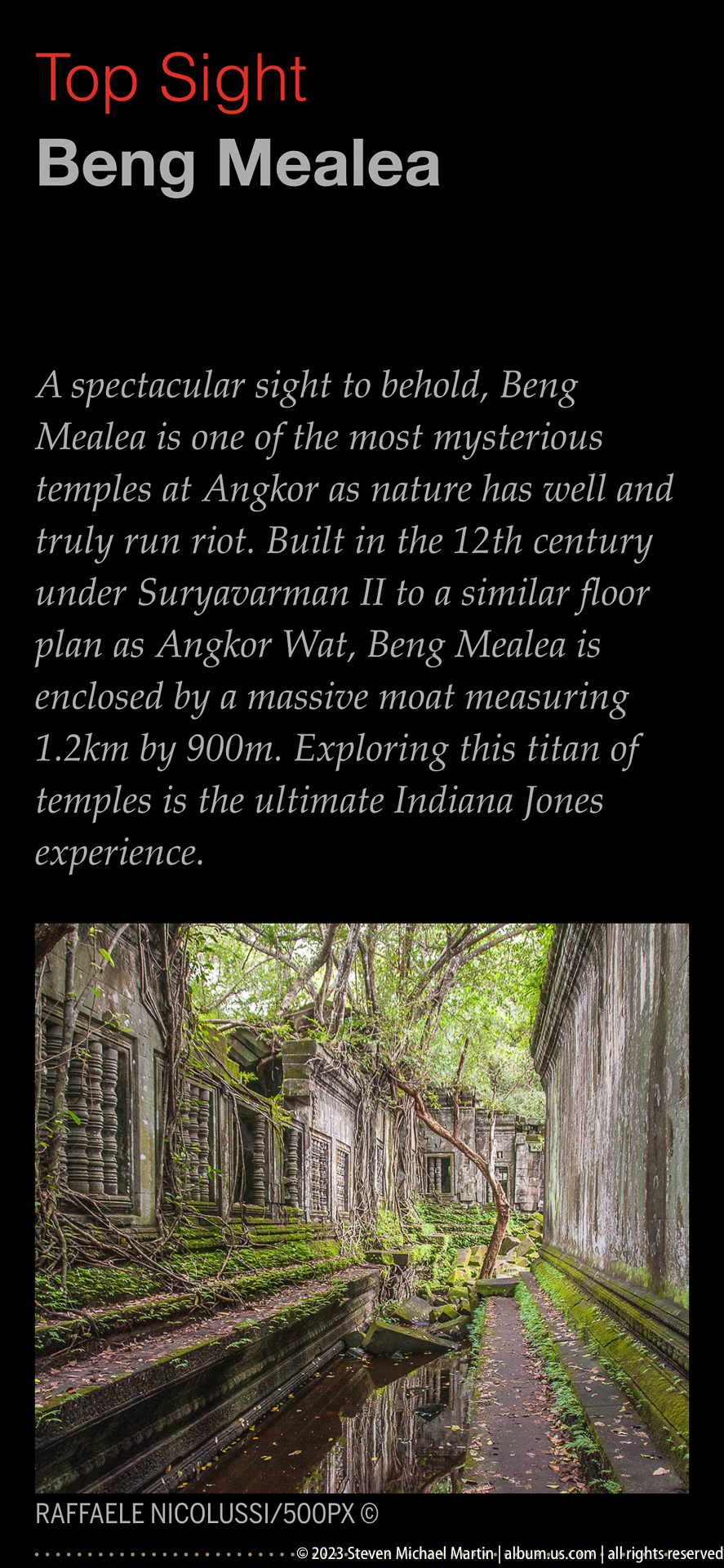
A designed interpretive graphic introduces Beng Mealea through a short descriptive text and a photograph of the temple’s root-covered gallery. The panel summarizes the site as a vast, heavily overgrown Khmer complex and highlights its moat, sandstone construction, and exploratory character. As a portfolio element, it functions as editorial context rather than direct visual documentation of the ruins.
Caption
A designed interpretive graphic introduces Beng Mealea through a short descriptive text and a photograph of the temple’s root-covered gallery. The panel summarizes the site as a vast, heavily overgrown Khmer complex and highlights its moat, sandstone construction, and exploratory character. As a portfolio element, it functions as editorial context rather than direct visual documentation of the ruins.
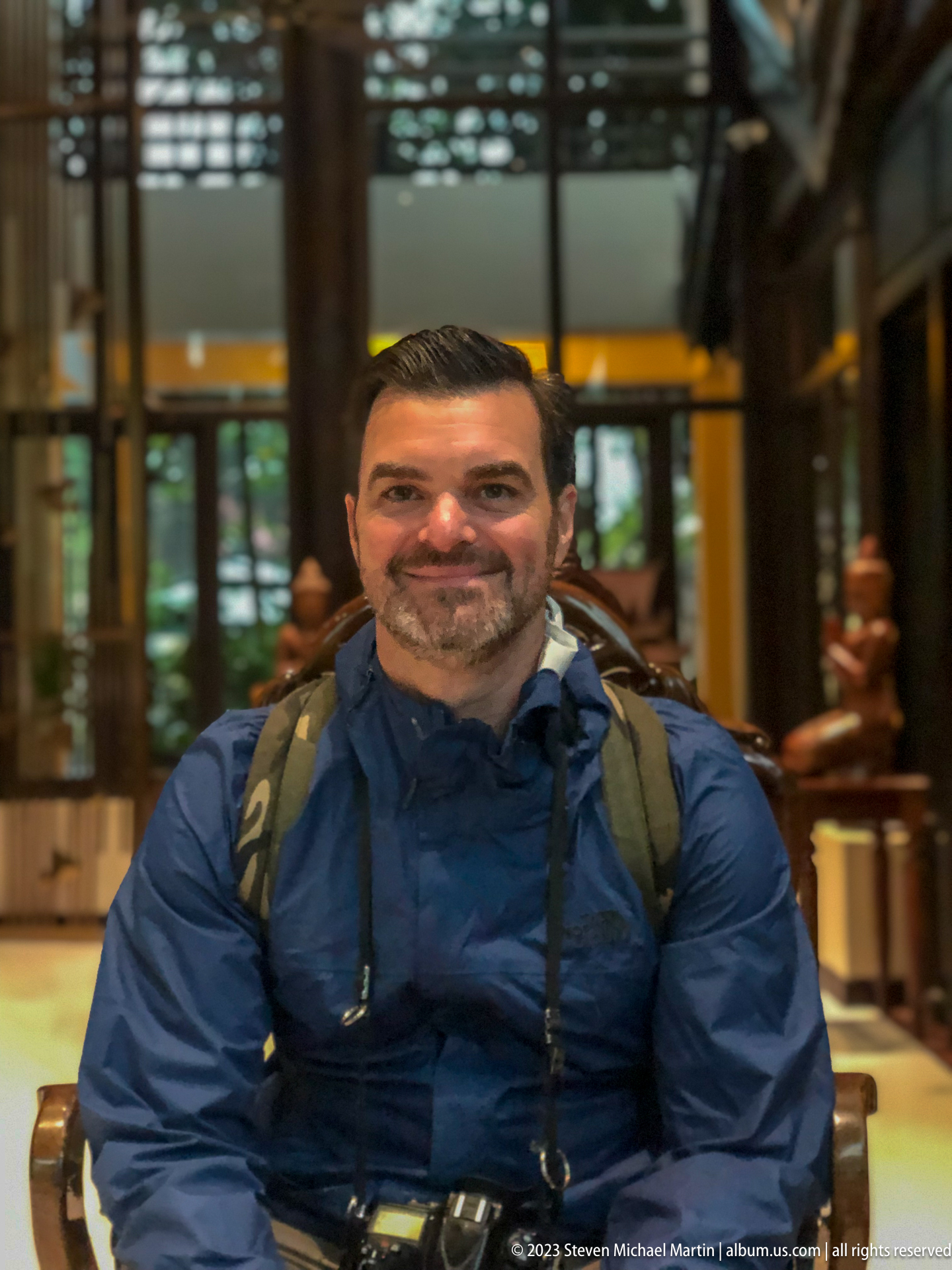
A male traveler sits indoors wearing a blue rain jacket and backpack, smiling toward the camera. Carved or sculpted figures and warm-toned architectural details appear behind him, suggesting a hotel, restaurant, or visitor venue rather than the temple ruins themselves. The portrait records the human experience surrounding the Beng Mealea visit and the wet-weather conditions of the day.
Caption
A male traveler sits indoors wearing a blue rain jacket and backpack, smiling toward the camera. Carved or sculpted figures and warm-toned architectural details appear behind him, suggesting a hotel, restaurant, or visitor venue rather than the temple ruins themselves. The portrait records the human experience surrounding the Beng Mealea visit and the wet-weather conditions of the day.
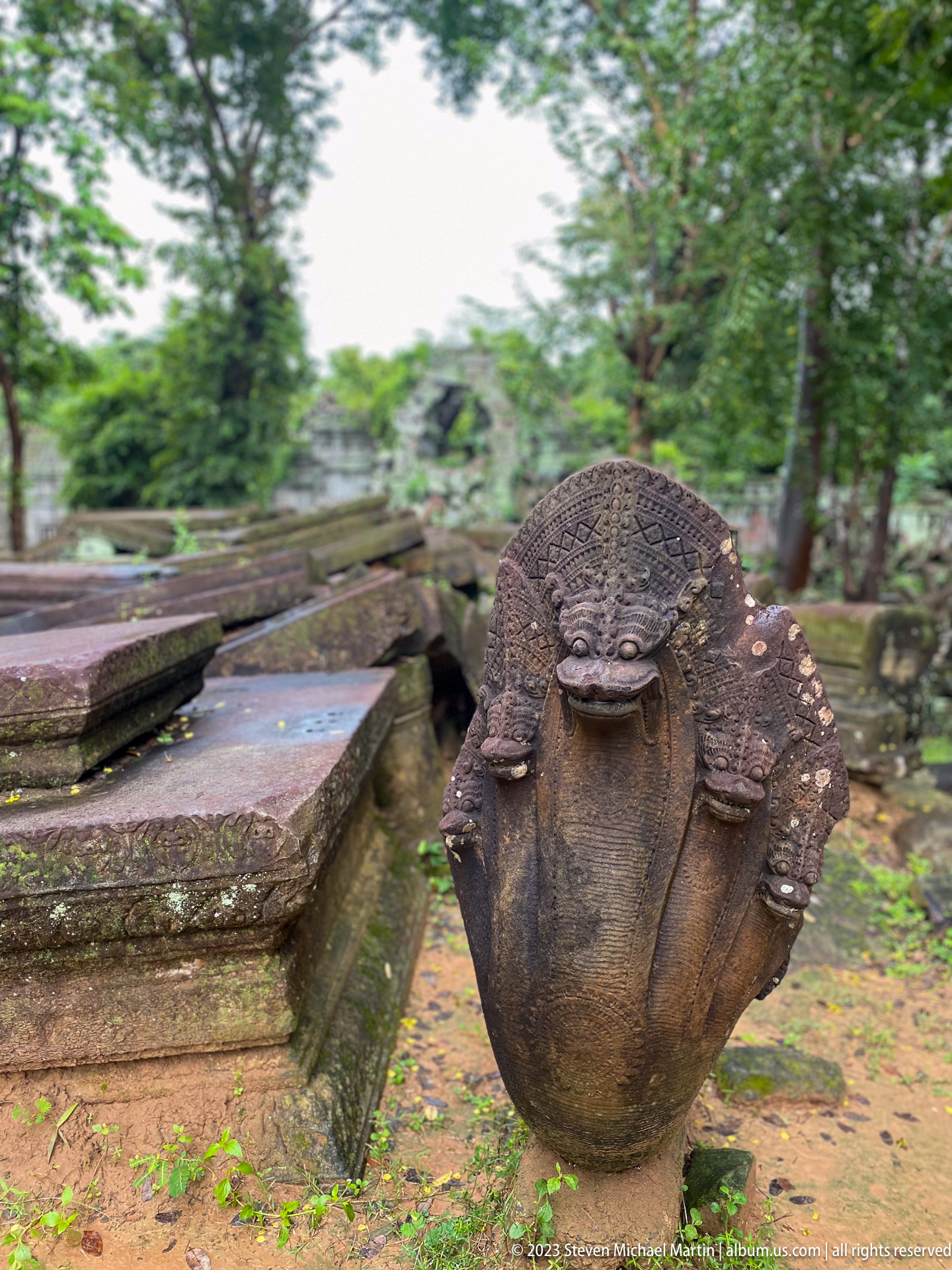
A weathered multi-headed naga finial rises beside a stone causeway at Beng Mealea. The cobra hoods fan outward above a compact body, forming the terminal element of a serpent balustrade associated with Khmer ceremonial approaches. Its worn surface and isolated placement reveal both the sculptural refinement of the original monument and the fragmentation of the present ruin.
Caption
A weathered multi-headed naga finial rises beside a stone causeway at Beng Mealea. The cobra hoods fan outward above a compact body, forming the terminal element of a serpent balustrade associated with Khmer ceremonial approaches. Its worn surface and isolated placement reveal both the sculptural refinement of the original monument and the fragmentation of the present ruin.
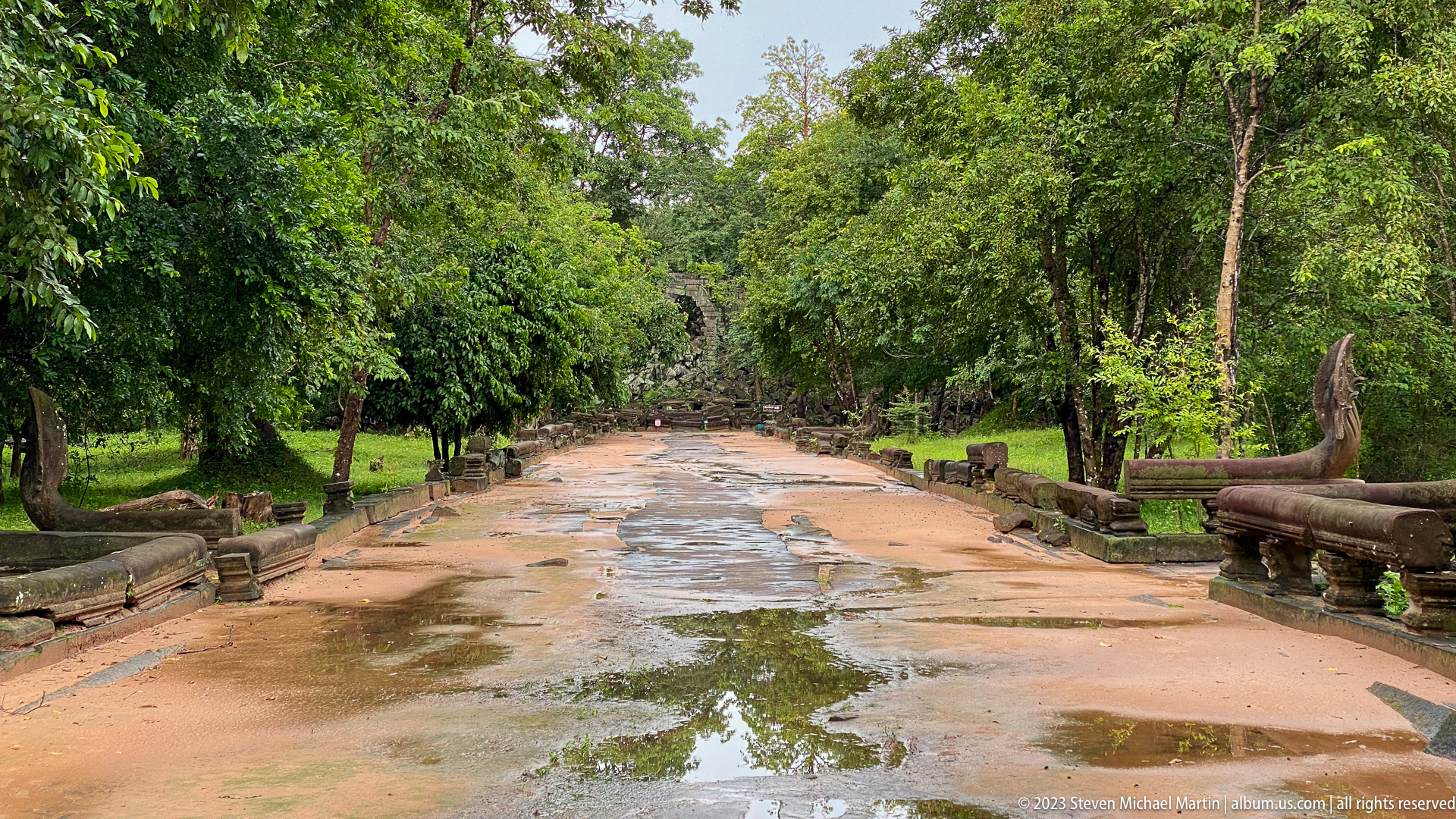
A broad rain-wet approach extends through dense forest toward the Beng Mealea complex, its surface broken by puddles and weathered stone. Serpentine naga balustrades line portions of the route, marking the ceremonial character of the entrance while also revealing centuries of collapse and displacement. The long axial view emphasizes the transition from surrounding woodland into the sacred precinct.
Caption
A broad rain-wet approach extends through dense forest toward the Beng Mealea complex, its surface broken by puddles and weathered stone. Serpentine naga balustrades line portions of the route, marking the ceremonial character of the entrance while also revealing centuries of collapse and displacement. The long axial view emphasizes the transition from surrounding woodland into the sacred precinct.
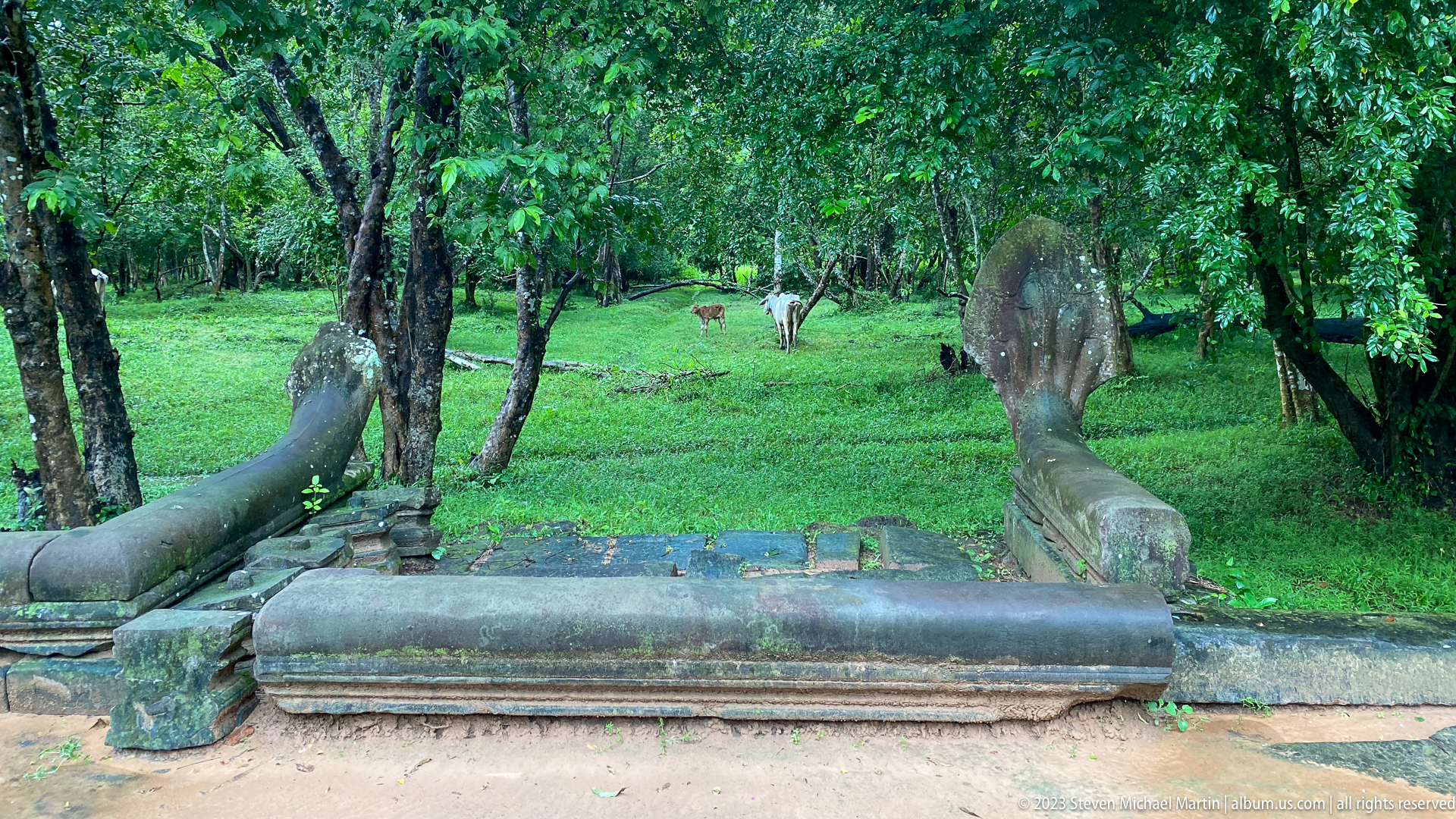
A collapsed section of sandstone naga balustrade lies beside the forest path at Beng Mealea. Two upright serpent-form terminals rise behind a long displaced railing element, while smaller blocks rest across the grass. The fragment shows how Khmer ceremonial boundaries were constructed from carved stone components that have since shifted under vegetation, weather, and structural failure.
Caption
A collapsed section of sandstone naga balustrade lies beside the forest path at Beng Mealea. Two upright serpent-form terminals rise behind a long displaced railing element, while smaller blocks rest across the grass. The fragment shows how Khmer ceremonial boundaries were constructed from carved stone components that have since shifted under vegetation, weather, and structural failure.
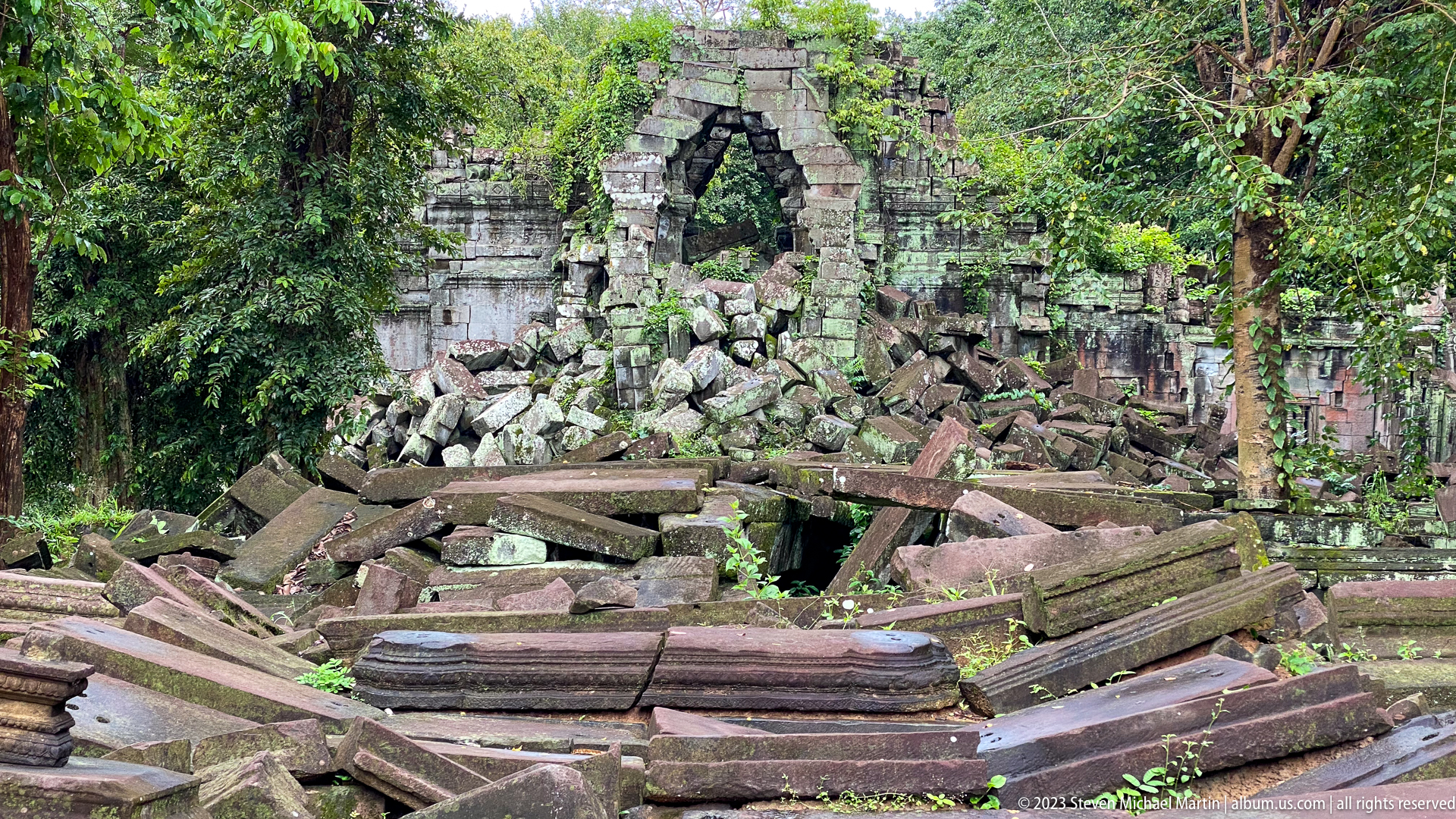
A narrow pointed opening survives within a heavily collapsed section of Beng Mealea, surrounded by heaps of fallen sandstone blocks and dismantled architectural members. The remaining wall preserves the outline of a doorway or passage, while the dense vegetation and irregular debris illustrate the site’s dramatic state of ruin. The image emphasizes structural collapse rather than a restored architectural reading.
Caption
A narrow pointed opening survives within a heavily collapsed section of Beng Mealea, surrounded by heaps of fallen sandstone blocks and dismantled architectural members. The remaining wall preserves the outline of a doorway or passage, while the dense vegetation and irregular debris illustrate the site’s dramatic state of ruin. The image emphasizes structural collapse rather than a restored architectural reading.
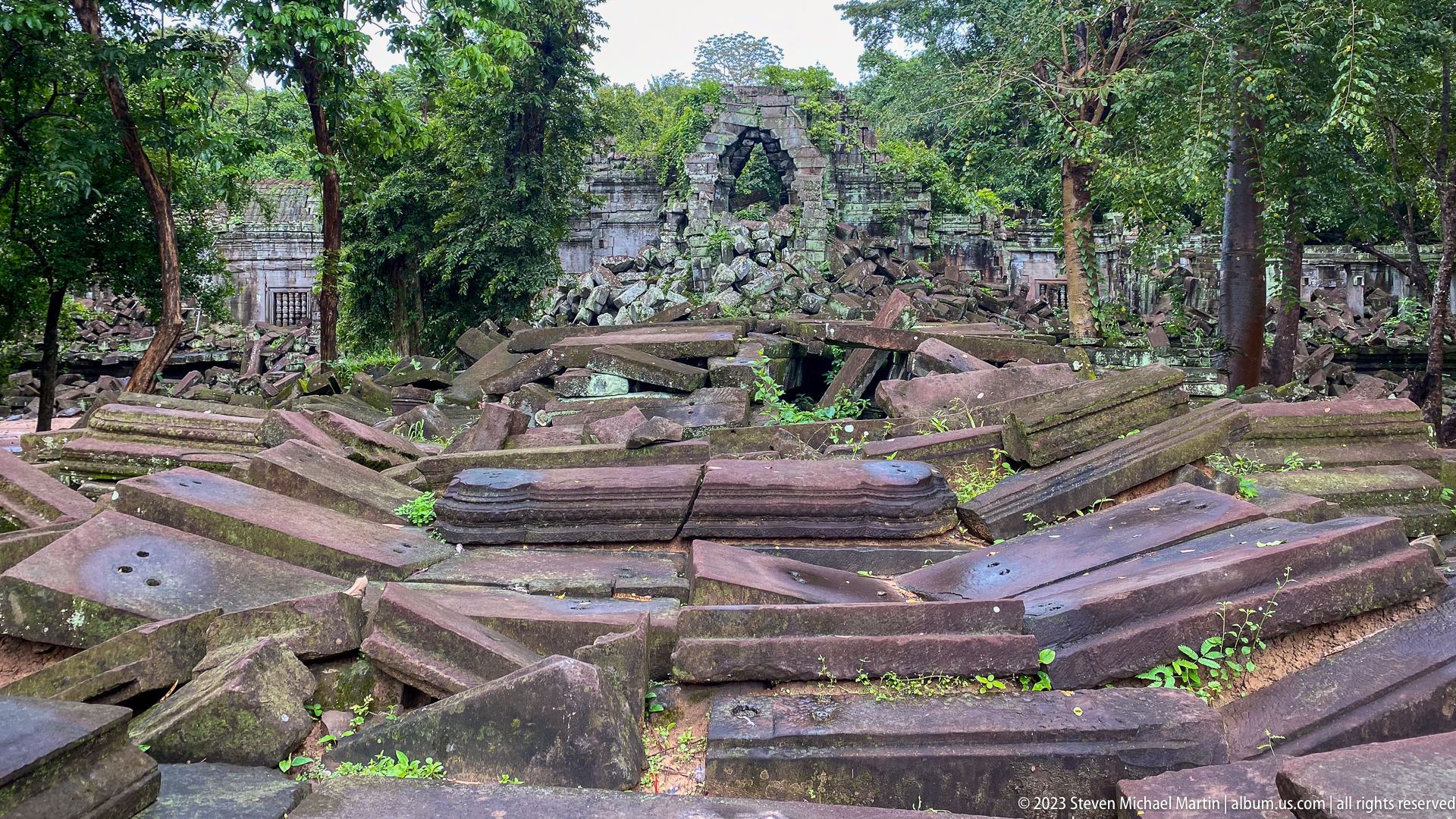
Massive sandstone lintels, wall blocks, and carved architectural members lie in dense disarray before a surviving opening at Beng Mealea. The broad view reveals the scale of structural collapse, with many components retaining moldings and finished surfaces despite their displacement. Vegetation grows between the stones, reinforcing the close relationship between the temple’s ruin and the surrounding forest.
Caption
Massive sandstone lintels, wall blocks, and carved architectural members lie in dense disarray before a surviving opening at Beng Mealea. The broad view reveals the scale of structural collapse, with many components retaining moldings and finished surfaces despite their displacement. Vegetation grows between the stones, reinforcing the close relationship between the temple’s ruin and the surrounding forest.
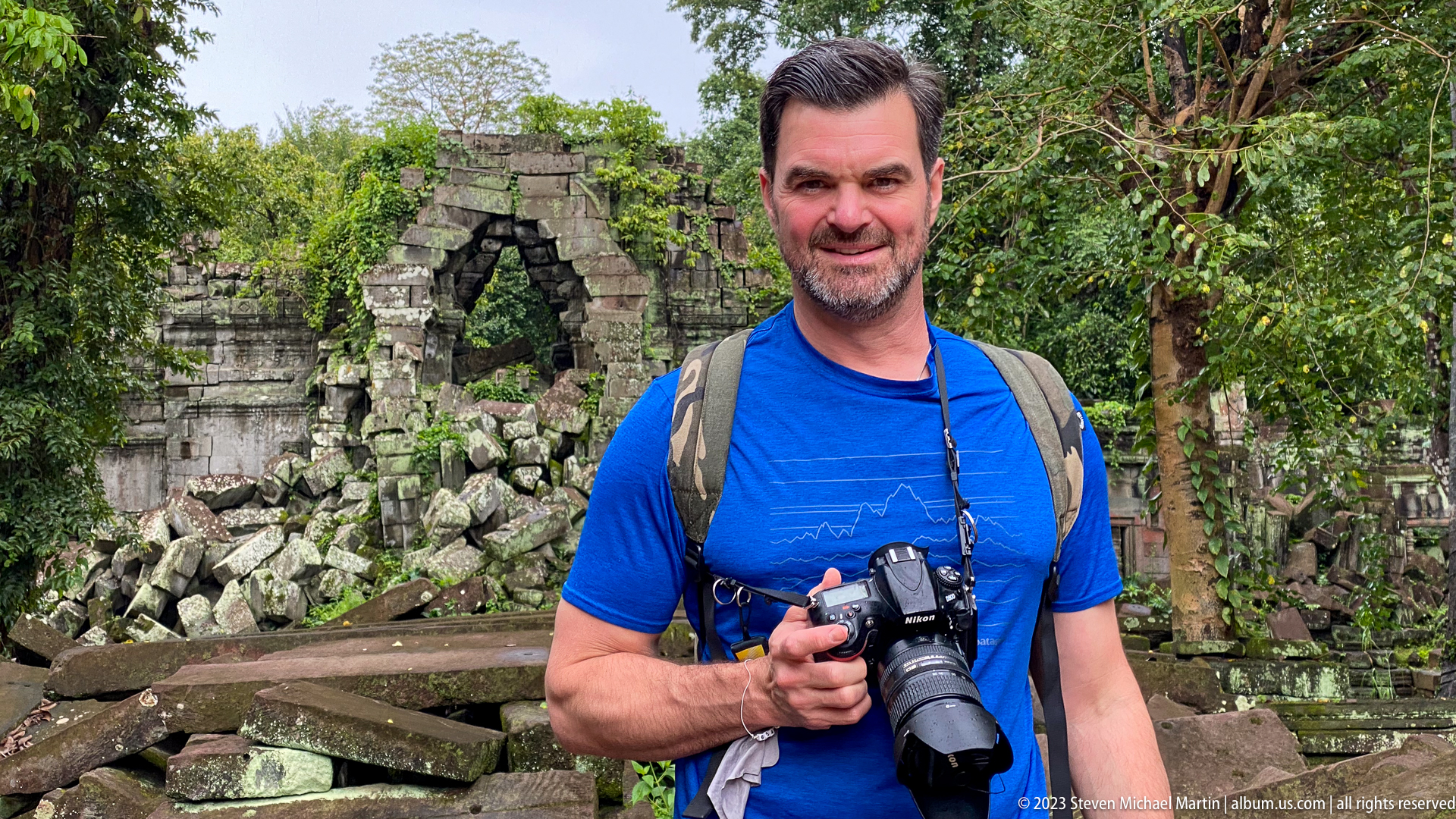
A male traveler holding a camera stands before a collapsed gateway at Beng Mealea. The bright blue shirt contrasts with the gray-green sandstone and dense forest, while fallen blocks behind him convey the scale and instability of the ruined architecture. The portrait combines documentation of the visitor experience with a clear view of the monument’s dramatic collapse.
Caption
A male traveler holding a camera stands before a collapsed gateway at Beng Mealea. The bright blue shirt contrasts with the gray-green sandstone and dense forest, while fallen blocks behind him convey the scale and instability of the ruined architecture. The portrait combines documentation of the visitor experience with a clear view of the monument’s dramatic collapse.
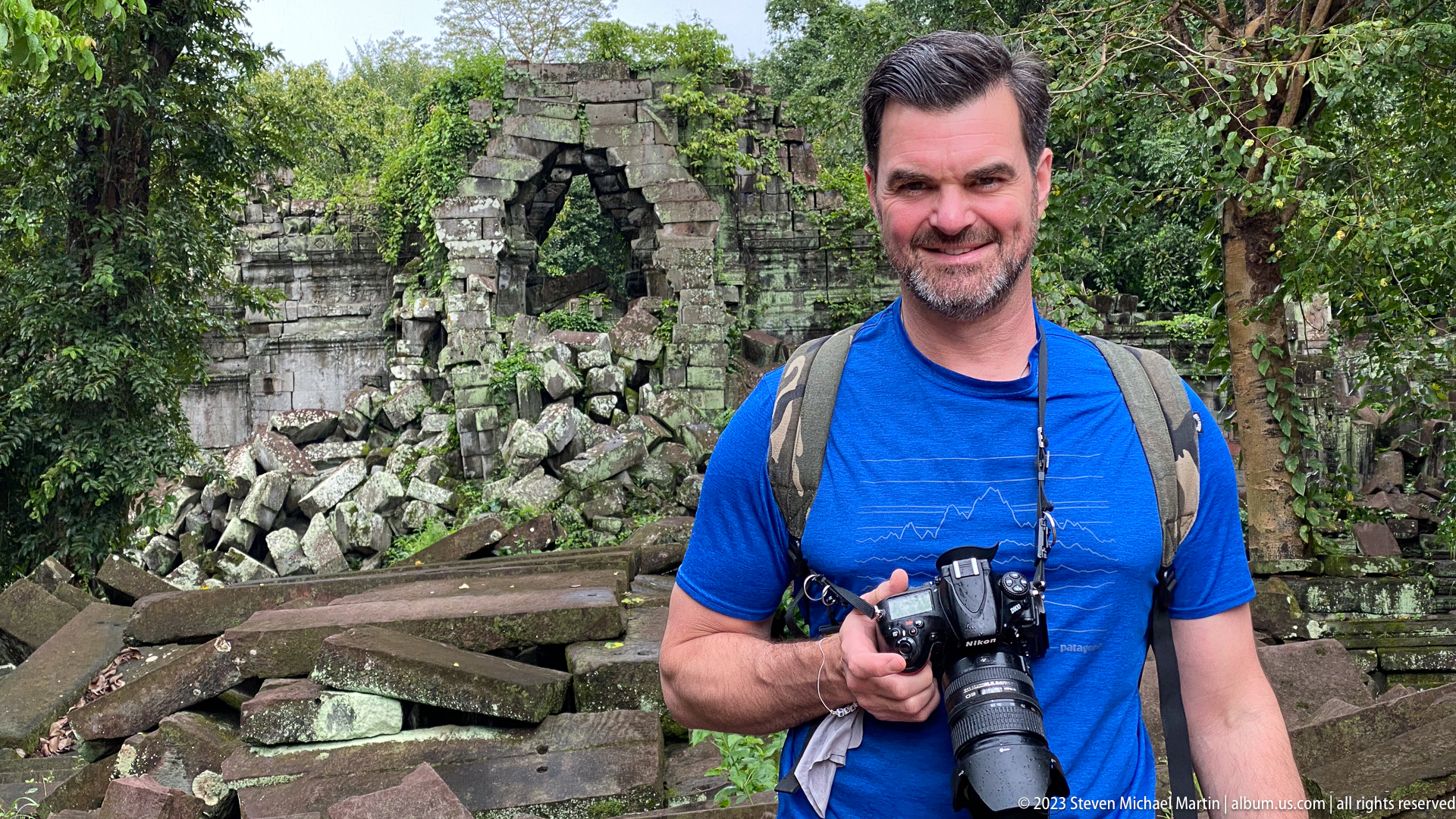
A male traveler stands with a camera before one of Beng Mealea’s collapsed stone openings. Fallen sandstone blocks fill the surrounding area, while the surviving pointed passage rises behind him beneath dense vegetation. The portrait places the scale of the ruined architecture in direct relation to the visitor and records the exploratory character of the site.
Caption
A male traveler stands with a camera before one of Beng Mealea’s collapsed stone openings. Fallen sandstone blocks fill the surrounding area, while the surviving pointed passage rises behind him beneath dense vegetation. The portrait places the scale of the ruined architecture in direct relation to the visitor and records the exploratory character of the site.
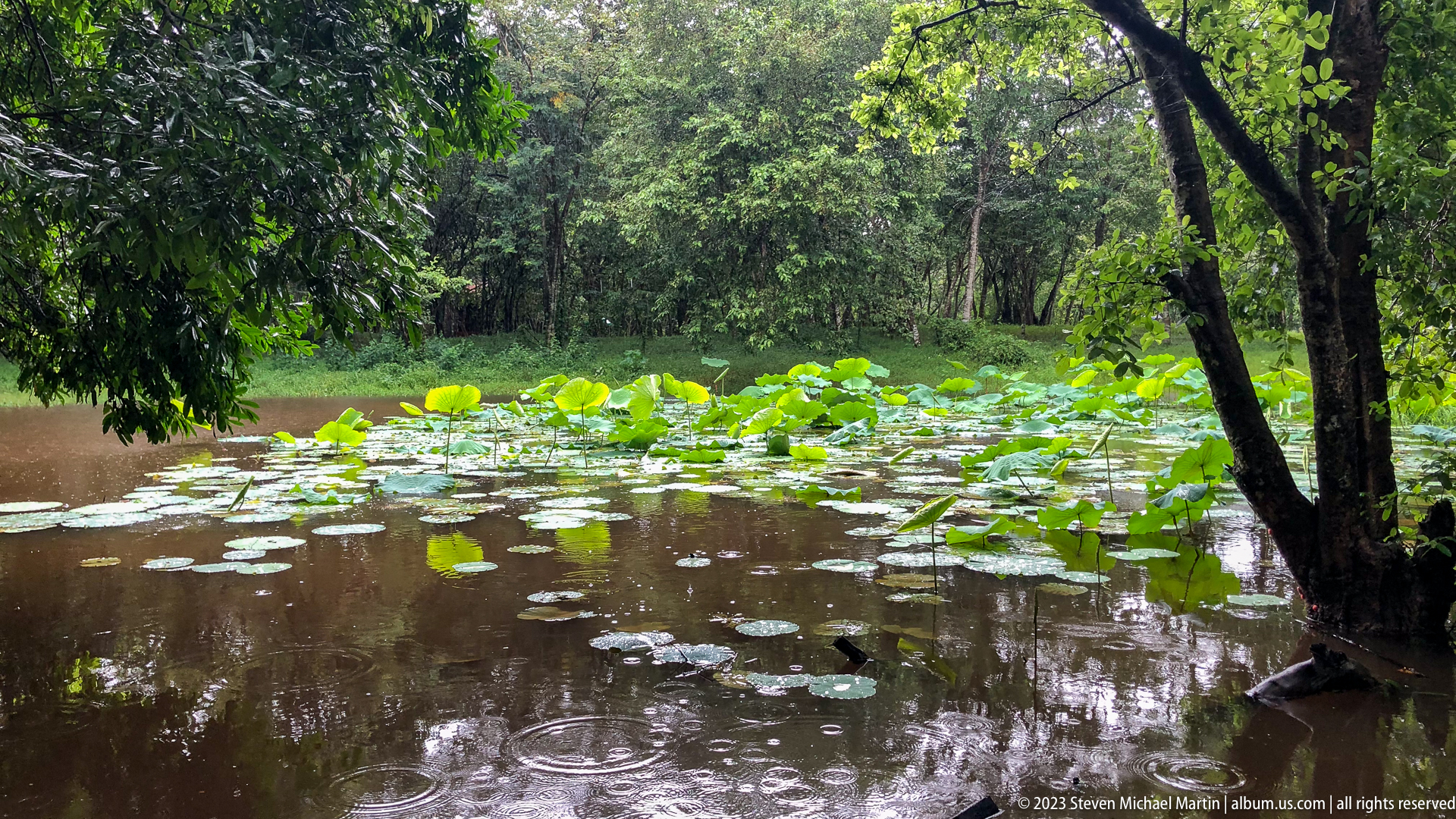
Broad lily pads spread across the dark surface of a forest pond or moat near Beng Mealea. Rain dimples the water while tree trunks and dense foliage enclose the scene, creating a quiet ecological counterpoint to the nearby ruins. The image records the wet environment that has helped shape the site’s atmosphere and long-term interaction between architecture and vegetation.
Caption
Broad lily pads spread across the dark surface of a forest pond or moat near Beng Mealea. Rain dimples the water while tree trunks and dense foliage enclose the scene, creating a quiet ecological counterpoint to the nearby ruins. The image records the wet environment that has helped shape the site’s atmosphere and long-term interaction between architecture and vegetation.
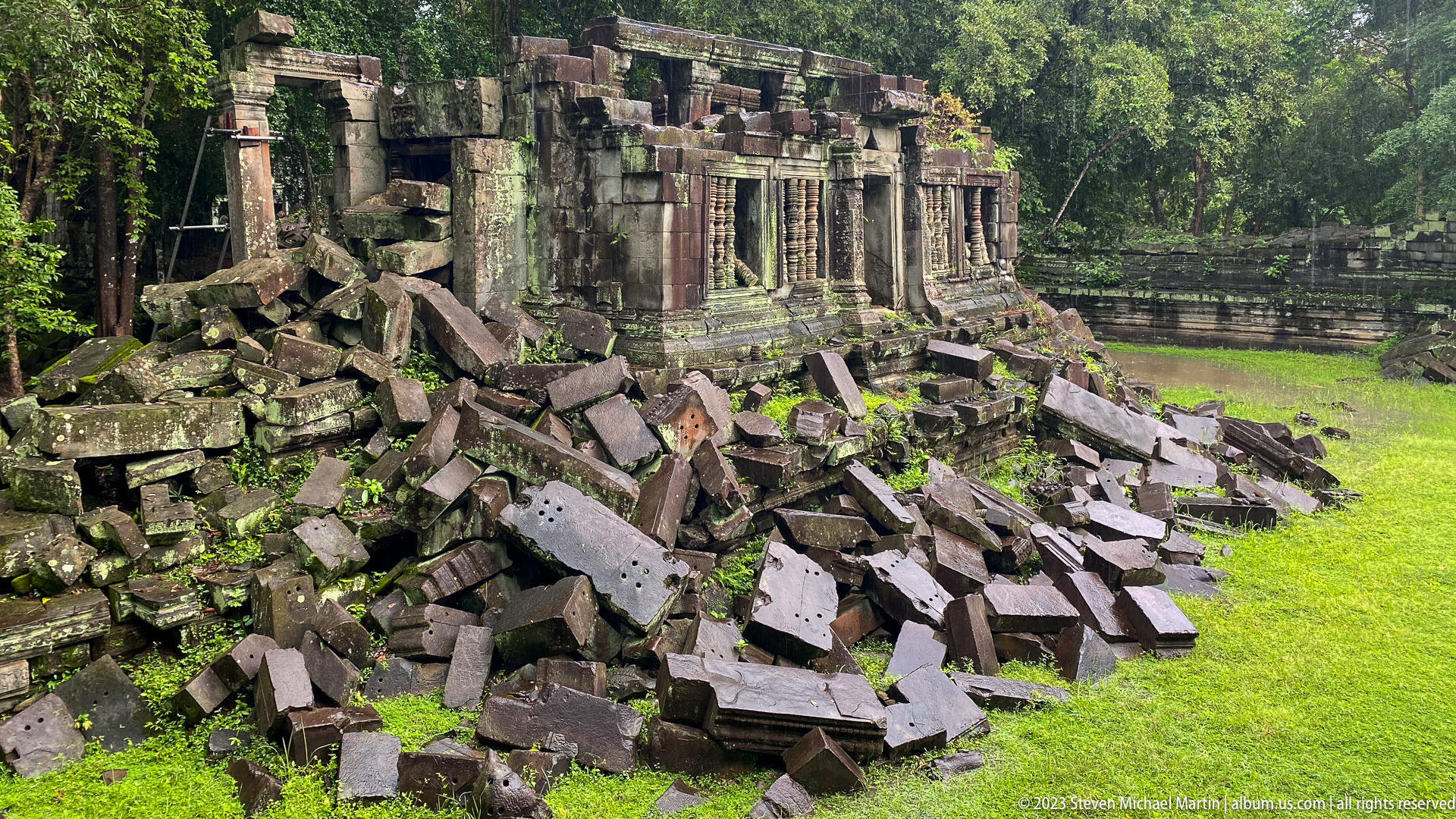
A low sandstone gallery at Beng Mealea is partly obscured by a massive pile of fallen blocks. Rows of window openings and surviving wall sections remain legible behind the debris, while moss and vegetation spread across the masonry. The image demonstrates how intact architectural rhythms persist beside areas of catastrophic collapse.
Caption
A low sandstone gallery at Beng Mealea is partly obscured by a massive pile of fallen blocks. Rows of window openings and surviving wall sections remain legible behind the debris, while moss and vegetation spread across the masonry. The image demonstrates how intact architectural rhythms persist beside areas of catastrophic collapse.
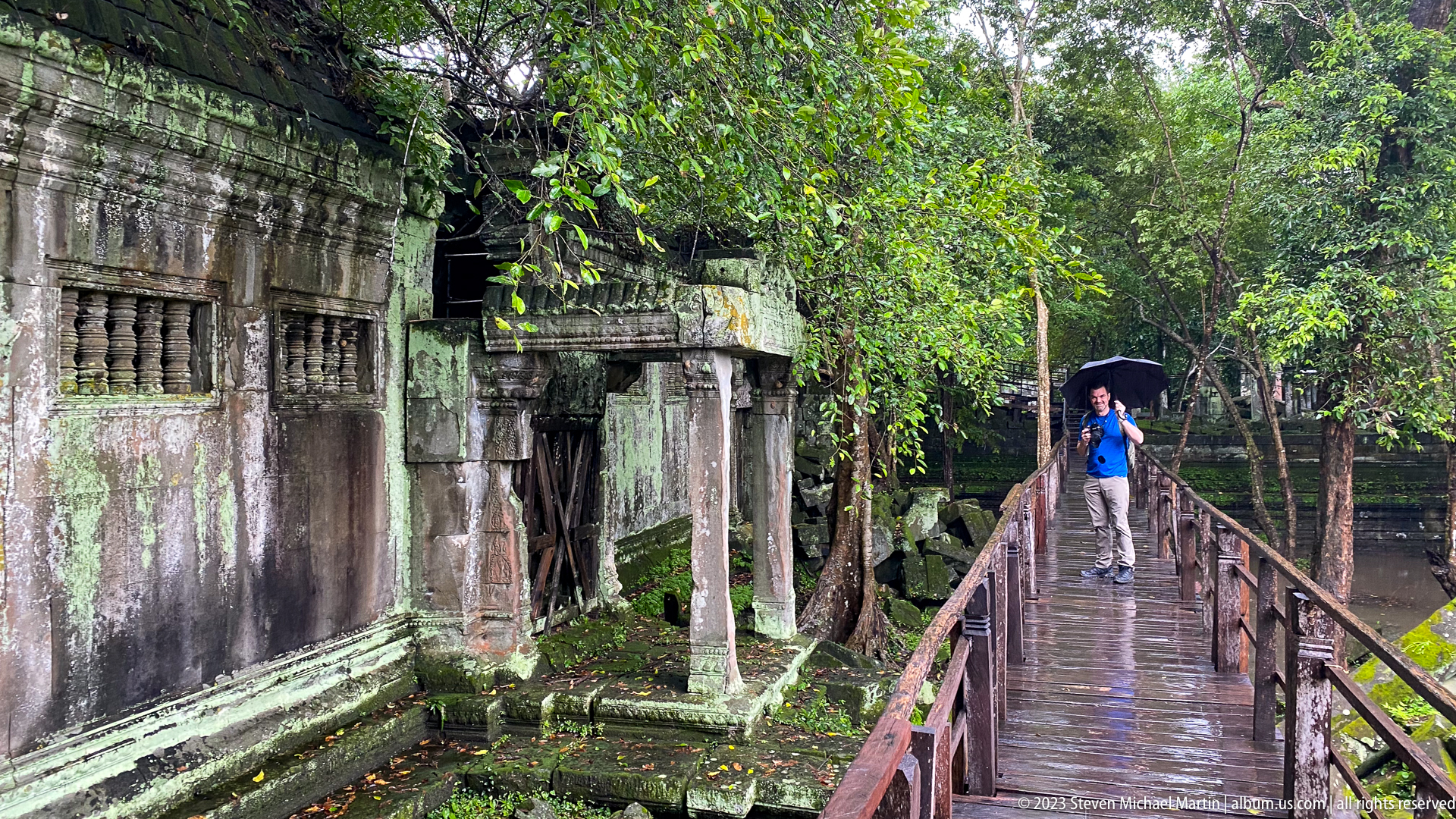
A rain-wet wooden walkway carries visitors through the ruins beside a weathered sandstone gallery at Beng Mealea. A traveler holding an umbrella stands along the route, while moss, roots, and collapsed stones surround the structure. The modern path protects fragile remains and provides safe access through areas that would otherwise be difficult to traverse.
Caption
A rain-wet wooden walkway carries visitors through the ruins beside a weathered sandstone gallery at Beng Mealea. A traveler holding an umbrella stands along the route, while moss, roots, and collapsed stones surround the structure. The modern path protects fragile remains and provides safe access through areas that would otherwise be difficult to traverse.
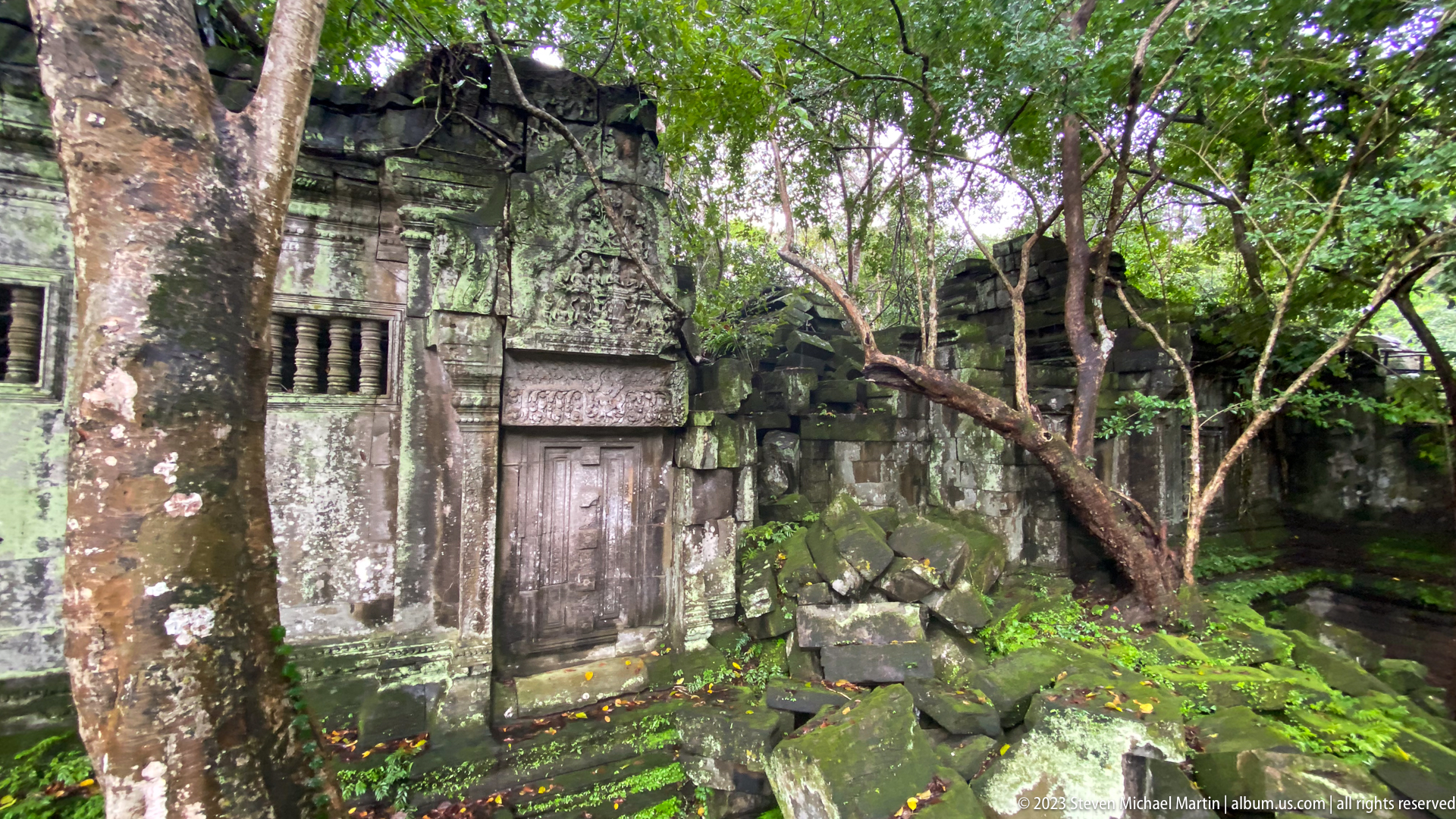
An overgrown gallery wall at Beng Mealea preserves rectangular openings fitted with stone balusters and a recessed doorway framed by molded stonework. A tree trunk and spreading branches press against the masonry, while fallen blocks and moss cover the ground. The scene illustrates the close physical entanglement of Khmer architecture and forest growth.
Caption
An overgrown gallery wall at Beng Mealea preserves rectangular openings fitted with stone balusters and a recessed doorway framed by molded stonework. A tree trunk and spreading branches press against the masonry, while fallen blocks and moss cover the ground. The scene illustrates the close physical entanglement of Khmer architecture and forest growth.
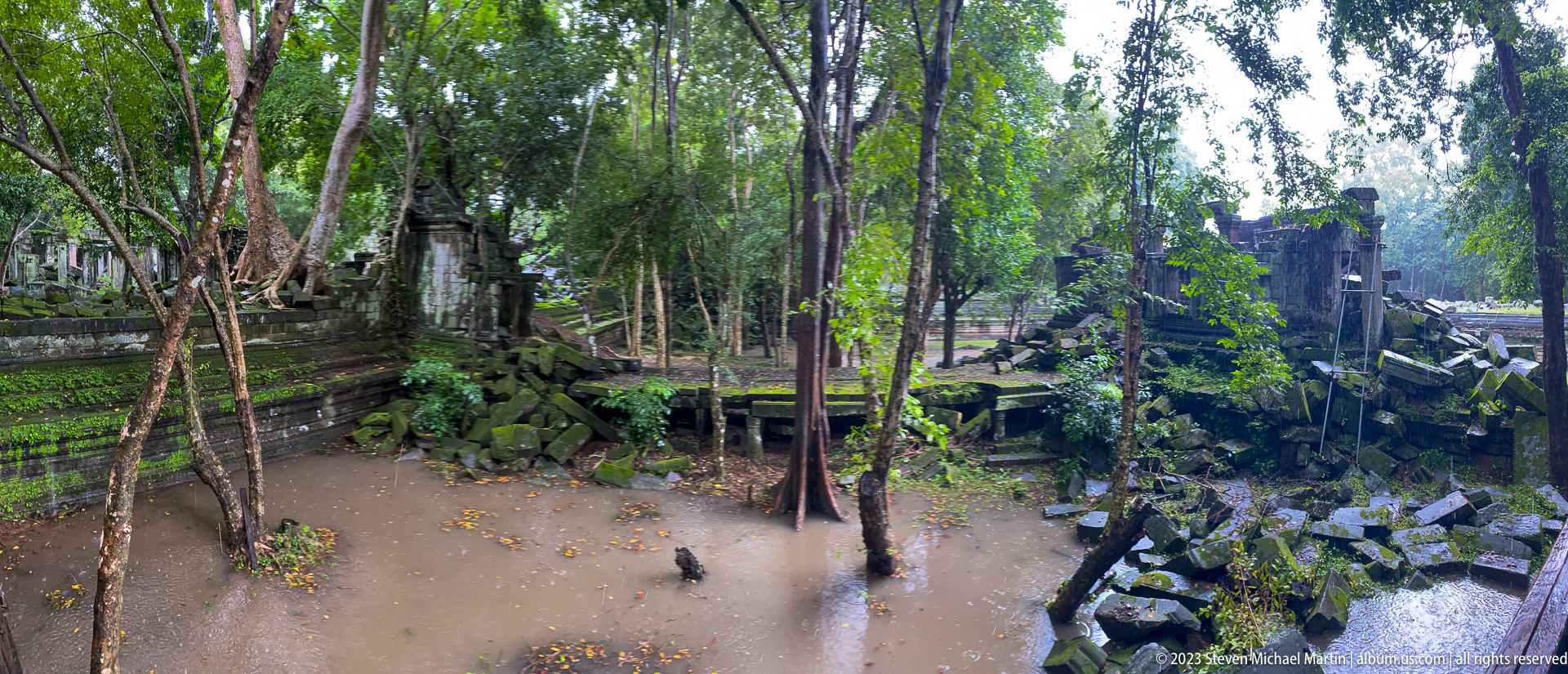
Brown rainwater fills a low courtyard within Beng Mealea, surrounding slender tree trunks and scattered architectural debris. Ruined walls and heaps of fallen sandstone frame the flooded space, showing how seasonal water collects within the collapsed complex. The elevated viewpoint reveals the temple as both an archaeological ruin and an active forest wetland.
Caption
Brown rainwater fills a low courtyard within Beng Mealea, surrounding slender tree trunks and scattered architectural debris. Ruined walls and heaps of fallen sandstone frame the flooded space, showing how seasonal water collects within the collapsed complex. The elevated viewpoint reveals the temple as both an archaeological ruin and an active forest wetland.
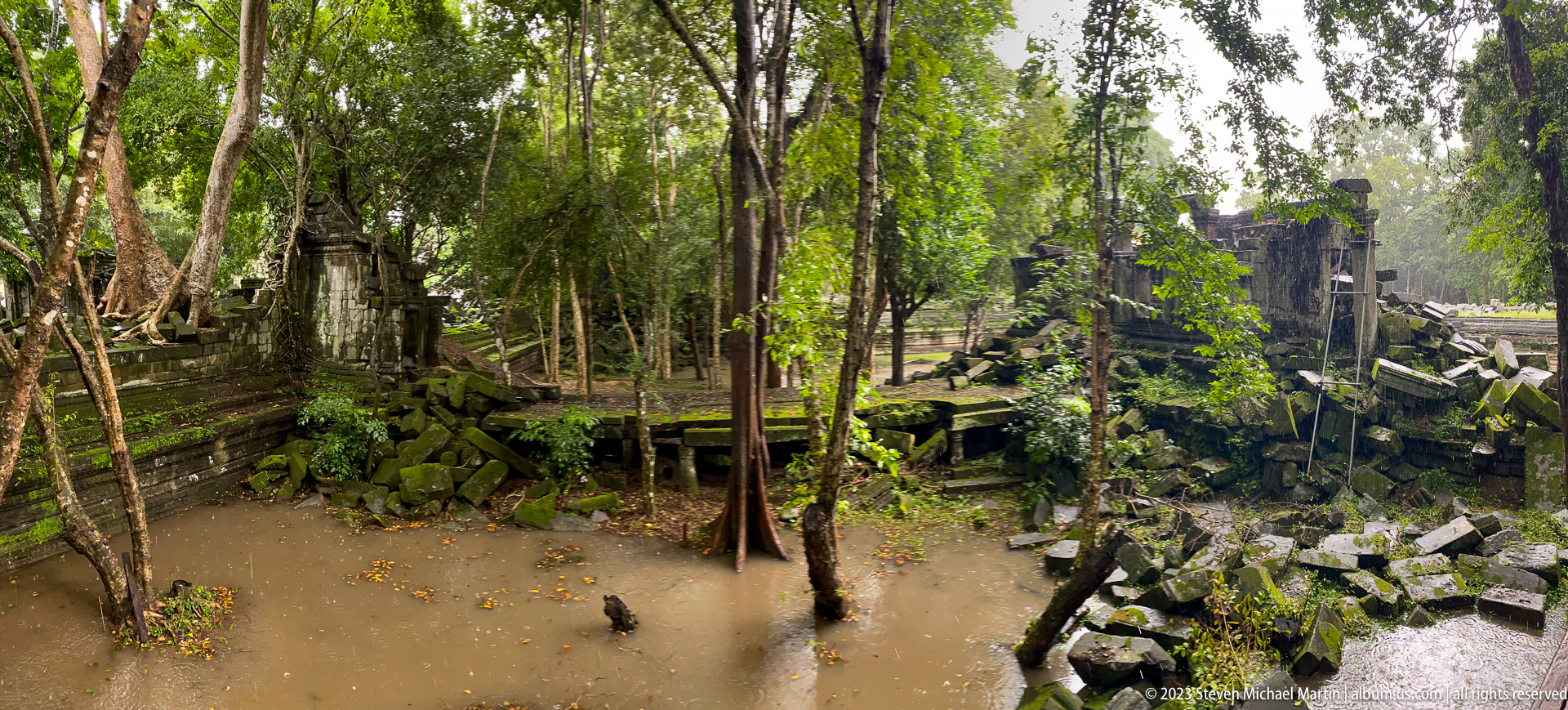
A broad view across Beng Mealea shows a courtyard inundated by rain, with trees rising from shallow brown water and collapsed sandstone piled along the edges. Surviving walls and dark openings appear through the vegetation beyond. The image emphasizes the monsoon conditions that intensify the site’s reflective surfaces and accelerate biological growth on the masonry.
Caption
A broad view across Beng Mealea shows a courtyard inundated by rain, with trees rising from shallow brown water and collapsed sandstone piled along the edges. Surviving walls and dark openings appear through the vegetation beyond. The image emphasizes the monsoon conditions that intensify the site’s reflective surfaces and accelerate biological growth on the masonry.
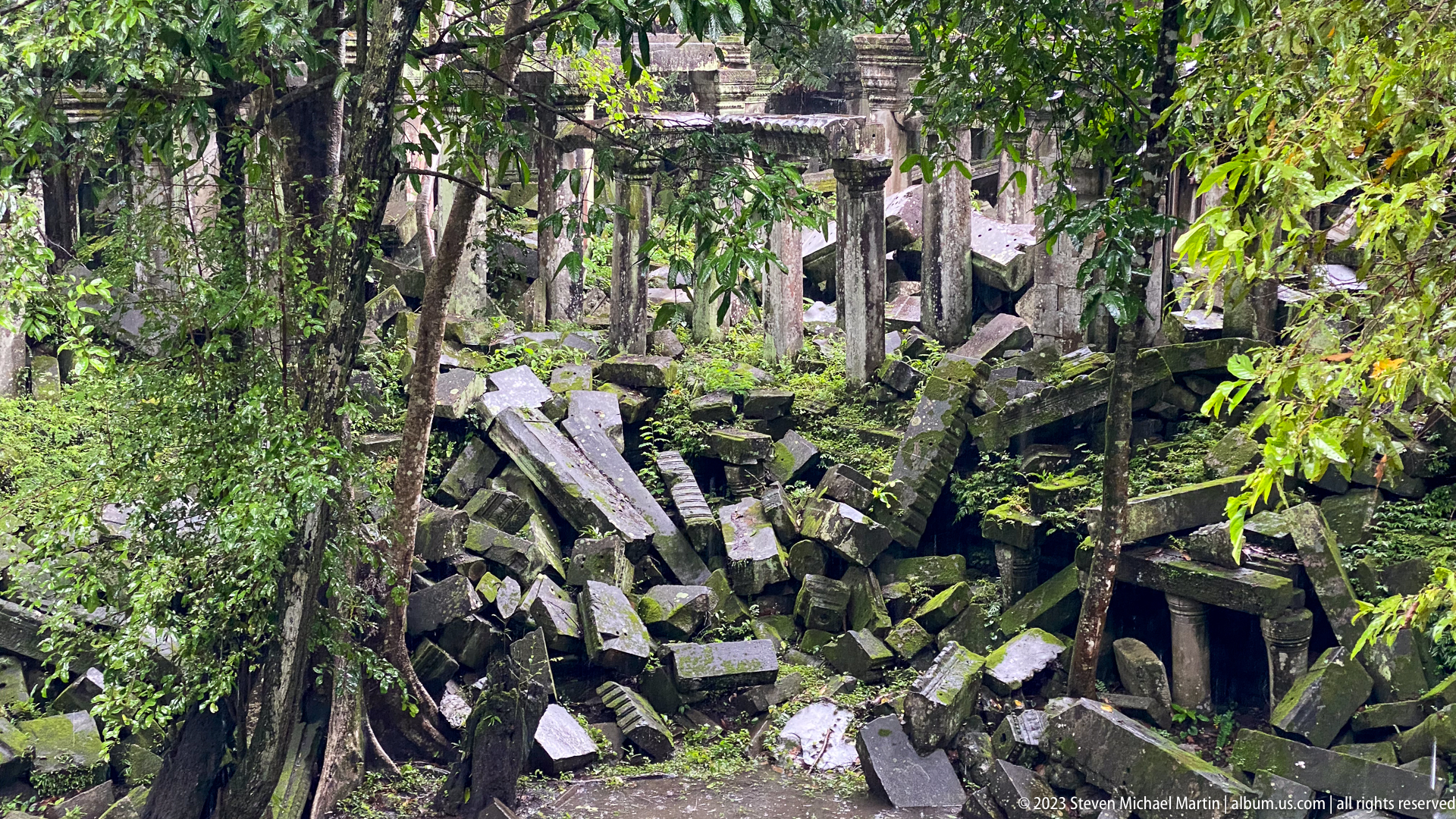
A dense mass of fallen sandstone blocks fills an interior section of Beng Mealea, viewed through tree trunks and hanging foliage. Upright piers and wall remnants remain behind the collapse, preserving traces of the former gallery despite extensive destruction. The compressed composition conveys the difficulty of reading the temple’s original plan amid vegetation and displaced masonry.
Caption
A dense mass of fallen sandstone blocks fills an interior section of Beng Mealea, viewed through tree trunks and hanging foliage. Upright piers and wall remnants remain behind the collapse, preserving traces of the former gallery despite extensive destruction. The compressed composition conveys the difficulty of reading the temple’s original plan amid vegetation and displaced masonry.

A weathered gallery façade rises beneath the tree canopy at Beng Mealea, its upper masonry broken and partly displaced. Stone-baluster windows remain intact below, while roots, moss, and accumulated blocks obscure the structure’s edges. The upward viewpoint emphasizes the vertical encounter between ancient masonry and the mature forest that now encloses it.
Caption
A weathered gallery façade rises beneath the tree canopy at Beng Mealea, its upper masonry broken and partly displaced. Stone-baluster windows remain intact below, while roots, moss, and accumulated blocks obscure the structure’s edges. The upward viewpoint emphasizes the vertical encounter between ancient masonry and the mature forest that now encloses it.
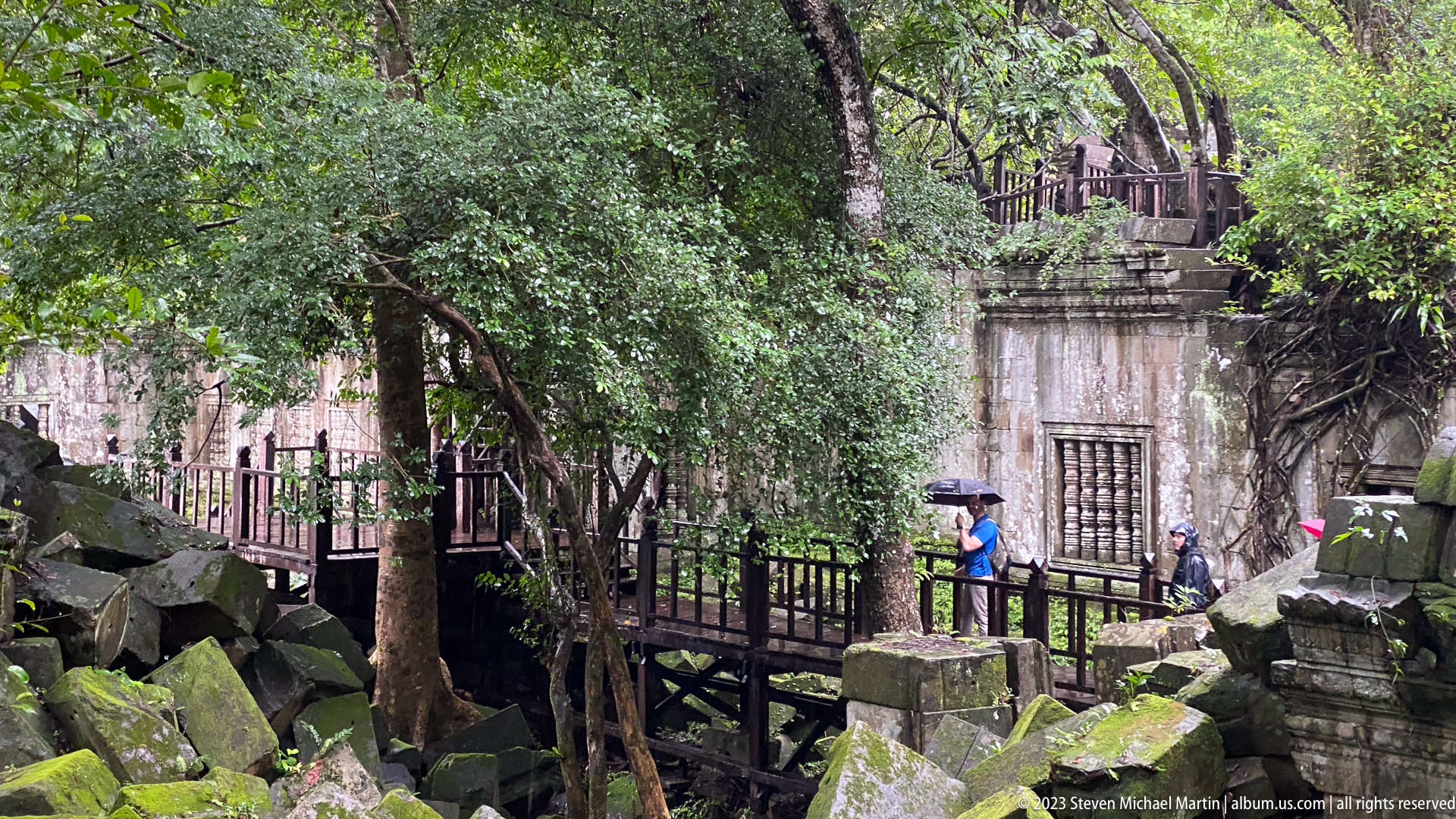
An elevated wooden walkway threads through Beng Mealea’s collapsed masonry and dense forest. Visitors carrying umbrellas move along the route beside a gallery wall with stone-baluster windows, while large fallen blocks fill the foreground. The image shows how modern access infrastructure has been inserted carefully into the ruin without reconstructing the surrounding architecture.
Caption
An elevated wooden walkway threads through Beng Mealea’s collapsed masonry and dense forest. Visitors carrying umbrellas move along the route beside a gallery wall with stone-baluster windows, while large fallen blocks fill the foreground. The image shows how modern access infrastructure has been inserted carefully into the ruin without reconstructing the surrounding architecture.
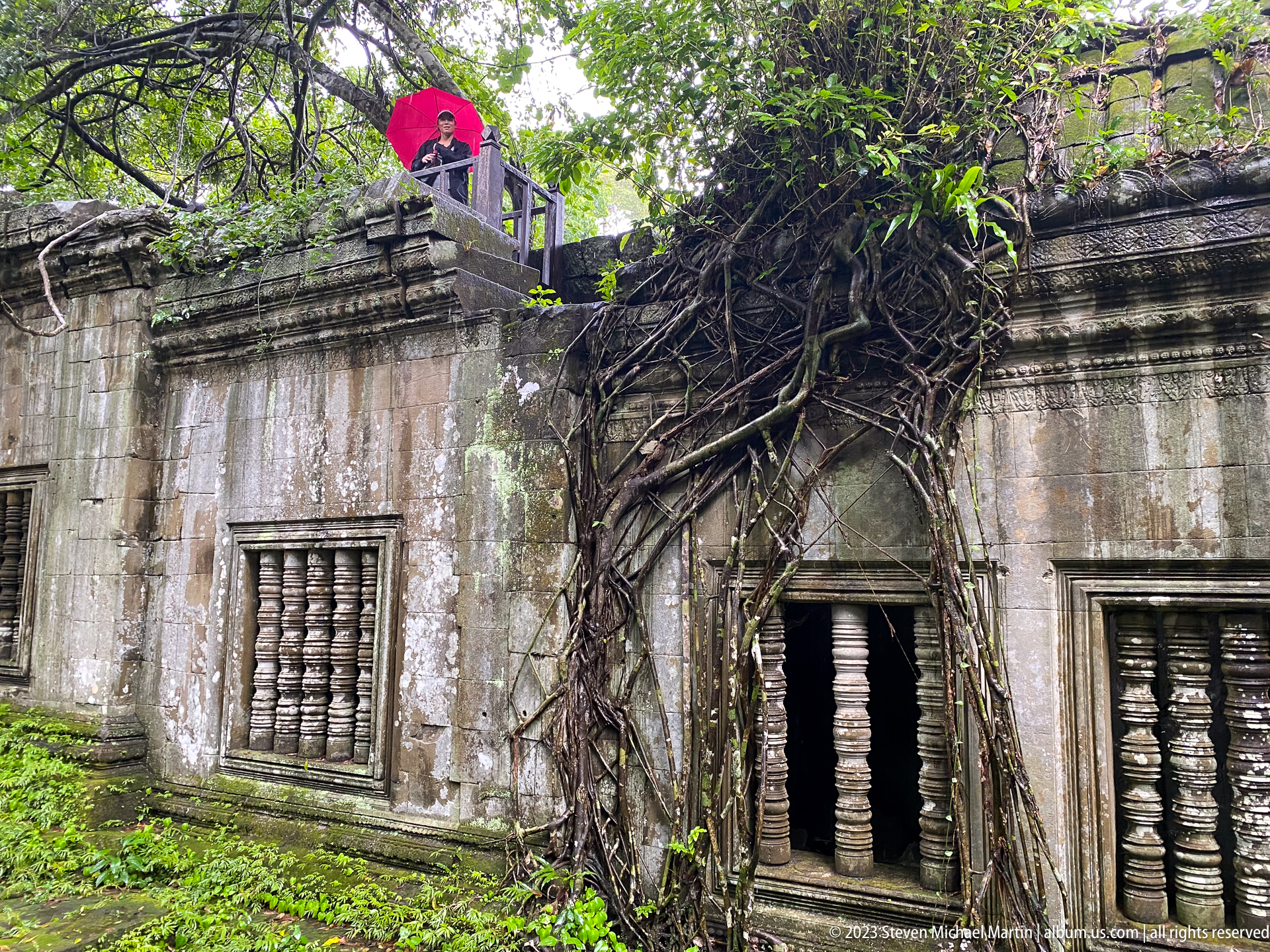
Large tree roots descend across a sandstone gallery façade at Beng Mealea, spreading over the cornice and between stone-baluster windows. Moss and low vegetation cover the wall base, while visitors are visible on the elevated path above. The scene vividly demonstrates the long-term physical pressure of forest growth on Khmer masonry.
Caption
Large tree roots descend across a sandstone gallery façade at Beng Mealea, spreading over the cornice and between stone-baluster windows. Moss and low vegetation cover the wall base, while visitors are visible on the elevated path above. The scene vividly demonstrates the long-term physical pressure of forest growth on Khmer masonry.
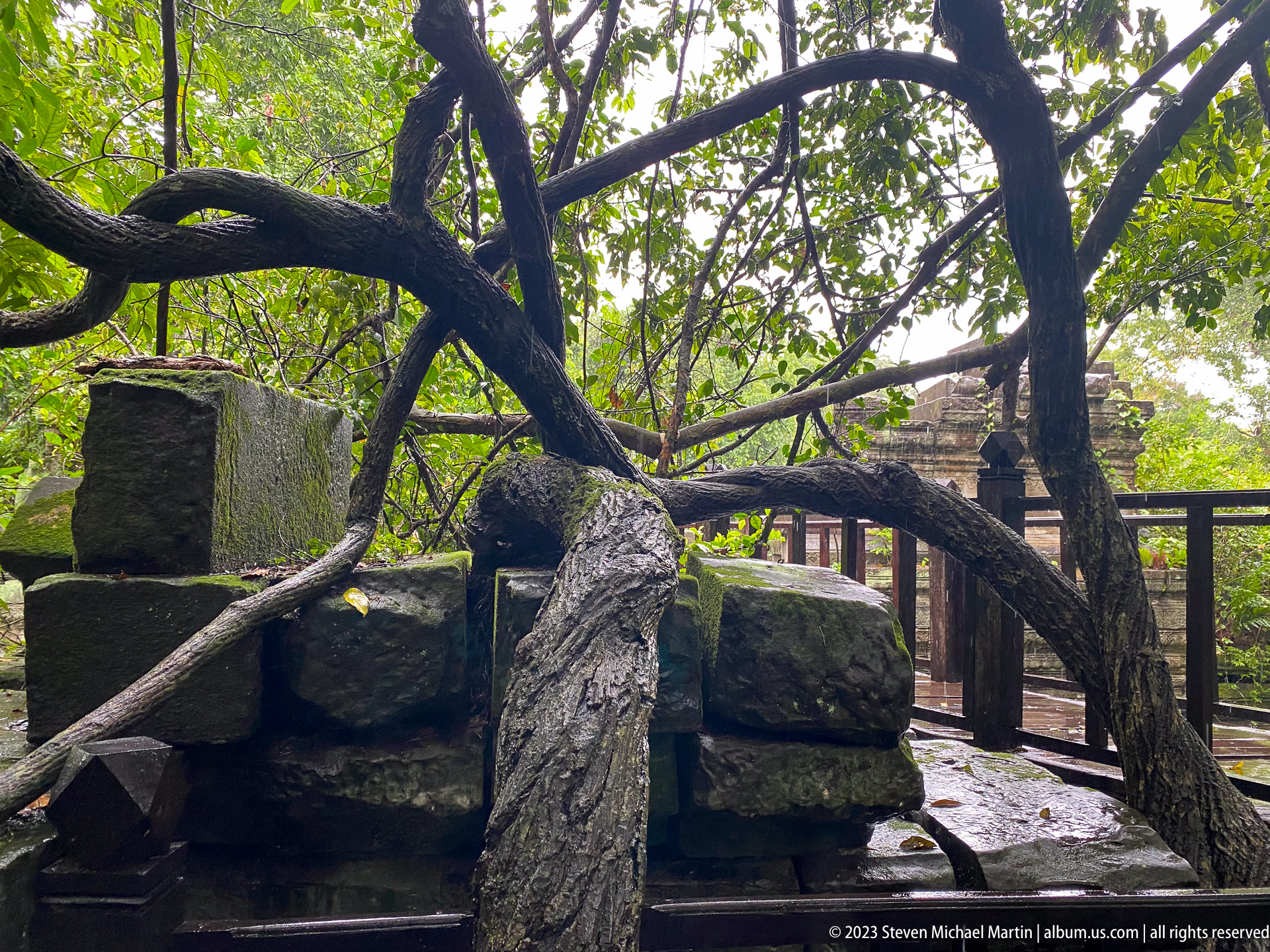
Thick, twisting tree limbs spread horizontally across fallen sandstone blocks beside a wooden visitor walkway at Beng Mealea. The branches bend around and above the masonry, creating a striking visual record of forest growth adapting to the ruined architecture. The close view emphasizes texture, weight, and the continuing interaction between living wood and carved stone.
Caption
Thick, twisting tree limbs spread horizontally across fallen sandstone blocks beside a wooden visitor walkway at Beng Mealea. The branches bend around and above the masonry, creating a striking visual record of forest growth adapting to the ruined architecture. The close view emphasizes texture, weight, and the continuing interaction between living wood and carved stone.
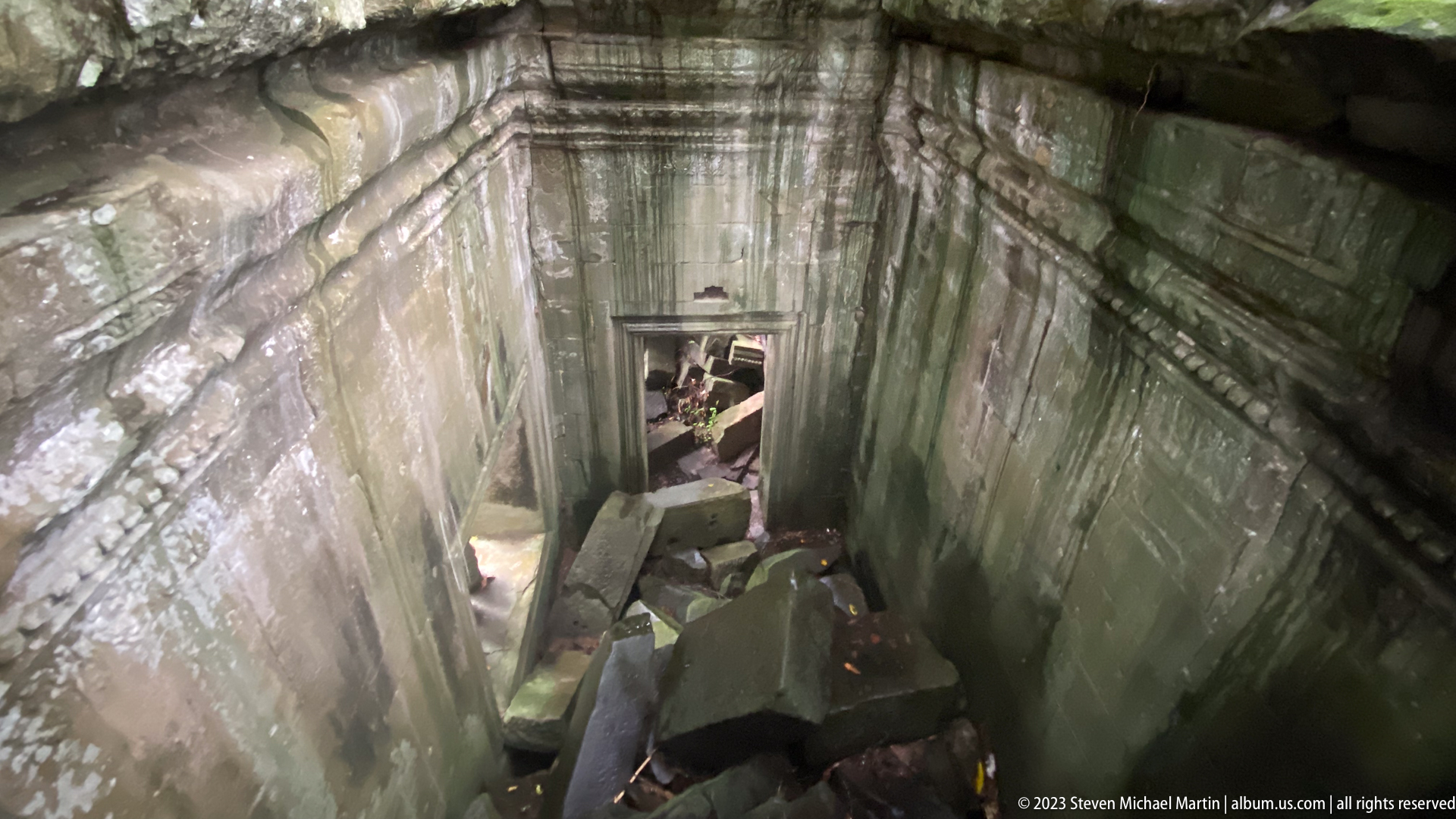
A steep, narrow interior space at Beng Mealea descends toward a low doorway almost choked by fallen stone. The high sandstone walls retain horizontal moldings and dark water stains, while large displaced blocks make the route impassable. The image conveys the confined scale and instability of the temple’s collapsed internal passages.
Caption
A steep, narrow interior space at Beng Mealea descends toward a low doorway almost choked by fallen stone. The high sandstone walls retain horizontal moldings and dark water stains, while large displaced blocks make the route impassable. The image conveys the confined scale and instability of the temple’s collapsed internal passages.
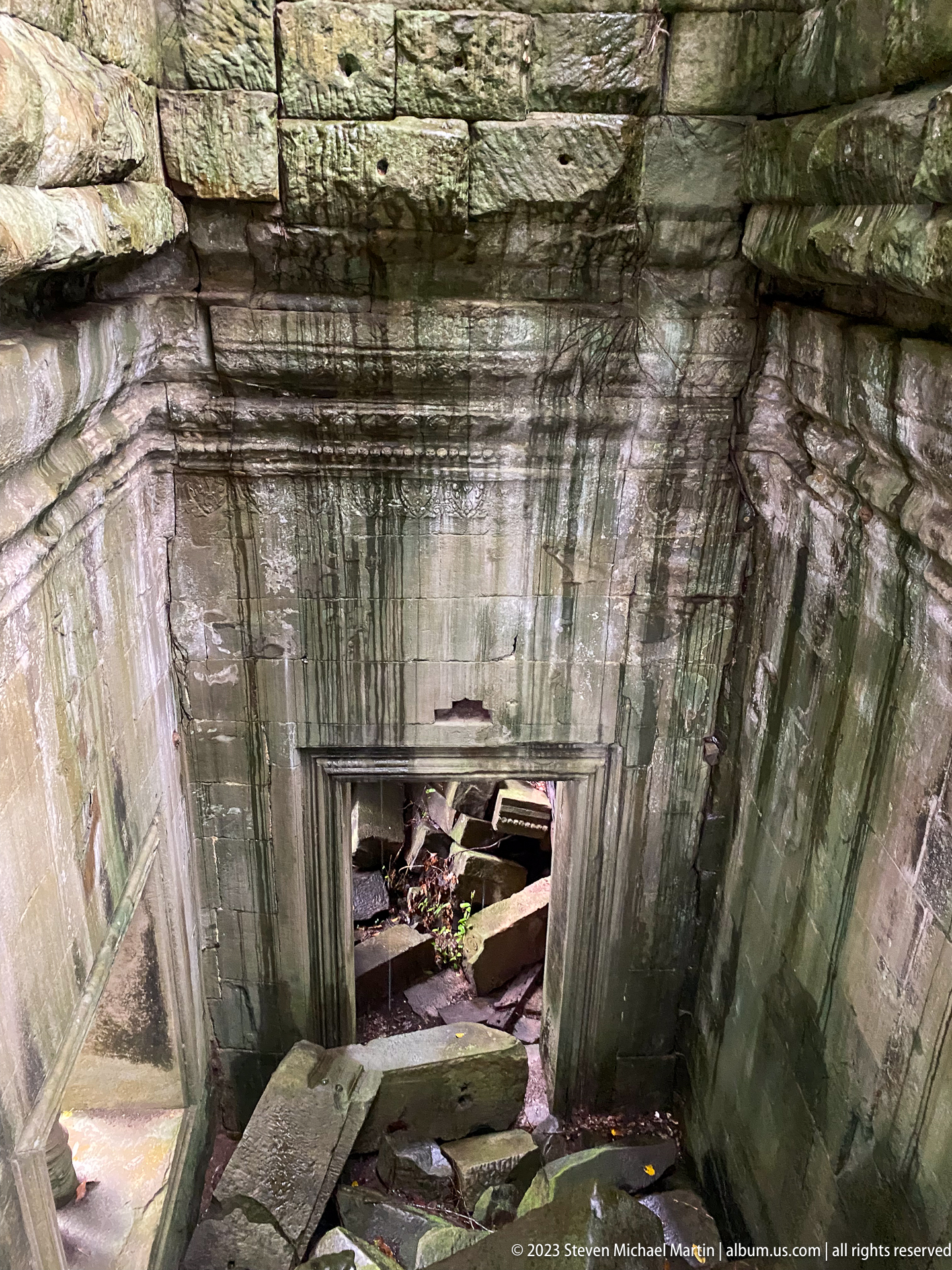
A rectangular stone chamber descends toward a low doorway at Beng Mealea, its floor obstructed by collapsed sandstone blocks and debris. Molded wall courses frame the steep interior, while dark staining and moisture mark the masonry. The view suggests a partially buried or lower-level passage whose original circulation has been disrupted by collapse.
Caption
A rectangular stone chamber descends toward a low doorway at Beng Mealea, its floor obstructed by collapsed sandstone blocks and debris. Molded wall courses frame the steep interior, while dark staining and moisture mark the masonry. The view suggests a partially buried or lower-level passage whose original circulation has been disrupted by collapse.
A broad palm-thatch roof structure is transported along a Cambodian road on a wheeled platform or vehicle. Its deep overhanging eaves and red supporting frame resemble a roadside shelter, pavilion, or market structure being moved as a complete unit. The unusual scene concludes the Beng Mealea sequence with a glimpse of regional construction traditions and practical transport.
Caption
A broad palm-thatch roof structure is transported along a Cambodian road on a wheeled platform or vehicle. Its deep overhanging eaves and red supporting frame resemble a roadside shelter, pavilion, or market structure being moved as a complete unit. The unusual scene concludes the Beng Mealea sequence with a glimpse of regional construction traditions and practical transport.
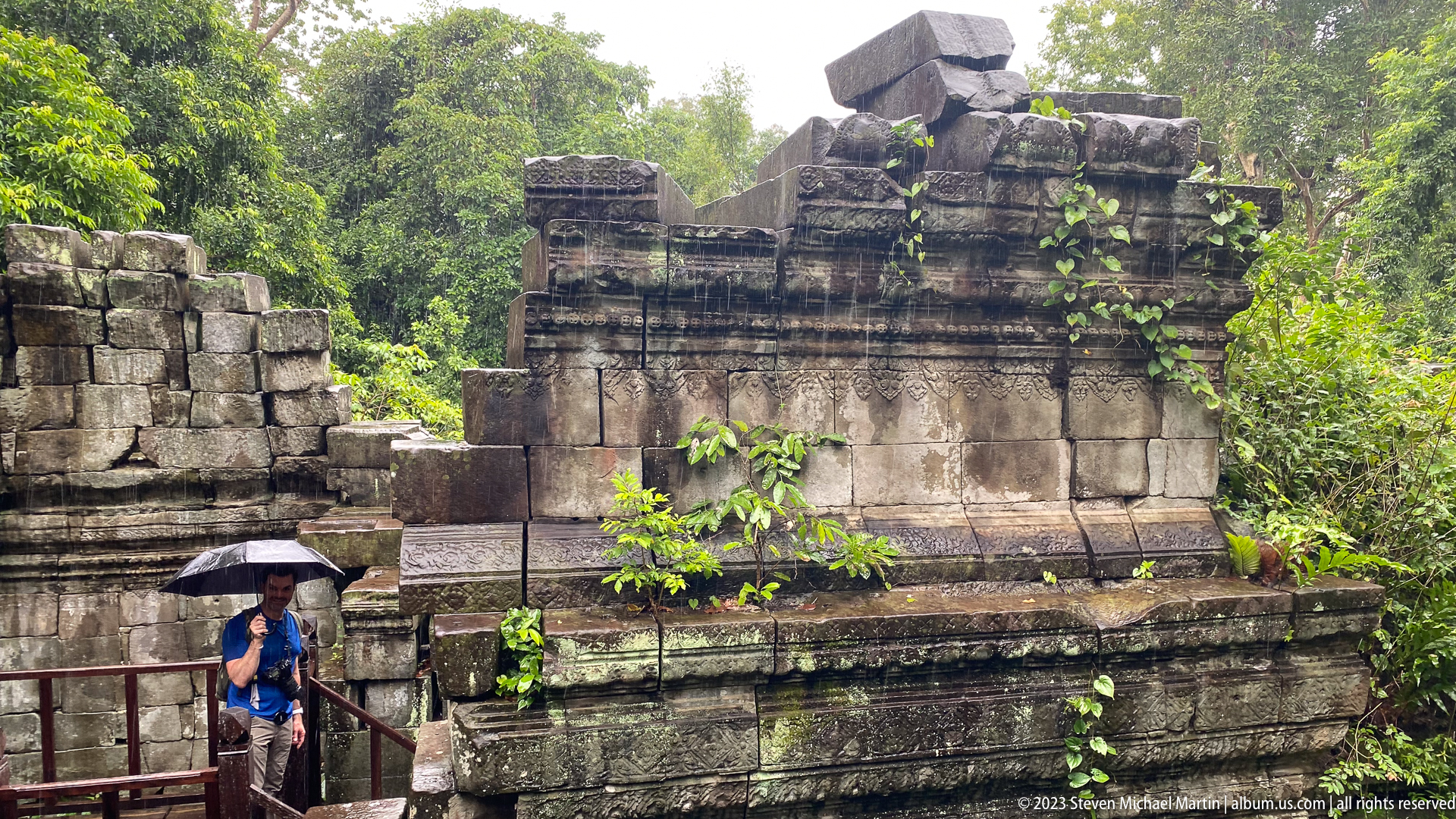
A compact sandstone structure rises above the surrounding ruins at Beng Mealea, preserving a strongly molded cornice and portions of its upper courses despite visible collapse. A traveler with an umbrella stands on the adjacent walkway, providing scale. Vegetation emerging from joints and broken masonry reflects the continuing weathering of the monument.
Caption
A compact sandstone structure rises above the surrounding ruins at Beng Mealea, preserving a strongly molded cornice and portions of its upper courses despite visible collapse. A traveler with an umbrella stands on the adjacent walkway, providing scale. Vegetation emerging from joints and broken masonry reflects the continuing weathering of the monument.
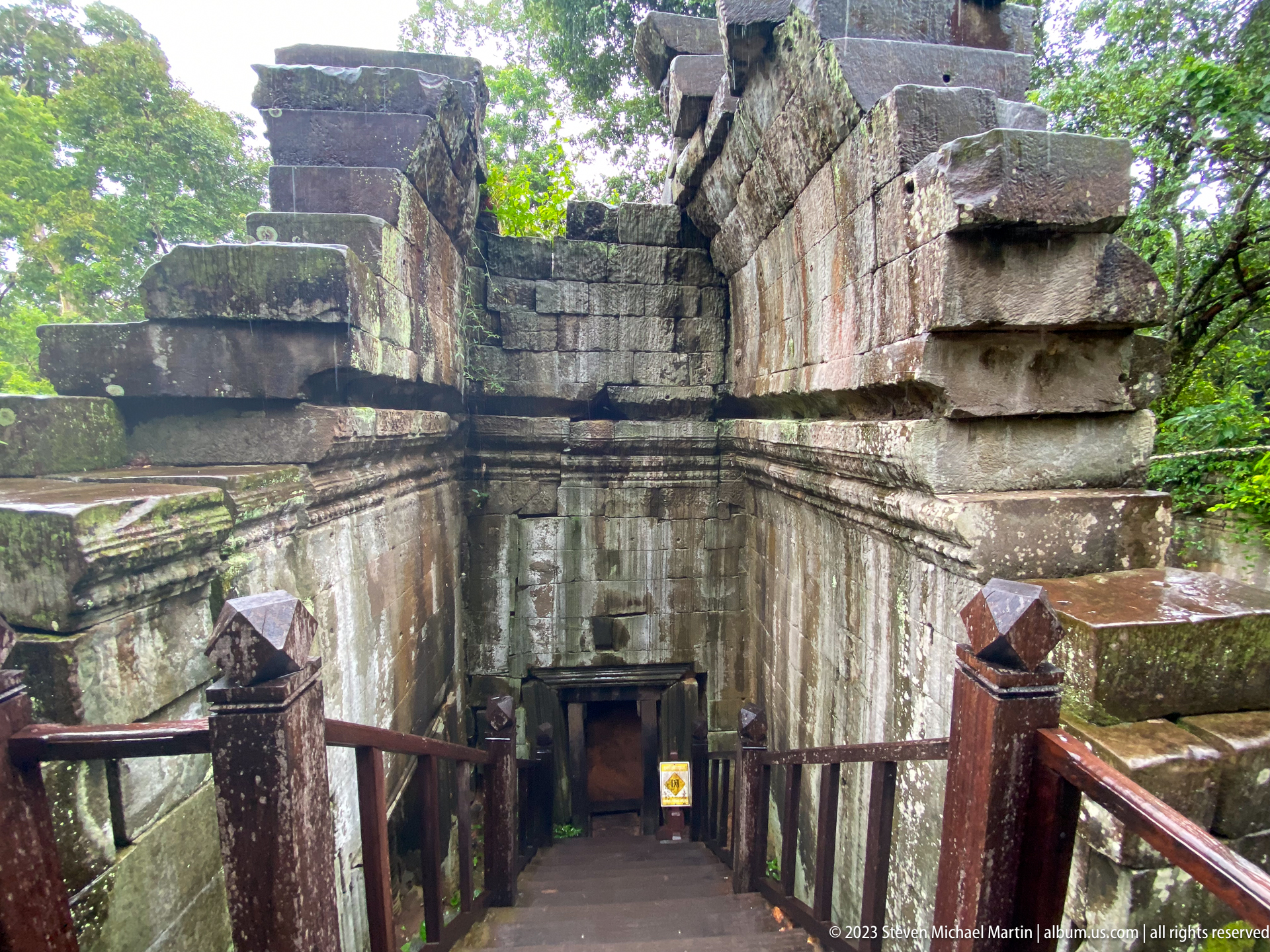
Modern wooden stairs descend into a lower section of Beng Mealea between tall, partially collapsed sandstone walls. Broken cornices and projecting blocks remain overhead, while a small caution sign marks the route below. The image shows how visitor circulation has been adapted to negotiate abrupt changes in level within the unstable ruin.
Caption
Modern wooden stairs descend into a lower section of Beng Mealea between tall, partially collapsed sandstone walls. Broken cornices and projecting blocks remain overhead, while a small caution sign marks the route below. The image shows how visitor circulation has been adapted to negotiate abrupt changes in level within the unstable ruin.
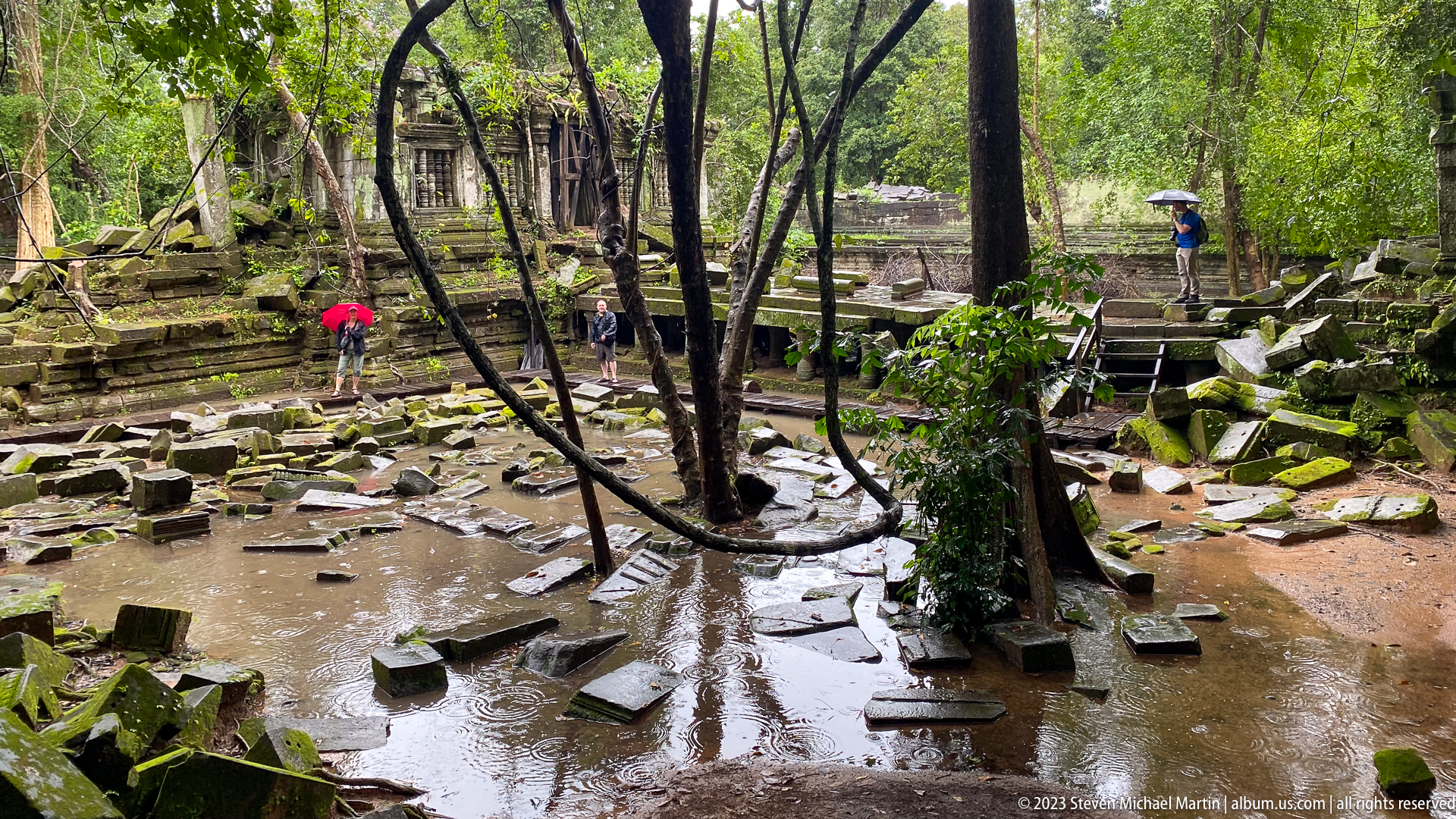
Visitors move through a broad flooded section of Beng Mealea using raised wooden walkways while scattered sandstone blocks lie across the waterlogged ground. Slender trees rise throughout the courtyard, and surviving walls appear beyond the debris. The wide composition captures the combined effects of collapse, monsoon rain, forest growth, and modern site access.
Caption
Visitors move through a broad flooded section of Beng Mealea using raised wooden walkways while scattered sandstone blocks lie across the waterlogged ground. Slender trees rise throughout the courtyard, and surviving walls appear beyond the debris. The wide composition captures the combined effects of collapse, monsoon rain, forest growth, and modern site access.
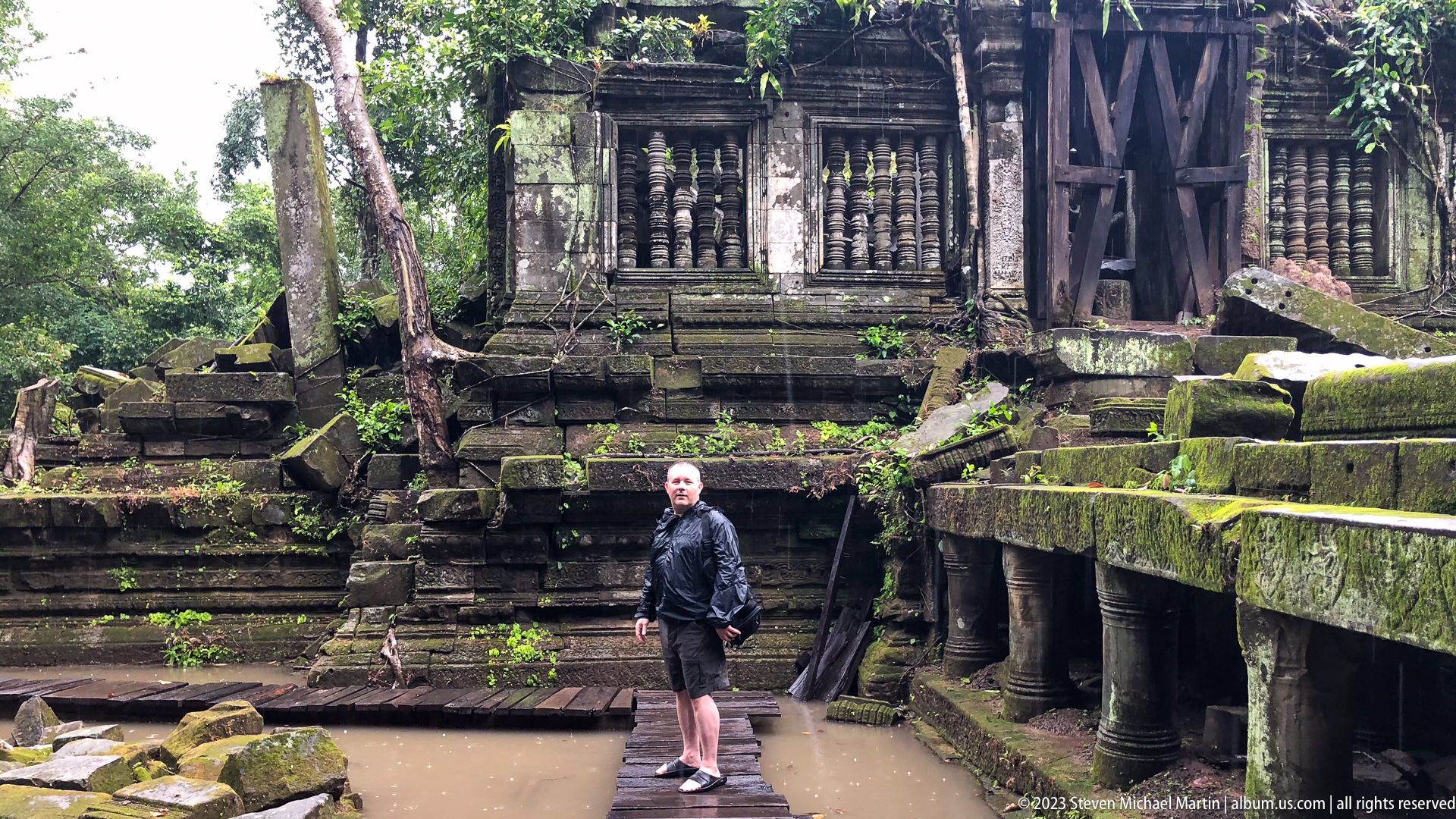
A male traveler stands on a narrow wooden walkway above rainwater within Beng Mealea’s ruined interior. Behind him, a sandstone gallery preserves rows of stone-baluster windows, while collapsed blocks, moss, and temporary timber supports reveal the instability of the surrounding structure. The portrait provides scale and documents how visitors move through the waterlogged monument.
Caption
A male traveler stands on a narrow wooden walkway above rainwater within Beng Mealea’s ruined interior. Behind him, a sandstone gallery preserves rows of stone-baluster windows, while collapsed blocks, moss, and temporary timber supports reveal the instability of the surrounding structure. The portrait provides scale and documents how visitors move through the waterlogged monument.
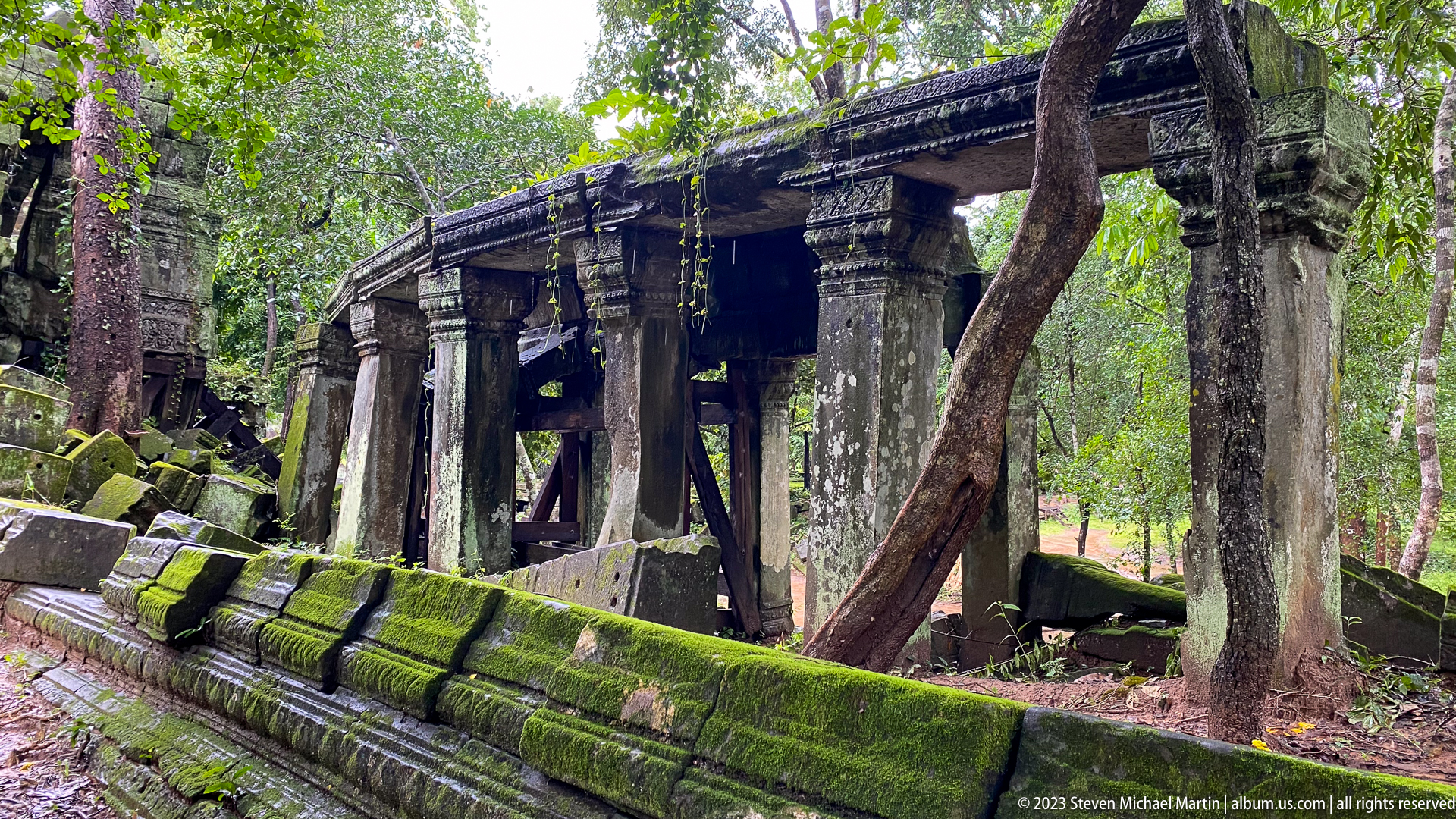
A long sandstone gallery at Beng Mealea leans beneath the forest canopy, its roof and openings reinforced by heavy timber braces. Moss blankets the lower moldings and displaced blocks lie along the exterior, showing the combined effects of structural failure, moisture, and vegetation. The supports represent conservation measures intended to stabilize surviving fabric without reconstructing the ruin.
Caption
A long sandstone gallery at Beng Mealea leans beneath the forest canopy, its roof and openings reinforced by heavy timber braces. Moss blankets the lower moldings and displaced blocks lie along the exterior, showing the combined effects of structural failure, moisture, and vegetation. The supports represent conservation measures intended to stabilize surviving fabric without reconstructing the ruin.
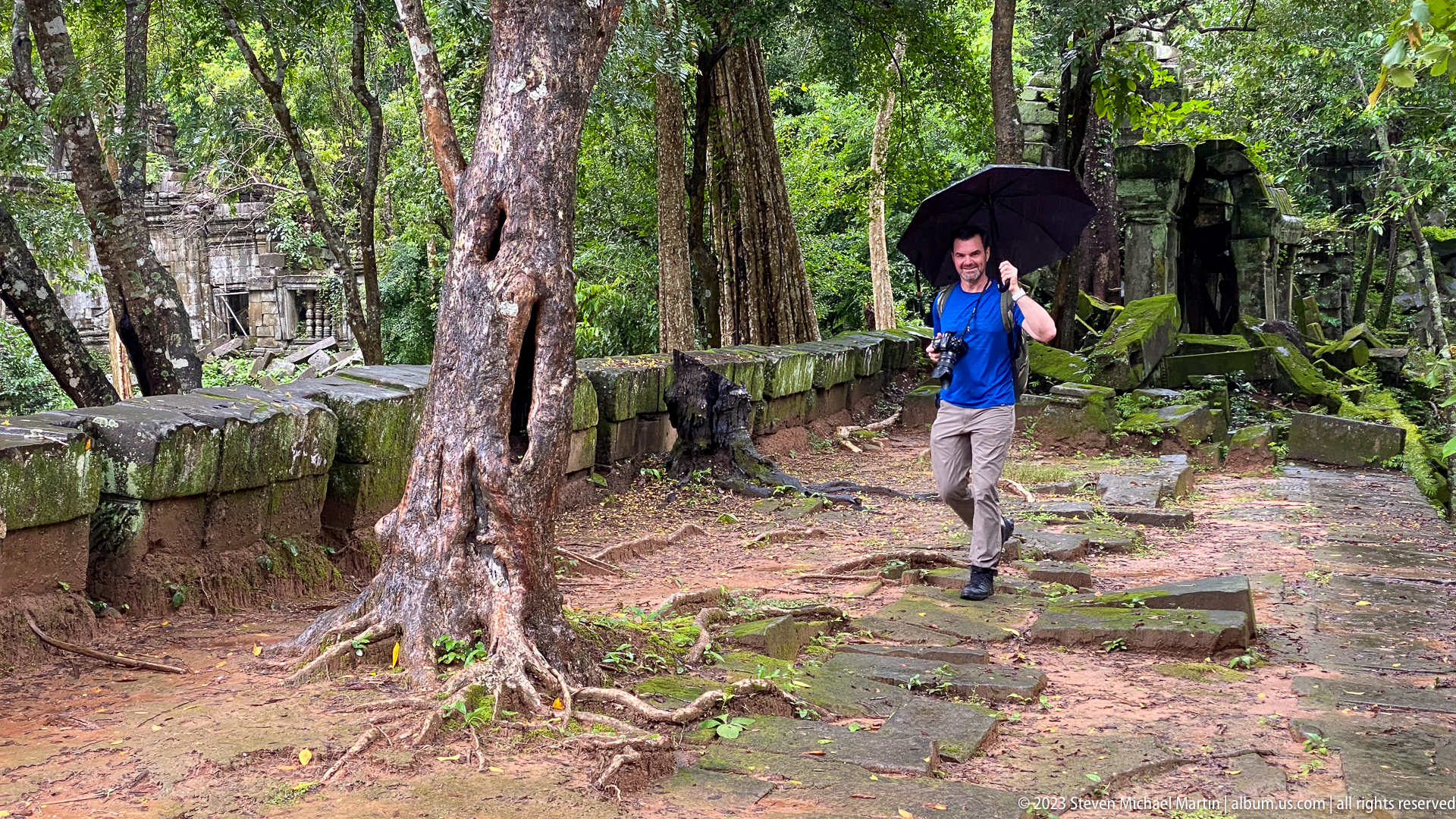
A male traveler carrying a black umbrella walks along an uneven stone path through Beng Mealea’s forested ruins. Weathered walls, scattered blocks, and mature trees line the route, while the damp ground reflects recent rain. The scene records the exploratory character of the site and the practical conditions of visiting during the wet season.
Caption
A male traveler carrying a black umbrella walks along an uneven stone path through Beng Mealea’s forested ruins. Weathered walls, scattered blocks, and mature trees line the route, while the damp ground reflects recent rain. The scene records the exploratory character of the site and the practical conditions of visiting during the wet season.

Fallen sandstone architectural fragments at Beng Mealea preserve deeply carved bands of foliage, scrollwork, and figural ornament. The foreground block includes an arched decorative field and layered moldings, while another carved slab rests behind it among moss-covered debris. Although displaced from their original setting, the fragments reveal the refinement of the temple’s sculptural program.
Caption
Fallen sandstone architectural fragments at Beng Mealea preserve deeply carved bands of foliage, scrollwork, and figural ornament. The foreground block includes an arched decorative field and layered moldings, while another carved slab rests behind it among moss-covered debris. Although displaced from their original setting, the fragments reveal the refinement of the temple’s sculptural program.
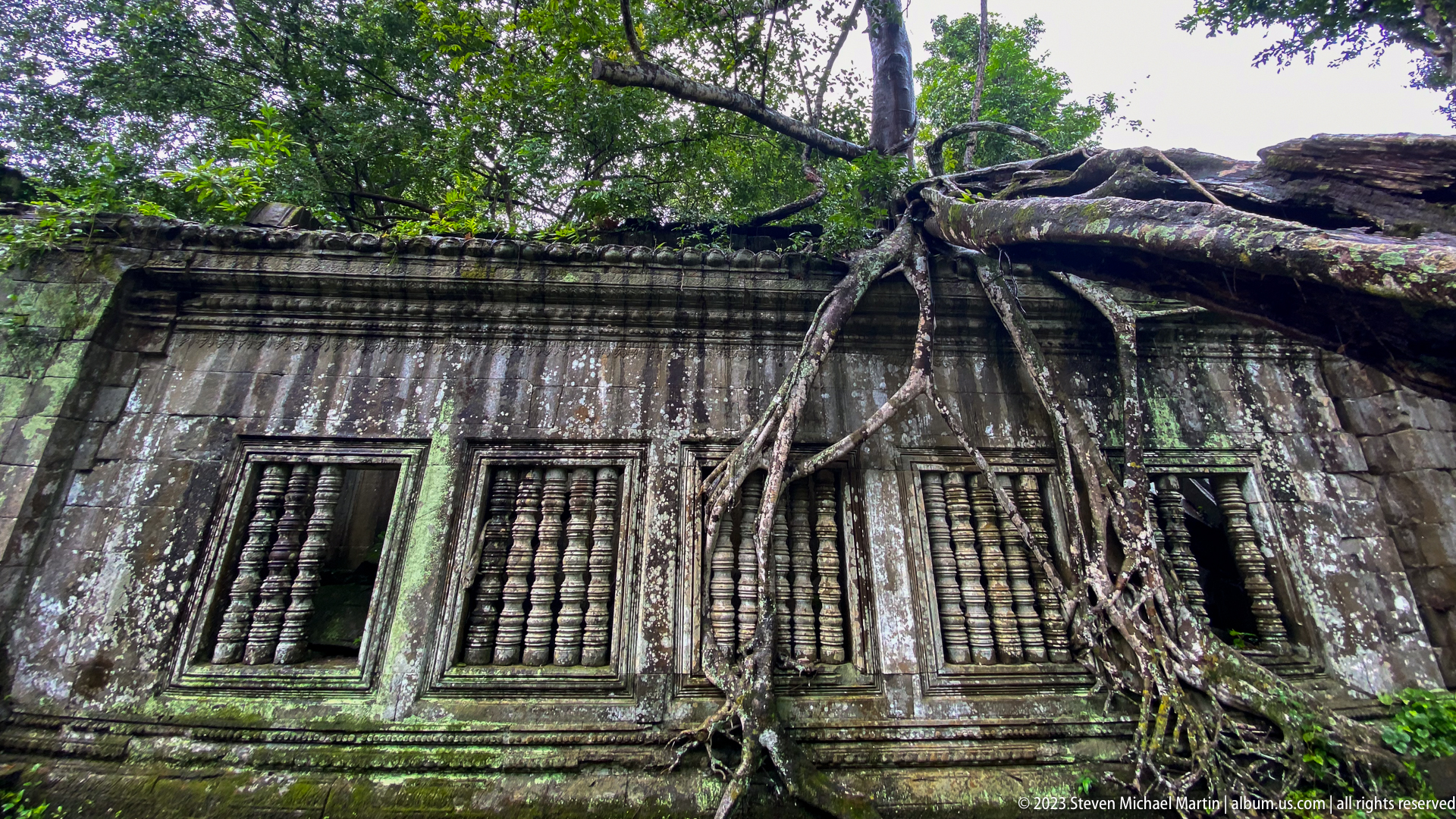
A sandstone gallery wall at Beng Mealea preserves a rhythmic row of stone-baluster windows beneath massive tree roots. The roots descend from the roofline and spread across the façade, while dark streaks and moss record prolonged moisture exposure. The image offers one of the site’s clearest examples of living forest growth physically enveloping Khmer architecture.
Caption
A sandstone gallery wall at Beng Mealea preserves a rhythmic row of stone-baluster windows beneath massive tree roots. The roots descend from the roofline and spread across the façade, while dark streaks and moss record prolonged moisture exposure. The image offers one of the site’s clearest examples of living forest growth physically enveloping Khmer architecture.
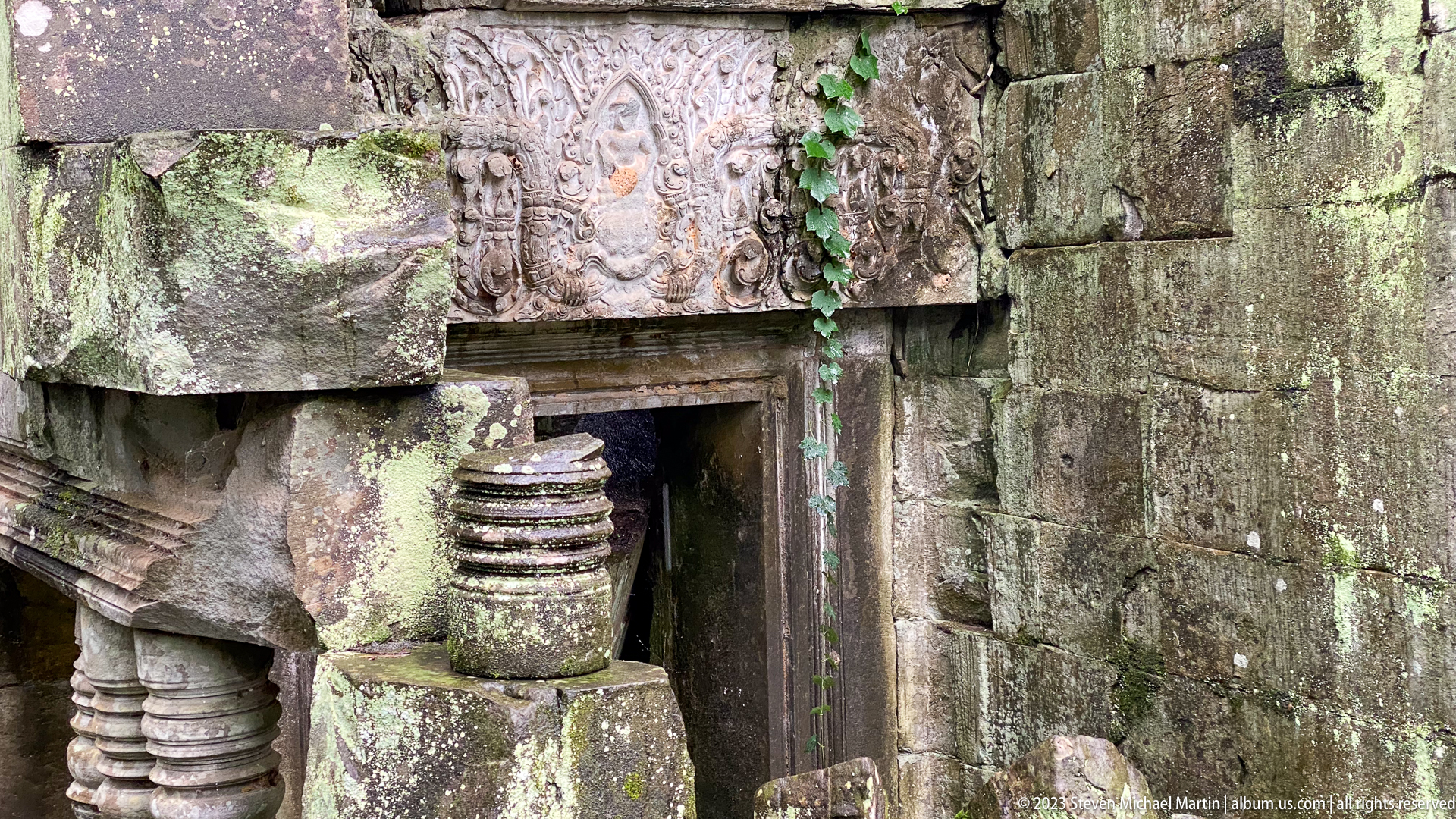
A small doorway at Beng Mealea is framed by weathered sandstone blocks and a carved relief panel containing foliate and figural ornament. A displaced turned stone element, possibly part of a baluster or colonette, rests upright in the opening, while additional fragments crowd the surrounding masonry. The close view records both the temple’s decorative richness and the disorder caused by collapse.
Caption
A small doorway at Beng Mealea is framed by weathered sandstone blocks and a carved relief panel containing foliate and figural ornament. A displaced turned stone element, possibly part of a baluster or colonette, rests upright in the opening, while additional fragments crowd the surrounding masonry. The close view records both the temple’s decorative richness and the disorder caused by collapse.

A large tree rises directly from a mound of collapsed sandstone blocks within Beng Mealea. Its buttressed roots spread across and between the masonry, binding the debris together while also exerting pressure on the surviving walls behind it. The scene encapsulates the long interaction between tropical forest growth and the temple’s unstable architectural remains.
Caption
A large tree rises directly from a mound of collapsed sandstone blocks within Beng Mealea. Its buttressed roots spread across and between the masonry, binding the debris together while also exerting pressure on the surviving walls behind it. The scene encapsulates the long interaction between tropical forest growth and the temple’s unstable architectural remains.
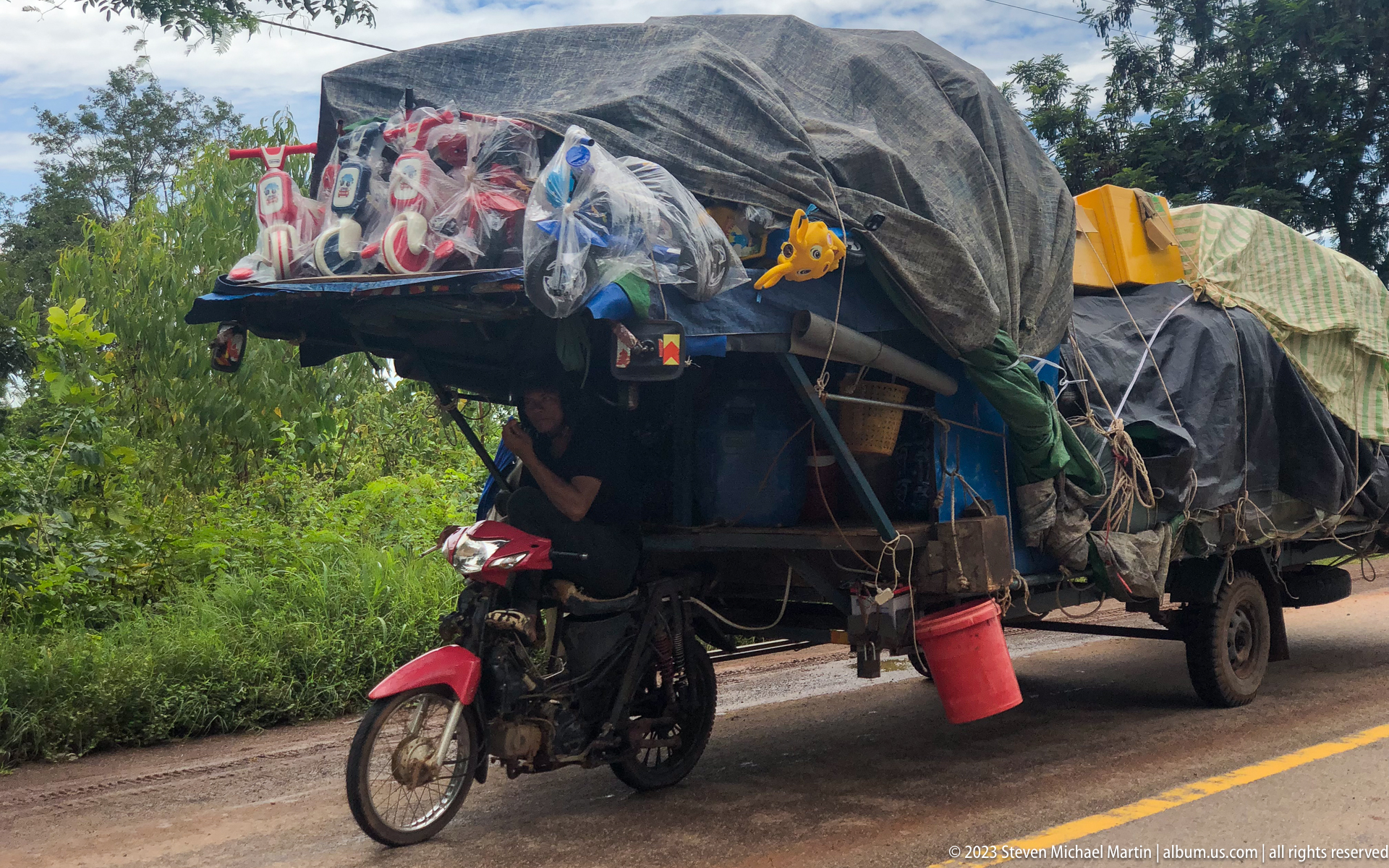
A motorcycle-powered cargo vehicle travels along the road carrying an exceptionally large load secured beneath tarpaulins and ropes. Plastic containers, bundled goods, and hanging household items extend beyond the vehicle’s frame, creating a compact mobile transport system. Photographed near Beng Mealea, the scene records everyday regional mobility beyond the archaeological site.
Caption
A motorcycle-powered cargo vehicle travels along the road carrying an exceptionally large load secured beneath tarpaulins and ropes. Plastic containers, bundled goods, and hanging household items extend beyond the vehicle’s frame, creating a compact mobile transport system. Photographed near Beng Mealea, the scene records everyday regional mobility beyond the archaeological site.