Hotel Gajoen
Hotel Gajoen in Tokyo is known for its elaborate interior decoration reflecting traditional Japanese artistic craftsmanship combined with modern architectural design. Originally developed in the early twentieth century, the building incorporates decorative woodwork, painted panels, and sculptural ornamentation inspired by classical Japanese motifs. The structure illustrates the continuation of artistic traditions within contemporary environments.
Interior spaces include detailed carvings, lacquer finishes, and painted scenes depicting landscapes, mythology, and historical subjects. The decorative program reflects artistic influences from earlier periods of Japanese cultural development. The building demonstrates how traditional aesthetics can be incorporated into modern hospitality design.
Hotel Gajoen represents the adaptation of historic artistic traditions within a modern architectural context. Its preserved interiors illustrate the continuing appreciation for craftsmanship and decorative design in Japanese cultural expression.

An elevated view from the hotel looks across a dense district of low- and mid-rise buildings toward a darkening sky. The varied rooftops, apartment blocks, utility structures, and scattered trees convey the layered urban fabric surrounding Hotel Gajoen before an approaching storm.
Caption
An elevated view from the hotel looks across a dense district of low- and mid-rise buildings toward a darkening sky. The varied rooftops, apartment blocks, utility structures, and scattered trees convey the layered urban fabric surrounding Hotel Gajoen before an approaching storm.

A dense shelf of dark storm cloud advances across the Tokyo skyline, sharply dividing bright late-day light from the approaching weather. Mid- and high-rise buildings form a compact urban foreground, while the massive cloud bank dominates the composition. The image records a rapidly changing atmospheric event viewed from Hotel Gajoen.
Caption
A dense shelf of dark storm cloud advances across the Tokyo skyline, sharply dividing bright late-day light from the approaching weather. Mid- and high-rise buildings form a compact urban foreground, while the massive cloud bank dominates the composition. The image records a rapidly changing atmospheric event viewed from Hotel Gajoen.

Mount Fuji appears faintly beyond Tokyo’s mid-rise buildings in a clear long-distance view from Hotel Gajoen. The mountain’s broad symmetrical profile rises above a nearer wooded ridge, while apartment towers and rooftops establish the urban foreground. Atmospheric haze softens the peak, emphasizing the considerable distance between the city and the mountain.
Caption
Mount Fuji appears faintly beyond Tokyo’s mid-rise buildings in a clear long-distance view from Hotel Gajoen. The mountain’s broad symmetrical profile rises above a nearer wooded ridge, while apartment towers and rooftops establish the urban foreground. Atmospheric haze softens the peak, emphasizing the considerable distance between the city and the mountain.

A tall residential tower rises above Tokyo’s lower urban blocks beneath a dark evening sky. A narrow orange band at the horizon marks the remaining sunset light, while illuminated windows begin to punctuate the city. The elevated viewpoint from Hotel Gajoen captures the transition from stormy daylight to night across the metropolitan landscape.
Caption
A tall residential tower rises above Tokyo’s lower urban blocks beneath a dark evening sky. A narrow orange band at the horizon marks the remaining sunset light, while illuminated windows begin to punctuate the city. The elevated viewpoint from Hotel Gajoen captures the transition from stormy daylight to night across the metropolitan landscape.

Women in layered kimono stand against a gold-toned ground with blossoms and stylized clouds, forming an idealized ensemble rather than a narrative event. The compressed space suppresses landscape and directs attention to textile pattern, silhouette, and graceful pose. This emphasis is characteristic of bijinga, where fashionable dress and cultivated demeanor serve as primary vehicles for beauty, status, and seasonal association.
Caption
Women in layered kimono stand against a gold-toned ground with blossoms and stylized clouds, forming an idealized ensemble rather than a narrative event. The compressed space suppresses landscape and directs attention to textile pattern, silhouette, and graceful pose. This emphasis is characteristic of bijinga, where fashionable dress and cultivated demeanor serve as primary vehicles for beauty, status, and seasonal association.

A covered courtyard lounge combines white wicker seating with dark columns, tiled eaves, and a transparent atrium enclosure. Reflections in the glass reveal garden greenery beyond, while the traditional roofline introduces a Japanese architectural reference within the modern hotel. The space is arranged as a sheltered transition between interior hospitality areas and the landscape.
Caption
A covered courtyard lounge combines white wicker seating with dark columns, tiled eaves, and a transparent atrium enclosure. Reflections in the glass reveal garden greenery beyond, while the traditional roofline introduces a Japanese architectural reference within the modern hotel. The space is arranged as a sheltered transition between interior hospitality areas and the landscape.

A second view of the gathering catches the three guests in conversation, one gesturing beside the window while the others sit around the coffee table. Blue dusk outside contrasts with the suite’s warm wood paneling and amber interior light.
Caption
A second view of the gathering catches the three guests in conversation, one gesturing beside the window while the others sit around the coffee table. Blue dusk outside contrasts with the suite’s warm wood paneling and amber interior light.

Large polychrome ceramic vases are arranged on low platforms around a central pedestal table. Floral and ornamental patterns cover the vessels in dense color, while the glass wall behind them opens the display to a planted courtyard and soft natural light.
Caption
Large polychrome ceramic vases are arranged on low platforms around a central pedestal table. Floral and ornamental patterns cover the vessels in dense color, while the glass wall behind them opens the display to a planted courtyard and soft natural light.

Tokyo’s dense urban fabric stretches beneath layered gray storm clouds in a wide view from Hotel Gajoen. Apartment blocks, commercial buildings, and a distant tower create a varied skyline, while a narrow band of warm light at the horizon contrasts with the cool, unsettled sky. The composition emphasizes the city’s scale and atmospheric depth.
Caption
Tokyo’s dense urban fabric stretches beneath layered gray storm clouds in a wide view from Hotel Gajoen. Apartment blocks, commercial buildings, and a distant tower create a varied skyline, while a narrow band of warm light at the horizon contrasts with the cool, unsettled sky. The composition emphasizes the city’s scale and atmospheric depth.

A broad atrium lounge at Hotel Gajoen is arranged around a shallow indoor water feature crossed by narrow bridges. White seating groups, dark columns, tiled roof forms, and a high glass canopy create a hybrid environment that combines contemporary hotel architecture with references to traditional Japanese courtyards. The expansive view emphasizes scale and spatial layering.
Caption
A broad atrium lounge at Hotel Gajoen is arranged around a shallow indoor water feature crossed by narrow bridges. White seating groups, dark columns, tiled roof forms, and a high glass canopy create a hybrid environment that combines contemporary hotel architecture with references to traditional Japanese courtyards. The expansive view emphasizes scale and spatial layering.

A monumental peacock display spreads across the interior in concentric layers of iridescent eye-feather motifs. The dense arrangement of bronze, green, blue, and violet surfaces turns the bird’s tail into an immersive decorative field, while the darker body and crest remain centered at the base of the composition.
Caption
A monumental peacock display spreads across the interior in concentric layers of iridescent eye-feather motifs. The dense arrangement of bronze, green, blue, and violet surfaces turns the bird’s tail into an immersive decorative field, while the darker body and crest remain centered at the base of the composition.

A gilded mikoshi rests on a wooden support stand, its compact shrine body crowned by a phoenix finial and framed by sweeping roof ornaments. White paper streamers, braided cords, metal fittings, and long carrying poles identify the object as a portable shrine designed for ceremonial procession.
Caption
A gilded mikoshi rests on a wooden support stand, its compact shrine body crowned by a phoenix finial and framed by sweeping roof ornaments. White paper streamers, braided cords, metal fittings, and long carrying poles identify the object as a portable shrine designed for ceremonial procession.

Seen directly from the front, this mikoshi presents a symmetrical façade of gilded carvings, metal plaques, and suspended paper streamers beneath a phoenix-topped roof. The projecting wooden poles extend toward the viewer, clarifying how the shrine would be lifted and carried during a festival procession.
Caption
Seen directly from the front, this mikoshi presents a symmetrical façade of gilded carvings, metal plaques, and suspended paper streamers beneath a phoenix-topped roof. The projecting wooden poles extend toward the viewer, clarifying how the shrine would be lifted and carried during a festival procession.

A three-quarter view reveals the layered construction of a gilded mikoshi, from its raised roof and phoenix finial to the compact sanctuary-like body below. Bright red tassels, braided cords, patterned metalwork, and black carrying poles add strong color contrasts to the richly ornamented ceremonial object.
Caption
A three-quarter view reveals the layered construction of a gilded mikoshi, from its raised roof and phoenix finial to the compact sanctuary-like body below. Bright red tassels, braided cords, patterned metalwork, and black carrying poles add strong color contrasts to the richly ornamented ceremonial object.

This mikoshi combines warm carved wood with gilded fittings, suspended tassels, and a phoenix finial rising above an intricately layered roof. The openwork supports and sculptural side elements give the portable shrine a lighter, more architectural profile than the more densely gilded examples nearby.
Caption
This mikoshi combines warm carved wood with gilded fittings, suspended tassels, and a phoenix finial rising above an intricately layered roof. The openwork supports and sculptural side elements give the portable shrine a lighter, more architectural profile than the more densely gilded examples nearby.

A compact mikoshi is viewed frontally, with a dark lacquered roof, gilded architectural details, purple braided cords, and a phoenix finial. The restrained palette and tight proportions distinguish it from the larger shrines on display, while the paired carrying poles still indicate its processional function.
Caption
A compact mikoshi is viewed frontally, with a dark lacquered roof, gilded architectural details, purple braided cords, and a phoenix finial. The restrained palette and tight proportions distinguish it from the larger shrines on display, while the paired carrying poles still indicate its processional function.
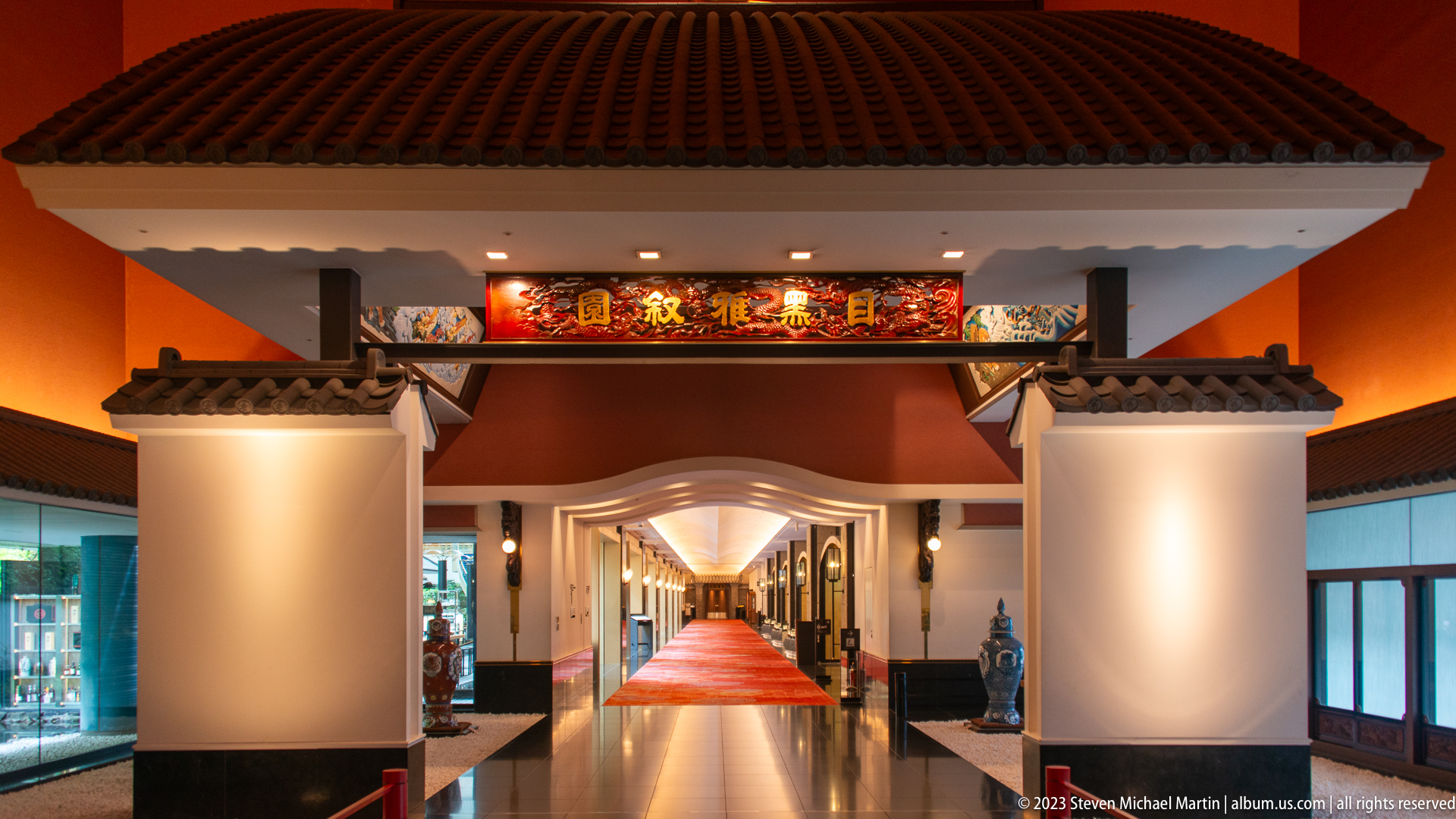
A long hotel corridor is framed by a Chinese-style gateway with tiled eaves, painted ornament, and a horizontal signboard. The red carpet runner draws the eye through a sequence of illuminated doorways, creating a strong axial view that combines theatrical decoration with the formal symmetry of the passage.
Caption
A long hotel corridor is framed by a Chinese-style gateway with tiled eaves, painted ornament, and a horizontal signboard. The red carpet runner draws the eye through a sequence of illuminated doorways, creating a strong axial view that combines theatrical decoration with the formal symmetry of the passage.

A dark gallery passage is lined with tall carved panels and illuminated display alcoves, while red railings and warm amber light define the circulation path. The contrast between glossy black surfaces, sculptural reliefs, and planted greenery gives the space the atmosphere of a museum installation within the hotel.
Caption
A dark gallery passage is lined with tall carved panels and illuminated display alcoves, while red railings and warm amber light define the circulation path. The contrast between glossy black surfaces, sculptural reliefs, and planted greenery gives the space the atmosphere of a museum installation within the hotel.

A black decorative panel presents birds in flight above flowering branches and a stylized blue wave or mythical-creature motif. Iridescent shell-like inlay and saturated color stand out against the glossy dark ground, creating a dramatic surface that recalls Japanese lacquer and decorative screen traditions.
Caption
A black decorative panel presents birds in flight above flowering branches and a stylized blue wave or mythical-creature motif. Iridescent shell-like inlay and saturated color stand out against the glossy dark ground, creating a dramatic surface that recalls Japanese lacquer and decorative screen traditions.

A close detail isolates the panel’s large blue figure, built from sweeping curves, flame-like locks, and shimmering iridescent outlines. The cropped view emphasizes the craftsmanship of the surface and the tension between the brilliant inlay and the deep black background.
Caption
A close detail isolates the panel’s large blue figure, built from sweeping curves, flame-like locks, and shimmering iridescent outlines. The cropped view emphasizes the craftsmanship of the surface and the tension between the brilliant inlay and the deep black background.

A diagonal view across the twin beds emphasizes the room’s layered wood paneling and amber headboard illumination. Folded sleepwear or linens are placed at the foot of the nearer bed, while the close spacing and shared bedside zone show the compact efficiency of the sleeping area.
Caption
A diagonal view across the twin beds emphasizes the room’s layered wood paneling and amber headboard illumination. Folded sleepwear or linens are placed at the foot of the nearer bed, while the close spacing and shared bedside zone show the compact efficiency of the sleeping area.

A curving driveway passes clipped hedges, bamboo, and mature trees at the edge of the hotel grounds. A parking sign anchors the foreground, while the layered planting softens the transition between the low traditional-style roofline and the modern building rising behind it.
Caption
A curving driveway passes clipped hedges, bamboo, and mature trees at the edge of the hotel grounds. A parking sign anchors the foreground, while the layered planting softens the transition between the low traditional-style roofline and the modern building rising behind it.

Two single beds are arranged beneath a broad wood headboard accented by vertical slats and warm concealed lighting. Matching bedside lamps, neutral textiles, and floor-length curtains create a restrained contemporary interior, while the symmetrical bed placement gives the room a calm, orderly composition.
Caption
Two single beds are arranged beneath a broad wood headboard accented by vertical slats and warm concealed lighting. Matching bedside lamps, neutral textiles, and floor-length curtains create a restrained contemporary interior, while the symmetrical bed placement gives the room a calm, orderly composition.

The guest room is shown from the foot of the beds, opening toward a curtained window, wall-mounted television, and a small seating area. Warm wood surfaces continue around the room, while the wider view clarifies how the sleeping, media, and sitting zones are organized within one space.
Caption
The guest room is shown from the foot of the beds, opening toward a curtained window, wall-mounted television, and a small seating area. Warm wood surfaces continue around the room, while the wider view clarifies how the sleeping, media, and sitting zones are organized within one space.

Sliding wood-framed partitions connect the sleeping area to a sequence of adjoining rooms. Mirrors and open doorways extend the sightline toward a chair and table beyond, revealing a suite organized as linked zones rather than a single undivided room.
Caption
Sliding wood-framed partitions connect the sleeping area to a sequence of adjoining rooms. Mirrors and open doorways extend the sightline toward a chair and table beyond, revealing a suite organized as linked zones rather than a single undivided room.

A rectangular wood table and upholstered chairs form a compact dining or work area within the suite. A television and low bench occupy the darker recess beyond, while a tall floor lamp and textured wall panels help distinguish this functional zone from the adjoining bedroom.
Caption
A rectangular wood table and upholstered chairs form a compact dining or work area within the suite. A television and low bench occupy the darker recess beyond, while a tall floor lamp and textured wall panels help distinguish this functional zone from the adjoining bedroom.

A built-in sectional sofa wraps around the suite’s living area beneath a curtained window. The low central coffee table, warm wood floor, recessed ceiling lights, and restrained wall decoration create a comfortable gathering space distinct from the adjacent sleeping and dining zones.
Caption
A built-in sectional sofa wraps around the suite’s living area beneath a curtained window. The low central coffee table, warm wood floor, recessed ceiling lights, and restrained wall decoration create a comfortable gathering space distinct from the adjacent sleeping and dining zones.

The suite’s living area is shown at night, with a built-in sofa and pale wood coffee table set against a broad window overlooking the city. Reflections in the glass merge the room’s warm interior lighting with scattered urban lights outside, giving the space a layered evening atmosphere.
Caption
The suite’s living area is shown at night, with a built-in sofa and pale wood coffee table set against a broad window overlooking the city. Reflections in the glass merge the room’s warm interior lighting with scattered urban lights outside, giving the space a layered evening atmosphere.

A spacious bathroom is finished in richly patterned stone, with a long vanity on one side, a glass-enclosed shower at the center, and a deep soaking tub to the right. Mirrors and multiple wall lights amplify the polished surfaces and emphasize the room’s generous scale.
Caption
A spacious bathroom is finished in richly patterned stone, with a long vanity on one side, a glass-enclosed shower at the center, and a deep soaking tub to the right. Mirrors and multiple wall lights amplify the polished surfaces and emphasize the room’s generous scale.

A small standing figure has been folded from richly patterned red, black, white, and gold material. Its angular silhouette and layered surfaces suggest an origami-inspired decorative object, displayed on the suite’s table against the softly lit room beyond.
Caption
A small standing figure has been folded from richly patterned red, black, white, and gold material. Its angular silhouette and layered surfaces suggest an origami-inspired decorative object, displayed on the suite’s table against the softly lit room beyond.

A wooden birthday-cake model with removable candle forms is arranged beside a small black teddy bear. The numbered center pieces and “Make a Wish” inscription turn the tabletop display into a personalized guest amenity rather than an edible cake.
Caption
A wooden birthday-cake model with removable candle forms is arranged beside a small black teddy bear. The numbered center pieces and “Make a Wish” inscription turn the tabletop display into a personalized guest amenity rather than an edible cake.

A wedding couple descends an interior staircase, the bride wearing a vivid red kimono with large crane and floral motifs and the groom dressed in formal black montsuki and striped hakama. Their ceremonial clothing stands out against the blue-carpeted stairs and glass balustrade.
Caption
A wedding couple descends an interior staircase, the bride wearing a vivid red kimono with large crane and floral motifs and the groom dressed in formal black montsuki and striped hakama. Their ceremonial clothing stands out against the blue-carpeted stairs and glass balustrade.

A small wooden celebration cake and black plush bear form a playful tabletop arrangement inside Hotel Gajoen. The cake is built from pale wood components, topped with stylized candle-like posts and marked with a prominent numeral five. Soft daylight and the restrained setting isolate the objects, creating an intimate detail amid the hotel’s more elaborate architectural and decorative displays.
Caption
A small wooden celebration cake and black plush bear form a playful tabletop arrangement inside Hotel Gajoen. The cake is built from pale wood components, topped with stylized candle-like posts and marked with a prominent numeral five. Soft daylight and the restrained setting isolate the objects, creating an intimate detail amid the hotel’s more elaborate architectural and decorative displays.

An iridescent peacock stretches across glossy black decorative panels, its long tail scattered with vividly colored eye-shaped markings. The dark reflective ground heightens the blue, green, and violet accents while the panel divisions interrupt the bird’s body and tail. The composition demonstrates how Hotel Gajoen integrates richly ornamental animal imagery into architectural surfaces rather than treating decoration as a separate object.
Caption
An iridescent peacock stretches across glossy black decorative panels, its long tail scattered with vividly colored eye-shaped markings. The dark reflective ground heightens the blue, green, and violet accents while the panel divisions interrupt the bird’s body and tail. The composition demonstrates how Hotel Gajoen integrates richly ornamental animal imagery into architectural surfaces rather than treating decoration as a separate object.

Three guests relax in the suite’s living area around a low coffee table, with the evening city visible through the broad window behind them. Their informal poses and scattered personal items shift the room from a staged interior into an occupied social space.
Caption
Three guests relax in the suite’s living area around a low coffee table, with the evening city visible through the broad window behind them. Their informal poses and scattered personal items shift the room from a staged interior into an occupied social space.

An iridescent peacock sculpture is shown in profile, its blue-green neck rising above a densely ornamented tail. Repeated jewel-like eye motifs and reflective metallic surfaces create a shimmering effect across the feathers, emphasizing the object’s lavish decorative treatment.
Caption
An iridescent peacock sculpture is shown in profile, its blue-green neck rising above a densely ornamented tail. Repeated jewel-like eye motifs and reflective metallic surfaces create a shimmering effect across the feathers, emphasizing the object’s lavish decorative treatment.

Several gilded peacocks overlap within a dark display, their raised heads and fanlike tails forming a dense sculptural group. Warm spotlights strike the metallic feathers and jewel-like eye patterns, producing flashes of gold, violet, green, and blue against the black background.
Caption
Several gilded peacocks overlap within a dark display, their raised heads and fanlike tails forming a dense sculptural group. Warm spotlights strike the metallic feathers and jewel-like eye patterns, producing flashes of gold, violet, green, and blue against the black background.

A side detail isolates one gilded peacock against the luminous spread of its tail. The bird’s patterned body, raised crest, and sharply outlined profile stand before rows of reflective eye-feather ornaments, while amber display lighting intensifies the metallic finish.
Caption
A side detail isolates one gilded peacock against the luminous spread of its tail. The bird’s patterned body, raised crest, and sharply outlined profile stand before rows of reflective eye-feather ornaments, while amber display lighting intensifies the metallic finish.

An illuminated wall sign identifies Hotel Gajoen Tokyo in Japanese and English beside the hotel’s circular crest. Mounted against dark horizontal brickwork, the silver lettering provides a formal exterior marker for the property.
Caption
An illuminated wall sign identifies Hotel Gajoen Tokyo in Japanese and English beside the hotel’s circular crest. Mounted against dark horizontal brickwork, the silver lettering provides a formal exterior marker for the property.

A peacock faces the viewer beneath a dense field of radiating tail feathers, transforming the bird into an almost symmetrical decorative emblem. Repeated eye-patterns cover the background, while metallic and jewel-like highlights concentrate around the head and upper body. The frontal viewpoint differs markedly from the neighboring profile composition, emphasizing pattern, texture, and visual abundance over naturalistic space.
Caption
A peacock faces the viewer beneath a dense field of radiating tail feathers, transforming the bird into an almost symmetrical decorative emblem. Repeated eye-patterns cover the background, while metallic and jewel-like highlights concentrate around the head and upper body. The frontal viewpoint differs markedly from the neighboring profile composition, emphasizing pattern, texture, and visual abundance over naturalistic space.

A pair of escalators rises through Hotel Gajoen’s glazed atrium beside a blue-carpeted curving stair and cylindrical glass elevator. Bright yellow step edges trace the escalators’ ascent, contrasting with the dark stone floor and planted interior garden. The overlapping circulation systems turn a functional transition zone into a theatrical architectural composition beneath the broad glass roof.
Caption
A pair of escalators rises through Hotel Gajoen’s glazed atrium beside a blue-carpeted curving stair and cylindrical glass elevator. Bright yellow step edges trace the escalators’ ascent, contrasting with the dark stone floor and planted interior garden. The overlapping circulation systems turn a functional transition zone into a theatrical architectural composition beneath the broad glass roof.

This wider atrium view places Hotel Gajoen’s curved blue staircase, cylindrical glass elevator, and escalator within a multi-level interior landscape. Balconies, dark tiled floors, planted beds, and the overhead glazing establish the scale of the circulation core. Seen together, the contrasting curves and diagonals create a dynamic centerpiece that links the hotel’s public levels while framing the greenery below.
Caption
This wider atrium view places Hotel Gajoen’s curved blue staircase, cylindrical glass elevator, and escalator within a multi-level interior landscape. Balconies, dark tiled floors, planted beds, and the overhead glazing establish the scale of the circulation core. Seen together, the contrasting curves and diagonals create a dynamic centerpiece that links the hotel’s public levels while framing the greenery below.

A narrow stone path winds through Hotel Gajoen’s lush interior garden, bordered by low woven fencing and dense subtropical planting. Trees and shrubs soften the surrounding modern structure, while a stair, glazed balustrade, and upper balcony remain visible overhead. The view shifts attention from the atrium’s monumental circulation elements to the carefully staged garden experience at ground level.
Caption
A narrow stone path winds through Hotel Gajoen’s lush interior garden, bordered by low woven fencing and dense subtropical planting. Trees and shrubs soften the surrounding modern structure, while a stair, glazed balustrade, and upper balcony remain visible overhead. The view shifts attention from the atrium’s monumental circulation elements to the carefully staged garden experience at ground level.

A timber walkway curves along a koi pond between Hotel Gajoen’s glazed interior and a densely planted garden. The composition links polished modern architecture with a carefully managed landscape of maples, rocks, bamboo screens, and moving water. Orange and white koi animate the dark pond, while the path draws visitors toward the waterfall garden beyond.
Caption
A timber walkway curves along a koi pond between Hotel Gajoen’s glazed interior and a densely planted garden. The composition links polished modern architecture with a carefully managed landscape of maples, rocks, bamboo screens, and moving water. Orange and white koi animate the dark pond, while the path draws visitors toward the waterfall garden beyond.

A broad view of Hotel Gajoen’s garden centers on an artificial waterfall descending through a dark stone retaining wall into a koi pond. Wooden railings and platforms provide close access to the water, while mature trees and layered foliage enclose the scene. The combination of controlled water flow, stonework, and seasonal planting creates a secluded landscape within the urban hotel complex.
Caption
A broad view of Hotel Gajoen’s garden centers on an artificial waterfall descending through a dark stone retaining wall into a koi pond. Wooden railings and platforms provide close access to the water, while mature trees and layered foliage enclose the scene. The combination of controlled water flow, stonework, and seasonal planting creates a secluded landscape within the urban hotel complex.

Women in elaborate kimono move through an idealized spring landscape beneath flowering cherry trees, accompanied by attendants and a rickshaw. The vehicles, layered garments, and carefully ordered figures suggest a formal excursion rather than an informal garden visit. The panel belongs broadly to the tradition of bijinga and historical genre imagery, in which elegant costume, social roles, and seasonal beauty carry much of the narrative.
Caption
Women in elaborate kimono move through an idealized spring landscape beneath flowering cherry trees, accompanied by attendants and a rickshaw. The vehicles, layered garments, and carefully ordered figures suggest a formal excursion rather than an informal garden visit. The panel belongs broadly to the tradition of bijinga and historical genre imagery, in which elegant costume, social roles, and seasonal beauty carry much of the narrative.

Elegantly dressed women gather beneath flowering branches beside a narrow stream, while a wheeled carriage or rickshaw anchors the lower scene. The combination of blossoms, water, formal clothing, and leisurely movement suggests an idealized spring outing or flower-viewing excursion. Rather than depicting identifiable individuals, the composition emphasizes refined conduct, textile pattern, and the association between feminine beauty and the changing season.
Caption
Elegantly dressed women gather beneath flowering branches beside a narrow stream, while a wheeled carriage or rickshaw anchors the lower scene. The combination of blossoms, water, formal clothing, and leisurely movement suggests an idealized spring outing or flower-viewing excursion. Rather than depicting identifiable individuals, the composition emphasizes refined conduct, textile pattern, and the association between feminine beauty and the changing season.

A centrally placed woman in formal kimono is surrounded by female attendants and children within a luxuriant garden of peonies and flowering branches. Her scale, placement, and elaborate dress distinguish her from the surrounding figures, suggesting elevated social status within an idealized historical scene. Peonies traditionally convey richness and cultivated beauty, while the blossoms and patterned robes turn the gathering into a celebration of season, rank, and ceremonial display.
Caption
A centrally placed woman in formal kimono is surrounded by female attendants and children within a luxuriant garden of peonies and flowering branches. Her scale, placement, and elaborate dress distinguish her from the surrounding figures, suggesting elevated social status within an idealized historical scene. Peonies traditionally convey richness and cultivated beauty, while the blossoms and patterned robes turn the gathering into a celebration of season, rank, and ceremonial display.

Three women in patterned kimono stand beside a stylized stream populated by waterfowl, with flowering branches arching above them. The pairing of elegant figures, birds, rocks, and seasonal blossoms reflects a decorative mode in which human refinement is harmonized with nature. Their composed poses suggest leisurely observation or conversation rather than labor, making the scene an idealized image of cultivated life in a garden setting.
Caption
Three women in patterned kimono stand beside a stylized stream populated by waterfowl, with flowering branches arching above them. The pairing of elegant figures, birds, rocks, and seasonal blossoms reflects a decorative mode in which human refinement is harmonized with nature. Their composed poses suggest leisurely observation or conversation rather than labor, making the scene an idealized image of cultivated life in a garden setting.

The doorway is treated as a complete decorative program rather than a simple passage. A horizontal narrative scene of women spans the lintel, while floral panels, circular crest-like motifs, and richly patterned surfaces continue down the frame and doors. Such integration of painting and ornament transforms movement through the hotel into an encounter with art, a defining feature of Hotel Gajoen’s immersive interior design.
Caption
The doorway is treated as a complete decorative program rather than a simple passage. A horizontal narrative scene of women spans the lintel, while floral panels, circular crest-like motifs, and richly patterned surfaces continue down the frame and doors. Such integration of painting and ornament transforms movement through the hotel into an encounter with art, a defining feature of Hotel Gajoen’s immersive interior design.

Three women in layered kimono sit together while examining or arranging folded textiles. Their attention is directed toward the cloth between them, suggesting garment preparation, textile selection, or the handling of an obi rather than a purely conversational gathering. A painted screen with flowering branches reinforces the refined domestic setting. The scene links feminine sociability with the material culture of dress, a central subject in bijinga and historical genre imagery.
Caption
Three women in layered kimono sit together while examining or arranging folded textiles. Their attention is directed toward the cloth between them, suggesting garment preparation, textile selection, or the handling of an obi rather than a purely conversational gathering. A painted screen with flowering branches reinforces the refined domestic setting. The scene links feminine sociability with the material culture of dress, a central subject in bijinga and historical genre imagery.

A low-lit corridor at Hotel Gajoen is lined with red-framed decorative panels depicting flowering trees and figures in traditional dress. Sculptural ceiling lights and black floor tiles heighten the theatrical effect, turning the passage into an immersive gallery. The image emphasizes the hotel’s characteristic fusion of circulation space, display, and carefully staged illumination.
Caption
A low-lit corridor at Hotel Gajoen is lined with red-framed decorative panels depicting flowering trees and figures in traditional dress. Sculptural ceiling lights and black floor tiles heighten the theatrical effect, turning the passage into an immersive gallery. The image emphasizes the hotel’s characteristic fusion of circulation space, display, and carefully staged illumination.

A broad arched opening frames a contemporary restaurant interior at Hotel Gajoen. Black stone counters, metal screens, pendant lighting, and warm wood surfaces define the space, while a red carpet leads toward the entrance. The design contrasts restrained modern finishes with the more ornate historicizing decorative environments found elsewhere in the hotel.
Caption
A broad arched opening frames a contemporary restaurant interior at Hotel Gajoen. Black stone counters, metal screens, pendant lighting, and warm wood surfaces define the space, while a red carpet leads toward the entrance. The design contrasts restrained modern finishes with the more ornate historicizing decorative environments found elsewhere in the hotel.

A symmetrical view centers on a bar counter beneath a broad gold-toned arch inside Hotel Gajoen. High stools line the polished stone counter, while pendant lights, display cases, and a warmly lit dining room extend beyond. The composition highlights the balance of formal symmetry, metallic finishes, and contemporary hospitality design.
Caption
A symmetrical view centers on a bar counter beneath a broad gold-toned arch inside Hotel Gajoen. High stools line the polished stone counter, while pendant lights, display cases, and a warmly lit dining room extend beyond. The composition highlights the balance of formal symmetry, metallic finishes, and contemporary hospitality design.

A gold-lined arch opens onto a reception and display area at Hotel Gajoen. A central stone desk, illuminated glass case, dark tiled floor, and pale walls create a restrained contemporary setting. The frontal viewpoint stresses the threshold between public circulation and the dining venue, with the arch serving as the dominant architectural motif.
Caption
A gold-lined arch opens onto a reception and display area at Hotel Gajoen. A central stone desk, illuminated glass case, dark tiled floor, and pale walls create a restrained contemporary setting. The frontal viewpoint stresses the threshold between public circulation and the dining venue, with the arch serving as the dominant architectural motif.

A monumental lidded jar combines a broad-shouldered ceremonial form with densely painted dragon, phoenix, cloud, and floral motifs. In East Asian decorative traditions, the dragon and phoenix often form an auspicious pairing associated with complementary powers, harmony, and high status. The vessel’s scale and elevated display give it an architectural presence within the lobby, although its maker, date, and exact ceramic tradition require confirmation from the label.
Caption
A monumental lidded jar combines a broad-shouldered ceremonial form with densely painted dragon, phoenix, cloud, and floral motifs. In East Asian decorative traditions, the dragon and phoenix often form an auspicious pairing associated with complementary powers, harmony, and high status. The vessel’s scale and elevated display give it an architectural presence within the lobby, although its maker, date, and exact ceramic tradition require confirmation from the label.

The close view reveals a dragon and long-tailed phoenix confronting one another amid curling clouds and floral borders. Their pairing is not merely decorative: in East Asian visual culture the dragon and phoenix commonly symbolize complementary forces, auspicious union, and elevated rank. The detail also shows how the vessel’s imagery is organized in bands, with the central mythic encounter framed by denser ornamental borders.
Caption
The close view reveals a dragon and long-tailed phoenix confronting one another amid curling clouds and floral borders. Their pairing is not merely decorative: in East Asian visual culture the dragon and phoenix commonly symbolize complementary forces, auspicious union, and elevated rank. The detail also shows how the vessel’s imagery is organized in bands, with the central mythic encounter framed by denser ornamental borders.

Colorful ceramic plates of different sizes are arranged with bare branches, small vessels, and living plants to form a composed interior still life. The display emphasizes circular form, glazed surface, and seasonal contrast rather than presenting the ceramics as isolated museum objects. Branches and greenery extend the patterns beyond the plates, integrating craft, nature, and hospitality design in a distinctly curated lobby installation.
Caption
Colorful ceramic plates of different sizes are arranged with bare branches, small vessels, and living plants to form a composed interior still life. The display emphasizes circular form, glazed surface, and seasonal contrast rather than presenting the ceramics as isolated museum objects. Branches and greenery extend the patterns beyond the plates, integrating craft, nature, and hospitality design in a distinctly curated lobby installation.

Displayed with its sleeves extended, the red kimono is presented as both garment and work of textile art. Circular medallions, flowers, and geometric motifs create a dense all-over pattern suited to formal or celebratory dress. The broad sleeves and full silhouette invite attention to construction and surface design, while the upright presentation removes the garment from use and places it within Hotel Gajoen’s museum-like program of Japanese material culture.
Caption
Displayed with its sleeves extended, the red kimono is presented as both garment and work of textile art. Circular medallions, flowers, and geometric motifs create a dense all-over pattern suited to formal or celebratory dress. The broad sleeves and full silhouette invite attention to construction and surface design, while the upright presentation removes the garment from use and places it within Hotel Gajoen’s museum-like program of Japanese material culture.

A crowded urban scene brings together women in patterned kimono, seated workers, porters, and figures carrying goods across what appears to be a bridge or commercial street. Unlike the tranquil garden panels, this composition emphasizes movement, labor, and social variety. The juxtaposition of elegant dress with working figures evokes historical genre painting, where the rhythms of city life and distinctions of occupation become the subject.
Caption
A crowded urban scene brings together women in patterned kimono, seated workers, porters, and figures carrying goods across what appears to be a bridge or commercial street. Unlike the tranquil garden panels, this composition emphasizes movement, labor, and social variety. The juxtaposition of elegant dress with working figures evokes historical genre painting, where the rhythms of city life and distinctions of occupation become the subject.

Women in elaborate kimono move through a stylized landscape with a child and an attendant carrying a broad umbrella. The parasol, gate, and orderly arrangement suggest formal passage or ceremonial attendance rather than casual travel. Differences in scale, dress, and position imply social hierarchy within the group, while the idealized setting places the episode within the tradition of bijinga and historical genre painting.
Caption
Women in elaborate kimono move through a stylized landscape with a child and an attendant carrying a broad umbrella. The parasol, gate, and orderly arrangement suggest formal passage or ceremonial attendance rather than casual travel. Differences in scale, dress, and position imply social hierarchy within the group, while the idealized setting places the episode within the tradition of bijinga and historical genre painting.

Several women in richly patterned kimono gather beside blue water while one bends forward and others appear to adjust or support her clothing. The intimate interaction may represent dressing, preparation before travel, or assistance with layered garments. Boats or waterfront structures in the distance broaden the scene beyond a private interior, linking the material culture of dress with movement through a coastal or riverside setting.
Caption
Several women in richly patterned kimono gather beside blue water while one bends forward and others appear to adjust or support her clothing. The intimate interaction may represent dressing, preparation before travel, or assistance with layered garments. Boats or waterfront structures in the distance broaden the scene beyond a private interior, linking the material culture of dress with movement through a coastal or riverside setting.

A procession of women crosses an open promenade beneath broad parasols. The repeating circular canopies organize the composition while also signaling protection from sun and the refinement of a formal outing. Their patterned kimono, measured spacing, and upright poses turn public movement into a display of dress and social presence, a familiar concern of bijinga and historical genre painting.
Caption
A procession of women crosses an open promenade beneath broad parasols. The repeating circular canopies organize the composition while also signaling protection from sun and the refinement of a formal outing. Their patterned kimono, measured spacing, and upright poses turn public movement into a display of dress and social presence, a familiar concern of bijinga and historical genre painting.

Adult women and younger girls assemble beneath flowering branches in a broad, idealized landscape. The grouping emphasizes age, rank, and continuity: tall formally dressed women anchor the center while children and younger attendants cluster around them. Varied kimono patterns and seasonal blossoms transform the scene into a display of cultivated femininity and intergenerational social order rather than a portrait of identifiable individuals.
Caption
Adult women and younger girls assemble beneath flowering branches in a broad, idealized landscape. The grouping emphasizes age, rank, and continuity: tall formally dressed women anchor the center while children and younger attendants cluster around them. Varied kimono patterns and seasonal blossoms transform the scene into a display of cultivated femininity and intergenerational social order rather than a portrait of identifiable individuals.

Three women occupy a nocturnal landscape dominated by an immense golden moon. Two sit on a raised platform while another stands among tall grasses, imagery strongly suggestive of tsukimi, the Japanese custom of moon viewing associated with the autumn full moon. The sparse setting, cool blue sky, and contemplative poses shift the emphasis from social display to seasonal reflection and poetic appreciation of nature.
Caption
Three women occupy a nocturnal landscape dominated by an immense golden moon. Two sit on a raised platform while another stands among tall grasses, imagery strongly suggestive of tsukimi, the Japanese custom of moon viewing associated with the autumn full moon. The sparse setting, cool blue sky, and contemplative poses shift the emphasis from social display to seasonal reflection and poetic appreciation of nature.

A tiger advances across rocky ground toward a dragon rising from turbulent waves and clouds. The pairing is a long-established East Asian emblem of opposing yet complementary powers: the tiger is associated with earthly strength and the dragon with water, weather, and celestial energy. Bamboo, mountains, and churning water intensify the contrast, turning the mural into a dramatic visualization of balanced forces.
Caption
A tiger advances across rocky ground toward a dragon rising from turbulent waves and clouds. The pairing is a long-established East Asian emblem of opposing yet complementary powers: the tiger is associated with earthly strength and the dragon with water, weather, and celestial energy. Bamboo, mountains, and churning water intensify the contrast, turning the mural into a dramatic visualization of balanced forces.

A dragon emerges through curling clouds at one side of the mural while two tigers occupy rocky terrain opposite. Stylized waves and vapor separate the creatures but also bind them into a single field of motion. The expanded composition develops the traditional tiger-and-dragon pairing as a contest of terrestrial and atmospheric power, with bamboo and rock anchoring the tigers against the dragon’s fluid domain.
Caption
A dragon emerges through curling clouds at one side of the mural while two tigers occupy rocky terrain opposite. Stylized waves and vapor separate the creatures but also bind them into a single field of motion. The expanded composition develops the traditional tiger-and-dragon pairing as a contest of terrestrial and atmospheric power, with bamboo and rock anchoring the tigers against the dragon’s fluid domain.

Two tigers hold rocky ground while several dragons surge through dense, flame-like clouds. Multiplying the dragons transforms the familiar paired motif into a more theatrical struggle between solid terrain and volatile atmospheric energy. The tigers’ compact bodies contrast with the dragons’ elongated forms, while bamboo, rock, and cloud establish distinct symbolic realms within the continuous mural.
Caption
Two tigers hold rocky ground while several dragons surge through dense, flame-like clouds. Multiplying the dragons transforms the familiar paired motif into a more theatrical struggle between solid terrain and volatile atmospheric energy. The tigers’ compact bodies contrast with the dragons’ elongated forms, while bamboo, rock, and cloud establish distinct symbolic realms within the continuous mural.

A flowering shrub spreads across a glossy black surface, its dense pink blossoms and narrow leaves rendered with jewel-like clarity. The dark ground isolates each stem and petal, producing an effect associated with lacquer and inlay traditions even though the precise technique cannot be confirmed from the photograph. Without figures or architecture, the panel concentrates entirely on seasonal abundance, rhythm, and material brilliance.
Caption
A flowering shrub spreads across a glossy black surface, its dense pink blossoms and narrow leaves rendered with jewel-like clarity. The dark ground isolates each stem and petal, producing an effect associated with lacquer and inlay traditions even though the precise technique cannot be confirmed from the photograph. Without figures or architecture, the panel concentrates entirely on seasonal abundance, rhythm, and material brilliance.

Two women in patterned kimono face one another across a dark, reflective ground, framed by dense pink blossoms and sparse plants. Their restrained gestures suggest conversation or quiet companionship rather than a specific dramatic event. The black surface isolates the figures and flowers like luminous inlay, combining the bijinga tradition of elegant women with a concentrated seasonal botanical setting.
Caption
Two women in patterned kimono face one another across a dark, reflective ground, framed by dense pink blossoms and sparse plants. Their restrained gestures suggest conversation or quiet companionship rather than a specific dramatic event. The black surface isolates the figures and flowers like luminous inlay, combining the bijinga tradition of elegant women with a concentrated seasonal botanical setting.

A solitary woman in a gold-patterned kimono stands beside a broad mass of pink blossoms on a glossy black ground. Her isolation and composed posture give the scene an emblematic quality, linking feminine elegance with seasonal flowering rather than narrating a specific action. The dark surface heightens the brilliance of garment and flowers, a decorative strategy associated with lacquer and inlay aesthetics.
Caption
A solitary woman in a gold-patterned kimono stands beside a broad mass of pink blossoms on a glossy black ground. Her isolation and composed posture give the scene an emblematic quality, linking feminine elegance with seasonal flowering rather than narrating a specific action. The dark surface heightens the brilliance of garment and flowers, a decorative strategy associated with lacquer and inlay aesthetics.

The illuminated display identifies Hotel Gajoen as a “Museum Hotel of Japan Beauty,” framing the surrounding murals, decorated ceilings, and architectural ornament as a unified cultural experience. Rather than presenting artworks in neutral galleries, the hotel embeds them in corridors, thresholds, and hospitality spaces. The installation therefore serves as both branding and an interpretive statement about art as part of the building itself.
Caption
The illuminated display identifies Hotel Gajoen as a “Museum Hotel of Japan Beauty,” framing the surrounding murals, decorated ceilings, and architectural ornament as a unified cultural experience. Rather than presenting artworks in neutral galleries, the hotel embeds them in corridors, thresholds, and hospitality spaces. The installation therefore serves as both branding and an interpretive statement about art as part of the building itself.

A multi-level atrium at Hotel Gajoen combines a cylindrical glass elevator, sweeping escalators, dark stone platforms, and stacked interior balconies. Warm gold lighting emphasizes the circulation routes and polished surfaces, while planted areas soften the monumental scale. The view presents the hotel as a complex vertical interior landscape rather than a conventional lobby.
Caption
A multi-level atrium at Hotel Gajoen combines a cylindrical glass elevator, sweeping escalators, dark stone platforms, and stacked interior balconies. Warm gold lighting emphasizes the circulation routes and polished surfaces, while planted areas soften the monumental scale. The view presents the hotel as a complex vertical interior landscape rather than a conventional lobby.

A male hotel guest reclines across a neatly made bed in a room at Hotel Gajoen, one arm behind his head and the other resting across his torso. The informal pose contrasts with the portfolio’s formal interiors and artworks, adding a personal record of rest during the stay. White bedding and the overhead viewpoint keep attention on the figure.
Caption
A male hotel guest reclines across a neatly made bed in a room at Hotel Gajoen, one arm behind his head and the other resting across his torso. The informal pose contrasts with the portfolio’s formal interiors and artworks, adding a personal record of rest during the stay. White bedding and the overhead viewpoint keep attention on the figure.

A vivid red Japanese-style parasol stands beside a narrow garden path at Hotel Gajoen, forming a strong focal point against layered green foliage. Gravel, low plantings, and mature trees create a carefully composed landscape, while the surrounding glass-and-steel architecture reveals the garden’s position within the modern hotel complex.
Caption
A vivid red Japanese-style parasol stands beside a narrow garden path at Hotel Gajoen, forming a strong focal point against layered green foliage. Gravel, low plantings, and mature trees create a carefully composed landscape, while the surrounding glass-and-steel architecture reveals the garden’s position within the modern hotel complex.

A large lidded ceramic jar is displayed before a window overlooking Hotel Gajoen’s garden. Its swelling body, tall finial, and dense polychrome decoration combine floral bands, birds, and geometric borders. The symmetrical silhouette and elaborate surface treatment give the vessel a ceremonial presence, while the garden beyond provides a natural backdrop.
Caption
A large lidded ceramic jar is displayed before a window overlooking Hotel Gajoen’s garden. Its swelling body, tall finial, and dense polychrome decoration combine floral bands, birds, and geometric borders. The symmetrical silhouette and elaborate surface treatment give the vessel a ceremonial presence, while the garden beyond provides a natural backdrop.

A formal lounge at Hotel Gajoen is organized around an illuminated bar framed by pale lattice screens and dark wood walls. Red banquettes, pale chairs, patterned flooring, and a stepped seating arrangement create a carefully layered hospitality interior. The central floral display reinforces the room’s symmetrical composition and polished atmosphere.
Caption
A formal lounge at Hotel Gajoen is organized around an illuminated bar framed by pale lattice screens and dark wood walls. Red banquettes, pale chairs, patterned flooring, and a stepped seating arrangement create a carefully layered hospitality interior. The central floral display reinforces the room’s symmetrical composition and polished atmosphere.

A contemporary dining area at Hotel Gajoen is viewed across a blue-gray stone partition lined with tables and woven chairs. Behind it, a black metal grid, pendant lights, and floral arrangements frame an open service or buffet space. The layered composition balances cool stone surfaces with warm amber lighting and decorative accents.
Caption
A contemporary dining area at Hotel Gajoen is viewed across a blue-gray stone partition lined with tables and woven chairs. Behind it, a black metal grid, pendant lights, and floral arrangements frame an open service or buffet space. The layered composition balances cool stone surfaces with warm amber lighting and decorative accents.

Hotel Gajoen’s garden waterfall is illuminated after dark, transforming the pond, stone wall, and surrounding trees into a theatrical nocturnal landscape. A wooden walkway projects over the water, while concealed lighting models the falling water and foliage in green and gold. The scene reveals how the garden’s design changes character through controlled nighttime illumination.
Caption
Hotel Gajoen’s garden waterfall is illuminated after dark, transforming the pond, stone wall, and surrounding trees into a theatrical nocturnal landscape. A wooden walkway projects over the water, while concealed lighting models the falling water and foliage in green and gold. The scene reveals how the garden’s design changes character through controlled nighttime illumination.

Three peacocks emerge from a dark reflective ground in a luminous decorative composition at Hotel Gajoen. Metallic outlines, iridescent feather patterns, and fanlike crests create a jewel-like surface, while the birds’ overlapping bodies produce a layered procession. The work is designed to shimmer under interior lighting, making material effect as important as naturalistic representation.
Caption
Three peacocks emerge from a dark reflective ground in a luminous decorative composition at Hotel Gajoen. Metallic outlines, iridescent feather patterns, and fanlike crests create a jewel-like surface, while the birds’ overlapping bodies produce a layered procession. The work is designed to shimmer under interior lighting, making material effect as important as naturalistic representation.

A close view isolates the layered tail feathers of the peacock composition, revealing repeated eye-shaped markings, fine linear textures, and metallic highlights. The enlarged detail shifts attention from the birds’ overall silhouettes to the craftsmanship of the surface, where overlapping feather forms create depth, rhythm, and a changing shimmer under warm light.
Caption
A close view isolates the layered tail feathers of the peacock composition, revealing repeated eye-shaped markings, fine linear textures, and metallic highlights. The enlarged detail shifts attention from the birds’ overall silhouettes to the craftsmanship of the surface, where overlapping feather forms create depth, rhythm, and a changing shimmer under warm light.

A telephoto view brings Mount Fuji into prominence above Tokyo’s rooftops and towers. The mountain’s blue silhouette is layered behind a darker foothill ridge, while the compressed perspective visually draws the distant peak closer to the city. Slight atmospheric haze and the uncluttered sky give the final portfolio image a quiet, concluding sense of distance.
Caption
A telephoto view brings Mount Fuji into prominence above Tokyo’s rooftops and towers. The mountain’s blue silhouette is layered behind a darker foothill ridge, while the compressed perspective visually draws the distant peak closer to the city. Slight atmospheric haze and the uncluttered sky give the final portfolio image a quiet, concluding sense of distance.