Artisans Angkor
Artisans Angkor preserves traditional Khmer artistic techniques that have been practiced for centuries in Cambodia. The workshops focus on stone carving, wood sculpture, silk weaving, and lacquer work, reflecting craftsmanship associated with the Angkorian artistic tradition. These skills represent a continuation of cultural practices that flourished during the height of the Khmer Empire.
Many of the techniques used by contemporary artisans draw inspiration from decorative elements found in Angkor Wat and other temple complexes. Motifs depicting mythological figures, floral patterns, and symbolic imagery demonstrate the enduring influence of classical Khmer design. The workshops illustrate how traditional artistic knowledge has been preserved and adapted for modern audiences.
Artisans Angkor reflects efforts to sustain cultural heritage through the preservation of historical craft traditions. The continuation of these artistic practices illustrates the lasting legacy of Angkorian creativity in Cambodian cultural identity.

At Artisans Angkor, a seated woodcarver refines a small form by hand beside powered workshop equipment. The setting shows how rough preparation and delicate carving are integrated within the same production process. The photograph documents this stage of production within the visitor-accessible workshops in Siem Reap.
Caption
At Artisans Angkor, a seated woodcarver refines a small form by hand beside powered workshop equipment. The setting shows how rough preparation and delicate carving are integrated within the same production process. The photograph documents this stage of production within the visitor-accessible workshops in Siem Reap.

A weaver at Artisans Angkor works at a traditional wooden loom, producing a vivid blue textile with elephant motifs and decorative borders. The close view shows how figurative patterns are built directly into the fabric.
Caption
A weaver at Artisans Angkor works at a traditional wooden loom, producing a vivid blue textile with elephant motifs and decorative borders. The close view shows how figurative patterns are built directly into the fabric.

An artisan at Artisans Angkor uses a hand saw to cut a wooden block before finer carving. The close viewpoint emphasizes controlled pressure, hand placement, and the continued importance of simple tools within the workshop.
Caption
An artisan at Artisans Angkor uses a hand saw to cut a wooden block before finer carving. The close viewpoint emphasizes controlled pressure, hand placement, and the continued importance of simple tools within the workshop.

An interpretive timeline traces milestones in the development of Artisans Angkor. Dates, diagrams, and institutional symbols summarize how the organization expanded its training, production, and employment programs over time. The photograph documents this stage of production within the visitor-accessible workshops in Siem Reap.
Caption
An interpretive timeline traces milestones in the development of Artisans Angkor. Dates, diagrams, and institutional symbols summarize how the organization expanded its training, production, and employment programs over time. The photograph documents this stage of production within the visitor-accessible workshops in Siem Reap.

Rows of gold-colored components fill a surface-finishing workshop at Artisans Angkor. The repeated pieces are processed in batches while an artisan works among brushes, containers, and larger decorative objects. The photograph documents this stage of production within the visitor-accessible workshops in Siem Reap.
Caption
Rows of gold-colored components fill a surface-finishing workshop at Artisans Angkor. The repeated pieces are processed in batches while an artisan works among brushes, containers, and larger decorative objects. The photograph documents this stage of production within the visitor-accessible workshops in Siem Reap.

Four kneeling figures demonstrate successive stages in sculpture production at Artisans Angkor. The sequence progresses from a rough initial form toward increasingly refined anatomy, costume, and surface finish. The photograph documents this stage of production within the visitor-accessible workshops in Siem Reap.
Caption
Four kneeling figures demonstrate successive stages in sculpture production at Artisans Angkor. The sequence progresses from a rough initial form toward increasingly refined anatomy, costume, and surface finish. The photograph documents this stage of production within the visitor-accessible workshops in Siem Reap.

A monumental Khmer-style face under construction at Artisans Angkor bears green reference points, incised guide lines, and visible joins. These markings help artisans control symmetry and alignment while shaping a sculpture at large scale. The photograph documents this stage of production within the visitor-accessible workshops in Siem Reap.
Caption
A monumental Khmer-style face under construction at Artisans Angkor bears green reference points, incised guide lines, and visible joins. These markings help artisans control symmetry and alignment while shaping a sculpture at large scale. The photograph documents this stage of production within the visitor-accessible workshops in Siem Reap.

A rear view of the weaving workshop reveals the scale and mechanics of a traditional loom at Artisans Angkor. Wooden beams, heddles, warp threads, and brightly colored rollers surround the seated artisan. The photograph documents this stage of production within the visitor-accessible workshops in Siem Reap.
Caption
A rear view of the weaving workshop reveals the scale and mechanics of a traditional loom at Artisans Angkor. Wooden beams, heddles, warp threads, and brightly colored rollers surround the seated artisan. The photograph documents this stage of production within the visitor-accessible workshops in Siem Reap.

An artisan at Artisans Angkor uses a powered bench tool to shape a wooden component. The workshop combines modern equipment with hand control, allowing repeated forms to be prepared before finer carving and finishing. The photograph documents this stage of production within the visitor-accessible workshops in Siem Reap.
Caption
An artisan at Artisans Angkor uses a powered bench tool to shape a wooden component. The workshop combines modern equipment with hand control, allowing repeated forms to be prepared before finer carving and finishing. The photograph documents this stage of production within the visitor-accessible workshops in Siem Reap.

An introductory panel at Artisans Angkor explains the organization's role in preserving Cambodian craft traditions while training and employing local artisans. Photographs arranged within a branching tree connect historic knowledge, workshop practice, and opportunities for a new generation of craftspeople.
Caption
An introductory panel at Artisans Angkor explains the organization's role in preserving Cambodian craft traditions while training and employing local artisans. Photographs arranged within a branching tree connect historic knowledge, workshop practice, and opportunities for a new generation of craftspeople.

A visitor map titled 'Our 48 Workshops' shows the regional network associated with Artisans Angkor. The diagram places the visitor within a wider system of training and production sites spread around Siem Reap. The photograph documents this stage of production within the visitor-accessible workshops in Siem Reap.
Caption
A visitor map titled 'Our 48 Workshops' shows the regional network associated with Artisans Angkor. The diagram places the visitor within a wider system of training and production sites spread around Siem Reap. The photograph documents this stage of production within the visitor-accessible workshops in Siem Reap.

A wider workshop view shows an artisan preparing wood with a powered bench machine. Nearby benches, tools, and partially carved figures reveal a production environment where rough shaping and detailed sculpture take place side by side.
Caption
A wider workshop view shows an artisan preparing wood with a powered bench machine. Nearby benches, tools, and partially carved figures reveal a production environment where rough shaping and detailed sculpture take place side by side.
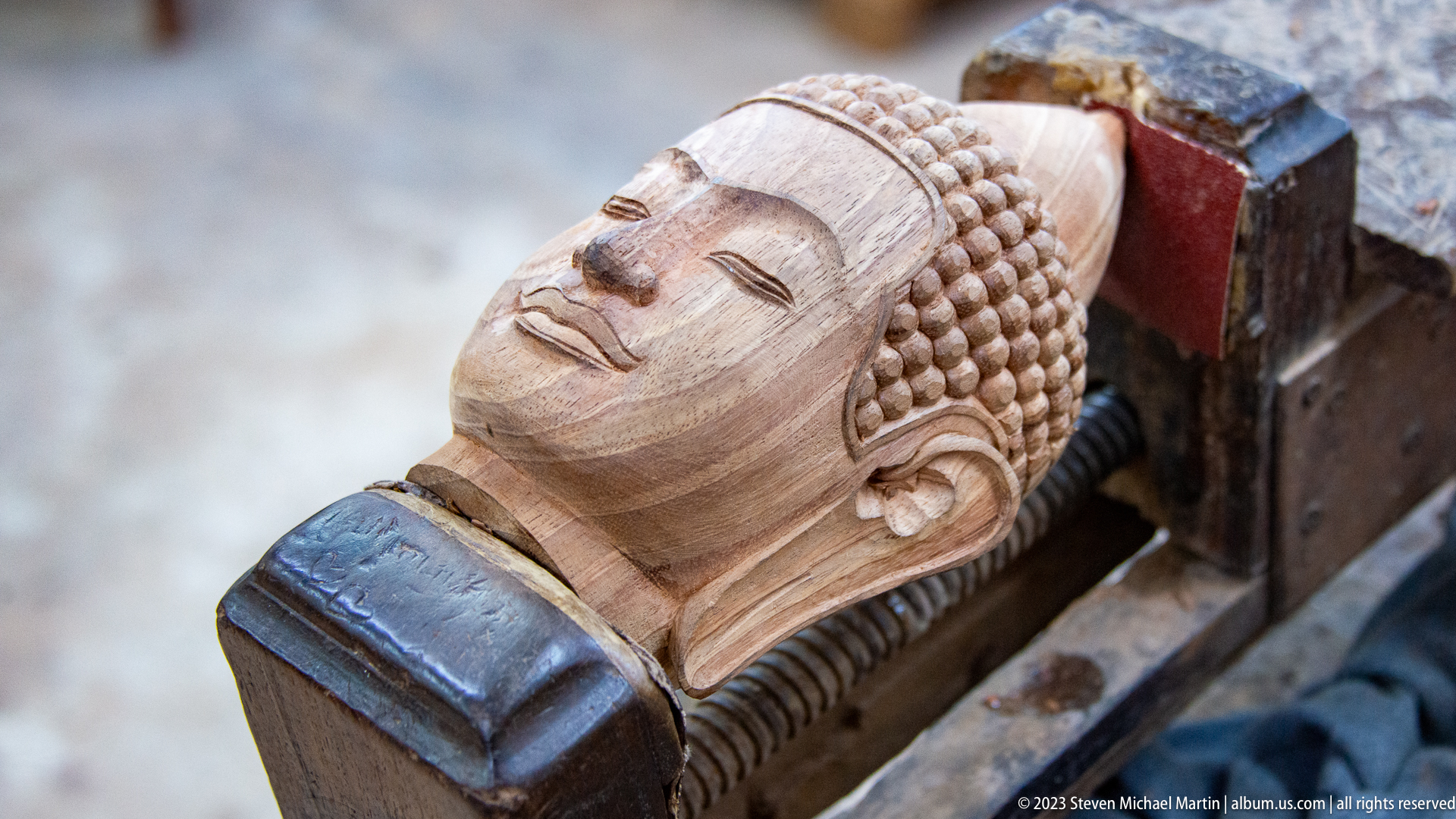
An unfinished wooden Buddha head at Artisans Angkor reveals the precision of the carving before surface finishing. The natural grain remains visible across the serene face and rows of tightly modeled hair curls. The photograph documents this stage of production within the visitor-accessible workshops in Siem Reap.
Caption
An unfinished wooden Buddha head at Artisans Angkor reveals the precision of the carving before surface finishing. The natural grain remains visible across the serene face and rows of tightly modeled hair curls. The photograph documents this stage of production within the visitor-accessible workshops in Siem Reap.

An unfinished wooden female figure at Artisans Angkor displays elaborate jewelry, patterned garments, and carefully modeled hands. The unpainted surface makes the carved ornament especially visible before final coloring or polishing. The photograph documents this stage of production within the visitor-accessible workshops in Siem Reap.
Caption
An unfinished wooden female figure at Artisans Angkor displays elaborate jewelry, patterned garments, and carefully modeled hands. The unpainted surface makes the carved ornament especially visible before final coloring or polishing. The photograph documents this stage of production within the visitor-accessible workshops in Siem Reap.

Reference drawings at Artisans Angkor show Khmer-style figures from several viewpoints and in different poses. These measured line studies provide artisans with consistent guides for proportions, costume, and sculptural detail. The photograph documents this stage of production within the visitor-accessible workshops in Siem Reap.
Caption
Reference drawings at Artisans Angkor show Khmer-style figures from several viewpoints and in different poses. These measured line studies provide artisans with consistent guides for proportions, costume, and sculptural detail. The photograph documents this stage of production within the visitor-accessible workshops in Siem Reap.

A dense wall of sketches serves as a working visual archive for Artisans Angkor's sculptors. Drawings of seated, standing, and dancing figures provide pose, costume, and composition references for different objects under production. The photograph documents this stage of production within the visitor-accessible workshops in Siem Reap.
Caption
A dense wall of sketches serves as a working visual archive for Artisans Angkor's sculptors. Drawings of seated, standing, and dancing figures provide pose, costume, and composition references for different objects under production. The photograph documents this stage of production within the visitor-accessible workshops in Siem Reap.

A full-page workshop drawing presents a Khmer-style female dancer in a dynamic raised-arm pose. Fine line work records the figure's jewelry, costume, and body position for later translation into carved or painted form. The photograph documents this stage of production within the visitor-accessible workshops in Siem Reap.
Caption
A full-page workshop drawing presents a Khmer-style female dancer in a dynamic raised-arm pose. Fine line work records the figure's jewelry, costume, and body position for later translation into carved or painted form. The photograph documents this stage of production within the visitor-accessible workshops in Siem Reap.

A close view of an unfinished wooden Buddha face reveals the sculptor's careful modeling of the brows, eyelids, nose, and mouth. The natural grain remains prominent before final polishing or surface treatment. The photograph documents this stage of production within the visitor-accessible workshops in Siem Reap.
Caption
A close view of an unfinished wooden Buddha face reveals the sculptor's careful modeling of the brows, eyelids, nose, and mouth. The natural grain remains prominent before final polishing or surface treatment. The photograph documents this stage of production within the visitor-accessible workshops in Siem Reap.

An Artisans Angkor material display presents a very soft carving stone marked by purple and black veins. The rough edge and cut upper surface help visitors compare its natural appearance with the form prepared for workshop use.
Caption
An Artisans Angkor material display presents a very soft carving stone marked by purple and black veins. The rough edge and cut upper surface help visitors compare its natural appearance with the form prepared for workshop use.

An artisan at Artisans Angkor hand-finishes a large decorative relief. The panel's crowded figures and ornament require careful surface work after the design has been formed. The photograph documents this stage of production within the visitor-accessible workshops in Siem Reap.
Caption
An artisan at Artisans Angkor hand-finishes a large decorative relief. The panel's crowded figures and ornament require careful surface work after the design has been formed. The photograph documents this stage of production within the visitor-accessible workshops in Siem Reap.

Visitors observe an artisan finishing a large relief panel at Artisans Angkor. The open workshop setting turns the production process itself into part of the site's educational experience. The photograph documents this stage of production within the visitor-accessible workshops in Siem Reap.
Caption
Visitors observe an artisan finishing a large relief panel at Artisans Angkor. The open workshop setting turns the production process itself into part of the site's educational experience. The photograph documents this stage of production within the visitor-accessible workshops in Siem Reap.

A hand moves across the textured surface of a colored relief at Artisans Angkor. Dark blue, cream, gold, and brown tones emphasize the dense figures and ornamental scrollwork. The photograph documents this stage of production within the visitor-accessible workshops in Siem Reap.
Caption
A hand moves across the textured surface of a colored relief at Artisans Angkor. Dark blue, cream, gold, and brown tones emphasize the dense figures and ornamental scrollwork. The photograph documents this stage of production within the visitor-accessible workshops in Siem Reap.

A comparative panel at Artisans Angkor introduces four sandstone varieties used by Cambodian carvers. Photographs of finished objects and bilingual descriptions connect each stone's color and source with its sculptural possibilities. The photograph documents this stage of production within the visitor-accessible workshops in Siem Reap.
Caption
A comparative panel at Artisans Angkor introduces four sandstone varieties used by Cambodian carvers. Photographs of finished objects and bilingual descriptions connect each stone's color and source with its sculptural possibilities. The photograph documents this stage of production within the visitor-accessible workshops in Siem Reap.

A labeled sample at Artisans Angkor identifies a wood-like yellow stone from Phnom Chun Chang in Banteay Meanchey Province. The panel notes that gray veins and the material's working properties influence how clearly a finished carving can be read.
Caption
A labeled sample at Artisans Angkor identifies a wood-like yellow stone from Phnom Chun Chang in Banteay Meanchey Province. The panel notes that gray veins and the material's working properties influence how clearly a finished carving can be read.

A grayish-pink stone sample at Artisans Angkor represents a versatile carving material used for both large statues and smaller motifs. Its rough natural edge contrasts with the smooth sawn surface prepared for carving. The photograph documents this stage of production within the visitor-accessible workshops in Siem Reap.
Caption
A grayish-pink stone sample at Artisans Angkor represents a versatile carving material used for both large statues and smaller motifs. Its rough natural edge contrasts with the smooth sawn surface prepared for carving. The photograph documents this stage of production within the visitor-accessible workshops in Siem Reap.

This gray-to-green stone sample at Artisans Angkor is identified as a hard material suitable for large carved statues. The display explains how physical properties help determine the scale and type of sculpture an artisan can produce.
Caption
This gray-to-green stone sample at Artisans Angkor is identified as a hard material suitable for large carved statues. The display explains how physical properties help determine the scale and type of sculpture an artisan can produce.

A full-scale preparatory drawing organizes a Khmer narrative scene around a dominant standing figure. Dense ranks of attendants, architectural details, and ornament provide artisans with a precise guide for transferring the composition to a relief surface.
Caption
A full-scale preparatory drawing organizes a Khmer narrative scene around a dominant standing figure. Dense ranks of attendants, architectural details, and ornament provide artisans with a precise guide for transferring the composition to a relief surface.

Small figures and animal forms demonstrate a four-stage production process at Artisans Angkor. The examples show how an original model is translated through intermediate stages before the object is cleaned and finished. The photograph documents this stage of production within the visitor-accessible workshops in Siem Reap.
Caption
Small figures and animal forms demonstrate a four-stage production process at Artisans Angkor. The examples show how an original model is translated through intermediate stages before the object is cleaned and finished. The photograph documents this stage of production within the visitor-accessible workshops in Siem Reap.

An artisan at Artisans Angkor shapes a large curved stone component while working from a nearby design drawing. Power tools assist the rough shaping, while hand control preserves the intended profile. The photograph documents this stage of production within the visitor-accessible workshops in Siem Reap.
Caption
An artisan at Artisans Angkor shapes a large curved stone component while working from a nearby design drawing. Power tools assist the rough shaping, while hand control preserves the intended profile. The photograph documents this stage of production within the visitor-accessible workshops in Siem Reap.

An artisan at Artisans Angkor transfers a complex design onto a large relief panel. Working beneath a suspended reference drawing, she traces the composition before deeper carving and surface finishing begin. The photograph documents this stage of production within the visitor-accessible workshops in Siem Reap.
Caption
An artisan at Artisans Angkor transfers a complex design onto a large relief panel. Working beneath a suspended reference drawing, she traces the composition before deeper carving and surface finishing begin. The photograph documents this stage of production within the visitor-accessible workshops in Siem Reap.

Layered tracing sheets show how artisans coordinate separate parts of a decorative design before transferring it to a finished surface. A leafy branch overlays a larger figure drawing, while a small printed logo serves as an additional reference.
Caption
Layered tracing sheets show how artisans coordinate separate parts of a decorative design before transferring it to a finished surface. A leafy branch overlays a larger figure drawing, while a small printed logo serves as an additional reference.

A finished decorative panel at Artisans Angkor presents a slender golden tree against a luminous blue and yellow field. The work shows how workshop artists adapt natural imagery into contemporary interior objects. The photograph documents this stage of production within the visitor-accessible workshops in Siem Reap.
Caption
A finished decorative panel at Artisans Angkor presents a slender golden tree against a luminous blue and yellow field. The work shows how workshop artists adapt natural imagery into contemporary interior objects. The photograph documents this stage of production within the visitor-accessible workshops in Siem Reap.

An artisan at Artisans Angkor applies fine painted detail to a Khmer-style figure on a dark panel. Orange contours and blue patterned costume areas are built up carefully by hand. The photograph documents this stage of production within the visitor-accessible workshops in Siem Reap.
Caption
An artisan at Artisans Angkor applies fine painted detail to a Khmer-style figure on a dark panel. Orange contours and blue patterned costume areas are built up carefully by hand. The photograph documents this stage of production within the visitor-accessible workshops in Siem Reap.

A wider side view shows the artisan extending a transferred design across the full relief panel. The suspended paper reference remains directly above the work to maintain consistency across the large composition. The photograph documents this stage of production within the visitor-accessible workshops in Siem Reap.
Caption
A wider side view shows the artisan extending a transferred design across the full relief panel. The suspended paper reference remains directly above the work to maintain consistency across the large composition. The photograph documents this stage of production within the visitor-accessible workshops in Siem Reap.

A close view captures the precise transfer of a crowded narrative scene onto a relief panel. The artisan defines the central figure and surrounding ornament line by line before the carving is deepened. The photograph documents this stage of production within the visitor-accessible workshops in Siem Reap.
Caption
A close view captures the precise transfer of a crowded narrative scene onto a relief panel. The artisan defines the central figure and surrounding ornament line by line before the carving is deepened. The photograph documents this stage of production within the visitor-accessible workshops in Siem Reap.

A metal artisan at Artisans Angkor uses a hammer and punch to build a fine decorative pattern across a rectangular sheet. The thick backing supports the metal while repeated controlled strikes shape its surface. The photograph documents this stage of production within the visitor-accessible workshops in Siem Reap.
Caption
A metal artisan at Artisans Angkor uses a hammer and punch to build a fine decorative pattern across a rectangular sheet. The thick backing supports the metal while repeated controlled strikes shape its surface. The photograph documents this stage of production within the visitor-accessible workshops in Siem Reap.

In a close view of metalworking at Artisans Angkor, the artisan braces a punch and strikes it with a small hammer. Repeated marks gradually build the panel's intricate texture. The photograph documents this stage of production within the visitor-accessible workshops in Siem Reap.
Caption
In a close view of metalworking at Artisans Angkor, the artisan braces a punch and strikes it with a small hammer. Repeated marks gradually build the panel's intricate texture. The photograph documents this stage of production within the visitor-accessible workshops in Siem Reap.

Dozens of small gold-colored components are arranged in orderly rows at Artisans Angkor. Their uniformity and spacing suggest a batch stage for drying, inspection, or preparation before assembly into larger decorative works. The photograph documents this stage of production within the visitor-accessible workshops in Siem Reap.
Caption
Dozens of small gold-colored components are arranged in orderly rows at Artisans Angkor. Their uniformity and spacing suggest a batch stage for drying, inspection, or preparation before assembly into larger decorative works. The photograph documents this stage of production within the visitor-accessible workshops in Siem Reap.

An interpretive panel at Artisans Angkor identifies visual sources used in workshop designs, including the Buddha beneath a tree and the monumental smiling faces associated with the Bayon temple. The photograph documents this stage of production within the visitor-accessible workshops in Siem Reap.
Caption
An interpretive panel at Artisans Angkor identifies visual sources used in workshop designs, including the Buddha beneath a tree and the monumental smiling faces associated with the Bayon temple. The photograph documents this stage of production within the visitor-accessible workshops in Siem Reap.

A finished stone sculpture at Artisans Angkor depicts an elaborately dressed kneeling woman supporting a carved bird-like or mythical creature. Fine jewelry, costume patterns, and feather-like ornament demonstrate the workshop's detailed carving. The photograph documents this stage of production within the visitor-accessible workshops in Siem Reap.
Caption
A finished stone sculpture at Artisans Angkor depicts an elaborately dressed kneeling woman supporting a carved bird-like or mythical creature. Fine jewelry, costume patterns, and feather-like ornament demonstrate the workshop's detailed carving. The photograph documents this stage of production within the visitor-accessible workshops in Siem Reap.

A large finished stone head at Artisans Angkor adapts the serene expression and ornamented headdress associated with Khmer monumental sculpture. A smaller framed face carving beside it shows the same visual tradition at a different scale.
Caption
A large finished stone head at Artisans Angkor adapts the serene expression and ornamented headdress associated with Khmer monumental sculpture. A smaller framed face carving beside it shows the same visual tradition at a different scale.