Banff – Johnston Canyon
Johnston Canyon cuts a narrow, shadowed gorge through the forested slopes of Banff National Park, where Johnston Creek has carved its way through the rock. The trail follows the water into the canyon, bringing visitors close to the rushing stream and its steep, textured walls.
Along the route, the creek drops over a series of cascades before reaching the Lower and Upper Falls. Bridges and walkways trace the canyon’s edge, opening views into places that would otherwise be difficult to reach. Banff National Park
The walk brings together water, rock, and forest in a compact Rocky Mountain landscape. From the first views of the creek to the taller falls farther upstream, Johnston Canyon rewards a slower look at the forces that continue to shape this part of Banff.
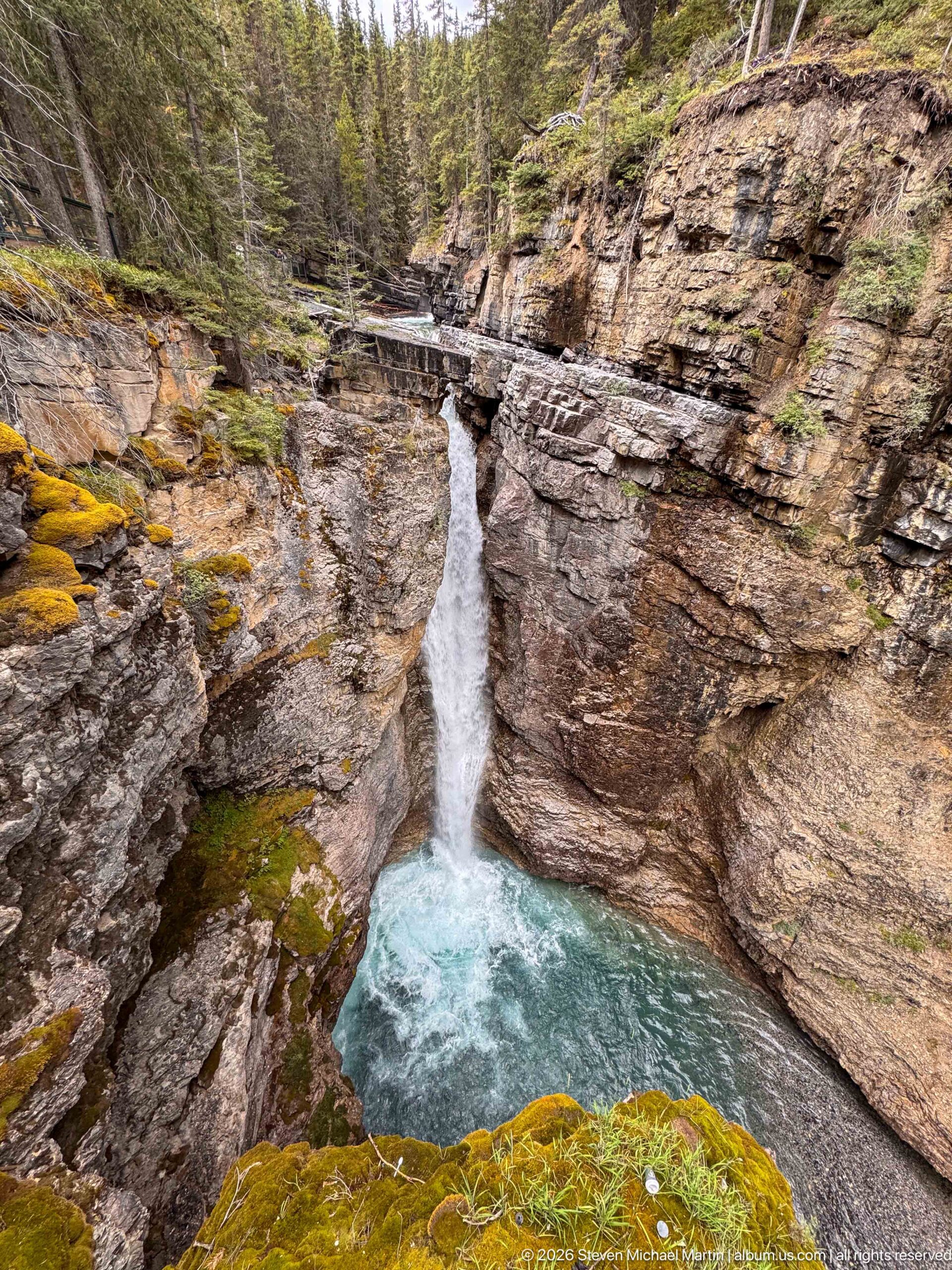
A narrow waterfall descends into a deep blue-green basin, its full drop framed by angular, layered walls. The wider view reveals the irregular ledges and moss-covered shelves that shape the channel around it. Rather than isolating the cascade, the composition shows how Johnston Creek occupies a confined passage cut through the surrounding rock.
Caption
A narrow waterfall descends into a deep blue-green basin, its full drop framed by angular, layered walls. The wider view reveals the irregular ledges and moss-covered shelves that shape the channel around it. Rather than isolating the cascade, the composition shows how Johnston Creek occupies a confined passage cut through the surrounding rock.
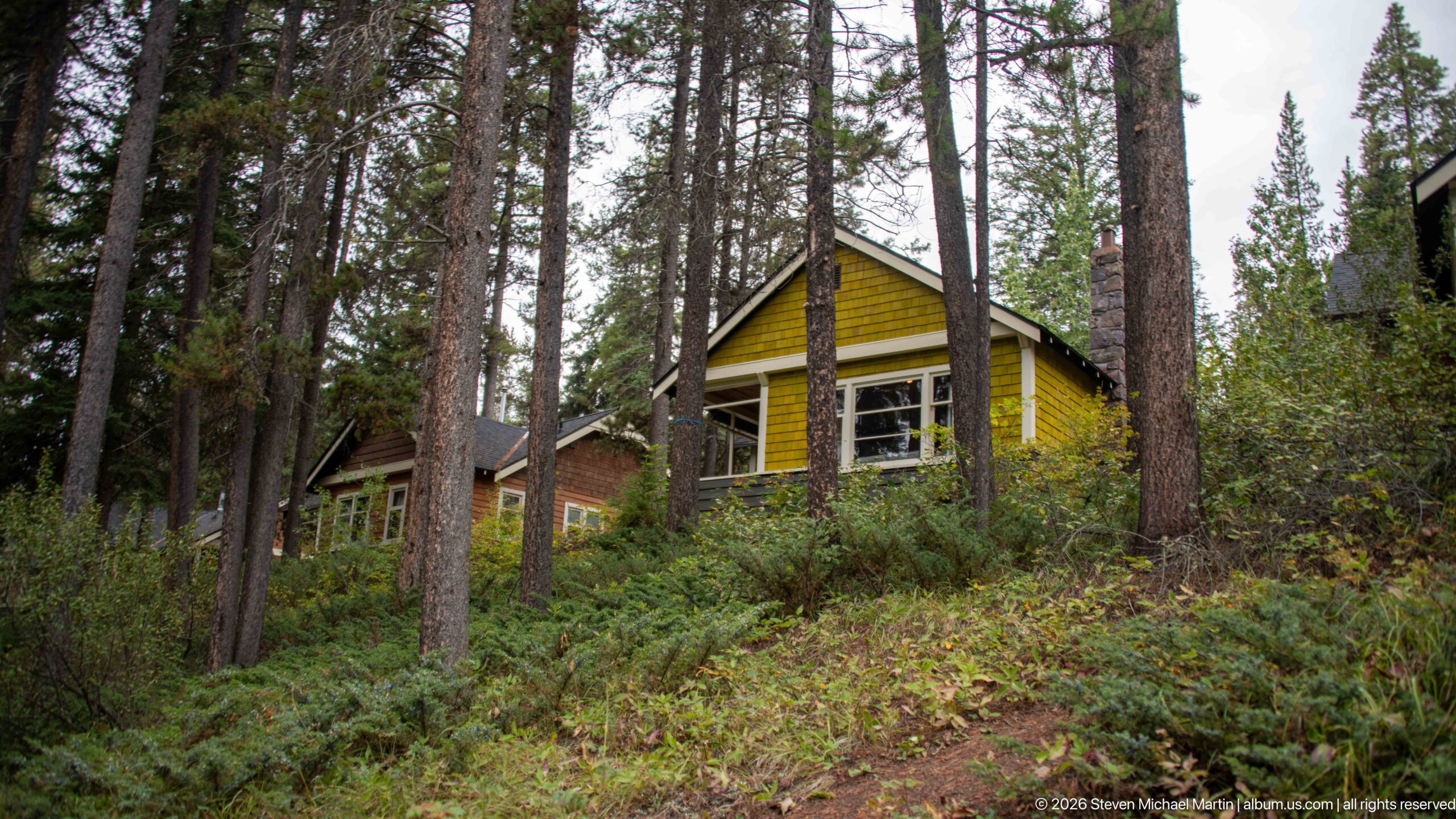
A small yellow-sided building appears through a screen of spruce and pine, with its steep roof and pale window frames partly concealed by trunks and undergrowth. The elevated viewpoint leaves the forest in the foreground and gives the structure a tucked-away presence. Its exact function is not apparent, so the photograph reads primarily as a built element within the wooded visitor landscape.
Caption
A small yellow-sided building appears through a screen of spruce and pine, with its steep roof and pale window frames partly concealed by trunks and undergrowth. The elevated viewpoint leaves the forest in the foreground and gives the structure a tucked-away presence. Its exact function is not apparent, so the photograph reads primarily as a built element within the wooded visitor landscape.
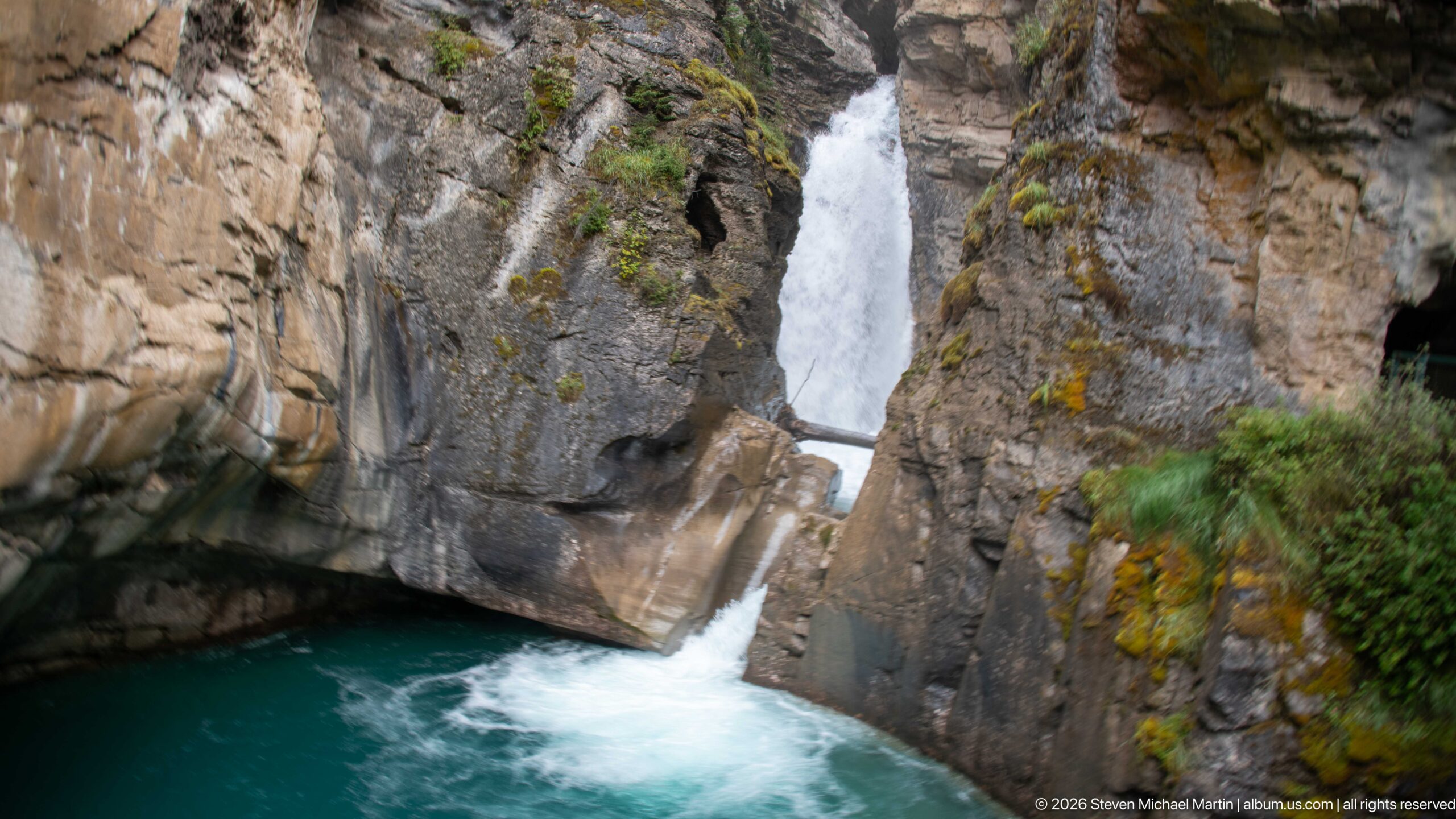
A white cascade descends through a narrow slot between steep, banded rock walls and crashes into a turquoise basin. A small wooden bridge spans the upper channel just above the main drop, adding a human-built line across the irregular stone. The close viewpoint makes the vertical cleft and the contrast between pale rock and dark water especially clear.
Caption
A white cascade descends through a narrow slot between steep, banded rock walls and crashes into a turquoise basin. A small wooden bridge spans the upper channel just above the main drop, adding a human-built line across the irregular stone. The close viewpoint makes the vertical cleft and the contrast between pale rock and dark water especially clear.
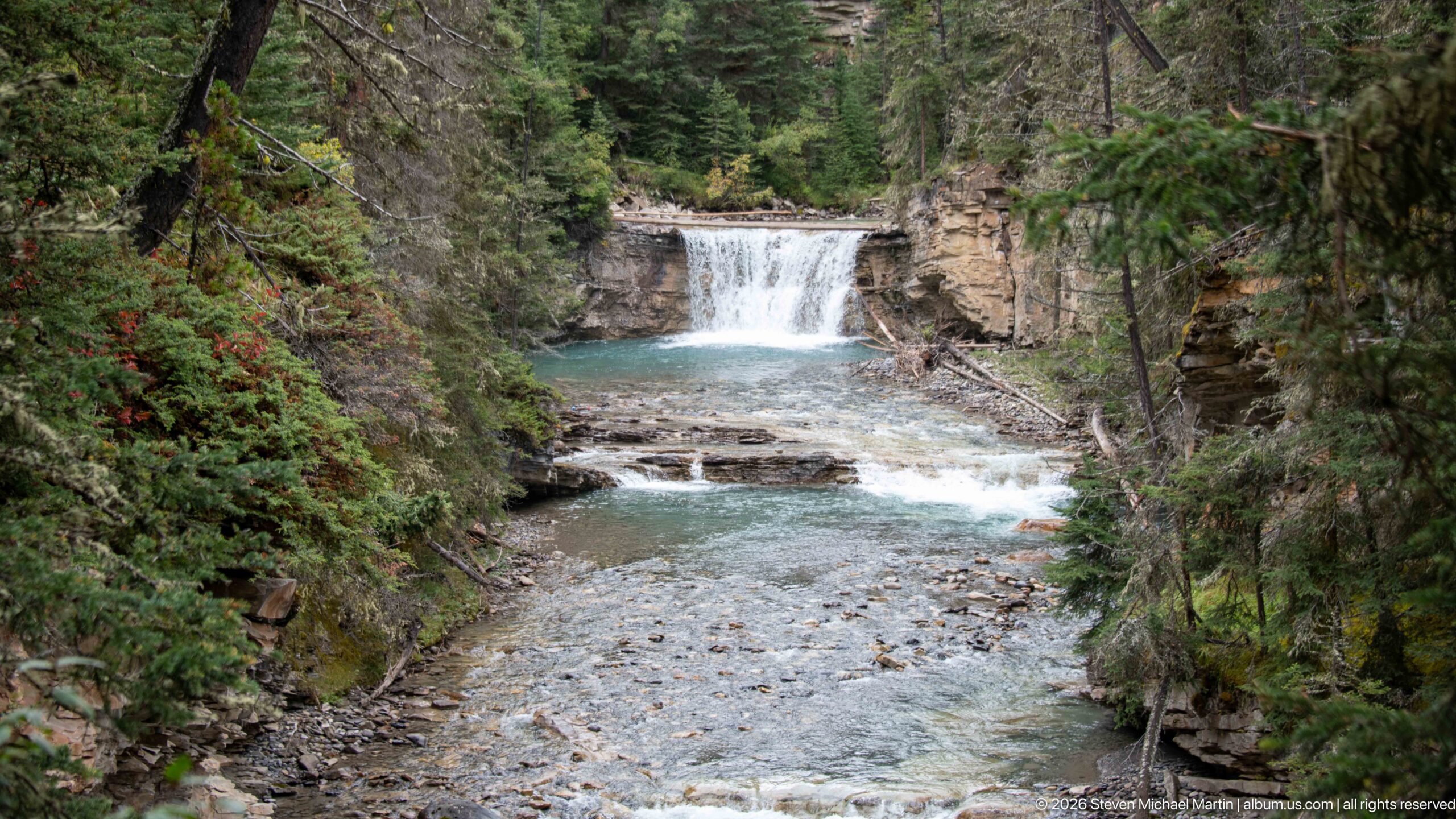
The creek fills the foreground with shallow, broken currents that lead toward a waterfall in the middle distance. Layered rock banks and conifers create a natural corridor around the water, while fallen branches rest along the right side of the channel. The longer perspective connects the cascade to the stream that continues through Johnston Canyon.
Caption
The creek fills the foreground with shallow, broken currents that lead toward a waterfall in the middle distance. Layered rock banks and conifers create a natural corridor around the water, while fallen branches rest along the right side of the channel. The longer perspective connects the cascade to the stream that continues through Johnston Canyon.
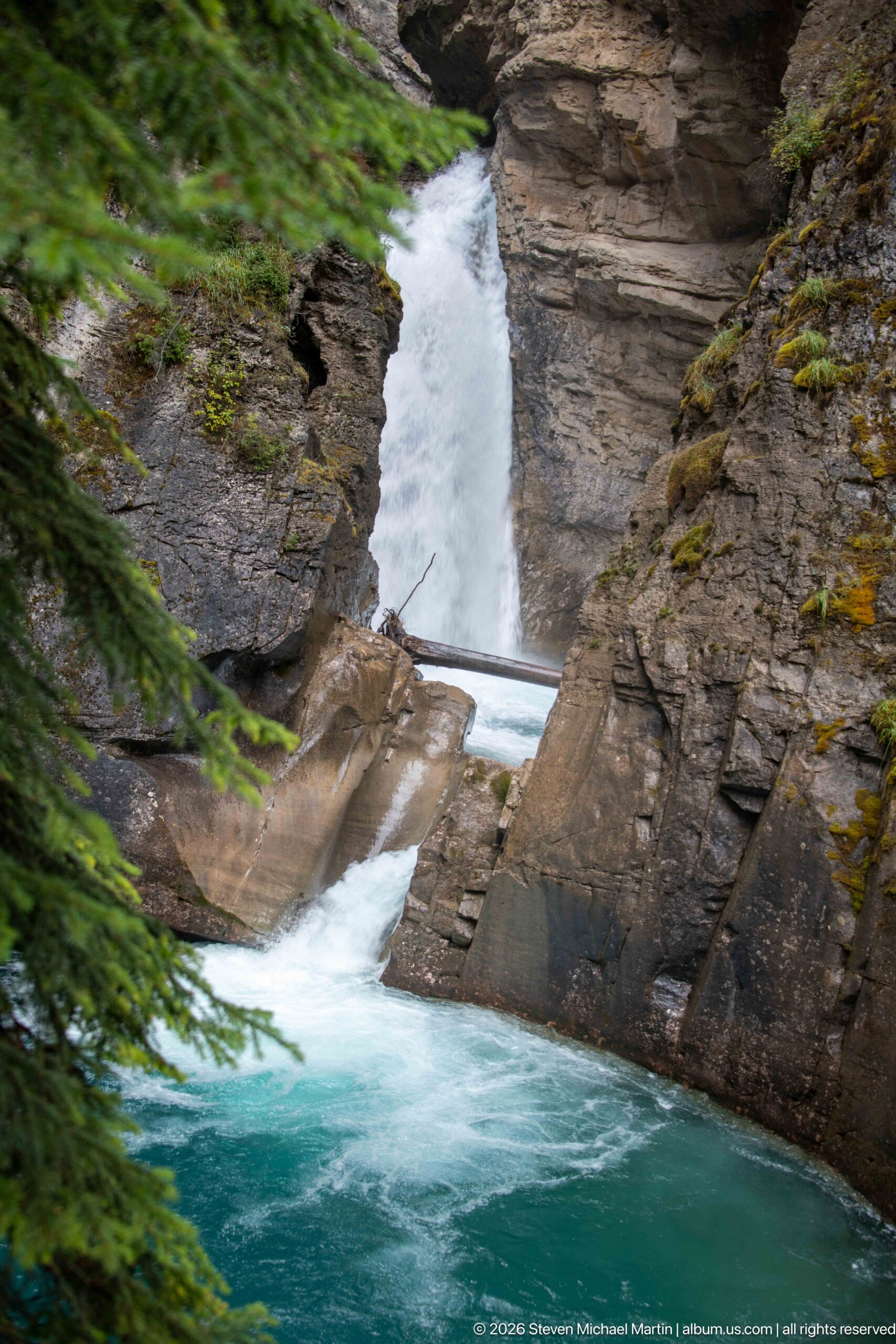
A narrow waterfall descends through a notch in the rock and flows beneath a wooden footbridge before spreading into whitewater below. Layered canyon walls rise close on both sides, while evergreen branches and moss soften their edges. The view follows the creek’s movement through several levels, showing how the crossing sits directly above the cascade.
Caption
A narrow waterfall descends through a notch in the rock and flows beneath a wooden footbridge before spreading into whitewater below. Layered canyon walls rise close on both sides, while evergreen branches and moss soften their edges. The view follows the creek’s movement through several levels, showing how the crossing sits directly above the cascade.
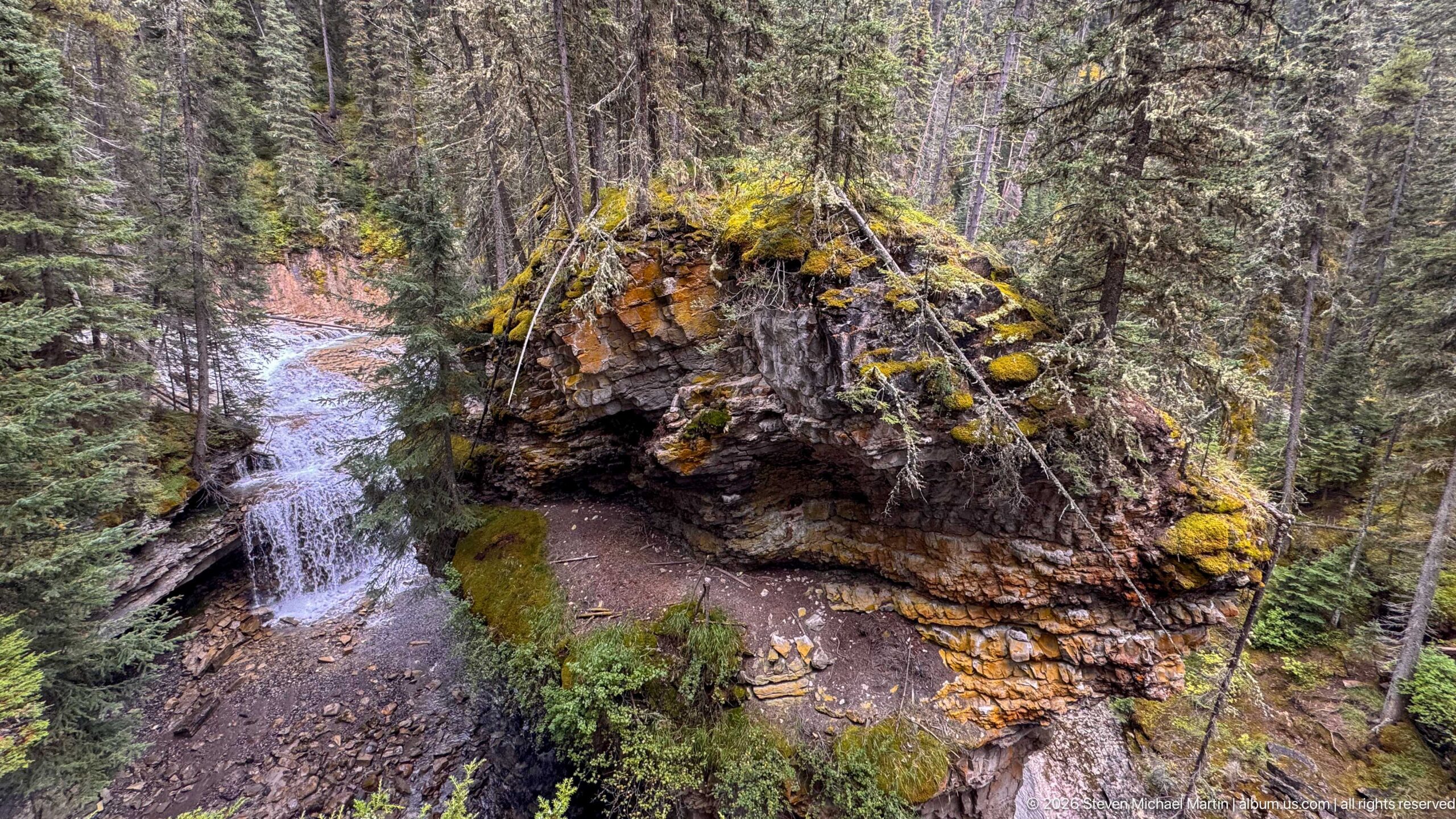
From above, Johnston Creek divides around a low, moss-covered rock outcrop and drops over a modest ledge at left. A gravelly footpath curves along the opposite bank beneath dense conifers, showing how the trail follows the water through the forest. The elevated viewpoint makes the relationship among rock, current, and path the defining feature.
Caption
From above, Johnston Creek divides around a low, moss-covered rock outcrop and drops over a modest ledge at left. A gravelly footpath curves along the opposite bank beneath dense conifers, showing how the trail follows the water through the forest. The elevated viewpoint makes the relationship among rock, current, and path the defining feature.
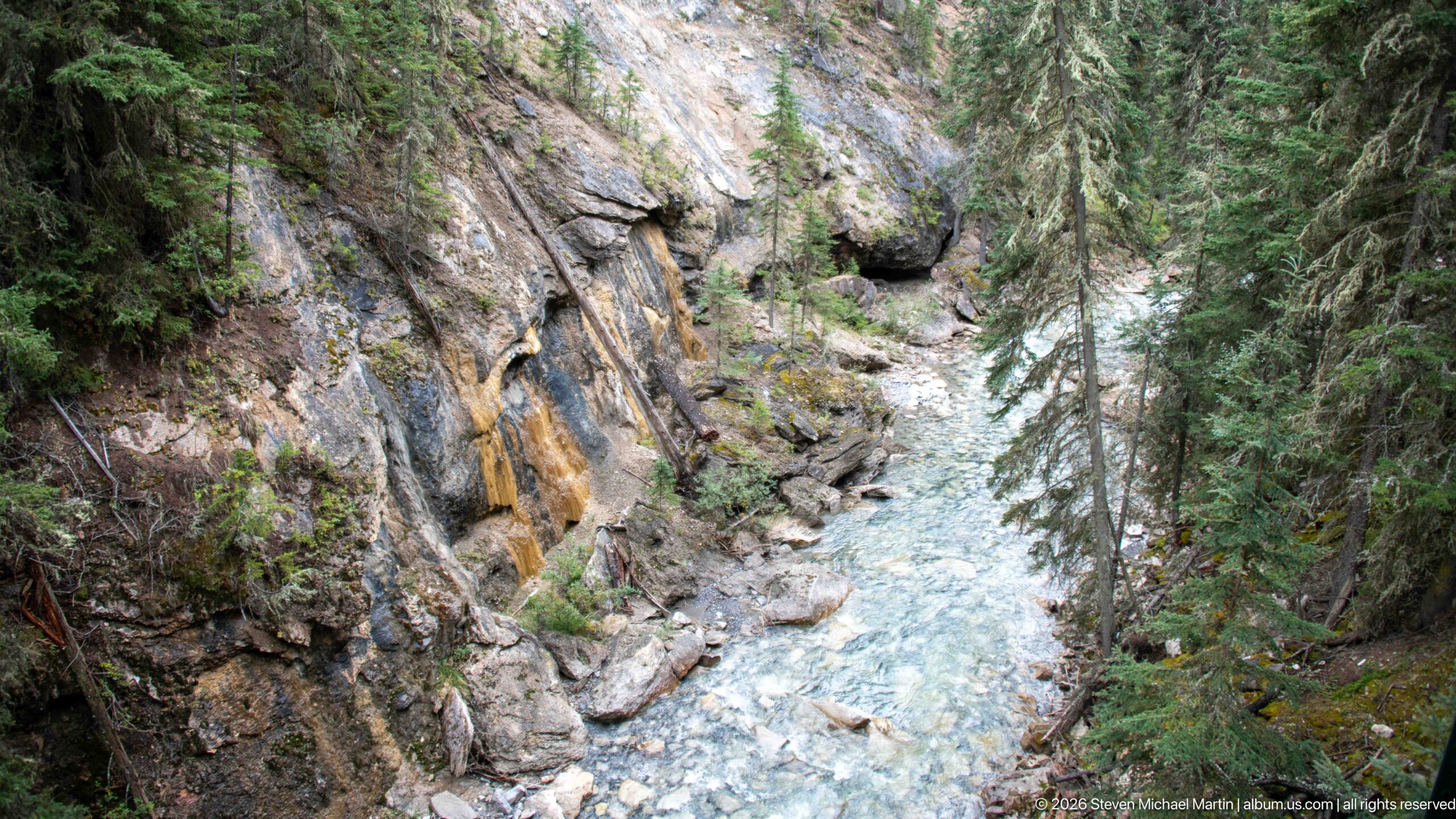
From an elevated position, the creek winds from the upper right toward the foreground through a broad bed of pale stones. Steep rock faces, orange mineral staining, and dense conifers frame the water, while small plants mark the channel edges. This contextual view shows the creek’s route through the wooded canyon rather than isolating one cascade.
Caption
From an elevated position, the creek winds from the upper right toward the foreground through a broad bed of pale stones. Steep rock faces, orange mineral staining, and dense conifers frame the water, while small plants mark the channel edges. This contextual view shows the creek’s route through the wooded canyon rather than isolating one cascade.
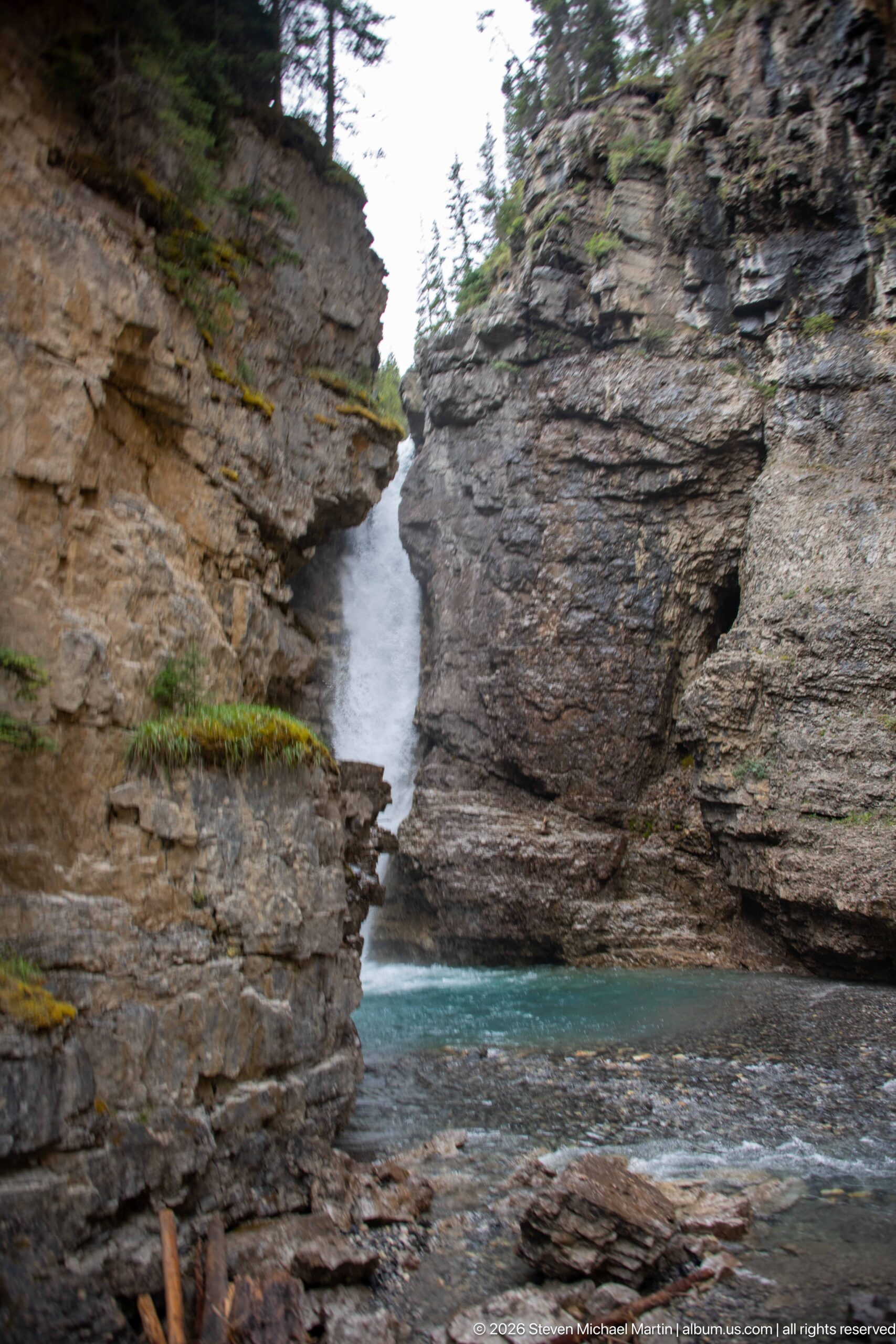
From a lower position in the gorge, the waterfall appears as a bright column beyond a narrow opening between steep rock walls. The dark, close foreground cliffs make the distant pool seem enclosed and emphasize the canyon’s depth. A small branch or log rests near the waterline, adding scale to the rough creek bed.
Caption
From a lower position in the gorge, the waterfall appears as a bright column beyond a narrow opening between steep rock walls. The dark, close foreground cliffs make the distant pool seem enclosed and emphasize the canyon’s depth. A small branch or log rests near the waterline, adding scale to the rough creek bed.
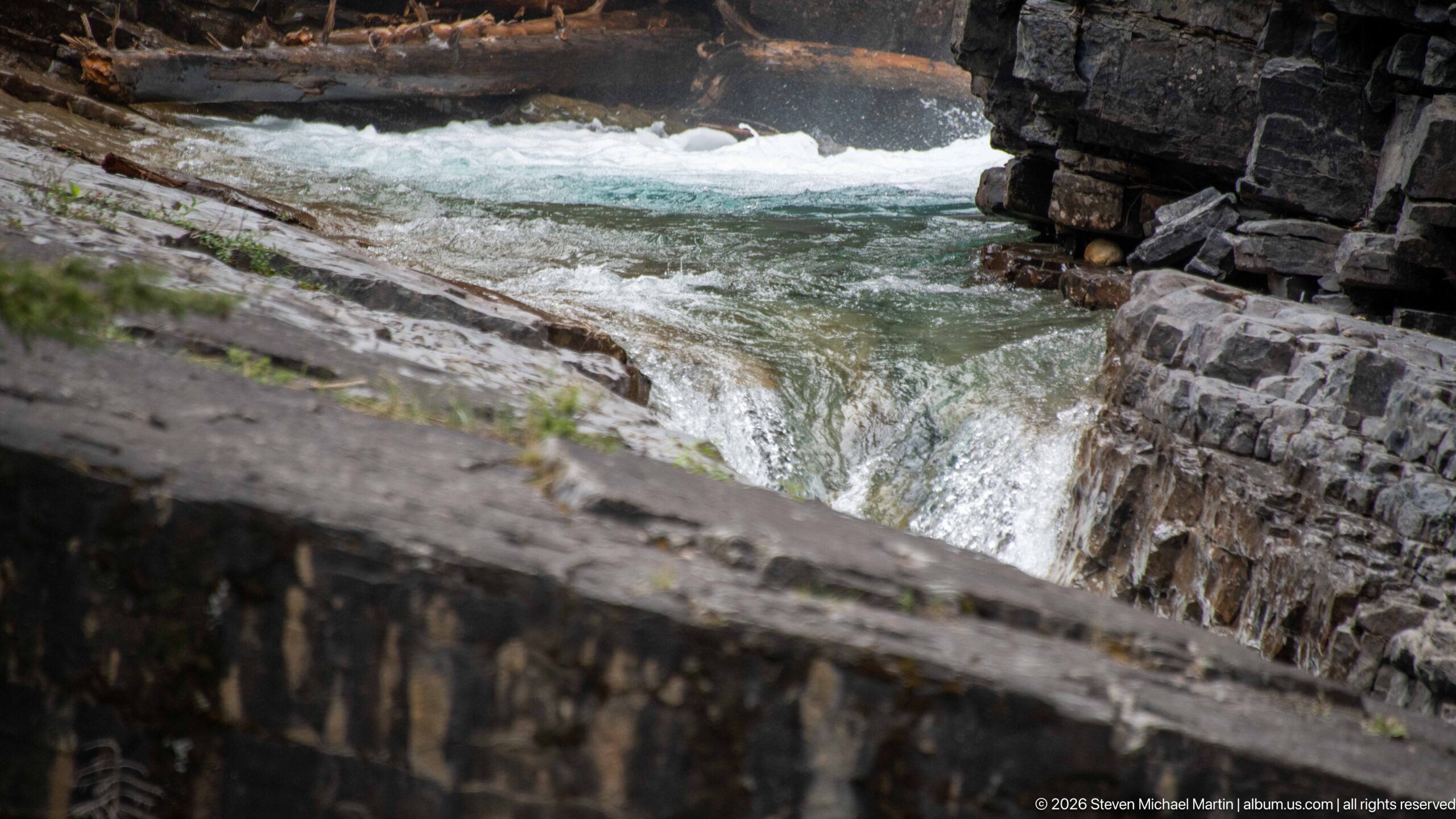
Seen from above a low stone parapet, Johnston Creek surges over a short drop into a churning basin. The diagonal wall cuts across the foreground and partly screens the water, linking the engineered visitor route with the steep natural channel below. Dark, squared rock faces close in around the pale foam and blue-green current.
Caption
Seen from above a low stone parapet, Johnston Creek surges over a short drop into a churning basin. The diagonal wall cuts across the foreground and partly screens the water, linking the engineered visitor route with the steep natural channel below. Dark, squared rock faces close in around the pale foam and blue-green current.
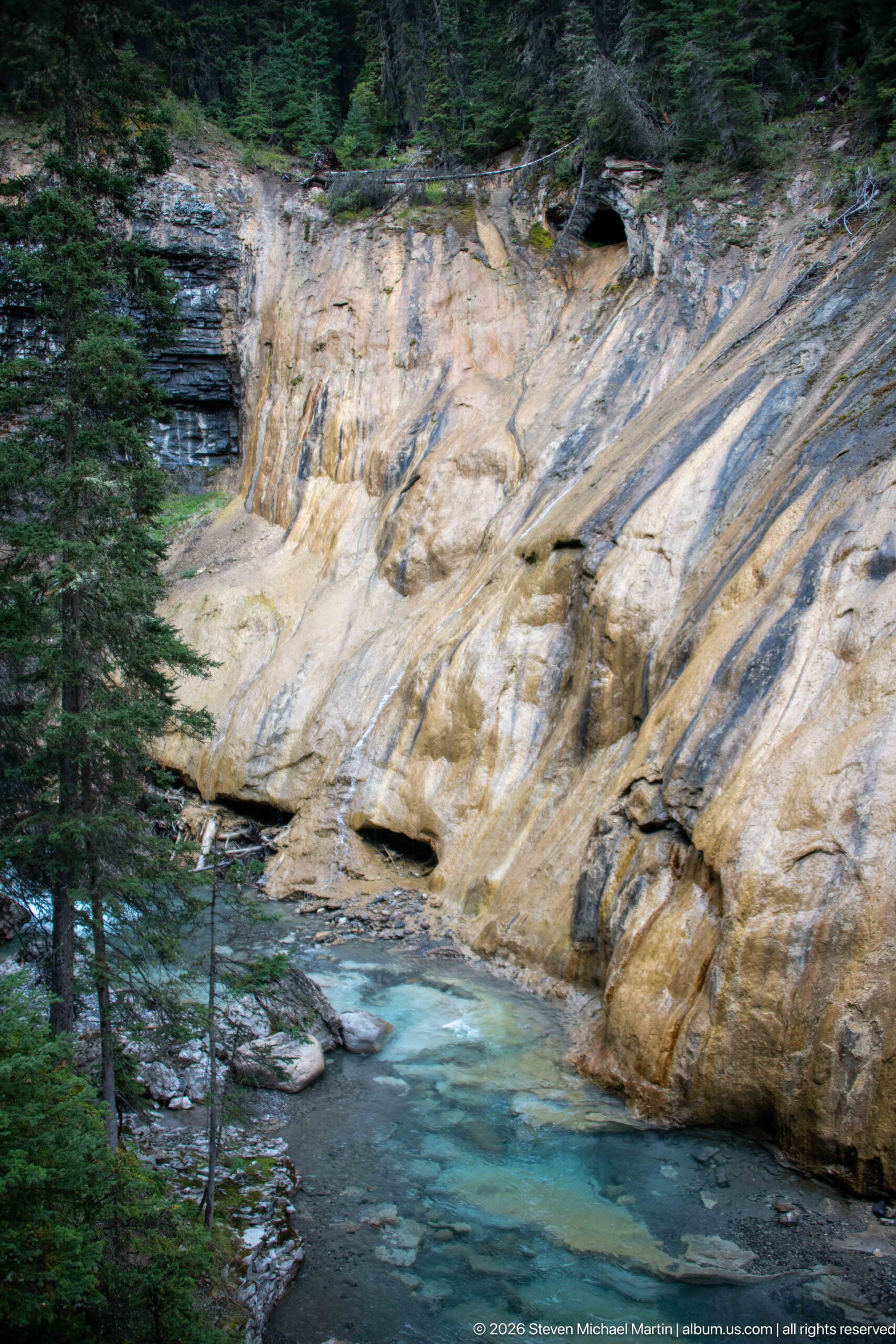
A clear turquoise reach of Johnston Creek runs below a broad rock face that slopes diagonally toward the water. Dark horizontal strata at one edge contrast with the pale, streaked surface opposite, where small openings and water marks interrupt the stone. The photograph shifts attention from waterfalls to the exposed geology and the stream’s course at the canyon floor.
Caption
A clear turquoise reach of Johnston Creek runs below a broad rock face that slopes diagonally toward the water. Dark horizontal strata at one edge contrast with the pale, streaked surface opposite, where small openings and water marks interrupt the stone. The photograph shifts attention from waterfalls to the exposed geology and the stream’s course at the canyon floor.

A bold black beaver emblem fills the frame, its simplified animal form enclosed by a circular outline and crossed by a horizontal motif. The close crop removes the surrounding sign or structure, making the national park symbol itself the subject. Its crisp silhouette gives this small graphic a strong visual presence within the Johnston Canyon visitor area.
Caption
A bold black beaver emblem fills the frame, its simplified animal form enclosed by a circular outline and crossed by a horizontal motif. The close crop removes the surrounding sign or structure, making the national park symbol itself the subject. Its crisp silhouette gives this small graphic a strong visual presence within the Johnston Canyon visitor area.
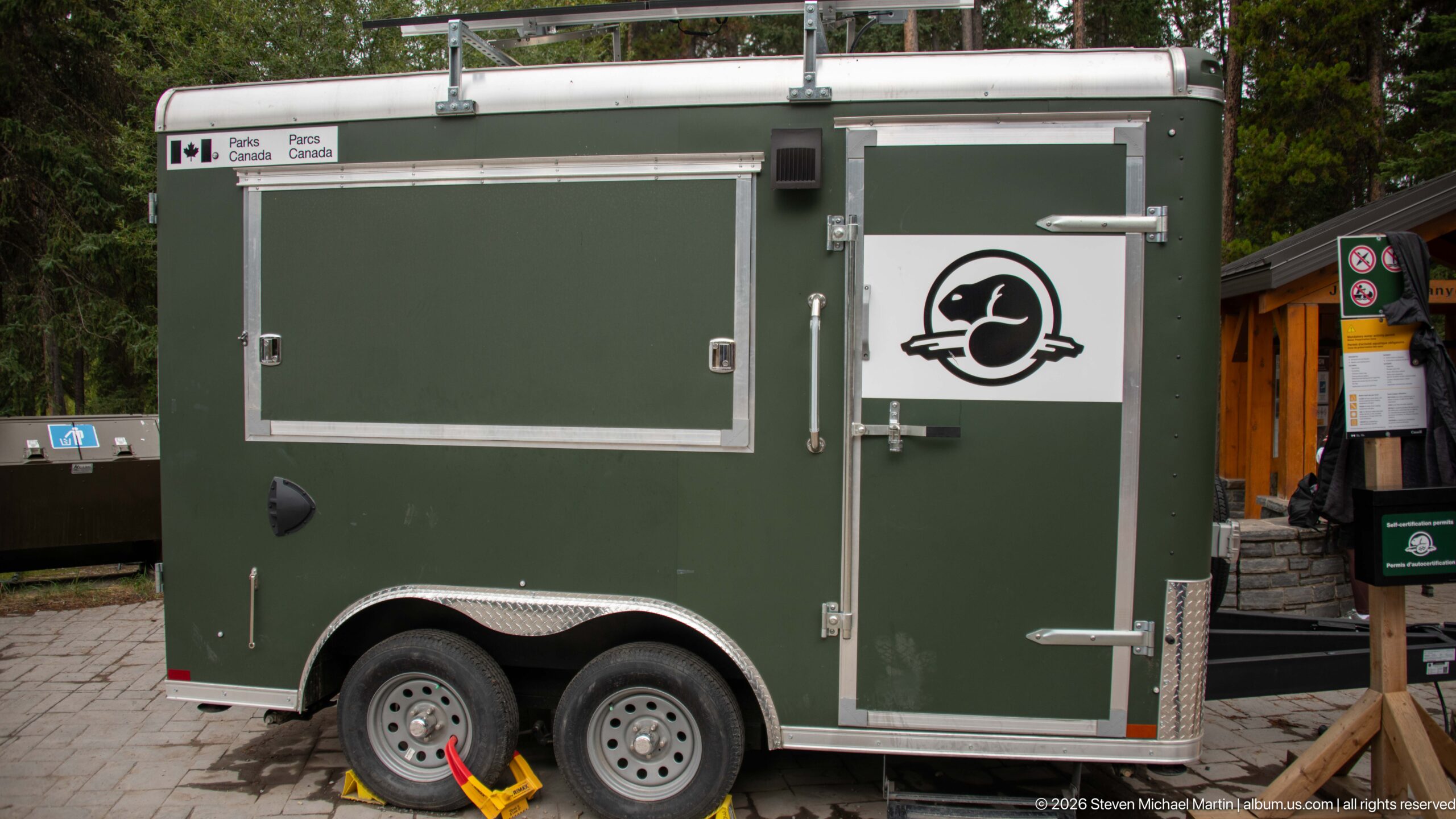
A dark green, dual-axle trailer stands on a paved area beside a wooden visitor structure. Its blank side panels, metal fittings, and heavy wheels make the vehicle the main subject, while a white door panel repeats the Parks Canada beaver emblem seen elsewhere in the site’s signage. The forest setting situates this practical equipment within the managed visitor area.
Caption
A dark green, dual-axle trailer stands on a paved area beside a wooden visitor structure. Its blank side panels, metal fittings, and heavy wheels make the vehicle the main subject, while a white door panel repeats the Parks Canada beaver emblem seen elsewhere in the site’s signage. The forest setting situates this practical equipment within the managed visitor area.
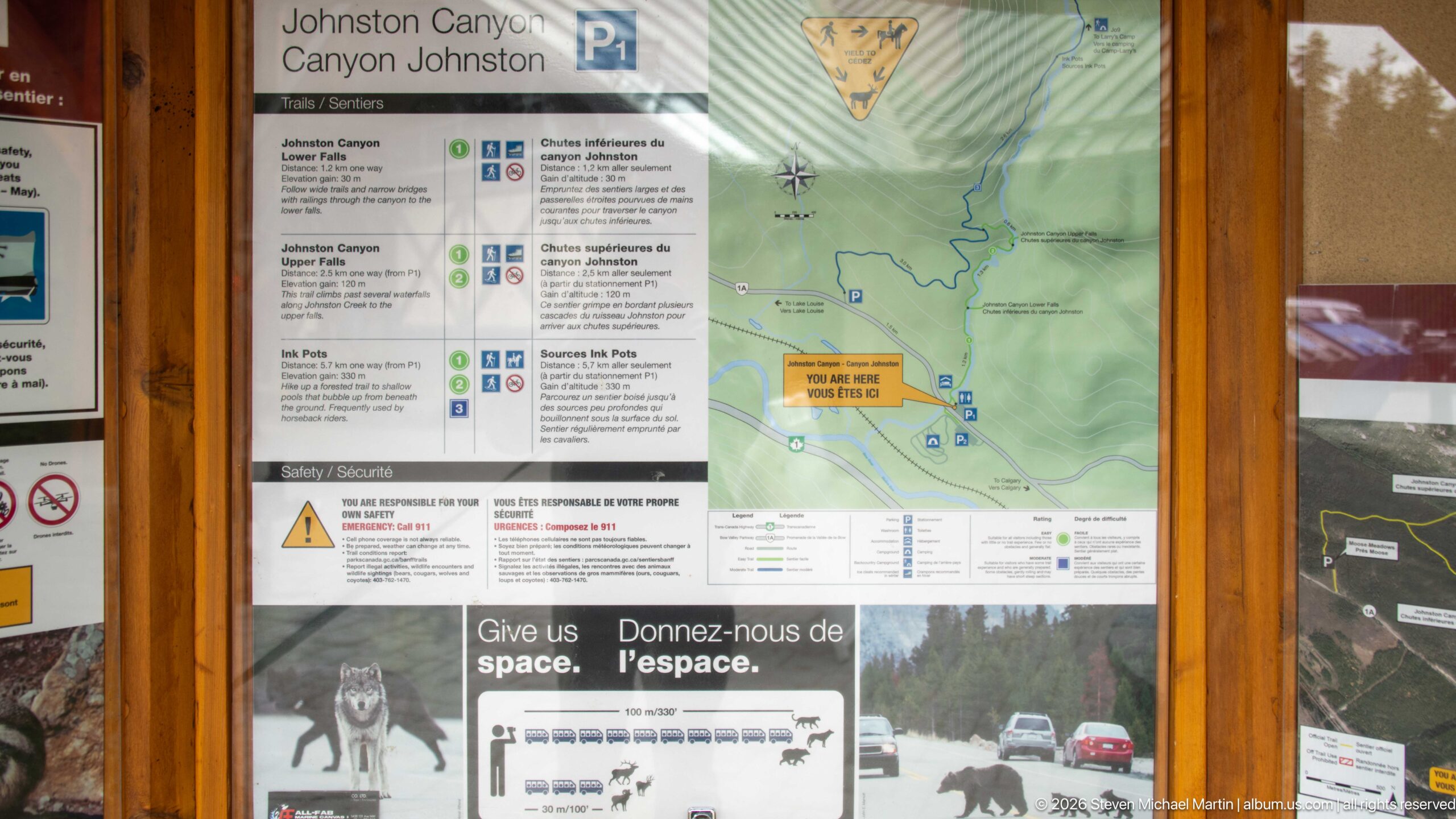
A close view of the Johnston Canyon information board brings together a trail map, route information, and wildlife-safety notices. The map traces paths through the surrounding terrain, while lower panels show animals and advise visitors to give wildlife space. Cropped edges and reflections place the emphasis on practical orientation and responsible travel rather than on the kiosk itself.
Caption
A close view of the Johnston Canyon information board brings together a trail map, route information, and wildlife-safety notices. The map traces paths through the surrounding terrain, while lower panels show animals and advise visitors to give wildlife space. Cropped edges and reflections place the emphasis on practical orientation and responsible travel rather than on the kiosk itself.
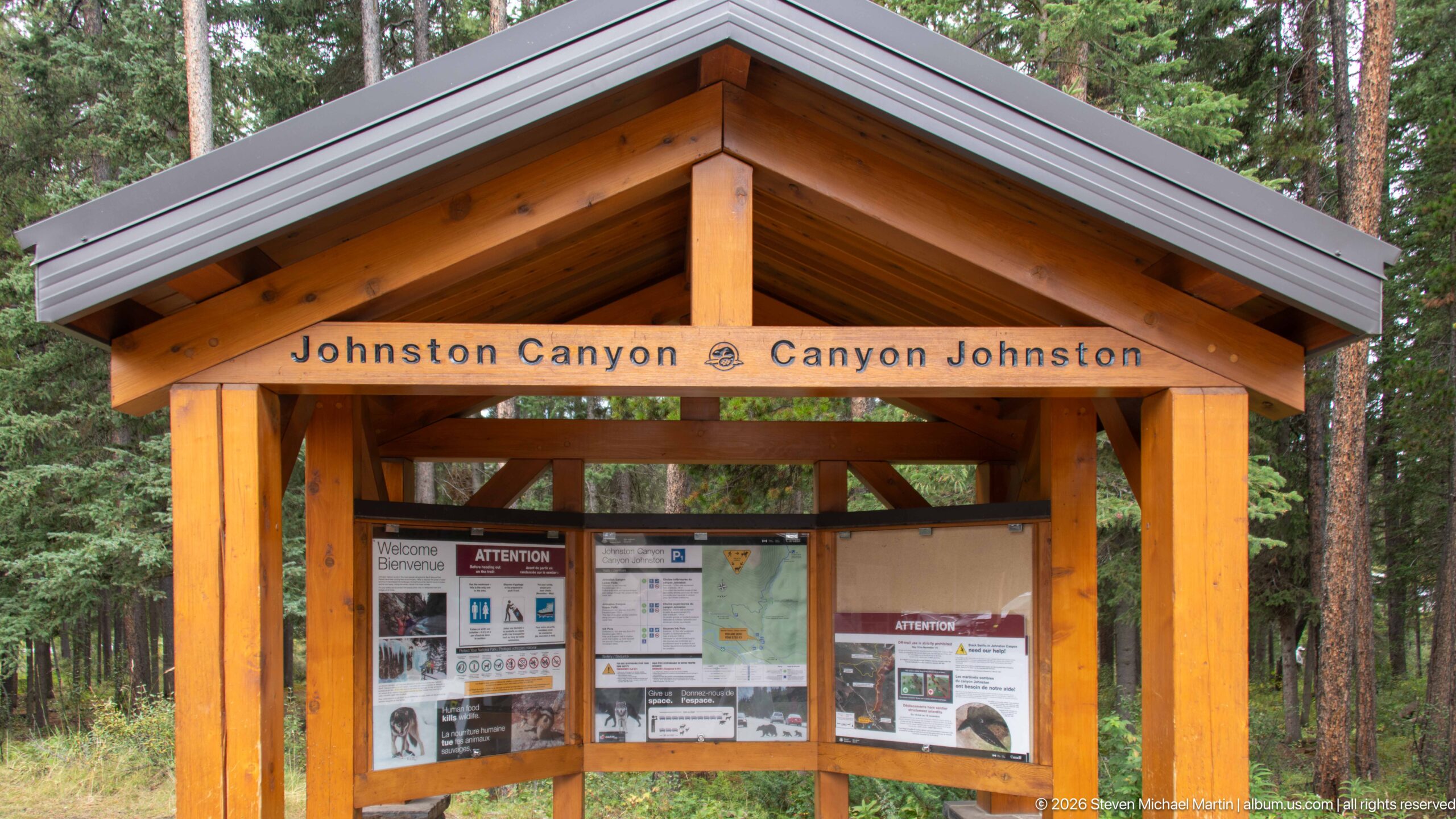
A timber-framed information kiosk stands among tall conifers, its peaked roof sheltering a three-sided display of maps and notices. The beam across the front reads “Johnston Canyon,” confirming the location. Framed from the path, the structure functions as a threshold between the visitor area and the wooded trail network beyond.
Caption
A timber-framed information kiosk stands among tall conifers, its peaked roof sheltering a three-sided display of maps and notices. The beam across the front reads “Johnston Canyon,” confirming the location. Framed from the path, the structure functions as a threshold between the visitor area and the wooded trail network beyond.
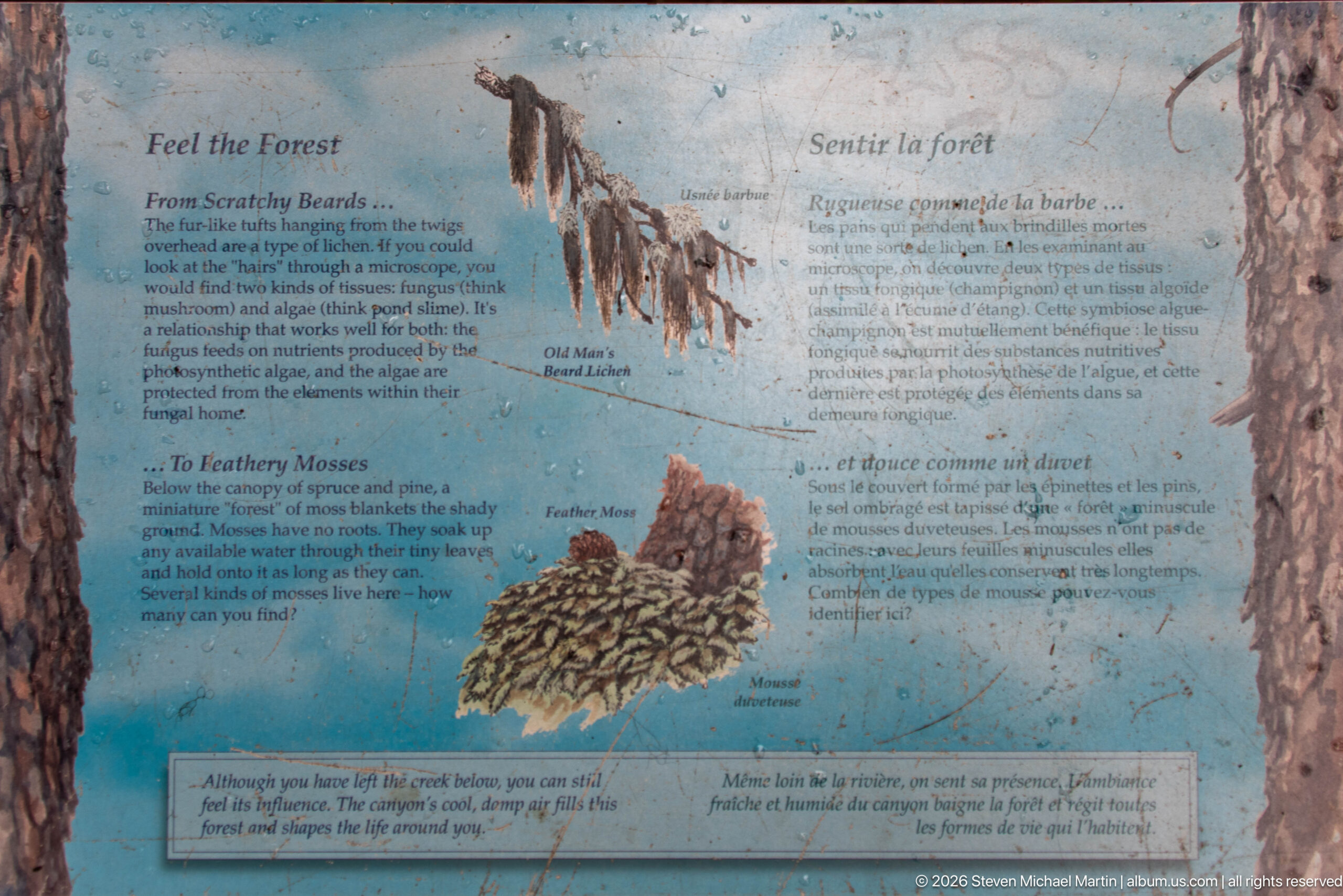
A weathered blue interpretive panel combines English and French text with illustrations of forest animals and plants. Headings about “scratchy beards” and “feathery mosses” invite attention to ecological details that are easy to overlook on a walk through the canyon. The close framing makes the illustrated natural-history content legible as a counterpart to the trail’s rushing water and rock walls.
Caption
A weathered blue interpretive panel combines English and French text with illustrations of forest animals and plants. Headings about “scratchy beards” and “feathery mosses” invite attention to ecological details that are easy to overlook on a walk through the canyon. The close framing makes the illustrated natural-history content legible as a counterpart to the trail’s rushing water and rock walls.
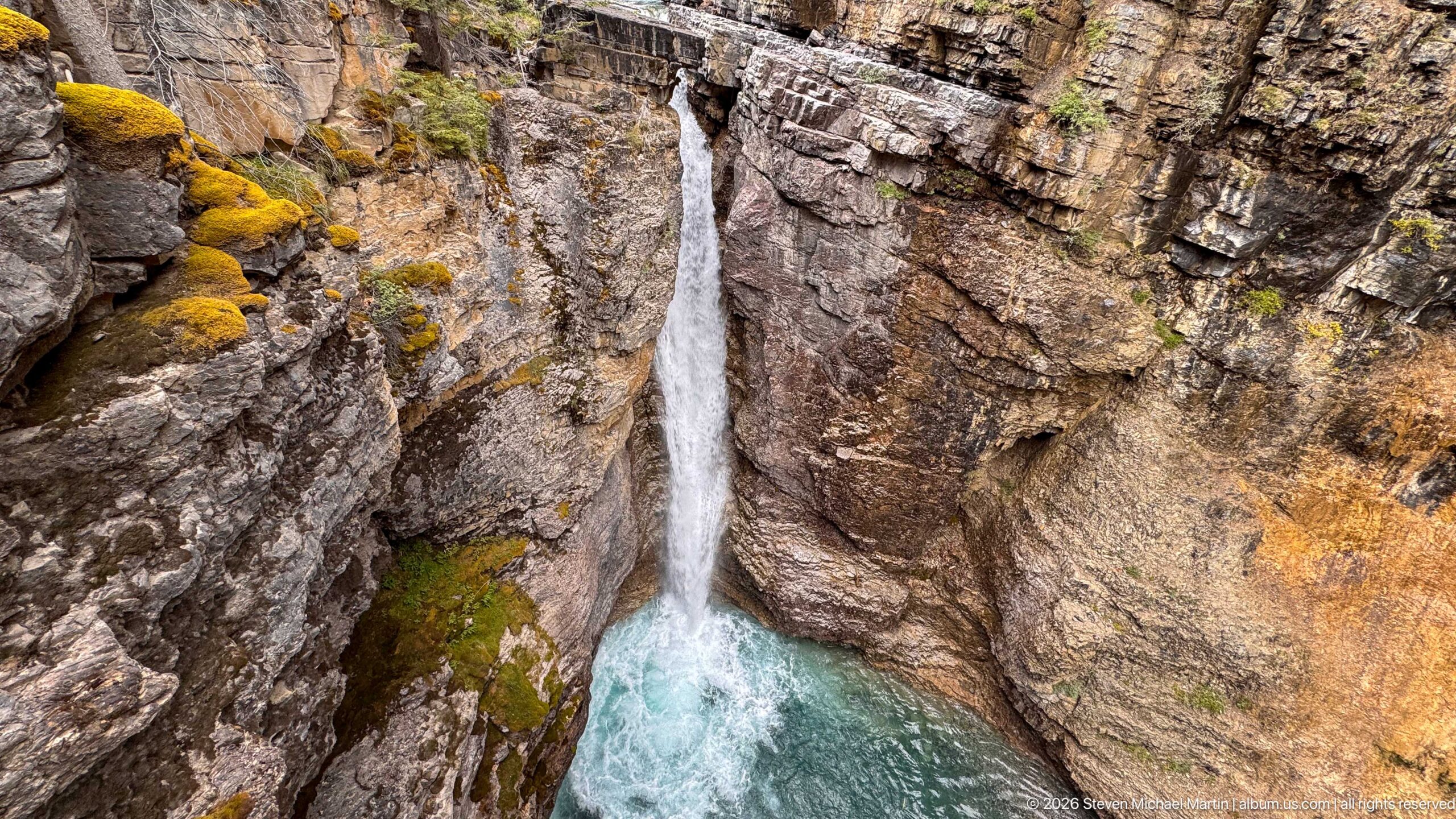
From a high vantage, the creek narrows into a long vertical chute before opening into a luminous pool. Rust, gray, and buff layers in the enclosing rock lead the eye downward, while bright moss gathers on the left ledges. This view emphasizes the waterfall’s depth and the tight geometry of the gorge more than the broader surrounding landscape.
Caption
From a high vantage, the creek narrows into a long vertical chute before opening into a luminous pool. Rust, gray, and buff layers in the enclosing rock lead the eye downward, while bright moss gathers on the left ledges. This view emphasizes the waterfall’s depth and the tight geometry of the gorge more than the broader surrounding landscape.
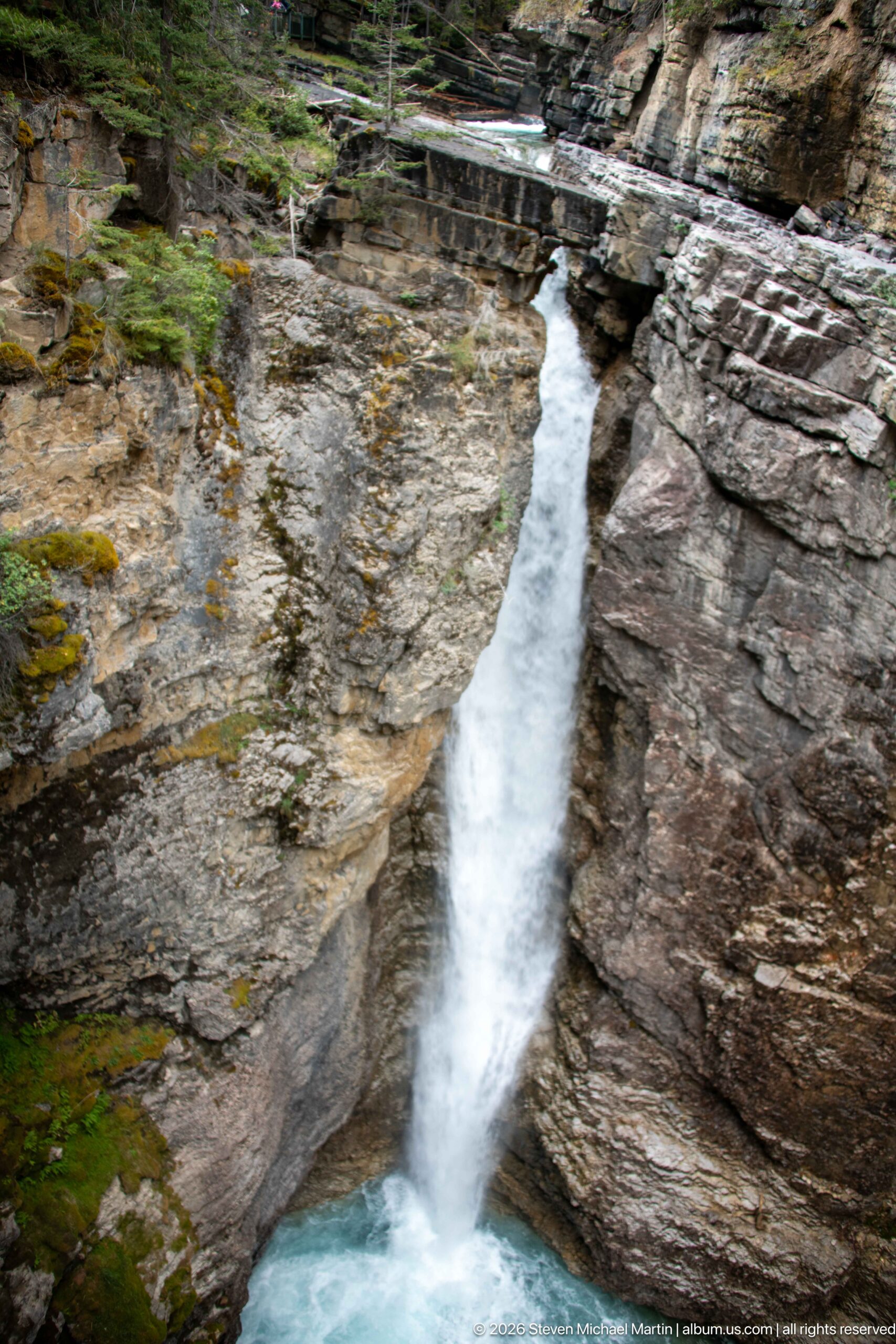
Water pours in a single white column through a tight opening in layered canyon walls and strikes a pale turquoise pool below. The elevated viewpoint reveals the narrow basin and water-worn ledges on either side, while moss patches soften the otherwise bare rock. Motion blur emphasizes the continuous drop and the force concentrated within this confined section of Johnston Creek.
Caption
Water pours in a single white column through a tight opening in layered canyon walls and strikes a pale turquoise pool below. The elevated viewpoint reveals the narrow basin and water-worn ledges on either side, while moss patches soften the otherwise bare rock. Motion blur emphasizes the continuous drop and the force concentrated within this confined section of Johnston Creek.
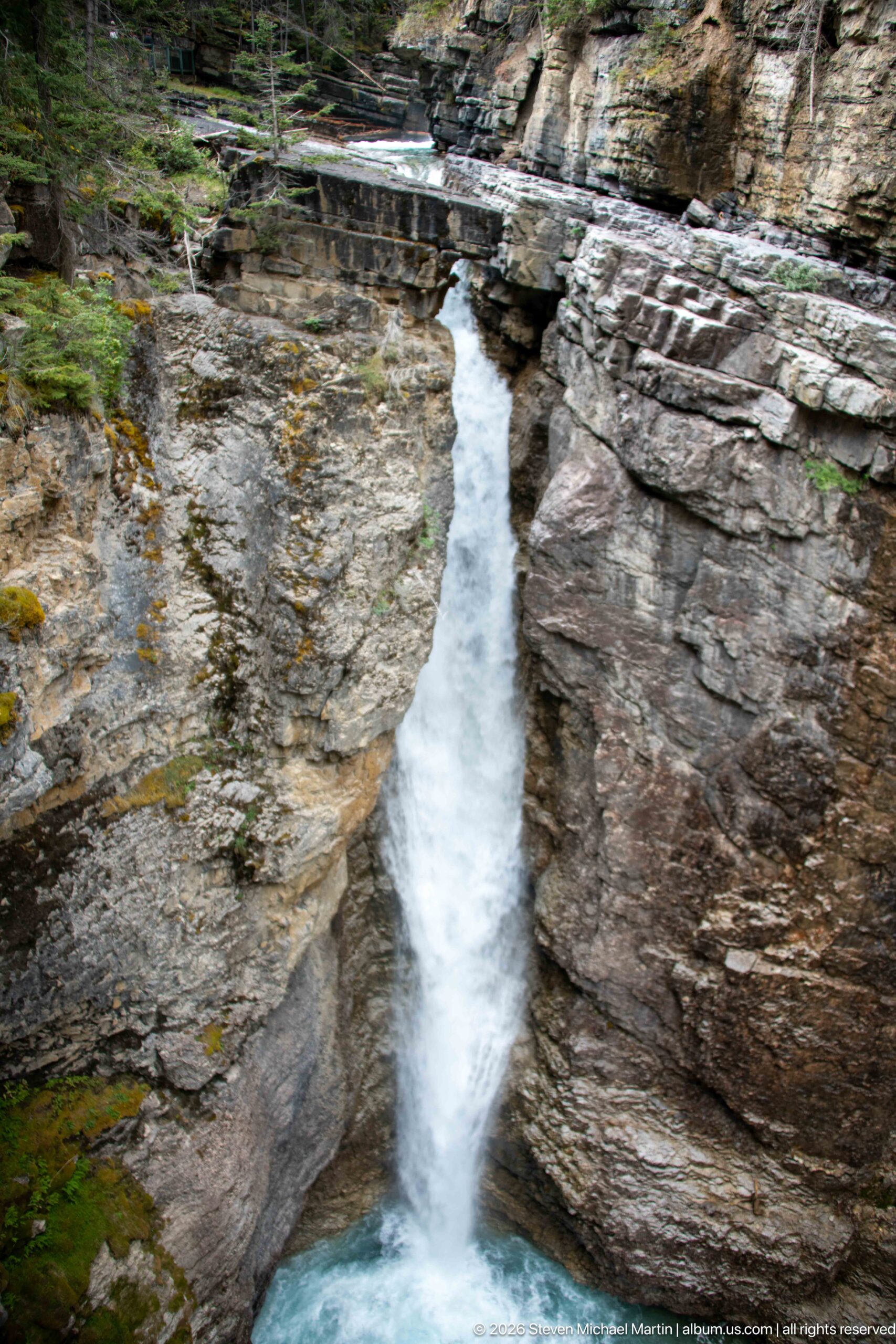
A white cascade drops into a rounded turquoise pool, framed by broad, nearly horizontal rock shelves. The close composition gives the falling water most of the frame and records the foam where it meets the basin. Moss and small plants cling to damp cracks along the edges, adding fine signs of life to the bare, water-shaped canyon stone.
Caption
A white cascade drops into a rounded turquoise pool, framed by broad, nearly horizontal rock shelves. The close composition gives the falling water most of the frame and records the foam where it meets the basin. Moss and small plants cling to damp cracks along the edges, adding fine signs of life to the bare, water-shaped canyon stone.
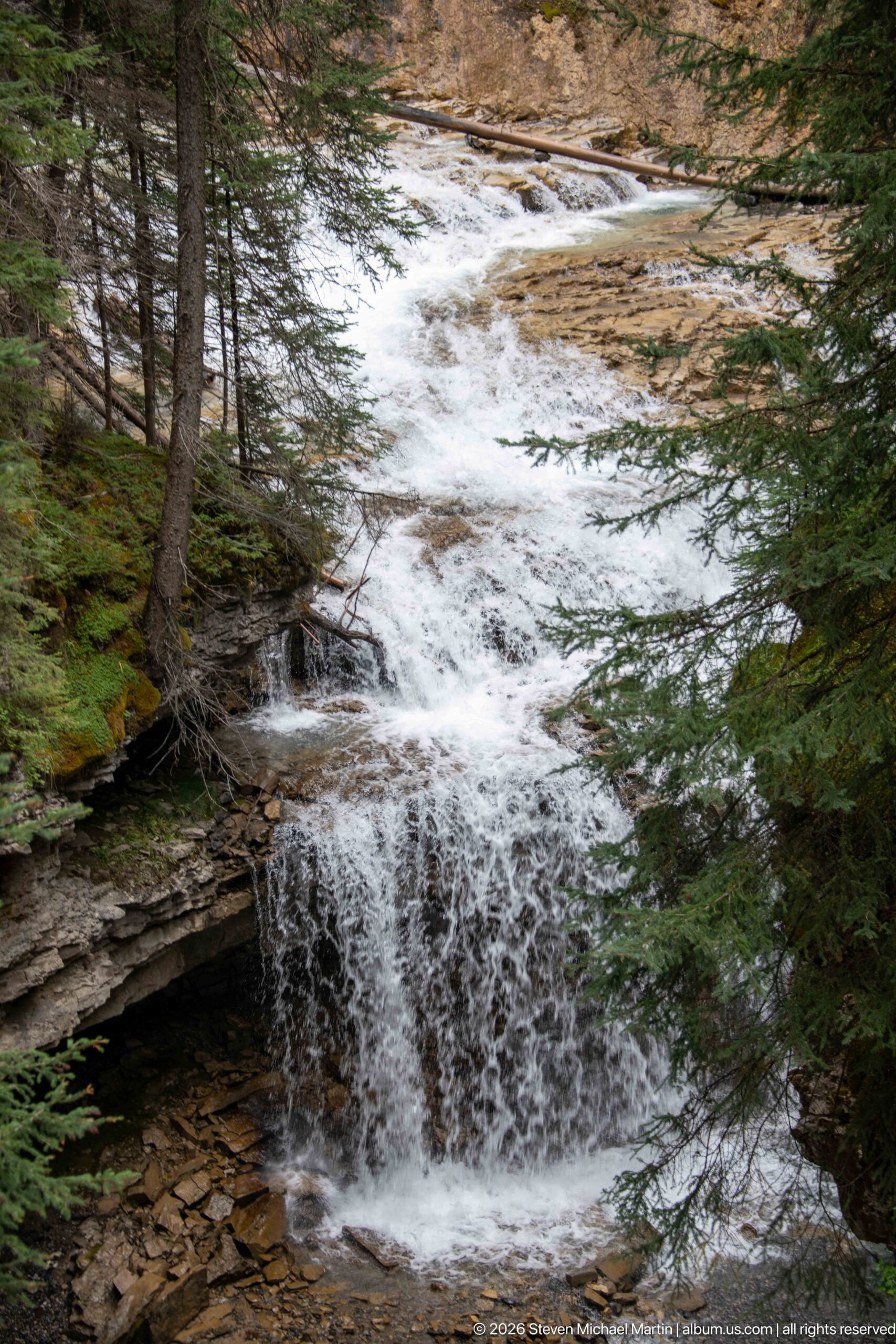
A broad, fast cascade spreads across several low rock steps beneath the forest canopy. White water blurs against dark horizontal ledges, while slender tree trunks and evergreen branches partly veil the view. The scene presents a less enclosed stretch of Johnston Creek, where water fans across a sloping channel rather than plunging through a deep cleft.
Caption
A broad, fast cascade spreads across several low rock steps beneath the forest canopy. White water blurs against dark horizontal ledges, while slender tree trunks and evergreen branches partly veil the view. The scene presents a less enclosed stretch of Johnston Creek, where water fans across a sloping channel rather than plunging through a deep cleft.
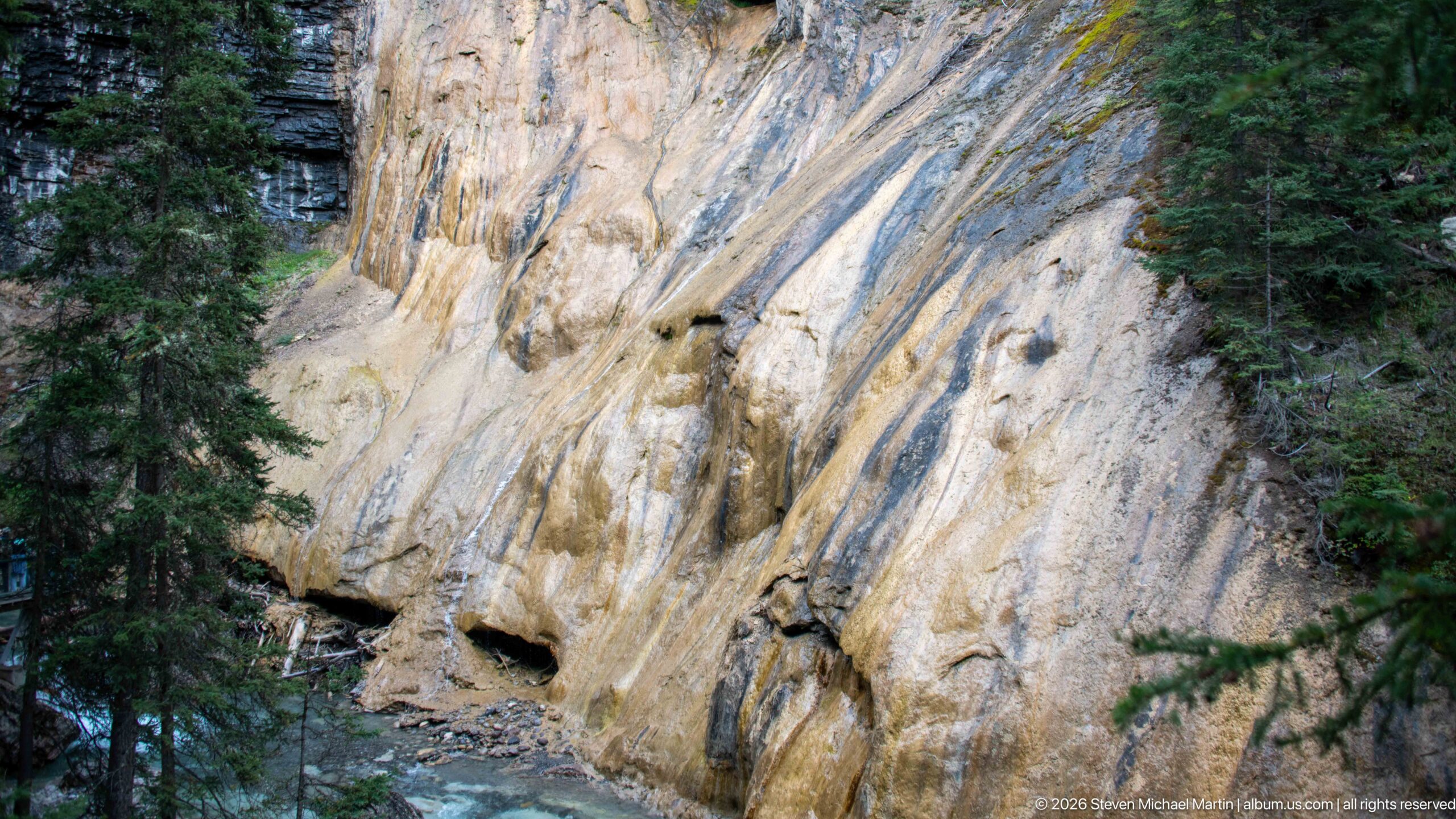
A steep, pale canyon wall fills most of the composition, its surface marked by long blue-gray and ochre streaks that descend toward the creek. Small dark recesses interrupt the lower rock, while evergreen branches frame the upper edge. The close view records texture and weathering patterns rather than the scale of the wider canyon landscape.
Caption
A steep, pale canyon wall fills most of the composition, its surface marked by long blue-gray and ochre streaks that descend toward the creek. Small dark recesses interrupt the lower rock, while evergreen branches frame the upper edge. The close view records texture and weathering patterns rather than the scale of the wider canyon landscape.
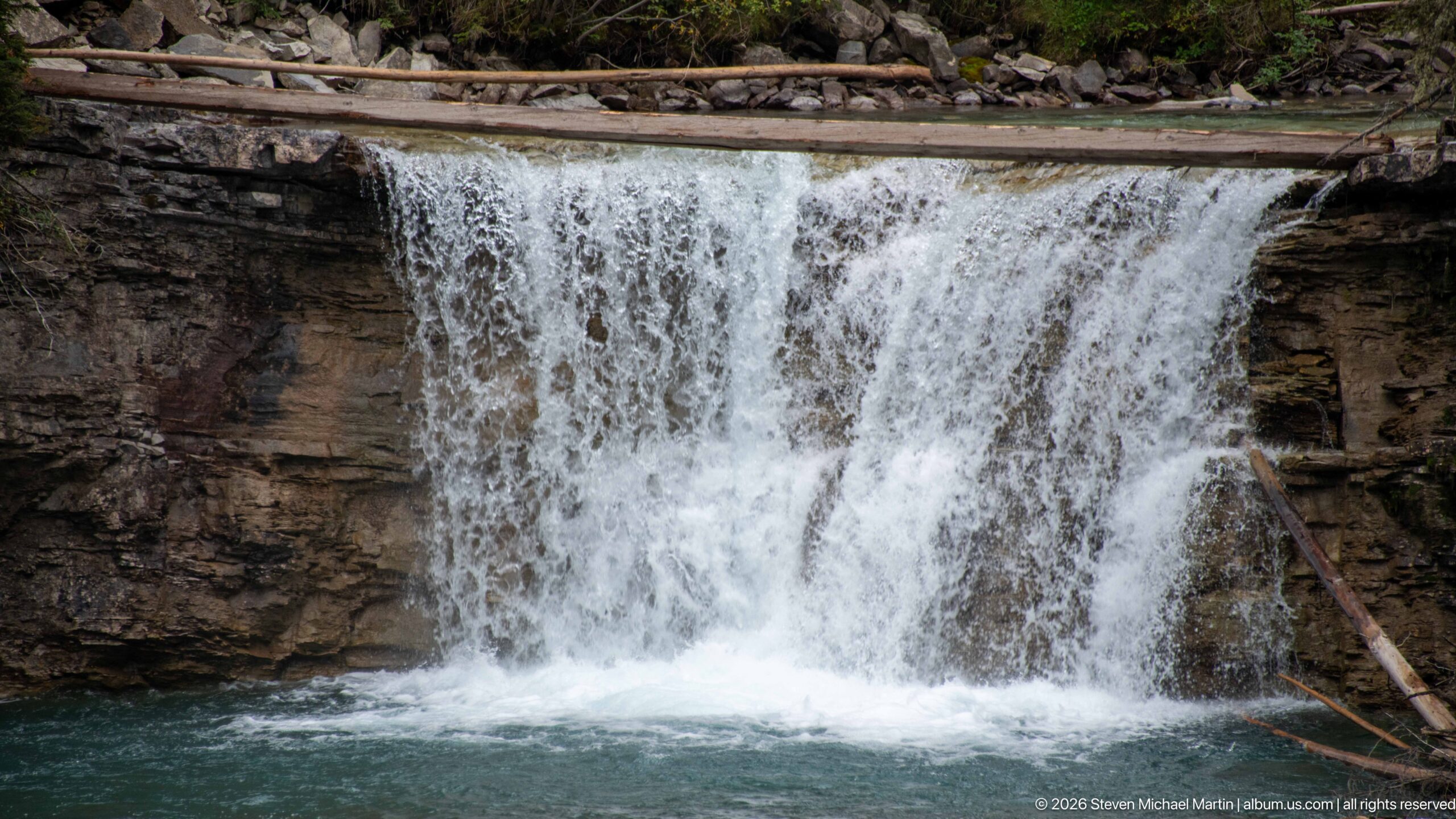
A broad, even curtain of water pours over a nearly horizontal rock lip into a dark basin. The close viewpoint reveals individual streams along the falling edge and the spray where they meet the pool. A narrow strip of current above the ledge contrasts with the broad white sheet below, making the waterfall’s width and simple geometry the focus.
Caption
A broad, even curtain of water pours over a nearly horizontal rock lip into a dark basin. The close viewpoint reveals individual streams along the falling edge and the spray where they meet the pool. A narrow strip of current above the ledge contrasts with the broad white sheet below, making the waterfall’s width and simple geometry the focus.
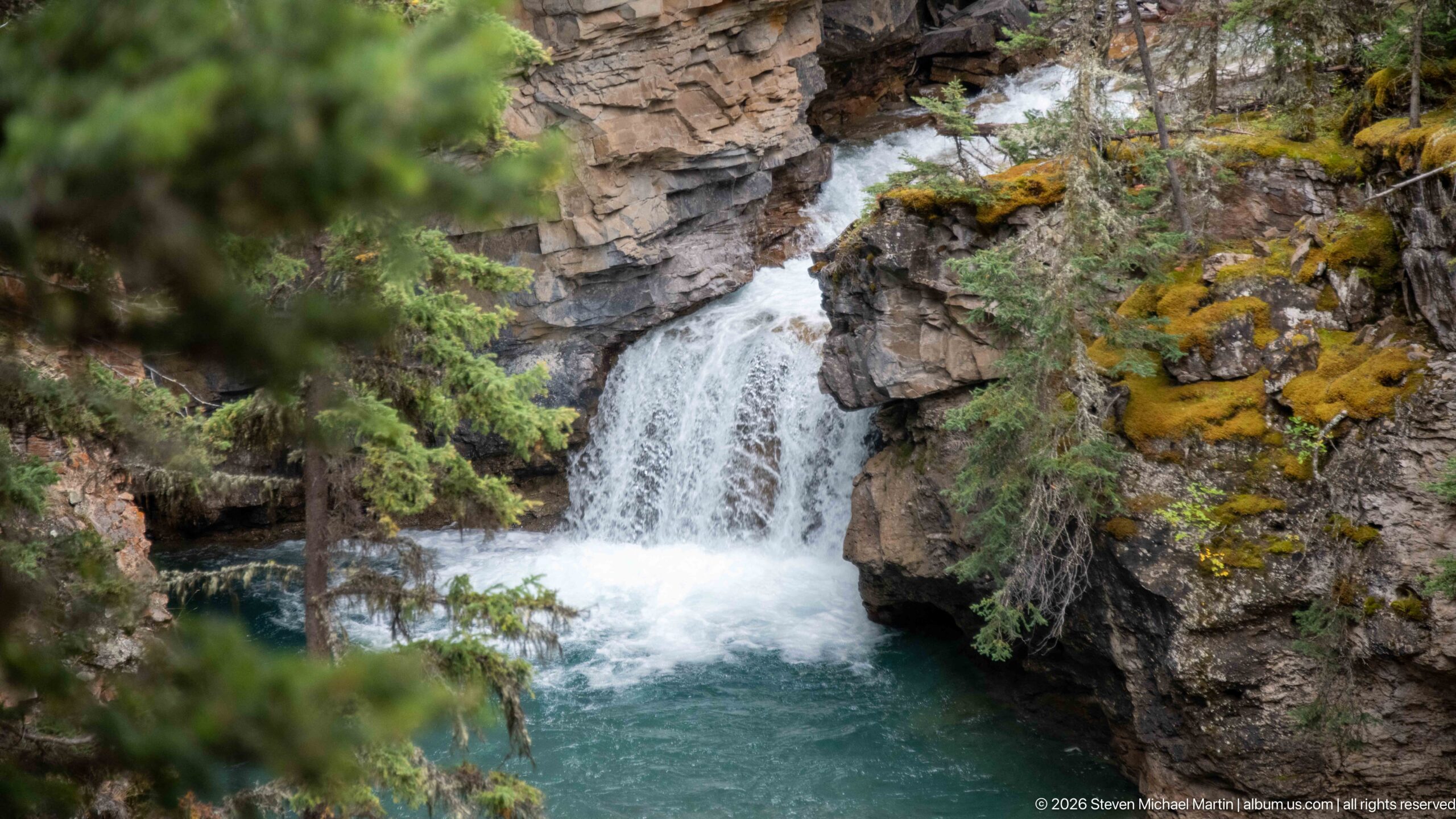
A waterfall drops through a break in the canyon wall into a blue-green pool, partially screened by evergreen branches and a mossy tree trunk. The foliage softens the hard lines of the rock and gives the cascade a more secluded appearance than the open views elsewhere along the creek. The photograph uses the forest foreground to frame the water rather than obscure it.
Caption
A waterfall drops through a break in the canyon wall into a blue-green pool, partially screened by evergreen branches and a mossy tree trunk. The foliage softens the hard lines of the rock and gives the cascade a more secluded appearance than the open views elsewhere along the creek. The photograph uses the forest foreground to frame the water rather than obscure it.
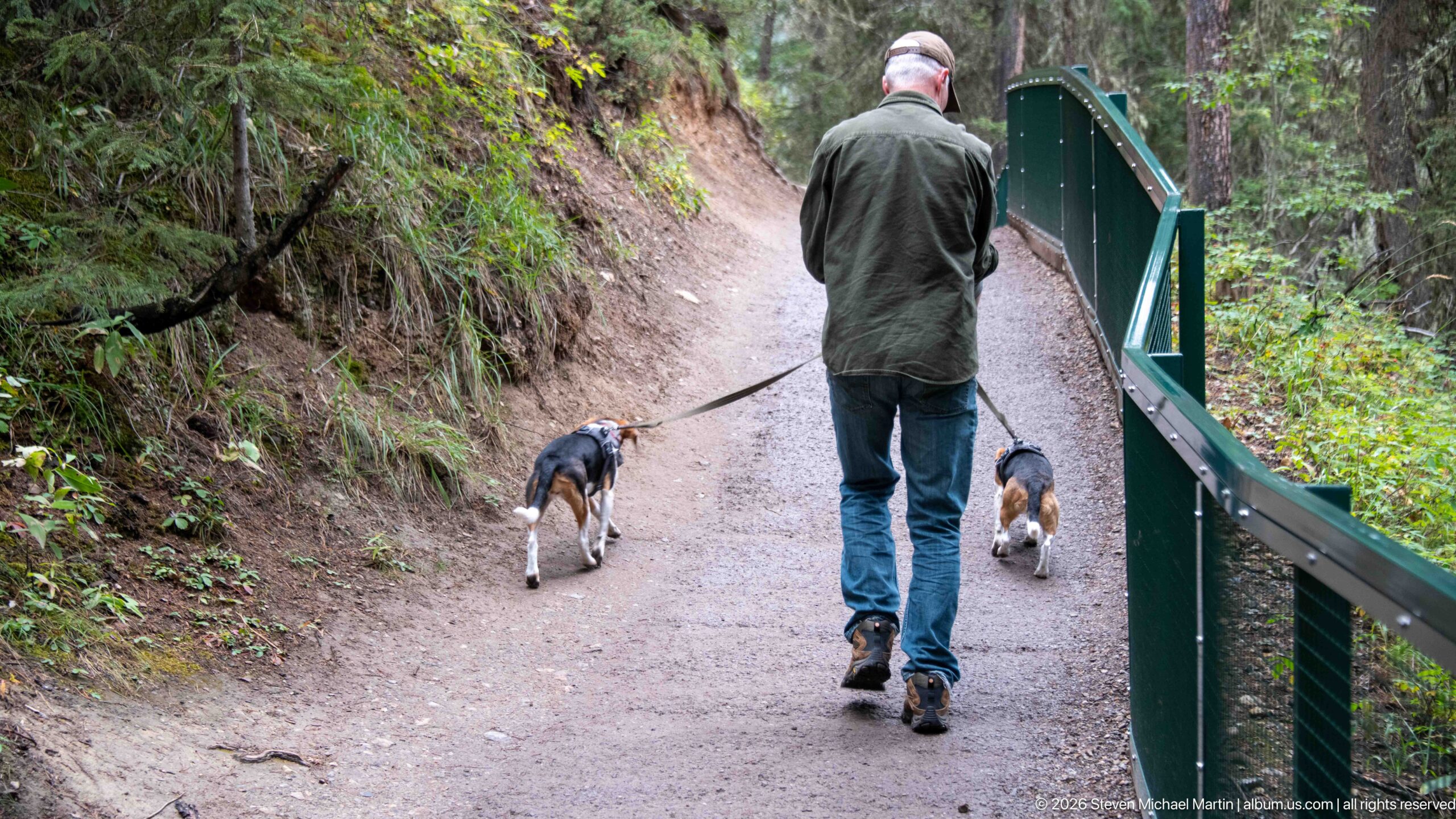
A visitor walks two small, tri-colored hounds along the canyon trail, seen from behind as the path curves toward a green-railed walkway. The dogs lead slightly ahead on separate leashes, their movement contrasting with the still rock and vegetation around them. This human-scale view records a quiet moment of trail use within Johnston Canyon’s managed visitor corridor.
Caption
A visitor walks two small, tri-colored hounds along the canyon trail, seen from behind as the path curves toward a green-railed walkway. The dogs lead slightly ahead on separate leashes, their movement contrasting with the still rock and vegetation around them. This human-scale view records a quiet moment of trail use within Johnston Canyon’s managed visitor corridor.
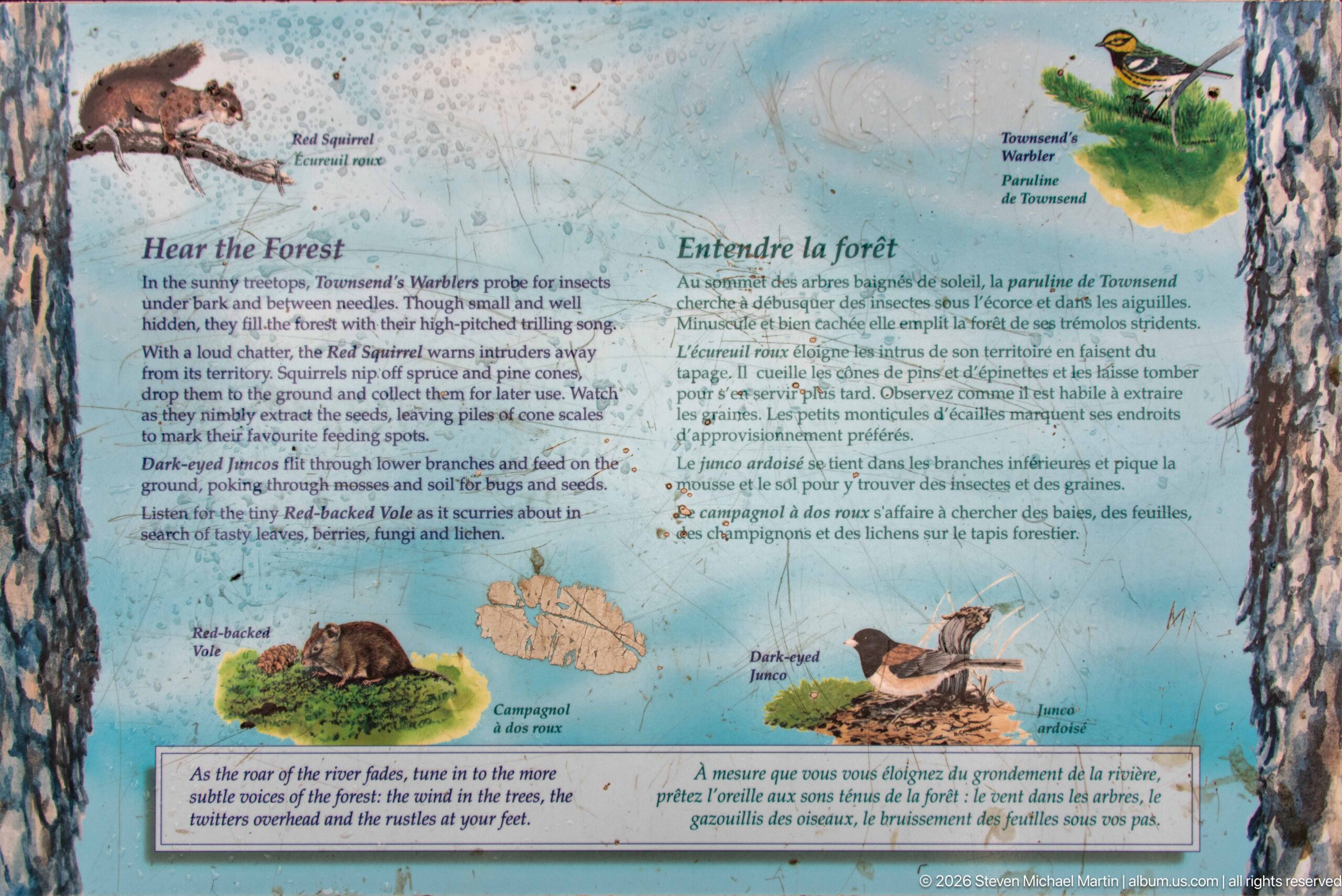
A blue illustrated interpretive panel invites visitors to “Hear the Forest,” pairing English and French text with drawings of a warbler, squirrel, and other woodland life. The sign describes sounds and animals among the trees, turning the walk into an exercise in listening as well as looking. Its painted bark border visually connects the panel to the surrounding forest.
Caption
A blue illustrated interpretive panel invites visitors to “Hear the Forest,” pairing English and French text with drawings of a warbler, squirrel, and other woodland life. The sign describes sounds and animals among the trees, turning the walk into an exercise in listening as well as looking. Its painted bark border visually connects the panel to the surrounding forest.
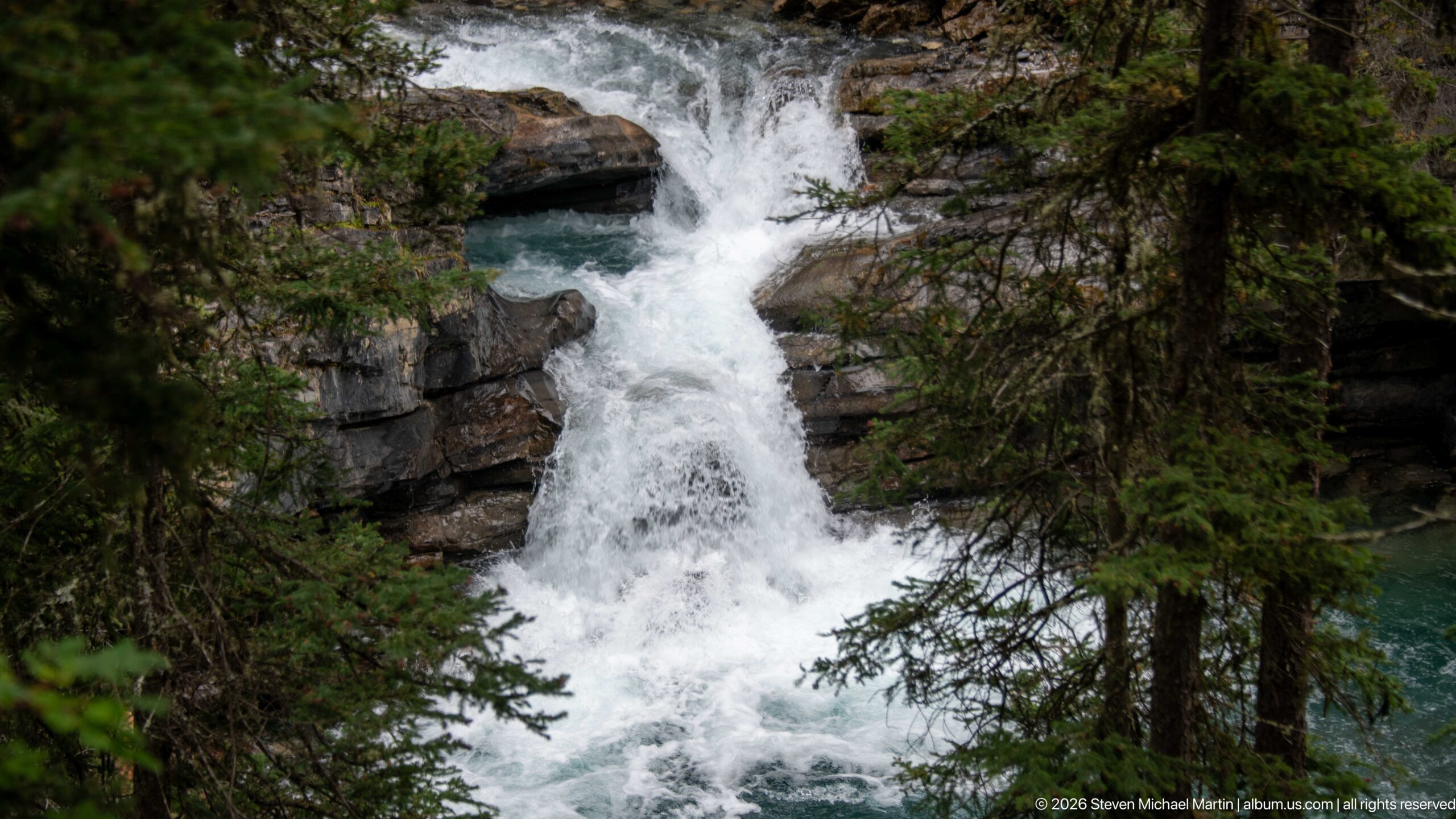
A forceful stream drops through a narrow rock channel, then breaks into white foam at the base. Evergreen branches and a leaning trunk partly screen the water, while the close composition conveys the confined movement of the creek through the canyon. The cascade occupies the center of the frame, with dark rock shelves enclosing it on both sides.
Caption
A forceful stream drops through a narrow rock channel, then breaks into white foam at the base. Evergreen branches and a leaning trunk partly screen the water, while the close composition conveys the confined movement of the creek through the canyon. The cascade occupies the center of the frame, with dark rock shelves enclosing it on both sides.
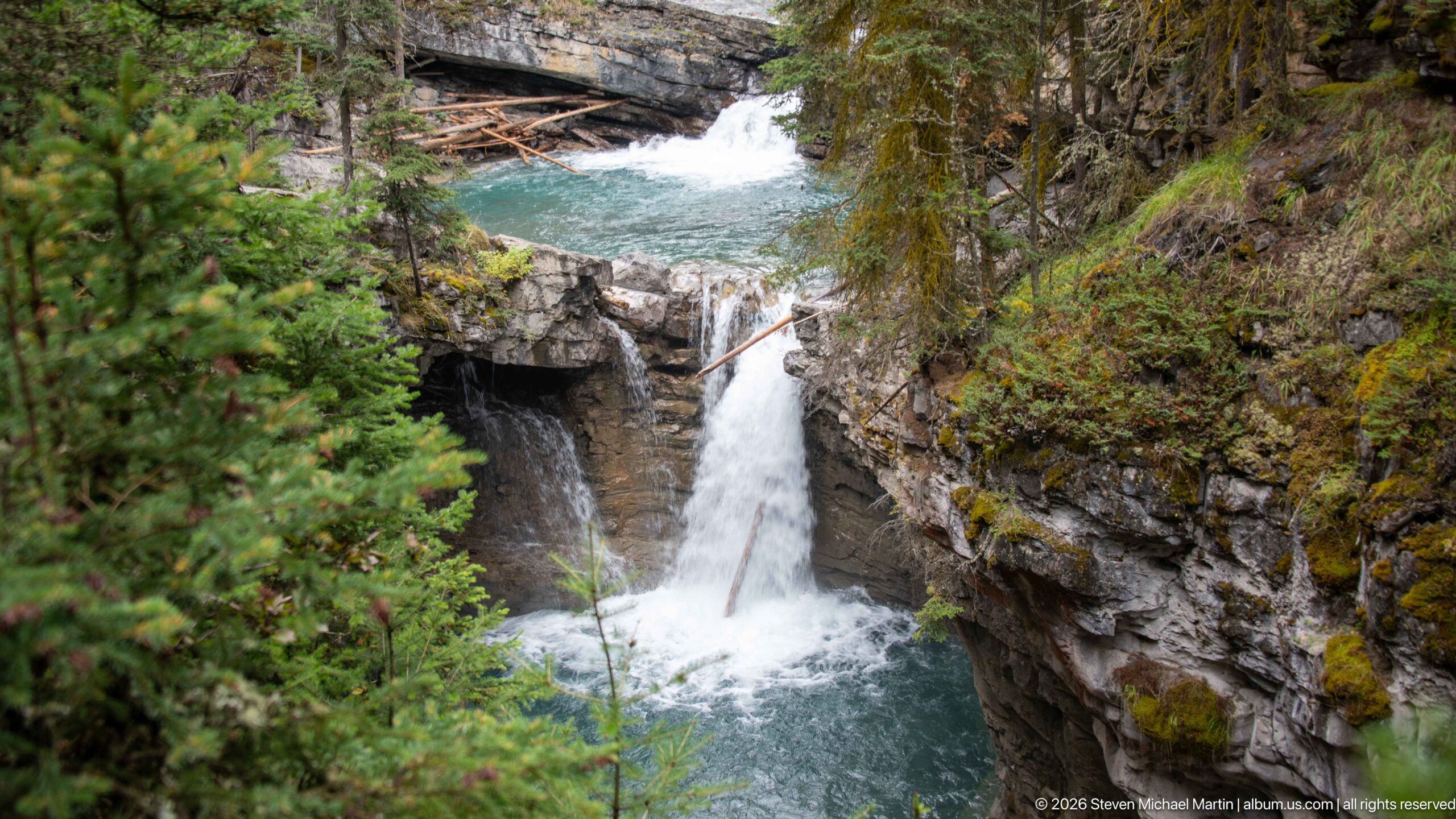
Seen from above, the creek crosses a clear upper pool and then plunges through a narrow rock opening into a lower basin. A slender fallen branch spans the gap near the lip, while conifers frame the left edge. This elevated composition reveals two connected water levels and the constricted passage between them.
Caption
Seen from above, the creek crosses a clear upper pool and then plunges through a narrow rock opening into a lower basin. A slender fallen branch spans the gap near the lip, while conifers frame the left edge. This elevated composition reveals two connected water levels and the constricted passage between them.
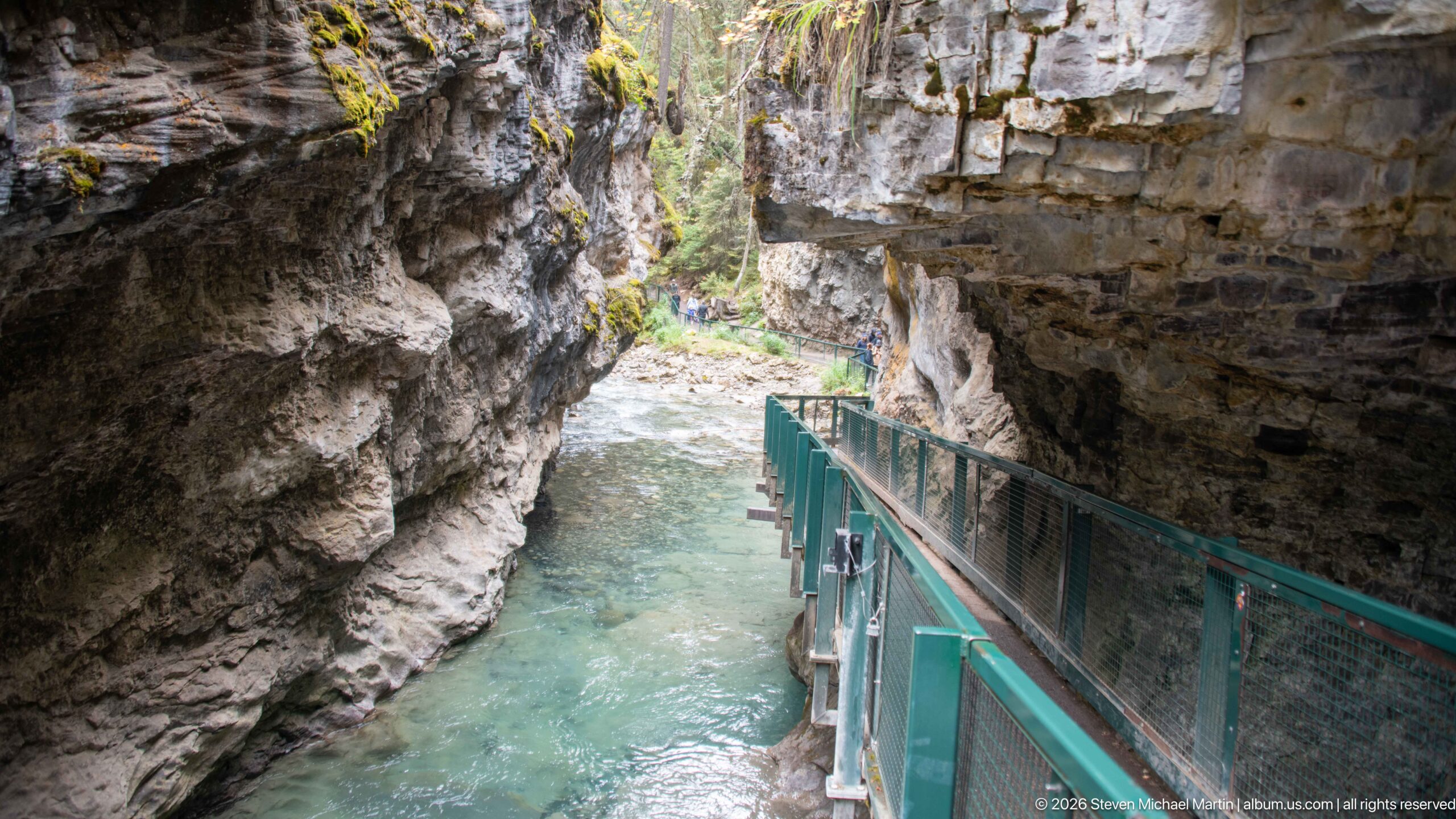
A green-railed walkway hugs the canyon wall above a clear blue-green reach of Johnston Creek. The high rock faces close in around the water, leaving little room between the path and the opposite bank. The perspective leads toward brighter forest at the far end, showing how the engineered trail carries visitors through a section of otherwise difficult terrain.
Caption
A green-railed walkway hugs the canyon wall above a clear blue-green reach of Johnston Creek. The high rock faces close in around the water, leaving little room between the path and the opposite bank. The perspective leads toward brighter forest at the far end, showing how the engineered trail carries visitors through a section of otherwise difficult terrain.
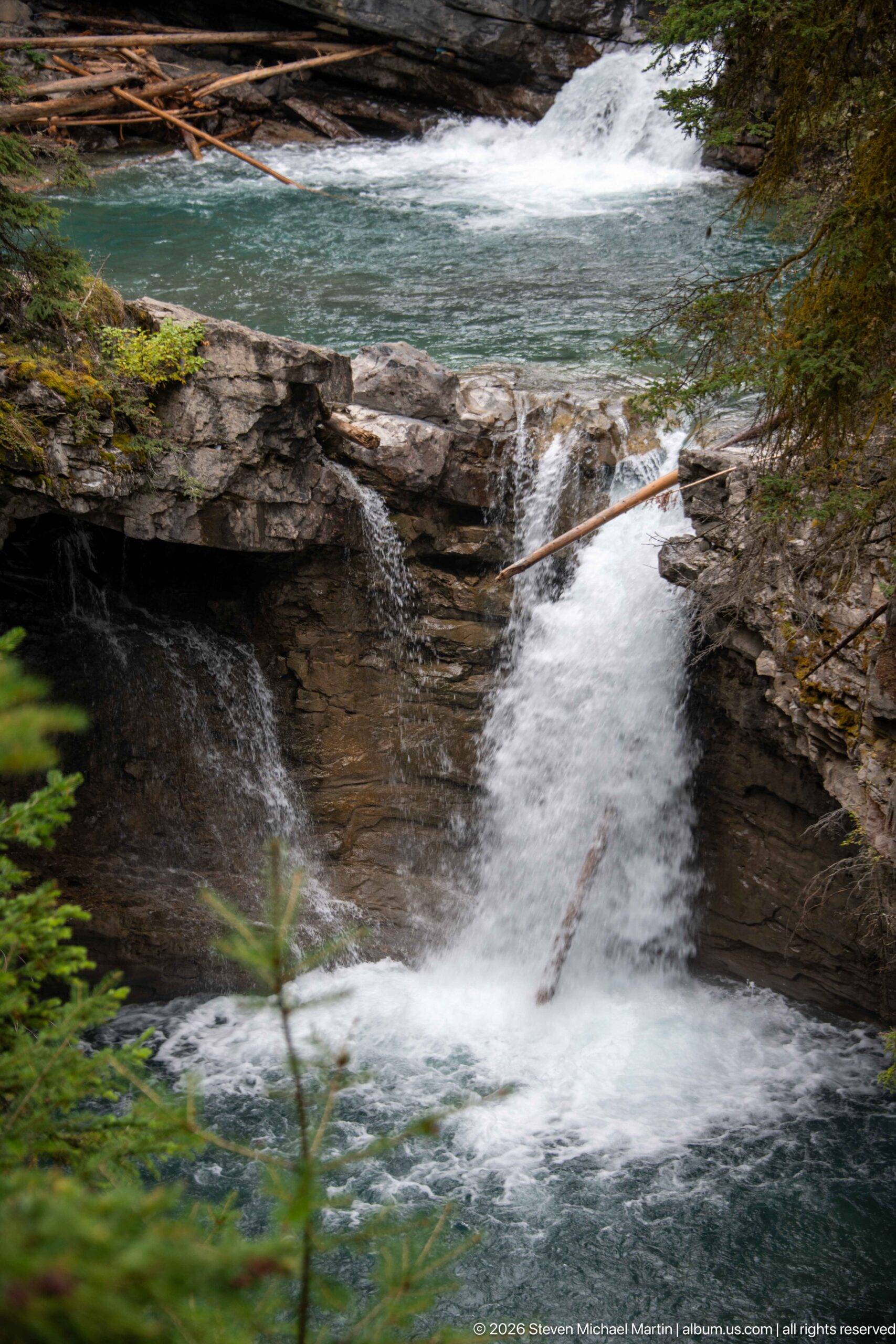
A shallow turquoise pool drains over a low, uneven rock lip into a short foaming chute. The close view emphasizes the layered shelves and the change from still water above to turbulent water below. A slender branch rests across the foreground ledge, while blurred greenery at left hints at the forest along the creek.
Caption
A shallow turquoise pool drains over a low, uneven rock lip into a short foaming chute. The close view emphasizes the layered shelves and the change from still water above to turbulent water below. A slender branch rests across the foreground ledge, while blurred greenery at left hints at the forest along the creek.
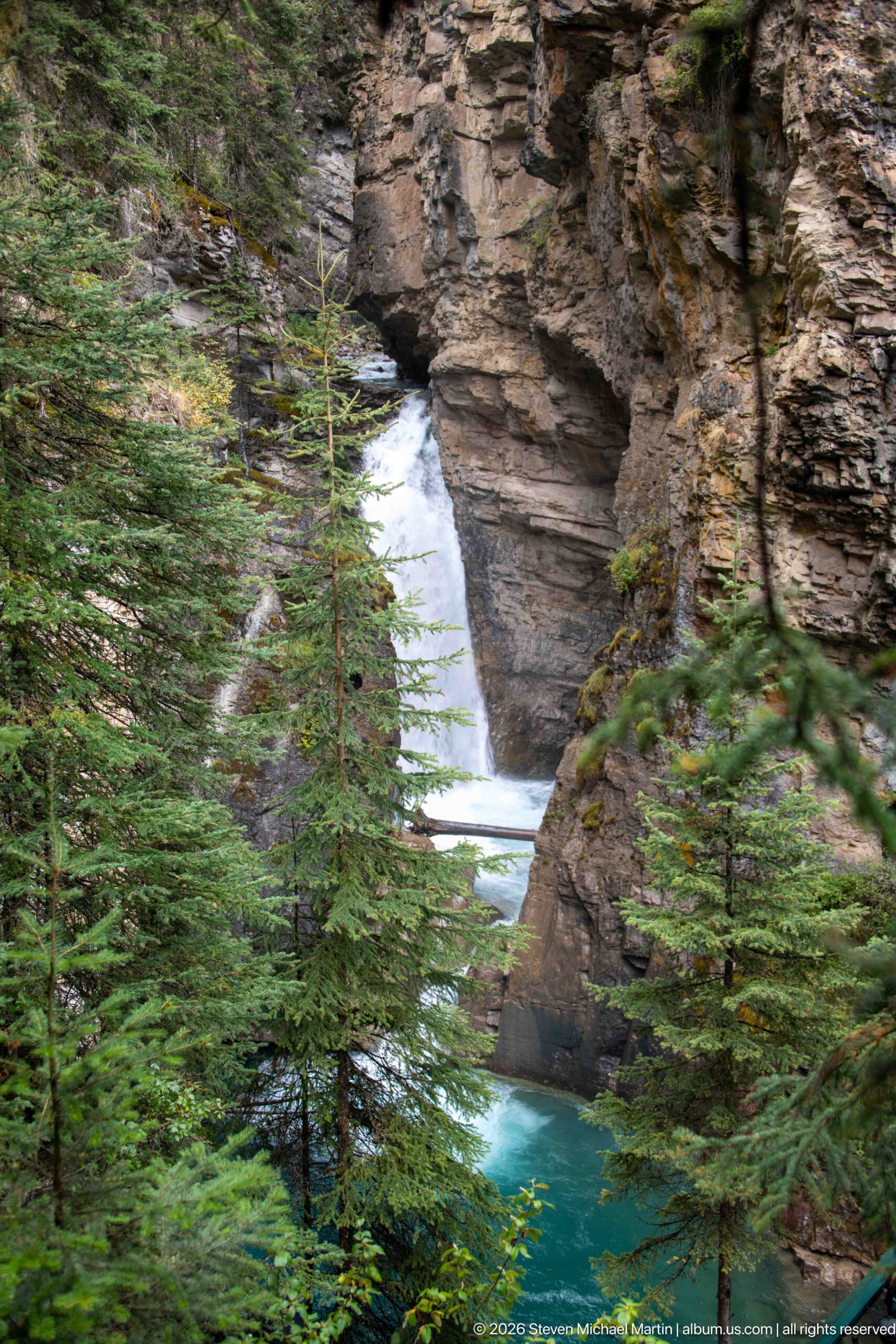
A waterfall drops into a turquoise basin, partially veiled by evergreen branches in the foreground. The wooded framing separates this view from the more open compositions nearby, while the pale fall remains visible between trunks and rock walls. A narrow bridge crosses the water above the pool, placing the managed trail within the natural canyon scene.
Caption
A waterfall drops into a turquoise basin, partially veiled by evergreen branches in the foreground. The wooded framing separates this view from the more open compositions nearby, while the pale fall remains visible between trunks and rock walls. A narrow bridge crosses the water above the pool, placing the managed trail within the natural canyon scene.
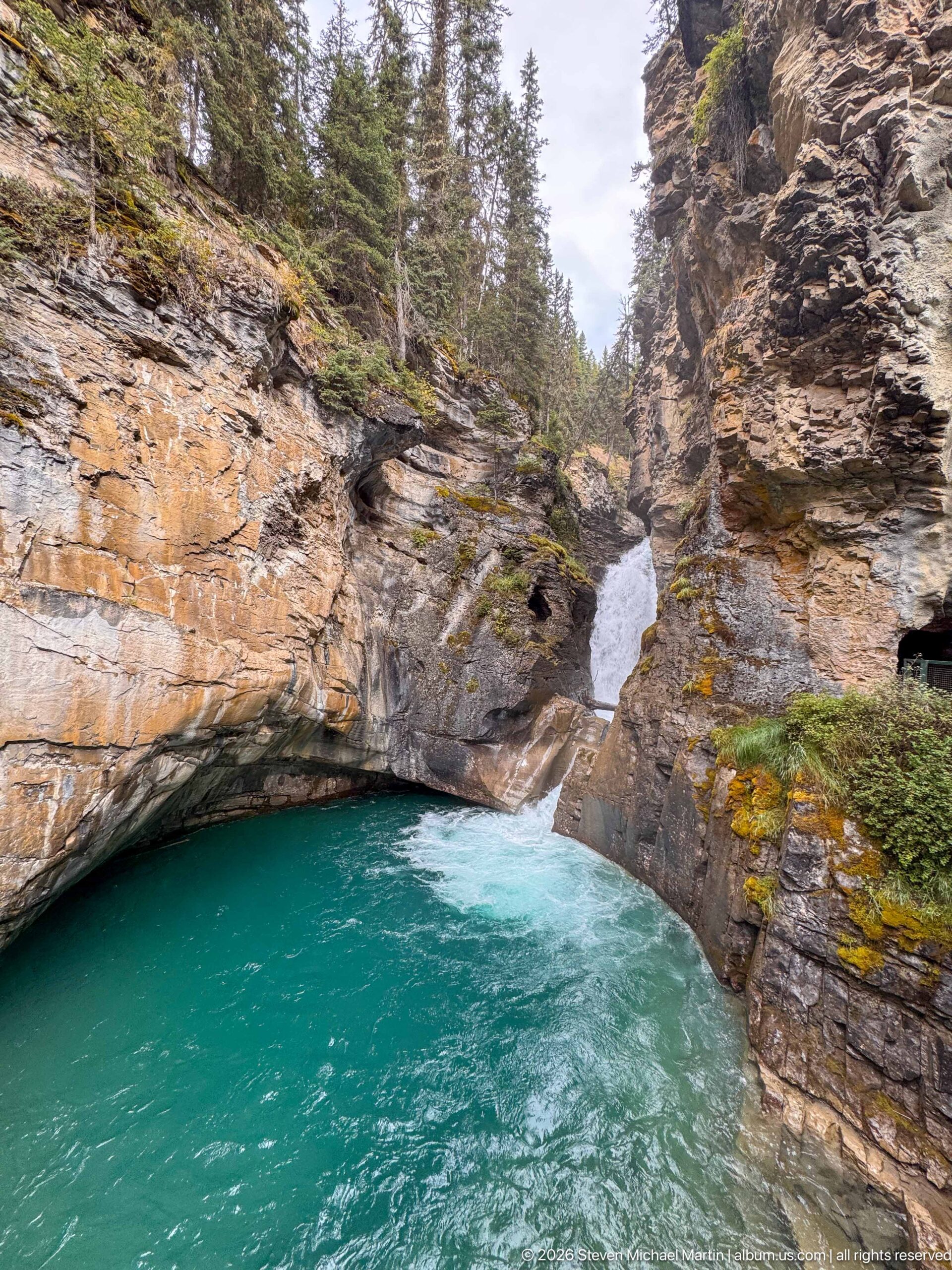
A broad turquoise basin occupies the foreground, with a tall waterfall rising beyond it between pale, stratified canyon walls. Conifers and mossy ledges frame the scene, but the open water gives the composition a wider, more spacious feel than the enclosed channel views. The image records both the fall’s height and the pool it has carved or deepened below.
Caption
A broad turquoise basin occupies the foreground, with a tall waterfall rising beyond it between pale, stratified canyon walls. Conifers and mossy ledges frame the scene, but the open water gives the composition a wider, more spacious feel than the enclosed channel views. The image records both the fall’s height and the pool it has carved or deepened below.
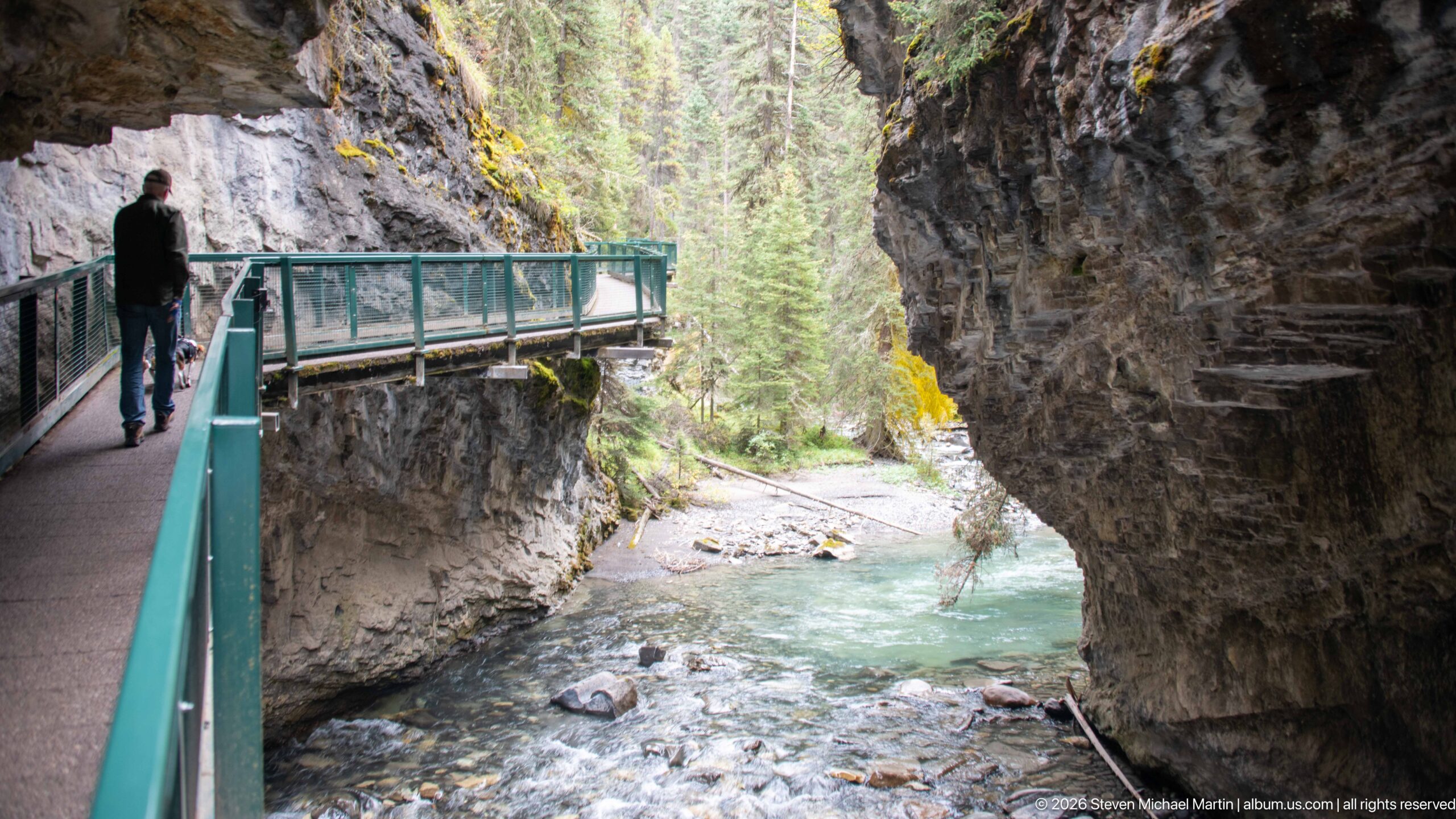
A lone visitor walks away along a green metal walkway suspended beside the canyon wall. The railing curves over the creek, while steep, irregular rock rises close on both sides and evergreen trees brighten the opening ahead. The person provides scale for the narrow passage and shows how the trail negotiates the gorge above the moving water.
Caption
A lone visitor walks away along a green metal walkway suspended beside the canyon wall. The railing curves over the creek, while steep, irregular rock rises close on both sides and evergreen trees brighten the opening ahead. The person provides scale for the narrow passage and shows how the trail negotiates the gorge above the moving water.
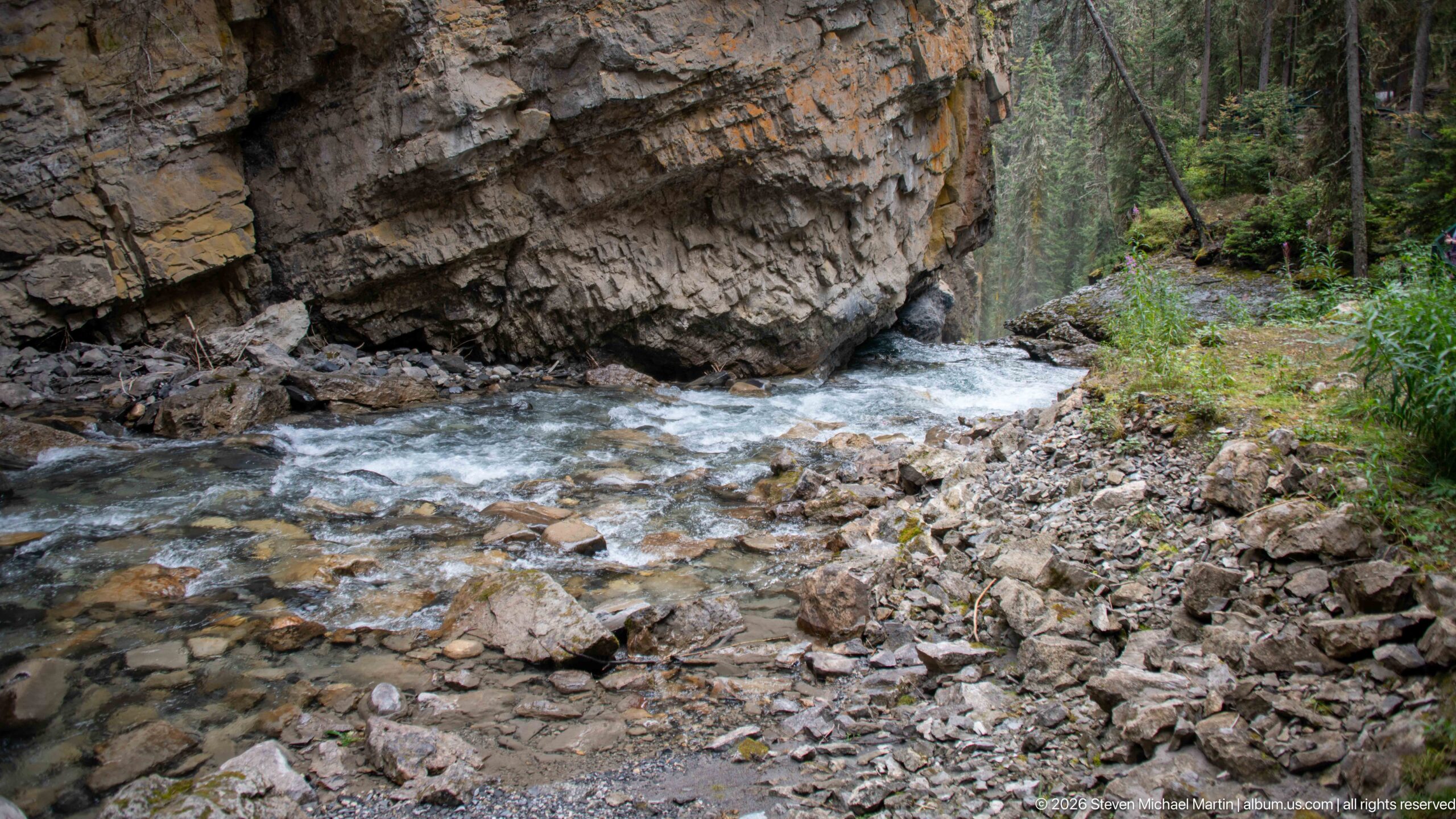
At creek level, shallow water winds around pale stones beneath a broad, undercut rock ledge. The projecting wall dominates the upper frame, while loose gravel and cobbles fill the near bank. With no boardwalk in view, the photograph concentrates on the rough, water-shaped channel and the close relationship between bedrock and stream.
Caption
At creek level, shallow water winds around pale stones beneath a broad, undercut rock ledge. The projecting wall dominates the upper frame, while loose gravel and cobbles fill the near bank. With no boardwalk in view, the photograph concentrates on the rough, water-shaped channel and the close relationship between bedrock and stream.
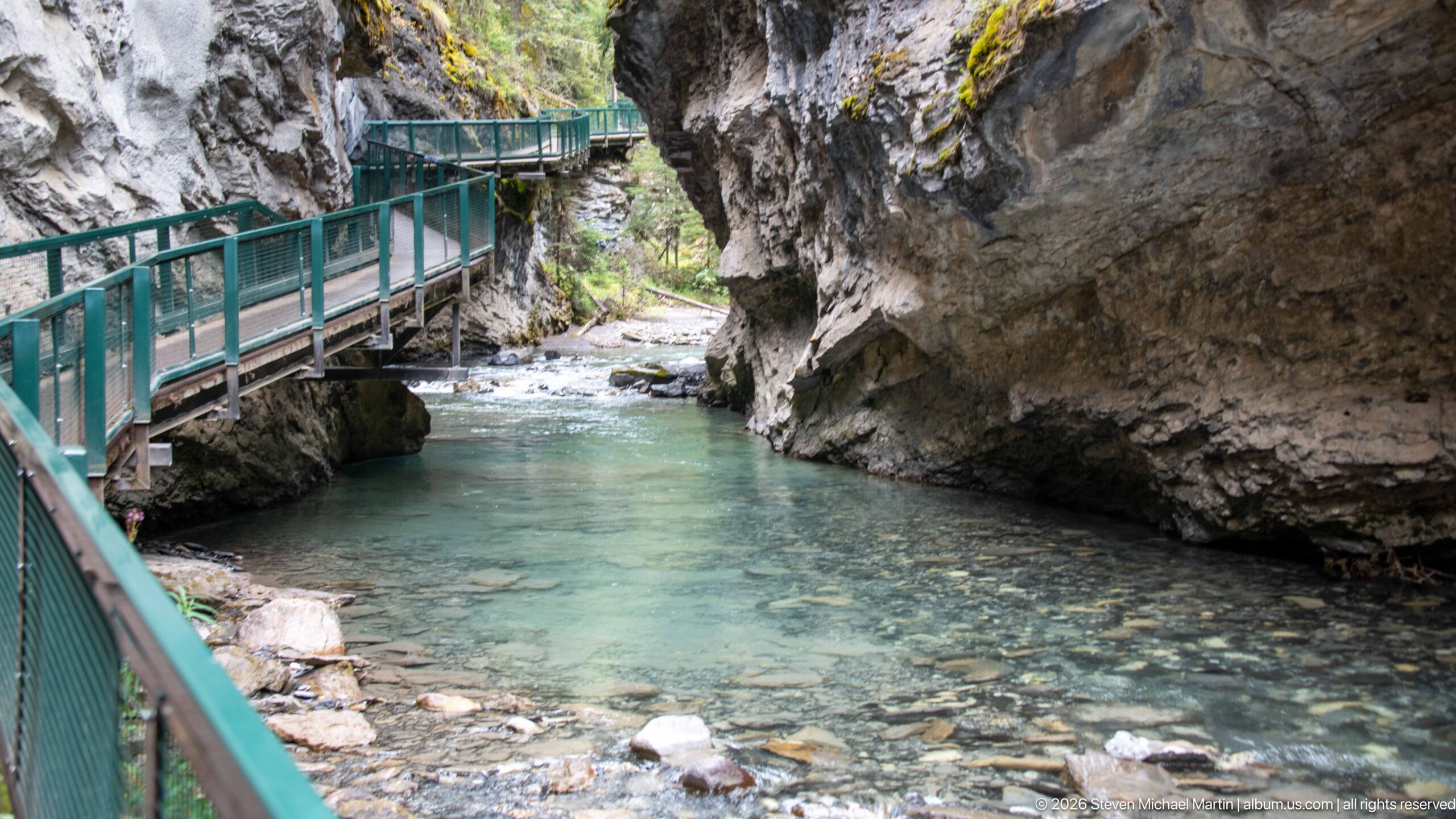
The green-railed walkway bends along the left side of a clear turquoise pool, while a massive rock overhang projects above the water on the right. The close opposing forms make the passage feel compressed, and the creek remains visible through the open center of the gorge. This view shows the trail’s route and the canyon’s sculpted walls together.
Caption
The green-railed walkway bends along the left side of a clear turquoise pool, while a massive rock overhang projects above the water on the right. The close opposing forms make the passage feel compressed, and the creek remains visible through the open center of the gorge. This view shows the trail’s route and the canyon’s sculpted walls together.
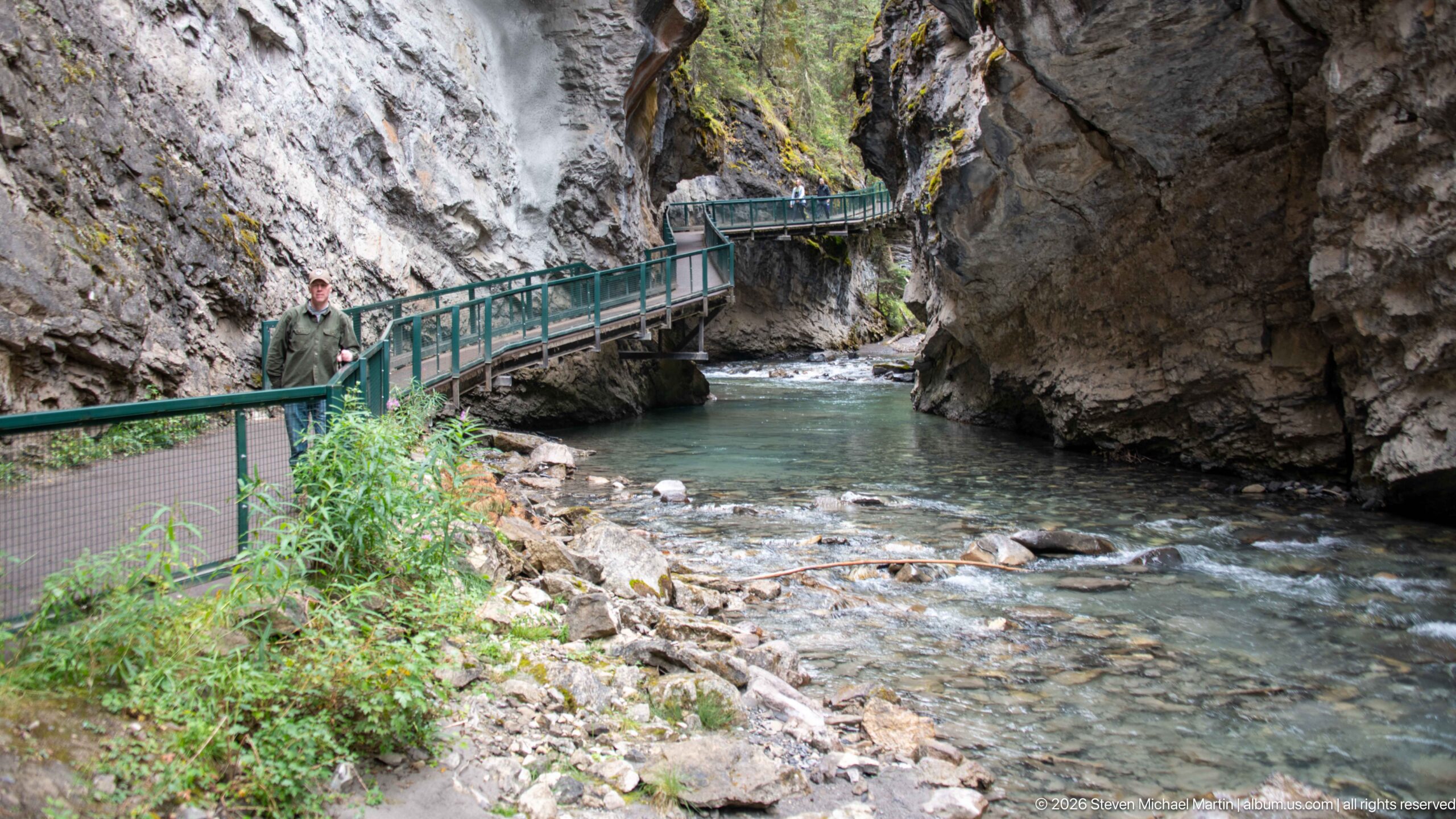
A visitor in a muted green jacket pauses on the raised walkway as it crosses the narrow gorge above Johnston Creek. The person stands against pale, fractured rock and green railings, providing a clear measure of the canyon’s height and the trail’s scale. Water and low vegetation occupy the bottom of the frame, grounding the scene in the creek corridor.
Caption
A visitor in a muted green jacket pauses on the raised walkway as it crosses the narrow gorge above Johnston Creek. The person stands against pale, fractured rock and green railings, providing a clear measure of the canyon’s height and the trail’s scale. Water and low vegetation occupy the bottom of the frame, grounding the scene in the creek corridor.
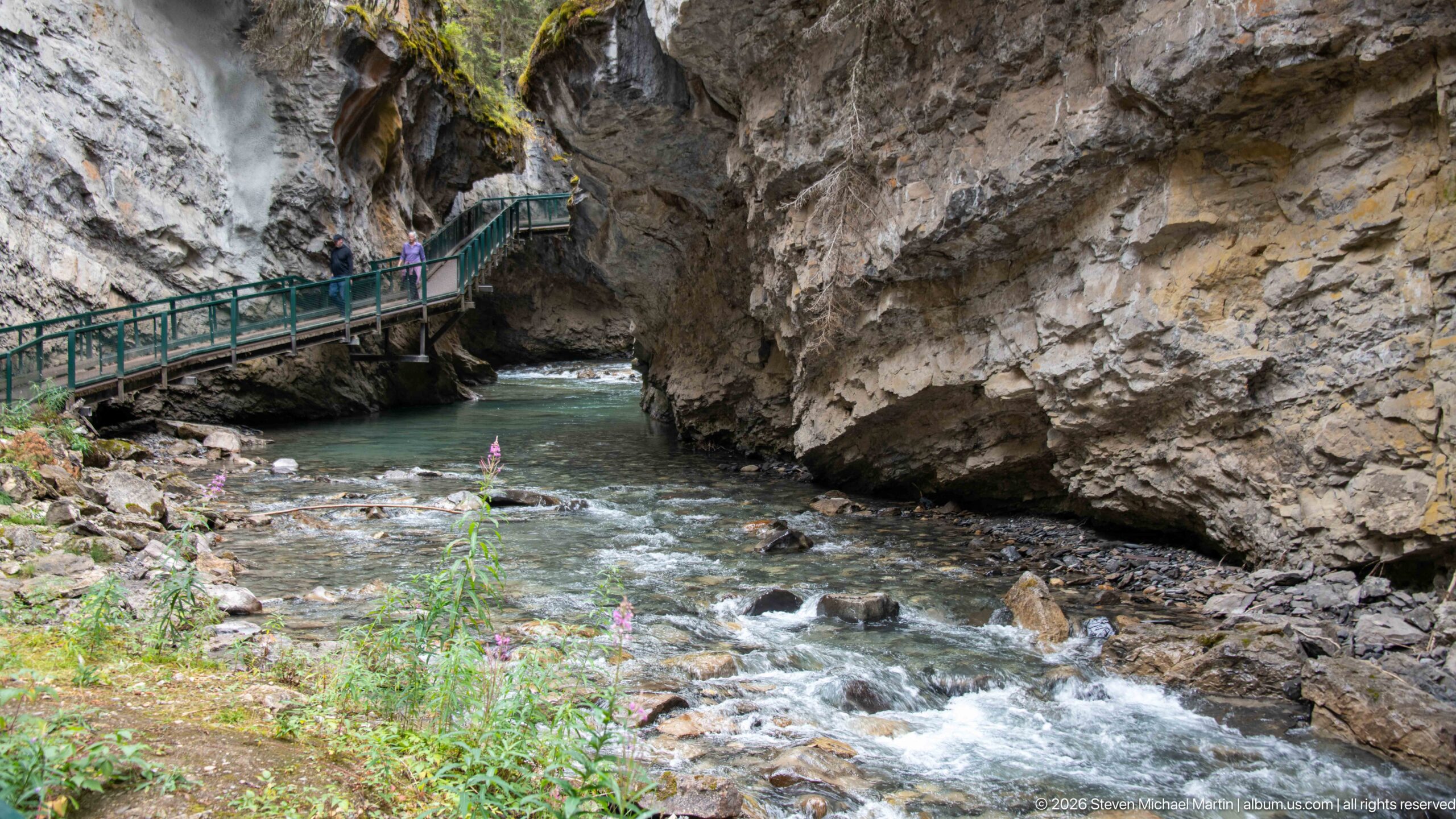
A wider view places the green-railed boardwalk across the upper left of the gorge, with several visitors moving along it above Johnston Creek. The stony foreground stream leads toward the narrow passage, while pale rock walls and scattered flowers soften the canyon floor. The composition links the built route, human activity, and natural channel in one frame.
Caption
A wider view places the green-railed boardwalk across the upper left of the gorge, with several visitors moving along it above Johnston Creek. The stony foreground stream leads toward the narrow passage, while pale rock walls and scattered flowers soften the canyon floor. The composition links the built route, human activity, and natural channel in one frame.
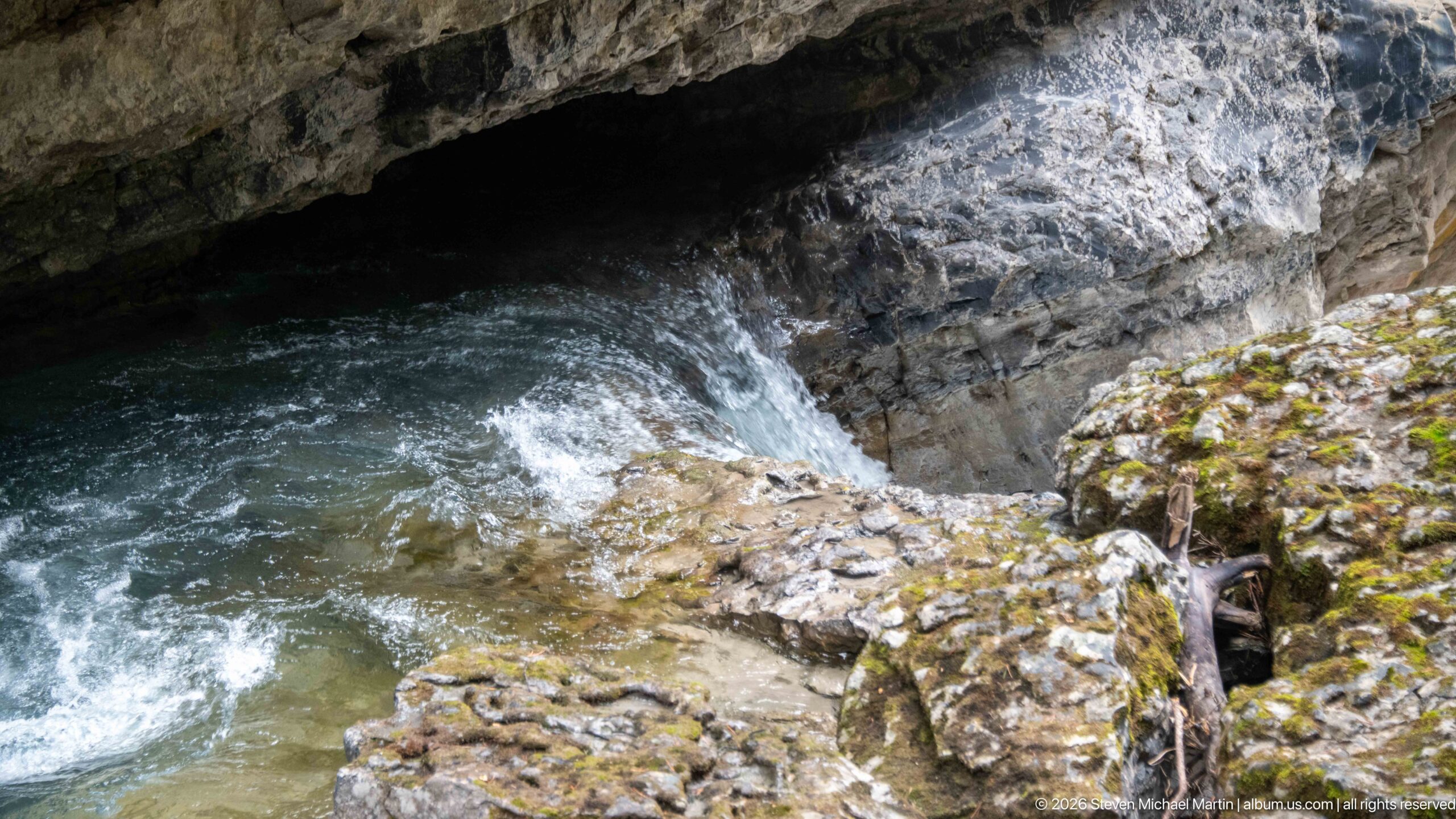
A fast current surges beneath a dark overhanging rock shelf and breaks into whitewater around pale stones. The low viewpoint brings the creek’s churning surface and undercut ledge into close relation, with a drift of fallen branches caught along the bank. This close study records the active channel at the base of Johnston Canyon’s steep rock walls.
Caption
A fast current surges beneath a dark overhanging rock shelf and breaks into whitewater around pale stones. The low viewpoint brings the creek’s churning surface and undercut ledge into close relation, with a drift of fallen branches caught along the bank. This close study records the active channel at the base of Johnston Canyon’s steep rock walls.
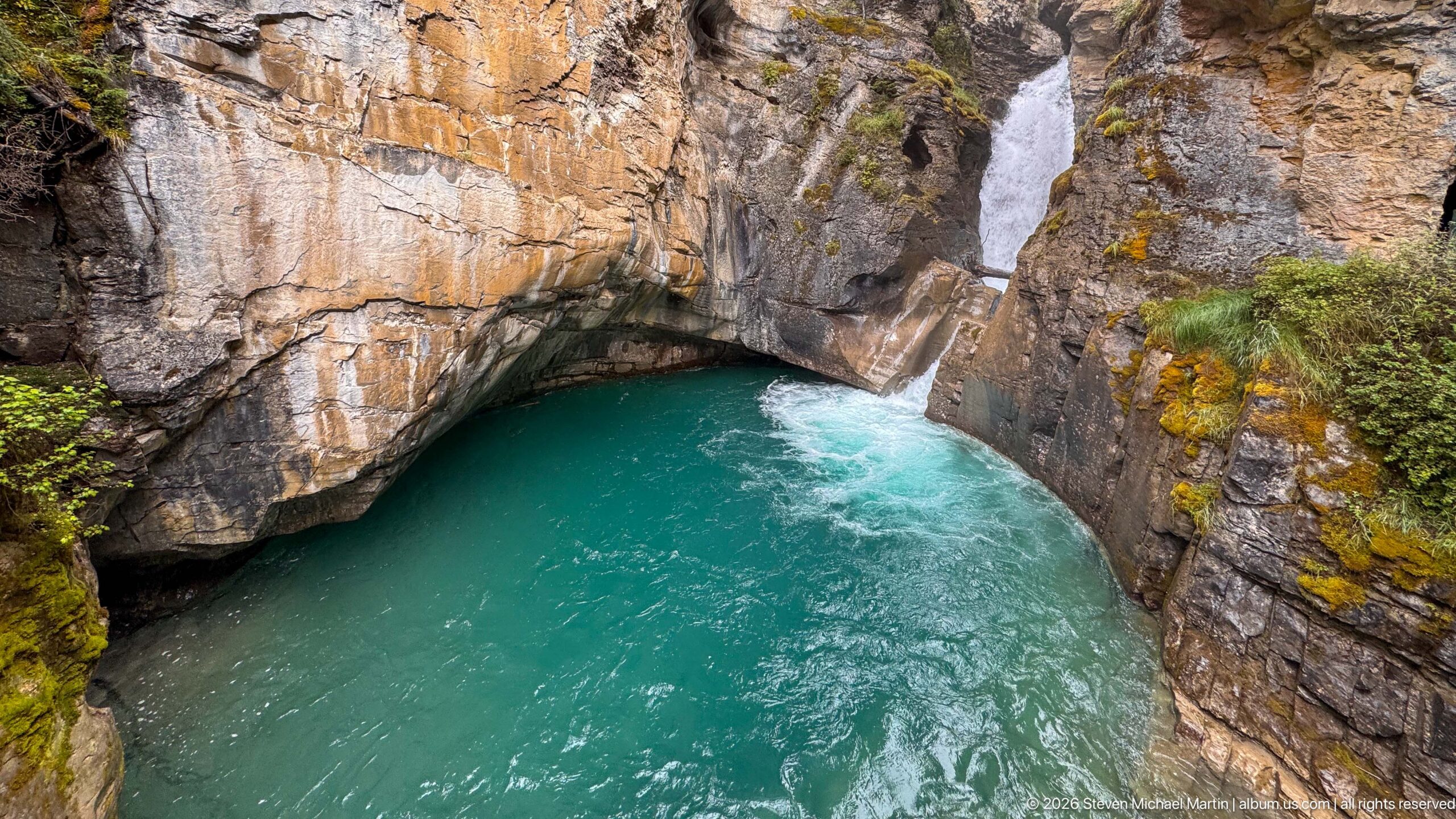
A deep turquoise pool fills the foreground beneath a broad, sloping rock overhang. Water enters from the upper right and sweeps across the basin, while mineral-colored streaks mark the pale stone and moss brightens the far ledges. The composition centers on the basin’s color and the angular rock enclosure that holds the creek in a confined pocket.
Caption
A deep turquoise pool fills the foreground beneath a broad, sloping rock overhang. Water enters from the upper right and sweeps across the basin, while mineral-colored streaks mark the pale stone and moss brightens the far ledges. The composition centers on the basin’s color and the angular rock enclosure that holds the creek in a confined pocket.
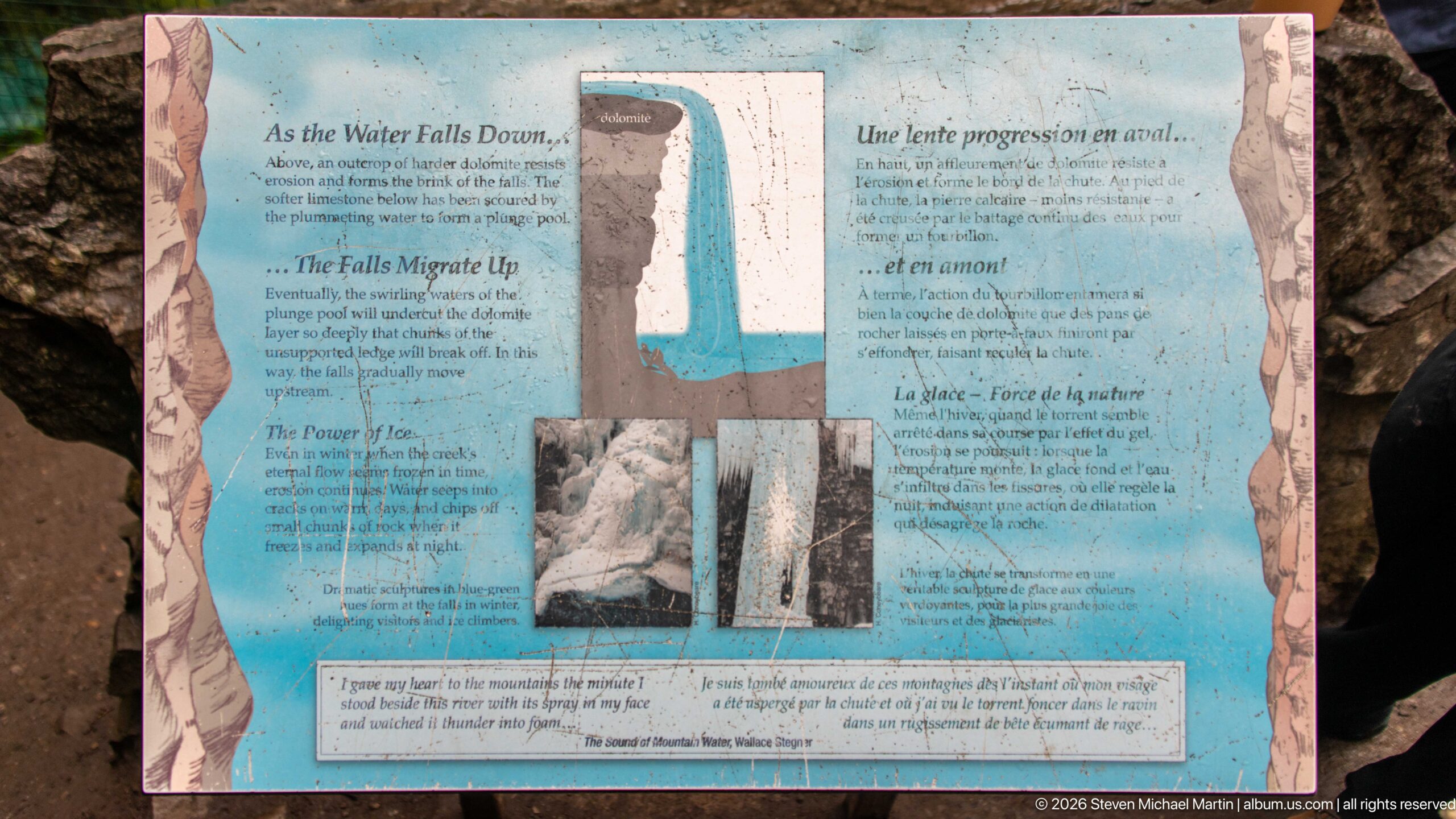
A blue bilingual interpretive panel explains how waterfalls change as water and ice wear away rock. Headings including “The Falls Migrate Up” and “The Power of Ice” frame diagrams and photographs of a cascade and canyon wall. The close view makes this sign a natural-history companion to the nearby falls, presenting erosion as an ongoing process rather than a static feature.
Caption
A blue bilingual interpretive panel explains how waterfalls change as water and ice wear away rock. Headings including “The Falls Migrate Up” and “The Power of Ice” frame diagrams and photographs of a cascade and canyon wall. The close view makes this sign a natural-history companion to the nearby falls, presenting erosion as an ongoing process rather than a static feature.
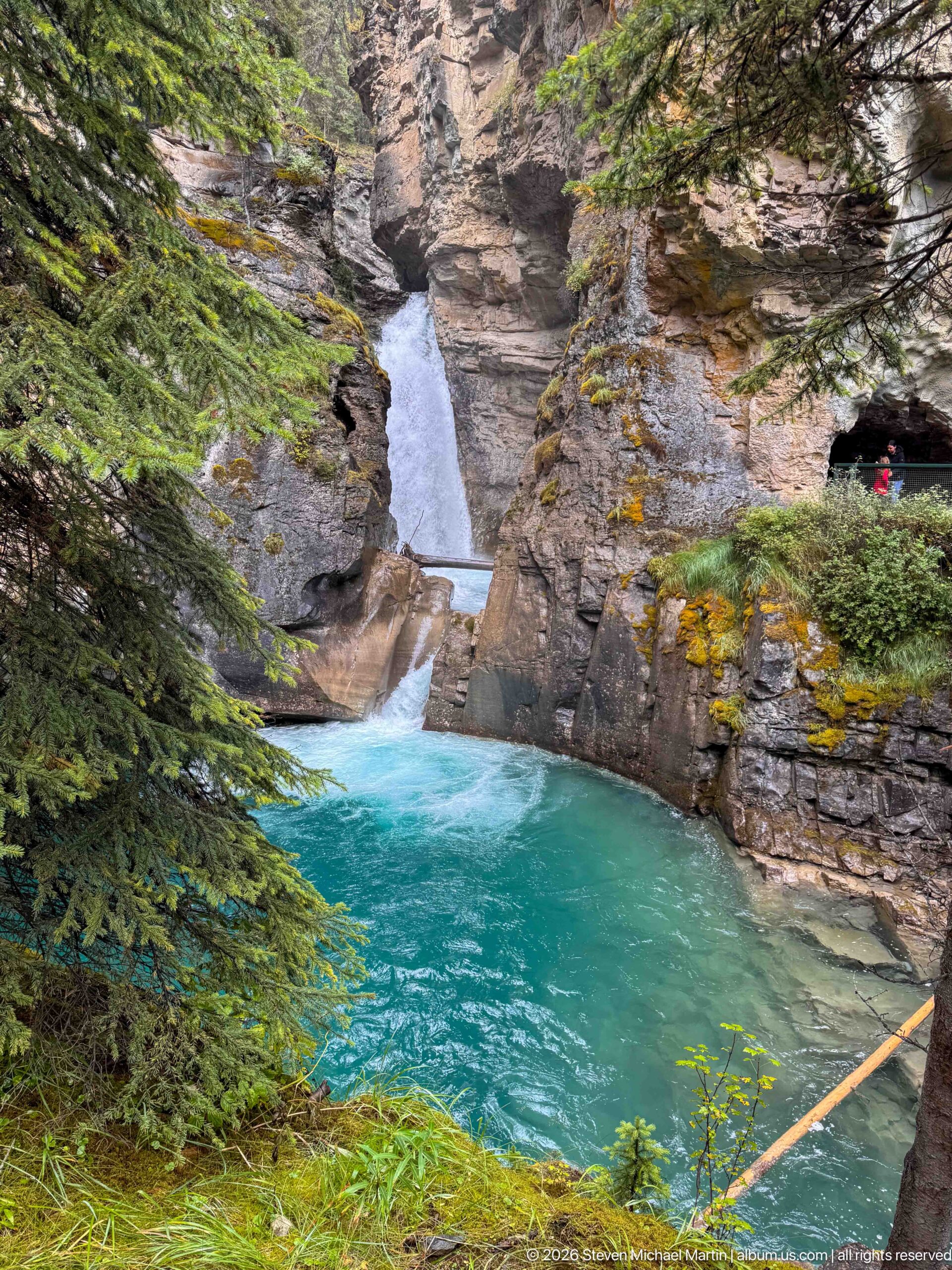
A bright cascade drops into a large turquoise basin enclosed by angular rock ledges and evergreen growth. At the far right, a small red-clad visitor stands inside a dark opening in the rock, providing scale for the broad water-filled chamber. The composition links a powerful stream with a human presence tucked into the canyon wall.
Caption
A bright cascade drops into a large turquoise basin enclosed by angular rock ledges and evergreen growth. At the far right, a small red-clad visitor stands inside a dark opening in the rock, providing scale for the broad water-filled chamber. The composition links a powerful stream with a human presence tucked into the canyon wall.
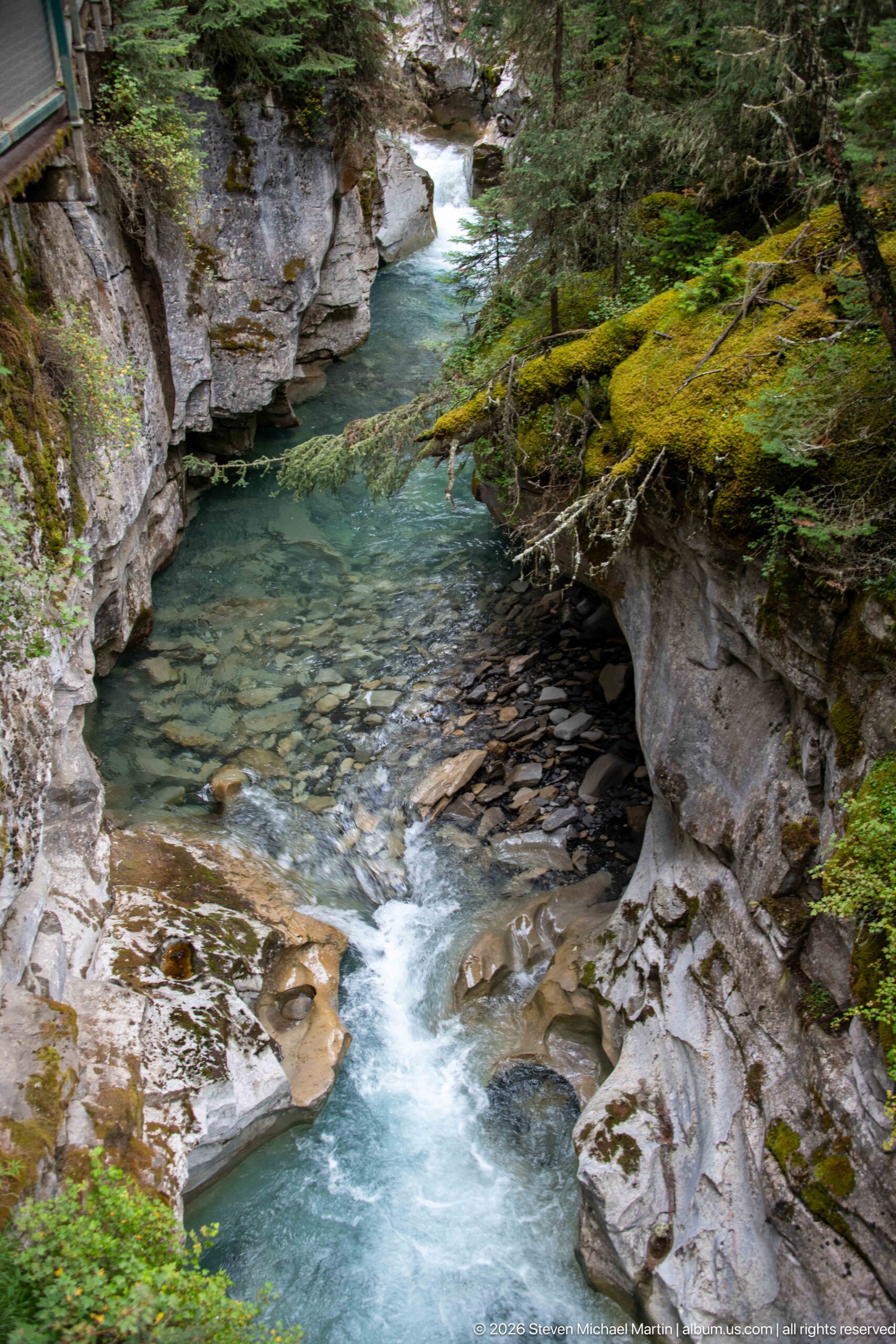
A narrow run of clear blue-green water threads between pale rock shelves and a moss-covered bank. Rounded stones beneath the surface remain visible through the shallows, while a short ripple forms where the channel constricts in the foreground. The elevated viewpoint emphasizes the creek’s sculpted course and the close patterns of water, rock, and vegetation.
Caption
A narrow run of clear blue-green water threads between pale rock shelves and a moss-covered bank. Rounded stones beneath the surface remain visible through the shallows, while a short ripple forms where the channel constricts in the foreground. The elevated viewpoint emphasizes the creek’s sculpted course and the close patterns of water, rock, and vegetation.
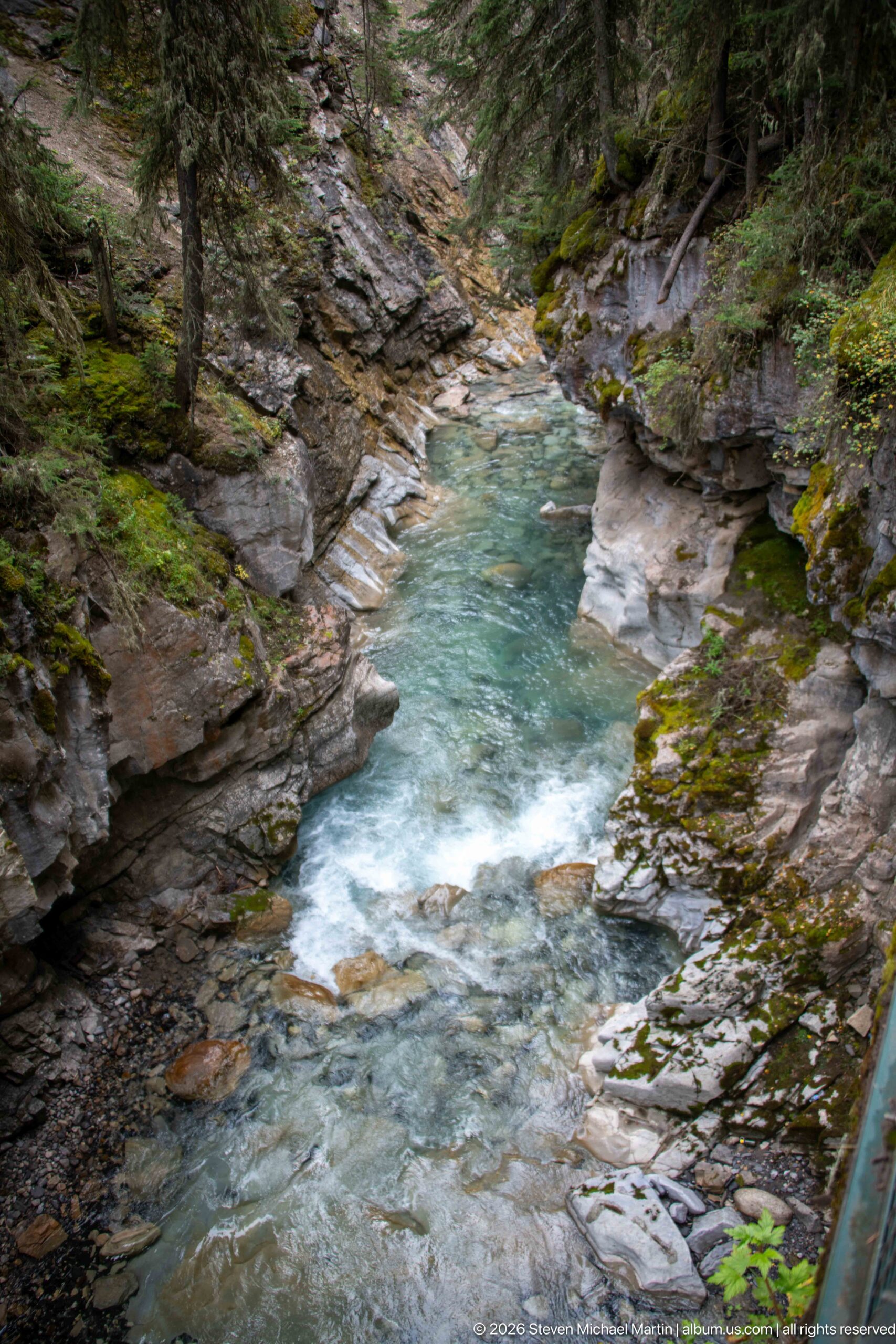
The creek accelerates through a narrow channel and foams over uneven shelves, with darker pools upstream and pale rock ledges along both sides. A green railing intrudes at the lower-right edge, signaling the nearby trail while leaving the water as the central subject. The photograph conveys the creek’s changing pace across a succession of shallow drops.
Caption
The creek accelerates through a narrow channel and foams over uneven shelves, with darker pools upstream and pale rock ledges along both sides. A green railing intrudes at the lower-right edge, signaling the nearby trail while leaving the water as the central subject. The photograph conveys the creek’s changing pace across a succession of shallow drops.
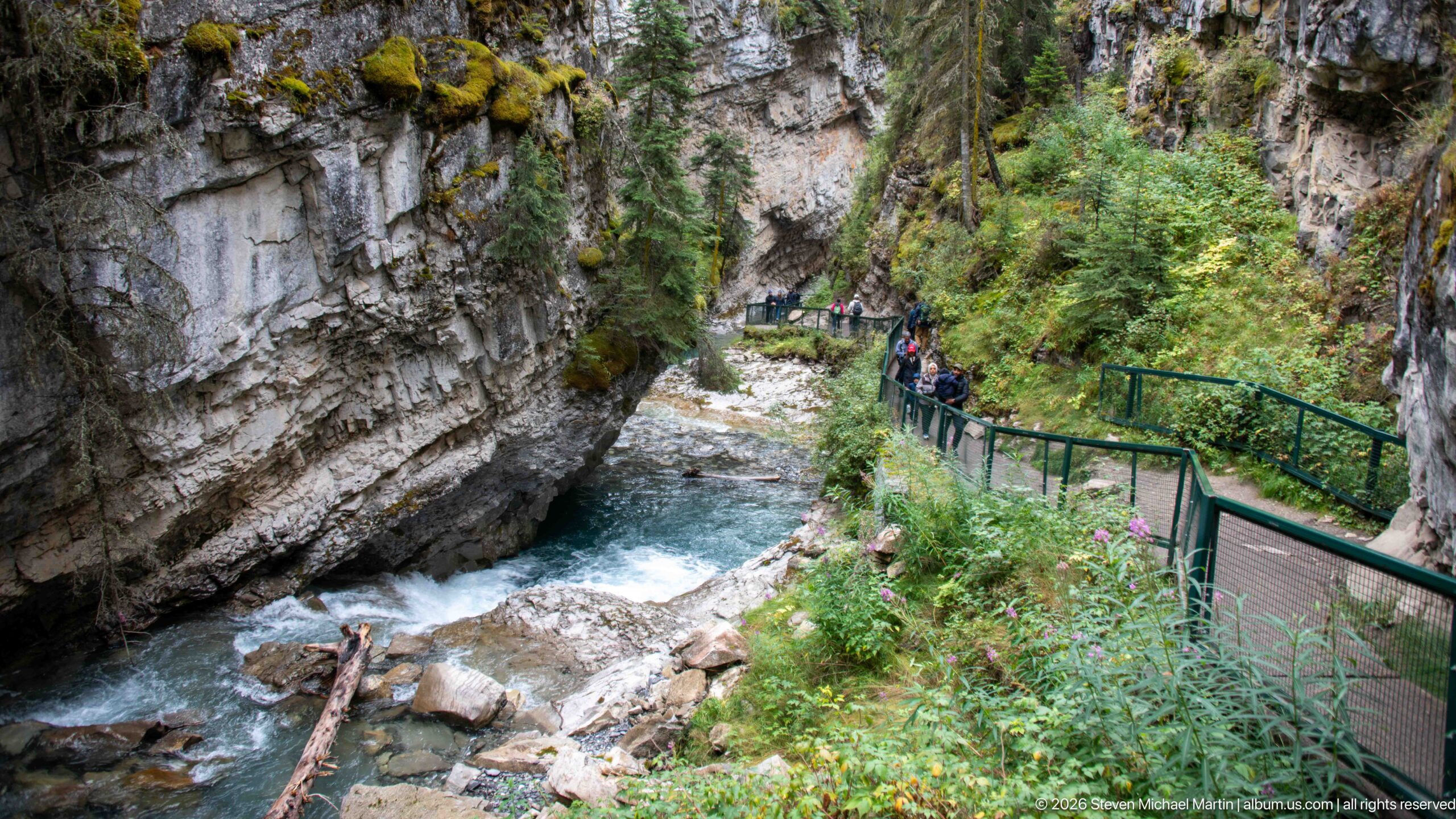
Several visitors move along a green-railed walkway attached to the canyon wall, high above a fast creek. The path bends through the trees as the water runs over rocks below, revealing the close relationship between trail infrastructure and the gorge. The figures provide scale for the steep bank and show the route in active use.
Caption
Several visitors move along a green-railed walkway attached to the canyon wall, high above a fast creek. The path bends through the trees as the water runs over rocks below, revealing the close relationship between trail infrastructure and the gorge. The figures provide scale for the steep bank and show the route in active use.
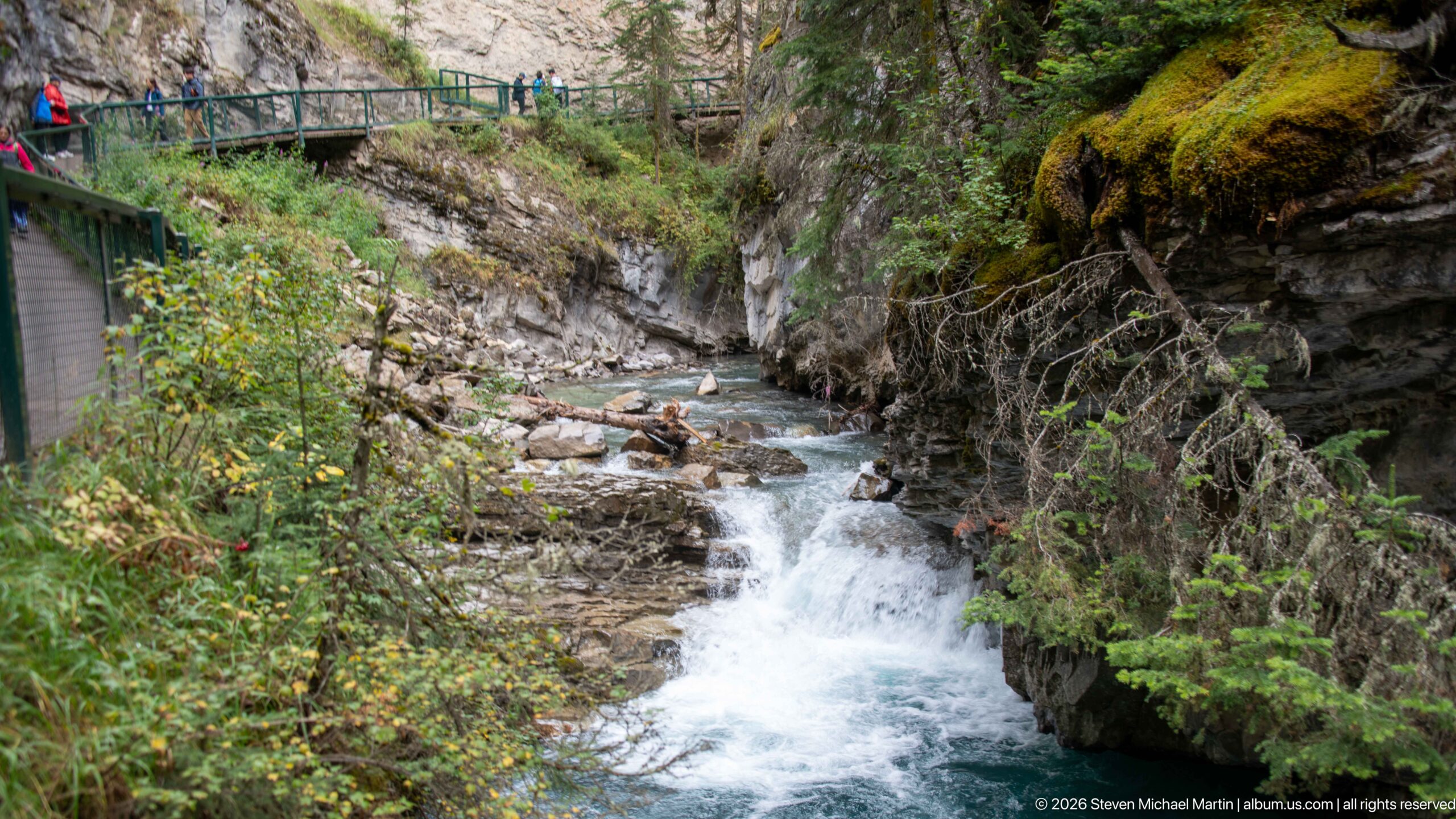
The creek breaks into a small cascade in the foreground and continues through a rocky channel beneath fallen trunks and mossy banks. A section of the walkway appears at the upper left, providing context for the viewpoint without dominating the scene. The composition traces the stream’s route through forest debris and layered stone.
Caption
The creek breaks into a small cascade in the foreground and continues through a rocky channel beneath fallen trunks and mossy banks. A section of the walkway appears at the upper left, providing context for the viewpoint without dominating the scene. The composition traces the stream’s route through forest debris and layered stone.
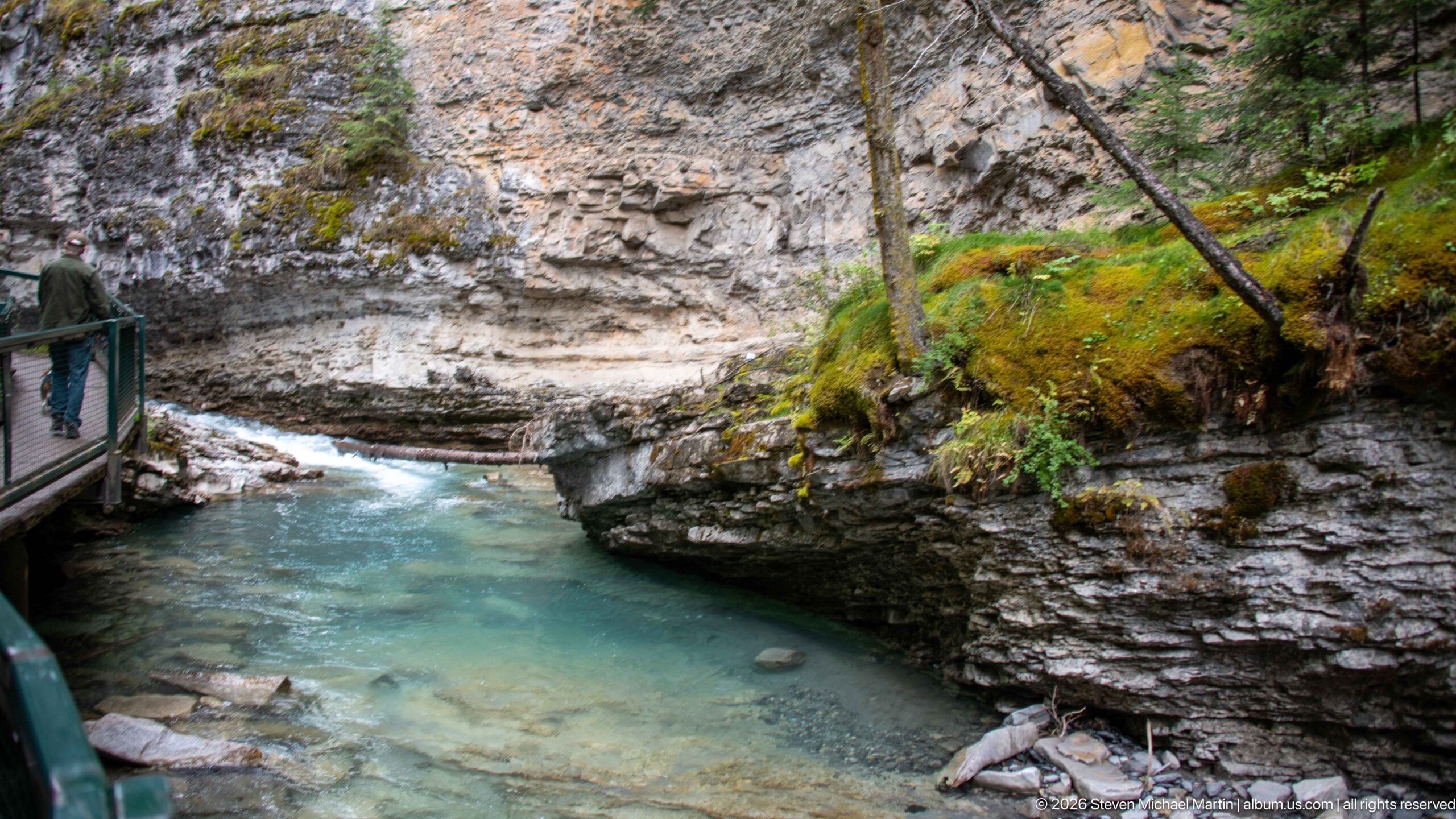
A pale blue-green pool lies beneath a low rock shelf, bordered by smooth ledges and the green railing of the walkway. A visitor is partly visible at the left edge, while the water’s calmer surface opens into a shallow channel beyond. This intimate view balances the hard geometry of the trail with the creek’s changing depth and color.
Caption
A pale blue-green pool lies beneath a low rock shelf, bordered by smooth ledges and the green railing of the walkway. A visitor is partly visible at the left edge, while the water’s calmer surface opens into a shallow channel beyond. This intimate view balances the hard geometry of the trail with the creek’s changing depth and color.
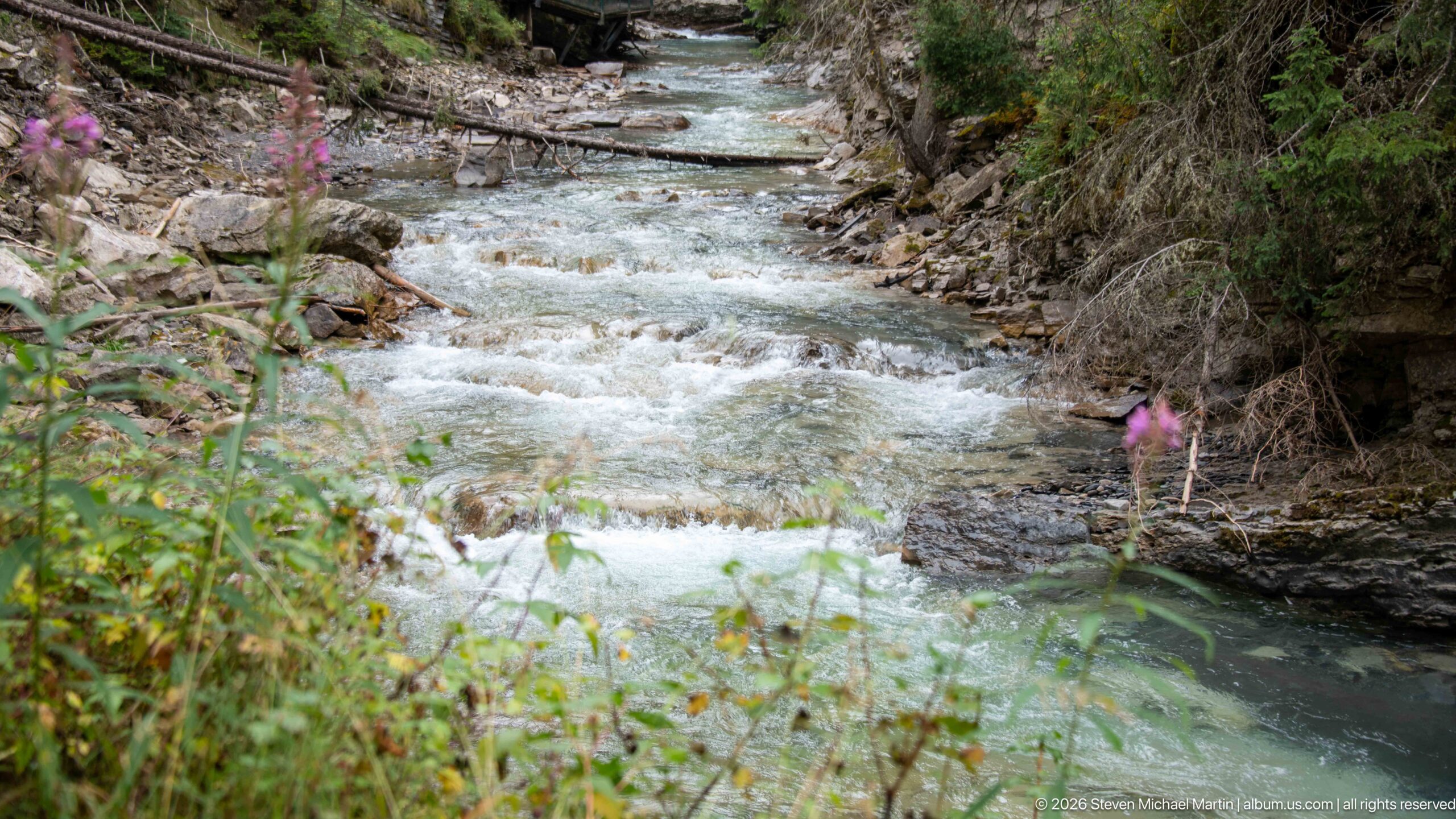
Shallow water runs over pale stones through a wooded channel, with a single pink flower standing sharply in the lower-right foreground. Moss, low plants, and dark conifers line the creek, turning attention from the canyon’s larger falls to a small seasonal detail at its edge. The flower’s placement gives the stream landscape a close, ground-level scale.
Caption
Shallow water runs over pale stones through a wooded channel, with a single pink flower standing sharply in the lower-right foreground. Moss, low plants, and dark conifers line the creek, turning attention from the canyon’s larger falls to a small seasonal detail at its edge. The flower’s placement gives the stream landscape a close, ground-level scale.
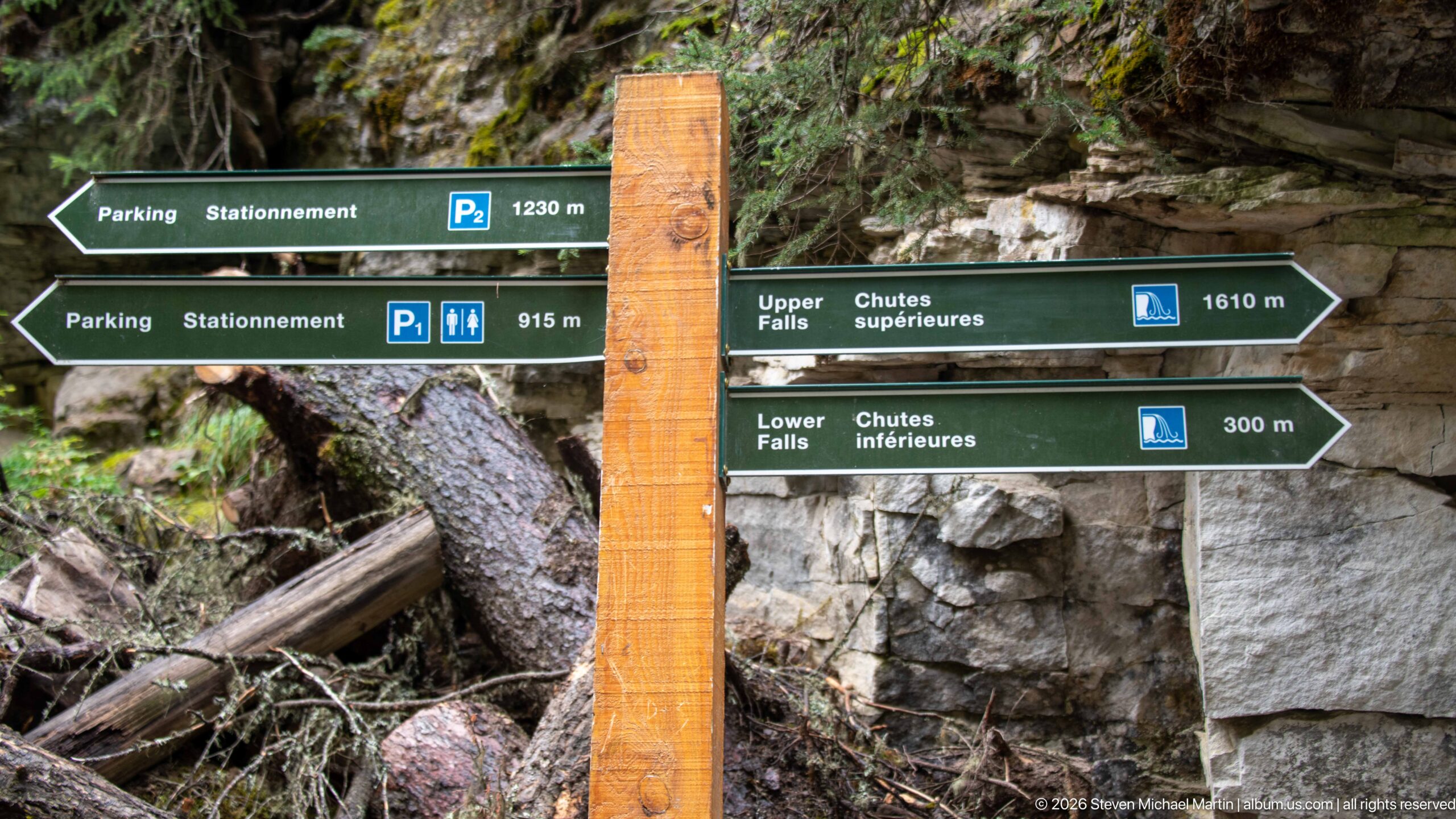
A wooden signpost stands beside the trail, with green bilingual arrows pointing toward parking, facilities, and the falls. The closest listed destination is Lower Falls at 300 metres, while Upper Falls is marked 1,610 metres away. These explicit distances orient the visitor within the canyon and make the sign a useful record of the trail’s branching approach.
Caption
A wooden signpost stands beside the trail, with green bilingual arrows pointing toward parking, facilities, and the falls. The closest listed destination is Lower Falls at 300 metres, while Upper Falls is marked 1,610 metres away. These explicit distances orient the visitor within the canyon and make the sign a useful record of the trail’s branching approach.
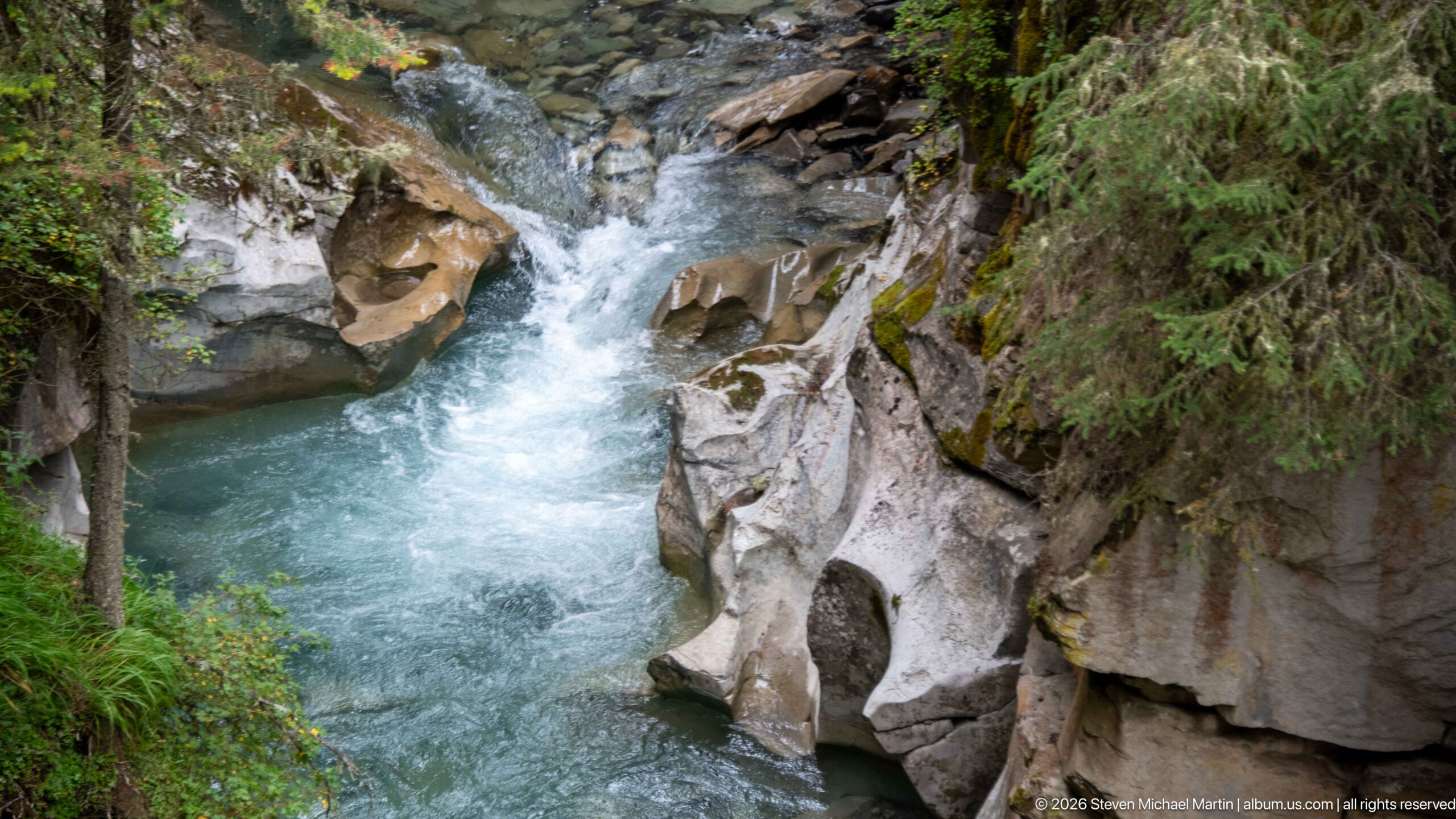
From above, fast blue-green water passes beside a smooth rock wall containing a deep, nearly circular cavity. The rounded hollow contrasts with the angular ledges and fractured slabs around it, suggesting the varied forms water can shape in the canyon. The close, downward viewpoint turns the creek bed into a study of erosion and rock texture.
Caption
From above, fast blue-green water passes beside a smooth rock wall containing a deep, nearly circular cavity. The rounded hollow contrasts with the angular ledges and fractured slabs around it, suggesting the varied forms water can shape in the canyon. The close, downward viewpoint turns the creek bed into a study of erosion and rock texture.
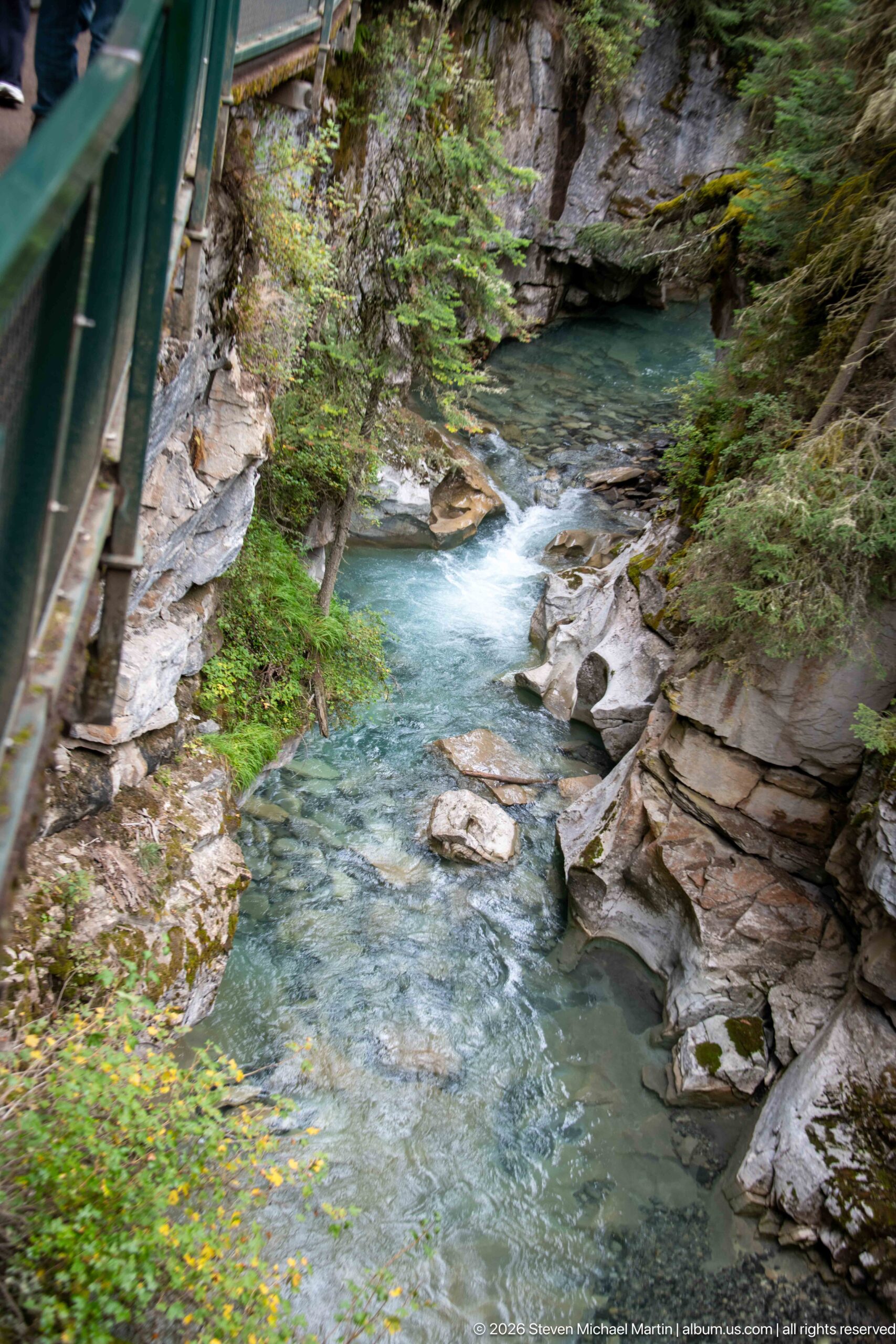
The walkway’s green supports enter from the left as the creek slips through a narrow channel between pale, water-smoothed rock. Small drops break the current into white patches, while the channel opens toward a blue-green pool upstream. This oblique view records the trail’s position above the stream and the varied stone forms along its edge.
Caption
The walkway’s green supports enter from the left as the creek slips through a narrow channel between pale, water-smoothed rock. Small drops break the current into white patches, while the channel opens toward a blue-green pool upstream. This oblique view records the trail’s position above the stream and the varied stone forms along its edge.
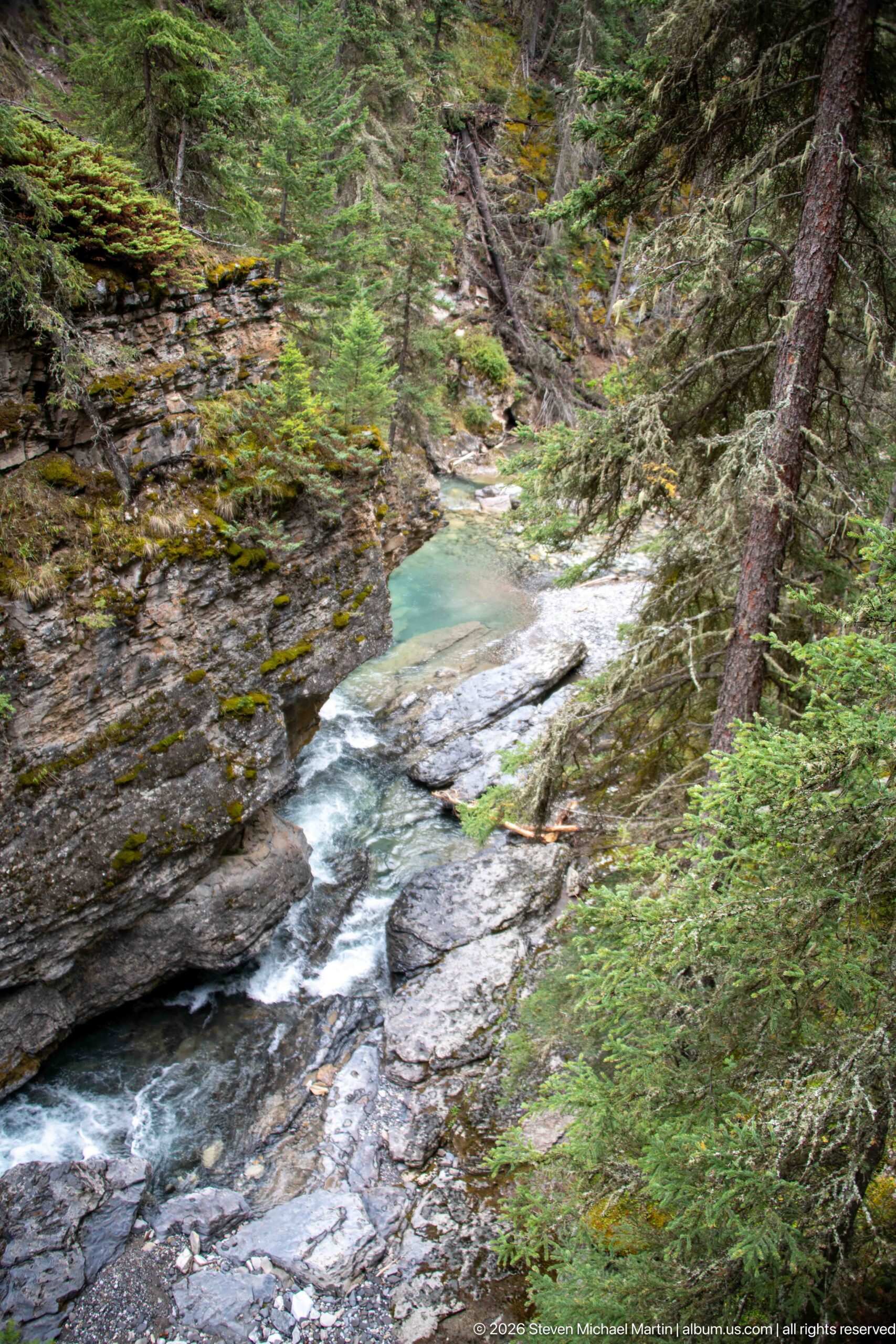
The creek bends around broad, flat rock shelves beneath a shaded forest bank. Its surface changes from a quiet blue-green pool upstream to white ripples over a shallow ledge in the foreground. A slanting tree trunk and mossy stone anchor the right side, giving this composition a horizontal, downstream feel within the canyon.
Caption
The creek bends around broad, flat rock shelves beneath a shaded forest bank. Its surface changes from a quiet blue-green pool upstream to white ripples over a shallow ledge in the foreground. A slanting tree trunk and mossy stone anchor the right side, giving this composition a horizontal, downstream feel within the canyon.
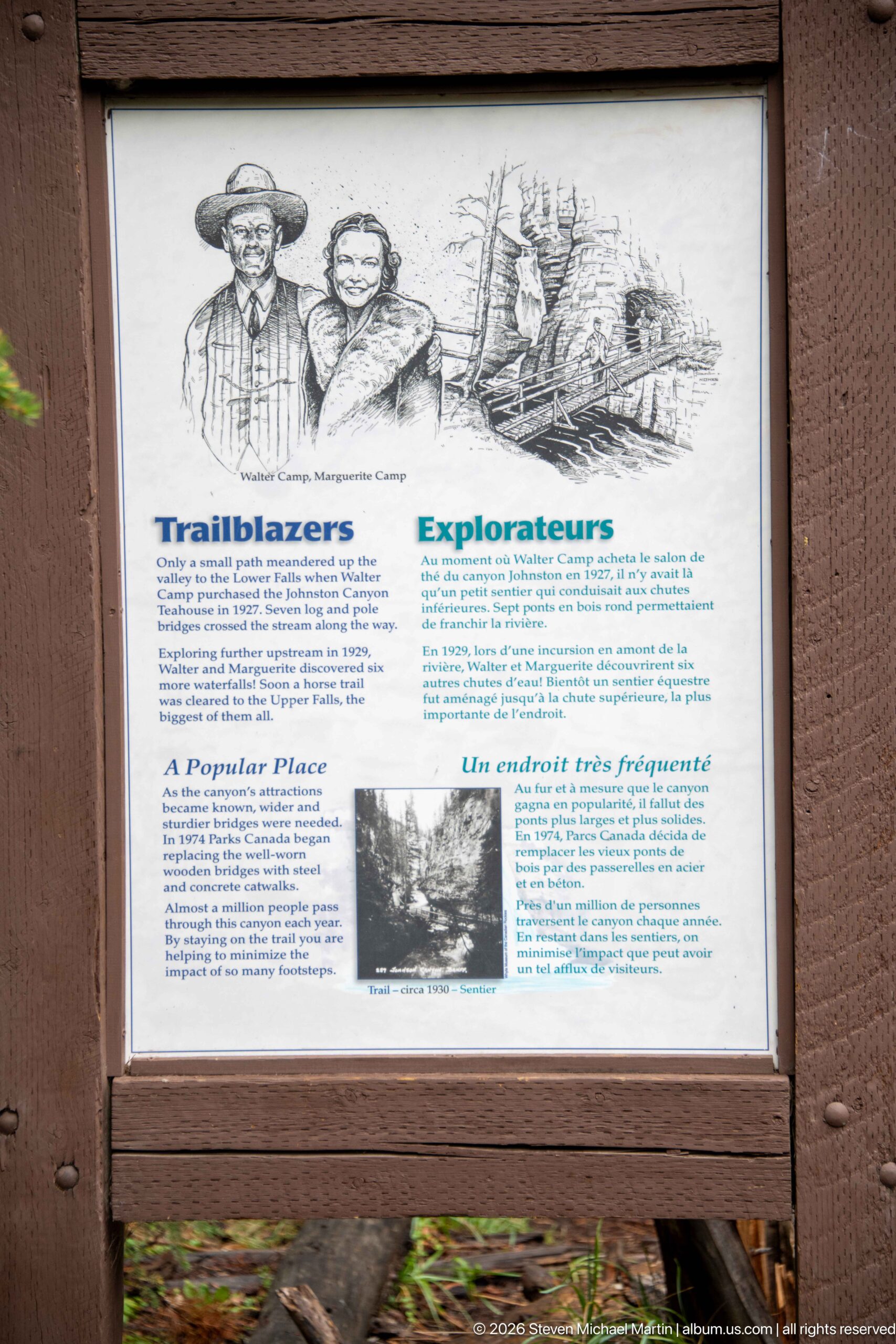
A wooden-framed panel titled “Trailblazers” presents a drawing of two people, an archival-looking scene, and parallel English and French text. A secondary heading, “A Popular Place,” suggests the sign addresses the canyon’s history of exploration and visitation. The close framing centers the interpretive material, making the panel itself—not the surrounding trail—the subject.
Caption
A wooden-framed panel titled “Trailblazers” presents a drawing of two people, an archival-looking scene, and parallel English and French text. A secondary heading, “A Popular Place,” suggests the sign addresses the canyon’s history of exploration and visitation. The close framing centers the interpretive material, making the panel itself—not the surrounding trail—the subject.
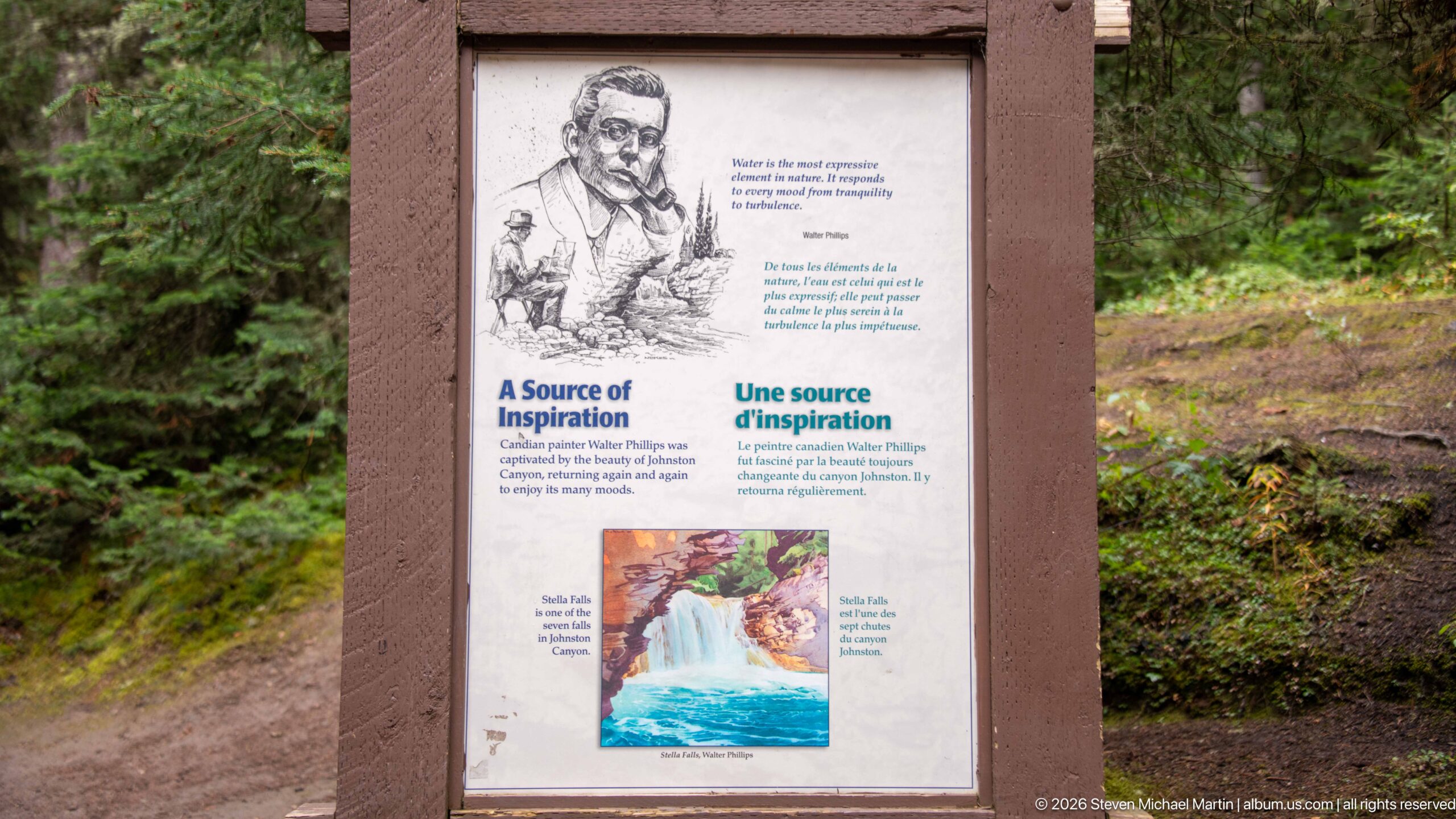
A framed interpretive panel pairs a portrait drawing with a watercolor of a waterfall and text about an artist’s response to Johnston Canyon. The heading “A Source of Inspiration” appears in English and French, while smaller paragraphs describe the painter and the landscape. The sign links the canyon’s scenery with its history as a subject for artistic interpretation.
Caption
A framed interpretive panel pairs a portrait drawing with a watercolor of a waterfall and text about an artist’s response to Johnston Canyon. The heading “A Source of Inspiration” appears in English and French, while smaller paragraphs describe the painter and the landscape. The sign links the canyon’s scenery with its history as a subject for artistic interpretation.
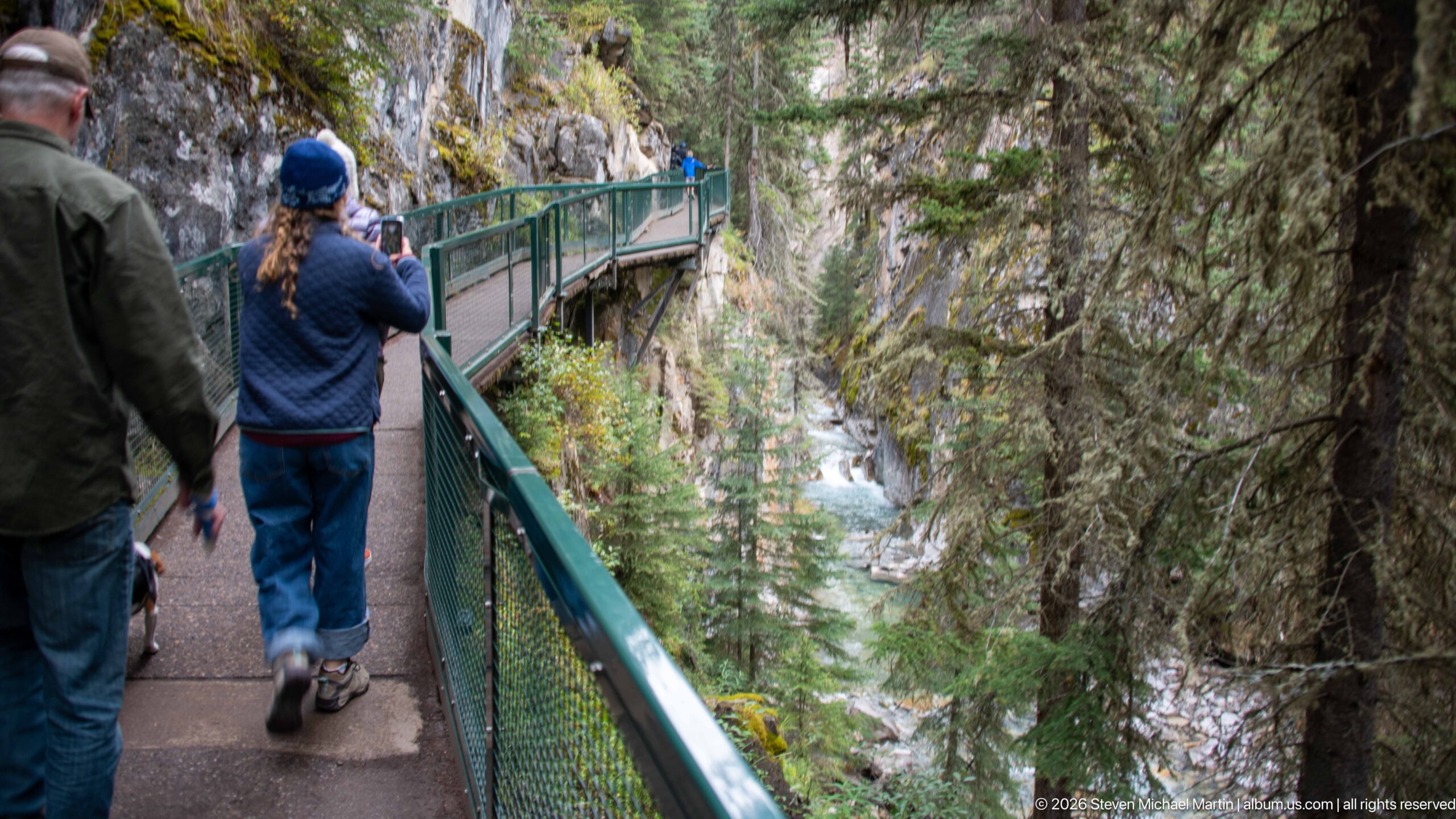
Two visitors walk along the green-railed boardwalk, one raising a camera toward the canyon ahead. The path spans the left side of the frame above a rushing stream and steep wooded banks. Their forward movement gives the image a sense of progression along the trail, with the railings guiding the eye into the deeper gorge.
Caption
Two visitors walk along the green-railed boardwalk, one raising a camera toward the canyon ahead. The path spans the left side of the frame above a rushing stream and steep wooded banks. Their forward movement gives the image a sense of progression along the trail, with the railings guiding the eye into the deeper gorge.
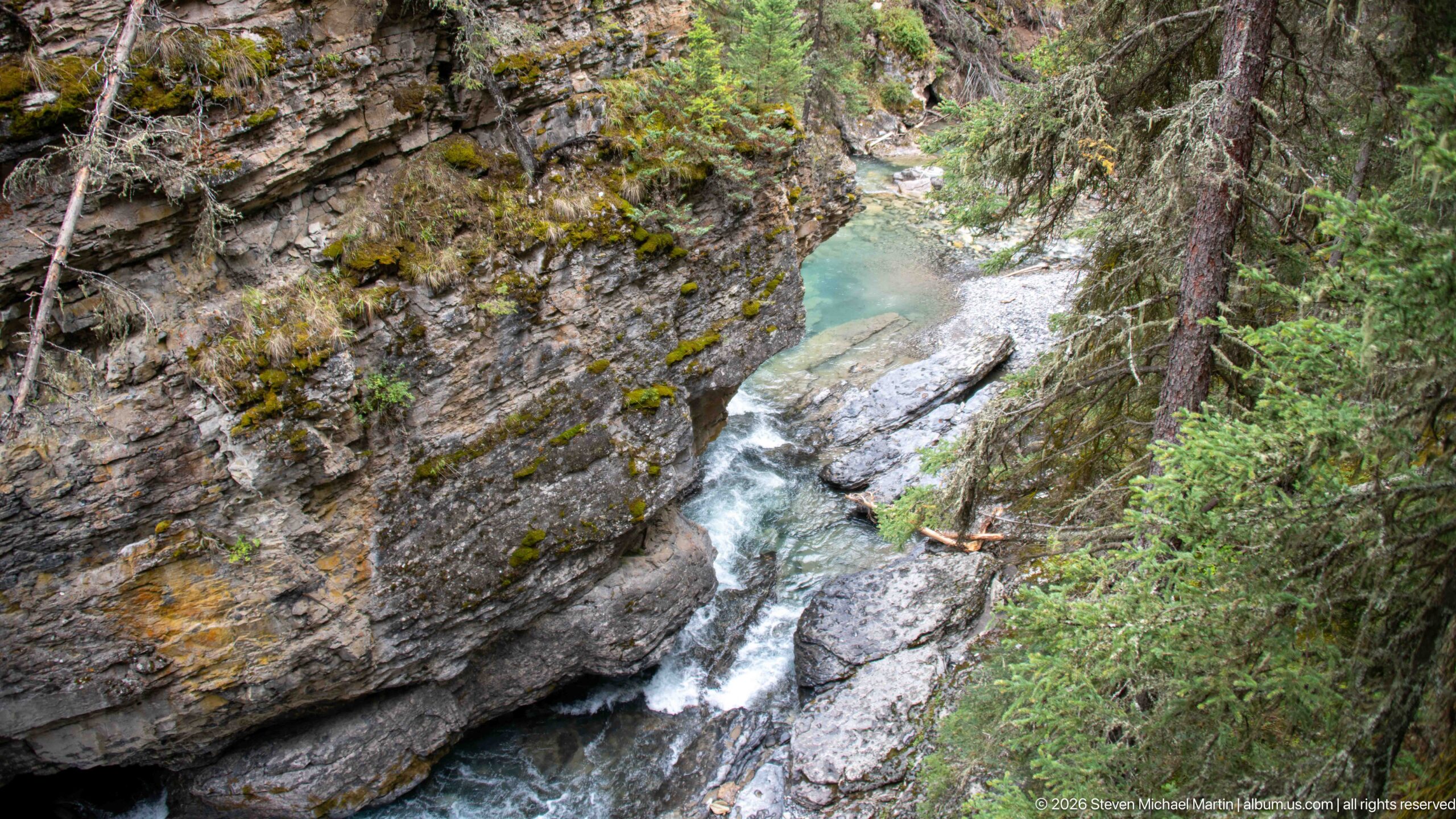
Seen from above, the creek descends through a narrow ravine in several short, foaming steps before reaching a pale pool. The rock walls are close and irregular, marked by orange and gray tones, while conifers lean in from the right bank. This downward perspective reveals the small cascades as a connected sequence rather than a single waterfall.
Caption
Seen from above, the creek descends through a narrow ravine in several short, foaming steps before reaching a pale pool. The rock walls are close and irregular, marked by orange and gray tones, while conifers lean in from the right bank. This downward perspective reveals the small cascades as a connected sequence rather than a single waterfall.
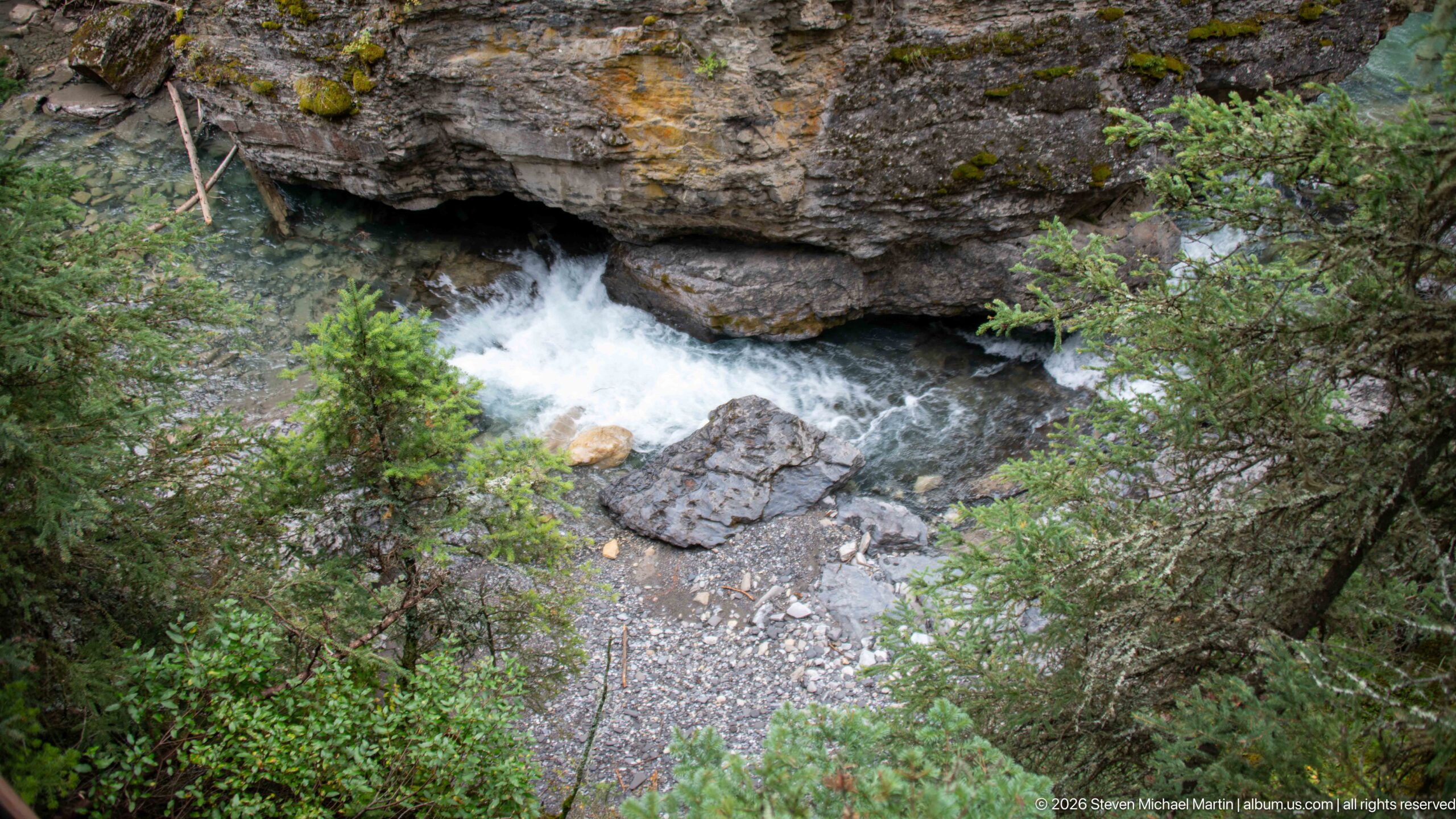
A short waterfall slips beneath a projecting rock shelf and disappears into a shaded basin. The view from above shows the stream narrowing at the ledge, then breaking into whitewater among pale stones below. Evergreen shrubs and small plants soften the rocky channel, while the low overhang gives this cascade a distinct enclosed character.
Caption
A short waterfall slips beneath a projecting rock shelf and disappears into a shaded basin. The view from above shows the stream narrowing at the ledge, then breaking into whitewater among pale stones below. Evergreen shrubs and small plants soften the rocky channel, while the low overhang gives this cascade a distinct enclosed character.
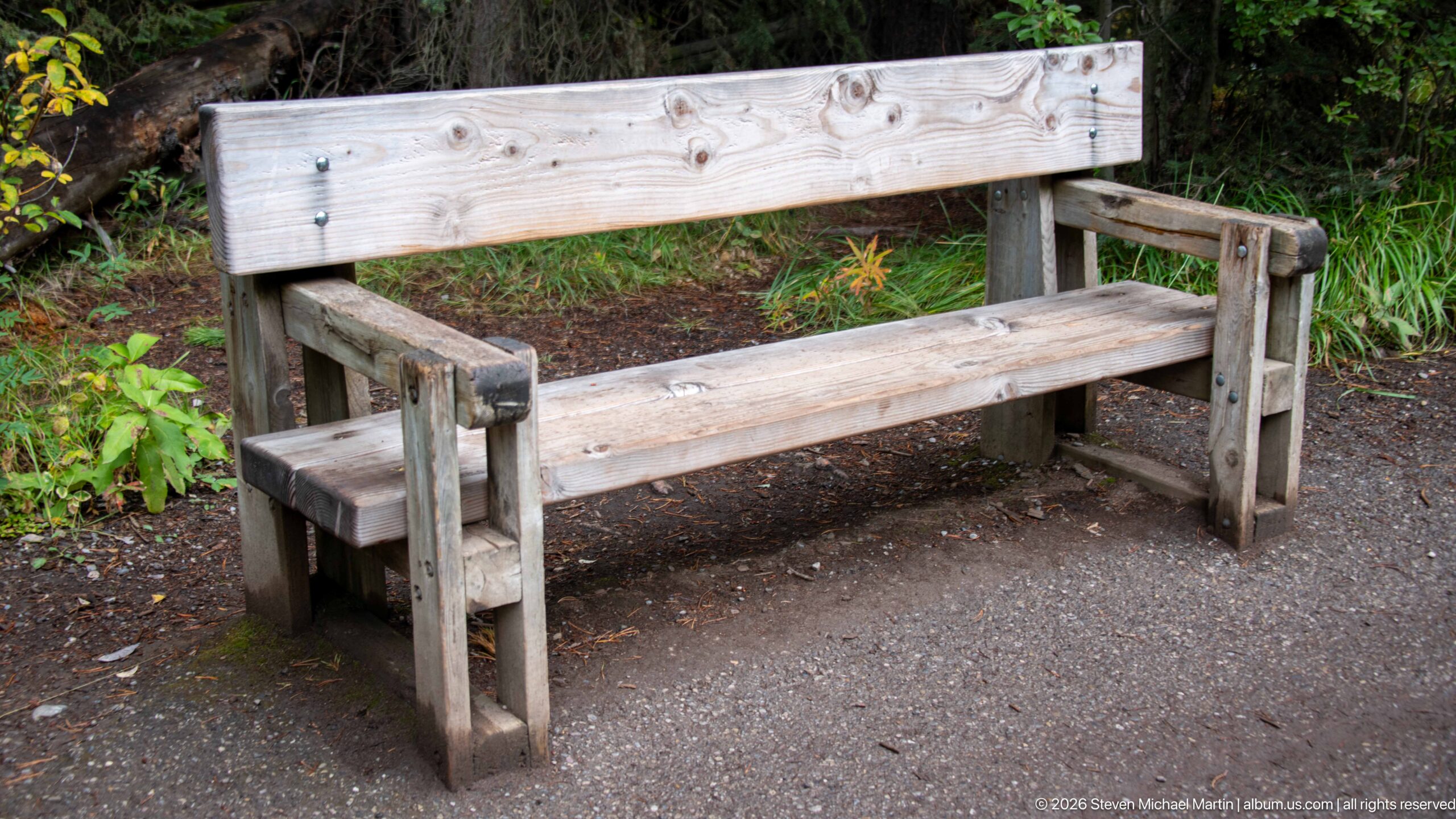
An unoccupied wooden bench stands on a compacted dirt clearing edged by grasses and low flowers. Its broad back and sturdy, weathered supports face the path, offering a pause point within the forested visitor area. The close view makes the simple seating structure and its immediate surroundings the subject, apart from the canyon’s water and rock formations.
Caption
An unoccupied wooden bench stands on a compacted dirt clearing edged by grasses and low flowers. Its broad back and sturdy, weathered supports face the path, offering a pause point within the forested visitor area. The close view makes the simple seating structure and its immediate surroundings the subject, apart from the canyon’s water and rock formations.
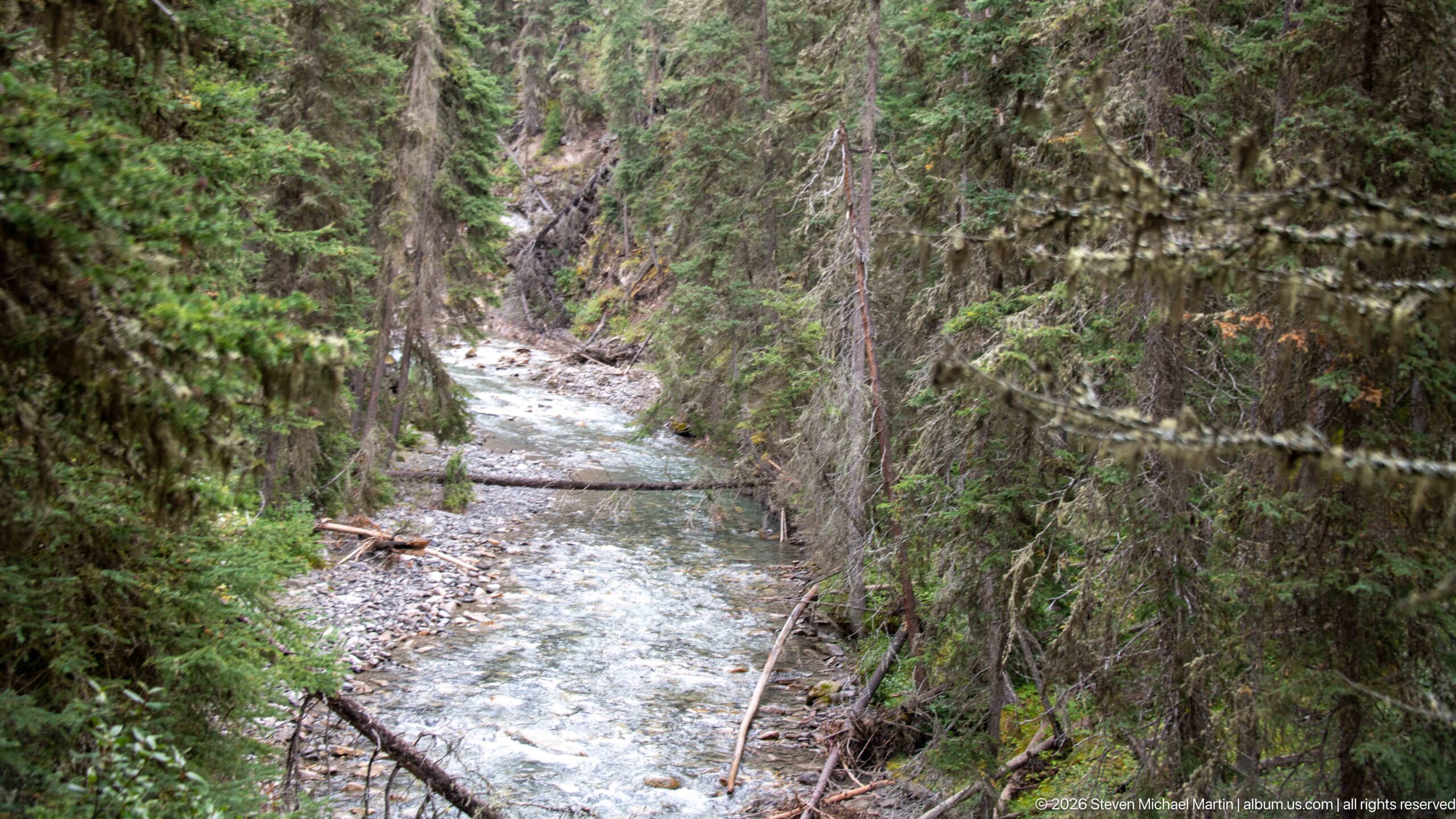
The creek runs from the foreground into a corridor of conifers, with pale stones and fallen branches visible in its shallow channel. The banks rise gently beneath dense woodland, creating a quieter, less confined stretch than the canyon’s narrow gorge. The centered stream leads the eye upstream and emphasizes the continuity of Johnston Creek through the forest.
Caption
The creek runs from the foreground into a corridor of conifers, with pale stones and fallen branches visible in its shallow channel. The banks rise gently beneath dense woodland, creating a quieter, less confined stretch than the canyon’s narrow gorge. The centered stream leads the eye upstream and emphasizes the continuity of Johnston Creek through the forest.
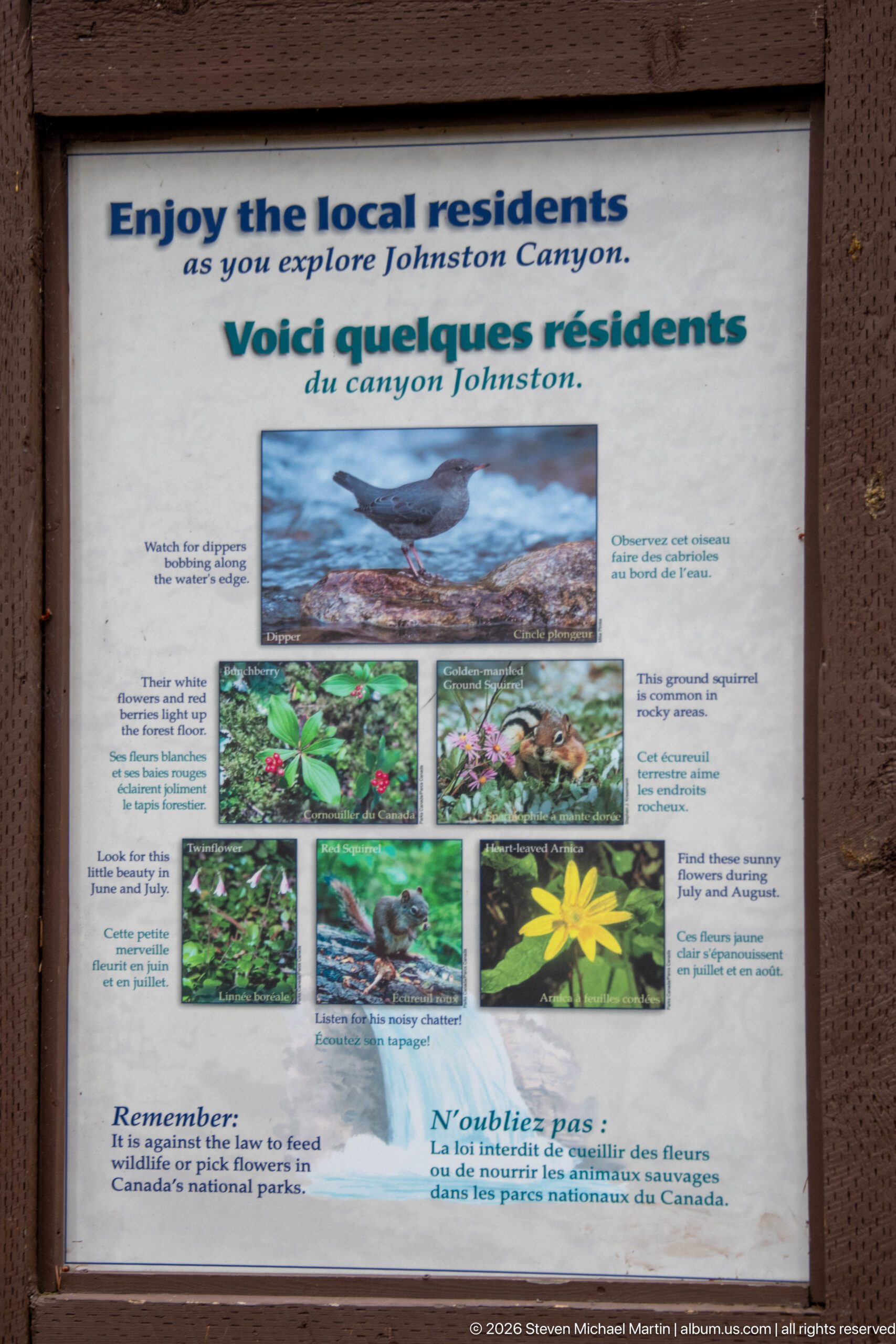
A close view of the “Some local residents” interpretive panel presents photographs of birds, flowers, and other small wildlife found along the trail. English and French captions surround the images, while a lower reminder encourages visitors to protect the natural environment. The layout turns the forest edge into a field guide, linking individual species with the canyon habitat.
Caption
A close view of the “Some local residents” interpretive panel presents photographs of birds, flowers, and other small wildlife found along the trail. English and French captions surround the images, while a lower reminder encourages visitors to protect the natural environment. The layout turns the forest edge into a field guide, linking individual species with the canyon habitat.
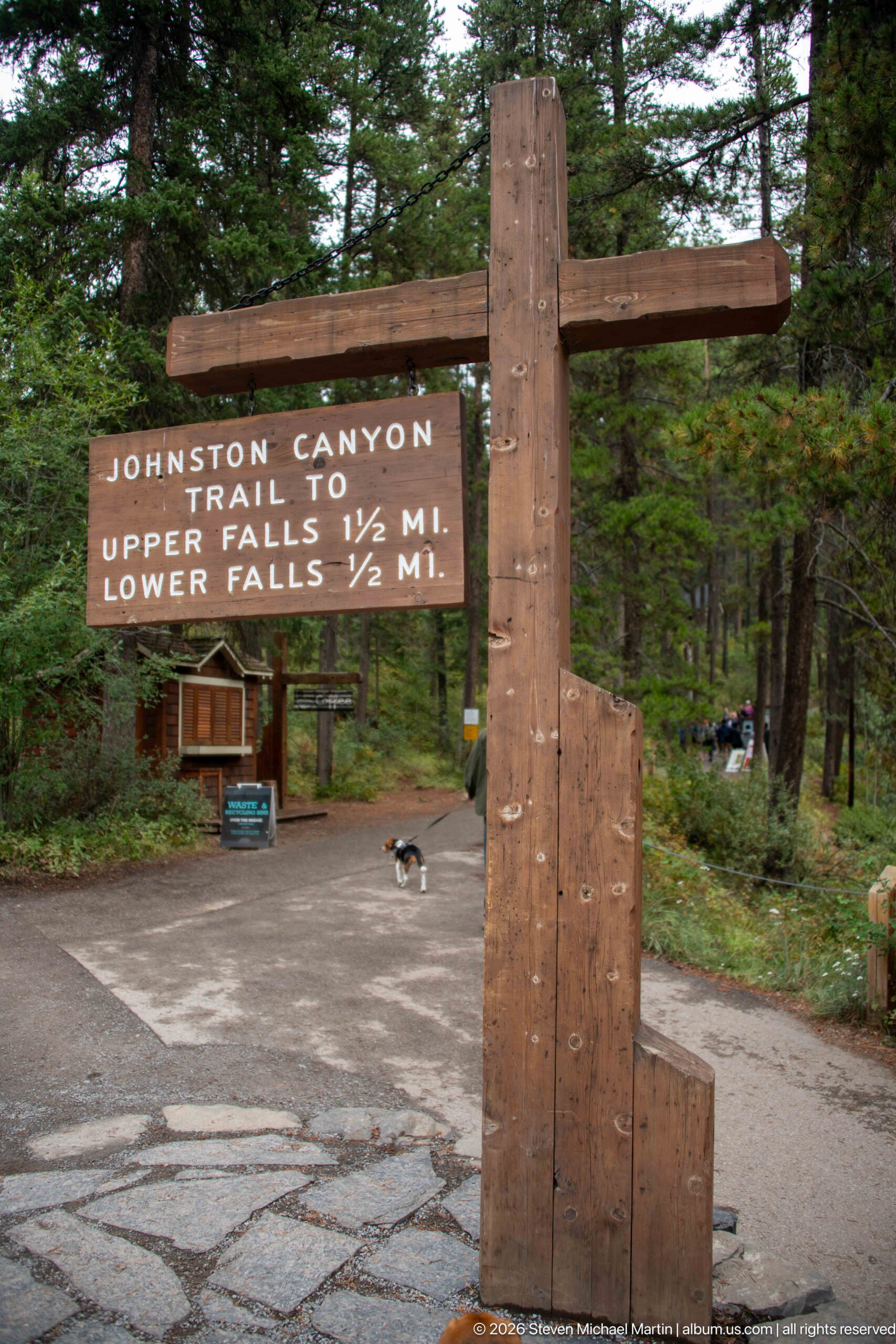
A tall timber post carries a wooden sign for the Johnston Canyon trail, listing Upper Falls at one and a half miles and Lower Falls at half a mile. The wider frame includes the paved approach, trees, a small shelter, and a dog in the distance, giving the sign a setting within the visitor area. The lettering remains the strongest point of orientation.
Caption
A tall timber post carries a wooden sign for the Johnston Canyon trail, listing Upper Falls at one and a half miles and Lower Falls at half a mile. The wider frame includes the paved approach, trees, a small shelter, and a dog in the distance, giving the sign a setting within the visitor area. The lettering remains the strongest point of orientation.
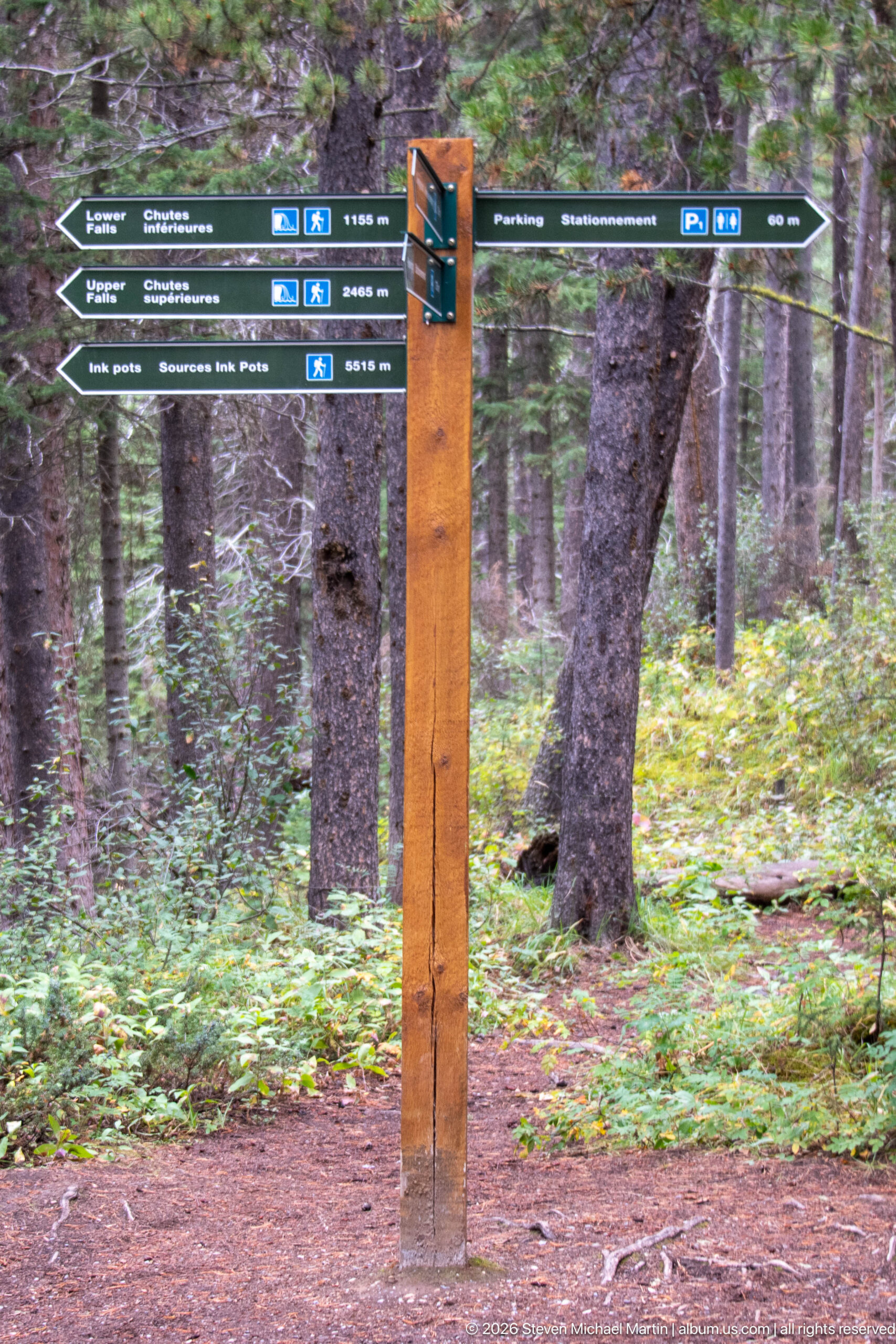
A wooden direction post stands at a junction where narrow paths meet beneath conifers. Several green arrows point toward waterfalls, the Ink Pots, and parking, while the surrounding forest floor is carpeted with low vegetation. The full post is visible in context, allowing the sign’s role as a junction marker to read clearly within the trail network.
Caption
A wooden direction post stands at a junction where narrow paths meet beneath conifers. Several green arrows point toward waterfalls, the Ink Pots, and parking, while the surrounding forest floor is carpeted with low vegetation. The full post is visible in context, allowing the sign’s role as a junction marker to read clearly within the trail network.
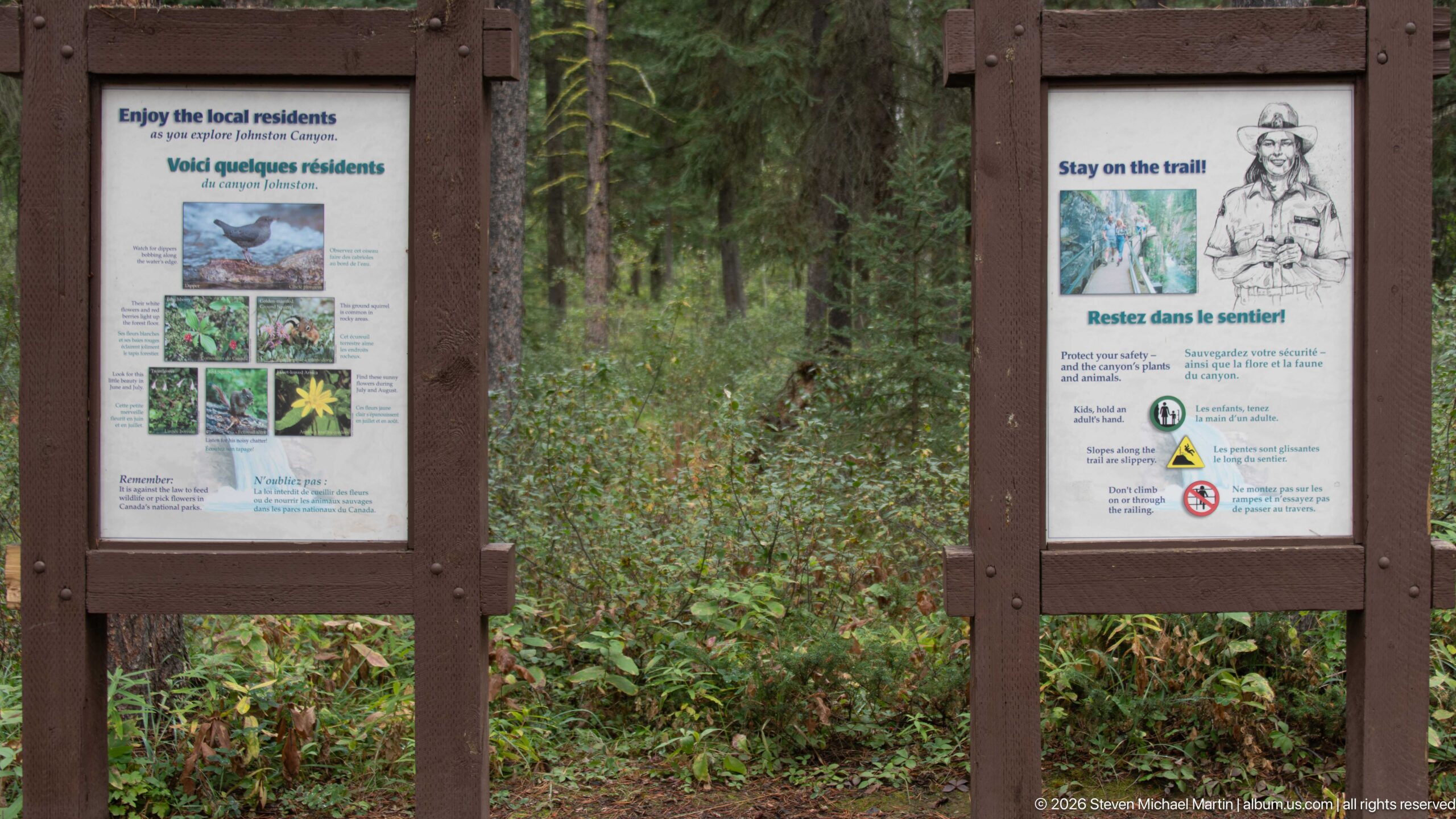
Two separate wooden-framed signs stand on opposite sides of a narrow path through conifers. The left panel shows wildlife and plants; the right, headed “Stay on the trail,” presents visitor guidance and safety symbols. The gap between them frames the route itself, making this a contextual view of how information and trail etiquette are presented on site.
Caption
Two separate wooden-framed signs stand on opposite sides of a narrow path through conifers. The left panel shows wildlife and plants; the right, headed “Stay on the trail,” presents visitor guidance and safety symbols. The gap between them frames the route itself, making this a contextual view of how information and trail etiquette are presented on site.
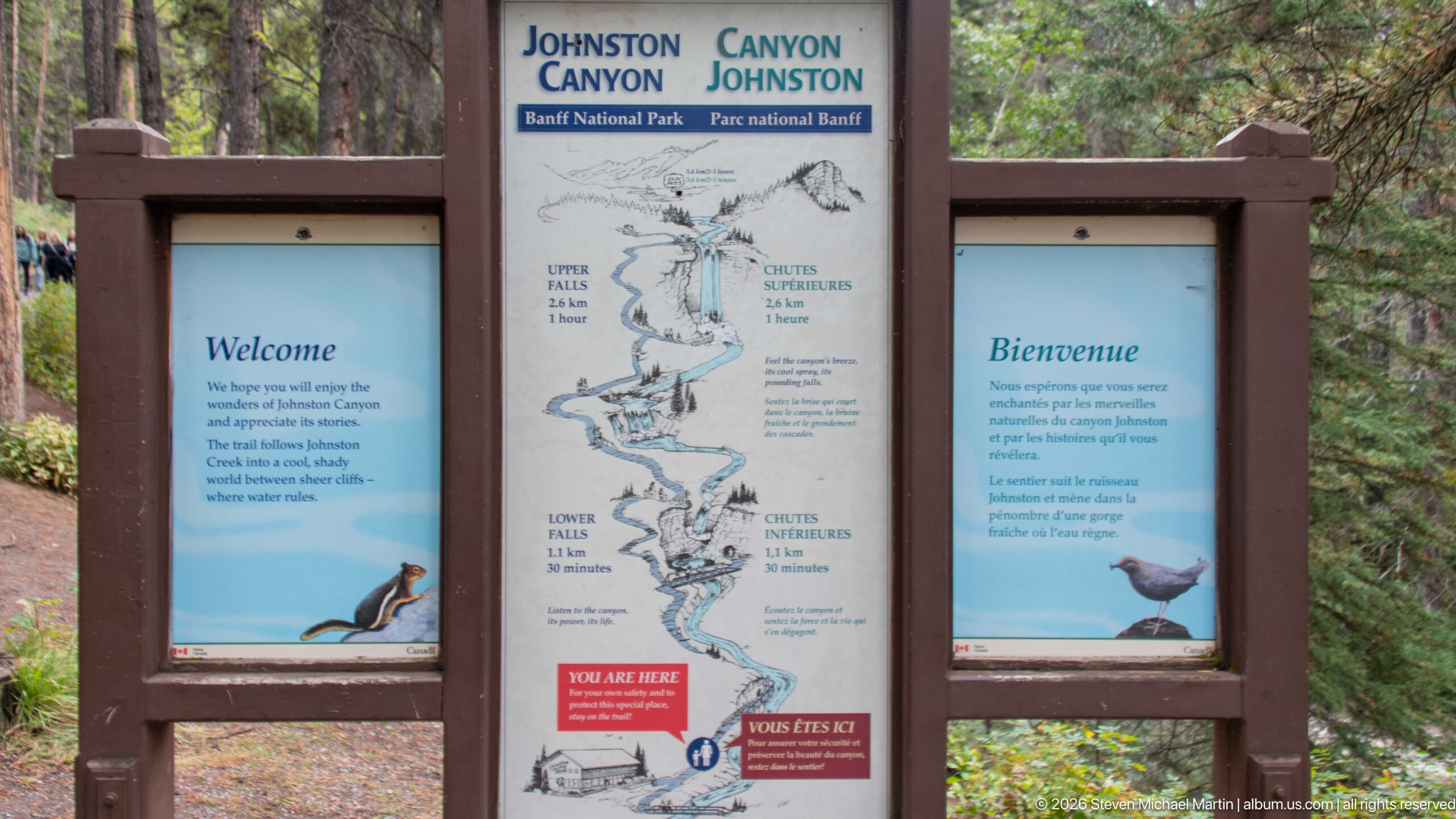
A large trailhead sign combines a central route map with blue welcome panels on either side. The map names Upper and Lower Falls and gives distances, while the English and French panels introduce the canyon trail. The wood-framed structure stands among trees at the path entrance, providing orientation before visitors begin the walk.
Caption
A large trailhead sign combines a central route map with blue welcome panels on either side. The map names Upper and Lower Falls and gives distances, while the English and French panels introduce the canyon trail. The wood-framed structure stands among trees at the path entrance, providing orientation before visitors begin the walk.
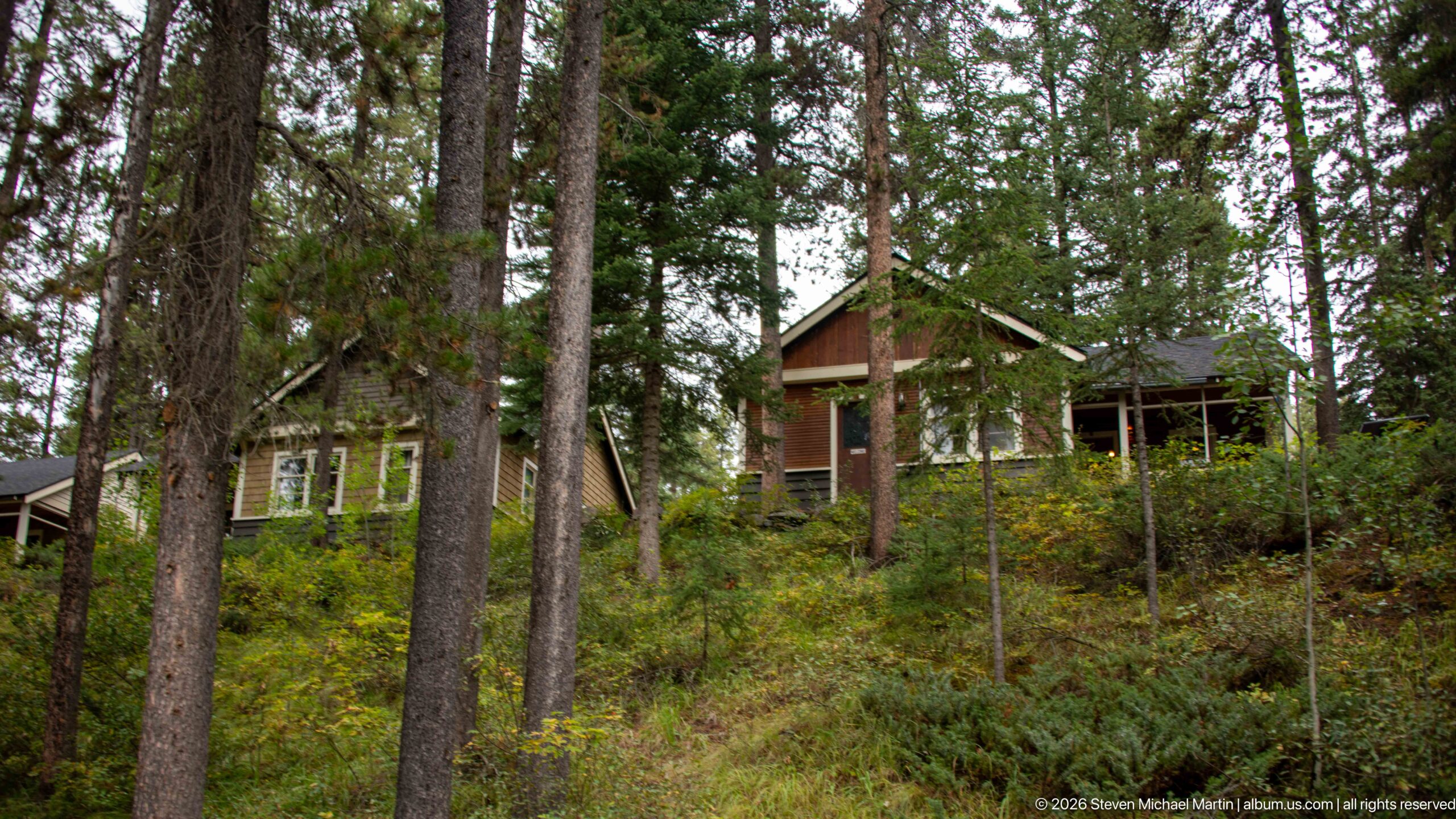
A low timber building with a covered porch sits behind dense shrubs and tall conifers. The wide view reveals several connected sections, window openings, and a sloping roofline, though the trees conceal much of the structure. Its placement along the visitor area contrasts the built shelter with the surrounding woodland; the photograph does not establish the building’s specific use.
Caption
A low timber building with a covered porch sits behind dense shrubs and tall conifers. The wide view reveals several connected sections, window openings, and a sloping roofline, though the trees conceal much of the structure. Its placement along the visitor area contrasts the built shelter with the surrounding woodland; the photograph does not establish the building’s specific use.
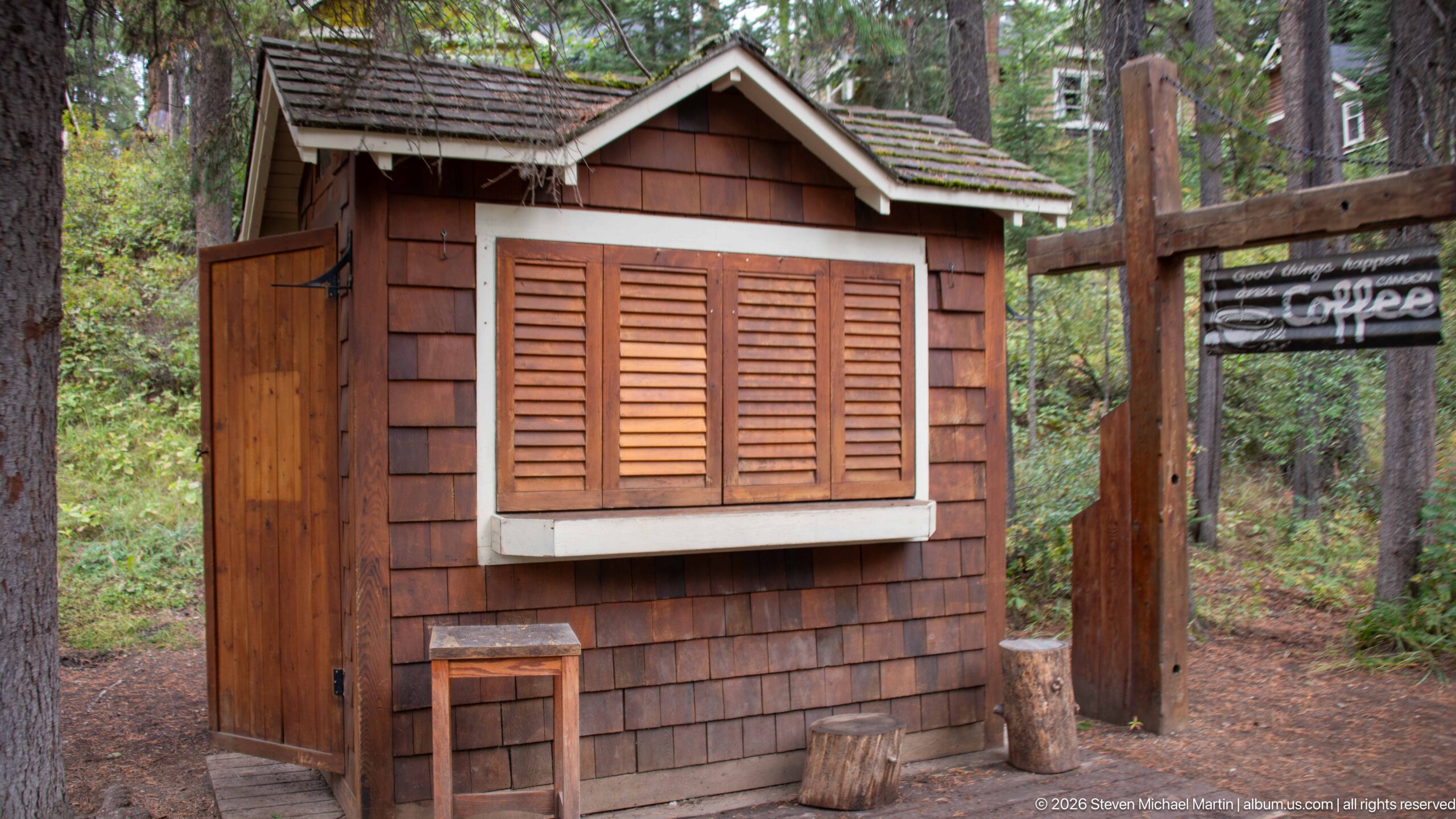
A compact timber kiosk stands among conifers, its closed wooden shutters set above a narrow counter and small stool. A hanging sign at the right reads “Coffee,” identifying the stand’s purpose even though it is not open in this view. The simple structure sits directly in the wooded visitor area, with a bench and rough timber posts reinforcing its informal trail-side character.
Caption
A compact timber kiosk stands among conifers, its closed wooden shutters set above a narrow counter and small stool. A hanging sign at the right reads “Coffee,” identifying the stand’s purpose even though it is not open in this view. The simple structure sits directly in the wooded visitor area, with a bench and rough timber posts reinforcing its informal trail-side character.
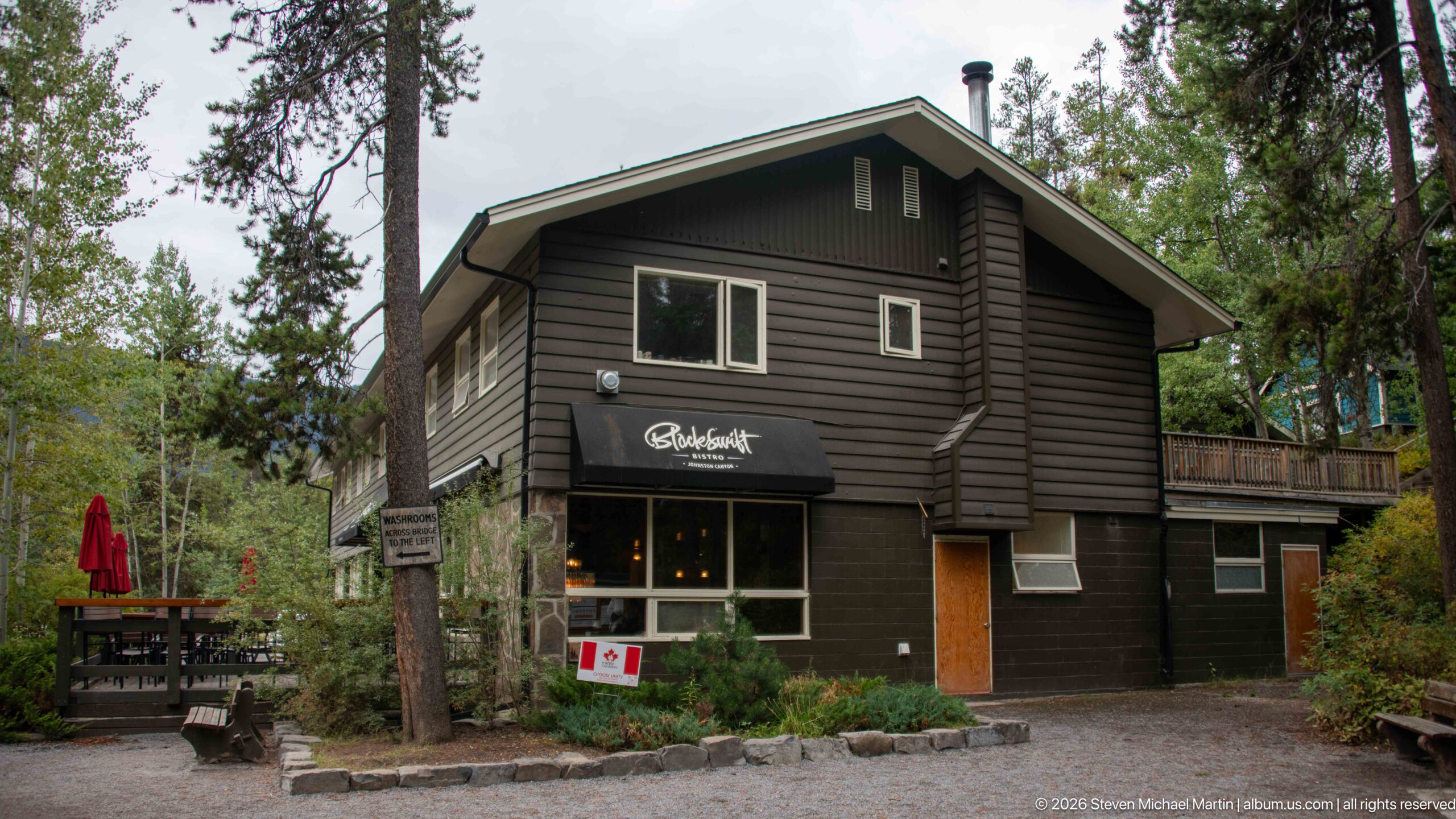
A dark, two-story timber-clad building stands in a clearing beside the trail, with a broad gabled roof, upper windows, and a ground-floor entrance beneath a black awning. A Canadian flag hangs near the stone-edged planting bed, and a small outdoor seating area is visible to the left. The wooded setting and storefront suggest visitor services without requiring a more specific identification.
Caption
A dark, two-story timber-clad building stands in a clearing beside the trail, with a broad gabled roof, upper windows, and a ground-floor entrance beneath a black awning. A Canadian flag hangs near the stone-edged planting bed, and a small outdoor seating area is visible to the left. The wooded setting and storefront suggest visitor services without requiring a more specific identification.
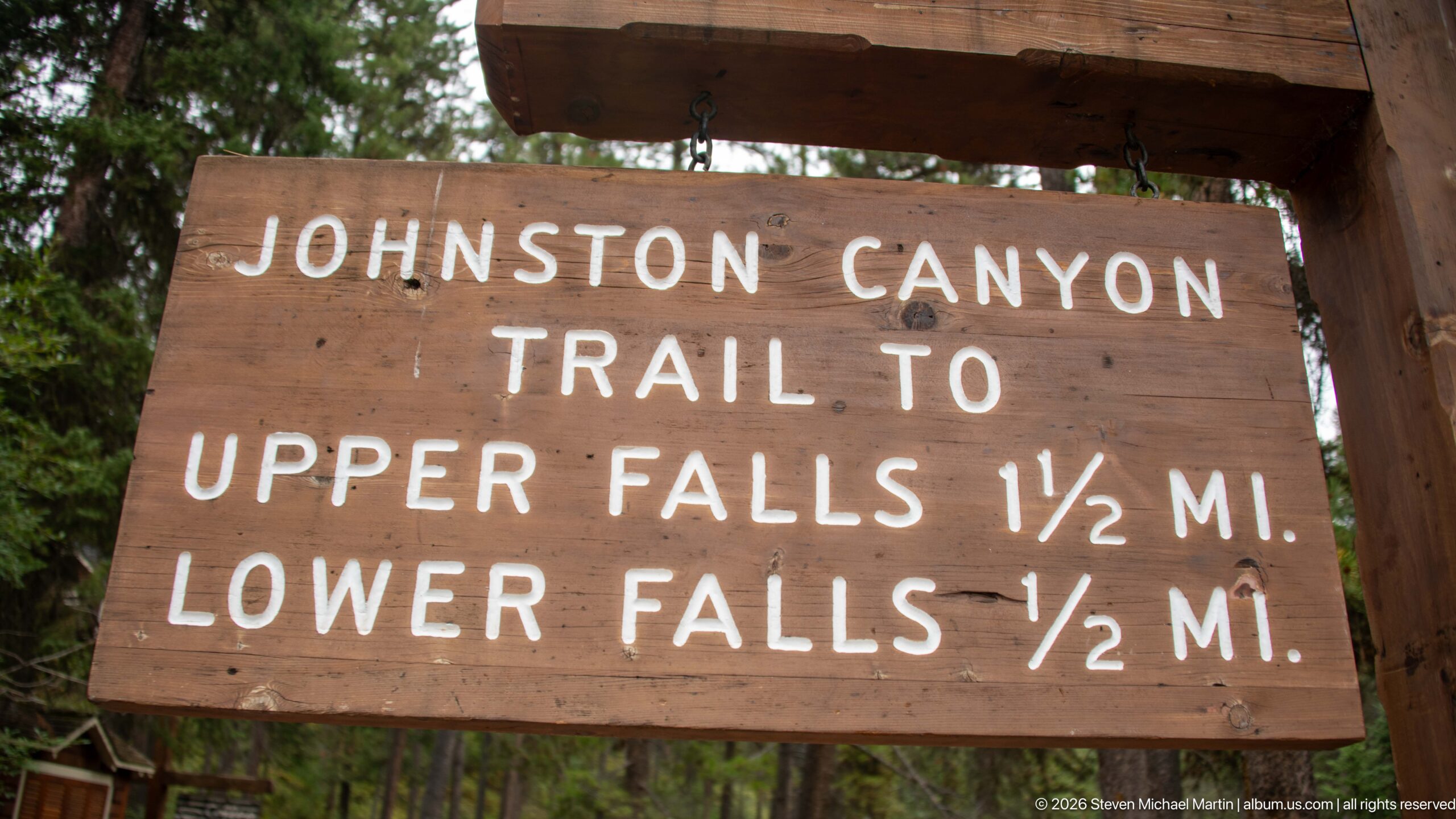
A weathered wooden sign hangs beneath a timber shelter, directing walkers along Johnston Canyon Trail. Its lettering gives separate distances to Upper Falls and Lower Falls, making the post a clear marker of the route ahead. The close, slightly upward viewpoint emphasizes the painted words and the rough grain of the board rather than the surrounding forest.
Caption
A weathered wooden sign hangs beneath a timber shelter, directing walkers along Johnston Canyon Trail. Its lettering gives separate distances to Upper Falls and Lower Falls, making the post a clear marker of the route ahead. The close, slightly upward viewpoint emphasizes the painted words and the rough grain of the board rather than the surrounding forest.
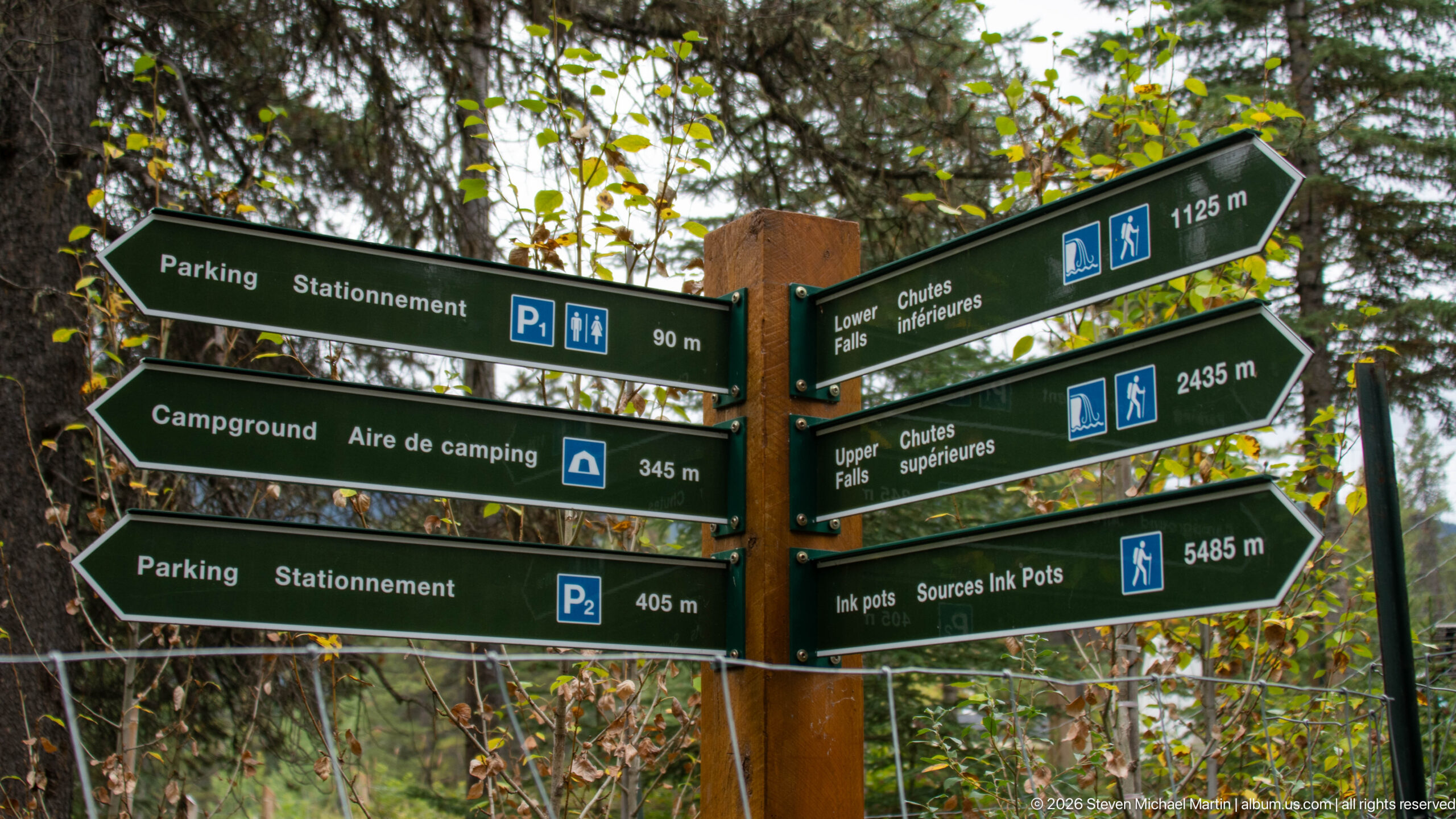
Multiple green bilingual arrows mark routes from this junction to two parking areas, the campground, Lower Falls, Upper Falls, and the Ink Pots. The distances differ substantially, showing how the short waterfall walk extends into a longer hike farther up the canyon. Framed close among leafy branches, the sign records the practical network connecting the trailhead and campground.
Caption
Multiple green bilingual arrows mark routes from this junction to two parking areas, the campground, Lower Falls, Upper Falls, and the Ink Pots. The distances differ substantially, showing how the short waterfall walk extends into a longer hike farther up the canyon. Framed close among leafy branches, the sign records the practical network connecting the trailhead and campground.
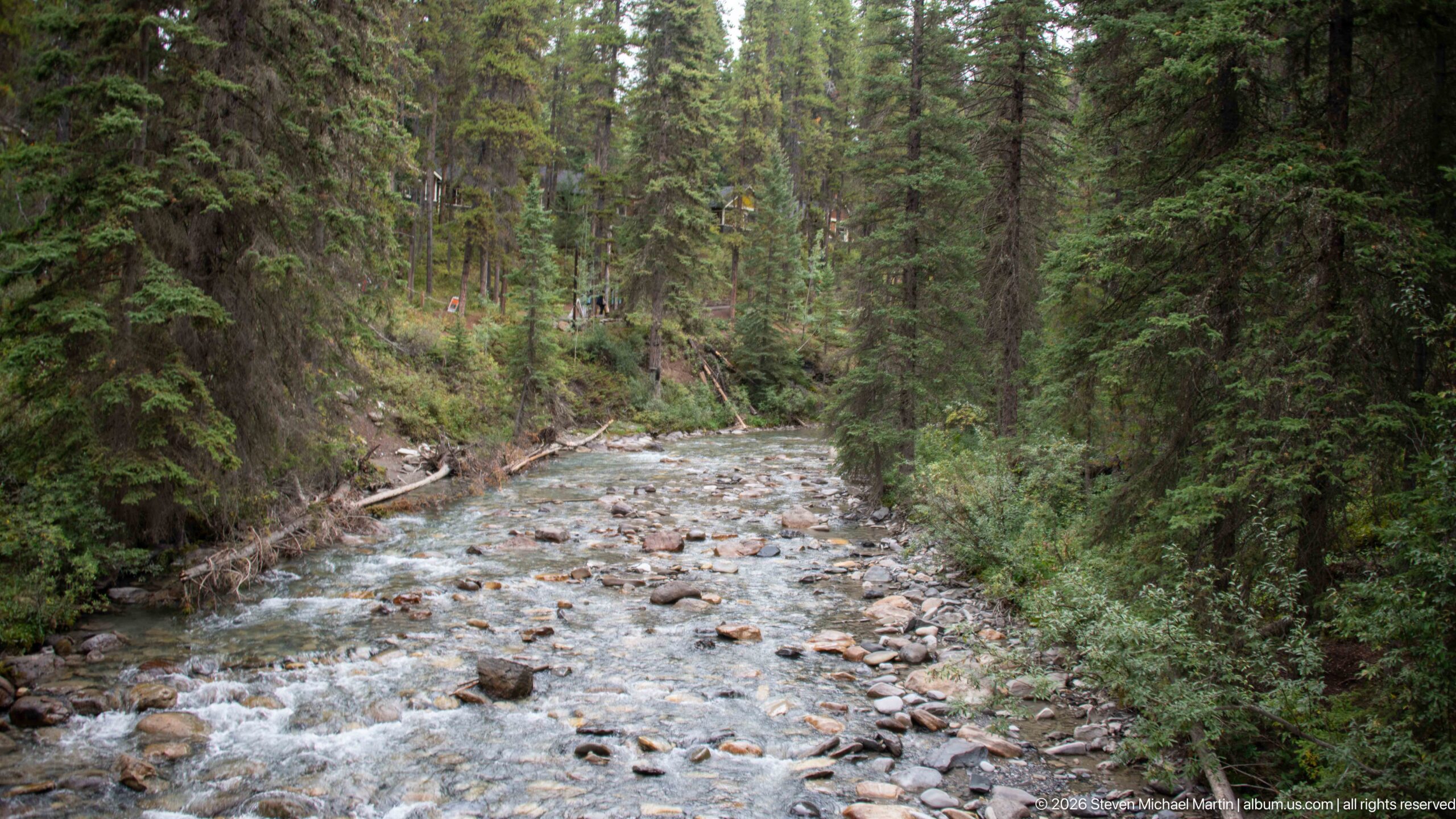
A shallow, stony stream spreads across a broad channel beneath dense conifers. Pale gravel bars and rounded stones divide the current into several narrow paths, while fallen branches lie along the banks. The water occupies the lower half of the frame and leads into the forest, presenting a quiet reach of Johnston Creek rather than a close view of its waterfalls.
Caption
A shallow, stony stream spreads across a broad channel beneath dense conifers. Pale gravel bars and rounded stones divide the current into several narrow paths, while fallen branches lie along the banks. The water occupies the lower half of the frame and leads into the forest, presenting a quiet reach of Johnston Creek rather than a close view of its waterfalls.
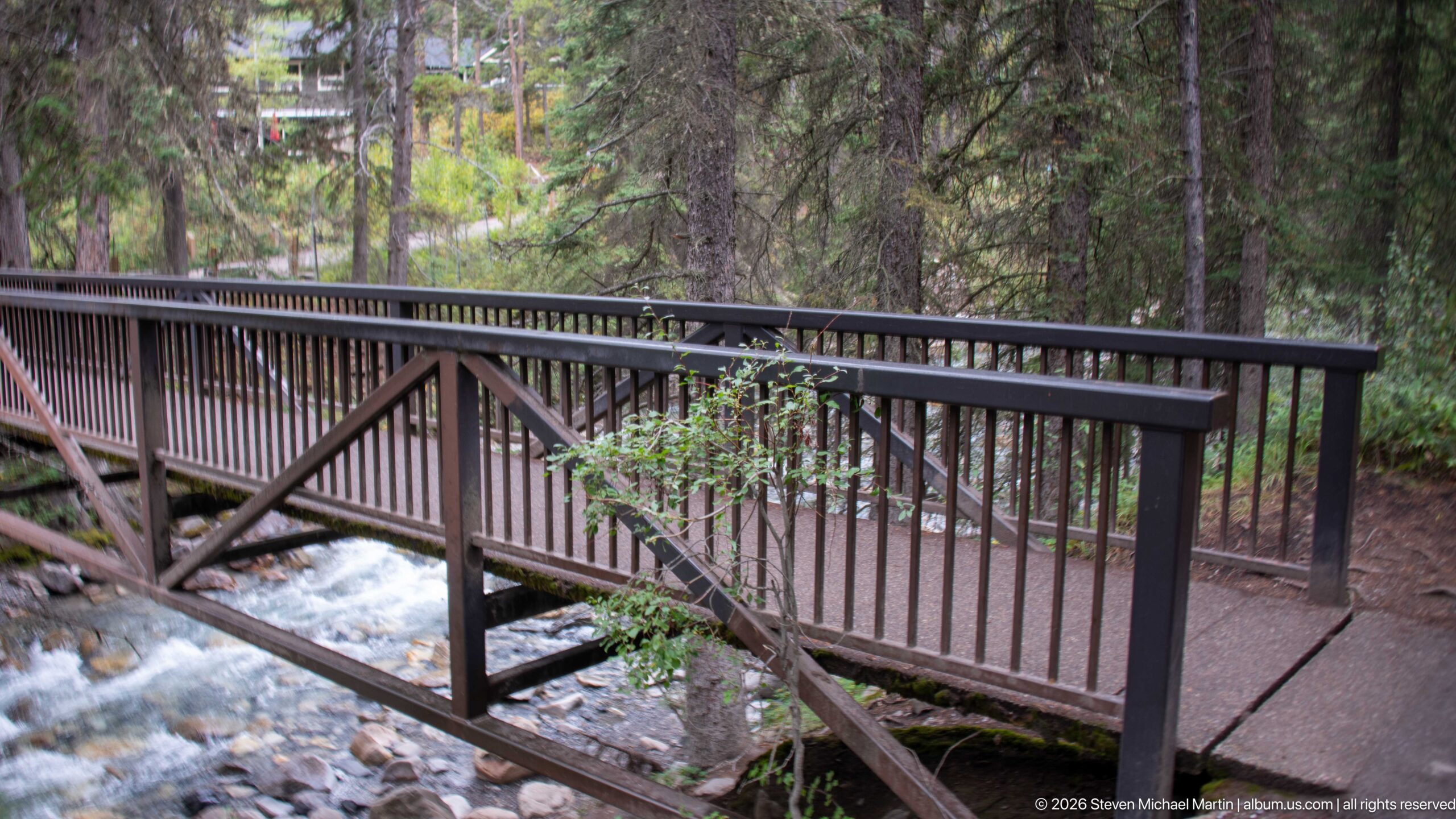
A wooden pedestrian bridge with dark railings crosses the creek at a wooded bend. The stream breaks into whitewater beneath the span, while a second section of railing guides visitors toward the path on the far bank. Trees and low shrubs close around the crossing, showing how the bridge links trail segments within the forested canyon corridor.
Caption
A wooden pedestrian bridge with dark railings crosses the creek at a wooded bend. The stream breaks into whitewater beneath the span, while a second section of railing guides visitors toward the path on the far bank. Trees and low shrubs close around the crossing, showing how the bridge links trail segments within the forested canyon corridor.
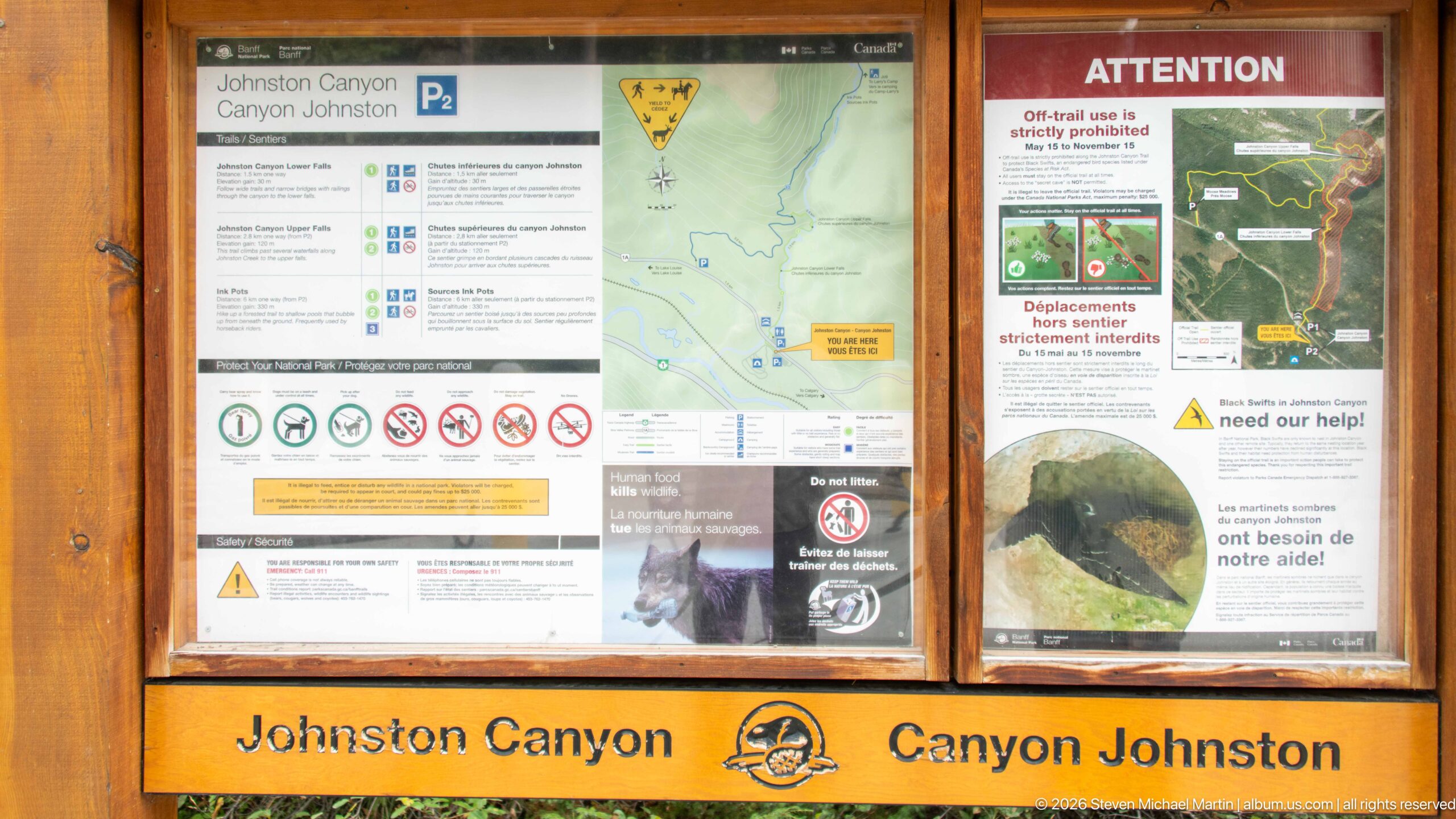
The wooden information board combines a Johnston Canyon map with trail guidance, wildlife reminders, and a prominent “Attention” notice. The map occupies the central section, while adjacent panels show safety information and route restrictions. Its bold bilingual name across the lower beam anchors the display at the canyon entrance and distinguishes it from the smaller direction signs along the trail.
Caption
The wooden information board combines a Johnston Canyon map with trail guidance, wildlife reminders, and a prominent “Attention” notice. The map occupies the central section, while adjacent panels show safety information and route restrictions. Its bold bilingual name across the lower beam anchors the display at the canyon entrance and distinguishes it from the smaller direction signs along the trail.
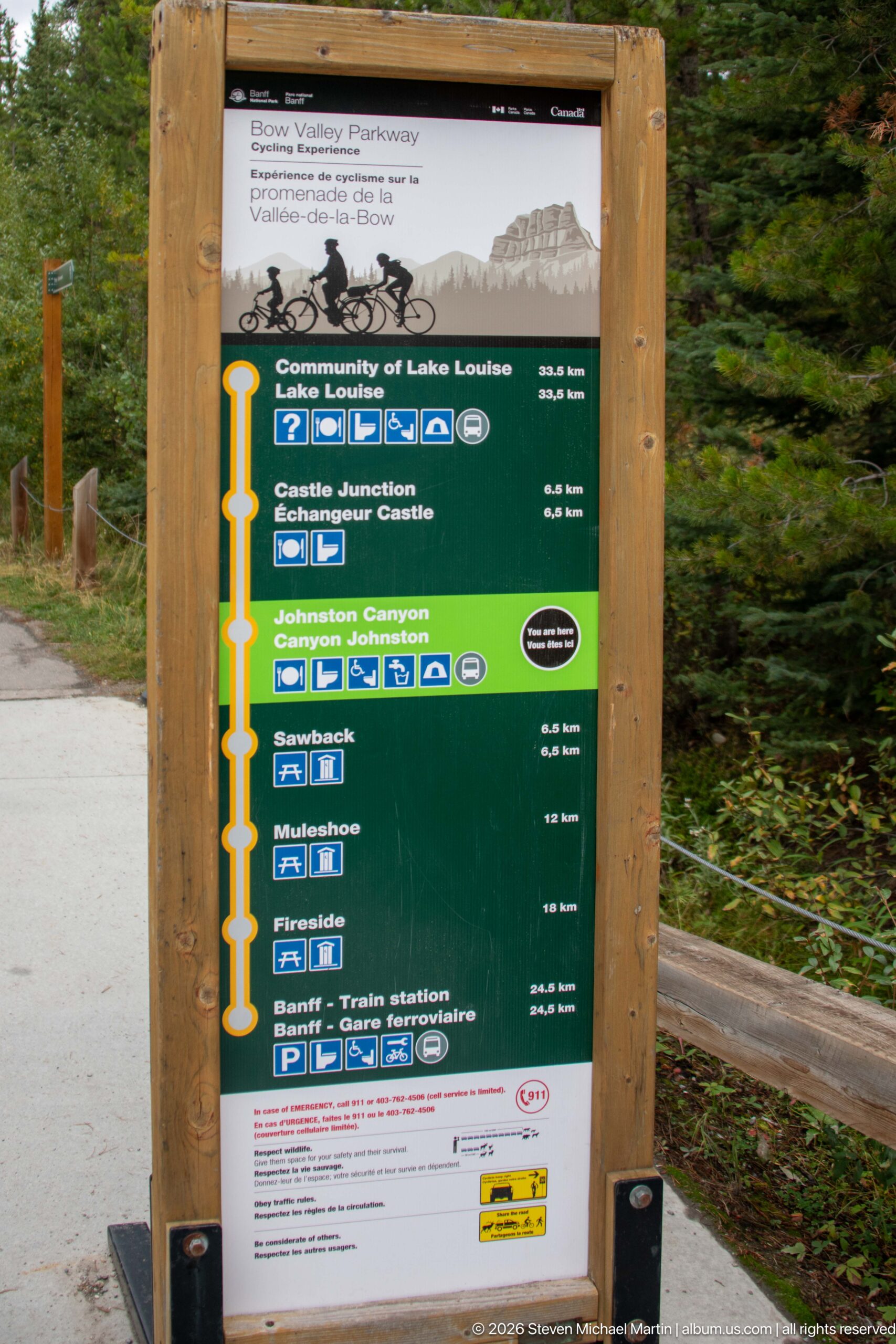
A large roadside sign uses a vertical route diagram to locate services and destinations along the Bow Valley Parkway. Names including Lake Louise, Castle Junction, Johnston Canyon, Sawback, Moose Meadows, and Banff are arranged beside distances and amenity symbols. The sign places Johnston Canyon within a broader travel corridor and serves as a practical overview of nearby stops.
Caption
A large roadside sign uses a vertical route diagram to locate services and destinations along the Bow Valley Parkway. Names including Lake Louise, Castle Junction, Johnston Canyon, Sawback, Moose Meadows, and Banff are arranged beside distances and amenity symbols. The sign places Johnston Canyon within a broader travel corridor and serves as a practical overview of nearby stops.
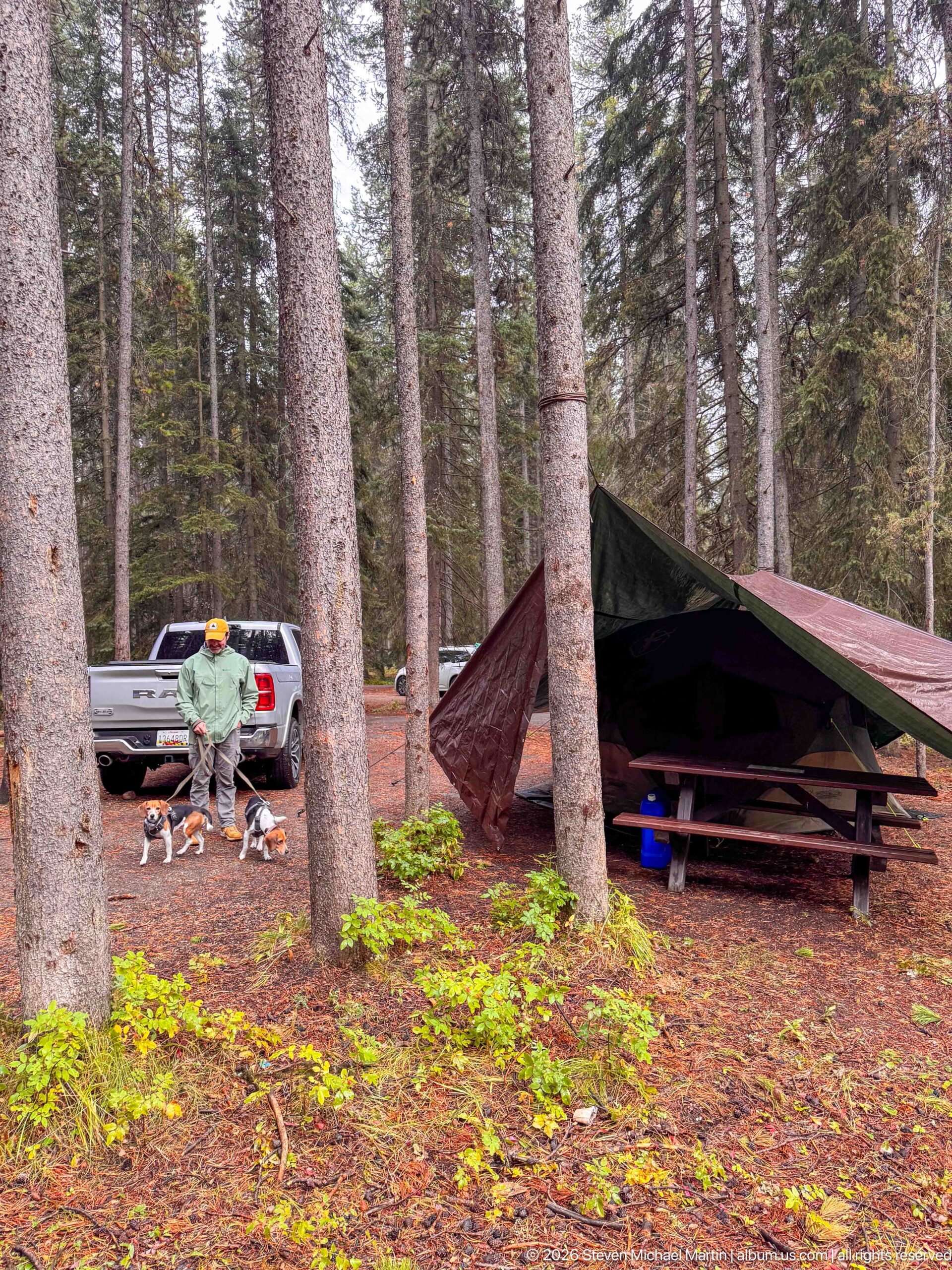
A camper stands beside two small dogs at a forest campsite, with a pickup truck and low tarp shelter behind them. The shelter covers a picnic table and camping equipment, while damp needles and low plants cover the ground. The wide view records the practical arrangement of the site and the company of the two dogs without shifting attention from the campground setting.
Caption
A camper stands beside two small dogs at a forest campsite, with a pickup truck and low tarp shelter behind them. The shelter covers a picnic table and camping equipment, while damp needles and low plants cover the ground. The wide view records the practical arrangement of the site and the company of the two dogs without shifting attention from the campground setting.
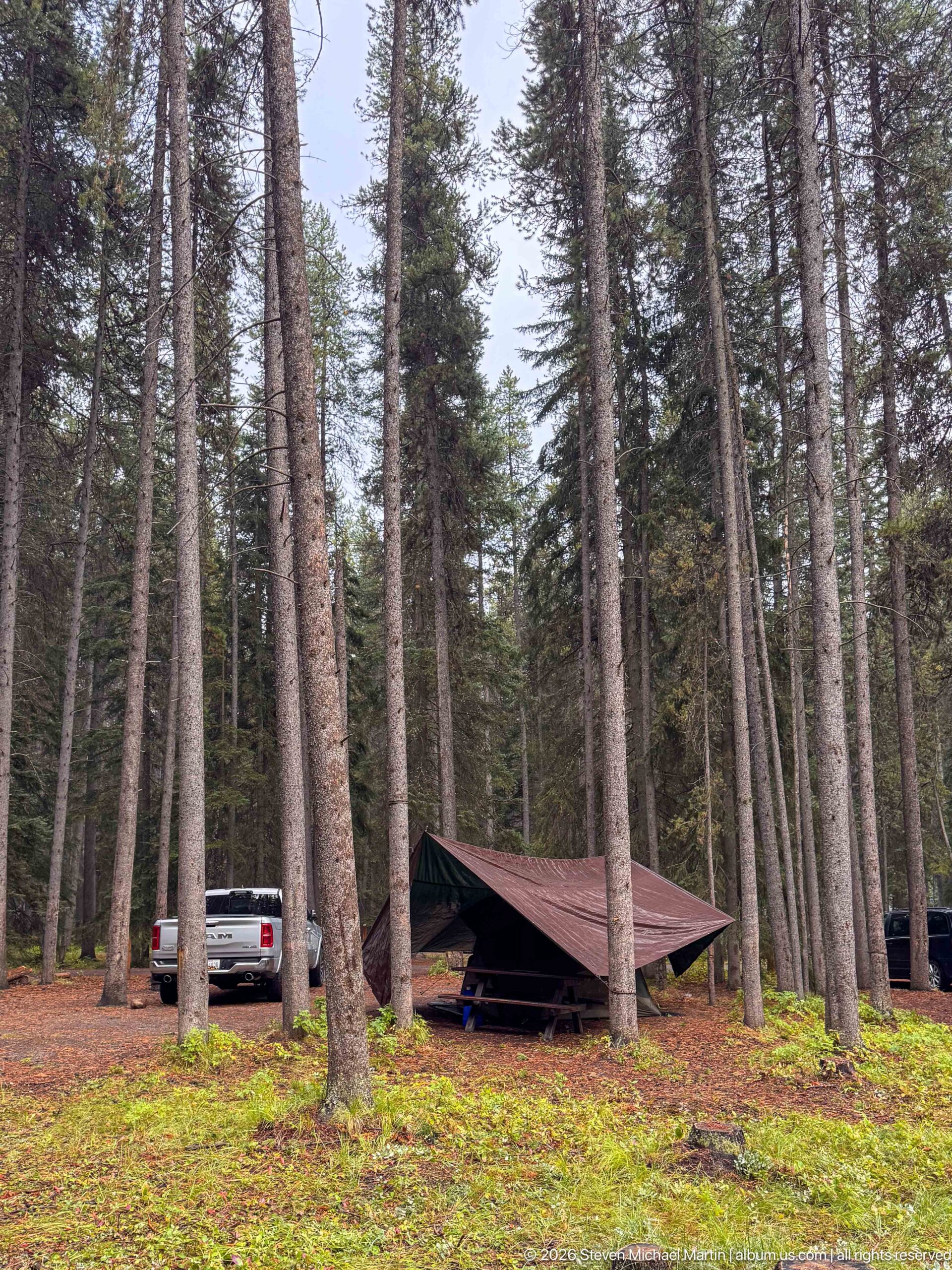
A broad view shows a pickup parked beside a low tarp shelter stretched over a picnic table in a conifer campground. Tall trunks divide the composition and create a sense of space between neighboring sites, while low groundcover spreads across the forest floor. The arrangement emphasizes the modest, practical shelter used for meals and gear in the wooded setting.
Caption
A broad view shows a pickup parked beside a low tarp shelter stretched over a picnic table in a conifer campground. Tall trunks divide the composition and create a sense of space between neighboring sites, while low groundcover spreads across the forest floor. The arrangement emphasizes the modest, practical shelter used for meals and gear in the wooded setting.
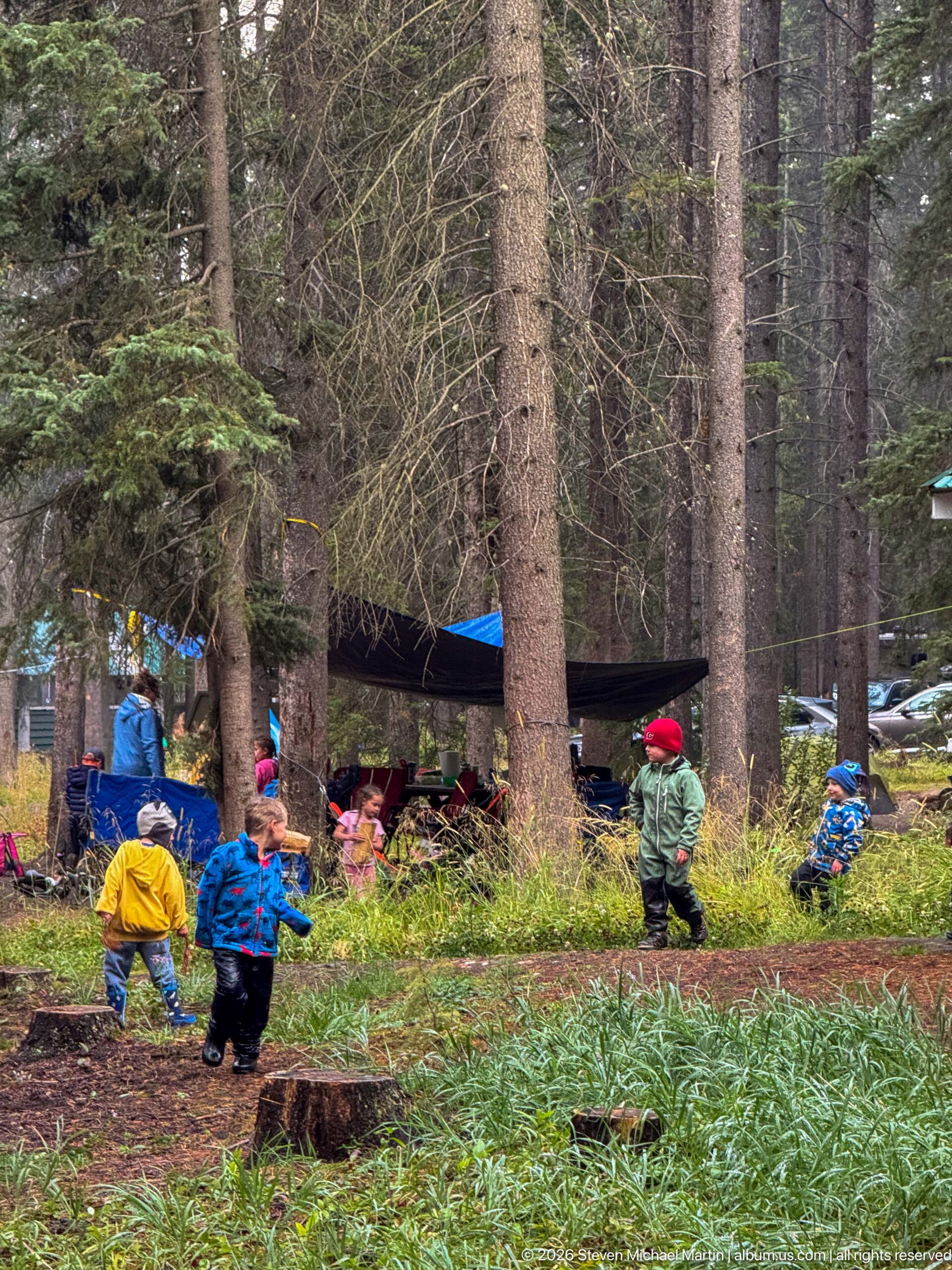
Several people, including children in bright jackets, gather near a dark canopy and picnic tables among tall trees. Colorful tents and camping equipment appear between the trunks, while a camper in a green jacket stands nearby. The scene records a lived-in campground moment, with activity spread across the clearing rather than focused on one person.
Caption
Several people, including children in bright jackets, gather near a dark canopy and picnic tables among tall trees. Colorful tents and camping equipment appear between the trunks, while a camper in a green jacket stands nearby. The scene records a lived-in campground moment, with activity spread across the clearing rather than focused on one person.
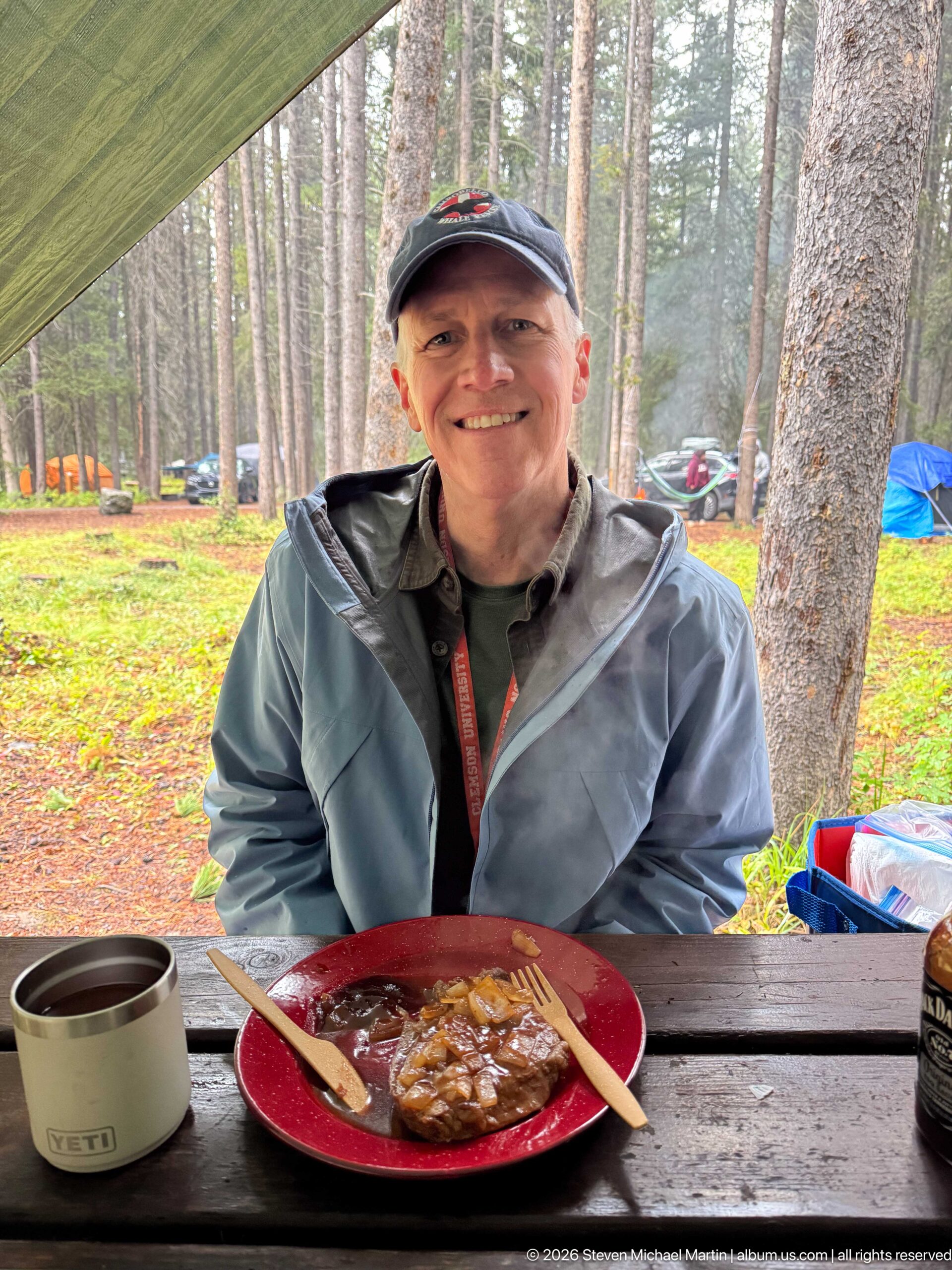
A smiling camper sits beneath a green tarp at a picnic table, with a plate of food and a metal mug arranged in front of him. The shallow shelter and surrounding trees identify the setting as a campsite, while the relaxed pose turns the frame into a personal travel moment rather than a landscape view. The meal and table remain prominent in the foreground.
Caption
A smiling camper sits beneath a green tarp at a picnic table, with a plate of food and a metal mug arranged in front of him. The shallow shelter and surrounding trees identify the setting as a campsite, while the relaxed pose turns the frame into a personal travel moment rather than a landscape view. The meal and table remain prominent in the foreground.
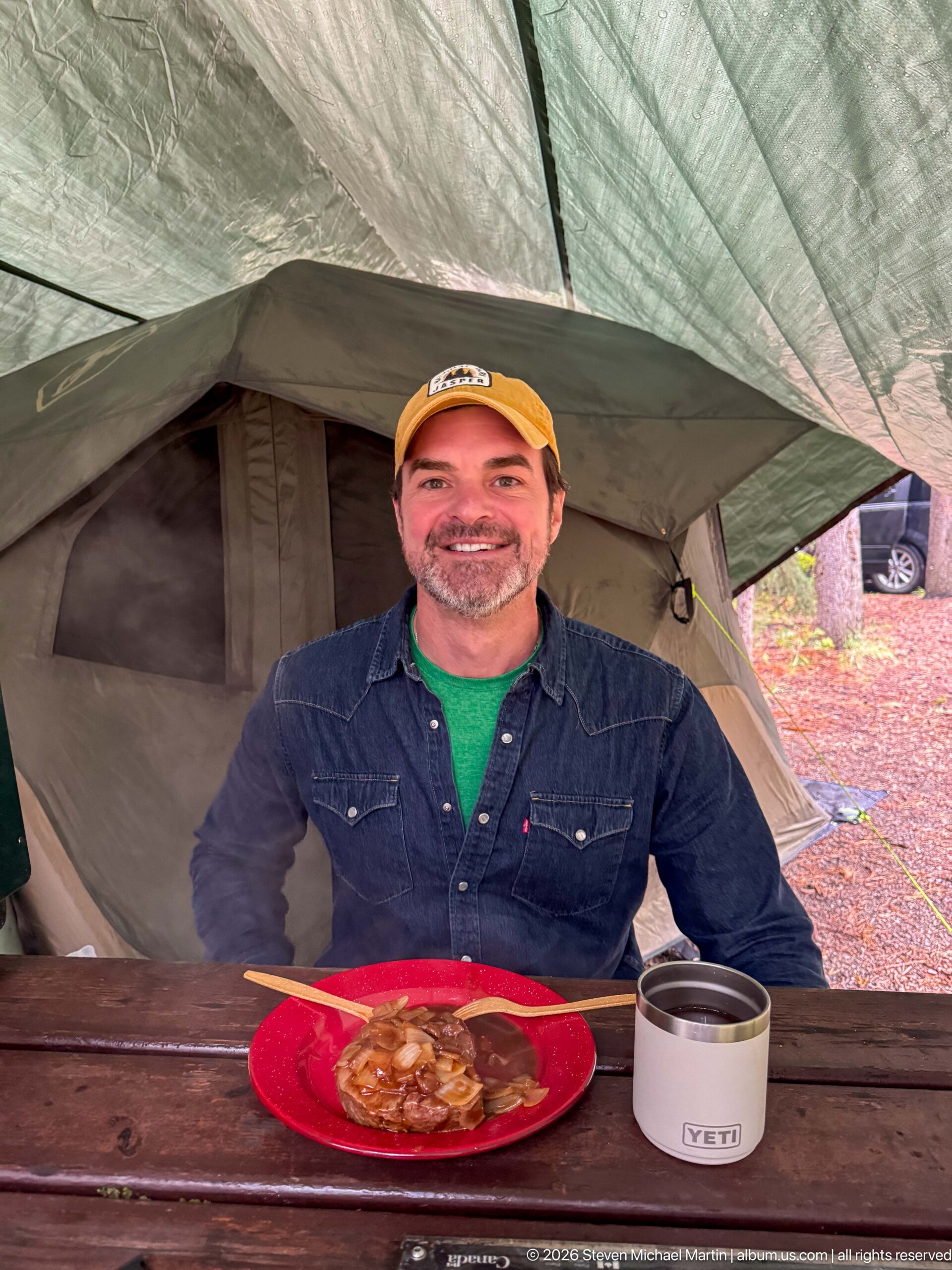
A camper in an orange cap sits at a picnic table beneath the broad green rainfly of a tent shelter. A red plate and metal mug are set before him, while the screened tent wall and forest floor form the background. The close, frontal composition emphasizes the sheltered meal and the compact arrangement of equipment at the campsite.
Caption
A camper in an orange cap sits at a picnic table beneath the broad green rainfly of a tent shelter. A red plate and metal mug are set before him, while the screened tent wall and forest floor form the background. The close, frontal composition emphasizes the sheltered meal and the compact arrangement of equipment at the campsite.
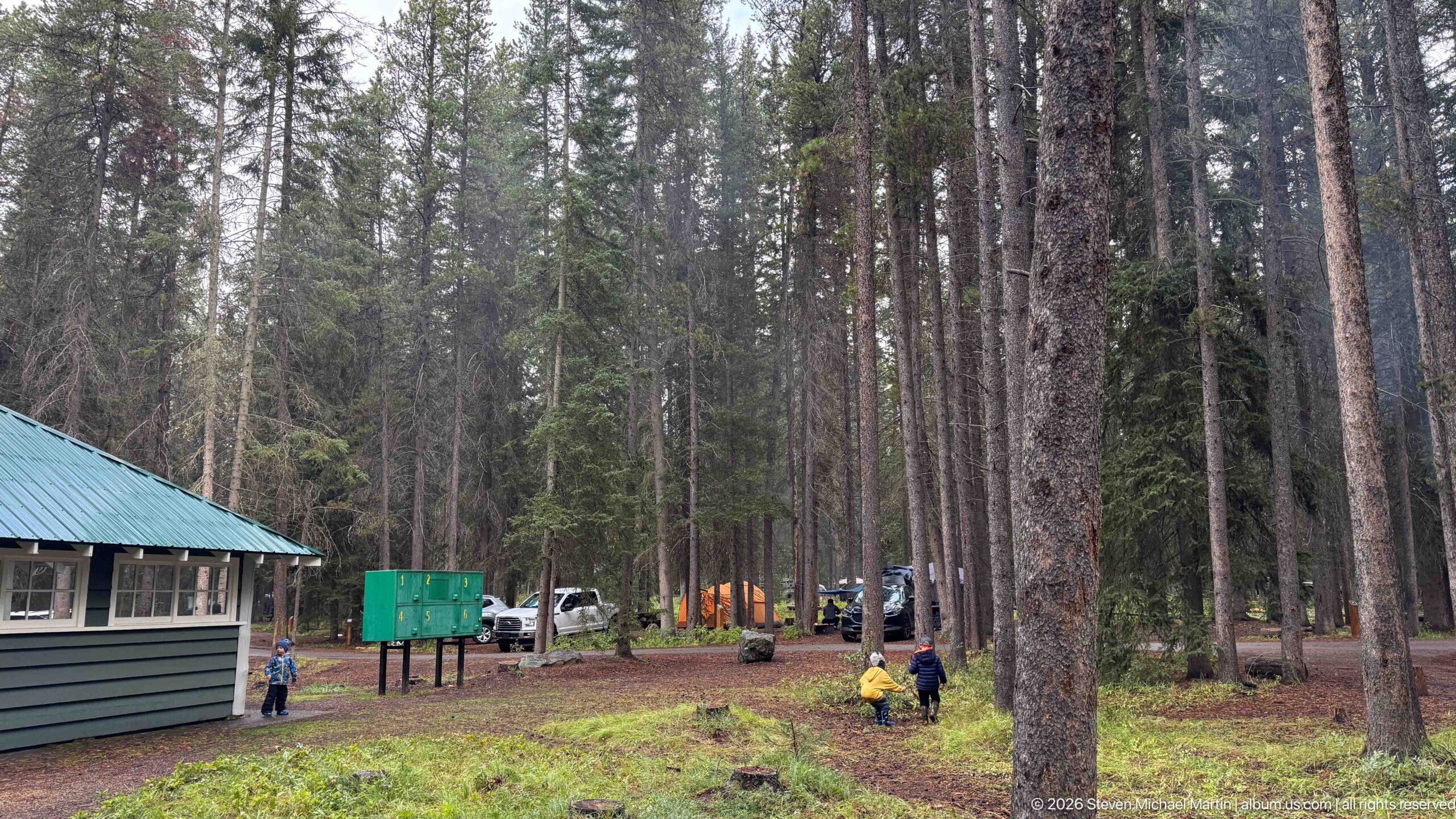
A broad campground clearing extends between tall conifers, with a small building at left, parked vehicles beyond it, and visitors walking across the open ground. The scattered facilities and tents sit low in the frame beneath the trees, making the forest the dominant feature. This view situates the campsite within the larger wooded setting rather than isolating an individual camp setup.
Caption
A broad campground clearing extends between tall conifers, with a small building at left, parked vehicles beyond it, and visitors walking across the open ground. The scattered facilities and tents sit low in the frame beneath the trees, making the forest the dominant feature. This view situates the campsite within the larger wooded setting rather than isolating an individual camp setup.
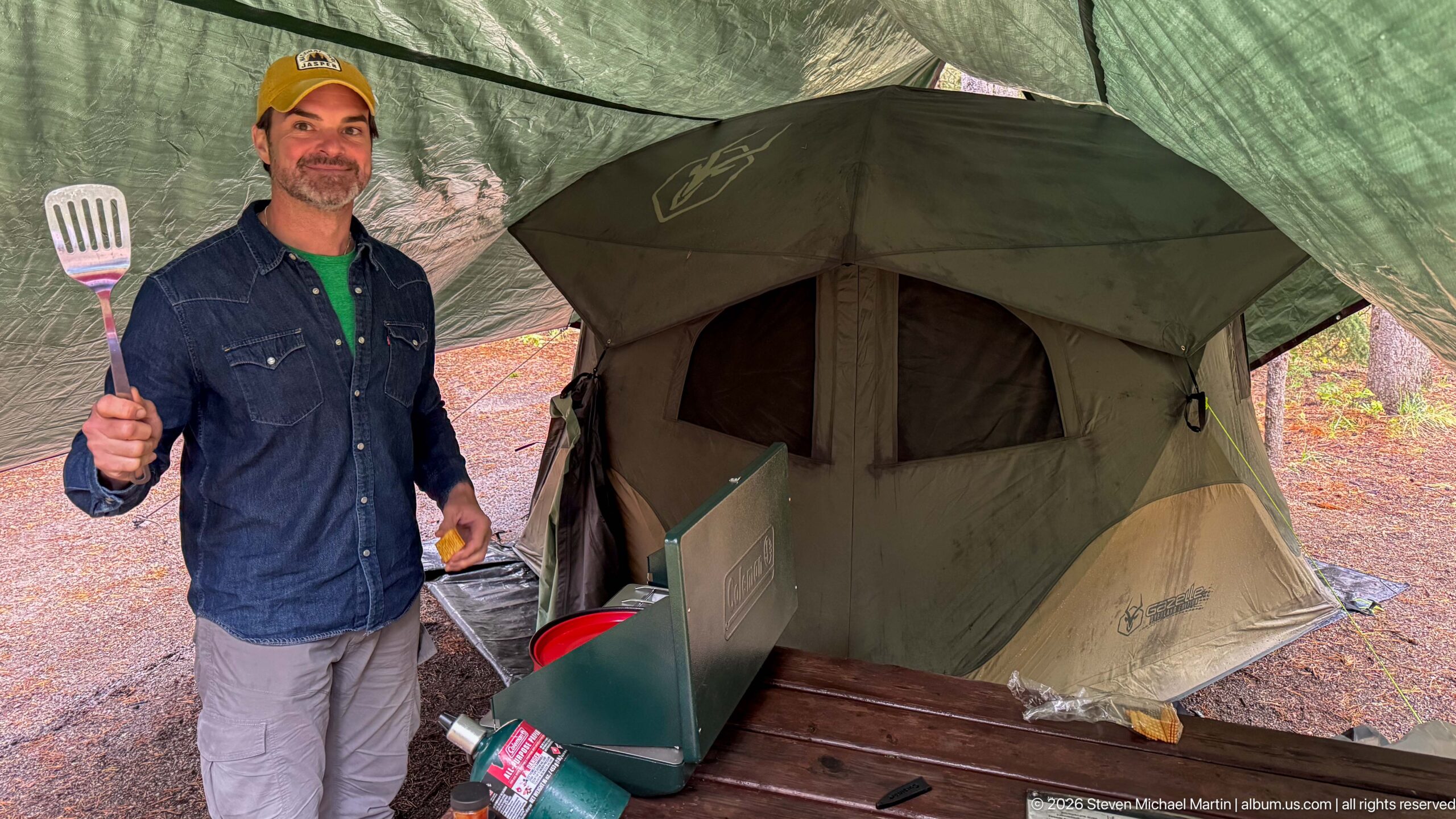
A camper stands beside a tent holding a spatula, with a covered picnic table and cooking gear under the surrounding rainfly. The open tent entrance and nearby forest floor remain visible behind him, making the campsite layout part of the scene. His upright pose and cooking utensil suggest meal preparation, while the image focuses on the practical activity of camp life.
Caption
A camper stands beside a tent holding a spatula, with a covered picnic table and cooking gear under the surrounding rainfly. The open tent entrance and nearby forest floor remain visible behind him, making the campsite layout part of the scene. His upright pose and cooking utensil suggest meal preparation, while the image focuses on the practical activity of camp life.
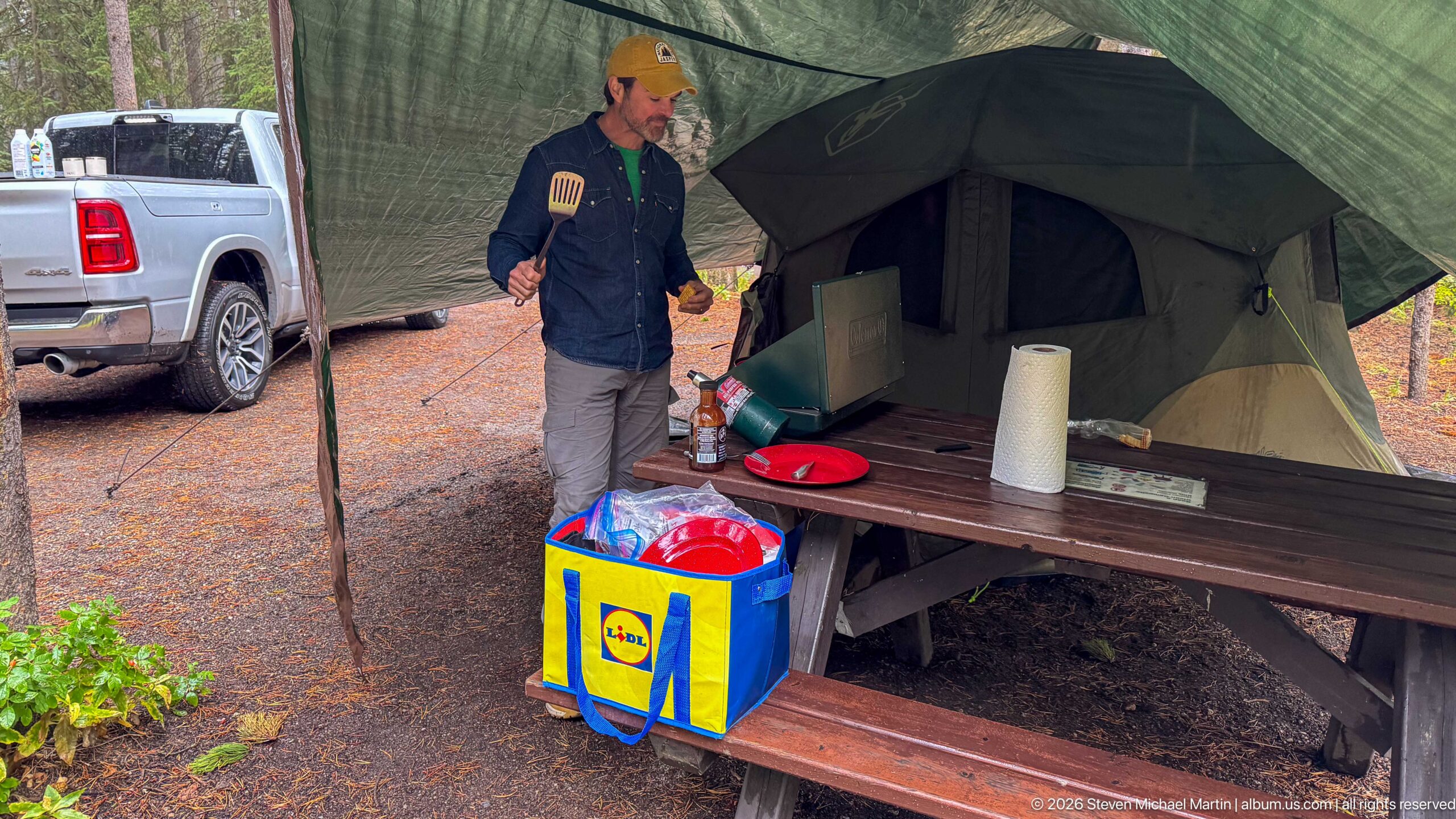
A camper holds a spatula beside a picnic table stocked with plates, a paper-towel roll, and a large shopping bag. A tent shelter fills the right side, while a pickup is parked among the trees behind him. The broad tarp overhead ties the equipment together into a temporary outdoor kitchen and meal area within the forest campground.
Caption
A camper holds a spatula beside a picnic table stocked with plates, a paper-towel roll, and a large shopping bag. A tent shelter fills the right side, while a pickup is parked among the trees behind him. The broad tarp overhead ties the equipment together into a temporary outdoor kitchen and meal area within the forest campground.
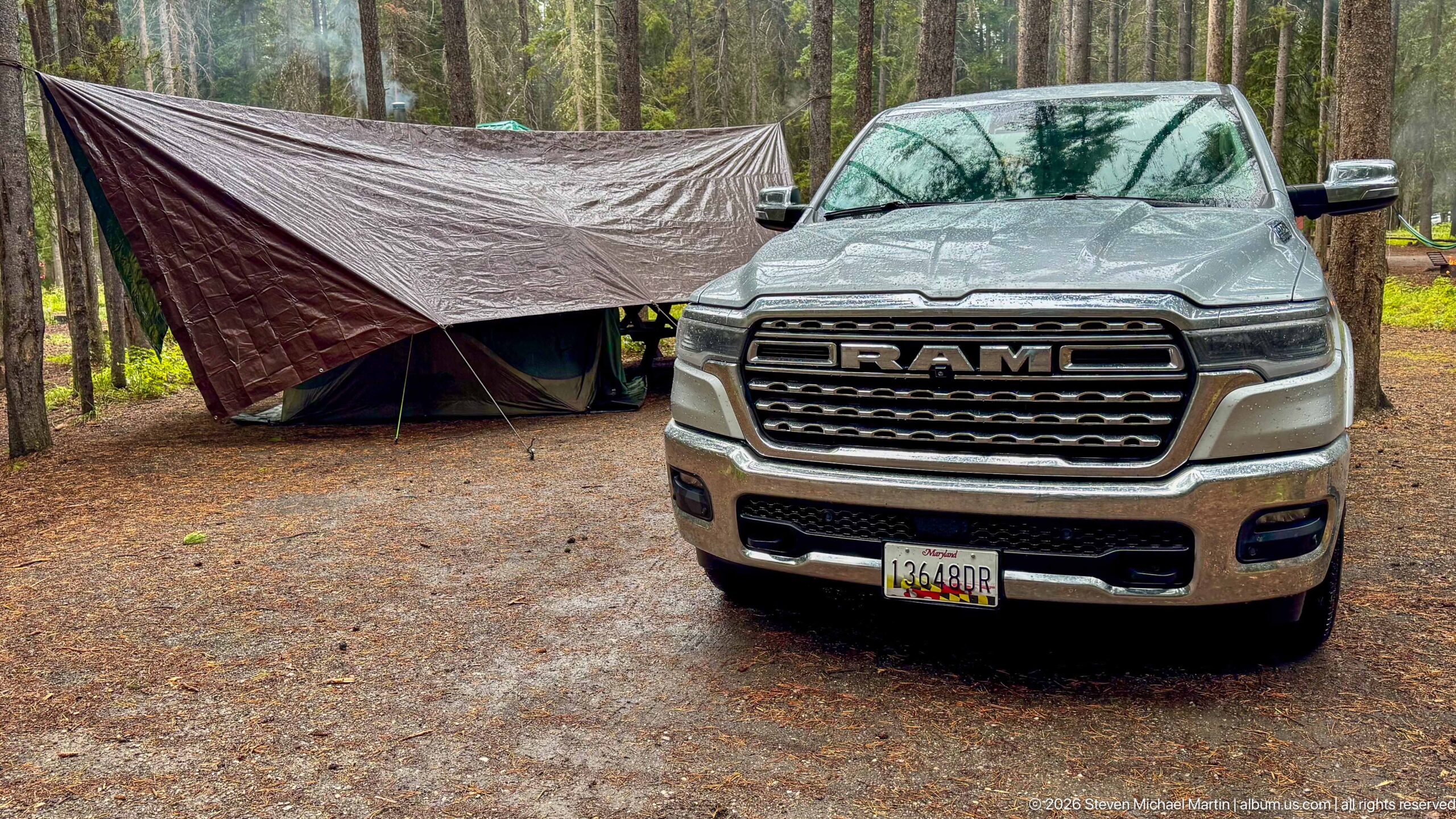
A silver RAM pickup faces the camera on a gravel campsite, with a low tarp shelter and tent set up immediately behind it. The vehicle occupies the foreground while tall conifers enclose the site, linking the road-trip equipment to the simple sleeping and dining arrangement. The frame records the campsite as a working base rather than a scenic overlook.
Caption
A silver RAM pickup faces the camera on a gravel campsite, with a low tarp shelter and tent set up immediately behind it. The vehicle occupies the foreground while tall conifers enclose the site, linking the road-trip equipment to the simple sleeping and dining arrangement. The frame records the campsite as a working base rather than a scenic overlook.
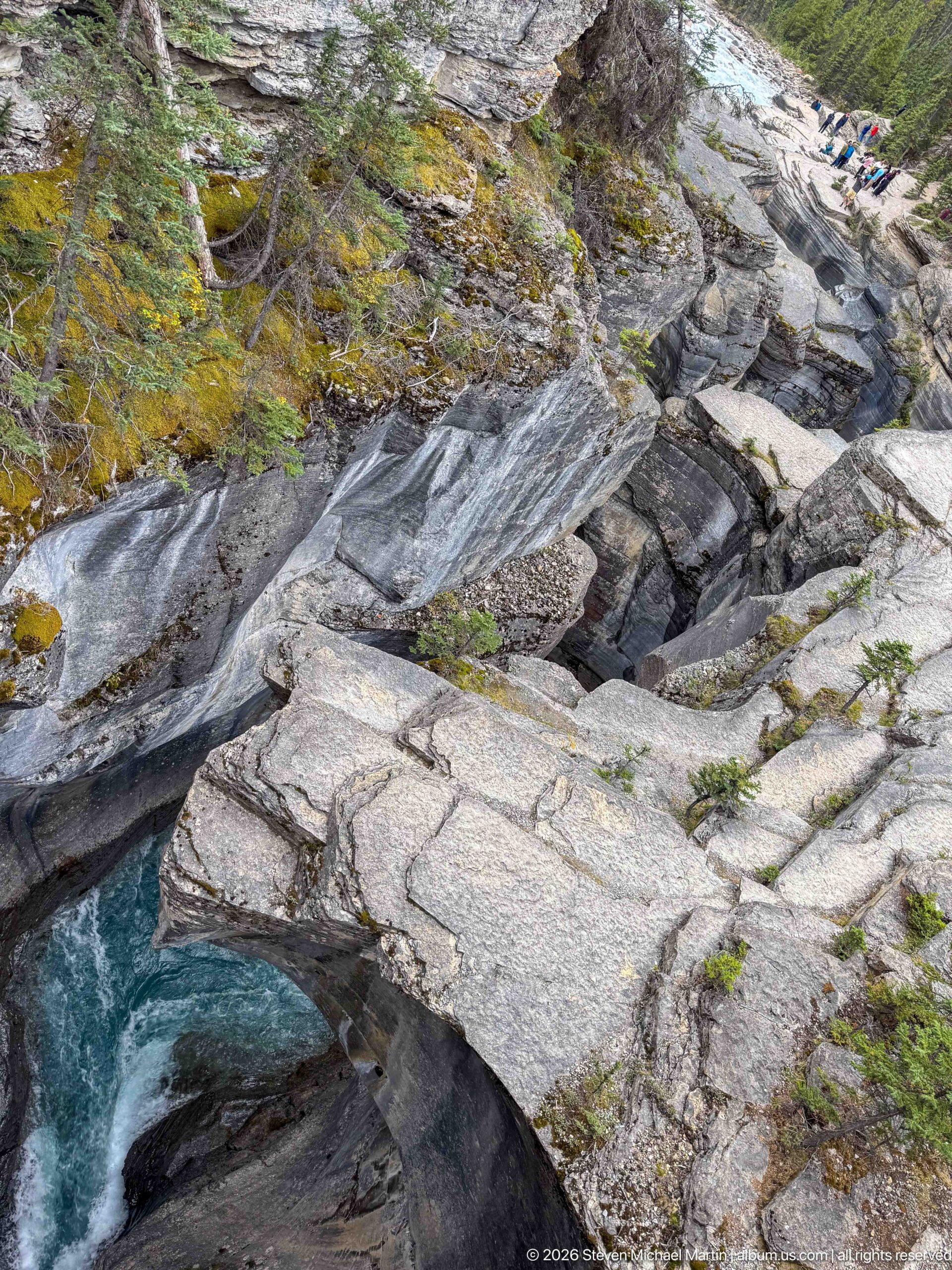
From above, broad pale slabs of fractured bedrock slope toward a narrow blue-green channel at the lower left. Angular cracks divide the exposed surface, while small moss patches and low shrubs cling to ledges above the water. A few distant visitors at the upper right provide scale for the broad rock apron and the steep creek-side drop.
Caption
From above, broad pale slabs of fractured bedrock slope toward a narrow blue-green channel at the lower left. Angular cracks divide the exposed surface, while small moss patches and low shrubs cling to ledges above the water. A few distant visitors at the upper right provide scale for the broad rock apron and the steep creek-side drop.
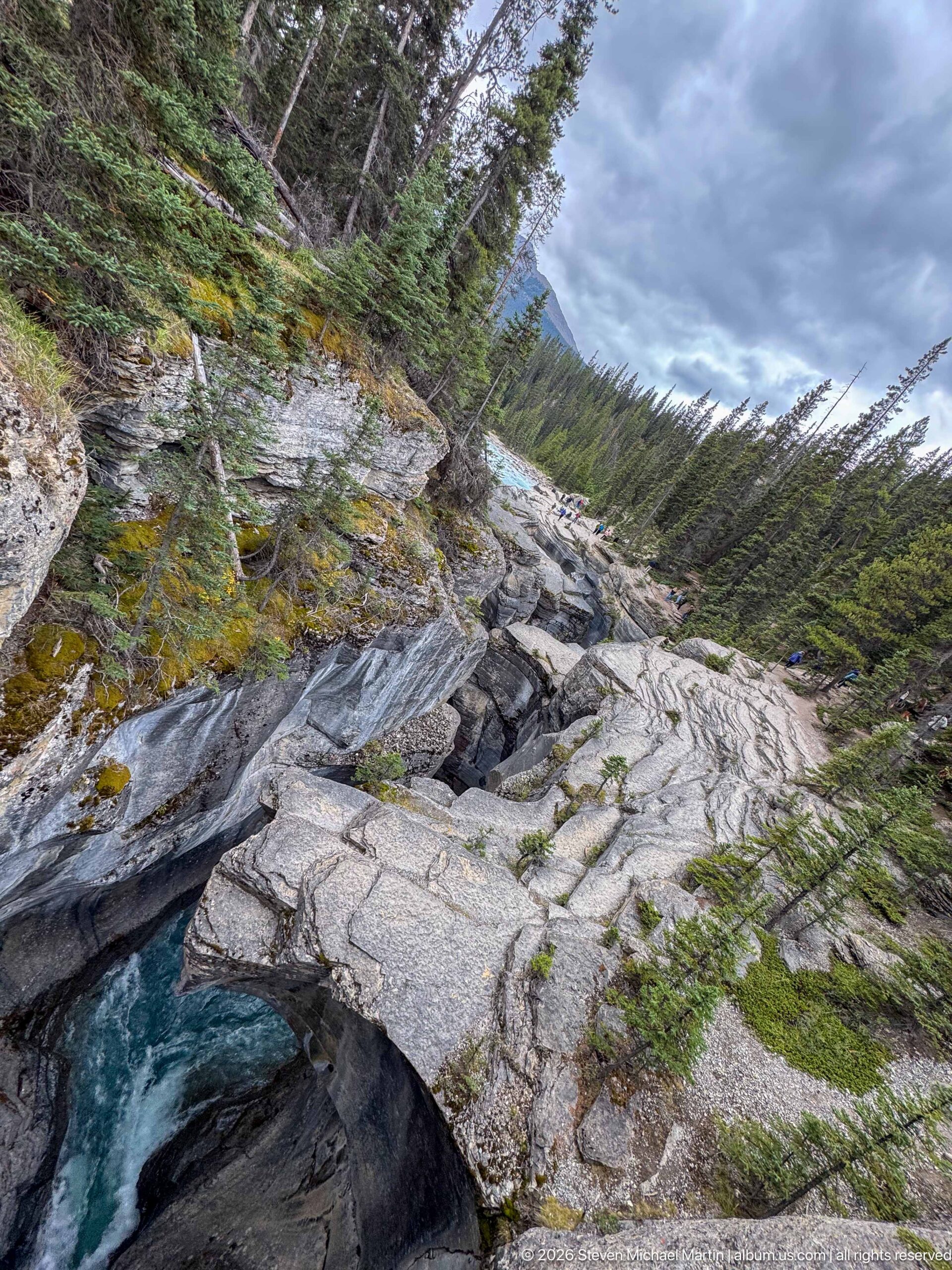
A wide view looks down across a pale, broken rock apron toward a narrow stream hidden in the lower-left corner. Conifers line the canyon margins, and a cluster of visitors appears at the far upper right near the path. The composition emphasizes the scale of the exposed stone and the forested slopes that frame Johnston Creek.
Caption
A wide view looks down across a pale, broken rock apron toward a narrow stream hidden in the lower-left corner. Conifers line the canyon margins, and a cluster of visitors appears at the far upper right near the path. The composition emphasizes the scale of the exposed stone and the forested slopes that frame Johnston Creek.
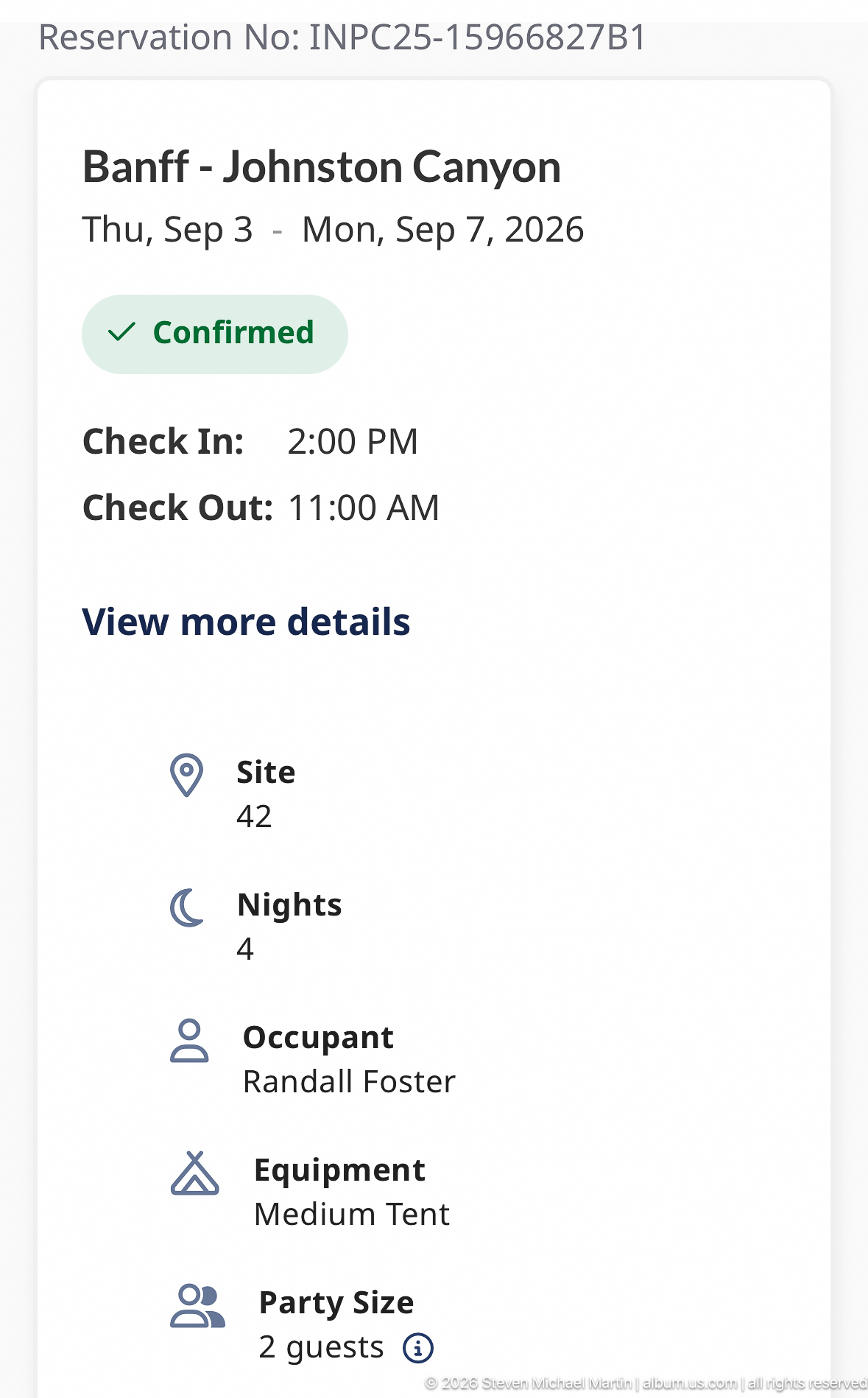
A cropped reservation confirmation screen lists Johnston Canyon, campsite 42, a four-night stay, and a medium tent as the equipment type. Check-in and check-out times and a green confirmation status are visible above the details. The image functions as a digital record of the trip’s campsite booking, pairing practical travel information with the photographs of the campground itself.
Caption
A cropped reservation confirmation screen lists Johnston Canyon, campsite 42, a four-night stay, and a medium tent as the equipment type. Check-in and check-out times and a green confirmation status are visible above the details. The image functions as a digital record of the trip’s campsite booking, pairing practical travel information with the photographs of the campground itself.
🏞️ National Park Field Guide
📍 Overview
Johnston Canyon brings visitors into close contact with the water, rock, and forest of Banff National Park. Johnston Creek moves through a wooded gorge, spilling over ledges into blue-green pools and passing beneath overhanging rock. Walkways, bridges, trail signs, and interpretive panels make the canyon’s changing forms accessible while explaining how water and ice shape the falls. The photographs also record the practical rhythms of a visit, from reading route signs to camping among the conifers.
🏔️ Landscape
The canyon alternates between narrow passages and more open creek corridors. In some views, steep rock walls crowd the water; in others, the stream spreads over gravel and pale stones beneath conifers. Pools, cascades, ledges, and overhangs give the landscape a changing scale, while moss and small plants mark damp rock and creek edges. Elevated viewpoints reveal the creek’s course through the forest, and close views show the varied surfaces along its banks.
🪨 Geology
Exposed rock gives the canyon its structure: horizontal layers, fractured slabs, projecting shelves, cavities, and smooth water-worn surfaces appear throughout the portfolio. Johnston Creek alternates between quiet pools and short, forceful drops as it passes these obstacles. An interpretive panel explains how water and ice wear away rock and how waterfalls can migrate upstream. Together, the sign and the photographs connect visible features—undercut ledges, rounded hollows, and cascades—with the continuing processes that shape the gorge.
🌿 Ecology
Conifers frame much of Johnston Creek, with mosses, shrubs, grasses, and flowers growing along the shaded banks and damp rock. The relationship between forest and stream is especially clear where branches overhang the water or fallen timber rests in the channel. Interpretive panels encourage visitors to notice birds, plants, and other forest life. They provide natural-history context for the habitat, while the photographs focus primarily on the creek, vegetation, and trail environment.
🦌 Wildlife
Wildlife should be interpreted in relation to habitat, behavior, seasonality, and conservation.
🧭 Human History
The canyon’s human story appears through its trail system, visitor facilities, and interpretive signs. Direction boards name the Lower and Upper Falls and the Ink Pots, while displays introduce the history of exploration and the canyon’s appeal as a place to visit. Another panel presents Johnston Canyon as a source of artistic inspiration. These signs connect today’s walk with earlier acts of exploration, interpretation, and landscape appreciation without separating people from the natural setting.
🥾 Visitor Experience
The route combines forest paths with bridges and raised walkways beside the creek. Direction signs give distances to parking, the campground, the Lower and Upper Falls, and the Ink Pots, helping visitors understand how the walk can continue beyond the first cascades. Information boards provide maps and safety guidance along the way. The surrounding campground adds another dimension to the visit, with tents, picnic tables, shelters, and facilities set among the trees.
📷 Photography Notes
Photographs of Johnston Canyon benefit from varied viewpoints. Wider frames show how the creek winds through conifers and rock; elevated views reveal pools, ledges, and the sequence of small drops; closer compositions bring out water texture, fractured stone, moss, and cavities. Walkways, bridges, and visitors help establish scale and show how the trail follows the gorge. Signage adds useful context, while campground scenes record the quieter routines surrounding a day in the canyon.