Kyoto at Night
Kyoto at night highlights the atmospheric qualities of historic streets and temple districts illuminated after sunset. Soft lighting emphasizes architectural detail and creates visual contrast between traditional structures and modern urban elements. Evening conditions often provide a quieter perspective on historically significant locations.
Illumination enhances the visual character of wooden buildings, gates, and landscaped surroundings. Nighttime viewing reflects long-standing cultural appreciation for seasonal light and changing environmental conditions. The interplay of shadow and architectural form reveals subtle details often less visible during daytime.
Kyoto at night illustrates the aesthetic importance of atmosphere within Japanese cultural tradition. The illuminated cityscape reflects continuity between historical architecture and contemporary urban life.
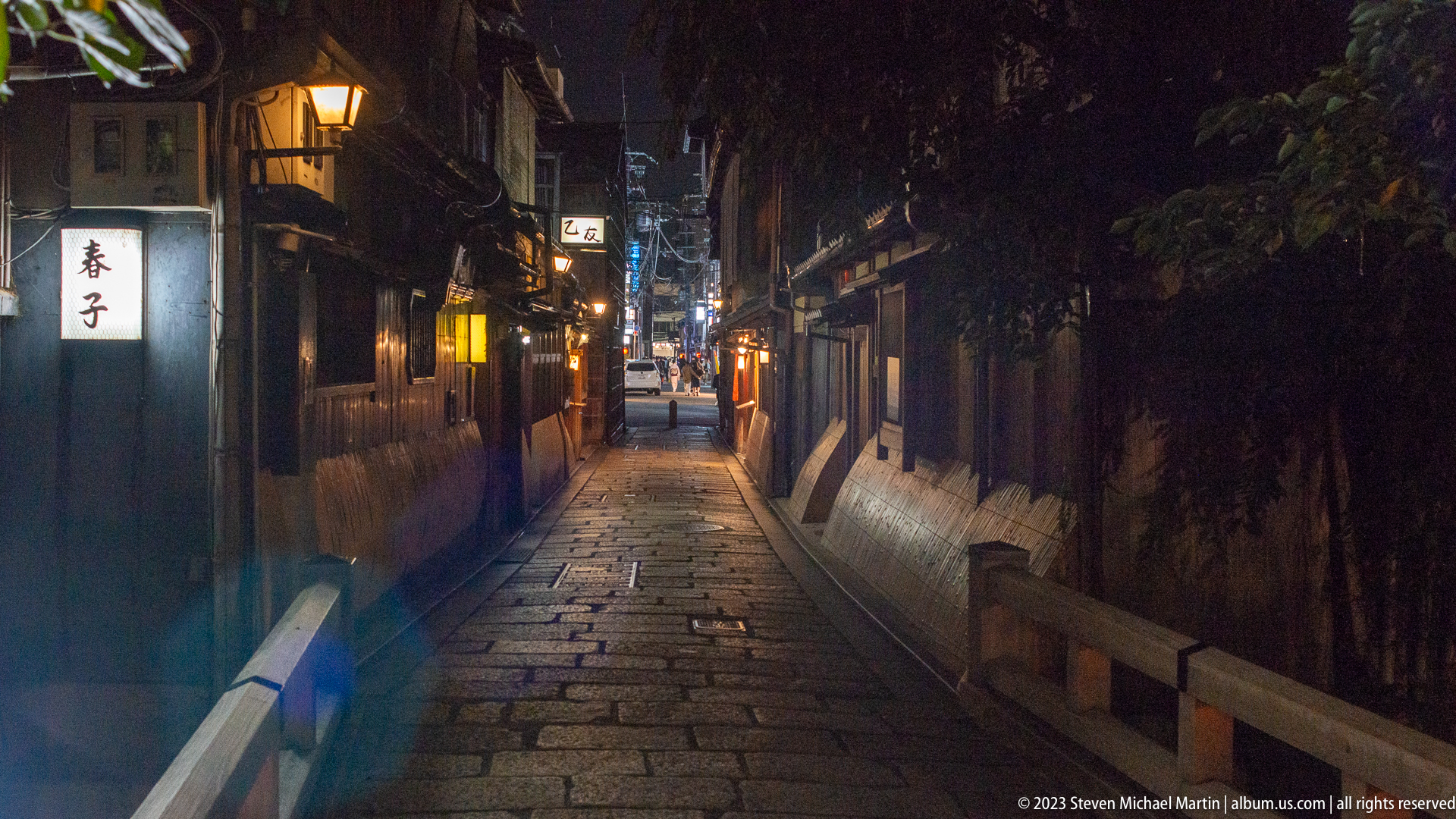
A narrow stone-paved lane recedes between traditional buildings illuminated by scattered lanterns and discreet storefront lighting. The intimate scale, masonry paving, and preserved wooden façades convey the quiet atmosphere that distinguishes Kyoto's historic neighborhoods after dark. Closely spaced entrances and subdued lighting preserve the lane’s domestic scale even as restaurants and bars animate it after dark.
Caption
A narrow stone-paved lane recedes between traditional buildings illuminated by scattered lanterns and discreet storefront lighting. The intimate scale, masonry paving, and preserved wooden façades convey the quiet atmosphere that distinguishes Kyoto's historic neighborhoods after dark. Closely spaced entrances and subdued lighting preserve the lane’s domestic scale even as restaurants and bars animate it after dark.
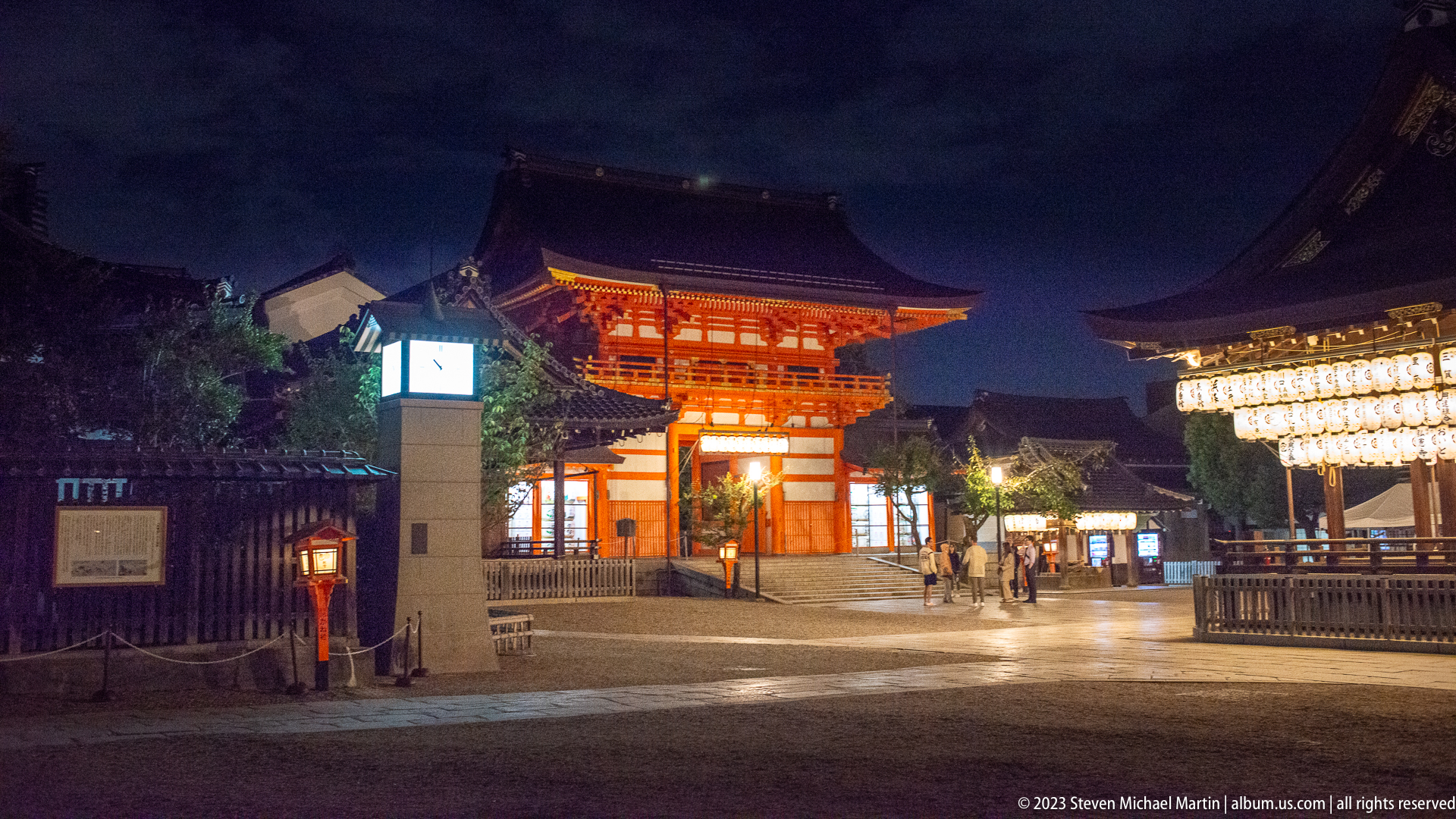
The open plaza of Yasaka Shrine connects the illuminated entrance gate, lantern stage, and surrounding buildings into a unified ceremonial landscape. Visitors provide scale within the expansive nighttime setting. Within Yasaka Shrine, the illuminated structure forms part of a larger sequence of gates, paths, subsidiary shrines, and ceremonial buildings associated with Kyoto’s historic Gion district.
Caption
The open plaza of Yasaka Shrine connects the illuminated entrance gate, lantern stage, and surrounding buildings into a unified ceremonial landscape. Visitors provide scale within the expansive nighttime setting. Within Yasaka Shrine, the illuminated structure forms part of a larger sequence of gates, paths, subsidiary shrines, and ceremonial buildings associated with Kyoto’s historic Gion district.
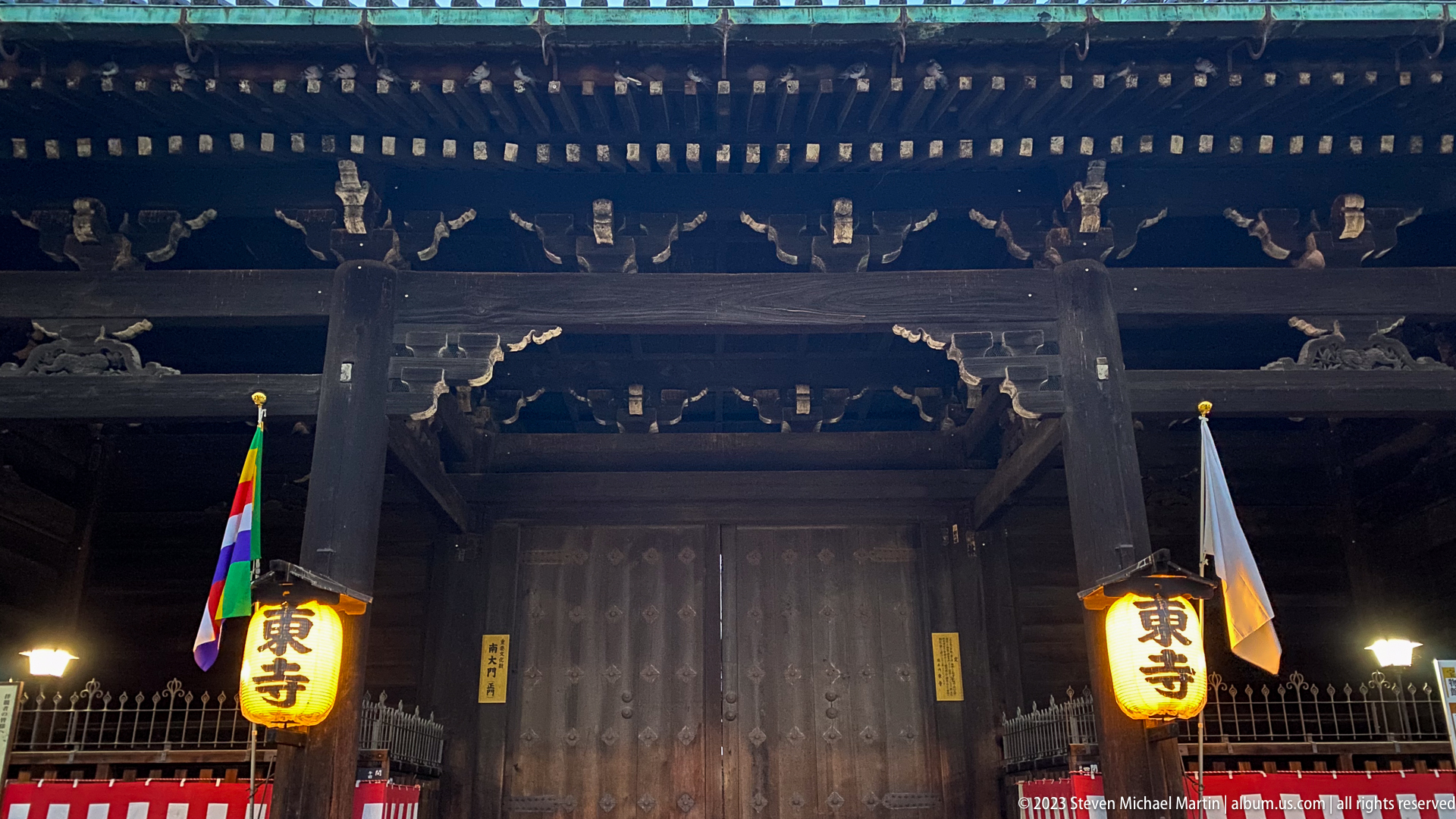
A monumental wooden temple gate is illuminated by traditional lanterns bearing the temple name, emphasizing the scale, heavy timber construction, and ceremonial entrance to the historic Buddhist complex. The view belongs to the Tō-ji temple complex, where monumental timber buildings, gates, water, mature trees, and the five-story pagoda form a unified Buddhist landscape.
Caption
A monumental wooden temple gate is illuminated by traditional lanterns bearing the temple name, emphasizing the scale, heavy timber construction, and ceremonial entrance to the historic Buddhist complex. The view belongs to the Tō-ji temple complex, where monumental timber buildings, gates, water, mature trees, and the five-story pagoda form a unified Buddhist landscape.

A gray heron stands atop a temple roof while the finial of a distant pagoda rises into the evening sky, combining wildlife with one of Kyoto's iconic architectural forms. The view belongs to the Tō-ji temple complex, where monumental timber buildings, gates, water, mature trees, and the five-story pagoda form a unified Buddhist landscape.
Caption
A gray heron stands atop a temple roof while the finial of a distant pagoda rises into the evening sky, combining wildlife with one of Kyoto's iconic architectural forms. The view belongs to the Tō-ji temple complex, where monumental timber buildings, gates, water, mature trees, and the five-story pagoda form a unified Buddhist landscape.
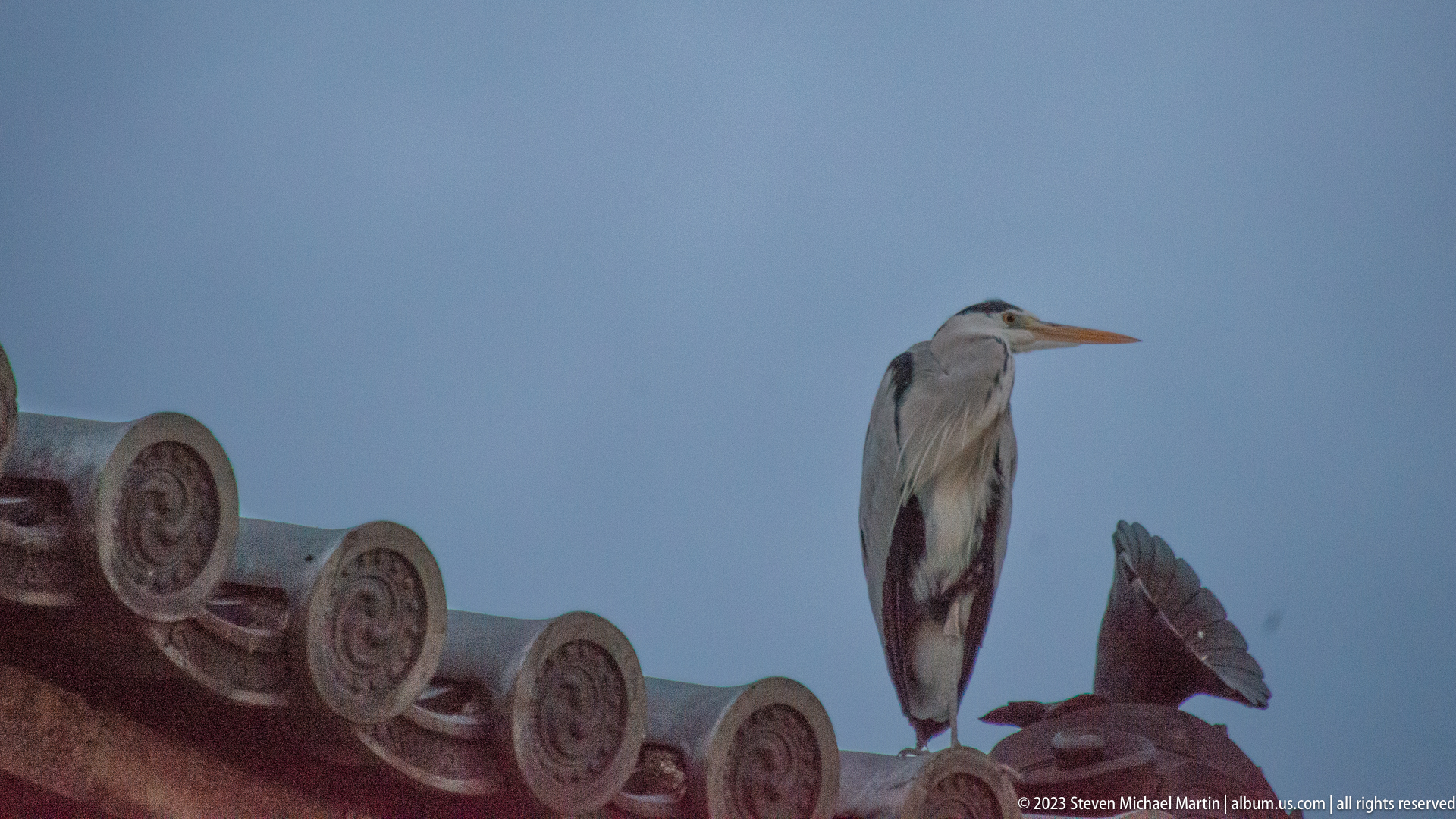
A gray heron rests on the curved ceramic roof tiles of a historic temple building during blue hour, illustrating the coexistence of wildlife and sacred architecture. The view belongs to the Tō-ji temple complex, where monumental timber buildings, gates, water, mature trees, and the five-story pagoda form a unified Buddhist landscape.
Caption
A gray heron rests on the curved ceramic roof tiles of a historic temple building during blue hour, illustrating the coexistence of wildlife and sacred architecture. The view belongs to the Tō-ji temple complex, where monumental timber buildings, gates, water, mature trees, and the five-story pagoda form a unified Buddhist landscape.
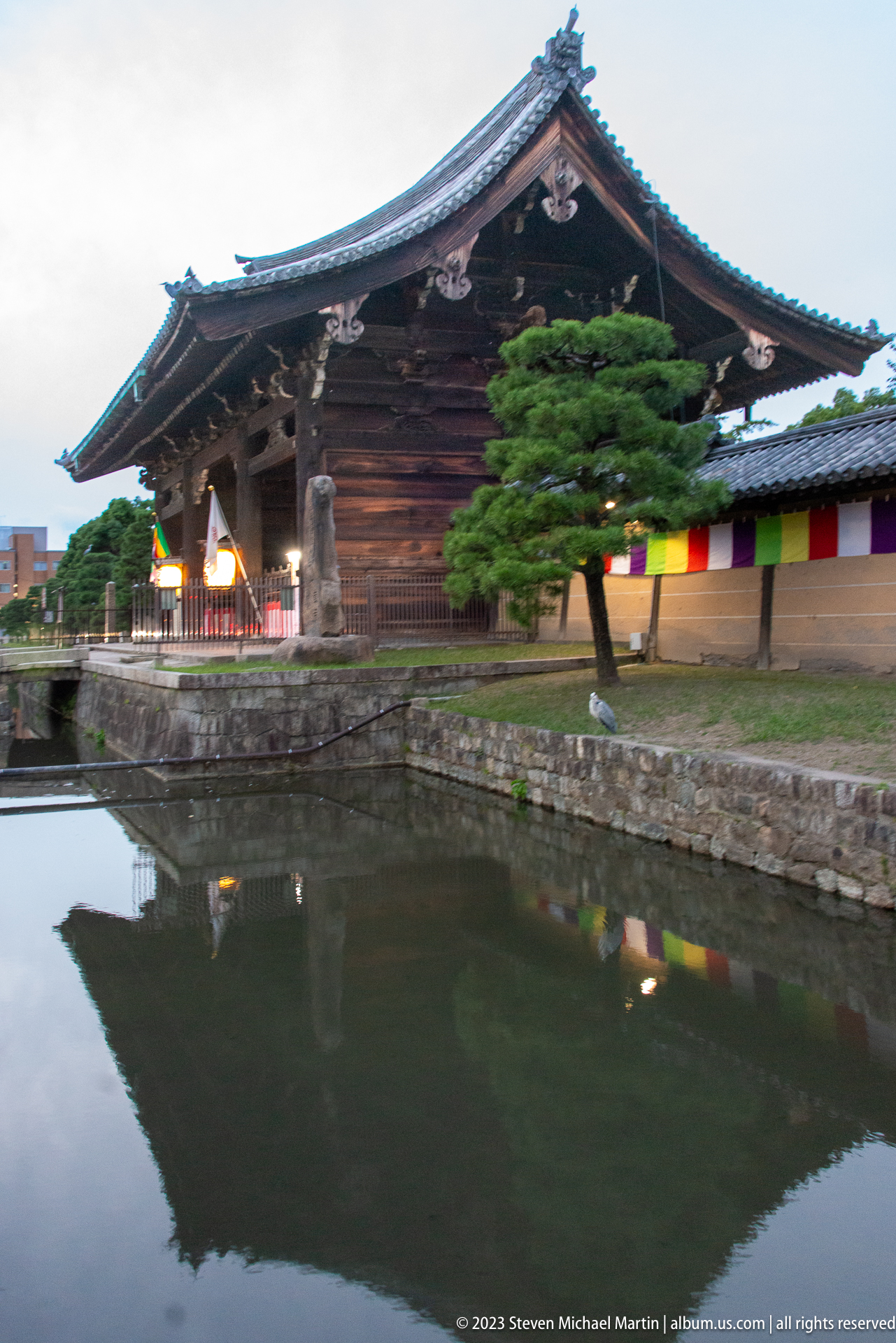
A large wooden temple hall is reflected in the still waters of an adjacent pond, creating a balanced composition that emphasizes the harmony between architecture and landscape. The scene captures Kyoto's historic temple environment at dusk. The view belongs to the Tō-ji temple complex, where monumental timber buildings, gates, water, mature trees, and the five-story pagoda form a unified Buddhist landscape.
Caption
A large wooden temple hall is reflected in the still waters of an adjacent pond, creating a balanced composition that emphasizes the harmony between architecture and landscape. The scene captures Kyoto's historic temple environment at dusk. The view belongs to the Tō-ji temple complex, where monumental timber buildings, gates, water, mature trees, and the five-story pagoda form a unified Buddhist landscape.
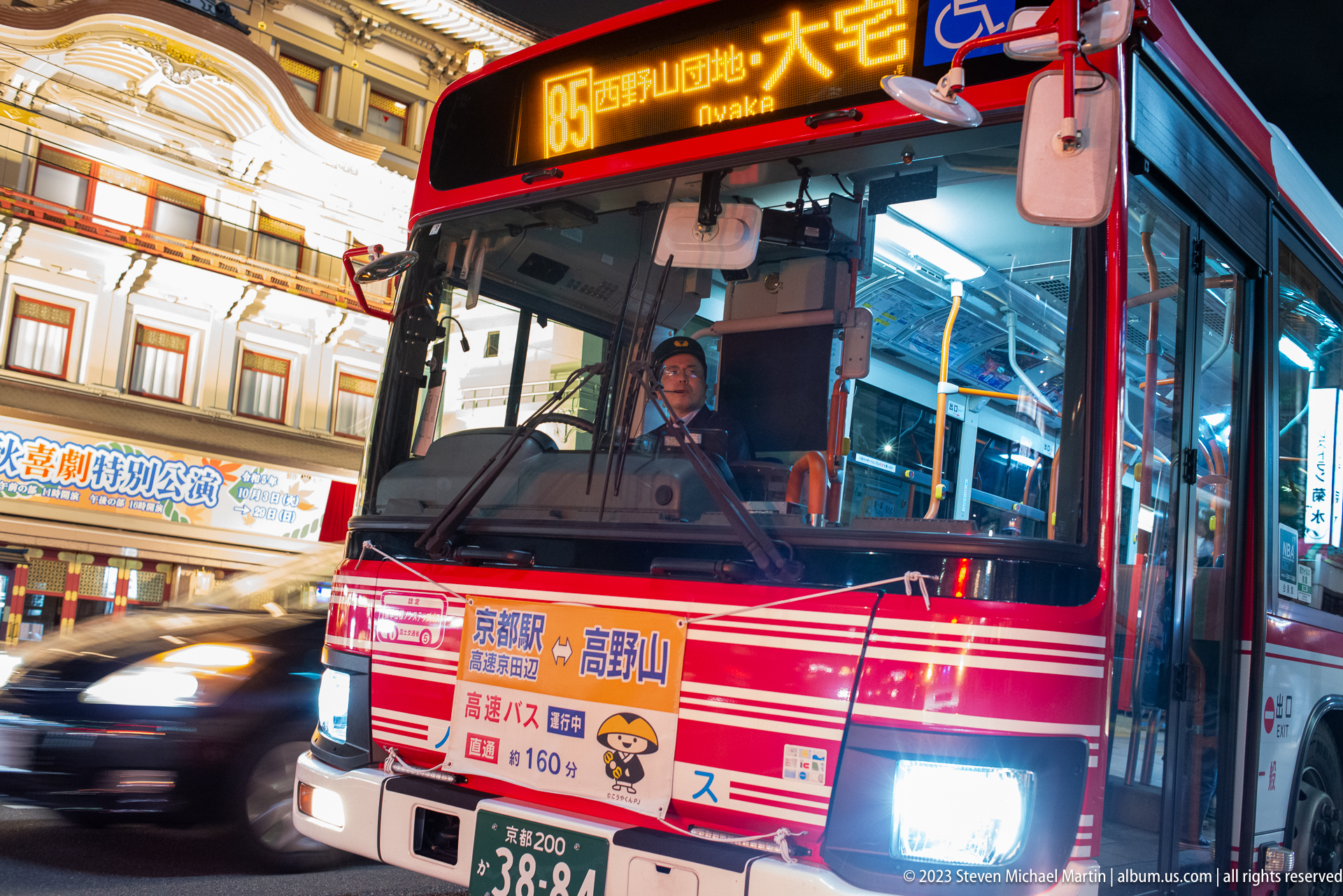
A red Kyoto city bus pauses along a brightly illuminated street, its route display glowing above the windshield while the driver waits at the stop. The photograph documents everyday urban transportation within the city's evening streetscape. The carefully controlled lighting, textile screens, and timber details show how Kyoto businesses use the threshold itself as part of the dining experience.
Caption
A red Kyoto city bus pauses along a brightly illuminated street, its route display glowing above the windshield while the driver waits at the stop. The photograph documents everyday urban transportation within the city's evening streetscape. The carefully controlled lighting, textile screens, and timber details show how Kyoto businesses use the threshold itself as part of the dining experience.
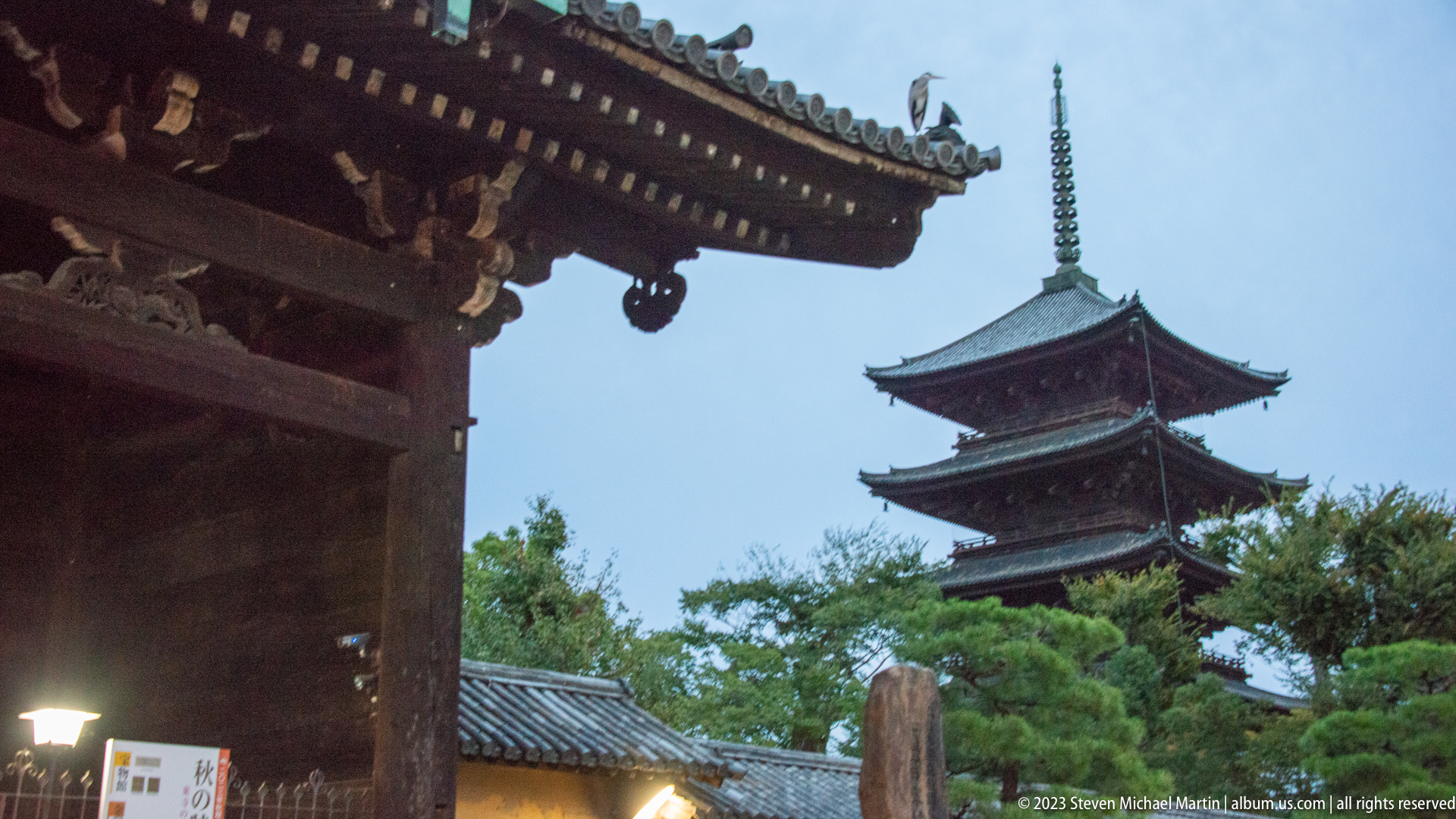
A traditional wooden temple gate frames a distant five-story pagoda, creating a layered composition that highlights the spatial organization of the temple complex. This is the five-story pagoda of Tō-ji, a Kyoto landmark approximately 55 meters high and recognized as Japan’s tallest wooden pagoda.
Caption
A traditional wooden temple gate frames a distant five-story pagoda, creating a layered composition that highlights the spatial organization of the temple complex. This is the five-story pagoda of Tō-ji, a Kyoto landmark approximately 55 meters high and recognized as Japan’s tallest wooden pagoda.
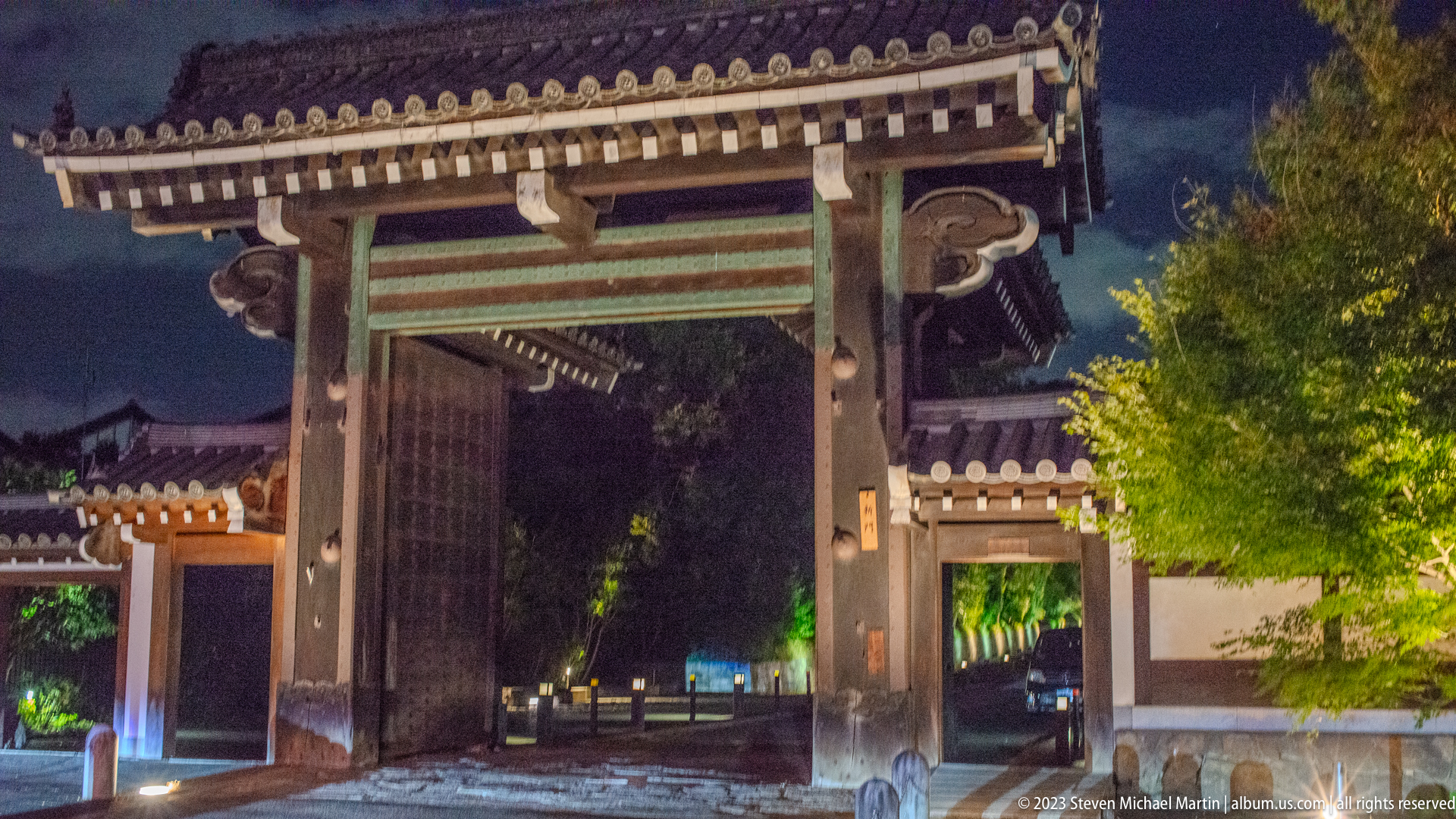
An illuminated temple gate stands against the night, its heavy tiled roof supported by layered timber brackets and broad wooden posts. Carefully placed lighting reveals the gate’s structural depth and painted details while the open passage frames a darker precinct beyond, emphasizing the threshold between Kyoto’s streets and a sacred enclosure.
Caption
An illuminated temple gate stands against the night, its heavy tiled roof supported by layered timber brackets and broad wooden posts. Carefully placed lighting reveals the gate’s structural depth and painted details while the open passage frames a darker precinct beyond, emphasizing the threshold between Kyoto’s streets and a sacred enclosure.
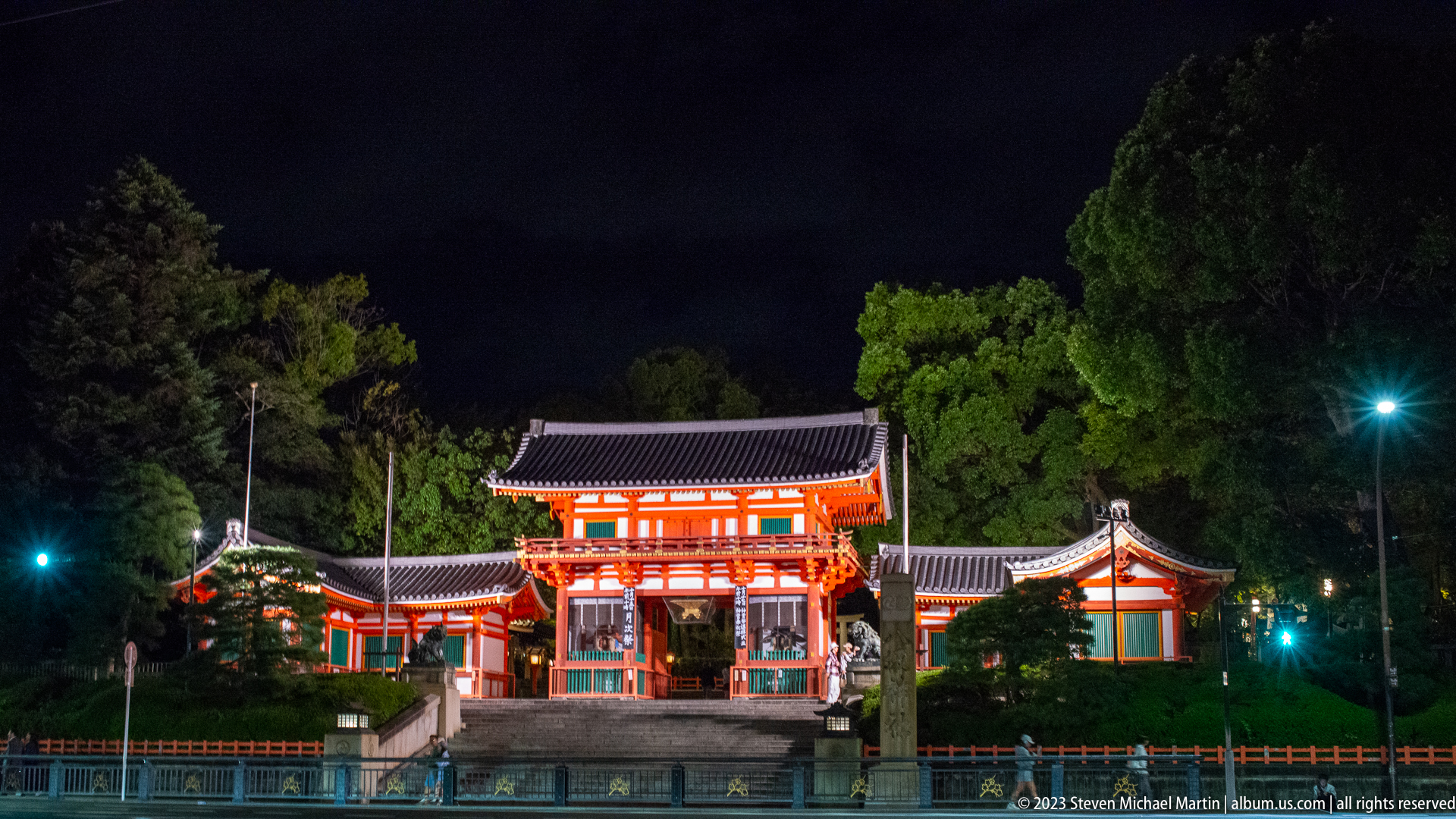
The brilliantly illuminated entrance gate of Yasaka Shrine rises against the night sky, revealing layered roofs, vermilion columns, and white wall panels. The composition documents one of Kyoto's most recognizable Shinto landmarks after dark. Within Yasaka Shrine, the illuminated structure forms part of a larger sequence of gates, paths, subsidiary shrines, and ceremonial buildings associated with Kyoto’s historic Gion district.
Caption
The brilliantly illuminated entrance gate of Yasaka Shrine rises against the night sky, revealing layered roofs, vermilion columns, and white wall panels. The composition documents one of Kyoto's most recognizable Shinto landmarks after dark. Within Yasaka Shrine, the illuminated structure forms part of a larger sequence of gates, paths, subsidiary shrines, and ceremonial buildings associated with Kyoto’s historic Gion district.

A narrow canal flows beneath dense trees whose branches reflect warm street lighting across the moving water. Historic buildings and lush vegetation combine to create one of Kyoto's most atmospheric nighttime canal scenes. Reflections extend the architecture into the water, making the canal an active part of the nighttime composition rather than a passive background.
Caption
A narrow canal flows beneath dense trees whose branches reflect warm street lighting across the moving water. Historic buildings and lush vegetation combine to create one of Kyoto's most atmospheric nighttime canal scenes. Reflections extend the architecture into the water, making the canal an active part of the nighttime composition rather than a passive background.

A quiet hotel lounge introduces the nighttime Kyoto sequence with a modern interpretation of traditional Japanese materials. Low wooden armchairs, pale upholstery, and a wall of closely spaced vertical slats create a restrained interior whose warm lighting and geometric order echo the timber screens and latticework found throughout the city’s historic streets.
Caption
A quiet hotel lounge introduces the nighttime Kyoto sequence with a modern interpretation of traditional Japanese materials. Low wooden armchairs, pale upholstery, and a wall of closely spaced vertical slats create a restrained interior whose warm lighting and geometric order echo the timber screens and latticework found throughout the city’s historic streets.
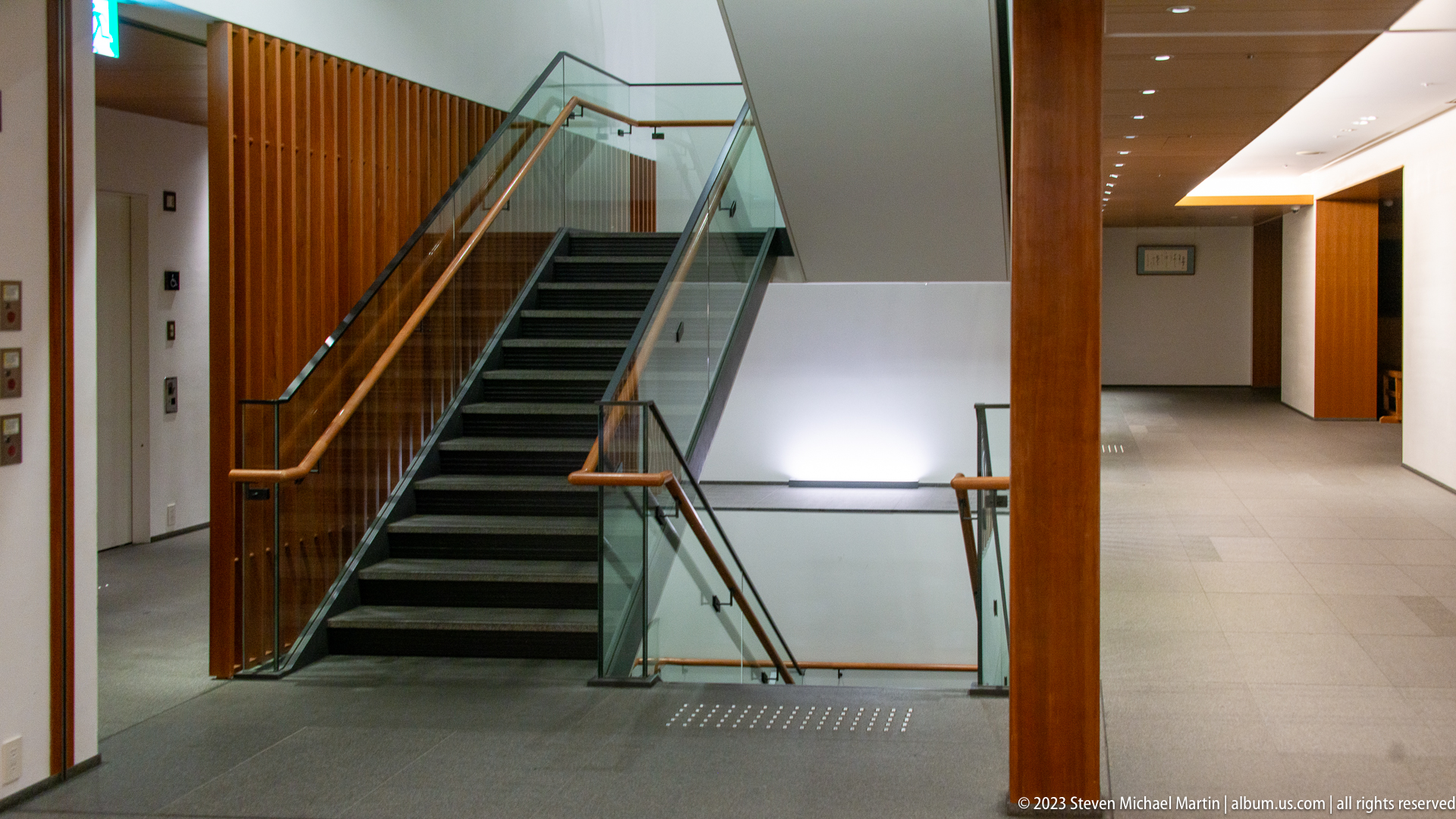
A contemporary stairwell combines glass balustrades, dark treads, and rounded wooden handrails within a spare hotel interior. The transparent railings open views across the landing, while the timber accents soften the otherwise neutral palette and provide a modern counterpoint to Kyoto’s more traditional wooden architecture seen later in the portfolio.
Caption
A contemporary stairwell combines glass balustrades, dark treads, and rounded wooden handrails within a spare hotel interior. The transparent railings open views across the landing, while the timber accents soften the otherwise neutral palette and provide a modern counterpoint to Kyoto’s more traditional wooden architecture seen later in the portfolio.

A brightly colored Japanese poster advertises a Kyoto cultural event, pairing a photographic scene of costumed performers with dense vertical text and a yellow information panel. The graphic design uses traditional imagery and contemporary typography to promote an evening program, though the proof sheet does not provide enough detail to verify the event’s exact title.
Caption
A brightly colored Japanese poster advertises a Kyoto cultural event, pairing a photographic scene of costumed performers with dense vertical text and a yellow information panel. The graphic design uses traditional imagery and contemporary typography to promote an evening program, though the proof sheet does not provide enough detail to verify the event’s exact title.
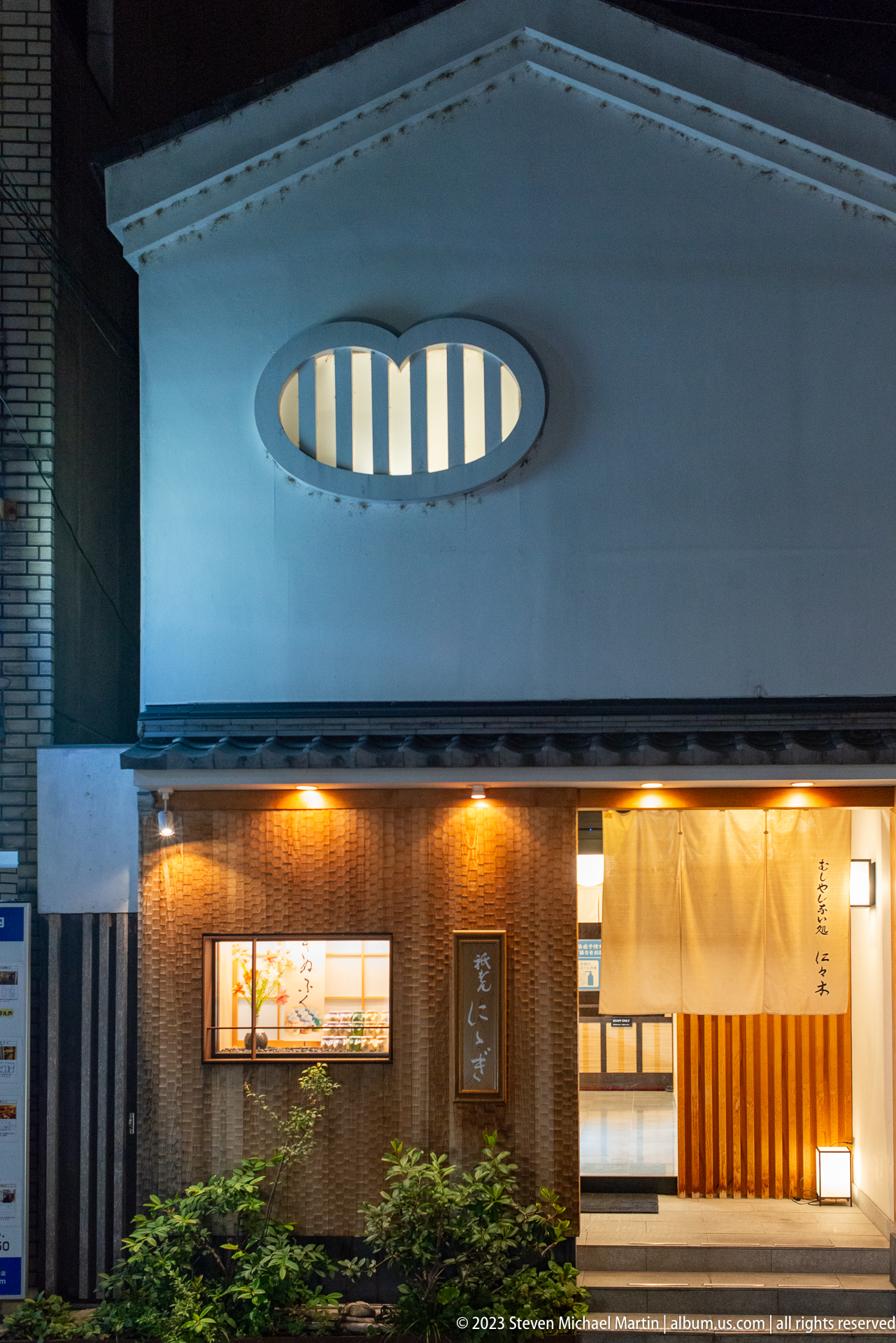
A contemporary restaurant presents a restrained façade of brick, timber, and warm interior lighting beneath an oval clerestory opening. The composition contrasts modern minimalist design with traditional proportions, illustrating how many Kyoto dining establishments reinterpret historic architectural vocabulary for contemporary hospitality.
Caption
A contemporary restaurant presents a restrained façade of brick, timber, and warm interior lighting beneath an oval clerestory opening. The composition contrasts modern minimalist design with traditional proportions, illustrating how many Kyoto dining establishments reinterpret historic architectural vocabulary for contemporary hospitality.

A subdued restaurant entrance glows beneath a red paper lantern, its wooden lattice doors and compact signboard emerging from deep shadow. The restrained lighting and narrow frontage create an intimate threshold characteristic of Kyoto’s small dining establishments, where architectural detail and a single illuminated emblem often serve as the principal invitation from the street.
Caption
A subdued restaurant entrance glows beneath a red paper lantern, its wooden lattice doors and compact signboard emerging from deep shadow. The restrained lighting and narrow frontage create an intimate threshold characteristic of Kyoto’s small dining establishments, where architectural detail and a single illuminated emblem often serve as the principal invitation from the street.

A public orientation map presents central Kyoto through a dense street grid, transit lines, landmark symbols, and bilingual labels. An inset marked “Large Area Map” expands the geographic context, while the main panel concentrates on pedestrian navigation through the city. The map situates the evening walk within Kyoto’s layered urban fabric.
Caption
A public orientation map presents central Kyoto through a dense street grid, transit lines, landmark symbols, and bilingual labels. An inset marked “Large Area Map” expands the geographic context, while the main panel concentrates on pedestrian navigation through the city. The map situates the evening walk within Kyoto’s layered urban fabric.
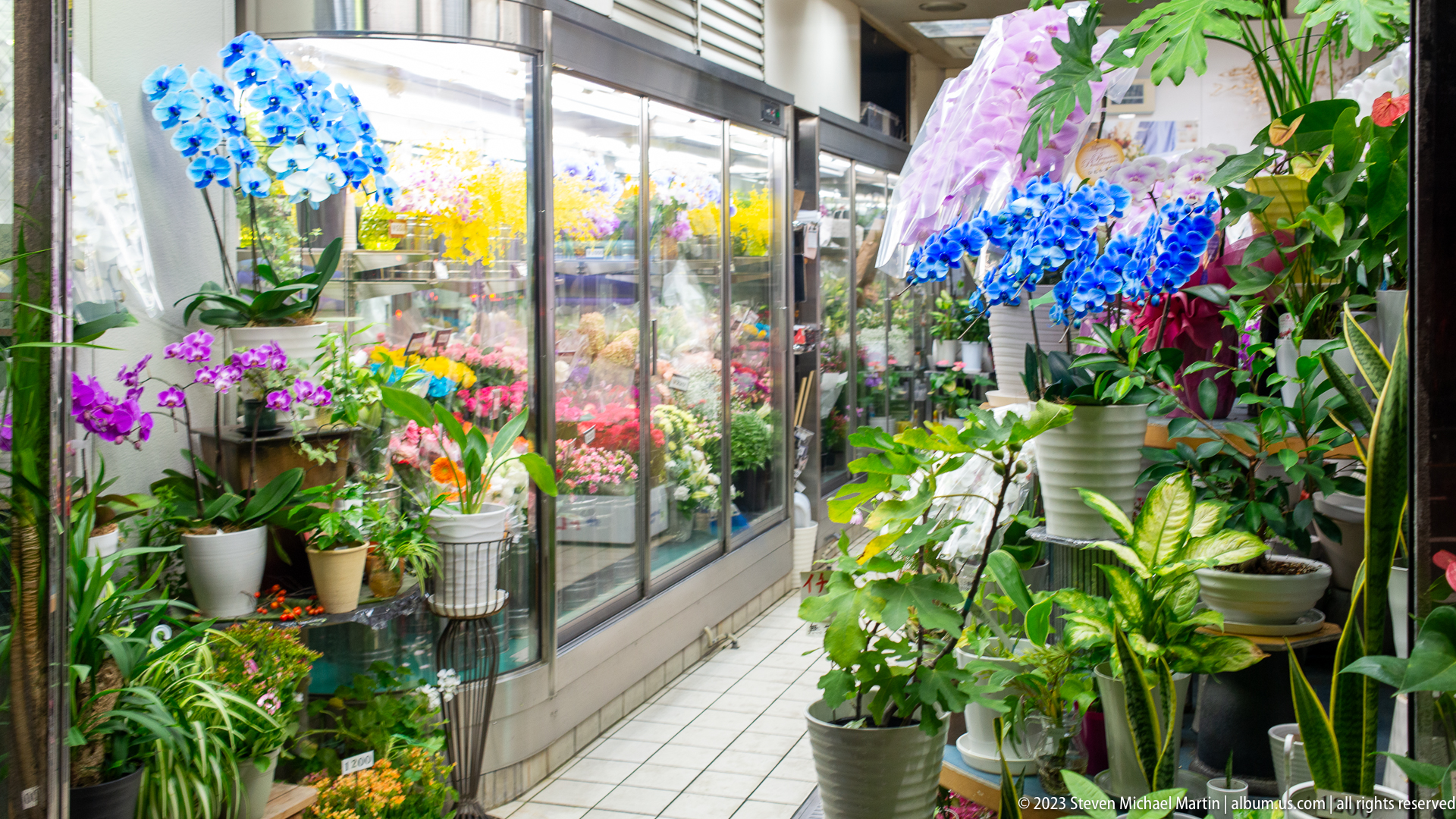
A Kyoto flower shop spills color into the evening streetscape through a dense display of orchids, potted foliage, and cut arrangements. Blue and purple blossoms dominate the foreground, while glass doors and interior shelving extend the display inward. The scene records the small-scale commerce and carefully composed storefronts that enliven the city after dark.
Caption
A Kyoto flower shop spills color into the evening streetscape through a dense display of orchids, potted foliage, and cut arrangements. Blue and purple blossoms dominate the foreground, while glass doors and interior shelving extend the display inward. The scene records the small-scale commerce and carefully composed storefronts that enliven the city after dark.

A blue-and-red neon sign advertising sake and beer projects from a traditional wooden façade, where latticed doors and glowing paper lanterns create a layered nighttime storefront. The contrast between electric signage and machiya-style architecture reflects the visual character of Kyoto’s entertainment districts, where contemporary nightlife occupies buildings shaped by older urban traditions.
Caption
A blue-and-red neon sign advertising sake and beer projects from a traditional wooden façade, where latticed doors and glowing paper lanterns create a layered nighttime storefront. The contrast between electric signage and machiya-style architecture reflects the visual character of Kyoto’s entertainment districts, where contemporary nightlife occupies buildings shaped by older urban traditions.
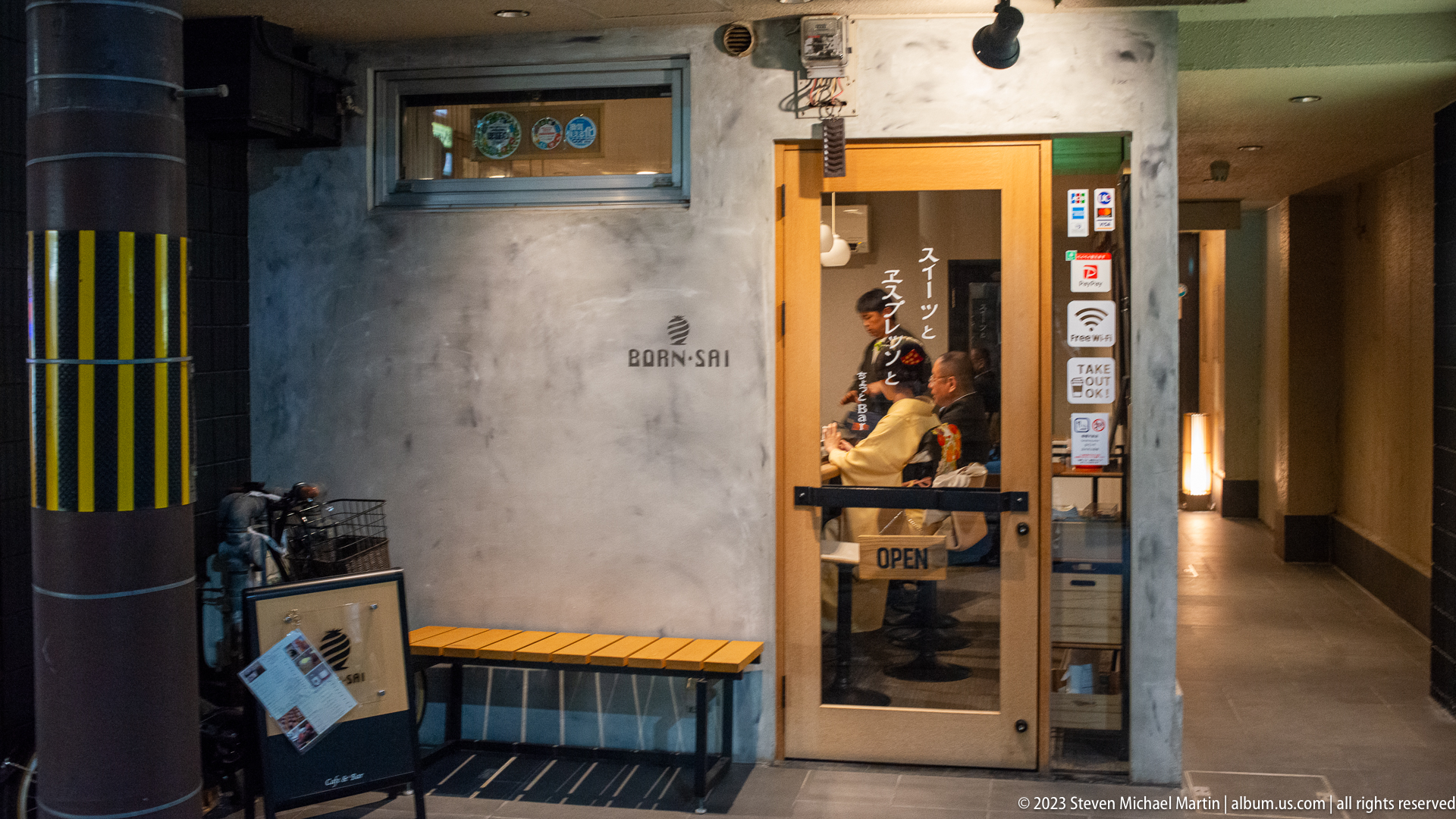
A compact restaurant entrance is set into a restrained concrete interior, with a narrow glazed door opening onto a warmly lit dining space. A simple wooden bench, menu display, and small cluster of signs provide the only decoration, giving the establishment an understated character typical of Kyoto’s discreet, street-level dining venues.
Caption
A compact restaurant entrance is set into a restrained concrete interior, with a narrow glazed door opening onto a warmly lit dining space. A simple wooden bench, menu display, and small cluster of signs provide the only decoration, giving the establishment an understated character typical of Kyoto’s discreet, street-level dining venues.

Handwritten menu sheets, bold black characters, and a large pink pig graphic crowd the window of a casual pork-cutlet restaurant. A bicycle parked against the storefront adds to the intimate street scene, while the layered signs advertise dishes and prices directly to passing customers in the dense visual language of neighborhood dining.
Caption
Handwritten menu sheets, bold black characters, and a large pink pig graphic crowd the window of a casual pork-cutlet restaurant. A bicycle parked against the storefront adds to the intimate street scene, while the layered signs advertise dishes and prices directly to passing customers in the dense visual language of neighborhood dining.

Rows of white paper lanterns illuminate the edge of a Shinto shrine precinct, suspended above a long red enclosure inscribed with black characters. A small red gate anchors the left side of the composition, while tiled roofs and timber walls place the devotional display within Kyoto’s traditional urban fabric.
Caption
Rows of white paper lanterns illuminate the edge of a Shinto shrine precinct, suspended above a long red enclosure inscribed with black characters. A small red gate anchors the left side of the composition, while tiled roofs and timber walls place the devotional display within Kyoto’s traditional urban fabric.
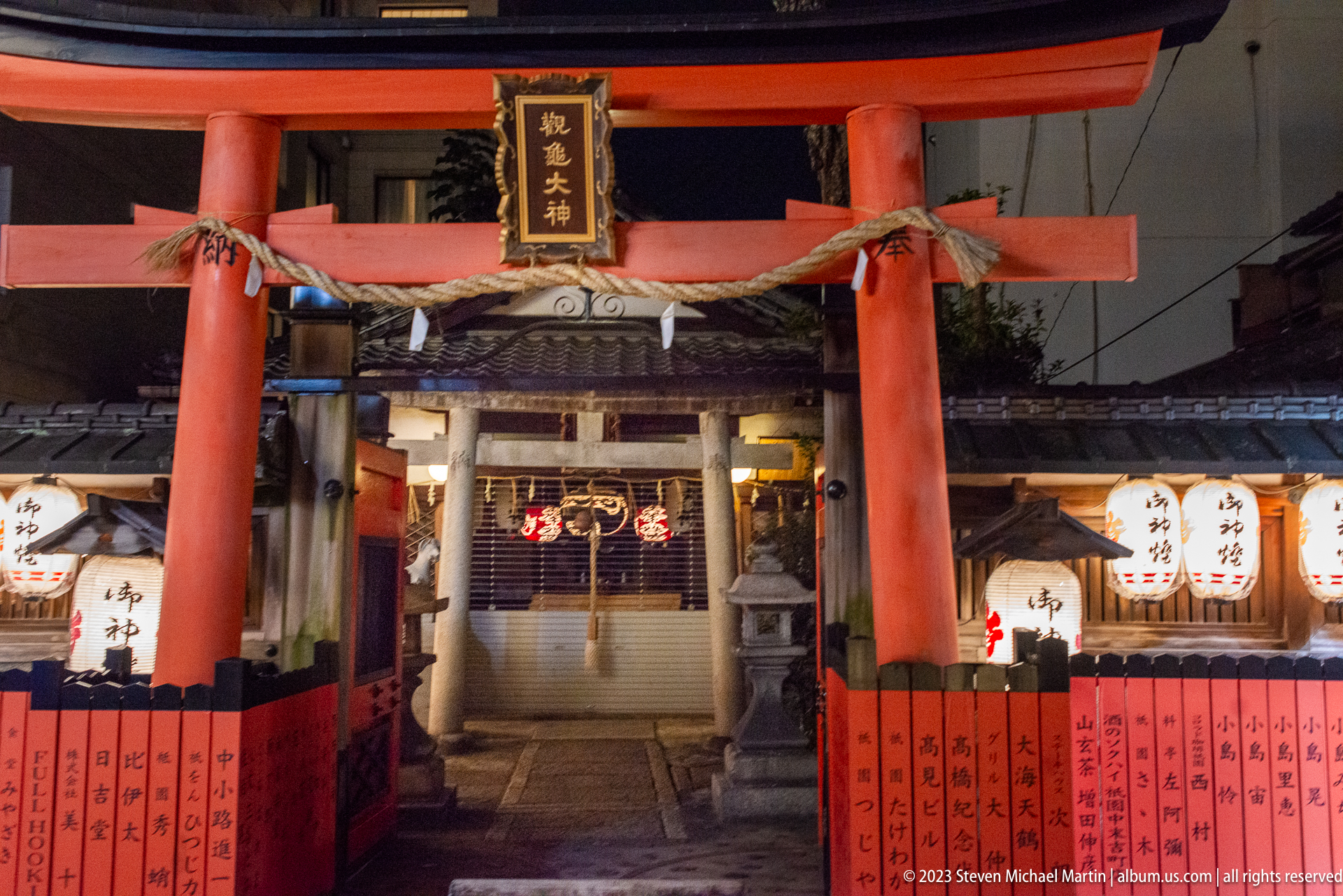
A vermilion torii frames the entrance to a compact neighborhood shrine, where a sacred rope and folded paper streamers mark the threshold. White lanterns and red votive panels continue beyond the gate, compressing multiple devotional elements into a narrow urban site embedded within Kyoto’s nighttime streetscape.
Caption
A vermilion torii frames the entrance to a compact neighborhood shrine, where a sacred rope and folded paper streamers mark the threshold. White lanterns and red votive panels continue beyond the gate, compressing multiple devotional elements into a narrow urban site embedded within Kyoto’s nighttime streetscape.

A carved stone devotional marker stands beneath a row of glowing paper lanterns, enclosed by red boards bearing vertical inscriptions. The tightly framed composition emphasizes the shrine’s accumulated layers of patronage and prayer: inscribed lanterns above, donor or votive names along the barrier, and a weathered stone focus at the center.
Caption
A carved stone devotional marker stands beneath a row of glowing paper lanterns, enclosed by red boards bearing vertical inscriptions. The tightly framed composition emphasizes the shrine’s accumulated layers of patronage and prayer: inscribed lanterns above, donor or votive names along the barrier, and a weathered stone focus at the center.

A close view highlights the entrance to a Kyoto restaurant where a traditional noren curtain, bamboo element, menu stands, and shoji-inspired partitions create an inviting threshold. The intimate composition emphasizes craftsmanship and the understated presentation typical of many small Kyoto dining establishments.
Caption
A close view highlights the entrance to a Kyoto restaurant where a traditional noren curtain, bamboo element, menu stands, and shoji-inspired partitions create an inviting threshold. The intimate composition emphasizes craftsmanship and the understated presentation typical of many small Kyoto dining establishments.

A framed illustration, green wall panels, and a doorway marked by red Japanese lettering create an artistic storefront composition. Decorative lighting and carefully arranged planting reflect the attention to visual presentation common among Kyoto's boutique restaurants and bars. Its restrained presentation reflects the intimate scale of Kyoto’s historic dining streets, where entrances are often embedded directly within traditional townhouses.
Caption
A framed illustration, green wall panels, and a doorway marked by red Japanese lettering create an artistic storefront composition. Decorative lighting and carefully arranged planting reflect the attention to visual presentation common among Kyoto's boutique restaurants and bars. Its restrained presentation reflects the intimate scale of Kyoto’s historic dining streets, where entrances are often embedded directly within traditional townhouses.
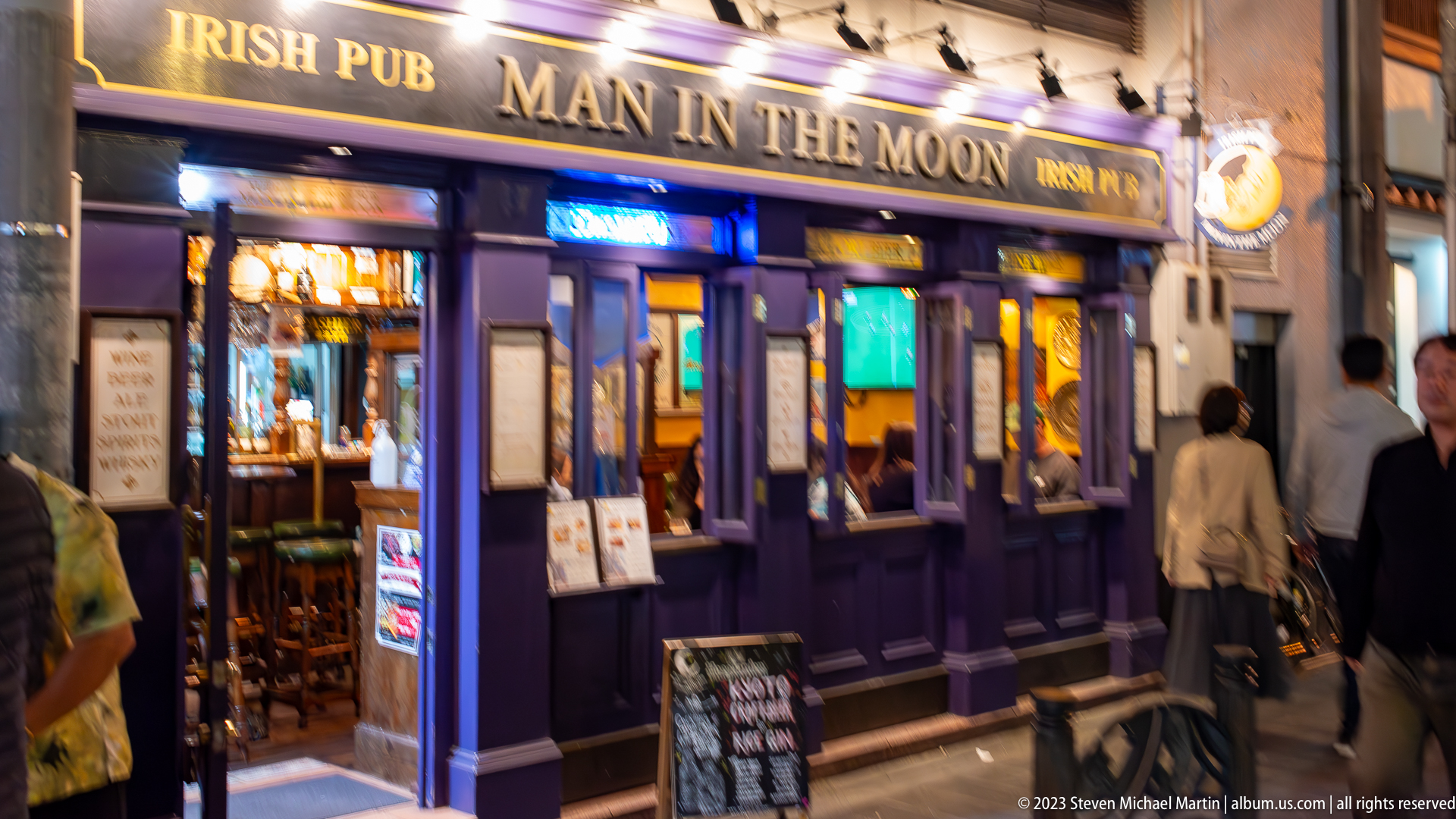
The brightly illuminated façade of the Man in the Moon pub introduces an international element within Kyoto's nightlife district. Its colorful exterior, illuminated signage, and open frontage contrast with neighboring traditional buildings while illustrating the city's diverse evening dining and social scene.
Caption
The brightly illuminated façade of the Man in the Moon pub introduces an international element within Kyoto's nightlife district. Its colorful exterior, illuminated signage, and open frontage contrast with neighboring traditional buildings while illustrating the city's diverse evening dining and social scene.
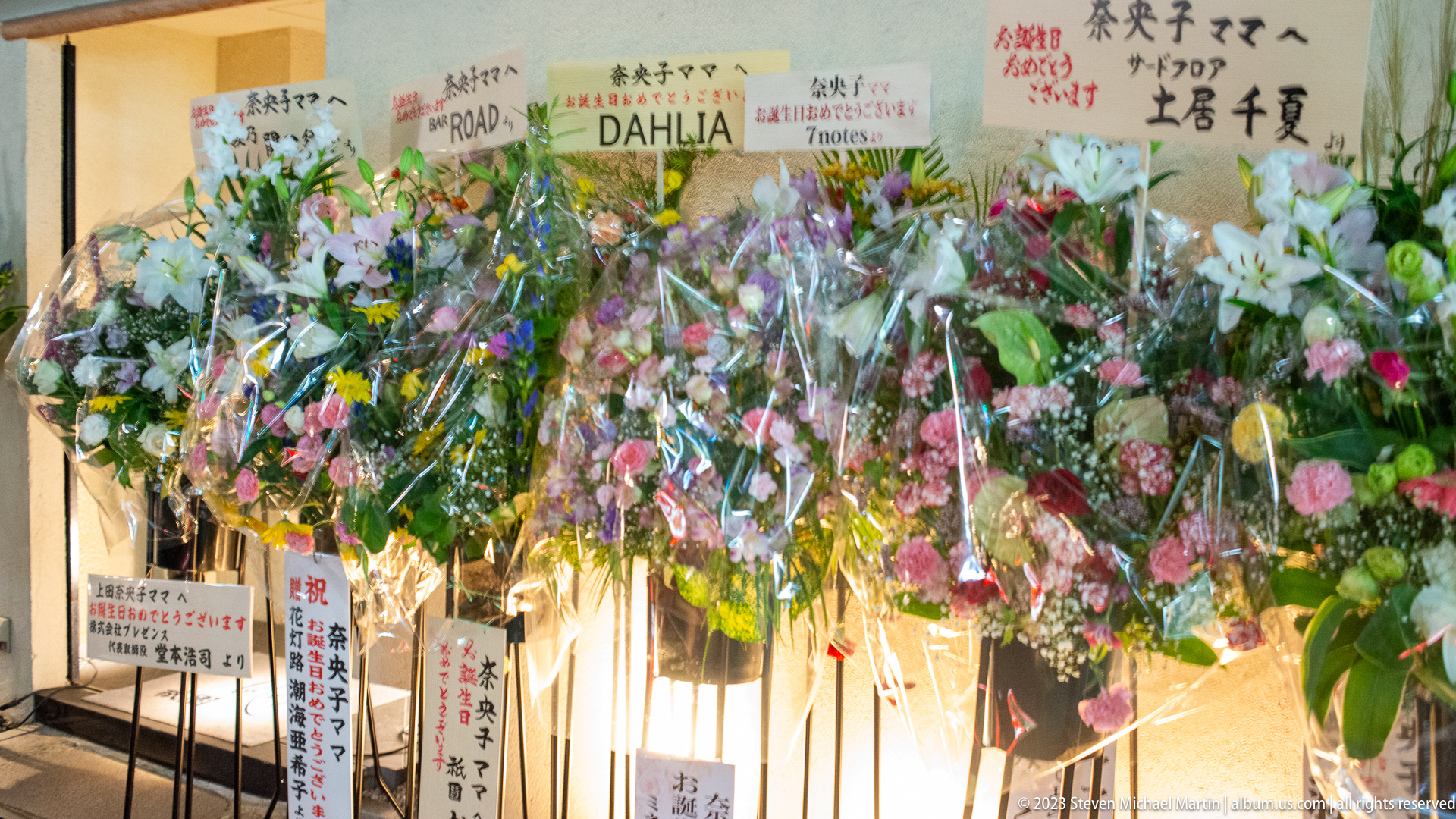
Rows of freshly wrapped bouquets fill the storefront of a neighborhood florist, their varied colors and handwritten signs creating a vibrant streetside display. The abundance of seasonal flowers contributes a softer visual rhythm amid Kyoto's evening commercial streets. Its dense arrangement contrasts with the restraint of nearby traditional façades and documents another layer of Kyoto’s evening commercial culture.
Caption
Rows of freshly wrapped bouquets fill the storefront of a neighborhood florist, their varied colors and handwritten signs creating a vibrant streetside display. The abundance of seasonal flowers contributes a softer visual rhythm amid Kyoto's evening commercial streets. Its dense arrangement contrasts with the restraint of nearby traditional façades and documents another layer of Kyoto’s evening commercial culture.
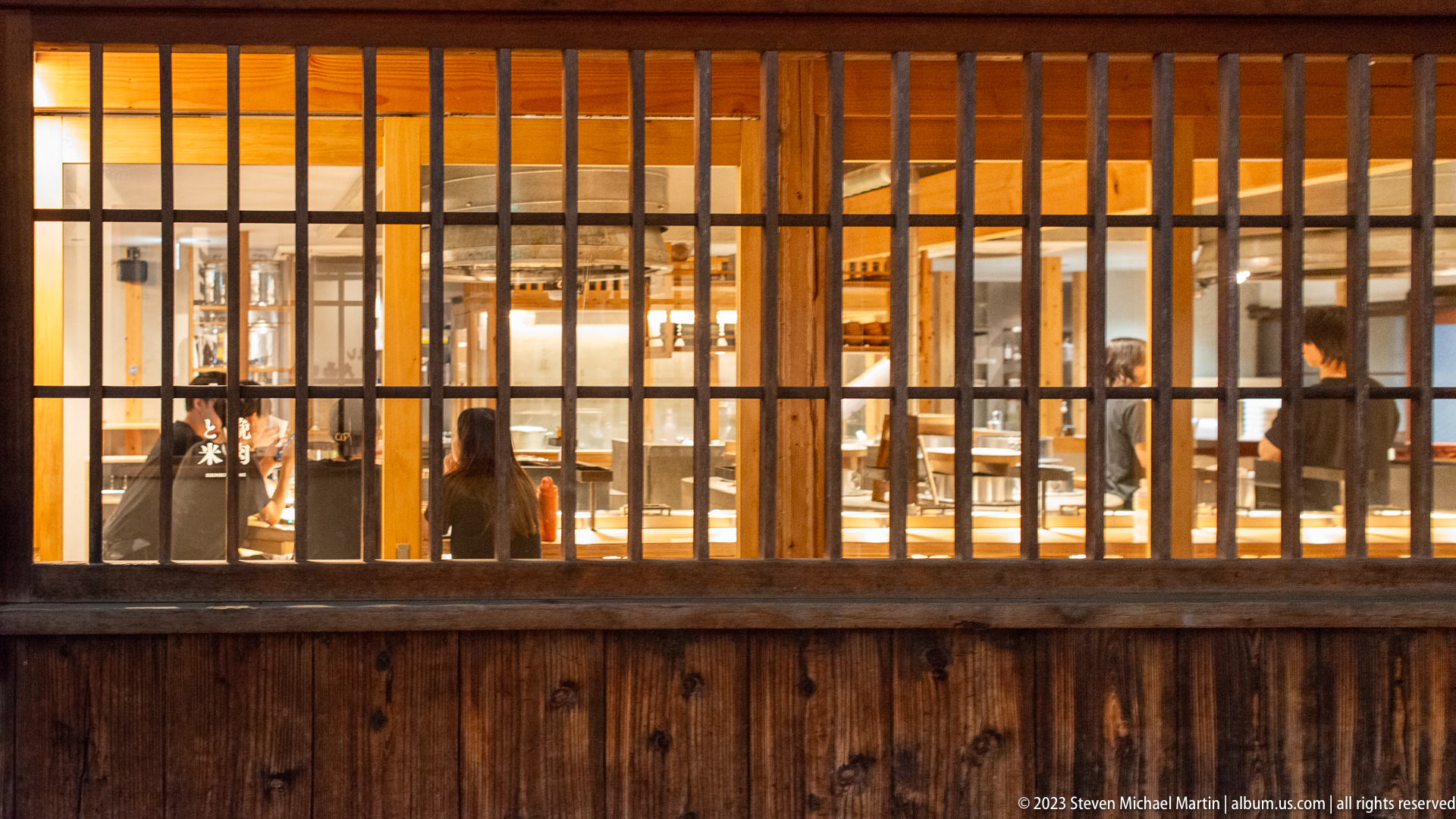
Viewed through a traditional wooden lattice, diners occupy a warmly illuminated restaurant interior. The façade preserves the appearance of a historic machiya townhouse while allowing carefully framed views into the contemporary dining space beyond. Its restrained presentation reflects the intimate scale of Kyoto’s historic dining streets, where entrances are often embedded directly within traditional townhouses.
Caption
Viewed through a traditional wooden lattice, diners occupy a warmly illuminated restaurant interior. The façade preserves the appearance of a historic machiya townhouse while allowing carefully framed views into the contemporary dining space beyond. Its restrained presentation reflects the intimate scale of Kyoto’s historic dining streets, where entrances are often embedded directly within traditional townhouses.

A brightly lit yakiniku restaurant entrance combines a white noren curtain, vertical timber screening, and a discreet menu stand. The Japanese text on the curtain identifies grilled meat as the establishment’s specialty, while the pale wood and carefully composed threshold reflect Kyoto’s preference for refined, compact storefront design.
Caption
A brightly lit yakiniku restaurant entrance combines a white noren curtain, vertical timber screening, and a discreet menu stand. The Japanese text on the curtain identifies grilled meat as the establishment’s specialty, while the pale wood and carefully composed threshold reflect Kyoto’s preference for refined, compact storefront design.
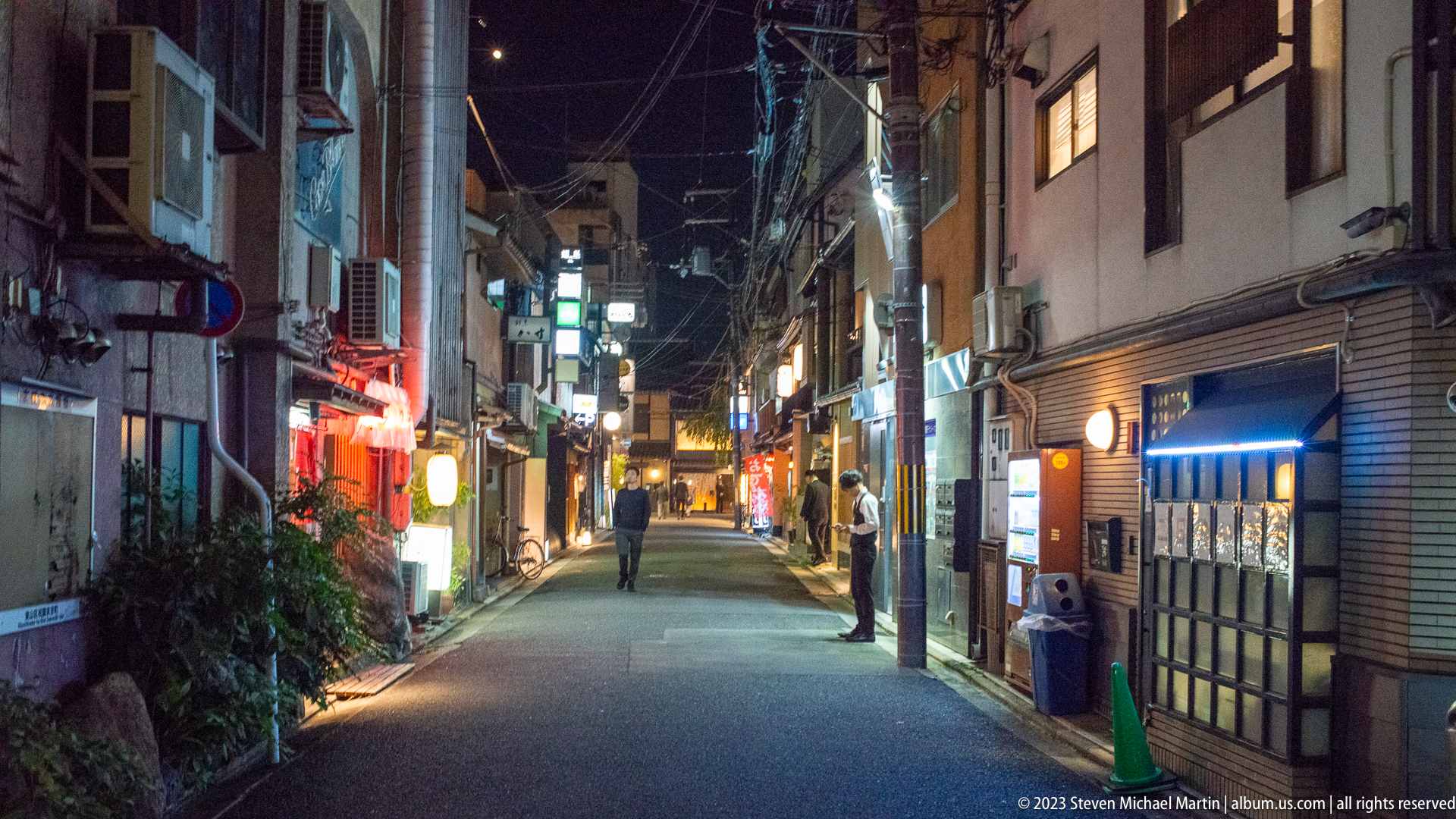
A narrow Kyoto lane recedes between closely spaced buildings, its route defined by restaurant lanterns, projecting signs, and isolated pools of light. Pedestrians and a parked bicycle animate the corridor, while the intimate scale and mixed façades convey the dense, pedestrian character of the city’s evening dining districts.
Caption
A narrow Kyoto lane recedes between closely spaced buildings, its route defined by restaurant lanterns, projecting signs, and isolated pools of light. Pedestrians and a parked bicycle animate the corridor, while the intimate scale and mixed façades convey the dense, pedestrian character of the city’s evening dining districts.

A white noren marked with bold circular motifs hangs beside a red lantern at a small Gion restaurant entrance. Timber latticework, a low red bench, and a planted courtyard soften the façade, creating a carefully staged transition between the public street and the private dining space beyond.
Caption
A white noren marked with bold circular motifs hangs beside a red lantern at a small Gion restaurant entrance. Timber latticework, a low red bench, and a planted courtyard soften the façade, creating a carefully staged transition between the public street and the private dining space beyond.

Rolled bamboo blinds descend across the upper level of a traditional timber façade, filtering views and light while preserving privacy. The close architectural study emphasizes the layered textures of Kyoto’s machiya streetscape—wooden framing, narrow slats, and woven screens—rather than the activity of the street itself.
Caption
Rolled bamboo blinds descend across the upper level of a traditional timber façade, filtering views and light while preserving privacy. The close architectural study emphasizes the layered textures of Kyoto’s machiya streetscape—wooden framing, narrow slats, and woven screens—rather than the activity of the street itself.

Two bicycles rest against the wooden façade of a small neighborhood restaurant, beneath a white noren and compact signboard. The scene combines everyday mobility with the restrained architecture of a local dining establishment, showing how Kyoto’s narrow streets support intimate businesses embedded directly within the residential fabric.
Caption
Two bicycles rest against the wooden façade of a small neighborhood restaurant, beneath a white noren and compact signboard. The scene combines everyday mobility with the restrained architecture of a local dining establishment, showing how Kyoto’s narrow streets support intimate businesses embedded directly within the residential fabric.

A traditional restaurant façade is arranged beneath tiled eaves, with round paper lanterns, wooden latticework, and divided noren curtains marking the entrance. Warm interior light filters through the doorway while the compact composition emphasizes the careful balance of signage, textile screens, and timber details that gives Kyoto’s historic dining streets their distinctive nighttime character.
Caption
A traditional restaurant façade is arranged beneath tiled eaves, with round paper lanterns, wooden latticework, and divided noren curtains marking the entrance. Warm interior light filters through the doorway while the compact composition emphasizes the careful balance of signage, textile screens, and timber details that gives Kyoto’s historic dining streets their distinctive nighttime character.

A narrow canal winds through a softly illuminated Kyoto streetscape, bordered by stone embankments, overhanging vegetation, and restaurants raised along the water’s edge. Reflections shimmer across the moving surface, transforming the urban waterway into a quiet green corridor and revealing how waterways remain woven into the city’s historic entertainment districts.
Caption
A narrow canal winds through a softly illuminated Kyoto streetscape, bordered by stone embankments, overhanging vegetation, and restaurants raised along the water’s edge. Reflections shimmer across the moving surface, transforming the urban waterway into a quiet green corridor and revealing how waterways remain woven into the city’s historic entertainment districts.
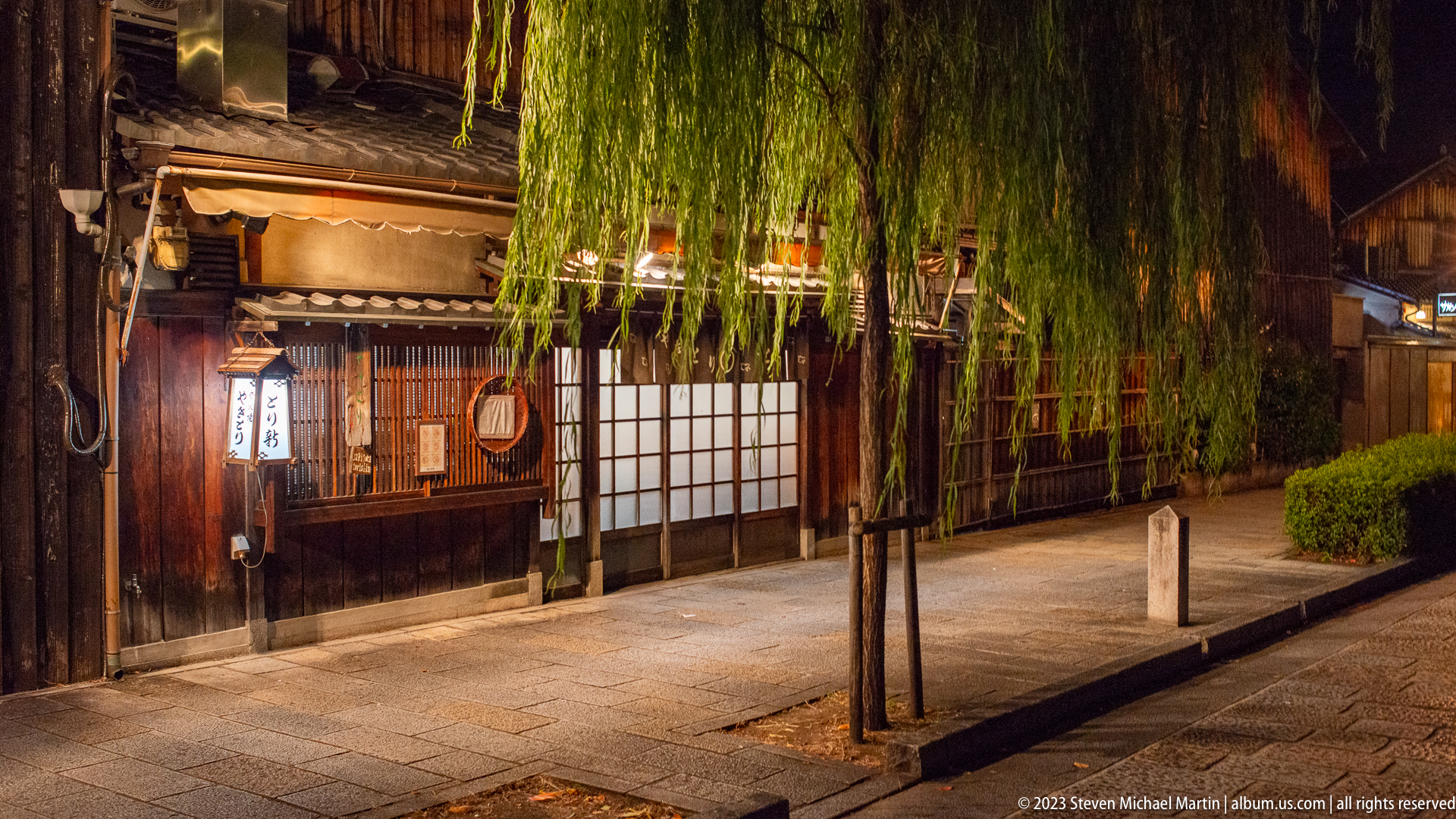
A weeping willow descends over a lantern-lit restaurant frontage, softening the strong lines of wooden lattice screens, plaster panels, and tiled eaves. The empty stone-paved walkway and low bollards create a calm nighttime setting in which vegetation and traditional architecture share equal prominence, a characteristic feature of Kyoto’s preserved canal-side districts.
Caption
A weeping willow descends over a lantern-lit restaurant frontage, softening the strong lines of wooden lattice screens, plaster panels, and tiled eaves. The empty stone-paved walkway and low bollards create a calm nighttime setting in which vegetation and traditional architecture share equal prominence, a characteristic feature of Kyoto’s preserved canal-side districts.

Traditional wooden buildings rise above a dark canal, their warm interior lights reflected in the water below. A small footbridge and stone-lined bank organize the layered scene, while foliage obscures portions of the façades. The low illumination preserves the intimate atmosphere of Kyoto’s historic canal-side architecture after nightfall.
Caption
Traditional wooden buildings rise above a dark canal, their warm interior lights reflected in the water below. A small footbridge and stone-lined bank organize the layered scene, while foliage obscures portions of the façades. The low illumination preserves the intimate atmosphere of Kyoto’s historic canal-side architecture after nightfall.

A narrow illuminated path leads toward a traditional entrance screened by a dark noren and wooden latticework. Upper windows glow behind railings, while branches partially veil the façade, creating a layered sense of privacy. The recessed approach distinguishes this canal-side establishment from the more directly exposed storefronts elsewhere in the sequence.
Caption
A narrow illuminated path leads toward a traditional entrance screened by a dark noren and wooden latticework. Upper windows glow behind railings, while branches partially veil the façade, creating a layered sense of privacy. The recessed approach distinguishes this canal-side establishment from the more directly exposed storefronts elsewhere in the sequence.

A vivid red bench, glowing lantern, and red noren animate the restrained timber façade of a small Kyoto restaurant. Wooden lattice windows, earthen-colored walls, and a tiled roof establish the traditional architectural framework, while the concentrated accents of color draw attention to the entrance and create a welcoming focal point along the nighttime street.
Caption
A vivid red bench, glowing lantern, and red noren animate the restrained timber façade of a small Kyoto restaurant. Wooden lattice windows, earthen-colored walls, and a tiled roof establish the traditional architectural framework, while the concentrated accents of color draw attention to the entrance and create a welcoming focal point along the nighttime street.
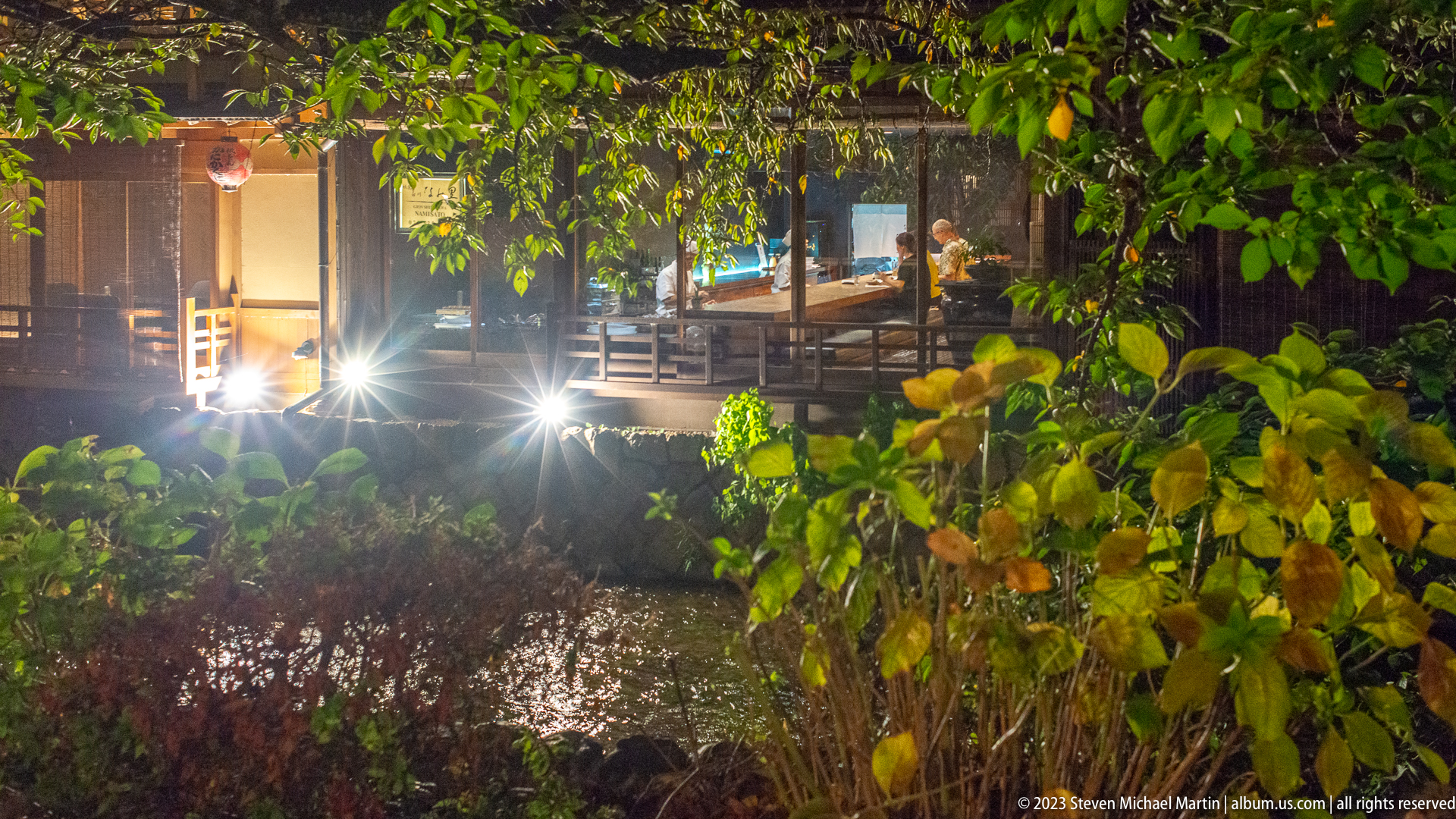
A canal-side restaurant glows through dense riverside foliage, where diners are visible beyond a timber terrace overlooking the water. The layered composition uses leaves, reflections, and warm interior lighting to emphasize the intimate atmosphere of Kyoto's historic entertainment quarter after dark.
Caption
A canal-side restaurant glows through dense riverside foliage, where diners are visible beyond a timber terrace overlooking the water. The layered composition uses leaves, reflections, and warm interior lighting to emphasize the intimate atmosphere of Kyoto's historic entertainment quarter after dark.

A traditional riverside building presents woven bamboo blinds across its upper story while a softly illuminated lower façade overlooks the canal. The restrained architectural treatment highlights Kyoto's historic machiya character along the waterfront. Stone embankments, vegetation, and adjoining buildings reveal how closely Kyoto’s historic neighborhoods developed around narrow urban waterways.
Caption
A traditional riverside building presents woven bamboo blinds across its upper story while a softly illuminated lower façade overlooks the canal. The restrained architectural treatment highlights Kyoto's historic machiya character along the waterfront. Stone embankments, vegetation, and adjoining buildings reveal how closely Kyoto’s historic neighborhoods developed around narrow urban waterways.
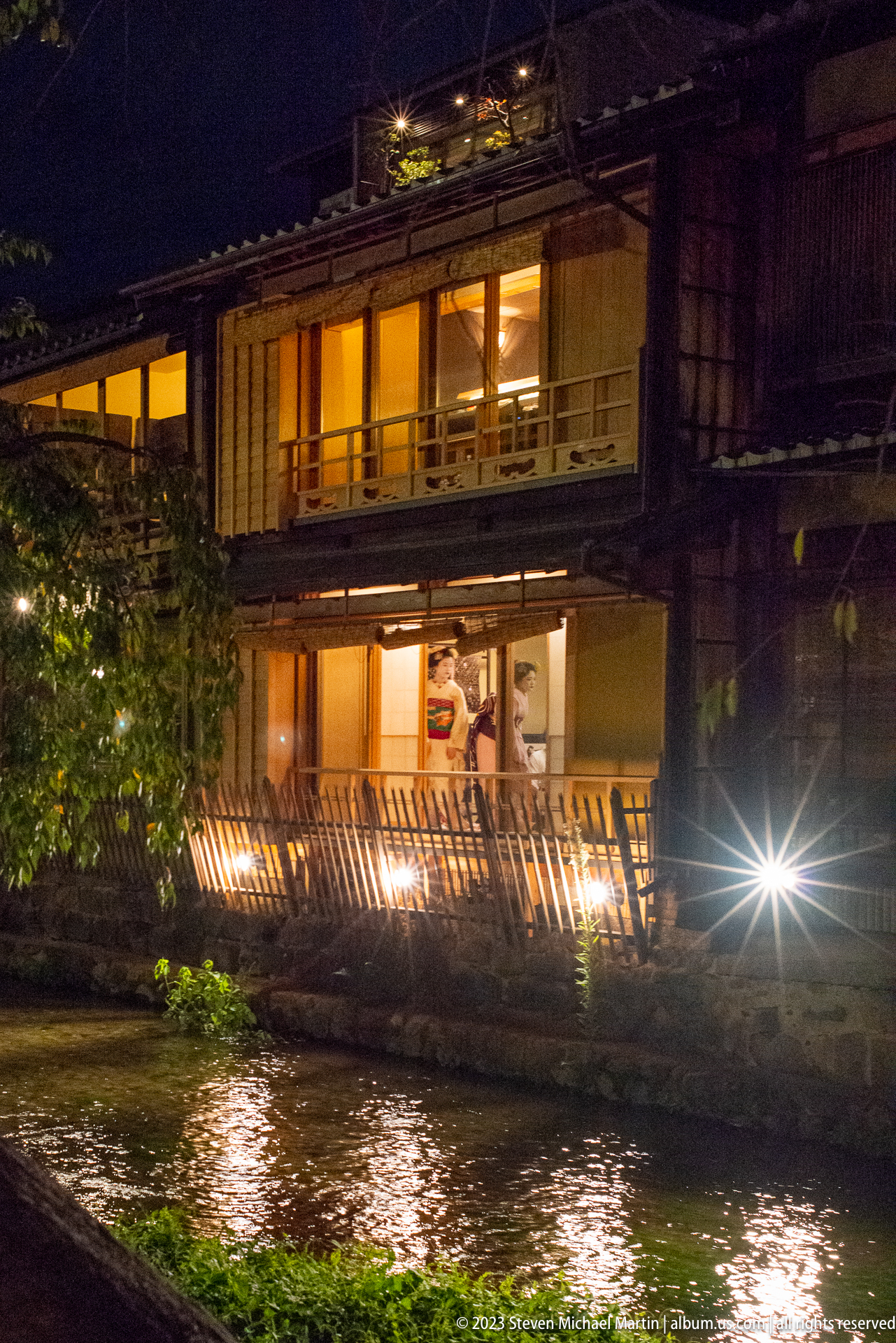
Warm interior lighting spills from a traditional multi-story restaurant facing the canal. Reflections ripple across the water while timber railings and deep eaves reinforce the preserved architectural character of Kyoto's canal-side entertainment district. Reflections extend the architecture into the water, making the canal an active part of the nighttime composition rather than a passive background.
Caption
Warm interior lighting spills from a traditional multi-story restaurant facing the canal. Reflections ripple across the water while timber railings and deep eaves reinforce the preserved architectural character of Kyoto's canal-side entertainment district. Reflections extend the architecture into the water, making the canal an active part of the nighttime composition rather than a passive background.
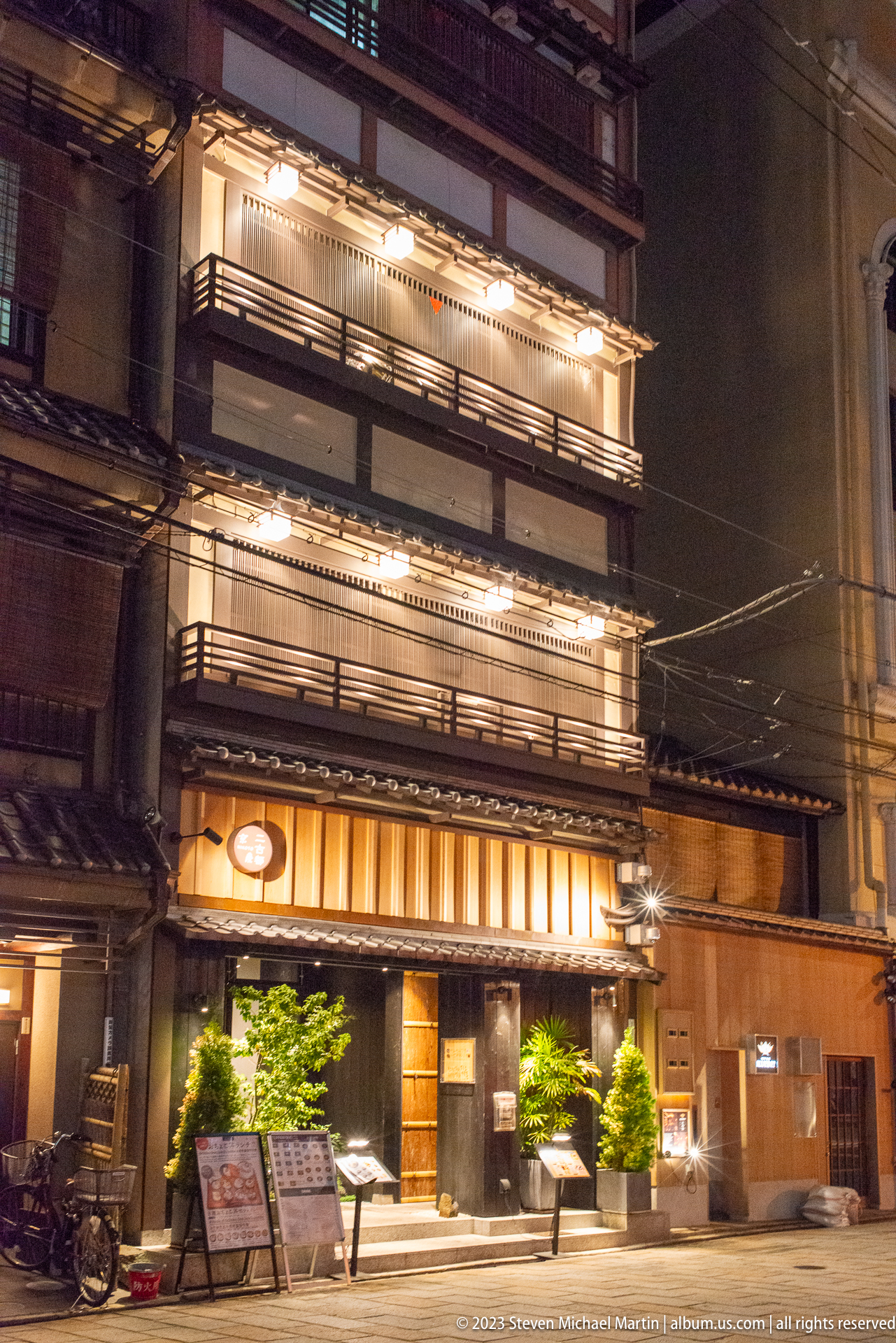
A multi-story traditional hospitality building dominates the streetscape with layered balconies, warm lighting, and a refined entrance framed by small plantings. The architecture reflects the continued use of historic building forms within Kyoto's evening commercial districts. Rather than relying on a broad commercial frontage, the establishment announces itself through a small set of crafted details intended for pedestrians at close range.
Caption
A multi-story traditional hospitality building dominates the streetscape with layered balconies, warm lighting, and a refined entrance framed by small plantings. The architecture reflects the continued use of historic building forms within Kyoto's evening commercial districts. Rather than relying on a broad commercial frontage, the establishment announces itself through a small set of crafted details intended for pedestrians at close range.
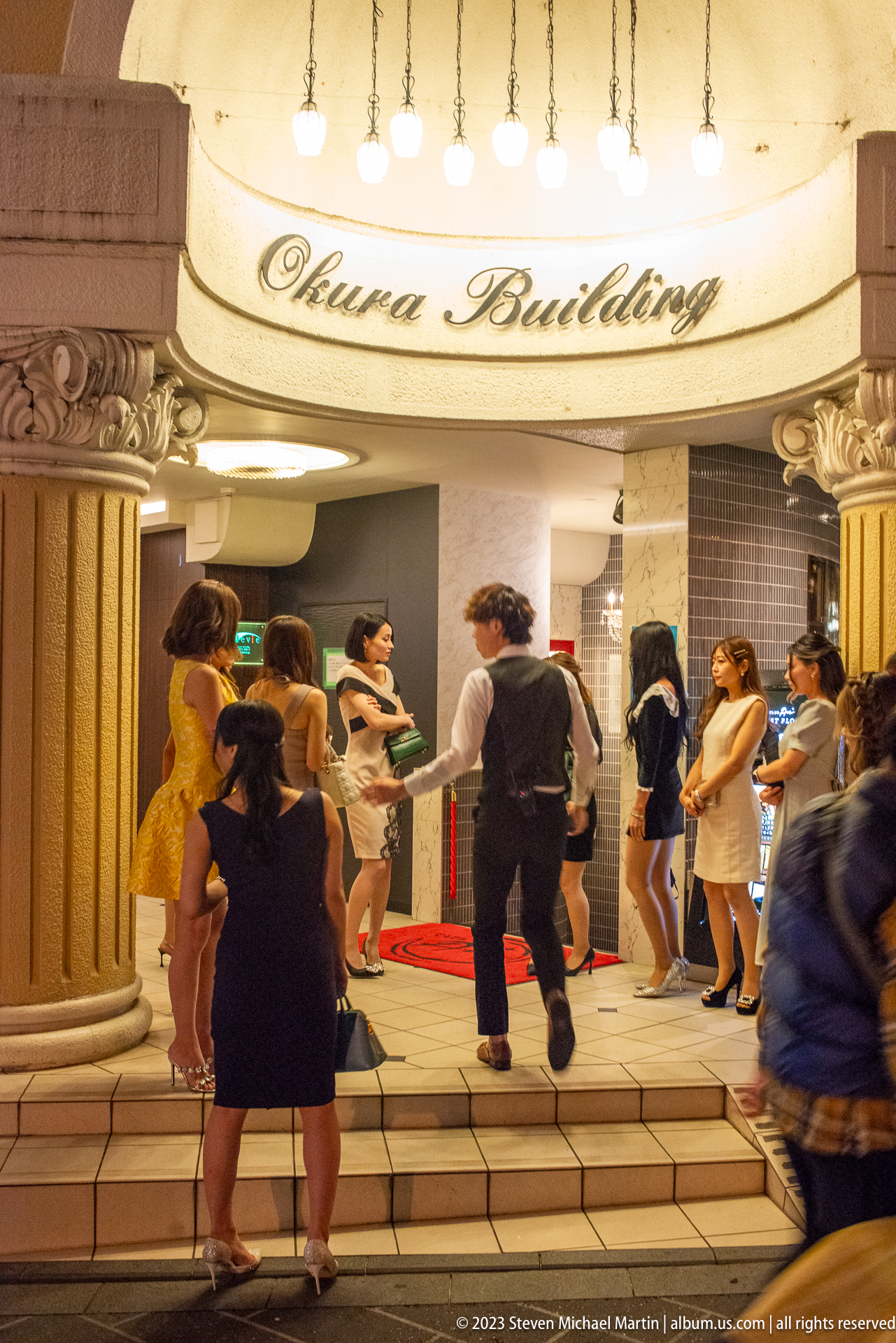
Visitors gather beneath the illuminated entrance of a nightlife venue, creating a lively contrast with the quieter traditional streets documented elsewhere in the portfolio. Classical columns and bright lighting emphasize the modern entertainment setting. The pedestrian scale allows signs, lanterns, paving, and wooden façades to be read as a continuous streetscape rather than as isolated buildings.
Caption
Visitors gather beneath the illuminated entrance of a nightlife venue, creating a lively contrast with the quieter traditional streets documented elsewhere in the portfolio. Classical columns and bright lighting emphasize the modern entertainment setting. The pedestrian scale allows signs, lanterns, paving, and wooden façades to be read as a continuous streetscape rather than as isolated buildings.

Guests gather on a warmly lit veranda above the canal, illustrating the close relationship between Kyoto's traditional hospitality architecture and its historic waterways. Trees partially veil the scene while emphasizing the secluded character of the dining experience. The waterway functions as both landscape and urban infrastructure, bringing reflected light and a quieter spatial rhythm to the surrounding district.
Caption
Guests gather on a warmly lit veranda above the canal, illustrating the close relationship between Kyoto's traditional hospitality architecture and its historic waterways. Trees partially veil the scene while emphasizing the secluded character of the dining experience. The waterway functions as both landscape and urban infrastructure, bringing reflected light and a quieter spatial rhythm to the surrounding district.
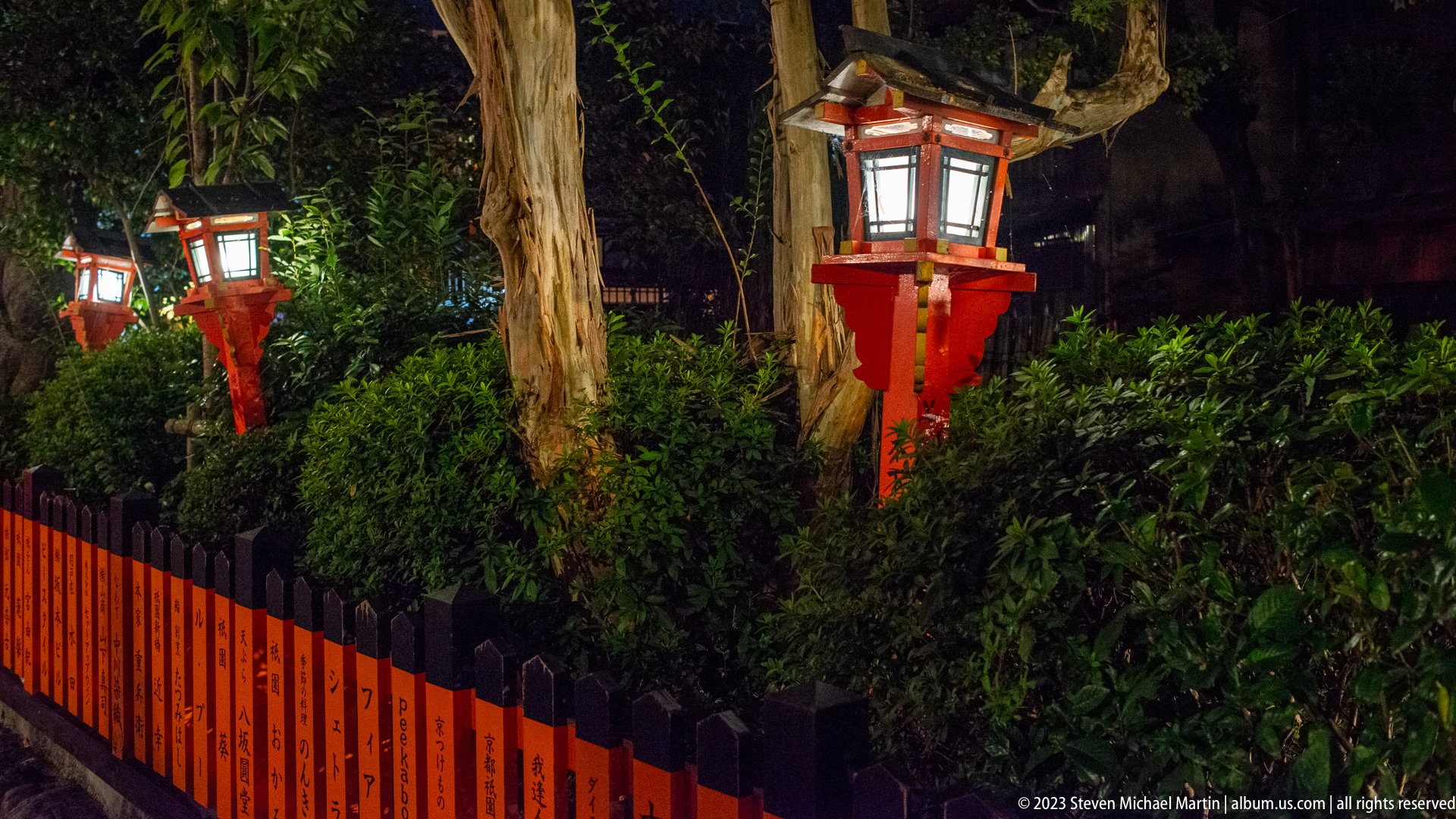
Two vermilion shrine lanterns rise above hedges and a fence lined with inscribed boards, creating a vivid religious landmark within Kyoto's nighttime streetscape. Their warm illumination contrasts with surrounding vegetation and reinforces the ceremonial atmosphere. The sequence of gates, paths, lanterns, and subsidiary structures demonstrates how movement through a Shinto precinct is organized through successive thresholds.
Caption
Two vermilion shrine lanterns rise above hedges and a fence lined with inscribed boards, creating a vivid religious landmark within Kyoto's nighttime streetscape. Their warm illumination contrasts with surrounding vegetation and reinforces the ceremonial atmosphere. The sequence of gates, paths, lanterns, and subsidiary structures demonstrates how movement through a Shinto precinct is organized through successive thresholds.
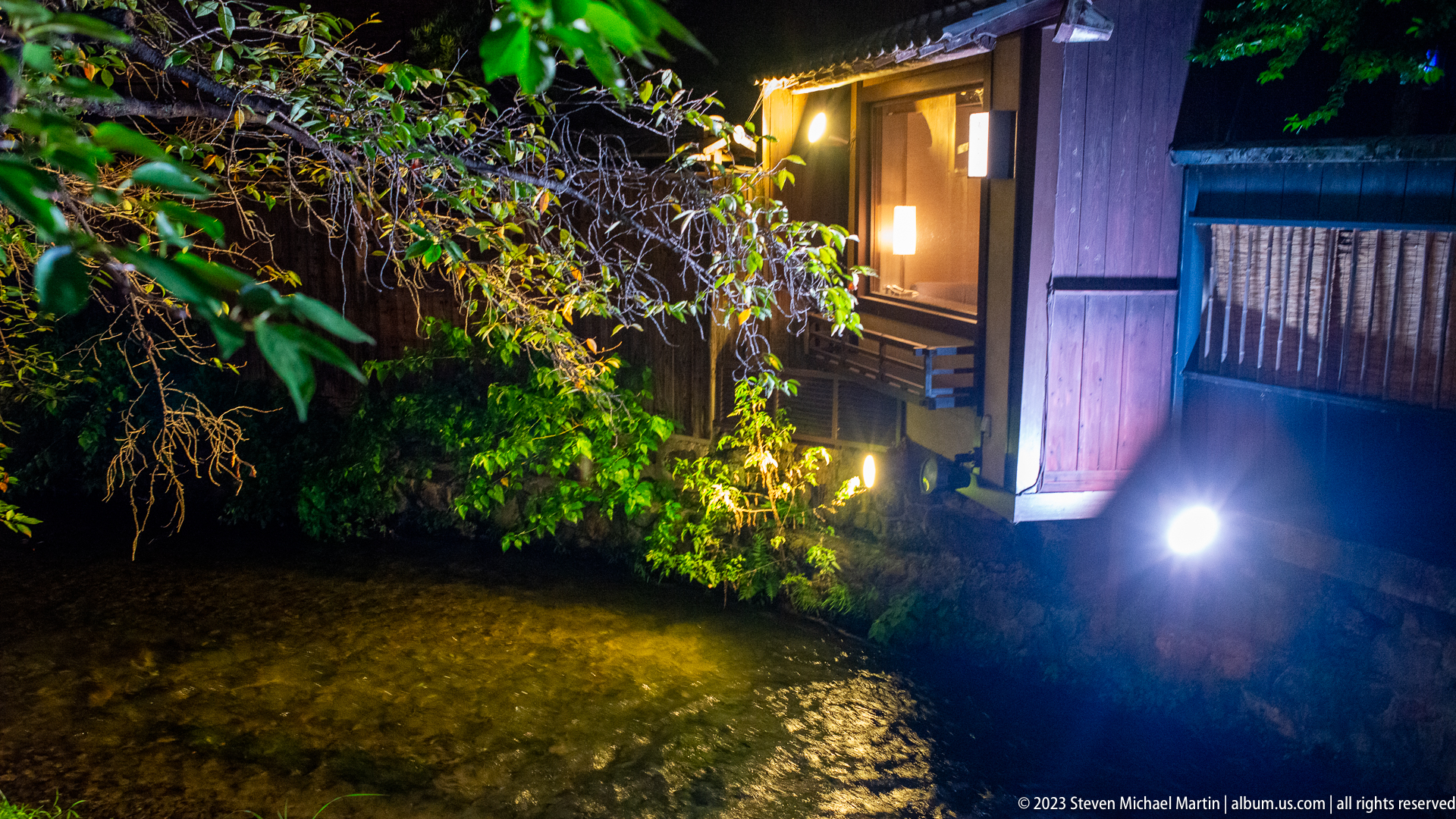
A traditional wooden structure stands directly above a narrow canal, illuminated by discreet exterior lighting that reflects from the moving water. Branches overhang the scene, reinforcing the tranquil relationship between architecture, landscape, and water that characterizes Kyoto after dark. Reflections extend the architecture into the water, making the canal an active part of the nighttime composition rather than a passive background.
Caption
A traditional wooden structure stands directly above a narrow canal, illuminated by discreet exterior lighting that reflects from the moving water. Branches overhang the scene, reinforcing the tranquil relationship between architecture, landscape, and water that characterizes Kyoto after dark. Reflections extend the architecture into the water, making the canal an active part of the nighttime composition rather than a passive background.
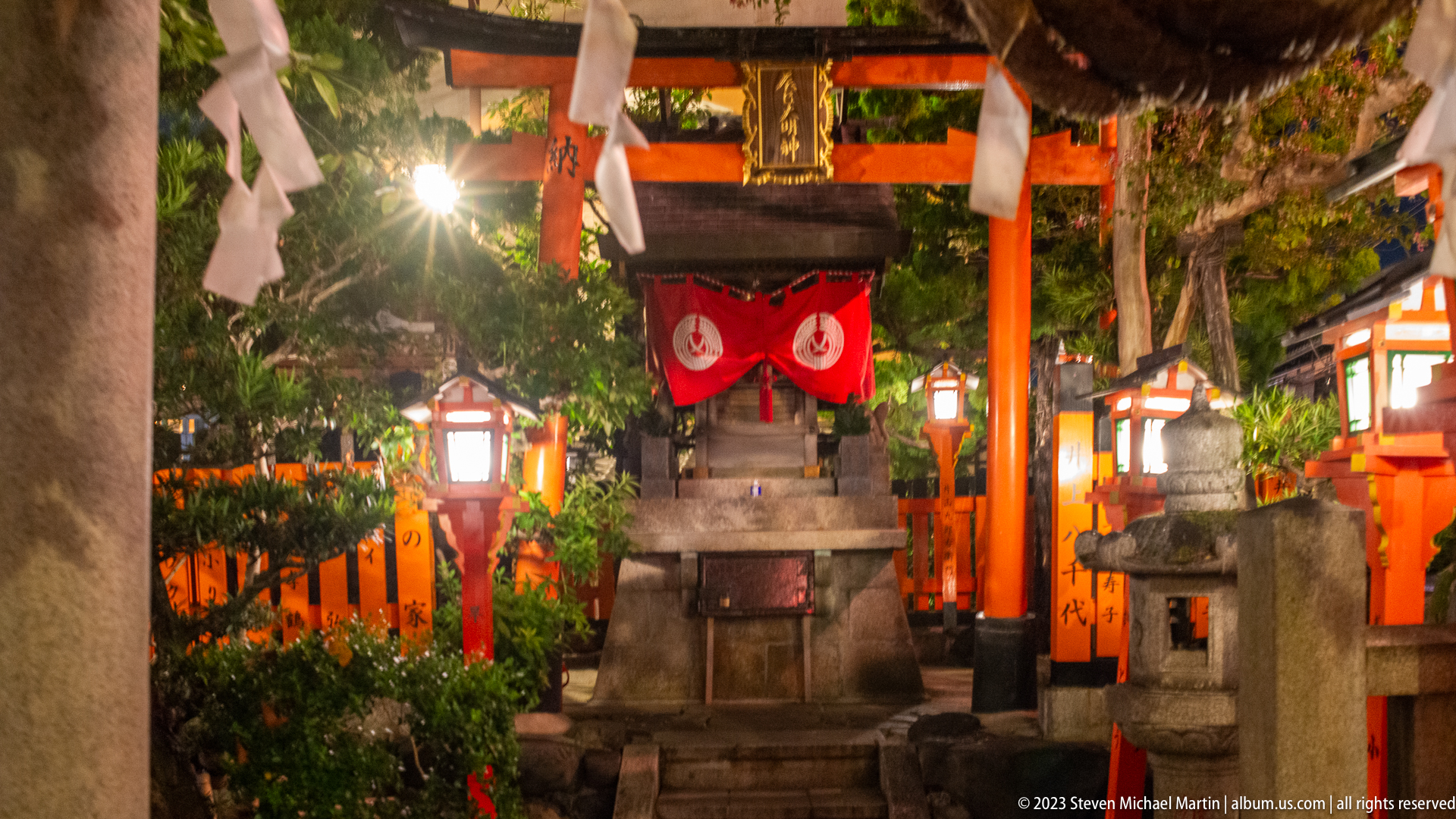
A compact Shinto shrine stands beneath a vermilion torii surrounded by illuminated shrine lanterns and sacred paper streamers. The layered devotional elements create a vivid nighttime composition emphasizing ritual space within Kyoto's urban landscape. Night illumination clarifies the shrine’s structural forms while preserving the ceremonial character of the sacred enclosure.
Caption
A compact Shinto shrine stands beneath a vermilion torii surrounded by illuminated shrine lanterns and sacred paper streamers. The layered devotional elements create a vivid nighttime composition emphasizing ritual space within Kyoto's urban landscape. Night illumination clarifies the shrine’s structural forms while preserving the ceremonial character of the sacred enclosure.
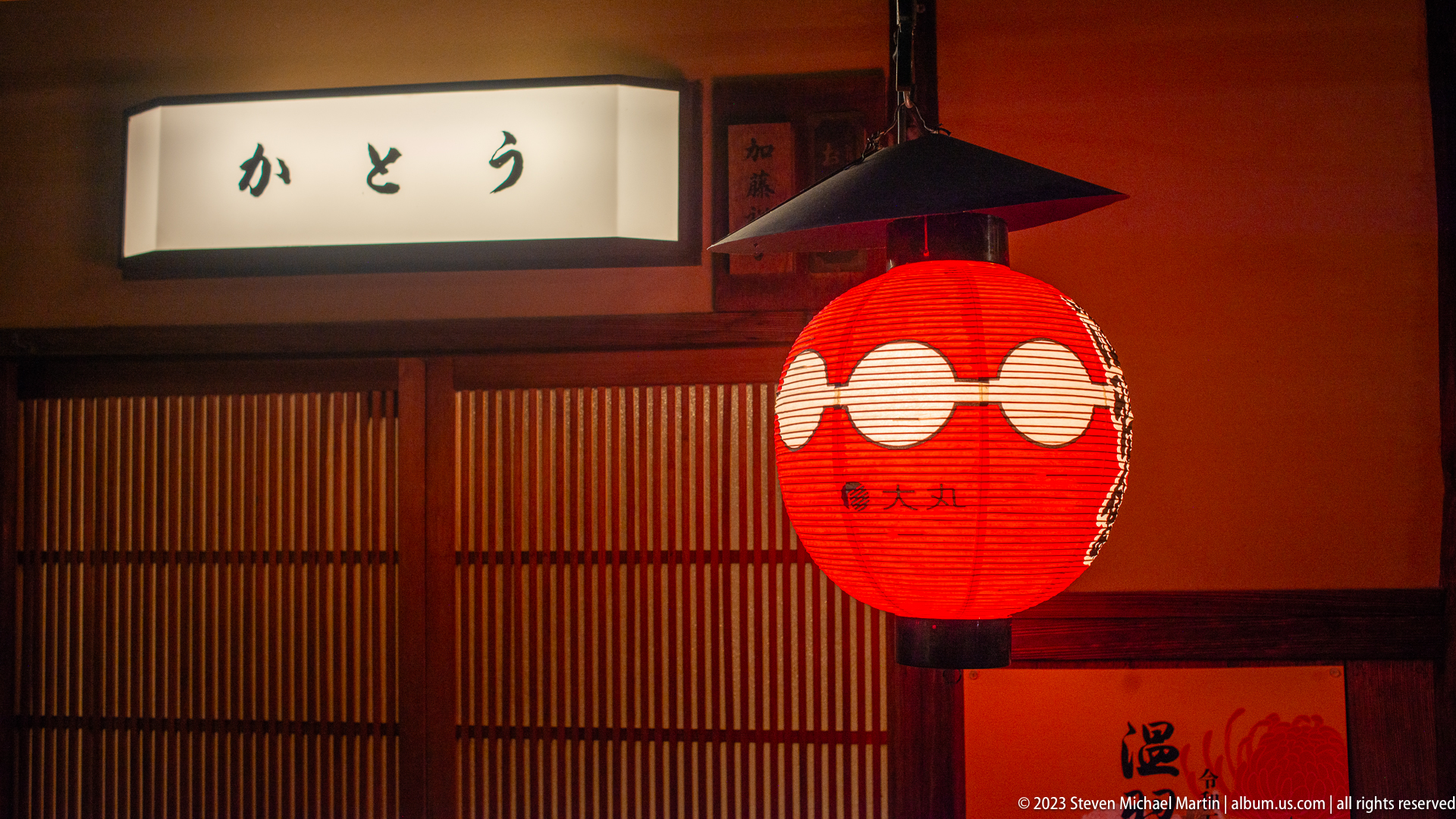
A brilliant red paper lantern hangs before wooden latticework and a softly illuminated restaurant entrance. The close composition isolates one of Kyoto's most recognizable nighttime design elements while preserving the refined simplicity of the surrounding architecture. The carefully controlled lighting, textile screens, and timber details show how Kyoto businesses use the threshold itself as part of the dining experience.
Caption
A brilliant red paper lantern hangs before wooden latticework and a softly illuminated restaurant entrance. The close composition isolates one of Kyoto's most recognizable nighttime design elements while preserving the refined simplicity of the surrounding architecture. The carefully controlled lighting, textile screens, and timber details show how Kyoto businesses use the threshold itself as part of the dining experience.
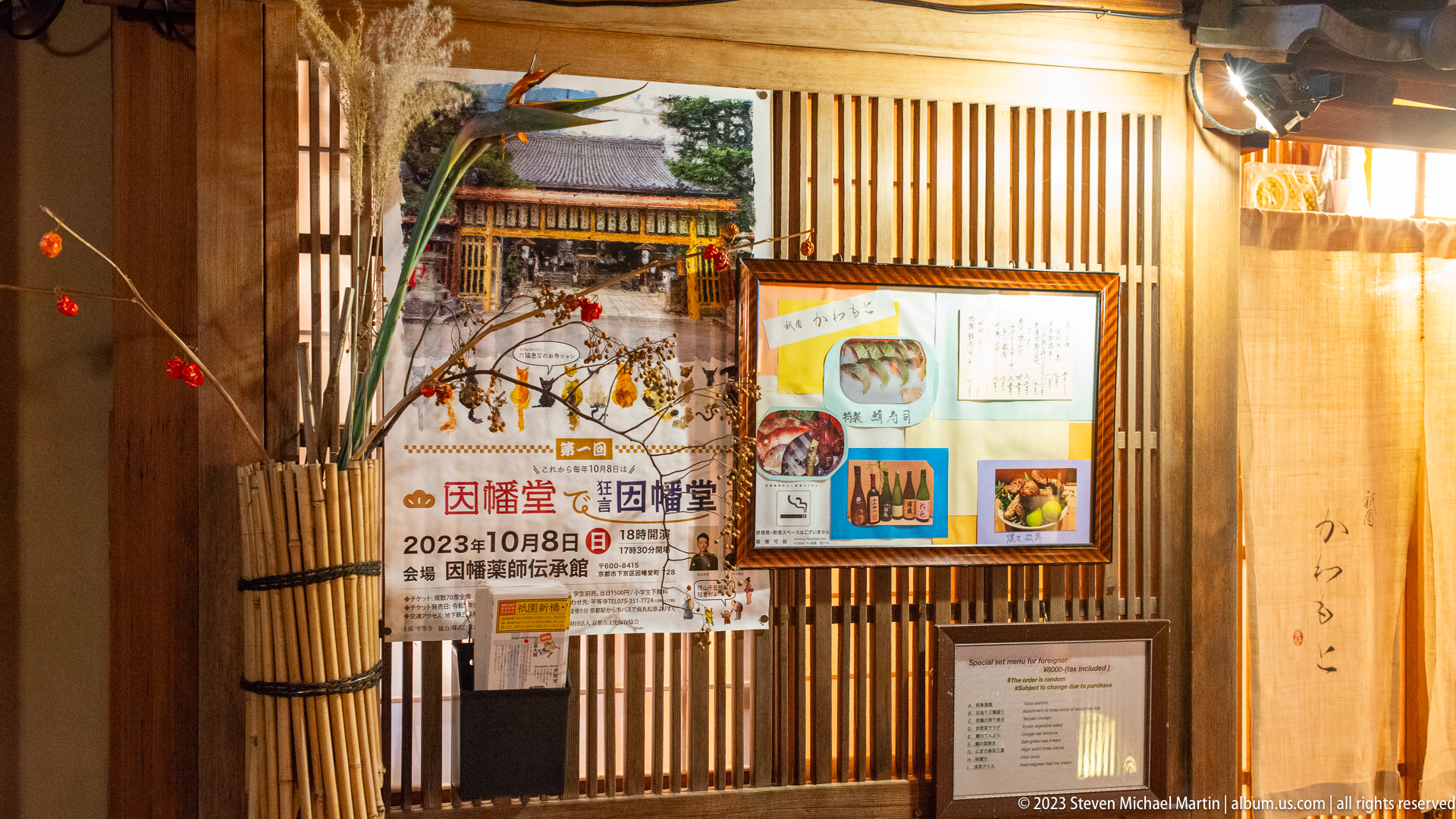
A restaurant entrance combines vertical timber slats with posters, menus, and seasonal decorations arranged on a notice board. The display illustrates how Kyoto establishments communicate upcoming events and dining information while maintaining a restrained architectural presentation. The carefully controlled lighting, textile screens, and timber details show how Kyoto businesses use the threshold itself as part of the dining experience.
Caption
A restaurant entrance combines vertical timber slats with posters, menus, and seasonal decorations arranged on a notice board. The display illustrates how Kyoto establishments communicate upcoming events and dining information while maintaining a restrained architectural presentation. The carefully controlled lighting, textile screens, and timber details show how Kyoto businesses use the threshold itself as part of the dining experience.

A traditional restaurant entrance is framed by pale noren curtains, a wooden lantern, and finely detailed timber joinery. The understated composition demonstrates Kyoto's preference for restrained storefront design, where soft lighting and handcrafted materials create an inviting atmosphere after dark.
Caption
A traditional restaurant entrance is framed by pale noren curtains, a wooden lantern, and finely detailed timber joinery. The understated composition demonstrates Kyoto's preference for restrained storefront design, where soft lighting and handcrafted materials create an inviting atmosphere after dark.

A close study of a vertically ribbed glass partition transforms reflected light into an abstract architectural composition. Warm interior illumination and timber framing highlight the refined material palette common to contemporary Kyoto hospitality spaces. The controlled palette and carefully framed views demonstrate how contemporary interiors reinterpret the order, texture, and screening associated with traditional Japanese design.
Caption
A close study of a vertically ribbed glass partition transforms reflected light into an abstract architectural composition. Warm interior illumination and timber framing highlight the refined material palette common to contemporary Kyoto hospitality spaces. The controlled palette and carefully framed views demonstrate how contemporary interiors reinterpret the order, texture, and screening associated with traditional Japanese design.
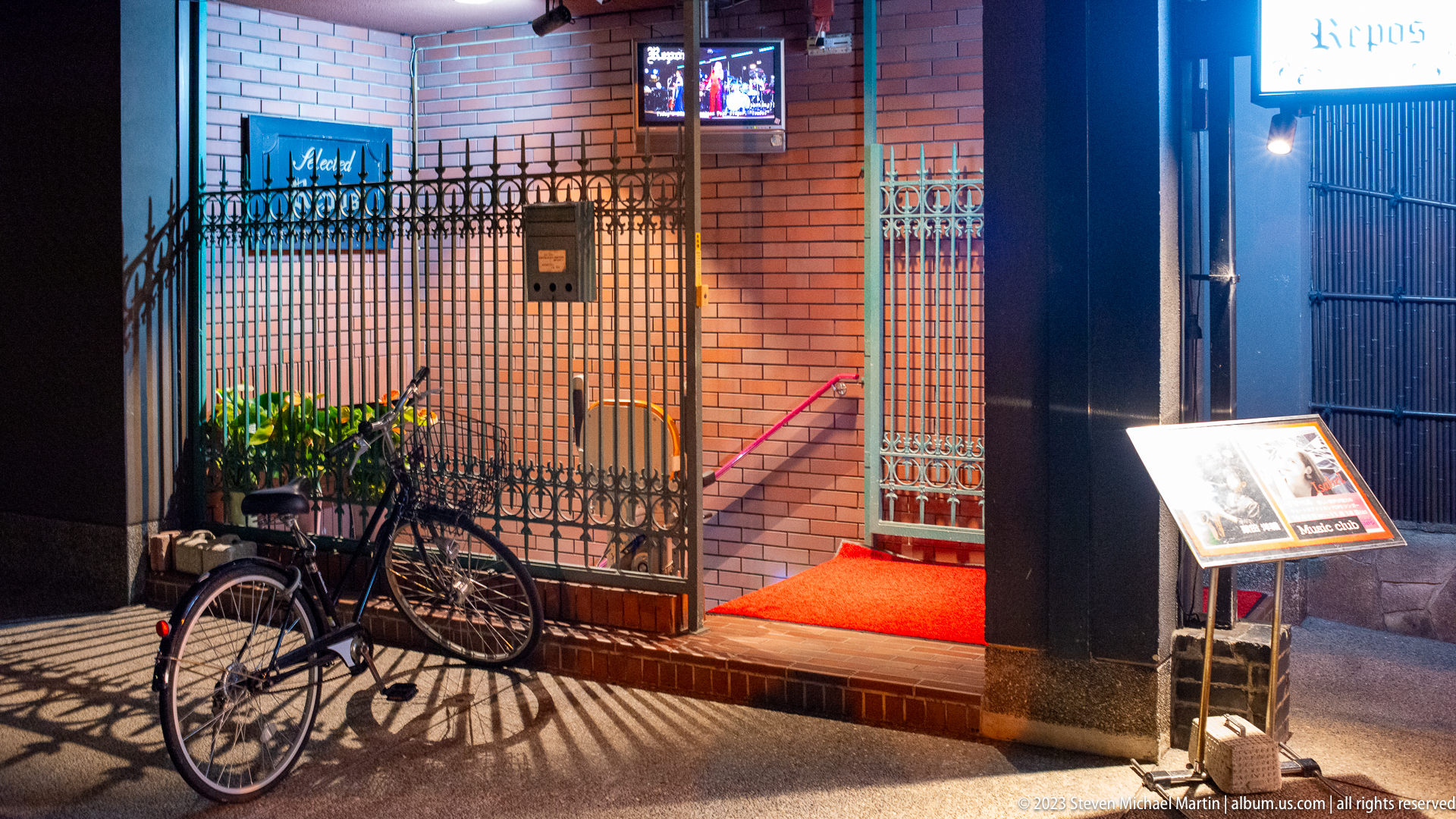
A bicycle rests outside a compact restaurant entrance marked by a red carpet, menu display, and wrought-iron fence. Everyday transportation and carefully presented hospitality combine to characterize Kyoto's neighborhood dining scene. Its restrained presentation reflects the intimate scale of Kyoto’s historic dining streets, where entrances are often embedded directly within traditional townhouses.
Caption
A bicycle rests outside a compact restaurant entrance marked by a red carpet, menu display, and wrought-iron fence. Everyday transportation and carefully presented hospitality combine to characterize Kyoto's neighborhood dining scene. Its restrained presentation reflects the intimate scale of Kyoto’s historic dining streets, where entrances are often embedded directly within traditional townhouses.

An intricate woven sculptural form spans a traditional streetscape, its organic geometry contrasting with surrounding wooden architecture. The installation demonstrates the integration of contemporary public art within Kyoto's historic urban environment. The carefully controlled lighting, textile screens, and timber details show how Kyoto businesses use the threshold itself as part of the dining experience.
Caption
An intricate woven sculptural form spans a traditional streetscape, its organic geometry contrasting with surrounding wooden architecture. The installation demonstrates the integration of contemporary public art within Kyoto's historic urban environment. The carefully controlled lighting, textile screens, and timber details show how Kyoto businesses use the threshold itself as part of the dining experience.

Deep purple noren curtains hang before a traditional wooden entrance, accompanied by a menu stand and finely crafted latticework. The restrained palette and careful composition exemplify Kyoto's refined restaurant architecture. Rather than relying on a broad commercial frontage, the establishment announces itself through a small set of crafted details intended for pedestrians at close range.
Caption
Deep purple noren curtains hang before a traditional wooden entrance, accompanied by a menu stand and finely crafted latticework. The restrained palette and careful composition exemplify Kyoto's refined restaurant architecture. Rather than relying on a broad commercial frontage, the establishment announces itself through a small set of crafted details intended for pedestrians at close range.

Viewed through dark wooden lattice bars, a softly illuminated dining room reveals counters, seating, and warm timber finishes. The layered perspective preserves the privacy of the interior while highlighting Kyoto's characteristic relationship between street, screen, and hospitality space. The carefully controlled lighting, textile screens, and timber details show how Kyoto businesses use the threshold itself as part of the dining experience.
Caption
Viewed through dark wooden lattice bars, a softly illuminated dining room reveals counters, seating, and warm timber finishes. The layered perspective preserves the privacy of the interior while highlighting Kyoto's characteristic relationship between street, screen, and hospitality space. The carefully controlled lighting, textile screens, and timber details show how Kyoto businesses use the threshold itself as part of the dining experience.

A traditional storefront combines a freestanding menu display, paper lantern, and timber façade to create an inviting nighttime entrance. Low planting beds soften the streetscape while restrained lighting reflects Kyoto's understated approach to hospitality architecture. Rather than relying on a broad commercial frontage, the establishment announces itself through a small set of crafted details intended for pedestrians at close range.
Caption
A traditional storefront combines a freestanding menu display, paper lantern, and timber façade to create an inviting nighttime entrance. Low planting beds soften the streetscape while restrained lighting reflects Kyoto's understated approach to hospitality architecture. Rather than relying on a broad commercial frontage, the establishment announces itself through a small set of crafted details intended for pedestrians at close range.

The Kyoto Gion Post Office presents a distinctive early twentieth-century façade accented by red trim and bilingual signage. Parked bicycles and scooters reinforce the building's continuing role within the everyday life of the surrounding historic district. Closely spaced entrances and subdued lighting preserve the lane’s domestic scale even as restaurants and bars animate it after dark.
Caption
The Kyoto Gion Post Office presents a distinctive early twentieth-century façade accented by red trim and bilingual signage. Parked bicycles and scooters reinforce the building's continuing role within the everyday life of the surrounding historic district. Closely spaced entrances and subdued lighting preserve the lane’s domestic scale even as restaurants and bars animate it after dark.

A large illuminated street lantern stands before a traditional timber façade, its warm glow highlighting Kyoto's preserved entertainment district. The lantern and adjacent red paper lantern reinforce the city's distinctive nighttime identity rooted in historic streetscape design. Repeated lantern forms create a visual rhythm that links individual buildings and sacred spaces across the portfolio.
Caption
A large illuminated street lantern stands before a traditional timber façade, its warm glow highlighting Kyoto's preserved entertainment district. The lantern and adjacent red paper lantern reinforce the city's distinctive nighttime identity rooted in historic streetscape design. Repeated lantern forms create a visual rhythm that links individual buildings and sacred spaces across the portfolio.
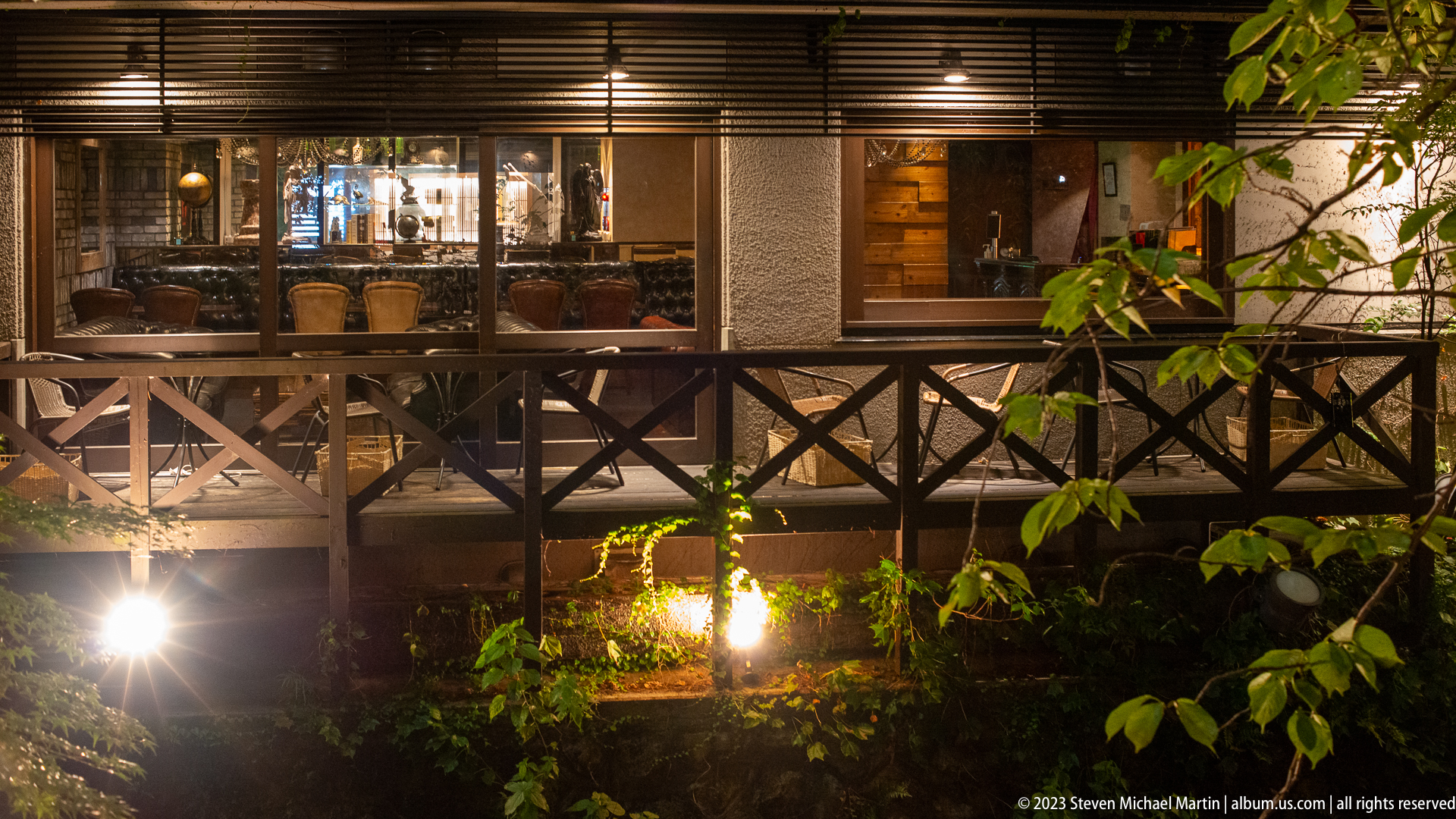
A canal-side dining terrace extends over the water behind timber railings, with warmly lit seating visible through broad windows. Reflections from landscape lighting animate the canal below, emphasizing the close relationship between hospitality architecture and Kyoto's historic waterways. Reflections extend the architecture into the water, making the canal an active part of the nighttime composition rather than a passive background.
Caption
A canal-side dining terrace extends over the water behind timber railings, with warmly lit seating visible through broad windows. Reflections from landscape lighting animate the canal below, emphasizing the close relationship between hospitality architecture and Kyoto's historic waterways. Reflections extend the architecture into the water, making the canal an active part of the nighttime composition rather than a passive background.

Rows of illuminated paper lanterns frame the entrance to a traditional restaurant, creating one of the portfolio's strongest examples of Kyoto's evening streetscape. Layered signage, timber latticework, and a welcoming threshold combine historic architectural forms with active commercial life. The carefully controlled lighting, textile screens, and timber details show how Kyoto businesses use the threshold itself as part of the dining experience.
Caption
Rows of illuminated paper lanterns frame the entrance to a traditional restaurant, creating one of the portfolio's strongest examples of Kyoto's evening streetscape. Layered signage, timber latticework, and a welcoming threshold combine historic architectural forms with active commercial life. The carefully controlled lighting, textile screens, and timber details show how Kyoto businesses use the threshold itself as part of the dining experience.

Rows of carefully arranged roses in blue, white, pink, yellow, orange, and cream create a striking geometric display inside a florist's shop. The organized presentation transforms individual blossoms into a vivid study of color, texture, and commercial display. The display turns merchandise, lettering, color, and lighting into a compact visual narrative designed for people moving past at street level.
Caption
Rows of carefully arranged roses in blue, white, pink, yellow, orange, and cream create a striking geometric display inside a florist's shop. The organized presentation transforms individual blossoms into a vivid study of color, texture, and commercial display. The display turns merchandise, lettering, color, and lighting into a compact visual narrative designed for people moving past at street level.
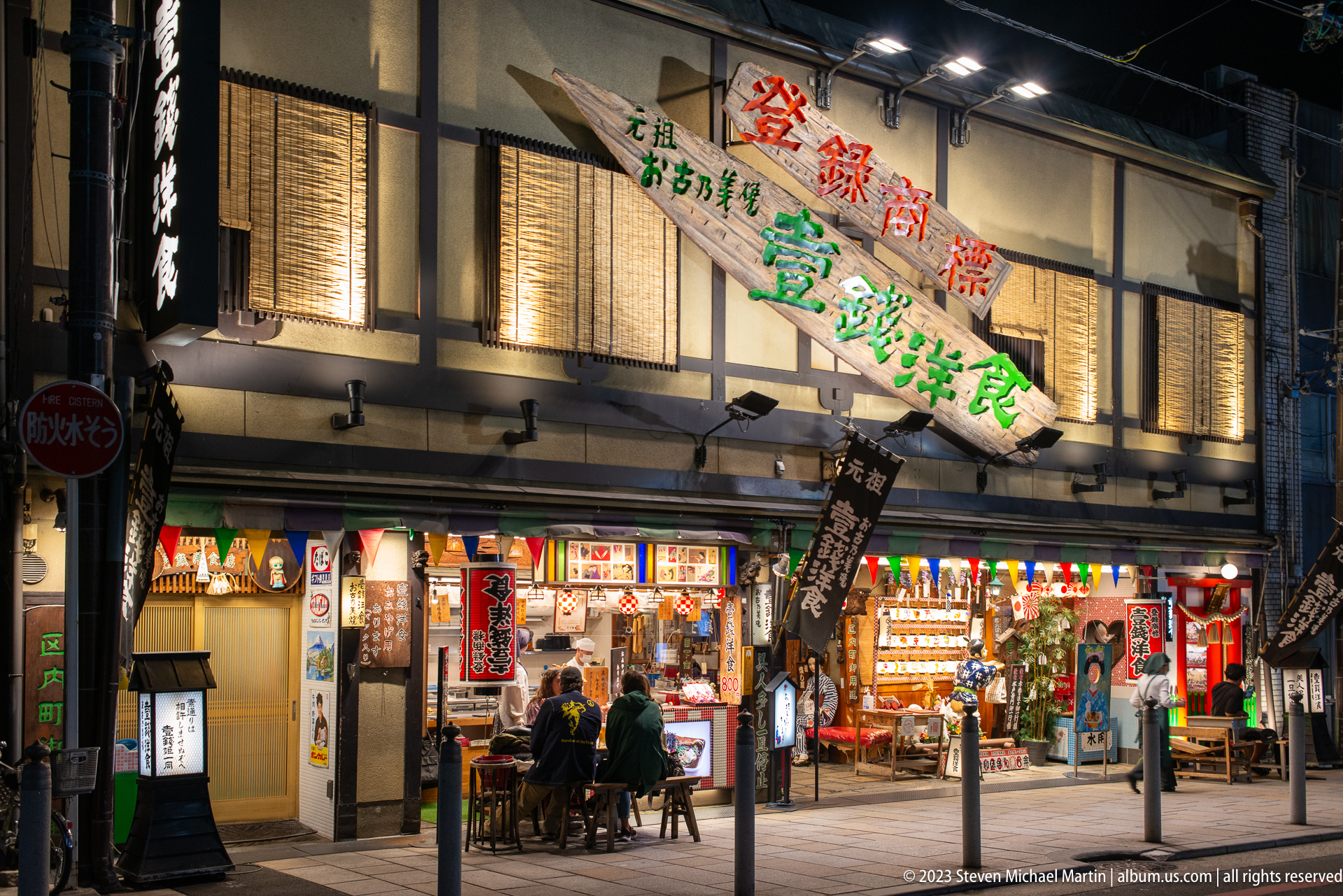
A brightly illuminated market storefront displays colorful merchandise spilling onto the sidewalk beneath large Japanese signage. Evening shoppers gather outside, illustrating the lively commercial atmosphere of central Kyoto after dark. The display turns merchandise, lettering, color, and lighting into a compact visual narrative designed for people moving past at street level.
Caption
A brightly illuminated market storefront displays colorful merchandise spilling onto the sidewalk beneath large Japanese signage. Evening shoppers gather outside, illustrating the lively commercial atmosphere of central Kyoto after dark. The display turns merchandise, lettering, color, and lighting into a compact visual narrative designed for people moving past at street level.

A grand multi-story theater façade combines traditional rooflines with richly ornamented classical detailing above brightly lit entrances. Decorative banners and lanterns identify the building as an active performance venue within Kyoto's nighttime entertainment district. The scene records the layered character of central Kyoto, where historic building forms continue to support contemporary urban life.
Caption
A grand multi-story theater façade combines traditional rooflines with richly ornamented classical detailing above brightly lit entrances. Decorative banners and lanterns identify the building as an active performance venue within Kyoto's nighttime entertainment district. The scene records the layered character of central Kyoto, where historic building forms continue to support contemporary urban life.

A Miyako Taxi waits curbside with its passenger door open beneath bright street lighting. The image captures one of Kyoto's familiar taxi services providing nighttime transportation through the city's entertainment districts. Street lighting, route information, and curbside activity place the subject within the everyday movement of the city after dark.
Caption
A Miyako Taxi waits curbside with its passenger door open beneath bright street lighting. The image captures one of Kyoto's familiar taxi services providing nighttime transportation through the city's entertainment districts. Street lighting, route information, and curbside activity place the subject within the everyday movement of the city after dark.
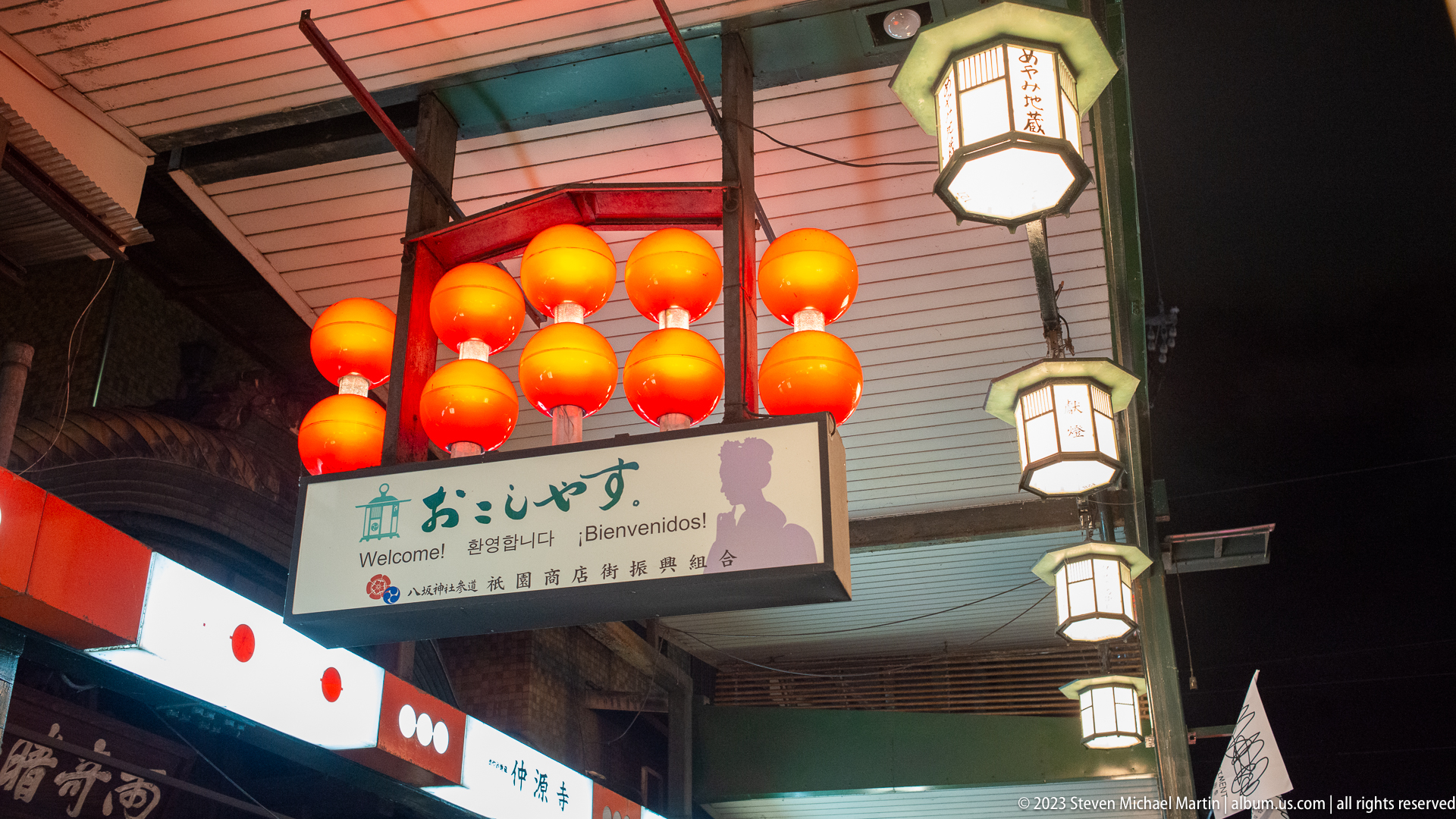
Rows of glowing red lanterns hang above a multilingual welcome sign, creating a festive streetscape that blends traditional decorative lighting with international tourism. The composition reflects Kyoto's role as a major global travel destination. Repeated lantern forms create a visual rhythm that links individual buildings and sacred spaces across the portfolio.
Caption
Rows of glowing red lanterns hang above a multilingual welcome sign, creating a festive streetscape that blends traditional decorative lighting with international tourism. The composition reflects Kyoto's role as a major global travel destination. Repeated lantern forms create a visual rhythm that links individual buildings and sacred spaces across the portfolio.

Long rows of capsule toy vending machines fill a brightly illuminated shop interior. The colorful machines and merchandise document a distinctive aspect of contemporary Japanese popular culture encountered along Kyoto's shopping streets. Its dense arrangement contrasts with the restraint of nearby traditional façades and documents another layer of Kyoto’s evening commercial culture.
Caption
Long rows of capsule toy vending machines fill a brightly illuminated shop interior. The colorful machines and merchandise document a distinctive aspect of contemporary Japanese popular culture encountered along Kyoto's shopping streets. Its dense arrangement contrasts with the restraint of nearby traditional façades and documents another layer of Kyoto’s evening commercial culture.

A preserved wooden streetscape stretches into the distance beneath prominent street lanterns and smaller red entrance lanterns. The composition emphasizes the orderly architecture and atmospheric lighting that characterize Kyoto after dark. The lantern serves simultaneously as illumination, sign, and cultural marker, concentrating attention on the entrance or sacred boundary it identifies.
Caption
A preserved wooden streetscape stretches into the distance beneath prominent street lanterns and smaller red entrance lanterns. The composition emphasizes the orderly architecture and atmospheric lighting that characterize Kyoto after dark. The lantern serves simultaneously as illumination, sign, and cultural marker, concentrating attention on the entrance or sacred boundary it identifies.

Twin red paper lanterns flank the entrance to a traditional restaurant framed by wooden latticework and plaster walls. The restrained façade reflects Kyoto's enduring preference for refined architectural presentation. Rather than relying on a broad commercial frontage, the establishment announces itself through a small set of crafted details intended for pedestrians at close range.
Caption
Twin red paper lanterns flank the entrance to a traditional restaurant framed by wooden latticework and plaster walls. The restrained façade reflects Kyoto's enduring preference for refined architectural presentation. Rather than relying on a broad commercial frontage, the establishment announces itself through a small set of crafted details intended for pedestrians at close range.
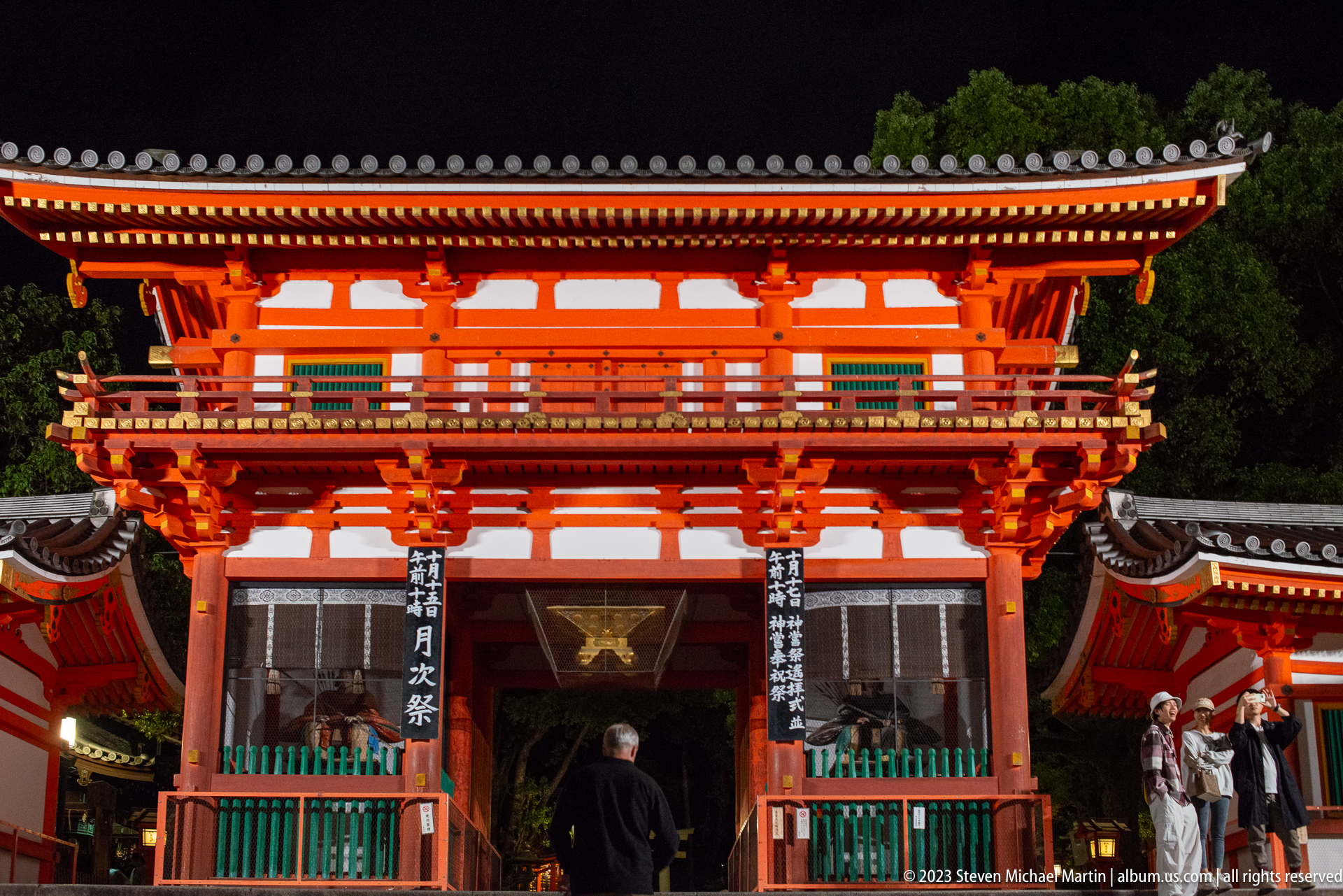
A closer view emphasizes the intricate bracket systems, painted beams, and ceremonial entrance beneath Yasaka Shrine's brilliantly illuminated gate. Visitors provide scale while reinforcing the monument's continuing religious and cultural significance. Within Yasaka Shrine, the illuminated structure forms part of a larger sequence of gates, paths, subsidiary shrines, and ceremonial buildings associated with Kyoto’s historic Gion district.
Caption
A closer view emphasizes the intricate bracket systems, painted beams, and ceremonial entrance beneath Yasaka Shrine's brilliantly illuminated gate. Visitors provide scale while reinforcing the monument's continuing religious and cultural significance. Within Yasaka Shrine, the illuminated structure forms part of a larger sequence of gates, paths, subsidiary shrines, and ceremonial buildings associated with Kyoto’s historic Gion district.

Viewed from within the shrine precinct, the illuminated gate frames the lights of the surrounding city beyond. The composition contrasts sacred architecture with the urban landscape visible through the central opening. Within Yasaka Shrine, the illuminated structure forms part of a larger sequence of gates, paths, subsidiary shrines, and ceremonial buildings associated with Kyoto’s historic Gion district.
Caption
Viewed from within the shrine precinct, the illuminated gate frames the lights of the surrounding city beyond. The composition contrasts sacred architecture with the urban landscape visible through the central opening. Within Yasaka Shrine, the illuminated structure forms part of a larger sequence of gates, paths, subsidiary shrines, and ceremonial buildings associated with Kyoto’s historic Gion district.

A broad stone approach leads toward a vermilion torii and shrine precinct illuminated by rows of traditional lanterns. The symmetrical composition highlights the ceremonial axis leading into one of Kyoto's best-known Shinto complexes after dark. Within Yasaka Shrine, the illuminated structure forms part of a larger sequence of gates, paths, subsidiary shrines, and ceremonial buildings associated with Kyoto’s historic Gion district.
Caption
A broad stone approach leads toward a vermilion torii and shrine precinct illuminated by rows of traditional lanterns. The symmetrical composition highlights the ceremonial axis leading into one of Kyoto's best-known Shinto complexes after dark. Within Yasaka Shrine, the illuminated structure forms part of a larger sequence of gates, paths, subsidiary shrines, and ceremonial buildings associated with Kyoto’s historic Gion district.
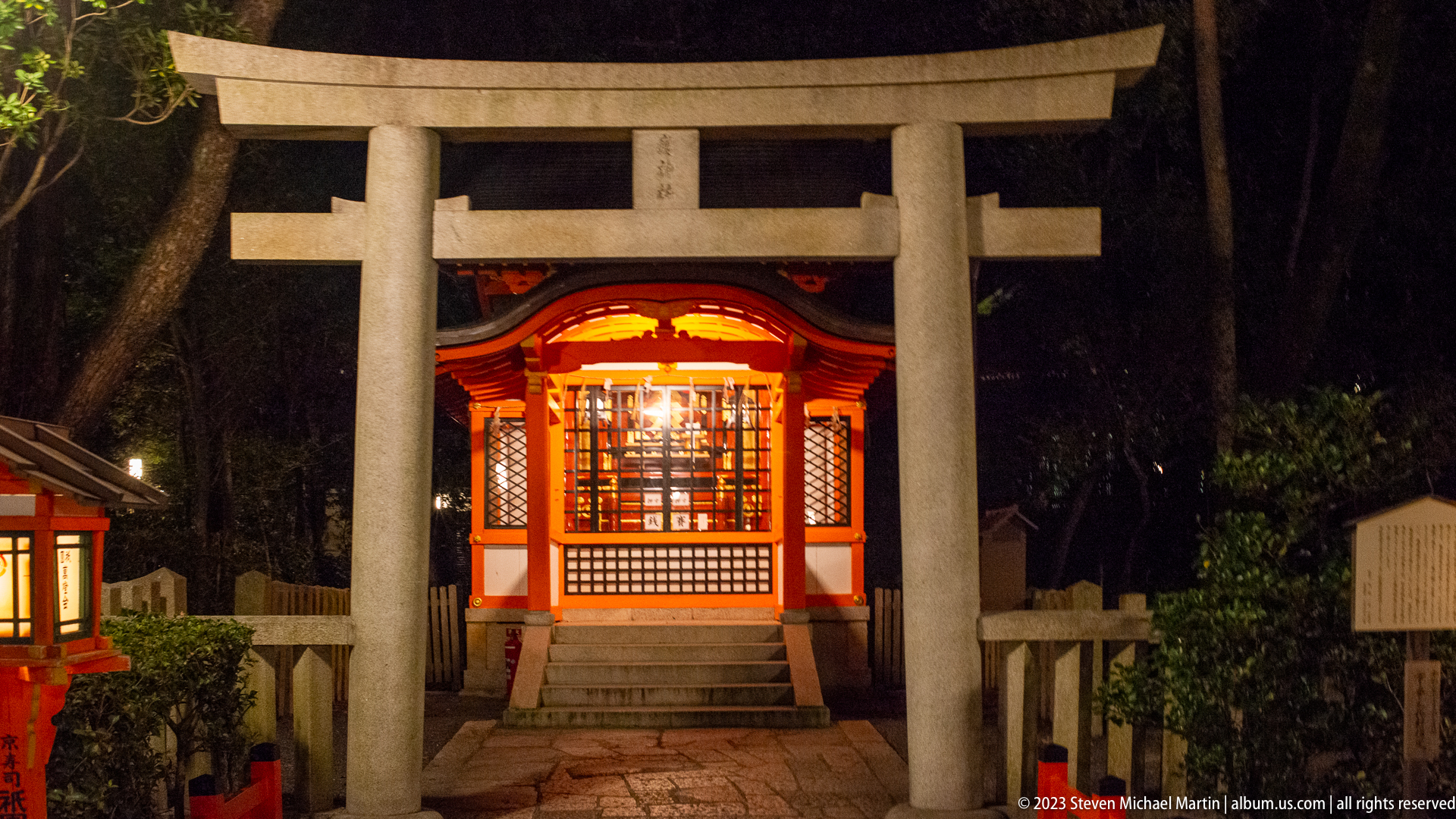
A compact vermilion shrine stands beyond a substantial stone torii, framed by trees and softly illuminated lanterns. The photograph emphasizes the layered progression from gateway to sanctuary within the shrine precinct. Within Yasaka Shrine, the illuminated structure forms part of a larger sequence of gates, paths, subsidiary shrines, and ceremonial buildings associated with Kyoto’s historic Gion district.
Caption
A compact vermilion shrine stands beyond a substantial stone torii, framed by trees and softly illuminated lanterns. The photograph emphasizes the layered progression from gateway to sanctuary within the shrine precinct. Within Yasaka Shrine, the illuminated structure forms part of a larger sequence of gates, paths, subsidiary shrines, and ceremonial buildings associated with Kyoto’s historic Gion district.
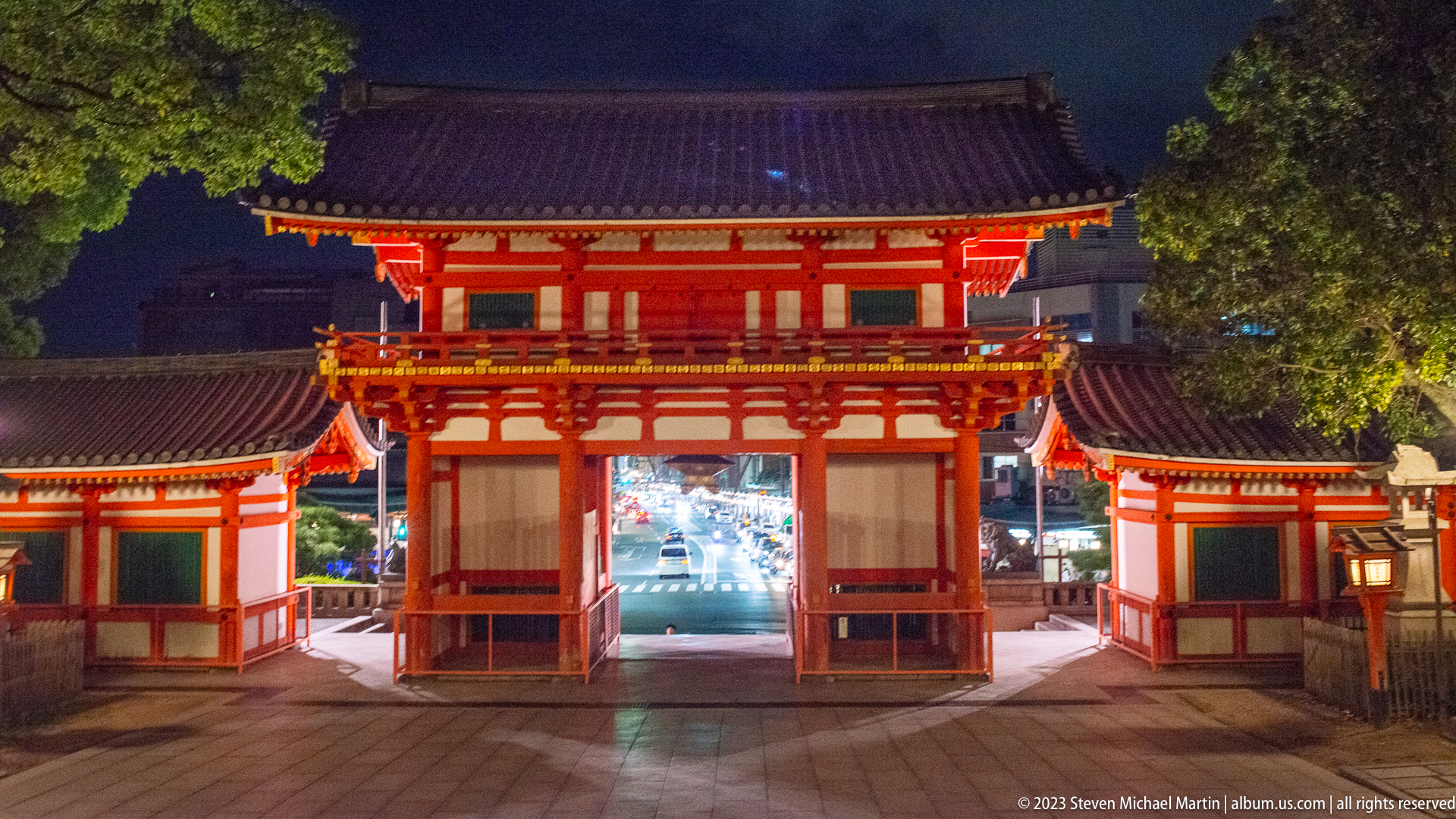
Seen from inside the precinct, the brightly illuminated gate frames the city beyond while revealing the gate's timber structure and vermilion construction. The composition contrasts sacred architecture with the surrounding urban environment. Within Yasaka Shrine, the illuminated structure forms part of a larger sequence of gates, paths, subsidiary shrines, and ceremonial buildings associated with Kyoto’s historic Gion district.
Caption
Seen from inside the precinct, the brightly illuminated gate frames the city beyond while revealing the gate's timber structure and vermilion construction. The composition contrasts sacred architecture with the surrounding urban environment. Within Yasaka Shrine, the illuminated structure forms part of a larger sequence of gates, paths, subsidiary shrines, and ceremonial buildings associated with Kyoto’s historic Gion district.

A painted shrine lantern glows beside a carved stone lantern and dense greenery, illustrating the layered lighting traditions within the shrine grounds. Warm illumination emphasizes the craftsmanship of the wooden lantern housing. Within Yasaka Shrine, the illuminated structure forms part of a larger sequence of gates, paths, subsidiary shrines, and ceremonial buildings associated with Kyoto’s historic Gion district.
Caption
A painted shrine lantern glows beside a carved stone lantern and dense greenery, illustrating the layered lighting traditions within the shrine grounds. Warm illumination emphasizes the craftsmanship of the wooden lantern housing. Within Yasaka Shrine, the illuminated structure forms part of a larger sequence of gates, paths, subsidiary shrines, and ceremonial buildings associated with Kyoto’s historic Gion district.
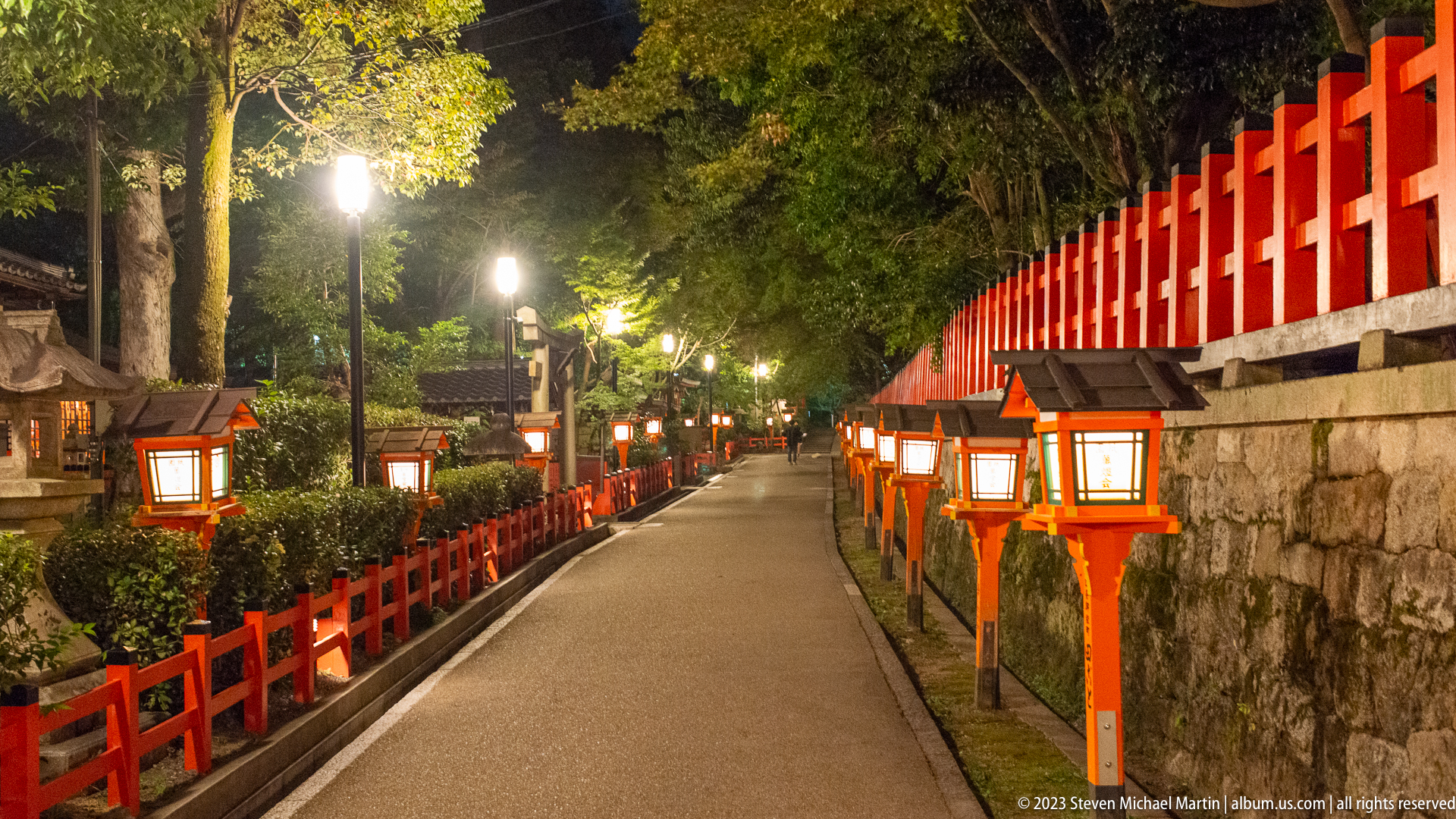
Rows of vermilion lanterns line a quiet pathway bordered by stone walls and mature trees. The repeating lanterns guide visitors through the shrine complex while creating one of the portfolio's strongest rhythmic nighttime compositions. Within Yasaka Shrine, the illuminated structure forms part of a larger sequence of gates, paths, subsidiary shrines, and ceremonial buildings associated with Kyoto’s historic Gion district.
Caption
Rows of vermilion lanterns line a quiet pathway bordered by stone walls and mature trees. The repeating lanterns guide visitors through the shrine complex while creating one of the portfolio's strongest rhythmic nighttime compositions. Within Yasaka Shrine, the illuminated structure forms part of a larger sequence of gates, paths, subsidiary shrines, and ceremonial buildings associated with Kyoto’s historic Gion district.

The main shrine hall is illuminated against the evening sky, revealing its sweeping roof, vermilion structural members, and latticed façade. The carefully balanced lighting underscores the monumentality of the building while preserving its ceremonial atmosphere. Within Yasaka Shrine, the illuminated structure forms part of a larger sequence of gates, paths, subsidiary shrines, and ceremonial buildings associated with Kyoto’s historic Gion district.
Caption
The main shrine hall is illuminated against the evening sky, revealing its sweeping roof, vermilion structural members, and latticed façade. The carefully balanced lighting underscores the monumentality of the building while preserving its ceremonial atmosphere. Within Yasaka Shrine, the illuminated structure forms part of a larger sequence of gates, paths, subsidiary shrines, and ceremonial buildings associated with Kyoto’s historic Gion district.
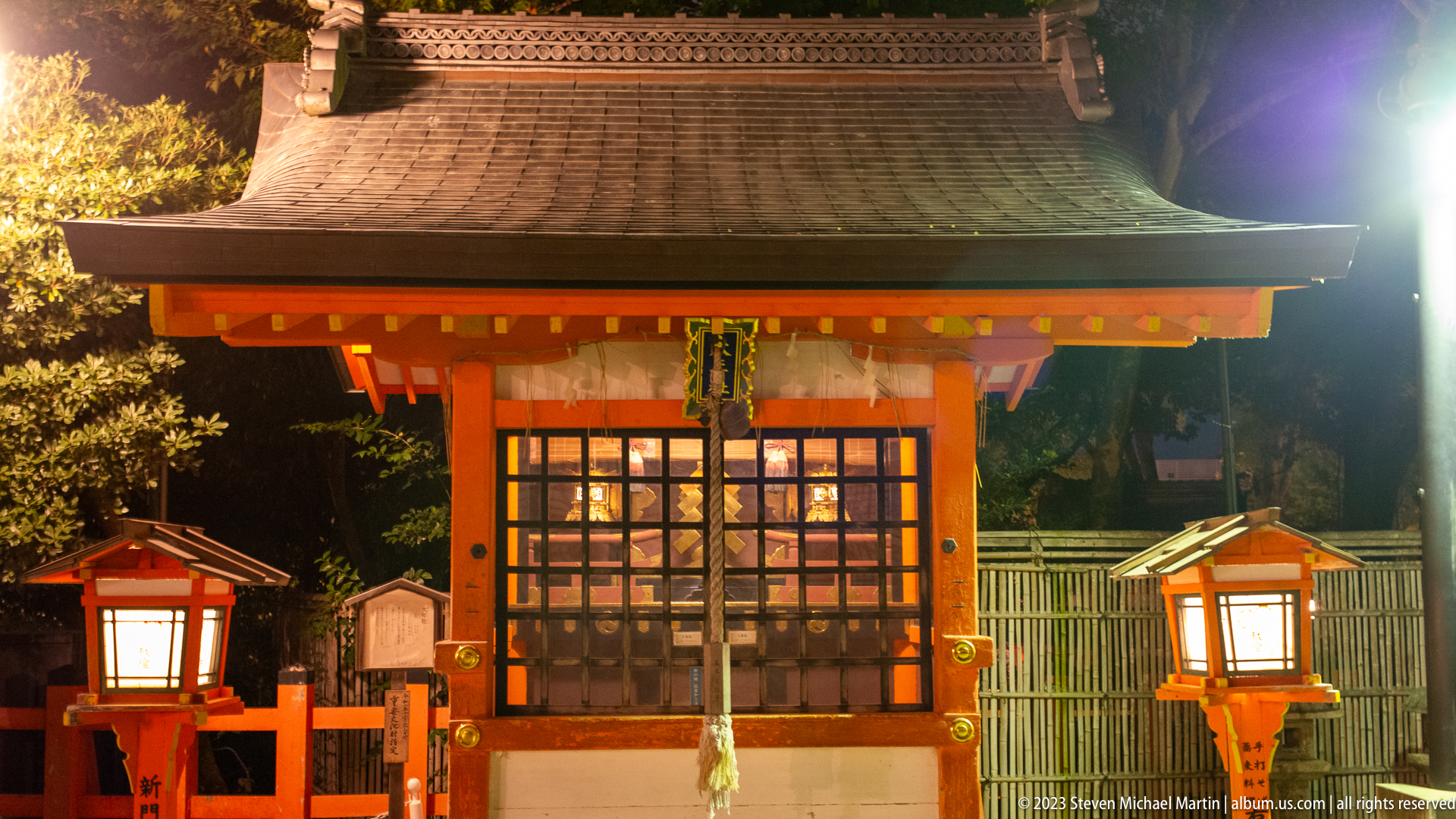
A compact shrine pavilion with vermilion columns, a tiled roof, and flanking lanterns stands illuminated within the Yasaka Shrine precinct. The intimate scale contrasts with the larger ceremonial structures elsewhere in the complex while preserving the site's refined architectural vocabulary. Within Yasaka Shrine, the illuminated structure forms part of a larger sequence of gates, paths, subsidiary shrines, and ceremonial buildings associated with Kyoto’s historic Gion district.
Caption
A compact shrine pavilion with vermilion columns, a tiled roof, and flanking lanterns stands illuminated within the Yasaka Shrine precinct. The intimate scale contrasts with the larger ceremonial structures elsewhere in the complex while preserving the site's refined architectural vocabulary. Within Yasaka Shrine, the illuminated structure forms part of a larger sequence of gates, paths, subsidiary shrines, and ceremonial buildings associated with Kyoto’s historic Gion district.

Hundreds of illuminated paper lanterns surround the traditional dance stage within Yasaka Shrine, creating one of the most recognizable nighttime scenes in Kyoto. The glowing lanterns transform the open pavilion into a luminous ceremonial centerpiece. At Yasaka Shrine, this dance stage is surrounded by donated paper lanterns bearing the names of local businesses; the lanterns are illuminated in the evening and turn the pavilion into the visual center of the precinct.
Caption
Hundreds of illuminated paper lanterns surround the traditional dance stage within Yasaka Shrine, creating one of the most recognizable nighttime scenes in Kyoto. The glowing lanterns transform the open pavilion into a luminous ceremonial centerpiece. At Yasaka Shrine, this dance stage is surrounded by donated paper lanterns bearing the names of local businesses; the lanterns are illuminated in the evening and turn the pavilion into the visual center of the precinct.

The richly ornamented shrine hall displays vermilion columns, decorative brackets, and sacred architectural detailing illuminated against the night sky. The close perspective emphasizes craftsmanship and ceremonial design. Within Yasaka Shrine, the illuminated structure forms part of a larger sequence of gates, paths, subsidiary shrines, and ceremonial buildings associated with Kyoto’s historic Gion district.
Caption
The richly ornamented shrine hall displays vermilion columns, decorative brackets, and sacred architectural detailing illuminated against the night sky. The close perspective emphasizes craftsmanship and ceremonial design. Within Yasaka Shrine, the illuminated structure forms part of a larger sequence of gates, paths, subsidiary shrines, and ceremonial buildings associated with Kyoto’s historic Gion district.
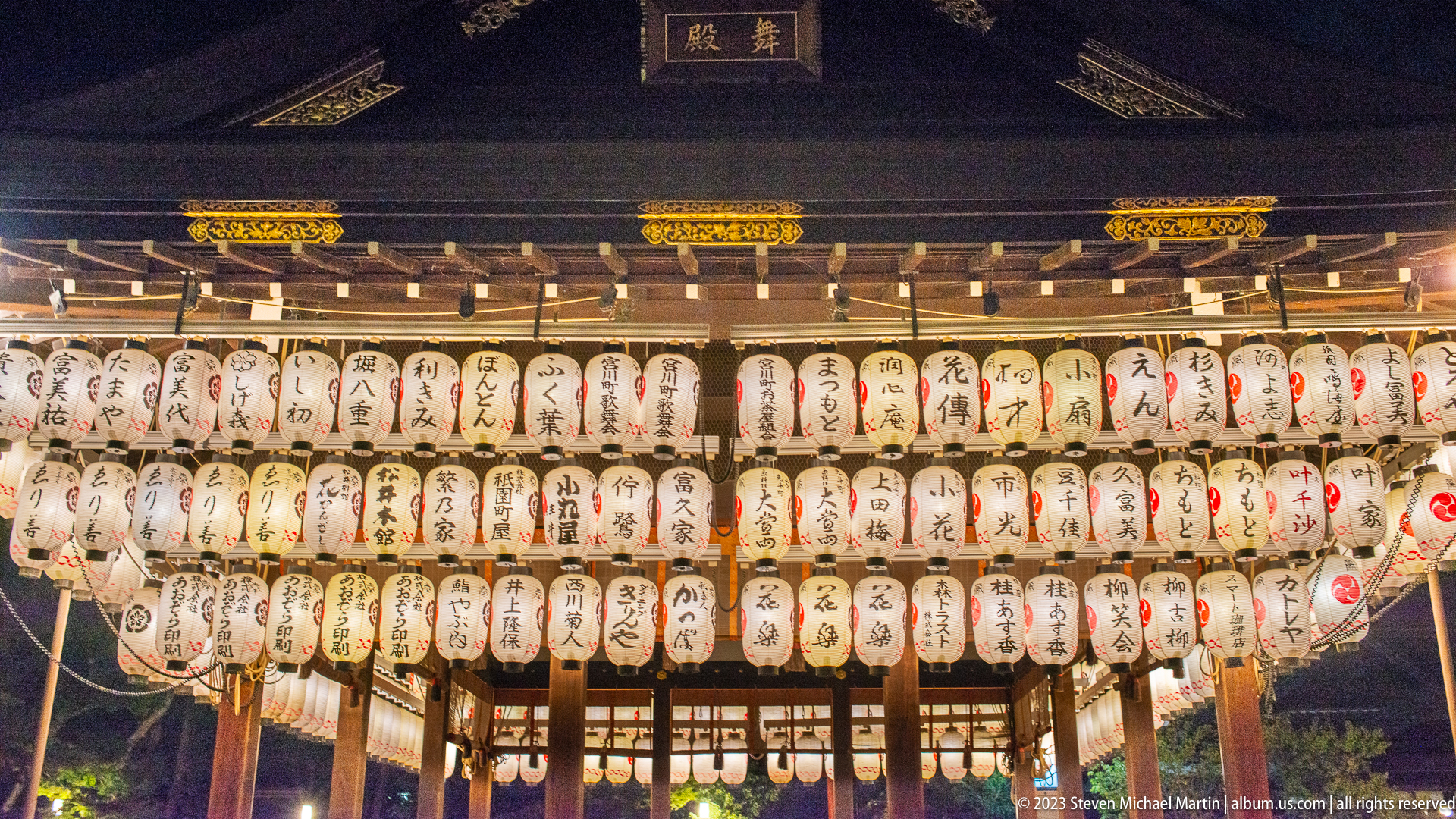
Rows of donated paper lanterns bearing names and inscriptions cover the shrine structure, illustrating the longstanding tradition of devotional lantern offerings. Their rhythmic arrangement creates a striking visual study of light and typography. At Yasaka Shrine, this dance stage is surrounded by donated paper lanterns bearing the names of local businesses; the lanterns are illuminated in the evening and turn the pavilion into the visual center of the precinct.
Caption
Rows of donated paper lanterns bearing names and inscriptions cover the shrine structure, illustrating the longstanding tradition of devotional lantern offerings. Their rhythmic arrangement creates a striking visual study of light and typography. At Yasaka Shrine, this dance stage is surrounded by donated paper lanterns bearing the names of local businesses; the lanterns are illuminated in the evening and turn the pavilion into the visual center of the precinct.

A close view isolates individual paper lanterns, revealing handwritten inscriptions, sponsor names, and construction details. The composition emphasizes both craftsmanship and the cultural role of lantern donations within Shinto practice. At Yasaka Shrine, this dance stage is surrounded by donated paper lanterns bearing the names of local businesses; the lanterns are illuminated in the evening and turn the pavilion into the visual center of the precinct.
Caption
A close view isolates individual paper lanterns, revealing handwritten inscriptions, sponsor names, and construction details. The composition emphasizes both craftsmanship and the cultural role of lantern donations within Shinto practice. At Yasaka Shrine, this dance stage is surrounded by donated paper lanterns bearing the names of local businesses; the lanterns are illuminated in the evening and turn the pavilion into the visual center of the precinct.

An oblique nighttime view highlights the scale and layered rooflines of Yasaka Shrine's monumental entrance gate. Warm illumination accentuates the vermilion structural framework while the surrounding darkness isolates the architecture as the dominant visual subject. Within Yasaka Shrine, the illuminated structure forms part of a larger sequence of gates, paths, subsidiary shrines, and ceremonial buildings associated with Kyoto’s historic Gion district.
Caption
An oblique nighttime view highlights the scale and layered rooflines of Yasaka Shrine's monumental entrance gate. Warm illumination accentuates the vermilion structural framework while the surrounding darkness isolates the architecture as the dominant visual subject. Within Yasaka Shrine, the illuminated structure forms part of a larger sequence of gates, paths, subsidiary shrines, and ceremonial buildings associated with Kyoto’s historic Gion district.
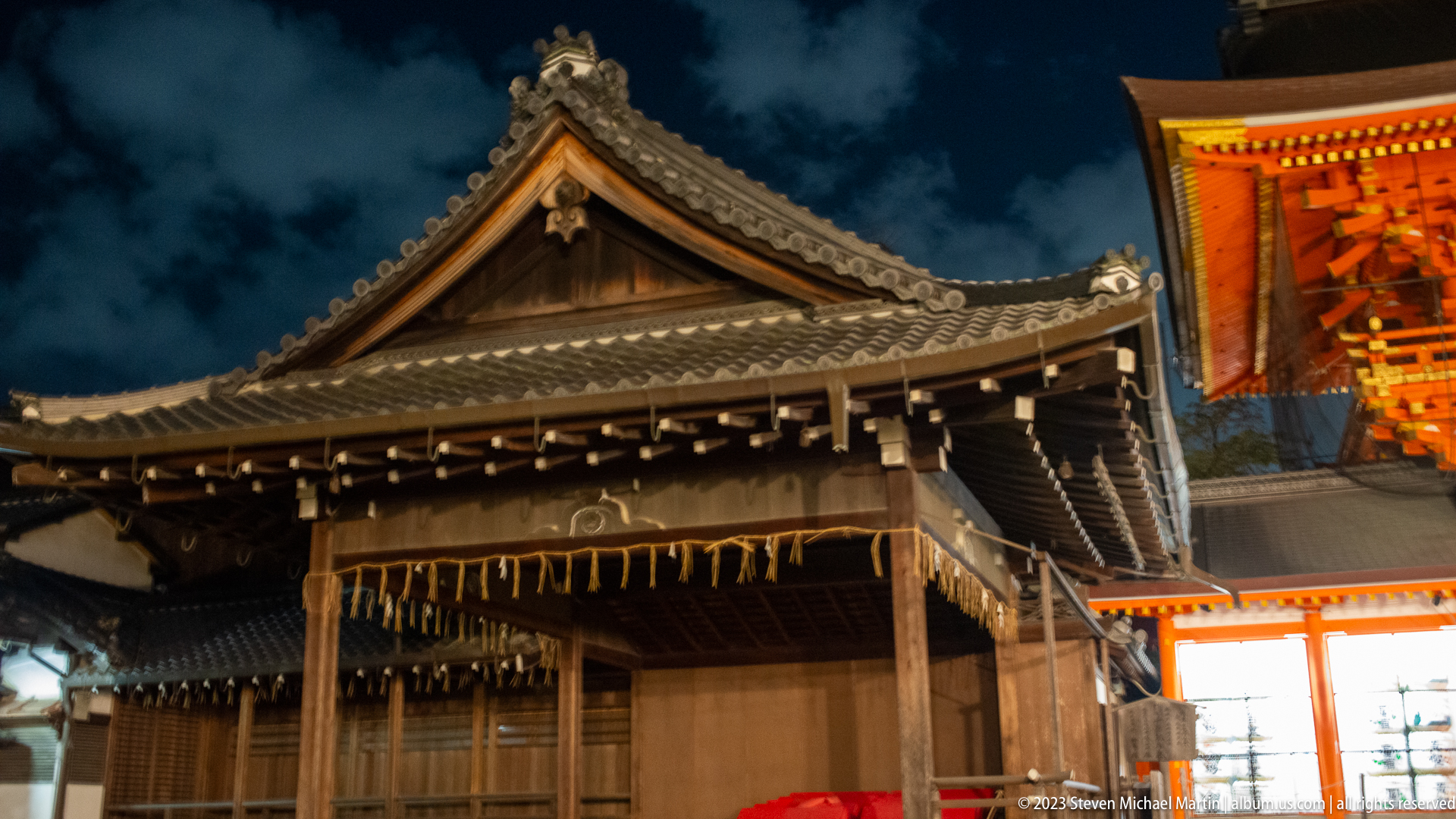
A traditional wooden auxiliary hall with dark timber framing and a sweeping tiled roof stands beside the brightly illuminated vermilion buildings of Yasaka Shrine. The contrast between natural wood and painted shrine architecture illustrates the varied building types within the sacred complex. Within Yasaka Shrine, the illuminated structure forms part of a larger sequence of gates, paths, subsidiary shrines, and ceremonial buildings associated with Kyoto’s historic Gion district.
Caption
A traditional wooden auxiliary hall with dark timber framing and a sweeping tiled roof stands beside the brightly illuminated vermilion buildings of Yasaka Shrine. The contrast between natural wood and painted shrine architecture illustrates the varied building types within the sacred complex. Within Yasaka Shrine, the illuminated structure forms part of a larger sequence of gates, paths, subsidiary shrines, and ceremonial buildings associated with Kyoto’s historic Gion district.

An oblique nighttime view reveals the expansive rooflines, vermilion columns, and ceremonial façade of Yasaka Shrine's main hall. Warm lighting emphasizes the shrine's architectural details while preserving the quiet atmosphere of the precinct. Within Yasaka Shrine, the illuminated structure forms part of a larger sequence of gates, paths, subsidiary shrines, and ceremonial buildings associated with Kyoto’s historic Gion district.
Caption
An oblique nighttime view reveals the expansive rooflines, vermilion columns, and ceremonial façade of Yasaka Shrine's main hall. Warm lighting emphasizes the shrine's architectural details while preserving the quiet atmosphere of the precinct. Within Yasaka Shrine, the illuminated structure forms part of a larger sequence of gates, paths, subsidiary shrines, and ceremonial buildings associated with Kyoto’s historic Gion district.
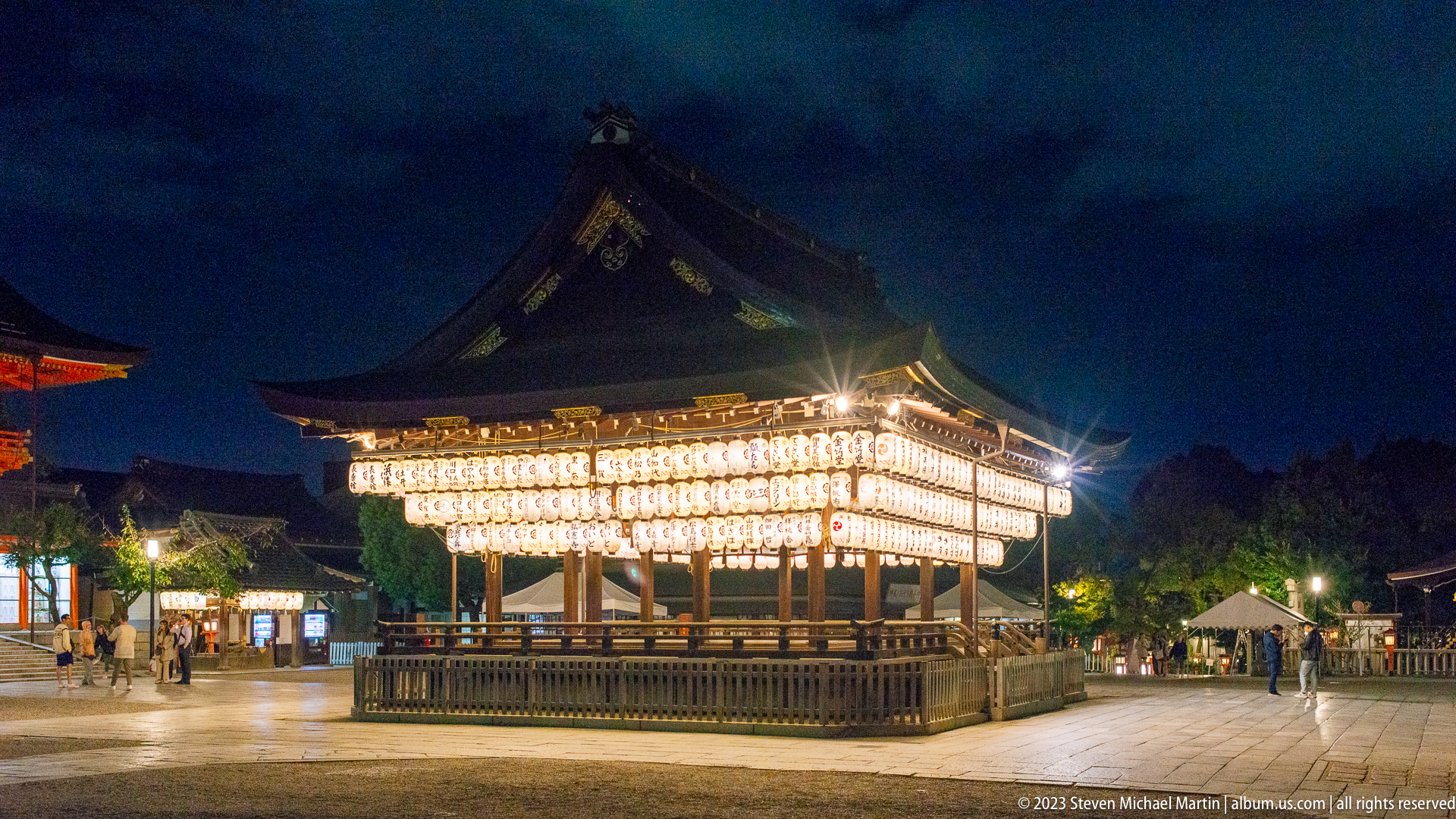
The shrine's traditional dance stage glows beneath hundreds of illuminated paper lanterns, creating a luminous centerpiece within the open plaza. The rhythmic lantern display is a defining nighttime feature of Yasaka Shrine. At Yasaka Shrine, this dance stage is surrounded by donated paper lanterns bearing the names of local businesses; the lanterns are illuminated in the evening and turn the pavilion into the visual center of the precinct.
Caption
The shrine's traditional dance stage glows beneath hundreds of illuminated paper lanterns, creating a luminous centerpiece within the open plaza. The rhythmic lantern display is a defining nighttime feature of Yasaka Shrine. At Yasaka Shrine, this dance stage is surrounded by donated paper lanterns bearing the names of local businesses; the lanterns are illuminated in the evening and turn the pavilion into the visual center of the precinct.

A close study of vermilion framing and black latticework focuses on the geometric design of a shrine window while softly illuminated interior furnishings remain visible beyond. The composition emphasizes craftsmanship rather than the overall building. Within Yasaka Shrine, the illuminated structure forms part of a larger sequence of gates, paths, subsidiary shrines, and ceremonial buildings associated with Kyoto’s historic Gion district.
Caption
A close study of vermilion framing and black latticework focuses on the geometric design of a shrine window while softly illuminated interior furnishings remain visible beyond. The composition emphasizes craftsmanship rather than the overall building. Within Yasaka Shrine, the illuminated structure forms part of a larger sequence of gates, paths, subsidiary shrines, and ceremonial buildings associated with Kyoto’s historic Gion district.
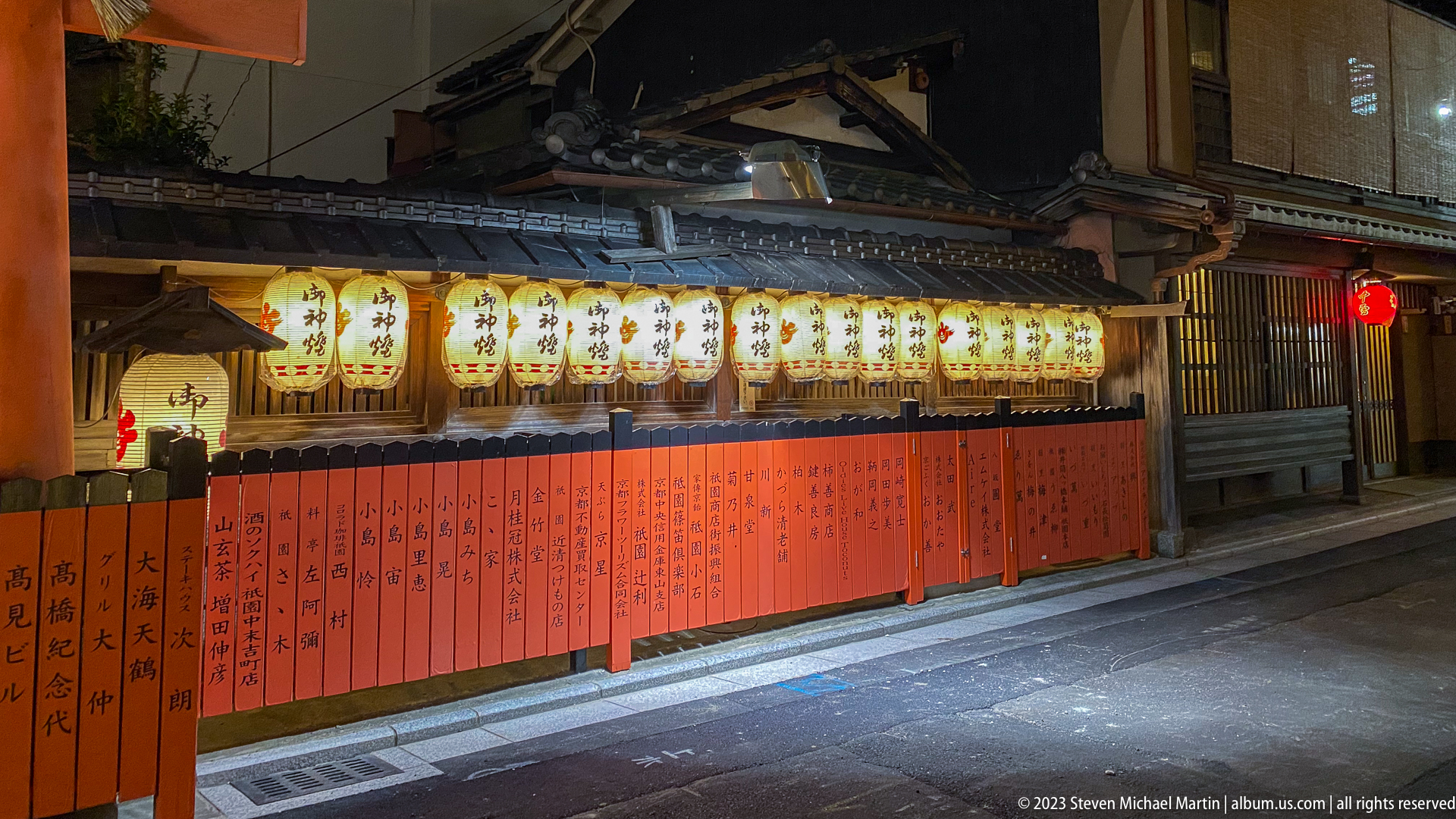
Paper lanterns mounted above a long vermilion fence illuminate the edge of the shrine precinct, creating a repeating pattern of light and color that guides visitors along the nighttime street. Within Yasaka Shrine, the illuminated structure forms part of a larger sequence of gates, paths, subsidiary shrines, and ceremonial buildings associated with Kyoto’s historic Gion district.
Caption
Paper lanterns mounted above a long vermilion fence illuminate the edge of the shrine precinct, creating a repeating pattern of light and color that guides visitors along the nighttime street. Within Yasaka Shrine, the illuminated structure forms part of a larger sequence of gates, paths, subsidiary shrines, and ceremonial buildings associated with Kyoto’s historic Gion district.

An illustrated public sign reminds visitors to keep dogs on a leash and clean up after their pets. The multilingual visual design reflects everyday management of public green spaces within Kyoto. The carefully controlled lighting, textile screens, and timber details show how Kyoto businesses use the threshold itself as part of the dining experience.
Caption
An illustrated public sign reminds visitors to keep dogs on a leash and clean up after their pets. The multilingual visual design reflects everyday management of public green spaces within Kyoto. The carefully controlled lighting, textile screens, and timber details show how Kyoto businesses use the threshold itself as part of the dining experience.

Traditional wooden buildings overlook a narrow canal edged by stone embankments and a small pedestrian bridge. Warm interior lighting reflects across the water, emphasizing Kyoto's intimate canal-side atmosphere. Stone embankments, vegetation, and adjoining buildings reveal how closely Kyoto’s historic neighborhoods developed around narrow urban waterways.
Caption
Traditional wooden buildings overlook a narrow canal edged by stone embankments and a small pedestrian bridge. Warm interior lighting reflects across the water, emphasizing Kyoto's intimate canal-side atmosphere. Stone embankments, vegetation, and adjoining buildings reveal how closely Kyoto’s historic neighborhoods developed around narrow urban waterways.

A traditional inn stands beyond a small bridge, its warmly illuminated entrance framed by timber architecture and upper-story windows. The composition highlights the refined hospitality architecture of Kyoto's historic entertainment district. Reflections extend the architecture into the water, making the canal an active part of the nighttime composition rather than a passive background.
Caption
A traditional inn stands beyond a small bridge, its warmly illuminated entrance framed by timber architecture and upper-story windows. The composition highlights the refined hospitality architecture of Kyoto's historic entertainment district. Reflections extend the architecture into the water, making the canal an active part of the nighttime composition rather than a passive background.
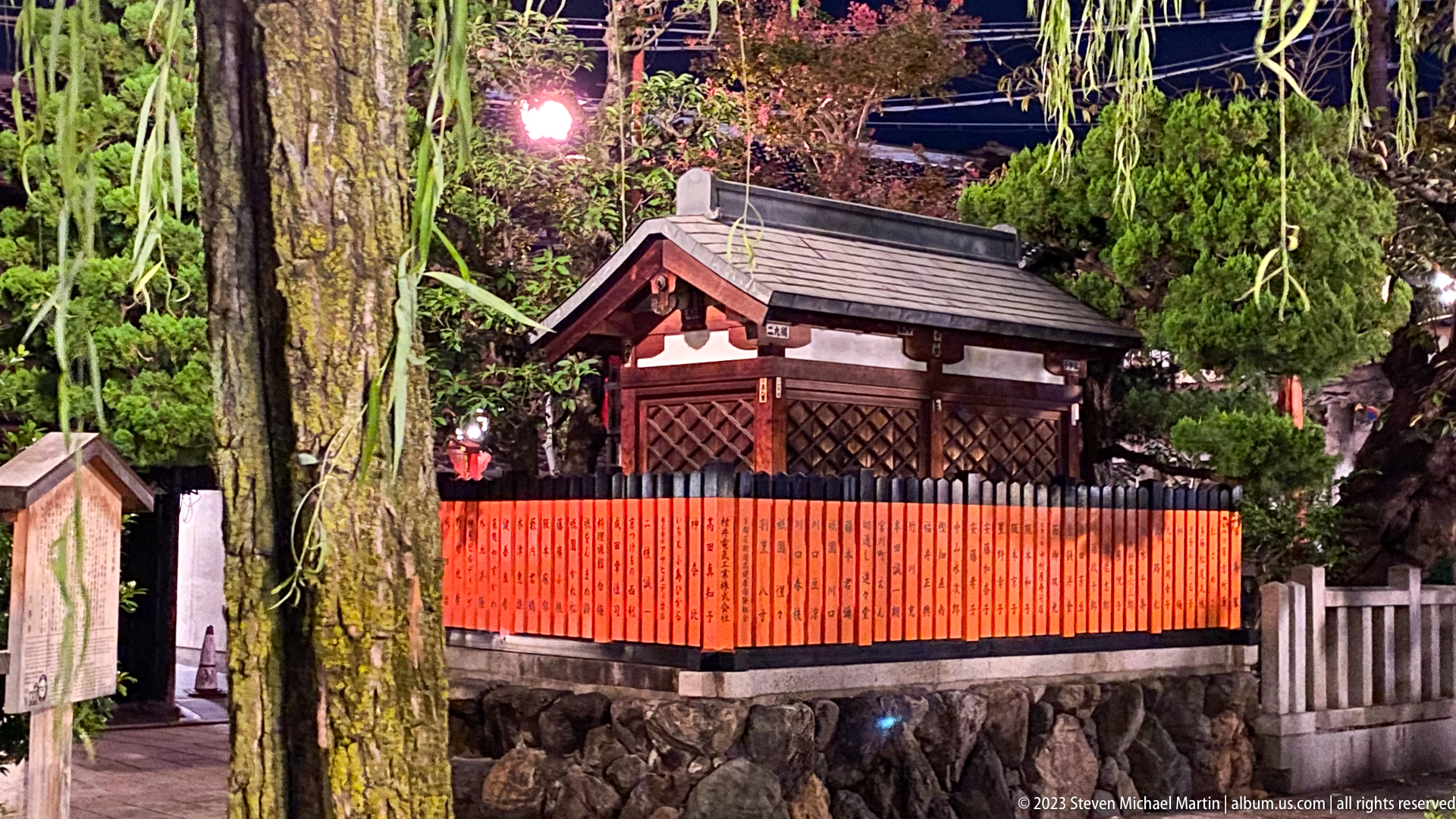
A compact shrine enclosure surrounded by a vermilion fence sits beneath mature trees within the Yasaka Shrine precinct. Soft lighting emphasizes the quiet devotional character of this secondary sacred space. Within Yasaka Shrine, the illuminated structure forms part of a larger sequence of gates, paths, subsidiary shrines, and ceremonial buildings associated with Kyoto’s historic Gion district.
Caption
A compact shrine enclosure surrounded by a vermilion fence sits beneath mature trees within the Yasaka Shrine precinct. Soft lighting emphasizes the quiet devotional character of this secondary sacred space. Within Yasaka Shrine, the illuminated structure forms part of a larger sequence of gates, paths, subsidiary shrines, and ceremonial buildings associated with Kyoto’s historic Gion district.
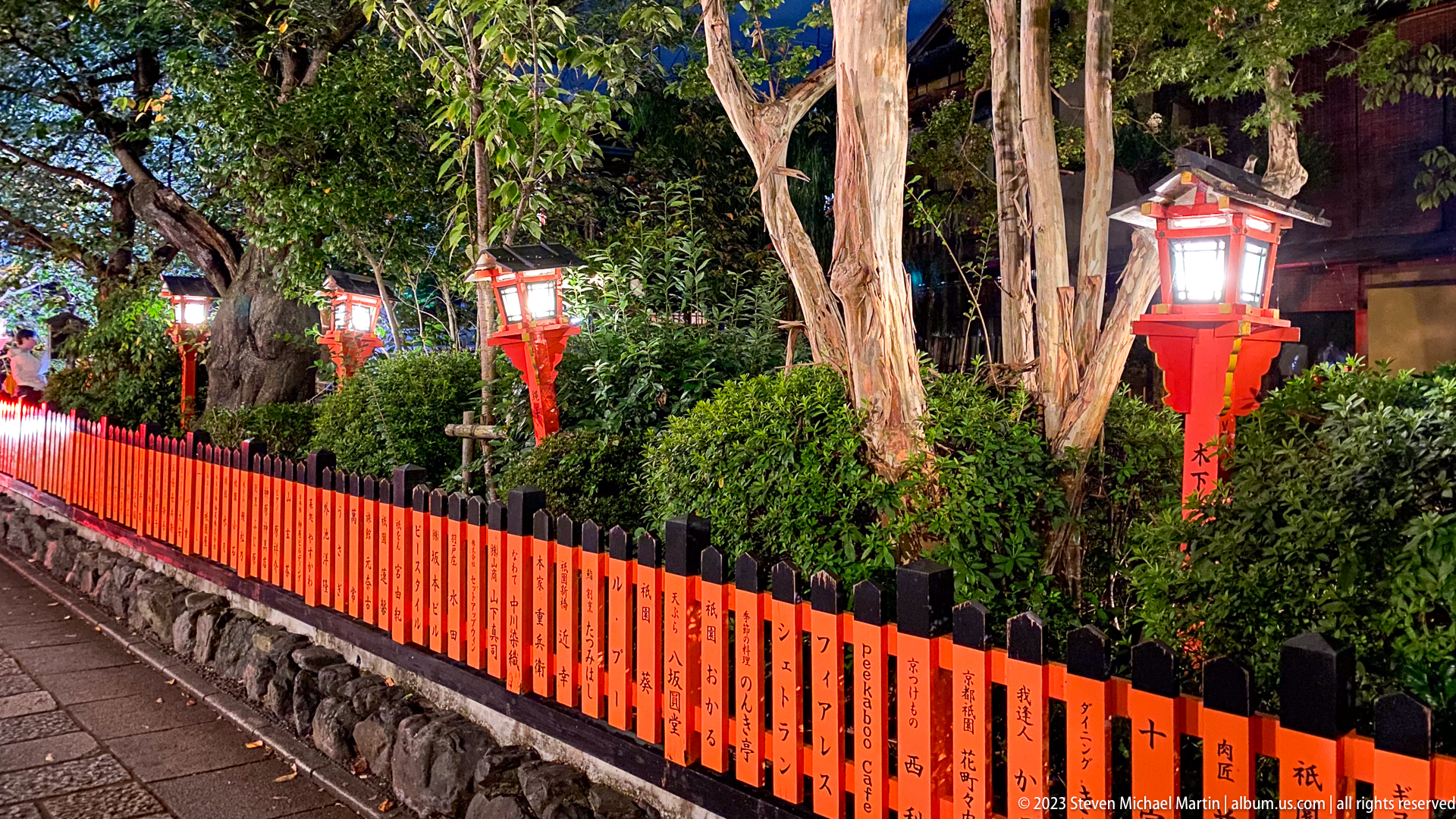
Rows of vermilion lanterns illuminate a shrine path bordered by trees and stone edging, creating a rhythmic sequence of light through the shrine grounds. Within Yasaka Shrine, the illuminated structure forms part of a larger sequence of gates, paths, subsidiary shrines, and ceremonial buildings associated with Kyoto’s historic Gion district.
Caption
Rows of vermilion lanterns illuminate a shrine path bordered by trees and stone edging, creating a rhythmic sequence of light through the shrine grounds. Within Yasaka Shrine, the illuminated structure forms part of a larger sequence of gates, paths, subsidiary shrines, and ceremonial buildings associated with Kyoto’s historic Gion district.

A traditional restaurant entrance is identified by a glowing red paper lantern, wooden lattice doors, and restrained signage. Warm light spilling onto the street creates an inviting nighttime scene. Its restrained presentation reflects the intimate scale of Kyoto’s historic dining streets, where entrances are often embedded directly within traditional townhouses.
Caption
A traditional restaurant entrance is identified by a glowing red paper lantern, wooden lattice doors, and restrained signage. Warm light spilling onto the street creates an inviting nighttime scene. Its restrained presentation reflects the intimate scale of Kyoto’s historic dining streets, where entrances are often embedded directly within traditional townhouses.

A traditional storefront window presents a decorative figure surrounded by handcrafted objects, lantern motifs, and festival-themed ornaments. The display reflects Kyoto's blend of craftsmanship and theatrical visual merchandising along its historic shopping streets. The display turns merchandise, lettering, color, and lighting into a compact visual narrative designed for people moving past at street level.
Caption
A traditional storefront window presents a decorative figure surrounded by handcrafted objects, lantern motifs, and festival-themed ornaments. The display reflects Kyoto's blend of craftsmanship and theatrical visual merchandising along its historic shopping streets. The display turns merchandise, lettering, color, and lighting into a compact visual narrative designed for people moving past at street level.

A large red paper lantern hangs beside a carved wooden plaque identifying a traditional establishment. The restrained composition isolates two iconic elements of Kyoto's nighttime streetscape. Its restrained presentation reflects the intimate scale of Kyoto’s historic dining streets, where entrances are often embedded directly within traditional townhouses.
Caption
A large red paper lantern hangs beside a carved wooden plaque identifying a traditional establishment. The restrained composition isolates two iconic elements of Kyoto's nighttime streetscape. Its restrained presentation reflects the intimate scale of Kyoto’s historic dining streets, where entrances are often embedded directly within traditional townhouses.
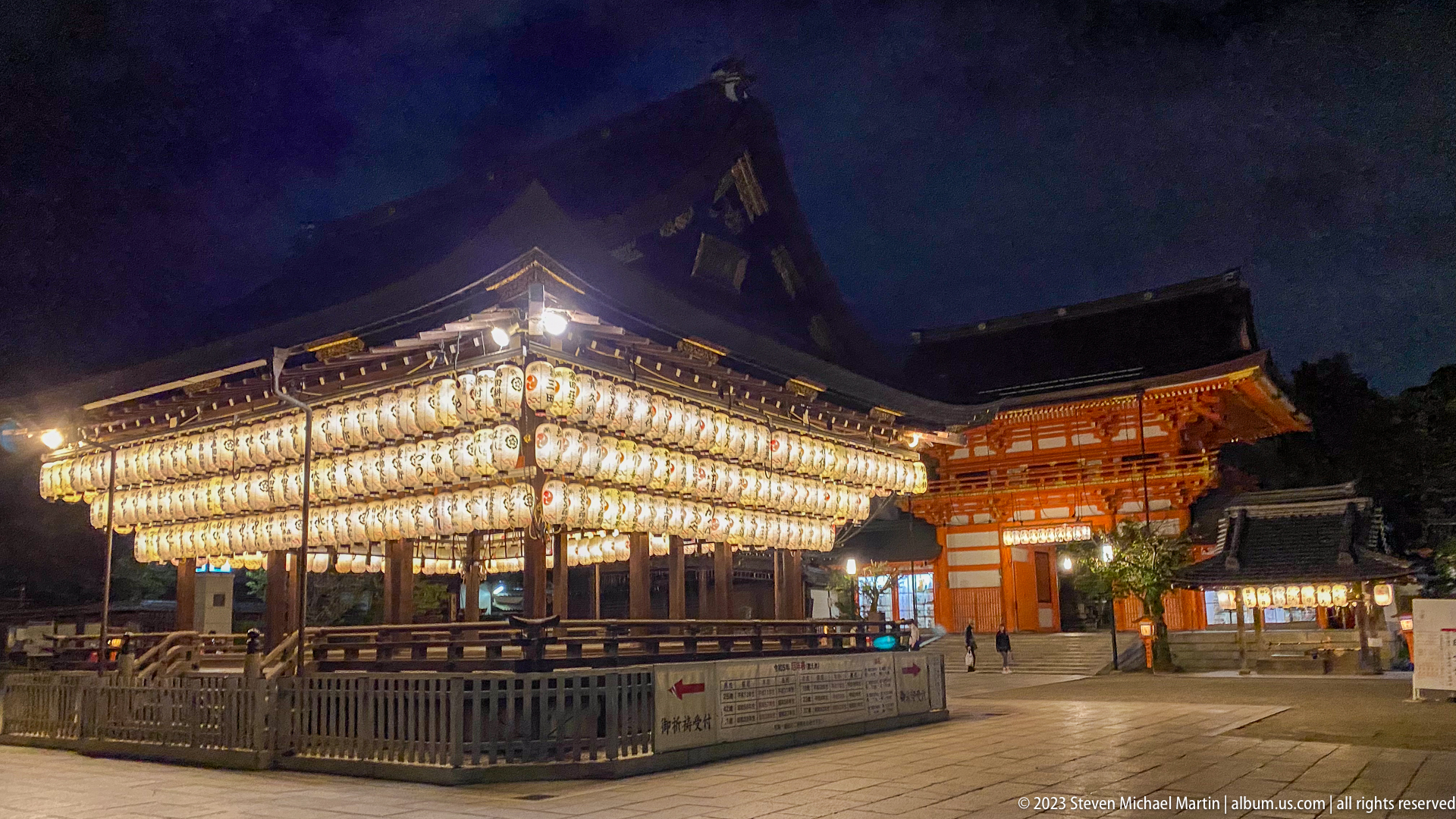
The lantern-covered dance stage glows beneath hundreds of illuminated paper lanterns, standing prominently within the Yasaka Shrine precinct. Warm lighting transforms the pavilion into the visual centerpiece of the nighttime plaza. At Yasaka Shrine, this dance stage is surrounded by donated paper lanterns bearing the names of local businesses; the lanterns are illuminated in the evening and turn the pavilion into the visual center of the precinct.
Caption
The lantern-covered dance stage glows beneath hundreds of illuminated paper lanterns, standing prominently within the Yasaka Shrine precinct. Warm lighting transforms the pavilion into the visual centerpiece of the nighttime plaza. At Yasaka Shrine, this dance stage is surrounded by donated paper lanterns bearing the names of local businesses; the lanterns are illuminated in the evening and turn the pavilion into the visual center of the precinct.

A small wooden shrine stands behind a weathered stone lantern within a quiet corner of the shrine grounds. The juxtaposition of carved stone and timber architecture highlights traditional materials used in Shinto sacred spaces. The sequence of gates, paths, lanterns, and subsidiary structures demonstrates how movement through a Shinto precinct is organized through successive thresholds.
Caption
A small wooden shrine stands behind a weathered stone lantern within a quiet corner of the shrine grounds. The juxtaposition of carved stone and timber architecture highlights traditional materials used in Shinto sacred spaces. The sequence of gates, paths, lanterns, and subsidiary structures demonstrates how movement through a Shinto precinct is organized through successive thresholds.

A gray heron stands motionless in shallow water near the temple grounds, waiting for prey as reflections ripple around the bird. The view belongs to the Tō-ji temple complex, where monumental timber buildings, gates, water, mature trees, and the five-story pagoda form a unified Buddhist landscape.
Caption
A gray heron stands motionless in shallow water near the temple grounds, waiting for prey as reflections ripple around the bird. The view belongs to the Tō-ji temple complex, where monumental timber buildings, gates, water, mature trees, and the five-story pagoda form a unified Buddhist landscape.

A five-story pagoda rises against the fading evening sky, its layered roofs and central finial silhouetted above surrounding trees. The image documents one of Kyoto's iconic Buddhist architectural forms during blue hour. This is the five-story pagoda of Tō-ji, a Kyoto landmark approximately 55 meters high and recognized as Japan’s tallest wooden pagoda.
Caption
A five-story pagoda rises against the fading evening sky, its layered roofs and central finial silhouetted above surrounding trees. The image documents one of Kyoto's iconic Buddhist architectural forms during blue hour. This is the five-story pagoda of Tō-ji, a Kyoto landmark approximately 55 meters high and recognized as Japan’s tallest wooden pagoda.
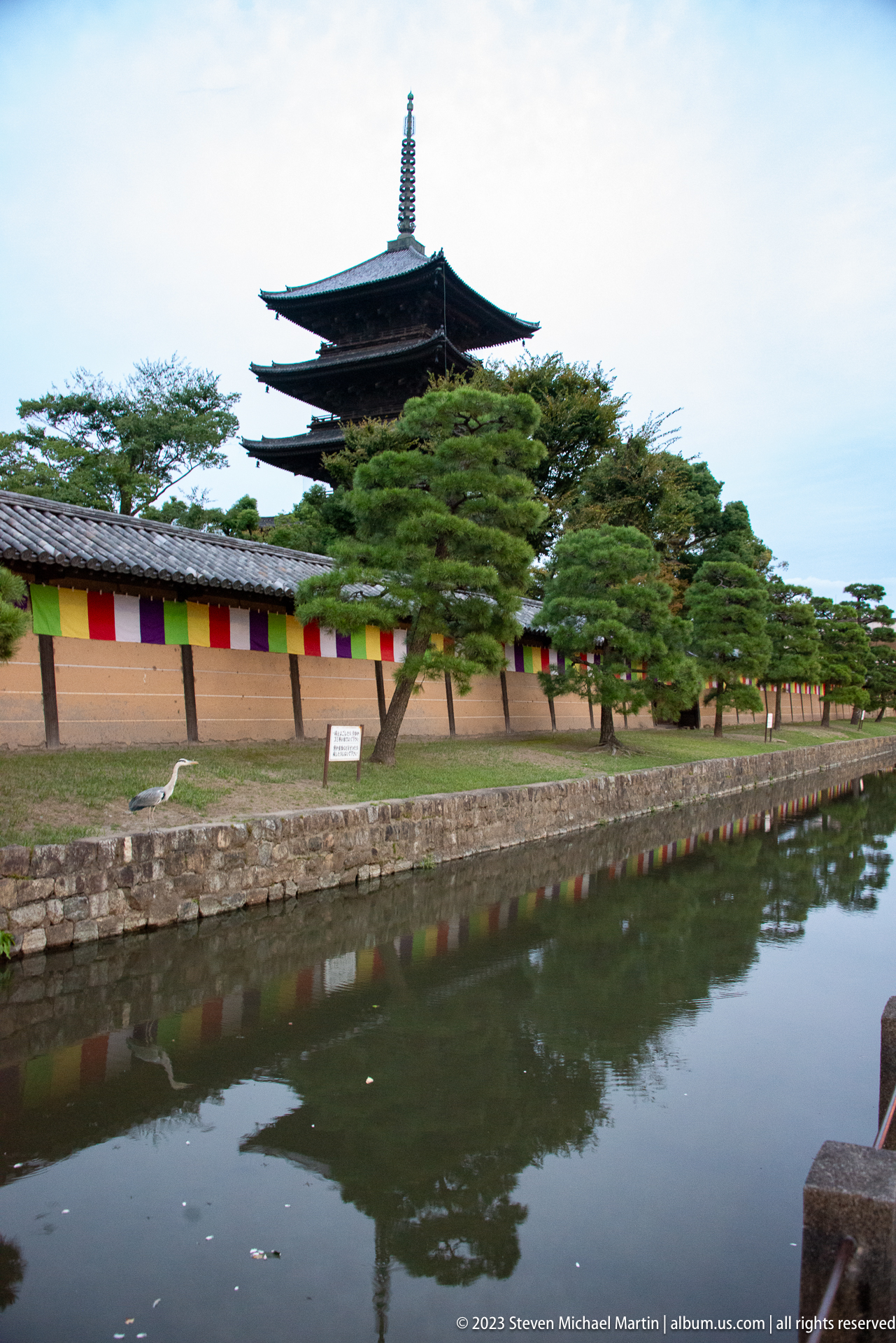
The five-story pagoda rises above a still moat whose calm surface mirrors the layered wooden structure and surrounding trees, emphasizing the harmony between architecture and landscape at dusk. This is the five-story pagoda of Tō-ji, a Kyoto landmark approximately 55 meters high and recognized as Japan’s tallest wooden pagoda.
Caption
The five-story pagoda rises above a still moat whose calm surface mirrors the layered wooden structure and surrounding trees, emphasizing the harmony between architecture and landscape at dusk. This is the five-story pagoda of Tō-ji, a Kyoto landmark approximately 55 meters high and recognized as Japan’s tallest wooden pagoda.
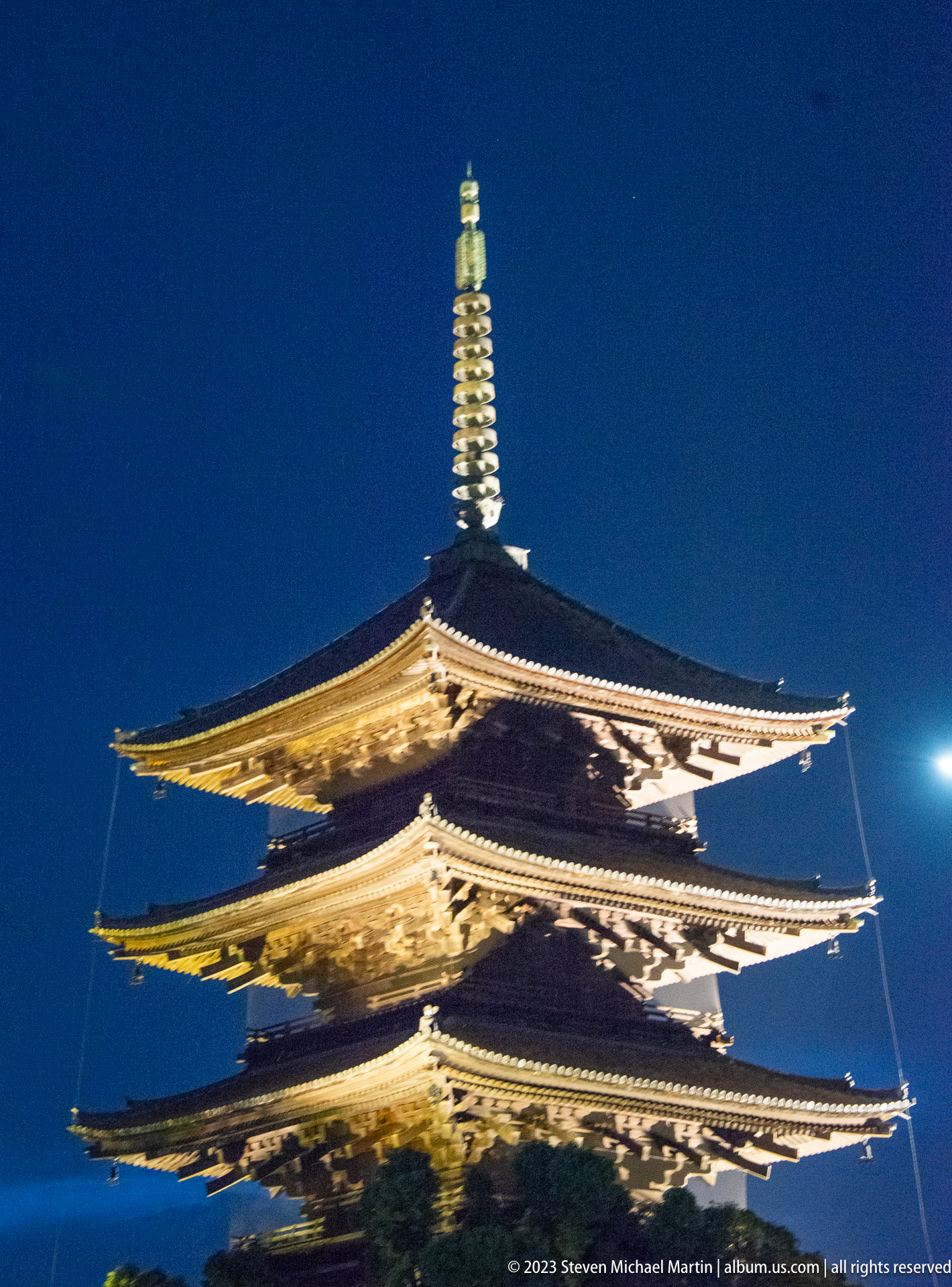
The upper tiers of an illuminated five-story pagoda glow against the night sky, emphasizing the elegant rooflines and gilded finial of this celebrated Buddhist monument. This is the five-story pagoda of Tō-ji, a Kyoto landmark approximately 55 meters high and recognized as Japan’s tallest wooden pagoda.
Caption
The upper tiers of an illuminated five-story pagoda glow against the night sky, emphasizing the elegant rooflines and gilded finial of this celebrated Buddhist monument. This is the five-story pagoda of Tō-ji, a Kyoto landmark approximately 55 meters high and recognized as Japan’s tallest wooden pagoda.

The illuminated five-story pagoda rises above surrounding trees, its layered roofs and gilded finial sharply defined against the night sky. The composition emphasizes the monument's graceful silhouette and dramatic nighttime lighting. This is the five-story pagoda of Tō-ji, a Kyoto landmark approximately 55 meters high and recognized as Japan’s tallest wooden pagoda.
Caption
The illuminated five-story pagoda rises above surrounding trees, its layered roofs and gilded finial sharply defined against the night sky. The composition emphasizes the monument's graceful silhouette and dramatic nighttime lighting. This is the five-story pagoda of Tō-ji, a Kyoto landmark approximately 55 meters high and recognized as Japan’s tallest wooden pagoda.
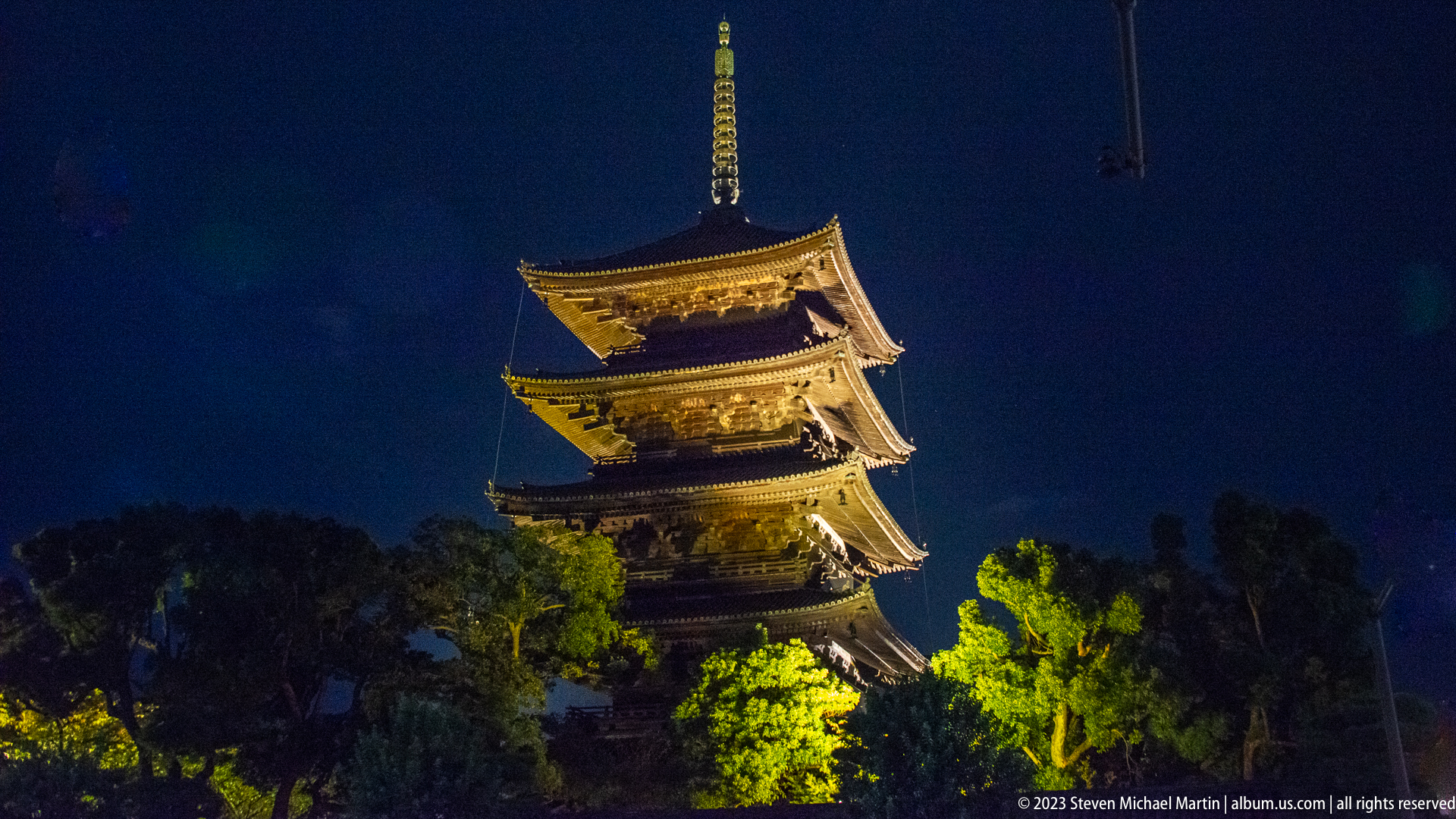
A second nighttime perspective captures the pagoda illuminated from below, highlighting the elegant wooden eaves and central finial while dark trees frame the lower portion of the structure. This is the five-story pagoda of Tō-ji, a Kyoto landmark approximately 55 meters high and recognized as Japan’s tallest wooden pagoda.
Caption
A second nighttime perspective captures the pagoda illuminated from below, highlighting the elegant wooden eaves and central finial while dark trees frame the lower portion of the structure. This is the five-story pagoda of Tō-ji, a Kyoto landmark approximately 55 meters high and recognized as Japan’s tallest wooden pagoda.
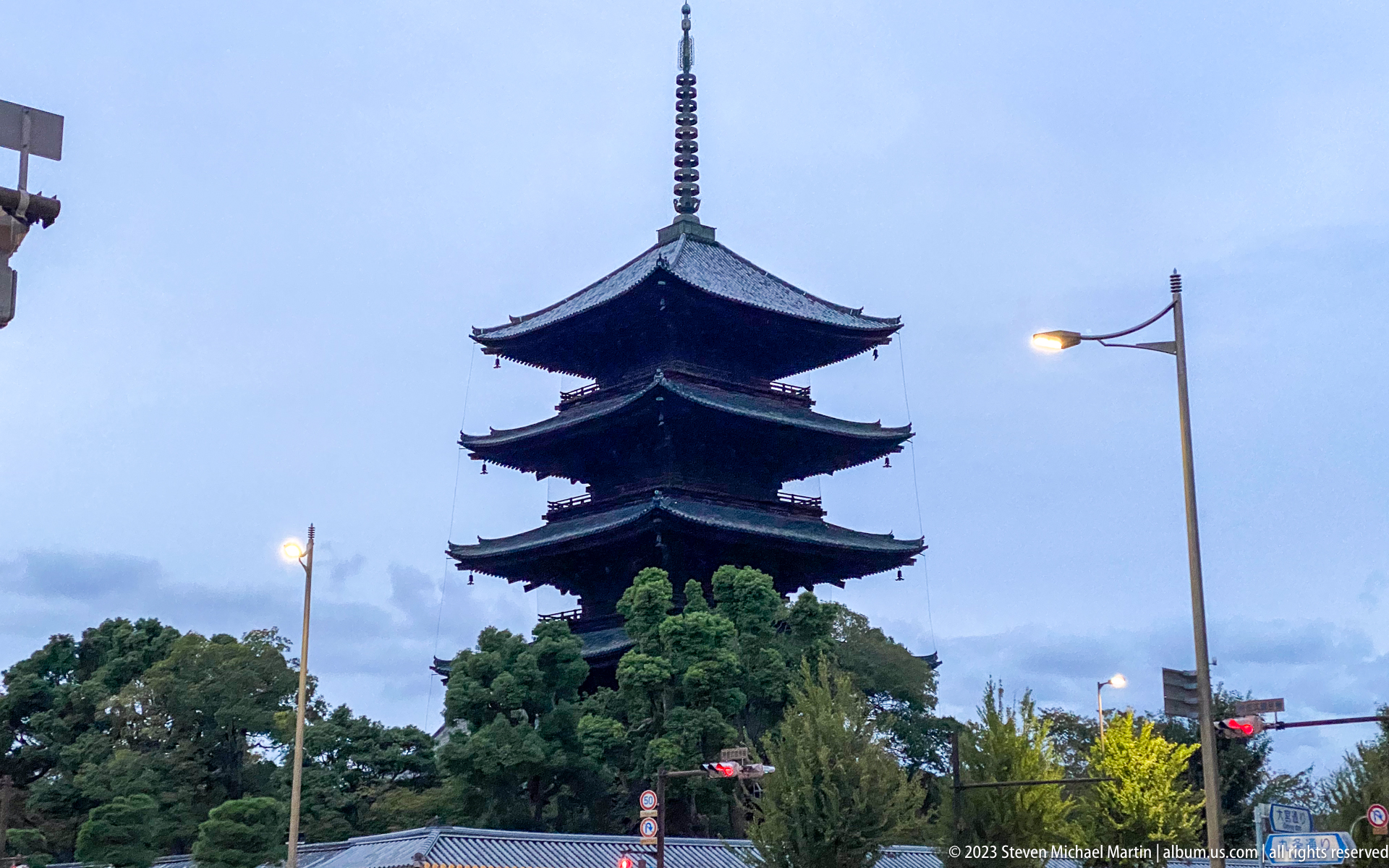
The five-story pagoda stands against the fading blue evening sky, documenting one of Kyoto's most recognizable Buddhist landmarks during the transition from dusk to night. This is the five-story pagoda of Tō-ji, a Kyoto landmark approximately 55 meters high and recognized as Japan’s tallest wooden pagoda.
Caption
The five-story pagoda stands against the fading blue evening sky, documenting one of Kyoto's most recognizable Buddhist landmarks during the transition from dusk to night. This is the five-story pagoda of Tō-ji, a Kyoto landmark approximately 55 meters high and recognized as Japan’s tallest wooden pagoda.