Vilnius – Lithuania
Vilnius, the capital of Lithuania, lies at the confluence of the Neris and Vilnia Rivers in the eastern Baltic region. Founded in the 14th century, the city became the political and cultural center of the Grand Duchy of Lithuania, one of the largest states in Europe during the late medieval period.
The historic Old Town of Vilnius is one of the largest preserved medieval city centers in Europe and is recognized as a UNESCO World Heritage Site. Its narrow streets contain a remarkable collection of churches, monasteries, and historic buildings representing Gothic, Renaissance, Baroque, and neoclassical architecture.
Landmarks such as Vilnius Cathedral, Gediminas Tower, and the many Baroque churches give the city a distinctive architectural character shaped by centuries of cultural influence.

Vilnius Cathedral stretches across Cathedral Square with its long pale Neoclassical exterior, columned portico, and low dome, while the freestanding bell tower rises separately at the left. The broad paved foreground and clear sky emphasize the ensemble’s monumental civic setting at the center of the historic city.
Caption
Vilnius Cathedral stretches across Cathedral Square with its long pale Neoclassical exterior, columned portico, and low dome, while the freestanding bell tower rises separately at the left. The broad paved foreground and clear sky emphasize the ensemble’s monumental civic setting at the center of the historic city.

Vilnius Cathedral stands frontally across Cathedral Square, its six-column portico, sculpted pediment, and rooftop statues forming a highly symmetrical Neoclassical composition. The broad open foreground gives the façade civic scale and allows the cathedral’s restrained side wings and central entrance to be read as a unified ensemble within the historic heart of the city.
Caption
Vilnius Cathedral stands frontally across Cathedral Square, its six-column portico, sculpted pediment, and rooftop statues forming a highly symmetrical Neoclassical composition. The broad open foreground gives the façade civic scale and allows the cathedral’s restrained side wings and central entrance to be read as a unified ensemble within the historic heart of the city.

Outdoor tables, pedestrians, bicycles, and illuminated doorways animate a narrow Old Town street after dark. The compact façades and lantern-lit paving create an intimate urban setting, while seated diners and small groups of people show how the historic center functions as an active restaurant and nightlife district rather than only an architectural monument.
Caption
Outdoor tables, pedestrians, bicycles, and illuminated doorways animate a narrow Old Town street after dark. The compact façades and lantern-lit paving create an intimate urban setting, while seated diners and small groups of people show how the historic center functions as an active restaurant and nightlife district rather than only an architectural monument.

A compact Orthodox church combines warm pink walls with bands of brick-colored ornament, rounded arches, and a broad central drum beneath a low dome. The side elevation shows repeated arched recesses and decorative brickwork, while mature trees frame the building and soften its strong geometric massing within the Vilnius streetscape.
Caption
A compact Orthodox church combines warm pink walls with bands of brick-colored ornament, rounded arches, and a broad central drum beneath a low dome. The side elevation shows repeated arched recesses and decorative brickwork, while mature trees frame the building and soften its strong geometric massing within the Vilnius streetscape.

Vilnius Cathedral glows beneath floodlights at night, its monumental portico and triangular pediment rising at the left while the freestanding bell tower stands across Cathedral Square. A bright moon and scattered plaza lights punctuate the dark sky, giving the familiar ensemble a distinctly nocturnal character and emphasizing the separation between church and tower.
Caption
Vilnius Cathedral glows beneath floodlights at night, its monumental portico and triangular pediment rising at the left while the freestanding bell tower stands across Cathedral Square. A bright moon and scattered plaza lights punctuate the dark sky, giving the familiar ensemble a distinctly nocturnal character and emphasizing the separation between church and tower.

Repeated white barrel vaults span the side aisle of Vilnius Cathedral, their surfaces enriched with rosettes, garlands, and delicate molded borders. Broad square piers divide the sequence into rhythmic bays, and daylight from the nave brightens the relief ornament. The upward view isolates the refined Neoclassical ceiling treatment from the paintings and furnishings below.
Caption
Repeated white barrel vaults span the side aisle of Vilnius Cathedral, their surfaces enriched with rosettes, garlands, and delicate molded borders. Broad square piers divide the sequence into rhythmic bays, and daylight from the nave brightens the relief ornament. The upward view isolates the refined Neoclassical ceiling treatment from the paintings and furnishings below.

The freestanding bell tower of Vilnius Cathedral rises from Cathedral Square in a low, upward-looking nighttime view. Its broad white lower stage narrows through successive octagonal levels, while small openings and the clock stage articulate the masonry mass. Illumination from the square gives the tower a sculptural presence against the deep blue-black sky.
Caption
The freestanding bell tower of Vilnius Cathedral rises from Cathedral Square in a low, upward-looking nighttime view. Its broad white lower stage narrows through successive octagonal levels, while small openings and the clock stage articulate the masonry mass. Illumination from the square gives the tower a sculptural presence against the deep blue-black sky.

Heavy riveted steel arches frame a pedestrian and roadway crossing over the Neris River. Suspender rods descend from the curved upper members while cyclists, pedestrians, and cars share the corridor beneath. The close linear perspective emphasizes industrial construction, structural rhythm, and the bridge’s continuing role in the contemporary circulation network of central Vilnius.
Caption
Heavy riveted steel arches frame a pedestrian and roadway crossing over the Neris River. Suspender rods descend from the curved upper members while cyclists, pedestrians, and cars share the corridor beneath. The close linear perspective emphasizes industrial construction, structural rhythm, and the bridge’s continuing role in the contemporary circulation network of central Vilnius.

The freestanding bell tower of Vilnius Cathedral rises alone against the evening sky, its broad lower stage narrowing through successive tiers to a clock level and dark roof. Small arched openings and restrained pilasters articulate the pale masonry, while pedestrians at the base provide scale. The isolated view makes the tower’s unusual proportions especially clear.
Caption
The freestanding bell tower of Vilnius Cathedral rises alone against the evening sky, its broad lower stage narrowing through successive tiers to a clock level and dark roof. Small arched openings and restrained pilasters articulate the pale masonry, while pedestrians at the base provide scale. The isolated view makes the tower’s unusual proportions especially clear.

A close upward view isolates the monumental portico of Vilnius Cathedral. Tall classical columns support an elaborately sculpted triangular pediment crowned by standing figures and a central cross, while relief panels fill the entablature below. The framing emphasizes the cathedral’s Neoclassical vocabulary and the contrast between its smooth pale surfaces and the open evening sky.
Caption
A close upward view isolates the monumental portico of Vilnius Cathedral. Tall classical columns support an elaborately sculpted triangular pediment crowned by standing figures and a central cross, while relief panels fill the entablature below. The framing emphasizes the cathedral’s Neoclassical vocabulary and the contrast between its smooth pale surfaces and the open evening sky.

A painted sundial combines Roman numerals, a projecting gnomon, heraldic ornament, and a radiant golden sun at its center. A Latin inscription curves across a banner above the dial, while additional decorative motifs frame the composition. The close view concentrates on timekeeping, civic symbolism, and applied architectural decoration rather than the surrounding building.
Caption
A painted sundial combines Roman numerals, a projecting gnomon, heraldic ornament, and a radiant golden sun at its center. A Latin inscription curves across a banner above the dial, while additional decorative motifs frame the composition. The close view concentrates on timekeeping, civic symbolism, and applied architectural decoration rather than the surrounding building.

The crown-topped dome and sculpted Baroque roofline of the Church of St. Casimir rise against a clear blue sky. Curving pediments, white stucco ornament, a red-roofed lantern, and the gilded crown-like cupola create a distinctive silhouette above Vilnius Old Town, while metal crosses and finials mark the church’s layered roofscape.
Caption
The crown-topped dome and sculpted Baroque roofline of the Church of St. Casimir rise against a clear blue sky. Curving pediments, white stucco ornament, a red-roofed lantern, and the gilded crown-like cupola create a distinctive silhouette above Vilnius Old Town, while metal crosses and finials mark the church’s layered roofscape.

A richly ornamented entrance bay inside the Orthodox Cathedral of the Dormition of the Mother of God combines arched openings, painted architectural bands, slender columns, and a large hanging chandelier. Glazed doors close the far end of the space, while repeated arches and patterned wall decoration establish the cathedral’s layered interior before the main worship area.
Caption
A richly ornamented entrance bay inside the Orthodox Cathedral of the Dormition of the Mother of God combines arched openings, painted architectural bands, slender columns, and a large hanging chandelier. Glazed doors close the far end of the space, while repeated arches and patterned wall decoration establish the cathedral’s layered interior before the main worship area.

A painted Orthodox icon rests on a sloped wooden display stand before the cathedral’s iconostasis, flanked by brass candle stands and a vase of red roses. The panel’s saturated figures, gold-toned border, and prominent placement in the nave make it a focal devotional object within the richly decorated interior of the Cathedral of the Dormition.
Caption
A painted Orthodox icon rests on a sloped wooden display stand before the cathedral’s iconostasis, flanked by brass candle stands and a vase of red roses. The panel’s saturated figures, gold-toned border, and prominent placement in the nave make it a focal devotional object within the richly decorated interior of the Cathedral of the Dormition.

Lit taper candles rise from a broad metal votive stand inside the Cathedral of the Dormition, with rows of empty sockets surrounding the burning lights. A gilded crucifix group and a dark sculptural monument stand beyond, while flowers and additional candles reinforce the devotional setting. The downward viewpoint concentrates attention on individual acts of prayer within the cathedral interior.
Caption
Lit taper candles rise from a broad metal votive stand inside the Cathedral of the Dormition, with rows of empty sockets surrounding the burning lights. A gilded crucifix group and a dark sculptural monument stand beyond, while flowers and additional candles reinforce the devotional setting. The downward viewpoint concentrates attention on individual acts of prayer within the cathedral interior.

Carved wooden panels, painted saints, gilded trim, and framed icons form the elaborate iconostasis of the Cathedral of the Dormition. Seen obliquely from the nave, the sanctuary screen rises behind a covered lectern and brass candle stand, revealing the density of Orthodox liturgical imagery and woodwork that organizes the cathedral’s eastern end.
Caption
Carved wooden panels, painted saints, gilded trim, and framed icons form the elaborate iconostasis of the Cathedral of the Dormition. Seen obliquely from the nave, the sanctuary screen rises behind a covered lectern and brass candle stand, revealing the density of Orthodox liturgical imagery and woodwork that organizes the cathedral’s eastern end.

Cream-colored ribs rise from massive piers toward an octagonal glazed lantern in the Cathedral of the Dormition. Pale gray vault surfaces contrast with warm structural moldings, while a dark suspended chandelier enters the lower frame. The upward view isolates the cathedral’s vertical geometry and the way daylight is admitted high above the nave.
Caption
Cream-colored ribs rise from massive piers toward an octagonal glazed lantern in the Cathedral of the Dormition. Pale gray vault surfaces contrast with warm structural moldings, while a dark suspended chandelier enters the lower frame. The upward view isolates the cathedral’s vertical geometry and the way daylight is admitted high above the nave.

A wider upward view of the Cathedral of the Dormition shows tall piers, rounded arches, pale vaults, and the octagonal lantern centered above the crossing. A gallery and organ-like wooden structure appear at the sides, while narrow upper windows bring daylight into the otherwise restrained architectural shell.
Caption
A wider upward view of the Cathedral of the Dormition shows tall piers, rounded arches, pale vaults, and the octagonal lantern centered above the crossing. A gallery and organ-like wooden structure appear at the sides, while narrow upper windows bring daylight into the otherwise restrained architectural shell.

A raised side shrine stands beside the main iconostasis in the Cathedral of the Dormition, its carved wooden canopy framing a small sacred image above a brass lamp stand. Steps, railings, icons, and painted panels show how devotional stations extend from the principal sanctuary into the side aisle, creating multiple focal points for prayer.
Caption
A raised side shrine stands beside the main iconostasis in the Cathedral of the Dormition, its carved wooden canopy framing a small sacred image above a brass lamp stand. Steps, railings, icons, and painted panels show how devotional stations extend from the principal sanctuary into the side aisle, creating multiple focal points for prayer.

A central lectern with a painted icon aligns symmetrically with the multi-tier iconostasis of the Cathedral of the Dormition. Tall brass candle stands flank the foreground, while rows of saints and sacred figures fill the carved wooden screen. The frontal composition clarifies the liturgical axis from nave to sanctuary and the iconostasis’s role as the dominant visual boundary.
Caption
A central lectern with a painted icon aligns symmetrically with the multi-tier iconostasis of the Cathedral of the Dormition. Tall brass candle stands flank the foreground, while rows of saints and sacred figures fill the carved wooden screen. The frontal composition clarifies the liturgical axis from nave to sanctuary and the iconostasis’s role as the dominant visual boundary.

The broad nave of the Cathedral of the Dormition opens toward a richly painted iconostasis beneath high pale arches. Slender brass stands, side shrines, and a low red platform punctuate the tiled floor, while the tall white piers and restrained wall surfaces emphasize the scale of the sanctuary screen at the eastern end.
Caption
The broad nave of the Cathedral of the Dormition opens toward a richly painted iconostasis beneath high pale arches. Slender brass stands, side shrines, and a low red platform punctuate the tiled floor, while the tall white piers and restrained wall surfaces emphasize the scale of the sanctuary screen at the eastern end.

A steep low-angle view concentrates on the intricate red-brick Gothic façade of the Church of St. Anne. Narrow pointed arches, vertical window bays, molded brick ribs, and clustered pinnacles create a strongly upward rhythm, demonstrating the elaborate brick craftsmanship that distinguishes this Vilnius landmark from the broader mass of the neighboring Bernardine complex.
Caption
A steep low-angle view concentrates on the intricate red-brick Gothic façade of the Church of St. Anne. Narrow pointed arches, vertical window bays, molded brick ribs, and clustered pinnacles create a strongly upward rhythm, demonstrating the elaborate brick craftsmanship that distinguishes this Vilnius landmark from the broader mass of the neighboring Bernardine complex.

The red-brick Church of St. Francis of Assisi, known as the Bernardine Church, presents a broad Gothic wall pierced by tall pointed windows and capped by a later stepped gable. Decorative brick patterns, small corner turrets, and the adjoining masonry of the complex reveal the building’s layered medieval and post-medieval fabric within the St. Anne and Bernardine ensemble.
Caption
The red-brick Church of St. Francis of Assisi, known as the Bernardine Church, presents a broad Gothic wall pierced by tall pointed windows and capped by a later stepped gable. Decorative brick patterns, small corner turrets, and the adjoining masonry of the complex reveal the building’s layered medieval and post-medieval fabric within the St. Anne and Bernardine ensemble.

Red-brick towers and walls of the St. Anne and Bernardine church complex rise above a narrow courtyard approach in Vilnius Old Town. A pointed gate, masonry boundary wall, mature trees, and adjoining plastered building frame the view, emphasizing the compact urban setting in which the Gothic churches and monastic structures are interwoven.
Caption
Red-brick towers and walls of the St. Anne and Bernardine church complex rise above a narrow courtyard approach in Vilnius Old Town. A pointed gate, masonry boundary wall, mature trees, and adjoining plastered building frame the view, emphasizing the compact urban setting in which the Gothic churches and monastic structures are interwoven.

Winged angels flank a radiant sculptural crest above one of the carved wooden altars in the Bernardine Church. Sunburst rays spread around the central figure, while dark columns, broken pediments, and dense carving build a dramatic Baroque frame. The close view isolates the upper register of the altar and its theatrical use of sculpture and light.
Caption
Winged angels flank a radiant sculptural crest above one of the carved wooden altars in the Bernardine Church. Sunburst rays spread around the central figure, while dark columns, broken pediments, and dense carving build a dramatic Baroque frame. The close view isolates the upper register of the altar and its theatrical use of sculpture and light.

Tall white piers rise into patterned Gothic vaults above the altar ensemble of the Bernardine Church. Faded wall painting and ribs in muted red trace the ceiling geometry, while the carved Baroque altars below create a sharp contrast between the medieval architectural shell and later liturgical furnishings. The steep upward viewpoint emphasizes the church’s height and layered interior history.
Caption
Tall white piers rise into patterned Gothic vaults above the altar ensemble of the Bernardine Church. Faded wall painting and ribs in muted red trace the ceiling geometry, while the carved Baroque altars below create a sharp contrast between the medieval architectural shell and later liturgical furnishings. The steep upward viewpoint emphasizes the church’s height and layered interior history.

A group of carved wooden Baroque altars fills the eastern end of the Bernardine Church, arranged behind a low balustrade. The central structure carries a radiant sculptural crest, while side altars hold framed sacred images and red textile panels. Warm wood tones stand out against the pale Gothic walls, showing the dense liturgical furnishing of the sanctuary.
Caption
A group of carved wooden Baroque altars fills the eastern end of the Bernardine Church, arranged behind a low balustrade. The central structure carries a radiant sculptural crest, while side altars hold framed sacred images and red textile panels. Warm wood tones stand out against the pale Gothic walls, showing the dense liturgical furnishing of the sanctuary.

A red-covered altar table with white flowers anchors the sanctuary of the Bernardine Church, surrounded by tall carved wooden altars and sculptural crests. The view brings the ensemble together at human scale, showing how the main liturgical table sits before the more elaborate Baroque retables that line the eastern wall beneath the church’s Gothic vaults.
Caption
A red-covered altar table with white flowers anchors the sanctuary of the Bernardine Church, surrounded by tall carved wooden altars and sculptural crests. The view brings the ensemble together at human scale, showing how the main liturgical table sits before the more elaborate Baroque retables that line the eastern wall beneath the church’s Gothic vaults.

Rows of wooden pews lead beneath high white piers and painted Gothic vaults toward the western gallery of the Bernardine Church. The long axial view reveals the scale of the nave, traces of historic wall painting, and the contrast between pale masonry and dark wood furnishings. Light from clerestory windows picks out the ribs and decorative ceiling patterns overhead.
Caption
Rows of wooden pews lead beneath high white piers and painted Gothic vaults toward the western gallery of the Bernardine Church. The long axial view reveals the scale of the nave, traces of historic wall painting, and the contrast between pale masonry and dark wood furnishings. Light from clerestory windows picks out the ribs and decorative ceiling patterns overhead.

A large carved wooden pulpit projects from a pier inside the Bernardine Church, reached by a sweeping enclosed stair. Its polygonal basket, paneled surfaces, and elaborate sculptural canopy contrast with the pale masonry wall and surviving mural fragments behind it. The side view makes the pulpit’s freestanding architectural form and elevated preaching position especially clear.
Caption
A large carved wooden pulpit projects from a pier inside the Bernardine Church, reached by a sweeping enclosed stair. Its polygonal basket, paneled surfaces, and elaborate sculptural canopy contrast with the pale masonry wall and surviving mural fragments behind it. The side view makes the pulpit’s freestanding architectural form and elevated preaching position especially clear.

The high altar of Vilnius Cathedral is framed by a monumental Neoclassical aedicule with green-marble columns, a triangular pediment, and a gilded cross above. A large religious painting fills the center, while flowers and liturgical objects line the altar table. The bright white interior and strict symmetry emphasize the cathedral’s classical architectural language.
Caption
The high altar of Vilnius Cathedral is framed by a monumental Neoclassical aedicule with green-marble columns, a triangular pediment, and a gilded cross above. A large religious painting fills the center, while flowers and liturgical objects line the altar table. The bright white interior and strict symmetry emphasize the cathedral’s classical architectural language.

The central aisle of the Bernardine Church runs between rows of wooden pews toward a dense sequence of carved Baroque altars. Tall white piers support decorated Gothic vaults, while fragments of wall painting remain visible along the nave. The frontal perspective ties the church’s medieval structural framework to the later liturgical furnishings concentrated around the sanctuary.
Caption
The central aisle of the Bernardine Church runs between rows of wooden pews toward a dense sequence of carved Baroque altars. Tall white piers support decorated Gothic vaults, while fragments of wall painting remain visible along the nave. The frontal perspective ties the church’s medieval structural framework to the later liturgical furnishings concentrated around the sanctuary.

The white exterior of the Palace of the Grand Dukes of Lithuania presents a restrained Renaissance composition beside Cathedral Square. Regular windows, projecting corner towers, dark hipped roofs, and a richly framed stone portal animate the long façade, while the Lithuanian flag above the roofline identifies the building’s civic and national setting in central Vilnius.
Caption
The white exterior of the Palace of the Grand Dukes of Lithuania presents a restrained Renaissance composition beside Cathedral Square. Regular windows, projecting corner towers, dark hipped roofs, and a richly framed stone portal animate the long façade, while the Lithuanian flag above the roofline identifies the building’s civic and national setting in central Vilnius.

Tall white piers frame a side aisle of Vilnius Cathedral where large devotional paintings hang in gilded frames above a patterned pulpit or gallery front. Molded arches and restrained classical ornament continue across the upper walls, while the upward viewpoint emphasizes the height of the interior and the regular spacing of art between the piers.
Caption
Tall white piers frame a side aisle of Vilnius Cathedral where large devotional paintings hang in gilded frames above a patterned pulpit or gallery front. Molded arches and restrained classical ornament continue across the upper walls, while the upward viewpoint emphasizes the height of the interior and the regular spacing of art between the piers.

A long axial view through Vilnius Cathedral shows rows of wooden pews between massive white piers, with large devotional paintings mounted along the nave. Repeated molded vaults lead toward the distant high altar, whose green-marble columns form the visual terminus. The composition emphasizes the cathedral’s ordered Neoclassical rhythm and unusually bright interior.
Caption
A long axial view through Vilnius Cathedral shows rows of wooden pews between massive white piers, with large devotional paintings mounted along the nave. Repeated molded vaults lead toward the distant high altar, whose green-marble columns form the visual terminus. The composition emphasizes the cathedral’s ordered Neoclassical rhythm and unusually bright interior.

Vilnius Cathedral’s broad nave opens toward the high altar beneath a sequence of white coffered and molded vaults. Large religious paintings in gilded frames punctuate the side walls between massive piers, while orderly rows of pews occupy the foreground. The slightly closer viewpoint gives greater prominence to the altar and its green-marble architectural frame.
Caption
Vilnius Cathedral’s broad nave opens toward the high altar beneath a sequence of white coffered and molded vaults. Large religious paintings in gilded frames punctuate the side walls between massive piers, while orderly rows of pews occupy the foreground. The slightly closer viewpoint gives greater prominence to the altar and its green-marble architectural frame.

A monumental historicist civic building faces a Vilnius intersection with a deep ground-floor arcade and a long colonnaded balcony above. Rusticated stonework anchors the lower stories, while a pale upper façade is organized by regular windows, pediments, and balustrades. Traffic signals and street furniture place the formal architecture firmly within the active contemporary city.
Caption
A monumental historicist civic building faces a Vilnius intersection with a deep ground-floor arcade and a long colonnaded balcony above. Rusticated stonework anchors the lower stories, while a pale upper façade is organized by regular windows, pediments, and balustrades. Traffic signals and street furniture place the formal architecture firmly within the active contemporary city.

Streetlights trace the curved profile of a modern bridge over the Neris River at night, while their reflections shimmer across the dark water below. The structure’s arched supports and metal railings are silhouetted against the city lights, turning an everyday crossing into a study of engineered form, illumination, and riverfront movement.
Caption
Streetlights trace the curved profile of a modern bridge over the Neris River at night, while their reflections shimmer across the dark water below. The structure’s arched supports and metal railings are silhouetted against the city lights, turning an everyday crossing into a study of engineered form, illumination, and riverfront movement.

The floodlit classical portico of Vilnius Cathedral fills the frame, its six monumental columns supporting a pediment enriched with sculpture. Warm illumination isolates the pale façade against the night sky, emphasizing the cathedral’s formal symmetry and its commanding presence on Cathedral Square in the historic center of Vilnius.
Caption
The floodlit classical portico of Vilnius Cathedral fills the frame, its six monumental columns supporting a pediment enriched with sculpture. Warm illumination isolates the pale façade against the night sky, emphasizing the cathedral’s formal symmetry and its commanding presence on Cathedral Square in the historic center of Vilnius.

Gediminas’ Tower stands alone on the crest of Castle Hill, its brick walls and Lithuanian flag sharply silhouetted against the night sky. The steep grassy slope dominates the foreground, making the surviving tower of the Upper Castle appear especially isolated and defensive above central Vilnius.
Caption
Gediminas’ Tower stands alone on the crest of Castle Hill, its brick walls and Lithuanian flag sharply silhouetted against the night sky. The steep grassy slope dominates the foreground, making the surviving tower of the Upper Castle appear especially isolated and defensive above central Vilnius.

A dramatic worm’s-eye view looks upward between the brick Gothic towers and façades of the Church of St. Anne and the adjoining Bernardine complex. Pointed windows, vertical buttress-like elements, pinnacles, and patterned brickwork converge toward the dark blue sky, turning the ensemble’s dense Gothic vocabulary into an almost abstract architectural composition.
Caption
A dramatic worm’s-eye view looks upward between the brick Gothic towers and façades of the Church of St. Anne and the adjoining Bernardine complex. Pointed windows, vertical buttress-like elements, pinnacles, and patterned brickwork converge toward the dark blue sky, turning the ensemble’s dense Gothic vocabulary into an almost abstract architectural composition.

The illuminated Church of St. Anne and adjoining Bernardine church form a layered nighttime skyline of brick Gothic gables, towers, and steep roofs. A standing monument and landscaped foreground establish the ensemble within its urban setting, while the warm architectural lighting separates the red masonry from the deep blue evening sky.
Caption
The illuminated Church of St. Anne and adjoining Bernardine church form a layered nighttime skyline of brick Gothic gables, towers, and steep roofs. A standing monument and landscaped foreground establish the ensemble within its urban setting, while the warm architectural lighting separates the red masonry from the deep blue evening sky.

A wider view places the Church of St. Anne and the Bernardine complex behind an open paved foreground and low plantings. The intricate Gothic towers of St. Anne rise at left, while the broader gabled mass of the Bernardine church extends to the right, clearly showing how the two landmarks occupy the same historic precinct.
Caption
A wider view places the Church of St. Anne and the Bernardine complex behind an open paved foreground and low plantings. The intricate Gothic towers of St. Anne rise at left, while the broader gabled mass of the Bernardine church extends to the right, clearly showing how the two landmarks occupy the same historic precinct.

Seen from across the street at night, the Church of St. Anne presents its celebrated lace-like brick Gothic façade at left, while the Bernardine church and its tall gable continue the ensemble to the right. Street lamps and the open roadway give the architecture scale while preserving an unobstructed view of the elaborate vertical composition.
Caption
Seen from across the street at night, the Church of St. Anne presents its celebrated lace-like brick Gothic façade at left, while the Bernardine church and its tall gable continue the ensemble to the right. Street lamps and the open roadway give the architecture scale while preserving an unobstructed view of the elaborate vertical composition.

A gently curving cobbled lane passes between closely spaced historic buildings in Vilnius Old Town, lit by wall-mounted lanterns and warm shopfront light. The quiet nighttime scene emphasizes the compact medieval street pattern, narrow façades, and intimate scale that distinguish the UNESCO-listed historic center.
Caption
A gently curving cobbled lane passes between closely spaced historic buildings in Vilnius Old Town, lit by wall-mounted lanterns and warm shopfront light. The quiet nighttime scene emphasizes the compact medieval street pattern, narrow façades, and intimate scale that distinguish the UNESCO-listed historic center.

Warm wall lamps trace a quiet pedestrian lane between stuccoed historic buildings in Vilnius Old Town. Arched openings, barred windows, worn plaster, and the narrow roadway create a layered architectural corridor, while the receding perspective draws attention toward the softly lit buildings at the far end of the street.
Caption
Warm wall lamps trace a quiet pedestrian lane between stuccoed historic buildings in Vilnius Old Town. Arched openings, barred windows, worn plaster, and the narrow roadway create a layered architectural corridor, while the receding perspective draws attention toward the softly lit buildings at the far end of the street.

Bold hand-lettered white text reading “JIMMY JUMPS HOUSE” and “VILNIUS” fills a black sign, turning a piece of contemporary visitor culture into a graphic nighttime detail. The close framing removes surrounding architectural context and centers the establishment’s playful typography as the subject.
Caption
Bold hand-lettered white text reading “JIMMY JUMPS HOUSE” and “VILNIUS” fills a black sign, turning a piece of contemporary visitor culture into a graphic nighttime detail. The close framing removes surrounding architectural context and centers the establishment’s playful typography as the subject.

A weathered church bell tower rises above a long plastered wall, its stacked stages, projecting cornices, and arched bell openings illuminated against the blue evening sky. The worn surface and exposed patches of masonry give the structure a strong sense of age while emphasizing the layered ecclesiastical architecture of Vilnius Old Town.
Caption
A weathered church bell tower rises above a long plastered wall, its stacked stages, projecting cornices, and arched bell openings illuminated against the blue evening sky. The worn surface and exposed patches of masonry give the structure a strong sense of age while emphasizing the layered ecclesiastical architecture of Vilnius Old Town.

A pale, curving Baroque bell tower rises sharply against the blue evening sky, its arched openings and projecting cornices modeled by warm artificial light. The low viewpoint emphasizes the tower’s verticality and the sculptural profile of its upper stage, while the adjoining roofline anchors it within Vilnius’s dense sacred-architecture landscape.
Caption
A pale, curving Baroque bell tower rises sharply against the blue evening sky, its arched openings and projecting cornices modeled by warm artificial light. The low viewpoint emphasizes the tower’s verticality and the sculptural profile of its upper stage, while the adjoining roofline anchors it within Vilnius’s dense sacred-architecture landscape.

The Gate of Dawn spans the street as a massive white masonry gateway, its broad arched passage glowing with warm light. Above the opening, a painted religious panel and the heraldic crest near the parapet signal the gate’s layered civic and devotional role within Vilnius Old Town, while pedestrians pass through the surviving historic entrance.
Caption
The Gate of Dawn spans the street as a massive white masonry gateway, its broad arched passage glowing with warm light. Above the opening, a painted religious panel and the heraldic crest near the parapet signal the gate’s layered civic and devotional role within Vilnius Old Town, while pedestrians pass through the surviving historic entrance.

A broad masonry arch frames a steep, narrow lane in Vilnius Old Town, where worn brickwork, patched plaster, cobbles, and hanging flower baskets create a richly textured nighttime scene. The arch functions as a visual threshold, compressing the foreground before the street rises between closely set historic façades.
Caption
A broad masonry arch frames a steep, narrow lane in Vilnius Old Town, where worn brickwork, patched plaster, cobbles, and hanging flower baskets create a richly textured nighttime scene. The arch functions as a visual threshold, compressing the foreground before the street rises between closely set historic façades.

Dark curtains part beneath a scalloped arch to reveal a warmly lit courtyard restaurant with rows of outdoor tables and chairs. The framing turns the doorway into a theatrical proscenium, contrasting the shadowed foreground with the convivial open-air dining space and colorful historic façade beyond.
Caption
Dark curtains part beneath a scalloped arch to reveal a warmly lit courtyard restaurant with rows of outdoor tables and chairs. The framing turns the doorway into a theatrical proscenium, contrasting the shadowed foreground with the convivial open-air dining space and colorful historic façade beyond.

A narrow alley curves beneath a small archway, enclosed by exposed brick and plastered walls that show generations of repair and weathering. Bright hanging flowers soften the masonry at right, while a single street lamp leads the eye toward the passage beyond, creating an intimate study of Old Town texture and scale.
Caption
A narrow alley curves beneath a small archway, enclosed by exposed brick and plastered walls that show generations of repair and weathering. Bright hanging flowers soften the masonry at right, while a single street lamp leads the eye toward the passage beyond, creating an intimate study of Old Town texture and scale.

A crowded covered terrace brings together diners at wooden tables beneath branded awnings and umbrellas. The close street-level view focuses on social activity rather than architecture, documenting the lively evening restaurant culture of central Vilnius through conversations, table settings, and tightly packed outdoor seating.
Caption
A crowded covered terrace brings together diners at wooden tables beneath branded awnings and umbrellas. The close street-level view focuses on social activity rather than architecture, documenting the lively evening restaurant culture of central Vilnius through conversations, table settings, and tightly packed outdoor seating.

A large arched window above the Gate of Dawn glows at night, revealing the brightly illuminated devotional interior behind its gridded glazing. Decorative ironwork, flower boxes, and wall lamps enrich the otherwise restrained façade, focusing attention on the sacred space housed directly above the historic city gate.
Caption
A large arched window above the Gate of Dawn glows at night, revealing the brightly illuminated devotional interior behind its gridded glazing. Decorative ironwork, flower boxes, and wall lamps enrich the otherwise restrained façade, focusing attention on the sacred space housed directly above the historic city gate.

The pale Baroque façade of the Church of St. Theresa rises directly from the street near the Gate of Dawn. Layered pilasters, a broken rhythm of cornices, niches, and a central arched entrance give the front a strongly modeled surface, while evening illumination reveals its sculptural detail against the deepening blue sky.
Caption
The pale Baroque façade of the Church of St. Theresa rises directly from the street near the Gate of Dawn. Layered pilasters, a broken rhythm of cornices, niches, and a central arched entrance give the front a strongly modeled surface, while evening illumination reveals its sculptural detail against the deepening blue sky.

The salmon-pink Baroque façade of the Church of St. Casimir stands prominently along the street at dusk, its broad front articulated by pilasters, curved gables, and domed corner towers. The distinctive crown-topped central lantern rises above the roofline, a visual reference to Saint Casimir’s royal status and a defining feature of the Vilnius church.
Caption
The salmon-pink Baroque façade of the Church of St. Casimir stands prominently along the street at dusk, its broad front articulated by pilasters, curved gables, and domed corner towers. The distinctive crown-topped central lantern rises above the roofline, a visual reference to Saint Casimir’s royal status and a defining feature of the Vilnius church.

The Gate of Dawn closes the view along a narrow Old Town street, its white chapel façade rising above the illuminated archway. Pedestrians move beneath the historic gate while pastel façades line the approach, showing how one of Vilnius’s principal devotional landmarks remains embedded in the everyday street network of the old city.
Caption
The Gate of Dawn closes the view along a narrow Old Town street, its white chapel façade rising above the illuminated archway. Pedestrians move beneath the historic gate while pastel façades line the approach, showing how one of Vilnius’s principal devotional landmarks remains embedded in the everyday street network of the old city.

A pale pink arched gateway marks the entrance to a religious compound, its curving pediment framing a painted sacred scene and inscription above the opening. A metal gate closes the passage while domed church towers rise behind trees, layering threshold, enclosure, and worship space within the dense fabric of Vilnius Old Town.
Caption
A pale pink arched gateway marks the entrance to a religious compound, its curving pediment framing a painted sacred scene and inscription above the opening. A metal gate closes the passage while domed church towers rise behind trees, layering threshold, enclosure, and worship space within the dense fabric of Vilnius Old Town.

A white Baroque church façade anchors the end of a narrow street, while a separate arched religious gateway occupies the left foreground. Pedestrians and parked cars give scale to the scene, which illustrates the close spacing of churches, convent walls, gateways, and secular buildings in the historic core of Vilnius.
Caption
A white Baroque church façade anchors the end of a narrow street, while a separate arched religious gateway occupies the left foreground. Pedestrians and parked cars give scale to the scene, which illustrates the close spacing of churches, convent walls, gateways, and secular buildings in the historic core of Vilnius.

The richly modeled façade of the Lithuanian National Philharmonic Society fills the frame under theatrical nighttime illumination. Tall columns and pilasters organize the central bays beneath a triangular pediment, while rows of arched windows and heavily rusticated lower masonry give the historic concert-hall building a formal civic presence on Aušros Vartų Street.
Caption
The richly modeled façade of the Lithuanian National Philharmonic Society fills the frame under theatrical nighttime illumination. Tall columns and pilasters organize the central bays beneath a triangular pediment, while rows of arched windows and heavily rusticated lower masonry give the historic concert-hall building a formal civic presence on Aušros Vartų Street.

A close view isolates the richly ornamented central doorway of the Church of St. Casimir. Paired columns, scrollwork, carved reliefs, and a curved pediment surround the dark wooden doors, while warm street lamps intensify the pink-and-cream Baroque façade and draw attention to its sculptural architectural detail.
Caption
A close view isolates the richly ornamented central doorway of the Church of St. Casimir. Paired columns, scrollwork, carved reliefs, and a curved pediment surround the dark wooden doors, while warm street lamps intensify the pink-and-cream Baroque façade and draw attention to its sculptural architectural detail.

A stone relief presents the traditional Vilnius emblem of Saint Christopher carrying the Christ Child across water while holding a staff. Set high on a pale architectural surface, the compact heraldic image connects the city’s civic identity with its long-standing Christian iconography and serves as a decorative marker within the historic center.
Caption
A stone relief presents the traditional Vilnius emblem of Saint Christopher carrying the Christ Child across water while holding a staff. Set high on a pale architectural surface, the compact heraldic image connects the city’s civic identity with its long-standing Christian iconography and serves as a decorative marker within the historic center.

A centered view emphasizes the symmetrical Baroque façade of the Church of St. Casimir, with layered pilasters, arched openings, ornamental panels, and low domed towers framing the central bay. Evening light reveals the façade’s pink-and-white modeling, while the crown-shaped feature above the roofline provides the church’s most recognizable silhouette.
Caption
A centered view emphasizes the symmetrical Baroque façade of the Church of St. Casimir, with layered pilasters, arched openings, ornamental panels, and low domed towers framing the central bay. Evening light reveals the façade’s pink-and-white modeling, while the crown-shaped feature above the roofline provides the church’s most recognizable silhouette.

An ornate pale church façade and adjoining bell tower rise above trees in the historic center of Vilnius. Bands of contrasting trim, arched openings, small religious symbols, and a tiered tower give the building a strongly decorative profile. The upward viewpoint emphasizes the vertical relationship between the sanctuary front and its taller tower while keeping the surrounding streetscape largely outside the frame.
Caption
An ornate pale church façade and adjoining bell tower rise above trees in the historic center of Vilnius. Bands of contrasting trim, arched openings, small religious symbols, and a tiered tower give the building a strongly decorative profile. The upward viewpoint emphasizes the vertical relationship between the sanctuary front and its taller tower while keeping the surrounding streetscape largely outside the frame.

A projecting corner bay with tall windows, carved trim, and a steep metal roof is picked out by evening illumination. Above it, whimsical rooftop ornament and a weather vane enliven the silhouette. The close architectural study isolates the craftsmanship of a historic Vilnius townhouse rather than the wider street, emphasizing layered woodwork, metalwork, and decorative façade details.
Caption
A projecting corner bay with tall windows, carved trim, and a steep metal roof is picked out by evening illumination. Above it, whimsical rooftop ornament and a weather vane enliven the silhouette. The close architectural study isolates the craftsmanship of a historic Vilnius townhouse rather than the wider street, emphasizing layered woodwork, metalwork, and decorative façade details.

Vilnius Town Hall presents a restrained Neoclassical façade of tall columns beneath a broad triangular pediment. Warm evening illumination fills the recessed entrance bays and accentuates the pale masonry, while the symmetrical civic frontage opens directly onto Town Hall Square, contrasting sharply with the ornate Baroque churches elsewhere in the Old Town.
Caption
Vilnius Town Hall presents a restrained Neoclassical façade of tall columns beneath a broad triangular pediment. Warm evening illumination fills the recessed entrance bays and accentuates the pale masonry, while the symmetrical civic frontage opens directly onto Town Hall Square, contrasting sharply with the ornate Baroque churches elsewhere in the Old Town.

A busy restaurant terrace spreads across the edge of Town Hall Square, with diners seated beneath striped awnings as evening light fades. Potted plants, closely spaced tables, parked vehicles, and the residential façades above create a lively street-level counterpoint to the monumental civic and religious architecture surrounding the square.
Caption
A busy restaurant terrace spreads across the edge of Town Hall Square, with diners seated beneath striped awnings as evening light fades. Potted plants, closely spaced tables, parked vehicles, and the residential façades above create a lively street-level counterpoint to the monumental civic and religious architecture surrounding the square.

The frontal elevation of a pink Orthodox church is organized around a central arched doorway, paired windows, and a tall drum rising above the roofline. Repeated round arches, corbel-like brick detailing, and small crosses create a unified historicist composition. Display panels along the fence add a contemporary interpretive layer to the sacred building.
Caption
The frontal elevation of a pink Orthodox church is organized around a central arched doorway, paired windows, and a tall drum rising above the roofline. Repeated round arches, corbel-like brick detailing, and small crosses create a unified historicist composition. Display panels along the fence add a contemporary interpretive layer to the sacred building.

Colorful illuminated bird motifs hang above a narrow Old Town street as warm wall lamps trace the façades below. The descending perspective reveals balconies, shop awnings, and closely spaced historic buildings, while the playful overhead decorations introduce a contemporary layer into the traditional streetscape. The image emphasizes atmosphere and urban scale rather than a single monument.
Caption
Colorful illuminated bird motifs hang above a narrow Old Town street as warm wall lamps trace the façades below. The descending perspective reveals balconies, shop awnings, and closely spaced historic buildings, while the playful overhead decorations introduce a contemporary layer into the traditional streetscape. The image emphasizes atmosphere and urban scale rather than a single monument.

A broad rounded bay projects from the upper story of a historic townhouse, supported by heavy brackets and articulated with tall windows, shallow pilasters, and classical moldings. The close, upward-looking view highlights the curvature of the façade and the transition to the roofline, turning a single domestic architectural feature into the dominant subject.
Caption
A broad rounded bay projects from the upper story of a historic townhouse, supported by heavy brackets and articulated with tall windows, shallow pilasters, and classical moldings. The close, upward-looking view highlights the curvature of the façade and the transition to the roofline, turning a single domestic architectural feature into the dominant subject.

A substantial historic building glows under carefully placed façade lighting along a cobbled Old Town street. Flags, flower boxes, arched ground-floor openings, and outdoor seating suggest a hospitality use, while the long upper façade retains a formal urban rhythm of windows and cornices. The scene balances architecture with the polished presentation of evening city life.
Caption
A substantial historic building glows under carefully placed façade lighting along a cobbled Old Town street. Flags, flower boxes, arched ground-floor openings, and outdoor seating suggest a hospitality use, while the long upper façade retains a formal urban rhythm of windows and cornices. The scene balances architecture with the polished presentation of evening city life.

A monumental bronze figure and horse rise above a tall stone pedestal in a forceful upward view. The ruler is presented in a stylized, heroic form, with the dark sculpture sharply silhouetted against the pale sky. The monument occupies a prominent civic space near Vilnius Cathedral and the Palace of the Grand Dukes, linking the modern cityscape with Lithuania’s medieval statehood.
Caption
A monumental bronze figure and horse rise above a tall stone pedestal in a forceful upward view. The ruler is presented in a stylized, heroic form, with the dark sculpture sharply silhouetted against the pale sky. The monument occupies a prominent civic space near Vilnius Cathedral and the Palace of the Grand Dukes, linking the modern cityscape with Lithuania’s medieval statehood.

Warm lanterns, hanging flower baskets, white tablecloths, and a small group of diners create an intimate restaurant frontage on a narrow Vilnius street. The close view centers on the threshold between public lane and dining interior, with the building number 19 visible beside the entrance. Text and neighboring doorways add the layered signage typical of the Old Town’s mixed commercial fabric.
Caption
Warm lanterns, hanging flower baskets, white tablecloths, and a small group of diners create an intimate restaurant frontage on a narrow Vilnius street. The close view centers on the threshold between public lane and dining interior, with the building number 19 visible beside the entrance. Text and neighboring doorways add the layered signage typical of the Old Town’s mixed commercial fabric.

A richly textured brick façade displays pointed gables, arched windows, narrow vertical recesses, and decorative masonry associated with Vilnius’s surviving Gothic domestic architecture. White plaster accents contrast with the red brick, while the low street-level viewpoint makes the irregular medieval fabric especially legible. The building stands as a rare secular counterpart to the city’s more famous Gothic churches.
Caption
A richly textured brick façade displays pointed gables, arched windows, narrow vertical recesses, and decorative masonry associated with Vilnius’s surviving Gothic domestic architecture. White plaster accents contrast with the red brick, while the low street-level viewpoint makes the irregular medieval fabric especially legible. The building stands as a rare secular counterpart to the city’s more famous Gothic churches.

A broad cobbled street through Vilnius Old Town is lined with outdoor cafés, awnings, and colorful historic façades. Pedestrians occupy the center of the roadway while diners sit along both edges, creating a balanced view of the street as both heritage setting and active social space. The long perspective emphasizes the continuity of the historic urban fabric.
Caption
A broad cobbled street through Vilnius Old Town is lined with outdoor cafés, awnings, and colorful historic façades. Pedestrians occupy the center of the roadway while diners sit along both edges, creating a balanced view of the street as both heritage setting and active social space. The long perspective emphasizes the continuity of the historic urban fabric.

A low-angle view places the massive white bell tower of Vilnius Cathedral beside the edge of the cathedral’s classical pediment. The contrast between the tower’s rounded lower mass and the cathedral’s columned, sculptural façade makes the architectural evolution of Cathedral Square visible in a single frame. Open sky isolates both monuments and strengthens their vertical silhouettes.
Caption
A low-angle view places the massive white bell tower of Vilnius Cathedral beside the edge of the cathedral’s classical pediment. The contrast between the tower’s rounded lower mass and the cathedral’s columned, sculptural façade makes the architectural evolution of Cathedral Square visible in a single frame. Open sky isolates both monuments and strengthens their vertical silhouettes.

The reconstructed Palace of the Grand Dukes presents a long pale façade articulated by rectangular windows, stepped rooflines, corner towers, and an ornate stone portal. The broad elevation faces the open civic space beside Cathedral Square, where its restrained Renaissance-derived forms provide a visual counterpoint to the cathedral and bell tower nearby.
Caption
The reconstructed Palace of the Grand Dukes presents a long pale façade articulated by rectangular windows, stepped rooflines, corner towers, and an ornate stone portal. The broad elevation faces the open civic space beside Cathedral Square, where its restrained Renaissance-derived forms provide a visual counterpoint to the cathedral and bell tower nearby.

The monument to King Mindaugas stands above a broad public square, with the bronze equestrian group silhouetted against a long historic institutional façade. People sit along the pedestal and cross the open paving, integrating the commemorative sculpture into everyday city life. Trees and surrounding architecture establish the monument’s scale and setting near Vilnius’s principal national institutions.
Caption
The monument to King Mindaugas stands above a broad public square, with the bronze equestrian group silhouetted against a long historic institutional façade. People sit along the pedestal and cross the open paving, integrating the commemorative sculpture into everyday city life. Trees and surrounding architecture establish the monument’s scale and setting near Vilnius’s principal national institutions.

A broad side view of Vilnius Cathedral reveals the long colonnaded wall and the large domed chapel projecting from the building’s flank. The freestanding bell tower appears beyond the portico, placing several major components of Cathedral Square in one composition. The low evening light emphasizes the cathedral’s pale stone surfaces and monumental horizontal scale.
Caption
A broad side view of Vilnius Cathedral reveals the long colonnaded wall and the large domed chapel projecting from the building’s flank. The freestanding bell tower appears beyond the portico, placing several major components of Cathedral Square in one composition. The low evening light emphasizes the cathedral’s pale stone surfaces and monumental horizontal scale.

A monumental arched gateway is framed by paired pilasters, carved stone ornament, and a shaped pediment containing inscriptions and heraldic decoration. Patterned metal doors close the entrance, transforming the portal into a richly composed architectural façade. The close frontal view records the symmetry of the stonework and the formal character of the threshold.
Caption
A monumental arched gateway is framed by paired pilasters, carved stone ornament, and a shaped pediment containing inscriptions and heraldic decoration. Patterned metal doors close the entrance, transforming the portal into a richly composed architectural façade. The close frontal view records the symmetry of the stonework and the formal character of the threshold.

The same elaborate stone gateway is shown open, revealing a paved inner courtyard beyond the patterned metal doors. Classical pilasters, carved spandrels, inscriptions, and a shaped pediment frame the passage, while the open leaf changes the emphasis from ornamental façade to functional threshold. The view makes the relationship between monumental entrance and enclosed urban courtyard especially clear.
Caption
The same elaborate stone gateway is shown open, revealing a paved inner courtyard beyond the patterned metal doors. Classical pilasters, carved spandrels, inscriptions, and a shaped pediment frame the passage, while the open leaf changes the emphasis from ornamental façade to functional threshold. The view makes the relationship between monumental entrance and enclosed urban courtyard especially clear.
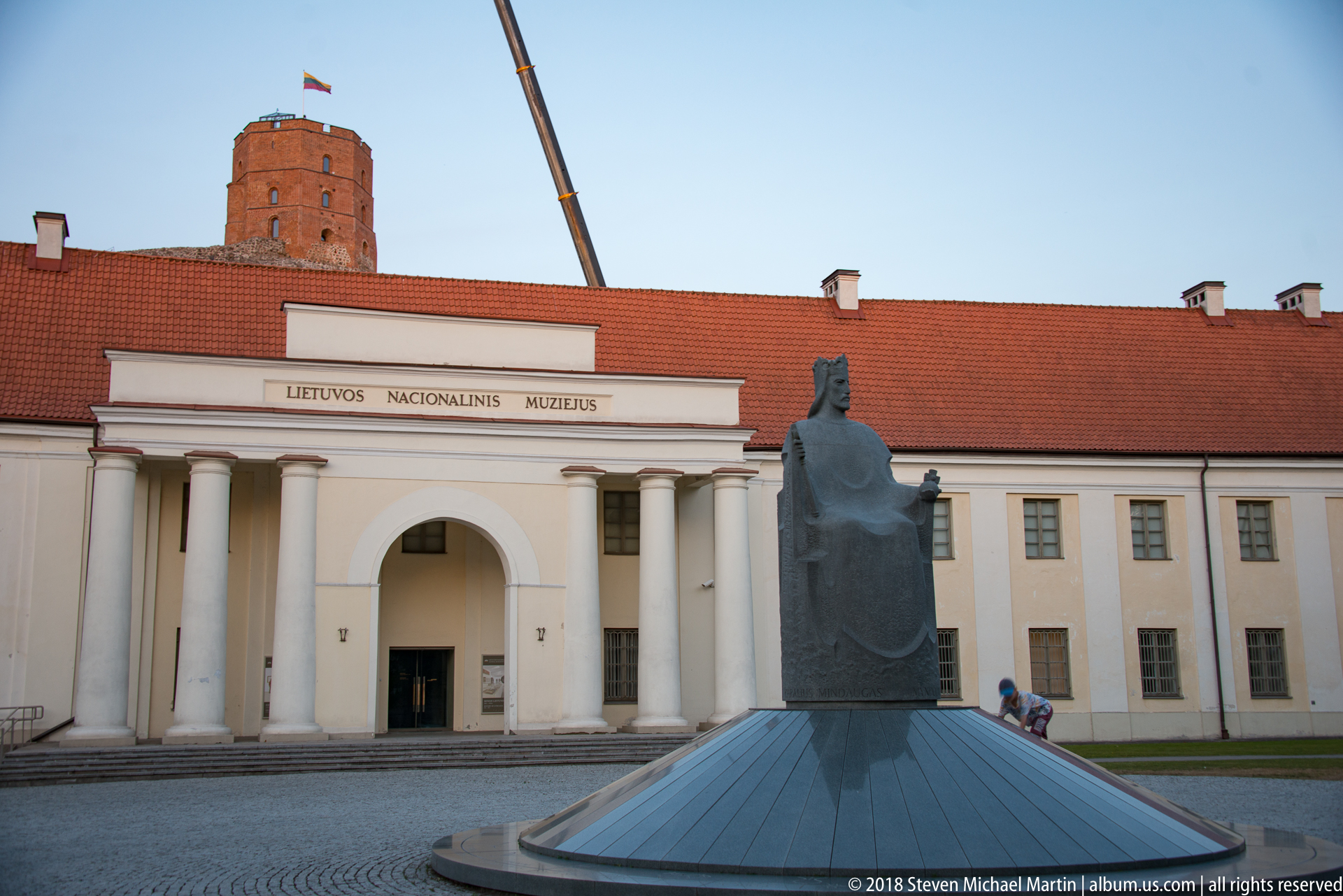
The long pale façade of the Lithuanian National Museum’s New Arsenal is fronted by a classical portico and a simple arched central entrance. The inscription “Lietuvos Nacionalinis Muziejus” identifies the institution above the columns, while a modern sculptural monument occupies the foreground. The composition places national historical memory within the monumental civic landscape beneath Castle Hill.
Caption
The long pale façade of the Lithuanian National Museum’s New Arsenal is fronted by a classical portico and a simple arched central entrance. The inscription “Lietuvos Nacionalinis Muziejus” identifies the institution above the columns, while a modern sculptural monument occupies the foreground. The composition places national historical memory within the monumental civic landscape beneath Castle Hill.

Ruined brick and stone walls of Vilnius’s Upper Castle spread across the crest of Castle Hill as a nearly full moon rises beside the slope. The low viewpoint emphasizes the rugged defensive terrain and surviving masonry, while modern walkways trace the hilltop archaeological area. The scene links the medieval stronghold with the broader skyline of contemporary Vilnius.
Caption
Ruined brick and stone walls of Vilnius’s Upper Castle spread across the crest of Castle Hill as a nearly full moon rises beside the slope. The low viewpoint emphasizes the rugged defensive terrain and surviving masonry, while modern walkways trace the hilltop archaeological area. The scene links the medieval stronghold with the broader skyline of contemporary Vilnius.

A bronze female figure in flowing drapery stands atop a classical rooftop, one arm extended outward and the other raised in a dramatic gesture. Seen against the pale evening sky, the sculpture becomes a strong silhouette separated from the architecture below. The close crop focuses on civic or allegorical ornament rather than the identity of the building itself.
Caption
A bronze female figure in flowing drapery stands atop a classical rooftop, one arm extended outward and the other raised in a dramatic gesture. Seen against the pale evening sky, the sculpture becomes a strong silhouette separated from the architecture below. The close crop focuses on civic or allegorical ornament rather than the identity of the building itself.

Gediminas’ Tower crowns the steep summit of Castle Hill, its red-brick octagonal mass rising above exposed earthworks and stone retaining walls. The Lithuanian tricolor flies from the roof, making the tower both a surviving component of the Upper Castle and a prominent national symbol. The distant viewpoint clearly separates the fortress from the lower city.
Caption
Gediminas’ Tower crowns the steep summit of Castle Hill, its red-brick octagonal mass rising above exposed earthworks and stone retaining walls. The Lithuanian tricolor flies from the roof, making the tower both a surviving component of the Upper Castle and a prominent national symbol. The distant viewpoint clearly separates the fortress from the lower city.

A contemporary commercial complex combines patterned metal-clad towers, a glass central volume, and a low angular foreground building along a major urban corridor. Late-day sunlight produces alternating bands of brightness and shadow across the façades, while overhead trolley wires underscore the site’s integration into the city’s transit network. The composition contrasts sharply with the historic architecture of Vilnius Old Town.
Caption
A contemporary commercial complex combines patterned metal-clad towers, a glass central volume, and a low angular foreground building along a major urban corridor. Late-day sunlight produces alternating bands of brightness and shadow across the façades, while overhead trolley wires underscore the site’s integration into the city’s transit network. The composition contrasts sharply with the historic architecture of Vilnius Old Town.

A large late-modernist concrete building is defined by a dramatic upward-curving roof edge, deep vertical fins, and broad blank wall surfaces. Graffiti, weeds, cracked paving, and empty planters signal disuse, creating a stark contrast between the structure’s ambitious sculptural form and its deteriorated surroundings. The view documents a less polished layer of Vilnius’s twentieth-century architectural landscape.
Caption
A large late-modernist concrete building is defined by a dramatic upward-curving roof edge, deep vertical fins, and broad blank wall surfaces. Graffiti, weeds, cracked paving, and empty planters signal disuse, creating a stark contrast between the structure’s ambitious sculptural form and its deteriorated surroundings. The view documents a less polished layer of Vilnius’s twentieth-century architectural landscape.

A broad expanse of cracked concrete paving stretches toward a solitary modern high-rise, with weeds emerging between the slabs and mature trees enclosing the site. The largely empty plaza conveys the scale of a planned late-twentieth-century civic landscape now showing signs of neglect. The low viewpoint emphasizes distance, repetition, and the contrast between disused ground plane and active city beyond.
Caption
A broad expanse of cracked concrete paving stretches toward a solitary modern high-rise, with weeds emerging between the slabs and mature trees enclosing the site. The largely empty plaza conveys the scale of a planned late-twentieth-century civic landscape now showing signs of neglect. The low viewpoint emphasizes distance, repetition, and the contrast between disused ground plane and active city beyond.
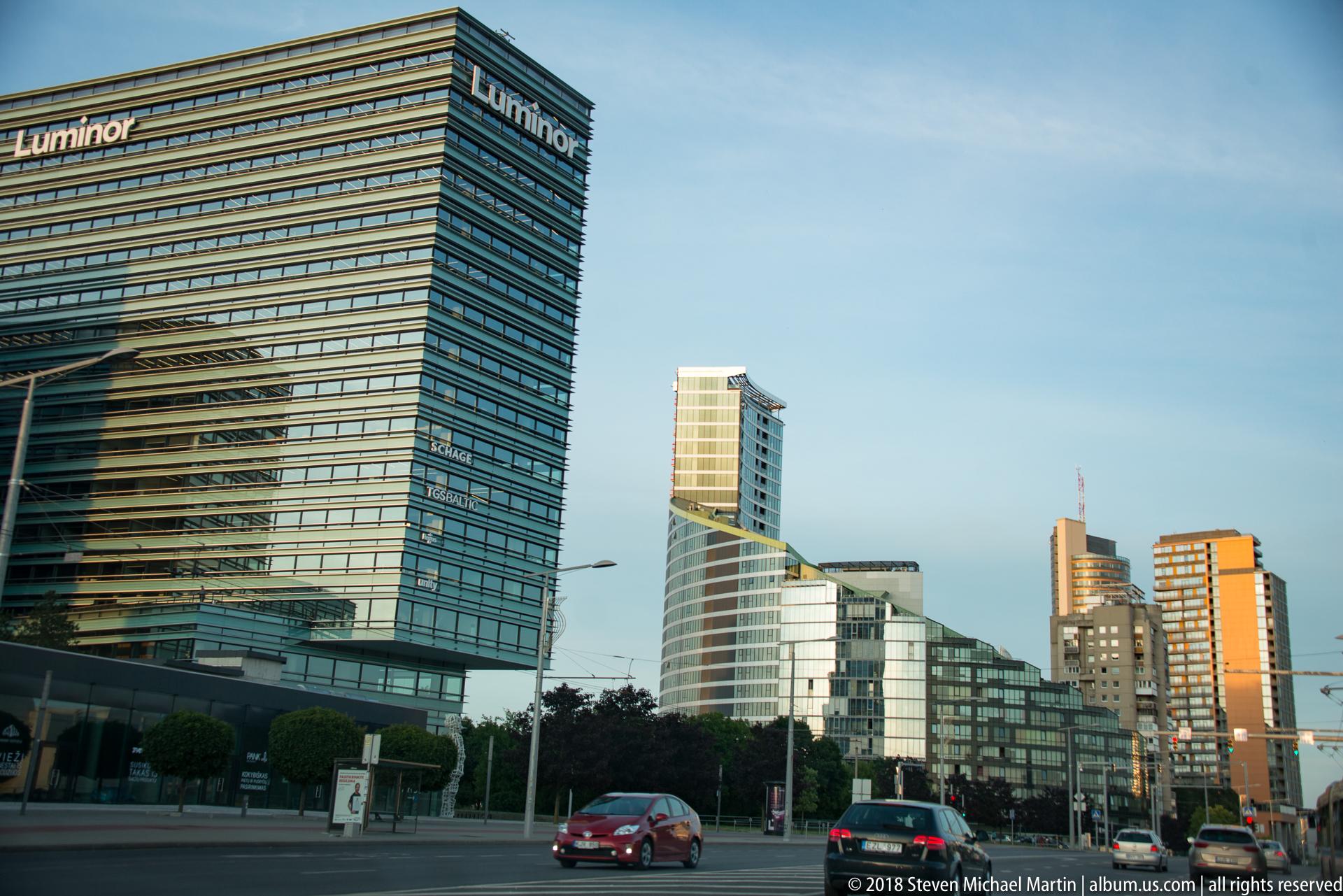
Modern towers line a broad avenue in Vilnius’s contemporary business district, with glass curtain walls, striped façades, and varied rooflines forming a dense skyline. Traffic moves through the foreground while the buildings recede along the street, presenting the city’s post-Soviet commercial center as a deliberate counterpoint to the low-rise historic core across the river.
Caption
Modern towers line a broad avenue in Vilnius’s contemporary business district, with glass curtain walls, striped façades, and varied rooflines forming a dense skyline. Traffic moves through the foreground while the buildings recede along the street, presenting the city’s post-Soviet commercial center as a deliberate counterpoint to the low-rise historic core across the river.

A red-and-cream electric trolleybus pauses on a Vilnius street beneath overhead power wires, its route equipment and utilitarian bodywork reflecting the city’s long-established surface transit network. The low three-quarter view emphasizes the vehicle’s squared windshield, side windows, and roof-mounted current collectors, while surrounding road signs and construction fencing place the bus firmly within an everyday urban setting.
Caption
A red-and-cream electric trolleybus pauses on a Vilnius street beneath overhead power wires, its route equipment and utilitarian bodywork reflecting the city’s long-established surface transit network. The low three-quarter view emphasizes the vehicle’s squared windshield, side windows, and roof-mounted current collectors, while surrounding road signs and construction fencing place the bus firmly within an everyday urban setting.

Oversized white letters spelling “VILNIUS” stand on a simple rectangular frame beside a tree-lined roadway or open urban edge. A small white figure is mounted above the word, turning the installation into a playful city marker. The tightly framed view isolates the typography and civic identity of Lithuania’s capital from the surrounding landscape.
Caption
Oversized white letters spelling “VILNIUS” stand on a simple rectangular frame beside a tree-lined roadway or open urban edge. A small white figure is mounted above the word, turning the installation into a playful city marker. The tightly framed view isolates the typography and civic identity of Lithuania’s capital from the surrounding landscape.

Across calm water at Trakai, the Church of the Visitation of the Blessed Virgin Mary rises above a wooded lakeshore, its pale walls and red roof catching warm evening light. Reflections stretch softly across the lake, while low houses and trees cluster below the church, presenting the historic settlement as a layered landscape of sacred architecture, waterfront, and residential fabric.
Caption
Across calm water at Trakai, the Church of the Visitation of the Blessed Virgin Mary rises above a wooded lakeshore, its pale walls and red roof catching warm evening light. Reflections stretch softly across the lake, while low houses and trees cluster below the church, presenting the historic settlement as a layered landscape of sacred architecture, waterfront, and residential fabric.

Trakai Island Castle rises above Lake Galvė as a compact ensemble of red-brick walls, cylindrical corner towers, steep tiled roofs, and the taller central keep. Warm evening light catches the masonry while trees partially screen the lower curtain walls. Seen across open water, the fortress appears inseparable from its island setting and is one of Lithuania’s most recognizable medieval landmarks.
Caption
Trakai Island Castle rises above Lake Galvė as a compact ensemble of red-brick walls, cylindrical corner towers, steep tiled roofs, and the taller central keep. Warm evening light catches the masonry while trees partially screen the lower curtain walls. Seen across open water, the fortress appears inseparable from its island setting and is one of Lithuania’s most recognizable medieval landmarks.

A row of closely spaced wooden houses in green, red, yellow, and brown lines a quiet Trakai street. Steep roofs, narrow façades, horizontal timber siding, small fenced gardens, and simple sash windows create a strong vernacular rhythm. The view records the colorful domestic character for which Trakai’s historic streets are known, especially in neighborhoods associated with the town’s Karaim heritage.
Caption
A row of closely spaced wooden houses in green, red, yellow, and brown lines a quiet Trakai street. Steep roofs, narrow façades, horizontal timber siding, small fenced gardens, and simple sash windows create a strong vernacular rhythm. The view records the colorful domestic character for which Trakai’s historic streets are known, especially in neighborhoods associated with the town’s Karaim heritage.

A small green-painted wooden house with dark shutters, flower boxes, and a low picket fence occupies the foreground in Trakai. Beyond the roofline, the red towers of Trakai Island Castle remain visible in the distance. The juxtaposition links the town’s modest vernacular wooden architecture with its monumental medieval landmark across the lakeside landscape.
Caption
A small green-painted wooden house with dark shutters, flower boxes, and a low picket fence occupies the foreground in Trakai. Beyond the roofline, the red towers of Trakai Island Castle remain visible in the distance. The juxtaposition links the town’s modest vernacular wooden architecture with its monumental medieval landmark across the lakeside landscape.

Warm late-day light washes across a two-story wooden house with horizontal siding, a steep metal roof, flower boxes, and white-trimmed windows. Mature trees shade the yard while low plantings border the façade. The scene emphasizes the domestic scale and timber building tradition of Trakai’s historic neighborhoods, away from the monumental architecture of the island castle.
Caption
Warm late-day light washes across a two-story wooden house with horizontal siding, a steep metal roof, flower boxes, and white-trimmed windows. Mature trees shade the yard while low plantings border the façade. The scene emphasizes the domestic scale and timber building tradition of Trakai’s historic neighborhoods, away from the monumental architecture of the island castle.

A freestanding visitor-information kiosk marked “TRAKAI” presents a regional map and interpretive text beneath mature trees. Its placement beside the lakeside recreation area signals the transition from the town’s residential streets to the tourist landscape surrounding Lake Galvė and Trakai Island Castle. The image functions as a documentary record of wayfinding and visitor infrastructure.
Caption
A freestanding visitor-information kiosk marked “TRAKAI” presents a regional map and interpretive text beneath mature trees. Its placement beside the lakeside recreation area signals the transition from the town’s residential streets to the tourist landscape surrounding Lake Galvė and Trakai Island Castle. The image functions as a documentary record of wayfinding and visitor infrastructure.

Small wooden houses and garden terraces line the shore of Lake Galvė, where sailboats and small craft are moored close to the residences. Reeds frame the foreground and calm water separates the viewer from the domestic shoreline. The scene shows the intimate relationship between Trakai’s historic settlement pattern and the surrounding lake system.
Caption
Small wooden houses and garden terraces line the shore of Lake Galvė, where sailboats and small craft are moored close to the residences. Reeds frame the foreground and calm water separates the viewer from the domestic shoreline. The scene shows the intimate relationship between Trakai’s historic settlement pattern and the surrounding lake system.

A long wooden footbridge leads directly across Lake Galvė toward the entrance of Trakai Island Castle. The converging railings draw the eye to the central gate tower, while rounded corner towers, brick curtain walls, and steep red roofs rise beyond. The approach emphasizes how the fortress is reached from the mainland across the water that once formed a major element of its defense.
Caption
A long wooden footbridge leads directly across Lake Galvė toward the entrance of Trakai Island Castle. The converging railings draw the eye to the central gate tower, while rounded corner towers, brick curtain walls, and steep red roofs rise beyond. The approach emphasizes how the fortress is reached from the mainland across the water that once formed a major element of its defense.

Seen from the reedy shore of Lake Galvė, Trakai Island Castle rises behind the long wooden footbridge connecting the island to the mainland. The central gate tower and round corner towers are reflected faintly in the water, while tall reeds soften the foreground. This wider composition balances fortress architecture with the natural setting that defines the site.
Caption
Seen from the reedy shore of Lake Galvė, Trakai Island Castle rises behind the long wooden footbridge connecting the island to the mainland. The central gate tower and round corner towers are reflected faintly in the water, while tall reeds soften the foreground. This wider composition balances fortress architecture with the natural setting that defines the site.

A well-kept brown wooden house with steep metal roofs, white-trimmed windows, flower boxes, and a small landscaped garden glows in late-afternoon light. Mature trees frame the building and cast patterned shade across the façade. The scene highlights Trakai’s domestic timber architecture at an intimate scale, contrasting with the massive masonry of the nearby island castle.
Caption
A well-kept brown wooden house with steep metal roofs, white-trimmed windows, flower boxes, and a small landscaped garden glows in late-afternoon light. Mature trees frame the building and cast patterned shade across the façade. The scene highlights Trakai’s domestic timber architecture at an intimate scale, contrasting with the massive masonry of the nearby island castle.

Bright blue and green pedal boats are tied beside a small sailboat at a lakeside dock in Trakai. The sailboat’s hull bears the name “TRAKAI,” while another wooden footbridge stretches across the water behind. The tightly framed marina scene documents the recreational use of Lake Galvė alongside the historic landscape surrounding Trakai Island Castle.
Caption
Bright blue and green pedal boats are tied beside a small sailboat at a lakeside dock in Trakai. The sailboat’s hull bears the name “TRAKAI,” while another wooden footbridge stretches across the water behind. The tightly framed marina scene documents the recreational use of Lake Galvė alongside the historic landscape surrounding Trakai Island Castle.

A roofed open-air pavilion extends over Lake Galvė on a timber platform, with dining tables and chairs arranged beneath its broad canopy. Sailboat masts rise behind the structure, and the surrounding water and wooded shore place the pavilion within Trakai’s recreational waterfront. The view emphasizes leisure infrastructure and the calm evening character of the lake.
Caption
A roofed open-air pavilion extends over Lake Galvė on a timber platform, with dining tables and chairs arranged beneath its broad canopy. Sailboat masts rise behind the structure, and the surrounding water and wooded shore place the pavilion within Trakai’s recreational waterfront. The view emphasizes leisure infrastructure and the calm evening character of the lake.

A small sailboat heels slightly across Lake Galvė beneath a large dark spinnaker, with two sailors working low in the cockpit. The wind-filled sail dominates the frame, turning the scene into a study of movement and recreational sailing against a wooded shoreline. The image records the active lake culture surrounding Trakai beyond its architectural landmarks.
Caption
A small sailboat heels slightly across Lake Galvė beneath a large dark spinnaker, with two sailors working low in the cockpit. The wind-filled sail dominates the frame, turning the scene into a study of movement and recreational sailing against a wooded shoreline. The image records the active lake culture surrounding Trakai beyond its architectural landmarks.

A female mallard floats close to the camera on the sunlit surface of Lake Galvė. Mottled brown plumage, a warm orange-brown bill, and the blue speculum on the folded wing are clearly visible, allowing the bird to be identified confidently. Ripples and reflected sky create a soft, abstract background that isolates the duck from the broader Trakai landscape.
Caption
A female mallard floats close to the camera on the sunlit surface of Lake Galvė. Mottled brown plumage, a warm orange-brown bill, and the blue speculum on the folded wing are clearly visible, allowing the bird to be identified confidently. Ripples and reflected sky create a soft, abstract background that isolates the duck from the broader Trakai landscape.

A female mallard moves through gently rippled water, leaving concentric patterns around its body. The bird’s mottled brown feathers, dark eye stripe, orange-edged bill, and blue speculum remain visible despite the changing reflections. Compared with the adjacent close portrait, this frame places greater emphasis on the texture and movement of the lake surface.
Caption
A female mallard moves through gently rippled water, leaving concentric patterns around its body. The bird’s mottled brown feathers, dark eye stripe, orange-edged bill, and blue speculum remain visible despite the changing reflections. Compared with the adjacent close portrait, this frame places greater emphasis on the texture and movement of the lake surface.

Trakai Island Castle stretches across the far shore of Lake Galvė, its red-brick towers and curtain walls rising above trees and reflected light. The broad expanse of water in the foreground gives the fortress a monumental horizontal presence and emphasizes its island location. A small boat near the walls provides scale and reinforces the site’s continuing relationship with the lake.
Caption
Trakai Island Castle stretches across the far shore of Lake Galvė, its red-brick towers and curtain walls rising above trees and reflected light. The broad expanse of water in the foreground gives the fortress a monumental horizontal presence and emphasizes its island location. A small boat near the walls provides scale and reinforces the site’s continuing relationship with the lake.

Warm late-day light illuminates the red-brick walls and steep tiled roofs of Trakai Island Castle across Lake Galvė. The main gate tower and flanking round towers form a compact silhouette above the water, while trees partially obscure the island’s lower edge. The balanced view presents the fortress as both an architectural monument and the visual center of the surrounding lake landscape.
Caption
Warm late-day light illuminates the red-brick walls and steep tiled roofs of Trakai Island Castle across Lake Galvė. The main gate tower and flanking round towers form a compact silhouette above the water, while trees partially obscure the island’s lower edge. The balanced view presents the fortress as both an architectural monument and the visual center of the surrounding lake landscape.

A distant panorama places Trakai Island Castle near the center of a broad expanse of Lake Galvė. The fortress appears compact against the tree-lined horizon, its red roofs and towers punctuating the low lakeside landscape. A long footbridge extends toward the island at right, giving the composition a clear sense of scale, distance, and the castle’s relationship to open water.
Caption
A distant panorama places Trakai Island Castle near the center of a broad expanse of Lake Galvė. The fortress appears compact against the tree-lined horizon, its red roofs and towers punctuating the low lakeside landscape. A long footbridge extends toward the island at right, giving the composition a clear sense of scale, distance, and the castle’s relationship to open water.
⭐ Highlights
- Old Town (Senamiestis): One of the largest and best-preserved medieval old towns in Europe.
- Gediminas Tower: A historic tower on a hill overlooking the city and symbolizing Lithuanian identity.
- Vilnius Cathedral: A neoclassical landmark at the heart of Cathedral Square.
- St. Anne’s Church: A striking example of Gothic architecture built from red brick.
- Baroque Skyline: Numerous churches and towers give Vilnius its distinctive architectural character.
- UNESCO World Heritage Site: The historic center reflects centuries of cultural and architectural development.
🏙️ Vilnius Field Guide
Major features observed during this visit:
Vilnius, the capital of Lithuania, is one of Europe’s most historically layered cities. Its Old Town preserves a medieval street pattern alongside Gothic, Renaissance, Baroque, and classical architecture, reflecting centuries of cultural influence and political change. The city developed as a major center of the Grand Duchy of Lithuania and continues to blend its historic identity with a modern urban atmosphere.
🏛️ Signature Landmarks
- Gediminas Tower – A remaining part of the Upper Castle offering views over the city.
- Vilnius Cathedral – A central religious and civic landmark in Cathedral Square.
- St. Anne’s Church – A prominent Gothic church known for its intricate brick design.
- Old Town Streets – Narrow lanes and courtyards preserving the medieval layout.
- Gate of Dawn – A historic city gate with religious significance.
🧠 Historical Significance
- Grand Duchy Capital – Vilnius served as a major political and cultural center from the 13th century onward.
- Multicultural City – Influenced by various cultures and religions over centuries.
- UNESCO Recognition – The historic center is recognized for its preserved architecture and urban form.
- Continuity Through Change – Despite wars and occupations, much of the historic structure remains intact.
🌄 Urban Landscape & Setting
- Medieval Street Pattern – The city retains its original layout and organic development.
- Architectural Diversity – Gothic, Renaissance, Baroque, and classical buildings coexist throughout the city.
- Hilltop Views – Elevated points such as Gediminas Hill provide panoramic perspectives.
- Green Capital – Parks and natural spaces are integrated into the urban environment.