Reims – Champagne, France
Reims lies in the Champagne region of northeastern France and has long been one of the most historically important cities in the country. The city is famous for the magnificent Reims Cathedral (Cathédrale Notre-Dame de Reims), a masterpiece of Gothic architecture where the kings of France were traditionally crowned for nearly a thousand years.
During the First World War the city suffered heavy damage as the front lines passed nearby, and the cathedral itself was severely damaged by artillery fire. Following the war, extensive restoration returned the cathedral and much of the historic center to their former appearance.
Today Reims remains both a major cultural center of the Champagne region and a city closely connected to the history of France.

A historic architectural elevation depicts the west façade of Reims Cathedral with its twin towers, triple portals, central rose window, and dense Gothic tracery rendered in fine line. The title “Cathédrale de Reims” is visible across the top. Displayed as a museum object, the drawing reveals how the monument’s sculptural and structural complexity can be translated into a precise two-dimensional record.
Caption
A historic architectural elevation depicts the west façade of Reims Cathedral with its twin towers, triple portals, central rose window, and dense Gothic tracery rendered in fine line. The title “Cathédrale de Reims” is visible across the top. Displayed as a museum object, the drawing reveals how the monument’s sculptural and structural complexity can be translated into a precise two-dimensional record.

A broad plaza-side view places Notre-Dame de Reims within its urban setting, with lawns, trees, pedestrians, and street furniture occupying the foreground. The cathedral’s west towers and south elevation dominate the skyline, while the lower viewpoint allows the full bulk of the Gothic structure to read against the overcast sky. This is an establishing view rather than an architectural detail.
Caption
A broad plaza-side view places Notre-Dame de Reims within its urban setting, with lawns, trees, pedestrians, and street furniture occupying the foreground. The cathedral’s west towers and south elevation dominate the skyline, while the lower viewpoint allows the full bulk of the Gothic structure to read against the overcast sky. This is an establishing view rather than an architectural detail.

The towers and upper west façade of Notre-Dame de Reims appear beyond neighboring rooftops through a large modern window. In the foreground, a glossy yellow circular table reflects the cathedral silhouette, while the room’s blue patterned carpet and contemporary furnishings frame the view. The composition links a private interior vantage point with one of the city’s principal landmarks.
Caption
The towers and upper west façade of Notre-Dame de Reims appear beyond neighboring rooftops through a large modern window. In the foreground, a glossy yellow circular table reflects the cathedral silhouette, while the room’s blue patterned carpet and contemporary furnishings frame the view. The composition links a private interior vantage point with one of the city’s principal landmarks.

Two great circular windows appear on different levels of the cathedral wall, separated by a register of tall stained-glass lancets and sculptural arcading. The upper rose glows in multicolored glass while the lower opening is darker and more deeply recessed. This vertical composition makes the layered organization of the interior elevation unusually clear.
Caption
Two great circular windows appear on different levels of the cathedral wall, separated by a register of tall stained-glass lancets and sculptural arcading. The upper rose glows in multicolored glass while the lower opening is darker and more deeply recessed. This vertical composition makes the layered organization of the interior elevation unusually clear.

The side elevation of Notre-Dame de Reims reveals the cathedral’s skeletal Gothic structure: tall clerestory walls, repeated flying buttresses, pinnacles, and projecting chapels step rhythmically along the nave and choir. Seen from ground level beneath an overcast sky, the view shifts attention away from the famous west front toward the engineering that carries the high vaults.
Caption
The side elevation of Notre-Dame de Reims reveals the cathedral’s skeletal Gothic structure: tall clerestory walls, repeated flying buttresses, pinnacles, and projecting chapels step rhythmically along the nave and choir. Seen from ground level beneath an overcast sky, the view shifts attention away from the famous west front toward the engineering that carries the high vaults.

A monumental war memorial is set behind a broad flower bed, its curved stone screen centered on a recessed colonnaded structure and flanked by two massive end blocks. French tricolor flags rise on either side, reinforcing the commemorative civic setting. The restrained geometry and formal landscaping distinguish the monument from the city's medieval and Roman landmarks documented elsewhere in the portfolio.
Caption
A monumental war memorial is set behind a broad flower bed, its curved stone screen centered on a recessed colonnaded structure and flanked by two massive end blocks. French tricolor flags rise on either side, reinforcing the commemorative civic setting. The restrained geometry and formal landscaping distinguish the monument from the city's medieval and Roman landmarks documented elsewhere in the portfolio.

The nave rises toward a luminous rose window set above a band of stained-glass lancets and a second, darker circular window. Tall clustered piers and pointed arches frame the view, their pale stone surfaces drawing the eye upward through successive architectural levels. The photograph combines the cathedral’s immense spatial scale with its layered program of colored glass.
Caption
The nave rises toward a luminous rose window set above a band of stained-glass lancets and a second, darker circular window. Tall clustered piers and pointed arches frame the view, their pale stone surfaces drawing the eye upward through successive architectural levels. The photograph combines the cathedral’s immense spatial scale with its layered program of colored glass.

Five carved figures line the recessed side of a Reims Cathedral portal, each set on an individual pedestal beneath a sculpted canopy. One central figure wears a tall ecclesiastical headpiece, while neighboring figures hold or gesture toward attributes now difficult to distinguish. The oblique angle makes the portal’s alternating shafts, statues, and deep molding especially legible.
Caption
Five carved figures line the recessed side of a Reims Cathedral portal, each set on an individual pedestal beneath a sculpted canopy. One central figure wears a tall ecclesiastical headpiece, while neighboring figures hold or gesture toward attributes now difficult to distinguish. The oblique angle makes the portal’s alternating shafts, statues, and deep molding especially legible.

A monumental rose window fills the pointed bay with concentric rings of richly colored stained glass. Radiating stone tracery organizes biblical and ornamental figures into petal-like compartments, while sculpted figures occupy the wall niches to either side. The close frontal view isolates the geometry of the glazing and its intense blue, red, and gold palette.
Caption
A monumental rose window fills the pointed bay with concentric rings of richly colored stained glass. Radiating stone tracery organizes biblical and ornamental figures into petal-like compartments, while sculpted figures occupy the wall niches to either side. The close frontal view isolates the geometry of the glazing and its intense blue, red, and gold palette.

A scale model presents Reims Cathedral from the west within a simplified urban and ecclesiastical precinct. The cathedral’s twin towers and blue-green roofs rise above lower surrounding buildings, making its dominance in the complex immediately legible. Viewed from above, the model helps explain massing and spatial relationships that are difficult to grasp from street-level photographs alone.
Caption
A scale model presents Reims Cathedral from the west within a simplified urban and ecclesiastical precinct. The cathedral’s twin towers and blue-green roofs rise above lower surrounding buildings, making its dominance in the complex immediately legible. Viewed from above, the model helps explain massing and spatial relationships that are difficult to grasp from street-level photographs alone.

Two cocktails sit before a large window with Notre-Dame de Reims rising above the neighboring roofs outside. A green drink and an amber foamed drink rest on black napkins atop the reflective yellow table, creating a deliberate foreground pairing with the landmark. The scene combines contemporary hospitality with a recognizable urban view of central Reims.
Caption
Two cocktails sit before a large window with Notre-Dame de Reims rising above the neighboring roofs outside. A green drink and an amber foamed drink rest on black napkins atop the reflective yellow table, creating a deliberate foreground pairing with the landmark. The scene combines contemporary hospitality with a recognizable urban view of central Reims.

Seen almost directly upward, the rose window becomes a dark radial web filled with jewel-like panes. The steep perspective compresses the surrounding architecture and shifts emphasis from narrative detail to the wheel-like structure of the tracery. Reds, blues, greens, and amber tones flicker between the heavy stone ribs, producing a markedly different reading from the frontal view.
Caption
Seen almost directly upward, the rose window becomes a dark radial web filled with jewel-like panes. The steep perspective compresses the surrounding architecture and shifts emphasis from narrative detail to the wheel-like structure of the tracery. Reds, blues, greens, and amber tones flicker between the heavy stone ribs, producing a markedly different reading from the frontal view.

A street corner in central Reims brings together pale stone façades, wrought-iron balconies, shopfronts, and a rounded corner building with a balustraded upper story. The converging streets and varied rooflines give the view a strong sense of the city’s nineteenth- and early-twentieth-century urban fabric, while parked cars and storefronts place the architecture in an active contemporary setting.
Caption
A street corner in central Reims brings together pale stone façades, wrought-iron balconies, shopfronts, and a rounded corner building with a balustraded upper story. The converging streets and varied rooflines give the view a strong sense of the city’s nineteenth- and early-twentieth-century urban fabric, while parked cars and storefronts place the architecture in an active contemporary setting.

A long half-timbered building presents a rhythmic façade of dark timber framing against light infill beneath steep red-tiled roofs. Repeated dormers, projecting gables, and ground-floor shops create a distinctive contrast with the surrounding masonry cityscape. The composition documents a conspicuous survival or revival of timber-frame architecture within the central streets of Reims.
Caption
A long half-timbered building presents a rhythmic façade of dark timber framing against light infill beneath steep red-tiled roofs. Repeated dormers, projecting gables, and ground-floor shops create a distinctive contrast with the surrounding masonry cityscape. The composition documents a conspicuous survival or revival of timber-frame architecture within the central streets of Reims.

A black souvenir T-shirt in a Reims shop window adapts the familiar “Keep Calm” graphic with the slogan “Keep Calm and Drink Champagne.” The display connects everyday tourism merchandise with the city’s strongest regional association: Champagne. Reflections in the glass and surrounding retail fixtures reinforce the object’s setting as a commercial street display rather than a staged studio view.
Caption
A black souvenir T-shirt in a Reims shop window adapts the familiar “Keep Calm” graphic with the slogan “Keep Calm and Drink Champagne.” The display connects everyday tourism merchandise with the city’s strongest regional association: Champagne. Reflections in the glass and surrounding retail fixtures reinforce the object’s setting as a commercial street display rather than a staged studio view.

An elaborately carved church portal fills the frame with layered archivolts, a densely sculpted tympanum, and standing figures set at the sides of the entrance. Weathered pale stone and the shallow relief of the narrative bands emphasize the age and craftsmanship of the ensemble. The close frontal view prioritizes the portal’s iconographic density over the larger building to which it belongs.
Caption
An elaborately carved church portal fills the frame with layered archivolts, a densely sculpted tympanum, and standing figures set at the sides of the entrance. Weathered pale stone and the shallow relief of the narrative bands emphasize the age and craftsmanship of the ensemble. The close frontal view prioritizes the portal’s iconographic density over the larger building to which it belongs.

Two red doors stand beneath a broad sculptural program of carved archivolts, tympana, and jamb figures. The frontal composition makes the contrast between the vivid modern door color and the pale, weathered stone especially striking. Seen together, the paired entrances reveal the scale and narrative richness of the medieval portal ensemble more fully than the closer detail on the preceding image.
Caption
Two red doors stand beneath a broad sculptural program of carved archivolts, tympana, and jamb figures. The frontal composition makes the contrast between the vivid modern door color and the pale, weathered stone especially striking. Seen together, the paired entrances reveal the scale and narrative richness of the medieval portal ensemble more fully than the closer detail on the preceding image.

A projecting stone gargoyle juts from a sloping exterior course, its eroded animal form ending in a hollowed mouth designed to throw rainwater away from the masonry. Lichen and surface loss mark long exposure to weather, while clustered columns and pointed architectural forms behind it place the carving within a Gothic ecclesiastical setting. The close view emphasizes function as much as grotesque imagery.
Caption
A projecting stone gargoyle juts from a sloping exterior course, its eroded animal form ending in a hollowed mouth designed to throw rainwater away from the masonry. Lichen and surface loss mark long exposure to weather, while clustered columns and pointed architectural forms behind it place the carving within a Gothic ecclesiastical setting. The close view emphasizes function as much as grotesque imagery.

A heavily weathered gargoyle projects from the cathedral masonry, its animal body reduced by erosion but its open drainage mouth still clearly visible. Yellow-orange lichen spots the upper surface, adding color to the gray stone. This side view shows how the sculptural spout extends beyond the wall plane to direct rainwater away from the building’s fabric.
Caption
A heavily weathered gargoyle projects from the cathedral masonry, its animal body reduced by erosion but its open drainage mouth still clearly visible. Yellow-orange lichen spots the upper surface, adding color to the gray stone. This side view shows how the sculptural spout extends beyond the wall plane to direct rainwater away from the building’s fabric.

An elongated, horse-like gargoyle leans dramatically outward from a stone buttress, its neck and head forming the terminal of a drainage channel. The body is unusually complete compared with more eroded examples nearby, allowing the sculptural anatomy and functional projection to be read together. The pale wall behind it provides scale and context for this exterior Gothic carving.
Caption
An elongated, horse-like gargoyle leans dramatically outward from a stone buttress, its neck and head forming the terminal of a drainage channel. The body is unusually complete compared with more eroded examples nearby, allowing the sculptural anatomy and functional projection to be read together. The pale wall behind it provides scale and context for this exterior Gothic carving.

A squat stone beast sits upright on a projecting support, facing outward with a wide-open mouth and front paws planted symmetrically. Unlike the long drainage gargoyles nearby, this figure reads primarily as an architectural grotesque or decorative beast. The frontal composition gives unusual prominence to its expressive face and compact body against the vertical stonework of the church.
Caption
A squat stone beast sits upright on a projecting support, facing outward with a wide-open mouth and front paws planted symmetrically. Unlike the long drainage gargoyles nearby, this figure reads primarily as an architectural grotesque or decorative beast. The frontal composition gives unusual prominence to its expressive face and compact body against the vertical stonework of the church.

The west front of Notre-Dame de Reims rises around the central rose window in a dense field of pointed arches, tracery, pinnacles, and sculpted portals. The upward-looking composition compresses the façade’s vertical layers, from the portal gables to the gallery and tower bases. It demonstrates the cathedral’s High Gothic emphasis on sculpture and openwork as integral parts of the architecture.
Caption
The west front of Notre-Dame de Reims rises around the central rose window in a dense field of pointed arches, tracery, pinnacles, and sculpted portals. The upward-looking composition compresses the façade’s vertical layers, from the portal gables to the gallery and tower bases. It demonstrates the cathedral’s High Gothic emphasis on sculpture and openwork as integral parts of the architecture.

Above a portal of Reims Cathedral, a sculptural group centers on Christ and the Virgin beneath an ornate canopy, surrounded by angels and attendant figures. The scene is framed by radiating archivolts and backed by the lace-like tracery of the façade. The close view isolates the narrative sculpture from the broader west front, making the figures’ gestures and hierarchical arrangement easier to read.
Caption
Above a portal of Reims Cathedral, a sculptural group centers on Christ and the Virgin beneath an ornate canopy, surrounded by angels and attendant figures. The scene is framed by radiating archivolts and backed by the lace-like tracery of the façade. The close view isolates the narrative sculpture from the broader west front, making the figures’ gestures and hierarchical arrangement easier to read.

A close detail from the Reims Cathedral façade shows two principal figures turning toward one another beneath Gothic canopies, with angels and smaller figures flanking them. Their raised hands and reciprocal gestures create a strong narrative focus, while a blue-green circular element behind the sculpture adds an unexpected color accent. The tight framing reveals surface modeling that is easily lost in wider façade views.
Caption
A close detail from the Reims Cathedral façade shows two principal figures turning toward one another beneath Gothic canopies, with angels and smaller figures flanking them. Their raised hands and reciprocal gestures create a strong narrative focus, while a blue-green circular element behind the sculpture adds an unexpected color accent. The tight framing reveals surface modeling that is easily lost in wider façade views.

A seated Christ in Majesty dominates a triangular gable on the west façade of Reims Cathedral, raising one hand in blessing while attendant figures stand on either side. The deep architectural frame and sharply pointed gable reinforce the vertical Gothic composition. This close view separates the theological focal figure from the surrounding façade and makes the hierarchy of scale especially clear.
Caption
A seated Christ in Majesty dominates a triangular gable on the west façade of Reims Cathedral, raising one hand in blessing while attendant figures stand on either side. The deep architectural frame and sharply pointed gable reinforce the vertical Gothic composition. This close view separates the theological focal figure from the surrounding façade and makes the hierarchy of scale especially clear.

A dark, animal-headed gargoyle projects sharply from the pale carved stone of Reims Cathedral, its elongated muzzle and open mouth contrasting with the intricate Gothic ornament around it. Metal bracing is visible along the figure’s side, suggesting later stabilization or conservation. The oblique close-up emphasizes the tension between functional waterspout, expressive sculpture, and the delicate architecture surrounding it.
Caption
A dark, animal-headed gargoyle projects sharply from the pale carved stone of Reims Cathedral, its elongated muzzle and open mouth contrasting with the intricate Gothic ornament around it. Metal bracing is visible along the figure’s side, suggesting later stabilization or conservation. The oblique close-up emphasizes the tension between functional waterspout, expressive sculpture, and the delicate architecture surrounding it.

A long dragon-like gargoyle extends horizontally from the cathedral wall, its scaled back, pointed ears, and open snout silhouetted against the sky. The narrow body and pronounced texture distinguish it from the heavier stone beasts in earlier views. Framed from below, the creature appears almost free-standing while the surrounding Gothic sculpture remains softly out of focus.
Caption
A long dragon-like gargoyle extends horizontally from the cathedral wall, its scaled back, pointed ears, and open snout silhouetted against the sky. The narrow body and pronounced texture distinguish it from the heavier stone beasts in earlier views. Framed from below, the creature appears almost free-standing while the surrounding Gothic sculpture remains softly out of focus.

An interpretive panel combines a cutaway model of Reims Cathedral with multilingual text explaining where French royal coronation ceremonies took place inside the building. Colored markers on the model identify ritual locations, turning the cathedral’s complex architecture into a clear spatial guide. The display links the monument’s physical layout to its long ceremonial role in the history of the French monarchy.
Caption
An interpretive panel combines a cutaway model of Reims Cathedral with multilingual text explaining where French royal coronation ceremonies took place inside the building. Colored markers on the model identify ritual locations, turning the cathedral’s complex architecture into a clear spatial guide. The display links the monument’s physical layout to its long ceremonial role in the history of the French monarchy.

A museum panel presents an oblique architectural model of the Palais du Tau beside Reims Cathedral, with routes and numbered points keyed to explanatory text. The display clarifies the palace’s physical relationship to the cathedral and the circulation of royal coronation ceremonies through the complex. Its bird’s-eye format makes the ceremonial precinct legible as a connected ensemble rather than as separate buildings.
Caption
A museum panel presents an oblique architectural model of the Palais du Tau beside Reims Cathedral, with routes and numbered points keyed to explanatory text. The display clarifies the palace’s physical relationship to the cathedral and the circulation of royal coronation ceremonies through the complex. Its bird’s-eye format makes the ceremonial precinct legible as a connected ensemble rather than as separate buildings.

The entrance façade of the Palais du Tau is dressed with large exhibition banners advertising the cathedral treasury and the Musée des Sacres et de la Cathédrale. Visitors stand near the central doorway beneath a carved stone surround and semicircular fanlight. The restrained classical façade contrasts with the vivid blue banners, signaling the building’s present museum function within the historic cathedral precinct.
Caption
The entrance façade of the Palais du Tau is dressed with large exhibition banners advertising the cathedral treasury and the Musée des Sacres et de la Cathédrale. Visitors stand near the central doorway beneath a carved stone surround and semicircular fanlight. The restrained classical façade contrasts with the vivid blue banners, signaling the building’s present museum function within the historic cathedral precinct.

A tighter view of the Palais du Tau entrance centers the arched doorway between large blue banners for the cathedral treasury and coronation museum. Carved consoles and a heraldic crest enliven the otherwise restrained stone façade. By excluding most of the building, the composition emphasizes the museum’s public identity and the decorative details surrounding its principal entrance.
Caption
A tighter view of the Palais du Tau entrance centers the arched doorway between large blue banners for the cathedral treasury and coronation museum. Carved consoles and a heraldic crest enliven the otherwise restrained stone façade. By excluding most of the building, the composition emphasizes the museum’s public identity and the decorative details surrounding its principal entrance.

A long stone hall in the Palais du Tau is divided by heavy columns supporting pointed rib vaults. Display cases occupy the side aisles while discreet floor lighting washes the masonry, emphasizing the depth and rhythm of the space. The view shows how the historic interior has been adapted for museum use without obscuring the architecture of the vaulted hall itself.
Caption
A long stone hall in the Palais du Tau is divided by heavy columns supporting pointed rib vaults. Display cases occupy the side aisles while discreet floor lighting washes the masonry, emphasizing the depth and rhythm of the space. The view shows how the historic interior has been adapted for museum use without obscuring the architecture of the vaulted hall itself.

Colored light washes one bay of a rib-vaulted stone hall in the Palais du Tau, creating a vivid contrast with the warm neutral masonry of the surrounding bays. A massive central pier divides the receding sequence of vaults, and low spotlights trace the floor edges. The image focuses less on displays than on the atmosphere and structural geometry of the historic interior.
Caption
Colored light washes one bay of a rib-vaulted stone hall in the Palais du Tau, creating a vivid contrast with the warm neutral masonry of the surrounding bays. A massive central pier divides the receding sequence of vaults, and low spotlights trace the floor edges. The image focuses less on displays than on the atmosphere and structural geometry of the historic interior.

Hundreds of carved architectural fragments are arranged densely across a vaulted stone room, forming a lapidary collection of capitals, moldings, tracery pieces, and other sculptural elements. The crowded storage-like display conveys both the scale of surviving material and the practical work of preserving fragments removed from historic structures. A larger carved arch element anchors the center of the room.
Caption
Hundreds of carved architectural fragments are arranged densely across a vaulted stone room, forming a lapidary collection of capitals, moldings, tracery pieces, and other sculptural elements. The crowded storage-like display conveys both the scale of surviving material and the practical work of preserving fragments removed from historic structures. A larger carved arch element anchors the center of the room.

An elaborate pale stone fireplace is set against walls patterned with gold fleurs-de-lis on deep blue, creating an unmistakably royal decorative scheme. A crowned shield with fleurs-de-lis occupies the center of the overmantel, flanked by carved architectural motifs and small figures. The ensemble links the room’s ceremonial character to the French monarchy associated with coronations at Reims.
Caption
An elaborate pale stone fireplace is set against walls patterned with gold fleurs-de-lis on deep blue, creating an unmistakably royal decorative scheme. A crowned shield with fleurs-de-lis occupies the center of the overmantel, flanked by carved architectural motifs and small figures. The ensemble links the room’s ceremonial character to the French monarchy associated with coronations at Reims.

A monumental tapestry fills the wall with a crowded battle scene of mounted soldiers, infantry, banners, weapons, and fortified architecture. A dark inscription band runs along the top, while a border of gold fleurs-de-lis on blue reinforces the royal setting of the room. The dense narrative composition rewards close viewing and demonstrates the ceremonial scale of textile display in the Palais du Tau.
Caption
A monumental tapestry fills the wall with a crowded battle scene of mounted soldiers, infantry, banners, weapons, and fortified architecture. A dark inscription band runs along the top, while a border of gold fleurs-de-lis on blue reinforces the royal setting of the room. The dense narrative composition rewards close viewing and demonstrates the ceremonial scale of textile display in the Palais du Tau.

A vertically hung tapestry depicts a formal courtly or ceremonial gathering beneath a rich red canopy, with numerous figures in elaborate dress arranged around the central action. A broad ornamental border frames the scene, while fleur-de-lis wall covering continues around it. The composition emphasizes hierarchy, costume, and ritual rather than the movement of the battle tapestry displayed nearby.
Caption
A vertically hung tapestry depicts a formal courtly or ceremonial gathering beneath a rich red canopy, with numerous figures in elaborate dress arranged around the central action. A broad ornamental border frames the scene, while fleur-de-lis wall covering continues around it. The composition emphasizes hierarchy, costume, and ritual rather than the movement of the battle tapestry displayed nearby.

A large historical painting stages a solemn ceremony around a seated central figure attended by bishops, clergy, courtiers, and officials in richly colored robes. Raised galleries and spectators fill the background, giving the event the character of a major public rite. In the Reims museum context, the work evokes the ceremonial world of royal coronation, though the exact episode is not legible from this view alone.
Caption
A large historical painting stages a solemn ceremony around a seated central figure attended by bishops, clergy, courtiers, and officials in richly colored robes. Raised galleries and spectators fill the background, giving the event the character of a major public rite. In the Reims museum context, the work evokes the ceremonial world of royal coronation, though the exact episode is not legible from this view alone.

A crown-shaped object is displayed under focused light, its lobed form, jeweled bands, cross, and fleur-de-lis ornament rendered in pale material. The nearby label identifies it as a mold or model associated with the crown of Charles X, whose coronation took place at Reims in 1825. The object connects the museum’s decorative arts collection directly to the material culture of coronation ceremony.
Caption
A crown-shaped object is displayed under focused light, its lobed form, jeweled bands, cross, and fleur-de-lis ornament rendered in pale material. The nearby label identifies it as a mold or model associated with the crown of Charles X, whose coronation took place at Reims in 1825. The object connects the museum’s decorative arts collection directly to the material culture of coronation ceremony.

A formal portrait shows a seated cleric in white ecclesiastical dress and dark outer garments, posed in a red upholstered chair and holding a small paper. The lower inscription includes a long name and title, but it is not sufficiently legible on the proof sheet to support a secure identification. The restrained pose and official costume mark the work as an institutional or commemorative portrait.
Caption
A formal portrait shows a seated cleric in white ecclesiastical dress and dark outer garments, posed in a red upholstered chair and holding a small paper. The lower inscription includes a long name and title, but it is not sufficiently legible on the proof sheet to support a secure identification. The restrained pose and official costume mark the work as an institutional or commemorative portrait.

A full-length dynastic portrait presents a young French prince in a blue mantle patterned with gold fleurs-de-lis and edged in ermine. He stands in court dress beside a red drapery, holding a slender ceremonial staff or baton. The youthful face, richly worked textiles, and heraldic costume make royal status—not a specific personal identity—the most defensible reading from the proof sheet.
Caption
A full-length dynastic portrait presents a young French prince in a blue mantle patterned with gold fleurs-de-lis and edged in ermine. He stands in court dress beside a red drapery, holding a slender ceremonial staff or baton. The youthful face, richly worked textiles, and heraldic costume make royal status—not a specific personal identity—the most defensible reading from the proof sheet.

An adult French monarch is shown standing in a blue fleur-de-lis robe lined and trimmed with ermine, one hand resting near a ceremonial seat and the other holding a staff. The elaborate costume and regal pose evoke coronation imagery associated with the French court. The photograph supports identification as a royal portrait, while the precise king should be confirmed from the object label.
Caption
An adult French monarch is shown standing in a blue fleur-de-lis robe lined and trimmed with ermine, one hand resting near a ceremonial seat and the other holding a staff. The elaborate costume and regal pose evoke coronation imagery associated with the French court. The photograph supports identification as a royal portrait, while the precise king should be confirmed from the object label.

Close detail of a sumptuous purple velvet textile shows large metallic-thread fleur-de-lis emblems, braided borders, and heavy gold tassels. The tight framing emphasizes workmanship, texture, and heraldic symbolism rather than the textile's complete form. Such ornament is consistent with ceremonial furnishings or vestments connected with royal display in Reims, though the exact object's function is not visible here.
Caption
Close detail of a sumptuous purple velvet textile shows large metallic-thread fleur-de-lis emblems, braided borders, and heavy gold tassels. The tight framing emphasizes workmanship, texture, and heraldic symbolism rather than the textile's complete form. Such ornament is consistent with ceremonial furnishings or vestments connected with royal display in Reims, though the exact object's function is not visible here.

A compact historical scene gathers bishops, cardinals, clergy, courtiers, and attendants around a seated ruler. Mitres, red vestments, a processional cross, and formal court dress establish a ceremonial setting, while the central enthroned figure suggests a coronation or related royal rite. The image is best cataloged by its visible ceremonial action unless the painting's title is verified from the museum record.
Caption
A compact historical scene gathers bishops, cardinals, clergy, courtiers, and attendants around a seated ruler. Mitres, red vestments, a processional cross, and formal court dress establish a ceremonial setting, while the central enthroned figure suggests a coronation or related royal rite. The image is best cataloged by its visible ceremonial action unless the painting's title is verified from the museum record.

A densely populated ceremonial painting depicts officials, clergy, soldiers, and courtiers assembled before an elevated platform under a high interior canopy. The composition stresses public ritual: processional movement occupies the foreground while dignitaries cluster around the raised ceremonial center. The scene likely relates to French royal rites at Reims, but its exact episode should be assigned only after label verification.
Caption
A densely populated ceremonial painting depicts officials, clergy, soldiers, and courtiers assembled before an elevated platform under a high interior canopy. The composition stresses public ritual: processional movement occupies the foreground while dignitaries cluster around the raised ceremonial center. The scene likely relates to French royal rites at Reims, but its exact episode should be assigned only after label verification.

An elegant museum room displays ceremonial objects in tall glass cases beneath crystal chandeliers, with blue wall hangings and a red focal wall beyond. The polished parquet floor, symmetrical cases, and throne-like object at the far end create a formal treasury-gallery setting. The view documents the exhibition context rather than a single artifact.
Caption
An elegant museum room displays ceremonial objects in tall glass cases beneath crystal chandeliers, with blue wall hangings and a red focal wall beyond. The polished parquet floor, symmetrical cases, and throne-like object at the far end create a formal treasury-gallery setting. The view documents the exhibition context rather than a single artifact.

A standing monarch in white and ermine-trimmed ceremonial robes poses beside a table bearing crown-like regalia and other royal objects. A richly draped architectural setting and formal stance reinforce the portrait's dynastic purpose. The work clearly belongs to royal iconography, but the sitter's identity and the precise regalia should not be inferred from costume alone.
Caption
A standing monarch in white and ermine-trimmed ceremonial robes poses beside a table bearing crown-like regalia and other royal objects. A richly draped architectural setting and formal stance reinforce the portrait's dynastic purpose. The work clearly belongs to royal iconography, but the sitter's identity and the precise regalia should not be inferred from costume alone.

An elaborately worked gilt object combines a cylindrical body with scrolling mounts, medallion-like reliefs, finials, and a dark rounded element at the top. Its dense repoussé and cast decoration suggest a ceremonial or devotional function. Because the precise object type and dedication are not legible from the proof sheet, the record remains deliberately descriptive.
Caption
An elaborately worked gilt object combines a cylindrical body with scrolling mounts, medallion-like reliefs, finials, and a dark rounded element at the top. Its dense repoussé and cast decoration suggest a ceremonial or devotional function. Because the precise object type and dedication are not legible from the proof sheet, the record remains deliberately descriptive.

A radiant gilt monstrance rises on a sculptural stem, its circular red center surrounded by a broad sunburst of metal rays. The object is displayed upright against a red museum backdrop, emphasizing both its liturgical function and theatrical craftsmanship. Figurative support elements and the substantial base add a distinctly ceremonial character.
Caption
A radiant gilt monstrance rises on a sculptural stem, its circular red center surrounded by a broad sunburst of metal rays. The object is displayed upright against a red museum backdrop, emphasizing both its liturgical function and theatrical craftsmanship. Figurative support elements and the substantial base add a distinctly ceremonial character.

A large faceted amber-colored oval stone dominates a small architectural mount of gilded metal, pointed arches, floral motifs, and white enamel details. The miniature Gothic framework turns the jewel into a devotional or ceremonial object rather than simple personal adornment. Its exact relic, dedication, and date are not readable in the photograph.
Caption
A large faceted amber-colored oval stone dominates a small architectural mount of gilded metal, pointed arches, floral motifs, and white enamel details. The miniature Gothic framework turns the jewel into a devotional or ceremonial object rather than simple personal adornment. Its exact relic, dedication, and date are not readable in the photograph.

Three matching covered vessels stand on a silver-toned tray, each formed as a small gilt urn with engraved decoration and a cross finial. Their repeated form and careful presentation indicate a coordinated liturgical set. The photograph clearly records shape and material, while the exact sacramental use of the vessels should be verified against the treasury label.
Caption
Three matching covered vessels stand on a silver-toned tray, each formed as a small gilt urn with engraved decoration and a cross finial. Their repeated form and careful presentation indicate a coordinated liturgical set. The photograph clearly records shape and material, while the exact sacramental use of the vessels should be verified against the treasury label.

Two matching ewers with tall handles, narrow necks, and richly worked bodies stand on an oval metal tray. Applied relief decoration and contrasting gilt and silver tones give the pair the appearance of a formal liturgical service. A nearby museum label appears to identify the set, but the text is too small here to support a more exact catalog title.
Caption
Two matching ewers with tall handles, narrow necks, and richly worked bodies stand on an oval metal tray. Applied relief decoration and contrasting gilt and silver tones give the pair the appearance of a formal liturgical service. A nearby museum label appears to identify the set, but the text is too small here to support a more exact catalog title.

An elaborate reliquary-like object combines a raised rectangular casket with a sloping base populated by small sculpted figures. A bird finial sits atop the upper box, while corner figures and narrative reliefs animate the gold-toned structure. Its architectural form and figural program strongly suggest a major treasury object, though the saint or dedication is not readable here.
Caption
An elaborate reliquary-like object combines a raised rectangular casket with a sloping base populated by small sculpted figures. A bird finial sits atop the upper box, while corner figures and narrative reliefs animate the gold-toned structure. Its architectural form and figural program strongly suggest a major treasury object, though the saint or dedication is not readable here.

A framed manuscript or ceremonial document is surrounded by a richly painted blue-and-gold border filled with small medallions, floral ornament, and figurative details. A large heading and dense central text occupy the page, while a kneeling figure and angels animate the lower margin. The document's exact wording is too small to read reliably from the proof sheet.
Caption
A framed manuscript or ceremonial document is surrounded by a richly painted blue-and-gold border filled with small medallions, floral ornament, and figurative details. A large heading and dense central text occupy the page, while a kneeling figure and angels animate the lower margin. The document's exact wording is too small to read reliably from the proof sheet.

A sculptural gilt relief centers on a haloed or radiating bust enclosed by a circular frame, flanked below by two seated angelic figures. Draped forms, scrollwork, and a cross rising above the composition create a dense devotional ensemble. The exact saint or subject is not securely identifiable from facial features alone.
Caption
A sculptural gilt relief centers on a haloed or radiating bust enclosed by a circular frame, flanked below by two seated angelic figures. Draped forms, scrollwork, and a cross rising above the composition create a dense devotional ensemble. The exact saint or subject is not securely identifiable from facial features alone.

Gold embroidery on crimson velvet forms a large crowned monogram framed by scrolling vegetal motifs. The crown occupies the upper register, while interlaced initials and symmetrical flourishes dominate the center. The tight crop records textile craftsmanship and royal insignia, but the specific monarch represented by the monogram should be verified rather than inferred.
Caption
Gold embroidery on crimson velvet forms a large crowned monogram framed by scrolling vegetal motifs. The crown occupies the upper register, while interlaced initials and symmetrical flourishes dominate the center. The tight crop records textile craftsmanship and royal insignia, but the specific monarch represented by the monogram should be verified rather than inferred.

A high Gothic interior is viewed along its central axis toward a small altar beneath tall lancet windows. Pointed arches, clustered columns, and rib vaults define the stone space, while side arcades open into narrow bays. The photograph emphasizes architectural rhythm and verticality rather than a specific devotional object.
Caption
A high Gothic interior is viewed along its central axis toward a small altar beneath tall lancet windows. Pointed arches, clustered columns, and rib vaults define the stone space, while side arcades open into narrow bays. The photograph emphasizes architectural rhythm and verticality rather than a specific devotional object.

A close view isolates one face of an ornate metal object: a rectangular panel bordered by small bosses and ornament, with crossed linear motifs surrounding a central wreath and shell- or flame-like emblem. Blue and gold accents remain visible around the frame. The crop is too tight to determine the complete object's function with confidence.
Caption
A close view isolates one face of an ornate metal object: a rectangular panel bordered by small bosses and ornament, with crossed linear motifs surrounding a central wreath and shell- or flame-like emblem. Blue and gold accents remain visible around the frame. The crop is too tight to determine the complete object's function with confidence.

A central crucifix on a tall patterned shaft is displayed between two matching candlesticks, forming a symmetrical liturgical ensemble. The metal surfaces carry repeated ornamental bands and small colored details, while the dark stone architecture behind them provides a subdued ecclesiastical setting. The grouping appears intended for altar use and is documented here as a coordinated set.
Caption
A central crucifix on a tall patterned shaft is displayed between two matching candlesticks, forming a symmetrical liturgical ensemble. The metal surfaces carry repeated ornamental bands and small colored details, while the dark stone architecture behind them provides a subdued ecclesiastical setting. The grouping appears intended for altar use and is documented here as a coordinated set.

A small gilt shrine takes the form of a miniature gabled building with corner turrets and engraved walls. A standing ecclesiastical figure occupies the open front beneath the steep roof, while the rear casket-like section suggests a reliquary function. The saint's identity is not legible from the proof sheet and should be confirmed from the adjacent label.
Caption
A small gilt shrine takes the form of a miniature gabled building with corner turrets and engraved walls. A standing ecclesiastical figure occupies the open front beneath the steep roof, while the rear casket-like section suggests a reliquary function. The saint's identity is not legible from the proof sheet and should be confirmed from the adjacent label.

A broad, shallow gold chalice rests on a wide foot and jeweled knop, its surface densely ornamented with repoussé work and multicolored cabochons. The low bowl and expansive base create a powerful horizontal profile unlike the taller liturgical vessels nearby. The photograph provides a strong record of form, metalwork, and gem setting without revealing a catalog inscription.
Caption
A broad, shallow gold chalice rests on a wide foot and jeweled knop, its surface densely ornamented with repoussé work and multicolored cabochons. The low bowl and expansive base create a powerful horizontal profile unlike the taller liturgical vessels nearby. The photograph provides a strong record of form, metalwork, and gem setting without revealing a catalog inscription.

An oval transparent central stone or crystal is enclosed by a heavy gold mount set with pearls and multicolored gemstones. The jewel-like frame includes green and red stones and a small angular upper section, giving the object the appearance of a portable reliquary or devotional jewel. The contents and material of the transparent center are not sufficiently clear to identify with certainty.
Caption
An oval transparent central stone or crystal is enclosed by a heavy gold mount set with pearls and multicolored gemstones. The jewel-like frame includes green and red stones and a small angular upper section, giving the object the appearance of a portable reliquary or devotional jewel. The contents and material of the transparent center are not sufficiently clear to identify with certainty.

An elaborate ceremonial collar is composed of repeating gold fleur-de-lis and red enamel links, terminating in a large pointed star-shaped pendant suspended at the center. The heraldic vocabulary and necklace-like format indicate an order or court decoration. The specific chivalric order should be confirmed from the collection record rather than assigned from appearance alone.
Caption
An elaborate ceremonial collar is composed of repeating gold fleur-de-lis and red enamel links, terminating in a large pointed star-shaped pendant suspended at the center. The heraldic vocabulary and necklace-like format indicate an order or court decoration. The specific chivalric order should be confirmed from the collection record rather than assigned from appearance alone.

A gold cross combines a sculpted corpus of Christ with projecting lobes and small relief medallions at the arm ends. Its compact form and ornamental terminals suggest a treasury object intended for devotion or relic display rather than a large architectural crucifix. A nearby label appears to contain a specific identification, but it is not legible enough here to rely upon.
Caption
A gold cross combines a sculpted corpus of Christ with projecting lobes and small relief medallions at the arm ends. Its compact form and ornamental terminals suggest a treasury object intended for devotion or relic display rather than a large architectural crucifix. A nearby label appears to contain a specific identification, but it is not legible enough here to rely upon.

A gilt devotional relief repeats the composition of a haloed central bust enclosed within a circular frame, with two seated angels below and a radiant cross rising above. Draped upper figures and dense scrollwork create a compact pyramidal arrangement. This closer, straighter view offers a more legible record of the object's symmetry and relief carving than the earlier angle.
Caption
A gilt devotional relief repeats the composition of a haloed central bust enclosed within a circular frame, with two seated angels below and a radiant cross rising above. Draped upper figures and dense scrollwork create a compact pyramidal arrangement. This closer, straighter view offers a more legible record of the object's symmetry and relief carving than the earlier angle.

A white enameled eight-pointed star hangs from a gold chain, its green inner points framing a pale eagle with outstretched wings. Gold scrollwork fills the spaces between the star's arms, creating a richly layered insignia. The badge is evidently connected with a formal order or decoration, but the specific order should be assigned only after catalog verification.
Caption
A white enameled eight-pointed star hangs from a gold chain, its green inner points framing a pale eagle with outstretched wings. Gold scrollwork fills the spaces between the star's arms, creating a richly layered insignia. The badge is evidently connected with a formal order or decoration, but the specific order should be assigned only after catalog verification.

A richly chased gilt censer hangs from multiple chains, its pierced upper body framed by projecting sculptural figures and dense floral ornament. The rounded vessel stands on a small foot, while openwork above allows incense smoke to escape during liturgical use. The museum label is present but not fully legible; the object's function as a thurible is nevertheless visually secure.
Caption
A richly chased gilt censer hangs from multiple chains, its pierced upper body framed by projecting sculptural figures and dense floral ornament. The rounded vessel stands on a small foot, while openwork above allows incense smoke to escape during liturgical use. The museum label is present but not fully legible; the object's function as a thurible is nevertheless visually secure.

A worn stone figure stands frontally in scale- or plate-like armor, one arm raised beside a dark pole weapon with a broad angular head. Facial details are softened by age and surface loss, while the compact stance and military costume suggest a guard, saint, or historic warrior. The figure's identity cannot be determined from the image alone.
Caption
A worn stone figure stands frontally in scale- or plate-like armor, one arm raised beside a dark pole weapon with a broad angular head. Facial details are softened by age and surface loss, while the compact stance and military costume suggest a guard, saint, or historic warrior. The figure's identity cannot be determined from the image alone.

The west front of a scale model of Reims Cathedral is shown head-on, emphasizing the twin towers, large central rose window, triple portal arrangement, and steep roof mass behind the façade. Simplified cream-colored surfaces clarify the Gothic composition without the visual complexity of weathered stone sculpture. This view complements the preceding oblique model photograph by focusing on the cathedral's principal entrance elevation.
Caption
The west front of a scale model of Reims Cathedral is shown head-on, emphasizing the twin towers, large central rose window, triple portal arrangement, and steep roof mass behind the façade. Simplified cream-colored surfaces clarify the Gothic composition without the visual complexity of weathered stone sculpture. This view complements the preceding oblique model photograph by focusing on the cathedral's principal entrance elevation.

A scale model presents Reims Cathedral as a three-dimensional teaching object, viewed obliquely from the choir end along one long side. Flying buttresses, radiating chapels, twin western towers, and the long high roof are simplified but clearly articulated. The model makes the cathedral's structural organization easier to read than a ground-level exterior view.
Caption
A scale model presents Reims Cathedral as a three-dimensional teaching object, viewed obliquely from the choir end along one long side. Flying buttresses, radiating chapels, twin western towers, and the long high roof are simplified but clearly articulated. The model makes the cathedral's structural organization easier to read than a ground-level exterior view.

A large woven tapestry centers on a formal gathering of richly dressed men and women within an architectural interior. Deep blue draperies frame the scene, while a broad ornamental border of foliage, grotesques, medallions, and heraldic devices encloses the narrative panel. The figures’ gestures imply a ceremonial encounter, though the exact story is not legible from the proof sheet alone.
Caption
A large woven tapestry centers on a formal gathering of richly dressed men and women within an architectural interior. Deep blue draperies frame the scene, while a broad ornamental border of foliage, grotesques, medallions, and heraldic devices encloses the narrative panel. The figures’ gestures imply a ceremonial encounter, though the exact story is not legible from the proof sheet alone.

A weathered stone figure of a bearded man stands against a warm ochre display background, one hand extended and the other supporting a shallow circular object. The compact, frontal carving and simplified drapery suggest an architectural or devotional sculpture removed from its original setting. Surface abrasion has softened the face and hands, leaving the figure’s precise identity and attribute uncertain.
Caption
A weathered stone figure of a bearded man stands against a warm ochre display background, one hand extended and the other supporting a shallow circular object. The compact, frontal carving and simplified drapery suggest an architectural or devotional sculpture removed from its original setting. Surface abrasion has softened the face and hands, leaving the figure’s precise identity and attribute uncertain.

A historical painting shows the west end of Reims Cathedral surrounded by extensive timber scaffolding, with work concentrated around one tower and the upper façade. The square before the church is sparsely occupied, allowing the temporary wooden structure to dominate the scene. The work records a period of major repair or reconstruction rather than presenting the cathedral as a finished monument.
Caption
A historical painting shows the west end of Reims Cathedral surrounded by extensive timber scaffolding, with work concentrated around one tower and the upper façade. The square before the church is sparsely occupied, allowing the temporary wooden structure to dominate the scene. The work records a period of major repair or reconstruction rather than presenting the cathedral as a finished monument.

A broad rose window glows against an almost black interior wall, accompanied below by three smaller circular stained-glass openings. The dark exposure suppresses the stone architecture so that the colored glazing reads as floating geometry. Figural and ornamental segments radiate around the center of the upper rose, while the lower windows form a balanced secondary register.
Caption
A broad rose window glows against an almost black interior wall, accompanied below by three smaller circular stained-glass openings. The dark exposure suppresses the stone architecture so that the colored glazing reads as floating geometry. Figural and ornamental segments radiate around the center of the upper rose, while the lower windows form a balanced secondary register.

A woven pastoral scene opens onto a lush garden landscape with trees, a bridge or balustrade, and distant architecture. Figures in classical dress occupy the right foreground beside a columned building, while the surrounding border carries elaborate scrolling ornament and medallions. The composition contrasts cultivated landscape with architectural refinement, but the precise literary or mythological episode remains uncertain.
Caption
A woven pastoral scene opens onto a lush garden landscape with trees, a bridge or balustrade, and distant architecture. Figures in classical dress occupy the right foreground beside a columned building, while the surrounding border carries elaborate scrolling ornament and medallions. The composition contrasts cultivated landscape with architectural refinement, but the precise literary or mythological episode remains uncertain.

Two tall tapestries hang side by side, each presenting a densely populated interior scene framed by broad architectural and ornamental borders. The left panel includes seated and standing figures gathered around a table-like setting; the right shifts attention toward a raised architectural enclosure. Their paired display emphasizes the scale, narrative richness, and textile craftsmanship of the ensemble.
Caption
Two tall tapestries hang side by side, each presenting a densely populated interior scene framed by broad architectural and ornamental borders. The left panel includes seated and standing figures gathered around a table-like setting; the right shifts attention toward a raised architectural enclosure. Their paired display emphasizes the scale, narrative richness, and textile craftsmanship of the ensemble.

A museum wall combines two historic tapestries with a row of carved stone fragments and a life-size standing figure. The horizontal tapestry above depicts a narrative scene, while the vertical hanging at left adds a second woven composition. Four sculptural fragments on white plinths establish a dialogue between textile and architectural sculpture within the gallery display.
Caption
A museum wall combines two historic tapestries with a row of carved stone fragments and a life-size standing figure. The horizontal tapestry above depicts a narrative scene, while the vertical hanging at left adds a second woven composition. Four sculptural fragments on white plinths establish a dialogue between textile and architectural sculpture within the gallery display.

A richly woven floral tapestry centers on the Virgin and Child within a large oval medallion, surrounded by smaller circular portraits and dense scrolling foliage. Gold and green tones dominate the textile, while heraldic devices and ornamental borders organize the outer field. The devotional centerpiece contrasts with the tapestry’s highly decorative millefleurs-like treatment.
Caption
A richly woven floral tapestry centers on the Virgin and Child within a large oval medallion, surrounded by smaller circular portraits and dense scrolling foliage. Gold and green tones dominate the textile, while heraldic devices and ornamental borders organize the outer field. The devotional centerpiece contrasts with the tapestry’s highly decorative millefleurs-like treatment.

A densely figured tapestry presents a formal ecclesiastical scene before an elaborate architectural backdrop. A seated or elevated church dignitary occupies the central zone as clergy and attendants gather around, while inscriptions and smaller episodes fill the surrounding field. Two freestanding stone figures frame the hanging in the museum display, reinforcing the medieval visual context.
Caption
A densely figured tapestry presents a formal ecclesiastical scene before an elaborate architectural backdrop. A seated or elevated church dignitary occupies the central zone as clergy and attendants gather around, while inscriptions and smaller episodes fill the surrounding field. Two freestanding stone figures frame the hanging in the museum display, reinforcing the medieval visual context.

A group of weathered stone figures is assembled around the peak of an architectural fragment, creating a layered composition of standing and seated forms. Several figures retain long drapery and gestures toward one another, while losses and broken surfaces make the original program difficult to reconstruct. The museum presentation allows the surviving sculpture to be viewed as an ensemble rather than as isolated fragments.
Caption
A group of weathered stone figures is assembled around the peak of an architectural fragment, creating a layered composition of standing and seated forms. Several figures retain long drapery and gestures toward one another, while losses and broken surfaces make the original program difficult to reconstruct. The museum presentation allows the surviving sculpture to be viewed as an ensemble rather than as isolated fragments.

A stone plaque marks the UNESCO World Heritage designation associated with Reims Cathedral and the Palais du Tau. The World Heritage emblem appears above French text explaining the site’s inscription, with the names “Cathédrale Notre-Dame” and “Palais du Tau” printed at the bottom. The plaque anchors the portfolio’s museum and cathedral sequence within the protected monumental ensemble.
Caption
A stone plaque marks the UNESCO World Heritage designation associated with Reims Cathedral and the Palais du Tau. The World Heritage emblem appears above French text explaining the site’s inscription, with the names “Cathédrale Notre-Dame” and “Palais du Tau” printed at the bottom. The plaque anchors the portfolio’s museum and cathedral sequence within the protected monumental ensemble.

Concentric bands of sculpted archivolts rise above a cathedral portal toward a small rose window, filling nearly every surface with figures and foliage. Slender colonnettes and pointed moldings frame the opening, while a horizontal sculptural register bridges the transition to the window. The close viewpoint foregrounds the density of the cathedral’s carved exterior program.
Caption
Concentric bands of sculpted archivolts rise above a cathedral portal toward a small rose window, filling nearly every surface with figures and foliage. Slender colonnettes and pointed moldings frame the opening, while a horizontal sculptural register bridges the transition to the window. The close viewpoint foregrounds the density of the cathedral’s carved exterior program.

Three monumental jamb figures stand beneath carved canopies at a Reims Cathedral portal. Their elongated bodies, controlled drapery, and individualized heads demonstrate how Gothic sculpture was integrated directly into the architecture rather than treated as freestanding decoration. Smaller reliefs at the left edge reveal the dense narrative carving that surrounds the larger saints or biblical figures.
Caption
Three monumental jamb figures stand beneath carved canopies at a Reims Cathedral portal. Their elongated bodies, controlled drapery, and individualized heads demonstrate how Gothic sculpture was integrated directly into the architecture rather than treated as freestanding decoration. Smaller reliefs at the left edge reveal the dense narrative carving that surrounds the larger saints or biblical figures.

The long nave of Notre-Dame de Reims stretches toward the choir beneath a succession of pointed rib vaults. Massive compound piers divide the central vessel from the side aisles, while rows of chairs and a central passage lead the eye toward stained glass at the eastern end. The composition conveys the cathedral’s exceptional vertical scale and disciplined Gothic rhythm.
Caption
The long nave of Notre-Dame de Reims stretches toward the choir beneath a succession of pointed rib vaults. Massive compound piers divide the central vessel from the side aisles, while rows of chairs and a central passage lead the eye toward stained glass at the eastern end. The composition conveys the cathedral’s exceptional vertical scale and disciplined Gothic rhythm.

The center of a Gothic rose window is shown at close range, revealing individual figural medallions embedded within the radiating tracery. Deep cobalt glass dominates the composition, punctuated by red, green, yellow, and white passages. The tighter framing makes the narrative scenes and layered circular geometry legible as separate components of the larger window.
Caption
The center of a Gothic rose window is shown at close range, revealing individual figural medallions embedded within the radiating tracery. Deep cobalt glass dominates the composition, punctuated by red, green, yellow, and white passages. The tighter framing makes the narrative scenes and layered circular geometry legible as separate components of the larger window.

A continuous row of narrow stained-glass lancets fills the lower portion of a cathedral wall beneath a delicate screen of pointed Gothic arches. Each vertical panel contains standing figures and narrative scenes in saturated reds, blues, greens, and golds. The cropped view emphasizes the rhythm of repeated windows and the architectural framework that unifies them.
Caption
A continuous row of narrow stained-glass lancets fills the lower portion of a cathedral wall beneath a delicate screen of pointed Gothic arches. Each vertical panel contains standing figures and narrative scenes in saturated reds, blues, greens, and golds. The cropped view emphasizes the rhythm of repeated windows and the architectural framework that unifies them.

Three tall windows are isolated against a dark interior, each packed with small figurative scenes stacked vertically within intricate leadwork. Blue dominates the glazing, enriched with red, green, gold, and white passages. Their narrow proportions and dense narrative arrangement contrast strongly with the broad rose windows elsewhere in the cathedral.
Caption
Three tall windows are isolated against a dark interior, each packed with small figurative scenes stacked vertically within intricate leadwork. Blue dominates the glazing, enriched with red, green, gold, and white passages. Their narrow proportions and dense narrative arrangement contrast strongly with the broad rose windows elsewhere in the cathedral.

Modern abstract stained-glass lancets rise above a side chapel furnished with an altar, rail, and carved stone niches. The saturated red, blue, yellow, and green glazing casts vivid color into a setting otherwise defined by pale Gothic masonry. Seen in context rather than close-up, the windows demonstrate how contemporary art has been integrated into the cathedral’s historic devotional space.
Caption
Modern abstract stained-glass lancets rise above a side chapel furnished with an altar, rail, and carved stone niches. The saturated red, blue, yellow, and green glazing casts vivid color into a setting otherwise defined by pale Gothic masonry. Seen in context rather than close-up, the windows demonstrate how contemporary art has been integrated into the cathedral’s historic devotional space.

An outdoor interpretation panel identifies the Cathédrale Notre-Dame and describes its role as a place of royal coronation and the baptism of Clovis. A small reproduction of a medieval or historic coronation scene accompanies multilingual text. The sign provides direct contextual evidence for Reims Cathedral’s association with the French monarchy and the city’s ceremonial history.
Caption
An outdoor interpretation panel identifies the Cathédrale Notre-Dame and describes its role as a place of royal coronation and the baptism of Clovis. A small reproduction of a medieval or historic coronation scene accompanies multilingual text. The sign provides direct contextual evidence for Reims Cathedral’s association with the French monarchy and the city’s ceremonial history.

Bold shards of red, blue, yellow, green, and white glass fill a group of tall Gothic lancets with an unmistakably modern abstract design. The irregular color fields reject traditional figural storytelling while remaining contained within medieval pointed tracery. A dark silhouetted liturgical fitting in the foreground heightens the contrast between the historic stone setting and contemporary glazing.
Caption
Bold shards of red, blue, yellow, green, and white glass fill a group of tall Gothic lancets with an unmistakably modern abstract design. The irregular color fields reject traditional figural storytelling while remaining contained within medieval pointed tracery. A dark silhouetted liturgical fitting in the foreground heightens the contrast between the historic stone setting and contemporary glazing.

Three tall pointed windows fill the upper wall with angular fields of blue, red, yellow, and white glass. The central pair is visually dominant, flanked by narrower windows set deeper in the Gothic masonry. Their bright, nonfigurative design is read against the cool gray stone, emphasizing the deliberate contrast between contemporary glazing and medieval architecture.
Caption
Three tall pointed windows fill the upper wall with angular fields of blue, red, yellow, and white glass. The central pair is visually dominant, flanked by narrower windows set deeper in the Gothic masonry. Their bright, nonfigurative design is read against the cool gray stone, emphasizing the deliberate contrast between contemporary glazing and medieval architecture.

A substantial stone altar stands beneath a suspended crucifix and is flanked by six tall gilded candlesticks. The central tabernacle-like structure rises above the mensa, while the nave or aisle recedes dramatically behind it through a sequence of pointed vaults. Warm artificial light on the furnishings contrasts with the cooler daylight in the distant cathedral interior.
Caption
A substantial stone altar stands beneath a suspended crucifix and is flanked by six tall gilded candlesticks. The central tabernacle-like structure rises above the mensa, while the nave or aisle recedes dramatically behind it through a sequence of pointed vaults. Warm artificial light on the furnishings contrasts with the cooler daylight in the distant cathedral interior.

A monumental wall tomb combines classical columns, pediments, niches, and an elaborate central sculptural group. Standing saints or allegorical figures occupy side bays, while the lower center is crowded with expressive carved bodies arranged around a principal figure. The architectural frame and white stone sculpture create a highly theatrical memorial ensemble within the Gothic church interior.
Caption
A monumental wall tomb combines classical columns, pediments, niches, and an elaborate central sculptural group. Standing saints or allegorical figures occupy side bays, while the lower center is crowded with expressive carved bodies arranged around a principal figure. The architectural frame and white stone sculpture create a highly theatrical memorial ensemble within the Gothic church interior.

A vivid stained-glass panel depicts workers engaged in wine production, including a central figure standing or working inside a large vat while companions handle baskets and equipment nearby. Barrels, tools, and clustered grapes or produce fill the surrounding scene. The imagery connects sacred architecture with the labor and agricultural traditions of the Reims region.
Caption
A vivid stained-glass panel depicts workers engaged in wine production, including a central figure standing or working inside a large vat while companions handle baskets and equipment nearby. Barrels, tools, and clustered grapes or produce fill the surrounding scene. The imagery connects sacred architecture with the labor and agricultural traditions of the Reims region.

Another narrative stained-glass scene presents agricultural labor among baskets, foliage, tools, and a small cart or wheeled conveyance. Workers bend and carry materials within a tightly packed composition dominated by blue glass and bright accents. Paired with the neighboring wine-making panel, the imagery evokes the regional cycle of cultivation, harvest, and production without requiring a more specific episode than the glass visibly supports.
Caption
Another narrative stained-glass scene presents agricultural labor among baskets, foliage, tools, and a small cart or wheeled conveyance. Workers bend and carry materials within a tightly packed composition dominated by blue glass and bright accents. Paired with the neighboring wine-making panel, the imagery evokes the regional cycle of cultivation, harvest, and production without requiring a more specific episode than the glass visibly supports.

A modern stained-glass composition centers the Virgin and Child within a vivid circular field of blue, red, green, and yellow glass. Star-like forms and smaller colored roundels radiate around the central figures, creating a contemporary devotional design within the cathedral setting. The close framing isolates color and iconography rather than the surrounding architecture.
Caption
A modern stained-glass composition centers the Virgin and Child within a vivid circular field of blue, red, green, and yellow glass. Star-like forms and smaller colored roundels radiate around the central figures, creating a contemporary devotional design within the cathedral setting. The close framing isolates color and iconography rather than the surrounding architecture.

Notre-Dame de Reims rises behind spring foliage in an oblique view that combines the monumental west front with the long south flank. Twin western towers, the great rose window, flying buttresses, and ranks of pinnacles are all visible beneath a gray sky. The angle conveys both the sculptural density of the façade and the cathedral’s extended Gothic massing.
Caption
Notre-Dame de Reims rises behind spring foliage in an oblique view that combines the monumental west front with the long south flank. Twin western towers, the great rose window, flying buttresses, and ranks of pinnacles are all visible beneath a gray sky. The angle conveys both the sculptural density of the façade and the cathedral’s extended Gothic massing.

Looking steeply upward, the west front of Notre-Dame de Reims fills the frame with twin towers, sculpted gables, lancets, and the great central rose window. The low viewpoint compresses the portals at the bottom while emphasizing the layered stone tracery and vertical ascent of the façade. Weathered limestone carving stands sharply against the pale sky.
Caption
Looking steeply upward, the west front of Notre-Dame de Reims fills the frame with twin towers, sculpted gables, lancets, and the great central rose window. The low viewpoint compresses the portals at the bottom while emphasizing the layered stone tracery and vertical ascent of the façade. Weathered limestone carving stands sharply against the pale sky.

A dense sculptural group crowns one of the west portals of Notre-Dame de Reims beneath the large rose window. Christ and the Virgin occupy the center of the composition, surrounded by angels and attendant figures, while elaborate crockets and canopies merge the scene into the portal architecture. The view demonstrates how narrative sculpture and structural ornament are interwoven across the cathedral façade.
Caption
A dense sculptural group crowns one of the west portals of Notre-Dame de Reims beneath the large rose window. Christ and the Virgin occupy the center of the composition, surrounded by angels and attendant figures, while elaborate crockets and canopies merge the scene into the portal architecture. The view demonstrates how narrative sculpture and structural ornament are interwoven across the cathedral façade.

A modest church façade closes the end of a quiet street beside long former monastic buildings and a slender slate-roofed spire. The pale classical front has a central arched window and red doors, contrasting with the more utilitarian façades lining the right side. The view serves as a transition from Reims Cathedral to the Saint-Remi ecclesiastical and museum complex.
Caption
A modest church façade closes the end of a quiet street beside long former monastic buildings and a slender slate-roofed spire. The pale classical front has a central arched window and red doors, contrasting with the more utilitarian façades lining the right side. The view serves as a transition from Reims Cathedral to the Saint-Remi ecclesiastical and museum complex.

A formal cloister-like courtyard is enclosed by a two-story range of evenly spaced windows above a ground-floor arcade. Trimmed hedges and a central circular basin organize the garden geometrically, while an older stone church wall rises at the right edge. The restrained classical architecture contrasts with the adjoining medieval fabric of the Saint-Remi complex.
Caption
A formal cloister-like courtyard is enclosed by a two-story range of evenly spaced windows above a ground-floor arcade. Trimmed hedges and a central circular basin organize the garden geometrically, while an older stone church wall rises at the right edge. The restrained classical architecture contrasts with the adjoining medieval fabric of the Saint-Remi complex.

The Saint-Remi cloister courtyard opens toward a church tower rising beyond the enclosing ranges. Repeated round arches, pale stone façades, slate roofs, and clipped green hedges create a measured architectural frame, while the older masonry of the adjoining church interrupts the courtyard’s classical regularity. The elevated tower visually links the monastic precinct to its ecclesiastical core.
Caption
The Saint-Remi cloister courtyard opens toward a church tower rising beyond the enclosing ranges. Repeated round arches, pale stone façades, slate roofs, and clipped green hedges create a measured architectural frame, while the older masonry of the adjoining church interrupts the courtyard’s classical regularity. The elevated tower visually links the monastic precinct to its ecclesiastical core.

A spacious museum room occupies a historic vaulted interior with ribbed Gothic bays carried on engaged columns. Tall pointed recesses line the walls, while illuminated display cases punctuate the otherwise spare stone space. A seated visitor provides scale, emphasizing the height and breadth of the former monastic architecture now adapted for museum use.
Caption
A spacious museum room occupies a historic vaulted interior with ribbed Gothic bays carried on engaged columns. Tall pointed recesses line the walls, while illuminated display cases punctuate the otherwise spare stone space. A seated visitor provides scale, emphasizing the height and breadth of the former monastic architecture now adapted for museum use.

Six rectangular plaques are displayed in two rows, each carrying a small religious or historical narrative rendered largely in black, white, and gray with touches of gold. Figures crowd the scenes, which include processions, encounters, and dramatic gestures beneath architectural or landscape settings. The grouping emphasizes the serial nature of the object set rather than any one episode.
Caption
Six rectangular plaques are displayed in two rows, each carrying a small religious or historical narrative rendered largely in black, white, and gray with touches of gold. Figures crowd the scenes, which include processions, encounters, and dramatic gestures beneath architectural or landscape settings. The grouping emphasizes the serial nature of the object set rather than any one episode.

A rectangular stone slab bears a deeply incised Latin inscription arranged around a broad central cross. The weathered lettering remains partly legible, with lines distributed across four quadrants and a date-like notation cut near the lower edge. The austere composition suggests a commemorative, funerary, or dedicatory object whose exact wording should be established from a catalog transcription.
Caption
A rectangular stone slab bears a deeply incised Latin inscription arranged around a broad central cross. The weathered lettering remains partly legible, with lines distributed across four quadrants and a date-like notation cut near the lower edge. The austere composition suggests a commemorative, funerary, or dedicatory object whose exact wording should be established from a catalog transcription.

A carved stone relief presents a large enthroned or seated ecclesiastical figure beneath a trefoil-shaped frame, flanked by two smaller clerics in profile. The central figure raises one hand in a formal gesture while holding an object in the other. Deeply carved folds and the hierarchical scale of the figures mark the panel as a devotional or commemorative work.
Caption
A carved stone relief presents a large enthroned or seated ecclesiastical figure beneath a trefoil-shaped frame, flanked by two smaller clerics in profile. The central figure raises one hand in a formal gesture while holding an object in the other. Deeply carved folds and the hierarchical scale of the figures mark the panel as a devotional or commemorative work.

A young royal sitter is portrayed against heavy red drapery wearing a blue fleur-de-lis mantle lined with ermine over white ceremonial dress. He holds a slender staff or scepter and rests one hand near a large dark hat or ceremonial object. The sumptuous costume identifies the child with the French royal court, while his precise identity should be confirmed from the painting label.
Caption
A young royal sitter is portrayed against heavy red drapery wearing a blue fleur-de-lis mantle lined with ermine over white ceremonial dress. He holds a slender staff or scepter and rests one hand near a large dark hat or ceremonial object. The sumptuous costume identifies the child with the French royal court, while his precise identity should be confirmed from the painting label.

A seated stone figure occupies a shallow pointed-arch niche, one leg crossing over the other while an elongated object or drapery descends along the figure’s right side. The head and surface are heavily weathered, and a carved mask or head projects from the support below. The fragment appears to have belonged to an architectural sculptural program rather than a freestanding monument.
Caption
A seated stone figure occupies a shallow pointed-arch niche, one leg crossing over the other while an elongated object or drapery descends along the figure’s right side. The head and surface are heavily weathered, and a carved mask or head projects from the support below. The fragment appears to have belonged to an architectural sculptural program rather than a freestanding monument.

A surviving patch of patterned floor tiles is preserved against rough masonry and earth, with square tiles above and diagonally set tiles below. Faded geometric, heraldic, and floral motifs remain visible in ochre, red, green, and dark tones. The irregular edges and exposed substrate make the archaeological character of the pavement especially evident.
Caption
A surviving patch of patterned floor tiles is preserved against rough masonry and earth, with square tiles above and diagonally set tiles below. Faded geometric, heraldic, and floral motifs remain visible in ochre, red, green, and dark tones. The irregular edges and exposed substrate make the archaeological character of the pavement especially evident.

An ornate rectangular reliquary casket combines gilded framing with pale metal panels and two dark glazed openings on the front. A low tiled roof, corner pilasters, scrolling mounts, and a small finial give the object the appearance of miniature architecture. The windows imply a reliquary function, but the relics or dedication cannot be determined from the photograph alone.
Caption
An ornate rectangular reliquary casket combines gilded framing with pale metal panels and two dark glazed openings on the front. A low tiled roof, corner pilasters, scrolling mounts, and a small finial give the object the appearance of miniature architecture. The windows imply a reliquary function, but the relics or dedication cannot be determined from the photograph alone.

A long shrine-like casket is articulated as a miniature colonnade, with standing silver-toned figures placed in individual bays across the front. Slender columns support the roofline, which is capped by a patterned sloping cover and small finials. The architectural format and saintly figures strongly indicate a major reliquary or liturgical treasury object.
Caption
A long shrine-like casket is articulated as a miniature colonnade, with standing silver-toned figures placed in individual bays across the front. Slender columns support the roofline, which is capped by a patterned sloping cover and small finials. The architectural format and saintly figures strongly indicate a major reliquary or liturgical treasury object.

A monumental split staircase rises beneath broad stone arches, its sweeping flights bordered by elaborate blue-and-gold wrought-iron railings. Tall multi-pane windows flood the stair hall with light, while a large hanging lantern and framed painting punctuate the central axis. The richly finished circulation space reflects the institutional grandeur of the former abbey.
Caption
A monumental split staircase rises beneath broad stone arches, its sweeping flights bordered by elaborate blue-and-gold wrought-iron railings. Tall multi-pane windows flood the stair hall with light, while a large hanging lantern and framed painting punctuate the central axis. The richly finished circulation space reflects the institutional grandeur of the former abbey.

The lower landing of the Musée Saint-Remi opens through massive rounded stone arches beneath the grand staircase. A central column divides the vaulted hall, while blue-and-gold railings trace the stair flights overhead. Sparse museum furnishings preserve a strong sense of the former abbey’s masonry and circulation plan.
Caption
The lower landing of the Musée Saint-Remi opens through massive rounded stone arches beneath the grand staircase. A central column divides the vaulted hall, while blue-and-gold railings trace the stair flights overhead. Sparse museum furnishings preserve a strong sense of the former abbey’s masonry and circulation plan.

Richly patterned ecclesiastical textiles are displayed beside a lidded ceramic vessel. One vestment is dominated by red-and-gold brocade, while another shows a large cross-shaped orphrey densely embroidered with floral and figurative motifs. A historic interior photograph or drawing behind the objects provides additional context for their ceremonial use.
Caption
Richly patterned ecclesiastical textiles are displayed beside a lidded ceramic vessel. One vestment is dominated by red-and-gold brocade, while another shows a large cross-shaped orphrey densely embroidered with floral and figurative motifs. A historic interior photograph or drawing behind the objects provides additional context for their ceremonial use.

A sculptural group gathers four mourners around the dead body of Christ, whose limp torso is supported across the foreground. Veiled women stand and kneel behind him, their restrained gestures contrasting with the exposed, emaciated body. The intimate grouping and focus on grief identify the scene with the Lamentation or Pietà tradition.
Caption
A sculptural group gathers four mourners around the dead body of Christ, whose limp torso is supported across the foreground. Veiled women stand and kneel behind him, their restrained gestures contrasting with the exposed, emaciated body. The intimate grouping and focus on grief identify the scene with the Lamentation or Pietà tradition.

A museum panel titled “La Tène finale” introduces the Remi during the period 125–50 BC. Text, photographs, a regional map, and enlarged coin images combine archaeological evidence with geographic interpretation. The display places Reims within the late Iron Age landscape before Roman conquest and identifies the Remi as a principal local people.
Caption
A museum panel titled “La Tène finale” introduces the Remi during the period 125–50 BC. Text, photographs, a regional map, and enlarged coin images combine archaeological evidence with geographic interpretation. The display places Reims within the late Iron Age landscape before Roman conquest and identifies the Remi as a principal local people.

A historical map divides Gaul into labeled early medieval kingdoms, including the realms of Soissons, Paris, Orléans, Burgundy, the Visigoths, and the Ostrogoths. Colored territories are overlaid on a modern geographic outline with major towns such as Reims, Paris, Dijon, Lyon, and Toulouse. The map illustrates the fragmented political geography associated with the early Frankish period.
Caption
A historical map divides Gaul into labeled early medieval kingdoms, including the realms of Soissons, Paris, Orléans, Burgundy, the Visigoths, and the Ostrogoths. Colored territories are overlaid on a modern geographic outline with major towns such as Reims, Paris, Dijon, Lyon, and Toulouse. The map illustrates the fragmented political geography associated with the early Frankish period.

Two figures turn toward one another in an intimate embrace at the center of a deeply carved circular stone composition. Their bodies are enclosed by a scrolling vegetal border, while smaller forms fill the surrounding field. The weathered but expressive carving has the compressed, ornamental character of Romanesque architectural sculpture, though its narrative meaning remains uncertain.
Caption
Two figures turn toward one another in an intimate embrace at the center of a deeply carved circular stone composition. Their bodies are enclosed by a scrolling vegetal border, while smaller forms fill the surrounding field. The weathered but expressive carving has the compressed, ornamental character of Romanesque architectural sculpture, though its narrative meaning remains uncertain.

A close architectural view follows the sweeping flights of the museum’s grand staircase, where dark blue wrought-iron balustrades are punctuated by gilded circular medallions and scrollwork. Broad stone steps cross diagonally through the composition beneath high windows and a suspended lantern. The tighter framing emphasizes decorative ironwork rather than the stair hall as a whole.
Caption
A close architectural view follows the sweeping flights of the museum’s grand staircase, where dark blue wrought-iron balustrades are punctuated by gilded circular medallions and scrollwork. Broad stone steps cross diagonally through the composition beneath high windows and a suspended lantern. The tighter framing emphasizes decorative ironwork rather than the stair hall as a whole.

The west front of the Basilica of Saint-Remi combines a broad Romanesque composition with later Gothic elements, including twin towers, a large central rose window, arcaded upper galleries, and three entrance portals. The asymmetry of the towers and layered masonry reveal the building’s long construction history. Viewed squarely from the forecourt, the façade fills the frame beneath an overcast sky.
Caption
The west front of the Basilica of Saint-Remi combines a broad Romanesque composition with later Gothic elements, including twin towers, a large central rose window, arcaded upper galleries, and three entrance portals. The asymmetry of the towers and layered masonry reveal the building’s long construction history. Viewed squarely from the forecourt, the façade fills the frame beneath an overcast sky.

An elaborate polychrome marble enclosure frames a central opening beneath a broken or curved pediment crowded with carved heraldic and ornamental motifs. Red-veined panels, paired columns, sculpted scrolls, and small blue accents contrast with the darker medieval church architecture beyond. The structure appears associated with a major tomb, shrine, or ceremonial chapel within Saint-Remi, though its exact dedication is not visible.
Caption
An elaborate polychrome marble enclosure frames a central opening beneath a broken or curved pediment crowded with carved heraldic and ornamental motifs. Red-veined panels, paired columns, sculpted scrolls, and small blue accents contrast with the darker medieval church architecture beyond. The structure appears associated with a major tomb, shrine, or ceremonial chapel within Saint-Remi, though its exact dedication is not visible.

A crowded classical relief brings together armored men, women, horses, and a rearing or collapsing animal in a tightly compressed battle scene. Figures overlap across several depth levels, their bodies modeled in high relief beneath a narrow architectural frame. The style and subject evoke Roman historical or mythological sculpture, but the precise episode is not identifiable from the proof sheet.
Caption
A crowded classical relief brings together armored men, women, horses, and a rearing or collapsing animal in a tightly compressed battle scene. Figures overlap across several depth levels, their bodies modeled in high relief beneath a narrow architectural frame. The style and subject evoke Roman historical or mythological sculpture, but the precise episode is not identifiable from the proof sheet.

A symmetrical stone façade faces the courtyard of the former Abbey of Saint-Remi, its central pavilion marked by a classical pediment, tall windows, and a broad stair with curving flights. Rows of evenly spaced sash windows extend across the building, while clipped trees soften the formal courtyard. The composition emphasizes the abbey’s later classical architectural phase.
Caption
A symmetrical stone façade faces the courtyard of the former Abbey of Saint-Remi, its central pavilion marked by a classical pediment, tall windows, and a broad stair with curving flights. Rows of evenly spaced sash windows extend across the building, while clipped trees soften the formal courtyard. The composition emphasizes the abbey’s later classical architectural phase.

An intimate sculptural group gathers mourners around the dead Christ, whose body lies across a stone bier beneath the blue light of nearby stained glass. Several figures lean inward with clasped hands or raised gestures, creating a concentrated scene of grief. Candles and votive lights around the ensemble reinforce its continuing devotional setting within the church.
Caption
An intimate sculptural group gathers mourners around the dead Christ, whose body lies across a stone bier beneath the blue light of nearby stained glass. Several figures lean inward with clasped hands or raised gestures, creating a concentrated scene of grief. Candles and votive lights around the ensemble reinforce its continuing devotional setting within the church.

A monumental marble-and-stone shrine is organized as a sequence of arched niches between polished columns, each occupied by a standing saint or ecclesiastical figure. Relief medallions decorate the high base, while the architectural frame evokes a miniature classical façade. The ensemble’s scale and placement within the basilica identify it as a major commemorative monument associated with Saint Remi.
Caption
A monumental marble-and-stone shrine is organized as a sequence of arched niches between polished columns, each occupied by a standing saint or ecclesiastical figure. Relief medallions decorate the high base, while the architectural frame evokes a miniature classical façade. The ensemble’s scale and placement within the basilica identify it as a major commemorative monument associated with Saint Remi.

A richly gilded reliquary stands within a shallow chapel niche, its rectangular body articulated with miniature columns, arches, relief panels, and a steep architectural crest. A small painted or enameled scene occupies the upper center, while darker sculptural figures appear in the lower register. The brilliant metalwork and elevated presentation mark the object as a focal point of devotion.
Caption
A richly gilded reliquary stands within a shallow chapel niche, its rectangular body articulated with miniature columns, arches, relief panels, and a steep architectural crest. A small painted or enameled scene occupies the upper center, while darker sculptural figures appear in the lower register. The brilliant metalwork and elevated presentation mark the object as a focal point of devotion.

A tall stained-glass window organizes numerous biblical or saintly episodes into stacked oval and circular medallions surrounded by dense geometric ornament. Brilliant reds, blues, greens, and yellows fill the composition from sill to arch. The single-window framing reveals the narrative sequencing more clearly than the broader interior views.
Caption
A tall stained-glass window organizes numerous biblical or saintly episodes into stacked oval and circular medallions surrounded by dense geometric ornament. Brilliant reds, blues, greens, and yellows fill the composition from sill to arch. The single-window framing reveals the narrative sequencing more clearly than the broader interior views.

A picturesque corner building combines patterned brickwork, half-timbered gables, green shutters, and a steep slate roof above the sign “Grande Pharmacie Dieu-Lumière.” Directional signs at street level point toward Saint-Remi and the basilica museum. The façade provides a distinctive piece of neighborhood architecture within the Saint-Remi district.
Caption
A picturesque corner building combines patterned brickwork, half-timbered gables, green shutters, and a steep slate roof above the sign “Grande Pharmacie Dieu-Lumière.” Directional signs at street level point toward Saint-Remi and the basilica museum. The façade provides a distinctive piece of neighborhood architecture within the Saint-Remi district.

Viewed from the side, the basilica’s monumental shrine reveals a deeper sculptural program than the frontal view: standing saints occupy arched bays while a life-size kneeling figure projects from the end of the structure. Colored marble columns, carved pediments, and relief panels establish a ceremonious architectural setting. The angle clarifies the monument’s three-dimensional form and its relationship to the surrounding church.
Caption
Viewed from the side, the basilica’s monumental shrine reveals a deeper sculptural program than the frontal view: standing saints occupy arched bays while a life-size kneeling figure projects from the end of the structure. Colored marble columns, carved pediments, and relief panels establish a ceremonious architectural setting. The angle clarifies the monument’s three-dimensional form and its relationship to the surrounding church.

A layered interior elevation combines heavy rounded arches in the foreground with a higher band of pointed openings and stained-glass windows beyond. Carved capitals, clustered shafts, and alternating masonry profiles reveal the basilica’s complex architectural development. The upward viewpoint concentrates on the transition between massive lower supports and the lighter upper wall.
Caption
A layered interior elevation combines heavy rounded arches in the foreground with a higher band of pointed openings and stained-glass windows beyond. Carved capitals, clustered shafts, and alternating masonry profiles reveal the basilica’s complex architectural development. The upward viewpoint concentrates on the transition between massive lower supports and the lighter upper wall.

A circular stained-glass rose glows against a nearly black interior, its spokes radiating from a small central medallion into elongated figural and heraldic panels. Saturated blue, red, green, and gold glass creates a jewel-like effect, while small circular lights ring the outer edge. The isolated presentation makes the window’s radial structure and narrative glazing especially legible.
Caption
A circular stained-glass rose glows against a nearly black interior, its spokes radiating from a small central medallion into elongated figural and heraldic panels. Saturated blue, red, green, and gold glass creates a jewel-like effect, while small circular lights ring the outer edge. The isolated presentation makes the window’s radial structure and narrative glazing especially legible.

A long side aisle recedes through a rhythmic sequence of heavy pointed and rounded arches, its pale stone walls left largely undecorated. Massive piers and ribbed vaulting create a tunnel-like perspective toward a distant doorway. The sparse furnishings emphasize the solidity and repetition of the basilica’s Romanesque and early Gothic fabric.
Caption
A long side aisle recedes through a rhythmic sequence of heavy pointed and rounded arches, its pale stone walls left largely undecorated. Massive piers and ribbed vaulting create a tunnel-like perspective toward a distant doorway. The sparse furnishings emphasize the solidity and repetition of the basilica’s Romanesque and early Gothic fabric.

The nave opens toward the elevated choir beneath a soaring sequence of stone vaults and arches. Rows of dark wooden chairs occupy the central vessel, while stained-glass windows illuminate the apse and an ornate circular chandelier hangs prominently over the crossing or choir. The broad view conveys both the basilica’s length and the layered vertical structure of its interior.
Caption
The nave opens toward the elevated choir beneath a soaring sequence of stone vaults and arches. Rows of dark wooden chairs occupy the central vessel, while stained-glass windows illuminate the apse and an ornate circular chandelier hangs prominently over the crossing or choir. The broad view conveys both the basilica’s length and the layered vertical structure of its interior.

A monumental circular chandelier hangs beneath the basilica vaults, formed by a broad gilded ring punctuated with miniature architectural forms and numerous candle holders. Suspended on chains, the corona creates a strong horizontal counterpoint to the vertical ribs and lancet windows beyond. The closer view isolates its metalwork and ceremonial presence above the choir.
Caption
A monumental circular chandelier hangs beneath the basilica vaults, formed by a broad gilded ring punctuated with miniature architectural forms and numerous candle holders. Suspended on chains, the corona creates a strong horizontal counterpoint to the vertical ribs and lancet windows beyond. The closer view isolates its metalwork and ceremonial presence above the choir.

A compact rose window radiates from a small floral center into elongated petal-shaped lobes filled with dense colored glazing. Repeating reds, blues, greens, and white accents create a symmetrical wheel of ornamental and figural patterns. The dark exposure suppresses the surrounding wall, leaving the glass and tracery suspended against black.
Caption
A compact rose window radiates from a small floral center into elongated petal-shaped lobes filled with dense colored glazing. Repeating reds, blues, greens, and white accents create a symmetrical wheel of ornamental and figural patterns. The dark exposure suppresses the surrounding wall, leaving the glass and tracery suspended against black.

Branching stone tracery spreads upward like a stylized tree across a pointed window opening, dividing fields of pale and deep blue stained glass. Small fleur-de-lis-like motifs repeat throughout the glazing, while the curving mullions create an organic pattern distinct from the basilica’s radial rose windows. The detail emphasizes the expressive geometry of Gothic window design.
Caption
Branching stone tracery spreads upward like a stylized tree across a pointed window opening, dividing fields of pale and deep blue stained glass. Small fleur-de-lis-like motifs repeat throughout the glazing, while the curving mullions create an organic pattern distinct from the basilica’s radial rose windows. The detail emphasizes the expressive geometry of Gothic window design.

Three carved relief panels are separated by dark columns within a monumental church setting. Each scene contains groups of ecclesiastical figures gathered around a central event, including altars, crosses, and ceremonial gestures. Weathering has softened some details, yet the sequence remains legible as a narrative program tied to the religious history of the site.
Caption
Three carved relief panels are separated by dark columns within a monumental church setting. Each scene contains groups of ecclesiastical figures gathered around a central event, including altars, crosses, and ceremonial gestures. Weathering has softened some details, yet the sequence remains legible as a narrative program tied to the religious history of the site.

A modern bronze group depicts a mitred bishop raising his right hand over a nearly nude male figure standing with hands clasped in prayer. The bishop holds a crozier in his left hand, making the scene identifiable as a baptismal encounter associated with Reims. The composition evokes Saint Remi baptizing Clovis, a foundational episode in the city’s historical memory.
Caption
A modern bronze group depicts a mitred bishop raising his right hand over a nearly nude male figure standing with hands clasped in prayer. The bishop holds a crozier in his left hand, making the scene identifiable as a baptismal encounter associated with Reims. The composition evokes Saint Remi baptizing Clovis, a foundational episode in the city’s historical memory.

A long symmetrical institutional façade is centered on an ornate wrought-iron gate and a slightly projecting pavilion crowned by a clock and small cupola. Repeated windows, rusticated ground-floor masonry, and sculpted stone details give the building a restrained classical character. The frontal composition emphasizes the gate, central axis, and carefully ordered elevation.
Caption
A long symmetrical institutional façade is centered on an ornate wrought-iron gate and a slightly projecting pavilion crowned by a clock and small cupola. Repeated windows, rusticated ground-floor masonry, and sculpted stone details give the building a restrained classical character. The frontal composition emphasizes the gate, central axis, and carefully ordered elevation.

A round clock with Roman numerals is set within an elaborate stone pediment framed by scrolling foliage, shields, and two reclining nude or semi-nude figures. A crowned or heraldic crest occupies the apex above the dial. The close-up isolates the building’s most ornate decorative feature and reveals the sculptural richness lost in the full façade view.
Caption
A round clock with Roman numerals is set within an elaborate stone pediment framed by scrolling foliage, shields, and two reclining nude or semi-nude figures. A crowned or heraldic crest occupies the apex above the dial. The close-up isolates the building’s most ornate decorative feature and reveals the sculptural richness lost in the full façade view.

Notre-Dame de Reims rises above surrounding streets in a broad view from the east or southeast, exposing the cathedral’s long roofline, radiating chapels, flying buttresses, central spire, and weathered western towers in the distance. Urban traffic and low buildings provide scale. Scaffolding visible on part of the structure records active conservation at the time of the visit.
Caption
Notre-Dame de Reims rises above surrounding streets in a broad view from the east or southeast, exposing the cathedral’s long roofline, radiating chapels, flying buttresses, central spire, and weathered western towers in the distance. Urban traffic and low buildings provide scale. Scaffolding visible on part of the structure records active conservation at the time of the visit.

The rear of Notre-Dame de Reims rises above dense greenery and a vivid pink flowering tree, with radiating chapels, flying buttresses, pinnacles, and the slender central spire stepping upward behind the foliage. The garden foreground softens the cathedral’s monumental stone mass and offers a less formal counterpoint to the façade studies elsewhere in the portfolio.
Caption
The rear of Notre-Dame de Reims rises above dense greenery and a vivid pink flowering tree, with radiating chapels, flying buttresses, pinnacles, and the slender central spire stepping upward behind the foliage. The garden foreground softens the cathedral’s monumental stone mass and offers a less formal counterpoint to the façade studies elsewhere in the portfolio.

Several projecting animal gargoyles perch above a band of pointed Gothic arcades on the cathedral exterior. Their elongated bodies and open mouths extend beyond the wall line to shed rainwater clear of the masonry, while slender colonnettes and carved capitals articulate the architecture below. The oblique close-up emphasizes the functional sculpture high on the building.
Caption
Several projecting animal gargoyles perch above a band of pointed Gothic arcades on the cathedral exterior. Their elongated bodies and open mouths extend beyond the wall line to shed rainwater clear of the masonry, while slender colonnettes and carved capitals articulate the architecture below. The oblique close-up emphasizes the functional sculpture high on the building.

A large boar- or pig-like gargoyle thrusts horizontally from the cathedral wall, its open mouth exposing blocky teeth and its forelegs hanging beneath the body. Weathering has darkened the stone surface, intensifying the creature’s blunt snout and exaggerated expression. The tight profile view shows how medieval sculptors transformed a rainwater spout into an animated beast.
Caption
A large boar- or pig-like gargoyle thrusts horizontally from the cathedral wall, its open mouth exposing blocky teeth and its forelegs hanging beneath the body. Weathering has darkened the stone surface, intensifying the creature’s blunt snout and exaggerated expression. The tight profile view shows how medieval sculptors transformed a rainwater spout into an animated beast.

A striking stone figure stands between columns holding a severed mitred head against its torso while its own head is missing. Drapery folds and an ecclesiastical garment remain well preserved despite losses to the sculpture. The unusual attribute recalls cephalophore imagery, though the exact saint or symbolic meaning cannot be determined from the proof sheet alone.
Caption
A striking stone figure stands between columns holding a severed mitred head against its torso while its own head is missing. Drapery folds and an ecclesiastical garment remain well preserved despite losses to the sculpture. The unusual attribute recalls cephalophore imagery, though the exact saint or symbolic meaning cannot be determined from the proof sheet alone.

Notre-Dame de Reims is dramatically lit against a deep blue evening sky, its west portals, rose window, galleries, and twin towers glowing in warm floodlight. The low, slightly off-center viewpoint heightens the façade’s vertical reach while the dark square remains comparatively subdued. Night illumination draws attention to the cathedral’s carved surfaces and openwork tower details.
Caption
Notre-Dame de Reims is dramatically lit against a deep blue evening sky, its west portals, rose window, galleries, and twin towers glowing in warm floodlight. The low, slightly off-center viewpoint heightens the façade’s vertical reach while the dark square remains comparatively subdued. Night illumination draws attention to the cathedral’s carved surfaces and openwork tower details.

A monumental pale stone fireplace is covered with royal emblems and relief carving, including a central shield of three fleurs-de-lis beneath a crown. Additional heraldic shields, architectural motifs, and bands of sculpted ornament span the mantel, while blue fleur-de-lis wall covering surrounds the ensemble. The interior reinforces the dynastic imagery already encountered in Reims museum collections.
Caption
A monumental pale stone fireplace is covered with royal emblems and relief carving, including a central shield of three fleurs-de-lis beneath a crown. Additional heraldic shields, architectural motifs, and bands of sculpted ornament span the mantel, while blue fleur-de-lis wall covering surrounds the ensemble. The interior reinforces the dynastic imagery already encountered in Reims museum collections.
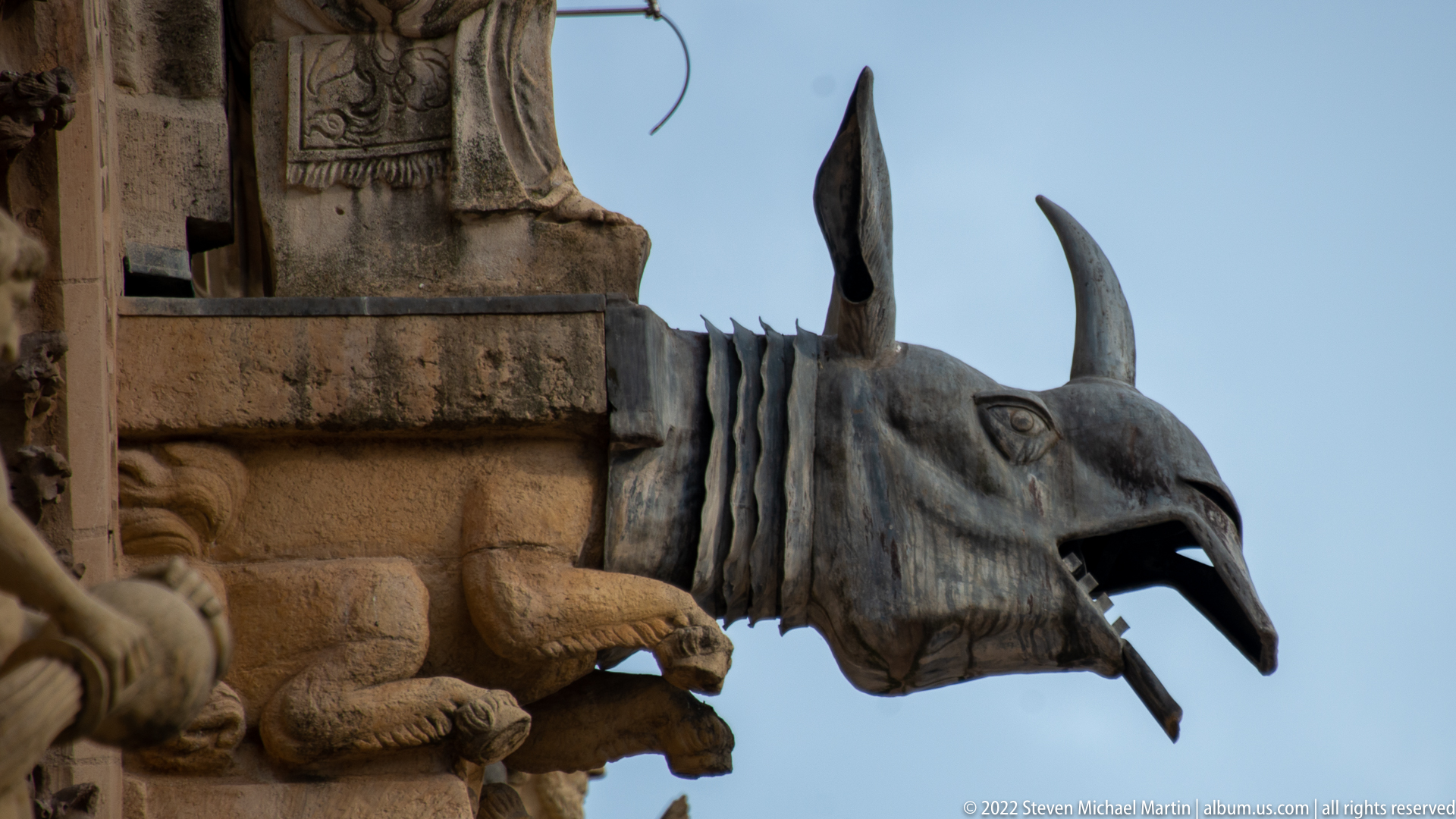
A horned animal gargoyle projects dramatically from the cathedral wall, its ridged neck, pointed ears or horns, and open angular mouth silhouetted against the sky. Smaller carved creatures cluster at the base beneath it. The profile isolates the fantastical anatomy and functional spout form of the Gothic exterior sculpture.
Caption
A horned animal gargoyle projects dramatically from the cathedral wall, its ridged neck, pointed ears or horns, and open angular mouth silhouetted against the sky. Smaller carved creatures cluster at the base beneath it. The profile isolates the fantastical anatomy and functional spout form of the Gothic exterior sculpture.

A long-eared, narrow-snouted animal gargoyle projects from a carved stone ledge, its open mouth and elongated neck extending into open air. Nearby human and animal sculptures remain partly visible on the façade, placing the waterspout within a dense sculptural program. The side view emphasizes the creature’s distinctive ears and attenuated profile.
Caption
A long-eared, narrow-snouted animal gargoyle projects from a carved stone ledge, its open mouth and elongated neck extending into open air. Nearby human and animal sculptures remain partly visible on the façade, placing the waterspout within a dense sculptural program. The side view emphasizes the creature’s distinctive ears and attenuated profile.

The monumental west façade of Notre-Dame de Reims fills the frame from portals to twin towers. Three deeply sculpted entrance portals support the immense central rose window, while rows of statuary, pinnacles, openwork towers, and gables create an extraordinarily dense Gothic screen. The nearly frontal viewpoint provides the portfolio’s clearest overall record of the cathedral’s principal elevation.
Caption
The monumental west façade of Notre-Dame de Reims fills the frame from portals to twin towers. Three deeply sculpted entrance portals support the immense central rose window, while rows of statuary, pinnacles, openwork towers, and gables create an extraordinarily dense Gothic screen. The nearly frontal viewpoint provides the portfolio’s clearest overall record of the cathedral’s principal elevation.

High above a west portal, Christ crowns the Virgin within a crowded sculptural ensemble of angels and attendant figures. The pair occupy the apex of the gable, surrounded by miniature canopies and dense Gothic carving that continues into the archivolts below. The close view isolates one of the façade’s principal Marian narratives from the overwhelming richness of the larger west front.
Caption
High above a west portal, Christ crowns the Virgin within a crowded sculptural ensemble of angels and attendant figures. The pair occupy the apex of the gable, surrounded by miniature canopies and dense Gothic carving that continues into the archivolts below. The close view isolates one of the façade’s principal Marian narratives from the overwhelming richness of the larger west front.

A horizontal sculptural register above a pointed west portal presents tall standing figures at the outer edges and smaller figures, trees, and narrative groups across the center. The weathered limestone relief is set beneath the cathedral’s dense upper arcading and above the portal tracery. The photograph records the relationship between freestanding figures and narrative sculpture within the façade program.
Caption
A horizontal sculptural register above a pointed west portal presents tall standing figures at the outer edges and smaller figures, trees, and narrative groups across the center. The weathered limestone relief is set beneath the cathedral’s dense upper arcading and above the portal tracery. The photograph records the relationship between freestanding figures and narrative sculpture within the façade program.

A sculpted Crucifixion fills a steep triangular gable on the cathedral façade. Christ hangs on the cross at center, flanked by standing mourners and additional figures arranged symmetrically along the sloping frame. Crockets and foliage ornament edge the gable, integrating the Passion scene directly into the Gothic architecture.
Caption
A sculpted Crucifixion fills a steep triangular gable on the cathedral façade. Christ hangs on the cross at center, flanked by standing mourners and additional figures arranged symmetrically along the sloping frame. Crockets and foliage ornament edge the gable, integrating the Passion scene directly into the Gothic architecture.

A seated Christ dominates a triangular Gothic gable, raising one hand while surrounding figures stand and kneel around him. The symmetrical arrangement, haloed central figure, and attendant saints or angels suggest a scene of divine authority such as Christ in Majesty or the Last Judgment. Floral crockets and architectural carving frame the composition tightly.
Caption
A seated Christ dominates a triangular Gothic gable, raising one hand while surrounding figures stand and kneel around him. The symmetrical arrangement, haloed central figure, and attendant saints or angels suggest a scene of divine authority such as Christ in Majesty or the Last Judgment. Floral crockets and architectural carving frame the composition tightly.

A sculptural egg-shaped lounge chair stands beside a floor-to-ceiling hotel window overlooking a Reims street, paired with a small round table holding a bottle of Champagne. The cream upholstery, metallic pedestal, and blue patterned carpet create a distinctly contemporary interior after the preceding cathedral sequence. The bottle and urban view connect the modern lodging setting with the city’s Champagne identity.
Caption
A sculptural egg-shaped lounge chair stands beside a floor-to-ceiling hotel window overlooking a Reims street, paired with a small round table holding a bottle of Champagne. The cream upholstery, metallic pedestal, and blue patterned carpet create a distinctly contemporary interior after the preceding cathedral sequence. The bottle and urban view connect the modern lodging setting with the city’s Champagne identity.

The complete west façade of Notre-Dame de Reims rises above the open square, its twin towers framing the great rose window and three deeply sculpted portals. The nearly frontal daylight view makes the layered Gothic composition especially legible, from the portal gables and statuary to the openwork tower stages. Bare trees and low surrounding buildings provide scale without obscuring the monument.
Caption
The complete west façade of Notre-Dame de Reims rises above the open square, its twin towers framing the great rose window and three deeply sculpted portals. The nearly frontal daylight view makes the layered Gothic composition especially legible, from the portal gables and statuary to the openwork tower stages. Bare trees and low surrounding buildings provide scale without obscuring the monument.

Three crystal chandeliers illuminate a dark, richly stocked bar lined with bottles, taps, glassware, and polished wood. Staff work behind the counter while the warm amber light reflects from mirrored shelving and a glossy surface. The setting is clearly contemporary hospitality rather than a historic monument, offering a contrasting interior scene within the Reims portfolio.
Caption
Three crystal chandeliers illuminate a dark, richly stocked bar lined with bottles, taps, glassware, and polished wood. Staff work behind the counter while the warm amber light reflects from mirrored shelving and a glossy surface. The setting is clearly contemporary hospitality rather than a historic monument, offering a contrasting interior scene within the Reims portfolio.

A frontal night view presents Notre-Dame de Reims as a luminous stone screen, with the west façade evenly washed in warm light from the portal level to the twin towers. The central rose and smaller portal windows read as dark circular punctuations within the bright masonry. The symmetrical composition emphasizes the balance and monumental scale of the principal elevation.
Caption
A frontal night view presents Notre-Dame de Reims as a luminous stone screen, with the west façade evenly washed in warm light from the portal level to the twin towers. The central rose and smaller portal windows read as dark circular punctuations within the bright masonry. The symmetrical composition emphasizes the balance and monumental scale of the principal elevation.

A monumental tapestry depicts a chaotic battle packed with mounted soldiers, infantry, standards, and weapons beneath a band of woven text. Horses and figures overlap densely across the field, while fortified or urban architecture appears in the distance. The image is clearly martial and historical, but the exact campaign or episode cannot be safely assigned from the proof sheet alone.
Caption
A monumental tapestry depicts a chaotic battle packed with mounted soldiers, infantry, standards, and weapons beneath a band of woven text. Horses and figures overlap densely across the field, while fortified or urban architecture appears in the distance. The image is clearly martial and historical, but the exact campaign or episode cannot be safely assigned from the proof sheet alone.

A jeweled ceremonial crown is densely set with pearls, colored stones, and gold ornament over a purple textile cap patterned with fleurs-de-lis. Arched bands rise to a small upper finial, while large green, blue, and clear gems punctuate the lower circlet. The craftsmanship and royal symbolism are unmistakable, though the exact historical crown should be verified from the museum label.
Caption
A jeweled ceremonial crown is densely set with pearls, colored stones, and gold ornament over a purple textile cap patterned with fleurs-de-lis. Arched bands rise to a small upper finial, while large green, blue, and clear gems punctuate the lower circlet. The craftsmanship and royal symbolism are unmistakable, though the exact historical crown should be verified from the museum label.

A ceremonial throne sits centered against a deep red wall decorated with crowned heraldic emblems and a framed royal coat of arms. Gilded armrests, carved supports, red upholstery, and a blue fleur-de-lis carpet create a deliberately dynastic display. The room functions as an interpretive evocation of monarchy rather than an ordinary seating arrangement.
Caption
A ceremonial throne sits centered against a deep red wall decorated with crowned heraldic emblems and a framed royal coat of arms. Gilded armrests, carved supports, red upholstery, and a blue fleur-de-lis carpet create a deliberately dynastic display. The room functions as an interpretive evocation of monarchy rather than an ordinary seating arrangement.

A close detail of dark velvet shows appliquéd or embroidered fleur-de-lis motifs arranged beneath a small royal crown and surrounded by heavy metallic tassels and fringe. The textile surface is visibly worn and creased, preserving evidence of age and use. The composition likely belonged to a ceremonial furnishing or costume associated with royal display.
Caption
A close detail of dark velvet shows appliquéd or embroidered fleur-de-lis motifs arranged beneath a small royal crown and surrounded by heavy metallic tassels and fringe. The textile surface is visibly worn and creased, preserving evidence of age and use. The composition likely belonged to a ceremonial furnishing or costume associated with royal display.

A tall processional cross stands on a stepped base before a red museum backdrop, its central medallion surrounded by radiating decorative elements. Nearby are an ornate lidded vessel and a richly framed book or panel with fleur-de-lis ornament. The grouping emphasizes ecclesiastical metalwork and ceremonial display rather than one isolated object.
Caption
A tall processional cross stands on a stepped base before a red museum backdrop, its central medallion surrounded by radiating decorative elements. Nearby are an ornate lidded vessel and a richly framed book or panel with fleur-de-lis ornament. The grouping emphasizes ecclesiastical metalwork and ceremonial display rather than one isolated object.

A richly worked gilded reliquary or shrine rests on lion-like feet and is crowded with miniature figures, reliefs, gemstones, and architectural details. A standing figure rises above the roofline while smaller narrative groups occupy the sides and corners. The object’s dense iconography and precious materials mark it as a major ecclesiastical treasury piece, though its saintly dedication is not legible here.
Caption
A richly worked gilded reliquary or shrine rests on lion-like feet and is crowded with miniature figures, reliefs, gemstones, and architectural details. A standing figure rises above the roofline while smaller narrative groups occupy the sides and corners. The object’s dense iconography and precious materials mark it as a major ecclesiastical treasury piece, though its saintly dedication is not legible here.

A compact Gothic apse rises behind a simple altar beneath high ribbed vaults and tall lancet windows. Slender clustered shafts draw the eye upward, while the small scale and enclosed form distinguish the space from the cathedral’s main nave. A visitor in the foreground provides a useful sense of proportion for the soaring stone interior.
Caption
A compact Gothic apse rises behind a simple altar beneath high ribbed vaults and tall lancet windows. Slender clustered shafts draw the eye upward, while the small scale and enclosed form distinguish the space from the cathedral’s main nave. A visitor in the foreground provides a useful sense of proportion for the soaring stone interior.

An elaborate gold-toned vessel takes the form of a fully rigged ship populated by miniature figures along the deck and stern. A mast, pennant, railings, tiny architectural elements, and applied decoration transform the object into a sculptural table ornament rather than a functional model. The piece resembles the ceremonial nefs used in courtly dining and treasury collections.
Caption
An elaborate gold-toned vessel takes the form of a fully rigged ship populated by miniature figures along the deck and stern. A mast, pennant, railings, tiny architectural elements, and applied decoration transform the object into a sculptural table ornament rather than a functional model. The piece resembles the ceremonial nefs used in courtly dining and treasury collections.

A close view isolates an intricate crown-like finial mounted above a dark velvet-covered shaft. Gold-toned openwork, fleur-de-lis forms, and layered moldings create a compact heraldic ornament, while the worn velvet below suggests a ceremonial object handled or carried in formal contexts. The complete staff or office cannot be determined from this crop alone.
Caption
A close view isolates an intricate crown-like finial mounted above a dark velvet-covered shaft. Gold-toned openwork, fleur-de-lis forms, and layered moldings create a compact heraldic ornament, while the worn velvet below suggests a ceremonial object handled or carried in formal contexts. The complete staff or office cannot be determined from this crop alone.

A long barrel-vaulted gallery is lined with enormous tapestries on both walls and punctuated by pale stone sculptures on pedestals. High clerestory windows admit soft daylight, while a single chair sits along the central axis leading toward a distant sculptural focal point. The orderly display emphasizes the scale of the textiles and the museum’s historic architectural setting.
Caption
A long barrel-vaulted gallery is lined with enormous tapestries on both walls and punctuated by pale stone sculptures on pedestals. High clerestory windows admit soft daylight, while a single chair sits along the central axis leading toward a distant sculptural focal point. The orderly display emphasizes the scale of the textiles and the museum’s historic architectural setting.

Rows of glowing votive candles fill black metal stands beneath a polychrome statue of the Virgin and Child. Bouquets and potted flowers add bright color around the devotional area, while taller taper candles burn on a separate rack to the right. The scene records an actively used prayer space within a historic church rather than a museum display.
Caption
Rows of glowing votive candles fill black metal stands beneath a polychrome statue of the Virgin and Child. Bouquets and potted flowers add bright color around the devotional area, while taller taper candles burn on a separate rack to the right. The scene records an actively used prayer space within a historic church rather than a museum display.

A large history painting portrays a chaotic armed clash in a narrow town street bordered by timber-framed houses. Mounted soldiers, infantry, barricades, fallen bodies, and dense smoke create a compressed scene of urban combat. The architecture provides a vivid setting, but the precise battle or historical episode cannot be identified confidently without the painting’s label.
Caption
A large history painting portrays a chaotic armed clash in a narrow town street bordered by timber-framed houses. Mounted soldiers, infantry, barricades, fallen bodies, and dense smoke create a compressed scene of urban combat. The architecture provides a vivid setting, but the precise battle or historical episode cannot be identified confidently without the painting’s label.

A rough rectangular stone block preserves a deeply carved frontal face with heavy brows, almond-shaped eyes, a broad nose, and a compact beard or lower facial mass. The surrounding surface is irregular and broken, suggesting an architectural fragment rather than an independent portrait. Its date, cultural context, and original function are not evident from the object alone.
Caption
A rough rectangular stone block preserves a deeply carved frontal face with heavy brows, almond-shaped eyes, a broad nose, and a compact beard or lower facial mass. The surrounding surface is irregular and broken, suggesting an architectural fragment rather than an independent portrait. Its date, cultural context, and original function are not evident from the object alone.

A Roman-style mosaic panel shows two muscular male figures locked in combat within a rectangular field bordered by geometric patterns. One carries a large oval shield, while the opposing figure raises an arm and steps forward aggressively. The fine tesserae create shaded bodies and a strong sense of motion, but the exact mythological or arena subject is not certain from the scene alone.
Caption
A Roman-style mosaic panel shows two muscular male figures locked in combat within a rectangular field bordered by geometric patterns. One carries a large oval shield, while the opposing figure raises an arm and steps forward aggressively. The fine tesserae create shaded bodies and a strong sense of motion, but the exact mythological or arena subject is not certain from the scene alone.

The choir of the Basilica of Saint-Remi rises behind a line of gilded candlesticks, with slender clustered columns supporting pointed arches and rib vaults. Tall stained-glass windows wrap the apse in color, while the central liturgical furnishing and elevated sanctuary create a formal axial focus. The view emphasizes the transition from the heavy nave to the more luminous Gothic eastern end.
Caption
The choir of the Basilica of Saint-Remi rises behind a line of gilded candlesticks, with slender clustered columns supporting pointed arches and rib vaults. Tall stained-glass windows wrap the apse in color, while the central liturgical furnishing and elevated sanctuary create a formal axial focus. The view emphasizes the transition from the heavy nave to the more luminous Gothic eastern end.

A low-relief stone panel depicts a seated worker leaning toward a bench, frame, or table fitted with horizontal bars. Tools or equipment occupy the work surface, and a basket or vessel rests beneath. The scene appears to record a craft or trade, offering a rare glimpse of labor rather than elite or religious imagery.
Caption
A low-relief stone panel depicts a seated worker leaning toward a bench, frame, or table fitted with horizontal bars. Tools or equipment occupy the work surface, and a basket or vessel rests beneath. The scene appears to record a craft or trade, offering a rare glimpse of labor rather than elite or religious imagery.

A close detail of the Porte de Mars reveals deeply weathered Roman relief carving between fluted engaged columns. The central stone panel contains a circular or shield-like motif surrounded by worn foliage and figural traces, while a heavy classical cornice caps the composition. The tight framing highlights surviving ornament that is easy to overlook in the full monument view.
Caption
A close detail of the Porte de Mars reveals deeply weathered Roman relief carving between fluted engaged columns. The central stone panel contains a circular or shield-like motif surrounded by worn foliage and figural traces, while a heavy classical cornice caps the composition. The tight framing highlights surviving ornament that is easy to overlook in the full monument view.

A tall pier of the Porte de Mars preserves layered Roman decoration: fluted engaged columns, a framed rectangular niche or panel, garlands, scrollwork, and a circular medallion above. Weathering and losses interrupt the carved surfaces, yet the classical organization remains legible. The vertical crop shows how sculptural ornament once enriched the massive gateway’s structural piers.
Caption
A tall pier of the Porte de Mars preserves layered Roman decoration: fluted engaged columns, a framed rectangular niche or panel, garlands, scrollwork, and a circular medallion above. Weathering and losses interrupt the carved surfaces, yet the classical organization remains legible. The vertical crop shows how sculptural ornament once enriched the massive gateway’s structural piers.

A monumental corona chandelier hangs before the basilica’s stained-glass apse, forming a broad ring of gilded arches, miniature towers, colored stones, and upright candle holders. The close view reveals openwork metal panels and repeated architectural motifs that are less visible from the nave. Suspended chains disappear above the frame, enhancing the impression of the ring floating within the Gothic space.
Caption
A monumental corona chandelier hangs before the basilica’s stained-glass apse, forming a broad ring of gilded arches, miniature towers, colored stones, and upright candle holders. The close view reveals openwork metal panels and repeated architectural motifs that are less visible from the nave. Suspended chains disappear above the frame, enhancing the impression of the ring floating within the Gothic space.

The nave of the Basilica of Saint-Remi extends through repeated stone bays toward a distant stained-glass termination. Heavy compound piers, pointed vaults, and upper arcades create a disciplined rhythm on both sides, while rows of dark wooden chairs fill the lower center. The axial view is more austere and architectural than the choir-focused photographs nearby.
Caption
The nave of the Basilica of Saint-Remi extends through repeated stone bays toward a distant stained-glass termination. Heavy compound piers, pointed vaults, and upper arcades create a disciplined rhythm on both sides, while rows of dark wooden chairs fill the lower center. The axial view is more austere and architectural than the choir-focused photographs nearby.

Two stemmed cocktails are presented on black napkins atop a glossy yellow table beside a large window. One drink is bright green with a garnish of cucumber or fruit, while the other is amber with a thick white foam cap and a small purple flower. The close composition emphasizes color, glassware, and presentation rather than the surrounding venue.
Caption
Two stemmed cocktails are presented on black napkins atop a glossy yellow table beside a large window. One drink is bright green with a garnish of cucumber or fruit, while the other is amber with a thick white foam cap and a small purple flower. The close composition emphasizes color, glassware, and presentation rather than the surrounding venue.

The surviving Roman Porte de Mars stands in warm low-angle light, its broad stone mass articulated by three large archways, engaged columns, and remnants of carved decoration. Weathered masonry reveals centuries of loss while preserving the monument’s imposing scale. The open lawn and low urban buildings around it allow the ancient gateway to read as an isolated archaeological landmark.
Caption
The surviving Roman Porte de Mars stands in warm low-angle light, its broad stone mass articulated by three large archways, engaged columns, and remnants of carved decoration. Weathered masonry reveals centuries of loss while preserving the monument’s imposing scale. The open lawn and low urban buildings around it allow the ancient gateway to read as an isolated archaeological landmark.

A weathered bearded male head projects from a circular architectural medallion, its deeply drilled curls, full beard, and large eyes surviving despite surface erosion. Cracks and losses around the surrounding stone emphasize the fragmentary state of the ancient gateway. The close view isolates one of the Porte de Mars’s figural details from the broader classical decoration.
Caption
A weathered bearded male head projects from a circular architectural medallion, its deeply drilled curls, full beard, and large eyes surviving despite surface erosion. Cracks and losses around the surrounding stone emphasize the fragmentary state of the ancient gateway. The close view isolates one of the Porte de Mars’s figural details from the broader classical decoration.

An elaborate Roman relief fills a recessed architectural panel on the Porte de Mars, with two reclining or seated female figures arranged symmetrically around a central draped form. Deeply carved foliage, moldings, and decorative bands frame the composition. Centuries of weathering have softened faces and attributes, making the exact allegorical or mythological subject difficult to determine from the surviving sculpture alone.
Caption
An elaborate Roman relief fills a recessed architectural panel on the Porte de Mars, with two reclining or seated female figures arranged symmetrically around a central draped form. Deeply carved foliage, moldings, and decorative bands frame the composition. Centuries of weathering have softened faces and attributes, making the exact allegorical or mythological subject difficult to determine from the surviving sculpture alone.

The Porte de Mars stands in warm late-day light, its three monumental archways framed by massive piers, engaged columns, and surviving carved ornament. Seen nearly straight on, the Roman gateway reads as a unified architectural composition rather than a collection of details. Open lawn and the city beyond are visible through the arches, emphasizing both the monument's scale and its present urban setting.
Caption
The Porte de Mars stands in warm late-day light, its three monumental archways framed by massive piers, engaged columns, and surviving carved ornament. Seen nearly straight on, the Roman gateway reads as a unified architectural composition rather than a collection of details. Open lawn and the city beyond are visible through the arches, emphasizing both the monument's scale and its present urban setting.

The Carnegie Library presents an elegant Art Deco exterior combining warm brick, pale stone, geometric panels, and a projecting central reading-room volume beneath a polygonal roof. Tall windows and red-arched entrances articulate the side bays, while decorative medallions and diamond motifs enliven the façade. Mature trees and directional signs place the distinctive building within the civic center of Reims.
Caption
The Carnegie Library presents an elegant Art Deco exterior combining warm brick, pale stone, geometric panels, and a projecting central reading-room volume beneath a polygonal roof. Tall windows and red-arched entrances articulate the side bays, while decorative medallions and diamond motifs enliven the façade. Mature trees and directional signs place the distinctive building within the civic center of Reims.