Trier – Rhineland-Palatinate, Germany
Trier lies along the Moselle River in western Germany and is one of the oldest cities in the country. Founded by the Romans more than two thousand years ago as Augusta Treverorum, the city became one of the most important administrative centers of the Roman Empire north of the Alps.
Several remarkable Roman monuments remain in Trier today, including the massive Porta Nigra, a well-preserved Roman city gate that still dominates the historic center. Other surviving structures include Roman baths, amphitheaters, and bridges.
These historic landmarks have earned Trier recognition as a UNESCO World Heritage Site.

A wider view of Trier Cathedral shows the balanced relationship between its central towers, rounded apses, flanking turrets, and adjoining Gothic elements. The façade’s heavy Romanesque volumes contrast with pointed tracery at the right, revealing the complex building history legible in the exterior fabric. The open forecourt and small visitors keep the emphasis on scale and overall architectural organization.
Caption
A wider view of Trier Cathedral shows the balanced relationship between its central towers, rounded apses, flanking turrets, and adjoining Gothic elements. The façade’s heavy Romanesque volumes contrast with pointed tracery at the right, revealing the complex building history legible in the exterior fabric. The open forecourt and small visitors keep the emphasis on scale and overall architectural organization.

Trier Cathedral presents a dense Romanesque composition of massive stone walls, rounded apses, arcaded upper levels, and multiple towers. Seen from close range, the exterior emphasizes the building’s layered construction and fortress-like weight, with semicircular forms and patterned masonry standing out against the bright sky. Small figures at ground level provide a useful sense of the cathedral’s monumental scale.
Caption
Trier Cathedral presents a dense Romanesque composition of massive stone walls, rounded apses, arcaded upper levels, and multiple towers. Seen from close range, the exterior emphasizes the building’s layered construction and fortress-like weight, with semicircular forms and patterned masonry standing out against the bright sky. Small figures at ground level provide a useful sense of the cathedral’s monumental scale.

A panoramic cityscape looks across a broad river valley toward Trier under a glowing, cloud-filled sky. Church towers rise above the distant urban fabric, while foreground travelers and buildings lead the eye toward the river and city beyond. The atmospheric treatment combines topographical description with the conventions of nineteenth-century landscape painting.
Caption
A panoramic cityscape looks across a broad river valley toward Trier under a glowing, cloud-filled sky. Church towers rise above the distant urban fabric, while foreground travelers and buildings lead the eye toward the river and city beyond. The atmospheric treatment combines topographical description with the conventions of nineteenth-century landscape painting.

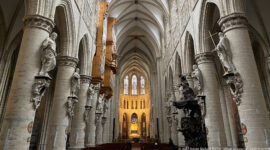
Looking down the long interior of Trier Cathedral, massive stone piers and rounded arches frame the central nave while the choir and apse draw the eye toward the far end. The elevated viewpoint reveals the church’s layered spatial organization, including side galleries, seating, and the contrasting textures of Romanesque masonry and later furnishings.
Caption
Looking down the long interior of Trier Cathedral, massive stone piers and rounded arches frame the central nave while the choir and apse draw the eye toward the far end. The elevated viewpoint reveals the church’s layered spatial organization, including side galleries, seating, and the contrasting textures of Romanesque masonry and later furnishings.

The cathedral’s large pipe organ projects dramatically from the upper wall beneath broad stone vaulting. Multiple ranks of polished metal pipes are grouped into sculptural cases with painted and carved ornament at their bases, making the instrument a strong visual counterpoint to the restrained masonry of the Romanesque interior.
Caption
The cathedral’s large pipe organ projects dramatically from the upper wall beneath broad stone vaulting. Multiple ranks of polished metal pipes are grouped into sculptural cases with painted and carved ornament at their bases, making the instrument a strong visual counterpoint to the restrained masonry of the Romanesque interior.

Ribbed vaults spring from clustered columns high above a Gothic church interior, where pointed arches and tall windows admit soft daylight. Painted floral and foliate motifs accent the pale vault surfaces, while the upward composition emphasizes the vertical geometry and structural rhythm of the crossing or nave.
Caption
Ribbed vaults spring from clustered columns high above a Gothic church interior, where pointed arches and tall windows admit soft daylight. Painted floral and foliate motifs accent the pale vault surfaces, while the upward composition emphasizes the vertical geometry and structural rhythm of the crossing or nave.

A large scale model reconstructs Roman Trier as a densely built ancient city of red-tiled roofs, orthogonal streets, monumental public buildings, and defensive walls. The elevated viewpoint reveals the planned urban grid and relationships among major complexes, allowing the viewer to read the city as a whole rather than as isolated archaeological remains.
Caption
A large scale model reconstructs Roman Trier as a densely built ancient city of red-tiled roofs, orthogonal streets, monumental public buildings, and defensive walls. The elevated viewpoint reveals the planned urban grid and relationships among major complexes, allowing the viewer to read the city as a whole rather than as isolated archaeological remains.
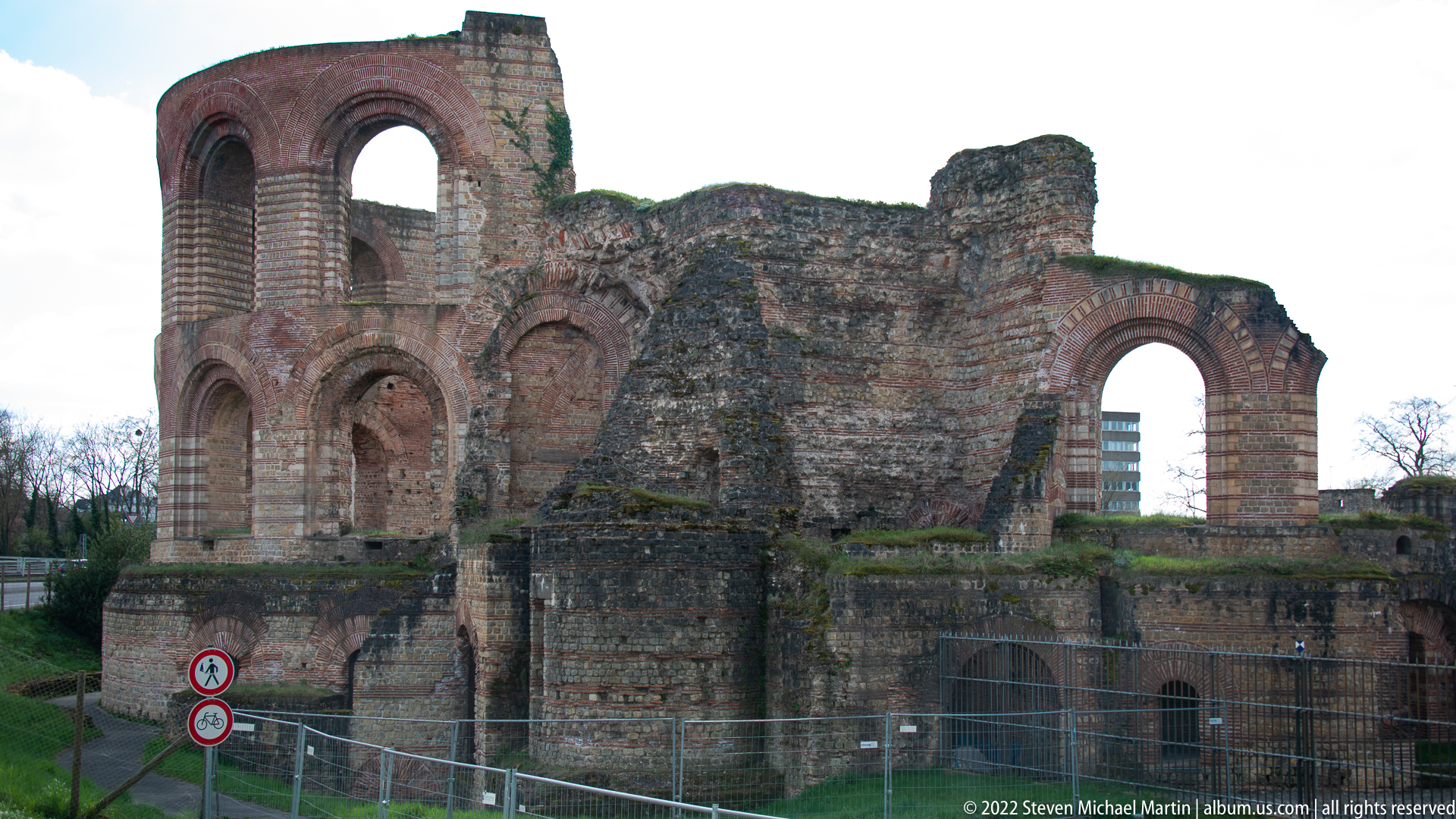
Massive brick-and-stone ruins of the Imperial Baths rise above excavated substructures, with tall arched openings and thick masonry walls revealing the scale of the Roman complex. Layered wall surfaces, broken vaults, and exposed foundations make the building’s construction history legible even in its fragmentary state.
Caption
Massive brick-and-stone ruins of the Imperial Baths rise above excavated substructures, with tall arched openings and thick masonry walls revealing the scale of the Roman complex. Layered wall surfaces, broken vaults, and exposed foundations make the building’s construction history legible even in its fragmentary state.

A richly painted cross mounted on a stone column rises above Trier’s Hauptmarkt, with a Romanesque church tower and historic roofs behind it. The cross’s red, black, and gold geometric decoration distinguishes it from the surrounding architecture and marks the square with a compact medieval civic and religious symbol.
Caption
A richly painted cross mounted on a stone column rises above Trier’s Hauptmarkt, with a Romanesque church tower and historic roofs behind it. The cross’s red, black, and gold geometric decoration distinguishes it from the surrounding architecture and marks the square with a compact medieval civic and religious symbol.

White stone figures and curling rocaille forms crowd the sculptural core of Trier’s Georgsbrunnen on the Kornmarkt. A seated allegorical figure occupies the center while smaller figures, shells, and scrolls spill outward across the fountain’s dynamic Baroque composition. Gilded accents punctuate the pale stone and sharpen the elaborate surface detail.
Caption
White stone figures and curling rocaille forms crowd the sculptural core of Trier’s Georgsbrunnen on the Kornmarkt. A seated allegorical figure occupies the center while smaller figures, shells, and scrolls spill outward across the fountain’s dynamic Baroque composition. Gilded accents punctuate the pale stone and sharpen the elaborate surface detail.

A towering architectural monument fills a church bay with tiers of columns, sculpted figures, reliefs, inscriptions, and a large central roundel. Warm-toned stone and gilded accents contrast with the pale masonry behind, while the dense arrangement of saints and allegorical figures gives the ensemble the visual force of a Baroque altar or funerary memorial.
Caption
A towering architectural monument fills a church bay with tiers of columns, sculpted figures, reliefs, inscriptions, and a large central roundel. Warm-toned stone and gilded accents contrast with the pale masonry behind, while the dense arrangement of saints and allegorical figures gives the ensemble the visual force of a Baroque altar or funerary memorial.

Roman stone monuments are arranged in a museum gallery as an architectural ensemble, including tall aedicule-like structures with steep caps, carved relief panels, a freestanding lion sculpture, and a reconstructed doorway. Their varied forms illustrate the monumental character of funerary and commemorative stonework preserved from Roman Trier and the surrounding region.
Caption
Roman stone monuments are arranged in a museum gallery as an architectural ensemble, including tall aedicule-like structures with steep caps, carved relief panels, a freestanding lion sculpture, and a reconstructed doorway. Their varied forms illustrate the monumental character of funerary and commemorative stonework preserved from Roman Trier and the surrounding region.

A richly shaped stone gable, carved crest, and adjoining sculptural gateway frame one edge of Trier’s historic center. The façade is distinguished by its curving Baroque profile and pale stonework, while the neighboring arch adds heraldic sculpture and a strong ceremonial note to the streetscape. Modern café seating and a bank sign place the ensemble within the continuously used urban fabric of central Trier.
Caption
A richly shaped stone gable, carved crest, and adjoining sculptural gateway frame one edge of Trier’s historic center. The façade is distinguished by its curving Baroque profile and pale stonework, while the neighboring arch adds heraldic sculpture and a strong ceremonial note to the streetscape. Modern café seating and a bank sign place the ensemble within the continuously used urban fabric of central Trier.

A sculpted human face emerges from a wreath of green leaves and gilded fruit set against scrolling terracotta-colored ornament. The compact façade detail combines a mascaron-like head with vegetal decoration, creating a theatrical accent within the painted architectural scheme. Its close framing isolates the craftsmanship and color contrasts that would be easily overlooked in a broader street view.
Caption
A sculpted human face emerges from a wreath of green leaves and gilded fruit set against scrolling terracotta-colored ornament. The compact façade detail combines a mascaron-like head with vegetal decoration, creating a theatrical accent within the painted architectural scheme. Its close framing isolates the craftsmanship and color contrasts that would be easily overlooked in a broader street view.

A crowned heraldic shield is set within an elaborate pink stone or stucco cartouche, flanked by two sculpted human supporters. Crossed regalia and a large crown rise above the shield, while scrolling ornament and smaller emblems fill the surrounding composition. The close view records the civic or dynastic symbolism as a decorative architectural element rather than treating the façade as a generic historic building.
Caption
A crowned heraldic shield is set within an elaborate pink stone or stucco cartouche, flanked by two sculpted human supporters. Crossed regalia and a large crown rise above the shield, while scrolling ornament and smaller emblems fill the surrounding composition. The close view records the civic or dynastic symbolism as a decorative architectural element rather than treating the façade as a generic historic building.

A dark stone column crowned by a broad cross rises in front of a white historic building with a steep slate roof and red-edged stepped parapet. The pairing of freestanding civic monument and sharply profiled architecture creates a characteristic vertical composition in Trier’s old center. Decorative lanterns and narrow arched windows reinforce the medievalizing character of the setting.
Caption
A dark stone column crowned by a broad cross rises in front of a white historic building with a steep slate roof and red-edged stepped parapet. The pairing of freestanding civic monument and sharply profiled architecture creates a characteristic vertical composition in Trier’s old center. Decorative lanterns and narrow arched windows reinforce the medievalizing character of the setting.

A large gilded clock face is mounted on Trier Cathedral’s weathered masonry beside a round turret capped by a steep conical roof. Above the dial, a Latin inscription runs across the wall beneath paired Romanesque openings. The tight composition isolates the timepiece, brick-and-stone fabric, and rounded turret, revealing decorative and functional elements within the cathedral’s otherwise massive exterior.
Caption
A large gilded clock face is mounted on Trier Cathedral’s weathered masonry beside a round turret capped by a steep conical roof. Above the dial, a Latin inscription runs across the wall beneath paired Romanesque openings. The tight composition isolates the timepiece, brick-and-stone fabric, and rounded turret, revealing decorative and functional elements within the cathedral’s otherwise massive exterior.

An exuberant white stucco vault is densely filled with sculpted figures, cartouches, foliage, framed relief scenes, and dark contrasting panels. At the center, a heraldic emblem anchors the symmetrical program while windows below flood the decoration with daylight. The upward viewpoint emphasizes the three-dimensional modeling and theatrical richness of the interior ornament.
Caption
An exuberant white stucco vault is densely filled with sculpted figures, cartouches, foliage, framed relief scenes, and dark contrasting panels. At the center, a heraldic emblem anchors the symmetrical program while windows below flood the decoration with daylight. The upward viewpoint emphasizes the three-dimensional modeling and theatrical richness of the interior ornament.

A large German-language information board mounted against the cathedral wall identifies “Der Dom” and summarizes the church’s significance, while lower panels provide service times and visitor guidance. The photograph records the site’s interpretive infrastructure rather than its architecture, documenting how visitors are introduced to Trier Cathedral at the point of entry.
Caption
A large German-language information board mounted against the cathedral wall identifies “Der Dom” and summarizes the church’s significance, while lower panels provide service times and visitor guidance. The photograph records the site’s interpretive infrastructure rather than its architecture, documenting how visitors are introduced to Trier Cathedral at the point of entry.

A crucifix rises above a dark marble base and paired sculpted figures beneath an elaborate white stucco dome. Surrounding windows admit strong daylight, silhouetting the cross while revealing the dense ornamental ceiling above. The composition links the devotional ensemble in the foreground with the architectural richness of the chapel space.
Caption
A crucifix rises above a dark marble base and paired sculpted figures beneath an elaborate white stucco dome. Surrounding windows admit strong daylight, silhouetting the cross while revealing the dense ornamental ceiling above. The composition links the devotional ensemble in the foreground with the architectural richness of the chapel space.
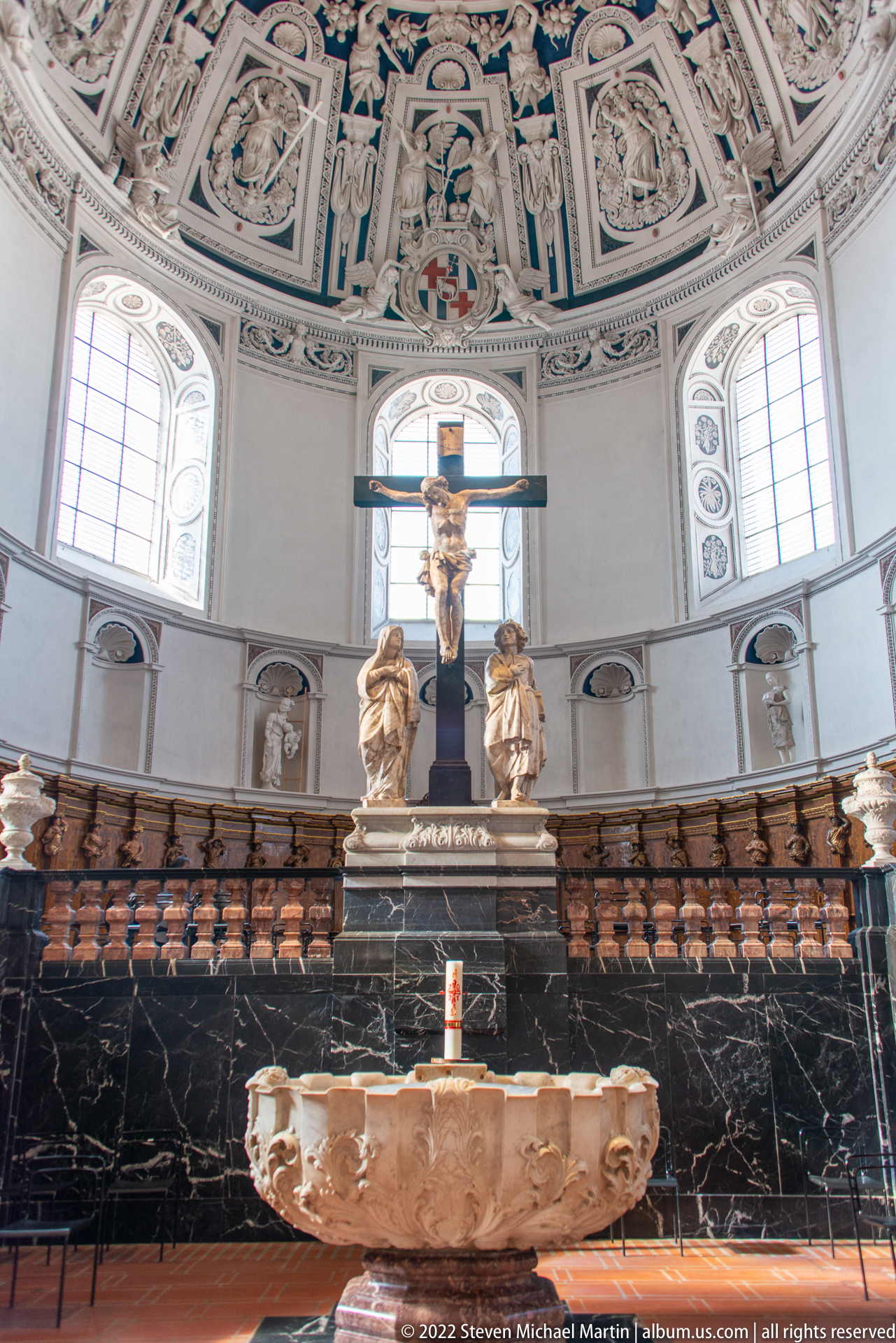
A pale stone altar stands in the foreground before a dark marble pedestal supporting a crucifix and two sculpted figures. Behind the ensemble, a curved wooden choir screen and bright windows follow the chapel’s rounded wall. The wider framing shows how the liturgical furnishings occupy the center of the highly decorated sacred space.
Caption
A pale stone altar stands in the foreground before a dark marble pedestal supporting a crucifix and two sculpted figures. Behind the ensemble, a curved wooden choir screen and bright windows follow the chapel’s rounded wall. The wider framing shows how the liturgical furnishings occupy the center of the highly decorated sacred space.

A sculpted heraldic shield occupies the center of an elaborate white stucco composition, surrounded by standing figures, drapery, and ecclesiastical emblems. The shield’s red-and-white quarters stand out sharply against deep blue background panels and pale modeling. This close detail reveals how heraldry is integrated into the larger ornamental program of the vaulted interior.
Caption
A sculpted heraldic shield occupies the center of an elaborate white stucco composition, surrounded by standing figures, drapery, and ecclesiastical emblems. The shield’s red-and-white quarters stand out sharply against deep blue background panels and pale modeling. This close detail reveals how heraldry is integrated into the larger ornamental program of the vaulted interior.
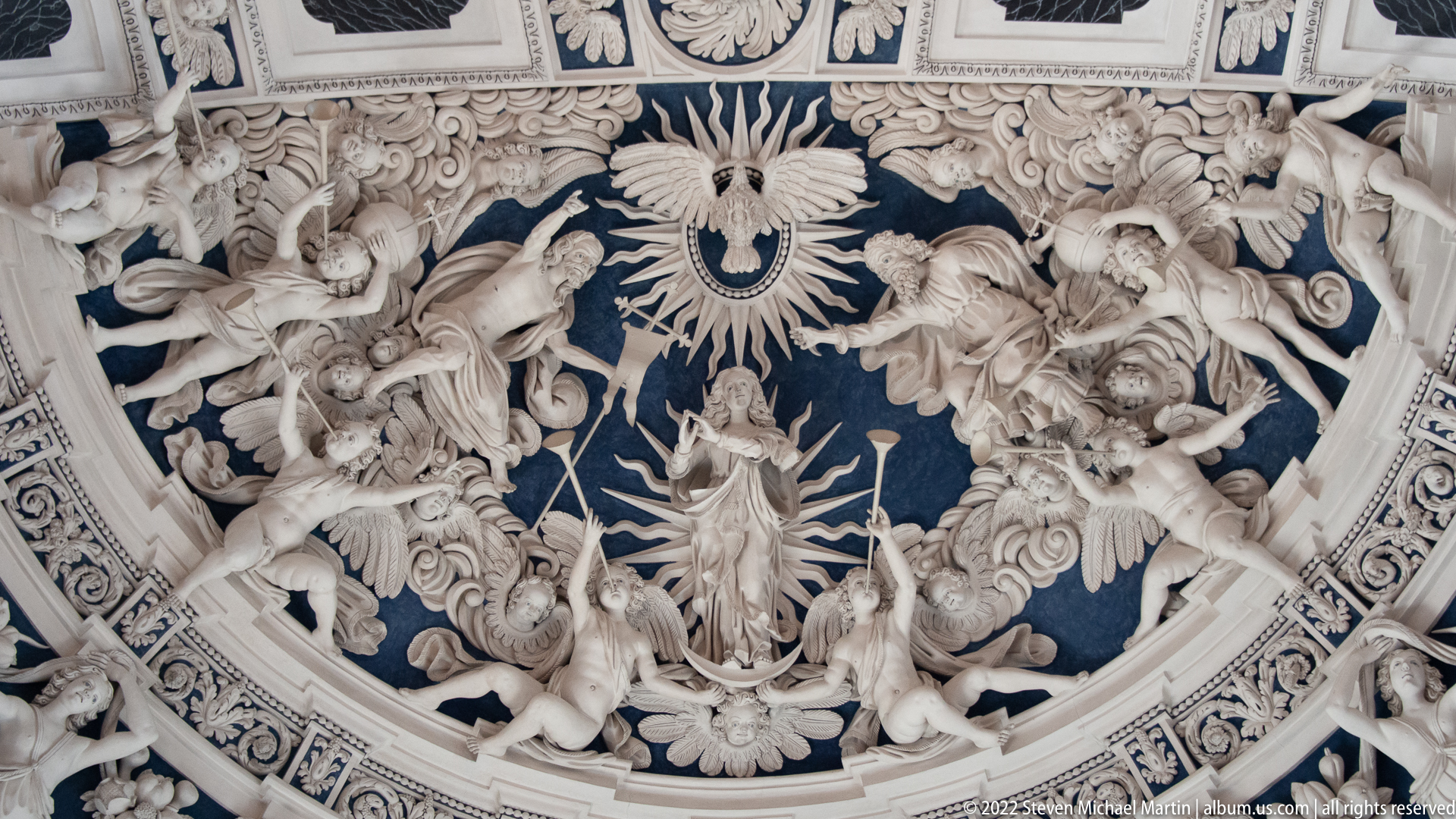
A central sacred figure appears within a burst of rays, surrounded by angels, cloud forms, and dense white stucco ornament on a dark blue ground. Winged figures and sweeping foliage create a sense of movement around the central axis, while the close view highlights the sculptural depth of the ceiling decoration. The exact iconographic identity is not asserted from the proof sheet alone.
Caption
A central sacred figure appears within a burst of rays, surrounded by angels, cloud forms, and dense white stucco ornament on a dark blue ground. Winged figures and sweeping foliage create a sense of movement around the central axis, while the close view highlights the sculptural depth of the ceiling decoration. The exact iconographic identity is not asserted from the proof sheet alone.

The nave of Trier Cathedral stretches toward the high altar through a sequence of massive piers and ribbed vaults. Rows of wooden chairs form a central processional axis, while dark Baroque memorial or altar structures flank the foreground. Warm stone surfaces and the elevated sanctuary emphasize the cathedral’s layered Romanesque and later interior character.
Caption
The nave of Trier Cathedral stretches toward the high altar through a sequence of massive piers and ribbed vaults. Rows of wooden chairs form a central processional axis, while dark Baroque memorial or altar structures flank the foreground. Warm stone surfaces and the elevated sanctuary emphasize the cathedral’s layered Romanesque and later interior character.

A richly carved wooden furnishing combines dark polished wood, gilded moldings, scrolling foliage, and a central glazed panel framed like a small shrine. The upper crest centers a radiant emblem, while paired decorative figures flank the main compartment. The close frontal view emphasizes craftsmanship, symmetry, and the contrast between warm wood grain and gold ornament.
Caption
A richly carved wooden furnishing combines dark polished wood, gilded moldings, scrolling foliage, and a central glazed panel framed like a small shrine. The upper crest centers a radiant emblem, while paired decorative figures flank the main compartment. The close frontal view emphasizes craftsmanship, symmetry, and the contrast between warm wood grain and gold ornament.

A radiant triangular eye, traditionally associated with divine providence, is set within a gilded oval at the center of a carved wooden crest. Deeply undercut acanthus-like scrollwork and a shell-shaped crown frame the emblem, creating a concentrated devotional focal point. The tight crop isolates the symbolic detail from the larger furnishing seen in the adjacent view.
Caption
A radiant triangular eye, traditionally associated with divine providence, is set within a gilded oval at the center of a carved wooden crest. Deeply undercut acanthus-like scrollwork and a shell-shaped crown frame the emblem, creating a concentrated devotional focal point. The tight crop isolates the symbolic detail from the larger furnishing seen in the adjacent view.

A round black clock dial with gold Roman numerals and hands is embedded within an elaborate white stucco surround. Winged figures, scrolls, shell-like forms, and small masks crowd the frame, transforming a functional timepiece into part of the room’s Baroque decorative program. The close view highlights the striking contrast between the dark dial and pale sculpted ornament.
Caption
A round black clock dial with gold Roman numerals and hands is embedded within an elaborate white stucco surround. Winged figures, scrolls, shell-like forms, and small masks crowd the frame, transforming a functional timepiece into part of the room’s Baroque decorative program. The close view highlights the striking contrast between the dark dial and pale sculpted ornament.

A life-size figure in elaborately patterned armor reclines on a scroll-ended support, one hand raised toward a nearby monument or tablet. Heavy drapery and another standing figure frame the scene, giving the composition the theatrical character of a Baroque memorial. The close view concentrates on the deceased or commemorated figure rather than the monument as a whole.
Caption
A life-size figure in elaborately patterned armor reclines on a scroll-ended support, one hand raised toward a nearby monument or tablet. Heavy drapery and another standing figure frame the scene, giving the composition the theatrical character of a Baroque memorial. The close view concentrates on the deceased or commemorated figure rather than the monument as a whole.

An elaborate gilded crest crowns a church monument, centering a red-and-silver shield beneath a large crown and surrounded by scrolling metalwork. Two standing saintly or allegorical figures flank the arms, each holding long attributes, while smaller insignia and ornamental flourishes fill the upper register. The close view emphasizes heraldic authority and ceremonial display.
Caption
An elaborate gilded crest crowns a church monument, centering a red-and-silver shield beneath a large crown and surrounded by scrolling metalwork. Two standing saintly or allegorical figures flank the arms, each holding long attributes, while smaller insignia and ornamental flourishes fill the upper register. The close view emphasizes heraldic authority and ceremonial display.

A carved skeleton sits upright holding a long scythe, its bony hands and skull emerging from loosely draped cloth. The familiar attributes identify the figure as a personification of Death, likely incorporated into a larger funerary or memorial ensemble. Tight framing emphasizes the unsettling memento-mori imagery and the sculptor’s detailed rendering of ribs, joints, and fabric.
Caption
A carved skeleton sits upright holding a long scythe, its bony hands and skull emerging from loosely draped cloth. The familiar attributes identify the figure as a personification of Death, likely incorporated into a larger funerary or memorial ensemble. Tight framing emphasizes the unsettling memento-mori imagery and the sculptor’s detailed rendering of ribs, joints, and fabric.

A richly layered Baroque altar rises against the stone interior with colored marble columns, sculpted figures, relief panels, and gilded liturgical fittings. The central relief forms the visual focus, while smaller sculptures and architectural pediments build upward into an elaborate vertical composition. A purple cloth over the central object suggests the photograph was made during a liturgical season or temporary devotional arrangement.
Caption
A richly layered Baroque altar rises against the stone interior with colored marble columns, sculpted figures, relief panels, and gilded liturgical fittings. The central relief forms the visual focus, while smaller sculptures and architectural pediments build upward into an elaborate vertical composition. A purple cloth over the central object suggests the photograph was made during a liturgical season or temporary devotional arrangement.
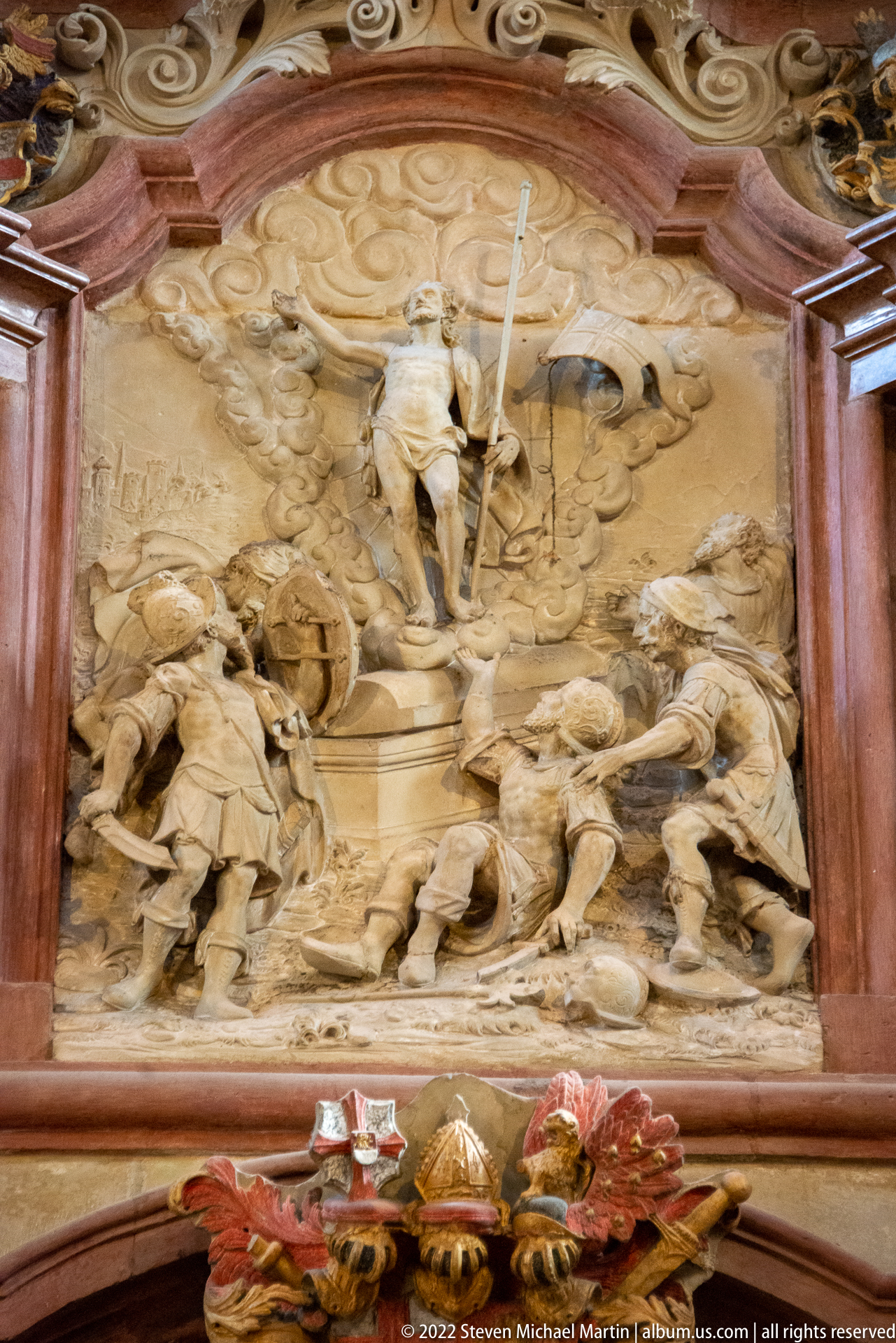
A large pale relief panel depicts a dramatic multi-figure religious scene arranged around a standing central figure and kneeling attendants. Clouds, gestures, and sweeping drapery create strong movement across the composition, while the surrounding reddish architectural frame places the relief within a larger altar ensemble. The exact episode is not sufficiently legible here for a secure iconographic identification.
Caption
A large pale relief panel depicts a dramatic multi-figure religious scene arranged around a standing central figure and kneeling attendants. Clouds, gestures, and sweeping drapery create strong movement across the composition, while the surrounding reddish architectural frame places the relief within a larger altar ensemble. The exact episode is not sufficiently legible here for a secure iconographic identification.

A towering carved retable fills the frame with tiers of biblical figures, relief scenes, columns, arches, and ornamental architecture. The warm-toned material and dense sculptural program create a richly narrative surface, with larger central scenes surrounded by smaller figures and decorative elements. The photograph records the entire composition to show scale and structure rather than isolating a single episode.
Caption
A towering carved retable fills the frame with tiers of biblical figures, relief scenes, columns, arches, and ornamental architecture. The warm-toned material and dense sculptural program create a richly narrative surface, with larger central scenes surrounded by smaller figures and decorative elements. The photograph records the entire composition to show scale and structure rather than isolating a single episode.

A silver-toned figure of the Virgin Mary carries the Christ Child before a dramatic field of long gilded rays. The figures stand on a rounded base, and the contrast between cool metal surfaces and the gold sunburst gives the small devotional object a powerful visual presence. The display-case setting suggests a treasury or museum presentation of church metalwork.
Caption
A silver-toned figure of the Virgin Mary carries the Christ Child before a dramatic field of long gilded rays. The figures stand on a rounded base, and the contrast between cool metal surfaces and the gold sunburst gives the small devotional object a powerful visual presence. The display-case setting suggests a treasury or museum presentation of church metalwork.

A gold cross rises from an elaborate base, its arms ending in lobed, leaf-like terminals and its center marked by a circular medallion. Small purple stones or enamel accents punctuate the intersections and terminals, adding color to the otherwise gold surface. The close frontal view emphasizes the object’s symmetry and detailed metalwork rather than its original liturgical setting.
Caption
A gold cross rises from an elaborate base, its arms ending in lobed, leaf-like terminals and its center marked by a circular medallion. Small purple stones or enamel accents punctuate the intersections and terminals, adding color to the otherwise gold surface. The close frontal view emphasizes the object’s symmetry and detailed metalwork rather than its original liturgical setting.

The bearded face of Christ appears in relief on a knotted hanging cloth, an iconographic form associated with the Veil of Veronica. A dark background with partial gold lettering sets off the pale sculpted fabric and facial features. The close crop emphasizes the devotional image itself, including the crown-like braided band across the forehead and the carefully modeled folds of the cloth.
Caption
The bearded face of Christ appears in relief on a knotted hanging cloth, an iconographic form associated with the Veil of Veronica. A dark background with partial gold lettering sets off the pale sculpted fabric and facial features. The close crop emphasizes the devotional image itself, including the crown-like braided band across the forehead and the carefully modeled folds of the cloth.

An ornate oval gold frame encloses a miniature scene with one seated figure and another kneeling before them, both rendered in silver-toned metal. Small sculpted flourishes and bead-like ornaments enrich the circular mount, which appears attached to a larger liturgical or treasury object. The close view isolates the miniature narrative and fine metalworking details.
Caption
An ornate oval gold frame encloses a miniature scene with one seated figure and another kneeling before them, both rendered in silver-toned metal. Small sculpted flourishes and bead-like ornaments enrich the circular mount, which appears attached to a larger liturgical or treasury object. The close view isolates the miniature narrative and fine metalworking details.

A small gilded female figure stands on clustered cloud forms with one hand raised, surrounded by a halo-like burst of rays and an ornate oval frame. Fine surface decoration on the frame contrasts with the bright sculptural center. The figure likely represents the Virgin Mary or another female saint, but the proof sheet does not provide enough detail for a more specific identification.
Caption
A small gilded female figure stands on clustered cloud forms with one hand raised, surrounded by a halo-like burst of rays and an ornate oval frame. Fine surface decoration on the frame contrasts with the bright sculptural center. The figure likely represents the Virgin Mary or another female saint, but the proof sheet does not provide enough detail for a more specific identification.

A standing figure of Christ is set against deep blue enamel within an oval medallion surrounded by elaborate gold filigree, pearls or beads, and colored gemstones. The frame curls outward into scrolling motifs, creating a jewel-like treasury object designed for close devotional viewing. The combination of enamel, precious-looking metalwork, and stones demonstrates highly refined ecclesiastical craftsmanship.
Caption
A standing figure of Christ is set against deep blue enamel within an oval medallion surrounded by elaborate gold filigree, pearls or beads, and colored gemstones. The frame curls outward into scrolling motifs, creating a jewel-like treasury object designed for close devotional viewing. The combination of enamel, precious-looking metalwork, and stones demonstrates highly refined ecclesiastical craftsmanship.

A finely worked circular treasury object combines a white central medallion, blue enamel panels, gilded filigree, and a radiating lace-like frame. A small cross rises above the disc, while the lower stem suggests it may have been mounted for display or liturgical use. The intricate symmetry and mixed decorative techniques make the object a striking example of ecclesiastical metalwork.
Caption
A finely worked circular treasury object combines a white central medallion, blue enamel panels, gilded filigree, and a radiating lace-like frame. A small cross rises above the disc, while the lower stem suggests it may have been mounted for display or liturgical use. The intricate symmetry and mixed decorative techniques make the object a striking example of ecclesiastical metalwork.
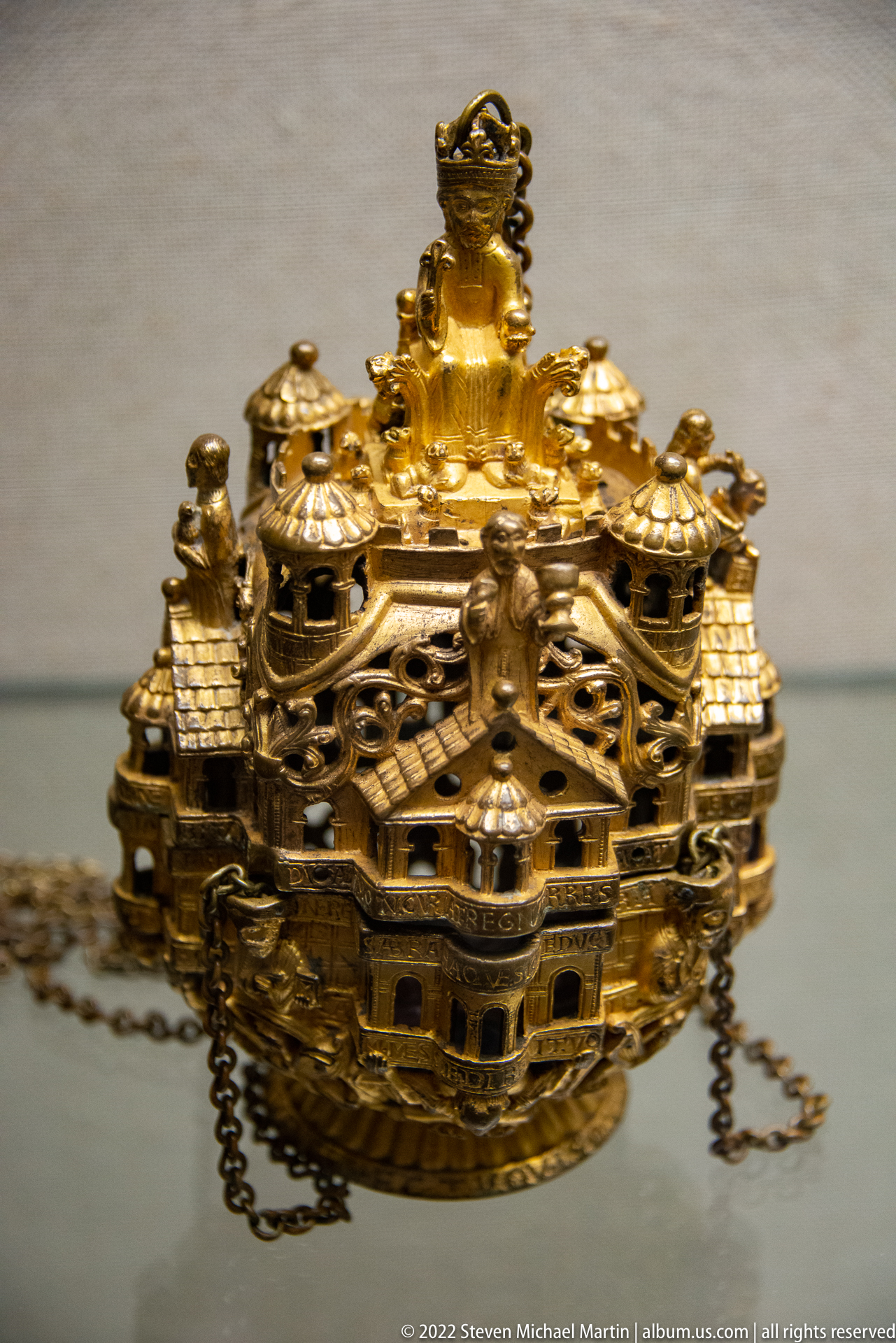
This elaborate gilded vessel is fashioned like a miniature multi-towered building, with openwork walls, tiny roofs, arcades, and a chain extending from the body. The architectural treatment transforms a functional liturgical object into a symbolic microcosm of sacred architecture, while the openwork construction would have allowed smoke to escape during use.
Caption
This elaborate gilded vessel is fashioned like a miniature multi-towered building, with openwork walls, tiny roofs, arcades, and a chain extending from the body. The architectural treatment transforms a functional liturgical object into a symbolic microcosm of sacred architecture, while the openwork construction would have allowed smoke to escape during use.

A pale sculpted infant or young child lies on draped fabric beside richly carved dark textile-like folds with a heavy fringe. The intimate funerary composition contrasts soft modeled flesh with elaborate carved drapery, suggesting a memorial monument or tomb ensemble within the cathedral.
Caption
A pale sculpted infant or young child lies on draped fabric beside richly carved dark textile-like folds with a heavy fringe. The intimate funerary composition contrasts soft modeled flesh with elaborate carved drapery, suggesting a memorial monument or tomb ensemble within the cathedral.

Close detail of a richly worked ecclesiastical object combines gilded metal with vivid blue enamel and circular medallions of sacred figures. The dense pattern of repoussé ornament, beading, and inset imagery emphasizes the object’s function as precious church metalwork, while the tight framing isolates the craftsmanship and iconographic detail from the larger treasury display.
Caption
Close detail of a richly worked ecclesiastical object combines gilded metal with vivid blue enamel and circular medallions of sacred figures. The dense pattern of repoussé ornament, beading, and inset imagery emphasizes the object’s function as precious church metalwork, while the tight framing isolates the craftsmanship and iconographic detail from the larger treasury display.

A foot-shaped gold reliquary rests above a rectangular shrine-like casket decorated with enamel plaques, colored stones, and small sacred images. The object is elevated on short supports, giving the ensemble the appearance of a miniature altar or chest and drawing attention to the unusual anatomical form of the relic container.
Caption
A foot-shaped gold reliquary rests above a rectangular shrine-like casket decorated with enamel plaques, colored stones, and small sacred images. The object is elevated on short supports, giving the ensemble the appearance of a miniature altar or chest and drawing attention to the unusual anatomical form of the relic container.

A small chest-shaped reliquary is covered with exceptionally fine engraved ornament arranged in symmetrical panels across the sloping lid and vertical sides. Circular medallion-like motifs and dense interlace or foliate patterns create an almost textile-like surface, while small feet lift the casket slightly above the display base.
Caption
A small chest-shaped reliquary is covered with exceptionally fine engraved ornament arranged in symmetrical panels across the sloping lid and vertical sides. Circular medallion-like motifs and dense interlace or foliate patterns create an almost textile-like surface, while small feet lift the casket slightly above the display base.

Slender silver-toned saint figures stand within the gilded architectural framework of a richly ornamented shrine or reliquary. Cropped closely around the figures and miniature canopies, the view highlights the contrast between pale sculptural surfaces and the warm gold structure, along with the fine tracery, pinnacles, and suspended decorative elements.
Caption
Slender silver-toned saint figures stand within the gilded architectural framework of a richly ornamented shrine or reliquary. Cropped closely around the figures and miniature canopies, the view highlights the contrast between pale sculptural surfaces and the warm gold structure, along with the fine tracery, pinnacles, and suspended decorative elements.

A small square devotional object centers on a silver-toned relief of Christ with raised hands, set within a circular frame and surrounded by red, blue, green, and turquoise ornament. Cabochon-like stones and blue finials give the piece the appearance of a jeweled reliquary or portable sacred object designed for close viewing.
Caption
A small square devotional object centers on a silver-toned relief of Christ with raised hands, set within a circular frame and surrounded by red, blue, green, and turquoise ornament. Cabochon-like stones and blue finials give the piece the appearance of a jeweled reliquary or portable sacred object designed for close viewing.

The Lamb of God stands at the center of a circular gilded medallion, carrying a cross-staff with a banner inscribed ECCE AGNUS. Pearls or pale stones, blue cabochons, pierced scrollwork, and rope-like borders frame the emblem, creating a dense devotional centerpiece associated with Christian liturgical symbolism.
Caption
The Lamb of God stands at the center of a circular gilded medallion, carrying a cross-staff with a banner inscribed ECCE AGNUS. Pearls or pale stones, blue cabochons, pierced scrollwork, and rope-like borders frame the emblem, creating a dense devotional centerpiece associated with Christian liturgical symbolism.

A carved child figure clasps its hands in prayer and looks upward, its face and curled hair modeled with lifelike softness against the monumental cathedral interior. The close viewpoint separates the devotional figure from the blurred masonry behind it, emphasizing gesture and expression rather than the larger architectural setting.
Caption
A carved child figure clasps its hands in prayer and looks upward, its face and curled hair modeled with lifelike softness against the monumental cathedral interior. The close viewpoint separates the devotional figure from the blurred masonry behind it, emphasizing gesture and expression rather than the larger architectural setting.
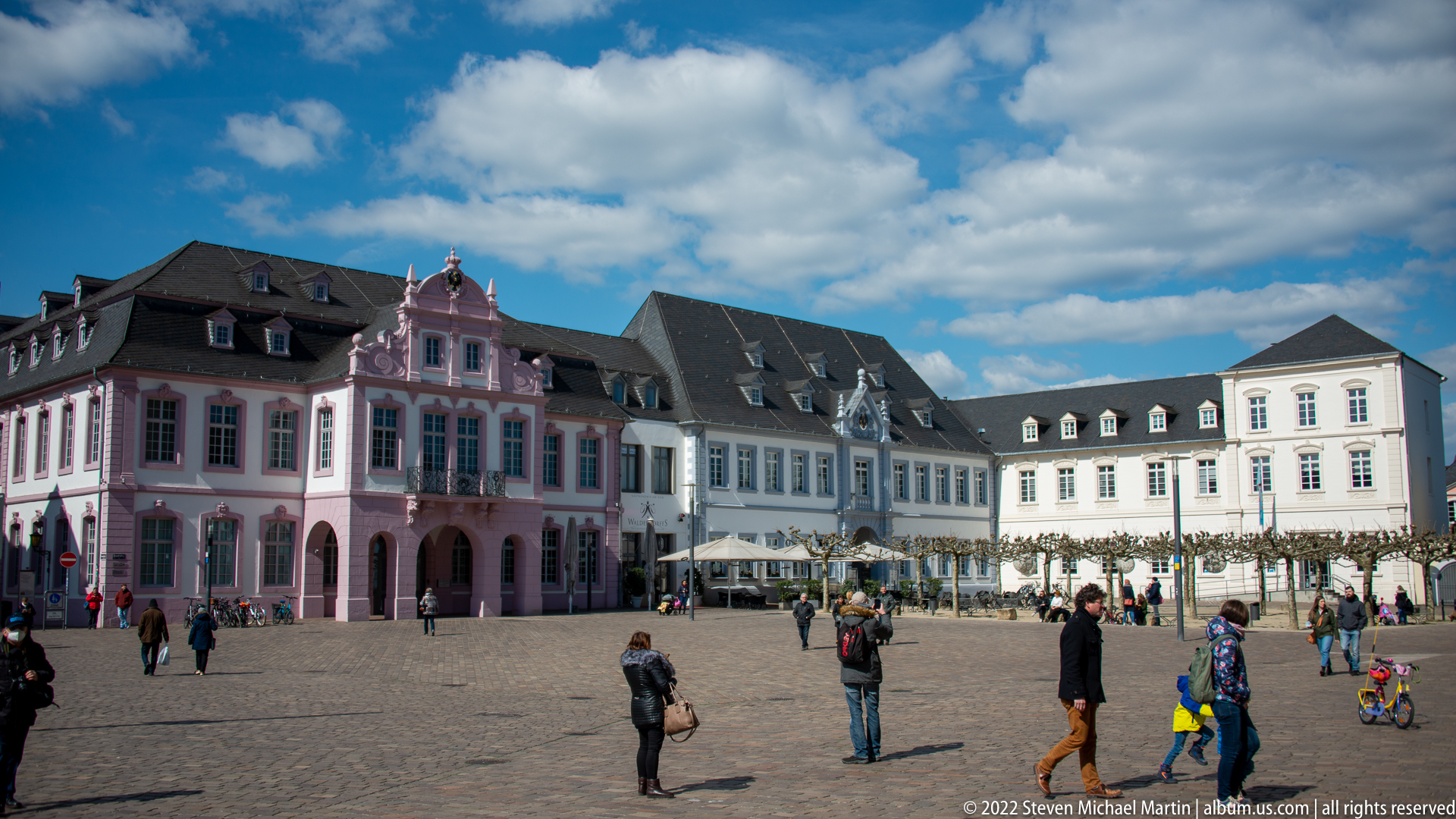
Trier’s Hauptmarkt opens across a broad cobbled square lined by colorful historic façades, including a prominent pink-and-white gabled building at left. Pedestrians cross the open space under a bright sky, giving the view a strong civic scale and situating the architecture within the everyday life of the city center.
Caption
Trier’s Hauptmarkt opens across a broad cobbled square lined by colorful historic façades, including a prominent pink-and-white gabled building at left. Pedestrians cross the open space under a bright sky, giving the view a strong civic scale and situating the architecture within the everyday life of the city center.

A tall dark metal or carved column stands near the cathedral choir, its shaft densely modeled with intertwined human and ornamental forms. The freestanding object is isolated by the red-tiled floor and rope barriers, making its sculptural surface and ceremonial placement easier to read against the lighter stone interior.
Caption
A tall dark metal or carved column stands near the cathedral choir, its shaft densely modeled with intertwined human and ornamental forms. The freestanding object is isolated by the red-tiled floor and rope barriers, making its sculptural surface and ceremonial placement easier to read against the lighter stone interior.

A tall stained-glass composition is divided into three lancets beneath a circular upper light, its figures rendered in strongly saturated red, blue, green, and white. The near-black surrounding wall isolates the luminous window and makes the modern graphic treatment of the sacred imagery especially prominent.
Caption
A tall stained-glass composition is divided into three lancets beneath a circular upper light, its figures rendered in strongly saturated red, blue, green, and white. The near-black surrounding wall isolates the luminous window and makes the modern graphic treatment of the sacred imagery especially prominent.

A spare modern altar stands before a wall of intensely colored stained glass framed by tall Gothic stonework. The contrast between the minimalist altar platform and the layered historic architecture gives the sanctuary a distinctly contemporary liturgical focus while preserving the dramatic vertical backdrop of the church.
Caption
A spare modern altar stands before a wall of intensely colored stained glass framed by tall Gothic stonework. The contrast between the minimalist altar platform and the layered historic architecture gives the sanctuary a distinctly contemporary liturgical focus while preserving the dramatic vertical backdrop of the church.

A painted Christ stands frontally on a broad architectural pier, surrounded by smaller haloed figures against a deep red ground. A black inscription band with Gothic lettering runs below the scene. The surviving mural is integrated directly into the church fabric, linking devotional imagery with the building’s structural supports.
Caption
A painted Christ stands frontally on a broad architectural pier, surrounded by smaller haloed figures against a deep red ground. A black inscription band with Gothic lettering runs below the scene. The surviving mural is integrated directly into the church fabric, linking devotional imagery with the building’s structural supports.

A circular stained-glass window organizes brightly colored angelic or saintly figures around a larger central sacred scene. Red, blue, yellow, and white dominate the compact medallions, whose radial arrangement follows the geometry of the stone tracery and creates a jewel-like focal point within the church.
Caption
A circular stained-glass window organizes brightly colored angelic or saintly figures around a larger central sacred scene. Red, blue, yellow, and white dominate the compact medallions, whose radial arrangement follows the geometry of the stone tracery and creates a jewel-like focal point within the church.

Three tall stained-glass lancets present highly stylized sacred figures in sweeping bands of blue, yellow, green, and red, topped by a band of circular and leaf-like glazing. The dynamic lines and abstracted forms distinguish the window from more traditional figural glazing elsewhere in the church.
Caption
Three tall stained-glass lancets present highly stylized sacred figures in sweeping bands of blue, yellow, green, and red, topped by a band of circular and leaf-like glazing. The dynamic lines and abstracted forms distinguish the window from more traditional figural glazing elsewhere in the church.

A rectangular devotional plaque shows a relief or painted scene from the Passion of Christ within a bright blue field and ornate gold frame. A German inscription below begins with 'O...' and includes 'JESUS,' while cross emblems and circular blue ornaments reinforce the explicitly devotional character of the installation.
Caption
A rectangular devotional plaque shows a relief or painted scene from the Passion of Christ within a bright blue field and ornate gold frame. A German inscription below begins with 'O...' and includes 'JESUS,' while cross emblems and circular blue ornaments reinforce the explicitly devotional character of the installation.

A monumental stone portal is framed by rusticated masonry, paired side columns, sculptural reliefs, and a broken or curved pediment crowned by figures. Set against a long red-roofed wall, the gate presents a theatrical Baroque entrance whose weathered stone surface contrasts with the simpler adjoining architecture.
Caption
A monumental stone portal is framed by rusticated masonry, paired side columns, sculptural reliefs, and a broken or curved pediment crowned by figures. Set against a long red-roofed wall, the gate presents a theatrical Baroque entrance whose weathered stone surface contrasts with the simpler adjoining architecture.
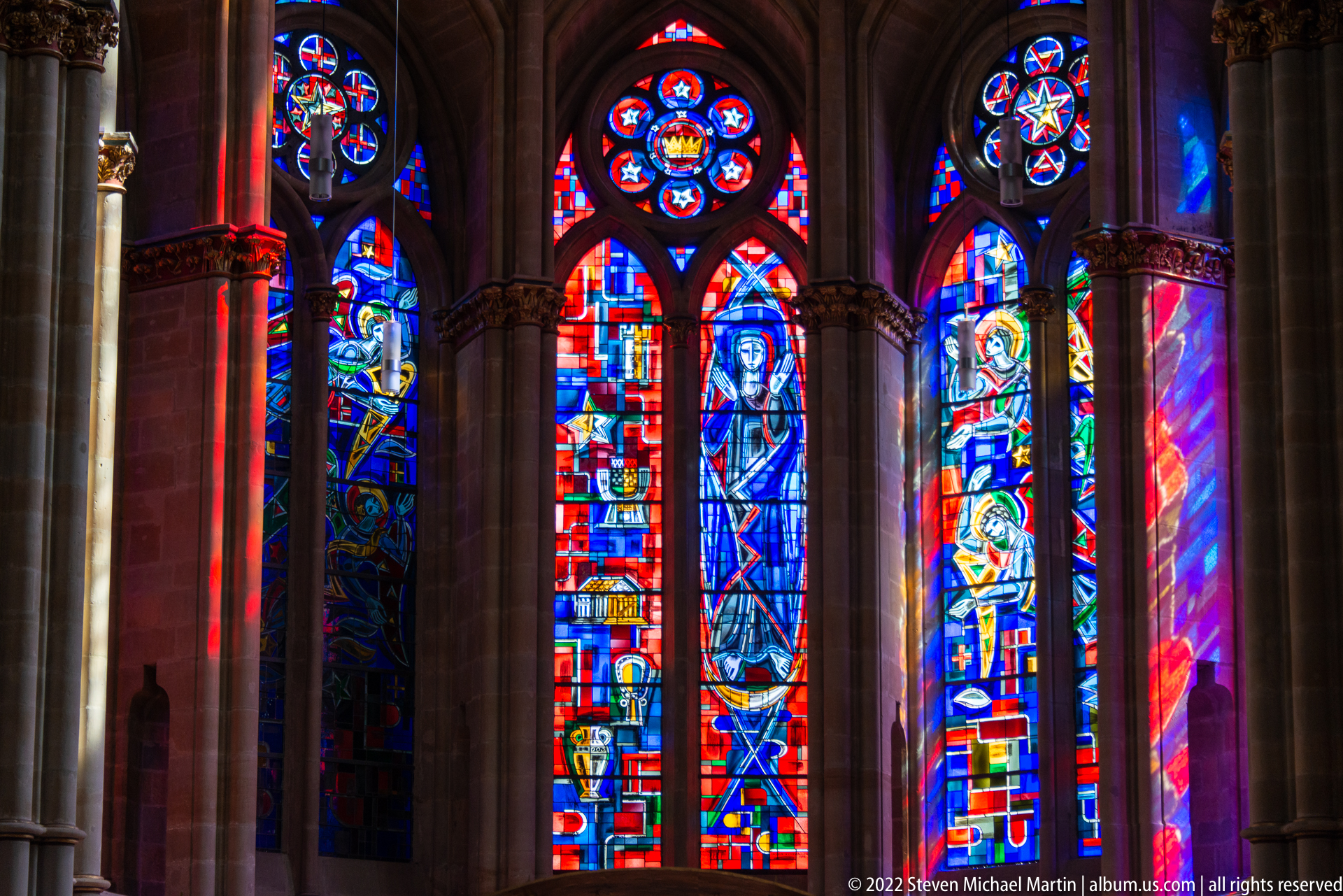
Multiple stained-glass windows fill adjacent Gothic bays, combining narrow lancets with circular tracery lights above. Vivid colored light spills across the stone piers and arches, so the photograph records not only the window designs but also their effect on the surrounding interior surfaces.
Caption
Multiple stained-glass windows fill adjacent Gothic bays, combining narrow lancets with circular tracery lights above. Vivid colored light spills across the stone piers and arches, so the photograph records not only the window designs but also their effect on the surrounding interior surfaces.

The formal garden of Trier’s Electoral Palace is organized around a long reflecting pool, with the pink-and-white palace façade closing the far end of the view. Spring flowering trees and clipped lawns soften the strict axial layout, while the still water doubles the architecture and sky in a clear reflection.
Caption
The formal garden of Trier’s Electoral Palace is organized around a long reflecting pool, with the pink-and-white palace façade closing the far end of the view. Spring flowering trees and clipped lawns soften the strict axial layout, while the still water doubles the architecture and sky in a clear reflection.

A dark wooden door is set within an exuberantly painted architectural surround of blue-gray scrollwork, white pilasters, orange accents, and gilded details. A broken triangular pediment crowns the entrance beneath a small lamp, making the portal a compact display of Baroque decorative design on an otherwise plain wall.
Caption
A dark wooden door is set within an exuberantly painted architectural surround of blue-gray scrollwork, white pilasters, orange accents, and gilded details. A broken triangular pediment crowns the entrance beneath a small lamp, making the portal a compact display of Baroque decorative design on an otherwise plain wall.

A life-size fragmentary male nude preserves the torso, upper legs, and one arm holding a cluster of rounded forms or a circular object. Missing head and limbs expose the sculpture’s damaged condition, while the surviving anatomy demonstrates the idealized treatment characteristic of classical figural sculpture displayed in the Roman collection.
Caption
A life-size fragmentary male nude preserves the torso, upper legs, and one arm holding a cluster of rounded forms or a circular object. Missing head and limbs expose the sculpture’s damaged condition, while the surviving anatomy demonstrates the idealized treatment characteristic of classical figural sculpture displayed in the Roman collection.

A rectangular Roman floor mosaic is organized as a strict nine-panel grid, each compartment framing a portrait bust or personification. Geometric meanders and repeating borders separate the images and create a strong architectural order, while the varied faces, costumes, and attributes distinguish the individual figures within the larger decorative program.
Caption
A rectangular Roman floor mosaic is organized as a strict nine-panel grid, each compartment framing a portrait bust or personification. Geometric meanders and repeating borders separate the images and create a strong architectural order, while the varied faces, costumes, and attributes distinguish the individual figures within the larger decorative program.

The Electoral Palace stretches across the edge of its formal garden, its long red-pink façade centered on an ornate white-and-gold pavilion. Seen across a broad lawn, the symmetrical composition makes the contrast between restrained side wings and the highly decorative central bay especially clear.
Caption
The Electoral Palace stretches across the edge of its formal garden, its long red-pink façade centered on an ornate white-and-gold pavilion. Seen across a broad lawn, the symmetrical composition makes the contrast between restrained side wings and the highly decorative central bay especially clear.

An ornate curved pediment crowns the palace façade with a dense arrangement of gilded Rococo scrollwork and pale sculpted figures. Freestanding statues line the roof edge, while the dark slate roofs behind provide a restrained background that heightens the contrast of the white-and-gold decoration.
Caption
An ornate curved pediment crowns the palace façade with a dense arrangement of gilded Rococo scrollwork and pale sculpted figures. Freestanding statues line the roof edge, while the dark slate roofs behind provide a restrained background that heightens the contrast of the white-and-gold decoration.

Colorful vertical banners mounted against a stone wall announce the Rheinisches Landesmuseum Trier and exhibitions related to Roman Trier. One panel refers to 'Der Untergang des Römischen Reiches,' while another carries the museum name and a map-like graphic, placing the photograph firmly in the museum’s public entrance context.
Caption
Colorful vertical banners mounted against a stone wall announce the Rheinisches Landesmuseum Trier and exhibitions related to Roman Trier. One panel refers to 'Der Untergang des Römischen Reiches,' while another carries the museum name and a map-like graphic, placing the photograph firmly in the museum’s public entrance context.

A bright gallery at the Rheinisches Landesmuseum Trier displays archaeological objects in glass cases arranged along angled wall panels and central islands. Large windows flood the room with daylight, while pottery and other artifacts are spaced carefully within a modern exhibition design that encourages close viewing.
Caption
A bright gallery at the Rheinisches Landesmuseum Trier displays archaeological objects in glass cases arranged along angled wall panels and central islands. Large windows flood the room with daylight, while pottery and other artifacts are spaced carefully within a modern exhibition design that encourages close viewing.
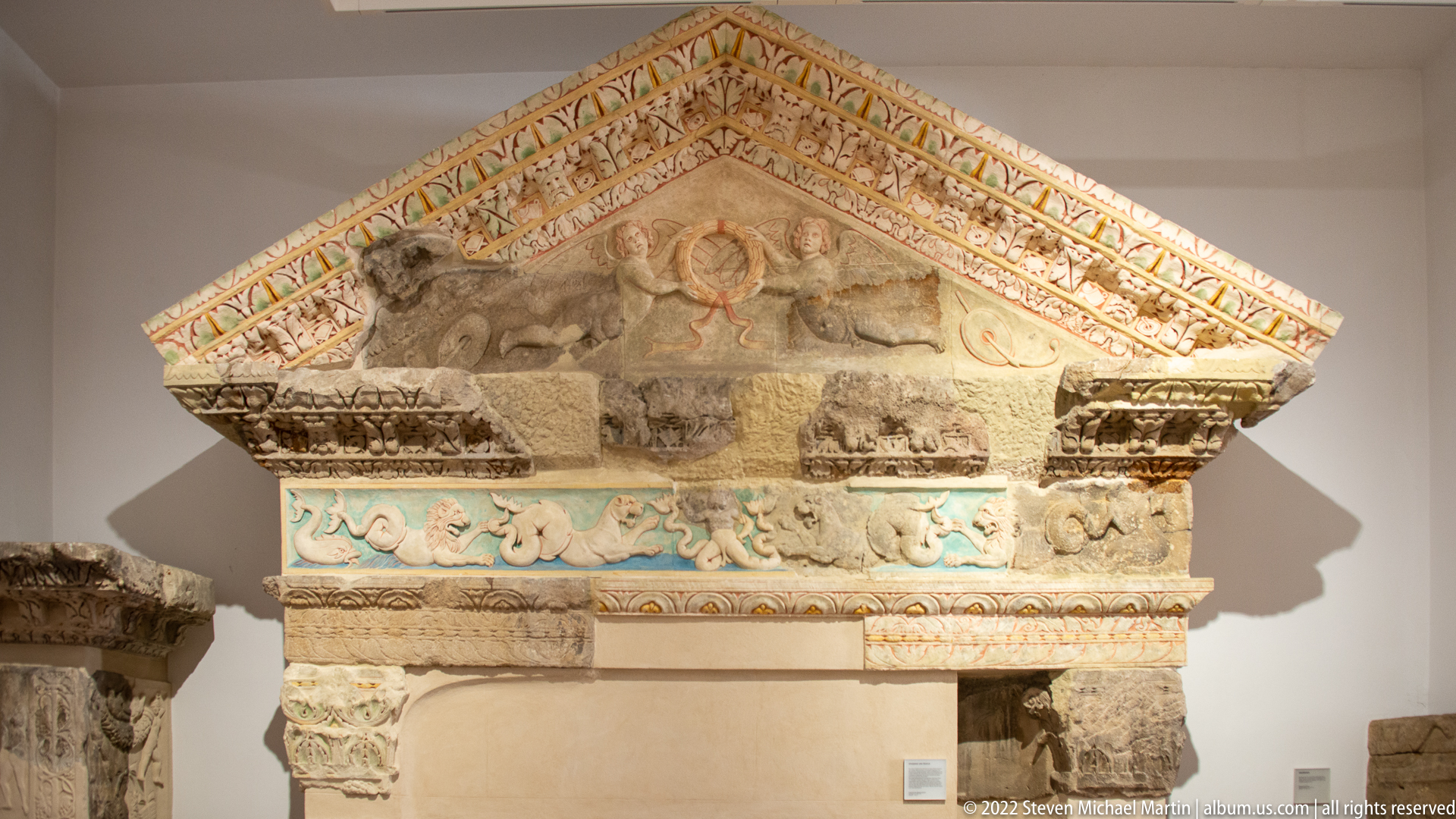
A reconstructed or displayed stone architectural fragment preserves a triangular pediment above a richly carved horizontal entablature. Traces of painted red, blue, and yellow ornament remain visible, offering rare evidence of the polychromy that once enlivened ancient stone architecture rather than leaving it uniformly bare.
Caption
A reconstructed or displayed stone architectural fragment preserves a triangular pediment above a richly carved horizontal entablature. Traces of painted red, blue, and yellow ornament remain visible, offering rare evidence of the polychromy that once enlivened ancient stone architecture rather than leaving it uniformly bare.

A monumental Roman stone sarcophagus pairs a deeply carved rectangular chest with a steep gabled lid. Masks, garlands, marine or mythological creatures, and small figures crowd the surfaces, while the triangular lid centers on a large frontal head. The dense sculptural program turns the funerary container into an architectural and narrative object intended to be viewed from several sides.
Caption
A monumental Roman stone sarcophagus pairs a deeply carved rectangular chest with a steep gabled lid. Masks, garlands, marine or mythological creatures, and small figures crowd the surfaces, while the triangular lid centers on a large frontal head. The dense sculptural program turns the funerary container into an architectural and narrative object intended to be viewed from several sides.

A close view isolates a powerful carved face with thick curling hair on the end of a Roman funerary monument. Serpentine forms and animal-like heads emerge around the face, intensifying the apotropaic character of the carving. Tool marks, surface wear, and losses are visible at this scale, revealing both the sculptor’s modeling and the monument’s age.
Caption
A close view isolates a powerful carved face with thick curling hair on the end of a Roman funerary monument. Serpentine forms and animal-like heads emerge around the face, intensifying the apotropaic character of the carving. Tool marks, surface wear, and losses are visible at this scale, revealing both the sculptor’s modeling and the monument’s age.
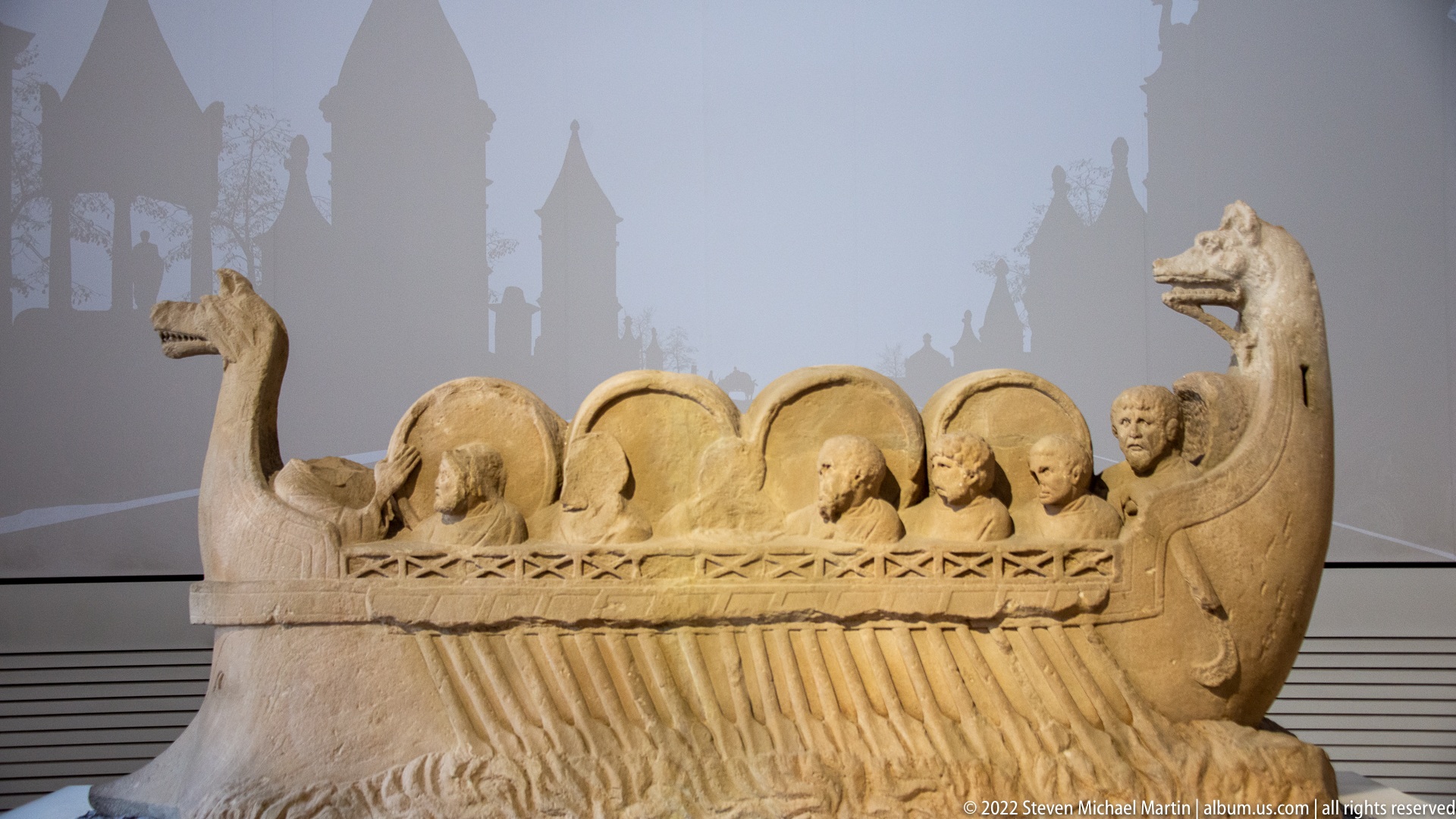
A boat-shaped stone monument carries a row of reclining or seated figures beneath large circular forms, with animal-headed ends rising like prow and stern ornaments. The unusual composition combines human portraiture with a vessel-like base, creating one of the more distinctive funerary sculptures in the archaeological display.
Caption
A boat-shaped stone monument carries a row of reclining or seated figures beneath large circular forms, with animal-headed ends rising like prow and stern ornaments. The unusual composition combines human portraiture with a vessel-like base, creating one of the more distinctive funerary sculptures in the archaeological display.

An octagonal mosaic design centers on a small figurative scene and radiates outward through eight surrounding compartments filled with floral or emblematic motifs. Vine scrolls and repeating geometric borders frame the composition, producing a balanced ornamental scheme that would have structured a large interior floor in a Roman building.
Caption
An octagonal mosaic design centers on a small figurative scene and radiates outward through eight surrounding compartments filled with floral or emblematic motifs. Vine scrolls and repeating geometric borders frame the composition, producing a balanced ornamental scheme that would have structured a large interior floor in a Roman building.

A small mosaic panel depicts a long-legged, long-billed bird walking across a narrow red ground line against a green field. Black outlining and pale tesserae define the body and legs with economical detail, making the isolated bird motif easy to read despite its compact scale.
Caption
A small mosaic panel depicts a long-legged, long-billed bird walking across a narrow red ground line against a green field. Black outlining and pale tesserae define the body and legs with economical detail, making the isolated bird motif easy to read despite its compact scale.
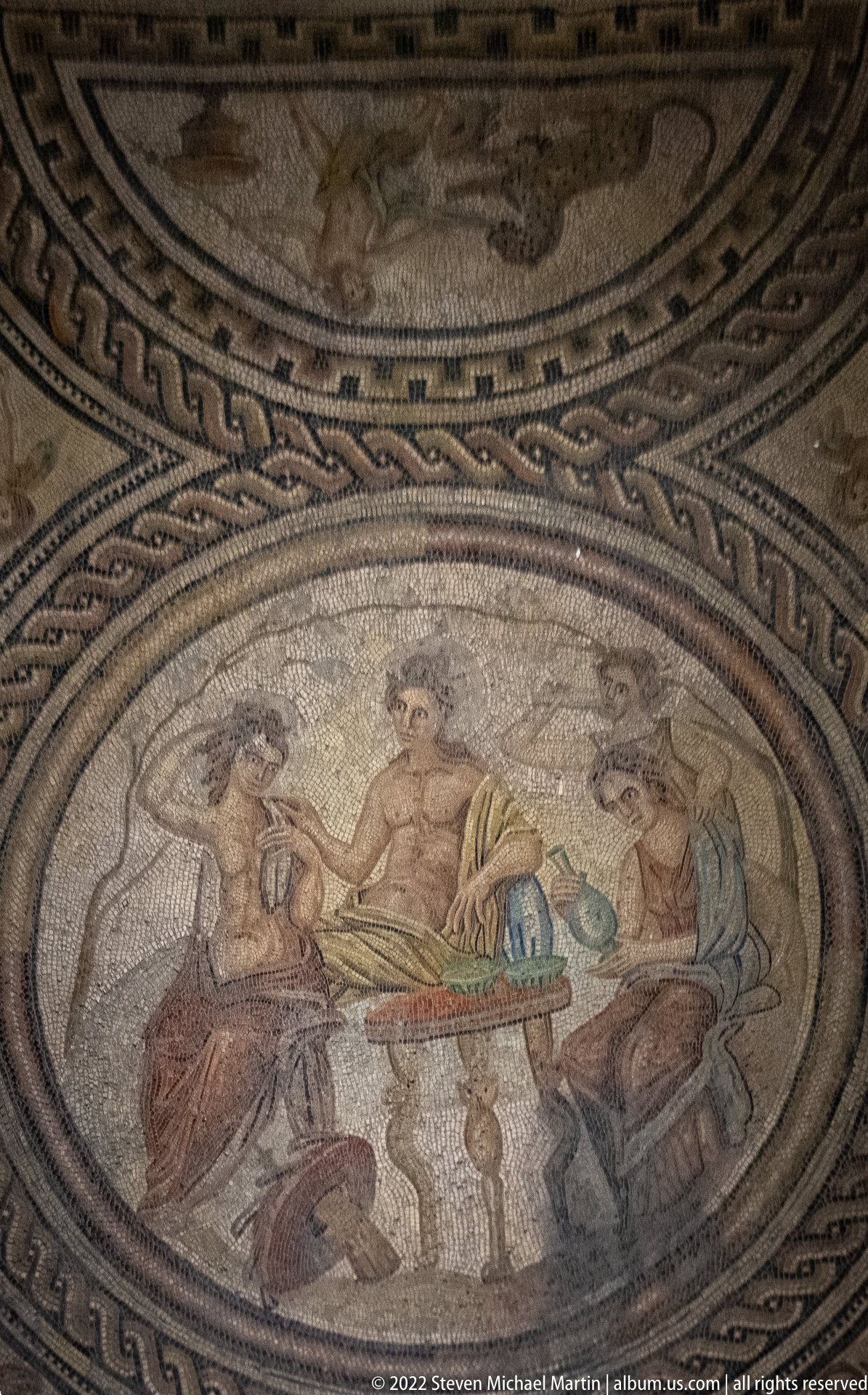
A circular mosaic medallion presents several partially draped figures reclining around a central table or vessel. The scene is enclosed by concentric bands of wave, braid, and geometric ornament, giving the figural centerpiece the appearance of a framed tableau within a much larger floor composition.
Caption
A circular mosaic medallion presents several partially draped figures reclining around a central table or vessel. The scene is enclosed by concentric bands of wave, braid, and geometric ornament, giving the figural centerpiece the appearance of a framed tableau within a much larger floor composition.

A reconstructed Roman stone monument stands freely in the museum gallery, its broad central arch framed by engaged columns, relief-carved blocks, and an elaborate upper structure. Sculptural figures placed across the top reinforce the building-like character of the ensemble and demonstrate the scale at which commemorative architecture could be presented.
Caption
A reconstructed Roman stone monument stands freely in the museum gallery, its broad central arch framed by engaged columns, relief-carved blocks, and an elaborate upper structure. Sculptural figures placed across the top reinforce the building-like character of the ensemble and demonstrate the scale at which commemorative architecture could be presented.

Round wax seals in red and dark brown are displayed on slender mounts against a saturated red background. Heraldic emblems, figures, and inscriptions are impressed into the surfaces, allowing the different seal matrices and states of preservation to be compared as legal and administrative objects rather than simply decorative artifacts.
Caption
Round wax seals in red and dark brown are displayed on slender mounts against a saturated red background. Heraldic emblems, figures, and inscriptions are impressed into the surfaces, allowing the different seal matrices and states of preservation to be compared as legal and administrative objects rather than simply decorative artifacts.

Standing and seated figures crown the upper portion of a large carved stone monument above an arched opening. A central robed figure rises highest, while smaller figures occupy the ledge and corners amid classical architectural moldings and relief decoration. The ensemble reads as a reconstructed monumental façade rather than a freestanding sculptural group.
Caption
Standing and seated figures crown the upper portion of a large carved stone monument above an arched opening. A central robed figure rises highest, while smaller figures occupy the ledge and corners amid classical architectural moldings and relief decoration. The ensemble reads as a reconstructed monumental façade rather than a freestanding sculptural group.

The historic wing of the Rheinisches Landesmuseum Trier presents a symmetrical red-sandstone façade with a central entrance, tall rectangular windows, and a sculpted panel above the doorway. Bare trees and a modern museum sign frame the approach, placing the building within its landscaped urban setting.
Caption
The historic wing of the Rheinisches Landesmuseum Trier presents a symmetrical red-sandstone façade with a central entrance, tall rectangular windows, and a sculpted panel above the doorway. Bare trees and a modern museum sign frame the approach, placing the building within its landscaped urban setting.
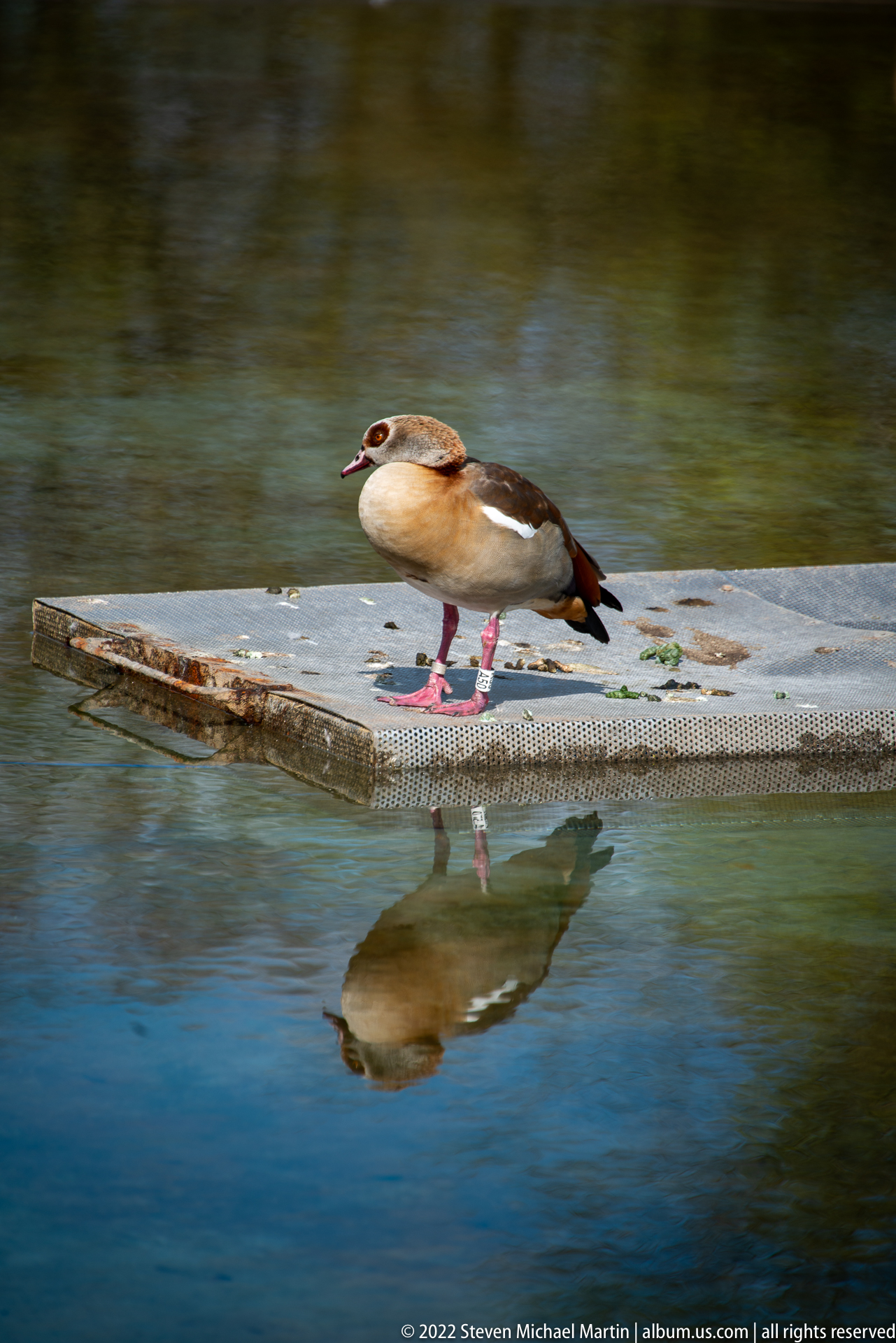
An Egyptian goose stands on a low floating platform beside calm water, its chestnut eye patch, pale face, brown back, and pink legs clearly visible. The bird’s reflection appears beneath the platform, adding a second, softer silhouette to the otherwise simple wildlife composition.
Caption
An Egyptian goose stands on a low floating platform beside calm water, its chestnut eye patch, pale face, brown back, and pink legs clearly visible. The bird’s reflection appears beneath the platform, adding a second, softer silhouette to the otherwise simple wildlife composition.
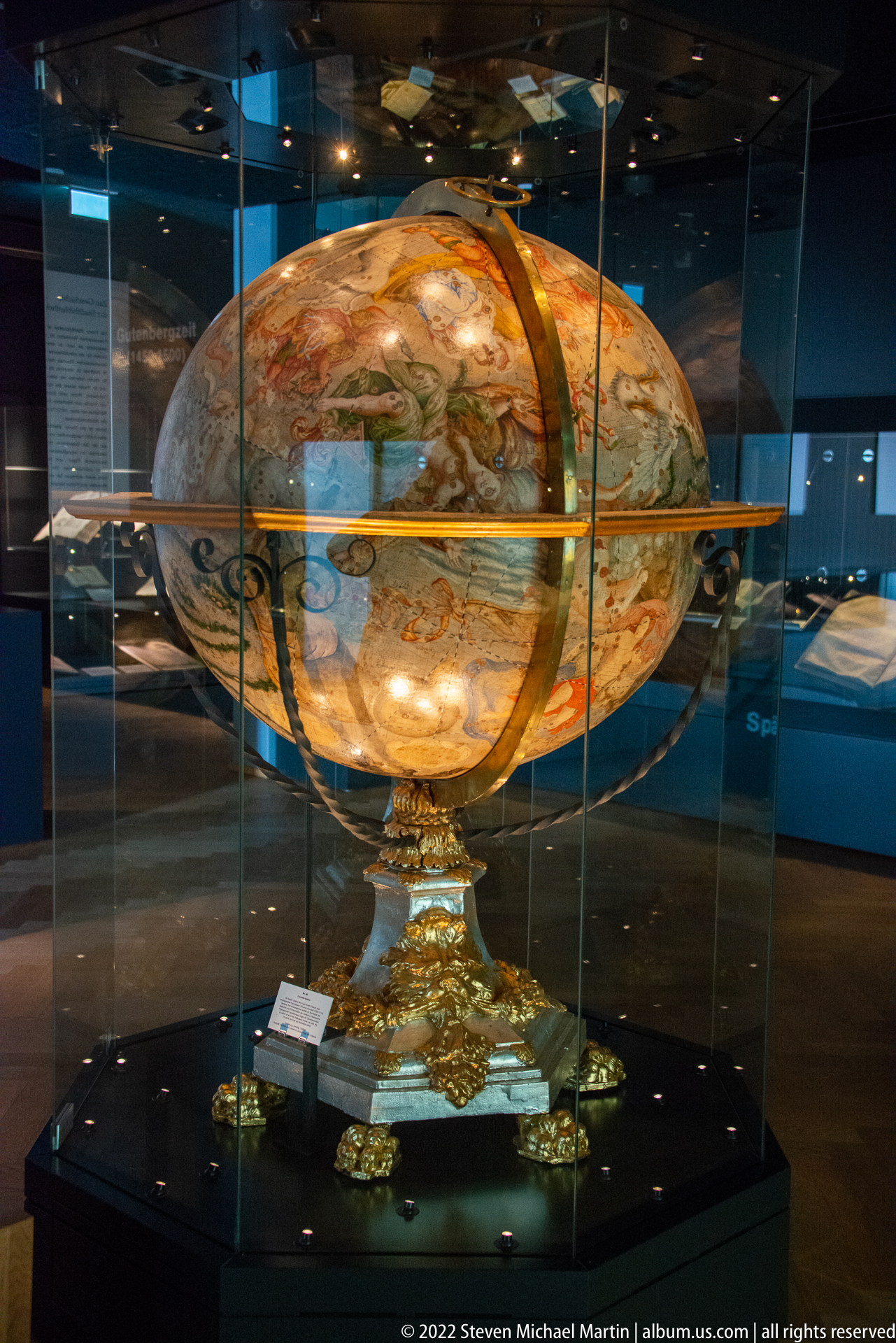
A large historic terrestrial globe sits on an ornate gilded stand inside a glass case, its painted oceans, continents, decorative cartouches, and horizontal meridian ring still visible. The substantial scale and elaborate mounting emphasize the globe as both a scientific instrument and a prestige object intended for display.
Caption
A large historic terrestrial globe sits on an ornate gilded stand inside a glass case, its painted oceans, continents, decorative cartouches, and horizontal meridian ring still visible. The substantial scale and elaborate mounting emphasize the globe as both a scientific instrument and a prestige object intended for display.

A single parchment leaf presents a dense Latin text block framed by delicate floral ornament, with a richly painted initial opening the passage at upper left. Red and blue rubrication punctuates the writing, while the compact border decoration gives the page a refined, late-medieval manuscript character.
Caption
A single parchment leaf presents a dense Latin text block framed by delicate floral ornament, with a richly painted initial opening the passage at upper left. Red and blue rubrication punctuates the writing, while the compact border decoration gives the page a refined, late-medieval manuscript character.

An open parchment manuscript juxtaposes a densely written Latin text block with a facing page filled by later handwritten notes. Red rubrication punctuates the formal script, while the contrast between the copied text and cursive annotations records how the book continued to be read and used after its original production.
Caption
An open parchment manuscript juxtaposes a densely written Latin text block with a facing page filled by later handwritten notes. Red rubrication punctuates the formal script, while the contrast between the copied text and cursive annotations records how the book continued to be read and used after its original production.
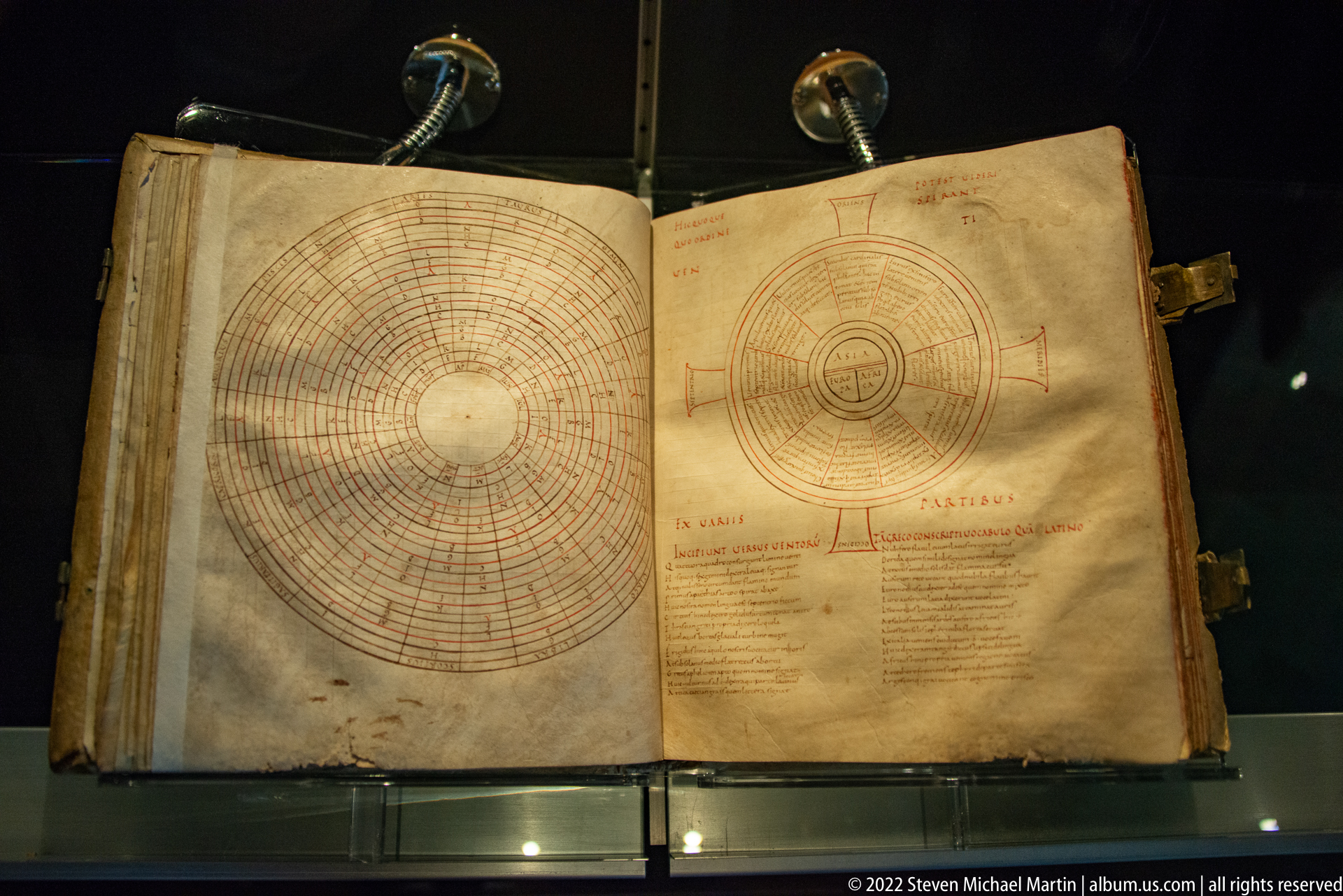
Two facing manuscript pages contain finely drawn concentric circular diagrams executed in red and dark ink. The left page presents a dense system of rings and radial divisions, while the right reduces the geometry to a simpler wheel with labeled sectors, suggesting astronomical, computistical, or calendrical calculation rather than purely decorative illustration.
Caption
Two facing manuscript pages contain finely drawn concentric circular diagrams executed in red and dark ink. The left page presents a dense system of rings and radial divisions, while the right reduces the geometry to a simpler wheel with labeled sectors, suggesting astronomical, computistical, or calendrical calculation rather than purely decorative illustration.

An illuminated manuscript opening is dominated by two monumental decorated initials filled with interlace, foliage, and small portrait medallions. Red, green, blue, and gold tones animate the letterforms, transforming the opening words into a richly visual threshold to the text and demonstrating the close relationship between calligraphy, painting, and sacred reading.
Caption
An illuminated manuscript opening is dominated by two monumental decorated initials filled with interlace, foliage, and small portrait medallions. Red, green, blue, and gold tones animate the letterforms, transforming the opening words into a richly visual threshold to the text and demonstrating the close relationship between calligraphy, painting, and sacred reading.

A full-page drawing places two sacred figures beneath a simple architectural canopy, while the facing page carries closely written Latin text with red initials. The restrained palette and linear treatment contrast with more lavishly colored manuscripts nearby, drawing attention to gesture, clothing, and the narrative relationship between the figures.
Caption
A full-page drawing places two sacred figures beneath a simple architectural canopy, while the facing page carries closely written Latin text with red initials. The restrained palette and linear treatment contrast with more lavishly colored manuscripts nearby, drawing attention to gesture, clothing, and the narrative relationship between the figures.

Colorful diagrammatic pages organize dozens of circular labels within geometric fields, linking text, figures, and colored shapes into a dense visual system. On one page, a large red triangular form encloses rows of roundels; on the other, standing figures and arcs accompany additional labeled circles, indicating a manuscript designed to explain complex relationships visually.
Caption
Colorful diagrammatic pages organize dozens of circular labels within geometric fields, linking text, figures, and colored shapes into a dense visual system. On one page, a large red triangular form encloses rows of roundels; on the other, standing figures and arcs accompany additional labeled circles, indicating a manuscript designed to explain complex relationships visually.

A large decorated initial opens a page of a liturgical manuscript whose text is arranged in broad, evenly spaced lines with colored initials and musical or chant notation. The opposing page continues the structured text, creating a clear example of how script, ornament, and performance cues were integrated in a book used for worship.
Caption
A large decorated initial opens a page of a liturgical manuscript whose text is arranged in broad, evenly spaced lines with colored initials and musical or chant notation. The opposing page continues the structured text, creating a clear example of how script, ornament, and performance cues were integrated in a book used for worship.

Marginal and narrative drawings animate a densely written manuscript with scenes of everyday activity: two standing people beside a small building, grazing cattle, and mounted riders confronting one another. The lively colored sketches sit among blocks of script, creating an unusually direct visual record of people, animals, clothing, and movement.
Caption
Marginal and narrative drawings animate a densely written manuscript with scenes of everyday activity: two standing people beside a small building, grazing cattle, and mounted riders confronting one another. The lively colored sketches sit among blocks of script, creating an unusually direct visual record of people, animals, clothing, and movement.
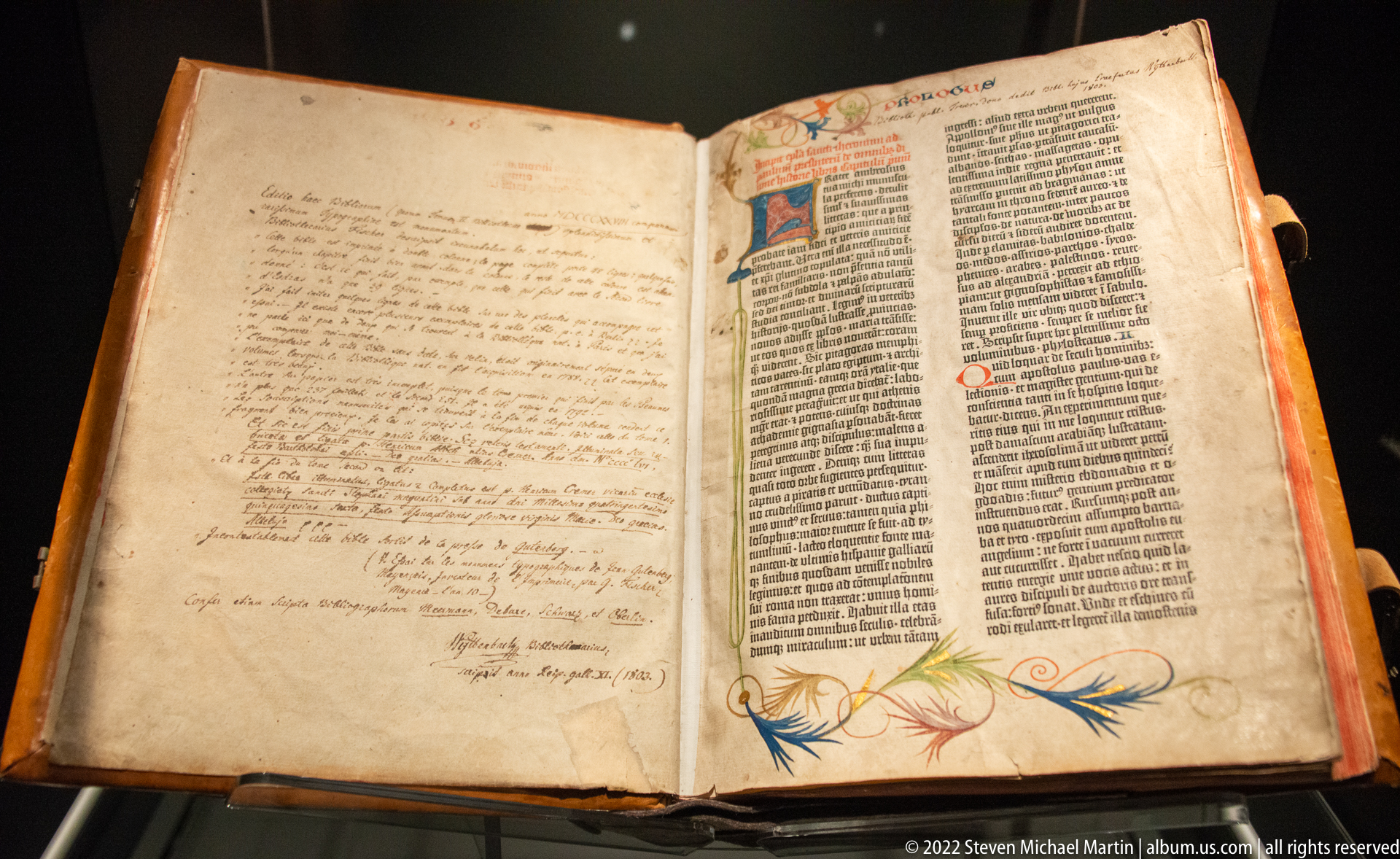
An open early printed volume combines dense black type in narrow columns with a hand-painted initial, colored pen flourishes, and extensive manuscript notes on the facing page. The mixture of print and handwriting preserves the book’s transition from produced object to working text, showing how readers continued to annotate and personalize printed pages.
Caption
An open early printed volume combines dense black type in narrow columns with a hand-painted initial, colored pen flourishes, and extensive manuscript notes on the facing page. The mixture of print and handwriting preserves the book’s transition from produced object to working text, showing how readers continued to annotate and personalize printed pages.

A square gilded panel is divided into small architectural compartments containing repoussé or cast figures, gemstones, and ornamental scrollwork. At the center, a translucent carved stone relief forms the visual focus, while green, purple, and pale stones punctuate the gold surface. The ensemble has the character of a precious medieval book cover or reliquary panel.
Caption
A square gilded panel is divided into small architectural compartments containing repoussé or cast figures, gemstones, and ornamental scrollwork. At the center, a translucent carved stone relief forms the visual focus, while green, purple, and pale stones punctuate the gold surface. The ensemble has the character of a precious medieval book cover or reliquary panel.

A full-page manuscript drawing places an enthroned ecclesiastical figure at the center of a complex diagram of scroll-like text bands and architectural motifs. Red accents pick out the figure’s vestments and selected elements, while dense handwritten annotations surround the composition. The page functions as both image and intellectual diagram rather than a conventional narrative miniature.
Caption
A full-page manuscript drawing places an enthroned ecclesiastical figure at the center of a complex diagram of scroll-like text bands and architectural motifs. Red accents pick out the figure’s vestments and selected elements, while dense handwritten annotations surround the composition. The page functions as both image and intellectual diagram rather than a conventional narrative miniature.

A vividly colored manuscript illustration shows a standing man between tall cylindrical forms and oversized drafting or measuring instruments. Decorative borders, geometric motifs, and explanatory text frame the scene, suggesting a didactic page concerned with craft, measurement, or symbolic knowledge rather than a purely devotional subject.
Caption
A vividly colored manuscript illustration shows a standing man between tall cylindrical forms and oversized drafting or measuring instruments. Decorative borders, geometric motifs, and explanatory text frame the scene, suggesting a didactic page concerned with craft, measurement, or symbolic knowledge rather than a purely devotional subject.

A small rectangular miniature introduces a page of Latin text, showing several haloed figures standing before a crowd or architectural setting. Gold and saturated colors distinguish the scene from the surrounding brown-black script, while the facing text continues in carefully ruled lines typical of a formal religious manuscript.
Caption
A small rectangular miniature introduces a page of Latin text, showing several haloed figures standing before a crowd or architectural setting. Gold and saturated colors distinguish the scene from the surrounding brown-black script, while the facing text continues in carefully ruled lines typical of a formal religious manuscript.

A close view of the precious panel reveals a translucent pale carving in which a row of human heads rises above large brown-and-white birds with spread wings. The relief is set in a jeweled gold frame with colored stones at the corners, emphasizing the contrast between the smooth carved material and the densely ornamented metalwork around it.
Caption
A close view of the precious panel reveals a translucent pale carving in which a row of human heads rises above large brown-and-white birds with spread wings. The relief is set in a jeweled gold frame with colored stones at the corners, emphasizing the contrast between the smooth carved material and the densely ornamented metalwork around it.

A manuscript illustration sets a red-brown cow beside several pale, stylized animals drawn in profile against a simple ground line. The animals are embedded within handwritten text, combining observation, convention, and diagrammatic storytelling. Their exaggerated bodies and gestures reveal the distinctive visual language of medieval manuscript illustration rather than naturalistic zoological study.
Caption
A manuscript illustration sets a red-brown cow beside several pale, stylized animals drawn in profile against a simple ground line. The animals are embedded within handwritten text, combining observation, convention, and diagrammatic storytelling. Their exaggerated bodies and gestures reveal the distinctive visual language of medieval manuscript illustration rather than naturalistic zoological study.
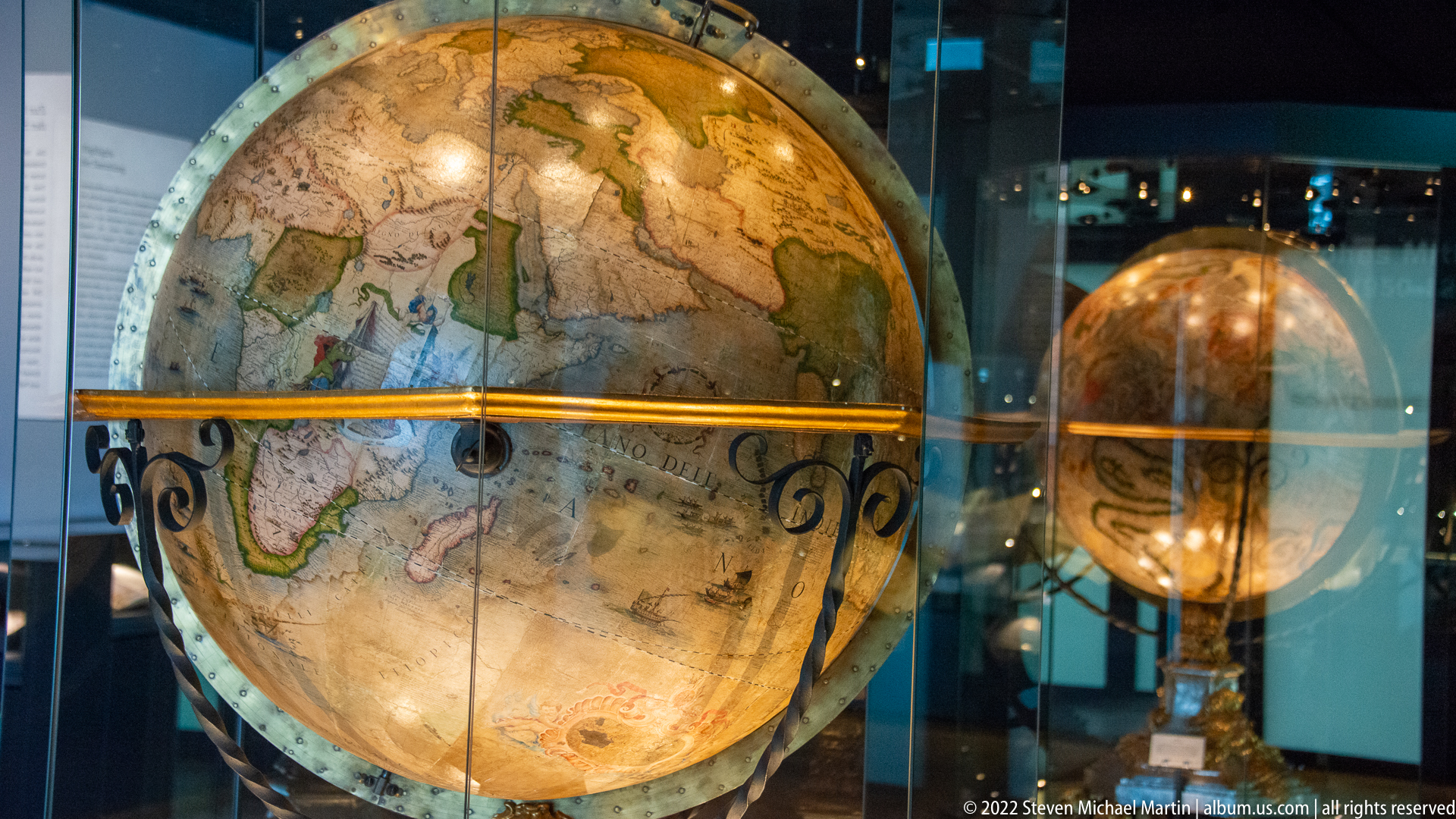
Two historic terrestrial globes are displayed in aligned glass cases, the nearer example revealing painted coastlines, place names, and latitude-longitude grids across Europe, Africa, and Asia. Brass or gilded horizon rings and decorative stands reinforce their role as scientific instruments while also presenting them as finely crafted objects of display.
Caption
Two historic terrestrial globes are displayed in aligned glass cases, the nearer example revealing painted coastlines, place names, and latitude-longitude grids across Europe, Africa, and Asia. Brass or gilded horizon rings and decorative stands reinforce their role as scientific instruments while also presenting them as finely crafted objects of display.

A large painted initial opens a densely written Latin manuscript page, its blue field filled with red and green foliate ornament and extended pen flourishes. Red rubrication introduces surrounding text, while traces of later annotations at the margins show continued use of the volume after its original production.
Caption
A large painted initial opens a densely written Latin manuscript page, its blue field filled with red and green foliate ornament and extended pen flourishes. Red rubrication introduces surrounding text, while traces of later annotations at the margins show continued use of the volume after its original production.

A tall sculpted fountain or monument stands at the center of an enclosed courtyard framed by white façades with red trim and a decorative stepped gable. The axial composition, repeated windows, and carved wall plaques create a formal setting in which the vertical stone monument becomes the courtyard’s principal focal point.
Caption
A tall sculpted fountain or monument stands at the center of an enclosed courtyard framed by white façades with red trim and a decorative stepped gable. The axial composition, repeated windows, and carved wall plaques create a formal setting in which the vertical stone monument becomes the courtyard’s principal focal point.

A formal historic building rises behind a row of international flags, its red-and-cream façade topped by a broad slate roof and an octagonal lantern-like cupola. The symmetrical windows and ceremonial flag display give the scene an institutional character, while the low viewpoint emphasizes the roofline and central tower.
Caption
A formal historic building rises behind a row of international flags, its red-and-cream façade topped by a broad slate roof and an octagonal lantern-like cupola. The symmetrical windows and ceremonial flag display give the scene an institutional character, while the low viewpoint emphasizes the roofline and central tower.

A low-angle view isolates the crowning figure and exuberant rocaille ornament of the Georgsbrunnen against a vivid blue sky. Gilded edges catch the light along billowing drapery, scrolls, and the pedestal, emphasizing the theatrical upward movement characteristic of the fountain’s eighteenth-century sculptural design.
Caption
A low-angle view isolates the crowning figure and exuberant rocaille ornament of the Georgsbrunnen against a vivid blue sky. Gilded edges catch the light along billowing drapery, scrolls, and the pedestal, emphasizing the theatrical upward movement characteristic of the fountain’s eighteenth-century sculptural design.

A large translucent green cabochon dominates a compact gold object whose projecting arms are tipped with blue stones. Behind it, a circular gold medallion carries a frontal face, giving the piece a layered construction of gemstone, portrait imagery, and cross-like geometry characteristic of precious devotional metalwork.
Caption
A large translucent green cabochon dominates a compact gold object whose projecting arms are tipped with blue stones. Behind it, a circular gold medallion carries a frontal face, giving the piece a layered construction of gemstone, portrait imagery, and cross-like geometry characteristic of precious devotional metalwork.

A carved lion head projects from the fountain’s pale stone surface, its open mouth fitted with a dark metal water spout. Gilded edging traces nearby rocaille forms, while weathering and staining around the carving reveal the working life of this functional sculptural detail.
Caption
A carved lion head projects from the fountain’s pale stone surface, its open mouth fitted with a dark metal water spout. Gilded edging traces nearby rocaille forms, while weathering and staining around the carving reveal the working life of this functional sculptural detail.
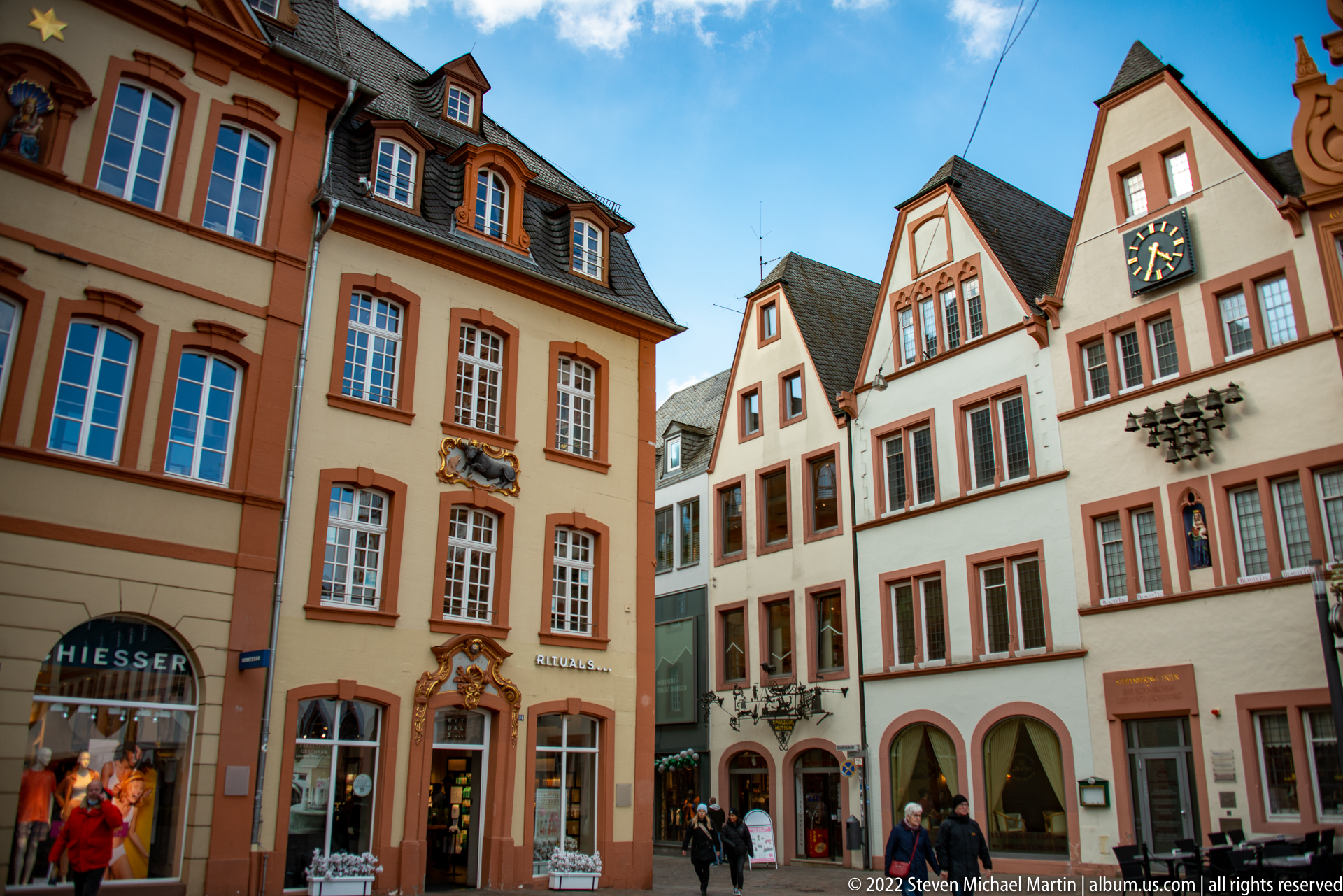
Colorful historic façades line the edge of Trier’s central market square, combining steep gables, rows of sash windows, painted trim, and ground-floor shops. Pedestrians animate the open space below, while a clock set high in one gable adds a civic note to the tightly packed architectural ensemble.
Caption
Colorful historic façades line the edge of Trier’s central market square, combining steep gables, rows of sash windows, painted trim, and ground-floor shops. Pedestrians animate the open space below, while a clock set high in one gable adds a civic note to the tightly packed architectural ensemble.

Two painted and gilded standing figures occupy niches between sharply pointed arches on an ornate historic façade. Crockets, finials, and gold foliate accents enrich the architectural frame, while the brightly colored robes of the figures create a vivid contrast against the pale wall and dark arch recesses.
Caption
Two painted and gilded standing figures occupy niches between sharply pointed arches on an ornate historic façade. Crockets, finials, and gold foliate accents enrich the architectural frame, while the brightly colored robes of the figures create a vivid contrast against the pale wall and dark arch recesses.

Three adjoining half-timbered houses present sharply pitched gables and dense red-painted timber framing over pale infill panels. Decorative braces, repeating geometric patterns, and a projecting clock give the façades a strongly graphic character, while the upward viewpoint accentuates the narrow vertical proportions of the buildings.
Caption
Three adjoining half-timbered houses present sharply pitched gables and dense red-painted timber framing over pale infill panels. Decorative braces, repeating geometric patterns, and a projecting clock give the façades a strongly graphic character, while the upward viewpoint accentuates the narrow vertical proportions of the buildings.

The massive sandstone façade of Trier’s Porta Nigra fills the frame, its stacked arcades, deep-set windows, and twin ground-level passages revealing the monumental scale of the Roman gate. Pedestrians gathered at the base provide a clear sense of proportion, while the darkened stone surface gives the ancient masonry its characteristic appearance.
Caption
The massive sandstone façade of Trier’s Porta Nigra fills the frame, its stacked arcades, deep-set windows, and twin ground-level passages revealing the monumental scale of the Roman gate. Pedestrians gathered at the base provide a clear sense of proportion, while the darkened stone surface gives the ancient masonry its characteristic appearance.

A mosaic portrait of Saint Nicholas appears within an architectural frame, the bishop shown frontally in vestments and mitre while holding a dark book. The Greek inscription ΑΓΙΟΣ ΝΙΚΟΛΑΟΣ identifies him as Saint Nicholas, and the surrounding patterned surface sets the devotional image apart as a deliberate focal panel.
Caption
A mosaic portrait of Saint Nicholas appears within an architectural frame, the bishop shown frontally in vestments and mitre while holding a dark book. The Greek inscription ΑΓΙΟΣ ΝΙΚΟΛΑΟΣ identifies him as Saint Nicholas, and the surrounding patterned surface sets the devotional image apart as a deliberate focal panel.

A gilded winged bust supports a crescent-shaped ornament set with a continuous row of clear faceted stones. The carefully modeled face, spread wings, and polished gold surface turn the support into a sculptural component rather than a simple mount, while the dark stones along the crescent emphasize the object’s precious-material character.
Caption
A gilded winged bust supports a crescent-shaped ornament set with a continuous row of clear faceted stones. The carefully modeled face, spread wings, and polished gold surface turn the support into a sculptural component rather than a simple mount, while the dark stones along the crescent emphasize the object’s precious-material character.

A sumptuous gold object is formed from a fan-like cluster of round medallions, each containing a sacred figure against a vivid red ground. Blue enamel, filigree, pearls or small stones, and openwork gold borders link the medallions into an intricate unified composition designed for close ceremonial viewing.
Caption
A sumptuous gold object is formed from a fan-like cluster of round medallions, each containing a sacred figure against a vivid red ground. Blue enamel, filigree, pearls or small stones, and openwork gold borders link the medallions into an intricate unified composition designed for close ceremonial viewing.

A richly ornamented chalice displays openwork gold filigree around the stem, knop, and lower bowl, with colored stones set into the intricate metalwork. The close viewpoint reveals the object’s layered construction and craftsmanship, while additional chalices visible behind place it within a larger treasury display of liturgical vessels.
Caption
A richly ornamented chalice displays openwork gold filigree around the stem, knop, and lower bowl, with colored stones set into the intricate metalwork. The close viewpoint reveals the object’s layered construction and craftsmanship, while additional chalices visible behind place it within a larger treasury display of liturgical vessels.

A small shrine-shaped reliquary combines a tall pyramidal roof, miniature corner towers, gilded tracery, and a transparent central chamber containing several relic packets or medallions. The architectural form turns the object into a miniature sacred building, while the visible contents reinforce its function as a reliquary rather than a purely ornamental vessel.
Caption
A small shrine-shaped reliquary combines a tall pyramidal roof, miniature corner towers, gilded tracery, and a transparent central chamber containing several relic packets or medallions. The architectural form turns the object into a miniature sacred building, while the visible contents reinforce its function as a reliquary rather than a purely ornamental vessel.
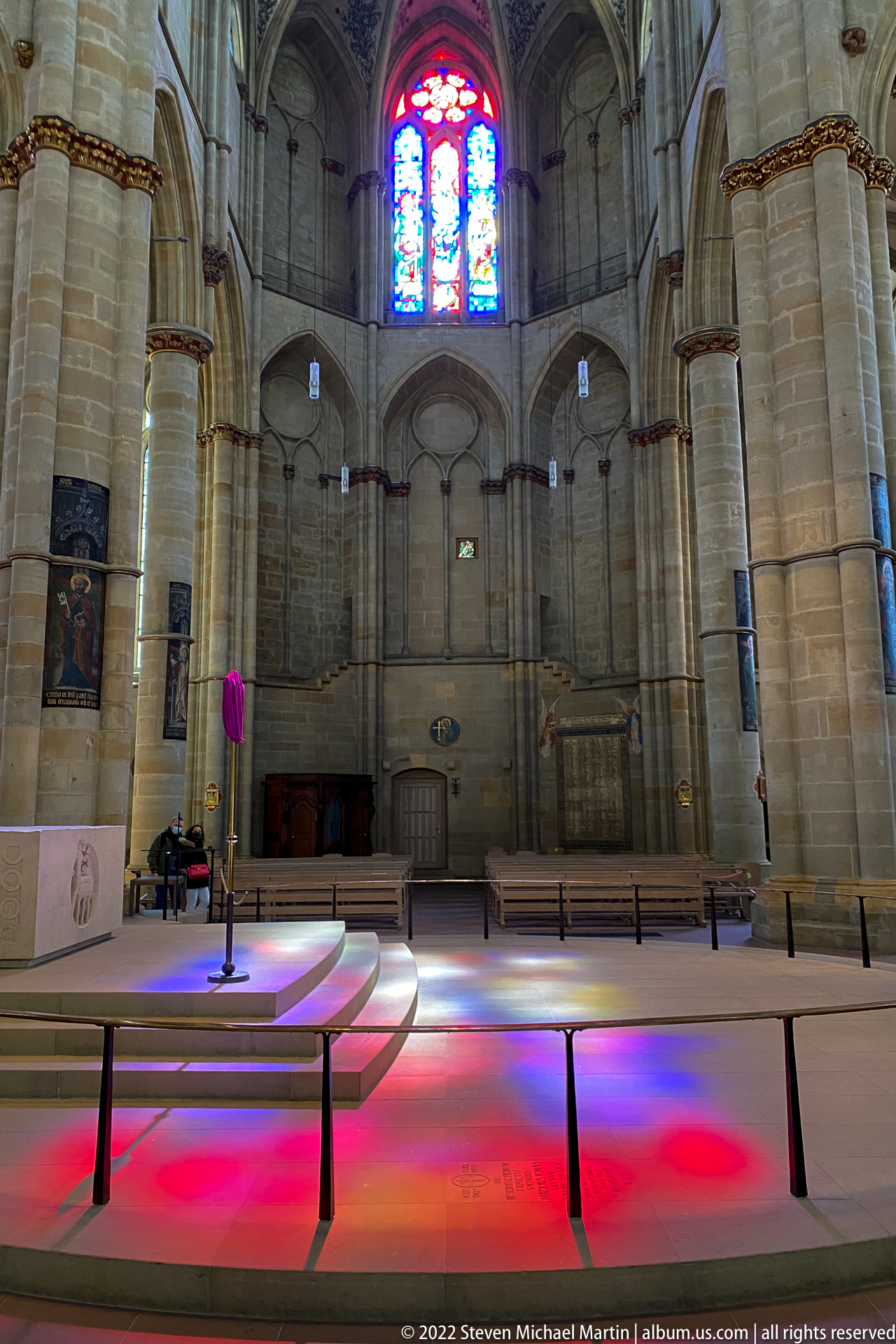
A broad Gothic sanctuary is defined by tall clustered columns, pointed arches, and a luminous stained-glass window above the central wall. Colored light spills dramatically across the pale floor and low modern platform, creating red, blue, and violet pools that connect the historic glazing with the contemporary liturgical space.
Caption
A broad Gothic sanctuary is defined by tall clustered columns, pointed arches, and a luminous stained-glass window above the central wall. Colored light spills dramatically across the pale floor and low modern platform, creating red, blue, and violet pools that connect the historic glazing with the contemporary liturgical space.

A stylized crucified Christ is fixed to a dark cross whose ends broaden into squared terminals, with a small upper plaque above the figure. Christ’s elongated body, frontal posture, and crown-like head treatment emphasize the icon rather than anatomical naturalism, giving the object the character of a medieval processional or altar cross.
Caption
A stylized crucified Christ is fixed to a dark cross whose ends broaden into squared terminals, with a small upper plaque above the figure. Christ’s elongated body, frontal posture, and crown-like head treatment emphasize the icon rather than anatomical naturalism, giving the object the character of a medieval processional or altar cross.
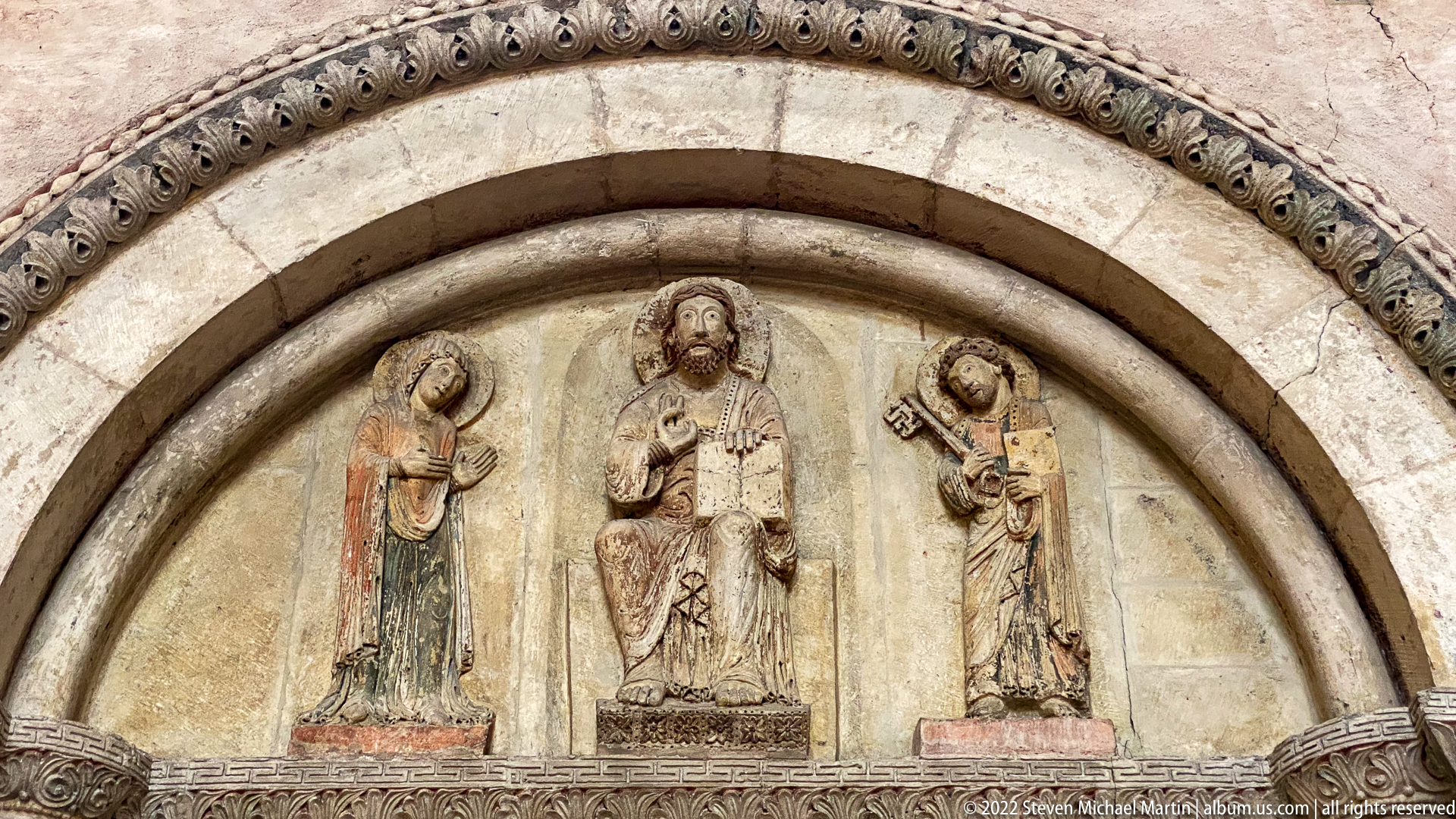
A semicircular stone tympanum presents Christ enthroned or seated at center, flanked by two standing haloed figures. Carved archivolts and repeating ornamental bands frame the group, while traces of pigment on the figures hint at the original polychromy of the portal sculpture.
Caption
A semicircular stone tympanum presents Christ enthroned or seated at center, flanked by two standing haloed figures. Carved archivolts and repeating ornamental bands frame the group, while traces of pigment on the figures hint at the original polychromy of the portal sculpture.
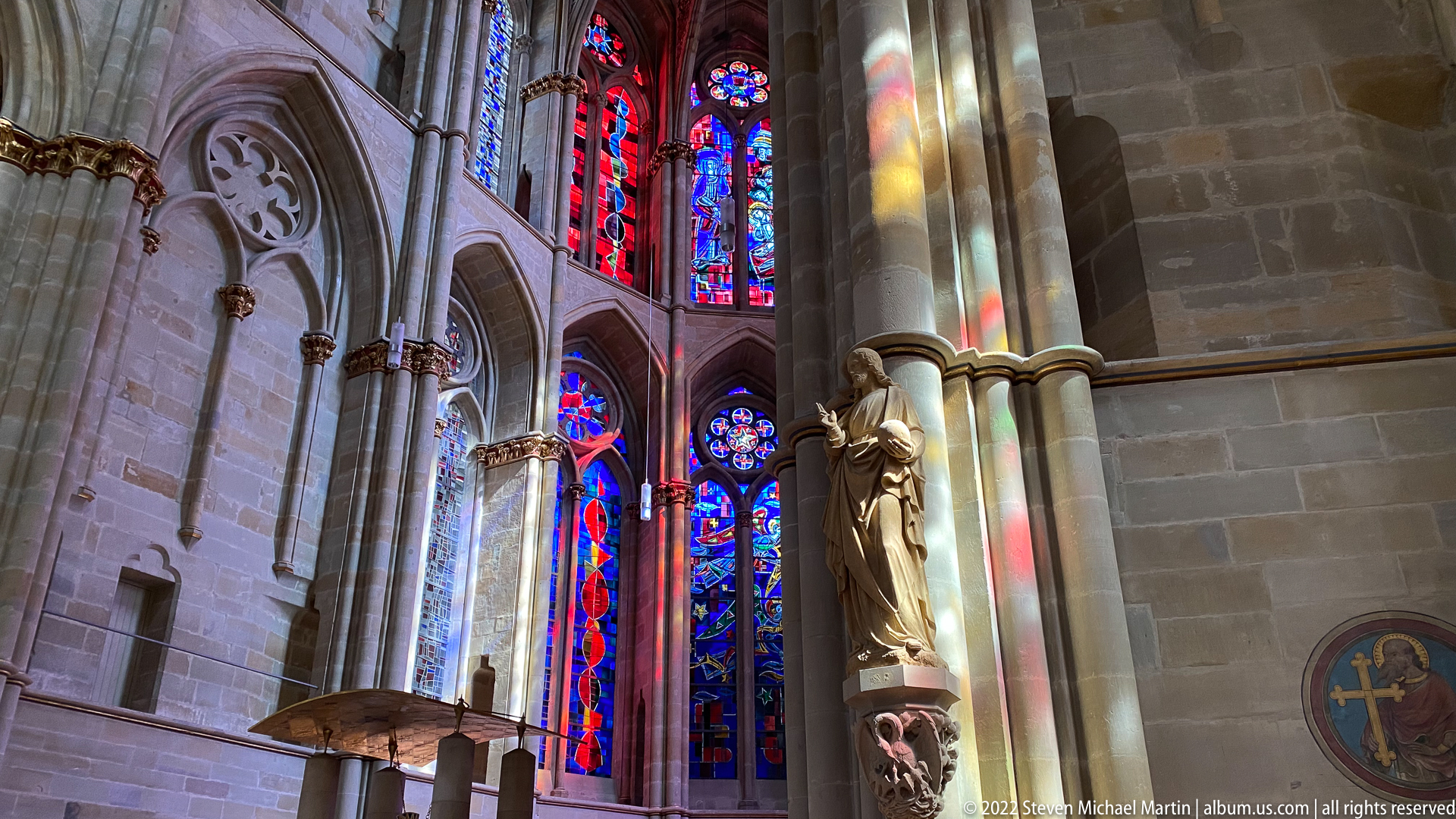
Brilliant red and blue stained-glass windows rise behind a pale stone saint figure mounted on a clustered column. Sunlight refracted through the glass splashes colored patches across the masonry, while pointed arches and tracery frame the view and emphasize the vertical rhythm of the Gothic interior.
Caption
Brilliant red and blue stained-glass windows rise behind a pale stone saint figure mounted on a clustered column. Sunlight refracted through the glass splashes colored patches across the masonry, while pointed arches and tracery frame the view and emphasize the vertical rhythm of the Gothic interior.

A life-size stone cleric reclines on a monumental tomb, dressed in elaborate ecclesiastical vestments and holding an open book across his torso. Heavy folds of carved fabric spill toward the viewer, while a devotional sculpture in a wall niche behind places the effigy firmly within a church setting.
Caption
A life-size stone cleric reclines on a monumental tomb, dressed in elaborate ecclesiastical vestments and holding an open book across his torso. Heavy folds of carved fabric spill toward the viewer, while a devotional sculpture in a wall niche behind places the effigy firmly within a church setting.

A dark bronze horse figurine is displayed against a warm orange backdrop beside small circular metal objects, including coins and a decorated pendant-like piece. The horse’s simplified elongated body and upright neck make it the dominant object, while the smaller finds establish the archaeological display as an assemblage rather than an isolated sculpture.
Caption
A dark bronze horse figurine is displayed against a warm orange backdrop beside small circular metal objects, including coins and a decorated pendant-like piece. The horse’s simplified elongated body and upright neck make it the dominant object, while the smaller finds establish the archaeological display as an assemblage rather than an isolated sculpture.

Two enlarged silver coins are displayed against a vivid red background, each showing a standing central figure above the clearly legible inscription CAESAR. Smaller kneeling or seated figures flank the composition, turning the coin reverse into a compact scene of political and military authority characteristic of ancient state coinage.
Caption
Two enlarged silver coins are displayed against a vivid red background, each showing a standing central figure above the clearly legible inscription CAESAR. Smaller kneeling or seated figures flank the composition, turning the coin reverse into a compact scene of political and military authority characteristic of ancient state coinage.

A reconstruction presents elaborate metal horse equipment mounted on a bright orange support that approximates the animal’s chest or body. Chains, pendants, turquoise-green fittings, and broad metal components show how the individual archaeological pieces related to one another when worn rather than appearing as disconnected finds in a case.
Caption
A reconstruction presents elaborate metal horse equipment mounted on a bright orange support that approximates the animal’s chest or body. Chains, pendants, turquoise-green fittings, and broad metal components show how the individual archaeological pieces related to one another when worn rather than appearing as disconnected finds in a case.
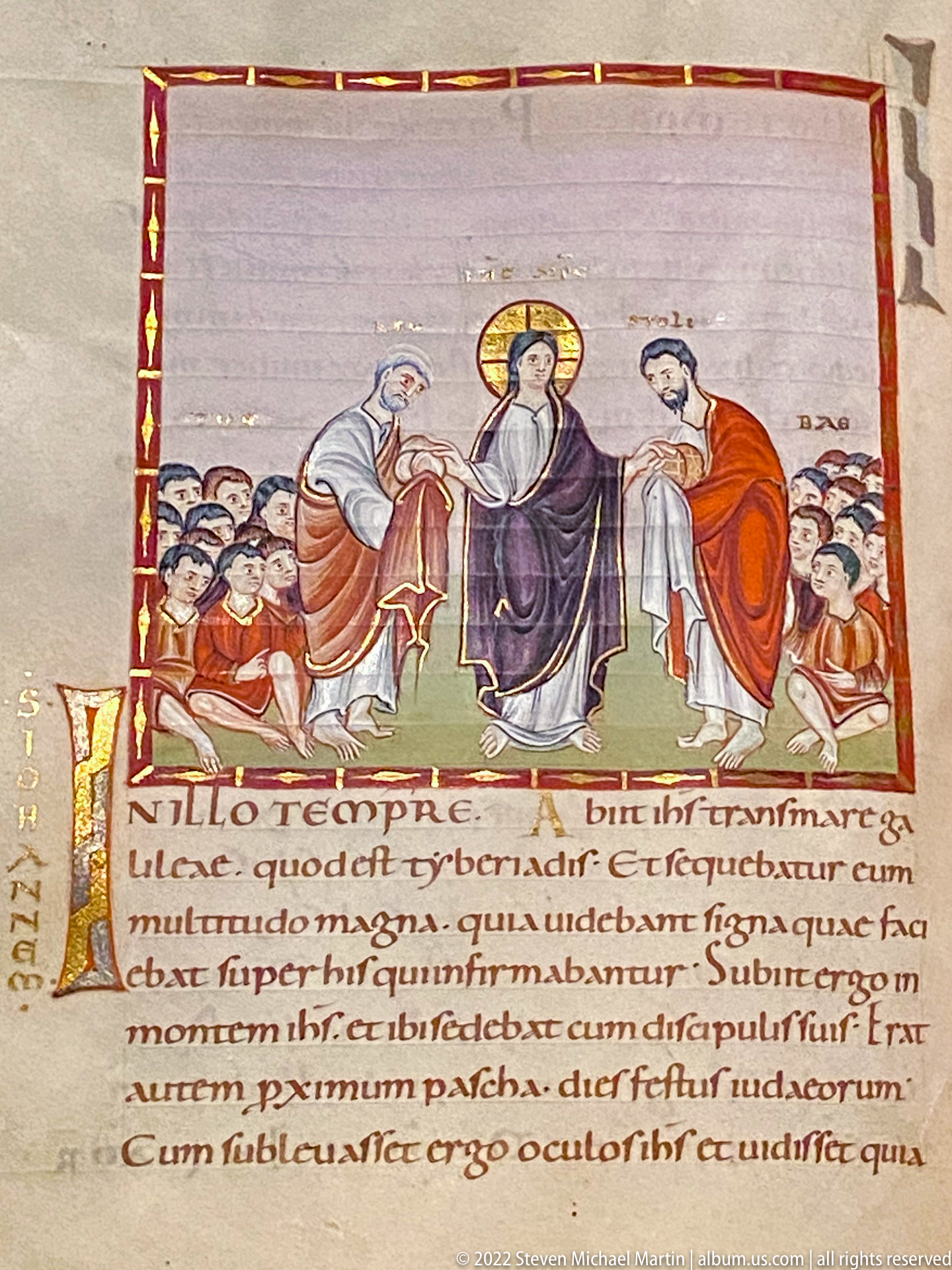
A Romanesque-style manuscript miniature shows Christ enthroned or seated at center, flanked by two principal figures and surrounded by a crowd. Gold haloes, broad colored garments, and the framed composition distinguish the sacred scene from the lines of Latin text below, where a large decorated initial opens the written passage.
Caption
A Romanesque-style manuscript miniature shows Christ enthroned or seated at center, flanked by two principal figures and surrounded by a crowd. Gold haloes, broad colored garments, and the framed composition distinguish the sacred scene from the lines of Latin text below, where a large decorated initial opens the written passage.
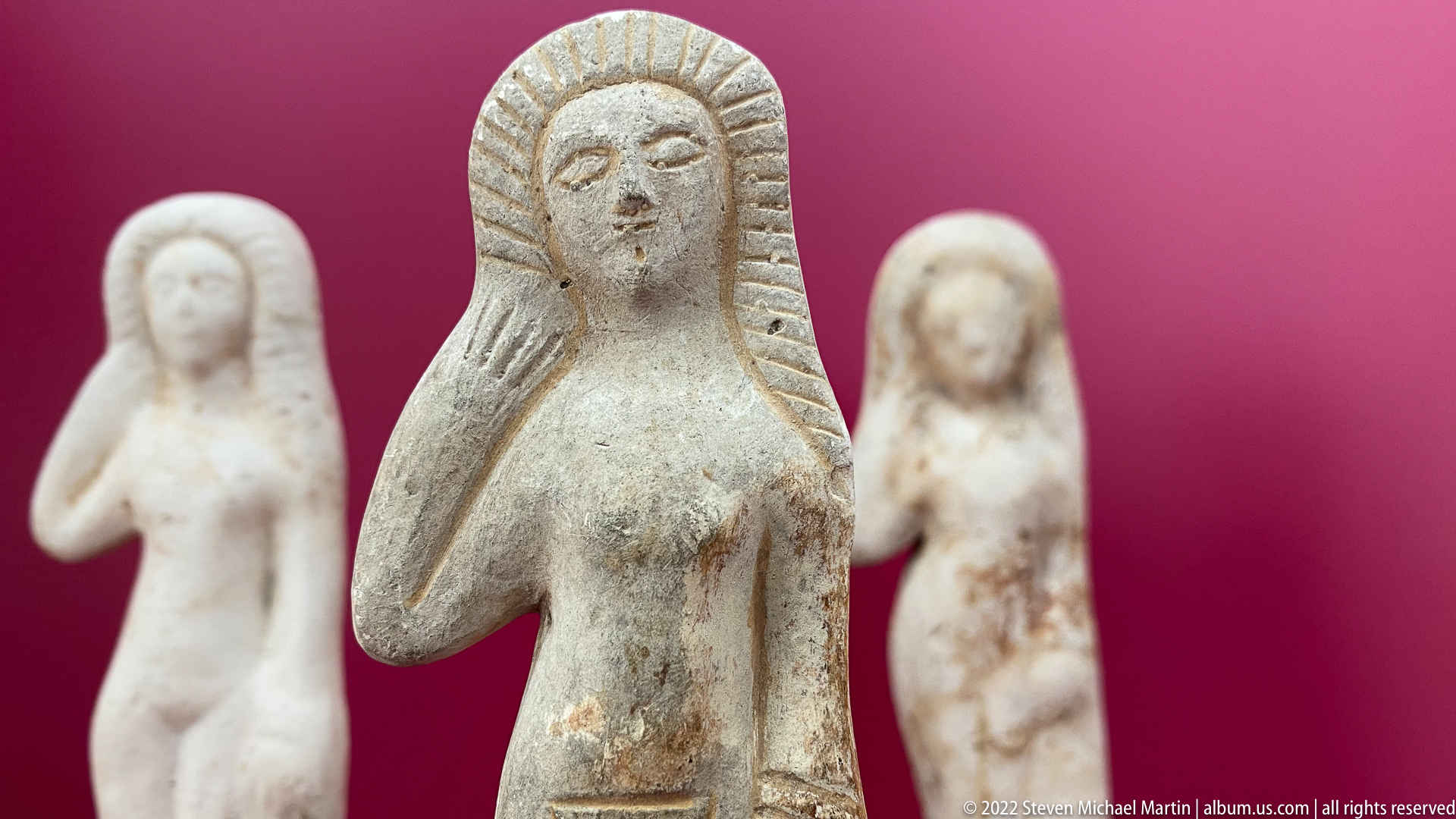
A row of small pale figurines centers on a stylized standing woman with one hand raised to her chest. Her simplified facial features, radiating hair or headdress, and columnar body are echoed by the softer figures behind, suggesting a group of related votive, cultic, or funerary objects rather than naturalistic portrait sculpture.
Caption
A row of small pale figurines centers on a stylized standing woman with one hand raised to her chest. Her simplified facial features, radiating hair or headdress, and columnar body are echoed by the softer figures behind, suggesting a group of related votive, cultic, or funerary objects rather than naturalistic portrait sculpture.

A large live video display shows a visitor inside the gallery while two camera-like devices and speakers stand in front of the screen. A digital time stamp overlays the projected image, making the visitor part of the installation and signaling an interactive museum experience rather than a conventional artifact case.
Caption
A large live video display shows a visitor inside the gallery while two camera-like devices and speakers stand in front of the screen. A digital time stamp overlays the projected image, making the visitor part of the installation and signaling an interactive museum experience rather than a conventional artifact case.

A museum panel explains the Trier Gold Hoard, identifying it as a major Roman treasure of gold coins recovered from the Roman period. The text summarizes the number and weight of the coins, their emperors, and their minting history, placing the hoard within the economic and political world of the Roman Empire.
Caption
A museum panel explains the Trier Gold Hoard, identifying it as a major Roman treasure of gold coins recovered from the Roman period. The text summarizes the number and weight of the coins, their emperors, and their minting history, placing the hoard within the economic and political world of the Roman Empire.

A red wax seal impression is displayed beside a circular metal seal matrix bearing a finely engraved enthroned ecclesiastical figure and surrounding inscription. Presenting the impression and matrix together makes the relationship between tool and document visible, showing how authority was transferred into wax through a carved negative image.
Caption
A red wax seal impression is displayed beside a circular metal seal matrix bearing a finely engraved enthroned ecclesiastical figure and surrounding inscription. Presenting the impression and matrix together makes the relationship between tool and document visible, showing how authority was transferred into wax through a carved negative image.

A long glass case presents a sequence of historic books and manuscripts opened to selected pages, from large parchment volumes to smaller printed works. The arrangement emphasizes variations in scale, binding, script, illumination, and page design, while suspended labels and the dark gallery setting create a focused study display.
Caption
A long glass case presents a sequence of historic books and manuscripts opened to selected pages, from large parchment volumes to smaller printed works. The arrangement emphasizes variations in scale, binding, script, illumination, and page design, while suspended labels and the dark gallery setting create a focused study display.

A monochrome early city view compresses a fortified urban landscape into a dense field of pitched roofs, towers, walls, and church domes. Monumental ecclesiastical buildings dominate the skyline, while crenellated defenses and tightly packed houses create a documentary image of the city before modern expansion.
Caption
A monochrome early city view compresses a fortified urban landscape into a dense field of pitched roofs, towers, walls, and church domes. Monumental ecclesiastical buildings dominate the skyline, while crenellated defenses and tightly packed houses create a documentary image of the city before modern expansion.

A close view of a worn leather binding bears a gilt title beginning BIBLIA LATINA and the name GUTENBERG. The cropped composition concentrates on the spine inscription and aged leather surface, turning the book’s physical identity and long history of handling into the central subject rather than its printed pages.
Caption
A close view of a worn leather binding bears a gilt title beginning BIBLIA LATINA and the name GUTENBERG. The cropped composition concentrates on the spine inscription and aged leather surface, turning the book’s physical identity and long history of handling into the central subject rather than its printed pages.

A vividly colored heraldic composition centers on a red shield divided by a gold cross and bordered with square devices. Two black ravens support the arms while flags, spears, drums, and other military trophies fill the background, creating a ceremonial emblem of civic or institutional identity.
Caption
A vividly colored heraldic composition centers on a red shield divided by a gold cross and bordered with square devices. Two black ravens support the arms while flags, spears, drums, and other military trophies fill the background, creating a ceremonial emblem of civic or institutional identity.
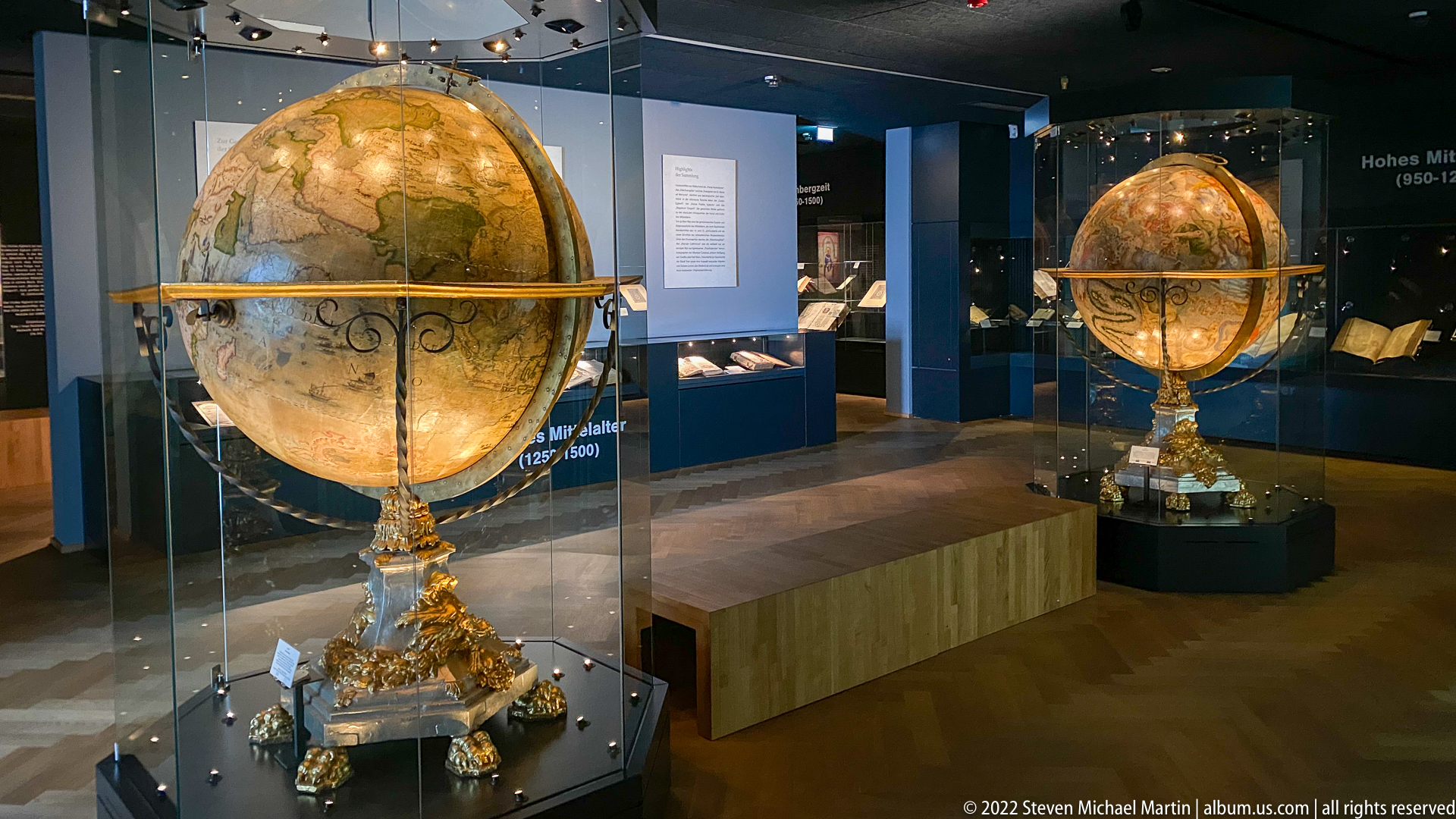
Two monumental historic globes stand in separate glass cases along a museum gallery, each supported by an elaborate gilded base and encircled by a broad horizon ring. Their substantial scale, richly painted surfaces, and ornate mounts emphasize both scientific function and courtly display value.
Caption
Two monumental historic globes stand in separate glass cases along a museum gallery, each supported by an elaborate gilded base and encircled by a broad horizon ring. Their substantial scale, richly painted surfaces, and ornate mounts emphasize both scientific function and courtly display value.
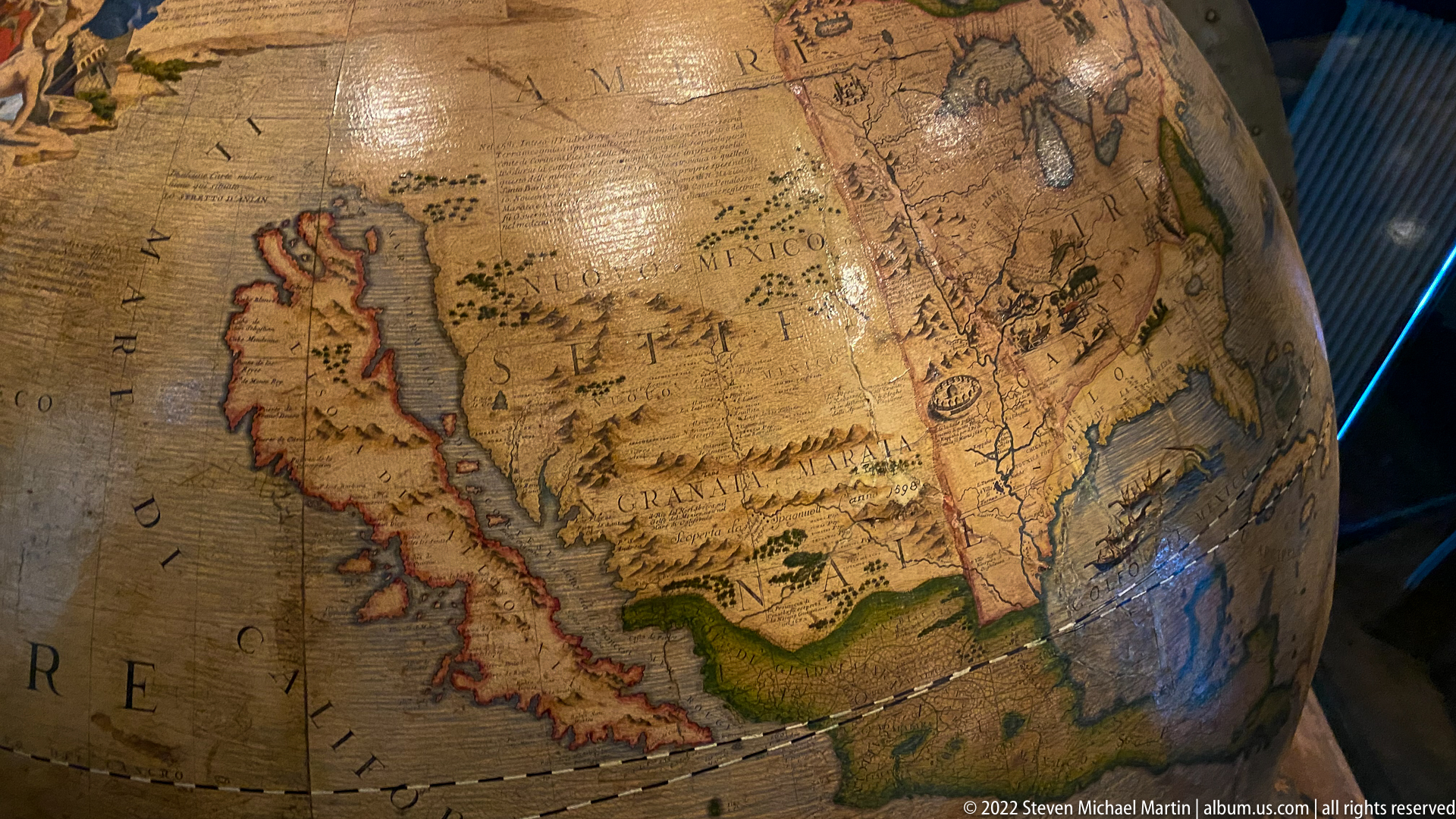
A close view of a historic globe centers on North America, where engraved coastlines, mountain ranges, rivers, place names, and political boundaries appear beneath a warm aged varnish. The western coastline and interior remain markedly different from modern mapping, making the globe itself a record of geographic knowledge at the time it was produced.
Caption
A close view of a historic globe centers on North America, where engraved coastlines, mountain ranges, rivers, place names, and political boundaries appear beneath a warm aged varnish. The western coastline and interior remain markedly different from modern mapping, making the globe itself a record of geographic knowledge at the time it was produced.

An open manuscript in Arabic script combines dense black calligraphy with gold punctuation and an elaborate illuminated panel on the right page. The upper decoration uses gold, blue, red, and floral motifs within an architectural frame, creating a strong contrast between the ornamental header and the carefully ruled text below.
Caption
An open manuscript in Arabic script combines dense black calligraphy with gold punctuation and an elaborate illuminated panel on the right page. The upper decoration uses gold, blue, red, and floral motifs within an architectural frame, creating a strong contrast between the ornamental header and the carefully ruled text below.

A substantial parchment codex lies open to a decorated page showing Christ at center between two principal figures and a gathered crowd, with the miniature framed in red and gold above Latin text. The opposite page continues in carefully spaced script, while the thick fore-edge reveals the physical scale of the manuscript as an object.
Caption
A substantial parchment codex lies open to a decorated page showing Christ at center between two principal figures and a gathered crowd, with the miniature framed in red and gold above Latin text. The opposite page continues in carefully spaced script, while the thick fore-edge reveals the physical scale of the manuscript as an object.

A circular cast-metal manhole cover set into patterned stone paving bears the words STADT TRIER around a central civic figure or emblem. Concentric rings of openings and raised tread patterns create a strongly geometric design, turning an everyday piece of street infrastructure into a locally specific marker of Trier’s municipal identity.
Caption
A circular cast-metal manhole cover set into patterned stone paving bears the words STADT TRIER around a central civic figure or emblem. Concentric rings of openings and raised tread patterns create a strongly geometric design, turning an everyday piece of street infrastructure into a locally specific marker of Trier’s municipal identity.