Notre-Dame de Paris
Notre-Dame de Paris is one of the most influential examples of French Gothic architecture, constructed between the twelfth and fourteenth centuries on the Île de la Cité. The cathedral’s façade is defined by sculptural decoration, twin towers, and large rose windows that illustrate the artistic achievements of the medieval period. Its central location highlights the historical importance of religious institutions within Paris.
Structural innovations such as flying buttresses allowed for increased height and larger stained glass windows, creating an interior environment shaped by filtered light. Decorative carvings and sculptural programs convey theological narratives through visual form. The cathedral demonstrates how architectural design was used to express religious meaning during the Middle Ages.
Notre-Dame de Paris represents a significant monument in the history of European architecture. Its continued restoration reflects the enduring cultural importance of preserving historic structures for future generations.
Historical Note
This portfolio preserves views of Notre-Dame de Paris prior to the April 2019 fire that significantly damaged the cathedral’s roof and spire. The photographs reflect architectural details that defined the structure for centuries, including the original spire designed by Eugène Viollet-le-Duc and the historic timber roof framework often referred to as “the forest.”
Following the fire, an extensive international restoration effort began with the goal of preserving the cathedral’s historical character while ensuring structural stability for future generations. These images document the appearance of Notre-Dame as it was experienced by visitors prior to the restoration period.

The west façade of Notre-Dame de Paris stands in shadow beside the Seine as warm evening light glows along the river corridor. The twin towers and central rose window remain legible against the sky, while the embankment wall and water lead the eye into the distance.
Caption
The west façade of Notre-Dame de Paris stands in shadow beside the Seine as warm evening light glows along the river corridor. The twin towers and central rose window remain legible against the sky, while the embankment wall and water lead the eye into the distance.

A broad interior view of Notre-Dame de Paris looks toward the western end of the nave, where the rose window glows above the organ loft. Massive piers, pointed arches, rib vaults, and rows of side openings frame the central axis, giving a clear sense of the cathedral’s scale and layered Gothic elevation.
Caption
A broad interior view of Notre-Dame de Paris looks toward the western end of the nave, where the rose window glows above the organ loft. Massive piers, pointed arches, rib vaults, and rows of side openings frame the central axis, giving a clear sense of the cathedral’s scale and layered Gothic elevation.

The south transept of Notre-Dame de Paris rises behind a garden statue, with the great rose window, steep gable, pinnacles, and flying buttresses filling the background. The foreground figure and trees place the monumental Gothic elevation within the landscaped space along the cathedral’s southern side.
Caption
The south transept of Notre-Dame de Paris rises behind a garden statue, with the great rose window, steep gable, pinnacles, and flying buttresses filling the background. The foreground figure and trees place the monumental Gothic elevation within the landscaped space along the cathedral’s southern side.

Louis Merlieux’s 1845 Fontaine de l’Archevêché rises from the flower garden of Square Jean XXIII with Notre-Dame de Paris aligned behind it. Its neo-Gothic pinnacle shelters a Virgin and Child with angels and apostles, while the cathedral’s apse, buttresses, and pre-2019 spire extend the same vertical vocabulary into the background.
Caption
Louis Merlieux’s 1845 Fontaine de l’Archevêché rises from the flower garden of Square Jean XXIII with Notre-Dame de Paris aligned behind it. Its neo-Gothic pinnacle shelters a Virgin and Child with angels and apostles, while the cathedral’s apse, buttresses, and pre-2019 spire extend the same vertical vocabulary into the background.

Flower beds in Square Jean XXIII lead toward Louis Merlieux’s 1845 Fontaine de l’Archevêché, with the apse of Notre-Dame de Paris rising behind it. The neo-Gothic fountain’s pointed canopy shelters Marian, angelic, and apostolic sculpture, creating a deliberate stylistic dialogue with the cathedral’s pinnacles and flying buttresses.
Caption
Flower beds in Square Jean XXIII lead toward Louis Merlieux’s 1845 Fontaine de l’Archevêché, with the apse of Notre-Dame de Paris rising behind it. The neo-Gothic fountain’s pointed canopy shelters Marian, angelic, and apostolic sculpture, creating a deliberate stylistic dialogue with the cathedral’s pinnacles and flying buttresses.

The Fontaine de l’Archevêché, also known as the Notre-Dame Fountain, stands in Square Jean XXIII before the cathedral’s apse. Created by Louis Merlieux in 1845, the neo-Gothic fountain is crowned by a Virgin and Child and incorporates angels and apostles, its slender pinnacle echoing the vertical forms of Notre-Dame’s buttresses and spire beyond.
Caption
The Fontaine de l’Archevêché, also known as the Notre-Dame Fountain, stands in Square Jean XXIII before the cathedral’s apse. Created by Louis Merlieux in 1845, the neo-Gothic fountain is crowned by a Virgin and Child and incorporates angels and apostles, its slender pinnacle echoing the vertical forms of Notre-Dame’s buttresses and spire beyond.

Seen across the clipped garden of Square Jean XXIII, Louis Merlieux’s 1845 Fontaine de l’Archevêché forms a slender neo-Gothic foreground to Notre-Dame de Paris. The fountain’s pinnacle, with its Marian and apostolic sculpture, visually echoes the cathedral’s pinnacles and the pre-2019 spire rising beyond the apse.
Caption
Seen across the clipped garden of Square Jean XXIII, Louis Merlieux’s 1845 Fontaine de l’Archevêché forms a slender neo-Gothic foreground to Notre-Dame de Paris. The fountain’s pinnacle, with its Marian and apostolic sculpture, visually echoes the cathedral’s pinnacles and the pre-2019 spire rising beyond the apse.

A second riverside portrait pairs two men in the foreground with Notre-Dame de Paris across the Seine. The cathedral’s twin towers and crossing spire remain legible behind them, providing a clear geographic anchor while the shallow focus keeps attention on the pair.
Caption
A second riverside portrait pairs two men in the foreground with Notre-Dame de Paris across the Seine. The cathedral’s twin towers and crossing spire remain legible behind them, providing a clear geographic anchor while the shallow focus keeps attention on the pair.

Two men pose beside the Seine with Notre-Dame de Paris rising across the river behind them. The cathedral’s towers and eastern roofline remain recognizable despite the shallow depth of field, turning the photograph into a personal travel portrait anchored by one of Paris’s defining riverfront landmarks.
Caption
Two men pose beside the Seine with Notre-Dame de Paris rising across the river behind them. The cathedral’s towers and eastern roofline remain recognizable despite the shallow depth of field, turning the photograph into a personal travel portrait anchored by one of Paris’s defining riverfront landmarks.

Hundreds of padlocks crowd a riverside railing in the foreground while Notre-Dame de Paris rises across the Seine in the distance. The shallow perspective juxtaposes a contemporary visitor ritual with the historic cathedral, making the locks the primary subject while retaining Notre-Dame as a recognizable geographic anchor.
Caption
Hundreds of padlocks crowd a riverside railing in the foreground while Notre-Dame de Paris rises across the Seine in the distance. The shallow perspective juxtaposes a contemporary visitor ritual with the historic cathedral, making the locks the primary subject while retaining Notre-Dame as a recognizable geographic anchor.

A devotional figure stands before a richly colored stained-glass window inside Notre-Dame de Paris, framed by carved stonework and a low relief-filled altar or screen. The layered composition brings together sculpture, glazing, and medieval architectural ornament, with the backlit glass providing a luminous backdrop to the darker stone figures in the foreground.
Caption
A devotional figure stands before a richly colored stained-glass window inside Notre-Dame de Paris, framed by carved stonework and a low relief-filled altar or screen. The layered composition brings together sculpture, glazing, and medieval architectural ornament, with the backlit glass providing a luminous backdrop to the darker stone figures in the foreground.

A polychrome sculptural program inside Notre-Dame de Paris presents a sequence of New Testament scenes, including a prominent Last Supper tableau at center. Rows of modeled figures, architectural canopies, and painted surfaces create a dense narrative ensemble, preserving the medieval practice of teaching biblical stories through highly legible visual storytelling.
Caption
A polychrome sculptural program inside Notre-Dame de Paris presents a sequence of New Testament scenes, including a prominent Last Supper tableau at center. Rows of modeled figures, architectural canopies, and painted surfaces create a dense narrative ensemble, preserving the medieval practice of teaching biblical stories through highly legible visual storytelling.

A long section of Notre-Dame de Paris’s painted sculptural decoration unfolds across multiple biblical episodes, with grouped figures arranged beneath a continuous architectural frame. The oblique viewpoint emphasizes the scale and sequencing of the relief, showing how narrative scenes were organized as an extended visual cycle rather than isolated devotional images.
Caption
A long section of Notre-Dame de Paris’s painted sculptural decoration unfolds across multiple biblical episodes, with grouped figures arranged beneath a continuous architectural frame. The oblique viewpoint emphasizes the scale and sequencing of the relief, showing how narrative scenes were organized as an extended visual cycle rather than isolated devotional images.

A close view of Notre-Dame de Paris’s polychrome sculpture shows Christ at center addressing a clustered group of apostles. Gilded patterned ground, painted robes, and pointed Gothic arches heighten the scene’s visual intensity while preserving individual gestures and expressions within the compact composition.
Caption
A close view of Notre-Dame de Paris’s polychrome sculpture shows Christ at center addressing a clustered group of apostles. Gilded patterned ground, painted robes, and pointed Gothic arches heighten the scene’s visual intensity while preserving individual gestures and expressions within the compact composition.

Several apostles converse in a tightly grouped section of Notre-Dame de Paris’s painted sculptural program. Their individualized faces, layered gestures, and patterned robes stand out against a gilded background, revealing the narrative and expressive detail of medieval polychrome carving at close range.
Caption
Several apostles converse in a tightly grouped section of Notre-Dame de Paris’s painted sculptural program. Their individualized faces, layered gestures, and patterned robes stand out against a gilded background, revealing the narrative and expressive detail of medieval polychrome carving at close range.

Christ appears with disciples beside a stylized boat in this close view of Notre-Dame de Paris’s polychrome narrative sculpture. The boat’s curved hull, clustered figures, patterned robes, and gilded ground create a compact maritime biblical scene framed by the same pointed architectural canopy used throughout the sculptural cycle.
Caption
Christ appears with disciples beside a stylized boat in this close view of Notre-Dame de Paris’s polychrome narrative sculpture. The boat’s curved hull, clustered figures, patterned robes, and gilded ground create a compact maritime biblical scene framed by the same pointed architectural canopy used throughout the sculptural cycle.

The risen Christ guides an apostle’s hand toward the wound in his side in the episode traditionally known as Doubting Thomas. Set against painted masonry and flanked by other disciples, the scene belongs to Notre-Dame de Paris’s polychrome narrative sculpture, where gesture and close physical interaction make the biblical episode immediately legible.
Caption
The risen Christ guides an apostle’s hand toward the wound in his side in the episode traditionally known as Doubting Thomas. Set against painted masonry and flanked by other disciples, the scene belongs to Notre-Dame de Paris’s polychrome narrative sculpture, where gesture and close physical interaction make the biblical episode immediately legible.

The risen Christ stands among a tightly grouped assembly of apostles in this painted relief from Notre-Dame de Paris. One disciple holds an open book while others turn toward Christ, their patterned robes and individualized gestures set against a gilded ground beneath pointed Gothic arches.
Caption
The risen Christ stands among a tightly grouped assembly of apostles in this painted relief from Notre-Dame de Paris. One disciple holds an open book while others turn toward Christ, their patterned robes and individualized gestures set against a gilded ground beneath pointed Gothic arches.

A group of apostles gathers beside a small crenellated architectural structure in this section of Notre-Dame de Paris’s painted sculptural cycle. Faces appear through the opening while standing figures gesture outside, combining miniature architecture and narrative figures to organize the episode within a clearly defined setting.
Caption
A group of apostles gathers beside a small crenellated architectural structure in this section of Notre-Dame de Paris’s painted sculptural cycle. Faces appear through the opening while standing figures gesture outside, combining miniature architecture and narrative figures to organize the episode within a clearly defined setting.

Christ stands beside a miniature walled structure while kneeling and standing figures turn toward him in this polychrome relief from Notre-Dame de Paris. The scene uses painted architecture, compact staging, and expressive gestures to distinguish one episode within the cathedral’s larger biblical narrative cycle.
Caption
Christ stands beside a miniature walled structure while kneeling and standing figures turn toward him in this polychrome relief from Notre-Dame de Paris. The scene uses painted architecture, compact staging, and expressive gestures to distinguish one episode within the cathedral’s larger biblical narrative cycle.

Christ stands holding a staff or cross-shaped standard while two women kneel and another figure stands nearby in this section of Notre-Dame de Paris’s polychrome narrative sculpture. The scene’s gestures, painted garments, and gilded background convey an encounter following the Resurrection without requiring a more specific episode assignment from the image alone.
Caption
Christ stands holding a staff or cross-shaped standard while two women kneel and another figure stands nearby in this section of Notre-Dame de Paris’s polychrome narrative sculpture. The scene’s gestures, painted garments, and gilded background convey an encounter following the Resurrection without requiring a more specific episode assignment from the image alone.

Christ appears to Mary Magdalene in a garden near the Sepulcher in this scene from Notre-Dame de Paris’s 14th-century choir enclosure. The southern side of the enclosure is devoted to Christ’s post-Resurrection appearances; here he is represented in the medieval guise of a gardener, with stylized trees helping distinguish the episode traditionally known as Noli me tangere.
Caption
Christ appears to Mary Magdalene in a garden near the Sepulcher in this scene from Notre-Dame de Paris’s 14th-century choir enclosure. The southern side of the enclosure is devoted to Christ’s post-Resurrection appearances; here he is represented in the medieval guise of a gardener, with stylized trees helping distinguish the episode traditionally known as Noli me tangere.

Louis Castex’s 1934 statue of Saint Thérèse of the Child Jesus stands against the masonry of Notre-Dame de Paris. Commissioned by Cardinal Jean Verdier, the life-size sculpture presents the Carmelite saint in a restrained devotional pose, holding a cross and roses close to her chest; the inscribed pedestal confirms her identity.
Caption
Louis Castex’s 1934 statue of Saint Thérèse of the Child Jesus stands against the masonry of Notre-Dame de Paris. Commissioned by Cardinal Jean Verdier, the life-size sculpture presents the Carmelite saint in a restrained devotional pose, holding a cross and roses close to her chest; the inscribed pedestal confirms her identity.

The great pipe organ rises beneath a broad field of stained glass at Notre-Dame de Paris, its vertical ranks of pipes framed by massive stone supports and the dark gallery structure below. The composition emphasizes the relationship between music, architecture, and colored light in the cathedral’s western interior.
Caption
The great pipe organ rises beneath a broad field of stained glass at Notre-Dame de Paris, its vertical ranks of pipes framed by massive stone supports and the dark gallery structure below. The composition emphasizes the relationship between music, architecture, and colored light in the cathedral’s western interior.

A dramatic diagonal view through Notre-Dame de Paris combines a large rose window, pointed arcades, rib vaults, and the illuminated eastern interior. The low camera angle exaggerates the height of the piers and the sweep of the vaulting, while the distant stained glass marks the spatial progression through the cathedral.
Caption
A dramatic diagonal view through Notre-Dame de Paris combines a large rose window, pointed arcades, rib vaults, and the illuminated eastern interior. The low camera angle exaggerates the height of the piers and the sweep of the vaulting, while the distant stained glass marks the spatial progression through the cathedral.

A circular Marian medallion depicts the Virgin Mary holding the Christ Child against a deep blue field scattered with gold stars. Gilded concentric moldings and small sculpted heads frame the image, creating a richly ornamental devotional focal point within the cathedral interior.
Caption
A circular Marian medallion depicts the Virgin Mary holding the Christ Child against a deep blue field scattered with gold stars. Gilded concentric moldings and small sculpted heads frame the image, creating a richly ornamental devotional focal point within the cathedral interior.

An upward view inside Notre-Dame de Paris brings together soaring rib vaults, clustered supports, and large rose windows on opposing sides of the transept. The steep perspective turns the crossing into a study of Gothic engineering, with stone ribs directing the eye toward the vault crowns while colored glass punctuates the pale masonry.
Caption
An upward view inside Notre-Dame de Paris brings together soaring rib vaults, clustered supports, and large rose windows on opposing sides of the transept. The steep perspective turns the crossing into a study of Gothic engineering, with stone ribs directing the eye toward the vault crowns while colored glass punctuates the pale masonry.

This steeply angled interior view of Notre-Dame de Paris follows clustered columns upward into ribbed vaults and stained-glass openings. A rose window enters from the upper left while smaller lancets and clerestory windows punctuate the surrounding masonry, emphasizing the cathedral’s vertical articulation and layered elevation.
Caption
This steeply angled interior view of Notre-Dame de Paris follows clustered columns upward into ribbed vaults and stained-glass openings. A rose window enters from the upper left while smaller lancets and clerestory windows punctuate the surrounding masonry, emphasizing the cathedral’s vertical articulation and layered elevation.

A nearly symmetrical upward composition inside Notre-Dame de Paris frames the ribbed crossing vault between large rose windows. Slender wall shafts and pointed arches rise toward the vault crowns, while the blue-toned glass on either side creates a luminous counterpoint to the warm stone surfaces.
Caption
A nearly symmetrical upward composition inside Notre-Dame de Paris frames the ribbed crossing vault between large rose windows. Slender wall shafts and pointed arches rise toward the vault crowns, while the blue-toned glass on either side creates a luminous counterpoint to the warm stone surfaces.

The interior crossing of Notre-Dame de Paris is seen from directly below, with paired rose windows, pointed arches, and rib vaults arranged around the central ceiling. The balanced framing makes the structural geometry especially clear, showing how vertical supports and intersecting ribs organize the cathedral’s monumental interior volume.
Caption
The interior crossing of Notre-Dame de Paris is seen from directly below, with paired rose windows, pointed arches, and rib vaults arranged around the central ceiling. The balanced framing makes the structural geometry especially clear, showing how vertical supports and intersecting ribs organize the cathedral’s monumental interior volume.

A side aisle of Notre-Dame de Paris recedes through a sequence of pointed arches and ribbed vaults supported by substantial clustered piers. The angled viewpoint emphasizes repetition and depth, while chandeliers and small figures at floor level provide a sense of scale within the cathedral’s massive stone interior.
Caption
A side aisle of Notre-Dame de Paris recedes through a sequence of pointed arches and ribbed vaults supported by substantial clustered piers. The angled viewpoint emphasizes repetition and depth, while chandeliers and small figures at floor level provide a sense of scale within the cathedral’s massive stone interior.

A large rose window dominates the upper wall of Notre-Dame de Paris, set above a horizontal band of stained-glass lancets and framed by massive Gothic masonry. Below, the darker furnishings and architectural details emphasize the scale of the glazing, which functions as both structural ornament and a principal source of colored light.
Caption
A large rose window dominates the upper wall of Notre-Dame de Paris, set above a horizontal band of stained-glass lancets and framed by massive Gothic masonry. Below, the darker furnishings and architectural details emphasize the scale of the glazing, which functions as both structural ornament and a principal source of colored light.

A monumental seated King David holds a harp inside Notre-Dame de Paris, the instrument identifying the biblical king traditionally associated with the Psalms and sacred music. Dramatic side lighting isolates the pale sculpture against the darker stone wall, emphasizing David’s commanding gesture, drapery, and musical attribute.
Caption
A monumental seated King David holds a harp inside Notre-Dame de Paris, the instrument identifying the biblical king traditionally associated with the Psalms and sacred music. Dramatic side lighting isolates the pale sculpture against the darker stone wall, emphasizing David’s commanding gesture, drapery, and musical attribute.

Nicolas Loir’s 1650 May painting Saint Paul Blinds the False Prophet Bar-Jesus and Converts Proconsul Sergius depicts the episode from Acts in which Paul temporarily blinds the magician Elymas, leading the Roman proconsul Sergius Paulus to embrace Christianity. Commissioned by the Paris goldsmiths’ guild for Notre-Dame de Paris, the large canvas belongs to the cathedral’s celebrated series of seventeenth-century Grands Mays.
Caption
Nicolas Loir’s 1650 May painting Saint Paul Blinds the False Prophet Bar-Jesus and Converts Proconsul Sergius depicts the episode from Acts in which Paul temporarily blinds the magician Elymas, leading the Roman proconsul Sergius Paulus to embrace Christianity. Commissioned by the Paris goldsmiths’ guild for Notre-Dame de Paris, the large canvas belongs to the cathedral’s celebrated series of seventeenth-century Grands Mays.

An oblique view along Notre-Dame de Paris’s polychrome choir-screen sculpture reveals the relief as a continuous architectural and narrative ensemble. Multiple biblical episodes unfold beneath a long Gothic canopy, while the receding perspective exposes the depth of the carving, projecting figures, and the relationship between the sculptural screen and surrounding cathedral interior.
Caption
An oblique view along Notre-Dame de Paris’s polychrome choir-screen sculpture reveals the relief as a continuous architectural and narrative ensemble. Multiple biblical episodes unfold beneath a long Gothic canopy, while the receding perspective exposes the depth of the carving, projecting figures, and the relationship between the sculptural screen and surrounding cathedral interior.

A scale model labeled “1163” presents a simplified reconstruction of the cathedral precinct at the traditional starting date of Notre-Dame de Paris’s construction. The display uses small masonry buildings, red-tiled roofs, towers, and an apsidal form to visualize the earlier architectural setting associated with the site.
Caption
A scale model labeled “1163” presents a simplified reconstruction of the cathedral precinct at the traditional starting date of Notre-Dame de Paris’s construction. The display uses small masonry buildings, red-tiled roofs, towers, and an apsidal form to visualize the earlier architectural setting associated with the site.

Marc Couturier’s luminous Cross and Glory rises above the former high altar and the sculptural ensemble of the Vow of Louis XIII at Notre-Dame de Paris. Commissioned by Cardinal Jean-Marie Lustiger in 1993, the modern cross deliberately dominates Nicolas Coustou’s Pietà below, placing a contemporary liturgical work within the cathedral’s 18th-century choir setting.
Caption
Marc Couturier’s luminous Cross and Glory rises above the former high altar and the sculptural ensemble of the Vow of Louis XIII at Notre-Dame de Paris. Commissioned by Cardinal Jean-Marie Lustiger in 1993, the modern cross deliberately dominates Nicolas Coustou’s Pietà below, placing a contemporary liturgical work within the cathedral’s 18th-century choir setting.

The west rose window of Notre-Dame de Paris fills the upper center of this interior composition, its radiating stained-glass pattern set above a band of smaller windows and the dark organ loft below. The framing piers and pointed vaults emphasize the scale of the glazing within the cathedral’s western elevation.
Caption
The west rose window of Notre-Dame de Paris fills the upper center of this interior composition, its radiating stained-glass pattern set above a band of smaller windows and the dark organ loft below. The framing piers and pointed vaults emphasize the scale of the glazing within the cathedral’s western elevation.

The western interior of Notre-Dame de Paris rises above the entrance doors to the organ loft and rose window. Tall pointed arcades and clustered supports flank the composition, while the dark organ case beneath the glowing glass provides a strong horizontal counterpoint to the soaring vertical masonry.
Caption
The western interior of Notre-Dame de Paris rises above the entrance doors to the organ loft and rose window. Tall pointed arcades and clustered supports flank the composition, while the dark organ case beneath the glowing glass provides a strong horizontal counterpoint to the soaring vertical masonry.

A richly colored side chapel in Notre-Dame de Paris combines tall stained-glass windows, a sculpted altar, clustered columns, and a suspended chandelier beneath a painted vault. The frontal composition emphasizes the chapel’s concentrated devotional setting, where architecture, glass, sculpture, and candlelight are tightly integrated.
Caption
A richly colored side chapel in Notre-Dame de Paris combines tall stained-glass windows, a sculpted altar, clustered columns, and a suspended chandelier beneath a painted vault. The frontal composition emphasizes the chapel’s concentrated devotional setting, where architecture, glass, sculpture, and candlelight are tightly integrated.

A side chapel of Notre-Dame de Paris is viewed through heavy clustered columns, with stained-glass windows illuminating the altar area beyond. The checkered pavement, painted vault surfaces, railings, and sculptural furnishings give the small devotional space a distinct visual identity within the larger cathedral.
Caption
A side chapel of Notre-Dame de Paris is viewed through heavy clustered columns, with stained-glass windows illuminating the altar area beyond. The checkered pavement, painted vault surfaces, railings, and sculptural furnishings give the small devotional space a distinct visual identity within the larger cathedral.

A steep diagonal view along Notre-Dame de Paris’s sculpted choir enclosure emphasizes its length, projecting figures, and repeated Gothic arcades. The polychrome narrative panels run above a darker architectural base, while the checkered pavement and lofty cathedral interior situate the sculpture within its broader spatial setting.
Caption
A steep diagonal view along Notre-Dame de Paris’s sculpted choir enclosure emphasizes its length, projecting figures, and repeated Gothic arcades. The polychrome narrative panels run above a darker architectural base, while the checkered pavement and lofty cathedral interior situate the sculpture within its broader spatial setting.

Looking east through Notre-Dame de Paris, the nave opens toward the choir and apse, where tall stained-glass windows glow above the sanctuary. Dark sculptural choir screens line both sides of the central passage, while clustered columns and pointed arches draw the eye toward the altar and cross at the far end.
Caption
Looking east through Notre-Dame de Paris, the nave opens toward the choir and apse, where tall stained-glass windows glow above the sanctuary. Dark sculptural choir screens line both sides of the central passage, while clustered columns and pointed arches draw the eye toward the altar and cross at the far end.

A side aisle of Notre-Dame de Paris recedes beneath a succession of ribbed vaults and rounded-to-pointed transverse arches, supported by heavy stone piers. Wall-mounted chandeliers illuminate the masonry at regular intervals, accentuating the rhythm and depth of the passage.
Caption
A side aisle of Notre-Dame de Paris recedes beneath a succession of ribbed vaults and rounded-to-pointed transverse arches, supported by heavy stone piers. Wall-mounted chandeliers illuminate the masonry at regular intervals, accentuating the rhythm and depth of the passage.

A bronze monument to Saint John Paul II stands in the garden beside Notre-Dame de Paris, with the cathedral’s south rose window and transept rising behind it. The juxtaposition places the modern papal memorial within the historic cathedral precinct, linking contemporary Catholic commemoration with the medieval monument.
Caption
A bronze monument to Saint John Paul II stands in the garden beside Notre-Dame de Paris, with the cathedral’s south rose window and transept rising behind it. The juxtaposition places the modern papal memorial within the historic cathedral precinct, linking contemporary Catholic commemoration with the medieval monument.

The central nave of Notre-Dame de Paris stretches toward the choir beneath a continuous sequence of rib vaults. Repeated pointed arcades, massive columns, and chandeliers create a strong longitudinal rhythm, while the distant stained glass and sanctuary terminate the view along the cathedral’s principal axis.
Caption
The central nave of Notre-Dame de Paris stretches toward the choir beneath a continuous sequence of rib vaults. Repeated pointed arcades, massive columns, and chandeliers create a strong longitudinal rhythm, while the distant stained glass and sanctuary terminate the view along the cathedral’s principal axis.

The eastern end of Notre-Dame de Paris rises above the garden, revealing the apse, radiating chapels, flying buttresses, pinnacles, and the slender spire. This angle makes the cathedral’s structural skeleton especially legible, showing how the exterior buttressing supports the high vaults while creating one of the building’s most distinctive silhouettes.
Caption
The eastern end of Notre-Dame de Paris rises above the garden, revealing the apse, radiating chapels, flying buttresses, pinnacles, and the slender spire. This angle makes the cathedral’s structural skeleton especially legible, showing how the exterior buttressing supports the high vaults while creating one of the building’s most distinctive silhouettes.

A dramatic upward view inside Notre-Dame de Paris places opposing rose windows at the edges of the frame while clustered piers and rib vaults converge overhead. The steep angle emphasizes the engineering of the crossing and the contrast between pale stone structure and intensely colored stained glass.
Caption
A dramatic upward view inside Notre-Dame de Paris places opposing rose windows at the edges of the frame while clustered piers and rib vaults converge overhead. The steep angle emphasizes the engineering of the crossing and the contrast between pale stone structure and intensely colored stained glass.

Two men pose together beside the Seine with Notre-Dame de Paris blurred behind them on the Île de la Cité. The close foreground portrait and distant cathedral create a strong separation of scale, preserving the location while keeping the emphasis on the travelers.
Caption
Two men pose together beside the Seine with Notre-Dame de Paris blurred behind them on the Île de la Cité. The close foreground portrait and distant cathedral create a strong separation of scale, preserving the location while keeping the emphasis on the travelers.

Green-patinated copper figures surround the base of Eugène Viollet-le-Duc’s 19th-century spire at Notre-Dame de Paris. The sculptural program comprises the twelve Apostles and symbols of the four Evangelists; unusually, the figure of Saint Thomas bears Viollet-le-Duc’s own likeness and turns toward the spire while the other apostles face outward over Paris.
Caption
Green-patinated copper figures surround the base of Eugène Viollet-le-Duc’s 19th-century spire at Notre-Dame de Paris. The sculptural program comprises the twelve Apostles and symbols of the four Evangelists; unusually, the figure of Saint Thomas bears Viollet-le-Duc’s own likeness and turns toward the spire while the other apostles face outward over Paris.

Four men pose together on the parvis before the west façade of Notre-Dame de Paris. Behind them, the twin towers, central rose window, Gallery of Kings, and three sculpted portals form a recognizable architectural backdrop, combining a personal travel portrait with a clear record of the cathedral’s principal façade.
Caption
Four men pose together on the parvis before the west façade of Notre-Dame de Paris. Behind them, the twin towers, central rose window, Gallery of Kings, and three sculpted portals form a recognizable architectural backdrop, combining a personal travel portrait with a clear record of the cathedral’s principal façade.

Notre-Dame de Paris is seen from river level beneath the sweeping underside of a stone bridge, which forms a dark diagonal canopy across the top of the frame. The cathedral rises beyond the embankment wall, with the towers and spire silhouetted against the evening sky.
Caption
Notre-Dame de Paris is seen from river level beneath the sweeping underside of a stone bridge, which forms a dark diagonal canopy across the top of the frame. The cathedral rises beyond the embankment wall, with the towers and spire silhouetted against the evening sky.

The west façade of Notre-Dame de Paris rises dramatically from a low viewpoint, revealing the three sculpted portals, Gallery of Kings, central rose window, paired towers, and upper gallery. The upward perspective accentuates the façade’s vertical hierarchy and the dense sculptural program concentrated around the entrances.
Caption
The west façade of Notre-Dame de Paris rises dramatically from a low viewpoint, revealing the three sculpted portals, Gallery of Kings, central rose window, paired towers, and upper gallery. The upward perspective accentuates the façade’s vertical hierarchy and the dense sculptural program concentrated around the entrances.

Christ in Majesty presides over the tympanum of Notre-Dame de Paris’s Portal of the Last Judgment, the central portal of the west façade installed between about 1220 and 1230. Beneath the enthroned Christ, the sculptural program unfolds the medieval Christian vision of resurrection, judgment, salvation, and damnation within densely carved archivolts.
Caption
Christ in Majesty presides over the tympanum of Notre-Dame de Paris’s Portal of the Last Judgment, the central portal of the west façade installed between about 1220 and 1230. Beneath the enthroned Christ, the sculptural program unfolds the medieval Christian vision of resurrection, judgment, salvation, and damnation within densely carved archivolts.

A close frontal view concentrates on the upper west façade of Notre-Dame de Paris, from the Gallery of Kings and rose window to the open bell towers above. The tighter framing highlights the façade’s layered arcades, sculptural bands, tracery, and the strong symmetry of the paired towers.
Caption
A close frontal view concentrates on the upper west façade of Notre-Dame de Paris, from the Gallery of Kings and rose window to the open bell towers above. The tighter framing highlights the façade’s layered arcades, sculptural bands, tracery, and the strong symmetry of the paired towers.

Notre-Dame de Paris’s west rose window fills the frame, its radiating stone tracery arranged around a central figure and ringed by sculpted architectural ornament. The close view reveals the geometric organization of the window and its integration with the surrounding façade sculpture.
Caption
Notre-Dame de Paris’s west rose window fills the frame, its radiating stone tracery arranged around a central figure and ringed by sculpted architectural ornament. The close view reveals the geometric organization of the window and its integration with the surrounding façade sculpture.

Notre-Dame de Paris rises above the Seine embankment in a broad contextual view from the river. The towers, transept, apse, roofline, and slender spire are visible above autumn trees and clipped greenery, showing the cathedral’s prominent relationship to the Île de la Cité and the river.
Caption
Notre-Dame de Paris rises above the Seine embankment in a broad contextual view from the river. The towers, transept, apse, roofline, and slender spire are visible above autumn trees and clipped greenery, showing the cathedral’s prominent relationship to the Île de la Cité and the river.

A tightly framed mass of inscribed and colored padlocks covers a metal riverside railing near Notre-Dame de Paris. By excluding most of the surrounding cityscape, the composition focuses on the accumulated objects themselves—their varied sizes, surfaces, inscriptions, and overlapping layers.
Caption
A tightly framed mass of inscribed and colored padlocks covers a metal riverside railing near Notre-Dame de Paris. By excluding most of the surrounding cityscape, the composition focuses on the accumulated objects themselves—their varied sizes, surfaces, inscriptions, and overlapping layers.

Notre-Dame de Paris rises above the Seine embankment in warm evening light, with its twin towers, transept, apse, roofline, and spire visible behind autumn trees. The long river wall and clipped greenery establish the cathedral’s setting on the Île de la Cité and emphasize its commanding urban silhouette.
Caption
Notre-Dame de Paris rises above the Seine embankment in warm evening light, with its twin towers, transept, apse, roofline, and spire visible behind autumn trees. The long river wall and clipped greenery establish the cathedral’s setting on the Île de la Cité and emphasize its commanding urban silhouette.

A broad view of Notre-Dame de Paris’s south side reveals the transept rose window, steep roof, flying buttresses, pinnacles, and eastern chapels above the Seine embankment. The composition clearly shows the cathedral’s layered exterior structure and the contrast between monumental Gothic masonry and the tree-lined riverbank.
Caption
A broad view of Notre-Dame de Paris’s south side reveals the transept rose window, steep roof, flying buttresses, pinnacles, and eastern chapels above the Seine embankment. The composition clearly shows the cathedral’s layered exterior structure and the contrast between monumental Gothic masonry and the tree-lined riverbank.

Notre-Dame de Paris’s west façade is seen frontally at dusk, the twin towers and central rose window silhouetted against a softly glowing sky. The three portal openings anchor the lower façade while the surrounding square and small figures provide scale.
Caption
Notre-Dame de Paris’s west façade is seen frontally at dusk, the twin towers and central rose window silhouetted against a softly glowing sky. The three portal openings anchor the lower façade while the surrounding square and small figures provide scale.

Notre-Dame de Paris appears beyond a bridge crossing the Seine, with the cathedral’s towers, roofline, and spire rising above the riverside trees. The bridge and embankment create a strong horizontal foreground, placing the medieval monument firmly within the circulation and landscape of central Paris.
Caption
Notre-Dame de Paris appears beyond a bridge crossing the Seine, with the cathedral’s towers, roofline, and spire rising above the riverside trees. The bridge and embankment create a strong horizontal foreground, placing the medieval monument firmly within the circulation and landscape of central Paris.

A monumental stone figure stands beside a carved portal door on Notre-Dame de Paris’s west façade, raising one hand while holding an open book in the other. The figure’s halo-like framing, flowing robes, and placement within the portal sculpture identify it as part of the cathedral’s didactic program of saints and biblical personages.
Caption
A monumental stone figure stands beside a carved portal door on Notre-Dame de Paris’s west façade, raising one hand while holding an open book in the other. The figure’s halo-like framing, flowing robes, and placement within the portal sculpture identify it as part of the cathedral’s didactic program of saints and biblical personages.

Charles Desvergnes’s marble statue of Saint Joan of Arc, created in 1920 following her canonization, stands in the southwest corner of Notre-Dame de Paris. Joan is represented in armor and prayerful devotion, linking the modern monument to both her national significance in France and her rehabilitation, which was proclaimed at Notre-Dame in 1456.
Caption
Charles Desvergnes’s marble statue of Saint Joan of Arc, created in 1920 following her canonization, stands in the southwest corner of Notre-Dame de Paris. Joan is represented in armor and prayerful devotion, linking the modern monument to both her national significance in France and her rehabilitation, which was proclaimed at Notre-Dame in 1456.

A low-angle frontal view of Notre-Dame de Paris emphasizes the monumental scale of the west façade. The three deeply recessed sculpted portals dominate the lower register, while the Gallery of Kings, central rose window, upper arcade, and paired towers stack vertically above them in the cathedral’s characteristic façade composition.
Caption
A low-angle frontal view of Notre-Dame de Paris emphasizes the monumental scale of the west façade. The three deeply recessed sculpted portals dominate the lower register, while the Gallery of Kings, central rose window, upper arcade, and paired towers stack vertically above them in the cathedral’s characteristic façade composition.

The central Portal of the Last Judgment fills this view of Notre-Dame de Paris’s west façade. Installed in the early 13th century, the portal organizes its theology across the jamb figures, lintels, tympanum, and archivolts, culminating in Christ presiding over the Last Judgment above the entrance.
Caption
The central Portal of the Last Judgment fills this view of Notre-Dame de Paris’s west façade. Installed in the early 13th century, the portal organizes its theology across the jamb figures, lintels, tympanum, and archivolts, culminating in Christ presiding over the Last Judgment above the entrance.
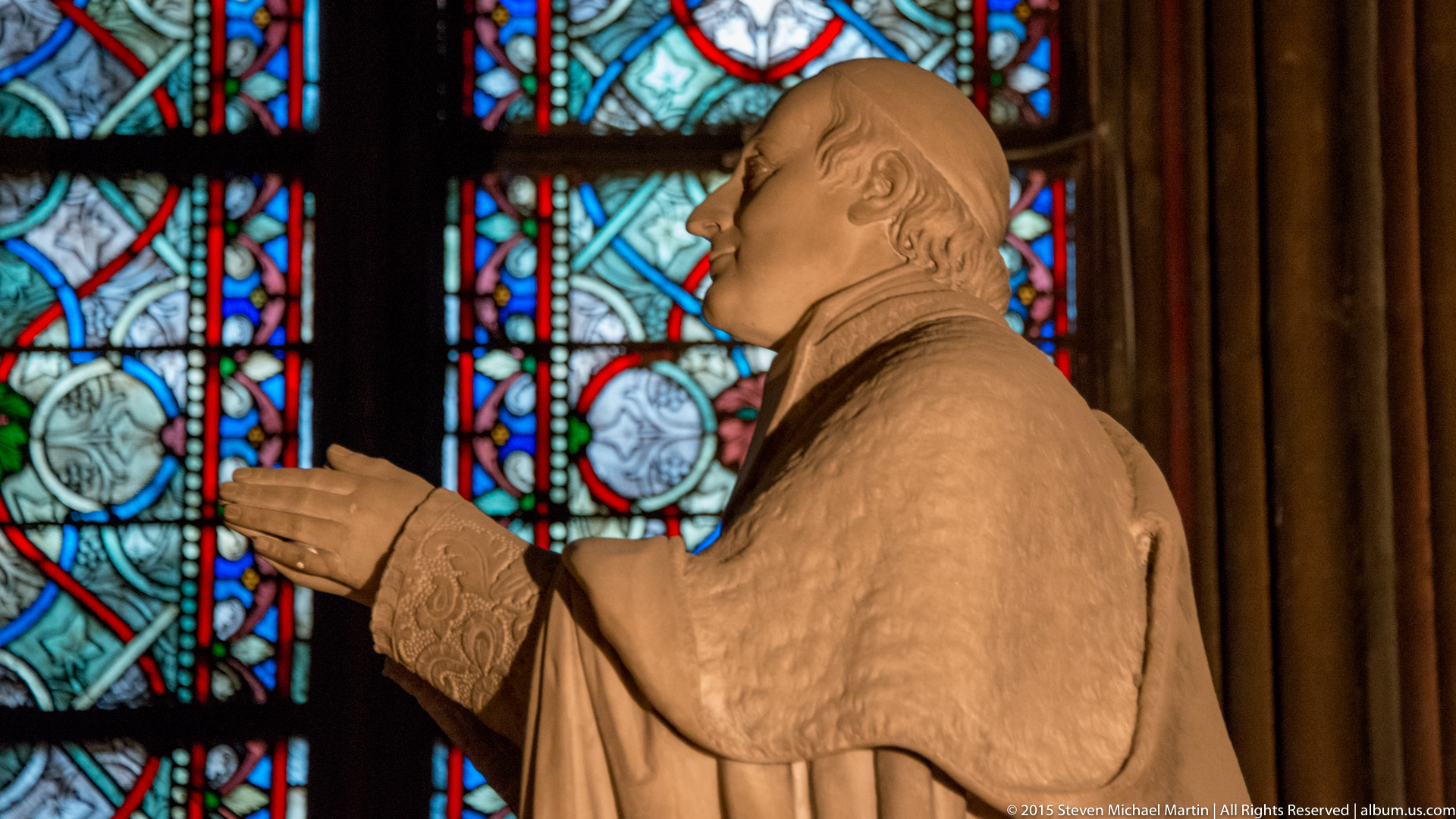
A sculpted clerical figure in vestments is shown in profile before brightly colored stained glass inside Notre-Dame de Paris. The hands are held forward in a gesture of prayer or blessing, while the sharply focused pale sculpture contrasts with the saturated reds, blues, and greens of the glazing behind.
Caption
A sculpted clerical figure in vestments is shown in profile before brightly colored stained glass inside Notre-Dame de Paris. The hands are held forward in a gesture of prayer or blessing, while the sharply focused pale sculpture contrasts with the saturated reds, blues, and greens of the glazing behind.

A close interior view isolates the dense stained-glass tracery of a Notre-Dame rose window. Radiating petals of colored glass surround a central figural medallion, while smaller narrative and ornamental panels fill the outer rings, revealing the window’s intricate geometric and iconographic organization.
Caption
A close interior view isolates the dense stained-glass tracery of a Notre-Dame rose window. Radiating petals of colored glass surround a central figural medallion, while smaller narrative and ornamental panels fill the outer rings, revealing the window’s intricate geometric and iconographic organization.

Nicolas Coustou’s 1723 Virgin of Pity, or Pietà, forms the emotional center of the Vow of Louis XIII ensemble in the choir of Notre-Dame de Paris. Carved in white marble, the Virgin supports the dead Christ while lifting her face and opening her arms toward heaven; the sculpture was created as part of the 18th-century fulfillment of Louis XIII’s vow.
Caption
Nicolas Coustou’s 1723 Virgin of Pity, or Pietà, forms the emotional center of the Vow of Louis XIII ensemble in the choir of Notre-Dame de Paris. Carved in white marble, the Virgin supports the dead Christ while lifting her face and opening her arms toward heaven; the sculpture was created as part of the 18th-century fulfillment of Louis XIII’s vow.

A wider view of the same Notre-Dame side chapel reveals the altar within a full architectural bay, surrounded by luminous stained glass and a dark star-studded vault. The checkered pavement, chandeliers, candles, and column shafts extend the composition downward and outward, showing how the chapel functions as a complete devotional environment.
Caption
A wider view of the same Notre-Dame side chapel reveals the altar within a full architectural bay, surrounded by luminous stained glass and a dark star-studded vault. The checkered pavement, chandeliers, candles, and column shafts extend the composition downward and outward, showing how the chapel functions as a complete devotional environment.

A centered interior view of Notre-Dame de Paris focuses on the choir, where the altar and cross stand before the apse windows. Sculptural choir screens extend along both sides, and the high vaulting above creates a strong axial frame that directs attention toward the sanctuary.
Caption
A centered interior view of Notre-Dame de Paris focuses on the choir, where the altar and cross stand before the apse windows. Sculptural choir screens extend along both sides, and the high vaulting above creates a strong axial frame that directs attention toward the sanctuary.

The nave of Notre-Dame de Paris opens toward the choir and apse, where the altar and cross stand beneath tall stained-glass windows. Dark sculptural choir screens line both sides of the central aisle, while clustered piers and rib vaults frame the sanctuary in a highly symmetrical composition.
Caption
The nave of Notre-Dame de Paris opens toward the choir and apse, where the altar and cross stand beneath tall stained-glass windows. Dark sculptural choir screens line both sides of the central aisle, while clustered piers and rib vaults frame the sanctuary in a highly symmetrical composition.

Looking west through Notre-Dame de Paris, the nave rises toward the organ loft and rose window. Massive columns, pointed arcades, chandeliers, and ribbed vaults create a strong vertical rhythm, while the distant organ silhouette beneath the glowing glass anchors the western end of the cathedral.
Caption
Looking west through Notre-Dame de Paris, the nave rises toward the organ loft and rose window. Massive columns, pointed arcades, chandeliers, and ribbed vaults create a strong vertical rhythm, while the distant organ silhouette beneath the glowing glass anchors the western end of the cathedral.

An upward-looking composition follows Notre-Dame de Paris’s nave vaults from bay to bay, revealing the repeating rib pattern and clerestory windows along both sides. The image strips away most furnishings and floor-level detail, concentrating attention on the cathedral’s stone skeleton and the rhythm of its high vaulting.
Caption
An upward-looking composition follows Notre-Dame de Paris’s nave vaults from bay to bay, revealing the repeating rib pattern and clerestory windows along both sides. The image strips away most furnishings and floor-level detail, concentrating attention on the cathedral’s stone skeleton and the rhythm of its high vaulting.

A richly decorated side chapel in Notre-Dame de Paris centers on a sculpted altar beneath tall stained-glass windows. Painted architectural surfaces, a hanging chandelier, candles, and flanking statues create a dense devotional setting in which glass, sculpture, metalwork, and color are tightly integrated.
Caption
A richly decorated side chapel in Notre-Dame de Paris centers on a sculpted altar beneath tall stained-glass windows. Painted architectural surfaces, a hanging chandelier, candles, and flanking statues create a dense devotional setting in which glass, sculpture, metalwork, and color are tightly integrated.

A long oblique view of Notre-Dame de Paris’s choir screen shows a continuous series of polychrome biblical reliefs beneath repeated Gothic canopies. The receding perspective reveals the depth and length of the sculptural program, while the dark lower enclosure and soaring cathedral vaults place the relief cycle within its architectural setting.
Caption
A long oblique view of Notre-Dame de Paris’s choir screen shows a continuous series of polychrome biblical reliefs beneath repeated Gothic canopies. The receding perspective reveals the depth and length of the sculptural program, while the dark lower enclosure and soaring cathedral vaults place the relief cycle within its architectural setting.

A large rose window rises above a band of tall stained-glass lancets in Notre-Dame de Paris, framed by massive stone arches and ribbed vaulting. The composition emphasizes the layered organization of the Gothic wall, with circular tracery above and vertical windows below.
Caption
A large rose window rises above a band of tall stained-glass lancets in Notre-Dame de Paris, framed by massive stone arches and ribbed vaulting. The composition emphasizes the layered organization of the Gothic wall, with circular tracery above and vertical windows below.
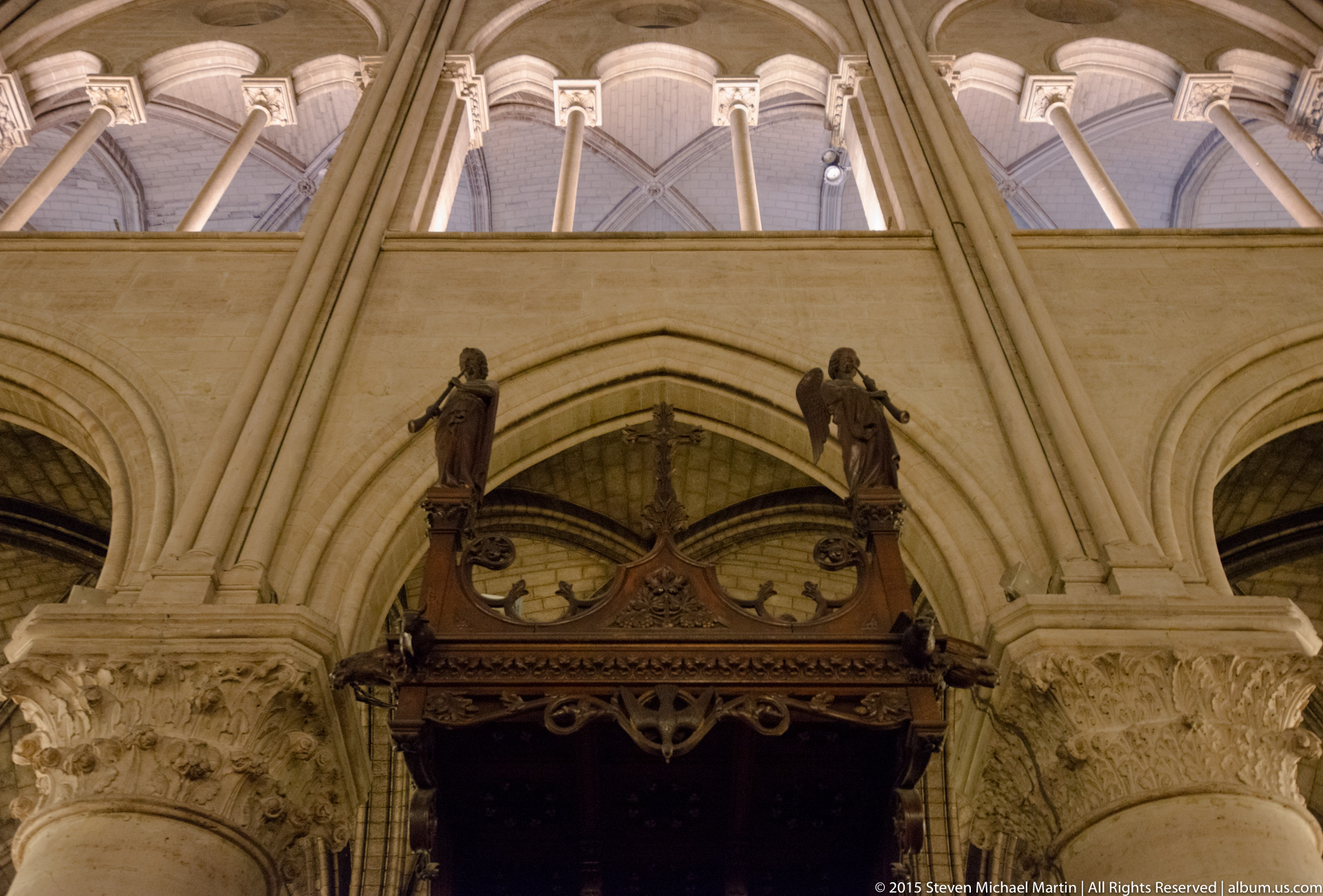
A carved wooden canopy or confessional-like structure stands against the stone interior of Notre-Dame de Paris beneath pointed arches and illuminated gallery openings. Heavily foliated capitals crown the adjacent piers, creating a close study of the cathedral’s stone carving alongside later dark wood furnishings.
Caption
A carved wooden canopy or confessional-like structure stands against the stone interior of Notre-Dame de Paris beneath pointed arches and illuminated gallery openings. Heavily foliated capitals crown the adjacent piers, creating a close study of the cathedral’s stone carving alongside later dark wood furnishings.

A large wrought-metal chandelier hangs beside a richly carved foliated capital inside Notre-Dame de Paris. The close viewpoint isolates two contrasting forms of ornament—the branching metalwork of the light fixture and the organic stone carving of the capital—against the darker ribbed vaults beyond.
Caption
A large wrought-metal chandelier hangs beside a richly carved foliated capital inside Notre-Dame de Paris. The close viewpoint isolates two contrasting forms of ornament—the branching metalwork of the light fixture and the organic stone carving of the capital—against the darker ribbed vaults beyond.

Rows of wooden chairs lead down the central nave of Notre-Dame de Paris toward the distant choir. Massive columns, pointed arcades, chandeliers, and rib vaults repeat in strong perspective, creating a clear sense of the cathedral’s longitudinal scale and ceremonial axis.
Caption
Rows of wooden chairs lead down the central nave of Notre-Dame de Paris toward the distant choir. Massive columns, pointed arcades, chandeliers, and rib vaults repeat in strong perspective, creating a clear sense of the cathedral’s longitudinal scale and ceremonial axis.

The eastern end of Notre-Dame de Paris is seen from the garden, where the apse, radiating chapels, flying buttresses, pinnacles, and central spire form a dense architectural silhouette. Trees partially screen the lower masonry while the upper structure remains fully legible against the sky.
Caption
The eastern end of Notre-Dame de Paris is seen from the garden, where the apse, radiating chapels, flying buttresses, pinnacles, and central spire form a dense architectural silhouette. Trees partially screen the lower masonry while the upper structure remains fully legible against the sky.

A wide low-angle view down Notre-Dame de Paris’s nave combines the long central aisle with the soaring vaults above. Repeated columns, arches, chandeliers, clerestory openings, and distant stained glass create a layered architectural rhythm from floor level to ceiling.
Caption
A wide low-angle view down Notre-Dame de Paris’s nave combines the long central aisle with the soaring vaults above. Repeated columns, arches, chandeliers, clerestory openings, and distant stained glass create a layered architectural rhythm from floor level to ceiling.
In 2019, after the massive fire that destroyed much of Notre Dame, I went back to my raw photos and found a lot more pictures that I have now added to this portfolio. Such a sad story for a beautiful historically significant place. I’m am forever grateful that I woke up super early the morning I took these pictures to be one of the first to enter the church. I remember being one of only a handful of people in the church at the time. It was worth the couple miles walk to get to it!