Bruges – Belgium
Bruges lies in the region of Flanders and became one of the most important trading ports of northern Europe during the Middle Ages. The city was a major center of international commerce, attracting merchants from across the Hanseatic League and the Mediterranean world.
The historic center of Bruges is famous for its network of canals, medieval buildings, and cobbled streets. Landmarks such as the Belfry of Bruges, the Market Square, and numerous Gothic churches give the city a distinctive historic character.
Because of its remarkable preservation, the entire historic center of Bruges is now recognized as a UNESCO World Heritage Site.
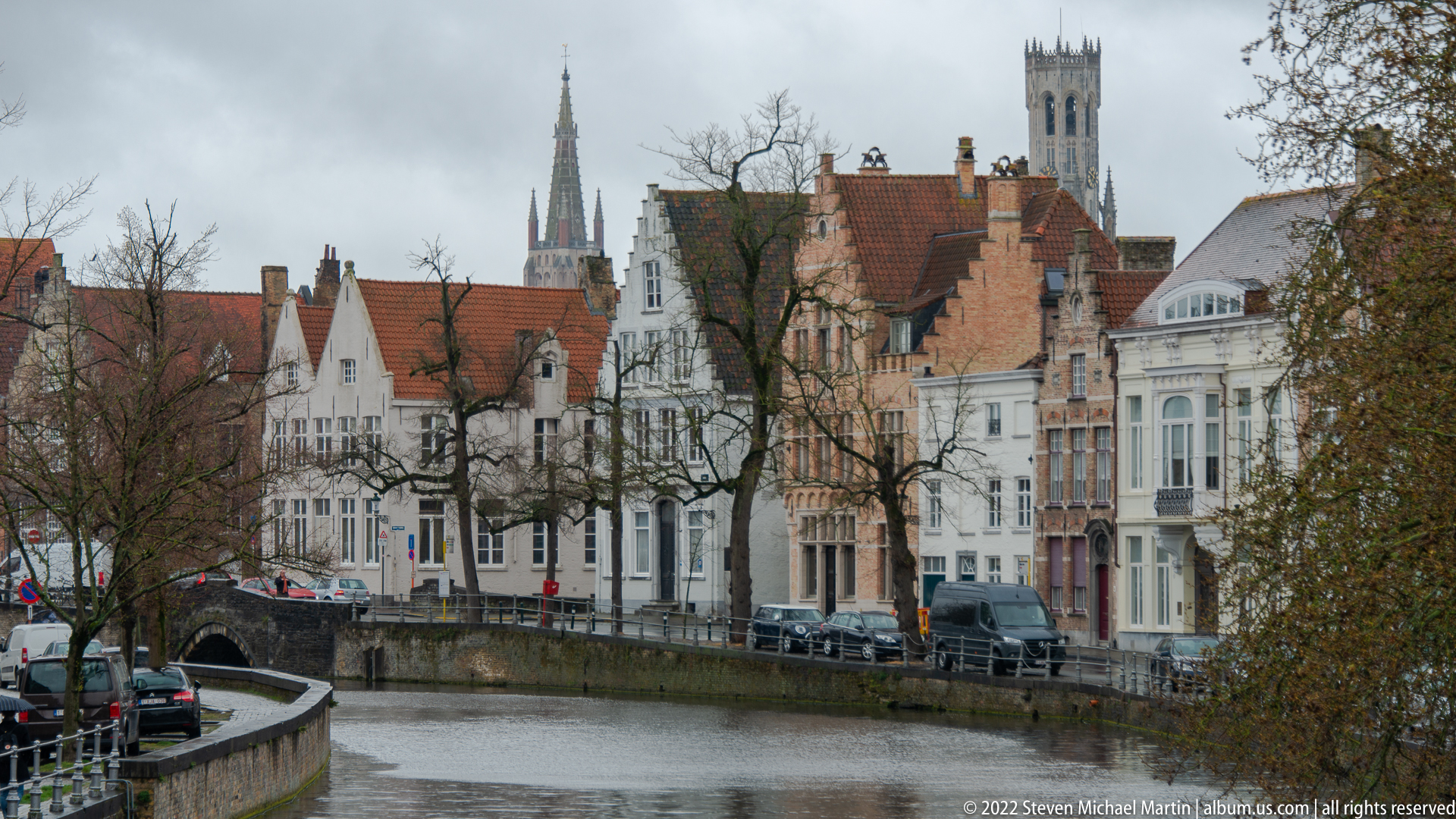
Historic houses curve around a Bruges canal while two prominent church towers rise above the roofline, one a slender pointed spire and the other a broader crenellated tower. The layered view combines waterside façades, tiled roofs, bare trees, and ecclesiastical landmarks into a compact cityscape. It demonstrates how Bruges’ church silhouettes remain visible above the lower domestic architecture along the canals.
Caption
Historic houses curve around a Bruges canal while two prominent church towers rise above the roofline, one a slender pointed spire and the other a broader crenellated tower. The layered view combines waterside façades, tiled roofs, bare trees, and ecclesiastical landmarks into a compact cityscape. It demonstrates how Bruges’ church silhouettes remain visible above the lower domestic architecture along the canals.
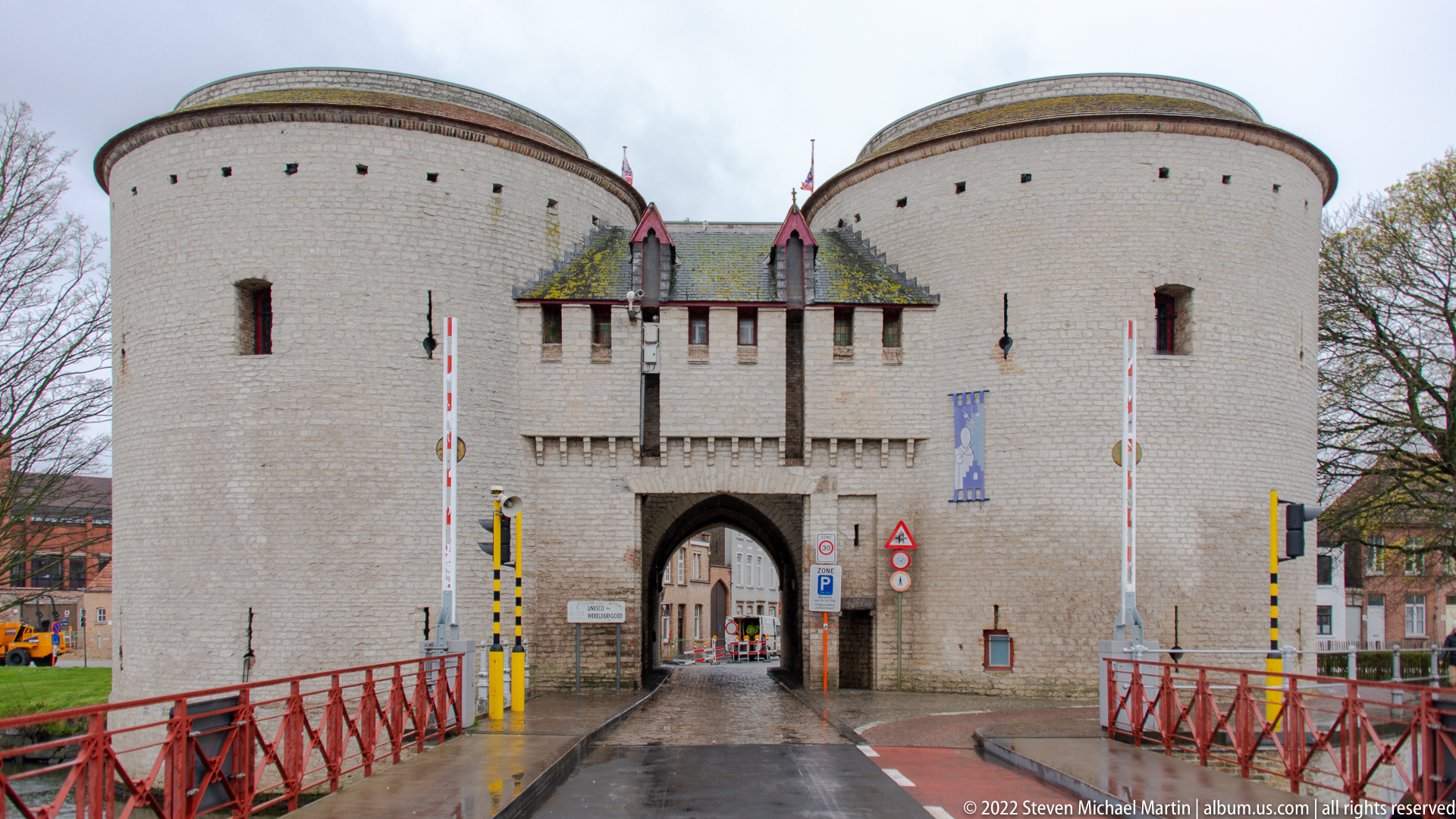
Two massive round towers flank the central arched entrance of a Bruges city gate, reached across a narrow bridge with red railings. Small slit-like openings and heavy masonry reinforce the structure’s defensive character, while the tiled roof and modest central gable soften the composition. The frontal viewpoint clearly records the gate’s symmetry and its relationship to the roadway crossing the former defensive line.
Caption
Two massive round towers flank the central arched entrance of a Bruges city gate, reached across a narrow bridge with red railings. Small slit-like openings and heavy masonry reinforce the structure’s defensive character, while the tiled roof and modest central gable soften the composition. The frontal viewpoint clearly records the gate’s symmetry and its relationship to the roadway crossing the former defensive line.

A massive stone church elevation rises between two narrow round turrets, with tiers of tall arched windows set beneath a steep gable. A much taller brick tower appears beyond to the left, connected visually by a flying or bridging arch. The low viewpoint reveals the unusual combination of heavy Romanesque-like massing and later Gothic verticality within Bruges’ layered ecclesiastical landscape.
Caption
A massive stone church elevation rises between two narrow round turrets, with tiers of tall arched windows set beneath a steep gable. A much taller brick tower appears beyond to the left, connected visually by a flying or bridging arch. The low viewpoint reveals the unusual combination of heavy Romanesque-like massing and later Gothic verticality within Bruges’ layered ecclesiastical landscape.
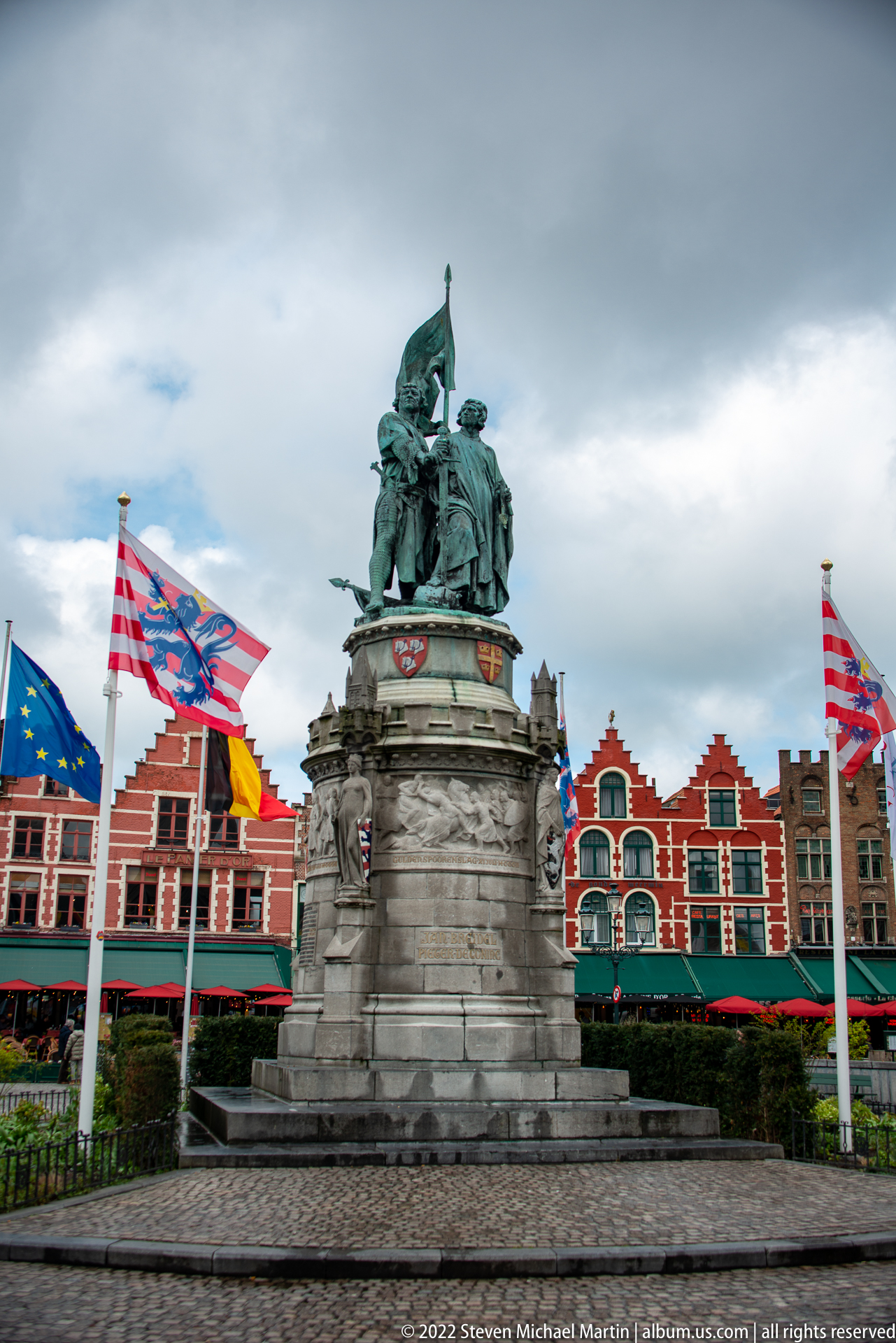
The monument to Jan Breydel and Pieter de Coninck stands at the center of Bruges’ Markt, the bronze figures raised on a substantial stone pedestal and surrounded by regional and civic flags. Brightly colored stepped-gable buildings form the backdrop. The wide composition places the nationalist monument within the ceremonial space of the market square rather than isolating the sculpture from its urban setting.
Caption
The monument to Jan Breydel and Pieter de Coninck stands at the center of Bruges’ Markt, the bronze figures raised on a substantial stone pedestal and surrounded by regional and civic flags. Brightly colored stepped-gable buildings form the backdrop. The wide composition places the nationalist monument within the ceremonial space of the market square rather than isolating the sculpture from its urban setting.
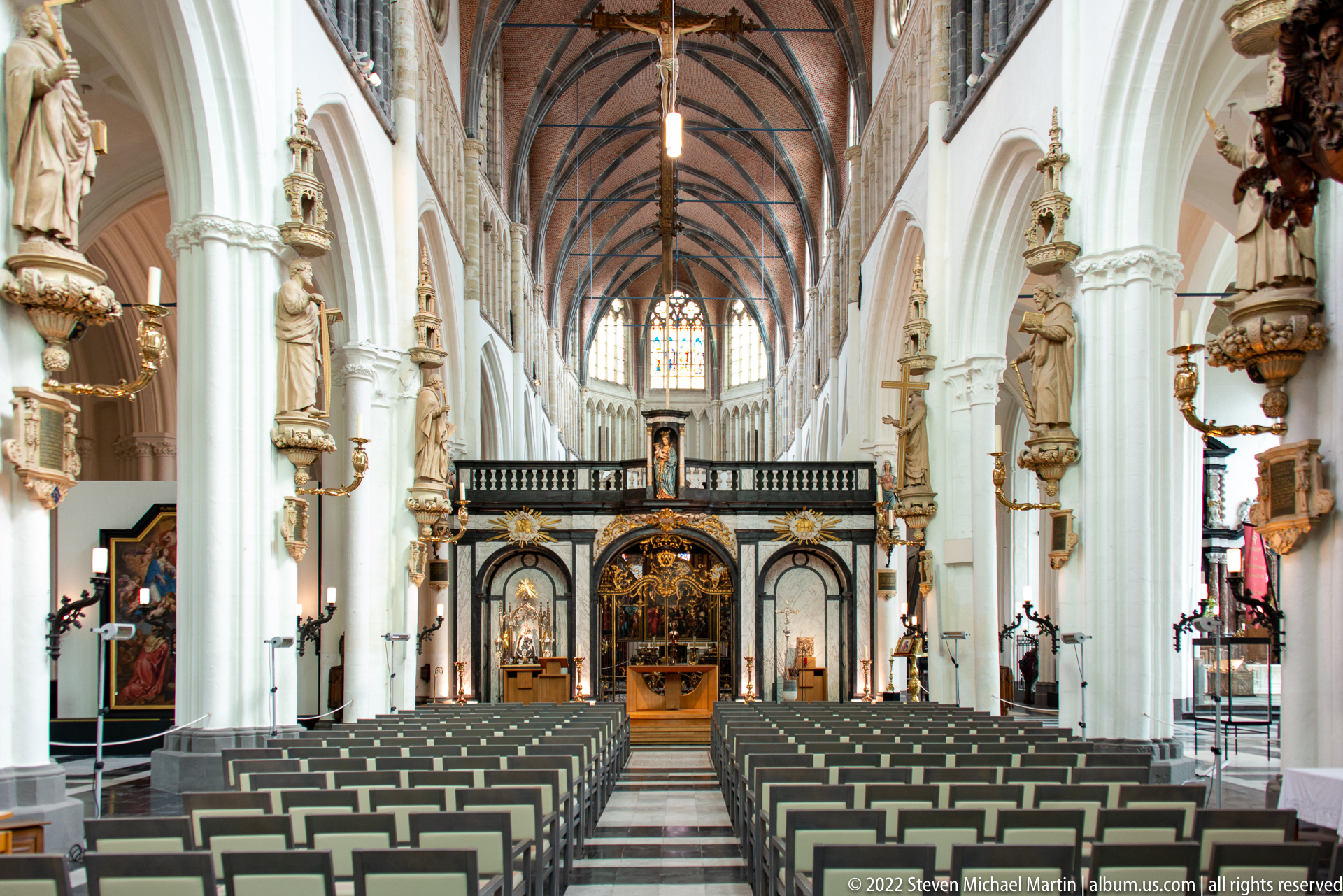
The nave of Bruges’ Church of Our Lady extends toward a richly decorated choir screen or altar ensemble beneath a high rib-vaulted ceiling. Pale clustered columns support pointed arches, while statues, side altars, and artworks punctuate the long white interior. Rows of simple chairs create a central processional axis, drawing the eye toward the illuminated sanctuary beyond.
Caption
The nave of Bruges’ Church of Our Lady extends toward a richly decorated choir screen or altar ensemble beneath a high rib-vaulted ceiling. Pale clustered columns support pointed arches, while statues, side altars, and artworks punctuate the long white interior. Rows of simple chairs create a central processional axis, drawing the eye toward the illuminated sanctuary beyond.

A gilded crucifix rises between two kneeling angel sculptures set symmetrically against a pale Gothic wall. Slender candlesticks flank the group, and the cross is surrounded by radiating golden beams that intensify its central position. The restrained stone background and repetitive blind arches allow the luminous devotional ensemble to stand out with unusual clarity.
Caption
A gilded crucifix rises between two kneeling angel sculptures set symmetrically against a pale Gothic wall. Slender candlesticks flank the group, and the cross is surrounded by radiating golden beams that intensify its central position. The restrained stone background and repetitive blind arches allow the luminous devotional ensemble to stand out with unusual clarity.
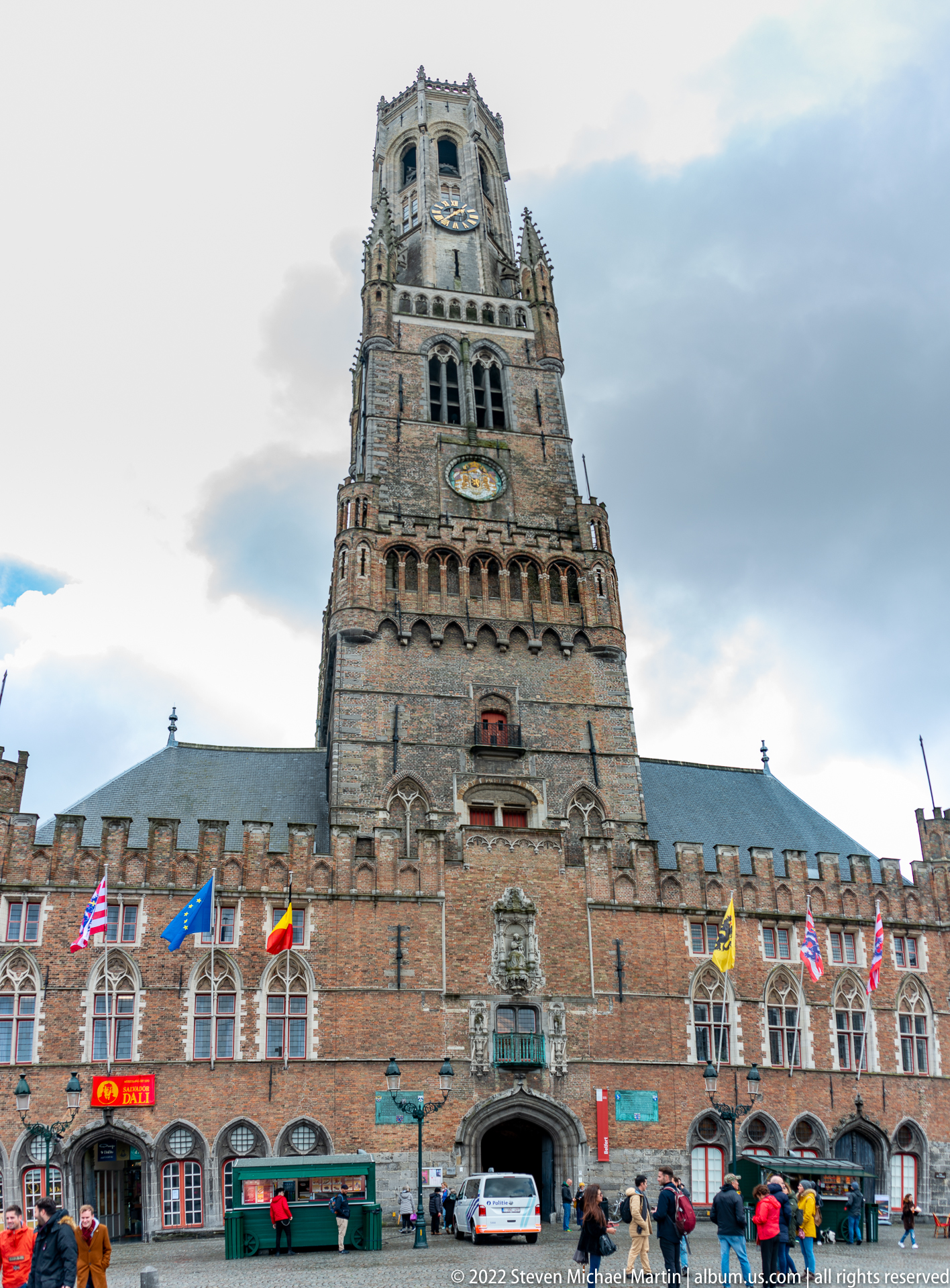
The Belfry of Bruges dominates the Markt with its massive brick base, stacked upper stages, clock faces, and octagonal crown. Arcaded openings and crenellated parapets articulate the medieval tower, while market stalls, pedestrians, and flags animate the square below. The broad frontal view makes the belfry’s civic scale and vertical prominence unmistakable within Bruges’ historic center.
Caption
The Belfry of Bruges dominates the Markt with its massive brick base, stacked upper stages, clock faces, and octagonal crown. Arcaded openings and crenellated parapets articulate the medieval tower, while market stalls, pedestrians, and flags animate the square below. The broad frontal view makes the belfry’s civic scale and vertical prominence unmistakable within Bruges’ historic center.
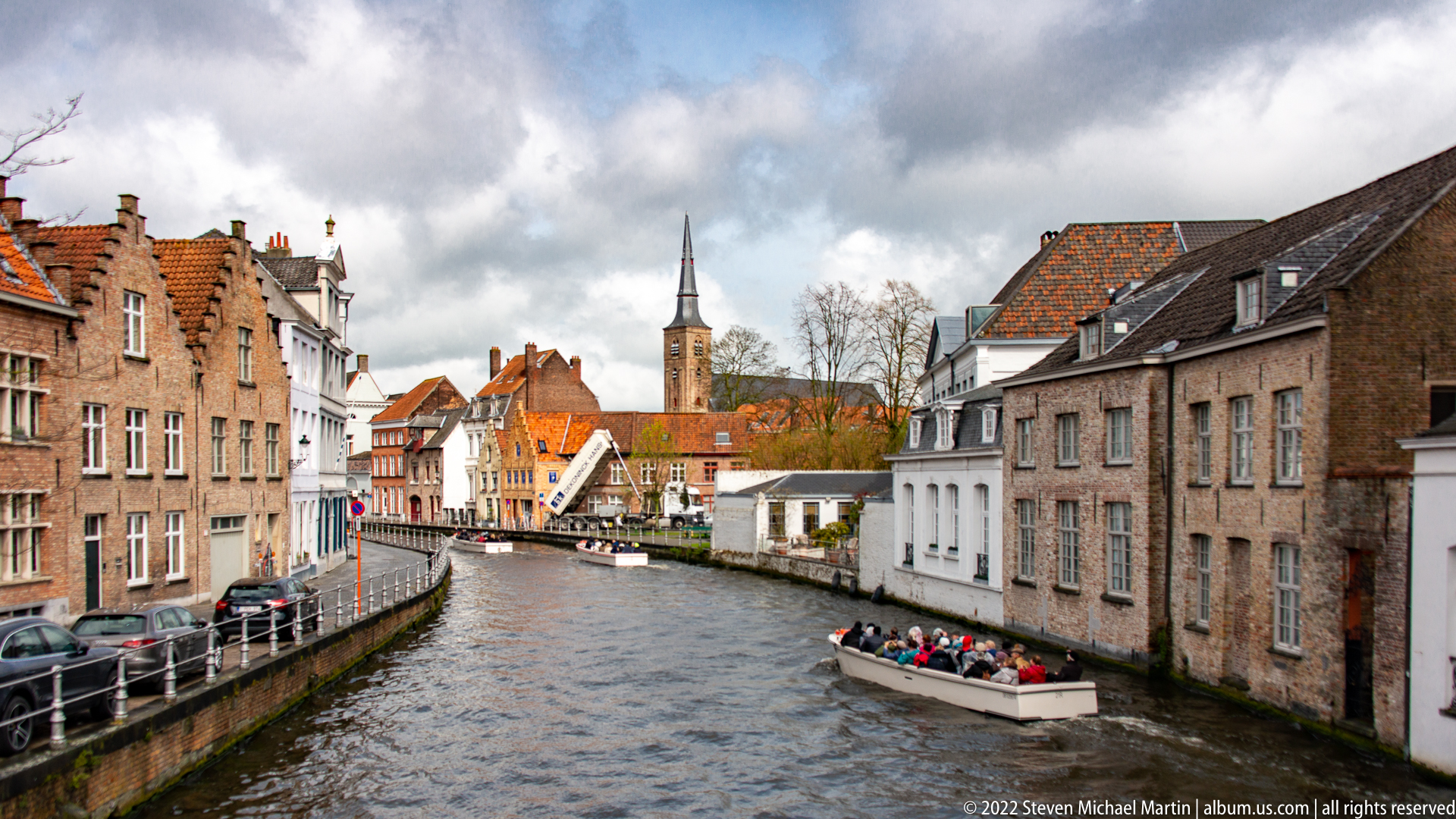
A low passenger boat moves through a narrow Bruges canal bordered by brick and stucco houses, with parked cars and stepped rooflines along the left quay. A slender church tower rises in the middle distance, drawing the canal view toward the center of the city. The active boat introduces contemporary tourism into a streetscape whose scale and materials remain strongly historic.
Caption
A low passenger boat moves through a narrow Bruges canal bordered by brick and stucco houses, with parked cars and stepped rooflines along the left quay. A slender church tower rises in the middle distance, drawing the canal view toward the center of the city. The active boat introduces contemporary tourism into a streetscape whose scale and materials remain strongly historic.
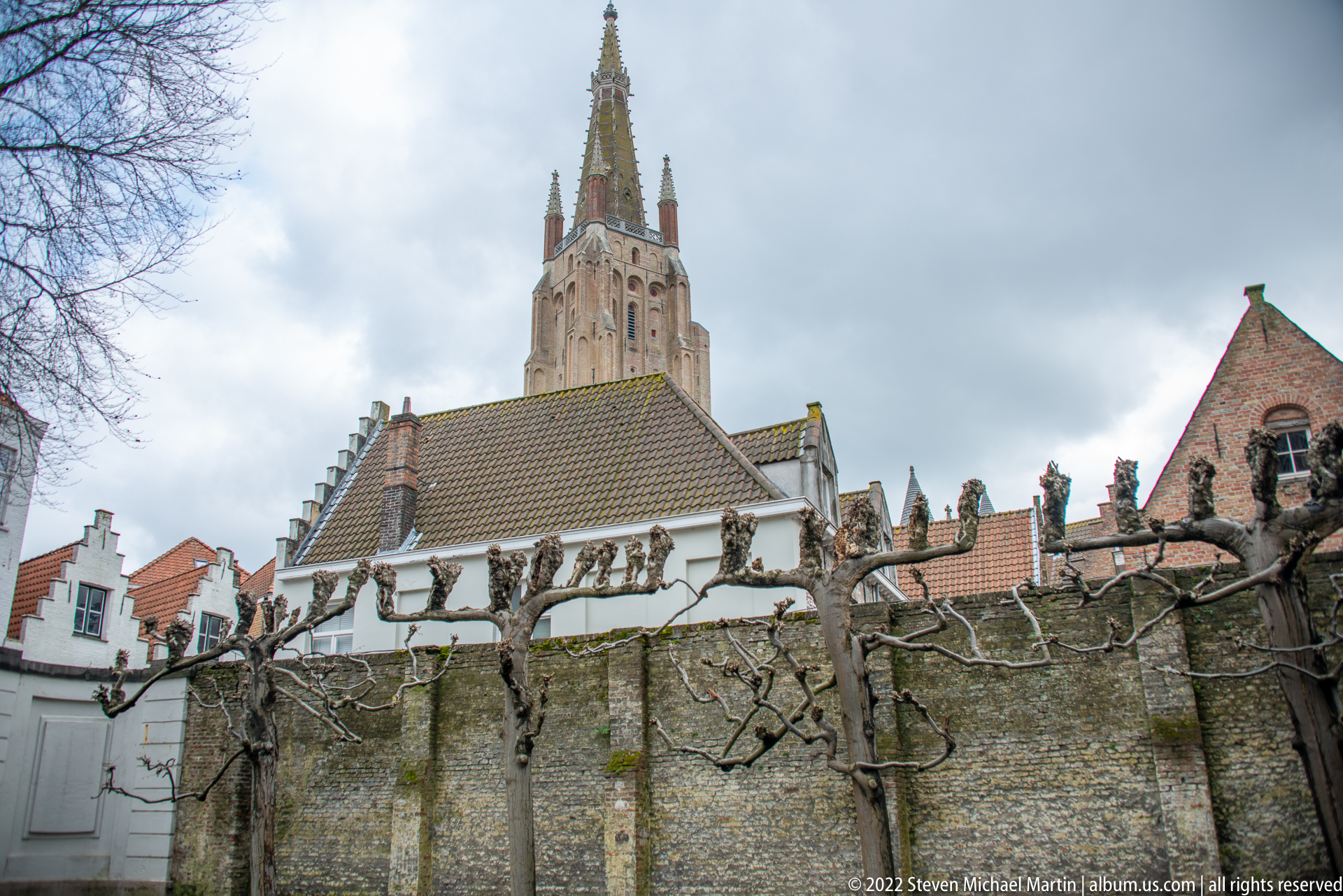
A tall brick Gothic tower rises sharply above historic walls and tile roofs, its upper stage articulated by vertical openings, corner pinnacles, and a steep central crown. Pollarded trees line the foreground wall and create a strong horizontal counterpoint to the tower’s vertical thrust. The distant viewpoint emphasizes the church tower as a city landmark emerging above the dense historic fabric.
Caption
A tall brick Gothic tower rises sharply above historic walls and tile roofs, its upper stage articulated by vertical openings, corner pinnacles, and a steep central crown. Pollarded trees line the foreground wall and create a strong horizontal counterpoint to the tower’s vertical thrust. The distant viewpoint emphasizes the church tower as a city landmark emerging above the dense historic fabric.

A low arched brick footbridge crosses a narrow canal in the historic quarter, with the massive stone choir and buttressed walls of the Church of Our Lady rising behind it. Pollarded trees line the water’s edge, while a cluster of visitors gathers beyond the bridge. The composition brings Bruges’ canal infrastructure, museum quarter, and monumental church architecture into a single layered view.
Caption
A low arched brick footbridge crosses a narrow canal in the historic quarter, with the massive stone choir and buttressed walls of the Church of Our Lady rising behind it. Pollarded trees line the water’s edge, while a cluster of visitors gathers beyond the bridge. The composition brings Bruges’ canal infrastructure, museum quarter, and monumental church architecture into a single layered view.
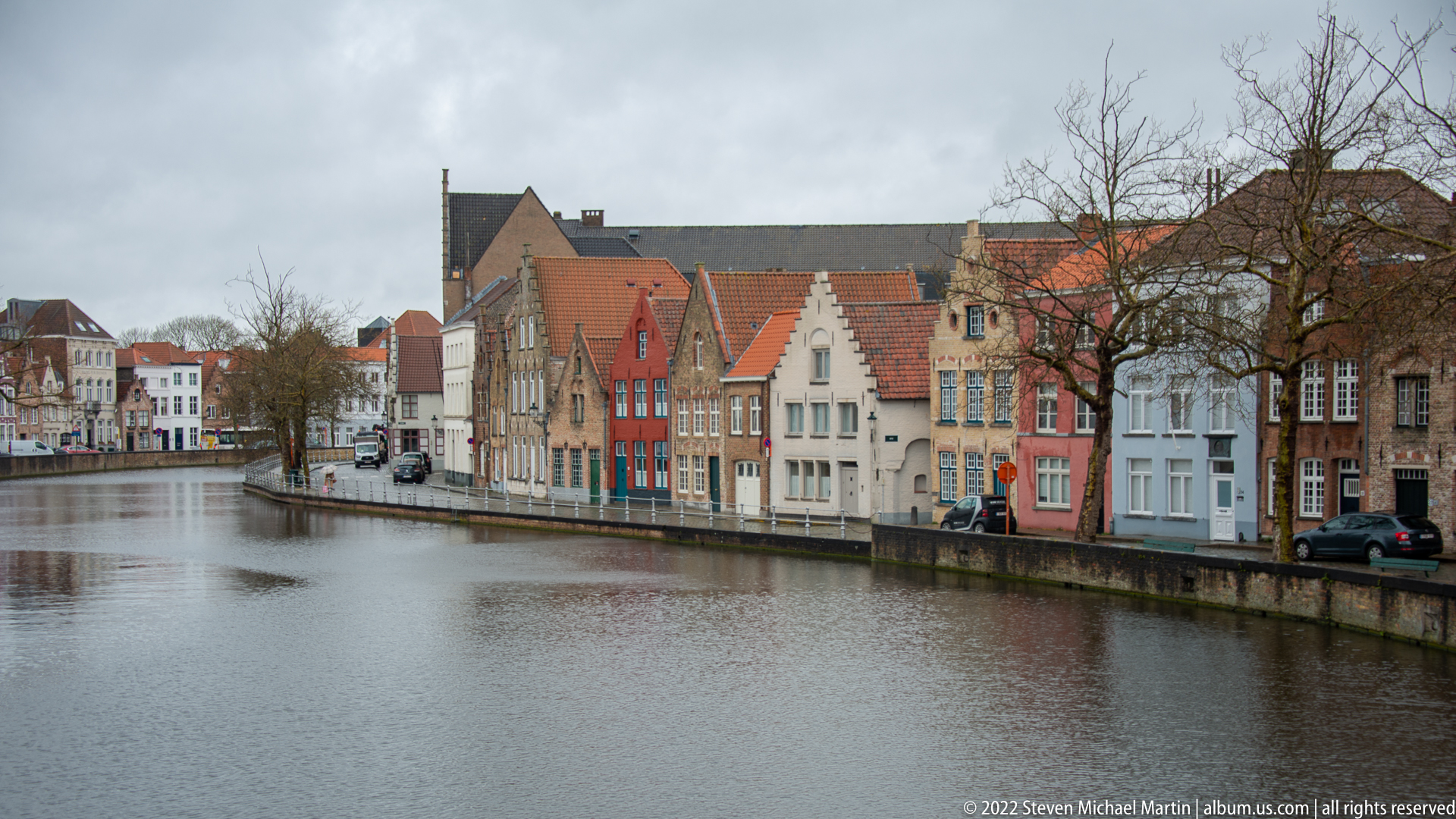
A broad canal opens through the historic center of Bruges, bordered on the right by a rhythm of narrow gabled houses in brick, white, red, and pale blue. Bare winter trees and parked cars mark the quay, while the left bank recedes toward a distant bend. The long perspective emphasizes the canal as an organizing element of the city’s dense medieval street plan.
Caption
A broad canal opens through the historic center of Bruges, bordered on the right by a rhythm of narrow gabled houses in brick, white, red, and pale blue. Bare winter trees and parked cars mark the quay, while the left bank recedes toward a distant bend. The long perspective emphasizes the canal as an organizing element of the city’s dense medieval street plan.
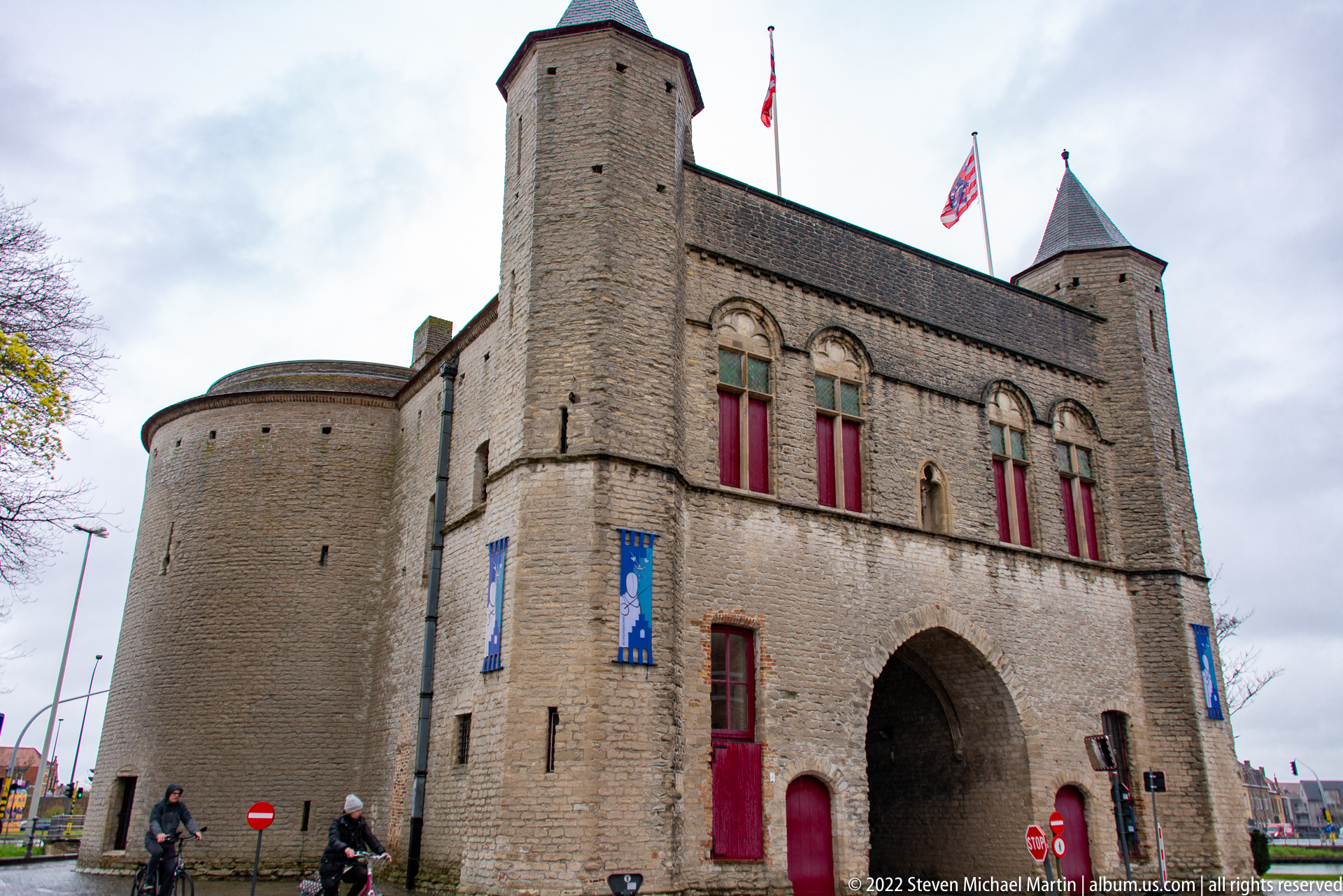
A fortified city gate in Bruges rises above a broad arched passage, with cylindrical and square corner towers framing the masonry façade. Red-painted window shutters punctuate the pale brickwork, while heraldic flags and banners add color to the overcast streetscape. The low viewpoint emphasizes the gate’s defensive mass and the layered geometry of its towers and rooflines.
Caption
A fortified city gate in Bruges rises above a broad arched passage, with cylindrical and square corner towers framing the masonry façade. Red-painted window shutters punctuate the pale brickwork, while heraldic flags and banners add color to the overcast streetscape. The low viewpoint emphasizes the gate’s defensive mass and the layered geometry of its towers and rooflines.

A weathered sign mounted against old brickwork marks Bruges as UNESCO World Heritage, with the words “BRUGGE” and “UNESCO WERELDERFGOED” still legible despite staining and surface wear. The close framing turns the sign itself into a record of place identity and heritage designation, contrasting modern heritage graphics with the rough texture of the historic masonry behind it.
Caption
A weathered sign mounted against old brickwork marks Bruges as UNESCO World Heritage, with the words “BRUGGE” and “UNESCO WERELDERFGOED” still legible despite staining and surface wear. The close framing turns the sign itself into a record of place identity and heritage designation, contrasting modern heritage graphics with the rough texture of the historic masonry behind it.
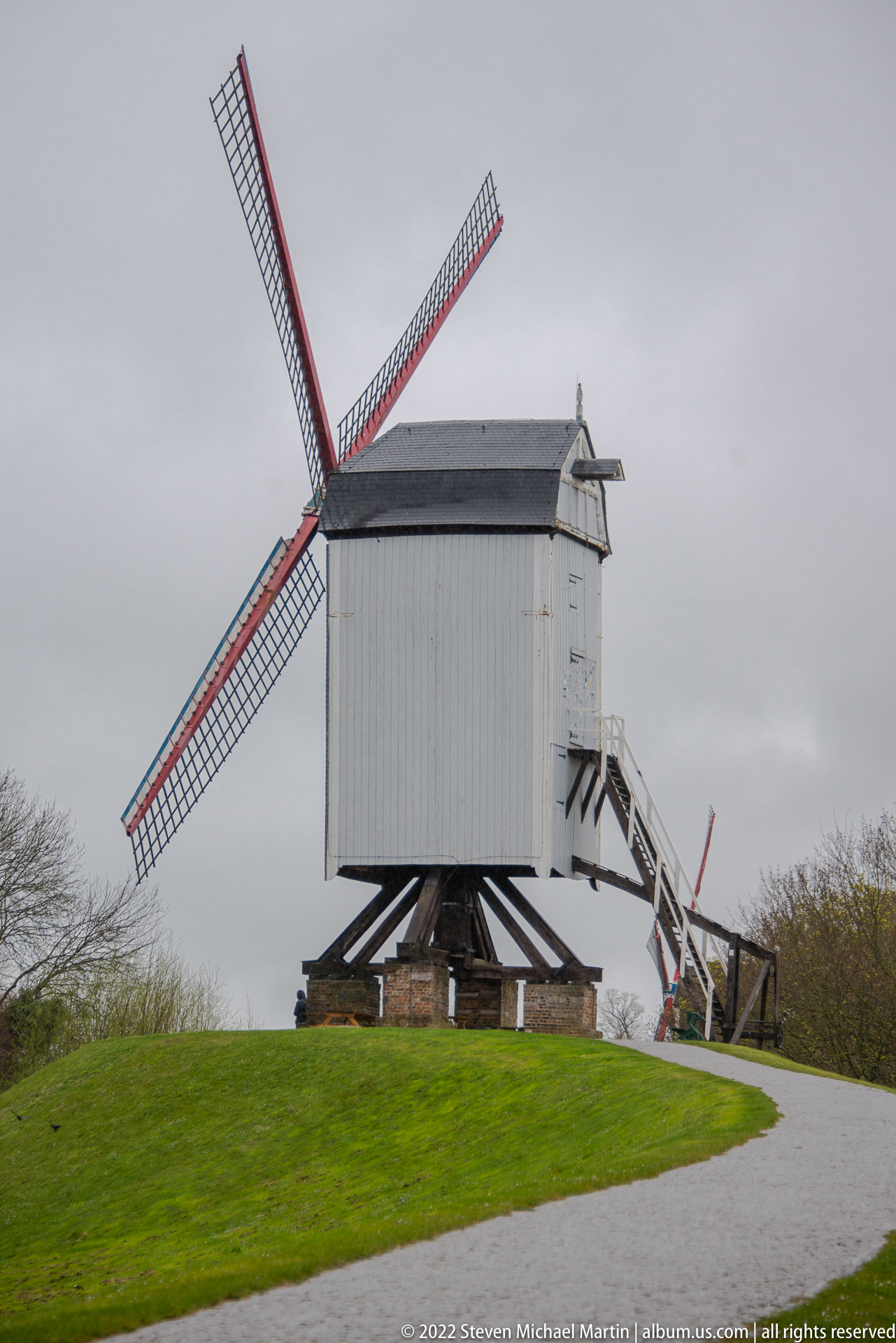
A traditional wooden post mill stands on a raised grassy embankment beneath a gray sky, its weatherboarded body balanced on a substantial timber support frame. Four lattice sails extend from the front, with red edging visible along the blades. The side stair and elevated setting reveal the mill’s working form and the way Bruges preserves historic windmills within the city’s green rampart landscape.
Caption
A traditional wooden post mill stands on a raised grassy embankment beneath a gray sky, its weatherboarded body balanced on a substantial timber support frame. Four lattice sails extend from the front, with red edging visible along the blades. The side stair and elevated setting reveal the mill’s working form and the way Bruges preserves historic windmills within the city’s green rampart landscape.
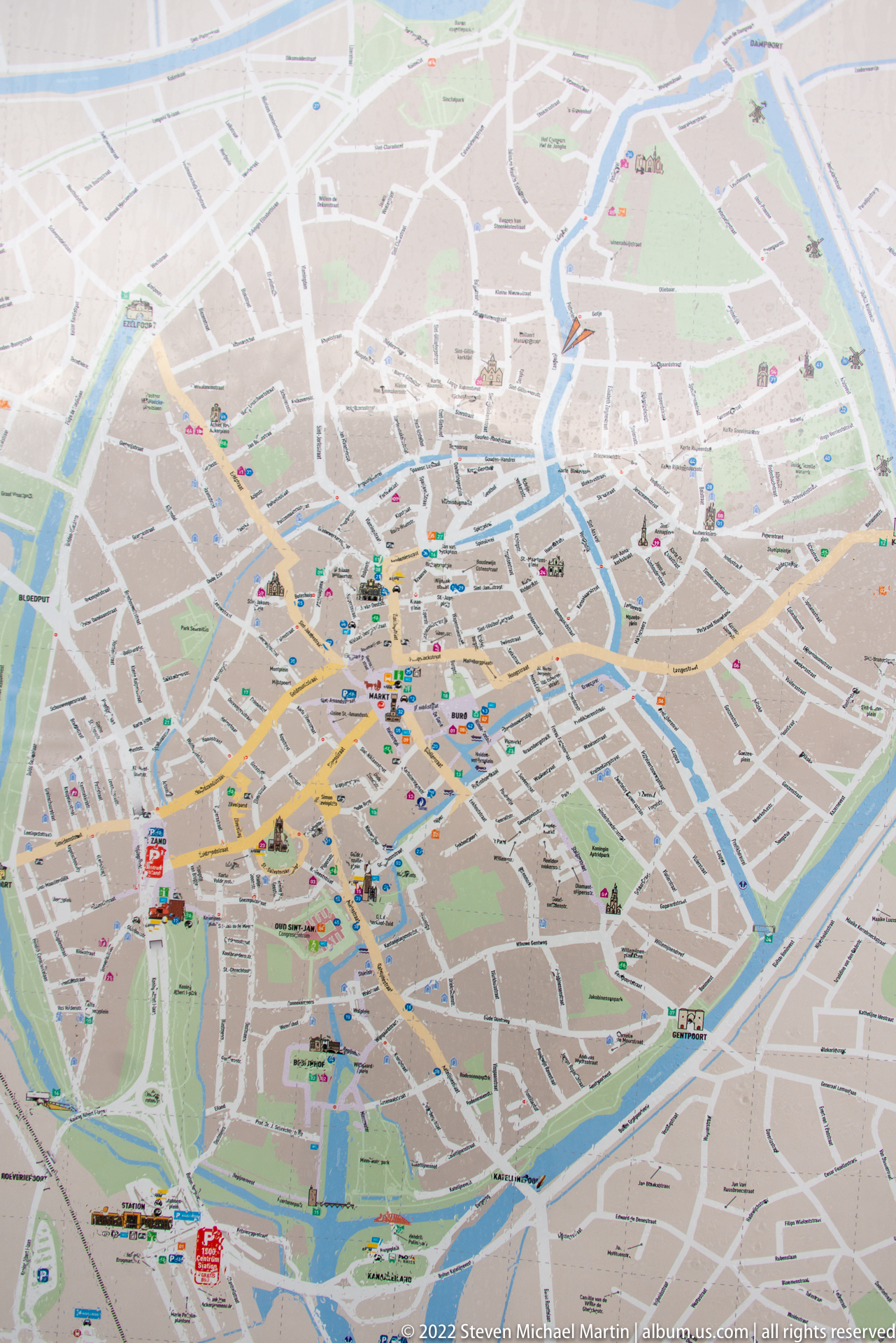
A printed map presents the dense street pattern and encircling waterways of Bruges, with the historic center packed tightly inside the canal network. Colored symbols and route markings identify visitor destinations and circulation points across the city. Photographed at an angle, the map functions as both wayfinding material and a graphic summary of Bruges’ distinctive urban form shaped by canals and medieval streets.
Caption
A printed map presents the dense street pattern and encircling waterways of Bruges, with the historic center packed tightly inside the canal network. Colored symbols and route markings identify visitor destinations and circulation points across the city. Photographed at an angle, the map functions as both wayfinding material and a graphic summary of Bruges’ distinctive urban form shaped by canals and medieval streets.
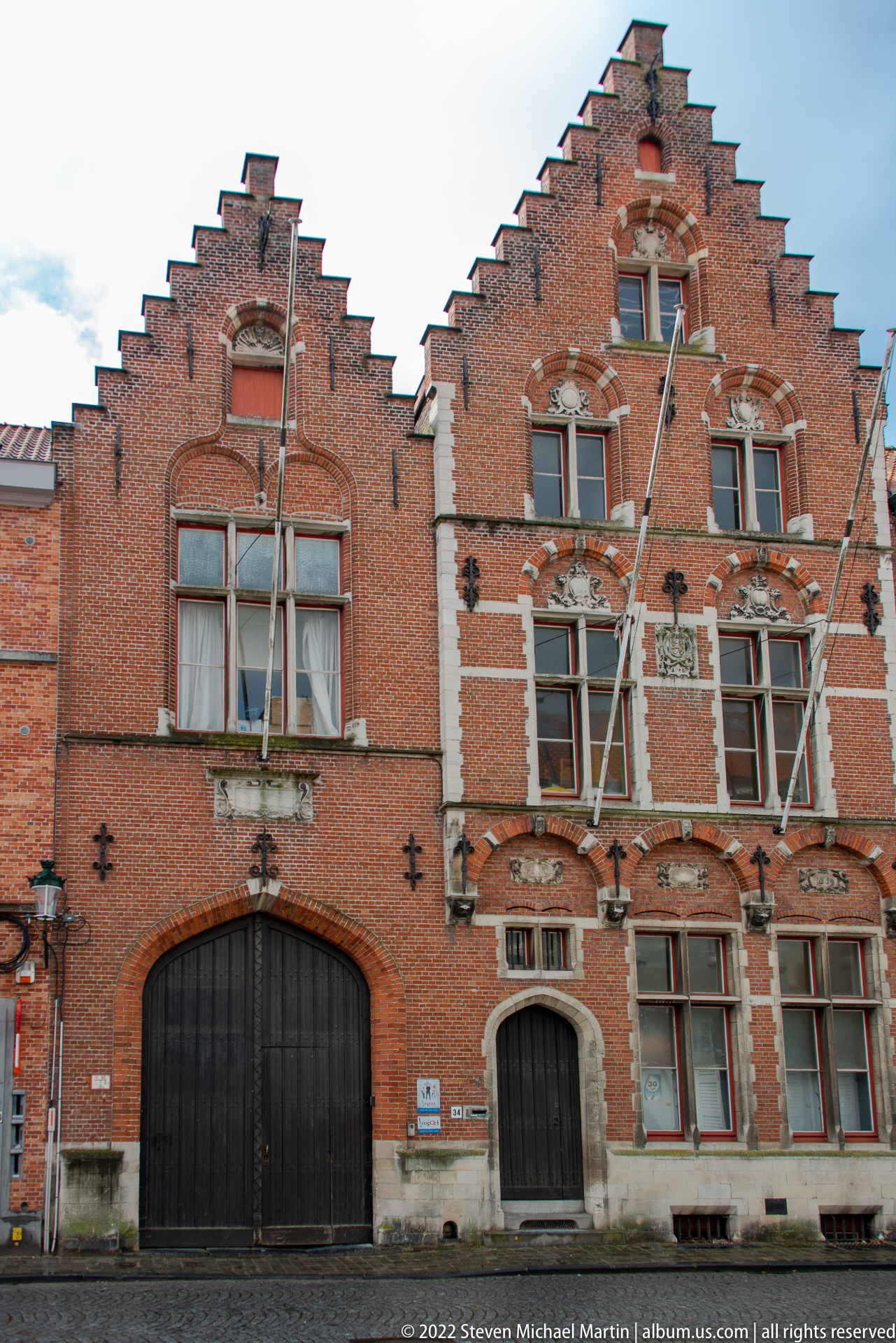
Two adjoining red-brick stepped-gable façades present contrasting openings: a broad black carriage door on the left and a smaller arched doorway with tall stone-framed windows on the right. Pale masonry bands, decorative reliefs, and iron anchor plates enliven the brick surfaces. The frontal view provides a useful architectural record of paired service and domestic fronts within Bruges’ historic urban fabric.
Caption
Two adjoining red-brick stepped-gable façades present contrasting openings: a broad black carriage door on the left and a smaller arched doorway with tall stone-framed windows on the right. Pale masonry bands, decorative reliefs, and iron anchor plates enliven the brick surfaces. The frontal view provides a useful architectural record of paired service and domestic fronts within Bruges’ historic urban fabric.
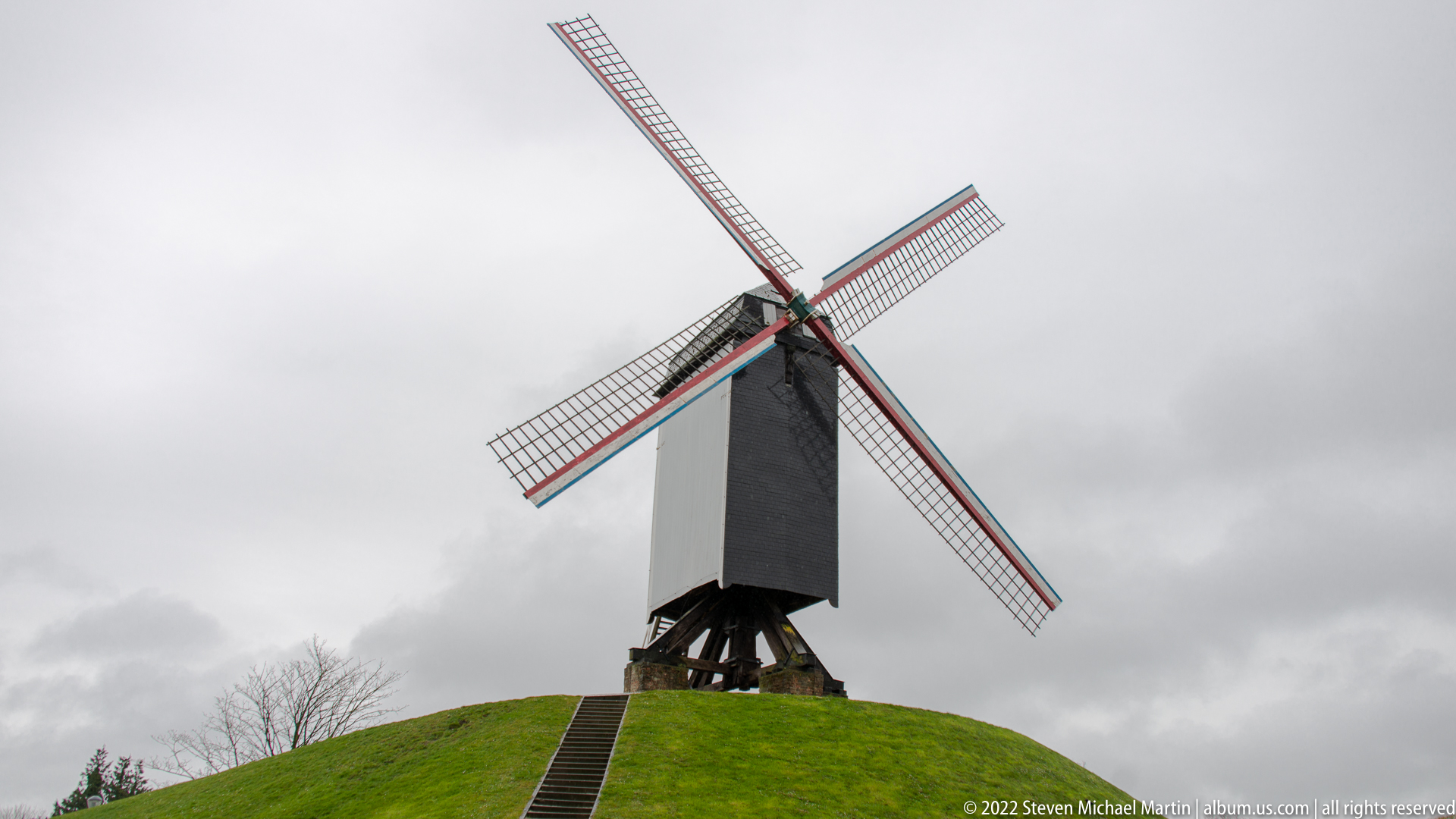
A dark-clad wooden windmill crowns a steep grassy mound, its four lattice sails forming a broad diagonal pattern against the cloudy sky. A straight stair climbs the embankment toward the raised mill structure, making the relationship between the monument and its artificial mound especially clear. The frontal composition isolates the mill’s timber body and sail geometry from the surrounding cityscape.
Caption
A dark-clad wooden windmill crowns a steep grassy mound, its four lattice sails forming a broad diagonal pattern against the cloudy sky. A straight stair climbs the embankment toward the raised mill structure, making the relationship between the monument and its artificial mound especially clear. The frontal composition isolates the mill’s timber body and sail geometry from the surrounding cityscape.
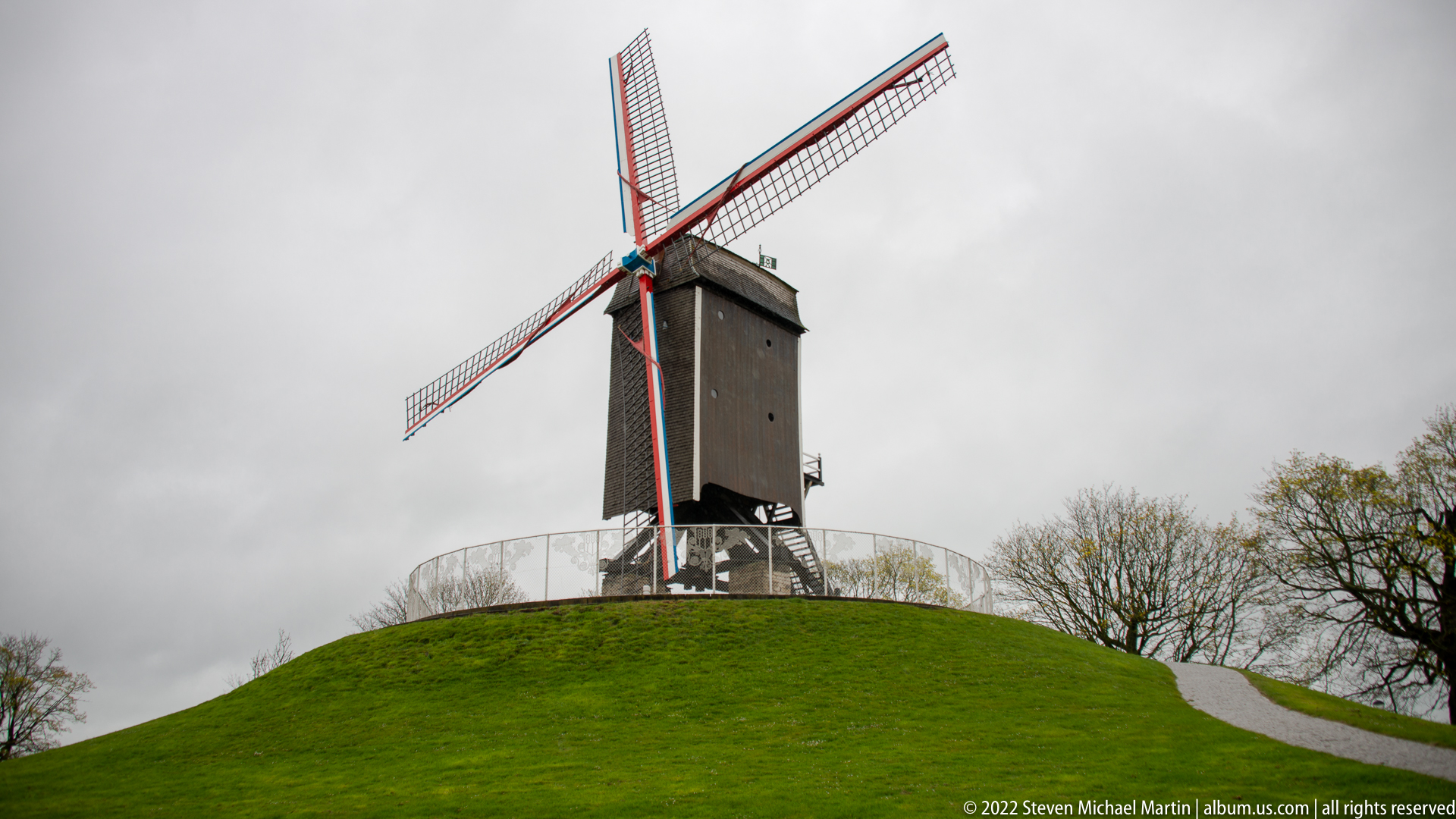
A tall wooden post mill rises from a rounded grassy mound, with four lattice sails edged in red projecting from the dark vertical body. The low viewpoint accentuates the mill’s height and the contrast between its timber construction and the smooth green slope below. Bare trees and a narrow path frame the structure without obscuring its distinctive working silhouette.
Caption
A tall wooden post mill rises from a rounded grassy mound, with four lattice sails edged in red projecting from the dark vertical body. The low viewpoint accentuates the mill’s height and the contrast between its timber construction and the smooth green slope below. Bare trees and a narrow path frame the structure without obscuring its distinctive working silhouette.

A long row of narrow historic houses follows the edge of a broad Bruges canal, their red tile roofs, stepped and pitched gables, and varied façades forming a continuous urban wall. Parked cars line the quay while church spires rise above the roofs in the distance. The wide view emphasizes how water, street, and medieval-scale housing remain tightly interwoven in the historic center.
Caption
A long row of narrow historic houses follows the edge of a broad Bruges canal, their red tile roofs, stepped and pitched gables, and varied façades forming a continuous urban wall. Parked cars line the quay while church spires rise above the roofs in the distance. The wide view emphasizes how water, street, and medieval-scale housing remain tightly interwoven in the historic center.
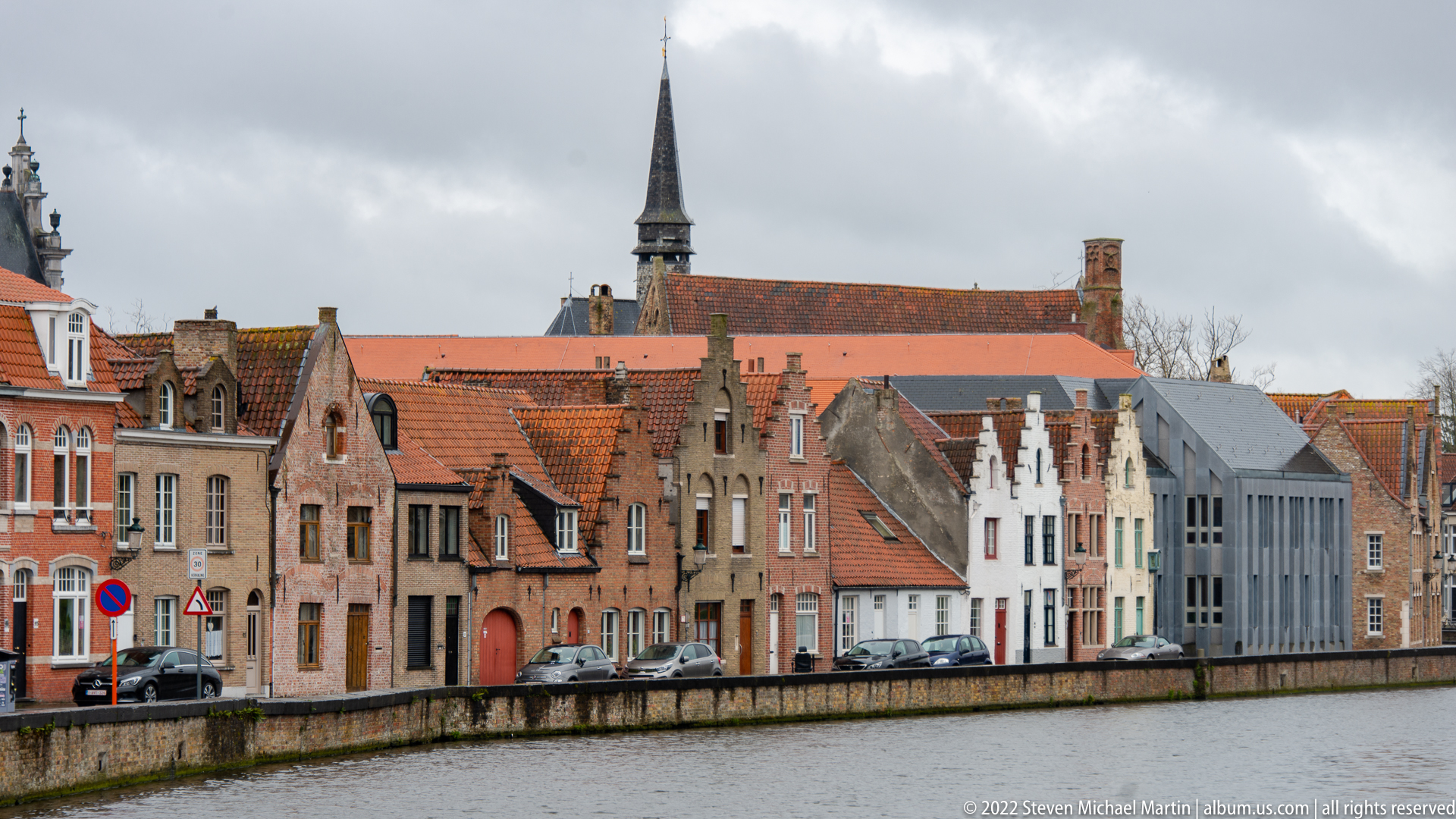
Gabled brick and stucco houses form a compact canal-side frontage in Bruges, with a long church roof and slender spire rising behind them. The façades range from plain brick to stepped and curvilinear gables, illustrating the architectural variety packed into the historic center. The elevated viewpoint compresses quay, water, houses, and church into a layered record of the city’s medieval urban fabric.
Caption
Gabled brick and stucco houses form a compact canal-side frontage in Bruges, with a long church roof and slender spire rising behind them. The façades range from plain brick to stepped and curvilinear gables, illustrating the architectural variety packed into the historic center. The elevated viewpoint compresses quay, water, houses, and church into a layered record of the city’s medieval urban fabric.
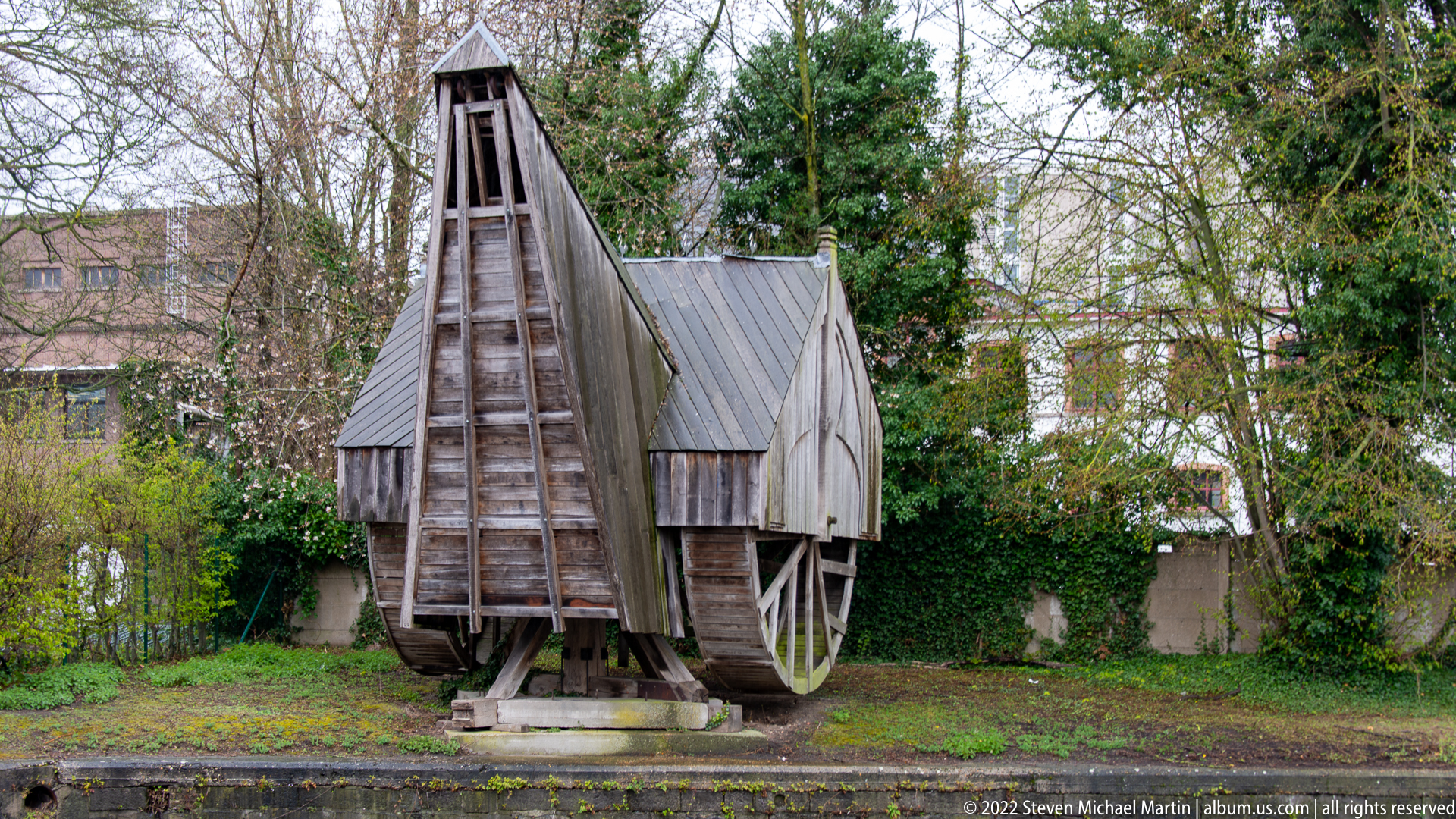
A large timber wheel-and-frame mechanism stands beside a Bruges waterway, its narrow upright housing flanked by exposed wooden wheels and heavy structural members. Weathered boards and simple joinery give the object a utilitarian character distinct from the surrounding ornamental architecture. The close view records the form of the preserved mechanism while leaving its precise historical function open to specialist confirmation.
Caption
A large timber wheel-and-frame mechanism stands beside a Bruges waterway, its narrow upright housing flanked by exposed wooden wheels and heavy structural members. Weathered boards and simple joinery give the object a utilitarian character distinct from the surrounding ornamental architecture. The close view records the form of the preserved mechanism while leaving its precise historical function open to specialist confirmation.
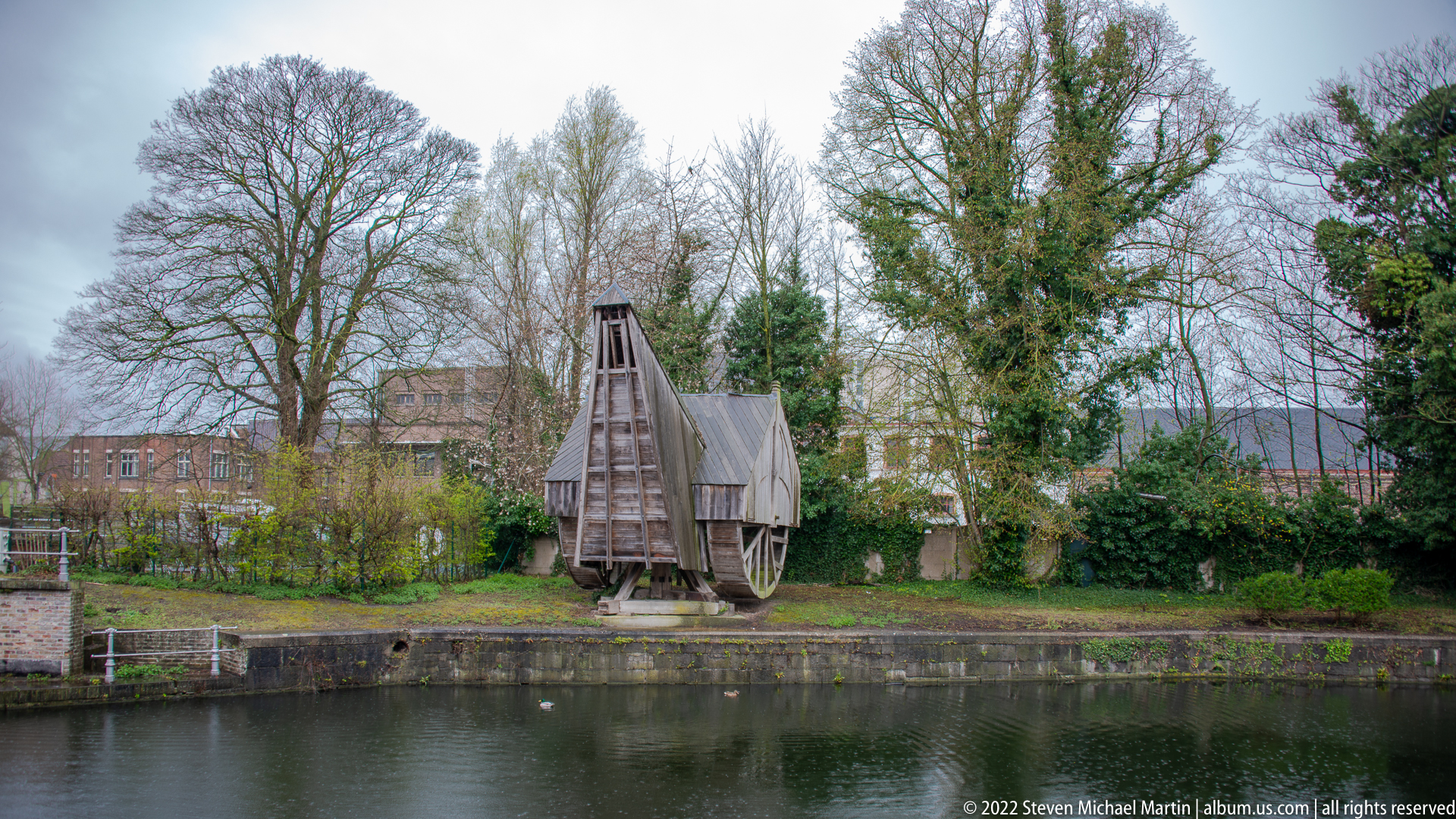
Seen across the water, a compact timber wheel mechanism sits beneath mature trees at the edge of a canal or basin. The wider view shows its scale and setting more clearly than the preceding close study, with the vertical wooden housing and side wheels framed by masonry banks and vegetation. Its preserved presence adds an industrial or hydraulic layer to Bruges’ predominantly domestic canal landscape.
Caption
Seen across the water, a compact timber wheel mechanism sits beneath mature trees at the edge of a canal or basin. The wider view shows its scale and setting more clearly than the preceding close study, with the vertical wooden housing and side wheels framed by masonry banks and vegetation. Its preserved presence adds an industrial or hydraulic layer to Bruges’ predominantly domestic canal landscape.
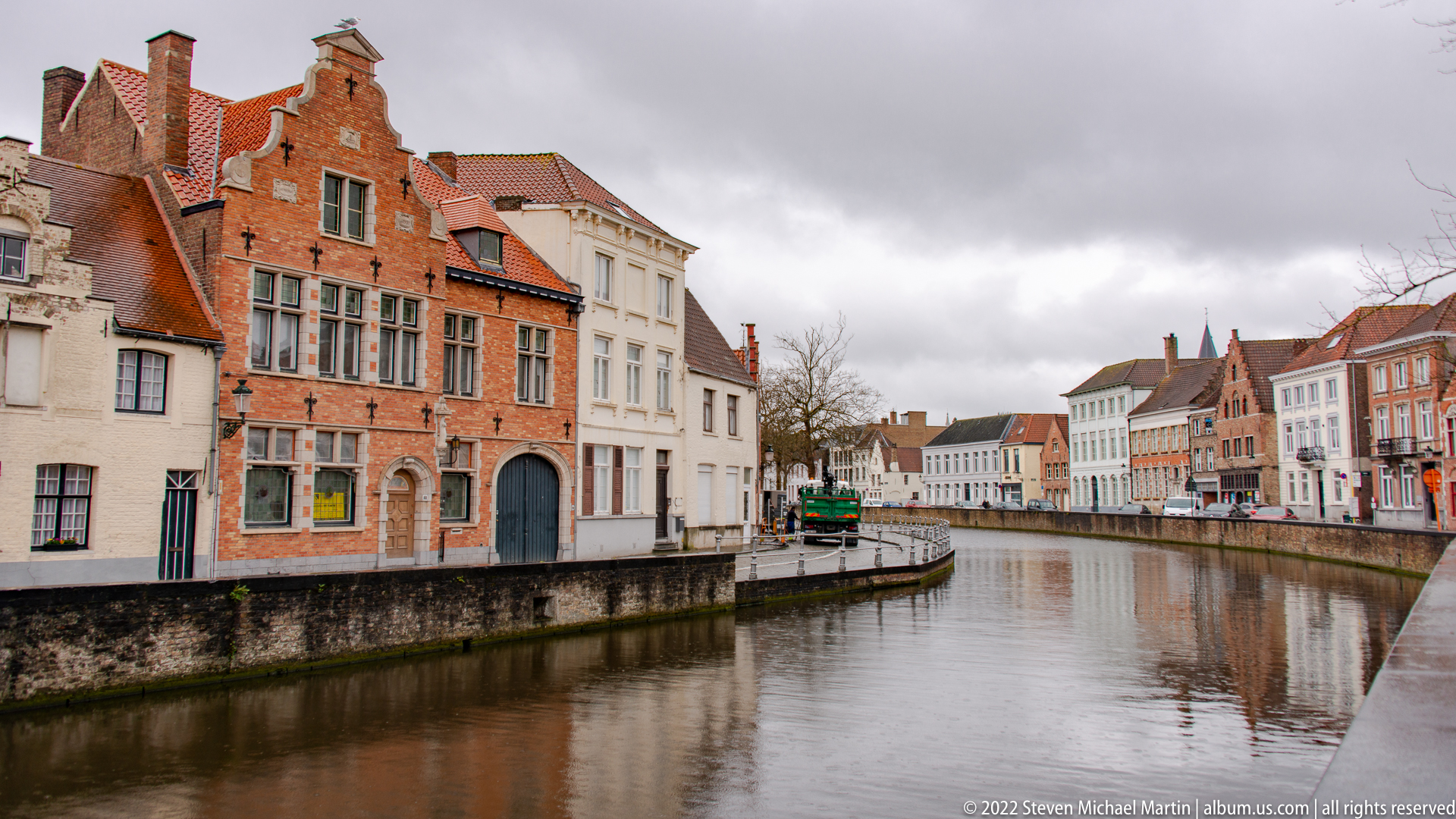
A narrow Bruges canal bends between historic houses, with pale stucco, red brick, stepped gables, and tiled roofs reflected in the muted water. A substantial brick building anchors the near corner while the canal draws the eye toward a tighter cluster of façades beyond. The composition shows the intimate scale of Bruges’ waterways, where houses meet the canal edge with little separation.
Caption
A narrow Bruges canal bends between historic houses, with pale stucco, red brick, stepped gables, and tiled roofs reflected in the muted water. A substantial brick building anchors the near corner while the canal draws the eye toward a tighter cluster of façades beyond. The composition shows the intimate scale of Bruges’ waterways, where houses meet the canal edge with little separation.
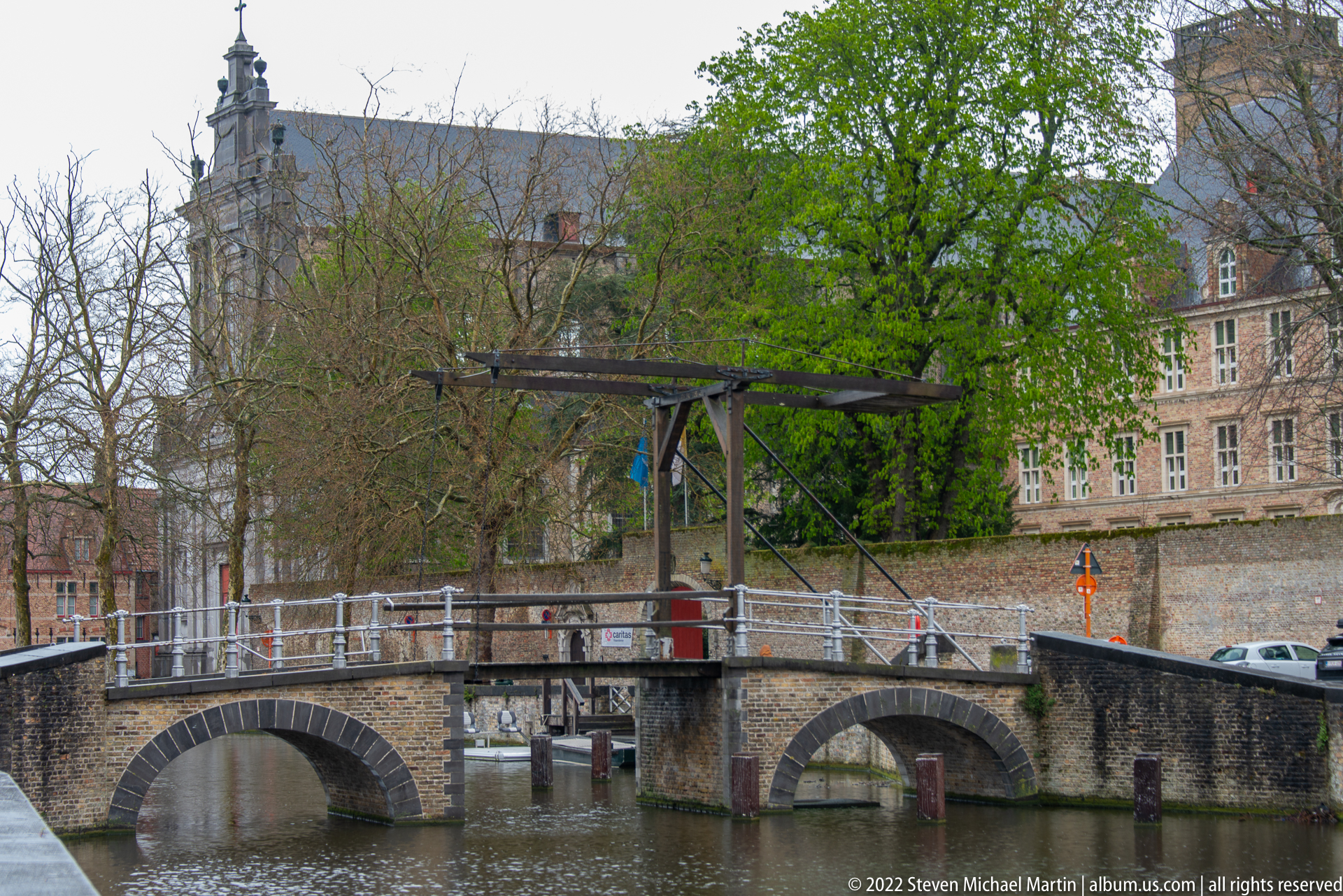
A low masonry bridge spans a Bruges waterway with two broad arches and a smaller opening, while a timber lifting or gate structure stands above the central channel. Metal railings, vertical posts, and the heavy wooden crossbeam suggest an operable element integrated into the crossing. The photograph records the intersection of historic masonry infrastructure with later mechanical fittings at the canal edge.
Caption
A low masonry bridge spans a Bruges waterway with two broad arches and a smaller opening, while a timber lifting or gate structure stands above the central channel. Metal railings, vertical posts, and the heavy wooden crossbeam suggest an operable element integrated into the crossing. The photograph records the intersection of historic masonry infrastructure with later mechanical fittings at the canal edge.
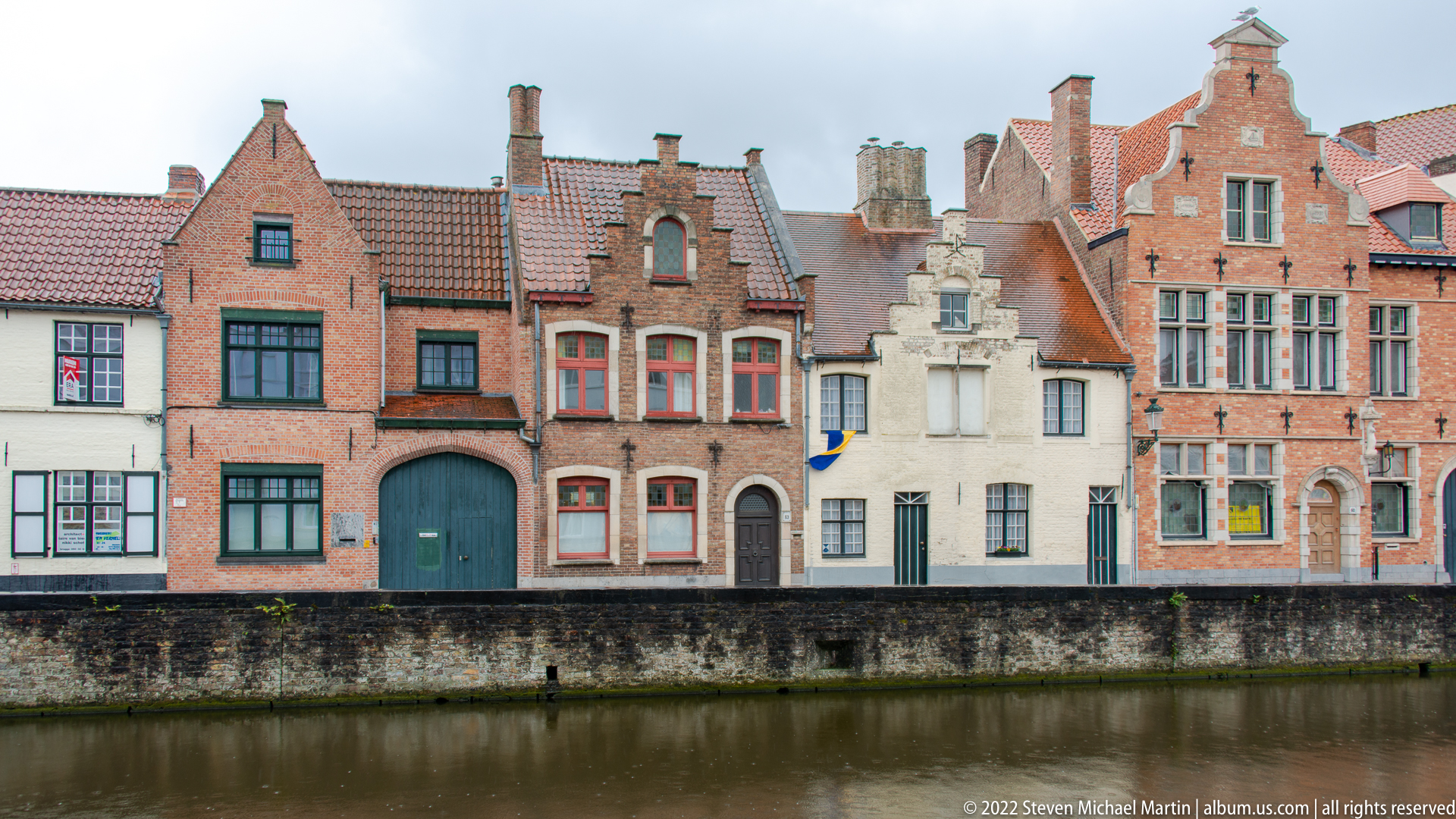
A compact sequence of Bruges canal houses displays several gable types within a short frontage: simple stepped forms, a narrow white sculpted gable, and a larger brick façade with decorative stonework. Dark green and red doors punctuate the lower level above the canal wall. The straight-on viewpoint is especially useful for comparing façade proportions, rooflines, brickwork, and window arrangements across neighboring houses.
Caption
A compact sequence of Bruges canal houses displays several gable types within a short frontage: simple stepped forms, a narrow white sculpted gable, and a larger brick façade with decorative stonework. Dark green and red doors punctuate the lower level above the canal wall. The straight-on viewpoint is especially useful for comparing façade proportions, rooflines, brickwork, and window arrangements across neighboring houses.
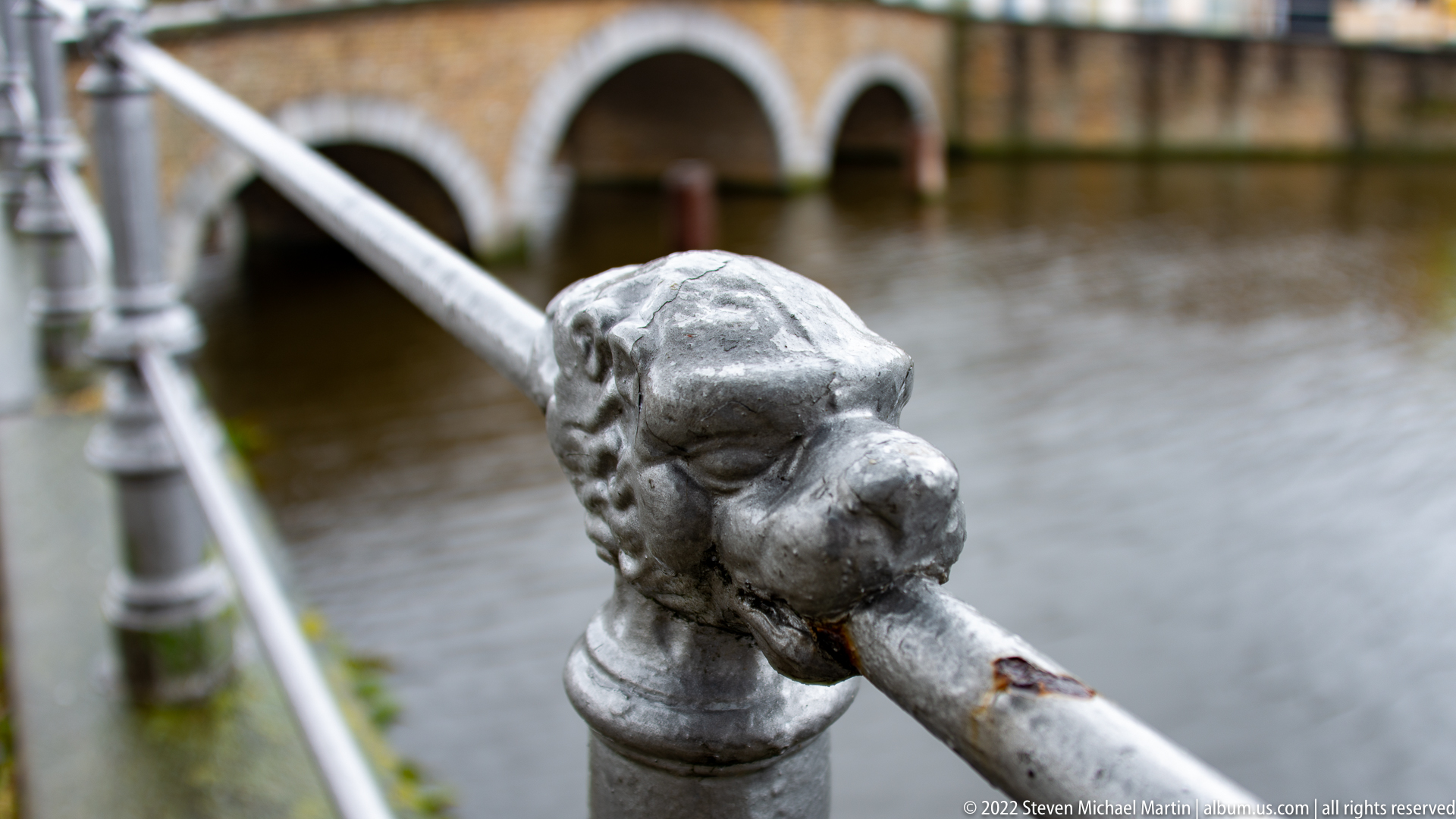
A cast-metal animal-head finial terminates a white-painted canal railing, its worn silver-gray surface and rounded muzzle standing out sharply against the soft-focus water beyond. Rust is visible where the horizontal rail meets the sculpted fitting. The tight depth of field turns an ordinary piece of bridge or quay hardware into a focused study of decorative metalwork and weathering in the historic center.
Caption
A cast-metal animal-head finial terminates a white-painted canal railing, its worn silver-gray surface and rounded muzzle standing out sharply against the soft-focus water beyond. Rust is visible where the horizontal rail meets the sculpted fitting. The tight depth of field turns an ordinary piece of bridge or quay hardware into a focused study of decorative metalwork and weathering in the historic center.

Large red and blue letters spell “BRUGGE” across a white surface beside a red vertical panel and door handle. Raindrops on the paint add texture to the close composition. By isolating the city name from its broader setting, the image turns contemporary graphic design into a succinct visual marker of place within a portfolio otherwise dominated by historic architecture and canals.
Caption
Large red and blue letters spell “BRUGGE” across a white surface beside a red vertical panel and door handle. Raindrops on the paint add texture to the close composition. By isolating the city name from its broader setting, the image turns contemporary graphic design into a succinct visual marker of place within a portfolio otherwise dominated by historic architecture and canals.
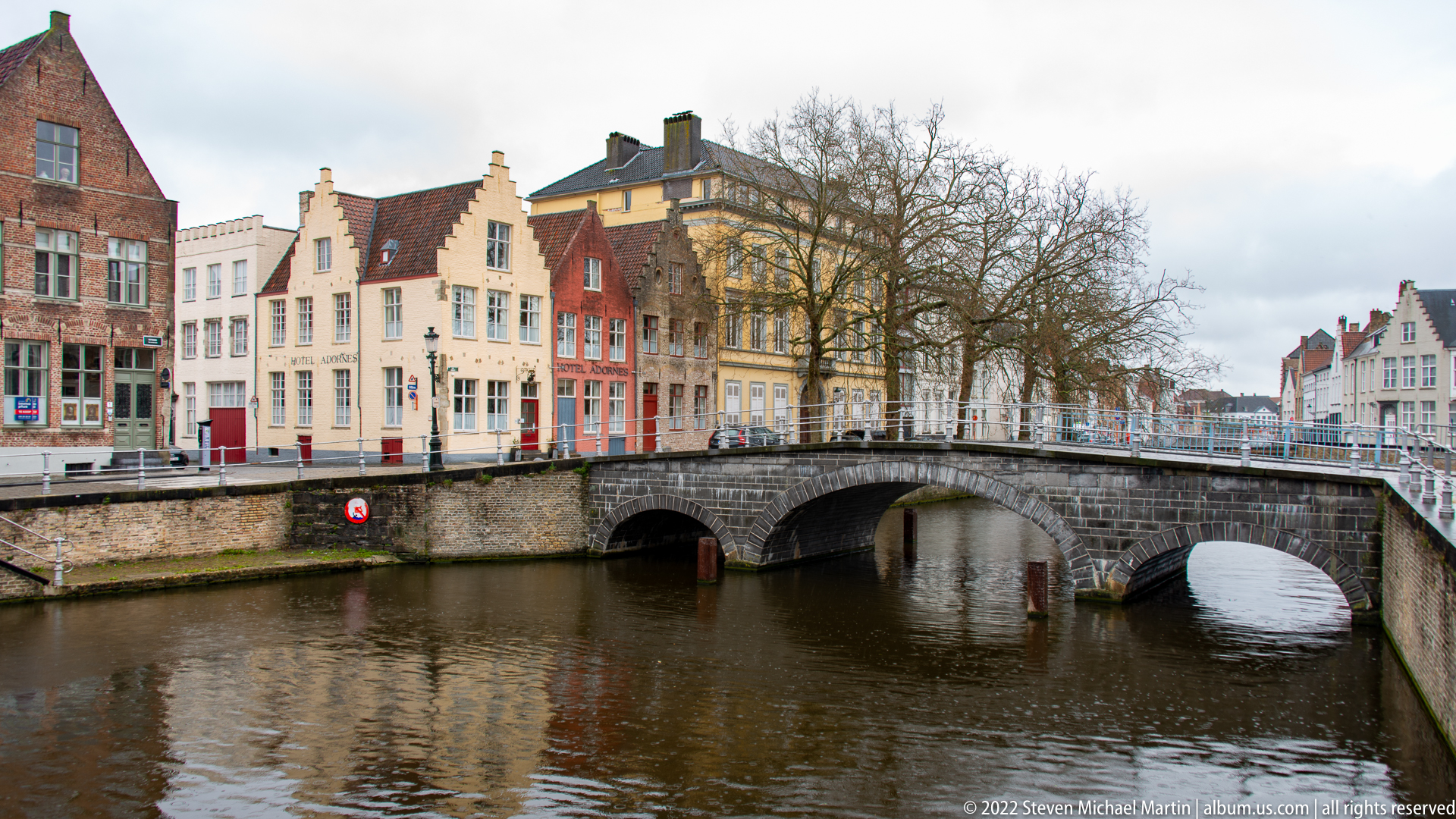
A low stone bridge crosses a Bruges canal on three unequal arches, linking rows of historic houses on either bank. Pale stepped gables, red brick façades, and leafless trees line the water beyond the crossing. The oblique angle reveals the bridge’s heavy masonry construction and the way even modest infrastructure is woven directly into the canal-front architecture of the old city.
Caption
A low stone bridge crosses a Bruges canal on three unequal arches, linking rows of historic houses on either bank. Pale stepped gables, red brick façades, and leafless trees line the water beyond the crossing. The oblique angle reveals the bridge’s heavy masonry construction and the way even modest infrastructure is woven directly into the canal-front architecture of the old city.
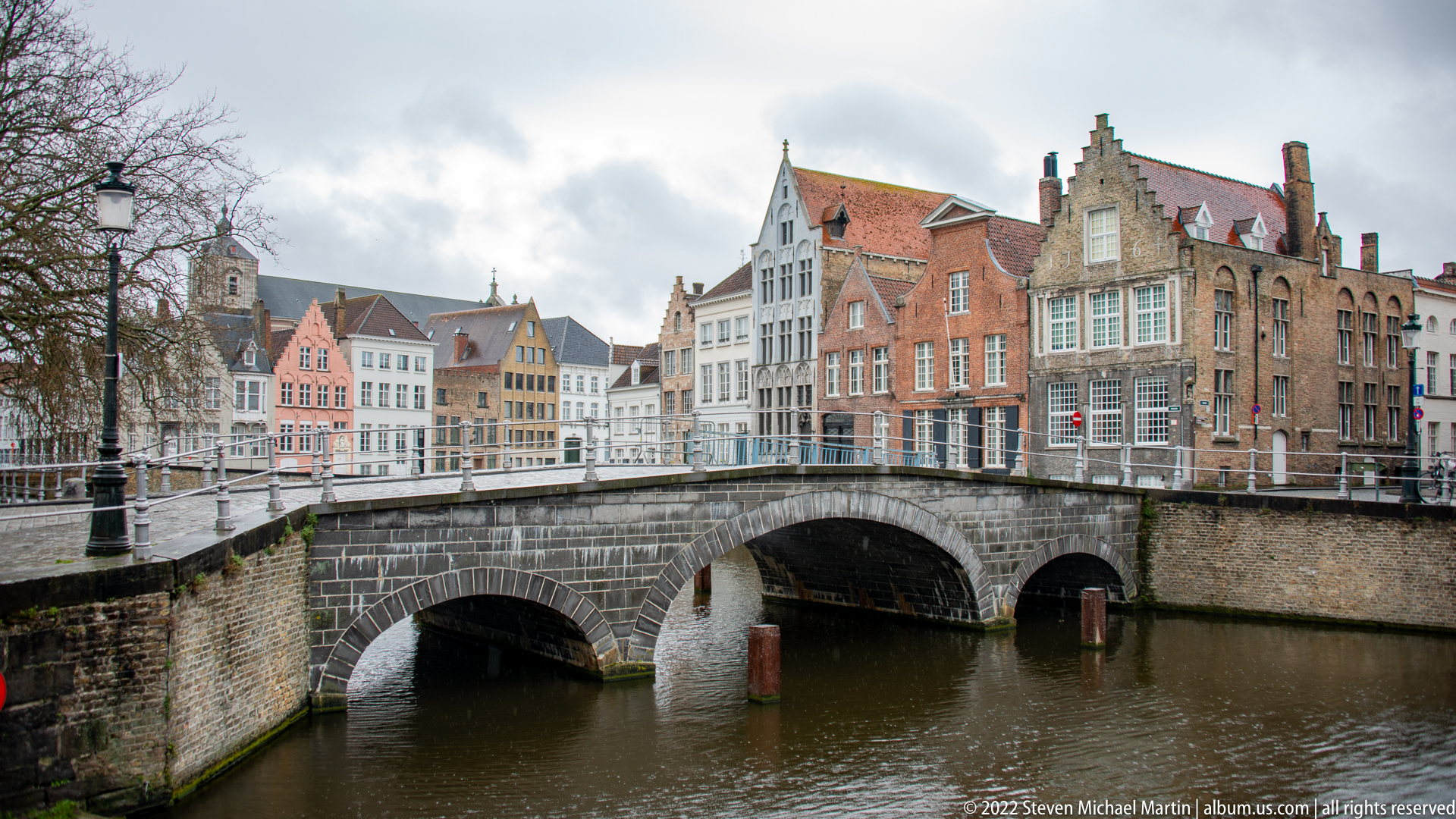
A broad arched stone bridge dominates this canal junction in Bruges, with ornate brick and stone façades rising immediately behind it. The bridge’s dark voussoirs and parapet contrast with the pale and red gabled buildings across the water. Framed from slightly above canal level, the scene emphasizes the dense overlap of circulation, water management, and monumental domestic architecture in the historic center.
Caption
A broad arched stone bridge dominates this canal junction in Bruges, with ornate brick and stone façades rising immediately behind it. The bridge’s dark voussoirs and parapet contrast with the pale and red gabled buildings across the water. Framed from slightly above canal level, the scene emphasizes the dense overlap of circulation, water management, and monumental domestic architecture in the historic center.

The pale brick façade of Hotel Adornes occupies a narrow corner in the Bruges historic center, its name painted directly above a row of tall ground-floor windows. Stepped gables, red doors, dark shutters, and traditional lamp fixtures continue the architectural vocabulary of the surrounding street. The close street-level view records how historic domestic forms have been adapted to contemporary hospitality use.
Caption
The pale brick façade of Hotel Adornes occupies a narrow corner in the Bruges historic center, its name painted directly above a row of tall ground-floor windows. Stepped gables, red doors, dark shutters, and traditional lamp fixtures continue the architectural vocabulary of the surrounding street. The close street-level view records how historic domestic forms have been adapted to contemporary hospitality use.
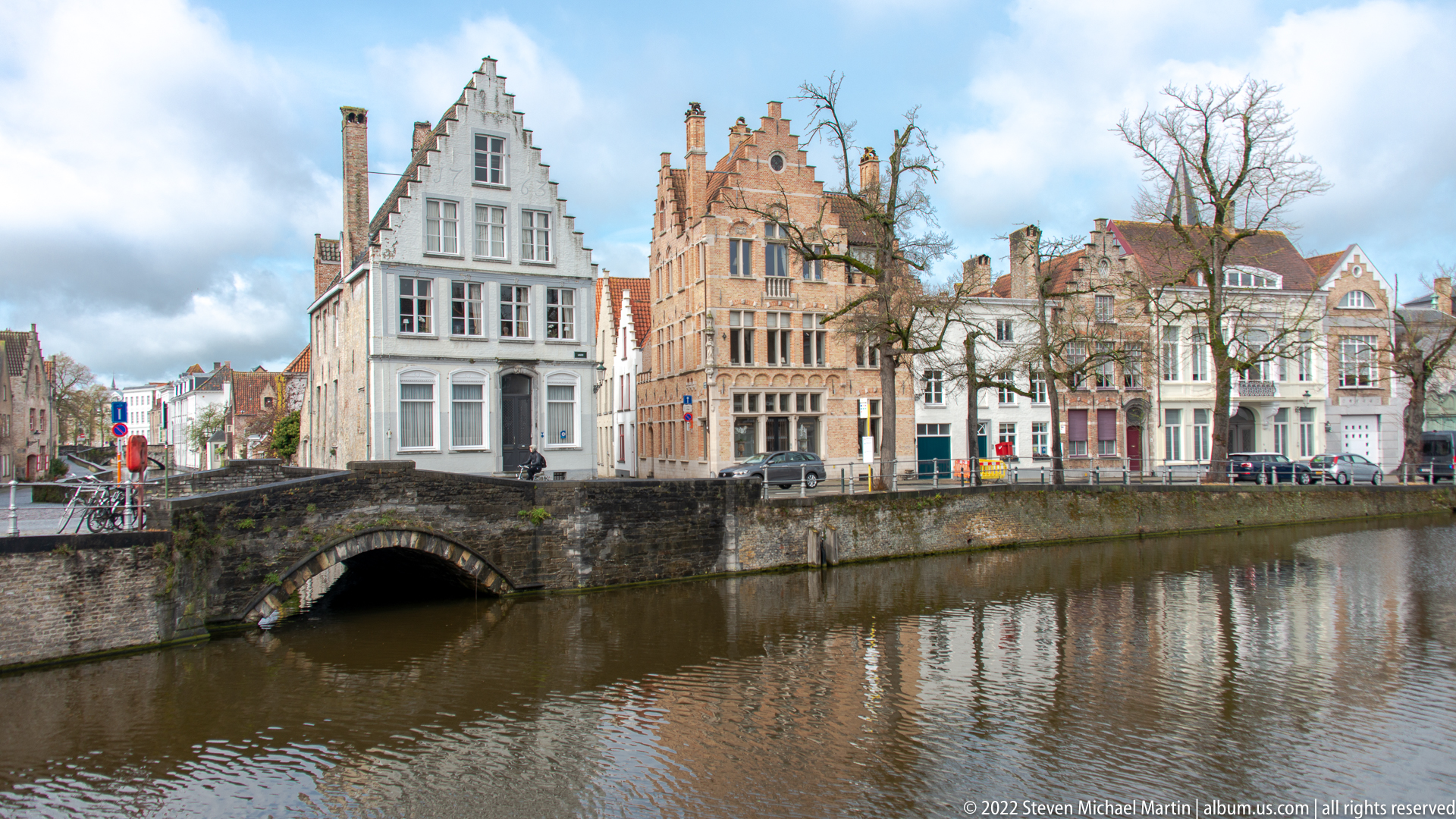
Two prominent gabled houses face a Bruges canal, one pale and sharply stepped, the other orange brick with an elaborate sculpted crown and vertical stone accents. Their façades rise directly behind the canal wall, with additional historic houses extending along the water. The clear weather brings out the contrasting masonry, rooflines, and ornamental profiles that distinguish neighboring properties within the compact historic center.
Caption
Two prominent gabled houses face a Bruges canal, one pale and sharply stepped, the other orange brick with an elaborate sculpted crown and vertical stone accents. Their façades rise directly behind the canal wall, with additional historic houses extending along the water. The clear weather brings out the contrasting masonry, rooflines, and ornamental profiles that distinguish neighboring properties within the compact historic center.
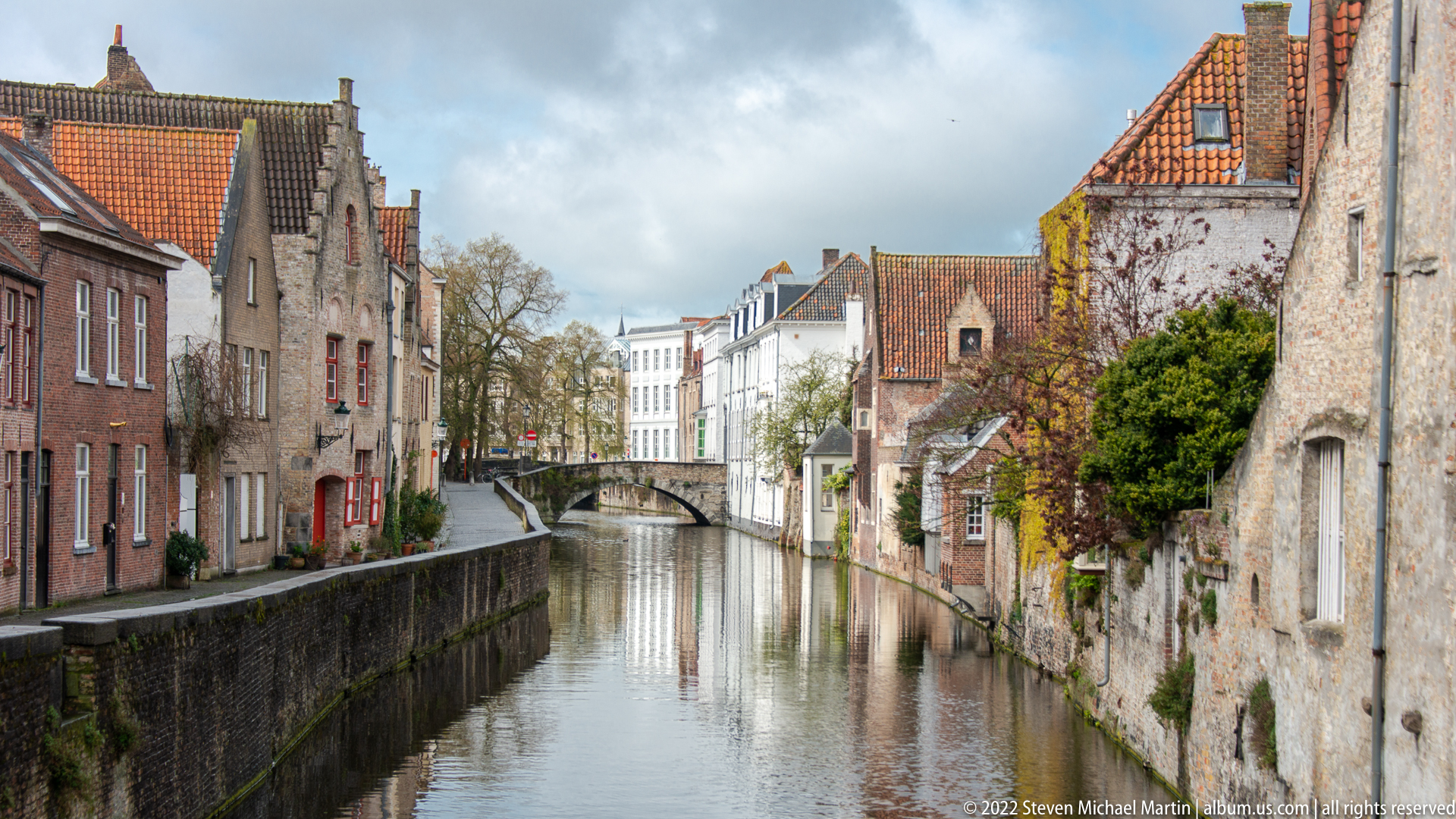
A narrow Bruges canal threads between modest brick houses, garden walls, and small waterside façades, with a low bridge closing the view in the distance. Vegetation spills over parts of the masonry, softening the dense built edge. Unlike the broader ceremonial waterways, this intimate channel shows the quieter residential scale of the historic center and the close physical relationship between houses and water.
Caption
A narrow Bruges canal threads between modest brick houses, garden walls, and small waterside façades, with a low bridge closing the view in the distance. Vegetation spills over parts of the masonry, softening the dense built edge. Unlike the broader ceremonial waterways, this intimate channel shows the quieter residential scale of the historic center and the close physical relationship between houses and water.
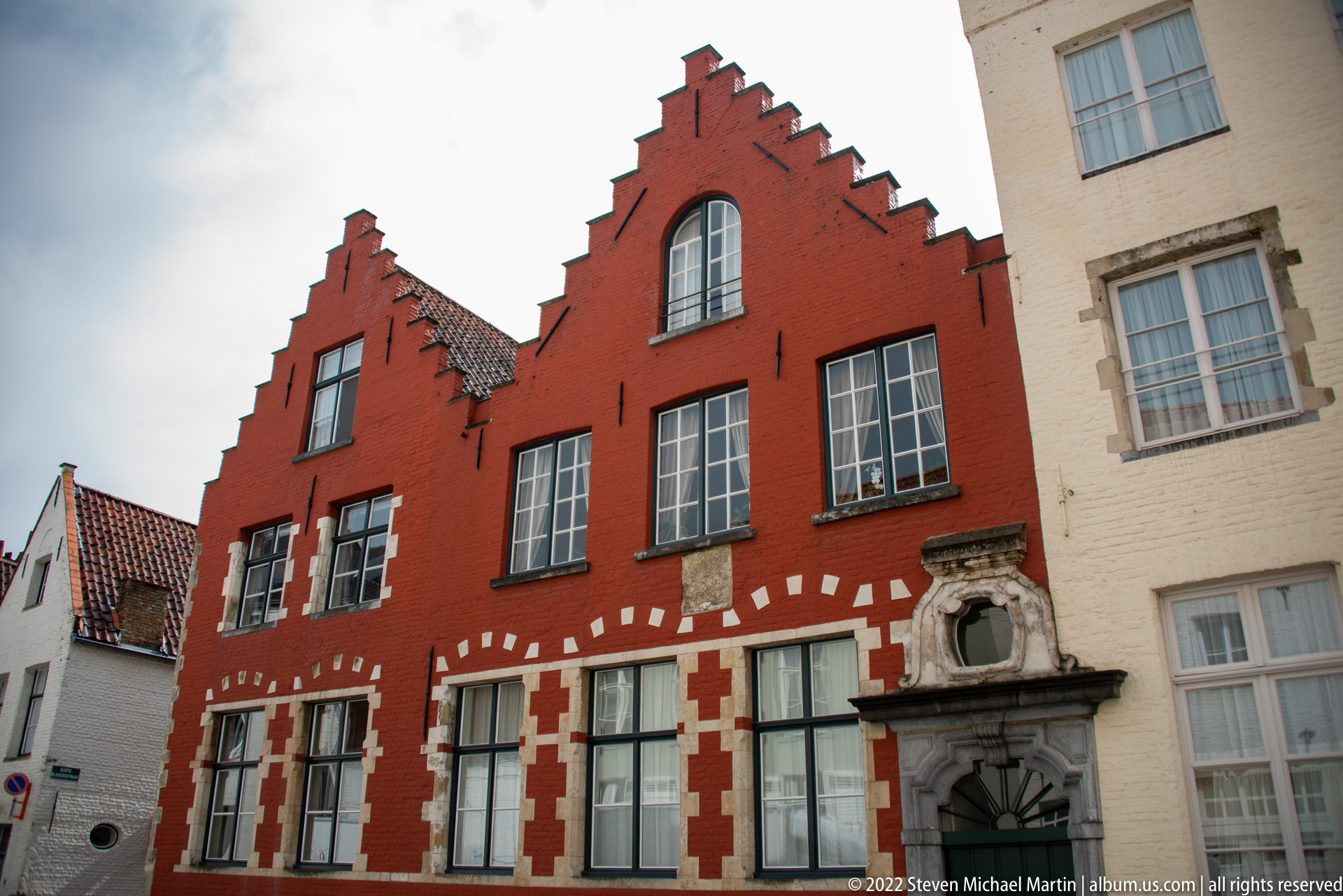
A vivid red stepped-gable townhouse fills the frame, its tall roofline broken into two stepped peaks above large multi-pane windows. White stone bands and geometric trim articulate the lower façade, while a carved stone doorway surround at the right introduces a more sculptural element. The upward viewpoint concentrates attention on Bruges’ characteristic gable silhouette and decorative treatment rather than the surrounding street.
Caption
A vivid red stepped-gable townhouse fills the frame, its tall roofline broken into two stepped peaks above large multi-pane windows. White stone bands and geometric trim articulate the lower façade, while a carved stone doorway surround at the right introduces a more sculptural element. The upward viewpoint concentrates attention on Bruges’ characteristic gable silhouette and decorative treatment rather than the surrounding street.
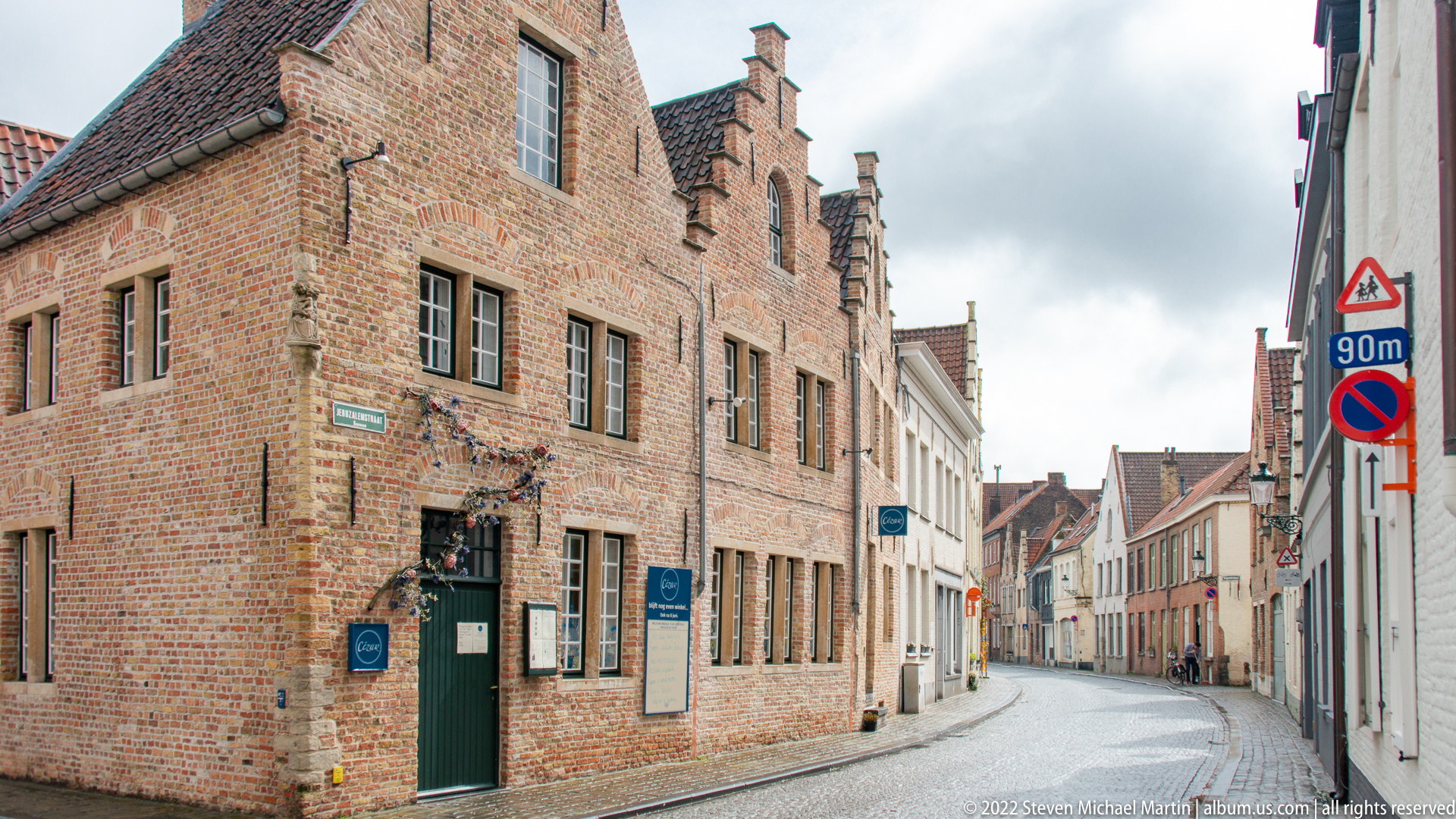
A large brick building with stepped gables anchors a quiet, narrow street in Bruges, its weathered masonry and deep green doorway contrasting with the pale buildings farther along the lane. The street bends gently through a tightly scaled historic neighborhood, with little modern visual intrusion. The perspective highlights the texture of old brickwork and the intimate proportions of the medieval street pattern.
Caption
A large brick building with stepped gables anchors a quiet, narrow street in Bruges, its weathered masonry and deep green doorway contrasting with the pale buildings farther along the lane. The street bends gently through a tightly scaled historic neighborhood, with little modern visual intrusion. The perspective highlights the texture of old brickwork and the intimate proportions of the medieval street pattern.
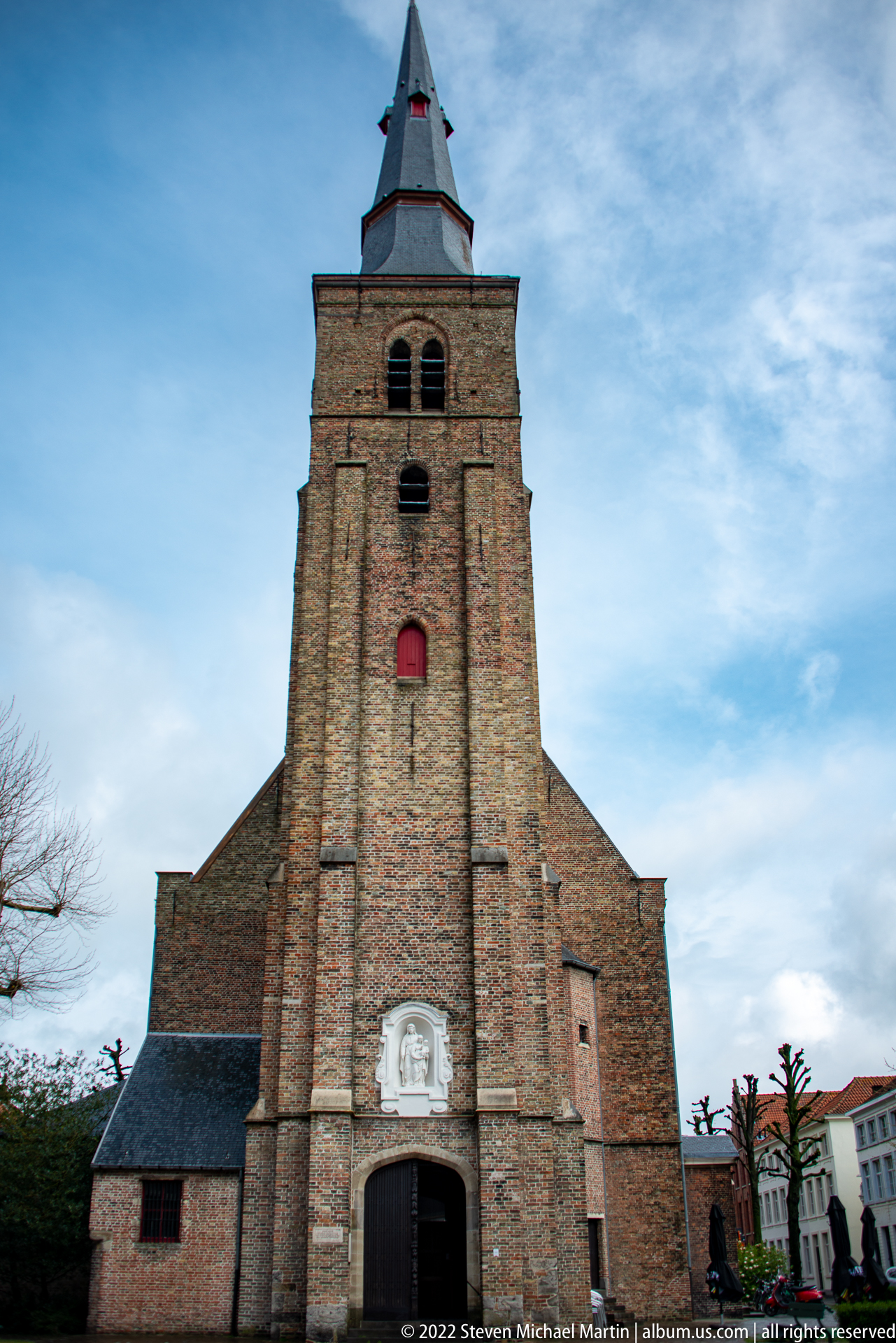
A compact brick church presents a broad square west tower capped by a dark pyramidal roof, with paired belfry openings near the top and a simple arched entrance below. Low side aisles extend from the tower, and a carved stone plaque or relief is centered above the doorway. The straightforward medievalizing massing contrasts with the more ornate stepped-gable houses seen elsewhere in Bruges.
Caption
A compact brick church presents a broad square west tower capped by a dark pyramidal roof, with paired belfry openings near the top and a simple arched entrance below. Low side aisles extend from the tower, and a carved stone plaque or relief is centered above the doorway. The straightforward medievalizing massing contrasts with the more ornate stepped-gable houses seen elsewhere in Bruges.
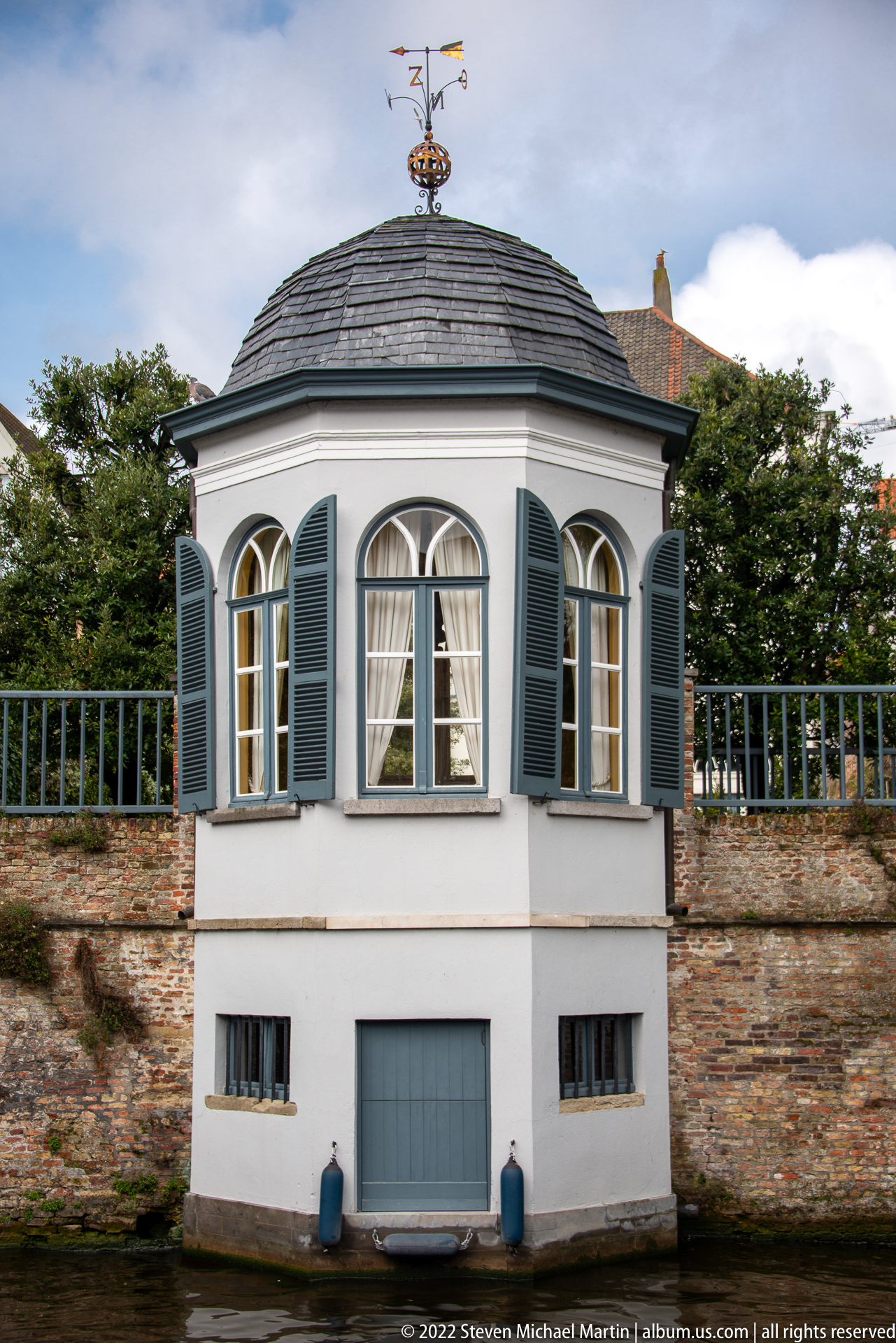
A small white octagonal pavilion projects from a high brick wall beside the canal, with tall arched windows, dark shutters, and a shallow slate roof. A ship-shaped weather vane crowns the roof, adding a distinctly maritime detail to the compact structure. The centered frontal view isolates the pavilion’s symmetry and decorative character against the plain horizontal expanse of historic brickwork.
Caption
A small white octagonal pavilion projects from a high brick wall beside the canal, with tall arched windows, dark shutters, and a shallow slate roof. A ship-shaped weather vane crowns the roof, adding a distinctly maritime detail to the compact structure. The centered frontal view isolates the pavilion’s symmetry and decorative character against the plain horizontal expanse of historic brickwork.
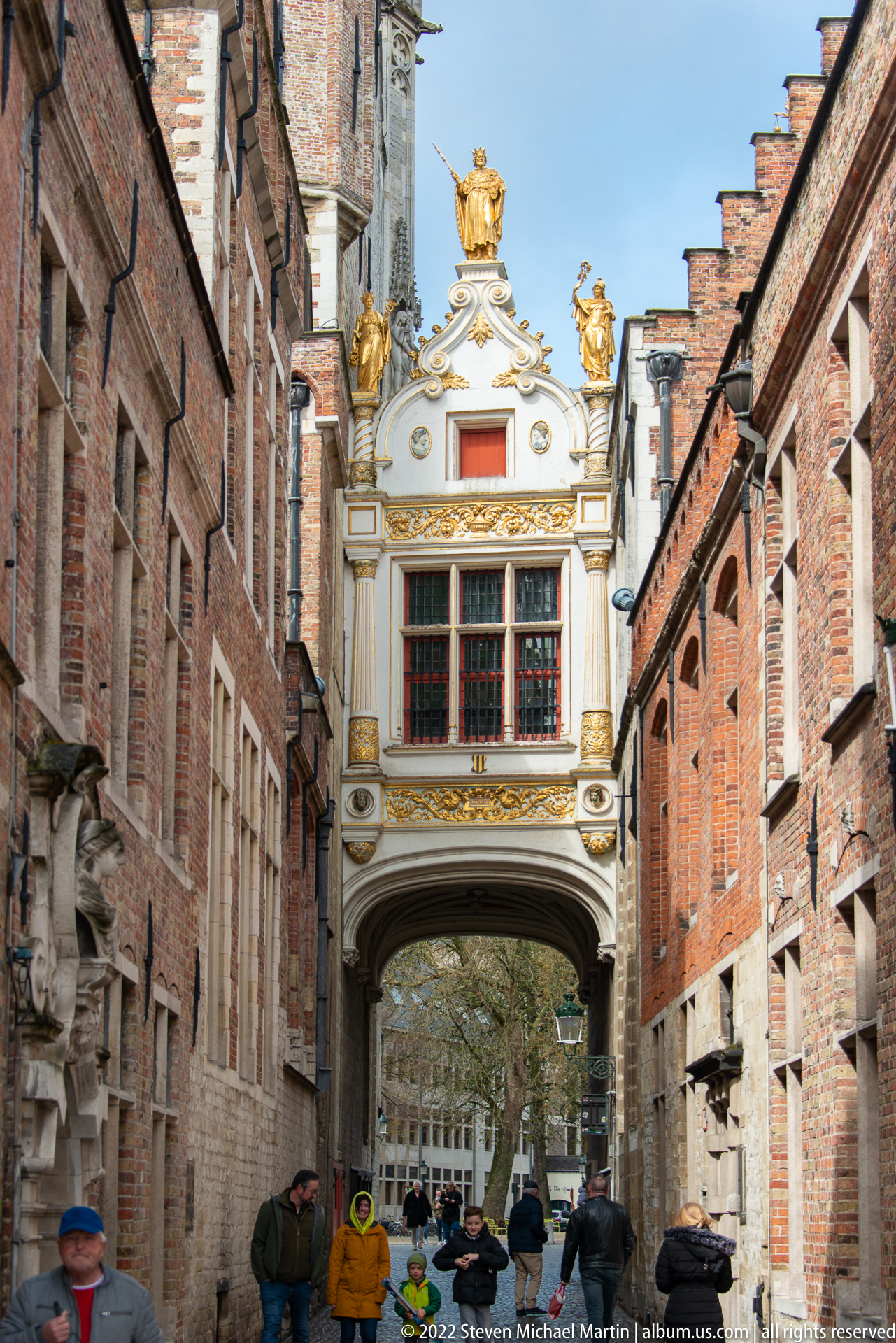
An ornate white-and-gold passage bridges a narrow street between brick buildings, its sculpted gable crowned by gilded figures and a heraldic ornament. Red-framed windows and dense relief decoration make the small façade read almost like a ceremonial screen above the arch. Pedestrians passing beneath it provide scale and reinforce the structure’s role as a connective element within the historic civic quarter.
Caption
An ornate white-and-gold passage bridges a narrow street between brick buildings, its sculpted gable crowned by gilded figures and a heraldic ornament. Red-framed windows and dense relief decoration make the small façade read almost like a ceremonial screen above the arch. Pedestrians passing beneath it provide scale and reinforce the structure’s role as a connective element within the historic civic quarter.
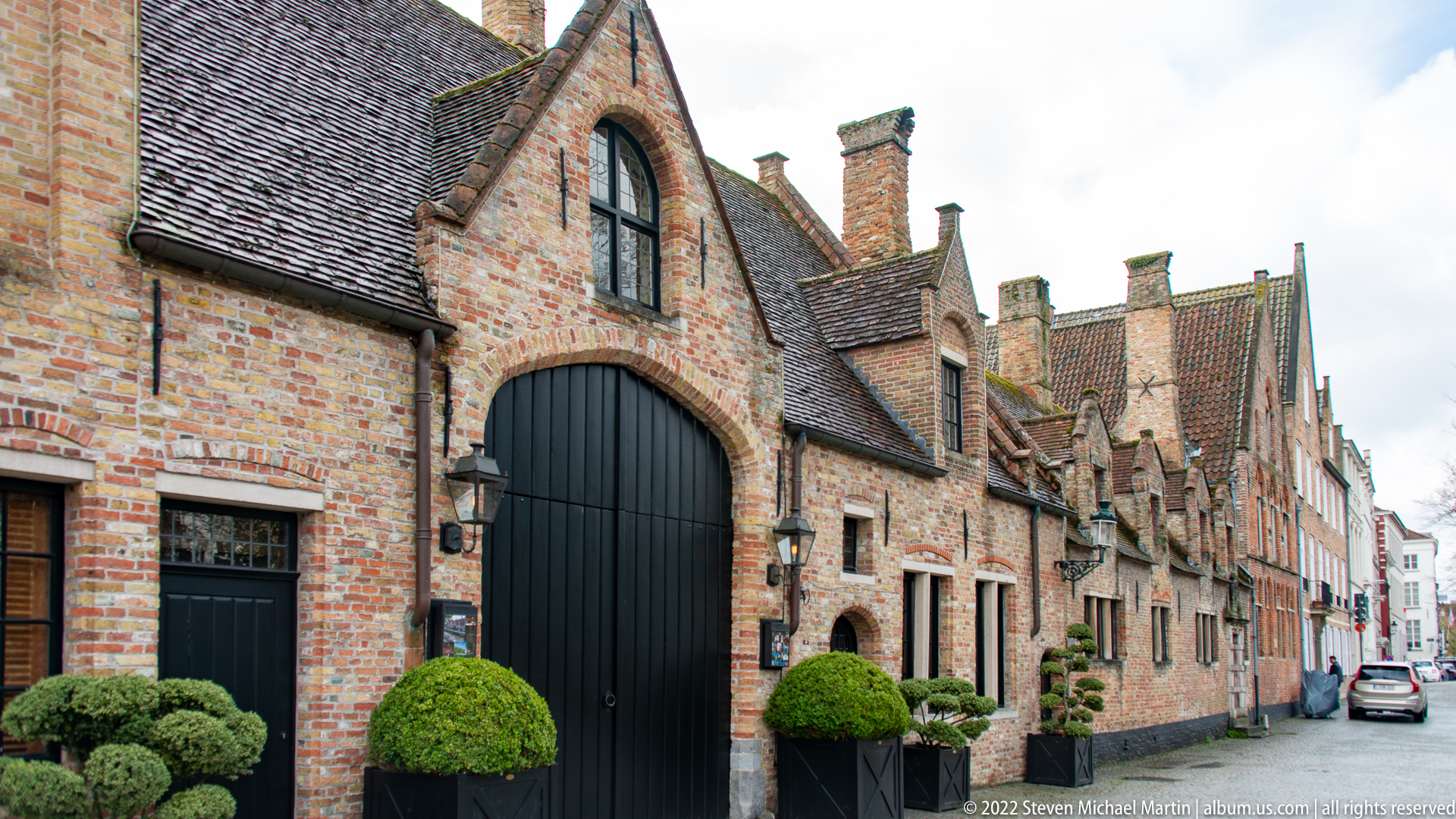
A row of small historic brick buildings lines a narrow Bruges street, led by a tall black arched carriage opening beneath a steep roof and dormer. Irregular rooflines, chimneys, projecting gables, and carefully clipped shrubs give the frontage a layered domestic character. The angled street view emphasizes the close spacing and accumulated architectural changes typical of the historic center’s quieter lanes.
Caption
A row of small historic brick buildings lines a narrow Bruges street, led by a tall black arched carriage opening beneath a steep roof and dormer. Irregular rooflines, chimneys, projecting gables, and carefully clipped shrubs give the frontage a layered domestic character. The angled street view emphasizes the close spacing and accumulated architectural changes typical of the historic center’s quieter lanes.
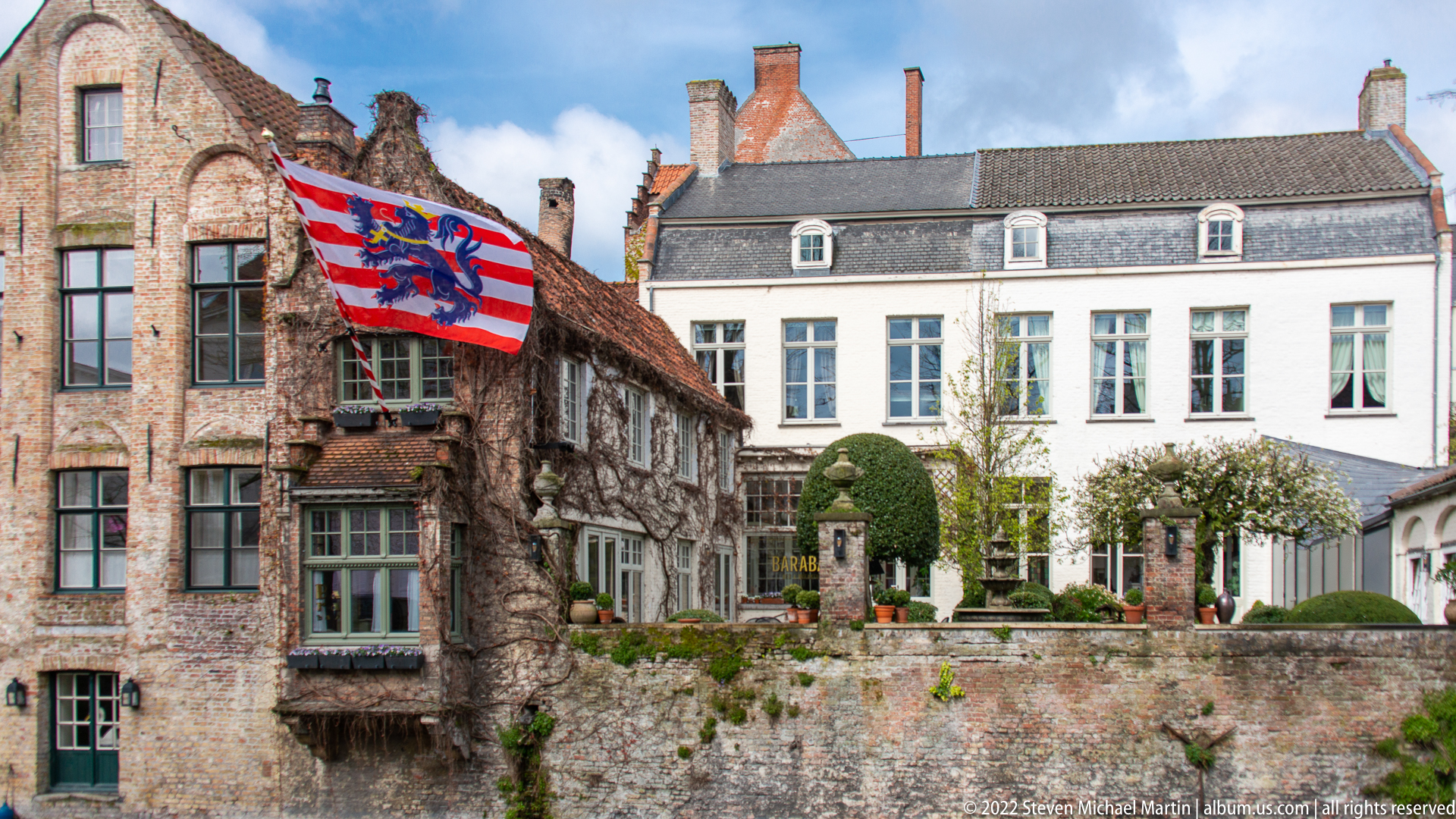
A heraldic flag hangs from a weathered brick building overlooking a small enclosed courtyard in Bruges. A pale townhouse with tall sash windows closes the space behind clipped trees and garden walls, while the foreground masonry reveals centuries of repair and alteration. The view records the layered domestic character of the historic center, where formal residences, service wings, and enclosed gardens sit tightly together.
Caption
A heraldic flag hangs from a weathered brick building overlooking a small enclosed courtyard in Bruges. A pale townhouse with tall sash windows closes the space behind clipped trees and garden walls, while the foreground masonry reveals centuries of repair and alteration. The view records the layered domestic character of the historic center, where formal residences, service wings, and enclosed gardens sit tightly together.

A long brick civic complex presents steep triangular gables, tall multi-pane windows, and a remarkable sequence of slender decorative chimneys capped by small lantern-like forms. The repeated roof peaks and vertical stacks create an animated silhouette above the canal-side masonry wall. The composition emphasizes the refined late-medieval and early modern character of Bruges’ institutional architecture without relying on a single ornamental focal point.
Caption
A long brick civic complex presents steep triangular gables, tall multi-pane windows, and a remarkable sequence of slender decorative chimneys capped by small lantern-like forms. The repeated roof peaks and vertical stacks create an animated silhouette above the canal-side masonry wall. The composition emphasizes the refined late-medieval and early modern character of Bruges’ institutional architecture without relying on a single ornamental focal point.

A rectangular stone relief commemorates a restoration dated 2000–2001, combining architectural fragments, tools, vessels, heraldic emblems, and decorative motifs in shallow carving. The inscription “BRUGGE WERELDERFGOED UNESCO” identifies Bruges and its World Heritage status. Set into warm brickwork, the panel links modern conservation work directly to the historic fabric it was created to preserve.
Caption
A rectangular stone relief commemorates a restoration dated 2000–2001, combining architectural fragments, tools, vessels, heraldic emblems, and decorative motifs in shallow carving. The inscription “BRUGGE WERELDERFGOED UNESCO” identifies Bruges and its World Heritage status. Set into warm brickwork, the panel links modern conservation work directly to the historic fabric it was created to preserve.
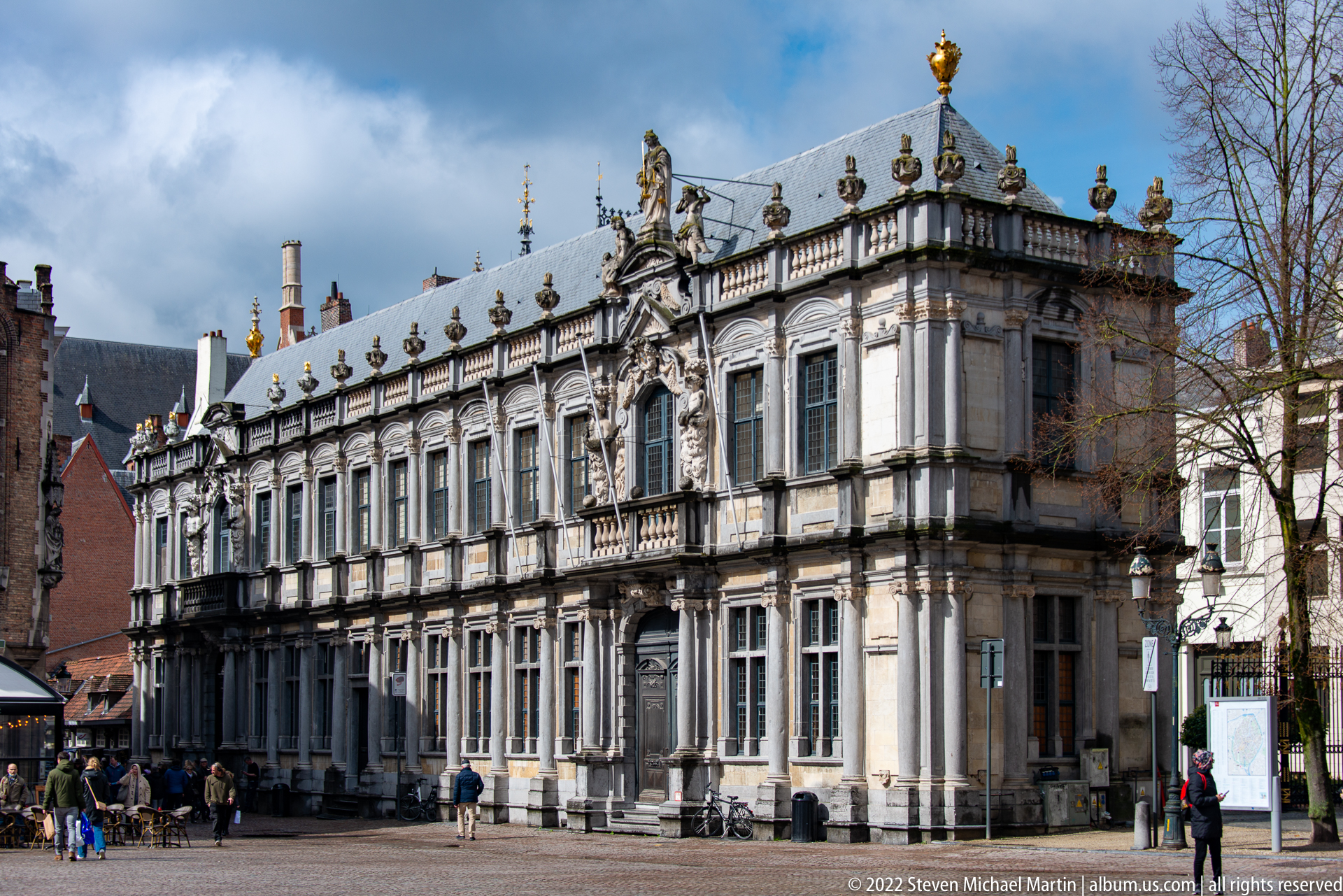
A richly articulated pale-stone façade stretches across a Bruges square, organized by tall windows, pilasters, a roofline balustrade, and sculptural figures. Corner projections and dense classical ornament give the building a formal civic presence distinct from the city’s narrower gabled houses. The oblique view captures both the long principal elevation and its projecting corner volume, revealing the building’s urban scale.
Caption
A richly articulated pale-stone façade stretches across a Bruges square, organized by tall windows, pilasters, a roofline balustrade, and sculptural figures. Corner projections and dense classical ornament give the building a formal civic presence distinct from the city’s narrower gabled houses. The oblique view captures both the long principal elevation and its projecting corner volume, revealing the building’s urban scale.
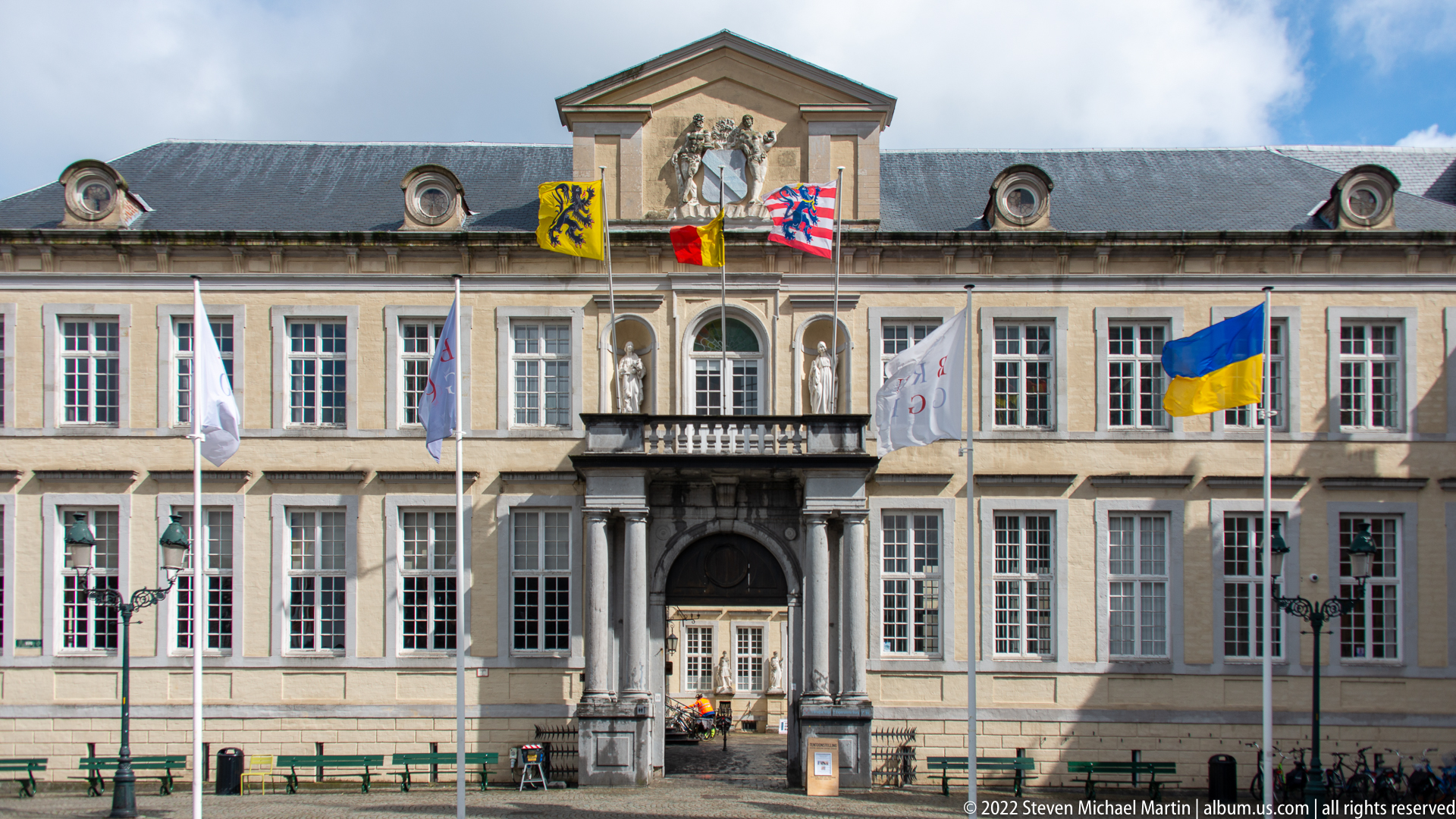
A symmetrical neoclassical building faces the square with a central pediment, columned entrance, evenly spaced sash windows, and heraldic shields displayed along the roofline. Several flags stand before the façade, including a blue-and-yellow Ukrainian flag at the right. The restrained classical composition contrasts with the more elaborate Gothic and Renaissance Revival buildings elsewhere in central Bruges.
Caption
A symmetrical neoclassical building faces the square with a central pediment, columned entrance, evenly spaced sash windows, and heraldic shields displayed along the roofline. Several flags stand before the façade, including a blue-and-yellow Ukrainian flag at the right. The restrained classical composition contrasts with the more elaborate Gothic and Renaissance Revival buildings elsewhere in central Bruges.

An elaborate white-and-gold façade with sculpted gables, red-framed windows, and a broad arched passage stands beside a taller gray Gothic civic building. Gilded figures and heraldic decoration crown the smaller structure, while the adjacent stone elevation rises in a vertical rhythm of tracery and pointed openings. The side-by-side view highlights the striking architectural variety concentrated around Bruges’ civic core.
Caption
An elaborate white-and-gold façade with sculpted gables, red-framed windows, and a broad arched passage stands beside a taller gray Gothic civic building. Gilded figures and heraldic decoration crown the smaller structure, while the adjacent stone elevation rises in a vertical rhythm of tracery and pointed openings. The side-by-side view highlights the striking architectural variety concentrated around Bruges’ civic core.

Bruges City Hall presents its lace-like Gothic façade to Burg Square, with tall traceried windows, a crenellated roofline, slender pinnacles, and heraldic flags. The smaller white-and-gold civic building beside it provides a vivid stylistic contrast. People crossing the square establish scale and reinforce the monumental civic role of this closely packed ensemble at the heart of historic Bruges.
Caption
Bruges City Hall presents its lace-like Gothic façade to Burg Square, with tall traceried windows, a crenellated roofline, slender pinnacles, and heraldic flags. The smaller white-and-gold civic building beside it provides a vivid stylistic contrast. People crossing the square establish scale and reinforce the monumental civic role of this closely packed ensemble at the heart of historic Bruges.
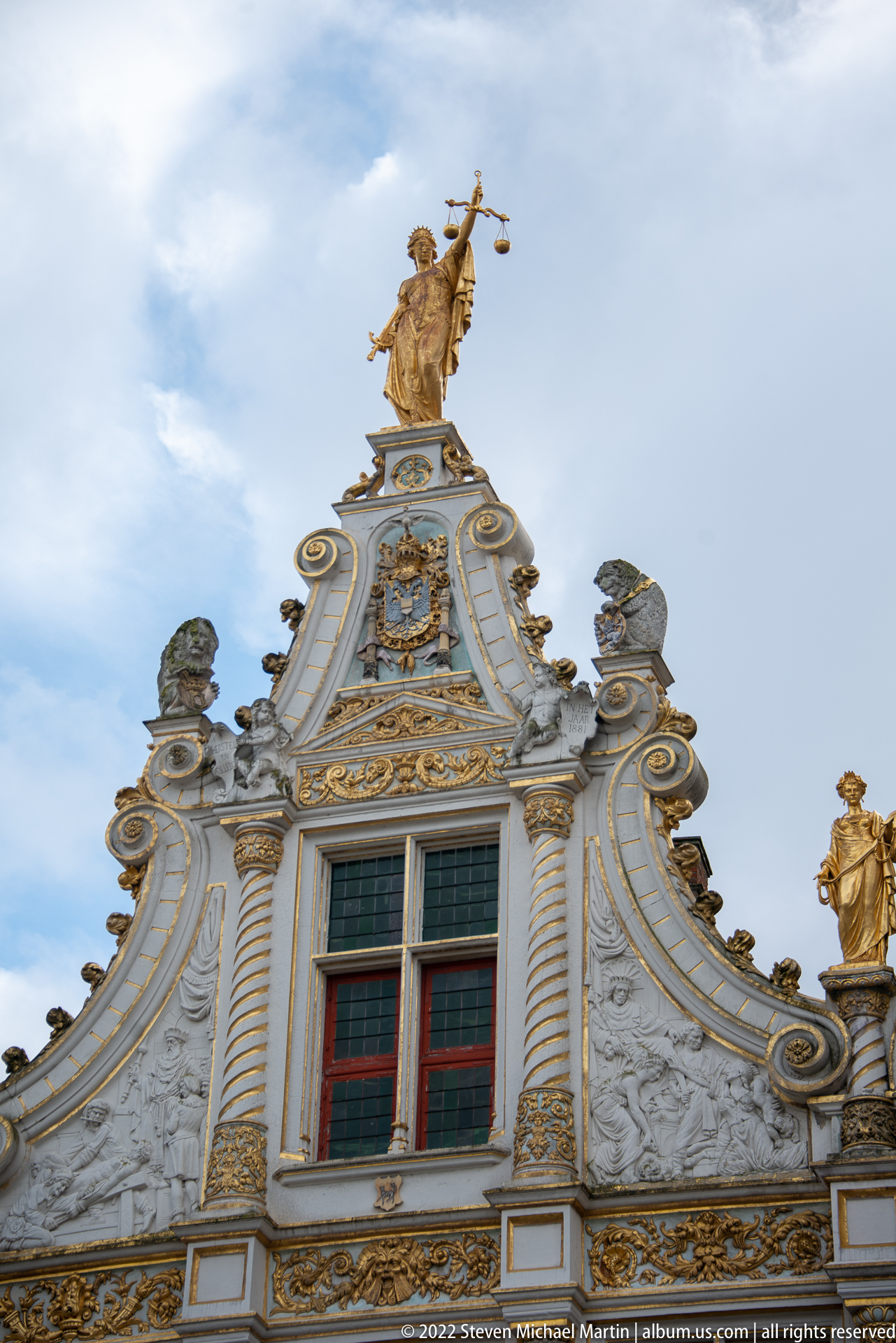
A close upward view isolates the curving gable of an ornate Bruges civic façade. Twisted columns, gilded scrollwork, relief panels, and a standing allegorical figure animate the white surface, while red-framed windows anchor the center. The tight crop reveals the extraordinary density of sculptural and heraldic decoration that can be difficult to appreciate from street level.
Caption
A close upward view isolates the curving gable of an ornate Bruges civic façade. Twisted columns, gilded scrollwork, relief panels, and a standing allegorical figure animate the white surface, while red-framed windows anchor the center. The tight crop reveals the extraordinary density of sculptural and heraldic decoration that can be difficult to appreciate from street level.

A close view of the Jan Breydel and Pieter de Coninck monument concentrates on the two bronze figures in medieval dress. One grips a weapon while the other stands beside him beneath a raised banner, their heavy cloaks and strongly modeled faces giving the composition a martial, commemorative character. The tight crop removes most of the Markt and directs attention to gesture, costume, and sculptural modeling.
Caption
A close view of the Jan Breydel and Pieter de Coninck monument concentrates on the two bronze figures in medieval dress. One grips a weapon while the other stands beside him beneath a raised banner, their heavy cloaks and strongly modeled faces giving the composition a martial, commemorative character. The tight crop removes most of the Markt and directs attention to gesture, costume, and sculptural modeling.
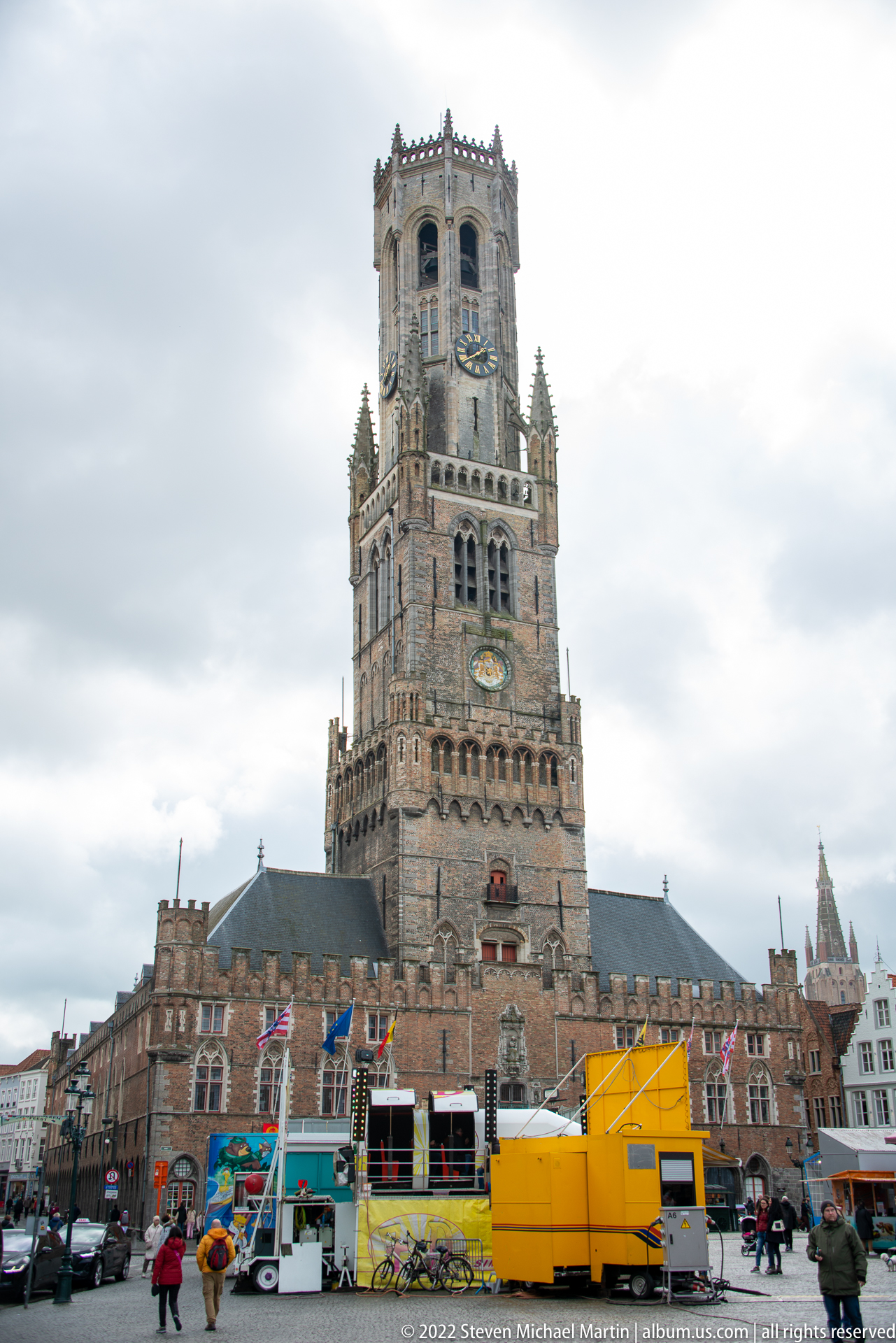
The Belfry of Bruges rises behind an active market scene of bright yellow trucks, temporary stalls, flags, and pedestrians. Its monumental brick tower, clock faces, and octagonal crown remain visually dominant despite the foreground activity. By including contemporary commerce at street level, the view connects the medieval civic landmark with the continuing use of the Markt as a working public square.
Caption
The Belfry of Bruges rises behind an active market scene of bright yellow trucks, temporary stalls, flags, and pedestrians. Its monumental brick tower, clock faces, and octagonal crown remain visually dominant despite the foreground activity. By including contemporary commerce at street level, the view connects the medieval civic landmark with the continuing use of the Markt as a working public square.
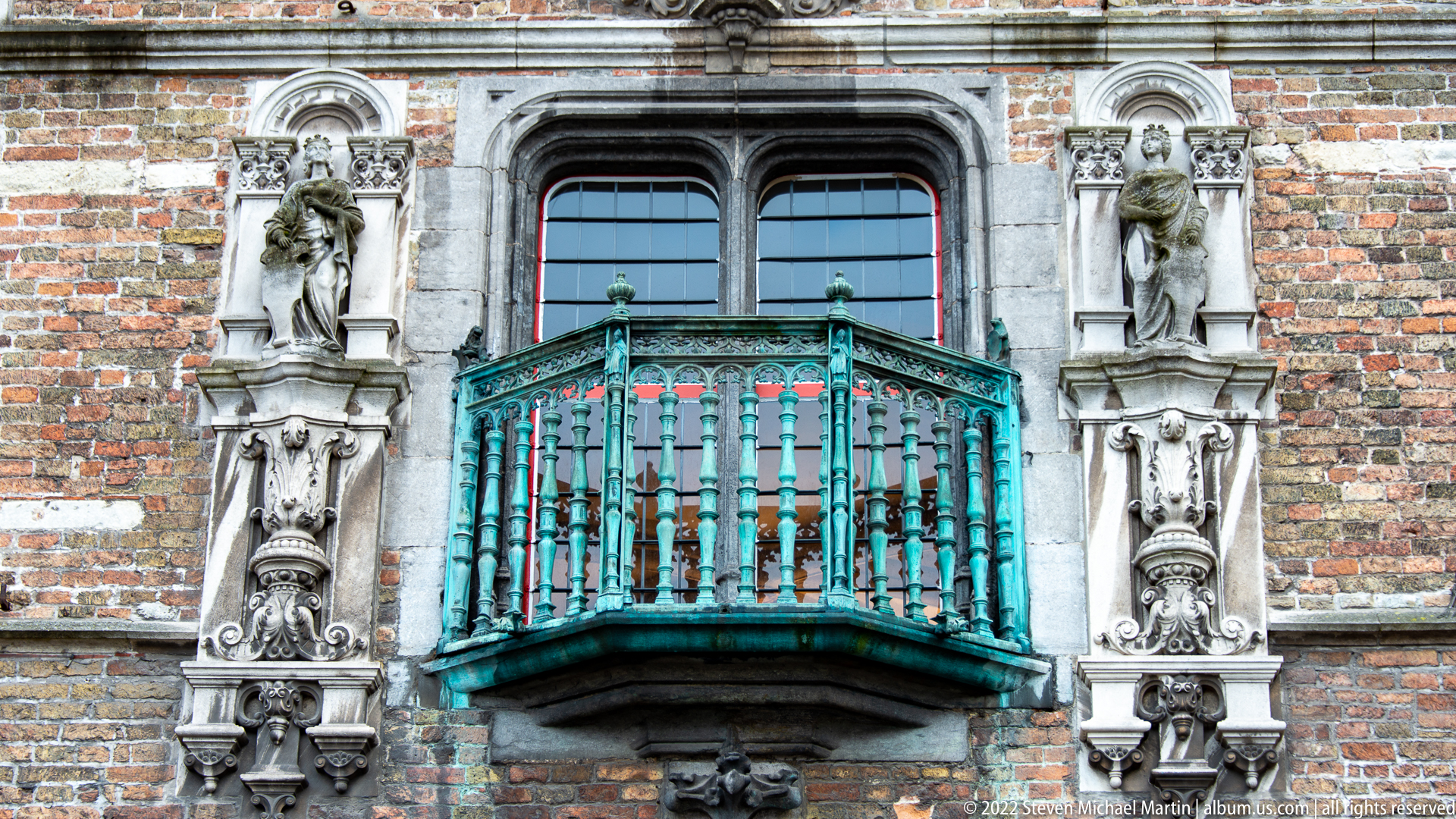
A compact green-painted balcony projects from an old brick façade, framed by richly carved stone figures and ornamental supports. The paired windows behind the balustrade have red trim, while weathered masonry and sculpture create a dense contrast of color and texture. The close composition focuses attention on a highly individual architectural detail rather than the larger building around it.
Caption
A compact green-painted balcony projects from an old brick façade, framed by richly carved stone figures and ornamental supports. The paired windows behind the balustrade have red trim, while weathered masonry and sculpture create a dense contrast of color and texture. The close composition focuses attention on a highly individual architectural detail rather than the larger building around it.
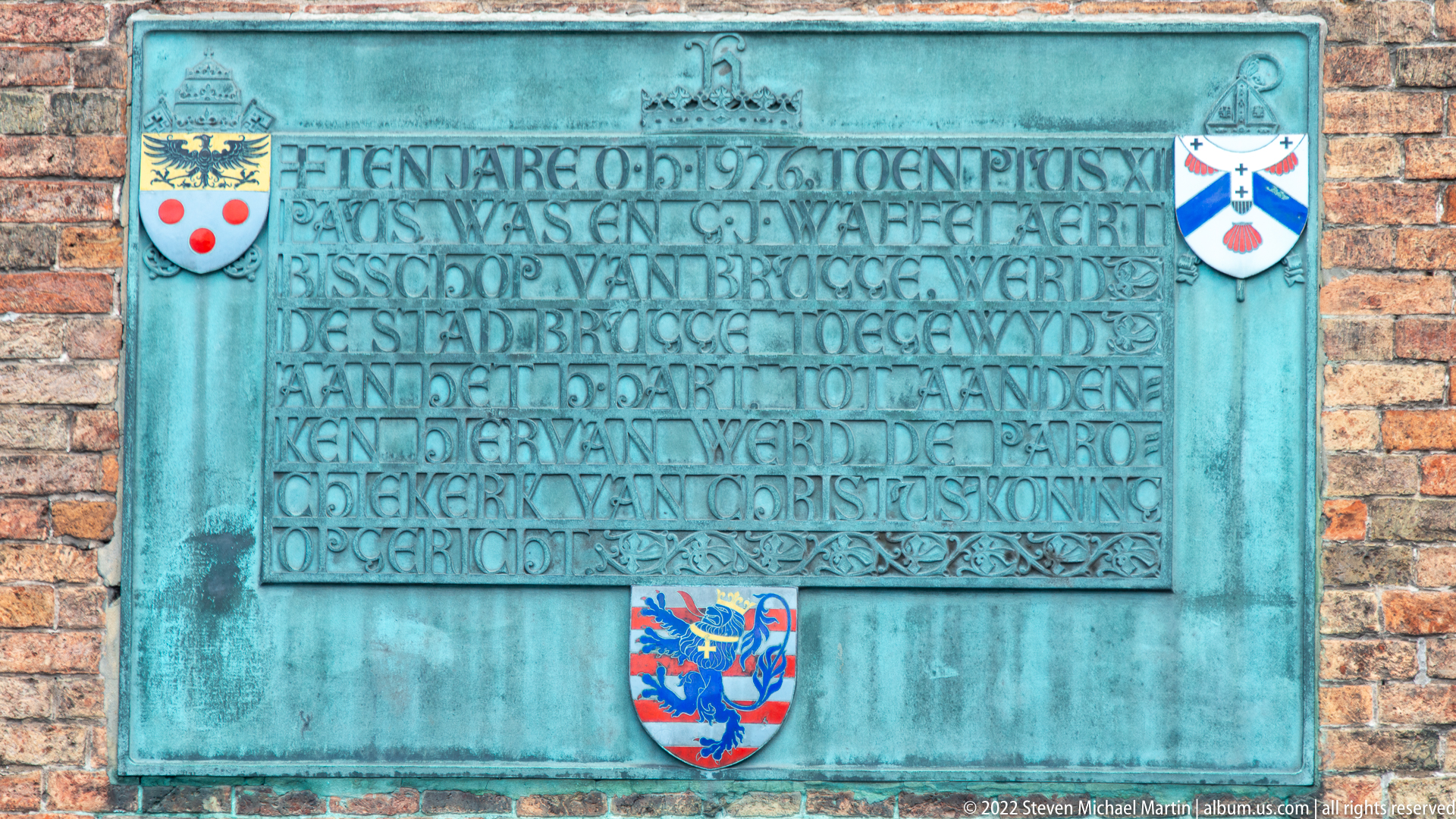
A large patinated bronze plaque is set into brickwork, carrying several lines of raised Dutch text and three heraldic shields. The weathered green surface and formal lettering suggest a commemorative or institutional function tied to Bruges’ civic history. Because the inscription is only partly legible at proof-sheet scale, the image is best treated as a documentary record of the plaque itself rather than a fully decoded text.
Caption
A large patinated bronze plaque is set into brickwork, carrying several lines of raised Dutch text and three heraldic shields. The weathered green surface and formal lettering suggest a commemorative or institutional function tied to Bruges’ civic history. Because the inscription is only partly legible at proof-sheet scale, the image is best treated as a documentary record of the plaque itself rather than a fully decoded text.
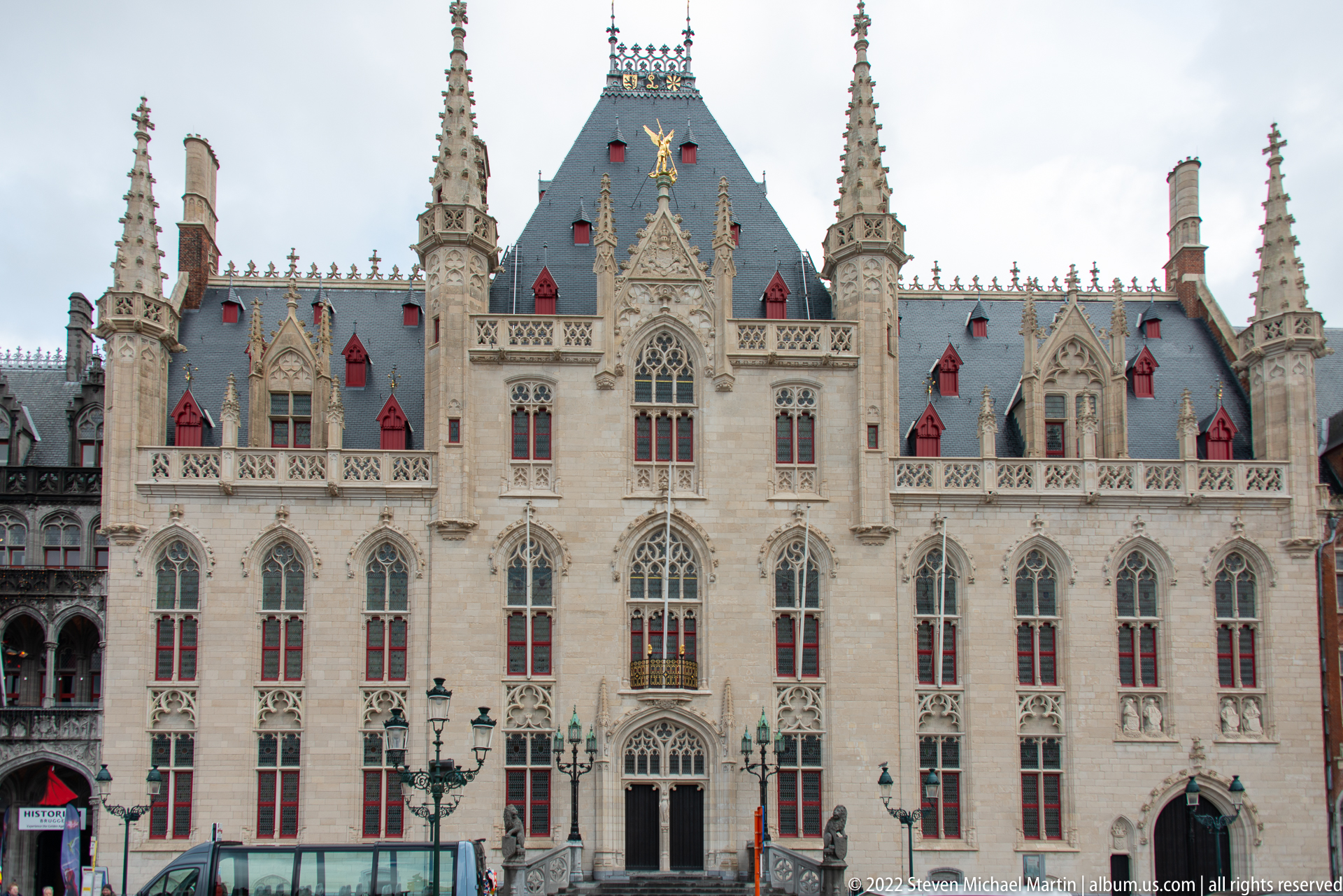
The Provinciaal Hof faces the Bruges Markt with a highly symmetrical Gothic Revival façade of pale stone, pointed windows, steep slate roofs, pinnacles, and a richly carved central entrance. Red dormers punctuate the roof slopes while the central bay rises to a sculpted gable. The frontal view records the building’s carefully ordered composition and its ceremonial presence along the market square.
Caption
The Provinciaal Hof faces the Bruges Markt with a highly symmetrical Gothic Revival façade of pale stone, pointed windows, steep slate roofs, pinnacles, and a richly carved central entrance. Red dormers punctuate the roof slopes while the central bay rises to a sculpted gable. The frontal view records the building’s carefully ordered composition and its ceremonial presence along the market square.
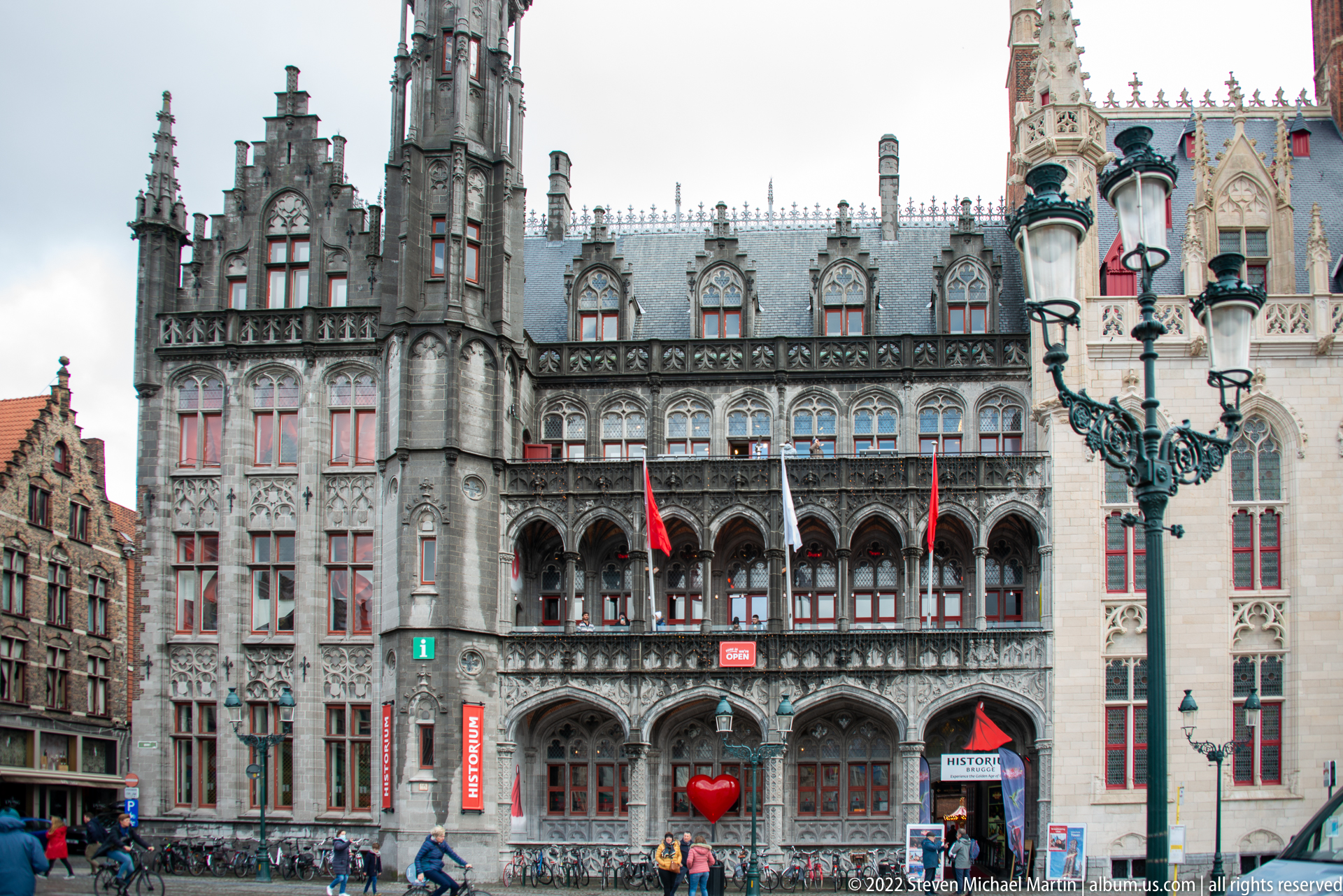
The richly ornamented stone façade of the Historium Brugge fills the edge of the Markt, with arcaded lower openings, tall traceried windows, projecting bays, and a tower-like corner mass. Red signs and visitor entrances introduce contemporary commercial use into the historic architectural setting. The angled view emphasizes the building’s vertical complexity and its immediate relationship to the adjoining Provincial Court.
Caption
The richly ornamented stone façade of the Historium Brugge fills the edge of the Markt, with arcaded lower openings, tall traceried windows, projecting bays, and a tower-like corner mass. Red signs and visitor entrances introduce contemporary commercial use into the historic architectural setting. The angled view emphasizes the building’s vertical complexity and its immediate relationship to the adjoining Provincial Court.
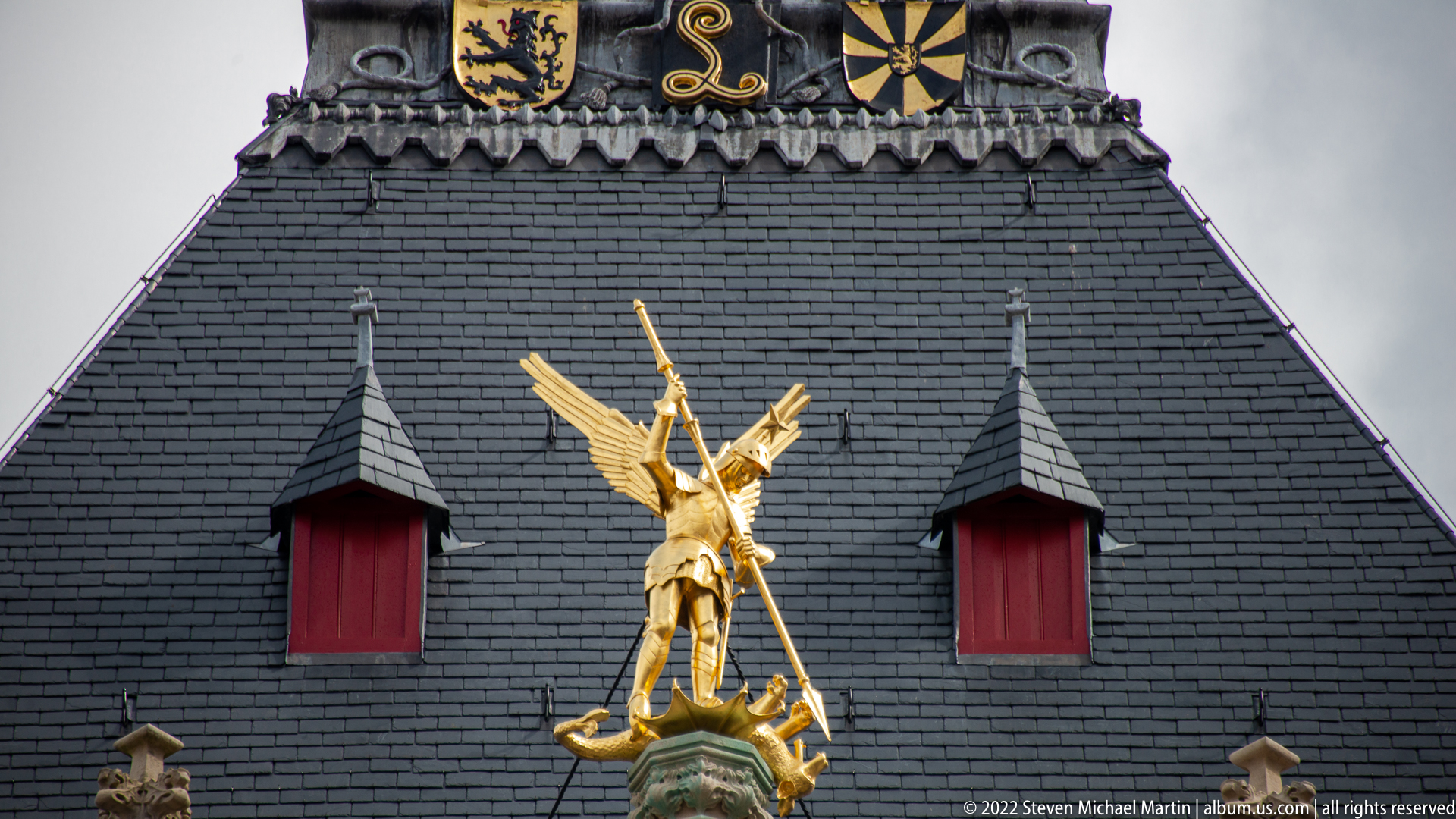
A gilded winged figure stands dramatically against a dark slate roof, holding a long staff or spear above a subdued second figure at its feet. Two red dormers flank the sculpture, while heraldic emblems appear along the roof ridge above. The tight architectural crop emphasizes the contrast between luminous gold, black slate, and red shutters rather than the larger building façade.
Caption
A gilded winged figure stands dramatically against a dark slate roof, holding a long staff or spear above a subdued second figure at its feet. Two red dormers flank the sculpture, while heraldic emblems appear along the roof ridge above. The tight architectural crop emphasizes the contrast between luminous gold, black slate, and red shutters rather than the larger building façade.

The Jan Breydel and Pieter de Coninck monument is seen from a different angle across Bruges’ Markt, surrounded by fluttering civic and regional flags. Colorful stepped-gable façades and shopfronts form a continuous backdrop, placing the bronze figures firmly within the commercial heart of the city. The view is less sculptural than contextual, emphasizing the monument’s central role in the square.
Caption
The Jan Breydel and Pieter de Coninck monument is seen from a different angle across Bruges’ Markt, surrounded by fluttering civic and regional flags. Colorful stepped-gable façades and shopfronts form a continuous backdrop, placing the bronze figures firmly within the commercial heart of the city. The view is less sculptural than contextual, emphasizing the monument’s central role in the square.
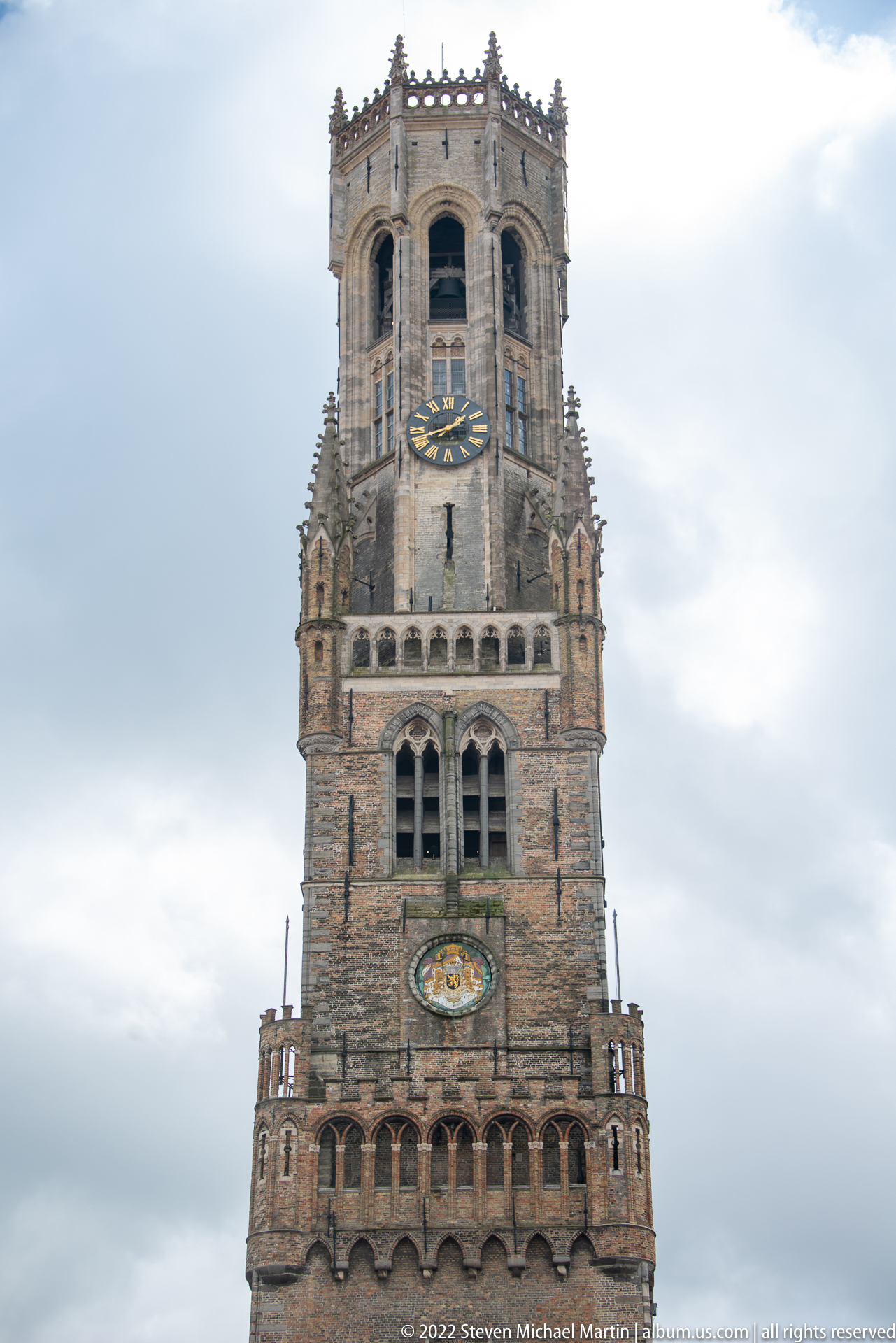
A compressed view isolates the upper stages of the Belfry of Bruges, where large clock faces, paired belfry openings, crenellated parapets, and the octagonal crown stack vertically above the square. The close framing makes the transition from heavy brick lower stages to the more open upper bell chamber especially clear. Weathered masonry and dark openings reinforce the tower’s age and monumental civic character.
Caption
A compressed view isolates the upper stages of the Belfry of Bruges, where large clock faces, paired belfry openings, crenellated parapets, and the octagonal crown stack vertically above the square. The close framing makes the transition from heavy brick lower stages to the more open upper bell chamber especially clear. Weathered masonry and dark openings reinforce the tower’s age and monumental civic character.

A richly colored commercial façade rises in red, gold, and dark green, organized by tall windows, gilded pilasters, and a broad curving gable. Decorative bands and small sculpted figures accent the upper stories while modern shop windows occupy the ground level. The upward viewpoint emphasizes the vertical rhythm and theatrical color scheme of this distinctive historic frontage within Bruges’ commercial center.
Caption
A richly colored commercial façade rises in red, gold, and dark green, organized by tall windows, gilded pilasters, and a broad curving gable. Decorative bands and small sculpted figures accent the upper stories while modern shop windows occupy the ground level. The upward viewpoint emphasizes the vertical rhythm and theatrical color scheme of this distinctive historic frontage within Bruges’ commercial center.
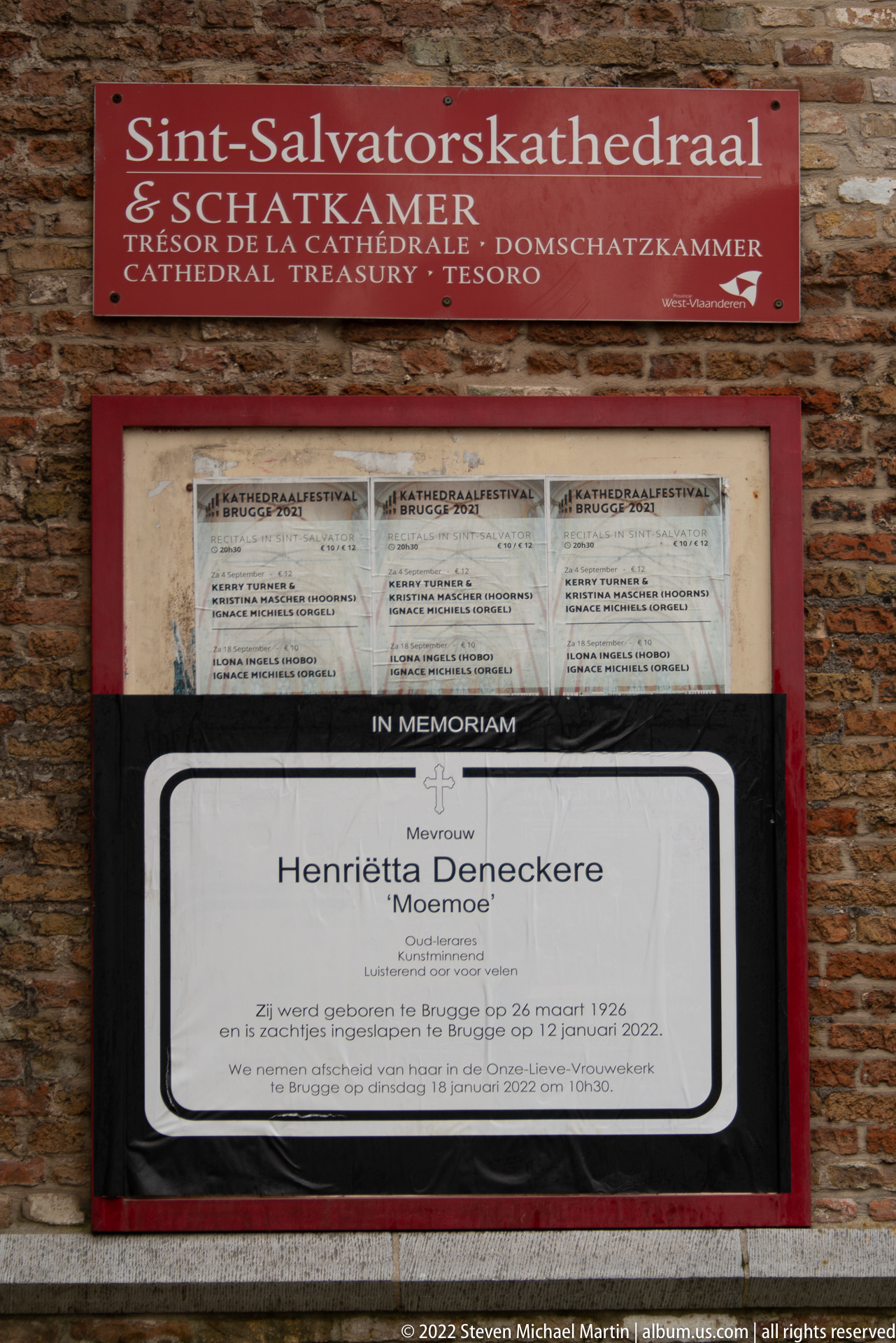
A memorial notice for Henriëtta Deneckere, known as “Moemoe,” is mounted beneath the red Sint-Salvatorskathedraal visitor sign on a brick wall. Printed notices above it and the cathedral identification establish the setting at Saint-Salvator Cathedral. The close documentary view records a personal remembrance within the public threshold of one of Bruges’ major religious monuments.
Caption
A memorial notice for Henriëtta Deneckere, known as “Moemoe,” is mounted beneath the red Sint-Salvatorskathedraal visitor sign on a brick wall. Printed notices above it and the cathedral identification establish the setting at Saint-Salvator Cathedral. The close documentary view records a personal remembrance within the public threshold of one of Bruges’ major religious monuments.
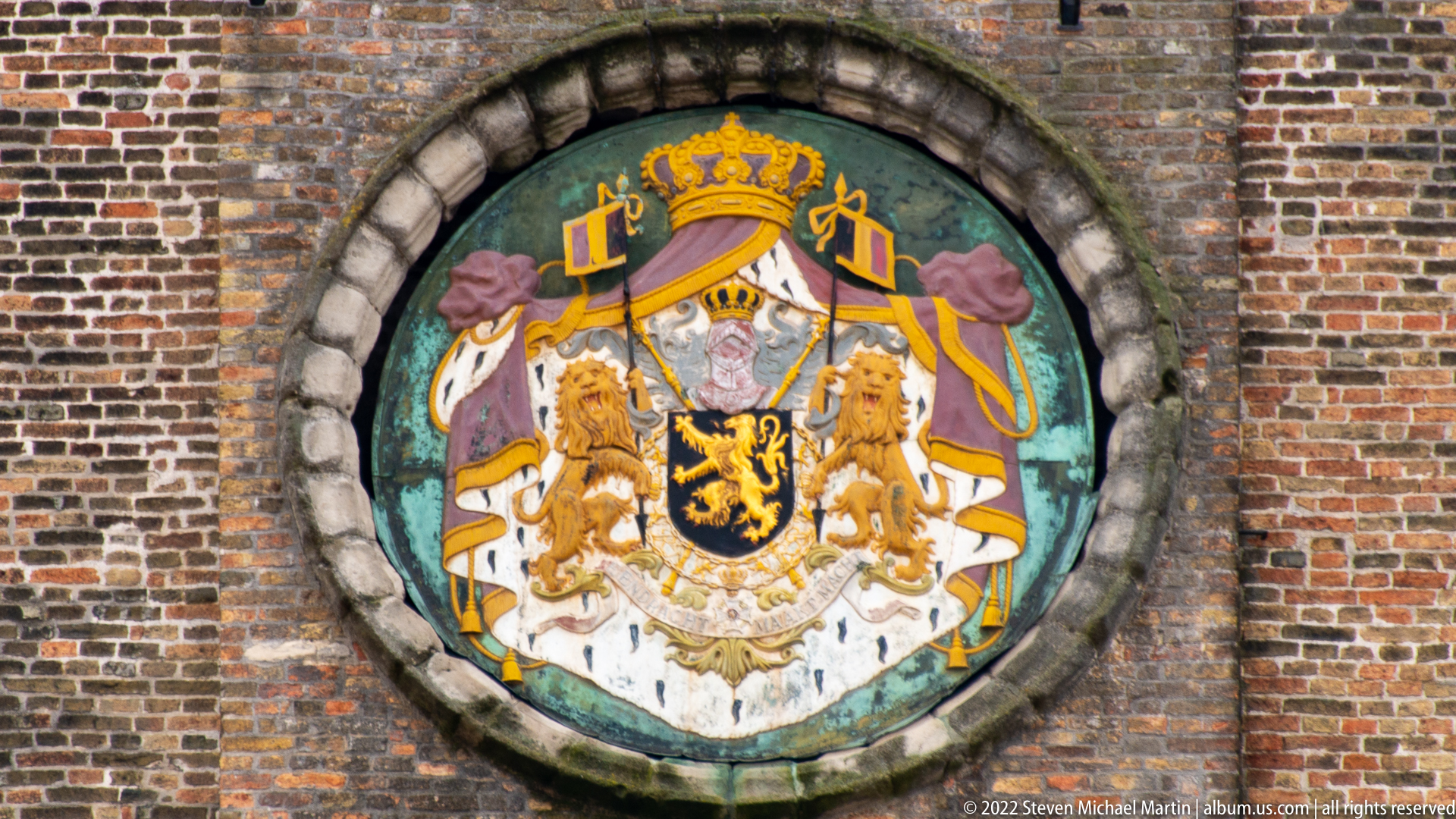
A large circular heraldic panel is set into a brick wall beneath a heavy stone surround. The painted composition centers a crowned shield with a black lion on gold, flanked by supporting lions and surrounded by elaborate mantling in white, purple, and yellow. Surface wear and staining reveal the panel’s exposure to the elements while preserving the strong civic or regional symbolism.
Caption
A large circular heraldic panel is set into a brick wall beneath a heavy stone surround. The painted composition centers a crowned shield with a black lion on gold, flanked by supporting lions and surrounded by elaborate mantling in white, purple, and yellow. Surface wear and staining reveal the panel’s exposure to the elements while preserving the strong civic or regional symbolism.
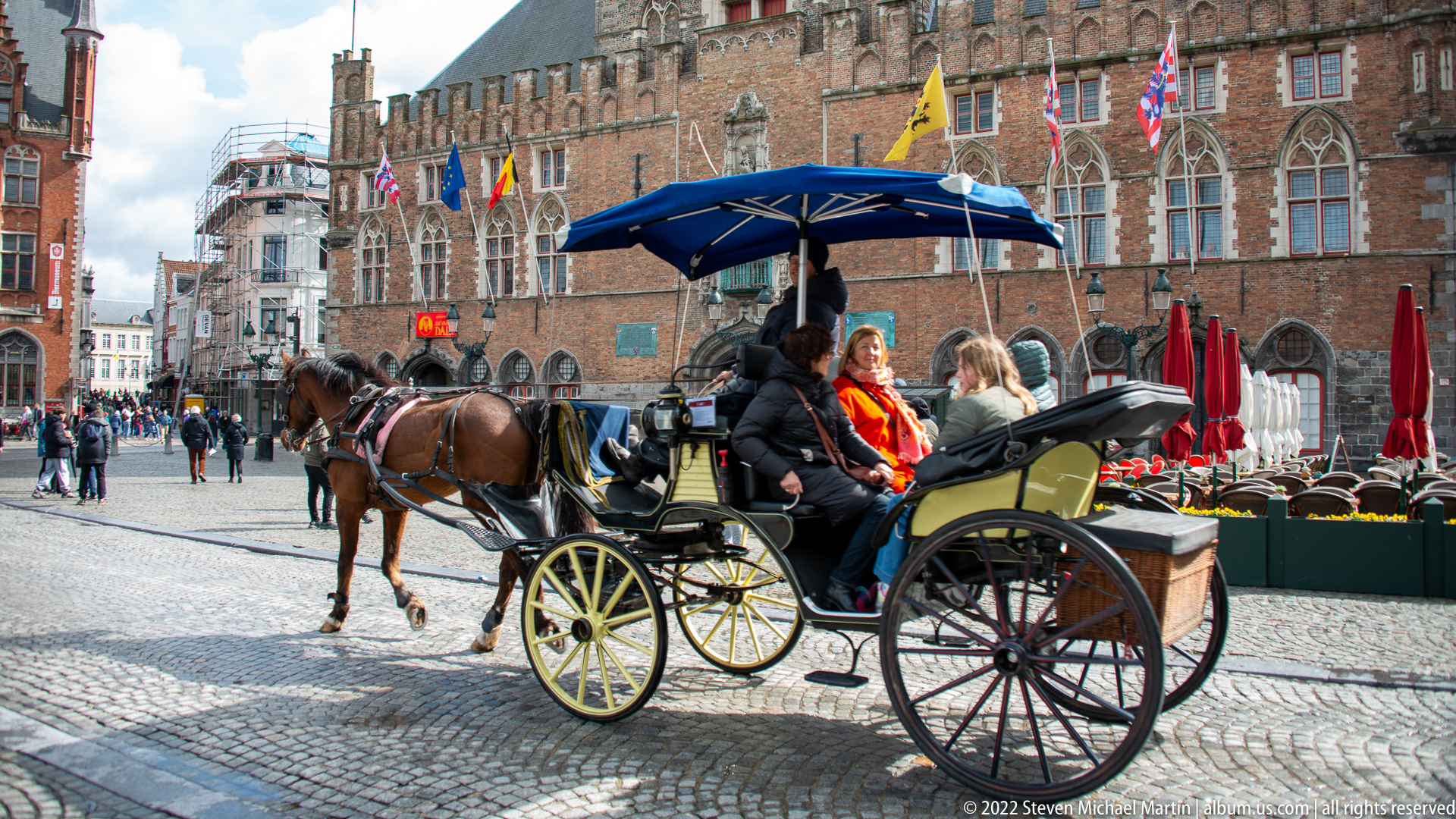
A horse-drawn carriage carries passengers across the cobbled Bruges Markt, with the long brick façade of the Belfry complex behind. The driver sits beneath a dark blue canopy while flags, restaurant terraces, and pedestrians animate the square. The scene records a contemporary tourism activity within the medieval civic setting, contrasting the carriage’s traditional form with present-day visitor use.
Caption
A horse-drawn carriage carries passengers across the cobbled Bruges Markt, with the long brick façade of the Belfry complex behind. The driver sits beneath a dark blue canopy while flags, restaurant terraces, and pedestrians animate the square. The scene records a contemporary tourism activity within the medieval civic setting, contrasting the carriage’s traditional form with present-day visitor use.
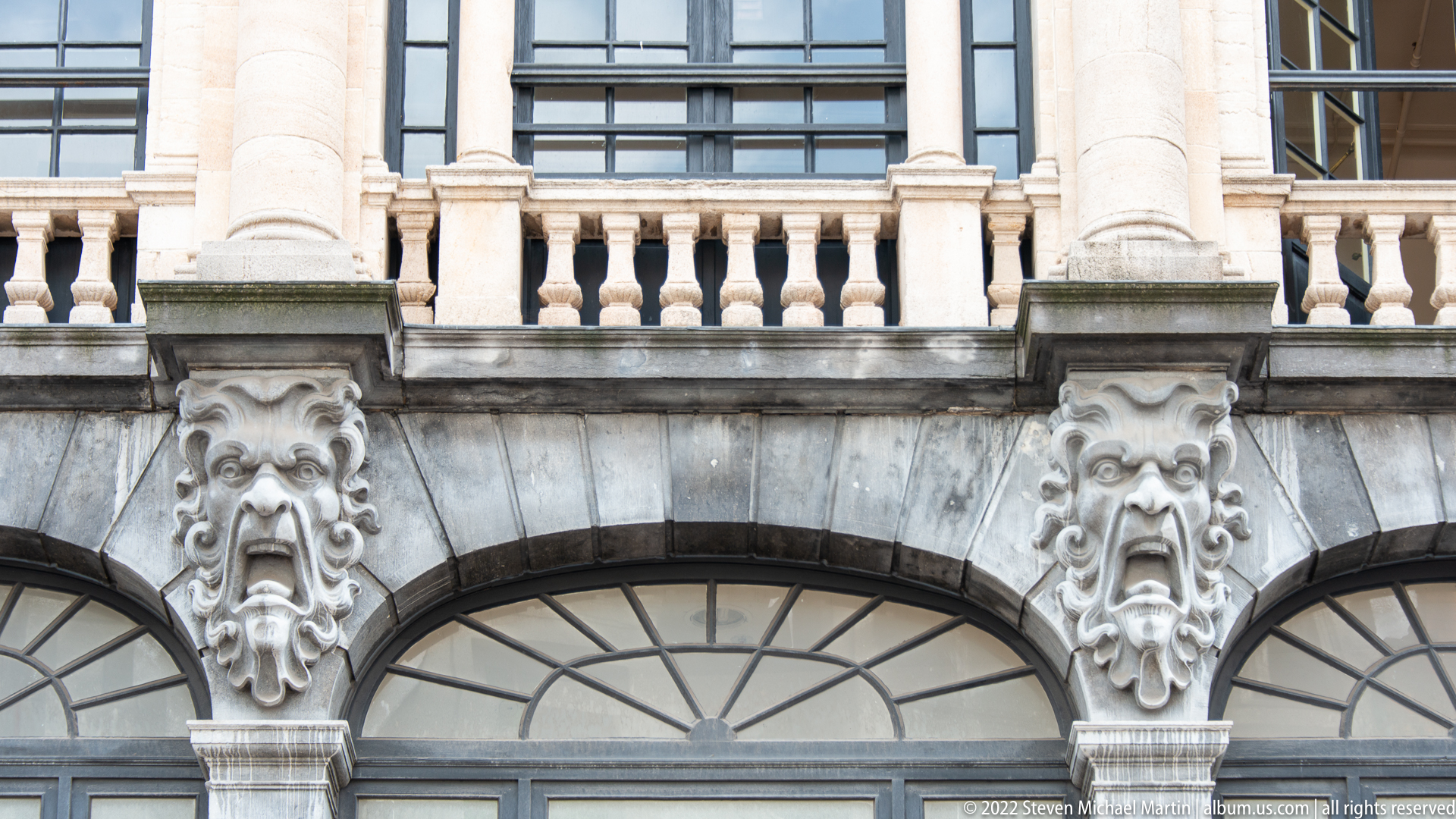
Two carved grotesque masks project from the stone façade between large semicircular windows, their exaggerated eyes, noses, and open mouths framed by curling foliage. A balustrade and paired columns rise immediately above. The close view isolates the sculptural treatment of the façade and shows how expressive figurative ornament was used to enliven an otherwise regular classical architectural scheme.
Caption
Two carved grotesque masks project from the stone façade between large semicircular windows, their exaggerated eyes, noses, and open mouths framed by curling foliage. A balustrade and paired columns rise immediately above. The close view isolates the sculptural treatment of the façade and shows how expressive figurative ornament was used to enliven an otherwise regular classical architectural scheme.
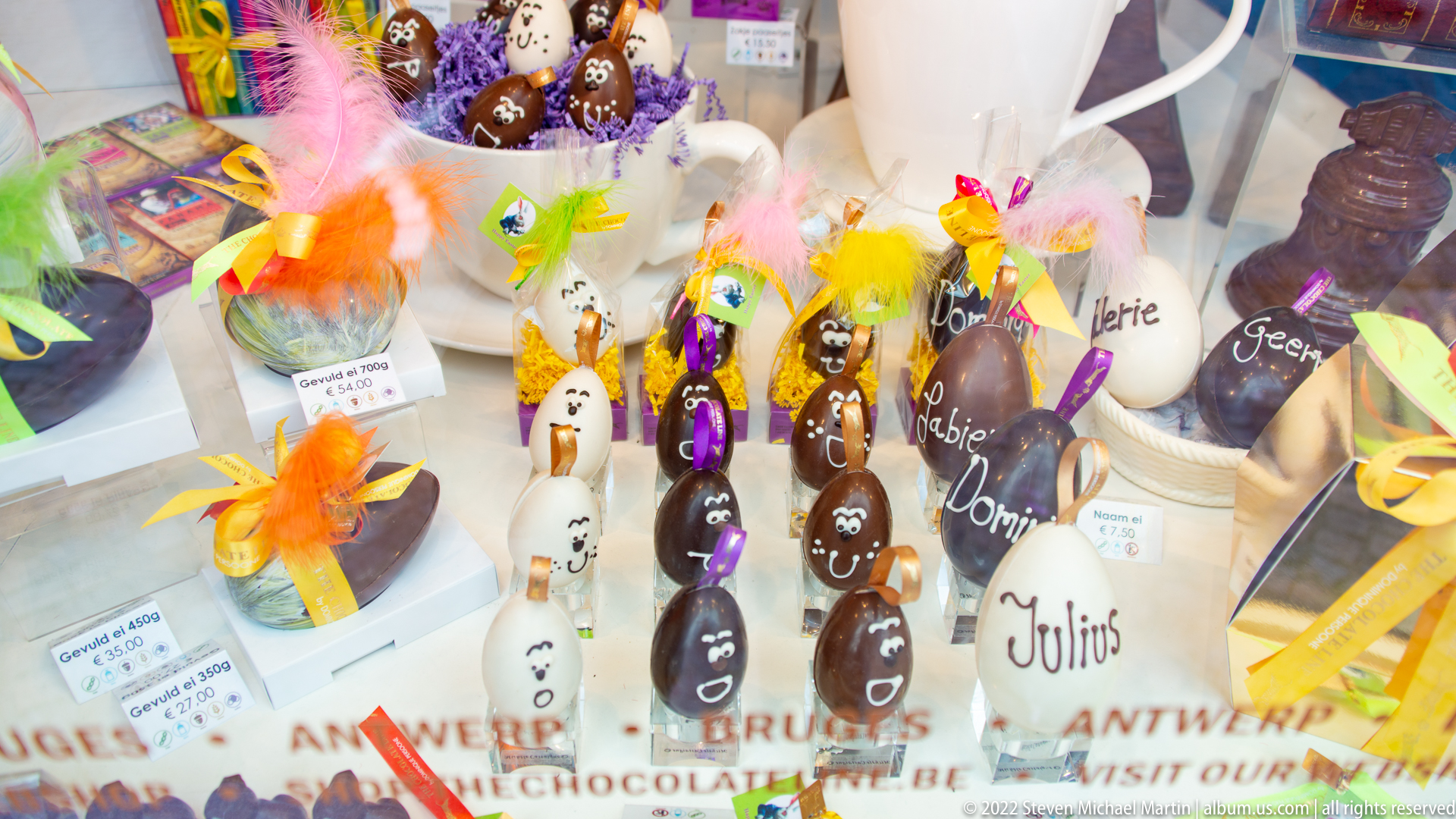
A Bruges confectioner’s window displays rows of decorated chocolate figures, eggs, and character-shaped sweets tied with bright ribbons and feathers. White and dark chocolate pieces are arranged in small groups, with handwritten product cards and packaging visible around them. The playful merchandising reflects Belgium’s strong chocolate retail culture while remaining grounded in the specific seasonal display seen through the glass.
Caption
A Bruges confectioner’s window displays rows of decorated chocolate figures, eggs, and character-shaped sweets tied with bright ribbons and feathers. White and dark chocolate pieces are arranged in small groups, with handwritten product cards and packaging visible around them. The playful merchandising reflects Belgium’s strong chocolate retail culture while remaining grounded in the specific seasonal display seen through the glass.
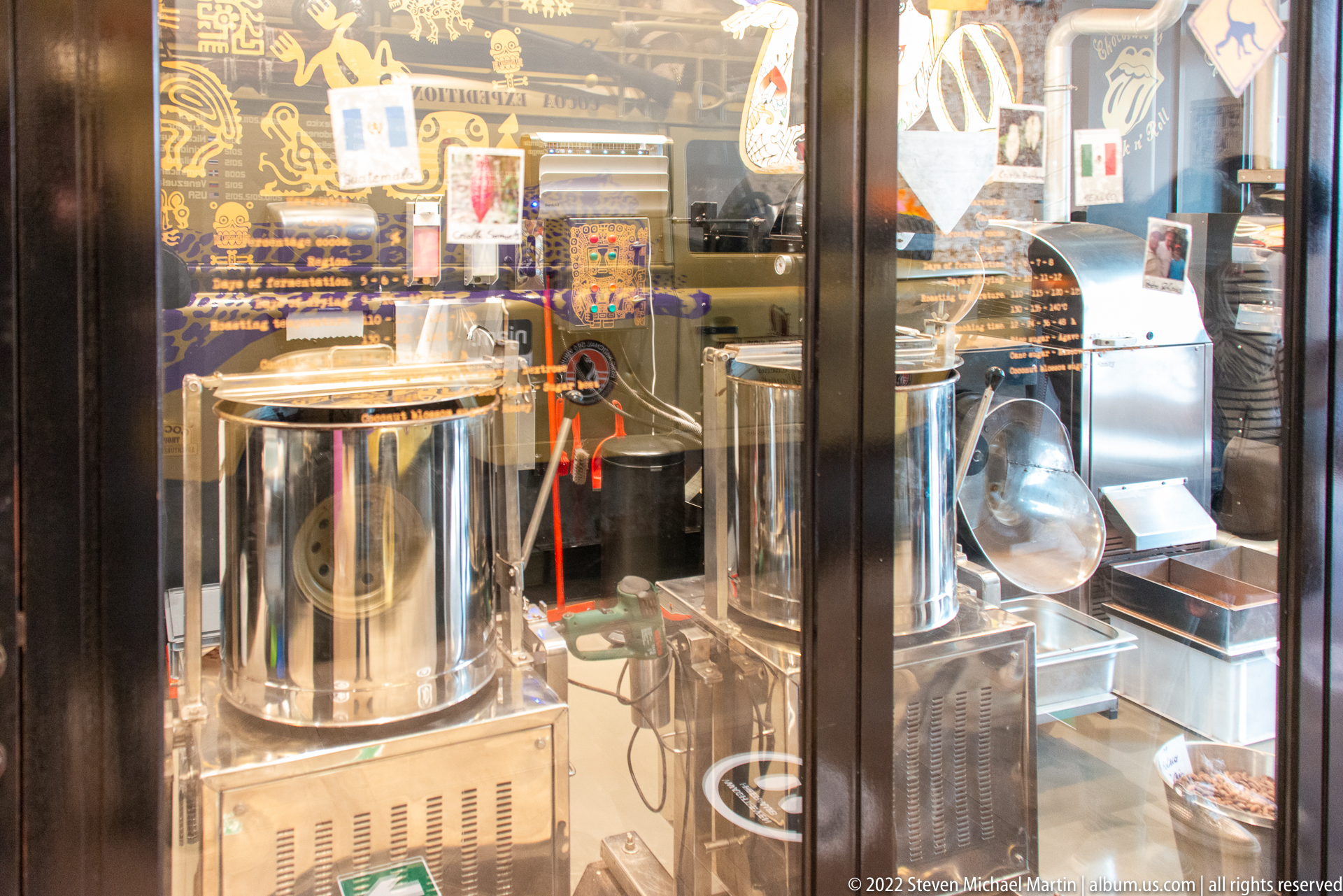
Polished stainless-steel vats, mixers, and processing equipment fill the production area behind a glass storefront. Reflections of the street overlay the machinery, but lids, pipes, controls, and cylindrical tanks remain clearly visible. The scene offers a behind-the-scenes counterpart to Bruges’ finished chocolate displays, showing some of the modern equipment used in small-scale confectionery production.
Caption
Polished stainless-steel vats, mixers, and processing equipment fill the production area behind a glass storefront. Reflections of the street overlay the machinery, but lids, pipes, controls, and cylindrical tanks remain clearly visible. The scene offers a behind-the-scenes counterpart to Bruges’ finished chocolate displays, showing some of the modern equipment used in small-scale confectionery production.

A large open presentation box holds a tightly ordered assortment of chocolates in multiple shapes, colors, and decorative finishes. A broad ribbon descends from a bow above the display, turning the box into a gift presentation as much as a retail product. The deep magenta backdrop and careful grid arrangement emphasize variety, craftsmanship, and luxury merchandising.
Caption
A large open presentation box holds a tightly ordered assortment of chocolates in multiple shapes, colors, and decorative finishes. A broad ribbon descends from a bow above the display, turning the box into a gift presentation as much as a retail product. The deep magenta backdrop and careful grid arrangement emphasize variety, craftsmanship, and luxury merchandising.

Several trays of chocolates fill a glass display case, ranging from neat rows of molded pralines to dark squares topped with colorful sprinkles and clusters of rounded pieces. Small product cards identify individual varieties, though much of the text is too small to read confidently. The overhead view emphasizes the abundance and visual variety of Belgian confectionery presentation.
Caption
Several trays of chocolates fill a glass display case, ranging from neat rows of molded pralines to dark squares topped with colorful sprinkles and clusters of rounded pieces. Small product cards identify individual varieties, though much of the text is too small to read confidently. The overhead view emphasizes the abundance and visual variety of Belgian confectionery presentation.
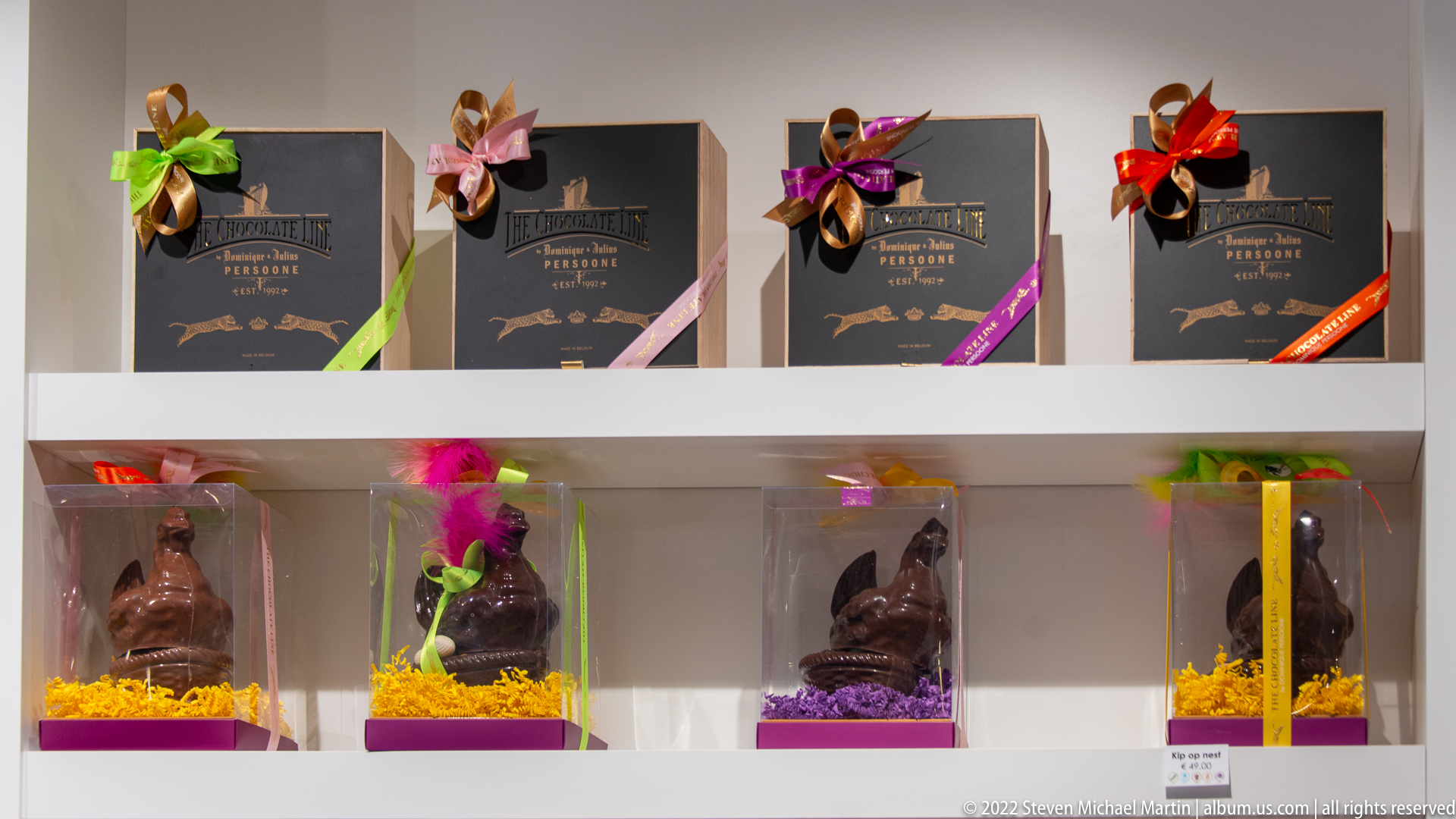
Elegant dark gift boxes tied with brightly colored ribbons line the upper shelf of a Bruges chocolate shop, while molded chocolate figures stand below in clear presentation cases filled with colored paper. The coordinated packaging combines luxury branding with playful seasonal display. Seen straight on, the arrangement documents the retail aesthetics surrounding Belgian chocolate as much as the confectionery itself.
Caption
Elegant dark gift boxes tied with brightly colored ribbons line the upper shelf of a Bruges chocolate shop, while molded chocolate figures stand below in clear presentation cases filled with colored paper. The coordinated packaging combines luxury branding with playful seasonal display. Seen straight on, the arrangement documents the retail aesthetics surrounding Belgian chocolate as much as the confectionery itself.

A large Gothic church rises behind leafing trees, its tall square tower articulated by stacked arcades and corner pinnacles. The transept façade features a broad pointed-arch window, while buttresses and narrow lancets structure the adjoining walls. The slightly distant view records the church as an urban landmark framed by mature trees rather than concentrating on a single portal or decorative detail.
Caption
A large Gothic church rises behind leafing trees, its tall square tower articulated by stacked arcades and corner pinnacles. The transept façade features a broad pointed-arch window, while buttresses and narrow lancets structure the adjoining walls. The slightly distant view records the church as an urban landmark framed by mature trees rather than concentrating on a single portal or decorative detail.
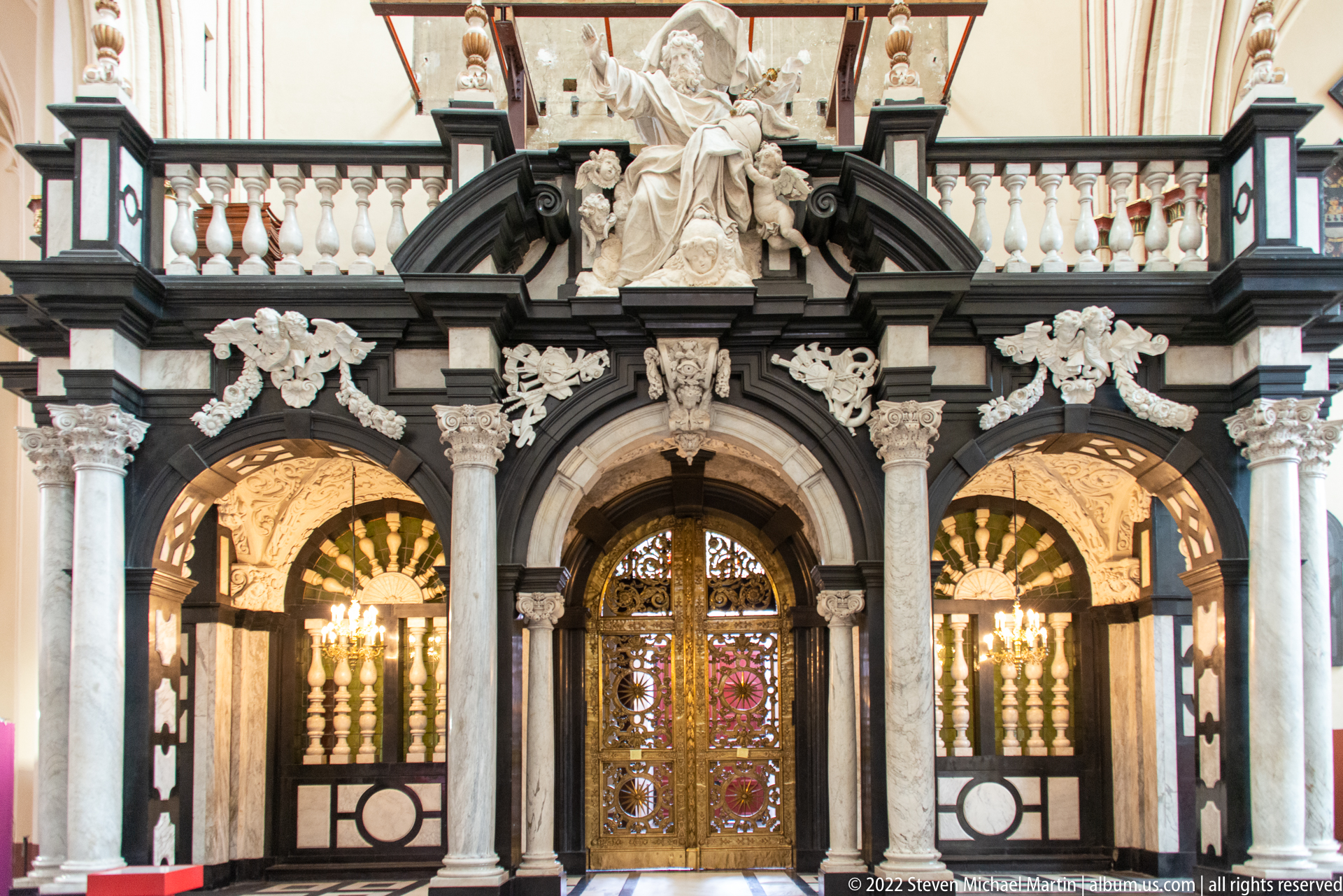
An elaborate black-and-white marble architectural ensemble frames a gilded central door inside Saint-Salvator Cathedral. Paired columns, sculpted garlands, putti, and a large reclining figure above the broken pediment create a richly theatrical Baroque composition. Warm light glowing through the side arches heightens the contrast between polished stone, gilded metalwork, and the pale church interior.
Caption
An elaborate black-and-white marble architectural ensemble frames a gilded central door inside Saint-Salvator Cathedral. Paired columns, sculpted garlands, putti, and a large reclining figure above the broken pediment create a richly theatrical Baroque composition. Warm light glowing through the side arches heightens the contrast between polished stone, gilded metalwork, and the pale church interior.
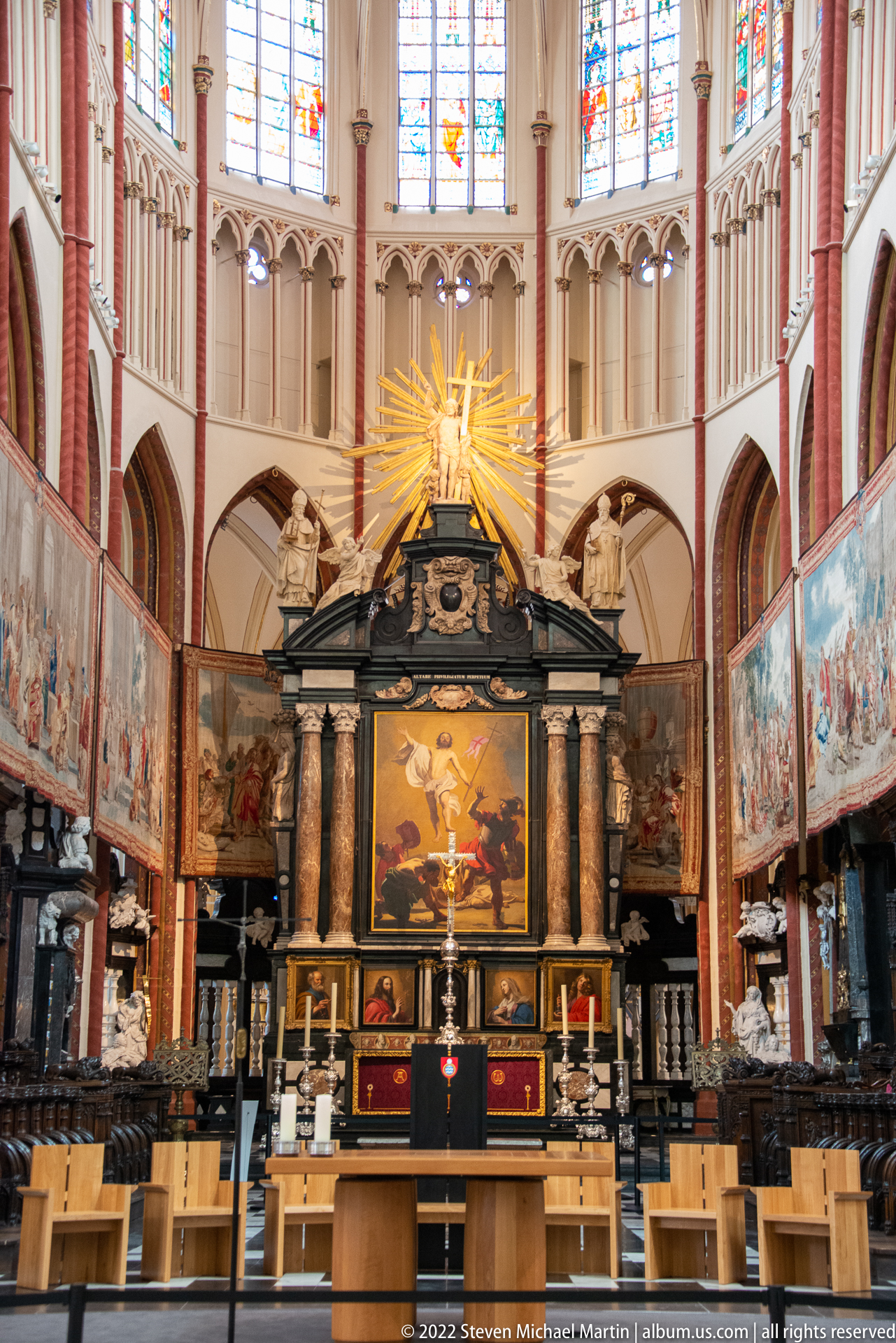
The nave of Saint-Salvator Cathedral leads toward an elaborate high altar framed by dark columns and sculptural decoration. Tall pointed arches, ribbed vaulting, stained-glass windows, and large narrative paintings line the luminous interior, while rows of chairs create a strong central axis. A radiant gilded sculpture above the altar draws the eye upward into the choir and clerestory.
Caption
The nave of Saint-Salvator Cathedral leads toward an elaborate high altar framed by dark columns and sculptural decoration. Tall pointed arches, ribbed vaulting, stained-glass windows, and large narrative paintings line the luminous interior, while rows of chairs create a strong central axis. A radiant gilded sculpture above the altar draws the eye upward into the choir and clerestory.
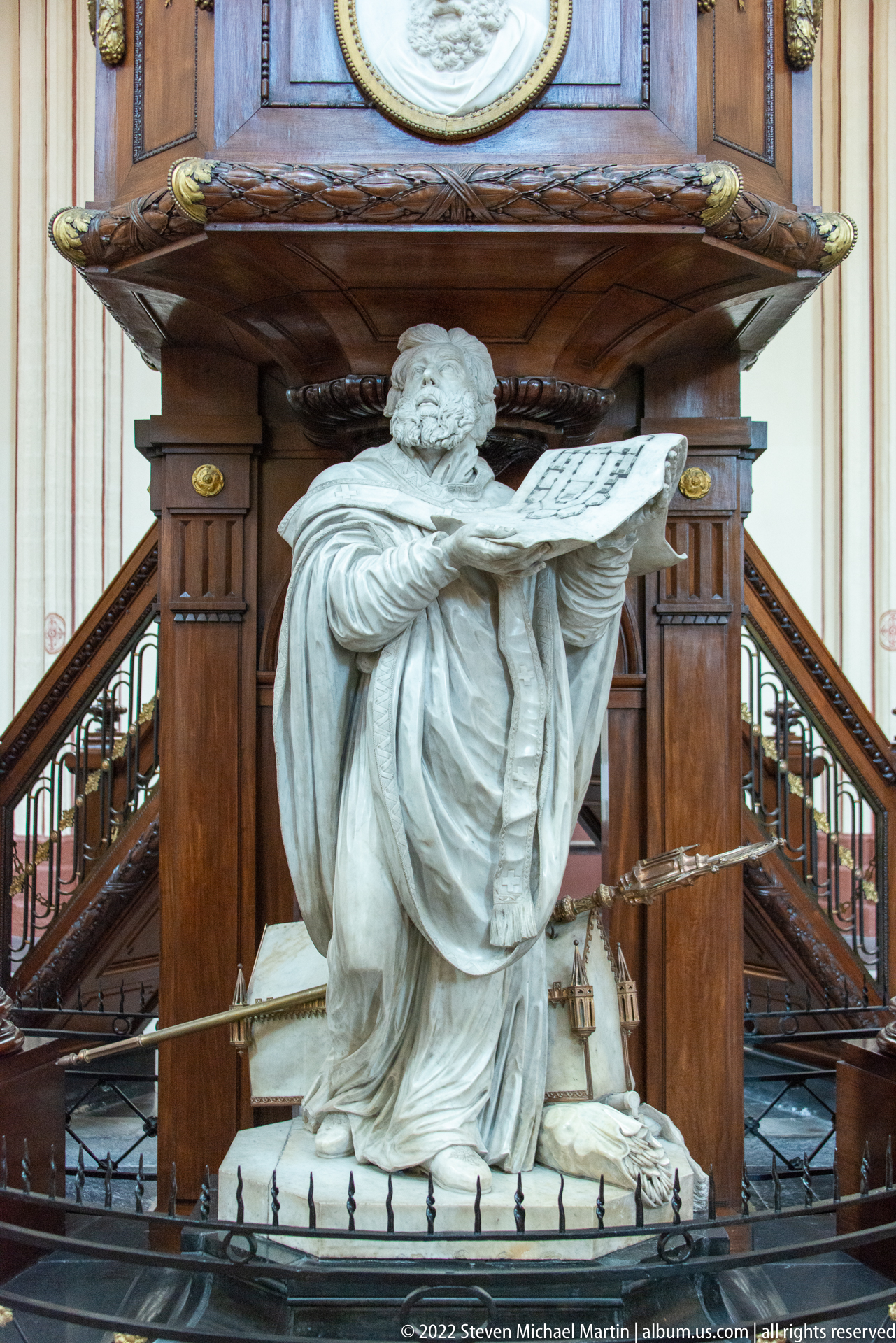
A kneeling stone figure appears to support the carved wooden base of a pulpit, holding an open book or tablet across both hands. Heavy drapery wraps the figure, whose upward gaze directs attention toward the preaching structure above. The close frontal framing emphasizes the sculptural role of the support figure and the contrast between pale stone and dark polished wood.
Caption
A kneeling stone figure appears to support the carved wooden base of a pulpit, holding an open book or tablet across both hands. Heavy drapery wraps the figure, whose upward gaze directs attention toward the preaching structure above. The close frontal framing emphasizes the sculptural role of the support figure and the contrast between pale stone and dark polished wood.

A weathered brick house with a broad stepped gable bears the date 1609 across its upper façade. Stone-framed multi-light windows are arranged in balanced rows above two ground-level doorways, while tall chimneys punctuate the roofline. The relatively plain frontage, softened by irregular brickwork and later alterations, provides a clear record of early seventeenth-century domestic architecture in Bruges.
Caption
A weathered brick house with a broad stepped gable bears the date 1609 across its upper façade. Stone-framed multi-light windows are arranged in balanced rows above two ground-level doorways, while tall chimneys punctuate the roofline. The relatively plain frontage, softened by irregular brickwork and later alterations, provides a clear record of early seventeenth-century domestic architecture in Bruges.
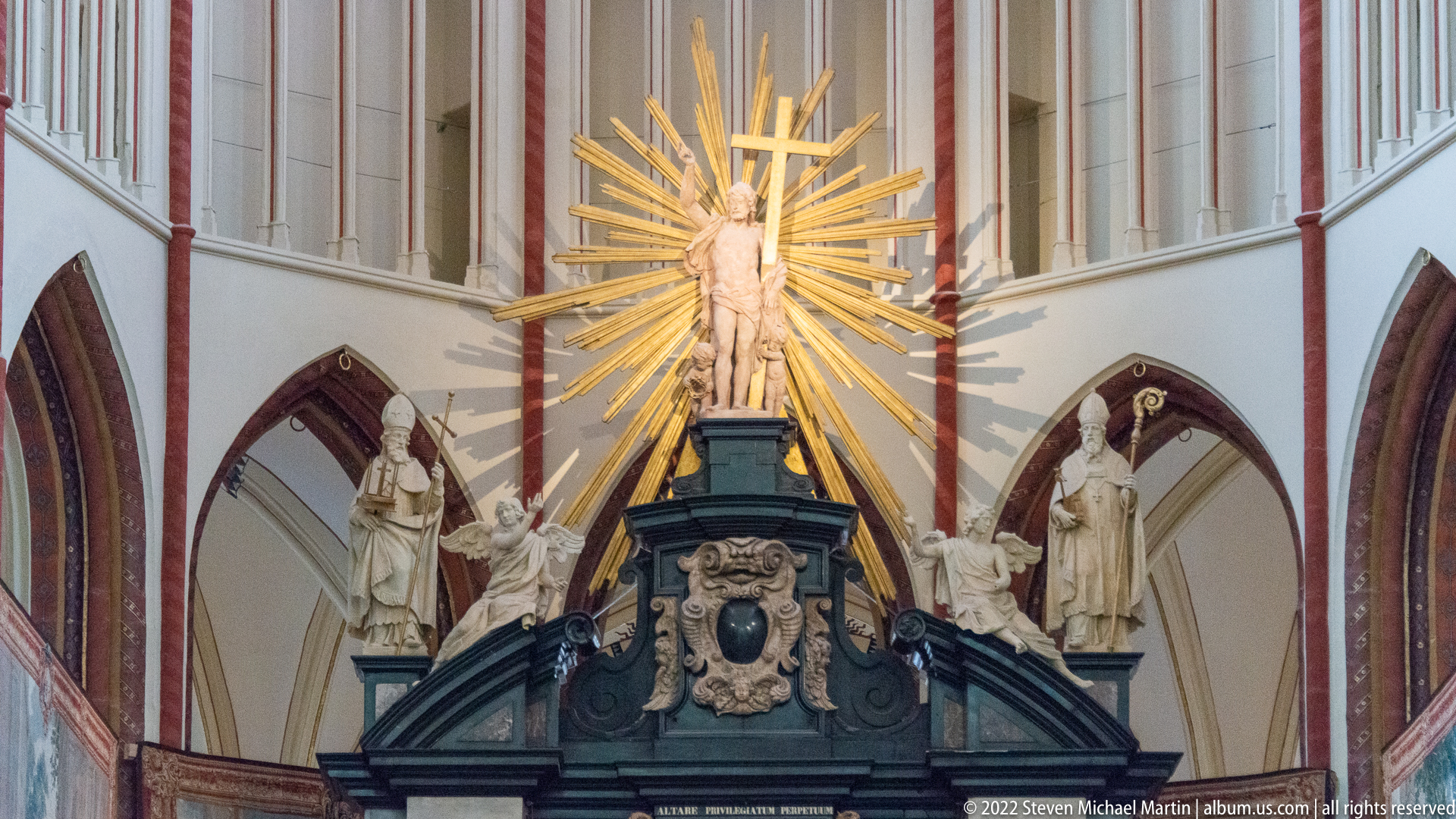
A crowned female sacred figure stands against a dramatic gilded sunburst high above the altar ensemble, flanked below by pale stone saints and heraldic ornament. The radiating gold beams create a luminous focal point against the cathedral’s pale vertical walls and pointed arches. The tight framing isolates this devotional sculpture from the broader sanctuary and emphasizes its placement within the architectural composition.
Caption
A crowned female sacred figure stands against a dramatic gilded sunburst high above the altar ensemble, flanked below by pale stone saints and heraldic ornament. The radiating gold beams create a luminous focal point against the cathedral’s pale vertical walls and pointed arches. The tight framing isolates this devotional sculpture from the broader sanctuary and emphasizes its placement within the architectural composition.

A large woven tapestry presents a crowded religious narrative in a monumental classical interior, with robed figures arranged around a central standing group and raised platform. Reds, blues, creams, and muted architectural tones give the scene strong depth despite the textile surface. The close frontal view records the tapestry as an artwork in its own right rather than as background decoration within the cathedral.
Caption
A large woven tapestry presents a crowded religious narrative in a monumental classical interior, with robed figures arranged around a central standing group and raised platform. Reds, blues, creams, and muted architectural tones give the scene strong depth despite the textile surface. The close frontal view records the tapestry as an artwork in its own right rather than as background decoration within the cathedral.
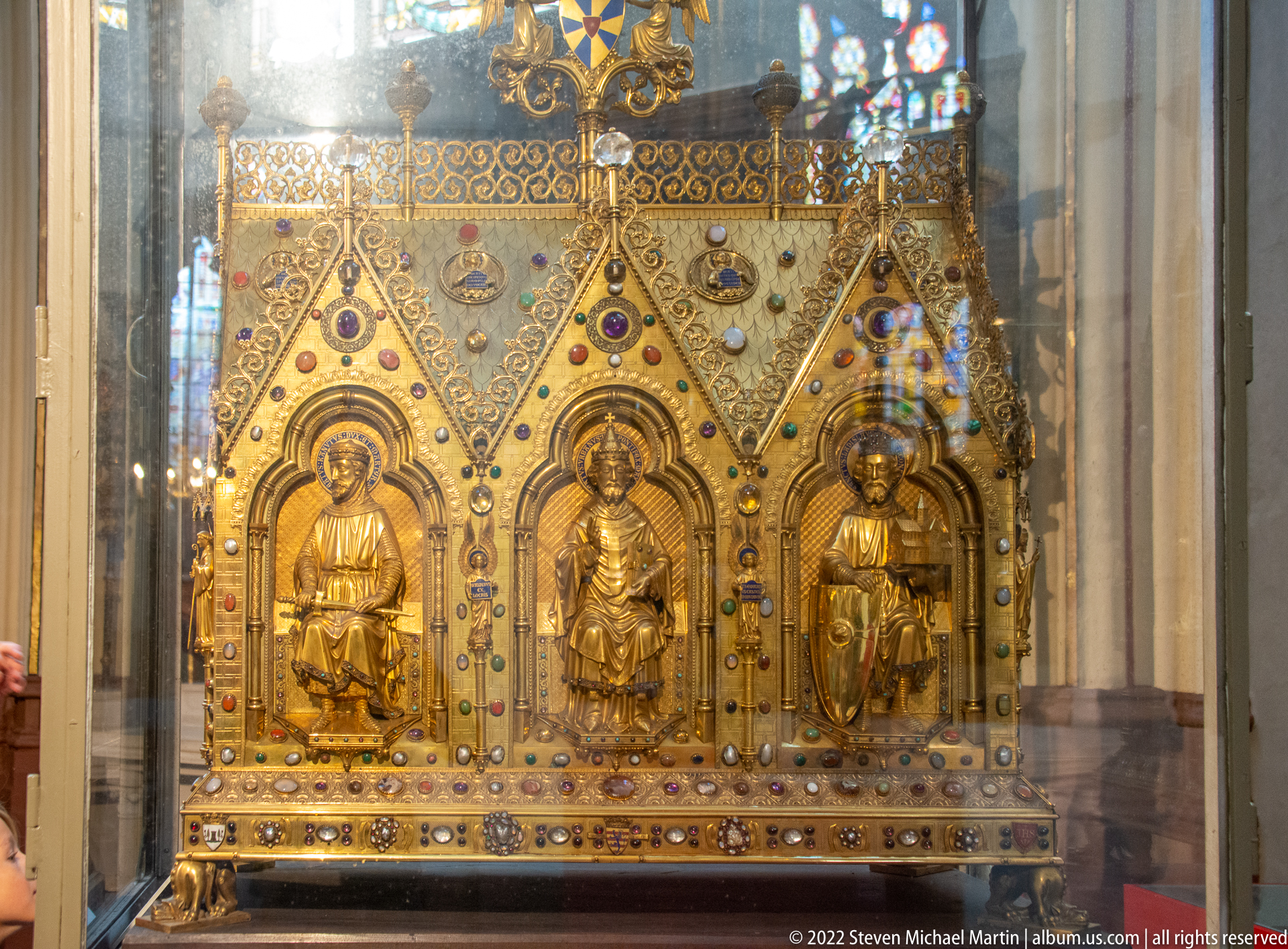
A richly gilded reliquary is organized like a miniature Gothic façade, with three standing saint figures occupying pointed niches beneath steep triangular gables. Colored cabochons and enamel-like details punctuate the gold surface, while delicate cresting runs along the roofline. Displayed behind glass, the object combines architecture, sculpture, and precious-metal decoration in a compact devotional form.
Caption
A richly gilded reliquary is organized like a miniature Gothic façade, with three standing saint figures occupying pointed niches beneath steep triangular gables. Colored cabochons and enamel-like details punctuate the gold surface, while delicate cresting runs along the roofline. Displayed behind glass, the object combines architecture, sculpture, and precious-metal decoration in a compact devotional form.
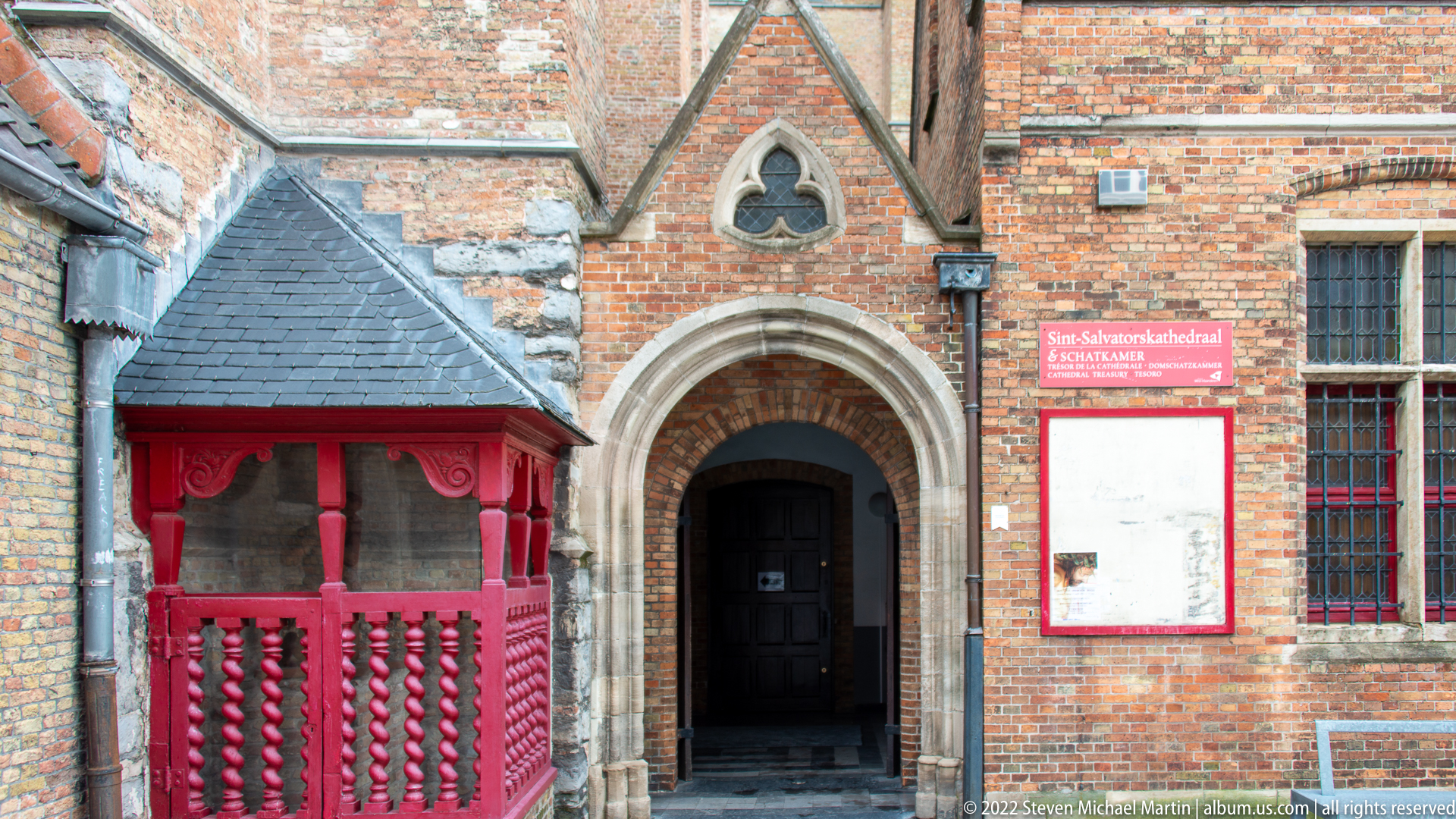
A pointed stone doorway opens through the brick wall of Sint-Salvatorskathedraal beside a vivid red timber porch or covered structure. A small trefoil window sits above the entrance, and the cathedral’s visitor board identifies the site in multiple languages. The compact composition records a less monumental access point where medieval masonry and later painted woodwork meet at street level.
Caption
A pointed stone doorway opens through the brick wall of Sint-Salvatorskathedraal beside a vivid red timber porch or covered structure. A small trefoil window sits above the entrance, and the cathedral’s visitor board identifies the site in multiple languages. The compact composition records a less monumental access point where medieval masonry and later painted woodwork meet at street level.
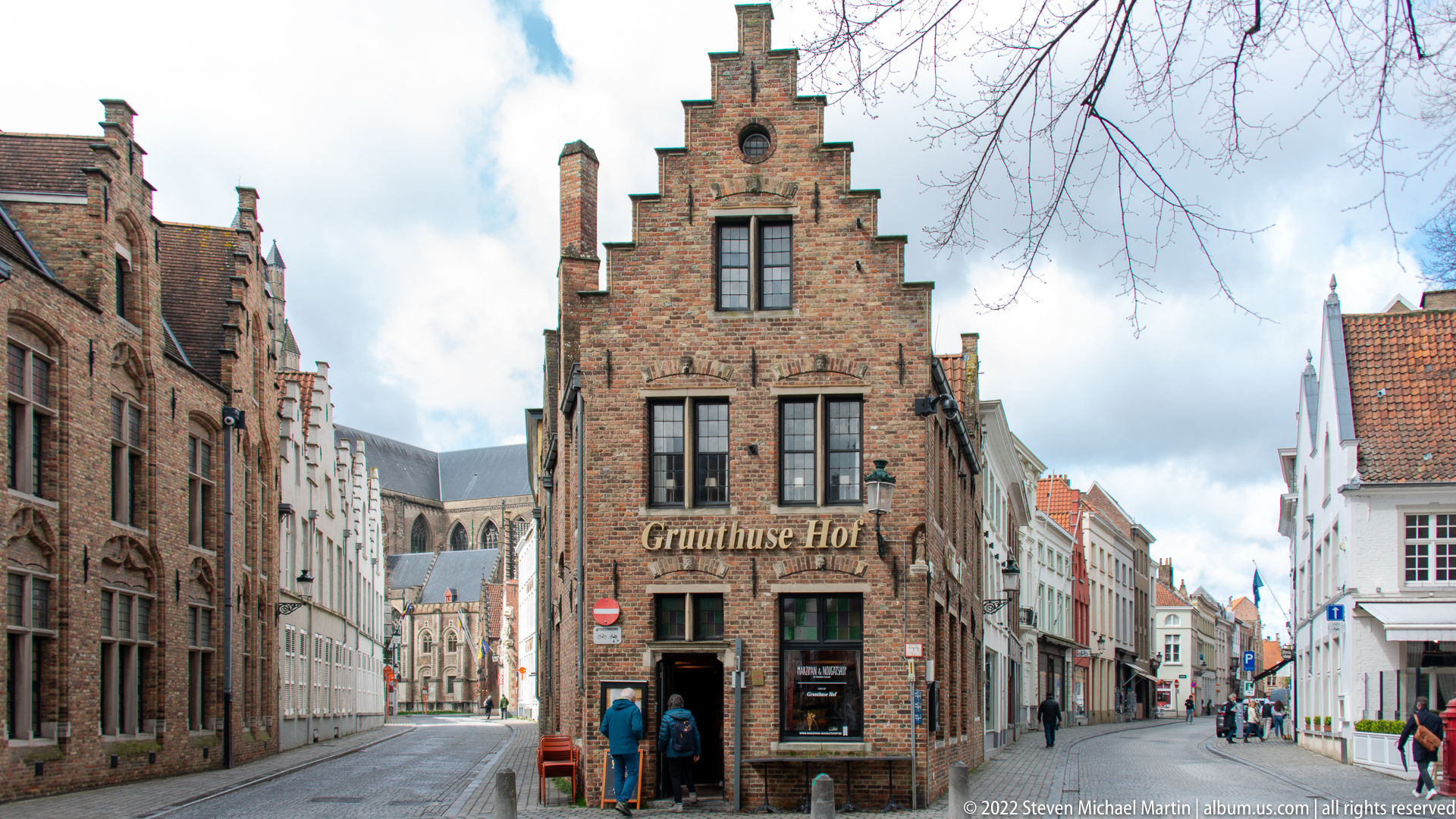
The brick façade of Gruuthuse Hof anchors a narrow Bruges street with a prominent stepped gable, dark-framed windows, and the establishment name painted above the entrance. Historic stone and brick buildings continue along both sides of the street toward a church in the distance. The street-level view records the intimate scale of the old city and the continued commercial use of traditional gabled architecture.
Caption
The brick façade of Gruuthuse Hof anchors a narrow Bruges street with a prominent stepped gable, dark-framed windows, and the establishment name painted above the entrance. Historic stone and brick buildings continue along both sides of the street toward a church in the distance. The street-level view records the intimate scale of the old city and the continued commercial use of traditional gabled architecture.
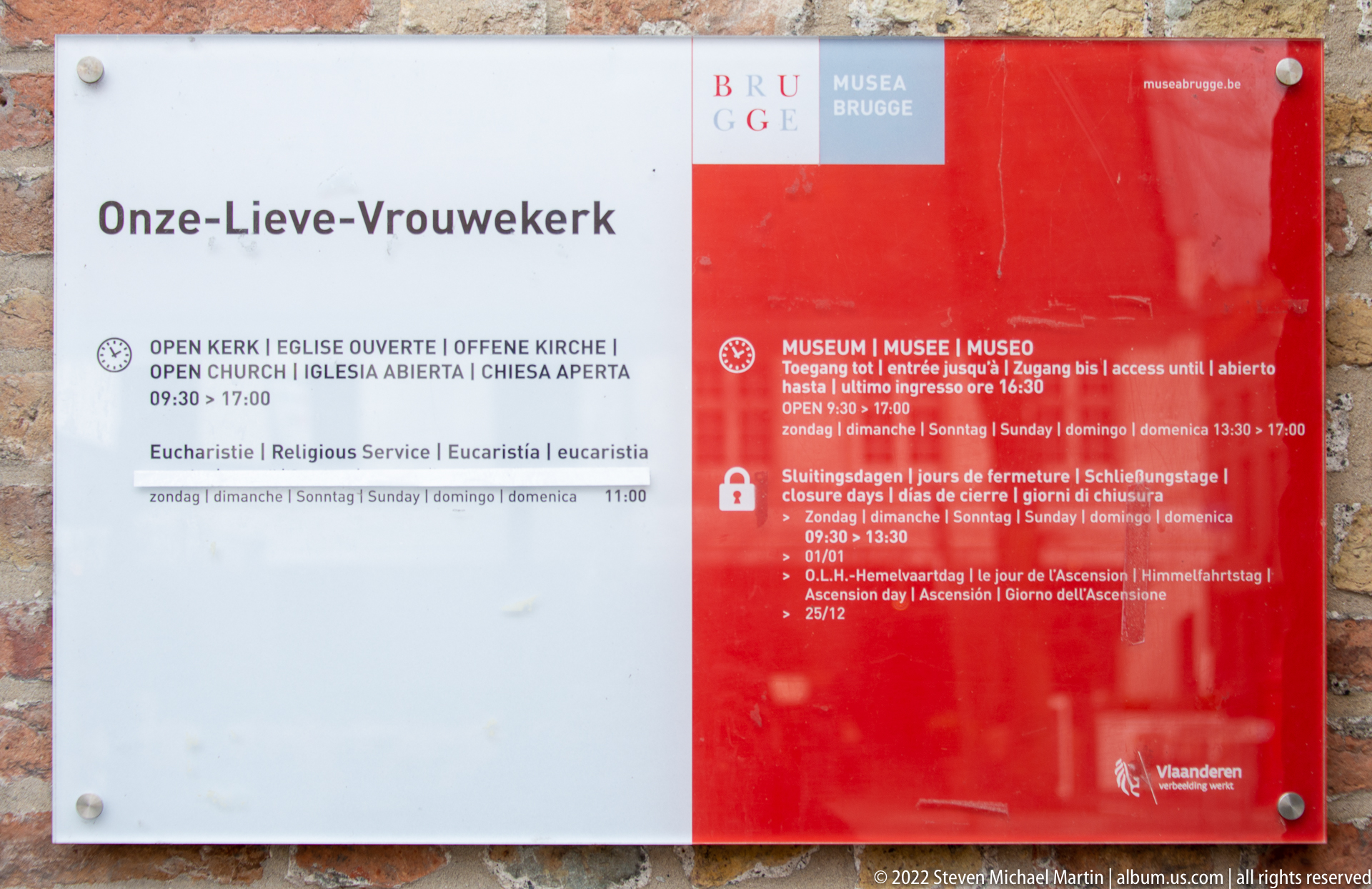
A bilingual visitor panel identifies Onze-Lieve-Vrouwekerk, Bruges’ Church of Our Lady, and lists opening hours for both church access and museum visits. The white-and-red design also carries the Musea Brugge name and visitor information in several languages. Mounted on old masonry, the sign marks the threshold between the active religious building and its museum presentation.
Caption
A bilingual visitor panel identifies Onze-Lieve-Vrouwekerk, Bruges’ Church of Our Lady, and lists opening hours for both church access and museum visits. The white-and-red design also carries the Musea Brugge name and visitor information in several languages. Mounted on old masonry, the sign marks the threshold between the active religious building and its museum presentation.
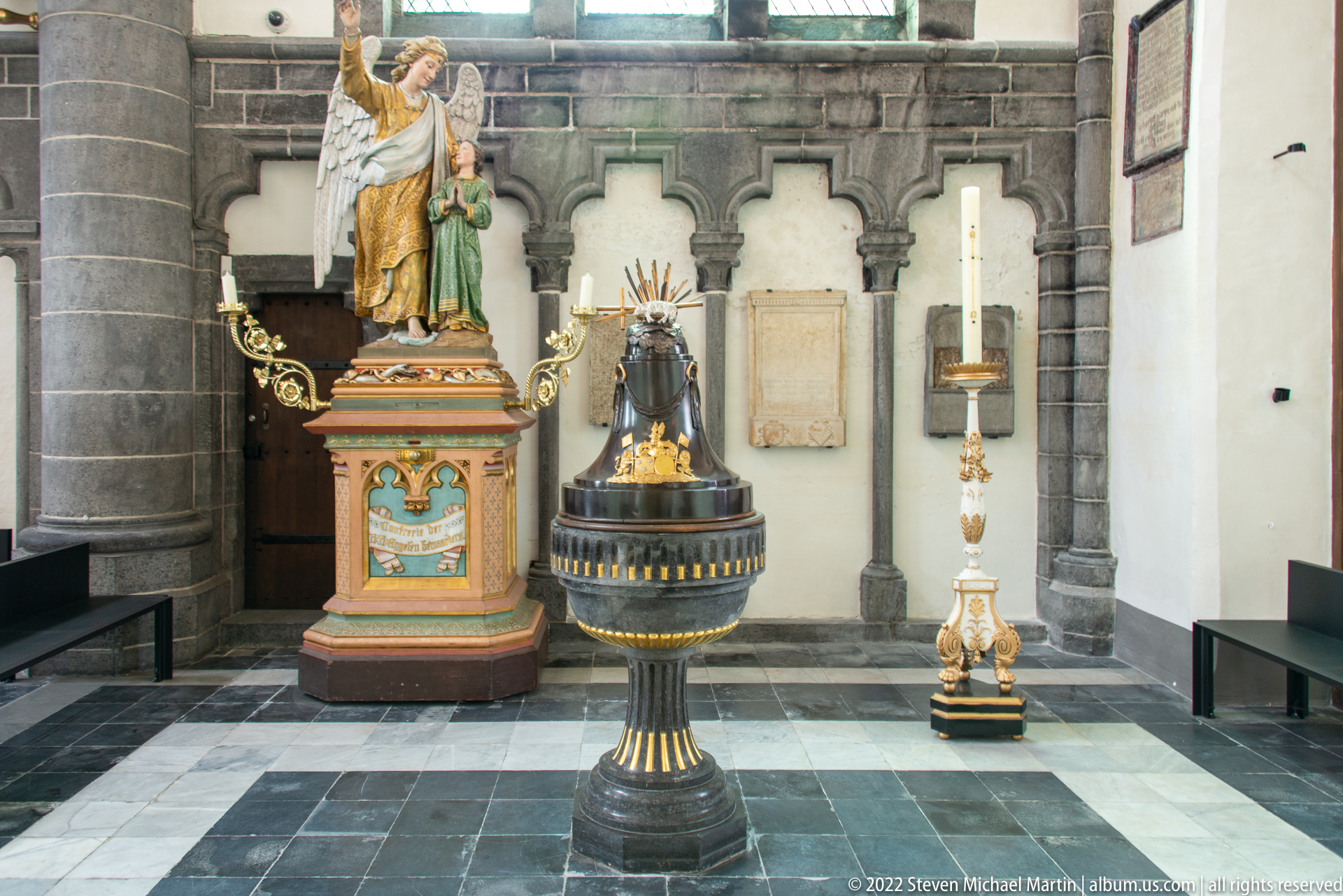
A small grouping of devotional furnishings stands against a dark stone wall inside the Church of Our Lady: a polychrome saint figure on a painted pedestal, a smaller crowned figure set within a dark niche-like base, and a tall ornate candle stand. The quiet side-chapel setting contrasts strongly with the church’s monumental architecture and highlights the intimate scale of individual devotional objects.
Caption
A small grouping of devotional furnishings stands against a dark stone wall inside the Church of Our Lady: a polychrome saint figure on a painted pedestal, a smaller crowned figure set within a dark niche-like base, and a tall ornate candle stand. The quiet side-chapel setting contrasts strongly with the church’s monumental architecture and highlights the intimate scale of individual devotional objects.
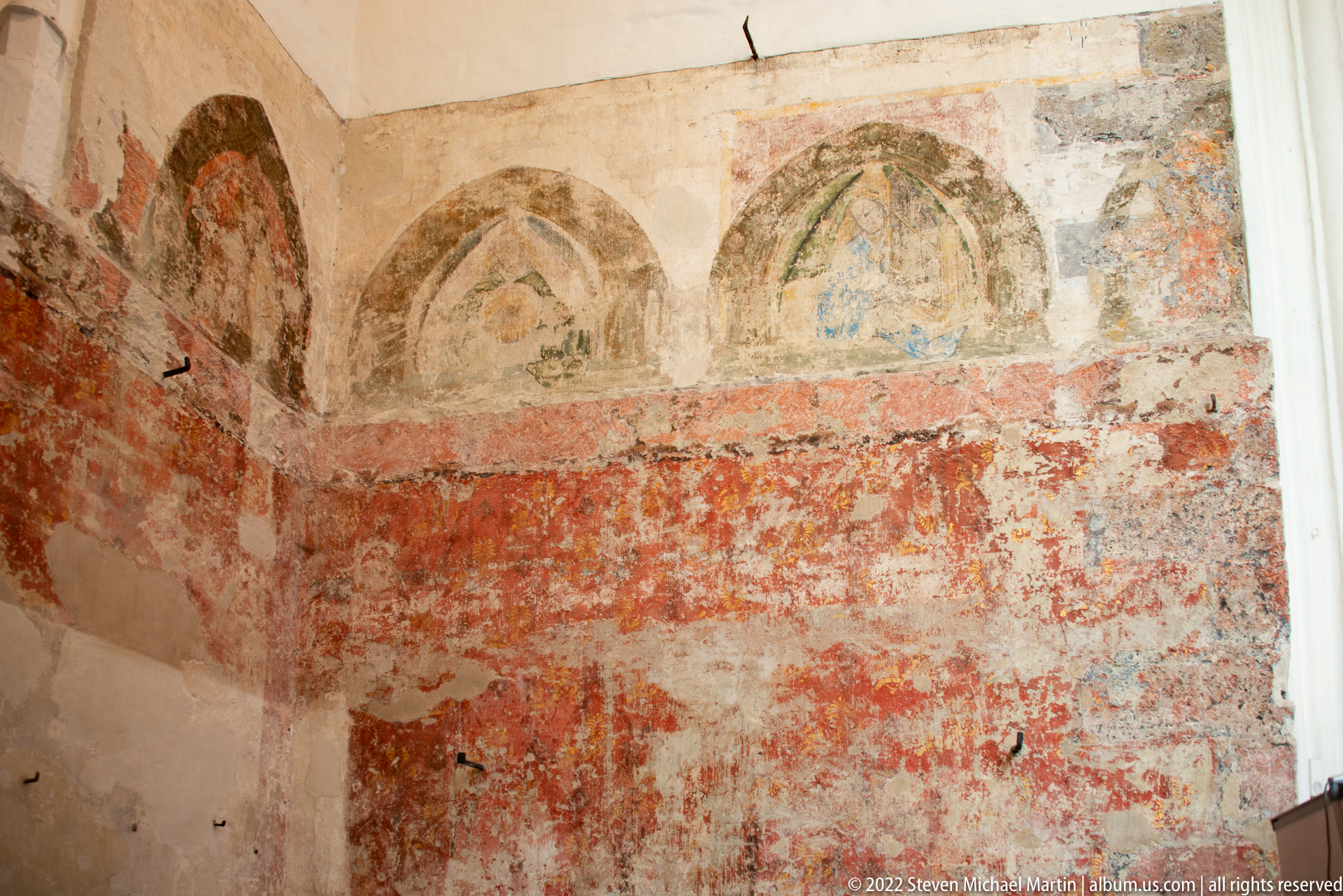
Faded wall paintings survive in fragmentary bands across an interior wall, with pointed-arch frames and traces of figures and colored ornament still visible beneath worn plaster. Large areas of red pigment remain below the upper narrative fragments. The exposed, uneven surface makes the image valuable as a conservation record, preserving evidence of earlier painted decoration within the church fabric.
Caption
Faded wall paintings survive in fragmentary bands across an interior wall, with pointed-arch frames and traces of figures and colored ornament still visible beneath worn plaster. Large areas of red pigment remain below the upper narrative fragments. The exposed, uneven surface makes the image valuable as a conservation record, preserving evidence of earlier painted decoration within the church fabric.
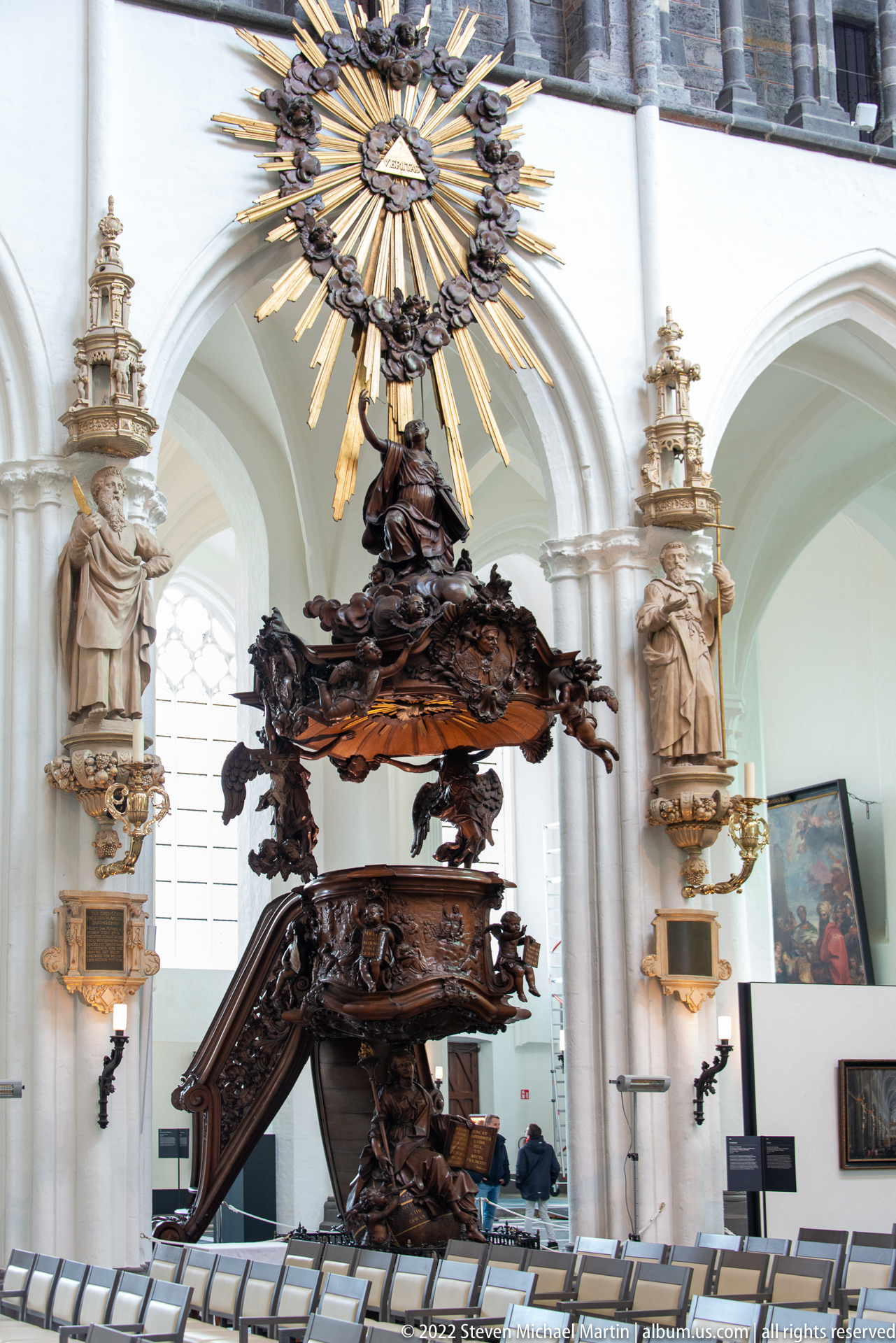
An exuberantly carved dark wooden pulpit rises beside the nave, its sweeping staircase, clustered figures, and deeply undercut ornament culminating in a radiant canopy overhead. A dramatic sunburst and suspended dove-like emblem crown the composition, while pale wall-mounted saint figures provide a restrained backdrop. The side view reveals the pulpit as a sculptural ensemble as much as a functional church furnishing.
Caption
An exuberantly carved dark wooden pulpit rises beside the nave, its sweeping staircase, clustered figures, and deeply undercut ornament culminating in a radiant canopy overhead. A dramatic sunburst and suspended dove-like emblem crown the composition, while pale wall-mounted saint figures provide a restrained backdrop. The side view reveals the pulpit as a sculptural ensemble as much as a functional church furnishing.
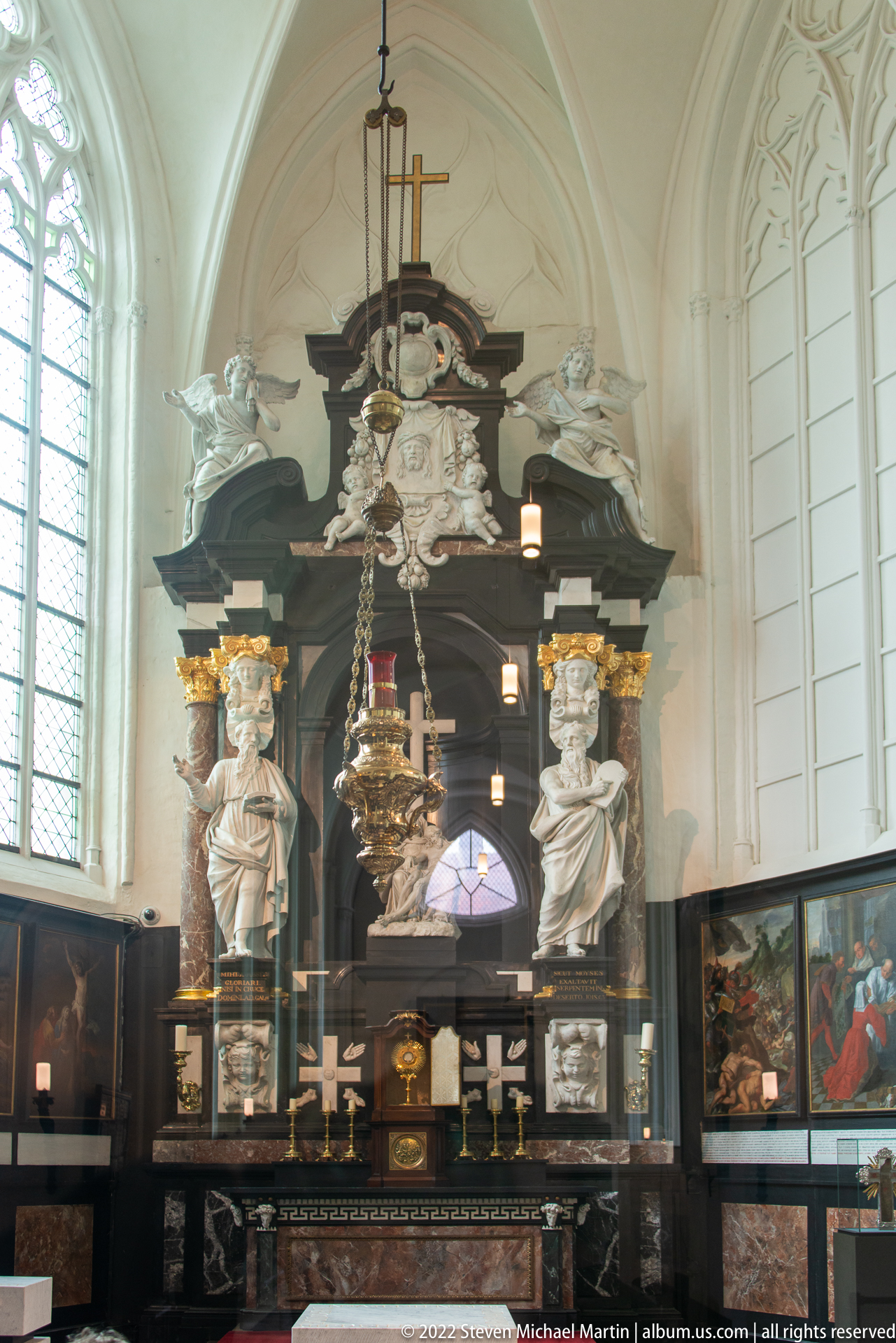
A dramatic side altar combines a dark architectural frame with pale sculpted figures, gilded accents, and a central crucifix beneath a small cross. Large allegorical or saintly figures flank the altar, while hanging lamps descend in front of the composition. The strong contrast of black, white, and gold creates a theatrical Baroque focus within the otherwise pale Gothic church interior.
Caption
A dramatic side altar combines a dark architectural frame with pale sculpted figures, gilded accents, and a central crucifix beneath a small cross. Large allegorical or saintly figures flank the altar, while hanging lamps descend in front of the composition. The strong contrast of black, white, and gold creates a theatrical Baroque focus within the otherwise pale Gothic church interior.
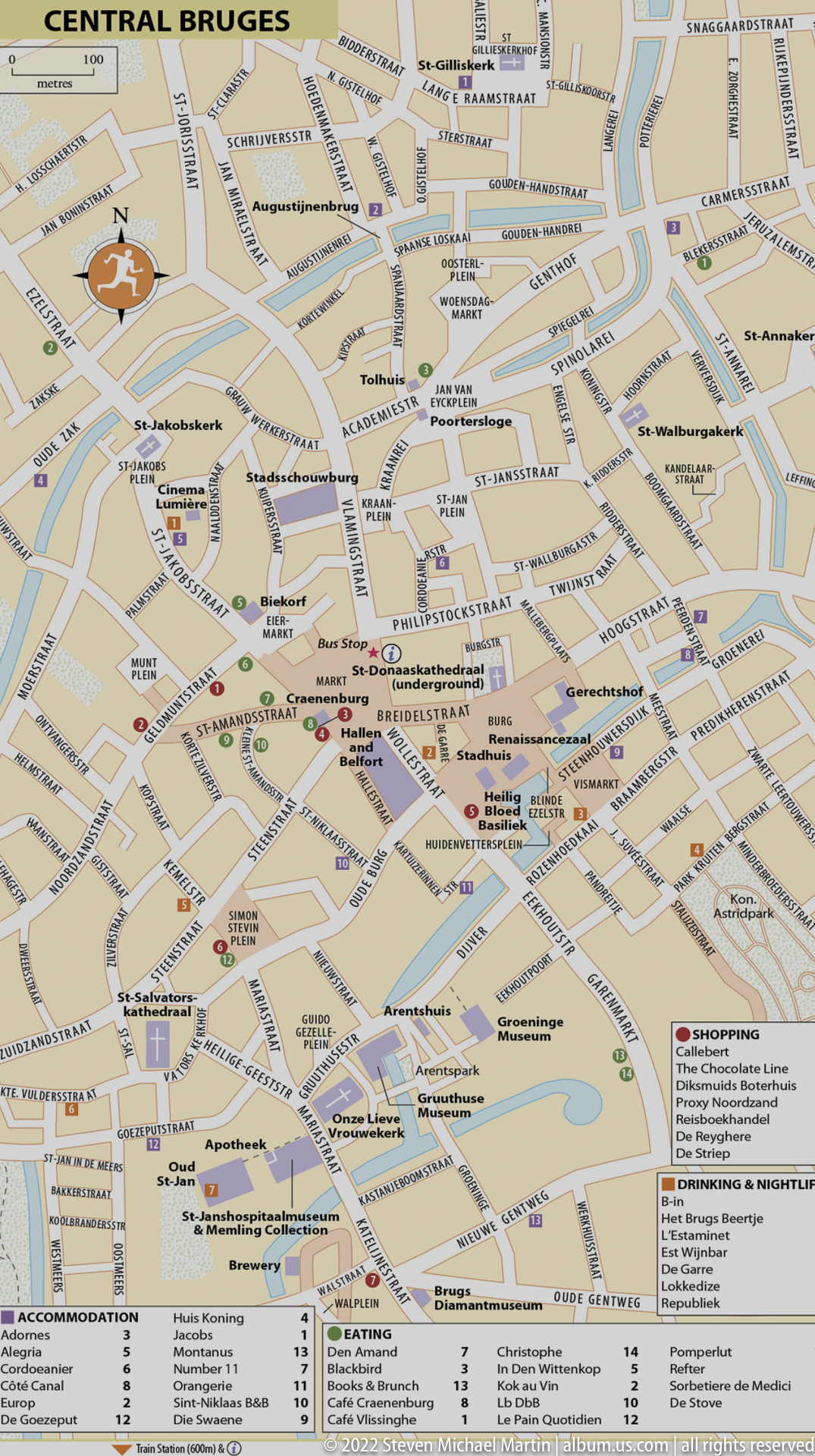
A detailed visitor map of central Bruges shows the dense medieval street network surrounded and crossed by blue waterways. Major landmarks, museums, churches, and transit points are marked with symbols, while a legend at lower right organizes visitor services and attractions. The photographed map provides a graphic overview of the compact historic center and its close relationship to the canal system.
Caption
A detailed visitor map of central Bruges shows the dense medieval street network surrounded and crossed by blue waterways. Major landmarks, museums, churches, and transit points are marked with symbols, while a legend at lower right organizes visitor services and attractions. The photographed map provides a graphic overview of the compact historic center and its close relationship to the canal system.

A warmly lit Bruges confectionery presents rows of packaged biscuits and sweets across wooden tables and wall shelves. Oversized red pendant lamps echo the red curtains and create a theatrical contrast with the pale products and natural wood display furniture. The wide interior view records the retail setting as a complete environment rather than focusing on a single confection or package.
Caption
A warmly lit Bruges confectionery presents rows of packaged biscuits and sweets across wooden tables and wall shelves. Oversized red pendant lamps echo the red curtains and create a theatrical contrast with the pale products and natural wood display furniture. The wide interior view records the retail setting as a complete environment rather than focusing on a single confection or package.
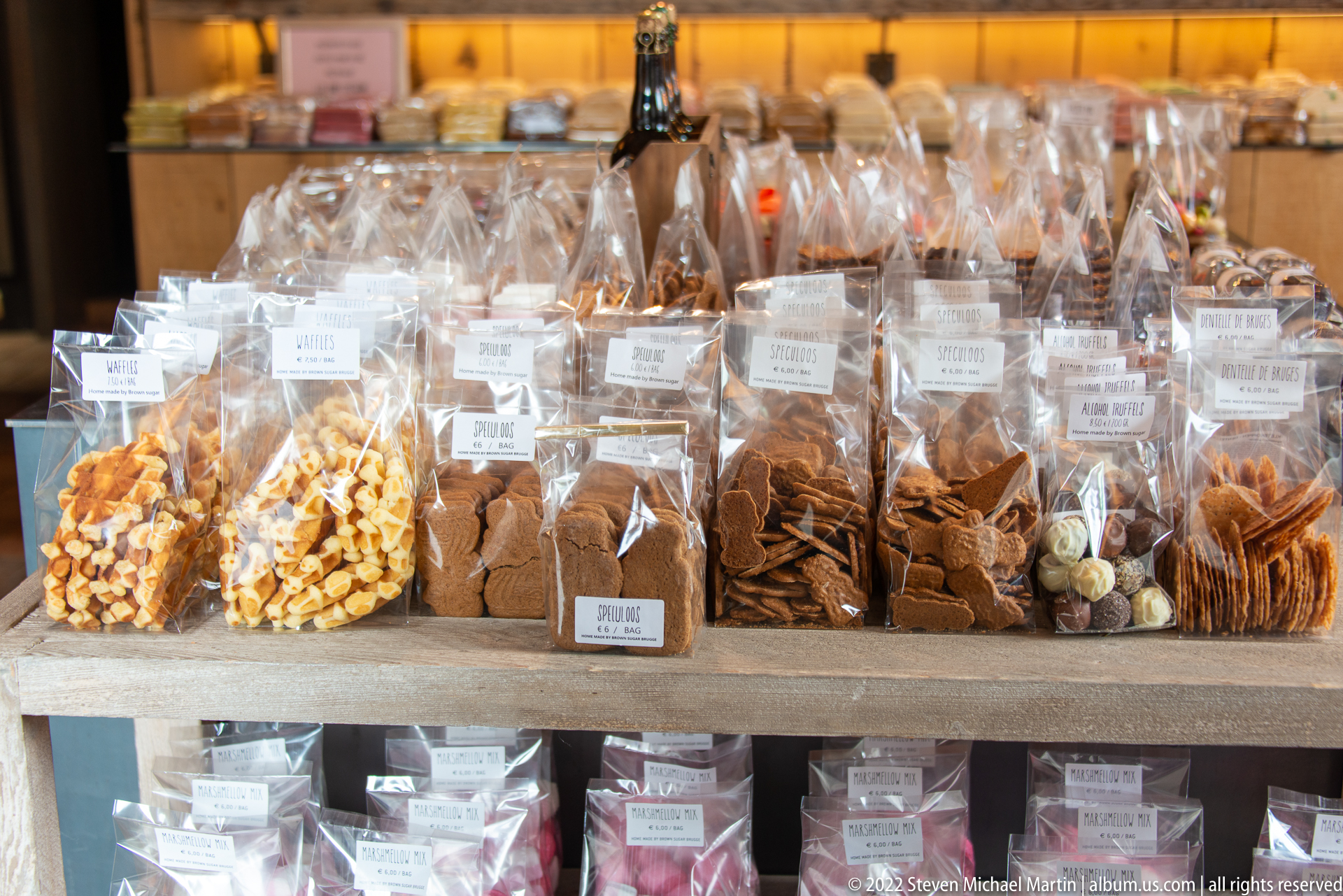
Rows of bagged biscuits and cookies are arranged across a wooden display table, with handwritten-style labels identifying individual varieties. Crisp waffles, thin rectangular biscuits, and darker spiced shapes create a range of textures and forms, while additional packaged sweets fill the lower shelf. The close retail view emphasizes the abundance and presentation of traditional-style Belgian baked confections.
Caption
Rows of bagged biscuits and cookies are arranged across a wooden display table, with handwritten-style labels identifying individual varieties. Crisp waffles, thin rectangular biscuits, and darker spiced shapes create a range of textures and forms, while additional packaged sweets fill the lower shelf. The close retail view emphasizes the abundance and presentation of traditional-style Belgian baked confections.

A picturesque brick civic complex turns the corner around a tall cylindrical tower capped by a steep conical roof. Crow-stepped gables, tall chimneys, stone-framed windows, and a row of flags animate the adjoining wings, while a more elaborate institutional façade rises behind the trees at right. The street view highlights the irregular, accumulated character of Bruges’ monumental historic architecture.
Caption
A picturesque brick civic complex turns the corner around a tall cylindrical tower capped by a steep conical roof. Crow-stepped gables, tall chimneys, stone-framed windows, and a row of flags animate the adjoining wings, while a more elaborate institutional façade rises behind the trees at right. The street view highlights the irregular, accumulated character of Bruges’ monumental historic architecture.
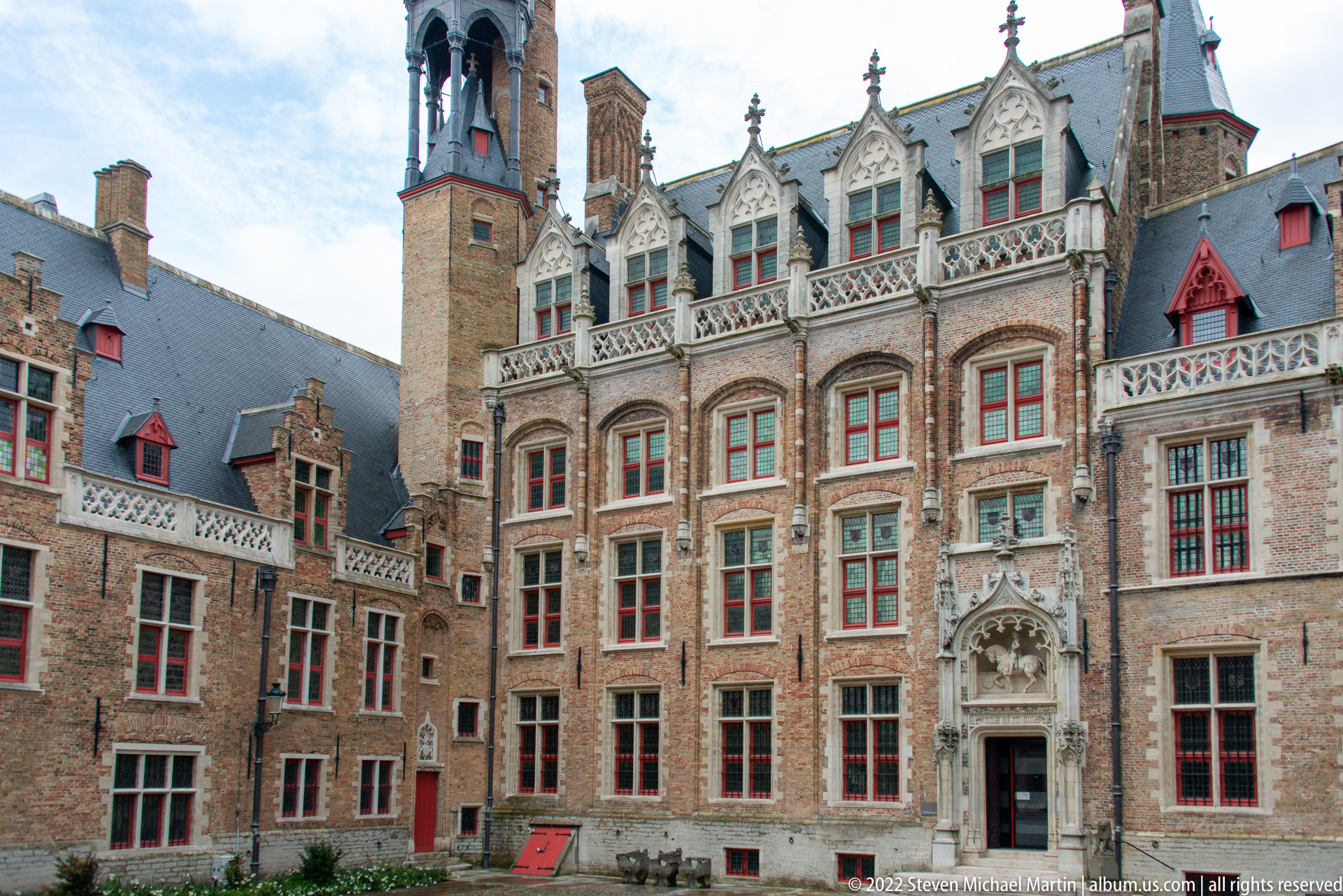
An ornate courtyard elevation combines warm brick walls with pale carved stone tracery, pointed gables, balustrades, and tall red-framed windows. A central entrance beneath a richly sculpted surround anchors the symmetrical upper façade, while adjoining wings create an enclosed institutional setting. The frontal view is especially useful for reading the layered decorative program across windows, roofline, and doorway.
Caption
An ornate courtyard elevation combines warm brick walls with pale carved stone tracery, pointed gables, balustrades, and tall red-framed windows. A central entrance beneath a richly sculpted surround anchors the symmetrical upper façade, while adjoining wings create an enclosed institutional setting. The frontal view is especially useful for reading the layered decorative program across windows, roofline, and doorway.

An armored rider on horseback occupies a deep stone niche framed by an elaborate Gothic canopy. The horse advances in profile while the rider raises one hand, and delicate tracery, crockets, and pinnacles surround the sculptural scene. Set against red brick, the pale stone relief reads as a heraldic or commemorative architectural centerpiece on an important historic façade.
Caption
An armored rider on horseback occupies a deep stone niche framed by an elaborate Gothic canopy. The horse advances in profile while the rider raises one hand, and delicate tracery, crockets, and pinnacles surround the sculptural scene. Set against red brick, the pale stone relief reads as a heraldic or commemorative architectural centerpiece on an important historic façade.

A dark timber upper passage bridges a narrow lane between weathered brick buildings, its windows projecting above a broad pedestrian archway. A small gilded crest or emblem decorates the center of the wooden façade, while red-trimmed windows punctuate the adjoining masonry. The confined viewpoint emphasizes Bruges’ layered medieval-scale circulation, where buildings extend directly above the street.
Caption
A dark timber upper passage bridges a narrow lane between weathered brick buildings, its windows projecting above a broad pedestrian archway. A small gilded crest or emblem decorates the center of the wooden façade, while red-trimmed windows punctuate the adjoining masonry. The confined viewpoint emphasizes Bruges’ layered medieval-scale circulation, where buildings extend directly above the street.
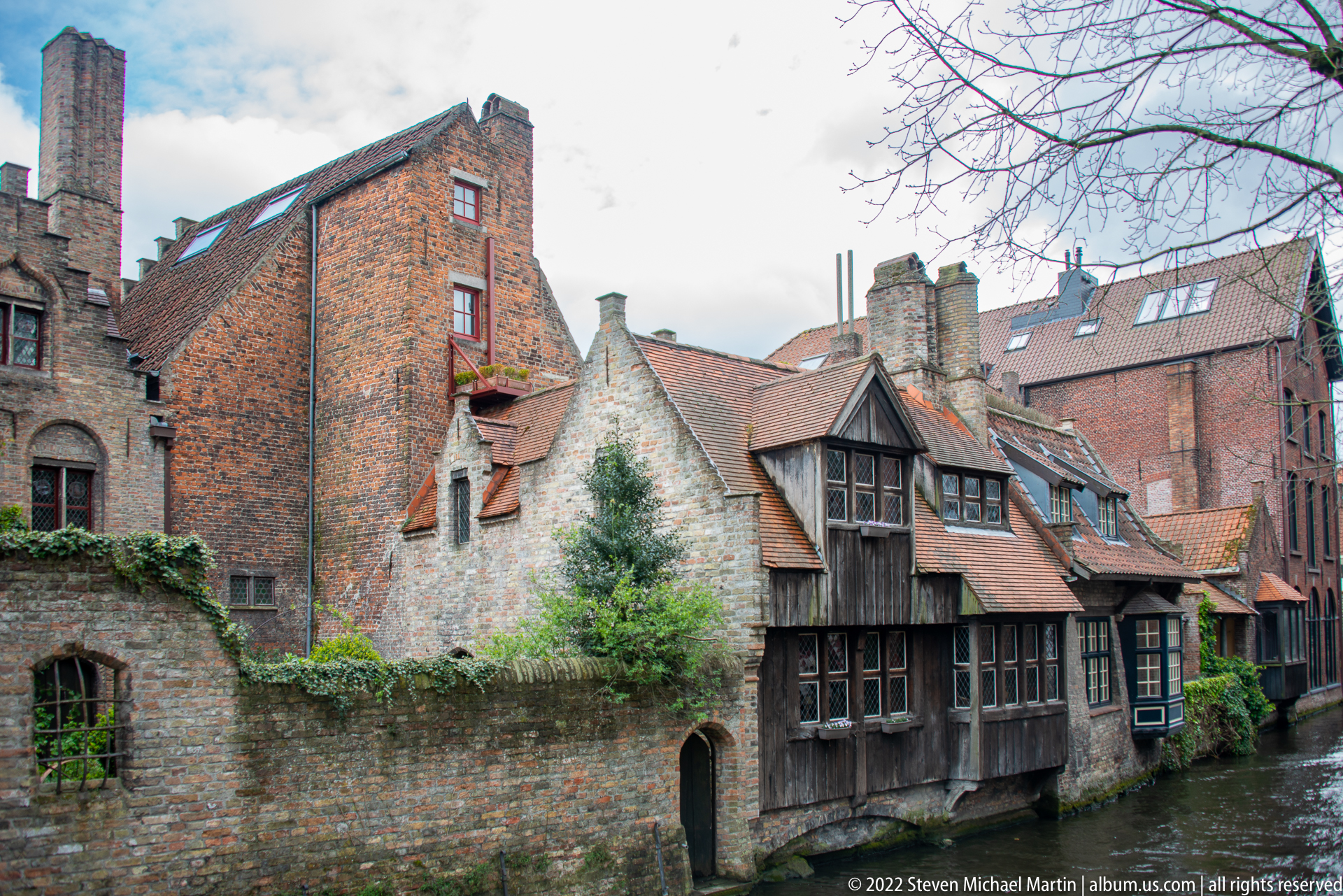
A cluster of irregular historic houses presses closely against a narrow Bruges canal, combining weathered brick, steep red-tile roofs, timber-framed upper stories, chimneys, and small windows. Ivy and garden growth soften the canal wall below. The intimate composition records a quieter residential corner where accumulated building phases and materials are more visible than formal civic ornament.
Caption
A cluster of irregular historic houses presses closely against a narrow Bruges canal, combining weathered brick, steep red-tile roofs, timber-framed upper stories, chimneys, and small windows. Ivy and garden growth soften the canal wall below. The intimate composition records a quieter residential corner where accumulated building phases and materials are more visible than formal civic ornament.

Molded chocolates shaped like high-heeled shoes are displayed individually in clear boxes tied with red ribbons. The shoes vary in chocolate color and decoration, including orange, green, white, and gold-toned finishes, while miniature colorful house packages line the shelf above. The playful presentation shows the imaginative sculptural side of Bruges’ chocolate retail culture beyond conventional pralines and bars.
Caption
Molded chocolates shaped like high-heeled shoes are displayed individually in clear boxes tied with red ribbons. The shoes vary in chocolate color and decoration, including orange, green, white, and gold-toned finishes, while miniature colorful house packages line the shelf above. The playful presentation shows the imaginative sculptural side of Bruges’ chocolate retail culture beyond conventional pralines and bars.
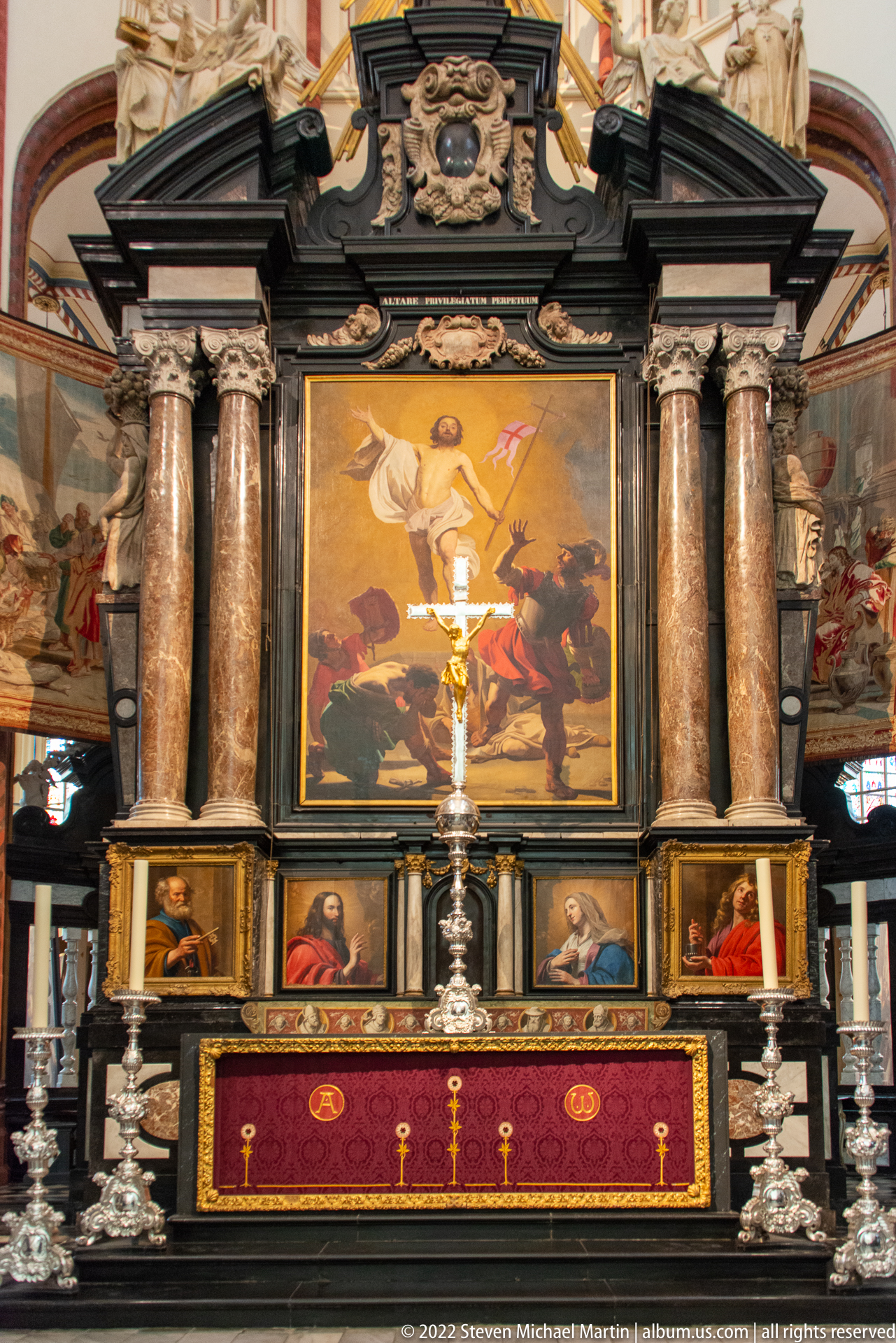
A richly framed altar ensemble centers on a dramatic religious painting above a red textile frontal embroidered with gold symbols. Massive marble columns flank the painting, while tall silver candlesticks and a central crucifix create a symmetrical liturgical arrangement. Painted narrative scenes continue behind the architectural frame, making the altar a dense synthesis of sculpture, painting, precious metal, and textile decoration.
Caption
A richly framed altar ensemble centers on a dramatic religious painting above a red textile frontal embroidered with gold symbols. Massive marble columns flank the painting, while tall silver candlesticks and a central crucifix create a symmetrical liturgical arrangement. Painted narrative scenes continue behind the architectural frame, making the altar a dense synthesis of sculpture, painting, precious metal, and textile decoration.
⭐ Highlights
- Historic Centre: One of the best-preserved medieval city centers in Europe.
- Canal Network: A system of waterways that shaped Bruges’ growth and identity.
- Belfry of Bruges: A medieval tower overlooking the Market Square.
- Market Square (Markt): The central square lined with colorful historic buildings.
- Laid-Back Medieval Streets: Cobblestone lanes and preserved architecture create a timeless atmosphere.
- “Venice of the North”: Known for its canals and picturesque setting.
🏙️ Bruges Field Guide
Major features observed during this visit:
Bruges is one of Europe’s most remarkably preserved medieval cities, located in the Flanders region of Belgium. During the Middle Ages, it developed into a major center of trade, culture, and art, supported by its network of canals connecting it to the North Sea. Today, the city retains its historic layout, architecture, and atmosphere, offering one of the most complete medieval urban experiences in Europe.
🏛️ Signature Landmarks
- Belfry of Bruges – A medieval tower that dominates the Market Square.
- Market Square – The historic and civic heart of the city.
- Canal System – Waterways that define the structure and movement of the city.
- Church of Our Lady – A major Gothic church within the historic center.
- Beguinage – A peaceful historic complex reflecting religious and communal life.
🧠 Historical Significance
- Medieval Trade Center – Bruges was a major commercial hub in Europe during the Middle Ages.
- Hanseatic Influence – International merchants contributed to its wealth and cultural exchange.
- Preservation – The city’s historic core remained largely intact over time.
- UNESCO World Heritage Site – Recognized for its exceptional medieval urban fabric.
🌄 Urban Landscape & Setting
- Canal-Based Layout – Waterways shape the city’s structure and views.
- Compact Historic Core – The city is easily explored on foot.
- Gothic Architecture – Brick buildings and towers define the skyline.
- Timeless Atmosphere – Streets and spaces retain a strong sense of the medieval past.