Zagreb – Croatia
Zagreb, the capital of Croatia, lies along the southern slopes of Mount Medvednica near the upper reaches of the Sava River. The city developed from two historic settlements—Gradec and Kaptol—which gradually grew together to form the modern city.
The historic Upper Town contains medieval streets, churches, and government buildings that reflect the city’s early development. Nearby stands the impressive Zagreb Cathedral, whose tall neo-Gothic towers dominate the skyline.
Below the historic district, broad boulevards and parks form the Lower Town, where elegant Austro-Hungarian architecture reflects Zagreb’s growth during the 19th century as an important cultural and administrative center.
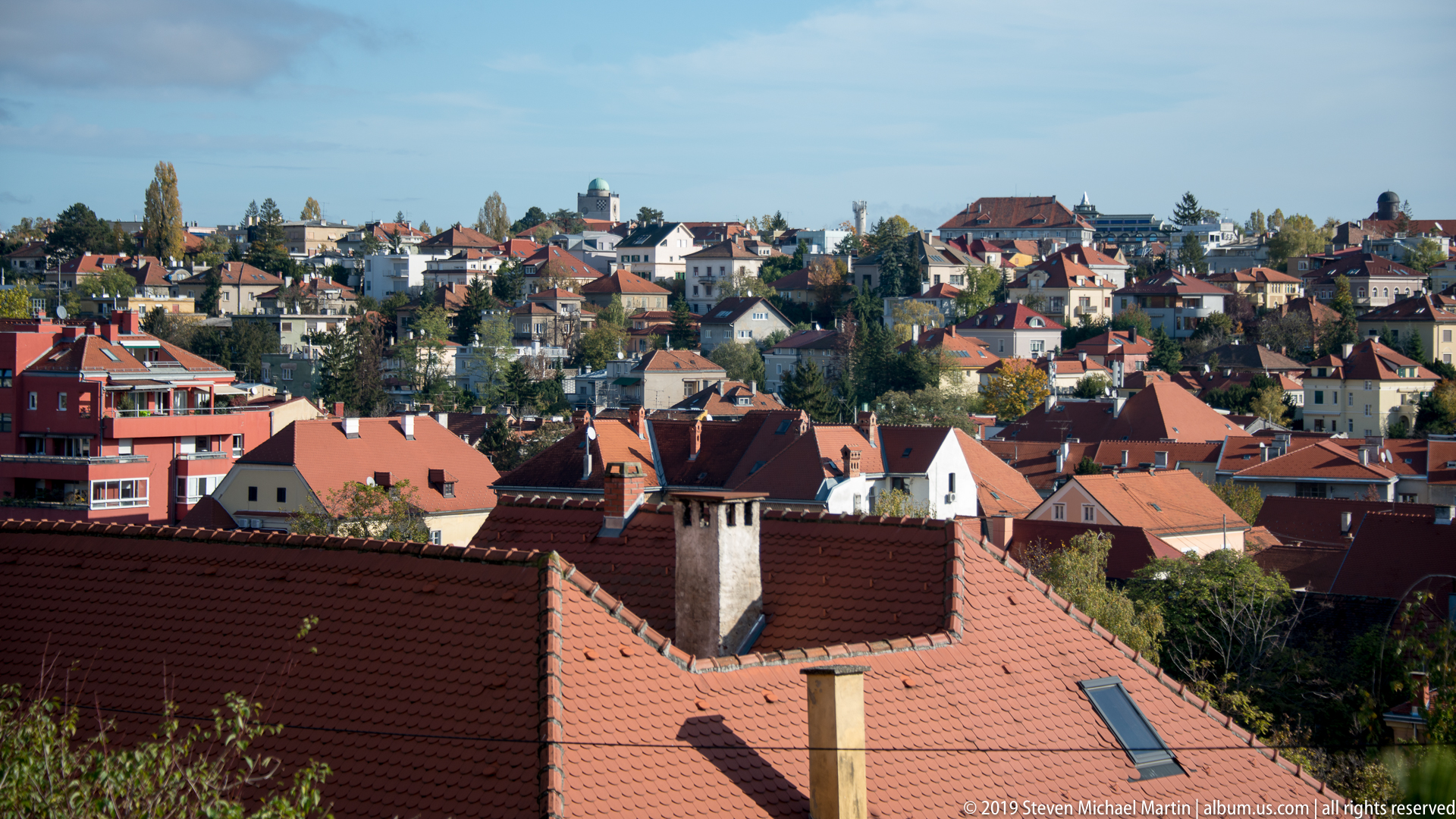
Red clay roofs, chimneys, church towers, and closely packed houses spread across Zagreb’s historic Upper Town. The elevated viewpoint emphasizes the irregular medieval street pattern beneath a later cityscape of tiled roofs and masonry façades. Distinctive vertical landmarks rise above the residential fabric, while the foreground roof planes give the scene the layered texture characteristic of the old hilltop quarters.
Caption
Red clay roofs, chimneys, church towers, and closely packed houses spread across Zagreb’s historic Upper Town. The elevated viewpoint emphasizes the irregular medieval street pattern beneath a later cityscape of tiled roofs and masonry façades. Distinctive vertical landmarks rise above the residential fabric, while the foreground roof planes give the scene the layered texture characteristic of the old hilltop quarters.

St. Mark’s Church appears at the end of a narrow Upper Town street, its patterned roof and square bell tower framed by close-set historic buildings. Croatian and European Union flags hang above the approach, linking the old civic quarter to its contemporary governmental role. The compressed perspective shows how the church is encountered within the dense street network rather than as an isolated monument.
Caption
St. Mark’s Church appears at the end of a narrow Upper Town street, its patterned roof and square bell tower framed by close-set historic buildings. Croatian and European Union flags hang above the approach, linking the old civic quarter to its contemporary governmental role. The compressed perspective shows how the church is encountered within the dense street network rather than as an isolated monument.

A compact white souvenir kiosk stands at an elevated viewpoint above Zagreb, its canopy sheltering rows of colorful trinkets and hanging keepsakes. A black streetlamp and bare branches frame the stall, while the city stretches away in the background. The scene records the everyday visitor economy of the historic center as much as the panoramic setting beyond it.
Caption
A compact white souvenir kiosk stands at an elevated viewpoint above Zagreb, its canopy sheltering rows of colorful trinkets and hanging keepsakes. A black streetlamp and bare branches frame the stall, while the city stretches away in the background. The scene records the everyday visitor economy of the historic center as much as the panoramic setting beyond it.

A massive clustered pier dominates the foreground as Gothic arches radiate around it, revealing the structural complexity of Zagreb Cathedral’s interior. Stained glass, side altars, chandeliers, and rows of seating remain visible beyond, but the photograph’s emphasis is firmly architectural. The composition demonstrates how bundled vertical shafts carry the vaulting and divide the cathedral’s spatial zones.
Caption
A massive clustered pier dominates the foreground as Gothic arches radiate around it, revealing the structural complexity of Zagreb Cathedral’s interior. Stained glass, side altars, chandeliers, and rows of seating remain visible beyond, but the photograph’s emphasis is firmly architectural. The composition demonstrates how bundled vertical shafts carry the vaulting and divide the cathedral’s spatial zones.

Sunlight pours through the upper windows of Zagreb Cathedral and catches the tall piers and ribbed vaults along the nave. The sanctuary remains centered in the distance, while a hanging chandelier and sculpted pulpit animate the foreground. Compared with the more symmetrical nave views, this slightly offset composition emphasizes the changing light and the immense vertical surfaces of the Gothic interior.
Caption
Sunlight pours through the upper windows of Zagreb Cathedral and catches the tall piers and ribbed vaults along the nave. The sanctuary remains centered in the distance, while a hanging chandelier and sculpted pulpit animate the foreground. Compared with the more symmetrical nave views, this slightly offset composition emphasizes the changing light and the immense vertical surfaces of the Gothic interior.

Lotrščak Tower rises as a massive white rectangular block above Zagreb’s Upper Town, its thick walls punctuated by small windows and iron tie plates. A red-tiled roof supports the enclosed lookout structure at the summit. The fortress-like proportions preserve the tower’s defensive character, while the elevated lantern-like top reflects its later role as a city landmark and viewpoint.
Caption
Lotrščak Tower rises as a massive white rectangular block above Zagreb’s Upper Town, its thick walls punctuated by small windows and iron tie plates. A red-tiled roof supports the enclosed lookout structure at the summit. The fortress-like proportions preserve the tower’s defensive character, while the elevated lantern-like top reflects its later role as a city landmark and viewpoint.

A white masonry bell tower rises sharply from the surrounding streetscape, its paired arched openings shaded by dark louvers beneath a green pyramidal roof. Decorative bands and shallow pilasters articulate the upper stages, while overhead wires cross the blue sky. The low-angle crop turns a familiar urban tower into a study of proportion, openings, and roof form rather than presenting the entire church complex.
Caption
A white masonry bell tower rises sharply from the surrounding streetscape, its paired arched openings shaded by dark louvers beneath a green pyramidal roof. Decorative bands and shallow pilasters articulate the upper stages, while overhead wires cross the blue sky. The low-angle crop turns a familiar urban tower into a study of proportion, openings, and roof form rather than presenting the entire church complex.

Dolac Market fills the foreground with fruit and vegetable stalls shaded by Zagreb’s characteristic red umbrellas. Shoppers and vendors move among the displays while a pale civic block and a slender church tower rise behind the market. The photograph presents the market as an active urban space rather than a still-life of produce, combining daily commerce, pedestrian activity, and the historic center’s layered skyline.
Caption
Dolac Market fills the foreground with fruit and vegetable stalls shaded by Zagreb’s characteristic red umbrellas. Shoppers and vendors move among the displays while a pale civic block and a slender church tower rise behind the market. The photograph presents the market as an active urban space rather than a still-life of produce, combining daily commerce, pedestrian activity, and the historic center’s layered skyline.

A monumental ochre public building dominates the street corner with rusticated lower walls, tall arched windows, sculpted pediments, and a large green-patinated roof pavilion. A Croatian flag flies from the adjoining wing, reinforcing the building’s civic character. The oblique viewpoint reveals the depth of the complex and the powerful transition from heavy masonry base to ornate upper stories.
Caption
A monumental ochre public building dominates the street corner with rusticated lower walls, tall arched windows, sculpted pediments, and a large green-patinated roof pavilion. A Croatian flag flies from the adjoining wing, reinforcing the building’s civic character. The oblique viewpoint reveals the depth of the complex and the powerful transition from heavy masonry base to ornate upper stories.

A tall stone column topped by a gilded Marian figure rises above low historic buildings in Zagreb’s cathedral precinct. Additional gilded figures cluster around the monument’s lower pedestal, while red-tiled roofs and a church tower place it firmly within the old city skyline. The wider composition records the monument as an urban landmark rather than as an isolated sculpture, showing its relationship to the surrounding square.
Caption
A tall stone column topped by a gilded Marian figure rises above low historic buildings in Zagreb’s cathedral precinct. Additional gilded figures cluster around the monument’s lower pedestal, while red-tiled roofs and a church tower place it firmly within the old city skyline. The wider composition records the monument as an urban landmark rather than as an isolated sculpture, showing its relationship to the surrounding square.

A painted and gilded retable rises above a stone altar in a side chapel of Zagreb Cathedral. A large central sacred scene is surrounded by smaller narrative panels, while stained glass and Gothic wall openings frame the ensemble. The photograph isolates the chapel’s devotional furnishings and shows how Renaissance- or Baroque-style painting and gilded ornament coexist within the cathedral’s Gothic architectural shell.
Caption
A painted and gilded retable rises above a stone altar in a side chapel of Zagreb Cathedral. A large central sacred scene is surrounded by smaller narrative panels, while stained glass and Gothic wall openings frame the ensemble. The photograph isolates the chapel’s devotional furnishings and shows how Renaissance- or Baroque-style painting and gilded ornament coexist within the cathedral’s Gothic architectural shell.

The gilded Virgin Mary crowns Zagreb’s Marian column, shown in a tight upward-looking detail against an uninterrupted blue sky. Her crown and halo of stars, flowing drapery, and open-handed gesture dominate the composition, while the dark capital and column shaft provide a stark base below. The close crop removes the surrounding square and focuses attention on the monument’s devotional iconography and metallic finish.
Caption
The gilded Virgin Mary crowns Zagreb’s Marian column, shown in a tight upward-looking detail against an uninterrupted blue sky. Her crown and halo of stars, flowing drapery, and open-handed gesture dominate the composition, while the dark capital and column shaft provide a stark base below. The close crop removes the surrounding square and focuses attention on the monument’s devotional iconography and metallic finish.

The nave of Zagreb Cathedral opens toward the brightly lit sanctuary, where clustered columns, pointed arches, stained-glass windows, and a high ribbed vault frame the altar. A patterned tile floor and dark wooden pews lead the eye forward, while side furnishings and devotional objects show the layered liturgical character of the interior. The view emphasizes the cathedral’s vertical Gothic proportions and luminous eastern end.
Caption
The nave of Zagreb Cathedral opens toward the brightly lit sanctuary, where clustered columns, pointed arches, stained-glass windows, and a high ribbed vault frame the altar. A patterned tile floor and dark wooden pews lead the eye forward, while side furnishings and devotional objects show the layered liturgical character of the interior. The view emphasizes the cathedral’s vertical Gothic proportions and luminous eastern end.

The vividly patterned roof of St. Mark’s Church is filled with red, white, and blue glazed tiles arranged around large heraldic emblems. The steep roof plane rises behind pale Gothic gables, creating one of Zagreb’s most recognizable architectural details. This close view isolates the geometric tilework and shields from the broader church, showing how civic and regional symbolism is integrated directly into the roof surface.
Caption
The vividly patterned roof of St. Mark’s Church is filled with red, white, and blue glazed tiles arranged around large heraldic emblems. The steep roof plane rises behind pale Gothic gables, creating one of Zagreb’s most recognizable architectural details. This close view isolates the geometric tilework and shields from the broader church, showing how civic and regional symbolism is integrated directly into the roof surface.

Three monumental mosaic figures occupy arched niches between pale columns on a historic church façade. The central saint stands frontally with a book, while the flanking figures hold additional attributes and are identified by inscriptions beneath their feet. Gold backgrounds, patterned halos, and strong outlines give the ensemble a Byzantine-revival character, while the surrounding carved stonework links the mosaics to the building’s architectural program.
Caption
Three monumental mosaic figures occupy arched niches between pale columns on a historic church façade. The central saint stands frontally with a book, while the flanking figures hold additional attributes and are identified by inscriptions beneath their feet. Gold backgrounds, patterned halos, and strong outlines give the ensemble a Byzantine-revival character, while the surrounding carved stonework links the mosaics to the building’s architectural program.

A low, wide-angle view inside Zagreb Cathedral draws attention to the soaring ribbed vaults and the rhythm of the nave arcades. Stained-glass windows illuminate the distant sanctuary while darker pews and side aisles remain in shadow. The composition makes the great height and length of the interior more apparent than a conventional eye-level view, emphasizing the building’s structural skeleton and dramatic verticality.
Caption
A low, wide-angle view inside Zagreb Cathedral draws attention to the soaring ribbed vaults and the rhythm of the nave arcades. Stained-glass windows illuminate the distant sanctuary while darker pews and side aisles remain in shadow. The composition makes the great height and length of the interior more apparent than a conventional eye-level view, emphasizing the building’s structural skeleton and dramatic verticality.

A gilded figure of the Virgin Mary, crowned and encircled by a halo of stars, rises above accompanying sculptural figures against a clear blue sky. Seen from below, the group is isolated from its architectural surroundings and reads primarily as a devotional monument. The upward viewpoint emphasizes the metallic surface, the open gesture of Mary’s hands, and the layered arrangement of figures around the base.
Caption
A gilded figure of the Virgin Mary, crowned and encircled by a halo of stars, rises above accompanying sculptural figures against a clear blue sky. Seen from below, the group is isolated from its architectural surroundings and reads primarily as a devotional monument. The upward viewpoint emphasizes the metallic surface, the open gesture of Mary’s hands, and the layered arrangement of figures around the base.

The cathedral nave stretches toward a luminous sanctuary framed by pointed arches, stained glass, and clustered stone supports. The broad wide-angle perspective includes both rows of pews and the rising vaults, making the interior feel expansive while preserving the strong axial focus on the altar. Light from the clerestory and east-end windows produces a marked contrast between the bright sanctuary and darker side aisles.
Caption
The cathedral nave stretches toward a luminous sanctuary framed by pointed arches, stained glass, and clustered stone supports. The broad wide-angle perspective includes both rows of pews and the rising vaults, making the interior feel expansive while preserving the strong axial focus on the altar. Light from the clerestory and east-end windows produces a marked contrast between the bright sanctuary and darker side aisles.

Zagreb Cathedral’s west front rises dramatically from a low viewpoint, with its richly carved central portal, rose window, traceried openings, and paired towers dominating the frame. One tower is partially concealed by printed construction screening, making the ongoing restoration part of the architectural record. The image contrasts the pale stone Gothic Revival façade with the clear blue sky and emphasizes the cathedral’s vertical massing.
Caption
Zagreb Cathedral’s west front rises dramatically from a low viewpoint, with its richly carved central portal, rose window, traceried openings, and paired towers dominating the frame. One tower is partially concealed by printed construction screening, making the ongoing restoration part of the architectural record. The image contrasts the pale stone Gothic Revival façade with the clear blue sky and emphasizes the cathedral’s vertical massing.

The west façade of Zagreb Cathedral fills the frame from a steep upward angle, bringing the carved portal, rose window, pointed tracery, and paired towers into close alignment. Construction screening obscures part of the right tower, while the left tower remains fully visible. The close perspective concentrates attention on the façade’s dense sculptural detailing and on the temporary intervention of restoration work.
Caption
The west façade of Zagreb Cathedral fills the frame from a steep upward angle, bringing the carved portal, rose window, pointed tracery, and paired towers into close alignment. Construction screening obscures part of the right tower, while the left tower remains fully visible. The close perspective concentrates attention on the façade’s dense sculptural detailing and on the temporary intervention of restoration work.

A monumental inscription occupies a tall wall panel inside Zagreb Cathedral, extending upward beside a crucifix and sculptural furnishings. The text is arranged in many closely spaced lines and visually dominates this side of the nave, while visitors at floor level provide a strong sense of scale. The image records the inscription as part of the cathedral’s interior commemorative and devotional environment without relying on an uncertain transcription.
Caption
A monumental inscription occupies a tall wall panel inside Zagreb Cathedral, extending upward beside a crucifix and sculptural furnishings. The text is arranged in many closely spaced lines and visually dominates this side of the nave, while visitors at floor level provide a strong sense of scale. The image records the inscription as part of the cathedral’s interior commemorative and devotional environment without relying on an uncertain transcription.

A pale Baroque façade with tall arched ground-floor windows adjoins a massive round masonry tower capped by a steep roof. The contrast between the refined stucco elevation and the heavy cylindrical defensive form reveals the layered architectural history of Zagreb’s cathedral precinct. Flags hang above the entrance, while the adjoining tower retains only small openings, underscoring its earlier defensive function.
Caption
A pale Baroque façade with tall arched ground-floor windows adjoins a massive round masonry tower capped by a steep roof. The contrast between the refined stucco elevation and the heavy cylindrical defensive form reveals the layered architectural history of Zagreb’s cathedral precinct. Flags hang above the entrance, while the adjoining tower retains only small openings, underscoring its earlier defensive function.

A carefully planted flowerbed forms a large heraldic emblem in green foliage, white gravel, and seasonal flowers. The symmetrical design uses clipped planting to define a dark shield-like field, a central white symbol, and a small star below, all set within a crisp rectangular border. Viewed slightly from above, the photograph emphasizes civic landscaping as a deliberate form of public ornament in Zagreb.
Caption
A carefully planted flowerbed forms a large heraldic emblem in green foliage, white gravel, and seasonal flowers. The symmetrical design uses clipped planting to define a dark shield-like field, a central white symbol, and a small star below, all set within a crisp rectangular border. Viewed slightly from above, the photograph emphasizes civic landscaping as a deliberate form of public ornament in Zagreb.

A large pipe organ occupies a gallery beneath the cathedral’s ribbed vaulting, its dark wooden case and ranks of pipes framed by tall clustered columns. An ornate chandelier hangs in the foreground, while a richly sculpted pulpit or monument appears to one side. The upward view emphasizes how the organ is integrated into the vertical Gothic interior rather than treated as an isolated musical instrument.
Caption
A large pipe organ occupies a gallery beneath the cathedral’s ribbed vaulting, its dark wooden case and ranks of pipes framed by tall clustered columns. An ornate chandelier hangs in the foreground, while a richly sculpted pulpit or monument appears to one side. The upward view emphasizes how the organ is integrated into the vertical Gothic interior rather than treated as an isolated musical instrument.

A side aisle of Zagreb Cathedral extends beneath high pointed vaults toward a large devotional painting mounted above an inscribed wall panel. Dark carved choir or chapel woodwork occupies the right side, while a pulpit and sculptural monuments punctuate the left. The view shows how side spaces combine circulation, memorial display, devotional imagery, and elaborate furnishings within the cathedral’s Gothic architectural frame.
Caption
A side aisle of Zagreb Cathedral extends beneath high pointed vaults toward a large devotional painting mounted above an inscribed wall panel. Dark carved choir or chapel woodwork occupies the right side, while a pulpit and sculptural monuments punctuate the left. The view shows how side spaces combine circulation, memorial display, devotional imagery, and elaborate furnishings within the cathedral’s Gothic architectural frame.

The long side aisle of Zagreb Cathedral is seen from near the pews, with repeated pointed arches and ribbed vaults drawing the eye toward a large painted altarpiece at the far end. A side altar and wrought enclosure interrupt the right wall, while the patterned floor reinforces the strong linear perspective. This view emphasizes circulation and spatial rhythm rather than the cathedral’s central nave.
Caption
The long side aisle of Zagreb Cathedral is seen from near the pews, with repeated pointed arches and ribbed vaults drawing the eye toward a large painted altarpiece at the far end. A side altar and wrought enclosure interrupt the right wall, while the patterned floor reinforces the strong linear perspective. This view emphasizes circulation and spatial rhythm rather than the cathedral’s central nave.

From the center aisle, Zagreb Cathedral presents a strongly symmetrical progression of dark pews, tall clustered piers, ribbed vaults, and stained-glass windows leading to the high altar. The patterned floor forms a colorful path through the otherwise pale stone interior. This axial composition gives the clearest sense in the batch of the cathedral’s formal processional space and the scale of its nave.
Caption
From the center aisle, Zagreb Cathedral presents a strongly symmetrical progression of dark pews, tall clustered piers, ribbed vaults, and stained-glass windows leading to the high altar. The patterned floor forms a colorful path through the otherwise pale stone interior. This axial composition gives the clearest sense in the batch of the cathedral’s formal processional space and the scale of its nave.

A richly polychromed side altar combines red marble-like columns, gilded accents, carved architectural framing, and a pale sculptural relief at its center. A white altar cloth and flowers soften the dense decorative surface, while a nearby wall plaque and bust place the altar within a memorial setting. The close frontal view emphasizes the contrast between carved stone, colored surfaces, and devotional sculpture.
Caption
A richly polychromed side altar combines red marble-like columns, gilded accents, carved architectural framing, and a pale sculptural relief at its center. A white altar cloth and flowers soften the dense decorative surface, while a nearby wall plaque and bust place the altar within a memorial setting. The close frontal view emphasizes the contrast between carved stone, colored surfaces, and devotional sculpture.
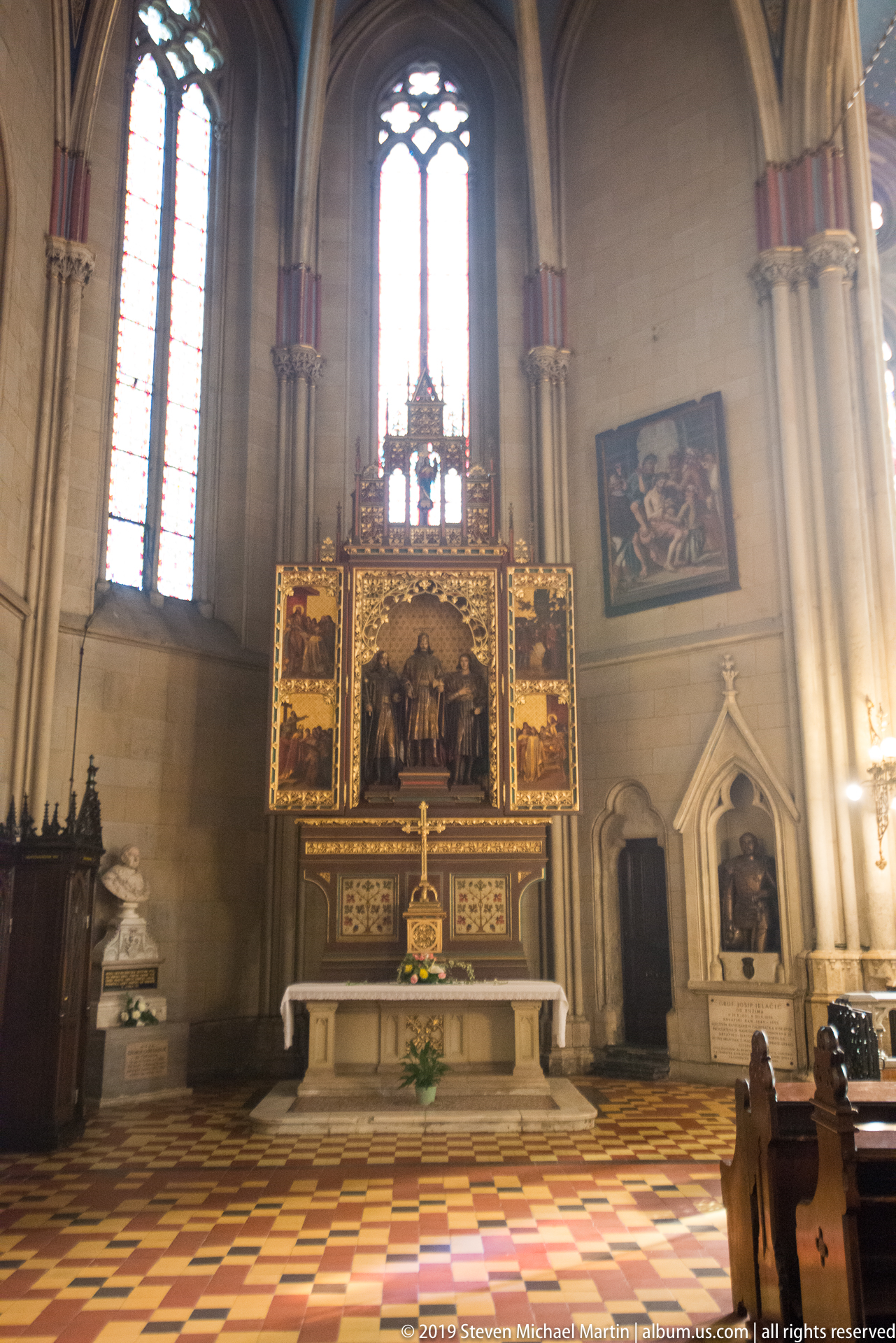
A side chapel altar stands beneath a tall stained-glass window, its gilded frame enclosing a dark central religious scene and smaller painted panels. The altar’s strong horizontal mass contrasts with the soaring Gothic wall and window above it. A separate framed painting hangs nearby, while patterned floor tiles and scattered furnishings show the chapel as an integrated devotional zone within the larger cathedral interior.
Caption
A side chapel altar stands beneath a tall stained-glass window, its gilded frame enclosing a dark central religious scene and smaller painted panels. The altar’s strong horizontal mass contrasts with the soaring Gothic wall and window above it. A separate framed painting hangs nearby, while patterned floor tiles and scattered furnishings show the chapel as an integrated devotional zone within the larger cathedral interior.

A squat round masonry tower with a conical red-tiled roof rises behind a low wall and iron gate in Zagreb’s historic center. Rough stonework, tiny openings, and the heavy cylindrical form distinguish it from the refined civic and ecclesiastical façades nearby. The photograph emphasizes the tower’s defensive character and survival within a later urban setting, though no signage is legible enough to support a more precise name.
Caption
A squat round masonry tower with a conical red-tiled roof rises behind a low wall and iron gate in Zagreb’s historic center. Rough stonework, tiny openings, and the heavy cylindrical form distinguish it from the refined civic and ecclesiastical façades nearby. The photograph emphasizes the tower’s defensive character and survival within a later urban setting, though no signage is legible enough to support a more precise name.

An ornate Gothic Revival portal at Zagreb Cathedral is crowned by a sculptural group of standing saints beneath pointed arches and delicate tracery. Smaller reliefs occupy the sloping sides of the composition, while crockets, finials, and foliate carving create a dense ornamental frame. The close view isolates the portal’s narrative sculpture from the broader façade and shows the precision of its pale stone carving.
Caption
An ornate Gothic Revival portal at Zagreb Cathedral is crowned by a sculptural group of standing saints beneath pointed arches and delicate tracery. Smaller reliefs occupy the sloping sides of the composition, while crockets, finials, and foliate carving create a dense ornamental frame. The close view isolates the portal’s narrative sculpture from the broader façade and shows the precision of its pale stone carving.

A deeply carved stone relief occupies the pointed tympanum of a Zagreb Cathedral portal, surrounded by multiple bands of Gothic tracery and foliage. Human figures emerge from the central narrative scene, while smaller sculptural figures line the outer jambs. The photograph concentrates on the portal’s layered sculptural depth, revealing how figural storytelling and architectural ornament are fused into a single façade composition.
Caption
A deeply carved stone relief occupies the pointed tympanum of a Zagreb Cathedral portal, surrounded by multiple bands of Gothic tracery and foliage. Human figures emerge from the central narrative scene, while smaller sculptural figures line the outer jambs. The photograph concentrates on the portal’s layered sculptural depth, revealing how figural storytelling and architectural ornament are fused into a single façade composition.

An ornate roof lantern rises above red-tiled roofs, combining a clock face, dark metal cladding, gilded scrollwork, and a small cross at the summit. The tight crop makes the tower read almost as a piece of decorative metalwork, with curved eaves and gold accents standing sharply against the blue sky. Its elaborate silhouette contrasts with the simpler roof planes surrounding it.
Caption
An ornate roof lantern rises above red-tiled roofs, combining a clock face, dark metal cladding, gilded scrollwork, and a small cross at the summit. The tight crop makes the tower read almost as a piece of decorative metalwork, with curved eaves and gold accents standing sharply against the blue sky. Its elaborate silhouette contrasts with the simpler roof planes surrounding it.

A crucifix with the figure of Christ stands beneath a shallow Gothic canopy, flanked below by two mourning figures. Pointed tracery, carved foliage, and a steep gable frame the devotional group, while candles and flowers at the base indicate continuing use as a place of prayer. The photograph focuses closely on the shrine’s combination of architectural carving and sculptural devotion rather than its wider setting.
Caption
A crucifix with the figure of Christ stands beneath a shallow Gothic canopy, flanked below by two mourning figures. Pointed tracery, carved foliage, and a steep gable frame the devotional group, while candles and flowers at the base indicate continuing use as a place of prayer. The photograph focuses closely on the shrine’s combination of architectural carving and sculptural devotion rather than its wider setting.

A compact chapel presents a softly curved Baroque-style façade topped by a small square bell stage and shallow green roof. Three painted or relief panels occupy arched recesses across the upper front, while a broad central doorway sits beneath a framed devotional image. The low viewpoint and simple surrounding buildings make the chapel’s undulating gable line and modest tower the principal visual features.
Caption
A compact chapel presents a softly curved Baroque-style façade topped by a small square bell stage and shallow green roof. Three painted or relief panels occupy arched recesses across the upper front, while a broad central doorway sits beneath a framed devotional image. The low viewpoint and simple surrounding buildings make the chapel’s undulating gable line and modest tower the principal visual features.

A broad gray historic façade is organized by pale horizontal bands, evenly spaced windows, and a rounded projecting bay capped by a green metal roof. A steep red-tiled roof spans the building above, while pedestrians on the pavement provide scale. The restrained palette and formal symmetry distinguish this residence or institutional building from Zagreb’s more vividly colored Upper Town streetscapes.
Caption
A broad gray historic façade is organized by pale horizontal bands, evenly spaced windows, and a rounded projecting bay capped by a green metal roof. A steep red-tiled roof spans the building above, while pedestrians on the pavement provide scale. The restrained palette and formal symmetry distinguish this residence or institutional building from Zagreb’s more vividly colored Upper Town streetscapes.

An ochre two-story historic building presents a symmetrical street façade of tall white-framed windows, shallow decorative surrounds, and a broad central doorway. The plaster is weathered and marked by graffiti near the base, while small ornamental details survive around the upper windows and cornice. The direct frontal view records the texture of an everyday Upper Town streetscape rather than a monumental landmark composition.
Caption
An ochre two-story historic building presents a symmetrical street façade of tall white-framed windows, shallow decorative surrounds, and a broad central doorway. The plaster is weathered and marked by graffiti near the base, while small ornamental details survive around the upper windows and cornice. The direct frontal view records the texture of an everyday Upper Town streetscape rather than a monumental landmark composition.

A modest yellow historic house stands close to the street beneath a steep red-tiled gable roof, its irregular window sizes and attached lower wing giving the façade a domestic scale. Pale trim outlines the doorway and windows, while a small plaque and street-level signage indicate later urban use. The photograph highlights the varied residential character of Zagreb’s older neighborhoods beyond its major monuments.
Caption
A modest yellow historic house stands close to the street beneath a steep red-tiled gable roof, its irregular window sizes and attached lower wing giving the façade a domestic scale. Pale trim outlines the doorway and windows, while a small plaque and street-level signage indicate later urban use. The photograph highlights the varied residential character of Zagreb’s older neighborhoods beyond its major monuments.

An elaborate wrought-iron grille frames a painted heraldic shield in the center of the composition. Scrollwork, rosettes, and symmetrical floral elements surround the crest, whose red-and-white checks and other heraldic devices connect the ornament to Croatian civic and national symbolism. The close view isolates the craftsmanship of the gate and the way heraldry is integrated into Zagreb’s historic architectural fabric.
Caption
An elaborate wrought-iron grille frames a painted heraldic shield in the center of the composition. Scrollwork, rosettes, and symmetrical floral elements surround the crest, whose red-and-white checks and other heraldic devices connect the ornament to Croatian civic and national symbolism. The close view isolates the craftsmanship of the gate and the way heraldry is integrated into Zagreb’s historic architectural fabric.

A richly worked iron gateway spans the foreground, its central painted shield set beneath an arched crown of scrolls and floral rosettes. Seen against a pale historic façade with tall windows, the gate reads as both a functional boundary and a ceremonial architectural detail. The broader framing reveals how the heraldic ornament is incorporated into the streetscape rather than presented as an isolated emblem.
Caption
A richly worked iron gateway spans the foreground, its central painted shield set beneath an arched crown of scrolls and floral rosettes. Seen against a pale historic façade with tall windows, the gate reads as both a functional boundary and a ceremonial architectural detail. The broader framing reveals how the heraldic ornament is incorporated into the streetscape rather than presented as an isolated emblem.

Polychrome glazed tiles form the vivid geometric roof pattern of St. Mark’s Church, with a small turret rising in the foreground. Red, white, and blue bands create a highly graphic surface around the church’s heraldic roof imagery, one of Zagreb’s most recognizable architectural features. This detail view shifts attention from the full building to the precision, color, and texture of the roof covering itself.
Caption
Polychrome glazed tiles form the vivid geometric roof pattern of St. Mark’s Church, with a small turret rising in the foreground. Red, white, and blue bands create a highly graphic surface around the church’s heraldic roof imagery, one of Zagreb’s most recognizable architectural features. This detail view shifts attention from the full building to the precision, color, and texture of the roof covering itself.

Rows of small glazed tiles create a dense red, white, blue, and dark-blue pattern across the roof of St. Mark’s Church. At this close distance the famous heraldic roof becomes almost abstract, revealing the repeated scalloped units and careful color sequencing that produce its larger design. The photograph documents the material surface behind one of Zagreb Upper Town’s strongest visual signatures.
Caption
Rows of small glazed tiles create a dense red, white, blue, and dark-blue pattern across the roof of St. Mark’s Church. At this close distance the famous heraldic roof becomes almost abstract, revealing the repeated scalloped units and careful color sequencing that produce its larger design. The photograph documents the material surface behind one of Zagreb Upper Town’s strongest visual signatures.

A shallow stone relief presents a compact symmetrical emblem within a rectangular recessed panel. The central motif combines geometric and curving forms, while weathering and surface discoloration soften the carving’s edges. Isolated from its larger architectural setting, the photograph emphasizes the tactile quality of the stone and the way small carved symbols survive as details within Zagreb’s historic streetscape.
Caption
A shallow stone relief presents a compact symmetrical emblem within a rectangular recessed panel. The central motif combines geometric and curving forms, while weathering and surface discoloration soften the carving’s edges. Isolated from its larger architectural setting, the photograph emphasizes the tactile quality of the stone and the way small carved symbols survive as details within Zagreb’s historic streetscape.

A carved animal gargoyle projects from the stonework of Zagreb Cathedral, its open mouth and crouched body forming a dramatic waterspout-like silhouette. Dark streaks beneath the carving mark long exposure to runoff and weather. The close framing draws attention to the expressive sculpture and the practical tradition of directing water away from masonry through fantastical architectural figures.
Caption
A carved animal gargoyle projects from the stonework of Zagreb Cathedral, its open mouth and crouched body forming a dramatic waterspout-like silhouette. Dark streaks beneath the carving mark long exposure to runoff and weather. The close framing draws attention to the expressive sculpture and the practical tradition of directing water away from masonry through fantastical architectural figures.

Croatian and European Union flags project from a restrained historic façade in Zagreb’s Upper Town. Dark shutters, pale stucco, a central arched carriage entrance, and traditional lanterns give the building a formal civic character. The image focuses less on monumentality than on the visual language of government presence: flags, controlled symmetry, and the adaptation of an older urban building to contemporary public use.
Caption
Croatian and European Union flags project from a restrained historic façade in Zagreb’s Upper Town. Dark shutters, pale stucco, a central arched carriage entrance, and traditional lanterns give the building a formal civic character. The image focuses less on monumentality than on the visual language of government presence: flags, controlled symmetry, and the adaptation of an older urban building to contemporary public use.

A deeply recessed pointed-arch portal frames the heavy wooden doors of Zagreb Cathedral. Multiple molded archivolts, carved foliage, and slender side figures concentrate ornament around the entrance, while the pale stone façade keeps the composition strongly vertical. The photograph emphasizes the threshold as a sculptural ensemble, showing the layered Gothic vocabulary that distinguishes the cathedral’s monumental exterior.
Caption
A deeply recessed pointed-arch portal frames the heavy wooden doors of Zagreb Cathedral. Multiple molded archivolts, carved foliage, and slender side figures concentrate ornament around the entrance, while the pale stone façade keeps the composition strongly vertical. The photograph emphasizes the threshold as a sculptural ensemble, showing the layered Gothic vocabulary that distinguishes the cathedral’s monumental exterior.

The south portal of St. Mark’s Church is framed beneath the patterned tile roof, its pointed arch filled with layered Gothic sculpture. Small figures and architectural niches cluster above the wooden doorway, creating a dense sculptural counterpoint to the church’s plain white wall. The frontal detail highlights the portal as one of the building’s most elaborate medieval features rather than treating the roof as the sole focus.
Caption
The south portal of St. Mark’s Church is framed beneath the patterned tile roof, its pointed arch filled with layered Gothic sculpture. Small figures and architectural niches cluster above the wooden doorway, creating a dense sculptural counterpoint to the church’s plain white wall. The frontal detail highlights the portal as one of the building’s most elaborate medieval features rather than treating the roof as the sole focus.

The square bell tower of St. Mark’s Church rises above the patterned roof, capped by a dark metal Baroque-style roof and lantern. A clock face punctuates the white tower, while the colorful glazed tiles enter the lower edge of the composition. The tight upward view separates the tower from the rest of the church and emphasizes its later architectural profile against Zagreb’s clear blue sky.
Caption
The square bell tower of St. Mark’s Church rises above the patterned roof, capped by a dark metal Baroque-style roof and lantern. A clock face punctuates the white tower, while the colorful glazed tiles enter the lower edge of the composition. The tight upward view separates the tower from the rest of the church and emphasizes its later architectural profile against Zagreb’s clear blue sky.

A broad neoclassical façade faces St. Mark’s Square, organized around a projecting central bay with paired columns, pediment, and formal entrance. Croatian and European Union flags mark its contemporary public role, while the symmetrical window rhythm and restrained ornament reflect the institutional architecture of Zagreb’s Upper Town. The frontal viewpoint records the building as part of the civic ensemble surrounding St. Mark’s Church.
Caption
A broad neoclassical façade faces St. Mark’s Square, organized around a projecting central bay with paired columns, pediment, and formal entrance. Croatian and European Union flags mark its contemporary public role, while the symmetrical window rhythm and restrained ornament reflect the institutional architecture of Zagreb’s Upper Town. The frontal viewpoint records the building as part of the civic ensemble surrounding St. Mark’s Church.

St. Mark’s Church stands in bright sunlight beneath its celebrated patterned tile roof, with white masonry walls, pointed Gothic windows, and a square bell tower rising behind. The roof displays the heraldic designs that make the church the visual center of Zagreb’s Upper Town. This oblique view shows the building’s compact scale and the strong contrast between its restrained walls and intensely colored roof.
Caption
St. Mark’s Church stands in bright sunlight beneath its celebrated patterned tile roof, with white masonry walls, pointed Gothic windows, and a square bell tower rising behind. The roof displays the heraldic designs that make the church the visual center of Zagreb’s Upper Town. This oblique view shows the building’s compact scale and the strong contrast between its restrained walls and intensely colored roof.

Viewed from a lower angle, St. Mark’s Church fills the frame with its pointed entrance, tall lancet windows, patterned roof, and square bell tower. The heraldic roof fields sit prominently above the white façades, while the deep blue sky sharpens the building’s profile. Compared with the adjacent wider view, this composition gives greater prominence to the church’s vertical tower and compact medieval form.
Caption
Viewed from a lower angle, St. Mark’s Church fills the frame with its pointed entrance, tall lancet windows, patterned roof, and square bell tower. The heraldic roof fields sit prominently above the white façades, while the deep blue sky sharpens the building’s profile. Compared with the adjacent wider view, this composition gives greater prominence to the church’s vertical tower and compact medieval form.

A steep roof gable cuts across the blue sky, revealing the layered geometry of St. Mark’s Church’s glazed tile covering. Diagonal bands, dark ridge caps, and a slender metal finial turn the roof itself into an architectural composition. The close crop avoids the heraldic emblems and instead records how patterned surfaces, roof slopes, and small metal details combine to shape the church’s distinctive silhouette.
Caption
A steep roof gable cuts across the blue sky, revealing the layered geometry of St. Mark’s Church’s glazed tile covering. Diagonal bands, dark ridge caps, and a slender metal finial turn the roof itself into an architectural composition. The close crop avoids the heraldic emblems and instead records how patterned surfaces, roof slopes, and small metal details combine to shape the church’s distinctive silhouette.

The coat of arms of Zagreb appears in glazed roof tiles on St. Mark’s Church: a white, three-towered city gate set against a red field. The heraldic panel is bordered by the roof’s blue, white, red, and dark geometric bands. By filling the frame with the tiled emblem, the photograph shows how civic identity is literally woven into the roofscape of the Upper Town landmark.
Caption
The coat of arms of Zagreb appears in glazed roof tiles on St. Mark’s Church: a white, three-towered city gate set against a red field. The heraldic panel is bordered by the roof’s blue, white, red, and dark geometric bands. By filling the frame with the tiled emblem, the photograph shows how civic identity is literally woven into the roofscape of the Upper Town landmark.

A composite heraldic shield is rendered in colored tiles on the roof of St. Mark’s Church, combining the red-and-white Croatian checkerboard with blue and red fields representing the historic Croatian lands. The emblem sits within a dense border of diagonal tile bands. This close view records the political-historical symbolism that makes the church roof more than a decorative surface.
Caption
A composite heraldic shield is rendered in colored tiles on the roof of St. Mark’s Church, combining the red-and-white Croatian checkerboard with blue and red fields representing the historic Croatian lands. The emblem sits within a dense border of diagonal tile bands. This close view records the political-historical symbolism that makes the church roof more than a decorative surface.

A cluster of brown pedestrian wayfinding signs points visitors toward museums, galleries, and cultural sites in Zagreb’s Upper Town. Mounted beside a pale historic wall and a carved stone bracket, the signs compress the district’s cultural geography into a single streetscape detail. The photograph records how contemporary visitor infrastructure is inserted into the older architectural fabric of Gornji Grad.
Caption
A cluster of brown pedestrian wayfinding signs points visitors toward museums, galleries, and cultural sites in Zagreb’s Upper Town. Mounted beside a pale historic wall and a carved stone bracket, the signs compress the district’s cultural geography into a single streetscape detail. The photograph records how contemporary visitor infrastructure is inserted into the older architectural fabric of Gornji Grad.
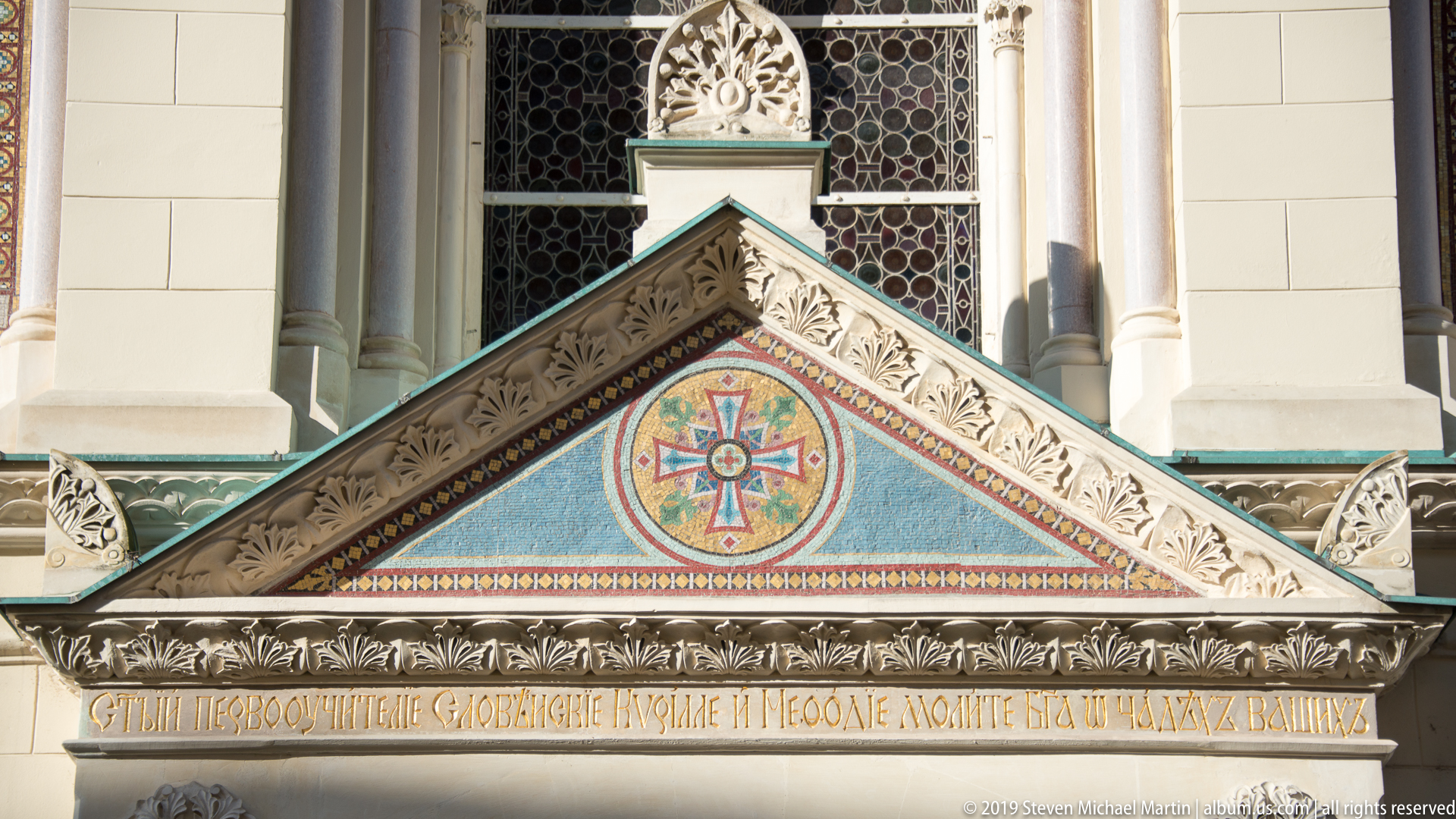
A triangular gable is filled by a colorful circular cross medallion and bordered with carved vegetal ornament. Beneath it, a long inscription runs across the lintel, while stained-glass windows and pale stone moldings rise behind. The tight framing isolates a richly decorated section of the façade, where mosaic color, carved stone, and text combine to mark the building’s religious identity.
Caption
A triangular gable is filled by a colorful circular cross medallion and bordered with carved vegetal ornament. Beneath it, a long inscription runs across the lintel, while stained-glass windows and pale stone moldings rise behind. The tight framing isolates a richly decorated section of the façade, where mosaic color, carved stone, and text combine to mark the building’s religious identity.

Heavy wooden double doors are reinforced with sweeping black iron strapwork beneath a carved round-arched surround. Pink-toned columns and pale molded stone frame the entrance, while a semicircular wrought-iron transom adds another layer of ornament above. The close, symmetrical view makes the doorway itself the subject, emphasizing craftsmanship in wood, iron, and carved stone rather than the larger building.
Caption
Heavy wooden double doors are reinforced with sweeping black iron strapwork beneath a carved round-arched surround. Pink-toned columns and pale molded stone frame the entrance, while a semicircular wrought-iron transom adds another layer of ornament above. The close, symmetrical view makes the doorway itself the subject, emphasizing craftsmanship in wood, iron, and carved stone rather than the larger building.

A poster for the Museum of Broken Relationships fills a green-framed doorway, pairing the museum name with an image of a small figurine reflected or doubled across a globe-like form. A row of national flags near the top hints at the museum’s international reach. The entrance graphic makes the institution’s theme immediately legible before visitors move into the exhibition spaces.
Caption
A poster for the Museum of Broken Relationships fills a green-framed doorway, pairing the museum name with an image of a small figurine reflected or doubled across a globe-like form. A row of national flags near the top hints at the museum’s international reach. The entrance graphic makes the institution’s theme immediately legible before visitors move into the exhibition spaces.

Large sheets bearing hand-drawn world maps hang or fold across one another inside the Museum of Broken Relationships. The overlapping papers fragment the familiar outlines of continents, turning geography into a layered visual object rather than a conventional map. Within the museum’s broader themes of personal separation and connection, the installation suggests distance and movement without requiring a single literal narrative.
Caption
Large sheets bearing hand-drawn world maps hang or fold across one another inside the Museum of Broken Relationships. The overlapping papers fragment the familiar outlines of continents, turning geography into a layered visual object rather than a conventional map. Within the museum’s broader themes of personal separation and connection, the installation suggests distance and movement without requiring a single literal narrative.

A pale historic church façade rises steeply through the frame, combining a square bell tower, arched openings, a round tracery window, and colorful mosaic panels of sacred figures. The low angle exaggerates the verticality of the façade and tower against the deep blue sky. Rich surface decoration distinguishes this church from the plainer civic buildings of Zagreb’s surrounding historic center.
Caption
A pale historic church façade rises steeply through the frame, combining a square bell tower, arched openings, a round tracery window, and colorful mosaic panels of sacred figures. The low angle exaggerates the verticality of the façade and tower against the deep blue sky. Rich surface decoration distinguishes this church from the plainer civic buildings of Zagreb’s surrounding historic center.

The Art Pavilion in Zagreb presents a symmetrical ochre façade crowned by its prominent central glass-and-metal dome. Classical columns, pediments, sculpture, and roofline ornament give the exhibition building a ceremonial presence at the edge of the park. Visitors crossing the foreground provide scale, while the dramatic clouded sky accentuates the pavilion’s domed silhouette and late-historicist architectural character.
Caption
The Art Pavilion in Zagreb presents a symmetrical ochre façade crowned by its prominent central glass-and-metal dome. Classical columns, pediments, sculpture, and roofline ornament give the exhibition building a ceremonial presence at the edge of the park. Visitors crossing the foreground provide scale, while the dramatic clouded sky accentuates the pavilion’s domed silhouette and late-historicist architectural character.

Colorful mismatched chairs, small wooden tables, books, plants, and wall lamps create an informal café interior at Zagreb’s Museum of Broken Relationships. The domestic-scale furnishings and playful palette contrast with the museum’s emotionally charged subject matter. This view records the visitor environment surrounding the exhibitions, where a relaxed social space is integrated into the historic Upper Town museum setting.
Caption
Colorful mismatched chairs, small wooden tables, books, plants, and wall lamps create an informal café interior at Zagreb’s Museum of Broken Relationships. The domestic-scale furnishings and playful palette contrast with the museum’s emotionally charged subject matter. This view records the visitor environment surrounding the exhibitions, where a relaxed social space is integrated into the historic Upper Town museum setting.

A row of brightly colored notebooks in the Museum of Broken Relationships shop turns private thoughts into blunt public slogans. Phrases about untold stories, things left unsaid, difficult discoveries, and jealous observations echo the museum’s themes of memory and failed relationships. The tight composition emphasizes the playful retail extension of the institution’s concept, with the objects arranged as graphic blocks of color and text.
Caption
A row of brightly colored notebooks in the Museum of Broken Relationships shop turns private thoughts into blunt public slogans. Phrases about untold stories, things left unsaid, difficult discoveries, and jealous observations echo the museum’s themes of memory and failed relationships. The tight composition emphasizes the playful retail extension of the institution’s concept, with the objects arranged as graphic blocks of color and text.

The entrance corridor of the Museum of Broken Relationships leads inward through a sequence of white arches and polished floors. The museum’s name is displayed at the far wall, while an open green door and chalkboard café sign frame the foreground. A potted yellow chrysanthemum softens the threshold, and the long perspective conveys the intimate scale of this Upper Town museum.
Caption
The entrance corridor of the Museum of Broken Relationships leads inward through a sequence of white arches and polished floors. The museum’s name is displayed at the far wall, while an open green door and chalkboard café sign frame the foreground. A potted yellow chrysanthemum softens the threshold, and the long perspective conveys the intimate scale of this Upper Town museum.

A tall window with green trim and heavily weathered white wooden shutters opens onto a pale masonry façade in Zagreb’s Upper Town. Peeling paint exposes layers of wood along the shutter edges, while a small potted plant rests on the sill inside. The simple domestic detail contrasts with the nearby museums and churches, preserving a more intimate trace of everyday life in the historic quarter.
Caption
A tall window with green trim and heavily weathered white wooden shutters opens onto a pale masonry façade in Zagreb’s Upper Town. Peeling paint exposes layers of wood along the shutter edges, while a small potted plant rests on the sill inside. The simple domestic detail contrasts with the nearby museums and churches, preserving a more intimate trace of everyday life in the historic quarter.
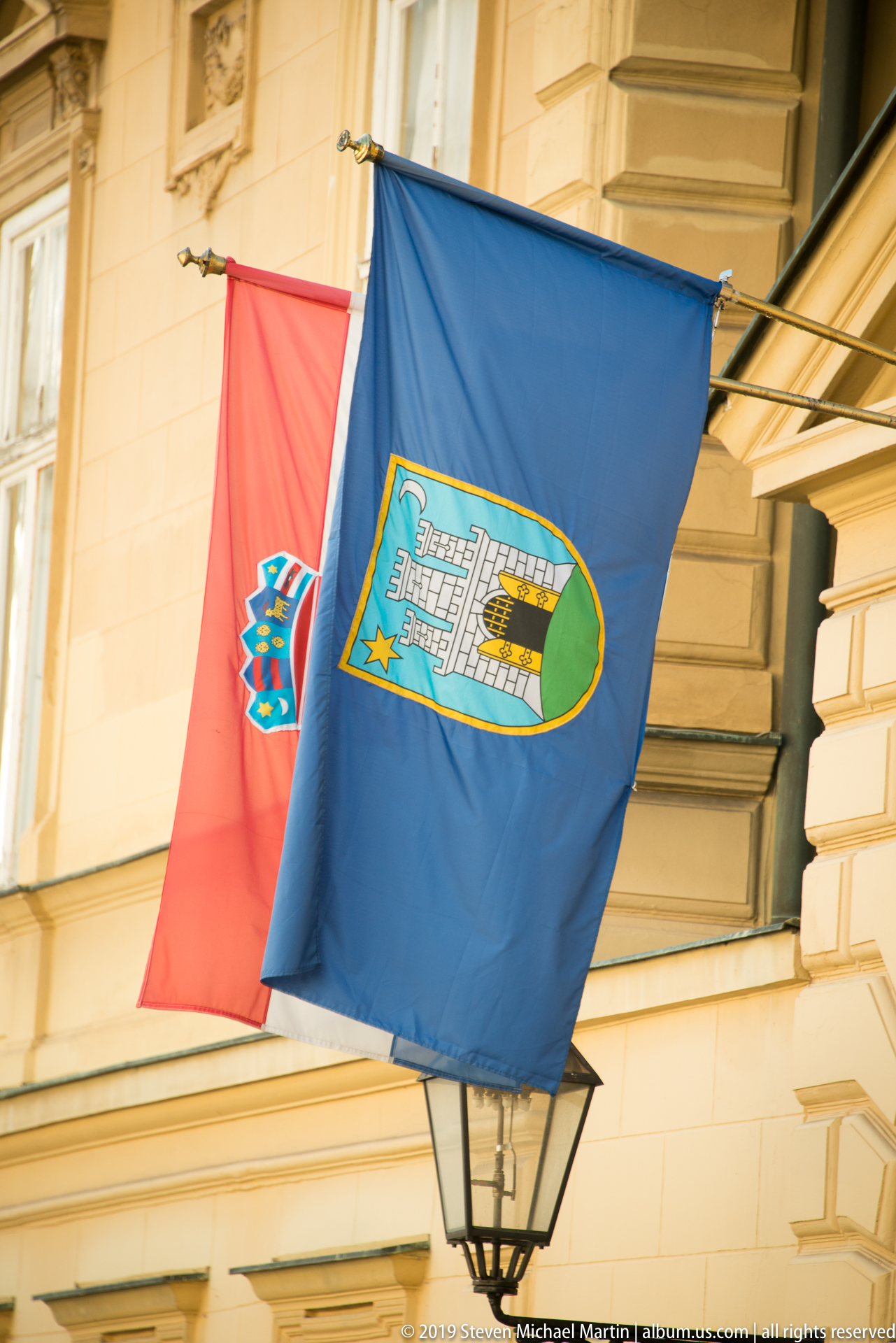
Croatia’s red-white-blue national flag hangs beside the blue flag of Zagreb, whose shield bears the city’s fortified gateway and star-and-crescent emblems. Mounted on an ornate historic façade, the paired flags link national and municipal identity in a single streetscape detail. The upward framing also catches the building’s stone moldings and a wall lantern beneath the flagpoles.
Caption
Croatia’s red-white-blue national flag hangs beside the blue flag of Zagreb, whose shield bears the city’s fortified gateway and star-and-crescent emblems. Mounted on an ornate historic façade, the paired flags link national and municipal identity in a single streetscape detail. The upward framing also catches the building’s stone moldings and a wall lantern beneath the flagpoles.

A green copper dome crowns a compact rooftop pavilion above Zagreb’s dense red-tiled cityscape. Classical pilasters and arched openings articulate the small structure, while modern signage and distant buildings reveal the layered urban fabric around it. The elevated composition isolates the dome as a recognizable skyline accent without providing enough evidence for a secure building identification.
Caption
A green copper dome crowns a compact rooftop pavilion above Zagreb’s dense red-tiled cityscape. Classical pilasters and arched openings articulate the small structure, while modern signage and distant buildings reveal the layered urban fabric around it. The elevated composition isolates the dome as a recognizable skyline accent without providing enough evidence for a secure building identification.

A monumental crystal chandelier hangs before a richly gilded iconostasis inside Zagreb’s Serbian Orthodox cathedral. Painted saints and biblical scenes cover the walls and vaulted ceiling in saturated color, creating a dense visual field around the screen of icons. The low, centered viewpoint emphasizes the relationship between ceremonial lighting, painted surfaces, and the iconostasis at the liturgical heart of the interior.
Caption
A monumental crystal chandelier hangs before a richly gilded iconostasis inside Zagreb’s Serbian Orthodox cathedral. Painted saints and biblical scenes cover the walls and vaulted ceiling in saturated color, creating a dense visual field around the screen of icons. The low, centered viewpoint emphasizes the relationship between ceremonial lighting, painted surfaces, and the iconostasis at the liturgical heart of the interior.

A white Baroque-style church closes the end of a quiet Upper Town street, its symmetrical façade organized around a central portal, niches with sacred figures, and a triangular pediment topped by a cross. The restrained urban setting heightens the church’s axial presence. The building is the Serbian Orthodox Cathedral of the Transfiguration of the Lord, whose interior appears in the following photographs.
Caption
A white Baroque-style church closes the end of a quiet Upper Town street, its symmetrical façade organized around a central portal, niches with sacred figures, and a triangular pediment topped by a cross. The restrained urban setting heightens the church’s axial presence. The building is the Serbian Orthodox Cathedral of the Transfiguration of the Lord, whose interior appears in the following photographs.
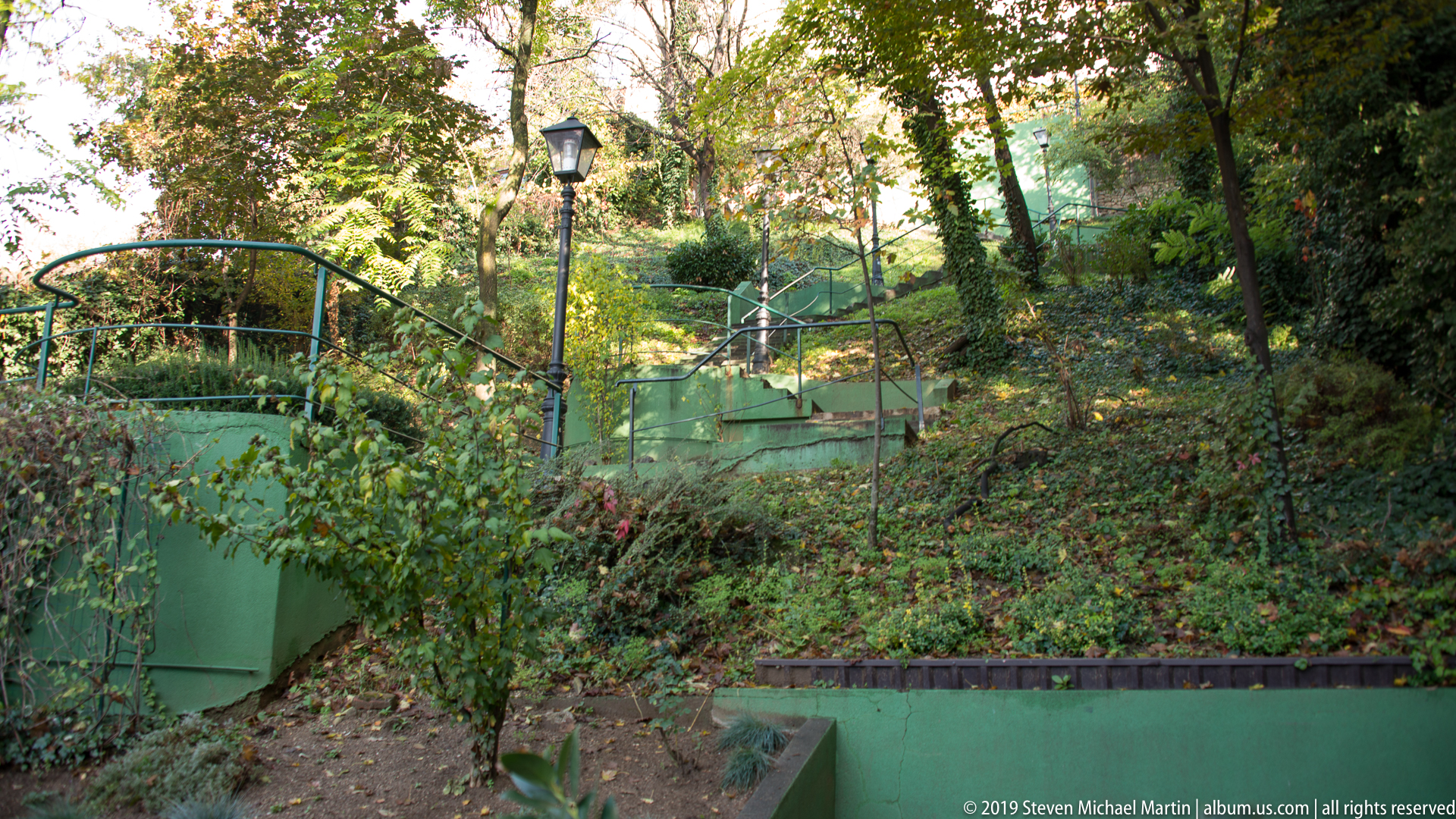
A narrow pedestrian route climbs through dense greenery behind painted green railings, with a black lantern marking the path. Fallen leaves, undergrowth, and the steep slope give the scene a secluded character despite its urban location. The view shows how Zagreb’s historic hill districts are stitched together by small paths, stairways, and landscaped passages.
Caption
A narrow pedestrian route climbs through dense greenery behind painted green railings, with a black lantern marking the path. Fallen leaves, undergrowth, and the steep slope give the scene a secluded character despite its urban location. The view shows how Zagreb’s historic hill districts are stitched together by small paths, stairways, and landscaped passages.

A large sacred painting shows Christ being lowered from the cross, surrounded by mourners who support his body and gather at the foot of the ladder. Gold ground, halos, stylized robes, and Cyrillic inscriptions identify the image within an Eastern Christian visual tradition. The close framing allows the emotional gestures and carefully organized group of figures to dominate the composition.
Caption
A large sacred painting shows Christ being lowered from the cross, surrounded by mourners who support his body and gather at the foot of the ladder. Gold ground, halos, stylized robes, and Cyrillic inscriptions identify the image within an Eastern Christian visual tradition. The close framing allows the emotional gestures and carefully organized group of figures to dominate the composition.

Painted walls and vaults surround the upper gallery of the Serbian Orthodox cathedral, where rows of saints, biblical scenes, and ornamental borders cover nearly every surface. Tall arched windows admit strong side light and a crystal chandelier descends through the center. This view shifts attention from the iconostasis to the immersive painted architectural envelope of the nave.
Caption
Painted walls and vaults surround the upper gallery of the Serbian Orthodox cathedral, where rows of saints, biblical scenes, and ornamental borders cover nearly every surface. Tall arched windows admit strong side light and a crystal chandelier descends through the center. This view shifts attention from the iconostasis to the immersive painted architectural envelope of the nave.

Seen directly from below, a large gilt and crystal chandelier becomes a radial pattern of metal arms, glass drops, and concentric rings. Painted figures on the ceiling appear around its perimeter, turning the fixture into the visual center of the composition. The unusual upward viewpoint abstracts a functional liturgical object into a study of symmetry, reflective surfaces, and craftsmanship.
Caption
Seen directly from below, a large gilt and crystal chandelier becomes a radial pattern of metal arms, glass drops, and concentric rings. Painted figures on the ceiling appear around its perimeter, turning the fixture into the visual center of the composition. The unusual upward viewpoint abstracts a functional liturgical object into a study of symmetry, reflective surfaces, and craftsmanship.
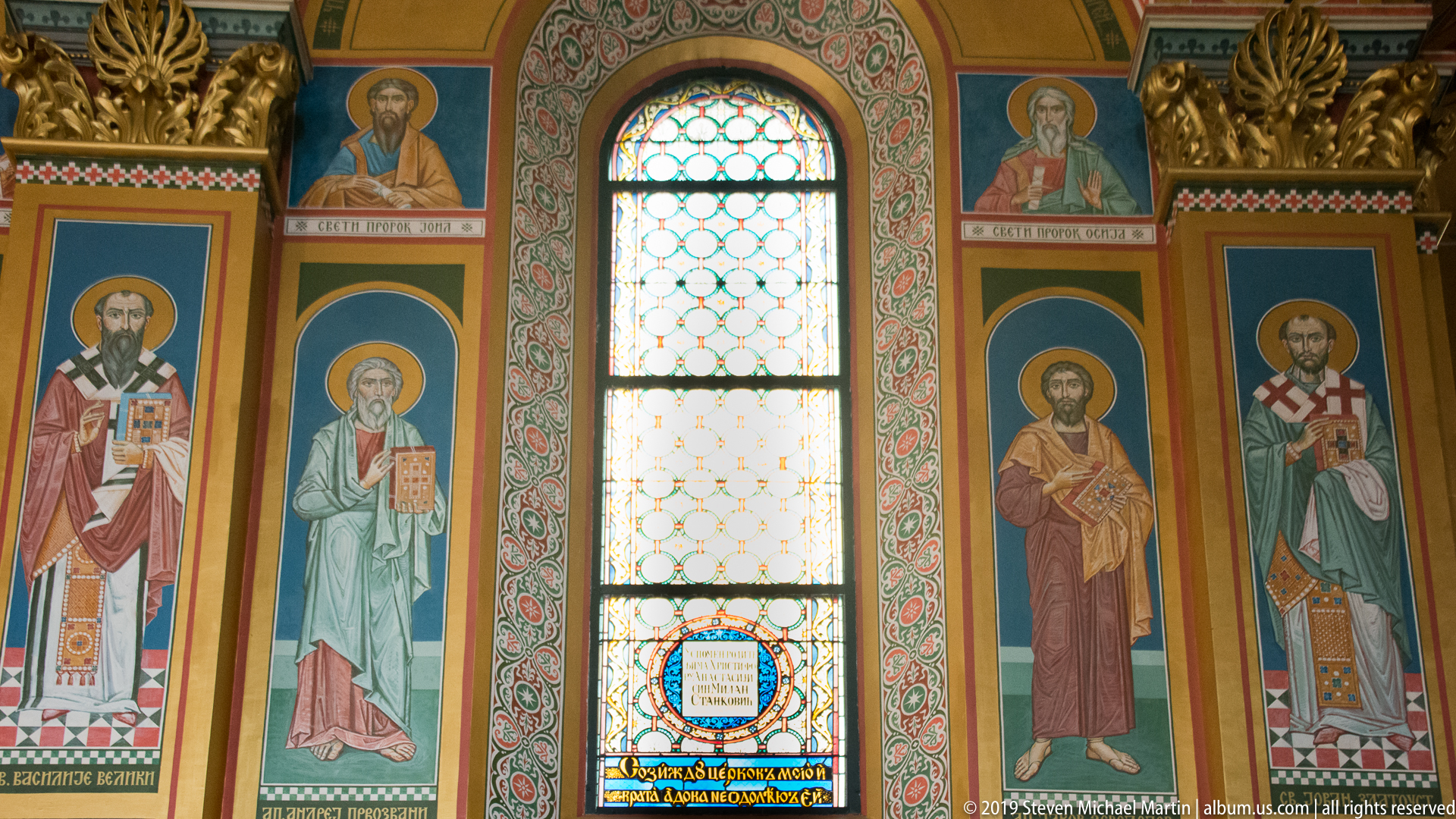
Four full-length saints occupy tall painted panels on either side of a narrow stained-glass window. Each figure carries attributes or books and is identified by painted inscriptions above or below, while patterned borders frame the composition. The balanced arrangement reveals how figural painting and colored glass are integrated into the cathedral’s wall surfaces as a unified devotional program.
Caption
Four full-length saints occupy tall painted panels on either side of a narrow stained-glass window. Each figure carries attributes or books and is identified by painted inscriptions above or below, while patterned borders frame the composition. The balanced arrangement reveals how figural painting and colored glass are integrated into the cathedral’s wall surfaces as a unified devotional program.

Christ sits elevated among a gathering of bearded elders and disciples in a gold-ground mural framed by patterned borders. Several figures turn toward him in discussion, while a long Cyrillic inscription runs above the scene. The composition appears to represent Christ teaching in the Temple, rendered in the hieratic color and formal grouping characteristic of the church’s broader painted cycle.
Caption
Christ sits elevated among a gathering of bearded elders and disciples in a gold-ground mural framed by patterned borders. Several figures turn toward him in discussion, while a long Cyrillic inscription runs above the scene. The composition appears to represent Christ teaching in the Temple, rendered in the hieratic color and formal grouping characteristic of the church’s broader painted cycle.

A gilded iconostasis rises in tiers of framed sacred scenes, its upper section crowned by scrolling metalwork and a central triangular arrangement of icons. Narrative panels, saint images, and arched openings are tightly integrated into an ornate architectural screen. The close crop concentrates on the craftsmanship and iconographic density of the screen rather than the wider nave.
Caption
A gilded iconostasis rises in tiers of framed sacred scenes, its upper section crowned by scrolling metalwork and a central triangular arrangement of icons. Narrative panels, saint images, and arched openings are tightly integrated into an ornate architectural screen. The close crop concentrates on the craftsmanship and iconographic density of the screen rather than the wider nave.

Christ appears in radiant white at the center of a luminous mandorla, elevated above disciples who fall or kneel on the rocky ground. Two prophetic figures stand to either side of him, completing the traditional Eastern Christian composition of the Transfiguration. The gold background and stylized mountain forms reinforce the icon’s symbolic rather than naturalistic treatment of the biblical event.
Caption
Christ appears in radiant white at the center of a luminous mandorla, elevated above disciples who fall or kneel on the rocky ground. Two prophetic figures stand to either side of him, completing the traditional Eastern Christian composition of the Transfiguration. The gold background and stylized mountain forms reinforce the icon’s symbolic rather than naturalistic treatment of the biblical event.

A deep red textile embroidered with gold floral and cross motifs covers a central liturgical table or lectern before the gilded iconostasis. A painted icon rests on top, aligned with the screen behind it. The centered composition emphasizes ceremonial color and symmetry, using the crimson cloth as a strong visual foreground against the intricate field of icons and gilded ornament.
Caption
A deep red textile embroidered with gold floral and cross motifs covers a central liturgical table or lectern before the gilded iconostasis. A painted icon rests on top, aligned with the screen behind it. The centered composition emphasizes ceremonial color and symmetry, using the crimson cloth as a strong visual foreground against the intricate field of icons and gilded ornament.

A red velvet-covered liturgical furnishing stands against painted wall panels of saints and biblical scenes. Gold trim outlines the fabric, and a small framed religious painting is attached to its center. The photograph isolates a devotional object normally absorbed into the larger interior, revealing how textile, painted imagery, and carved wood work together within the Orthodox church setting.
Caption
A red velvet-covered liturgical furnishing stands against painted wall panels of saints and biblical scenes. Gold trim outlines the fabric, and a small framed religious painting is attached to its center. The photograph isolates a devotional object normally absorbed into the larger interior, revealing how textile, painted imagery, and carved wood work together within the Orthodox church setting.

Angels, saints, and sacred figures populate the gold-toned ceiling vault, arranged around circular medallions and divided by broad ornamental bands. The upward view compresses multiple scenes into a single decorative field, revealing the church’s dense program of painted surfaces. A hanging light fixture enters from below, reinforcing the viewer’s position directly beneath the vault.
Caption
Angels, saints, and sacred figures populate the gold-toned ceiling vault, arranged around circular medallions and divided by broad ornamental bands. The upward view compresses multiple scenes into a single decorative field, revealing the church’s dense program of painted surfaces. A hanging light fixture enters from below, reinforcing the viewer’s position directly beneath the vault.

From farther back in the nave, the cathedral interior unfolds as a complete ceremonial space: wooden choir stalls line both sides, a red carpet leads forward, and a giant chandelier hangs before the gilded iconostasis. Painted saints and narrative scenes cover the walls and arch, while patterned flooring strengthens the central axis. The wider view clarifies the spatial relationship among furnishings, decoration, and sanctuary.
Caption
From farther back in the nave, the cathedral interior unfolds as a complete ceremonial space: wooden choir stalls line both sides, a red carpet leads forward, and a giant chandelier hangs before the gilded iconostasis. Painted saints and narrative scenes cover the walls and arch, while patterned flooring strengthens the central axis. The wider view clarifies the spatial relationship among furnishings, decoration, and sanctuary.
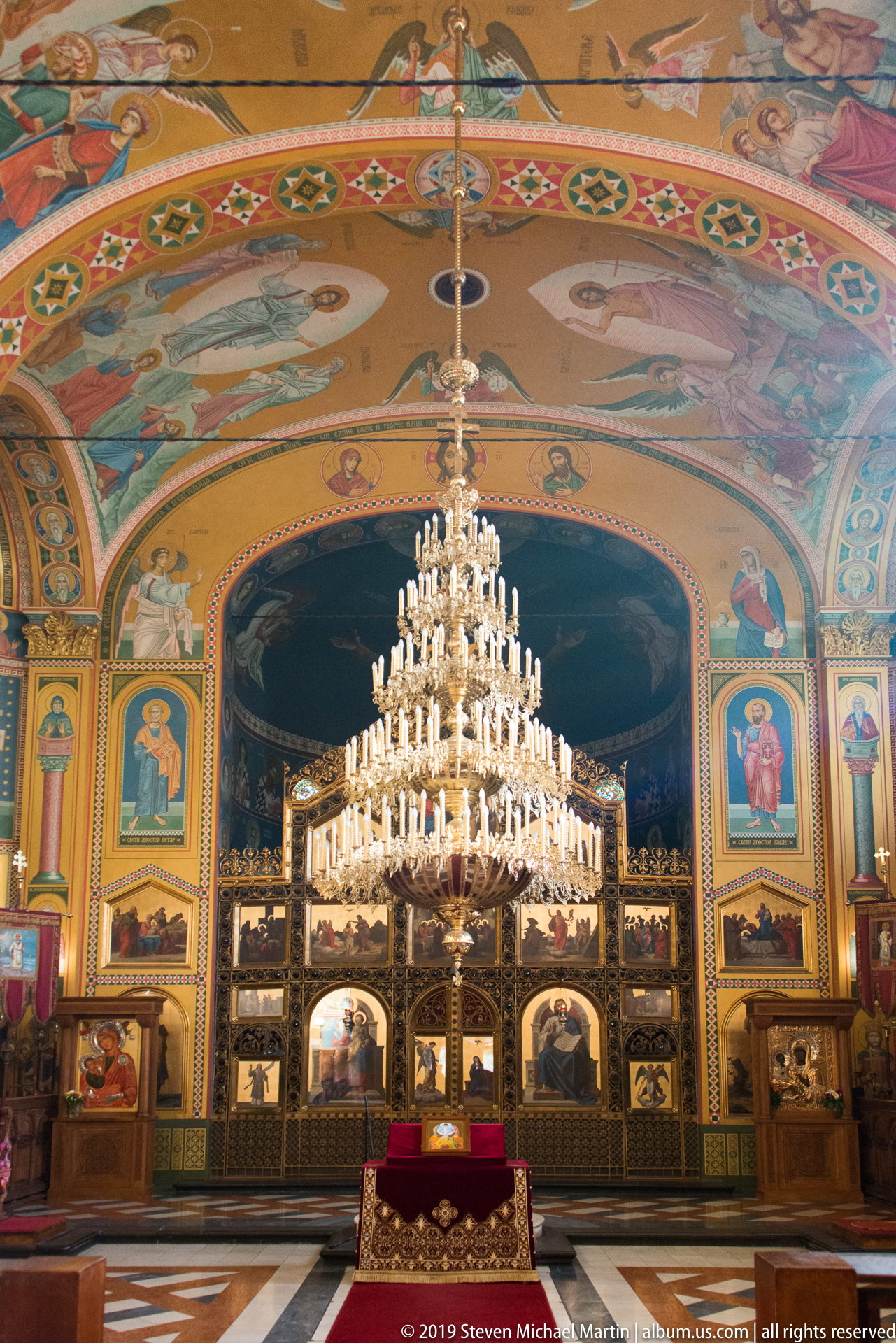
A vast crystal chandelier dominates the center of the Serbian Orthodox cathedral, suspended between the painted vault and the gilded iconostasis. The frontal symmetry of the composition draws the eye from the liturgical table in the foreground through the chandelier to the screen of icons beyond. Rich murals and decorative borders cover the surrounding walls, creating an exceptionally layered sacred interior.
Caption
A vast crystal chandelier dominates the center of the Serbian Orthodox cathedral, suspended between the painted vault and the gilded iconostasis. The frontal symmetry of the composition draws the eye from the liturgical table in the foreground through the chandelier to the screen of icons beyond. Rich murals and decorative borders cover the surrounding walls, creating an exceptionally layered sacred interior.

A broad round-arched entrance is framed by layered carved stone moldings and flanked by decorative wall lamps. Dark wooden doors with ornamental metal-and-glass panels sit deep within the opening, reached by a short flight of steps. The symmetrical façade detail emphasizes craftsmanship at the threshold, where stone carving, ironwork, glass, and timber create a formal civic or institutional entrance.
Caption
A broad round-arched entrance is framed by layered carved stone moldings and flanked by decorative wall lamps. Dark wooden doors with ornamental metal-and-glass panels sit deep within the opening, reached by a short flight of steps. The symmetrical façade detail emphasizes craftsmanship at the threshold, where stone carving, ironwork, glass, and timber create a formal civic or institutional entrance.

A tight oblique view isolates the sculpted female supports and surrounding ornament above the school entrance. Drapery, garlands, scrolling foliage, and projecting moldings create deep shadows across the stone surface, making the figures read almost as free-standing sculpture. By excluding most of the doorway, the photograph emphasizes the exuberant craftsmanship of the historic façade rather than its institutional function.
Caption
A tight oblique view isolates the sculpted female supports and surrounding ornament above the school entrance. Drapery, garlands, scrolling foliage, and projecting moldings create deep shadows across the stone surface, making the figures read almost as free-standing sculpture. By excluding most of the doorway, the photograph emphasizes the exuberant craftsmanship of the historic façade rather than its institutional function.

A curving historicist corner façade rises in regular tiers of tall windows, pilasters, cornices, and sculpted architectural details. Warm afternoon light picks out the projecting moldings while street-level shop signs reveal the building’s continuing commercial use. The upward viewpoint accentuates the rhythmic window bays and the urban sophistication of Zagreb’s 19th-century lower-city streetscape.
Caption
A curving historicist corner façade rises in regular tiers of tall windows, pilasters, cornices, and sculpted architectural details. Warm afternoon light picks out the projecting moldings while street-level shop signs reveal the building’s continuing commercial use. The upward viewpoint accentuates the rhythmic window bays and the urban sophistication of Zagreb’s 19th-century lower-city streetscape.

Two sculpted female figures flank the entrance of the Croatian Hospitality and Tourism School in Zagreb, functioning like decorative caryatids beneath the projecting entablature. Their raised arms, flowing drapery, and fruit-and-leaf ornament create an exuberant frame around the doorway. The school name is visible above the entrance, anchoring this sculptural detail to an active educational institution.
Caption
Two sculpted female figures flank the entrance of the Croatian Hospitality and Tourism School in Zagreb, functioning like decorative caryatids beneath the projecting entablature. Their raised arms, flowing drapery, and fruit-and-leaf ornament create an exuberant frame around the doorway. The school name is visible above the entrance, anchoring this sculptural detail to an active educational institution.

A long, low historic house with a steep red-tiled roof stands at a busy intersection, its worn stucco walls heavily marked by graffiti. Dormer windows, bicycles, patched masonry, and modern traffic infrastructure reveal layers of continued urban use around the aging structure. The photograph records a less polished side of Zagreb’s historic fabric, where everyday occupation and neglect coexist.
Caption
A long, low historic house with a steep red-tiled roof stands at a busy intersection, its worn stucco walls heavily marked by graffiti. Dormer windows, bicycles, patched masonry, and modern traffic infrastructure reveal layers of continued urban use around the aging structure. The photograph records a less polished side of Zagreb’s historic fabric, where everyday occupation and neglect coexist.

A Catholic religious sister in a black habit walks past a heavily weathered, graffiti-covered wall, absorbed in her phone. The juxtaposition brings together formal religious dress and the rough textures of contemporary urban Zagreb. Cracked plaster, exposed masonry, tags, and boarded openings form a layered backdrop, while the figure’s movement gives the street scene a candid documentary quality.
Caption
A Catholic religious sister in a black habit walks past a heavily weathered, graffiti-covered wall, absorbed in her phone. The juxtaposition brings together formal religious dress and the rough textures of contemporary urban Zagreb. Cracked plaster, exposed masonry, tags, and boarded openings form a layered backdrop, while the figure’s movement gives the street scene a candid documentary quality.

A white church tower rises steeply against a blue sky, its two visible clock faces set above tall louvered openings. A green-patinated metal roof tapers toward a weather vane, while a small heraldic or sculptural element decorates the lower façade. The low-angle composition emphasizes the tower’s height and angular roofline but does not provide enough context for a secure church identification.
Caption
A white church tower rises steeply against a blue sky, its two visible clock faces set above tall louvered openings. A green-patinated metal roof tapers toward a weather vane, while a small heraldic or sculptural element decorates the lower façade. The low-angle composition emphasizes the tower’s height and angular roofline but does not provide enough context for a secure church identification.

A monumental arched doorway anchors the Mimara Museum’s richly ornamented façade. Paired columns, carved floral bands, scrollwork, and a broken pediment frame dark wooden doors fitted with decorative metalwork. The close frontal view shows how the museum’s entrance was designed as a ceremonial threshold, concentrating much of the building’s historicist ornament around the point of entry.
Caption
A monumental arched doorway anchors the Mimara Museum’s richly ornamented façade. Paired columns, carved floral bands, scrollwork, and a broken pediment frame dark wooden doors fitted with decorative metalwork. The close frontal view shows how the museum’s entrance was designed as a ceremonial threshold, concentrating much of the building’s historicist ornament around the point of entry.

A side chapel opens beneath tall Gothic windows and ribbed vaulting, with a gilded painted retable centered above a stone altar. The wider framing reveals the chapel in relation to the cathedral’s clustered columns, wall monuments, and adjoining liturgical furnishings. Soft daylight from stained glass gives the space a quieter and more intimate character than the main nave.
Caption
A side chapel opens beneath tall Gothic windows and ribbed vaulting, with a gilded painted retable centered above a stone altar. The wider framing reveals the chapel in relation to the cathedral’s clustered columns, wall monuments, and adjoining liturgical furnishings. Soft daylight from stained glass gives the space a quieter and more intimate character than the main nave.

A sharply tapered white sculpture rises diagonally into the sky, its polished planar surface creating a striking contrast with the ornate historic building glimpsed behind it. The extreme low angle reduces the work to a bright geometric wedge and emphasizes its scale. The photograph records the visual collision of contemporary public art and Zagreb’s older architectural fabric.
Caption
A sharply tapered white sculpture rises diagonally into the sky, its polished planar surface creating a striking contrast with the ornate historic building glimpsed behind it. The extreme low angle reduces the work to a bright geometric wedge and emphasizes its scale. The photograph records the visual collision of contemporary public art and Zagreb’s older architectural fabric.

A glossy orange sphere occupies the center of a paved pedestrian space, its monumental scale turning a simple geometric form into a vivid urban focal point. Scratches and graffiti mark the surface, while historic façades and modern glass-fronted buildings frame the square behind. The contrast of old architecture, contemporary design, and informal public use gives the object a distinctly civic character.
Caption
A glossy orange sphere occupies the center of a paved pedestrian space, its monumental scale turning a simple geometric form into a vivid urban focal point. Scratches and graffiti mark the surface, while historic façades and modern glass-fronted buildings frame the square behind. The contrast of old architecture, contemporary design, and informal public use gives the object a distinctly civic character.

A blue ZET tram on route 13 approaches along a Zagreb street, its destination display reading Žitnjak. The boxy articulated vehicle, overhead electric connection, and worn exterior place public transit squarely within the everyday visual identity of the city. The close street-level view captures the tram not as background infrastructure but as the primary moving subject.
Caption
A blue ZET tram on route 13 approaches along a Zagreb street, its destination display reading Žitnjak. The boxy articulated vehicle, overhead electric connection, and worn exterior place public transit squarely within the everyday visual identity of the city. The close street-level view captures the tram not as background infrastructure but as the primary moving subject.
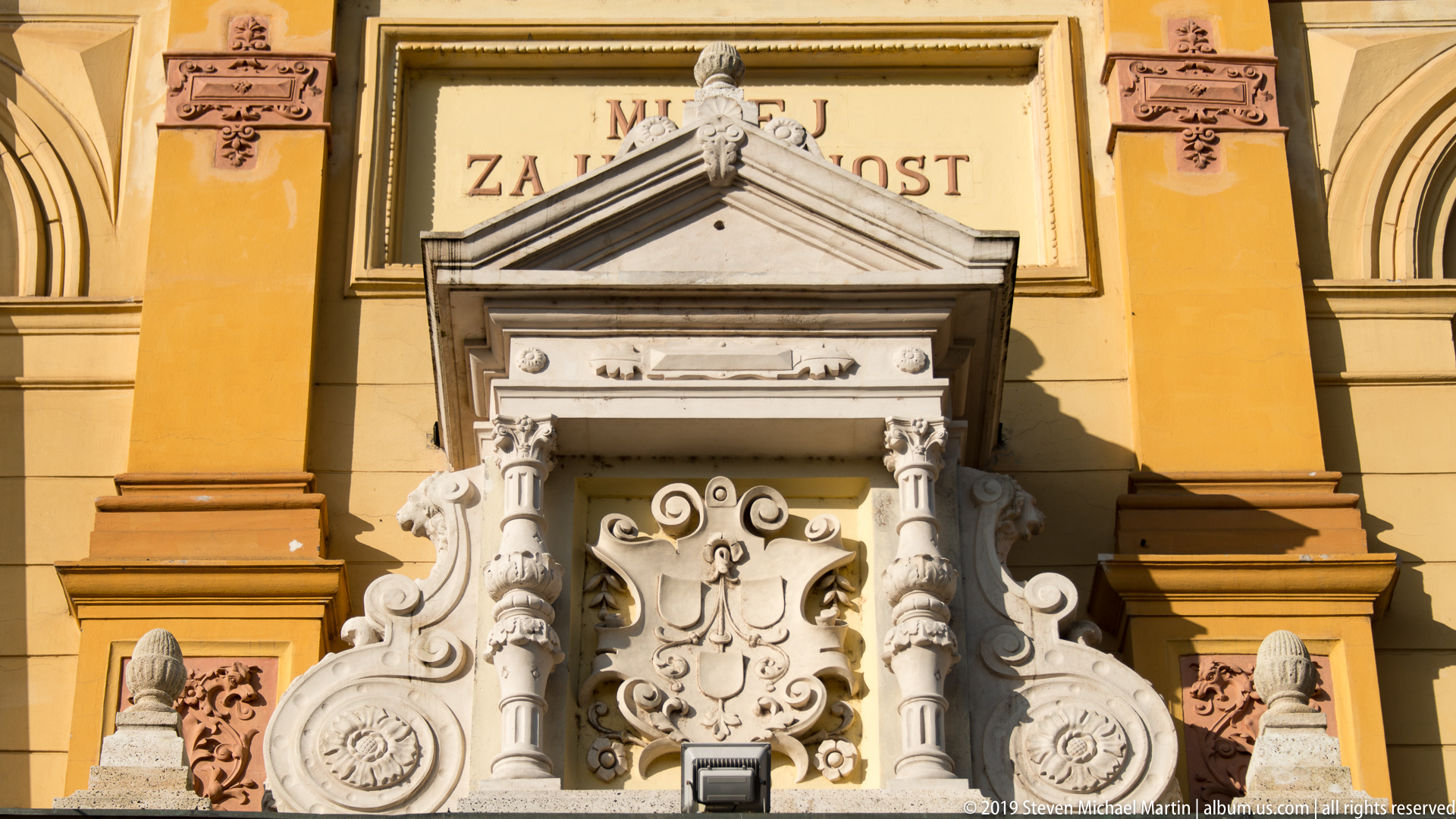
A richly modeled entrance surround combines columns, scrollwork, shields, floral motifs, and a small pediment against a warm ochre façade. Above it, a Croatian inscription includes the words “za umjetnost,” linking the building to an artistic or cultural institution. The close crop emphasizes the historicist decorative vocabulary and heraldic character of the entrance rather than the full façade.
Caption
A richly modeled entrance surround combines columns, scrollwork, shields, floral motifs, and a small pediment against a warm ochre façade. Above it, a Croatian inscription includes the words “za umjetnost,” linking the building to an artistic or cultural institution. The close crop emphasizes the historicist decorative vocabulary and heraldic character of the entrance rather than the full façade.

The central crown of Zagreb’s Mimara Museum rises above the roofline in a dense historicist composition of columns, scrolls, heraldic ornament, and carved figures. A standing female figure occupies the arched center while seated and reclining figures flank the upper stage. The tight upward view isolates the museum’s ceremonial roofline against a deep blue sky and emphasizes the sculptural richness of its late-19th-century façade.
Caption
The central crown of Zagreb’s Mimara Museum rises above the roofline in a dense historicist composition of columns, scrolls, heraldic ornament, and carved figures. A standing female figure occupies the arched center while seated and reclining figures flank the upper stage. The tight upward view isolates the museum’s ceremonial roofline against a deep blue sky and emphasizes the sculptural richness of its late-19th-century façade.

The Mimara Museum extends across the frame as a formal historicist palace fronted by a landscaped lawn and patterned flower beds. The central pavilion, clearly marked “MIMARA,” rises above long symmetrical wings articulated by tall windows and classical detailing. This establishing view records the institution in its urban setting and makes clear the scale and axial organization only hinted at in the adjacent close details.
Caption
The Mimara Museum extends across the frame as a formal historicist palace fronted by a landscaped lawn and patterned flower beds. The central pavilion, clearly marked “MIMARA,” rises above long symmetrical wings articulated by tall windows and classical detailing. This establishing view records the institution in its urban setting and makes clear the scale and axial organization only hinted at in the adjacent close details.

Tall clustered piers and pointed vaults draw the eye down the nave of Zagreb Cathedral toward a brightly lit sanctuary and stained-glass windows. A large chandelier hangs beneath the ribbed vault while rows of pews establish the long central axis. The composition emphasizes the vertical scale of the Gothic interior and the contrast between massive stone supports and luminous colored glass.
Caption
Tall clustered piers and pointed vaults draw the eye down the nave of Zagreb Cathedral toward a brightly lit sanctuary and stained-glass windows. A large chandelier hangs beneath the ribbed vault while rows of pews establish the long central axis. The composition emphasizes the vertical scale of the Gothic interior and the contrast between massive stone supports and luminous colored glass.

A dark copper dome rises behind an allegorical sculptural group on the roofline of the Mimara Museum. A crowned or haloed female figure stands at the center, accompanied by smaller figures and flanked by black metal finials. The steep low-angle view turns the roof into a layered composition of sculpture, copper, pale masonry, and blue sky.
Caption
A dark copper dome rises behind an allegorical sculptural group on the roofline of the Mimara Museum. A crowned or haloed female figure stands at the center, accompanied by smaller figures and flanked by black metal finials. The steep low-angle view turns the roof into a layered composition of sculpture, copper, pale masonry, and blue sky.

A glass-sided shrine or reliquary occupies a prominent position inside Zagreb Cathedral, framed by candles, flowers, and Gothic architectural details. Red fabric and a recumbent sacred figure or relic are visible within the case, while worship furnishings surround it. The close view emphasizes the devotional focus of the installation and its carefully staged combination of glass, metal, flowers, and candlelight.
Caption
A glass-sided shrine or reliquary occupies a prominent position inside Zagreb Cathedral, framed by candles, flowers, and Gothic architectural details. Red fabric and a recumbent sacred figure or relic are visible within the case, while worship furnishings surround it. The close view emphasizes the devotional focus of the installation and its carefully staged combination of glass, metal, flowers, and candlelight.

A blank shield-shaped cartouche occupies the center of a cream-colored historic façade, flanked by sculpted wreaths and foliate ornament. Deeply projecting cornices and block-like moldings cast sharp afternoon shadows that accentuate the relief. The close crop removes the wider building context and turns the decorative program into a study of symmetry, carved foliage, and historicist surface design.
Caption
A blank shield-shaped cartouche occupies the center of a cream-colored historic façade, flanked by sculpted wreaths and foliate ornament. Deeply projecting cornices and block-like moldings cast sharp afternoon shadows that accentuate the relief. The close crop removes the wider building context and turns the decorative program into a study of symmetry, carved foliage, and historicist surface design.

A monumental sacred painting fills the end wall of a cathedral aisle, framed by Gothic stonework and a gilded border. Numerous figures gather around a central heavenly scene, while an extensive inscription covers the masonry beneath. The unusual scale makes the image function almost architecturally, turning an entire wall surface into a devotional and commemorative focal point.
Caption
A monumental sacred painting fills the end wall of a cathedral aisle, framed by Gothic stonework and a gilded border. Numerous figures gather around a central heavenly scene, while an extensive inscription covers the masonry beneath. The unusual scale makes the image function almost architecturally, turning an entire wall surface into a devotional and commemorative focal point.

A carved laurel wreath hangs beneath a projecting entablature, its tied ribbon and layered leaves modeled in high relief. Strong side light throws crisp shadows across the pale surface, making the carving appear almost detached from the wall. The photograph concentrates on a single ornamental element and reveals the precision of the façade’s historicist sculptural vocabulary.
Caption
A carved laurel wreath hangs beneath a projecting entablature, its tied ribbon and layered leaves modeled in high relief. Strong side light throws crisp shadows across the pale surface, making the carving appear almost detached from the wall. The photograph concentrates on a single ornamental element and reveals the precision of the façade’s historicist sculptural vocabulary.

A winged female figure is integrated into the curve of an arched window surround, her torso and flowing drapery emerging from a field of carved feathers and foliage. The low-angle crop emphasizes the figure’s sculptural mass and the way it is fused to the architecture rather than displayed as a freestanding statue. Sunlight highlights the pale modeling while deep shadows sharpen the relief.
Caption
A winged female figure is integrated into the curve of an arched window surround, her torso and flowing drapery emerging from a field of carved feathers and foliage. The low-angle crop emphasizes the figure’s sculptural mass and the way it is fused to the architecture rather than displayed as a freestanding statue. Sunlight highlights the pale modeling while deep shadows sharpen the relief.
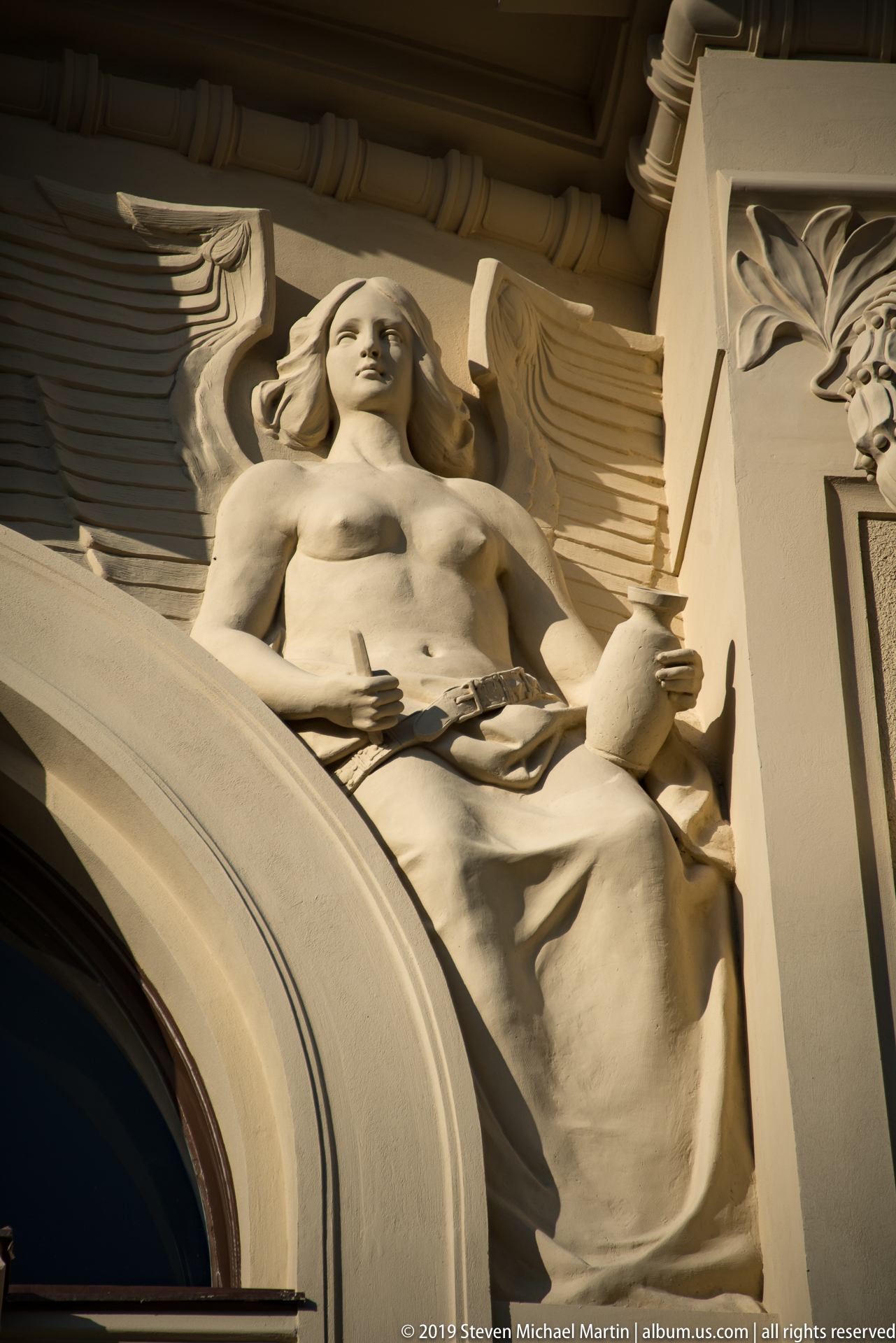
A seated or half-length female allegorical figure crowns the side of an arched opening, framed by broad carved wings and foliage. Her draped lower body follows the curve of the arch while one hand holds a small object or vessel. The extreme low angle emphasizes the sculpture’s integration with the architecture and the theatrical shadow created by projecting historicist ornament.
Caption
A seated or half-length female allegorical figure crowns the side of an arched opening, framed by broad carved wings and foliage. Her draped lower body follows the curve of the arch while one hand holds a small object or vessel. The extreme low angle emphasizes the sculpture’s integration with the architecture and the theatrical shadow created by projecting historicist ornament.
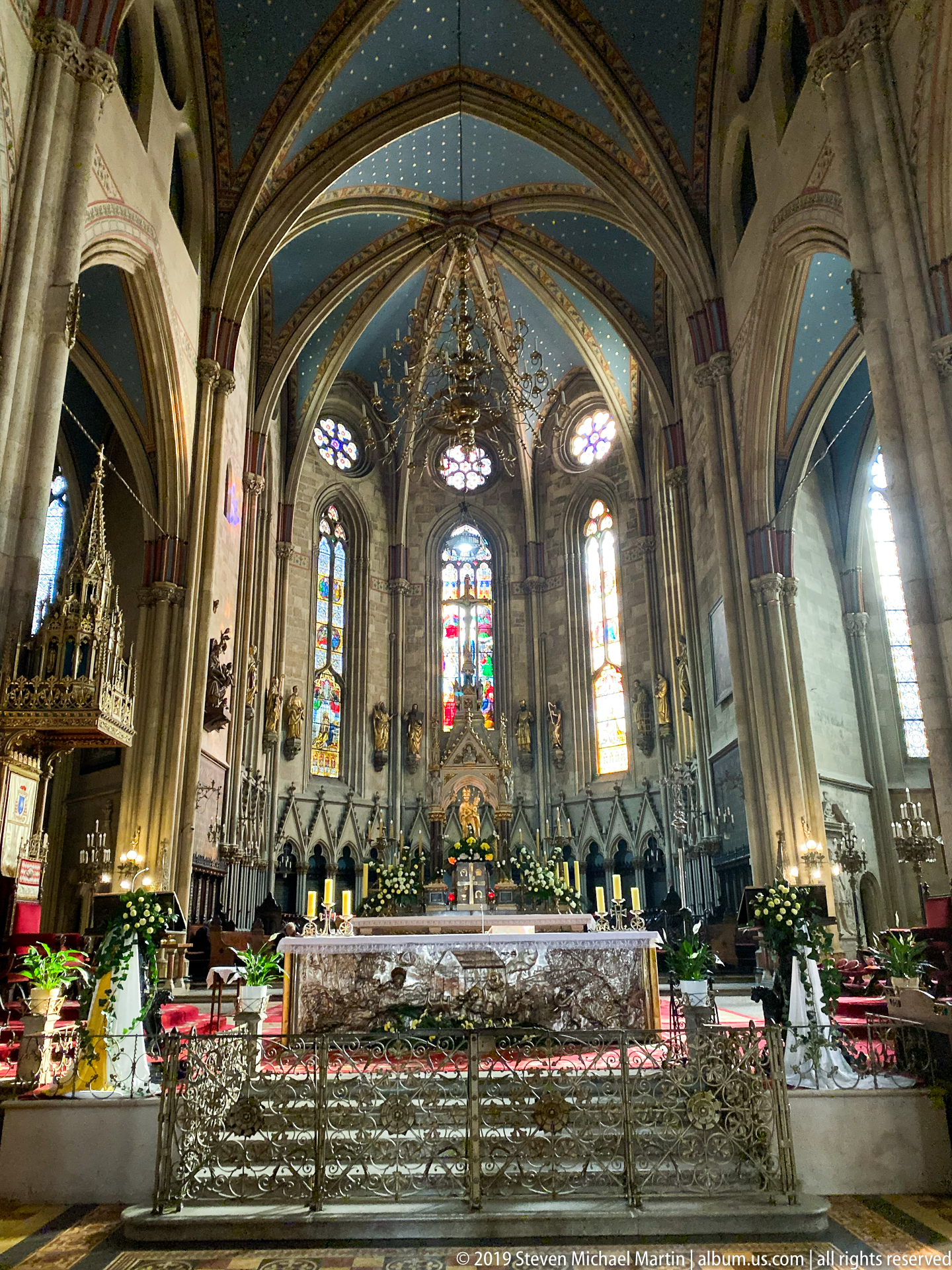
The sanctuary of Zagreb Cathedral is framed by soaring Gothic arches and tall stained-glass windows that wash the east end with color. A richly decorated altar stands behind the communion rail, surrounded by flowers and liturgical furnishings. The broad symmetrical view emphasizes the vertical convergence of columns and vault ribs above the sanctuary and the visual focus created by the luminous glass.
Caption
The sanctuary of Zagreb Cathedral is framed by soaring Gothic arches and tall stained-glass windows that wash the east end with color. A richly decorated altar stands behind the communion rail, surrounded by flowers and liturgical furnishings. The broad symmetrical view emphasizes the vertical convergence of columns and vault ribs above the sanctuary and the visual focus created by the luminous glass.

A monumental block of text covers the pale masonry wall of a cathedral chapel or aisle, with a crucifix and liturgical furnishings arranged below. The inscription’s scale makes the written word part of the architecture, occupying nearly the entire wall surface beneath a shallow pointed arch. Gold-toned columns and dark devotional objects frame the austere field of lettering.
Caption
A monumental block of text covers the pale masonry wall of a cathedral chapel or aisle, with a crucifix and liturgical furnishings arranged below. The inscription’s scale makes the written word part of the architecture, occupying nearly the entire wall surface beneath a shallow pointed arch. Gold-toned columns and dark devotional objects frame the austere field of lettering.

Looking toward the rear of Zagreb Cathedral, clustered stone piers rise into blue-painted ribbed vaults while a chandelier hangs before the elevated organ gallery. Tall stained-glass windows line the side walls and the main doorway glows with exterior light below. The reverse view complements the earlier sanctuary perspective by showing the nave’s full vertical enclosure and western gallery.
Caption
Looking toward the rear of Zagreb Cathedral, clustered stone piers rise into blue-painted ribbed vaults while a chandelier hangs before the elevated organ gallery. Tall stained-glass windows line the side walls and the main doorway glows with exterior light below. The reverse view complements the earlier sanctuary perspective by showing the nave’s full vertical enclosure and western gallery.

A monumental female allegorical figure sits above the Ethnographic Museum façade, framed by the building’s dark copper dome and flanked by smaller figures. A shield or emblem rests at her chest while the surrounding sculpture incorporates symbols of labor, culture, or civic identity. The tight upward view isolates the rooftop group from the rest of the museum and emphasizes its ceremonial role in the façade composition.
Caption
A monumental female allegorical figure sits above the Ethnographic Museum façade, framed by the building’s dark copper dome and flanked by smaller figures. A shield or emblem rests at her chest while the surrounding sculpture incorporates symbols of labor, culture, or civic identity. The tight upward view isolates the rooftop group from the rest of the museum and emphasizes its ceremonial role in the façade composition.

The central bay of Zagreb’s Ethnographic Museum rises beneath a copper dome, crowned by a seated allegorical figure and flanked by paired sculpted female figures beside the arched window. Wreaths and historicist ornament enrich the pale façade. The low-angle composition reveals how sculpture, dome, and window are layered vertically to mark the museum’s principal entrance axis.
Caption
The central bay of Zagreb’s Ethnographic Museum rises beneath a copper dome, crowned by a seated allegorical figure and flanked by paired sculpted female figures beside the arched window. Wreaths and historicist ornament enrich the pale façade. The low-angle composition reveals how sculpture, dome, and window are layered vertically to mark the museum’s principal entrance axis.

The Ethnographic Museum presents an ornate historicist façade centered on a tall arched window, sculptural groups, and a copper-roofed upper pavilion. The inscription “ETNOGRAFSKI MUZEJ” is clearly visible above the entrance, establishing the building’s identity. Seen frontally in warm light, the composition records the museum’s civic scale and richly modeled architectural surface.
Caption
The Ethnographic Museum presents an ornate historicist façade centered on a tall arched window, sculptural groups, and a copper-roofed upper pavilion. The inscription “ETNOGRAFSKI MUZEJ” is clearly visible above the entrance, establishing the building’s identity. Seen frontally in warm light, the composition records the museum’s civic scale and richly modeled architectural surface.

A broad side chapel of Zagreb Cathedral combines a gilded painted retable, tall pointed windows, choir stalls, wall monuments, and blue ribbed vaulting. The centered altar is visually balanced by carved architectural features on both sides, while daylight from the windows brightens the pale stone. This wider view clarifies how devotional art and memorial sculpture occupy the cathedral’s lateral spaces.
Caption
A broad side chapel of Zagreb Cathedral combines a gilded painted retable, tall pointed windows, choir stalls, wall monuments, and blue ribbed vaulting. The centered altar is visually balanced by carved architectural features on both sides, while daylight from the windows brightens the pale stone. This wider view clarifies how devotional art and memorial sculpture occupy the cathedral’s lateral spaces.
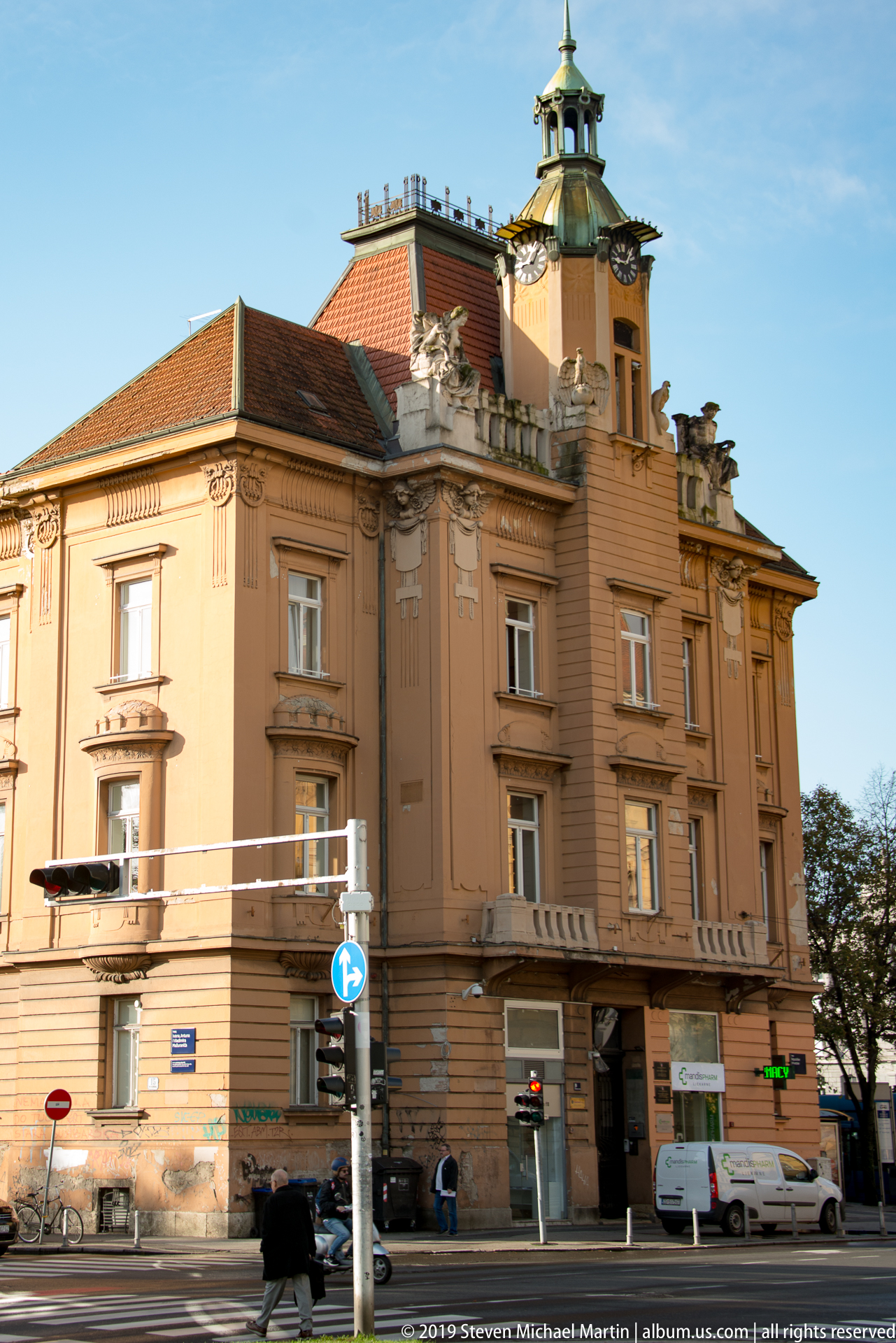
An ochre historicist building occupies a prominent Zagreb street corner, its restrained classical façade capped by a small rooftop pavilion and green-patinated roof. Regular window bays, pilasters, and a high cornice give the structure an institutional character, while modern traffic lights and signs anchor it firmly in the contemporary city. The oblique view shows the building’s full corner mass and roof silhouette.
Caption
An ochre historicist building occupies a prominent Zagreb street corner, its restrained classical façade capped by a small rooftop pavilion and green-patinated roof. Regular window bays, pilasters, and a high cornice give the structure an institutional character, while modern traffic lights and signs anchor it firmly in the contemporary city. The oblique view shows the building’s full corner mass and roof silhouette.

A modern Zagreb high-rise sweeps upward in curving bands of reflective blue glass and pale structural mullions. The extreme low-angle viewpoint exaggerates the building’s height and curvature, while reflections of trees and neighboring structures ripple across the façade. As the final image in the sequence, it offers a sharp contrast to the historic churches, museums, and apartment façades documented throughout the city.
Caption
A modern Zagreb high-rise sweeps upward in curving bands of reflective blue glass and pale structural mullions. The extreme low-angle viewpoint exaggerates the building’s height and curvature, while reflections of trees and neighboring structures ripple across the façade. As the final image in the sequence, it offers a sharp contrast to the historic churches, museums, and apartment façades documented throughout the city.

A blue Zagreb tram passes before a grand pink historicist palace topped by a small domed pavilion. A long inscription stretches across the central façade above the entrance, while a slender white contemporary sculpture rises in the landscaped foreground. The scene layers public transit, monumental 19th-century architecture, and modern urban design within a single civic square.
Caption
A blue Zagreb tram passes before a grand pink historicist palace topped by a small domed pavilion. A long inscription stretches across the central façade above the entrance, while a slender white contemporary sculpture rises in the landscaped foreground. The scene layers public transit, monumental 19th-century architecture, and modern urban design within a single civic square.

A sharp white sculptural spire cuts diagonally across the view of a Zagreb civic square, where a blue tram passes between a modern glass-fronted building and a pink historicist palace. Dark storm clouds heighten the contrast among old architecture, contemporary construction, transit, and public art. The broader framing turns the square into a study of Zagreb’s layered urban character.
Caption
A sharp white sculptural spire cuts diagonally across the view of a Zagreb civic square, where a blue tram passes between a modern glass-fronted building and a pink historicist palace. Dark storm clouds heighten the contrast among old architecture, contemporary construction, transit, and public art. The broader framing turns the square into a study of Zagreb’s layered urban character.

A long ochre historicist façade with steep red roofs and a richly modeled central pavilion stands along Zagreb’s museum district. The central entrance is marked by columns, sculptural ornament, and a high decorative gable, while exhibition banners hang on the façade. The broad frontal view emphasizes the building’s institutional scale and its carefully ordered sequence of windows and roof forms.
Caption
A long ochre historicist façade with steep red roofs and a richly modeled central pavilion stands along Zagreb’s museum district. The central entrance is marked by columns, sculptural ornament, and a high decorative gable, while exhibition banners hang on the façade. The broad frontal view emphasizes the building’s institutional scale and its carefully ordered sequence of windows and roof forms.

A compact brick institutional building faces a tree-lined square, its central gable decorated with patterned masonry, narrow arched windows, and a circular clock. A banner above the entrance identifies an active cultural or educational use, while weeping trees soften the formal symmetry of the façade. The building’s exposed brick and polychrome details distinguish it from the neighboring stuccoed palaces.
Caption
A compact brick institutional building faces a tree-lined square, its central gable decorated with patterned masonry, narrow arched windows, and a circular clock. A banner above the entrance identifies an active cultural or educational use, while weeping trees soften the formal symmetry of the façade. The building’s exposed brick and polychrome details distinguish it from the neighboring stuccoed palaces.

A formal ochre façade is organized around a slightly projecting central bay capped by a green-patinated pavilion. Tall windows, shallow pediments, pilasters, and a balustraded roofline give the building a restrained neo-Renaissance character. Banners at the entrance signal a cultural institution, while parked cars and street furniture place the monument within the active museum quarter of central Zagreb.
Caption
A formal ochre façade is organized around a slightly projecting central bay capped by a green-patinated pavilion. Tall windows, shallow pediments, pilasters, and a balustraded roofline give the building a restrained neo-Renaissance character. Banners at the entrance signal a cultural institution, while parked cars and street furniture place the monument within the active museum quarter of central Zagreb.

The monumental central block of an ochre historicist building fills the frame, its façade structured by rusticated masonry, tall arched windows, sculpted pediments, and a broad green-patinated roof pavilion. The frontal view makes the building’s symmetry and vertical hierarchy especially clear, from the heavy ground floor to the more ornate upper stories and roofline.
Caption
The monumental central block of an ochre historicist building fills the frame, its façade structured by rusticated masonry, tall arched windows, sculpted pediments, and a broad green-patinated roof pavilion. The frontal view makes the building’s symmetry and vertical hierarchy especially clear, from the heavy ground floor to the more ornate upper stories and roofline.

Two copper-roofed corner pavilions rise above the ochre historicist façade, their ribbed metal roofs capped by slender finials. A Croatian flag flies from the nearer pavilion while small rooftop sculptures punctuate the balustrade between them. The close upward composition isolates the building’s roofline and shows how domes, sculpture, and national symbolism create a ceremonial skyline above the street.
Caption
Two copper-roofed corner pavilions rise above the ochre historicist façade, their ribbed metal roofs capped by slender finials. A Croatian flag flies from the nearer pavilion while small rooftop sculptures punctuate the balustrade between them. The close upward composition isolates the building’s roofline and shows how domes, sculpture, and national symbolism create a ceremonial skyline above the street.

The Croatian National Theatre in Zagreb rises behind formal planting beds as a richly modeled yellow historicist landmark. Columns, arched windows, sculpted roof figures, and paired corner towers frame the central entrance, while flags animate the roofline. The broad three-quarter view records both the building’s ceremonial massing and its setting within Zagreb’s Lower Town cultural district.
Caption
The Croatian National Theatre in Zagreb rises behind formal planting beds as a richly modeled yellow historicist landmark. Columns, arched windows, sculpted roof figures, and paired corner towers frame the central entrance, while flags animate the roofline. The broad three-quarter view records both the building’s ceremonial massing and its setting within Zagreb’s Lower Town cultural district.

A rounded corner bay rises above a Zagreb street in an exuberantly decorated historic façade combining cream masonry, pale blue panels, floral reliefs, and mosaic-like surface ornament. Narrow windows stack vertically beneath a patterned frieze, while sculptural finials punctuate the roofline. The steep upward viewpoint isolates the building’s corner treatment and highlights the decorative vocabulary associated with turn-of-the-century urban architecture.
Caption
A rounded corner bay rises above a Zagreb street in an exuberantly decorated historic façade combining cream masonry, pale blue panels, floral reliefs, and mosaic-like surface ornament. Narrow windows stack vertically beneath a patterned frieze, while sculptural finials punctuate the roofline. The steep upward viewpoint isolates the building’s corner treatment and highlights the decorative vocabulary associated with turn-of-the-century urban architecture.

A richly articulated Zagreb façade fills the frame with projecting bay windows, carved masks, floral reliefs, pilasters, and layered window surrounds. Seen from street level, the repeated vertical bays create a strong upward rhythm while deep moldings cast sharp shadows across the pale stucco. The close architectural study emphasizes the ornamental density of the city’s late-historicist residential streetscape.
Caption
A richly articulated Zagreb façade fills the frame with projecting bay windows, carved masks, floral reliefs, pilasters, and layered window surrounds. Seen from street level, the repeated vertical bays create a strong upward rhythm while deep moldings cast sharp shadows across the pale stucco. The close architectural study emphasizes the ornamental density of the city’s late-historicist residential streetscape.

A seated bronze male figure rests on a low stone pedestal beside a covered café terrace in central Zagreb. The sculpture’s bowed head, forward-leaning posture, and relaxed limbs create an introspective presence amid the movement of the surrounding street. Modern restaurant structures, pedestrians, and shopfronts place the work firmly within the everyday public life of the city rather than an isolated monumental setting.
Caption
A seated bronze male figure rests on a low stone pedestal beside a covered café terrace in central Zagreb. The sculpture’s bowed head, forward-leaning posture, and relaxed limbs create an introspective presence amid the movement of the surrounding street. Modern restaurant structures, pedestrians, and shopfronts place the work firmly within the everyday public life of the city rather than an isolated monumental setting.

Three steeply gabled dormer windows punctuate a red-tiled roof, their cream-painted frames projecting above the eaves in a regular rhythm. The low-angle crop excludes most of the parent building and turns the roofline into the subject, emphasizing the contrast between warm clay tiles, pale timber trim, and deep blue sky. The detail reflects the domestic scale of Zagreb’s older urban architecture.
Caption
Three steeply gabled dormer windows punctuate a red-tiled roof, their cream-painted frames projecting above the eaves in a regular rhythm. The low-angle crop excludes most of the parent building and turns the roofline into the subject, emphasizing the contrast between warm clay tiles, pale timber trim, and deep blue sky. The detail reflects the domestic scale of Zagreb’s older urban architecture.
⭐ Highlights
- Upper Town (Gornji Grad): The historic medieval core with churches, towers, and government buildings.
- St. Mark’s Church: Known for its colorful tiled roof representing Croatian identity.
- Ban Jelačić Square: The central square and gathering place at the heart of the city.
- Dolac Market: A vibrant open-air market with distinctive red umbrellas and local produce.
- Tkalčićeva Street: A lively pedestrian street lined with cafés and restaurants.
- Lower Town (Donji Grad): A 19th-century district of boulevards, parks, and Austro-Hungarian architecture.
🏙️ Zagreb Field Guide
Major features observed during this visit:
Zagreb, the capital of Croatia, developed from two medieval settlements—Kaptol and Gradec—on neighboring hills. Over time, these merged into a unified city that blends a preserved historic core with a broader 19th-century urban expansion. Today, Zagreb reflects a mix of medieval origins, Austro-Hungarian influence, and modern cultural life.
🏛️ Signature Landmarks
- St. Mark’s Church – A medieval church distinguished by its colorful tiled roof.
- Zagreb Cathedral – The tallest building in Croatia and a defining landmark of the city.
- Ban Jelačić Square – The focal point of modern Zagreb and a central meeting place.
- Dolac Market – The city’s main market linking Upper Town and Lower Town.
- Lotrščak Tower – A historic defensive tower marking the edge of the old town.
🧠 Historical Significance
- Medieval Origins – Formed from the settlements of Kaptol and Gradec.
- Free Royal City – Gradec gained royal status in the 13th century, shaping early development.
- Capital of Croatia – Zagreb became the political and cultural center of the country.
- Cultural Hub – Today the city is the center of Croatian arts, education, and institutions.
🌄 Urban Landscape & Setting
- Upper and Lower Town – A clear division between medieval hilltop areas and later expansion.
- Green Spaces – Parks and squares form a network across the Lower Town.
- Café Culture – Streets and squares are shaped by a strong outdoor social life.
- Layered Architecture – Medieval, Austro-Hungarian, and modern elements coexist throughout the city.