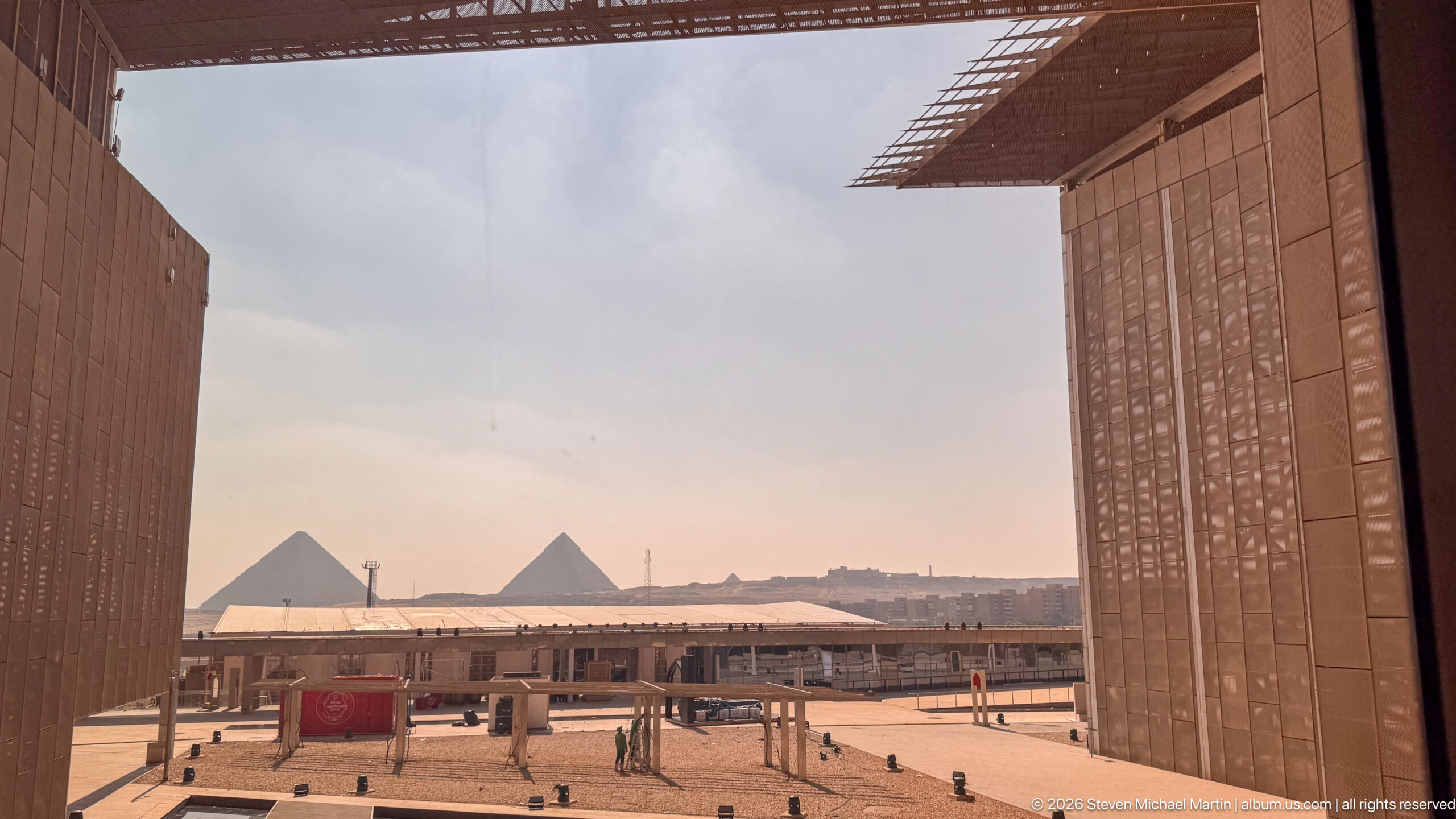
Two pyramids rise on the horizon between monumental walls of the Grand Egyptian Museum, creating a framed view across the museum’s forecourt. The photograph emphasizes the architectural dialogue between the new museum complex and the ancient pyramid landscape beyond it.
Caption
Two pyramids rise on the horizon between monumental walls of the Grand Egyptian Museum, creating a framed view across the museum’s forecourt. The photograph emphasizes the architectural dialogue between the new museum complex and the ancient pyramid landscape beyond it.
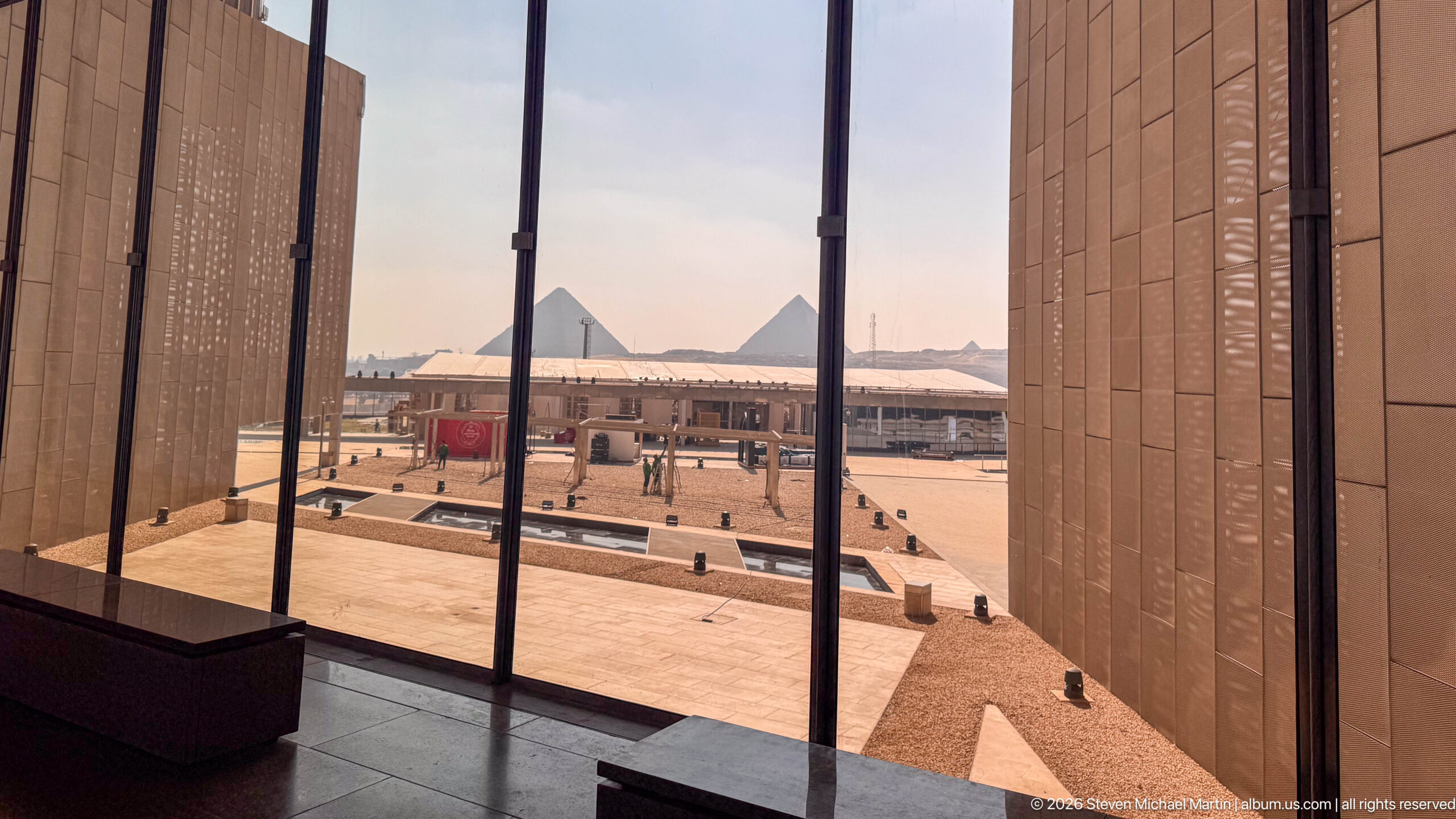
The Giza pyramids appear beyond the Grand Egyptian Museum’s forecourt, framed by tall glazed panels and warm-toned architectural screens. This interior-to-landscape view shows how the museum’s circulation spaces deliberately maintain a visual relationship with the pyramid field across the plateau.
Caption
The Giza pyramids appear beyond the Grand Egyptian Museum’s forecourt, framed by tall glazed panels and warm-toned architectural screens. This interior-to-landscape view shows how the museum’s circulation spaces deliberately maintain a visual relationship with the pyramid field across the plateau.
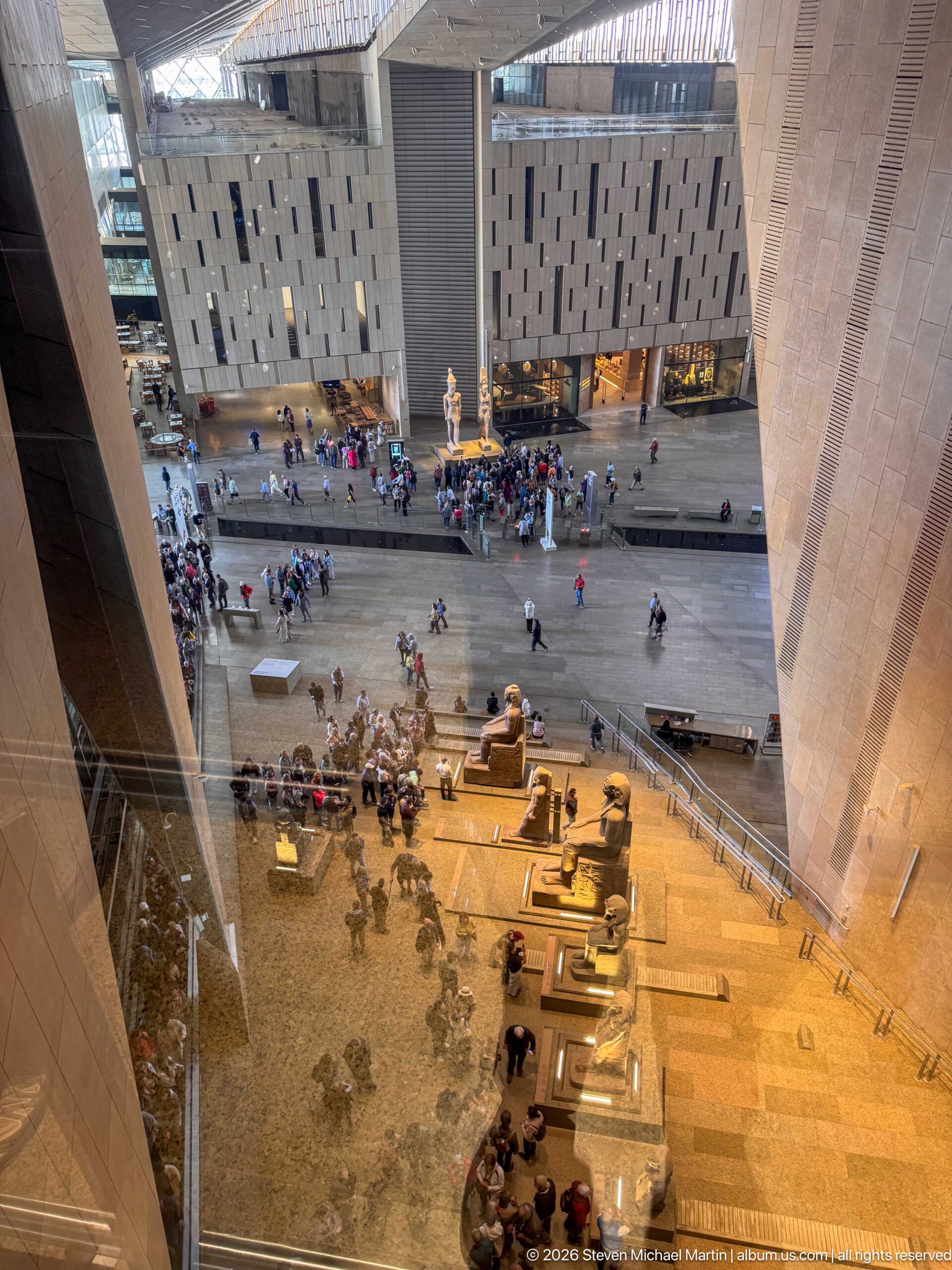
Seen from an upper level, the Grand Egyptian Museum opens into a vast angular interior court framed by sloping stone-clad walls and high glazed roof sections. Visitors gather around monumental sculptures and architectural fragments arranged across the broad floor, while circulation routes spread toward galleries beyond. The elevated viewpoint emphasizes the scale of the building and the contrast between massive stone surfaces and dispersed human figures.
Caption
Seen from an upper level, the Grand Egyptian Museum opens into a vast angular interior court framed by sloping stone-clad walls and high glazed roof sections. Visitors gather around monumental sculptures and architectural fragments arranged across the broad floor, while circulation routes spread toward galleries beyond. The elevated viewpoint emphasizes the scale of the building and the contrast between massive stone surfaces and dispersed human figures.
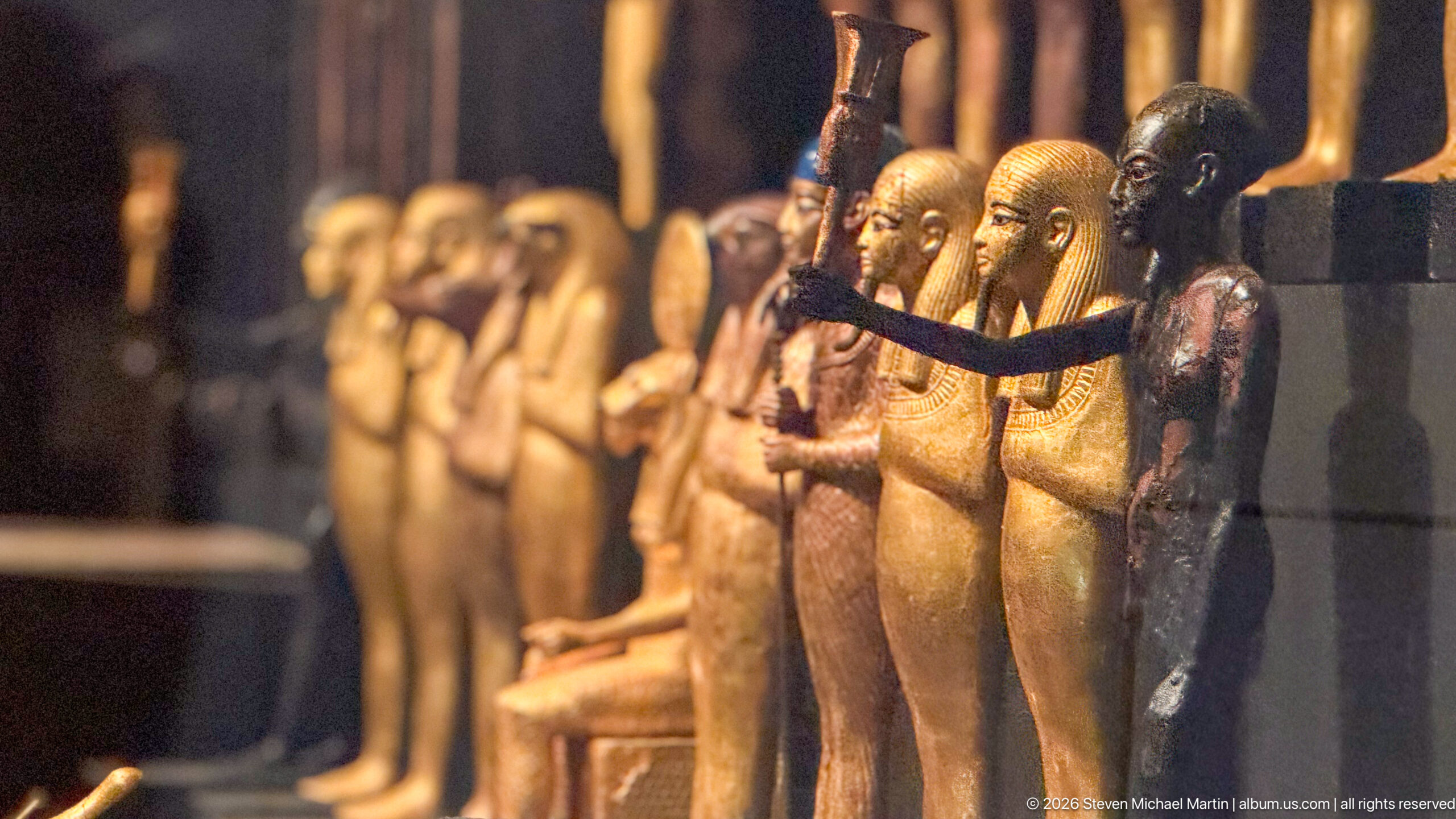
A shallow-depth side view turns a row of small divine figures into a processional sequence. Gilded human-headed and animal-headed statuettes recede into the background, while a dark-skinned figure in the foreground extends one arm outward and another upright figure rises just behind. The oblique perspective emphasizes repeated silhouettes and differences in color, gesture, and headdress.
Caption
A shallow-depth side view turns a row of small divine figures into a processional sequence. Gilded human-headed and animal-headed statuettes recede into the background, while a dark-skinned figure in the foreground extends one arm outward and another upright figure rises just behind. The oblique perspective emphasizes repeated silhouettes and differences in color, gesture, and headdress.
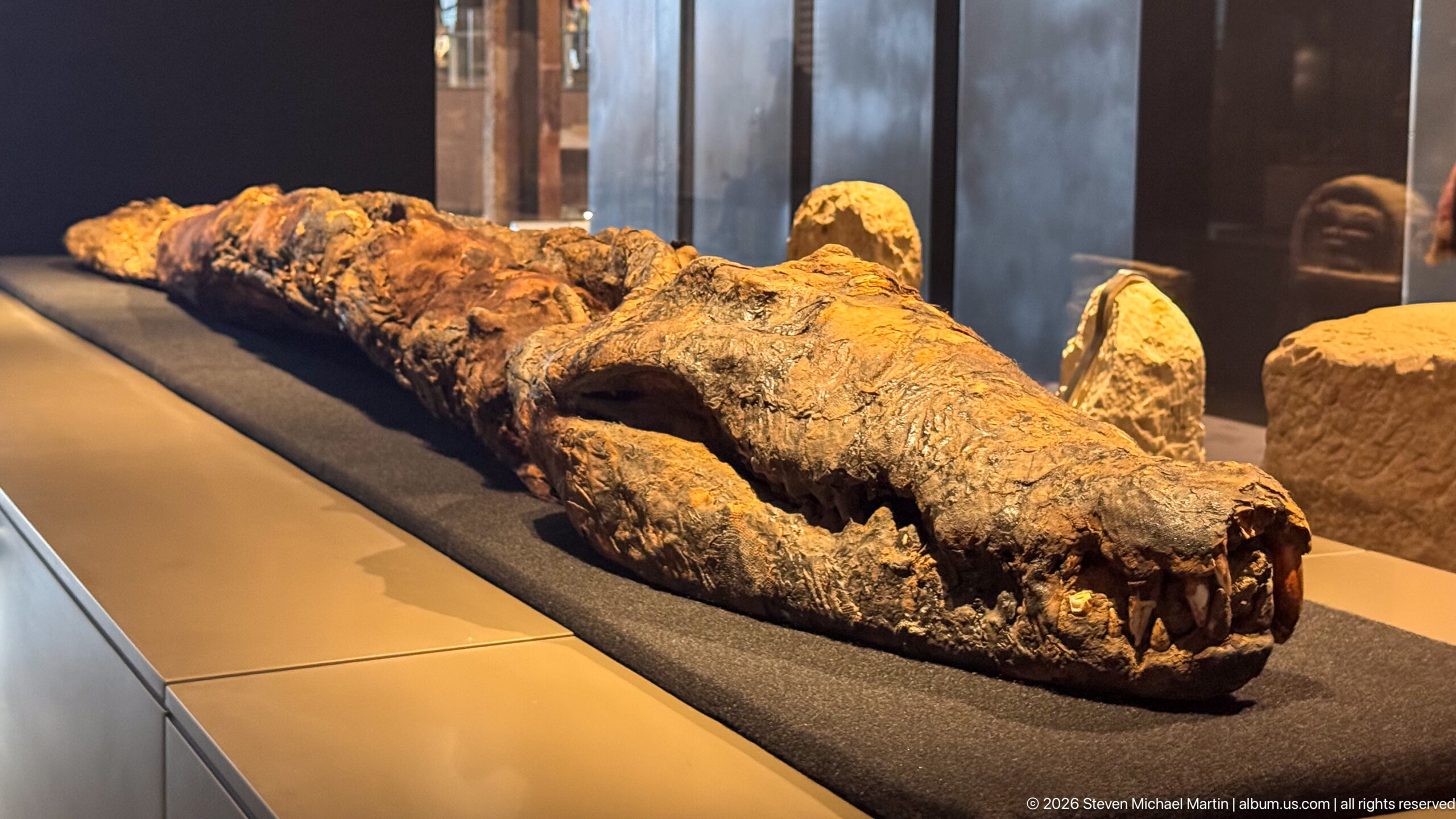
A large mummified crocodile lies stretched across a dark support, its long snout, rows of teeth, armored skin, and desiccated limbs still readily visible. The specimen demonstrates the animal-mummification practices of ancient Egypt, in which certain species were preserved as sacred or votive offerings connected with particular cults.
Caption
A large mummified crocodile lies stretched across a dark support, its long snout, rows of teeth, armored skin, and desiccated limbs still readily visible. The specimen demonstrates the animal-mummification practices of ancient Egypt, in which certain species were preserved as sacred or votive offerings connected with particular cults.
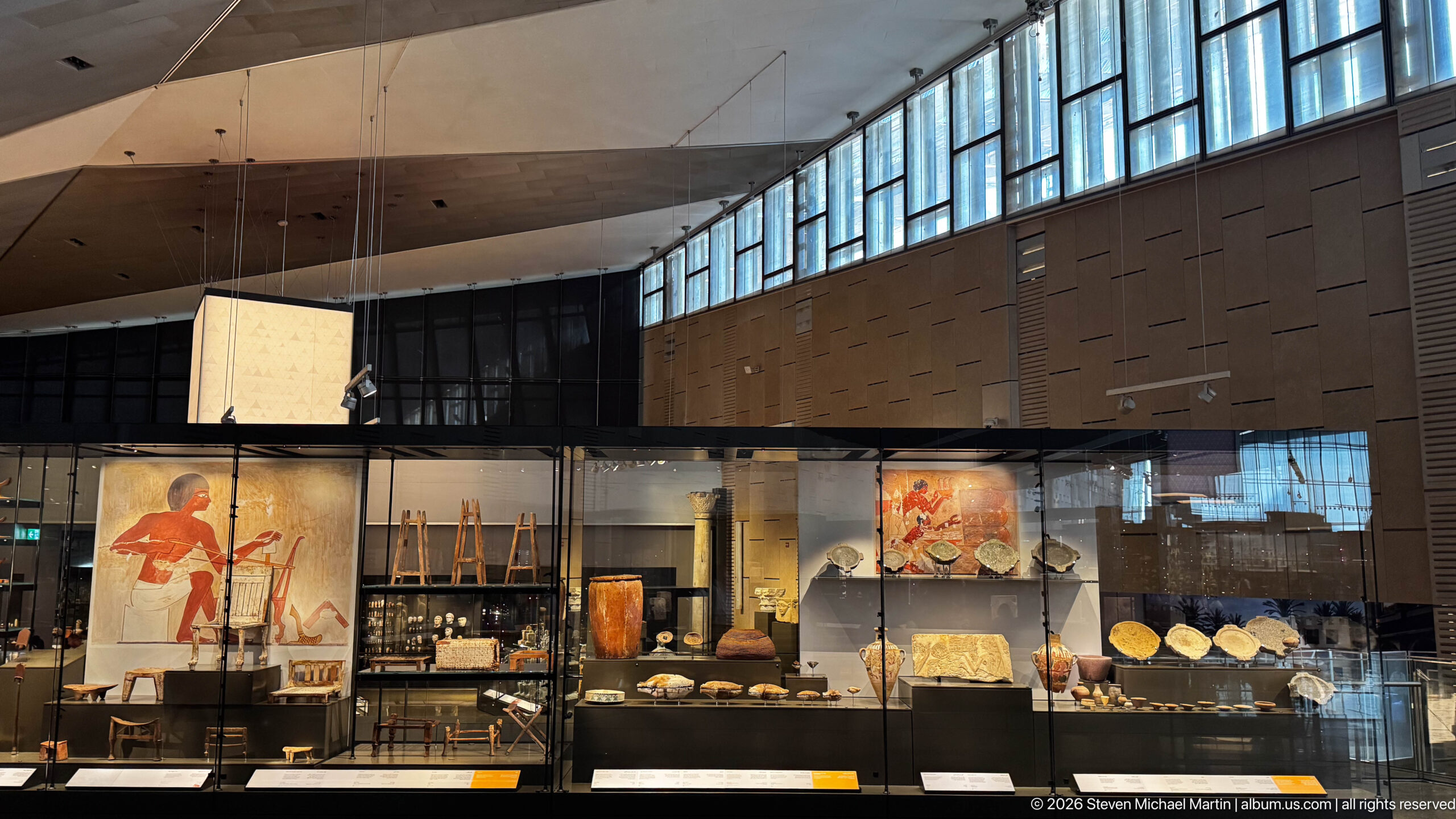
A broad gallery view records the Grand Egyptian Museum's installation strategy rather than a single object. A long glass case contains relief fragments, tall stone and ceramic vessels, small sculptures, and groups of compact artifacts arranged beneath suspended panels. High clerestory windows and dark architectural surfaces frame the display, revealing how diverse objects are presented together within the Main Galleries.
Caption
A broad gallery view records the Grand Egyptian Museum's installation strategy rather than a single object. A long glass case contains relief fragments, tall stone and ceramic vessels, small sculptures, and groups of compact artifacts arranged beneath suspended panels. High clerestory windows and dark architectural surfaces frame the display, revealing how diverse objects are presented together within the Main Galleries.
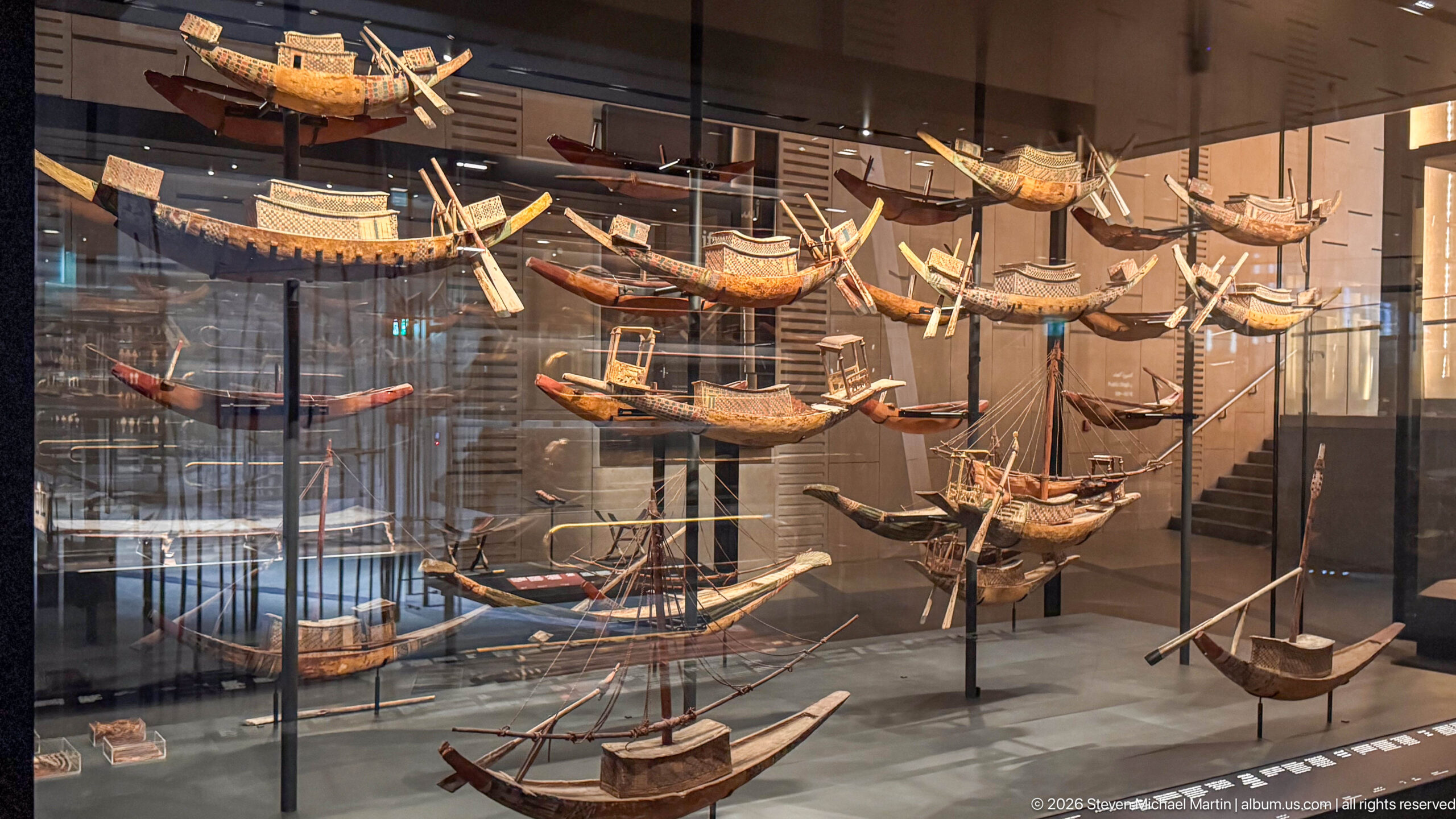
A tall glass case presents a broad survey of ancient Egyptian model boats suspended or mounted at several heights. Long, narrow craft with high prows, cabins, masts, oars, and steering gear fill the display from foreground to background. The installation allows direct comparison of vessel forms and deck arrangements, while the museum architecture remains visible through the transparent case.
Caption
A tall glass case presents a broad survey of ancient Egyptian model boats suspended or mounted at several heights. Long, narrow craft with high prows, cabins, masts, oars, and steering gear fill the display from foreground to background. The installation allows direct comparison of vessel forms and deck arrangements, while the museum architecture remains visible through the transparent case.
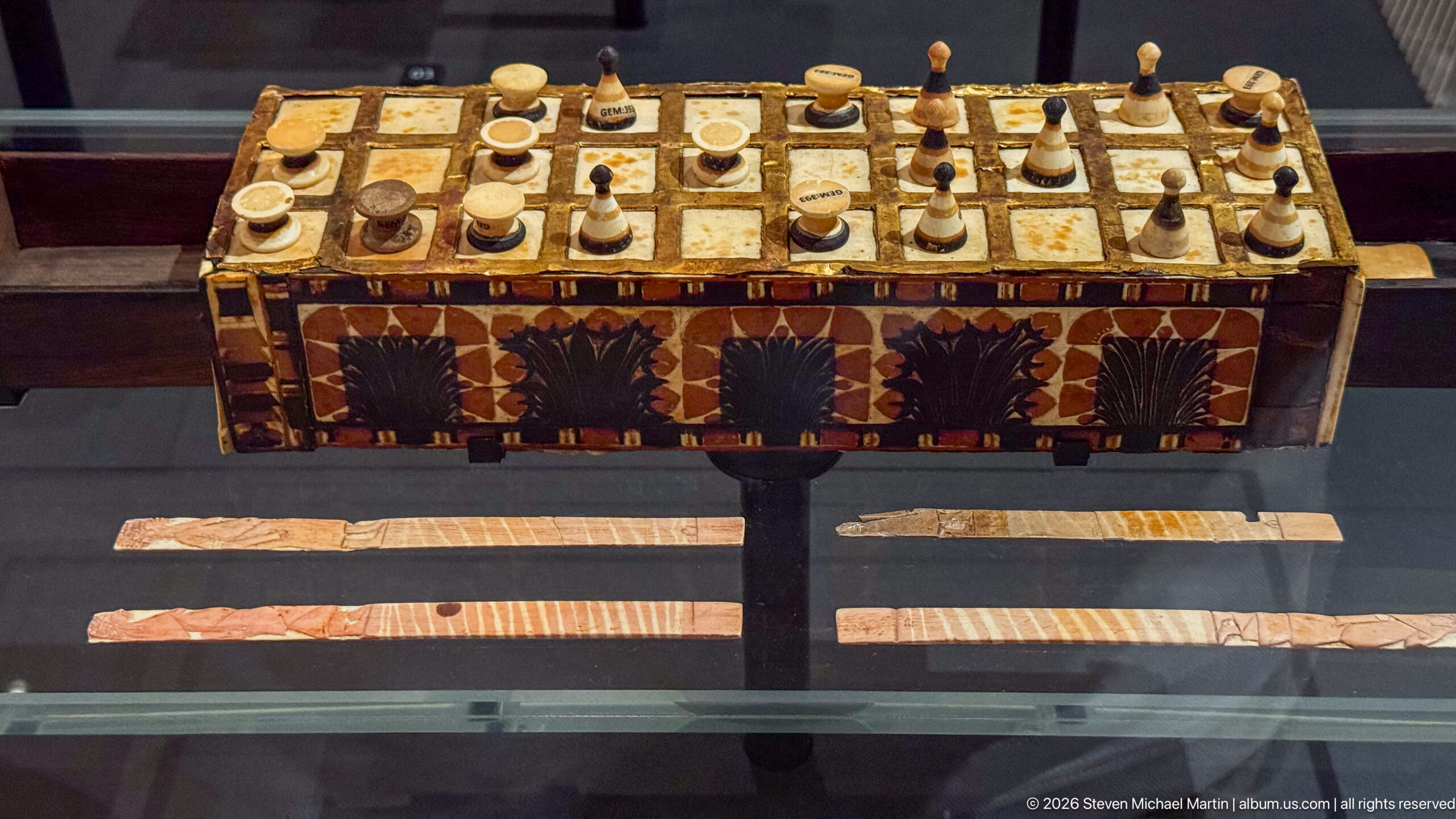
A rectangular game board is divided into a regular grid of square playing spaces occupied by numerous spool- and cone-shaped pieces. Its sides are decorated with repeated floral or papyrus-like motifs in dark blue, red, cream, and gold tones. The elevated museum display reveals both the playing surface and box-like body, documenting the relationship between gaming equipment and elaborate furniture craftsmanship.
Caption
A rectangular game board is divided into a regular grid of square playing spaces occupied by numerous spool- and cone-shaped pieces. Its sides are decorated with repeated floral or papyrus-like motifs in dark blue, red, cream, and gold tones. The elevated museum display reveals both the playing surface and box-like body, documenting the relationship between gaming equipment and elaborate furniture craftsmanship.
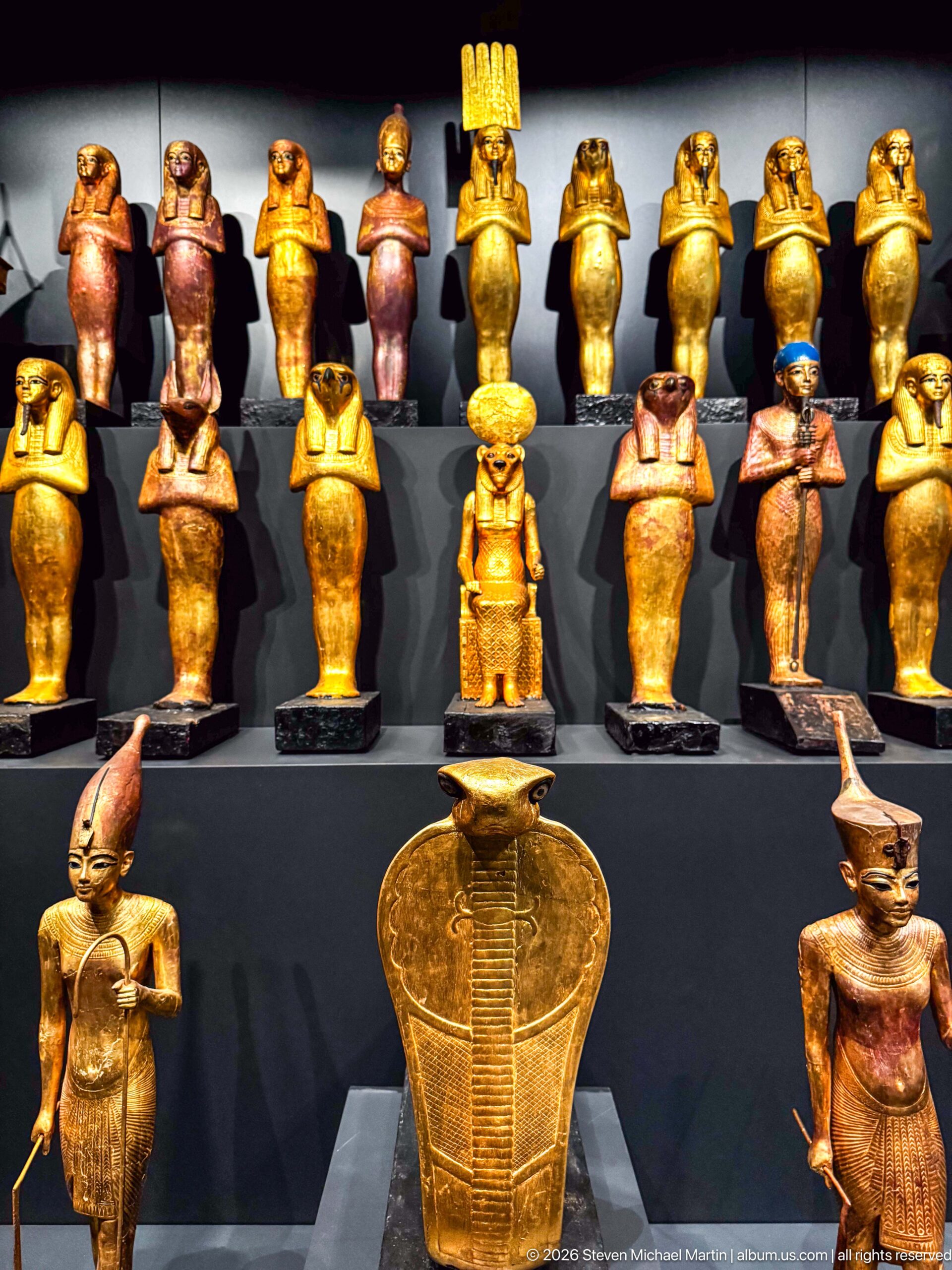
A tiered case assembles numerous small deity figures in gold, red, blue, green, and black finishes. Human-headed and animal-headed forms stand or sit in ordered rows, while a large central cobra-hooded or shield-like element anchors the lower foreground. The installation functions as a visual survey of divine forms, crowns, animal associations, and protective imagery across the Egyptian pantheon.
Caption
A tiered case assembles numerous small deity figures in gold, red, blue, green, and black finishes. Human-headed and animal-headed forms stand or sit in ordered rows, while a large central cobra-hooded or shield-like element anchors the lower foreground. The installation functions as a visual survey of divine forms, crowns, animal associations, and protective imagery across the Egyptian pantheon.
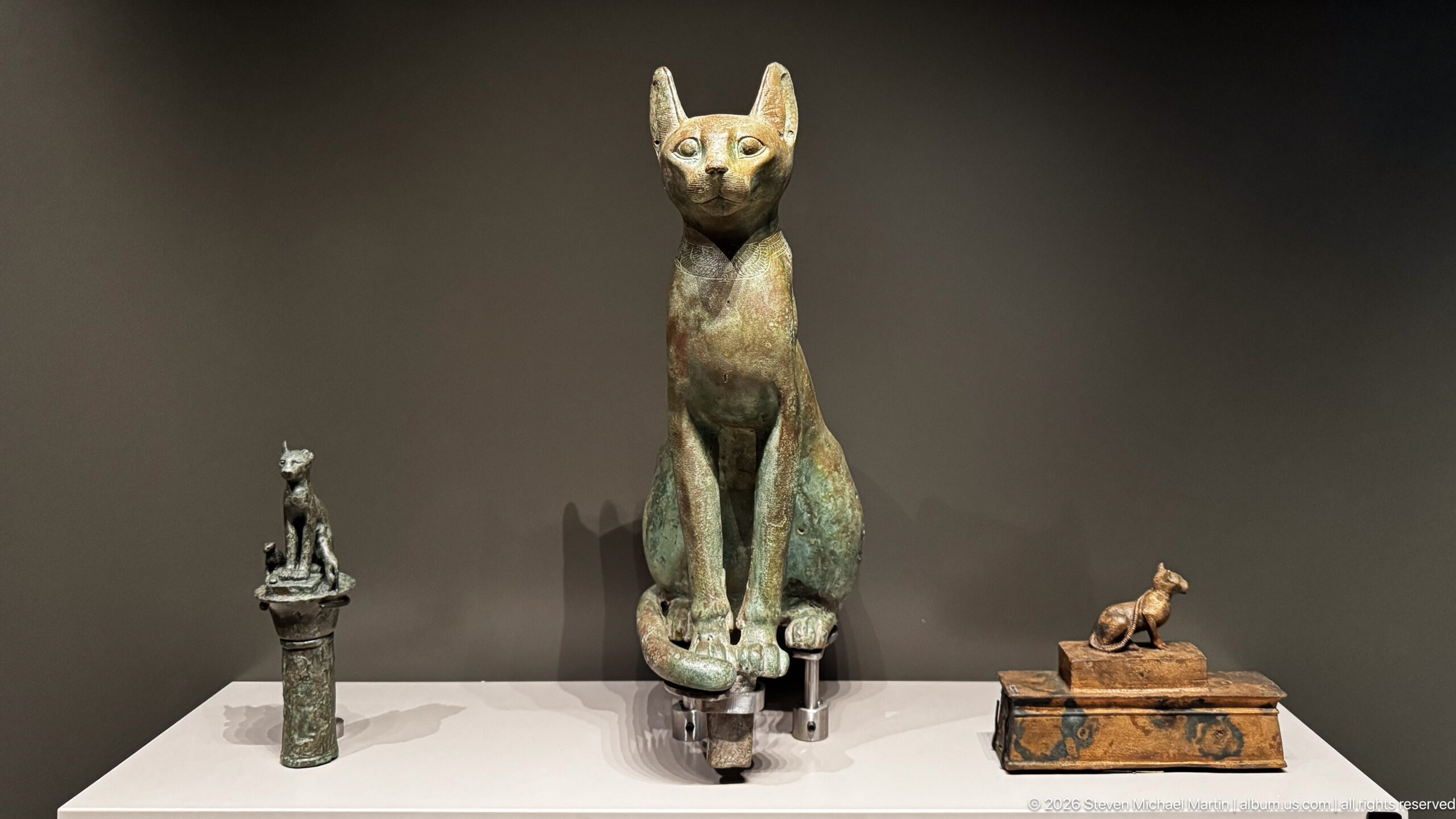
A display of feline votive sculptures centers on a tall seated cat with erect ears and an alert frontal gaze, accompanied by smaller cat figures on either side. The group illustrates the prominence of feline imagery in Egyptian religious material culture, particularly objects associated with divine protection and temple devotion.
Caption
A display of feline votive sculptures centers on a tall seated cat with erect ears and an alert frontal gaze, accompanied by smaller cat figures on either side. The group illustrates the prominence of feline imagery in Egyptian religious material culture, particularly objects associated with divine protection and temple devotion.
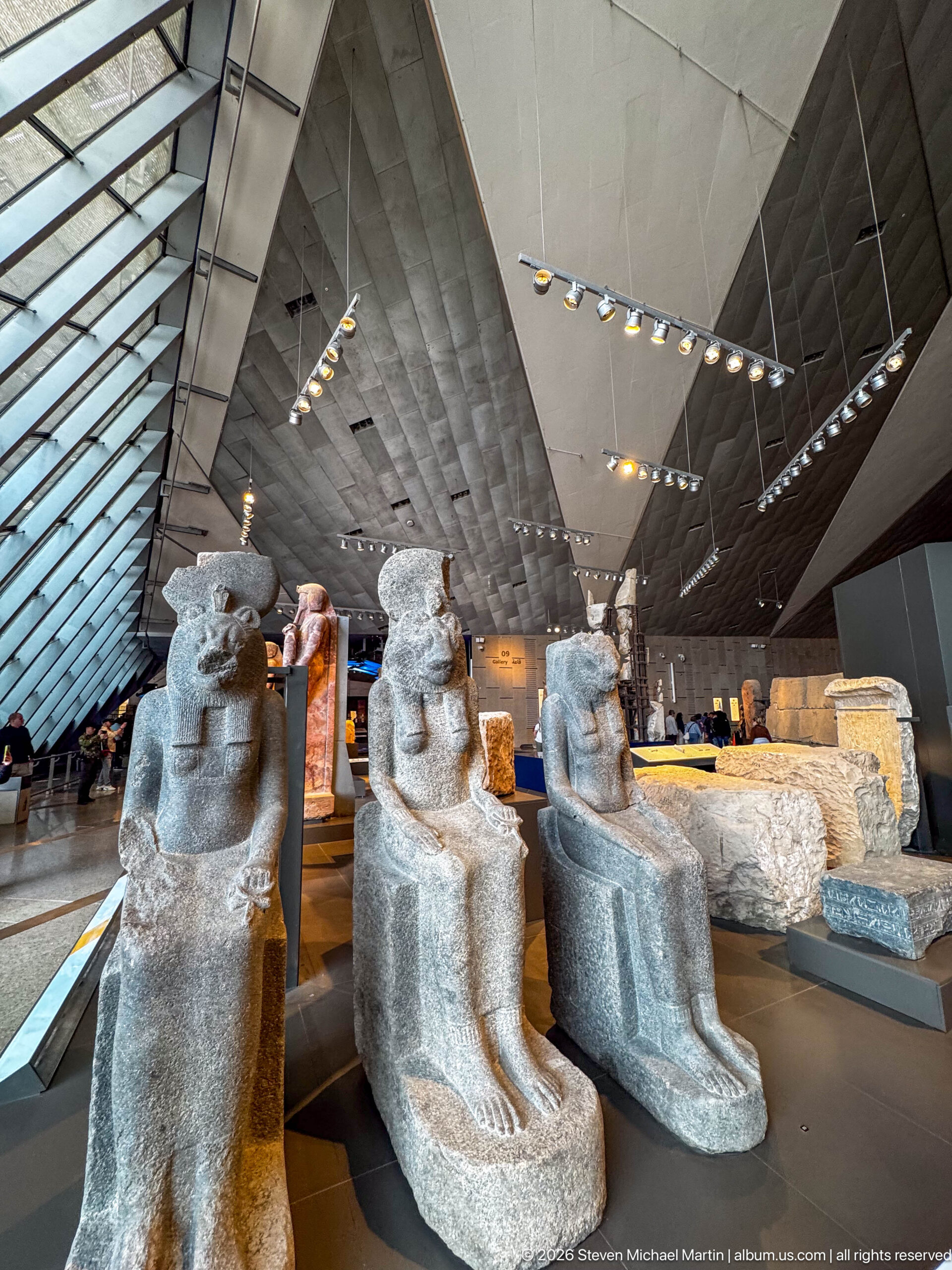
Three monumental seated figures anchor a spacious gallery beneath the Grand Egyptian Museum’s sharply folded ceiling. Carved from dark stone and presented in a frontal row, the statues contrast the visual weight and permanence of pharaonic sculpture with the museum’s expansive contemporary architecture.
Caption
Three monumental seated figures anchor a spacious gallery beneath the Grand Egyptian Museum’s sharply folded ceiling. Carved from dark stone and presented in a frontal row, the statues contrast the visual weight and permanence of pharaonic sculpture with the museum’s expansive contemporary architecture.
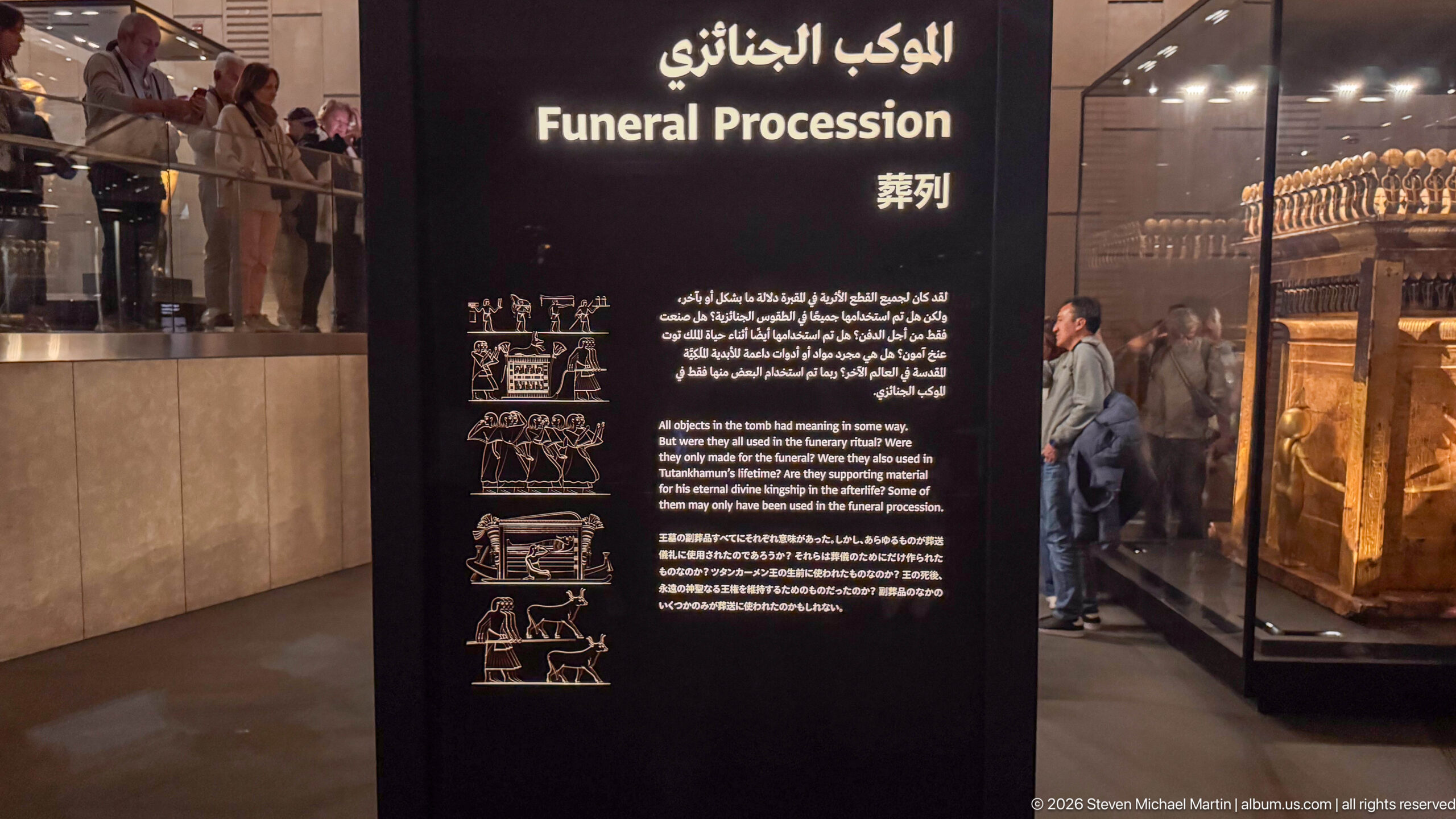
A tall interpretation panel titled “Funeral Procession” introduces the ritual sequence surrounding burial. English, Arabic, and Chinese text is paired with small line drawings that diagram successive stages, while nearby objects are visible through the cases at either side. The panel anchors this gallery section in funerary practice and documents how the museum connects archaeological material with an explanatory narrative.
Caption
A tall interpretation panel titled “Funeral Procession” introduces the ritual sequence surrounding burial. English, Arabic, and Chinese text is paired with small line drawings that diagram successive stages, while nearby objects are visible through the cases at either side. The panel anchors this gallery section in funerary practice and documents how the museum connects archaeological material with an explanatory narrative.
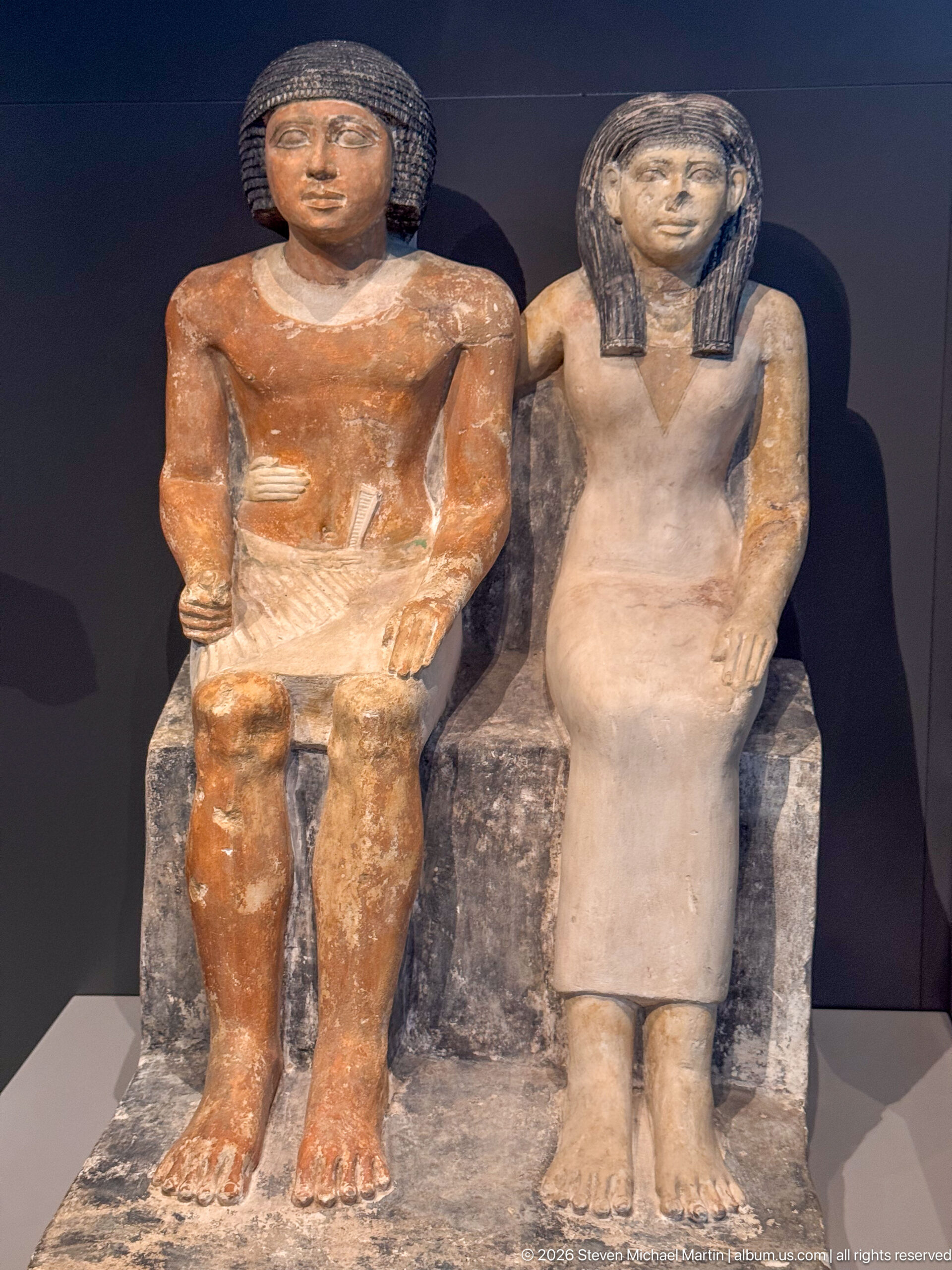
A painted stone group statue presents a seated man and woman side by side, preserving contrasting skin tones, wigs, clothing, and the compact symmetry characteristic of Egyptian paired portrait sculpture. The frontal pose and block-like seat emphasize permanence and social identity while the surviving pigments help convey the original polychrome appearance of the work.
Caption
A painted stone group statue presents a seated man and woman side by side, preserving contrasting skin tones, wigs, clothing, and the compact symmetry characteristic of Egyptian paired portrait sculpture. The frontal pose and block-like seat emphasize permanence and social identity while the surviving pigments help convey the original polychrome appearance of the work.
A lapis lazuli amulet in the form of a recumbent bovid, perhaps a horned bull, from the Treasure of Tod. Dating to Dynasty 12 of the Middle Kingdom, the pierced amulet was made to be strung and worn. It was discovered in 1936 among the Tod Treasure; its lapis lazuli also reflects Egypt’s far-reaching exchange networks, since the nearest ancient source of the stone lay in Afghanistan.
Caption
A lapis lazuli amulet in the form of a recumbent bovid, perhaps a horned bull, from the Treasure of Tod. Dating to Dynasty 12 of the Middle Kingdom, the pierced amulet was made to be strung and worn. It was discovered in 1936 among the Tod Treasure; its lapis lazuli also reflects Egypt’s far-reaching exchange networks, since the nearest ancient source of the stone lay in Afghanistan.
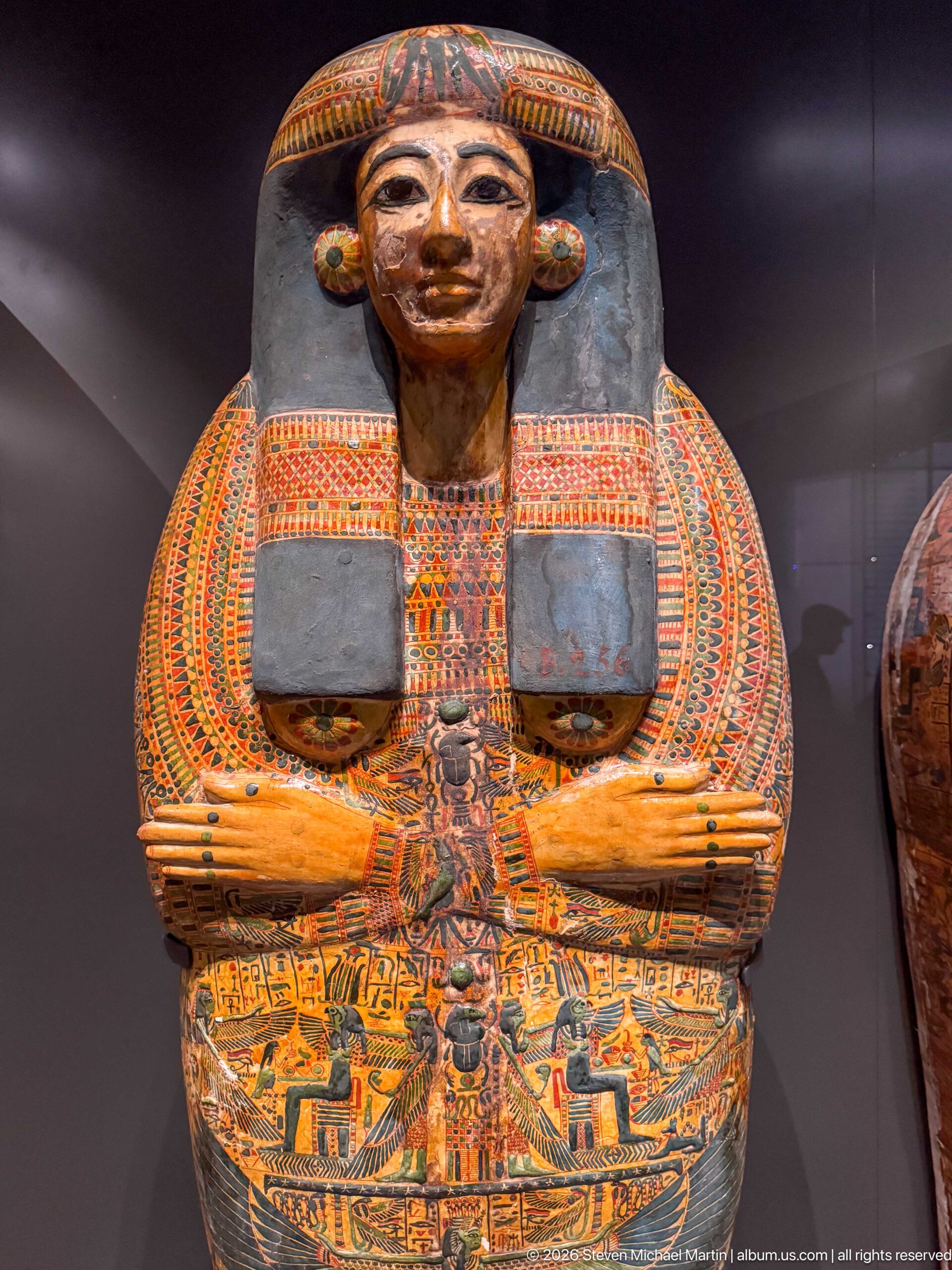
A richly painted anthropoid coffin presents an idealized face above a broad multicolored collar and crossed arms, with dense registers of divine figures, protective motifs, and hieroglyphic decoration covering the torso. The vivid orange, blue, green, and black palette makes the coffin’s protective iconography central to the visual impact of the object.
Caption
A richly painted anthropoid coffin presents an idealized face above a broad multicolored collar and crossed arms, with dense registers of divine figures, protective motifs, and hieroglyphic decoration covering the torso. The vivid orange, blue, green, and black palette makes the coffin’s protective iconography central to the visual impact of the object.
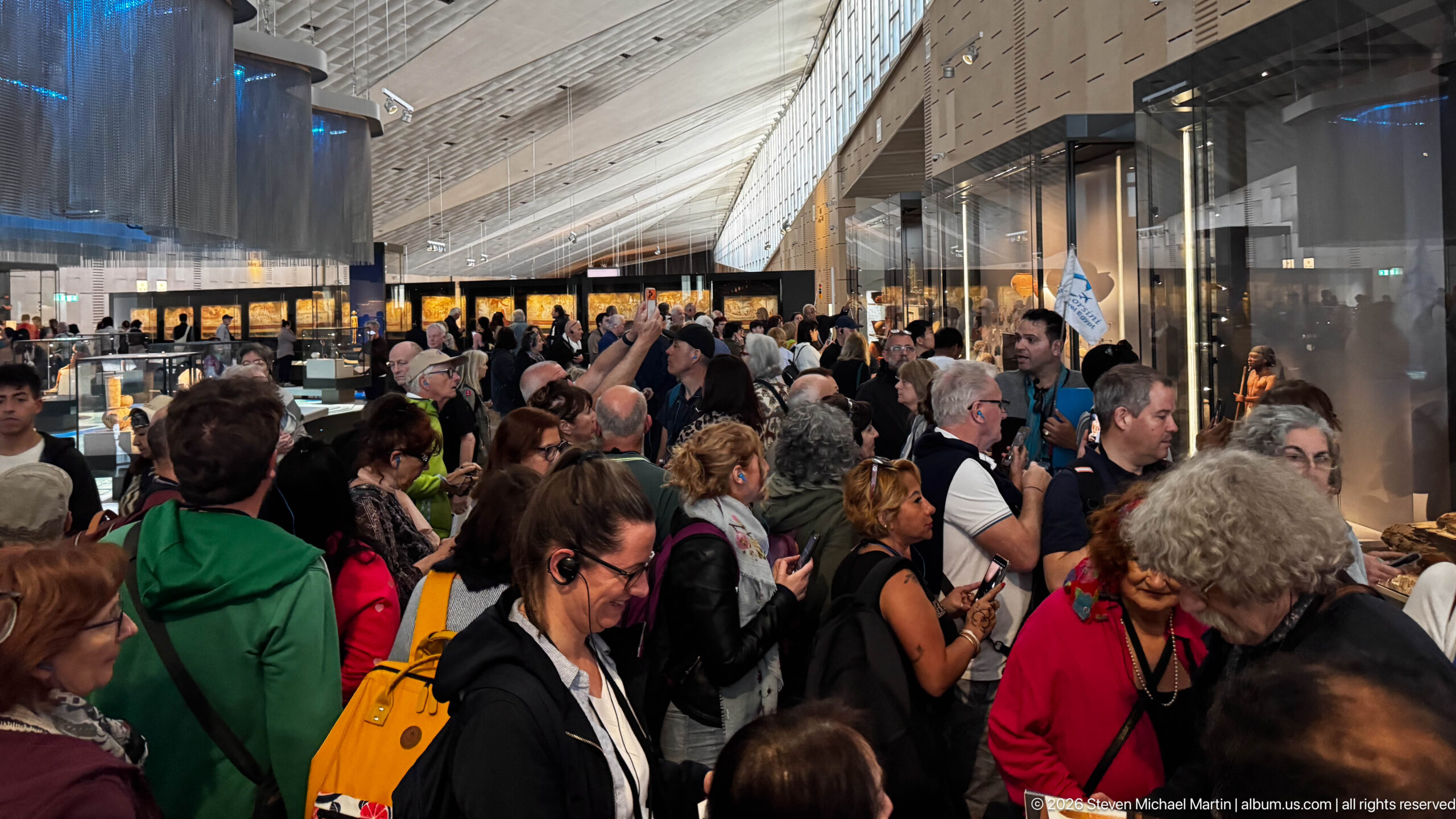
Visitors fill a broad gallery concourse beneath the Grand Egyptian Museum’s high, angular roof, with glazed walls and display cases extending into the distance. The crowded scene records the scale of the museum’s public circulation space and the relationship between contemporary architecture, visitor movement, and the presentation of ancient Egyptian collections.
Caption
Visitors fill a broad gallery concourse beneath the Grand Egyptian Museum’s high, angular roof, with glazed walls and display cases extending into the distance. The crowded scene records the scale of the museum’s public circulation space and the relationship between contemporary architecture, visitor movement, and the presentation of ancient Egyptian collections.
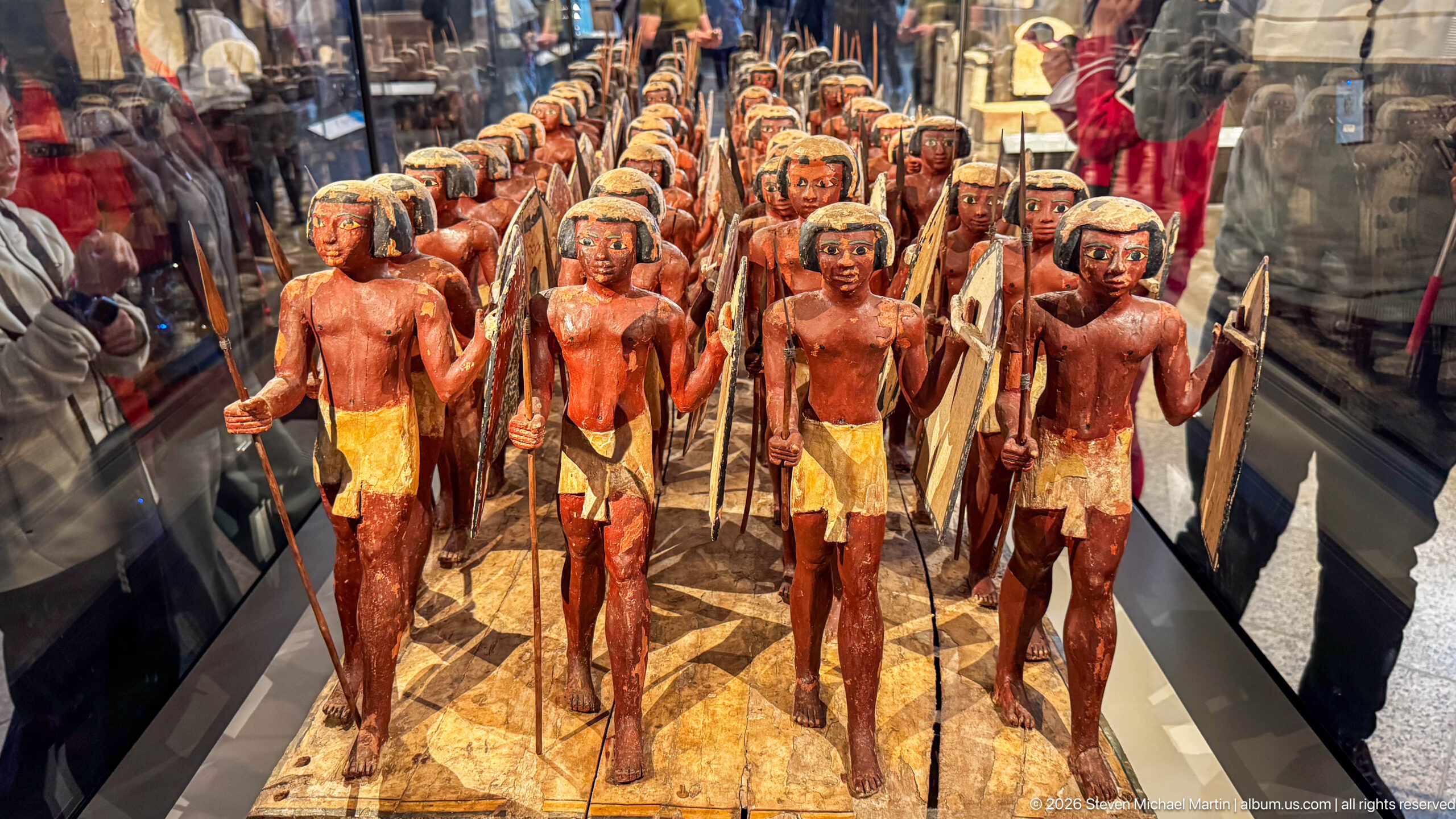
A tightly ordered group of painted wooden male figures advances in parallel ranks, each carrying a long staff or spear. Their repeated poses, reddish-brown bodies, short kilts, and individually modeled heads identify the display as a funerary model ensemble rather than freestanding life-size sculpture, preserving a vivid miniature representation of organized activity.
Caption
A tightly ordered group of painted wooden male figures advances in parallel ranks, each carrying a long staff or spear. Their repeated poses, reddish-brown bodies, short kilts, and individually modeled heads identify the display as a funerary model ensemble rather than freestanding life-size sculpture, preserving a vivid miniature representation of organized activity.
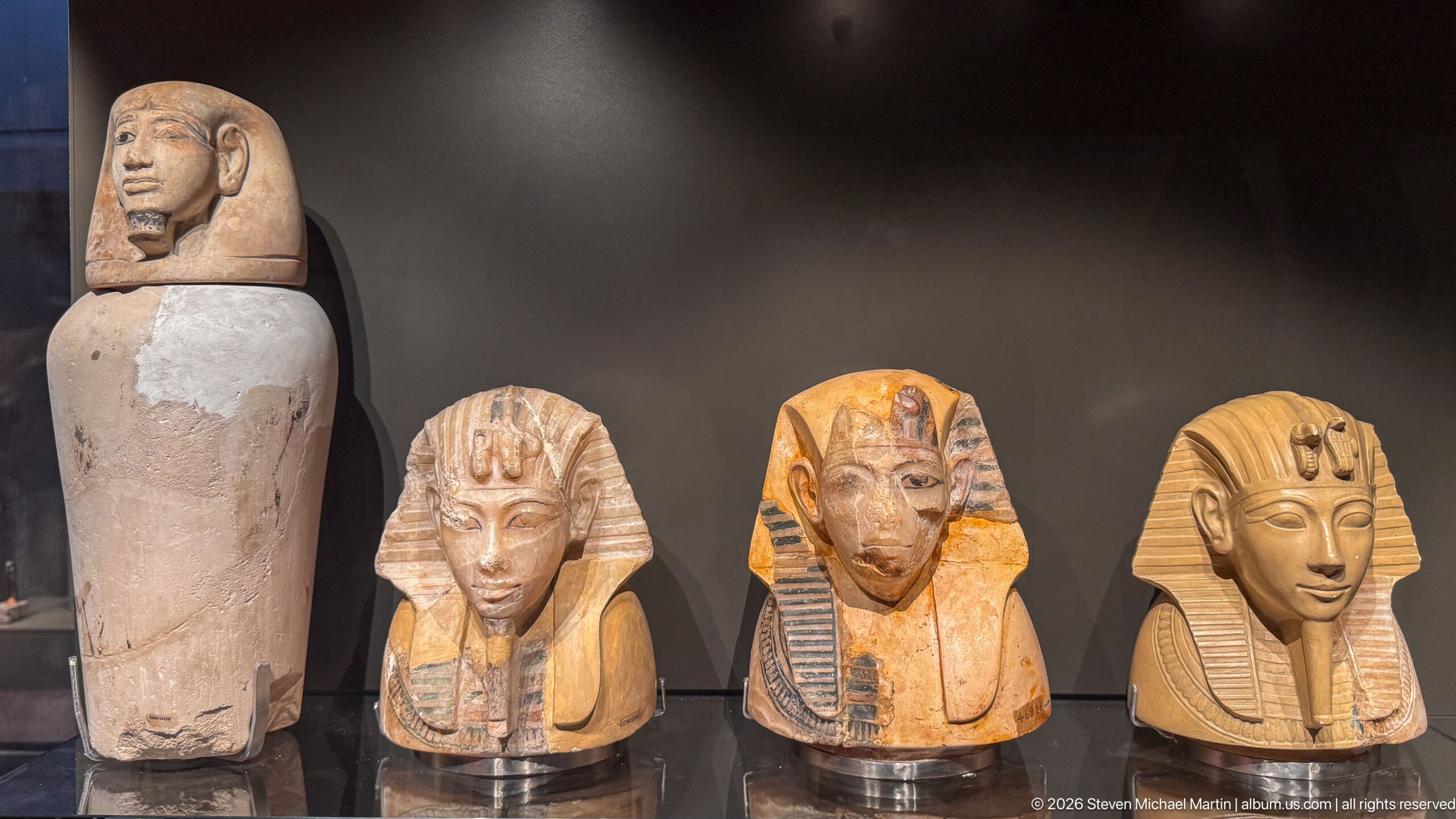
Four small funerary heads or mask-like elements are arranged together in a display case, three preserving striped nemes-style headdresses and modeled faces. Differences in stone or surface finish suggest separate objects rather than a single set, while the compact presentation highlights recurring conventions of idealized funerary portraiture.
Caption
Four small funerary heads or mask-like elements are arranged together in a display case, three preserving striped nemes-style headdresses and modeled faces. Differences in stone or surface finish suggest separate objects rather than a single set, while the compact presentation highlights recurring conventions of idealized funerary portraiture.
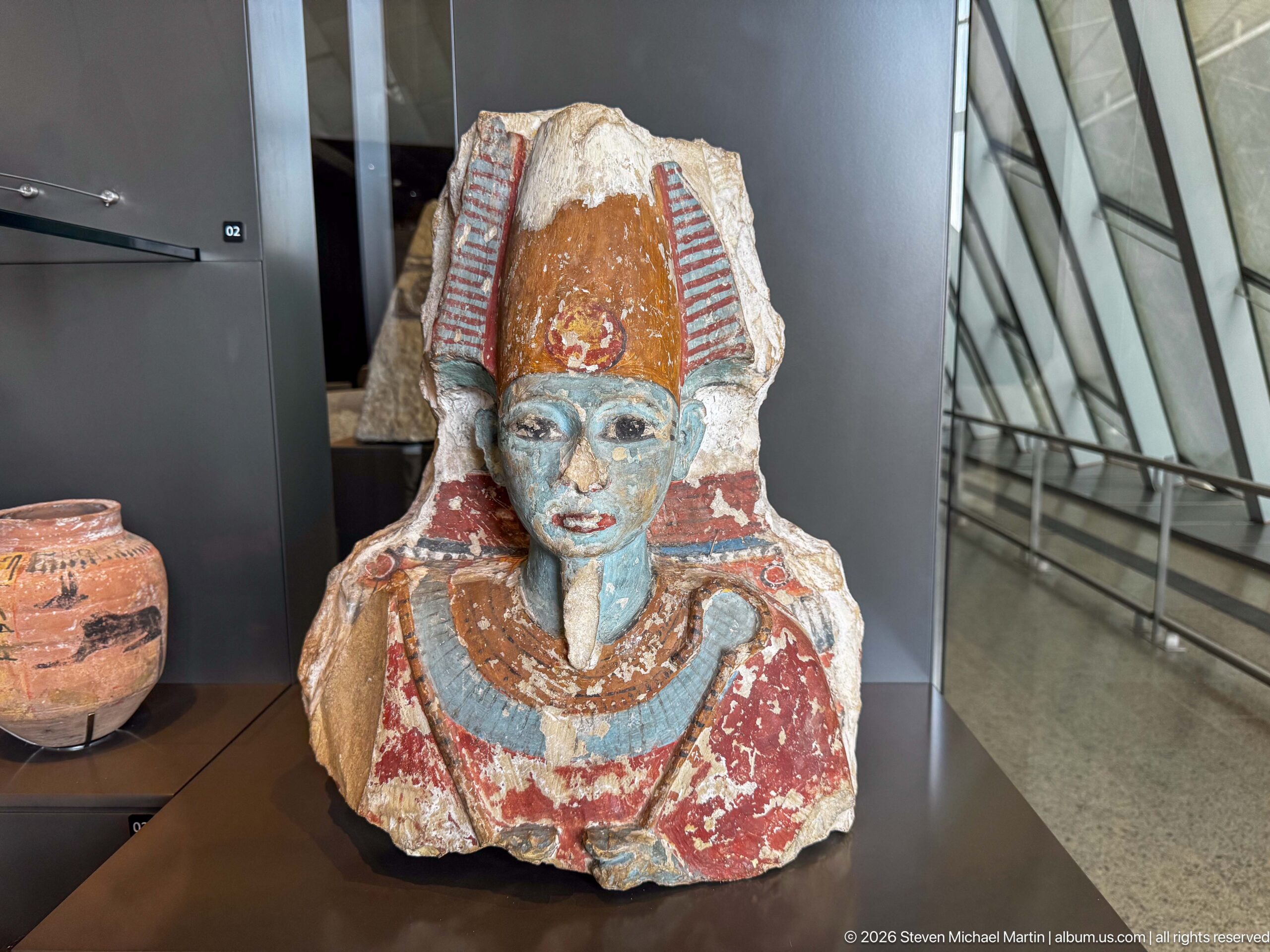
A polychrome sculptural fragment preserves the head, shoulders, and upper torso of a male figure with a broad collar and striped headdress. Red, blue-green, white, and black pigments remain across the face and garment, making the surviving surface decoration as important as the damaged stone form itself.
Caption
A polychrome sculptural fragment preserves the head, shoulders, and upper torso of a male figure with a broad collar and striped headdress. Red, blue-green, white, and black pigments remain across the face and garment, making the surviving surface decoration as important as the damaged stone form itself.
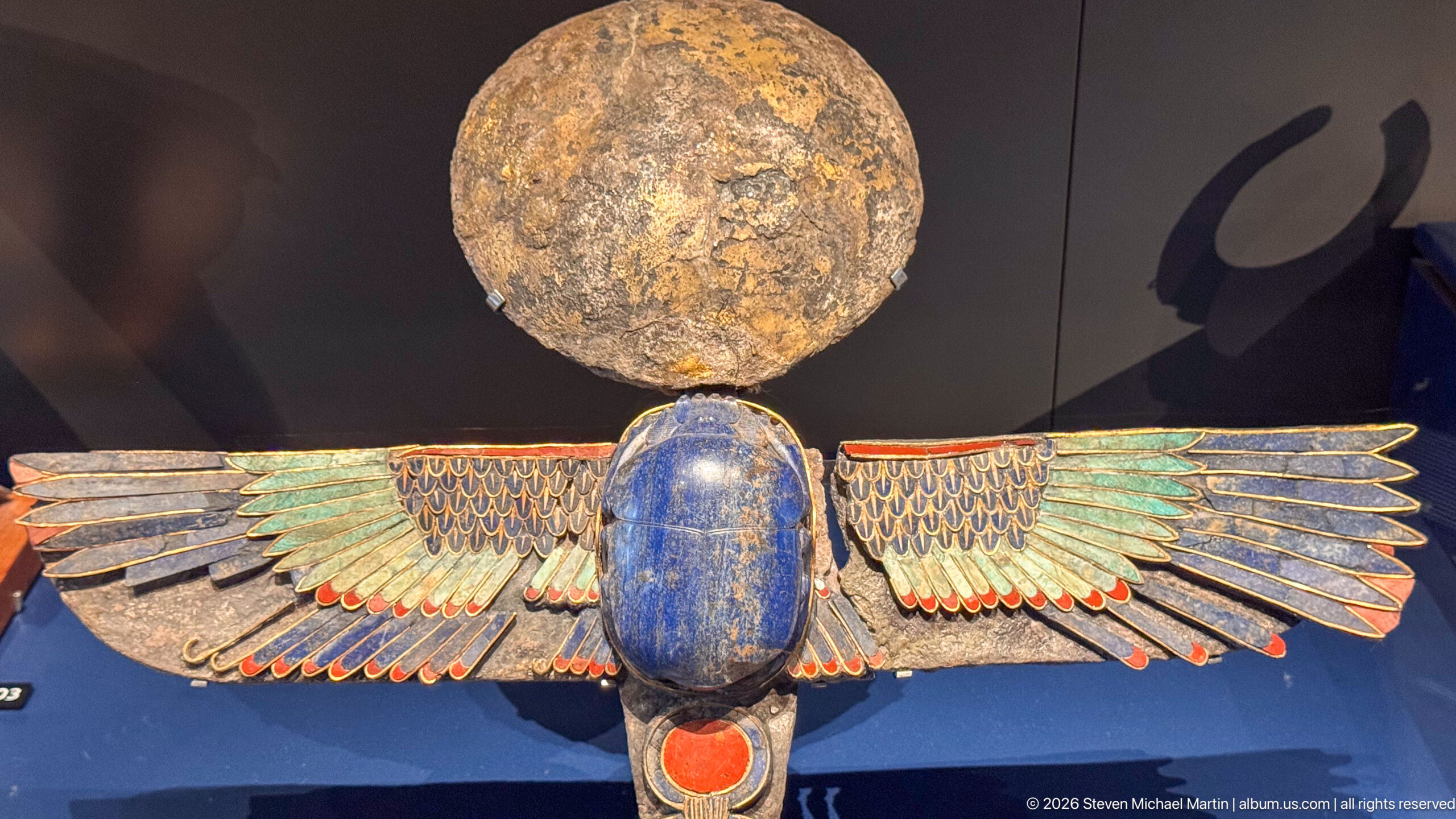
A large winged scarab spreads multicolored feathered wings beneath a circular solar disk, combining blue, green, red, and gold-toned surfaces in a compact funerary emblem. The central scarab and outstretched wings evoke rebirth and solar regeneration, themes widely associated with Egyptian funerary iconography.
Caption
A large winged scarab spreads multicolored feathered wings beneath a circular solar disk, combining blue, green, red, and gold-toned surfaces in a compact funerary emblem. The central scarab and outstretched wings evoke rebirth and solar regeneration, themes widely associated with Egyptian funerary iconography.
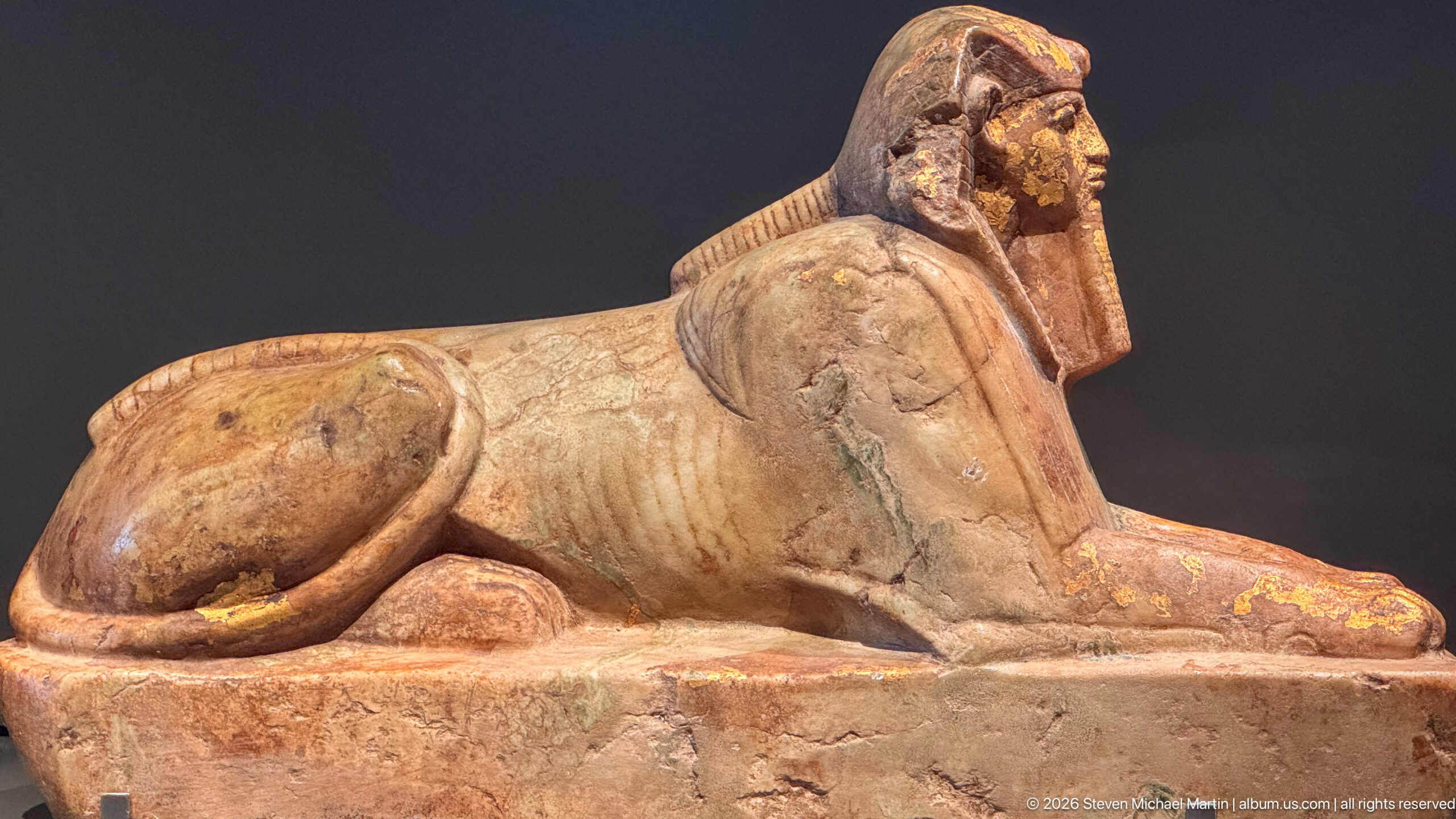
A reclining sphinx combines a human head in a striped royal headdress with the body and forepaws of a lion. The compact stone sculpture uses the traditional fusion of royal intelligence and leonine strength, with traces of color surviving around the head and face.
Caption
A reclining sphinx combines a human head in a striped royal headdress with the body and forepaws of a lion. The compact stone sculpture uses the traditional fusion of royal intelligence and leonine strength, with traces of color surviving around the head and face.
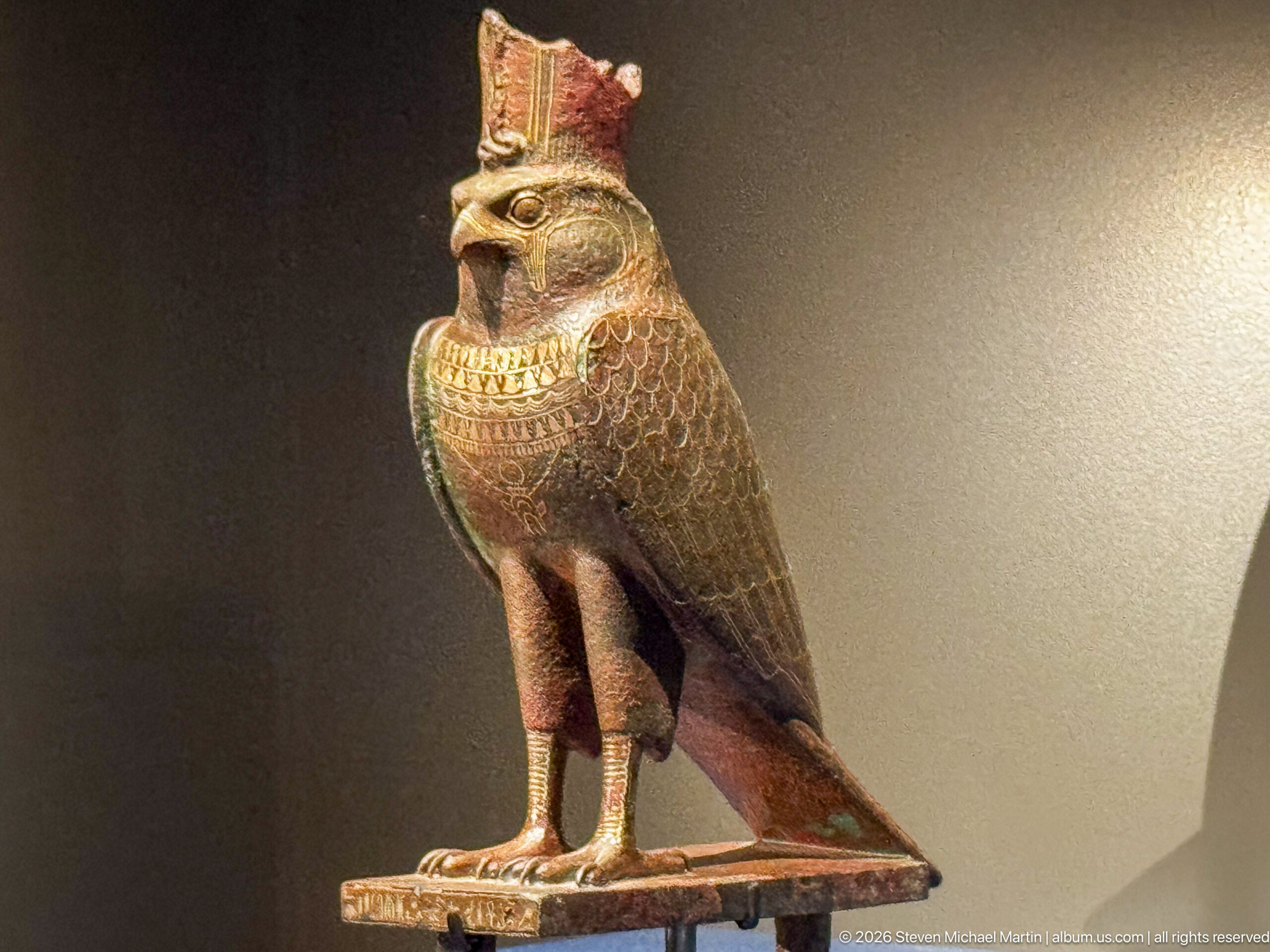
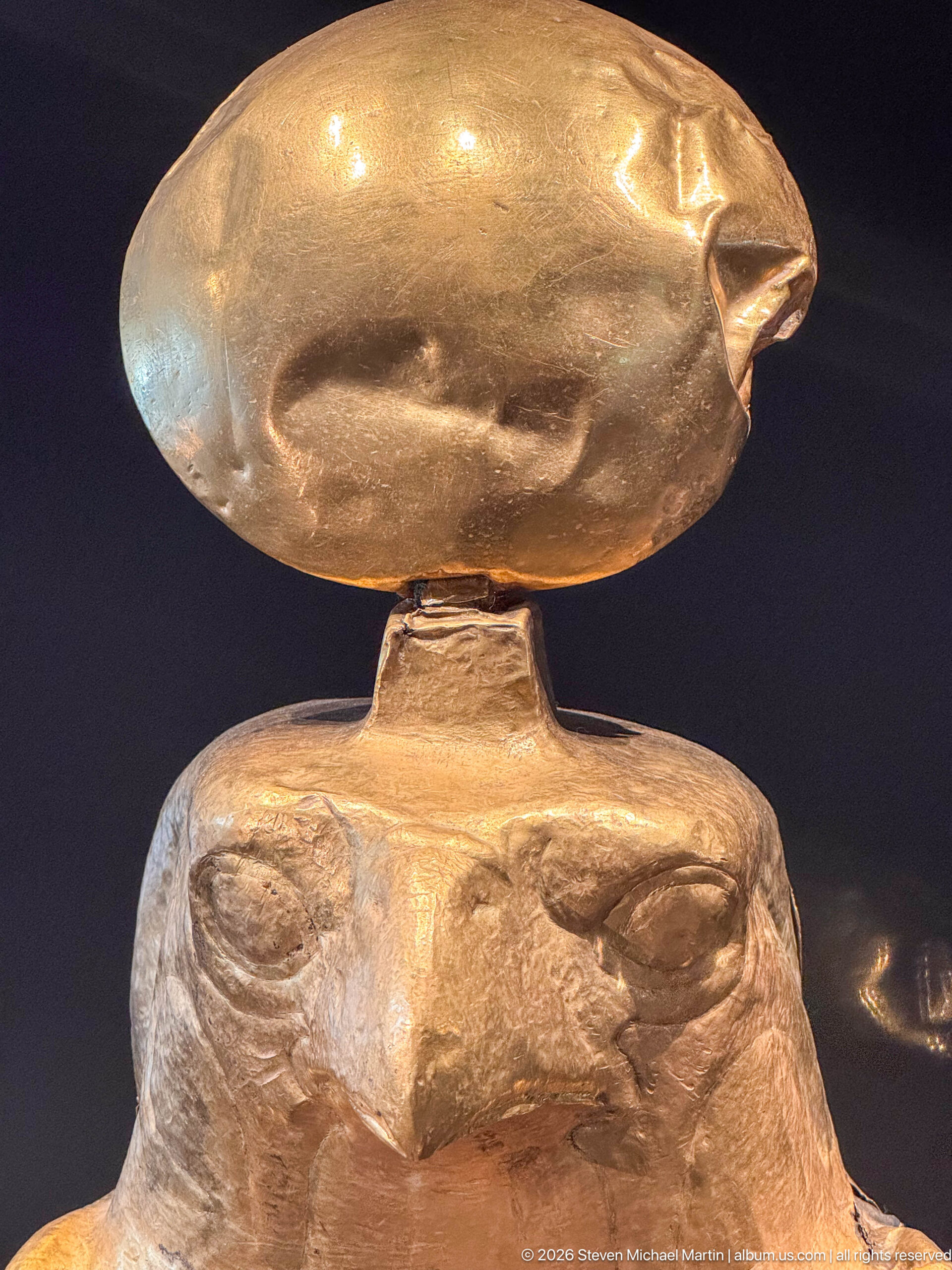
A polychrome falcon stands upright on a narrow base, its hooked beak, large eye, feather patterning, and tall double crown rendered with exceptional clarity. The combination of falcon form and royal crown identifies the figure as a divine or royal cult image rooted in Egyptian falcon symbolism.
Caption
A polychrome falcon stands upright on a narrow base, its hooked beak, large eye, feather patterning, and tall double crown rendered with exceptional clarity. The combination of falcon form and royal crown identifies the figure as a divine or royal cult image rooted in Egyptian falcon symbolism.
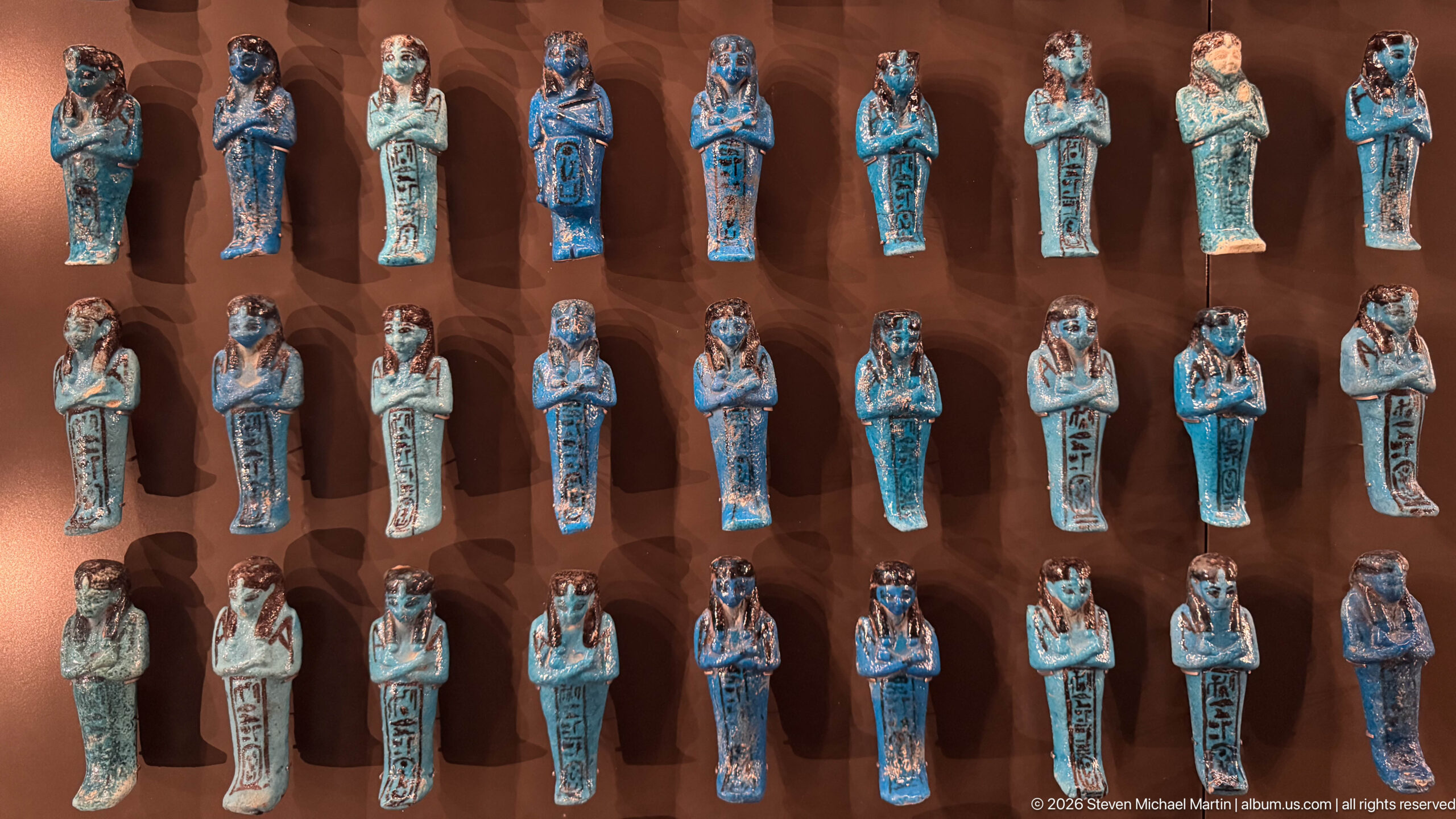
Rows of small blue-green funerary figurines stand upright in a grid-like display, many with crossed arms and mummiform bodies. Their repeated form and glazed surfaces are characteristic of ushabtis, objects placed in tombs to serve the deceased symbolically in the afterlife.
Caption
Rows of small blue-green funerary figurines stand upright in a grid-like display, many with crossed arms and mummiform bodies. Their repeated form and glazed surfaces are characteristic of ushabtis, objects placed in tombs to serve the deceased symbolically in the afterlife.
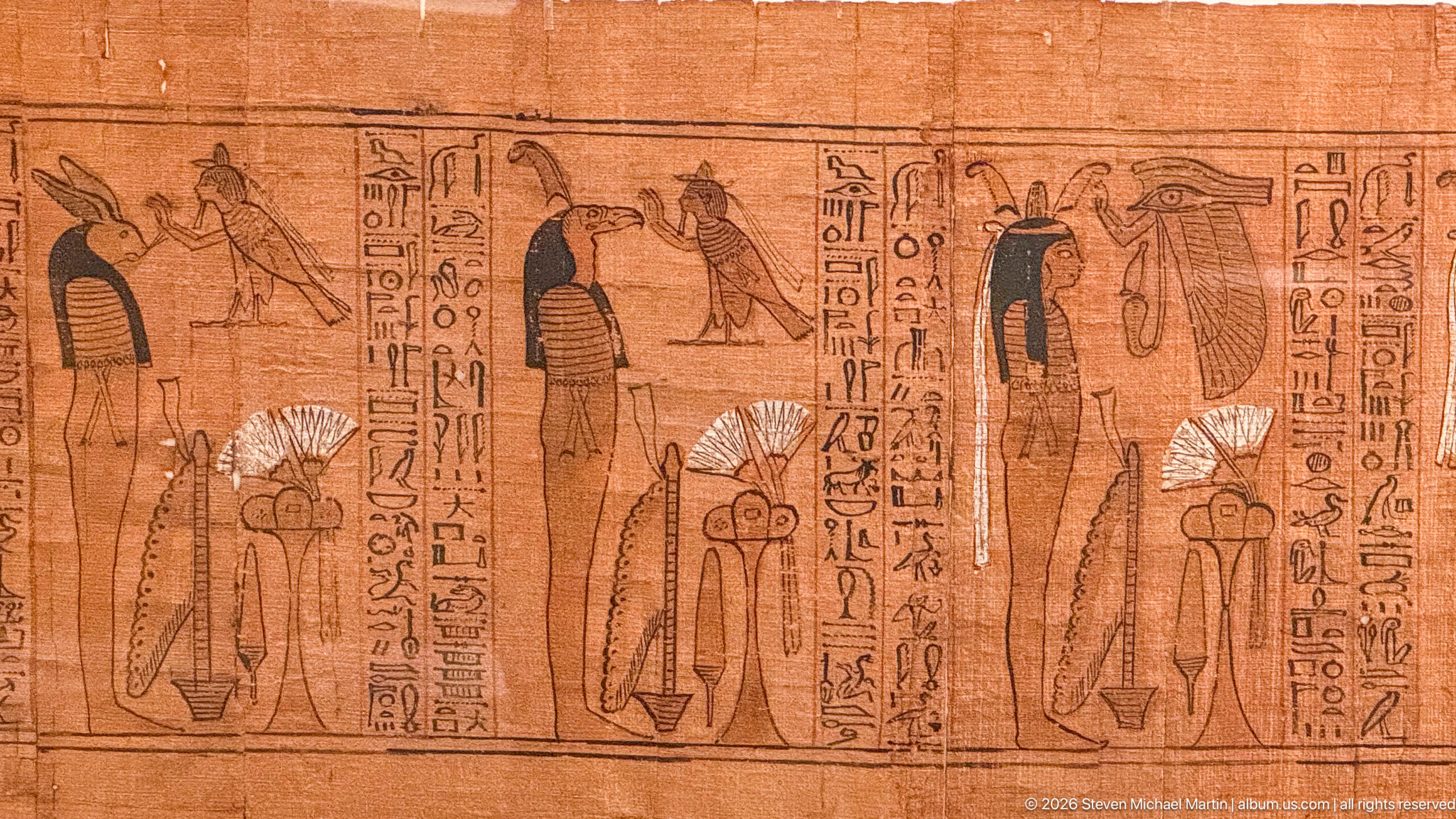
An illustrated funerary papyrus combines vertical hieroglyphic texts with repeated standing divine figures and offering scenes. The warm papyrus ground, black outlines, red details, and carefully organized registers preserve the visual language of Egyptian mortuary manuscripts, where image and text worked together to guide and protect the deceased.
Caption
An illustrated funerary papyrus combines vertical hieroglyphic texts with repeated standing divine figures and offering scenes. The warm papyrus ground, black outlines, red details, and carefully organized registers preserve the visual language of Egyptian mortuary manuscripts, where image and text worked together to guide and protect the deceased.
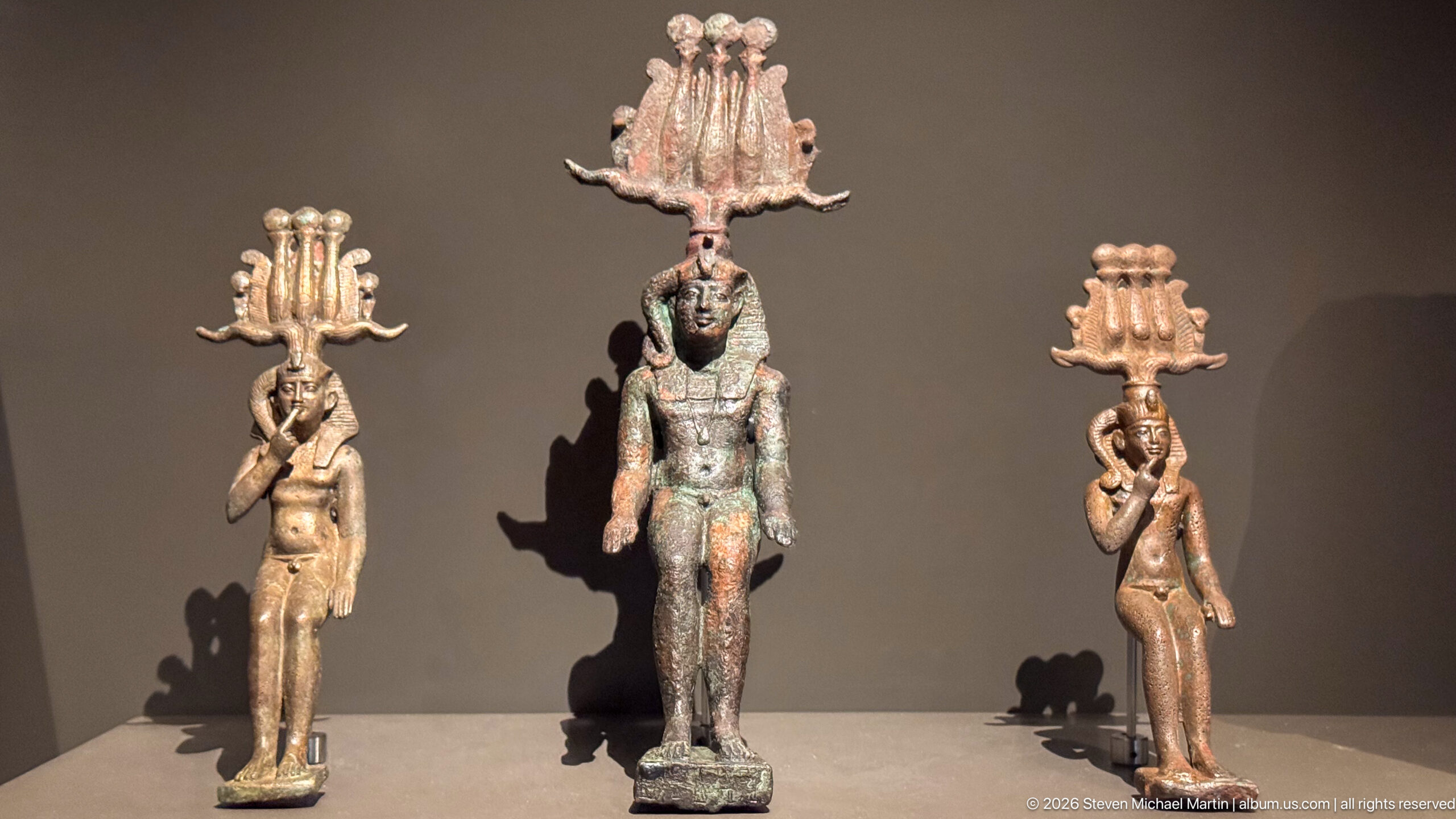
Three small standing deity figures are displayed together, each wearing an elaborate vertical headdress composed of floral or plume-like elements. The central figure is larger and more richly detailed, while the flanking statuettes echo its pose and crown, creating a compact comparison of related religious images in metal or darkened material.
Caption
Three small standing deity figures are displayed together, each wearing an elaborate vertical headdress composed of floral or plume-like elements. The central figure is larger and more richly detailed, while the flanking statuettes echo its pose and crown, creating a compact comparison of related religious images in metal or darkened material.
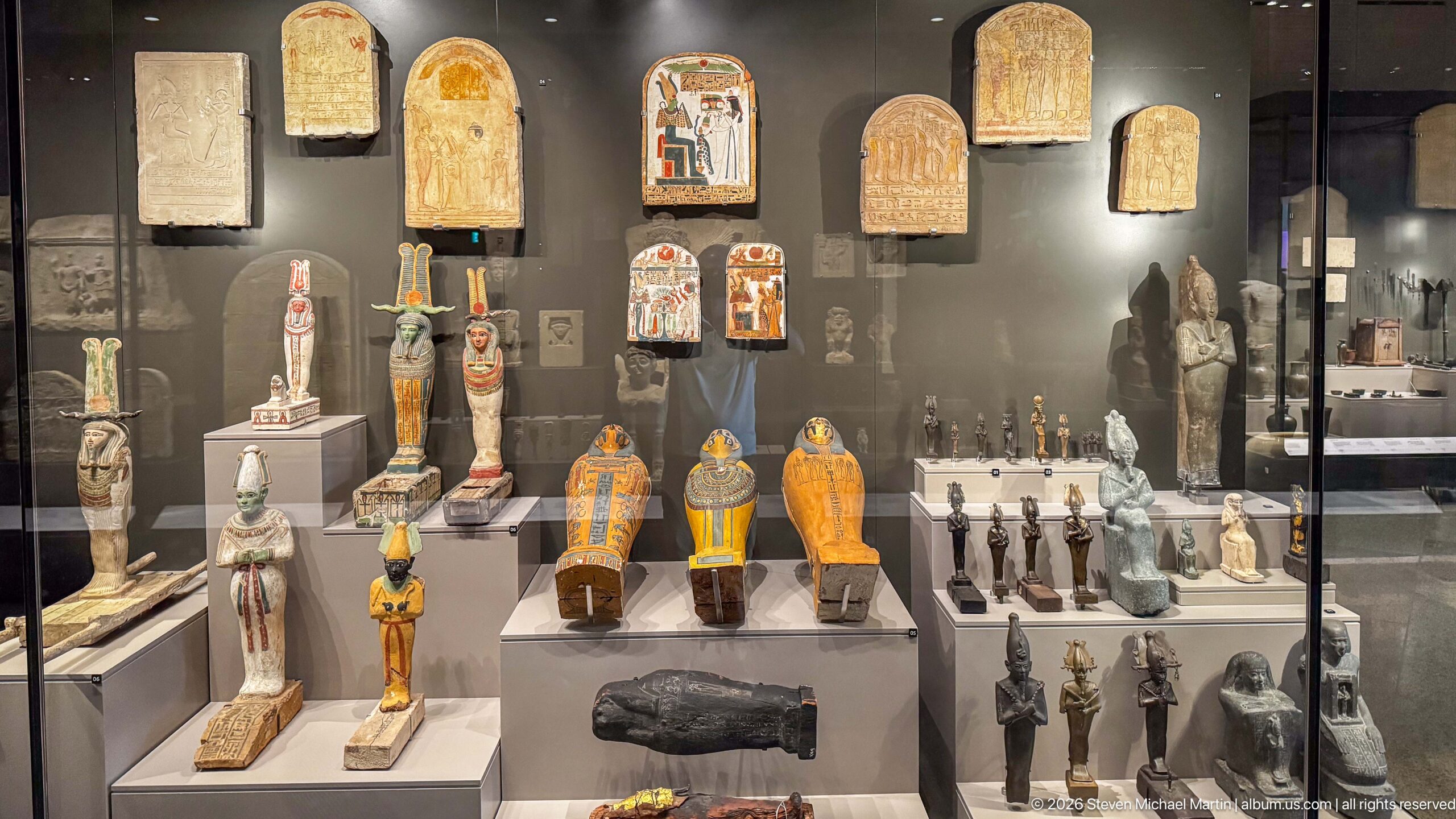
A dense display case brings together painted coffins, funerary stelae, mummiform figures, deity statuettes, and other ritual objects. The varied scale and materials create a compact overview of Egyptian funerary culture, showing how inscribed monuments, protective images, and burial equipment could coexist within a single interpretive gallery.
Caption
A dense display case brings together painted coffins, funerary stelae, mummiform figures, deity statuettes, and other ritual objects. The varied scale and materials create a compact overview of Egyptian funerary culture, showing how inscribed monuments, protective images, and burial equipment could coexist within a single interpretive gallery.
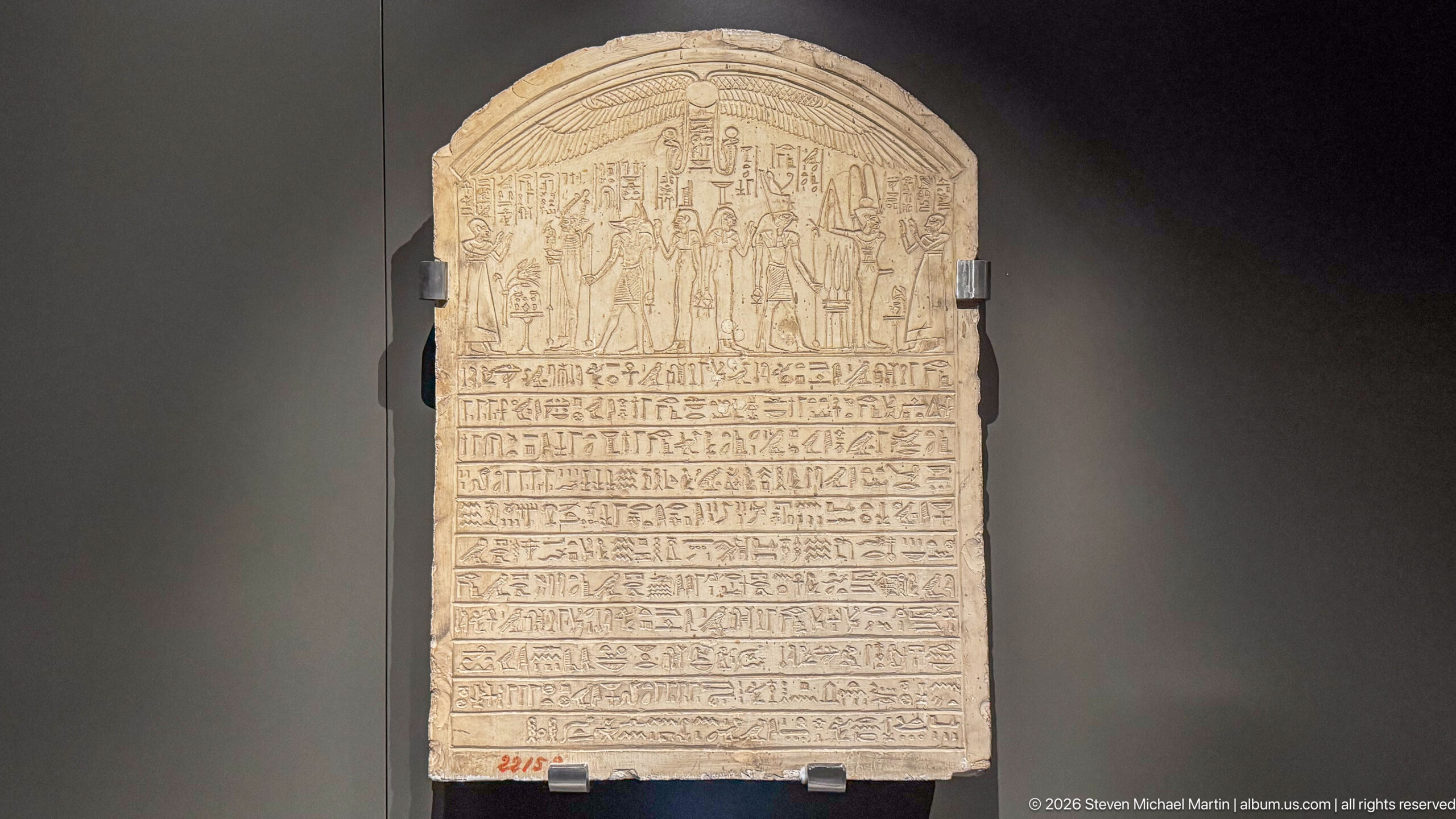
A round-topped stone stela is covered with horizontal registers of hieroglyphic inscription beneath an upper scene of standing figures and offerings. Its carefully ruled text field and arched top follow a long Egyptian commemorative and funerary tradition in which image and inscription preserve names, prayers, titles, and ritual relationships.
Caption
A round-topped stone stela is covered with horizontal registers of hieroglyphic inscription beneath an upper scene of standing figures and offerings. Its carefully ruled text field and arched top follow a long Egyptian commemorative and funerary tradition in which image and inscription preserve names, prayers, titles, and ritual relationships.
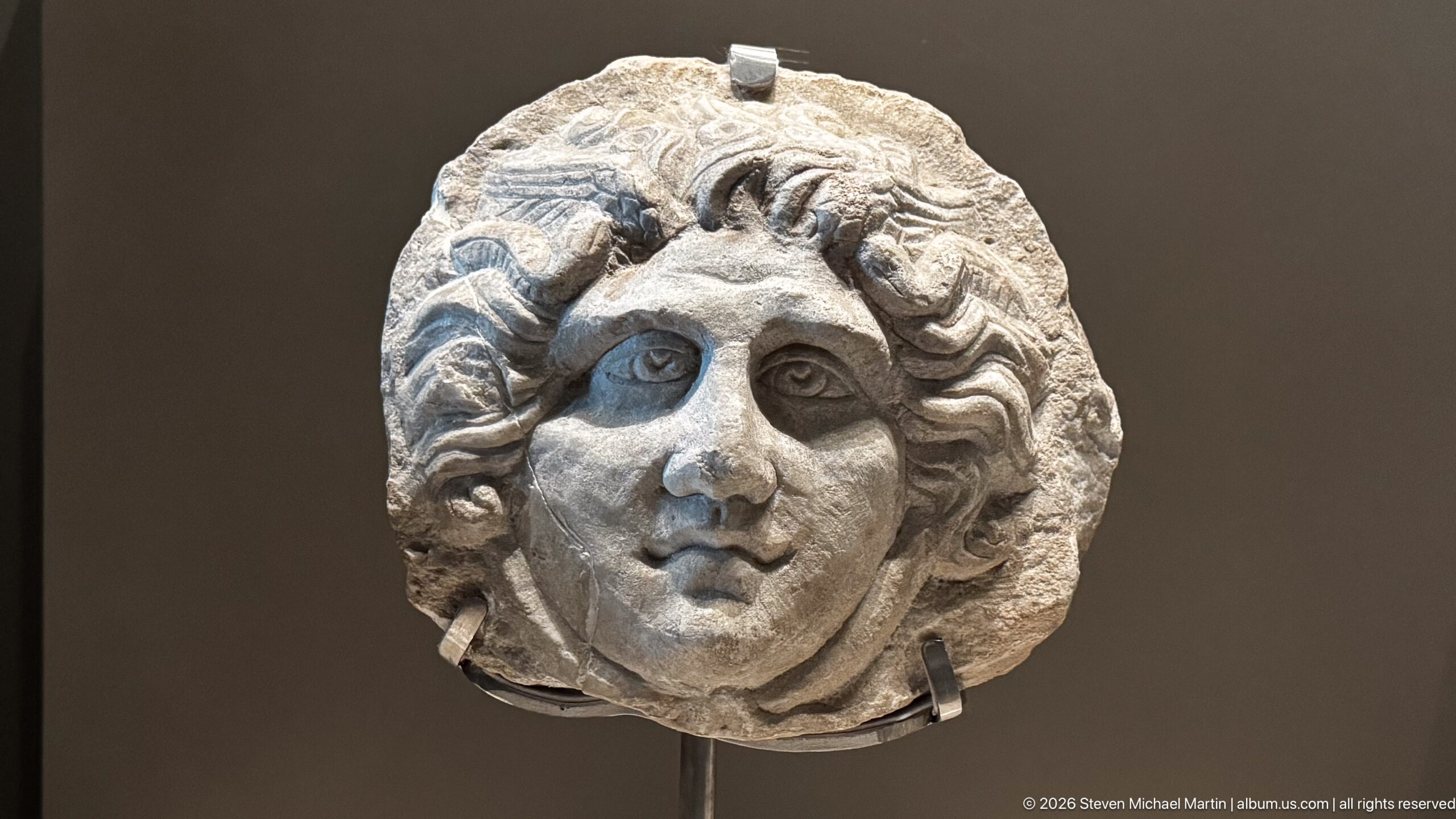
A carved stone head with large almond-shaped eyes and thick, curling hair survives as an isolated relief or architectural fragment. The rounded face, drilled or deeply cut curls, and frontal presentation differ markedly from pharaonic conventions, suggesting a later Egyptian or Mediterranean sculptural tradition represented within the museum’s broader collection.
Caption
A carved stone head with large almond-shaped eyes and thick, curling hair survives as an isolated relief or architectural fragment. The rounded face, drilled or deeply cut curls, and frontal presentation differ markedly from pharaonic conventions, suggesting a later Egyptian or Mediterranean sculptural tradition represented within the museum’s broader collection.
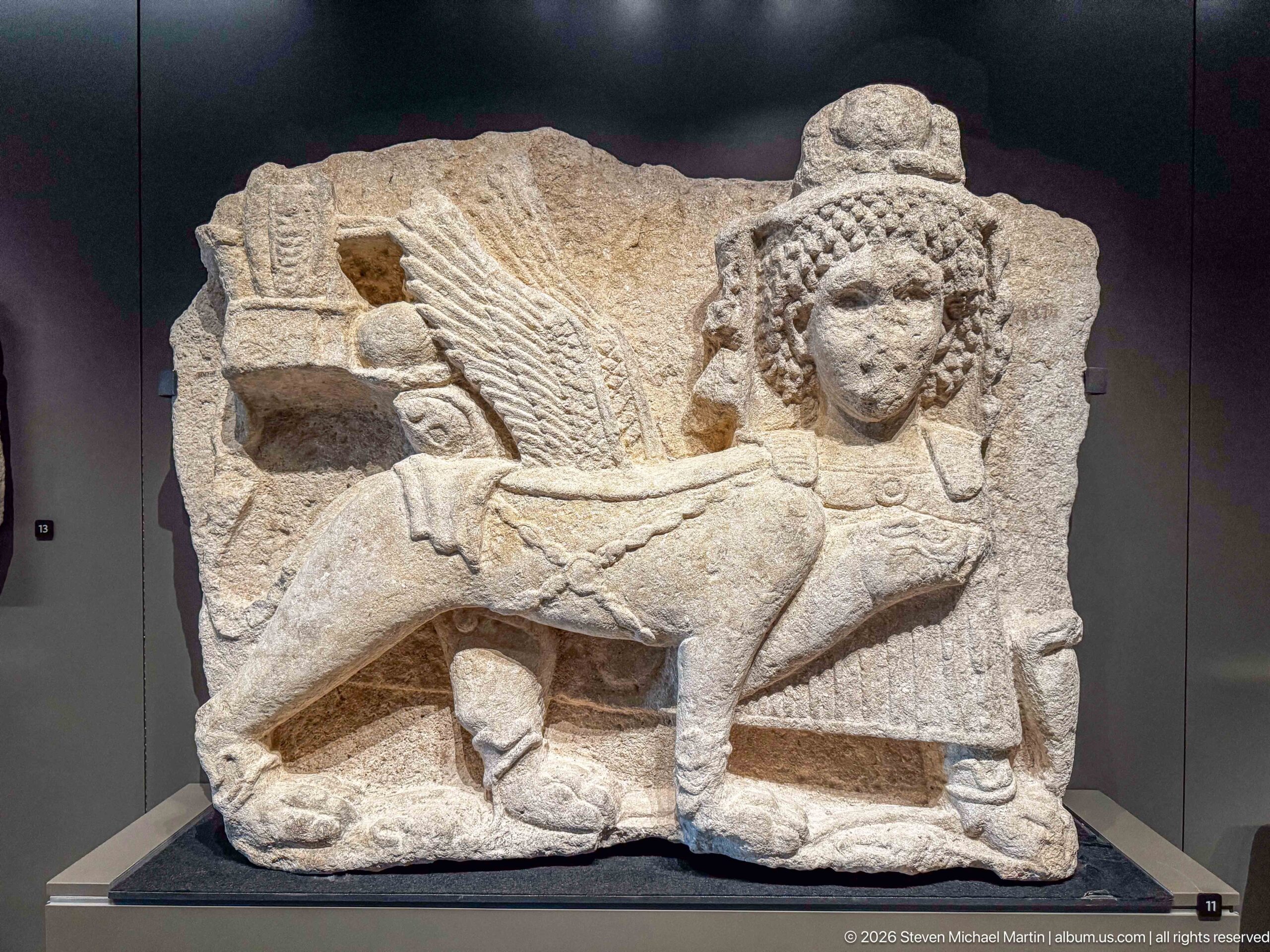
A fragmentary limestone relief preserves a human figure in profile, with deeply textured hair, draped clothing, and one bent leg. The surviving carving is substantial enough to show the figure’s pose and costume, but the photograph does not securely identify the person, scene, or date.
Caption
A fragmentary limestone relief preserves a human figure in profile, with deeply textured hair, draped clothing, and one bent leg. The surviving carving is substantial enough to show the figure’s pose and costume, but the photograph does not securely identify the person, scene, or date.
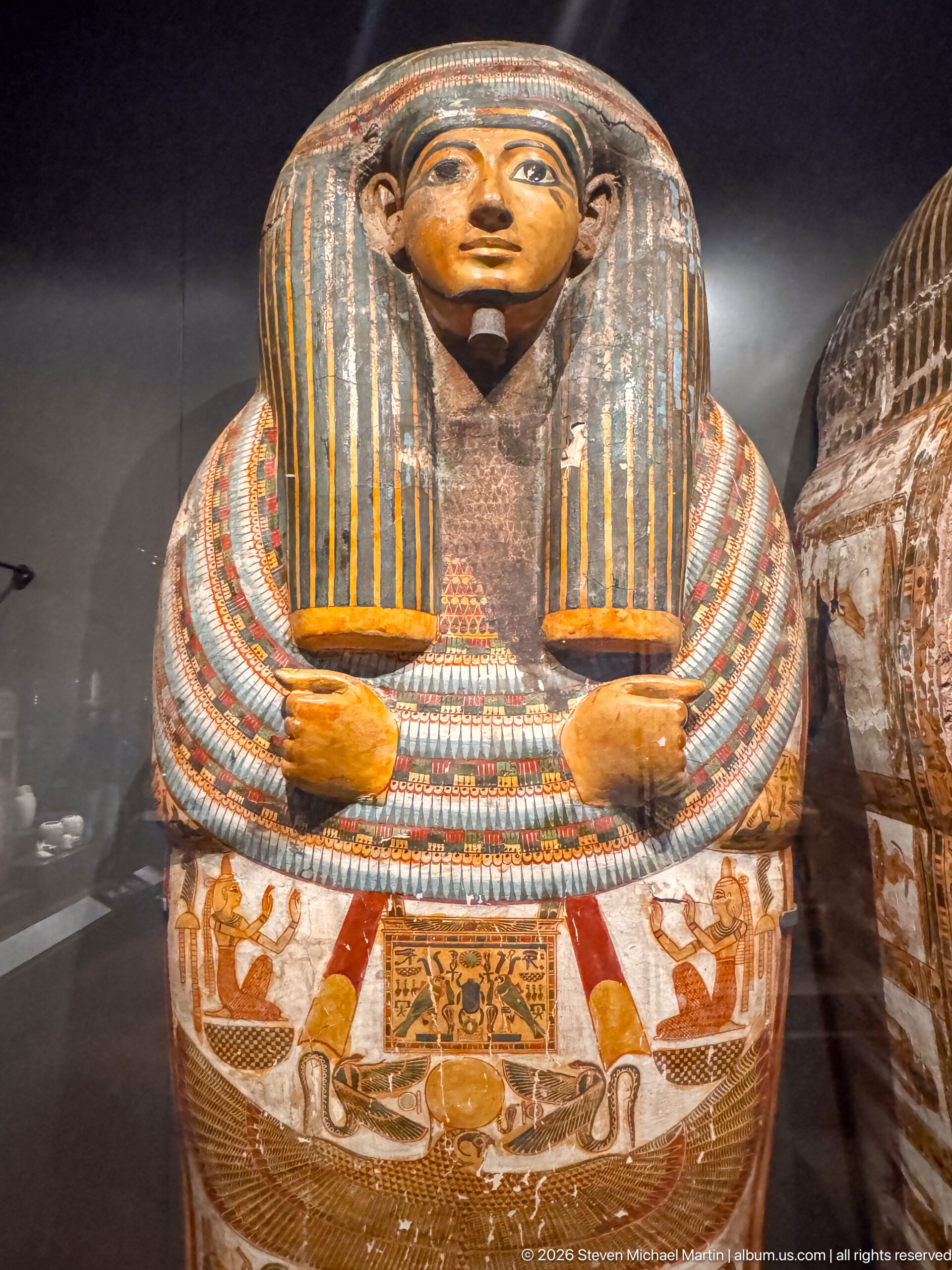
A painted anthropoid coffin centers an idealized face beneath a striped wig, while a broad beaded collar spreads across the shoulders and chest. Below, winged and kneeling protective figures frame a central funerary panel, organizing the coffin surface into a carefully balanced program of protection and regeneration.
Caption
A painted anthropoid coffin centers an idealized face beneath a striped wig, while a broad beaded collar spreads across the shoulders and chest. Below, winged and kneeling protective figures frame a central funerary panel, organizing the coffin surface into a carefully balanced program of protection and regeneration.
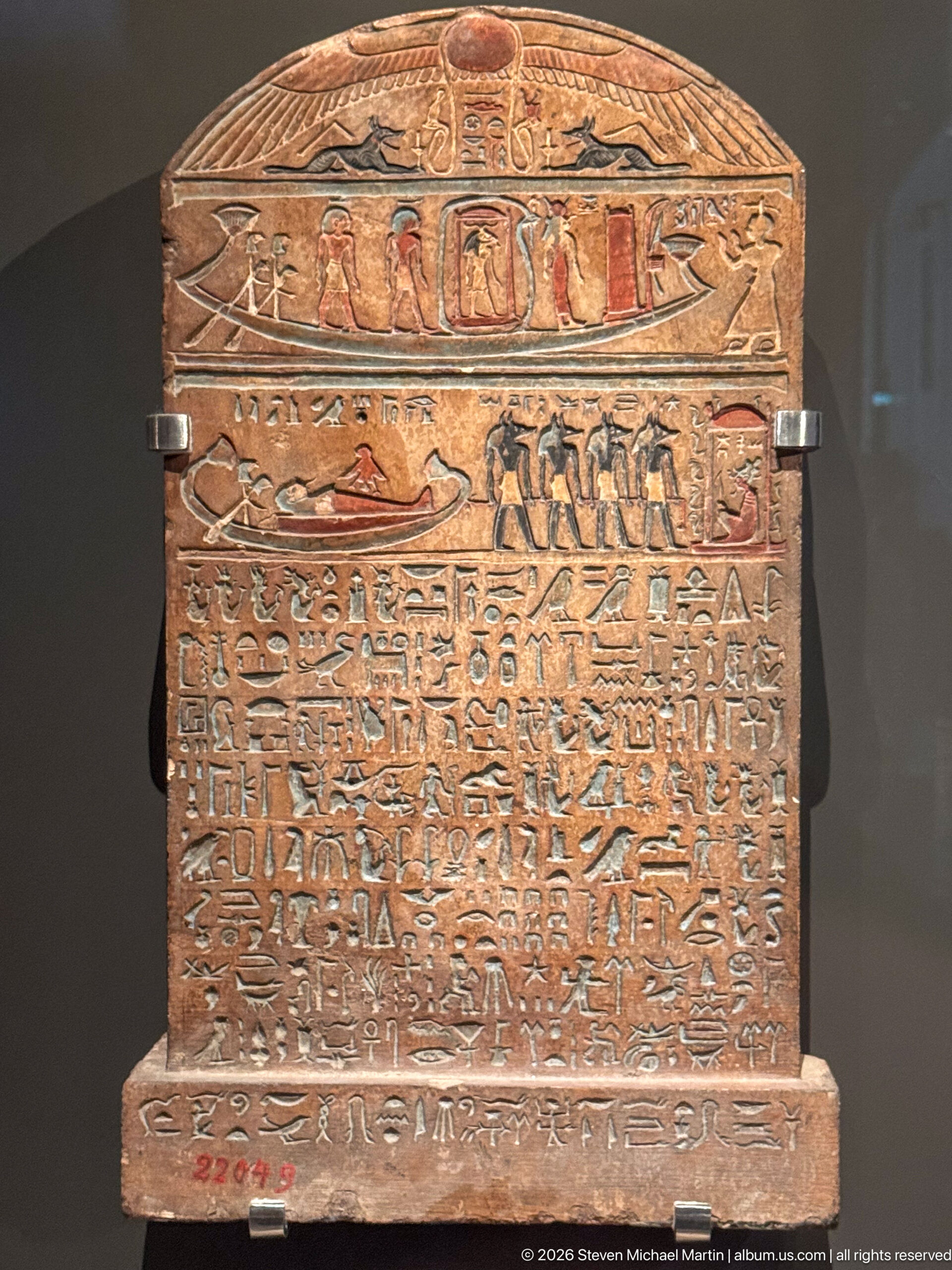
A painted funerary stela fills the frame, its rounded top enclosing a winged sun disk and registers of Egyptian figures above dense hieroglyphic text. Warm ochre, red, blue-green, and black pigments survive across the carved surface, while the lower field is dominated by closely spaced inscription lines. The object is displayed upright in a museum case with metal supports visible at the sides.
Caption
A painted funerary stela fills the frame, its rounded top enclosing a winged sun disk and registers of Egyptian figures above dense hieroglyphic text. Warm ochre, red, blue-green, and black pigments survive across the carved surface, while the lower field is dominated by closely spaced inscription lines. The object is displayed upright in a museum case with metal supports visible at the sides.
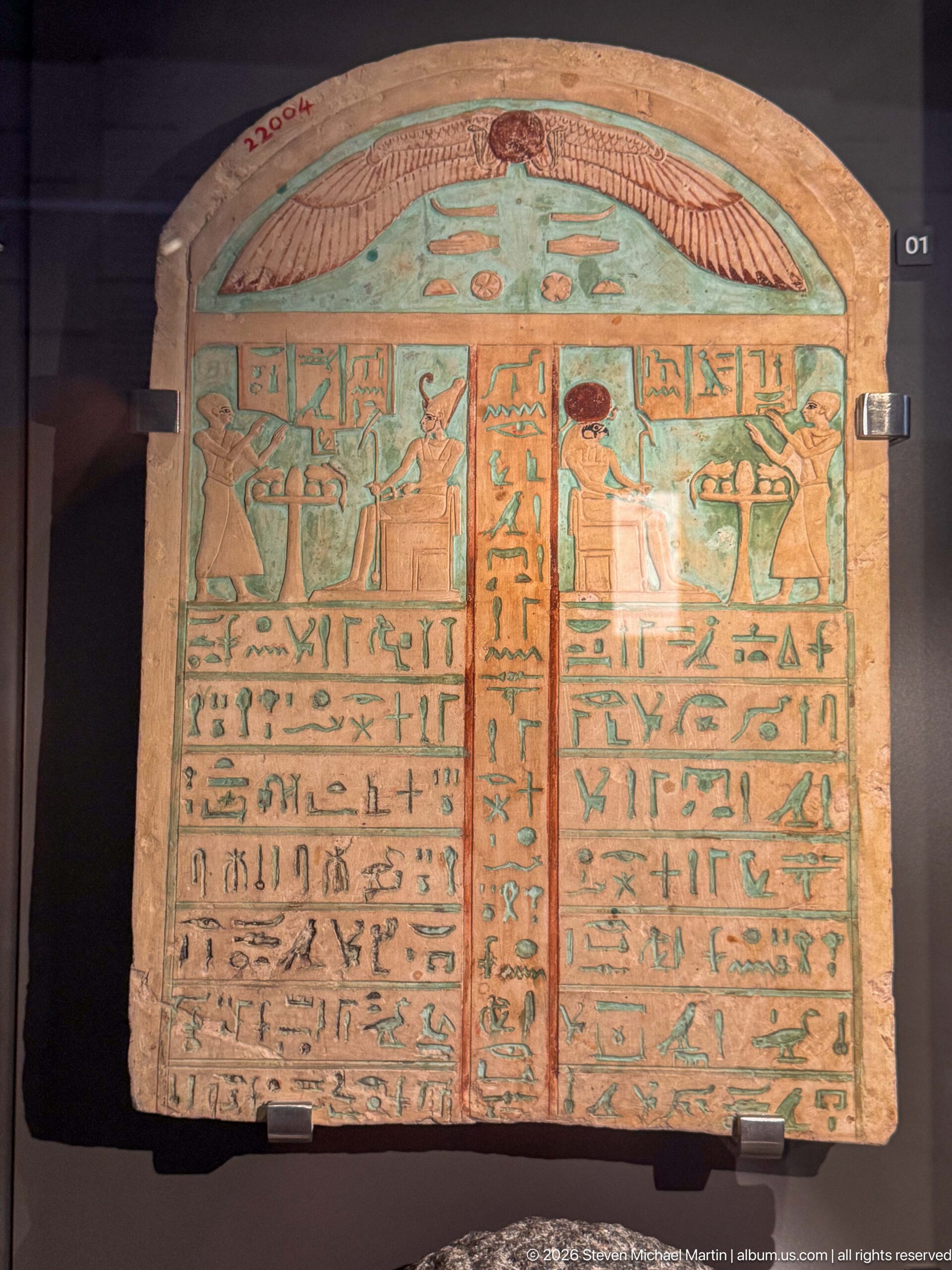
A rounded funerary stela is distinguished by a vivid turquoise-blue ground framed in reddish-brown. A winged sun disk spans the upper curve, while vertical and horizontal hieroglyphic columns surround several standing and seated figures arranged in ritual scenes. The strong contrast between the blue-green field and red, yellow, and black details preserves a striking sense of the object's original painted surface.
Caption
A rounded funerary stela is distinguished by a vivid turquoise-blue ground framed in reddish-brown. A winged sun disk spans the upper curve, while vertical and horizontal hieroglyphic columns surround several standing and seated figures arranged in ritual scenes. The strong contrast between the blue-green field and red, yellow, and black details preserves a striking sense of the object's original painted surface.
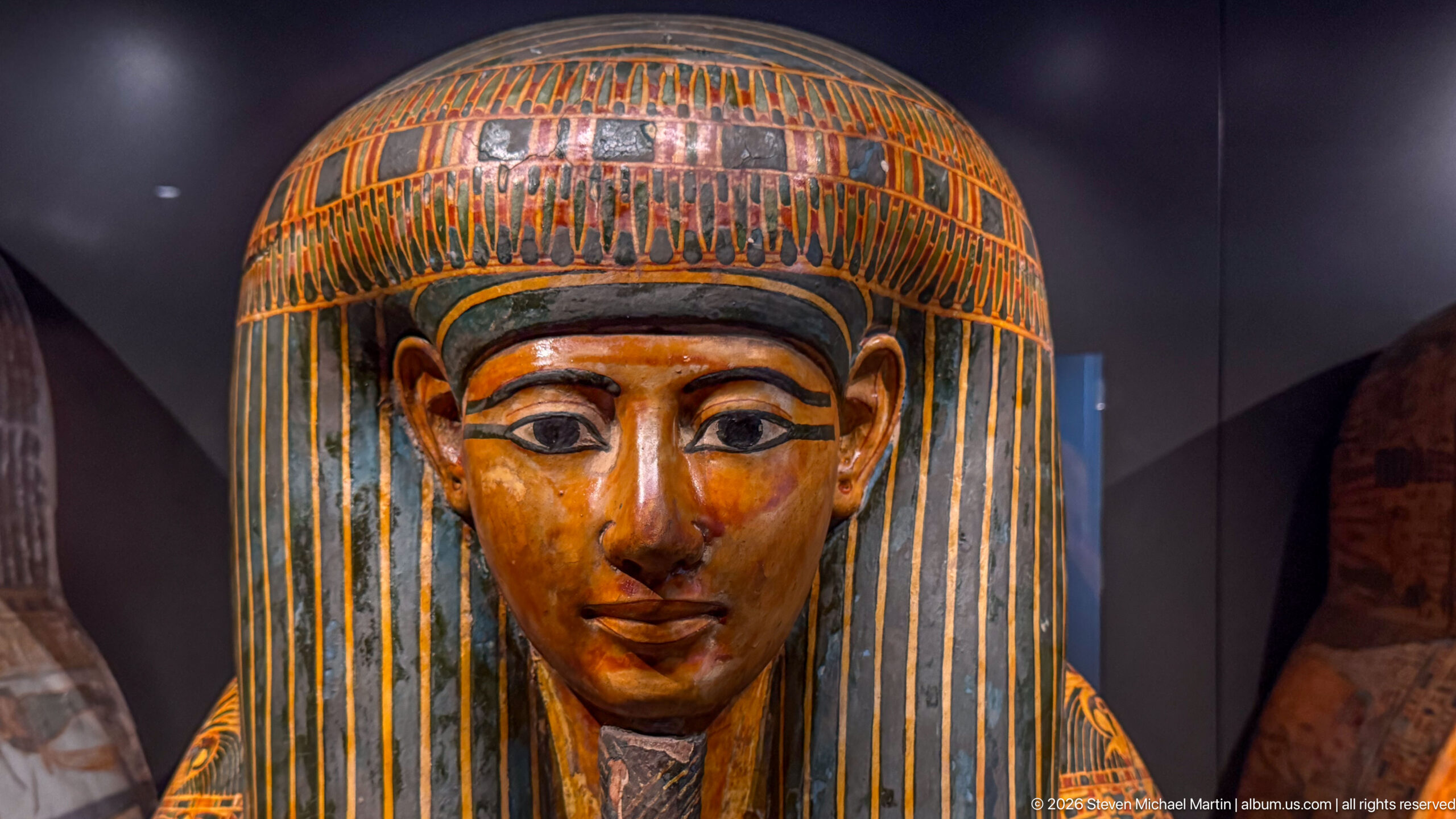
A close view isolates the painted face of an anthropoid coffin, framed by a long striped wig and a banded headdress. The smooth golden-brown complexion, outlined eyes, and symmetrical treatment create the idealized, timeless appearance favored in Egyptian funerary portraiture, while the tight crop reveals the precision of the surviving paintwork.
Caption
A close view isolates the painted face of an anthropoid coffin, framed by a long striped wig and a banded headdress. The smooth golden-brown complexion, outlined eyes, and symmetrical treatment create the idealized, timeless appearance favored in Egyptian funerary portraiture, while the tight crop reveals the precision of the surviving paintwork.
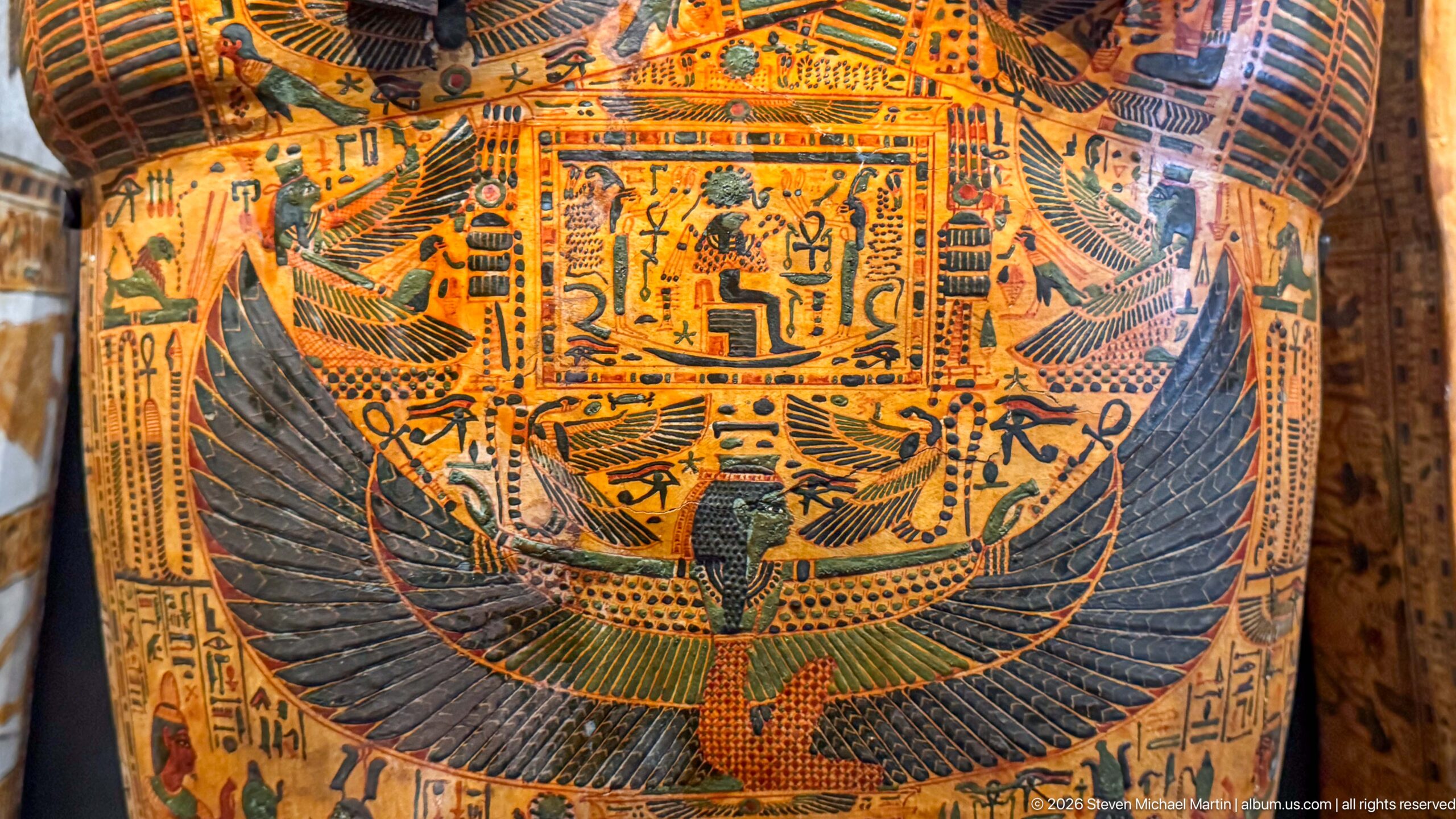
A winged goddess dominates the painted torso of an anthropoid coffin, her outstretched feathered wings spanning the width of the surface beneath a dense field of hieroglyphic and divine imagery. The symmetrical composition uses protective deities, sacred signs, and vivid color to transform the coffin exterior into a layered funerary program.
Caption
A winged goddess dominates the painted torso of an anthropoid coffin, her outstretched feathered wings spanning the width of the surface beneath a dense field of hieroglyphic and divine imagery. The symmetrical composition uses protective deities, sacred signs, and vivid color to transform the coffin exterior into a layered funerary program.
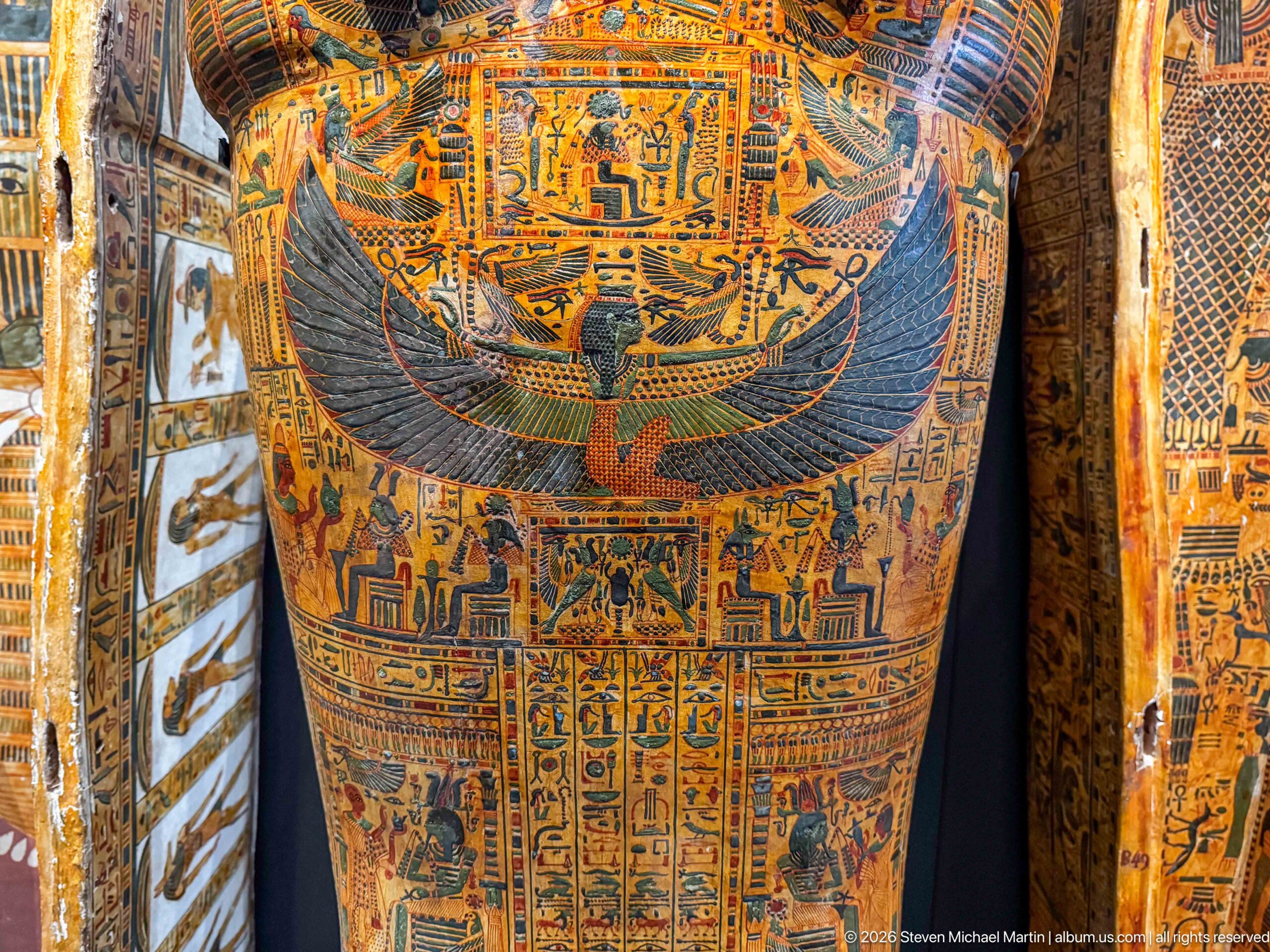
A second coffin detail centers a winged female deity above closely packed vertical registers of gods, sacred emblems, and hieroglyphic text. The photograph shows how the lower coffin surface was structured as a dense visual theology, with protective imagery arranged around the body of the deceased.
Caption
A second coffin detail centers a winged female deity above closely packed vertical registers of gods, sacred emblems, and hieroglyphic text. The photograph shows how the lower coffin surface was structured as a dense visual theology, with protective imagery arranged around the body of the deceased.
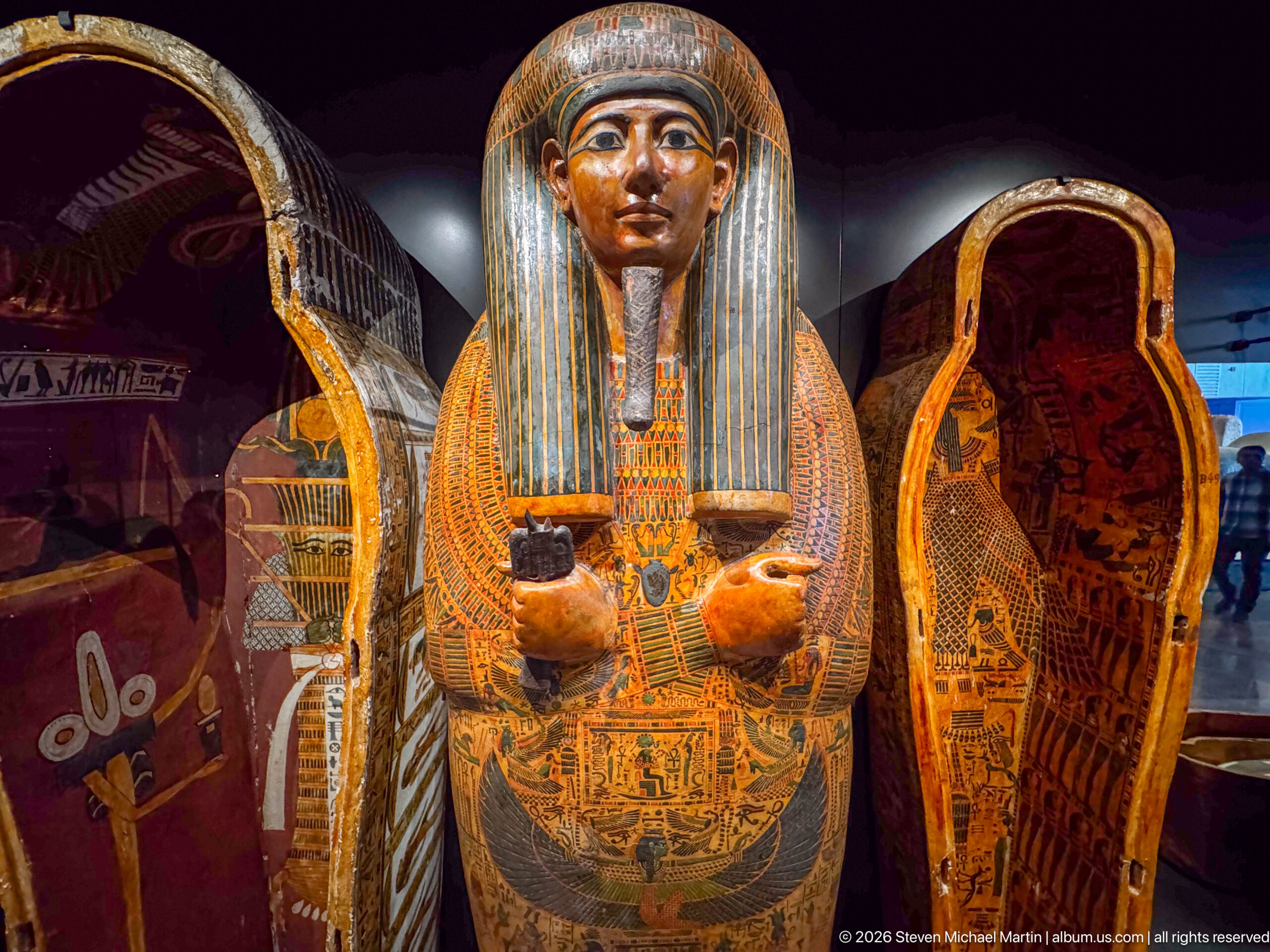
A full painted anthropoid coffin stands upright with a modeled face, striped wig, broad collar, crossed hands, and richly ornamented body. Adjacent coffin elements reveal additional interior and exterior decoration, allowing the display to communicate the layered construction and extensive protective imagery of Egyptian funerary equipment.
Caption
A full painted anthropoid coffin stands upright with a modeled face, striped wig, broad collar, crossed hands, and richly ornamented body. Adjacent coffin elements reveal additional interior and exterior decoration, allowing the display to communicate the layered construction and extensive protective imagery of Egyptian funerary equipment.
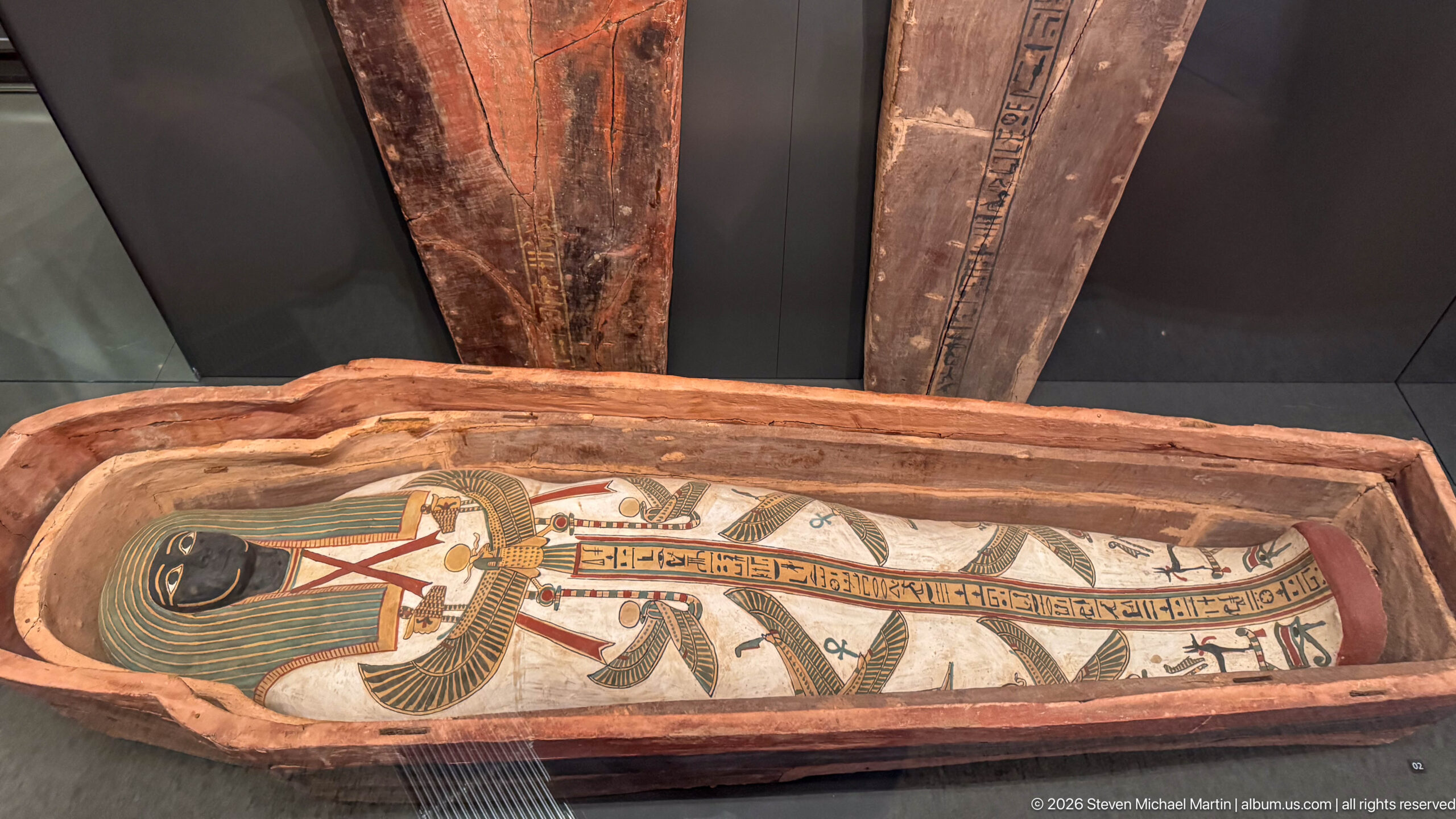
An open coffin reveals a wrapped human mummy laid within its wooden case, the painted mask-like head and crossed arm position still visible beneath the wrappings and decorative bands. Seen from above, the display makes the physical relationship between the preserved body and its anthropoid container especially clear.
Caption
An open coffin reveals a wrapped human mummy laid within its wooden case, the painted mask-like head and crossed arm position still visible beneath the wrappings and decorative bands. Seen from above, the display makes the physical relationship between the preserved body and its anthropoid container especially clear.
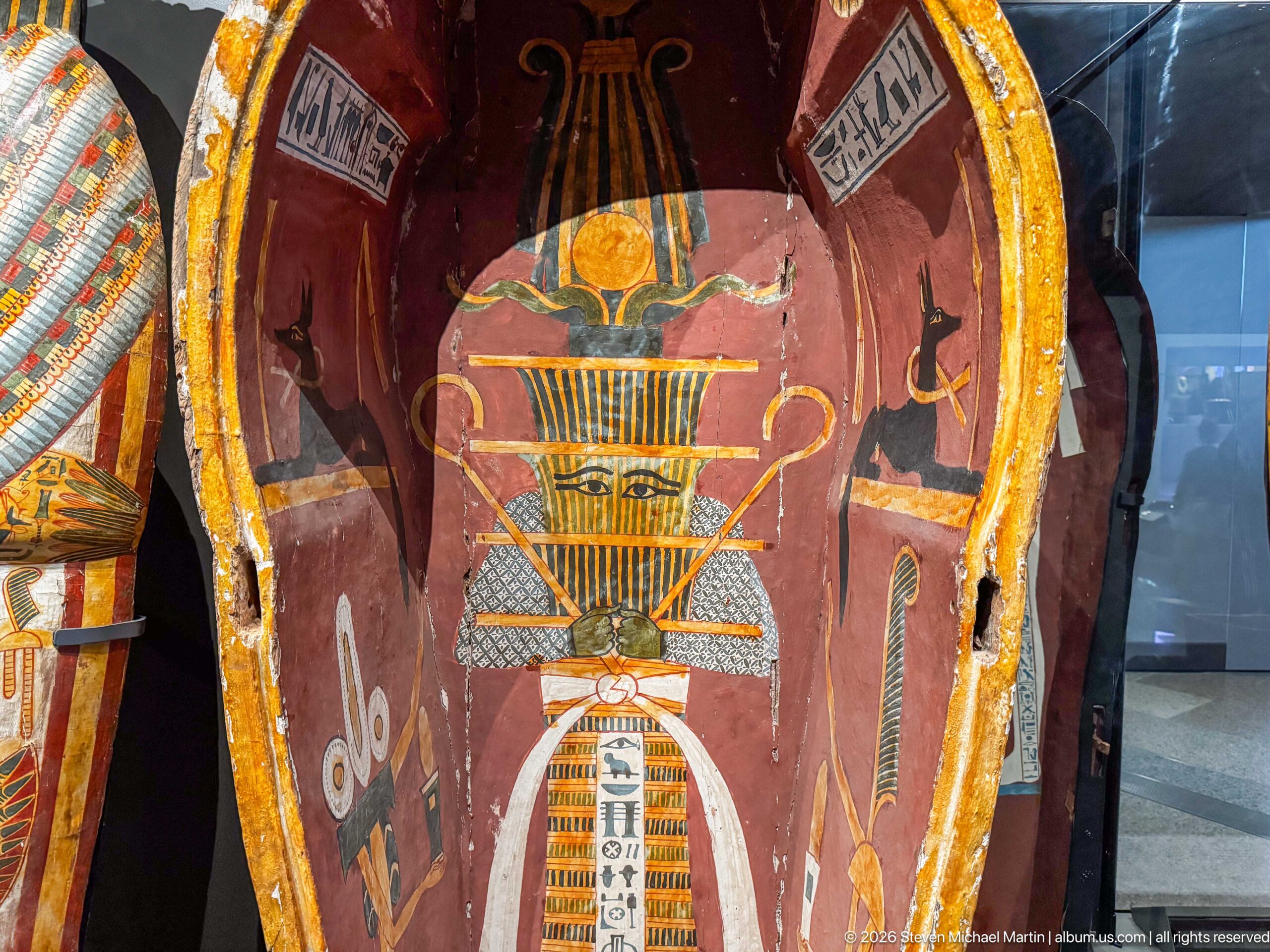
The interior of a wooden coffin is painted with a tall central sacred emblem, surrounding ritual symbols, and short hieroglyphic panels against a dark red ground. The close view reveals how decoration extended beyond the outer shell, surrounding the deceased with protective signs and sacred imagery inside the burial container itself.
Caption
The interior of a wooden coffin is painted with a tall central sacred emblem, surrounding ritual symbols, and short hieroglyphic panels against a dark red ground. The close view reveals how decoration extended beyond the outer shell, surrounding the deceased with protective signs and sacred imagery inside the burial container itself.
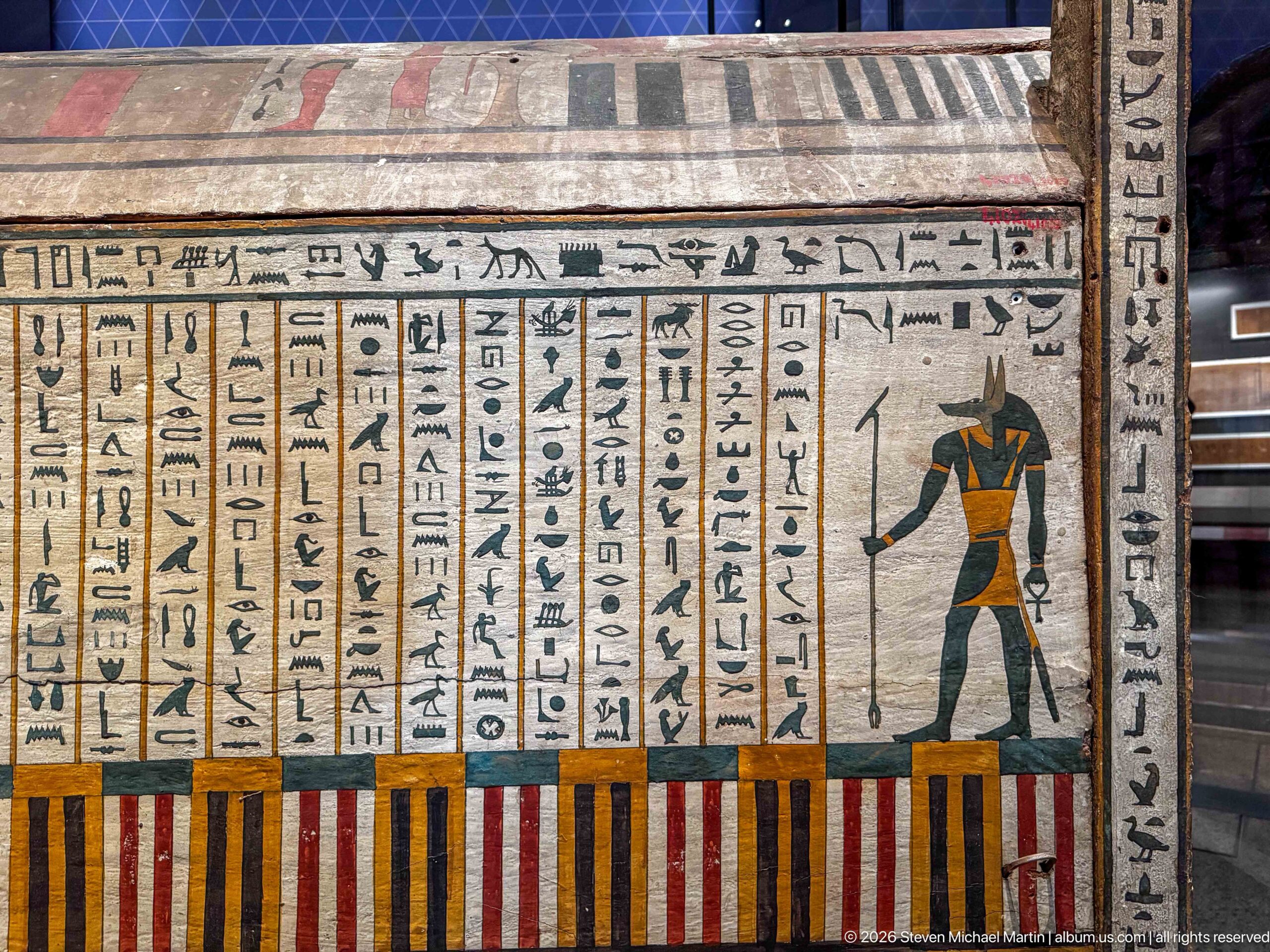
A painted funerary panel pairs dense columns of hieroglyphic text with a standing jackal-headed deity at the right, above a bold striped lower border. The sharply contrasting black, green, red, ochre, and white pigments preserve a highly graphic combination of sacred image and inscription intended for a burial context.
Caption
A painted funerary panel pairs dense columns of hieroglyphic text with a standing jackal-headed deity at the right, above a bold striped lower border. The sharply contrasting black, green, red, ochre, and white pigments preserve a highly graphic combination of sacred image and inscription intended for a burial context.
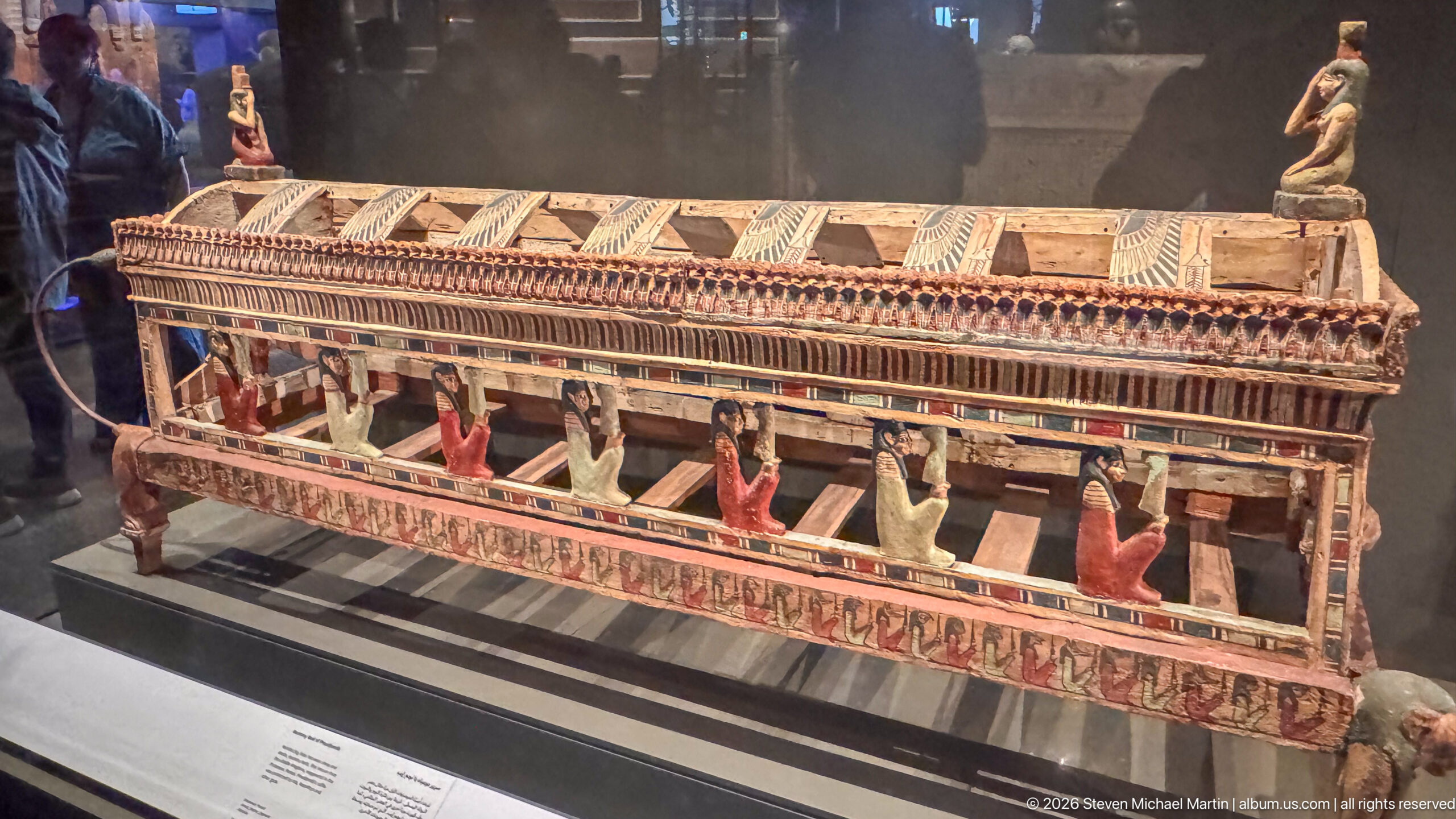
A painted wooden architectural model contains a small colonnaded or pillared structure populated by standing figures. Such models formed part of the ancient Egyptian tradition of representing buildings, activities, and provisions in three dimensions; the photograph does not support identifying this particular object as a boat.
Caption
A painted wooden architectural model contains a small colonnaded or pillared structure populated by standing figures. Such models formed part of the ancient Egyptian tradition of representing buildings, activities, and provisions in three dimensions; the photograph does not support identifying this particular object as a boat.
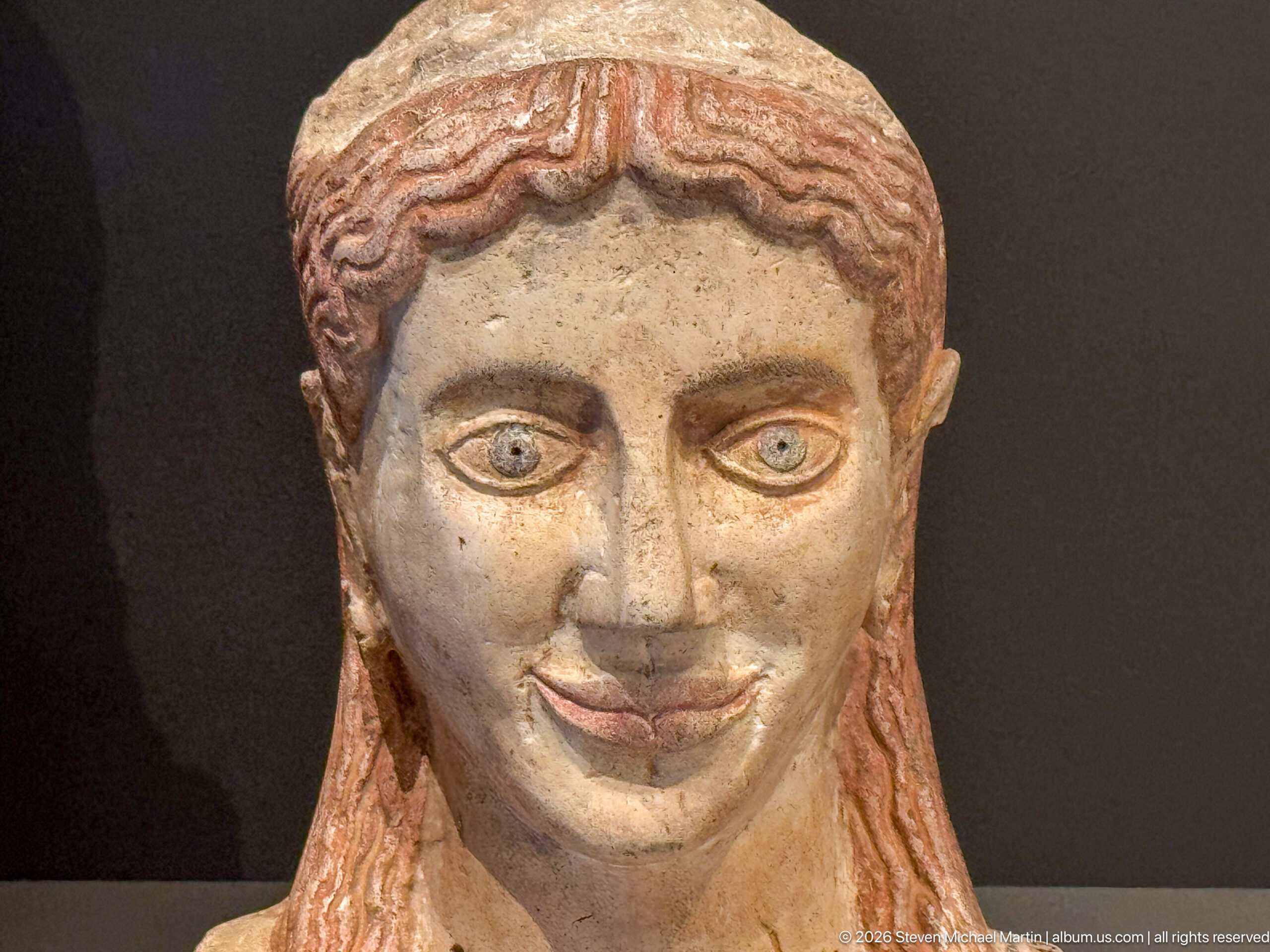
A close view isolates a sculpted female head with softly modeled cheeks, a slight smile, large outlined eyes, and reddish-brown hair arranged in broad waves across the forehead. Traces of pigment remain on the skin, lips, brows, and hair, making the survival of ancient surface color especially prominent. The dark background and tight crop emphasize facial modeling rather than the object's original full form.
Caption
A close view isolates a sculpted female head with softly modeled cheeks, a slight smile, large outlined eyes, and reddish-brown hair arranged in broad waves across the forehead. Traces of pigment remain on the skin, lips, brows, and hair, making the survival of ancient surface color especially prominent. The dark background and tight crop emphasize facial modeling rather than the object's original full form.
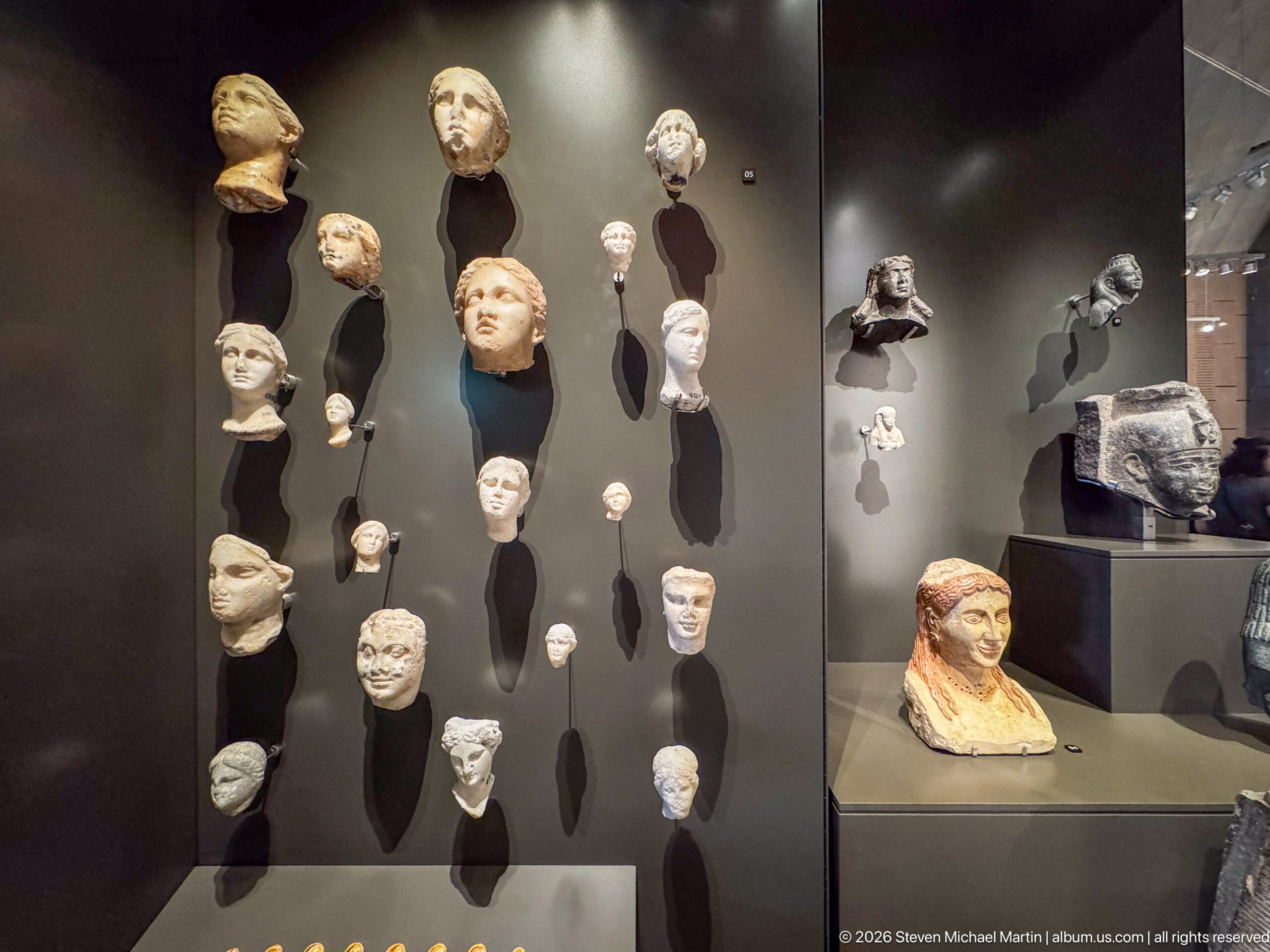
A museum wall presents numerous sculpted heads and small bust fragments on projecting dark mounts, creating a comparative display of hairstyles, facial types, scale, and surviving surface treatment. Most pieces are pale stone or plaster-toned, while several retain reddish or darker coloration. A larger painted female bust is set apart in a lower case at right, giving the installation the character of a typological study.
Caption
A museum wall presents numerous sculpted heads and small bust fragments on projecting dark mounts, creating a comparative display of hairstyles, facial types, scale, and surviving surface treatment. Most pieces are pale stone or plaster-toned, while several retain reddish or darker coloration. A larger painted female bust is set apart in a lower case at right, giving the installation the character of a typological study.
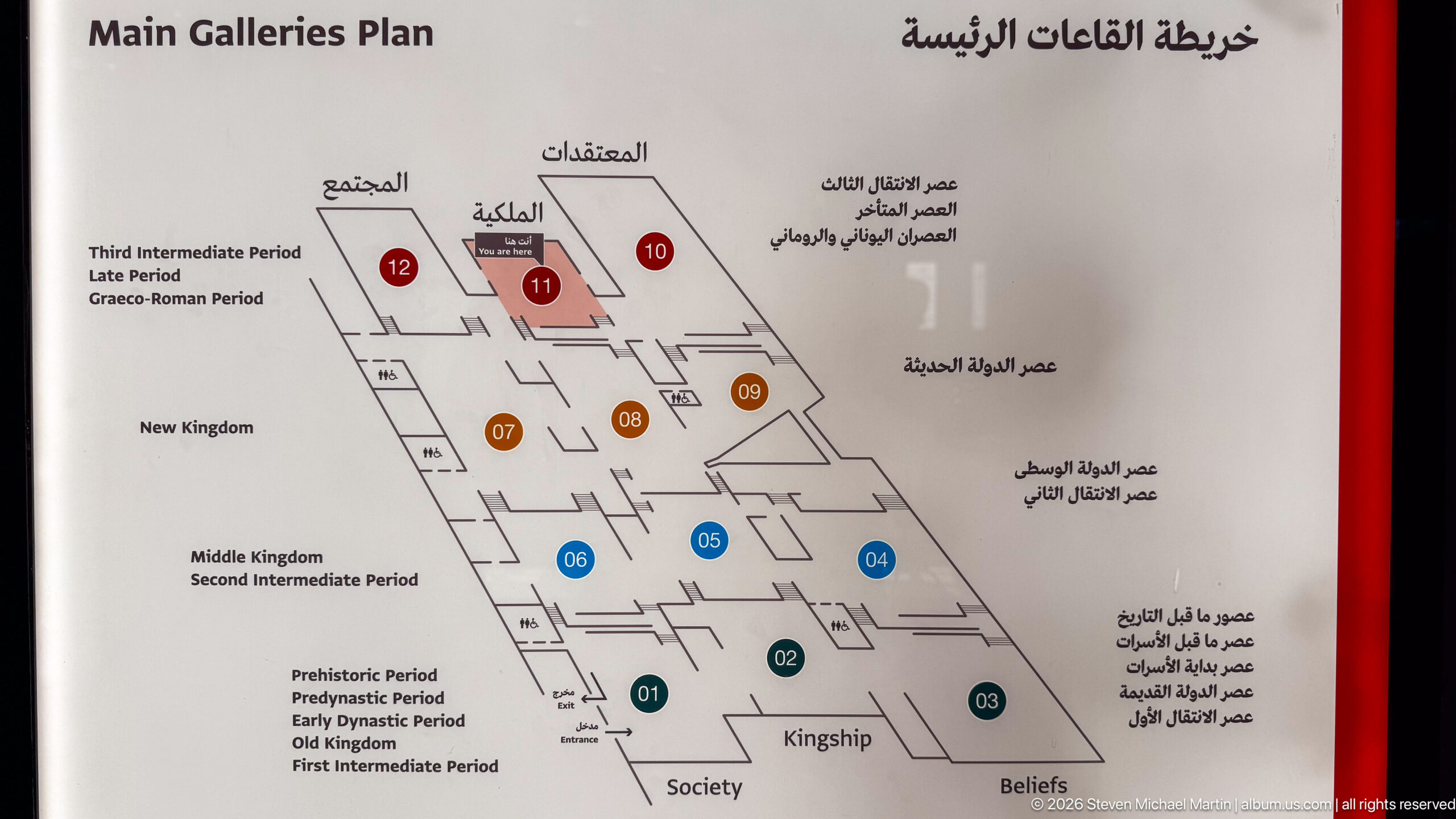
A bilingual orientation panel maps the Grand Egyptian Museum's Main Galleries by period and thematic grouping. The diagram progresses from Prehistoric and Early Dynastic material through the Old, Middle, New Kingdom, Third Intermediate, Late, and Graeco-Roman periods, while adjacent labels organize galleries around Society, Kingship, and Beliefs. Numbered colored circles mark gallery zones, making the panel a useful record of the museum's interpretive structure.
Caption
A bilingual orientation panel maps the Grand Egyptian Museum's Main Galleries by period and thematic grouping. The diagram progresses from Prehistoric and Early Dynastic material through the Old, Middle, New Kingdom, Third Intermediate, Late, and Graeco-Roman periods, while adjacent labels organize galleries around Society, Kingship, and Beliefs. Numbered colored circles mark gallery zones, making the panel a useful record of the museum's interpretive structure.
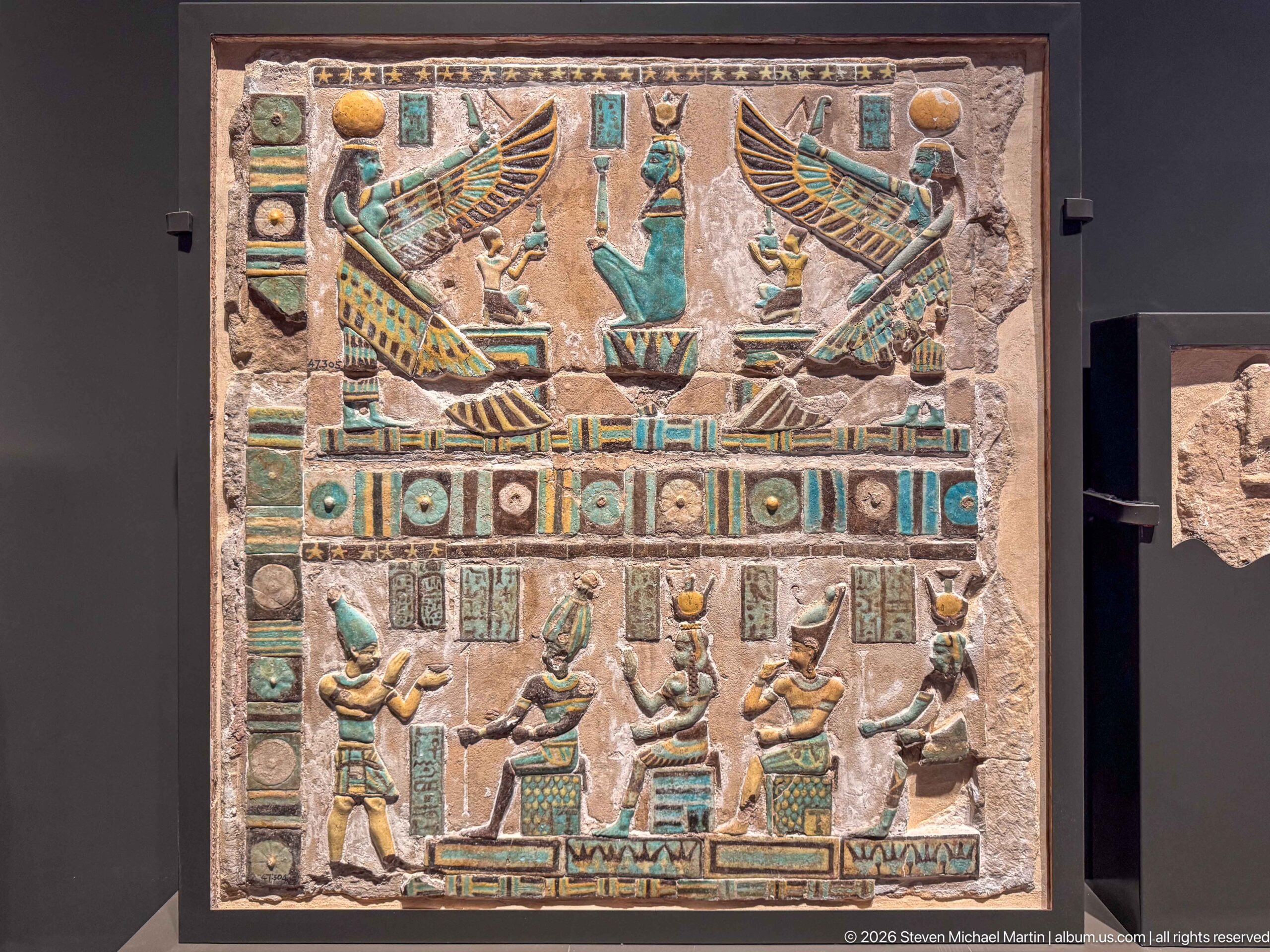
A richly colored relief panel is organized into horizontal ritual registers. Two large winged divine figures dominate the upper field, their spread wings framing central symbols and vertical hieroglyphic columns. Below, a sequence of smaller standing figures faces offering tables or sacred emblems. Blue-green, yellow, red, white, and black pigments remain vivid, preserving both the iconographic detail and patterned border work.
Caption
A richly colored relief panel is organized into horizontal ritual registers. Two large winged divine figures dominate the upper field, their spread wings framing central symbols and vertical hieroglyphic columns. Below, a sequence of smaller standing figures faces offering tables or sacred emblems. Blue-green, yellow, red, white, and black pigments remain vivid, preserving both the iconographic detail and patterned border work.
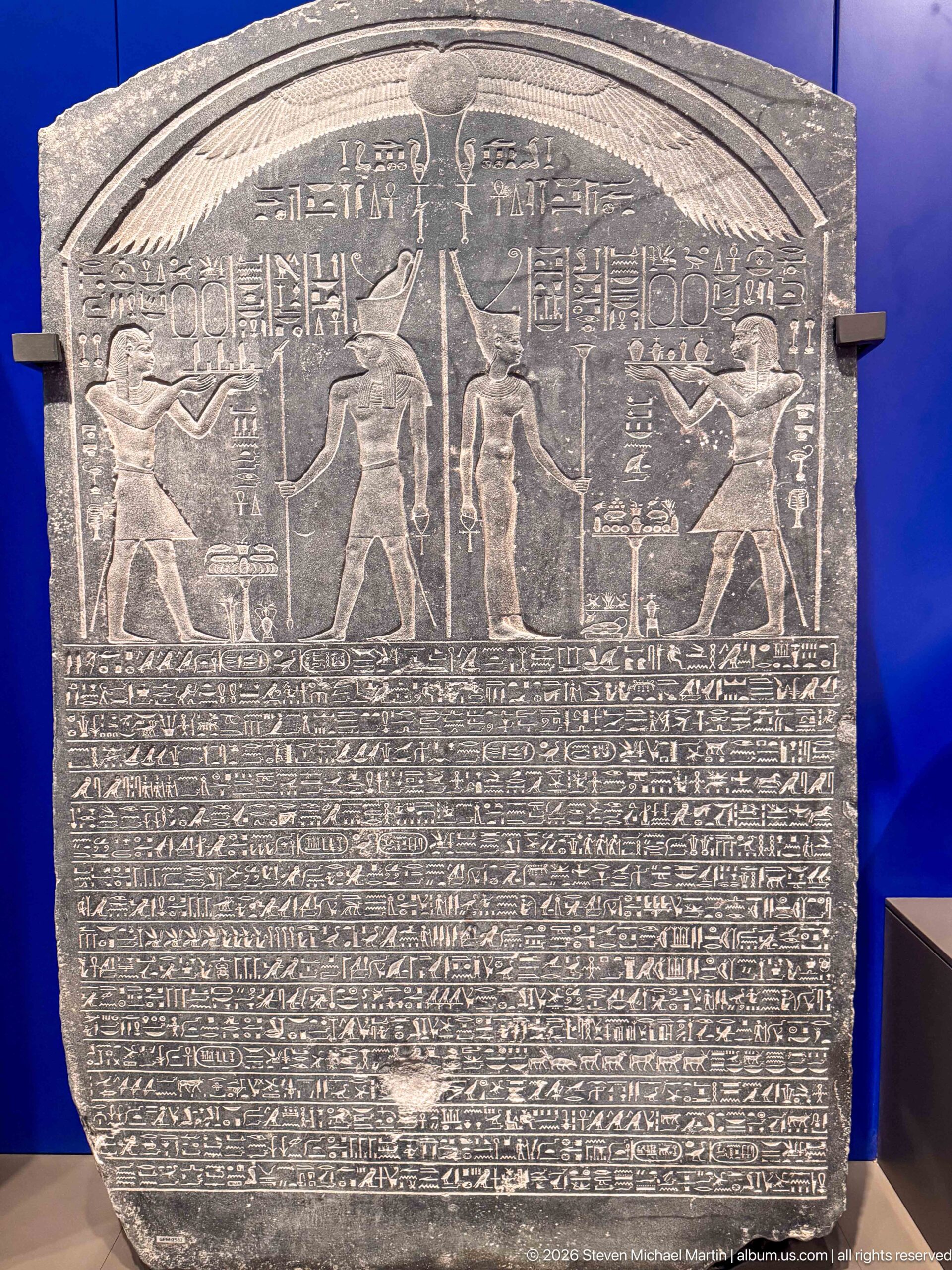
A dark stone stela rises to a rounded top beneath a banded border. In the upper register, carved figures face inward around a central vertical element, while the lower two-thirds are filled by exceptionally dense horizontal rows of hieroglyphs. The cool lighting and raking highlights make the shallow relief and incised signs stand out sharply against the stone surface.
Caption
A dark stone stela rises to a rounded top beneath a banded border. In the upper register, carved figures face inward around a central vertical element, while the lower two-thirds are filled by exceptionally dense horizontal rows of hieroglyphs. The cool lighting and raking highlights make the shallow relief and incised signs stand out sharply against the stone surface.
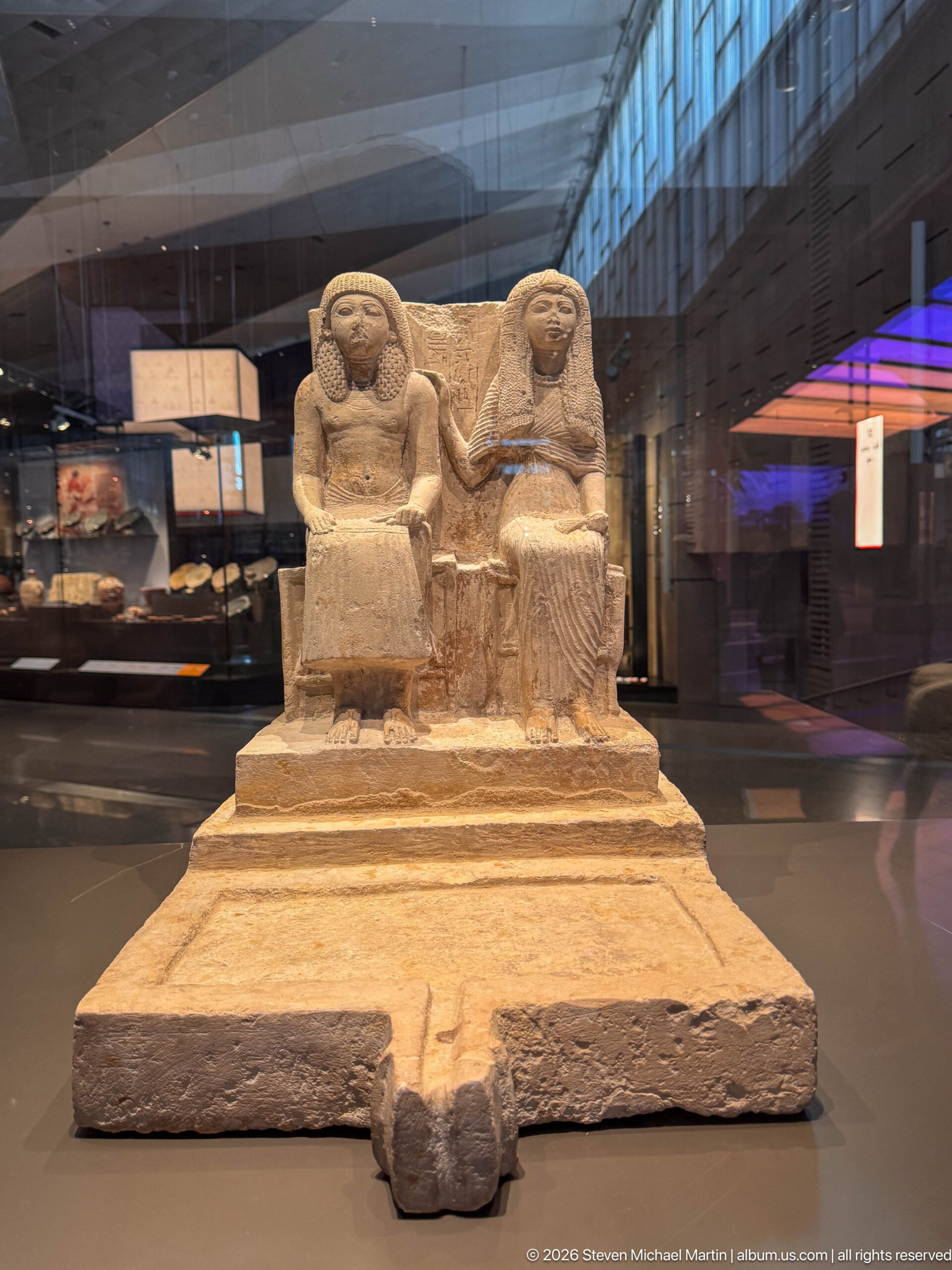
A compact stone group shows two seated figures side by side on a shared high-backed seat, both facing forward with hands resting near the knees. The figures wear broad, rounded hairstyles or wigs and long garments, while the block-like base and seat preserve the frontal, symmetrical character of the composition. The sculpture is displayed freestanding in the open gallery, emphasizing its mass and paired format.
Caption
A compact stone group shows two seated figures side by side on a shared high-backed seat, both facing forward with hands resting near the knees. The figures wear broad, rounded hairstyles or wigs and long garments, while the block-like base and seat preserve the frontal, symmetrical character of the composition. The sculpture is displayed freestanding in the open gallery, emphasizing its mass and paired format.
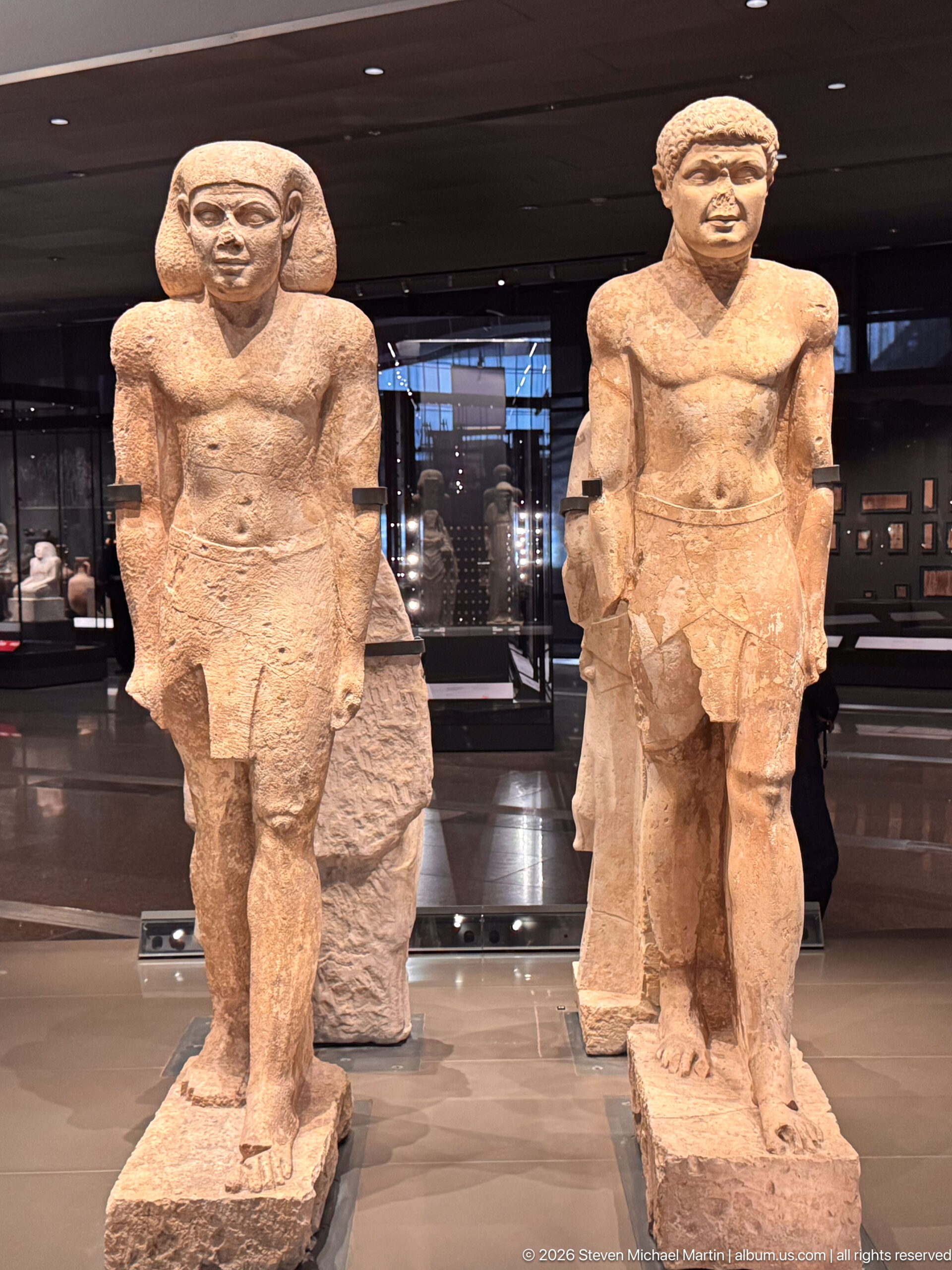
Two life-size or near-life-size male statues stand side by side in a gallery display. Each figure advances one leg and keeps the arms close to the body, following a strongly frontal sculptural convention; one has a broad rounded hairstyle, while the other appears more fragmentary through the torso and limbs. Their juxtaposition highlights differences in body modeling, preservation, and stone surface.
Caption
Two life-size or near-life-size male statues stand side by side in a gallery display. Each figure advances one leg and keeps the arms close to the body, following a strongly frontal sculptural convention; one has a broad rounded hairstyle, while the other appears more fragmentary through the torso and limbs. Their juxtaposition highlights differences in body modeling, preservation, and stone surface.
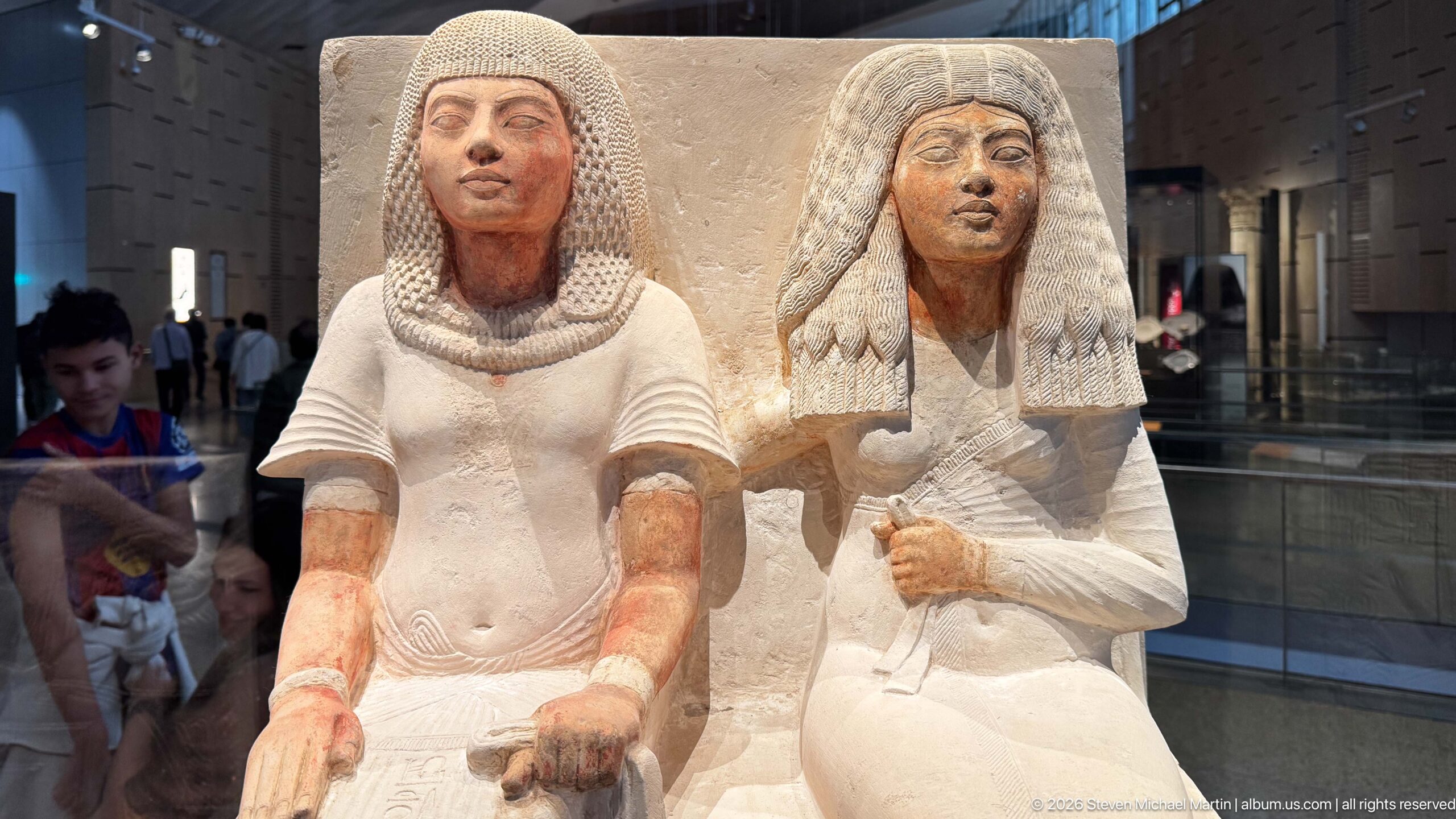
A painted couple sits closely together, their nearly life-size forms preserving vivid traces of ancient color. The man wears a broad, finely patterned wig and white kilt, while the woman has a long textured wig and fitted white dress; her arm passes behind him in an intimate paired pose. Red-brown skin tones, black hair, and white garments remain distinct, making the sculpture's surviving polychromy central to the view.
Caption
A painted couple sits closely together, their nearly life-size forms preserving vivid traces of ancient color. The man wears a broad, finely patterned wig and white kilt, while the woman has a long textured wig and fitted white dress; her arm passes behind him in an intimate paired pose. Red-brown skin tones, black hair, and white garments remain distinct, making the sculpture's surviving polychromy central to the view.
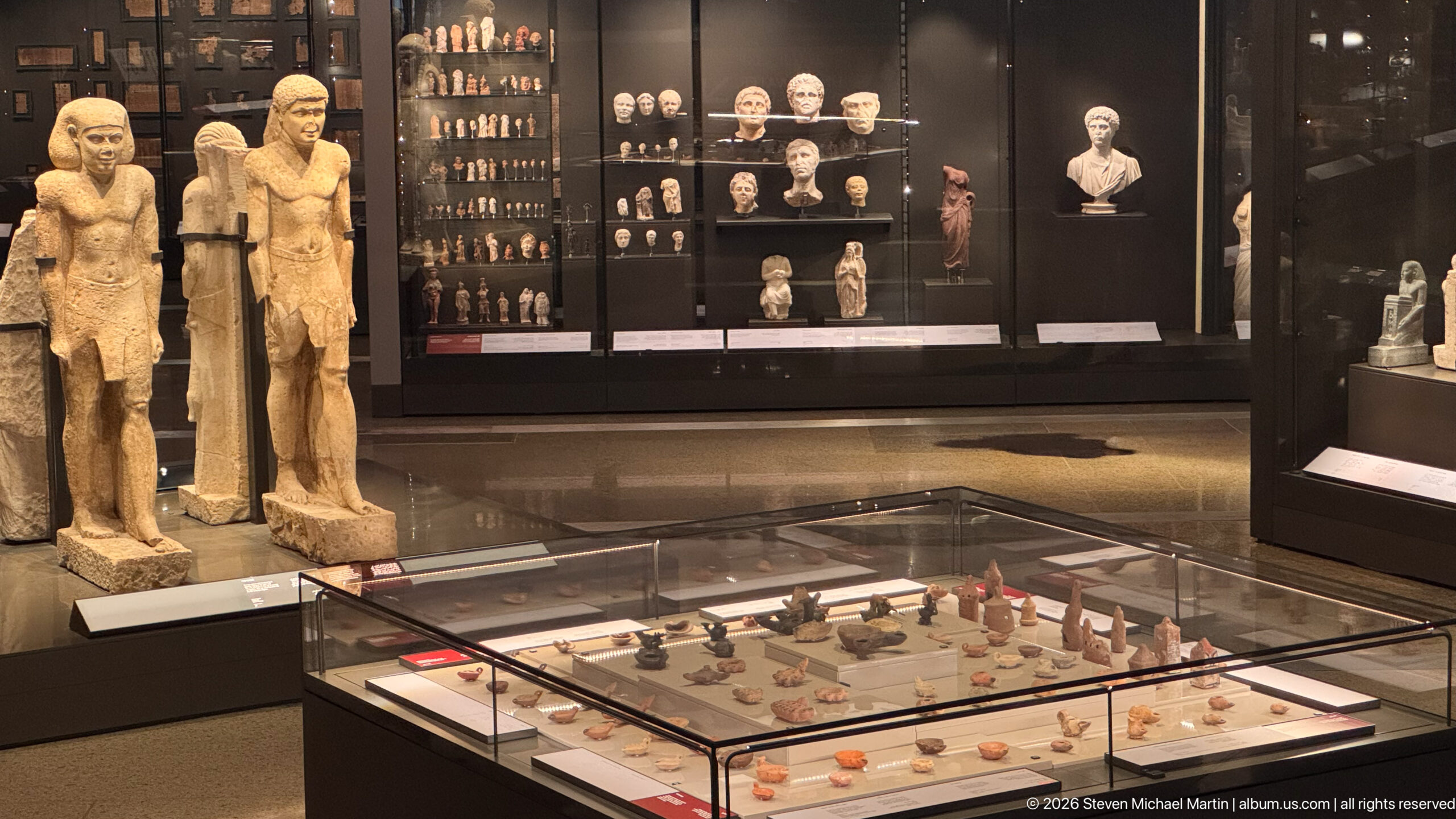
A layered museum view brings together several scales of ancient Egyptian material: two tall standing statues at left, a wall case filled with portrait heads and small figures, and a low glass vitrine containing dozens of compact artifacts. The arrangement creates a useful overview of the gallery's comparative display, where monumental sculpture, human likenesses, and smaller objects can be read in relation to one another.
Caption
A layered museum view brings together several scales of ancient Egyptian material: two tall standing statues at left, a wall case filled with portrait heads and small figures, and a low glass vitrine containing dozens of compact artifacts. The arrangement creates a useful overview of the gallery's comparative display, where monumental sculpture, human likenesses, and smaller objects can be read in relation to one another.
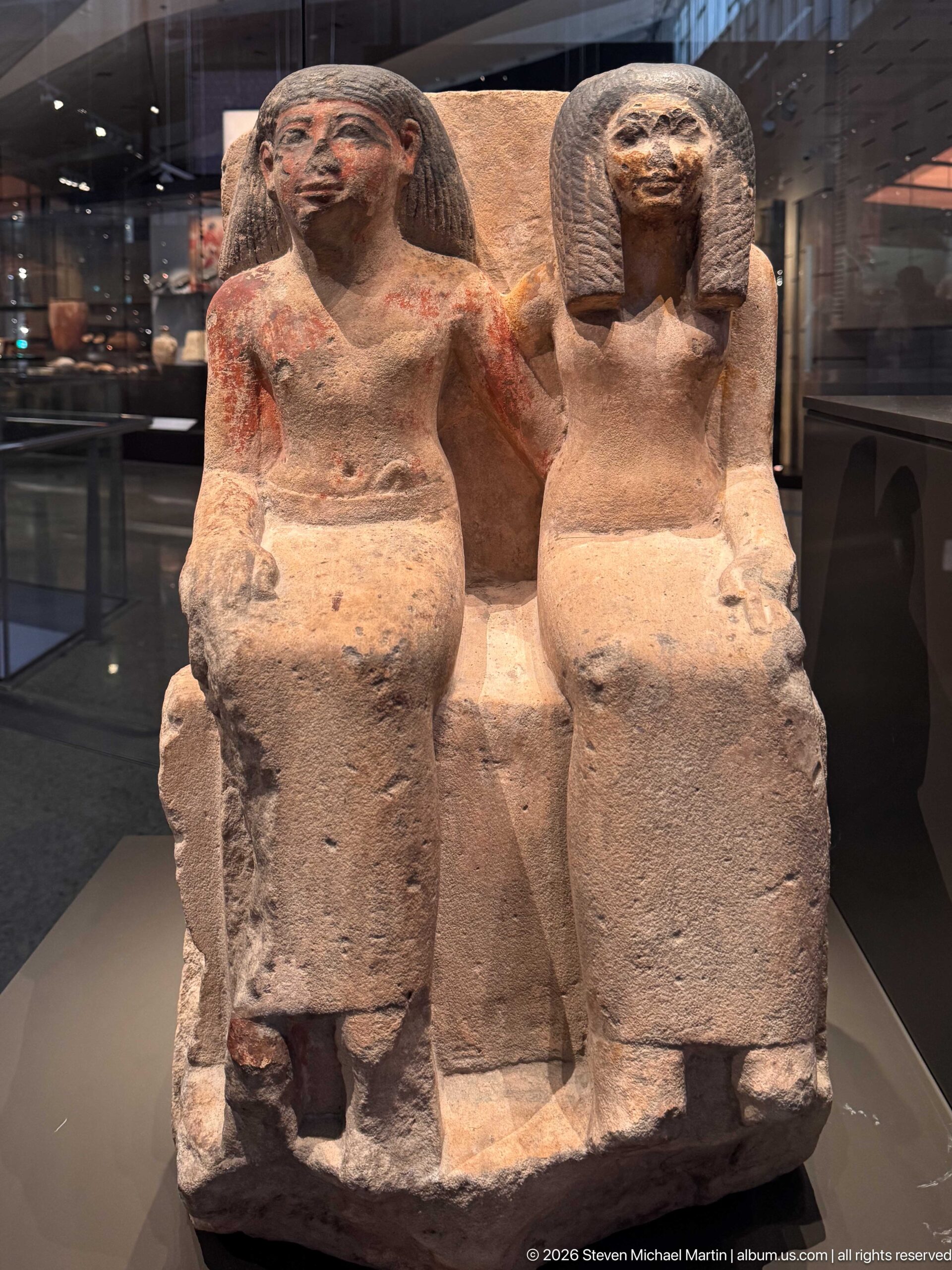
A blocky group statue portrays a man and woman seated tightly together on a shared bench. The man, at left, retains stronger red-brown pigment on the face and upper body, while the woman wears a fuller dark wig and sits in close contact with him. Surface abrasion and losses are visible across both figures, giving the object a strongly archaeological character while preserving the original paired composition.
Caption
A blocky group statue portrays a man and woman seated tightly together on a shared bench. The man, at left, retains stronger red-brown pigment on the face and upper body, while the woman wears a fuller dark wig and sits in close contact with him. Surface abrasion and losses are visible across both figures, giving the object a strongly archaeological character while preserving the original paired composition.
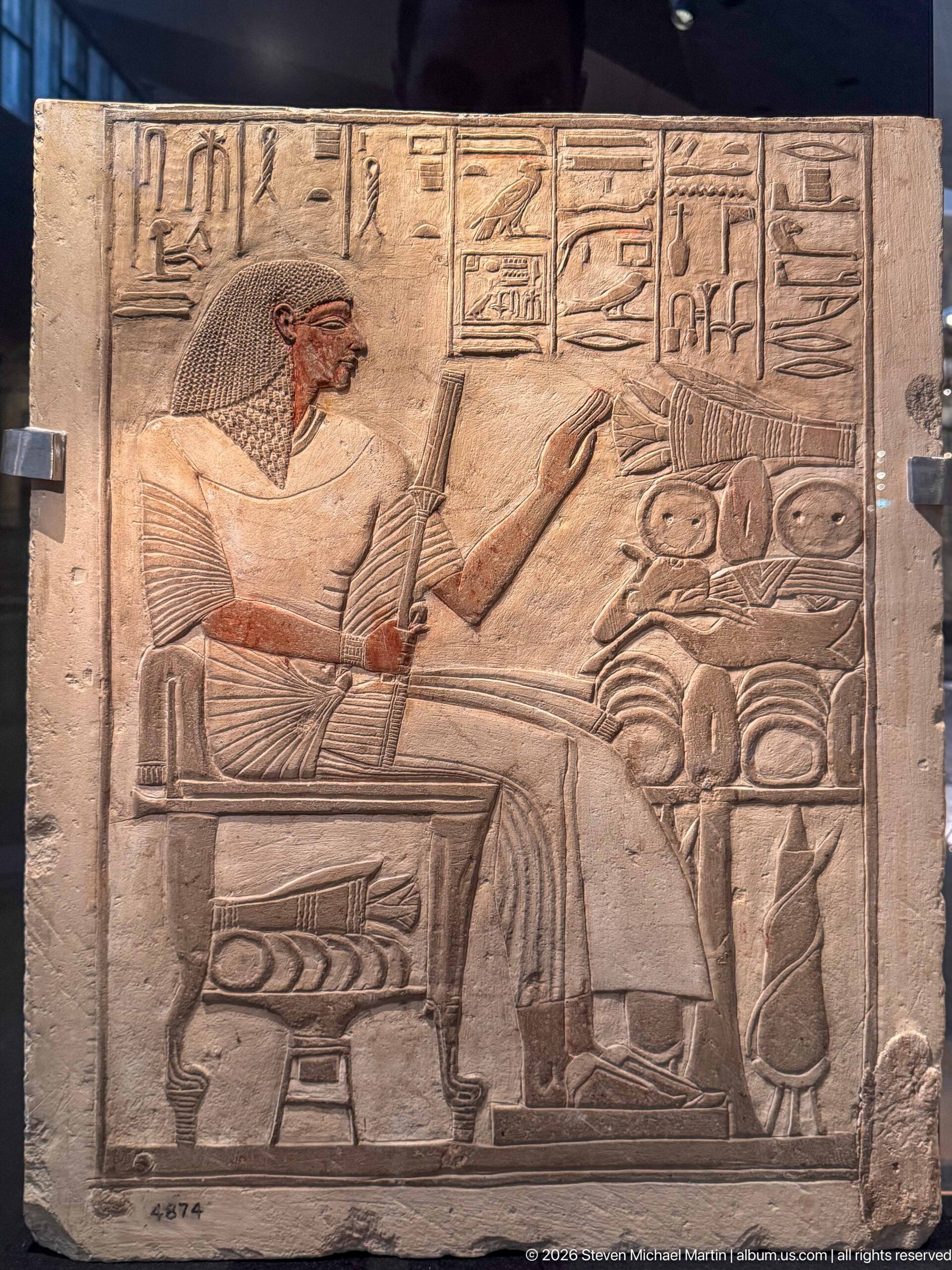
A finely cut relief shows a seated man in profile holding a writing implement or staff-like object, with one arm extended toward stacked offerings and vessels. Hieroglyphic inscriptions occupy the upper field, while the chair, garment pleats, and table provisions are rendered with crisp incised detail. Traces of red-brown and black pigment survive on the figure, reinforcing the relief's originally painted character.
Caption
A finely cut relief shows a seated man in profile holding a writing implement or staff-like object, with one arm extended toward stacked offerings and vessels. Hieroglyphic inscriptions occupy the upper field, while the chair, garment pleats, and table provisions are rendered with crisp incised detail. Traces of red-brown and black pigment survive on the figure, reinforcing the relief's originally painted character.
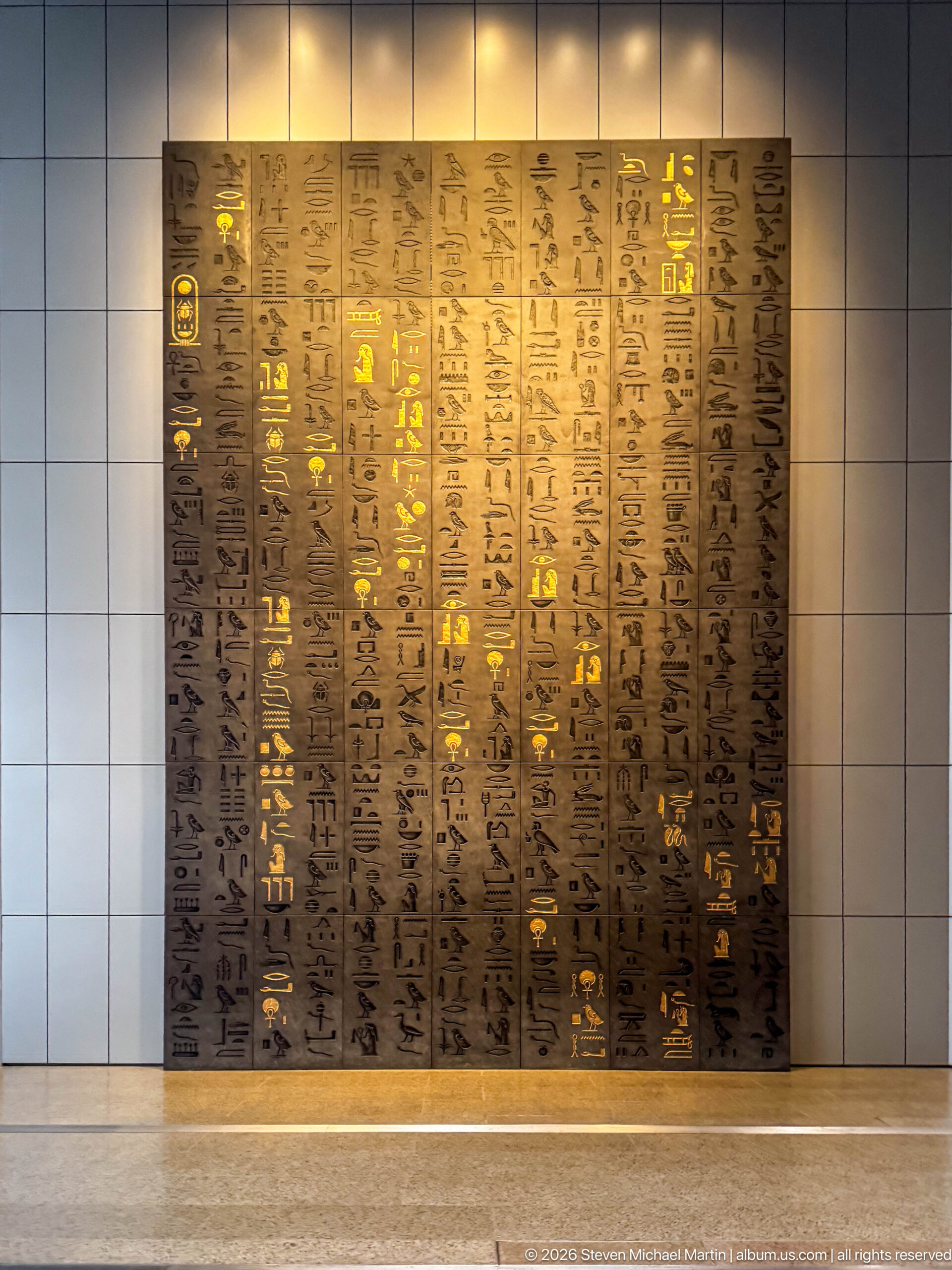
A monumental decorative wall panel translates ancient Egyptian script into contemporary museum architecture. Enlarged hieroglyphic signs are arranged in tall vertical bands, with warm golden light shining through selected cutouts against a darker bronze-toned field. Set within a pale stone wall, the installation creates a strong visual bridge between the museum's modern interior design and the writing system represented throughout its collections.
Caption
A monumental decorative wall panel translates ancient Egyptian script into contemporary museum architecture. Enlarged hieroglyphic signs are arranged in tall vertical bands, with warm golden light shining through selected cutouts against a darker bronze-toned field. Set within a pale stone wall, the installation creates a strong visual bridge between the museum's modern interior design and the writing system represented throughout its collections.
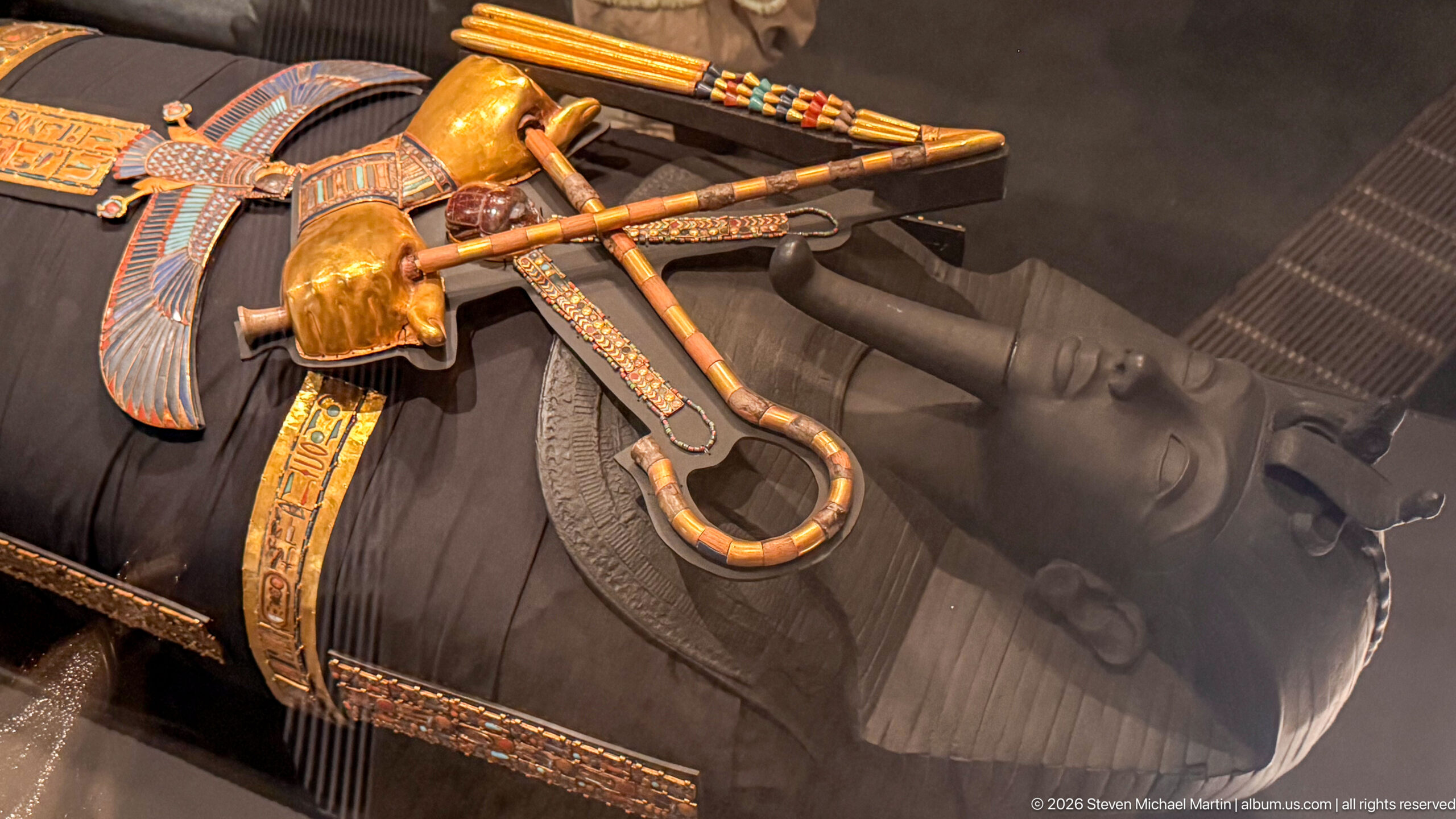
A close, diagonal view centers on the upper body and face of an anthropoid coffin. The idealized dark face is framed by a striped headdress and broad patterned collar, while brightly painted ceremonial objects cross over the chest in gold, blue, red, and green. The tight composition emphasizes the craftsmanship of the funerary equipment, from modeled facial features to the repeated bead-like and geometric decoration.
Caption
A close, diagonal view centers on the upper body and face of an anthropoid coffin. The idealized dark face is framed by a striped headdress and broad patterned collar, while brightly painted ceremonial objects cross over the chest in gold, blue, red, and green. The tight composition emphasizes the craftsmanship of the funerary equipment, from modeled facial features to the repeated bead-like and geometric decoration.
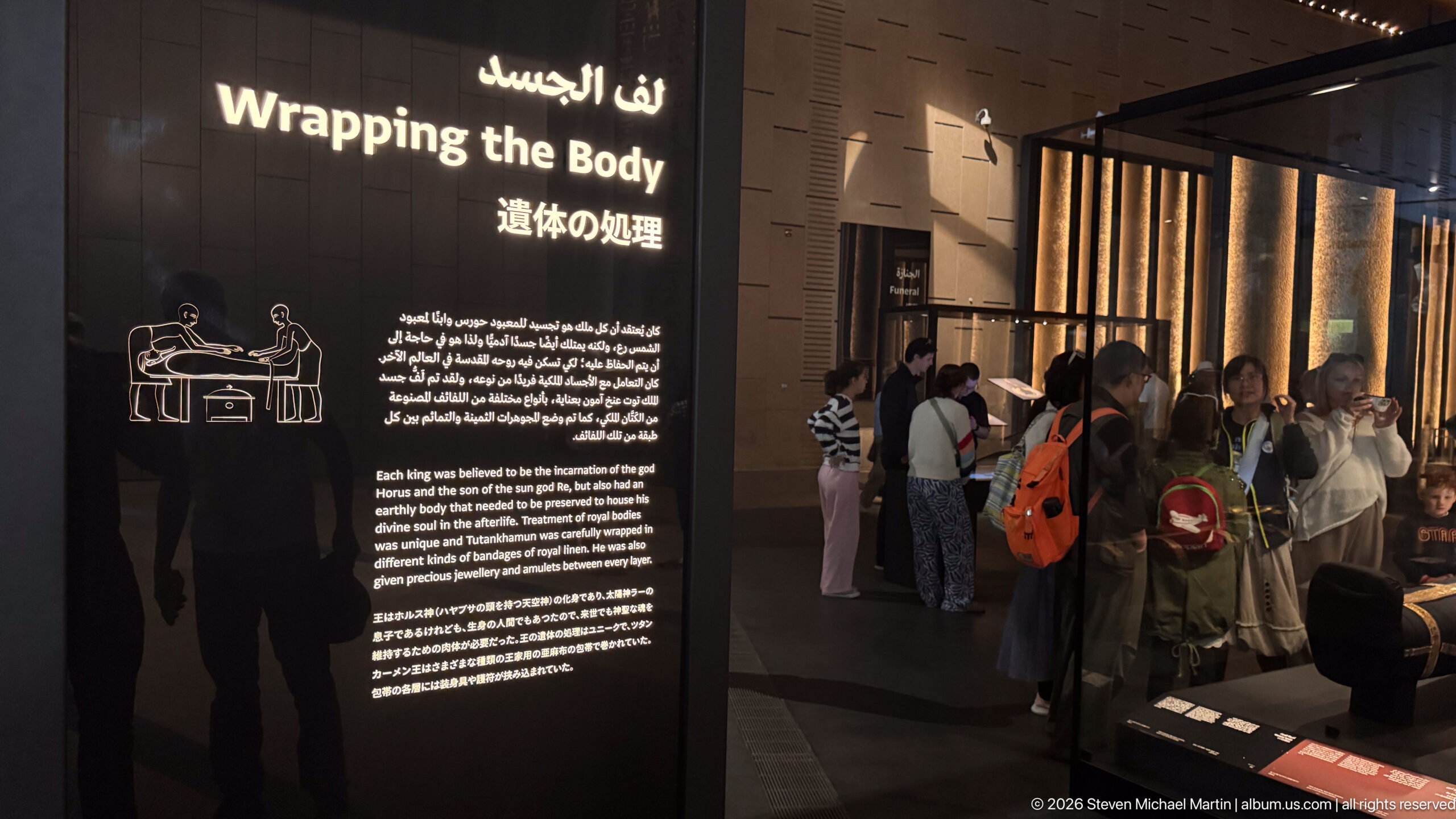
A gallery panel headed “Preparing the Body” introduces the treatment of the deceased before burial. A simple line drawing shows attendants working beside a reclining body, while blocks of Arabic, English, and Chinese text explain the process. Visitors gather at an adjacent display, situating the interpretive panel within the active museum gallery rather than isolating it as a graphic element.
Caption
A gallery panel headed “Preparing the Body” introduces the treatment of the deceased before burial. A simple line drawing shows attendants working beside a reclining body, while blocks of Arabic, English, and Chinese text explain the process. Visitors gather at an adjacent display, situating the interpretive panel within the active museum gallery rather than isolating it as a graphic element.
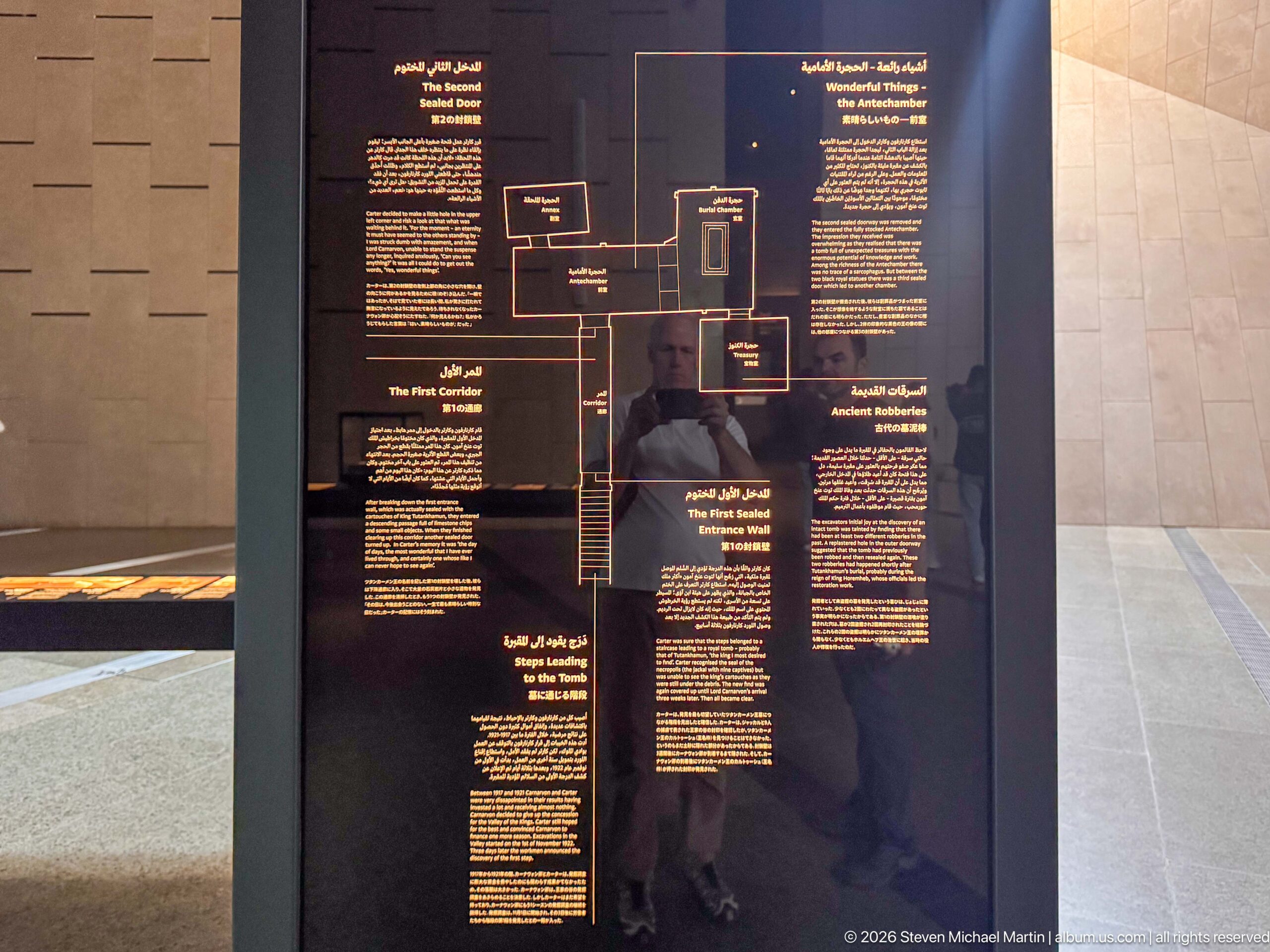
A tall museum graphic organizes funerary information around a central schematic diagram, with linked text blocks describing distinct components or stages of burial preparation. Arabic and English headings are visible across the panel, including sections devoted to coffins and associated equipment. The presentation demonstrates the museum's use of diagrammatic interpretation to connect individual artifacts with the broader sequence of ancient Egyptian funerary practice.
Caption
A tall museum graphic organizes funerary information around a central schematic diagram, with linked text blocks describing distinct components or stages of burial preparation. Arabic and English headings are visible across the panel, including sections devoted to coffins and associated equipment. The presentation demonstrates the museum's use of diagrammatic interpretation to connect individual artifacts with the broader sequence of ancient Egyptian funerary practice.
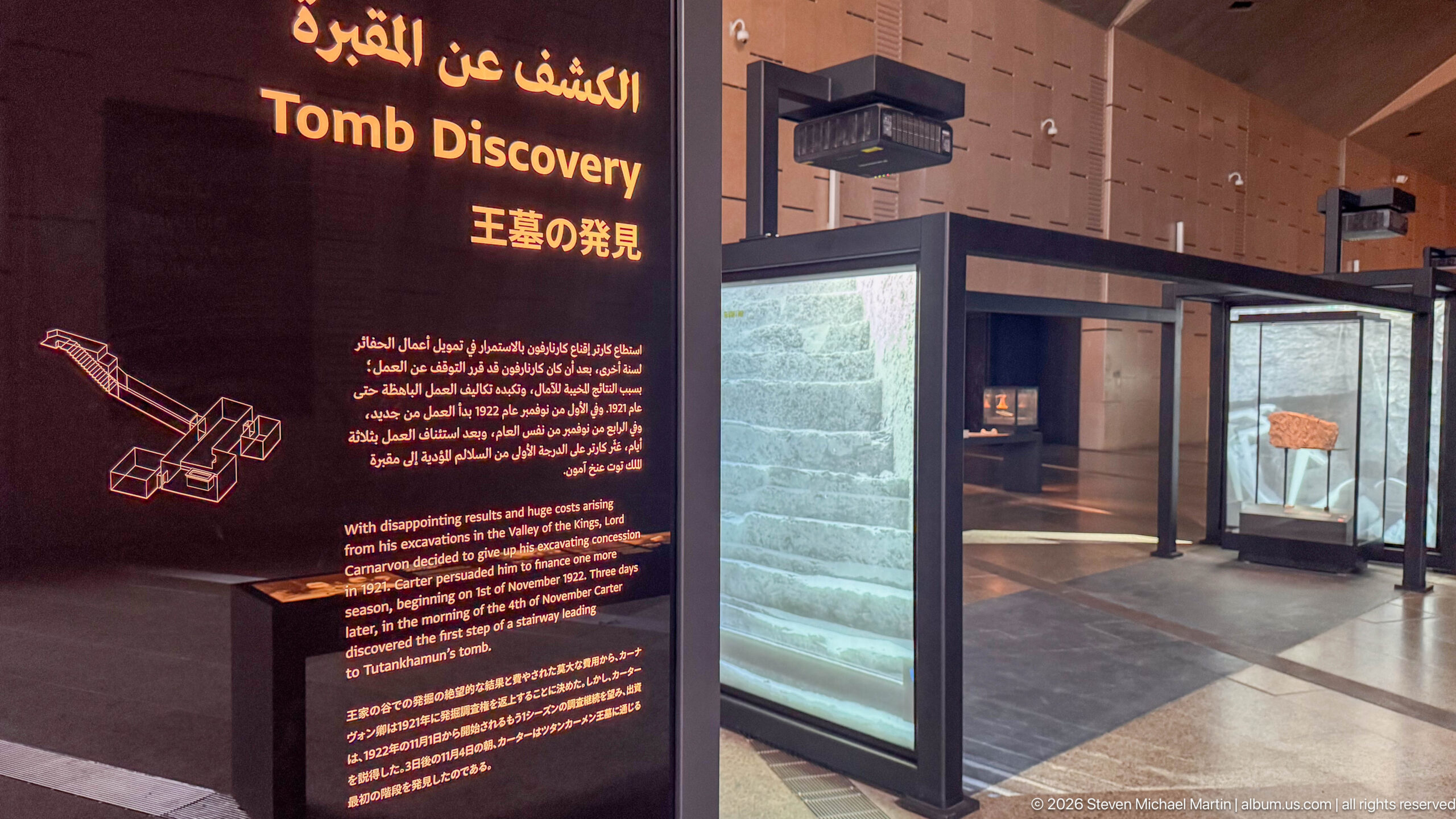
A panel headed “Discovery” recounts an archaeological find through Arabic, English, and Chinese text. A line drawing of a stepped or sloping excavation feature appears at left, while vitrines containing stone architecture and an inscribed fragment stand immediately beside the panel. The photograph links the narrative of excavation with the physical objects recovered, emphasizing provenance and archaeological context within the museum display.
Caption
A panel headed “Discovery” recounts an archaeological find through Arabic, English, and Chinese text. A line drawing of a stepped or sloping excavation feature appears at left, while vitrines containing stone architecture and an inscribed fragment stand immediately beside the panel. The photograph links the narrative of excavation with the physical objects recovered, emphasizing provenance and archaeological context within the museum display.
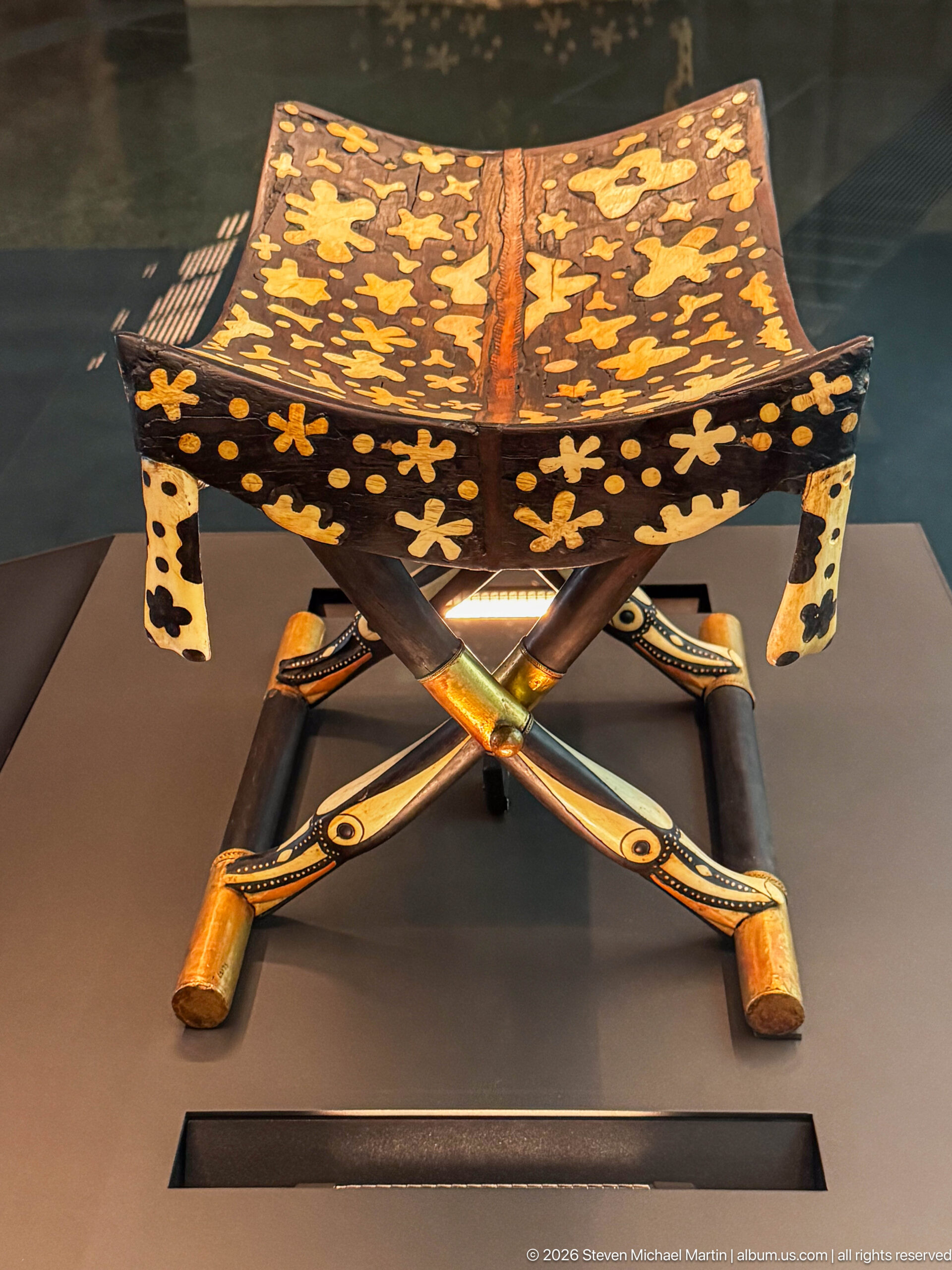
A richly decorated folding stool combines an X-shaped support with a slightly concave seat panel. Yellow floral motifs scatter across the dark seat, while the crossed legs carry bands of red, green, cream, and black ornament; small animal-like terminals or fittings accent the structure. The compact object demonstrates how utilitarian furniture could be elaborated through color, pattern, and carefully shaped wooden or composite elements.
Caption
A richly decorated folding stool combines an X-shaped support with a slightly concave seat panel. Yellow floral motifs scatter across the dark seat, while the crossed legs carry bands of red, green, cream, and black ornament; small animal-like terminals or fittings accent the structure. The compact object demonstrates how utilitarian furniture could be elaborated through color, pattern, and carefully shaped wooden or composite elements.
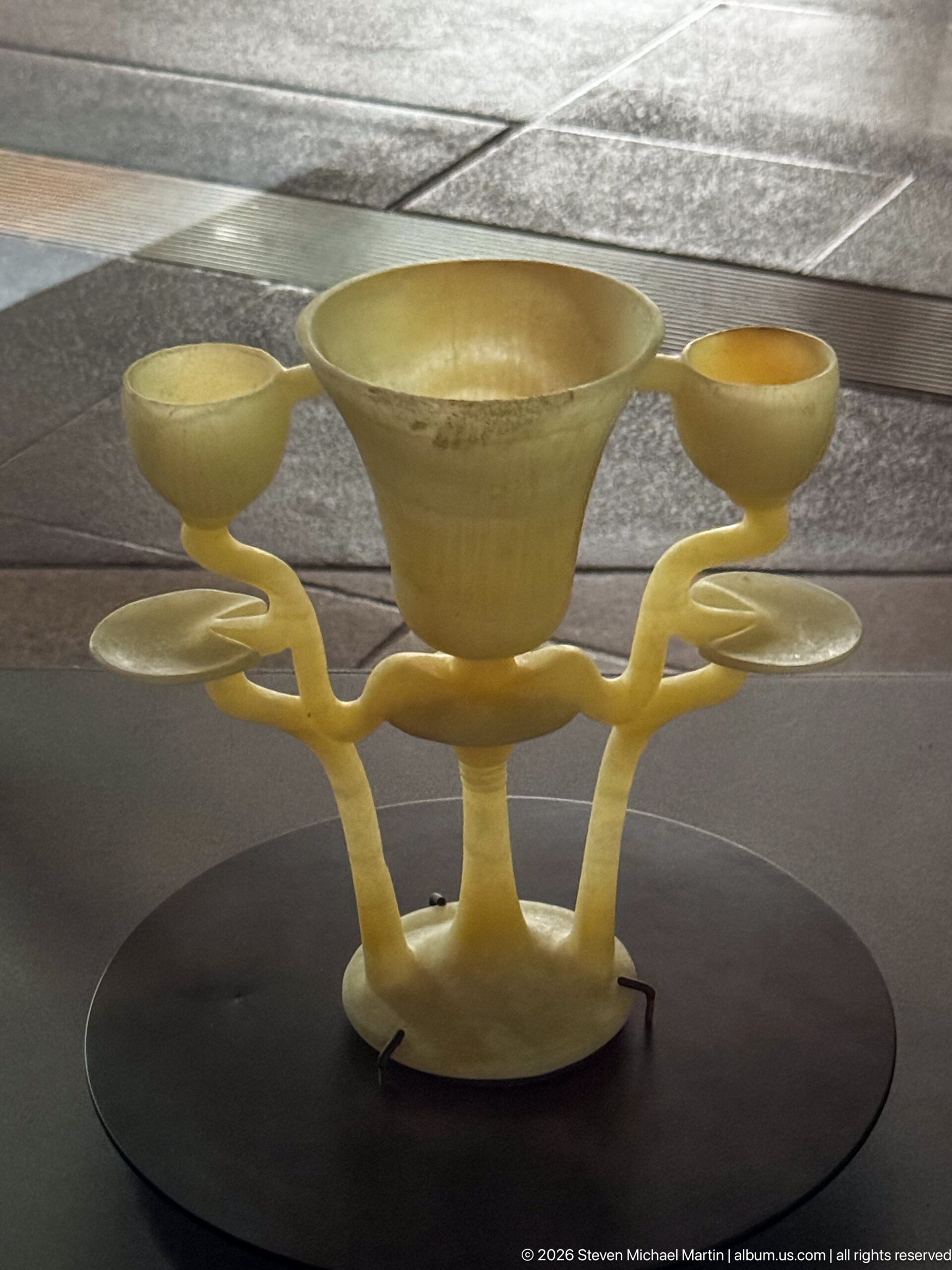
A pale, translucent stone vessel is carved as three shallow cups joined around a branching central support. Its unusual multi-cup design demonstrates the precision possible in ancient Egyptian stone-vessel manufacture; the photograph alone does not establish a specific ritual function or royal ownership.
Caption
A pale, translucent stone vessel is carved as three shallow cups joined around a branching central support. Its unusual multi-cup design demonstrates the precision possible in ancient Egyptian stone-vessel manufacture; the photograph alone does not establish a specific ritual function or royal ownership.
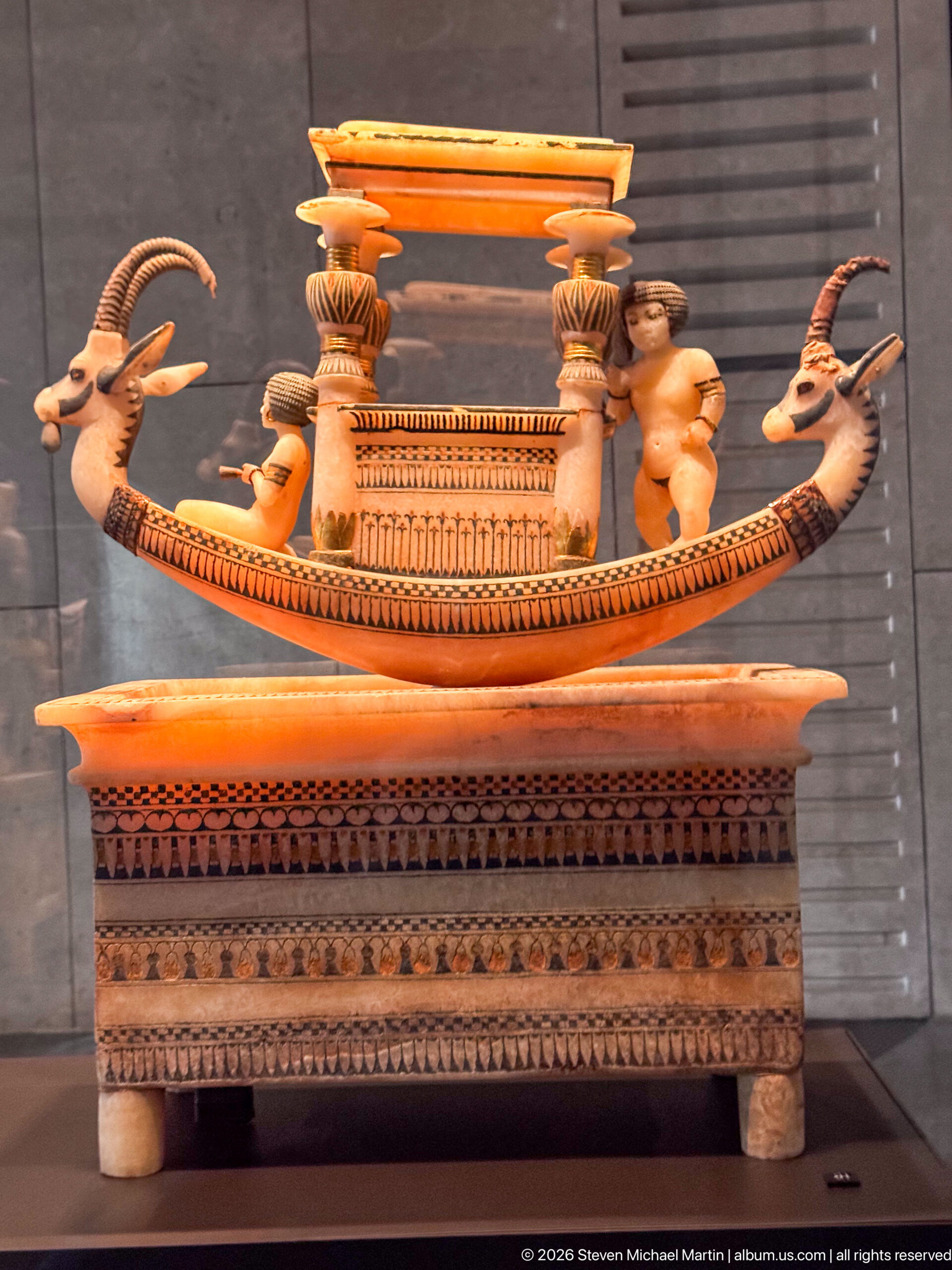
An elaborate polychrome boat-shaped vessel combines a long open body with ibex-head terminals, small modeled figures, and an architectural superstructure. The object demonstrates the imaginative forms used for luxury and ceremonial vessels in ancient Egypt, while its precise title, material, date, and ownership should follow the museum catalogue rather than visual inference.
Caption
An elaborate polychrome boat-shaped vessel combines a long open body with ibex-head terminals, small modeled figures, and an architectural superstructure. The object demonstrates the imaginative forms used for luxury and ceremonial vessels in ancient Egypt, while its precise title, material, date, and ownership should follow the museum catalogue rather than visual inference.
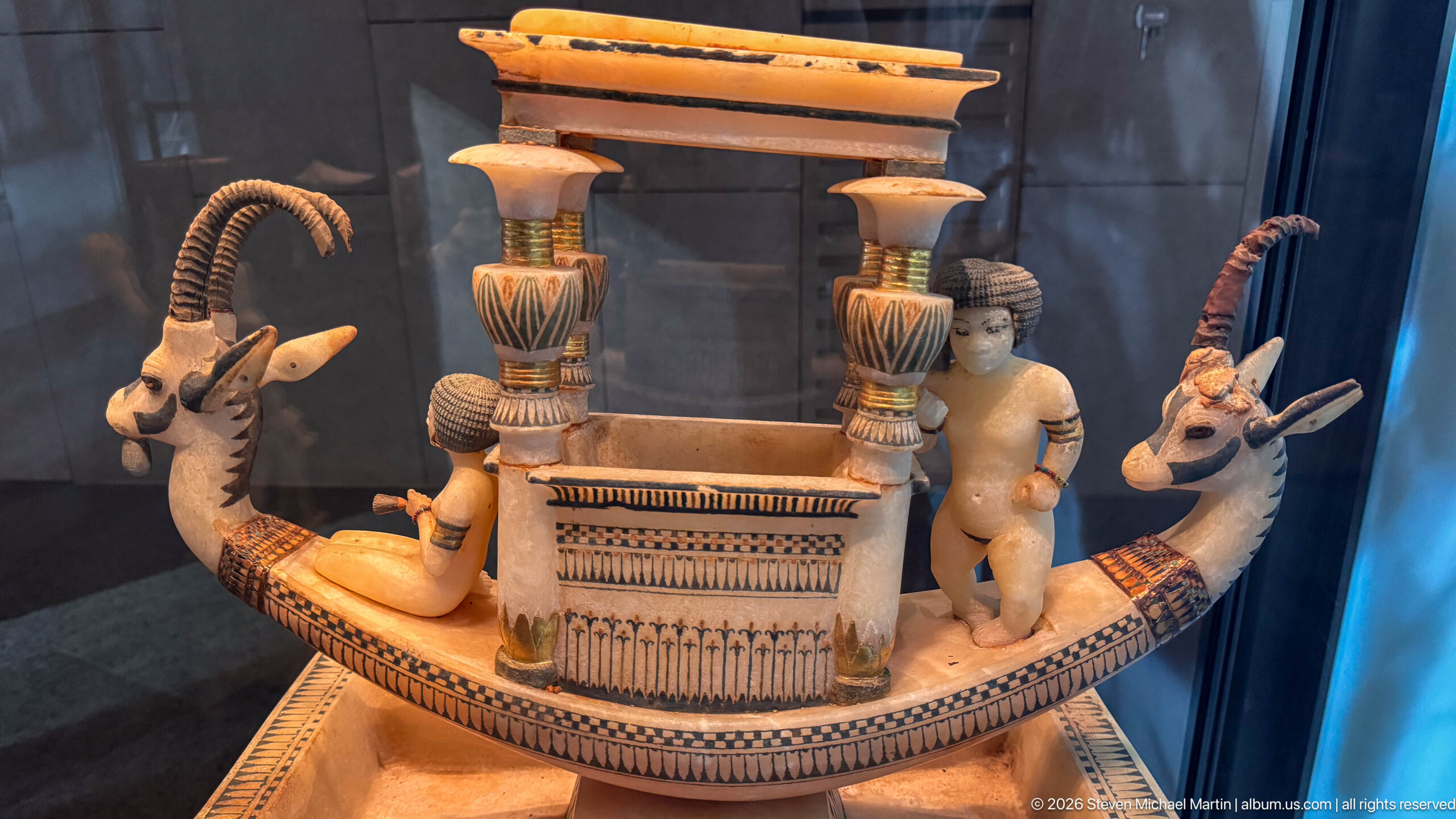
Side view of an elaborate boat-shaped vessel with ibex-head terminals, columns, and small modeled figures arranged along its polychrome structure. The close perspective emphasizes the object's intricate carving and painted details without assigning an unverified owner or funerary context.
Caption
Side view of an elaborate boat-shaped vessel with ibex-head terminals, columns, and small modeled figures arranged along its polychrome structure. The close perspective emphasizes the object's intricate carving and painted details without assigning an unverified owner or funerary context.
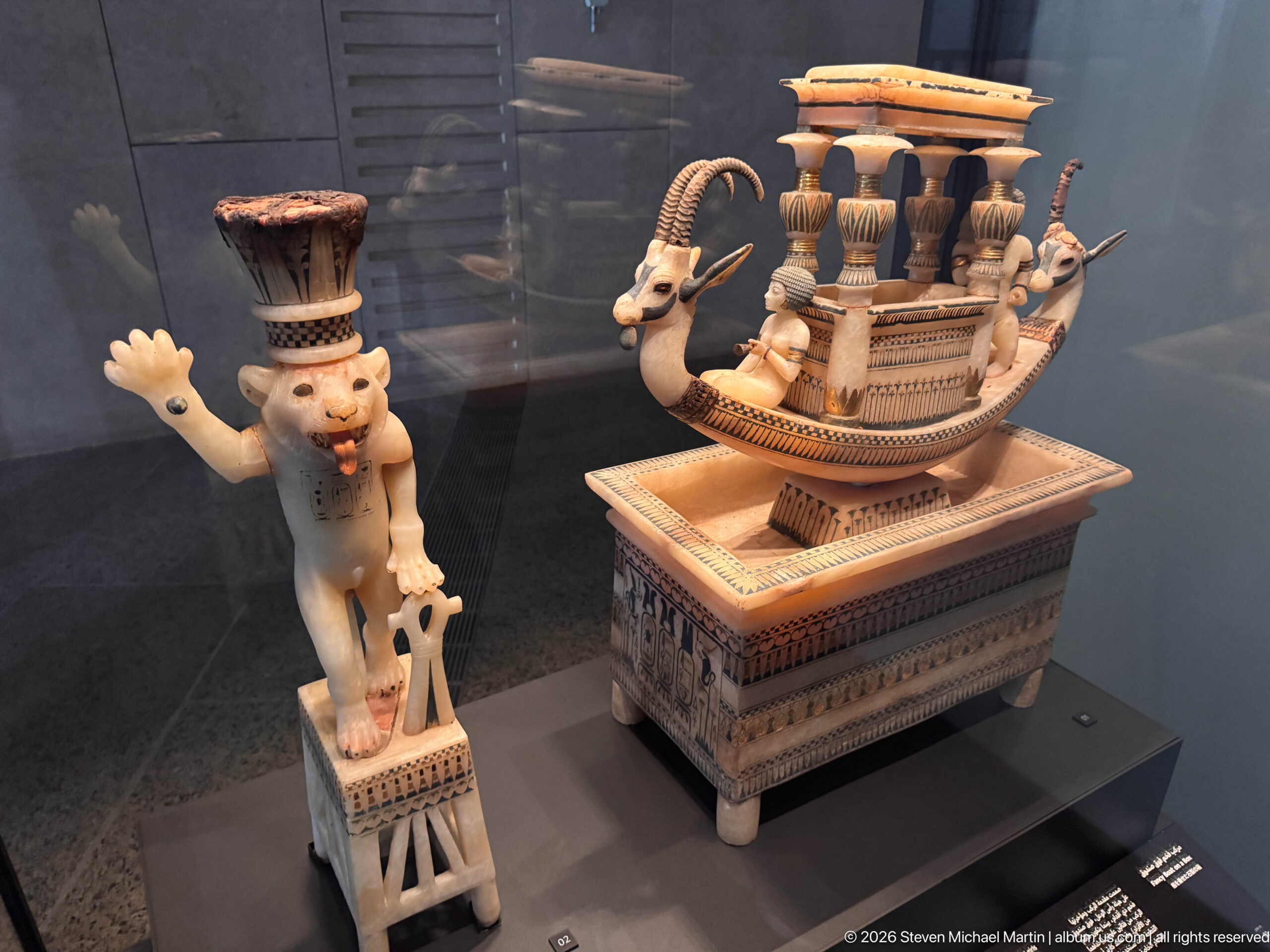
A museum case pairs the richly patterned boat-shaped object with a separate standing dwarf-like protective figure at left. The figure has a broad face, compact body, raised arm, and tall feathered or ribbed headdress, while the adjacent object repeats horned animal terminals, columns, and miniature attendants. Together they create a dense display of protective imagery, color, and small-scale ceremonial craftsmanship.
Caption
A museum case pairs the richly patterned boat-shaped object with a separate standing dwarf-like protective figure at left. The figure has a broad face, compact body, raised arm, and tall feathered or ribbed headdress, while the adjacent object repeats horned animal terminals, columns, and miniature attendants. Together they create a dense display of protective imagery, color, and small-scale ceremonial craftsmanship.
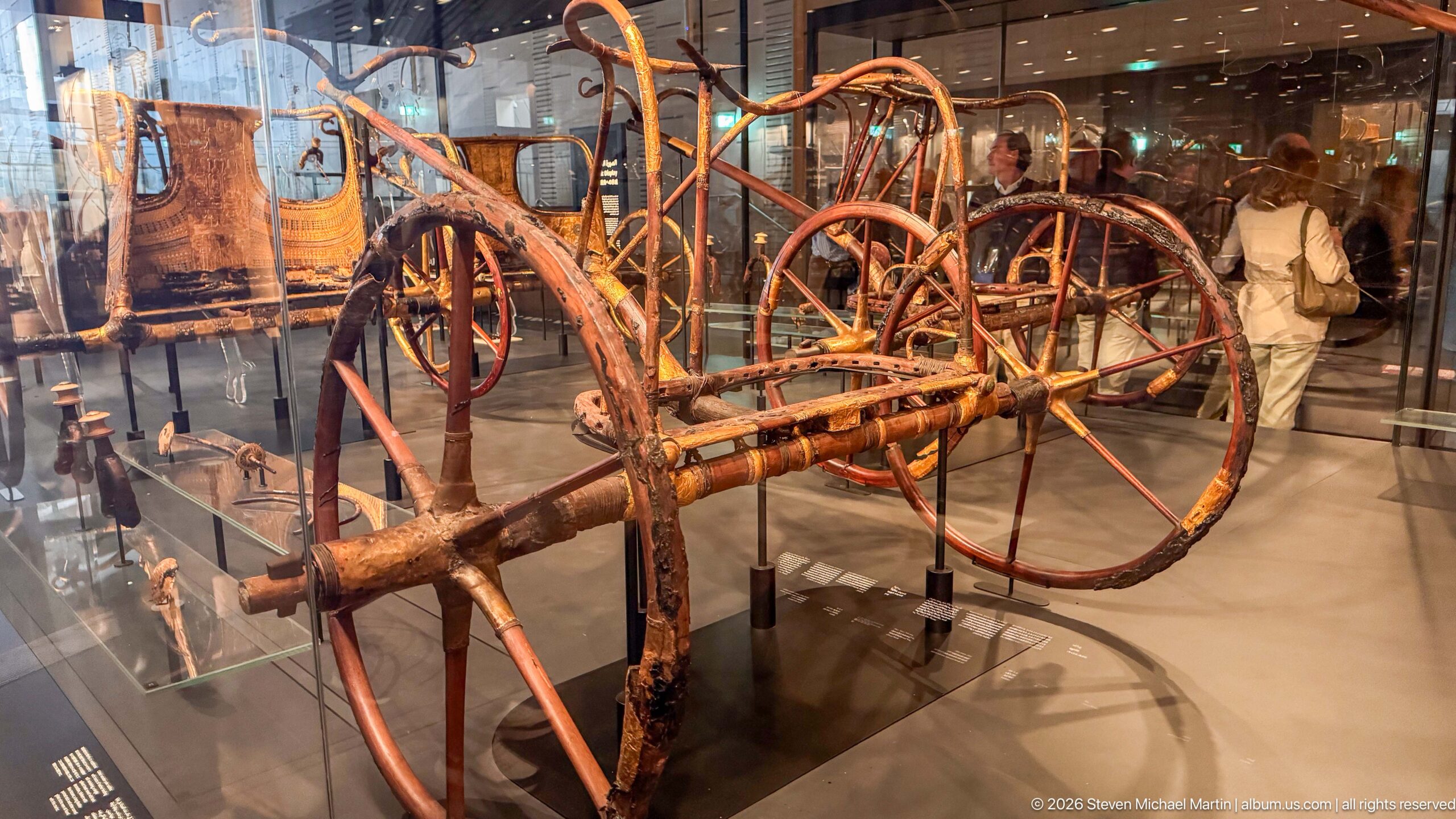
A remarkably open-framed chariot stands within a glass gallery case, dominated by two large spoked wheels and a long projecting pole. The surviving wooden structure includes curving rails, a narrow body platform, cross-bracing, and traces of colored or patterned surface treatment. Seen obliquely from the front, the photograph makes the vehicle's light construction and engineering more evident than its decorative details.
Caption
A remarkably open-framed chariot stands within a glass gallery case, dominated by two large spoked wheels and a long projecting pole. The surviving wooden structure includes curving rails, a narrow body platform, cross-bracing, and traces of colored or patterned surface treatment. Seen obliquely from the front, the photograph makes the vehicle's light construction and engineering more evident than its decorative details.
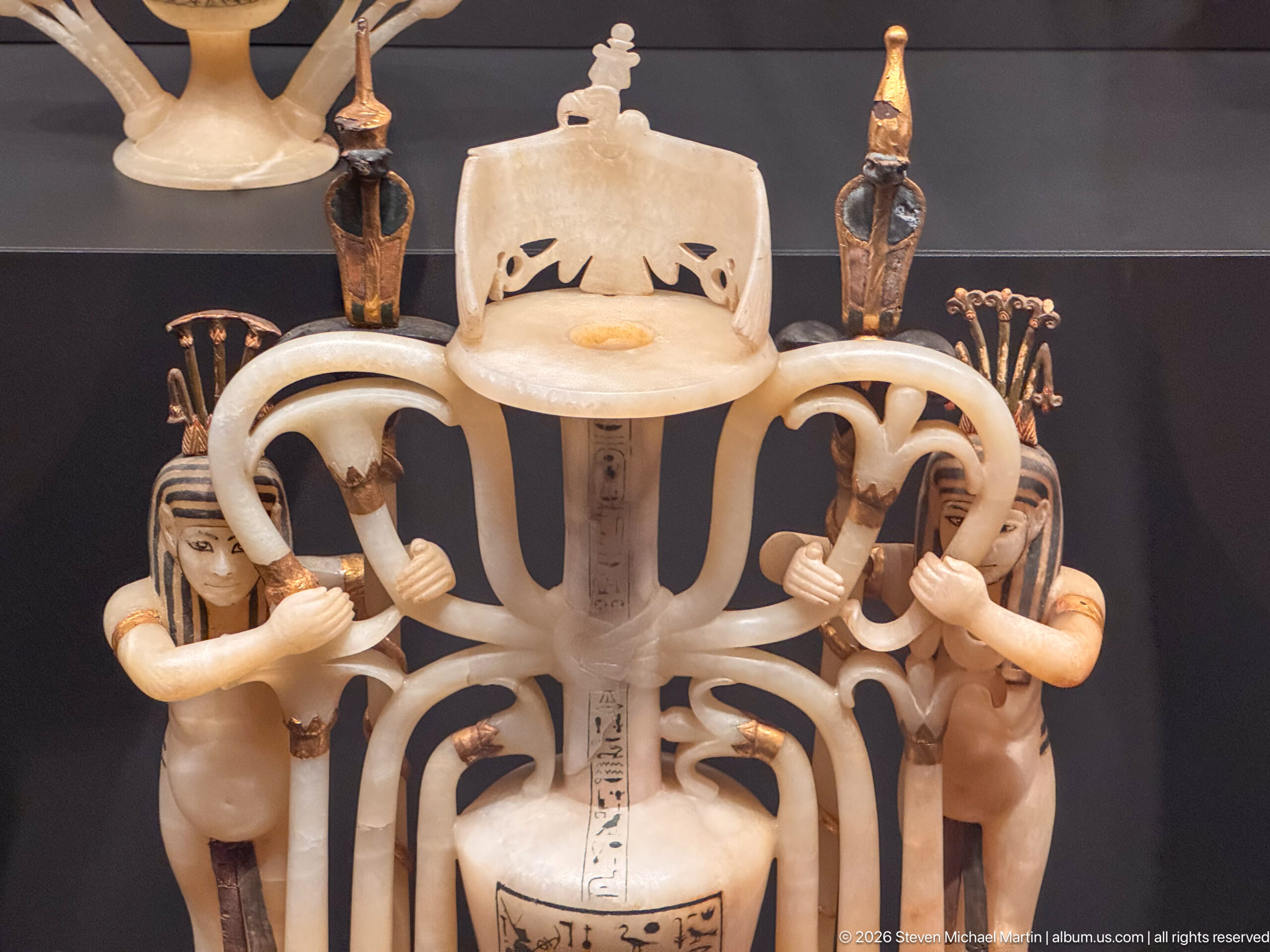
A close view concentrates on the upper half of the elaborate pale stone vessel, revealing how human figures and sweeping serpent-like or rope-like supports frame a central seat- or basin-shaped element. Slender columns and small finial forms rise behind them, while incised hieroglyphs appear on the central vertical surface. The tight crop clarifies the object's complex openwork carving and balanced bilateral design.
Caption
A close view concentrates on the upper half of the elaborate pale stone vessel, revealing how human figures and sweeping serpent-like or rope-like supports frame a central seat- or basin-shaped element. Slender columns and small finial forms rise behind them, while incised hieroglyphs appear on the central vertical surface. The tight crop clarifies the object's complex openwork carving and balanced bilateral design.
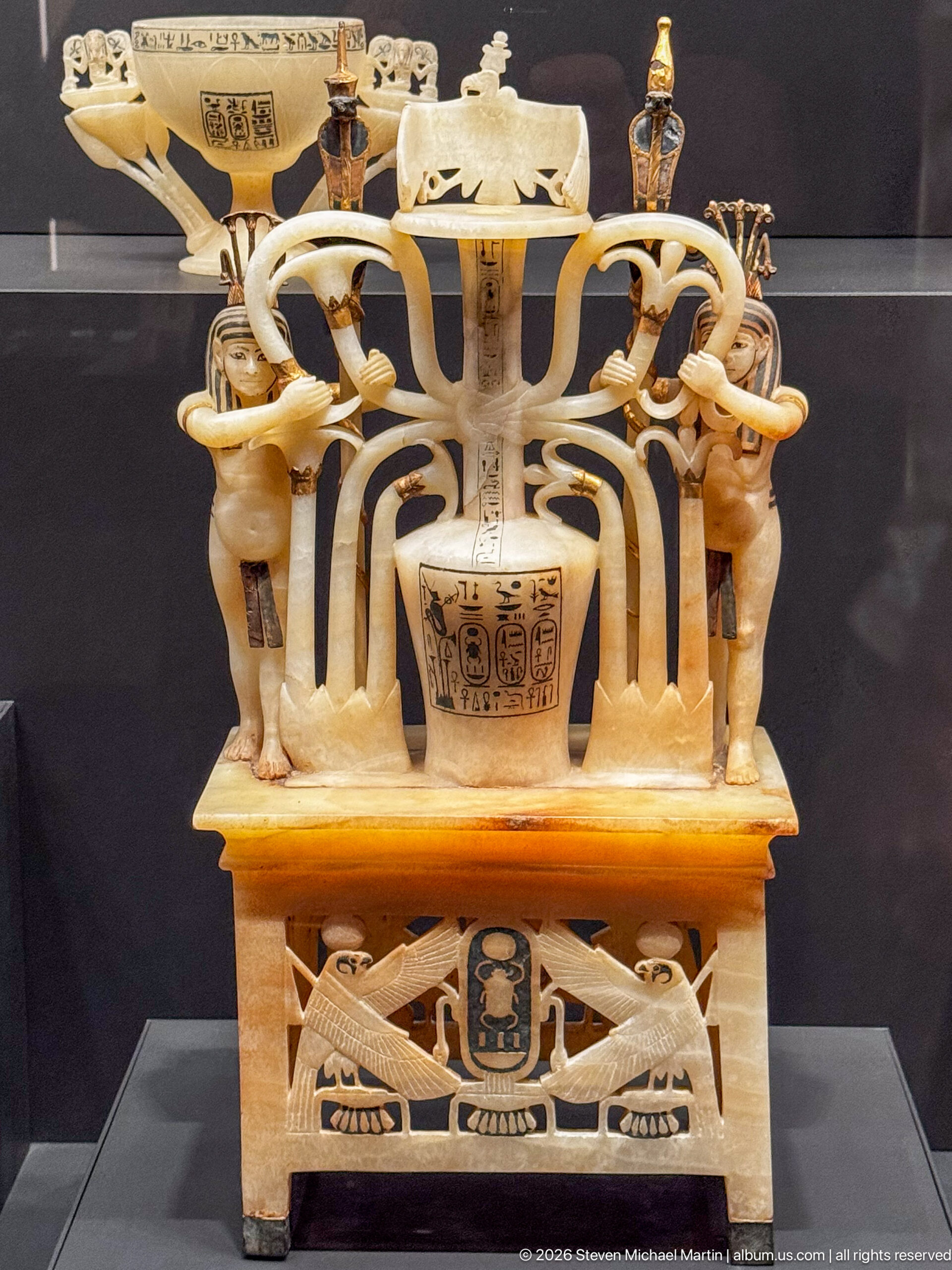
An exceptionally intricate pale stone vessel is built as an openwork architectural composition. Paired human figures stand at the sides beneath sweeping curved supports that rise toward a central upper platform, while small columns, symbolic forms, and cartouches punctuate the structure. A larger inscribed vessel occupies the center, and a rectangular lower panel contains additional relief carving, creating a dense fusion of vessel form, sculpture, and royal imagery.
Caption
An exceptionally intricate pale stone vessel is built as an openwork architectural composition. Paired human figures stand at the sides beneath sweeping curved supports that rise toward a central upper platform, while small columns, symbolic forms, and cartouches punctuate the structure. A larger inscribed vessel occupies the center, and a rectangular lower panel contains additional relief carving, creating a dense fusion of vessel form, sculpture, and royal imagery.
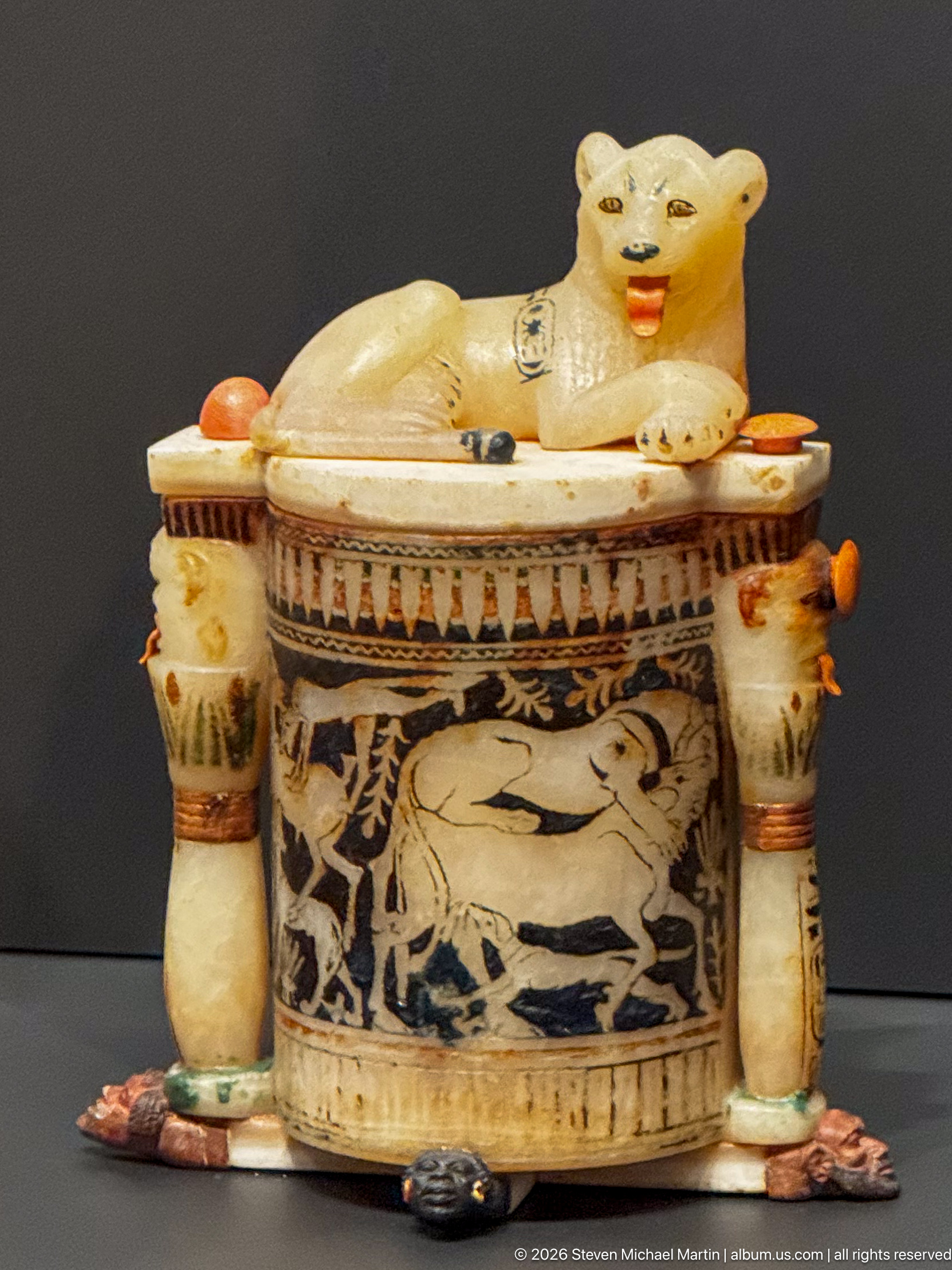
A recumbent lion crowns a richly decorated cylindrical container flanked by two smaller vessels. Painted bands, floral or lotus-like motifs, and animal imagery cover the main body, while the lion's face, paws, and pale cream surface remain especially prominent. Small colored elements arranged around the base add to the object's ceremonial appearance, though its exact function is not evident from the proof-sheet view.
Caption
A recumbent lion crowns a richly decorated cylindrical container flanked by two smaller vessels. Painted bands, floral or lotus-like motifs, and animal imagery cover the main body, while the lion's face, paws, and pale cream surface remain especially prominent. Small colored elements arranged around the base add to the object's ceremonial appearance, though its exact function is not evident from the proof-sheet view.
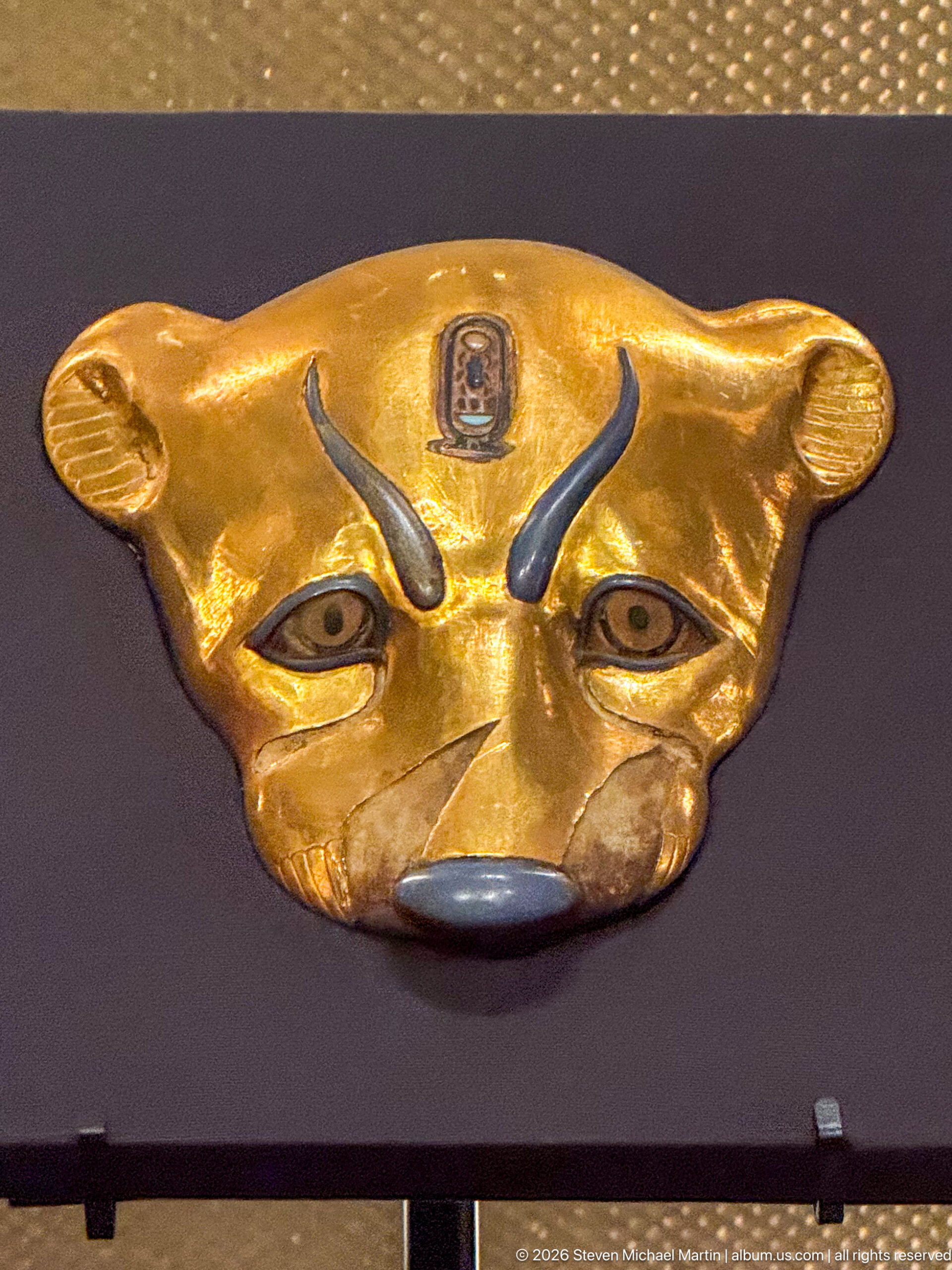
A sheet-gold feline face is modeled with broad ears, almond-shaped inlaid eyes, raised brows, and a projecting muzzle. A small royal or hieroglyphic emblem sits at the center of the forehead, while darker inlays define the eyes, brows, and nose. The flattened, symmetrical form suggests an applied decorative fitting or mask element rather than a fully three-dimensional sculpture.
Caption
A sheet-gold feline face is modeled with broad ears, almond-shaped inlaid eyes, raised brows, and a projecting muzzle. A small royal or hieroglyphic emblem sits at the center of the forehead, while darker inlays define the eyes, brows, and nose. The flattened, symmetrical form suggests an applied decorative fitting or mask element rather than a fully three-dimensional sculpture.
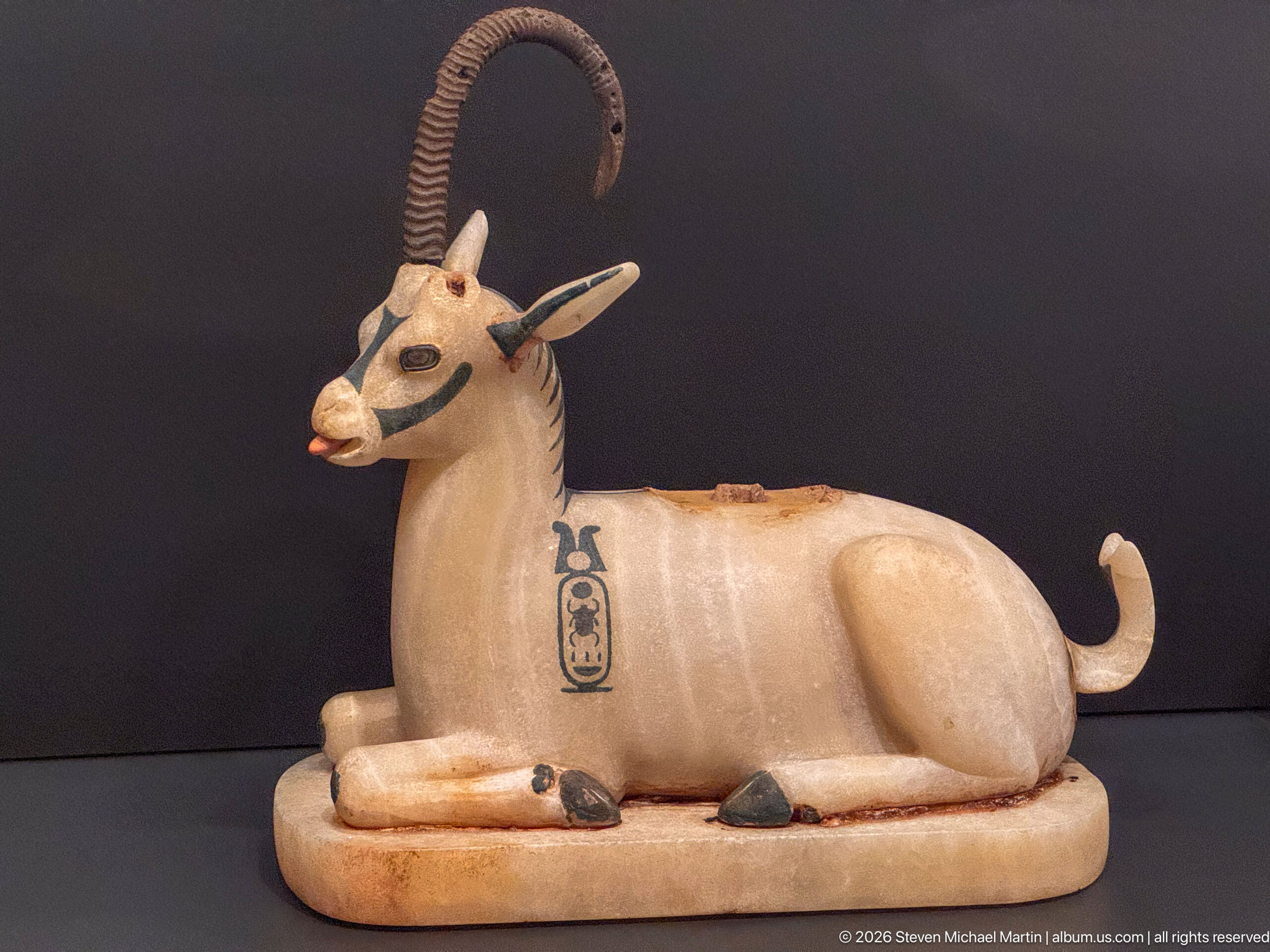
A finely modeled recumbent horned animal rests on a low rectangular base, its long ridged horns arching dramatically backward. The pale body is accented with dark facial markings, a curled tail, and a painted royal or hieroglyphic emblem on the flank. The compact form and careful surface decoration suggest a luxury or ceremonial object rather than a naturalistic sculpture intended for freestanding display.
Caption
A finely modeled recumbent horned animal rests on a low rectangular base, its long ridged horns arching dramatically backward. The pale body is accented with dark facial markings, a curled tail, and a painted royal or hieroglyphic emblem on the flank. The compact form and careful surface decoration suggest a luxury or ceremonial object rather than a naturalistic sculpture intended for freestanding display.
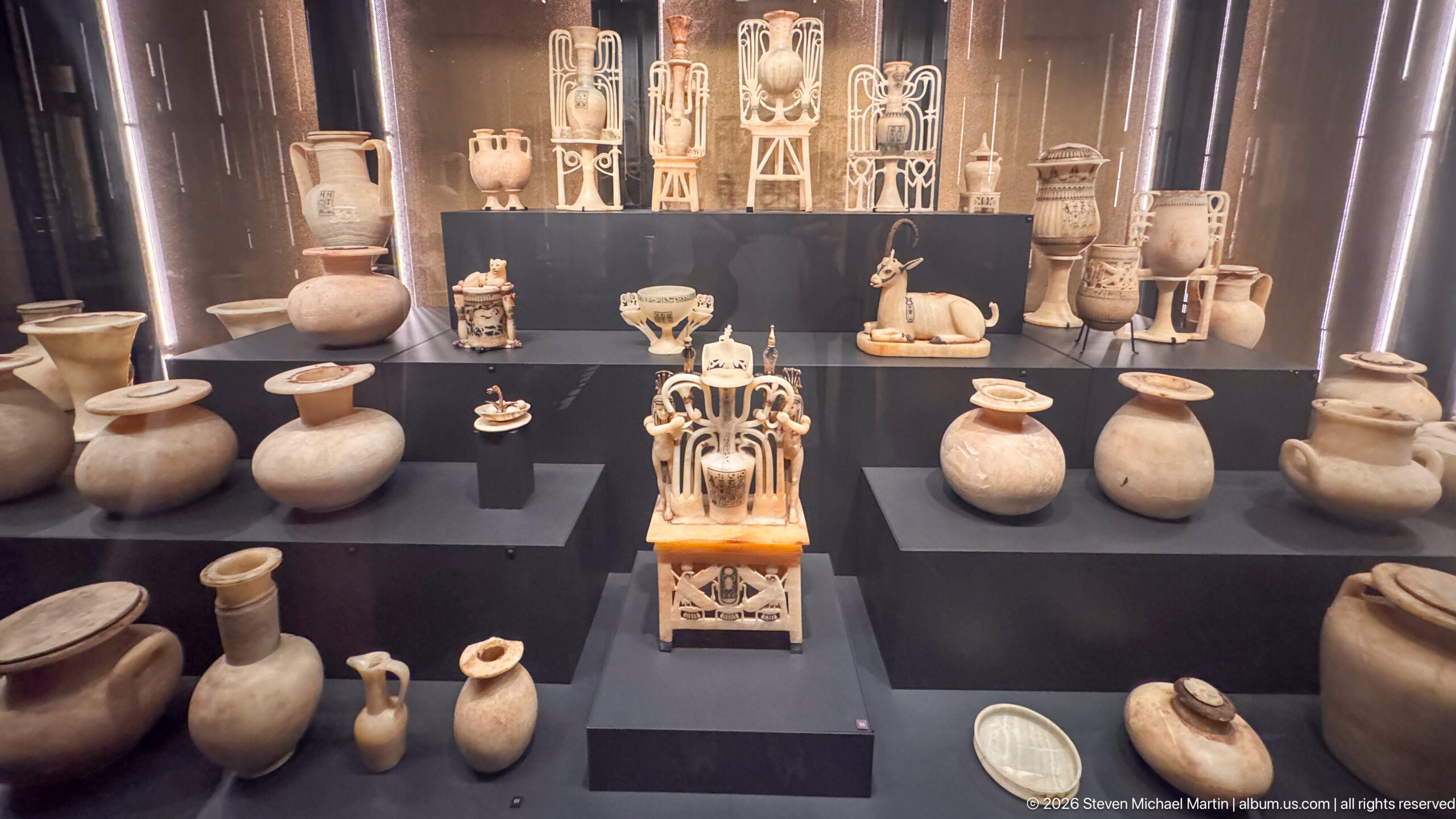
A dense museum case brings together rounded jars, narrow-necked vessels, small animal and human figures, and several highly decorative objects set on tiered black platforms. The arrangement contrasts plain stone and ceramic containers with polychrome luxury pieces, allowing differences in scale, material, and craftsmanship to be read across the display. Tall ornate stands and vessel forms rise along the back wall of the case.
Caption
A dense museum case brings together rounded jars, narrow-necked vessels, small animal and human figures, and several highly decorative objects set on tiered black platforms. The arrangement contrasts plain stone and ceramic containers with polychrome luxury pieces, allowing differences in scale, material, and craftsmanship to be read across the display. Tall ornate stands and vessel forms rise along the back wall of the case.
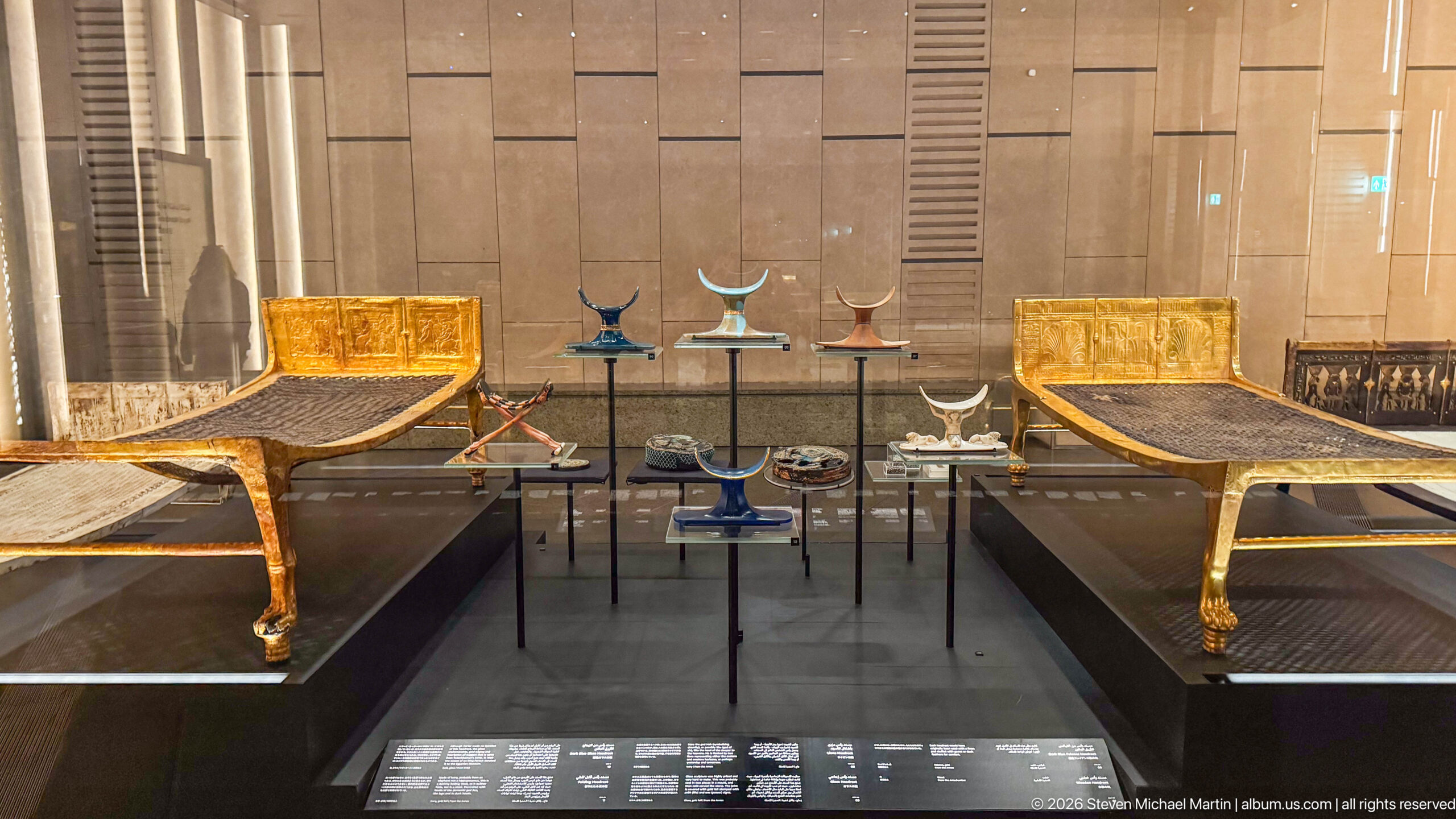
A symmetrical gallery installation centers on two gilded beds or couches with woven or patterned sleeping surfaces and animal-like legs. Between them, slender stands support blue, turquoise, and reddish objects with crescent-shaped or curved elements, while smaller vessels and fittings occupy lower platforms. The warm gold surfaces and carefully balanced arrangement give the case the appearance of a high-status furniture and luxury-goods ensemble.
Caption
A symmetrical gallery installation centers on two gilded beds or couches with woven or patterned sleeping surfaces and animal-like legs. Between them, slender stands support blue, turquoise, and reddish objects with crescent-shaped or curved elements, while smaller vessels and fittings occupy lower platforms. The warm gold surfaces and carefully balanced arrangement give the case the appearance of a high-status furniture and luxury-goods ensemble.
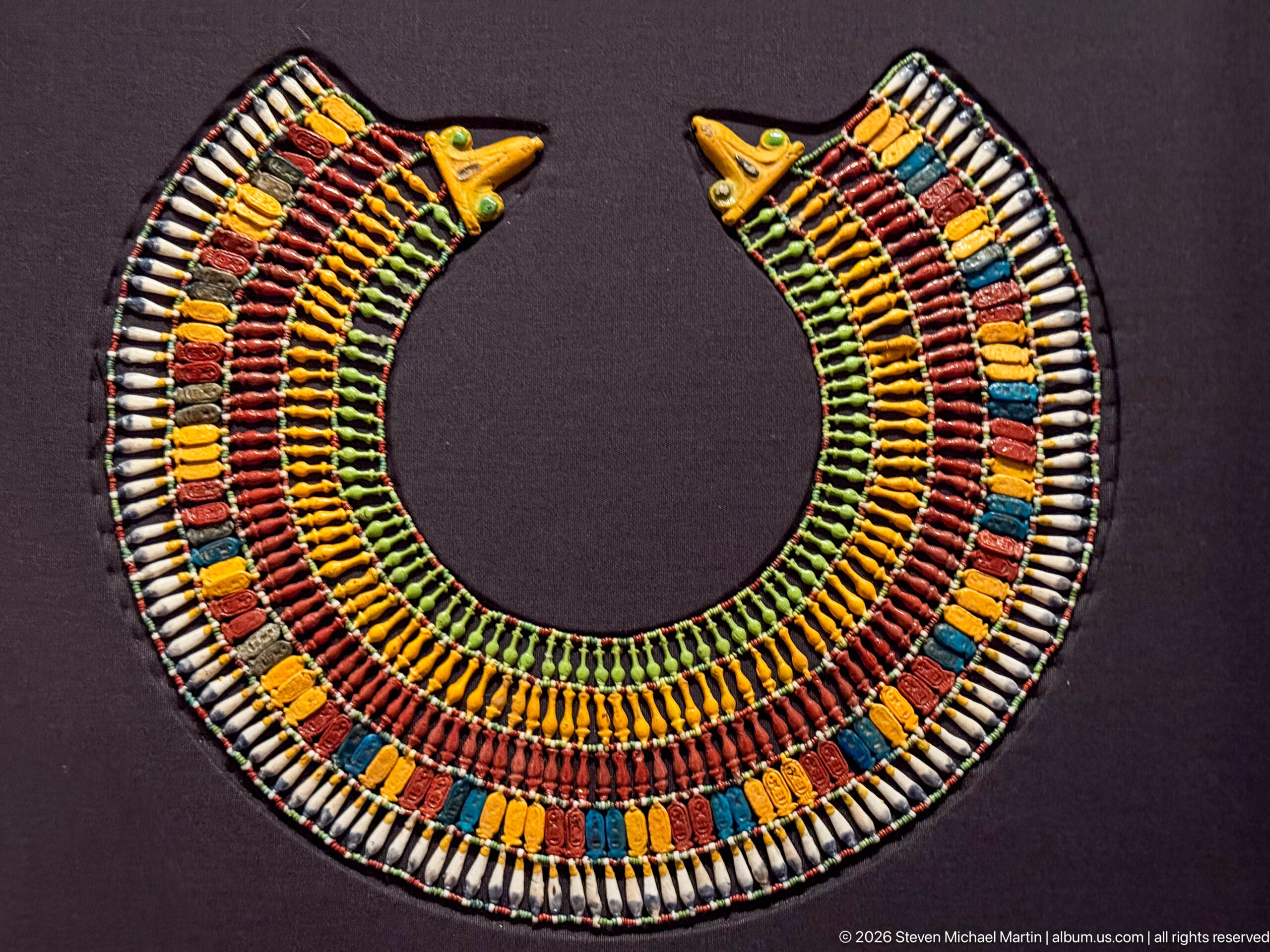
A broad semicircular collar is built from tightly ordered rows of blue, green, red, yellow, white, and black beads. At the upper ends, stylized falcon heads form matching terminals, while repeated drop and tubular elements create rhythmic bands across the necklace. The vivid color pattern and balanced construction make the piece a clear example of elaborate ancient Egyptian personal adornment.
Caption
A broad semicircular collar is built from tightly ordered rows of blue, green, red, yellow, white, and black beads. At the upper ends, stylized falcon heads form matching terminals, while repeated drop and tubular elements create rhythmic bands across the necklace. The vivid color pattern and balanced construction make the piece a clear example of elaborate ancient Egyptian personal adornment.
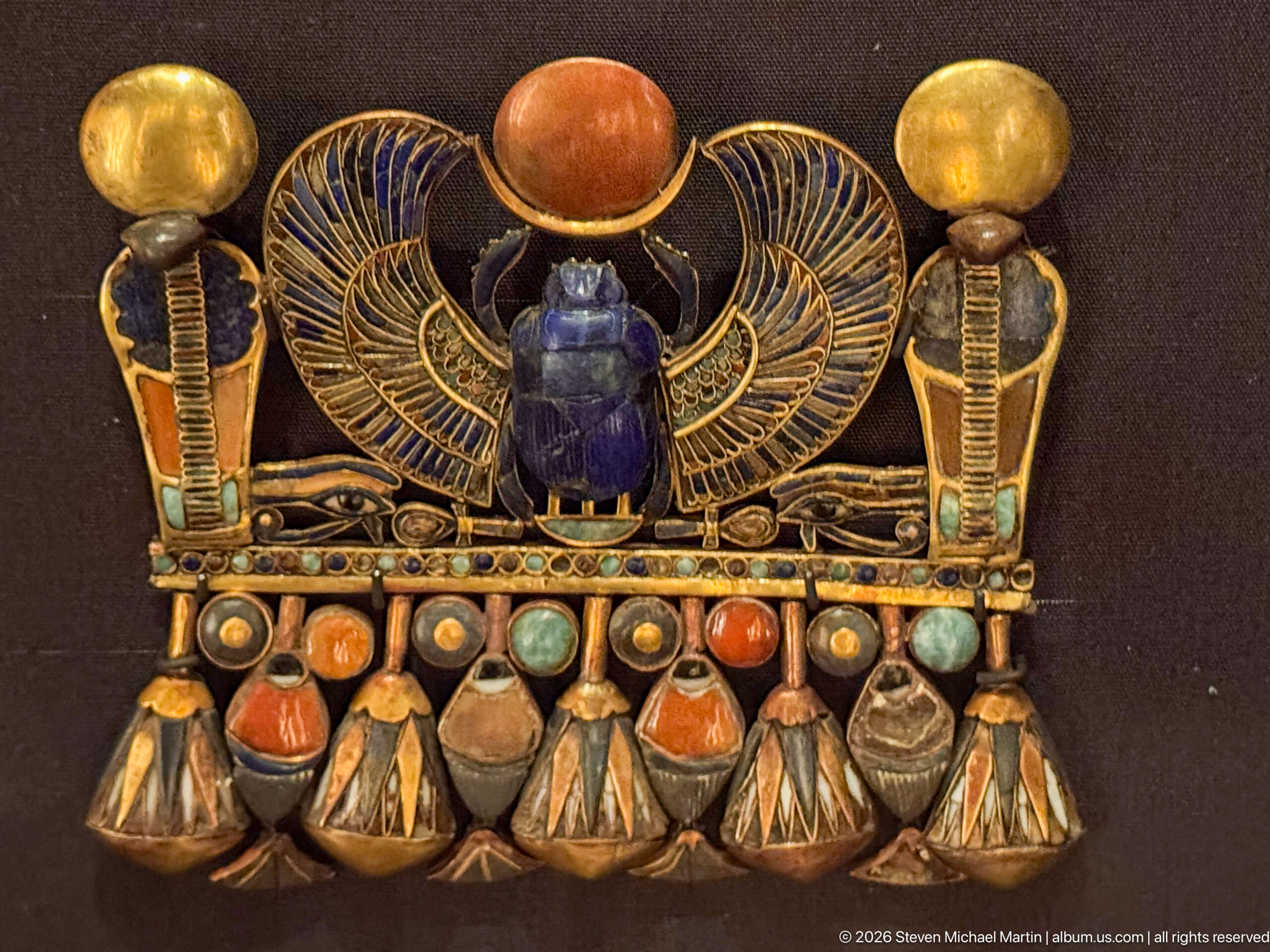
A richly inlaid pectoral centers on a dark blue scarab beneath a large reddish solar disk, with broad feathered wings spreading across the composition. Upright cobra figures flank the central emblem, while rows of colored pendants and lotus-like forms hang below. Gold outlines unify blue, green, red, and pale stone inlays, turning the piece into a compact arrangement of solar and protective imagery.
Caption
A richly inlaid pectoral centers on a dark blue scarab beneath a large reddish solar disk, with broad feathered wings spreading across the composition. Upright cobra figures flank the central emblem, while rows of colored pendants and lotus-like forms hang below. Gold outlines unify blue, green, red, and pale stone inlays, turning the piece into a compact arrangement of solar and protective imagery.
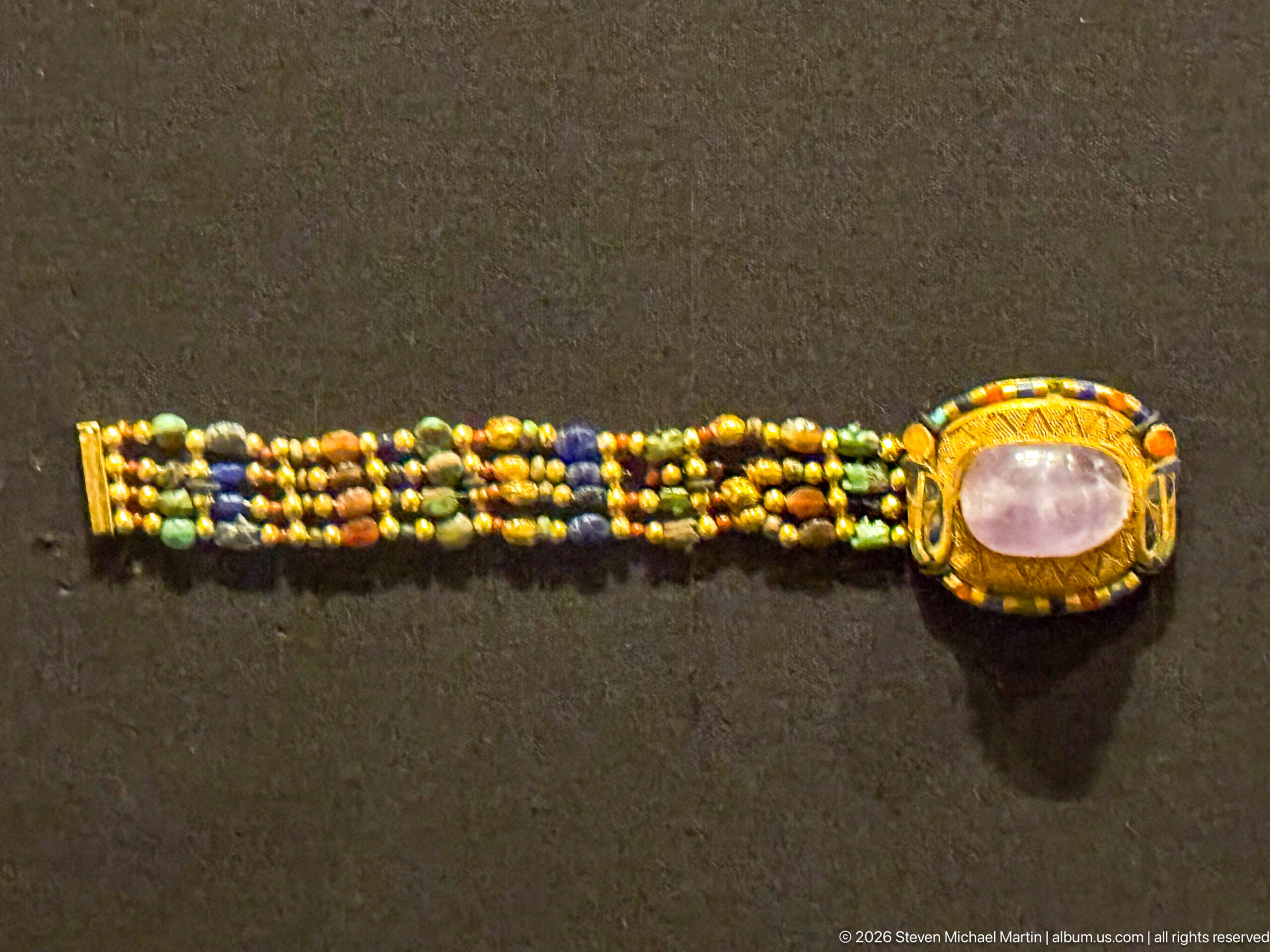
Rows of small blue, green, yellow, red, and dark beads form a narrow multistrand bracelet terminating in a prominent oval pale-violet stone set within a gold frame. The beadwork is tightly ordered into parallel bands, while the large central setting creates a strong contrast in scale and material. The compact jewel demonstrates the combination of colored stone or faience beads with precious-metal fittings.
Caption
Rows of small blue, green, yellow, red, and dark beads form a narrow multistrand bracelet terminating in a prominent oval pale-violet stone set within a gold frame. The beadwork is tightly ordered into parallel bands, while the large central setting creates a strong contrast in scale and material. The compact jewel demonstrates the combination of colored stone or faience beads with precious-metal fittings.
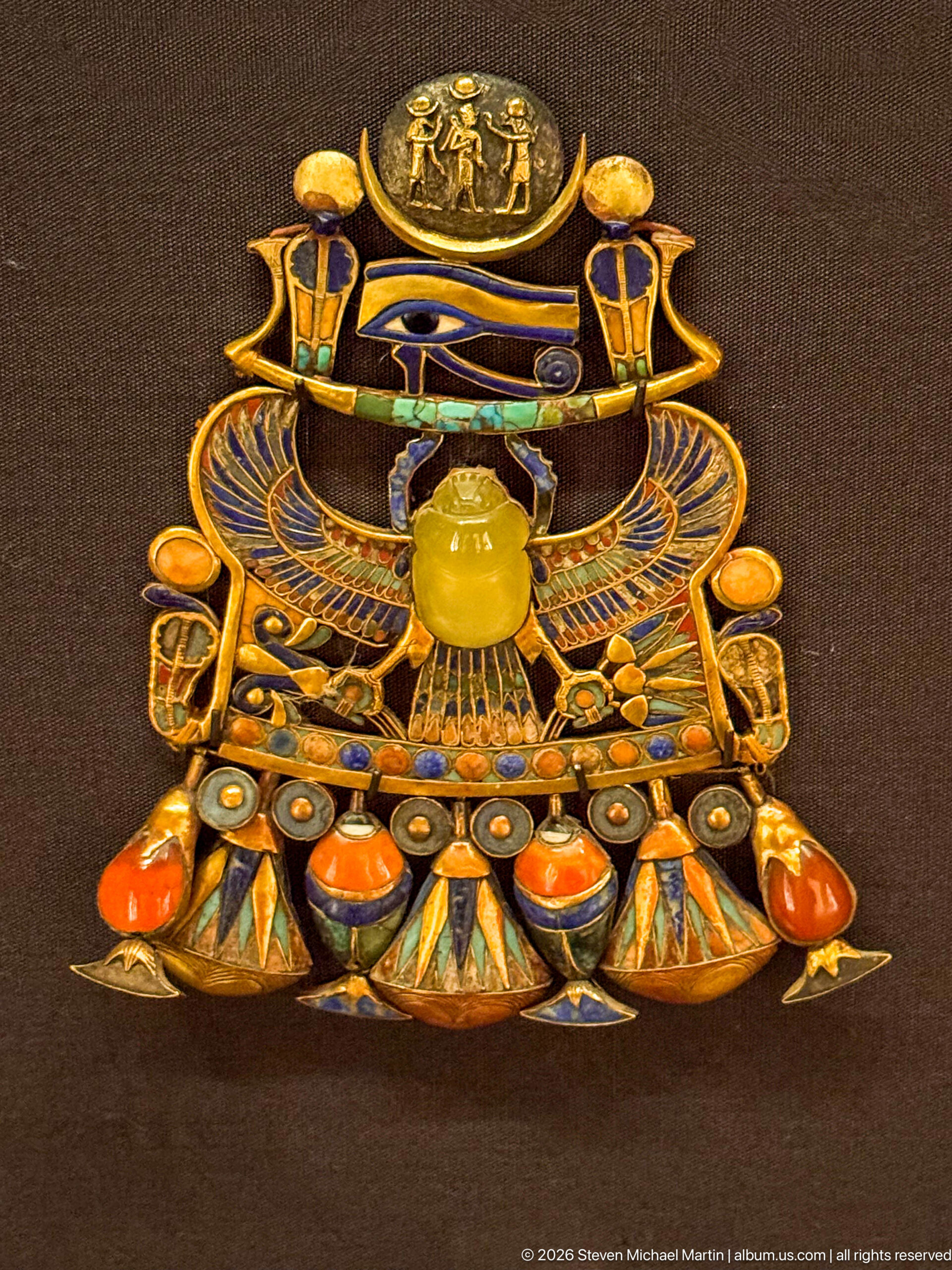
An elaborate gold pectoral layers several protective symbols into a compact architectural arrangement. A solar disk and winged scarab occupy the central axis, while an Eye of Horus motif and symmetrical floral or cobra-like elements appear above and to the sides. Red, blue, green, and pale inlays fill the gold framework, and bell-shaped or lotus-like pendants complete the lower edge.
Caption
An elaborate gold pectoral layers several protective symbols into a compact architectural arrangement. A solar disk and winged scarab occupy the central axis, while an Eye of Horus motif and symmetrical floral or cobra-like elements appear above and to the sides. Red, blue, green, and pale inlays fill the gold framework, and bell-shaped or lotus-like pendants complete the lower edge.
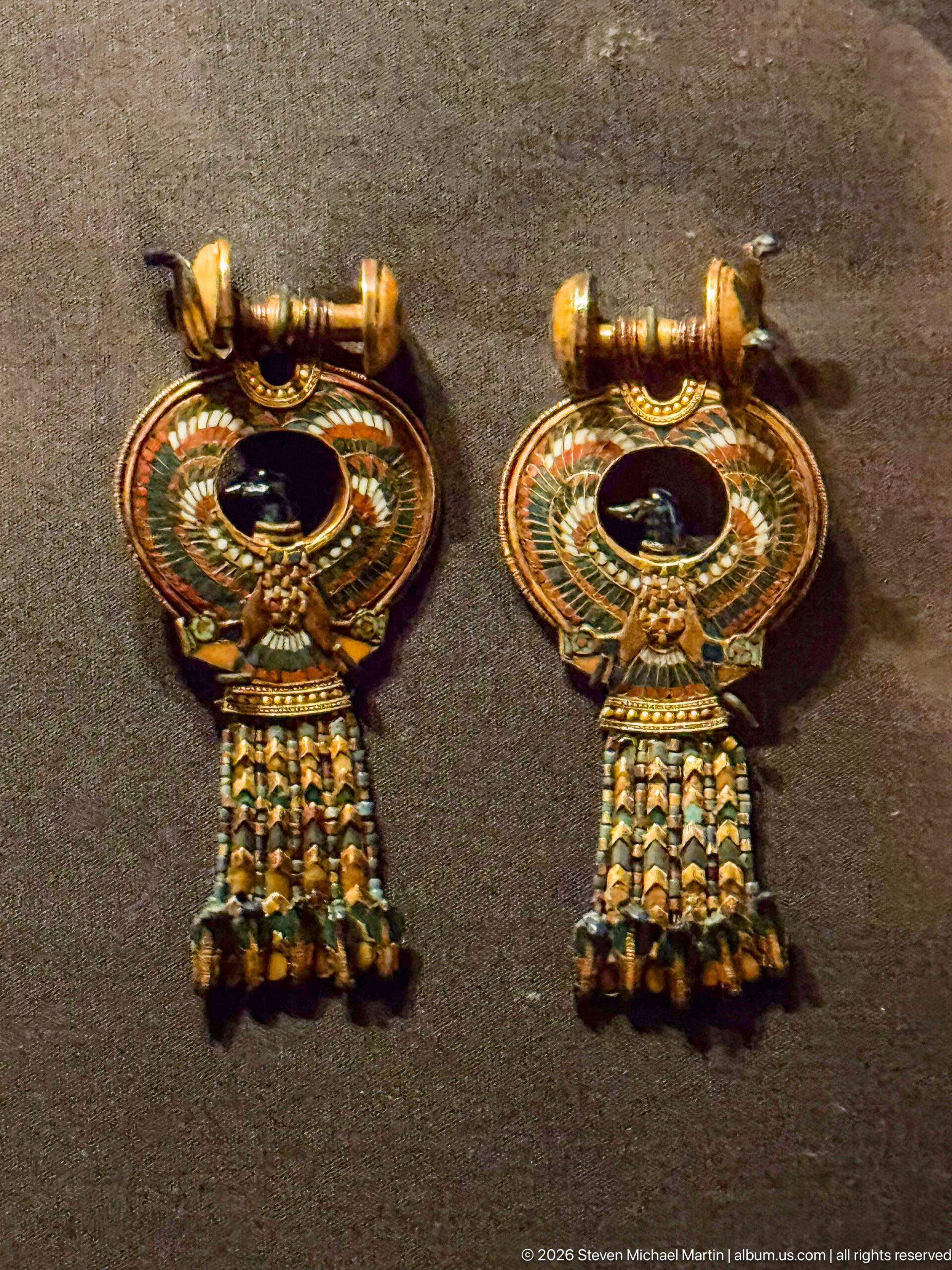
A matched pair of earrings combines circular gold frames with winged or floral inlay around dark central stones. From each lower section hangs a dense tassel of short bead strands in blue, green, red, and gold tones. Horizontal upper bars appear to function as suspension fittings, giving the pair a clearly engineered structure as well as an elaborate decorative surface.
Caption
A matched pair of earrings combines circular gold frames with winged or floral inlay around dark central stones. From each lower section hangs a dense tassel of short bead strands in blue, green, red, and gold tones. Horizontal upper bars appear to function as suspension fittings, giving the pair a clearly engineered structure as well as an elaborate decorative surface.
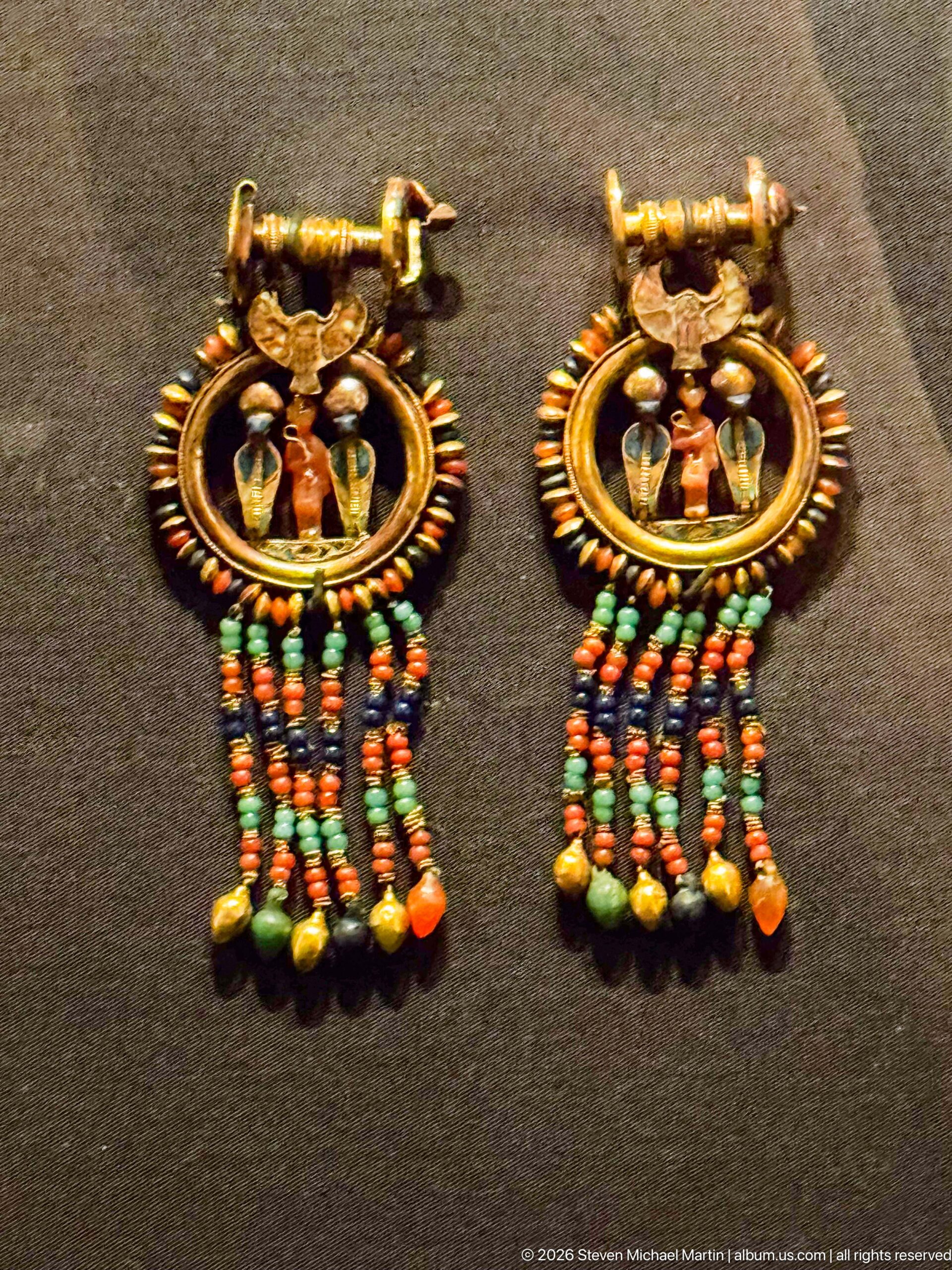
A second pair of matching earrings uses broad circular hoops as the main framework. Small amuletic forms hang inside each ring, while several vertical strands of red, green, blue, and gold beads form a fringe below. The repeated design and balanced color sequence make the pair a particularly clear example of ancient Egyptian jewelry intended to combine movement, color, and symbolic detail.
Caption
A second pair of matching earrings uses broad circular hoops as the main framework. Small amuletic forms hang inside each ring, while several vertical strands of red, green, blue, and gold beads form a fringe below. The repeated design and balanced color sequence make the pair a particularly clear example of ancient Egyptian jewelry intended to combine movement, color, and symbolic detail.
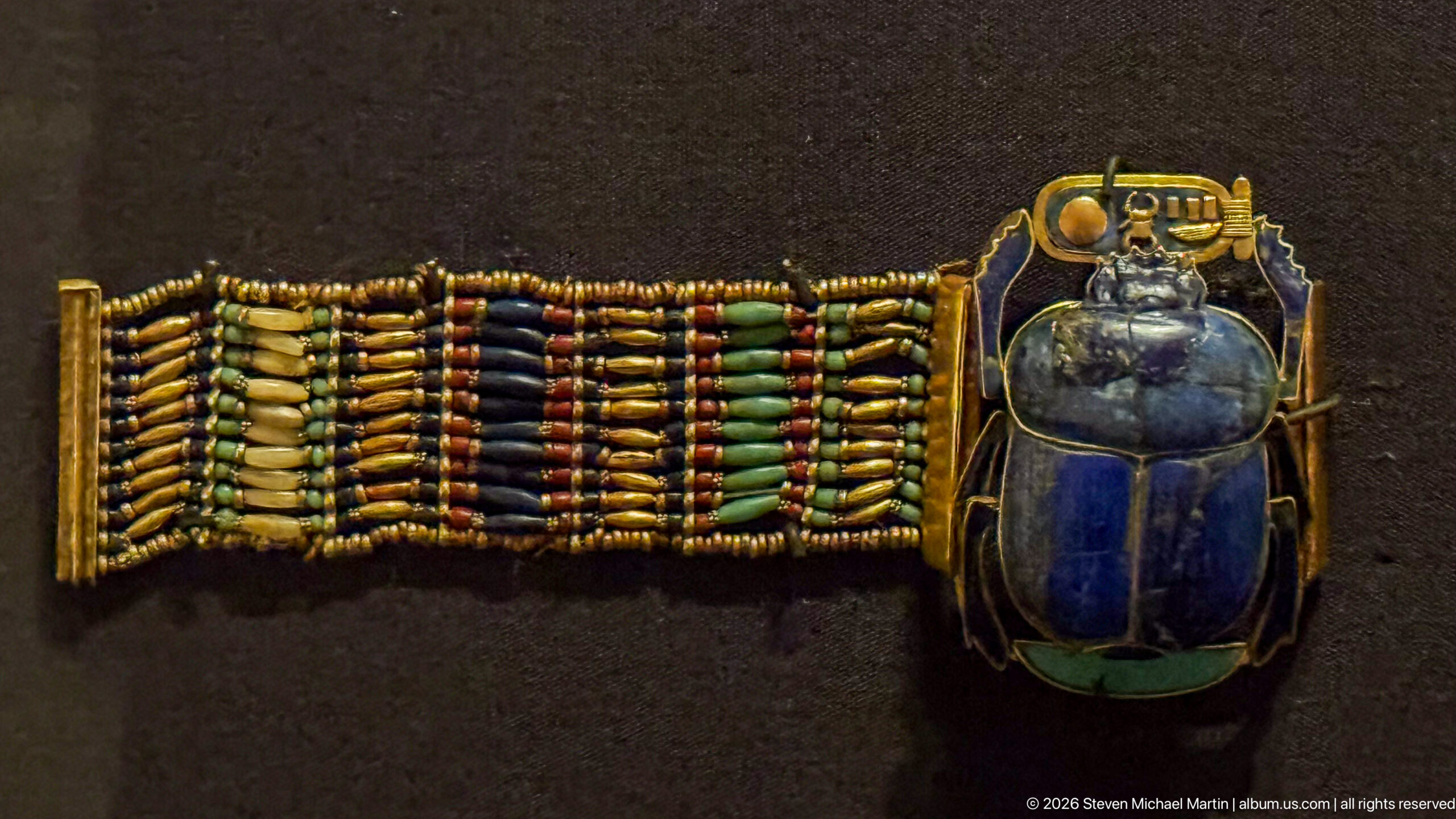
A broad bracelet composed of closely spaced tubular beads is dominated by a large blue scarab mounted in gold at one end. Alternating blue-green, red, cream, and darker bead columns create a striped textile-like pattern, while the scarab sits within an architectural gold frame topped by small hieroglyphic or royal elements. The combination of amuletic imagery and dense beadwork gives the piece both symbolic and decorative emphasis.
Caption
A broad bracelet composed of closely spaced tubular beads is dominated by a large blue scarab mounted in gold at one end. Alternating blue-green, red, cream, and darker bead columns create a striped textile-like pattern, while the scarab sits within an architectural gold frame topped by small hieroglyphic or royal elements. The combination of amuletic imagery and dense beadwork gives the piece both symbolic and decorative emphasis.
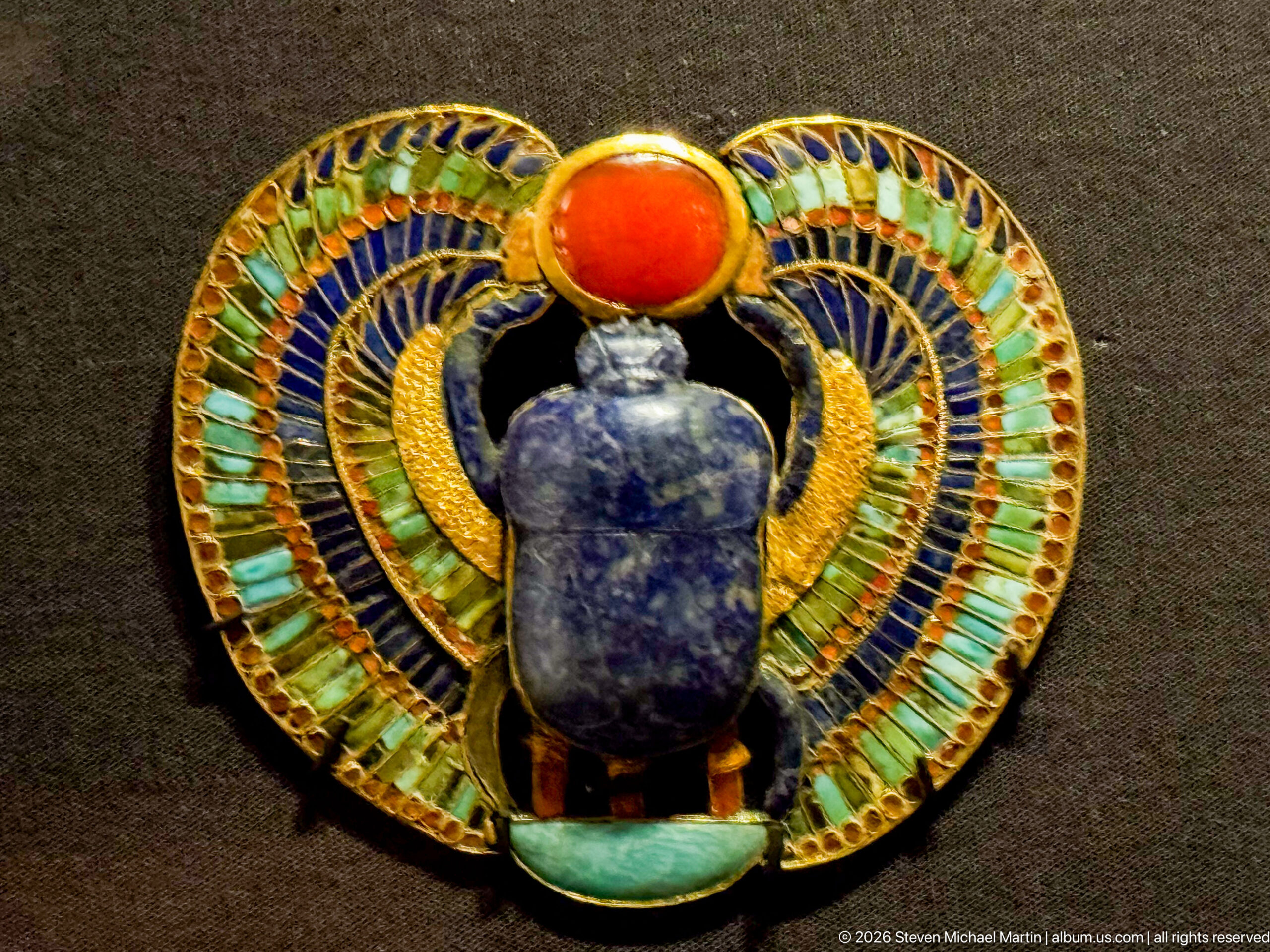
A circular jewel frames a large dark blue scarab beneath a bright red-orange solar disk. Curving wings sweep outward and upward around the insect in alternating turquoise, blue, and gold feather segments, creating a nearly complete ring. The strong radial symmetry and saturated inlays transform the scarab into the central focus of a compact solar and protective emblem.
Caption
A circular jewel frames a large dark blue scarab beneath a bright red-orange solar disk. Curving wings sweep outward and upward around the insect in alternating turquoise, blue, and gold feather segments, creating a nearly complete ring. The strong radial symmetry and saturated inlays transform the scarab into the central focus of a compact solar and protective emblem.
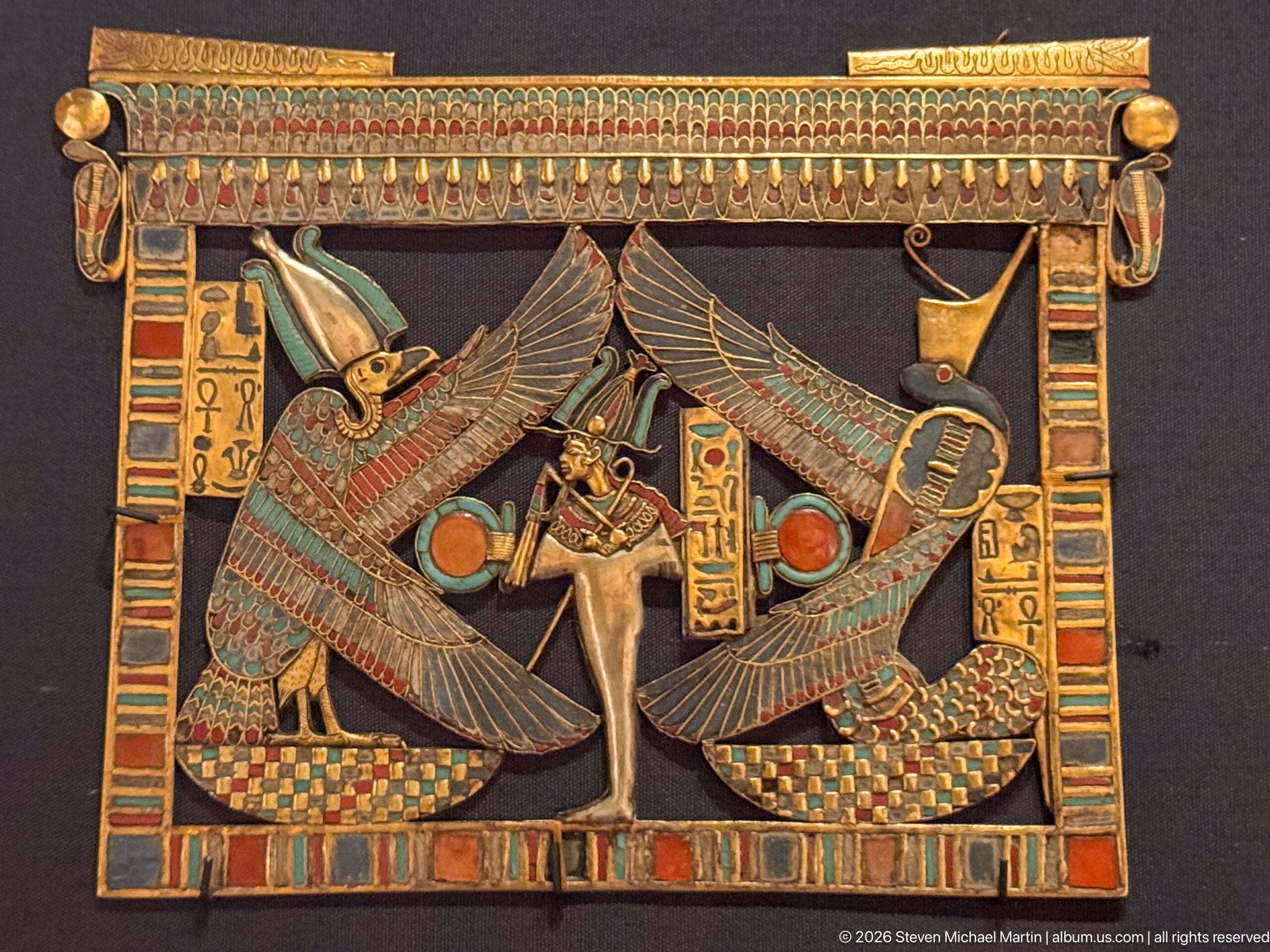
A rectangular pectoral presents a central standing figure framed by two large opposing winged deities. The wings stretch diagonally across the field, while hieroglyphic columns, solar disks, and multicolored architectural borders organize the composition. Red, blue, turquoise, cream, and gold inlays remain exceptionally vivid, preserving the highly symmetrical and protective character of the design.
Caption
A rectangular pectoral presents a central standing figure framed by two large opposing winged deities. The wings stretch diagonally across the field, while hieroglyphic columns, solar disks, and multicolored architectural borders organize the composition. Red, blue, turquoise, cream, and gold inlays remain exceptionally vivid, preserving the highly symmetrical and protective character of the design.
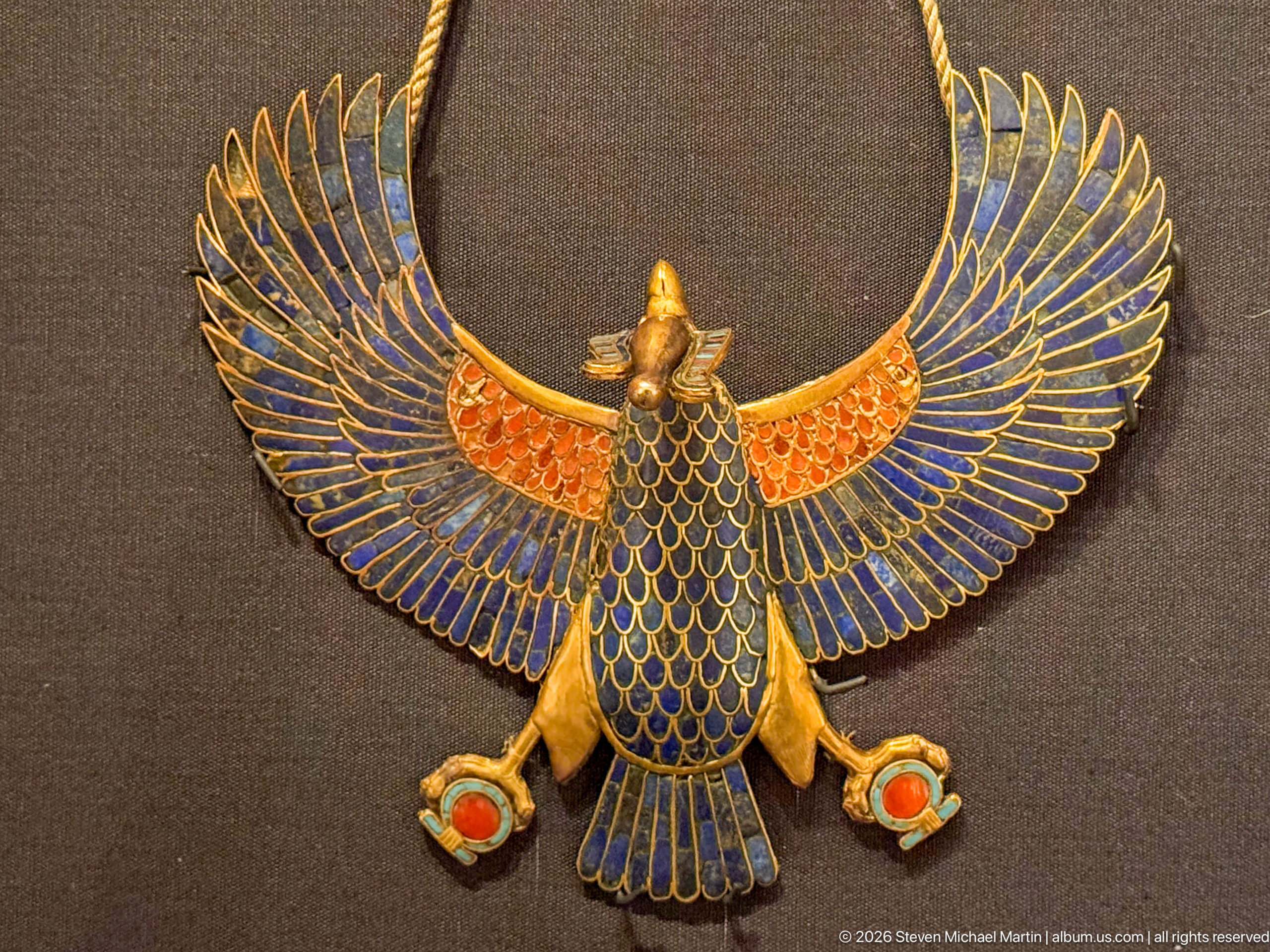
A stylized bird spreads its wings in a dramatic symmetrical arc, each feather outlined in gold and filled with deep blue inlay. Red-orange bands mark the shoulders, while the body is covered with a scale-like blue-and-gold pattern. Small circular ornaments hang from the lower tips of the wings, extending the composition beyond the bird's body and emphasizing its jewel-like construction.
Caption
A stylized bird spreads its wings in a dramatic symmetrical arc, each feather outlined in gold and filled with deep blue inlay. Red-orange bands mark the shoulders, while the body is covered with a scale-like blue-and-gold pattern. Small circular ornaments hang from the lower tips of the wings, extending the composition beyond the bird's body and emphasizing its jewel-like construction.
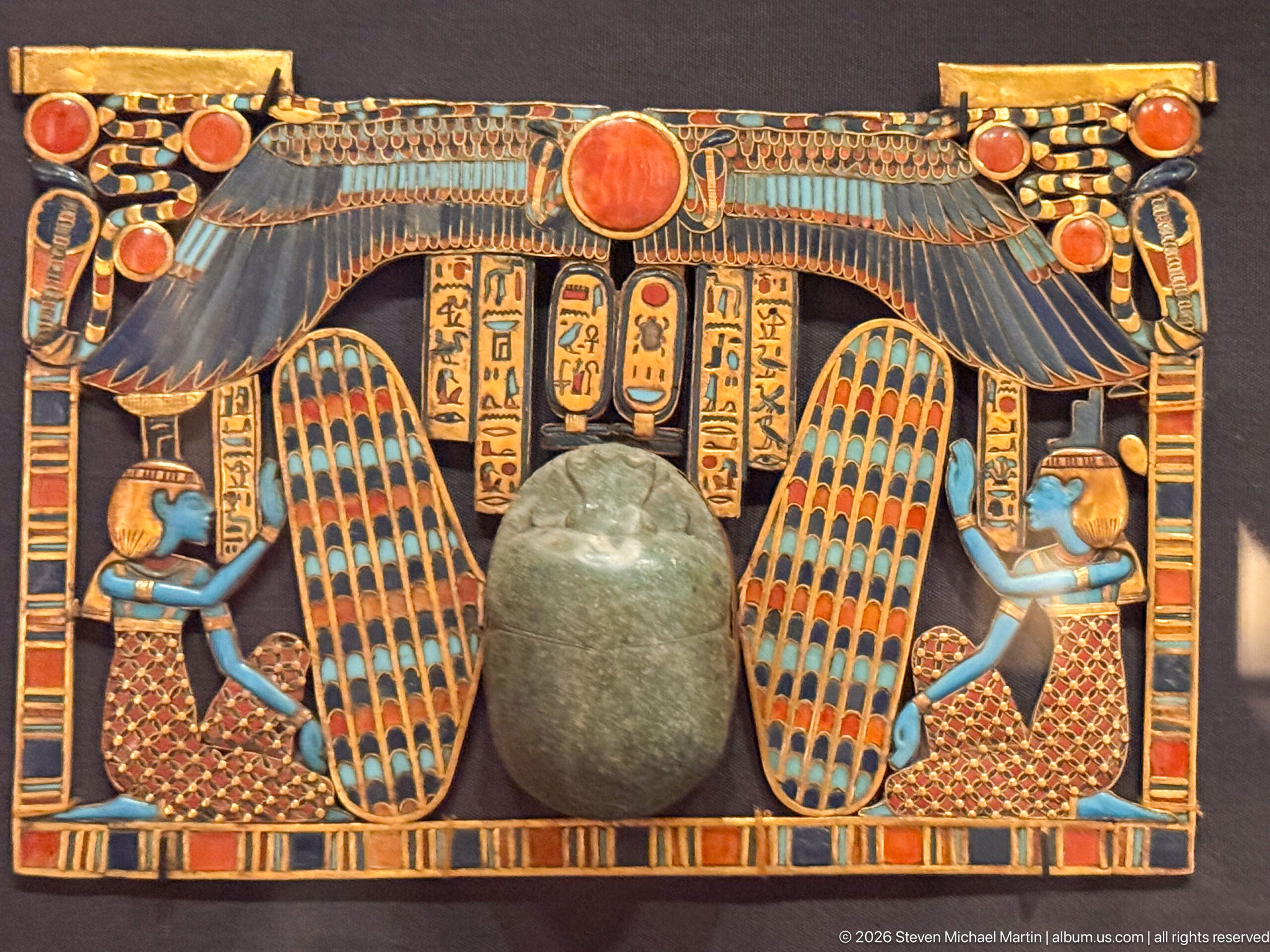
A richly framed pectoral centers on a large green scarab beneath a broad winged solar disk. Two kneeling blue-skinned figures flank the scarab, while tall hieroglyphic columns and cartouches rise behind them. Gold outlines contain red, blue, turquoise, and cream inlays across the border and wings, creating a dense royal composition built from solar, scarab, and protective imagery.
Caption
A richly framed pectoral centers on a large green scarab beneath a broad winged solar disk. Two kneeling blue-skinned figures flank the scarab, while tall hieroglyphic columns and cartouches rise behind them. Gold outlines contain red, blue, turquoise, and cream inlays across the border and wings, creating a dense royal composition built from solar, scarab, and protective imagery.
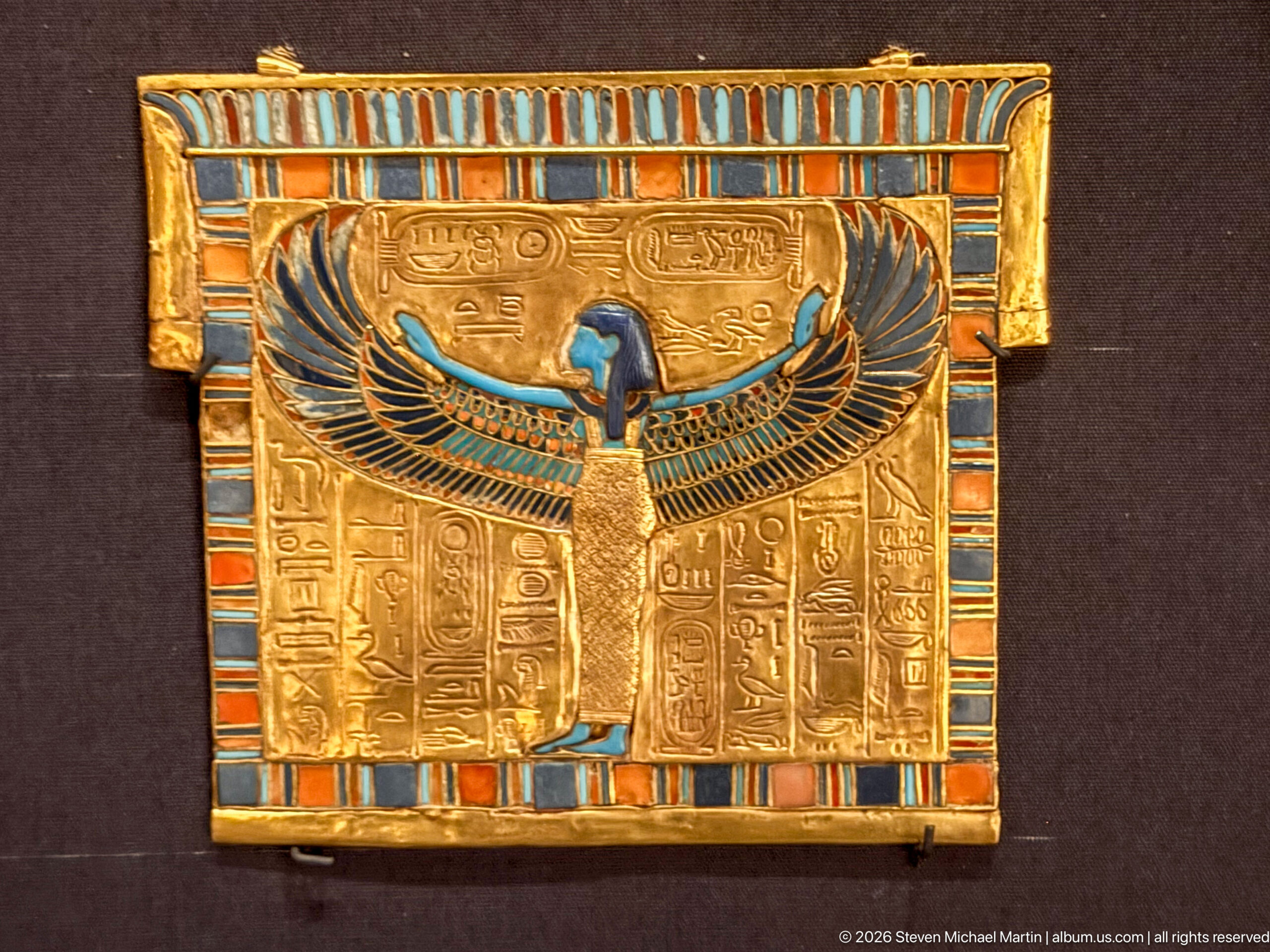
A central winged goddess extends her arms across a gold field filled with vertical hieroglyphic columns and paired cartouches. Blue, turquoise, red, and black inlays articulate the wings and broad outer border, while the gold ground preserves finely worked inscriptions and decorative detail. The frontal symmetry and protective wing gesture give the panel a strong ceremonial and royal character.
Caption
A central winged goddess extends her arms across a gold field filled with vertical hieroglyphic columns and paired cartouches. Blue, turquoise, red, and black inlays articulate the wings and broad outer border, while the gold ground preserves finely worked inscriptions and decorative detail. The frontal symmetry and protective wing gesture give the panel a strong ceremonial and royal character.
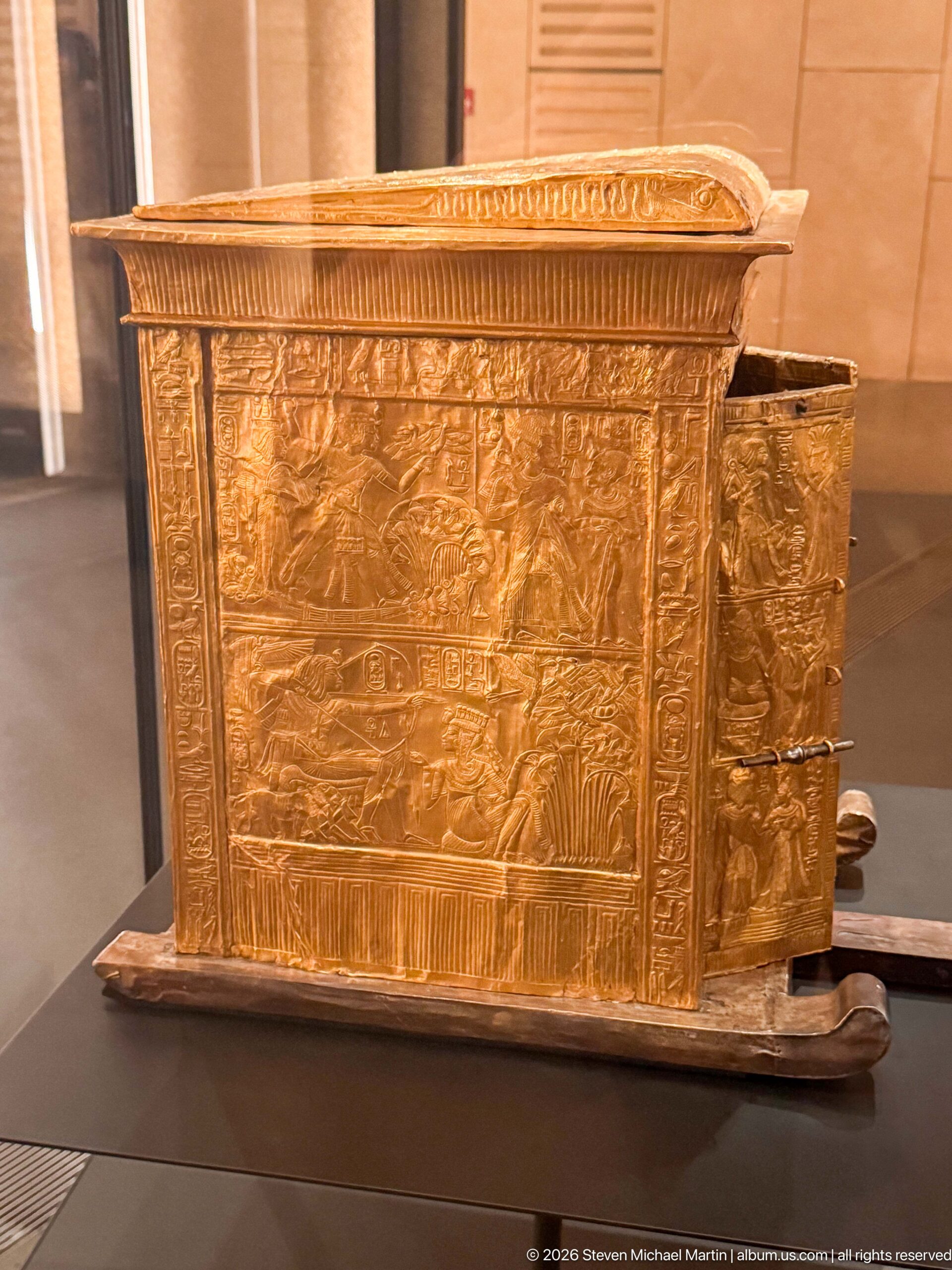
A compact rectangular shrine or chest is covered with gold-toned embossed relief. Large figural scenes fill the side panel beneath a decorative frieze, while narrower border bands frame the composition. The object sits on projecting runners or supports and retains a box-like architectural form, making the photograph useful for showing both the narrative surface decoration and the object's three-dimensional construction.
Caption
A compact rectangular shrine or chest is covered with gold-toned embossed relief. Large figural scenes fill the side panel beneath a decorative frieze, while narrower border bands frame the composition. The object sits on projecting runners or supports and retains a box-like architectural form, making the photograph useful for showing both the narrative surface decoration and the object's three-dimensional construction.
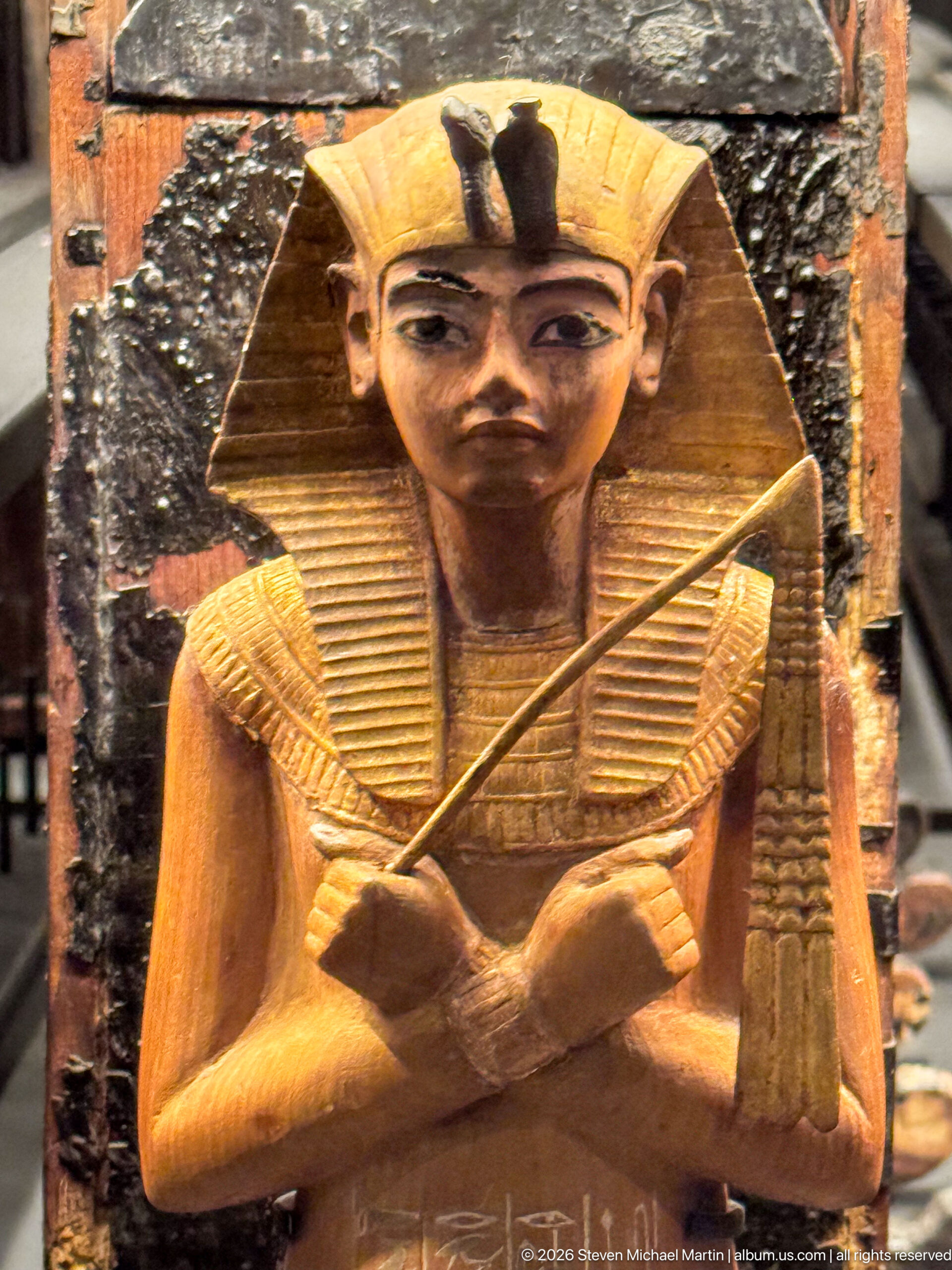
A close view centers on a gilded anthropoid figure with idealized features, a broad striped collar, and crossed implements held against the chest. The smooth gold-toned surface contrasts with darker facial details and a blackened background element behind the head. The frontal pose, formal regalia, and compact funerary form suggest a high-status burial object, though the exact identity is not visible here.
Caption
A close view centers on a gilded anthropoid figure with idealized features, a broad striped collar, and crossed implements held against the chest. The smooth gold-toned surface contrasts with darker facial details and a blackened background element behind the head. The frontal pose, formal regalia, and compact funerary form suggest a high-status burial object, though the exact identity is not visible here.
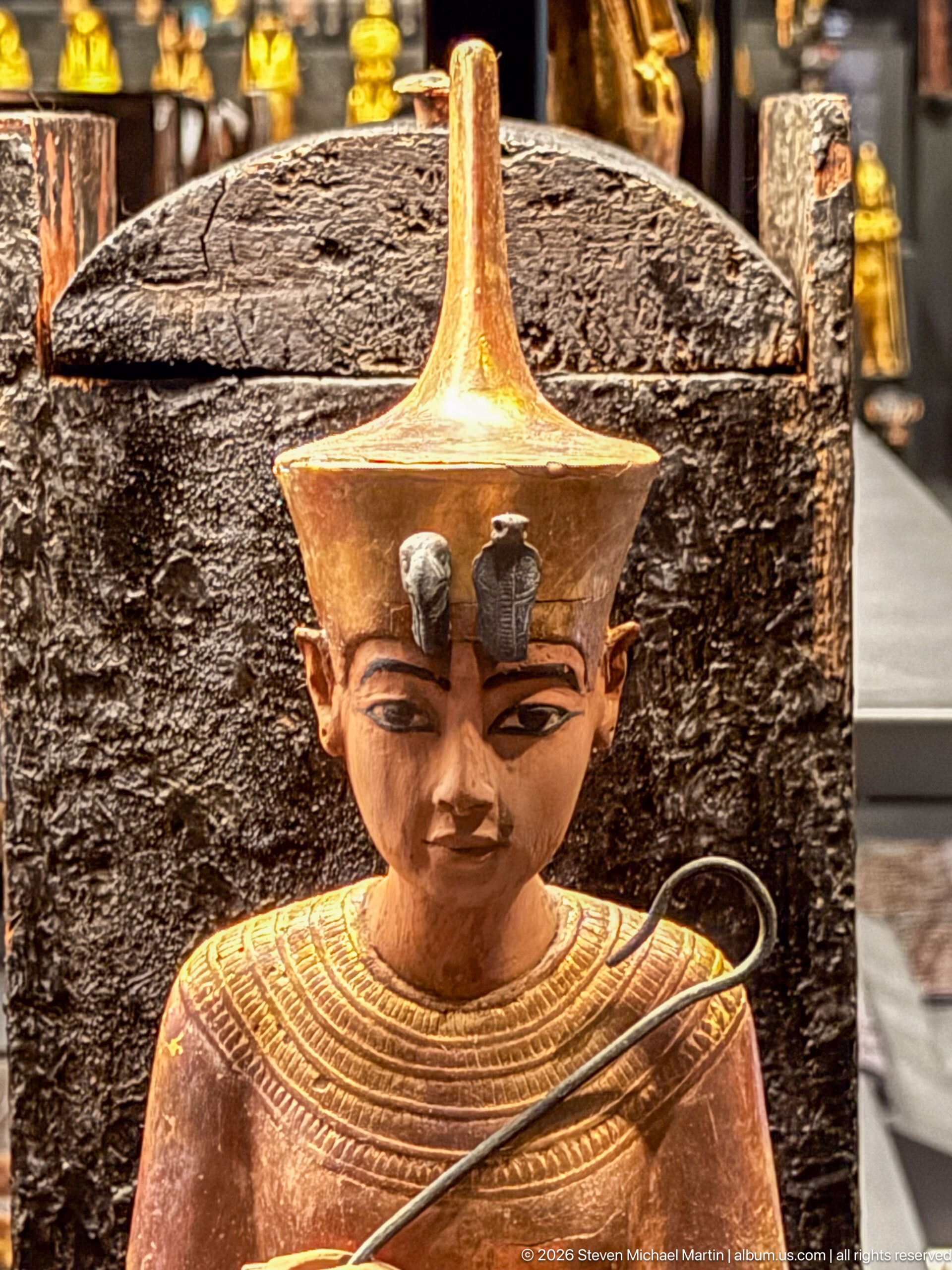
A second gilded funerary figure is shown from close range, distinguished by a tall projecting headdress above the forehead and a broad patterned collar across the chest. The face is smoothly modeled with dark outlined eyes and brows, while a curved staff-like element passes diagonally in front of the torso. The tight framing emphasizes headdress shape and facial modeling rather than the full figure.
Caption
A second gilded funerary figure is shown from close range, distinguished by a tall projecting headdress above the forehead and a broad patterned collar across the chest. The face is smoothly modeled with dark outlined eyes and brows, while a curved staff-like element passes diagonally in front of the torso. The tight framing emphasizes headdress shape and facial modeling rather than the full figure.
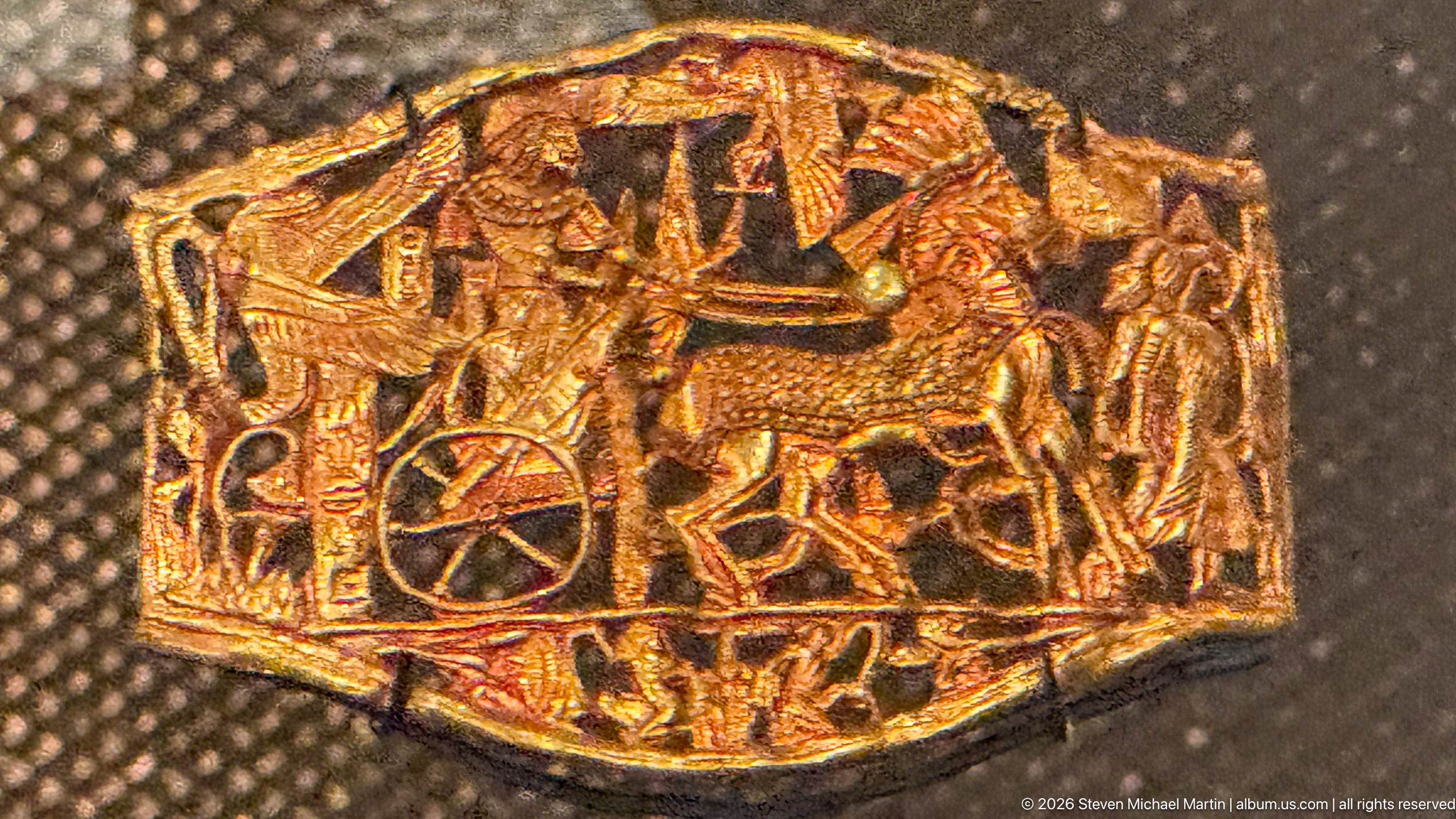
A small gold-toned relief plaque compresses an energetic narrative into a shallow, irregular field. A chariot wheel is visible at left, while human figures, horses or other animals, and dense background forms overlap across the scene. The hammered or embossed surface catches the light strongly, making the relief's movement and crowded composition more apparent than fine inscriptional details.
Caption
A small gold-toned relief plaque compresses an energetic narrative into a shallow, irregular field. A chariot wheel is visible at left, while human figures, horses or other animals, and dense background forms overlap across the scene. The hammered or embossed surface catches the light strongly, making the relief's movement and crowded composition more apparent than fine inscriptional details.
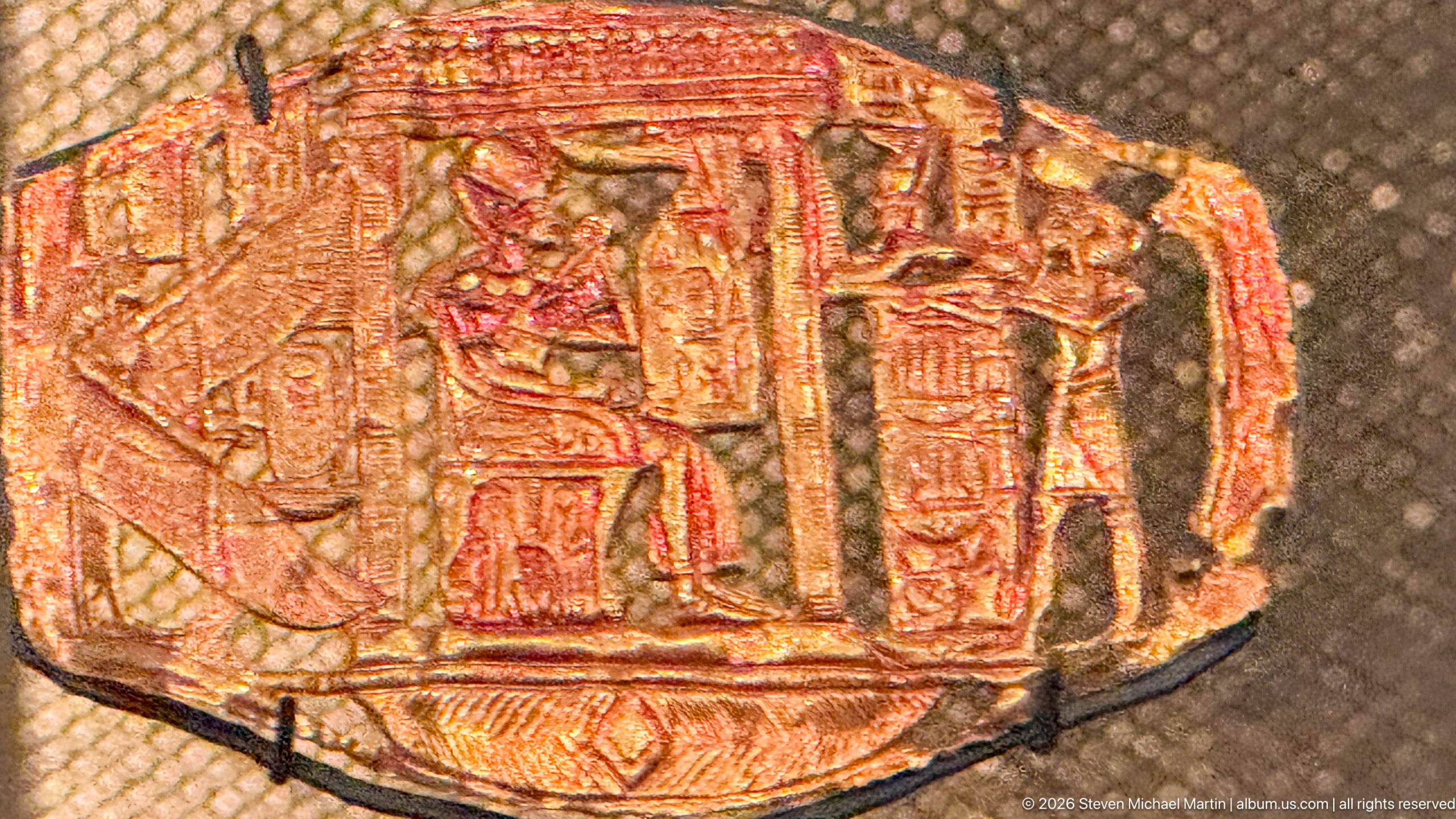
A small embossed gold plaque shows several standing figures arranged beneath a vertical architectural or shrine-like framework. One central figure appears larger and more prominent, while flanking figures face inward across a compact ceremonial scene. Traces of reddish surface color remain in some recessed areas, helping separate figures and structural details on the otherwise gold-toned relief.
Caption
A small embossed gold plaque shows several standing figures arranged beneath a vertical architectural or shrine-like framework. One central figure appears larger and more prominent, while flanking figures face inward across a compact ceremonial scene. Traces of reddish surface color remain in some recessed areas, helping separate figures and structural details on the otherwise gold-toned relief.
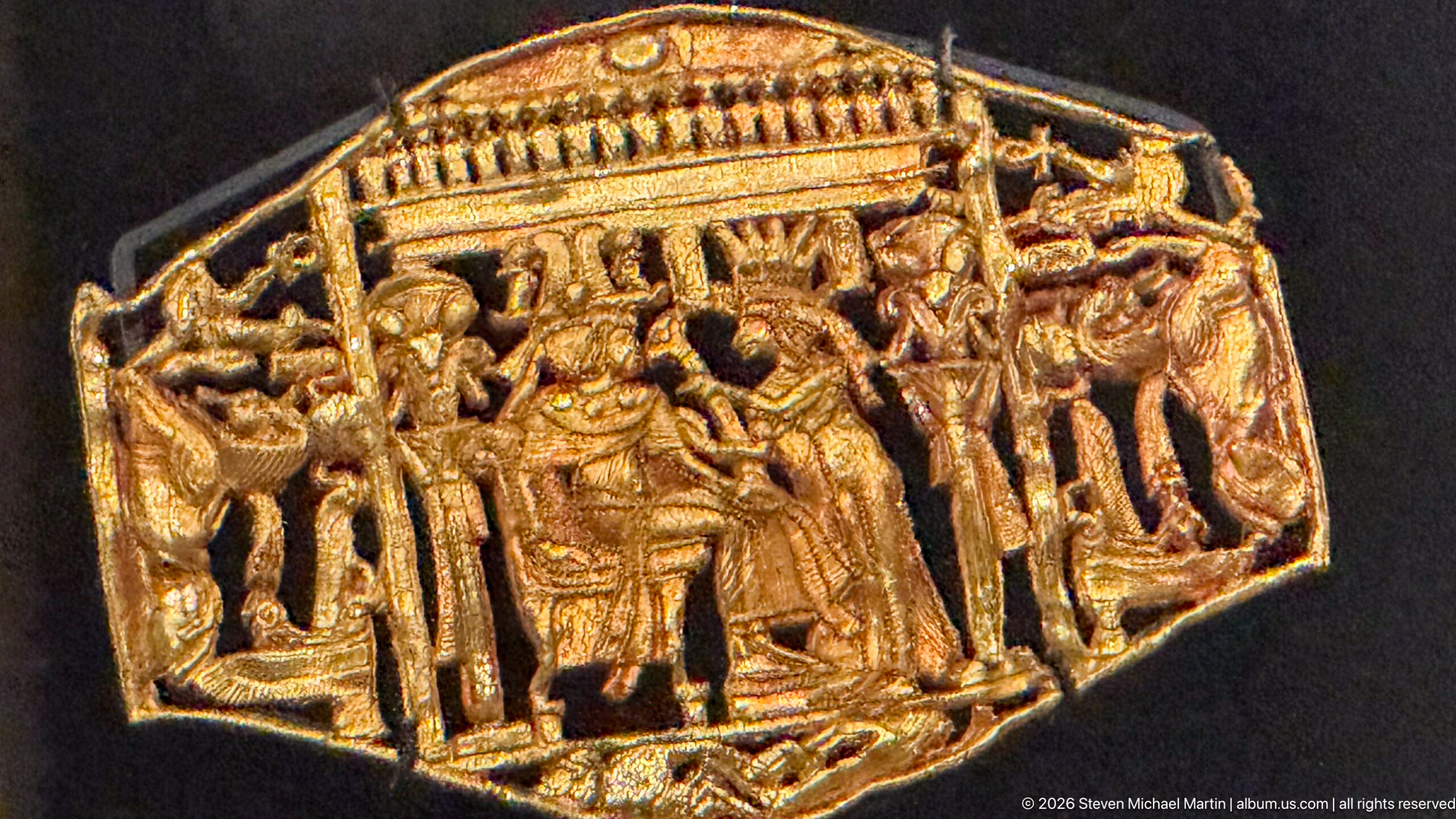
A raised gold relief centers on an enthroned figure beneath a small canopy or architectural frame. Attendants and secondary figures stand to either side, with additional decorative elements filling the narrow field. The compact plaque preserves a clear hierarchy of scale: the seated central person dominates the scene, while the surrounding figures and framing emphasize courtly or ceremonial context.
Caption
A raised gold relief centers on an enthroned figure beneath a small canopy or architectural frame. Attendants and secondary figures stand to either side, with additional decorative elements filling the narrow field. The compact plaque preserves a clear hierarchy of scale: the seated central person dominates the scene, while the surrounding figures and framing emphasize courtly or ceremonial context.
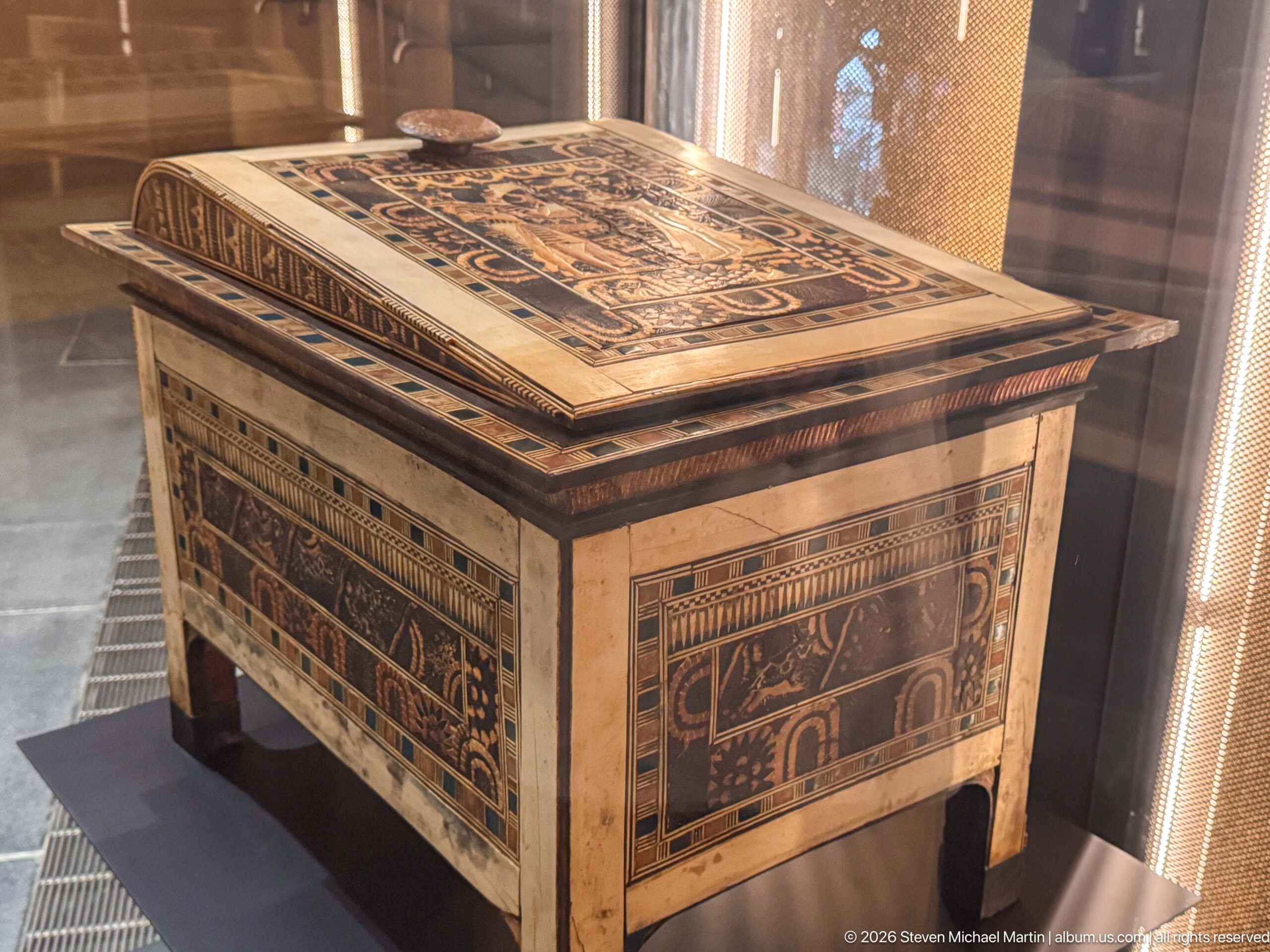
A finely decorated rectangular chest stands on short legs, its lid and side panels filled with framed scenes and repeated geometric borders. Dark blue, cream, red, and gold-toned inlays articulate animal figures, patterned bands, and architectural divisions across nearly every visible surface. The three-quarter view shows the chest's box construction while preserving the visual richness of its narrative and ornamental panels.
Caption
A finely decorated rectangular chest stands on short legs, its lid and side panels filled with framed scenes and repeated geometric borders. Dark blue, cream, red, and gold-toned inlays articulate animal figures, patterned bands, and architectural divisions across nearly every visible surface. The three-quarter view shows the chest's box construction while preserving the visual richness of its narrative and ornamental panels.
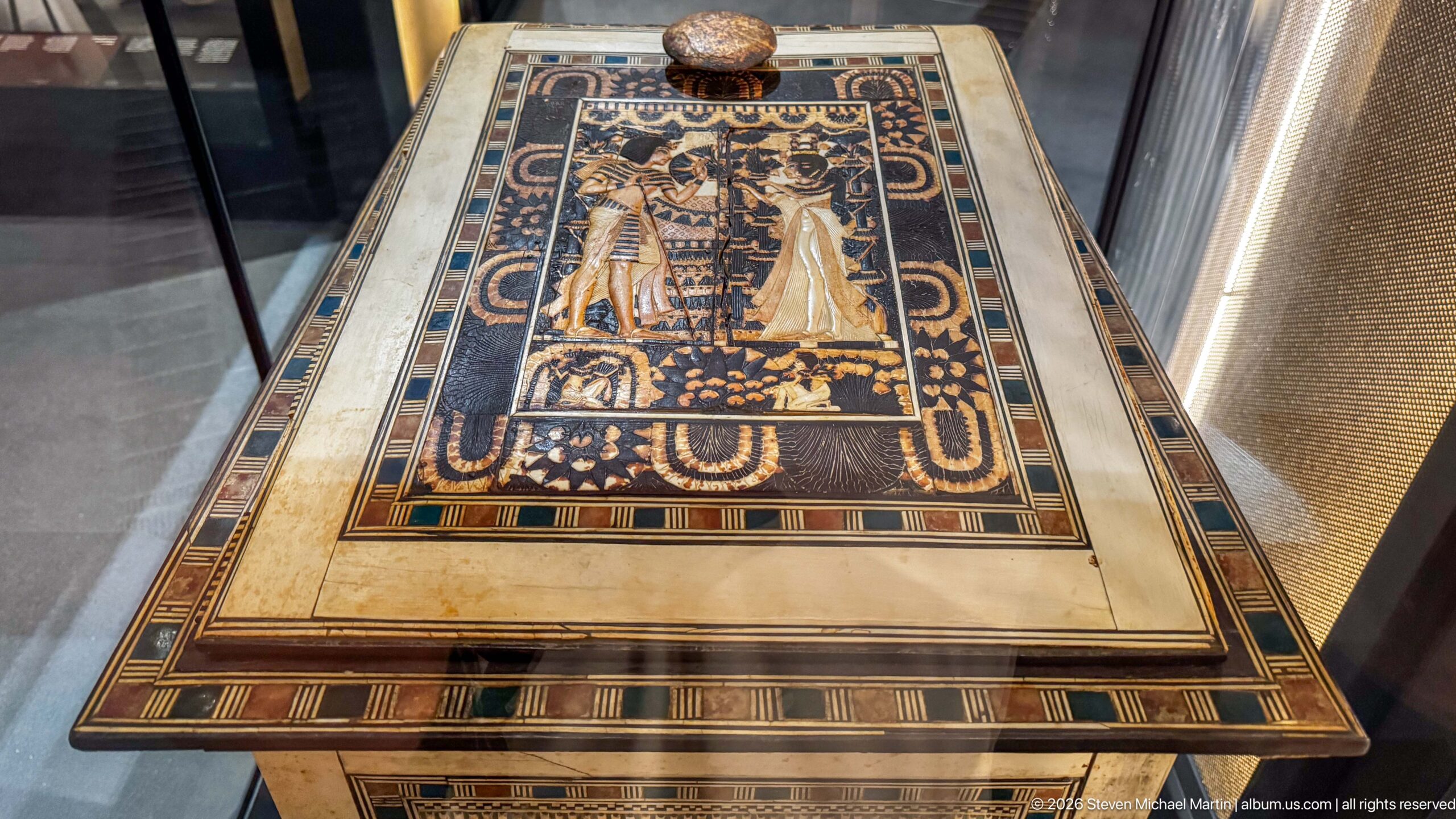
A top-down view isolates the richly inlaid lid of a rectangular chest. Two standing figures face one another within a dark central panel surrounded by floral and vegetal motifs, while broad borders of repeated geometric and color bands frame the scene. The angled museum viewpoint reveals the precision of the inlay and the lid's layered construction more clearly than the chest's overall form.
Caption
A top-down view isolates the richly inlaid lid of a rectangular chest. Two standing figures face one another within a dark central panel surrounded by floral and vegetal motifs, while broad borders of repeated geometric and color bands frame the scene. The angled museum viewpoint reveals the precision of the inlay and the lid's layered construction more clearly than the chest's overall form.
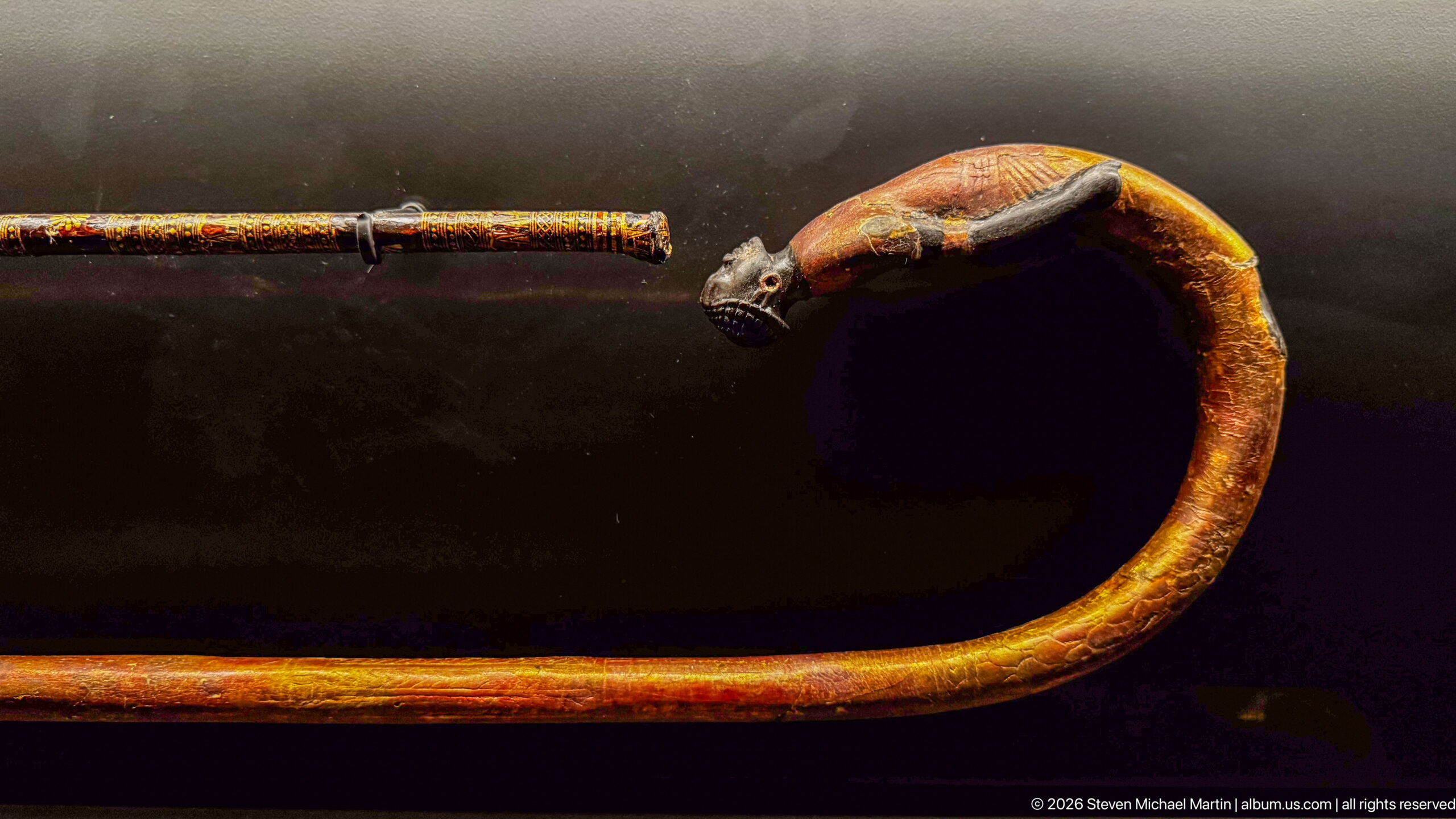
A long cane bends into a broad U-shaped curve, with a small painted animal head emerging near the upper bend. The shaft retains reddish-brown and gold-toned surface decoration, while a straight adjoining section appears at left. The sculpted head, pointed ears, and elongated snout transform the functional walking stick into a highly individualized luxury object.
Caption
A long cane bends into a broad U-shaped curve, with a small painted animal head emerging near the upper bend. The shaft retains reddish-brown and gold-toned surface decoration, while a straight adjoining section appears at left. The sculpted head, pointed ears, and elongated snout transform the functional walking stick into a highly individualized luxury object.
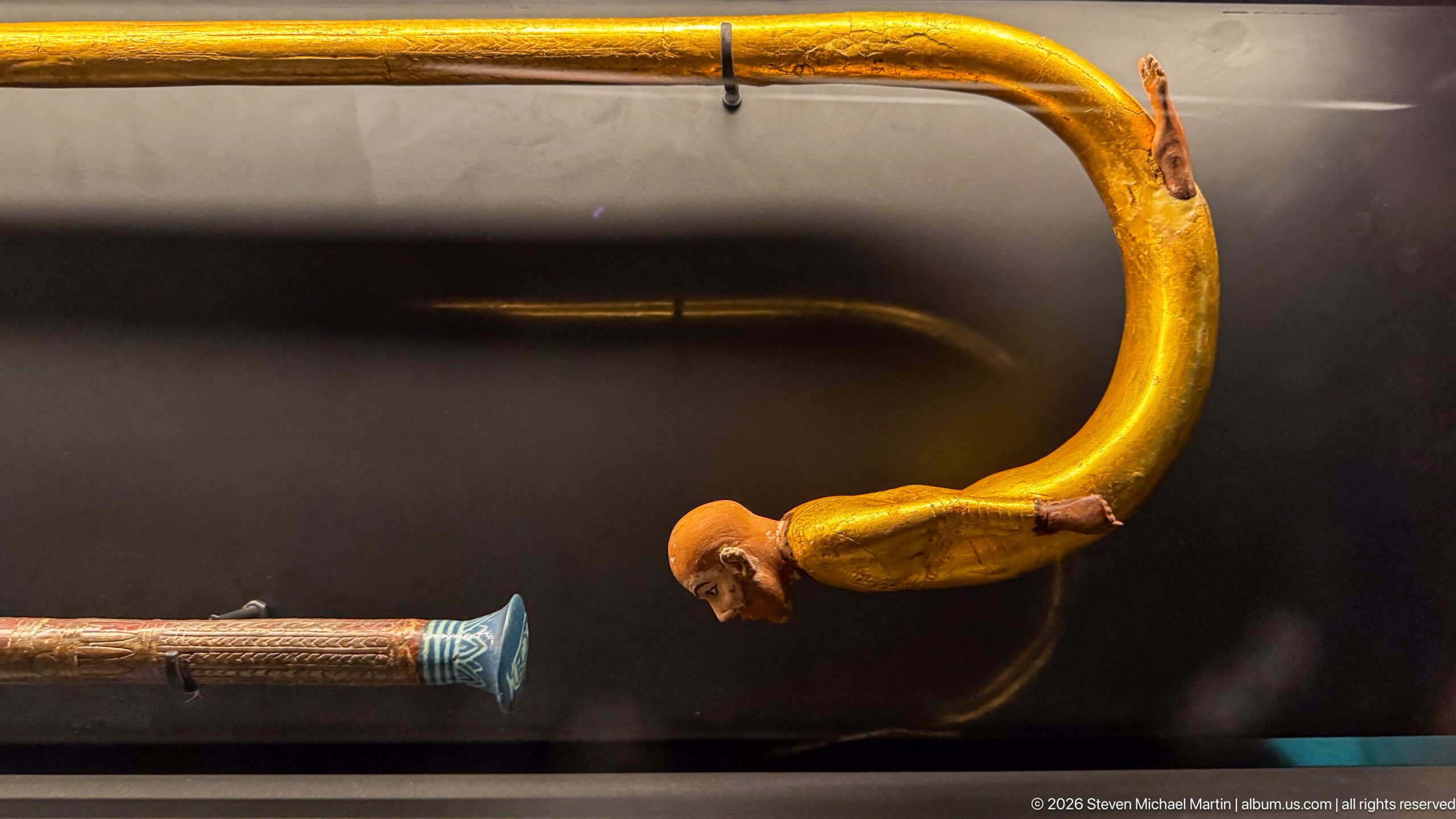
A gilded walking stick sweeps through a tight curve ending near a sculpted human head with dark hair and warm skin tone. The head is integrated into the bend rather than mounted as a separate finial, giving the object a distinctive anthropomorphic character. A second staff section with a blue flared fitting appears below, indicating that several luxury canes or staffs are displayed together.
Caption
A gilded walking stick sweeps through a tight curve ending near a sculpted human head with dark hair and warm skin tone. The head is integrated into the bend rather than mounted as a separate finial, giving the object a distinctive anthropomorphic character. A second staff section with a blue flared fitting appears below, indicating that several luxury canes or staffs are displayed together.
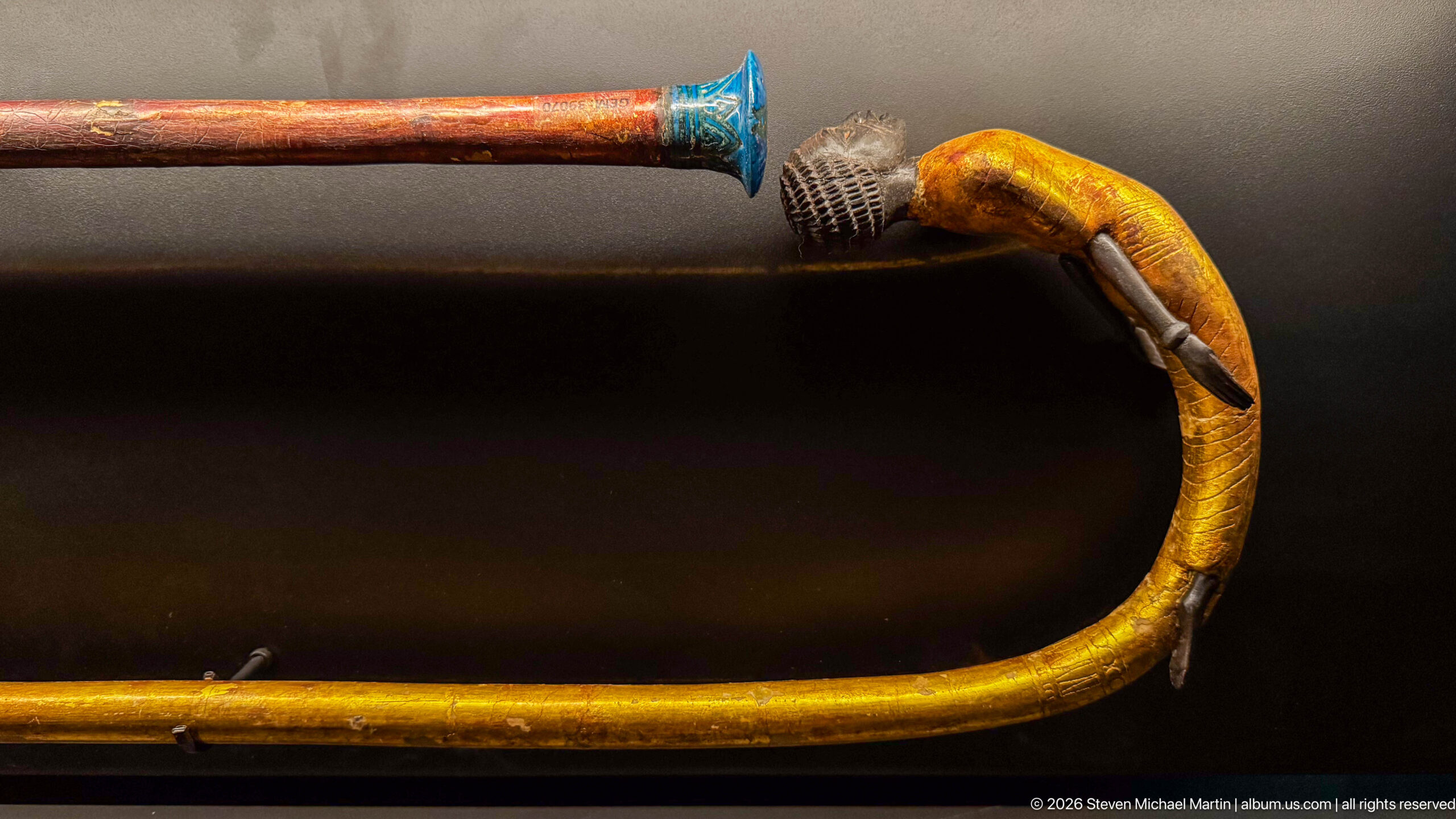
A long yellow-gold cane bends upward into a bird's head with a projecting beak and dark feather-like details. The patterned shaft carries repeated diagonal marks, while a neighboring straight staff with a blue flared end crosses above the composition. The bird terminal is integrated directly into the curve, demonstrating the sculptural treatment applied to elite walking sticks and ceremonial staffs.
Caption
A long yellow-gold cane bends upward into a bird's head with a projecting beak and dark feather-like details. The patterned shaft carries repeated diagonal marks, while a neighboring straight staff with a blue flared end crosses above the composition. The bird terminal is integrated directly into the curve, demonstrating the sculptural treatment applied to elite walking sticks and ceremonial staffs.
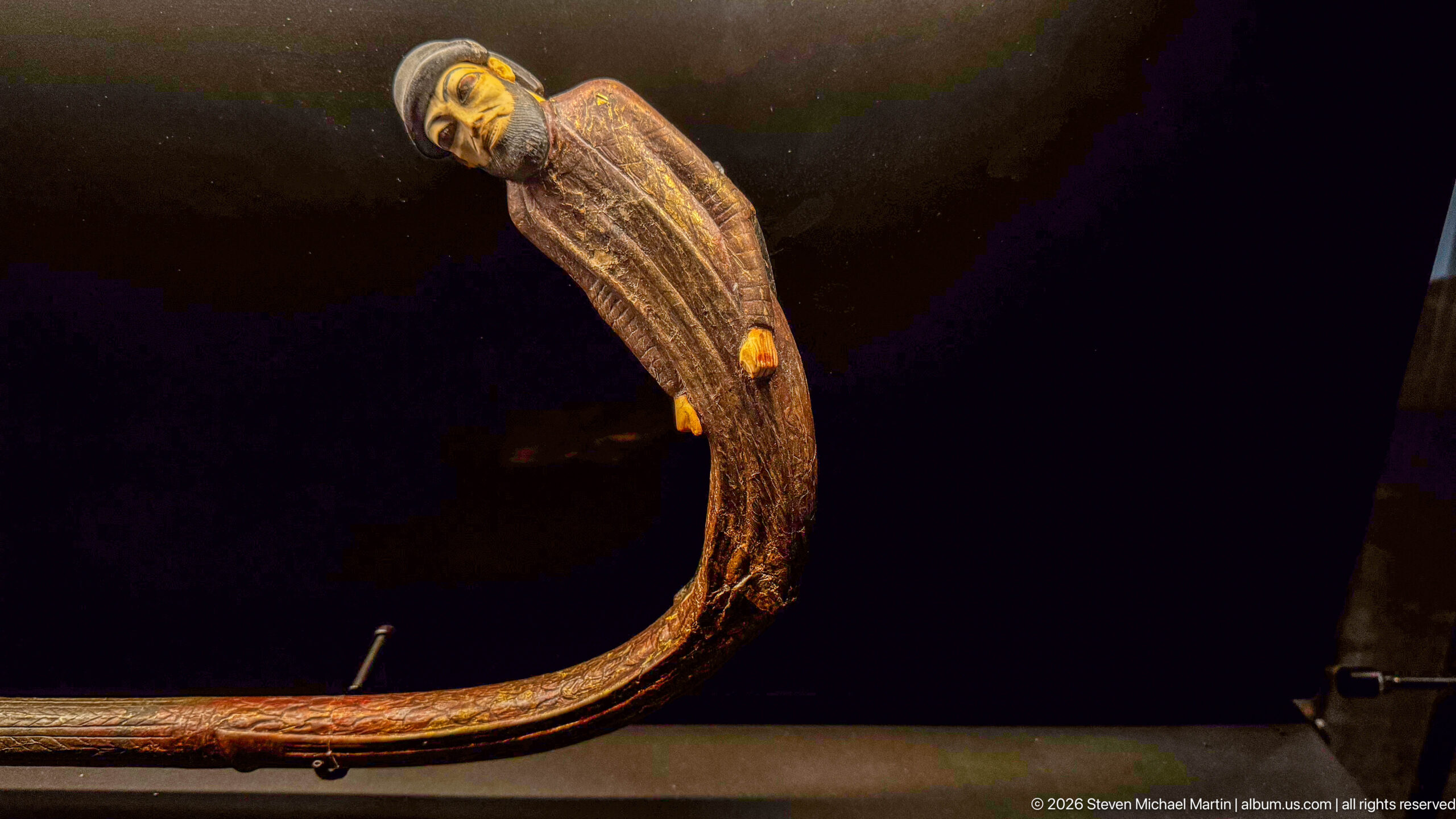
A dark brown staff rises in a steep curve to a sculpted human head, the face turned outward above the bend. Long vertical grain or painted striations run along the shaft, while small projecting details remain visible lower on the curve. The close crop emphasizes the anthropomorphic terminal and the weathered surface of the wood rather than the staff's full length.
Caption
A dark brown staff rises in a steep curve to a sculpted human head, the face turned outward above the bend. Long vertical grain or painted striations run along the shaft, while small projecting details remain visible lower on the curve. The close crop emphasizes the anthropomorphic terminal and the weathered surface of the wood rather than the staff's full length.
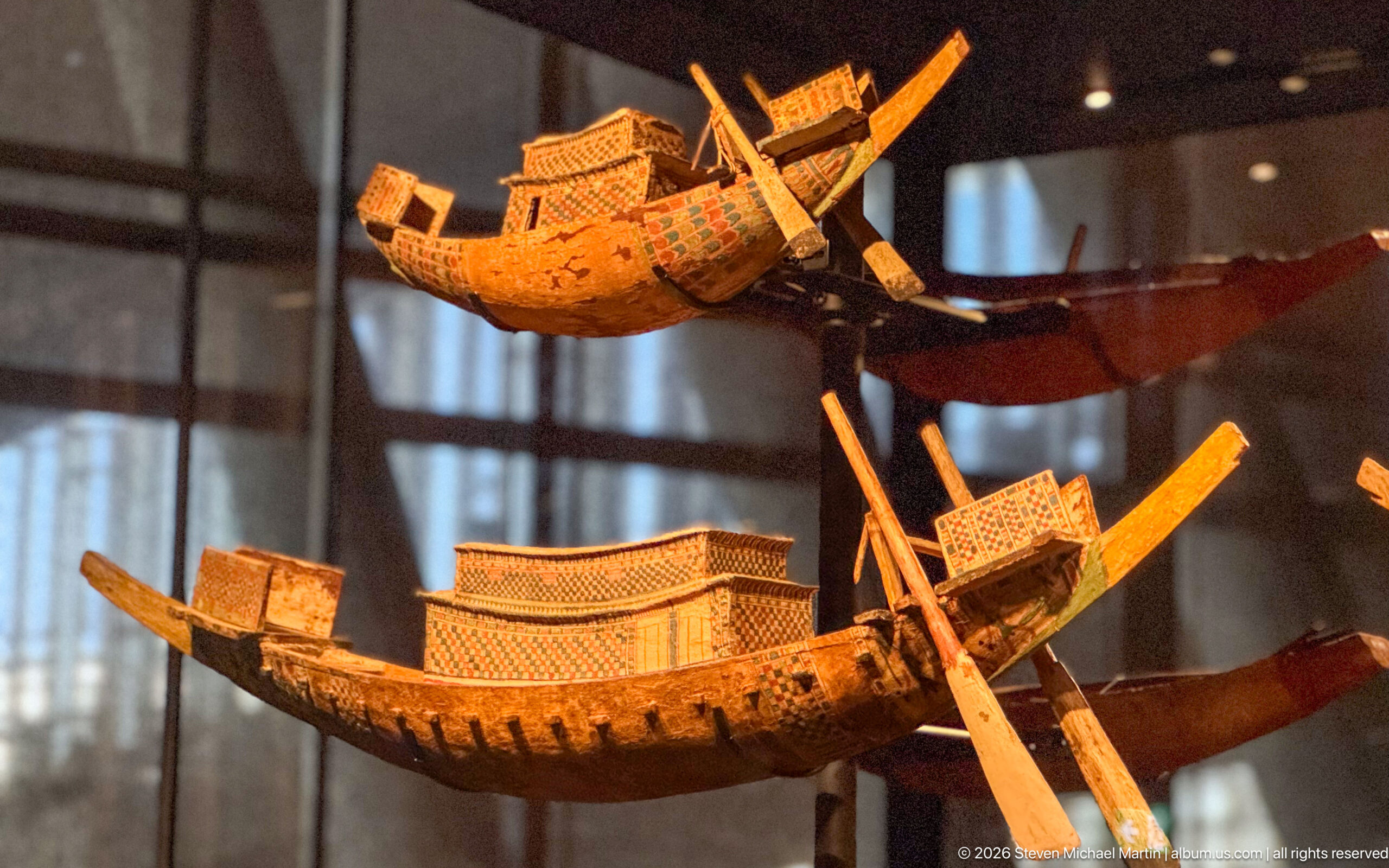
Two wooden model boats occupy the display, each with a high curved hull, deck structures, lattice-like cabins, and long projecting oars. Painted geometric bands and small patterned panels enliven the warm wood surfaces. The elevated arrangement lets the viewer compare hull shape, deck architecture, and steering or rowing equipment across the two models.
Caption
Two wooden model boats occupy the display, each with a high curved hull, deck structures, lattice-like cabins, and long projecting oars. Painted geometric bands and small patterned panels enliven the warm wood surfaces. The elevated arrangement lets the viewer compare hull shape, deck architecture, and steering or rowing equipment across the two models.
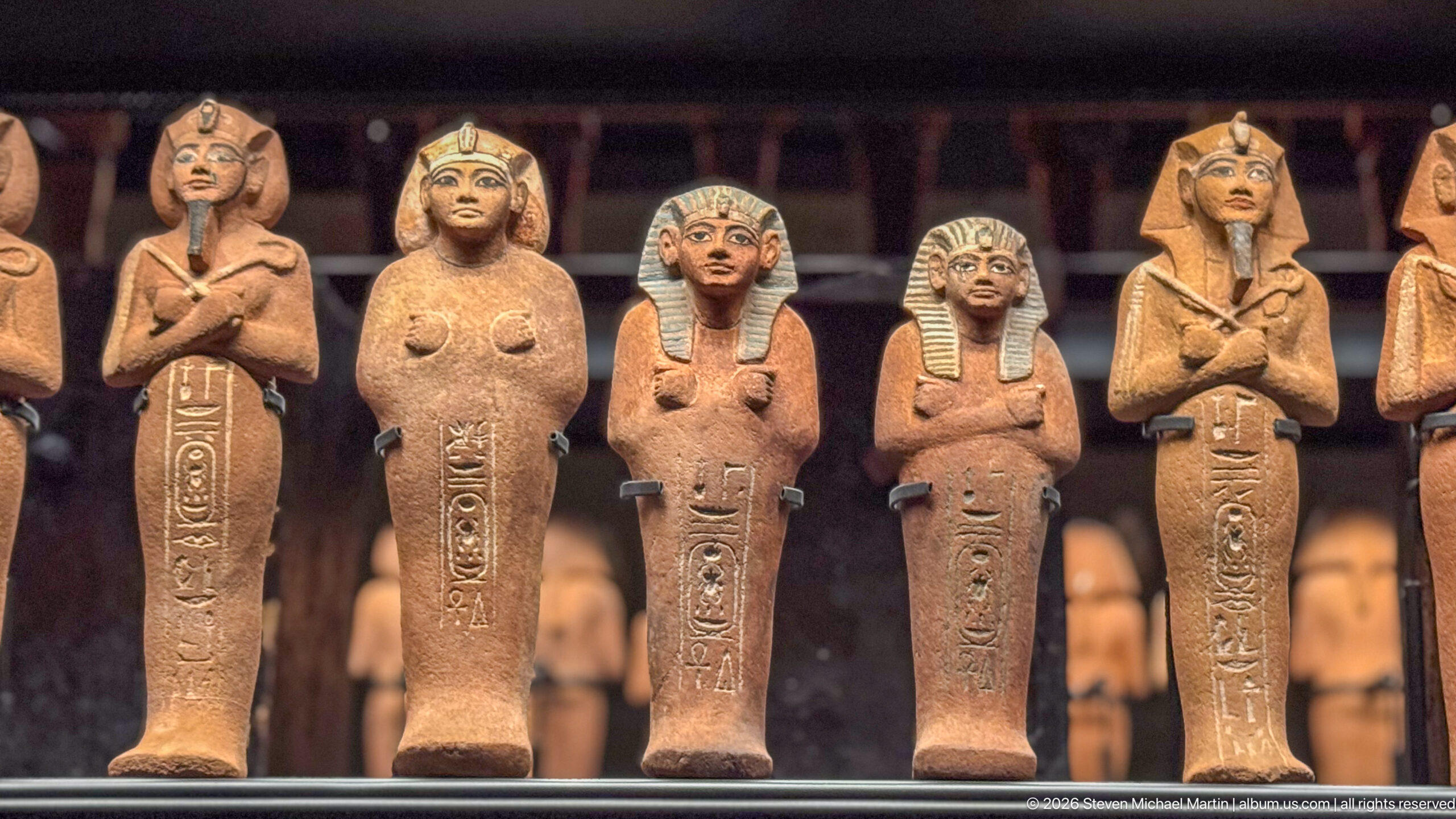
A row of anthropoid shabti figures stands upright in a museum case, each shown with crossed arms and vertical inscriptions down the front. The figures vary in scale, facial treatment, headdress, and surviving surface color, from warm ochre to pale cream. Their close arrangement highlights subtle differences within a common funerary form rather than presenting a single isolated object.
Caption
A row of anthropoid shabti figures stands upright in a museum case, each shown with crossed arms and vertical inscriptions down the front. The figures vary in scale, facial treatment, headdress, and surviving surface color, from warm ochre to pale cream. Their close arrangement highlights subtle differences within a common funerary form rather than presenting a single isolated object.
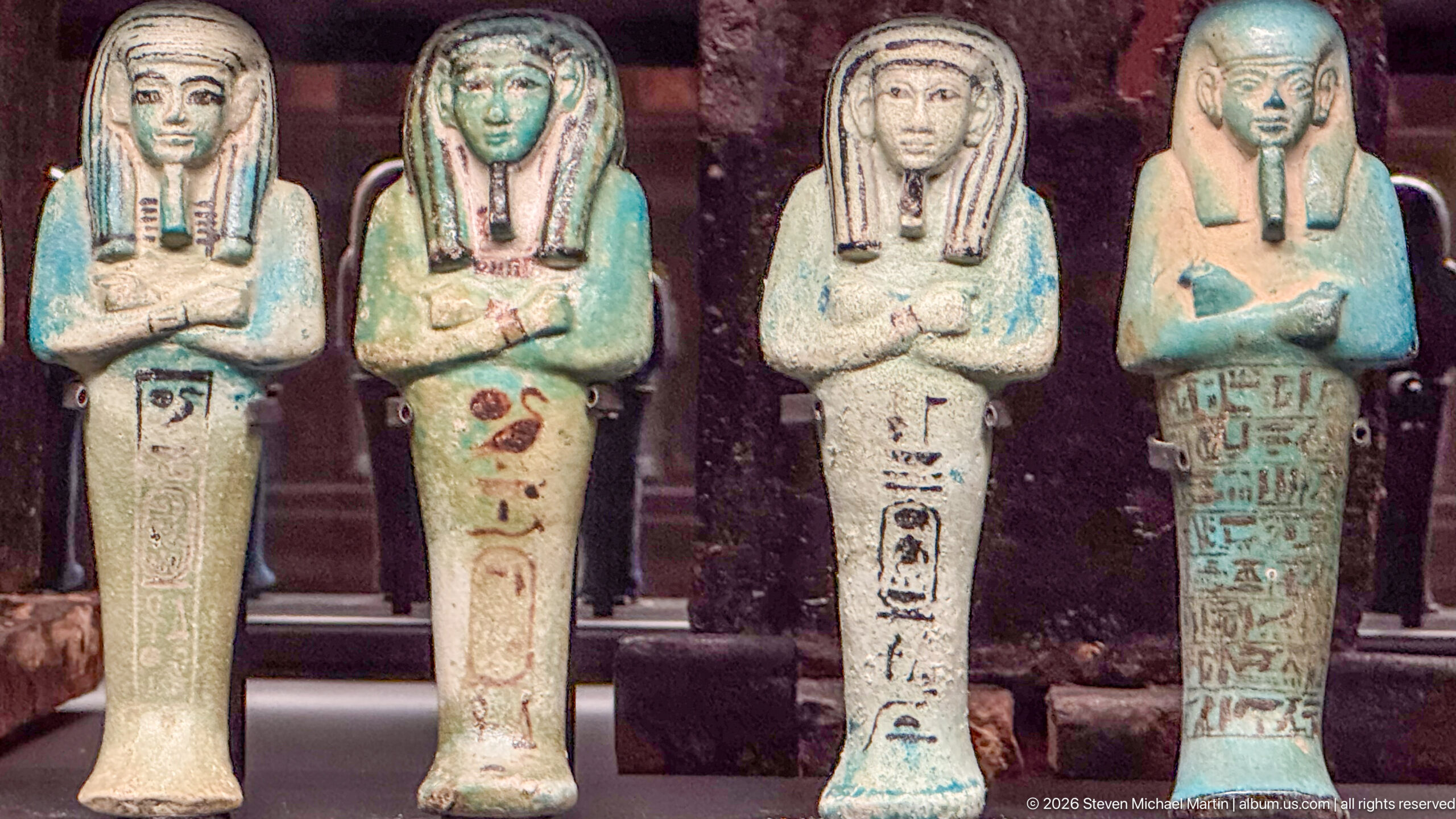
Four shabti figures stand side by side, their glazed surfaces ranging from pale cream to vivid turquoise blue-green. Each figure is wrapped in an anthropoid form with crossed arms and vertical inscription bands, while facial features and wigs are picked out in darker pigment. The surviving glaze gives the group a striking chromatic range within a standardized funerary type.
Caption
Four shabti figures stand side by side, their glazed surfaces ranging from pale cream to vivid turquoise blue-green. Each figure is wrapped in an anthropoid form with crossed arms and vertical inscription bands, while facial features and wigs are picked out in darker pigment. The surviving glaze gives the group a striking chromatic range within a standardized funerary type.
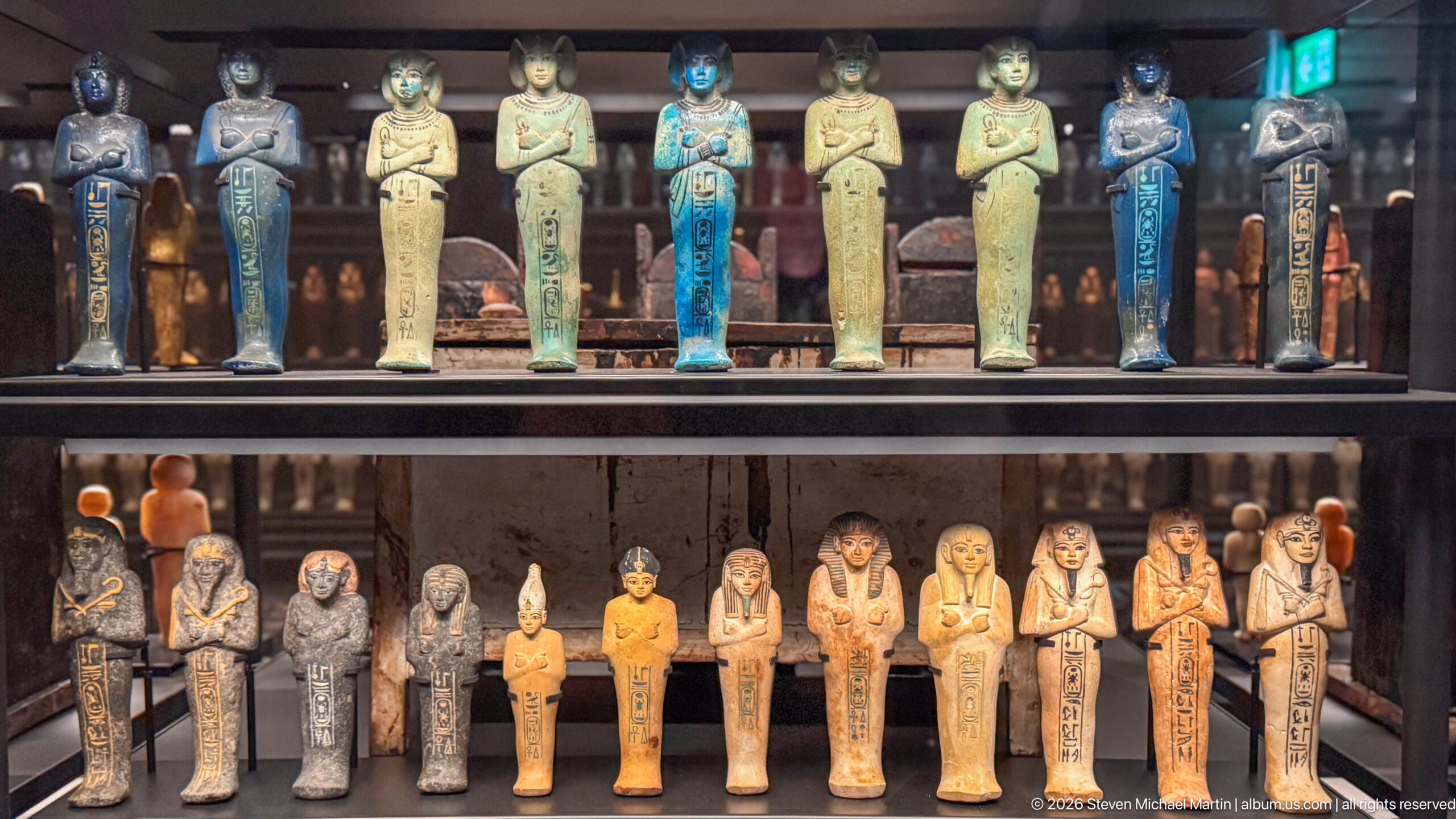
A two-level gallery display brings together dozens of shabti figures in a broad range of sizes, colors, and surface finishes. Blue-green glazed examples dominate the upper shelf, while cream, ochre, black, and painted figures line the lower tier. The comparative arrangement makes differences in headdress, proportions, inscription placement, and preservation immediately visible across the funerary figurines.
Caption
A two-level gallery display brings together dozens of shabti figures in a broad range of sizes, colors, and surface finishes. Blue-green glazed examples dominate the upper shelf, while cream, ochre, black, and painted figures line the lower tier. The comparative arrangement makes differences in headdress, proportions, inscription placement, and preservation immediately visible across the funerary figurines.
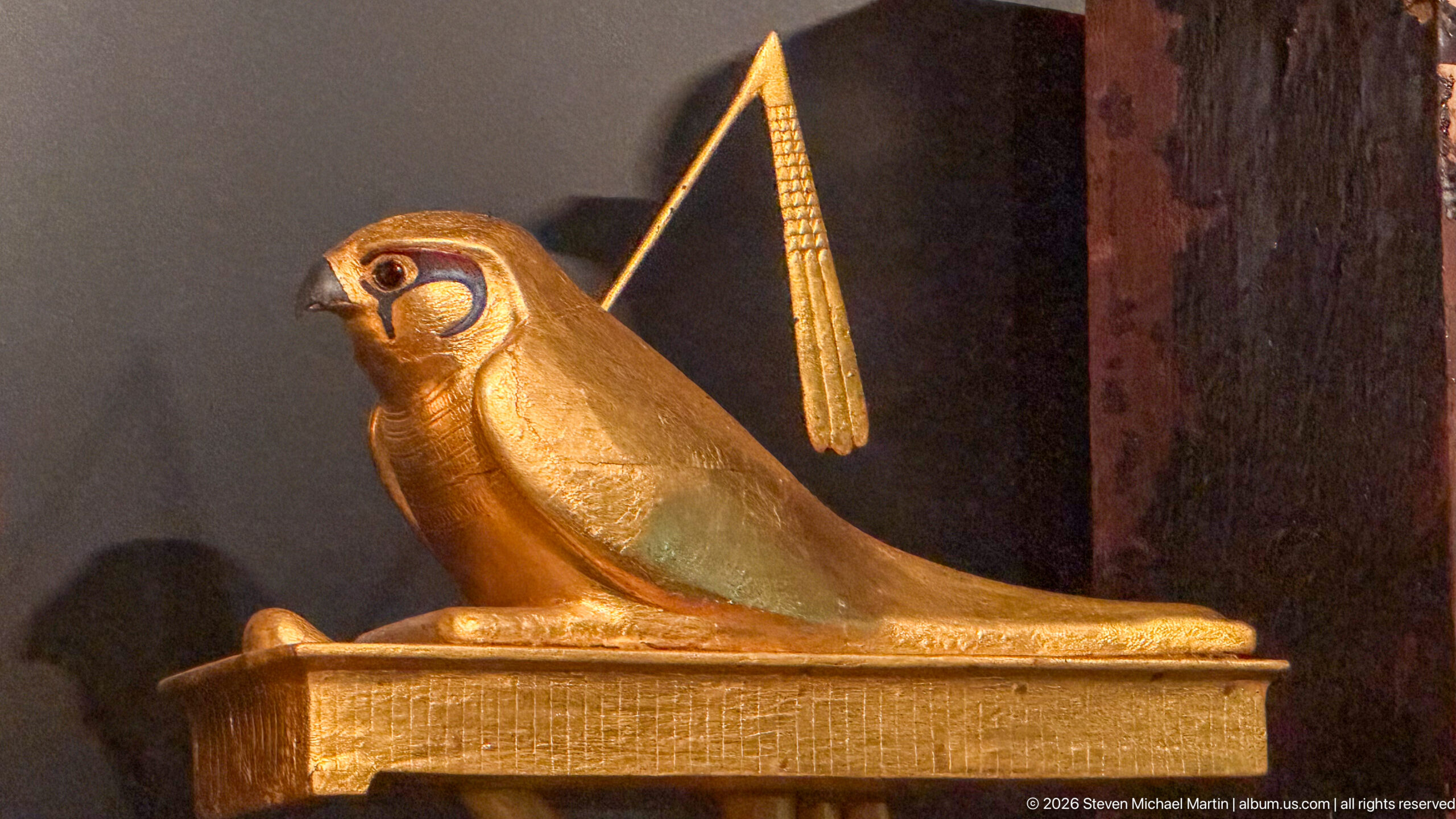
A small gilt silver hawk with finely incised plumage from the Dendera Treasure Hoards, dating to the Graeco-Roman Period. Discovered in 1918 near the sacred lake of the Dendera temple, the figure formed part of a votive ritual hoard of precious metal objects. The Grand Egyptian Museum catalogues it as GEM 2564.
Caption
A small gilt silver hawk with finely incised plumage from the Dendera Treasure Hoards, dating to the Graeco-Roman Period. Discovered in 1918 near the sacred lake of the Dendera temple, the figure formed part of a votive ritual hoard of precious metal objects. The Grand Egyptian Museum catalogues it as GEM 2564.
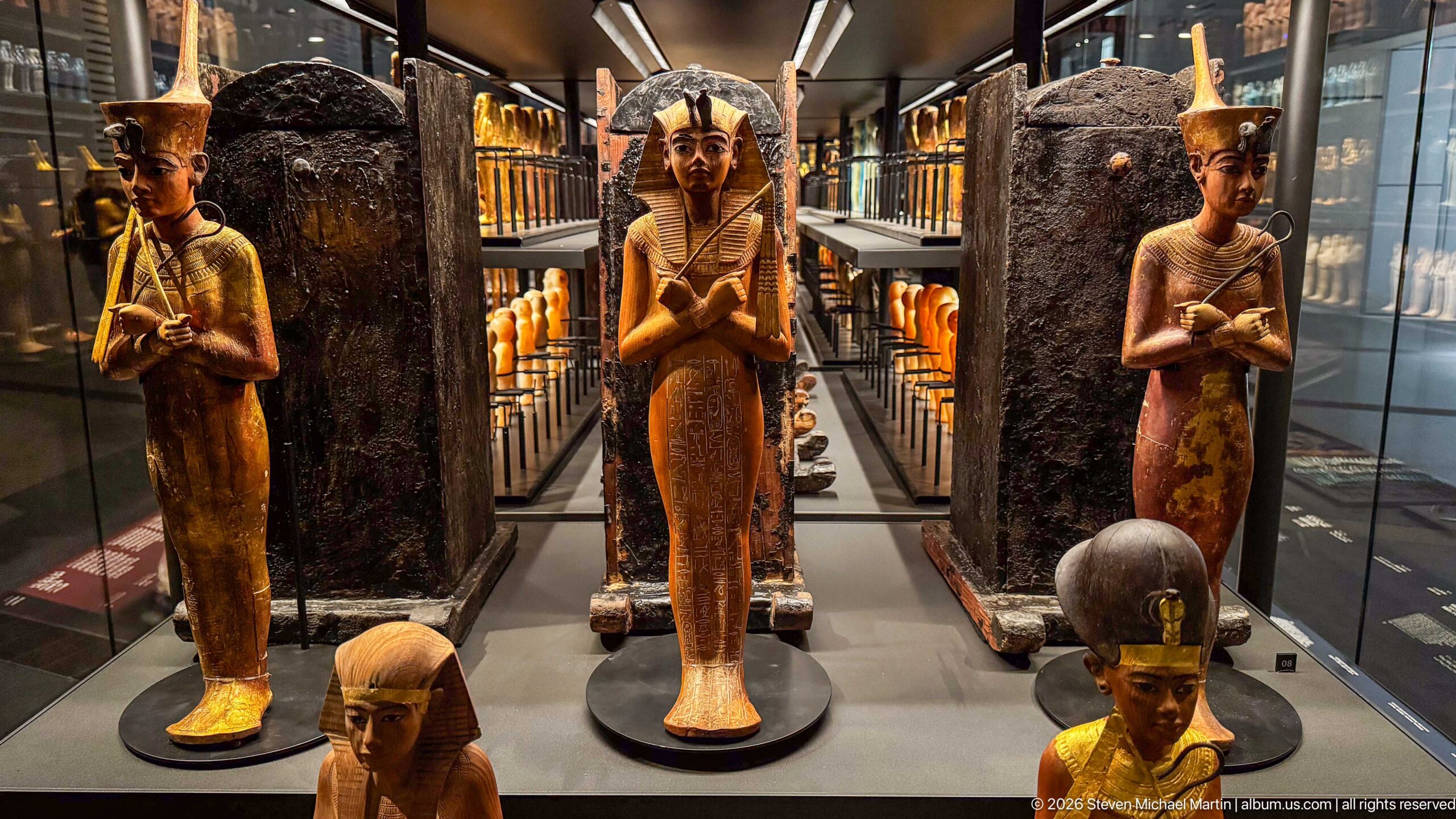
An immersive gallery display places several standing anthropoid figures in front of tall dark funerary cases or coffins. Gilded and painted bodies, crossed arms, and elaborate headdresses contrast with the massive black surfaces behind them, while additional objects extend along the shelving at both sides. The composition records how monumental burial equipment and smaller figures are presented together in the Main Galleries.
Caption
An immersive gallery display places several standing anthropoid figures in front of tall dark funerary cases or coffins. Gilded and painted bodies, crossed arms, and elaborate headdresses contrast with the massive black surfaces behind them, while additional objects extend along the shelving at both sides. The composition records how monumental burial equipment and smaller figures are presented together in the Main Galleries.
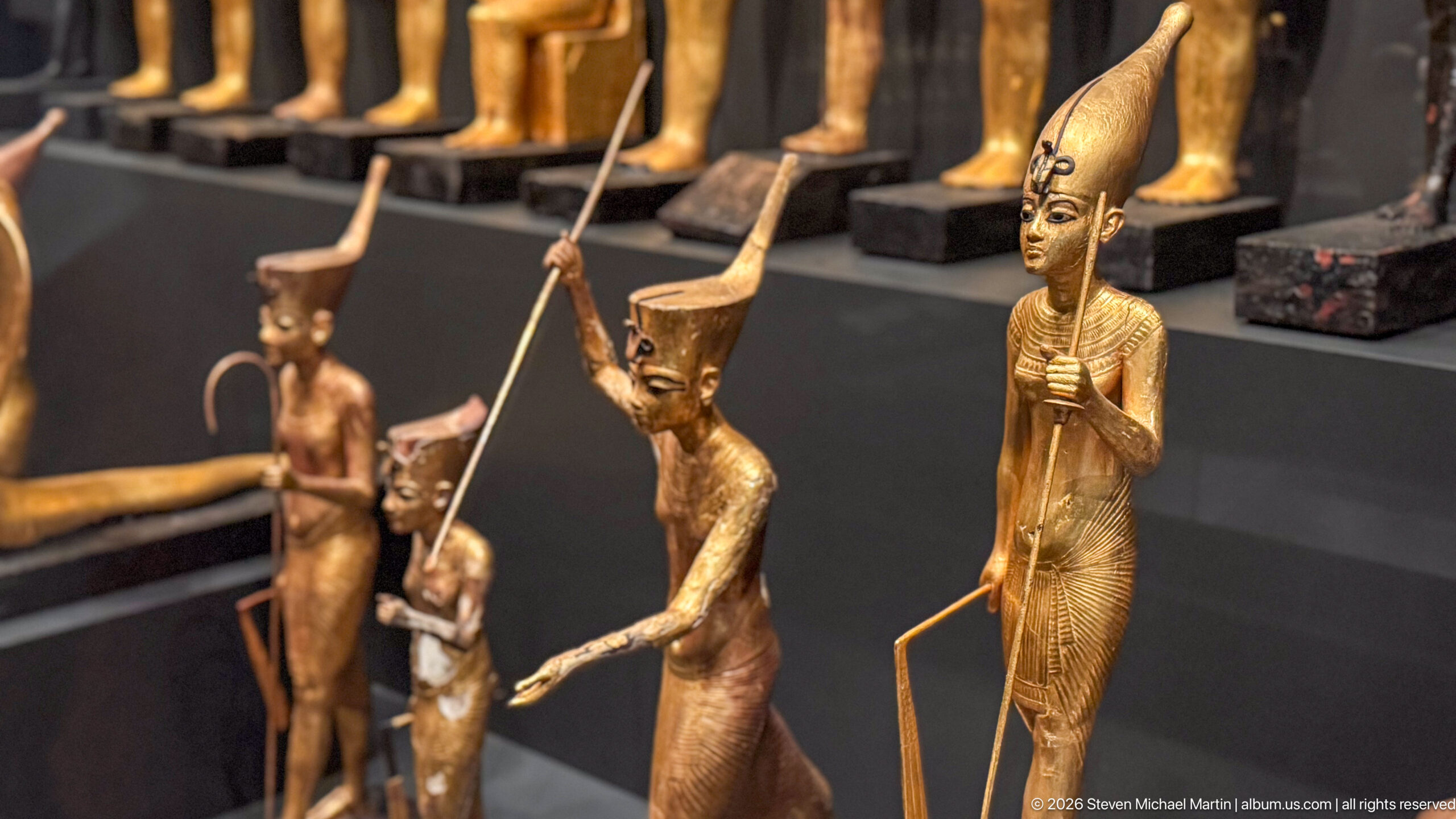
Several slender gilded divine figures stand together in a case, each differentiated by crown shape, posture, and held attributes. Tall conical and composite headdresses rise above frontal faces, while long staffs or scepters create strong vertical lines through the group. The close view emphasizes the variety of divine iconography within a consistent gold-toned sculptural ensemble.
Caption
Several slender gilded divine figures stand together in a case, each differentiated by crown shape, posture, and held attributes. Tall conical and composite headdresses rise above frontal faces, while long staffs or scepters create strong vertical lines through the group. The close view emphasizes the variety of divine iconography within a consistent gold-toned sculptural ensemble.
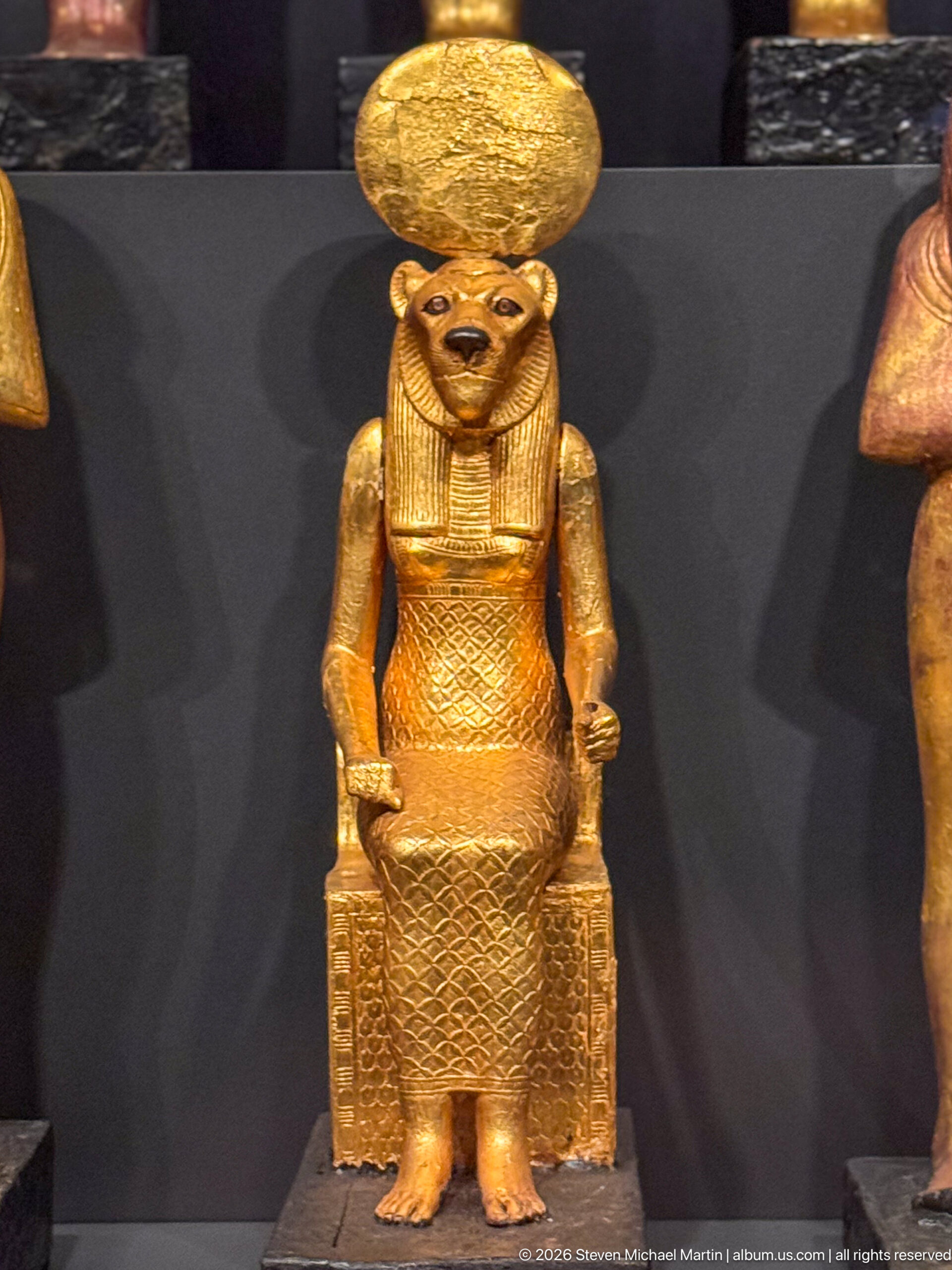
A Late Period bronze statuette of the goddess Wadjet in leonine form, discovered at Sais in the western Nile Delta. The lioness-headed goddess is identified by an inscription on the throne as “Wadjet, Lady of Buto, Mistress of Heaven.” Patroness of Lower Egypt, Wadjet could appear as a cobra or, as here, in lioness form. The Grand Egyptian Museum catalogues the statuette as GEM 5104.
Caption
A Late Period bronze statuette of the goddess Wadjet in leonine form, discovered at Sais in the western Nile Delta. The lioness-headed goddess is identified by an inscription on the throne as “Wadjet, Lady of Buto, Mistress of Heaven.” Patroness of Lower Egypt, Wadjet could appear as a cobra or, as here, in lioness form. The Grand Egyptian Museum catalogues the statuette as GEM 5104.
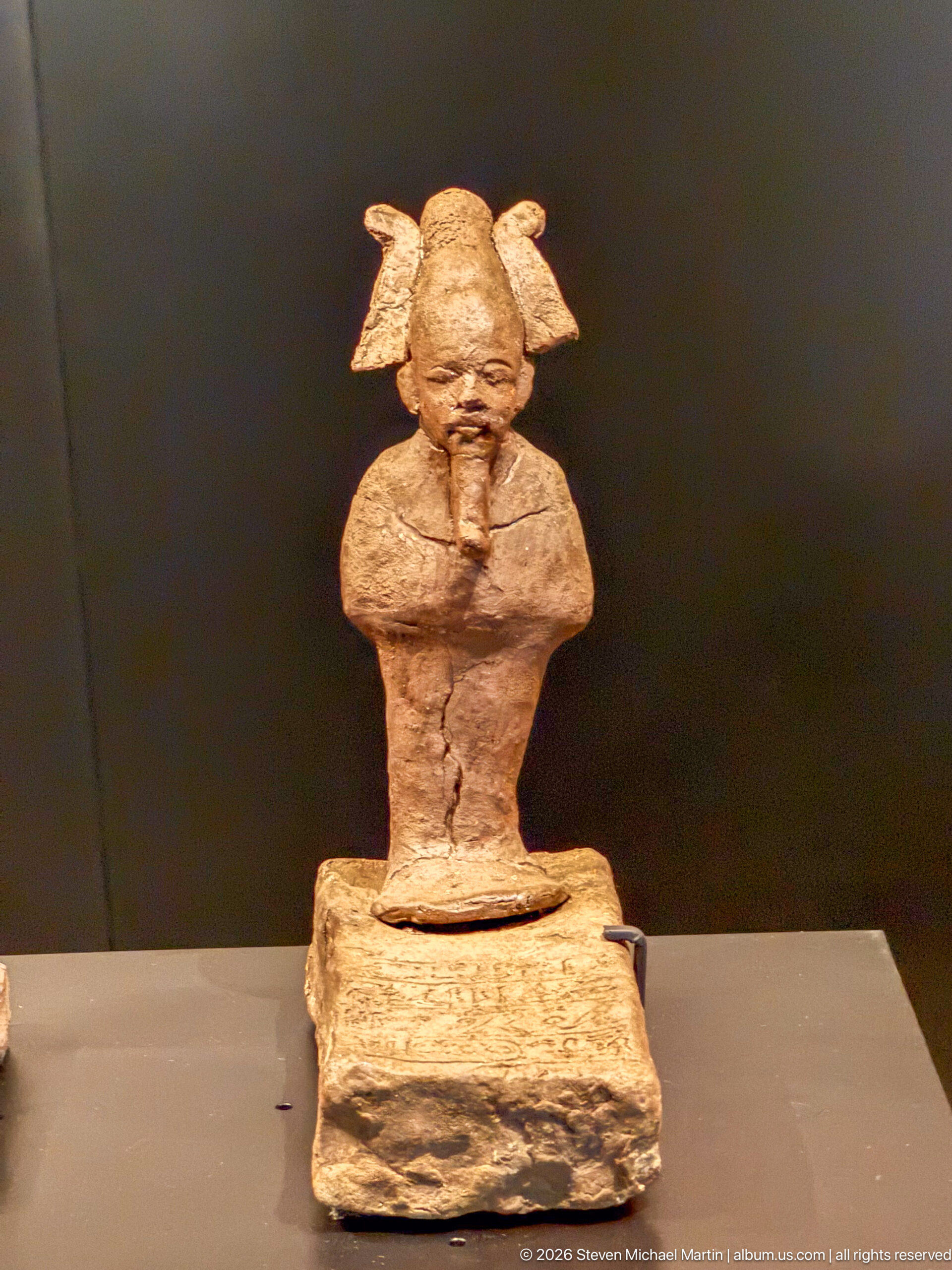
A small weathered figure sits or kneels on a block base, with a compact torso, broad projecting ears, and a strongly modeled face. The figure's proportions and emphatic head shape suggest a protective or dwarf-like divine form, but extensive surface wear obscures finer attributes. The isolated presentation against a dark background draws attention to the object's unusual silhouette and surviving sculptural mass.
Caption
A small weathered figure sits or kneels on a block base, with a compact torso, broad projecting ears, and a strongly modeled face. The figure's proportions and emphatic head shape suggest a protective or dwarf-like divine form, but extensive surface wear obscures finer attributes. The isolated presentation against a dark background draws attention to the object's unusual silhouette and surviving sculptural mass.
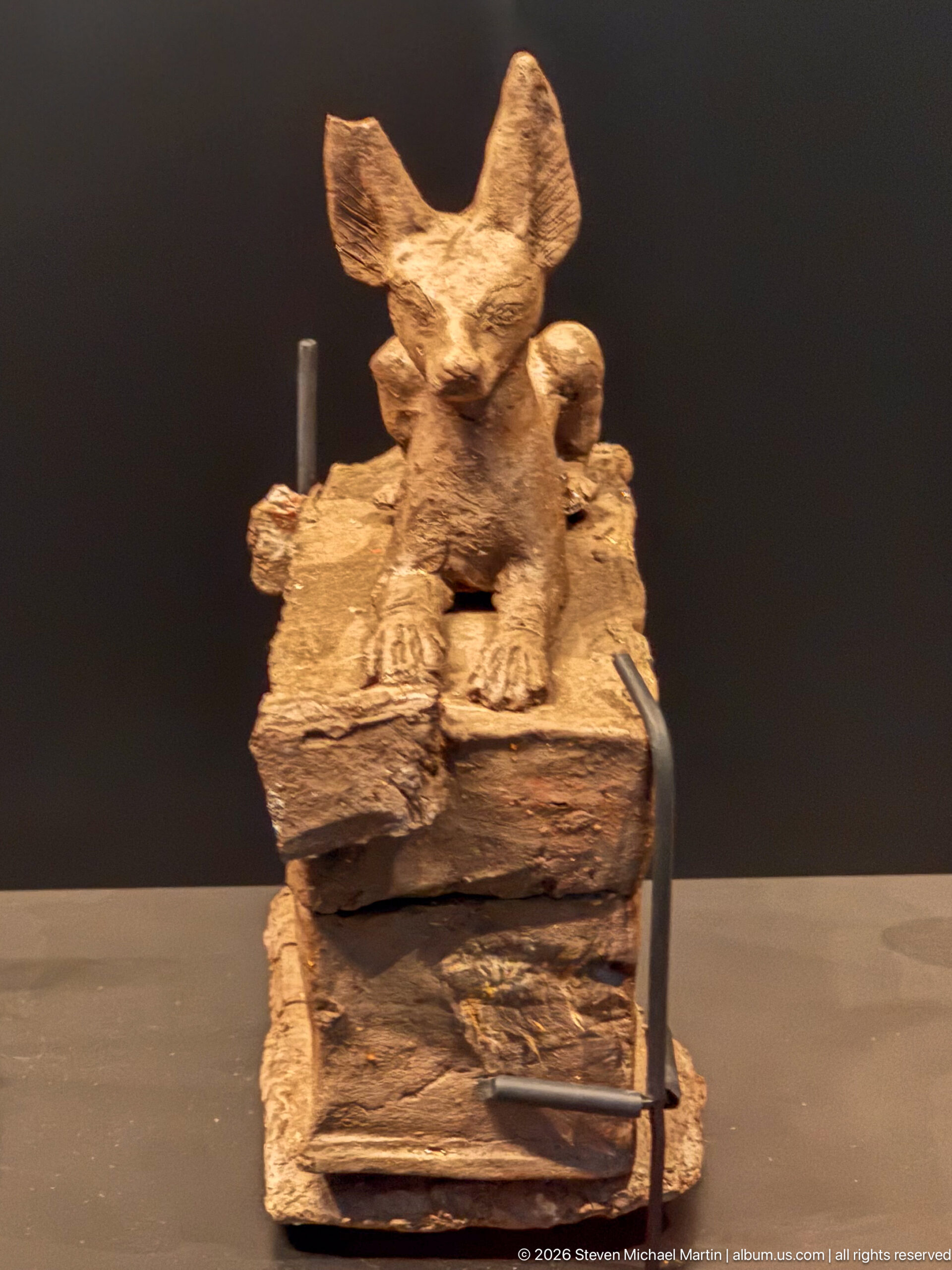
A small, heavily worn animal statuette rests on a rough rectangular base. Oversized upright ears, a short muzzle, and squat forelegs create a distinctive silhouette, while a small secondary form rises behind the animal's right side. Surface erosion has removed much of the original detail, leaving the species and possible symbolic identity uncertain.
Caption
A small, heavily worn animal statuette rests on a rough rectangular base. Oversized upright ears, a short muzzle, and squat forelegs create a distinctive silhouette, while a small secondary form rises behind the animal's right side. Surface erosion has removed much of the original detail, leaving the species and possible symbolic identity uncertain.

A close grouping highlights several animal-headed and human-headed deities standing shoulder to shoulder. Falcon, canine, and other zoomorphic heads are paired with wrapped anthropoid bodies, while a seated figure beneath a solar disk introduces a different scale and posture. Gold surfaces dominate, punctuated by blue, red, and black paint that distinguishes individual divine identities.
Caption
A close grouping highlights several animal-headed and human-headed deities standing shoulder to shoulder. Falcon, canine, and other zoomorphic heads are paired with wrapped anthropoid bodies, while a seated figure beneath a solar disk introduces a different scale and posture. Gold surfaces dominate, punctuated by blue, red, and black paint that distinguishes individual divine identities.
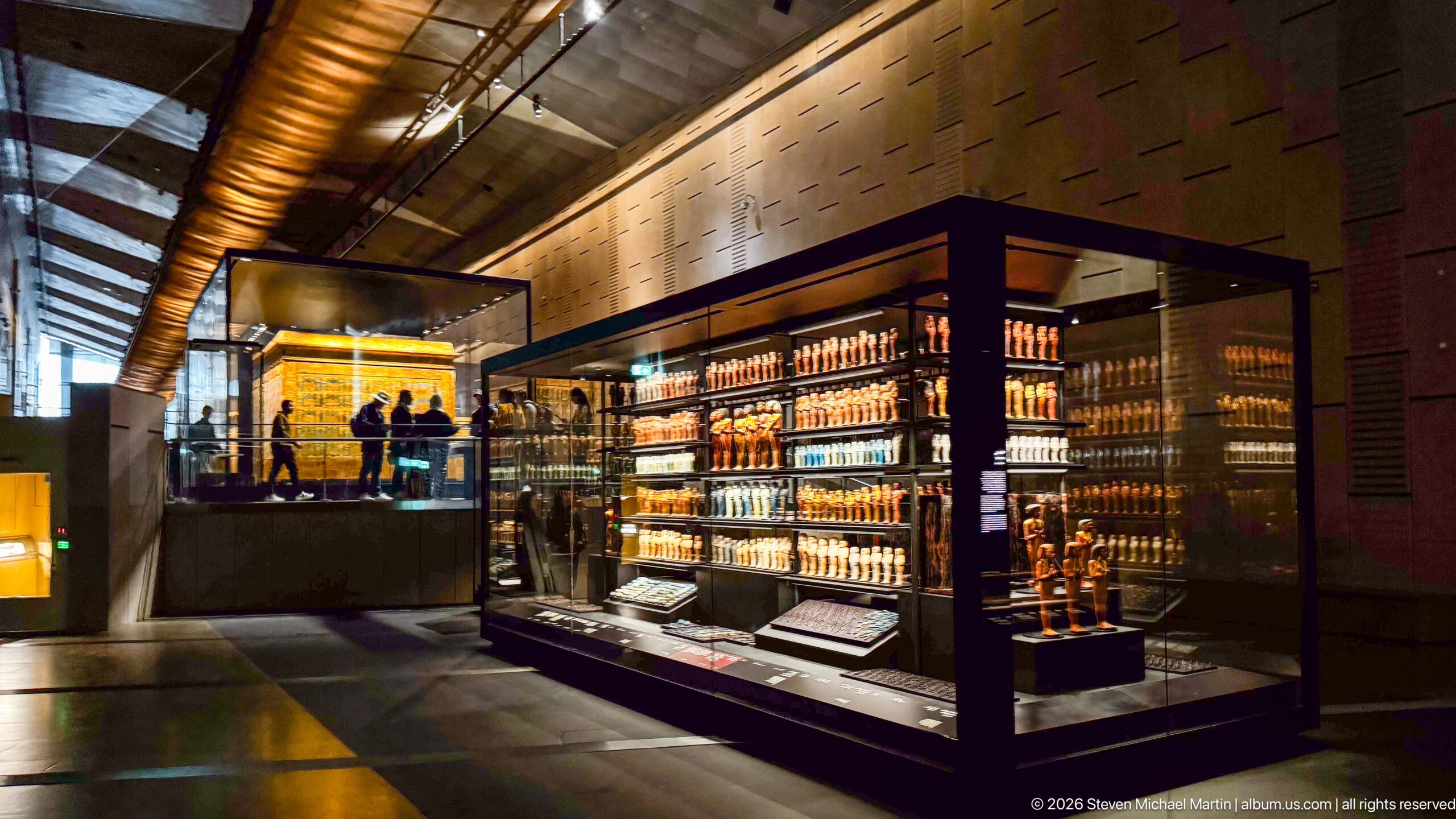
A long illuminated case dominates this gallery view, its shelves densely packed with rows of anthropoid funerary figures. Warm lighting picks out gold, ochre, cream, and turquoise surfaces against a dark structural frame, while a second glowing case is visible farther down the corridor. The photograph documents the scale and density of the museum's comparative funerary displays as much as the individual objects.
Caption
A long illuminated case dominates this gallery view, its shelves densely packed with rows of anthropoid funerary figures. Warm lighting picks out gold, ochre, cream, and turquoise surfaces against a dark structural frame, while a second glowing case is visible farther down the corridor. The photograph documents the scale and density of the museum's comparative funerary displays as much as the individual objects.
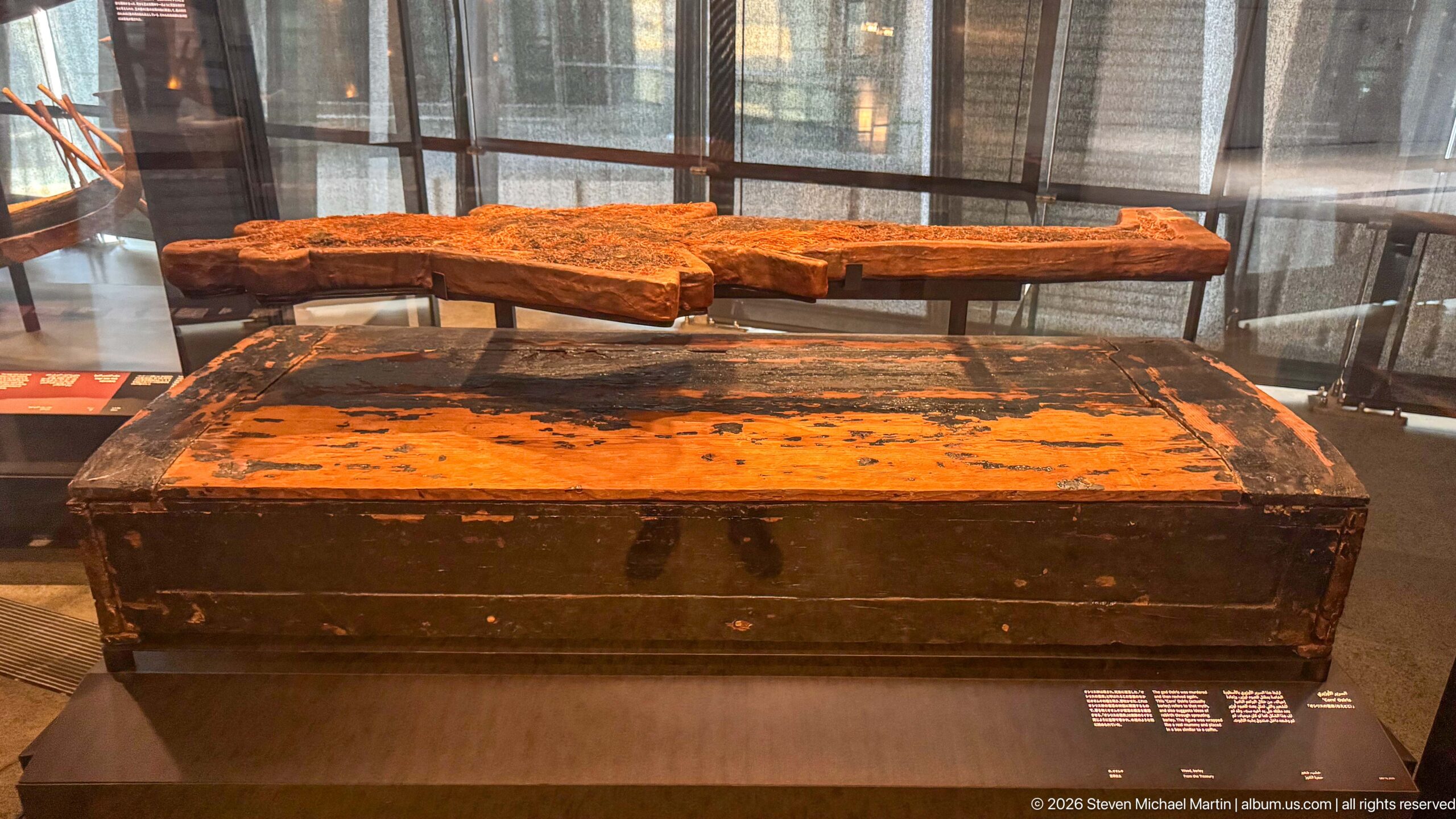
A large dark rectangular funerary container sits in a glass case, its surface retaining broad orange-brown patches of pigment or exposed wood. Above it, a long weathered wooden element with projecting sections is mounted horizontally. The pairing suggests related burial equipment or structural components, but the precise relationship between the two objects cannot be established from the proof-sheet photograph alone.
Caption
A large dark rectangular funerary container sits in a glass case, its surface retaining broad orange-brown patches of pigment or exposed wood. Above it, a long weathered wooden element with projecting sections is mounted horizontally. The pairing suggests related burial equipment or structural components, but the precise relationship between the two objects cannot be established from the proof-sheet photograph alone.
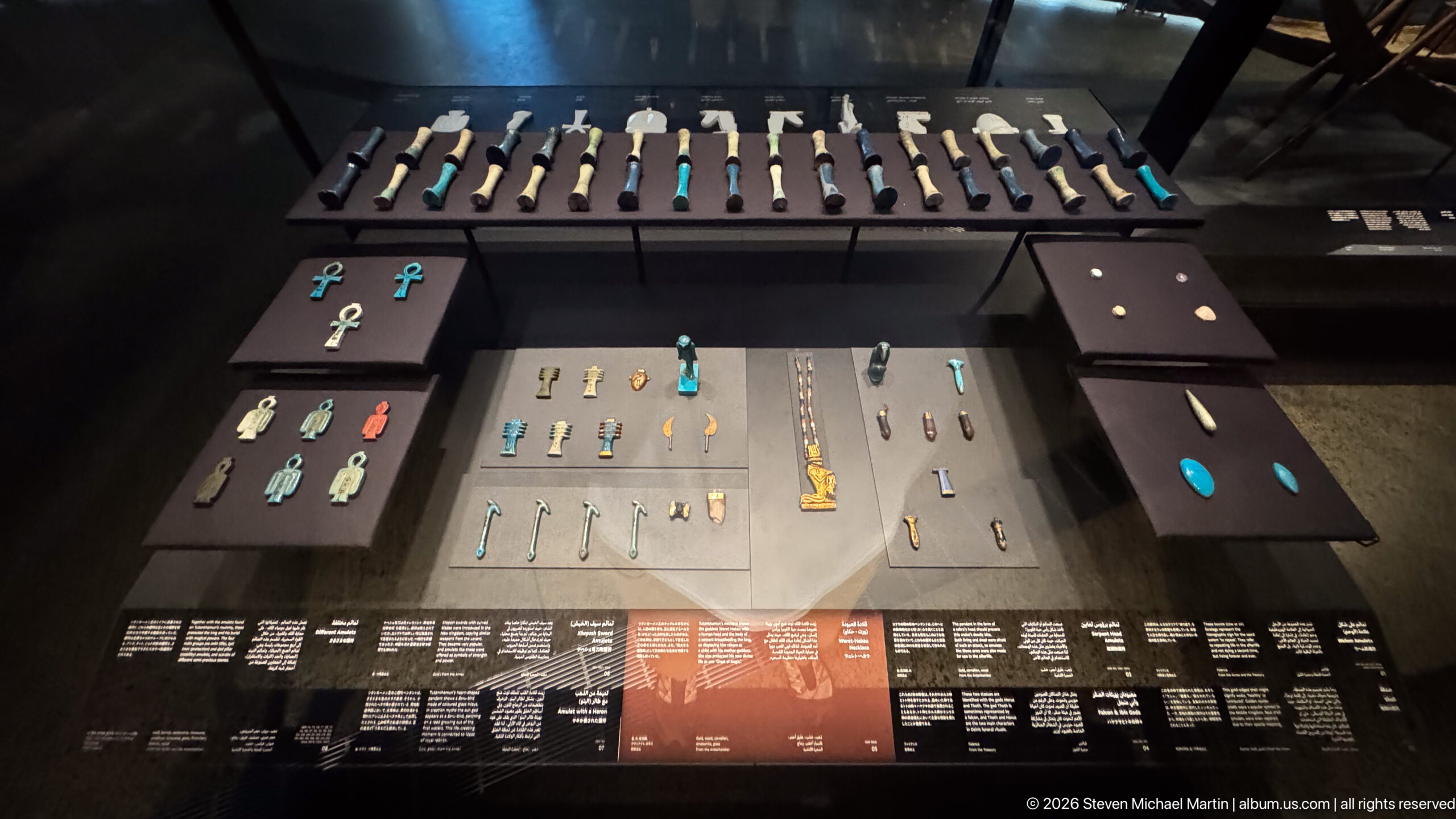
A tabletop display gathers dozens of small amulets and pendants on dark mounts, arranged by form and color. Ankh symbols, elongated pendants, small figures, eye-shaped pieces, and turquoise-blue objects occupy separate panels, while a line of labels runs across the foreground. The organization makes the case a comparative study of miniature protective objects rather than a single-object presentation.
Caption
A tabletop display gathers dozens of small amulets and pendants on dark mounts, arranged by form and color. Ankh symbols, elongated pendants, small figures, eye-shaped pieces, and turquoise-blue objects occupy separate panels, while a line of labels runs across the foreground. The organization makes the case a comparative study of miniature protective objects rather than a single-object presentation.
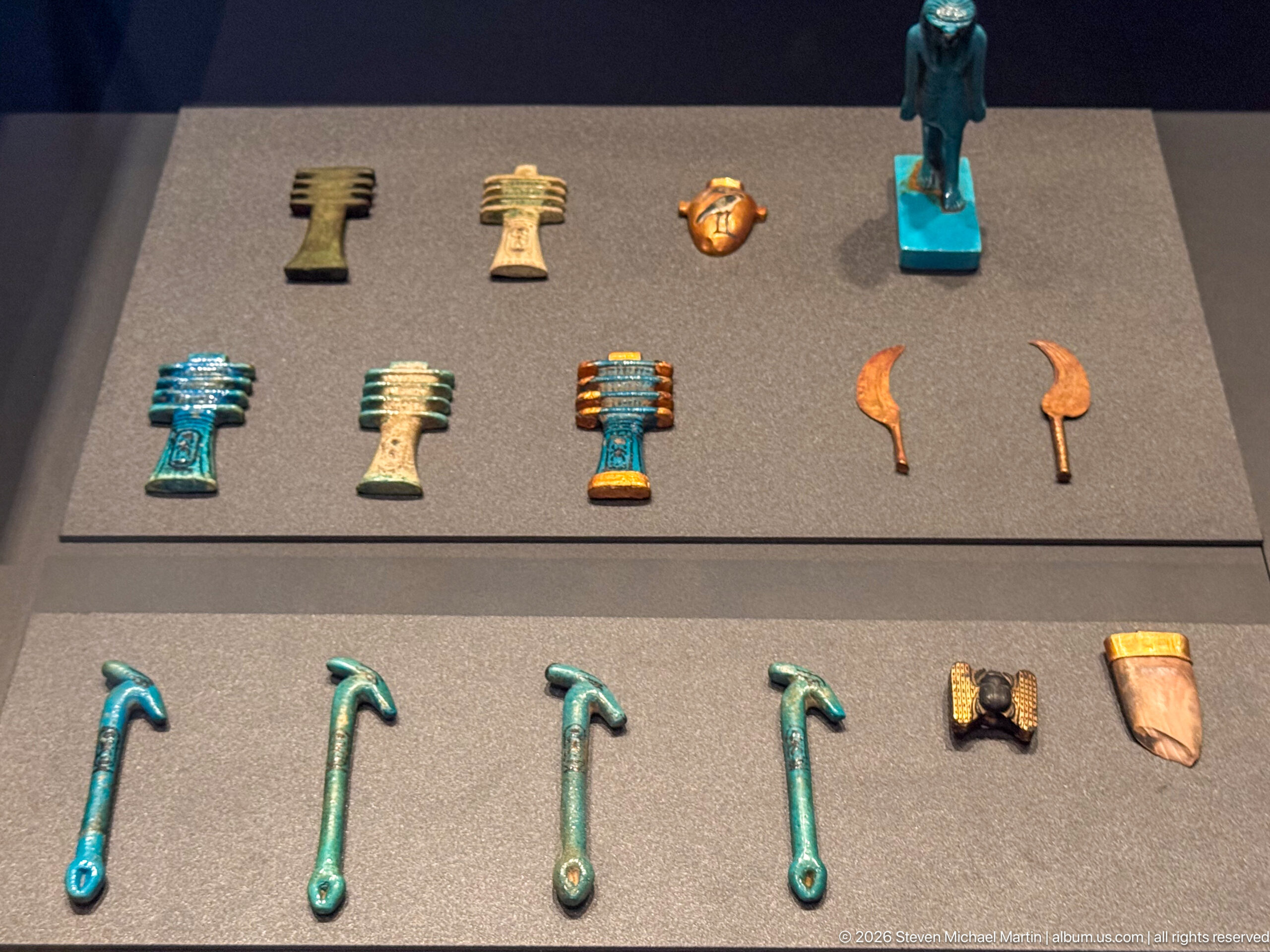
A close display brings together several forms of ancient Egyptian protective amulets in blue-green, cream, orange, and metallic tones. Pillar-like, eye-shaped, looped, and curved forms illustrate the varied symbolic vocabulary of amuletic jewelry, while individual identifications should be reserved for pieces confirmed by the museum catalogue.
Caption
A close display brings together several forms of ancient Egyptian protective amulets in blue-green, cream, orange, and metallic tones. Pillar-like, eye-shaped, looped, and curved forms illustrate the varied symbolic vocabulary of amuletic jewelry, while individual identifications should be reserved for pieces confirmed by the museum catalogue.
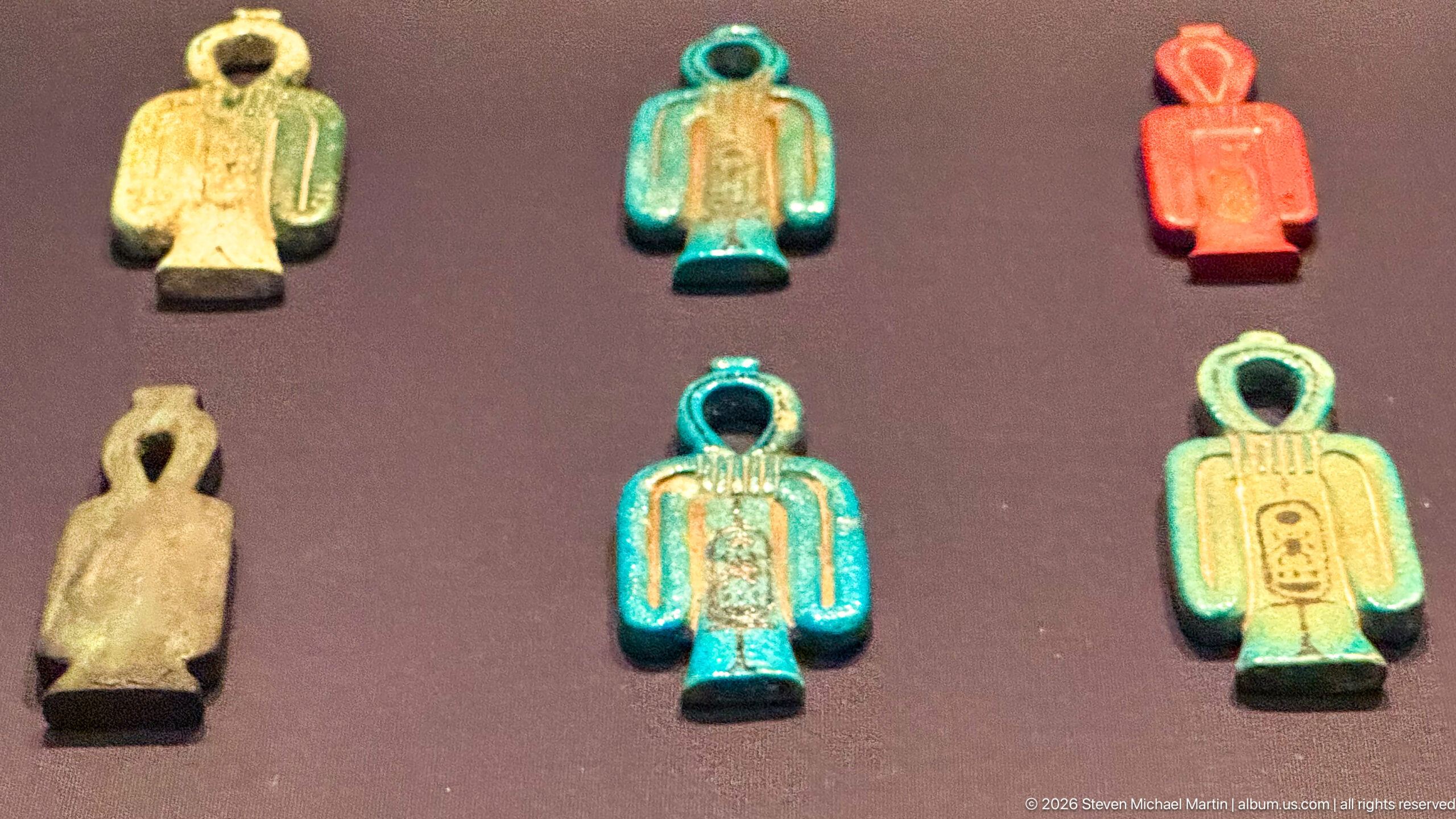
Six small glazed amulets are arranged in two rows, each with a suspension loop and a compact molded body. Their turquoise, green, cream, and red-orange surfaces show the color range of Egyptian glazed amuletic objects; the photograph does not securely identify every form as a scarab.
Caption
Six small glazed amulets are arranged in two rows, each with a suspension loop and a compact molded body. Their turquoise, green, cream, and red-orange surfaces show the color range of Egyptian glazed amuletic objects; the photograph does not securely identify every form as a scarab.
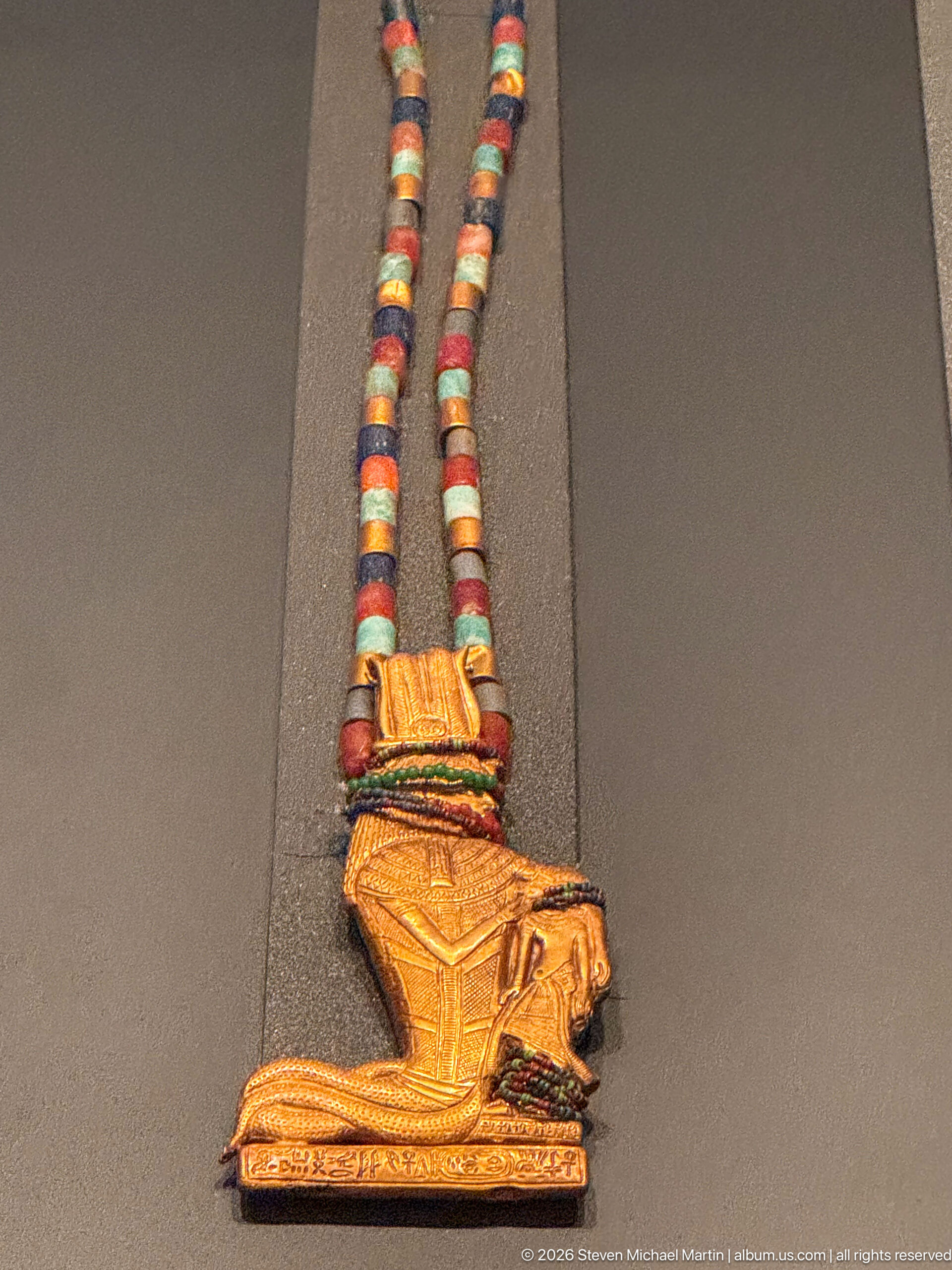
A multicolored strand of cylindrical beads terminates in a gold falcon-shaped pendant. The bird’s hooked beak and folded wing make the falcon form clear, while the photograph does not establish a specific deity, royal owner, or association with Tutankhamun.
Caption
A multicolored strand of cylindrical beads terminates in a gold falcon-shaped pendant. The bird’s hooked beak and folded wing make the falcon form clear, while the photograph does not establish a specific deity, royal owner, or association with Tutankhamun.
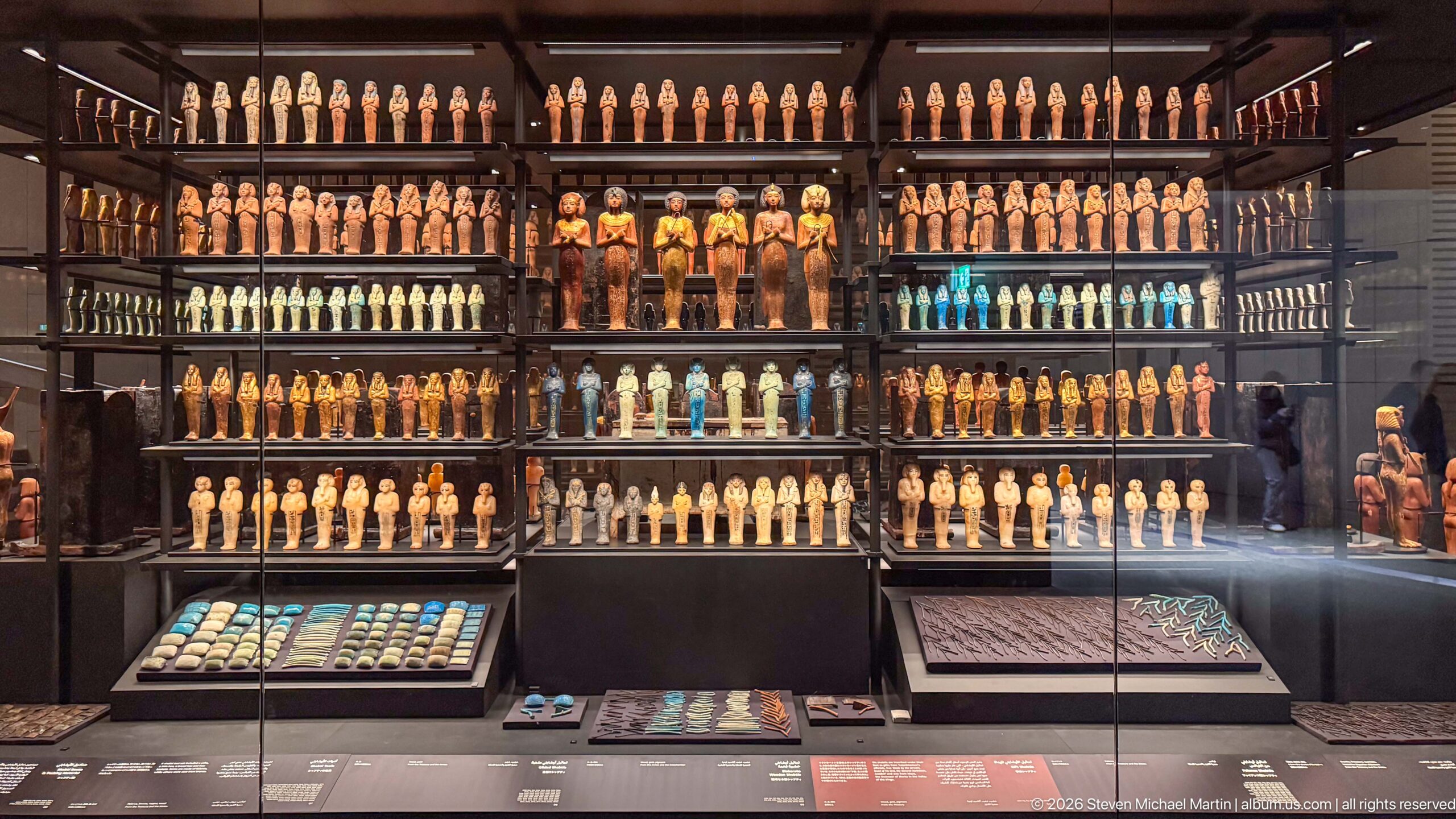
A wall-like museum case is filled with rows of anthropoid funerary figures, ranging from tiny cream shabtis to larger gilded and painted examples. Smaller display trays of amulets and jewelry occupy the lower foreground, creating a layered presentation of burial equipment at very different scales. The dense installation emphasizes repetition, variation, and the sheer range of funerary objects represented in the collection.
Caption
A wall-like museum case is filled with rows of anthropoid funerary figures, ranging from tiny cream shabtis to larger gilded and painted examples. Smaller display trays of amulets and jewelry occupy the lower foreground, creating a layered presentation of burial equipment at very different scales. The dense installation emphasizes repetition, variation, and the sheer range of funerary objects represented in the collection.
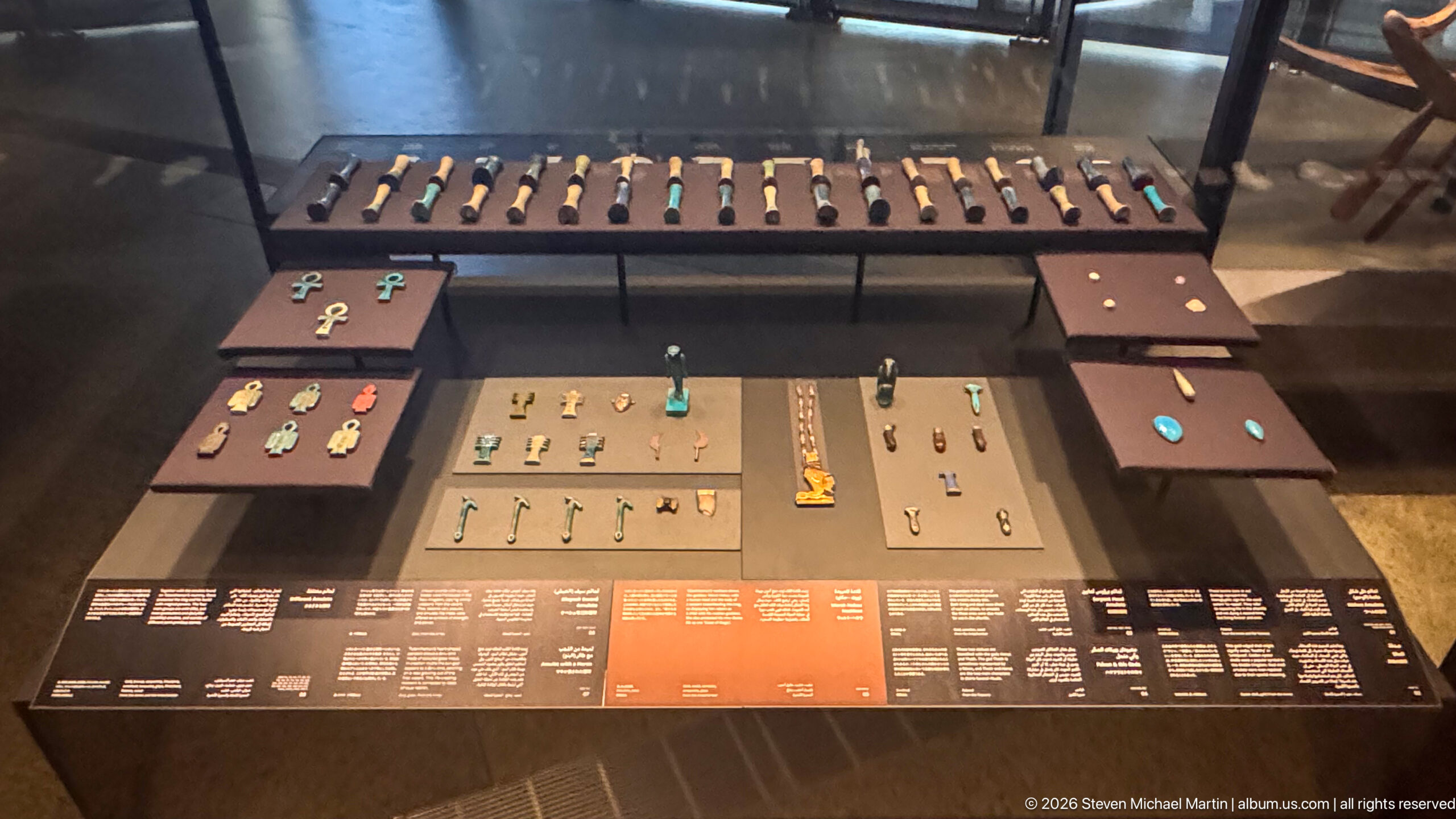
An overhead view surveys a broad display of miniature protective objects. Long pendant forms line the back row, while ankhs, figures, staff-like pieces, eye-shaped objects, and other symbols are grouped on separate dark mounts below. The arrangement is clearly typological, allowing viewers to compare shapes and materials across a large selection of ancient Egyptian amulets.
Caption
An overhead view surveys a broad display of miniature protective objects. Long pendant forms line the back row, while ankhs, figures, staff-like pieces, eye-shaped objects, and other symbols are grouped on separate dark mounts below. The arrangement is clearly typological, allowing viewers to compare shapes and materials across a large selection of ancient Egyptian amulets.
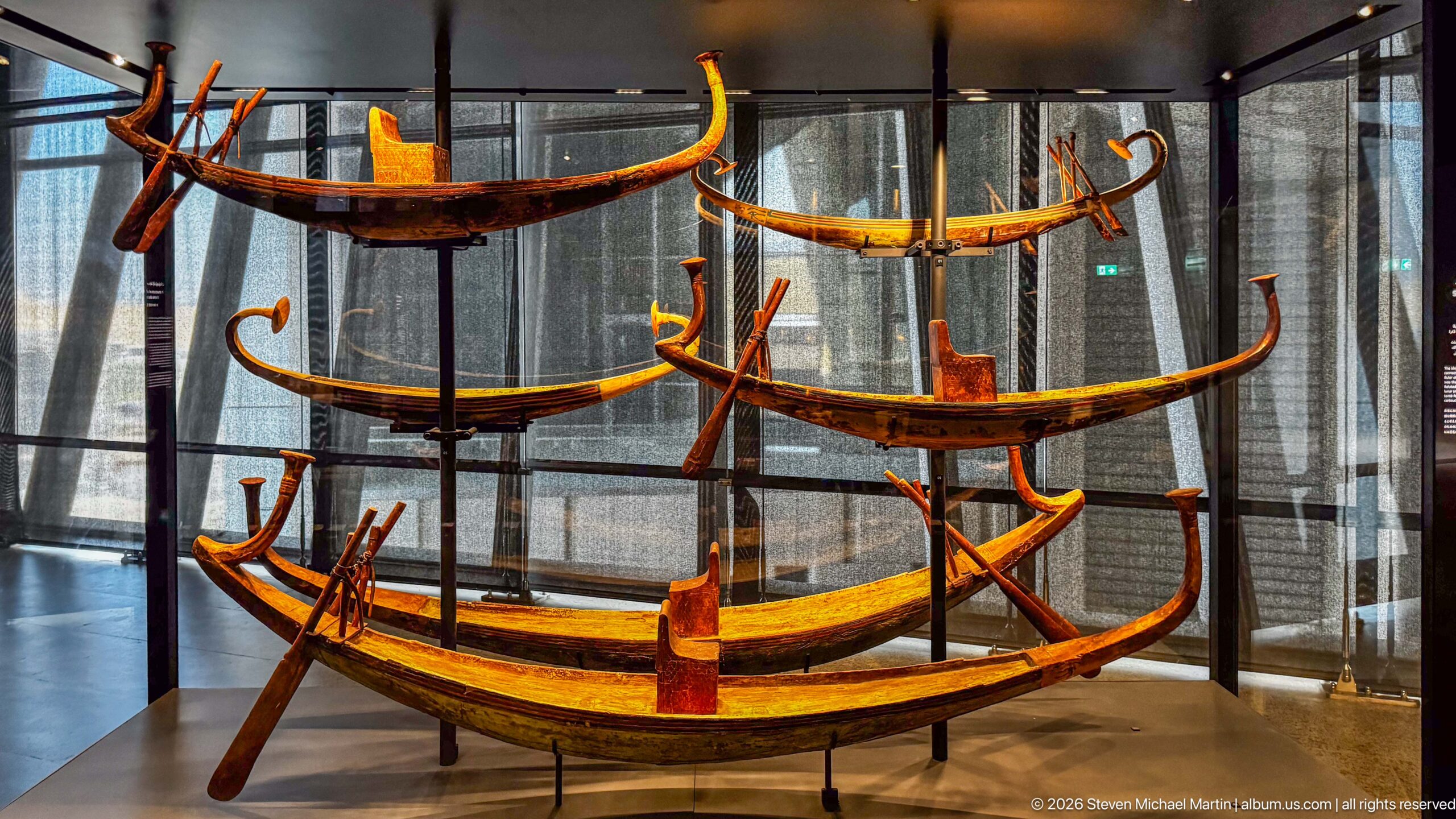
Several long wooden model boats are mounted at different heights in front of a tall window wall. Their high curving prows and sterns, narrow hulls, and surviving red, yellow, and dark painted surfaces create repeated arcs across the installation. The suspended arrangement makes hull profile and structural differences easier to compare than the details of crews or deck equipment.
Caption
Several long wooden model boats are mounted at different heights in front of a tall window wall. Their high curving prows and sterns, narrow hulls, and surviving red, yellow, and dark painted surfaces create repeated arcs across the installation. The suspended arrangement makes hull profile and structural differences easier to compare than the details of crews or deck equipment.
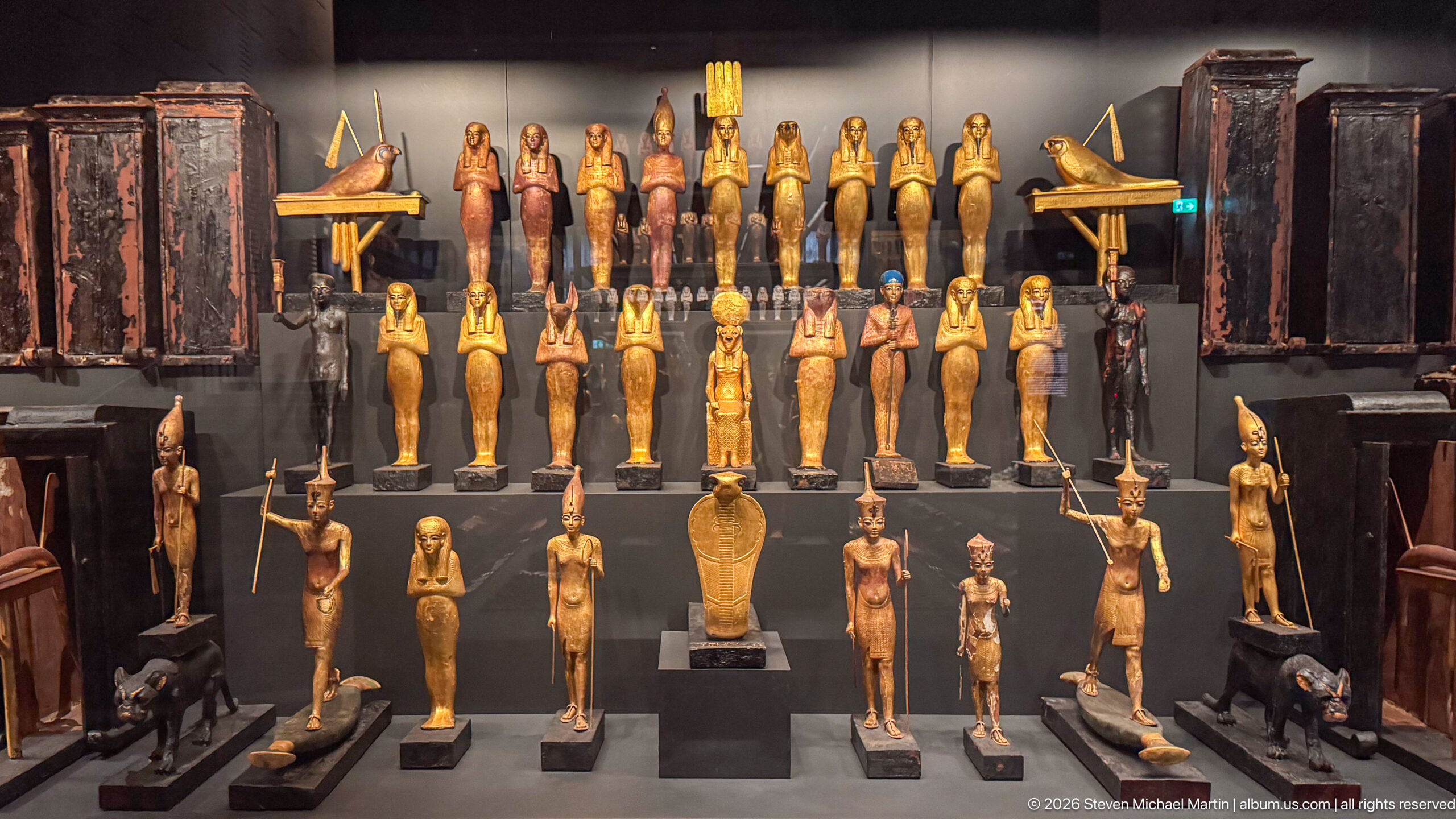
A highly ordered display centers on rows of gilded and painted anthropoid figures rising above larger standing deities. Dark rectangular coffin-like objects frame both sides, while animal figures and smaller ritual objects occupy the lower corners. The symmetrical installation creates a dramatic visual hierarchy from monumental burial containers to protective divine figures and compact funerary statuettes.
Caption
A highly ordered display centers on rows of gilded and painted anthropoid figures rising above larger standing deities. Dark rectangular coffin-like objects frame both sides, while animal figures and smaller ritual objects occupy the lower corners. The symmetrical installation creates a dramatic visual hierarchy from monumental burial containers to protective divine figures and compact funerary statuettes.
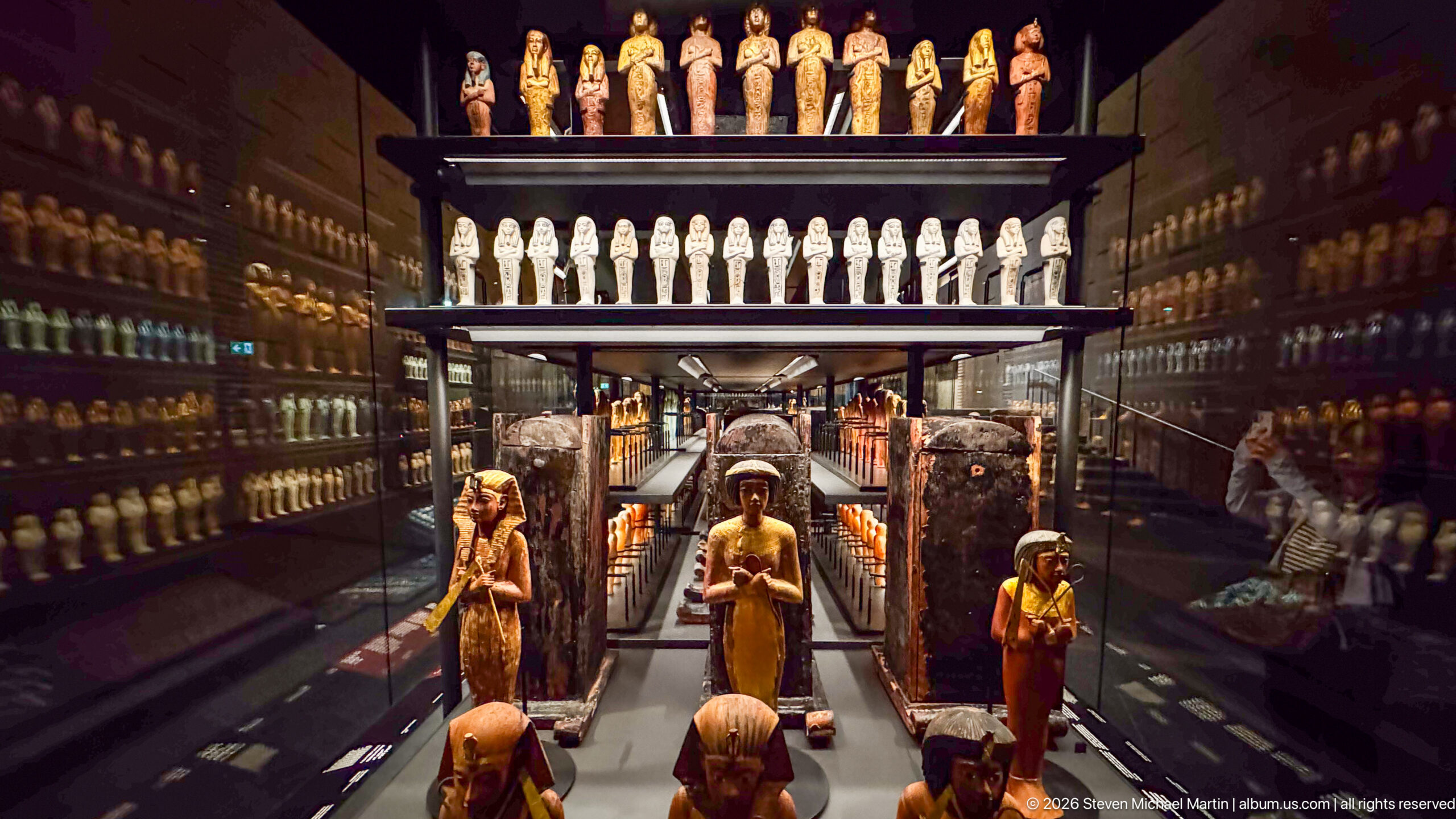
A central sightline opens through a densely packed funerary gallery, with rows of shabtis lining the upper shelves and larger standing anthropoid figures arranged below. Tall dark coffin-like objects create a corridor effect through the middle of the case, while additional figures repeat along both side walls. The deep perspective emphasizes the scale and immersive density of the display.
Caption
A central sightline opens through a densely packed funerary gallery, with rows of shabtis lining the upper shelves and larger standing anthropoid figures arranged below. Tall dark coffin-like objects create a corridor effect through the middle of the case, while additional figures repeat along both side walls. The deep perspective emphasizes the scale and immersive density of the display.
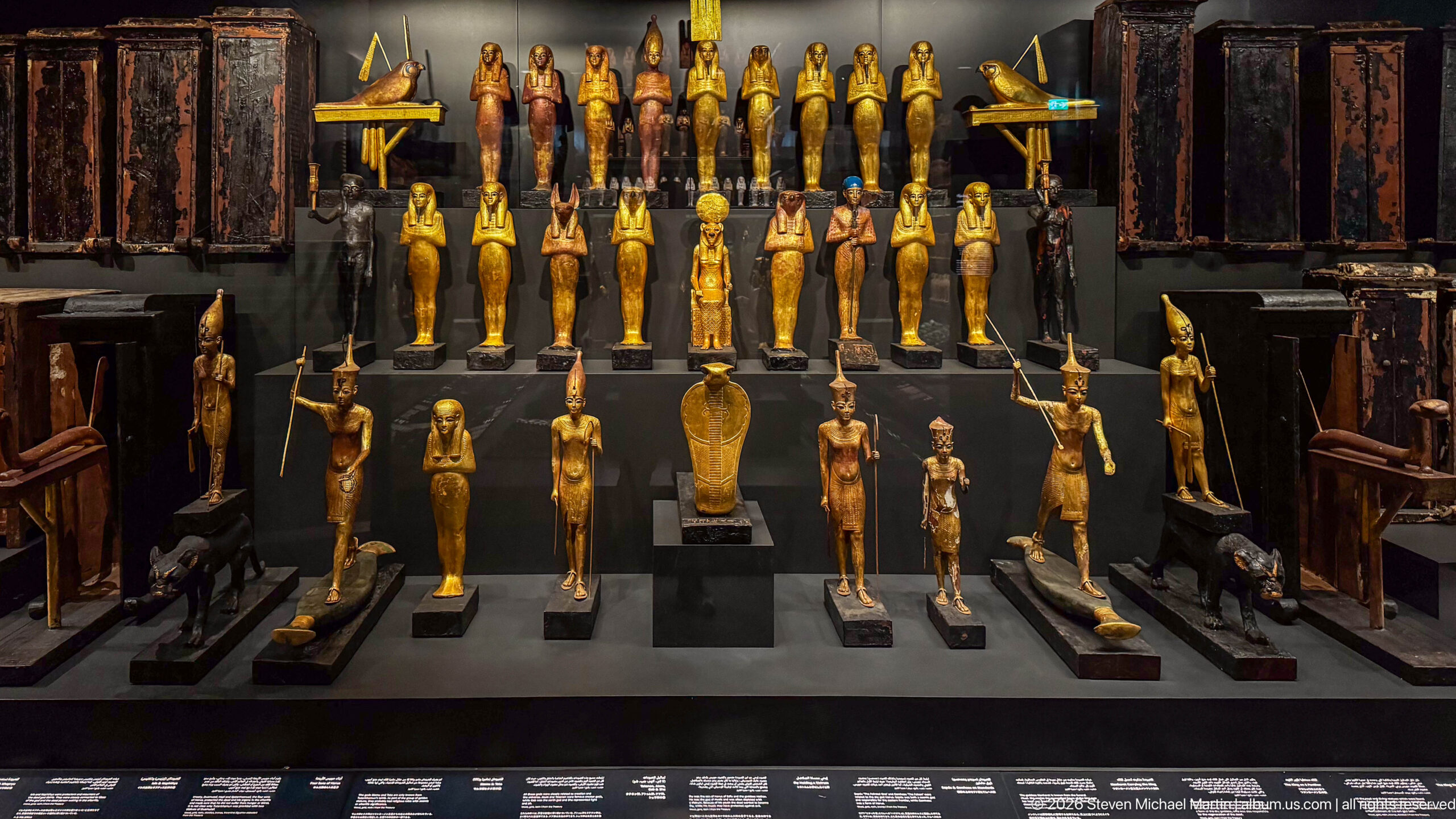
A frontal overview presents a carefully tiered arrangement of small gilded shabtis above larger standing deities, with dark coffin-like forms framing the installation at both sides. Animal figures, staffs, and ritual objects occupy the lower corners and central foreground. The balanced composition functions almost like an iconographic tableau, bringing together burial equipment and protective divine imagery in one display.
Caption
A frontal overview presents a carefully tiered arrangement of small gilded shabtis above larger standing deities, with dark coffin-like forms framing the installation at both sides. Animal figures, staffs, and ritual objects occupy the lower corners and central foreground. The balanced composition functions almost like an iconographic tableau, bringing together burial equipment and protective divine imagery in one display.
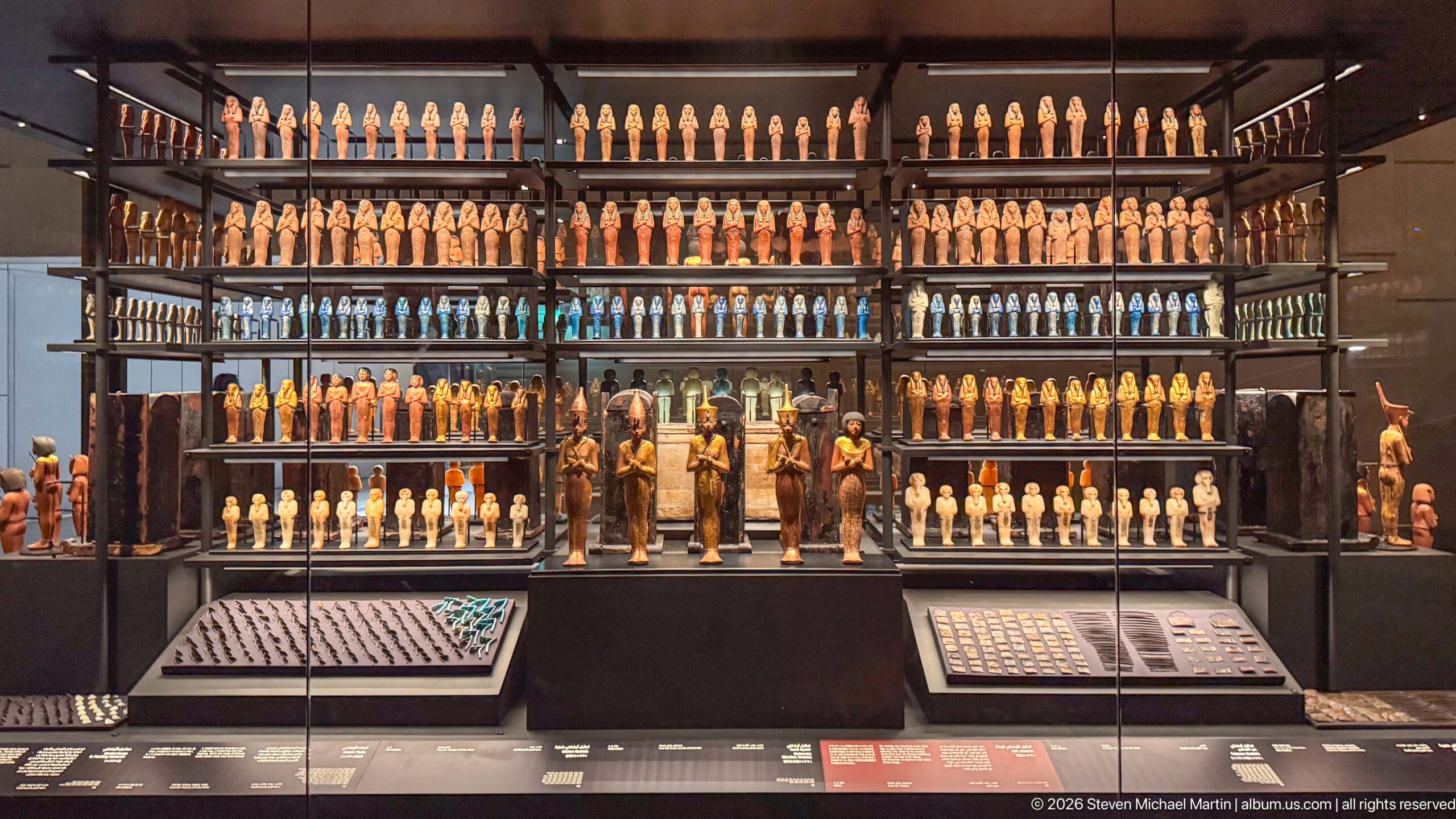
A broad frontal view records the full extent of a wall-scale shabti display. Cream, ochre, turquoise, black, and gilded figures stand in tightly ordered horizontal rows, while larger human and divine statuettes punctuate the lower center. Display trays of small objects sit along the foreground edge, adding another scale of funerary material to the installation.
Caption
A broad frontal view records the full extent of a wall-scale shabti display. Cream, ochre, turquoise, black, and gilded figures stand in tightly ordered horizontal rows, while larger human and divine statuettes punctuate the lower center. Display trays of small objects sit along the foreground edge, adding another scale of funerary material to the installation.
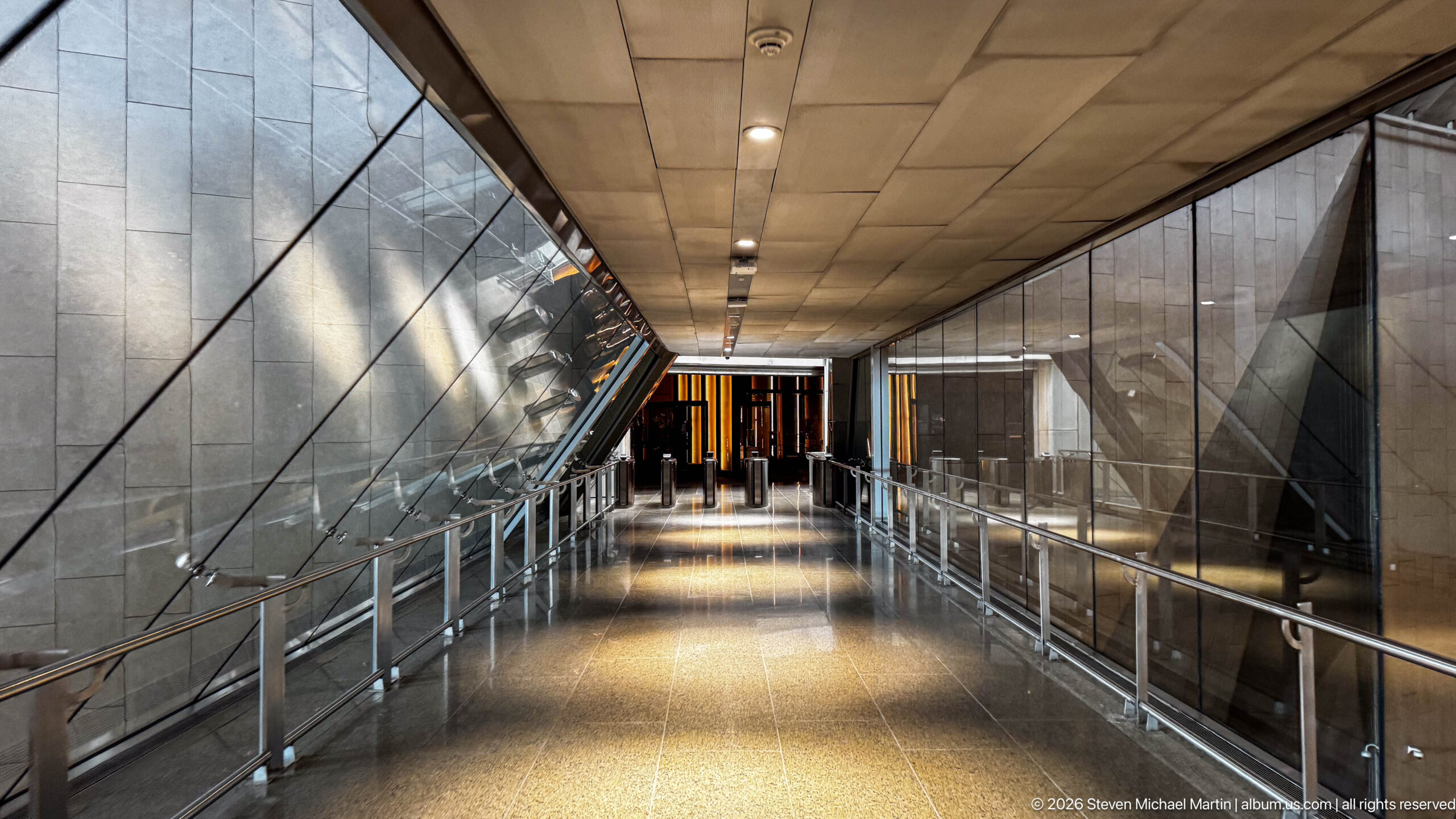
A long interior passage stretches toward a dark doorway, flanked by metal-and-glass balustrades and sharply angled stone-clad walls. Recessed ceiling lights form a straight rhythm overhead, while glazed surfaces on the right reflect the corridor geometry. The almost empty walkway emphasizes the museum's contemporary architecture and circulation design rather than its collection objects.
Caption
A long interior passage stretches toward a dark doorway, flanked by metal-and-glass balustrades and sharply angled stone-clad walls. Recessed ceiling lights form a straight rhythm overhead, while glazed surfaces on the right reflect the corridor geometry. The almost empty walkway emphasizes the museum's contemporary architecture and circulation design rather than its collection objects.
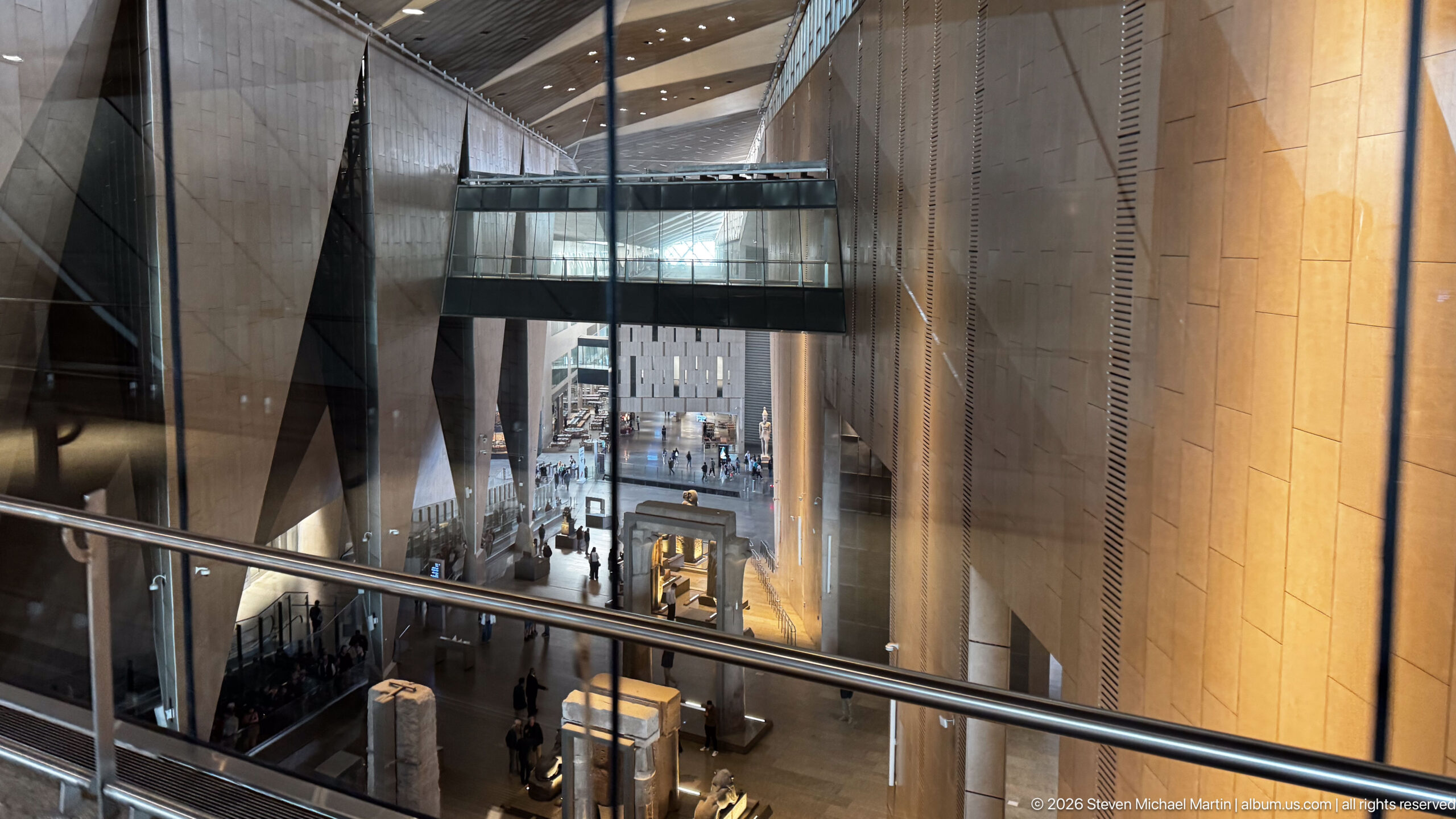
From an upper railing, the view drops into a tall interior void crossed by bridges and framed by monumental stone-clad walls. Slender structural columns rise from the lower floor, where visitors and display objects appear at a much smaller scale. Warm light on the vertical surfaces contrasts with darker passages and glazed openings, emphasizing the building's height and layered circulation.
Caption
From an upper railing, the view drops into a tall interior void crossed by bridges and framed by monumental stone-clad walls. Slender structural columns rise from the lower floor, where visitors and display objects appear at a much smaller scale. Warm light on the vertical surfaces contrasts with darker passages and glazed openings, emphasizing the building's height and layered circulation.
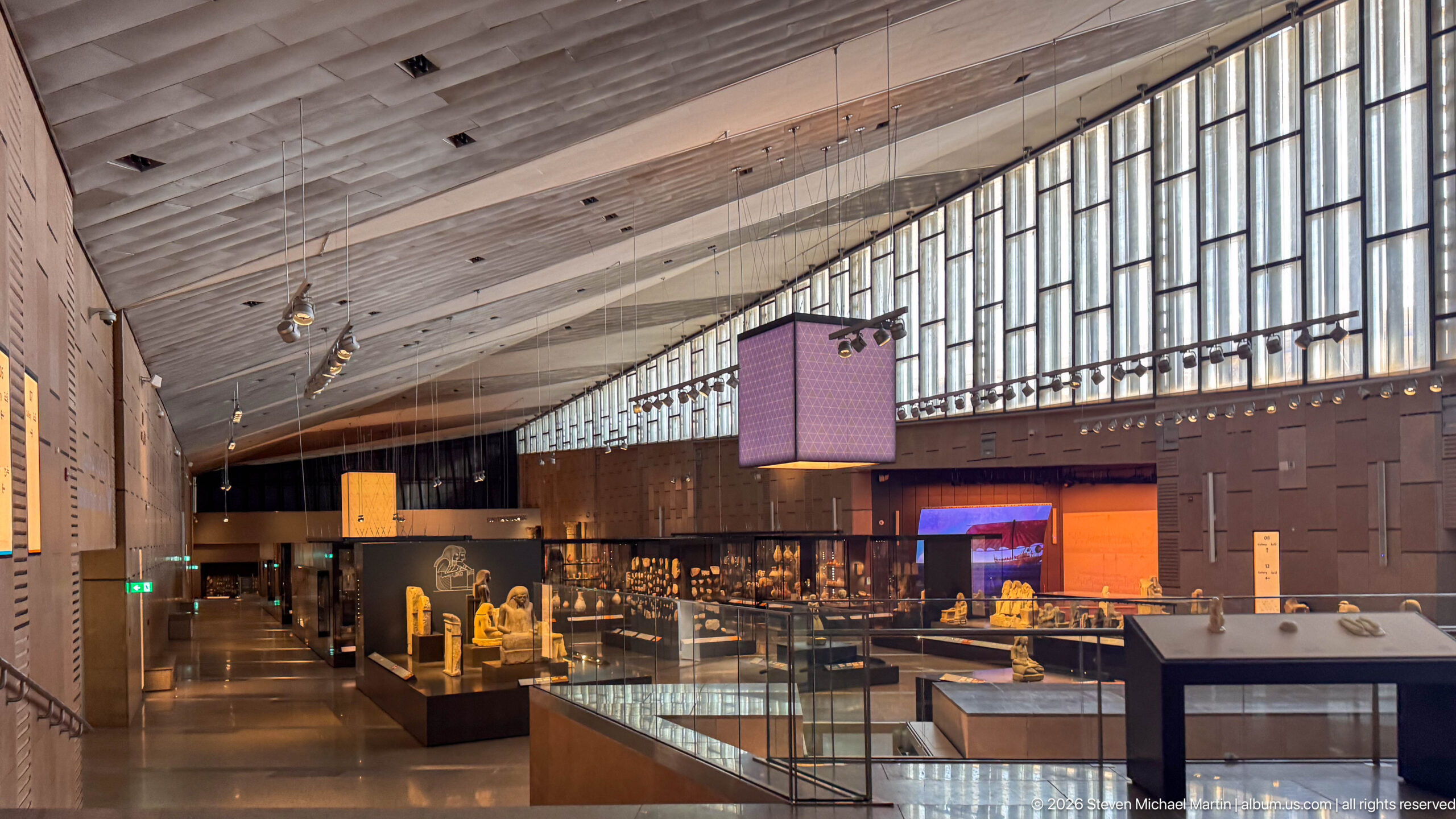
A wide gallery view reveals the scale of the Grand Egyptian Museum's exhibition hall, with a high ribbed ceiling, a long glazed clerestory, suspended digital screens, and rows of low vitrines extending across the floor. Stone and dark wall surfaces frame the open plan, while warm illuminated cases punctuate the otherwise subdued interior. The image functions as an establishing view of the Main Galleries.
Caption
A wide gallery view reveals the scale of the Grand Egyptian Museum's exhibition hall, with a high ribbed ceiling, a long glazed clerestory, suspended digital screens, and rows of low vitrines extending across the floor. Stone and dark wall surfaces frame the open plan, while warm illuminated cases punctuate the otherwise subdued interior. The image functions as an establishing view of the Main Galleries.
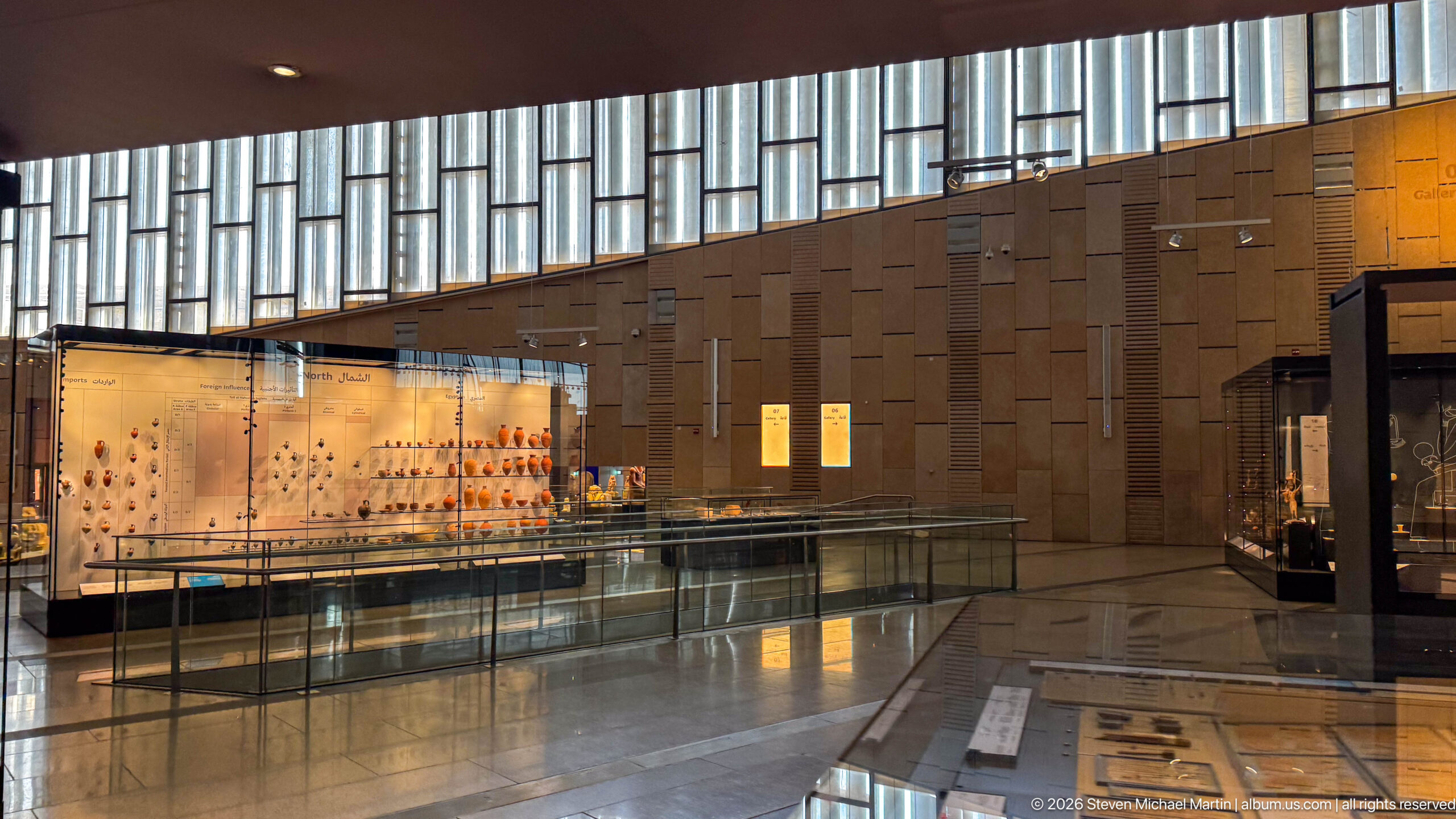
Curved metal and glass fixture arcs across a gallery in the Grand Egyptian Museum, likely serving as a contemporary display structure that frames ancient Egyptian works within a dramatic circular form.
Caption
Curved metal and glass fixture arcs across a gallery in the Grand Egyptian Museum, likely serving as a contemporary display structure that frames ancient Egyptian works within a dramatic circular form.
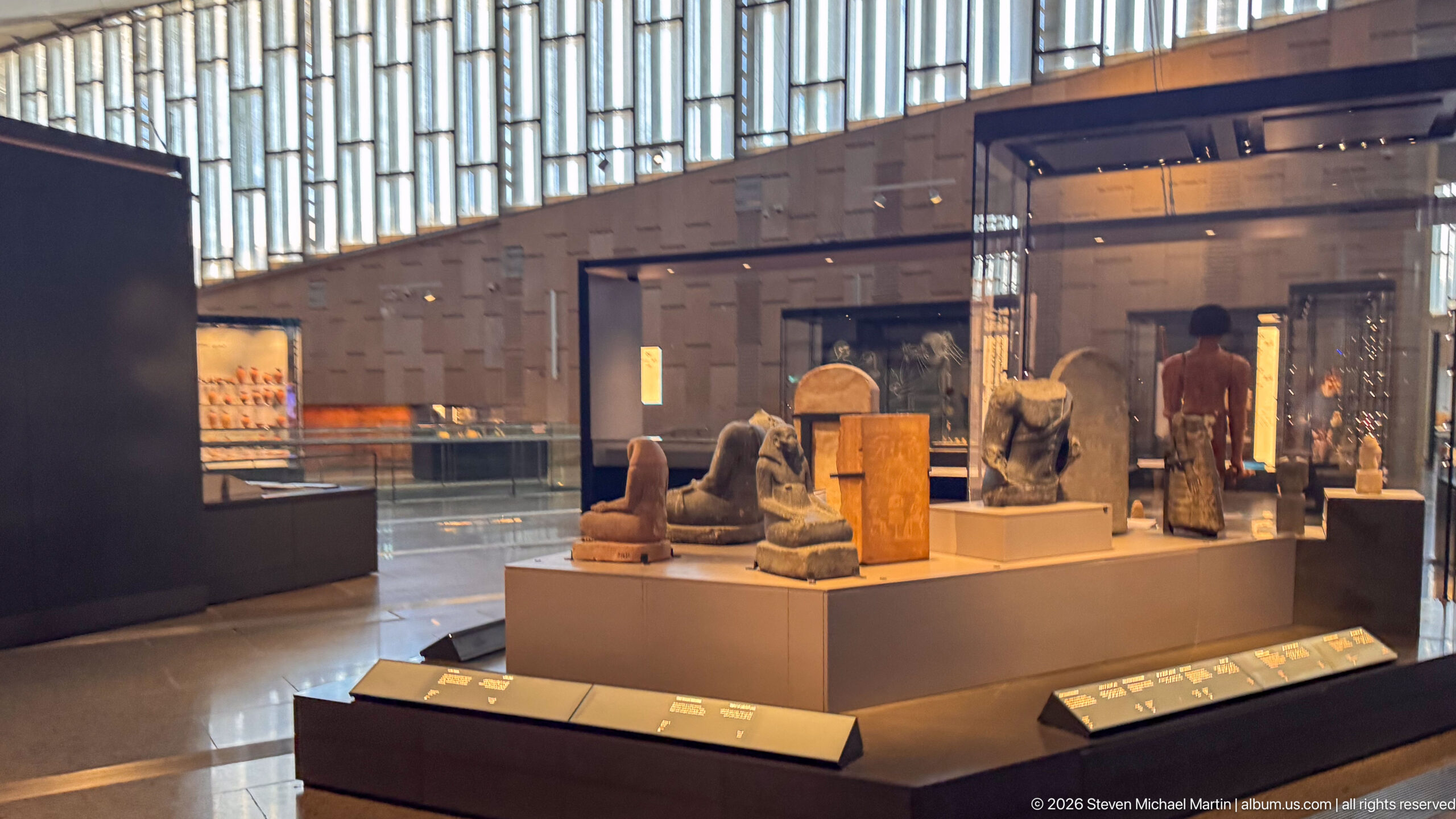
Case of gilded wood statuettes, likely depicting royal or divine figures from the New Kingdom and associated with the Tutankhamun treasure tradition, displayed in the Grand Egyptian Museum’s main collection.
Caption
Case of gilded wood statuettes, likely depicting royal or divine figures from the New Kingdom and associated with the Tutankhamun treasure tradition, displayed in the Grand Egyptian Museum’s main collection.
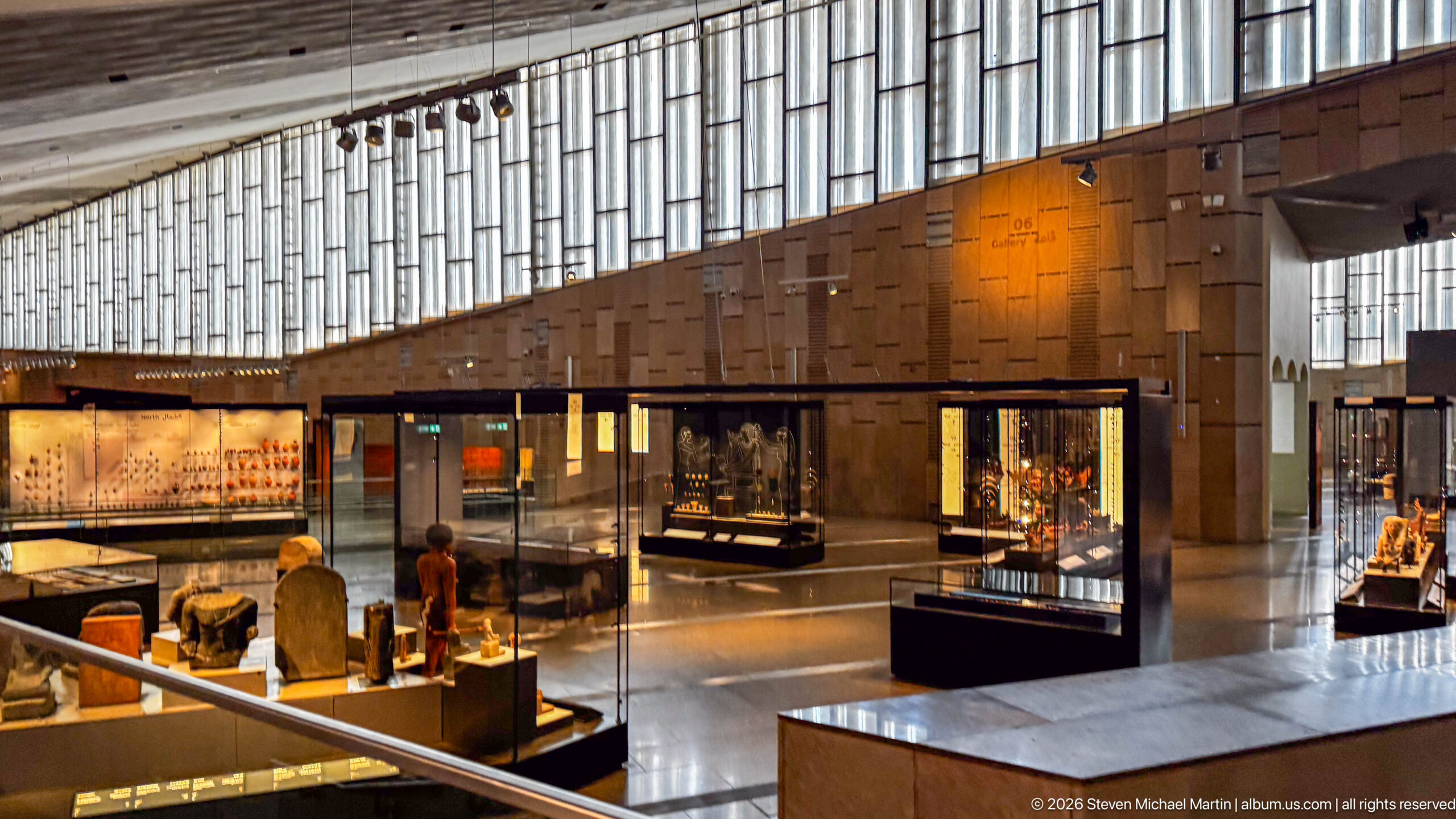
Main gallery of the Grand Egyptian Museum in Giza, where ancient Egyptian objects are displayed in sleek glass vitrines within a spacious contemporary stone and metal interior. The expansive circulation space and carefully framed sightlines highlight how modern museum architecture reinterprets the presentation of antiquities.
Caption
Main gallery of the Grand Egyptian Museum in Giza, where ancient Egyptian objects are displayed in sleek glass vitrines within a spacious contemporary stone and metal interior. The expansive circulation space and carefully framed sightlines highlight how modern museum architecture reinterprets the presentation of antiquities.
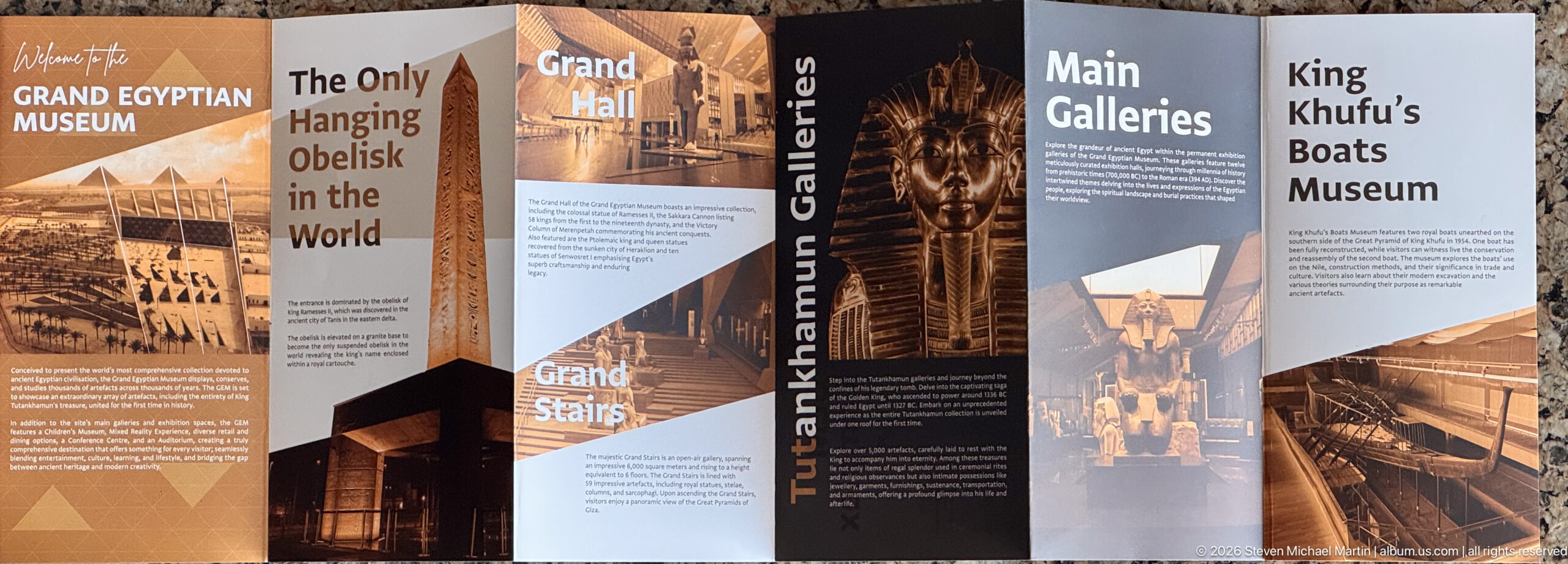
Upper-level view across the Grand Egyptian Museum’s main collection galleries, where broad escalators and soaring stone, glass, and metal surfaces frame the presentation of ancient Egyptian art within a striking contemporary architectural setting.
Caption
Upper-level view across the Grand Egyptian Museum’s main collection galleries, where broad escalators and soaring stone, glass, and metal surfaces frame the presentation of ancient Egyptian art within a striking contemporary architectural setting.
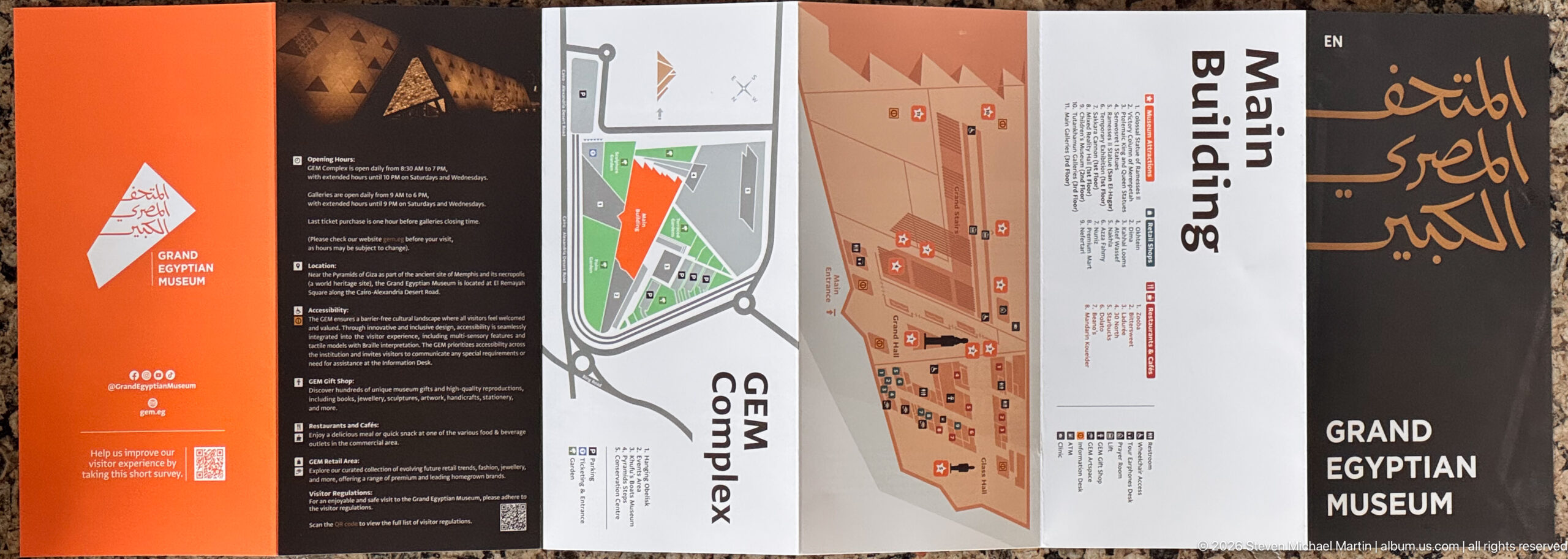
Gallery plan sign for the main collection at the Grand Egyptian Museum in Giza, a contemporary printed guide orienting visitors among galleries devoted to ancient Egyptian art and artifacts.
Caption
Gallery plan sign for the main collection at the Grand Egyptian Museum in Giza, a contemporary printed guide orienting visitors among galleries devoted to ancient Egyptian art and artifacts.
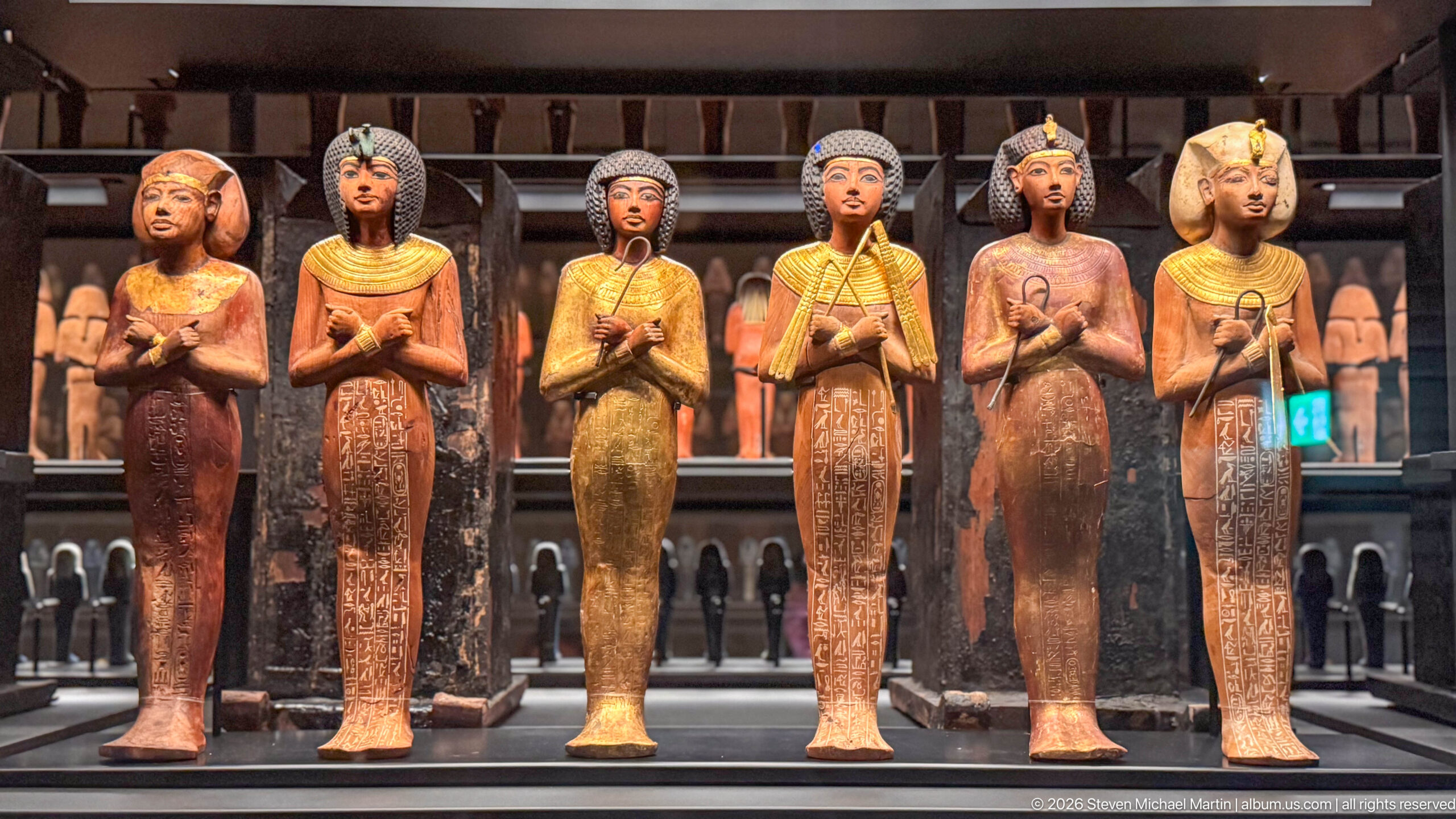
Rows of small mummiform shabti figures, likely from New Kingdom to Late Period Egypt, stand in ordered ranks, their faience, wood, and stone forms evoking the servants who would magically perform labor for the deceased in the afterlife.
Caption
Rows of small mummiform shabti figures, likely from New Kingdom to Late Period Egypt, stand in ordered ranks, their faience, wood, and stone forms evoking the servants who would magically perform labor for the deceased in the afterlife.