Tahuayo River – Peru
The winding waters of the Tahuayo River flow through dense rainforest before joining the great Amazon River in northeastern Peru. The river forms part of the Tamshiyacu-Tahuayo Regional Conservation Area, a protected region known for its remarkable biodiversity.
Small boats navigate the quiet channels of the river, passing beneath towering trees and thick jungle vegetation. Along the riverbanks visitors may encounter monkeys, tropical birds, reptiles, and countless other species that inhabit the rainforest canopy and waterways.
The Tahuayo River offers an intimate glimpse into the living ecosystems of the Amazon rainforest.
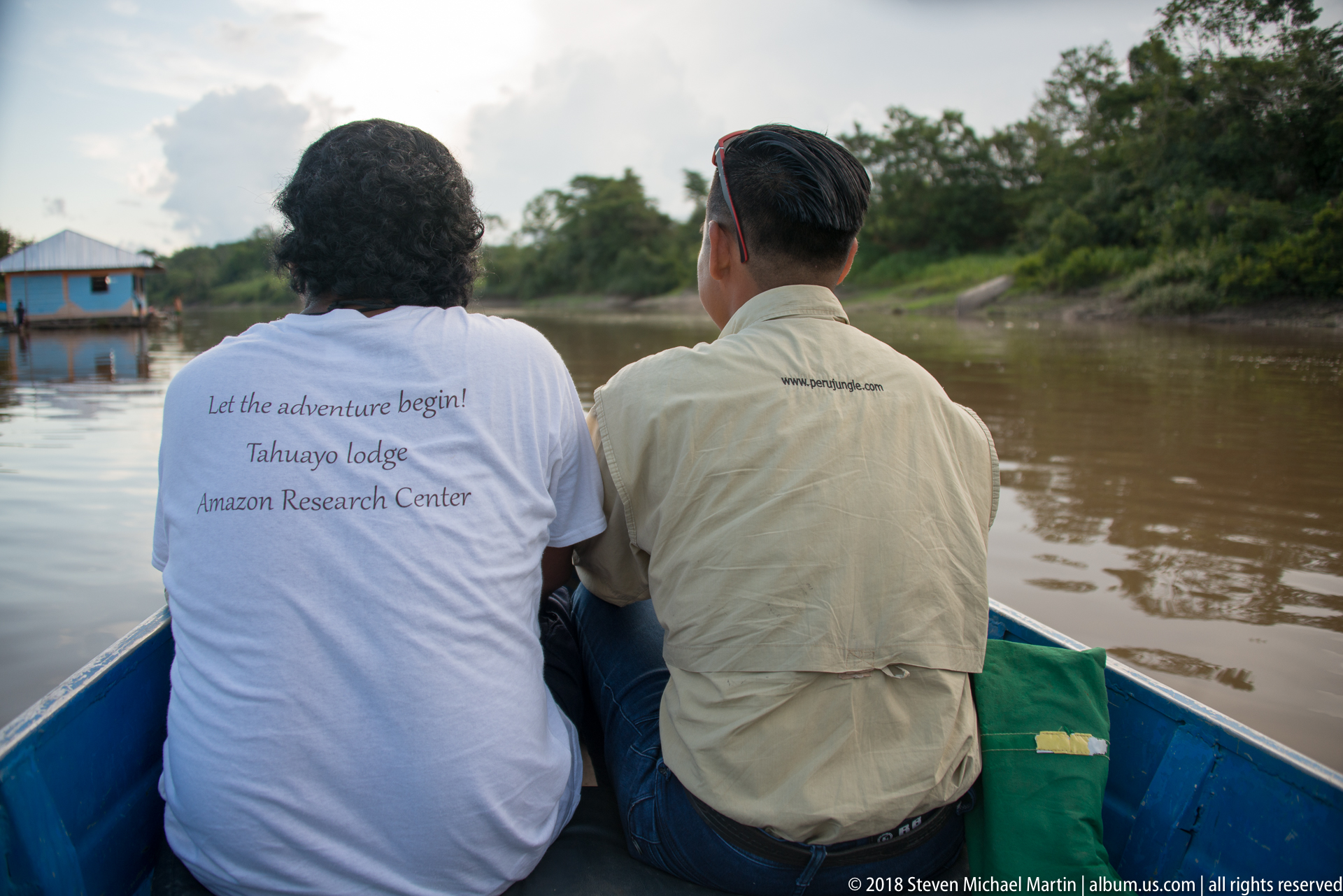
Two passengers sit at the bow of a blue boat as it moves along the broad brown channel of the Tuhauyo River. Seen from behind, they face the approaching bend and forested banks; lettering on one shirt references the Tahuayo Lodge and Amazon Research Center. The composition places the viewer inside the journey, using the boat’s gunwales to frame the river corridor ahead.
Caption
Two passengers sit at the bow of a blue boat as it moves along the broad brown channel of the Tuhauyo River. Seen from behind, they face the approaching bend and forested banks; lettering on one shirt references the Tahuayo Lodge and Amazon Research Center. The composition places the viewer inside the journey, using the boat’s gunwales to frame the river corridor ahead.
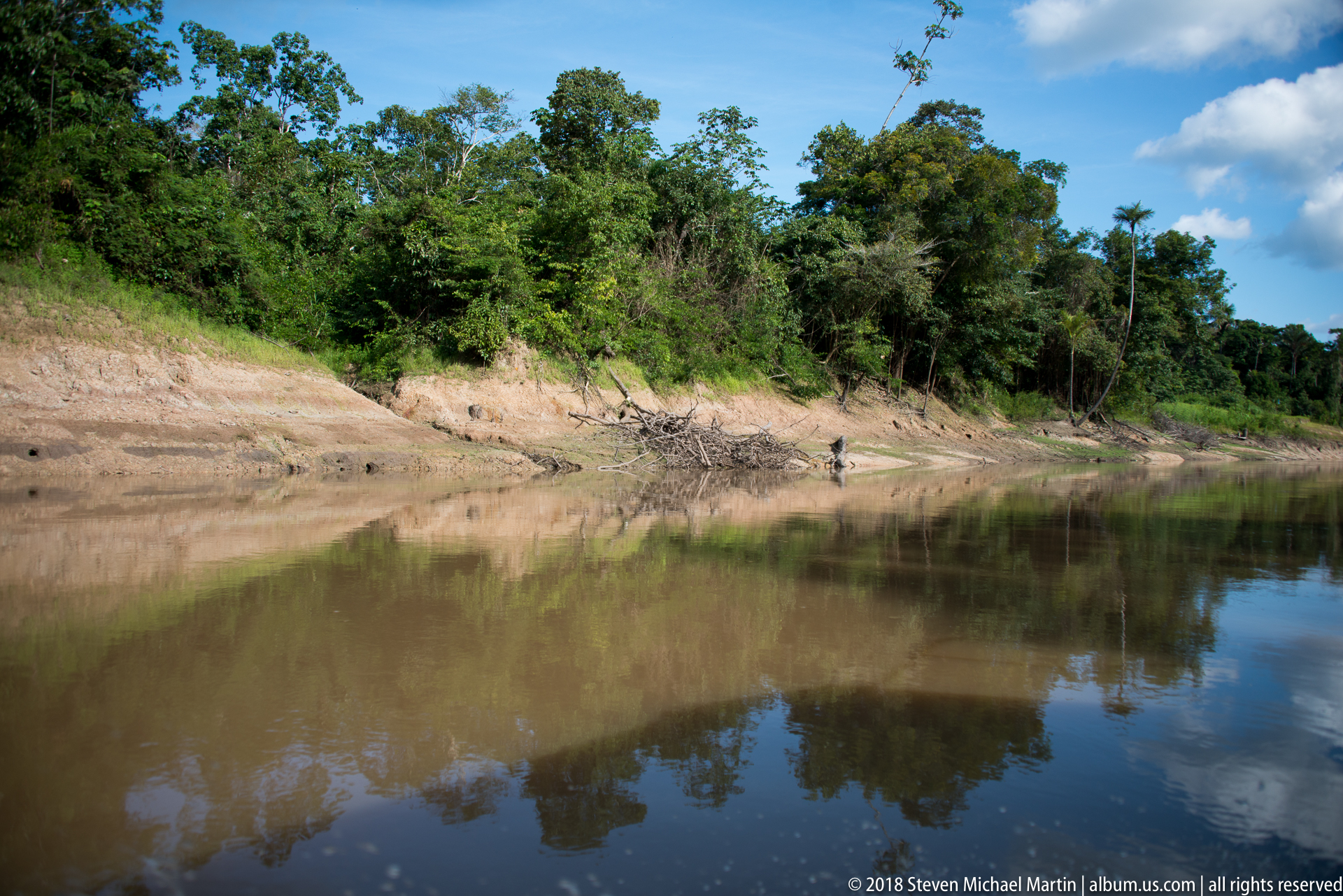
The Tuhauyo River curves past a broad exposed bank topped by dense tropical forest, its still brown water reflecting trees and blue sky. Erosion lines and bare sediment mark the slope between the current water level and vegetation above. With no nearby boats or buildings dominating the frame, this view serves as an environmental portrait of the river channel and its seasonally changing margin.
Caption
The Tuhauyo River curves past a broad exposed bank topped by dense tropical forest, its still brown water reflecting trees and blue sky. Erosion lines and bare sediment mark the slope between the current water level and vegetation above. With no nearby boats or buildings dominating the frame, this view serves as an environmental portrait of the river channel and its seasonally changing margin.
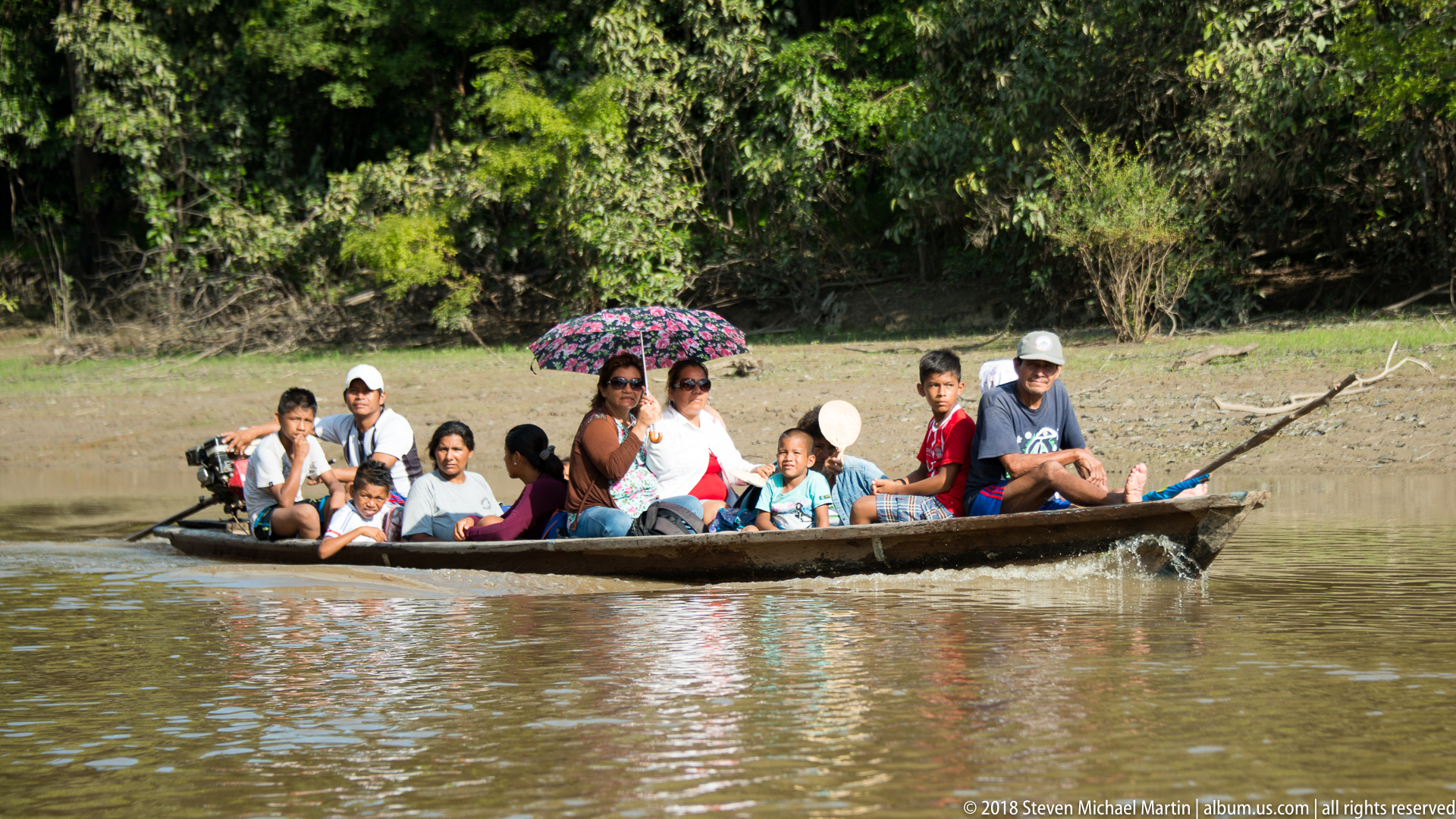
A long wooden boat carries a closely seated group of adults and children along the Tuhauyo River. One passenger holds a patterned umbrella for shade while another at the stern appears to manage the motor or steering. The low freeboard and tightly arranged passengers show the carrying capacity of a slender local craft, while the exposed bank and forest place the journey firmly within the riverine landscape.
Caption
A long wooden boat carries a closely seated group of adults and children along the Tuhauyo River. One passenger holds a patterned umbrella for shade while another at the stern appears to manage the motor or steering. The low freeboard and tightly arranged passengers show the carrying capacity of a slender local craft, while the exposed bank and forest place the journey firmly within the riverine landscape.

Flying just above the Tuhauyo River, a great egret stretches its broad white wings nearly level with the water while keeping the long neck folded and the yellow bill pointed forward. The bird passes a bare, eroded bank, and its reflection breaks across the brown surface below, emphasizing the low, direct flight typical of a heron moving along a river channel.
Caption
Flying just above the Tuhauyo River, a great egret stretches its broad white wings nearly level with the water while keeping the long neck folded and the yellow bill pointed forward. The bird passes a bare, eroded bank, and its reflection breaks across the brown surface below, emphasizing the low, direct flight typical of a heron moving along a river channel.
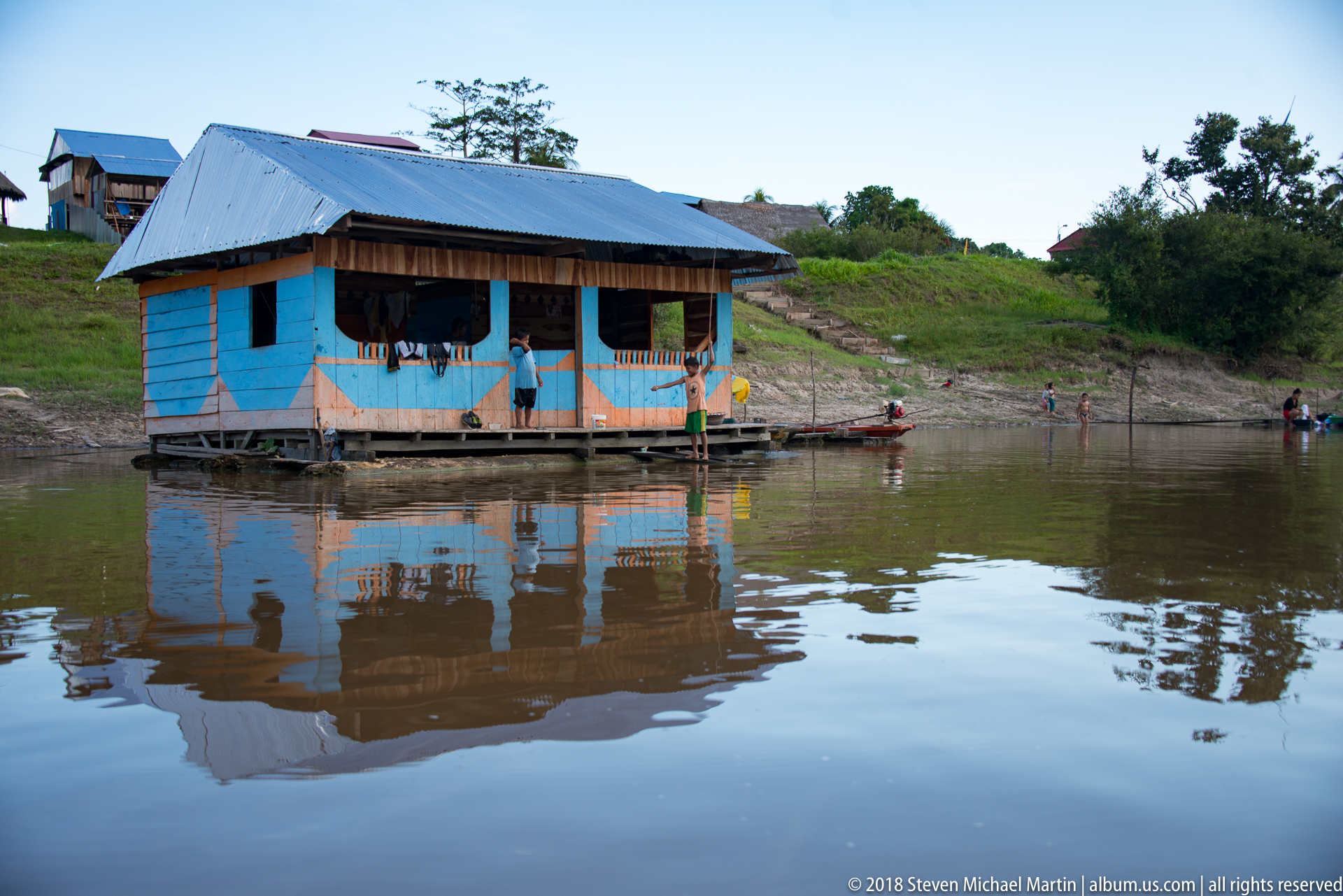
A blue-painted timber house stands on a floating platform close to the muddy bank of the Tuhauyo River. Its corrugated metal roof, open porch, orange trim, and reflection create a strong geometric contrast with the irregular shoreline. People occupy the porch and nearby boats, linking the dwelling directly to river transport and daily activity along this Amazonian waterway.
Caption
A blue-painted timber house stands on a floating platform close to the muddy bank of the Tuhauyo River. Its corrugated metal roof, open porch, orange trim, and reflection create a strong geometric contrast with the irregular shoreline. People occupy the porch and nearby boats, linking the dwelling directly to river transport and daily activity along this Amazonian waterway.
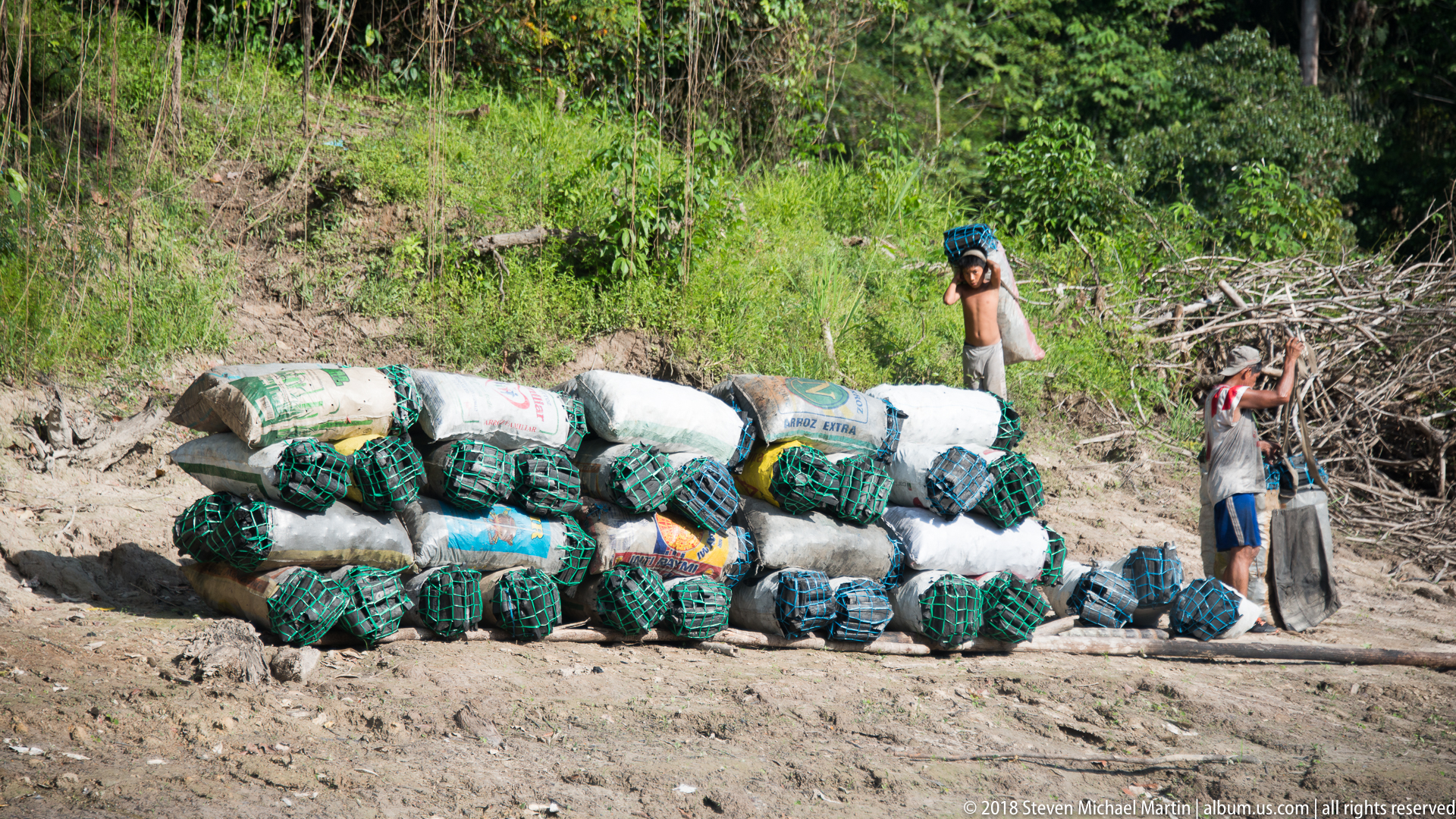
Large sacks and bundled goods are stacked on the exposed riverbank while two people stand nearby, suggesting cargo awaiting transfer between shore and boat. Green netting or ties secure many of the rounded bundles, and the pale bags form a substantial pile against the forested slope. The scene documents the logistical role of river landings, where supplies must be handled directly at the muddy edge of the channel.
Caption
Large sacks and bundled goods are stacked on the exposed riverbank while two people stand nearby, suggesting cargo awaiting transfer between shore and boat. Green netting or ties secure many of the rounded bundles, and the pale bags form a substantial pile against the forested slope. The scene documents the logistical role of river landings, where supplies must be handled directly at the muddy edge of the channel.

A small canoe rests against the muddy Tuhauyo River bank as one woman works a machete on a fallen branch at the waterline and another stands higher on the slope. The wider composition connects the cutting activity to river transport, with exposed sediment, cut or fallen wood, and tall grasses marking a low-water shoreline of the Amazon floodplain.
Caption
A small canoe rests against the muddy Tuhauyo River bank as one woman works a machete on a fallen branch at the waterline and another stands higher on the slope. The wider composition connects the cutting activity to river transport, with exposed sediment, cut or fallen wood, and tall grasses marking a low-water shoreline of the Amazon floodplain.

A great egret stands at the edge of the Tuhauyo River where shallow water meets an exposed, eroded mud bank. Its clean white plumage, long yellow bill, elongated neck, and dark legs are sharply visible in profile. The still posture contrasts with the flight views in the preceding sequence and shows the species using a quiet shoreline foraging zone.
Caption
A great egret stands at the edge of the Tuhauyo River where shallow water meets an exposed, eroded mud bank. Its clean white plumage, long yellow bill, elongated neck, and dark legs are sharply visible in profile. The still posture contrasts with the flight views in the preceding sequence and shows the species using a quiet shoreline foraging zone.
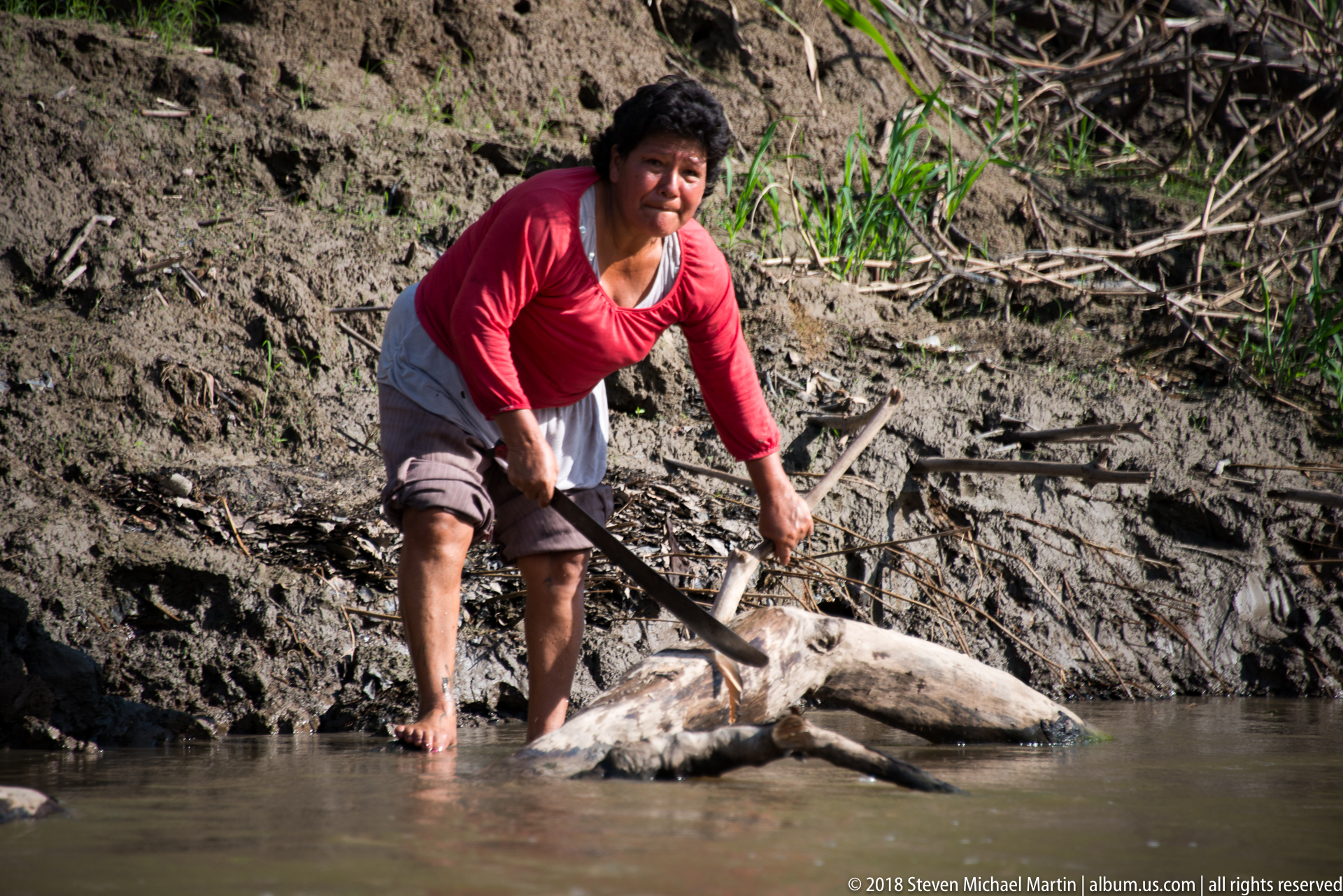
Standing barefoot in shallow brown water, a woman uses a machete against a pale, waterlogged branch lodged along the muddy Tuhauyo River bank. The close view isolates the physical task from the wider shoreline sequence, showing the long blade, submerged wood, and steep sediment bank with scattered sticks and new grass behind her.
Caption
Standing barefoot in shallow brown water, a woman uses a machete against a pale, waterlogged branch lodged along the muddy Tuhauyo River bank. The close view isolates the physical task from the wider shoreline sequence, showing the long blade, submerged wood, and steep sediment bank with scattered sticks and new grass behind her.

A Great kiskadee passes in level flight with wings extended, its bright yellow underparts, brown upperwings, and contrasting black-and-white head pattern visible against dark riverbank foliage. Compared with the preceding upstroke frame, this photograph shows a flatter wing position and more streamlined body profile. The repeated sequence documents the bird’s flight mechanics as it moves along the Tuhauyo River corridor.
Caption
A Great kiskadee passes in level flight with wings extended, its bright yellow underparts, brown upperwings, and contrasting black-and-white head pattern visible against dark riverbank foliage. Compared with the preceding upstroke frame, this photograph shows a flatter wing position and more streamlined body profile. The repeated sequence documents the bird’s flight mechanics as it moves along the Tuhauyo River corridor.
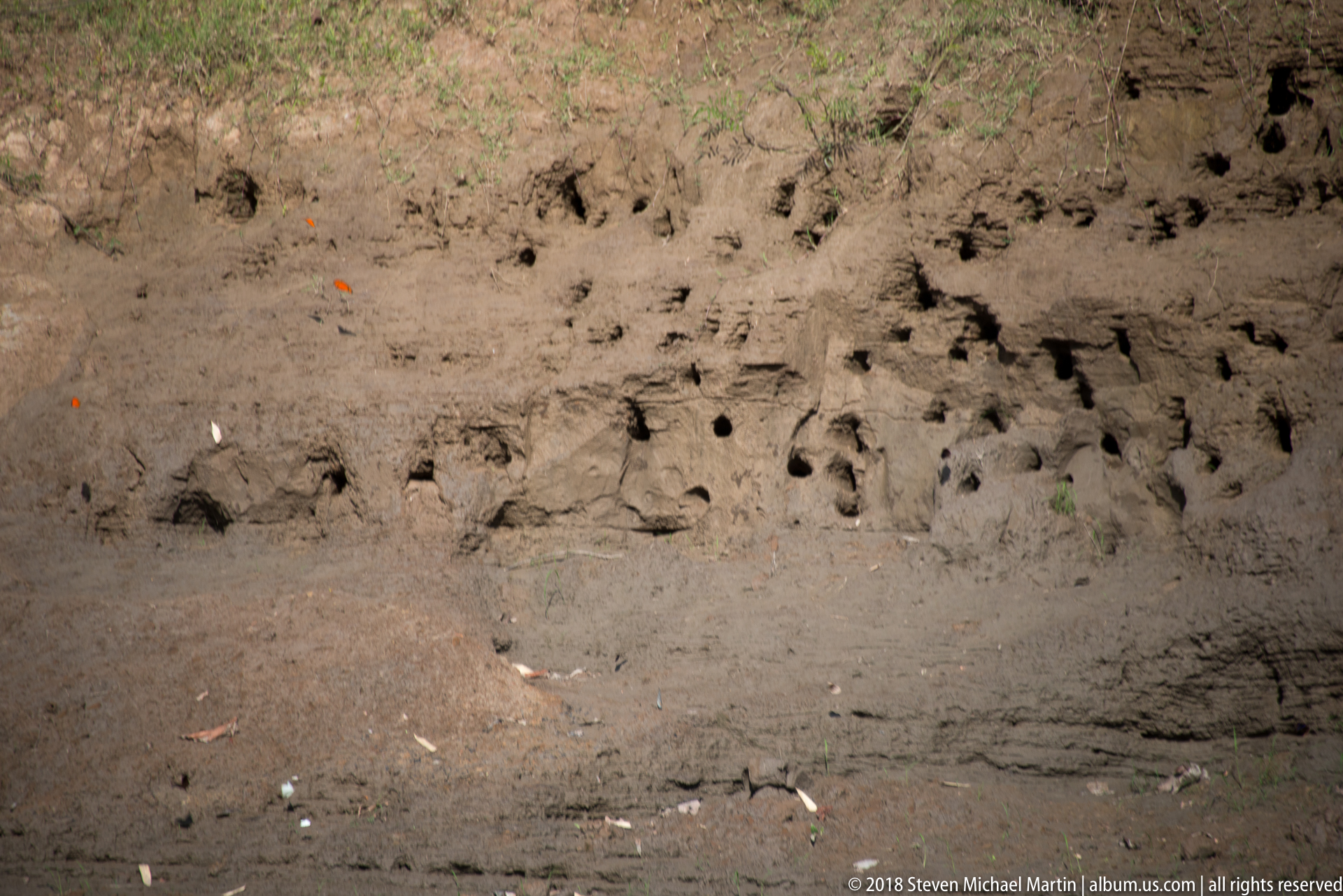
A steep muddy bank along the Tuhauyo River is punctured by numerous small cavities and irregular openings above the waterline. The exposed sediment records seasonal changes in river level and provides potential shelter or nesting sites for river-edge fauna. Scattered leaves and sparse vegetation emphasize the raw, recently exposed surface at the forest margin.
Caption
A steep muddy bank along the Tuhauyo River is punctured by numerous small cavities and irregular openings above the waterline. The exposed sediment records seasonal changes in river level and provides potential shelter or nesting sites for river-edge fauna. Scattered leaves and sparse vegetation emphasize the raw, recently exposed surface at the forest margin.
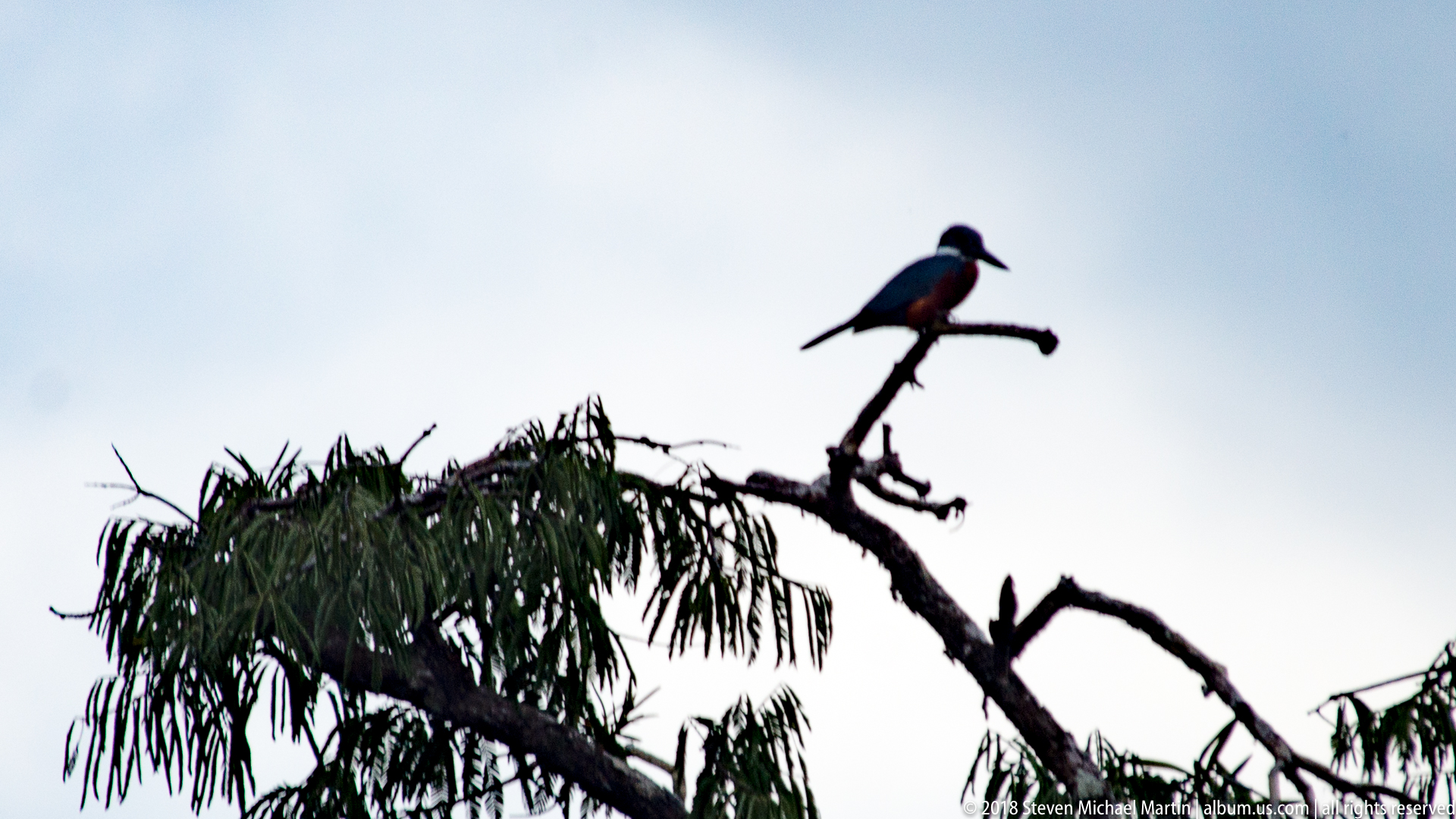
Backlighting reduces this perched kingfisher to a dark, graphic profile at the crown of a riverside tree. The oversized straight bill and upright posture remain unmistakable, while a patch of chestnut color survives on the body despite the bright sky. The elevated snag functions as a typical hunting vantage over open water along the Tuhauyo River.
Caption
Backlighting reduces this perched kingfisher to a dark, graphic profile at the crown of a riverside tree. The oversized straight bill and upright posture remain unmistakable, while a patch of chestnut color survives on the body despite the bright sky. The elevated snag functions as a typical hunting vantage over open water along the Tuhauyo River.

A large kingfisher holds an exposed lookout at the tip of a dead branch above the Tuhauyo River forest. Its long heavy bill, dark bluish head and back, white neck marking, and rich chestnut underparts are consistent with a ringed kingfisher, a conspicuous fishing bird of Amazonian waterways. The open perch gives the bird a clear view of water below.
Caption
A large kingfisher holds an exposed lookout at the tip of a dead branch above the Tuhauyo River forest. Its long heavy bill, dark bluish head and back, white neck marking, and rich chestnut underparts are consistent with a ringed kingfisher, a conspicuous fishing bird of Amazonian waterways. The open perch gives the bird a clear view of water below.

A chestnut-bodied raptor with a pale head watches from a leafy riverside perch. The contrasting white head, dark facial and throat markings, rufous body, and broad hawk-like build are consistent with a black-collared hawk, a species closely associated with tropical wetlands and forested waterways. The surrounding branches partly screen the bird while preserving a direct view of its alert posture.
Caption
A chestnut-bodied raptor with a pale head watches from a leafy riverside perch. The contrasting white head, dark facial and throat markings, rufous body, and broad hawk-like build are consistent with a black-collared hawk, a species closely associated with tropical wetlands and forested waterways. The surrounding branches partly screen the bird while preserving a direct view of its alert posture.
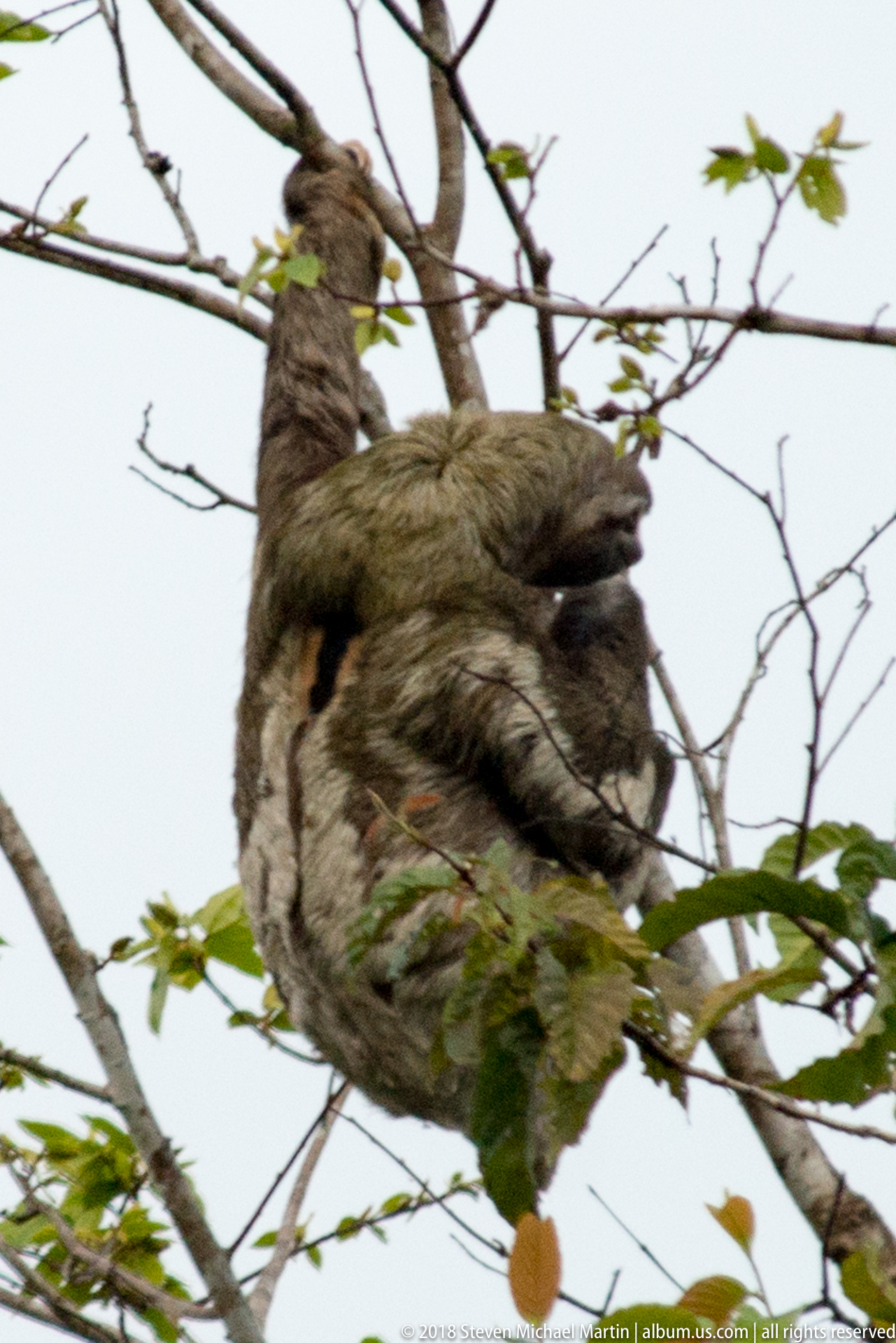
Suspended beneath a network of branches, a sloth curls its heavy body around the supports with all four limbs engaged. Its shaggy, mottled coat closely matches the muted bark and lichen tones of the canopy. This side view emphasizes the animal’s compact resting posture and powerful hook-like grip rather than the face, which remains largely hidden.
Caption
Suspended beneath a network of branches, a sloth curls its heavy body around the supports with all four limbs engaged. Its shaggy, mottled coat closely matches the muted bark and lichen tones of the canopy. This side view emphasizes the animal’s compact resting posture and powerful hook-like grip rather than the face, which remains largely hidden.
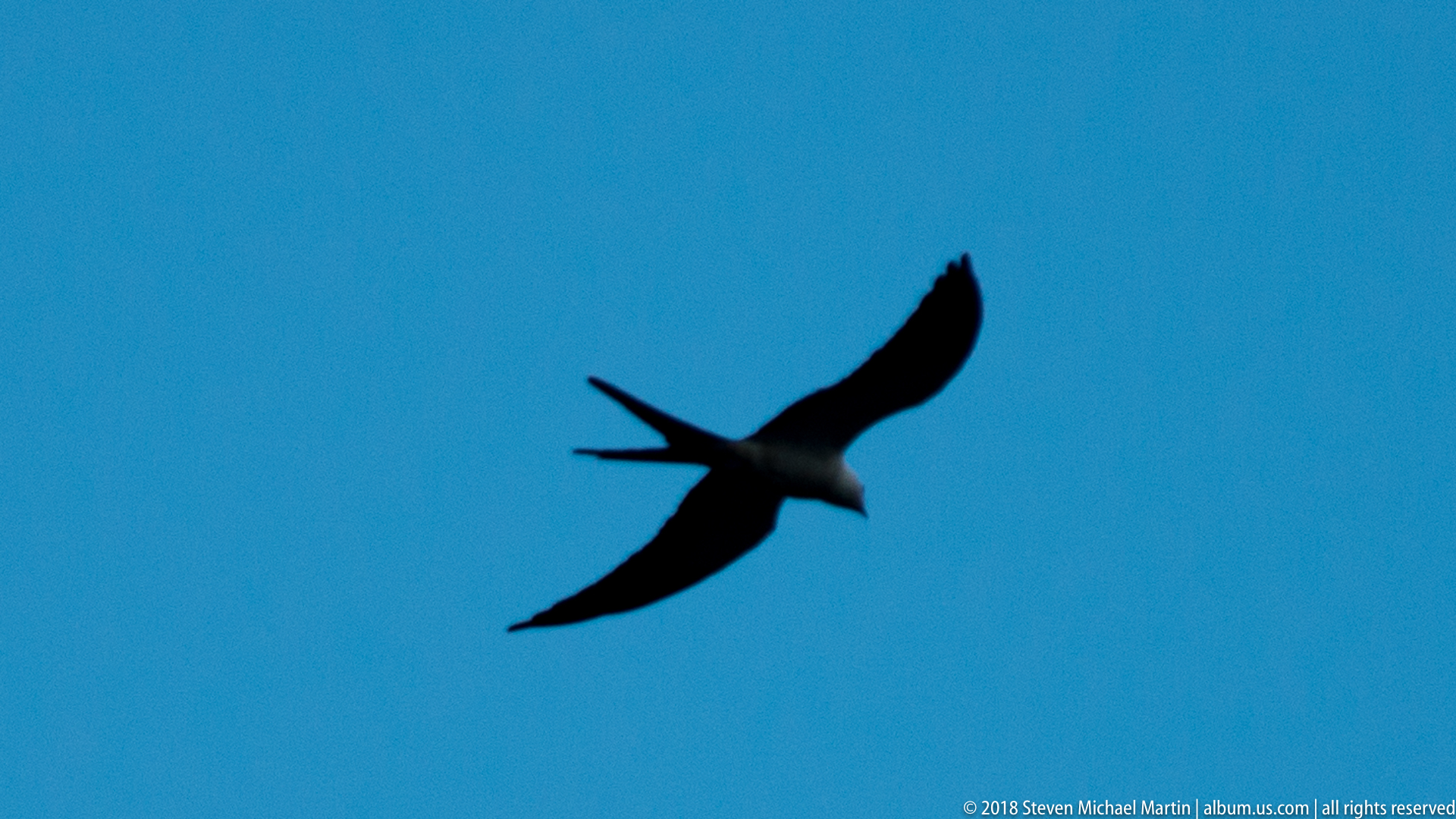
A deeply forked tail and long, swept wings define this raptor as it crosses a clear blue sky above the Tuhauyo River. The streamlined silhouette is characteristic of an aerial hunter adapted to sustained, agile flight over forest and waterways. With plumage detail lost in silhouette, the photograph is strongest as a study of flight form rather than color or markings.
Caption
A deeply forked tail and long, swept wings define this raptor as it crosses a clear blue sky above the Tuhauyo River. The streamlined silhouette is characteristic of an aerial hunter adapted to sustained, agile flight over forest and waterways. With plumage detail lost in silhouette, the photograph is strongest as a study of flight form rather than color or markings.
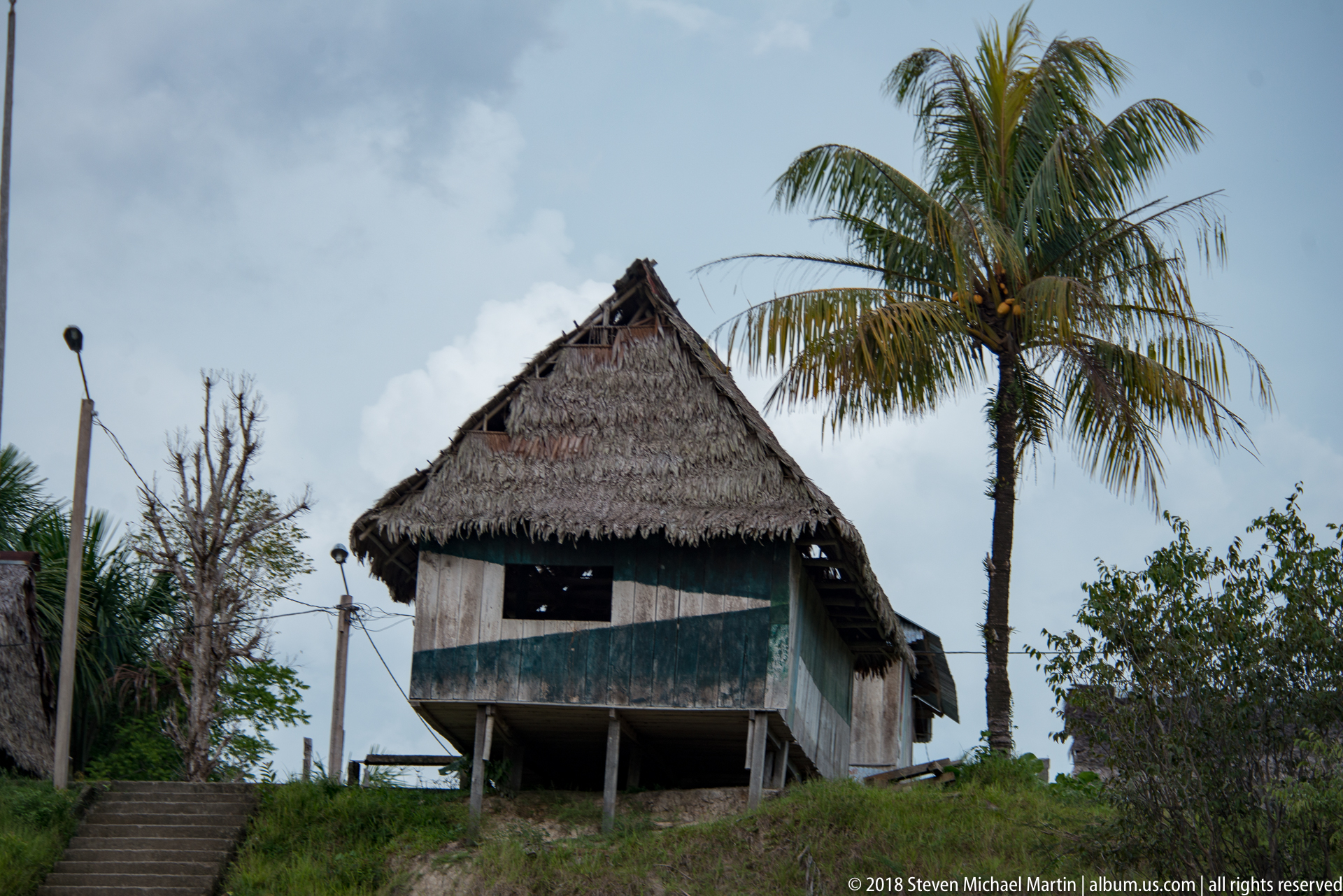
A modest raised house stands on the riverbank beneath a steep palm-thatch roof, its open upper level facing the water. Timber posts lift the structure above the sloping ground, while a coconut palm and surrounding vegetation place the dwelling firmly within the humid lowland landscape. The view records vernacular adaptation to a riverine Amazonian setting along the Tuhauyo.
Caption
A modest raised house stands on the riverbank beneath a steep palm-thatch roof, its open upper level facing the water. Timber posts lift the structure above the sloping ground, while a coconut palm and surrounding vegetation place the dwelling firmly within the humid lowland landscape. The view records vernacular adaptation to a riverine Amazonian setting along the Tuhauyo.
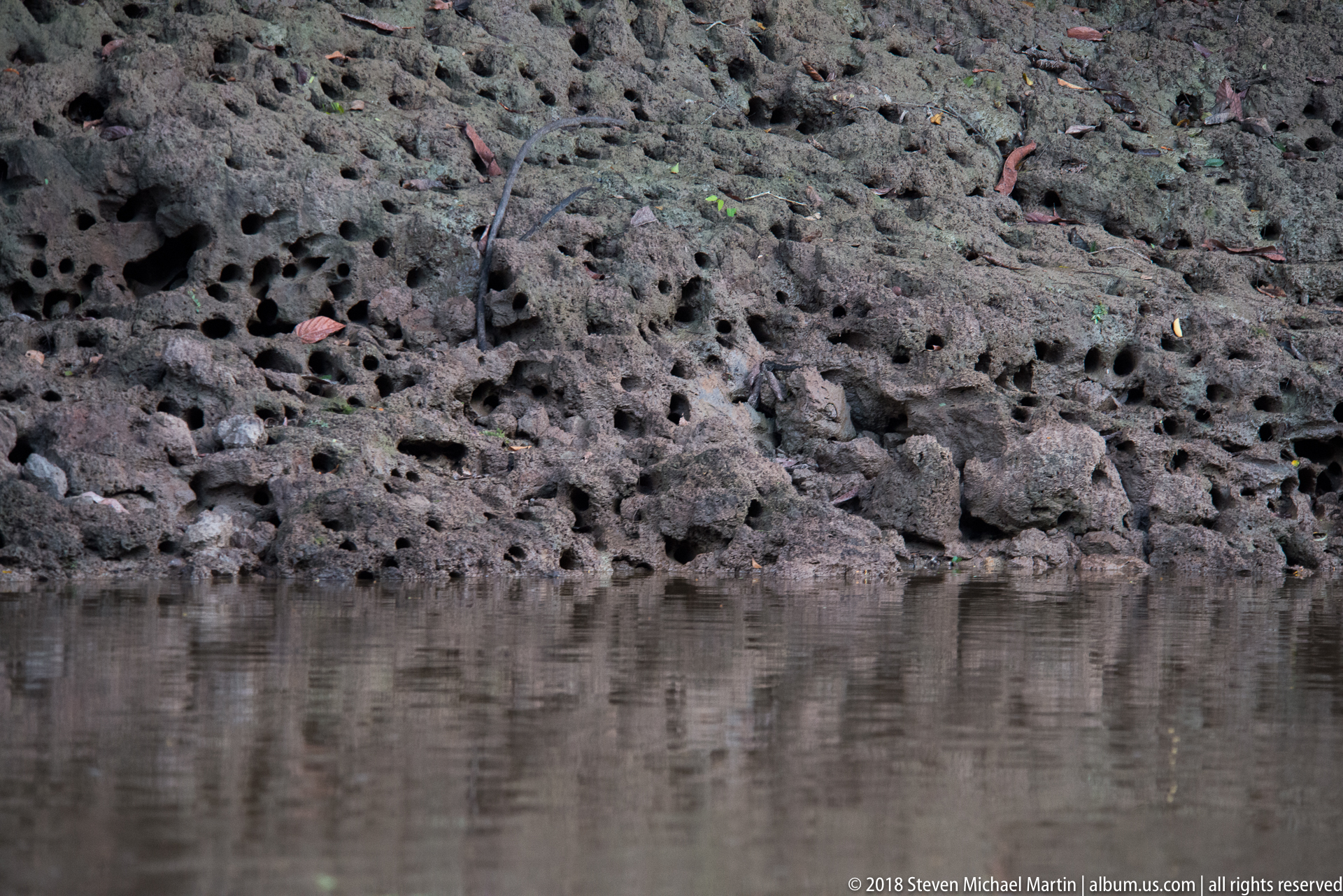
Hundreds of holes and shallow recesses texture a low, exposed bank directly above the Tuhauyo River. Reflections in the still brown water repeat the bank’s broken surface, while a few roots and scattered leaves mark the transition to forest vegetation above. The dense perforation suggests intensive use or erosion, but the photograph alone does not establish what formed the openings.
Caption
Hundreds of holes and shallow recesses texture a low, exposed bank directly above the Tuhauyo River. Reflections in the still brown water repeat the bank’s broken surface, while a few roots and scattered leaves mark the transition to forest vegetation above. The dense perforation suggests intensive use or erosion, but the photograph alone does not establish what formed the openings.

A broad strip of exposed riverbank is riddled with small dark openings beneath tangled roots and low vegetation. The cavities continue almost to the waterline, creating a conspicuous band between forest and river. This contextual view shows the scale of the perforated habitat more clearly than the preceding close view while leaving the origin of the holes unresolved.
Caption
A broad strip of exposed riverbank is riddled with small dark openings beneath tangled roots and low vegetation. The cavities continue almost to the waterline, creating a conspicuous band between forest and river. This contextual view shows the scale of the perforated habitat more clearly than the preceding close view while leaving the origin of the holes unresolved.
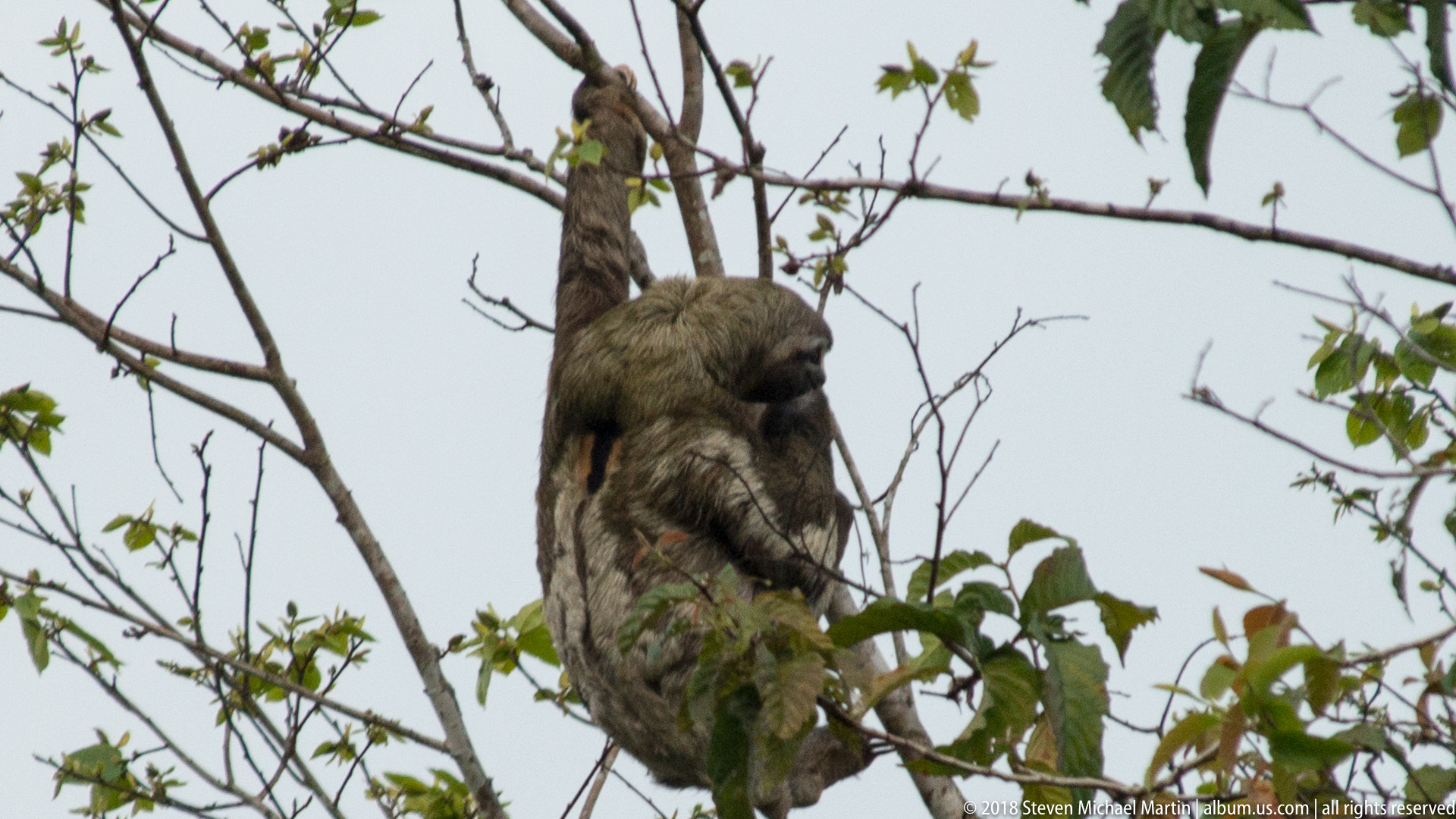
A sloth hangs close against a slender trunk high in the canopy, its coarse gray-brown coat blending with bark and branches. The animal’s long limbs and curved claws wrap securely around the support while its rounded body hangs below. The vertical posture offers a clear view of the specialized gripping anatomy that allows sloths to move and rest in Amazonian trees.
Caption
A sloth hangs close against a slender trunk high in the canopy, its coarse gray-brown coat blending with bark and branches. The animal’s long limbs and curved claws wrap securely around the support while its rounded body hangs below. The vertical posture offers a clear view of the specialized gripping anatomy that allows sloths to move and rest in Amazonian trees.
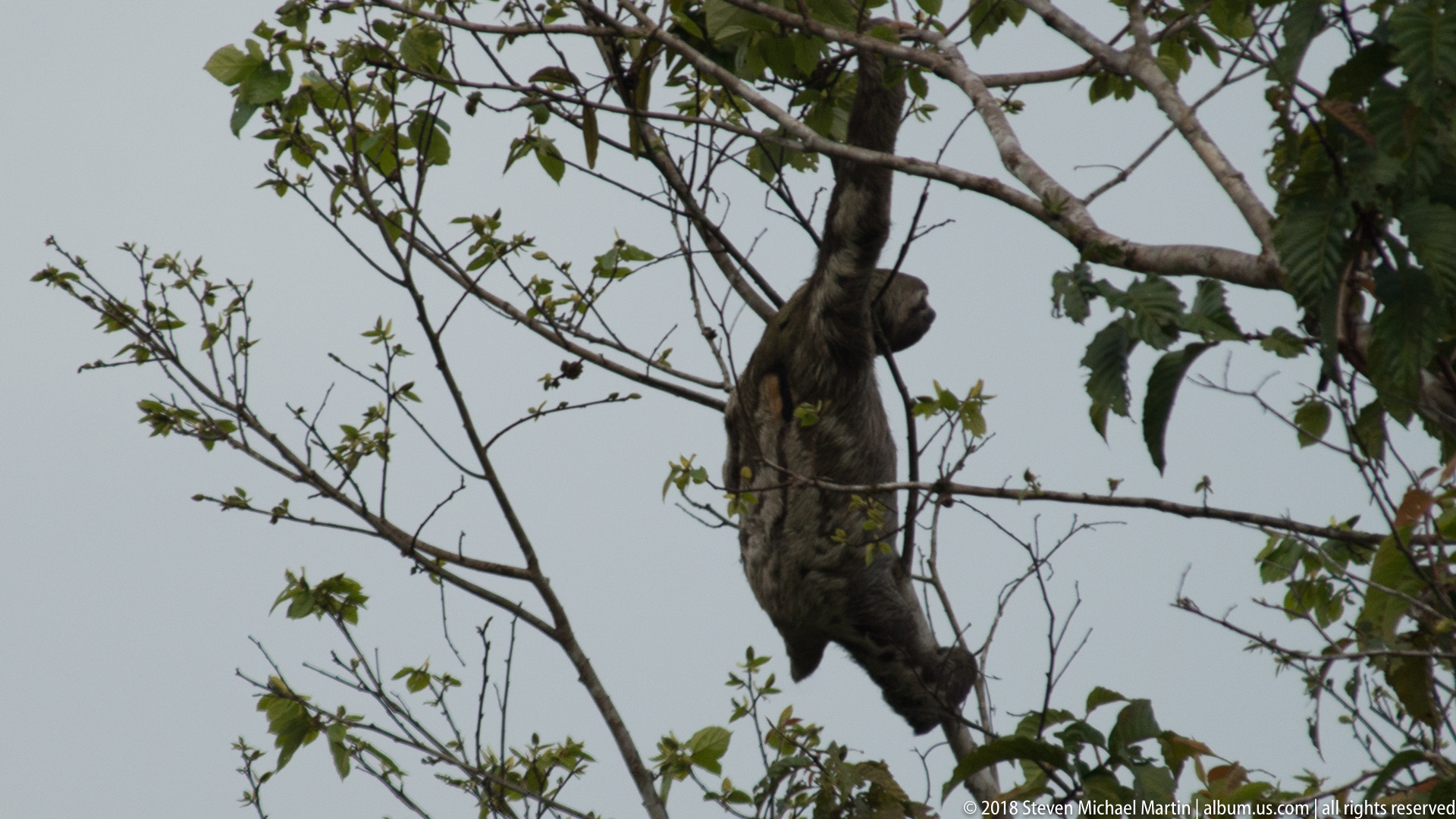
Seen at greater distance, a sloth hangs lengthwise beside a vertical trunk, its body forming a dark shaggy shape against the open sky. One forelimb reaches upward while the lower body drops below surrounding twigs. The unusual orientation documents the animal’s secure suspended movement through the riverside canopy and its reliance on strongly curved claws.
Caption
Seen at greater distance, a sloth hangs lengthwise beside a vertical trunk, its body forming a dark shaggy shape against the open sky. One forelimb reaches upward while the lower body drops below surrounding twigs. The unusual orientation documents the animal’s secure suspended movement through the riverside canopy and its reliance on strongly curved claws.
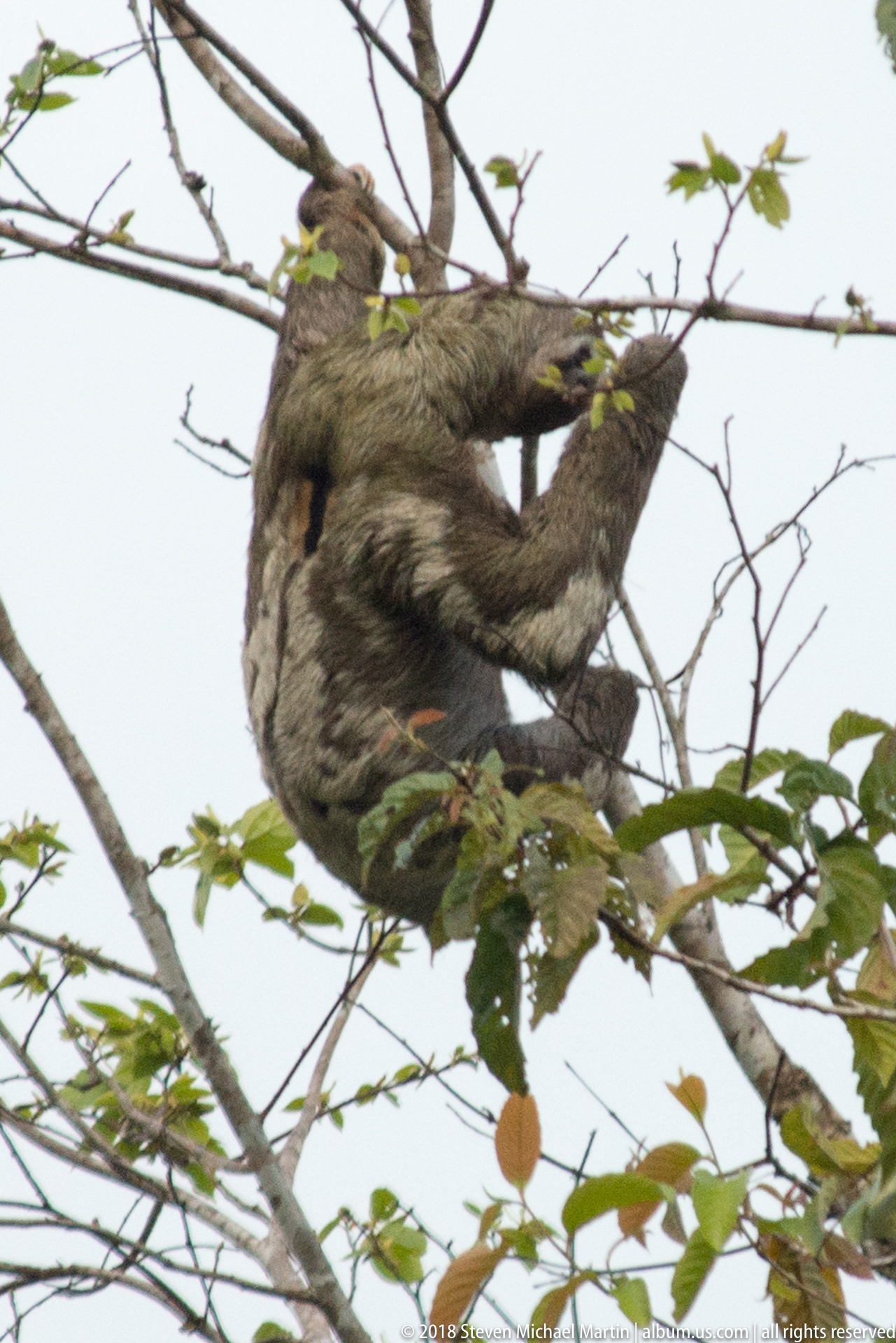
A sloth extends its body laterally through the canopy, reaching from one branch to another with long hooked limbs. The elongated posture contrasts with the curled resting views in adjacent frames and shows how the animal bridges gaps while remaining suspended. Leaves partially obscure the torso, but the coarse coat and deliberate climbing position remain prominent against the pale sky.
Caption
A sloth extends its body laterally through the canopy, reaching from one branch to another with long hooked limbs. The elongated posture contrasts with the curled resting views in adjacent frames and shows how the animal bridges gaps while remaining suspended. Leaves partially obscure the torso, but the coarse coat and deliberate climbing position remain prominent against the pale sky.
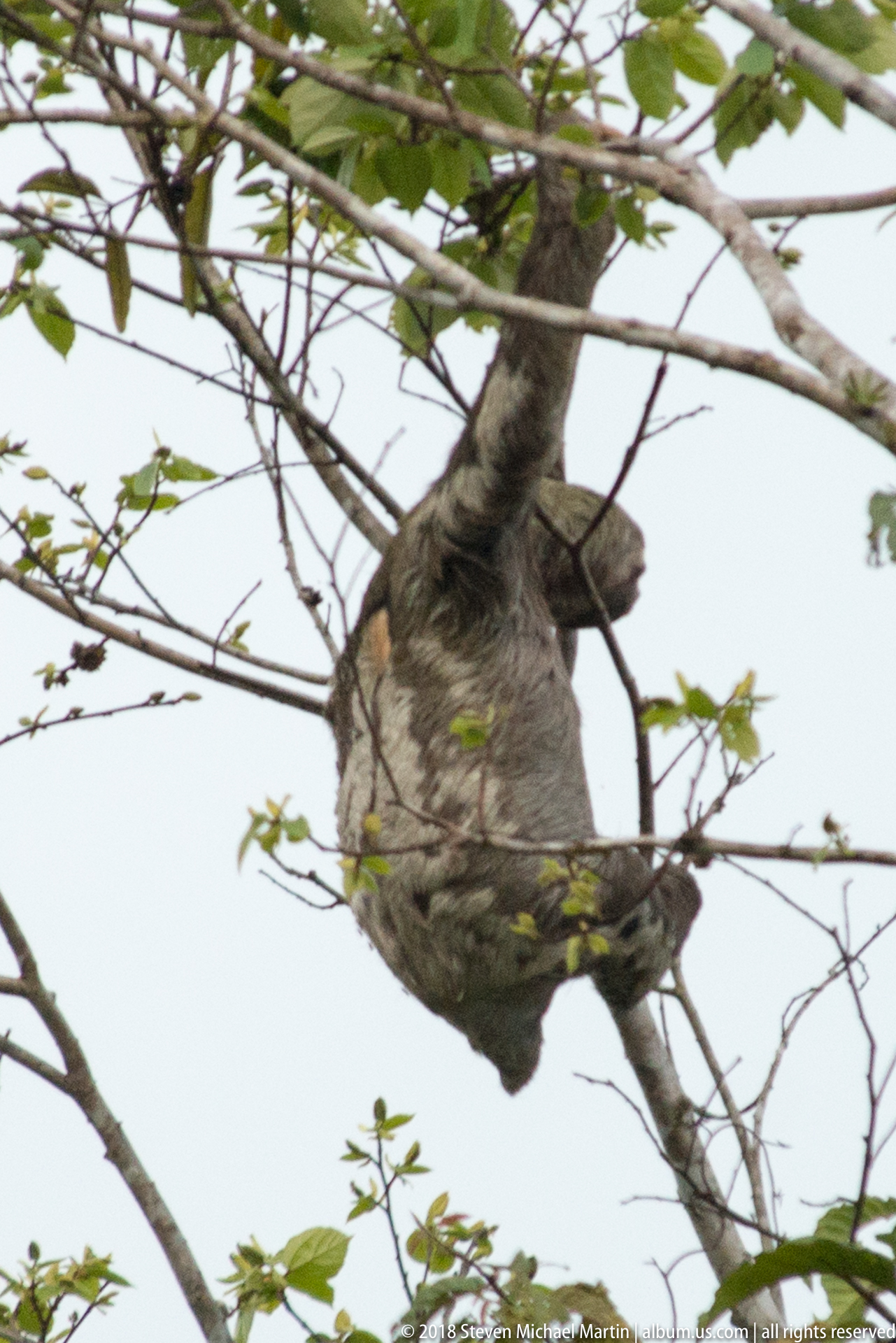
A sloth hangs beneath crossing branches with its rounded torso fully suspended and limbs hooked above. The pale gray-brown coat, darkened by mottling and shadow, merges with the branching canopy. This underside angle gives a particularly clear sense of the animal’s weight-bearing posture, with the body hanging freely while the claws maintain contact overhead.
Caption
A sloth hangs beneath crossing branches with its rounded torso fully suspended and limbs hooked above. The pale gray-brown coat, darkened by mottling and shadow, merges with the branching canopy. This underside angle gives a particularly clear sense of the animal’s weight-bearing posture, with the body hanging freely while the claws maintain contact overhead.
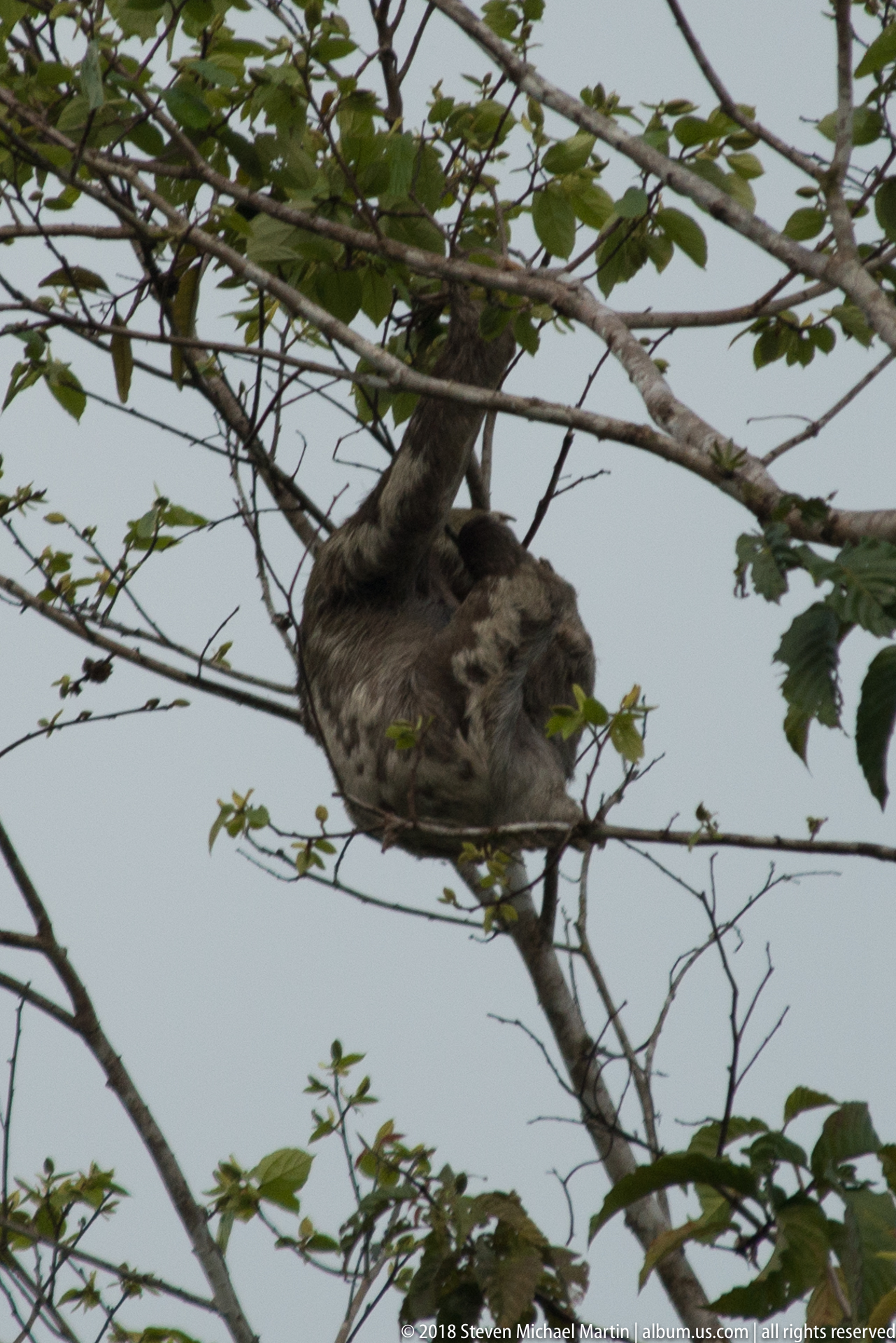
A sloth rests in a compact curl high among thin, sparsely leafed branches. Its long forelimb reaches upward to a support while the rounded torso hangs below, partly concealed by twigs. The distant view places the animal within the open upper canopy and shows how effectively its subdued gray-brown coat blends into branches against an overcast sky.
Caption
A sloth rests in a compact curl high among thin, sparsely leafed branches. Its long forelimb reaches upward to a support while the rounded torso hangs below, partly concealed by twigs. The distant view places the animal within the open upper canopy and shows how effectively its subdued gray-brown coat blends into branches against an overcast sky.
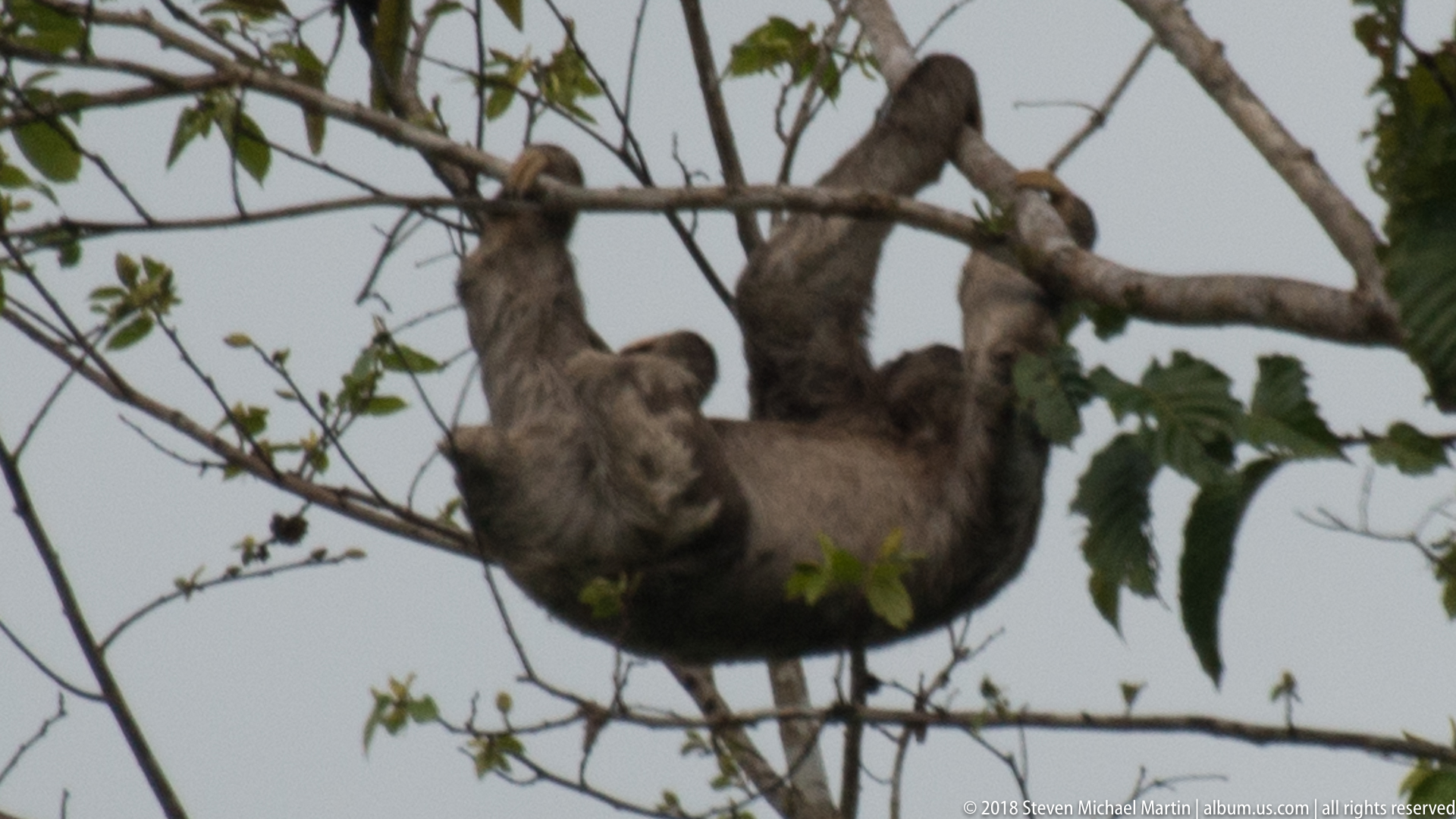
A broadside view reveals a sloth suspended beneath a sturdy horizontal branch, its long limbs bent upward and claws wrapped over the wood. The animal’s shaggy coat and bulky torso are unusually unobstructed, while the head remains turned away. The frame emphasizes the inverted mechanics of sloth locomotion and the secure multi-limb grip used in the canopy.
Caption
A broadside view reveals a sloth suspended beneath a sturdy horizontal branch, its long limbs bent upward and claws wrapped over the wood. The animal’s shaggy coat and bulky torso are unusually unobstructed, while the head remains turned away. The frame emphasizes the inverted mechanics of sloth locomotion and the secure multi-limb grip used in the canopy.
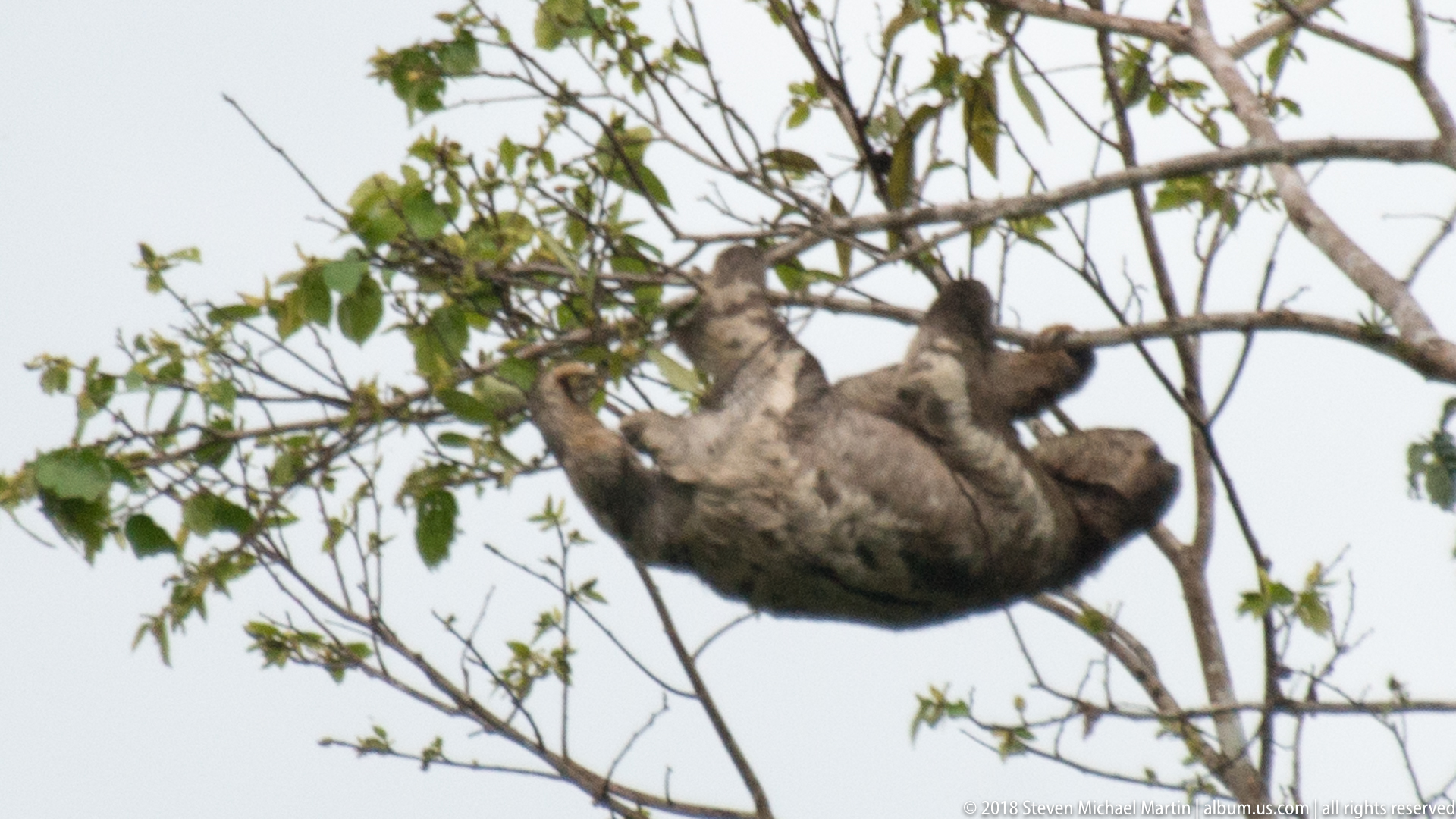
A sloth reclines almost horizontally beneath a web of slender branches, its limbs folded upward to maintain several points of contact. Pale belly fur catches the light while the darker back and limbs merge with the canopy. The unusual angle records a relaxed suspended posture and distinguishes this frame from the more vertical climbing views in the sequence.
Caption
A sloth reclines almost horizontally beneath a web of slender branches, its limbs folded upward to maintain several points of contact. Pale belly fur catches the light while the darker back and limbs merge with the canopy. The unusual angle records a relaxed suspended posture and distinguishes this frame from the more vertical climbing views in the sequence.
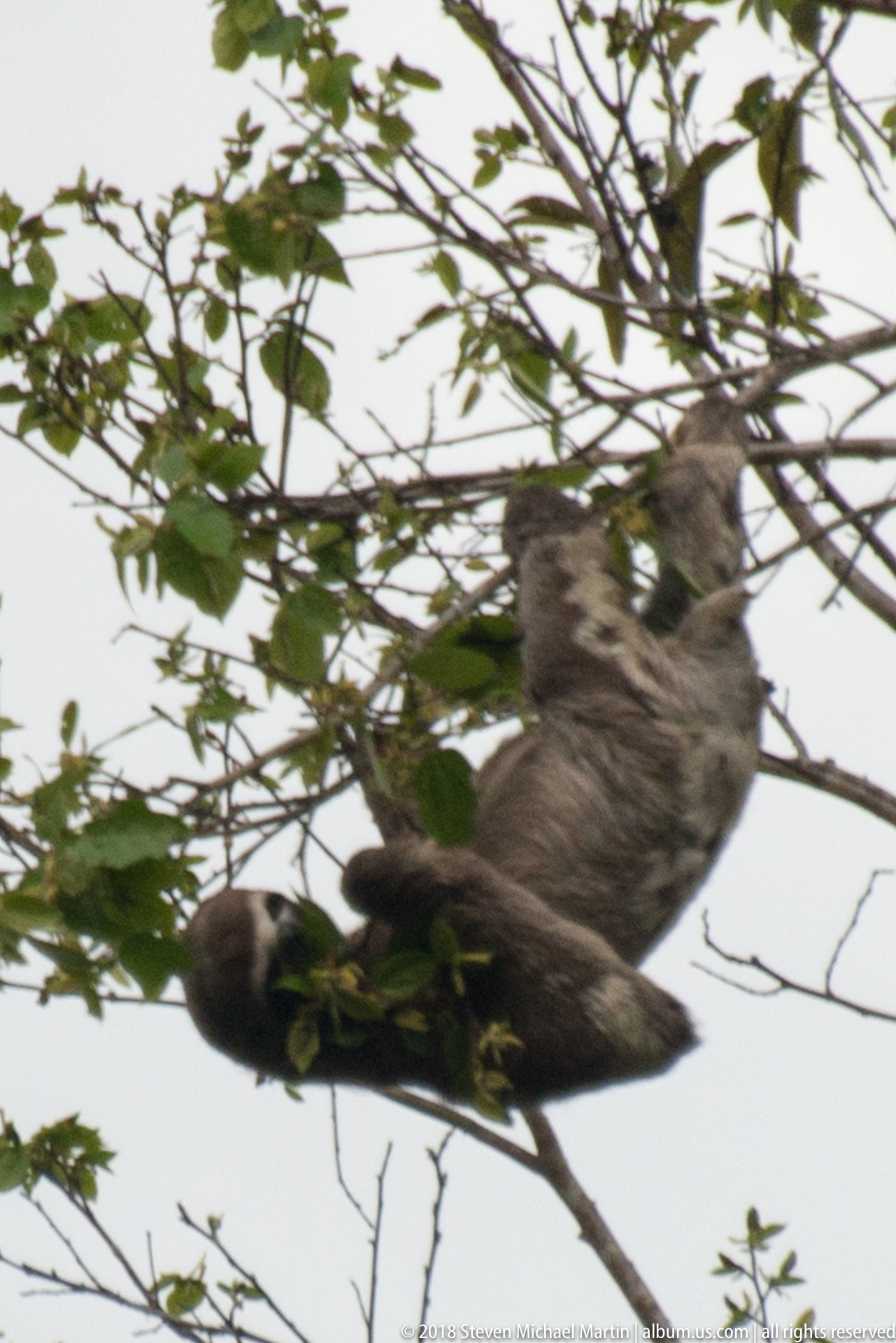
Partly blurred by movement and intervening foliage, a sloth advances laterally through the canopy with its body stretched along a branch. The animal’s rounded torso and long reaching limb remain readable despite the dense lattice of twigs. This frame conveys movement more strongly than the adjacent resting views, showing the slow but deliberate progression of an arboreal mammal through riverside forest.
Caption
Partly blurred by movement and intervening foliage, a sloth advances laterally through the canopy with its body stretched along a branch. The animal’s rounded torso and long reaching limb remain readable despite the dense lattice of twigs. This frame conveys movement more strongly than the adjacent resting views, showing the slow but deliberate progression of an arboreal mammal through riverside forest.

A sloth lies lengthwise along a slender branch, its shaggy gray-brown body forming a horizontal mass beneath a screen of green leaves. One limb appears extended toward additional supports while the head is largely hidden. The photograph places the animal within a dense network of canopy routes and emphasizes its cryptic coloration among bark, shadow, and foliage.
Caption
A sloth lies lengthwise along a slender branch, its shaggy gray-brown body forming a horizontal mass beneath a screen of green leaves. One limb appears extended toward additional supports while the head is largely hidden. The photograph places the animal within a dense network of canopy routes and emphasizes its cryptic coloration among bark, shadow, and foliage.
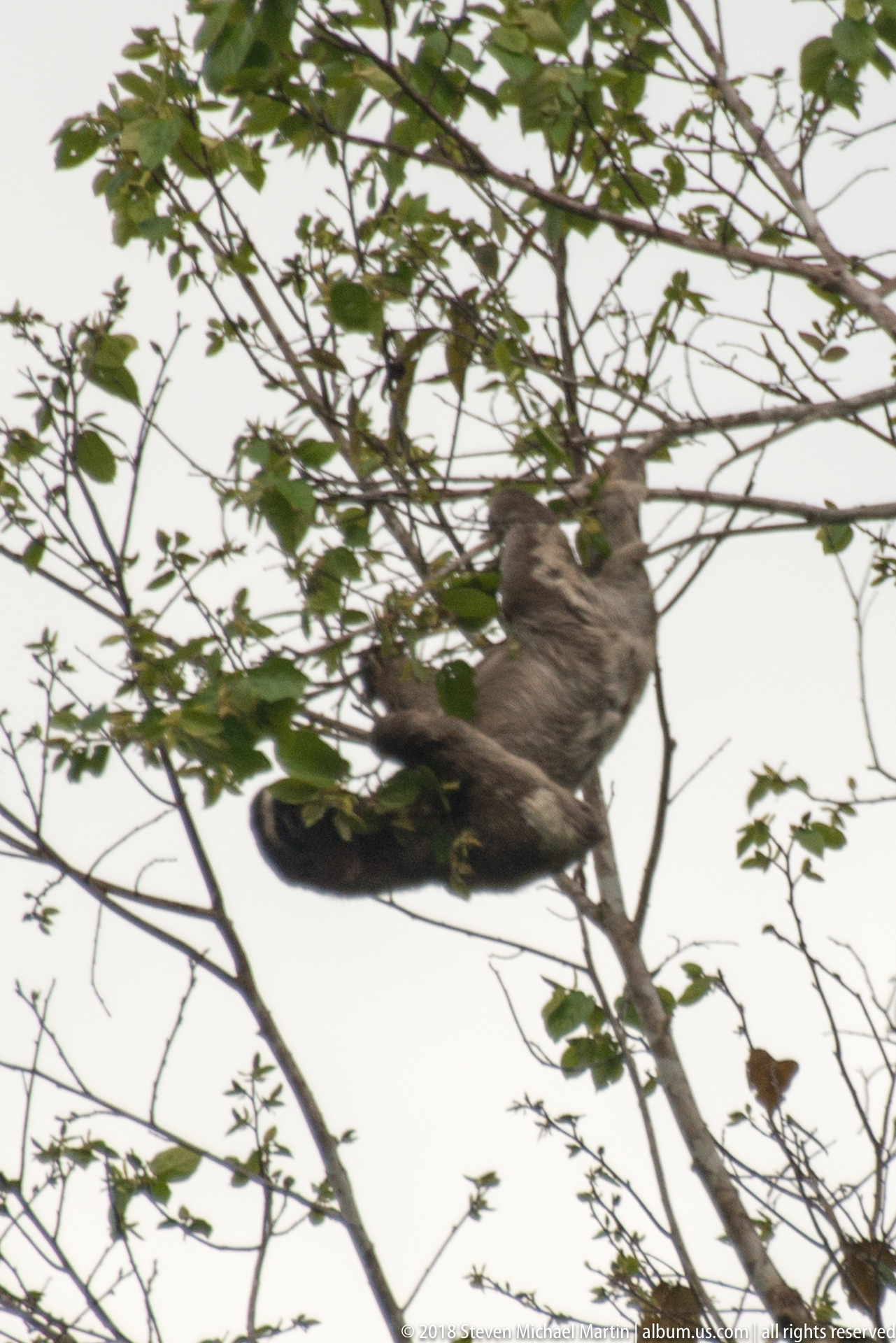
A sloth moves horizontally along a narrow branch near the top of the riverside forest. Its elongated body is partly blurred, suggesting motion during the exposure, while the surrounding leaves form a loose frame against the bright sky. The view records canopy travel at a greater distance, emphasizing the animal’s silhouette and route rather than facial detail.
Caption
A sloth moves horizontally along a narrow branch near the top of the riverside forest. Its elongated body is partly blurred, suggesting motion during the exposure, while the surrounding leaves form a loose frame against the bright sky. The view records canopy travel at a greater distance, emphasizing the animal’s silhouette and route rather than facial detail.
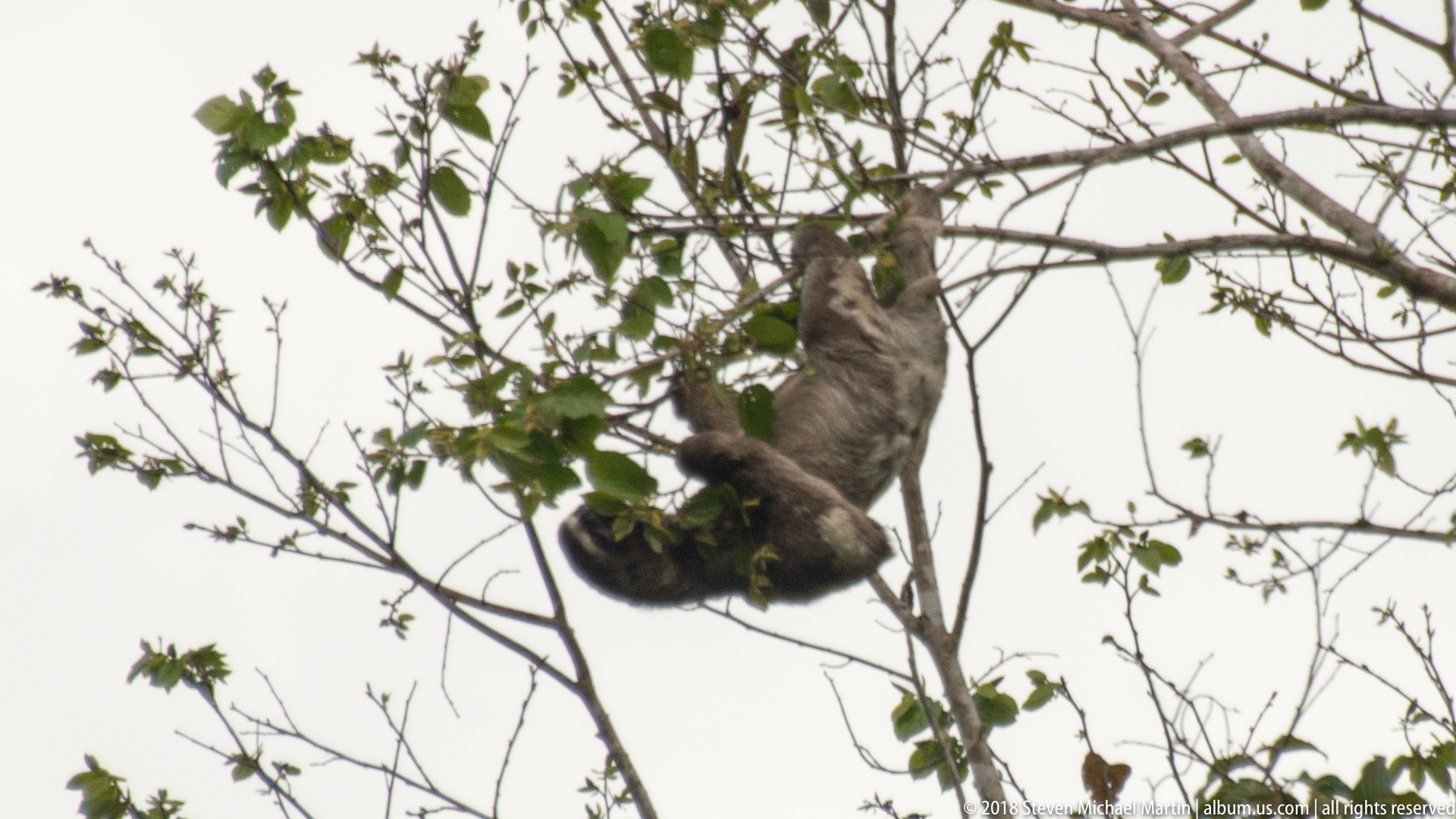
A sloth rises from a forked support and reaches upward into a cluster of thin branches, its body hanging below the contact point. The vertical extension gives the animal a taller profile than neighboring frames and reveals the long forelimb used to secure the next hold. Sparse leaves and bright sky isolate the posture clearly within the upper canopy.
Caption
A sloth rises from a forked support and reaches upward into a cluster of thin branches, its body hanging below the contact point. The vertical extension gives the animal a taller profile than neighboring frames and reveals the long forelimb used to secure the next hold. Sparse leaves and bright sky isolate the posture clearly within the upper canopy.
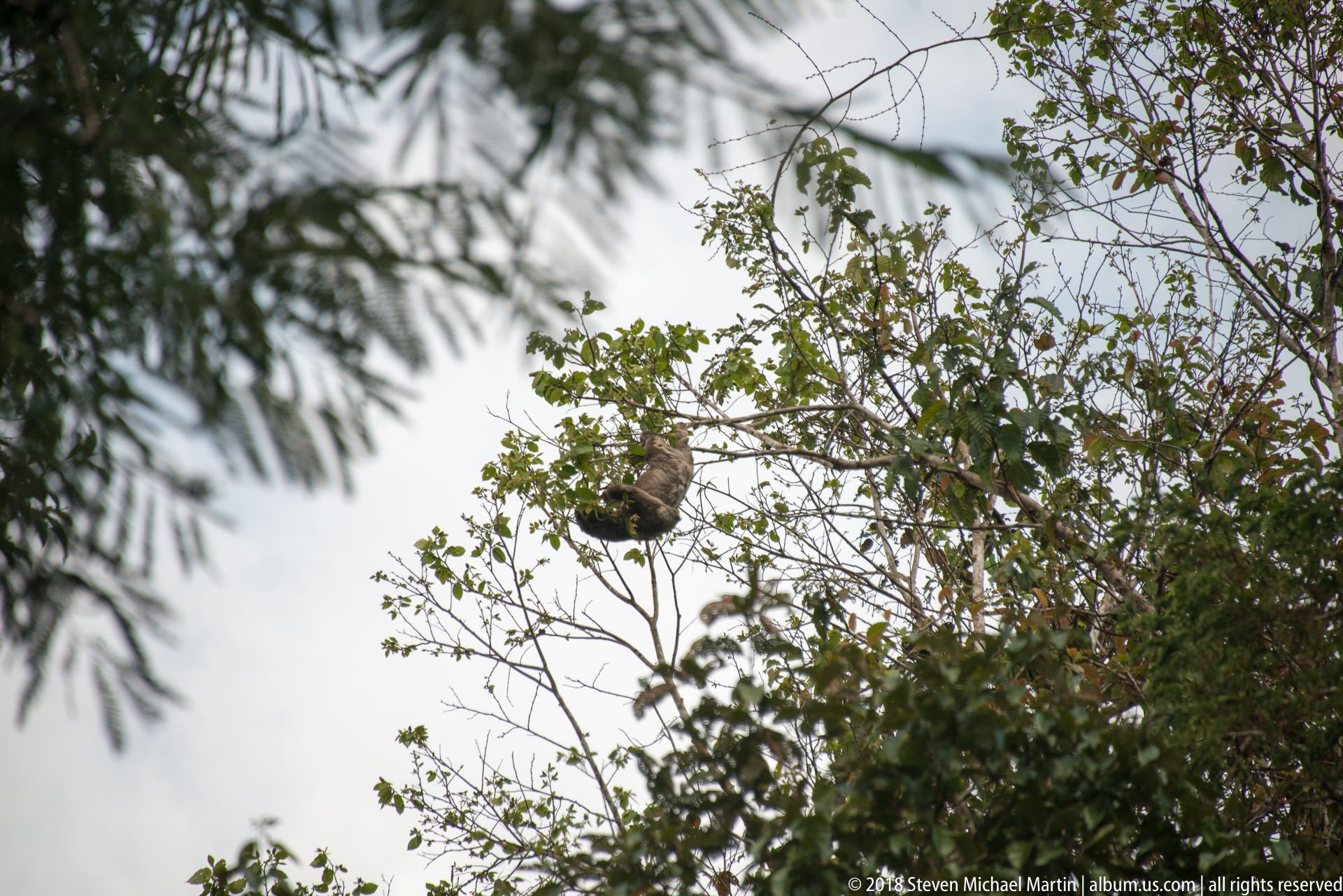
A sloth appears as a compact shaggy form high in the crown of a riverside tree, surrounded by a dense scatter of leaves and fine branches. The wider composition reduces anatomical detail but provides valuable habitat context, showing the animal’s position near the outer canopy above the Tuhauyo River corridor. Its muted coat nearly disappears into the branching crown.
Caption
A sloth appears as a compact shaggy form high in the crown of a riverside tree, surrounded by a dense scatter of leaves and fine branches. The wider composition reduces anatomical detail but provides valuable habitat context, showing the animal’s position near the outer canopy above the Tuhauyo River corridor. Its muted coat nearly disappears into the branching crown.

A black-collared hawk perches upright on a bare branch against deep green forest. Its pale head contrasts sharply with the rich chestnut body and dark wings, while a dark collar or throat area marks the transition between head and breast. The unobstructed profile makes this one of the sequence’s clearest studies of the wetland raptor’s distinctive coloration.
Caption
A black-collared hawk perches upright on a bare branch against deep green forest. Its pale head contrasts sharply with the rich chestnut body and dark wings, while a dark collar or throat area marks the transition between head and breast. The unobstructed profile makes this one of the sequence’s clearest studies of the wetland raptor’s distinctive coloration.

A black-collared hawk occupies a low exposed branch within dense riverside vegetation. Seen from farther back, the bird’s pale head and chestnut body remain conspicuous amid layered green leaves, pale twigs, and a dark trunk. The wider framing places the raptor in its forested waterway habitat and contrasts with the tighter portraits immediately preceding it.
Caption
A black-collared hawk occupies a low exposed branch within dense riverside vegetation. Seen from farther back, the bird’s pale head and chestnut body remain conspicuous amid layered green leaves, pale twigs, and a dark trunk. The wider framing places the raptor in its forested waterway habitat and contrasts with the tighter portraits immediately preceding it.

A close view of a black-collared hawk emphasizes its pale head, dark eye line and collar area, warm chestnut body, and powerful pale legs gripping a branch. The shallow focus softens surrounding trunks and foliage, isolating the raptor’s heavy build and contrasting plumage. This is among the most intimate portraits of the species in the Tuhauyo River sequence.
Caption
A close view of a black-collared hawk emphasizes its pale head, dark eye line and collar area, warm chestnut body, and powerful pale legs gripping a branch. The shallow focus softens surrounding trunks and foliage, isolating the raptor’s heavy build and contrasting plumage. This is among the most intimate portraits of the species in the Tuhauyo River sequence.

A black-collared hawk sits amid pale, leafless twigs at the forest edge, its chestnut breast and pale head standing out against dark foliage. The vertical composition shows the bird’s long body and folded dark wings, while foreground branches cross the perch without concealing the principal markings. The frame gives a closer sense of the hawk’s robust wetland-adapted build.
Caption
A black-collared hawk sits amid pale, leafless twigs at the forest edge, its chestnut breast and pale head standing out against dark foliage. The vertical composition shows the bird’s long body and folded dark wings, while foreground branches cross the perch without concealing the principal markings. The frame gives a closer sense of the hawk’s robust wetland-adapted build.

A softly colored pigeon rests on a smooth branch inside the riverside forest, showing a blue-gray head, pinkish to vinaceous breast and body, pale belly, and red eye. The long gray tail and compact dove-like profile are clearly visible against the dark understory. The combination suggests a pale-vented pigeon, though the proof-sheet view does not fully resolve all diagnostic features.
Caption
A softly colored pigeon rests on a smooth branch inside the riverside forest, showing a blue-gray head, pinkish to vinaceous breast and body, pale belly, and red eye. The long gray tail and compact dove-like profile are clearly visible against the dark understory. The combination suggests a pale-vented pigeon, though the proof-sheet view does not fully resolve all diagnostic features.

One pigeon flares its wings and tail as it approaches a branch where a second bird is already perched. The airborne bird exposes broad gray flight feathers and a pale-tipped fan of tail feathers around a pinkish body, freezing a brief landing maneuver within tangled riverside vegetation. The paired birds add behavioral context to the more static portrait in the preceding frame.
Caption
One pigeon flares its wings and tail as it approaches a branch where a second bird is already perched. The airborne bird exposes broad gray flight feathers and a pale-tipped fan of tail feathers around a pinkish body, freezing a brief landing maneuver within tangled riverside vegetation. The paired birds add behavioral context to the more static portrait in the preceding frame.

A black-collared hawk perches upright on a broken branch amid a dense wall of vines and woody stems. Its nearly white head, dark throat marking, chestnut body, and folded dark wings create a strong vertical color pattern against the shaded forest. The portrait places the wetland raptor in a more enclosed setting than the open-branch views earlier in the sequence.
Caption
A black-collared hawk perches upright on a broken branch amid a dense wall of vines and woody stems. Its nearly white head, dark throat marking, chestnut body, and folded dark wings create a strong vertical color pattern against the shaded forest. The portrait places the wetland raptor in a more enclosed setting than the open-branch views earlier in the sequence.
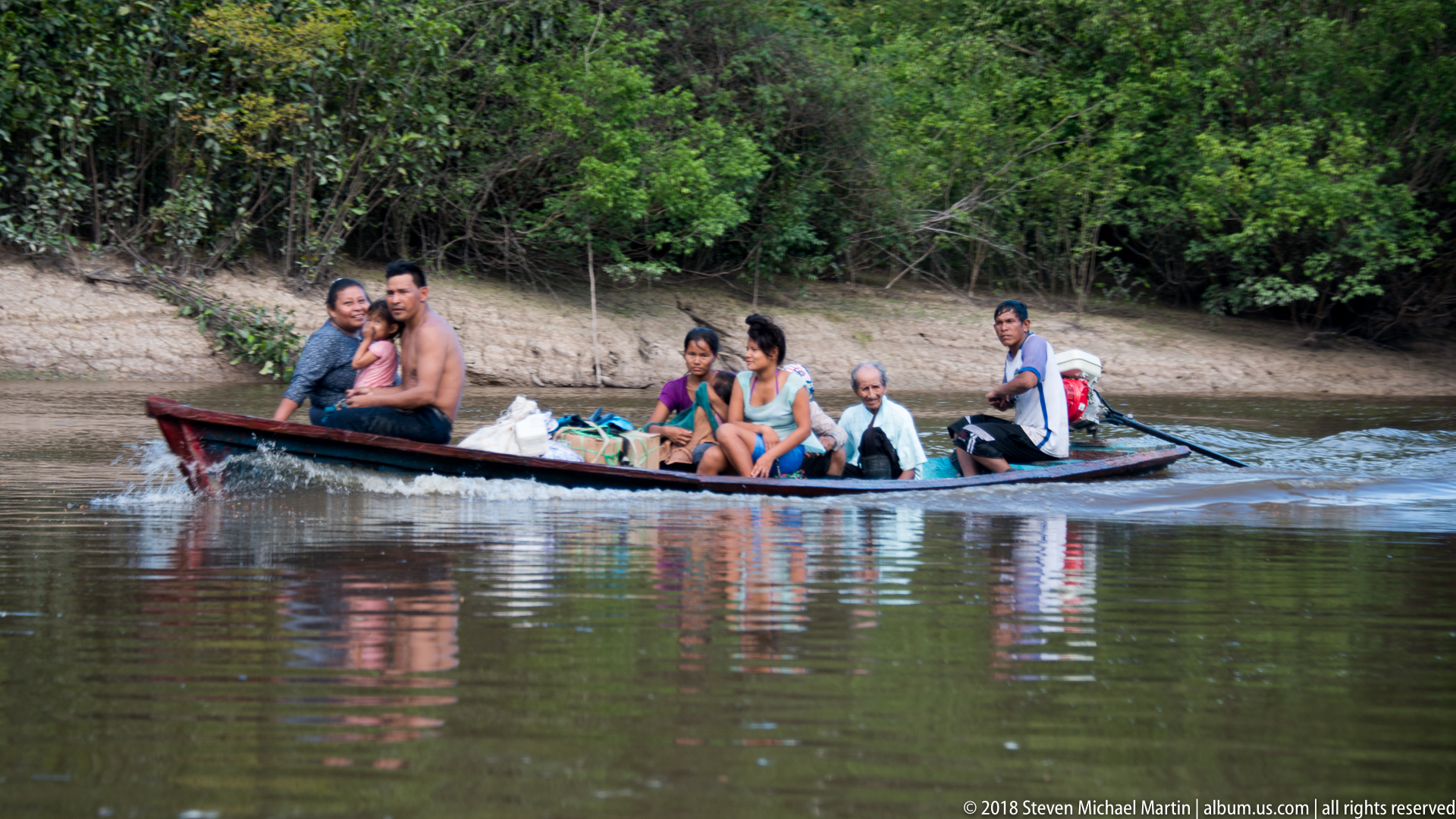
A narrow wooden boat carries a mixed group of passengers along the calm Tuhauyo River, with bags and supplies arranged between them. A man at the stern operates a long-shaft outboard motor while the low craft rides close to the water. The scene documents everyday river transportation, where waterways serve as practical travel corridors between forest communities.
Caption
A narrow wooden boat carries a mixed group of passengers along the calm Tuhauyo River, with bags and supplies arranged between them. A man at the stern operates a long-shaft outboard motor while the low craft rides close to the water. The scene documents everyday river transportation, where waterways serve as practical travel corridors between forest communities.
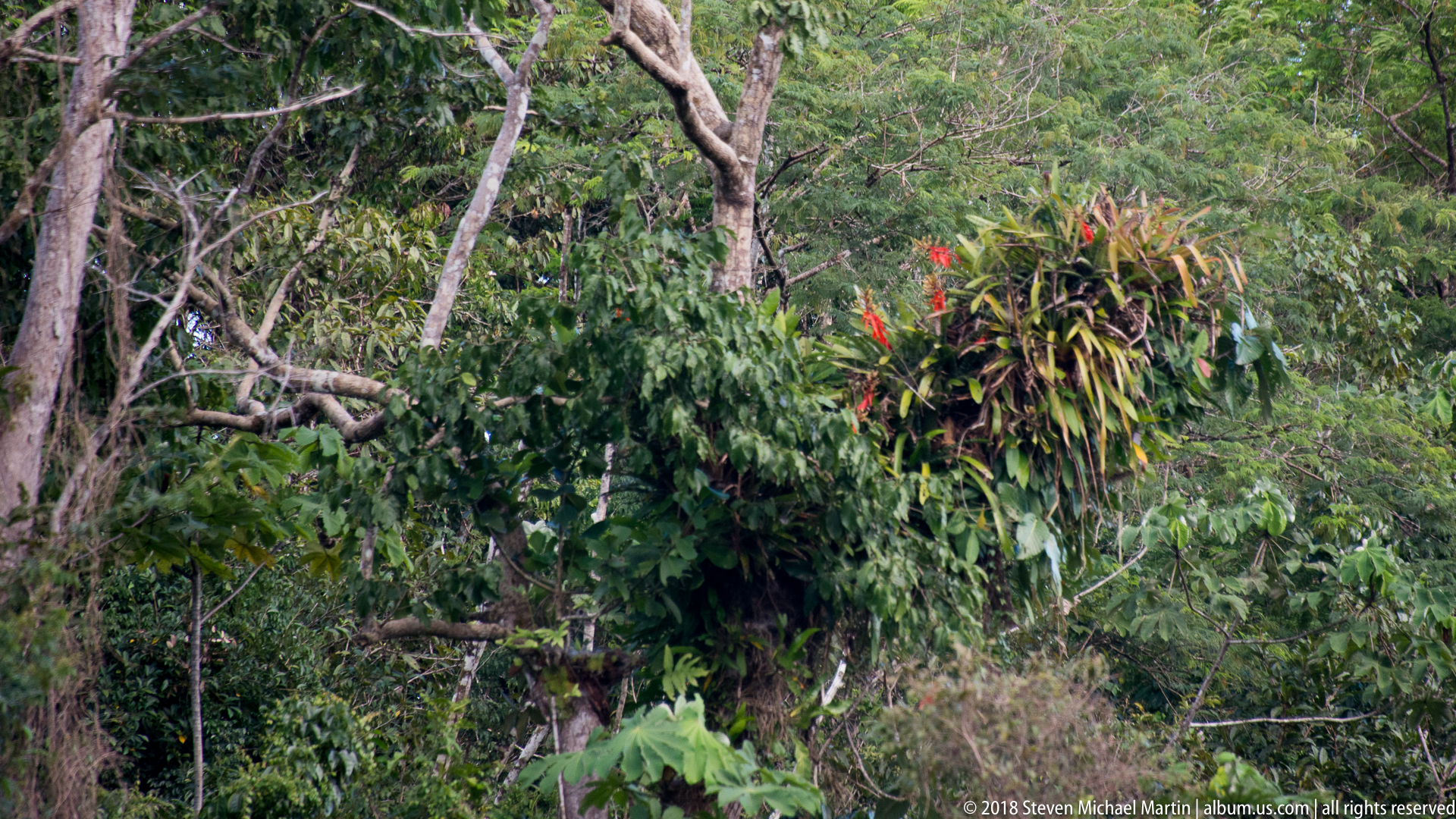
Dense tropical vegetation rises along the Tuhauyo River, where tangled trunks, broad leaves, vines, and conspicuous epiphytic plants form a layered riverbank wall. Red flower spikes punctuate the greenery near the center of the frame. The view records the structurally complex vegetation bordering the waterway rather than a single plant specimen, emphasizing the mixture of woody growth and plants established above ground level.
Caption
Dense tropical vegetation rises along the Tuhauyo River, where tangled trunks, broad leaves, vines, and conspicuous epiphytic plants form a layered riverbank wall. Red flower spikes punctuate the greenery near the center of the frame. The view records the structurally complex vegetation bordering the waterway rather than a single plant specimen, emphasizing the mixture of woody growth and plants established above ground level.
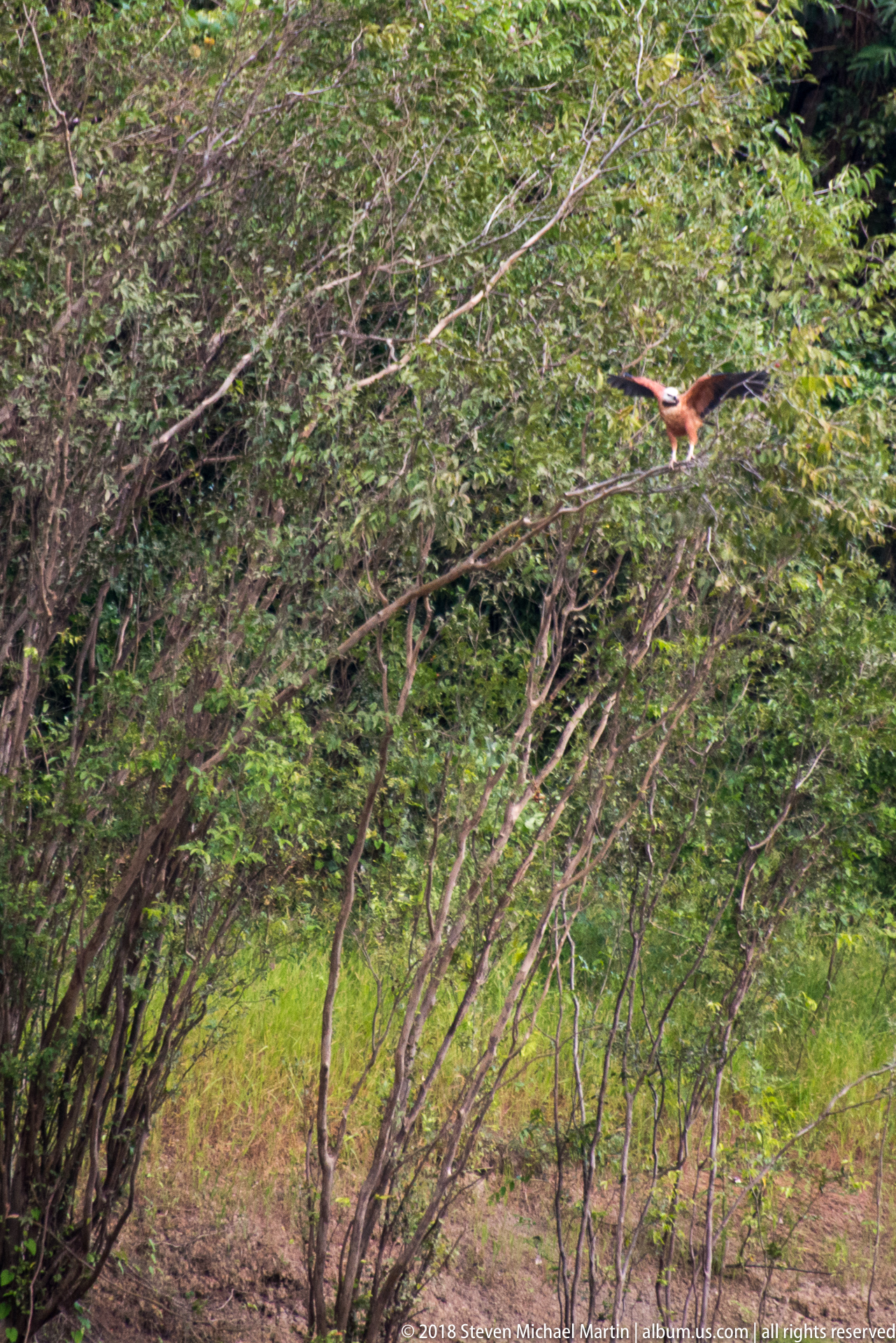
A chestnut raptor crosses a gap above dense riverbank vegetation, its long wings extended in active flight. Seen at a distance, the bird’s warm body color remains visible against the green canopy while finer head and wing markings are lost. Sequence context suggests the same wetland hawk photographed perched nearby, but this frame is best read as a habitat-scale flight view.
Caption
A chestnut raptor crosses a gap above dense riverbank vegetation, its long wings extended in active flight. Seen at a distance, the bird’s warm body color remains visible against the green canopy while finer head and wing markings are lost. Sequence context suggests the same wetland hawk photographed perched nearby, but this frame is best read as a habitat-scale flight view.
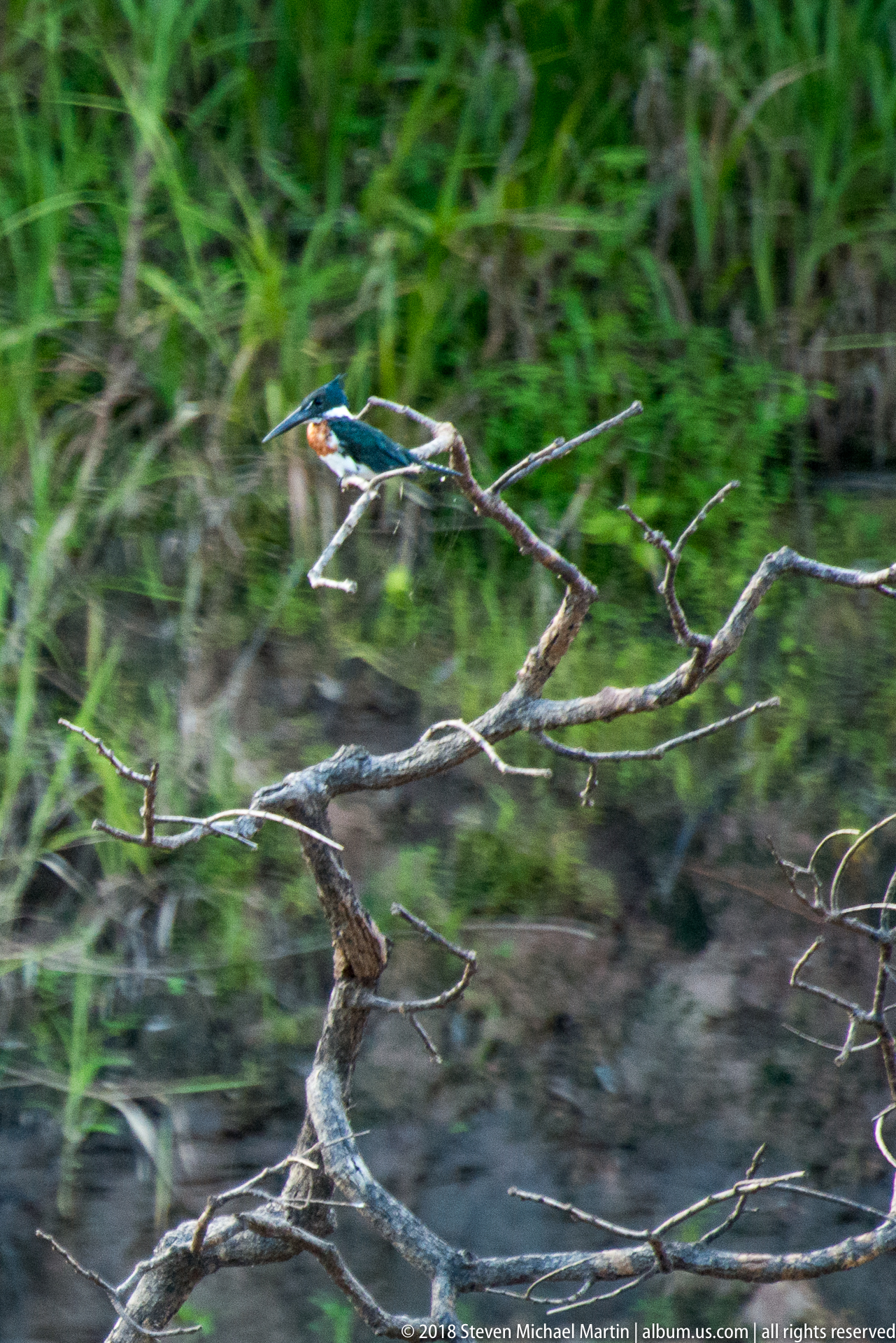
A small kingfisher streaks laterally above exposed branches at the river margin, its blue-green upperparts, pale throat, and warm-toned underparts visible despite motion blur. The camera pans with the bird, turning the surrounding vegetation into horizontal streaks while the long bill and compact body remain recognizable. The frame emphasizes low, fast flight typical of a river-edge hunting pass without forcing a species-level identification.
Caption
A small kingfisher streaks laterally above exposed branches at the river margin, its blue-green upperparts, pale throat, and warm-toned underparts visible despite motion blur. The camera pans with the bird, turning the surrounding vegetation into horizontal streaks while the long bill and compact body remain recognizable. The frame emphasizes low, fast flight typical of a river-edge hunting pass without forcing a species-level identification.

A small brown songbird perches among delicate compound leaves and hanging seed pods, its rounded body and short bill silhouetted against a pale background. Fine streaking and warm brown tones are visible on the plumage, but the proof-sheet image does not preserve enough diagnostic detail for a defensible species name. The close view instead records the bird’s scale and its use of low, leafy riverside vegetation.
Caption
A small brown songbird perches among delicate compound leaves and hanging seed pods, its rounded body and short bill silhouetted against a pale background. Fine streaking and warm brown tones are visible on the plumage, but the proof-sheet image does not preserve enough diagnostic detail for a defensible species name. The close view instead records the bird’s scale and its use of low, leafy riverside vegetation.

A brown-and-cream bird crosses in front of dense riverbank forest with wings fully extended, its barred flight feathers and pale head standing out against the dark foliage. Motion blur records the speed of the pass while preserving the bird’s broad-winged silhouette. The proof-sheet view supports a flying bird with raptor-like proportions, but it does not provide enough diagnostic detail for a secure species identification.
Caption
A brown-and-cream bird crosses in front of dense riverbank forest with wings fully extended, its barred flight feathers and pale head standing out against the dark foliage. Motion blur records the speed of the pass while preserving the bird’s broad-winged silhouette. The proof-sheet view supports a flying bird with raptor-like proportions, but it does not provide enough diagnostic detail for a secure species identification.
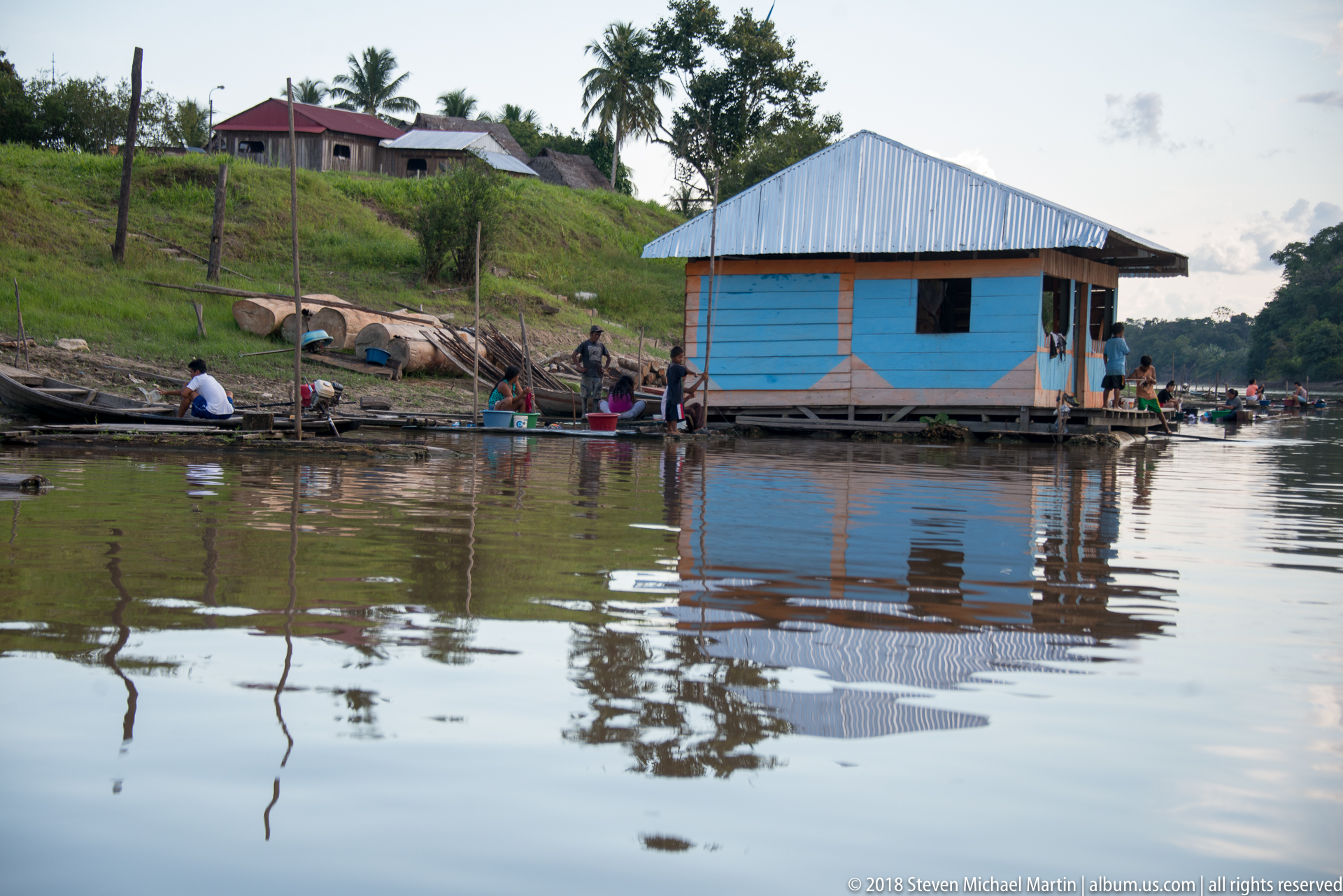
Residents and narrow canoes gather beside a blue floating house at the river’s edge, expanding the preceding architectural view into a scene of community activity. The building’s corrugated roof and bright walls are mirrored in calm water, while people sit or stand in small craft along the platform. The low viewpoint from the river places transport, dwelling, and shoreline together in a single Amazonian settlement context.
Caption
Residents and narrow canoes gather beside a blue floating house at the river’s edge, expanding the preceding architectural view into a scene of community activity. The building’s corrugated roof and bright walls are mirrored in calm water, while people sit or stand in small craft along the platform. The low viewpoint from the river places transport, dwelling, and shoreline together in a single Amazonian settlement context.

Framed more widely than the adjacent portrait, a small brown passerine sits upright on a slender branch amid compound leaves and elongated seed pods. The bird’s crest-like crown feathers, pale eye area, and compact body can be seen, while the surrounding foliage supplies useful habitat context. Those features are not sufficiently resolved to separate similar Amazonian songbirds with confidence, so the identification remains deliberately broad.
Caption
Framed more widely than the adjacent portrait, a small brown passerine sits upright on a slender branch amid compound leaves and elongated seed pods. The bird’s crest-like crown feathers, pale eye area, and compact body can be seen, while the surrounding foliage supplies useful habitat context. Those features are not sufficiently resolved to separate similar Amazonian songbirds with confidence, so the identification remains deliberately broad.

A loose flock of small birds crosses a dramatic gray sky above the Tuhauyo River corridor. Individual birds appear mainly as dark silhouettes, scattered in an uneven horizontal formation beneath a bright break in the clouds. The atmospheric frame shifts attention from species portraiture to collective movement and weather, recording aerial activity over the river landscape without enough visible morphology to identify the birds more narrowly.
Caption
A loose flock of small birds crosses a dramatic gray sky above the Tuhauyo River corridor. Individual birds appear mainly as dark silhouettes, scattered in an uneven horizontal formation beneath a bright break in the clouds. The atmospheric frame shifts attention from species portraiture to collective movement and weather, recording aerial activity over the river landscape without enough visible morphology to identify the birds more narrowly.
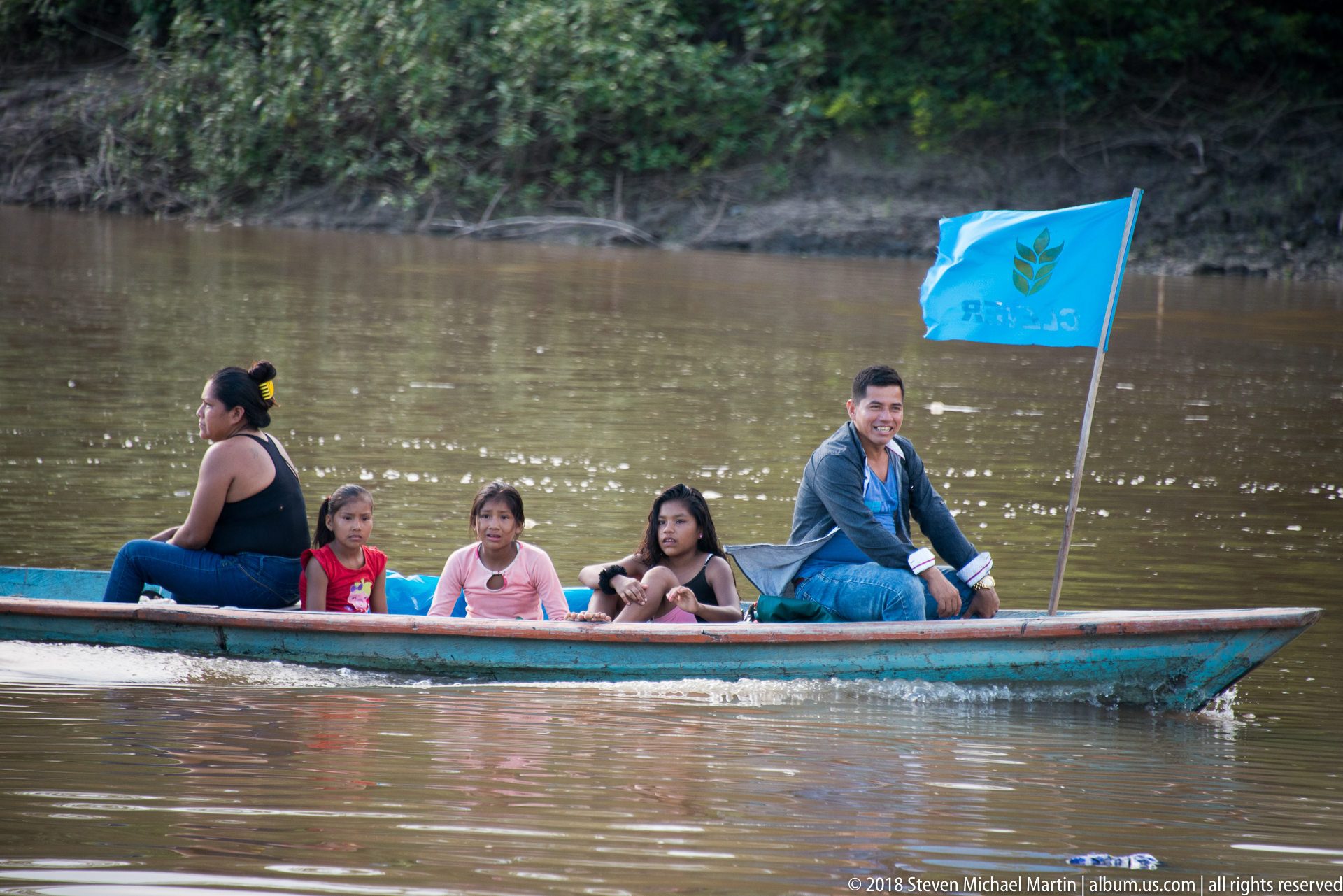
A family travels along the Tuhauyo River in a long, narrow motorized boat, with adults and children seated low in the hull. A bright blue flag rises at the stern, adding a vertical accent against the brown water and shaded bank. The side-on view clearly shows how a slender local craft carries several passengers efficiently along the river, where boats function as essential links between shoreline communities.
Caption
A family travels along the Tuhauyo River in a long, narrow motorized boat, with adults and children seated low in the hull. A bright blue flag rises at the stern, adding a vertical accent against the brown water and shaded bank. The side-on view clearly shows how a slender local craft carries several passengers efficiently along the river, where boats function as essential links between shoreline communities.

A blue floating house occupies the quiet river margin beneath a towering bank of sunlit cumulus clouds. Its reflection stretches across the still brown water while small boats and low vegetation define the shoreline. Compared with closer settlement views, this frame gives greater weight to sky, weather, and open water, setting the modest dwelling within the broad scale of the Tuhauyo River landscape.
Caption
A blue floating house occupies the quiet river margin beneath a towering bank of sunlit cumulus clouds. Its reflection stretches across the still brown water while small boats and low vegetation define the shoreline. Compared with closer settlement views, this frame gives greater weight to sky, weather, and open water, setting the modest dwelling within the broad scale of the Tuhauyo River landscape.
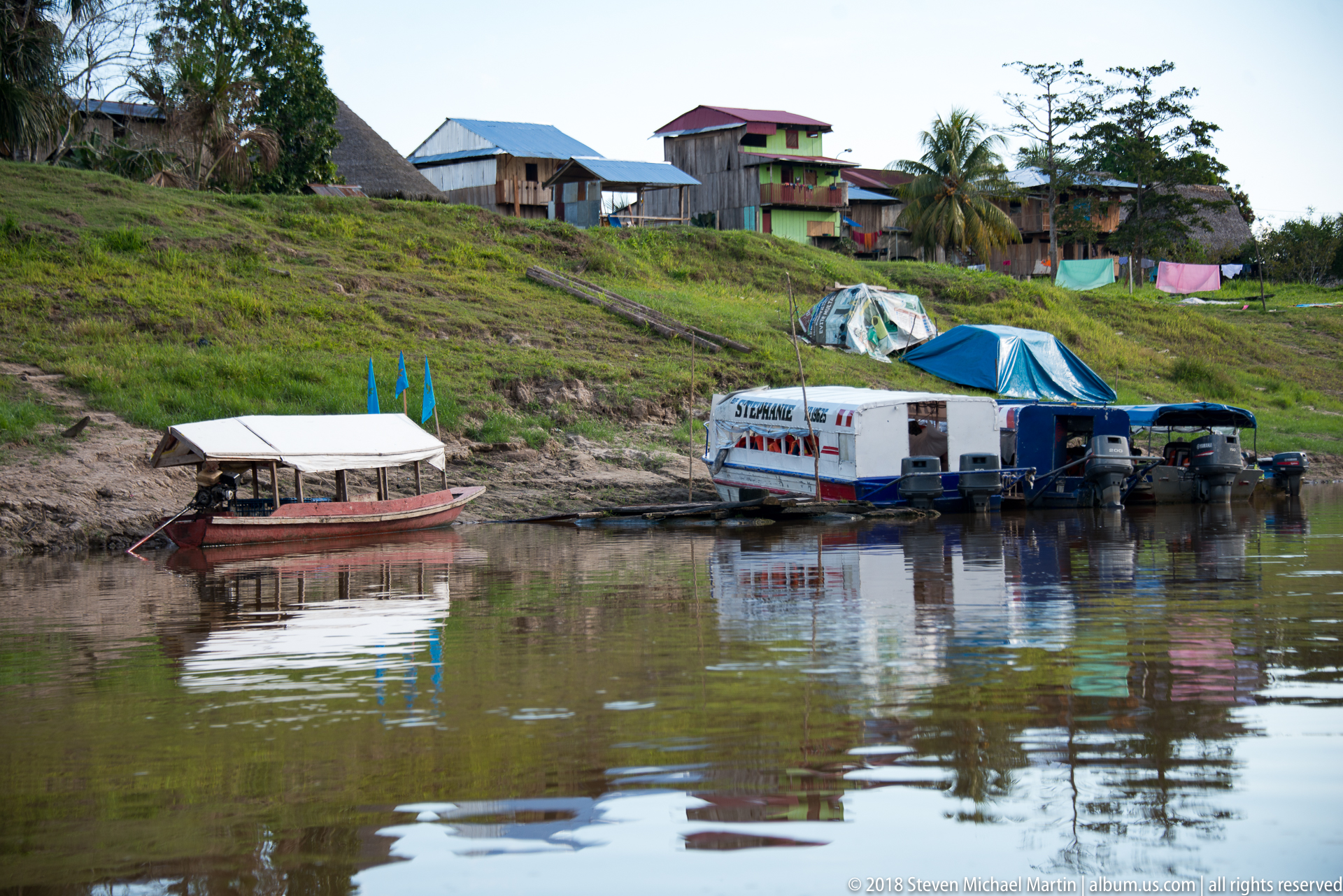
Several working boats are moored along a muddy Tuhauyo River bank below houses set on the grassy rise. A covered passenger craft, a larger white-and-blue vessel, and additional narrow boats form a small landing area, while laundry and buildings on the slope indicate nearby domestic life. Their reflections in the water reinforce the close relationship between shoreline settlement and river transportation.
Caption
Several working boats are moored along a muddy Tuhauyo River bank below houses set on the grassy rise. A covered passenger craft, a larger white-and-blue vessel, and additional narrow boats form a small landing area, while laundry and buildings on the slope indicate nearby domestic life. Their reflections in the water reinforce the close relationship between shoreline settlement and river transportation.
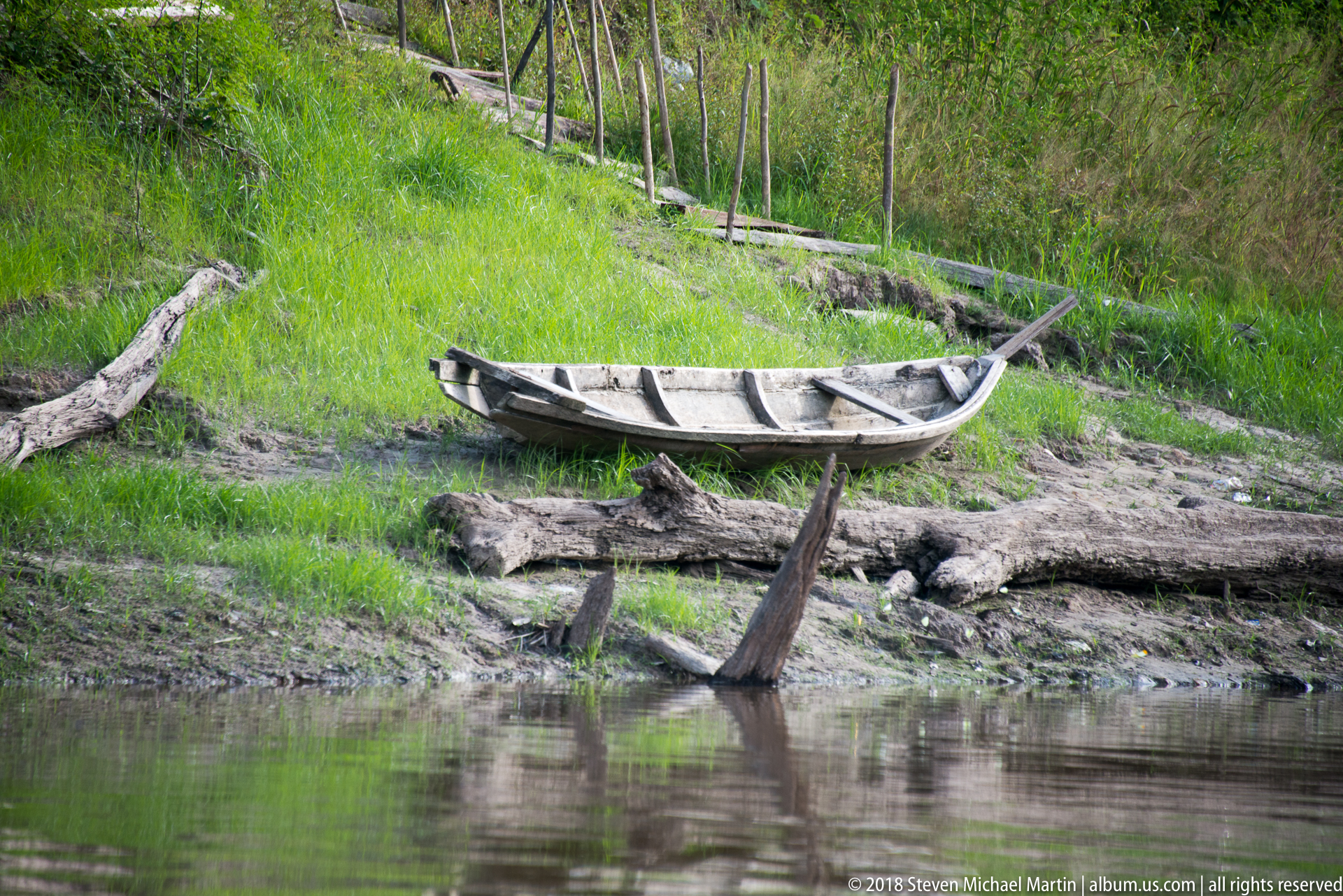
An empty wooden canoe rests above the waterline on a bright green patch of riverbank, surrounded by driftwood, exposed mud, and rough fence posts. Its long narrow hull and simple interior braces are clearly visible from the passing viewpoint. With no people present, the frame isolates the practical form of a local river craft and the fluctuating shoreline environment in which it is stored.
Caption
An empty wooden canoe rests above the waterline on a bright green patch of riverbank, surrounded by driftwood, exposed mud, and rough fence posts. Its long narrow hull and simple interior braces are clearly visible from the passing viewpoint. With no people present, the frame isolates the practical form of a local river craft and the fluctuating shoreline environment in which it is stored.
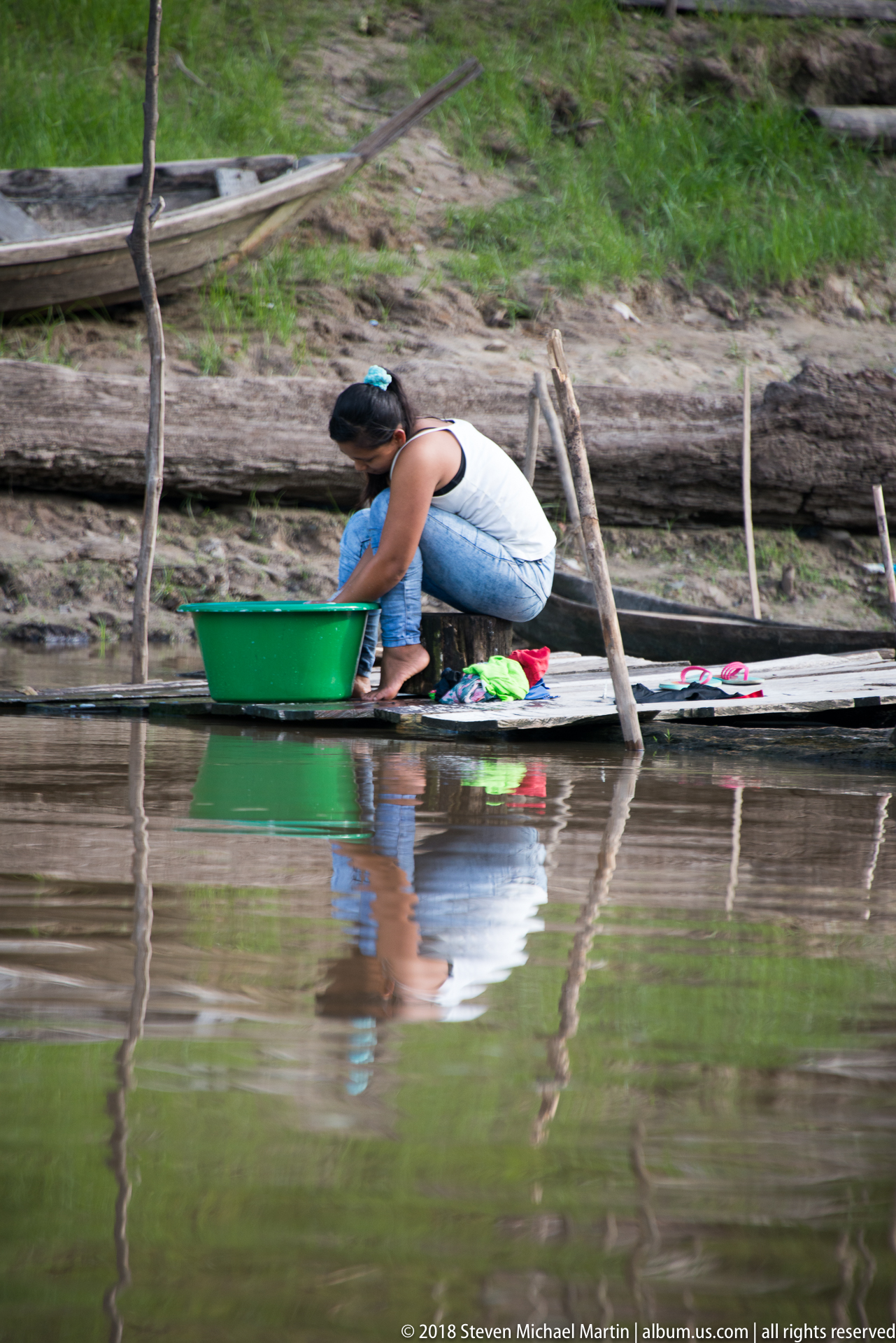
A woman leans over a large green basin while working from a narrow canoe at the edge of the Tuhauyo River. Clothing and textiles lie across the low craft, and the calm water mirrors her crouched figure. The tightly framed scene records a domestic task adapted to the river environment, where the boat serves not only for transportation but also as a stable platform beside the shoreline.
Caption
A woman leans over a large green basin while working from a narrow canoe at the edge of the Tuhauyo River. Clothing and textiles lie across the low craft, and the calm water mirrors her crouched figure. The tightly framed scene records a domestic task adapted to the river environment, where the boat serves not only for transportation but also as a stable platform beside the shoreline.
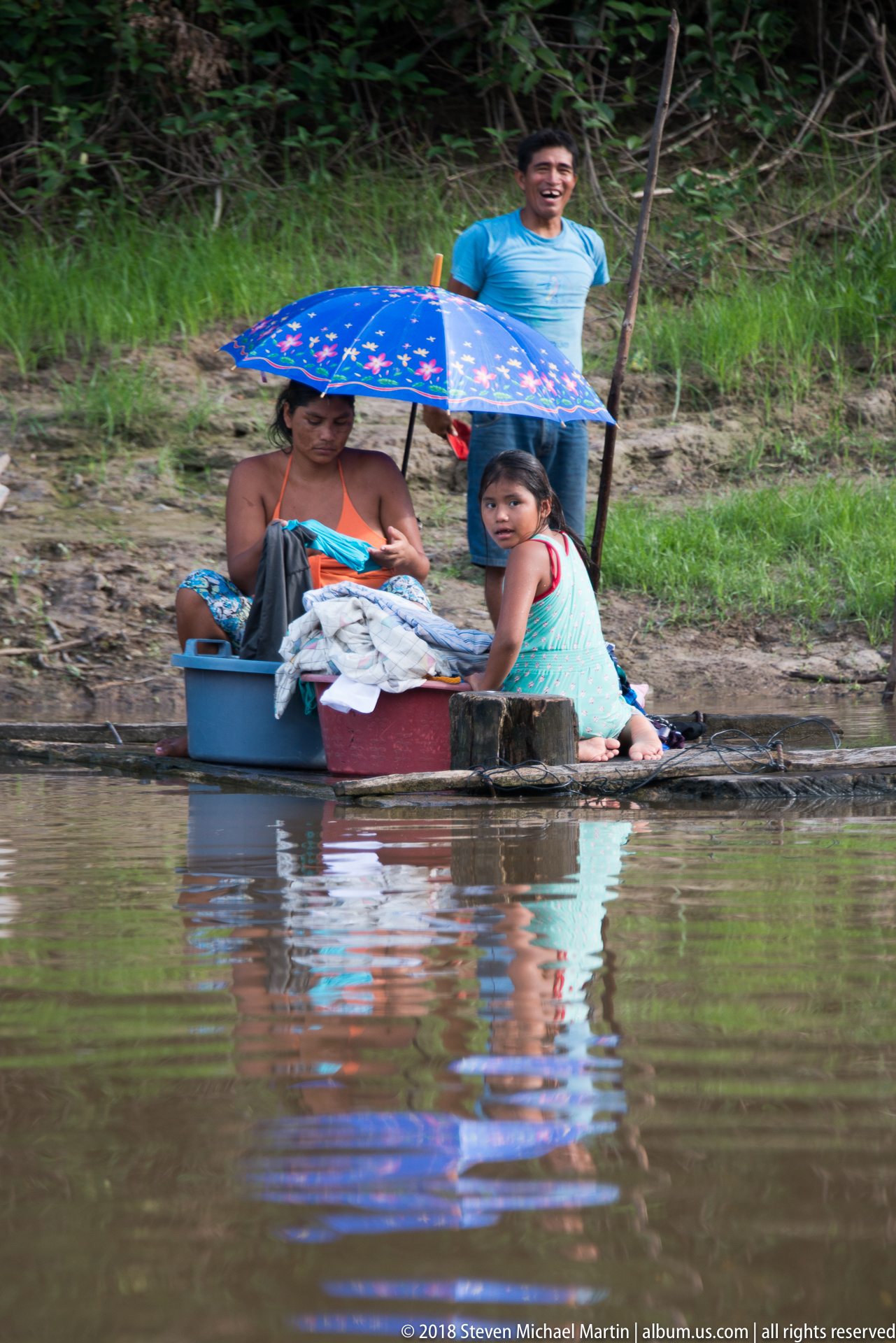
A woman and child sit low beside tubs of laundry at the Tuhauyo River’s edge, shaded by a blue patterned umbrella. A man stands behind them on the bank while clothing fills blue and red basins arranged at water level. The scene combines family presence, domestic work, and river access, with the bright umbrella and reflected figures distinguishing this view from the closer washing photograph.
Caption
A woman and child sit low beside tubs of laundry at the Tuhauyo River’s edge, shaded by a blue patterned umbrella. A man stands behind them on the bank while clothing fills blue and red basins arranged at water level. The scene combines family presence, domestic work, and river access, with the bright umbrella and reflected figures distinguishing this view from the closer washing photograph.
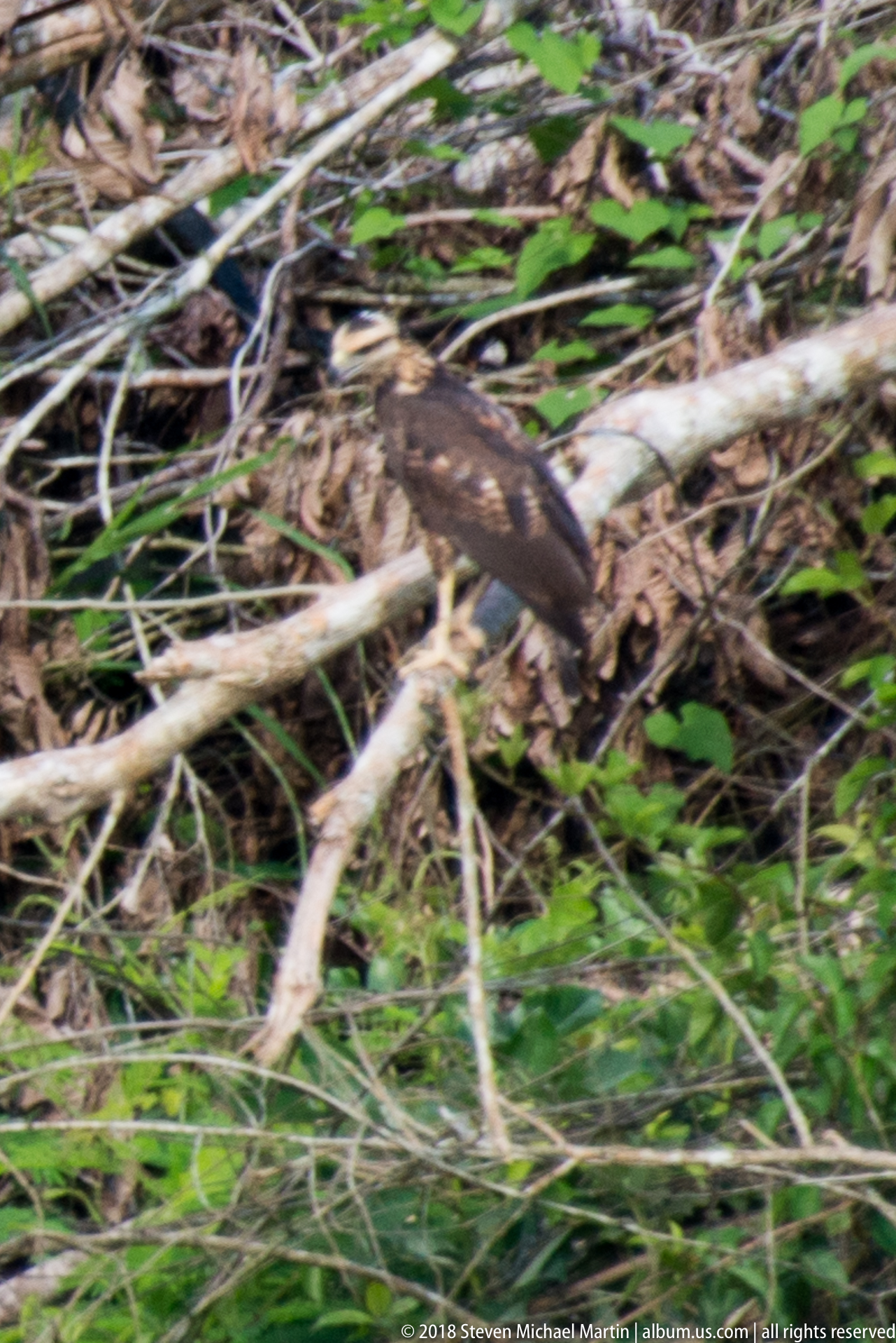
A brown bird moves through a dense tangle of pale branches and green leaves along the riverbank, partially obscured by vegetation and softened by motion. Its elongated body and warm brown plumage can be discerned, but the head and other diagnostic field marks are not sufficiently clear for reliable species identification. The frame records the difficulty of spotting wildlife within the layered understory of Amazonian riparian habitat.
Caption
A brown bird moves through a dense tangle of pale branches and green leaves along the riverbank, partially obscured by vegetation and softened by motion. Its elongated body and warm brown plumage can be discerned, but the head and other diagnostic field marks are not sufficiently clear for reliable species identification. The frame records the difficulty of spotting wildlife within the layered understory of Amazonian riparian habitat.
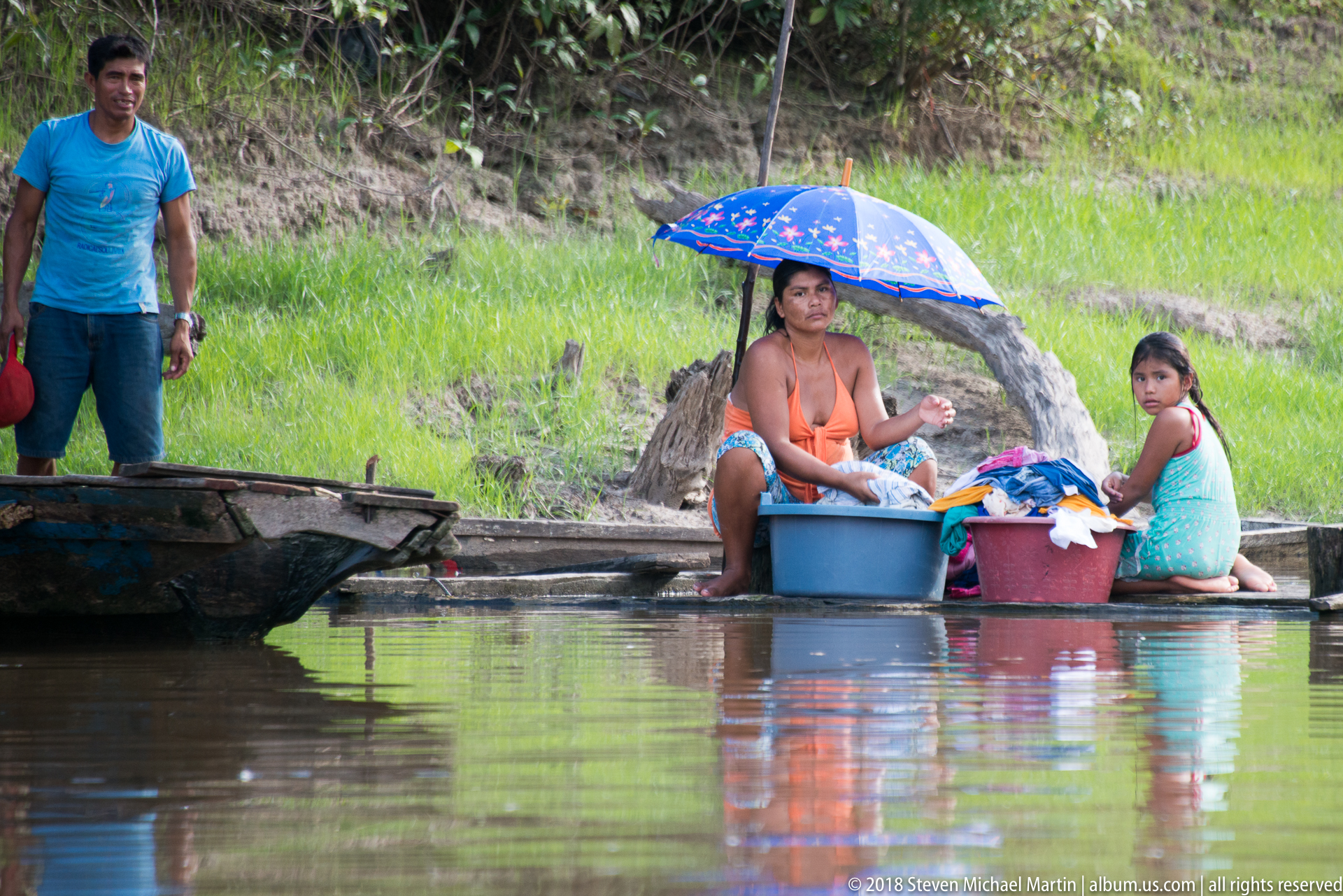
A woman and young girl pause beside blue and red wash tubs at the river’s edge while a patterned umbrella shades the work area. A wooden canoe enters from the left and a man stands behind on the grassy bank, broadening the domestic scene into its river setting. The front-facing composition makes the people and laundry containers more prominent than in the preceding lateral view.
Caption
A woman and young girl pause beside blue and red wash tubs at the river’s edge while a patterned umbrella shades the work area. A wooden canoe enters from the left and a man stands behind on the grassy bank, broadening the domestic scene into its river setting. The front-facing composition makes the people and laundry containers more prominent than in the preceding lateral view.
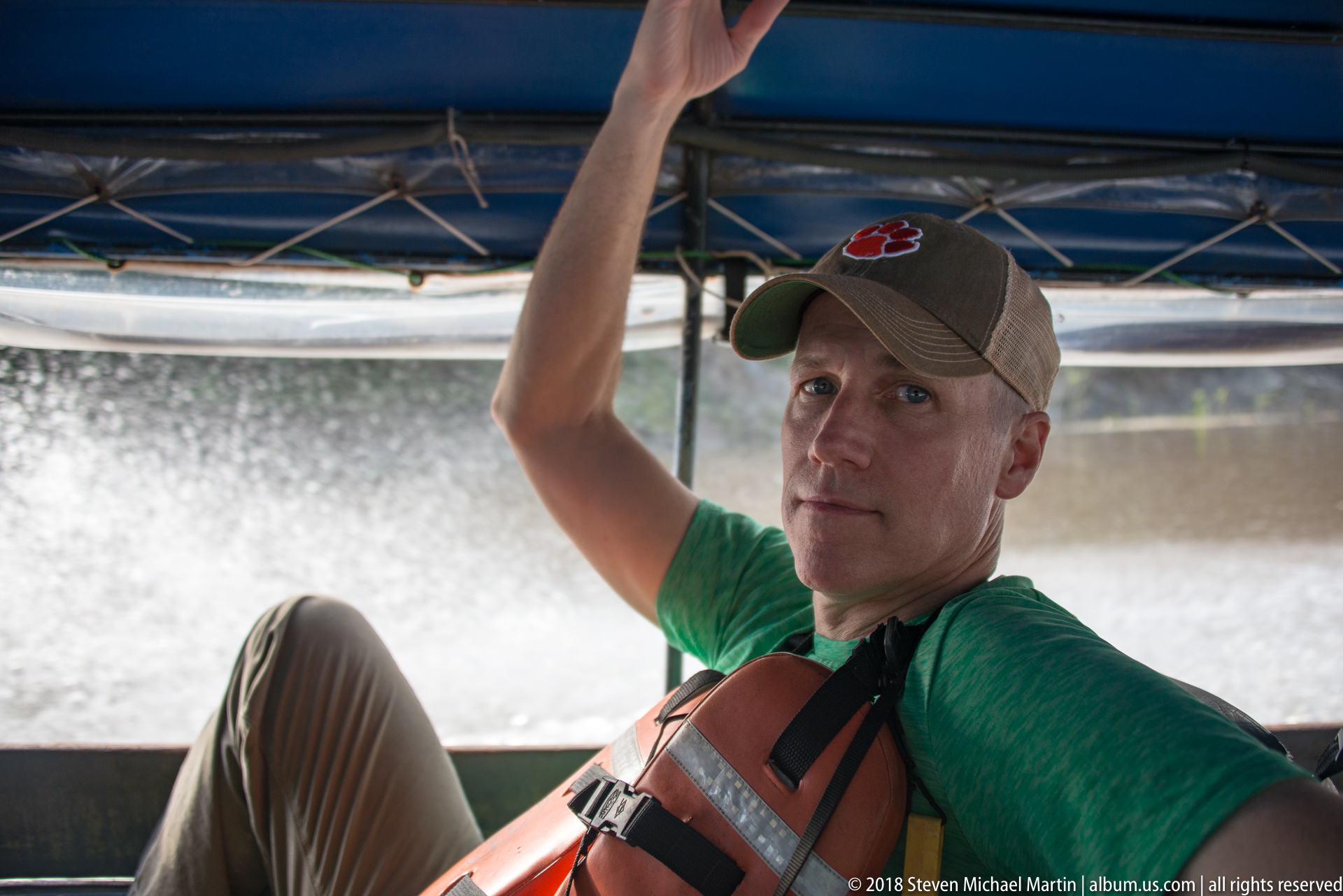
A passenger sits beneath the blue canopy of a riverboat wearing an orange life jacket and holding an overhead support. Spray and wake blur the background, conveying the boat’s speed along the Tuhauyo River. The close interior portrait contrasts with the surrounding wildlife and settlement views by focusing on the physical experience of motorized river travel and the safety equipment used during the journey.
Caption
A passenger sits beneath the blue canopy of a riverboat wearing an orange life jacket and holding an overhead support. Spray and wake blur the background, conveying the boat’s speed along the Tuhauyo River. The close interior portrait contrasts with the surrounding wildlife and settlement views by focusing on the physical experience of motorized river travel and the safety equipment used during the journey.
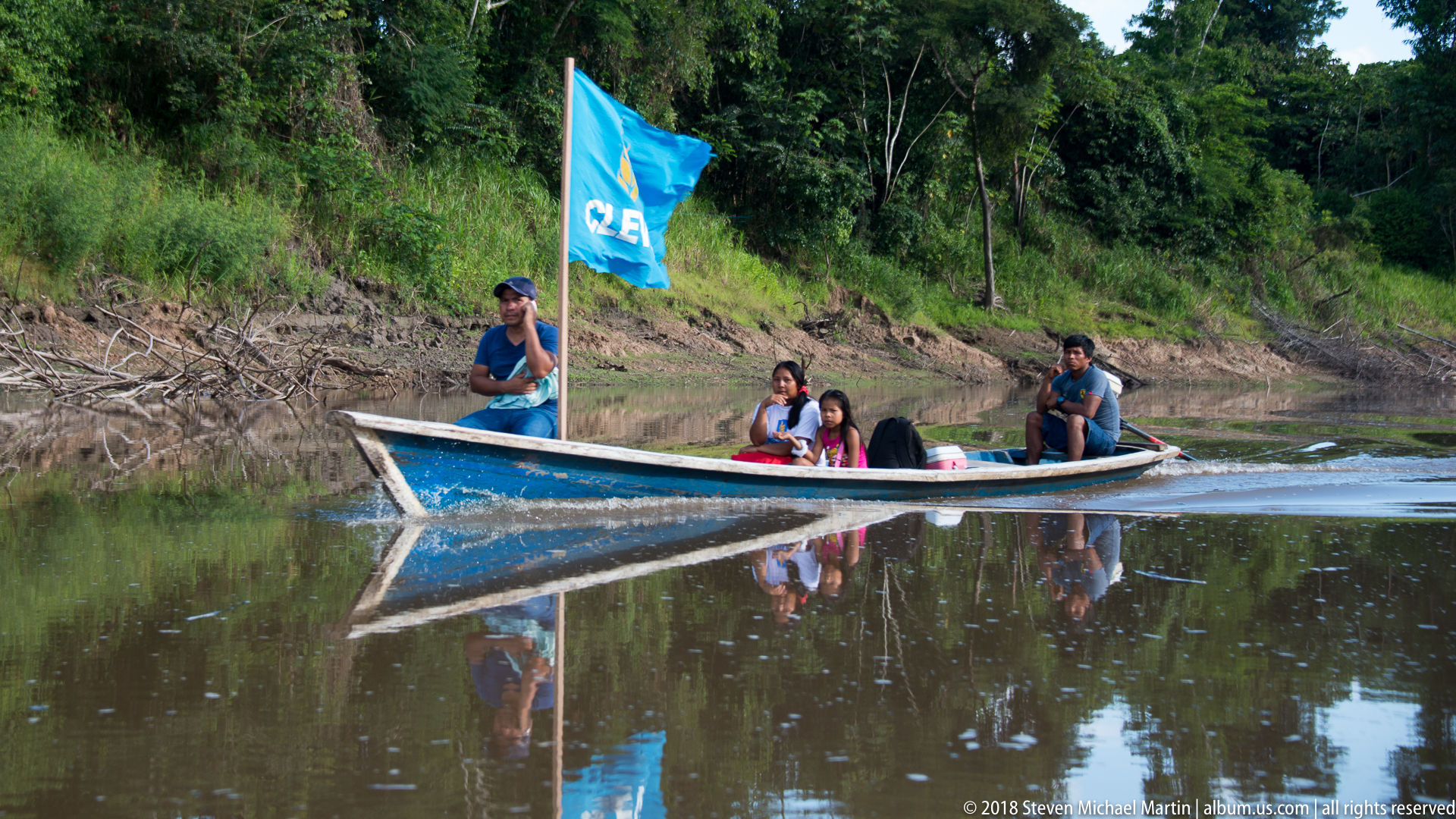
A narrow passenger boat glides across calm Tuhauyo River water carrying several adults and children. A tall blue flag rises near the bow, and the hull and passengers produce a crisp reflection below them. Seen against a steep, sparsely vegetated bank backed by forest, the scene places everyday river transport within the changing margins of the Amazonian channel.
Caption
A narrow passenger boat glides across calm Tuhauyo River water carrying several adults and children. A tall blue flag rises near the bow, and the hull and passengers produce a crisp reflection below them. Seen against a steep, sparsely vegetated bank backed by forest, the scene places everyday river transport within the changing margins of the Amazonian channel.

A Great kiskadee perches side-on on a bare branch against softly blurred green foliage. Its bold black-and-white head pattern, warm brown back, and bright yellow underparts provide the principal field marks visible in the frame. The uncluttered perch gives a clear profile of this conspicuous tropical flycatcher, separating the portrait from later images that show similarly patterned birds in flight.
Caption
A Great kiskadee perches side-on on a bare branch against softly blurred green foliage. Its bold black-and-white head pattern, warm brown back, and bright yellow underparts provide the principal field marks visible in the frame. The uncluttered perch gives a clear profile of this conspicuous tropical flycatcher, separating the portrait from later images that show similarly patterned birds in flight.

A vivid yellow-and-black bird flies just above the river surface, its reflection streaking across the brown water beneath it. The panning exposure conveys speed while preserving the strong contrast between yellow body plumage and dark wings or upperparts. Motion blur and the side angle prevent a secure species determination, so the frame is best read as an action study of a brightly colored river-edge passerine.
Caption
A vivid yellow-and-black bird flies just above the river surface, its reflection streaking across the brown water beneath it. The panning exposure conveys speed while preserving the strong contrast between yellow body plumage and dark wings or upperparts. Motion blur and the side angle prevent a secure species determination, so the frame is best read as an action study of a brightly colored river-edge passerine.

A great egret strides through shallow water along the Tuhauyo River, one dark leg lifted as the bird advances beside a low sand-and-mud bar. The long yellow bill and extended neck give the profile a searching posture, while rippled water and the pale exposed bank provide a clear view of the open river-edge habitat used by this large wading bird.
Caption
A great egret strides through shallow water along the Tuhauyo River, one dark leg lifted as the bird advances beside a low sand-and-mud bar. The long yellow bill and extended neck give the profile a searching posture, while rippled water and the pale exposed bank provide a clear view of the open river-edge habitat used by this large wading bird.
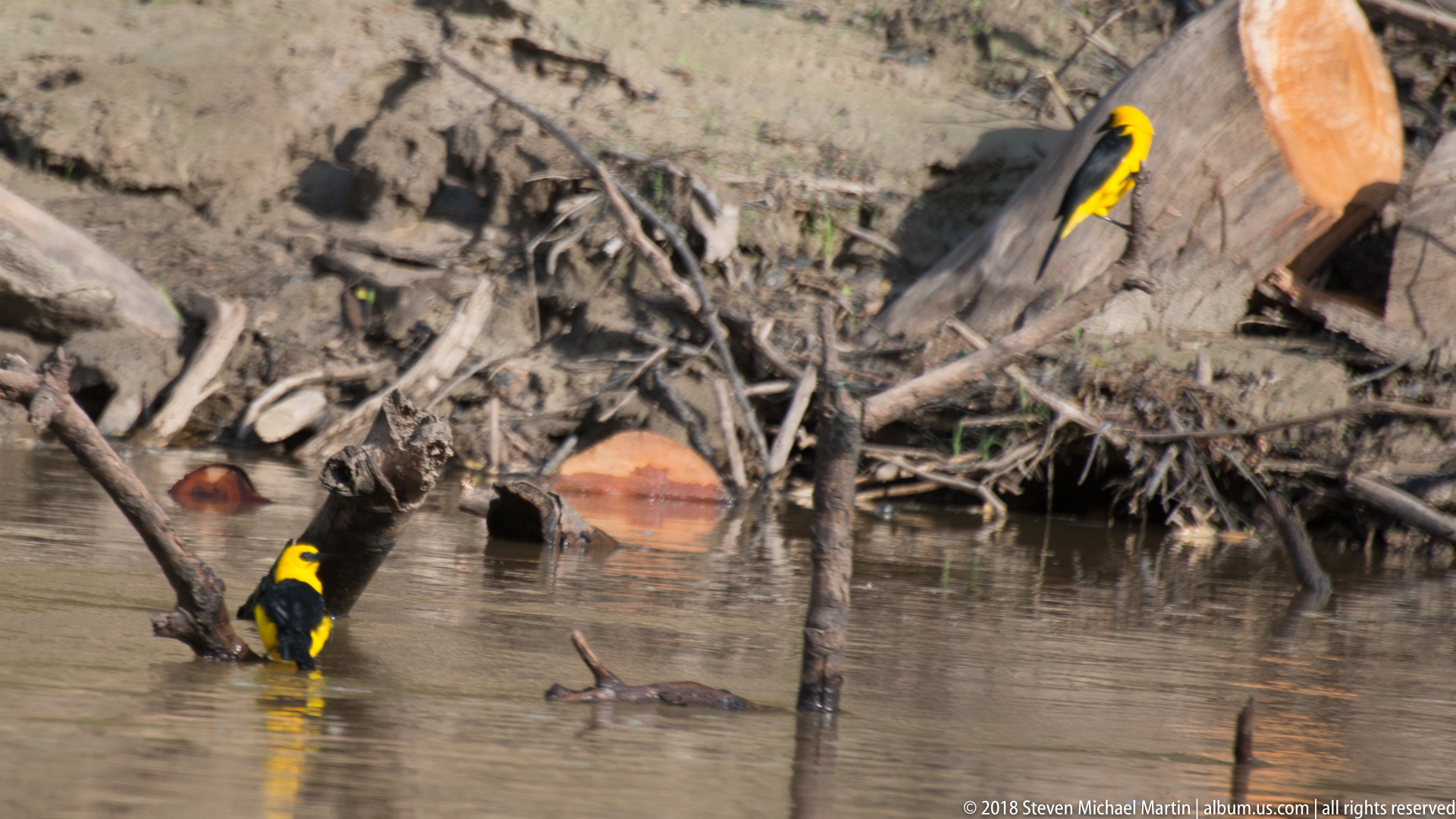
Two vivid yellow-and-black birds occupy different levels of the muddy riverbank: one stands at the water’s edge while the other clings higher on an exposed log. Their repeated color pattern is clearly visible against gray-brown mud and woody debris. The paired composition provides useful behavioral and habitat context, but the proof-sheet resolution does not securely establish the species.
Caption
Two vivid yellow-and-black birds occupy different levels of the muddy riverbank: one stands at the water’s edge while the other clings higher on an exposed log. Their repeated color pattern is clearly visible against gray-brown mud and woody debris. The paired composition provides useful behavioral and habitat context, but the proof-sheet resolution does not securely establish the species.
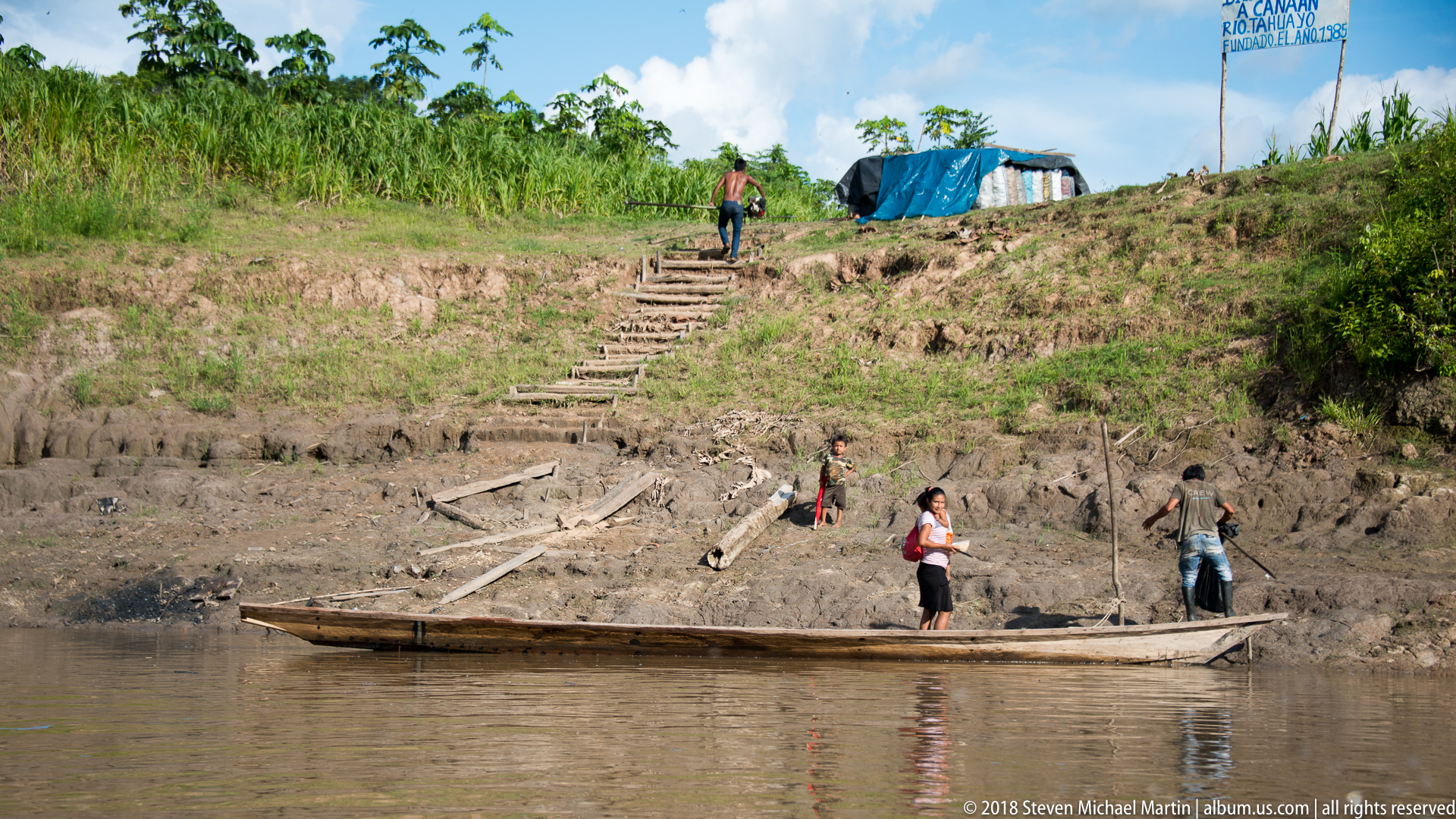
A long wooden canoe lies parallel to a steep, eroded riverbank as people stand in the boat and along the landing. Rough steps climb the slope toward a small structure above, creating a direct visual route between water transport and the settlement beyond. The broad view records the practical interface between boat, muddy seasonal bank, and foot access along the Tuhauyo River.
Caption
A long wooden canoe lies parallel to a steep, eroded riverbank as people stand in the boat and along the landing. Rough steps climb the slope toward a small structure above, creating a direct visual route between water transport and the settlement beyond. The broad view records the practical interface between boat, muddy seasonal bank, and foot access along the Tuhauyo River.
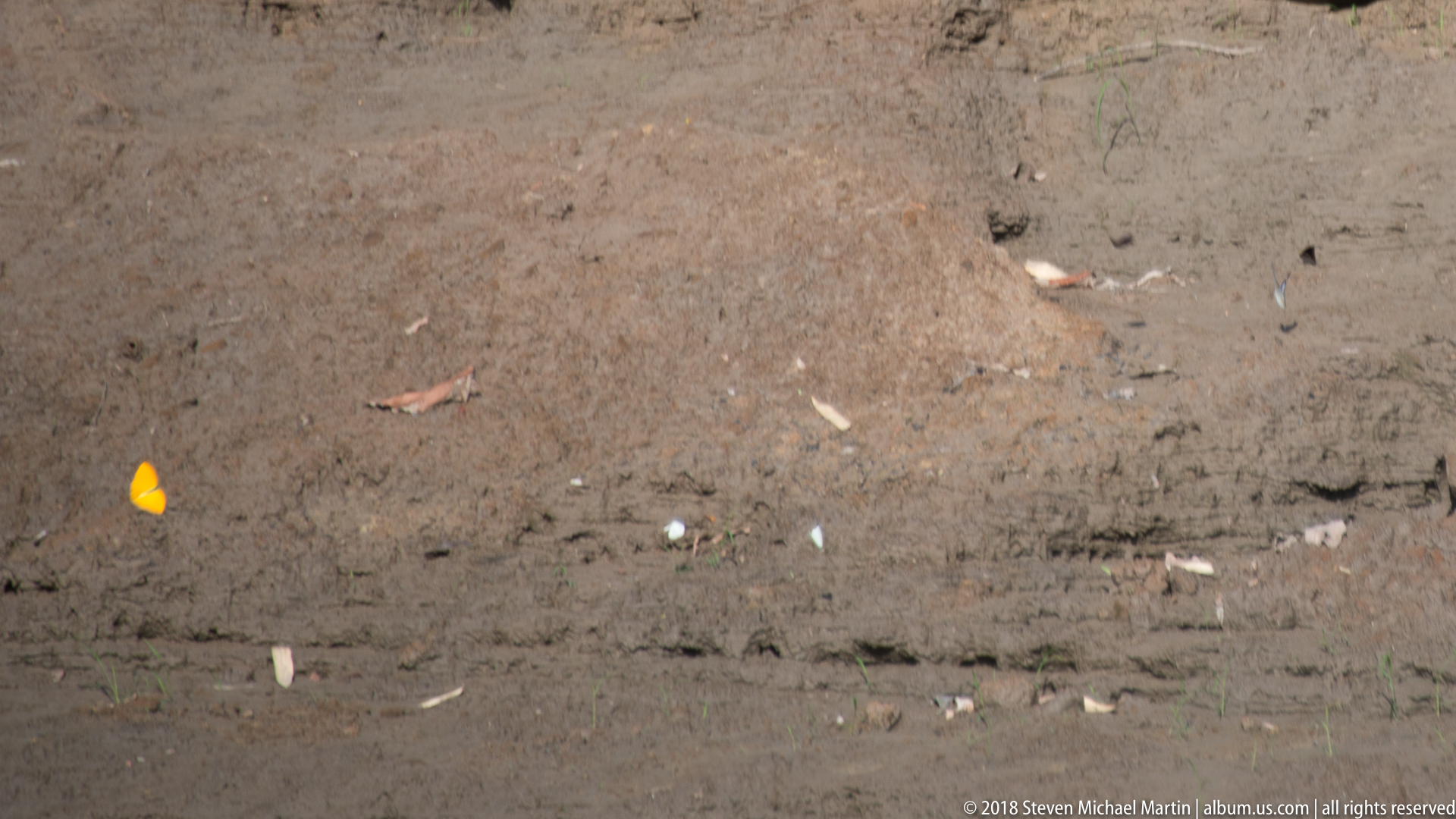
A small orange butterfly crosses in front of a broad expanse of exposed gray-brown riverbank mud. Its saturated wings form the only bright color accent in the otherwise muted frame, emphasizing the insect’s tiny scale against the eroded bank. The butterfly is too small and soft in the proof sheet for a defensible species identification, but its orange wing color and flight are plainly visible.
Caption
A small orange butterfly crosses in front of a broad expanse of exposed gray-brown riverbank mud. Its saturated wings form the only bright color accent in the otherwise muted frame, emphasizing the insect’s tiny scale against the eroded bank. The butterfly is too small and soft in the proof sheet for a defensible species identification, but its orange wing color and flight are plainly visible.

A Great kiskadee flies laterally across a soft green background, its wings lifted above the body in mid-stroke. The black-and-white head pattern, brown wings, and bright yellow belly remain visible despite motion blur, matching the perched bird seen earlier in the sequence. The panning view turns a familiar riverside species into an action study, emphasizing wing position and forward motion rather than perch behavior.
Caption
A Great kiskadee flies laterally across a soft green background, its wings lifted above the body in mid-stroke. The black-and-white head pattern, brown wings, and bright yellow belly remain visible despite motion blur, matching the perched bird seen earlier in the sequence. The panning view turns a familiar riverside species into an action study, emphasizing wing position and forward motion rather than perch behavior.

A dark bird flies low over the river with pointed wings extended and a pale patch visible across the upper body or wing area. The camera pans with the fast-moving subject, blurring the brown water and distant bank into horizontal bands. Although the flight silhouette is clear, motion and limited detail obscure the field marks needed to determine the species reliably.
Caption
A dark bird flies low over the river with pointed wings extended and a pale patch visible across the upper body or wing area. The camera pans with the fast-moving subject, blurring the brown water and distant bank into horizontal bands. Although the flight silhouette is clear, motion and limited detail obscure the field marks needed to determine the species reliably.
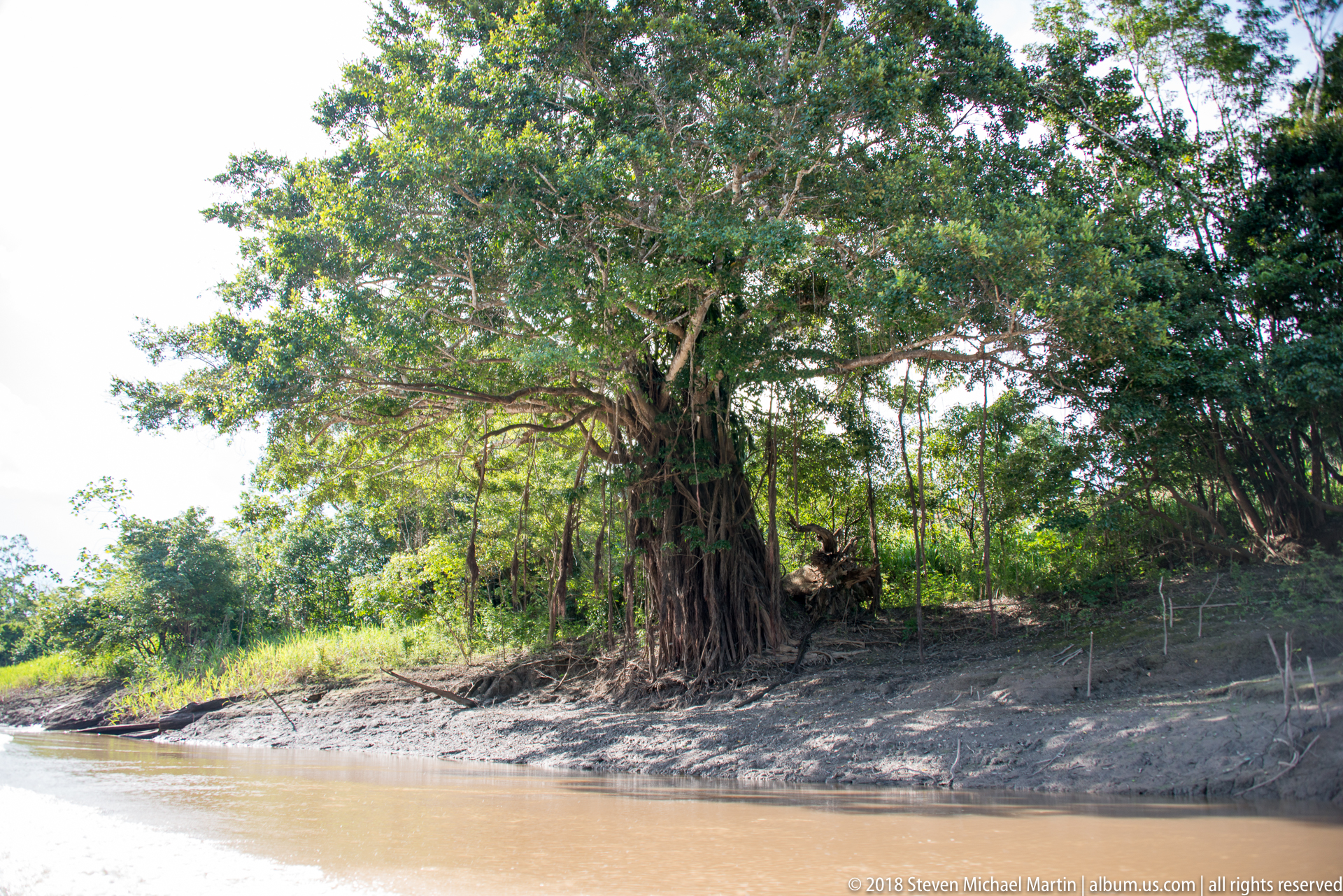
A mature tropical tree spreads a broad crown above the muddy bank of the Tuhauyo River, its trunk surrounded by exposed roots and hanging root structures at the forest edge. The low waterline reveals a sloping strip of sediment beneath the vegetation, placing the tree within the dynamic floodplain margin rather than deep in closed forest.
Caption
A mature tropical tree spreads a broad crown above the muddy bank of the Tuhauyo River, its trunk surrounded by exposed roots and hanging root structures at the forest edge. The low waterline reveals a sloping strip of sediment beneath the vegetation, placing the tree within the dynamic floodplain margin rather than deep in closed forest.
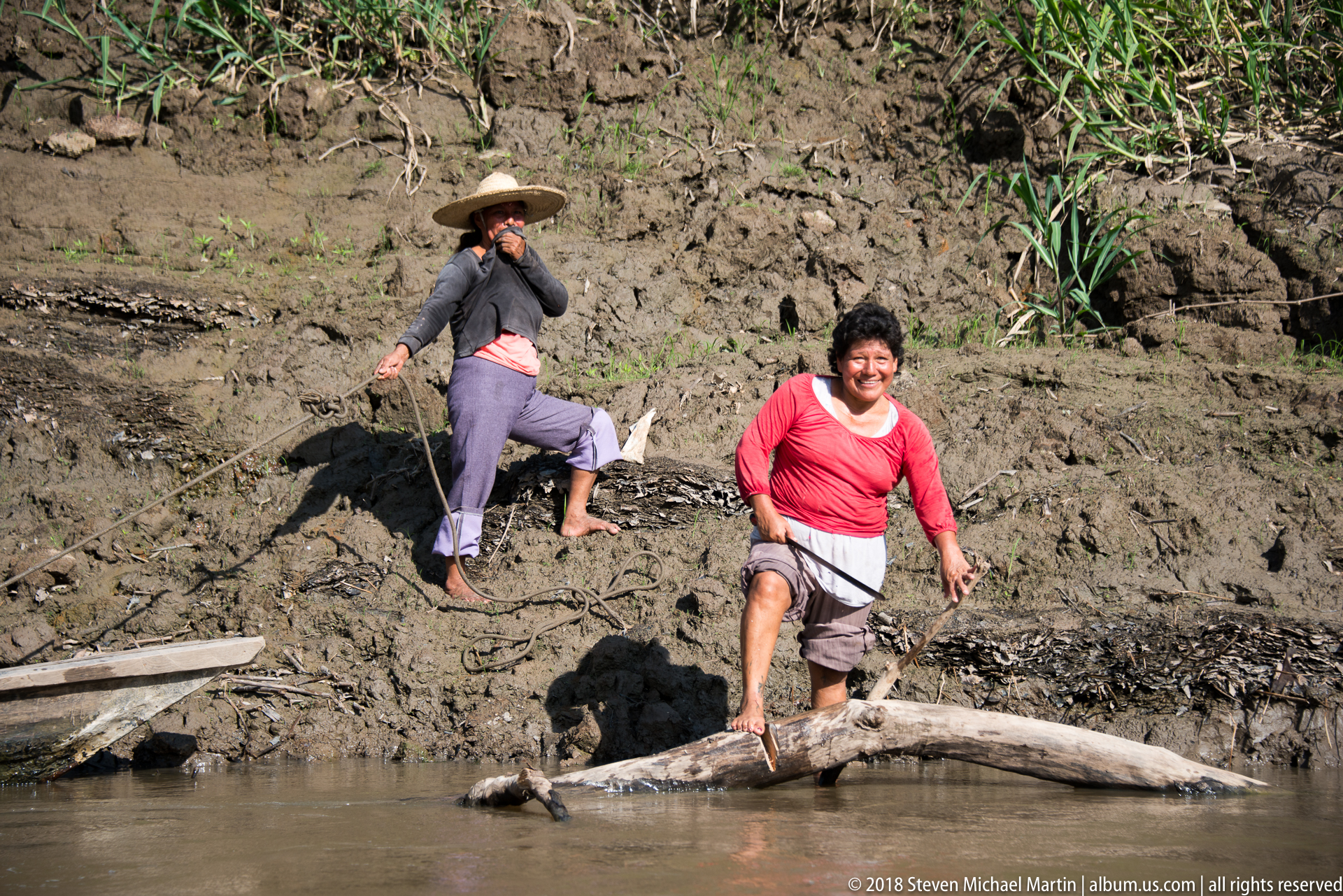
Two women negotiate the steep, exposed mud of the Tuhauyo River bank, one stepping onto a fallen trunk at the waterline while the other follows with a long pole or branch in hand. Their barefoot footing, the eroded bank, and a narrow wooden craft partly visible at left convey the practical difficulty of moving between river and shore during low water.
Caption
Two women negotiate the steep, exposed mud of the Tuhauyo River bank, one stepping onto a fallen trunk at the waterline while the other follows with a long pole or branch in hand. Their barefoot footing, the eroded bank, and a narrow wooden craft partly visible at left convey the practical difficulty of moving between river and shore during low water.

A great egret lifts away from the exposed mud of the Tuhauyo River, broad white wings arched as its long black legs trail beneath the body. The yellow bill, very long neck, and all-white plumage distinguish the large heron, while the close bank behind it records the bird using the shallow-water edge of the Amazonian river corridor.
Caption
A great egret lifts away from the exposed mud of the Tuhauyo River, broad white wings arched as its long black legs trail beneath the body. The yellow bill, very long neck, and all-white plumage distinguish the large heron, while the close bank behind it records the bird using the shallow-water edge of the Amazonian river corridor.