Moray – Sacred Valley, Peru
The remarkable terraces of Moray lie high in the Sacred Valley of the Andes Mountains. Built by the Inca civilization, the site consists of a series of circular agricultural terraces carved deep into the mountainside.
These concentric terraces create distinct microclimates at different elevations, leading many researchers to believe that Moray functioned as an agricultural research center where the Inca experimented with crops suited to different environments.
Today the site offers visitors a fascinating glimpse into the advanced agricultural knowledge of the Inca Empire.
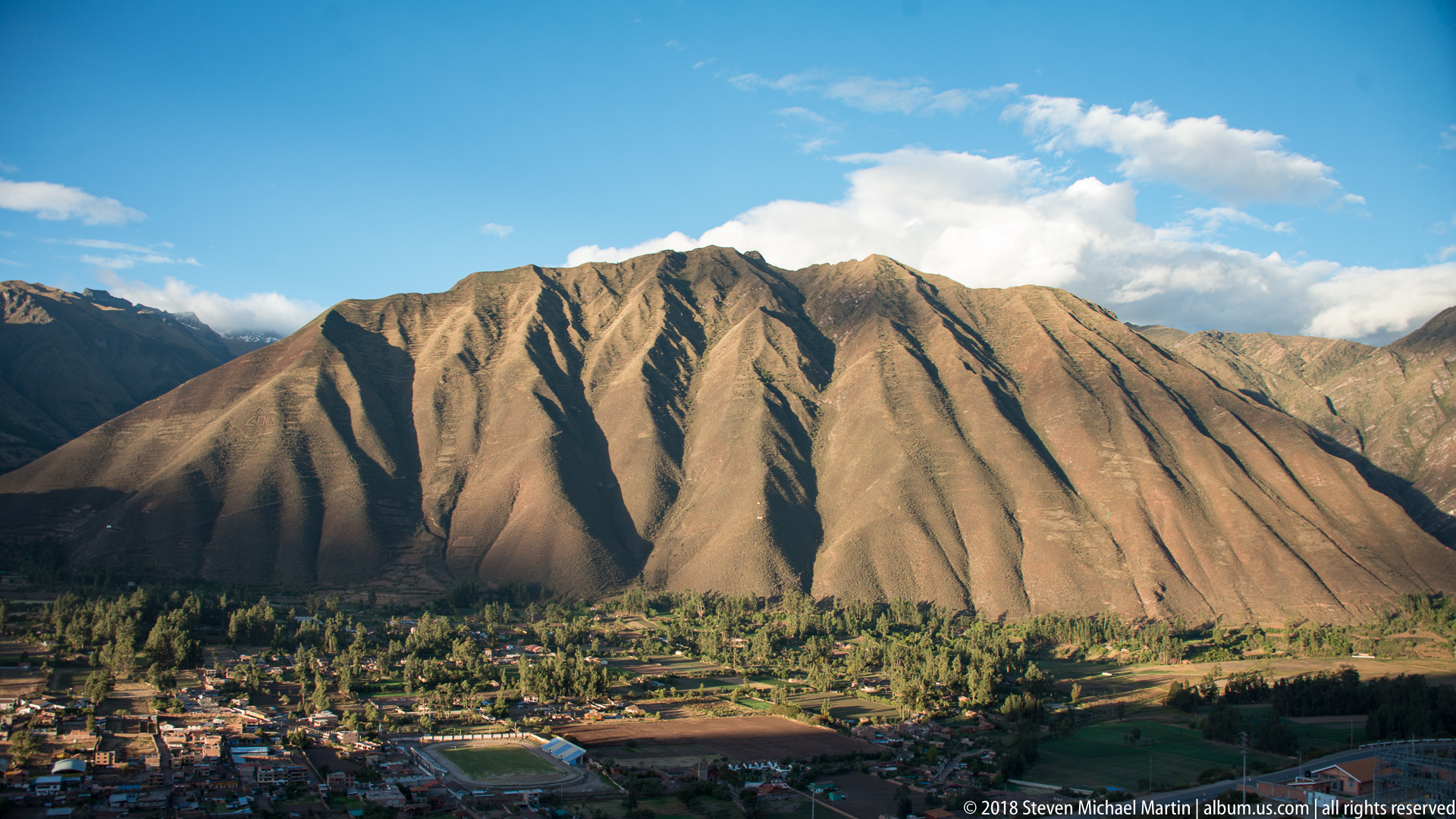
Late-afternoon light models a steep Andean ridge above a settled and cultivated valley near Moray. Deep erosion channels divide the brown mountain face into strong vertical ribs, while fields, trees, and buildings form a narrow green band at its base. The broad establishing view places the journey to the archaeological landscape within the highland terrain of the Cusco region.
Caption
Late-afternoon light models a steep Andean ridge above a settled and cultivated valley near Moray. Deep erosion channels divide the brown mountain face into strong vertical ribs, while fields, trees, and buildings form a narrow green band at its base. The broad establishing view places the journey to the archaeological landscape within the highland terrain of the Cusco region.

Moray's curved terrace rings descend across the foreground while a broad Andean mountain panorama rises beyond the archaeological basin. Scattered stone piles occupy the central floor and lower levels, and the upper terraces lead the eye toward pale, deeply folded ridges on the horizon. The composition links the engineered depression to the much larger highland topography surrounding the site.
Caption
Moray's curved terrace rings descend across the foreground while a broad Andean mountain panorama rises beyond the archaeological basin. Scattered stone piles occupy the central floor and lower levels, and the upper terraces lead the eye toward pale, deeply folded ridges on the horizon. The composition links the engineered depression to the much larger highland topography surrounding the site.

A broad, shallow terraced depression occupies the foreground at Moray, its curved stone walls stepping inward toward a dark central floor. Beyond the rim, pale Andean mountains rise in layered ridges beneath broken cloud. The relatively low viewpoint compresses the terraces against the distant landscape, giving the circular earthwork a more intimate scale than the dramatic high-rim overviews.
Caption
A broad, shallow terraced depression occupies the foreground at Moray, its curved stone walls stepping inward toward a dark central floor. Beyond the rim, pale Andean mountains rise in layered ridges beneath broken cloud. The relatively low viewpoint compresses the terraces against the distant landscape, giving the circular earthwork a more intimate scale than the dramatic high-rim overviews.

A wide elevated composition gathers several elements of Moray into one view: the concentric bowl in the foreground, long parallel terraces rising at left, and rugged shrub-covered slopes enclosing the site. A rectangular outline is visible on a flat level beside the circular rings. The balanced framing makes the relationship between the principal depression and the adjoining terrace systems especially easy to read.
Caption
A wide elevated composition gathers several elements of Moray into one view: the concentric bowl in the foreground, long parallel terraces rising at left, and rugged shrub-covered slopes enclosing the site. A rectangular outline is visible on a flat level beside the circular rings. The balanced framing makes the relationship between the principal depression and the adjoining terrace systems especially easy to read.
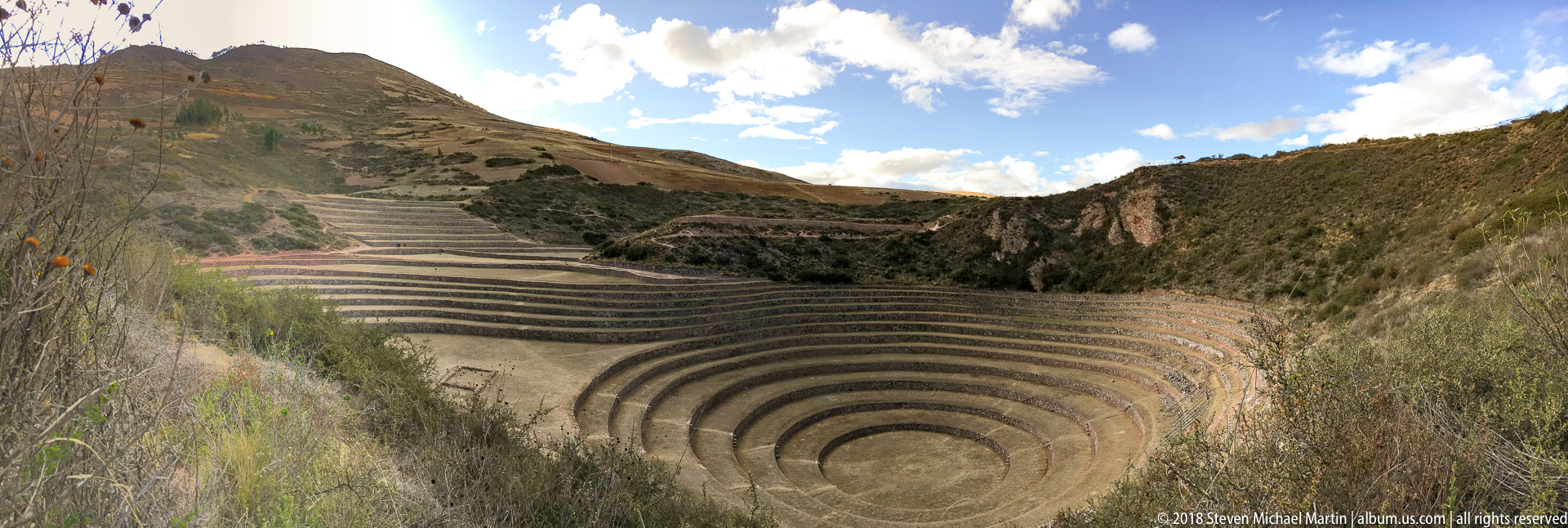
Tall grasses and flowering plants frame a wide view into Moray, where the main concentric terrace bowl occupies the lower center and straighter terraces climb the far slope. Rocky, shrub-covered walls enclose the depression beneath a bright blue sky with scattered clouds. The foreground vegetation gives this view greater depth and presents the archaeological geometry within its rugged natural basin.
Caption
Tall grasses and flowering plants frame a wide view into Moray, where the main concentric terrace bowl occupies the lower center and straighter terraces climb the far slope. Rocky, shrub-covered walls enclose the depression beneath a bright blue sky with scattered clouds. The foreground vegetation gives this view greater depth and presents the archaeological geometry within its rugged natural basin.

From above, Moray's concentric terraces read as a near-complete circular composition, each stone-edged ring stepping inward toward a round central floor. The surrounding slopes and grasses remain visible around the rim, but the geometry dominates the frame. This elevated overview is especially useful for understanding the nested organization and symmetry of the archaeological earthwork.
Caption
From above, Moray's concentric terraces read as a near-complete circular composition, each stone-edged ring stepping inward toward a round central floor. The surrounding slopes and grasses remain visible around the rim, but the geometry dominates the frame. This elevated overview is especially useful for understanding the nested organization and symmetry of the archaeological earthwork.

From high on the rim, a large Moray depression appears as a nested sequence of concentric terraces descending to a circular center. A second set of straighter terraces climbs the upper right slope, contrasting with the sweeping rings below. The high viewpoint reveals both the near-symmetry of the principal bowl and the way additional agricultural earthworks extend into the surrounding hillside.
Caption
From high on the rim, a large Moray depression appears as a nested sequence of concentric terraces descending to a circular center. A second set of straighter terraces climbs the upper right slope, contrasting with the sweeping rings below. The high viewpoint reveals both the near-symmetry of the principal bowl and the way additional agricultural earthworks extend into the surrounding hillside.

Strong backlight pours across Moray from the upper right, illuminating the rim while the concentric basin remains softly shadowed below. The principal circular terraces fill the lower left, and a second stepped terrace system extends across the far slope. Sun flare and haze make atmosphere central to this view, while the site's nested geometry remains legible beneath the changing light.
Caption
Strong backlight pours across Moray from the upper right, illuminating the rim while the concentric basin remains softly shadowed below. The principal circular terraces fill the lower left, and a second stepped terrace system extends across the far slope. Sun flare and haze make atmosphere central to this view, while the site's nested geometry remains legible beneath the changing light.

A high oblique viewpoint reveals the full depth of Moray's concentric terrace bowl, from the circular center through repeated stone-supported rings to the irregular slopes around the rim. A rectangular ground feature lies on an upper level beyond the center, while additional terraces climb the far hillside. The composition clearly distinguishes the engineered circular basin from the rougher surrounding terrain.
Caption
A high oblique viewpoint reveals the full depth of Moray's concentric terrace bowl, from the circular center through repeated stone-supported rings to the irregular slopes around the rim. A rectangular ground feature lies on an upper level beyond the center, while additional terraces climb the far hillside. The composition clearly distinguishes the engineered circular basin from the rougher surrounding terrain.

A flock of sheep fills a narrow unpaved lane as a woman walks behind them, guiding the animals through a village setting near Moray. Orange markings on several sheep stand out against their pale wool, while the shallow focus keeps attention on the approaching flock. The scene records livestock movement as part of the inhabited agricultural landscape surrounding the archaeological site.
Caption
A flock of sheep fills a narrow unpaved lane as a woman walks behind them, guiding the animals through a village setting near Moray. Orange markings on several sheep stand out against their pale wool, while the shallow focus keeps attention on the approaching flock. The scene records livestock movement as part of the inhabited agricultural landscape surrounding the archaeological site.

A woman pauses in a narrow earthen-walled lane while carrying a large bundle of dry grass secured in a brightly striped woven cloth across her back. Her brimmed hat, layered clothing, and walking stick are sharply visible against the rough masonry and plaster walls. Livestock farther up the passage adds context to this working village scene near Moray.
Caption
A woman pauses in a narrow earthen-walled lane while carrying a large bundle of dry grass secured in a brightly striped woven cloth across her back. Her brimmed hat, layered clothing, and walking stick are sharply visible against the rough masonry and plaster walls. Livestock farther up the passage adds context to this working village scene near Moray.

Seen at close range, a smiling woman turns toward the camera with a bundle of dry grass rising from a brightly striped woven carrying cloth on her back. A broad felt hat frames her face, and the shallow background isolates her against a pale, weathered wall. The tighter composition concentrates on the person, textile, and carried material rather than the surrounding village lane.
Caption
Seen at close range, a smiling woman turns toward the camera with a bundle of dry grass rising from a brightly striped woven carrying cloth on her back. A broad felt hat frames her face, and the shallow background isolates her against a pale, weathered wall. The tighter composition concentrates on the person, textile, and carried material rather than the surrounding village lane.

Sheep move across a paved village street beside a large black bovine, while a small black dog keeps close to the flock. Rough earthen walls and a heavy wooden doorway define the edge of the lane. The mixed animals and compact street setting create a distinct view of everyday livestock movement in the rural landscape encountered near Moray.
Caption
Sheep move across a paved village street beside a large black bovine, while a small black dog keeps close to the flock. Rough earthen walls and a heavy wooden doorway define the edge of the lane. The mixed animals and compact street setting create a distinct view of everyday livestock movement in the rural landscape encountered near Moray.

Cattle and donkeys occupy a narrow village lane while two motorcyclists and a car wait behind them, compressing livestock and modern traffic into the same passage. Earthen walls rise on both sides, emphasizing the confined route through the settlement. The layered scene shows how animals, residents, and vehicles share the road in the highland communities near Moray.
Caption
Cattle and donkeys occupy a narrow village lane while two motorcyclists and a car wait behind them, compressing livestock and modern traffic into the same passage. Earthen walls rise on both sides, emphasizing the confined route through the settlement. The layered scene shows how animals, residents, and vehicles share the road in the highland communities near Moray.

A woman stands beside a rough earthen wall with a bundle of dry grass tucked into a vividly striped woven carrying cloth over one shoulder. She holds a long walking stick and looks directly toward the camera. Compared with the tighter portrait nearby, this view includes more of her layered clothing and the street edge, giving the figure stronger environmental context.
Caption
A woman stands beside a rough earthen wall with a bundle of dry grass tucked into a vividly striped woven carrying cloth over one shoulder. She holds a long walking stick and looks directly toward the camera. Compared with the tighter portrait nearby, this view includes more of her layered clothing and the street edge, giving the figure stronger environmental context.

A full-length view shows a woman standing in the roadway with a large striped carrying cloth filled with dry grass across her back. Her broad hat, red jacket, layered skirt, and walking stick create a strong silhouette against the pale earthen wall. The wider framing records her stance and scale within the street, distinguishing it from the closer portraits in the sequence.
Caption
A full-length view shows a woman standing in the roadway with a large striped carrying cloth filled with dry grass across her back. Her broad hat, red jacket, layered skirt, and walking stick create a strong silhouette against the pale earthen wall. The wider framing records her stance and scale within the street, distinguishing it from the closer portraits in the sequence.

From behind, a woman walks down a village street with a mixed group of sheep, donkeys, and cattle spread across the roadway ahead of her. Her brightly striped wrap provides a focal point amid the muted earthen walls and animals. The rear viewpoint emphasizes movement away from the camera and the practical task of guiding livestock through the settlement.
Caption
From behind, a woman walks down a village street with a mixed group of sheep, donkeys, and cattle spread across the roadway ahead of her. Her brightly striped wrap provides a focal point amid the muted earthen walls and animals. The rear viewpoint emphasizes movement away from the camera and the practical task of guiding livestock through the settlement.

Broad ocher and rust-colored uplands roll across the horizon beneath a deep blue sky and a long bank of white cloud. Sparse vegetation and cultivated or grazed ground create subtle horizontal bands across the high plateau. This open landscape view shifts the sequence away from the village and toward the expansive Andean terrain encountered on the approach to Moray.
Caption
Broad ocher and rust-colored uplands roll across the horizon beneath a deep blue sky and a long bank of white cloud. Sparse vegetation and cultivated or grazed ground create subtle horizontal bands across the high plateau. This open landscape view shifts the sequence away from the village and toward the expansive Andean terrain encountered on the approach to Moray.

Snow and ice mark the highest peaks of a distant Andean range, partly veiled by low clouds and separated from the camera by successive dark ridges. A pale highland field and scattered trees occupy the foreground. The compressed layers of field, valley, mountain, cloud, and snow convey the dramatic elevation changes of the Cusco-region landscape around Moray.
Caption
Snow and ice mark the highest peaks of a distant Andean range, partly veiled by low clouds and separated from the camera by successive dark ridges. A pale highland field and scattered trees occupy the foreground. The compressed layers of field, valley, mountain, cloud, and snow convey the dramatic elevation changes of the Cusco-region landscape around Moray.

A high overlook reveals one of Moray's characteristic concentric terraced depressions, where broad earthen benches descend in near-circular rings toward a small central floor. Stone retaining walls articulate each level, while additional terraces climb the slope beyond. The geometry, scale, and bowl-like setting distinguish Moray's engineered agricultural landscape from conventional hillside terracing.
Caption
A high overlook reveals one of Moray's characteristic concentric terraced depressions, where broad earthen benches descend in near-circular rings toward a small central floor. Stone retaining walls articulate each level, while additional terraces climb the slope beyond. The geometry, scale, and bowl-like setting distinguish Moray's engineered agricultural landscape from conventional hillside terracing.

A close oblique study of Moray's terraces follows the repeated arcs of stone retaining walls and narrow grass-covered benches. Small sets of projecting stones form steep step-like connections between levels, punctuating the otherwise continuous curves. By excluding the center of the depression, the composition emphasizes construction, rhythm, and the practical vertical links built into the terraced system.
Caption
A close oblique study of Moray's terraces follows the repeated arcs of stone retaining walls and narrow grass-covered benches. Small sets of projecting stones form steep step-like connections between levels, punctuating the otherwise continuous curves. By excluding the center of the depression, the composition emphasizes construction, rhythm, and the practical vertical links built into the terraced system.

Moray's terrace walls sweep diagonally across this compressed view, stacking narrow grassed benches in a dense sequence of parallel curves. Short flights of projecting stones appear at intervals in the masonry, providing direct transitions between levels. The tighter crop reduces the surrounding landscape to concentrate on the repeated engineering pattern of wall, bench, and vertical access.
Caption
Moray's terrace walls sweep diagonally across this compressed view, stacking narrow grassed benches in a dense sequence of parallel curves. Short flights of projecting stones appear at intervals in the masonry, providing direct transitions between levels. The tighter crop reduces the surrounding landscape to concentrate on the repeated engineering pattern of wall, bench, and vertical access.

Rounded terrace ends create broad, sculptural curves in this detail of the Moray complex. Dark stone retaining walls separate pale grass-covered surfaces, and a narrow projecting-stone stair breaks one wall near the center. The viewpoint highlights how individual terrace bands turn and reconnect, revealing a more complex geometry than the site's distant concentric overview suggests.
Caption
Rounded terrace ends create broad, sculptural curves in this detail of the Moray complex. Dark stone retaining walls separate pale grass-covered surfaces, and a narrow projecting-stone stair breaks one wall near the center. The viewpoint highlights how individual terrace bands turn and reconnect, revealing a more complex geometry than the site's distant concentric overview suggests.

Warm light brings out the varied stones in Moray's retaining walls and the dry yellow-green grass covering the terrace benches. Repeated horizontal levels step across the frame, while small projecting stones interrupt the masonry at several points. This detail gives particular attention to texture and construction, showing the irregular stone facing that supports the carefully ordered earthen platforms.
Caption
Warm light brings out the varied stones in Moray's retaining walls and the dry yellow-green grass covering the terrace benches. Repeated horizontal levels step across the frame, while small projecting stones interrupt the masonry at several points. This detail gives particular attention to texture and construction, showing the irregular stone facing that supports the carefully ordered earthen platforms.

Two sweeping terrace systems meet around a narrow raised spine in this elevated view of Moray. Broad grassed benches and dark stone walls curve in opposing directions, while tighter inner rings descend at lower right. The composition makes the site's changing geometry especially legible, showing how concentric and adjoining terrace forms are fitted together across the irregular terrain.
Caption
Two sweeping terrace systems meet around a narrow raised spine in this elevated view of Moray. Broad grassed benches and dark stone walls curve in opposing directions, while tighter inner rings descend at lower right. The composition makes the site's changing geometry especially legible, showing how concentric and adjoining terrace forms are fitted together across the irregular terrain.

A wide-angle view looks across a large terraced bowl at Moray, with concentric stone-edged benches descending from the surrounding slopes toward a broad central floor. The dark foreground terraces contrast with a bright blue sky and scrub-covered rim. This low, expansive perspective stresses the depth of the depression and the enclosing relationship between engineered terraces and natural hillside.
Caption
A wide-angle view looks across a large terraced bowl at Moray, with concentric stone-edged benches descending from the surrounding slopes toward a broad central floor. The dark foreground terraces contrast with a bright blue sky and scrub-covered rim. This low, expansive perspective stresses the depth of the depression and the enclosing relationship between engineered terraces and natural hillside.

Sunlight washes across a sequence of Moray's curving terraces, turning the dry grass benches golden while the stone retaining walls remain sharply defined. The arcs tighten toward the left side of the frame, and projecting-stone steps appear at several wall breaks. The oblique view balances the site's large-scale geometry with enough proximity to read individual construction features.
Caption
Sunlight washes across a sequence of Moray's curving terraces, turning the dry grass benches golden while the stone retaining walls remain sharply defined. The arcs tighten toward the left side of the frame, and projecting-stone steps appear at several wall breaks. The oblique view balances the site's large-scale geometry with enough proximity to read individual construction features.

A narrow raised division runs between two sets of Moray terraces, splitting their curves before they sweep away in different directions. Dark stone retaining walls alternate with pale grass-covered benches, producing a strong striped pattern across the depression. The close elevated framing makes the junction itself the subject, clarifying how separate terrace arcs are organized around a shared ridge.
Caption
A narrow raised division runs between two sets of Moray terraces, splitting their curves before they sweep away in different directions. Dark stone retaining walls alternate with pale grass-covered benches, producing a strong striped pattern across the depression. The close elevated framing makes the junction itself the subject, clarifying how separate terrace arcs are organized around a shared ridge.

A visitor stands at the overlook above Moray's concentric terraces, providing a human scale for the broad archaeological depression behind him. The curved rings descend across the background toward the central floor, while scrub-covered slopes form the far rim. The portrait combines personal travel context with a clear view of the site's distinctive terraced geometry.
Caption
A visitor stands at the overlook above Moray's concentric terraces, providing a human scale for the broad archaeological depression behind him. The curved rings descend across the background toward the central floor, while scrub-covered slopes form the far rim. The portrait combines personal travel context with a clear view of the site's distinctive terraced geometry.

The broad floor of a Moray depression opens across the foreground, bordered by successive curved terraces that climb toward a rocky, shrub-covered hillside. A rectangular ground feature is visible on the central surface, while the retaining walls trace long, nearly continuous arcs. The composition gives more space to the level interior, contrasting it with the densely stepped perimeter.
Caption
The broad floor of a Moray depression opens across the foreground, bordered by successive curved terraces that climb toward a rocky, shrub-covered hillside. A rectangular ground feature is visible on the central surface, while the retaining walls trace long, nearly continuous arcs. The composition gives more space to the level interior, contrasting it with the densely stepped perimeter.

A very wide overlook sets Moray's principal concentric depression within its rugged hillside setting. Repeated rings descend toward a broad floor marked by a rectangular feature, while another terrace system climbs the slope at right. Clouds and broken sunlight cross the surrounding rim, making this one of the sequence's strongest contextual views of the site's scale and topographic placement.
Caption
A very wide overlook sets Moray's principal concentric depression within its rugged hillside setting. Repeated rings descend toward a broad floor marked by a rectangular feature, while another terrace system climbs the slope at right. Clouds and broken sunlight cross the surrounding rim, making this one of the sequence's strongest contextual views of the site's scale and topographic placement.

Moray's concentric terraced depression fills the valley floor in a high establishing view, its nested rings descending toward a broad center before rising into the surrounding scrub-covered hills. The slightly off-center perspective reveals both the circular plan and the irregular natural basin that contains it. Distant paths and slopes place the engineered terraces firmly within the larger highland landscape.
Caption
Moray's concentric terraced depression fills the valley floor in a high establishing view, its nested rings descending toward a broad center before rising into the surrounding scrub-covered hills. The slightly off-center perspective reveals both the circular plan and the irregular natural basin that contains it. Distant paths and slopes place the engineered terraces firmly within the larger highland landscape.

A visitor holding a camera stands on the rim above Moray, with the archaeological site's concentric terrace rings sweeping behind him. The elevated angle places the figure against the broad circular pattern below, using his scale to convey the depth and width of the depression. The image functions as an environmental portrait anchored unmistakably in the terraced landscape.
Caption
A visitor holding a camera stands on the rim above Moray, with the archaeological site's concentric terrace rings sweeping behind him. The elevated angle places the figure against the broad circular pattern below, using his scale to convey the depth and width of the depression. The image functions as an environmental portrait anchored unmistakably in the terraced landscape.

A compressed telephoto-like view turns Moray's terraces into dense horizontal bands of stone and dry grass. Irregular masonry retaining walls extend almost edge to edge, with only narrow benches separating one level from the next. Without the circular center in view, the photograph reads as a construction study, emphasizing material, repetition, and the cumulative height of the stacked terrace system.
Caption
A compressed telephoto-like view turns Moray's terraces into dense horizontal bands of stone and dry grass. Irregular masonry retaining walls extend almost edge to edge, with only narrow benches separating one level from the next. Without the circular center in view, the photograph reads as a construction study, emphasizing material, repetition, and the cumulative height of the stacked terrace system.

Three broad arcs dominate this close detail of Moray, their dark stone retaining walls enclosing smooth, grass-covered terrace surfaces. Small projecting stones form compact stairways through two of the walls, providing a striking vertical counterpoint to the horizontal curves. The tight crop isolates the site's recurring relationship between rounded geometry, masonry support, and access between levels.
Caption
Three broad arcs dominate this close detail of Moray, their dark stone retaining walls enclosing smooth, grass-covered terrace surfaces. Small projecting stones form compact stairways through two of the walls, providing a striking vertical counterpoint to the horizontal curves. The tight crop isolates the site's recurring relationship between rounded geometry, masonry support, and access between levels.

Visitors dispersed across Moray's circular terraces provide an unusually clear sense of scale in this elevated overview. Small figures occupy several rings and the central floor, allowing the broad width of each terrace bench and the depth of the depression to be read against human bodies. The surrounding exposed earth and vegetation frame the nested stone-edged circles as an archaeological landscape in active visitation.
Caption
Visitors dispersed across Moray's circular terraces provide an unusually clear sense of scale in this elevated overview. Small figures occupy several rings and the central floor, allowing the broad width of each terrace bench and the depth of the depression to be read against human bodies. The surrounding exposed earth and vegetation frame the nested stone-edged circles as an archaeological landscape in active visitation.

A large Moray terrace bowl stretches diagonally across the frame, its nested rings alternating between sunlight and shadow as they descend toward the center. The high oblique viewpoint reveals the full sweep of the retaining walls while keeping the enclosing scrub-covered slopes visible. Light across the upper terraces accentuates the site's depth and the rhythmic repetition of its circular earthworks.
Caption
A large Moray terrace bowl stretches diagonally across the frame, its nested rings alternating between sunlight and shadow as they descend toward the center. The high oblique viewpoint reveals the full sweep of the retaining walls while keeping the enclosing scrub-covered slopes visible. Light across the upper terraces accentuates the site's depth and the rhythmic repetition of its circular earthworks.

A small thatched-roof shelter stands beside a reddish footpath on the high ground at Moray, opening onto a sweeping Andean panorama. Dry grass covers the immediate slope, while patchwork fields, rounded ridges, and distant cloud-wrapped mountains recede across the horizon. The shelter gives this establishing landscape a human-scale foreground element without obscuring the expansive highland setting.
Caption
A small thatched-roof shelter stands beside a reddish footpath on the high ground at Moray, opening onto a sweeping Andean panorama. Dry grass covers the immediate slope, while patchwork fields, rounded ridges, and distant cloud-wrapped mountains recede across the horizon. The shelter gives this establishing landscape a human-scale foreground element without obscuring the expansive highland setting.
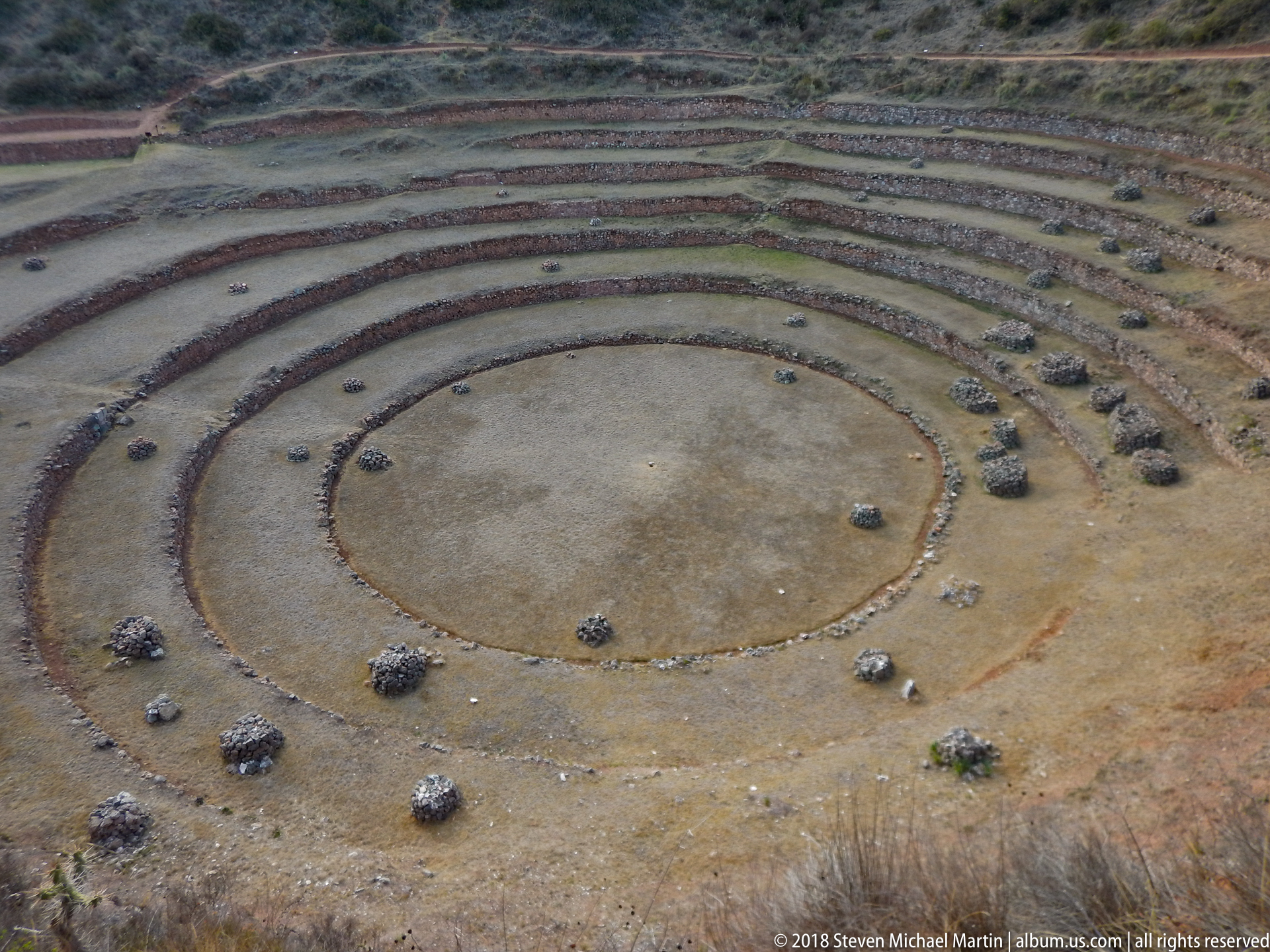
An elevated view looks directly into a circular terraced depression at Moray, where low stone retaining walls form nested rings around a broad, nearly level center. Small piles of stone punctuate the inner terraces and floor, making this view distinct from the cleaner geometric overviews elsewhere in the sequence. The close vantage emphasizes the center and the repeated masonry arcs rather than the surrounding landscape.
Caption
An elevated view looks directly into a circular terraced depression at Moray, where low stone retaining walls form nested rings around a broad, nearly level center. Small piles of stone punctuate the inner terraces and floor, making this view distinct from the cleaner geometric overviews elsewhere in the sequence. The close vantage emphasizes the center and the repeated masonry arcs rather than the surrounding landscape.
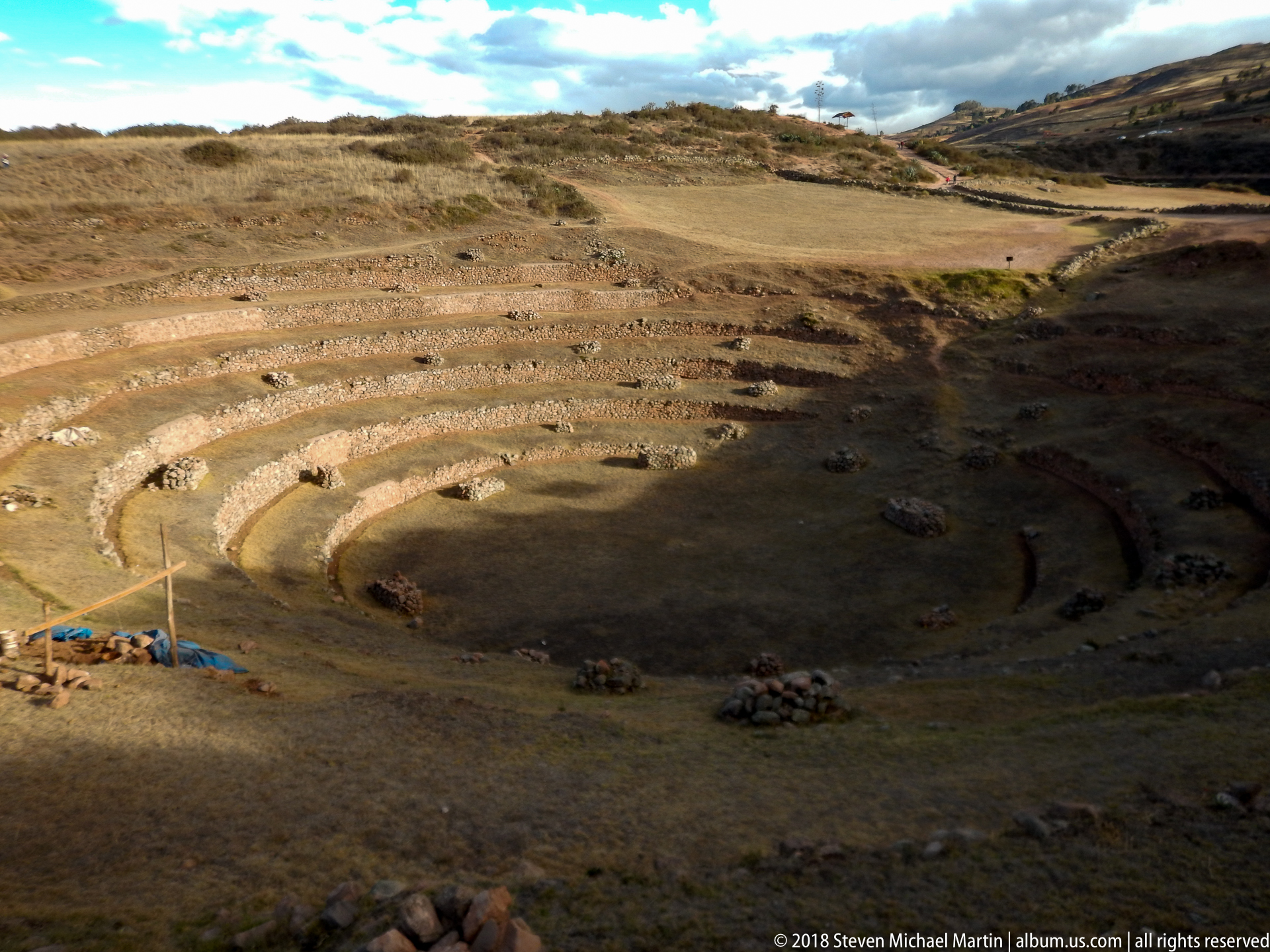
Low sunlight and deep shadow divide this circular depression at Moray, revealing a sequence of stone-edged terraces around a broad central area. The brightest upper benches trace the curvature of the basin, while the lower rings fall into shade. Stone piles and exposed earth add texture to the floor, making light and topography the defining elements of this view.
Caption
Low sunlight and deep shadow divide this circular depression at Moray, revealing a sequence of stone-edged terraces around a broad central area. The brightest upper benches trace the curvature of the basin, while the lower rings fall into shade. Stone piles and exposed earth add texture to the floor, making light and topography the defining elements of this view.

A broad view places Moray's circular terraces low in the frame beneath an expansive blue sky and distant Andean peaks. The depression's nested stone walls are readable across the foreground, but the mountain horizon and open highland setting receive equal visual weight. This landscape-oriented composition is especially effective at showing the archaeological terraces as one element within a much larger upland environment.
Caption
A broad view places Moray's circular terraces low in the frame beneath an expansive blue sky and distant Andean peaks. The depression's nested stone walls are readable across the foreground, but the mountain horizon and open highland setting receive equal visual weight. This landscape-oriented composition is especially effective at showing the archaeological terraces as one element within a much larger upland environment.

A photographer in a green jacket leans over his camera at the rim of Moray, aiming down toward the site's sweeping concentric terraces. His close foreground presence creates a strong scale contrast with the broad archaeological bowl below. The composition records the act of photographing the site while preserving a clear view of the nested rings, upper terraces, and rugged slopes beyond.
Caption
A photographer in a green jacket leans over his camera at the rim of Moray, aiming down toward the site's sweeping concentric terraces. His close foreground presence creates a strong scale contrast with the broad archaeological bowl below. The composition records the act of photographing the site while preserving a clear view of the nested rings, upper terraces, and rugged slopes beyond.

Moray's nested terraces sweep across the lower half of this elevated view, while a rectangular stone or ground outline occupies a flat area to the left of the main rings. Additional parallel terraces climb the far hillside. By shifting the circular center toward the lower right, the composition gives unusual prominence to the rectangular feature and to the transition between circular and straighter terrace systems.
Caption
Moray's nested terraces sweep across the lower half of this elevated view, while a rectangular stone or ground outline occupies a flat area to the left of the main rings. Additional parallel terraces climb the far hillside. By shifting the circular center toward the lower right, the composition gives unusual prominence to the rectangular feature and to the transition between circular and straighter terrace systems.

Concentric rings dominate this tightly framed view of Moray, descending in smooth arcs toward a broad circular center. The dark stone retaining walls contrast with pale, closely cropped grass, while a rocky shrub-covered slope closes the background. With little sky and minimal peripheral landscape, the photograph presents the terraced bowl primarily as a geometric and architectural composition.
Caption
Concentric rings dominate this tightly framed view of Moray, descending in smooth arcs toward a broad circular center. The dark stone retaining walls contrast with pale, closely cropped grass, while a rocky shrub-covered slope closes the background. With little sky and minimal peripheral landscape, the photograph presents the terraced bowl primarily as a geometric and architectural composition.
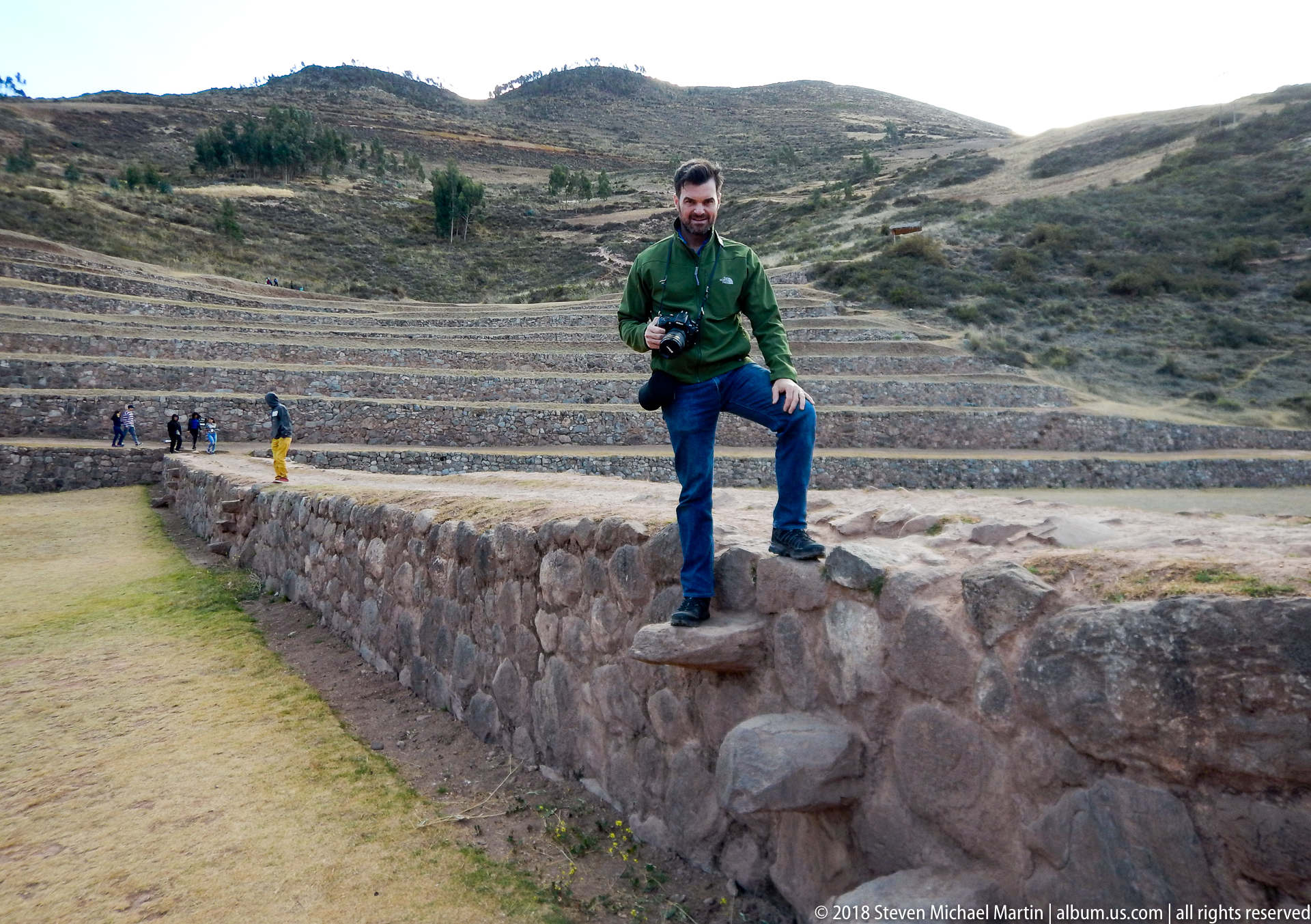
A visitor in a green jacket stands on projecting stones built into one of Moray's retaining walls, holding a camera while resting one foot higher on the masonry. The stepped stones demonstrate at human scale how movement between terrace levels can be negotiated. Curving stone walls and other visitors recede behind him, turning the portrait into a close contextual study of the site's construction and access.
Caption
A visitor in a green jacket stands on projecting stones built into one of Moray's retaining walls, holding a camera while resting one foot higher on the masonry. The stepped stones demonstrate at human scale how movement between terrace levels can be negotiated. Curving stone walls and other visitors recede behind him, turning the portrait into a close contextual study of the site's construction and access.