Nara Park and Todai-ji Temple
Nara served as Japan’s capital during the eighth century and became an important center for the introduction of Buddhism into Japanese society. Todai-ji Temple was constructed during this period and houses one of the largest bronze Buddha statues in the world. The temple complex reflects early state sponsorship of Buddhist institutions.
Nara Park surrounds the temple and is known for its population of deer, which are traditionally considered sacred messengers associated with Shinto belief. The combination of Buddhist temples and Shinto symbolism illustrates the interaction between religious traditions in early Japanese culture. Architectural features demonstrate the scale of early imperial construction.
Todai-ji and Nara Park illustrate the role of religion in shaping political authority during Japan’s early imperial period. The site reflects the cultural importance of Buddhist institutions in the formation of Japanese identity.

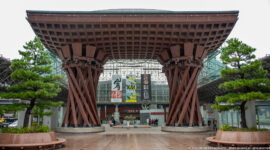
A large vermilion gate presents a broad two-story façade of timber columns, white plaster panels, and gray tiled roofs. Open central bays lead into the precinct while visitors at ground level convey the structure’s scale. Painted brackets and layered eaves create a richly articulated entrance associated with Todai-ji’s ceremonial approach.
Caption
A large vermilion gate presents a broad two-story façade of timber columns, white plaster panels, and gray tiled roofs. Open central bays lead into the precinct while visitors at ground level convey the structure’s scale. Painted brackets and layered eaves create a richly articulated entrance associated with Todai-ji’s ceremonial approach.

Two visitors pause on a stone ledge while free-roaming sika deer approach from either side. One person leans toward a smaller deer as another animal stands near a tree. The scene records the informal contact between people and wildlife that characterizes daily movement through Nara’s temple and park landscape.
Caption
Two visitors pause on a stone ledge while free-roaming sika deer approach from either side. One person leans toward a smaller deer as another animal stands near a tree. The scene records the informal contact between people and wildlife that characterizes daily movement through Nara’s temple and park landscape.

A free-roaming sika deer crosses the broad stone forecourt before a monumental vermilion gate in the Todai-ji precinct. The animal’s small scale heightens the gate’s layered eaves, massive columns, and ceremonial symmetry. More than a picturesque juxtaposition, the scene brings together two defining elements of Nara’s cultural landscape: Buddhist architecture and the deer that move freely among its historic monuments.
Caption
A free-roaming sika deer crosses the broad stone forecourt before a monumental vermilion gate in the Todai-ji precinct. The animal’s small scale heightens the gate’s layered eaves, massive columns, and ceremonial symmetry. More than a picturesque juxtaposition, the scene brings together two defining elements of Nara’s cultural landscape: Buddhist architecture and the deer that move freely among its historic monuments.

Architectural scale models reconstruct a temple compound of tiered pagodas, corridors, gates, and tiled-roof halls. The largest pagoda rises prominently above a carefully organized precinct, allowing visitors to understand spatial relationships that are difficult to grasp from isolated surviving buildings. The display functions as both architectural interpretation and a record of the broader ceremonial landscape associated with Japanese Buddhist institutions.
Caption
Architectural scale models reconstruct a temple compound of tiered pagodas, corridors, gates, and tiled-roof halls. The largest pagoda rises prominently above a carefully organized precinct, allowing visitors to understand spatial relationships that are difficult to grasp from isolated surviving buildings. The display functions as both architectural interpretation and a record of the broader ceremonial landscape associated with Japanese Buddhist institutions.

A young sika deer pauses along a narrow walkway bordered by a curved drainage channel and stonework. Its smaller frame, long legs, and spotted coat suggest a juvenile animal. The setting shows how Nara Park’s deer occupy landscaped edges and pedestrian routes rather than remaining separated in enclosed wildlife areas.
Caption
A young sika deer pauses along a narrow walkway bordered by a curved drainage channel and stonework. Its smaller frame, long legs, and spotted coat suggest a juvenile animal. The setting shows how Nara Park’s deer occupy landscaped edges and pedestrian routes rather than remaining separated in enclosed wildlife areas.

The Todai-ji Daibutsu presides over a richly ordered altar of candles, flowers, offerings, ritual vessels, and embroidered textiles. Evergreen branches frame the composition while the gilded mandorla forms a luminous field behind the dark bronze figure. The frontal viewpoint presents the Great Buddha not as an isolated sculpture but as the center of an active devotional setting shaped by architecture, liturgy, and seasonal adornment.
Caption
The Todai-ji Daibutsu presides over a richly ordered altar of candles, flowers, offerings, ritual vessels, and embroidered textiles. Evergreen branches frame the composition while the gilded mandorla forms a luminous field behind the dark bronze figure. The frontal viewpoint presents the Great Buddha not as an isolated sculpture but as the center of an active devotional setting shaped by architecture, liturgy, and seasonal adornment.
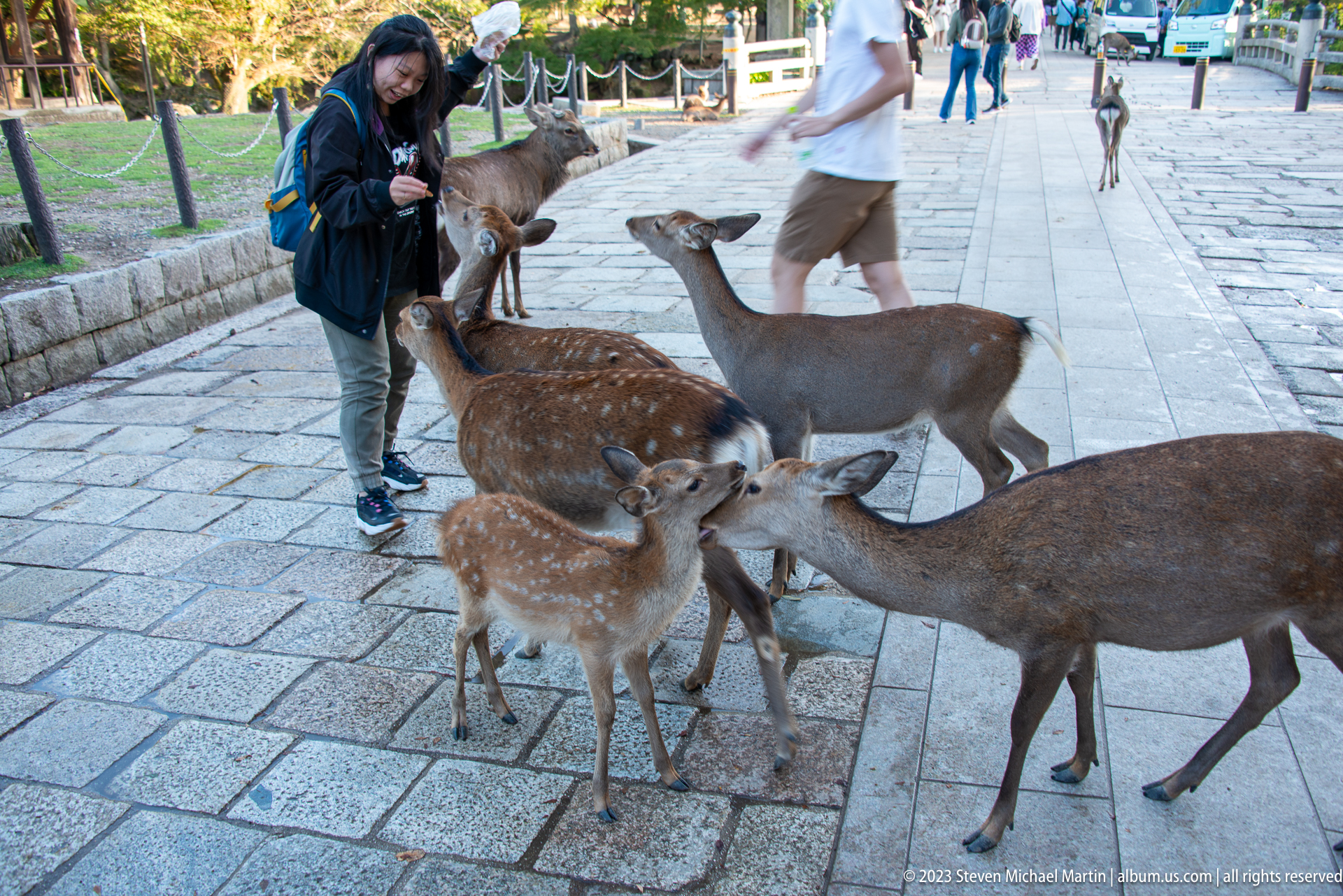
Several sika deer gather around visitors on a stone walkway in Nara Park, including a spotted fawn near the center of the group. The scene records the unusually close contact between wildlife and people that defines the park’s public landscape. Different ages, body sizes, and postures distinguish the animals while the passing pedestrians show how naturally the deer occupy heavily traveled routes.
Caption
Several sika deer gather around visitors on a stone walkway in Nara Park, including a spotted fawn near the center of the group. The scene records the unusually close contact between wildlife and people that defines the park’s public landscape. Different ages, body sizes, and postures distinguish the animals while the passing pedestrians show how naturally the deer occupy heavily traveled routes.

The Todai-ji Daibutsu sits above a dense arrangement of altar tables, candles, flowers, offerings, and ritual vessels. Evergreen branches flank the bronze figure while the gilded mandorla fills the space behind its head and shoulders. This frontal view presents the statue not as an isolated artwork but as the center of an active devotional ensemble.
Caption
The Todai-ji Daibutsu sits above a dense arrangement of altar tables, candles, flowers, offerings, and ritual vessels. Evergreen branches flank the bronze figure while the gilded mandorla fills the space behind its head and shoulders. This frontal view presents the statue not as an isolated artwork but as the center of an active devotional ensemble.
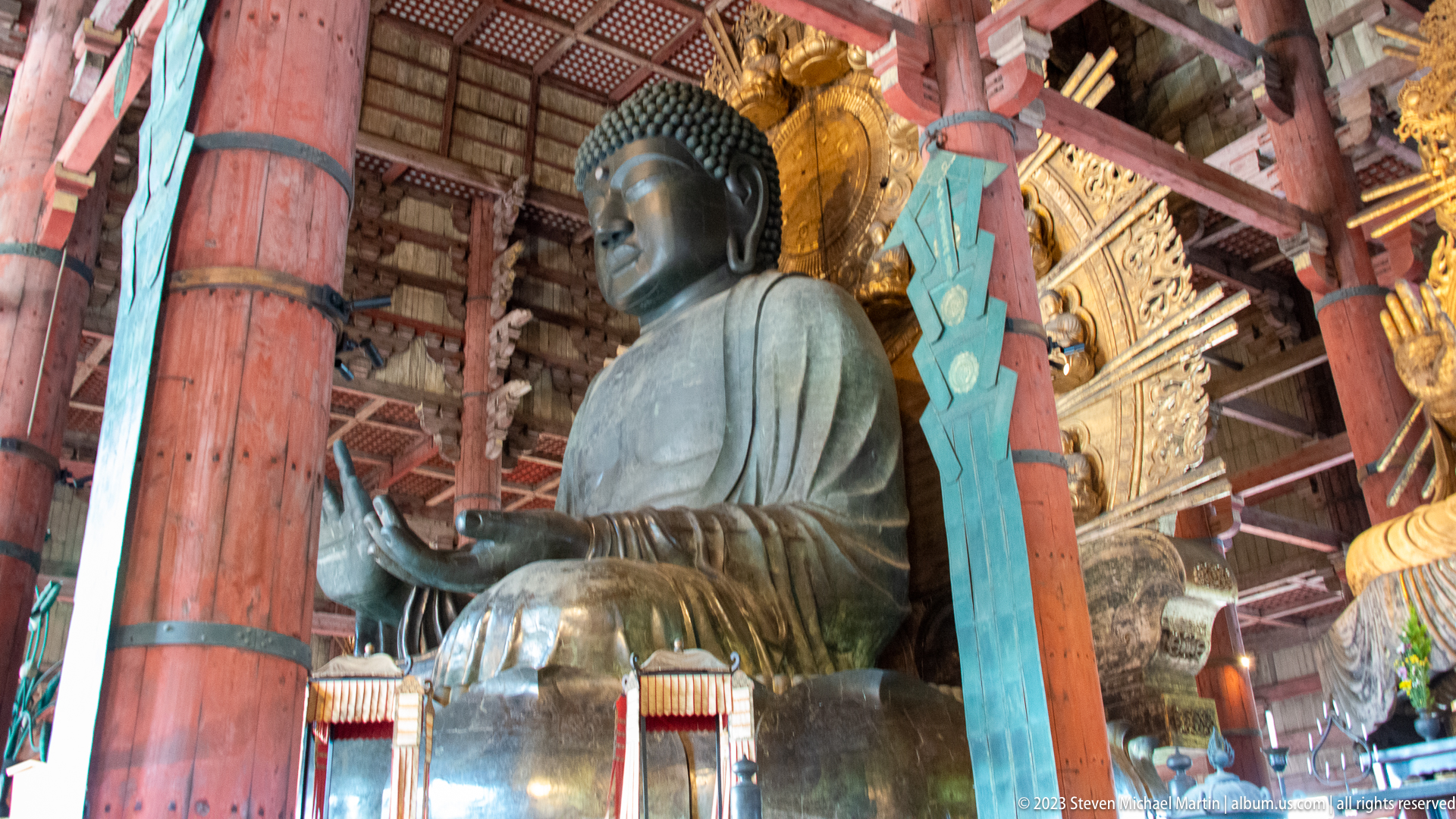
An oblique profile of the Great Buddha rises between red structural columns and a hanging turquoise banner. The lowered hand extends above the altar rail while the gilded mandorla glows behind the dark bronze figure. The composition shows how closely architecture, ritual furnishings, and monumental sculpture are interwoven within the hall.
Caption
An oblique profile of the Great Buddha rises between red structural columns and a hanging turquoise banner. The lowered hand extends above the altar rail while the gilded mandorla glows behind the dark bronze figure. The composition shows how closely architecture, ritual furnishings, and monumental sculpture are interwoven within the hall.

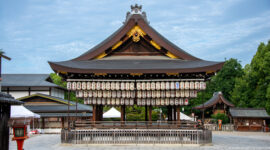
A vermilion-and-white timber hall rises beyond a long covered corridor in the Todai-ji precinct. Layered tiled roofs, bracket complexes, and deep eaves create a rhythmic architectural profile against the hillside. Visitors moving through the foreground establish the scale of the structure while also revealing the temple complex as an active public and devotional space.
Caption
A vermilion-and-white timber hall rises beyond a long covered corridor in the Todai-ji precinct. Layered tiled roofs, bracket complexes, and deep eaves create a rhythmic architectural profile against the hillside. Visitors moving through the foreground establish the scale of the structure while also revealing the temple complex as an active public and devotional space.
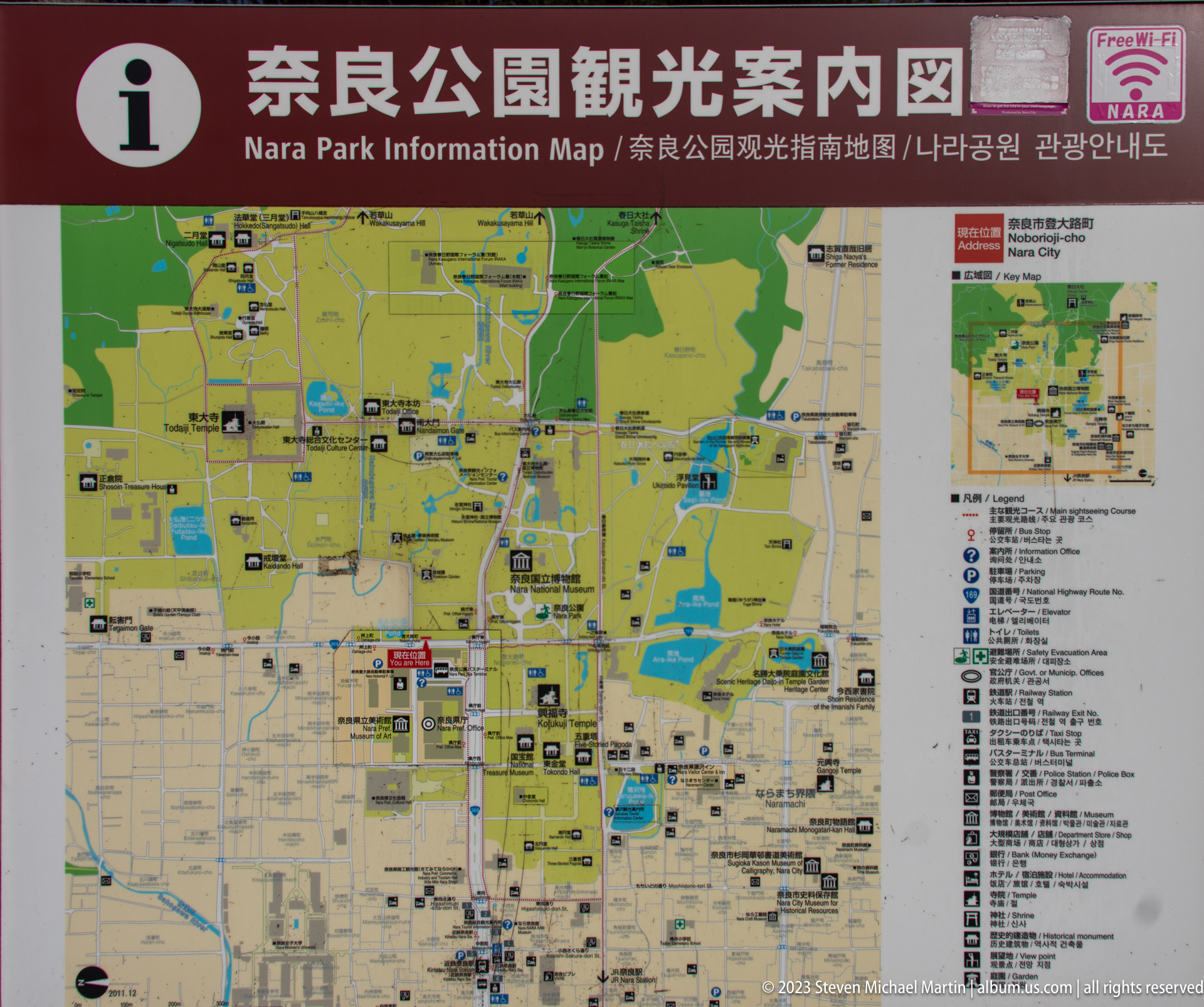
A large visitor map presents the paths, ponds, museums, shrines, temples, and public facilities distributed across Nara Park. Japanese, English, Chinese, and Korean labeling reflects the park’s role as an international heritage destination. The red location marker and dense network of symbols orient visitors within the broad cultural landscape surrounding Todai-ji and other historic sites.
Caption
A large visitor map presents the paths, ponds, museums, shrines, temples, and public facilities distributed across Nara Park. Japanese, English, Chinese, and Korean labeling reflects the park’s role as an international heritage destination. The red location marker and dense network of symbols orient visitors within the broad cultural landscape surrounding Todai-ji and other historic sites.

An outdoor interpretive panel introduces Yoshikien, a traditional Japanese garden near Nara Park. The sign combines historical text with a plan and photographs of the grounds, helping visitors understand the garden’s layout before entering. Its timber shelter and stone-wall setting visually connect the modern interpretation with the historic landscape it describes.
Caption
An outdoor interpretive panel introduces Yoshikien, a traditional Japanese garden near Nara Park. The sign combines historical text with a plan and photographs of the grounds, helping visitors understand the garden’s layout before entering. Its timber shelter and stone-wall setting visually connect the modern interpretation with the historic landscape it describes.
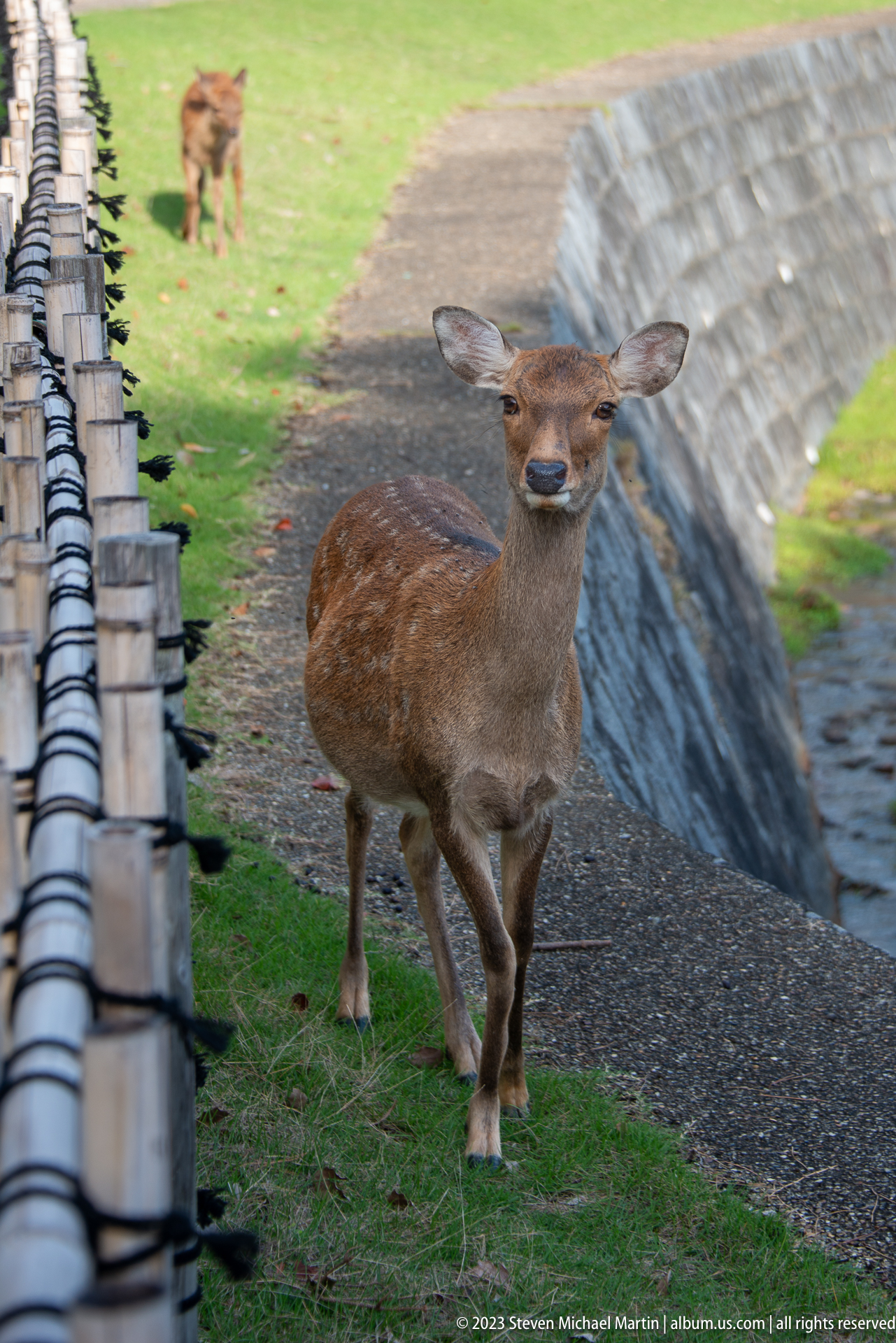
A sika deer stands on a paved path beside a tiled wall in Nara Park, where free-roaming deer move easily through spaces shared with visitors. Its compact body, spotted brown coat, and alert ears are characteristic of the species. The close viewpoint emphasizes the everyday proximity between wildlife and the park’s historic built environment.
Caption
A sika deer stands on a paved path beside a tiled wall in Nara Park, where free-roaming deer move easily through spaces shared with visitors. Its compact body, spotted brown coat, and alert ears are characteristic of the species. The close viewpoint emphasizes the everyday proximity between wildlife and the park’s historic built environment.

The central entrance of the Daibutsuden is framed by a dramatically curved gable projecting from the otherwise rectilinear façade. Layered roof edges, carved timber members, and weathered structural surfaces concentrate attention on the ceremonial axis of the hall. This tighter view emphasizes craftsmanship and the visual transition from the expansive exterior into the sacred interior.
Caption
The central entrance of the Daibutsuden is framed by a dramatically curved gable projecting from the otherwise rectilinear façade. Layered roof edges, carved timber members, and weathered structural surfaces concentrate attention on the ceremonial axis of the hall. This tighter view emphasizes craftsmanship and the visual transition from the expansive exterior into the sacred interior.
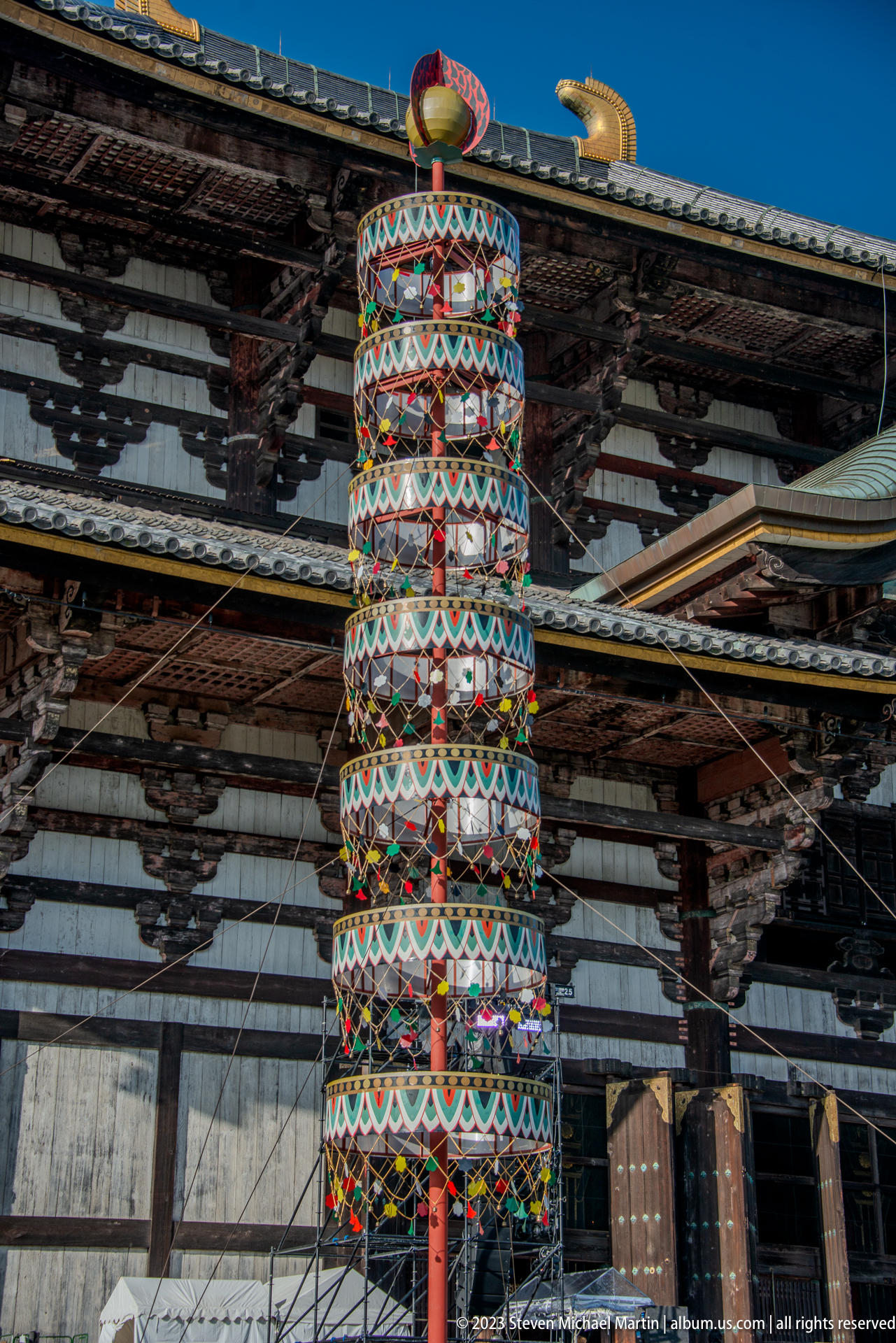
A cylindrical ceremonial tower is wrapped in repeated geometric and floral bands, each layer built from brightly colored components. Set against the weathered façade of the Daibutsuden, the object becomes a study in contrast between temporary ornament and historic timber architecture. The close framing records construction details that are less visible in the wider exterior views.
Caption
A cylindrical ceremonial tower is wrapped in repeated geometric and floral bands, each layer built from brightly colored components. Set against the weathered façade of the Daibutsuden, the object becomes a study in contrast between temporary ornament and historic timber architecture. The close framing records construction details that are less visible in the wider exterior views.

A sika deer fawn stands in sunlit grass scattered with fallen leaves. The pale spots across its darker coat and its delicate proportions distinguish this young animal from the older deer seen nearby. The low viewpoint and uncluttered ground isolate the fawn as a wildlife portrait within Nara Park’s managed landscape.
Caption
A sika deer fawn stands in sunlit grass scattered with fallen leaves. The pale spots across its darker coat and its delicate proportions distinguish this young animal from the older deer seen nearby. The low viewpoint and uncluttered ground isolate the fawn as a wildlife portrait within Nara Park’s managed landscape.

The Daibutsuden stands beyond landscaped grounds and visitor paths at Todai-ji. Its immense timber frame, sweeping tiled roof, and central curved gable create one of the temple complex’s defining silhouettes. Decorative festival structures in front of the hall introduce a temporary layer of color against the dark wood and white plaster of the monumental façade.
Caption
The Daibutsuden stands beyond landscaped grounds and visitor paths at Todai-ji. Its immense timber frame, sweeping tiled roof, and central curved gable create one of the temple complex’s defining silhouettes. Decorative festival structures in front of the hall introduce a temporary layer of color against the dark wood and white plaster of the monumental façade.

A frontal view reveals the massive scale and layered construction of Todai-ji’s Great Buddha Hall. Heavy timber columns, white plaster bays, deep bracketed eaves, and the central entrance gable organize the façade into powerful horizontal and vertical rhythms. The open forecourt and small figures at ground level underscore the hall’s extraordinary size.
Caption
A frontal view reveals the massive scale and layered construction of Todai-ji’s Great Buddha Hall. Heavy timber columns, white plaster bays, deep bracketed eaves, and the central entrance gable organize the façade into powerful horizontal and vertical rhythms. The open forecourt and small figures at ground level underscore the hall’s extraordinary size.
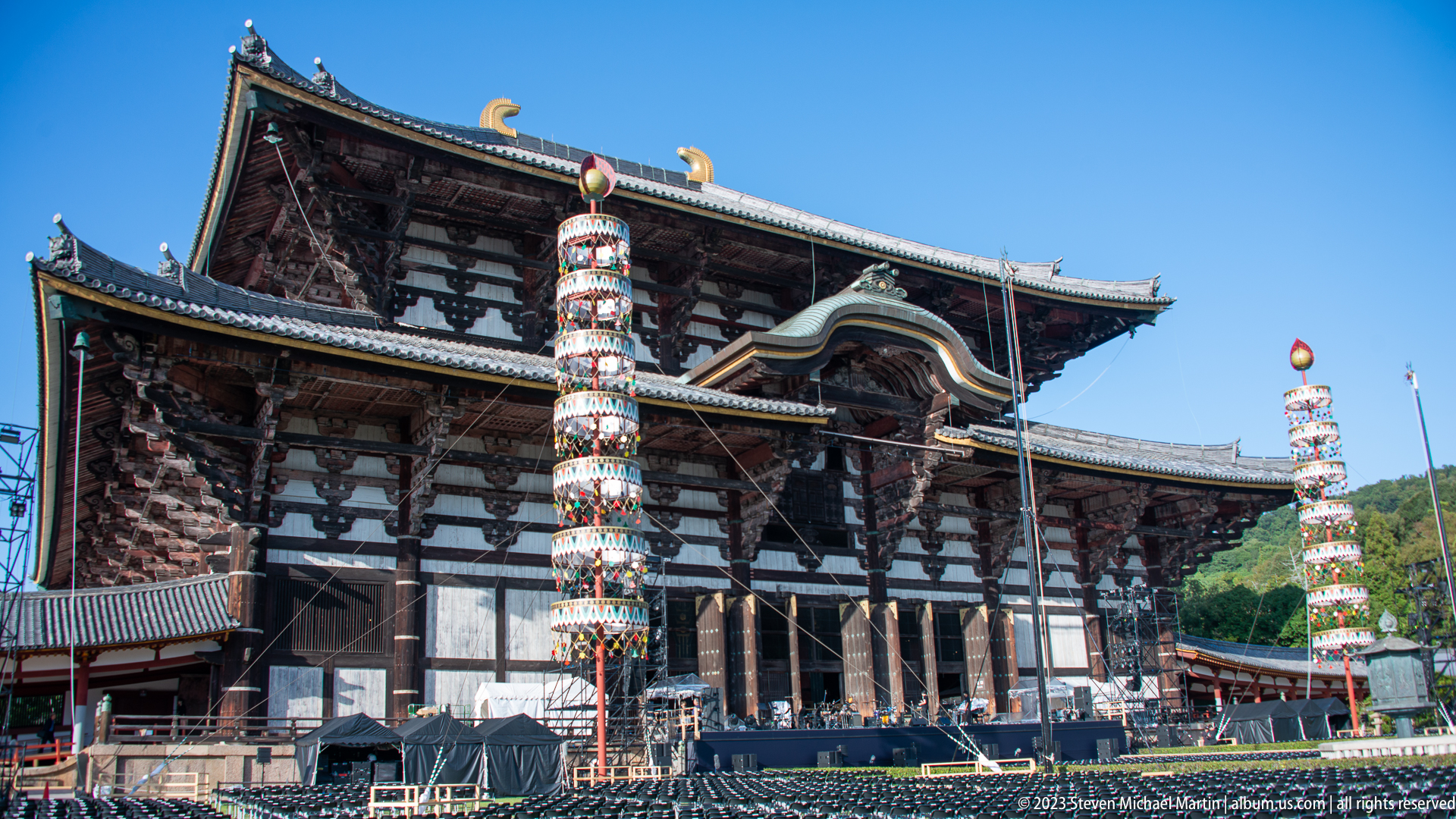
A tall, brightly patterned temporary column stands before the dark timber mass of the Daibutsuden. Its stacked bands of color and suspended ornaments contrast with the hall’s restrained materials and monumental proportions. The pairing records a ceremonial or festival installation within the historic temple setting, showing how temporary ritual decoration can transform the perception of a permanent architectural landmark.
Caption
A tall, brightly patterned temporary column stands before the dark timber mass of the Daibutsuden. Its stacked bands of color and suspended ornaments contrast with the hall’s restrained materials and monumental proportions. The pairing records a ceremonial or festival installation within the historic temple setting, showing how temporary ritual decoration can transform the perception of a permanent architectural landmark.
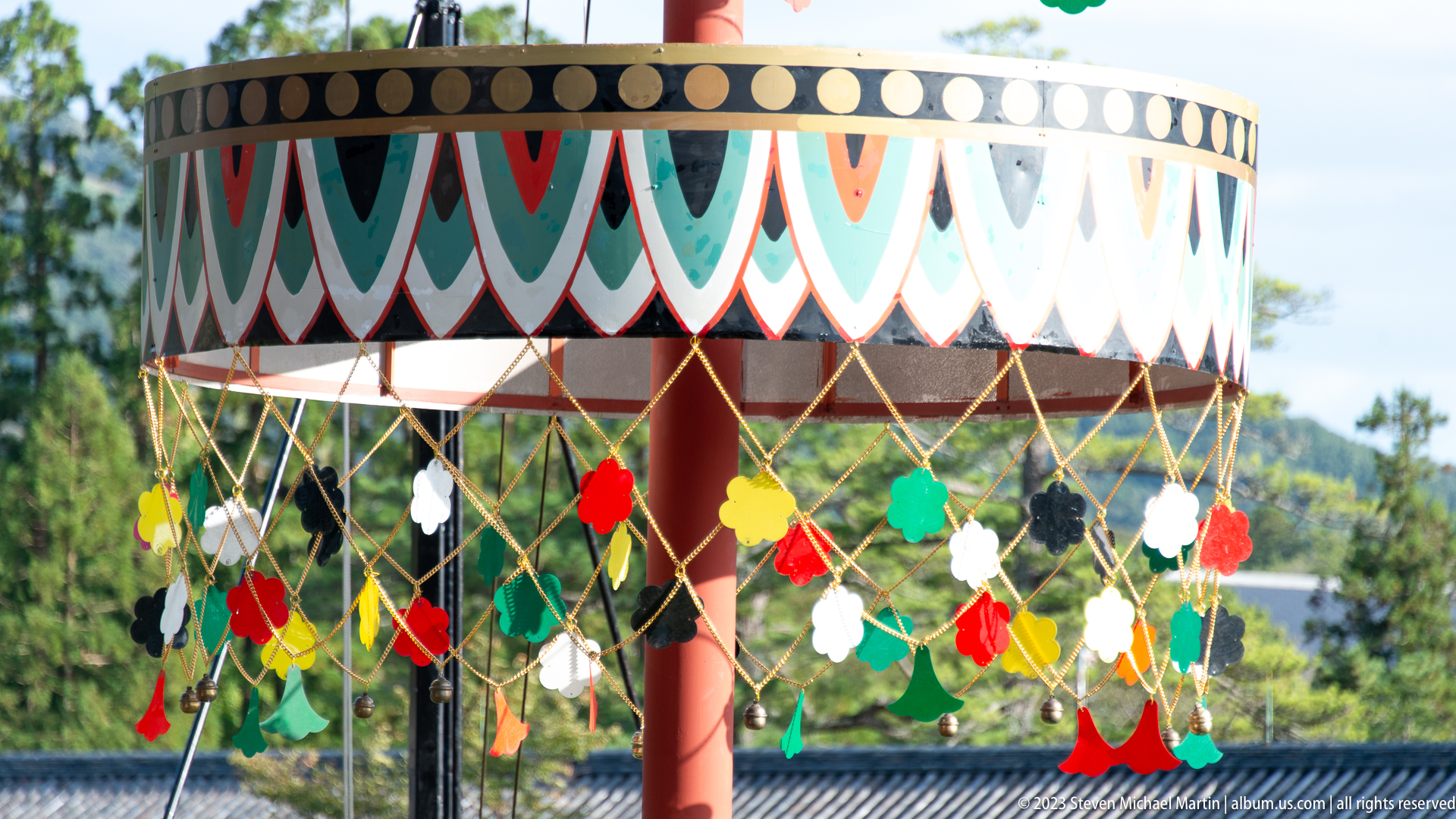
A circular canopy displays bold painted bands of black, white, red, and green above a fringe of suspended multicolored ornaments. The shallow depth of field isolates its decorative geometry from the temple landscape beyond. This close detail preserves the handmade visual language of a temporary ceremonial installation associated with activity in the Todai-ji precinct.
Caption
A circular canopy displays bold painted bands of black, white, red, and green above a fringe of suspended multicolored ornaments. The shallow depth of field isolates its decorative geometry from the temple landscape beyond. This close detail preserves the handmade visual language of a temporary ceremonial installation associated with activity in the Todai-ji precinct.

A sweeping gilded element of the Daibutsu’s halo dominates the foreground, its curved surface edged by a row of rounded bosses. Visitors and timber columns recede behind it, clarifying the enormous scale of the sculptural ensemble. The unusual viewpoint turns a supporting iconographic feature into an abstract study of gold, curvature, and repetition.
Caption
A sweeping gilded element of the Daibutsu’s halo dominates the foreground, its curved surface edged by a row of rounded bosses. Visitors and timber columns recede behind it, clarifying the enormous scale of the sculptural ensemble. The unusual viewpoint turns a supporting iconographic feature into an abstract study of gold, curvature, and repetition.

The colossal bronze Daibutsu of Todai-ji is seen obliquely between the hall’s massive red timber columns. One raised hand forms a teaching or reassurance gesture while the draped robe falls in broad modeled folds. The partial viewpoint communicates both the sculpture’s scale and the difficulty of taking in the entire figure within the enclosed Great Buddha Hall.
Caption
The colossal bronze Daibutsu of Todai-ji is seen obliquely between the hall’s massive red timber columns. One raised hand forms a teaching or reassurance gesture while the draped robe falls in broad modeled folds. The partial viewpoint communicates both the sculpture’s scale and the difficulty of taking in the entire figure within the enclosed Great Buddha Hall.

The enormous bronze hand of the Todai-ji Daibutsu fills the foreground, its palm raised toward visitors. A lotus-form ritual fitting blurs across the lower edge while gilded halo figures remain visible behind. The close view transforms a familiar Buddhist gesture into a study of scale, casting, surface, and the physical presence of monumental sculpture.
Caption
The enormous bronze hand of the Todai-ji Daibutsu fills the foreground, its palm raised toward visitors. A lotus-form ritual fitting blurs across the lower edge while gilded halo figures remain visible behind. The close view transforms a familiar Buddhist gesture into a study of scale, casting, surface, and the physical presence of monumental sculpture.
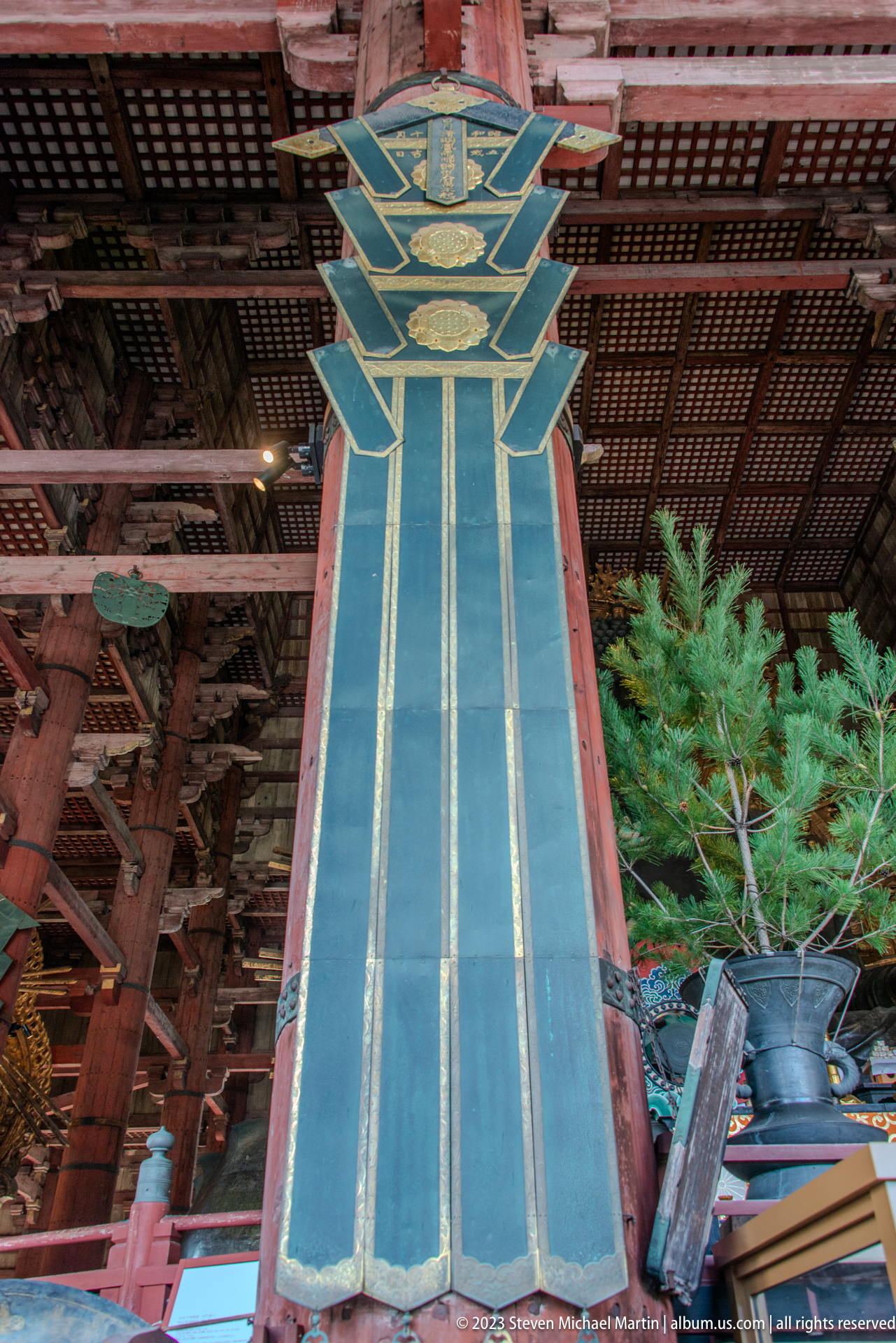
A long blue ceremonial banner hangs vertically from the timber structure of the Great Buddha Hall. Gold bands, medallions, and angular upper panels organize the textile into a formal symmetrical design. Seen against red columns and the gridded ceiling, the hanging adds color and movement to the otherwise massive architectural interior.
Caption
A long blue ceremonial banner hangs vertically from the timber structure of the Great Buddha Hall. Gold bands, medallions, and angular upper panels organize the textile into a formal symmetrical design. Seen against red columns and the gridded ceiling, the hanging adds color and movement to the otherwise massive architectural interior.
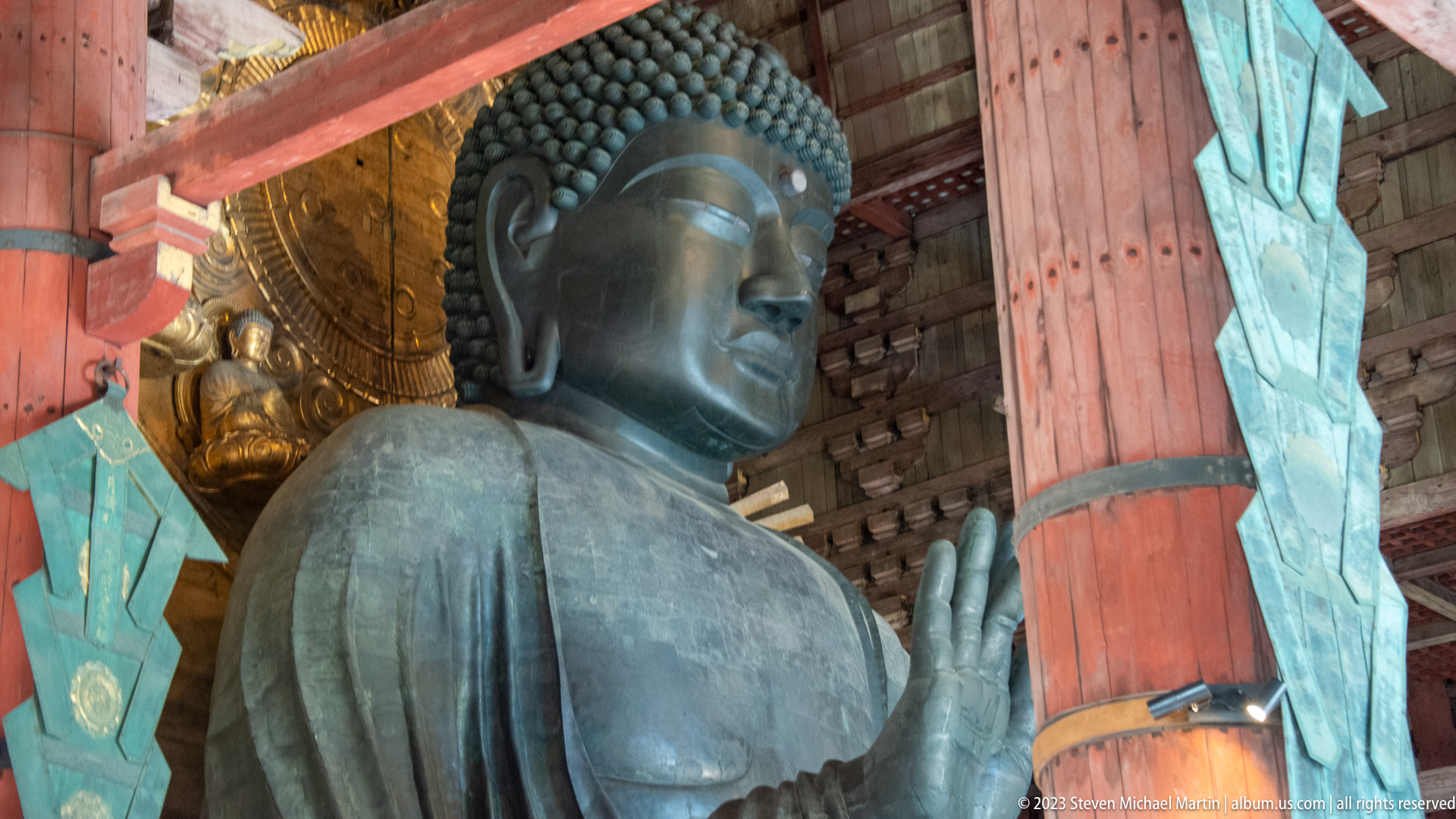
The Todai-ji Daibutsu rises beside a red timber column, its serene face, tightly curled hair, and raised hand clearly visible. The close oblique framing brings viewers near the bronze surface while still preserving the architectural setting. Gilded figures and carved ornament behind the Buddha reveal the layered devotional program surrounding the central image.
Caption
The Todai-ji Daibutsu rises beside a red timber column, its serene face, tightly curled hair, and raised hand clearly visible. The close oblique framing brings viewers near the bronze surface while still preserving the architectural setting. Gilded figures and carved ornament behind the Buddha reveal the layered devotional program surrounding the central image.
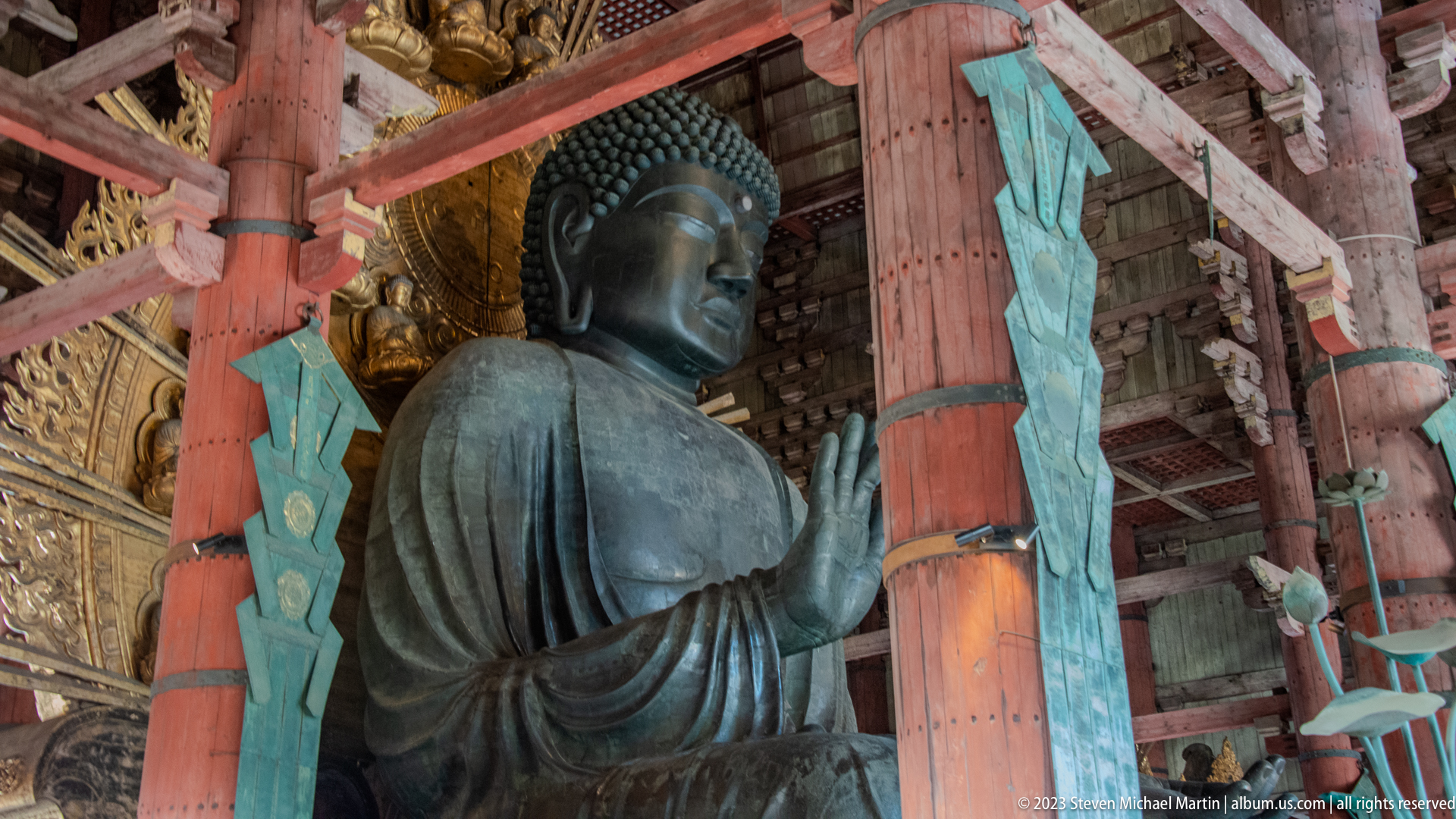
Red timber columns and long turquoise ceremonial hangings frame the seated Daibutsu inside Todai-ji’s Great Buddha Hall. The Buddha’s dark bronze body contrasts with the gilded mandorla and surrounding ornament. This wider composition shows how sculpture, ritual furnishings, and architecture combine to construct a highly ordered sacred interior.
Caption
Red timber columns and long turquoise ceremonial hangings frame the seated Daibutsu inside Todai-ji’s Great Buddha Hall. The Buddha’s dark bronze body contrasts with the gilded mandorla and surrounding ornament. This wider composition shows how sculpture, ritual furnishings, and architecture combine to construct a highly ordered sacred interior.

A large gilded bodhisattva sits on a lotus pedestal beside the central Daibutsu ensemble. An elaborate crown, layered jewelry, and a radiating aureole distinguish the figure from the simpler monastic appearance of the Buddha. The frontal composition records the richly ornamented devotional sculpture together with altar furnishings and the deep timber interior of the hall.
Caption
A large gilded bodhisattva sits on a lotus pedestal beside the central Daibutsu ensemble. An elaborate crown, layered jewelry, and a radiating aureole distinguish the figure from the simpler monastic appearance of the Buddha. The frontal composition records the richly ornamented devotional sculpture together with altar furnishings and the deep timber interior of the hall.

A lotus-form ritual lamp rises in the foreground before the seated Daibutsu. Its pale metal petals and branching stems overlap the Buddha’s raised hand and gilded mandorla, creating a layered devotional composition. The viewpoint emphasizes how liturgical objects mediate a visitor’s view of the monumental image within the Great Buddha Hall.
Caption
A lotus-form ritual lamp rises in the foreground before the seated Daibutsu. Its pale metal petals and branching stems overlap the Buddha’s raised hand and gilded mandorla, creating a layered devotional composition. The viewpoint emphasizes how liturgical objects mediate a visitor’s view of the monumental image within the Great Buddha Hall.
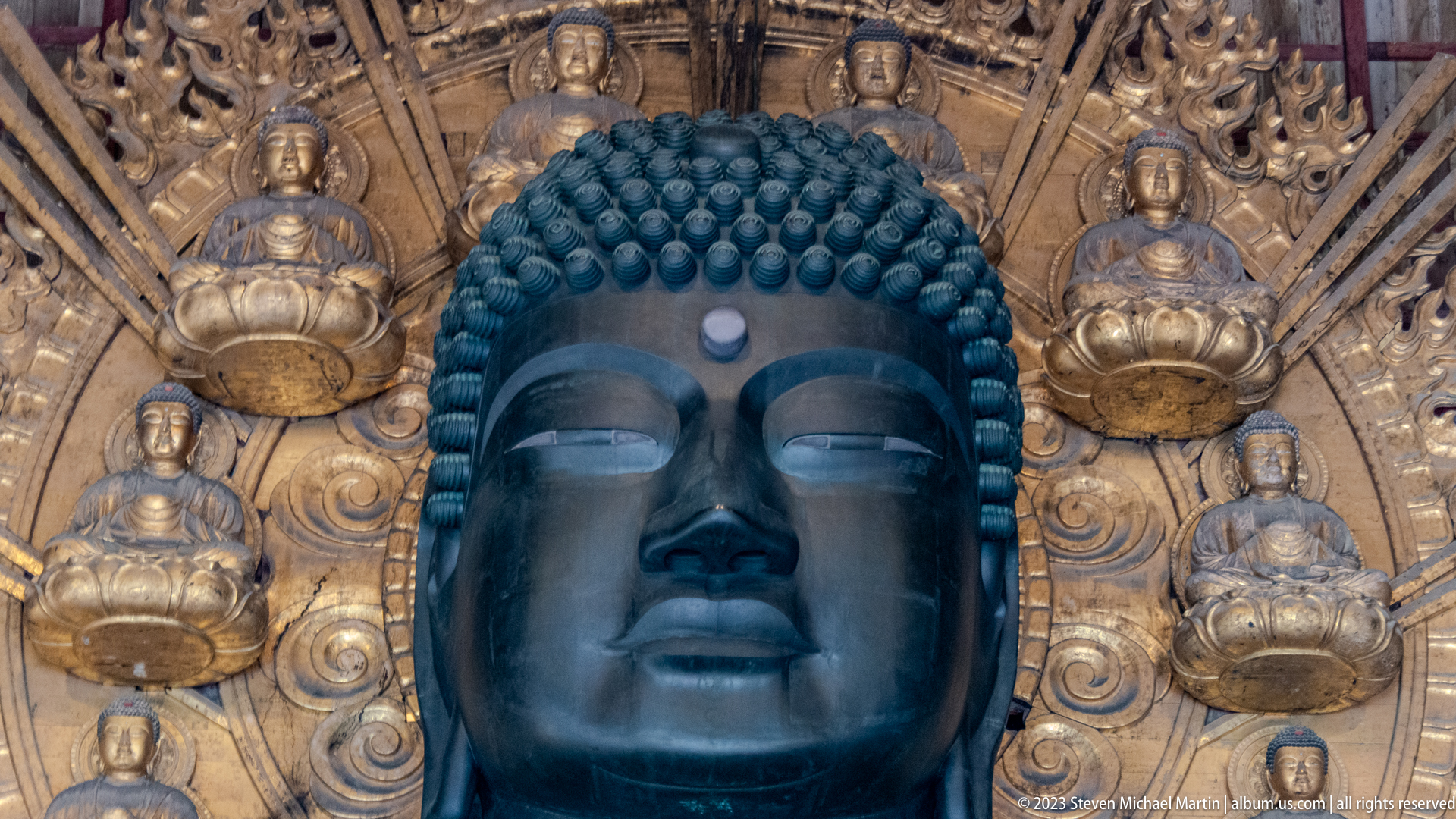
The serene face of the Todai-ji Daibutsu fills the frame, surrounded by smaller seated Buddha figures arranged across the gilded mandorla. Tightly curled hair, elongated earlobes, and the urna on the forehead are rendered at monumental scale. The close view reveals the contrast between the dark bronze head and the luminous sculptural field behind it.
Caption
The serene face of the Todai-ji Daibutsu fills the frame, surrounded by smaller seated Buddha figures arranged across the gilded mandorla. Tightly curled hair, elongated earlobes, and the urna on the forehead are rendered at monumental scale. The close view reveals the contrast between the dark bronze head and the luminous sculptural field behind it.
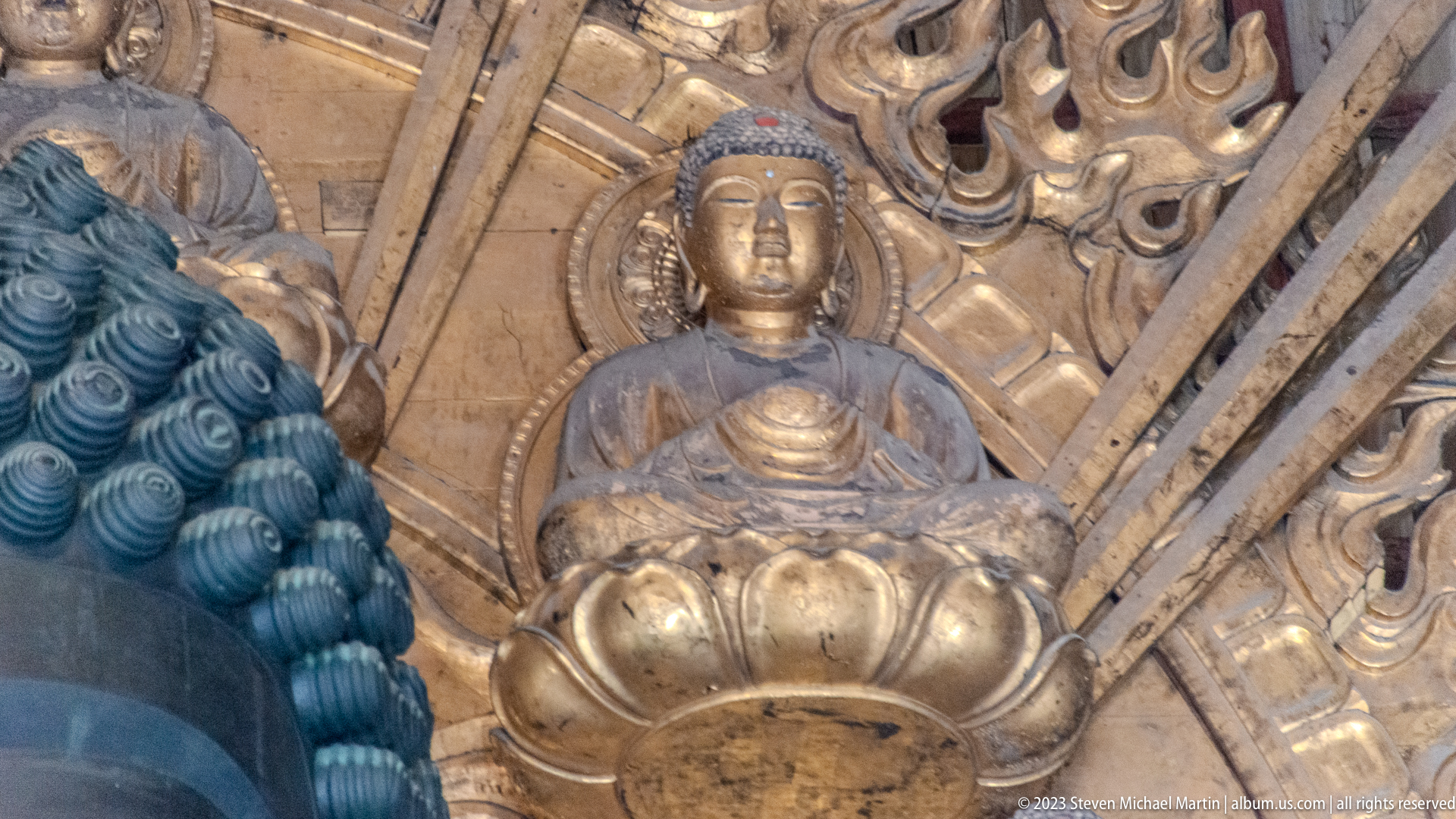
A small seated Buddha rests on a lotus throne within the elaborate gilded mandorla behind Todai-ji’s Great Buddha. The cropped edge of the Daibutsu’s curled hair at left clarifies the remarkable scale difference between the central image and the subsidiary figures. Flame-like ornament and radiating bands integrate the smaller Buddha into the larger cosmic composition.
Caption
A small seated Buddha rests on a lotus throne within the elaborate gilded mandorla behind Todai-ji’s Great Buddha. The cropped edge of the Daibutsu’s curled hair at left clarifies the remarkable scale difference between the central image and the subsidiary figures. Flame-like ornament and radiating bands integrate the smaller Buddha into the larger cosmic composition.
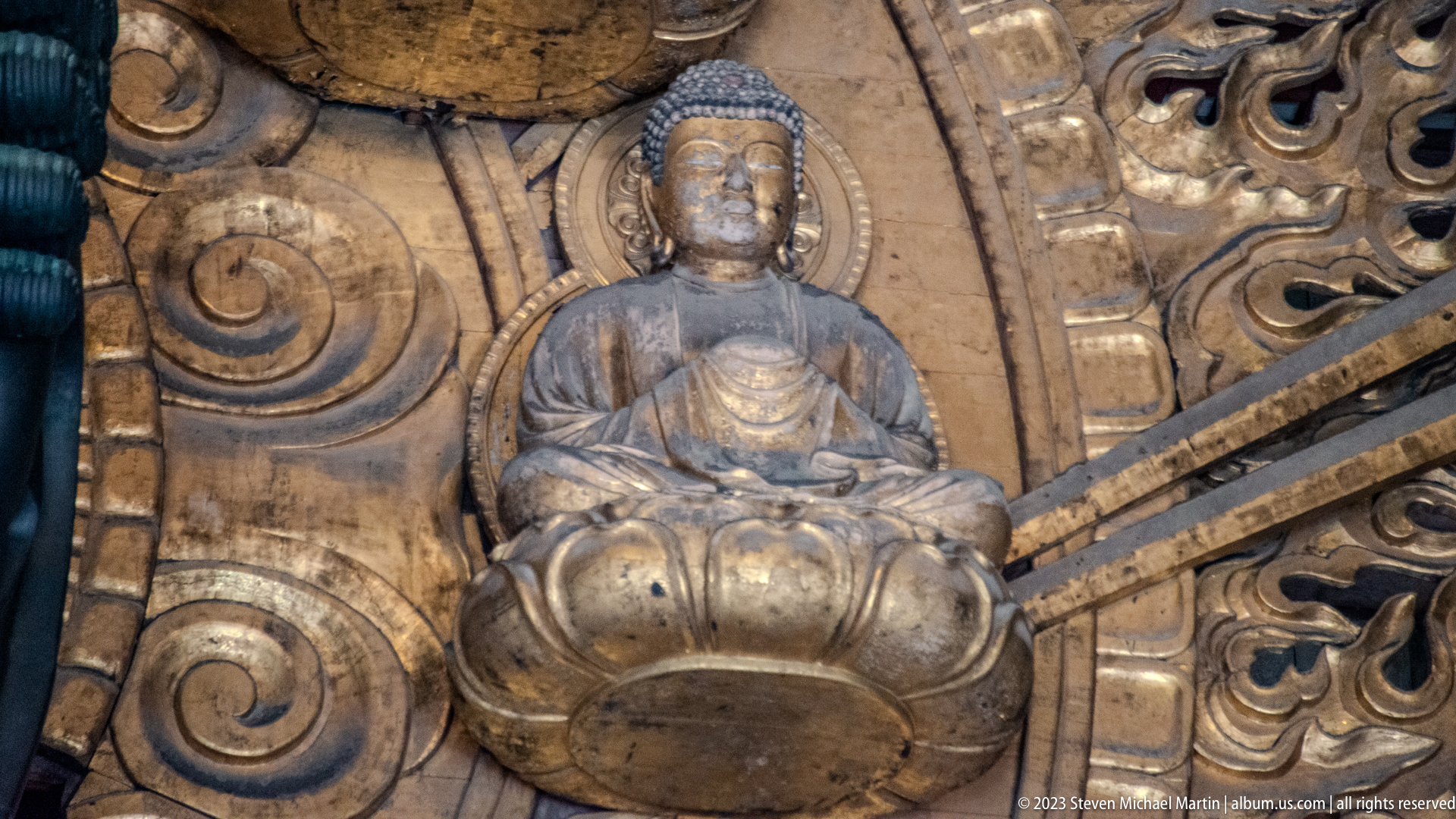
A subsidiary Buddha sits cross-legged on a lotus pedestal within the Daibutsu’s mandorla. The surrounding gilded scrolls, radiating ribs, and flame motifs turn the halo into a complex sculptural field rather than a flat backdrop. The close framing isolates one component of an iconographic program designed to amplify the central Buddha’s sacred presence.
Caption
A subsidiary Buddha sits cross-legged on a lotus pedestal within the Daibutsu’s mandorla. The surrounding gilded scrolls, radiating ribs, and flame motifs turn the halo into a complex sculptural field rather than a flat backdrop. The close framing isolates one component of an iconographic program designed to amplify the central Buddha’s sacred presence.

Looking upward inside the Great Buddha Hall reveals a dense grid of timber beams, rafters, and lattice ceiling panels. Red-painted columns and weathered joinery articulate the immense volume required to shelter the Daibutsu. The upward angle shifts attention from sculpture to engineering, showing the structural complexity that supports the hall’s broad roof and lofty interior.
Caption
Looking upward inside the Great Buddha Hall reveals a dense grid of timber beams, rafters, and lattice ceiling panels. Red-painted columns and weathered joinery articulate the immense volume required to shelter the Daibutsu. The upward angle shifts attention from sculpture to engineering, showing the structural complexity that supports the hall’s broad roof and lofty interior.
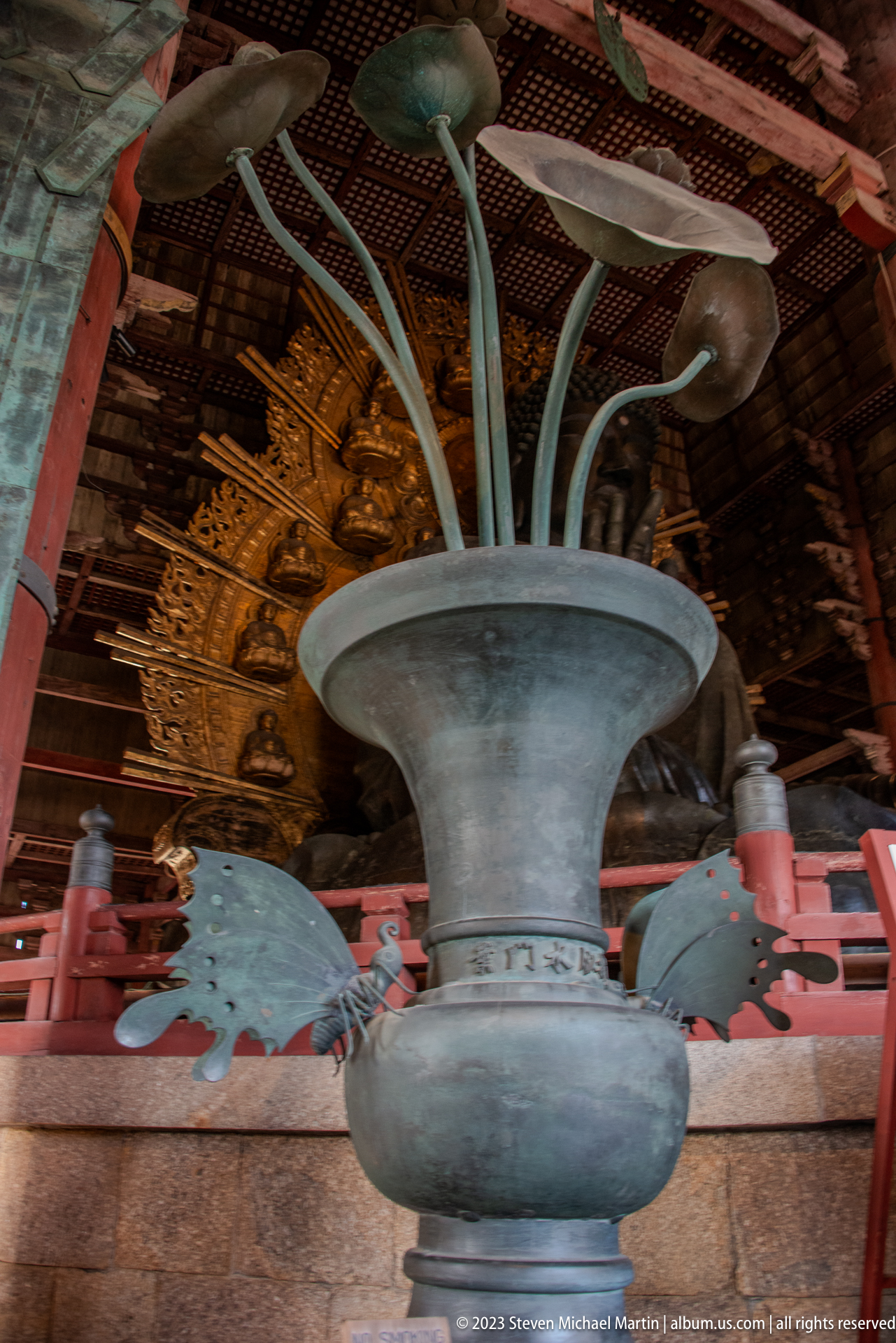
A large bronze ritual vessel supports an arrangement of stylized lotus stems, leaves, buds, and blossoms. The broad urn-shaped body and symmetrical botanical forms create a durable metal counterpart to fresh floral offerings. Positioned before the gilded sculptural ensemble, the vessel participates in the visual and ceremonial ordering of the Great Buddha Hall.
Caption
A large bronze ritual vessel supports an arrangement of stylized lotus stems, leaves, buds, and blossoms. The broad urn-shaped body and symmetrical botanical forms create a durable metal counterpart to fresh floral offerings. Positioned before the gilded sculptural ensemble, the vessel participates in the visual and ceremonial ordering of the Great Buddha Hall.
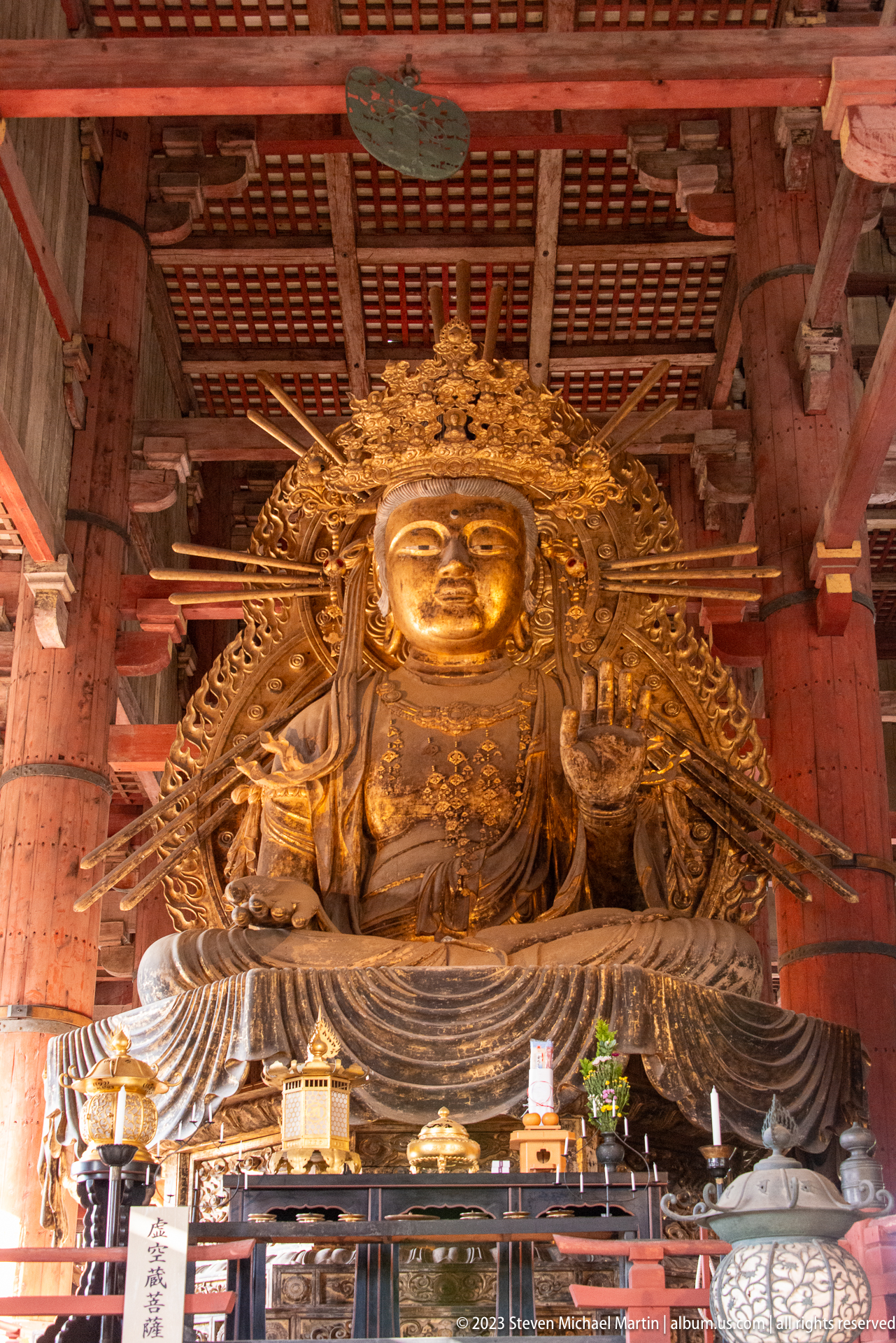
A monumental gilded bodhisattva sits frontally beneath a radiating aureole, crowned and richly adorned with jewelry. Layered drapery spreads across the lotus pedestal while altar objects and offerings occupy the foreground. The sculpture’s luminous surface and elaborate ornament distinguish the attendant figure from the darker bronze Daibutsu nearby.
Caption
A monumental gilded bodhisattva sits frontally beneath a radiating aureole, crowned and richly adorned with jewelry. Layered drapery spreads across the lotus pedestal while altar objects and offerings occupy the foreground. The sculpture’s luminous surface and elaborate ornament distinguish the attendant figure from the darker bronze Daibutsu nearby.
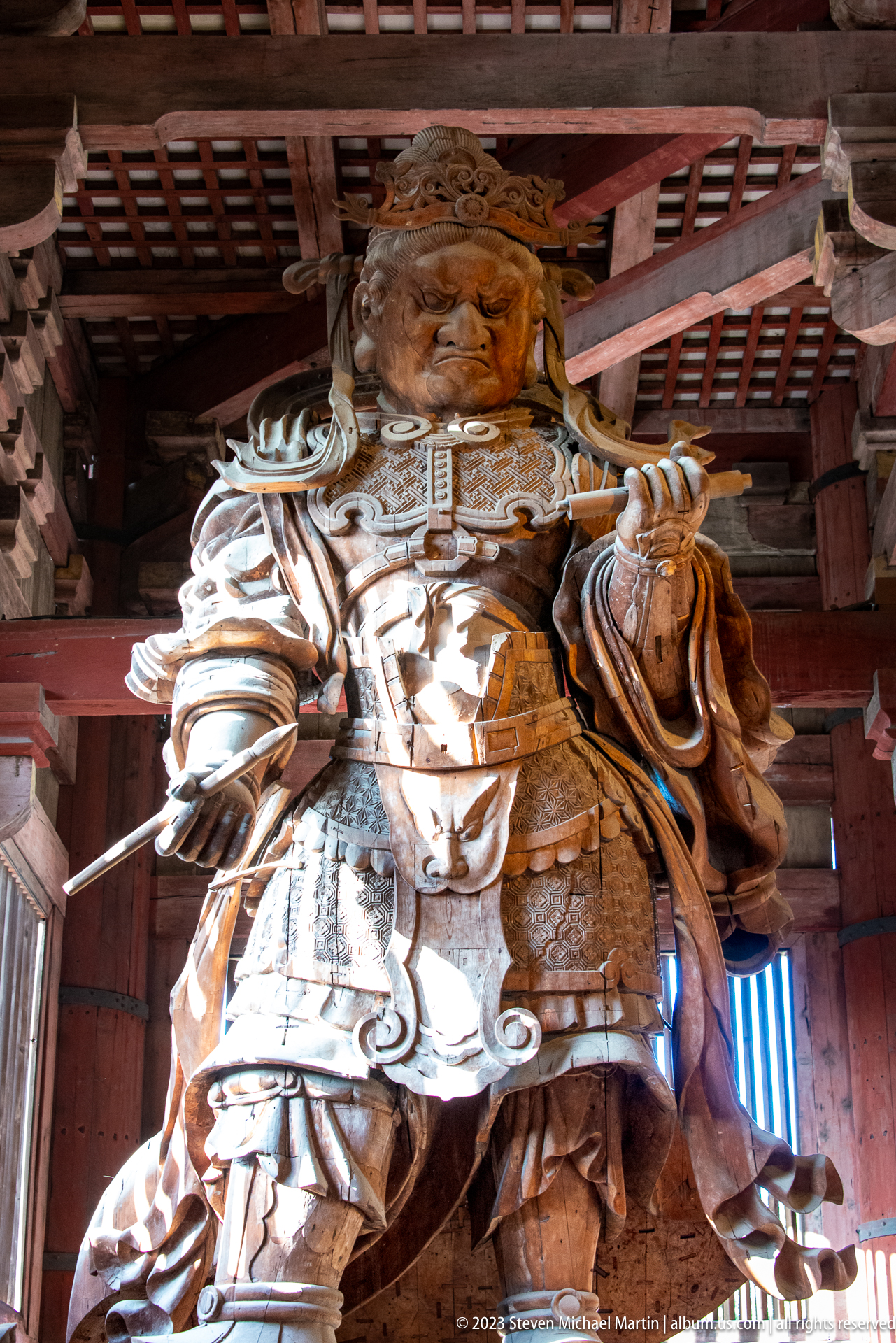
A monumental wooden guardian deity stands beneath the timber roof of the Great Buddha Hall, armored and dynamically posed with one hand raised. Deeply carved drapery, layered armor plates, and a fierce expression communicate protective force. The upward viewpoint emphasizes the sculpture’s scale and its commanding presence within the vast interior.
Caption
A monumental wooden guardian deity stands beneath the timber roof of the Great Buddha Hall, armored and dynamically posed with one hand raised. Deeply carved drapery, layered armor plates, and a fierce expression communicate protective force. The upward viewpoint emphasizes the sculpture’s scale and its commanding presence within the vast interior.
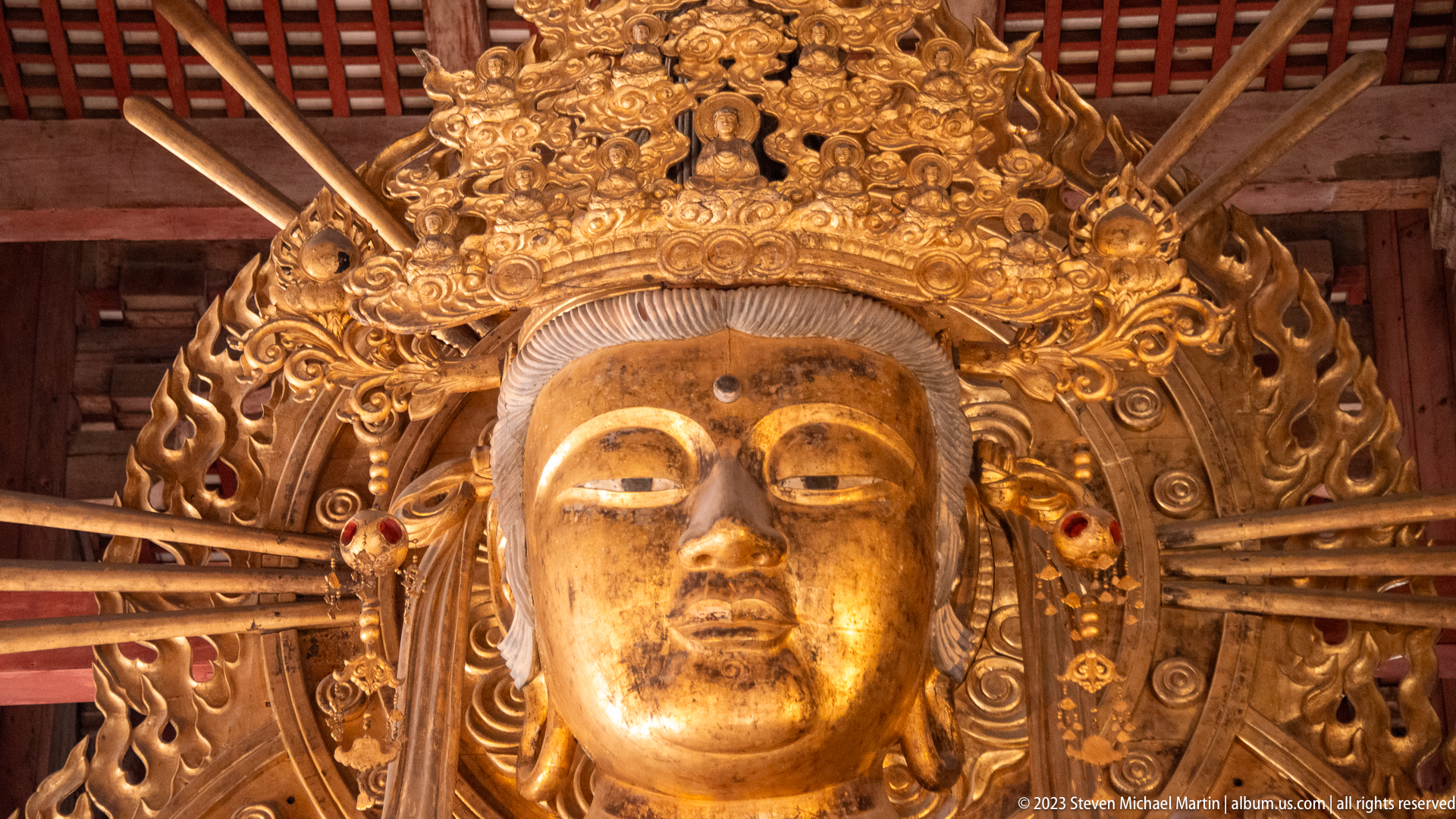
The calm face of a gilded bodhisattva is framed by an elaborate crown and a flame-like aureole. Fine radiating elements extend outward from the headdress, while traces of age and surface wear remain visible across the gold. The close framing reveals the sculpture’s refined facial modeling and dense ornamental program.
Caption
The calm face of a gilded bodhisattva is framed by an elaborate crown and a flame-like aureole. Fine radiating elements extend outward from the headdress, while traces of age and surface wear remain visible across the gold. The close framing reveals the sculpture’s refined facial modeling and dense ornamental program.
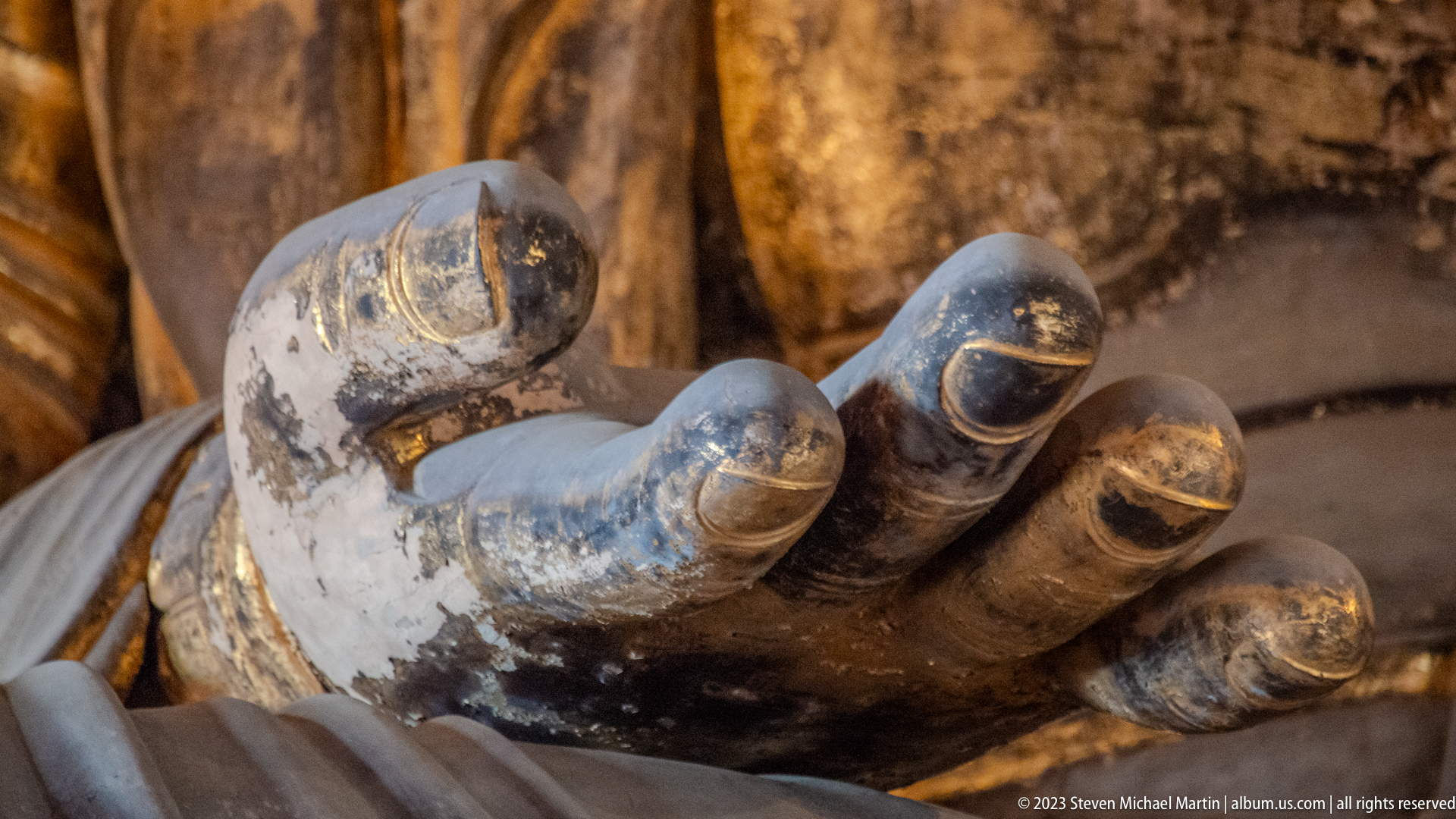
A close view isolates the hand of a monumental gilded Buddhist figure, revealing worn gold surface, darkened recesses, and the modeled curvature of the fingers. The crop emphasizes the physical scale of the sculpture and the accumulated effects of age. Small differences in surface color suggest repairs, handling, or uneven preservation over time.
Caption
A close view isolates the hand of a monumental gilded Buddhist figure, revealing worn gold surface, darkened recesses, and the modeled curvature of the fingers. The crop emphasizes the physical scale of the sculpture and the accumulated effects of age. Small differences in surface color suggest repairs, handling, or uneven preservation over time.
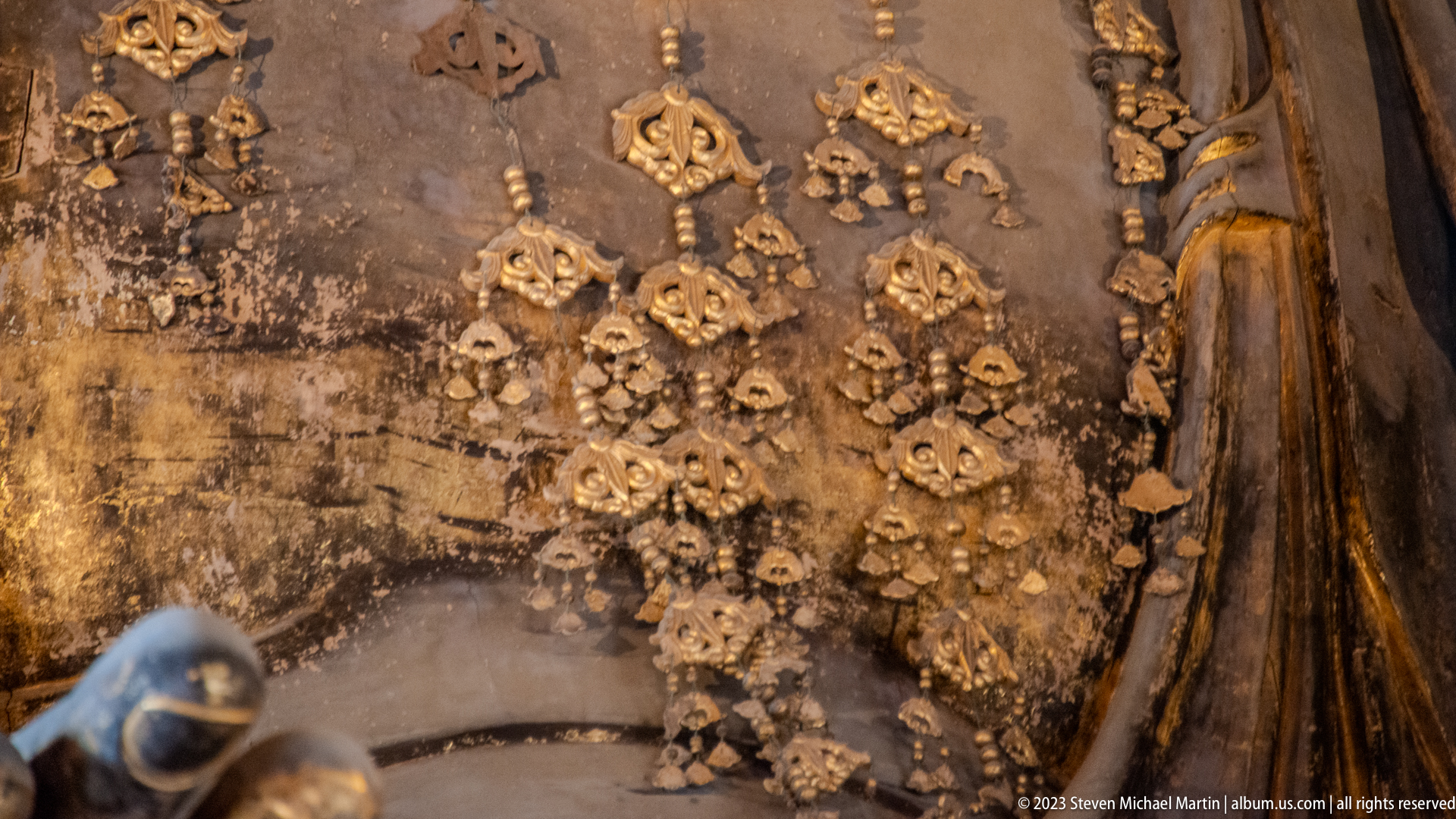
Clusters of small gilded pendants hang against the darkened surface of a monumental Buddhist sculpture. Their repeated floral and teardrop forms create a delicate ornamental field beside the much larger modeled body. The detail records both the richness of the figure’s adornment and the visible aging of the surrounding surface.
Caption
Clusters of small gilded pendants hang against the darkened surface of a monumental Buddhist sculpture. Their repeated floral and teardrop forms create a delicate ornamental field beside the much larger modeled body. The detail records both the richness of the figure’s adornment and the visible aging of the surrounding surface.

A fierce wooden face fills the frame, crowned by an elaborate headdress and set beneath heavy temple beams. Furrowed brows, flared nostrils, and a downturned mouth intensify the guardian’s protective character. The close view reveals the expressive carving and weathered surface of a sculpture designed to be seen from well below.
Caption
A fierce wooden face fills the frame, crowned by an elaborate headdress and set beneath heavy temple beams. Furrowed brows, flared nostrils, and a downturned mouth intensify the guardian’s protective character. The close view reveals the expressive carving and weathered surface of a sculpture designed to be seen from well below.

A frontal close-up isolates the head of a monumental wooden protector, emphasizing bulging eyes, compressed lips, and a powerful brow. The carved headdress rises in layered bands above the face. At this scale, the sculpture’s dramatic expression becomes the principal subject, revealing how emotion and authority are conveyed through exaggerated form.
Caption
A frontal close-up isolates the head of a monumental wooden protector, emphasizing bulging eyes, compressed lips, and a powerful brow. The carved headdress rises in layered bands above the face. At this scale, the sculpture’s dramatic expression becomes the principal subject, revealing how emotion and authority are conveyed through exaggerated form.

Seen from the side, a monumental guardian figure twists beneath the temple roof, its layered robes and armor sweeping across the body. Strong directional light catches the carving and creates sharp contrasts across the wooden surface. The oblique view emphasizes movement and theatricality more than the frontal studies of the same sculptural ensemble.
Caption
Seen from the side, a monumental guardian figure twists beneath the temple roof, its layered robes and armor sweeping across the body. Strong directional light catches the carving and creates sharp contrasts across the wooden surface. The oblique view emphasizes movement and theatricality more than the frontal studies of the same sculptural ensemble.
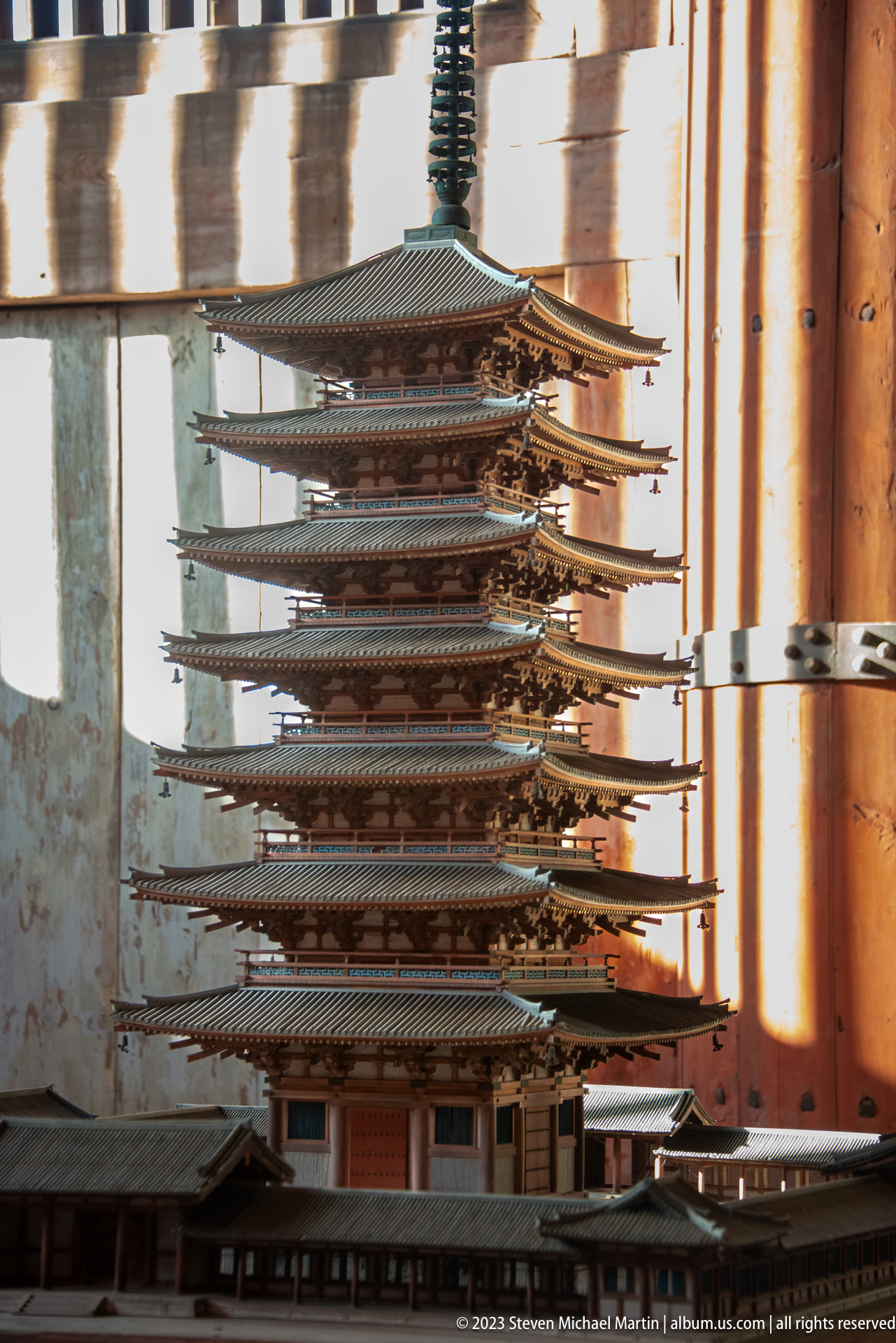
A row of slender multi-tiered pagoda models stands inside the temple hall, each repeating the upward rhythm of projecting roofs and a central finial. Their close spacing creates a layered architectural silhouette. The display translates monumental Buddhist architecture into a compact devotional or commemorative form suited to interior presentation.
Caption
A row of slender multi-tiered pagoda models stands inside the temple hall, each repeating the upward rhythm of projecting roofs and a central finial. Their close spacing creates a layered architectural silhouette. The display translates monumental Buddhist architecture into a compact devotional or commemorative form suited to interior presentation.
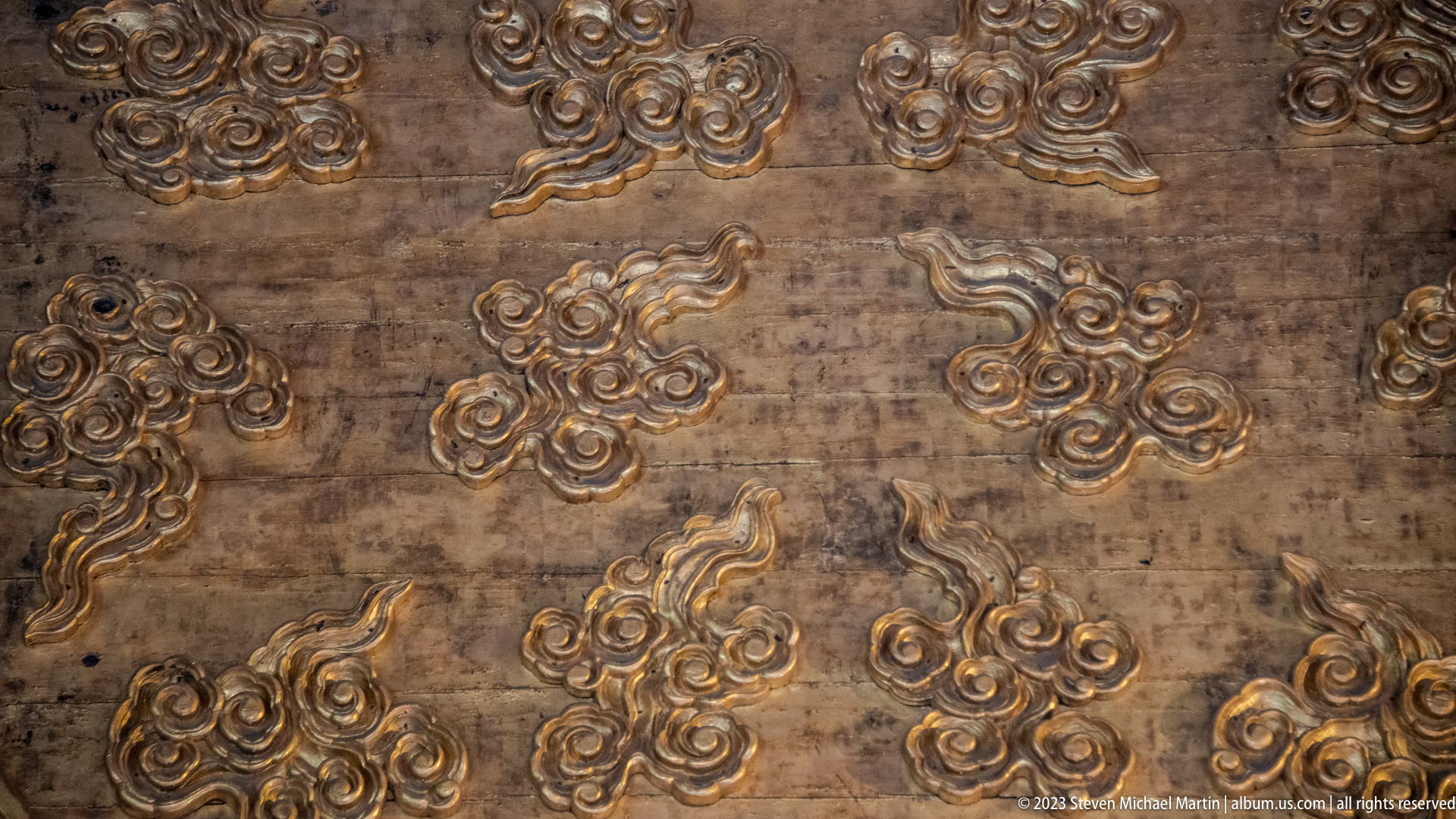
Repeated gilded cloud motifs spread across a dark, weathered surface in an irregular field of curling forms. Their raised edges catch the light and reveal subtle variations in shape and condition. The close detail isolates ornament that would otherwise merge into the larger decorative program of the temple interior.
Caption
Repeated gilded cloud motifs spread across a dark, weathered surface in an irregular field of curling forms. Their raised edges catch the light and reveal subtle variations in shape and condition. The close detail isolates ornament that would otherwise merge into the larger decorative program of the temple interior.
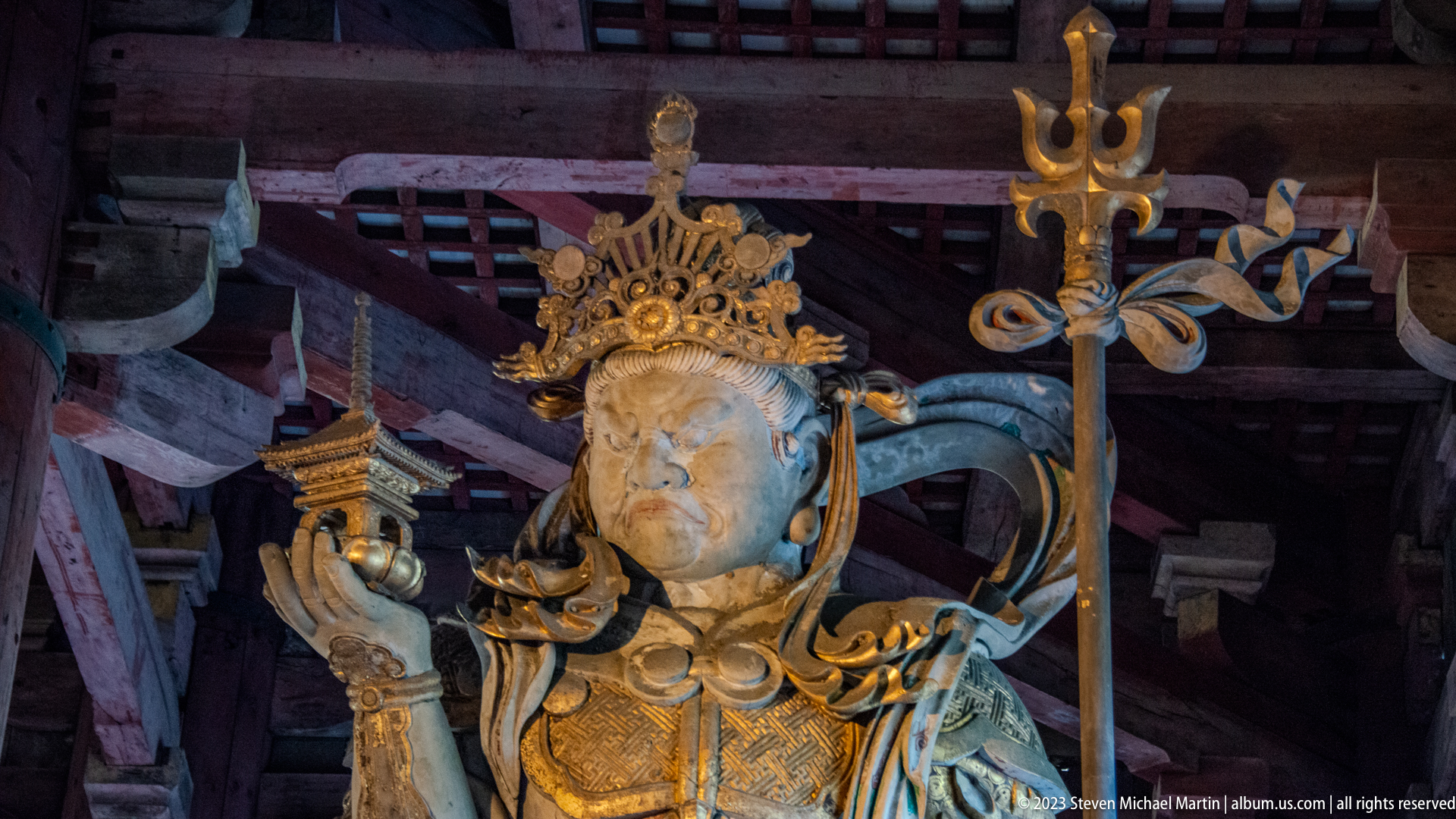
The upper body of a crowned guardian deity is framed against the timber roof, bringing attention to the face, armor, and ritual objects. A trident-like staff rises beside the figure while a small pagoda-shaped attribute rests in the opposite hand. The closer view clarifies details obscured in the full-length composition.
Caption
The upper body of a crowned guardian deity is framed against the timber roof, bringing attention to the face, armor, and ritual objects. A trident-like staff rises beside the figure while a small pagoda-shaped attribute rests in the opposite hand. The closer view clarifies details obscured in the full-length composition.

A monumental guardian face is shown head-on, with bulging eyes, deeply furrowed brows, and a tightly compressed mouth. The carved headdress and braided bands frame the face in strong symmetry. This close study records the sculpture’s forceful expression and the subtle grain and aging of its wooden surface.
Caption
A monumental guardian face is shown head-on, with bulging eyes, deeply furrowed brows, and a tightly compressed mouth. The carved headdress and braided bands frame the face in strong symmetry. This close study records the sculpture’s forceful expression and the subtle grain and aging of its wooden surface.
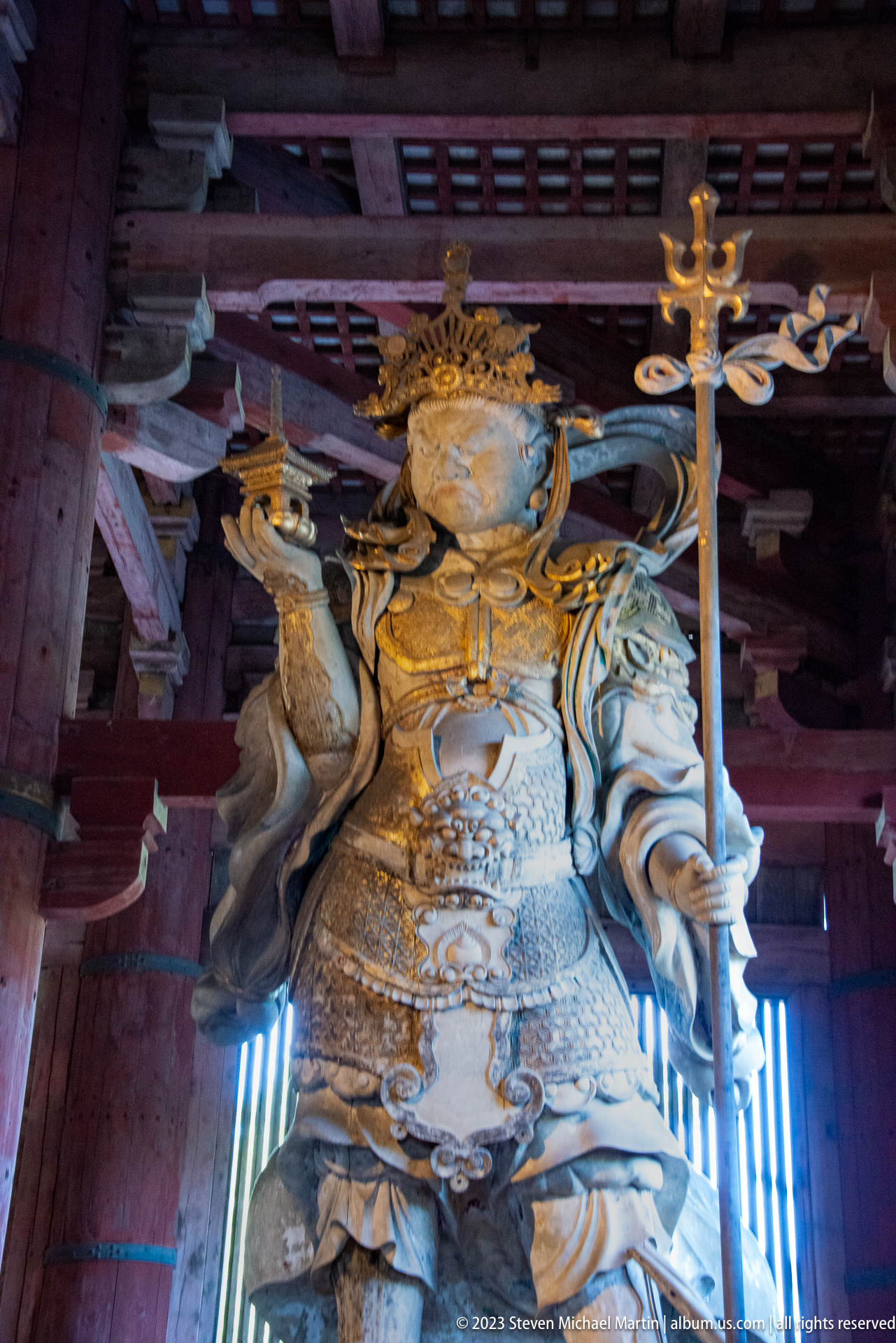
A monumental guardian deity stands in elaborate armor, holding a tall staff in one hand and a small pagoda-like object in the other. The crown, layered garments, and ritual attributes distinguish the figure within the temple’s protective sculptural program. The low angle heightens its authority and emphasizes the vertical sweep of the body and staff.
Caption
A monumental guardian deity stands in elaborate armor, holding a tall staff in one hand and a small pagoda-like object in the other. The crown, layered garments, and ritual attributes distinguish the figure within the temple’s protective sculptural program. The low angle heightens its authority and emphasizes the vertical sweep of the body and staff.
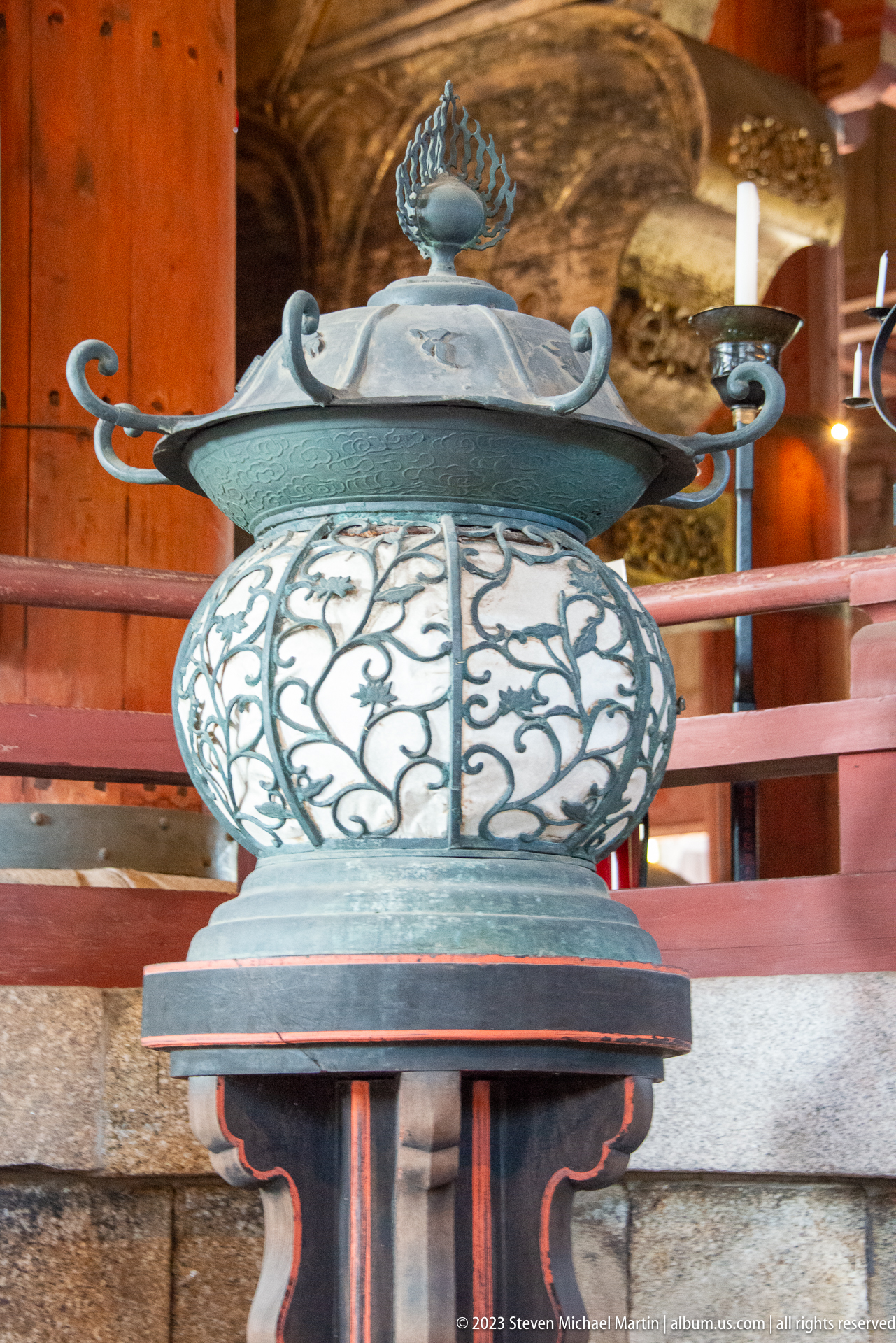
A bronze temple lantern stands on a painted pedestal, its rounded body filled with curling openwork patterns. A lotus-like finial crowns the top while small projecting arms extend from the sides. The frontal view emphasizes the lantern’s symmetry and the refined metalwork used for ritual illumination within the sacred interior.
Caption
A bronze temple lantern stands on a painted pedestal, its rounded body filled with curling openwork patterns. A lotus-like finial crowns the top while small projecting arms extend from the sides. The frontal view emphasizes the lantern’s symmetry and the refined metalwork used for ritual illumination within the sacred interior.
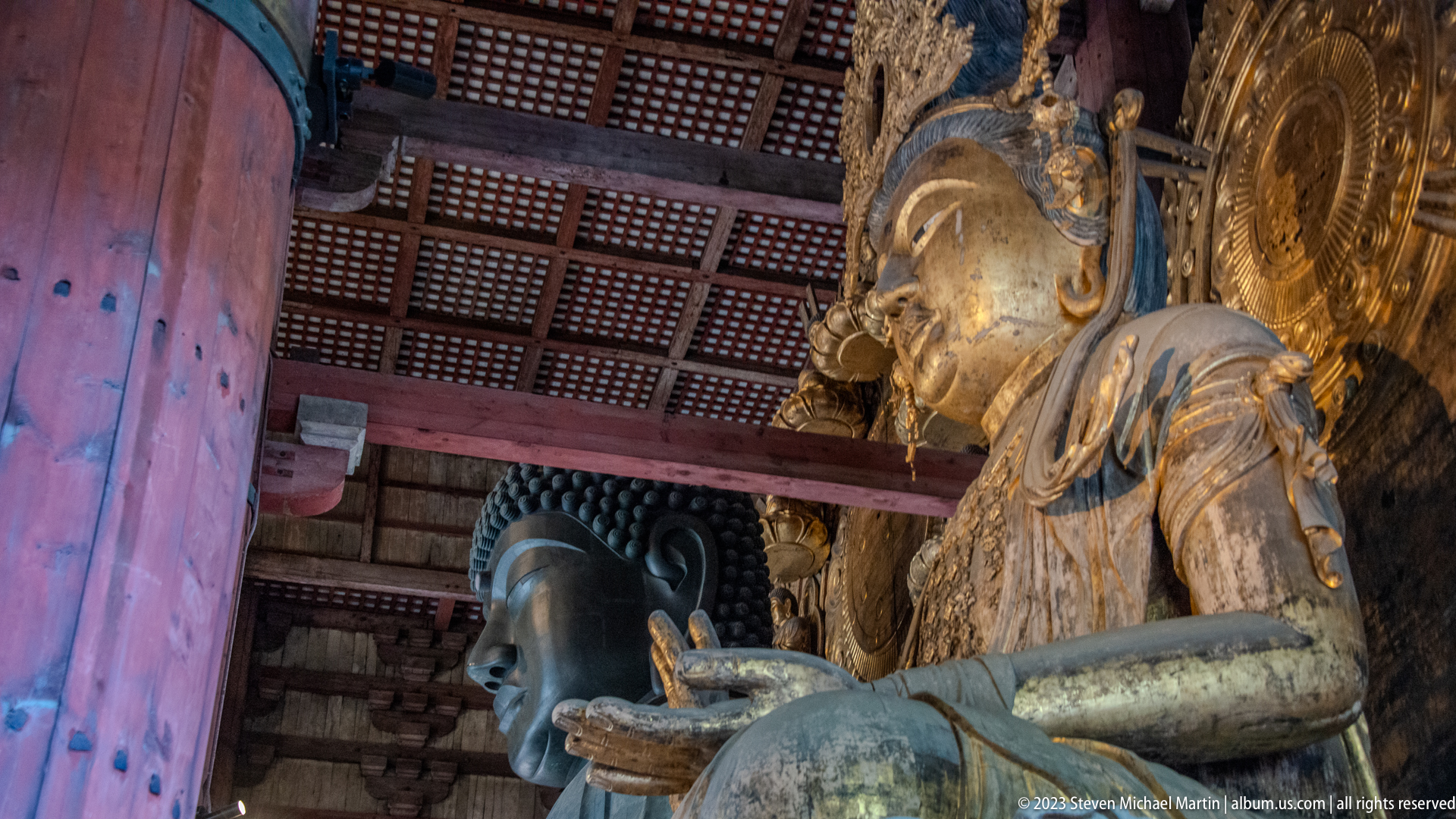
A gilded attendant figure is seen in profile beside the dark bronze head of the Daibutsu. The sculpture’s long face, crown, and layered robes stand out against the red columns and gilded halo behind. This oblique view reveals the spatial relationship between the central Buddha and the richly ornamented figures surrounding it.
Caption
A gilded attendant figure is seen in profile beside the dark bronze head of the Daibutsu. The sculpture’s long face, crown, and layered robes stand out against the red columns and gilded halo behind. This oblique view reveals the spatial relationship between the central Buddha and the richly ornamented figures surrounding it.

Rows of small wooden ema plaques hang from red cords on a display rack inside the temple precinct. Visitors have written prayers, wishes, and personal messages in several languages, reflecting both local devotion and international visitation. The dense arrangement turns individual petitions into a collective record of contemporary religious practice.
Caption
Rows of small wooden ema plaques hang from red cords on a display rack inside the temple precinct. Visitors have written prayers, wishes, and personal messages in several languages, reflecting both local devotion and international visitation. The dense arrangement turns individual petitions into a collective record of contemporary religious practice.

A monumental gilded attendant sits frontally with one hand raised and the other extended, framed by a large radiating aureole. Layered robes spread across the lotus pedestal while altar furnishings line the foreground. The figure’s luminous surface and elaborate halo distinguish it from the darker bronze Daibutsu nearby.
Caption
A monumental gilded attendant sits frontally with one hand raised and the other extended, framed by a large radiating aureole. Layered robes spread across the lotus pedestal while altar furnishings line the foreground. The figure’s luminous surface and elaborate halo distinguish it from the darker bronze Daibutsu nearby.
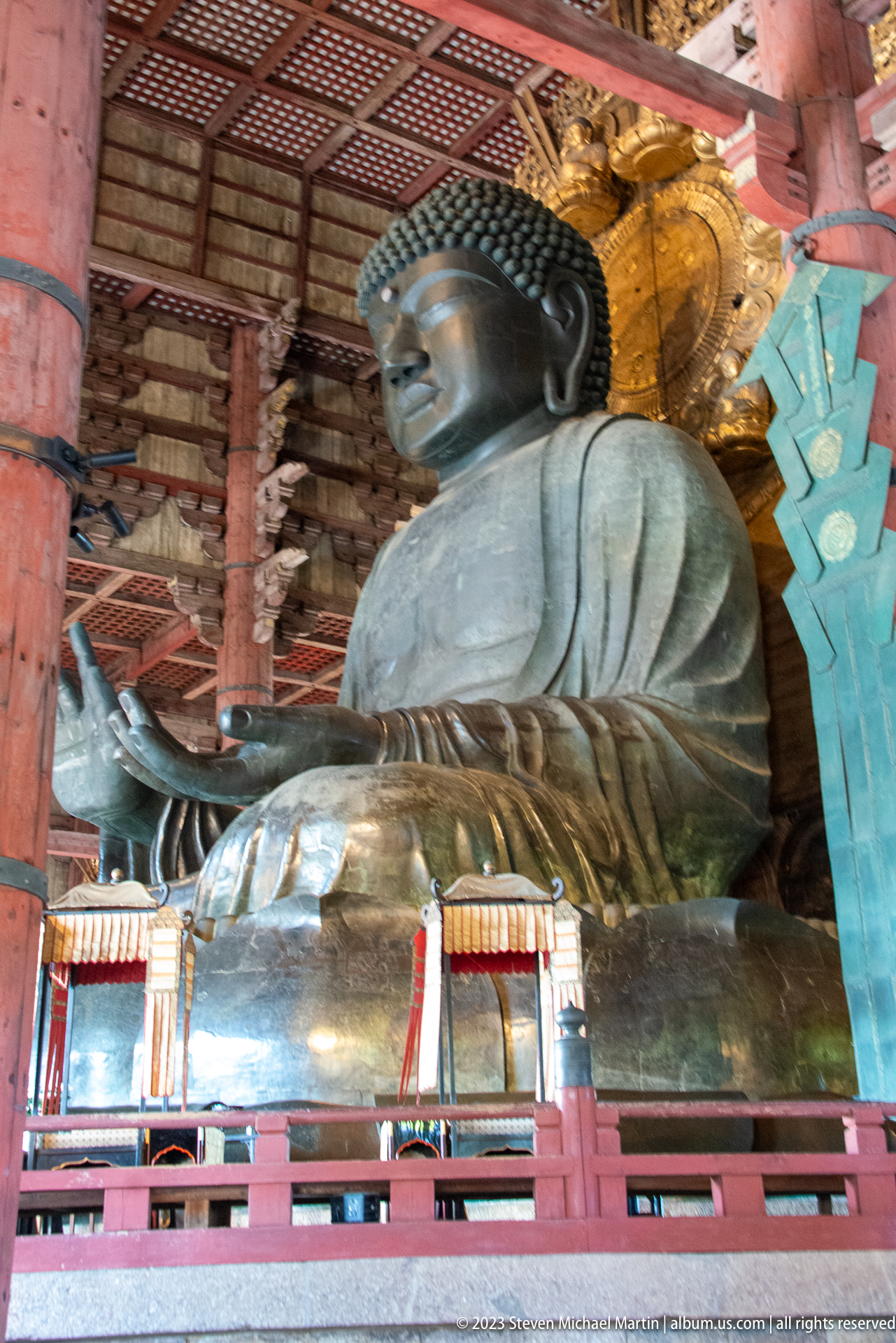
The Todai-ji Daibutsu is seen from the side, revealing the massive curve of the torso, layered robe, and raised hand. Red columns and turquoise ceremonial hangings frame the sculpture while the gilded mandorla rises behind. The angle emphasizes the statue’s depth and three-dimensional scale more strongly than a frontal view.
Caption
The Todai-ji Daibutsu is seen from the side, revealing the massive curve of the torso, layered robe, and raised hand. Red columns and turquoise ceremonial hangings frame the sculpture while the gilded mandorla rises behind. The angle emphasizes the statue’s depth and three-dimensional scale more strongly than a frontal view.
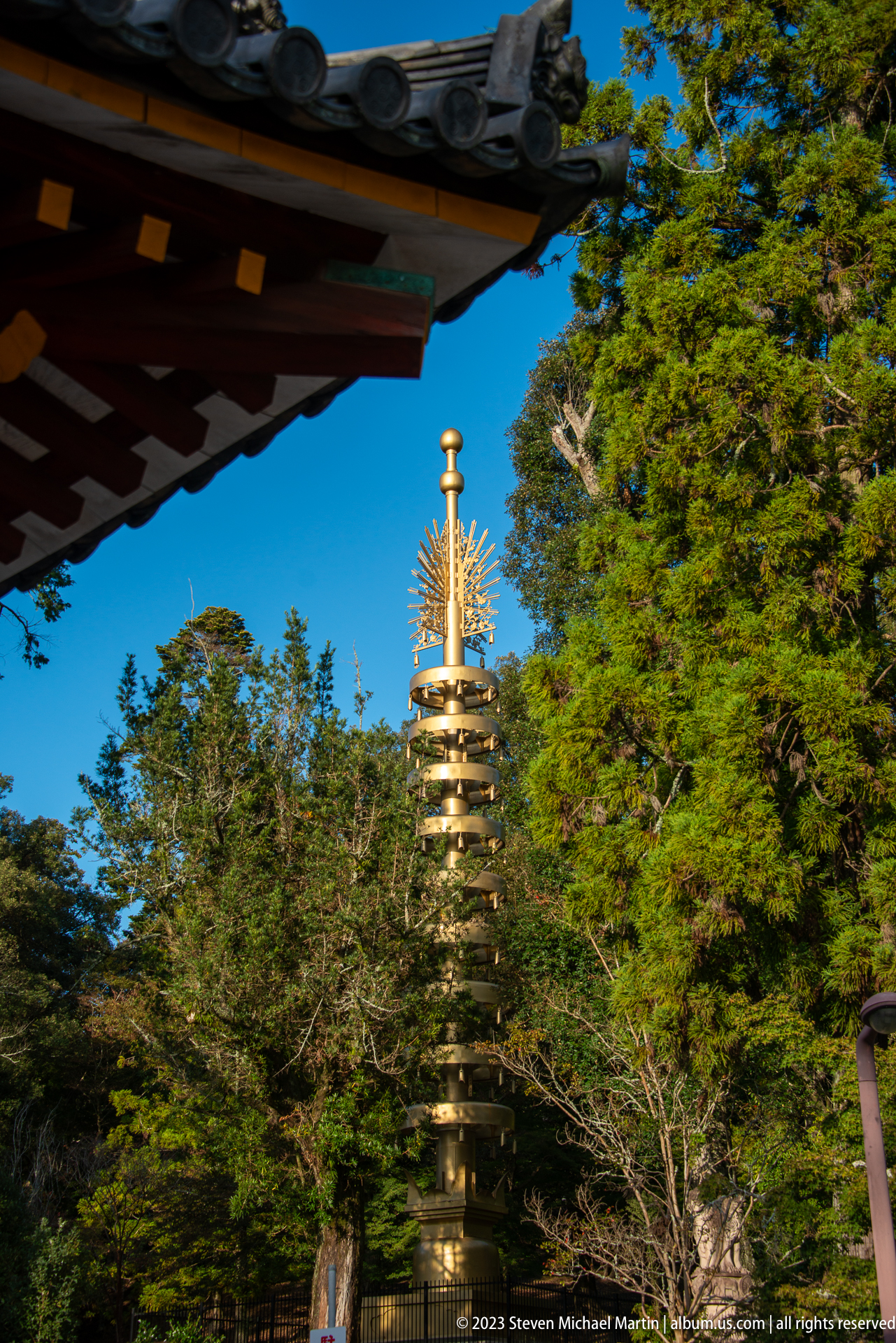
A tall bronze pagoda-form monument rises among trees, its stacked circular tiers narrowing toward a pointed finial. Framed by a dark roof edge and dense greenery, the object appears almost silhouetted against the blue sky. The view emphasizes vertical form and the contrast between metalwork, architecture, and landscape.
Caption
A tall bronze pagoda-form monument rises among trees, its stacked circular tiers narrowing toward a pointed finial. Framed by a dark roof edge and dense greenery, the object appears almost silhouetted against the blue sky. The view emphasizes vertical form and the contrast between metalwork, architecture, and landscape.

The face of a gilded attendant figure is framed by an ornate crown and densely worked aureole. A calm expression, elongated ears, and softly modeled features contrast with the energetic flame and scroll motifs behind. Surface wear and uneven gilding reveal the sculpture’s age and material history at close range.
Caption
The face of a gilded attendant figure is framed by an ornate crown and densely worked aureole. A calm expression, elongated ears, and softly modeled features contrast with the energetic flame and scroll motifs behind. Surface wear and uneven gilding reveal the sculpture’s age and material history at close range.

A visitor bends over a writing counter to inscribe a wooden ema plaque. Completed plaques hang on the wall behind him, displaying prayers and messages in several languages. The scene records the active use of a traditional votive practice within a major heritage site rather than presenting the plaques only as static objects.
Caption
A visitor bends over a writing counter to inscribe a wooden ema plaque. Completed plaques hang on the wall behind him, displaying prayers and messages in several languages. The scene records the active use of a traditional votive practice within a major heritage site rather than presenting the plaques only as static objects.
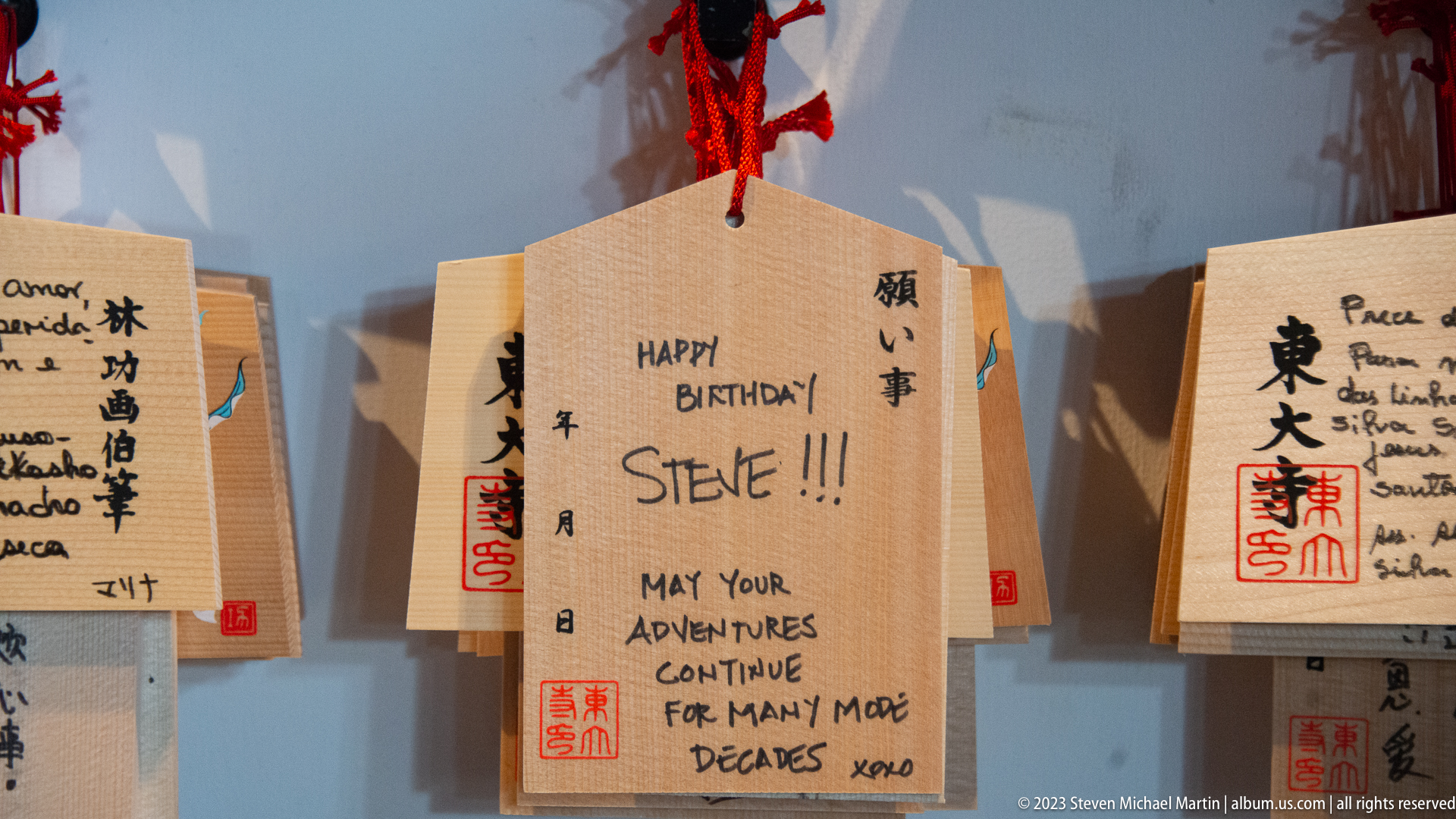
An English-language ema plaque reads as a birthday wish addressed to “Steve,” surrounded by other handwritten votive messages. Red suspension cords and temple stamps frame the writing on the pale wooden surface. The close view demonstrates how an established Japanese devotional form accommodates personal messages from international visitors.
Caption
An English-language ema plaque reads as a birthday wish addressed to “Steve,” surrounded by other handwritten votive messages. Red suspension cords and temple stamps frame the writing on the pale wooden surface. The close view demonstrates how an established Japanese devotional form accommodates personal messages from international visitors.
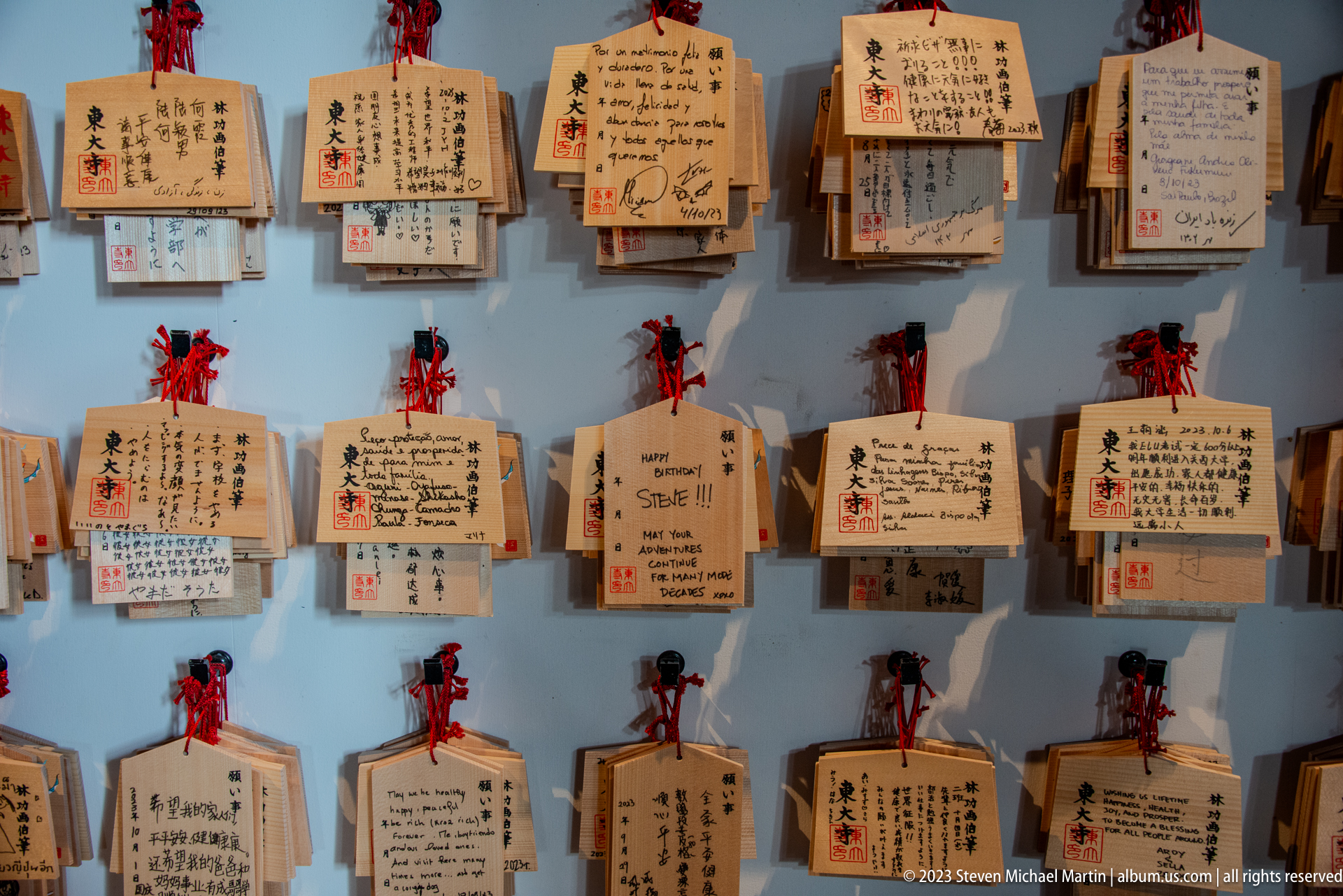
Dozens of wooden ema plaques cover a display wall in orderly rows, each suspended by a red cord. Japanese and international visitors have added prayers, wishes, drawings, and personal messages. Seen together, the plaques form a collective portrait of contemporary participation in temple practice at Todai-ji.
Caption
Dozens of wooden ema plaques cover a display wall in orderly rows, each suspended by a red cord. Japanese and international visitors have added prayers, wishes, drawings, and personal messages. Seen together, the plaques form a collective portrait of contemporary participation in temple practice at Todai-ji.
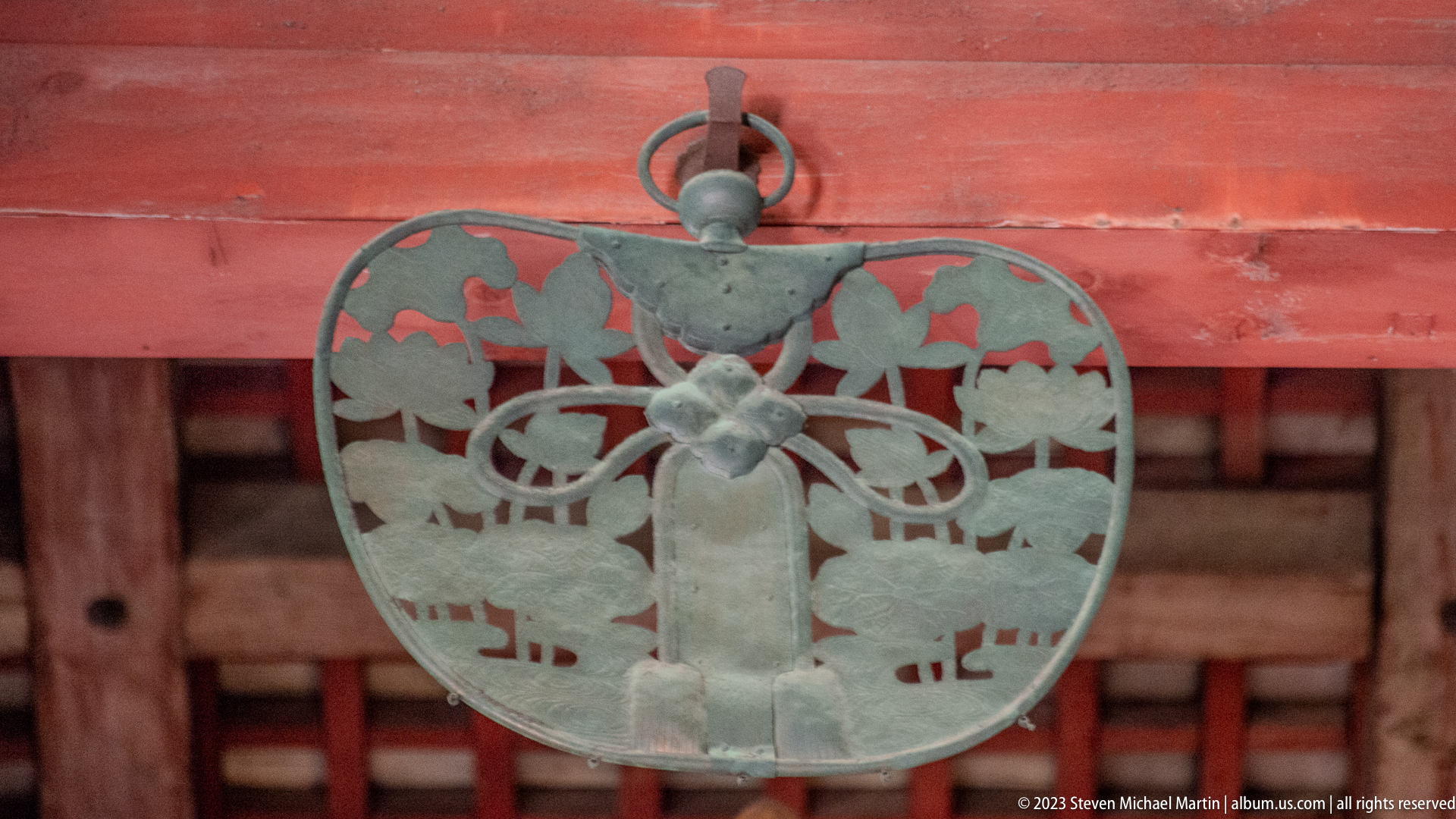
An openwork metal fitting hangs against a vermilion timber beam, its symmetrical design incorporating paired deer and curling vegetation around a central axis. The weathered green-gray surface suggests aged bronze or another copper alloy. The motif links decorative metalwork with the deer imagery closely associated with Nara.
Caption
An openwork metal fitting hangs against a vermilion timber beam, its symmetrical design incorporating paired deer and curling vegetation around a central axis. The weathered green-gray surface suggests aged bronze or another copper alloy. The motif links decorative metalwork with the deer imagery closely associated with Nara.
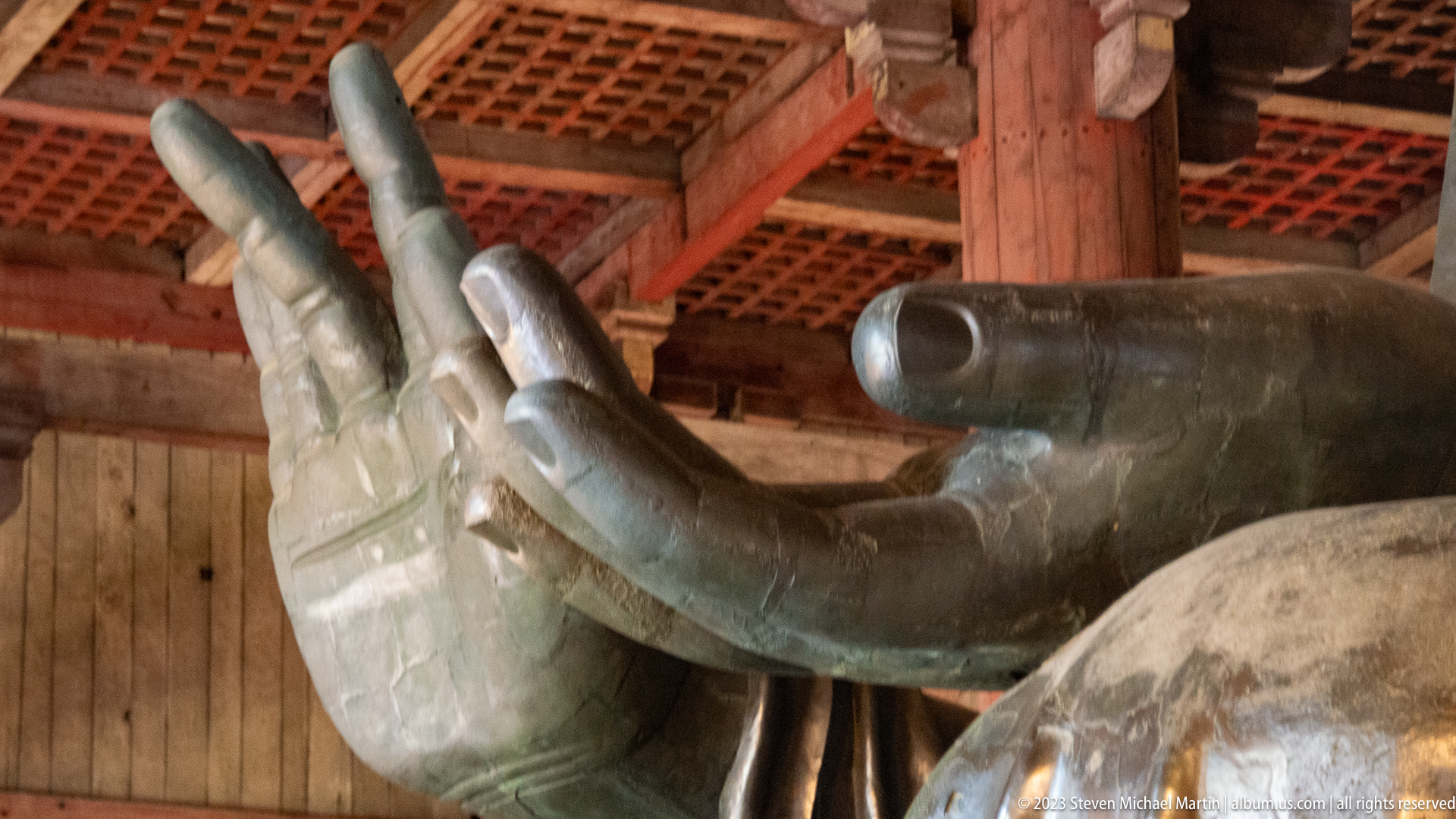
The hand of the Todai-ji Daibutsu is seen from the side, with one long finger extending across the frame and the open palm rising behind it. Variations in patina and surface wear are visible across the bronze. The tight crop emphasizes both the colossal scale of the statue and the precision of its modeled gesture.
Caption
The hand of the Todai-ji Daibutsu is seen from the side, with one long finger extending across the frame and the open palm rising behind it. Variations in patina and surface wear are visible across the bronze. The tight crop emphasizes both the colossal scale of the statue and the precision of its modeled gesture.

A vermilion-and-white covered corridor runs across the foreground, linking temple buildings beneath gray tiled roofs. Deep eaves, bracketed supports, and regularly spaced openings create a strong horizontal rhythm. Vegetation softens the architectural lines and places the historic structure within the wooded landscape of the precinct.
Caption
A vermilion-and-white covered corridor runs across the foreground, linking temple buildings beneath gray tiled roofs. Deep eaves, bracketed supports, and regularly spaced openings create a strong horizontal rhythm. Vegetation softens the architectural lines and places the historic structure within the wooded landscape of the precinct.
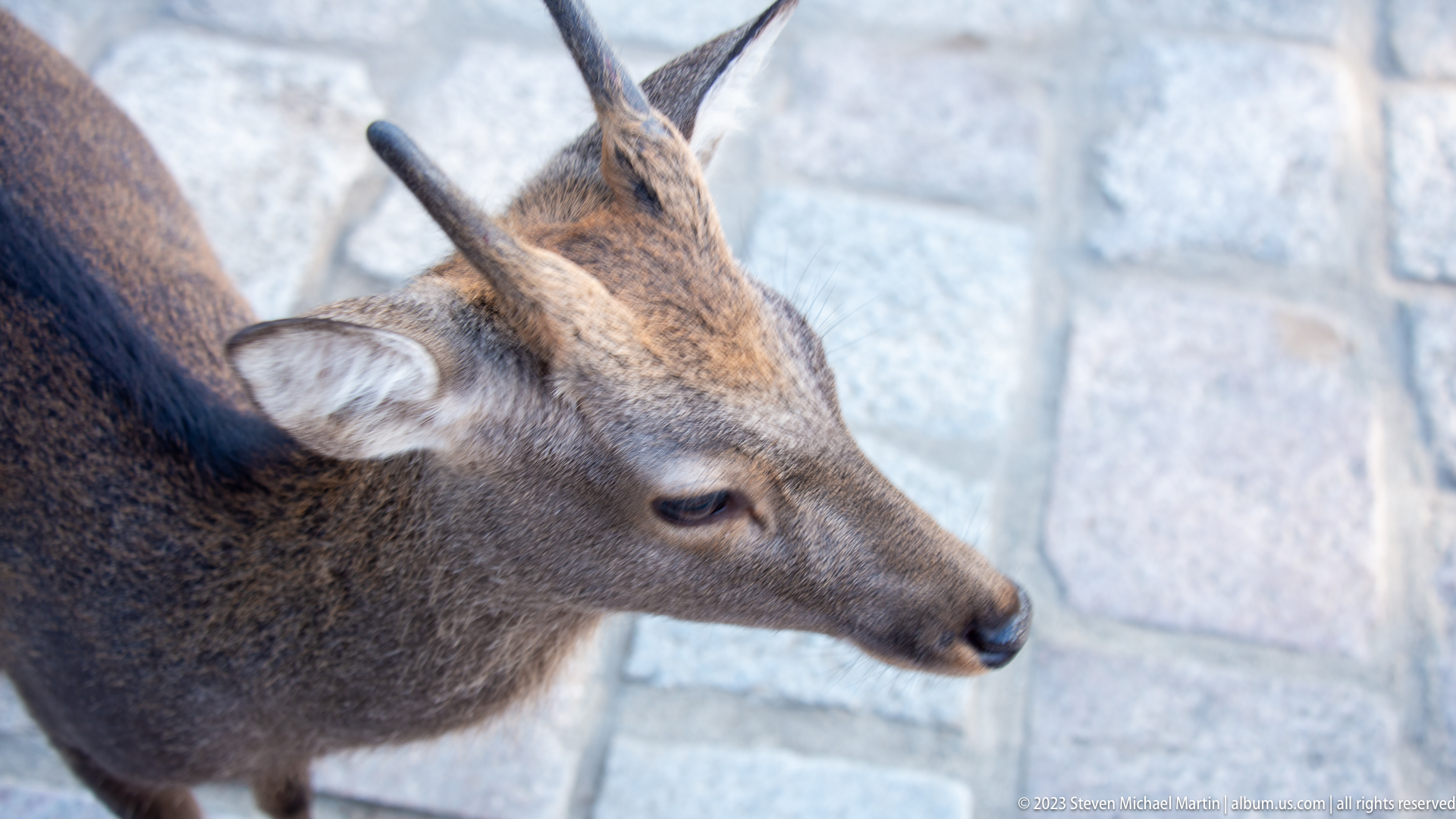
A sika deer is shown in close profile against pale stone paving. Its pointed muzzle, large ear, and short antler growth are sharply defined. The tight framing removes most of the surrounding park, turning the animal into a detailed wildlife portrait while retaining the urban-heritage setting through the stone background.
Caption
A sika deer is shown in close profile against pale stone paving. Its pointed muzzle, large ear, and short antler growth are sharply defined. The tight framing removes most of the surrounding park, turning the animal into a detailed wildlife portrait while retaining the urban-heritage setting through the stone background.

A young male sika deer stands alone on pale stone paving, looking directly toward the camera. Short developing antlers, a compact body, and the white rump patch are clearly visible. The open composition emphasizes the animal’s alert posture and its ease within the heavily visited temple landscape.
Caption
A young male sika deer stands alone on pale stone paving, looking directly toward the camera. Short developing antlers, a compact body, and the white rump patch are clearly visible. The open composition emphasizes the animal’s alert posture and its ease within the heavily visited temple landscape.
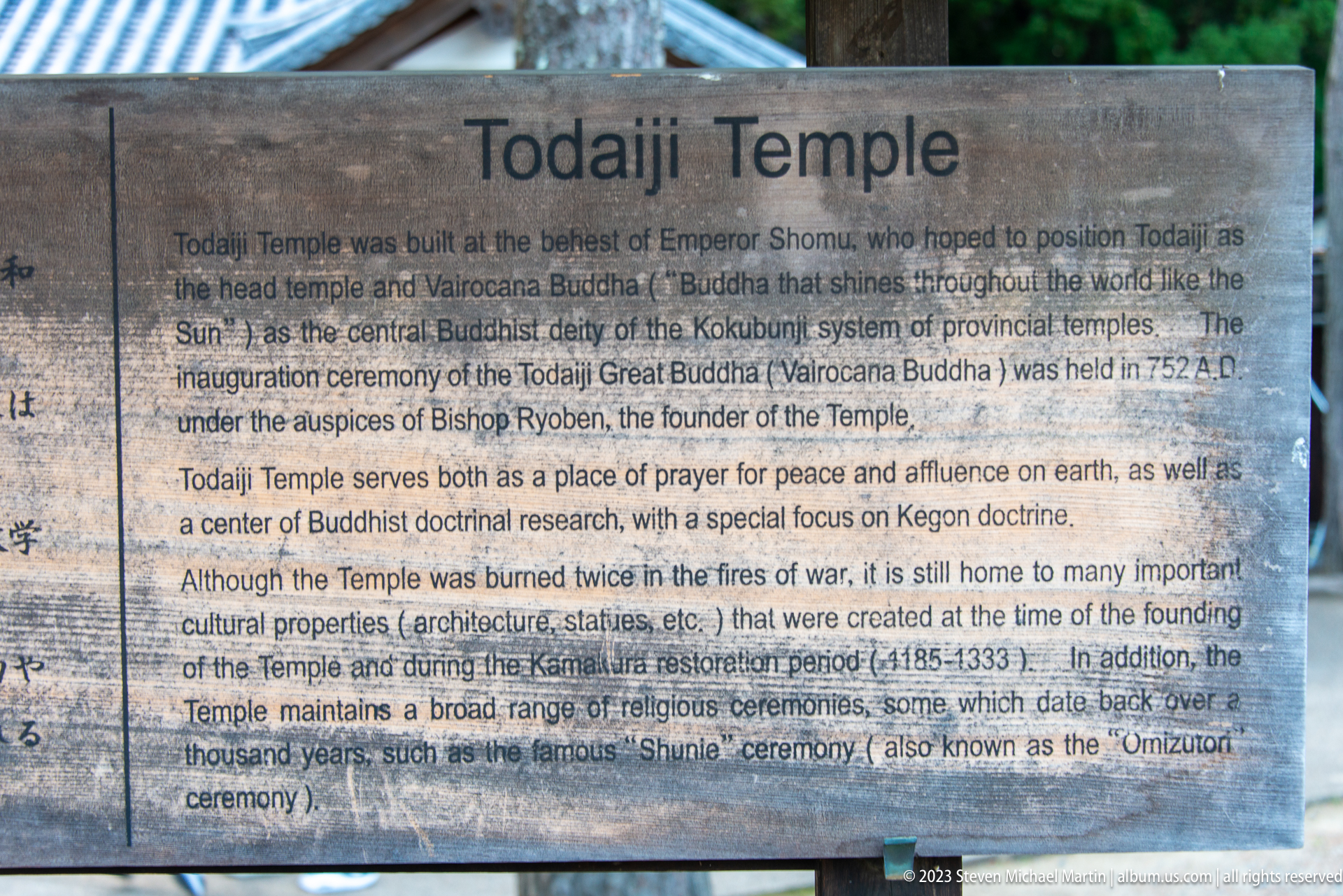
An English-language interpretive panel summarizes the founding, Buddhist significance, destruction, rebuilding, and continuing ritual life of Todai-ji Temple. The sign identifies the temple’s association with the Great Buddha and Kegon doctrine while also noting its restoration history. Weathering and reflections place the modern panel directly within the active heritage site.
Caption
An English-language interpretive panel summarizes the founding, Buddhist significance, destruction, rebuilding, and continuing ritual life of Todai-ji Temple. The sign identifies the temple’s association with the Great Buddha and Kegon doctrine while also noting its restoration history. Weathering and reflections place the modern panel directly within the active heritage site.
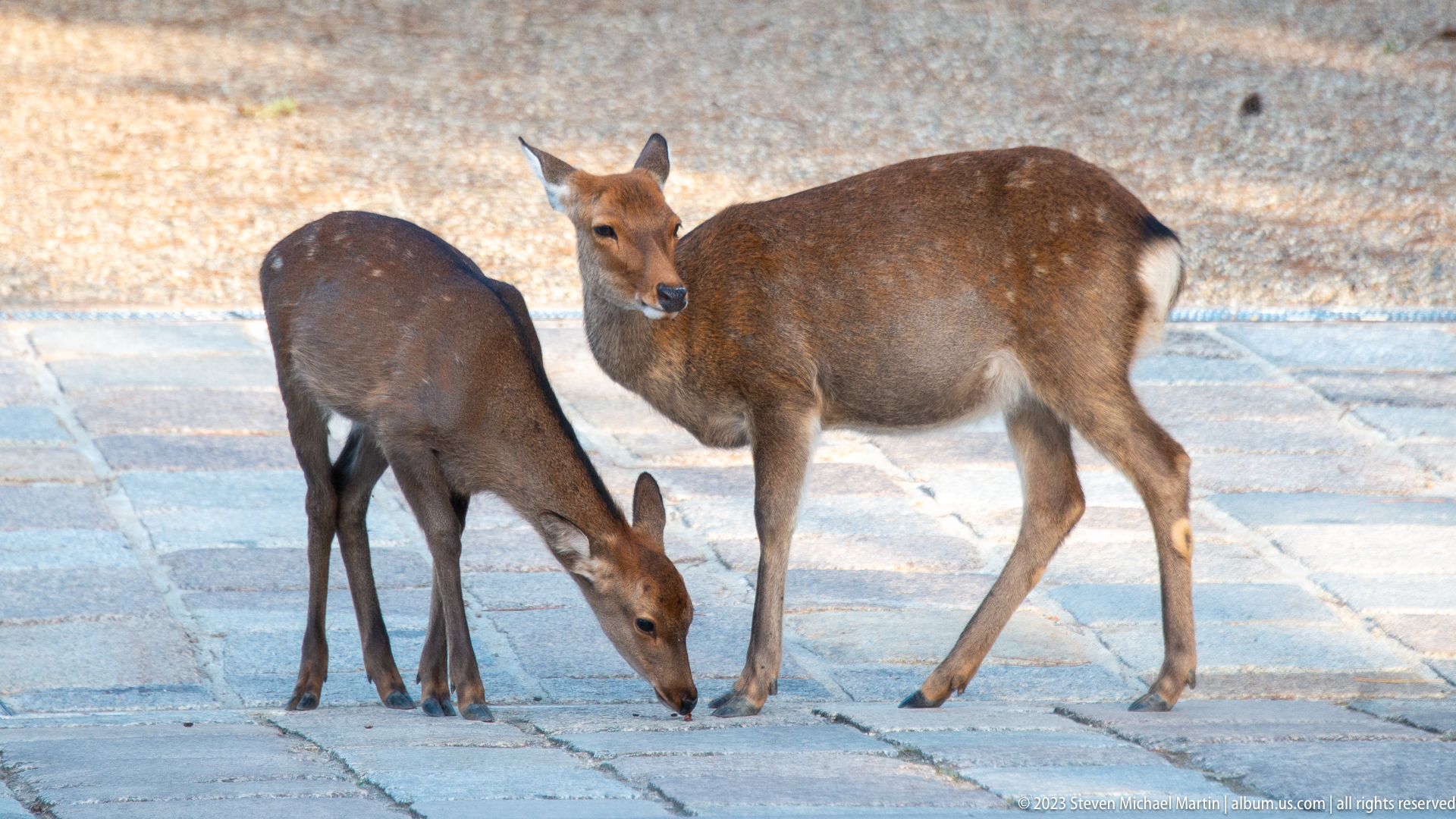
Two sika deer occupy a paved walkway, one lowering its head to forage while the other stands alongside. Their spotted brown coats and differing postures create a natural behavioral contrast. The close grouping shows how the deer move and feed in the same pedestrian spaces used by temple visitors.
Caption
Two sika deer occupy a paved walkway, one lowering its head to forage while the other stands alongside. Their spotted brown coats and differing postures create a natural behavioral contrast. The close grouping shows how the deer move and feed in the same pedestrian spaces used by temple visitors.

A cluster of multilingual directional signs guides visitors toward destinations across the Nara Park and Todai-ji cultural landscape. Deer silhouettes reinforce the park’s visual identity while arrows separate nearby temples, museums, gardens, and transport routes. The photograph documents the modern interpretive infrastructure that helps visitors navigate a dense historic area rather than a single isolated monument.
Caption
A cluster of multilingual directional signs guides visitors toward destinations across the Nara Park and Todai-ji cultural landscape. Deer silhouettes reinforce the park’s visual identity while arrows separate nearby temples, museums, gardens, and transport routes. The photograph documents the modern interpretive infrastructure that helps visitors navigate a dense historic area rather than a single isolated monument.

Two visitors walk together through the temple precinct wearing kimono, one in dark green and the other in a pale floral pattern with a bright red obi. Slight motion blur conveys their movement across the stone path. The scene adds a contemporary human dimension to the historic setting without reducing the clothing to costume.
Caption
Two visitors walk together through the temple precinct wearing kimono, one in dark green and the other in a pale floral pattern with a bright red obi. Slight motion blur conveys their movement across the stone path. The scene adds a contemporary human dimension to the historic setting without reducing the clothing to costume.

A steep timber staircase climbs through the structural framework of the Great Buddha Hall while a monumental guardian sculpture stands beyond a low barrier. The unusual composition exposes spaces normally secondary to the main devotional axis: stairs, beams, lattice ceiling, and protective imagery. The guardian’s imposing scale remains evident even though the stair dominates the foreground.
Caption
A steep timber staircase climbs through the structural framework of the Great Buddha Hall while a monumental guardian sculpture stands beyond a low barrier. The unusual composition exposes spaces normally secondary to the main devotional axis: stairs, beams, lattice ceiling, and protective imagery. The guardian’s imposing scale remains evident even though the stair dominates the foreground.

The portfolio concludes with a mobile navigation screen showing a route toward the Kinki Expressway near Moriguchi, with an estimated journey of thirty-four minutes and roughly twenty-four kilometers. Unlike the preceding heritage photographs, this documentary frame records the practical movement away from Nara. Its inclusion preserves the itinerary’s transition from site experience to onward travel.
Caption
The portfolio concludes with a mobile navigation screen showing a route toward the Kinki Expressway near Moriguchi, with an estimated journey of thirty-four minutes and roughly twenty-four kilometers. Unlike the preceding heritage photographs, this documentary frame records the practical movement away from Nara. Its inclusion preserves the itinerary’s transition from site experience to onward travel.
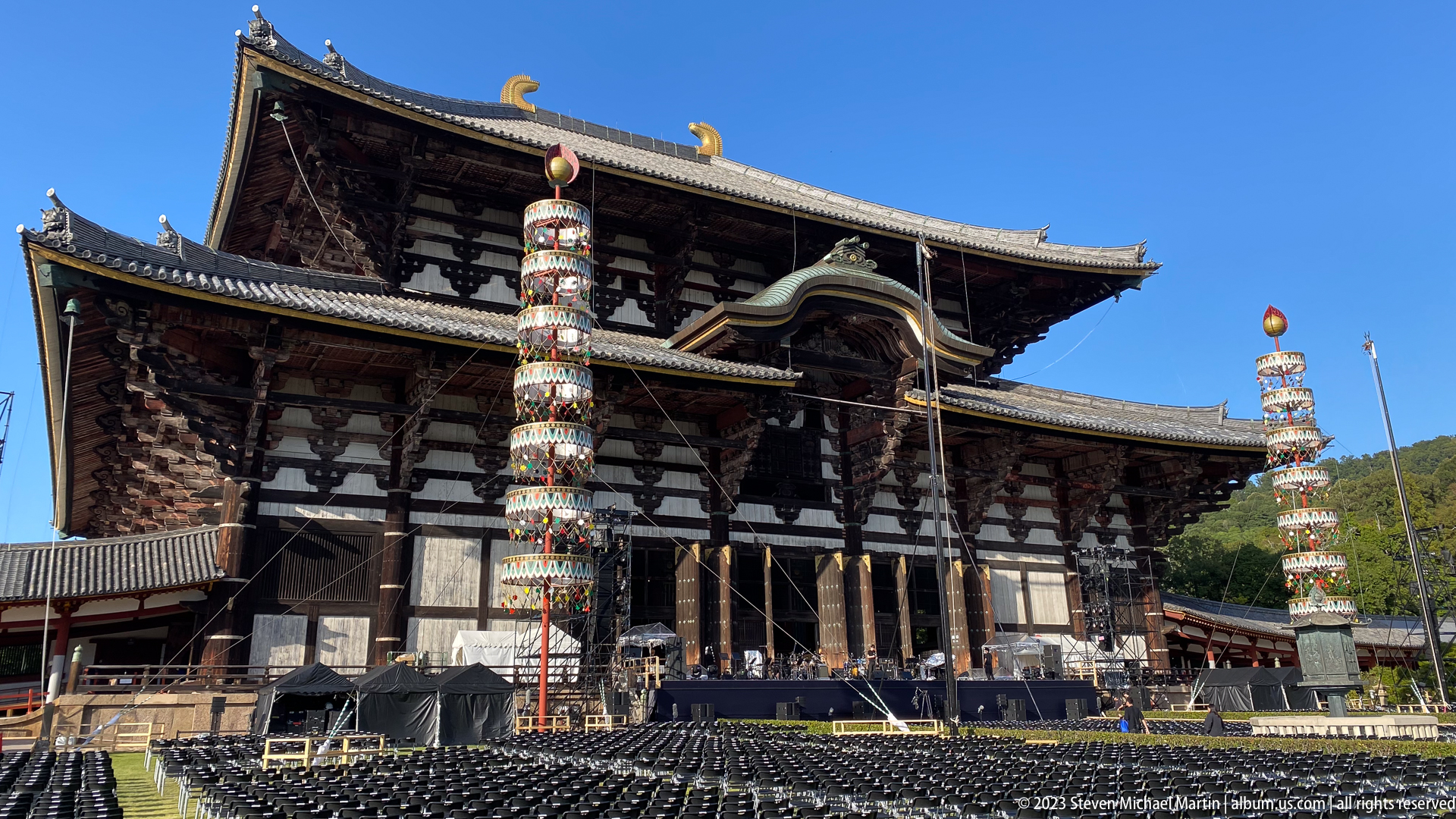
Todai-ji’s Daibutsuden rises behind two brightly ornamented ceremonial towers, creating a sharp contrast between temporary festival decoration and the hall’s monumental timber architecture. The broad tiled roof, deep eaves, central entrance gable, and dark structural grid define the façade. Open space and small figures at ground level make the extraordinary scale of the Great Buddha Hall immediately legible.
Caption
Todai-ji’s Daibutsuden rises behind two brightly ornamented ceremonial towers, creating a sharp contrast between temporary festival decoration and the hall’s monumental timber architecture. The broad tiled roof, deep eaves, central entrance gable, and dark structural grid define the façade. Open space and small figures at ground level make the extraordinary scale of the Great Buddha Hall immediately legible.

The Todai-ji Daibutsu is seen obliquely through a dense frame of massive red columns, horizontal beams, and turquoise ceremonial hangings. This viewpoint emphasizes the architecture required to shelter the colossal bronze image as much as the sculpture itself. The raised hand, gilded mandorla, and surrounding ritual furnishings emerge gradually between structural members, conveying the layered experience of moving through the Great Buddha Hall.
Caption
The Todai-ji Daibutsu is seen obliquely through a dense frame of massive red columns, horizontal beams, and turquoise ceremonial hangings. This viewpoint emphasizes the architecture required to shelter the colossal bronze image as much as the sculpture itself. The raised hand, gilded mandorla, and surrounding ritual furnishings emerge gradually between structural members, conveying the layered experience of moving through the Great Buddha Hall.
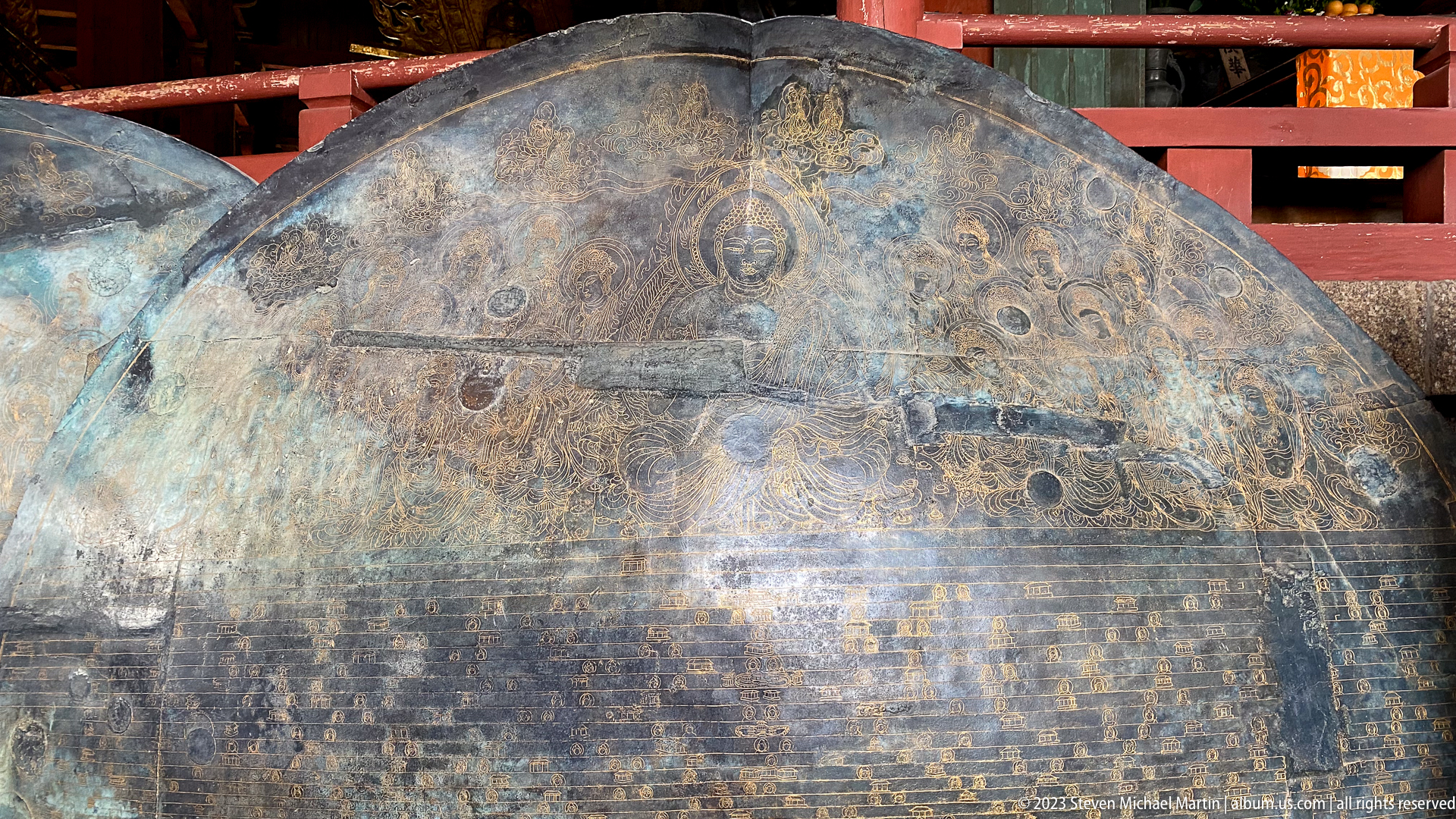
A large arched bronze panel bears dense lines of inscription beneath faint engraved imagery and ornamental details. Irregular patina, abrasion, and darkened areas reveal the object’s age and long exposure. Because the text is not legible at proof-sheet scale, the photograph is most valuable as a record of material condition, layout, and display context rather than as evidence for a precise translation or historical attribution.
Caption
A large arched bronze panel bears dense lines of inscription beneath faint engraved imagery and ornamental details. Irregular patina, abrasion, and darkened areas reveal the object’s age and long exposure. Because the text is not legible at proof-sheet scale, the photograph is most valuable as a record of material condition, layout, and display context rather than as evidence for a precise translation or historical attribution.
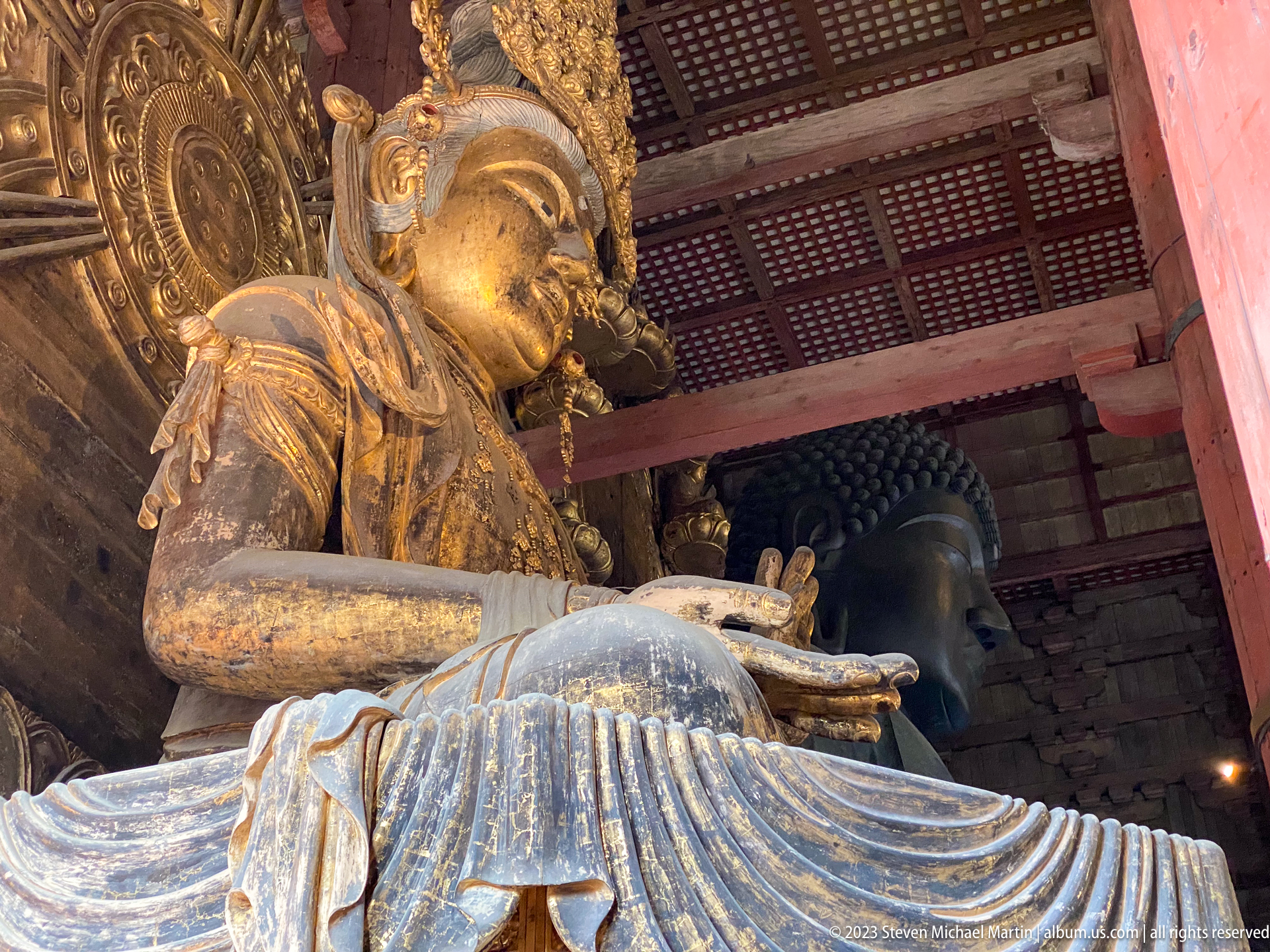
A monumental gilded bodhisattva attendant fills the foreground, its extended hand, layered robes, crown, and jeweled ornament viewed from below. The dark head and raised hand of the Daibutsu appear behind, clarifying the attendant’s place within the larger sculptural ensemble. The close oblique angle reveals how subsidiary figures help frame and amplify the sacred presence of the central Vairocana Buddha.
Caption
A monumental gilded bodhisattva attendant fills the foreground, its extended hand, layered robes, crown, and jeweled ornament viewed from below. The dark head and raised hand of the Daibutsu appear behind, clarifying the attendant’s place within the larger sculptural ensemble. The close oblique angle reveals how subsidiary figures help frame and amplify the sacred presence of the central Vairocana Buddha.
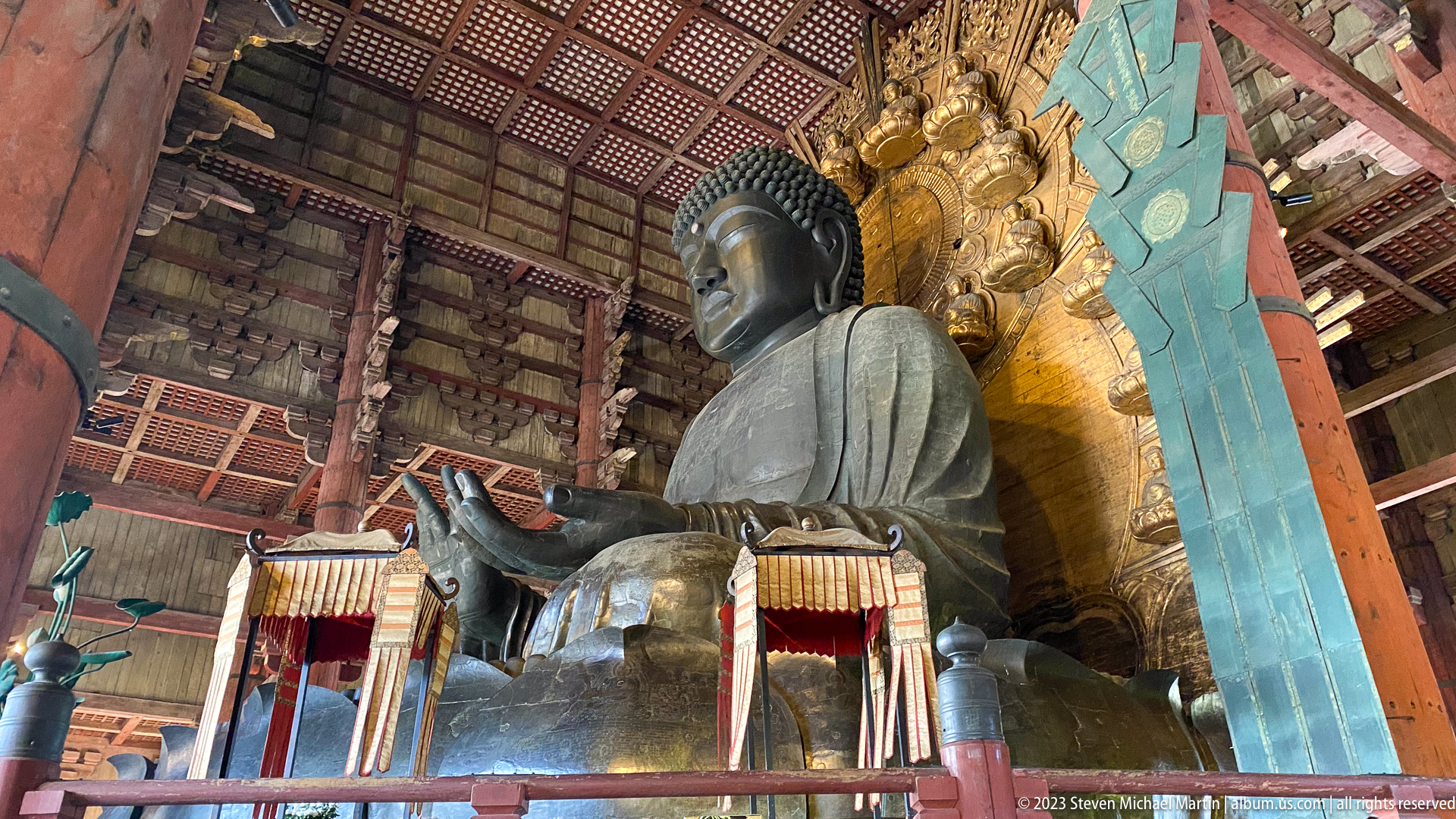
The Todai-ji Daibutsu is viewed from below and to one side, with the open palm extending toward the viewer and the gilded mandorla rising behind. Red columns, dark wall timbers, and a turquoise ceremonial hanging divide the surrounding space into strong vertical bands. The angle emphasizes the sculpture’s mass, depth, and integration with the architecture of the Great Buddha Hall.
Caption
The Todai-ji Daibutsu is viewed from below and to one side, with the open palm extending toward the viewer and the gilded mandorla rising behind. Red columns, dark wall timbers, and a turquoise ceremonial hanging divide the surrounding space into strong vertical bands. The angle emphasizes the sculpture’s mass, depth, and integration with the architecture of the Great Buddha Hall.