War Remnants Museum
The War Remnants Museum in Ho Chi Minh City documents the historical events associated with the Vietnam War and its impact on Vietnamese society. Exhibits present photographic, historical, and military materials illustrating the effects of twentieth-century conflict in Southeast Asia. The museum reflects the importance of preserving historical memory related to political and military events.
Displayed materials include artifacts and visual documentation illustrating technological, political, and social aspects of the conflict. The museum provides context for understanding the broader geopolitical environment associated with Cold War tensions. The collection reflects the lasting historical significance of the conflict in shaping modern Vietnam.
The War Remnants Museum illustrates the role of historical institutions in documenting twentieth-century political change. Its exhibits provide insight into how international conflict influenced regional development and national identity.

The museum’s modern entrance façade carries the Vietnamese and English names beneath its emblem. A sheltered ground-level entrance and display panels establish the building as the principal public entry.
Caption
The museum’s modern entrance façade carries the Vietnamese and English names beneath its emblem. A sheltered ground-level entrance and display panels establish the building as the principal public entry.

A visitor holds a printed historical photograph of a building against the modern streetscape near the museum. The composition invites comparison between the documented past and the current urban setting.
Caption
A visitor holds a printed historical photograph of a building against the modern streetscape near the museum. The composition invites comparison between the documented past and the current urban setting.

A black-and-white landscape shows a lone figure moving through a flooded, heavily damaged forest of stripped trunks and broken vegetation. The scene conveys extensive environmental destruction.
Caption
A black-and-white landscape shows a lone figure moving through a flooded, heavily damaged forest of stripped trunks and broken vegetation. The scene conveys extensive environmental destruction.

The museum’s blue-framed interior opens onto galleries, seating, an audio-guide counter, and exhibition entrances. Visitors move through a broad circulation space beneath exposed beams and an upper-level balcony.
Caption
The museum’s blue-framed interior opens onto galleries, seating, an audio-guide counter, and exhibition entrances. Visitors move through a broad circulation space beneath exposed beams and an upper-level balcony.

Four visitors pose beside the weathered U.S. Army Huey in the museum courtyard. The helicopter’s open side, tail lettering, and large rotor provide both context and scale for the group portrait.
Caption
Four visitors pose beside the weathered U.S. Army Huey in the museum courtyard. The helicopter’s open side, tail lettering, and large rotor provide both context and scale for the group portrait.

Two stylized female figures stand beside an upper-level museum railing, one with an arm raised behind her head and the other extending both arms outward. Their simplified forms suggest a commemorative or allegorical work rather than portrait sculpture.
Caption
Two stylized female figures stand beside an upper-level museum railing, one with an arm raised behind her head and the other extending both arms outward. Their simplified forms suggest a commemorative or allegorical work rather than portrait sculpture.

An M41 Walker Bulldog light tank faces the viewer in the museum courtyard. Its compact turret, prominent gun barrel, tracked suspension, and white star are visible from a frontal angle.
Caption
An M41 Walker Bulldog light tank faces the viewer in the museum courtyard. Its compact turret, prominent gun barrel, tracked suspension, and white star are visible from a frontal angle.

Armored vehicles, a tracked engineering machine, and a U.S. Army helicopter are grouped in the museum’s outdoor exhibition. White stars, military lettering, and interpretive placards organize the dense display of vehicles.
Caption
Armored vehicles, a tracked engineering machine, and a U.S. Army helicopter are grouped in the museum’s outdoor exhibition. White stars, military lettering, and interpretive placards organize the dense display of vehicles.

A visitor holds open a museum guidebook displaying a black-and-white image and the heading “Gulf of Tonkin Resolution.”
Caption
A visitor holds open a museum guidebook displaying a black-and-white image and the heading “Gulf of Tonkin Resolution.”

Large white “USAF” lettering spans the wing in the foreground, while additional aircraft and museum equipment appear beyond it. The elevated viewpoint turns the wing surface into a frame for the broader outdoor collection.
Caption
Large white “USAF” lettering spans the wing in the foreground, while additional aircraft and museum equipment appear beyond it. The elevated viewpoint turns the wing surface into a frame for the broader outdoor collection.

A smiling visitor raises a postcard or printed photograph above his head while standing outdoors near the museum. The card appears to reproduce an image of military equipment from the collection.
Caption
A smiling visitor raises a postcard or printed photograph above his head while standing outdoors near the museum. The card appears to reproduce an image of military equipment from the collection.

A weathered Bell UH-1 Iroquois stands in the museum courtyard, its tail boom, two-blade rotor, skid landing gear, and U.S. Army markings visible from the rear-left side. The wet pavement reflects the outdoor display conditions.
Caption
A weathered Bell UH-1 Iroquois stands in the museum courtyard, its tail boom, two-blade rotor, skid landing gear, and U.S. Army markings visible from the rear-left side. The wet pavement reflects the outdoor display conditions.

The museum’s street-side sign presents its Vietnamese and English names above the address on Võ Văn Tần Street, marking the entrance to one of Ho Chi Minh City’s major historical museums.
Caption
The museum’s street-side sign presents its Vietnamese and English names above the address on Võ Văn Tần Street, marking the entrance to one of Ho Chi Minh City’s major historical museums.

A Boeing CH-47 Chinook transport helicopter stands in the museum’s outdoor military-equipment court. Its tandem rotors, broad fuselage, and olive-drab finish identify the aircraft’s heavy-lift configuration.
Caption
A Boeing CH-47 Chinook transport helicopter stands in the museum’s outdoor military-equipment court. Its tandem rotors, broad fuselage, and olive-drab finish identify the aircraft’s heavy-lift configuration.

A Cessna O-1 Bird Dog rests on its landing gear in the museum courtyard, with high-mounted wings, fixed struts, and U.S. military markings visible across the compact fuselage.
Caption
A Cessna O-1 Bird Dog rests on its landing gear in the museum courtyard, with high-mounted wings, fixed struts, and U.S. military markings visible across the compact fuselage.

A Bell UH-1 Iroquois, commonly known as a Huey, is displayed with its long two-blade rotor and boxy cabin visible from the front-left side. Weathered paint and U.S. Army lettering remain on the fuselage.
Caption
A Bell UH-1 Iroquois, commonly known as a Huey, is displayed with its long two-blade rotor and boxy cabin visible from the front-left side. Weathered paint and U.S. Army lettering remain on the fuselage.

A camouflaged Douglas A-1 Skyraider is displayed with “U.S. AIR FORCE” lettering across the fuselage. Its radial-engine nose, straight wings, and underwing stores reflect its role as a propeller-driven attack aircraft.
Caption
A camouflaged Douglas A-1 Skyraider is displayed with “U.S. AIR FORCE” lettering across the fuselage. Its radial-engine nose, straight wings, and underwing stores reflect its role as a propeller-driven attack aircraft.

A visitor stands beside the museum’s Bell UH-1 Iroquois, providing a clear sense of the helicopter’s scale. The open side position, skid landing gear, and U.S. Army markings remain visible behind him.
Caption
A visitor stands beside the museum’s Bell UH-1 Iroquois, providing a clear sense of the helicopter’s scale. The open side position, skid landing gear, and U.S. Army markings remain visible behind him.

A close side view of the Cessna O-1 Bird Dog isolates its cockpit windows, wing strut, and U.S. Air Force insignia. The composition emphasizes the compact proportions of the observation aircraft.
Caption
A close side view of the Cessna O-1 Bird Dog isolates its cockpit windows, wing strut, and U.S. Air Force insignia. The composition emphasizes the compact proportions of the observation aircraft.

Rows of large aerial bombs and related ordnance stand upright and horizontally in an outdoor display. Their varied sizes, pointed noses, and metal casings illustrate the range of munitions presented by the museum.
Caption
Rows of large aerial bombs and related ordnance stand upright and horizontally in an outdoor display. Their varied sizes, pointed noses, and metal casings illustrate the range of munitions presented by the museum.

A pale stone memorial frames a suspended metal element within a circular opening. A dark inscribed plaque occupies the base, creating a restrained commemorative composition in the museum grounds.
Caption
A pale stone memorial frames a suspended metal element within a circular opening. A dark inscribed plaque occupies the base, creating a restrained commemorative composition in the museum grounds.

A bilingual exhibition map marks bombing locations across Vietnam with red symbols and inset diagrams. Photographs and a legend accompany the mapped distribution of air-war activity.
Caption
A bilingual exhibition map marks bombing locations across Vietnam with red symbols and inset diagrams. Photographs and a legend accompany the mapped distribution of air-war activity.

A red-and-black infographic summarizes the twelve-day B-52 bombing campaign of December 1972. Aircraft silhouettes, bomb shapes, timelines, and numerical totals organize the operation’s scale into a graphic museum display.
Caption
A red-and-black infographic summarizes the twelve-day B-52 bombing campaign of December 1972. Aircraft silhouettes, bomb shapes, timelines, and numerical totals organize the operation’s scale into a graphic museum display.

An outdoor label identifies the BLU-82 seismic bomb and lists its dimensions, weight, and destructive radius. The bilingual panel states that the weapon was used in Vietnam from 1970.
Caption
An outdoor label identifies the BLU-82 seismic bomb and lists its dimensions, weight, and destructive radius. The bilingual panel states that the weapon was used in Vietnam from 1970.

A wall-mounted orientation panel combines floor plans, directional diagrams, and photographs of museum spaces. The display helps visitors understand the building’s circulation and exhibition layout.
Caption
A wall-mounted orientation panel combines floor plans, directional diagrams, and photographs of museum spaces. The display helps visitors understand the building’s circulation and exhibition layout.

A camouflaged Northrop F-5 fighter is displayed in the courtyard with its pointed nose, swept wings, twin-engine rear fuselage, and military insignia visible. The aircraft is viewed from the left rear quarter.
Caption
A camouflaged Northrop F-5 fighter is displayed in the courtyard with its pointed nose, swept wings, twin-engine rear fuselage, and military insignia visible. The aircraft is viewed from the left rear quarter.

Visitors sit and stand within a blue-framed exhibition hall lined with photographs, maps, and bilingual historical panels. The open circulation area connects multiple galleries beneath an upper-level balcony.
Caption
Visitors sit and stand within a blue-framed exhibition hall lined with photographs, maps, and bilingual historical panels. The open circulation area connects multiple galleries beneath an upper-level balcony.

The museum souvenir shop displays books, postcards, textiles, bags, and small decorative objects beneath a prominent bilingual-style English sign. Brightly lit shelves create a compact retail space beside the galleries.
Caption
The museum souvenir shop displays books, postcards, textiles, bags, and small decorative objects beneath a prominent bilingual-style English sign. Brightly lit shelves create a compact retail space beside the galleries.

A large sepia-toned exhibition panel combines a central image of a devastated urban structure with smaller archival photographs and bilingual text. The layered presentation documents the physical destruction associated with aerial warfare.
Caption
A large sepia-toned exhibition panel combines a central image of a devastated urban structure with smaller archival photographs and bilingual text. The layered presentation documents the physical destruction associated with aerial warfare.

Archival photographs, diagrams, and bilingual captions examine U.S. bombing operations over Vietnam. Images of aircraft, explosions, and a pilot are arranged across a textured brown panel.
Caption
Archival photographs, diagrams, and bilingual captions examine U.S. bombing operations over Vietnam. Images of aircraft, explosions, and a pilot are arranged across a textured brown panel.

A collage of black-and-white photographs records damaged settlements, casualties, shelters, and public response. Captions and diagrams connect individual scenes to the broader consequences of wartime bombing.
Caption
A collage of black-and-white photographs records damaged settlements, casualties, shelters, and public response. Captions and diagrams connect individual scenes to the broader consequences of wartime bombing.

A large bilingual panel presents a dense historical narrative about bombing raids over North Vietnam, including aircraft types, quantities of ordnance, and the human consequences described by the museum.
Caption
A large bilingual panel presents a dense historical narrative about bombing raids over North Vietnam, including aircraft types, quantities of ordnance, and the human consequences described by the museum.

A grid of brightly colored posters presents international antiwar and solidarity graphics. National symbols, peace imagery, and bold slogans demonstrate the visual language used by overseas movements supporting Vietnam.
Caption
A grid of brightly colored posters presents international antiwar and solidarity graphics. National symbols, peace imagery, and bold slogans demonstrate the visual language used by overseas movements supporting Vietnam.

A dense black-and-yellow mural surrounds an interpretive case with antiwar slogans, peace appeals, and protest imagery. The installation visualizes the global language of opposition to the Vietnam War.
Caption
A dense black-and-yellow mural surrounds an interpretive case with antiwar slogans, peace appeals, and protest imagery. The installation visualizes the global language of opposition to the Vietnam War.

Two blue panels assemble archival photographs, portraits, newspaper material, and bilingual captions. The presentation links wartime events with international political and public responses.
Caption
Two blue panels assemble archival photographs, portraits, newspaper material, and bilingual captions. The presentation links wartime events with international political and public responses.

Black-and-white photographs, a map, and bilingual text document an overseas delegation and expressions of international solidarity with Vietnam. The arrangement combines group portraits with scenes of visits and public activity.
Caption
Black-and-white photographs, a map, and bilingual text document an overseas delegation and expressions of international solidarity with Vietnam. The arrangement combines group portraits with scenes of visits and public activity.

A bilingual wall title introduces a gallery devoted to international support for Vietnam during the war. The dates 1954–1975 frame the exhibition’s chronological scope.
Caption
A bilingual wall title introduces a gallery devoted to international support for Vietnam during the war. The dates 1954–1975 frame the exhibition’s chronological scope.

A panoramic installation surrounds visitors with a painted rural landscape, bare tree trunks, and a translucent overlay. The immersive display evokes the environmental setting and devastation addressed by the surrounding galleries.
Caption
A panoramic installation surrounds visitors with a painted rural landscape, bare tree trunks, and a translucent overlay. The immersive display evokes the environmental setting and devastation addressed by the surrounding galleries.

Photographs, posters, and documents present European demonstrations and solidarity campaigns connected to Vietnam. Country names along the base identify Poland, Czechoslovakia, Romania, the Soviet Union, Hungary, Bulgaria, and Germany.
Caption
Photographs, posters, and documents present European demonstrations and solidarity campaigns connected to Vietnam. Country names along the base identify Poland, Czechoslovakia, Romania, the Soviet Union, Hungary, Bulgaria, and Germany.

A gallery panel combines Cuban flags, political posters, archival photographs, and solidarity graphics to present Cuban support for Vietnam. The display uses national symbols and documentary imagery to connect state-level advocacy with international antiwar movements.
Caption
A gallery panel combines Cuban flags, political posters, archival photographs, and solidarity graphics to present Cuban support for Vietnam. The display uses national symbols and documentary imagery to connect state-level advocacy with international antiwar movements.

Archival photographs, posters, and documents present antiwar demonstrations and solidarity campaigns from France, Italy, the United Kingdom, Switzerland, Finland, Sweden, Norway, and the Netherlands. Country names along the lower edge organize the display geographically.
Caption
Archival photographs, posters, and documents present antiwar demonstrations and solidarity campaigns from France, Italy, the United Kingdom, Switzerland, Finland, Sweden, Norway, and the Netherlands. Country names along the lower edge organize the display geographically.

A large video screen at left faces an open gallery lined with bilingual panels and photographs. Visitors stand within the dark-floored hall, linking moving-image interpretation with conventional wall displays.
Caption
A large video screen at left faces an open gallery lined with bilingual panels and photographs. Visitors stand within the dark-floored hall, linking moving-image interpretation with conventional wall displays.

Two large archival photographs depict scorched vegetation, ruined structures, and heavily damaged terrain. Presented side by side, they emphasize the physical destruction left by military operations.
Caption
Two large archival photographs depict scorched vegetation, ruined structures, and heavily damaged terrain. Presented side by side, they emphasize the physical destruction left by military operations.

An upper-floor walkway overlooks the museum’s central interior. A TripAdvisor sign and visitor-information stand occupy a dark column beside railings, potted plants, and adjacent galleries.
Caption
An upper-floor walkway overlooks the museum’s central interior. A TripAdvisor sign and visitor-information stand occupy a dark column beside railings, potted plants, and adjacent galleries.

A large color photograph shows multiple bodies lying along a rural path, with a bilingual text panel mounted below. The installation confronts visitors with civilian suffering as part of the museum’s account of wartime violence.
Caption
A large color photograph shows multiple bodies lying along a rural path, with a bilingual text panel mounted below. The installation confronts visitors with civilian suffering as part of the museum’s account of wartime violence.

A black-and-white photograph shows an armed soldier in the foreground while a civilian crouches or recoils nearby. The composition emphasizes the imbalance of power and immediacy of the encounter.
Caption
A black-and-white photograph shows an armed soldier in the foreground while a civilian crouches or recoils nearby. The composition emphasizes the imbalance of power and immediacy of the encounter.

A monochrome wartime photograph presents a body lying on the ground beside a military vehicle. A narrow caption strip beneath the image provides the museum’s contextual identification.
Caption
A monochrome wartime photograph presents a body lying on the ground beside a military vehicle. A narrow caption strip beneath the image provides the museum’s contextual identification.

Four large photographs combine scenes of armed forces, burned terrain, and human remains. Their grouped presentation builds a visual sequence linking military action with its consequences.
Caption
Four large photographs combine scenes of armed forces, burned terrain, and human remains. Their grouped presentation builds a visual sequence linking military action with its consequences.

Three vertically arranged archival photographs show soldiers, a field operation, and helicopters. Small labels beneath each image provide separate documentary context within the gallery.
Caption
Three vertically arranged archival photographs show soldiers, a field operation, and helicopters. Small labels beneath each image provide separate documentary context within the gallery.

A bilingual wall panel discusses alleged war crimes and includes a quotation attributed to the 1970 Russell Tribunal. The dense text situates museum interpretation within international legal and political debate.
Caption
A bilingual wall panel discusses alleged war crimes and includes a quotation attributed to the 1970 Russell Tribunal. The dense text situates museum interpretation within international legal and political debate.

A bronze sculpture titled “Mother” portrays a seated female figure assembled in a rough, expressive surface. The work’s fragmented texture and forward gesture give the memorial figure a forceful emotional presence.
Caption
A bronze sculpture titled “Mother” portrays a seated female figure assembled in a rough, expressive surface. The work’s fragmented texture and forward gesture give the memorial figure a forceful emotional presence.

A red bilingual panel introduces a framed black-and-white wartime photograph presented with film-frame borders. The display focuses attention on documentary photography as evidence and memory.
Caption
A red bilingual panel introduces a framed black-and-white wartime photograph presented with film-frame borders. The display focuses attention on documentary photography as evidence and memory.

A wall display groups color photographs of wounded civilians, bodies, and damaged domestic spaces. Captions beneath the images provide individual context while the arrangement stresses the human cost of war.
Caption
A wall display groups color photographs of wounded civilians, bodies, and damaged domestic spaces. Captions beneath the images provide individual context while the arrangement stresses the human cost of war.

A glass case contains several anti-personnel mines, cylindrical devices, fuzes, and small explosive components. Labels separate the objects by type and caliber within the ordnance display.
Caption
A glass case contains several anti-personnel mines, cylindrical devices, fuzes, and small explosive components. Labels separate the objects by type and caliber within the ordnance display.

Six black-and-white photographs show bodies, damaged terrain, and battlefield aftermath. Individual caption cards identify each scene while the grid arrangement creates a cumulative record of loss.
Caption
Six black-and-white photographs show bodies, damaged terrain, and battlefield aftermath. Individual caption cards identify each scene while the grid arrangement creates a cumulative record of loss.

Black-and-white portraits document severe burns and facial injuries among civilians. Presented individually with labels, the images shift attention from battlefield scenes to the long-term bodily effects of war.
Caption
Black-and-white portraits document severe burns and facial injuries among civilians. Presented individually with labels, the images shift attention from battlefield scenes to the long-term bodily effects of war.

A wall-mounted case presents rifles, carbines, and machine guns arranged over a map-like background. Labels identify individual weapons while the display compares their forms and sizes.
Caption
A wall-mounted case presents rifles, carbines, and machine guns arranged over a map-like background. Labels identify individual weapons while the display compares their forms and sizes.

The museum’s blue structural grid frames several levels of balconies and exhibition entrances. Visitors move through the lower floor while illuminated galleries line the upper levels.
Caption
The museum’s blue structural grid frames several levels of balconies and exhibition entrances. Visitors move through the lower floor while illuminated galleries line the upper levels.

A large black-and-white portrait isolates a young girl in profile, her face turned toward the right. The shallow background and close framing emphasize expression and vulnerability.
Caption
A large black-and-white portrait isolates a young girl in profile, her face turned toward the right. The shallow background and close framing emphasize expression and vulnerability.

A museum case contains mortar shells, grenades, and cylindrical explosive devices in several sizes. Bilingual labels identify examples including 60 mm and 81 mm mortar shells.
Caption
A museum case contains mortar shells, grenades, and cylindrical explosive devices in several sizes. Bilingual labels identify examples including 60 mm and 81 mm mortar shells.

A large bilingual sign introduces the museum’s section on the effects of Agent Orange during the war in Vietnam. Bold white and orange lettering dominates the dark panel above the gallery entrance.
Caption
A large bilingual sign introduces the museum’s section on the effects of Agent Orange during the war in Vietnam. Bold white and orange lettering dominates the dark panel above the gallery entrance.

Framed black-and-white and color photographs line a dark gallery wall above red caption plaques. The display presents portraits and family scenes associated with the human consequences of Agent Orange exposure.
Caption
Framed black-and-white and color photographs line a dark gallery wall above red caption plaques. The display presents portraits and family scenes associated with the human consequences of Agent Orange exposure.

A dark gallery wall combines a video screen, framed portraits, and a large text panel. The images focus on children and adults presented within the museum’s Agent Orange exhibition.
Caption
A dark gallery wall combines a video screen, framed portraits, and a large text panel. The images focus on children and adults presented within the museum’s Agent Orange exhibition.

Framed black-and-white and color portraits present children and adults with visible disabilities in the Agent Orange gallery. Red caption plaques identify each image against the dark wall.
Caption
Framed black-and-white and color portraits present children and adults with visible disabilities in the Agent Orange gallery. Red caption plaques identify each image against the dark wall.

An orange wall displays numerous color photographs of children, caregivers, and family life. A long bilingual quotation beneath the images frames the gallery’s emphasis on ongoing human consequences.
Caption
An orange wall displays numerous color photographs of children, caregivers, and family life. A long bilingual quotation beneath the images frames the gallery’s emphasis on ongoing human consequences.

A brightly lit gallery presents framed photographs and interpretive panels in a continuous wall arrangement. Display cases and text labels create a more traditional documentary exhibition setting.
Caption
A brightly lit gallery presents framed photographs and interpretive panels in a continuous wall arrangement. Display cases and text labels create a more traditional documentary exhibition setting.

A framed newspaper spread combines a large color photograph, a black-and-white image, and the headline “Despite Battlefield Setbacks There Is Hope—With Caution.” The case presents contemporary media coverage as a historical source.
Caption
A framed newspaper spread combines a large color photograph, a black-and-white image, and the headline “Despite Battlefield Setbacks There Is Hope—With Caution.” The case presents contemporary media coverage as a historical source.

A large map of South Vietnam marks the positions of numerous U.S. military divisions and units with insignia and symbols. The bilingual heading dates the deployment snapshot to June 1969, turning the theater of war into a dense field of operational markers.
Caption
A large map of South Vietnam marks the positions of numerous U.S. military divisions and units with insignia and symbols. The bilingual heading dates the deployment snapshot to June 1969, turning the theater of war into a dense field of operational markers.

A white sculpture shows two women lifting their hands toward a bird held aloft. The upward gesture and bird motif create a clear visual association with release, peace, or freedom within the museum setting.
Caption
A white sculpture shows two women lifting their hands toward a bird held aloft. The upward gesture and bird motif create a clear visual association with release, peace, or freedom within the museum setting.

A low-angle view looks up at a circular enclosed platform supported above a stone wall. The form resembles a guard or observation position within the museum’s reconstructed prison complex.
Caption
A low-angle view looks up at a circular enclosed platform supported above a stone wall. The form resembles a guard or observation position within the museum’s reconstructed prison complex.

A bilingual infographic compares U.S. participation in the First World War, Second World War, and Vietnam War. Timelines, troop numbers, bombing tonnage, financial cost, and casualty totals are arranged in parallel columns for direct visual comparison.
Caption
A bilingual infographic compares U.S. participation in the First World War, Second World War, and Vietnam War. Timelines, troop numbers, bombing tonnage, financial cost, and casualty totals are arranged in parallel columns for direct visual comparison.

A bilingual museum panel presents Robert S. McNamara’s statement, “Yet we were wrong, terribly wrong,” alongside a photograph of an empty conference setting. The display frames the quotation as a retrospective admission about U.S. decision-making in Vietnam.
Caption
A bilingual museum panel presents Robert S. McNamara’s statement, “Yet we were wrong, terribly wrong,” alongside a photograph of an empty conference setting. The display frames the quotation as a retrospective admission about U.S. decision-making in Vietnam.

Six brightly colored posters use doves, globes, flowers, flags, and the word “Freedom” to express peace and international solidarity. Their simplified forms and vivid palette suggest work created for an educational or youth-focused museum display.
Caption
Six brightly colored posters use doves, globes, flowers, flags, and the word “Freedom” to express peace and international solidarity. Their simplified forms and vivid palette suggest work created for an educational or youth-focused museum display.

Viewed through dark bars, two prisoner figures occupy a narrow stone-walled yard. One crouches against the wall while another stands with arms raised, emphasizing confinement and surveillance within the reconstructed prison setting.
Caption
Viewed through dark bars, two prisoner figures occupy a narrow stone-walled yard. One crouches against the wall while another stands with arms raised, emphasizing confinement and surveillance within the reconstructed prison setting.

A gaunt prisoner figure sits on a raised concrete platform inside a small bare cell. Shackles and the confined concrete interior underscore the harsh conditions presented by the reconstruction.
Caption
A gaunt prisoner figure sits on a raised concrete platform inside a small bare cell. Shackles and the confined concrete interior underscore the harsh conditions presented by the reconstruction.

A tall guillotine stands against a stone wall, with its upright frame, angled blade housing, wooden platform, and restraint board visible. The display forms part of the museum’s presentation of colonial and wartime imprisonment.
Caption
A tall guillotine stands against a stone wall, with its upright frame, angled blade housing, wooden platform, and restraint board visible. The display forms part of the museum’s presentation of colonial and wartime imprisonment.

A photographed sheet of English text includes a small black-and-white illustration and several paragraphs discussing a building or wartime site. The page appears to be reference material rather than a formal museum label.
Caption
A photographed sheet of English text includes a small black-and-white illustration and several paragraphs discussing a building or wartime site. The page appears to be reference material rather than a formal museum label.

A rusted wire enclosure sits within the prison exhibit beneath an interpretive sign. Its low height and narrow interior demonstrate the severe physical restriction associated with the reconstructed detention method.
Caption
A rusted wire enclosure sits within the prison exhibit beneath an interpretive sign. Its low height and narrow interior demonstrate the severe physical restriction associated with the reconstructed detention method.

A bilingual panel explains the construction and dimensions of the so-called tiger cages, accompanied by a photograph of the enclosure. Mounted against rough stone and tangled wire, the sign gives context to the reconstructed prison apparatus.
Caption
A bilingual panel explains the construction and dimensions of the so-called tiger cages, accompanied by a photograph of the enclosure. Mounted against rough stone and tangled wire, the sign gives context to the reconstructed prison apparatus.

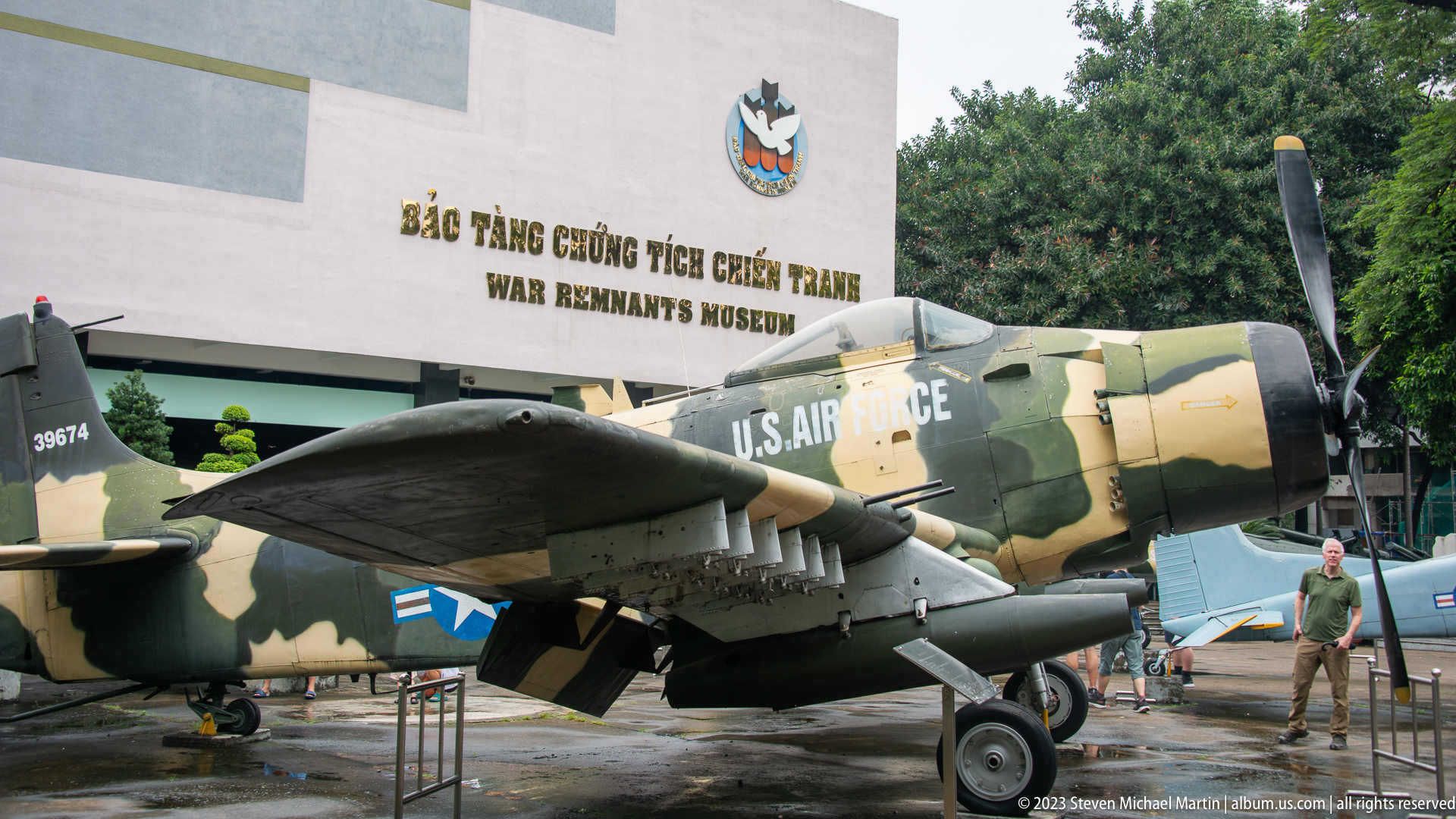
A camouflaged Douglas A-1 Skyraider stands before the museum’s bilingual façade sign. The radial-engine nose, broad straight wings, underwing stores, and U.S. Air Force markings define the aircraft’s heavy attack profile.
Caption
A camouflaged Douglas A-1 Skyraider stands before the museum’s bilingual façade sign. The radial-engine nose, broad straight wings, underwing stores, and U.S. Air Force markings define the aircraft’s heavy attack profile.
The Douglas A-1 Skyraider is seen from a closer front-right angle, emphasizing its large propeller hub, radial-engine cowling, landing gear, and loaded wings. The museum façade rises directly behind it.
Caption
The Douglas A-1 Skyraider is seen from a closer front-right angle, emphasizing its large propeller hub, radial-engine cowling, landing gear, and loaded wings. The museum façade rises directly behind it.

A close side view isolates the Skyraider’s camouflage pattern, large “U.S. AIR FORCE” lettering, rescue arrow, warning text, and access panels. The detail reveals the operational markings preserved on the museum aircraft.
Caption
A close side view isolates the Skyraider’s camouflage pattern, large “U.S. AIR FORCE” lettering, rescue arrow, warning text, and access panels. The detail reveals the operational markings preserved on the museum aircraft.

A framed embroidery depicts a rural Vietnamese riverscape with palm trees, thatched houses, boats, and figures in conical hats. Fine colored stitching creates the landscape’s water, vegetation, and architecture.
Caption
A framed embroidery depicts a rural Vietnamese riverscape with palm trees, thatched houses, boats, and figures in conical hats. Fine colored stitching creates the landscape’s water, vegetation, and architecture.

The entrance hall combines bilingual museum signage, an audio-guide counter, exhibition panels, and visitors moving through the blue interior. The view presents the museum as both an interpretive institution and an active public space.
Caption
The entrance hall combines bilingual museum signage, an audio-guide counter, exhibition panels, and visitors moving through the blue interior. The view presents the museum as both an interpretive institution and an active public space.

A close detail centers the U.S. star-and-bar insignia against green, tan, and black camouflage. Riveted metal panels and weathering reveal the surface of the preserved military aircraft.
Caption
A close detail centers the U.S. star-and-bar insignia against green, tan, and black camouflage. Riveted metal panels and weathering reveal the surface of the preserved military aircraft.

A printed page combines an old color photograph of a building with surrounding English text and annotations. The page appears to document a site connected to the history discussed during the museum visit.
Caption
A printed page combines an old color photograph of a building with surrounding English text and annotations. The page appears to document a site connected to the history discussed during the museum visit.

A passenger in a blue cap holds a tablet toward the windshield while riding through city traffic. The screen displays a photograph or travel image as motorbikes move along the road ahead.
Caption
A passenger in a blue cap holds a tablet toward the windshield while riding through city traffic. The screen displays a photograph or travel image as motorbikes move along the road ahead.

A close photograph of an open English-language guidebook shows a section titled “War Remnants Museum.” The text summarizes the museum’s exhibitions, aircraft, weapons, photographs, and displays on wartime violence.
Caption
A close photograph of an open English-language guidebook shows a section titled “War Remnants Museum.” The text summarizes the museum’s exhibitions, aircraft, weapons, photographs, and displays on wartime violence.

A rough stone wall frames a narrow barred entrance beneath a bilingual sign reading “Tiger Cages.” The dark passage leads into the museum’s reconstruction of detention cells associated with Con Dao prison history.
Caption
A rough stone wall frames a narrow barred entrance beneath a bilingual sign reading “Tiger Cages.” The dark passage leads into the museum’s reconstruction of detention cells associated with Con Dao prison history.

A low shelter built from timber, earth, straw, and vegetation recreates a concealed field position. Its triangular entrance and natural covering demonstrate how a bunker could merge with the surrounding landscape.
Caption
A low shelter built from timber, earth, straw, and vegetation recreates a concealed field position. Its triangular entrance and natural covering demonstrate how a bunker could merge with the surrounding landscape.

A Boeing CH-47 Chinook is viewed from the front-left side, showing its broad cockpit glazing, tandem rotors, large fuselage, and U.S. Army markings. The outdoor museum setting allows the aircraft’s scale and heavy-lift form to dominate the frame.
Caption
A Boeing CH-47 Chinook is viewed from the front-left side, showing its broad cockpit glazing, tandem rotors, large fuselage, and U.S. Army markings. The outdoor museum setting allows the aircraft’s scale and heavy-lift form to dominate the frame.

A close view through the open side of a weathered helicopter reveals a multi-barrel rotary machine gun on a pintle mount. Yellow trim outlines the adjacent window while riveted panels and worn paint show the aircraft’s condition.
Caption
A close view through the open side of a weathered helicopter reveals a multi-barrel rotary machine gun on a pintle mount. Yellow trim outlines the adjacent window while riveted panels and worn paint show the aircraft’s condition.

A large sepia-toned exhibition panel combines archival photographs, bilingual text, and a central image of a devastated urban structure. The layered design links individual scenes of destruction to the broader consequences of aerial warfare.
Caption
A large sepia-toned exhibition panel combines archival photographs, bilingual text, and a central image of a devastated urban structure. The layered design links individual scenes of destruction to the broader consequences of aerial warfare.

A large bilingual sign marks the entrance to the museum’s War Crimes gallery. The dark panel contrasts with the brightly lit exhibition beyond, where photographs and interpretive displays are visible.
Caption
A large bilingual sign marks the entrance to the museum’s War Crimes gallery. The dark panel contrasts with the brightly lit exhibition beyond, where photographs and interpretive displays are visible.

An orange booklet titled “Cách đánh B-52” is displayed on red fabric above a bilingual label describing it as a replica document on People’s Air Defense tactics used against B-52 bombers.
Caption
An orange booklet titled “Cách đánh B-52” is displayed on red fabric above a bilingual label describing it as a replica document on People’s Air Defense tactics used against B-52 bombers.

A panoramic installation surrounds visitors with a painted rural landscape, bare tree trunks, and translucent graphic overlays. Words and peace imagery are layered across the scene, linking environmental devastation with aspirations for freedom and peace.
Caption
A panoramic installation surrounds visitors with a painted rural landscape, bare tree trunks, and translucent graphic overlays. Words and peace imagery are layered across the scene, linking environmental devastation with aspirations for freedom and peace.

A framed poster places a black-and-white portrait of a child over a large red star and the German slogan “Solidarität mit Vietnam.” The design reflects international solidarity campaigns supporting Vietnam.
Caption
A framed poster places a black-and-white portrait of a child over a large red star and the German slogan “Solidarität mit Vietnam.” The design reflects international solidarity campaigns supporting Vietnam.

A star-shaped decorative emblem rests in a lined presentation case beneath a handwritten Hungarian inscription dated Miskolc, 23 August 1973. The object appears to commemorate solidarity or friendship with Vietnam.
Caption
A star-shaped decorative emblem rests in a lined presentation case beneath a handwritten Hungarian inscription dated Miskolc, 23 August 1973. The object appears to commemorate solidarity or friendship with Vietnam.

A bilingual panel lists herbicides used during the Vietnam War, including Agent Orange and related defoliants, with chemical names and dioxin concentrations. The display presents technical data as part of the museum’s account of chemical warfare.
Caption
A bilingual panel lists herbicides used during the Vietnam War, including Agent Orange and related defoliants, with chemical names and dioxin concentrations. The display presents technical data as part of the museum’s account of chemical warfare.

A bilingual text panel summarizes reported exposure levels and long-term health effects associated with Agent Orange. Numerical estimates and lists of conditions frame the museum’s interpretation of multigenerational harm.
Caption
A bilingual text panel summarizes reported exposure levels and long-term health effects associated with Agent Orange. Numerical estimates and lists of conditions frame the museum’s interpretation of multigenerational harm.

Several yellow spherical bomblets labeled “Smooth Orange Bomb” are arranged in a museum case. One opened example reveals a ribbed internal structure, allowing visitors to compare intact and sectioned forms.
Caption
Several yellow spherical bomblets labeled “Smooth Orange Bomb” are arranged in a museum case. One opened example reveals a ribbed internal structure, allowing visitors to compare intact and sectioned forms.

A BLU-48 anti-personnel fragmentation bomblet is displayed open, its radial metal fins spread around the circular body. The bilingual label identifies the weapon type and intended fragmentation effect.
Caption
A BLU-48 anti-personnel fragmentation bomblet is displayed open, its radial metal fins spread around the circular body. The bilingual label identifies the weapon type and intended fragmentation effect.

Several BLU-3/B bomblets are displayed in open and closed configurations. Folded metal fins and segmented bodies illustrate the design used to disperse fragments over a wide area.
Caption
Several BLU-3/B bomblets are displayed in open and closed configurations. Folded metal fins and segmented bodies illustrate the design used to disperse fragments over a wide area.

Rows of metallic cartridges are arranged in linked belts and loose sequences within a museum case. Different calibers and projectile shapes are separated by labels for comparison.
Caption
Rows of metallic cartridges are arranged in linked belts and loose sequences within a museum case. Different calibers and projectile shapes are separated by labels for comparison.

A polished gallery presents framed photographs, video screens, and interpretive panels against black and orange walls. The open layout and reflective floor organize the museum’s discussion of Agent Orange and its human effects.
Caption
A polished gallery presents framed photographs, video screens, and interpretive panels against black and orange walls. The open layout and reflective floor organize the museum’s discussion of Agent Orange and its human effects.

A close view of an M72 LAW rocket launcher shows firing instructions, grip-sight diagrams, and a prominent safety warning. The bilingual museum label identifies the compact shoulder-fired weapon.
Caption
A close view of an M72 LAW rocket launcher shows firing instructions, grip-sight diagrams, and a prominent safety warning. The bilingual museum label identifies the compact shoulder-fired weapon.

Tall ribbed orange canisters stand upright beside a museum label identifying chemical defoliant equipment. Their handles, caps, and worn surfaces emphasize their function as utilitarian military containers.
Caption
Tall ribbed orange canisters stand upright beside a museum label identifying chemical defoliant equipment. Their handles, caps, and worn surfaces emphasize their function as utilitarian military containers.

Four framed black-and-white photographs portray infants and children with visible medical conditions or disabilities. Uniform orange labels identify the images within the Agent Orange exhibition.
Caption
Four framed black-and-white photographs portray infants and children with visible medical conditions or disabilities. Uniform orange labels identify the images within the Agent Orange exhibition.

A dark expressionist painting shows a seated child bending over art materials, with oversized feet, brushes, paper, and containers arranged across the foreground. Heavy outlines and muted colors create an introspective scene.
Caption
A dark expressionist painting shows a seated child bending over art materials, with oversized feet, brushes, paper, and containers arranged across the foreground. Heavy outlines and muted colors create an introspective scene.

A large map of Vietnam marks the positions of U.S. combat units with red symbols and labels. Archival documents, photographs, and inset panels surround the map, linking military geography with documentary evidence.
Caption
A large map of Vietnam marks the positions of U.S. combat units with red symbols and labels. Archival documents, photographs, and inset panels surround the map, linking military geography with documentary evidence.

A low-angle exterior view shows a circular enclosed platform supported above a rough stone wall. The form appears to belong to the reconstructed prison complex and likely served as an observation or guard position.
Caption
A low-angle exterior view shows a circular enclosed platform supported above a rough stone wall. The form appears to belong to the reconstructed prison complex and likely served as an observation or guard position.

A white-walled gallery presents rows of framed photographs, captions, and interpretive panels around an open floor. The arrangement emphasizes documentary photography as a central source for the museum’s historical narrative.
Caption
A white-walled gallery presents rows of framed photographs, captions, and interpretive panels around an open floor. The arrangement emphasizes documentary photography as a central source for the museum’s historical narrative.

A central black-and-white photograph shows a large formation of helicopters on the ground and in flight, surrounded by smaller archival images and interpretive text. The display focuses on helicopter deployment and air mobility during the war.
Caption
A central black-and-white photograph shows a large formation of helicopters on the ground and in flight, surrounded by smaller archival images and interpretive text. The display focuses on helicopter deployment and air mobility during the war.

A museum panel centers a portrait of Sam Castan above biographical text and framed wartime photographs. The display commemorates the journalist’s life and work through archival images and narrative context.
Caption
A museum panel centers a portrait of Sam Castan above biographical text and framed wartime photographs. The display commemorates the journalist’s life and work through archival images and narrative context.

A helmeted war correspondent carries large camera or recording equipment across his shoulders. His strained expression and field gear convey the physical demands of reporting from a combat zone.
Caption
A helmeted war correspondent carries large camera or recording equipment across his shoulders. His strained expression and field gear convey the physical demands of reporting from a combat zone.

A large bilingual sign marks the entrance to the Historical Truths gallery. Warm orange lighting and exhibition displays are visible beyond the threshold.
Caption
A large bilingual sign marks the entrance to the Historical Truths gallery. Warm orange lighting and exhibition displays are visible beyond the threshold.

A bilingual panel repeats Robert S. McNamara’s statement, “Yet we were wrong, terribly wrong,” above an image of an empty conference setting. The display presents the quotation as a retrospective admission about U.S. policy in Vietnam.
Caption
A bilingual panel repeats Robert S. McNamara’s statement, “Yet we were wrong, terribly wrong,” above an image of an empty conference setting. The display presents the quotation as a retrospective admission about U.S. policy in Vietnam.

Two prisoner figures occupy a narrow stone-walled yard, one crouching and the other standing with arms raised. The enclosed space and rough masonry emphasize confinement within the museum’s prison reconstruction.
Caption
Two prisoner figures occupy a narrow stone-walled yard, one crouching and the other standing with arms raised. The enclosed space and rough masonry emphasize confinement within the museum’s prison reconstruction.

A black-and-white portrait of a young man hangs above a bilingual biographical text panel set against rough stone walls. The display commemorates an individual connected to the prison’s history.
Caption
A black-and-white portrait of a young man hangs above a bilingual biographical text panel set against rough stone walls. The display commemorates an individual connected to the prison’s history.

A small embroidery on pale fabric depicts a stone building with a red roof surrounded by greenery. Raised stitching and padded relief give the architectural scene a tactile, dimensional quality.
Caption
A small embroidery on pale fabric depicts a stone building with a red roof surrounded by greenery. Raised stitching and padded relief give the architectural scene a tactile, dimensional quality.