Singapore Little India
Little India developed as a cultural district shaped by migration associated with British colonial trade networks. Indian laborers, merchants, and administrators contributed to the multicultural character of Singapore’s urban environment. The district reflects the diversity of communities connected through maritime commerce.
Religious buildings, markets, and traditional shops illustrate the continuation of cultural practices within a colonial port city. Architectural details reflect both local Southeast Asian influences and traditions brought from the Indian subcontinent. The district demonstrates how global trade routes facilitated cultural exchange.
Little India illustrates the multicultural composition of port cities shaped by imperial trade networks. Its preserved cultural environment reflects the interaction between migration, commerce, and urban development.

A brightly painted wall transforms a row of Little India shophouses into a layered urban artwork. The mural repeats façades, windows, and street scenes across green, blue, and pink surfaces, merging real architecture with painted architecture and creating a lively record of neighborhood identity and public art.
Caption
A brightly painted wall transforms a row of Little India shophouses into a layered urban artwork. The mural repeats façades, windows, and street scenes across green, blue, and pink surfaces, merging real architecture with painted architecture and creating a lively record of neighborhood identity and public art.

A pointed ornamental arch creates a formal frame around Masjid Sultan’s golden dome and minaret. The narrow street, parked vehicle, and adjoining buildings emphasize the mosque’s integration into the surrounding neighborhood, while the gateway establishes a processional sense of approach.
Caption
A pointed ornamental arch creates a formal frame around Masjid Sultan’s golden dome and minaret. The narrow street, parked vehicle, and adjoining buildings emphasize the mosque’s integration into the surrounding neighborhood, while the gateway establishes a processional sense of approach.

The goddess Durga sits astride a lion in a prominent temple niche, holding multiple attributes and flanked by smaller divine figures. Gold finials and richly colored architectural frames surround the sculpture, integrating the deity into the temple’s elaborate exterior iconographic program.
Caption
The goddess Durga sits astride a lion in a prominent temple niche, holding multiple attributes and flanked by smaller divine figures. Gold finials and richly colored architectural frames surround the sculpture, integrating the deity into the temple’s elaborate exterior iconographic program.
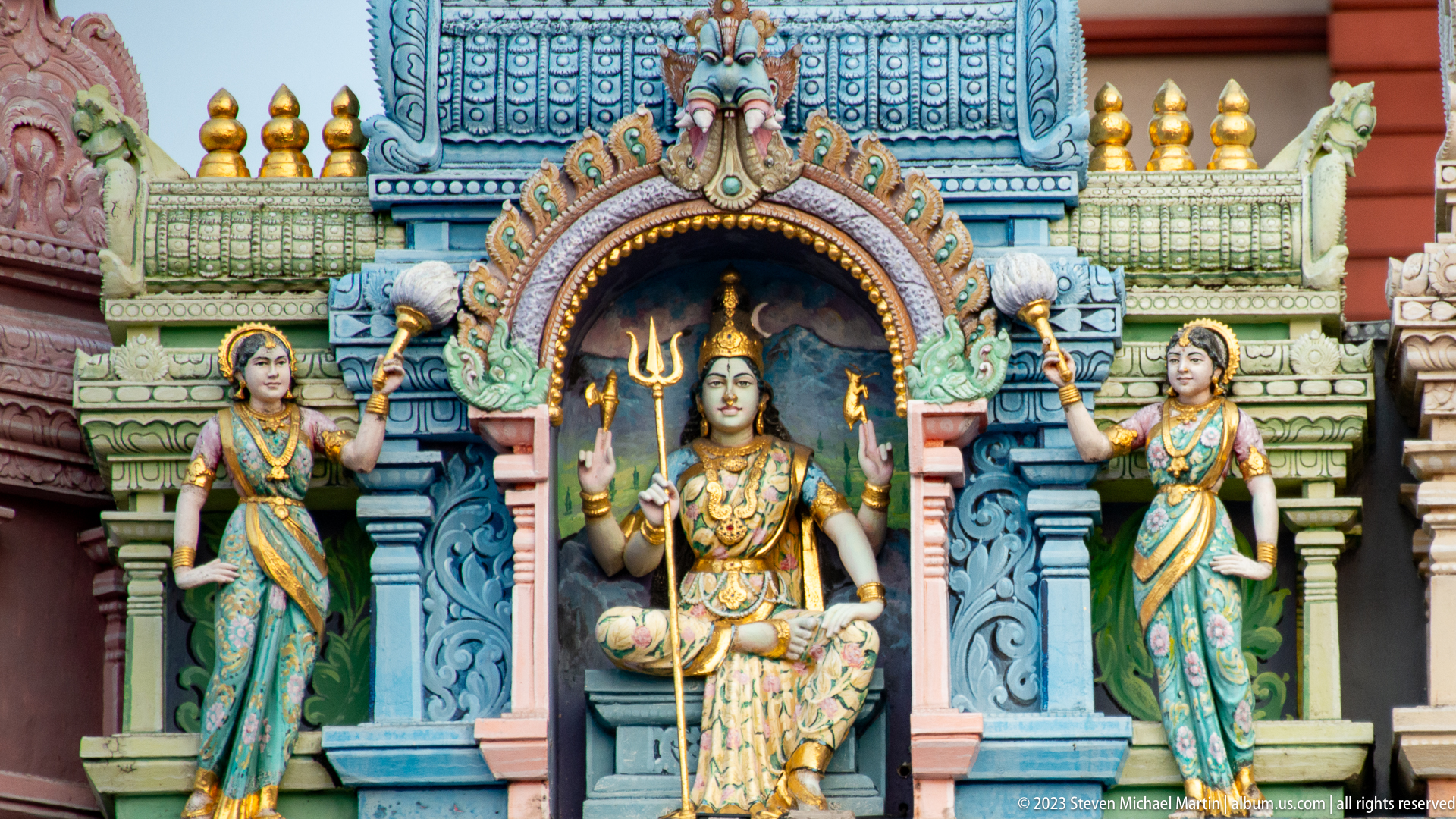
Murugan stands in the central niche holding his spear, or vel, and is flanked by his consorts Valli and Deivanai. The trio is framed by a richly colored arch with peacock imagery, linking the deity to his characteristic vehicle and attributes within the temple’s exterior sculpture program.
Caption
Murugan stands in the central niche holding his spear, or vel, and is flanked by his consorts Valli and Deivanai. The trio is framed by a richly colored arch with peacock imagery, linking the deity to his characteristic vehicle and attributes within the temple’s exterior sculpture program.

An ornamental pointed gateway frames the golden dome and minaret of Masjid Sultan beyond a quiet street. The view links the mosque’s monumental skyline with the surrounding low-rise urban fabric, while the patterned arch provides a decorative threshold that guides the eye toward the religious complex.
Caption
An ornamental pointed gateway frames the golden dome and minaret of Masjid Sultan beyond a quiet street. The view links the mosque’s monumental skyline with the surrounding low-rise urban fabric, while the patterned arch provides a decorative threshold that guides the eye toward the religious complex.

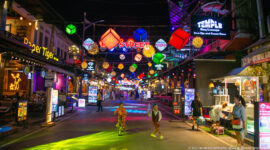
Rows of suspended peacocks, oil-lamp motifs, and floral ornaments form a dense ceremonial canopy above the street. Their repeated perspective draws the eye toward the distant traffic and shops, transforming the roadway into a continuous Festival of Lights installation.
Caption
Rows of suspended peacocks, oil-lamp motifs, and floral ornaments form a dense ceremonial canopy above the street. Their repeated perspective draws the eye toward the distant traffic and shops, transforming the roadway into a continuous Festival of Lights installation.

An elaborate Deepavali street arch spans the roadway with peacocks, scrollwork, floral forms, and a central group of Hindu deities. Tamil and English lettering identifies the Festival of Lights, while additional decorations recede into the distance along the commercial street.
Caption
An elaborate Deepavali street arch spans the roadway with peacocks, scrollwork, floral forms, and a central group of Hindu deities. Tamil and English lettering identifies the Festival of Lights, while additional decorations recede into the distance along the commercial street.

A flower vendor’s stall overflows with marigolds, jasmine, roses, and long multicolored garlands suspended from the awning. Loose blossoms and finished devotional strings are arranged side by side, showing the commercial preparation of flowers for worship, ceremony, and personal adornment.
Caption
A flower vendor’s stall overflows with marigolds, jasmine, roses, and long multicolored garlands suspended from the awning. Loose blossoms and finished devotional strings are arranged side by side, showing the commercial preparation of flowers for worship, ceremony, and personal adornment.

Outdoor flower stalls fill the sidewalk with bouquets, loose blossoms, and devotional arrangements beneath red-and-yellow New Moon umbrellas. Vendors and customers move through the narrow market aisle, creating a lively commercial scene shaped by color, fragrance, and ritual demand.
Caption
Outdoor flower stalls fill the sidewalk with bouquets, loose blossoms, and devotional arrangements beneath red-and-yellow New Moon umbrellas. Vendors and customers move through the narrow market aisle, creating a lively commercial scene shaped by color, fragrance, and ritual demand.

Two pink claw machines stand side by side, their transparent cabinets packed with brightly colored plush toys. The commercial amusement devices provide a playful contrast to the portfolio’s surrounding religious architecture and street heritage.
Caption
Two pink claw machines stand side by side, their transparent cabinets packed with brightly colored plush toys. The commercial amusement devices provide a playful contrast to the portfolio’s surrounding religious architecture and street heritage.

Masjid Sultan rises above the street with a large golden onion dome, tall minarets, and a rhythmic parapet of small finials. The low-angle composition emphasizes the mosque’s vertical elements and layered roofline, while palms and surrounding buildings place the landmark within its dense urban setting.
Caption
Masjid Sultan rises above the street with a large golden onion dome, tall minarets, and a rhythmic parapet of small finials. The low-angle composition emphasizes the mosque’s vertical elements and layered roofline, while palms and surrounding buildings place the landmark within its dense urban setting.

A pale stone angel stands against the church’s white exterior, holding a long trumpet across its body. The restrained monochrome palette allows the sculptural folds, wings, and musical attribute to stand out as a devotional architectural detail.
Caption
A pale stone angel stands against the church’s white exterior, holding a long trumpet across its body. The restrained monochrome palette allows the sculptural folds, wings, and musical attribute to stand out as a devotional architectural detail.

The front elevation of Masjid Sultan combines a broad golden dome with symmetrical corner turrets, pointed arches, wooden shutters, and restrained geometric ornament. Seen from below, the façade appears monumental, with the dome dominating the composition and the entrance canopy marking the building’s principal approach.
Caption
The front elevation of Masjid Sultan combines a broad golden dome with symmetrical corner turrets, pointed arches, wooden shutters, and restrained geometric ornament. Seen from below, the façade appears monumental, with the dome dominating the composition and the entrance canopy marking the building’s principal approach.

This close view isolates the central section of Masjid Sultan, highlighting the contrast between its smooth golden dome, white walls, dark geometric trim, and warm wooden shutters. The near-symmetrical framing draws attention to the balcony and arched entrance as key elements of the mosque’s street-facing elevation.
Caption
This close view isolates the central section of Masjid Sultan, highlighting the contrast between its smooth golden dome, white walls, dark geometric trim, and warm wooden shutters. The near-symmetrical framing draws attention to the balcony and arched entrance as key elements of the mosque’s street-facing elevation.

A minaret of Masjid Sultan is shown in close isolation, revealing its projecting balcony, geometric brackets, openwork panels, and gold finial. The upward-looking composition removes most surrounding context, turning the tower’s octagonal geometry and layered cornices into the primary visual subject.
Caption
A minaret of Masjid Sultan is shown in close isolation, revealing its projecting balcony, geometric brackets, openwork panels, and gold finial. The upward-looking composition removes most surrounding context, turning the tower’s octagonal geometry and layered cornices into the primary visual subject.

A stylized female profile spreads across a white wall, surrounded by lotus-like flowers, patterned borders, and sweeping green hair. Two real shuttered windows interrupt the painted face and hair, allowing the mural to interact directly with the architecture on which it is painted.
Caption
A stylized female profile spreads across a white wall, surrounded by lotus-like flowers, patterned borders, and sweeping green hair. Two real shuttered windows interrupt the painted face and hair, allowing the mural to interact directly with the architecture on which it is painted.

A large painted face emerges from overlapping bands of blue, orange, magenta, and black. The close crop concentrates attention on the subject’s eyes and expression, while the angular color fields and fragmented surrounding forms give the mural a dynamic, collage-like character.
Caption
A large painted face emerges from overlapping bands of blue, orange, magenta, and black. The close crop concentrates attention on the subject’s eyes and expression, while the angular color fields and fragmented surrounding forms give the mural a dynamic, collage-like character.

The white Gothic Revival façade of the Church of Our Lady of Lourdes is seen through palm fronds and temporary construction barriers. Pointed arches, small pinnacles, a central tower, and green floral tracery above the entrance distinguish the church’s vertically composed street front.
Caption
The white Gothic Revival façade of the Church of Our Lady of Lourdes is seen through palm fronds and temporary construction barriers. Pointed arches, small pinnacles, a central tower, and green floral tracery above the entrance distinguish the church’s vertically composed street front.

Rows of overlapping circular discs in yellow, blue, green, red, orange, and magenta create a dense patterned surface. The repeated forms shift in scale across the wall, producing an optical effect that alternates between orderly rows and lively visual movement.
Caption
Rows of overlapping circular discs in yellow, blue, green, red, orange, and magenta create a dense patterned surface. The repeated forms shift in scale across the wall, producing an optical effect that alternates between orderly rows and lively visual movement.

The ochre and cream corner building of Little India Arcade features a small clock pediment, green shutters, arched openings, and shaded upper verandas. Street-level shop signs and the projecting corner entrance show the historic commercial building still functioning within the neighborhood’s active retail landscape.
Caption
The ochre and cream corner building of Little India Arcade features a small clock pediment, green shutters, arched openings, and shaded upper verandas. Street-level shop signs and the projecting corner entrance show the historic commercial building still functioning within the neighborhood’s active retail landscape.

A freestanding red-and-white entrance frame announces the Indian Heritage Centre with painted floral borders, a peacock crest, and a central image of carved wooden doors. The installation combines contemporary visitor signage with motifs drawn from South Asian decorative traditions.
Caption
A freestanding red-and-white entrance frame announces the Indian Heritage Centre with painted floral borders, a peacock crest, and a central image of carved wooden doors. The installation combines contemporary visitor signage with motifs drawn from South Asian decorative traditions.

Blue and rose-red shutters punctuate a yellow shophouse façade framed by ochre pilasters and small green ventilation blocks. The tightly cropped view emphasizes color, repetition, and the layered timber details characteristic of Singapore’s historic commercial streets.
Caption
Blue and rose-red shutters punctuate a yellow shophouse façade framed by ochre pilasters and small green ventilation blocks. The tightly cropped view emphasizes color, repetition, and the layered timber details characteristic of Singapore’s historic commercial streets.

A monumental wooden door is divided into a grid of square panels, each carved with a distinct geometric or floral pattern. The warm wood contrasts with an elaborately worked metallic-looking surround, emphasizing craftsmanship, repetition, and the ceremonial quality of the entrance.
Caption
A monumental wooden door is divided into a grid of square panels, each carved with a distinct geometric or floral pattern. The warm wood contrasts with an elaborately worked metallic-looking surround, emphasizing craftsmanship, repetition, and the ceremonial quality of the entrance.

A close view of a Deepavali arch centers on Krishna playing the flute beside Radha, surrounded by attendants, scrollwork, and peacock-inspired ornament. Tamil and English text below identifies the Festival of Lights, linking Hindu devotional imagery with Singapore’s seasonal streetscape.
Caption
A close view of a Deepavali arch centers on Krishna playing the flute beside Radha, surrounded by attendants, scrollwork, and peacock-inspired ornament. Tamil and English text below identifies the Festival of Lights, linking Hindu devotional imagery with Singapore’s seasonal streetscape.

A richly worked temple door alternates gilded borders, dark carved relief panels, and projecting metal bosses. The strict grid organizes repeated sacred imagery into a formal surface, combining protective hardware with devotional ornament at a threshold within the temple complex.
Caption
A richly worked temple door alternates gilded borders, dark carved relief panels, and projecting metal bosses. The strict grid organizes repeated sacred imagery into a formal surface, combining protective hardware with devotional ornament at a threshold within the temple complex.

A richly ornamented carriage and two white horses form a festive street display in Little India. Gold-painted wheels, patterned harnesses, and a domed canopy create a ceremonial appearance, while the illuminated 'Happy Deepavali' greeting anchors the installation in the neighborhood’s Festival of Lights celebrations.
Caption
A richly ornamented carriage and two white horses form a festive street display in Little India. Gold-painted wheels, patterned harnesses, and a domed canopy create a ceremonial appearance, while the illuminated 'Happy Deepavali' greeting anchors the installation in the neighborhood’s Festival of Lights celebrations.

A highly polychrome shophouse façade combines ochre walls, blue pilasters, red window frames, green shutters, and patterned trim. The symmetrical upper story demonstrates how color can articulate bays, openings, and structural divisions across Singapore’s historic commercial architecture.
Caption
A highly polychrome shophouse façade combines ochre walls, blue pilasters, red window frames, green shutters, and patterned trim. The symmetrical upper story demonstrates how color can articulate bays, openings, and structural divisions across Singapore’s historic commercial architecture.

Layers of suspended lotus forms, peacocks, and curling floral motifs create a ceremonial canopy above the roadway. Their repetition draws the eye deep into the street, transforming the commercial corridor into a linear Festival of Lights installation.
Caption
Layers of suspended lotus forms, peacocks, and curling floral motifs create a ceremonial canopy above the roadway. Their repetition draws the eye deep into the street, transforming the commercial corridor into a linear Festival of Lights installation.

The entrance tower of Sri Veeramakaliamman Temple rises above Serangoon Road in a dense array of painted deities, guardians, and ornamental tiers. The temple’s sculptural gateway contrasts sharply with surrounding modern buildings, underscoring the continued presence of Hindu sacred architecture within the contemporary city.
Caption
The entrance tower of Sri Veeramakaliamman Temple rises above Serangoon Road in a dense array of painted deities, guardians, and ornamental tiers. The temple’s sculptural gateway contrasts sharply with surrounding modern buildings, underscoring the continued presence of Hindu sacred architecture within the contemporary city.

A close view of Sri Veeramakaliamman Temple’s gopuram reveals crowded horizontal tiers of brightly painted Hindu deities, attendants, animals, and miniature shrine forms. The compression of figures across the tower creates a richly narrative surface intended to mark and sanctify the temple entrance.
Caption
A close view of Sri Veeramakaliamman Temple’s gopuram reveals crowded horizontal tiers of brightly painted Hindu deities, attendants, animals, and miniature shrine forms. The compression of figures across the tower creates a richly narrative surface intended to mark and sanctify the temple entrance.

The interior of Sri Veeramakaliamman Temple is filled with gilded shrines, painted deities, hanging lamps, and a tall metal flagstaff aligned with the central worship space. Visitors stand before the sanctum, providing a sense of scale and showing the temple as an active devotional environment rather than a static display.
Caption
The interior of Sri Veeramakaliamman Temple is filled with gilded shrines, painted deities, hanging lamps, and a tall metal flagstaff aligned with the central worship space. Visitors stand before the sanctum, providing a sense of scale and showing the temple as an active devotional environment rather than a static display.

Shiva appears as Nataraja, the Lord of Dance, in a golden relief framed by a flaming aureole. One foot is raised in motion while the other subdues a dwarf-like figure below, expressing the deity’s cosmic dance through a compact and highly recognizable iconographic composition.
Caption
Shiva appears as Nataraja, the Lord of Dance, in a golden relief framed by a flaming aureole. One foot is raised in motion while the other subdues a dwarf-like figure below, expressing the deity’s cosmic dance through a compact and highly recognizable iconographic composition.

A crowded sculptural group crowns the temple architecture with a central seated male deity surrounded by attendants, subsidiary deities, animals, and elaborate canopy forms. Bright turquoise, pink, gold, and green surfaces create a dense visual hierarchy that turns the roofline into a narrative sacred tableau.
Caption
A crowded sculptural group crowns the temple architecture with a central seated male deity surrounded by attendants, subsidiary deities, animals, and elaborate canopy forms. Bright turquoise, pink, gold, and green surfaces create a dense visual hierarchy that turns the roofline into a narrative sacred tableau.

A brightly painted standing deity wears an ornate crown, layered gold jewelry, patterned blue garment, and a long flower garland while holding a pink lotus. The close view emphasizes devotional adornment and the vivid polychromy of the temple’s sculptural program.
Caption
A brightly painted standing deity wears an ornate crown, layered gold jewelry, patterned blue garment, and a long flower garland while holding a pink lotus. The close view emphasizes devotional adornment and the vivid polychromy of the temple’s sculptural program.

A multi-armed goddess, likely Kali, stands with one foot upon a reclining male figure identified in this iconographic context as Shiva. Weapons, a lotus, crown, and dynamic posture convey divine power, while the sculptural group presents a dramatic episode associated with the goddess’s fierce aspect.
Caption
A multi-armed goddess, likely Kali, stands with one foot upon a reclining male figure identified in this iconographic context as Shiva. Weapons, a lotus, crown, and dynamic posture convey divine power, while the sculptural group presents a dramatic episode associated with the goddess’s fierce aspect.

A powerful multi-armed guardian figure stands in a richly painted temple niche, holding a sword, mace-like object, and other ritual attributes. Flame-like forms rise behind the crown, while gold jewelry, patterned garments, and a forceful frontal stance communicate the deity’s protective and martial character.
Caption
A powerful multi-armed guardian figure stands in a richly painted temple niche, holding a sword, mace-like object, and other ritual attributes. Flame-like forms rise behind the crown, while gold jewelry, patterned garments, and a forceful frontal stance communicate the deity’s protective and martial character.

A crowned goddess sits at the center of a symmetrical temple composition, framed by two elephants and robust guardian figures beneath a brightly patterned domed canopy. The arrangement uses balance, repetition, and animal symbolism to create a formal sacred focal point above the entrance.
Caption
A crowned goddess sits at the center of a symmetrical temple composition, framed by two elephants and robust guardian figures beneath a brightly patterned domed canopy. The arrangement uses balance, repetition, and animal symbolism to create a formal sacred focal point above the entrance.

A seated male and female divine couple flank a child at the center of a richly ornamented temple sculpture. Smaller attendants and decorative figures occupy the surrounding roofline, while the close framing emphasizes familial grouping, gesture, and the layered architectural setting.
Caption
A seated male and female divine couple flank a child at the center of a richly ornamented temple sculpture. Smaller attendants and decorative figures occupy the surrounding roofline, while the close framing emphasizes familial grouping, gesture, and the layered architectural setting.

Ganesha sits prominently beneath an elaborate domed canopy, identifiable by his elephant head and rounded body. Large attendant figures flank the composition, while smaller divine figures cluster below, producing a dense sculptural scene that combines devotion, protection, and architectural ornament.
Caption
Ganesha sits prominently beneath an elaborate domed canopy, identifiable by his elephant head and rounded body. Large attendant figures flank the composition, while smaller divine figures cluster below, producing a dense sculptural scene that combines devotion, protection, and architectural ornament.

Three standing deities occupy separate gilded niches, each crowned, richly dressed, and covered with long flower garlands. Their differing attributes and garments distinguish the figures, while the repeated arches create a formal devotional sequence across the shrine wall.
Caption
Three standing deities occupy separate gilded niches, each crowned, richly dressed, and covered with long flower garlands. Their differing attributes and garments distinguish the figures, while the repeated arches create a formal devotional sequence across the shrine wall.

A dark stone Shiva lingam rests within a gilded arched niche, wrapped in red, yellow, blue, and white flower garlands. The vivid yellow chamber, metal offering vessels, and painted ornamental frame focus attention on the aniconic form as an active object of worship.
Caption
A dark stone Shiva lingam rests within a gilded arched niche, wrapped in red, yellow, blue, and white flower garlands. The vivid yellow chamber, metal offering vessels, and painted ornamental frame focus attention on the aniconic form as an active object of worship.

A green-skinned multi-armed goddess stands frontally with a flaming crown and richly patterned garments. She holds several ritual objects, including a lotus and vessel-like forms, while gold jewelry and a broad halo reinforce her commanding sacred presence.
Caption
A green-skinned multi-armed goddess stands frontally with a flaming crown and richly patterned garments. She holds several ritual objects, including a lotus and vessel-like forms, while gold jewelry and a broad halo reinforce her commanding sacred presence.

A brightly painted yali projects from the temple architecture with a turquoise body, gilded mane, curled snout, and open jaws. The hybrid creature combines leonine and elephantine features, serving as a protective and decorative guardian at the edge of the sacred structure.
Caption
A brightly painted yali projects from the temple architecture with a turquoise body, gilded mane, curled snout, and open jaws. The hybrid creature combines leonine and elephantine features, serving as a protective and decorative guardian at the edge of the sacred structure.

A multi-armed goddess stands within a silver-and-gold shrine surround, heavily garlanded and dressed in a dark checked textile. Small gilded attendant figures flank the central niche, while the many arms and weapons present the deity in a powerful protective aspect.
Caption
A multi-armed goddess stands within a silver-and-gold shrine surround, heavily garlanded and dressed in a dark checked textile. Small gilded attendant figures flank the central niche, while the many arms and weapons present the deity in a powerful protective aspect.

Kali appears with dark skin, a protruding red tongue, multiple arms, and a halo-like aureole, surrounded by dense flower garlands. Weapons and severed-head imagery reinforce her fierce aspect, while hanging lamps and the tightly framed niche present the figure as an active focus of worship.
Caption
Kali appears with dark skin, a protruding red tongue, multiple arms, and a halo-like aureole, surrounded by dense flower garlands. Weapons and severed-head imagery reinforce her fierce aspect, while hanging lamps and the tightly framed niche present the figure as an active focus of worship.

Saraswati sits cross-legged beneath an ornate gilded arch, playing the veena associated with music, learning, and the arts. A white bird figure below, likely her swan or goose mount, and the calm frontal arrangement reinforce the deity’s recognizable iconography.
Caption
Saraswati sits cross-legged beneath an ornate gilded arch, playing the veena associated with music, learning, and the arts. A white bird figure below, likely her swan or goose mount, and the calm frontal arrangement reinforce the deity’s recognizable iconography.

A crowned goddess sits within a gilded arched niche, almost entirely framed by thick bands of orange, yellow, green, and white flowers. The symmetrical devotional display and vivid textile arrangement make the garlands as visually prominent as the sculpted figure itself.
Caption
A crowned goddess sits within a gilded arched niche, almost entirely framed by thick bands of orange, yellow, green, and white flowers. The symmetrical devotional display and vivid textile arrangement make the garlands as visually prominent as the sculpted figure itself.

A colorful Little India Heritage Trail panel introduces Sri Veeramakaliamman Temple through historical text, archival photographs, and a location map. Positioned beside the temple fence, the sign connects the active religious site with Singapore’s broader heritage interpretation program.
Caption
A colorful Little India Heritage Trail panel introduces Sri Veeramakaliamman Temple through historical text, archival photographs, and a location map. Positioned beside the temple fence, the sign connects the active religious site with Singapore’s broader heritage interpretation program.

A robust male figure stands high on the temple roofline holding a long staff, his body modeled with exaggerated volume and framed by animal and architectural forms. The low viewpoint isolates the sculpture against the blue sky and emphasizes its commanding guardian role.
Caption
A robust male figure stands high on the temple roofline holding a long staff, his body modeled with exaggerated volume and framed by animal and architectural forms. The low viewpoint isolates the sculpture against the blue sky and emphasizes its commanding guardian role.

Sri Srinivasa Perumal Temple presents a broad blue-gray entrance façade surmounted by a densely sculpted, multilevel gopuram. Rows of painted deities and guardians cover the tower, while the symmetrical gateway and urban high-rise behind demonstrate the temple’s presence within modern Singapore.
Caption
Sri Srinivasa Perumal Temple presents a broad blue-gray entrance façade surmounted by a densely sculpted, multilevel gopuram. Rows of painted deities and guardians cover the tower, while the symmetrical gateway and urban high-rise behind demonstrate the temple’s presence within modern Singapore.

The temple entrance is framed by temporary banana-tree decorations and red-and-white festive garlands. Beyond the blue-gray gateway, the interior axis opens toward a brightly ornamented mandapa, visually linking the street threshold with the sacred space inside.
Caption
The temple entrance is framed by temporary banana-tree decorations and red-and-white festive garlands. Beyond the blue-gray gateway, the interior axis opens toward a brightly ornamented mandapa, visually linking the street threshold with the sacred space inside.

A seated goddess occupies the center of a sculpted temple tier, flanked by bearded sages and smaller attendants. Repeated bird motifs along the lower border and richly painted foliage above organize the group into a balanced narrative panel.
Caption
A seated goddess occupies the center of a sculpted temple tier, flanked by bearded sages and smaller attendants. Repeated bird motifs along the lower border and richly painted foliage above organize the group into a balanced narrative panel.

A densely populated temple panel gathers seated deities, sages, and attendants beneath a green leafy canopy. The composition layers figures across several levels, creating a narrative scene in which gesture, hierarchy, and proximity communicate relationships among the sacred participants.
Caption
A densely populated temple panel gathers seated deities, sages, and attendants beneath a green leafy canopy. The composition layers figures across several levels, creating a narrative scene in which gesture, hierarchy, and proximity communicate relationships among the sacred participants.

A crowned goddess sits frontally in a red garment, flanked by smaller female figures and additional deities on the surrounding architectural tiers. The close crop highlights the symmetry of the group and the richly modeled jewelry, textiles, and painted ornament.
Caption
A crowned goddess sits frontally in a red garment, flanked by smaller female figures and additional deities on the surrounding architectural tiers. The close crop highlights the symmetry of the group and the richly modeled jewelry, textiles, and painted ornament.

A crowned goddess sits above a richly patterned architectural base, flanked by female attendants and roaring lions. The animals intensify the protective character of the composition, while the layered placement of subsidiary figures creates a strong vertical hierarchy.
Caption
A crowned goddess sits above a richly patterned architectural base, flanked by female attendants and roaring lions. The animals intensify the protective character of the composition, while the layered placement of subsidiary figures creates a strong vertical hierarchy.

A seated goddess occupies the center of a radiant sculptural arrangement, encircled by numerous small child-like figures. Flame-shaped ornamental forms rise behind the group, creating a halo effect and concentrating attention on the central deity.
Caption
A seated goddess occupies the center of a radiant sculptural arrangement, encircled by numerous small child-like figures. Flame-shaped ornamental forms rise behind the group, creating a halo effect and concentrating attention on the central deity.
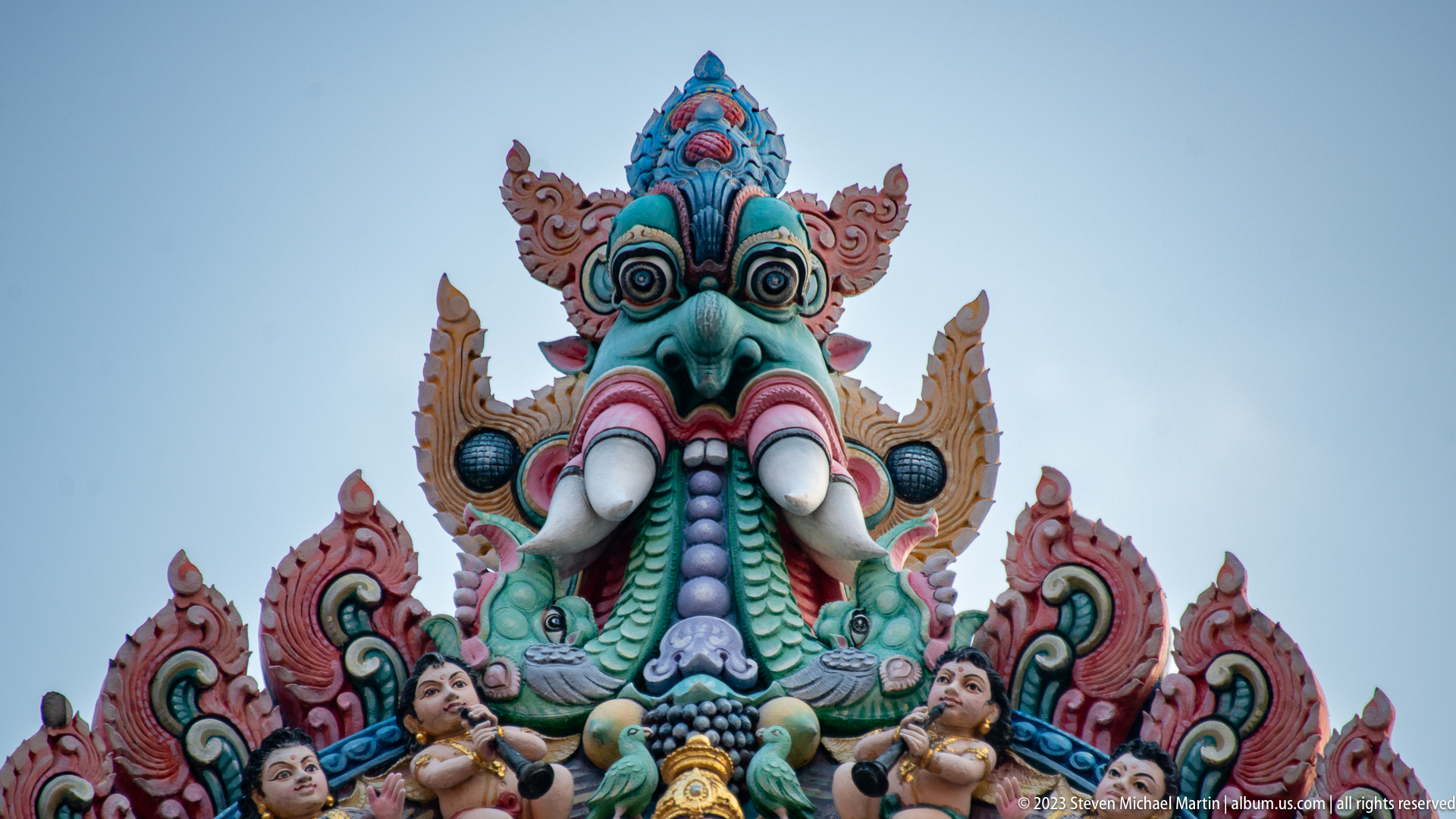
A large kirtimukha mask rises above the temple roofline with bulging eyes, curling ornament, tusk-like teeth, and a layered crown. The frontal monster face functions as a dramatic protective motif, visually anchoring the uppermost point of the façade against the open sky.
Caption
A large kirtimukha mask rises above the temple roofline with bulging eyes, curling ornament, tusk-like teeth, and a layered crown. The frontal monster face functions as a dramatic protective motif, visually anchoring the uppermost point of the façade against the open sky.
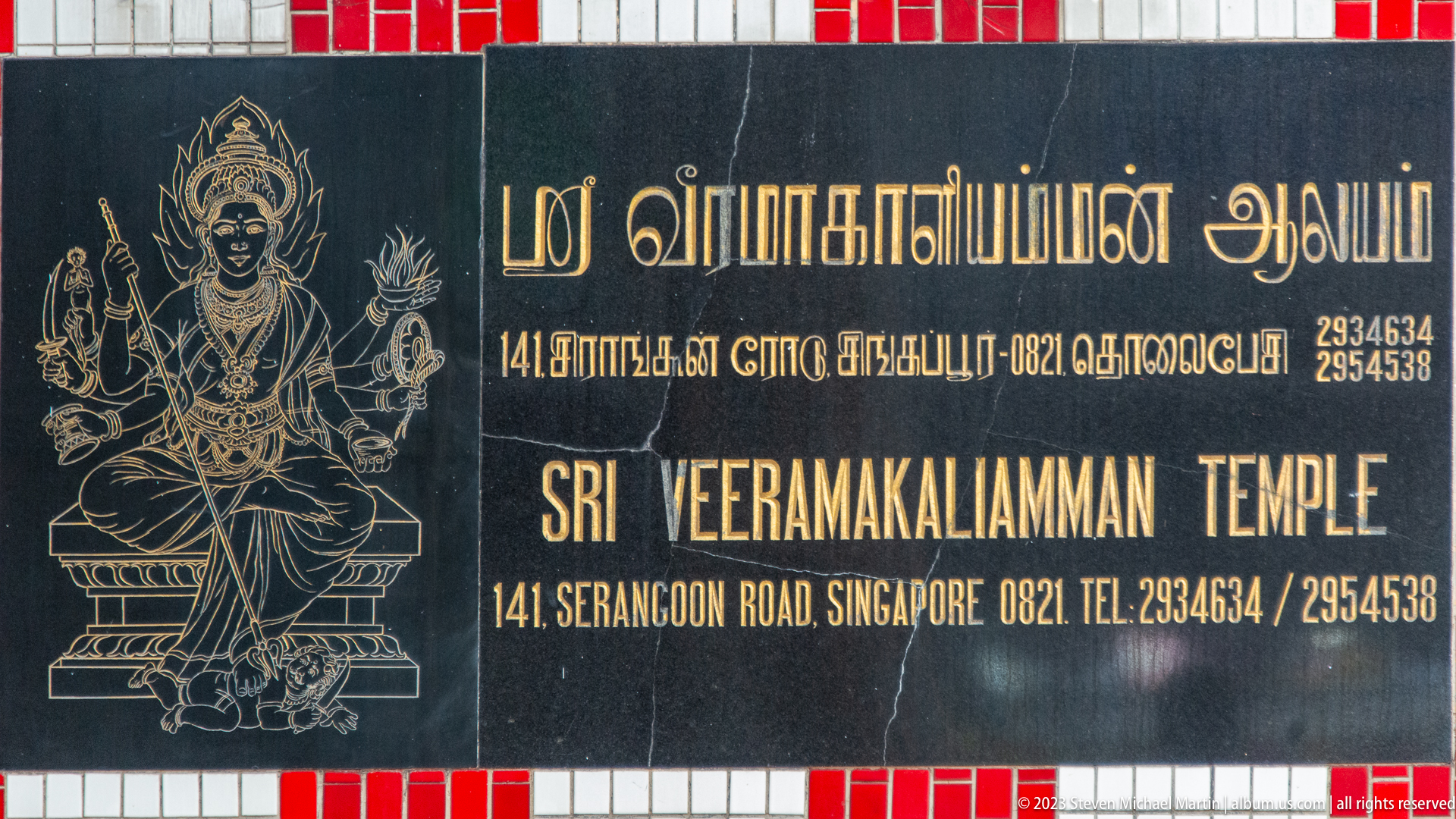
A polished black plaque identifies Sri Veeramakaliamman Temple in Tamil and English and gives its Serangoon Road address and telephone numbers. A line drawing of a seated deity appears at left, combining institutional information with sacred imagery.
Caption
A polished black plaque identifies Sri Veeramakaliamman Temple in Tamil and English and gives its Serangoon Road address and telephone numbers. A line drawing of a seated deity appears at left, combining institutional information with sacred imagery.

Four standing figures flank an upper opening on the temple façade, each richly dressed and crowned beneath bands of brightly painted architectural ornament. Their frontal poses and orderly placement transform the doorway into a devotional register within the larger sculptural program.
Caption
Four standing figures flank an upper opening on the temple façade, each richly dressed and crowned beneath bands of brightly painted architectural ornament. Their frontal poses and orderly placement transform the doorway into a devotional register within the larger sculptural program.

Open timber doors frame a long view into Sri Srinivasa Perumal Temple, where hanging decorations, painted ceilings, and a brilliantly ornamented inner arch lead toward the worship hall. The narrow perspective emphasizes procession and transition from the exterior threshold into the sacred interior.
Caption
Open timber doors frame a long view into Sri Srinivasa Perumal Temple, where hanging decorations, painted ceilings, and a brilliantly ornamented inner arch lead toward the worship hall. The narrow perspective emphasizes procession and transition from the exterior threshold into the sacred interior.

A brightly painted female figure raises both hands beside her head, wearing a tall gilded crown, jeweled ornaments, and a striped garment. The close framing emphasizes the smooth modeling of the face, bold eye makeup, and vivid polychromy characteristic of the temple’s sculptural decoration.
Caption
A brightly painted female figure raises both hands beside her head, wearing a tall gilded crown, jeweled ornaments, and a striped garment. The close framing emphasizes the smooth modeling of the face, bold eye makeup, and vivid polychromy characteristic of the temple’s sculptural decoration.

The broad interior hall is organized by rows of pale columns beneath an intensely painted red, green, and blue ceiling. A central ritual pillar and freestanding devotional structures mark the main axis, while colorful banners frame the entrance to the deeper sanctuary area.
Caption
The broad interior hall is organized by rows of pale columns beneath an intensely painted red, green, and blue ceiling. A central ritual pillar and freestanding devotional structures mark the main axis, while colorful banners frame the entrance to the deeper sanctuary area.

Two bare-chested Hindu priests attend a richly garlanded shrine during an active ritual. One reaches toward the deity images while the other stands beside the altar, placing human action, offerings, and sacred objects at the center of the temple’s devotional life.
Caption
Two bare-chested Hindu priests attend a richly garlanded shrine during an active ritual. One reaches toward the deity images while the other stands beside the altar, placing human action, offerings, and sacred objects at the center of the temple’s devotional life.

A black stone deity stands against a pale wall, dressed in layered green, magenta, and orange silk with a red forehead mark. The clothing wraps the sculpted body while leaving the head, arms, and sacred attributes visible, demonstrating the devotional practice of dressing temple icons.
Caption
A black stone deity stands against a pale wall, dressed in layered green, magenta, and orange silk with a red forehead mark. The clothing wraps the sculpted body while leaving the head, arms, and sacred attributes visible, demonstrating the devotional practice of dressing temple icons.

A temple priest sits beside a richly decorated shrine where deity images are covered with white, yellow, red, and green flower garlands. The red-and-white striped altar base, brass lamp, and vivid textiles establish an active devotional setting centered on ritual service and sacred display.
Caption
A temple priest sits beside a richly decorated shrine where deity images are covered with white, yellow, red, and green flower garlands. The red-and-white striped altar base, brass lamp, and vivid textiles establish an active devotional setting centered on ritual service and sacred display.

A serene crowned goddess appears in a painted panel framed by red drapery and gold ornament. The shallow focus leaves the active shrine and priest visible beyond, linking the decorative image in the foreground with the living devotional space behind it.
Caption
A serene crowned goddess appears in a painted panel framed by red drapery and gold ornament. The shallow focus leaves the active shrine and priest visible beyond, linking the decorative image in the foreground with the living devotional space behind it.

A freestanding cream-colored sign identifies Sri Srinivasa Perumal Temple in Tamil and English. Set on a small lawn beside the red-and-white striped compound wall, the sign marks the temple precinct while sculpted figures remain visible along the roofline behind it.
Caption
A freestanding cream-colored sign identifies Sri Srinivasa Perumal Temple in Tamil and English. Set on a small lawn beside the red-and-white striped compound wall, the sign marks the temple precinct while sculpted figures remain visible along the roofline behind it.
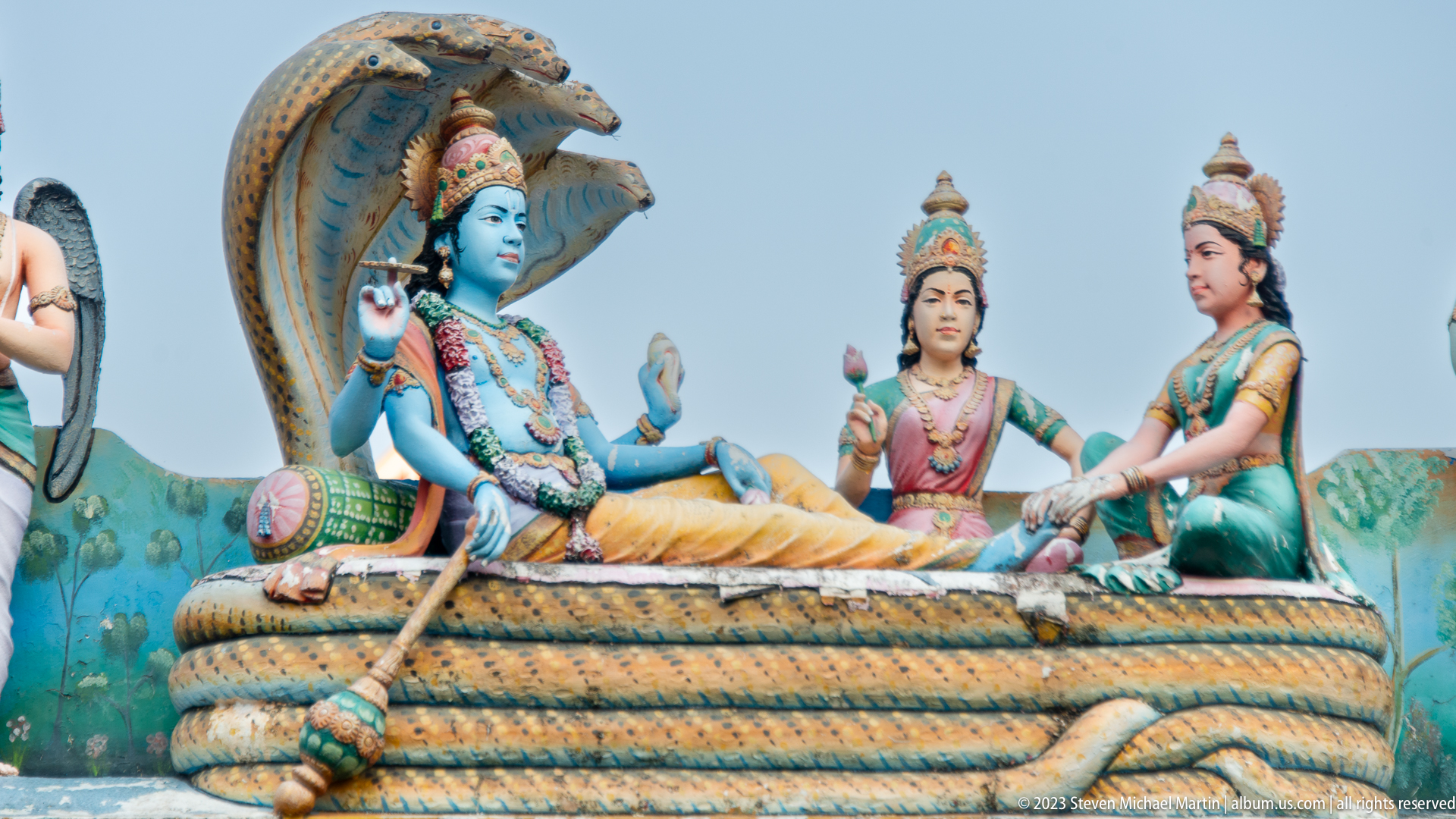
Vishnu reclines upon the coiled serpent Shesha beneath the shelter of multiple cobra hoods, while Lakshmi and another attendant sit nearby. The sculptural group presents a well-known Vaishnavite image of cosmic repose, rendered in brightly painted temple ornament.
Caption
Vishnu reclines upon the coiled serpent Shesha beneath the shelter of multiple cobra hoods, while Lakshmi and another attendant sit nearby. The sculptural group presents a well-known Vaishnavite image of cosmic repose, rendered in brightly painted temple ornament.

Three crowned blue- and green-skinned deities stand in a row holding lotus-like emblems, discus forms, and other Vaishnavite attributes. Their coordinated poses and dress create a formal divine assembly along the temple roofline.
Caption
Three crowned blue- and green-skinned deities stand in a row holding lotus-like emblems, discus forms, and other Vaishnavite attributes. Their coordinated poses and dress create a formal divine assembly along the temple roofline.

Trays and mounded bundles of jasmine, roses, marigolds, and other blossoms fill a Little India flower stall. The variety of colors and flower types reveals the raw materials used to create garlands and ritual offerings sold throughout the district.
Caption
Trays and mounded bundles of jasmine, roses, marigolds, and other blossoms fill a Little India flower stall. The variety of colors and flower types reveals the raw materials used to create garlands and ritual offerings sold throughout the district.

Thick flower garlands are stacked and suspended in dense bands of red, yellow, white, pink, purple, and green. The close crop turns the market display into a study of texture and repetition while preserving the handmade character of the devotional offerings.
Caption
Thick flower garlands are stacked and suspended in dense bands of red, yellow, white, pink, purple, and green. The close crop turns the market display into a study of texture and repetition while preserving the handmade character of the devotional offerings.

Hanuman stands frontally with hands joined in anjali mudra, his simian face, long tail, and muscular body clearly visible. Gold jewelry and a crown identify the figure as a divine devotee, while the prayer gesture emphasizes humility and service.
Caption
Hanuman stands frontally with hands joined in anjali mudra, his simian face, long tail, and muscular body clearly visible. Gold jewelry and a crown identify the figure as a divine devotee, while the prayer gesture emphasizes humility and service.

A polished golden crescent-and-star finial rises above a white domed structure against the open sky. The tight upward composition isolates the Islamic emblem and emphasizes its sweeping geometry, metallic surface, and position as a crowning architectural element.
Caption
A polished golden crescent-and-star finial rises above a white domed structure against the open sky. The tight upward composition isolates the Islamic emblem and emphasizes its sweeping geometry, metallic surface, and position as a crowning architectural element.

An interpretive panel titled “Hindu Temples” presents photographs and historical text about Sri Srinivasa Perumal Temple and Sri Veeramakaliamman Temple. The sign places both landmarks within the Little India Heritage Trail and summarizes their architectural and religious significance.
Caption
An interpretive panel titled “Hindu Temples” presents photographs and historical text about Sri Srinivasa Perumal Temple and Sri Veeramakaliamman Temple. The sign places both landmarks within the Little India Heritage Trail and summarizes their architectural and religious significance.

A row of mannequins displays embroidered sherwanis, long jackets, and formal dresses in blue, cream, green, pink, red, and navy. Metallic threadwork, patterned textiles, and coordinated silhouettes present the garments as ceremonial or festive clothing within Little India’s retail landscape.
Caption
A row of mannequins displays embroidered sherwanis, long jackets, and formal dresses in blue, cream, green, pink, red, and navy. Metallic threadwork, patterned textiles, and coordinated silhouettes present the garments as ceremonial or festive clothing within Little India’s retail landscape.

Sri Krishnan Temple presents a richly sculpted blue façade composed of repeated deity niches, clustered columns, and a central entrance canopy. Visitors gather at the doorway while the surrounding modern buildings emphasize the temple’s compact urban setting.
Caption
Sri Krishnan Temple presents a richly sculpted blue façade composed of repeated deity niches, clustered columns, and a central entrance canopy. Visitors gather at the doorway while the surrounding modern buildings emphasize the temple’s compact urban setting.

A richly painted relief gathers a crowned central couple beneath a ceremonial canopy, surrounded by attendants, witnesses, and musicians. The formal arrangement, joined hands, and wedding-like setting suggest a sacred marriage scene within Sri Krishnan Temple’s narrative façade.
Caption
A richly painted relief gathers a crowned central couple beneath a ceremonial canopy, surrounded by attendants, witnesses, and musicians. The formal arrangement, joined hands, and wedding-like setting suggest a sacred marriage scene within Sri Krishnan Temple’s narrative façade.

The dark, richly ornamented sanctuary of Sri Krishnan Temple centers on garlanded deity images framed by carved pillars and hanging flower decorations. Worshippers and attendants stand before the shrine, conveying the spatial depth and active devotional use of the interior.
Caption
The dark, richly ornamented sanctuary of Sri Krishnan Temple centers on garlanded deity images framed by carved pillars and hanging flower decorations. Worshippers and attendants stand before the shrine, conveying the spatial depth and active devotional use of the interior.

Seen from an angle, Sri Krishnan Temple’s blue sculpted façade and colorful deity niches extend along the street beneath taller modern buildings. The composition emphasizes the temple’s low, intricate sacred architecture within Singapore’s dense contemporary cityscape.
Caption
Seen from an angle, Sri Krishnan Temple’s blue sculpted façade and colorful deity niches extend along the street beneath taller modern buildings. The composition emphasizes the temple’s low, intricate sacred architecture within Singapore’s dense contemporary cityscape.