Santander
Santander developed as an important coastal city along the Bay of Biscay, shaped by maritime trade and regional connections between northern Spain and broader Atlantic routes. Its harbor contributed to commercial exchange that linked Iberia with other European markets. The city reflects the importance of coastal geography in supporting economic development.
Architectural landmarks illustrate the growth of Santander as both a commercial port and a cultural center. Urban spaces developed in response to maritime activity and evolving economic conditions. The city’s location along the northern coast highlights the importance of seafaring traditions in Spanish history.
Santander demonstrates the role of Atlantic trade routes in shaping the development of northern Spain. Its coastal setting reflects the broader historical transition toward global exploration and maritime commerce.

Dense ranks of sailboat masts rise from a sheltered marina, with moored yachts and small craft filling the basin below. Low hills and hazy mountains form the background under subdued evening light. The scene foregrounds recreational boating within Santander’s broader maritime landscape, contrasting the ordered marina infrastructure with the layered natural relief beyond.
Caption
Dense ranks of sailboat masts rise from a sheltered marina, with moored yachts and small craft filling the basin below. Low hills and hazy mountains form the background under subdued evening light. The scene foregrounds recreational boating within Santander’s broader maritime landscape, contrasting the ordered marina infrastructure with the layered natural relief beyond.

The Palacio de la Magdalena rises behind an elaborate wrought-iron gate and stone entrance piers, its warm masonry façades framed by tall palms and formal lawns. Towers, chimneys, balconies, and varied rooflines create a picturesque silhouette. The gated approach places the former royal residence within its landscaped peninsula estate and emphasizes the ceremonial character of arrival.
Caption
The Palacio de la Magdalena rises behind an elaborate wrought-iron gate and stone entrance piers, its warm masonry façades framed by tall palms and formal lawns. Towers, chimneys, balconies, and varied rooflines create a picturesque silhouette. The gated approach places the former royal residence within its landscaped peninsula estate and emphasizes the ceremonial character of arrival.
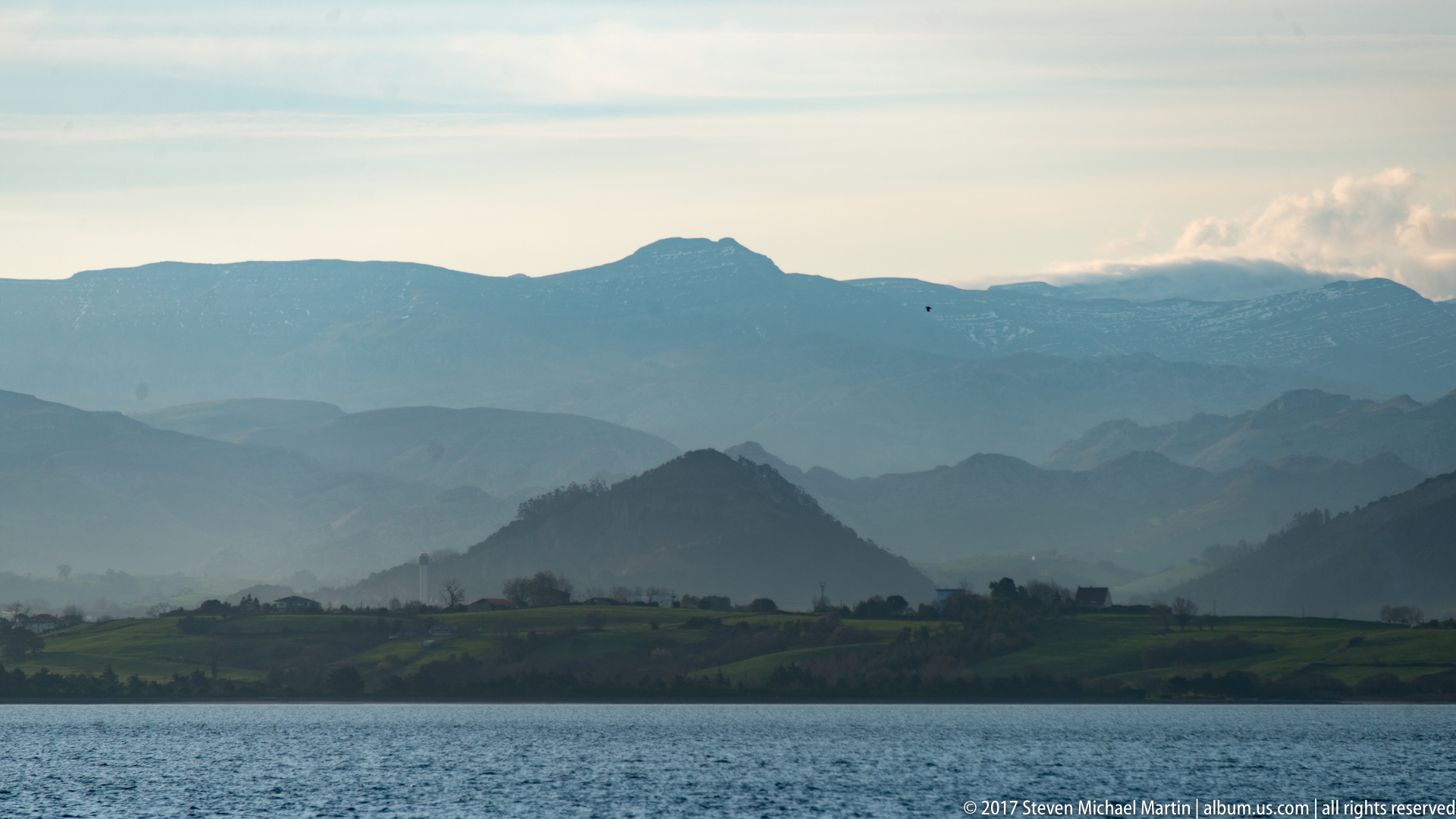
Successive blue-gray mountain ridges recede behind a narrow green shoreline and calm water, creating a layered view inland from the Santander area. A higher, partly snow-dusted range closes the horizon. The photograph connects the bay’s maritime foreground with the rugged relief of Cantabria and the greater mountain system beyond.
Caption
Successive blue-gray mountain ridges recede behind a narrow green shoreline and calm water, creating a layered view inland from the Santander area. A higher, partly snow-dusted range closes the horizon. The photograph connects the bay’s maritime foreground with the rugged relief of Cantabria and the greater mountain system beyond.

A broad sunset view follows the rugged Cantabrian shoreline as headlands step into the distance beneath an orange horizon. Calm water fills most of the frame, while scattered lights mark settlement along the coast. The elevated viewpoint emphasizes Santander’s maritime setting and the close relationship between the city, its sheltered waters, and the mountainous coast of northern Spain.
Caption
A broad sunset view follows the rugged Cantabrian shoreline as headlands step into the distance beneath an orange horizon. Calm water fills most of the frame, while scattered lights mark settlement along the coast. The elevated viewpoint emphasizes Santander’s maritime setting and the close relationship between the city, its sheltered waters, and the mountainous coast of northern Spain.

A white classical balustrade runs across the foreground, separating a landscaped promenade from the blue water beyond. Across the bay, a rocky, partly vegetated island catches warm low-angle light. The built waterfront edge and offshore landform together show how Santander’s urban promenades are oriented toward the maritime scenery of the bay.
Caption
A white classical balustrade runs across the foreground, separating a landscaped promenade from the blue water beyond. Across the bay, a rocky, partly vegetated island catches warm low-angle light. The built waterfront edge and offshore landform together show how Santander’s urban promenades are oriented toward the maritime scenery of the bay.

A solitary eroded rock rises just offshore from a broad sandy beach, surrounded by shallow blue water and smaller exposed rocks. Across the bay, a wooded headland and low fortification-like silhouette extend along the horizon. The composition emphasizes erosion, tidal space, and the sheltered coastal setting that shapes Santander’s beaches.
Caption
A solitary eroded rock rises just offshore from a broad sandy beach, surrounded by shallow blue water and smaller exposed rocks. Across the bay, a wooded headland and low fortification-like silhouette extend along the horizon. The composition emphasizes erosion, tidal space, and the sheltered coastal setting that shapes Santander’s beaches.

A vertical view isolates the cylindrical stone shaft of Cabo Mayor Lighthouse above its low base buildings, with small square windows punctuating the masonry. The white gallery and lantern form a crisp cap against the blue sky. By minimizing the surrounding landscape, the composition emphasizes the tower’s proportions, durable stone construction, and unmistakable role as coastal navigational infrastructure.
Caption
A vertical view isolates the cylindrical stone shaft of Cabo Mayor Lighthouse above its low base buildings, with small square windows punctuating the masonry. The white gallery and lantern form a crisp cap against the blue sky. By minimizing the surrounding landscape, the composition emphasizes the tower’s proportions, durable stone construction, and unmistakable role as coastal navigational infrastructure.

A low rocky island rises beyond the broad foreground of beach and water, its sunlit cliff face contrasting with the darker vegetated summit. Distant urban development stretches along the left horizon. The restrained composition uses the open shore to isolate the offshore landform and convey the spacious maritime character of Santander’s bay and outer coast.
Caption
A low rocky island rises beyond the broad foreground of beach and water, its sunlit cliff face contrasting with the darker vegetated summit. Distant urban development stretches along the left horizon. The restrained composition uses the open shore to isolate the offshore landform and convey the spacious maritime character of Santander’s bay and outer coast.

Two steep rocky slopes frame a narrow opening toward the sea, with a small settlement tucked into the low ground between them. Soft evening light separates the pale limestone face at left from the darker ridge at right. The composition records the strongly indented, mountainous coastal geography characteristic of the Santander region.
Caption
Two steep rocky slopes frame a narrow opening toward the sea, with a small settlement tucked into the low ground between them. Soft evening light separates the pale limestone face at left from the darker ridge at right. The composition records the strongly indented, mountainous coastal geography characteristic of the Santander region.

A line of heavily pollarded plane trees forms a sculptural rhythm along a Santander promenade, interspersed with elaborate black multi-lantern streetlights. Apartment façades and parked cars define the urban edge behind them. The winter-bare branches and formal street furniture emphasize the designed character of the city’s public waterfront and boulevard spaces.
Caption
A line of heavily pollarded plane trees forms a sculptural rhythm along a Santander promenade, interspersed with elaborate black multi-lantern streetlights. Apartment façades and parked cars define the urban edge behind them. The winter-bare branches and formal street furniture emphasize the designed character of the city’s public waterfront and boulevard spaces.

The Palacete del Embarcadero stands directly on Santander’s harbor edge, its pale walls, compact pavilion form, and decorative roofline reflected against blue water. A stone quay wraps around the building, while palms and dense city fabric rise behind it. The view presents the small waterfront landmark in its working port setting rather than as an isolated architectural object.
Caption
The Palacete del Embarcadero stands directly on Santander’s harbor edge, its pale walls, compact pavilion form, and decorative roofline reflected against blue water. A stone quay wraps around the building, while palms and dense city fabric rise behind it. The view presents the small waterfront landmark in its working port setting rather than as an isolated architectural object.

Centro Botín projects above Santander’s waterfront on slender supports, its rounded volumes clad in a pale reflective skin and opened by broad glazed ends. Exterior stairs and elevated circulation connect the paired masses above the quay. The building’s placement at the water’s edge makes the cultural center a prominent element in the modern redevelopment of Santander’s historic port frontage.
Caption
Centro Botín projects above Santander’s waterfront on slender supports, its rounded volumes clad in a pale reflective skin and opened by broad glazed ends. Exterior stairs and elevated circulation connect the paired masses above the quay. The building’s placement at the water’s edge makes the cultural center a prominent element in the modern redevelopment of Santander’s historic port frontage.

The Gran Casino del Sardinero presents a symmetrical white façade facing its formal forecourt, with a central pediment, clock, arched openings, and the word “CASINO” prominently displayed. Flags fly above the roofline while pollarded trees frame the approach. The frontal view records the building as a landmark of Santander’s El Sardinero resort district.
Caption
The Gran Casino del Sardinero presents a symmetrical white façade facing its formal forecourt, with a central pediment, clock, arched openings, and the word “CASINO” prominently displayed. Flags fly above the roofline while pollarded trees frame the approach. The frontal view records the building as a landmark of Santander’s El Sardinero resort district.

The Palacio de la Magdalena crowns a landscaped rise above Santander, combining a substantial stone mass with crenellated parapets, projecting bays, and deep timbered eaves. Trees and a masonry terrace partly screen the lower levels. Seen from below, the former royal residence reads as a commanding landmark within the wooded grounds of the Magdalena Peninsula.
Caption
The Palacio de la Magdalena crowns a landscaped rise above Santander, combining a substantial stone mass with crenellated parapets, projecting bays, and deep timbered eaves. Trees and a masonry terrace partly screen the lower levels. Seen from below, the former royal residence reads as a commanding landmark within the wooded grounds of the Magdalena Peninsula.

A circular white building rises behind palms, capped by a broad faceted metal dome and a band of rectangular windows. Stone detailing punctuates the smooth façade, while the low viewpoint makes the roof the dominant feature. The photograph isolates an unusual piece of Santander architecture without enough visible signage to establish the building’s exact identity.
Caption
A circular white building rises behind palms, capped by a broad faceted metal dome and a band of rectangular windows. Stone detailing punctuates the smooth façade, while the low viewpoint makes the roof the dominant feature. The photograph isolates an unusual piece of Santander architecture without enough visible signage to establish the building’s exact identity.

A sharply tilted viewpoint turns the ornate white corner of the Gran Casino del Sardinero into a study of projecting bays, molded cornices, balustrades, and stacked windows against a clear blue sky. Flags and adjoining roof forms remain visible at the far end. The dynamic angle distinguishes this architectural detail from the more documentary frontal view.
Caption
A sharply tilted viewpoint turns the ornate white corner of the Gran Casino del Sardinero into a study of projecting bays, molded cornices, balustrades, and stacked windows against a clear blue sky. Flags and adjoining roof forms remain visible at the far end. The dynamic angle distinguishes this architectural detail from the more documentary frontal view.

Ornate white façades of the Gran Casino del Sardinero sweep diagonally across the frame, with rounded corner bays, deep cornices, balustrades, and tall windows picked out by strong sunlight. The intentionally canted composition emphasizes the building’s vertical modeling and exuberant resort architecture rather than presenting a conventional elevation.
Caption
Ornate white façades of the Gran Casino del Sardinero sweep diagonally across the frame, with rounded corner bays, deep cornices, balustrades, and tall windows picked out by strong sunlight. The intentionally canted composition emphasizes the building’s vertical modeling and exuberant resort architecture rather than presenting a conventional elevation.

A closer view of the Palacio de la Magdalena concentrates on its warm stone façades, projecting bays, balustraded terraces, tall windows, and clustered roofline ornaments. A palm fills the right edge while the entrance fence remains low in the foreground. The tighter framing reveals the varied massing and richly modeled exterior of Santander’s former royal residence.
Caption
A closer view of the Palacio de la Magdalena concentrates on its warm stone façades, projecting bays, balustraded terraces, tall windows, and clustered roofline ornaments. A palm fills the right edge while the entrance fence remains low in the foreground. The tighter framing reveals the varied massing and richly modeled exterior of Santander’s former royal residence.

A narrow paved road climbs through a stand of pines toward the pale tower of Cabo Mayor Lighthouse, visible at the end of the approach. White railings trace both sides of the roadway and guide the eye toward the beacon. The wooded foreground creates an arrival view that contrasts with the exposed maritime function of the lighthouse beyond.
Caption
A narrow paved road climbs through a stand of pines toward the pale tower of Cabo Mayor Lighthouse, visible at the end of the approach. White railings trace both sides of the roadway and guide the eye toward the beacon. The wooded foreground creates an arrival view that contrasts with the exposed maritime function of the lighthouse beyond.

Cabo Mayor Lighthouse stands at the end of a curving access road, its cylindrical stone tower rising from a low service complex. The white lantern gallery and glazed lantern room crown the masonry shaft, while railings and clipped roadside planting organize the approach. The view presents the beacon in its landward setting on Santander’s exposed northern coast.
Caption
Cabo Mayor Lighthouse stands at the end of a curving access road, its cylindrical stone tower rising from a low service complex. The white lantern gallery and glazed lantern room crown the masonry shaft, while railings and clipped roadside planting organize the approach. The view presents the beacon in its landward setting on Santander’s exposed northern coast.

The upper stage of Cabo Mayor Lighthouse fills the frame, revealing the transition from the cylindrical stone tower to a broad white gallery and glazed lantern room. Railings, antennae, and modern lighting fixtures cluster around the crown. This close architectural study shifts attention from the lighthouse’s coastal setting to the equipment and platform that define its navigational function.
Caption
The upper stage of Cabo Mayor Lighthouse fills the frame, revealing the transition from the cylindrical stone tower to a broad white gallery and glazed lantern room. Railings, antennae, and modern lighting fixtures cluster around the crown. This close architectural study shifts attention from the lighthouse’s coastal setting to the equipment and platform that define its navigational function.