Guggenheim Bilbao
The Guggenheim Museum Bilbao represents a major example of contemporary architecture designed by Frank Gehry in the late twentieth century. The building’s sculptural form incorporates curved titanium surfaces that reflect light and create changing visual perspectives. Its innovative design demonstrates the evolution of architectural expression in modern Europe.
Constructed along the Nervión River, the museum contributed to the revitalization of Bilbao’s former industrial district. The structure illustrates how cultural institutions can influence urban redevelopment and economic transformation. Its design contrasts with traditional architectural forms found throughout historic Spain.
The Guggenheim Bilbao reflects the continuing importance of artistic innovation in shaping cultural identity. The building illustrates the relationship between contemporary design and the evolving urban landscape.

The red portal of La Salve Bridge frames an elevated approach toward the Guggenheim Museum Bilbao, whose titanium forms occupy the riverbank below. A pedestrian on the bridge and the roadway infrastructure establish the viewpoint, while the Iberdrola Tower and green hills rise beyond. The photograph shows how the museum is visually interwoven with Bilbao’s bridges, river corridor, and dense urban fabric.
Caption
The red portal of La Salve Bridge frames an elevated approach toward the Guggenheim Museum Bilbao, whose titanium forms occupy the riverbank below. A pedestrian on the bridge and the roadway infrastructure establish the viewpoint, while the Iberdrola Tower and green hills rise beyond. The photograph shows how the museum is visually interwoven with Bilbao’s bridges, river corridor, and dense urban fabric.

A closer view of Jeff Koons’s Tulips fills the foreground with bulbous mirrored forms in vivid green, magenta, blue, orange, and red. Their polished surfaces distort reflections of the museum plaza and visitors, while a stone column, glass façade, and titanium-clad walls establish the sculpture’s setting at the Guggenheim Museum Bilbao.
Caption
A closer view of Jeff Koons’s Tulips fills the foreground with bulbous mirrored forms in vivid green, magenta, blue, orange, and red. Their polished surfaces distort reflections of the museum plaza and visitors, while a stone column, glass façade, and titanium-clad walls establish the sculpture’s setting at the Guggenheim Museum Bilbao.

Louise Bourgeois’s Maman stands against the sculptural exterior of the Guggenheim Museum Bilbao, linking two of the site’s most recognizable forms in a single low-angle view. The spider’s long bronze legs arc across the sky while Frank Gehry’s titanium-clad volumes rise behind them, emphasizing the contrast between the sculpture’s skeletal linear structure and the museum’s continuous metallic curves.
Caption
Louise Bourgeois’s Maman stands against the sculptural exterior of the Guggenheim Museum Bilbao, linking two of the site’s most recognizable forms in a single low-angle view. The spider’s long bronze legs arc across the sky while Frank Gehry’s titanium-clad volumes rise behind them, emphasizing the contrast between the sculpture’s skeletal linear structure and the museum’s continuous metallic curves.

A dramatically tilted elevated panorama follows the Guggenheim Museum Bilbao along the bend of the Nervión estuary. Frank Gehry’s metallic volumes sweep diagonally across the frame, while Maman occupies the terrace and long shadows stretch across the riverside pavement. The unconventional angle accentuates the museum’s flowing geometry and the curving line of the water through central Bilbao.
Caption
A dramatically tilted elevated panorama follows the Guggenheim Museum Bilbao along the bend of the Nervión estuary. Frank Gehry’s metallic volumes sweep diagonally across the frame, while Maman occupies the terrace and long shadows stretch across the riverside pavement. The unconventional angle accentuates the museum’s flowing geometry and the curving line of the water through central Bilbao.

Smooth white walls curve across the interior of the Guggenheim Museum Bilbao, forming a narrow opening that reveals a glazed structural zone and a small group of visitors beyond. The restrained composition focuses on the sculptural character of the gallery envelope, where uninterrupted pale surfaces and an irregular passage frame a glimpse into the building’s more complex atrium structure.
Caption
Smooth white walls curve across the interior of the Guggenheim Museum Bilbao, forming a narrow opening that reveals a glazed structural zone and a small group of visitors beyond. The restrained composition focuses on the sculptural character of the gallery envelope, where uninterrupted pale surfaces and an irregular passage frame a glimpse into the building’s more complex atrium structure.

A tall glazed circulation structure rises through the Guggenheim Museum Bilbao atrium, its steel grid contrasting with adjacent pale stone and smooth white gallery forms. The low-angle composition isolates the transparent vertical element against the museum’s irregular interior geometry, while surrounding bridges, railings, and skylights reveal the layered circulation of the central space.
Caption
A tall glazed circulation structure rises through the Guggenheim Museum Bilbao atrium, its steel grid contrasting with adjacent pale stone and smooth white gallery forms. The low-angle composition isolates the transparent vertical element against the museum’s irregular interior geometry, while surrounding bridges, railings, and skylights reveal the layered circulation of the central space.

A broad waterside panorama sets the Guggenheim Museum Bilbao low against a luminous sky, with Frank Gehry’s titanium forms silhouetted and reflected in the dark surface of the Nervión estuary. The wide composition gives equal weight to building, water, and cloud, showing how the museum’s horizontal river frontage is punctuated by the clustered sculptural volumes of its central core.
Caption
A broad waterside panorama sets the Guggenheim Museum Bilbao low against a luminous sky, with Frank Gehry’s titanium forms silhouetted and reflected in the dark surface of the Nervión estuary. The wide composition gives equal weight to building, water, and cloud, showing how the museum’s horizontal river frontage is punctuated by the clustered sculptural volumes of its central core.

An elevated oblique view presents the Guggenheim Museum Bilbao as a sequence of sweeping titanium planes wrapped around its central tower-like forms. The riverside promenade and Louise Bourgeois’s Maman occupy the lower edge, while the Iberdrola Tower rises behind. This viewpoint clarifies the museum’s asymmetrical massing and the contrast between its low horizontal wings and concentrated central cluster.
Caption
An elevated oblique view presents the Guggenheim Museum Bilbao as a sequence of sweeping titanium planes wrapped around its central tower-like forms. The riverside promenade and Louise Bourgeois’s Maman occupy the lower edge, while the Iberdrola Tower rises behind. This viewpoint clarifies the museum’s asymmetrical massing and the contrast between its low horizontal wings and concentrated central cluster.

Louise Bourgeois’s Maman spans the riverside plaza beside the Guggenheim Museum Bilbao, its eight elongated legs arching across the sky above the viewer. The wider composition shows the monumental spider against apartment buildings and the wooded slope across the Nervión, making the sculpture’s extraordinary scale and open, skeletal structure especially legible.
Caption
Louise Bourgeois’s Maman spans the riverside plaza beside the Guggenheim Museum Bilbao, its eight elongated legs arching across the sky above the viewer. The wider composition shows the monumental spider against apartment buildings and the wooded slope across the Nervión, making the sculpture’s extraordinary scale and open, skeletal structure especially legible.

Anish Kapoor’s reflective sculpture Tall Tree & The Eye rises beside the Nervión estuary near the Guggenheim Museum Bilbao. Dozens of polished stainless-steel spheres stack into a tall, irregular column, multiplying distorted reflections of the riverfront, surrounding buildings, sky, and viewer. The close framing isolates the sculpture’s shimmering surface and clustered geometry against Bilbao’s urban backdrop.
Caption
Anish Kapoor’s reflective sculpture Tall Tree & The Eye rises beside the Nervión estuary near the Guggenheim Museum Bilbao. Dozens of polished stainless-steel spheres stack into a tall, irregular column, multiplying distorted reflections of the riverfront, surrounding buildings, sky, and viewer. The close framing isolates the sculpture’s shimmering surface and clustered geometry against Bilbao’s urban backdrop.

Louise Bourgeois’s Maman appears as a dark, spidery silhouette along the promenade beneath the sweeping titanium façade of the Guggenheim Museum Bilbao. The oblique view compresses sculpture and architecture, placing the spider’s thin articulated legs against Frank Gehry’s broad, scale-like metal surfaces and a tall glazed bay. Small figures along the terrace reinforce the scale of both artwork and building.
Caption
Louise Bourgeois’s Maman appears as a dark, spidery silhouette along the promenade beneath the sweeping titanium façade of the Guggenheim Museum Bilbao. The oblique view compresses sculpture and architecture, placing the spider’s thin articulated legs against Frank Gehry’s broad, scale-like metal surfaces and a tall glazed bay. Small figures along the terrace reinforce the scale of both artwork and building.

Viewed from above, Anish Kapoor’s Tall Tree & The Eye stands in a shallow reflecting pool beside the Guggenheim Museum Bilbao. Its stacked polished spheres create a second, elongated column in the still water, doubling the sculpture’s fragmented reflections. The elevated composition also reveals the surrounding promenade and landscaped park, emphasizing the work’s placement within the museum’s exterior public spaces.
Caption
Viewed from above, Anish Kapoor’s Tall Tree & The Eye stands in a shallow reflecting pool beside the Guggenheim Museum Bilbao. Its stacked polished spheres create a second, elongated column in the still water, doubling the sculpture’s fragmented reflections. The elevated composition also reveals the surrounding promenade and landscaped park, emphasizing the work’s placement within the museum’s exterior public spaces.

Frank Gehry’s Guggenheim Museum Bilbao spreads along the Nervión estuary in an establishing riverfront view, its curving titanium-clad volumes gathered around a taller central mass. Louise Bourgeois’s monumental spider Maman stands on the promenade in front, while the glass entrance bay and the distant Iberdrola Tower add vertical counterpoints to the museum’s sweeping metallic forms.
Caption
Frank Gehry’s Guggenheim Museum Bilbao spreads along the Nervión estuary in an establishing riverfront view, its curving titanium-clad volumes gathered around a taller central mass. Louise Bourgeois’s monumental spider Maman stands on the promenade in front, while the glass entrance bay and the distant Iberdrola Tower add vertical counterpoints to the museum’s sweeping metallic forms.

Louise Bourgeois’s Maman dominates the riverside terrace of the Guggenheim Museum Bilbao, its elongated bronze spider legs spanning the pedestrian space beneath the museum’s pale metallic façade. Visitors passing below provide a strong sense of the sculpture’s monumental scale. The frontal view centers the body and radiating legs against the rectilinear pattern of the titanium cladding.
Caption
Louise Bourgeois’s Maman dominates the riverside terrace of the Guggenheim Museum Bilbao, its elongated bronze spider legs spanning the pedestrian space beneath the museum’s pale metallic façade. Visitors passing below provide a strong sense of the sculpture’s monumental scale. The frontal view centers the body and radiating legs against the rectilinear pattern of the titanium cladding.

The central river-facing composition of the Guggenheim Museum Bilbao brings together Frank Gehry’s overlapping titanium volumes around a tall glazed opening. A projecting canopy shelters the glass wall while massive curved surfaces fold outward on both sides. Seen from low across the promenade, the photograph emphasizes the building’s layered massing, reflective skin, and dramatic transition between opaque metal and transparent glazing.
Caption
The central river-facing composition of the Guggenheim Museum Bilbao brings together Frank Gehry’s overlapping titanium volumes around a tall glazed opening. A projecting canopy shelters the glass wall while massive curved surfaces fold outward on both sides. Seen from low across the promenade, the photograph emphasizes the building’s layered massing, reflective skin, and dramatic transition between opaque metal and transparent glazing.

From an elevated viewpoint, the Guggenheim Museum Bilbao fills the frame with overlapping titanium-clad volumes stepping toward the river. Louise Bourgeois’s Maman stands on the lower promenade, providing a recognizable sculptural marker and scale reference. The composition also reveals the museum’s layered terraces, glazed central bay, and the close relationship between Gehry’s building and the engineered river edge.
Caption
From an elevated viewpoint, the Guggenheim Museum Bilbao fills the frame with overlapping titanium-clad volumes stepping toward the river. Louise Bourgeois’s Maman stands on the lower promenade, providing a recognizable sculptural marker and scale reference. The composition also reveals the museum’s layered terraces, glazed central bay, and the close relationship between Gehry’s building and the engineered river edge.

An elevated view looks down on Louise Bourgeois’s Maman as its long bronze legs spread across the stone terrace beside the Guggenheim Museum Bilbao. Seen from above, the spider’s suspended body and radial structure become especially legible, while scattered pedestrians reveal the enormous footprint of the installation. The river edge at upper left locates the sculpture on the museum’s waterfront promenade.
Caption
An elevated view looks down on Louise Bourgeois’s Maman as its long bronze legs spread across the stone terrace beside the Guggenheim Museum Bilbao. Seen from above, the spider’s suspended body and radial structure become especially legible, while scattered pedestrians reveal the enormous footprint of the installation. The river edge at upper left locates the sculpture on the museum’s waterfront promenade.

A sharply upward view isolates a flaring architectural element marked by alternating dark and light ribs against blue sky. The curved surface narrows toward its base and expands overhead, turning structure into an abstract pattern of converging stripes. A horizontal red structural member crosses behind it, adding a contrasting geometric line to the tightly cropped study of Bilbao’s museum-and-bridge environment.
Caption
A sharply upward view isolates a flaring architectural element marked by alternating dark and light ribs against blue sky. The curved surface narrows toward its base and expands overhead, turning structure into an abstract pattern of converging stripes. A horizontal red structural member crosses behind it, adding a contrasting geometric line to the tightly cropped study of Bilbao’s museum-and-bridge environment.

Concentric dark-and-light bands sweep across the upper edge of this upward-looking architectural study, curving around an opening of vivid blue sky. A slender vertical structural member cuts through the open center. By excluding the wider setting, the composition turns a built element near the Guggenheim Museum Bilbao into an abstract interplay of ribs, curvature, sky, and cloud.
Caption
Concentric dark-and-light bands sweep across the upper edge of this upward-looking architectural study, curving around an opening of vivid blue sky. A slender vertical structural member cuts through the open center. By excluding the wider setting, the composition turns a built element near the Guggenheim Museum Bilbao into an abstract interplay of ribs, curvature, sky, and cloud.

A massive angular volume of the Guggenheim Museum Bilbao projects toward the viewer, its titanium skin divided into small rectangular panels that catch warm and cool reflections. A narrow vertical glazed recess cuts into the base, emphasizing the contrast between opaque metal and transparent enclosure. The tight perspective foregrounds the building’s folded geometry rather than presenting the museum as a complete silhouette.
Caption
A massive angular volume of the Guggenheim Museum Bilbao projects toward the viewer, its titanium skin divided into small rectangular panels that catch warm and cool reflections. A narrow vertical glazed recess cuts into the base, emphasizing the contrast between opaque metal and transparent enclosure. The tight perspective foregrounds the building’s folded geometry rather than presenting the museum as a complete silhouette.

A close oblique view of the Guggenheim Museum Bilbao compresses several of Frank Gehry’s signature materials and forms: broad titanium curves, a tall glazed bay, a projecting canopy on a cylindrical support, and water immediately below. At far right, Anish Kapoor’s Tall Tree & The Eye appears across the pool, linking the building detail to the museum’s sculpture-filled riverside setting.
Caption
A close oblique view of the Guggenheim Museum Bilbao compresses several of Frank Gehry’s signature materials and forms: broad titanium curves, a tall glazed bay, a projecting canopy on a cylindrical support, and water immediately below. At far right, Anish Kapoor’s Tall Tree & The Eye appears across the pool, linking the building detail to the museum’s sculpture-filled riverside setting.

A sloping glass wall at the Guggenheim Museum Bilbao is framed by metallic structural ribs and the underside of a titanium-clad overhang. Reflections in the glazing layer the opposite bridge and city into the façade, while the tilted mullions reinforce the building’s non-orthogonal geometry. The close view emphasizes the engineered junction between transparent curtain wall, steel framing, and sculptural exterior skin.
Caption
A sloping glass wall at the Guggenheim Museum Bilbao is framed by metallic structural ribs and the underside of a titanium-clad overhang. Reflections in the glazing layer the opposite bridge and city into the façade, while the tilted mullions reinforce the building’s non-orthogonal geometry. The close view emphasizes the engineered junction between transparent curtain wall, steel framing, and sculptural exterior skin.

A visitor in a red shirt provides scale beneath the sweeping titanium walls of the Guggenheim Museum Bilbao. The façade bends outward above a pale stone base, while a faceted glass entrance volume opens at left. Strong sunlight throws crisp structural shadows across the pavement and wall, emphasizing the contrast between Gehry’s reflective metal skin, masonry base, and transparent glazing.
Caption
A visitor in a red shirt provides scale beneath the sweeping titanium walls of the Guggenheim Museum Bilbao. The façade bends outward above a pale stone base, while a faceted glass entrance volume opens at left. Strong sunlight throws crisp structural shadows across the pavement and wall, emphasizing the contrast between Gehry’s reflective metal skin, masonry base, and transparent glazing.

Two visitors appear reflected in the Guggenheim Museum Bilbao’s glass façade, one holding a camera while another stands directly behind. Vertical mullions and diagonal structural lines fragment the reflected street scene into layered planes. The image shifts attention from monumental architecture to the museum surface as a mirror, recording the photographer and companion within the surrounding bridge and roadway environment.
Caption
Two visitors appear reflected in the Guggenheim Museum Bilbao’s glass façade, one holding a camera while another stands directly behind. Vertical mullions and diagonal structural lines fragment the reflected street scene into layered planes. The image shifts attention from monumental architecture to the museum surface as a mirror, recording the photographer and companion within the surrounding bridge and roadway environment.

A tall faceted glass opening is recessed beneath a broad titanium-clad shell at the Guggenheim Museum Bilbao. Angled mullions lean across the transparent wall while the surrounding metal panels curve overhead and down both sides, creating a deep architectural frame. The nearly symmetrical viewpoint emphasizes the contrast between the luminous glazing and the heavy sculptural envelope that shelters it.
Caption
A tall faceted glass opening is recessed beneath a broad titanium-clad shell at the Guggenheim Museum Bilbao. Angled mullions lean across the transparent wall while the surrounding metal panels curve overhead and down both sides, creating a deep architectural frame. The nearly symmetrical viewpoint emphasizes the contrast between the luminous glazing and the heavy sculptural envelope that shelters it.

From a high vantage point, the Guggenheim Museum Bilbao curves along the Nervión estuary, with Louise Bourgeois’s Maman standing on the riverside terrace below. The view opens downstream toward Bilbao’s dense waterfront buildings and hills, showing the museum as part of a larger urban corridor. Titanium volumes, water, promenade, sculpture, and city are all legible in a single contextual composition.
Caption
From a high vantage point, the Guggenheim Museum Bilbao curves along the Nervión estuary, with Louise Bourgeois’s Maman standing on the riverside terrace below. The view opens downstream toward Bilbao’s dense waterfront buildings and hills, showing the museum as part of a larger urban corridor. Titanium volumes, water, promenade, sculpture, and city are all legible in a single contextual composition.

The Guggenheim Museum Bilbao is seen from within its own tightly packed exterior spaces, where cylindrical and faceted titanium volumes converge around a recessed glazed opening. A large curving wall fills the right edge while smaller stone-clad and metallic forms step across the left. The compressed viewpoint reveals the building as an assemblage of interlocking surfaces rather than a single conventional façade.
Caption
The Guggenheim Museum Bilbao is seen from within its own tightly packed exterior spaces, where cylindrical and faceted titanium volumes converge around a recessed glazed opening. A large curving wall fills the right edge while smaller stone-clad and metallic forms step across the left. The compressed viewpoint reveals the building as an assemblage of interlocking surfaces rather than a single conventional façade.

A sharply projecting titanium-clad volume dominates this close exterior view of the Guggenheim Museum Bilbao, tapering to a high angular edge above a lower recessed glass wall. Behind it, rounded metallic forms gather around the museum’s central mass. Sunlight across the small metal panels gives the surface a warm sheen and makes the building’s complex folds and changes of plane especially legible.
Caption
A sharply projecting titanium-clad volume dominates this close exterior view of the Guggenheim Museum Bilbao, tapering to a high angular edge above a lower recessed glass wall. Behind it, rounded metallic forms gather around the museum’s central mass. Sunlight across the small metal panels gives the surface a warm sheen and makes the building’s complex folds and changes of plane especially legible.

Jeff Koons’s Puppy towers over the forecourt of the Guggenheim Museum Bilbao, its monumental terrier form densely planted with flowering vegetation. The low viewpoint gives the living sculpture a strong silhouette against blue sky, while the Iberdrola Tower rises at left and visitors gather around the base. The work combines topiary, floral color, and monumental scale at the museum’s city-facing entrance.
Caption
Jeff Koons’s Puppy towers over the forecourt of the Guggenheim Museum Bilbao, its monumental terrier form densely planted with flowering vegetation. The low viewpoint gives the living sculpture a strong silhouette against blue sky, while the Iberdrola Tower rises at left and visitors gather around the base. The work combines topiary, floral color, and monumental scale at the museum’s city-facing entrance.
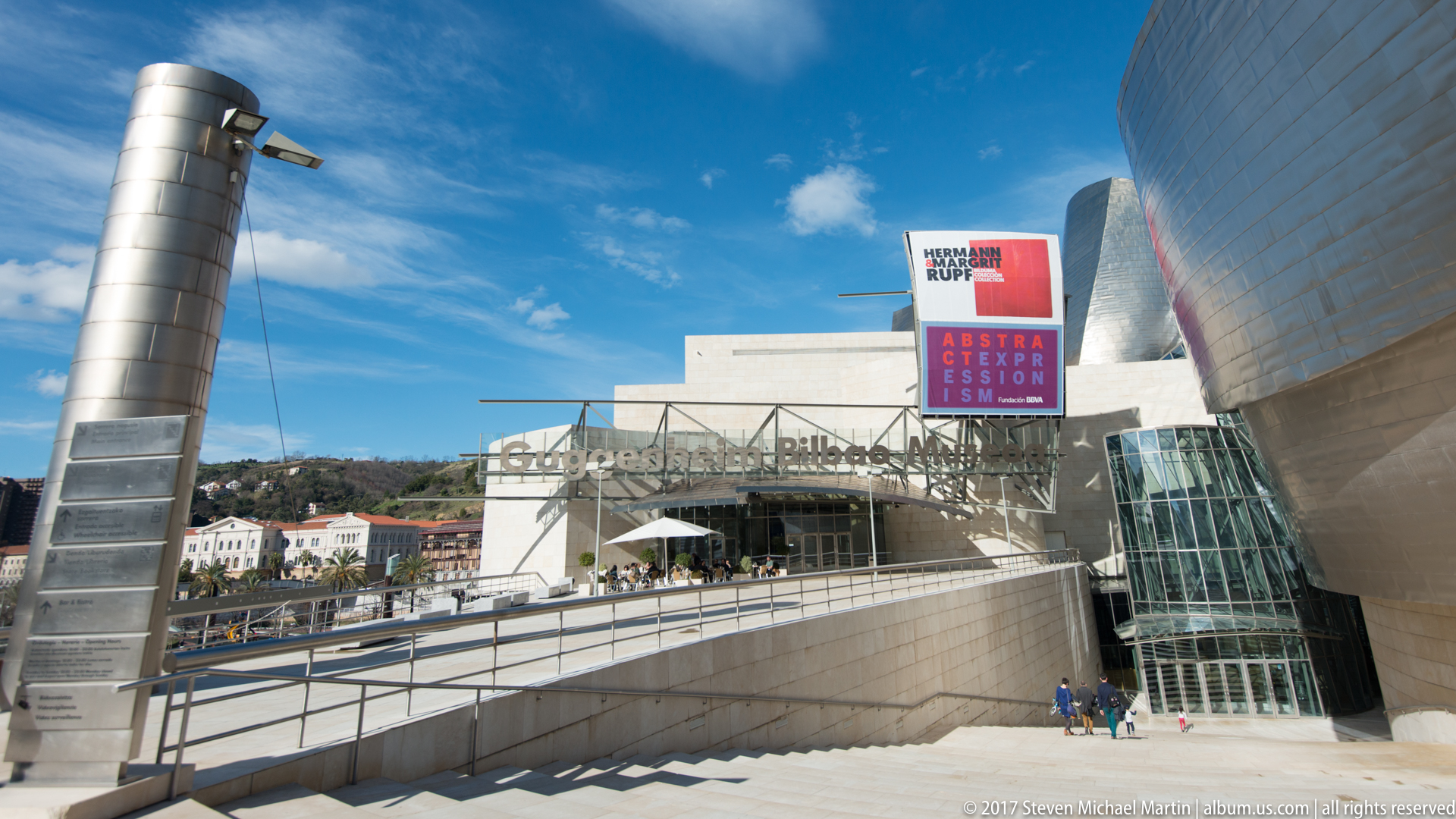
The approach to the Guggenheim Museum Bilbao descends between pale stone walls toward a glass entrance volume set against the museum’s titanium skin. Museum signage spans the terrace, and a large exhibition banner is mounted on the rectilinear building beyond. The view emphasizes the transition from the city-side plaza into the museum through ramps, stairs, glazing, and layered architectural surfaces.
Caption
The approach to the Guggenheim Museum Bilbao descends between pale stone walls toward a glass entrance volume set against the museum’s titanium skin. Museum signage spans the terrace, and a large exhibition banner is mounted on the rectilinear building beyond. The view emphasizes the transition from the city-side plaza into the museum through ramps, stairs, glazing, and layered architectural surfaces.

Sunlight glances across a broad curved wall of the Guggenheim Museum Bilbao, revealing the fine grid of rectangular titanium panels that sheath Frank Gehry’s sculptural forms. The close crop removes most contextual landmarks, concentrating on the way the metallic surface bends outward above a pale stone base. Subtle warm reflections animate the otherwise silvery façade beneath a dark blue sky.
Caption
Sunlight glances across a broad curved wall of the Guggenheim Museum Bilbao, revealing the fine grid of rectangular titanium panels that sheath Frank Gehry’s sculptural forms. The close crop removes most contextual landmarks, concentrating on the way the metallic surface bends outward above a pale stone base. Subtle warm reflections animate the otherwise silvery façade beneath a dark blue sky.

A faceted glass entrance structure leans outward beneath the overhanging titanium forms of the Guggenheim Museum Bilbao. Steel mullions divide the transparent walls into irregular panes, while the metallic soffit above casts angular shadows across the adjacent stone surface and plaza. The tilted composition reinforces the building’s deliberate instability and highlights the junction of glazing, structure, and sculptural cladding.
Caption
A faceted glass entrance structure leans outward beneath the overhanging titanium forms of the Guggenheim Museum Bilbao. Steel mullions divide the transparent walls into irregular panes, while the metallic soffit above casts angular shadows across the adjacent stone surface and plaza. The tilted composition reinforces the building’s deliberate instability and highlights the junction of glazing, structure, and sculptural cladding.

A broad exterior stair climbs beneath a sweeping titanium overhang at the Guggenheim Museum Bilbao, opening toward bright blue sky at the top. Curved metal cladding presses in from the left while a glass-and-steel structure frames the right edge. Strong diagonal shadows repeat the rhythm of the steps, turning a circulation route into a study of movement, enclosure, and light.
Caption
A broad exterior stair climbs beneath a sweeping titanium overhang at the Guggenheim Museum Bilbao, opening toward bright blue sky at the top. Curved metal cladding presses in from the left while a glass-and-steel structure frames the right edge. Strong diagonal shadows repeat the rhythm of the steps, turning a circulation route into a study of movement, enclosure, and light.

Sweeping white gallery volumes frame the central atrium of the Guggenheim Museum Bilbao, opening toward a glazed roof and a tall transparent elevator or circulation shaft. Seen from below, the overlapping curves and irregular voids demonstrate the building’s sculptural interior organization while daylight from the skylight defines the edges of the elevated galleries.
Caption
Sweeping white gallery volumes frame the central atrium of the Guggenheim Museum Bilbao, opening toward a glazed roof and a tall transparent elevator or circulation shaft. Seen from below, the overlapping curves and irregular voids demonstrate the building’s sculptural interior organization while daylight from the skylight defines the edges of the elevated galleries.

Looking steeply upward between the Guggenheim Museum Bilbao’s glass and metal volumes, the composition opens onto a wedge of saturated blue sky. A rounded titanium-clad form rises in the center, flanked by faceted glazing and pale stone, while a projecting metallic plane cuts across the top. The enclosed viewpoint reveals the dramatic vertical spaces created where Gehry’s irregular building masses nearly meet.
Caption
Looking steeply upward between the Guggenheim Museum Bilbao’s glass and metal volumes, the composition opens onto a wedge of saturated blue sky. A rounded titanium-clad form rises in the center, flanked by faceted glazing and pale stone, while a projecting metallic plane cuts across the top. The enclosed viewpoint reveals the dramatic vertical spaces created where Gehry’s irregular building masses nearly meet.

A second steep upward study narrows the Guggenheim Museum Bilbao to intersecting architectural fragments: faceted glass at left, a rounded titanium drum at center, pale stone at right, and a projecting metallic plane overhead. The clear blue sky becomes the central negative space. The near-vertical perspective accentuates the building’s layered construction and the abrupt shifts between curved, planar, transparent, and solid surfaces.
Caption
A second steep upward study narrows the Guggenheim Museum Bilbao to intersecting architectural fragments: faceted glass at left, a rounded titanium drum at center, pale stone at right, and a projecting metallic plane overhead. The clear blue sky becomes the central negative space. The near-vertical perspective accentuates the building’s layered construction and the abrupt shifts between curved, planar, transparent, and solid surfaces.

An upward view through the Guggenheim Museum Bilbao atrium reveals an intricate junction of glass curtain walls, dark steel framing, and a large metallic cylindrical volume. The steep viewpoint turns Frank Gehry’s interior architecture into a layered composition of intersecting structural lines, transparent surfaces, and reflected daylight.
Caption
An upward view through the Guggenheim Museum Bilbao atrium reveals an intricate junction of glass curtain walls, dark steel framing, and a large metallic cylindrical volume. The steep viewpoint turns Frank Gehry’s interior architecture into a layered composition of intersecting structural lines, transparent surfaces, and reflected daylight.

A smiling visitor is framed closely against the luminous mirrored forms of Jeff Koons’s Tulips at the Guggenheim Museum Bilbao. Green, magenta, blue, and violet surfaces fill the background, turning the sculpture into a colorful reflective setting while the shallow composition shifts attention from the artwork as an object to the visitor’s encounter with it.
Caption
A smiling visitor is framed closely against the luminous mirrored forms of Jeff Koons’s Tulips at the Guggenheim Museum Bilbao. Green, magenta, blue, and violet surfaces fill the background, turning the sculpture into a colorful reflective setting while the shallow composition shifts attention from the artwork as an object to the visitor’s encounter with it.

Jeff Koons’s Tulips rests on the terrace of the Guggenheim Museum Bilbao, its brightly colored, mirror-polished flower forms reflecting the surrounding architecture and sky. The compact sculpture is set against Frank Gehry’s titanium-clad curves and a sloping glass façade, creating a deliberate contrast between the artwork’s saturated reflective surfaces and the museum’s silvery architectural skin.
Caption
Jeff Koons’s Tulips rests on the terrace of the Guggenheim Museum Bilbao, its brightly colored, mirror-polished flower forms reflecting the surrounding architecture and sky. The compact sculpture is set against Frank Gehry’s titanium-clad curves and a sloping glass façade, creating a deliberate contrast between the artwork’s saturated reflective surfaces and the museum’s silvery architectural skin.

A visitor stands beneath the towering exterior forms of the Guggenheim Museum Bilbao, providing a human scale for the building’s sharply inclined glass wall and sweeping titanium-clad volume. The composition emphasizes the junction between transparent glazing, pale stone paving, and the curving metallic façade, with structural members visible behind the angled curtain wall.
Caption
A visitor stands beneath the towering exterior forms of the Guggenheim Museum Bilbao, providing a human scale for the building’s sharply inclined glass wall and sweeping titanium-clad volume. The composition emphasizes the junction between transparent glazing, pale stone paving, and the curving metallic façade, with structural members visible behind the angled curtain wall.

Anish Kapoor’s Tall Tree & The Eye rises beside the Guggenheim Museum Bilbao as a vertical aggregation of highly polished stainless-steel spheres. Each convex surface fragments and repeats reflections of the museum, plaza, sky, and surrounding city, while Frank Gehry’s titanium-clad walls provide a matte, finely scaled backdrop to the sculpture’s mirror-like geometry.
Caption
Anish Kapoor’s Tall Tree & The Eye rises beside the Guggenheim Museum Bilbao as a vertical aggregation of highly polished stainless-steel spheres. Each convex surface fragments and repeats reflections of the museum, plaza, sky, and surrounding city, while Frank Gehry’s titanium-clad walls provide a matte, finely scaled backdrop to the sculpture’s mirror-like geometry.

A visitor stands centered before Jeff Koons’s Tulips, with the sculpture’s polished red, green, magenta, blue, and orange forms spreading across the background. The frontal portrait preserves more of the artwork than the preceding close view, showing how its reflective surfaces surround the figure and mirror fragments of the Guggenheim Museum Bilbao terrace.
Caption
A visitor stands centered before Jeff Koons’s Tulips, with the sculpture’s polished red, green, magenta, blue, and orange forms spreading across the background. The frontal portrait preserves more of the artwork than the preceding close view, showing how its reflective surfaces surround the figure and mirror fragments of the Guggenheim Museum Bilbao terrace.

A visitor stands beside the Nervión waterfront with Anish Kapoor’s Tall Tree & The Eye rising behind him as a column of reflective stainless-steel spheres. The museum’s titanium exterior appears at right, while the red arch of La Salve Bridge and the opposite riverbank place the portrait within the Guggenheim Museum Bilbao’s riverside sculpture terrace.
Caption
A visitor stands beside the Nervión waterfront with Anish Kapoor’s Tall Tree & The Eye rising behind him as a column of reflective stainless-steel spheres. The museum’s titanium exterior appears at right, while the red arch of La Salve Bridge and the opposite riverbank place the portrait within the Guggenheim Museum Bilbao’s riverside sculpture terrace.

Interlocking titanium-clad volumes sweep across the Guggenheim Museum Bilbao exterior, their compound curves meeting around a deep shadowed recess. Sunlight reveals the small rectangular scale of the metallic panels and the changing planes of Frank Gehry’s façade, turning a tightly framed architectural detail into a study of surface, curvature, and reflected light.
Caption
Interlocking titanium-clad volumes sweep across the Guggenheim Museum Bilbao exterior, their compound curves meeting around a deep shadowed recess. Sunlight reveals the small rectangular scale of the metallic panels and the changing planes of Frank Gehry’s façade, turning a tightly framed architectural detail into a study of surface, curvature, and reflected light.

The body and radiating legs of Louise Bourgeois’s monumental spider Maman loom overhead against a partly cloudy sky. Seen from directly beneath the sculpture, the bronze body, jointed legs, and suspended egg sac dominate the frame, transforming the familiar riverside installation at the Guggenheim Museum Bilbao into an imposing study of anatomy, scale, and structure.
Caption
The body and radiating legs of Louise Bourgeois’s monumental spider Maman loom overhead against a partly cloudy sky. Seen from directly beneath the sculpture, the bronze body, jointed legs, and suspended egg sac dominate the frame, transforming the familiar riverside installation at the Guggenheim Museum Bilbao into an imposing study of anatomy, scale, and structure.