Święta Lipka – Poland
Święta Lipka lies in the historic region of Warmia and Masuria in northeastern Poland, not far from the border with the former territories of East Prussia. The site is famous for the Basilica of the Visitation of the Blessed Virgin Mary, one of the most beautiful Baroque pilgrimage churches in Poland.
The church is renowned for its richly decorated interior, which features elaborate frescoes, gilded sculptures, and an extraordinary Baroque pipe organ with moving figures that animate during performances. For centuries the basilica has been an important pilgrimage destination for Catholics throughout the region.
Surrounded by forests and lakes typical of the Masurian landscape, Święta Lipka stands as a remarkable example of Baroque religious art and architecture in northern Poland.

A straight paved approach leads toward the sanctuary enclosure, where the ornate central gate aligns precisely with the twin-towered church façade beyond. Symmetrical corner pavilions, salmon-colored walls, clipped greenery, and the vertical towers define the complex as a composed architectural ensemble rather than an isolated church building.
Caption
A straight paved approach leads toward the sanctuary enclosure, where the ornate central gate aligns precisely with the twin-towered church façade beyond. Symmetrical corner pavilions, salmon-colored walls, clipped greenery, and the vertical towers define the complex as a composed architectural ensemble rather than an isolated church building.

A slightly lower, more immersive axial view follows the painted ceiling toward the sanctuary, with the high altar just visible at the far end. Blue-patterned pilasters rise beside white arches and gilded capitals, while dark carved furnishings occupy the lower edges. The broad ceiling dominates the composition, revealing how the fresco program governs the visual experience of moving through the nave.
Caption
A slightly lower, more immersive axial view follows the painted ceiling toward the sanctuary, with the high altar just visible at the far end. Blue-patterned pilasters rise beside white arches and gilded capitals, while dark carved furnishings occupy the lower edges. The broad ceiling dominates the composition, revealing how the fresco program governs the visual experience of moving through the nave.

A wider view frames the pipe organ beneath the frescoed vault and between the tall arcades of the nave. Blue-patterned pilasters and white architectural ribs rise toward gilded capitals, while a dark pulpit and cross appear along the left side. The photograph balances the organ’s elaborate case against the scale of the surrounding architecture, making the west end of the sanctuary readable as a complete spatial ensemble.
Caption
A wider view frames the pipe organ beneath the frescoed vault and between the tall arcades of the nave. Blue-patterned pilasters and white architectural ribs rise toward gilded capitals, while a dark pulpit and cross appear along the left side. The photograph balances the organ’s elaborate case against the scale of the surrounding architecture, making the west end of the sanctuary readable as a complete spatial ensemble.

A dark architectural altar frame encloses a large painting of a robed male saint addressing figures below. In front, a modern framed portrait of Pope John Paul II, flowers, and candles create a layered devotional display linking the historic church furnishing with contemporary Catholic remembrance.
Caption
A dark architectural altar frame encloses a large painting of a robed male saint addressing figures below. In front, a modern framed portrait of Pope John Paul II, flowers, and candles create a layered devotional display linking the historic church furnishing with contemporary Catholic remembrance.

Several frescoed ceiling bays are seen obliquely across the nave, their figural scenes separated by broad white arches and decorated moldings. A tall window at right introduces strong daylight while the curved vault surfaces recede in sequence toward the background. The photograph emphasizes how the Baroque paintings wrap continuously across the church’s complex ceiling geometry.
Caption
Several frescoed ceiling bays are seen obliquely across the nave, their figural scenes separated by broad white arches and decorated moldings. A tall window at right introduces strong daylight while the curved vault surfaces recede in sequence toward the background. The photograph emphasizes how the Baroque paintings wrap continuously across the church’s complex ceiling geometry.

The high altar rises in multiple dark architectural tiers framed by gilded columns, sculptures, and painted panels. A silver-toned tabernacle or devotional centerpiece occupies the lower center, while larger sacred images are stacked vertically above it. Marble-patterned walls, gilded capitals, and the frescoed vault surround the altar, intensifying the visual focus at the sanctuary end of the church.
Caption
The high altar rises in multiple dark architectural tiers framed by gilded columns, sculptures, and painted panels. A silver-toned tabernacle or devotional centerpiece occupies the lower center, while larger sacred images are stacked vertically above it. Marble-patterned walls, gilded capitals, and the frescoed vault surround the altar, intensifying the visual focus at the sanctuary end of the church.

At a junction in the cloister, two covered arcades meet around a massive square pier, opening views down parallel rows of arches. Painted vaults cover both passages, while pale walls, warm pink supports, and bright daylight from the courtyard side define the circulation space. The corner viewpoint reveals the cloister as an interconnected architectural system rather than a single linear corridor.
Caption
At a junction in the cloister, two covered arcades meet around a massive square pier, opening views down parallel rows of arches. Painted vaults cover both passages, while pale walls, warm pink supports, and bright daylight from the courtyard side define the circulation space. The corner viewpoint reveals the cloister as an interconnected architectural system rather than a single linear corridor.

A long cloister corridor recedes through a rhythmic sequence of rounded arches and painted vaults toward a bright opening in the distance. Warm pink piers, pale lower walls, and richly frescoed ceiling surfaces create a restrained but continuous decorative scheme. The deep one-point perspective turns the covered passage into a study of repetition, light, and architectural enclosure within the sanctuary complex.
Caption
A long cloister corridor recedes through a rhythmic sequence of rounded arches and painted vaults toward a bright opening in the distance. Warm pink piers, pale lower walls, and richly frescoed ceiling surfaces create a restrained but continuous decorative scheme. The deep one-point perspective turns the covered passage into a study of repetition, light, and architectural enclosure within the sanctuary complex.

A broader close view of the high altar places the silver-toned tabernacle between paired gilded standing figures and reddish-brown columns. The white altar cloth, candles, floral arrangements, and dark architectural framework create layers of contrasting color and material. By including the flanking sculptures, the composition shows how the tabernacle is embedded within a larger sculptural and architectural ensemble.
Caption
A broader close view of the high altar places the silver-toned tabernacle between paired gilded standing figures and reddish-brown columns. The white altar cloth, candles, floral arrangements, and dark architectural framework create layers of contrasting color and material. By including the flanking sculptures, the composition shows how the tabernacle is embedded within a larger sculptural and architectural ensemble.

The richly ornamented sanctuary interior is seen along the nave toward the high altar, where dark architectural woodwork, gilded sculpture, and a central sacred image rise behind the white-draped altar table. Blue-patterned pilasters, painted vaults, side arches, and hanging chandeliers frame the axial view, emphasizing the layered Baroque decoration of the pilgrimage church.
Caption
The richly ornamented sanctuary interior is seen along the nave toward the high altar, where dark architectural woodwork, gilded sculpture, and a central sacred image rise behind the white-draped altar table. Blue-patterned pilasters, painted vaults, side arches, and hanging chandeliers frame the axial view, emphasizing the layered Baroque decoration of the pilgrimage church.

A painted vault compartment fills the frame with a dramatic sacred composition arranged around a central standing figure, surrounding attendants, large crosses, clouds, and sweeping gestures. The fresco is bounded by curved architectural moldings and a deep-set window whose painted reveal adds another band of ornament, showing how image and architecture are integrated across the sanctuary ceiling.
Caption
A painted vault compartment fills the frame with a dramatic sacred composition arranged around a central standing figure, surrounding attendants, large crosses, clouds, and sweeping gestures. The fresco is bounded by curved architectural moldings and a deep-set window whose painted reveal adds another band of ornament, showing how image and architecture are integrated across the sanctuary ceiling.

This vault fresco centers on a tall wooden cross and ladder, with a cluster of robed figures gathered below and along the base. Warm flesh tones, pale garments, and an open blue sky create a more narrative scene than the surrounding architectural ornament. Curved vault ribs and a decorated window reveal establish the painting as part of the church’s continuous Baroque ceiling cycle.
Caption
This vault fresco centers on a tall wooden cross and ladder, with a cluster of robed figures gathered below and along the base. Warm flesh tones, pale garments, and an open blue sky create a more narrative scene than the surrounding architectural ornament. Curved vault ribs and a decorated window reveal establish the painting as part of the church’s continuous Baroque ceiling cycle.

A Crucifixion scene occupies the curved ceiling field, with Christ on the cross at center and mourning or witnessing figures grouped below. The strong vertical of the cross contrasts with the vault’s sweeping architecture, while a decorated window and painted architectural borders press closely against the narrative scene. The composition forms one episode in the sanctuary’s extensive Baroque fresco program.
Caption
A Crucifixion scene occupies the curved ceiling field, with Christ on the cross at center and mourning or witnessing figures grouped below. The strong vertical of the cross contrasts with the vault’s sweeping architecture, while a decorated window and painted architectural borders press closely against the narrative scene. The composition forms one episode in the sanctuary’s extensive Baroque fresco program.

A crowded sacred narrative unfolds around a large stone structure at the center of this ceiling fresco. Several robed figures bend, gesture, or cluster closely around the scene, while darker figures occupy the right edge beneath a broad painted sky. The fresco’s oblique placement beside a window and curved architectural frame shows how the narrative adapts to the irregular surfaces of the vault.
Caption
A crowded sacred narrative unfolds around a large stone structure at the center of this ceiling fresco. Several robed figures bend, gesture, or cluster closely around the scene, while darker figures occupy the right edge beneath a broad painted sky. The fresco’s oblique placement beside a window and curved architectural frame shows how the narrative adapts to the irregular surfaces of the vault.

The fresco presents a densely populated sacred scene arranged around an elevated architectural platform, with two prominent figures above a crowd of onlookers. Warm earth tones dominate the lower scene while blue sky and clouds open above it. Curved vault moldings and a nearby window compress the composition into the ceiling bay, continuing the sanctuary’s narrative Baroque decoration.
Caption
The fresco presents a densely populated sacred scene arranged around an elevated architectural platform, with two prominent figures above a crowd of onlookers. Warm earth tones dominate the lower scene while blue sky and clouds open above it. Curved vault moldings and a nearby window compress the composition into the ceiling bay, continuing the sanctuary’s narrative Baroque decoration.

Looking upward along the nave, the photograph traces a sequence of frescoed vault bays toward the distant sanctuary. White architectural ribs, blue-patterned pilasters, gilded capitals, side arches, and dark chandeliers create a strong rhythmic frame for the painted ceiling. The view emphasizes the breadth of the Baroque decorative program rather than a single altar or fresco scene.
Caption
Looking upward along the nave, the photograph traces a sequence of frescoed vault bays toward the distant sanctuary. White architectural ribs, blue-patterned pilasters, gilded capitals, side arches, and dark chandeliers create a strong rhythmic frame for the painted ceiling. The view emphasizes the breadth of the Baroque decorative program rather than a single altar or fresco scene.

The sanctuary’s monumental pipe organ fills the west end above the gallery, its silver-colored pipes set within an elaborate blue-and-gold Baroque case. Gilded figures and ornament extend along the gallery rail, while a radiant sunburst crowns the central section beneath the painted vault. The low viewpoint makes the organ appear integrated with the ceiling frescoes and surrounding white-and-blue architecture.
Caption
The sanctuary’s monumental pipe organ fills the west end above the gallery, its silver-colored pipes set within an elaborate blue-and-gold Baroque case. Gilded figures and ornament extend along the gallery rail, while a radiant sunburst crowns the central section beneath the painted vault. The low viewpoint makes the organ appear integrated with the ceiling frescoes and surrounding white-and-blue architecture.

A closer frontal view isolates the organ’s sculptural case, where multiple ranks of pipes rise through blue-painted towers and curved compartments edged in gold. The central crown-like sunburst and smaller gilded figures turn the instrument into a theatrical architectural façade. The gallery balustrade and warm window below provide scale while the frescoed vault remains visible above.
Caption
A closer frontal view isolates the organ’s sculptural case, where multiple ranks of pipes rise through blue-painted towers and curved compartments edged in gold. The central crown-like sunburst and smaller gilded figures turn the instrument into a theatrical architectural façade. The gallery balustrade and warm window below provide scale while the frescoed vault remains visible above.

The organ is framed from farther back within the nave, allowing the instrument’s blue-and-gold case to be read against tall white arches, patterned pilasters, gilded capitals, and the painted ceiling. The orange glow of the window beneath the central pipes adds a warm focal point. This wider composition shows the organ as one element in the sanctuary’s coordinated Baroque interior.
Caption
The organ is framed from farther back within the nave, allowing the instrument’s blue-and-gold case to be read against tall white arches, patterned pilasters, gilded capitals, and the painted ceiling. The orange glow of the window beneath the central pipes adds a warm focal point. This wider composition shows the organ as one element in the sanctuary’s coordinated Baroque interior.

A dark, branching metal devotional display projects in front of a patterned pilaster, centering an oval sacred medallion within a pale radiating frame. Numerous small metal leaves or votive forms spread outward like a tree, creating a striking silhouette against the lighter wall and frescoed arches. The close view emphasizes the object’s handcrafted complexity and its placement within the ornate sanctuary interior.
Caption
A dark, branching metal devotional display projects in front of a patterned pilaster, centering an oval sacred medallion within a pale radiating frame. Numerous small metal leaves or votive forms spread outward like a tree, creating a striking silhouette against the lighter wall and frescoed arches. The close view emphasizes the object’s handcrafted complexity and its placement within the ornate sanctuary interior.

The pipe organ is shown nearly straight on, revealing the full symmetry of its blue-and-gold case. Tall outer towers and smaller central pipe fields rise around a brilliant gilded sunburst, while sculptural ornament and the gallery rail spread across the width of the nave. Warm backlighting from the windows behind the instrument intensifies the contrast between the metallic pipes and painted casework.
Caption
The pipe organ is shown nearly straight on, revealing the full symmetry of its blue-and-gold case. Tall outer towers and smaller central pipe fields rise around a brilliant gilded sunburst, while sculptural ornament and the gallery rail spread across the width of the nave. Warm backlighting from the windows behind the instrument intensifies the contrast between the metallic pipes and painted casework.

Centered beneath the nave, the camera turns almost straight upward to record the sanctuary’s sequence of painted vault compartments. White ribs and cornices divide the warm-toned frescoes into regular bays, while gilded capitals punctuate the blue-patterned vertical supports at both sides. The unusually symmetrical viewpoint makes the ceiling’s architectural rhythm and continuous decorative scheme especially legible.
Caption
Centered beneath the nave, the camera turns almost straight upward to record the sanctuary’s sequence of painted vault compartments. White ribs and cornices divide the warm-toned frescoes into regular bays, while gilded capitals punctuate the blue-patterned vertical supports at both sides. The unusually symmetrical viewpoint makes the ceiling’s architectural rhythm and continuous decorative scheme especially legible.

The lower center of the high altar is isolated in this frontal detail. A silver-toned tabernacle with a small architectural doorway stands beneath a bright relief panel and between dark polished columns, while candles line the white-draped altar table in front. Gilded sculpture and black architectural members frame the luminous metalwork, concentrating attention on the altar’s central liturgical zone.
Caption
The lower center of the high altar is isolated in this frontal detail. A silver-toned tabernacle with a small architectural doorway stands beneath a bright relief panel and between dark polished columns, while candles line the white-draped altar table in front. Gilded sculpture and black architectural members frame the luminous metalwork, concentrating attention on the altar’s central liturgical zone.

The camera moves closer to the altar’s center, where the silver-toned tabernacle sits below a large suspended dark metal ornament and between richly gilded sculptural figures. Reddish columns and black architectural members rise behind the altar table, while candles and the embroidered frontal define the lower edge. The tight framing emphasizes the dramatic mixture of metal, wood, gilding, and polished surfaces.
Caption
The camera moves closer to the altar’s center, where the silver-toned tabernacle sits below a large suspended dark metal ornament and between richly gilded sculptural figures. Reddish columns and black architectural members rise behind the altar table, while candles and the embroidered frontal define the lower edge. The tight framing emphasizes the dramatic mixture of metal, wood, gilding, and polished surfaces.

The monumental high altar rises in dark marble-like architectural tiers enriched with gilded sculpture, twisted and straight columns, framed sacred images, and a central tabernacle. Angels and saintly figures occupy projecting ledges while the painted vault above continues the theatrical vertical composition. The low viewpoint emphasizes the altar’s height and the dense layering characteristic of the sanctuary’s Baroque interior.
Caption
The monumental high altar rises in dark marble-like architectural tiers enriched with gilded sculpture, twisted and straight columns, framed sacred images, and a central tabernacle. Angels and saintly figures occupy projecting ledges while the painted vault above continues the theatrical vertical composition. The low viewpoint emphasizes the altar’s height and the dense layering characteristic of the sanctuary’s Baroque interior.

From the rear of the nave, the camera looks beneath the frescoed ceiling toward the distant high altar. White arcades, blue-patterned pilasters, gilded capitals, dark pulpits or side furnishings, and chandeliers create a layered progression along the central axis. The photograph gives one of the clearest overall impressions of the sanctuary’s tall, narrow Baroque interior and its coordinated architectural decoration.
Caption
From the rear of the nave, the camera looks beneath the frescoed ceiling toward the distant high altar. White arcades, blue-patterned pilasters, gilded capitals, dark pulpits or side furnishings, and chandeliers create a layered progression along the central axis. The photograph gives one of the clearest overall impressions of the sanctuary’s tall, narrow Baroque interior and its coordinated architectural decoration.

The nave is viewed upward toward the organ loft, combining the sequence of painted ceiling bays with the blue-and-gold instrument at the far end. White ribs, blue-patterned pilasters, and gilded capitals create a repeated architectural cadence on both sides. The composition links the monumental organ visually to the frescoed vault and demonstrates the carefully coordinated color scheme of the Baroque interior.
Caption
The nave is viewed upward toward the organ loft, combining the sequence of painted ceiling bays with the blue-and-gold instrument at the far end. White ribs, blue-patterned pilasters, and gilded capitals create a repeated architectural cadence on both sides. The composition links the monumental organ visually to the frescoed vault and demonstrates the carefully coordinated color scheme of the Baroque interior.

This near-symmetrical ceiling study removes most furnishings from view and concentrates on the sequence of painted vault bays. Pale architectural ribs form a repeating frame around large figural frescoes, while blue-patterned pilasters and gilded capitals mark the edges of the nave. The long perspective draws the eye through the decorative program and highlights the regularity of the church’s Baroque spatial design.
Caption
This near-symmetrical ceiling study removes most furnishings from view and concentrates on the sequence of painted vault bays. Pale architectural ribs form a repeating frame around large figural frescoes, while blue-patterned pilasters and gilded capitals mark the edges of the nave. The long perspective draws the eye through the decorative program and highlights the regularity of the church’s Baroque spatial design.

A close exterior detail centers a pale Marian medallion or relief backed by gilded rays and surrounded by a broad field of dark metal foliage. The ornament is mounted on the sanctuary’s warm red façade above two arched windows, with pale architectural moldings framing the composition. The contrast between black metal leaves, gold rays, and plaster creates one of the façade’s most distinctive decorative accents.
Caption
A close exterior detail centers a pale Marian medallion or relief backed by gilded rays and surrounded by a broad field of dark metal foliage. The ornament is mounted on the sanctuary’s warm red façade above two arched windows, with pale architectural moldings framing the composition. The contrast between black metal leaves, gold rays, and plaster creates one of the façade’s most distinctive decorative accents.

The upper front of the sanctuary rises against a clear blue sky, with twin tower spires flanking the curved central gable. Clock faces, sculpted figures, gilded rays, and a large decorative emblem crowd the red-and-white Baroque façade. The low viewpoint concentrates on the skyline and upper ornament, showing how sculpture and symbolic imagery animate the architecture above the main entrance.
Caption
The upper front of the sanctuary rises against a clear blue sky, with twin tower spires flanking the curved central gable. Clock faces, sculpted figures, gilded rays, and a large decorative emblem crowd the red-and-white Baroque façade. The low viewpoint concentrates on the skyline and upper ornament, showing how sculpture and symbolic imagery animate the architecture above the main entrance.

Monumental paired columns frame the main entrance in this low-angle view of the sanctuary façade. The dark studded doors, curved steps, gilded architectural accents, painted wall surfaces, and small balcony-like opening above the portal concentrate the elaborate Baroque decoration around the ceremonial entrance while the massive columns emphasize the façade’s vertical scale.
Caption
Monumental paired columns frame the main entrance in this low-angle view of the sanctuary façade. The dark studded doors, curved steps, gilded architectural accents, painted wall surfaces, and small balcony-like opening above the portal concentrate the elaborate Baroque decoration around the ceremonial entrance while the massive columns emphasize the façade’s vertical scale.

The camera isolates the central decorative zone of the façade, where dark metal foliage surrounds a pale Marian relief above the upper windows. A large gilded sunburst in the foreground overlaps the composition, while red plaster, white columns, sculpted figures, and curved moldings form the architectural backdrop. The close framing emphasizes the layered symbolic and sculptural treatment of the sanctuary front.
Caption
The camera isolates the central decorative zone of the façade, where dark metal foliage surrounds a pale Marian relief above the upper windows. A large gilded sunburst in the foreground overlaps the composition, while red plaster, white columns, sculpted figures, and curved moldings form the architectural backdrop. The close framing emphasizes the layered symbolic and sculptural treatment of the sanctuary front.

A full frontal view presents the sanctuary as a symmetrical Baroque composition behind an ornate wrought-metal gate and forecourt wall. Twin towers flank the central gable, while clocks, statues, columns, sculptural groups, and gilded ornaments animate the red façade. The central approach path leads directly toward the gate and entrance, making the image an establishing view of the pilgrimage complex.
Caption
A full frontal view presents the sanctuary as a symmetrical Baroque composition behind an ornate wrought-metal gate and forecourt wall. Twin towers flank the central gable, while clocks, statues, columns, sculptural groups, and gilded ornaments animate the red façade. The central approach path leads directly toward the gate and entrance, making the image an establishing view of the pilgrimage complex.

Seen from an oblique angle, the sanctuary façade reveals the depth of its projecting columns, central entrance bay, and paired towers. Red wall surfaces contrast with pale architectural trim, while clocks, niches, statues, and gilded details continue across the upper levels. The angled viewpoint also opens a portion of the paved forecourt, giving the façade a stronger three-dimensional reading than the frontal view.
Caption
Seen from an oblique angle, the sanctuary façade reveals the depth of its projecting columns, central entrance bay, and paired towers. Red wall surfaces contrast with pale architectural trim, while clocks, niches, statues, and gilded details continue across the upper levels. The angled viewpoint also opens a portion of the paved forecourt, giving the façade a stronger three-dimensional reading than the frontal view.

The richly decorated vault combines painted narrative scenes with pale architectural ribs, gilded ornament, and oval and circular compartments. Seen straight upward, the composition reveals how fresco painting and molded architectural decoration were coordinated across the ceiling of the Sanctuary of Saint Mary at Święta Lipka, creating a continuous ornamental field above the nave.
Caption
The richly decorated vault combines painted narrative scenes with pale architectural ribs, gilded ornament, and oval and circular compartments. Seen straight upward, the composition reveals how fresco painting and molded architectural decoration were coordinated across the ceiling of the Sanctuary of Saint Mary at Święta Lipka, creating a continuous ornamental field above the nave.

Broad stone steps lead directly to the sanctuary’s richly framed main doorway. Fluted monumental columns rise on both sides of the portal, while gilded reliefs and colored architectural surfaces surround the dark metal-studded doors. The frontal composition isolates the entrance as a carefully staged threshold between the exterior forecourt and the richly ornamented church interior.
Caption
Broad stone steps lead directly to the sanctuary’s richly framed main doorway. Fluted monumental columns rise on both sides of the portal, while gilded reliefs and colored architectural surfaces surround the dark metal-studded doors. The frontal composition isolates the entrance as a carefully staged threshold between the exterior forecourt and the richly ornamented church interior.

The sanctuary’s elaborate metal entrance gate fills the foreground beneath the twin-towered church façade. Dense scrolling ironwork, gilded emblems, stone piers, and sculptural figures turn the enclosure into a ceremonial approach, while the two dark tower roofs and central sunburst establish the church as the focal point beyond the boundary wall.
Caption
The sanctuary’s elaborate metal entrance gate fills the foreground beneath the twin-towered church façade. Dense scrolling ironwork, gilded emblems, stone piers, and sculptural figures turn the enclosure into a ceremonial approach, while the two dark tower roofs and central sunburst establish the church as the focal point beyond the boundary wall.

Looking steeply upward from the entrance, the central façade rises through superimposed architectural stages toward its curved gable. Tall white columns stand against salmon-pink walls, with sculptural and gilded decoration clustered around the portal and upper window. The compressed perspective accentuates the sanctuary’s layered Baroque façade design and its strong upward movement.
Caption
Looking steeply upward from the entrance, the central façade rises through superimposed architectural stages toward its curved gable. Tall white columns stand against salmon-pink walls, with sculptural and gilded decoration clustered around the portal and upper window. The compressed perspective accentuates the sanctuary’s layered Baroque façade design and its strong upward movement.

The twin-towered façade rises beyond the sanctuary wall and ornamental gate under a bright summer sky. Rounded corner pavilions flank the enclosure, reinforcing the complex’s symmetry, while trees partially screen the lower architecture. This more distant viewpoint emphasizes the relationship between church, perimeter structures, and landscaped approach.
Caption
The twin-towered façade rises beyond the sanctuary wall and ornamental gate under a bright summer sky. Rounded corner pavilions flank the enclosure, reinforcing the complex’s symmetry, while trees partially screen the lower architecture. This more distant viewpoint emphasizes the relationship between church, perimeter structures, and landscaped approach.

The monumental pipe organ dominates the rear of the church, its silver-toned pipes arranged within an exuberant dark-and-gilded case accented with blue architectural elements. A radiant gilded sunburst crowns the central section, while the frescoed vault continues overhead, visually integrating the instrument with the sanctuary’s dense Baroque interior decoration.
Caption
The monumental pipe organ dominates the rear of the church, its silver-toned pipes arranged within an exuberant dark-and-gilded case accented with blue architectural elements. A radiant gilded sunburst crowns the central section, while the frescoed vault continues overhead, visually integrating the instrument with the sanctuary’s dense Baroque interior decoration.

The sanctuary’s symmetrical twin-towered façade stands directly behind its elaborate green-and-gold entrance gate. A visitor walking toward the camera provides scale for the broad paved forecourt, enclosure wall, and monumental church beyond. The central axis links foreground, gate, sunburst ornament, and façade gable under a vivid blue sky.
Caption
The sanctuary’s symmetrical twin-towered façade stands directly behind its elaborate green-and-gold entrance gate. A visitor walking toward the camera provides scale for the broad paved forecourt, enclosure wall, and monumental church beyond. The central axis links foreground, gate, sunburst ornament, and façade gable under a vivid blue sky.

A visitor pauses on the central approach to photograph the Sanctuary of Saint Mary, facing the ornate gate and symmetrical twin-towered façade. The human figure reinforces the scale and viewing axis of the ensemble, while the salmon-colored enclosure wall, green metalwork, gilded sunburst, dark spires, and bright sky define the richly ornamented exterior setting.
Caption
A visitor pauses on the central approach to photograph the Sanctuary of Saint Mary, facing the ornate gate and symmetrical twin-towered façade. The human figure reinforces the scale and viewing axis of the ensemble, while the salmon-colored enclosure wall, green metalwork, gilded sunburst, dark spires, and bright sky define the richly ornamented exterior setting.

Viewed upward along the nave, successive painted vault compartments are separated by broad white and gold architectural bands. Figurative frescoes, illusionistic architectural forms, and patterned surfaces extend across the ceiling, while the tops of the nave arcades frame the lower edges of the composition and reveal the decoration’s relationship to the church structure.
Caption
Viewed upward along the nave, successive painted vault compartments are separated by broad white and gold architectural bands. Figurative frescoes, illusionistic architectural forms, and patterned surfaces extend across the ceiling, while the tops of the nave arcades frame the lower edges of the composition and reveal the decoration’s relationship to the church structure.
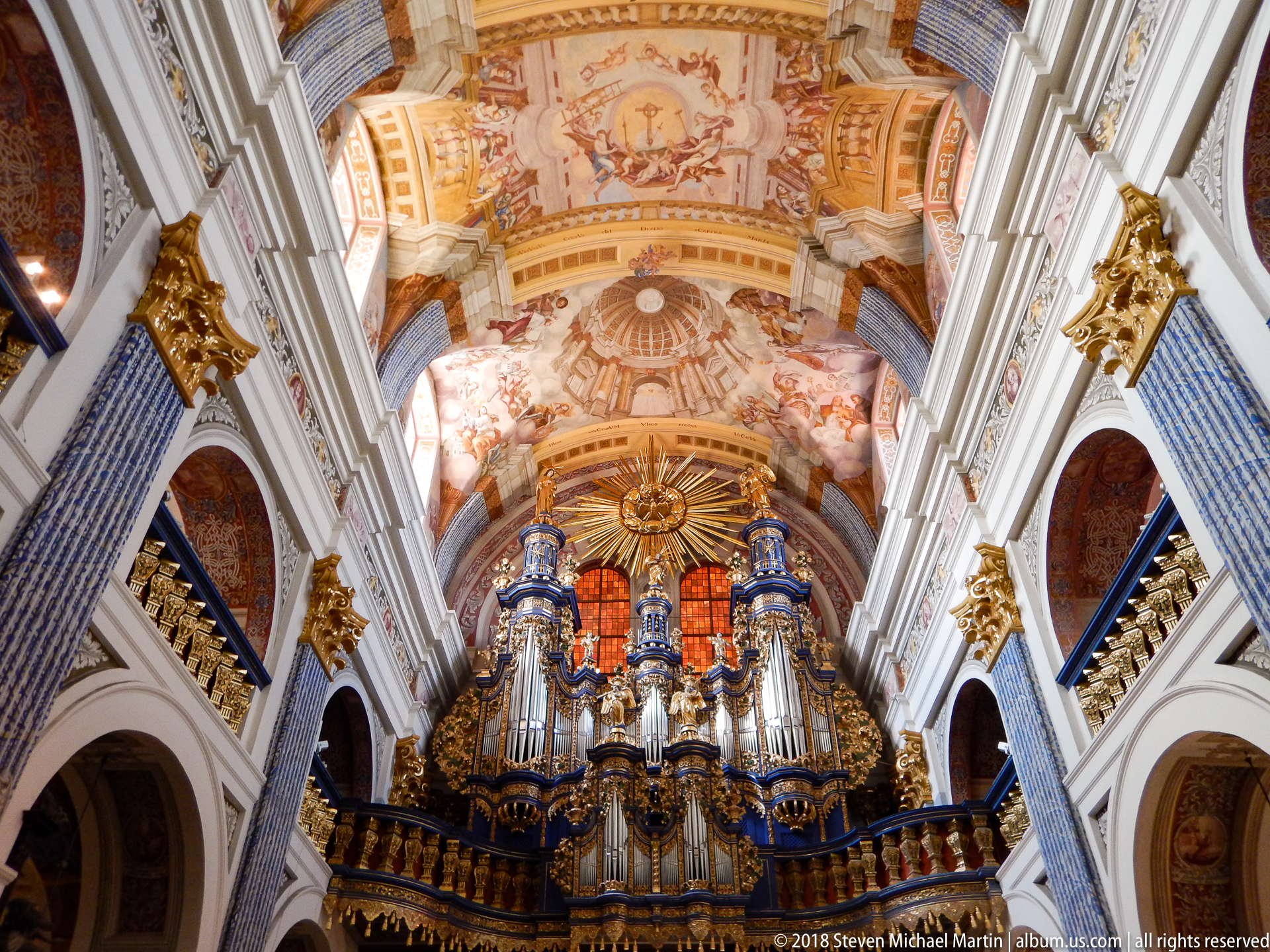
The great organ is seen axially from below, framed by the nave arcades and richly painted vault. Its clustered pipe towers, blue accents, dark carved case, and gilded ornament culminate in a radiant central sunburst. The wider composition shows how the organ loft closes the end of the nave while participating in the church’s unified Baroque decorative program.
Caption
The great organ is seen axially from below, framed by the nave arcades and richly painted vault. Its clustered pipe towers, blue accents, dark carved case, and gilded ornament culminate in a radiant central sunburst. The wider composition shows how the organ loft closes the end of the nave while participating in the church’s unified Baroque decorative program.
⭐ Highlights
- Baroque Basilica: One of the finest examples of Baroque architecture in Poland.
- Marian Pilgrimage Site: A major Catholic pilgrimage destination dedicated to the Virgin Mary.
- Moving Pipe Organ: A unique organ with animated figures that move as it is played.
- Decorated Interior: Rich frescoes, gilded sculptures, and detailed ornamentation throughout.
- Historic Cloisters: Arcaded walkways and chapels surrounding the basilica complex.
- “Holy Linden” Origin: The site’s name and history are tied to a legendary sacred tree.
⛪ Święta Lipka Field Guide
Major features observed during this visit:
Święta Lipka is one of the most important Marian sanctuaries in Poland, located in the Warmia region. The current Baroque basilica was constructed in the late 17th century by the Jesuits on the site of an earlier pilgrimage shrine. The sanctuary developed from a long-standing tradition of devotion connected to a legendary figure of the Virgin Mary placed on a linden tree, which gave the site its name.
🏛️ Signature Features
- Baroque Church – A richly decorated basilica with elaborate façade and twin towers.
- Moving Organ – A distinctive pipe organ with mechanical figures that animate during performances.
- Interior Decoration – Frescoes, gilded altars, and sculptural elements covering walls and ceilings.
- Cloister Courtyard – A surrounding arcade structure with chapels framing the church.
- Main Altar – A central focal point featuring religious artwork and ornate detailing.
🧠 Historical Significance
- Medieval Pilgrimage Origins – Devotion at the site dates back to at least the 14th century.
- Legend of the Linden Tree – A miraculous figure of Mary placed on a tree became the focus of pilgrimage.
- Jesuit Development – The current sanctuary was built and expanded by the Jesuit order in the 17th century.
- Religious Borderland – The site historically stood between Catholic and Protestant regions.
🌄 Landscape & Setting
- Rural Setting – Located in a quiet village landscape in northeastern Poland.
- Pilgrimage Route – Approaches to the sanctuary are marked by chapels and devotional elements.
- Architectural Ensemble – Church, cloisters, and surrounding structures form a unified complex.
- Atmospheric Experience – The setting combines spiritual significance with artistic richness.