Pitti Palace – Florence, Italy
The massive Palazzo Pitti stands on the south side of the Arno River and served for centuries as one of the principal residences of the Medici family. Originally constructed in the 15th century, the palace was later expanded into an enormous complex housing royal apartments, galleries, and museums.
Today the palace contains several major museum collections, including the Palatine Gallery, where paintings by masters such as Raphael, Titian, and Rubens are displayed in richly decorated Baroque rooms.
Behind the palace stretch the famous Boboli Gardens, one of the earliest and most influential examples of Italian Renaissance garden design.

The Artichoke Fountain fills the foreground of Pitti Palace’s inner court with a tiered composition of carved basins, animated figures, and marine ornament. Behind it, the palace’s heavily rusticated elevations create a dense grid of arched openings and projecting stonework, contrasting architectural mass with the fountain’s lively sculptural detail.
Caption
The Artichoke Fountain fills the foreground of Pitti Palace’s inner court with a tiered composition of carved basins, animated figures, and marine ornament. Behind it, the palace’s heavily rusticated elevations create a dense grid of arched openings and projecting stonework, contrasting architectural mass with the fountain’s lively sculptural detail.

A multi-tiered sculptural fountain rises before a formal garden axis, with water jetting from the upper basin and numerous small figures arranged along the surrounding balustrades and lower pools. Terraces, clipped hedges, stone steps, and a wooded slope extend behind it. The layered view connects the fountain’s animated water and sculpture with the controlled geometry of the palace garden landscape.
Caption
A multi-tiered sculptural fountain rises before a formal garden axis, with water jetting from the upper basin and numerous small figures arranged along the surrounding balustrades and lower pools. Terraces, clipped hedges, stone steps, and a wooded slope extend behind it. The layered view connects the fountain’s animated water and sculpture with the controlled geometry of the palace garden landscape.

Florence’s cathedral complex rises above terracotta rooftops, with Brunelleschi’s immense red-tiled dome of Santa Maria del Fiore dominating the skyline beside Giotto’s marble-clad Campanile. The distant view from the Pitti Palace area compresses the city’s roofscape while leaving the two celebrated vertical landmarks sharply isolated against the blue sky.
Caption
Florence’s cathedral complex rises above terracotta rooftops, with Brunelleschi’s immense red-tiled dome of Santa Maria del Fiore dominating the skyline beside Giotto’s marble-clad Campanile. The distant view from the Pitti Palace area compresses the city’s roofscape while leaving the two celebrated vertical landmarks sharply isolated against the blue sky.

A densely populated festival or procession fills the square in this large historical painting. Blue and red formations converge around a bright central ceremonial spectacle, while figures watch from galleries and windows of the multi-story buildings. The elevated viewpoint allows the artist to describe the geometry of the square and the scale of public participation in a single elaborate composition.
Caption
A densely populated festival or procession fills the square in this large historical painting. Blue and red formations converge around a bright central ceremonial spectacle, while figures watch from galleries and windows of the multi-story buildings. The elevated viewpoint allows the artist to describe the geometry of the square and the scale of public participation in a single elaborate composition.

The internal courtyard of Pitti Palace is enclosed by monumental rusticated wings whose ground-floor arcades support upper stories of regularly spaced windows. The view looks toward a curved central range and an open archway beyond, with only a few visitors crossing the broad paved court. Repeated arches and strongly modeled masonry give the enclosed space a powerful architectural unity.
Caption
The internal courtyard of Pitti Palace is enclosed by monumental rusticated wings whose ground-floor arcades support upper stories of regularly spaced windows. The view looks toward a curved central range and an open archway beyond, with only a few visitors crossing the broad paved court. Repeated arches and strongly modeled masonry give the enclosed space a powerful architectural unity.

Sunlight isolates a cluster of small sculpted figures along the Artichoke Fountain while the palace courtyard falls into deep shadow behind them. The side view emphasizes playful human and marine forms perched along the basin edge, turning a familiar monumental fountain into a study of individual sculptural details and contrasting light.
Caption
Sunlight isolates a cluster of small sculpted figures along the Artichoke Fountain while the palace courtyard falls into deep shadow behind them. The side view emphasizes playful human and marine forms perched along the basin edge, turning a familiar monumental fountain into a study of individual sculptural details and contrasting light.

A small domed room combines a radial fresco cycle, white-and-gold architectural panels, framed paintings, heraldic decoration, and formal seating. The wide view shows how the dome’s wedge-shaped painted compartments converge above the salon, while the patterned marble floor and paired chairs reinforce the room’s carefully balanced ceremonial arrangement.
Caption
A small domed room combines a radial fresco cycle, white-and-gold architectural panels, framed paintings, heraldic decoration, and formal seating. The wide view shows how the dome’s wedge-shaped painted compartments converge above the salon, while the patterned marble floor and paired chairs reinforce the room’s carefully balanced ceremonial arrangement.

Classical statues on tall pedestals line a chandeliered palace gallery centered on a circular basin and dark sculptural fountain group. Columns, painted architectural panels, and a sequence of doorways draw the eye through adjoining rooms, while the paired sculptures create a formal rhythm along the walls. The view records the gallery as an ensemble of architecture, sculpture, lighting, and ceremonial circulation.
Caption
Classical statues on tall pedestals line a chandeliered palace gallery centered on a circular basin and dark sculptural fountain group. Columns, painted architectural panels, and a sequence of doorways draw the eye through adjoining rooms, while the paired sculptures create a formal rhythm along the walls. The view records the gallery as an ensemble of architecture, sculpture, lighting, and ceremonial circulation.

The corner of a polished dark tabletop reveals intricate colored-stone inlay arranged as scrolling foliage and geometric borders. Blue, cream, red and ocher motifs stand out against the black ground, with fine joints defining the individual pieces. A narrow view of the patterned floor below gives the object scale and distinguishes this material detail from the room-wide views of palace furnishings.
Caption
The corner of a polished dark tabletop reveals intricate colored-stone inlay arranged as scrolling foliage and geometric borders. Blue, cream, red and ocher motifs stand out against the black ground, with fine joints defining the individual pieces. A narrow view of the patterned floor below gives the object scale and distinguishes this material detail from the room-wide views of palace furnishings.

A sculptural ensemble of reclining pale figures, curling gilded scrolls and richly modeled architectural moldings marks the junction between the wall and ceiling. Painted scenes occupy adjoining curved fields, partly obscured by the projecting decoration. The close framing makes the illusionistic mixture of painted imagery and three-dimensional stucco the principal subject.
Caption
A sculptural ensemble of reclining pale figures, curling gilded scrolls and richly modeled architectural moldings marks the junction between the wall and ceiling. Painted scenes occupy adjoining curved fields, partly obscured by the projecting decoration. The close framing makes the illusionistic mixture of painted imagery and three-dimensional stucco the principal subject.

Blue-and-gold geometric coffering forms a strong diamond lattice around five figurative paintings of different shapes. The central square scene is surrounded by four octagonal or polygonal narrative panels, making the ceiling’s ordered Renaissance-inspired geometry distinctly different from the more fluid gilded Baroque vaults elsewhere in the palace.
Caption
Blue-and-gold geometric coffering forms a strong diamond lattice around five figurative paintings of different shapes. The central square scene is surrounded by four octagonal or polygonal narrative panels, making the ceiling’s ordered Renaissance-inspired geometry distinctly different from the more fluid gilded Baroque vaults elsewhere in the palace.

A richly furnished gallery room in Pitti Palace presents paintings in dense historic-style arrangement above a carved mantel and gilded furniture. Oval, rectangular, and round frames compete across patterned wall covering, while a roped barrier and open doorway establish the room as a museum interior rather than a reconstructed domestic setting.
Caption
A richly furnished gallery room in Pitti Palace presents paintings in dense historic-style arrangement above a carved mantel and gilded furniture. Oval, rectangular, and round frames compete across patterned wall covering, while a roped barrier and open doorway establish the room as a museum interior rather than a reconstructed domestic setting.

A marble male figure in Roman military dress stands along a Boboli Gardens path, one arm raised while a cloak falls behind the cuirassed torso. A winged horse sculpture appears farther up the grassy slope, placing the statue within the garden’s layered program of classical and mythological ornament.
Caption
A marble male figure in Roman military dress stands along a Boboli Gardens path, one arm raised while a cloak falls behind the cuirassed torso. A winged horse sculpture appears farther up the grassy slope, placing the statue within the garden’s layered program of classical and mythological ornament.

A monumental marble group occupies a rusticated stone niche, pairing a powerful standing nude with a smaller collapsing figure. The sculpture is elevated above a decorated basin or pedestal, where a small animal relief adds another layer of ornament. Deep shadow in the niche sharpens the contrast between pale marble and the palace masonry.
Caption
A monumental marble group occupies a rusticated stone niche, pairing a powerful standing nude with a smaller collapsing figure. The sculpture is elevated above a decorated basin or pedestal, where a small animal relief adds another layer of ornament. Deep shadow in the niche sharpens the contrast between pale marble and the palace masonry.

Seen at close range, the marble group emphasizes the standing figure’s twisting torso, bent leg, and forceful grip beside a slumping companion. The tighter framing reveals the sculptor’s contrast between taut anatomy and deeply carved drapery, while the surrounding stone niche provides a restrained architectural backdrop.
Caption
Seen at close range, the marble group emphasizes the standing figure’s twisting torso, bent leg, and forceful grip beside a slumping companion. The tighter framing reveals the sculptor’s contrast between taut anatomy and deeply carved drapery, while the surrounding stone niche provides a restrained architectural backdrop.

Two nude male figures form a compact, vertically stacked marble group, one braced below while the other presses down across his shoulders. Interlocking limbs and opposing torsos create a tightly wound composition designed to be read in the round, set here against the rougher texture of the palace’s rusticated stone wall.
Caption
Two nude male figures form a compact, vertically stacked marble group, one braced below while the other presses down across his shoulders. Interlocking limbs and opposing torsos create a tightly wound composition designed to be read in the round, set here against the rougher texture of the palace’s rusticated stone wall.

A small marble figure group crowns a wall-mounted fountain set into a broad rusticated niche. The pale sculpture and projecting basin stand out against massive brown stone blocks, making the fountain read as an integrated architectural ornament rather than an isolated statue.
Caption
A small marble figure group crowns a wall-mounted fountain set into a broad rusticated niche. The pale sculpture and projecting basin stand out against massive brown stone blocks, making the fountain read as an integrated architectural ornament rather than an isolated statue.

An ancient Egyptian obelisk anchors the central axis of the Boboli Gardens amphitheater, rising from a clipped formal landscape framed by stone terraces and sculpture. Its hieroglyph-covered shaft forms a strong vertical counterpoint to the broad stepped garden, while visitors provide scale along the descending paths.
Caption
An ancient Egyptian obelisk anchors the central axis of the Boboli Gardens amphitheater, rising from a clipped formal landscape framed by stone terraces and sculpture. Its hieroglyph-covered shaft forms a strong vertical counterpoint to the broad stepped garden, while visitors provide scale along the descending paths.

A vertical jet of water rises from a dark pool inside an elaborately decorated garden grotto. Across the basin, a seated or draped statue occupies a rocky niche between columns, while patterned wall panels and textured surfaces turn the fountain chamber into an immersive architectural setting.
Caption
A vertical jet of water rises from a dark pool inside an elaborately decorated garden grotto. Across the basin, a seated or draped statue occupies a rocky niche between columns, while patterned wall panels and textured surfaces turn the fountain chamber into an immersive architectural setting.

A compact neoclassical pavilion faces a gravel forecourt in the Boboli Gardens, its warm stucco façade organized around a central pediment and four pale columns. Green shutters, a broad stair, and paired statues at the entrance give the low building a measured symmetry distinct from the palace’s massive rusticated architecture.
Caption
A compact neoclassical pavilion faces a gravel forecourt in the Boboli Gardens, its warm stucco façade organized around a central pediment and four pale columns. Green shutters, a broad stair, and paired statues at the entrance give the low building a measured symmetry distinct from the palace’s massive rusticated architecture.

A broad gravel axis leads toward the Egyptian obelisk at the center of the Boboli Gardens amphitheater. Curving stone terraces lined with statues frame the open lawn on both sides, while dense trees close the composition beyond the monument. The low viewpoint emphasizes the amphitheater’s formal geometry and processional scale.
Caption
A broad gravel axis leads toward the Egyptian obelisk at the center of the Boboli Gardens amphitheater. Curving stone terraces lined with statues frame the open lawn on both sides, while dense trees close the composition beyond the monument. The low viewpoint emphasizes the amphitheater’s formal geometry and processional scale.

Centered against Pitti Palace’s rusticated courtyard, the Artichoke Fountain rises in stacked basins animated by sculpted figures and curling aquatic forms. The frontal viewpoint aligns the fountain with the palace façade and Italian flag above, while the foreground balustrade marks the edge between the viewer and the elevated fountain terrace.
Caption
Centered against Pitti Palace’s rusticated courtyard, the Artichoke Fountain rises in stacked basins animated by sculpted figures and curling aquatic forms. The frontal viewpoint aligns the fountain with the palace façade and Italian flag above, while the foreground balustrade marks the edge between the viewer and the elevated fountain terrace.

A rearing winged horse stands on a pale stone pedestal against the sloping lawns of the Boboli Gardens. Seen in profile, the sculpture’s extended wings and lifted forelegs create a dramatic silhouette, while clipped hedges and mature trees situate the mythological figure within the garden landscape.
Caption
A rearing winged horse stands on a pale stone pedestal against the sloping lawns of the Boboli Gardens. Seen in profile, the sculpture’s extended wings and lifted forelegs create a dramatic silhouette, while clipped hedges and mature trees situate the mythological figure within the garden landscape.

A fierce winged mask projects from the stonework as a fountain ornament, its furrowed brow, curling moustache, and open mouth modeled in high relief. Greenish weathering across the metal surface accentuates the eyes, feathers, and scrolling hair, giving the small architectural detail an unusually theatrical presence.
Caption
A fierce winged mask projects from the stonework as a fountain ornament, its furrowed brow, curling moustache, and open mouth modeled in high relief. Greenish weathering across the metal surface accentuates the eyes, feathers, and scrolling hair, giving the small architectural detail an unusually theatrical presence.

A pale sculpted figure appears half submerged in dark water, one arm reaching upward while the torso and lower body disappear beneath the reflective surface. Green staining and aquatic growth mark prolonged contact with water, making the figure read as an integral element of a garden fountain rather than freestanding statuary.
Caption
A pale sculpted figure appears half submerged in dark water, one arm reaching upward while the torso and lower body disappear beneath the reflective surface. Green staining and aquatic growth mark prolonged contact with water, making the figure read as an integral element of a garden fountain rather than freestanding statuary.

The vaulted ceiling of a garden grotto combines painted scenes with dense bands of shell-like, mineral, and molded ornament. A central oval medallion anchors radiating decorative ribs, while pale blue and earth-toned imagery fills the intervening compartments. The upward view records the grotto as a total decorative environment.
Caption
The vaulted ceiling of a garden grotto combines painted scenes with dense bands of shell-like, mineral, and molded ornament. A central oval medallion anchors radiating decorative ribs, while pale blue and earth-toned imagery fills the intervening compartments. The upward view records the grotto as a total decorative environment.

A youthful sculpted figure reclines at the waterline, resting his head on one hand beside a large green-stained vegetal or fruit-like form. Dark water mirrors the pale face and arm, while mineral deposits and patina emphasize the sculpture’s long exposure as part of a fountain ensemble.
Caption
A youthful sculpted figure reclines at the waterline, resting his head on one hand beside a large green-stained vegetal or fruit-like form. Dark water mirrors the pale face and arm, while mineral deposits and patina emphasize the sculpture’s long exposure as part of a fountain ensemble.

A muscular marble male figure stands above a projecting wall basin in a deep arched niche of Pitti Palace’s rusticated masonry. The figure extends one arm outward while a smaller carved form rests at his side, and the broad stone surround gives the compact fountain a monumental architectural frame.
Caption
A muscular marble male figure stands above a projecting wall basin in a deep arched niche of Pitti Palace’s rusticated masonry. The figure extends one arm outward while a smaller carved form rests at his side, and the broad stone surround gives the compact fountain a monumental architectural frame.

A monumental nude male figure stands in a sheltered stone niche, weight shifted onto one leg while a smaller figure presses against his side. The pale marble group is modeled with pronounced musculature and compact interaction, set off by the restrained geometry and warm tones of the surrounding masonry.
Caption
A monumental nude male figure stands in a sheltered stone niche, weight shifted onto one leg while a smaller figure presses against his side. The pale marble group is modeled with pronounced musculature and compact interaction, set off by the restrained geometry and warm tones of the surrounding masonry.

A dramatic silver gown is displayed against a deep red gallery wall, its fitted surface built from repeated reflective scale-like elements that expand into a long circular train. The headless mannequin and theatrical spotlighting emphasize the garment’s sculptural construction, placing contemporary fashion within the historic rooms of Pitti Palace.
Caption
A dramatic silver gown is displayed against a deep red gallery wall, its fitted surface built from repeated reflective scale-like elements that expand into a long circular train. The headless mannequin and theatrical spotlighting emphasize the garment’s sculptural construction, placing contemporary fashion within the historic rooms of Pitti Palace.

The Boboli Gardens amphitheater opens across a sunlit lawn, its curving stone terrace lined by evenly spaced statues and backed by dense Mediterranean planting. At the far right, the Egyptian obelisk marks the formal axis, while scattered visitors reveal the scale of the broad garden enclosure.
Caption
The Boboli Gardens amphitheater opens across a sunlit lawn, its curving stone terrace lined by evenly spaced statues and backed by dense Mediterranean planting. At the far right, the Egyptian obelisk marks the formal axis, while scattered visitors reveal the scale of the broad garden enclosure.

The Artichoke Fountain occupies the center of Pitti Palace’s inner court, framed by three elevations of massive rusticated stonework. Its pale sculptural tiers and balustrade catch direct sun while the surrounding façades alternate between light and shadow, underscoring the contrast between animated fountain ornament and the palace’s imposing masonry.
Caption
The Artichoke Fountain occupies the center of Pitti Palace’s inner court, framed by three elevations of massive rusticated stonework. Its pale sculptural tiers and balustrade catch direct sun while the surrounding façades alternate between light and shadow, underscoring the contrast between animated fountain ornament and the palace’s imposing masonry.

A winged horse rears dramatically on a rectangular pedestal in the Boboli Gardens, its forelegs extended and wings swept backward. This side view places the pale sculpture against open grass rather than trees, making the Pegasus silhouette and the weathered contours of its wings especially easy to read.
Caption
A winged horse rears dramatically on a rectangular pedestal in the Boboli Gardens, its forelegs extended and wings swept backward. This side view places the pale sculpture against open grass rather than trees, making the Pegasus silhouette and the weathered contours of its wings especially easy to read.

Contrasting garments share a gallery display: a low black form covered in oversized glossy rosettes sits beside a tailored white dress whose neckline and cuffs bloom with pale sculptural petals. Their opposing color, volume, and surface treatment create a deliberate study in floral motifs translated into fashion.
Caption
Contrasting garments share a gallery display: a low black form covered in oversized glossy rosettes sits beside a tailored white dress whose neckline and cuffs bloom with pale sculptural petals. Their opposing color, volume, and surface treatment create a deliberate study in floral motifs translated into fashion.

A formal painted portrait presents a seated cardinal in vivid red robes and skullcap, his white surplice spreading across the lower half of the composition. One hand rests on the chair while the other holds a small object or paper, and the dark architectural background focuses attention on the sitter’s face and ecclesiastical dress.
Caption
A formal painted portrait presents a seated cardinal in vivid red robes and skullcap, his white surplice spreading across the lower half of the composition. One hand rests on the chair while the other holds a small object or paper, and the dark architectural background focuses attention on the sitter’s face and ecclesiastical dress.

Two black fashion ensembles transform feather- and quill-like materials into exaggerated silhouettes inside a historic palace room. One spreads outward in a low, spiky mass around the mannequin, while the other rises as a narrow dark column behind it. Patterned wall covering and parquet flooring heighten the contrast between contemporary display and historic interior.
Caption
Two black fashion ensembles transform feather- and quill-like materials into exaggerated silhouettes inside a historic palace room. One spreads outward in a low, spiky mass around the mannequin, while the other rises as a narrow dark column behind it. Patterned wall covering and parquet flooring heighten the contrast between contemporary display and historic interior.

Three white garments occupy a richly furnished red room, each exploring a different feathered or densely textured surface. A long dress at center is covered with layered pale elements, while the right-hand mannequin carries an extravagant cloud of white plumage. Historic paintings, chandeliers, gilded seating, and patterned walls frame the contemporary installation.
Caption
Three white garments occupy a richly furnished red room, each exploring a different feathered or densely textured surface. A long dress at center is covered with layered pale elements, while the right-hand mannequin carries an extravagant cloud of white plumage. Historic paintings, chandeliers, gilded seating, and patterned walls frame the contemporary installation.

An elaborate gilded chandelier fills the upper gallery space with scrolling metalwork, clustered lamp arms, and candle-like stems. Reflected in the large mirror behind it, the fixture appears to multiply across the richly decorated room, where carved moldings and framed portraits reinforce the ceremonial character of the Pitti Palace interior.
Caption
An elaborate gilded chandelier fills the upper gallery space with scrolling metalwork, clustered lamp arms, and candle-like stems. Reflected in the large mirror behind it, the fixture appears to multiply across the richly decorated room, where carved moldings and framed portraits reinforce the ceremonial character of the Pitti Palace interior.

The richly ornamented chapel is viewed through a broad arch covered in pale relief and gilded decoration. Crimson fabric or wall covering surrounds a compact altar and a brilliant star-like emblem; tall candlesticks flank the devotional setting. The painted ceiling beyond the arch introduces blue sky above the tightly enclosed sacred space, contrasting with the palace’s secular reception rooms.
Caption
The richly ornamented chapel is viewed through a broad arch covered in pale relief and gilded decoration. Crimson fabric or wall covering surrounds a compact altar and a brilliant star-like emblem; tall candlesticks flank the devotional setting. The painted ceiling beyond the arch introduces blue sky above the tightly enclosed sacred space, contrasting with the palace’s secular reception rooms.

A sequence of framed portraits runs above matching upholstered chairs along the wall of this formal gallery. The chandelier, patterned textile wall covering and richly colored carpet establish the room’s ceremonial character, while a large central table leaves a clear circulation route. Rather than isolating one painting, the view records how artworks and furnishings were arranged together in the palace interior.
Caption
A sequence of framed portraits runs above matching upholstered chairs along the wall of this formal gallery. The chandelier, patterned textile wall covering and richly colored carpet establish the room’s ceremonial character, while a large central table leaves a clear circulation route. Rather than isolating one painting, the view records how artworks and furnishings were arranged together in the palace interior.

A small gilded throne stands beneath a deep red and green canopy in a room lined with crimson patterned textile. The raised platform and protective railing establish a formal axis, reinforced by paired ornamental vessels and tall candelabra. A chandelier and decorative ceiling frieze broaden the view to show the ceremonial arrangement of the chamber rather than the throne alone.
Caption
A small gilded throne stands beneath a deep red and green canopy in a room lined with crimson patterned textile. The raised platform and protective railing establish a formal axis, reinforced by paired ornamental vessels and tall candelabra. A chandelier and decorative ceiling frieze broaden the view to show the ceremonial arrangement of the chamber rather than the throne alone.

A deeply carved gilded mirror fills the center of the crimson-walled chamber, reflecting the bright chandelier opposite. Beneath it, an ornate clock stands between two decorated vases on a dark-topped console. Branching candelabra flank the mirror, creating a dense arrangement of reflective surfaces, metalwork and ornamental objects characteristic of the palace’s highly furnished state interiors.
Caption
A deeply carved gilded mirror fills the center of the crimson-walled chamber, reflecting the bright chandelier opposite. Beneath it, an ornate clock stands between two decorated vases on a dark-topped console. Branching candelabra flank the mirror, creating a dense arrangement of reflective surfaces, metalwork and ornamental objects characteristic of the palace’s highly furnished state interiors.

Seen almost straight on, the solitary ceremonial chair is centered beneath a scalloped red canopy edged in green. A low gilded balustrade separates the raised throne platform from the visitor’s side of the room. Matching decorative vessels and tall branched candleholders reinforce the symmetry, while the richly patterned red wall covering gives the modest-sized chair a monumental setting.
Caption
Seen almost straight on, the solitary ceremonial chair is centered beneath a scalloped red canopy edged in green. A low gilded balustrade separates the raised throne platform from the visitor’s side of the room. Matching decorative vessels and tall branched candleholders reinforce the symmetry, while the richly patterned red wall covering gives the modest-sized chair a monumental setting.

Green patterned walls and full-length draperies distinguish this reception salon from the adjacent crimson rooms. A gilded mirror rises above a mantel arrangement between landscape paintings, while additional portraits hang at the right. The tall doorways, pale ceiling relief and crystal chandeliers combine architectural decoration with movable furnishings, revealing the coordinated design of a palace interior.
Caption
Green patterned walls and full-length draperies distinguish this reception salon from the adjacent crimson rooms. A gilded mirror rises above a mantel arrangement between landscape paintings, while additional portraits hang at the right. The tall doorways, pale ceiling relief and crystal chandeliers combine architectural decoration with movable furnishings, revealing the coordinated design of a palace interior.

An expansive historical scene unfolds across a sunlit urban square bordered by imposing façades. Costumed figures assemble in orderly ranks around a tall gilded ceremonial structure, while spectators crowd the edges of the composition. The unusually wide format accommodates both architectural setting and public spectacle, making the painting a record of courtly display rather than an intimate portrait.
Caption
An expansive historical scene unfolds across a sunlit urban square bordered by imposing façades. Costumed figures assemble in orderly ranks around a tall gilded ceremonial structure, while spectators crowd the edges of the composition. The unusually wide format accommodates both architectural setting and public spectacle, making the painting a record of courtly display rather than an intimate portrait.

From a side angle, the throne room’s immense illuminated chandelier dominates the foreground. The canopy and raised ceremonial chair appear to the left, while an elaborate mirror, matching candelabra and heavy draperies extend across the right-hand wall. This perspective clarifies the relationship between the ceremonial platform, room lighting and the adjoining doorway.
Caption
From a side angle, the throne room’s immense illuminated chandelier dominates the foreground. The canopy and raised ceremonial chair appear to the left, while an elaborate mirror, matching candelabra and heavy draperies extend across the right-hand wall. This perspective clarifies the relationship between the ceremonial platform, room lighting and the adjoining doorway.

An inscription occupies the central panel of an elaborate gilded cartouche supported by sculpted figures. The surrounding architectural framework is crowded with scrolls, a mask-like ornament and painted narrative scenes. The lettering, beginning “VIRTUTEM,” is legible enough to establish the presence of a Latin moral or celebratory text, but its complete interpretation requires a separate inscription study.
Caption
An inscription occupies the central panel of an elaborate gilded cartouche supported by sculpted figures. The surrounding architectural framework is crowded with scrolls, a mask-like ornament and painted narrative scenes. The lettering, beginning “VIRTUTEM,” is legible enough to establish the presence of a Latin moral or celebratory text, but its complete interpretation requires a separate inscription study.

At the foot of a monumental gilded mirror, a small clock with a circular dial forms the centerpiece of a carefully balanced mantel arrangement. Two tall branching candleholders and painted ceramic vases flank it against red patterned walls. The close view reveals the interplay of reflective glass, intricate metal ornament and floral decoration that becomes less apparent in wider views.
Caption
At the foot of a monumental gilded mirror, a small clock with a circular dial forms the centerpiece of a carefully balanced mantel arrangement. Two tall branching candleholders and painted ceramic vases flank it against red patterned walls. The close view reveals the interplay of reflective glass, intricate metal ornament and floral decoration that becomes less apparent in wider views.

Two reclining stucco figures flank a gilded architectural panel bearing the Latin words “SOL MUNDI OCULUS ANIMI SAPIENTIA.” Above, a painted ceiling scene emerges behind richly modeled gold ornament and leafy scrolls. The photograph isolates the inscription and its sculptural setting, preserving a legible detail within the larger program of allegorical ceiling decoration.
Caption
Two reclining stucco figures flank a gilded architectural panel bearing the Latin words “SOL MUNDI OCULUS ANIMI SAPIENTIA.” Above, a painted ceiling scene emerges behind richly modeled gold ornament and leafy scrolls. The photograph isolates the inscription and its sculptural setting, preserving a legible detail within the larger program of allegorical ceiling decoration.

Within an oval composition, the Virgin in a rose-red garment and blue mantle clasps her hands above the reclining Christ Child. Two winged angels flank the central pair, and a distant landscape opens behind them. The gilded rectangular frame, with small ornamental rosettes at the corners, emphasizes the contrast between the intimate devotional scene and its formal museum presentation.
Caption
Within an oval composition, the Virgin in a rose-red garment and blue mantle clasps her hands above the reclining Christ Child. Two winged angels flank the central pair, and a distant landscape opens behind them. The gilded rectangular frame, with small ornamental rosettes at the corners, emphasizes the contrast between the intimate devotional scene and its formal museum presentation.

Peter Paul Rubens’s The Four Philosophers gathers four learned men around books and writing materials, with a classical bust set into the architectural background. The closely grouped half-length figures, richly varied faces, and heavy textiles turn an intellectual gathering into an imposing portrait ensemble, one of the recognizable Rubens works displayed in the Palatine Gallery.
Caption
Peter Paul Rubens’s The Four Philosophers gathers four learned men around books and writing materials, with a classical bust set into the architectural background. The closely grouped half-length figures, richly varied faces, and heavy textiles turn an intellectual gathering into an imposing portrait ensemble, one of the recognizable Rubens works displayed in the Palatine Gallery.

A white female statue rises into the foreground against a richly painted and gilded ceiling, visually linking sculpture with the illusionistic figures above. The low viewpoint crops the figure at the waist and gives unusual prominence to the ceiling’s cloud-filled fresco, stucco borders, and oval side paintings.
Caption
A white female statue rises into the foreground against a richly painted and gilded ceiling, visually linking sculpture with the illusionistic figures above. The low viewpoint crops the figure at the waist and gives unusual prominence to the ceiling’s cloud-filled fresco, stucco borders, and oval side paintings.

Two illuminated chandeliers recede along the length of a green reception room, establishing its generous proportions. Paintings of differing sizes hang between tall draped windows and doors, while mirrors and rows of chairs line the walls. The angled viewpoint emphasizes the room’s sequence of decorative elements and the contrast between glowing glass fittings and the subdued green textiles.
Caption
Two illuminated chandeliers recede along the length of a green reception room, establishing its generous proportions. Paintings of differing sizes hang between tall draped windows and doors, while mirrors and rows of chairs line the walls. The angled viewpoint emphasizes the room’s sequence of decorative elements and the contrast between glowing glass fittings and the subdued green textiles.

A pale sculptural portrait medallion projects from the gilded cornice, supported by small figures and framed with a modeled ornamental surround. Narrative ceiling paintings appear in the adjacent curved panels. The medallion’s pronounced relief and architectural position distinguish it from the flat framed canvases below, showing how portraiture could become part of an integrated decorative scheme.
Caption
A pale sculptural portrait medallion projects from the gilded cornice, supported by small figures and framed with a modeled ornamental surround. Narrative ceiling paintings appear in the adjacent curved panels. The medallion’s pronounced relief and architectural position distinguish it from the flat framed canvases below, showing how portraiture could become part of an integrated decorative scheme.

At a ceiling corner, paired pale sculptural figures sit against an elaborate gold cornice beneath a prominent mask-like ornament. Painted clouds and figures occupy the ceiling immediately above. The sharp diagonal junction of the moldings makes clear how the sculptural decoration was adapted to the room’s geometry, visually linking adjoining sections of the ceiling.
Caption
At a ceiling corner, paired pale sculptural figures sit against an elaborate gold cornice beneath a prominent mask-like ornament. Painted clouds and figures occupy the ceiling immediately above. The sharp diagonal junction of the moldings makes clear how the sculptural decoration was adapted to the room’s geometry, visually linking adjoining sections of the ceiling.

A crowded mythological scene unfolds across the painted ceiling, with airborne figures, putti and sweeping draperies converging around a prominent standing figure. A landscape and seated figures anchor one side of the composition. The upward-looking view excludes the surrounding gilded frame, allowing the painting’s energetic gestures, layered clouds and dramatic color contrasts to dominate.
Caption
A crowded mythological scene unfolds across the painted ceiling, with airborne figures, putti and sweeping draperies converging around a prominent standing figure. A landscape and seated figures anchor one side of the composition. The upward-looking view excludes the surrounding gilded frame, allowing the painting’s energetic gestures, layered clouds and dramatic color contrasts to dominate.

An oval white relief containing two seated figures occupies the center of a richly gilded architectural panel. Sculpted attendants on either side appear to support the ornament, while scrolls and layered moldings extend into the surrounding ceiling. The symmetrical composition provides a close study of the palace’s decorative sculpture and its integration with the painted vault.
Caption
An oval white relief containing two seated figures occupies the center of a richly gilded architectural panel. Sculpted attendants on either side appear to support the ornament, while scrolls and layered moldings extend into the surrounding ceiling. The symmetrical composition provides a close study of the palace’s decorative sculpture and its integration with the painted vault.

Viewed directly from below, a monumental chandelier forms a nearly perfect radial pattern of glass drops and branching candle-like arms. Its warm central fitting contrasts with the cool sparkle of the suspended elements. The ceiling’s rectangular decorative panels remain visible around the perimeter, supplying architectural scale to this striking study of lighting design.
Caption
Viewed directly from below, a monumental chandelier forms a nearly perfect radial pattern of glass drops and branching candle-like arms. Its warm central fitting contrasts with the cool sparkle of the suspended elements. The ceiling’s rectangular decorative panels remain visible around the perimeter, supplying architectural scale to this striking study of lighting design.

A pale marble or marble-like female figure stands in the foreground, her head turned to the side beneath the richly decorated ceiling. Behind the statue, a dense arrangement of framed paintings covers deep red walls, and gilded moldings divide the overhead frescoes. The view records the encounter between freestanding sculpture and the palace’s layered painting collection.
Caption
A pale marble or marble-like female figure stands in the foreground, her head turned to the side beneath the richly decorated ceiling. Behind the statue, a dense arrangement of framed paintings covers deep red walls, and gilded moldings divide the overhead frescoes. The view records the encounter between freestanding sculpture and the palace’s layered painting collection.

A rectangular narrative painting is set within an exceptionally elaborate gilded architectural frame, with pale sculpted figures flanking the upper inscription panel. Several people appear in the painted interior scene below. The composition illustrates how a smaller pictorial episode was embedded within the larger decorative ceiling scheme, with inscription, relief and painting operating as separate visual layers.
Caption
A rectangular narrative painting is set within an exceptionally elaborate gilded architectural frame, with pale sculpted figures flanking the upper inscription panel. Several people appear in the painted interior scene below. The composition illustrates how a smaller pictorial episode was embedded within the larger decorative ceiling scheme, with inscription, relief and painting operating as separate visual layers.

The entire ceiling arrangement comes into view: a large central mythological painting is enclosed by an imposing gilded frame, with smaller painted fields, oval sculpted medallions and elaborate corner ornaments surrounding it. This comprehensive perspective reveals the carefully organized hierarchy of images and sculptural details that the neighboring close-ups examine individually.
Caption
The entire ceiling arrangement comes into view: a large central mythological painting is enclosed by an imposing gilded frame, with smaller painted fields, oval sculpted medallions and elaborate corner ornaments surrounding it. This comprehensive perspective reveals the carefully organized hierarchy of images and sculptural details that the neighboring close-ups examine individually.

Visitors provide scale within a grand gallery whose red walls are densely covered with paintings in gilded frames. The elaborate ceiling combines painted scenes with sculpted gold ornament, while pale doorways and a geometric tiled floor organize movement through the space. This wide view emphasizes the museum’s historic display setting, where architecture and collection are experienced together.
Caption
Visitors provide scale within a grand gallery whose red walls are densely covered with paintings in gilded frames. The elaborate ceiling combines painted scenes with sculpted gold ornament, while pale doorways and a geometric tiled floor organize movement through the space. This wide view emphasizes the museum’s historic display setting, where architecture and collection are experienced together.

A tumultuous battle scene fills this dark canvas with mounted figures, fallen combatants and overlapping weapons. Smoke and heavy storm clouds deepen the drama, while a pale horse and central armored figure emerge from the crowded foreground. The composition privileges movement and confusion over a clearly isolated hero, giving the work the character of a sweeping military narrative.
Caption
A tumultuous battle scene fills this dark canvas with mounted figures, fallen combatants and overlapping weapons. Smoke and heavy storm clouds deepen the drama, while a pale horse and central armored figure emerge from the crowded foreground. The composition privileges movement and confusion over a clearly isolated hero, giving the work the character of a sweeping military narrative.

Looking upward into a corner of the gallery, the view brings together ceiling frescoes crowded with airborne figures and the tightly arranged paintings below. Heavy gilded moldings separate the decorative scenes, while the red wall covering unifies canvases of very different sizes. The steep angle makes the relationship between the painted vault and the museum display especially apparent.
Caption
Looking upward into a corner of the gallery, the view brings together ceiling frescoes crowded with airborne figures and the tightly arranged paintings below. Heavy gilded moldings separate the decorative scenes, while the red wall covering unifies canvases of very different sizes. The steep angle makes the relationship between the painted vault and the museum display especially apparent.

A circular opening of painted sky forms the center of this ornate ceiling composition. Figures gather and float among clouds inside the gilded surround, while smaller paintings and pale sculpted figures occupy the adjoining panels. The symmetrical overhead perspective reveals the concentric organization of the ornament and the deliberate illusion of an open sky.
Caption
A circular opening of painted sky forms the center of this ornate ceiling composition. Figures gather and float among clouds inside the gilded surround, while smaller paintings and pale sculpted figures occupy the adjoining panels. The symmetrical overhead perspective reveals the concentric organization of the ornament and the deliberate illusion of an open sky.

A large ceiling fresco fills an irregular gilded frame, with clusters of figures distributed around an opening of luminous cloud. Sculpted white figures and smaller painted scenes occupy the spaces beyond its ornate border. Seen almost straight upward, the ceiling’s decorative architecture becomes as important as the mythological subject, forming a unified surface of painting and relief.
Caption
A large ceiling fresco fills an irregular gilded frame, with clusters of figures distributed around an opening of luminous cloud. Sculpted white figures and smaller painted scenes occupy the spaces beyond its ornate border. Seen almost straight upward, the ceiling’s decorative architecture becomes as important as the mythological subject, forming a unified surface of painting and relief.

A freestanding pale female sculpture anchors the center of a picture gallery lined with densely arranged framed canvases. Two tall paintings rise behind it, while larger works occupy the side walls and elaborate gilded decoration continues across the ceiling. The frontal composition makes the sculpture a focal point within the otherwise crowded historical display.
Caption
A freestanding pale female sculpture anchors the center of a picture gallery lined with densely arranged framed canvases. Two tall paintings rise behind it, while larger works occupy the side walls and elaborate gilded decoration continues across the ceiling. The frontal composition makes the sculpture a focal point within the otherwise crowded historical display.

A white marble female figure stands prominently before a densely hung gallery wall, creating a sculptural focal point amid large oil paintings, marble door surrounds, and gilded frames. The view records the layered display character of the Pitti Palace galleries, where sculpture, painting, architectural finishes, and furnishings share a single ceremonial interior.
Caption
A white marble female figure stands prominently before a densely hung gallery wall, creating a sculptural focal point amid large oil paintings, marble door surrounds, and gilded frames. The view records the layered display character of the Pitti Palace galleries, where sculpture, painting, architectural finishes, and furnishings share a single ceremonial interior.

Large paintings fill the rose-colored walls from dado to cornice beneath an elaborate gilded ceiling with a central painted medallion. A marble console, bust, and chairs occupy the lower wall, while smaller portraits and narrative works crowd the spaces between major canvases, illustrating the gallery’s historic salon-style presentation.
Caption
Large paintings fill the rose-colored walls from dado to cornice beneath an elaborate gilded ceiling with a central painted medallion. A marble console, bust, and chairs occupy the lower wall, while smaller portraits and narrative works crowd the spaces between major canvases, illustrating the gallery’s historic salon-style presentation.

An oval ceiling painting opens into an illusionistic sky crowded with airborne and reclining figures, surrounded by a deep framework of gilded scrollwork, white stucco figures, and painted corner scenes. The upward view isolates the ceiling program from the gallery below and shows how painting and sculptural ornament are integrated into a single decorative ensemble.
Caption
An oval ceiling painting opens into an illusionistic sky crowded with airborne and reclining figures, surrounded by a deep framework of gilded scrollwork, white stucco figures, and painted corner scenes. The upward view isolates the ceiling program from the gallery below and shows how painting and sculptural ornament are integrated into a single decorative ensemble.

A monumental multi-figure religious painting dominates this wall, flanked by smaller portraits and devotional works in richly gilded frames. Above, the painted and gilded ceiling continues into the frame of the composition, while a doorway and gallery signage establish the work within the historic museum rooms rather than an isolated modern display.
Caption
A monumental multi-figure religious painting dominates this wall, flanked by smaller portraits and devotional works in richly gilded frames. Above, the painted and gilded ceiling continues into the frame of the composition, while a doorway and gallery signage establish the work within the historic museum rooms rather than an isolated modern display.

A turbulent mythological scene brings together nude and draped figures, animals, and airborne forms in a dark, energetic composition. Strong diagonals and overlapping bodies drive the action across the canvas, while reflected gallery light reveals the painting’s aged surface and monumental scale within the Pitti Palace collection.
Caption
A turbulent mythological scene brings together nude and draped figures, animals, and airborne forms in a dark, energetic composition. Strong diagonals and overlapping bodies drive the action across the canvas, while reflected gallery light reveals the painting’s aged surface and monumental scale within the Pitti Palace collection.
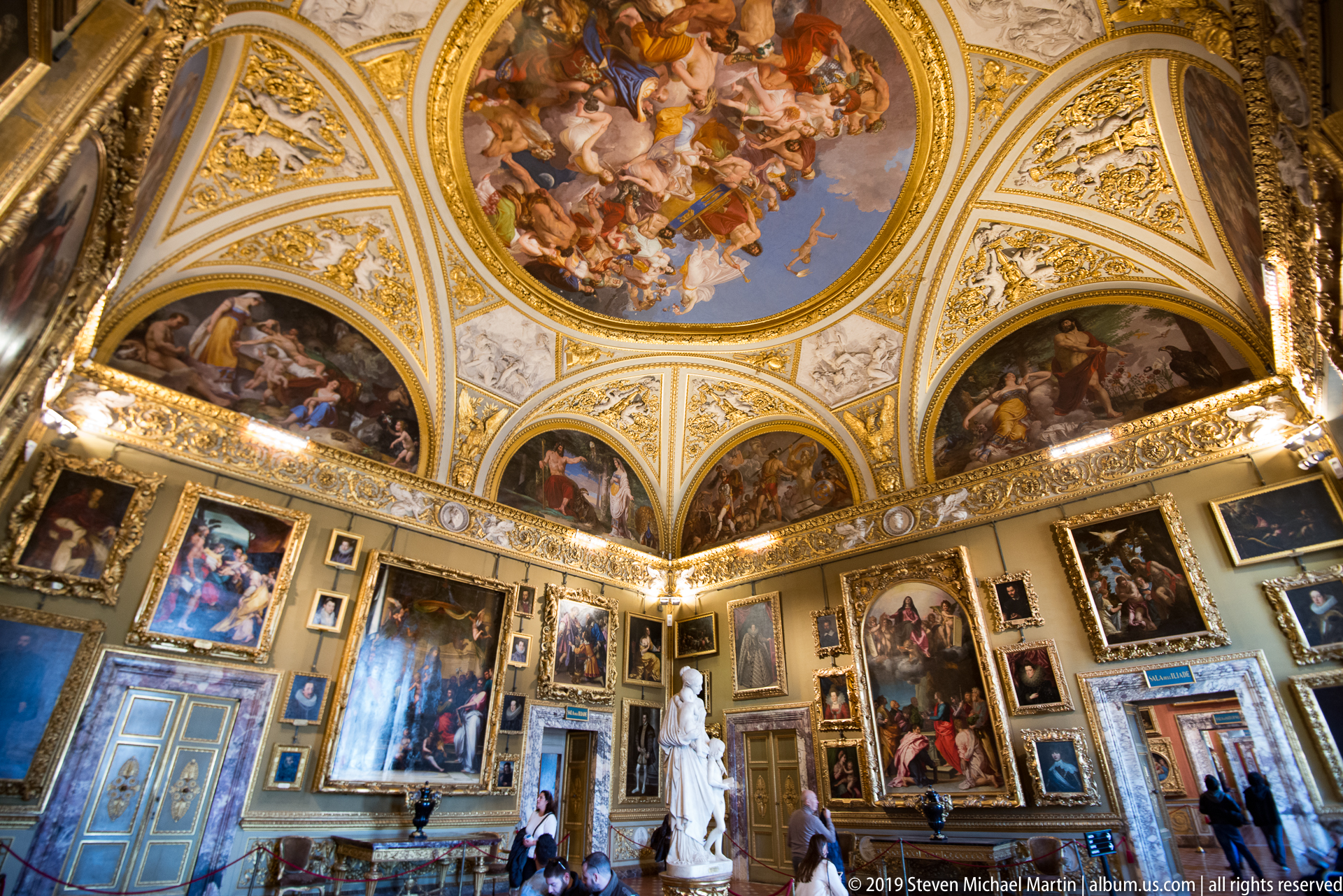
A wide-angle view brings the gallery’s decorative system together: densely hung paintings, sculptural display, patterned floor, gilded cornices, and a vault filled with frescoed compartments. Visitors at floor level provide scale, while the upward sweep of the architecture emphasizes how the ceiling program and picture collection were designed to be experienced as a continuous interior.
Caption
A wide-angle view brings the gallery’s decorative system together: densely hung paintings, sculptural display, patterned floor, gilded cornices, and a vault filled with frescoed compartments. Visitors at floor level provide scale, while the upward sweep of the architecture emphasizes how the ceiling program and picture collection were designed to be experienced as a continuous interior.

A symmetrical ceiling composition radiates from a small central painted panel through pale stucco fields, gilded reliefs, cartouches, and curved fresco compartments. Viewed almost directly upward, the photograph clarifies the ornamental geometry and the careful alternation of painted narrative scenes with sculptural decoration across the vault.
Caption
A symmetrical ceiling composition radiates from a small central painted panel through pale stucco fields, gilded reliefs, cartouches, and curved fresco compartments. Viewed almost directly upward, the photograph clarifies the ornamental geometry and the careful alternation of painted narrative scenes with sculptural decoration across the vault.

Heavy gilded moldings divide this ceiling bay into a large rectangular central fresco and two oval narrative scenes. Sculptural figures, scrolls, shells, and architectural ornament crowd the borders, producing a dense Baroque frame in which painted sky and figures appear embedded within a richly modeled decorative surface.
Caption
Heavy gilded moldings divide this ceiling bay into a large rectangular central fresco and two oval narrative scenes. Sculptural figures, scrolls, shells, and architectural ornament crowd the borders, producing a dense Baroque frame in which painted sky and figures appear embedded within a richly modeled decorative surface.

Two large narrative paintings meet at the corner of a deep red gallery beneath an exceptionally elaborate gilded cornice. Smaller works occupy the remaining wall space, while shell motifs, sculpted figures, and layered moldings animate the ceiling edge, showing the close visual competition between framed art and architectural ornament.
Caption
Two large narrative paintings meet at the corner of a deep red gallery beneath an exceptionally elaborate gilded cornice. Smaller works occupy the remaining wall space, while shell motifs, sculpted figures, and layered moldings animate the ceiling edge, showing the close visual competition between framed art and architectural ornament.

A long stone bath occupies the center of Napoleon’s Bathroom at Pitti Palace, framed symmetrically by four antique green marble columns reused in the early nineteenth-century interior. The columns, set on attic bases and crowned with Corinthian capitals, survive from the Napoleonic transformation of the palace apartments. Their dark green shafts give the compact bathing room an intentionally classical architectural character.
Caption
A long stone bath occupies the center of Napoleon’s Bathroom at Pitti Palace, framed symmetrically by four antique green marble columns reused in the early nineteenth-century interior. The columns, set on attic bases and crowned with Corinthian capitals, survive from the Napoleonic transformation of the palace apartments. Their dark green shafts give the compact bathing room an intentionally classical architectural character.

A white marble putto stands atop a shallow basin in front of a gray architectural niche, its twisting pose contrasting with the strict symmetry of the doorway and pediment behind. A colorful heraldic roundel above the arch introduces a vivid accent into an otherwise restrained stone interior.
Caption
A white marble putto stands atop a shallow basin in front of a gray architectural niche, its twisting pose contrasting with the strict symmetry of the doorway and pediment behind. A colorful heraldic roundel above the arch introduces a vivid accent into an otherwise restrained stone interior.

A circular ceiling fresco crowds numerous mythological figures around an enthroned central deity against a brilliant blue sky. The painting is enclosed by a broad gilded rim and white relief ornament, and the close view makes individual gestures, drapery colors, and the theatrical upward movement of the assembly especially legible.
Caption
A circular ceiling fresco crowds numerous mythological figures around an enthroned central deity against a brilliant blue sky. The painting is enclosed by a broad gilded rim and white relief ornament, and the close view makes individual gestures, drapery colors, and the theatrical upward movement of the assembly especially legible.

The decorated vault curves over a gallery crowded with paintings, sculpture, gilded frames, and architectural ornament. Oval and semicircular frescoes occupy the upper zones while a large circular scene crowns the ceiling, creating a layered setting in which the historic room itself functions as an essential part of the collection display.
Caption
The decorated vault curves over a gallery crowded with paintings, sculpture, gilded frames, and architectural ornament. Oval and semicircular frescoes occupy the upper zones while a large circular scene crowns the ceiling, creating a layered setting in which the historic room itself functions as an essential part of the collection display.

Four tall window panels are filled with repeating circular panes held in a dark leaded grid. Trees and landscape appear softly through the uneven glass, while the repeated roundels create a patterned screen between palace interior and exterior, emphasizing the texture and optical distortion of historic glazing.
Caption
Four tall window panels are filled with repeating circular panes held in a dark leaded grid. Trees and landscape appear softly through the uneven glass, while the repeated roundels create a patterned screen between palace interior and exterior, emphasizing the texture and optical distortion of historic glazing.

A pale green octagonal ceiling panel centers on a circular painting of a seated allegorical female figure. Fine floral garlands, small gilded motifs, and cream-colored relief ornament radiate around the medallion, creating a delicate decorative scheme that contrasts with the palace’s heavier gilded gallery ceilings.
Caption
A pale green octagonal ceiling panel centers on a circular painting of a seated allegorical female figure. Fine floral garlands, small gilded motifs, and cream-colored relief ornament radiate around the medallion, creating a delicate decorative scheme that contrasts with the palace’s heavier gilded gallery ceilings.

An oval mythological fresco occupies the center of a rectangular ceiling compartment, surrounded by gilded corner ornaments and broad monochrome relief-like scenes. The central group appears to rise through blue sky, while the subdued surrounding panels create a sculptural architectural frame that concentrates color at the center.
Caption
An oval mythological fresco occupies the center of a rectangular ceiling compartment, surrounded by gilded corner ornaments and broad monochrome relief-like scenes. The central group appears to rise through blue sky, while the subdued surrounding panels create a sculptural architectural frame that concentrates color at the center.

A large classical narrative scene fills an octagonal ceiling frame, with robed figures gathered in an architectural setting beneath a smoky sky and an apparition above. The broad pale-and-gold border separates the painting from surrounding stucco ornament, presenting the episode as a monumental history painting integrated into the ceiling.
Caption
A large classical narrative scene fills an octagonal ceiling frame, with robed figures gathered in an architectural setting beneath a smoky sky and an apparition above. The broad pale-and-gold border separates the painting from surrounding stucco ornament, presenting the episode as a monumental history painting integrated into the ceiling.

A richly compartmented ceiling combines grotesque ornament, small allegorical figures, heraldic shields, painted panels, and a central circular scene. The photograph records the decorative field nearly edge to edge, revealing a tightly ordered network of borders and motifs rather than a single dominant fresco.
Caption
A richly compartmented ceiling combines grotesque ornament, small allegorical figures, heraldic shields, painted panels, and a central circular scene. The photograph records the decorative field nearly edge to edge, revealing a tightly ordered network of borders and motifs rather than a single dominant fresco.

A long gallery recedes toward a distant doorway, with deep red walls carrying paintings in gilded frames opposite a continuous row of tall windows. Painted ceiling compartments, patterned terracotta flooring, and rope barriers reinforce the strong perspective, while daylight from the windows creates alternating bands of brightness across the historic interior.
Caption
A long gallery recedes toward a distant doorway, with deep red walls carrying paintings in gilded frames opposite a continuous row of tall windows. Painted ceiling compartments, patterned terracotta flooring, and rope barriers reinforce the strong perspective, while daylight from the windows creates alternating bands of brightness across the historic interior.

A pale green state room is organized symmetrically around paired columns, wall-mounted lights, classical busts, and a large crystal chandelier. White relief ornament and draped window treatments brighten the restrained palette, while polished furniture and a central display piece preserve the ceremonial character of the palace apartment.
Caption
A pale green state room is organized symmetrically around paired columns, wall-mounted lights, classical busts, and a large crystal chandelier. White relief ornament and draped window treatments brighten the restrained palette, while polished furniture and a central display piece preserve the ceremonial character of the palace apartment.

A dense monochrome marine scene shows numerous sailing warships maneuvering amid smoke, crowded masts, and choppy water. Flags punctuate the rigging while smaller craft gather around the larger vessels, and the restrained blue-gray palette gives the work the appearance of a large drawing or wash devoted to the confusion of naval combat.
Caption
A dense monochrome marine scene shows numerous sailing warships maneuvering amid smoke, crowded masts, and choppy water. Flags punctuate the rigging while smaller craft gather around the larger vessels, and the restrained blue-gray palette gives the work the appearance of a large drawing or wash devoted to the confusion of naval combat.

Paintings of many sizes line both walls of this narrow corridor from dado to near the ceiling, creating a compact study-gallery effect. Red rope barriers guide the central passage over a geometric floor, while the bright ceiling and distant doorway pull the eye through a collection display based on density and serial viewing.
Caption
Paintings of many sizes line both walls of this narrow corridor from dado to near the ceiling, creating a compact study-gallery effect. Red rope barriers guide the central passage over a geometric floor, while the bright ceiling and distant doorway pull the eye through a collection display based on density and serial viewing.

Wedge-shaped frescoes radiate around the center of a shallow dome, separated by crisp white-and-gold ribs and ornamental borders. The upward view excludes most furnishings to concentrate on the ceiling’s geometry, where repeated narrative panels form a continuous ring above the room’s doors and cornice.
Caption
Wedge-shaped frescoes radiate around the center of a shallow dome, separated by crisp white-and-gold ribs and ornamental borders. The upward view excludes most furnishings to concentrate on the ceiling’s geometry, where repeated narrative panels form a continuous ring above the room’s doors and cornice.

A monumental multi-figure painting dominates the wall above an elaborate console table and decorative casket. Draped figures cluster across a dark interior beneath a broad painted upper zone, while red upholstered chairs at either side and the richly carved furniture integrate the canvas into a formal palace display rather than a neutral museum setting.
Caption
A monumental multi-figure painting dominates the wall above an elaborate console table and decorative casket. Draped figures cluster across a dark interior beneath a broad painted upper zone, while red upholstered chairs at either side and the richly carved furniture integrate the canvas into a formal palace display rather than a neutral museum setting.

A muscular, partially draped Christ rises beside an angel in a dramatic religious painting, his body illuminated against a darkened background and his staff held upright as a sign of triumph. The angel’s vivid red garment and blue backdrop intensify the contrast with Christ’s pale flesh and white drapery, while the close framing concentrates attention on gesture, anatomy, and expression.
Caption
A muscular, partially draped Christ rises beside an angel in a dramatic religious painting, his body illuminated against a darkened background and his staff held upright as a sign of triumph. The angel’s vivid red garment and blue backdrop intensify the contrast with Christ’s pale flesh and white drapery, while the close framing concentrates attention on gesture, anatomy, and expression.

A violent mythological battle unfolds around centaurs and human combatants, with bodies, weapons, and fallen figures packed into a shallow foreground. The central centaur twists under attack as opposing groups converge from both sides, producing a forceful diagonal rhythm. A distant mountainous landscape contrasts with the physical struggle, giving the crowded scene a broader theatrical setting.
Caption
A violent mythological battle unfolds around centaurs and human combatants, with bodies, weapons, and fallen figures packed into a shallow foreground. The central centaur twists under attack as opposing groups converge from both sides, producing a forceful diagonal rhythm. A distant mountainous landscape contrasts with the physical struggle, giving the crowded scene a broader theatrical setting.

A classical mythological gathering unfolds in a wooded landscape around a helmeted warrior and a nearly nude male figure, with seated women, putti, and additional figures extending into the background. Bright draperies and carefully modeled bodies stand out against dark foliage, giving the composition the staged clarity of a large academic history painting.
Caption
A classical mythological gathering unfolds in a wooded landscape around a helmeted warrior and a nearly nude male figure, with seated women, putti, and additional figures extending into the background. Bright draperies and carefully modeled bodies stand out against dark foliage, giving the composition the staged clarity of a large academic history painting.

A central oval painting of a reclining figure anchors an exceptionally dense ceiling of grotesque ornament, heraldic shields, small figures, scrollwork, and architectural borders. The close framing reveals the decorative program’s layered symmetry and the contrast between the softly modeled central figure and the crisp, brightly colored ornamental field surrounding it.
Caption
A central oval painting of a reclining figure anchors an exceptionally dense ceiling of grotesque ornament, heraldic shields, small figures, scrollwork, and architectural borders. The close framing reveals the decorative program’s layered symmetry and the contrast between the softly modeled central figure and the crisp, brightly colored ornamental field surrounding it.

A sweeping mythological scene fills the ceiling with gods, attendants, airborne figures, and reclining river-like deities arranged across an open celestial setting. Strong foreshortening and theatrical gestures carry the composition beyond a simple framed picture, while the crowded foreground and cloud-filled upper zone create a staged transition between earthly and divine realms within the Pitti Palace interior.
Caption
A sweeping mythological scene fills the ceiling with gods, attendants, airborne figures, and reclining river-like deities arranged across an open celestial setting. Strong foreshortening and theatrical gestures carry the composition beyond a simple framed picture, while the crowded foreground and cloud-filled upper zone create a staged transition between earthly and divine realms within the Pitti Palace interior.

A monumental blue-and-gold ornamental urn commands the center of an elaborately decorated state room, framed by large narrative paintings, gilded moldings, red upholstered chairs, and a polished floor. The symmetrical display turns the vessel into a focal point while the surrounding wall paintings and architectural ornament reveal the dense layering of art and furnishings characteristic of the palace galleries.
Caption
A monumental blue-and-gold ornamental urn commands the center of an elaborately decorated state room, framed by large narrative paintings, gilded moldings, red upholstered chairs, and a polished floor. The symmetrical display turns the vessel into a focal point while the surrounding wall paintings and architectural ornament reveal the dense layering of art and furnishings characteristic of the palace galleries.

A continuous fresco frieze of processional and ceremonial figures runs around the upper walls of this restrained palace room. Pale painted panels, tall double doors, a terracotta-colored floor, and sparse seating leave the narrative wall decoration visually dominant, while daylight from the tall window clarifies the contrast between the richly figured upper register and the quieter architectural surfaces below.
Caption
A continuous fresco frieze of processional and ceremonial figures runs around the upper walls of this restrained palace room. Pale painted panels, tall double doors, a terracotta-colored floor, and sparse seating leave the narrative wall decoration visually dominant, while daylight from the tall window clarifies the contrast between the richly figured upper register and the quieter architectural surfaces below.

Dense gilded stuccowork surrounds a network of painted ceiling compartments populated by mythological figures and airborne putti. Sculptural white figures project from the gold framework at the corners, making the ceiling read as an integrated ensemble of painting, relief, and ornament rather than a flat decorative surface. The upward viewpoint emphasizes its geometric organization and lavish three-dimensional modeling.
Caption
Dense gilded stuccowork surrounds a network of painted ceiling compartments populated by mythological figures and airborne putti. Sculptural white figures project from the gold framework at the corners, making the ceiling read as an integrated ensemble of painting, relief, and ornament rather than a flat decorative surface. The upward viewpoint emphasizes its geometric organization and lavish three-dimensional modeling.

An intimate palace chamber combines a wall tapestry, framed paintings, a white marble sculpture, gilded paneling, patterned stone flooring, and red upholstered chairs around a small table. The compact arrangement illustrates how works in different media were integrated into furnished interiors, with the tapestry and sculpture balancing one another across the room and a small altar-like display anchoring the far wall.
Caption
An intimate palace chamber combines a wall tapestry, framed paintings, a white marble sculpture, gilded paneling, patterned stone flooring, and red upholstered chairs around a small table. The compact arrangement illustrates how works in different media were integrated into furnished interiors, with the tapestry and sculpture balancing one another across the room and a small altar-like display anchoring the far wall.

An elaborate mythological gathering combines reclining and seated figures, a laden table, putti, and armed protagonists in a wooded classical setting. Gestures and glances converge on the central confrontation, while smaller figures and sculptural forms recede into the landscape. Rich red, white, and flesh tones animate the foreground and distinguish the principal actors from the darker surrounding grove.
Caption
An elaborate mythological gathering combines reclining and seated figures, a laden table, putti, and armed protagonists in a wooded classical setting. Gestures and glances converge on the central confrontation, while smaller figures and sculptural forms recede into the landscape. Rich red, white, and flesh tones animate the foreground and distinguish the principal actors from the darker surrounding grove.

A tense mythological interior centers on a seated mother holding an infant as armed and gesturing men close in around her. In the foreground, a child grapples with a coiling serpent, adding a second point of danger to the composition. Strong contrasts of pale flesh, red drapery, dark clothing, and shadow heighten the scene’s theatrical urgency without requiring a precise narrative identification.
Caption
A tense mythological interior centers on a seated mother holding an infant as armed and gesturing men close in around her. In the foreground, a child grapples with a coiling serpent, adding a second point of danger to the composition. Strong contrasts of pale flesh, red drapery, dark clothing, and shadow heighten the scene’s theatrical urgency without requiring a precise narrative identification.

A long palace gallery recedes beneath a sequence of crystal chandeliers, with a red carpet defining the central axis and sculpted busts and figures displayed along both walls. Tall windows admit strong lateral daylight, while pale relief ornament and repeated doorways create a measured architectural rhythm. The deep perspective shows how the gallery functions simultaneously as passageway and sculpture display.
Caption
A long palace gallery recedes beneath a sequence of crystal chandeliers, with a red carpet defining the central axis and sculpted busts and figures displayed along both walls. Tall windows admit strong lateral daylight, while pale relief ornament and repeated doorways create a measured architectural rhythm. The deep perspective shows how the gallery functions simultaneously as passageway and sculpture display.

A monumental blue-and-gold urn rises in the foreground of a richly decorated gallery, set against large narrative paintings, gilded cornices, pale blue walls, and rows of red upholstered chairs. Seen from a closer angle than the companion room view, the vessel’s sculptural handles, dark blue body, and elaborate gilded mount become the dominant features of the composition.
Caption
A monumental blue-and-gold urn rises in the foreground of a richly decorated gallery, set against large narrative paintings, gilded cornices, pale blue walls, and rows of red upholstered chairs. Seen from a closer angle than the companion room view, the vessel’s sculptural handles, dark blue body, and elaborate gilded mount become the dominant features of the composition.

A closer upward view isolates the central compartments of an opulent gilded ceiling, where painted mythological scenes are embedded within dense scrollwork, garlands, and sculptural white figures. The tight framing reveals how octagonal and rectangular fields interlock through heavily modeled gold ornament. Painted illusion and projecting stucco combine to create a richly layered architectural surface overhead.
Caption
A closer upward view isolates the central compartments of an opulent gilded ceiling, where painted mythological scenes are embedded within dense scrollwork, garlands, and sculptural white figures. The tight framing reveals how octagonal and rectangular fields interlock through heavily modeled gold ornament. Painted illusion and projecting stucco combine to create a richly layered architectural surface overhead.

A crystal chandelier hangs above a red-carpeted passage framed by tall striped curtains and classical statues on pedestals. Additional sculpture groups occupy the side walls, creating a ceremonial threshold between adjoining gallery spaces. The frontal composition emphasizes symmetry: paired standing figures flank the opening while the carpet leads directly through the doorway toward another illuminated room beyond.
Caption
A crystal chandelier hangs above a red-carpeted passage framed by tall striped curtains and classical statues on pedestals. Additional sculpture groups occupy the side walls, creating a ceremonial threshold between adjoining gallery spaces. The frontal composition emphasizes symmetry: paired standing figures flank the opening while the carpet leads directly through the doorway toward another illuminated room beyond.

A standing nude male figure occupies the center of a formal sculpture display, flanked by two portrait busts raised on ornate pedestals. Wall-mounted candle branches and pale architectural paneling frame the ensemble symmetrically. The arrangement contrasts the full-length idealized body with individualized bust portraits, presenting three sculptural formats together within the palace gallery.
Caption
A standing nude male figure occupies the center of a formal sculpture display, flanked by two portrait busts raised on ornate pedestals. Wall-mounted candle branches and pale architectural paneling frame the ensemble symmetrically. The arrangement contrasts the full-length idealized body with individualized bust portraits, presenting three sculptural formats together within the palace gallery.

An expansive ceiling fresco opens onto a luminous painted sky crossed by a rainbow, with allegorical figures and putti distributed around the edges and across clouds. A standing robed figure anchors the lower center while airborne figures occupy the upper field. The composition uses the ceiling plane as an illusionistic opening, extending the decorated room visually into a celestial realm.
Caption
An expansive ceiling fresco opens onto a luminous painted sky crossed by a rainbow, with allegorical figures and putti distributed around the edges and across clouds. A standing robed figure anchors the lower center while airborne figures occupy the upper field. The composition uses the ceiling plane as an illusionistic opening, extending the decorated room visually into a celestial realm.

A symmetrical upward view centers the rectangular and octagonal paintings of an exceptionally ornate gilded ceiling. White sculptural figures, garlands, scrolls, and heavy gold relief bind the painted compartments into a unified decorative program. Compared with the tighter companion detail, this framing makes the ceiling’s axial geometry and repeated corner figures especially clear.
Caption
A symmetrical upward view centers the rectangular and octagonal paintings of an exceptionally ornate gilded ceiling. White sculptural figures, garlands, scrolls, and heavy gold relief bind the painted compartments into a unified decorative program. Compared with the tighter companion detail, this framing makes the ceiling’s axial geometry and repeated corner figures especially clear.

Two sculptural fountain basins align with a rising formal garden axis, where terraces, clipped hedges, statues, and a distant path climb into the wooded hillside. Visitors gathered near the lower fountain provide scale. The long view emphasizes the deliberate progression from animated water and stone sculpture in the foreground to ordered landscape architecture beyond.
Caption
Two sculptural fountain basins align with a rising formal garden axis, where terraces, clipped hedges, statues, and a distant path climb into the wooded hillside. Visitors gathered near the lower fountain provide scale. The long view emphasizes the deliberate progression from animated water and stone sculpture in the foreground to ordered landscape architecture beyond.

A barrel-vaulted gallery extends beneath crystal chandeliers, its walls lined with classical sculptures, busts, and ornate doors. Red carpet runners and rope barriers define the visitor route while tall arched windows illuminate the displays from one side. The long interior perspective highlights the repeated bays of the decorated vault and the gallery’s dense integration of sculpture and architecture.
Caption
A barrel-vaulted gallery extends beneath crystal chandeliers, its walls lined with classical sculptures, busts, and ornate doors. Red carpet runners and rope barriers define the visitor route while tall arched windows illuminate the displays from one side. The long interior perspective highlights the repeated bays of the decorated vault and the gallery’s dense integration of sculpture and architecture.

The massive rusticated façade of Pitti Palace fills the frame in a close architectural study. Deeply textured stone courses surround tall rectangular windows above a ground level of broad arches, producing the fortress-like weight characteristic of the exterior. Repetition across the elevation emphasizes the disciplined window rhythm while strong sunlight sharpens the relief of the projecting masonry.
Caption
The massive rusticated façade of Pitti Palace fills the frame in a close architectural study. Deeply textured stone courses surround tall rectangular windows above a ground level of broad arches, producing the fortress-like weight characteristic of the exterior. Repetition across the elevation emphasizes the disciplined window rhythm while strong sunlight sharpens the relief of the projecting masonry.

Pitti Palace’s White Hall, or Sala Bianca, stretches beneath its celebrated Neoclassical stuccowork and symmetrical array of crystal chandeliers. Created as the palace ballroom in 1774–1776 by Grato and Giocondo Albertolli, the room is the largest in the palace. Its luminous relief decoration and eleven chandeliers later formed the setting for the influential postwar fashion shows that helped make the Pitti name internationally synonymous with Italian fashion.
Caption
Pitti Palace’s White Hall, or Sala Bianca, stretches beneath its celebrated Neoclassical stuccowork and symmetrical array of crystal chandeliers. Created as the palace ballroom in 1774–1776 by Grato and Giocondo Albertolli, the room is the largest in the palace. Its luminous relief decoration and eleven chandeliers later formed the setting for the influential postwar fashion shows that helped make the Pitti name internationally synonymous with Italian fashion.

An oblique view across Pitti Palace’s White Hall brings its crystal chandeliers close to the viewer while the Albertolli brothers’ high-relief Neoclassical stuccowork recedes across the ceiling. Created in 1774–1776 as the palace ballroom, the Sala Bianca later became a landmark setting for Italian fashion shows beginning in the early 1950s. This angle emphasizes the historic chandeliers, mirrors, and luminous ornamental surfaces that define the room.
Caption
An oblique view across Pitti Palace’s White Hall brings its crystal chandeliers close to the viewer while the Albertolli brothers’ high-relief Neoclassical stuccowork recedes across the ceiling. Created in 1774–1776 as the palace ballroom, the Sala Bianca later became a landmark setting for Italian fashion shows beginning in the early 1950s. This angle emphasizes the historic chandeliers, mirrors, and luminous ornamental surfaces that define the room.

Pitti Palace extends across the broad paved forecourt in a long exterior view, its monumental rusticated stone façade organized by repeated arched and rectangular windows. Exhibition banners mark the central entrance while a fragment of heavy masonry in the foreground reinforces the building’s massive scale. The open piazza allows the elevation’s horizontal breadth and restrained symmetry to read clearly.
Caption
Pitti Palace extends across the broad paved forecourt in a long exterior view, its monumental rusticated stone façade organized by repeated arched and rectangular windows. Exhibition banners mark the central entrance while a fragment of heavy masonry in the foreground reinforces the building’s massive scale. The open piazza allows the elevation’s horizontal breadth and restrained symmetry to read clearly.

A barred rectangular window is set into the deeply rusticated stonework of the Pitti Palace exterior, capped by a shallow triangular pediment. Carved architectural blocks frame the opening, and a sculpted mask-like ornament appears beneath the sill. The close view isolates the contrast between refined classical detailing and the deliberately rough, strongly projecting masonry of the façade.
Caption
A barred rectangular window is set into the deeply rusticated stonework of the Pitti Palace exterior, capped by a shallow triangular pediment. Carved architectural blocks frame the opening, and a sculpted mask-like ornament appears beneath the sill. The close view isolates the contrast between refined classical detailing and the deliberately rough, strongly projecting masonry of the façade.

The White Hall is seen directly along its central axis, revealing the disciplined symmetry of Pitti Palace’s great ballroom. High-relief Neoclassical stuccowork by Grato and Giocondo Albertolli frames the pale ceiling and walls, while the historic chandeliers divide the long interior into measured intervals of light. Completed in 1776, the Sala Bianca later gained international renown as a setting for the fashion shows that helped establish Florence in postwar Italian fashion.
Caption
The White Hall is seen directly along its central axis, revealing the disciplined symmetry of Pitti Palace’s great ballroom. High-relief Neoclassical stuccowork by Grato and Giocondo Albertolli frames the pale ceiling and walls, while the historic chandeliers divide the long interior into measured intervals of light. Completed in 1776, the Sala Bianca later gained international renown as a setting for the fashion shows that helped establish Florence in postwar Italian fashion.

A wide angled view presents the monumental exterior of Pitti Palace, with successive stories of rusticated masonry and evenly spaced windows extending across the frame. The raised central block and flags break the long roofline, while banners and doorways identify the principal visitor zone below. The perspective reveals both the imposing scale of the stonework and the façade’s disciplined repetition.
Caption
A wide angled view presents the monumental exterior of Pitti Palace, with successive stories of rusticated masonry and evenly spaced windows extending across the frame. The raised central block and flags break the long roofline, while banners and doorways identify the principal visitor zone below. The perspective reveals both the imposing scale of the stonework and the façade’s disciplined repetition.
⭐ Highlights
- Medici Residence: The primary palace of Florence’s ruling family.
- Renaissance Power Center: A symbol of wealth, influence, and political authority.
- Palatine Gallery: A major collection of Renaissance paintings displayed in royal rooms.
- Boboli Gardens: One of the earliest and most influential formal Italian gardens.
- Royal Apartments: Lavishly decorated interiors reflecting court life.
- Largest Museum Complex: Today the palace houses multiple museums and collections.
🏰 Pitti Palace Field Guide
Major features observed during this visit:
Pitti Palace is one of the largest and most important Renaissance palaces in Florence, located across the Arno River from the historic city center. Originally built for a wealthy banker, it was later acquired by the Medici family and transformed into the principal residence of the Grand Dukes of Tuscany.
Over time, the palace expanded into a vast complex that reflected the power and influence of Florence’s ruling dynasties. Its rooms were filled with paintings, sculptures, and decorative works, creating an environment where art and political authority were closely connected.
🏛️ Signature Features
- Grand Façade – A massive stone exterior reflecting strength and authority.
- Palatine Gallery – Renaissance masterpieces displayed in richly decorated rooms.
- Royal Apartments – Rooms used by the Medici and later ruling families.
- Boboli Gardens – A large formal garden extending behind the palace.
- Interior Courtyard – A central architectural space linking the palace and gardens.
🧠 Historical Significance
- Medici Dynasty – The palace became the center of political and cultural power.
- Art Patronage – Collections reflect centuries of artistic investment.
- Dynastic Continuity – Later occupied by the Habsburg-Lorraine and Italian royal families.
- Public Transformation – Eventually converted into a museum for public access.
🌄 Urban Landscape & Experience
- Across the Arno – Located in the Oltrarno district, separate from Florence’s main historic core.
- Palace and Garden Integration – The building connects directly to expansive landscaped gardens.
- Interior Experience – Emphasis on rooms, collections, and decoration rather than exterior views.
- Scale and Grandeur – One of the largest palace complexes in Florence.