Giant’s Causeway – County Antrim, Northern Ireland
The Giant’s Causeway lies along the rugged Antrim Coast of Northern Ireland where dramatic cliffs rise above the North Atlantic Ocean. The site is famous for its extraordinary formation of thousands of hexagonal basalt columns, created by volcanic activity nearly 60 million years ago.
These natural stone pillars form stepping-stone patterns along the coastline, creating one of the most distinctive geological landscapes in the world. According to Irish legend, the formation was built by the giant Fionn mac Cumhaill (Finn McCool) as a causeway leading across the sea to Scotland.
Recognized as a UNESCO World Heritage Site, the Giant’s Causeway is one of Ireland’s most famous natural landmarks.

The white-painted Causeway Hotel stands beyond the dark stone walls and outdoor benches of the visitor-centre precinct. Its name is clearly lettered across the front gable, while the contrast between the traditional hotel façade and the contemporary black cladding records two distinct phases of visitor infrastructure at the site.
Caption
The white-painted Causeway Hotel stands beyond the dark stone walls and outdoor benches of the visitor-centre precinct. Its name is clearly lettered across the front gable, while the contrast between the traditional hotel façade and the contemporary black cladding records two distinct phases of visitor infrastructure at the site.

A large raised relief model spreads across a curved interpretive table inside the visitor centre, translating the Causeway Coast into a tactile three-dimensional landscape. Elevated ridges, shorelines, and settlement patterns are rendered at model scale, allowing visitors to understand the relationship between inland terrain and the basalt coast.
Caption
A large raised relief model spreads across a curved interpretive table inside the visitor centre, translating the Causeway Coast into a tactile three-dimensional landscape. Elevated ridges, shorelines, and settlement patterns are rendered at model scale, allowing visitors to understand the relationship between inland terrain and the basalt coast.

Rows of tightly packed basalt columns emerge from a rougher foreground of broken volcanic rock, their polygonal tops and vertical joints forming the characteristic geometry of the Giant’s Causeway. Sea spray and a pale winter horizon blur the background, emphasizing the exposed coastal setting of the UNESCO-listed geological formation.
Caption
Rows of tightly packed basalt columns emerge from a rougher foreground of broken volcanic rock, their polygonal tops and vertical joints forming the characteristic geometry of the Giant’s Causeway. Sea spray and a pale winter horizon blur the background, emphasizing the exposed coastal setting of the UNESCO-listed geological formation.

A wide sheet of wet polygonal basalt stretches from the foreground to the surf line, its dark, flat-topped blocks forming a broad natural terrace beneath a heavy gray sky. The low viewpoint emphasizes the remarkable continuity of the pavement before waves begin to overrun its seaward edge.
Caption
A wide sheet of wet polygonal basalt stretches from the foreground to the surf line, its dark, flat-topped blocks forming a broad natural terrace beneath a heavy gray sky. The low viewpoint emphasizes the remarkable continuity of the pavement before waves begin to overrun its seaward edge.

A low ridge of brown-gray basalt columns rises beyond a chaotic field of fractured rock, with closely spaced vertical joints forming an irregular stepped skyline. The composition contrasts intact columnar structure with weathered blocks in the foreground, illustrating how the Giant’s Causeway breaks down under coastal exposure.
Caption
A low ridge of brown-gray basalt columns rises beyond a chaotic field of fractured rock, with closely spaced vertical joints forming an irregular stepped skyline. The composition contrasts intact columnar structure with weathered blocks in the foreground, illustrating how the Giant’s Causeway breaks down under coastal exposure.

A higher viewpoint reveals patchwork fields, low coastal buildings, and successive rocky headlands projecting into rough Atlantic water. Snow remains in the nearest field while white surf traces the shore, creating a broad contextual view of the settled Causeway Coast around the Giant’s Causeway.
Caption
A higher viewpoint reveals patchwork fields, low coastal buildings, and successive rocky headlands projecting into rough Atlantic water. Snow remains in the nearest field while white surf traces the shore, creating a broad contextual view of the settled Causeway Coast around the Giant’s Causeway.

With both arms raised, a visitor stands on the basalt pavement beside a compact columnar mound as surf explodes across the shoreline. The gesture and open stance animate an otherwise austere geological scene, while the repeated polygonal blocks and vertical columns remain the defining visual structure.
Caption
With both arms raised, a visitor stands on the basalt pavement beside a compact columnar mound as surf explodes across the shoreline. The gesture and open stance animate an otherwise austere geological scene, while the repeated polygonal blocks and vertical columns remain the defining visual structure.

Angular basalt boulders and low columnar ledges fill the foreground while a broader outcrop sits offshore amid heavy surf. The view places intact columns beside fallen blocks and wave-cut rock, revealing multiple stages of erosion along the exposed Giant’s Causeway shoreline.
Caption
Angular basalt boulders and low columnar ledges fill the foreground while a broader outcrop sits offshore amid heavy surf. The view places intact columns beside fallen blocks and wave-cut rock, revealing multiple stages of erosion along the exposed Giant’s Causeway shoreline.

A solitary visitor stands on the stepped basalt pavement as heavy Atlantic surf breaks around the Giant’s Causeway. The raised mound of columnar rock at left and the broad field of wet polygonal blocks in the foreground show the formation at human scale, while the gray sky and white water convey the exposed winter conditions.
Caption
A solitary visitor stands on the stepped basalt pavement as heavy Atlantic surf breaks around the Giant’s Causeway. The raised mound of columnar rock at left and the broad field of wet polygonal blocks in the foreground show the formation at human scale, while the gray sky and white water convey the exposed winter conditions.

Basalt terraces and dark boulders form a maze of low ridges and wave-filled channels across the Giant’s Causeway shoreline. Beyond the white water, a low green headland rises under storm clouds, giving the image both geological detail and broad coastal context.
Caption
Basalt terraces and dark boulders form a maze of low ridges and wave-filled channels across the Giant’s Causeway shoreline. Beyond the white water, a low green headland rises under storm clouds, giving the image both geological detail and broad coastal context.

Inside the Giant’s Causeway visitor centre, a curved exhibition island combines landscape photographs, maps, graphics, and geological interpretation beneath a ceiling of small spotlights. The layered display introduces the coastal setting through both visual and tactile material, placing the World Heritage landscape in an interpretive context before visitors reach the shore.
Caption
Inside the Giant’s Causeway visitor centre, a curved exhibition island combines landscape photographs, maps, graphics, and geological interpretation beneath a ceiling of small spotlights. The layered display introduces the coastal setting through both visual and tactile material, placing the World Heritage landscape in an interpretive context before visitors reach the shore.

A two-lane road cuts through snow-covered countryside under a pale winter sky, with bare trees and hedges heavily coated in frost or fresh snow. Tire tracks expose dark pavement along the travel lanes, emphasizing the cold conditions encountered en route to the Giant’s Causeway during a wintry spell.
Caption
A two-lane road cuts through snow-covered countryside under a pale winter sky, with bare trees and hedges heavily coated in frost or fresh snow. Tire tracks expose dark pavement along the travel lanes, emphasizing the cold conditions encountered en route to the Giant’s Causeway during a wintry spell.

Rolling pasture and hedgerow fields lie under a light blanket of snow, while rows of leafless trees form dark horizontal bands across the winter landscape. Soft pink and blue light in the cloud cover gives the rural scene a subdued dawn-or-dusk atmosphere on the approach to the Giant’s Causeway.
Caption
Rolling pasture and hedgerow fields lie under a light blanket of snow, while rows of leafless trees form dark horizontal bands across the winter landscape. Soft pink and blue light in the cloud cover gives the rural scene a subdued dawn-or-dusk atmosphere on the approach to the Giant’s Causeway.

A metal farm gate opens onto low, snow-covered fields divided by clipped hedgerows and fence lines. Scattered houses sit near the horizon beneath a broad, pastel winter sky, creating a more settled agricultural view than the preceding roadside landscapes on the approach to the coast.
Caption
A metal farm gate opens onto low, snow-covered fields divided by clipped hedgerows and fence lines. Scattered houses sit near the horizon beneath a broad, pastel winter sky, creating a more settled agricultural view than the preceding roadside landscapes on the approach to the coast.

A low hillside rises behind a snowy field, its leafless trees and shrubs thickly frosted so that the woodland edge appears nearly white against the blue-gray sky. The scene records the unusual wintry conditions surrounding the Giant’s Causeway visit rather than the basalt coast itself.
Caption
A low hillside rises behind a snowy field, its leafless trees and shrubs thickly frosted so that the woodland edge appears nearly white against the blue-gray sky. The scene records the unusual wintry conditions surrounding the Giant’s Causeway visit rather than the basalt coast itself.

A triangular roadside warning sign is almost completely obscured by wind-driven snow, leaving only the red border visible against a muted residential background. The close view turns a routine traffic object into a concise record of the storm conditions affecting roads near the Giant’s Causeway.
Caption
A triangular roadside warning sign is almost completely obscured by wind-driven snow, leaving only the red border visible against a muted residential background. The close view turns a routine traffic object into a concise record of the storm conditions affecting roads near the Giant’s Causeway.

A small directional sign, crusted with snow and ice, retains only fragments of its message and a bold black arrow pointing right. The tight composition highlights how wintry accumulation obscured everyday wayfinding around the Giant’s Causeway region.
Caption
A small directional sign, crusted with snow and ice, retains only fragments of its message and a bold black arrow pointing right. The tight composition highlights how wintry accumulation obscured everyday wayfinding around the Giant’s Causeway region.

A dark stone clock tower rises from the center of a village road junction, framed by low masonry buildings and light winter snow. A round clock face near the top and the tower’s narrow vertical proportions make it the dominant civic landmark in the streetscape, while traffic signs and parked cars establish the everyday setting.
Caption
A dark stone clock tower rises from the center of a village road junction, framed by low masonry buildings and light winter snow. A round clock face near the top and the tower’s narrow vertical proportions make it the dominant civic landmark in the streetscape, while traffic signs and parked cars establish the everyday setting.

A broad agricultural field dusted with snow slopes toward a low, distant coastline beneath broken winter clouds. The subdued green-and-white foreground and pale sea create an early coastal overview, showing the open farming landscape that surrounds the Giant’s Causeway before the basalt formations come into view.
Caption
A broad agricultural field dusted with snow slopes toward a low, distant coastline beneath broken winter clouds. The subdued green-and-white foreground and pale sea create an early coastal overview, showing the open farming landscape that surrounds the Giant’s Causeway before the basalt formations come into view.

Snow-dusted grassland descends toward a rugged Atlantic shoreline where pale surf breaks along dark rock shelves. Low cloud and a gray-green sea compress the horizon, emphasizing the exposed winter conditions of the Causeway Coast rather than a specific named geological feature.
Caption
Snow-dusted grassland descends toward a rugged Atlantic shoreline where pale surf breaks along dark rock shelves. Low cloud and a gray-green sea compress the horizon, emphasizing the exposed winter conditions of the Causeway Coast rather than a specific named geological feature.

Dark, low headlands step across the foreground as heavy white surf breaks along the Causeway Coast. Across the bay or open water, a distant strip of buildings forms a pale horizontal line beneath the gray sky, adding human scale to the stormy winter seascape.
Caption
Dark, low headlands step across the foreground as heavy white surf breaks along the Causeway Coast. Across the bay or open water, a distant strip of buildings forms a pale horizontal line beneath the gray sky, adding human scale to the stormy winter seascape.

A loose flock of dark birds crosses the pale winter sky above the surf-lined Causeway Coast, their scattered silhouettes forming the principal subject against sea and low headlands. The composition shifts attention from geology to the exposed coastal environment and wildlife encountered at the World Heritage landscape.
Caption
A loose flock of dark birds crosses the pale winter sky above the surf-lined Causeway Coast, their scattered silhouettes forming the principal subject against sea and low headlands. The composition shifts attention from geology to the exposed coastal environment and wildlife encountered at the World Heritage landscape.

A freestanding orientation panel welcomes visitors to the Giant’s Causeway World Heritage Site and directs them toward the Causeway and admission areas. A site map and pictograms organize the lower half of the sign, making the photograph a useful record of visitor circulation and official World Heritage interpretation.
Caption
A freestanding orientation panel welcomes visitors to the Giant’s Causeway World Heritage Site and directs them toward the Causeway and admission areas. A site map and pictograms organize the lower half of the sign, making the photograph a useful record of visitor circulation and official World Heritage interpretation.

Tall, dark stone-clad fins frame a glazed opening at the Giant’s Causeway visitor centre, creating a sheltered threshold between the building and the coastal landscape beyond. The faceted masonry surfaces and narrow vertical supports echo the angular geometry associated with the basalt formations without directly reproducing them.
Caption
Tall, dark stone-clad fins frame a glazed opening at the Giant’s Causeway visitor centre, creating a sheltered threshold between the building and the coastal landscape beyond. The faceted masonry surfaces and narrow vertical supports echo the angular geometry associated with the basalt formations without directly reproducing them.

A low, irregular stone marker sits beside the path, its wet surface incised with partially legible lettering that includes “GIANT’S” and “CAUSEWAY.” Moss and weathering soften the inscription, while the green coastal slopes beyond place the marker within the immediate landscape of the World Heritage Site.
Caption
A low, irregular stone marker sits beside the path, its wet surface incised with partially legible lettering that includes “GIANT’S” and “CAUSEWAY.” Moss and weathering soften the inscription, while the green coastal slopes beyond place the marker within the immediate landscape of the World Heritage Site.

A long, open interior stretches through the Giant’s Causeway visitor centre, combining retail displays, information counters, and circulation space beneath a ceiling of evenly spaced pendant lights. Full-height glazing along one side brings daylight into the hall, while a vertical wayfinding panel marks visitor services near the foreground.
Caption
A long, open interior stretches through the Giant’s Causeway visitor centre, combining retail displays, information counters, and circulation space beneath a ceiling of evenly spaced pendant lights. Full-height glazing along one side brings daylight into the hall, while a vertical wayfinding panel marks visitor services near the foreground.

Color-coded exhibition zones inside the visitor centre present cultural stories and scientific interpretation through text panels, objects, photographs, and life-size figures. Panels bearing names such as Thomas Molyneaux and Alec Martin show how the gallery links people, research, and local history to the wider story of the Giant’s Causeway.
Caption
Color-coded exhibition zones inside the visitor centre present cultural stories and scientific interpretation through text panels, objects, photographs, and life-size figures. Panels bearing names such as Thomas Molyneaux and Alec Martin show how the gallery links people, research, and local history to the wider story of the Giant’s Causeway.

A small inlet opens between grass-covered coastal slopes, its dark rocks surrounded by churning white Atlantic surf. Patches of snow remain along the path and foreground grass, underscoring the severe winter weather while the sheltered cove introduces the rugged topography surrounding the Giant’s Causeway.
Caption
A small inlet opens between grass-covered coastal slopes, its dark rocks surrounded by churning white Atlantic surf. Patches of snow remain along the path and foreground grass, underscoring the severe winter weather while the sheltered cove introduces the rugged topography surrounding the Giant’s Causeway.

A steep, grass-covered promontory projects into the Atlantic, its eroded slopes dropping toward a boulder-strewn shore and foaming surf. A narrow footpath traces the lower slope, revealing the scale of the headland and the rugged walking terrain along the Giant’s Causeway coast.
Caption
A steep, grass-covered promontory projects into the Atlantic, its eroded slopes dropping toward a boulder-strewn shore and foaming surf. A narrow footpath traces the lower slope, revealing the scale of the headland and the rugged walking terrain along the Giant’s Causeway coast.

Rain-darkened polygonal column tops form a broad natural pavement across the Giant’s Causeway, their mostly hexagonal outlines fitting together like an irregular stone mosaic. Shallow water pools in joints and depressions while the sea appears beyond, giving a direct close-range view of the formation’s celebrated columnar geometry.
Caption
Rain-darkened polygonal column tops form a broad natural pavement across the Giant’s Causeway, their mostly hexagonal outlines fitting together like an irregular stone mosaic. Shallow water pools in joints and depressions while the sea appears beyond, giving a direct close-range view of the formation’s celebrated columnar geometry.

An uneven field of basalt columns climbs toward a slightly raised cluster near the surf, showing how individual prisms vary in height while retaining their polygonal cross-sections. Wet brown-gray surfaces, narrow joints, and patches of moss make the stepped structure especially legible at close range.
Caption
An uneven field of basalt columns climbs toward a slightly raised cluster near the surf, showing how individual prisms vary in height while retaining their polygonal cross-sections. Wet brown-gray surfaces, narrow joints, and patches of moss make the stepped structure especially legible at close range.
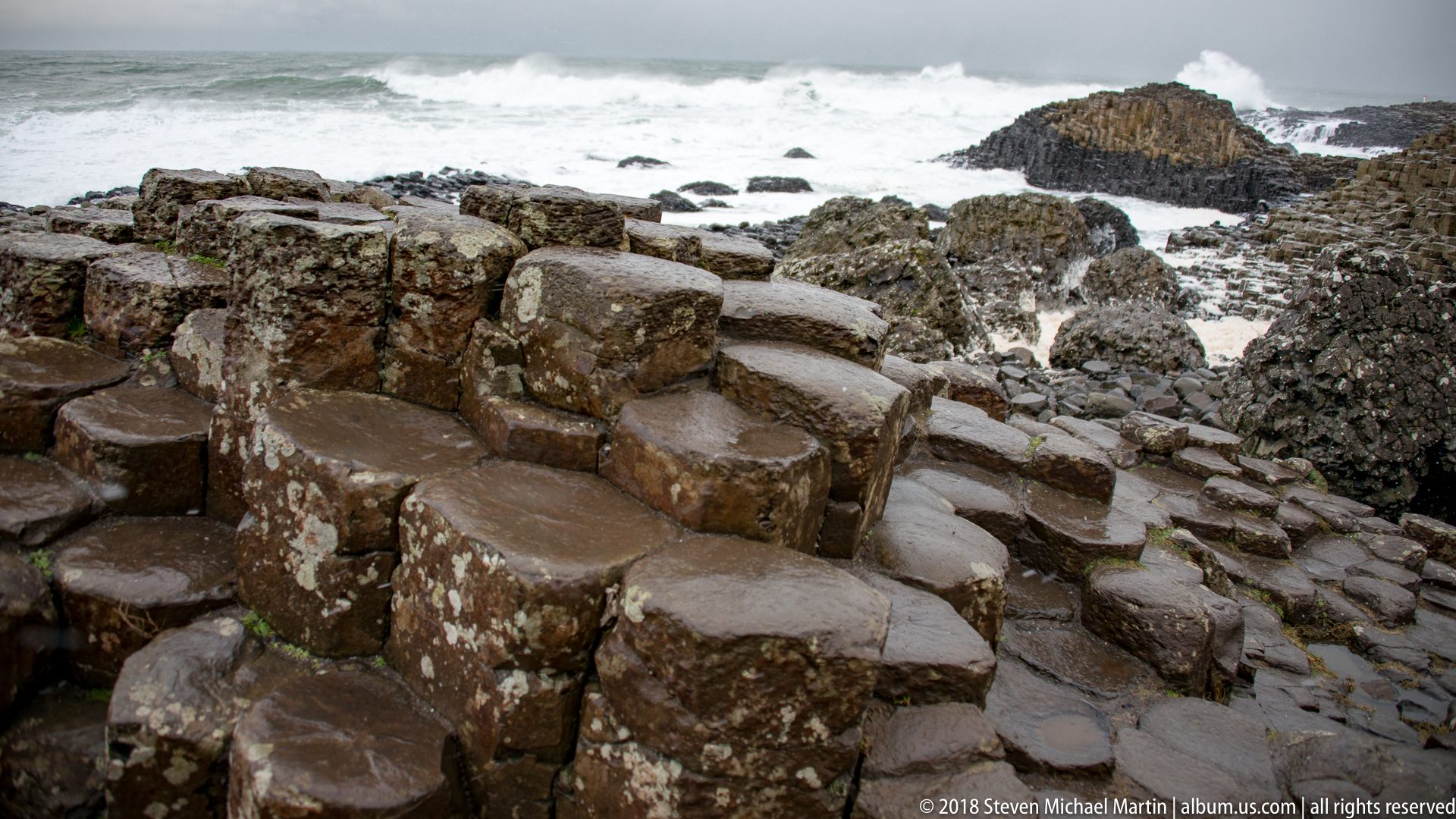
Large basalt prisms rise in the foreground like natural steps, their flat polygonal tops slick with moisture and their vertical faces mottled by lichen and weathering. Beyond them, lower columns descend toward rough Atlantic water, emphasizing both the size of individual blocks and the repeating joint pattern.
Caption
Large basalt prisms rise in the foreground like natural steps, their flat polygonal tops slick with moisture and their vertical faces mottled by lichen and weathering. Beyond them, lower columns descend toward rough Atlantic water, emphasizing both the size of individual blocks and the repeating joint pattern.

A low mass of columnar basalt stands amid turbulent white water, its vertical brown columns sharply exposed above darker rocks at the base. Wind-driven precipitation or sea spray streaks the scene, intensifying the winter conditions and showing how the Causeway’s volcanic structure continues into wave-battered coastal outcrops.
Caption
A low mass of columnar basalt stands amid turbulent white water, its vertical brown columns sharply exposed above darker rocks at the base. Wind-driven precipitation or sea spray streaks the scene, intensifying the winter conditions and showing how the Causeway’s volcanic structure continues into wave-battered coastal outcrops.

Low basalt shelves and rounded-to-angular blocks frame channels of white water where Atlantic waves wash through the Giant’s Causeway shoreline. A small columnar outcrop rises in the middle distance, while snow or sea spray softens the horizon, creating a broad environmental view of geology under active marine erosion.
Caption
Low basalt shelves and rounded-to-angular blocks frame channels of white water where Atlantic waves wash through the Giant’s Causeway shoreline. A small columnar outcrop rises in the middle distance, while snow or sea spray softens the horizon, creating a broad environmental view of geology under active marine erosion.

A low mound of tightly packed basalt columns rises from the wet shore, surrounded by fractured volcanic rock and shallow pools. Beyond it, a dark offshore headland and turbulent sea place the geological detail within the larger Causeway Coast landscape, contrasting the geometric columns with rougher eroded rock.
Caption
A low mound of tightly packed basalt columns rises from the wet shore, surrounded by fractured volcanic rock and shallow pools. Beyond it, a dark offshore headland and turbulent sea place the geological detail within the larger Causeway Coast landscape, contrasting the geometric columns with rougher eroded rock.
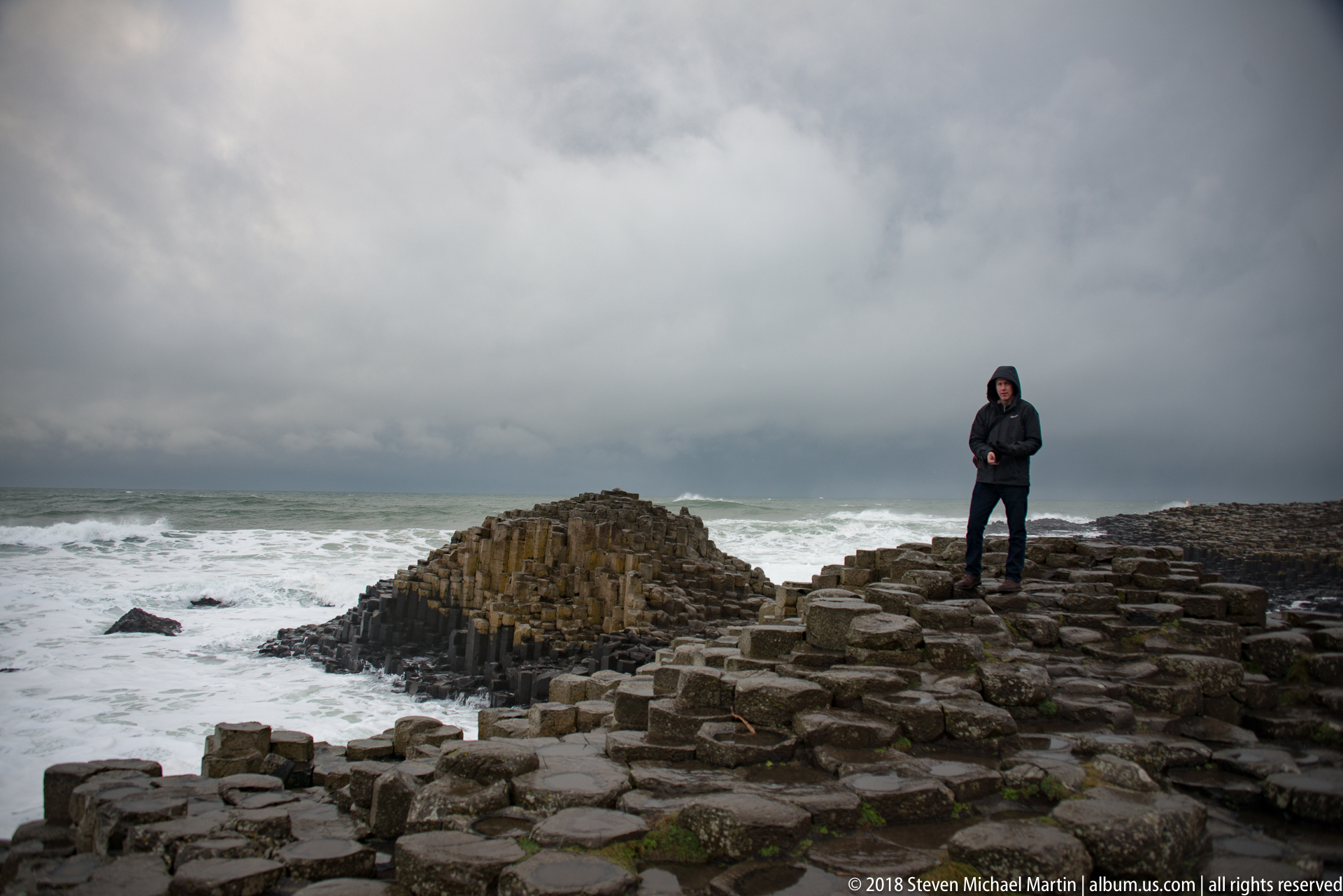
A visitor stands on the wet basalt pavement beside a prominent ridge of upright columns while large waves roll in behind. The composition places the person slightly right of center, using human scale to emphasize the height of the column cluster and the force of the winter Atlantic.
Caption
A visitor stands on the wet basalt pavement beside a prominent ridge of upright columns while large waves roll in behind. The composition places the person slightly right of center, using human scale to emphasize the height of the column cluster and the force of the winter Atlantic.

A squat mound of ochre and gray basalt columns rises just above the surrounding black rock and white water. Wet polygonal blocks fill the foreground, creating a layered study of intact columns, fallen stone, and active surf along the Giant’s Causeway shoreline.
Caption
A squat mound of ochre and gray basalt columns rises just above the surrounding black rock and white water. Wet polygonal blocks fill the foreground, creating a layered study of intact columns, fallen stone, and active surf along the Giant’s Causeway shoreline.
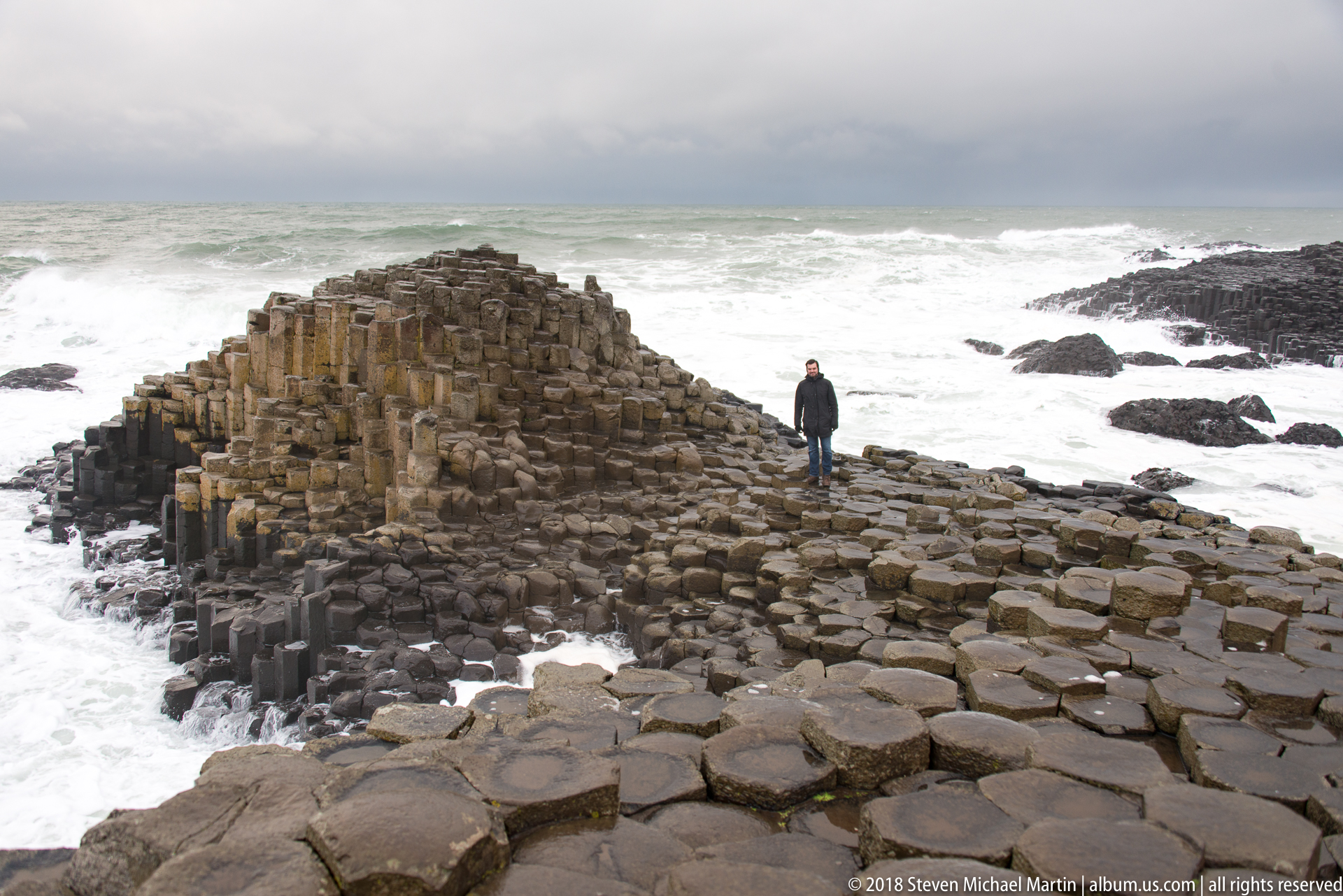
A visitor stands near the crest of a prominent basalt formation while broad polygonal column tops spread toward the camera. White surf nearly encircles the outcrop, making the stepped geometry of the Causeway appear as a narrow stone promontory projecting into the winter sea.
Caption
A visitor stands near the crest of a prominent basalt formation while broad polygonal column tops spread toward the camera. White surf nearly encircles the outcrop, making the stepped geometry of the Causeway appear as a narrow stone promontory projecting into the winter sea.

A visitor sits near the top of a steep, blocky mound of basalt columns while white Atlantic water churns behind. The elevated figure gives a strong sense of scale to the tightly packed prisms, whose vertical faces form a rough natural staircase from the surf to the crest.
Caption
A visitor sits near the top of a steep, blocky mound of basalt columns while white Atlantic water churns behind. The elevated figure gives a strong sense of scale to the tightly packed prisms, whose vertical faces form a rough natural staircase from the surf to the crest.

Perched among the upper basalt columns, a visitor raises one arm while a large breaking wave crests across the background. The elevated viewpoint compresses the human figure, columnar mound, and stormy sea into a single dramatic study of scale and exposure at the Giant’s Causeway.
Caption
Perched among the upper basalt columns, a visitor raises one arm while a large breaking wave crests across the background. The elevated viewpoint compresses the human figure, columnar mound, and stormy sea into a single dramatic study of scale and exposure at the Giant’s Causeway.

A closer portrait places a visitor among tall, wet basalt prisms, one foot raised on a higher block and one arm lifted toward the camera. Behind him, a powerful Atlantic wave rises across the frame, pairing the human scale of the columns with the energetic winter sea.
Caption
A closer portrait places a visitor among tall, wet basalt prisms, one foot raised on a higher block and one arm lifted toward the camera. Behind him, a powerful Atlantic wave rises across the frame, pairing the human scale of the columns with the energetic winter sea.

A broad field of wet polygonal column tops fills the foreground, narrowing toward a raised basalt mound beside the surf. The elevated angle makes the interlocking geometry especially clear, with shallow puddles darkening individual blocks and white water outlining the Causeway’s irregular edge.
Caption
A broad field of wet polygonal column tops fills the foreground, narrowing toward a raised basalt mound beside the surf. The elevated angle makes the interlocking geometry especially clear, with shallow puddles darkening individual blocks and white water outlining the Causeway’s irregular edge.

A narrow tongue of basalt extends from the polygonal pavement toward a compact raised mound almost surrounded by white water. Seen from above, the formation reads as a natural stone causeway projecting into the Atlantic, with darker blocks at the edges marking zones of greater wave exposure.
Caption
A narrow tongue of basalt extends from the polygonal pavement toward a compact raised mound almost surrounded by white water. Seen from above, the formation reads as a natural stone causeway projecting into the Atlantic, with darker blocks at the edges marking zones of greater wave exposure.

Large, rain-darkened polygonal blocks dominate the foreground, their joints forming an irregular honeycomb that leads toward a steep columnar mound. The high viewpoint emphasizes the transition from flat pavement to elevated prisms, while bright white surf fills the channels around the formation.
Caption
Large, rain-darkened polygonal blocks dominate the foreground, their joints forming an irregular honeycomb that leads toward a steep columnar mound. The high viewpoint emphasizes the transition from flat pavement to elevated prisms, while bright white surf fills the channels around the formation.

A visitor stands with both arms lifted atop a basalt mound at the edge of the Atlantic, silhouetted against a split sky of blue and dense storm cloud. The wide view balances human gesture with the black rock shelves, white surf, and distant headlands of the Causeway Coast.
Caption
A visitor stands with both arms lifted atop a basalt mound at the edge of the Atlantic, silhouetted against a split sky of blue and dense storm cloud. The wide view balances human gesture with the black rock shelves, white surf, and distant headlands of the Causeway Coast.

A visitor stands on the crest of a stepped basalt mound at the right edge of a broad coastal view. Wet polygonal blocks lead across the foreground toward dark offshore rocks and distant headlands, while a luminous opening in the storm clouds breaks above the rough sea.
Caption
A visitor stands on the crest of a stepped basalt mound at the right edge of a broad coastal view. Wet polygonal blocks lead across the foreground toward dark offshore rocks and distant headlands, while a luminous opening in the storm clouds breaks above the rough sea.

A long swath of polygonal basalt leads directly toward a raised central mound, with white surf breaking on both sides and low cliffs framing the horizon. A small visitor standing at the crest provides scale, making the formation read as a natural stone spine projecting into the sea.
Caption
A long swath of polygonal basalt leads directly toward a raised central mound, with white surf breaking on both sides and low cliffs framing the horizon. A small visitor standing at the crest provides scale, making the formation read as a natural stone spine projecting into the sea.

Massive vertical basalt prisms rise along the left side of the frame, their squared faces darkened by spray and weathering. At their base, shorter blocks and shallow pools descend toward bright white surf, giving a close side view of the Causeway’s columnar structure rather than its familiar polygonal tops.
Caption
Massive vertical basalt prisms rise along the left side of the frame, their squared faces darkened by spray and weathering. At their base, shorter blocks and shallow pools descend toward bright white surf, giving a close side view of the Causeway’s columnar structure rather than its familiar polygonal tops.

Viewed steeply downward, wet polygonal basalt column tops form a jagged edge above pale green water and white foam. The close perspective isolates the geometric pavement from the broader landscape, showing how the interlocking blocks terminate abruptly at the active shoreline.
Caption
Viewed steeply downward, wet polygonal basalt column tops form a jagged edge above pale green water and white foam. The close perspective isolates the geometric pavement from the broader landscape, showing how the interlocking blocks terminate abruptly at the active shoreline.

A tight overhead detail reveals individual basalt columns as interlocking five- and six-sided forms, their wet surfaces mottled with pale mineral staining and shallow puddles. The absence of horizon or landscape turns the famous formation into an almost abstract study of joint patterns, texture, and weathering.
Caption
A tight overhead detail reveals individual basalt columns as interlocking five- and six-sided forms, their wet surfaces mottled with pale mineral staining and shallow puddles. The absence of horizon or landscape turns the famous formation into an almost abstract study of joint patterns, texture, and weathering.

A dense wall of upright basalt prisms forms a natural colonnade, with broken blocks piled at its base and tufts of green vegetation lodged along the upper joints. The side-on view makes the near-parallel vertical fractures especially legible, revealing the structural character of the Giant’s Causeway beyond its familiar flat-topped pavement.
Caption
A dense wall of upright basalt prisms forms a natural colonnade, with broken blocks piled at its base and tufts of green vegetation lodged along the upper joints. The side-on view makes the near-parallel vertical fractures especially legible, revealing the structural character of the Giant’s Causeway beyond its familiar flat-topped pavement.

Rust-brown basalt columns form a steep wall at the right, stepping down toward shorter ochre blocks and a boulder-strewn shore. White surf surges through the gap beyond, contrasting the rigid vertical geometry of the prisms with the movement of the Atlantic.
Caption
Rust-brown basalt columns form a steep wall at the right, stepping down toward shorter ochre blocks and a boulder-strewn shore. White surf surges through the gap beyond, contrasting the rigid vertical geometry of the prisms with the movement of the Atlantic.

White foam swirls around dark basalt boulders as a wave drains through the rocky shoreline. The close composition minimizes the broader Causeway landscape to concentrate on active marine erosion, showing water surging through gaps between resistant volcanic blocks.
Caption
White foam swirls around dark basalt boulders as a wave drains through the rocky shoreline. The close composition minimizes the broader Causeway landscape to concentrate on active marine erosion, showing water surging through gaps between resistant volcanic blocks.

Low basalt prisms spread across the shore like uneven stone steps, their flat tops slick with water and tinged ochre by weathering. Taller columns rise at the right edge while black rocks punctuate the foaming sea, creating a low-angle study of the Causeway’s stepped relief.
Caption
Low basalt prisms spread across the shore like uneven stone steps, their flat tops slick with water and tinged ochre by weathering. Taller columns rise at the right edge while black rocks punctuate the foaming sea, creating a low-angle study of the Causeway’s stepped relief.

A visitor stands on broad, wet basalt slabs with a steep grass-covered cliff rising behind. The portrait shifts attention inland from the surf, pairing the geometric volcanic pavement with the layered coastal slope and showing the vertical enclosure of the Giant’s Causeway setting.
Caption
A visitor stands on broad, wet basalt slabs with a steep grass-covered cliff rising behind. The portrait shifts attention inland from the surf, pairing the geometric volcanic pavement with the layered coastal slope and showing the vertical enclosure of the Giant’s Causeway setting.

Against a blurred backdrop of surf and dark coastal cliffs, black gloved hands are held out to display scattered white pellets collected during the storm. The broader framing connects the frozen precipitation directly to the Giant’s Causeway shoreline, turning the weather itself into part of the visual record of the visit.
Caption
Against a blurred backdrop of surf and dark coastal cliffs, black gloved hands are held out to display scattered white pellets collected during the storm. The broader framing connects the frozen precipitation directly to the Giant’s Causeway shoreline, turning the weather itself into part of the visual record of the visit.

A visitor stands beside a low pyramid-like mound of basalt columns while a steep, sharply rising coastal slope fills the background. The layered composition links the small-scale geometry of the Causeway blocks with the much larger cliff landform behind, emphasizing the rugged topographic setting.
Caption
A visitor stands beside a low pyramid-like mound of basalt columns while a steep, sharply rising coastal slope fills the background. The layered composition links the small-scale geometry of the Causeway blocks with the much larger cliff landform behind, emphasizing the rugged topographic setting.

A dense terrace of basalt columns slopes into churning white water, with taller ochre prisms at left descending toward darker blocks along the seaward edge. The elevated view shows waves washing directly across the lower columns, making active coastal erosion the central subject.
Caption
A dense terrace of basalt columns slopes into churning white water, with taller ochre prisms at left descending toward darker blocks along the seaward edge. The elevated view shows waves washing directly across the lower columns, making active coastal erosion the central subject.

A breaking Atlantic wave explodes against a dark wall of basalt columns, sending white spray upward and across the flat-topped prisms. The tight frame isolates the moment of impact, revealing the direct mechanical force exerted by winter surf on the Giant’s Causeway shoreline.
Caption
A breaking Atlantic wave explodes against a dark wall of basalt columns, sending white spray upward and across the flat-topped prisms. The tight frame isolates the moment of impact, revealing the direct mechanical force exerted by winter surf on the Giant’s Causeway shoreline.

Retreating surf pours in thin white streams over a stepped face of basalt columns, briefly turning the volcanic terrace into a series of miniature waterfalls. The close view shows water exploiting the joints and height differences between prisms before draining back into the foaming sea.
Caption
Retreating surf pours in thin white streams over a stepped face of basalt columns, briefly turning the volcanic terrace into a series of miniature waterfalls. The close view shows water exploiting the joints and height differences between prisms before draining back into the foaming sea.

Heavy Atlantic waves strike the base of a dark, layered cliff, throwing spray against a vertical rock face beneath a grass-covered top. Repeated bands in the cliff and white water cascading over lower ledges create a broader coastal-geology view beyond the polygonal pavement of the main Causeway.
Caption
Heavy Atlantic waves strike the base of a dark, layered cliff, throwing spray against a vertical rock face beneath a grass-covered top. Repeated bands in the cliff and white water cascading over lower ledges create a broader coastal-geology view beyond the polygonal pavement of the main Causeway.

A lone visitor walks along the narrow paved road that follows the shoreline beneath steep, dark cliffs. Loose rock and grassy slopes rise sharply on the left while black shoreline stones and white Atlantic surf edge the road on the right, showing the confined coastal route through the Giant’s Causeway landscape in cold, wet weather.
Caption
A lone visitor walks along the narrow paved road that follows the shoreline beneath steep, dark cliffs. Loose rock and grassy slopes rise sharply on the left while black shoreline stones and white Atlantic surf edge the road on the right, showing the confined coastal route through the Giant’s Causeway landscape in cold, wet weather.

Rounded stones and dark boulders cover the shore of a shallow inlet where gray-green Atlantic water pushes into narrow channels between rocks. A low grass-covered headland closes the view at left, while the road climbs away along the slope, tying the exposed shoreline to the pedestrian route through the Giant’s Causeway coastal landscape.
Caption
Rounded stones and dark boulders cover the shore of a shallow inlet where gray-green Atlantic water pushes into narrow channels between rocks. A low grass-covered headland closes the view at left, while the road climbs away along the slope, tying the exposed shoreline to the pedestrian route through the Giant’s Causeway coastal landscape.

A visitor follows the paved coastal route as it curves toward a low headland, with a broad band of rounded stones and dark boulders separating the road from the sea. The receding line of pavement, shoreline, and surf creates a strong sense of movement through the exposed terrain beyond the main basalt pavement.
Caption
A visitor follows the paved coastal route as it curves toward a low headland, with a broad band of rounded stones and dark boulders separating the road from the sea. The receding line of pavement, shoreline, and surf creates a strong sense of movement through the exposed terrain beyond the main basalt pavement.

White surf spreads across a broad rocky bay enclosed by steep, grass-covered headlands under a low gray sky. The foreground meadow gives way to dark shoreline rock, while distant cliffs fade into mist, extending the Giant’s Causeway story from individual basalt columns to the larger storm-shaped coastal setting.
Caption
White surf spreads across a broad rocky bay enclosed by steep, grass-covered headlands under a low gray sky. The foreground meadow gives way to dark shoreline rock, while distant cliffs fade into mist, extending the Giant’s Causeway story from individual basalt columns to the larger storm-shaped coastal setting.

Small white pellets of wintry precipitation rest in a pair of black gloved hands, providing a close record of the harsh weather encountered along the Giant’s Causeway coast. Their rounded, bead-like form is consistent with small hail or graupel, while additional pellets remain caught on the gloves and waterproof clothing.
Caption
Small white pellets of wintry precipitation rest in a pair of black gloved hands, providing a close record of the harsh weather encountered along the Giant’s Causeway coast. Their rounded, bead-like form is consistent with small hail or graupel, while additional pellets remain caught on the gloves and waterproof clothing.

A narrow cove opens between steep, grass-covered slopes as rough Atlantic water breaks over black rocks below. A curtain of precipitation darkens the horizon offshore, while the enclosed foreground valley leads the eye directly toward the turbulent sea, documenting rapidly changing winter conditions along the Causeway Coast.
Caption
A narrow cove opens between steep, grass-covered slopes as rough Atlantic water breaks over black rocks below. A curtain of precipitation darkens the horizon offshore, while the enclosed foreground valley leads the eye directly toward the turbulent sea, documenting rapidly changing winter conditions along the Causeway Coast.

Long tawny grass lies flattened in sweeping bands across the slope, its blades dusted with white frozen precipitation. The close view records the combined effects of wind and wintry weather at the Giant’s Causeway, with the vegetation’s direction revealing strong gusts even without a visible horizon or landmark.
Caption
Long tawny grass lies flattened in sweeping bands across the slope, its blades dusted with white frozen precipitation. The close view records the combined effects of wind and wintry weather at the Giant’s Causeway, with the vegetation’s direction revealing strong gusts even without a visible horizon or landmark.

A green headland slopes toward a dark, rock-strewn shore where white Atlantic surf spreads across the bay. Thin snow or hail remains on the nearest grass, while the hazy horizon suggests another passing squall, giving this elevated view a strong sense of exposed winter weather along the Causeway Coast.
Caption
A green headland slopes toward a dark, rock-strewn shore where white Atlantic surf spreads across the bay. Thin snow or hail remains on the nearest grass, while the hazy horizon suggests another passing squall, giving this elevated view a strong sense of exposed winter weather along the Causeway Coast.

From higher ground, the coastline curves around a rocky bay filled with foaming water and scattered black outcrops. Frosted grass in the foreground and a pale veil over the sea reinforce the winter setting, while headlands on both sides create a balanced overview of the rugged shore surrounding the Giant’s Causeway.
Caption
From higher ground, the coastline curves around a rocky bay filled with foaming water and scattered black outcrops. Frosted grass in the foreground and a pale veil over the sea reinforce the winter setting, while headlands on both sides create a balanced overview of the rugged shore surrounding the Giant’s Causeway.

Tufts of long grass stream across a steep coastal slope, their green and tawny blades mottled with a light covering of frozen precipitation. Small exposed patches of dark earth interrupt the vegetation, emphasizing the uneven ground and the severity of the weather away from the more familiar basalt shoreline.
Caption
Tufts of long grass stream across a steep coastal slope, their green and tawny blades mottled with a light covering of frozen precipitation. Small exposed patches of dark earth interrupt the vegetation, emphasizing the uneven ground and the severity of the weather away from the more familiar basalt shoreline.

A freestanding visitor panel presents a map of the Giant’s Causeway World Heritage Site coastline together with route markers, safety notices, visitor information, and emergency guidance. Set directly against winter-beaten grass, the sign records how the landscape is interpreted and managed for visitors moving between the main geological formations and coastal paths.
Caption
A freestanding visitor panel presents a map of the Giant’s Causeway World Heritage Site coastline together with route markers, safety notices, visitor information, and emergency guidance. Set directly against winter-beaten grass, the sign records how the landscape is interpreted and managed for visitors moving between the main geological formations and coastal paths.

Patchwork fields divided by dark hedgerows and stone boundaries spread across rolling ground above the sea. A broad sweep of pale surf curves along the distant shoreline, placing the Giant’s Causeway within the cultivated rural landscape of Northern Ireland rather than isolating it as a single geological attraction.
Caption
Patchwork fields divided by dark hedgerows and stone boundaries spread across rolling ground above the sea. A broad sweep of pale surf curves along the distant shoreline, placing the Giant’s Causeway within the cultivated rural landscape of Northern Ireland rather than isolating it as a single geological attraction.

A small cluster of houses and chimneys occupies the foreground beneath broad green fields that descend toward dark, sheer coastal cliffs. White surf traces the cliff base and the sea beyond, creating a layered closing view of settlement, agriculture, geology, and ocean along the Causeway Coast.
Caption
A small cluster of houses and chimneys occupies the foreground beneath broad green fields that descend toward dark, sheer coastal cliffs. White surf traces the cliff base and the sea beyond, creating a layered closing view of settlement, agriculture, geology, and ocean along the Causeway Coast.
⭐ Highlights
- Basalt Columns: Around 40,000 interlocking stone columns forming a natural “pavement” along the coast.
- Volcanic Formation: Created by ancient lava flows that cooled and cracked into geometric shapes.
- Hexagonal Patterns: Many columns have six sides, creating a striking and regular appearance.
- UNESCO World Heritage Site: Recognized for its global geological significance.
- Atlantic Coastal Setting: Located along the rugged coastline of Northern Ireland.
- Giant Legend: Local mythology tells of a giant who built the causeway across the sea.
🌊 Giant’s Causeway Field Guide
Major features observed during this visit:
The Giant’s Causeway is one of the most remarkable natural landscapes in Europe, located on the northern coast of Northern Ireland. Formed by volcanic activity millions of years ago, the site consists of thousands of tightly packed basalt columns that extend from the base of the cliffs into the sea. The regularity of the formations creates a geometric landscape that appears almost man-made, contributing to both scientific interest and enduring mythological stories.
🪨 Geological Features
- Columnar Basalt – Vertical columns formed as lava cooled and contracted.
- Polygonal Shapes – Most columns are hexagonal, though other shapes occur.
- Stepped Formation – The tops of the columns create a natural pathway toward the sea.
- Cliff Integration – The columns extend into surrounding cliffs and coastal rock formations.
- Cooling Fractures – The pattern reflects natural cracking as molten rock solidified.
🧠 Scientific & Cultural Significance
- Volcanic Origins – Formed during a period of intense geological activity tens of millions of years ago.
- Geological Importance – A key site for understanding volcanic processes and rock formation.
- UNESCO Recognition – Protected for its exceptional natural value.
- Myth and Legend – Associated with stories of giants building a pathway across the sea.
🌄 Landscape & Setting
- North Atlantic Coast – Waves and weather shape the ongoing appearance of the site.
- Basalt Cliffs – The causeway sits at the base of dramatic coastal cliffs.
- Coastal Trails – Paths along the cliffs provide elevated views of the formations.
- Natural Wonder – The combination of geology and setting creates a unique visual experience.