
Rhodes Archaeological Museum
The Rhodes Archaeological Museum is housed within the former Hospital of the Knights, a medieval structure that reflects the island’s later historical importance. The collection preserves sculptures, inscriptions, ceramics, and funerary objects representing the cultural development of Rhodes from antiquity through the Hellenistic period. The building itself contributes to the interpretation of the exhibits by illustrating later phases of occupation.
Statues and decorative elements demonstrate artistic traditions influenced by trade connections across the eastern Mediterranean. Many objects originate from ancient sanctuaries and settlements on the island, providing context for the religious and civic life of the region. The museum allows visitors to understand how Rhodes participated in broader networks of cultural exchange.
Together with nearby archaeological sites, the museum helps reconstruct the historical continuity of the island. The preserved artifacts illustrate the artistic and political significance of Rhodes within the ancient Greek world.

Bright magenta bougainvillea climbs across the stone façade of a museum building, partially screening windows, balcony elements, and the pale masonry wall. Sunlight intensifies the contrast between the flowers and the warm stone, while surrounding greenery softens the architectural setting. The view shifts from artifact display to the landscaped character of the museum complex.
Caption
Bright magenta bougainvillea climbs across the stone façade of a museum building, partially screening windows, balcony elements, and the pale masonry wall. Sunlight intensifies the contrast between the flowers and the warm stone, while surrounding greenery softens the architectural setting. The view shifts from artifact display to the landscaped character of the museum complex.

A large stone arch spans a lush garden path, with a smaller arch visible beyond it and another massive masonry element entering from the upper right. Palms, shrubs, and flowering plants fill the intervening spaces, giving the historic stonework a layered, garden-like setting. The receding sequence of arches draws the eye through the landscaped grounds and emphasizes the surviving architectural fabric of the museum complex.
Caption
A large stone arch spans a lush garden path, with a smaller arch visible beyond it and another massive masonry element entering from the upper right. Palms, shrubs, and flowering plants fill the intervening spaces, giving the historic stonework a layered, garden-like setting. The receding sequence of arches draws the eye through the landscaped grounds and emphasizes the surviving architectural fabric of the museum complex.

A steep exterior stone staircase cuts diagonally across the courtyard, passing above an arched opening and linking the lower level with the upper gallery. Architectural fragments are gathered beneath the stair, including carved blocks and circular stone elements, while several large stone spheres rest near the adjoining arch. The view combines the building’s circulation structure with the courtyard’s open-air archaeological display.
Caption
A steep exterior stone staircase cuts diagonally across the courtyard, passing above an arched opening and linking the lower level with the upper gallery. Architectural fragments are gathered beneath the stair, including carved blocks and circular stone elements, while several large stone spheres rest near the adjoining arch. The view combines the building’s circulation structure with the courtyard’s open-air archaeological display.

An elaborately molded pointed arch opens into a long, low vaulted stone hall. Carved bands around the portal contrast with the darker interior, where successive arches draw the eye toward a bright courtyard opening in the distance. The centered viewpoint emphasizes the building’s depth, masonry construction, and transition from exterior light into the museum interior.
Caption
An elaborately molded pointed arch opens into a long, low vaulted stone hall. Carved bands around the portal contrast with the darker interior, where successive arches draw the eye toward a bright courtyard opening in the distance. The centered viewpoint emphasizes the building’s depth, masonry construction, and transition from exterior light into the museum interior.

An open doorway and low arch frame a sunlit exterior passage within the museum complex. Beyond the dark threshold, a stacked stone sculpture stands on a modern plinth beside historic masonry, creating a layered view from interior shadow to outdoor display. The composition emphasizes circulation through the building as well as the integration of archaeological objects into its courtyards.
Caption
An open doorway and low arch frame a sunlit exterior passage within the museum complex. Beyond the dark threshold, a stacked stone sculpture stands on a modern plinth beside historic masonry, creating a layered view from interior shadow to outdoor display. The composition emphasizes circulation through the building as well as the integration of archaeological objects into its courtyards.

A reclining stone lion occupies a low plinth in the museum courtyard, centered before three deep arched recesses with dark doorways. The sculpture’s rounded profile contrasts with the heavy ashlar masonry and repeated architectural openings behind it, while a low rope barrier separates the display from the gravel court. The frontal composition gives the lion a strong focal role within the medieval setting.
Caption
A reclining stone lion occupies a low plinth in the museum courtyard, centered before three deep arched recesses with dark doorways. The sculpture’s rounded profile contrasts with the heavy ashlar masonry and repeated architectural openings behind it, while a low rope barrier separates the display from the gravel court. The frontal composition gives the lion a strong focal role within the medieval setting.

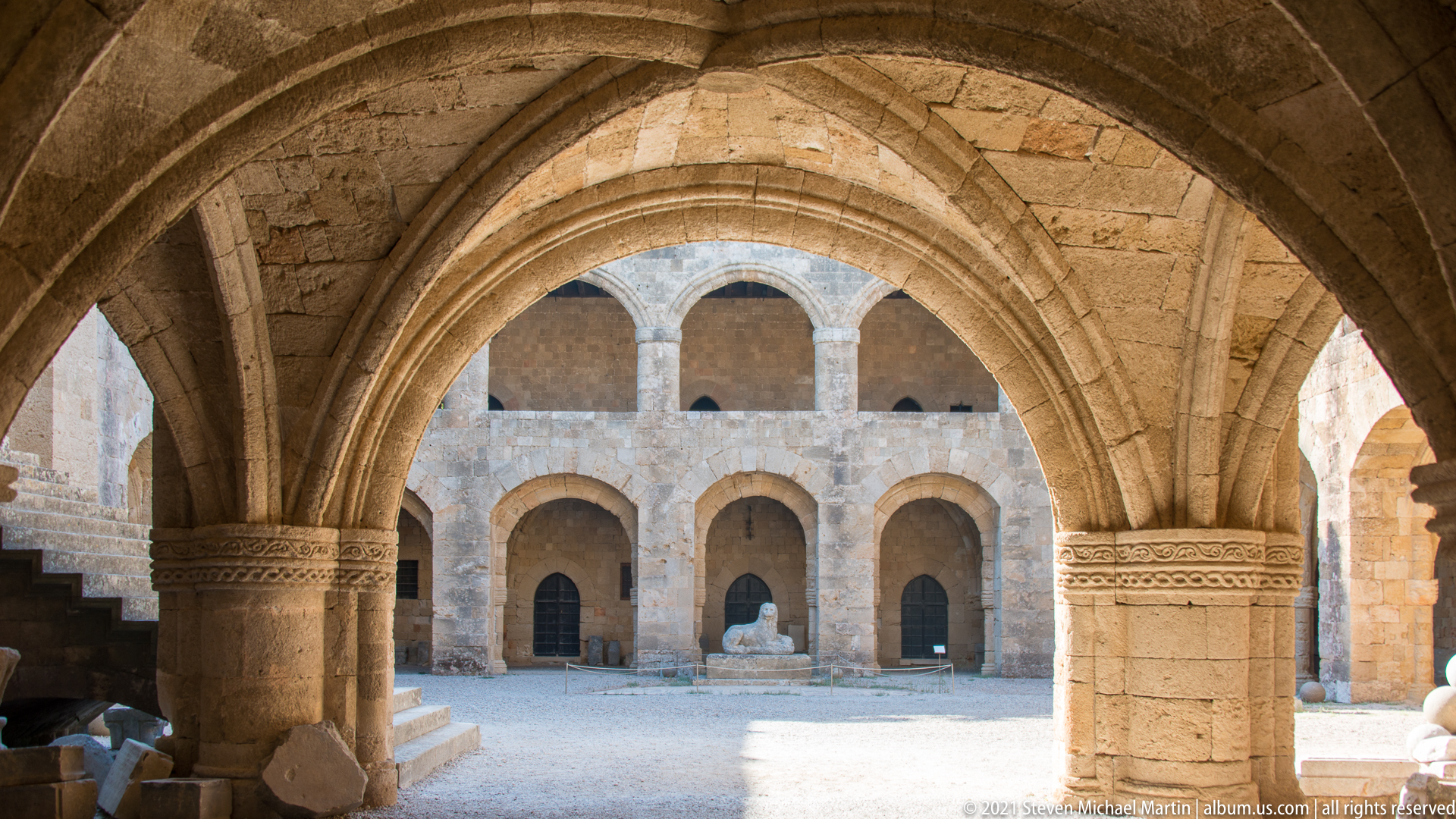
Seen through a broad pointed arch, the Rhodes Archaeological Museum courtyard opens onto two levels of stone arcades. Sunlight crosses the paving while the recessed lower galleries remain shaded, emphasizing the depth of the masonry and the ordered rhythm of the medieval building. Carved stone objects arranged around the court extend the museum display into this open architectural space.
Caption
Seen through a broad pointed arch, the Rhodes Archaeological Museum courtyard opens onto two levels of stone arcades. Sunlight crosses the paving while the recessed lower galleries remain shaded, emphasizing the depth of the masonry and the ordered rhythm of the medieval building. Carved stone objects arranged around the court extend the museum display into this open architectural space.

A visitor leans over a display case inside the museum, seen through a deep stone window or opening from an adjacent space. The framing creates a layered view of medieval masonry, modern glass cases, illuminated artifacts, and human engagement with the collection. Unlike the object-centered photographs nearby, this image documents how the historic building and museum installation are experienced together.
Caption
A visitor leans over a display case inside the museum, seen through a deep stone window or opening from an adjacent space. The framing creates a layered view of medieval masonry, modern glass cases, illuminated artifacts, and human engagement with the collection. Unlike the object-centered photographs nearby, this image documents how the historic building and museum installation are experienced together.

Freestanding stone objects occupy a sunlit museum court enclosed by historic masonry. A carved basin or capital-like object fills the foreground, with additional sculptures on modern plinths positioned near barred windows and doorways. The arrangement presents archaeological material within the architectural fabric of the museum rather than in a conventional enclosed gallery.
Caption
Freestanding stone objects occupy a sunlit museum court enclosed by historic masonry. A carved basin or capital-like object fills the foreground, with additional sculptures on modern plinths positioned near barred windows and doorways. The arrangement presents archaeological material within the architectural fabric of the museum rather than in a conventional enclosed gallery.

A close frontal view isolates the head and mane of a marble lion displayed in the museum courtyard. Deep carving around the cheeks and mane gives the face a powerful, textured appearance, while the open mouth exposes carved teeth and the rounded eyes project strongly from the worn surface. The shallow depth of field separates the lion from other stone fragments displayed behind it.
Caption
A close frontal view isolates the head and mane of a marble lion displayed in the museum courtyard. Deep carving around the cheeks and mane gives the face a powerful, textured appearance, while the open mouth exposes carved teeth and the rounded eyes project strongly from the worn surface. The shallow depth of field separates the lion from other stone fragments displayed behind it.

A close view of a black-figure vessel centers on a chariot team with paired horses, a driver, and surrounding standing figures. Incised lines describe reins, clothing, and the horses’ anatomy, while additional figures occupy the upper register. The tight crop emphasizes the complexity of the narrative painting and the density of detail preserved on the curved ceramic surface.
Caption
A close view of a black-figure vessel centers on a chariot team with paired horses, a driver, and surrounding standing figures. Incised lines describe reins, clothing, and the horses’ anatomy, while additional figures occupy the upper register. The tight crop emphasizes the complexity of the narrative painting and the density of detail preserved on the curved ceramic surface.

Viewed from below, the broad stone staircase rises toward the upper gallery, where tall arches spring from slender columns beneath a dark timber roof. Bright sunlight on the parapet and pale masonry contrasts sharply with the shaded gallery, clarifying the vertical organization of the courtyard. The upward angle concentrates attention on the relationship among stair, arcade, columns, and roof structure.
Caption
Viewed from below, the broad stone staircase rises toward the upper gallery, where tall arches spring from slender columns beneath a dark timber roof. Bright sunlight on the parapet and pale masonry contrasts sharply with the shaded gallery, clarifying the vertical organization of the courtyard. The upward angle concentrates attention on the relationship among stair, arcade, columns, and roof structure.

A painted ceramic vessel stands at the center of a museum case, its rounded body rising to a narrow neck modeled with a human face beneath a flaring top and looped handle. Horizontal bands and geometric ornament cover the surface, while smaller vessels nearby establish the scale of the object. Its combination of sculpted facial features and painted decoration distinguishes it within the ceramic display.
Caption
A painted ceramic vessel stands at the center of a museum case, its rounded body rising to a narrow neck modeled with a human face beneath a flaring top and looped handle. Horizontal bands and geometric ornament cover the surface, while smaller vessels nearby establish the scale of the object. Its combination of sculpted facial features and painted decoration distinguishes it within the ceramic display.

A cylindrical carved stone pedestal stands against the museum’s masonry wall, decorated in relief with a bull’s skull linked to hanging garlands. Molded bands frame the upper portion, while fruit or floral forms descend from the swags. The close framing isolates the classical decorative vocabulary and weathered surface, allowing the relief carving and stone texture to be studied apart from the larger architectural setting.
Caption
A cylindrical carved stone pedestal stands against the museum’s masonry wall, decorated in relief with a bull’s skull linked to hanging garlands. Molded bands frame the upper portion, while fruit or floral forms descend from the swags. The close framing isolates the classical decorative vocabulary and weathered surface, allowing the relief carving and stone texture to be studied apart from the larger architectural setting.

A broad two-handled ceramic vessel fills the display, its low rounded body encircled by dense geometric ornament. Cross-hatching, triangles, and horizontal bands organize the surface, while the short neck and wide flaring rim give the vessel a compact, balanced profile. The photograph emphasizes decoration and form rather than the case setting, making the painted patterning the principal subject.
Caption
A broad two-handled ceramic vessel fills the display, its low rounded body encircled by dense geometric ornament. Cross-hatching, triangles, and horizontal bands organize the surface, while the short neck and wide flaring rim give the vessel a compact, balanced profile. The photograph emphasizes decoration and form rather than the case setting, making the painted patterning the principal subject.

Concentric circular motifs dominate the body of this two-handled ceramic vessel, alternating with vertical panels of cross-hatching and angular ornament. A broad shoulder narrows into a tall neck and flaring rim, while the pale clay ground sets off the dark painted design. The close view makes the organization of the decoration especially legible across the vessel’s front.
Caption
Concentric circular motifs dominate the body of this two-handled ceramic vessel, alternating with vertical panels of cross-hatching and angular ornament. A broad shoulder narrows into a tall neck and flaring rim, while the pale clay ground sets off the dark painted design. The close view makes the organization of the decoration especially legible across the vessel’s front.

A small round-bodied ceramic flask carries a large painted human figure on its body, framed by dark and red ornamental fields. Its narrow neck rises to a broad disc-like rim, a profile characteristic of the aryballos family of small containers. Abrasion and losses interrupt the painted surface, but the vessel’s compact form and figured decoration remain readily legible.
Caption
A small round-bodied ceramic flask carries a large painted human figure on its body, framed by dark and red ornamental fields. Its narrow neck rises to a broad disc-like rim, a profile characteristic of the aryballos family of small containers. Abrasion and losses interrupt the painted surface, but the vessel’s compact form and figured decoration remain readily legible.

Five small ceramic pouring vessels are arranged in a line within the display case, each with a narrow neck, single loop handle, and elongated pear-shaped body. Differences in profile, painted bands, and surface wear become clear through the side-by-side presentation. The grouping emphasizes variation within a related vessel form rather than a single standout object.
Caption
Five small ceramic pouring vessels are arranged in a line within the display case, each with a narrow neck, single loop handle, and elongated pear-shaped body. Differences in profile, painted bands, and surface wear become clear through the side-by-side presentation. The grouping emphasizes variation within a related vessel form rather than a single standout object.

A small group of terracotta figurines stands on separate plinths inside the museum case. The central figure has a broad torso, short projecting arms, and a simplified head, while the flanking figures are taller and more columnar. Their worn surfaces and schematic modeling suggest hand-built votive or cult imagery, though the photograph does not establish a precise identity or date.
Caption
A small group of terracotta figurines stands on separate plinths inside the museum case. The central figure has a broad torso, short projecting arms, and a simplified head, while the flanking figures are taller and more columnar. Their worn surfaces and schematic modeling suggest hand-built votive or cult imagery, though the photograph does not establish a precise identity or date.

A large two-handled ceramic vessel carries a dense black-figure frieze of human figures interspersed with vegetal and animal ornament. Broad handles rise beside a flaring rim, while painted bands divide the shoulder and body into distinct decorative zones. The frontal view makes the contrast between the light clay ground and dark silhouettes especially clear without assigning an unverified mythological subject.
Caption
A large two-handled ceramic vessel carries a dense black-figure frieze of human figures interspersed with vegetal and animal ornament. Broad handles rise beside a flaring rim, while painted bands divide the shoulder and body into distinct decorative zones. The frontal view makes the contrast between the light clay ground and dark silhouettes especially clear without assigning an unverified mythological subject.

A large multi-handled ceramic jar is covered by a dense black-figure composition of human and animal forms arranged between dark ornamental zones. Its rounded body, high neck, and projecting handles create a monumental profile, while extensive abrasion breaks up the painted scene. The photograph supports identification as a figured storage or water vessel, but not a secure hydria attribution.
Caption
A large multi-handled ceramic jar is covered by a dense black-figure composition of human and animal forms arranged between dark ornamental zones. Its rounded body, high neck, and projecting handles create a monumental profile, while extensive abrasion breaks up the painted scene. The photograph supports identification as a figured storage or water vessel, but not a secure hydria attribution.

Large black silhouettes with added red and white details animate the principal panel of this two-handled ceramic vessel. Decorative borders frame the figures beneath a wide neck and flaring rim, while the warm clay ground provides a strong contrast to the painted scene. The frontal display preserves the composition clearly without assigning an unsupported mythological episode or precise vessel type.
Caption
Large black silhouettes with added red and white details animate the principal panel of this two-handled ceramic vessel. Decorative borders frame the figures beneath a wide neck and flaring rim, while the warm clay ground provides a strong contrast to the painted scene. The frontal display preserves the composition clearly without assigning an unsupported mythological episode or precise vessel type.

Displayed on a support that reveals its underside, this shallow stemmed cup presents a striking circular profile with two horizontal handles. A narrow band of small standing figures runs around the exterior near the rim, while the black-painted underside and foot dominate the composition. The unusual low viewpoint highlights the cup’s construction and the relationship between decoration and vessel shape.
Caption
Displayed on a support that reveals its underside, this shallow stemmed cup presents a striking circular profile with two horizontal handles. A narrow band of small standing figures runs around the exterior near the rim, while the black-painted underside and foot dominate the composition. The unusual low viewpoint highlights the cup’s construction and the relationship between decoration and vessel shape.

An interpretive museum panel outlines Rhodian colonization and maritime activity, describing the island’s naval strength, trade routes, overseas settlements, and political connections across the eastern Mediterranean. The photograph records the explanatory context accompanying the archaeological displays rather than an artifact itself, preserving part of the museum’s historical narrative about Rhodes and its wider networks.
Caption
An interpretive museum panel outlines Rhodian colonization and maritime activity, describing the island’s naval strength, trade routes, overseas settlements, and political connections across the eastern Mediterranean. The photograph records the explanatory context accompanying the archaeological displays rather than an artifact itself, preserving part of the museum’s historical narrative about Rhodes and its wider networks.

A black-figure kylix is shown from below at a low angle, emphasizing its stem, foot, shallow bowl, and outstretched handles. A continuous band of human figures circles the exterior against the clay-colored ground, while black-painted zones define the underside. The view complements the nearby cup display by concentrating on the vessel’s profile and narrative frieze rather than its interior.
Caption
A black-figure kylix is shown from below at a low angle, emphasizing its stem, foot, shallow bowl, and outstretched handles. A continuous band of human figures circles the exterior against the clay-colored ground, while black-painted zones define the underside. The view complements the nearby cup display by concentrating on the vessel’s profile and narrative frieze rather than its interior.

Two small terracotta figurines sit side by side on clear mounts. One wears a tall pointed headdress and rests with knees drawn in, while the other has a simpler head covering and a similarly compact seated pose. Traces of reddish surface color survive on both figures. Their placement as a pair makes differences in costume, posture, and modeling easy to compare.
Caption
Two small terracotta figurines sit side by side on clear mounts. One wears a tall pointed headdress and rests with knees drawn in, while the other has a simpler head covering and a similarly compact seated pose. Traces of reddish surface color survive on both figures. Their placement as a pair makes differences in costume, posture, and modeling easy to compare.

Repeated dark animal silhouettes encircle the shoulder of this squat ceramic vessel above a broad black lower zone. Short radiating strokes ornament the neck, and small handles project from the rounded body. The close view emphasizes the rhythmic animal frieze and compact profile while avoiding a more specific species or vessel-name attribution not supported by the photograph.
Caption
Repeated dark animal silhouettes encircle the shoulder of this squat ceramic vessel above a broad black lower zone. Short radiating strokes ornament the neck, and small handles project from the rounded body. The close view emphasizes the rhythmic animal frieze and compact profile while avoiding a more specific species or vessel-name attribution not supported by the photograph.

A painted terracotta plaque preserves a female face in low relief beneath a broad curved headdress or framing band. Faded red, blue, and dark pigments remain around the face and across the lower field, where stylized floral or radiating motifs survive. The flat rectangular support and projecting face distinguish the piece from the free-standing figurines displayed nearby.
Caption
A painted terracotta plaque preserves a female face in low relief beneath a broad curved headdress or framing band. Faded red, blue, and dark pigments remain around the face and across the lower field, where stylized floral or radiating motifs survive. The flat rectangular support and projecting face distinguish the piece from the free-standing figurines displayed nearby.

A large two-handled red-figure vessel presents a group of draped human figures across its broad body. Black glaze surrounds the reserved orange-red figures, with fine lines defining clothing folds and gestures. The wide shoulder, short neck, and paired vertical handles give the piece a monumental, balanced form, while the frontal museum display allows the central interaction among the figures to be read clearly.
Caption
A large two-handled red-figure vessel presents a group of draped human figures across its broad body. Black glaze surrounds the reserved orange-red figures, with fine lines defining clothing folds and gestures. The wide shoulder, short neck, and paired vertical handles give the piece a monumental, balanced form, while the frontal museum display allows the central interaction among the figures to be read clearly.

A terracotta female figure sits at one end of a low couch or bed-like furnishing, with a smaller reclining form or modeled element extending along the platform. The figurine preserves the suggestion of dress, hair, and furniture despite a worn surface and losses. The miniature scene is more complex than a free-standing statuette, implying a domestic, funerary, or votive context that the photograph alone cannot determine.
Caption
A terracotta female figure sits at one end of a low couch or bed-like furnishing, with a smaller reclining form or modeled element extending along the platform. The figurine preserves the suggestion of dress, hair, and furniture despite a worn surface and losses. The miniature scene is more complex than a free-standing statuette, implying a domestic, funerary, or votive context that the photograph alone cannot determine.

Two terracotta head fragments are displayed together, each preserving stylized facial features and traces of dark or blue pigment in the hair. The frontal head at left has long locks framing the face, while the profile-oriented head at right shows a more compact coiffure. Their close placement allows comparison of modeling, painted detail, and surviving surface color.
Caption
Two terracotta head fragments are displayed together, each preserving stylized facial features and traces of dark or blue pigment in the hair. The frontal head at left has long locks framing the face, while the profile-oriented head at right shows a more compact coiffure. Their close placement allows comparison of modeling, painted detail, and surviving surface color.

Two small blue-green glazed objects are shaped like ribbed shells, each terminating in pointed projections and fitted with a small opening or element at the top. Their glossy turquoise surfaces and deeply modeled ribs distinguish them from the surrounding terracotta material. Because the photograph cannot establish whether the material is faience or glazed ceramic, the caption retains the visually secure description.
Caption
Two small blue-green glazed objects are shaped like ribbed shells, each terminating in pointed projections and fitted with a small opening or element at the top. Their glossy turquoise surfaces and deeply modeled ribs distinguish them from the surrounding terracotta material. Because the photograph cannot establish whether the material is faience or glazed ceramic, the caption retains the visually secure description.

A cylindrical marble monument combines carved inscriptions with relief panels arranged in horizontal registers. A winged or eagle-like motif occupies the upper zone, while a rectangular panel below contains several human figures; molded bands separate the decorated fields. The surviving imagery and lettering indicate a commemorative or dedicatory context, although the export does not securely establish whether the object functioned as an altar, pedestal, or funerary monument.
Caption
A cylindrical marble monument combines carved inscriptions with relief panels arranged in horizontal registers. A winged or eagle-like motif occupies the upper zone, while a rectangular panel below contains several human figures; molded bands separate the decorated fields. The surviving imagery and lettering indicate a commemorative or dedicatory context, although the export does not securely establish whether the object functioned as an altar, pedestal, or funerary monument.

This red-figure vessel combines a reclining or seated figure with standing figures across the curving body, all reserved in orange-red against a glossy black ground. A Greek-key-like border runs beneath the scene, while the broad handles and flaring rim frame the composition. The photograph emphasizes the contrast between the dark glaze, warm clay, and delicately drawn anatomical and drapery details.
Caption
This red-figure vessel combines a reclining or seated figure with standing figures across the curving body, all reserved in orange-red against a glossy black ground. A Greek-key-like border runs beneath the scene, while the broad handles and flaring rim frame the composition. The photograph emphasizes the contrast between the dark glaze, warm clay, and delicately drawn anatomical and drapery details.

A small painted vessel with a broad disc-like rim displays dark figured decoration around its rounded body. A horse-like animal and nearby human or ornamental forms appear within the main frieze, surrounded by scrolling and geometric motifs. The image is slightly soft, so the general black-figure decoration is evident even though the exact narrative subject and vessel type cannot be securely resolved.
Caption
A small painted vessel with a broad disc-like rim displays dark figured decoration around its rounded body. A horse-like animal and nearby human or ornamental forms appear within the main frieze, surrounded by scrolling and geometric motifs. The image is slightly soft, so the general black-figure decoration is evident even though the exact narrative subject and vessel type cannot be securely resolved.

A tall carved stone slab displays a shield enclosed by a broad wreath-like frame, with a long pendant ornament descending below. Set against the museum’s rough masonry wall, the pale relief stands out through its shallow carving and formal heraldic arrangement. Surface wear and a vertical fracture remain visible, preserving evidence of the object’s age and condition.
Caption
A tall carved stone slab displays a shield enclosed by a broad wreath-like frame, with a long pendant ornament descending below. Set against the museum’s rough masonry wall, the pale relief stands out through its shallow carving and formal heraldic arrangement. Surface wear and a vertical fracture remain visible, preserving evidence of the object’s age and condition.

A spacious stone hall inside the Rhodes Archaeological Museum is shown almost empty, its medieval masonry illuminated by tall narrow windows. A large pointed decorative arch frames the central wall, while timber ceiling elements and suspended lighting span the upper space. The restrained installation reveals the scale and architectural character of the former hospital building more clearly than the object-filled galleries.
Caption
A spacious stone hall inside the Rhodes Archaeological Museum is shown almost empty, its medieval masonry illuminated by tall narrow windows. A large pointed decorative arch frames the central wall, while timber ceiling elements and suspended lighting span the upper space. The restrained installation reveals the scale and architectural character of the former hospital building more clearly than the object-filled galleries.

At the springing of two stone arches, a carved capital carries a shield framed by curling foliage. The compact heraldic motif interrupts the otherwise massive masonry pier, while the dark timber roof behind it clarifies the capital’s structural position. Tooling, weathering, and softened edges remain visible across the pale stone surface.
Caption
At the springing of two stone arches, a carved capital carries a shield framed by curling foliage. The compact heraldic motif interrupts the otherwise massive masonry pier, while the dark timber roof behind it clarifies the capital’s structural position. Tooling, weathering, and softened edges remain visible across the pale stone surface.

Stone ribs radiate from a circular central boss across a vaulted interior, converging beneath bands of carved architectural molding. The upward viewpoint isolates the geometry of the vault and shows how the ribs divide the ceiling into distinct cells. Uneven coloration and surface wear emphasize the age and texture of the masonry.
Caption
Stone ribs radiate from a circular central boss across a vaulted interior, converging beneath bands of carved architectural molding. The upward viewpoint isolates the geometry of the vault and shows how the ribs divide the ceiling into distinct cells. Uneven coloration and surface wear emphasize the age and texture of the masonry.

Three shields are carved side by side across a rectangular pale stone panel. Each bears a different geometric heraldic device, creating a compact sequence of emblems within a shared architectural block. The shallow relief, worn edges, and small surface losses are clearly visible against the surrounding rough-cut masonry.
Caption
Three shields are carved side by side across a rectangular pale stone panel. Each bears a different geometric heraldic device, creating a compact sequence of emblems within a shared architectural block. The shallow relief, worn edges, and small surface losses are clearly visible against the surrounding rough-cut masonry.

A marble head of a youthful male is shown frontally against a plain museum background. Short, deeply worked curls frame the forehead and temples, while the smooth cheeks, straight nose, and softly modeled mouth create an idealized expression. Minor abrasions and discoloration mark the surviving surface without obscuring the carefully balanced facial proportions.
Caption
A marble head of a youthful male is shown frontally against a plain museum background. Short, deeply worked curls frame the forehead and temples, while the smooth cheeks, straight nose, and softly modeled mouth create an idealized expression. Minor abrasions and discoloration mark the surviving surface without obscuring the carefully balanced facial proportions.

A shallow wall fountain combines a rectangular stone basin with an upright decorated panel. Floral motifs rise around a central vase-like form beneath a circular rosette, all enclosed by carved or painted borders. A small outlet projects near the base of the panel, making the object’s water function legible despite the worn surface and muted coloration.
Caption
A shallow wall fountain combines a rectangular stone basin with an upright decorated panel. Floral motifs rise around a central vase-like form beneath a circular rosette, all enclosed by carved or painted borders. A small outlet projects near the base of the panel, making the object’s water function legible despite the worn surface and muted coloration.

A large fragmentary mosaic pavement is enclosed by a broad border of repeating wave-like scrolls. Much of the central field is worn or missing, but surviving tesserae preserve portions of a figural scene and inner geometric framing. The losses expose the uneven history of preservation while the intact border still conveys the original decorative structure.
Caption
A large fragmentary mosaic pavement is enclosed by a broad border of repeating wave-like scrolls. Much of the central field is worn or missing, but surviving tesserae preserve portions of a figural scene and inner geometric framing. The losses expose the uneven history of preservation while the intact border still conveys the original decorative structure.

A small stone monument with a pedimented niche rises against the courtyard wall above an extensive mosaic pavement. The floor is organized around a large radiating circular motif bordered by repeating geometric bands, while the elevated monument provides a vertical focal point. Together, the remains demonstrate how architectural and pavement elements are displayed in situ-like relation within the museum court.
Caption
A small stone monument with a pedimented niche rises against the courtyard wall above an extensive mosaic pavement. The floor is organized around a large radiating circular motif bordered by repeating geometric bands, while the elevated monument provides a vertical focal point. Together, the remains demonstrate how architectural and pavement elements are displayed in situ-like relation within the museum court.

A vivid blue ceiling is organized as a radial composition around a multicolored geometric rosette. Fine gold-colored lines extend outward like spokes, ending in small ornamental motifs, while painted foliage fills the corners. The symmetrical design transforms the flat surface into a strongly centralized decorative field distinct from the museum’s exposed stone architecture.
Caption
A vivid blue ceiling is organized as a radial composition around a multicolored geometric rosette. Fine gold-colored lines extend outward like spokes, ending in small ornamental motifs, while painted foliage fills the corners. The symmetrical design transforms the flat surface into a strongly centralized decorative field distinct from the museum’s exposed stone architecture.

This rectangular mosaic combines a dense geometric field with a freer vegetal outer border. Interlocking diamonds and angular compartments surround small figural or decorative panels, while curling stems and heart-shaped leaves extend around the perimeter. Areas of loss interrupt the center, but the surviving tesserae preserve the contrast between disciplined geometry and flowing plant ornament.
Caption
This rectangular mosaic combines a dense geometric field with a freer vegetal outer border. Interlocking diamonds and angular compartments surround small figural or decorative panels, while curling stems and heart-shaped leaves extend around the perimeter. Areas of loss interrupt the center, but the surviving tesserae preserve the contrast between disciplined geometry and flowing plant ornament.

A surviving mosaic panel centers on a circular composition formed by repeated dark spiral motifs around a small inner medallion. Thin rectangular borders organize the surrounding pale field, while extensive losses reveal the fragmentary condition of the pavement. The strong concentric design remains legible despite missing sections along the edges and upper surface.
Caption
A surviving mosaic panel centers on a circular composition formed by repeated dark spiral motifs around a small inner medallion. Thin rectangular borders organize the surrounding pale field, while extensive losses reveal the fragmentary condition of the pavement. The strong concentric design remains legible despite missing sections along the edges and upper surface.

A mounted fragment of ancient pavement preserves a compact rectangular panel containing a dark animal figure framed by patterned borders. Large areas of the surrounding tessellated surface are missing, leaving the central motif isolated within an irregular field. The museum mounting makes both the surviving mosaic and the extent of loss easy to compare.
Caption
A mounted fragment of ancient pavement preserves a compact rectangular panel containing a dark animal figure framed by patterned borders. Large areas of the surrounding tessellated surface are missing, leaving the central motif isolated within an irregular field. The museum mounting makes both the surviving mosaic and the extent of loss easy to compare.

A large winged female figure dominates this fragmentary mosaic, standing frontally with wings spread across a dark ground. Elaborate scrolling borders survive at the left and in detached sections to the right, while losses interrupt both the figure and surrounding decoration. The monumental scale and symmetrical pose make the winged figure the unmistakable focus of the composition.
Caption
A large winged female figure dominates this fragmentary mosaic, standing frontally with wings spread across a dark ground. Elaborate scrolling borders survive at the left and in detached sections to the right, while losses interrupt both the figure and surrounding decoration. The monumental scale and symmetrical pose make the winged figure the unmistakable focus of the composition.

A large museum interpretation panel presents dense blocks of text with small comparative illustrations and documentary images. Organized into multiple columns and numbered sections, the display provides scholarly context for nearby archaeological material rather than presenting an artifact itself. From this distance the individual text is not reliably legible, but the panel’s educational function and structured layout are clear.
Caption
A large museum interpretation panel presents dense blocks of text with small comparative illustrations and documentary images. Organized into multiple columns and numbered sections, the display provides scholarly context for nearby archaeological material rather than presenting an artifact itself. From this distance the individual text is not reliably legible, but the panel’s educational function and structured layout are clear.

A mounted mosaic depicts a rider seated on a horse shown in profile, the figure extending one arm forward while holding an object or reins. A narrow scrolling border encloses the dark tessellated field, contrasting with the lighter figure and horse. The surviving panel is comparatively complete, allowing the movement of the horse and rider to remain clearly readable.
Caption
A mounted mosaic depicts a rider seated on a horse shown in profile, the figure extending one arm forward while holding an object or reins. A narrow scrolling border encloses the dark tessellated field, contrasting with the lighter figure and horse. The surviving panel is comparatively complete, allowing the movement of the horse and rider to remain clearly readable.

A dramatic mosaic scene centers on a winged horse rearing above a fallen or reclining figure while another human figure rides or stands above its back. A scrolling vegetal border encloses the dark field and sharpens the pale silhouettes of the figures. The mythological subject is visually clear as a winged-horse scene, although the precise episode is not established by the proof sheet alone.
Caption
A dramatic mosaic scene centers on a winged horse rearing above a fallen or reclining figure while another human figure rides or stands above its back. A scrolling vegetal border encloses the dark field and sharpens the pale silhouettes of the figures. The mythological subject is visually clear as a winged-horse scene, although the precise episode is not established by the proof sheet alone.

The upper portion of a ceramic vessel is modeled as a human face, with prominent eyes, nose, and mouth emerging from a dark painted surface. A pale flaring rim crowns the head-like neck, and cracks and losses cross the aged fabric. The close view isolates the anthropomorphic treatment, showing how vessel form and facial modeling were combined into a single object.
Caption
The upper portion of a ceramic vessel is modeled as a human face, with prominent eyes, nose, and mouth emerging from a dark painted surface. A pale flaring rim crowns the head-like neck, and cracks and losses cross the aged fabric. The close view isolates the anthropomorphic treatment, showing how vessel form and facial modeling were combined into a single object.

A ceramic pouring vessel takes the form of a bird, its rounded body supported on small feet and terminating in a modeled head at one end. A tall neck and loop handle rise from the back, while dark linear decoration crosses the pale body in energetic strokes. The object combines recognizable animal anatomy with the practical components of a handled pouring vessel.
Caption
A ceramic pouring vessel takes the form of a bird, its rounded body supported on small feet and terminating in a modeled head at one end. A tall neck and loop handle rise from the back, while dark linear decoration crosses the pale body in energetic strokes. The object combines recognizable animal anatomy with the practical components of a handled pouring vessel.

A heavily weathered terracotta figurine preserves a compact human form with a broad head, projecting arms, and a roughly modeled torso. Surface erosion has softened most facial and anatomical details, while breaks and irregularities reveal the object’s fragmentary condition. The simple silhouette remains legible even though a more precise identity or function cannot be established from the photograph alone.
Caption
A heavily weathered terracotta figurine preserves a compact human form with a broad head, projecting arms, and a roughly modeled torso. Surface erosion has softened most facial and anatomical details, while breaks and irregularities reveal the object’s fragmentary condition. The simple silhouette remains legible even though a more precise identity or function cannot be established from the photograph alone.

A broad two-handled vessel carries multiple black-figure registers around its rounded body. The main frieze contains large animals and smaller human figures, while additional painted bands continue across the shoulder and lower body. Numerous restored joins are visible across the surface, showing the vessel’s reconstructed condition without obscuring the surviving figural decoration.
Caption
A broad two-handled vessel carries multiple black-figure registers around its rounded body. The main frieze contains large animals and smaller human figures, while additional painted bands continue across the shoulder and lower body. Numerous restored joins are visible across the surface, showing the vessel’s reconstructed condition without obscuring the surviving figural decoration.

A dark bronze object curves upward in a serpentine form and terminates in a modeled animal head with an elongated snout. A small vessel-like opening and projecting elements rise from the upper body, while incised or cast patterning covers the textured surface. The complex zoomorphic design is clear, although the precise original function is not established by the photograph alone.
Caption
A dark bronze object curves upward in a serpentine form and terminates in a modeled animal head with an elongated snout. A small vessel-like opening and projecting elements rise from the upper body, while incised or cast patterning covers the textured surface. The complex zoomorphic design is clear, although the precise original function is not established by the photograph alone.

A small ceramic object is shaped like a crested helmet, with a frontal face opening and projecting side elements. White painted scrollwork decorates the dark reddish-brown surface, while lighter vertical marks articulate the lower edge. Displayed alone on a clear mount, the miniature form can be read from the front as both a modeled object and a decorated ceramic surface.
Caption
A small ceramic object is shaped like a crested helmet, with a frontal face opening and projecting side elements. White painted scrollwork decorates the dark reddish-brown surface, while lighter vertical marks articulate the lower edge. Displayed alone on a clear mount, the miniature form can be read from the front as both a modeled object and a decorated ceramic surface.

A small elongated figurine stands upright on a museum mount, its simplified head marked by large eyes and a narrow mouth. The arms are folded or held across the torso, and dark dotted or linear decoration covers the body and lower garment. The frontal display highlights the combination of modeled human form and painted surface patterning.
Caption
A small elongated figurine stands upright on a museum mount, its simplified head marked by large eyes and a narrow mouth. The arms are folded or held across the torso, and dark dotted or linear decoration covers the body and lower garment. The frontal display highlights the combination of modeled human form and painted surface patterning.

A terracotta female head retains extensive painted detail, including dark brows, outlined eyes, a softly smiling mouth, and dotted ornament at the neck. Long hair falls in vertical strands beside the face, with additional painted marks surviving across the pale surface. The frontal museum display emphasizes both the sculptural modeling and the unusually legible traces of color.
Caption
A terracotta female head retains extensive painted detail, including dark brows, outlined eyes, a softly smiling mouth, and dotted ornament at the neck. Long hair falls in vertical strands beside the face, with additional painted marks surviving across the pale surface. The frontal museum display emphasizes both the sculptural modeling and the unusually legible traces of color.

Horses, chariots, and armed figures crowd this close view of a black-figure vase. Incised lines articulate anatomy, armor, wheels, and harnesses, while short inscriptions appear among the figures and meander bands frame the narrative register. The detail reveals the painter’s organization of a complex martial or processional scene without assigning a specific mythological episode not established by the available record.
Caption
Horses, chariots, and armed figures crowd this close view of a black-figure vase. Incised lines articulate anatomy, armor, wheels, and harnesses, while short inscriptions appear among the figures and meander bands frame the narrative register. The detail reveals the painter’s organization of a complex martial or processional scene without assigning a specific mythological episode not established by the available record.

This large two-handled ceramic vessel presents a broad narrative frieze around its rounded body beneath a tall dark neck. Black-figure horses and human figures occupy the main register, framed by meanders, rays, and repeated geometric bands at the shoulder, rim, and foot. The full-object view shows how the figural scene is integrated into a carefully balanced decorative scheme.
Caption
This large two-handled ceramic vessel presents a broad narrative frieze around its rounded body beneath a tall dark neck. Black-figure horses and human figures occupy the main register, framed by meanders, rays, and repeated geometric bands at the shoulder, rim, and foot. The full-object view shows how the figural scene is integrated into a carefully balanced decorative scheme.

The interior of a reconstructed dark-glazed bowl centers on a circular figural medallion surrounded by a band of elongated decorative elements. Numerous joins and filled losses cross the glossy black surface, making the vessel’s conservation history highly visible. The overhead viewpoint isolates the relationship between the central painted figure and the otherwise dark interior field.
Caption
The interior of a reconstructed dark-glazed bowl centers on a circular figural medallion surrounded by a band of elongated decorative elements. Numerous joins and filled losses cross the glossy black surface, making the vessel’s conservation history highly visible. The overhead viewpoint isolates the relationship between the central painted figure and the otherwise dark interior field.

A fragmentary black-figure composition preserves the rounded body of a large dark animal surrounded by partially surviving human figures. Extensive abrasion and missing surface interrupt the scene, but fine incised lines remain visible across the animal’s body and adjacent forms. The close crop emphasizes both the original painted technique and the degree of archaeological loss.
Caption
A fragmentary black-figure composition preserves the rounded body of a large dark animal surrounded by partially surviving human figures. Extensive abrasion and missing surface interrupt the scene, but fine incised lines remain visible across the animal’s body and adjacent forms. The close crop emphasizes both the original painted technique and the degree of archaeological loss.

A compact two-handled amphora displays paired winged figures across its orange-red body, rendered in dark paint with incised internal detail. Floral and geometric ornaments fill the surrounding registers, while the handles, neck, and foot retain a glossy dark finish. Smaller vessels placed nearby provide scale and reinforce the amphora’s role within a broader ceramic display.
Caption
A compact two-handled amphora displays paired winged figures across its orange-red body, rendered in dark paint with incised internal detail. Floral and geometric ornaments fill the surrounding registers, while the handles, neck, and foot retain a glossy dark finish. Smaller vessels placed nearby provide scale and reinforce the amphora’s role within a broader ceramic display.

A close view of a black-figure vessel preserves a dense figural scene in which standing human figures confront one another beneath the bodies and wings of large birds. Incised lines pick out garments, hair, feathers, and facial details against the orange clay ground. Abrasion and losses interrupt the painted surface, but the crowded composition and strong silhouettes remain clearly legible.
Caption
A close view of a black-figure vessel preserves a dense figural scene in which standing human figures confront one another beneath the bodies and wings of large birds. Incised lines pick out garments, hair, feathers, and facial details against the orange clay ground. Abrasion and losses interrupt the painted surface, but the crowded composition and strong silhouettes remain clearly legible.

Two small ceramic animal heads are displayed side by side, each with projecting ears or horns, a broad muzzle, and a short knob rising from the crown. Their yellow-brown surfaces retain traces of modeling around the eyes and mouth, while breaks below the jaws reveal that both objects once formed part of larger vessels or fittings. The paired display makes their closely related form especially clear.
Caption
Two small ceramic animal heads are displayed side by side, each with projecting ears or horns, a broad muzzle, and a short knob rising from the crown. Their yellow-brown surfaces retain traces of modeling around the eyes and mouth, while breaks below the jaws reveal that both objects once formed part of larger vessels or fittings. The paired display makes their closely related form especially clear.

Armed figures overlap across this fragmentary black-figure scene, their helmets, shields, spears, and patterned garments crowded tightly across the vessel surface. Incised lines articulate armor and clothing, while repaired breaks and areas of missing paint interrupt the composition. The surviving imagery emphasizes a martial narrative even though the specific episode cannot be securely identified from the photograph alone.
Caption
Armed figures overlap across this fragmentary black-figure scene, their helmets, shields, spears, and patterned garments crowded tightly across the vessel surface. Incised lines articulate armor and clothing, while repaired breaks and areas of missing paint interrupt the composition. The surviving imagery emphasizes a martial narrative even though the specific episode cannot be securely identified from the photograph alone.

The interior of a shallow black-glazed cup centers on a circular medallion containing a dark animal silhouette against the orange clay ground. A radiating ornamental band surrounds the medallion, while the broad black interior and paired handles frame the composition. Fine cracks and restored joins are visible across the vessel, but the central motif remains intact.
Caption
The interior of a shallow black-glazed cup centers on a circular medallion containing a dark animal silhouette against the orange clay ground. A radiating ornamental band surrounds the medallion, while the broad black interior and paired handles frame the composition. Fine cracks and restored joins are visible across the vessel, but the central motif remains intact.

Two tall black-figure jugs are displayed together, each combining a dark neck and foot with an orange body carrying figural decoration. The larger vessel shows standing figures and animals, while the smaller presents a more compact narrative scene. Their side-by-side placement highlights differences in proportion, handle form, and the scale of painted imagery within a related ceramic tradition.
Caption
Two tall black-figure jugs are displayed together, each combining a dark neck and foot with an orange body carrying figural decoration. The larger vessel shows standing figures and animals, while the smaller presents a more compact narrative scene. Their side-by-side placement highlights differences in proportion, handle form, and the scale of painted imagery within a related ceramic tradition.

A head-shaped ceramic vessel presents a carefully modeled female face beneath a tall dark neck or pouring element. Painted eyes, brows, hairline, and lips remain unusually vivid, while dotted ornament circles the forehead and the lower edge of the head. The object combines portrait-like modeling with the functional structure of a vessel, making the face itself the principal decorative form.
Caption
A head-shaped ceramic vessel presents a carefully modeled female face beneath a tall dark neck or pouring element. Painted eyes, brows, hairline, and lips remain unusually vivid, while dotted ornament circles the forehead and the lower edge of the head. The object combines portrait-like modeling with the functional structure of a vessel, making the face itself the principal decorative form.

A tall dark-glazed jug carries a reserved orange-red panel showing a mounted rider in profile. The horse and rider occupy the center of the vessel body beneath a narrow neck and high handle, standing out sharply against the glossy dark surface. The isolated composition gives the equestrian figure visual prominence while the simple vessel profile remains fully visible.
Caption
A tall dark-glazed jug carries a reserved orange-red panel showing a mounted rider in profile. The horse and rider occupy the center of the vessel body beneath a narrow neck and high handle, standing out sharply against the glossy dark surface. The isolated composition gives the equestrian figure visual prominence while the simple vessel profile remains fully visible.

A fragmentary terracotta object is reconstructed as a small bench-, shrine-, or furniture-like form supported by four legs. Modeled figures or animal-like terminals rise at the corners and rear, while a pale curved fragment rests across the top. Multiple breaks and repairs make the original function uncertain, but the object’s architectural arrangement and modeled attachments are clearly visible.
Caption
A fragmentary terracotta object is reconstructed as a small bench-, shrine-, or furniture-like form supported by four legs. Modeled figures or animal-like terminals rise at the corners and rear, while a pale curved fragment rests across the top. Multiple breaks and repairs make the original function uncertain, but the object’s architectural arrangement and modeled attachments are clearly visible.

A museum case groups numerous small personal objects, including dark rings or ring-shaped fittings, polished stones, carved seals, and compact ornaments. Several pieces are mounted individually and numbered, allowing differences in material, shape, and engraving to be compared at close range. The display emphasizes the miniature scale and variety of personal adornment and glyptic objects in the collection.
Caption
A museum case groups numerous small personal objects, including dark rings or ring-shaped fittings, polished stones, carved seals, and compact ornaments. Several pieces are mounted individually and numbered, allowing differences in material, shape, and engraving to be compared at close range. The display emphasizes the miniature scale and variety of personal adornment and glyptic objects in the collection.

Small objects are arranged in orderly rows across a museum case, ranging from translucent amber- and red-colored beads to dark carved pendants and pale stone ornaments. Several pieces have recognizable animal or abstract forms, while others are simple polished stones. Numbered groupings organize the display and emphasize differences in color, material, and function across this miniature assemblage.
Caption
Small objects are arranged in orderly rows across a museum case, ranging from translucent amber- and red-colored beads to dark carved pendants and pale stone ornaments. Several pieces have recognizable animal or abstract forms, while others are simple polished stones. Numbered groupings organize the display and emphasize differences in color, material, and function across this miniature assemblage.

A painted ceramic panel is organized around three large sets of concentric circles, each centered on a pinwheel-like rosette. Small stylized animals and star motifs occupy the spaces between them, while repeated geometric borders frame the register above and below. The tightly ordered design demonstrates how circular geometry and miniature figures were integrated into a single decorative band.
Caption
A painted ceramic panel is organized around three large sets of concentric circles, each centered on a pinwheel-like rosette. Small stylized animals and star motifs occupy the spaces between them, while repeated geometric borders frame the register above and below. The tightly ordered design demonstrates how circular geometry and miniature figures were integrated into a single decorative band.

A circular plate is dominated by a large winged fantastic creature shown in profile, surrounded by compact geometric and floral motifs. A band of radiating strokes fills the lower portion, while repeated marks around the rim frame the composition. The strong silhouette and patterned body transform the plate interior into a self-contained decorative image.
Caption
A circular plate is dominated by a large winged fantastic creature shown in profile, surrounded by compact geometric and floral motifs. A band of radiating strokes fills the lower portion, while repeated marks around the rim frame the composition. The strong silhouette and patterned body transform the plate interior into a self-contained decorative image.

A close view of a ceramic vessel shows a procession of long-necked birds painted around the shoulder. Alternating dark and reddish bodies are outlined against a pale ground, while meander-like and vertical geometric bands define the register above. The repeated birds create a rhythmic frieze that follows the vessel’s curvature.
Caption
A close view of a ceramic vessel shows a procession of long-necked birds painted around the shoulder. Alternating dark and reddish bodies are outlined against a pale ground, while meander-like and vertical geometric bands define the register above. The repeated birds create a rhythmic frieze that follows the vessel’s curvature.

A circular ceramic composition centers on a winged human figure shown in a dynamic kneeling or running pose. Dark wings and garments contrast with the orange ground, while dotted arcs and concentric ornamental bands frame the figure. The surrounding rings intensify the sense of movement and make the central figure the clear focus of the painted design.
Caption
A circular ceramic composition centers on a winged human figure shown in a dynamic kneeling or running pose. Dark wings and garments contrast with the orange ground, while dotted arcs and concentric ornamental bands frame the figure. The surrounding rings intensify the sense of movement and make the central figure the clear focus of the painted design.

Three armed figures advance across this vase detail carrying large round shields decorated with distinct emblems, including a serpent-like form. Helmets, spears, and patterned garments are rendered in dark paint with incised detail against the orange clay ground. The close crop highlights the visual importance of shield devices within the martial scene.
Caption
Three armed figures advance across this vase detail carrying large round shields decorated with distinct emblems, including a serpent-like form. Helmets, spears, and patterned garments are rendered in dark paint with incised detail against the orange clay ground. The close crop highlights the visual importance of shield devices within the martial scene.

A broad two-handled black-figure vessel presents a narrow narrative frieze beneath the rim. Several standing and seated figures appear between large circular motifs, while the lower body is largely covered in glossy black slip. Restored fractures cross the surface, but the overall vessel form and compact social or processional scene remain clearly readable.
Caption
A broad two-handled black-figure vessel presents a narrow narrative frieze beneath the rim. Several standing and seated figures appear between large circular motifs, while the lower body is largely covered in glossy black slip. Restored fractures cross the surface, but the overall vessel form and compact social or processional scene remain clearly readable.

A small circular medallion on a dark vessel surface contains a highly stylized frontal face. Large outlined eyes, a broad mouth, and dotted details are framed by short projecting forms that create a crown- or sun-like silhouette. The isolated motif stands out sharply against the black background and functions as a compact apotropaic or decorative face image without requiring a more specific identification.
Caption
A small circular medallion on a dark vessel surface contains a highly stylized frontal face. Large outlined eyes, a broad mouth, and dotted details are framed by short projecting forms that create a crown- or sun-like silhouette. The isolated motif stands out sharply against the black background and functions as a compact apotropaic or decorative face image without requiring a more specific identification.

A large red-figure warrior strides across the curved vessel surface carrying a round shield and a long spear. Fine interior lines describe the drapery and equipment, while the black ground makes the orange-red silhouette especially prominent. Numerous restored breaks run through the composition, but the martial figure remains substantially legible.
Caption
A large red-figure warrior strides across the curved vessel surface carrying a round shield and a long spear. Fine interior lines describe the drapery and equipment, while the black ground makes the orange-red silhouette especially prominent. Numerous restored breaks run through the composition, but the martial figure remains substantially legible.

Three draped female figures occupy the central panel of a red-figure vessel, two standing at either side of a smaller central form or object. Their garments are articulated with fine painted lines, and a tongue-pattern border frames the scene above. The composition is well preserved enough to show the figures’ gestures and interaction, though the exact narrative remains uncertain.
Caption
Three draped female figures occupy the central panel of a red-figure vessel, two standing at either side of a smaller central form or object. Their garments are articulated with fine painted lines, and a tongue-pattern border frames the scene above. The composition is well preserved enough to show the figures’ gestures and interaction, though the exact narrative remains uncertain.

A richly decorated ceramic vessel combines a rounded body with a tall narrow neck and a small projecting handle or spout. Bands of geometric ornament frame a central frieze of animals and other motifs rendered in dark, red, and pale tones. The full-object view shows how the patterned registers wrap around the vessel and balance its compact spherical form.
Caption
A richly decorated ceramic vessel combines a rounded body with a tall narrow neck and a small projecting handle or spout. Bands of geometric ornament frame a central frieze of animals and other motifs rendered in dark, red, and pale tones. The full-object view shows how the patterned registers wrap around the vessel and balance its compact spherical form.

Several horizontal registers of stylized animals encircle this pale-ground vessel. Dark deer- or goat-like quadrupeds alternate with birds and other creatures, while dot rosettes fill the spaces between them. Repairs and losses cut through the imagery, yet the repeated animal friezes remain a strong organizing feature of the vessel’s decoration.
Caption
Several horizontal registers of stylized animals encircle this pale-ground vessel. Dark deer- or goat-like quadrupeds alternate with birds and other creatures, while dot rosettes fill the spaces between them. Repairs and losses cut through the imagery, yet the repeated animal friezes remain a strong organizing feature of the vessel’s decoration.

A circular mosaic motif radiates outward from a small central medallion bearing a Greek inscription. Dozens of narrow rays spread across a warm golden field, terminating at a dark scalloped border, while geometric and vegetal panels occupy the surrounding corners. A further inscription runs across the upper edge, integrating written text into the pavement’s strongly centralized decorative scheme.
Caption
A circular mosaic motif radiates outward from a small central medallion bearing a Greek inscription. Dozens of narrow rays spread across a warm golden field, terminating at a dark scalloped border, while geometric and vegetal panels occupy the surrounding corners. A further inscription runs across the upper edge, integrating written text into the pavement’s strongly centralized decorative scheme.

A close view of a richly painted vessel reveals a broad animal frieze with large birds and quadrupeds moving between floral and rosette motifs. Red, black, and cream tones divide the figures into patterned zones, while additional bands of ornament fill the shoulder above. The densely packed decoration creates an almost continuous surface of animals and vegetal forms.
Caption
A close view of a richly painted vessel reveals a broad animal frieze with large birds and quadrupeds moving between floral and rosette motifs. Red, black, and cream tones divide the figures into patterned zones, while additional bands of ornament fill the shoulder above. The densely packed decoration creates an almost continuous surface of animals and vegetal forms.

A spotted deer or stag is painted in profile across the pale surface of a ceramic vessel, its long legs extended and head raised beneath branching antlers. Small decorative marks and a pendant-like shape occupy the surrounding field, while a partial circular motif remains at the left edge. The animal’s elegant silhouette dominates the otherwise restrained composition.
Caption
A spotted deer or stag is painted in profile across the pale surface of a ceramic vessel, its long legs extended and head raised beneath branching antlers. Small decorative marks and a pendant-like shape occupy the surrounding field, while a partial circular motif remains at the left edge. The animal’s elegant silhouette dominates the otherwise restrained composition.

A black-figure scene shows a human figure grappling with or attacking a large feline, while another armed or active figure approaches from the left. The animal’s striped body and long tail are rendered in dark paint against the orange ground, with added red and incised details on the figures. The composition clearly conveys a violent mythological or heroic encounter, although the precise story is not securely established here.
Caption
A black-figure scene shows a human figure grappling with or attacking a large feline, while another armed or active figure approaches from the left. The animal’s striped body and long tail are rendered in dark paint against the orange ground, with added red and incised details on the figures. The composition clearly conveys a violent mythological or heroic encounter, although the precise story is not securely established here.

Two red-figure drinking cups are displayed one above the other, allowing both exterior and interior decoration to be seen together. The lower cup carries a continuous figural scene around its bowl, while the upper interior centers on a single active male figure within a circular medallion. Long horizontal handles and glossy black surfaces unify the two vessels visually.
Caption
Two red-figure drinking cups are displayed one above the other, allowing both exterior and interior decoration to be seen together. The lower cup carries a continuous figural scene around its bowl, while the upper interior centers on a single active male figure within a circular medallion. Long horizontal handles and glossy black surfaces unify the two vessels visually.

A pale stone relief presents a winged, lion-bodied hybrid with a bearded human head beside a small inscribed tablet. One forepaw rests near the tablet, while raised wings and a curling tail fill the surrounding field. The combination recalls a sphinx-like guardian image, but the surviving photograph does not justify a firmer iconographic or heraldic identification.
Caption
A pale stone relief presents a winged, lion-bodied hybrid with a bearded human head beside a small inscribed tablet. One forepaw rests near the tablet, while raised wings and a curling tail fill the surrounding field. The combination recalls a sphinx-like guardian image, but the surviving photograph does not justify a firmer iconographic or heraldic identification.

A rectangular stone block bears a reclining lion beside a shield carved with a cross-like heraldic device. The animal fills the left side of the shallow relief and the shield the right, both enclosed within a simple rectangular frame. Weathering has softened the carving, and the available record does not securely identify the arms or patron represented by the shield.
Caption
A rectangular stone block bears a reclining lion beside a shield carved with a cross-like heraldic device. The animal fills the left side of the shallow relief and the shield the right, both enclosed within a simple rectangular frame. Weathering has softened the carving, and the available record does not securely identify the arms or patron represented by the shield.

A pale stone relief depicts the winged Lion of Saint Mark holding an open book beside a heraldic shield. The lion’s halo, feathered wings, mane, and powerful forequarters are carved in shallow relief, while the shield bears a cross above a chevron-like device. The compact composition combines Venetian civic-religious symbolism with heraldic imagery in a single architectural panel.
Caption
A pale stone relief depicts the winged Lion of Saint Mark holding an open book beside a heraldic shield. The lion’s halo, feathered wings, mane, and powerful forequarters are carved in shallow relief, while the shield bears a cross above a chevron-like device. The compact composition combines Venetian civic-religious symbolism with heraldic imagery in a single architectural panel.

A large mosaic pavement is organized around a central rosette enclosed by nested square and circular frames. Checkerboard fields, braided bands, wave motifs, and small medallions extend outward in a dense geometric program, creating a highly ordered surface of repeated color and pattern. The overhead viewpoint reveals the pavement’s full compositional structure and the variety of borders that separate its successive zones.
Caption
A large mosaic pavement is organized around a central rosette enclosed by nested square and circular frames. Checkerboard fields, braided bands, wave motifs, and small medallions extend outward in a dense geometric program, creating a highly ordered surface of repeated color and pattern. The overhead viewpoint reveals the pavement’s full compositional structure and the variety of borders that separate its successive zones.

From a lower oblique angle, the same radiating mosaic fills the frame with its fan of narrow golden rays converging on an inscribed central roundel. The scalloped perimeter and adjacent geometric panels are seen more closely here, while the upper border preserves additional Greek lettering. This viewpoint emphasizes the texture of the tesserae and the strong visual pull of the centralized design.
Caption
From a lower oblique angle, the same radiating mosaic fills the frame with its fan of narrow golden rays converging on an inscribed central roundel. The scalloped perimeter and adjacent geometric panels are seen more closely here, while the upper border preserves additional Greek lettering. This viewpoint emphasizes the texture of the tesserae and the strong visual pull of the centralized design.

An ornamental vertical stone panel stands against the rear wall of an open garden pavilion, framed by wooden windows, turned balusters, and a shaded timber floor. The panel combines a circular rosette-like motif with floral carving and a small projecting basin or fixture near the base. Its symmetrical display and sheltered setting make the decorative stonework the focal point of the pavilion.
Caption
An ornamental vertical stone panel stands against the rear wall of an open garden pavilion, framed by wooden windows, turned balusters, and a shaded timber floor. The panel combines a circular rosette-like motif with floral carving and a small projecting basin or fixture near the base. Its symmetrical display and sheltered setting make the decorative stonework the focal point of the pavilion.


