Heraklion Archaeological Museum
The Heraklion Archaeological Museum houses one of the most important collections of Minoan artifacts in the world. Sculptures, frescoes, ceramics, and everyday objects illustrate the artistic and technological achievements of Bronze Age Crete. Many of the exhibits originate from Knossos and other major archaeological sites on the island.
Decorative frescoes depicting natural landscapes, animals, and ceremonial activities reveal the aesthetic values of the Minoan culture. Objects such as jewelry, tools, and pottery provide insight into daily life as well as religious practices. The museum’s collection helps interpret the archaeological remains found across Crete.
Together, the artifacts demonstrate the influence of Minoan civilization on later Greek artistic and cultural traditions. The museum provides essential context for understanding the early development of complex societies in the Mediterranean region.
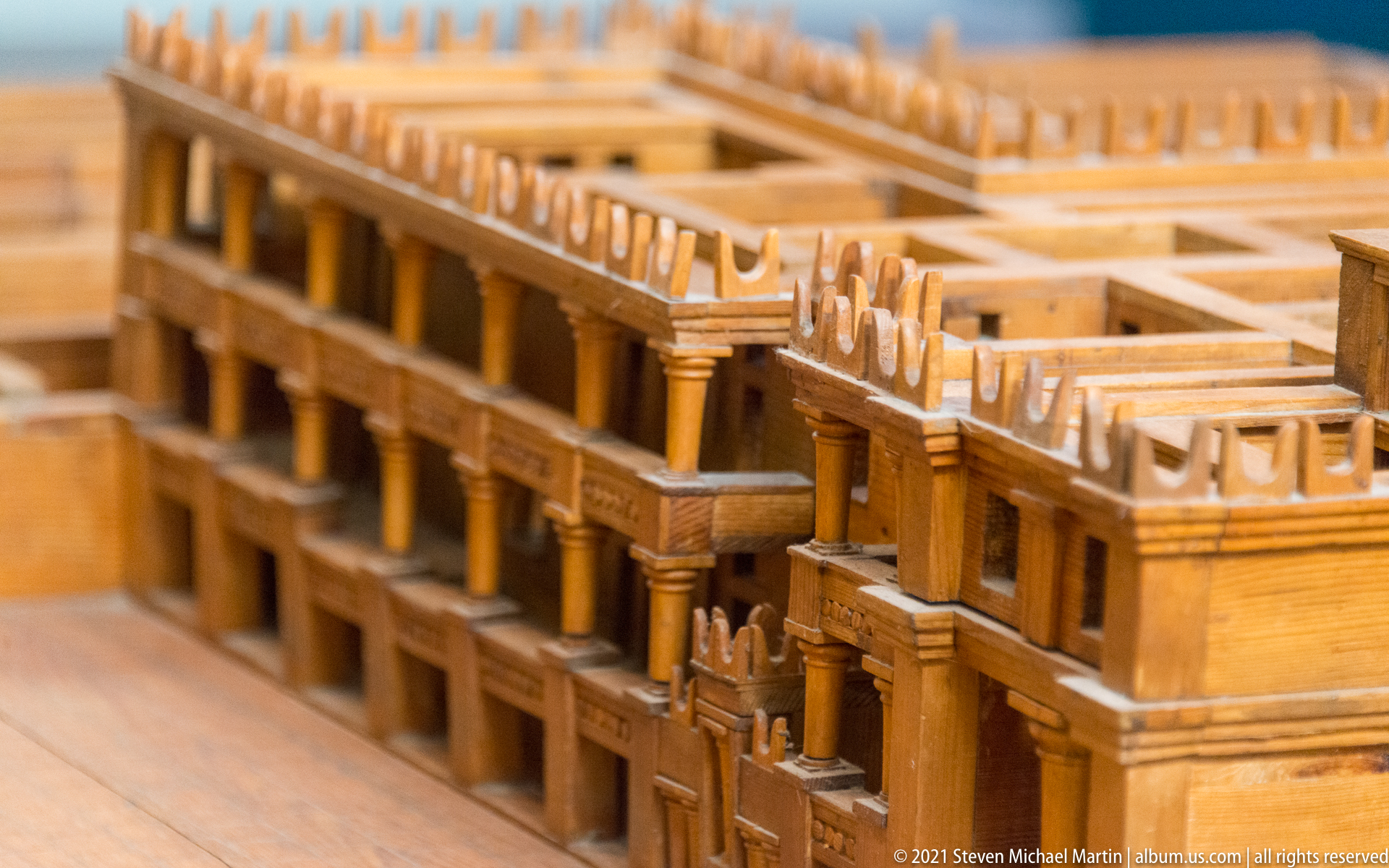
Rows of slender columns support upper galleries in this detailed section of a Minoan palatial reconstruction. The model concentrates attention on façades facing narrow courts and passages, where projecting balconies, parapets, and changing rooflines create a complex architectural rhythm. Such a close view is useful for understanding the vertical organization that is difficult to recover from foundations alone.
Caption
Rows of slender columns support upper galleries in this detailed section of a Minoan palatial reconstruction. The model concentrates attention on façades facing narrow courts and passages, where projecting balconies, parapets, and changing rooflines create a complex architectural rhythm. Such a close view is useful for understanding the vertical organization that is difficult to recover from foundations alone.
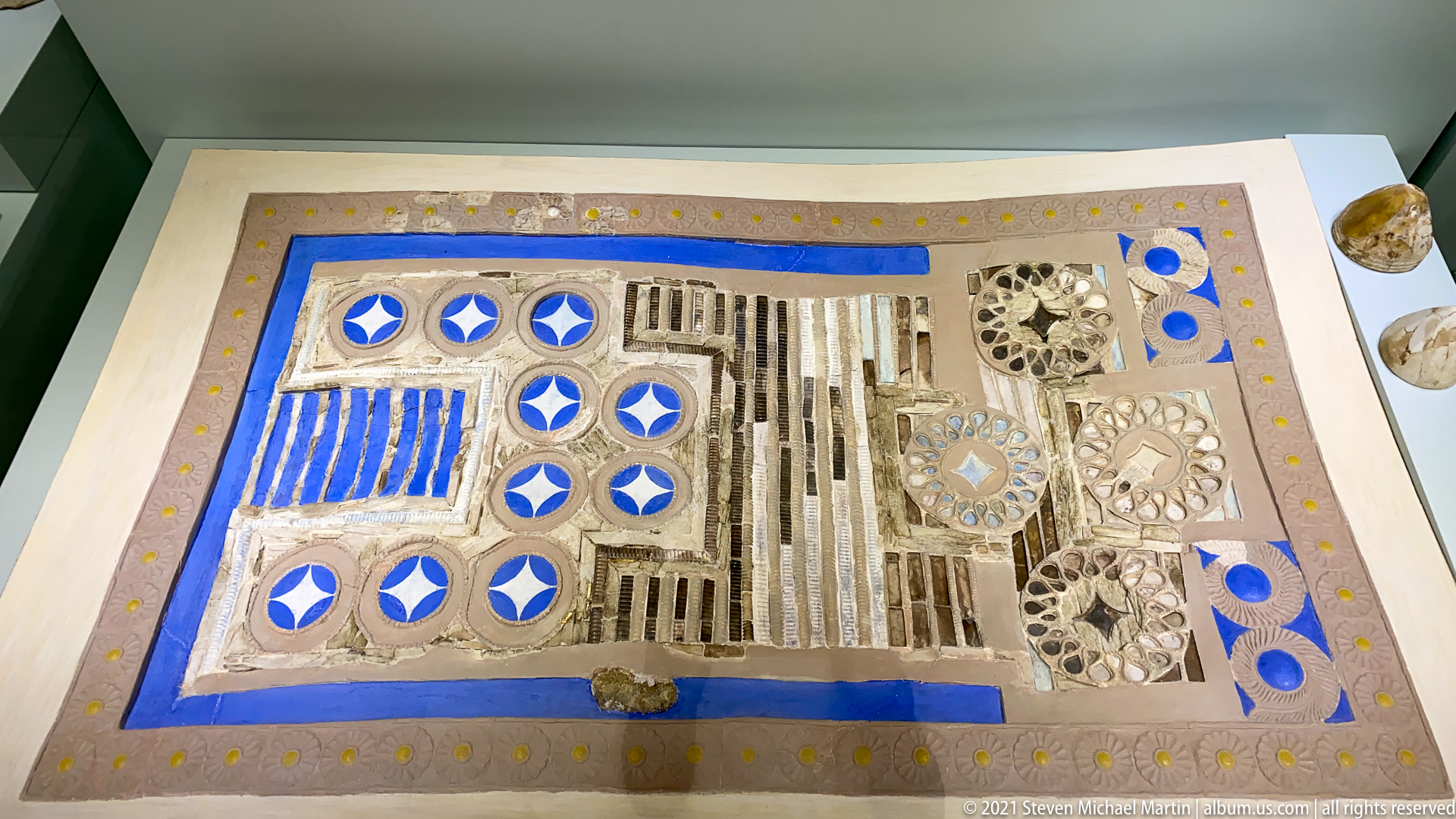
The “Draughtboard” from the Palace of Knossos, dated to 1700–1450 BC, is a luxury gaming board inlaid with ivory, blue glass paste, rock crystal, gold, and silver. Circular fields, striped compartments, rosettes, and blue framing bands organize the rectangular surface, while four large conical ivory gaming pieces correspond to circular areas on the board. The materials and workmanship place play within the sphere of palatial luxury.
Caption
The “Draughtboard” from the Palace of Knossos, dated to 1700–1450 BC, is a luxury gaming board inlaid with ivory, blue glass paste, rock crystal, gold, and silver. Circular fields, striped compartments, rosettes, and blue framing bands organize the rectangular surface, while four large conical ivory gaming pieces correspond to circular areas on the board. The materials and workmanship place play within the sphere of palatial luxury.
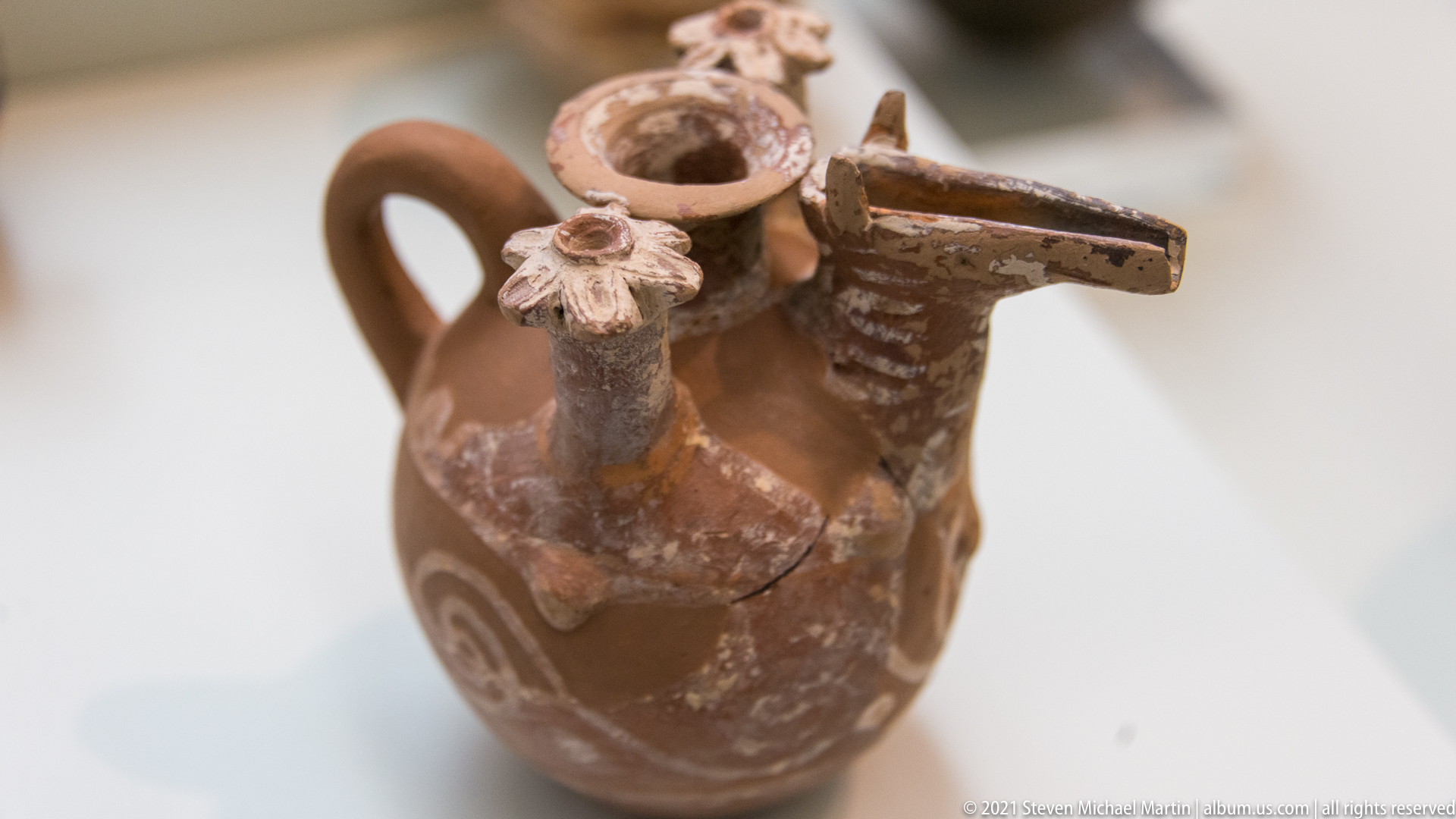
A compact brown jug carries an extraordinary cluster of projecting tubular spouts around its neck and shoulder. Applied ridges and small decorative elements surround the openings, while a large handle anchors the opposite side. The close angle makes the vessel’s complex plumbing-like construction more prominent than its painted body decoration.
Caption
A compact brown jug carries an extraordinary cluster of projecting tubular spouts around its neck and shoulder. Applied ridges and small decorative elements surround the openings, while a large handle anchors the opposite side. The close angle makes the vessel’s complex plumbing-like construction more prominent than its painted body decoration.
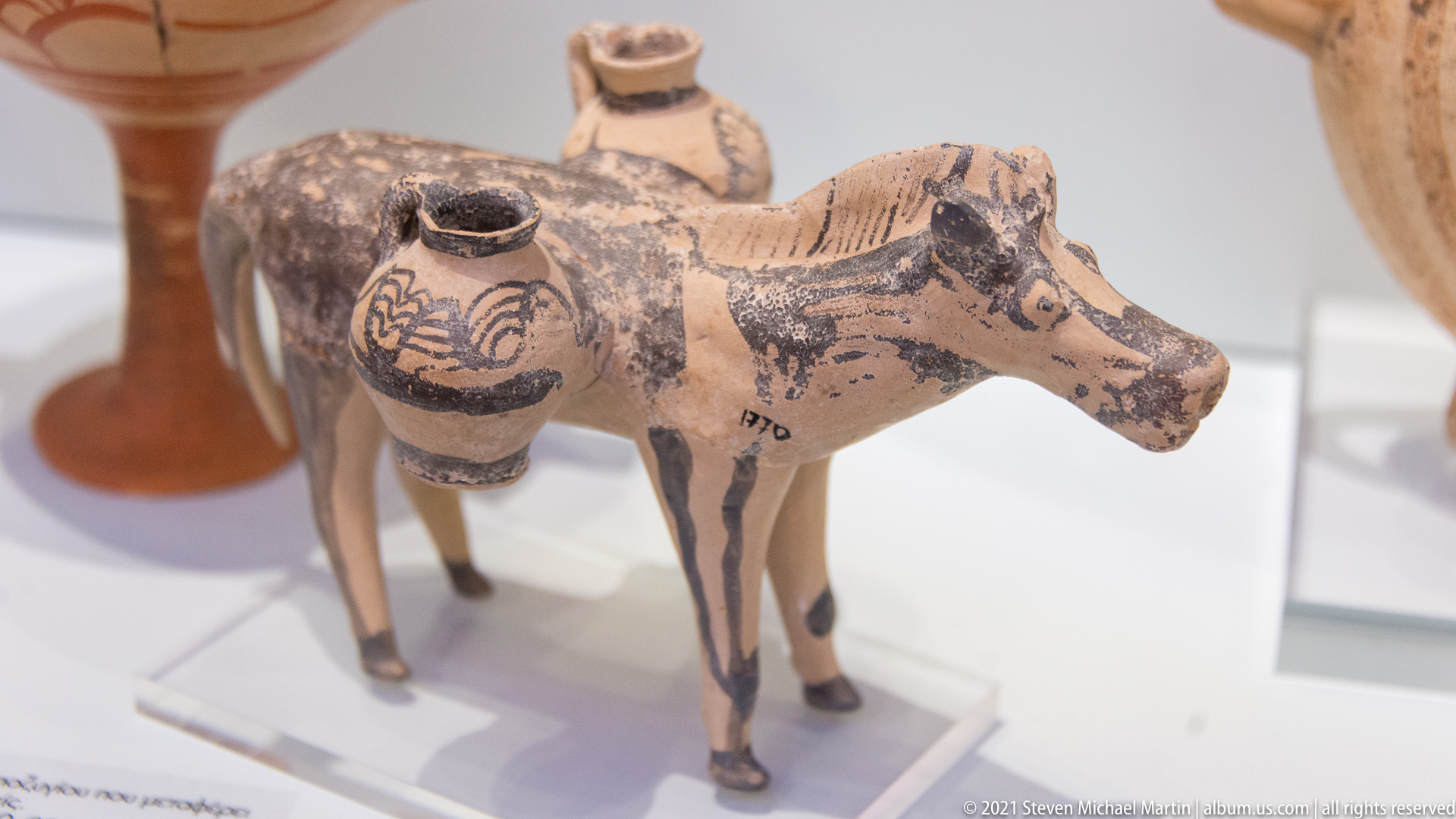
A painted ceramic bull stands on four slender legs with several small vessel openings attached across its back and side. Linear decoration follows the animal’s head, neck, and body, transforming the zoomorphic form into a complex container rather than a simple figurine. The unusual combination of animal sculpture and multiple receptacles suggests a specialized ceremonial or pouring function.
Caption
A painted ceramic bull stands on four slender legs with several small vessel openings attached across its back and side. Linear decoration follows the animal’s head, neck, and body, transforming the zoomorphic form into a complex container rather than a simple figurine. The unusual combination of animal sculpture and multiple receptacles suggests a specialized ceremonial or pouring function.
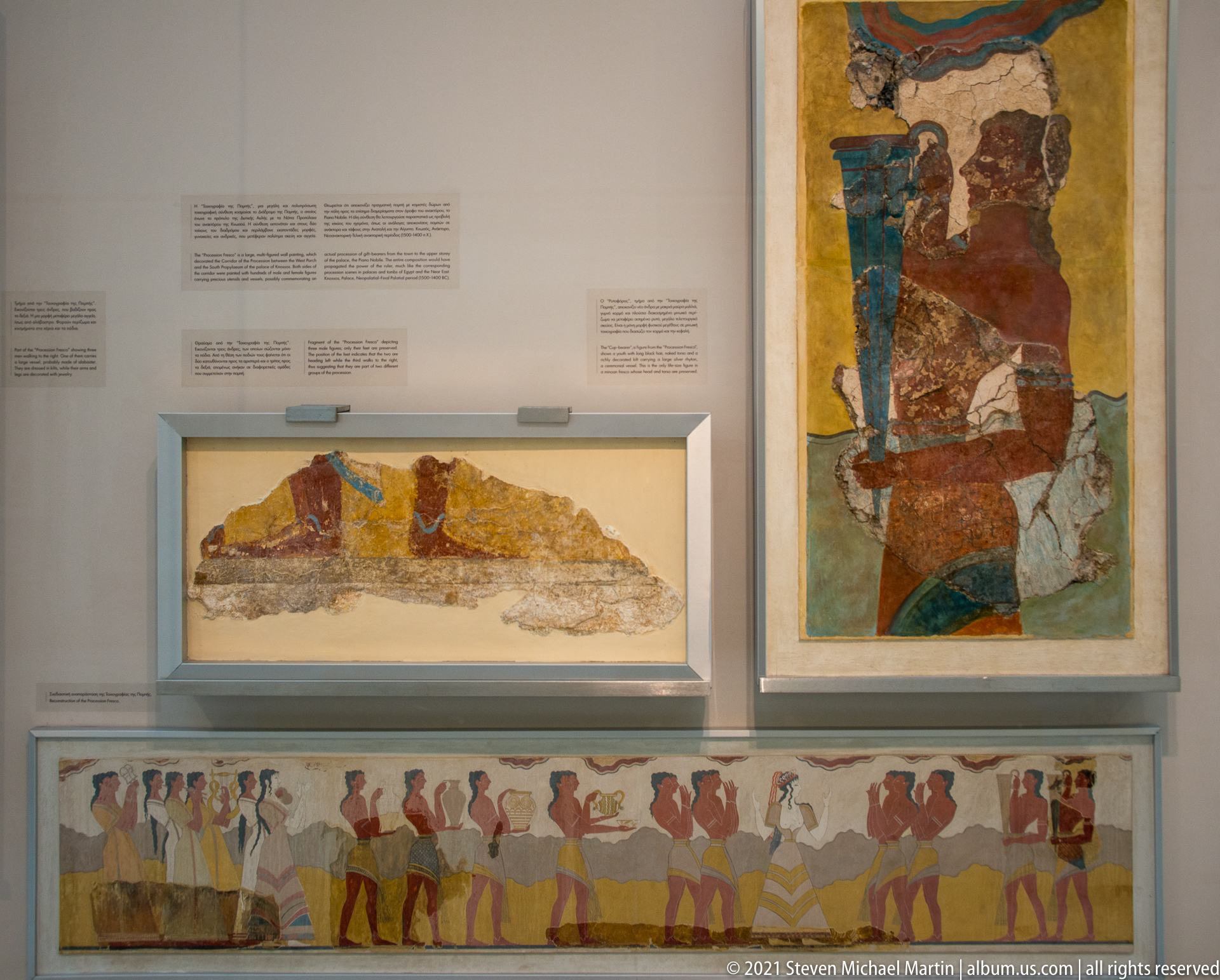
Three Minoan fresco displays are arranged together on a gallery wall: a narrow fragment at upper left, a tall seated figure at upper right, and a long processional composition below. Seen as an ensemble, the installation emphasizes the range of scale and format in Minoan figural wall painting, from intimate fragments to extended ceremonial sequences reconstructed from surviving plaster.
Caption
Three Minoan fresco displays are arranged together on a gallery wall: a narrow fragment at upper left, a tall seated figure at upper right, and a long processional composition below. Seen as an ensemble, the installation emphasizes the range of scale and format in Minoan figural wall painting, from intimate fragments to extended ceremonial sequences reconstructed from surviving plaster.
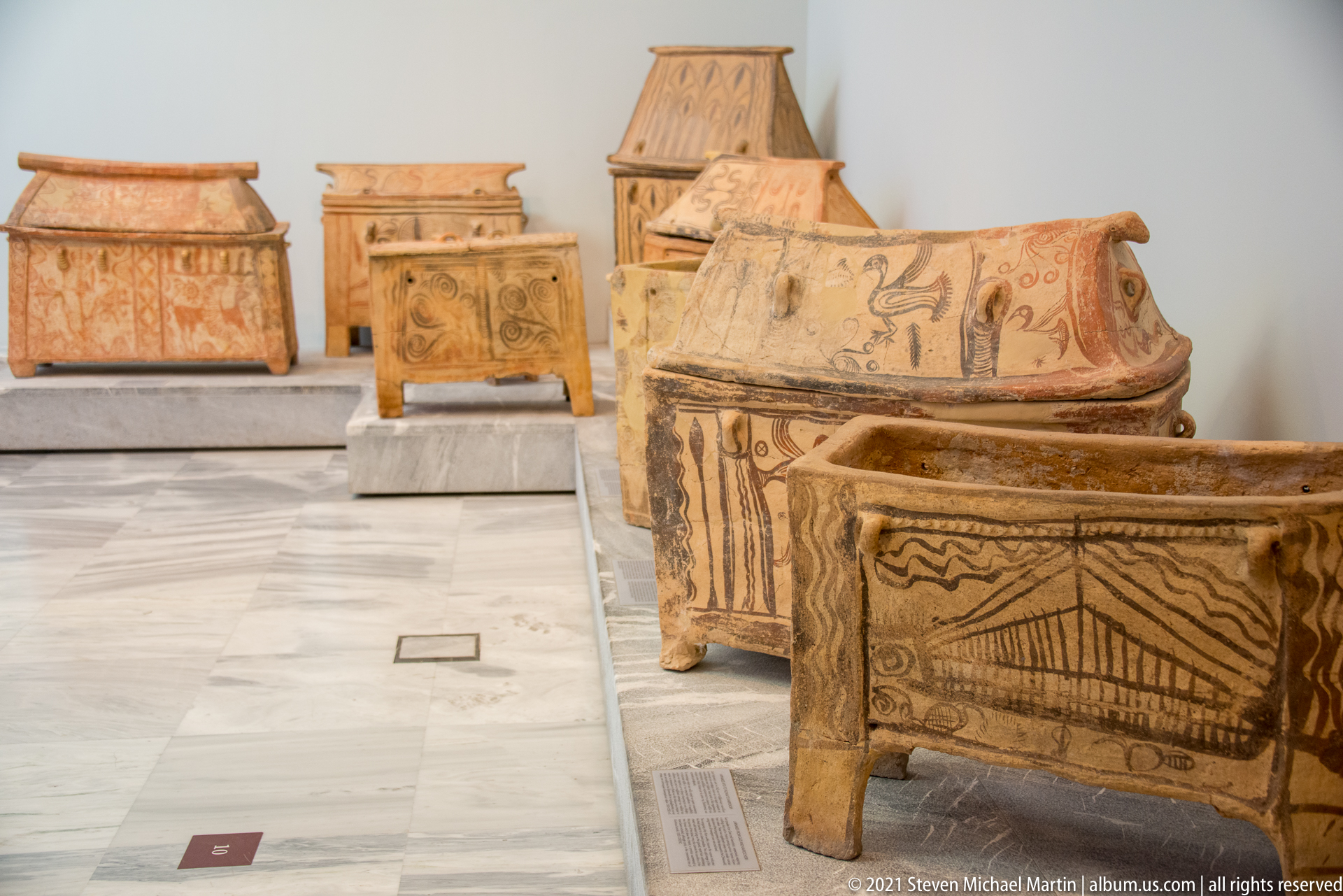
A row of painted terracotta larnakes fills the gallery, each coffin-like chest raised on short legs and covered with geometric, architectural, animal, or plant motifs. The oblique view reveals differences in lid form and painted program while preserving the rhythm of the display. Their boxlike construction and rich surface decoration connect funerary function with the decorative traditions of Late Bronze Age Crete.
Caption
A row of painted terracotta larnakes fills the gallery, each coffin-like chest raised on short legs and covered with geometric, architectural, animal, or plant motifs. The oblique view reveals differences in lid form and painted program while preserving the rhythm of the display. Their boxlike construction and rich surface decoration connect funerary function with the decorative traditions of Late Bronze Age Crete.
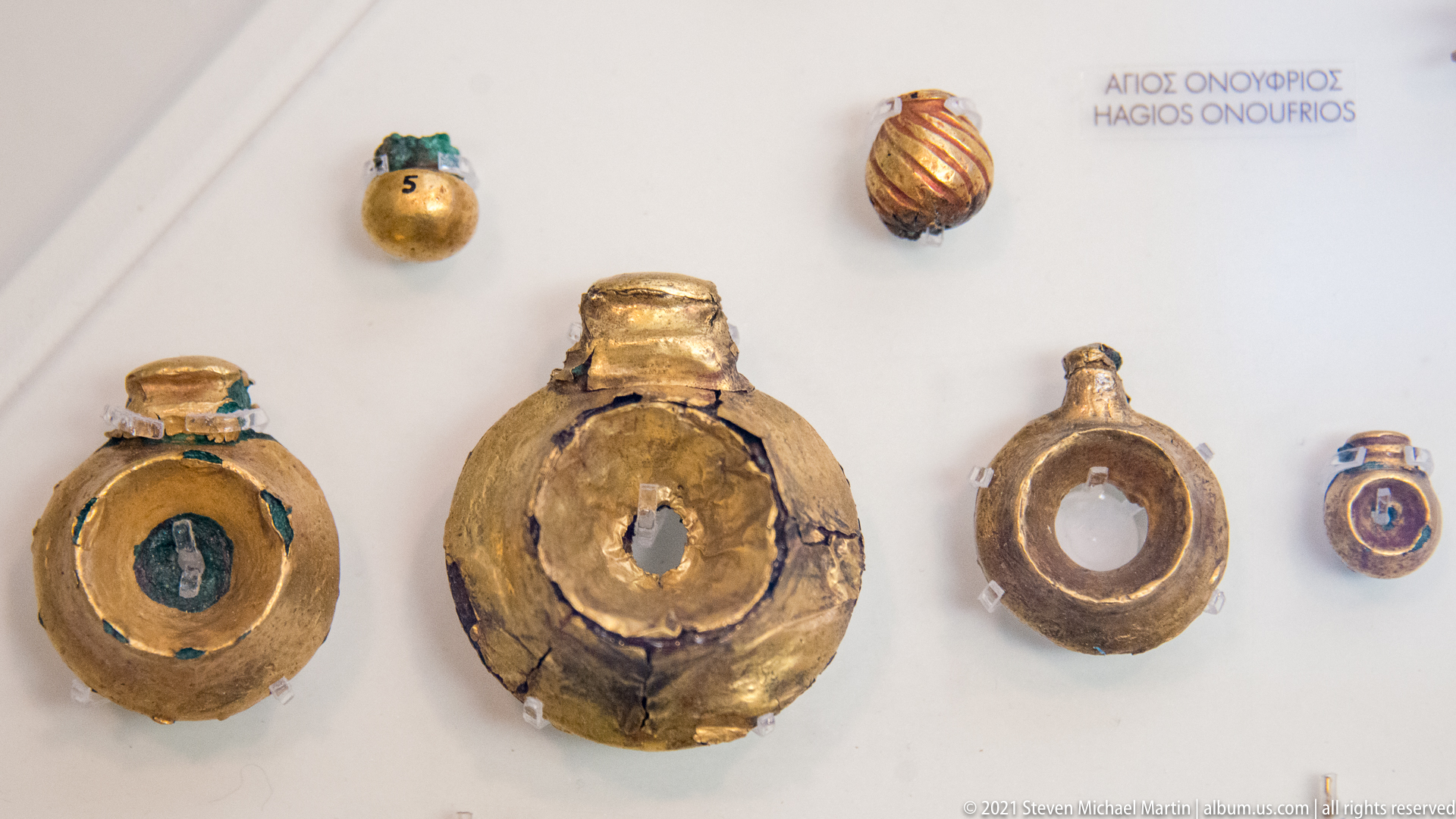
Five small circular objects are displayed together, several wrapped or faced with thin gold sheet around central openings or inset areas. Cracks, folded edges, and exposed darker cores make the construction especially visible, while two smaller pieces above extend the group beyond the three larger ring-shaped examples.
Caption
Five small circular objects are displayed together, several wrapped or faced with thin gold sheet around central openings or inset areas. Cracks, folded edges, and exposed darker cores make the construction especially visible, while two smaller pieces above extend the group beyond the three larger ring-shaped examples.
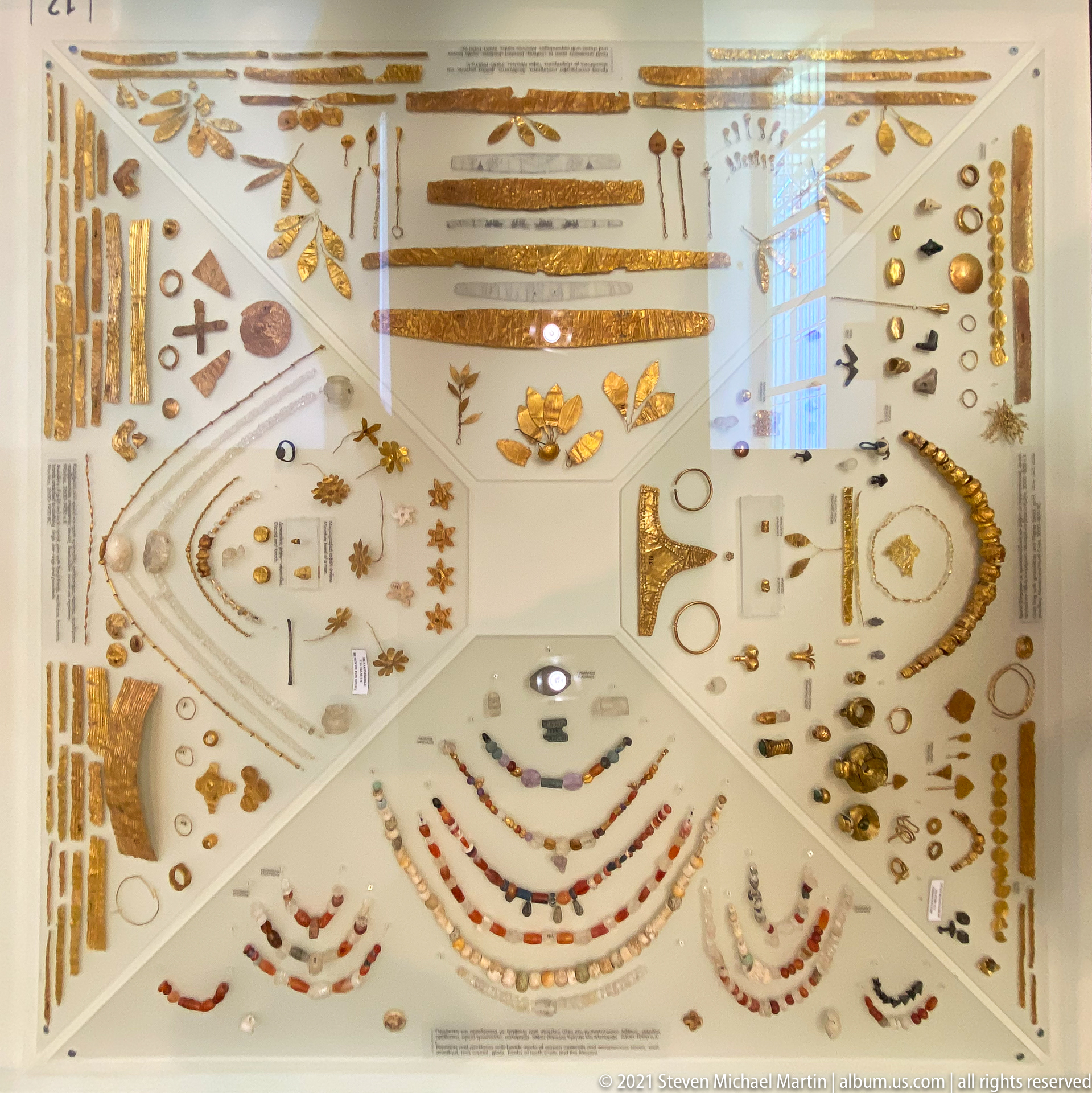
A broad display case assembles necklaces, beads, pendants, rings, plaques, pins, and other small ornaments in carefully ordered groups. Gold dominates the upper and side sections, while strings of red, blue, white, and dark beads form curved rows across the lower half. The arrangement emphasizes the diversity of personal adornment and fine craftsmanship represented among the museum’s small archaeological finds.
Caption
A broad display case assembles necklaces, beads, pendants, rings, plaques, pins, and other small ornaments in carefully ordered groups. Gold dominates the upper and side sections, while strings of red, blue, white, and dark beads form curved rows across the lower half. The arrangement emphasizes the diversity of personal adornment and fine craftsmanship represented among the museum’s small archaeological finds.
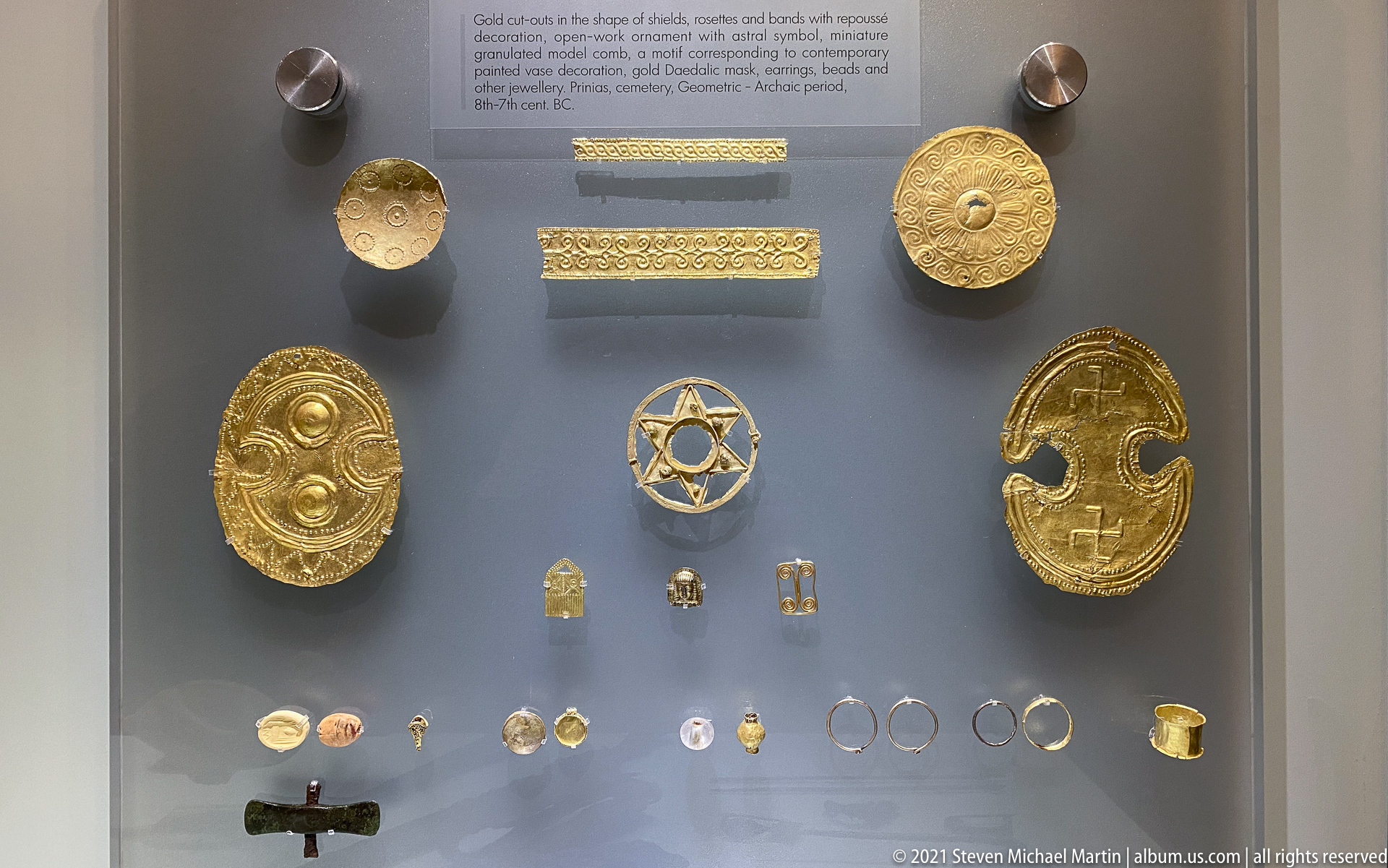
This closer view concentrates on the upper portion of the gold jewelry display, where embossed circular plaques, patterned strips, a star-like openwork ornament, and a large crescent-shaped sheet are arranged against a dark backing. Repeated spirals, dots, and geometric borders reveal how thin gold sheet could be transformed through cutting and repoussé into visually complex personal or funerary ornaments.
Caption
This closer view concentrates on the upper portion of the gold jewelry display, where embossed circular plaques, patterned strips, a star-like openwork ornament, and a large crescent-shaped sheet are arranged against a dark backing. Repeated spirals, dots, and geometric borders reveal how thin gold sheet could be transformed through cutting and repoussé into visually complex personal or funerary ornaments.
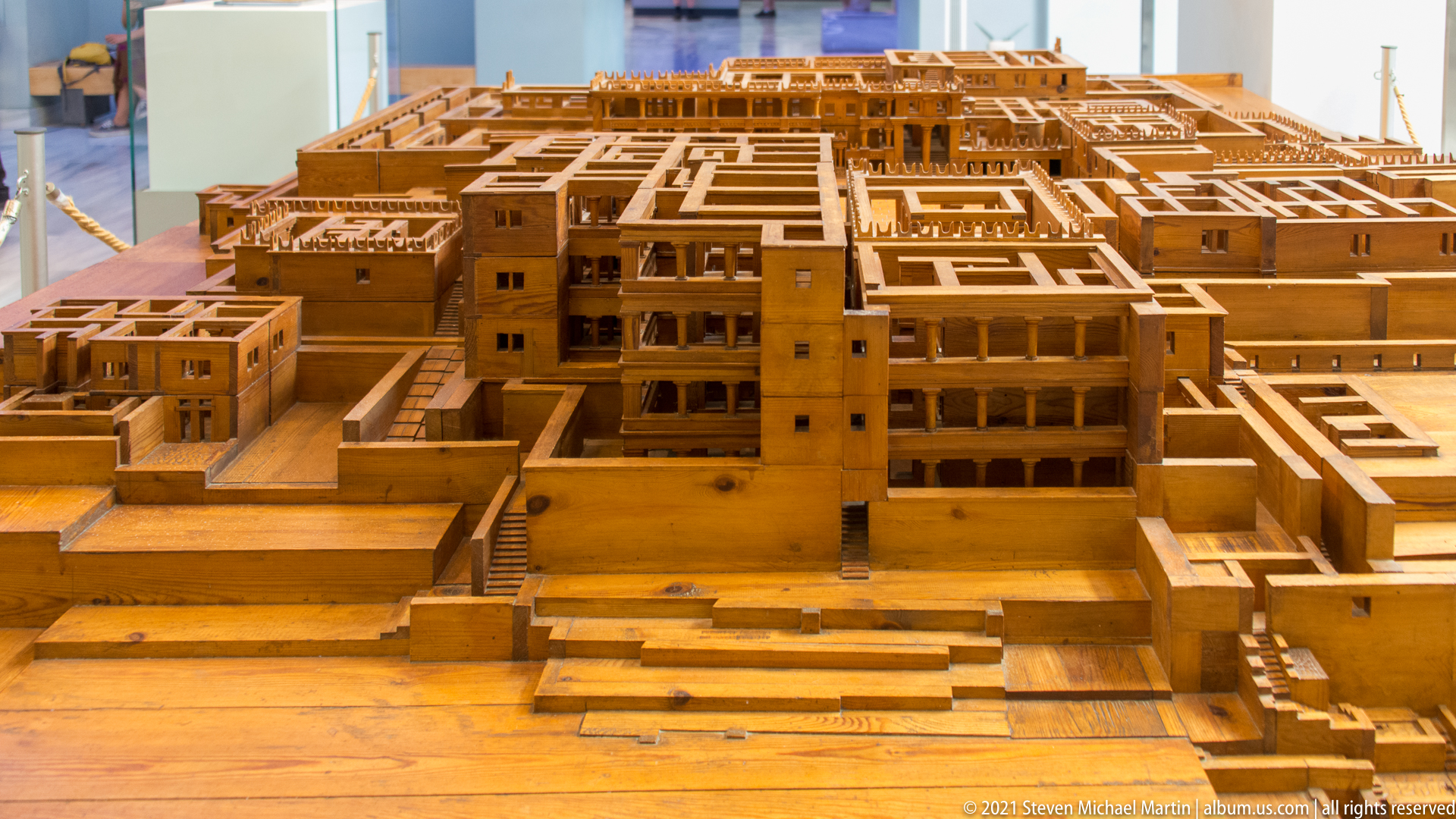
A large wooden architectural model presents a dense Minoan palatial complex as a sequence of courts, stairways, multi-level rooms, colonnades, and light wells. The elevated viewpoint makes the interlocking circulation and changing floor levels especially clear, translating an archaeological ground plan into three-dimensional space and emphasizing the sophistication of Bronze Age Cretan palace architecture.
Caption
A large wooden architectural model presents a dense Minoan palatial complex as a sequence of courts, stairways, multi-level rooms, colonnades, and light wells. The elevated viewpoint makes the interlocking circulation and changing floor levels especially clear, translating an archaeological ground plan into three-dimensional space and emphasizing the sophistication of Bronze Age Cretan palace architecture.
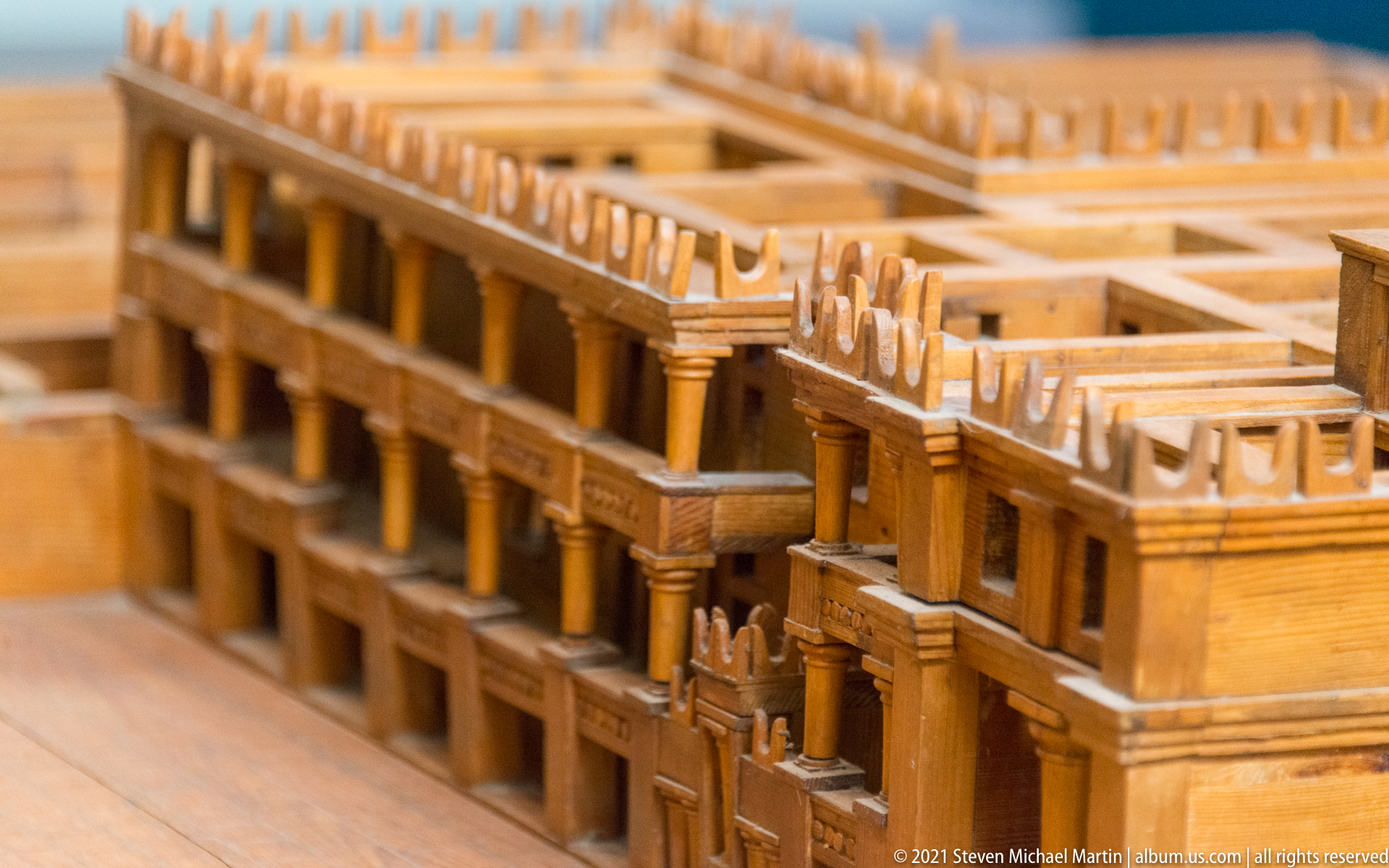
Close inspection of the architectural model reveals stacked colonnades, projecting rooms, parapets, and open courts arranged across several levels. Repeated wooden columns and carefully differentiated wall heights show how circulation, light, and ceremonial space could be organized vertically within a Minoan palace. The tight framing turns the model from an overview into a study of reconstructed architectural relationships.
Caption
Close inspection of the architectural model reveals stacked colonnades, projecting rooms, parapets, and open courts arranged across several levels. Repeated wooden columns and carefully differentiated wall heights show how circulation, light, and ceremonial space could be organized vertically within a Minoan palace. The tight framing turns the model from an overview into a study of reconstructed architectural relationships.
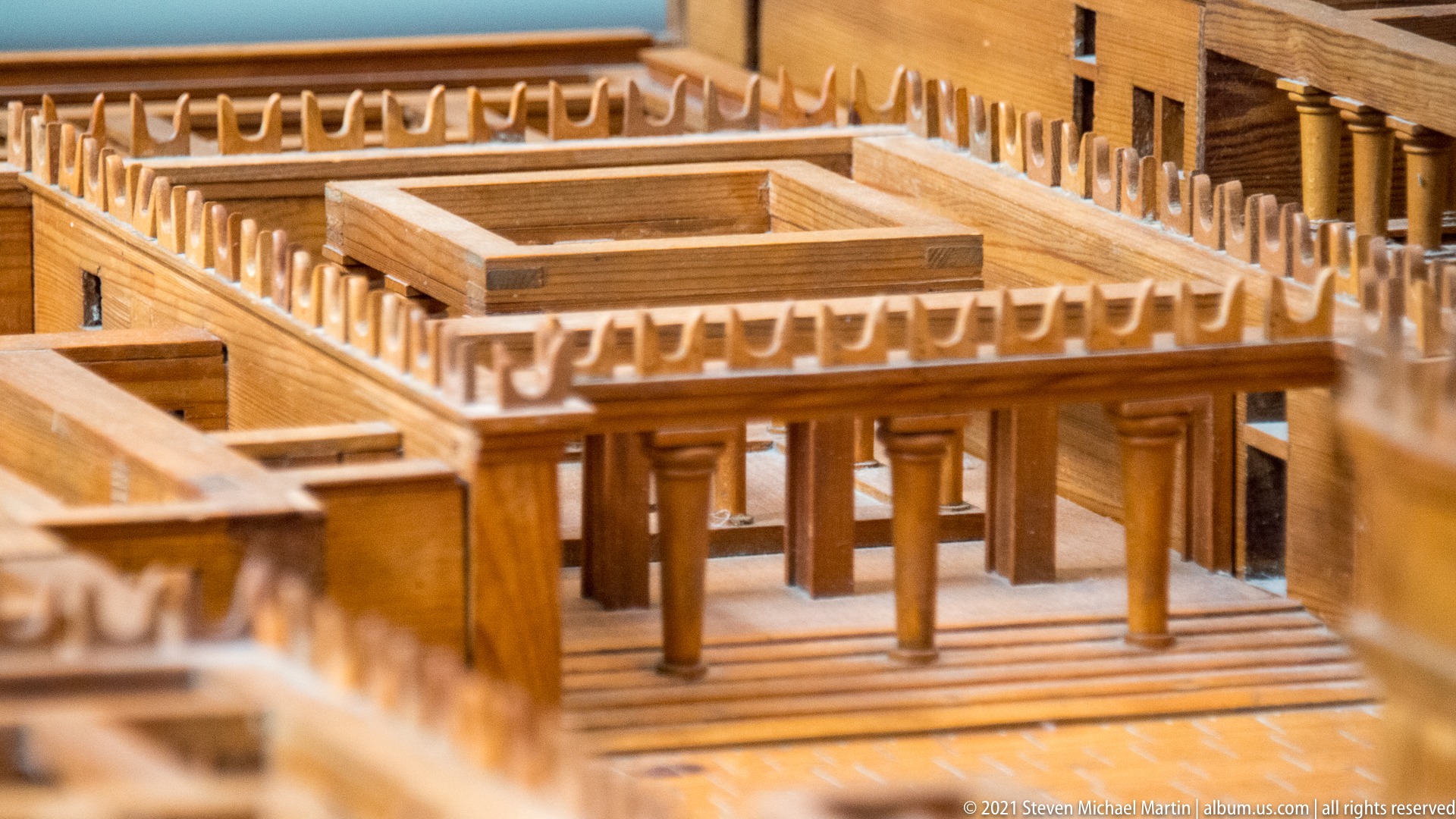
A detailed wooden architectural model reconstructs a multi-level complex of courts, rooms, corridors, and columned porticoes. The close viewpoint centers on a square open structure ringed by slender columns and a parapet-like upper edge, with additional chambers extending behind it. The model translates archaeological ground plans into three dimensions, making circulation, changing floor levels, and relationships between open and enclosed spaces easier to understand.
Caption
A detailed wooden architectural model reconstructs a multi-level complex of courts, rooms, corridors, and columned porticoes. The close viewpoint centers on a square open structure ringed by slender columns and a parapet-like upper edge, with additional chambers extending behind it. The model translates archaeological ground plans into three dimensions, making circulation, changing floor levels, and relationships between open and enclosed spaces easier to understand.
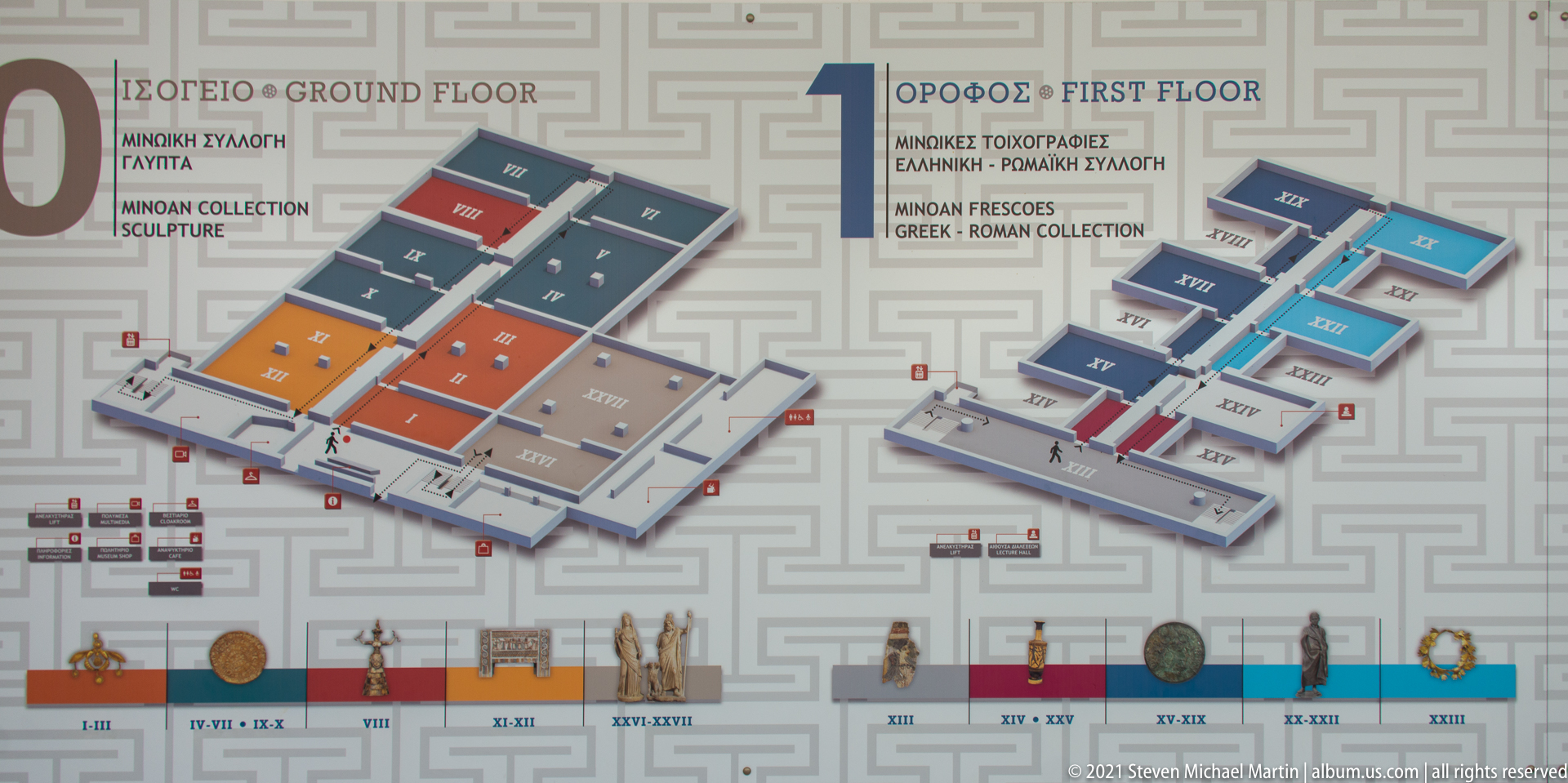
A museum orientation panel maps the Heraklion Archaeological Museum across two floors, using color-coded galleries and a chronological strip of representative objects. The display gives visitors a spatial overview of the collection, from Minoan material through later periods, before the artifact sequence begins.
Caption
A museum orientation panel maps the Heraklion Archaeological Museum across two floors, using color-coded galleries and a chronological strip of representative objects. The display gives visitors a spatial overview of the collection, from Minoan material through later periods, before the artifact sequence begins.
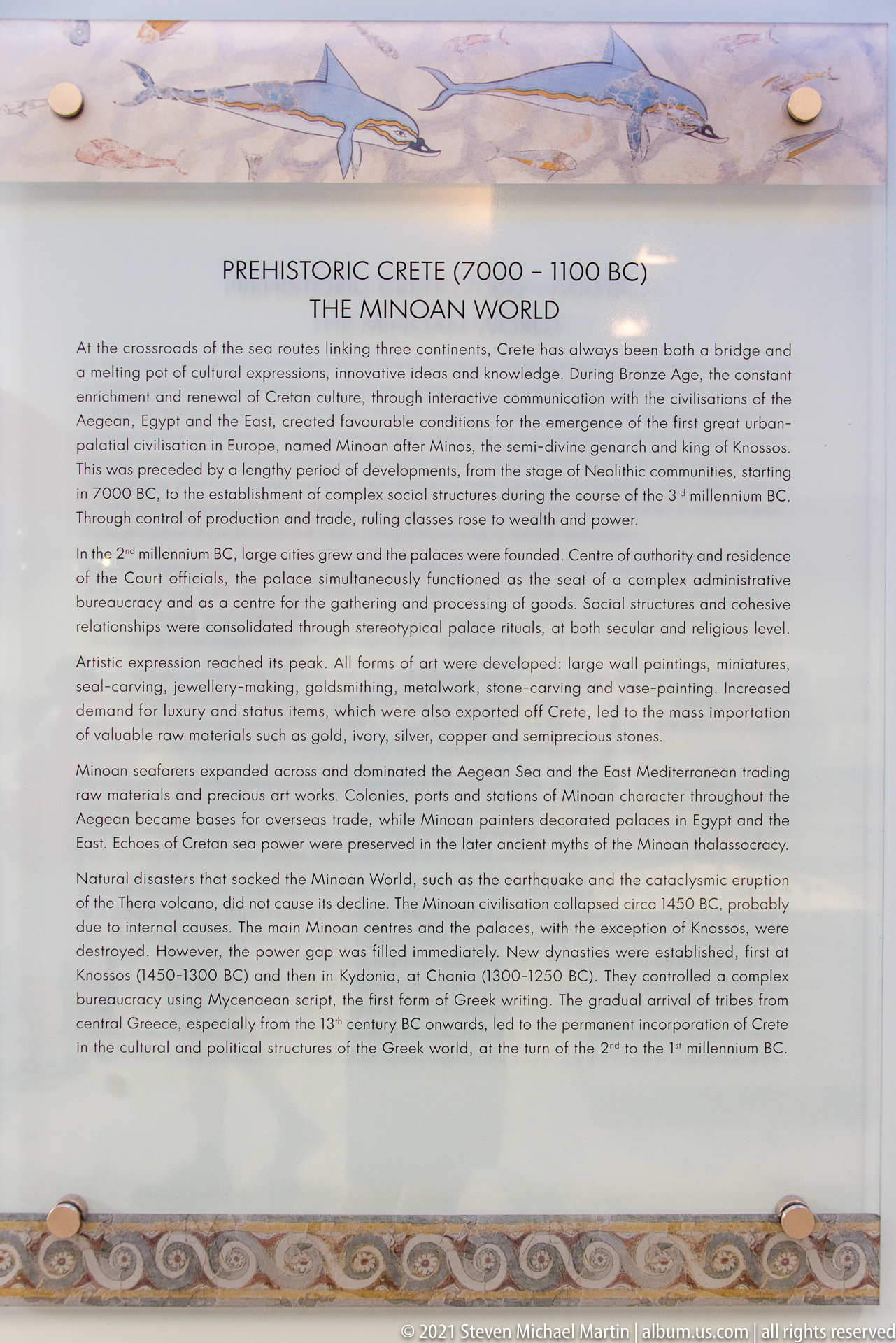
An introductory gallery panel presents “Pre-historic Crete (7000–1100 BC): The Minoan World,” framing the museum’s Minoan collections within the long development of prehistoric Crete. A map-like painted band above the text and decorative border below mark the panel as the interpretive threshold to the archaeological displays.
Caption
An introductory gallery panel presents “Pre-historic Crete (7000–1100 BC): The Minoan World,” framing the museum’s Minoan collections within the long development of prehistoric Crete. A map-like painted band above the text and decorative border below mark the panel as the interpretive threshold to the archaeological displays.
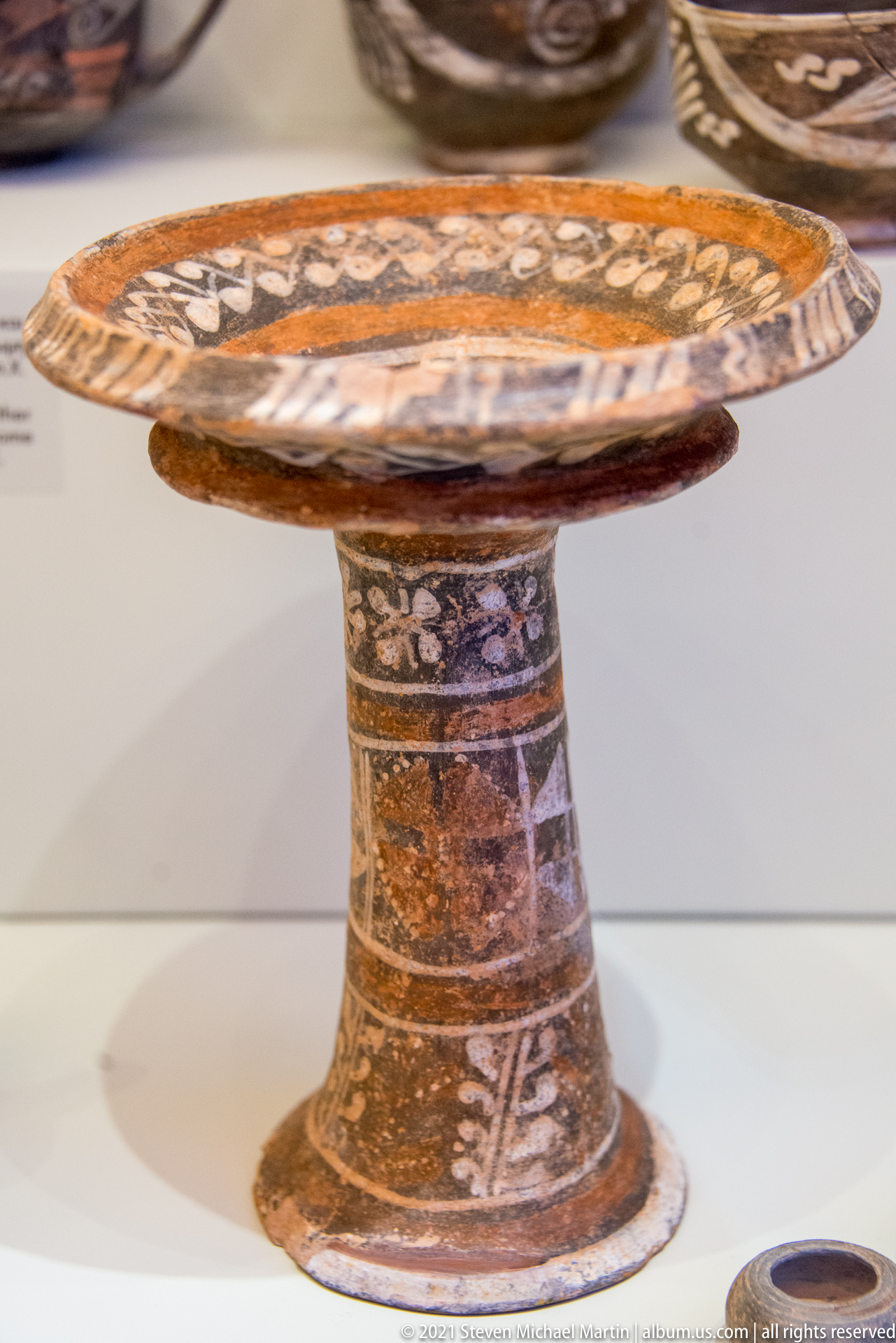
A broad shallow dish rises on a tall flaring pedestal, its surface covered with dark painted bands and intricate geometric ornament. Large pale rosette-like motifs project around the rim and lower junction, giving the vessel a strongly architectural profile while emphasizing the contrast between painted and applied decoration.
Caption
A broad shallow dish rises on a tall flaring pedestal, its surface covered with dark painted bands and intricate geometric ornament. Large pale rosette-like motifs project around the rim and lower junction, giving the vessel a strongly architectural profile while emphasizing the contrast between painted and applied decoration.
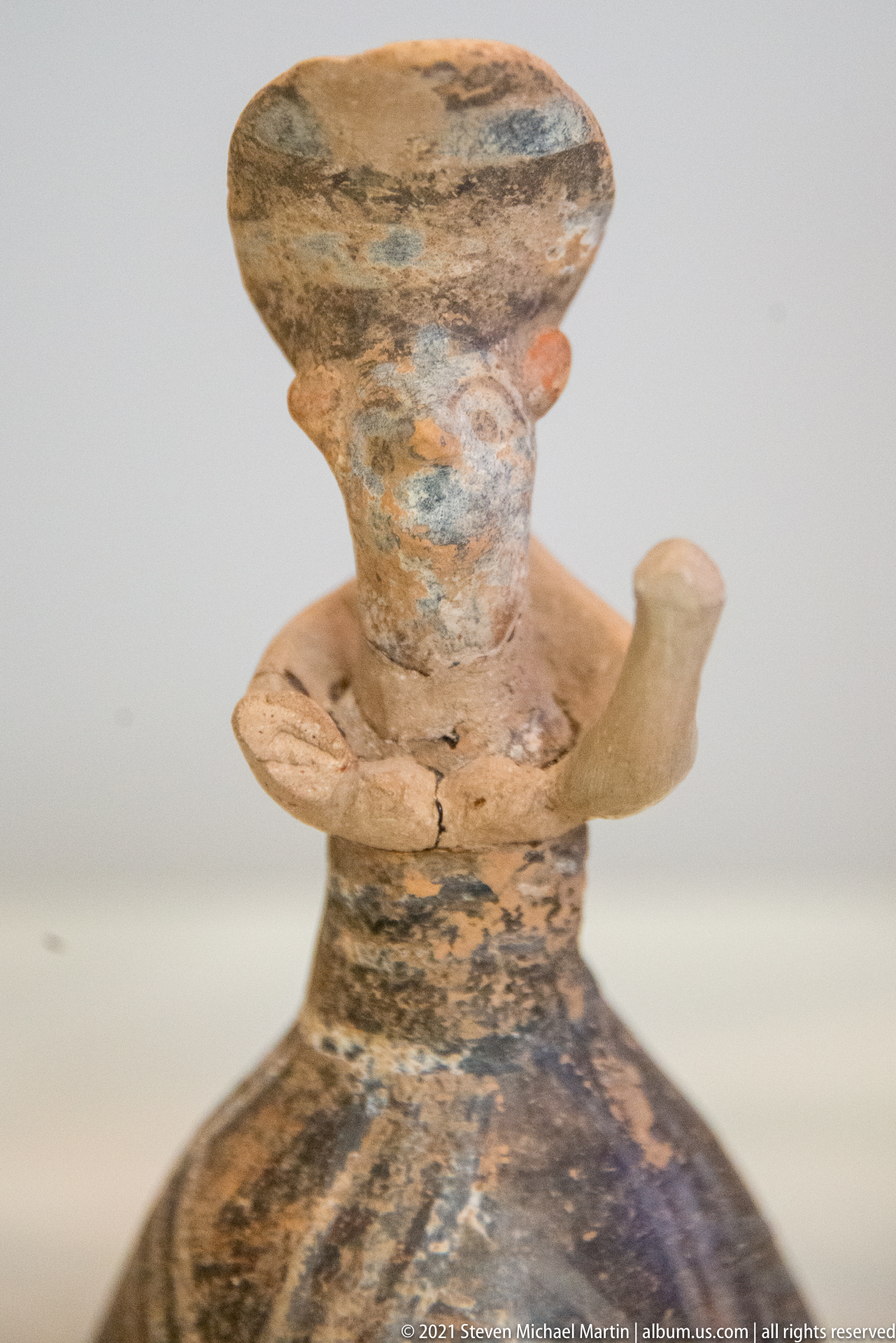
A small ceramic vessel incorporates a modeled human head above its rounded body, with short arm-like projections extending to either side. Dark painted bands and mottled surface deposits survive across the vessel, while the close crop emphasizes the unusual fusion of container, figure, and applied sculptural elements.
Caption
A small ceramic vessel incorporates a modeled human head above its rounded body, with short arm-like projections extending to either side. Dark painted bands and mottled surface deposits survive across the vessel, while the close crop emphasizes the unusual fusion of container, figure, and applied sculptural elements.
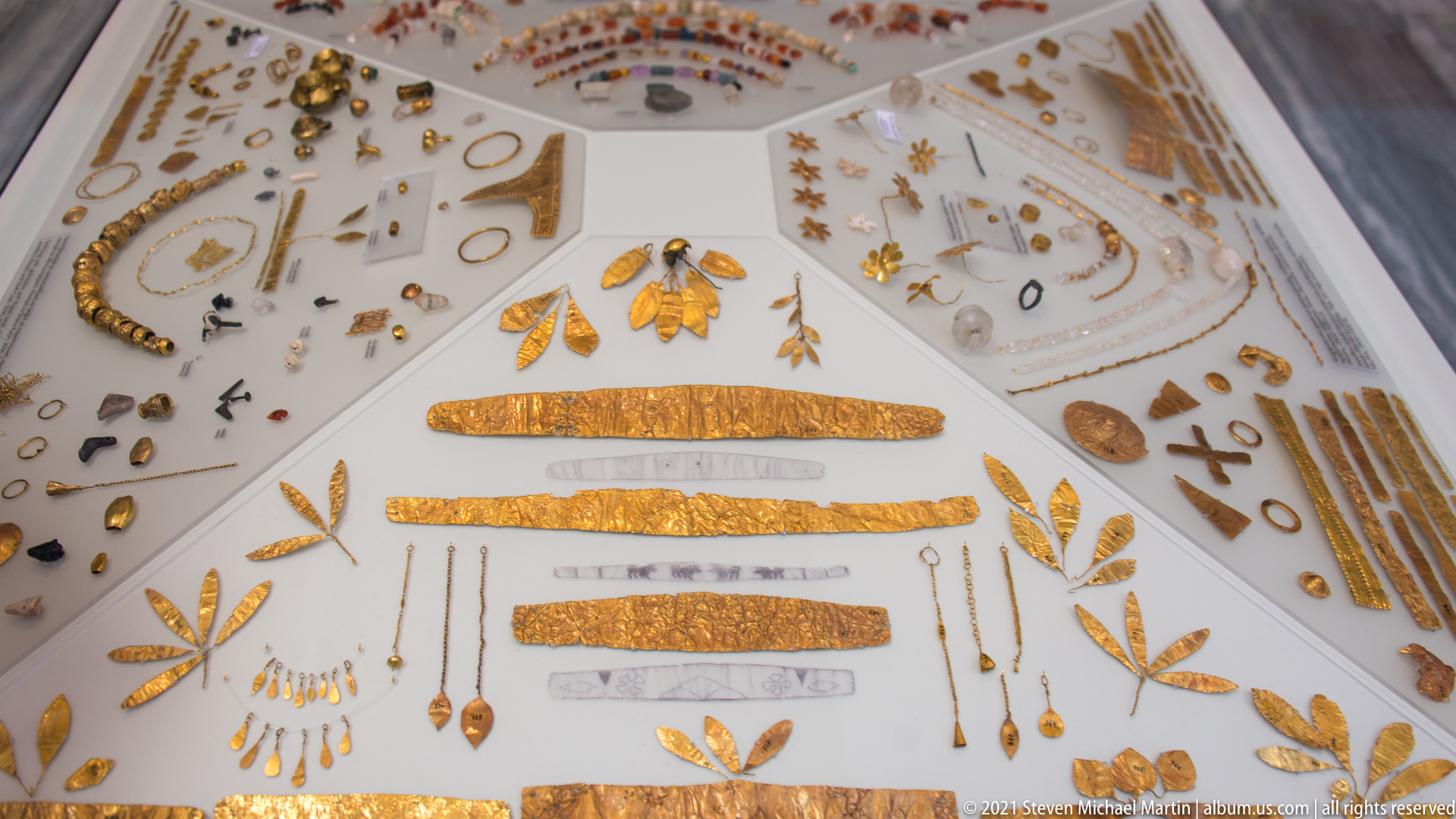
A dense museum display brings together gold ornaments of varied forms, including diadem-like strips, leaf-shaped appliqués, beads, pendants, chains, pins, and small fittings. Their careful arrangement reveals the range of metalworking used for personal adornment and ceremonial display in prehistoric Crete without collapsing the individual objects into a single jewelry type.
Caption
A dense museum display brings together gold ornaments of varied forms, including diadem-like strips, leaf-shaped appliqués, beads, pendants, chains, pins, and small fittings. Their careful arrangement reveals the range of metalworking used for personal adornment and ceremonial display in prehistoric Crete without collapsing the individual objects into a single jewelry type.
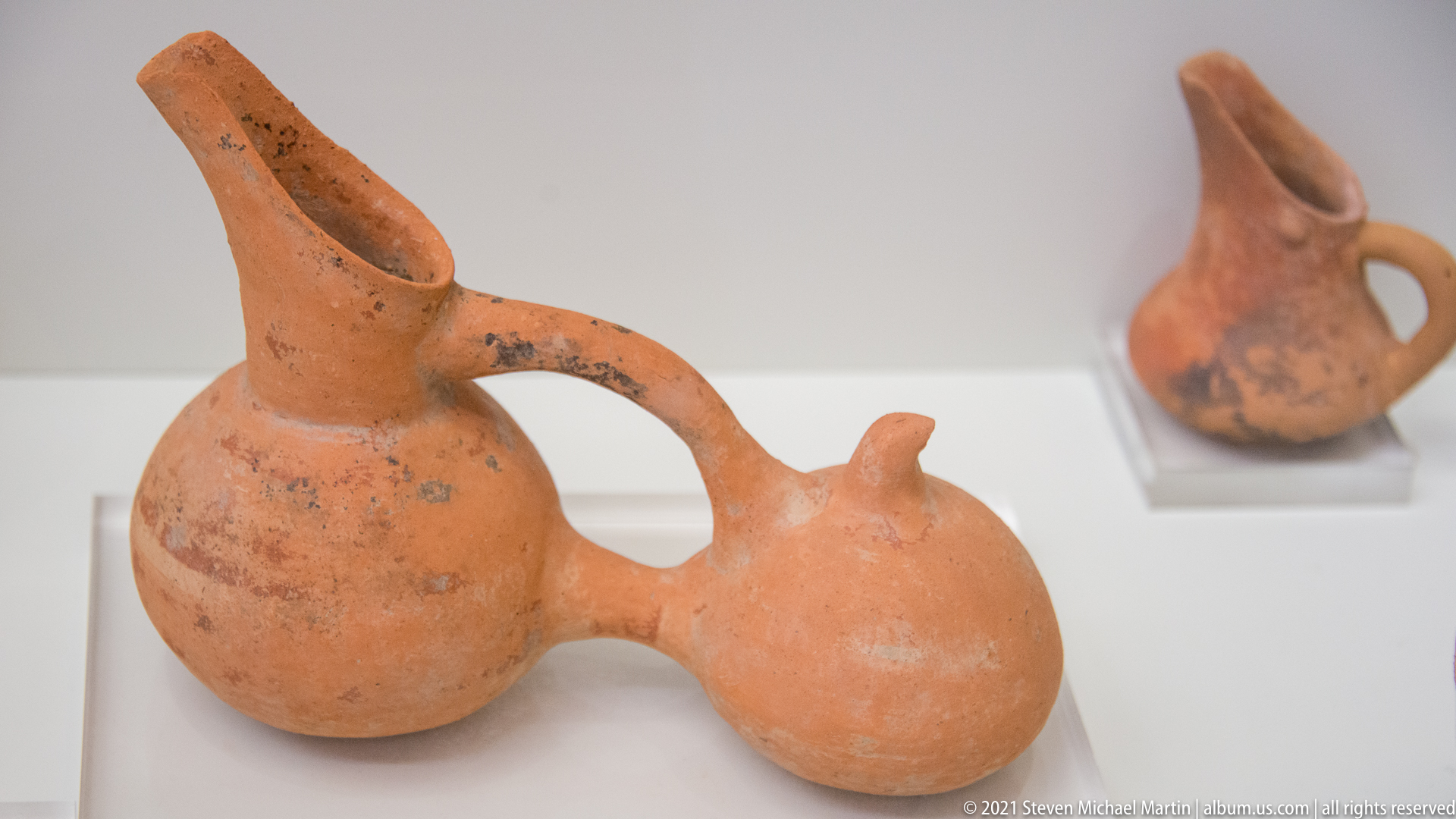
An unusual terracotta pouring vessel combines a rounded main body, tall open spout, broad handle, and a smaller joined chamber projecting from the side. The asymmetrical construction and multiple openings distinguish it from the simpler jug visible behind, emphasizing experimentation with ceramic vessel form and liquid handling.
Caption
An unusual terracotta pouring vessel combines a rounded main body, tall open spout, broad handle, and a smaller joined chamber projecting from the side. The asymmetrical construction and multiple openings distinguish it from the simpler jug visible behind, emphasizing experimentation with ceramic vessel form and liquid handling.
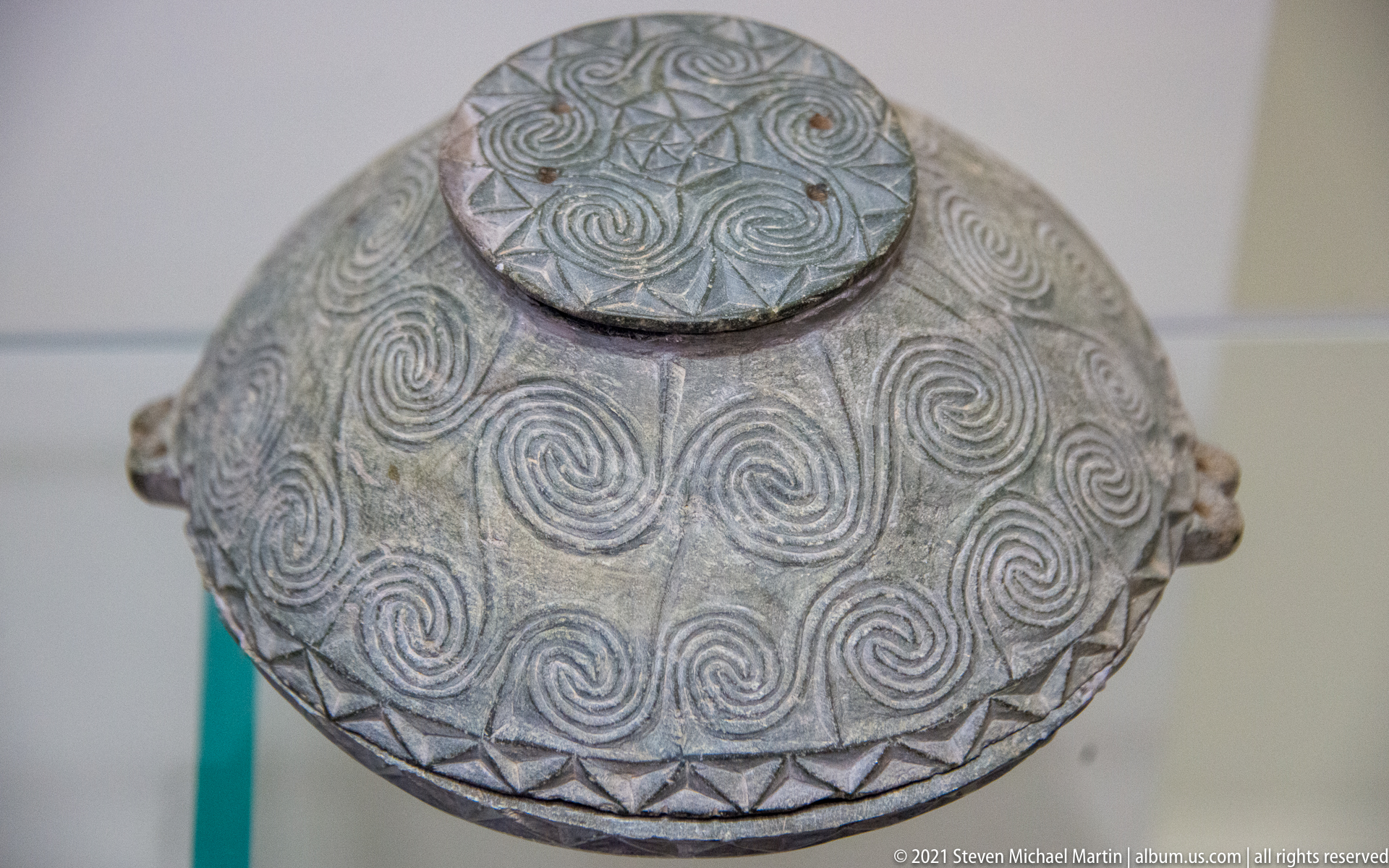
Tightly repeated spirals cover the domed body and fitted lid of this dark ceramic vessel, with triangular hatched borders defining the lower edge and lid rim. The close view makes the incised geometric program the dominant feature, showing how surface pattern was organized across separate components of a small container.
Caption
Tightly repeated spirals cover the domed body and fitted lid of this dark ceramic vessel, with triangular hatched borders defining the lower edge and lid rim. The close view makes the incised geometric program the dominant feature, showing how surface pattern was organized across separate components of a small container.
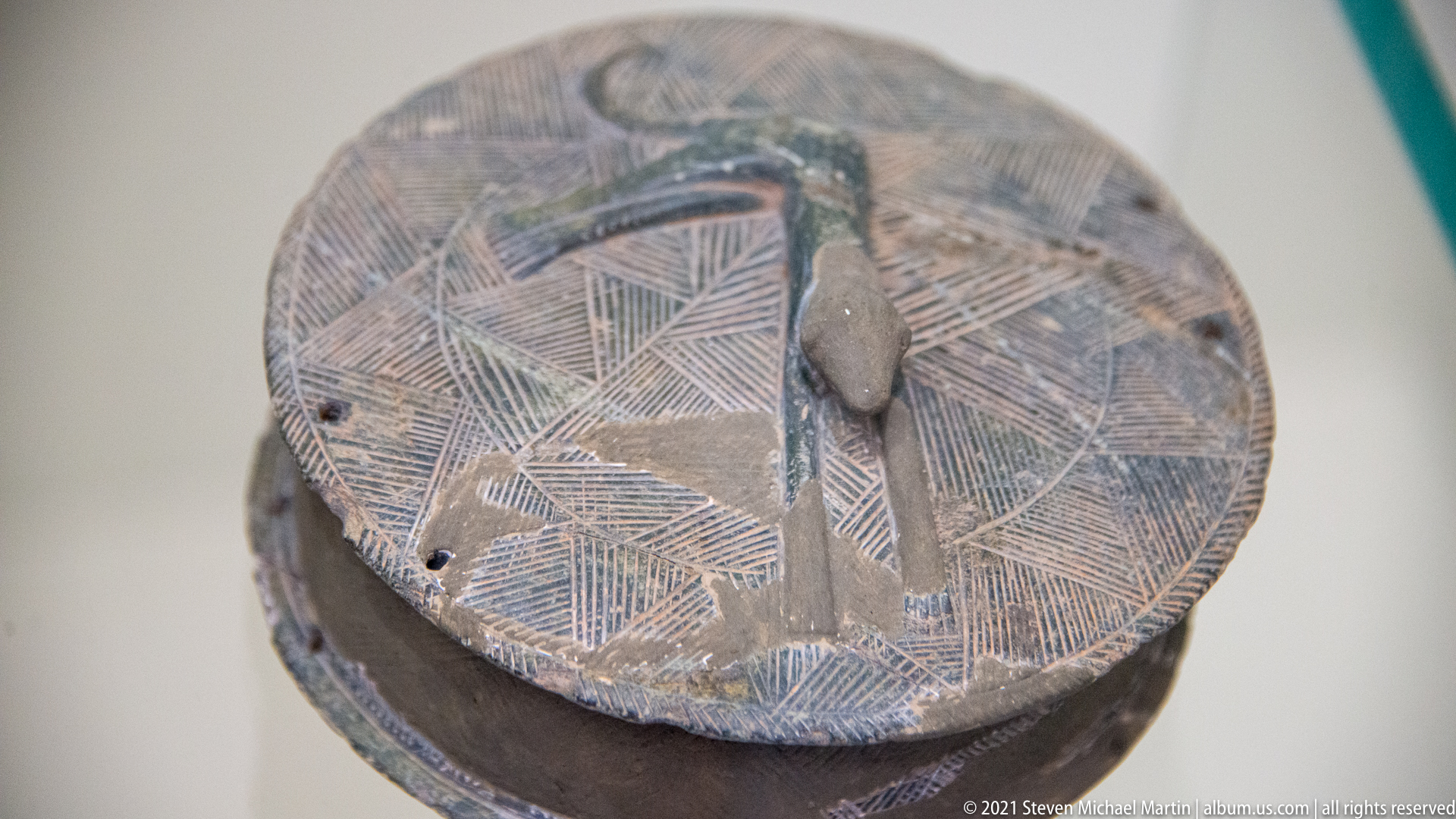
A close view of a circular lid reveals dense crosshatched triangles arranged in geometric fields around a central raised fastening or handle element. Fine incised lines contrast with the dark surface, while losses and pale abrasion expose the object’s age and condition more clearly than in the preceding overall vessel view.
Caption
A close view of a circular lid reveals dense crosshatched triangles arranged in geometric fields around a central raised fastening or handle element. Fine incised lines contrast with the dark surface, while losses and pale abrasion expose the object’s age and condition more clearly than in the preceding overall vessel view.
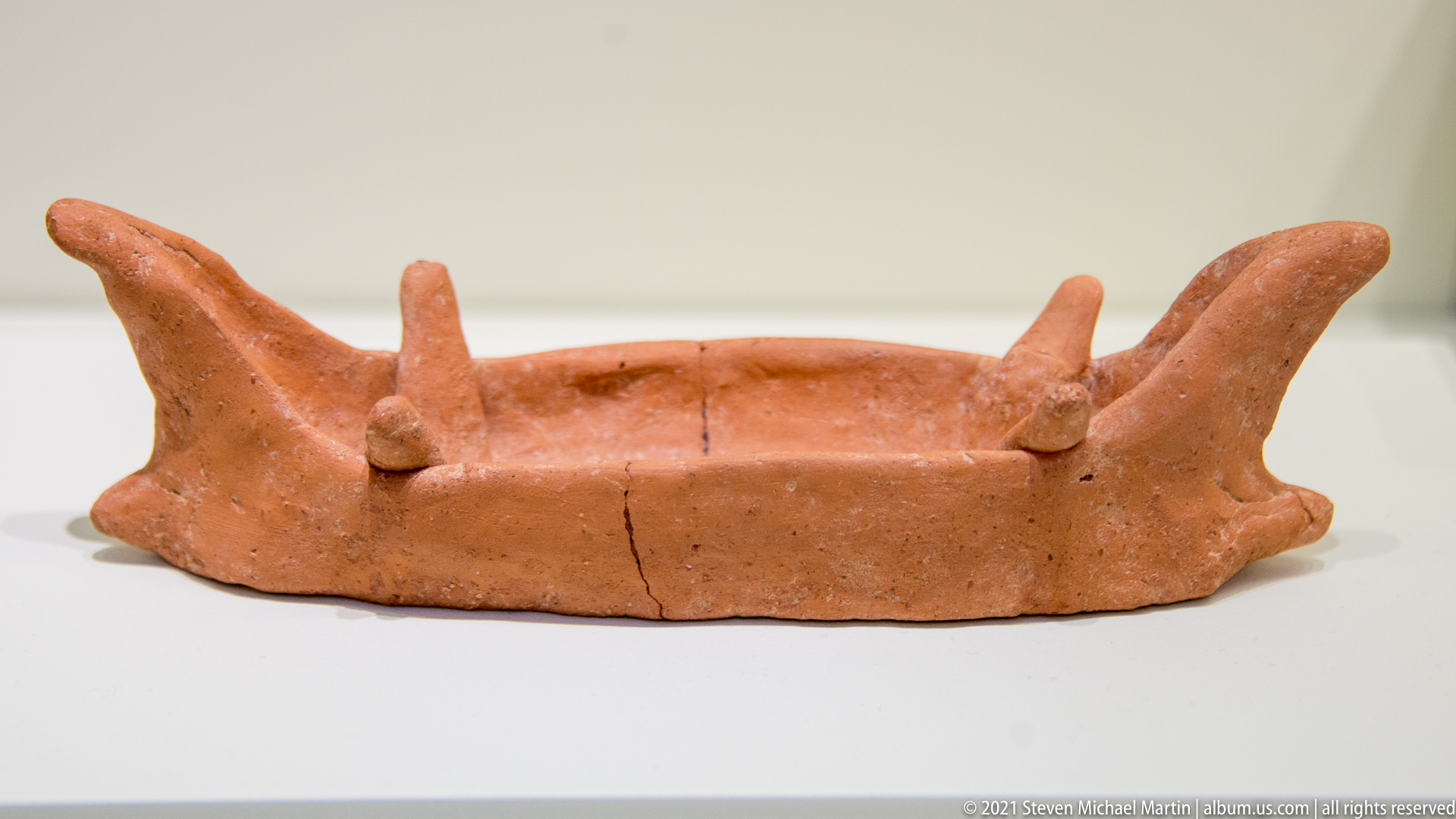
A small terracotta model takes the form of an open boat with sharply upturned ends and several raised projections along the rim. The hand-modelled, slightly irregular hull is preserved in two joined sections, making both its nautical silhouette and archaeological condition readily visible.
Caption
A small terracotta model takes the form of an open boat with sharply upturned ends and several raised projections along the rim. The hand-modelled, slightly irregular hull is preserved in two joined sections, making both its nautical silhouette and archaeological condition readily visible.
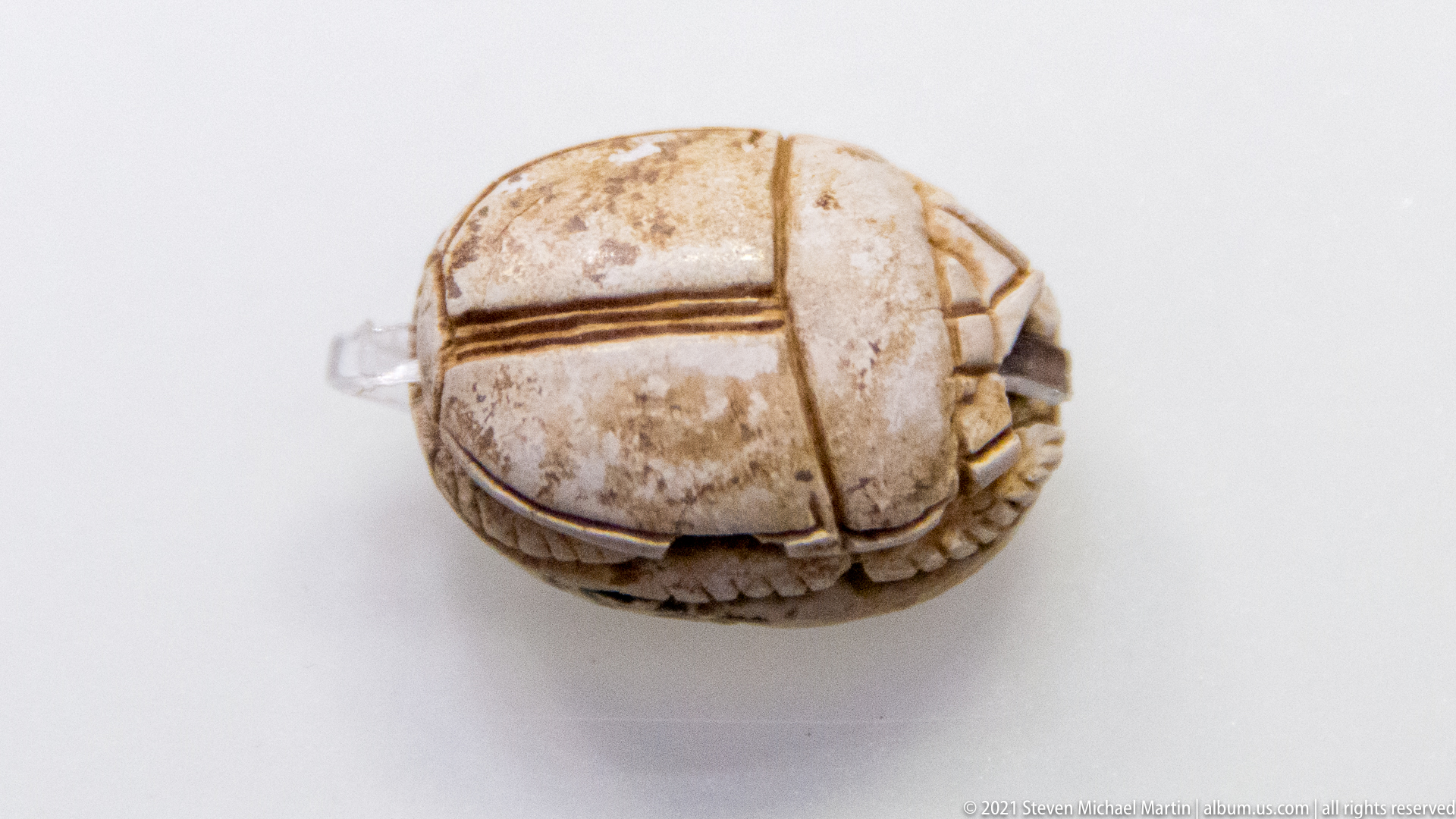
A compact pale object is carved in the rounded form of a scarab, with grooves dividing the wing cases and modeled legs wrapping around the sides. Seen from above, the stylized beetle anatomy is especially clear, though the proof sheet does not establish whether the piece functioned specifically as a seal, amulet, or ornament.
Caption
A compact pale object is carved in the rounded form of a scarab, with grooves dividing the wing cases and modeled legs wrapping around the sides. Seen from above, the stylized beetle anatomy is especially clear, though the proof sheet does not establish whether the piece functioned specifically as a seal, amulet, or ornament.
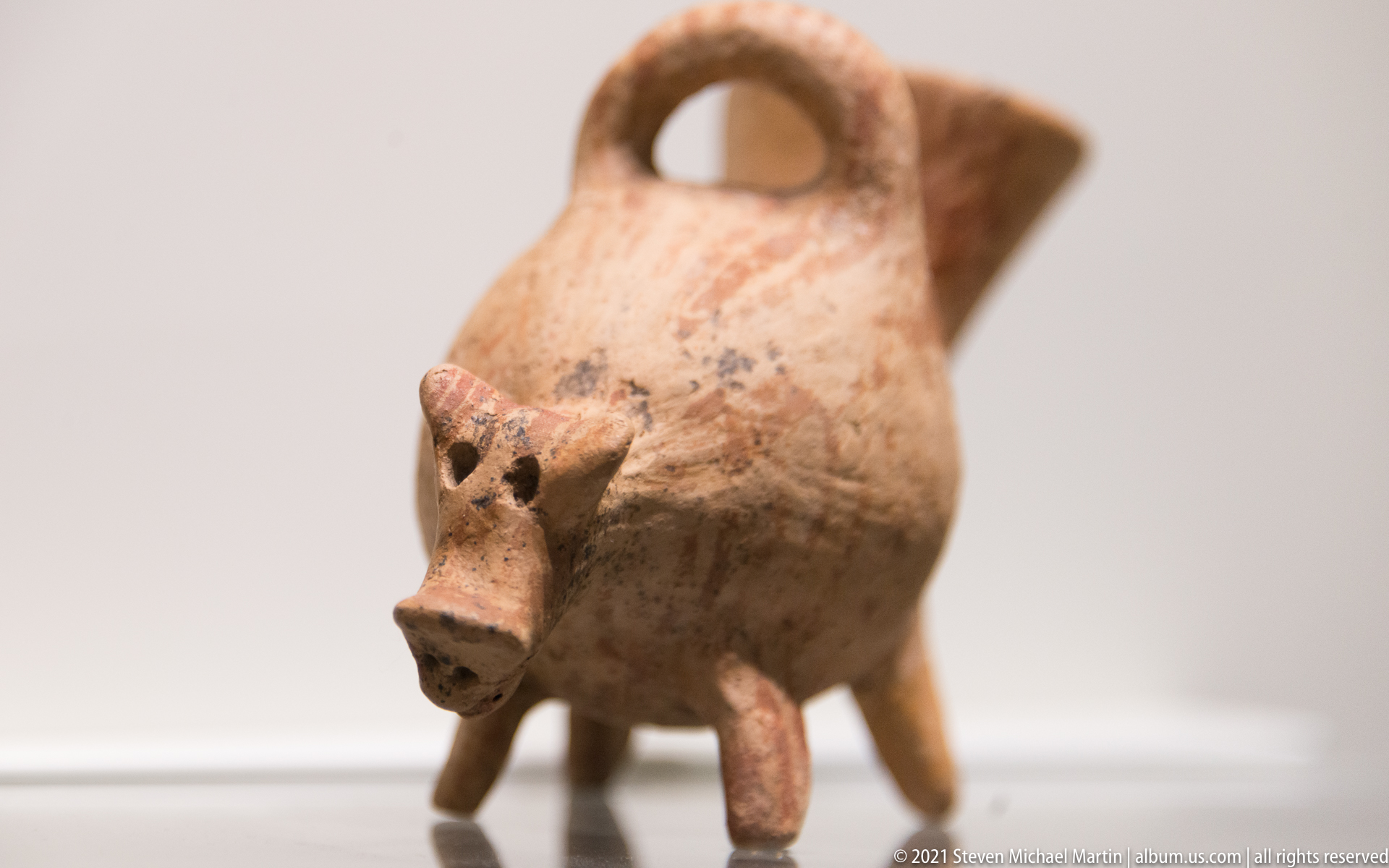
A playful terracotta vessel is modeled as a standing pig, with pointed ears, projecting snout, four short legs, and a large loop handle rising over its back. A pouring spout extends behind the handle, integrating animal sculpture with a functional container form.
Caption
A playful terracotta vessel is modeled as a standing pig, with pointed ears, projecting snout, four short legs, and a large loop handle rising over its back. A pouring spout extends behind the handle, integrating animal sculpture with a functional container form.
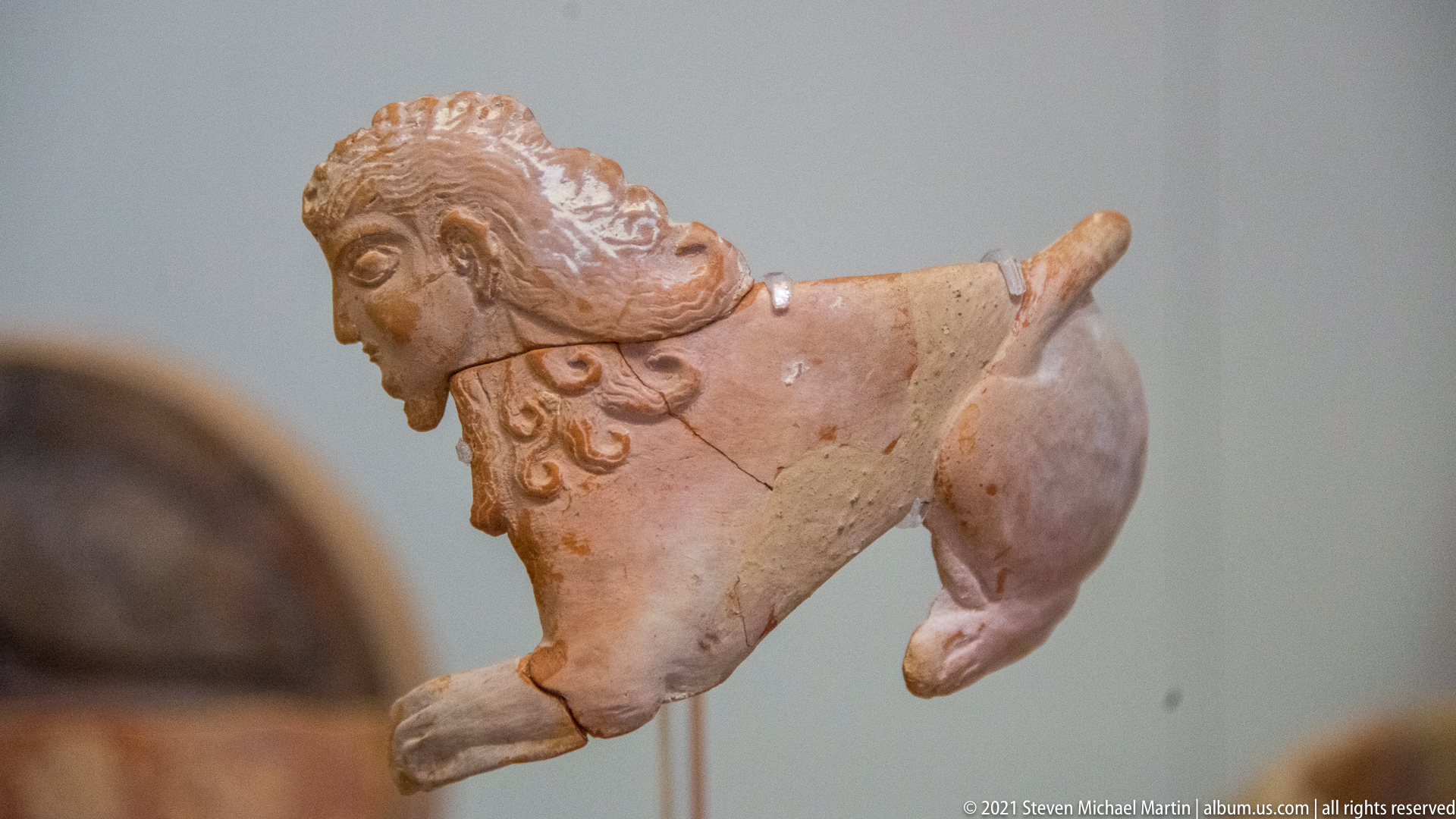
This fragmentary terracotta figure combines a quadruped body with a carefully modeled head framed by curling locks or a mane. The surviving foreleg, rounded hindquarter, raised tail, and expressive facial features create a hybrid or feline appearance, but the precise mythological or zoological identification is not secure from the proof sheet alone.
Caption
This fragmentary terracotta figure combines a quadruped body with a carefully modeled head framed by curling locks or a mane. The surviving foreleg, rounded hindquarter, raised tail, and expressive facial features create a hybrid or feline appearance, but the precise mythological or zoological identification is not secure from the proof sheet alone.
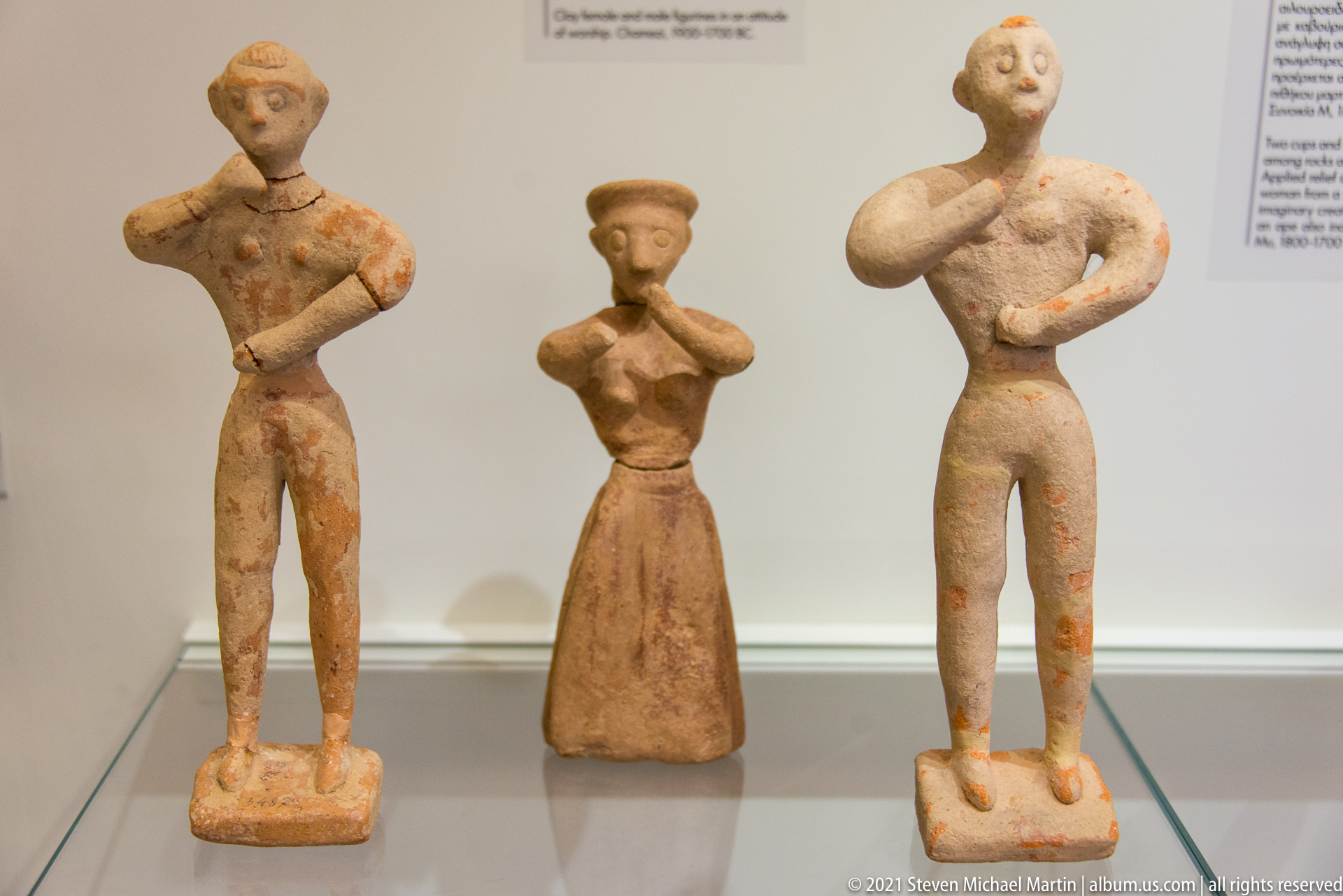
Three terracotta human figures stand side by side, each treated differently in pose and dress. Two elongated figures place their hands near the torso, while the central figure wears a long flaring garment. Their simplified anatomy and traces of surface color make the group useful for comparing small-scale figurative conventions.
Caption
Three terracotta human figures stand side by side, each treated differently in pose and dress. Two elongated figures place their hands near the torso, while the central figure wears a long flaring garment. Their simplified anatomy and traces of surface color make the group useful for comparing small-scale figurative conventions.
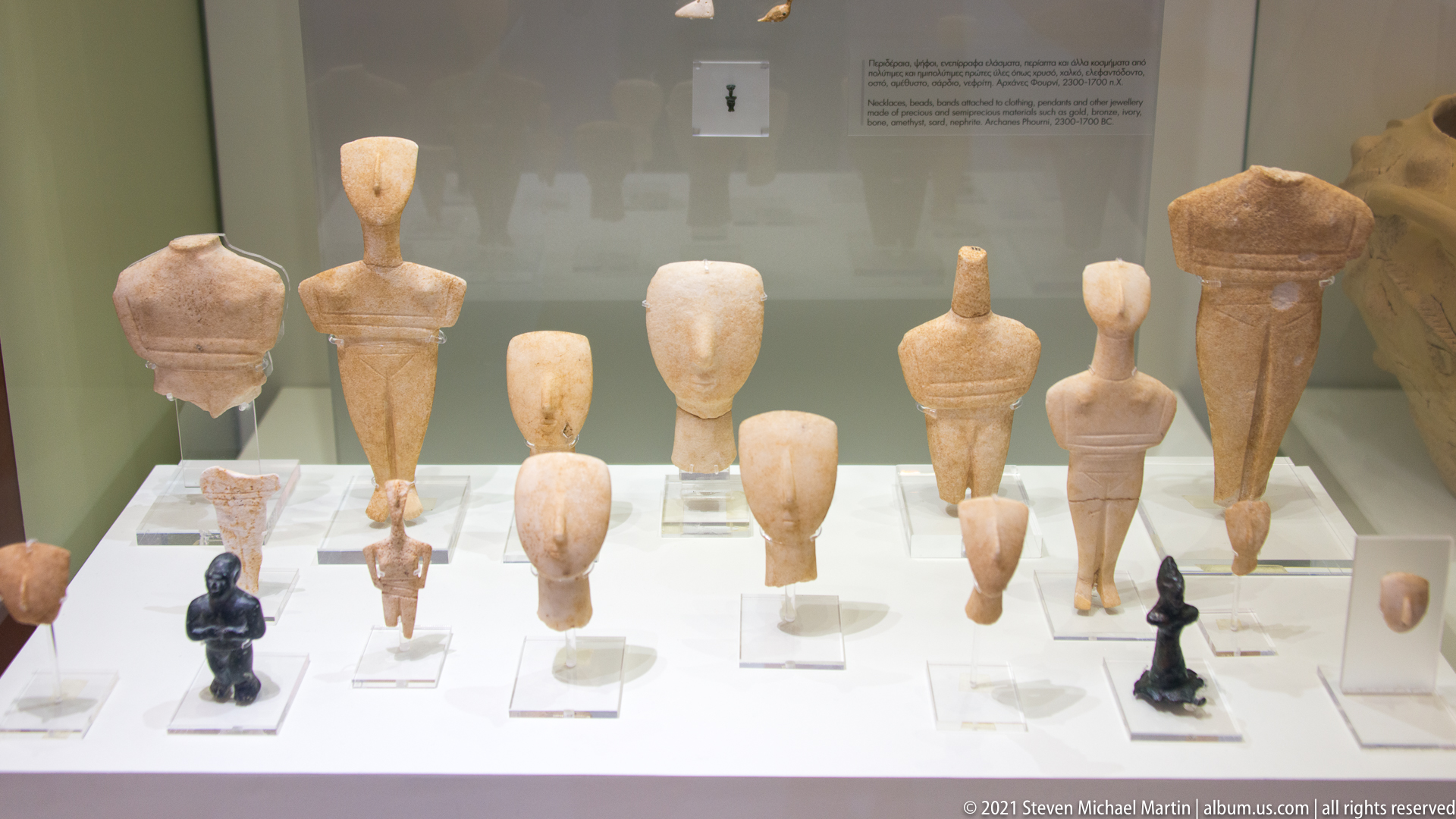
A museum case assembles numerous stylized human figurines, ranging from pale elongated torsos and schematic bodies to smaller dark standing figures. Displayed together, the objects reveal striking variation in proportion, modeling, and finish, while also showing how fragmentary survivals are mounted for comparative study.
Caption
A museum case assembles numerous stylized human figurines, ranging from pale elongated torsos and schematic bodies to smaller dark standing figures. Displayed together, the objects reveal striking variation in proportion, modeling, and finish, while also showing how fragmentary survivals are mounted for comparative study.
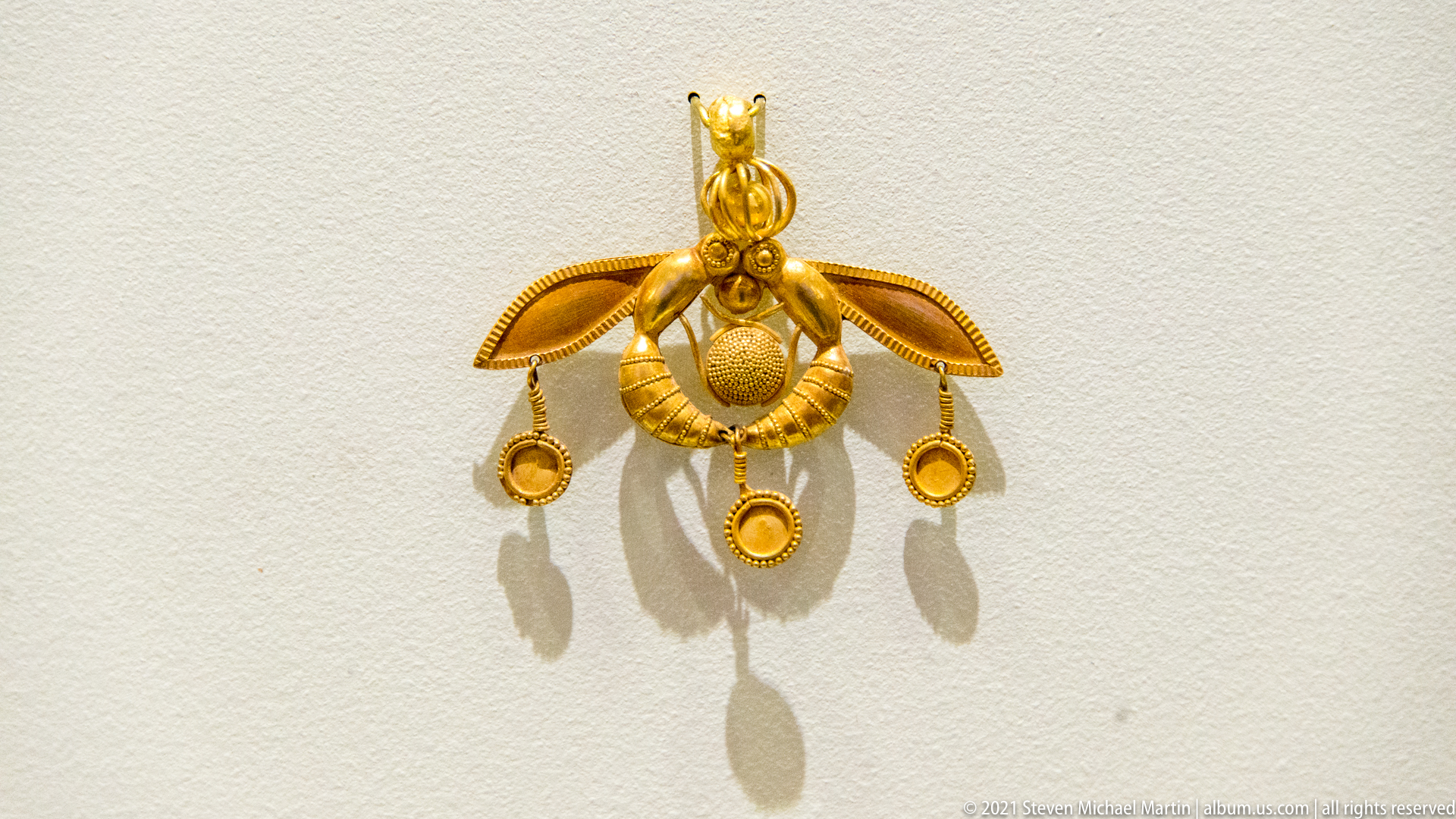
The celebrated Gold Bee Pendant from Chrysolakkos at Malia shows two bees facing one another with open wings, joined around a central circular element often interpreted as honeycomb. Three small discs hang below the composition. Filigree, granulation, repoussé, and incised detail turn the tiny jewel into a virtuoso demonstration of Minoan goldworking, dated to about 1800–1700 BC.
Caption
The celebrated Gold Bee Pendant from Chrysolakkos at Malia shows two bees facing one another with open wings, joined around a central circular element often interpreted as honeycomb. Three small discs hang below the composition. Filigree, granulation, repoussé, and incised detail turn the tiny jewel into a virtuoso demonstration of Minoan goldworking, dated to about 1800–1700 BC.
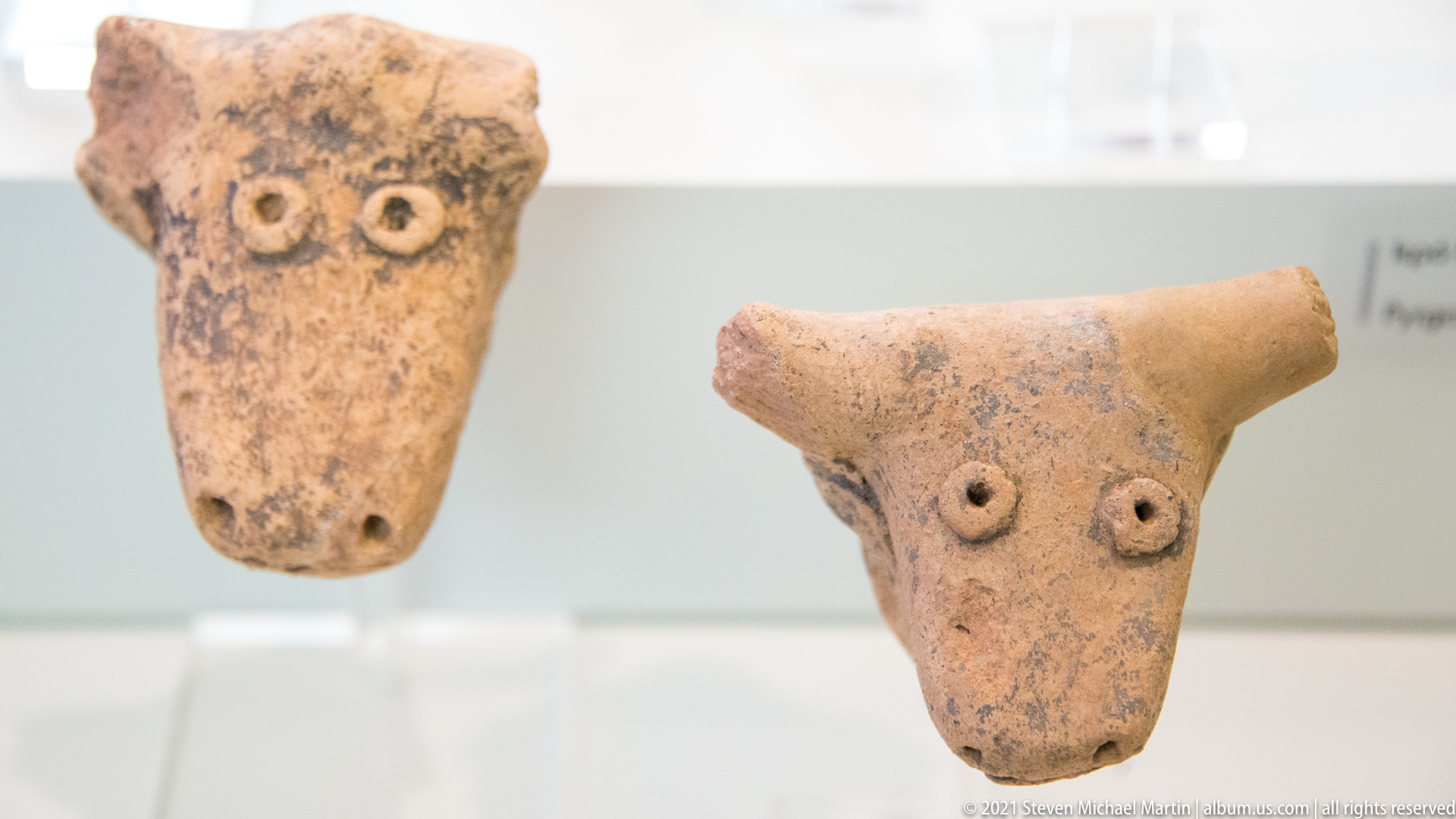
Two compact terracotta heads face the viewer, each reduced to a tapered muzzle, applied circular eyes, and short lateral projections suggesting ears or horns. The nearer example preserves a warm buff surface with dark accretions, while the second, behind it, is more heavily darkened and worn.
Caption
Two compact terracotta heads face the viewer, each reduced to a tapered muzzle, applied circular eyes, and short lateral projections suggesting ears or horns. The nearer example preserves a warm buff surface with dark accretions, while the second, behind it, is more heavily darkened and worn.
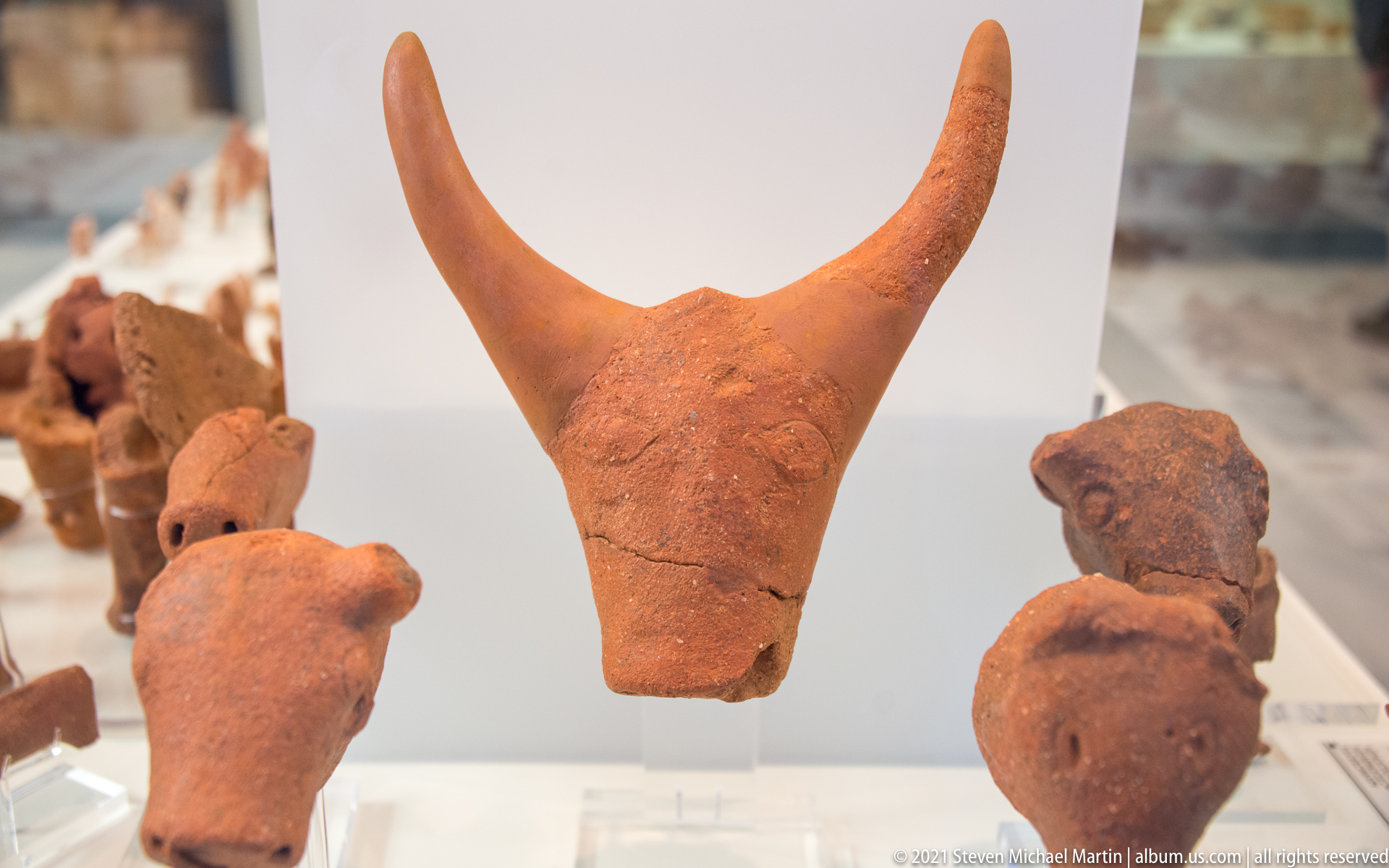
A stylized terracotta bovine head is dominated by two exceptionally long, upward-curving horns. Minimal facial modeling and a narrow muzzle contrast with the dramatic horn span, while neighboring animal fragments in the case establish the object as part of a broader display of small zoomorphic works.
Caption
A stylized terracotta bovine head is dominated by two exceptionally long, upward-curving horns. Minimal facial modeling and a narrow muzzle contrast with the dramatic horn span, while neighboring animal fragments in the case establish the object as part of a broader display of small zoomorphic works.
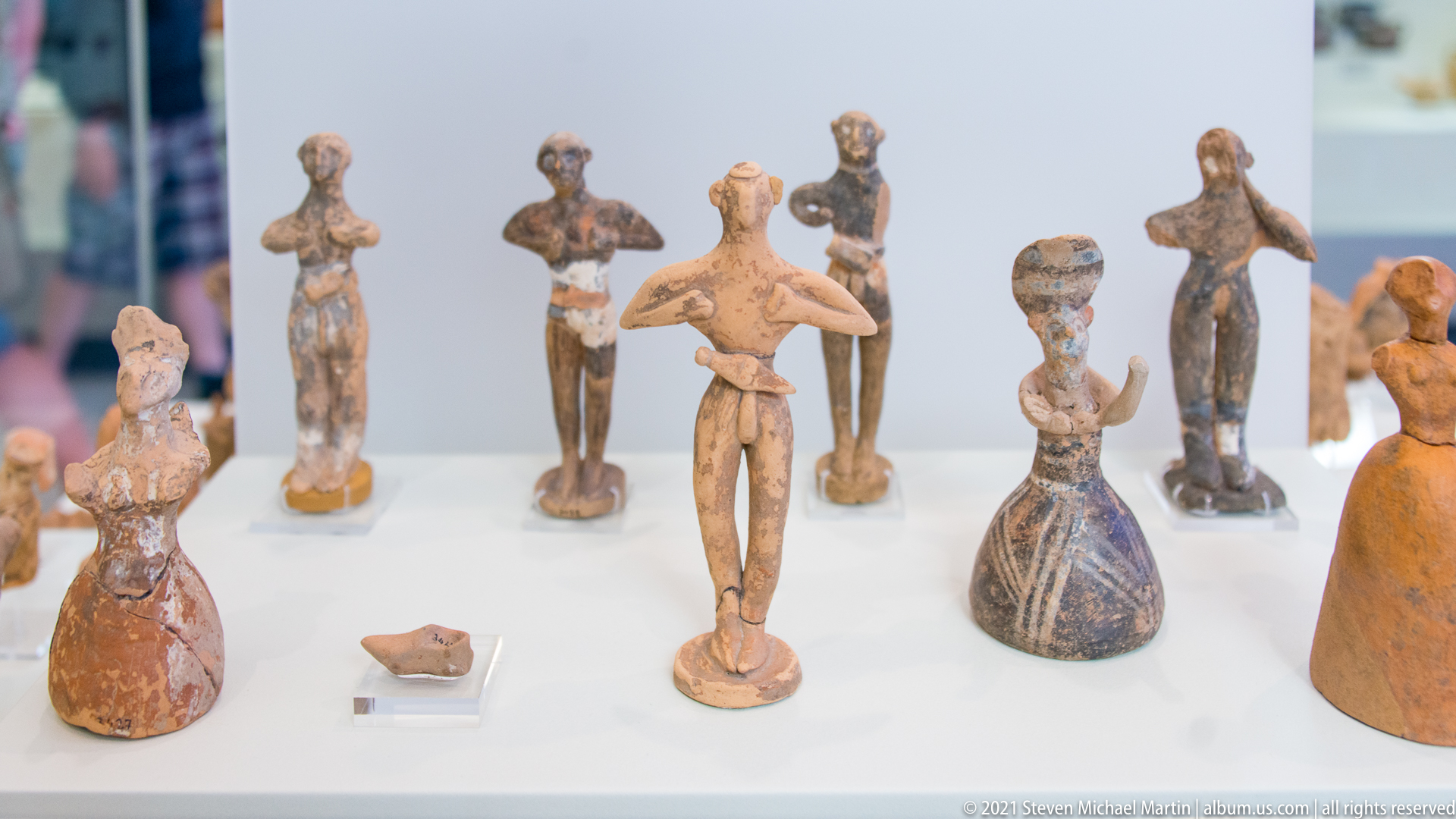
A cluster of small standing terracotta figures fills the display, several retaining dark painted details on garments, torsos, and faces. The central nude or lightly clothed figure adopts a hands-on-hips pose, while flanking figures vary in dress and modeling, creating a compact comparison of ancient figurative types and surface treatment.
Caption
A cluster of small standing terracotta figures fills the display, several retaining dark painted details on garments, torsos, and faces. The central nude or lightly clothed figure adopts a hands-on-hips pose, while flanking figures vary in dress and modeling, creating a compact comparison of ancient figurative types and surface treatment.
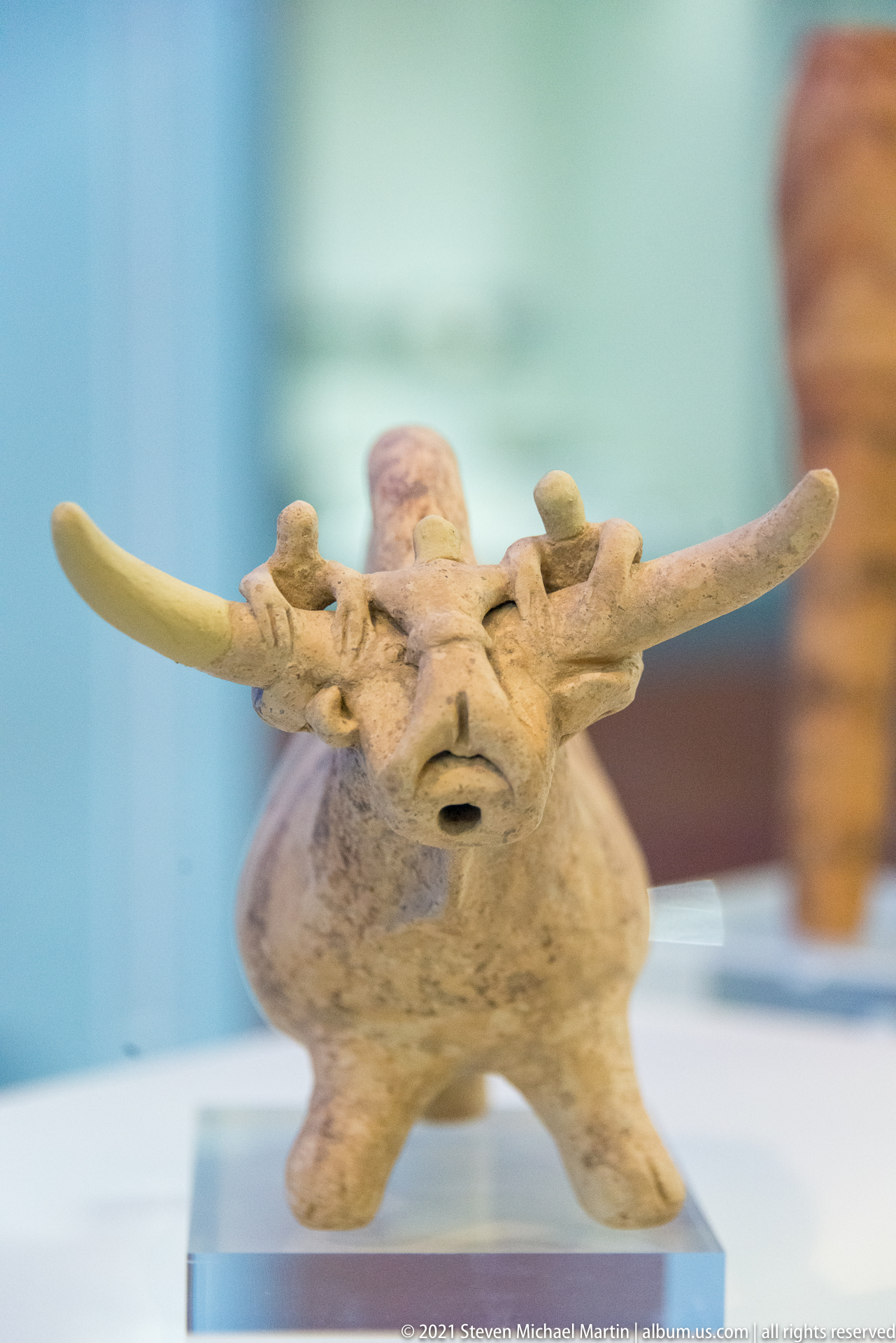
A squat terracotta animal form confronts the viewer with a broad horn span, modeled eyes, projecting muzzle, and sturdy legs. An opening in the mouth or snout and the vessel-like body suggest that the figure may have served as a container or pouring object, though its exact function is not securely visible.
Caption
A squat terracotta animal form confronts the viewer with a broad horn span, modeled eyes, projecting muzzle, and sturdy legs. An opening in the mouth or snout and the vessel-like body suggest that the figure may have served as a container or pouring object, though its exact function is not securely visible.
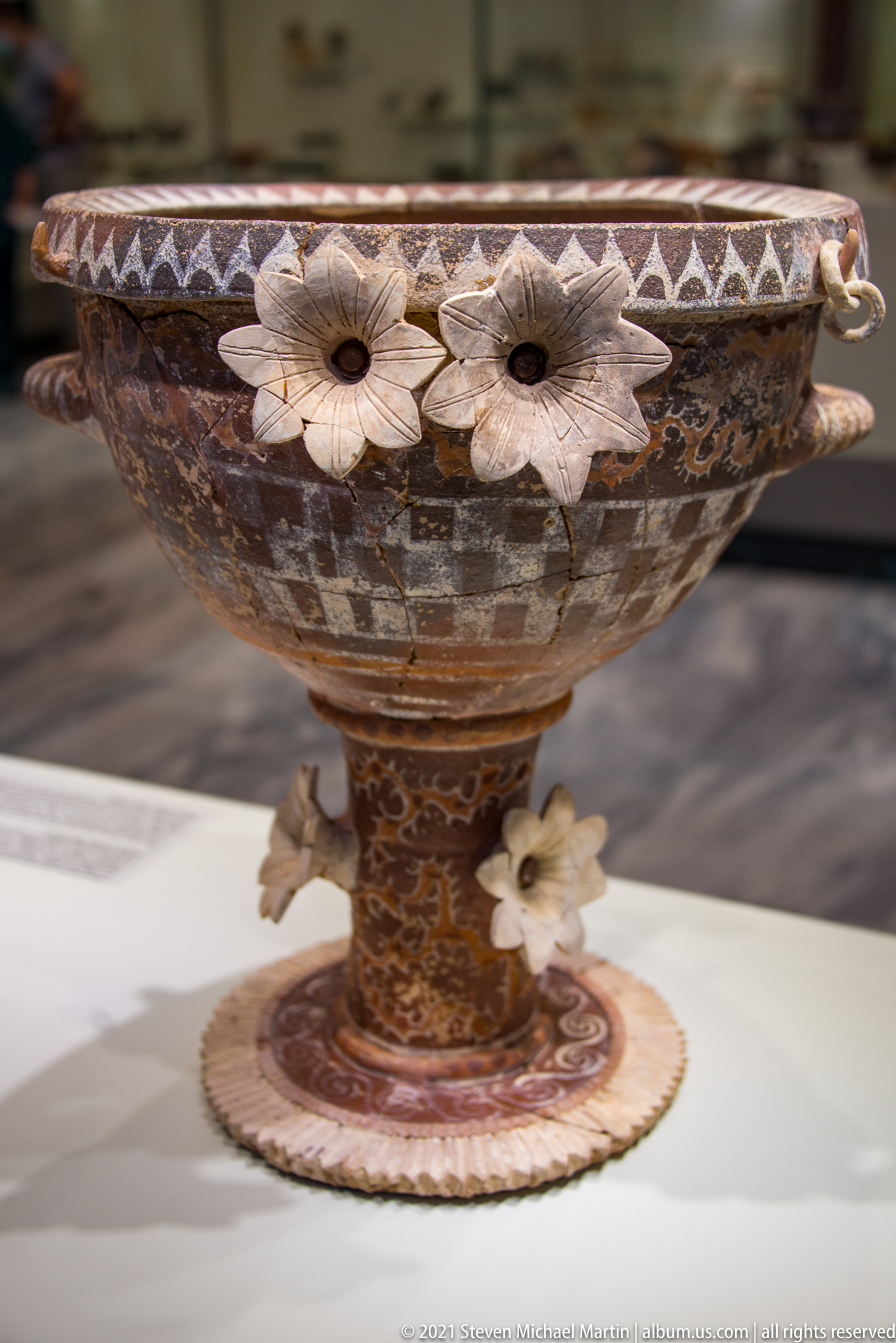
A richly ornamented ceramic bowl combines a deep painted basin, pedestal foot, and multiple applied rosettes around the rim and stem. Alternating dark geometric bands, pale floral forms, and projecting handles create a highly sculptural profile, distinguishing this vessel from the plainer storage jars displayed nearby.
Caption
A richly ornamented ceramic bowl combines a deep painted basin, pedestal foot, and multiple applied rosettes around the rim and stem. Alternating dark geometric bands, pale floral forms, and projecting handles create a highly sculptural profile, distinguishing this vessel from the plainer storage jars displayed nearby.
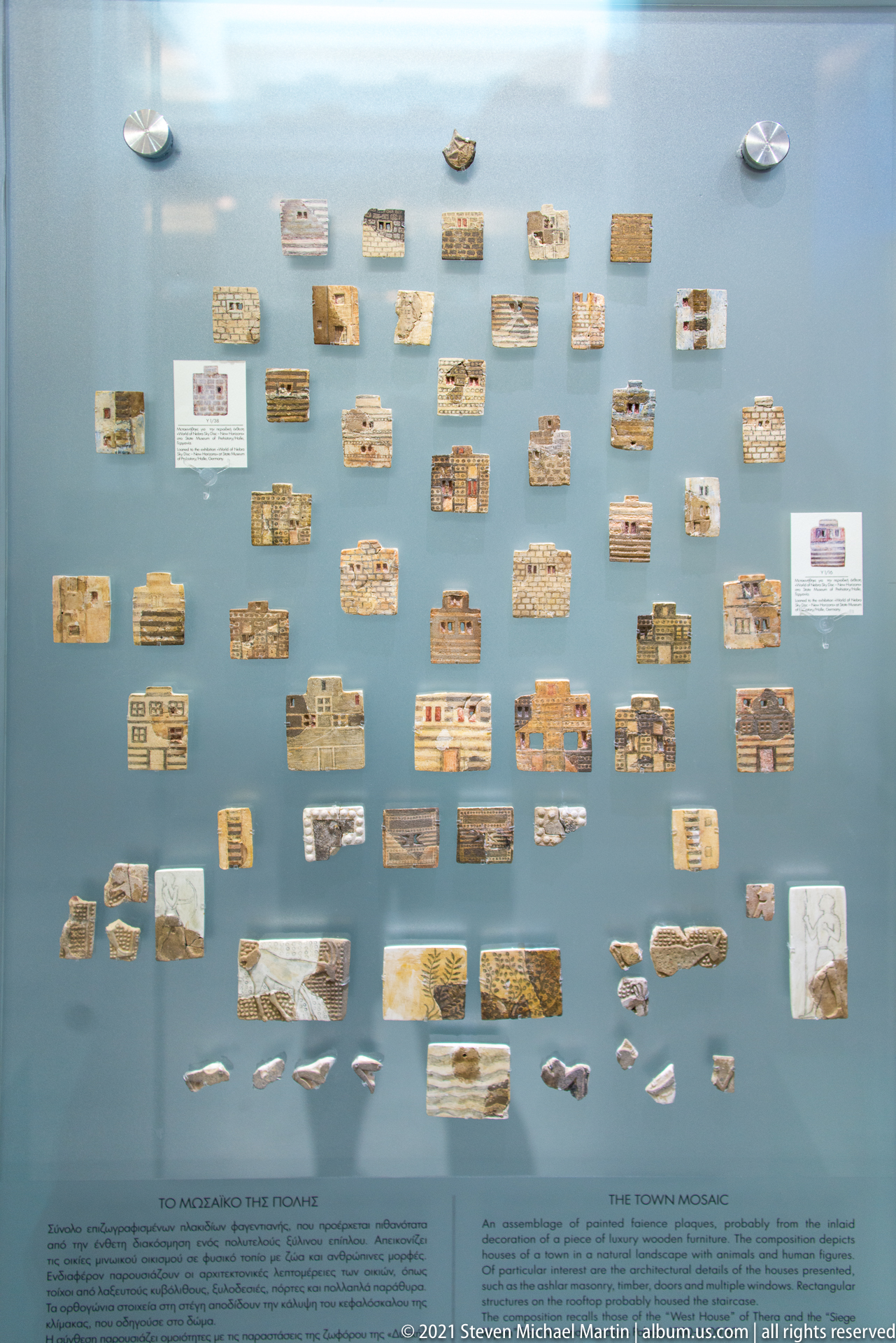
A wall-mounted display arranges dozens of small clay tablets and fragments in ordered rows, with several larger pieces and explanatory labels below. Incised signs and ruled surfaces are visible on many pieces, presenting writing as an archaeological technology and documentary medium within the museum’s prehistoric Cretan collections.
Caption
A wall-mounted display arranges dozens of small clay tablets and fragments in ordered rows, with several larger pieces and explanatory labels below. Incised signs and ruled surfaces are visible on many pieces, presenting writing as an archaeological technology and documentary medium within the museum’s prehistoric Cretan collections.
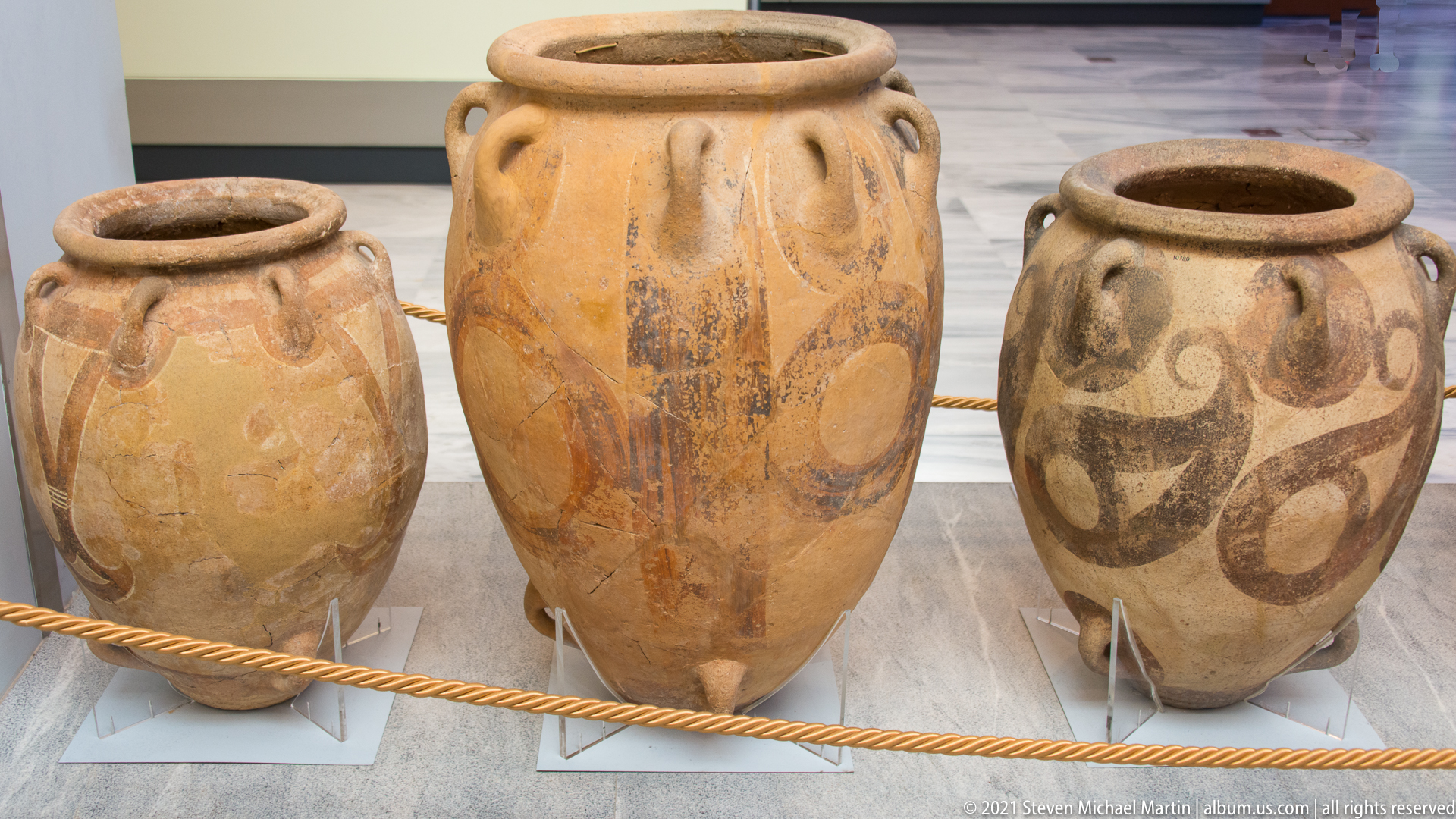
Three large storage jars stand together, each with a broad mouth, paired small handles near the shoulder, and painted curvilinear motifs. Their differing sizes and surface patterns invite comparison of large ceramic storage forms, with the central vessel towering above the two flanking jars.
Caption
Three large storage jars stand together, each with a broad mouth, paired small handles near the shoulder, and painted curvilinear motifs. Their differing sizes and surface patterns invite comparison of large ceramic storage forms, with the central vessel towering above the two flanking jars.
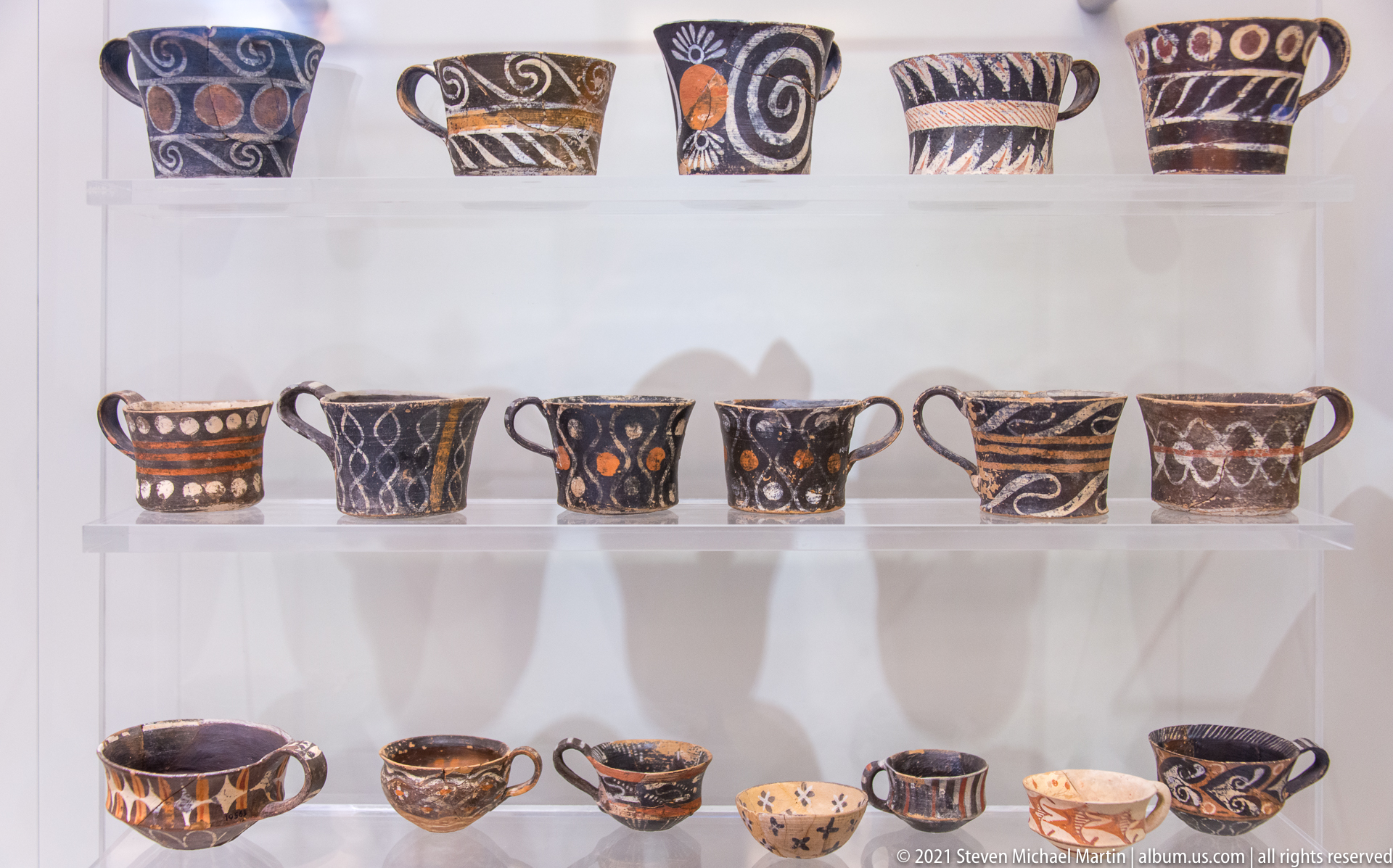
Rows of small ceramic cups line a museum case, their dark surfaces enlivened by spirals, dots, leaf-like strokes, bands, and other contrasting painted motifs. Differences in handle shape, bowl depth, and decorative scheme make the arrangement a compact survey of drinking-vessel variation rather than a single repeated type.
Caption
Rows of small ceramic cups line a museum case, their dark surfaces enlivened by spirals, dots, leaf-like strokes, bands, and other contrasting painted motifs. Differences in handle shape, bowl depth, and decorative scheme make the arrangement a compact survey of drinking-vessel variation rather than a single repeated type.
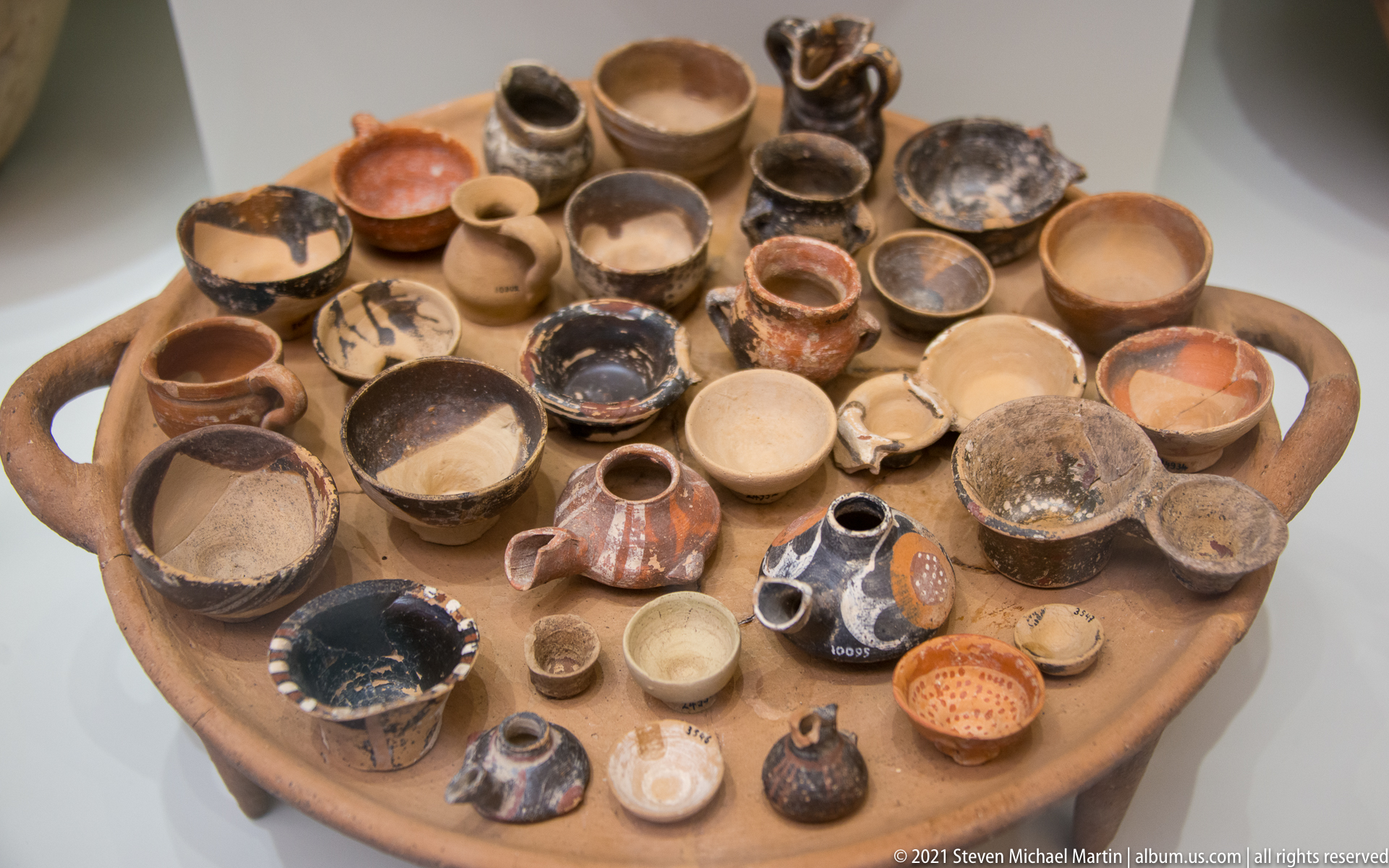
Dozens of small ceramic vessels are gathered inside a broad shallow tray, forming a dense assemblage of cups, bowls, jugs, handled pots, and miniature containers. Varied slips, painted surfaces, firing colors, and states of preservation turn the group into a visual inventory of small-scale pottery rather than a single standardized service.
Caption
Dozens of small ceramic vessels are gathered inside a broad shallow tray, forming a dense assemblage of cups, bowls, jugs, handled pots, and miniature containers. Varied slips, painted surfaces, firing colors, and states of preservation turn the group into a visual inventory of small-scale pottery rather than a single standardized service.
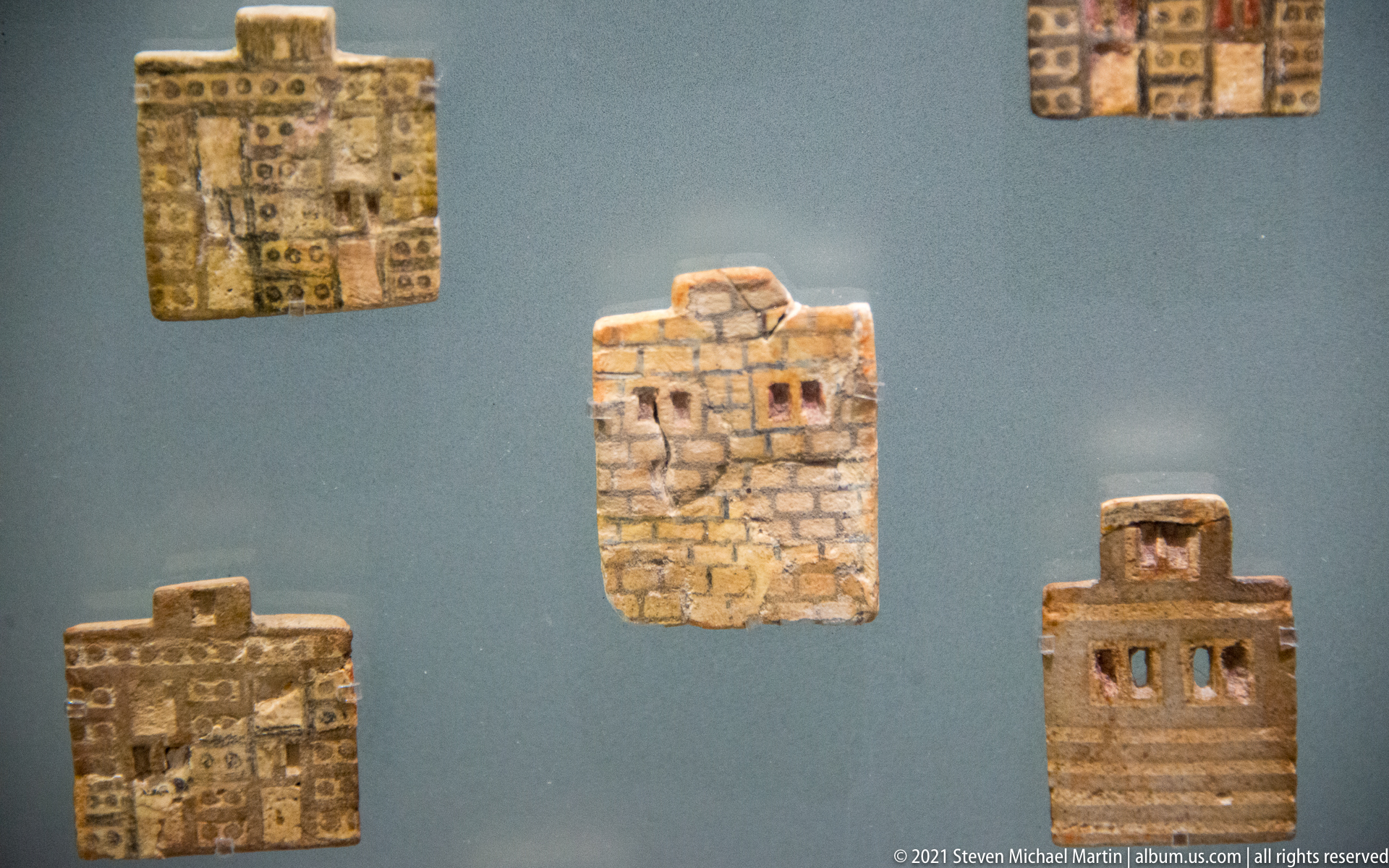
Four inscribed clay tablets are isolated against the display backing, revealing different formats of ancient record keeping. The central fragment preserves a dense grid of incised signs, while the flanking tablets show repeated marks organized in horizontal registers and compartments. Their broken edges make the fragmentary archaeological condition especially apparent.
Caption
Four inscribed clay tablets are isolated against the display backing, revealing different formats of ancient record keeping. The central fragment preserves a dense grid of incised signs, while the flanking tablets show repeated marks organized in horizontal registers and compartments. Their broken edges make the fragmentary archaeological condition especially apparent.
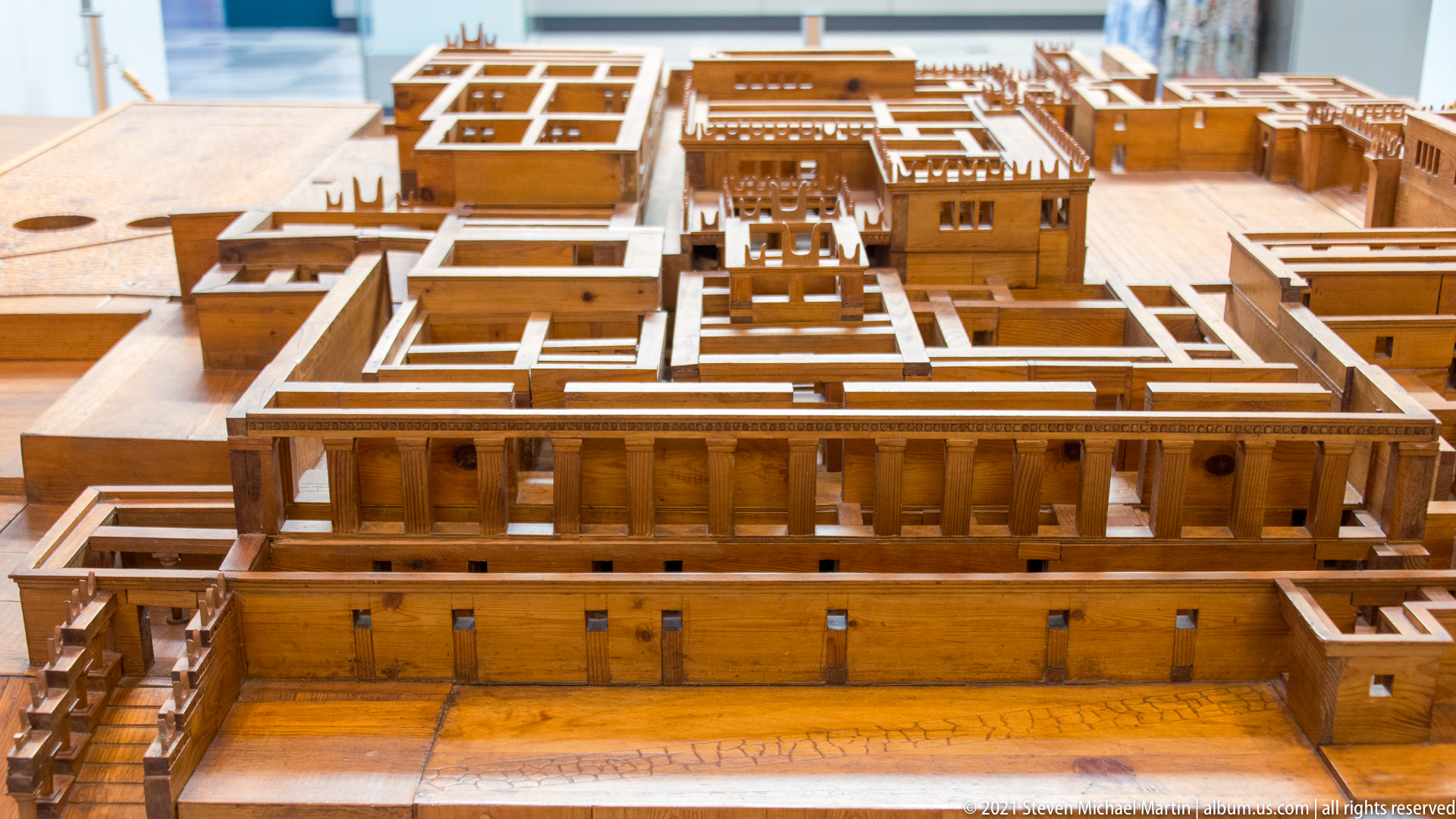
A large wooden architectural model reconstructs a multi-courtyard palace complex with long façades, layered rooms, corridors, stairways, and upper-story structures. Viewed toward a broad formal frontage, the model translates an archaeological ground plan into three dimensions and helps convey the density and circulation of monumental Minoan architecture.
Caption
A large wooden architectural model reconstructs a multi-courtyard palace complex with long façades, layered rooms, corridors, stairways, and upper-story structures. Viewed toward a broad formal frontage, the model translates an archaeological ground plan into three dimensions and helps convey the density and circulation of monumental Minoan architecture.
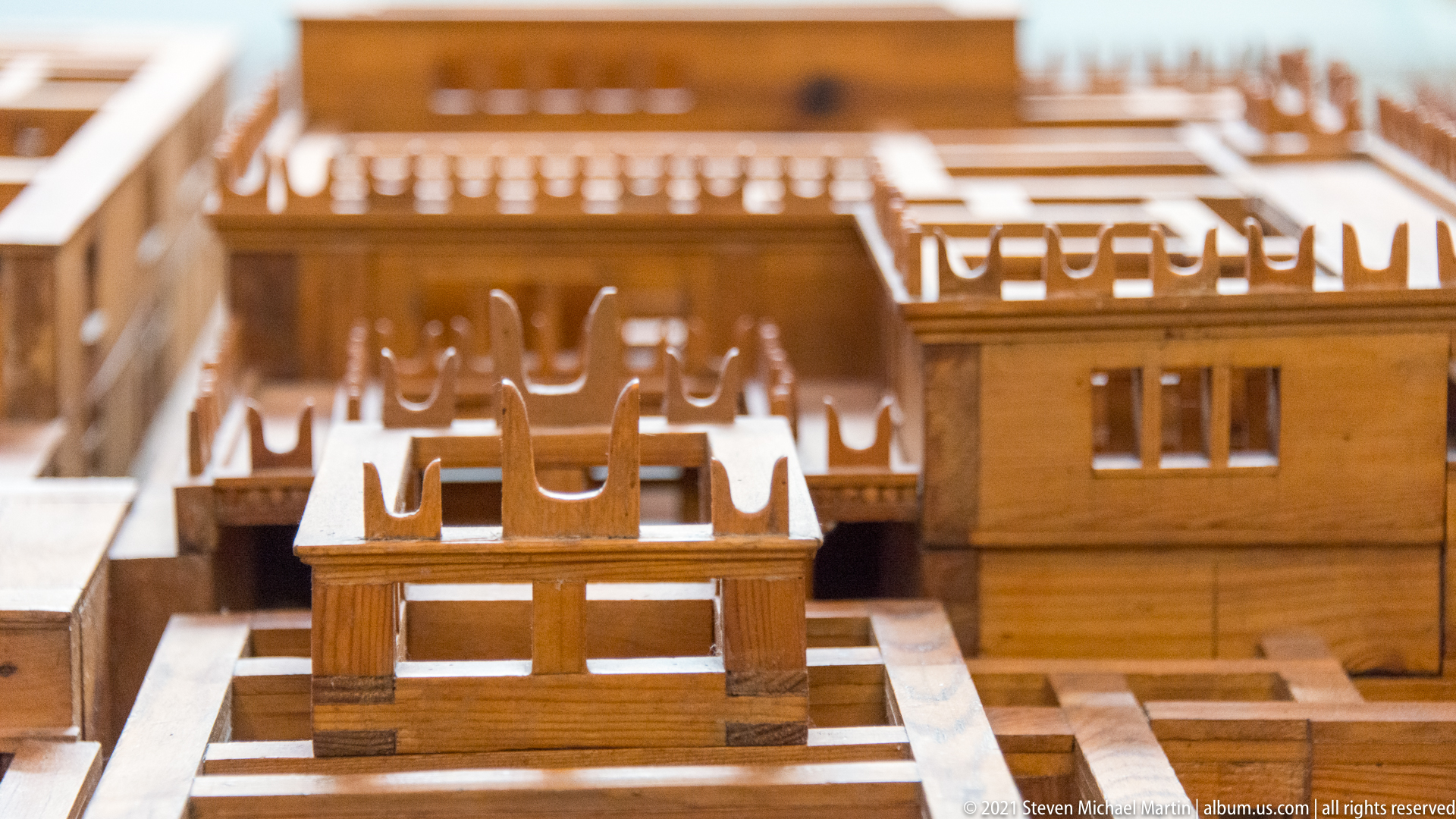
A shallow-focus detail isolates one upper-story section of the wooden palace reconstruction. Open rectangular windows, projecting beams, parapet-like uprights, and adjoining roof levels show how the model interprets vertical circulation and timber-framed architectural elements beyond the excavated foundations.
Caption
A shallow-focus detail isolates one upper-story section of the wooden palace reconstruction. Open rectangular windows, projecting beams, parapet-like uprights, and adjoining roof levels show how the model interprets vertical circulation and timber-framed architectural elements beyond the excavated foundations.

From an elevated oblique angle, the wooden palace model reveals stacked façades, open courts, narrow passages, staircases, and stepped changes in level. The view emphasizes the complex’s vertical organization and tightly interlocking rooms, with a prominent multi-story block rising above lower surrounding structures.
Caption
From an elevated oblique angle, the wooden palace model reveals stacked façades, open courts, narrow passages, staircases, and stepped changes in level. The view emphasizes the complex’s vertical organization and tightly interlocking rooms, with a prominent multi-story block rising above lower surrounding structures.
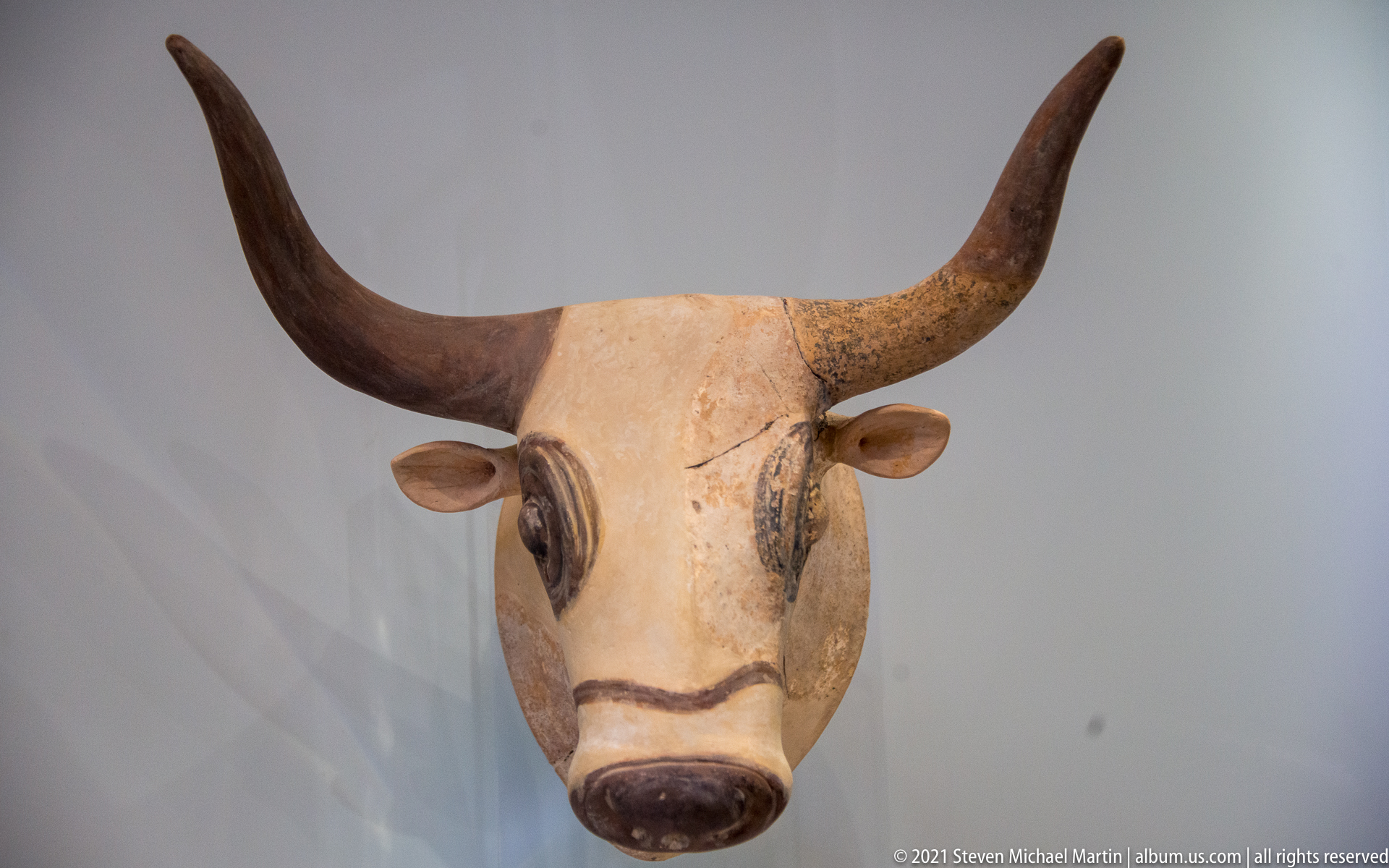
Dark sweeping horns contrast with the pale face of this bull-head vessel, whose painted eyes, muzzle, and linear markings animate the modeled form. Seen straight on, the object emphasizes the symmetry and commanding profile of the animal. The combination of sculptural modeling and painted detail reflects the recurring importance of bulls within the material and visual culture of Minoan Crete.
Caption
Dark sweeping horns contrast with the pale face of this bull-head vessel, whose painted eyes, muzzle, and linear markings animate the modeled form. Seen straight on, the object emphasizes the symmetry and commanding profile of the animal. The combination of sculptural modeling and painted detail reflects the recurring importance of bulls within the material and visual culture of Minoan Crete.
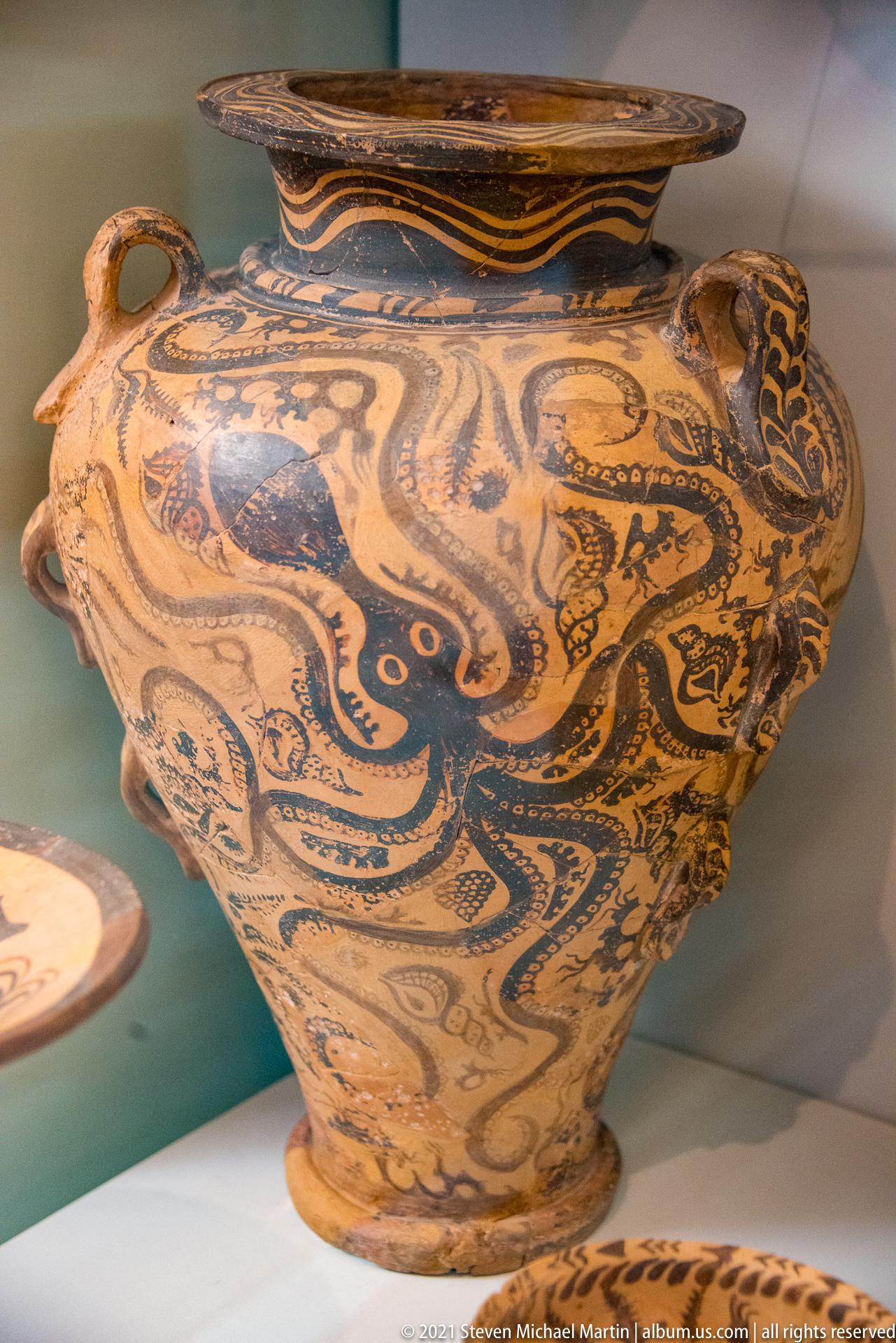
An octopus spreads its curling tentacles across the rounded body of this large Minoan ceramic vessel, integrating the marine creature with the pot’s swelling form. Additional sea motifs fill the surrounding surface, while the dark-on-light decoration wraps continuously around the vessel. The composition exemplifies the lively marine imagery associated with Late Bronze Age Cretan pottery.
Caption
An octopus spreads its curling tentacles across the rounded body of this large Minoan ceramic vessel, integrating the marine creature with the pot’s swelling form. Additional sea motifs fill the surrounding surface, while the dark-on-light decoration wraps continuously around the vessel. The composition exemplifies the lively marine imagery associated with Late Bronze Age Cretan pottery.
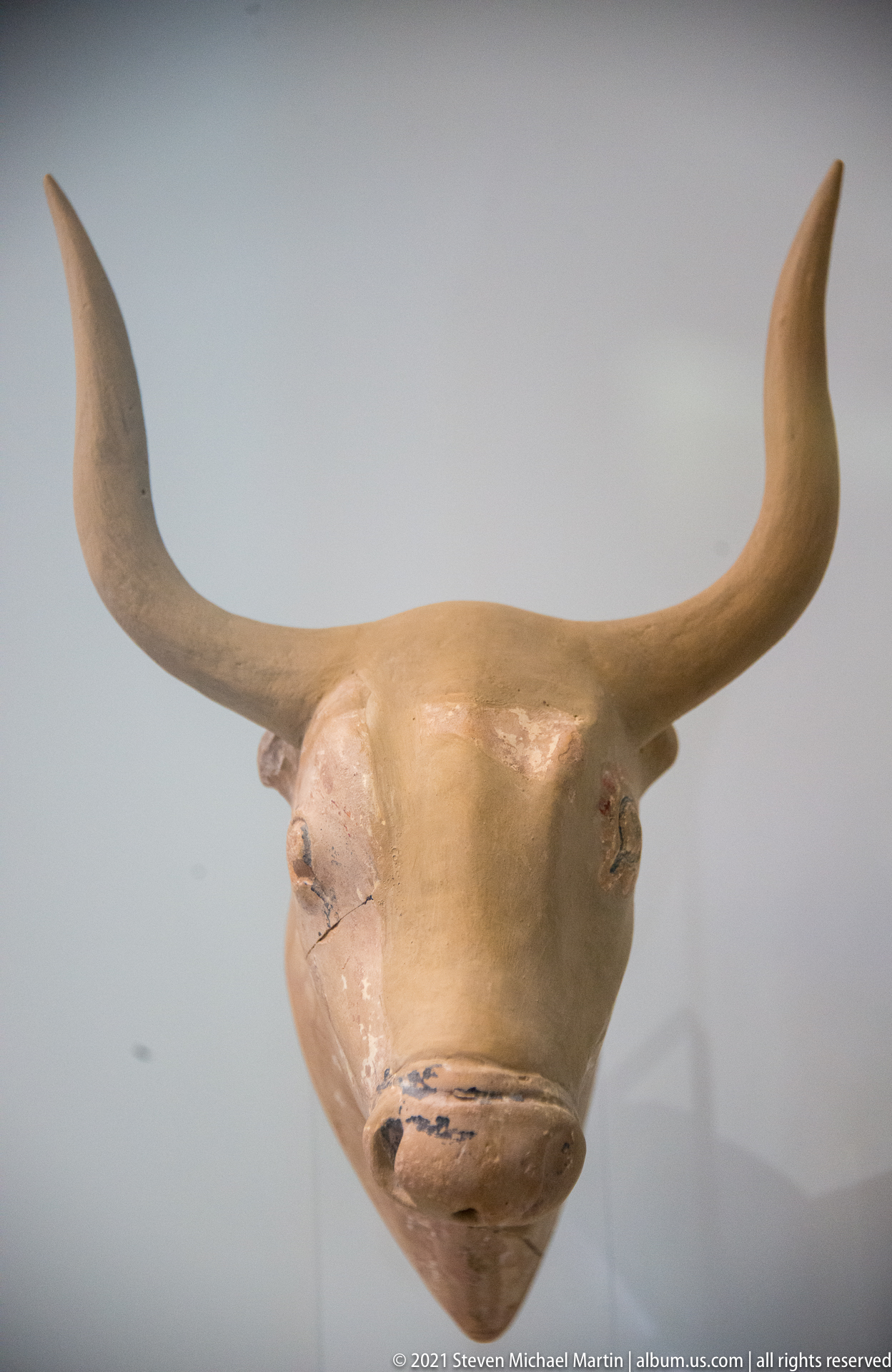
Long upward-curving horns frame the pale head of a bull-shaped Minoan vessel. The modeled muzzle, inset eyes, and carefully shaped ears give the animal a direct frontal presence, while the simplified surface keeps attention on the powerful silhouette. Bull imagery held a prominent place in Minoan visual culture, appearing across vessels, frescoes, seals, and ritual contexts.
Caption
Long upward-curving horns frame the pale head of a bull-shaped Minoan vessel. The modeled muzzle, inset eyes, and carefully shaped ears give the animal a direct frontal presence, while the simplified surface keeps attention on the powerful silhouette. Bull imagery held a prominent place in Minoan visual culture, appearing across vessels, frescoes, seals, and ritual contexts.

A thick, roughly triangular stone object is pierced by a large circular opening near its upper edge and carved with broad curving relief forms across the face. Its compact mass and worn surface suggest a functional archaeological object rather than freestanding sculpture, but the proof sheet does not reveal enough diagnostic detail to assign a precise use. The museum mounting allows its unusual profile and central perforation to be read clearly.
Caption
A thick, roughly triangular stone object is pierced by a large circular opening near its upper edge and carved with broad curving relief forms across the face. Its compact mass and worn surface suggest a functional archaeological object rather than freestanding sculpture, but the proof sheet does not reveal enough diagnostic detail to assign a precise use. The museum mounting allows its unusual profile and central perforation to be read clearly.
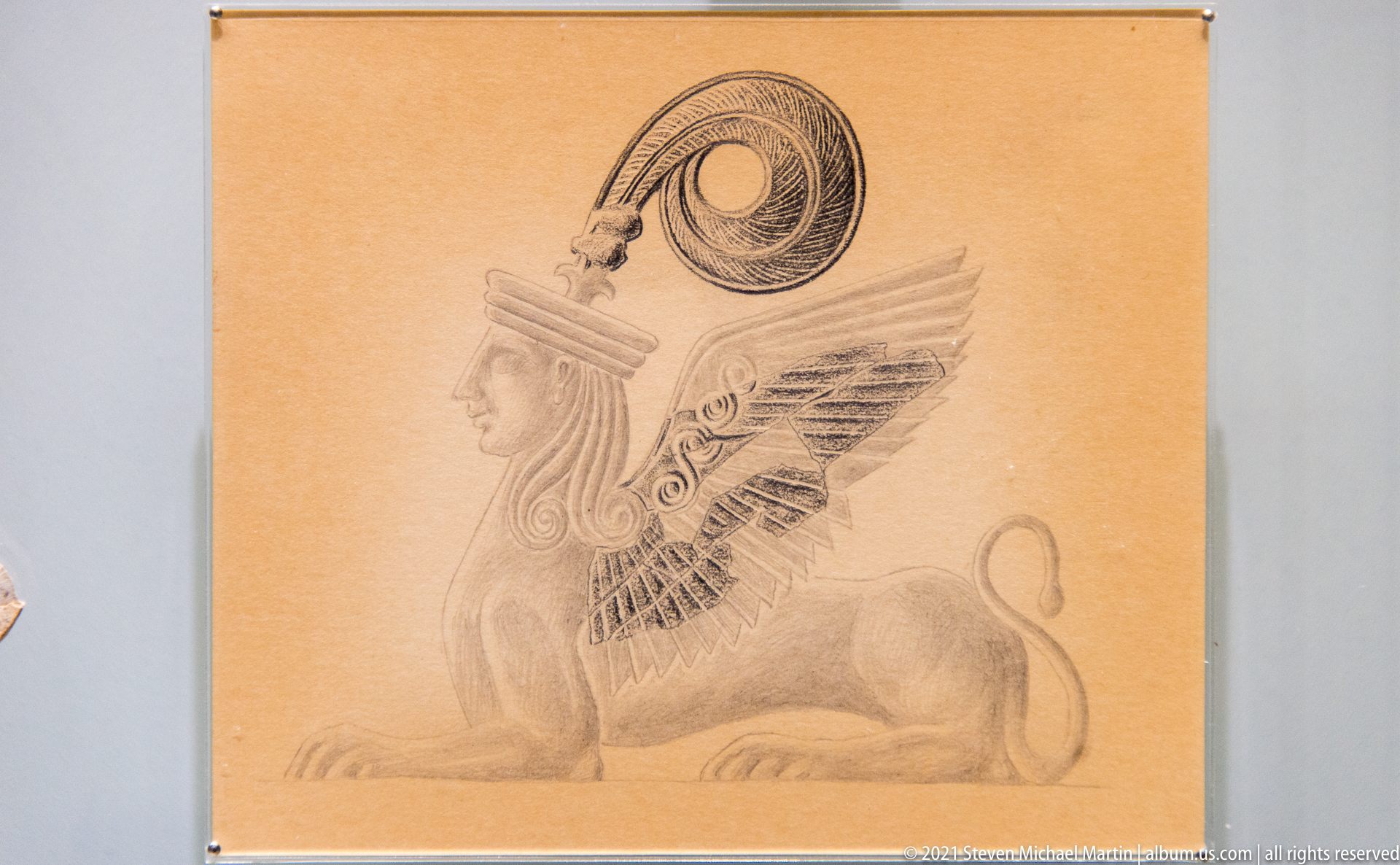
A museum reconstruction drawing restores a winged griffin with a feline body, feathered wings, and a high curling crest. The creature’s profile and elaborate plumage translate fragmentary Minoan imagery into a legible whole, helping visitors recognize the fantastic guardian figure familiar from elite Bronze Age Cretan decoration. The neutral ground keeps attention on the reconstructed outline and ornamental details.
Caption
A museum reconstruction drawing restores a winged griffin with a feline body, feathered wings, and a high curling crest. The creature’s profile and elaborate plumage translate fragmentary Minoan imagery into a legible whole, helping visitors recognize the fantastic guardian figure familiar from elite Bronze Age Cretan decoration. The neutral ground keeps attention on the reconstructed outline and ornamental details.
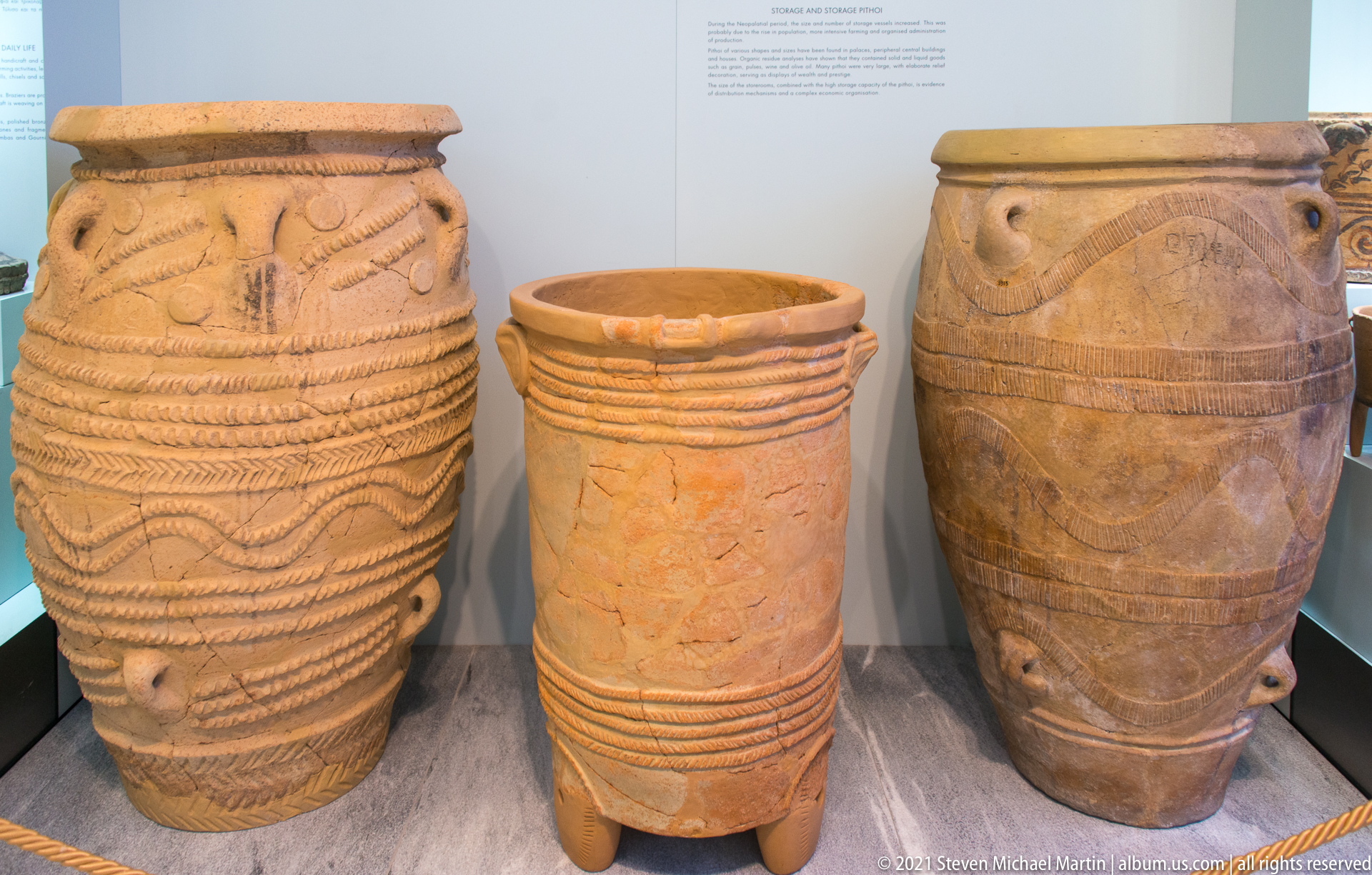
Three tall ceramic storage jars stand together, allowing their different surface treatments to be compared directly. Applied ropes, ridges, knobs, and incised or impressed bands articulate the bodies of the vessels, while broad mouths and substantial walls signal their storage function. Such pithoi were practical containers as well as conspicuous products of the sophisticated ceramic traditions of Bronze Age Crete.
Caption
Three tall ceramic storage jars stand together, allowing their different surface treatments to be compared directly. Applied ropes, ridges, knobs, and incised or impressed bands articulate the bodies of the vessels, while broad mouths and substantial walls signal their storage function. Such pithoi were practical containers as well as conspicuous products of the sophisticated ceramic traditions of Bronze Age Crete.
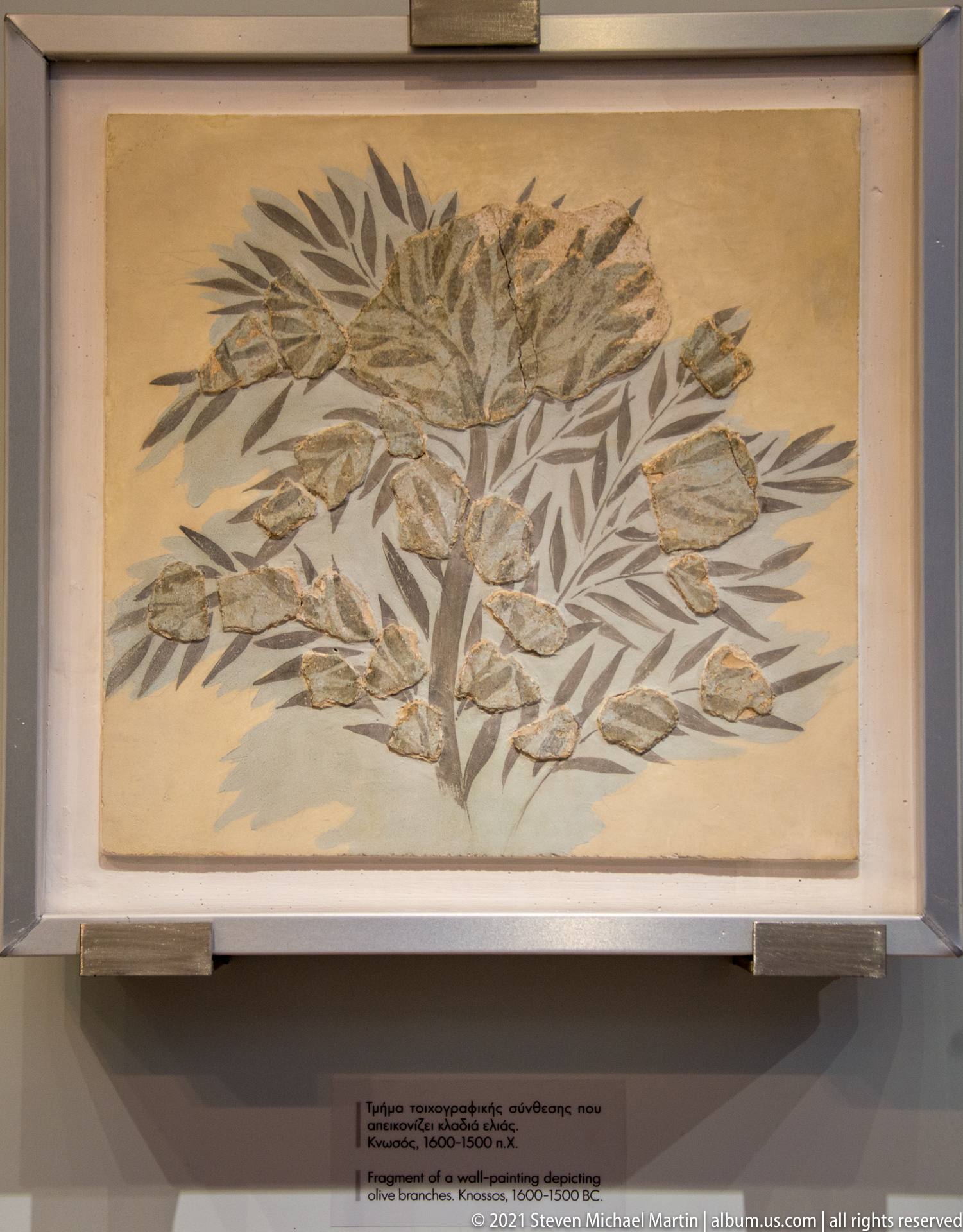
Delicate branching stems carry clusters of narrow leaves across a pale ground in this reconstructed Minoan fresco fragment. The naturalistic plant forms spread laterally rather than forming a rigid border, giving the composition an airy, organic rhythm. Mounted within a modern frame, the surviving painted plaster can be distinguished from restoration while still conveying the decorative importance of vegetation in Minoan wall painting.
Caption
Delicate branching stems carry clusters of narrow leaves across a pale ground in this reconstructed Minoan fresco fragment. The naturalistic plant forms spread laterally rather than forming a rigid border, giving the composition an airy, organic rhythm. Mounted within a modern frame, the surviving painted plaster can be distinguished from restoration while still conveying the decorative importance of vegetation in Minoan wall painting.
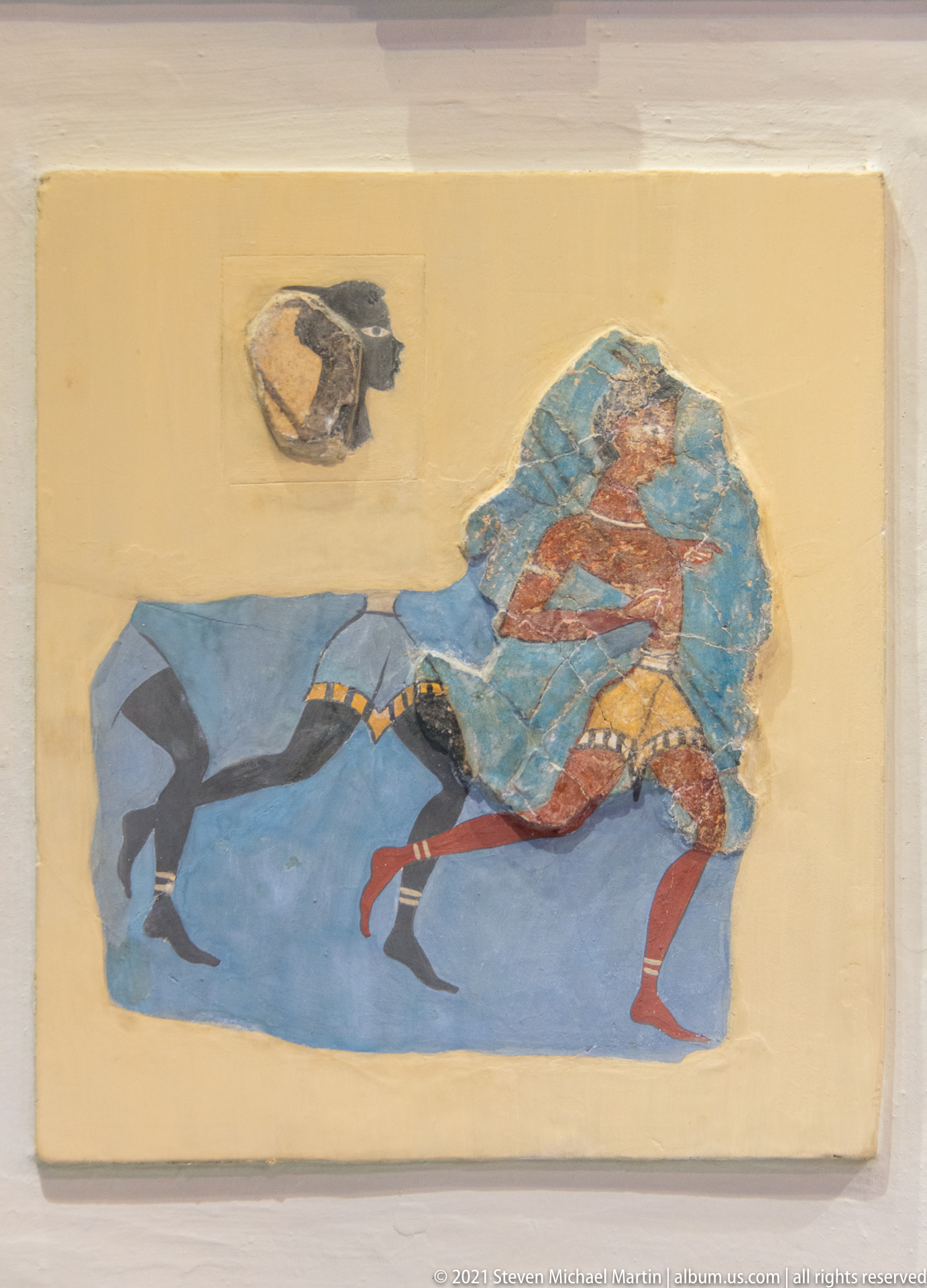
A brightly colored Minoan fresco fragment preserves a human figure in profile moving beside or over a dark animal against a blue field. Red-brown flesh tones, patterned clothing, and the animal’s strongly silhouetted body survive within an irregular patch of painted plaster. The fragmentary condition makes the exact narrative difficult to determine, but the dynamic pairing conveys the movement characteristic of Minoan figural wall painting.
Caption
A brightly colored Minoan fresco fragment preserves a human figure in profile moving beside or over a dark animal against a blue field. Red-brown flesh tones, patterned clothing, and the animal’s strongly silhouetted body survive within an irregular patch of painted plaster. The fragmentary condition makes the exact narrative difficult to determine, but the dynamic pairing conveys the movement characteristic of Minoan figural wall painting.
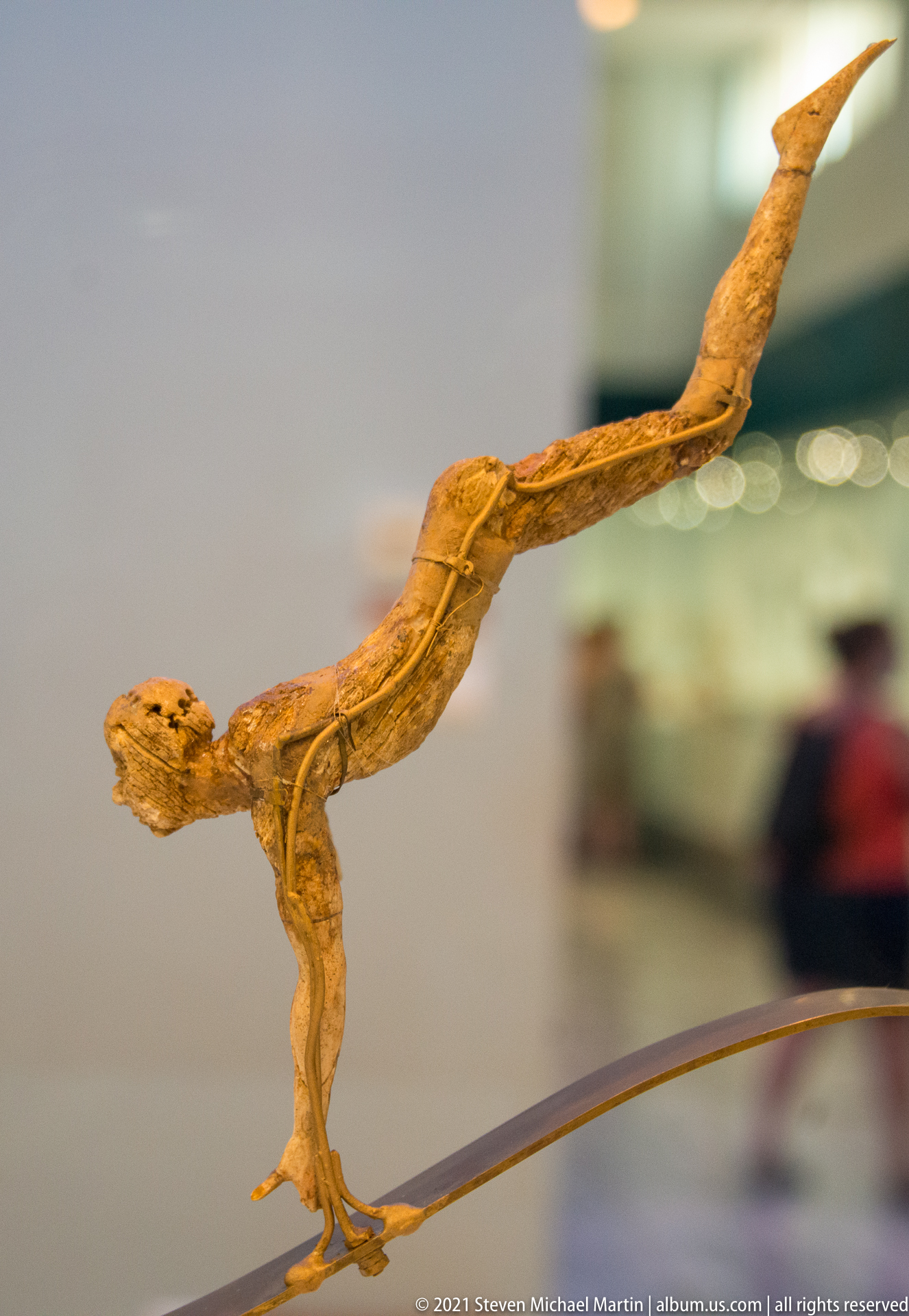
This ivory bull-leaper from the Palace of Knossos captures a male acrobat at the most extreme point of a leap, with the body elongated and one leg sweeping high behind. Dated to 1600–1500 BC, the figurine is a masterpiece of Minoan miniature sculpture. Its airborne pose corresponds to the athletic performance represented more fully in the museum’s Bull-Leaping Fresco.
Caption
This ivory bull-leaper from the Palace of Knossos captures a male acrobat at the most extreme point of a leap, with the body elongated and one leg sweeping high behind. Dated to 1600–1500 BC, the figurine is a masterpiece of Minoan miniature sculpture. Its airborne pose corresponds to the athletic performance represented more fully in the museum’s Bull-Leaping Fresco.
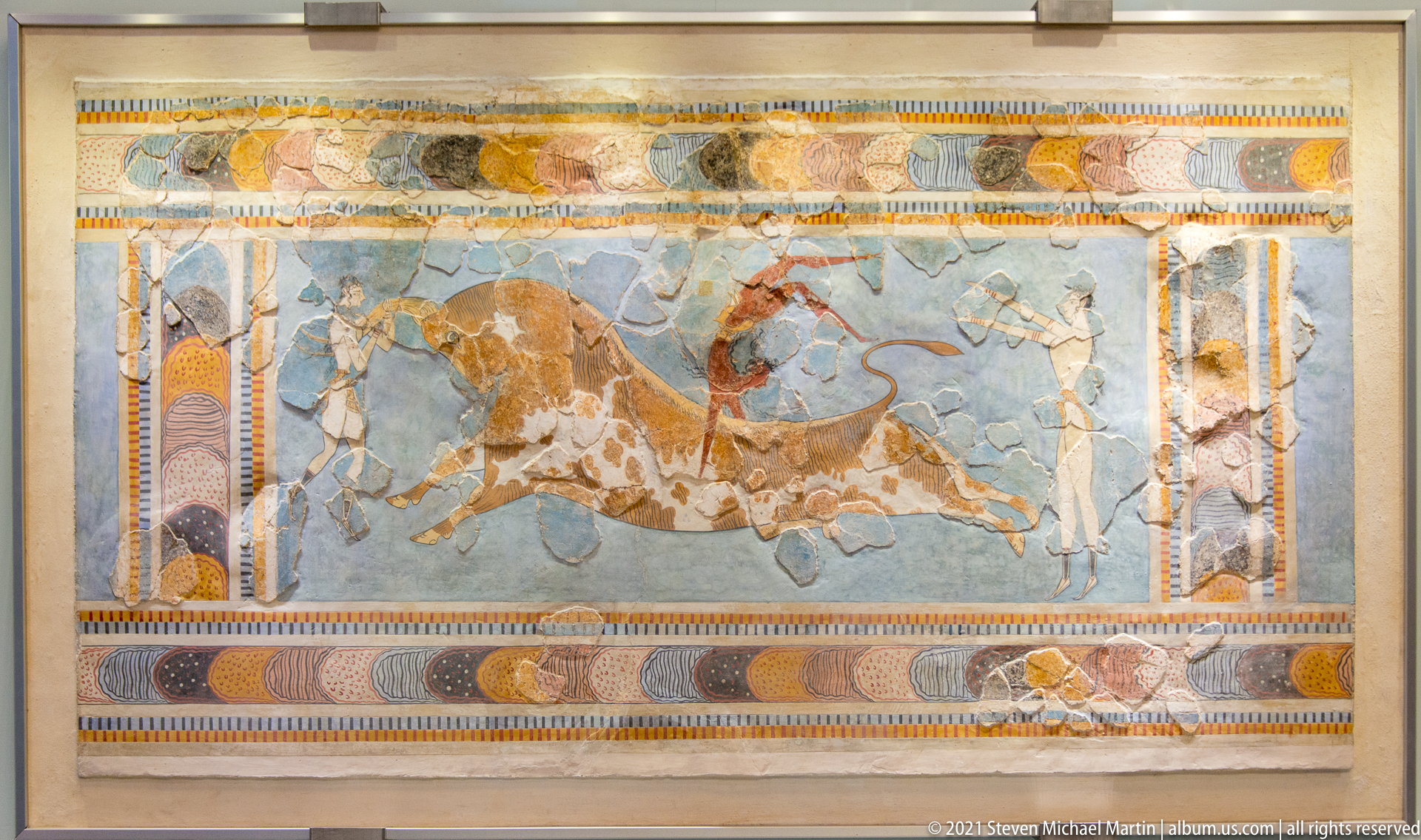
The Bull-Leaping Fresco from the Palace of Knossos, dated to 1450–1400 BC, centers on a charging bull surrounded by three athletic figures. The reconstructed scene preserves one of the clearest visual records of Minoan bull-leaping, combining powerful animal movement with the controlled poses of the participants. Surviving painted-plaster fragments are integrated into the modern reconstruction within the original decorative framework.
Caption
The Bull-Leaping Fresco from the Palace of Knossos, dated to 1450–1400 BC, centers on a charging bull surrounded by three athletic figures. The reconstructed scene preserves one of the clearest visual records of Minoan bull-leaping, combining powerful animal movement with the controlled poses of the participants. Surviving painted-plaster fragments are integrated into the modern reconstruction within the original decorative framework.
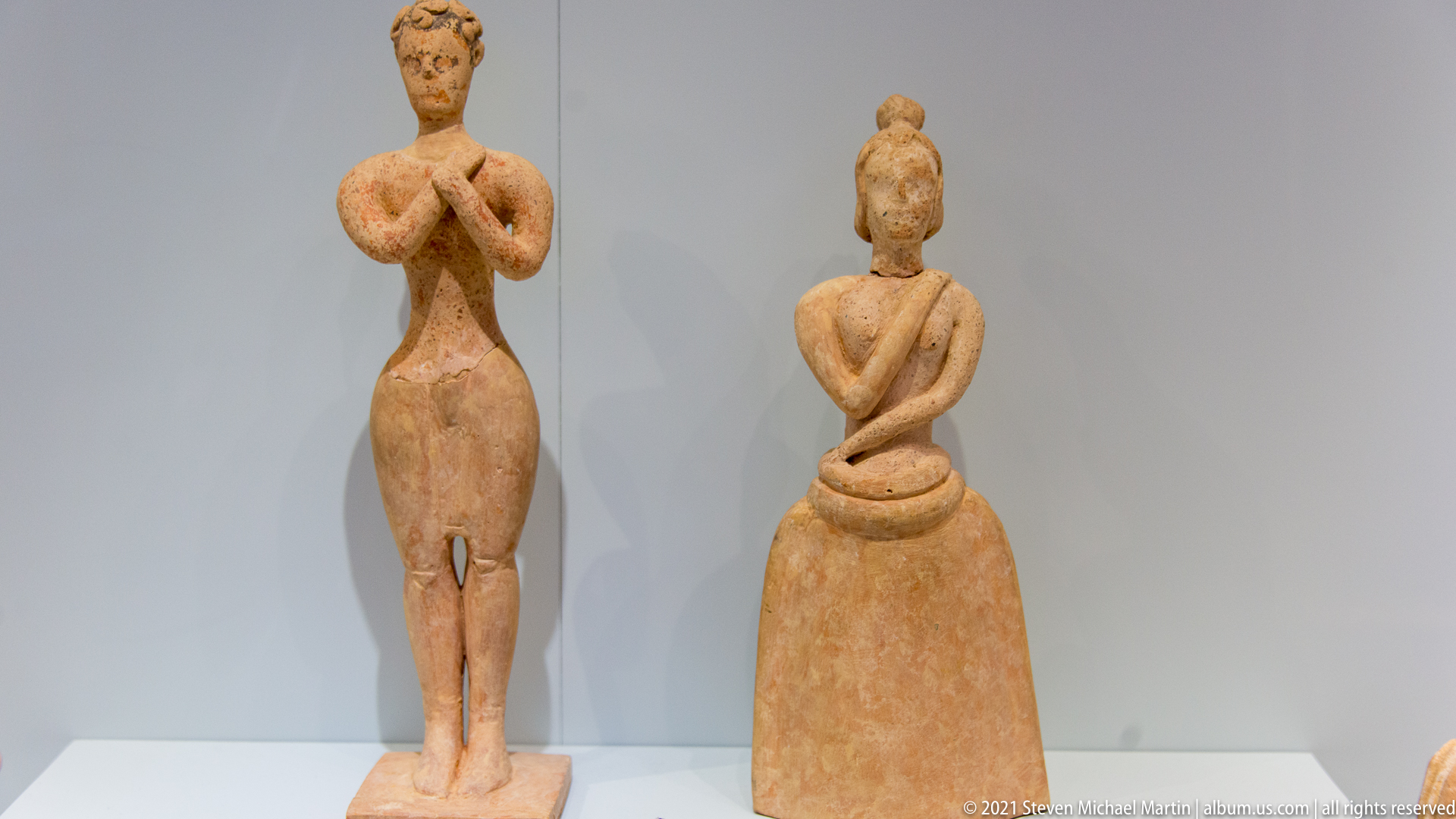
Two standing female figurines present contrasting treatments of the human form. One is slender and nude or minimally clothed, with arms raised toward the chest; the other wears a long bell-shaped garment and holds the arms across the torso. Their simplified modeling and frontal display emphasize gesture, costume, and silhouette rather than individualized portraiture.
Caption
Two standing female figurines present contrasting treatments of the human form. One is slender and nude or minimally clothed, with arms raised toward the chest; the other wears a long bell-shaped garment and holds the arms across the torso. Their simplified modeling and frontal display emphasize gesture, costume, and silhouette rather than individualized portraiture.
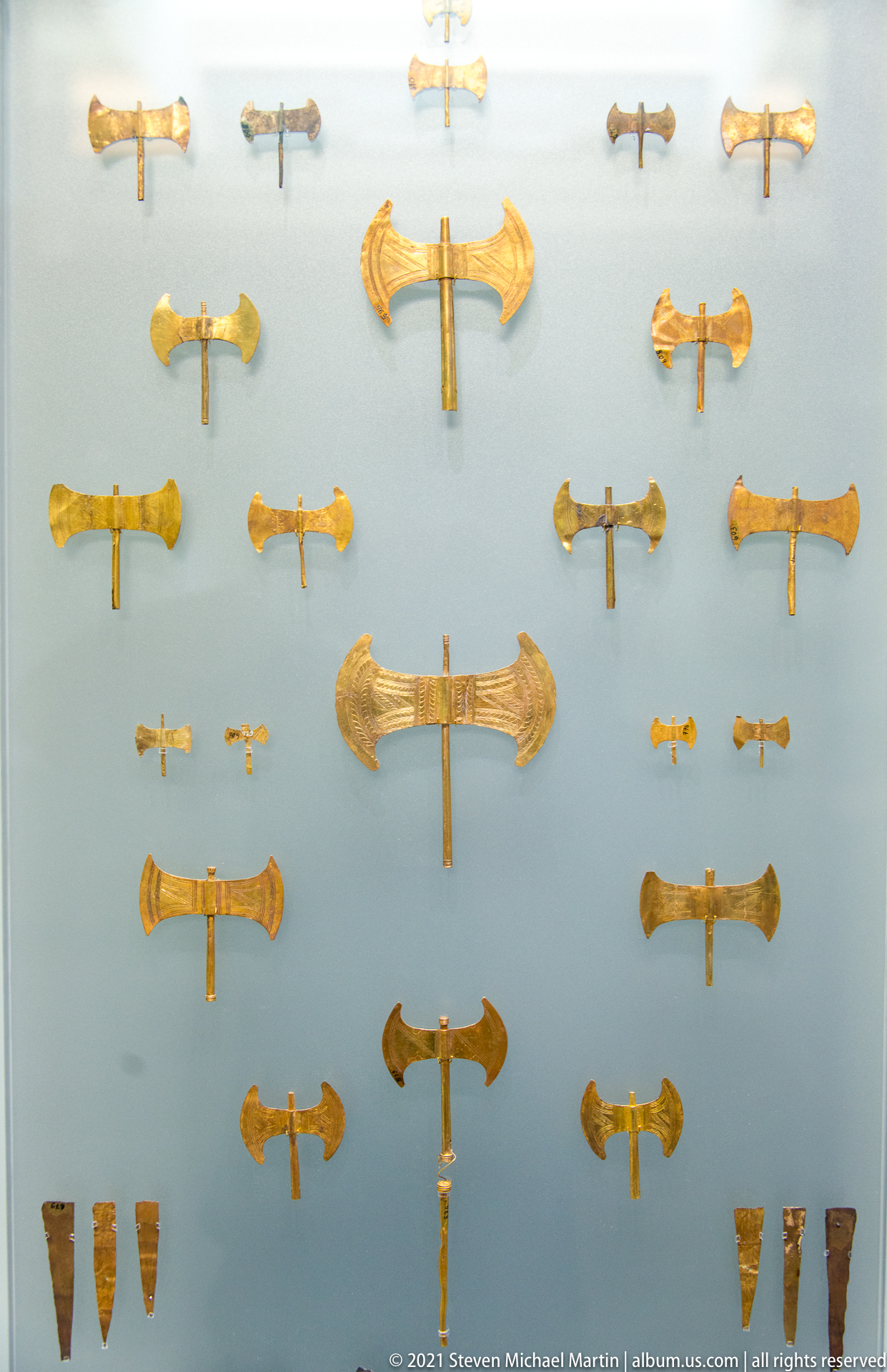
Rows of small gold double-axe forms are arranged symmetrically across the display, ranging from compact examples to larger, elaborately shaped pieces. Their repeated bilateral blades create a striking visual catalogue of the labrys motif, an important symbol in Minoan material culture. The uniform mounting makes differences in size, outline, and workmanship easy to compare without obscuring the thinness of the objects.
Caption
Rows of small gold double-axe forms are arranged symmetrically across the display, ranging from compact examples to larger, elaborately shaped pieces. Their repeated bilateral blades create a striking visual catalogue of the labrys motif, an important symbol in Minoan material culture. The uniform mounting makes differences in size, outline, and workmanship easy to compare without obscuring the thinness of the objects.
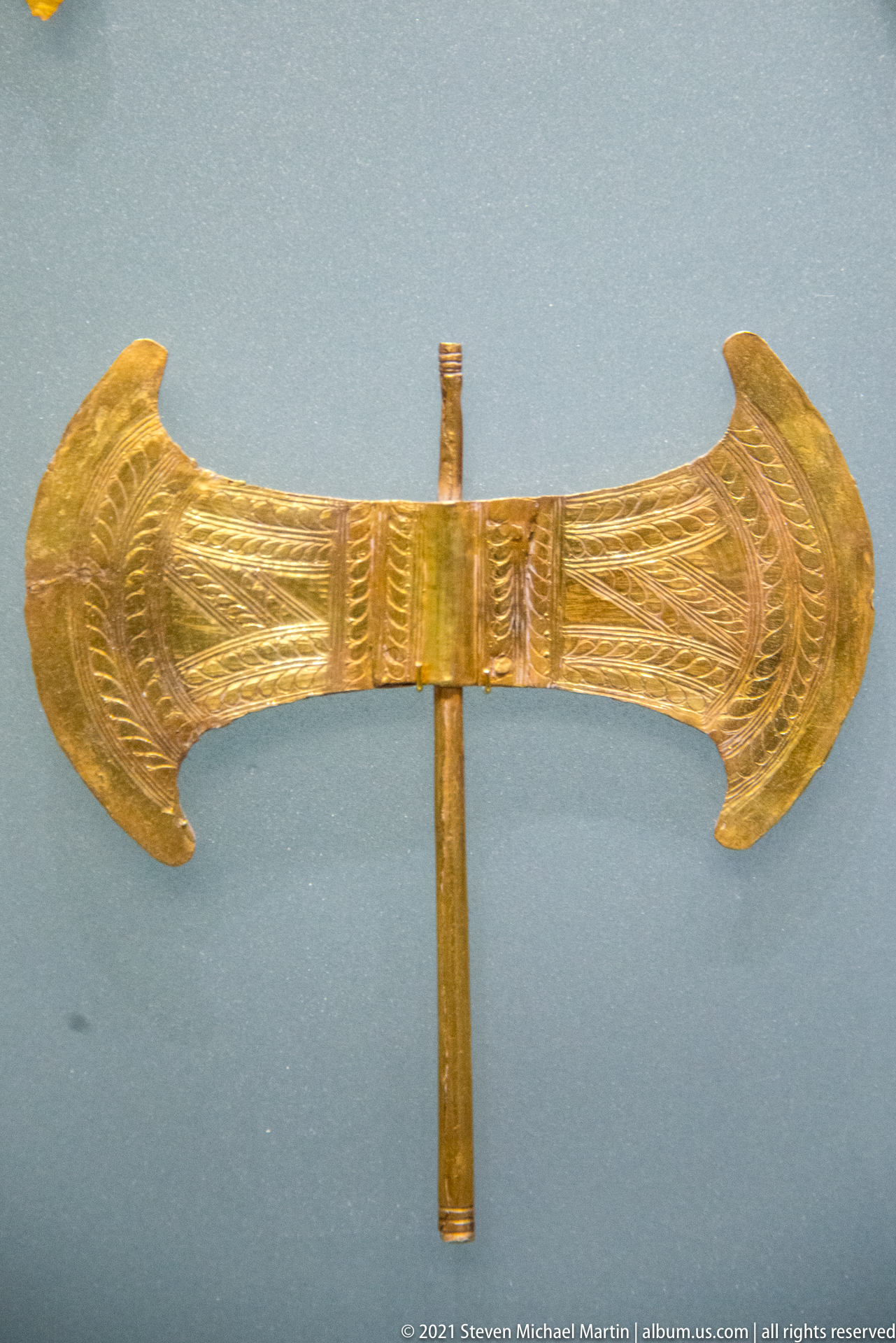
A single gold double axe fills the frame, revealing fine chased or embossed lines that radiate across its paired crescent-shaped blades. A narrow central shaft divides the balanced composition, while banded decoration marks the junction of the blades. The close view highlights both the iconic labrys silhouette and the precision of Minoan precious-metal workmanship.
Caption
A single gold double axe fills the frame, revealing fine chased or embossed lines that radiate across its paired crescent-shaped blades. A narrow central shaft divides the balanced composition, while banded decoration marks the junction of the blades. The close view highlights both the iconic labrys silhouette and the precision of Minoan precious-metal workmanship.
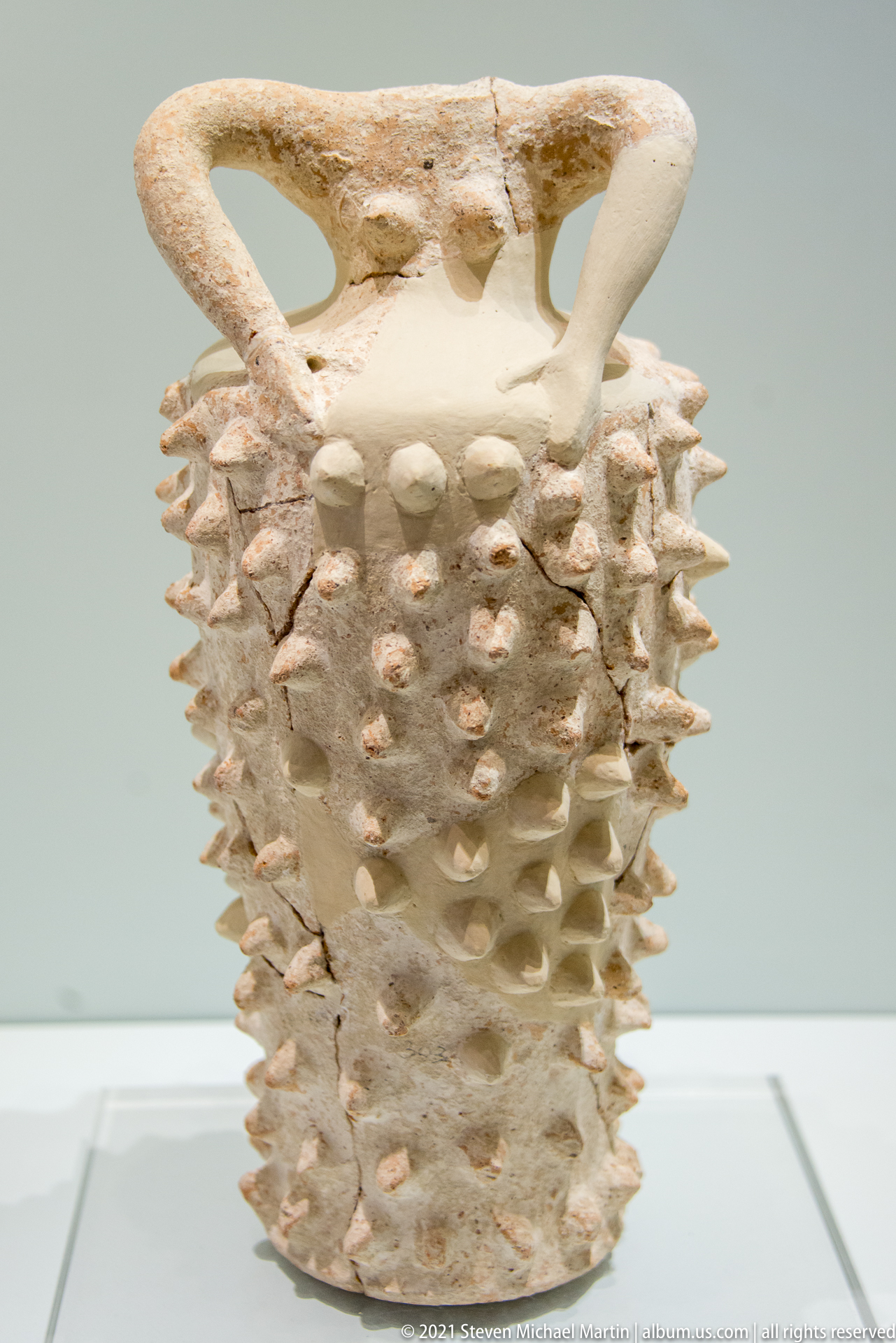
Rows of projecting knobs and pointed spikes cover the body of this unusual pale ceramic vessel, creating a strongly tactile surface beneath two large loop handles. The dense applied decoration transforms a simple container into a sculptural object whose profile changes with every projection. Its museum display isolates the vessel against a neutral background, making the contrast between smooth handles and roughened body especially legible.
Caption
Rows of projecting knobs and pointed spikes cover the body of this unusual pale ceramic vessel, creating a strongly tactile surface beneath two large loop handles. The dense applied decoration transforms a simple container into a sculptural object whose profile changes with every projection. Its museum display isolates the vessel against a neutral background, making the contrast between smooth handles and roughened body especially legible.
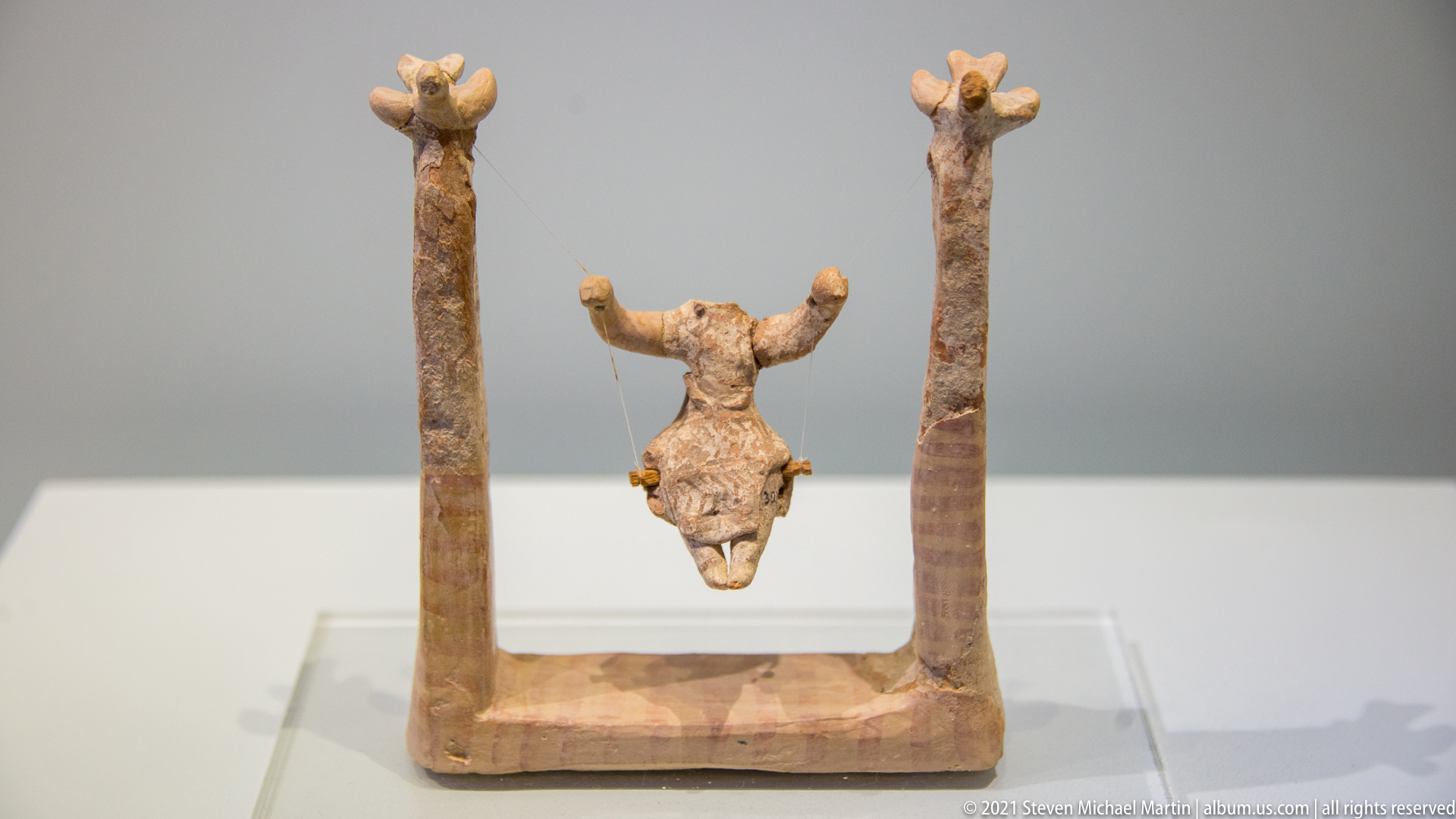
A small terracotta model frames a central bull or bovine head between two tall vertical posts, each ending in a branching or knobbed finial. The compact composition resembles a miniature ritual or architectural setting rather than an ordinary vessel. Its frontal presentation emphasizes the deliberate symmetry between the flanking uprights and the suspended animal head.
Caption
A small terracotta model frames a central bull or bovine head between two tall vertical posts, each ending in a branching or knobbed finial. The compact composition resembles a miniature ritual or architectural setting rather than an ordinary vessel. Its frontal presentation emphasizes the deliberate symmetry between the flanking uprights and the suspended animal head.
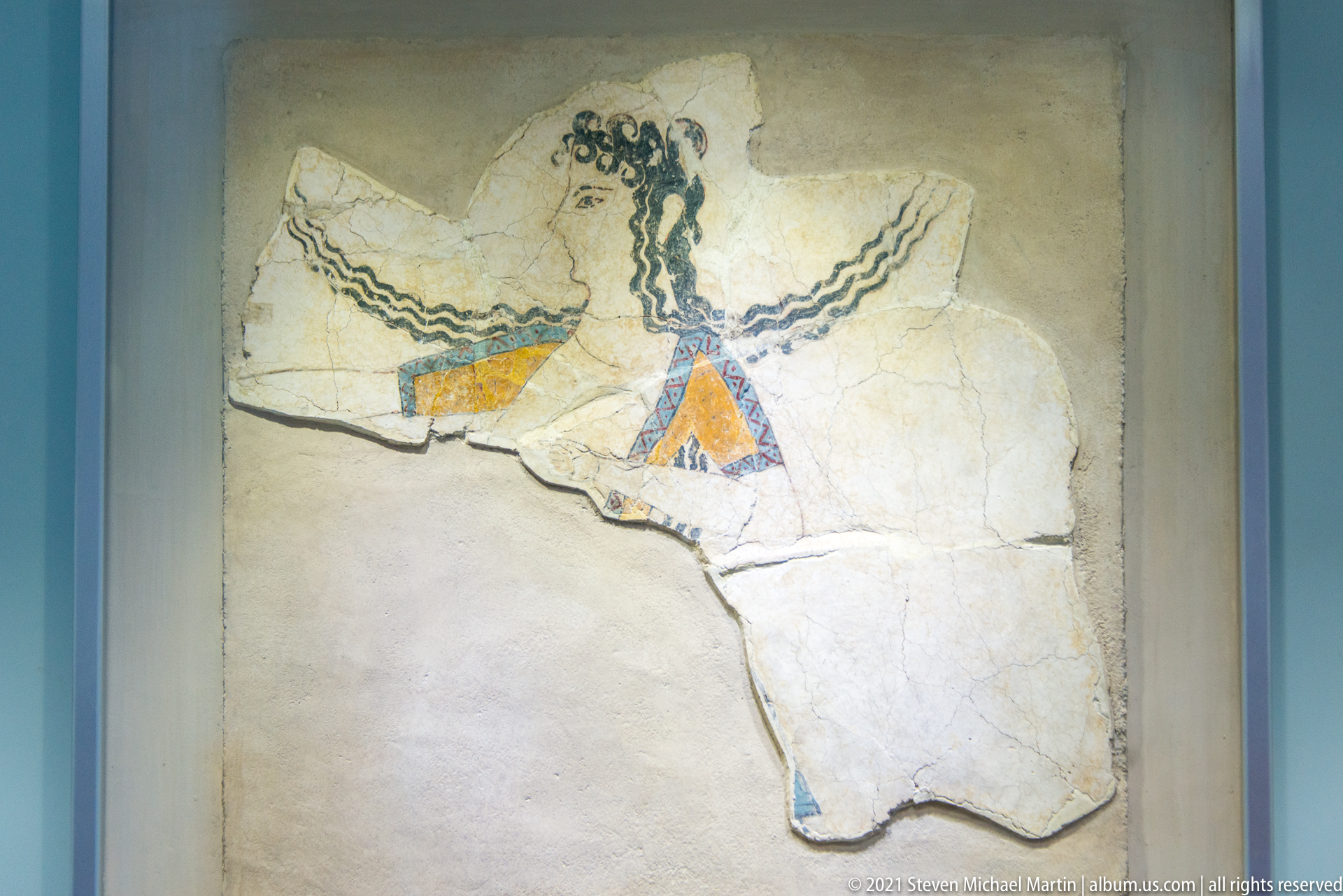
The young woman conventionally known as “La Parisienne” survives as a fragment of the larger Camp-Stool, or Libation, Fresco from Knossos. Her white skin, bright red lips, large outlined eye, dark curling hair, and the sacral knot at her back distinguish the profile. Arthur Evans gave the fragment its modern nickname soon after discovery because its fashionable appearance reminded him of a contemporary Parisian woman.
Caption
The young woman conventionally known as “La Parisienne” survives as a fragment of the larger Camp-Stool, or Libation, Fresco from Knossos. Her white skin, bright red lips, large outlined eye, dark curling hair, and the sacral knot at her back distinguish the profile. Arthur Evans gave the fragment its modern nickname soon after discovery because its fashionable appearance reminded him of a contemporary Parisian woman.
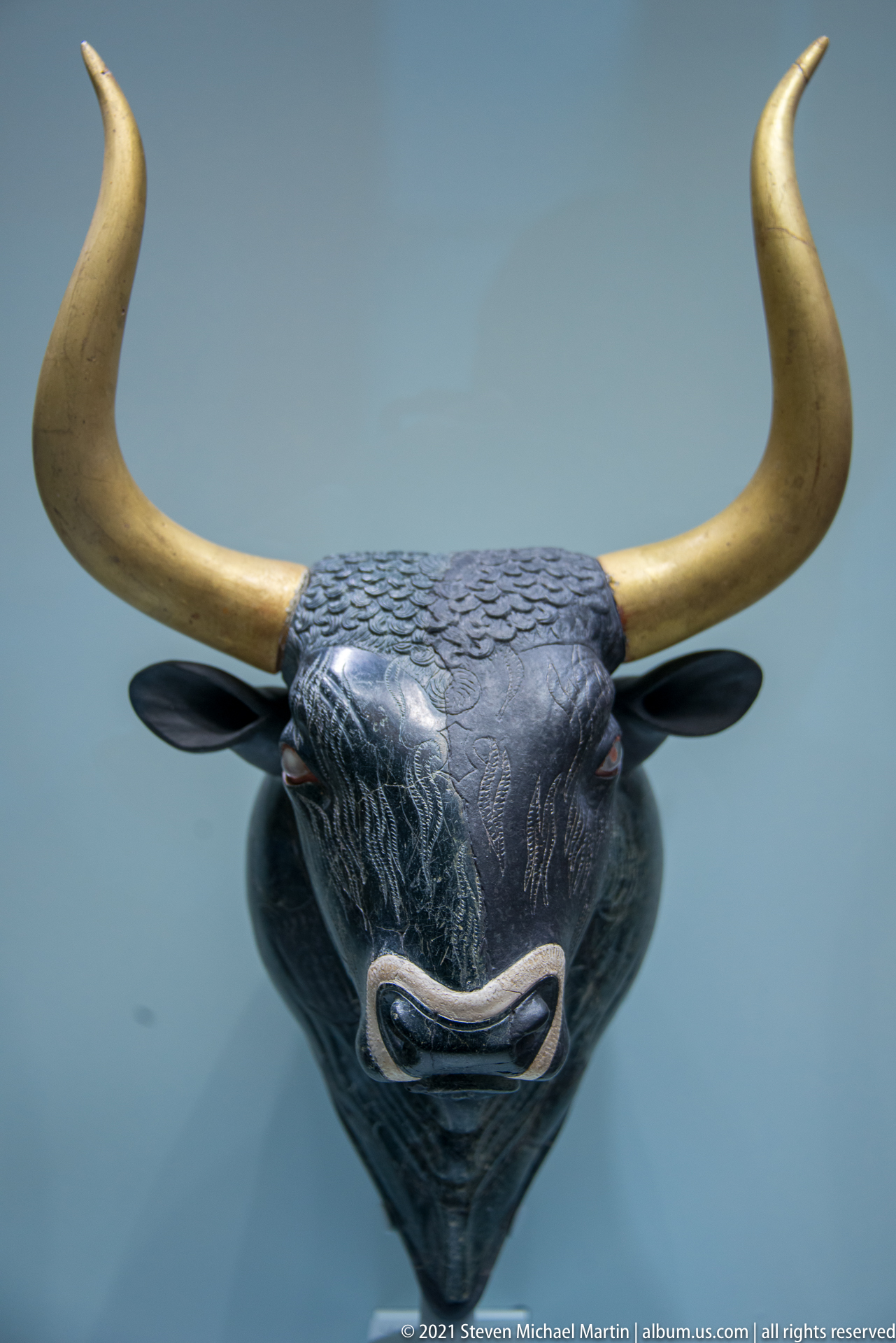
This Bull’s-head rhyton from the Little Palace at Knossos, dated to 1600–1450 BC, is a ritual vessel made for libations. The naturalistically modeled stone head preserves incised and relief hair, inlaid eyes of rock crystal and jasper, and a muzzle highlighted with white shell. Liquid entered through an opening at the back of the neck and flowed from a hole in the mouth.
Caption
This Bull’s-head rhyton from the Little Palace at Knossos, dated to 1600–1450 BC, is a ritual vessel made for libations. The naturalistically modeled stone head preserves incised and relief hair, inlaid eyes of rock crystal and jasper, and a muzzle highlighted with white shell. Liquid entered through an opening at the back of the neck and flowed from a hole in the mouth.
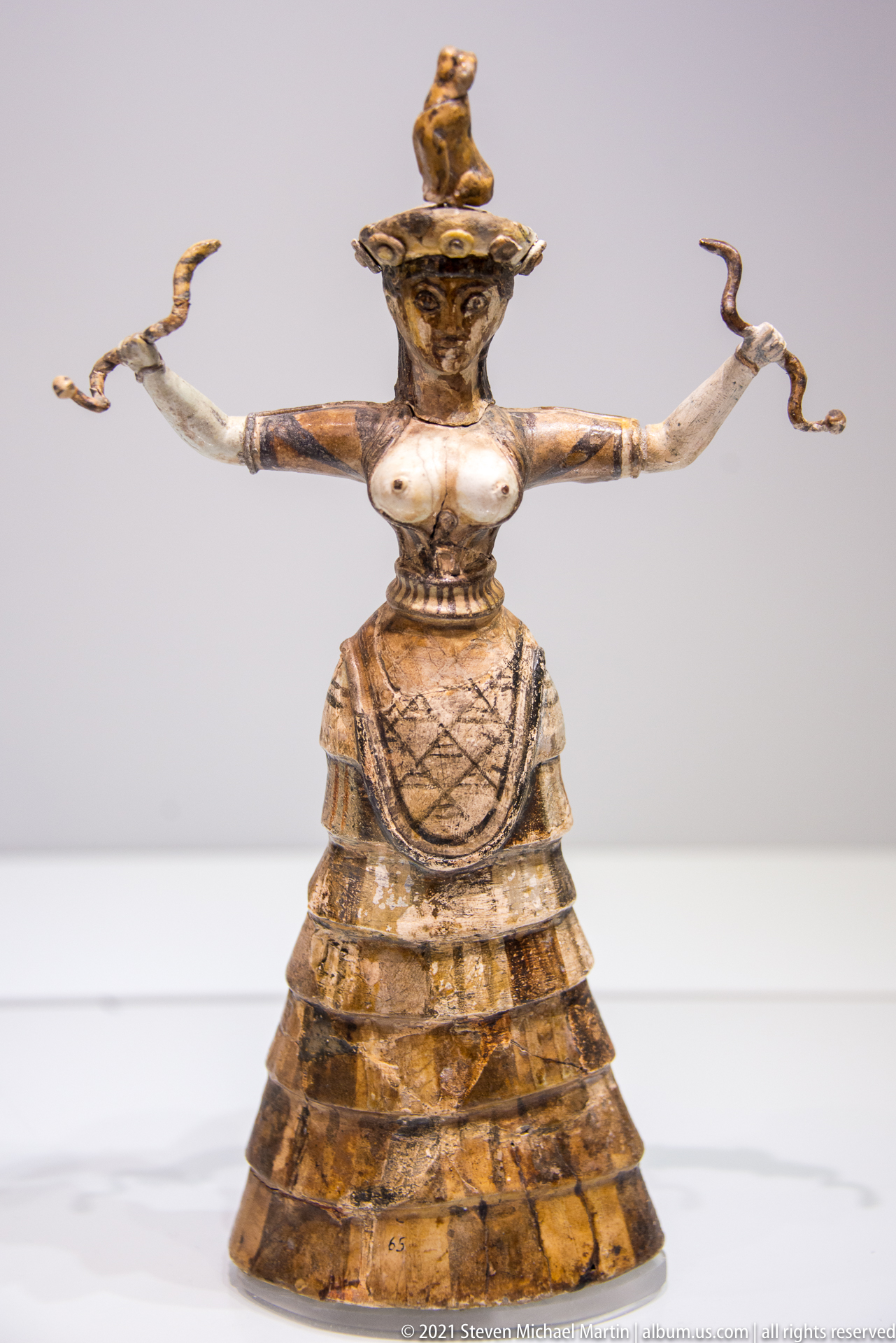
One of the famous painted-faience “Snake Goddesses” from the Temple Repositories at Knossos, dated to 1600–1500 BC, stands with exposed breasts, a fitted bodice, and a layered flounced skirt. Snakes are integral to the figure’s iconography, linking the statuette to the religious assemblage sealed in the palace sanctuary. The elaborate costume and frontal pose make the figure an icon of Minoan miniature sculpture.
Caption
One of the famous painted-faience “Snake Goddesses” from the Temple Repositories at Knossos, dated to 1600–1500 BC, stands with exposed breasts, a fitted bodice, and a layered flounced skirt. Snakes are integral to the figure’s iconography, linking the statuette to the religious assemblage sealed in the palace sanctuary. The elaborate costume and frontal pose make the figure an icon of Minoan miniature sculpture.
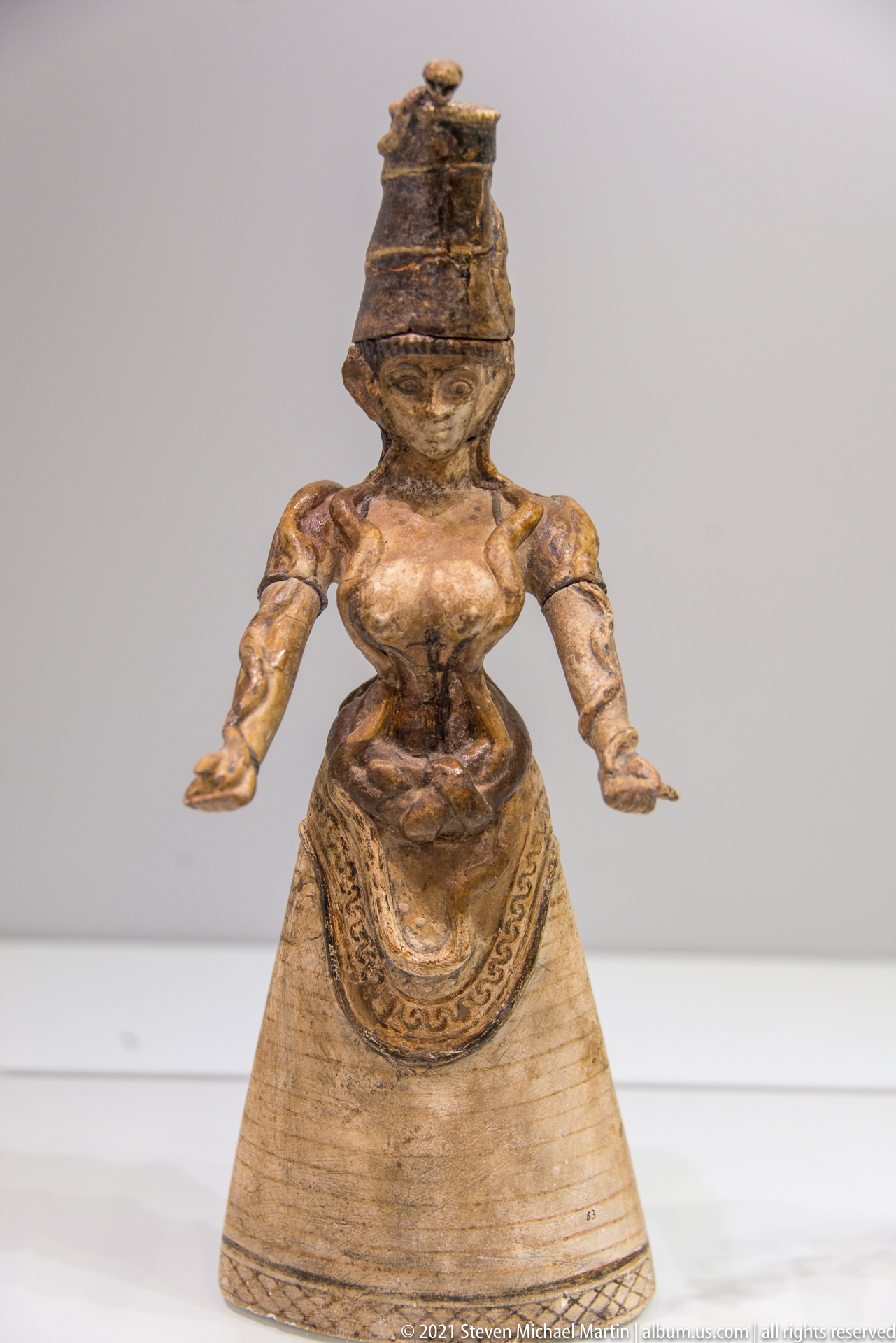
A female figurine extends both arms forward from a fitted torso above a broad, bell-shaped skirt. Incised and painted bands decorate the garment, while the tall headpiece and strongly modeled shoulders give the small figure a commanding frontal stance. The pose and elaborate costume connect the object to the wider repertoire of Minoan female ritual imagery without requiring a specific divine identification.
Caption
A female figurine extends both arms forward from a fitted torso above a broad, bell-shaped skirt. Incised and painted bands decorate the garment, while the tall headpiece and strongly modeled shoulders give the small figure a commanding frontal stance. The pose and elaborate costume connect the object to the wider repertoire of Minoan female ritual imagery without requiring a specific divine identification.

Two small flying-fish forms with broad winglike fins are displayed above a row of four striped shell-shaped pieces. Their polished surfaces and carefully modeled marine forms reflect the close observation of sea life that recurs throughout Minoan decorative arts. Presented together, the objects emphasize both the variety of marine imagery and the miniature scale at which Cretan craftsmen worked.
Caption
Two small flying-fish forms with broad winglike fins are displayed above a row of four striped shell-shaped pieces. Their polished surfaces and carefully modeled marine forms reflect the close observation of sea life that recurs throughout Minoan decorative arts. Presented together, the objects emphasize both the variety of marine imagery and the miniature scale at which Cretan craftsmen worked.
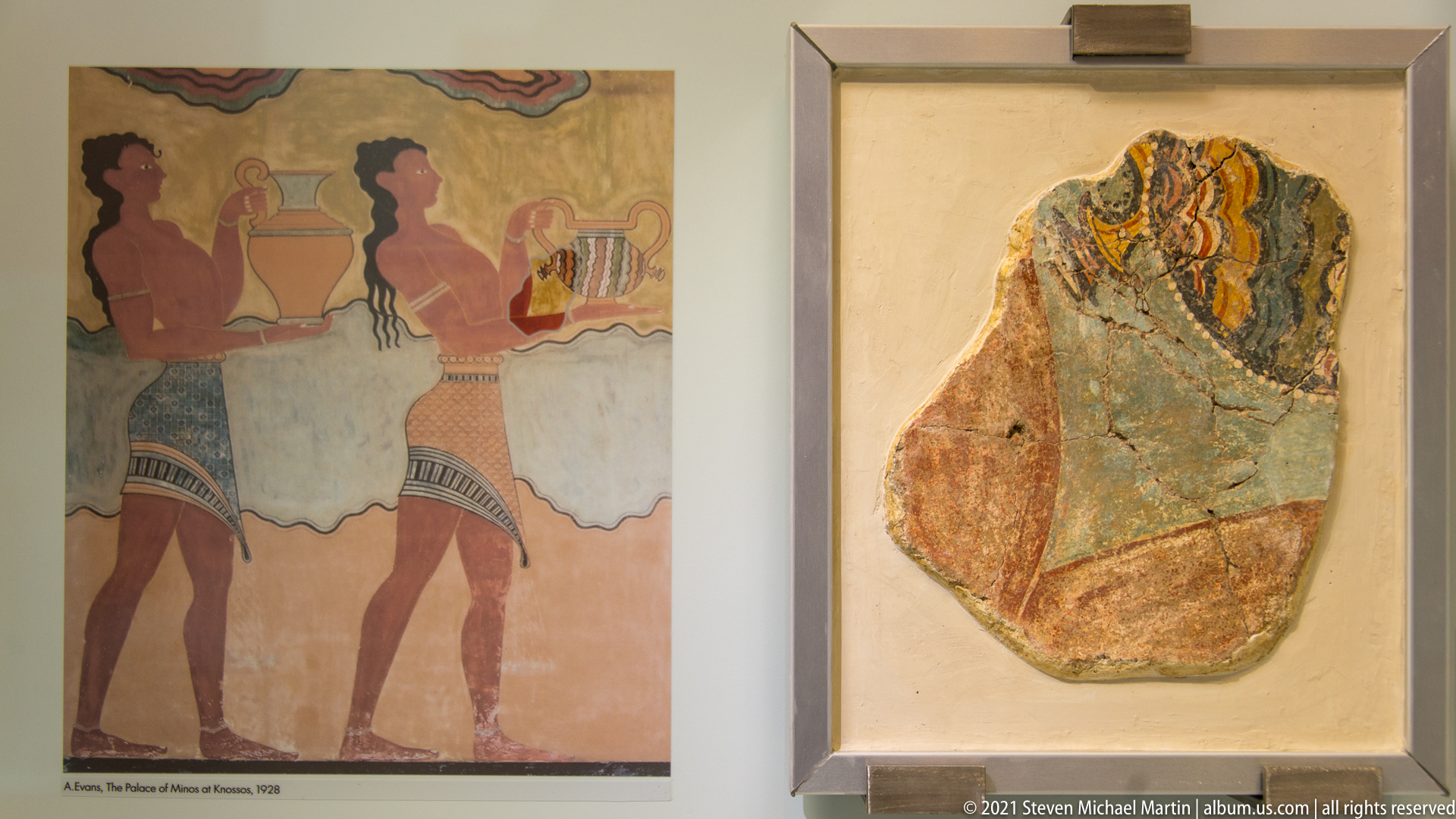
A museum display juxtaposes a reconstruction of a Minoan procession scene with an original fragment of painted plaster mounted beside it. The reconstruction clarifies the placement of profile figures and patterned garments, while the surviving fragment preserves only a portion of the original color and design. Seen together, they demonstrate how fragmentary archaeological evidence is interpreted for museum presentation.
Caption
A museum display juxtaposes a reconstruction of a Minoan procession scene with an original fragment of painted plaster mounted beside it. The reconstruction clarifies the placement of profile figures and patterned garments, while the surviving fragment preserves only a portion of the original color and design. Seen together, they demonstrate how fragmentary archaeological evidence is interpreted for museum presentation.
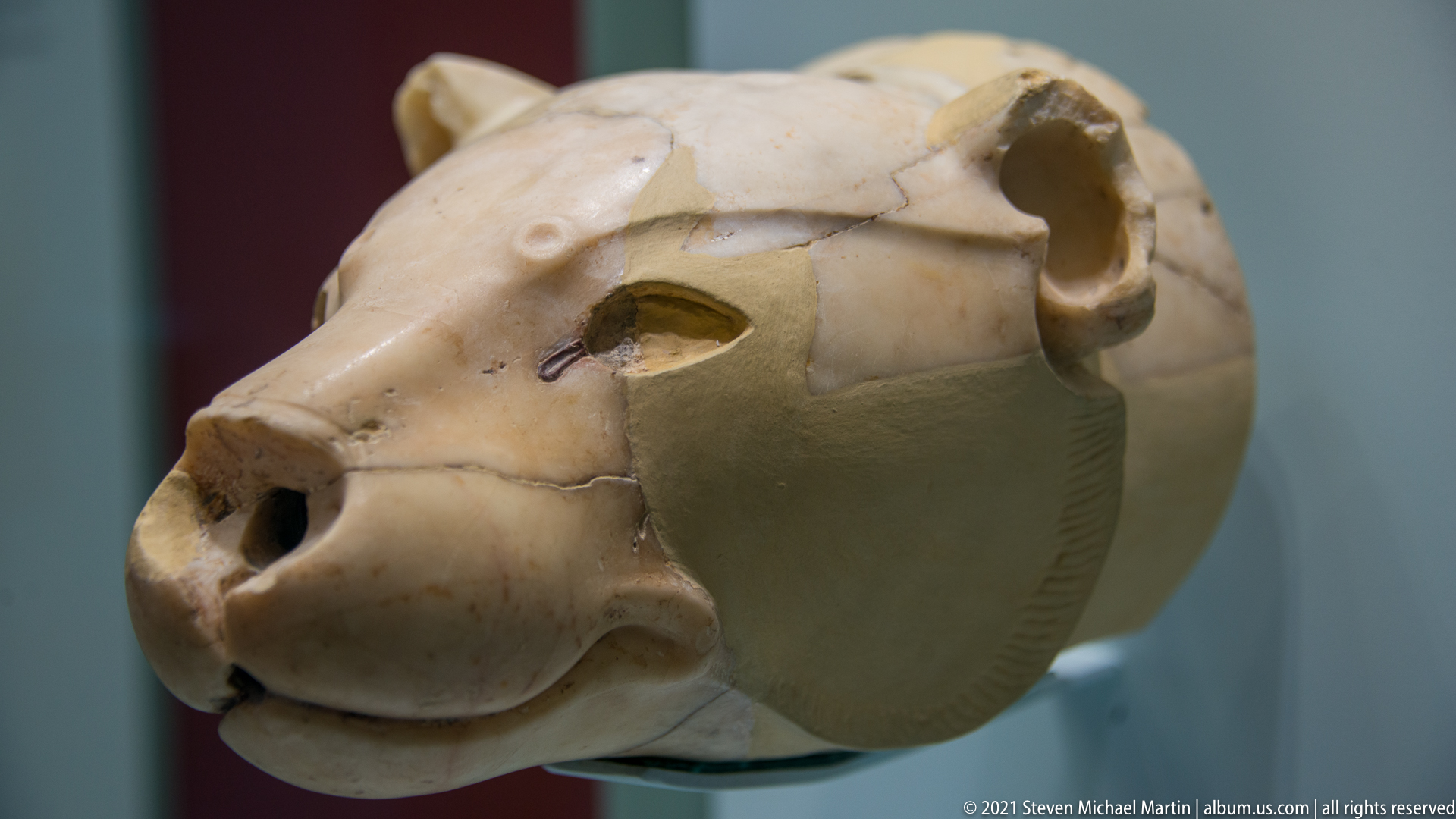
This ritual vessel from the Palace of Knossos, dated to 1650–1500 BC, is carved as the head of a lioness from translucent white limestone. The broad muzzle, rounded ear, and feline facial structure survive despite substantial restoration. As a rhyton, the object belonged to the Minoan tradition of specially shaped vessels used in libation ritual, combining technical stoneworking with closely observed animal form.
Caption
This ritual vessel from the Palace of Knossos, dated to 1650–1500 BC, is carved as the head of a lioness from translucent white limestone. The broad muzzle, rounded ear, and feline facial structure survive despite substantial restoration. As a rhyton, the object belonged to the Minoan tradition of specially shaped vessels used in libation ritual, combining technical stoneworking with closely observed animal form.

Two terracotta female figures stand side by side with both hands lifted in a gesture of display or invocation. Their narrow waists, modeled breasts, prominent headdresses, and simplified facial features emphasize frontal symmetry, while one figure is accompanied by sinuous applied forms near the shoulders. The close pairing highlights variation within a recurring Minoan figurine type associated with ritual display.
Caption
Two terracotta female figures stand side by side with both hands lifted in a gesture of display or invocation. Their narrow waists, modeled breasts, prominent headdresses, and simplified facial features emphasize frontal symmetry, while one figure is accompanied by sinuous applied forms near the shoulders. The close pairing highlights variation within a recurring Minoan figurine type associated with ritual display.
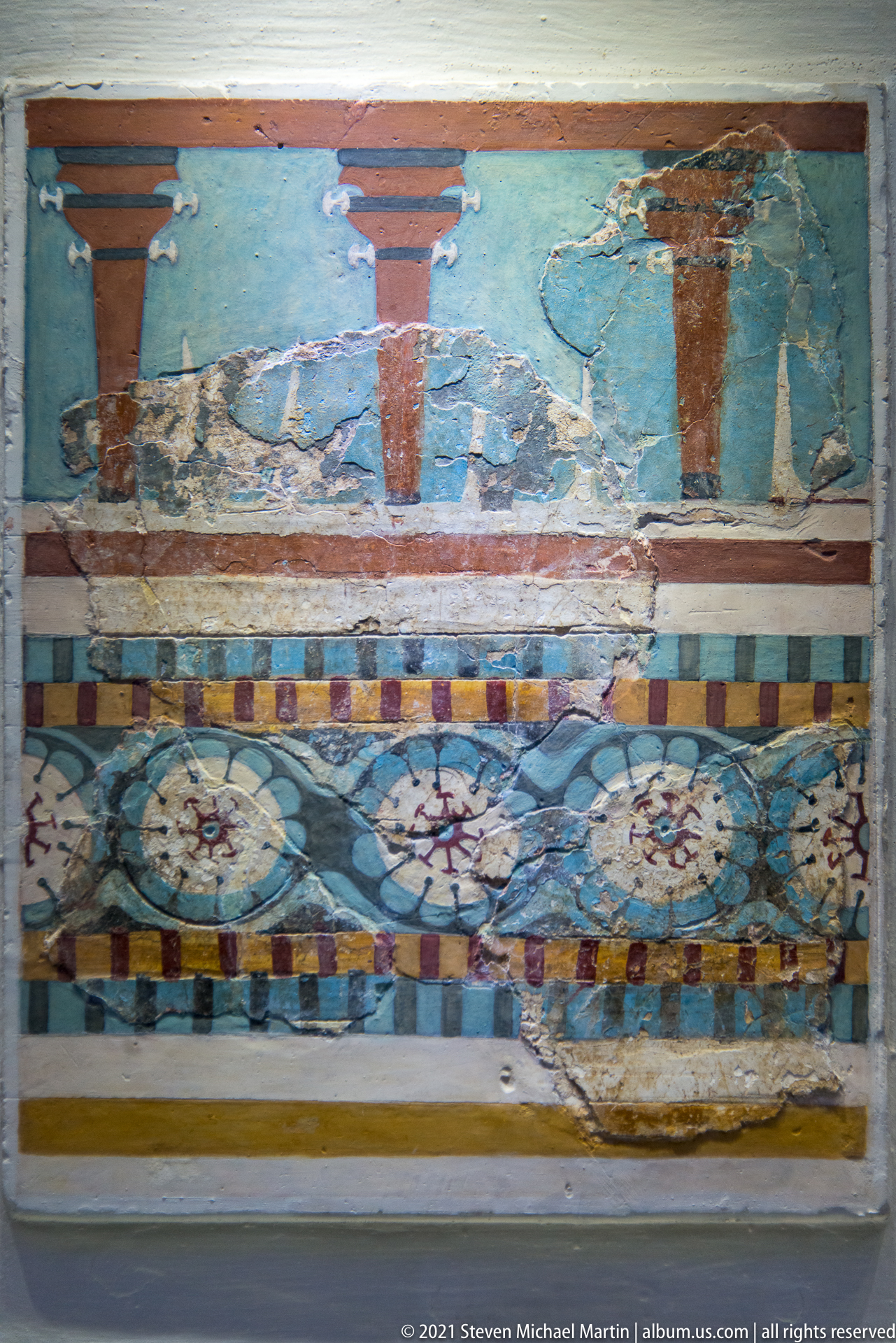
Horizontal bands organize this fragmentary Minoan wall painting into distinct registers. A lower frieze of large rosette-like floral forms is framed by multicolored geometric borders, while the upper zone preserves patches of blue ground and red architectural or figural shapes. Losses across the plaster expose the fresco’s archaeological condition while leaving enough color to reconstruct its decorative rhythm.
Caption
Horizontal bands organize this fragmentary Minoan wall painting into distinct registers. A lower frieze of large rosette-like floral forms is framed by multicolored geometric borders, while the upper zone preserves patches of blue ground and red architectural or figural shapes. Losses across the plaster expose the fresco’s archaeological condition while leaving enough color to reconstruct its decorative rhythm.
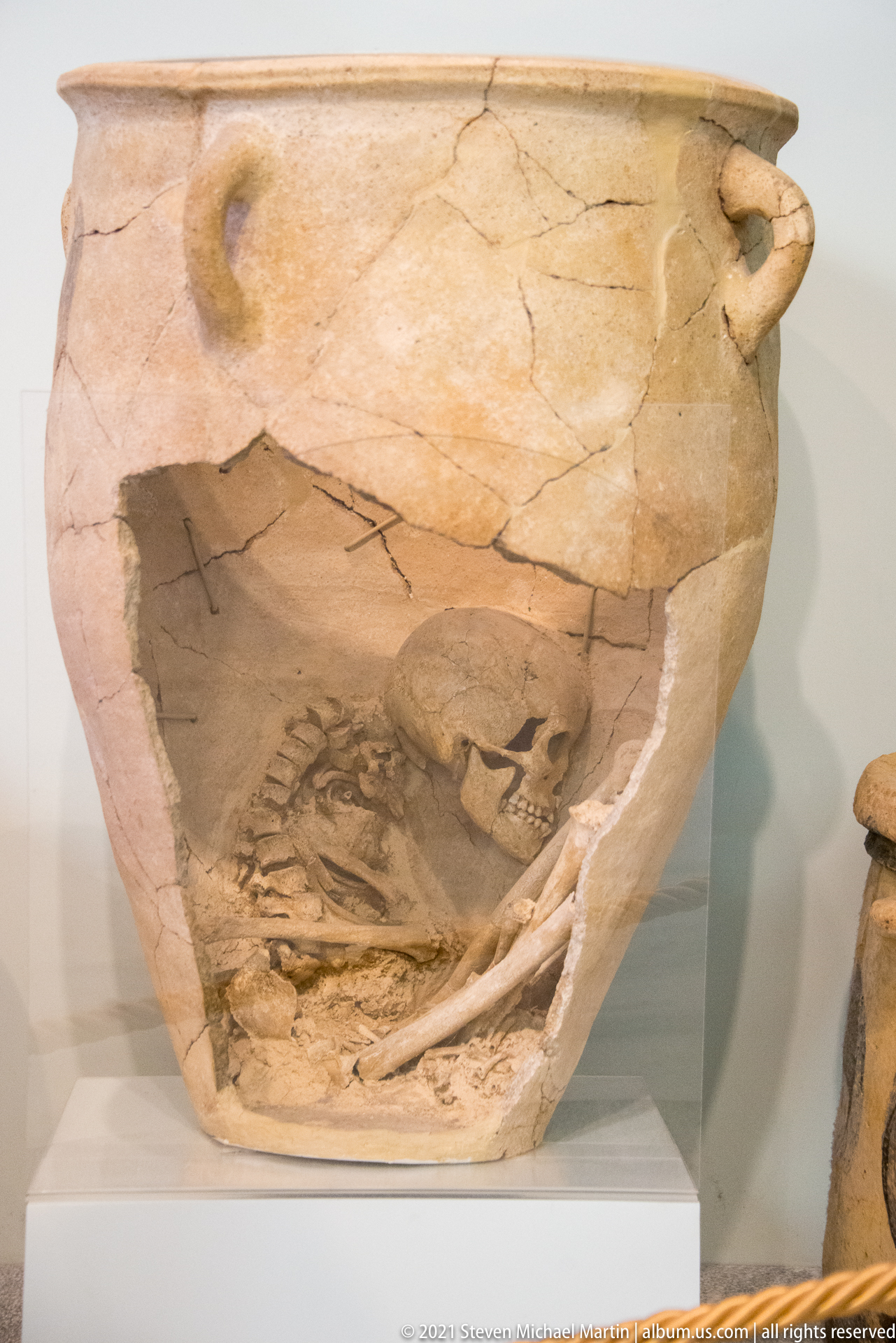
A large ceramic jar has been opened to reveal human skeletal remains still lying within the vessel. The cutaway presentation exposes the cramped relationship between the body and container, making the funerary use immediately understandable. Cracks and reconstructed areas across the jar also record its archaeological recovery and conservation, turning the display into evidence for both ancient burial practice and modern excavation.
Caption
A large ceramic jar has been opened to reveal human skeletal remains still lying within the vessel. The cutaway presentation exposes the cramped relationship between the body and container, making the funerary use immediately understandable. Cracks and reconstructed areas across the jar also record its archaeological recovery and conservation, turning the display into evidence for both ancient burial practice and modern excavation.
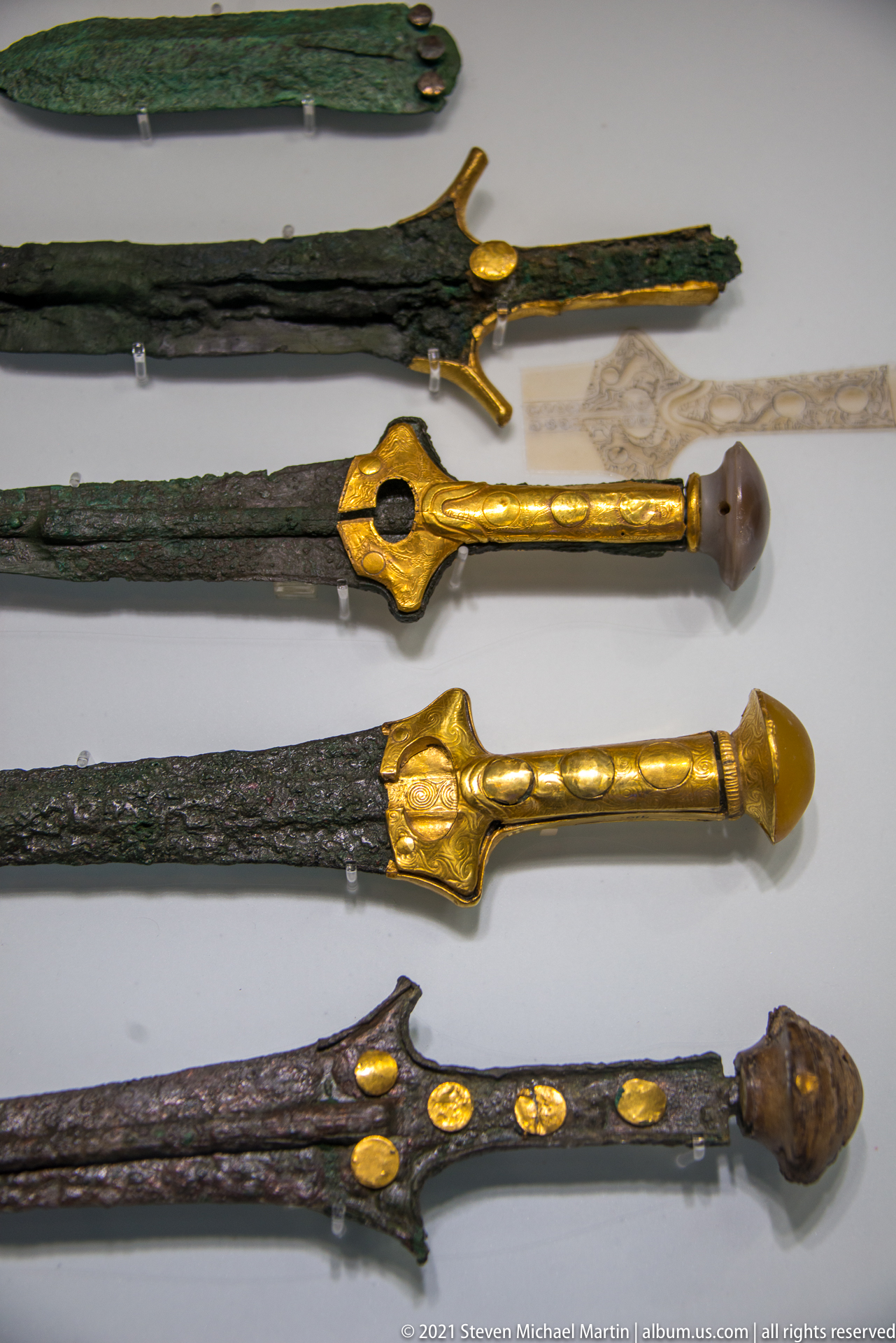
A group of long bronze blades is displayed horizontally, several retaining elaborate gold-covered hilts and pommels. The contrast between dark, corroded blades and bright precious-metal fittings makes construction details easy to compare, from guard shapes to grip and pommel forms. The assemblage demonstrates how functional weaponry could also serve as a vehicle for high-status craftsmanship in Bronze Age Crete.
Caption
A group of long bronze blades is displayed horizontally, several retaining elaborate gold-covered hilts and pommels. The contrast between dark, corroded blades and bright precious-metal fittings makes construction details easy to compare, from guard shapes to grip and pommel forms. The assemblage demonstrates how functional weaponry could also serve as a vehicle for high-status craftsmanship in Bronze Age Crete.
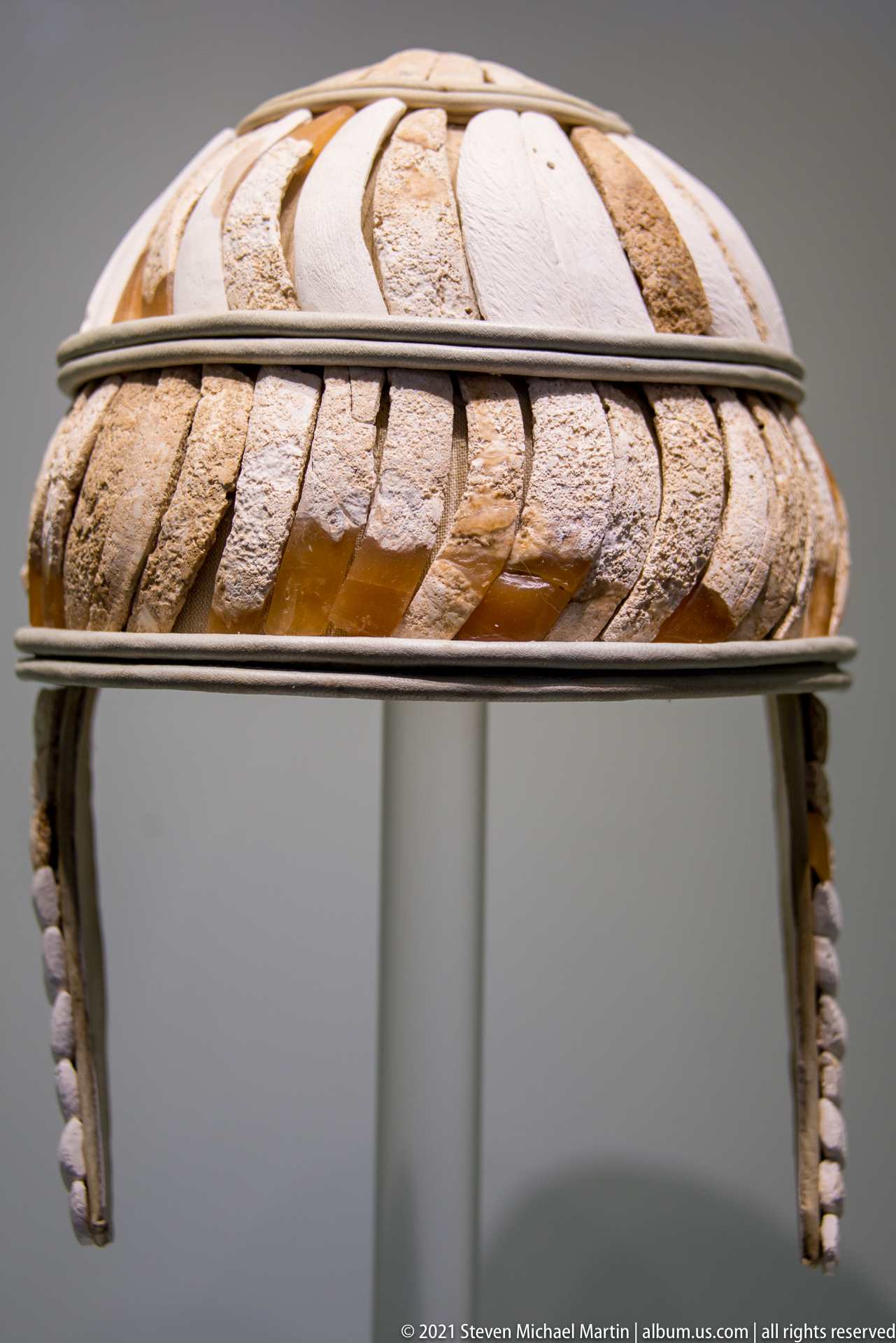
Rows of curved boar-tusk plaques are fitted over a domed reconstruction of a Bronze Age helmet, with cheek guards hanging at the sides. The overlapping tusks form a rigid protective shell while preserving the distinctive pattern created by repeated organic elements. The reconstruction makes tangible an Aegean armor type known archaeologically as well as from Bronze Age imagery and demonstrates the specialized assembly required to turn tusk segments into defensive equipment.
Caption
Rows of curved boar-tusk plaques are fitted over a domed reconstruction of a Bronze Age helmet, with cheek guards hanging at the sides. The overlapping tusks form a rigid protective shell while preserving the distinctive pattern created by repeated organic elements. The reconstruction makes tangible an Aegean armor type known archaeologically as well as from Bronze Age imagery and demonstrates the specialized assembly required to turn tusk segments into defensive equipment.
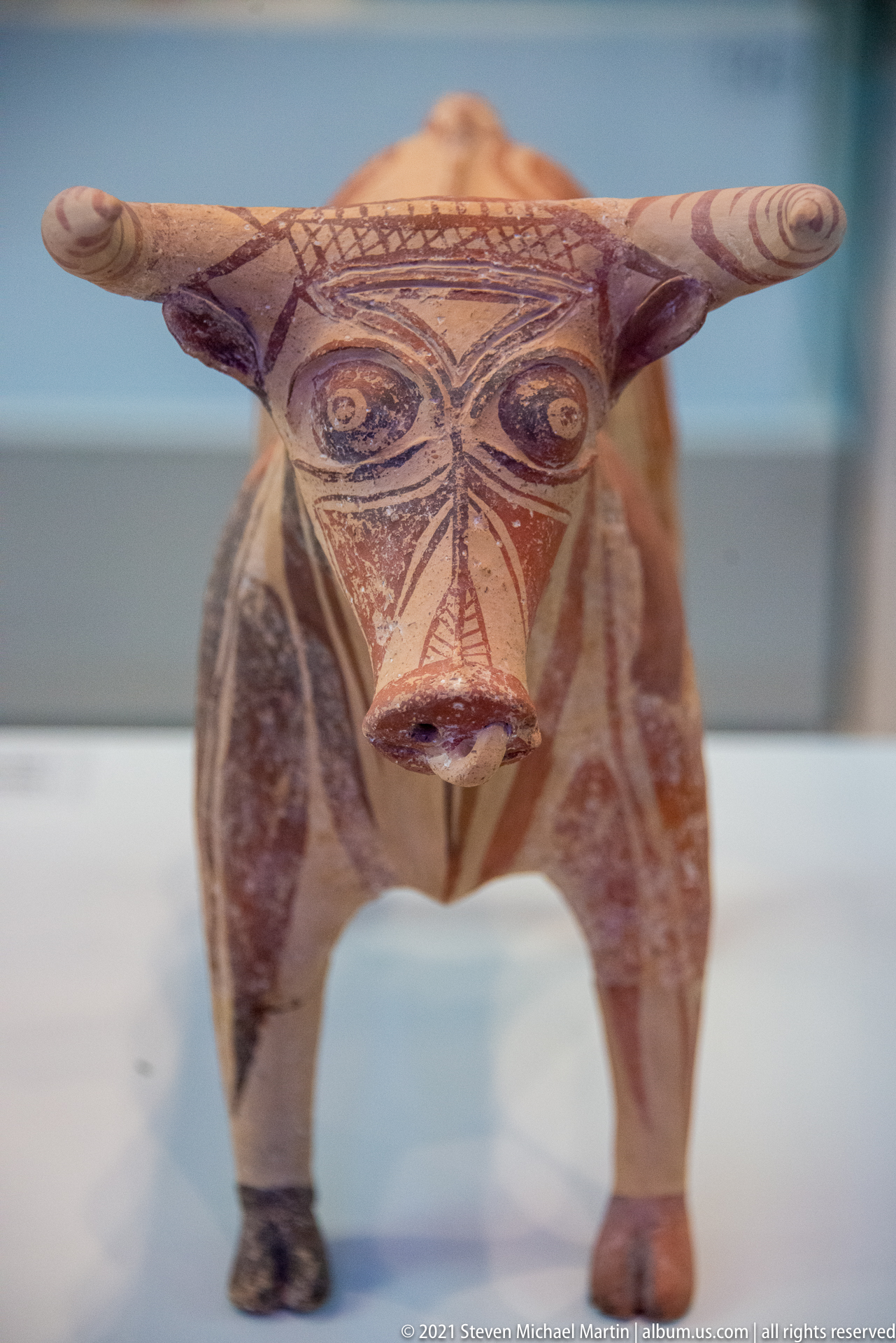
This painted clay bull belongs to the Minoan repertoire in which bovine imagery appears across figurines, vessels, seals, and frescoes. The animal stands solidly on four legs with broad horns, large outlined eyes, a pointed muzzle, and geometric painted decoration following the contours of the body. Its compact form translates the powerfully symbolic bull into a small ceramic object intended for close handling or display.
Caption
This painted clay bull belongs to the Minoan repertoire in which bovine imagery appears across figurines, vessels, seals, and frescoes. The animal stands solidly on four legs with broad horns, large outlined eyes, a pointed muzzle, and geometric painted decoration following the contours of the body. Its compact form translates the powerfully symbolic bull into a small ceramic object intended for close handling or display.
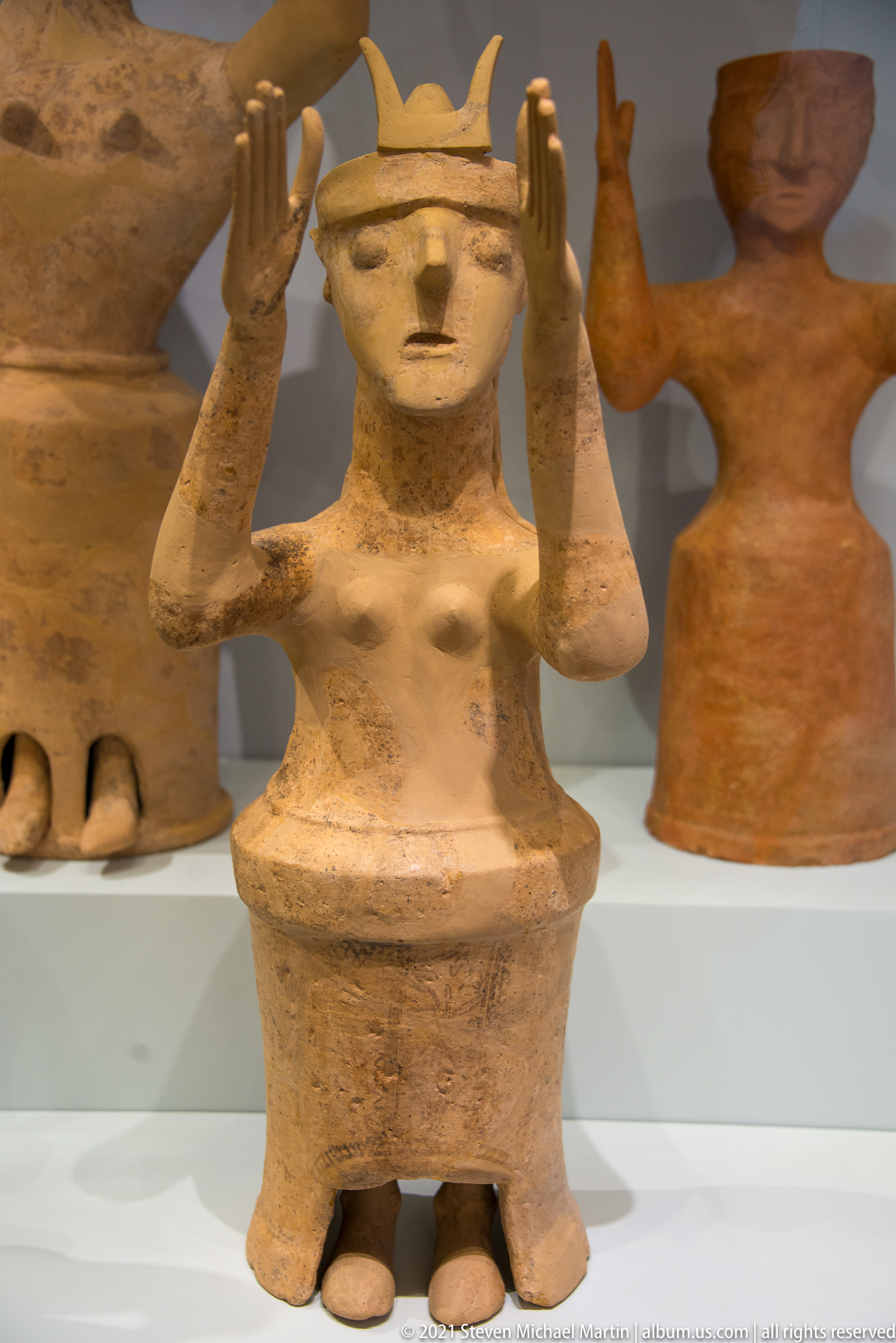
A compact terracotta female figure sits or stands within a broad flaring base, lifting both hands beside a face framed by an angular crown. The large base, exposed feet, and strongly frontal composition distinguish it from the slender raised-arm figures nearby. Its compact, almost architectural silhouette suggests a formal votive or ritual presentation rather than a naturalistic portrait.
Caption
A compact terracotta female figure sits or stands within a broad flaring base, lifting both hands beside a face framed by an angular crown. The large base, exposed feet, and strongly frontal composition distinguish it from the slender raised-arm figures nearby. Its compact, almost architectural silhouette suggests a formal votive or ritual presentation rather than a naturalistic portrait.
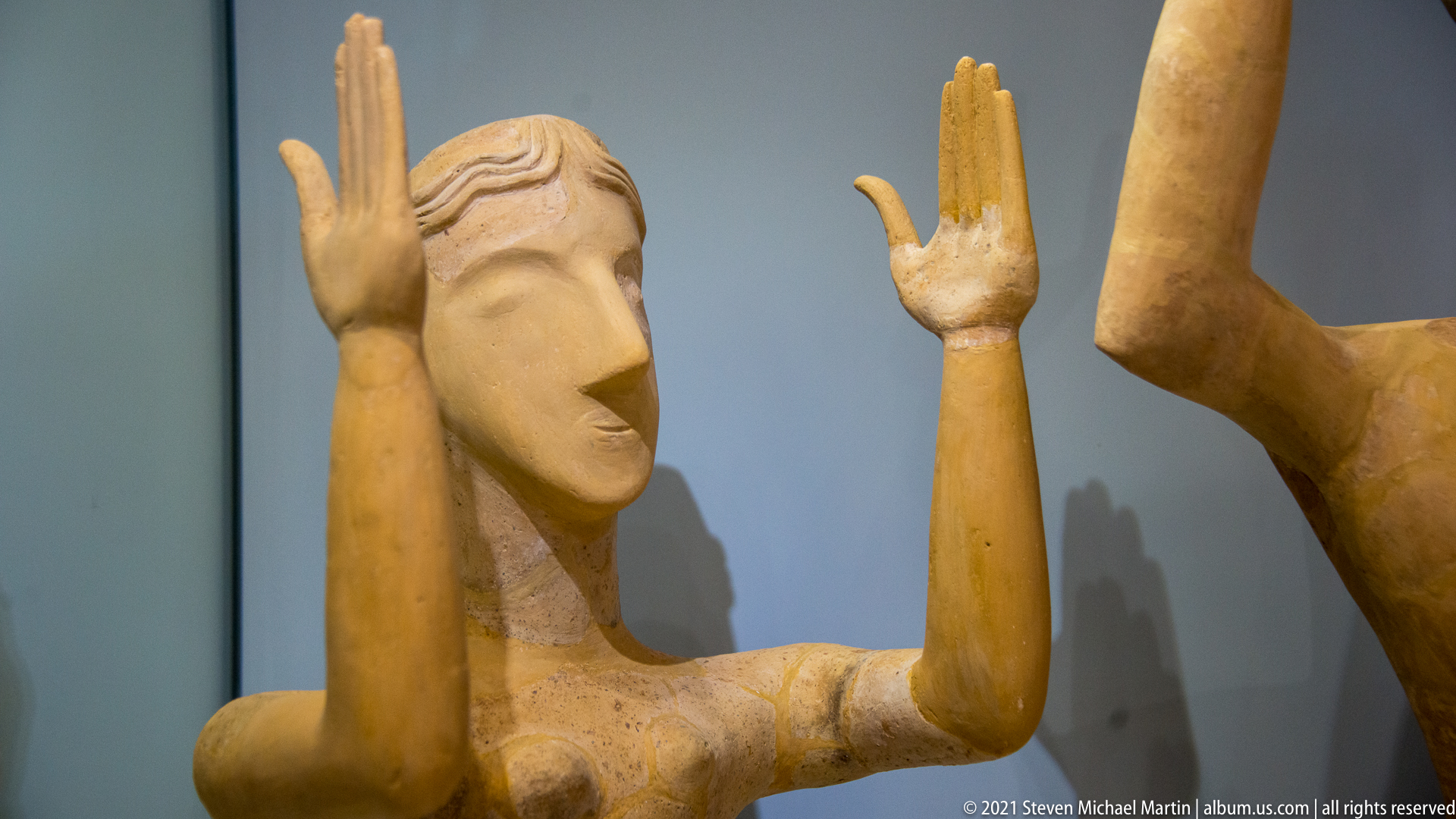
A terracotta female figure raises both hands beside her head, creating a strong symmetrical silhouette. Incised or painted bands articulate the hair, neck, and upper garment, while the long arms and simplified features give the figure an emphatic ceremonial presence. The close crop isolates gesture and facial modeling, making the raised-hand pose more legible than in the wider group display.
Caption
A terracotta female figure raises both hands beside her head, creating a strong symmetrical silhouette. Incised or painted bands articulate the hair, neck, and upper garment, while the long arms and simplified features give the figure an emphatic ceremonial presence. The close crop isolates gesture and facial modeling, making the raised-hand pose more legible than in the wider group display.
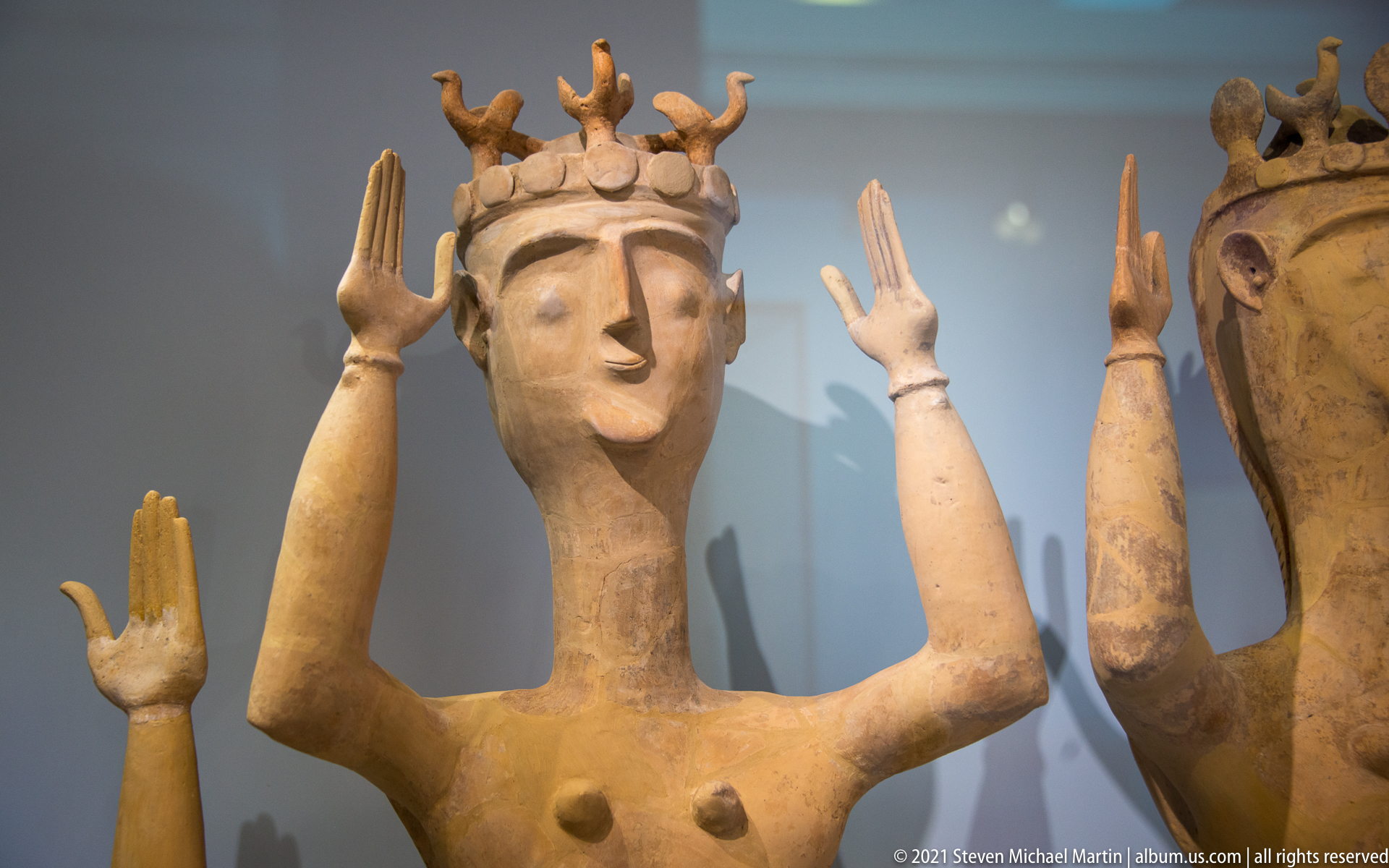
This female terracotta figurine is distinguished by a tall branching headdress that rises above a banded coiffure. Both arms are lifted vertically, echoing the upward movement of the crown and creating a highly formal frontal pose. The close view emphasizes the interplay between gesture, headgear, and simplified facial modeling characteristic of small-scale ritual imagery in Bronze Age Crete.
Caption
This female terracotta figurine is distinguished by a tall branching headdress that rises above a banded coiffure. Both arms are lifted vertically, echoing the upward movement of the crown and creating a highly formal frontal pose. The close view emphasizes the interplay between gesture, headgear, and simplified facial modeling characteristic of small-scale ritual imagery in Bronze Age Crete.
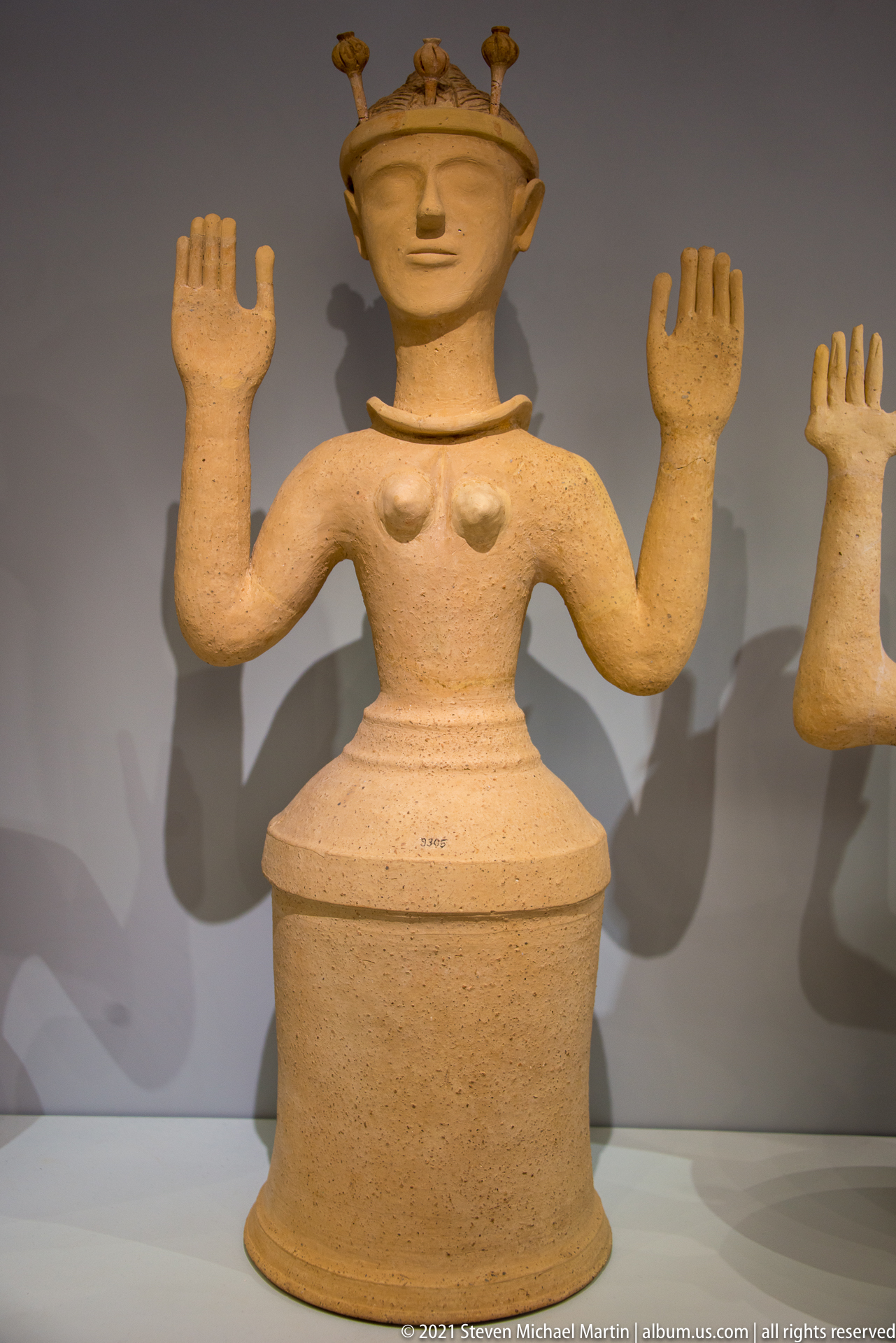
A large terracotta female figure rises from a cylindrical lower body, both arms lifted outward with open palms. A broad crown decorated with small projecting elements frames the head, while the simplified face and modeled breasts retain the direct frontal emphasis of the series. The vessel-like base gives the figure unusual monumentality and separates it visually from smaller freestanding figurines.
Caption
A large terracotta female figure rises from a cylindrical lower body, both arms lifted outward with open palms. A broad crown decorated with small projecting elements frames the head, while the simplified face and modeled breasts retain the direct frontal emphasis of the series. The vessel-like base gives the figure unusual monumentality and separates it visually from smaller freestanding figurines.
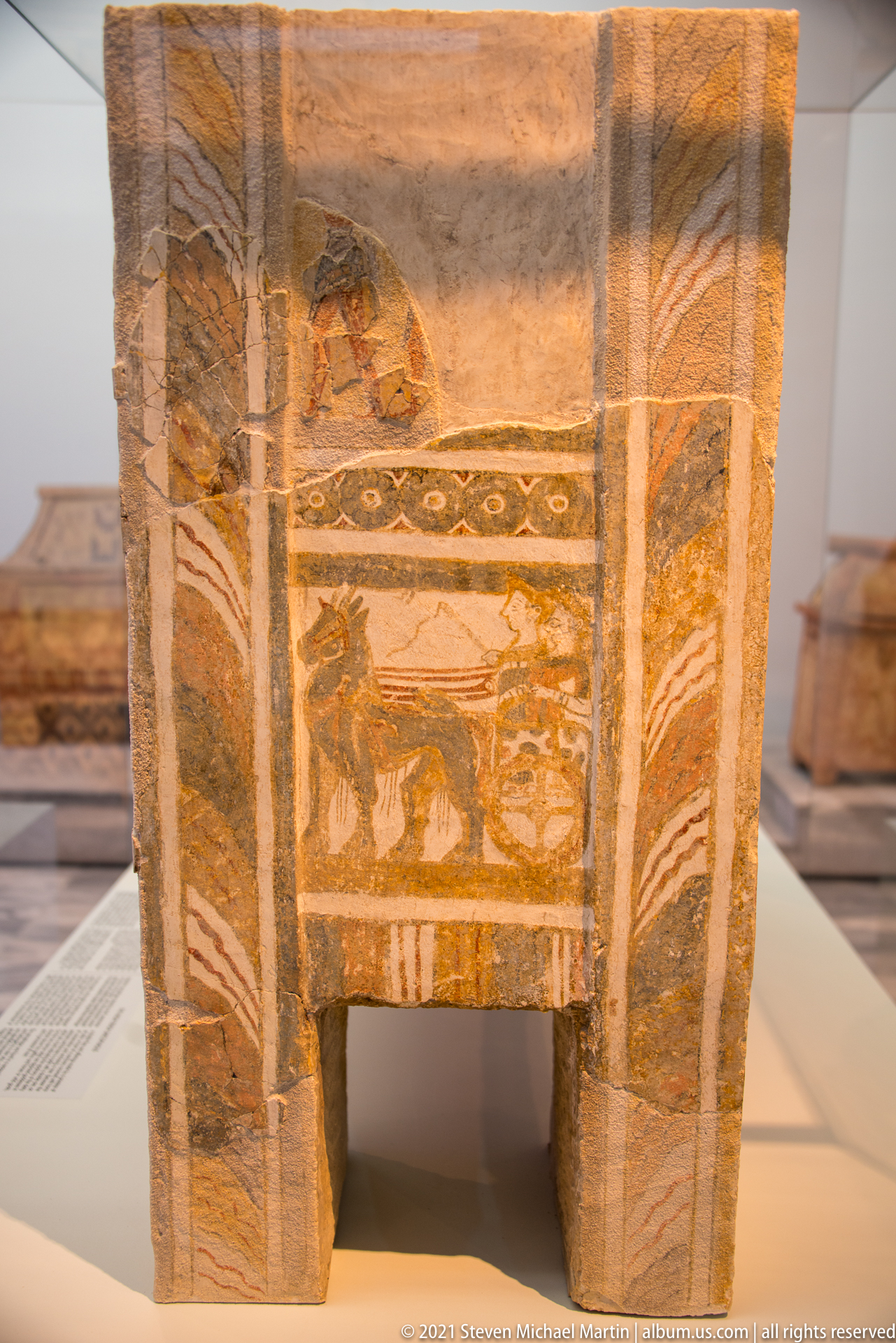
This rectangular terracotta larnax is organized into framed painted panels, with a central animal scene set between patterned borders and vertical side bands. Short legs lift the coffin body above the display surface, while surviving ochre, brown, and dark pigments define the decorative compartments. The close frontal view makes the larnax’s combination of funerary architecture and narrative pottery decoration especially clear.
Caption
This rectangular terracotta larnax is organized into framed painted panels, with a central animal scene set between patterned borders and vertical side bands. Short legs lift the coffin body above the display surface, while surviving ochre, brown, and dark pigments define the decorative compartments. The close frontal view makes the larnax’s combination of funerary architecture and narrative pottery decoration especially clear.
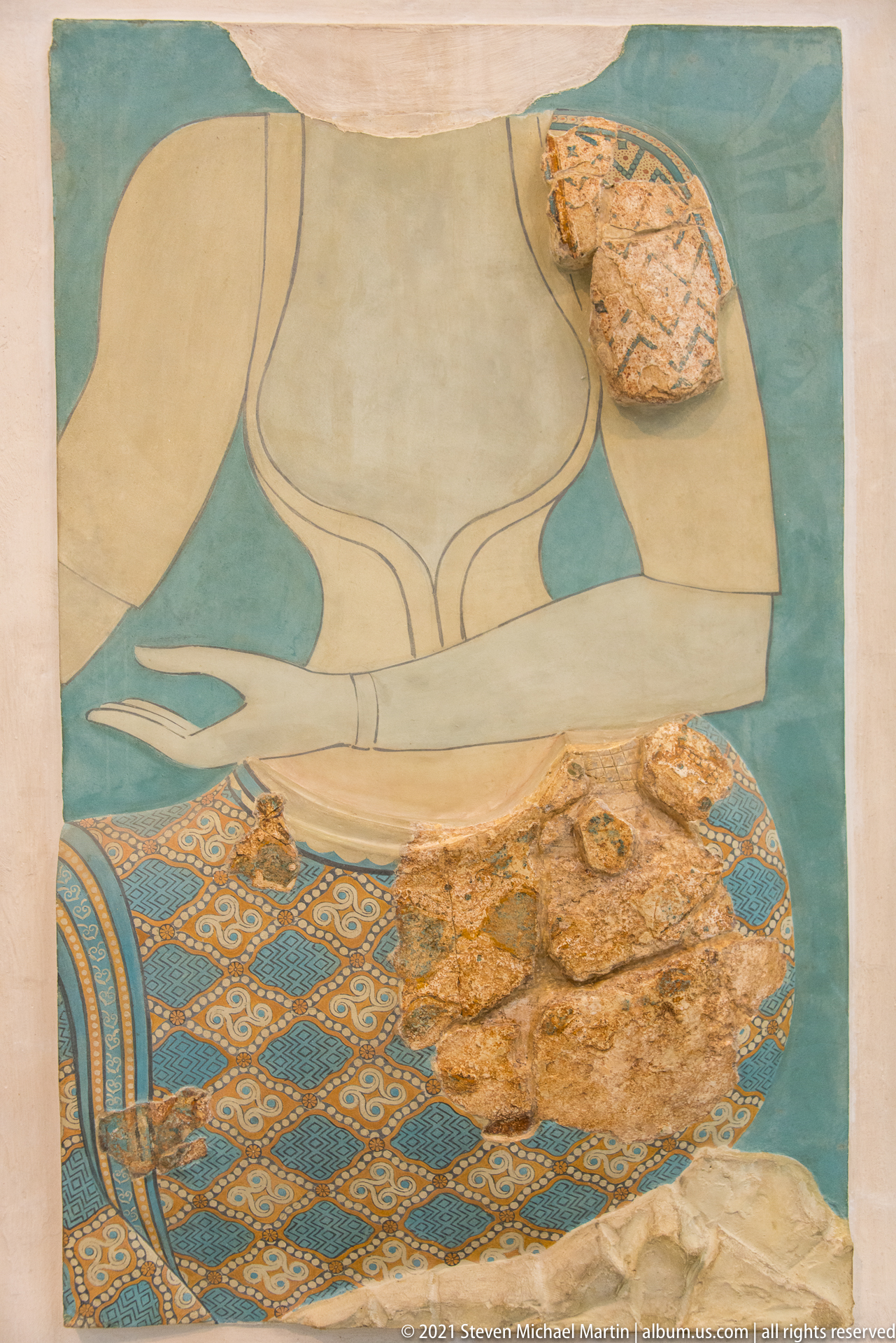
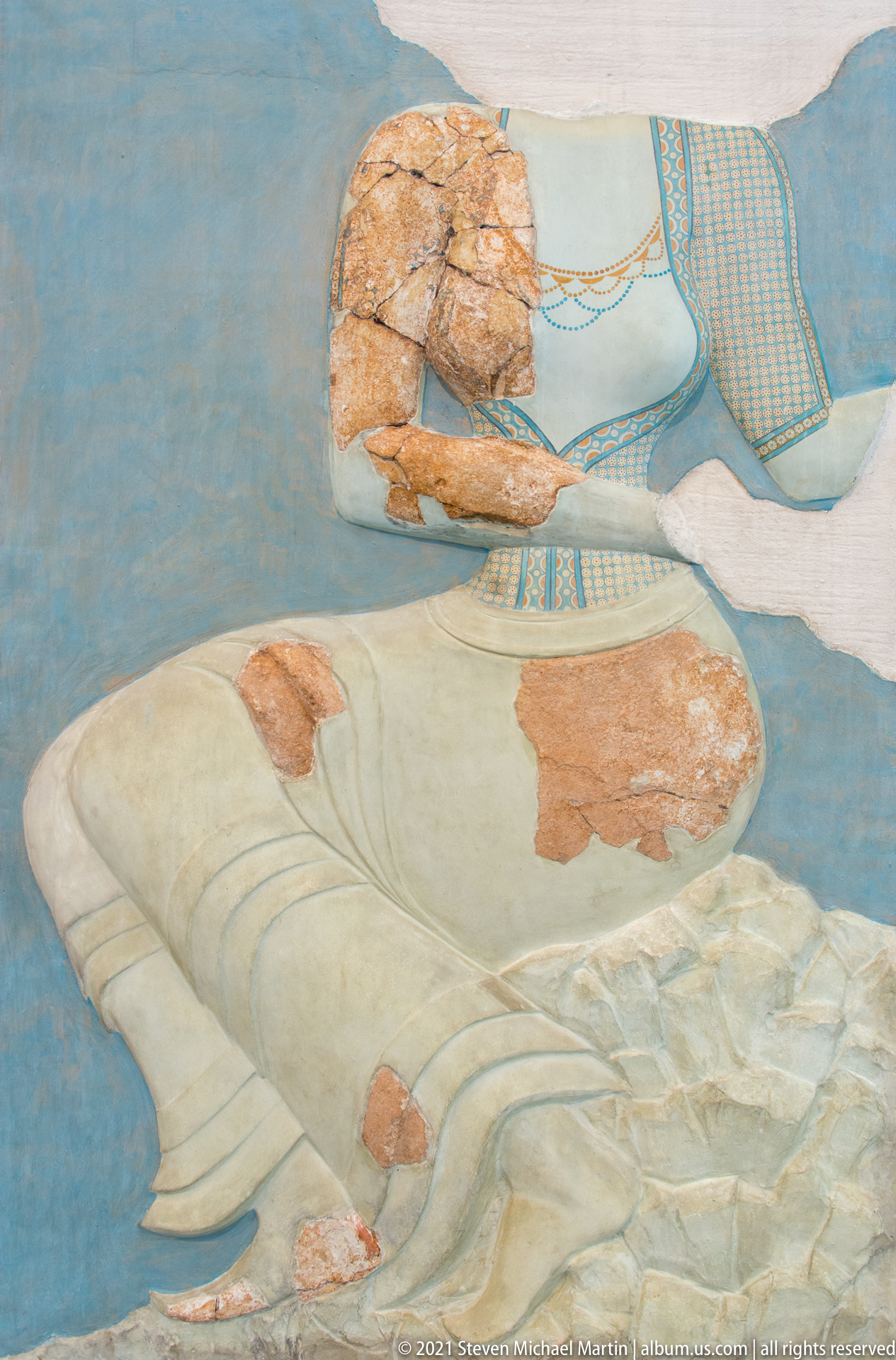
A reconstructed female figure sits behind a richly patterned textile or garment, while original fragments survive across the shoulder, arm, and lower decorative field. The pale skin, blue ground, and intricate geometric patterning create a refined contrast between body and textile. The close framing makes conservation boundaries especially visible, showing how surviving plaster has been integrated into a larger interpretive reconstruction.
Caption
A reconstructed female figure sits behind a richly patterned textile or garment, while original fragments survive across the shoulder, arm, and lower decorative field. The pale skin, blue ground, and intricate geometric patterning create a refined contrast between body and textile. The close framing makes conservation boundaries especially visible, showing how surviving plaster has been integrated into a larger interpretive reconstruction.
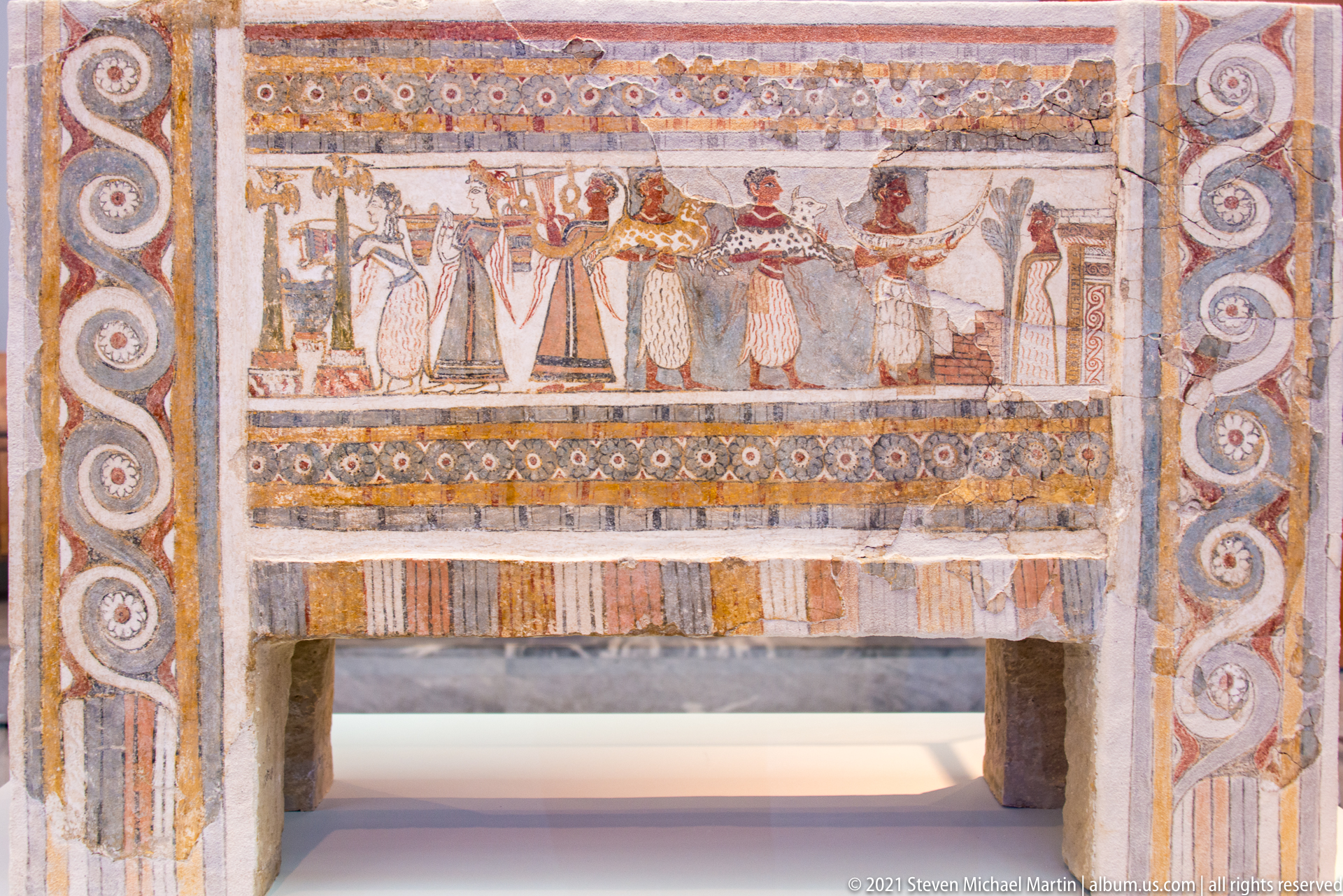
A broad painted panel on this terracotta larnax shows a line of human figures engaged in what appears to be a ceremonial or processional activity. Spiraling side borders and repeated geometric bands frame the scene, turning the coffin body into a carefully organized pictorial surface. The full frontal view reveals how figural narrative and ornament were integrated into Late Bronze Age Cretan funerary objects.
Caption
A broad painted panel on this terracotta larnax shows a line of human figures engaged in what appears to be a ceremonial or processional activity. Spiraling side borders and repeated geometric bands frame the scene, turning the coffin body into a carefully organized pictorial surface. The full frontal view reveals how figural narrative and ornament were integrated into Late Bronze Age Cretan funerary objects.
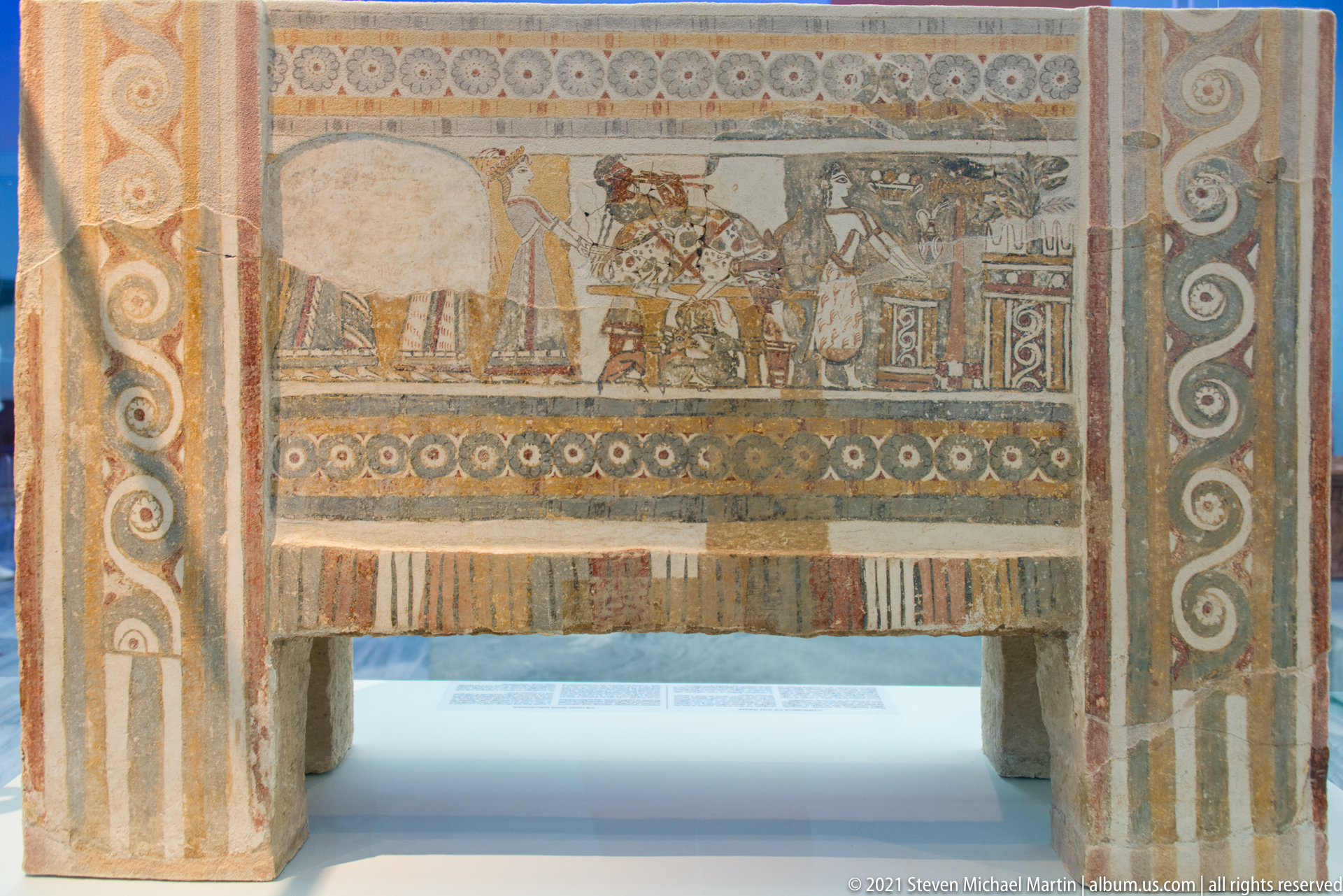
A framed narrative panel dominates this painted terracotta larnax, showing several human figures and a large animal or vehicle-related form within a densely ornamented border. Repeated rosettes, spirals, stripes, and geometric motifs create a rich visual frame around the central scene. The object demonstrates how funerary containers could support complex narrative imagery as well as repetitive decorative pattern.
Caption
A framed narrative panel dominates this painted terracotta larnax, showing several human figures and a large animal or vehicle-related form within a densely ornamented border. Repeated rosettes, spirals, stripes, and geometric motifs create a rich visual frame around the central scene. The object demonstrates how funerary containers could support complex narrative imagery as well as repetitive decorative pattern.
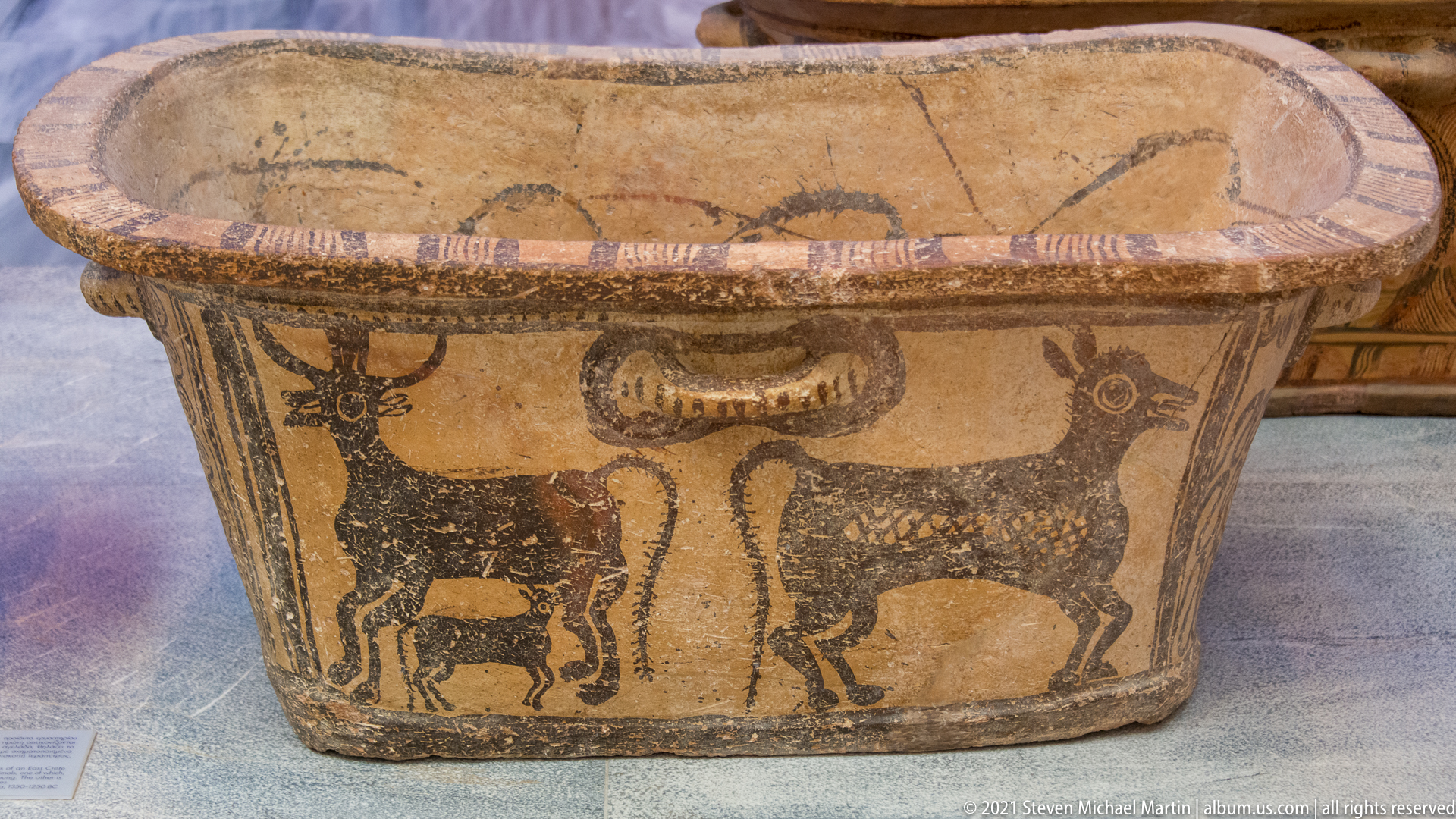
Two dark bulls face inward across the side of this terracotta larnax, separated by tall branching plant forms and surrounded by smaller decorative elements. The animals’ curved horns and compact bodies create a balanced, heraldic composition across the coffin wall. Dark paint against the pale clay makes the bovine imagery unusually legible despite abrasion and age.
Caption
Two dark bulls face inward across the side of this terracotta larnax, separated by tall branching plant forms and surrounded by smaller decorative elements. The animals’ curved horns and compact bodies create a balanced, heraldic composition across the coffin wall. Dark paint against the pale clay makes the bovine imagery unusually legible despite abrasion and age.
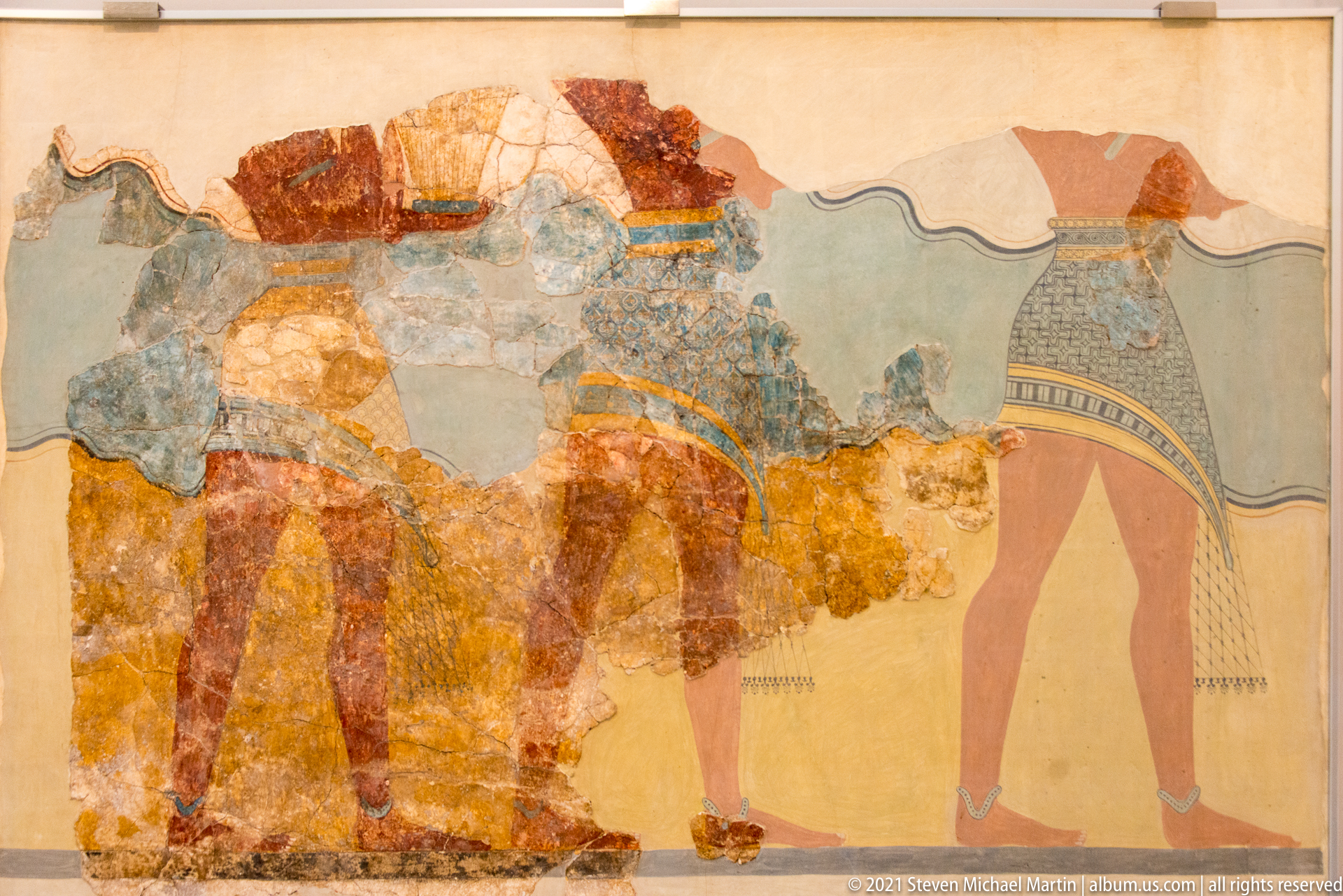
A fragmentary fresco preserves several male figures advancing in the same direction, their reddish-brown bodies and patterned garments set against a pale blue-green ground. Large losses interrupt the procession, but the repeated legs, torsos, and directional rhythm still convey coordinated movement. The surviving painting reveals how Minoan wall decoration could organize human figures into extended ceremonial sequences.
Caption
A fragmentary fresco preserves several male figures advancing in the same direction, their reddish-brown bodies and patterned garments set against a pale blue-green ground. Large losses interrupt the procession, but the repeated legs, torsos, and directional rhythm still convey coordinated movement. The surviving painting reveals how Minoan wall decoration could organize human figures into extended ceremonial sequences.
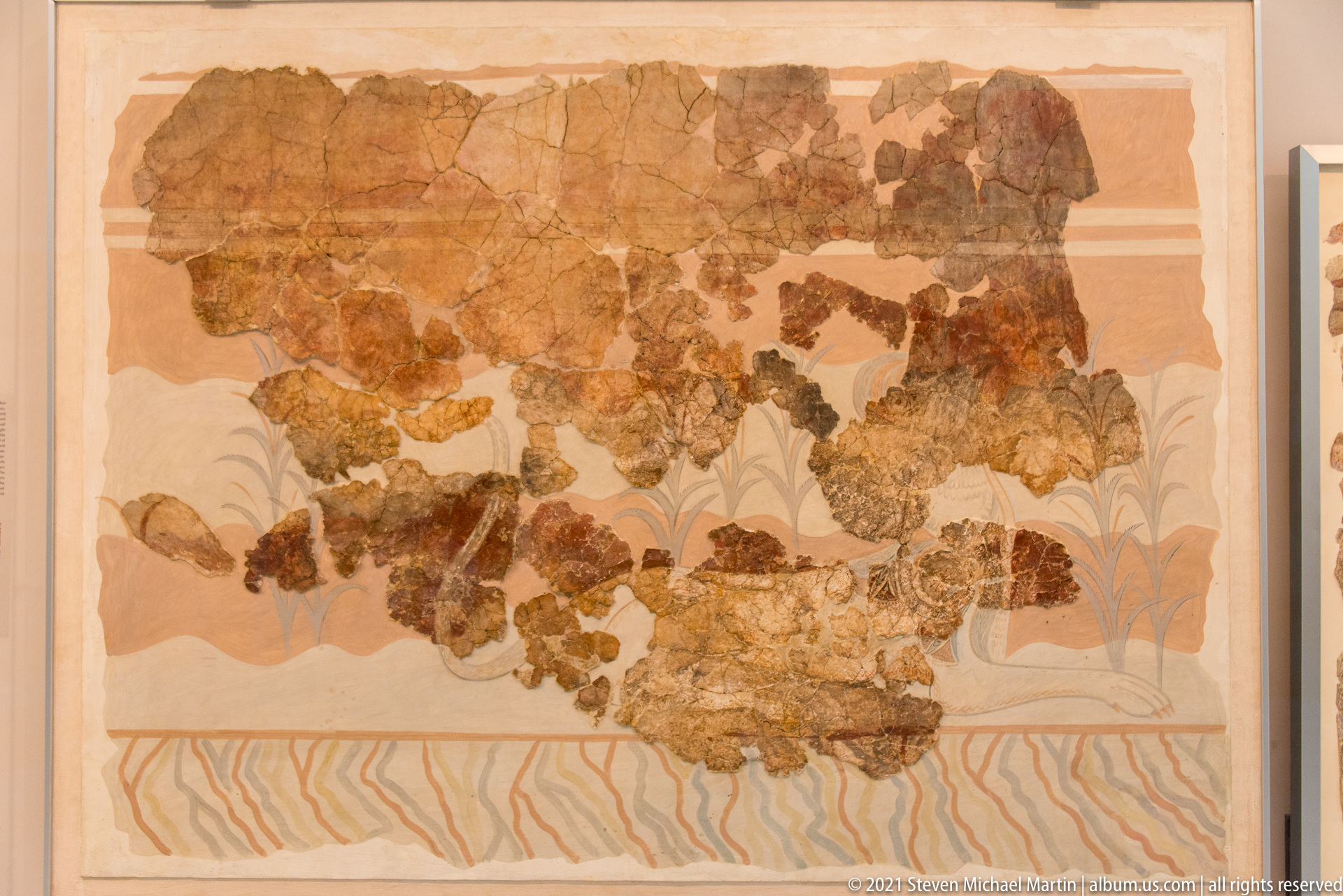
Large surviving patches of painted plaster preserve curling stems and broad papyrus-like floral forms above a band of wavy linear decoration. The fresco is heavily fragmentary, but its pale ground, reddish-brown vegetation, and repeating blue-gray plant shapes still communicate a lush decorative scheme. The surviving lower border helps clarify the intended relationship between natural motifs and architectural framing.
Caption
Large surviving patches of painted plaster preserve curling stems and broad papyrus-like floral forms above a band of wavy linear decoration. The fresco is heavily fragmentary, but its pale ground, reddish-brown vegetation, and repeating blue-gray plant shapes still communicate a lush decorative scheme. The surviving lower border helps clarify the intended relationship between natural motifs and architectural framing.
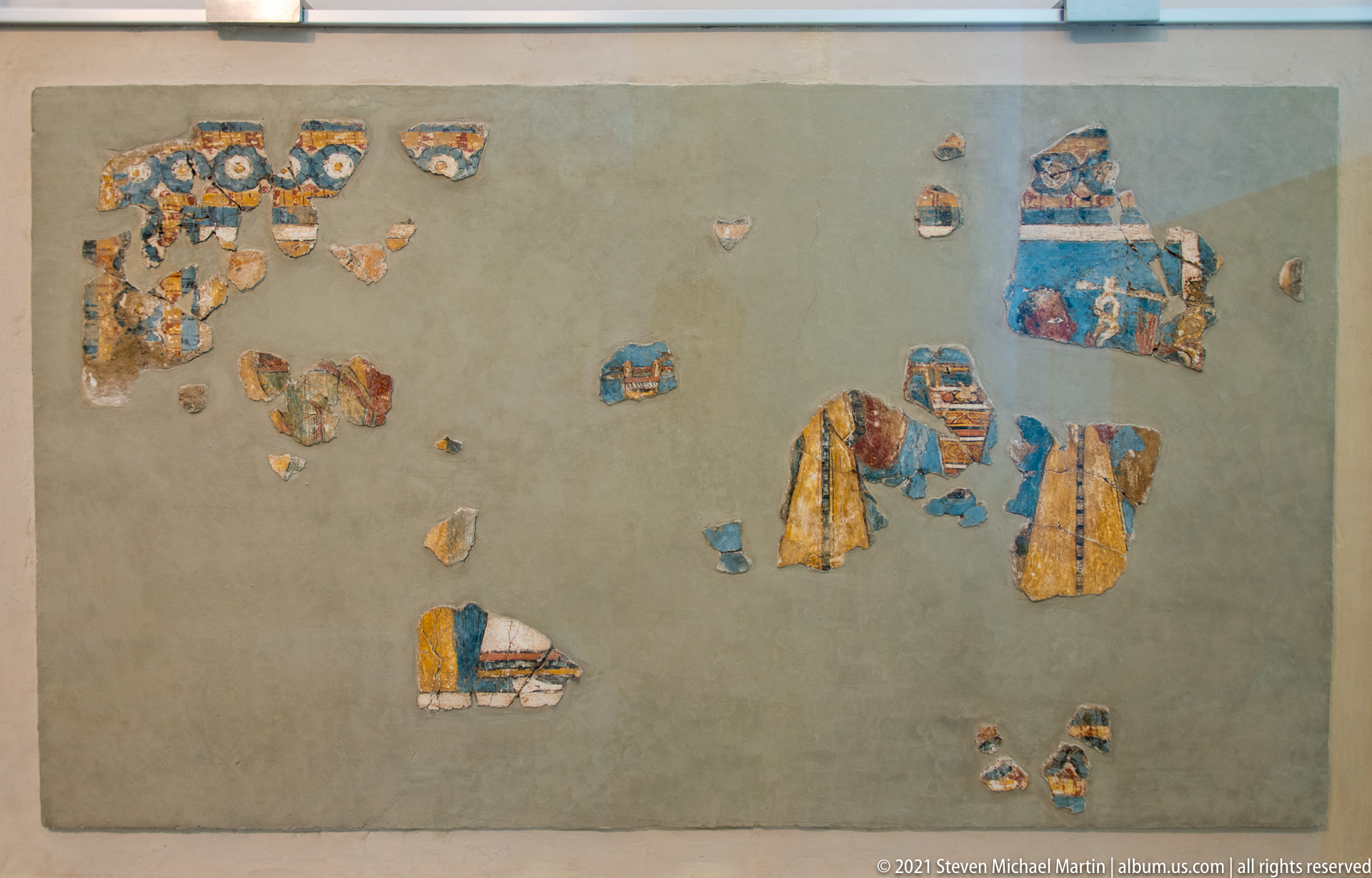
Small islands of painted plaster are mounted across a broad neutral field, preserving flashes of intense blue, yellow, red, black, and white from a once larger figural composition. Several fragments contain portions of patterned garments or bodies, but the original scene is no longer continuous. The installation makes the degree of archaeological survival explicit while preserving color relationships from the lost wall painting.
Caption
Small islands of painted plaster are mounted across a broad neutral field, preserving flashes of intense blue, yellow, red, black, and white from a once larger figural composition. Several fragments contain portions of patterned garments or bodies, but the original scene is no longer continuous. The installation makes the degree of archaeological survival explicit while preserving color relationships from the lost wall painting.
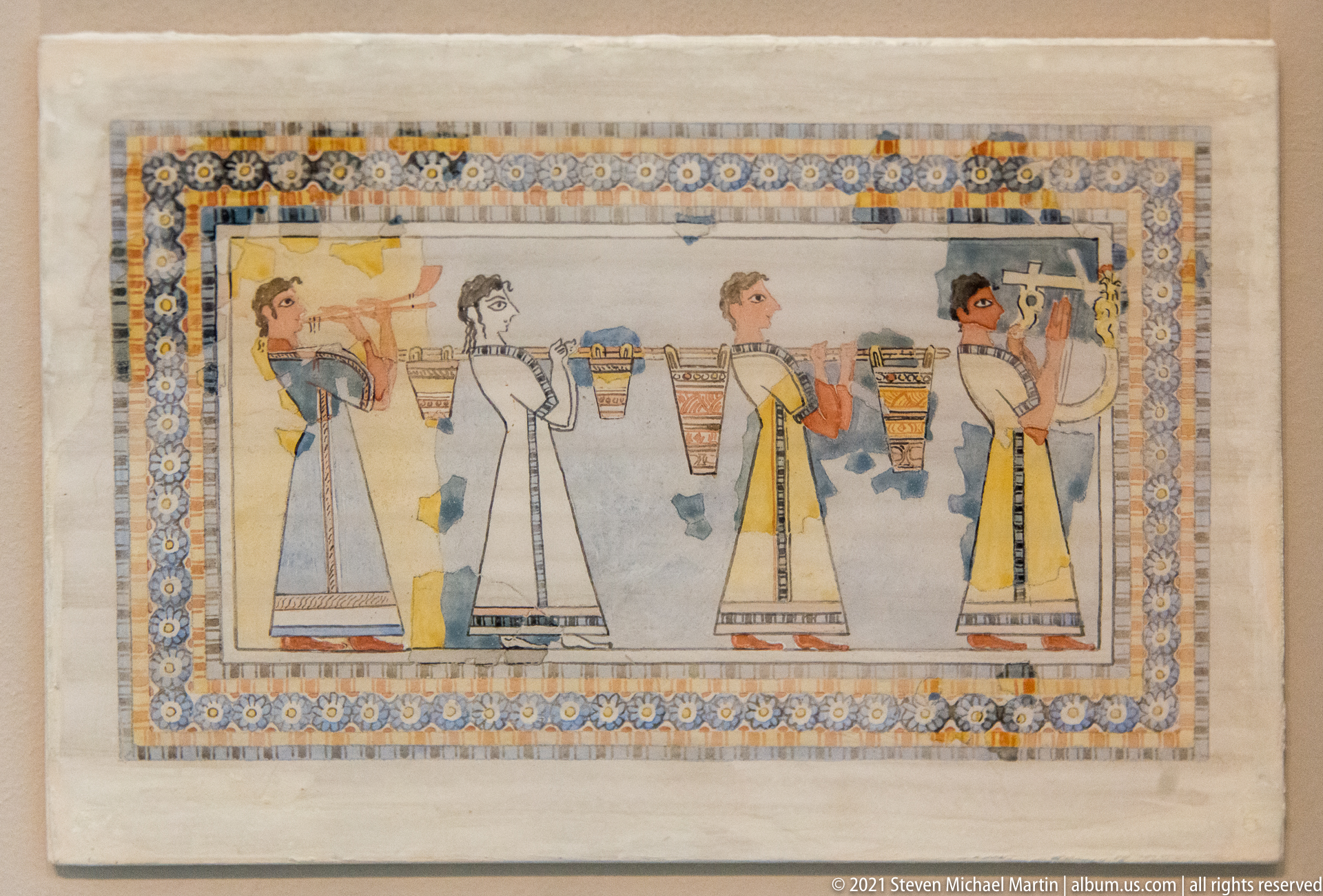
A reconstructed fresco presents four women moving in procession while carrying vessels or offerings. Their long patterned garments, profile heads, and alternating colors create a measured rhythm within a decorative frame of rosettes and geometric bands. The reconstruction clarifies the ceremonial character of the scene while also showing how repeated costume and gesture structured Minoan processional imagery.
Caption
A reconstructed fresco presents four women moving in procession while carrying vessels or offerings. Their long patterned garments, profile heads, and alternating colors create a measured rhythm within a decorative frame of rosettes and geometric bands. The reconstruction clarifies the ceremonial character of the scene while also showing how repeated costume and gesture structured Minoan processional imagery.
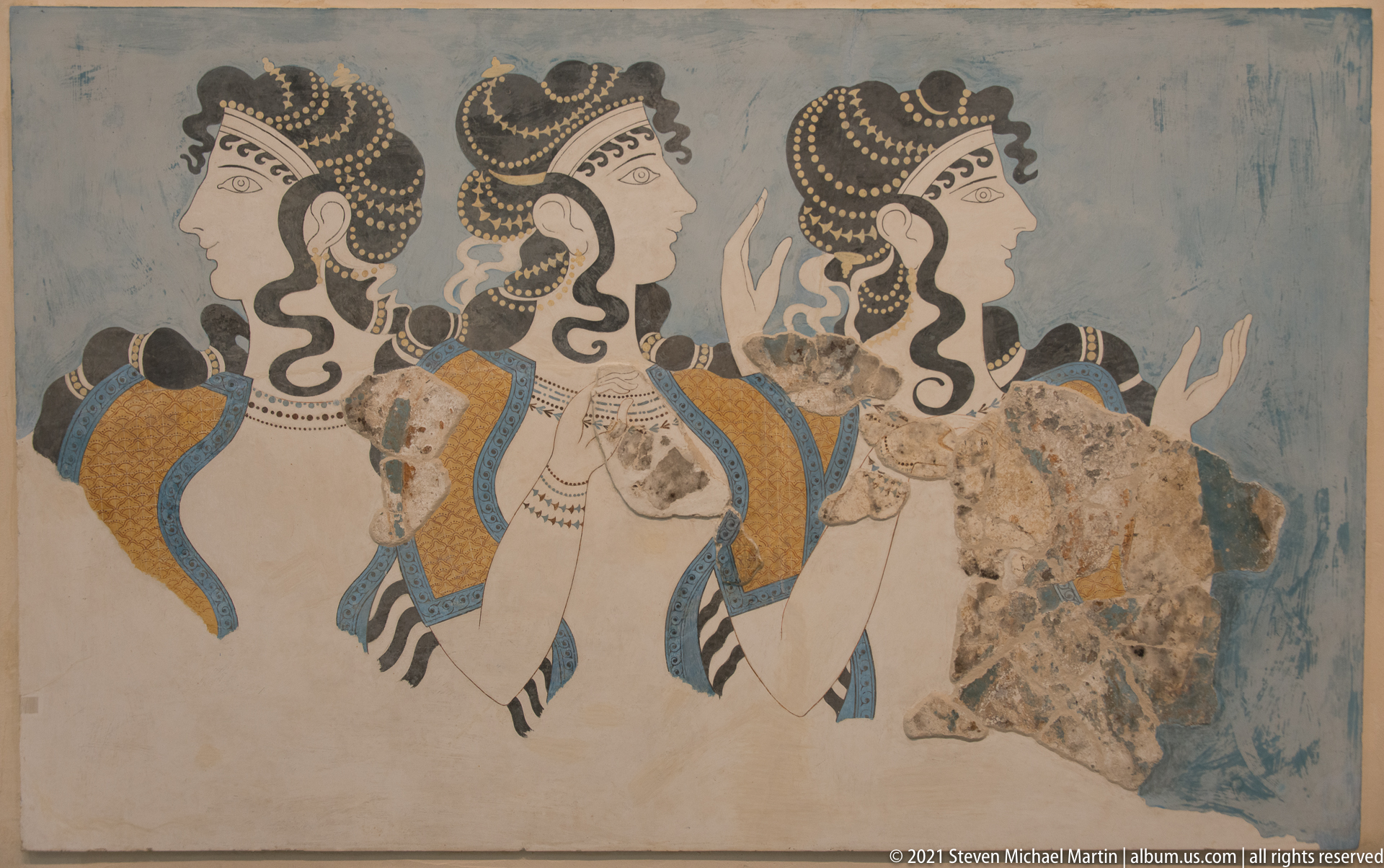
Three elegantly dressed women appear in profile against a blue ground, their elaborate black curls, jeweled ornaments, and brightly patterned garments creating one of the most recognizable courtly images of Minoan art. Extensive reconstruction joins surviving painted-plaster fragments into a coherent composition. The repeated profiles and richly arranged hair emphasize fashion, status, and ceremonial presentation rather than individualized portraiture.
Caption
Three elegantly dressed women appear in profile against a blue ground, their elaborate black curls, jeweled ornaments, and brightly patterned garments creating one of the most recognizable courtly images of Minoan art. Extensive reconstruction joins surviving painted-plaster fragments into a coherent composition. The repeated profiles and richly arranged hair emphasize fashion, status, and ceremonial presentation rather than individualized portraiture.
Two pale-skinned female figures occupy a reconstructed blue-ground composition, one above and one below, with original fragments surviving in their heads, arms, garments, and surrounding patterned areas. Their elongated limbs and finely patterned clothing retain the elegance of Minoan courtly imagery. The restoration distinguishes surviving plaster from modern infill while allowing the relationship between the two figures to be read.
Caption
Two pale-skinned female figures occupy a reconstructed blue-ground composition, one above and one below, with original fragments surviving in their heads, arms, garments, and surrounding patterned areas. Their elongated limbs and finely patterned clothing retain the elegance of Minoan courtly imagery. The restoration distinguishes surviving plaster from modern infill while allowing the relationship between the two figures to be read.

A reddish-brown male figure sits in profile while holding a tall blue object close to the body. Large areas of the fresco survive around the head, torso, arms, and lower garment, though gaps interrupt the original outline. The warm ochre background and compact pose focus attention on the interaction between figure and object, while the damaged surface clearly records the fragmentary condition of the wall painting.
Caption
A reddish-brown male figure sits in profile while holding a tall blue object close to the body. Large areas of the fresco survive around the head, torso, arms, and lower garment, though gaps interrupt the original outline. The warm ochre background and compact pose focus attention on the interaction between figure and object, while the damaged surface clearly records the fragmentary condition of the wall painting.
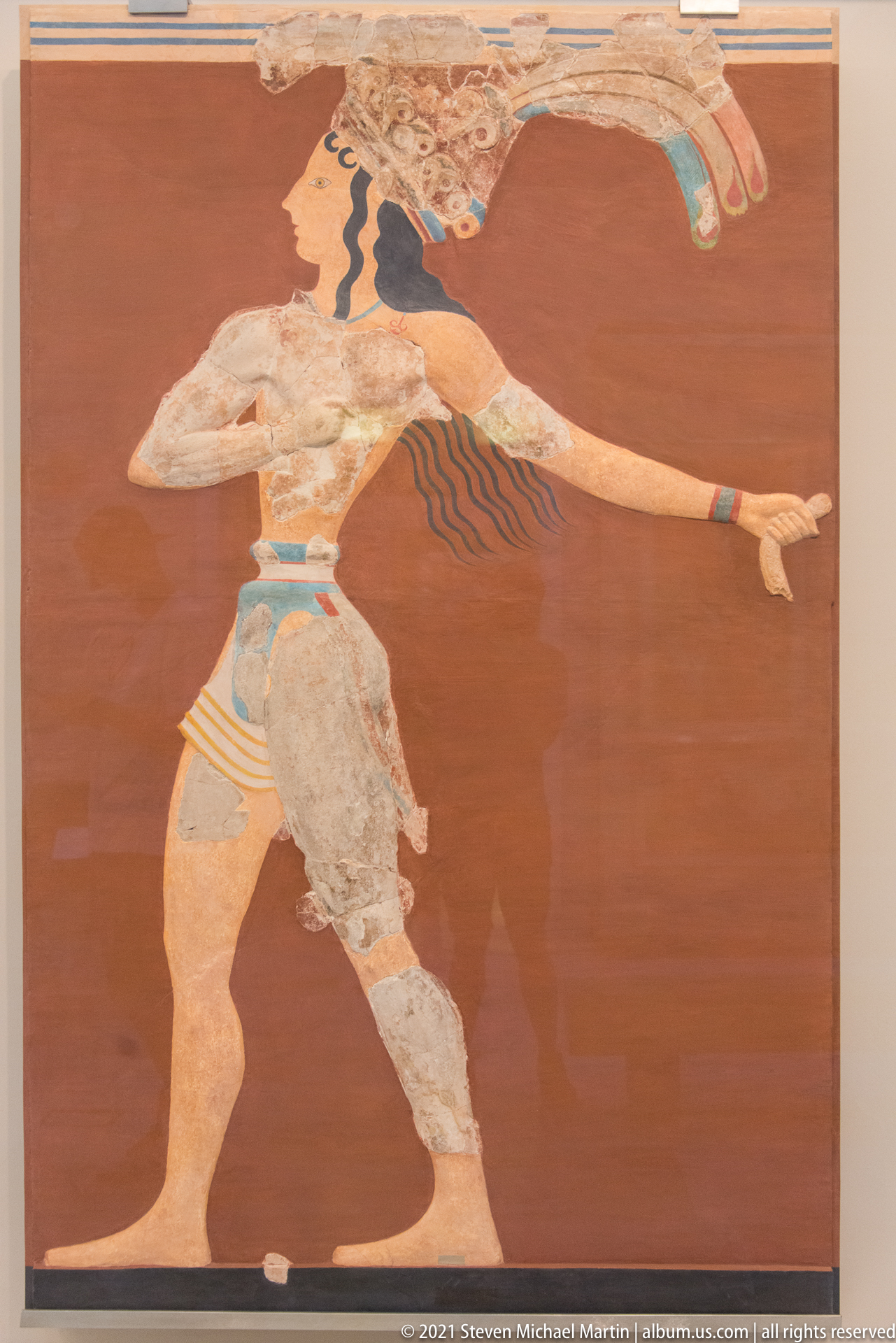
A youthful male figure strides or runs across a deep red ground, one arm extending forward while the other reaches upward behind him. Long black curls stream around the head, and patterned bands accent the waist and limbs. The restoration preserves original fragments across the torso, legs, and head while reconstructing the overall athletic movement of the composition.
Caption
A youthful male figure strides or runs across a deep red ground, one arm extending forward while the other reaches upward behind him. Long black curls stream around the head, and patterned bands accent the waist and limbs. The restoration preserves original fragments across the torso, legs, and head while reconstructing the overall athletic movement of the composition.
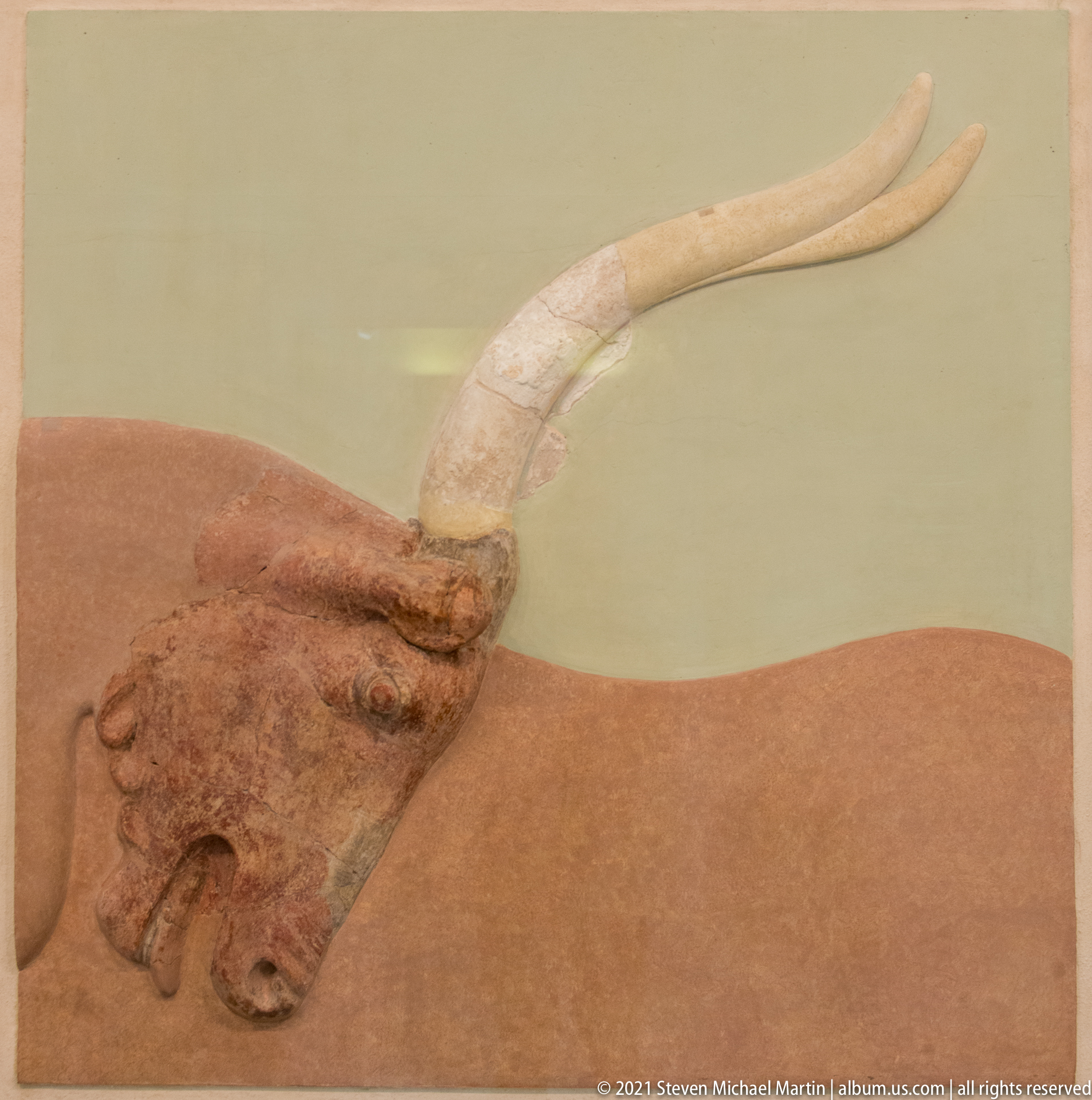
A large bull’s head projects across a reddish field, preserving the eye, muzzle, ear, and part of the neck in painted plaster. Long pale horns curve upward from reconstructed sections, giving the fragment a dramatic horizontal silhouette. The close view highlights both the expressive modeling of the animal and the extensive conservation required to make the surviving image legible.
Caption
A large bull’s head projects across a reddish field, preserving the eye, muzzle, ear, and part of the neck in painted plaster. Long pale horns curve upward from reconstructed sections, giving the fragment a dramatic horizontal silhouette. The close view highlights both the expressive modeling of the animal and the extensive conservation required to make the surviving image legible.
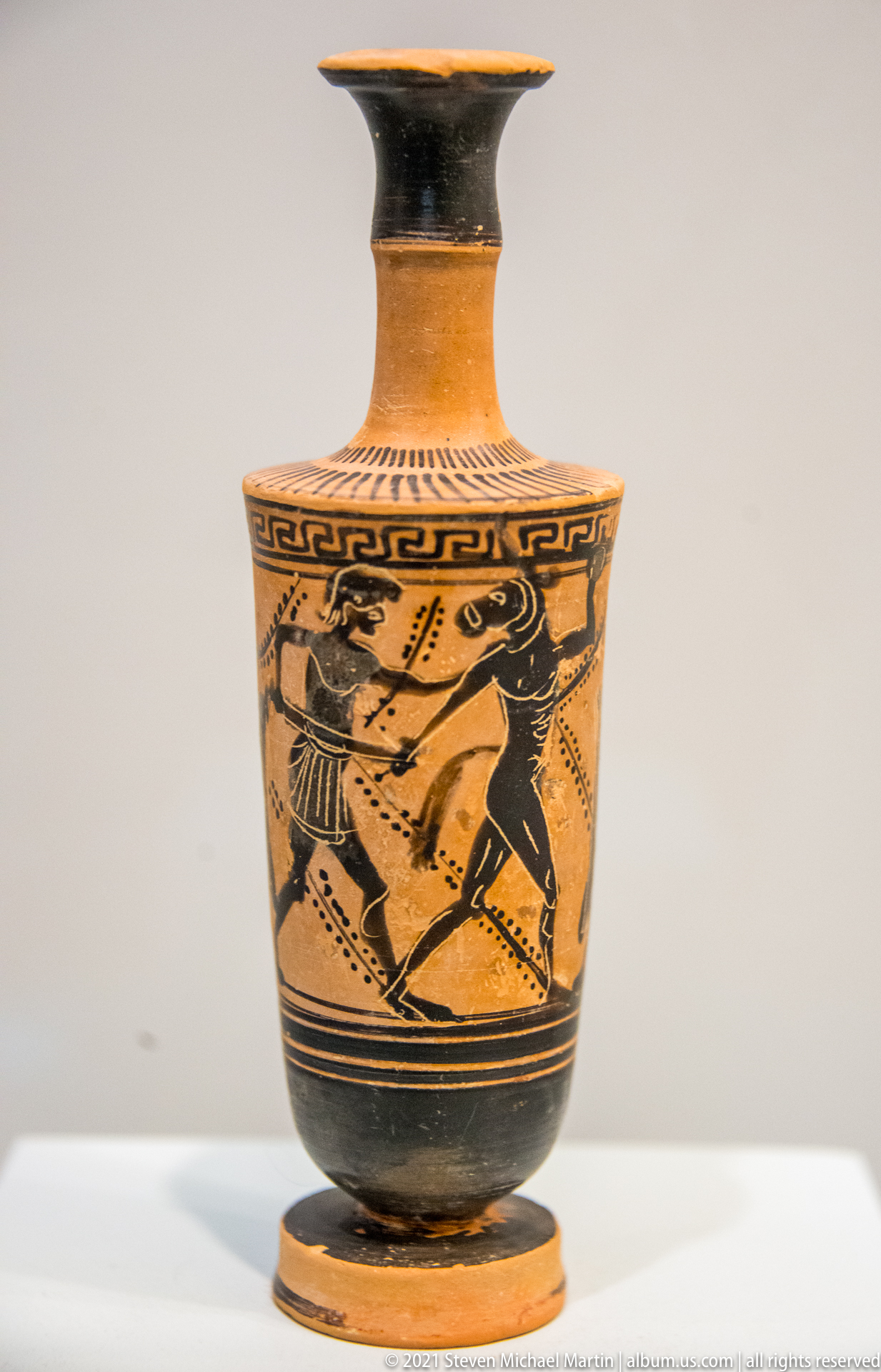
A slender black-figure lekythos carries a dynamic painted combat scene around its shoulder and body. Dark silhouetted figures, incision, and reserved orange clay define the action beneath a meander border, while the narrow neck and flaring mouth give the vessel its characteristic profile. The close isolated display allows both the vessel shape and narrative painting to be read clearly.
Caption
A slender black-figure lekythos carries a dynamic painted combat scene around its shoulder and body. Dark silhouetted figures, incision, and reserved orange clay define the action beneath a meander border, while the narrow neck and flaring mouth give the vessel its characteristic profile. The close isolated display allows both the vessel shape and narrative painting to be read clearly.
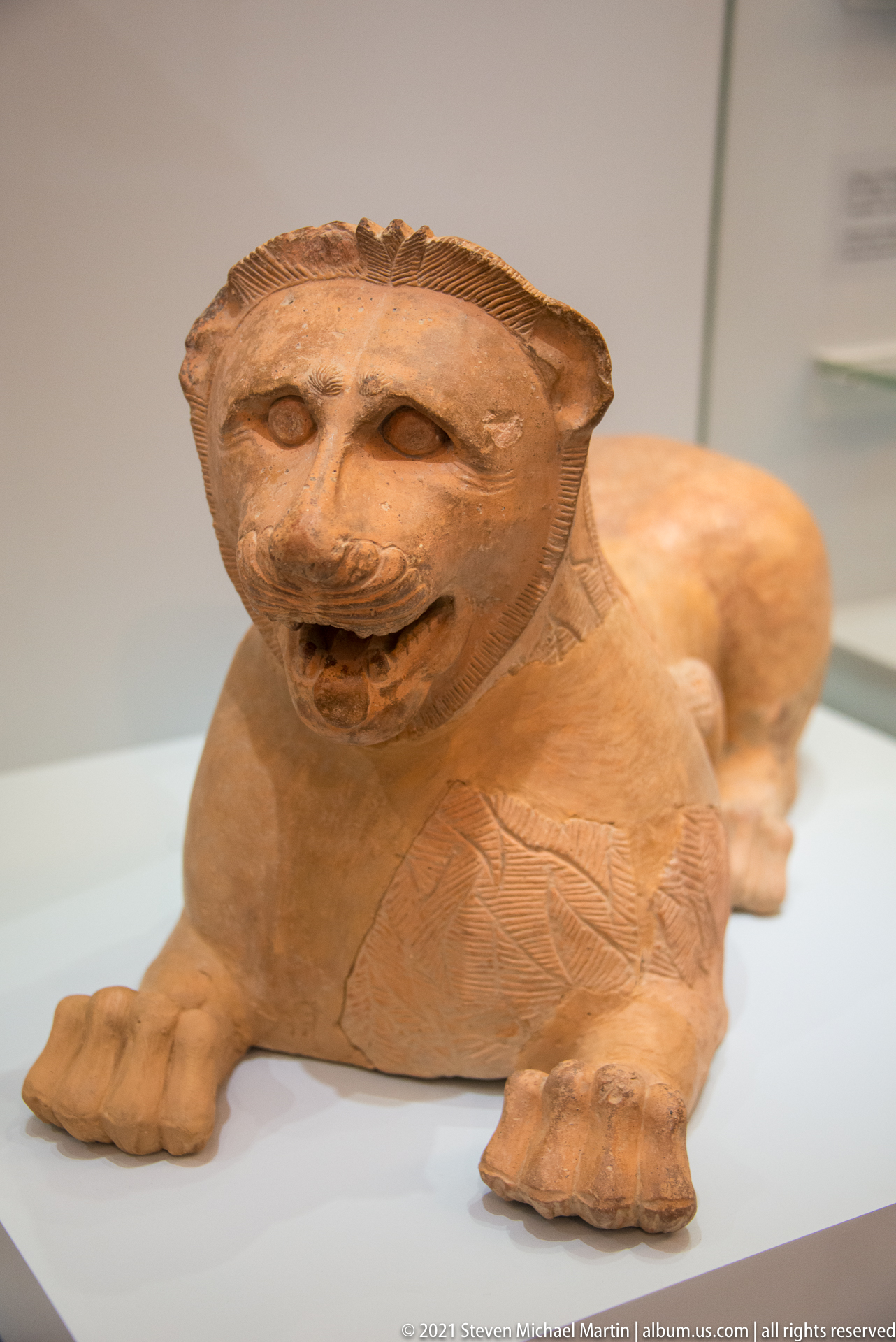
A crouching lion faces the viewer with forepaws extended, mouth open, and a broad mane framing its stylized face. Incised lines articulate the fur, body, and paws, while the hollow ceramic construction suggests the object may have functioned as a vessel or container rather than as solid sculpture. The low frontal viewpoint amplifies the animal’s alert, confrontational posture.
Caption
A crouching lion faces the viewer with forepaws extended, mouth open, and a broad mane framing its stylized face. Incised lines articulate the fur, body, and paws, while the hollow ceramic construction suggests the object may have functioned as a vessel or container rather than as solid sculpture. The low frontal viewpoint amplifies the animal’s alert, confrontational posture.
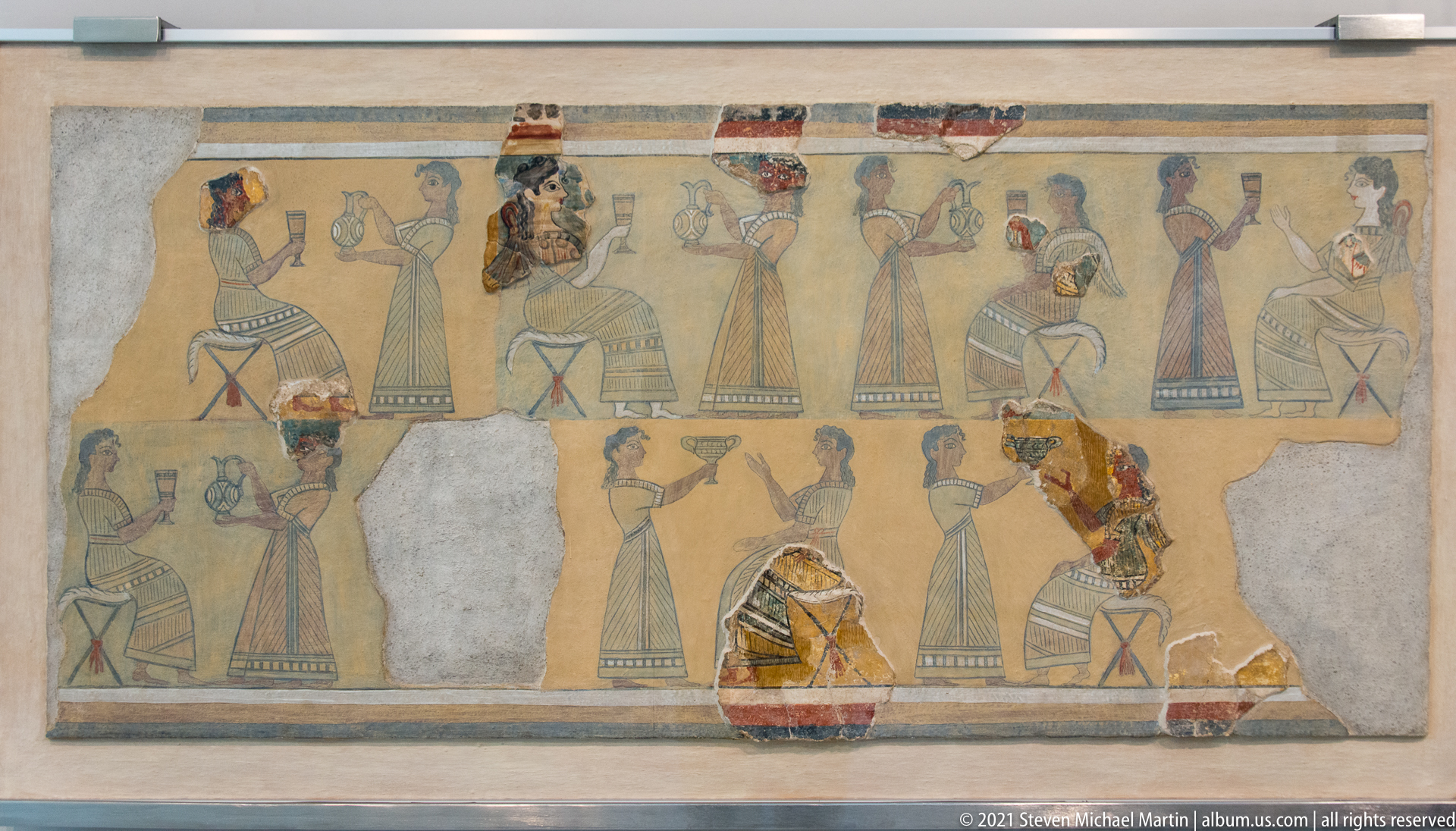
The Camp-Stool, or Libation, Fresco presents men and women participating in a ceremonial banqueting scene. Seated figures occupy folding stools while standing attendants and companions carry vessels, and the surviving composition is reconstructed from relatively few original plaster fragments. The repeated stools, garments, drinking vessels, and layered groups give the scene its courtly character and connect this wider composition with the fragment known as “La Parisienne.”
Caption
The Camp-Stool, or Libation, Fresco presents men and women participating in a ceremonial banqueting scene. Seated figures occupy folding stools while standing attendants and companions carry vessels, and the surviving composition is reconstructed from relatively few original plaster fragments. The repeated stools, garments, drinking vessels, and layered groups give the scene its courtly character and connect this wider composition with the fragment known as “La Parisienne.”
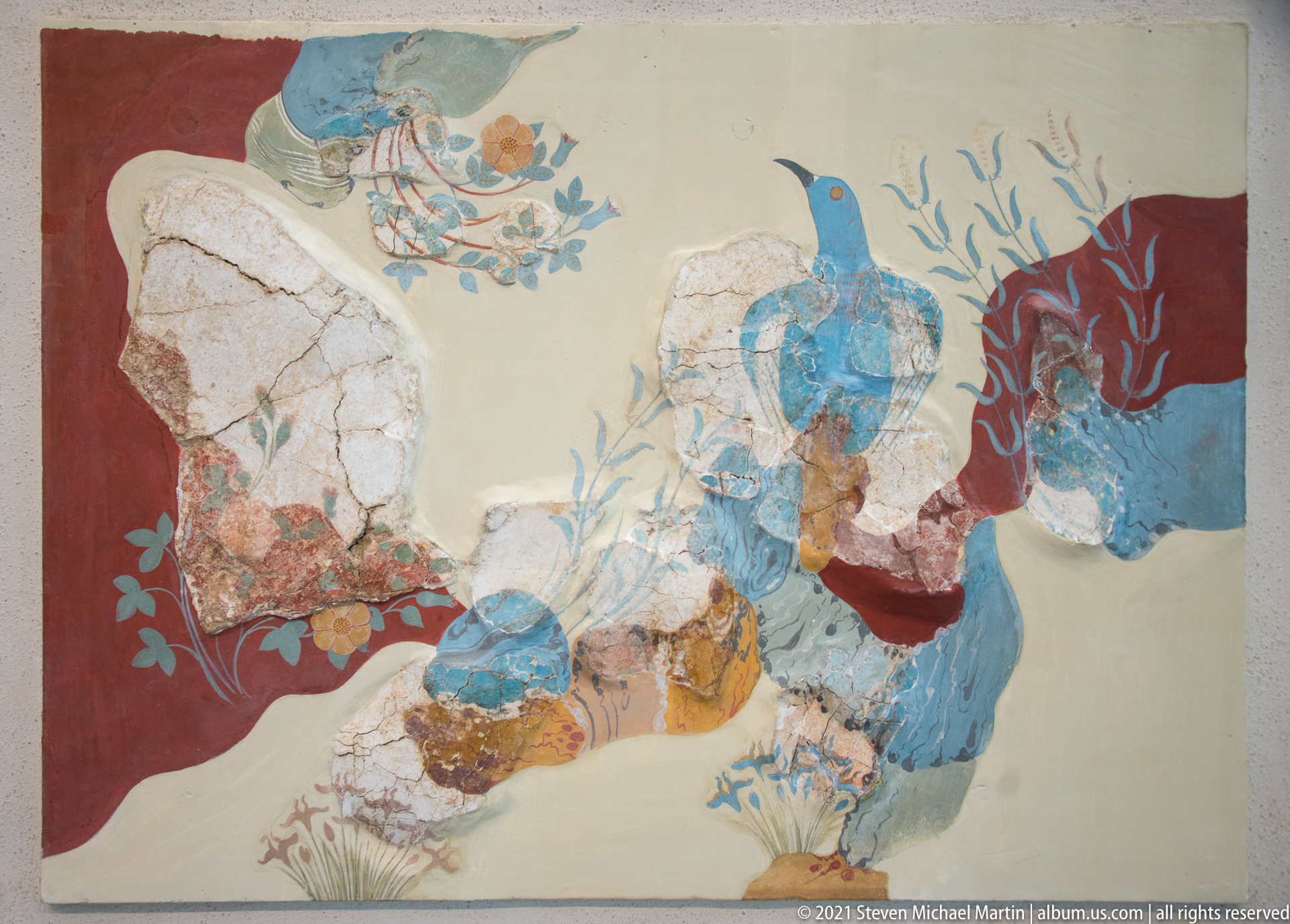
The Blue Bird Fresco sets a vivid blue bird among rocks, flowers, plants, and a stream within a larger Minoan landscape. Bright plumage contrasts with red rock forms and multicolored vegetation, giving the fragment an unusually animated natural setting. The restored composition preserves the Minoan fascination with landscapes in which birds, flowers, flowing water, and rocky terrain are treated as an integrated decorative environment.
Caption
The Blue Bird Fresco sets a vivid blue bird among rocks, flowers, plants, and a stream within a larger Minoan landscape. Bright plumage contrasts with red rock forms and multicolored vegetation, giving the fragment an unusually animated natural setting. The restored composition preserves the Minoan fascination with landscapes in which birds, flowers, flowing water, and rocky terrain are treated as an integrated decorative environment.
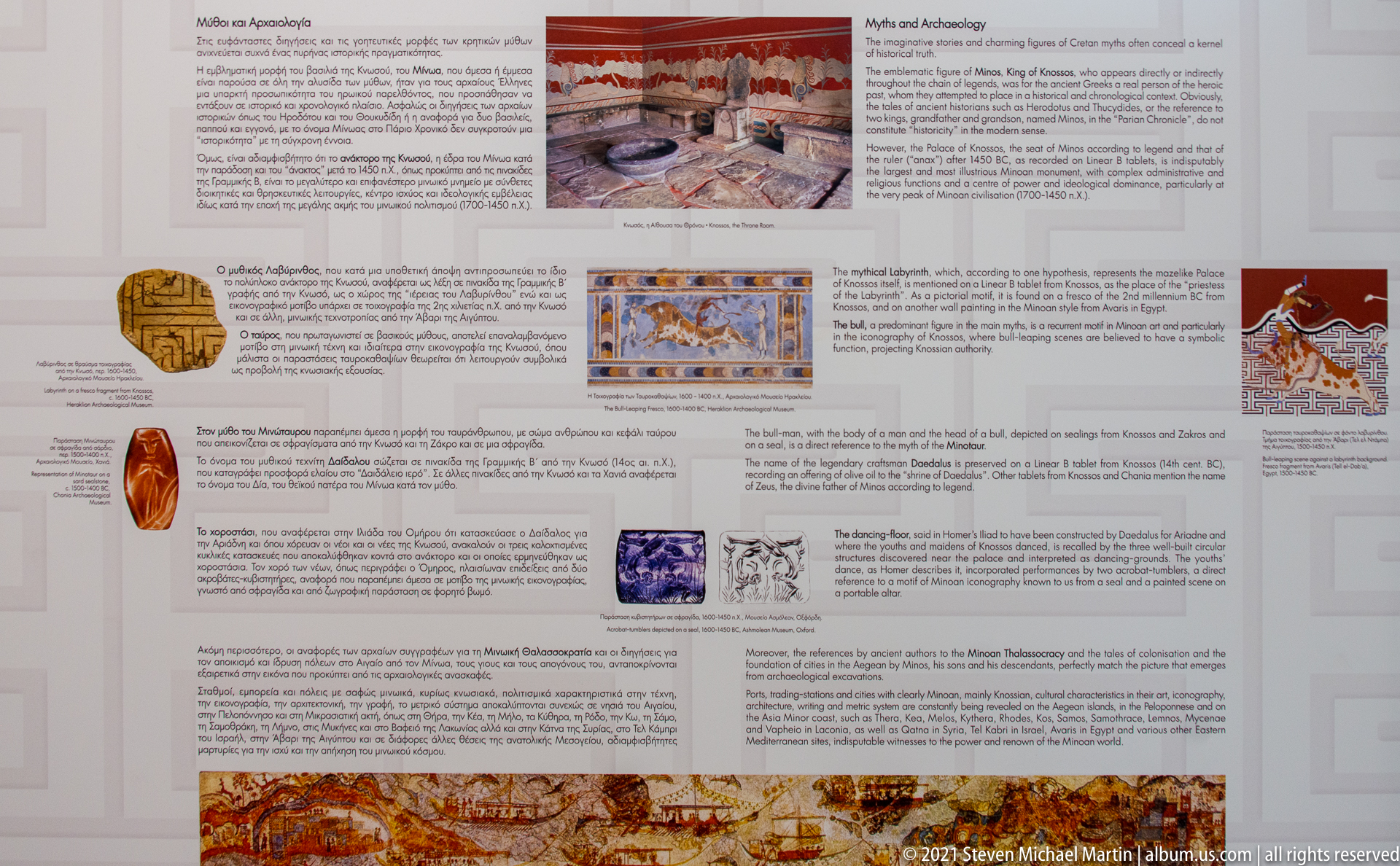
A large bilingual museum panel combines explanatory text with photographs and illustrations of archaeological finds, reconstructed scenes, and Minoan imagery. The layout links visual evidence to broader interpretive themes rather than presenting a single artifact. Seen frontally, the dense arrangement of captions, reproductions, and text blocks records how the museum contextualizes objects within archaeological and mythological narratives.
Caption
A large bilingual museum panel combines explanatory text with photographs and illustrations of archaeological finds, reconstructed scenes, and Minoan imagery. The layout links visual evidence to broader interpretive themes rather than presenting a single artifact. Seen frontally, the dense arrangement of captions, reproductions, and text blocks records how the museum contextualizes objects within archaeological and mythological narratives.
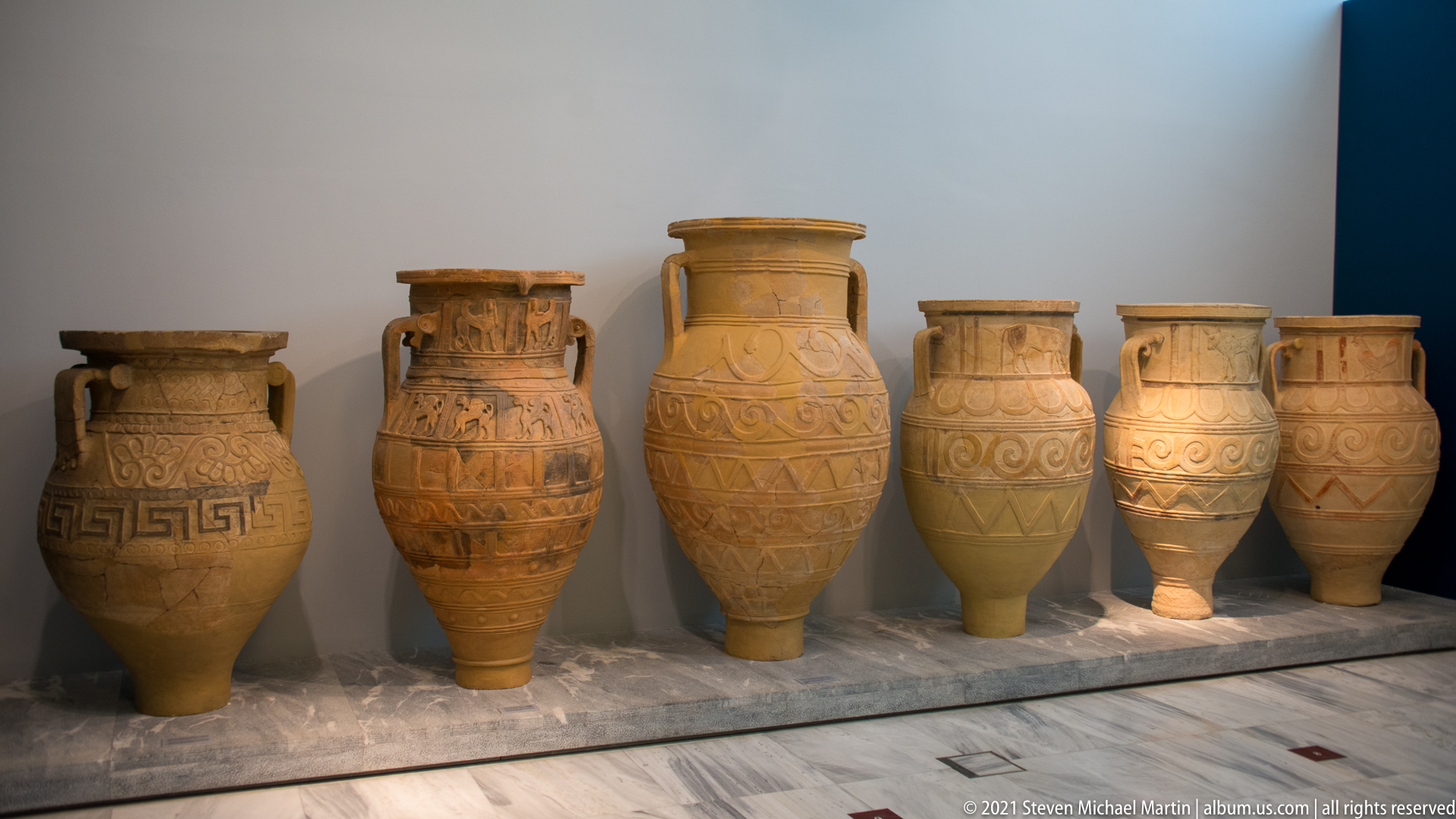
Six tall storage jars stand together, each carrying a different arrangement of relief bands, geometric patterns, spirals, or applied motifs. Their broad shoulders, substantial bodies, and narrow bases emphasize their role as large-capacity containers, while the repeated ornament turns the group into a comparative display of ceramic surface treatment. Differences in height and pattern are especially clear from the frontal gallery view.
Caption
Six tall storage jars stand together, each carrying a different arrangement of relief bands, geometric patterns, spirals, or applied motifs. Their broad shoulders, substantial bodies, and narrow bases emphasize their role as large-capacity containers, while the repeated ornament turns the group into a comparative display of ceramic surface treatment. Differences in height and pattern are especially clear from the frontal gallery view.

Three bronze male figurines are arranged against a backdrop of large pottery vessels. The central figure is taller and more naturalistically modeled, with one arm bent across the chest, while the two flanking figures are shorter and more schematic. Their frontal presentation emphasizes differences in scale, anatomy, and abstraction within a group of small cast-metal votive images.
Caption
Three bronze male figurines are arranged against a backdrop of large pottery vessels. The central figure is taller and more naturalistically modeled, with one arm bent across the chest, while the two flanking figures are shorter and more schematic. Their frontal presentation emphasizes differences in scale, anatomy, and abstraction within a group of small cast-metal votive images.
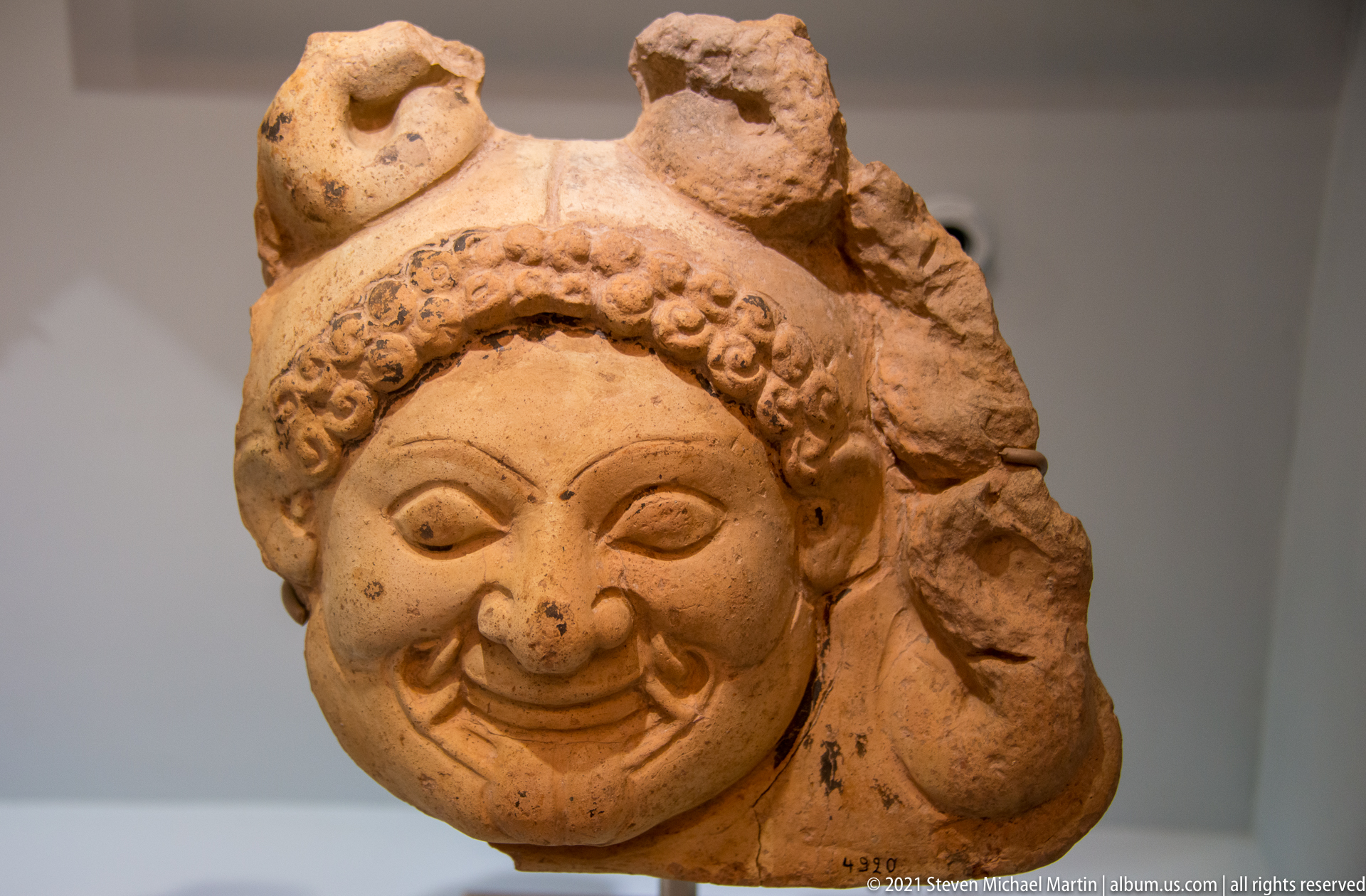
A large terracotta face is modeled with bulging almond-shaped eyes, a broad curling moustache, rounded nose, and an exaggerated smiling mouth. Dense curls or a decorated band frame the forehead, while broken upper and side edges reveal that the face survives as part of a larger object. The theatrical expression and strong relief modeling make the fragment especially striking in close view.
Caption
A large terracotta face is modeled with bulging almond-shaped eyes, a broad curling moustache, rounded nose, and an exaggerated smiling mouth. Dense curls or a decorated band frame the forehead, while broken upper and side edges reveal that the face survives as part of a larger object. The theatrical expression and strong relief modeling make the fragment especially striking in close view.
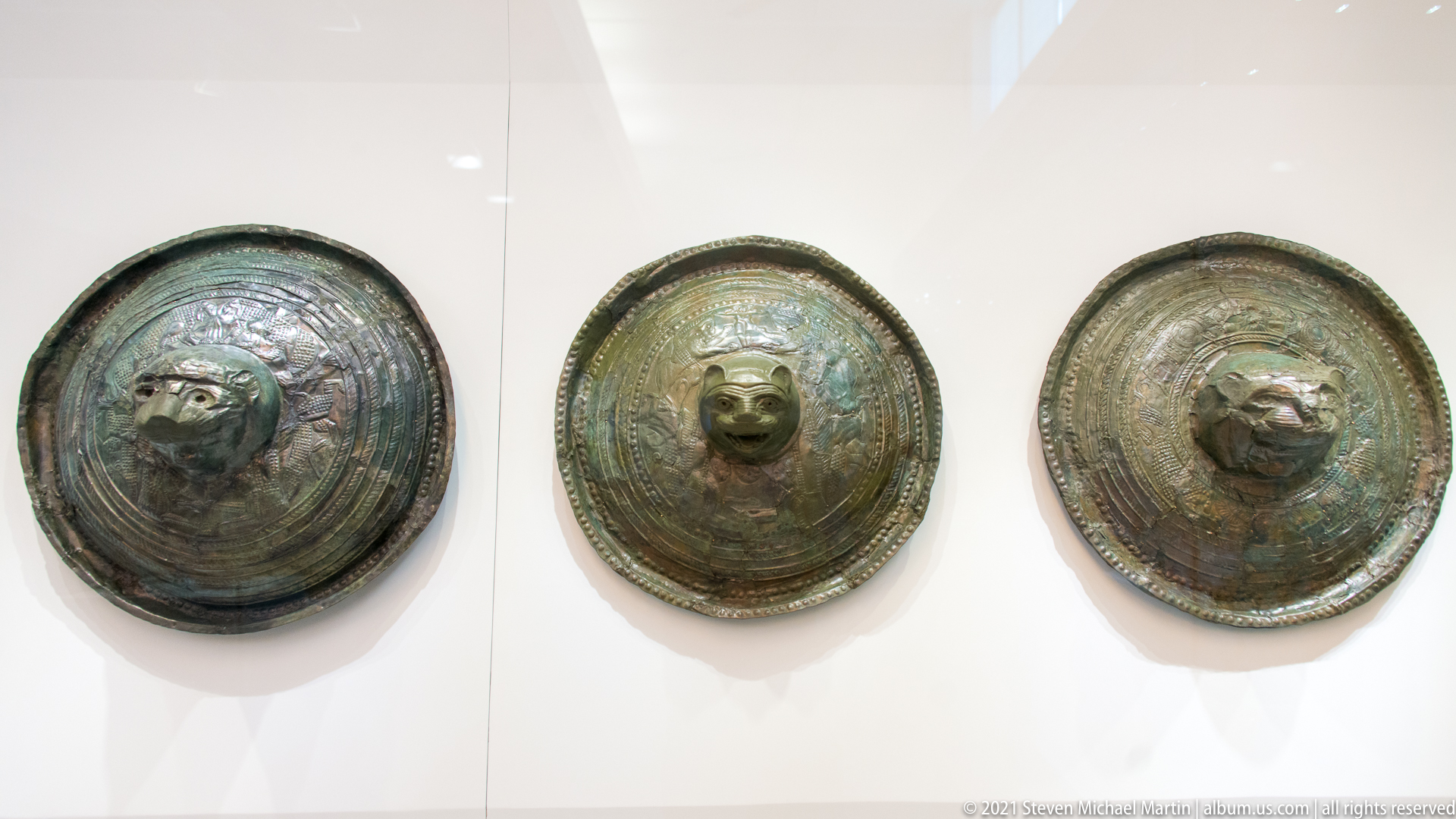
Three circular bronze shields are displayed together, each built around a strongly projecting animal-head boss. Concentric bands of repoussé ornament spread outward from the centers, while differences in the modeled heads and surrounding decoration distinguish the individual pieces. Their thin metal surfaces, green-brown patina, and elaborate relief work make the group especially useful for comparing ancient bronze-working techniques and ceremonial display.
Caption
Three circular bronze shields are displayed together, each built around a strongly projecting animal-head boss. Concentric bands of repoussé ornament spread outward from the centers, while differences in the modeled heads and surrounding decoration distinguish the individual pieces. Their thin metal surfaces, green-brown patina, and elaborate relief work make the group especially useful for comparing ancient bronze-working techniques and ceremonial display.
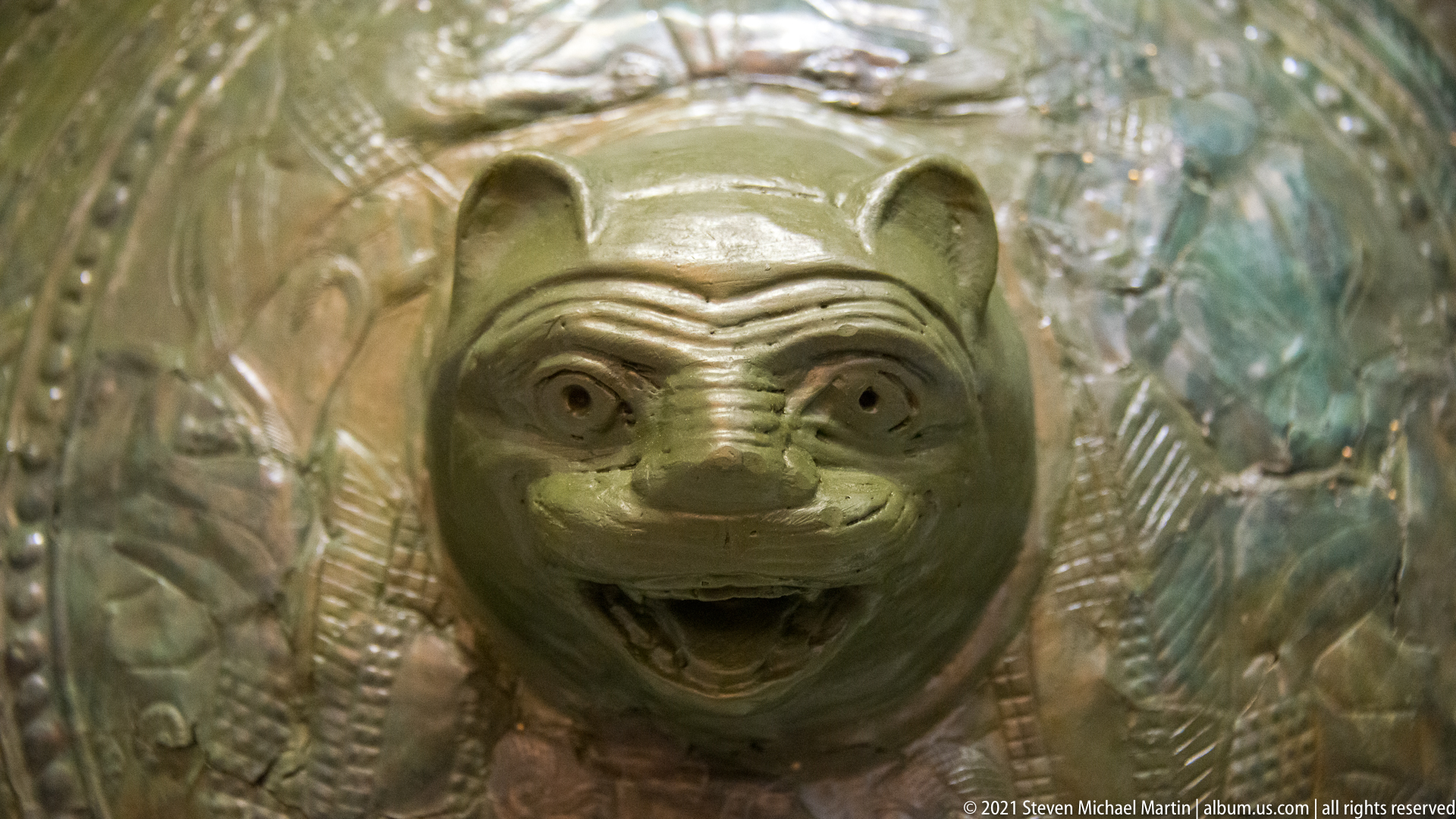
A snarling feline head projects from the center of a bronze shield, its rounded ears, wrinkled brow, wide eyes, and open mouth modeled in high relief. Around it, repoussé figures and patterned bands ripple across the metal surface. The close view isolates the sculptural boss from the larger object, emphasizing how a functional shield form could be transformed into an elaborate display of animal imagery and metalwork.
Caption
A snarling feline head projects from the center of a bronze shield, its rounded ears, wrinkled brow, wide eyes, and open mouth modeled in high relief. Around it, repoussé figures and patterned bands ripple across the metal surface. The close view isolates the sculptural boss from the larger object, emphasizing how a functional shield form could be transformed into an elaborate display of animal imagery and metalwork.
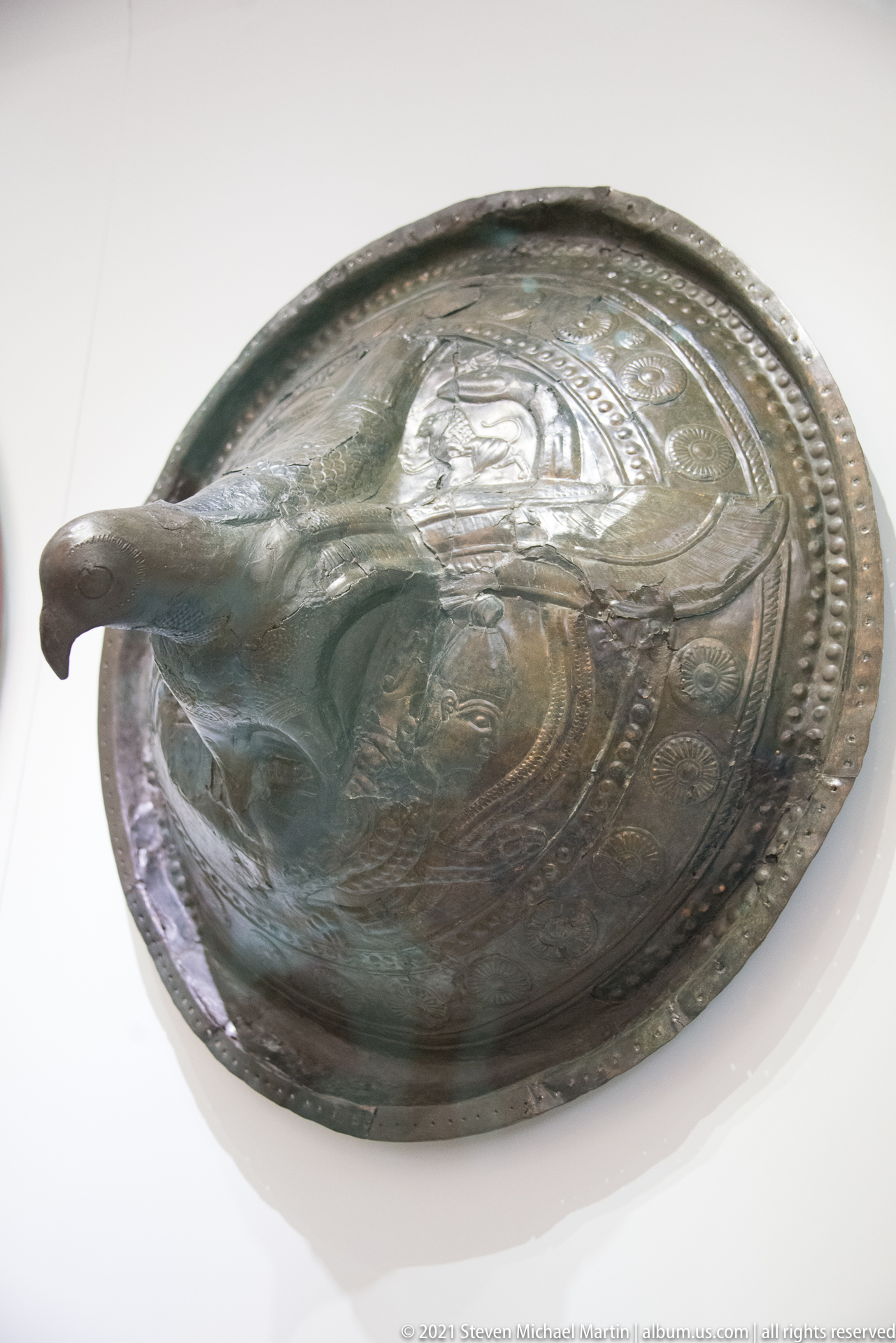
Seen obliquely, this circular bronze shield reveals a long conical or beak-like central projection rising sharply from the decorated face. Concentric relief bands, figural motifs, and a beaded outer border surround the boss. The low angle makes the shield’s three-dimensional construction unusually clear, showing how repoussé decoration and the projecting center worked together to create both surface pattern and sculptural depth.
Caption
Seen obliquely, this circular bronze shield reveals a long conical or beak-like central projection rising sharply from the decorated face. Concentric relief bands, figural motifs, and a beaded outer border surround the boss. The low angle makes the shield’s three-dimensional construction unusually clear, showing how repoussé decoration and the projecting center worked together to create both surface pattern and sculptural depth.
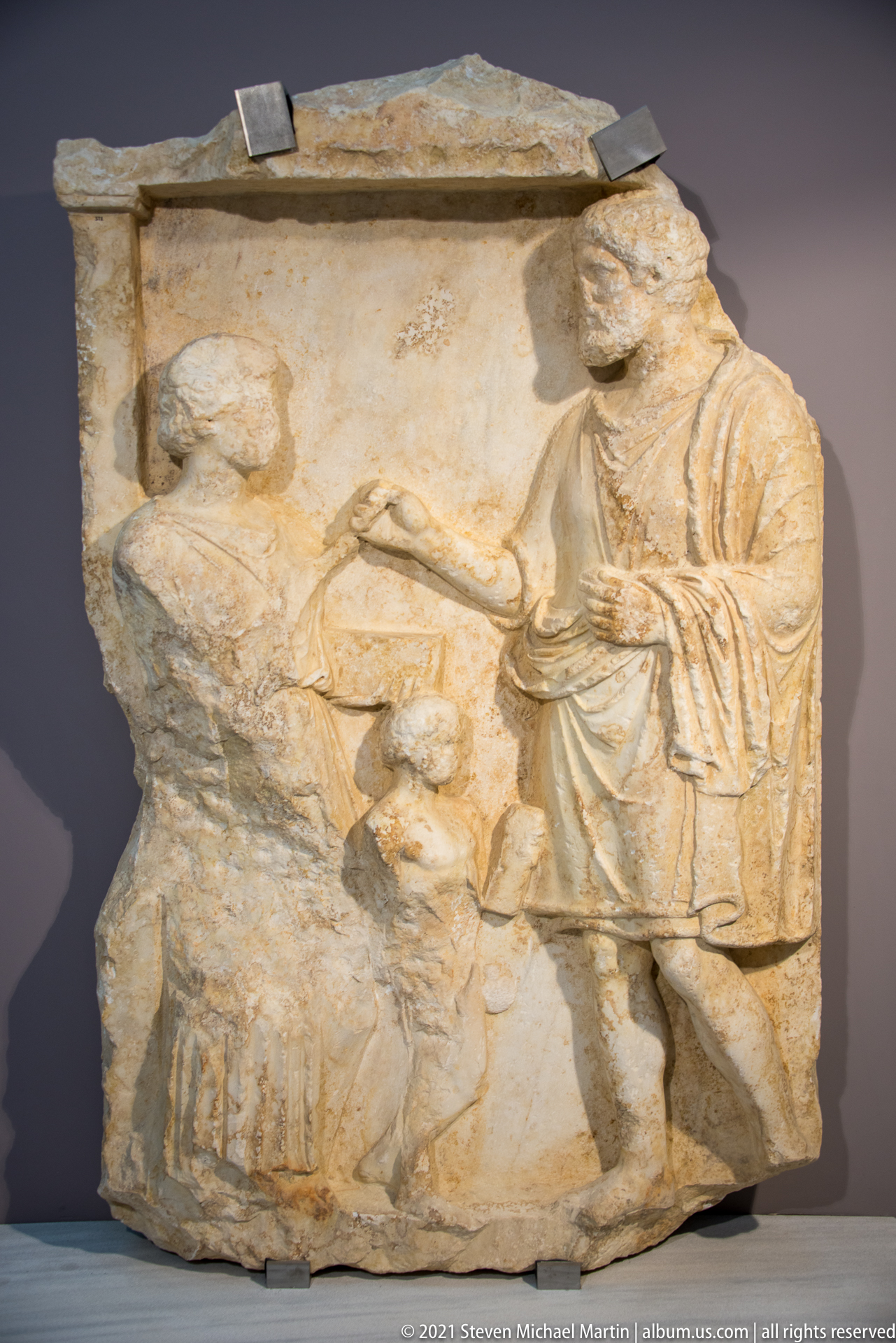
A fragmentary marble relief preserves a standing draped figure beside a damaged central action that includes an animal or fallen form. Deep folds in the garment contrast with the eroded background, while broken edges show that only part of a larger narrative scene survives. The surviving body language suggests movement toward the center, but the specific myth or historical episode is not visually secure.
Caption
A fragmentary marble relief preserves a standing draped figure beside a damaged central action that includes an animal or fallen form. Deep folds in the garment contrast with the eroded background, while broken edges show that only part of a larger narrative scene survives. The surviving body language suggests movement toward the center, but the specific myth or historical episode is not visually secure.
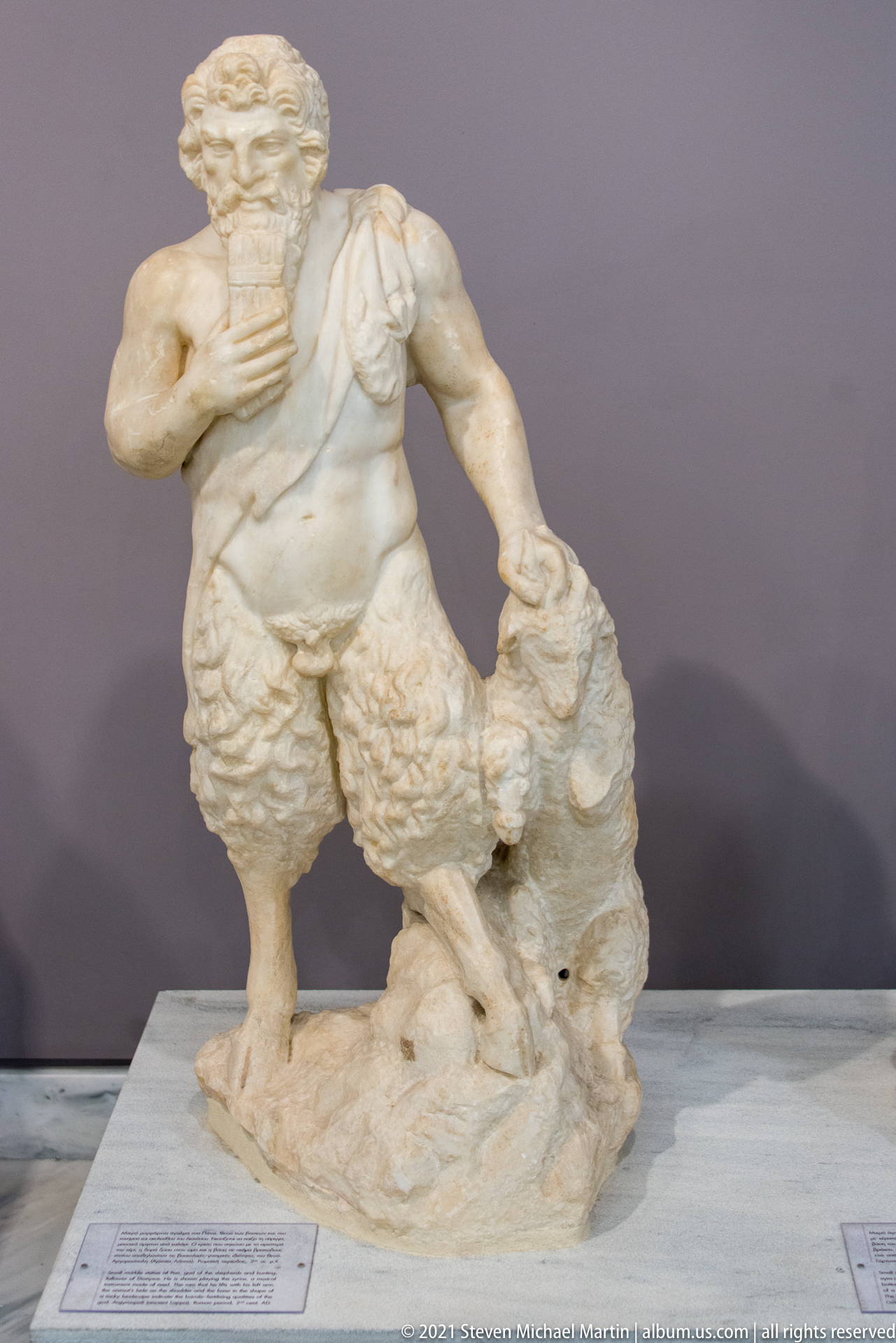
A muscular bearded male figure stands with one hand drawn toward his chest while the other rests on or grips a smaller animal form beside him. His shaggy lower garment and rugged physiognomy distinguish the figure from idealized heroic sculpture, suggesting a rustic or pastoral mythological character. The surviving statue is incomplete, but its weighty stance and deeply carved hair remain expressive.
Caption
A muscular bearded male figure stands with one hand drawn toward his chest while the other rests on or grips a smaller animal form beside him. His shaggy lower garment and rugged physiognomy distinguish the figure from idealized heroic sculpture, suggesting a rustic or pastoral mythological character. The surviving statue is incomplete, but its weighty stance and deeply carved hair remain expressive.
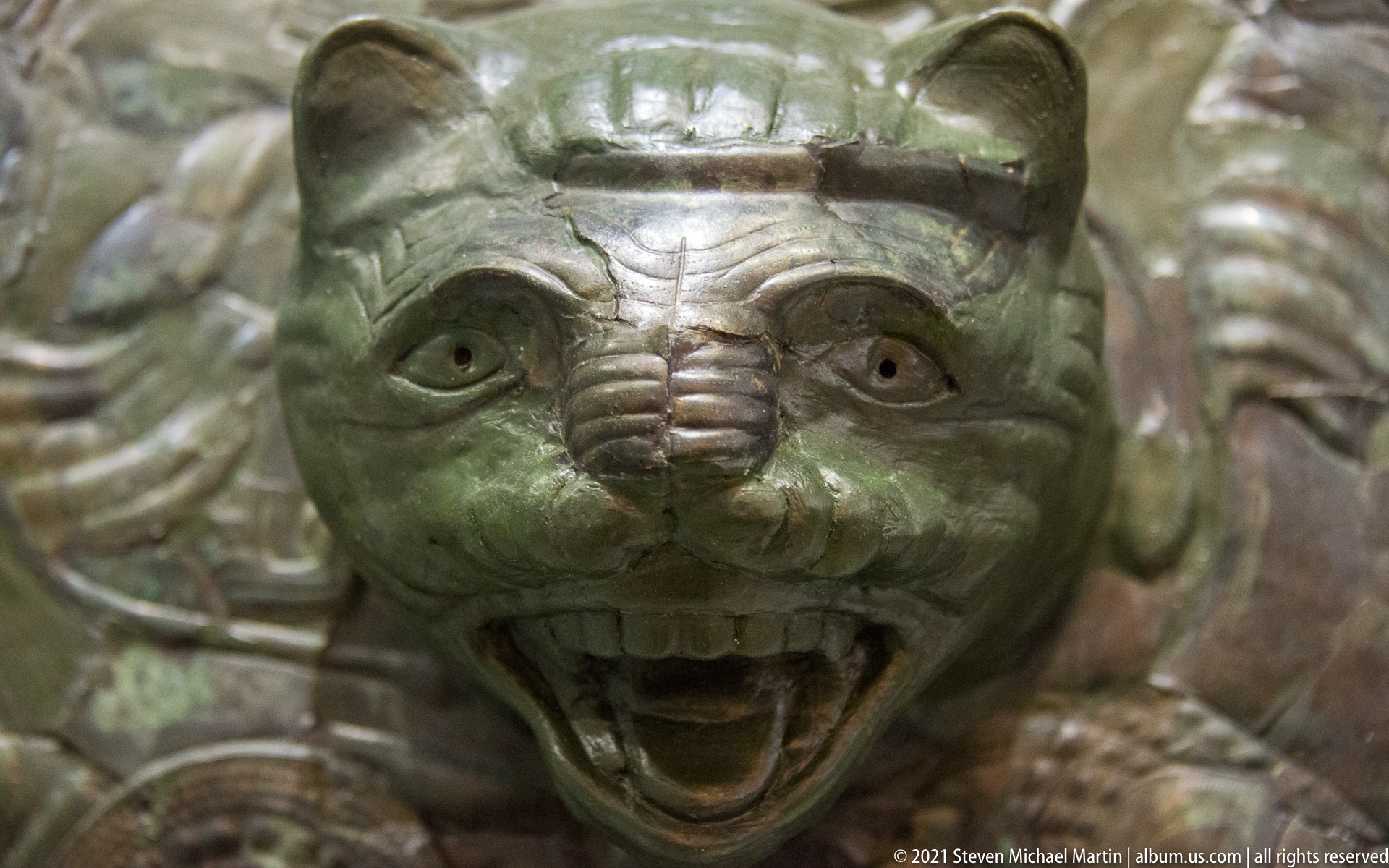
A broad feline face emerges forcefully from the center of a patinated bronze shield. Deeply modeled eyes, folded brow, open jaws, and exposed teeth create an aggressive expression, while repoussé figures and ornamental bands radiate behind the head. This close crop concentrates on the sculptural treatment of the boss, revealing how facial detail survives despite corrosion and age.
Caption
A broad feline face emerges forcefully from the center of a patinated bronze shield. Deeply modeled eyes, folded brow, open jaws, and exposed teeth create an aggressive expression, while repoussé figures and ornamental bands radiate behind the head. This close crop concentrates on the sculptural treatment of the boss, revealing how facial detail survives despite corrosion and age.
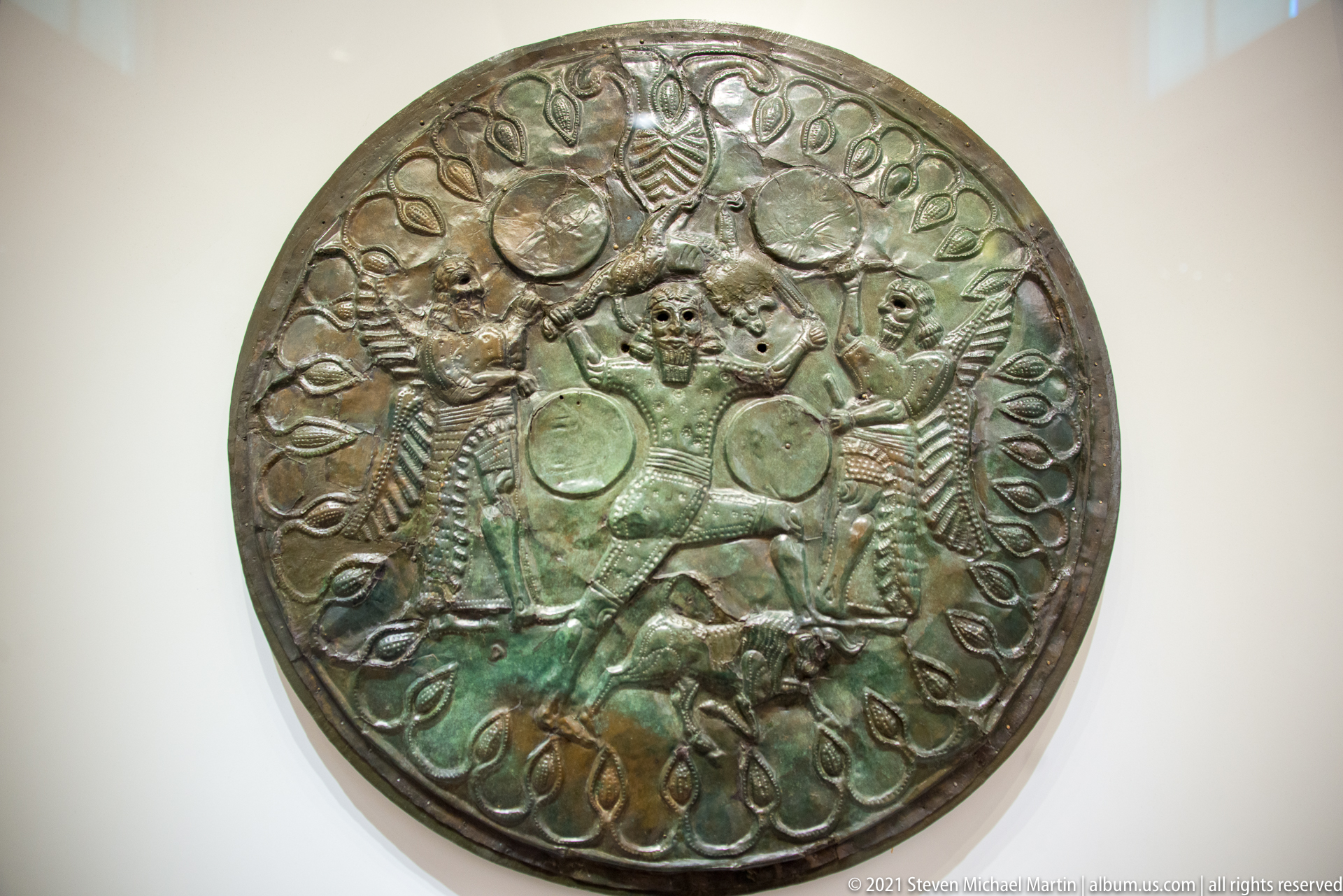
An elaborate circular bronze shield is covered with densely organized repoussé imagery. A central group of armed or helmeted figures occupies the middle register, surrounded by animals, looping vegetal or serpent-like forms, and repeated border motifs. The composition turns the shield surface into a complex narrative field, while green patination and worn highlights reveal the object’s age and metal construction.
Caption
An elaborate circular bronze shield is covered with densely organized repoussé imagery. A central group of armed or helmeted figures occupies the middle register, surrounded by animals, looping vegetal or serpent-like forms, and repeated border motifs. The composition turns the shield surface into a complex narrative field, while green patination and worn highlights reveal the object’s age and metal construction.
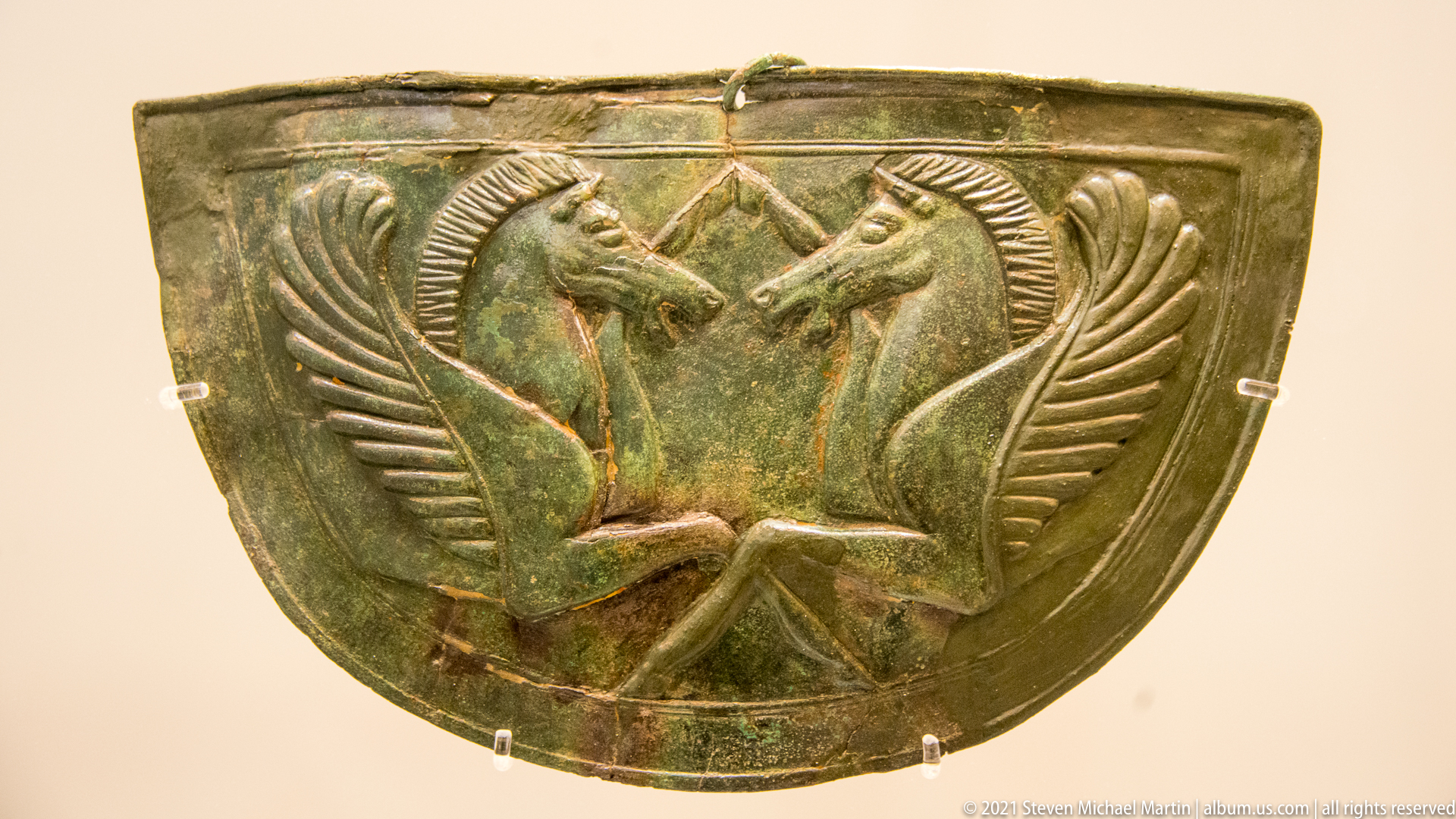
Two winged, horse-like creatures face one another across the center of this curved bronze panel, their raised wings and arched necks forming a strongly symmetrical composition. A small geometric emblem occupies the space between them, while the lower edge preserves additional relief forms. The crisp bilateral arrangement and green patina make the object a striking example of decorative bronze repoussé.
Caption
Two winged, horse-like creatures face one another across the center of this curved bronze panel, their raised wings and arched necks forming a strongly symmetrical composition. A small geometric emblem occupies the space between them, while the lower edge preserves additional relief forms. The crisp bilateral arrangement and green patina make the object a striking example of decorative bronze repoussé.
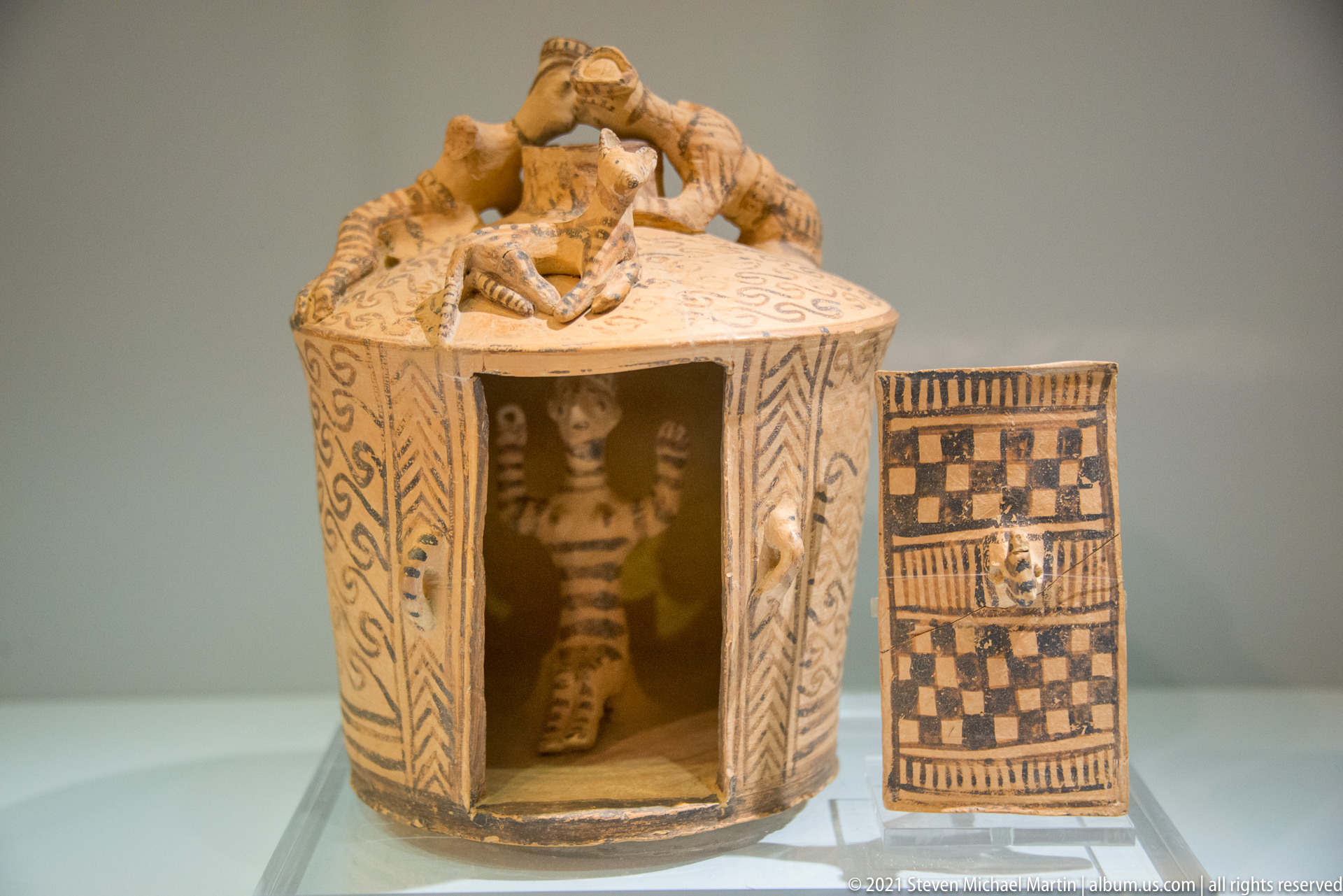
A painted terracotta model takes the form of a small enclosed building with a rectangular doorway, patterned walls, and a human figure standing inside. Additional modeled figures occupy the roof, while a separate decorated panel or door stands beside the structure. The miniature combines architecture, human presence, and painted geometric ornament into a compact scene that likely carried ritual or votive significance.
Caption
A painted terracotta model takes the form of a small enclosed building with a rectangular doorway, patterned walls, and a human figure standing inside. Additional modeled figures occupy the roof, while a separate decorated panel or door stands beside the structure. The miniature combines architecture, human presence, and painted geometric ornament into a compact scene that likely carried ritual or votive significance.
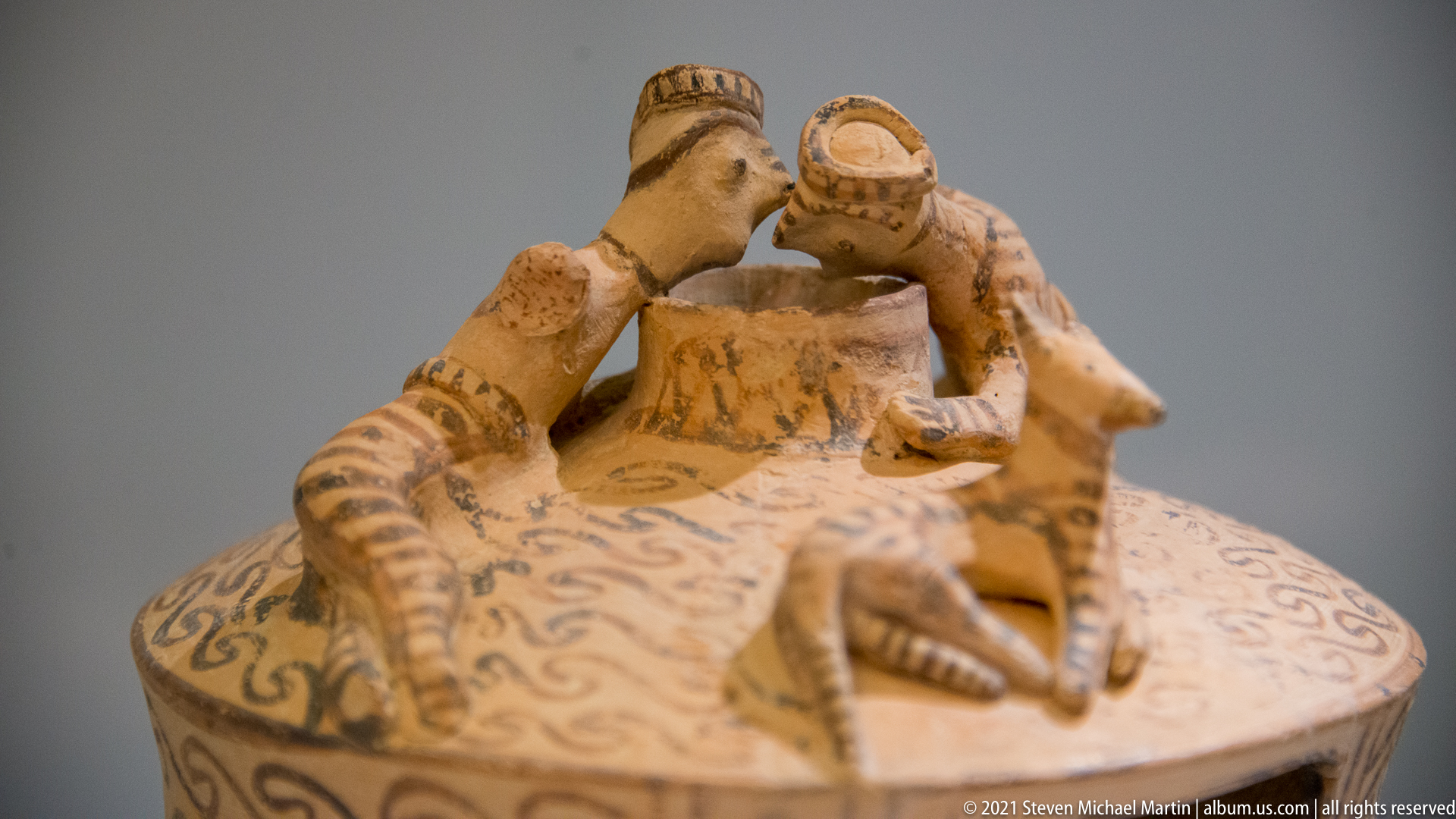
Three modeled human figures occupy the roof of a painted terracotta miniature, their limbs extending across a low central feature while spiral and linear ornament covers the sloping surface below. The close viewpoint shifts attention away from the building as a whole and toward the small-scale human activity represented on its roof, where gesture and placement create a compact narrative scene.
Caption
Three modeled human figures occupy the roof of a painted terracotta miniature, their limbs extending across a low central feature while spiral and linear ornament covers the sloping surface below. The close viewpoint shifts attention away from the building as a whole and toward the small-scale human activity represented on its roof, where gesture and placement create a compact narrative scene.
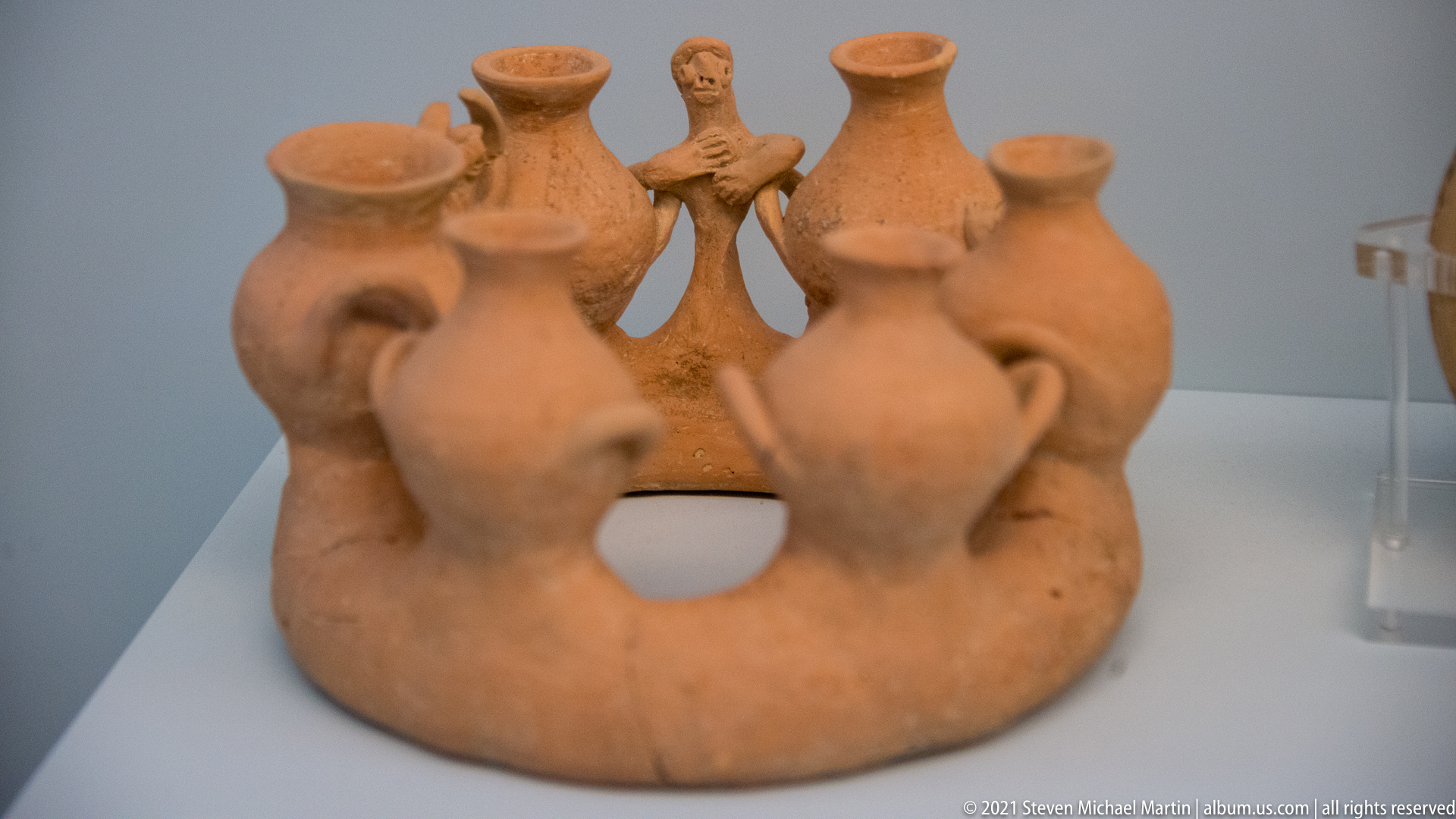
Several small flask-like containers rise from a single circular terracotta base, their rounded bodies linked into a ring around a central standing human figure. Loop handles connect some of the vessels, giving the object the appearance of a coordinated set made as one piece. Its unusual construction suggests a specialized ceremonial or offering function rather than ordinary household storage.
Caption
Several small flask-like containers rise from a single circular terracotta base, their rounded bodies linked into a ring around a central standing human figure. Loop handles connect some of the vessels, giving the object the appearance of a coordinated set made as one piece. Its unusual construction suggests a specialized ceremonial or offering function rather than ordinary household storage.
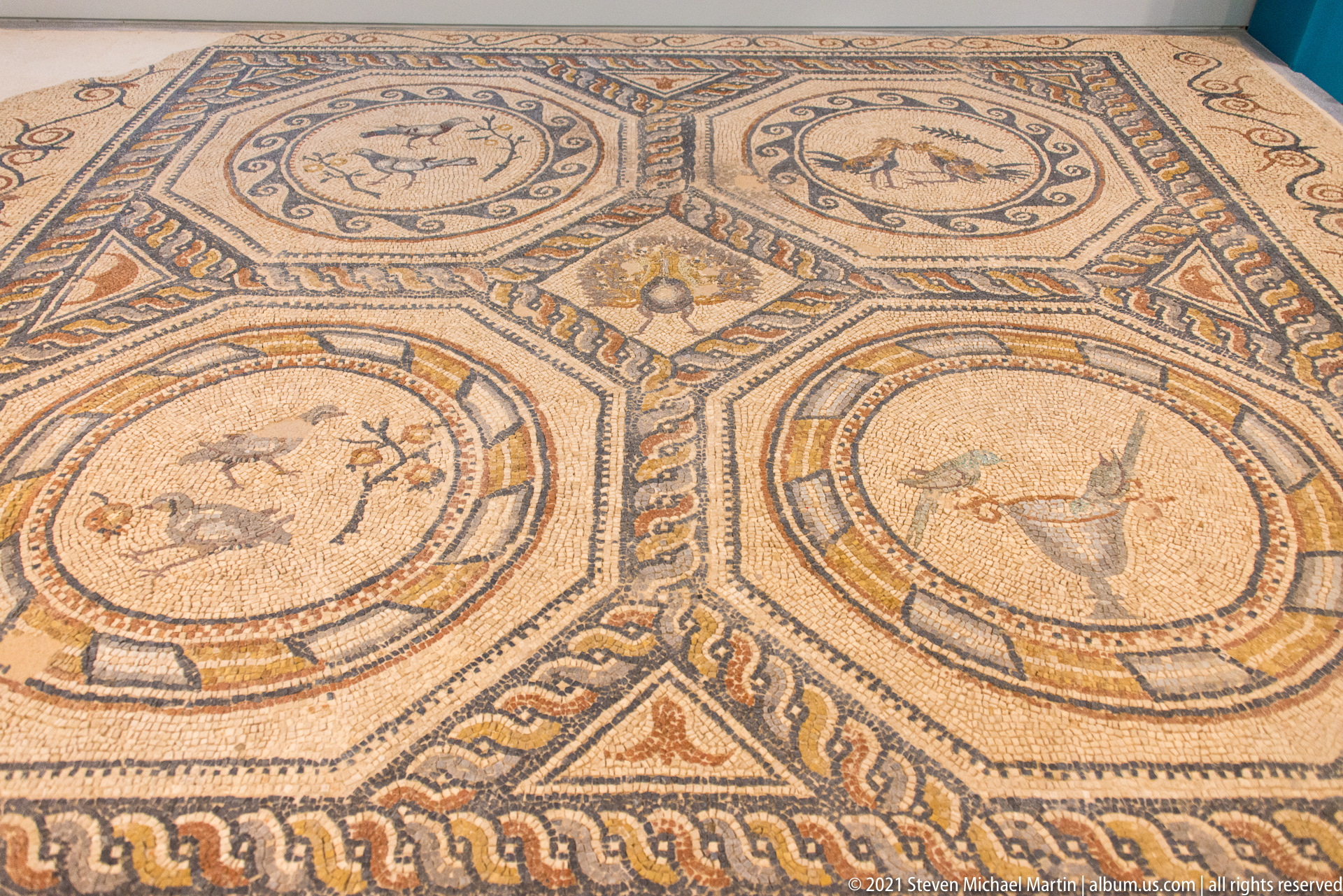
A geometric floor mosaic is organized around large circular and octagonal medallions containing animals and birds. Interlocking borders, guilloche bands, braided patterns, and warm earth-toned tesserae connect the separate scenes into a continuous pavement. The oblique museum view emphasizes both the scale of the floor and the careful geometric framework that structures its naturalistic imagery.
Caption
A geometric floor mosaic is organized around large circular and octagonal medallions containing animals and birds. Interlocking borders, guilloche bands, braided patterns, and warm earth-toned tesserae connect the separate scenes into a continuous pavement. The oblique museum view emphasizes both the scale of the floor and the careful geometric framework that structures its naturalistic imagery.
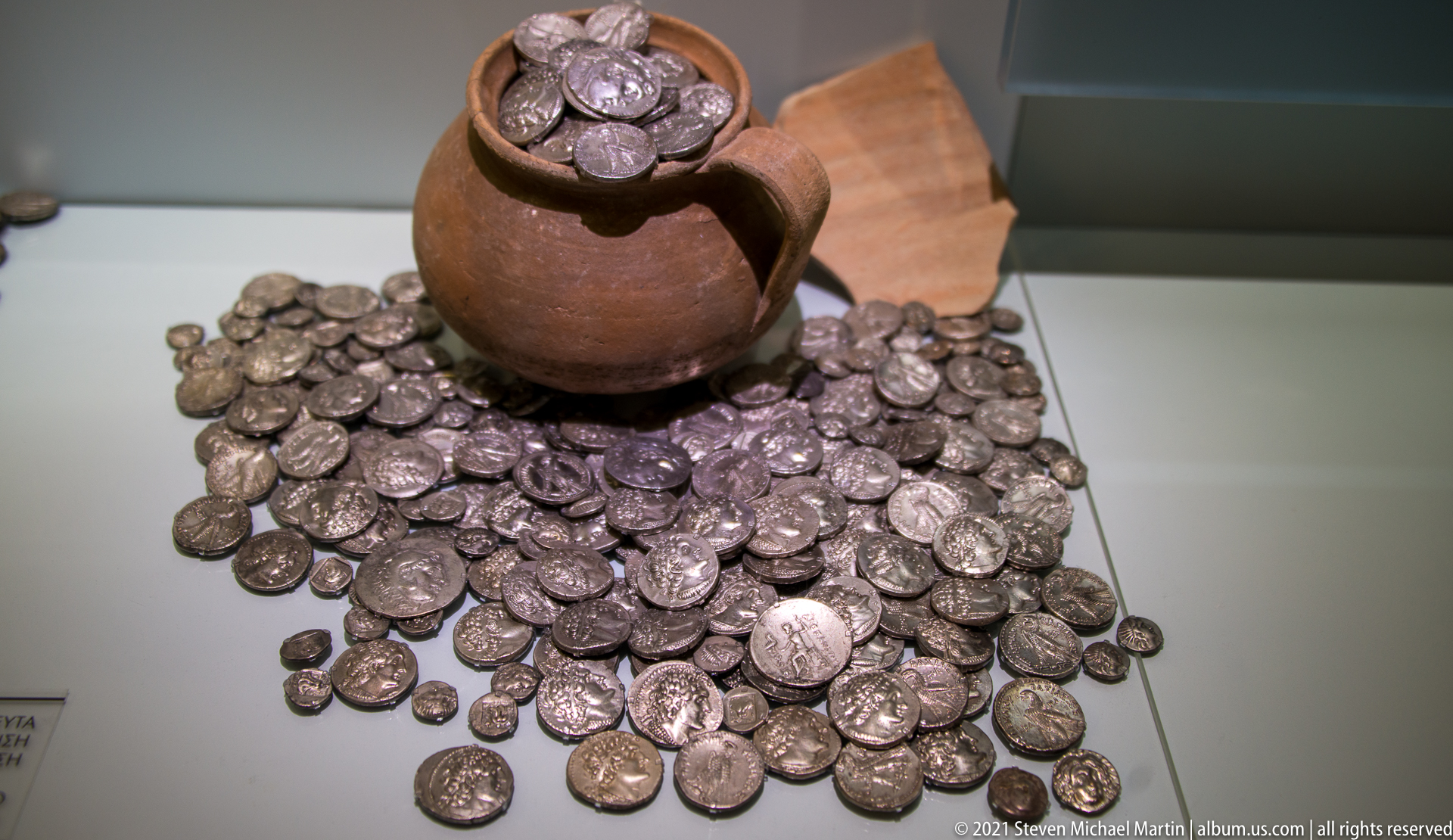
Hundreds of ancient silver coins spill across the display surface around a small ceramic jug still filled with additional pieces. Variations in diameter, wear, portraiture, and strike are visible throughout the pile, while the vessel provides a direct clue to how the hoard may have been deposited or recovered. The arrangement conveys both the quantity of currency and the archaeological context of collective storage.
Caption
Hundreds of ancient silver coins spill across the display surface around a small ceramic jug still filled with additional pieces. Variations in diameter, wear, portraiture, and strike are visible throughout the pile, while the vessel provides a direct clue to how the hoard may have been deposited or recovered. The arrangement conveys both the quantity of currency and the archaeological context of collective storage.
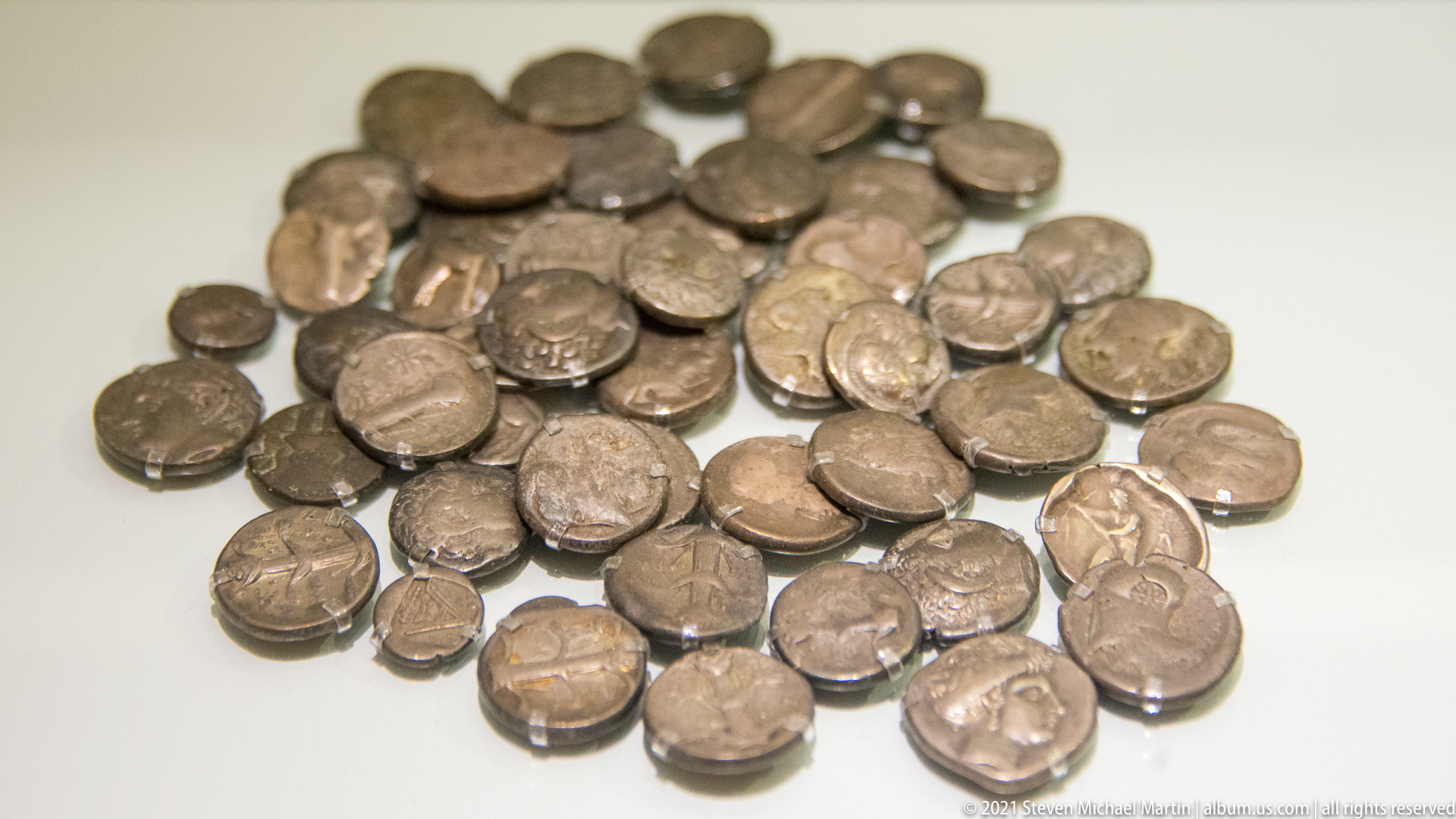
A group of ancient silver coins lies scattered across a pale display surface, allowing individual portrait heads, symbols, and reverse designs to be compared. Differences in size, centering, relief, and wear reveal the handmade character of struck coinage. The close crop removes the associated container seen in the wider hoard display and concentrates instead on the varied iconography carried by the coins themselves.
Caption
A group of ancient silver coins lies scattered across a pale display surface, allowing individual portrait heads, symbols, and reverse designs to be compared. Differences in size, centering, relief, and wear reveal the handmade character of struck coinage. The close crop removes the associated container seen in the wider hoard display and concentrates instead on the varied iconography carried by the coins themselves.
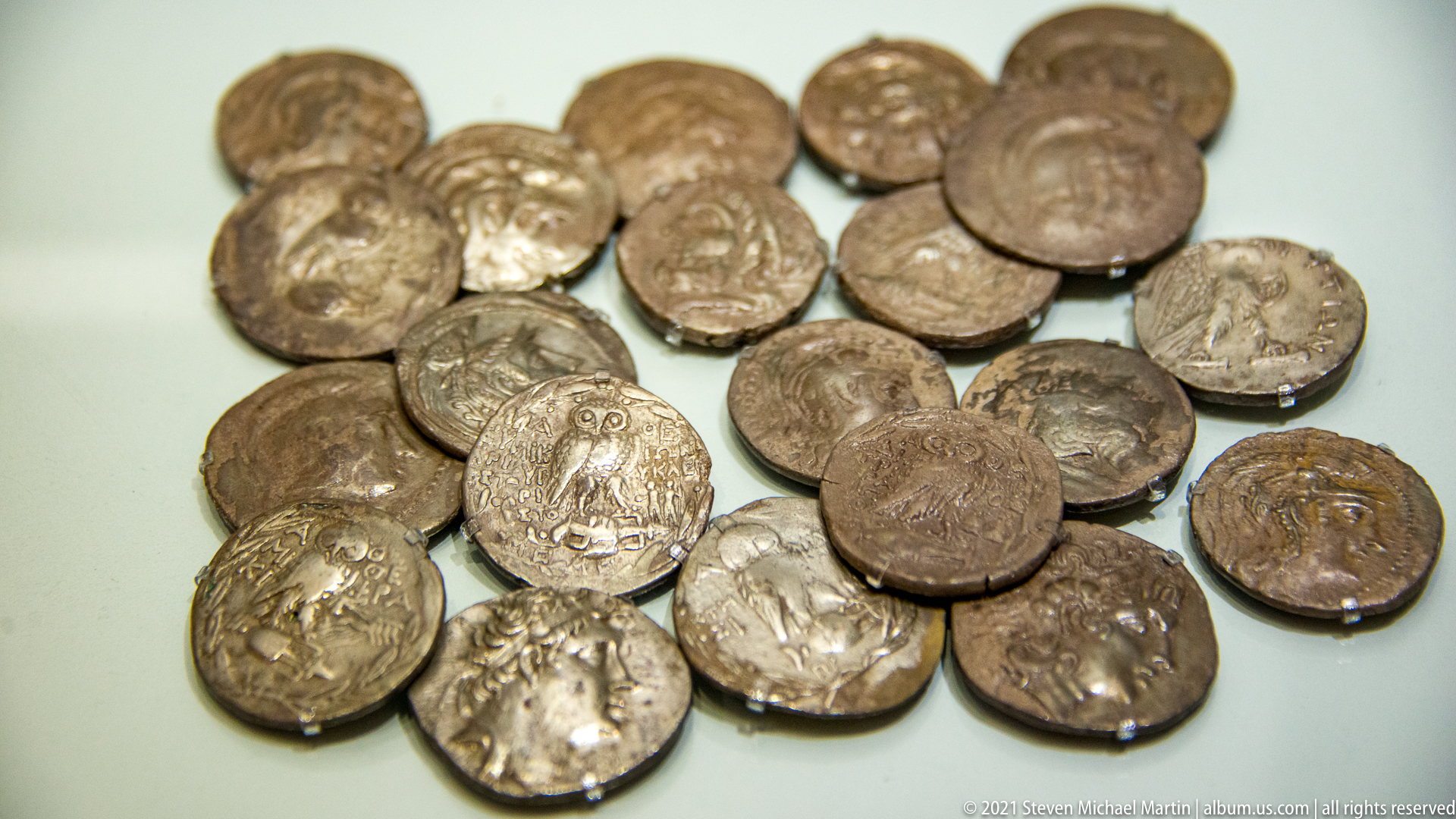
This tighter view isolates a smaller group of ancient silver coins, many preserving profile portraits, wreath-like borders, animals, or emblematic reverse designs. Uneven edges and off-center strikes make the hand-produced character of the pieces especially clear. Surface wear varies considerably, from sharply modeled heads to nearly flattened relief, offering a compact visual survey of circulated coinage.
Caption
This tighter view isolates a smaller group of ancient silver coins, many preserving profile portraits, wreath-like borders, animals, or emblematic reverse designs. Uneven edges and off-center strikes make the hand-produced character of the pieces especially clear. Surface wear varies considerably, from sharply modeled heads to nearly flattened relief, offering a compact visual survey of circulated coinage.
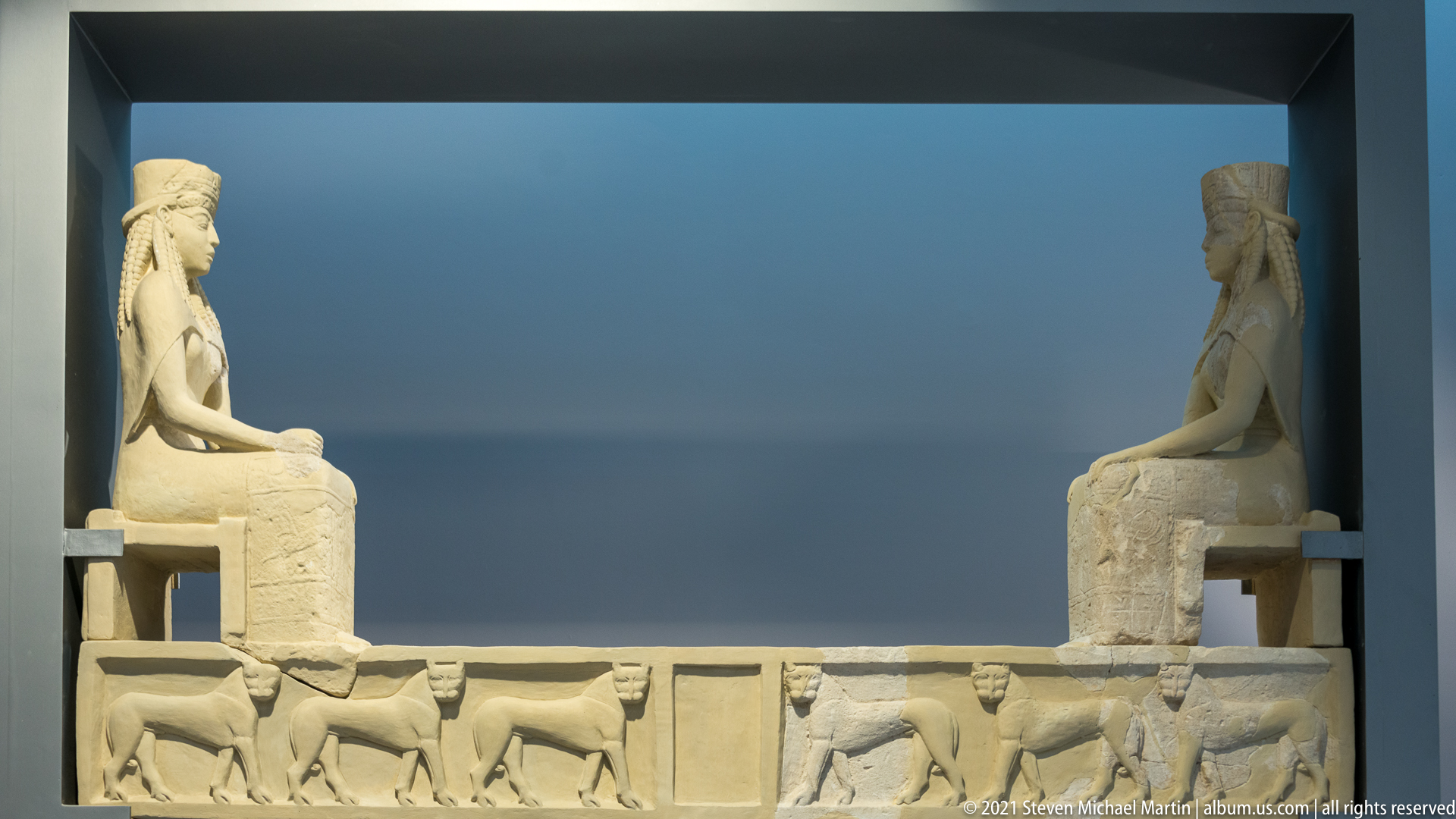
Two seated female figures face inward from opposite ends of a pale stone architectural composition. Below them, a continuous frieze of walking animals stretches across the base, separated by a central rectangular element. The display’s strict bilateral arrangement, throne-like seats, and repeated animal forms suggest a decorative architectural or funerary setting whose original context is not recoverable from the proof sheet alone.
Caption
Two seated female figures face inward from opposite ends of a pale stone architectural composition. Below them, a continuous frieze of walking animals stretches across the base, separated by a central rectangular element. The display’s strict bilateral arrangement, throne-like seats, and repeated animal forms suggest a decorative architectural or funerary setting whose original context is not recoverable from the proof sheet alone.
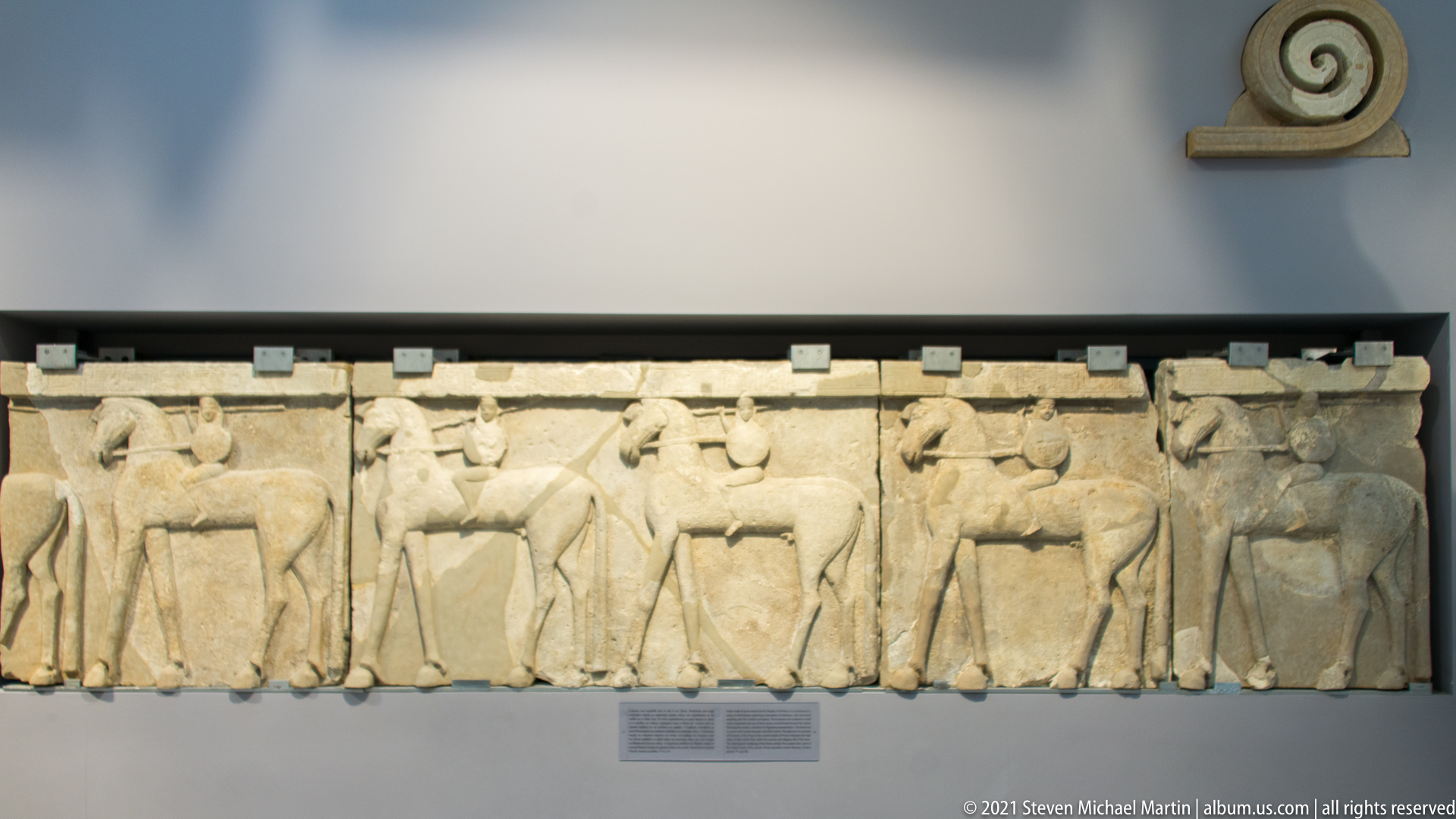
A long carved stone frieze presents repeated human figures accompanied by horses, each group arranged within a shallow relief field. The figures appear in formal poses and are separated into a rhythmic sequence across the block. Mounted beneath a large spiral architectural ornament, the relief reads as a surviving section from a broader decorative or commemorative program.
Caption
A long carved stone frieze presents repeated human figures accompanied by horses, each group arranged within a shallow relief field. The figures appear in formal poses and are separated into a rhythmic sequence across the block. Mounted beneath a large spiral architectural ornament, the relief reads as a surviving section from a broader decorative or commemorative program.
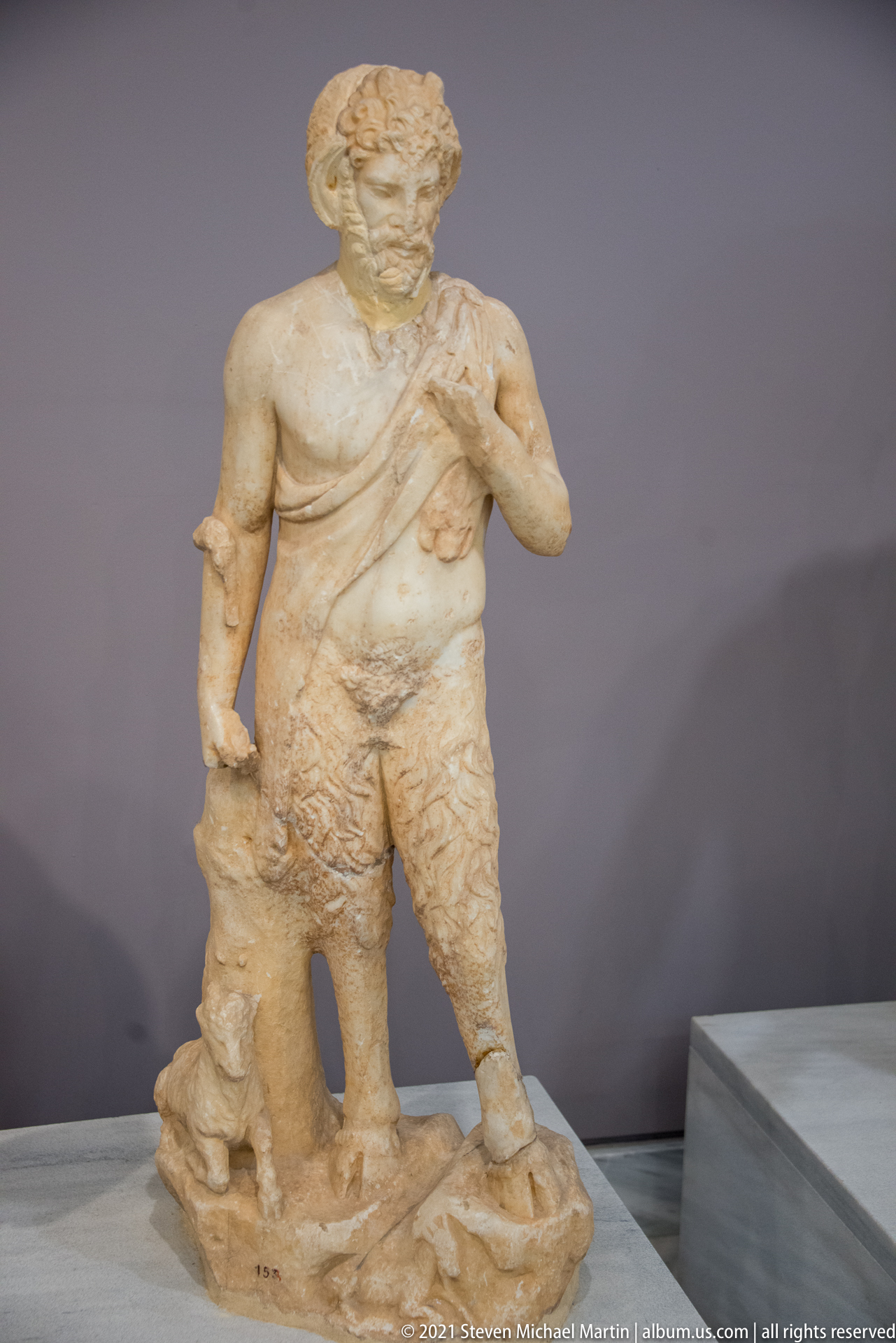
A standing bearded male figure wears a short shaggy lower garment and a drape slung diagonally across one shoulder. His right arm hangs beside a tree-trunk or rocky support, while the missing left forearm records the statue’s fragmentary condition. The combination of muscular torso, rustic costume, and support points toward mythological sculpture rather than formal portraiture.
Caption
A standing bearded male figure wears a short shaggy lower garment and a drape slung diagonally across one shoulder. His right arm hangs beside a tree-trunk or rocky support, while the missing left forearm records the statue’s fragmentary condition. The combination of muscular torso, rustic costume, and support points toward mythological sculpture rather than formal portraiture.
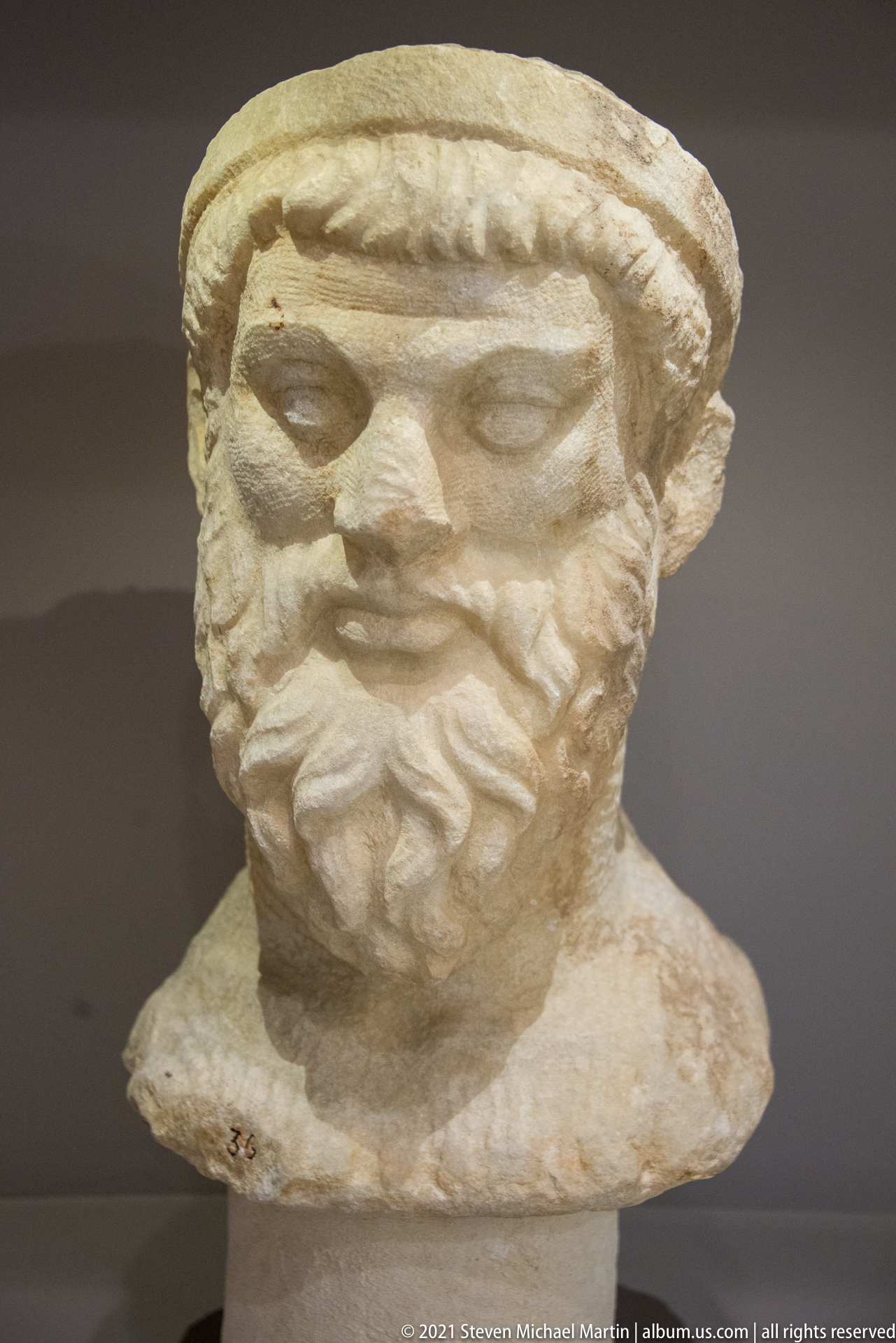
A heavily weathered marble portrait shows a mature bearded man with a broad face, deeply carved moustache and beard, and a band or low cap across the forehead. The compact bust terminates just below the shoulders, keeping attention on the individualized facial features. Abrasion has softened the eyes and hair, but the strong beard pattern and head covering remain legible.
Caption
A heavily weathered marble portrait shows a mature bearded man with a broad face, deeply carved moustache and beard, and a band or low cap across the forehead. The compact bust terminates just below the shoulders, keeping attention on the individualized facial features. Abrasion has softened the eyes and hair, but the strong beard pattern and head covering remain legible.
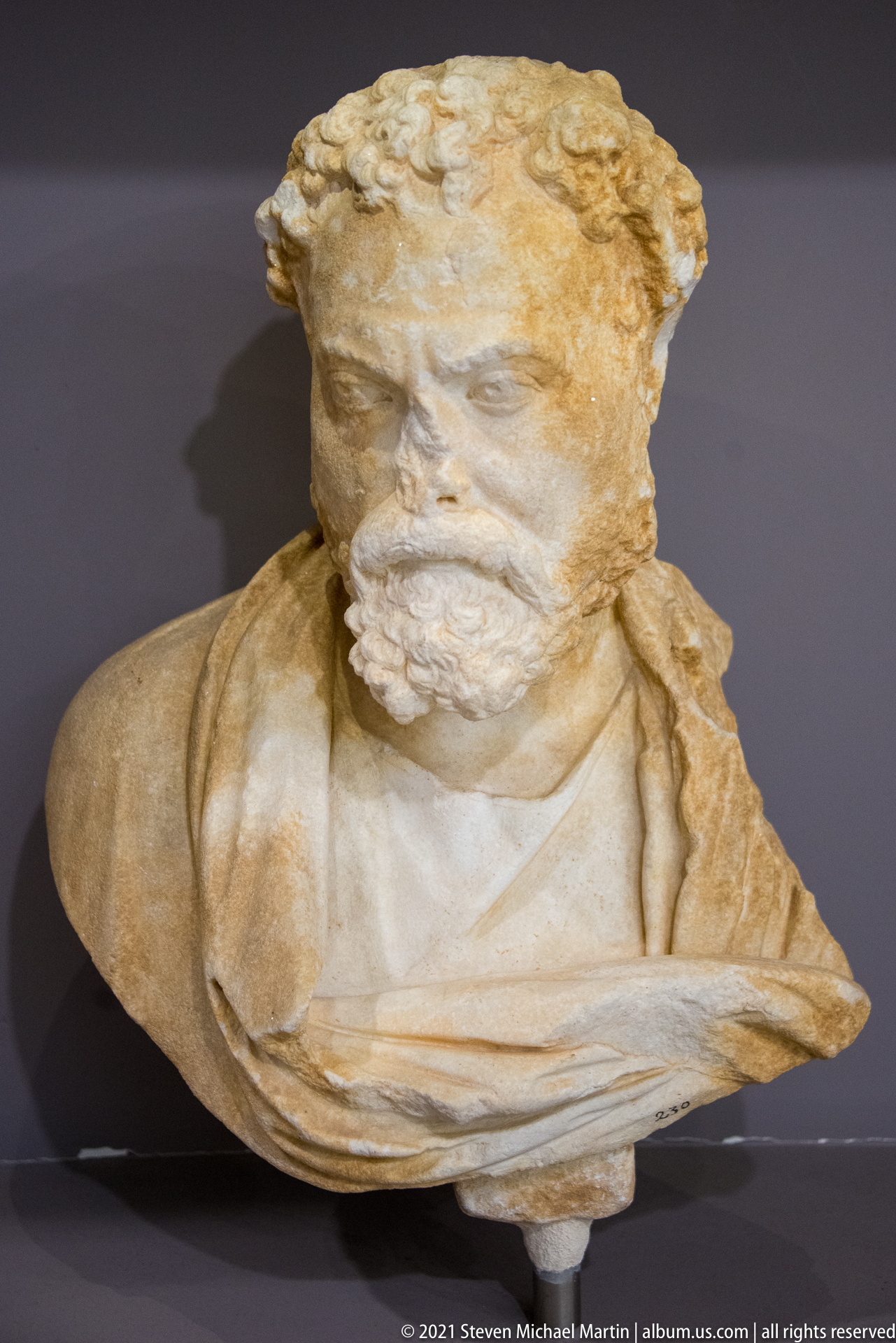
This marble bust portrays a mature man with short textured hair, full beard, heavy brow, and a draped garment crossing the chest. The head turns slightly away from frontal, giving the portrait a more animated presence despite losses to the crown and surface. Deep carving around the beard and eyes contrasts with the smoother folds of the clothing below.
Caption
This marble bust portrays a mature man with short textured hair, full beard, heavy brow, and a draped garment crossing the chest. The head turns slightly away from frontal, giving the portrait a more animated presence despite losses to the crown and surface. Deep carving around the beard and eyes contrasts with the smoother folds of the clothing below.
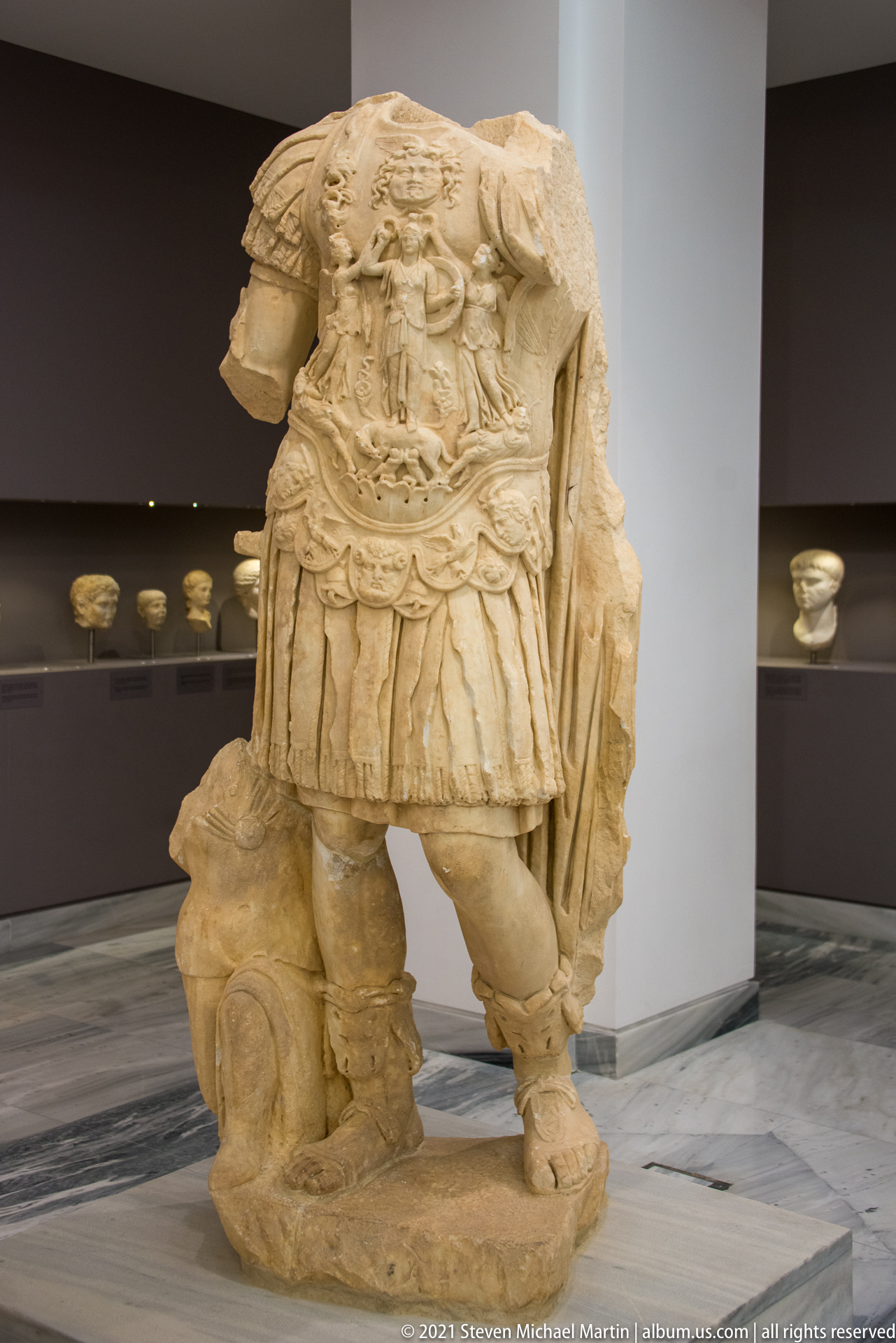
A headless marble figure stands in military dress, wearing a richly decorated cuirass over a short pleated tunic. Figural reliefs cover the breastplate, while a cloak falls along one side and a sculpted support steadies the lower body. The combination of armor, contrapposto stance, and elaborate cuirass decoration places the work within the tradition of Roman imperial or elite military statuary.
Caption
A headless marble figure stands in military dress, wearing a richly decorated cuirass over a short pleated tunic. Figural reliefs cover the breastplate, while a cloak falls along one side and a sculpted support steadies the lower body. The combination of armor, contrapposto stance, and elaborate cuirass decoration places the work within the tradition of Roman imperial or elite military statuary.
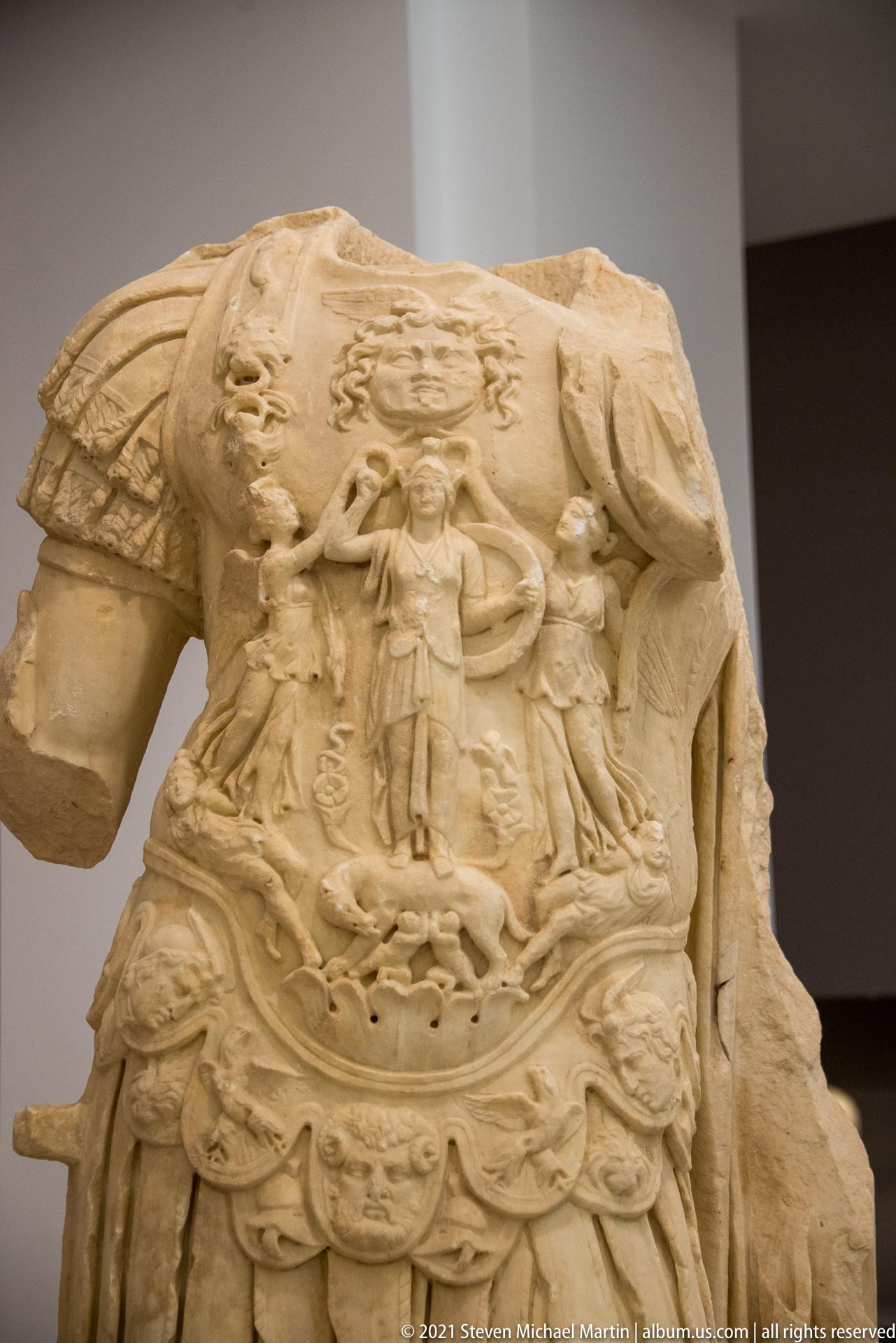
A close view of the cuirassed statue reveals an elaborate relief program across the breastplate. A small central standing figure is surrounded by larger mythological forms, scrolling ornament, and animal imagery, all modeled within the curved surface of the armor. The photograph isolates the decorative program from the statue as a whole, making the sculptor’s dense layering of figures and motifs easier to examine.
Caption
A close view of the cuirassed statue reveals an elaborate relief program across the breastplate. A small central standing figure is surrounded by larger mythological forms, scrolling ornament, and animal imagery, all modeled within the curved surface of the armor. The photograph isolates the decorative program from the statue as a whole, making the sculptor’s dense layering of figures and motifs easier to examine.
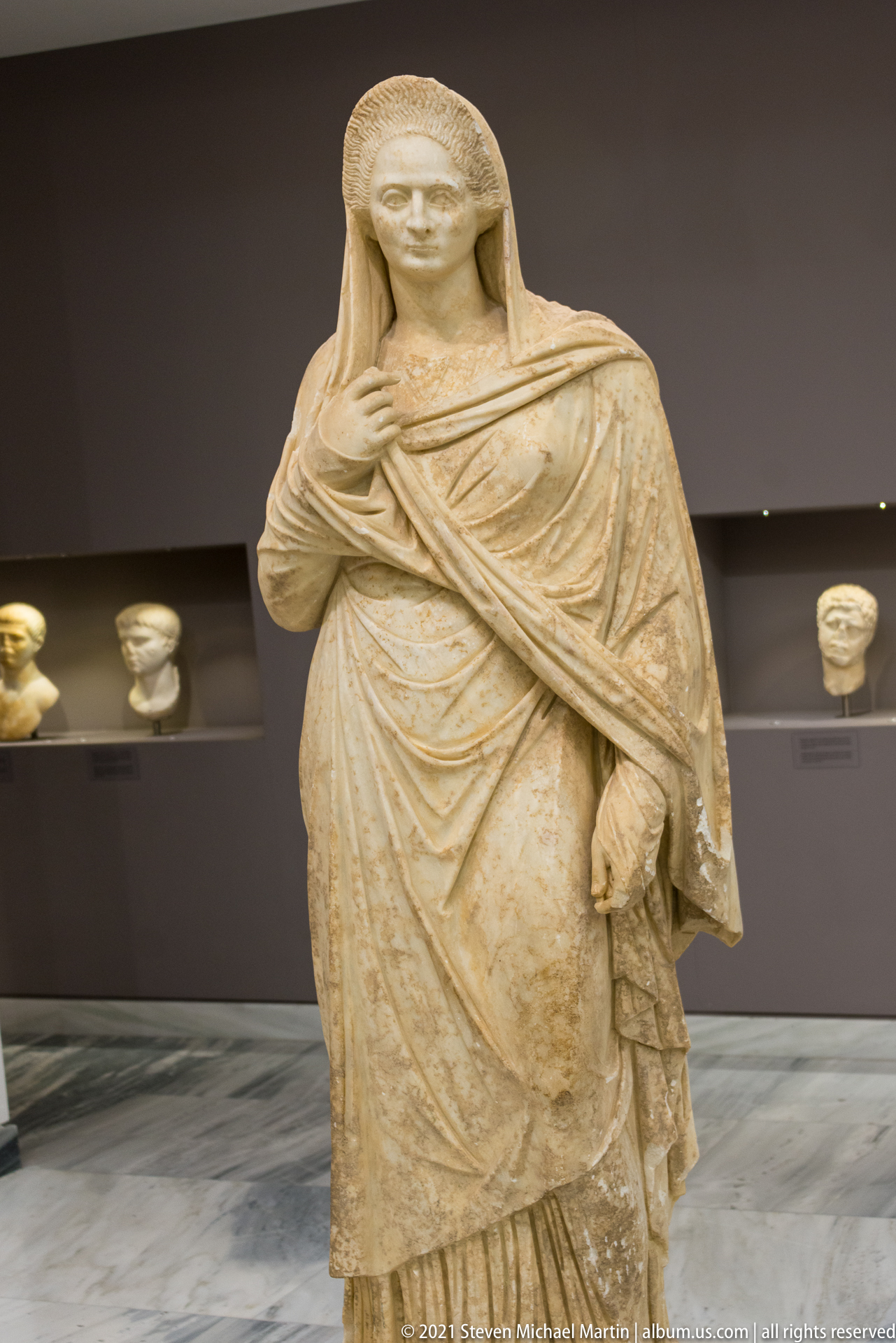
A life-size marble woman stands enveloped in a heavy mantle that crosses the chest and falls in layered folds to the feet. One hand lifts toward the upper chest while the other gathers the drapery at her side, creating a restrained, formal pose. The covered head and carefully arranged garment emphasize status and decorum rather than movement, in keeping with Roman portrait and funerary statuary traditions.
Caption
A life-size marble woman stands enveloped in a heavy mantle that crosses the chest and falls in layered folds to the feet. One hand lifts toward the upper chest while the other gathers the drapery at her side, creating a restrained, formal pose. The covered head and carefully arranged garment emphasize status and decorum rather than movement, in keeping with Roman portrait and funerary statuary traditions.
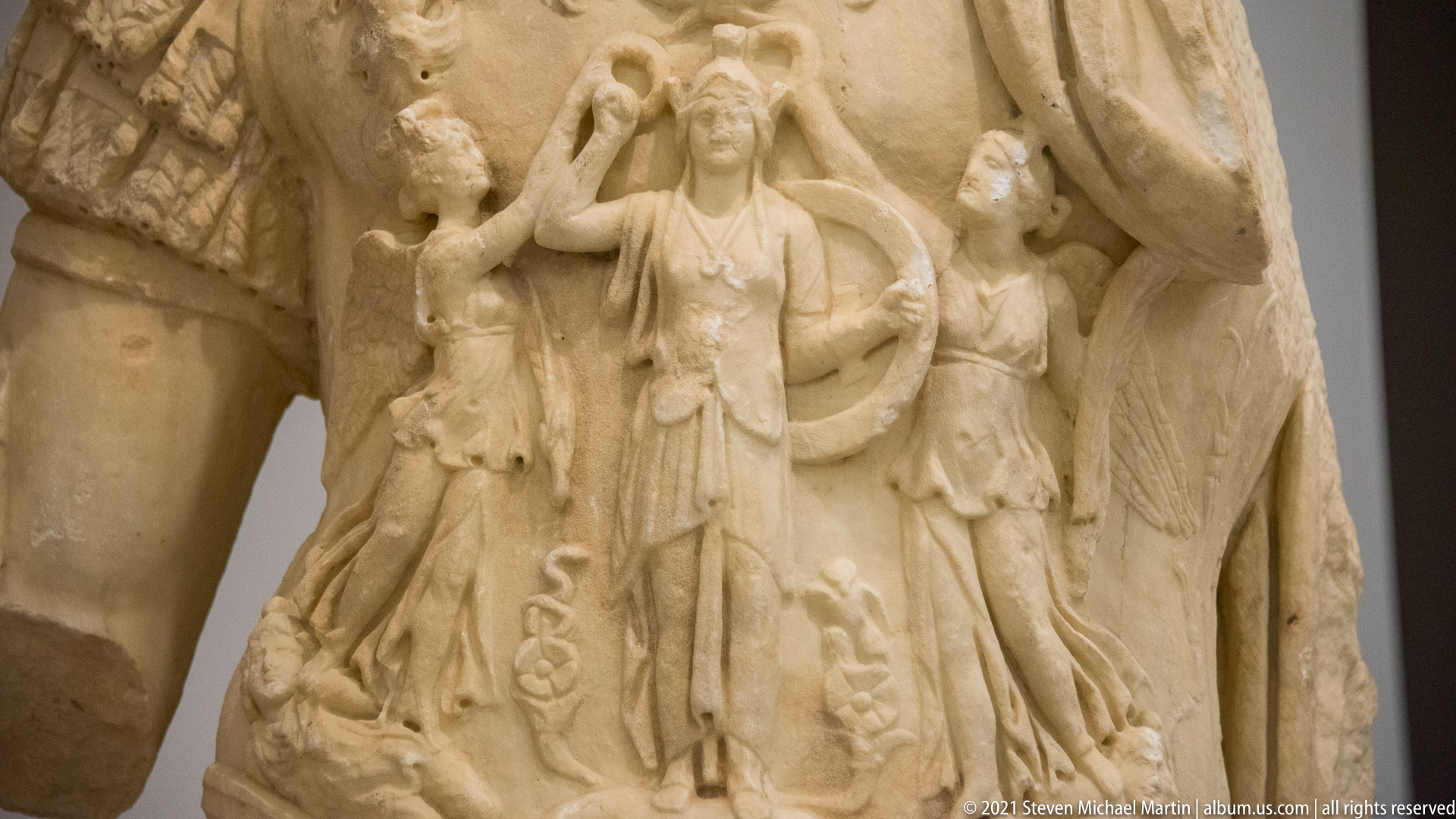
Two standing female figures occupy a vertical panel along the side of the sculpted cuirass. One raises an arm while the other stands close beside her, and additional smaller symbols or attributes appear near their feet and hands. The close crop reveals the fine drapery and shallow modeling that become secondary in the full statue view, while adjacent armor forms frame the scene.
Caption
Two standing female figures occupy a vertical panel along the side of the sculpted cuirass. One raises an arm while the other stands close beside her, and additional smaller symbols or attributes appear near their feet and hands. The close crop reveals the fine drapery and shallow modeling that become secondary in the full statue view, while adjacent armor forms frame the scene.
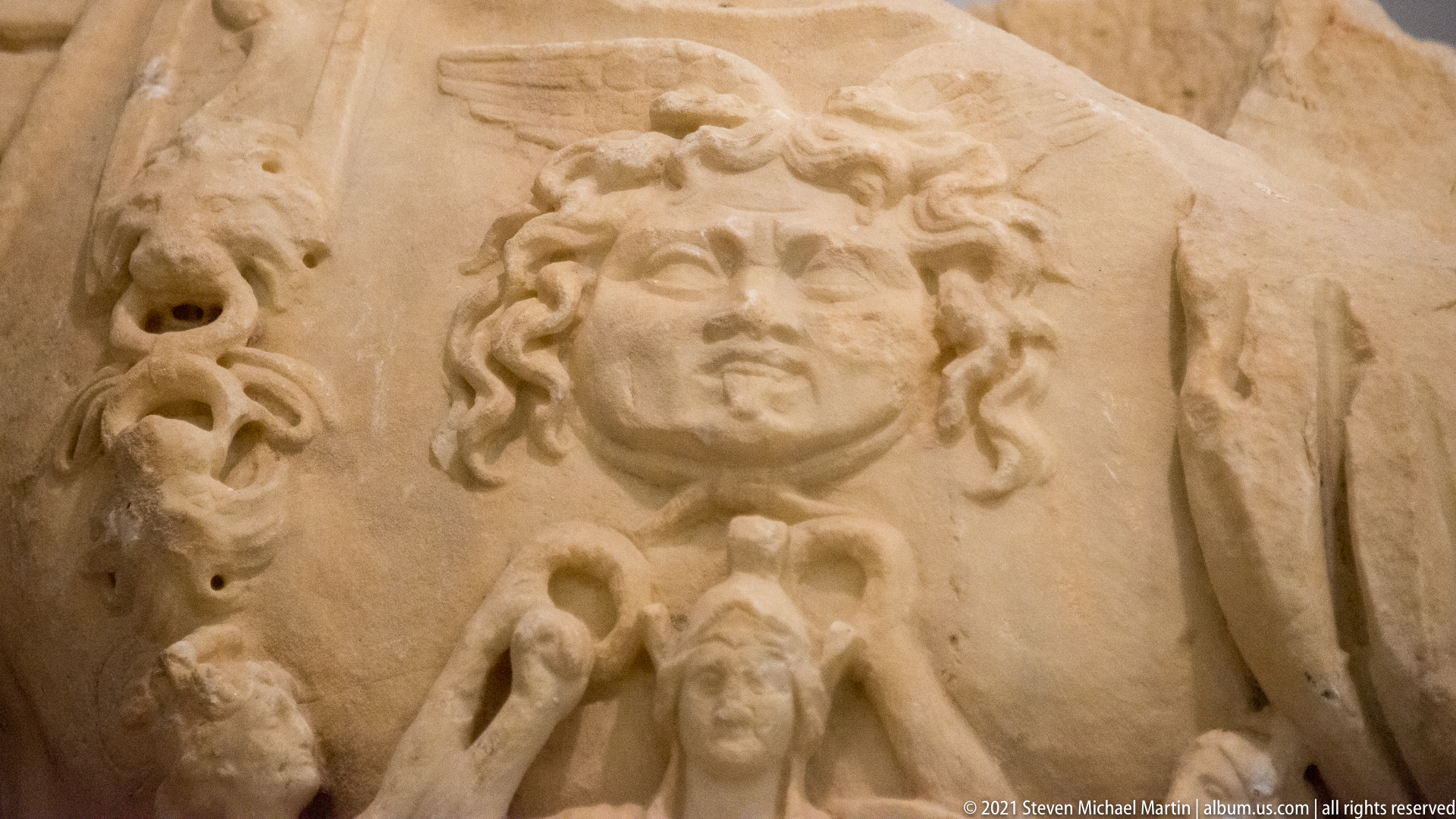
A frontal face with curling hair appears prominently within the cuirass decoration, positioned above a smaller standing figure and beside additional sculpted motifs. The mask-like head resembles a gorgoneion, a protective image frequently used on ancient armor and dress. Close framing shows the depth of the curls, broad facial features, and the relationship between this central emblem and surrounding relief.
Caption
A frontal face with curling hair appears prominently within the cuirass decoration, positioned above a smaller standing figure and beside additional sculpted motifs. The mask-like head resembles a gorgoneion, a protective image frequently used on ancient armor and dress. Close framing shows the depth of the curls, broad facial features, and the relationship between this central emblem and surrounding relief.
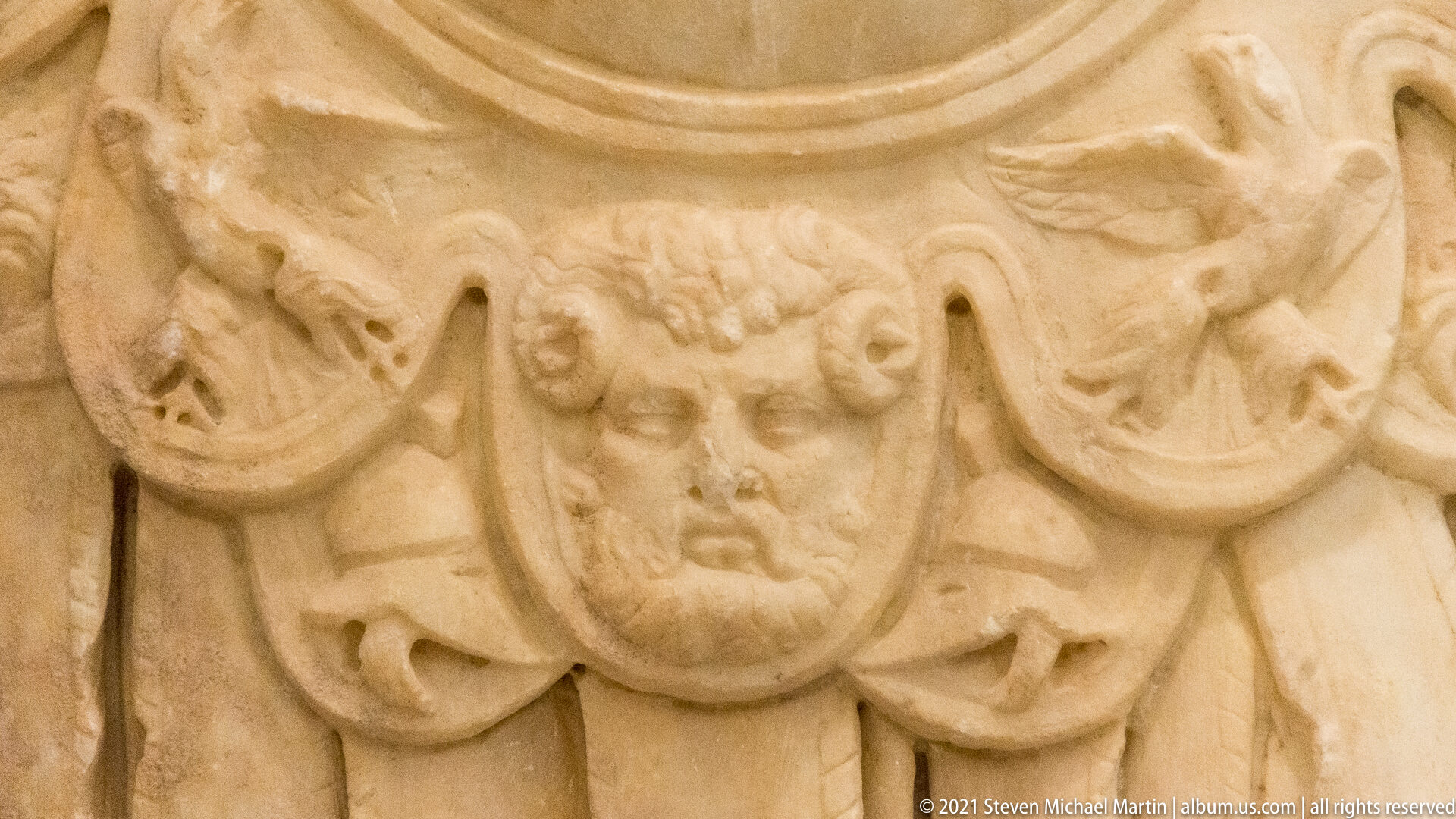
A horned mask with tightly curled hair projects from the lower edge of the sculpted cuirass, framed by looping straps and layered armor elements. The face is compact and symmetrical, with prominent spiral horns and deeply drilled features. This close detail shifts attention from the statue’s narrative breastplate scenes to the ornamental fittings that articulate the armor’s lower border.
Caption
A horned mask with tightly curled hair projects from the lower edge of the sculpted cuirass, framed by looping straps and layered armor elements. The face is compact and symmetrical, with prominent spiral horns and deeply drilled features. This close detail shifts attention from the statue’s narrative breastplate scenes to the ornamental fittings that articulate the armor’s lower border.
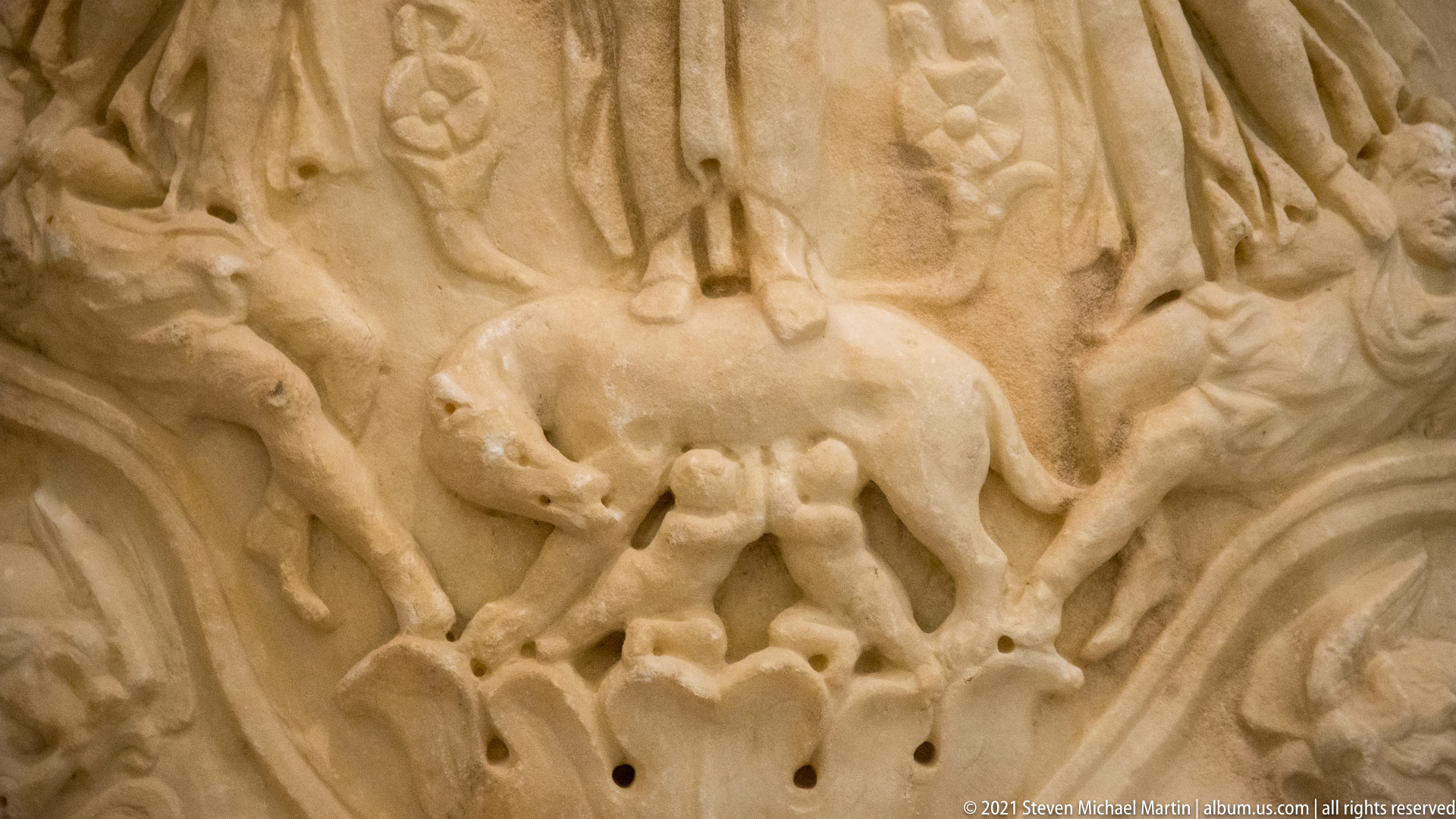
A she-wolf stands in profile while two small infants nurse beneath her belly, a compact scene carved into the lower part of the decorated cuirass. The familiar composition evokes the Roman foundation legend of Romulus and Remus, while adjacent relief figures and armor borders place it within a broader imperial decorative program. The tight crop makes the animal and twins clearly legible.
Caption
A she-wolf stands in profile while two small infants nurse beneath her belly, a compact scene carved into the lower part of the decorated cuirass. The familiar composition evokes the Roman foundation legend of Romulus and Remus, while adjacent relief figures and armor borders place it within a broader imperial decorative program. The tight crop makes the animal and twins clearly legible.
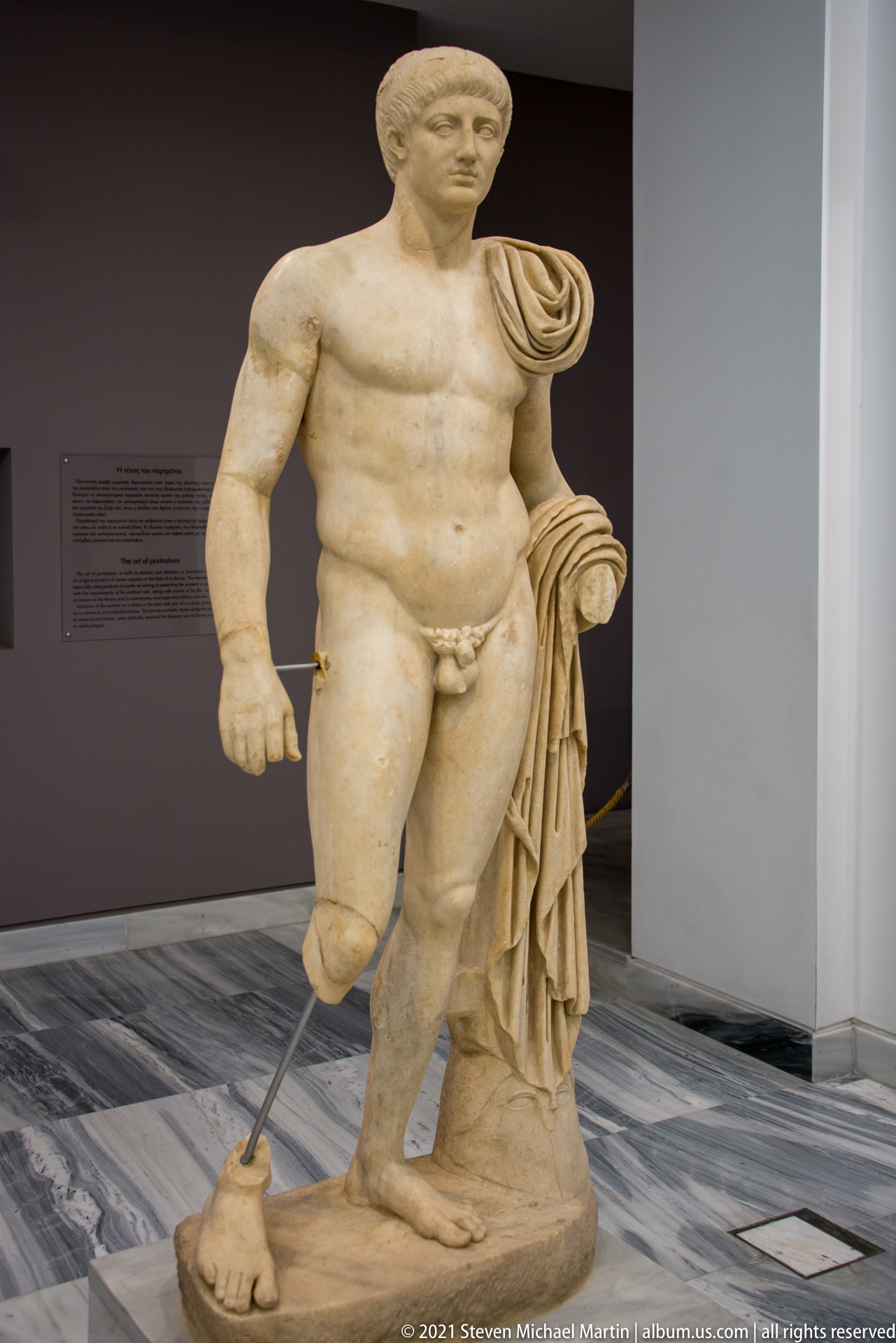
A youthful nude male stands with weight concentrated on one leg while drapery hangs over the opposite shoulder and arm. One lower leg is missing and supported by a modern mount, making the statue’s fragmentary condition conspicuous. The idealized anatomy, balanced stance, and carefully arranged cloak connect the work to the Greco-Roman tradition of heroic and athletic male statuary.
Caption
A youthful nude male stands with weight concentrated on one leg while drapery hangs over the opposite shoulder and arm. One lower leg is missing and supported by a modern mount, making the statue’s fragmentary condition conspicuous. The idealized anatomy, balanced stance, and carefully arranged cloak connect the work to the Greco-Roman tradition of heroic and athletic male statuary.
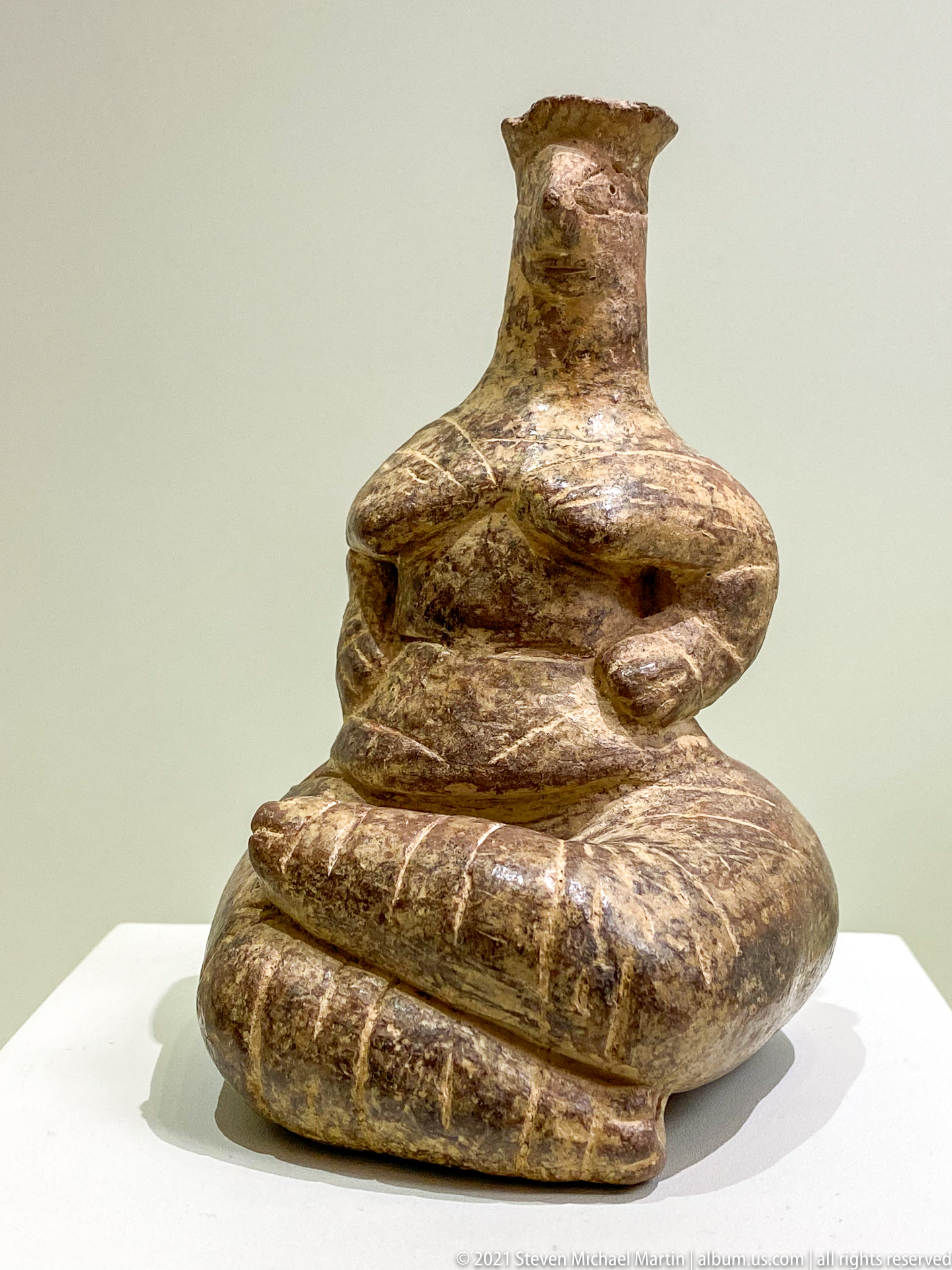
A low stone vessel rises through several stacked, swelling registers to a narrow neck and flared rim. Its mottled brown-and-cream surface reveals the natural stone, while deep horizontal contours and rounded projections give the body an unusually sculptural profile. The compact form differs sharply from the ceramic vessels nearby, emphasizing the technical challenge of hollowing and shaping stone into a functional container.
Caption
A low stone vessel rises through several stacked, swelling registers to a narrow neck and flared rim. Its mottled brown-and-cream surface reveals the natural stone, while deep horizontal contours and rounded projections give the body an unusually sculptural profile. The compact form differs sharply from the ceramic vessels nearby, emphasizing the technical challenge of hollowing and shaping stone into a functional container.
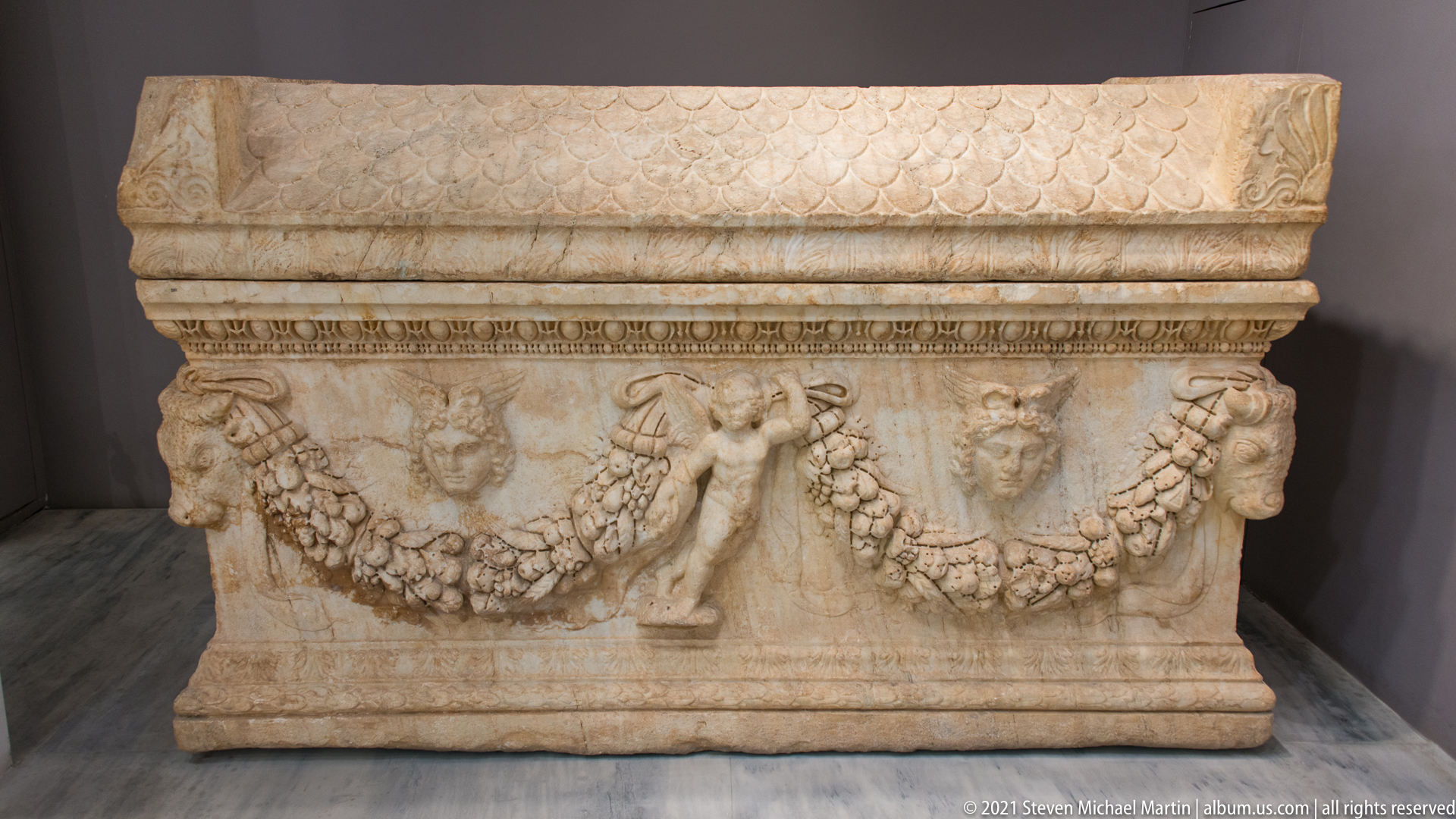
A large marble sarcophagus is decorated with heavy fruit-and-leaf garlands suspended between sculpted masks and standing figures. The upper rim carries additional bands of scale-like and geometric ornament, creating a richly layered façade. The full frontal view reveals how repeated swags organize the long chest into balanced sections, combining funerary function with an elaborate decorative vocabulary characteristic of Roman stone carving.
Caption
A large marble sarcophagus is decorated with heavy fruit-and-leaf garlands suspended between sculpted masks and standing figures. The upper rim carries additional bands of scale-like and geometric ornament, creating a richly layered façade. The full frontal view reveals how repeated swags organize the long chest into balanced sections, combining funerary function with an elaborate decorative vocabulary characteristic of Roman stone carving.
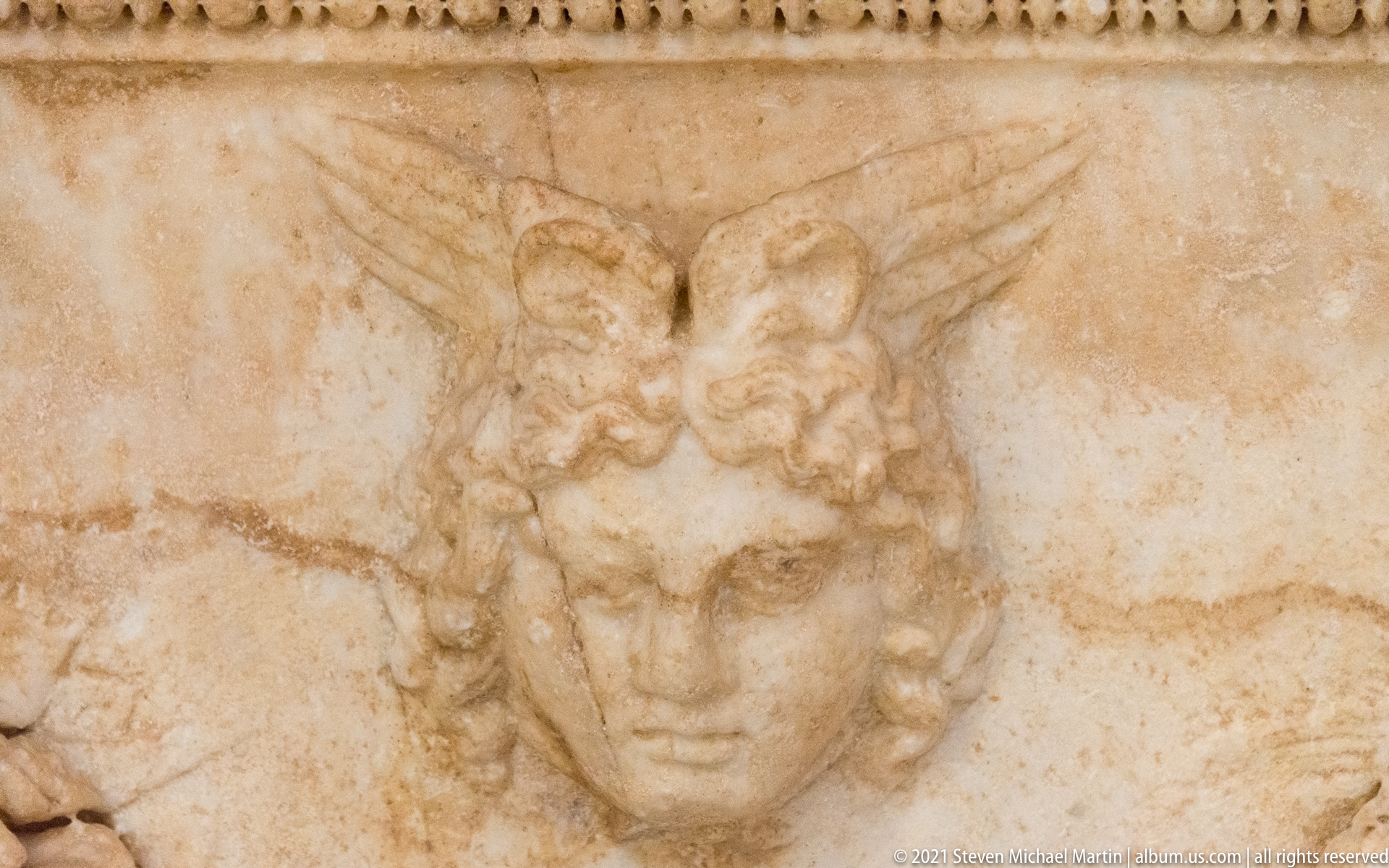
A youthful head with thick curling hair is carved in low relief on the sarcophagus, with small wings rising from either side of the head. The soft facial modeling contrasts with the more sharply defined curls and feathers, creating a compact emblem within the larger funerary decoration. The close crop isolates this winged figure from the garlands and other motifs visible in the full sarcophagus view.
Caption
A youthful head with thick curling hair is carved in low relief on the sarcophagus, with small wings rising from either side of the head. The soft facial modeling contrasts with the more sharply defined curls and feathers, creating a compact emblem within the larger funerary decoration. The close crop isolates this winged figure from the garlands and other motifs visible in the full sarcophagus view.
A floor-to-ceiling gridded window opens the museum interior toward the surrounding city, with trees, parked scooters, and neighboring buildings visible beyond the glass. The dark metal mullions divide the view into a strict rectangular lattice, while an interpretive panel and reading stand mark the gallery setting. The photograph records the architectural relationship between the exhibition space and contemporary Heraklion rather than an archaeological object.
Caption
A floor-to-ceiling gridded window opens the museum interior toward the surrounding city, with trees, parked scooters, and neighboring buildings visible beyond the glass. The dark metal mullions divide the view into a strict rectangular lattice, while an interpretive panel and reading stand mark the gallery setting. The photograph records the architectural relationship between the exhibition space and contemporary Heraklion rather than an archaeological object.
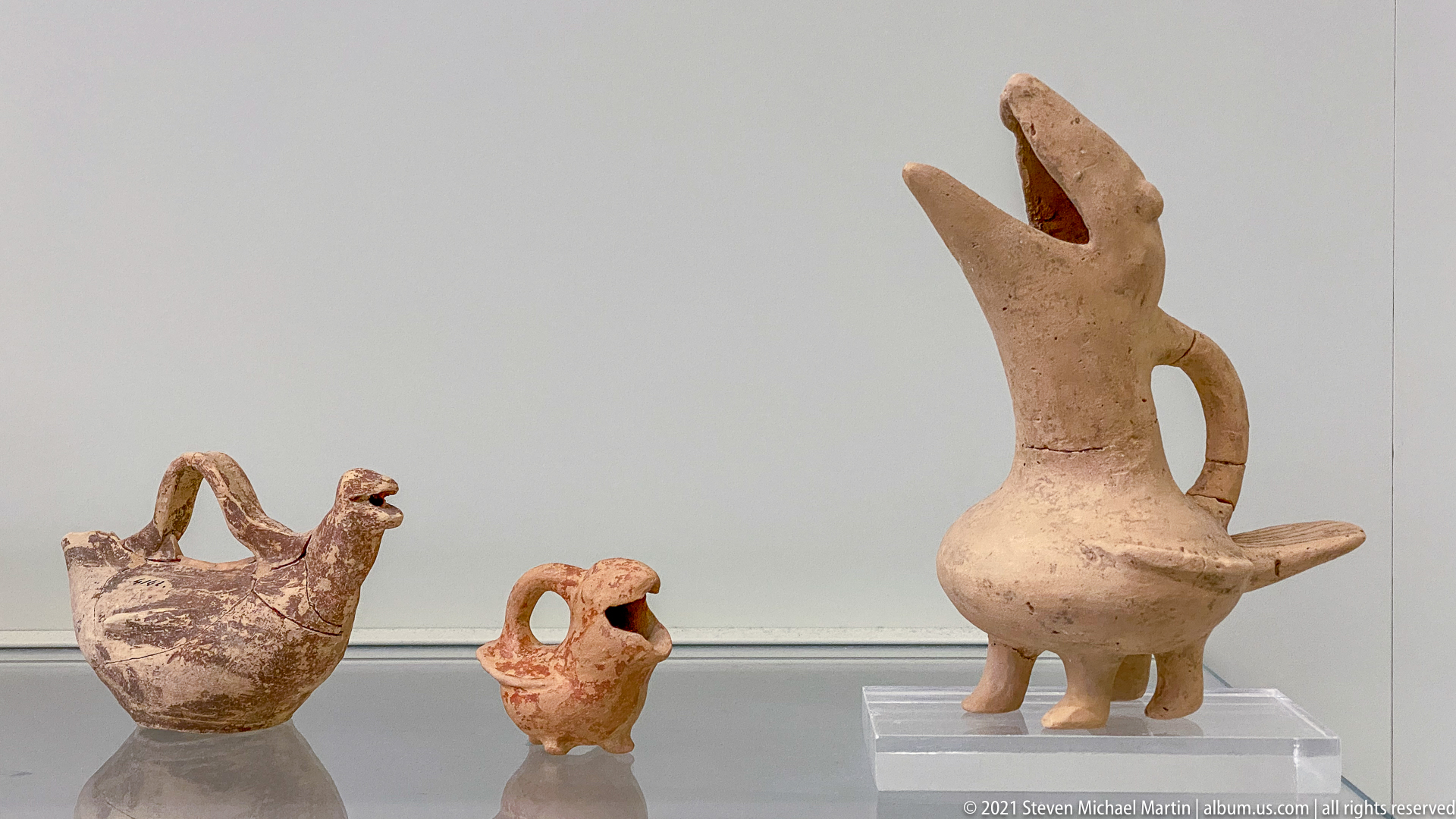
Three terracotta vessels transform birds into compact containers of markedly different scale. The two smaller examples have rounded bodies, beak-like spouts, and loop handles, while the tall vessel exaggerates the neck and open beak and adds a rear handle and projecting tail. Displayed together, they show how potters adapted recognizable avian anatomy to the practical requirements of pouring and carrying.
Caption
Three terracotta vessels transform birds into compact containers of markedly different scale. The two smaller examples have rounded bodies, beak-like spouts, and loop handles, while the tall vessel exaggerates the neck and open beak and adds a rear handle and projecting tail. Displayed together, they show how potters adapted recognizable avian anatomy to the practical requirements of pouring and carrying.
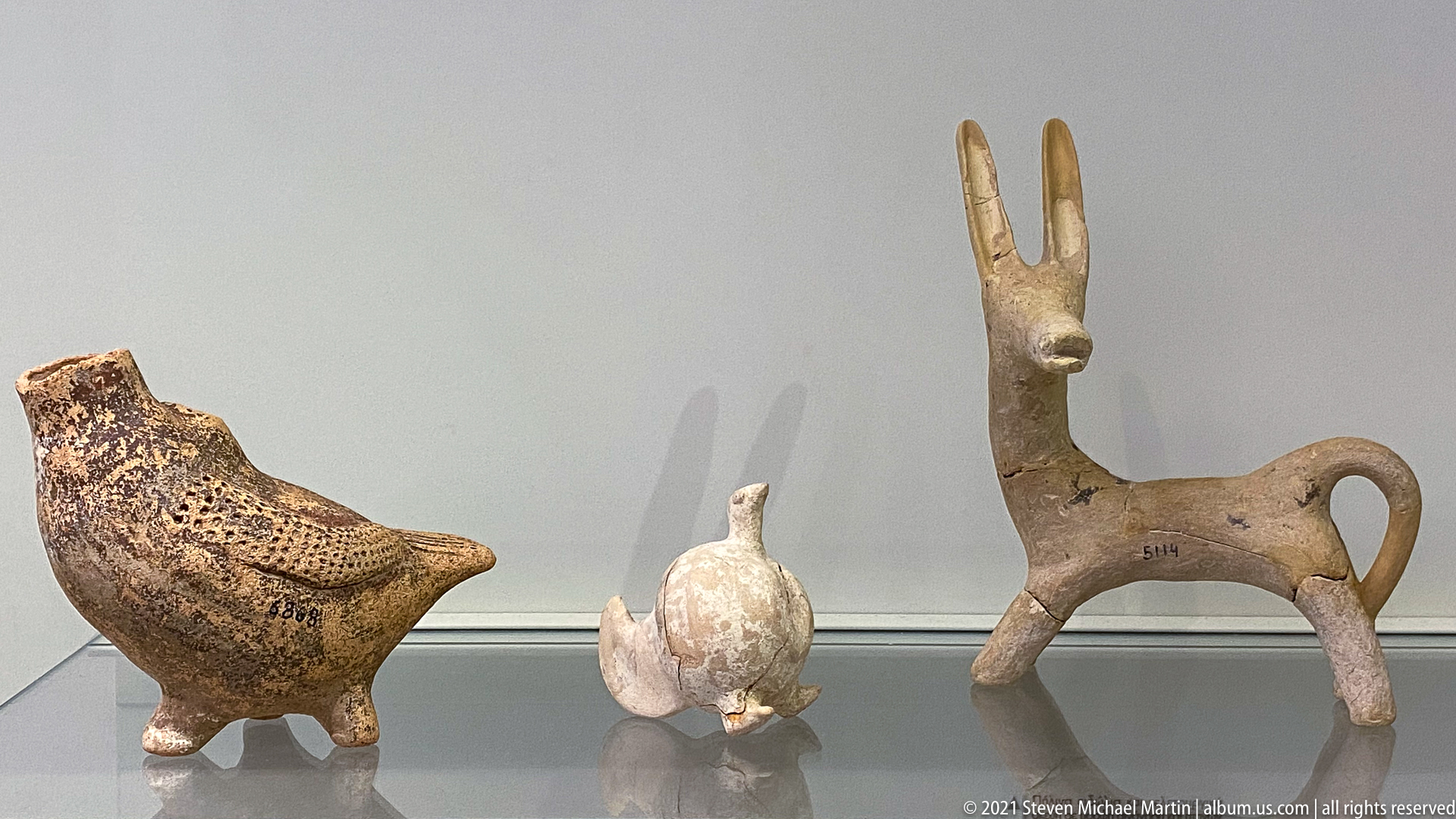
Three small terracotta objects use animal forms as vessels or containers. At left, a bird has a rounded body and pointed beak; the pale central piece is a compact bird-like form; at right, a long-legged animal with extremely tall ears carries a loop handle across its hindquarters. Their simplified silhouettes prioritize instantly recognizable anatomy while integrating openings and handles into the modeled bodies.
Caption
Three small terracotta objects use animal forms as vessels or containers. At left, a bird has a rounded body and pointed beak; the pale central piece is a compact bird-like form; at right, a long-legged animal with extremely tall ears carries a loop handle across its hindquarters. Their simplified silhouettes prioritize instantly recognizable anatomy while integrating openings and handles into the modeled bodies.
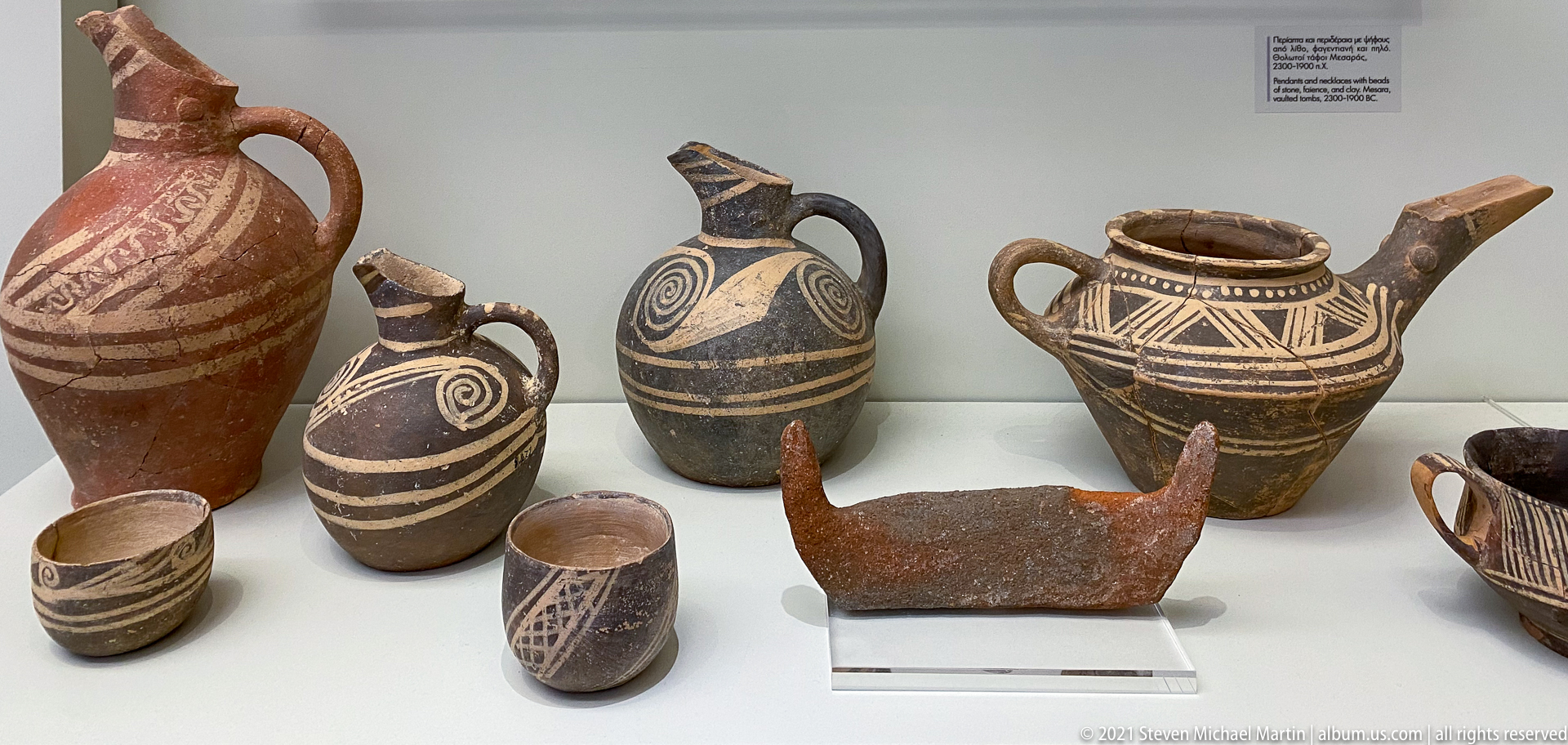
A museum case brings together painted ceramic jugs and cups with a small dark animal-shaped vessel in the foreground. Spirals, stripes, chevrons, and horizontal bands wrap around the pottery, while the varied necks, handles, and pouring forms make the group useful for comparing vessel shapes. The oblique arrangement highlights both surface decoration and the functional diversity of ancient Cretan ceramics.
Caption
A museum case brings together painted ceramic jugs and cups with a small dark animal-shaped vessel in the foreground. Spirals, stripes, chevrons, and horizontal bands wrap around the pottery, while the varied necks, handles, and pouring forms make the group useful for comparing vessel shapes. The oblique arrangement highlights both surface decoration and the functional diversity of ancient Cretan ceramics.
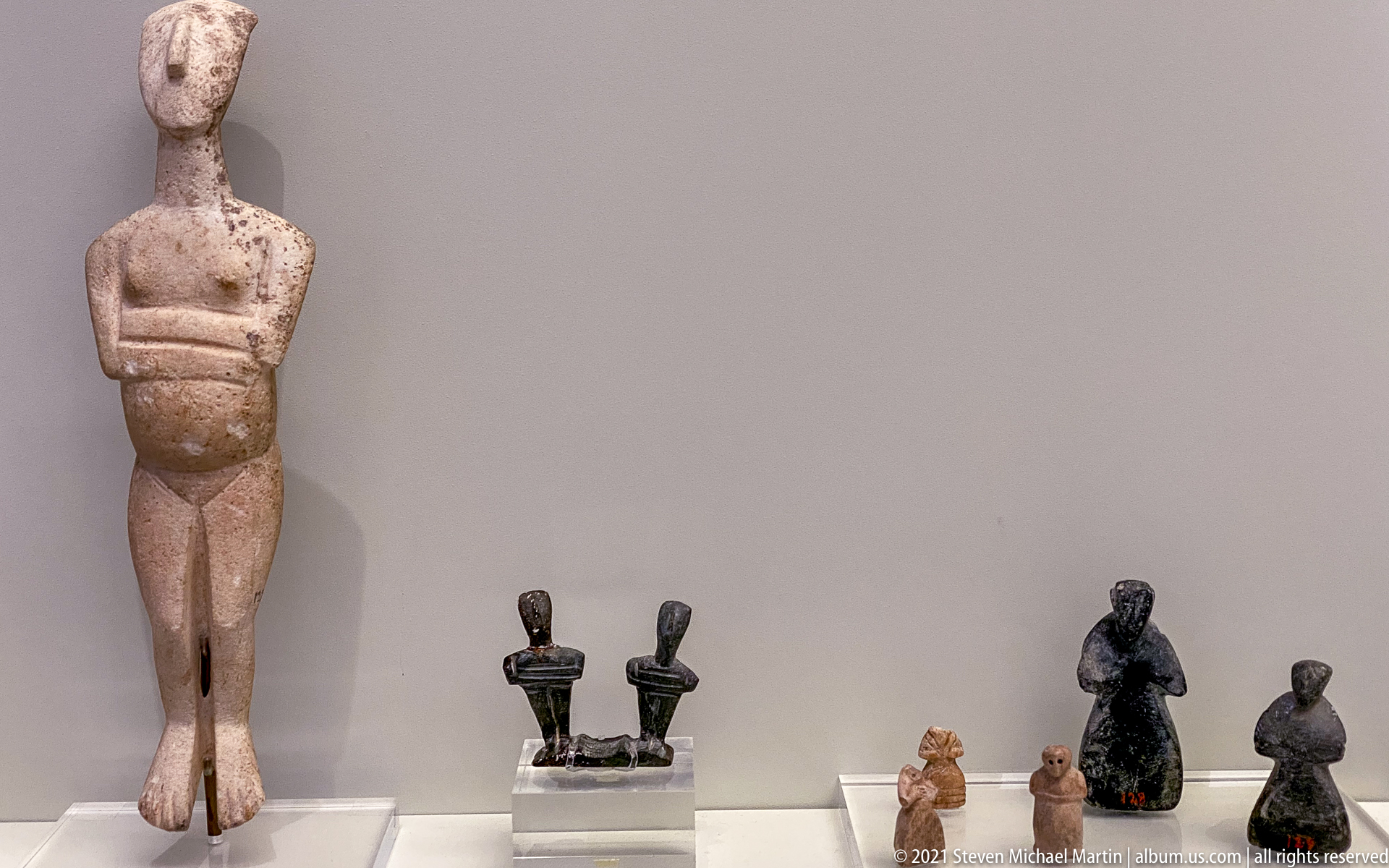
A varied group of small human figures is displayed beside a much taller, fragmentary standing male statue. Dark metal figurines contrast with pale stone and terracotta examples, and their poses range from rigidly frontal to compact seated or standing forms. The installation emphasizes differences in scale, material, and modeling across ancient Cretan representations of the human body.
Caption
A varied group of small human figures is displayed beside a much taller, fragmentary standing male statue. Dark metal figurines contrast with pale stone and terracotta examples, and their poses range from rigidly frontal to compact seated or standing forms. The installation emphasizes differences in scale, material, and modeling across ancient Cretan representations of the human body.
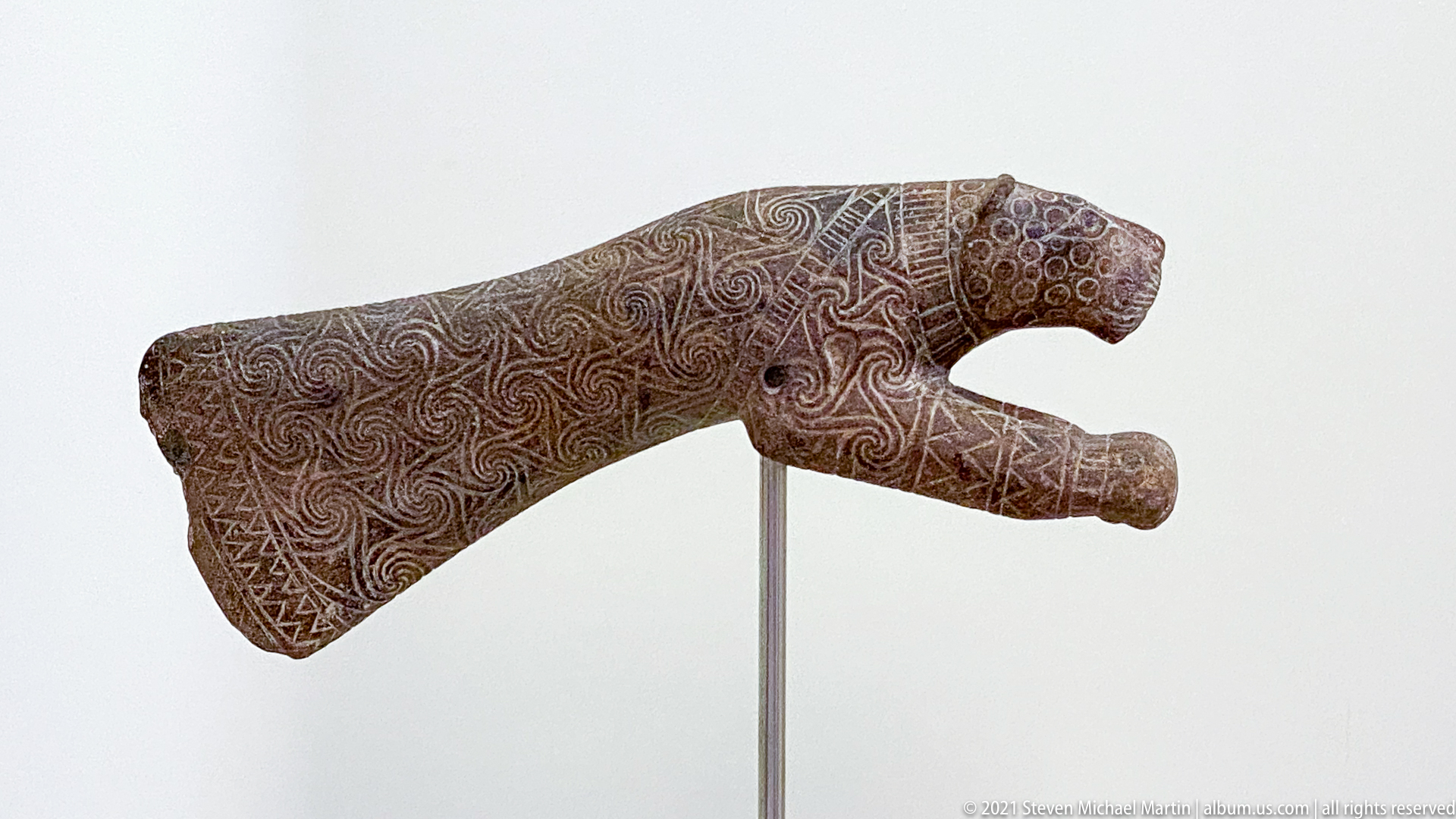
A long, flattened stone object terminates in a forked or open-ended form and is densely covered with incised spirals, circles, crosshatching, and geometric bands. A small perforation near the center and the carefully patterned surface suggest that the piece was intended for display or special use rather than as an undecorated tool. Its precise archaeological function, however, is not evident from shape alone.
Caption
A long, flattened stone object terminates in a forked or open-ended form and is densely covered with incised spirals, circles, crosshatching, and geometric bands. A small perforation near the center and the carefully patterned surface suggest that the piece was intended for display or special use rather than as an undecorated tool. Its precise archaeological function, however, is not evident from shape alone.
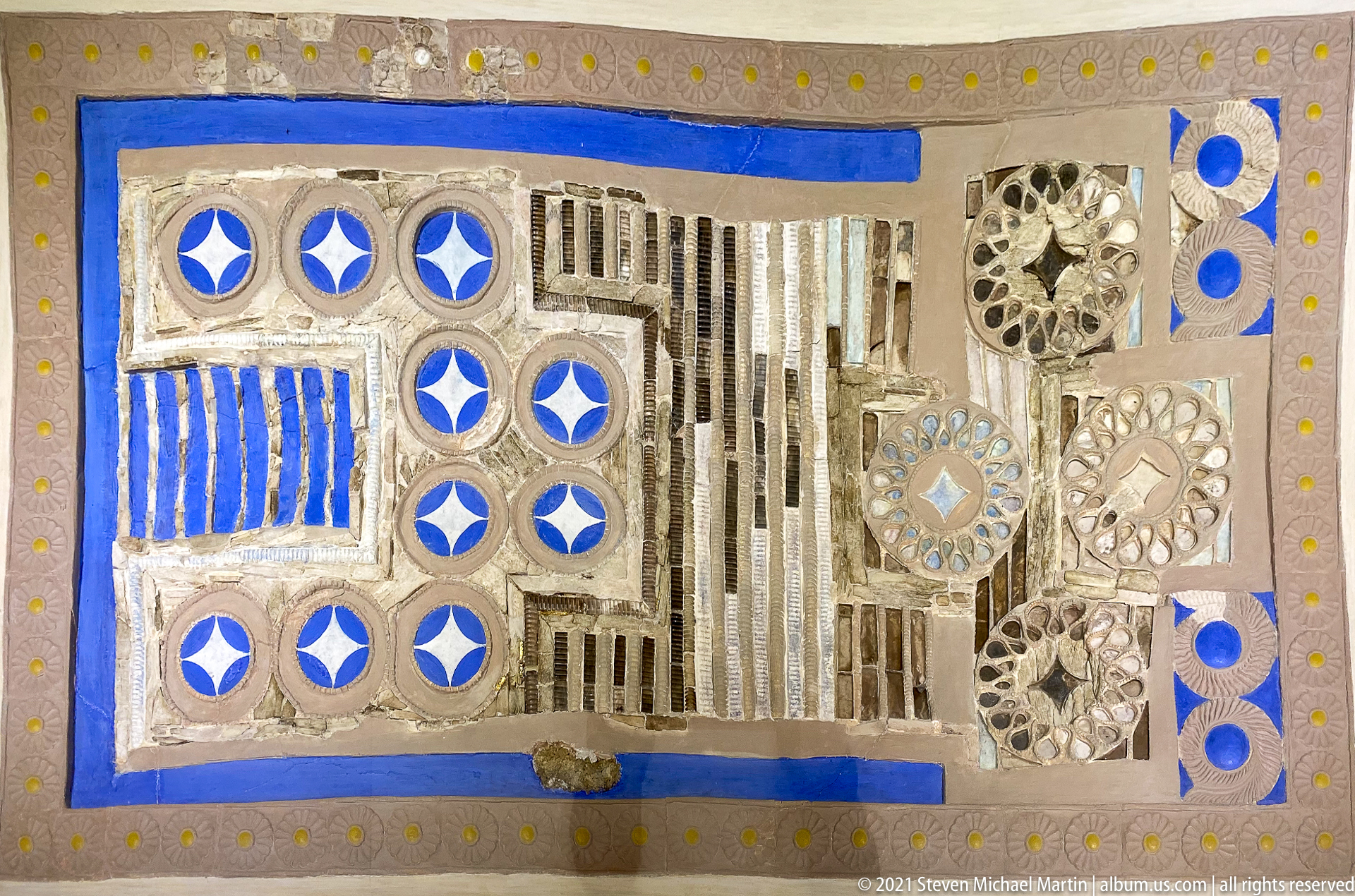
This close view of the Knossos “Draughtboard” isolates the intricate inlay of the luxury gaming surface. Blue-and-white circular fields, striped rectangles, rosette-like compartments, and narrow framing bands reveal how ivory, blue glass paste, rock crystal, gold, and silver were assembled into a precise geometric design. The detail makes the board’s refined workmanship easier to read than in the full display view.
Caption
This close view of the Knossos “Draughtboard” isolates the intricate inlay of the luxury gaming surface. Blue-and-white circular fields, striped rectangles, rosette-like compartments, and narrow framing bands reveal how ivory, blue glass paste, rock crystal, gold, and silver were assembled into a precise geometric design. The detail makes the board’s refined workmanship easier to read than in the full display view.
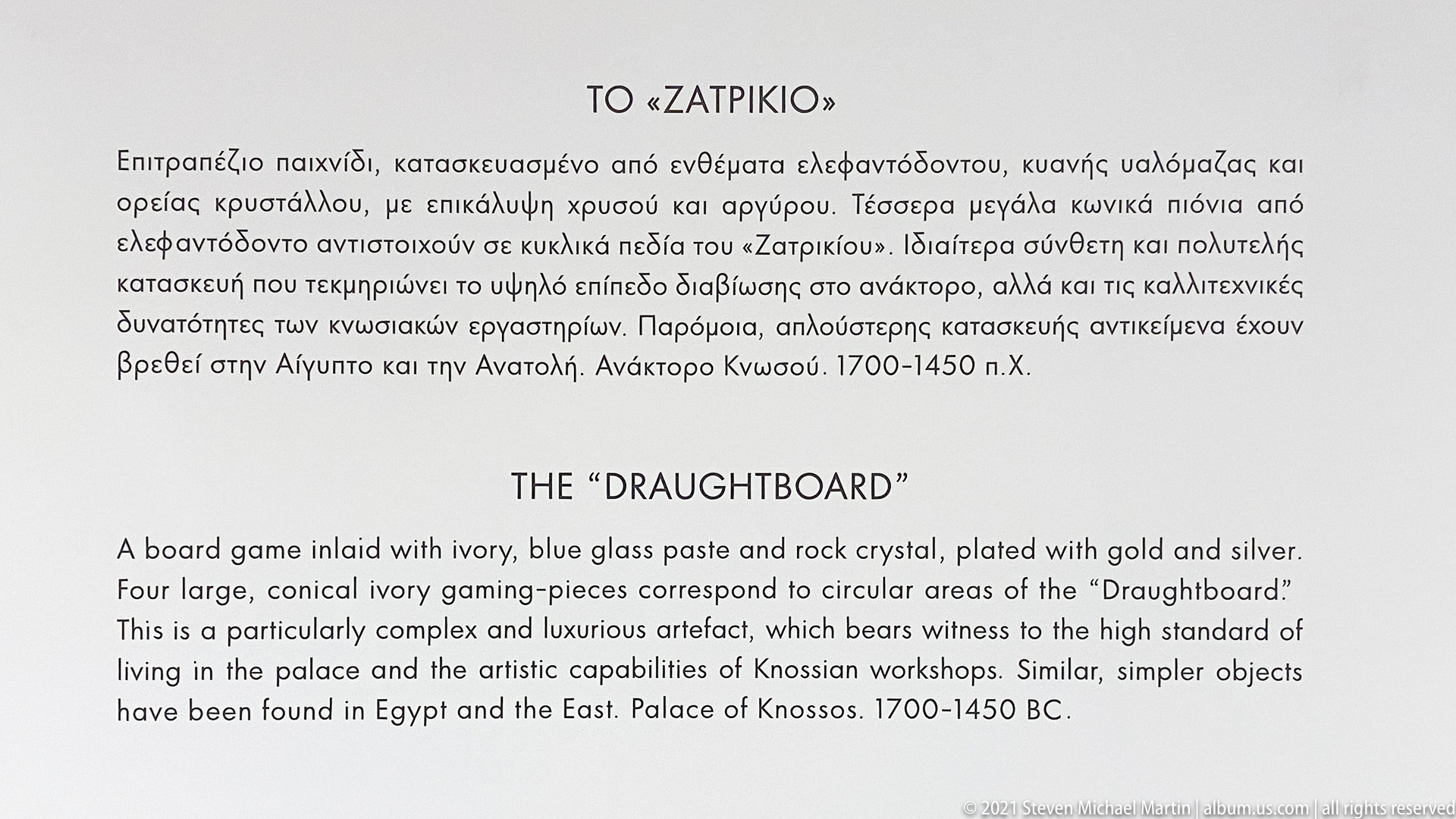
The museum label identifies the “Draughtboard” as an inlaid board made with ivory, blue glass paste, rock crystal, gold, and silver. It describes four large conical ivory gaming pieces as corresponding to circular areas on the board and places the object in the Palace of Knossos, dated 1700–1450 BC. The bilingual panel provides direct interpretive context for the adjacent artifact.
Caption
The museum label identifies the “Draughtboard” as an inlaid board made with ivory, blue glass paste, rock crystal, gold, and silver. It describes four large conical ivory gaming pieces as corresponding to circular areas on the board and places the object in the Palace of Knossos, dated 1700–1450 BC. The bilingual panel provides direct interpretive context for the adjacent artifact.
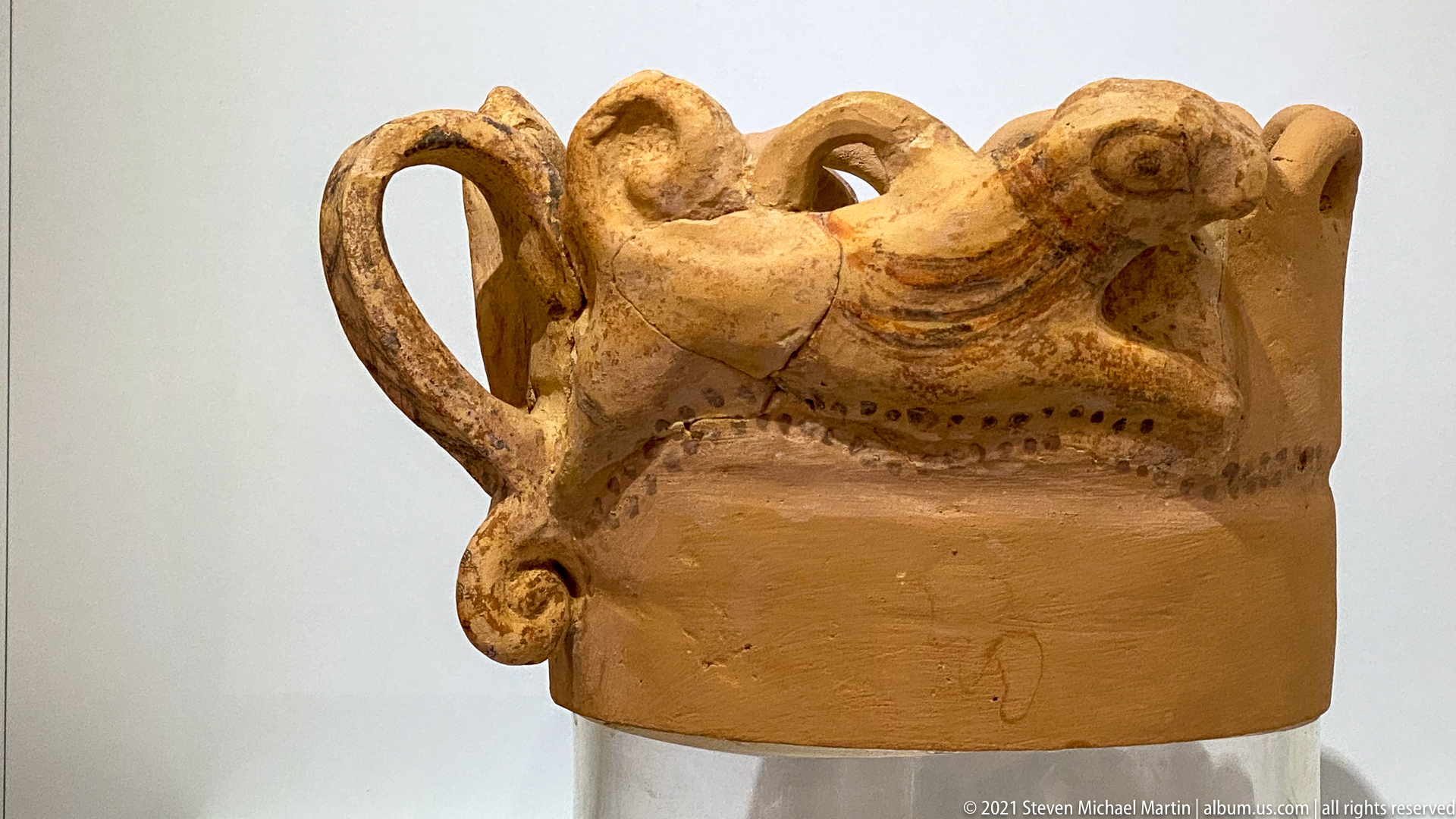
A large terracotta fragment preserves the upper portion of a vessel decorated with a modeled quadruped laid across the rim. A thick loop handle rises behind the animal, while a second projecting form survives at the right edge. Painted dots and bands remain on the animal’s body and vessel surface, combining sculptural attachment with ceramic decoration in a single composition.
Caption
A large terracotta fragment preserves the upper portion of a vessel decorated with a modeled quadruped laid across the rim. A thick loop handle rises behind the animal, while a second projecting form survives at the right edge. Painted dots and bands remain on the animal’s body and vessel surface, combining sculptural attachment with ceramic decoration in a single composition.
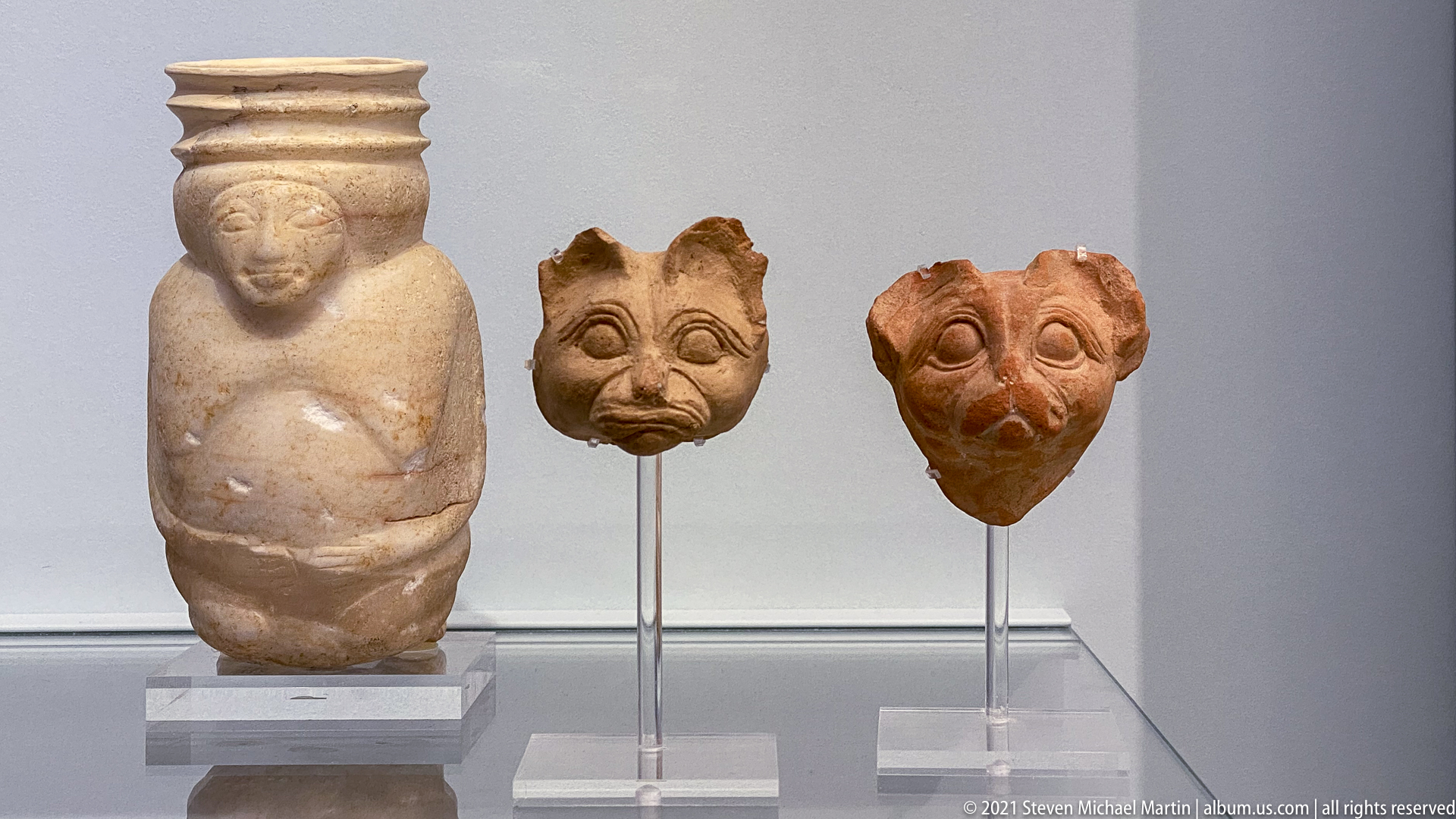
A compact pale stone figure stands beside two smaller mask-like heads mounted on slender supports. The masks have exaggerated eyes, brows, noses, and mouths, giving them a theatrical or grotesque expression, while the larger figure is more restrained and frontal. The grouping emphasizes the contrast between full-bodied sculpture and expressive facial fragments within the museum’s small-object display.
Caption
A compact pale stone figure stands beside two smaller mask-like heads mounted on slender supports. The masks have exaggerated eyes, brows, noses, and mouths, giving them a theatrical or grotesque expression, while the larger figure is more restrained and frontal. The grouping emphasizes the contrast between full-bodied sculpture and expressive facial fragments within the museum’s small-object display.
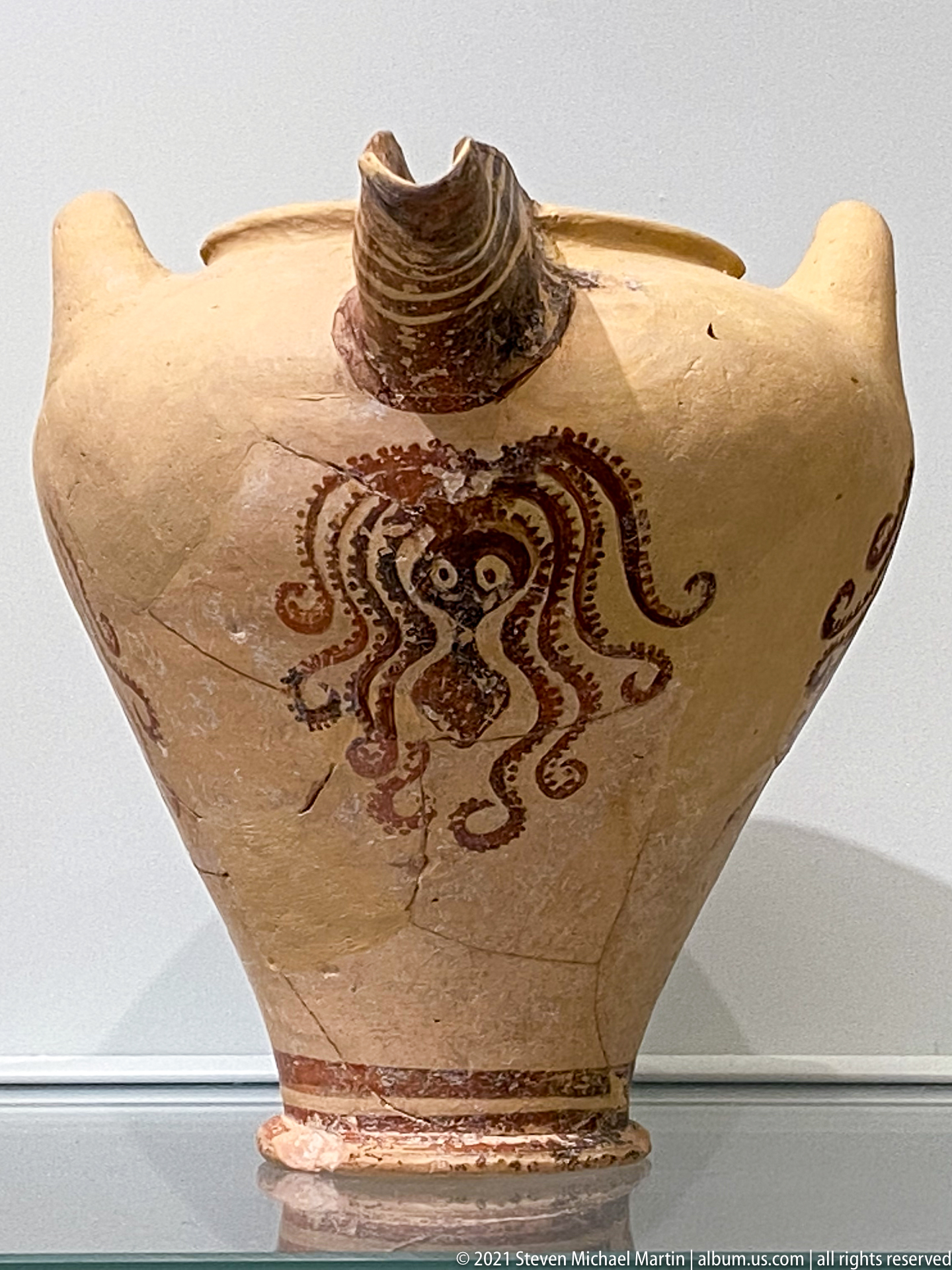
An octopus spreads curling tentacles across the broad shoulder of this pale ceramic vessel, wrapping around the body rather than remaining confined to a framed panel. A small central neck rises above the shoulder, with a second projecting element at the side, while reddish-brown marine decoration follows the vessel’s contours. The design continues the strong marine imagery characteristic of Minoan and later Bronze Age Cretan pottery.
Caption
An octopus spreads curling tentacles across the broad shoulder of this pale ceramic vessel, wrapping around the body rather than remaining confined to a framed panel. A small central neck rises above the shoulder, with a second projecting element at the side, while reddish-brown marine decoration follows the vessel’s contours. The design continues the strong marine imagery characteristic of Minoan and later Bronze Age Cretan pottery.
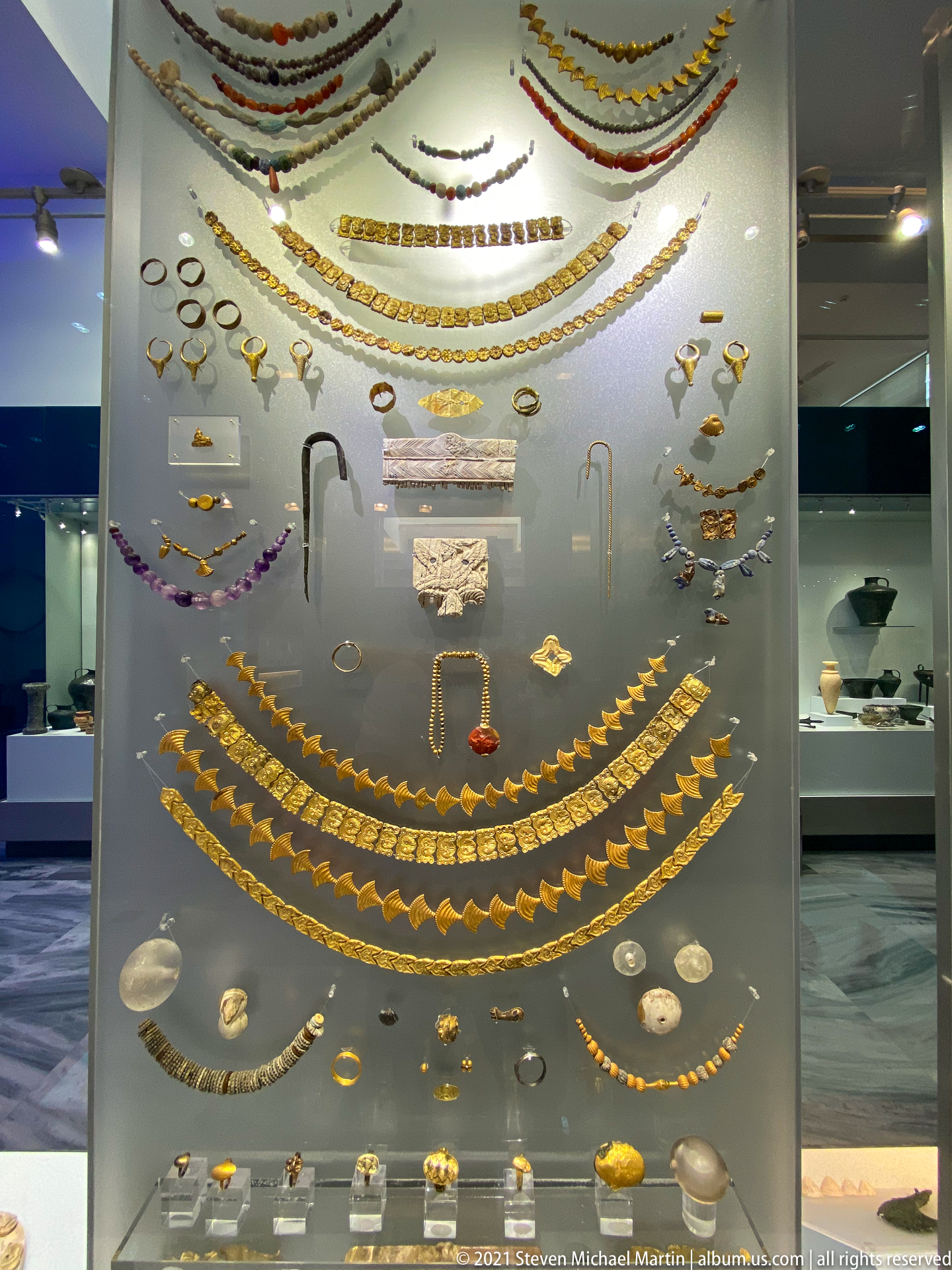
Necklaces and ornaments arc across a tall display case in layered rows, combining gold elements with red, blue, white, and dark beads. Smaller rings, pendants, plaques, pins, and other personal objects fill the spaces between the larger strands. The symmetrical installation turns a diverse archaeological assemblage into a comparative study of materials, color, scale, and techniques of personal adornment.
Caption
Necklaces and ornaments arc across a tall display case in layered rows, combining gold elements with red, blue, white, and dark beads. Smaller rings, pendants, plaques, pins, and other personal objects fill the spaces between the larger strands. The symmetrical installation turns a diverse archaeological assemblage into a comparative study of materials, color, scale, and techniques of personal adornment.
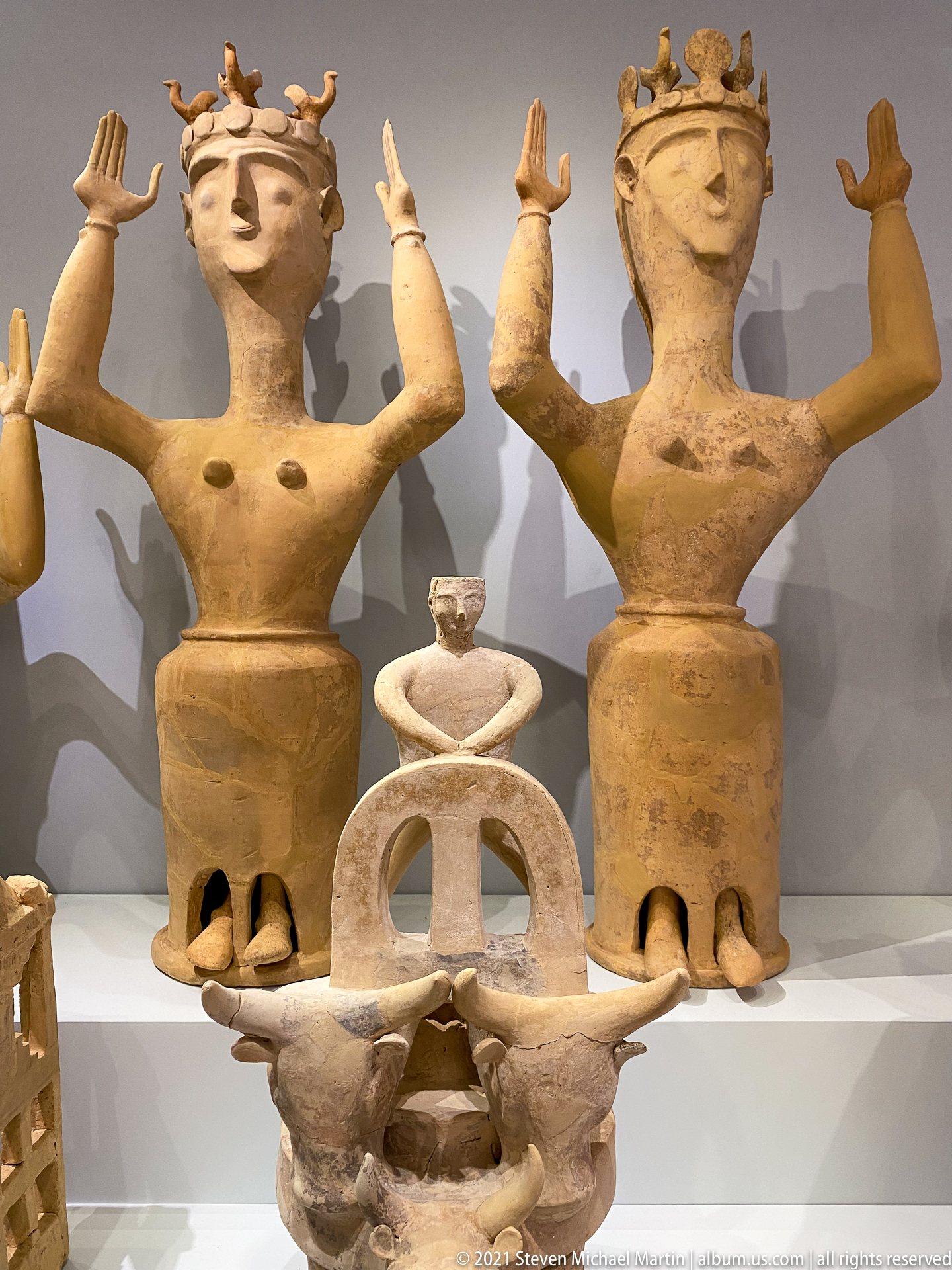
Two large terracotta female figures stand with both arms raised, their cylindrical lower bodies, modeled breasts, and elaborate crowns creating emphatic frontal silhouettes. Between them sits a smaller architectural or shrine-like model with a central opening and animal-head projections. The grouping brings together human and miniature architectural imagery in a display strongly associated with ritual expression in ancient Crete.
Caption
Two large terracotta female figures stand with both arms raised, their cylindrical lower bodies, modeled breasts, and elaborate crowns creating emphatic frontal silhouettes. Between them sits a smaller architectural or shrine-like model with a central opening and animal-head projections. The grouping brings together human and miniature architectural imagery in a display strongly associated with ritual expression in ancient Crete.
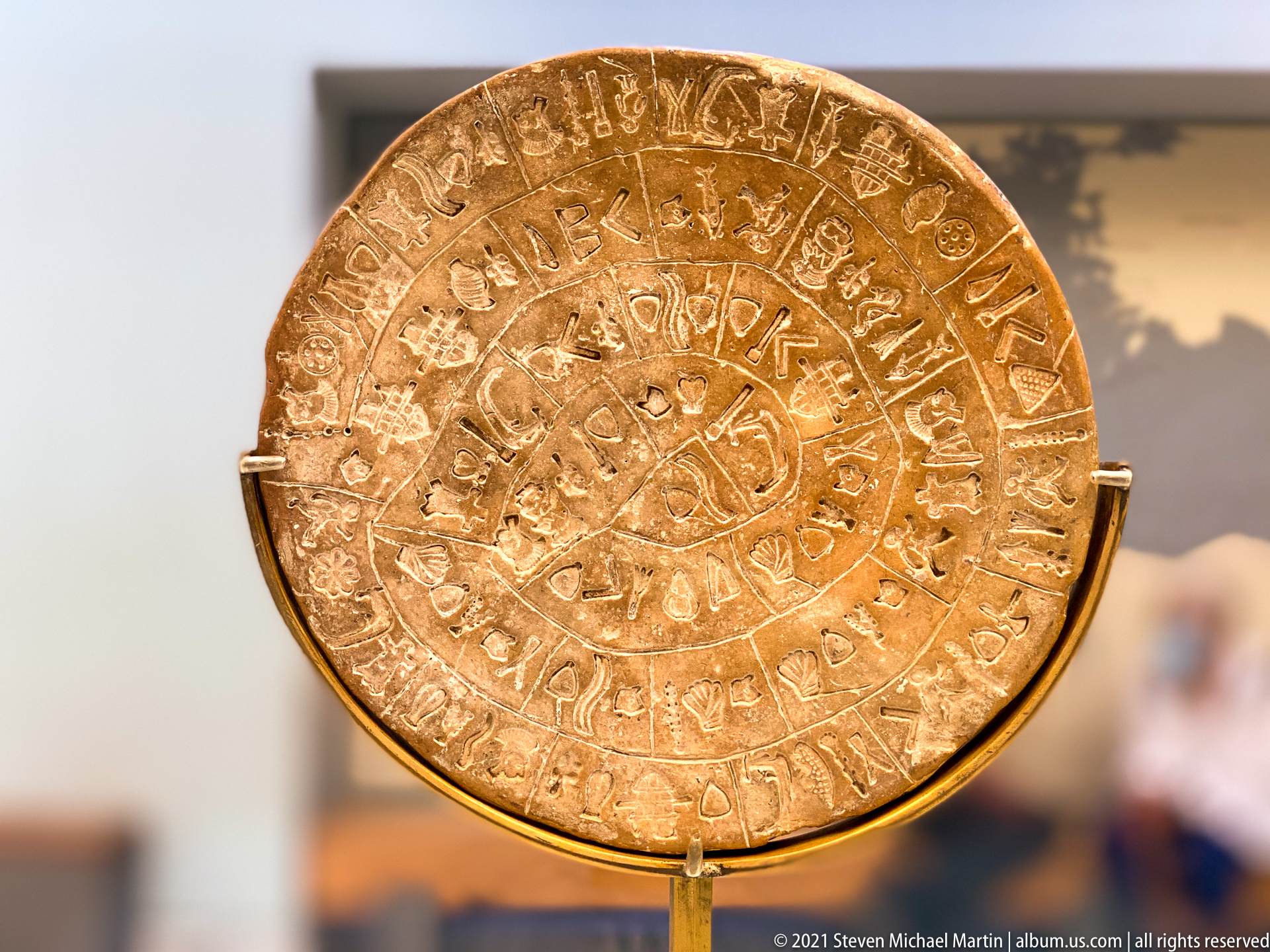
The Phaistos Disc, discovered at Phaistos and dated to about 1700–1650 BC, bears a spiral text impressed into wet clay before firing. Its two faces contain 241 stamped signs arranged in 61 groups, including human figures, animals, plants, tools, and other pictograms separated by incised lines. Because the object is unique and the script remains undeciphered, its language and precise purpose are still unresolved.
Caption
The Phaistos Disc, discovered at Phaistos and dated to about 1700–1650 BC, bears a spiral text impressed into wet clay before firing. Its two faces contain 241 stamped signs arranged in 61 groups, including human figures, animals, plants, tools, and other pictograms separated by incised lines. Because the object is unique and the script remains undeciphered, its language and precise purpose are still unresolved.
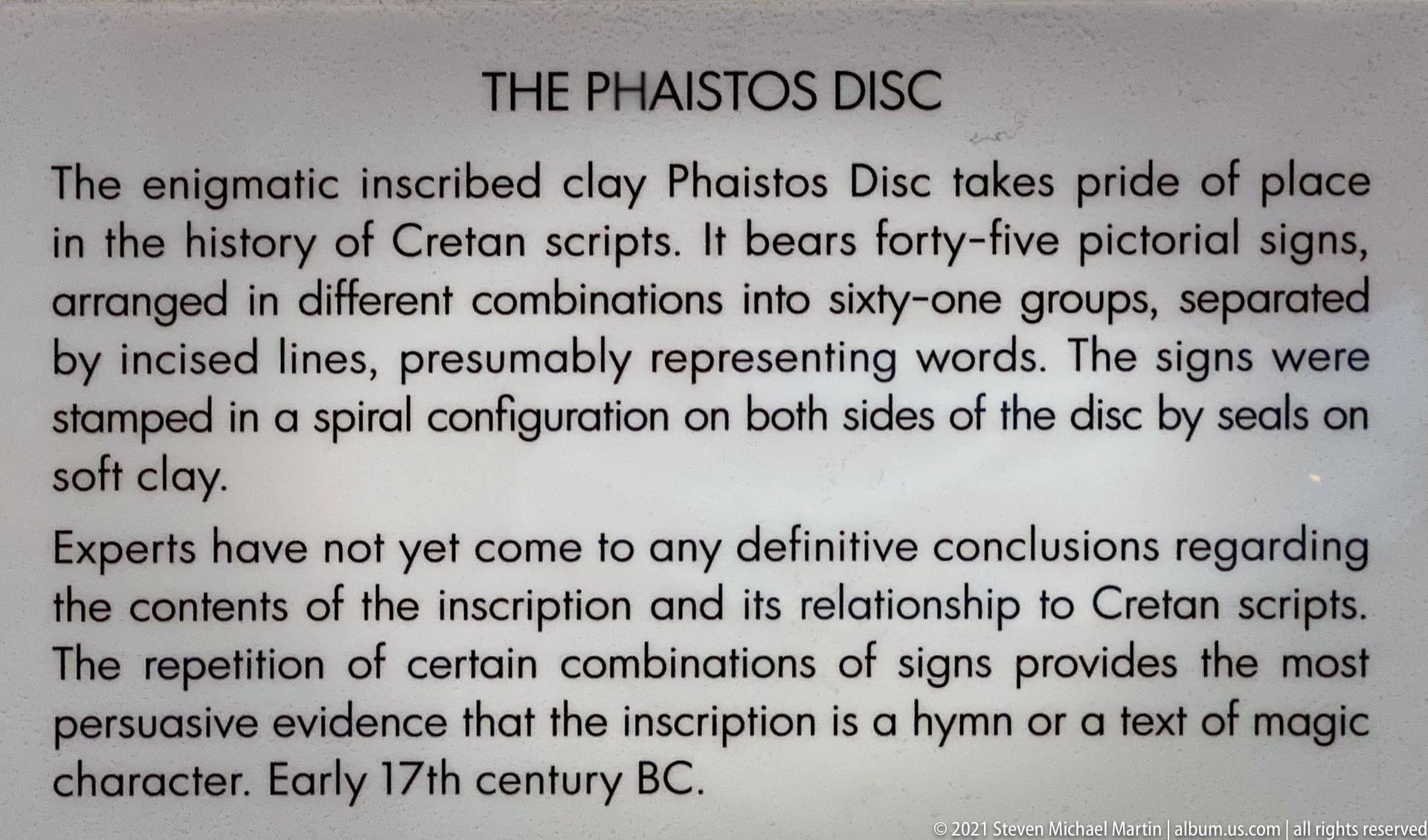
The museum panel describes the enigmatic Phaistos Disc as bearing forty-five pictorial signs arranged in sixty-one groups and stamped in a spiral on both faces while the clay was soft. It notes that the text remains undeciphered and dates the object to the early seventeenth century BC. The label provides direct interpretive context for the famous inscribed disc displayed beside it.
Caption
The museum panel describes the enigmatic Phaistos Disc as bearing forty-five pictorial signs arranged in sixty-one groups and stamped in a spiral on both faces while the clay was soft. It notes that the text remains undeciphered and dates the object to the early seventeenth century BC. The label provides direct interpretive context for the famous inscribed disc displayed beside it.
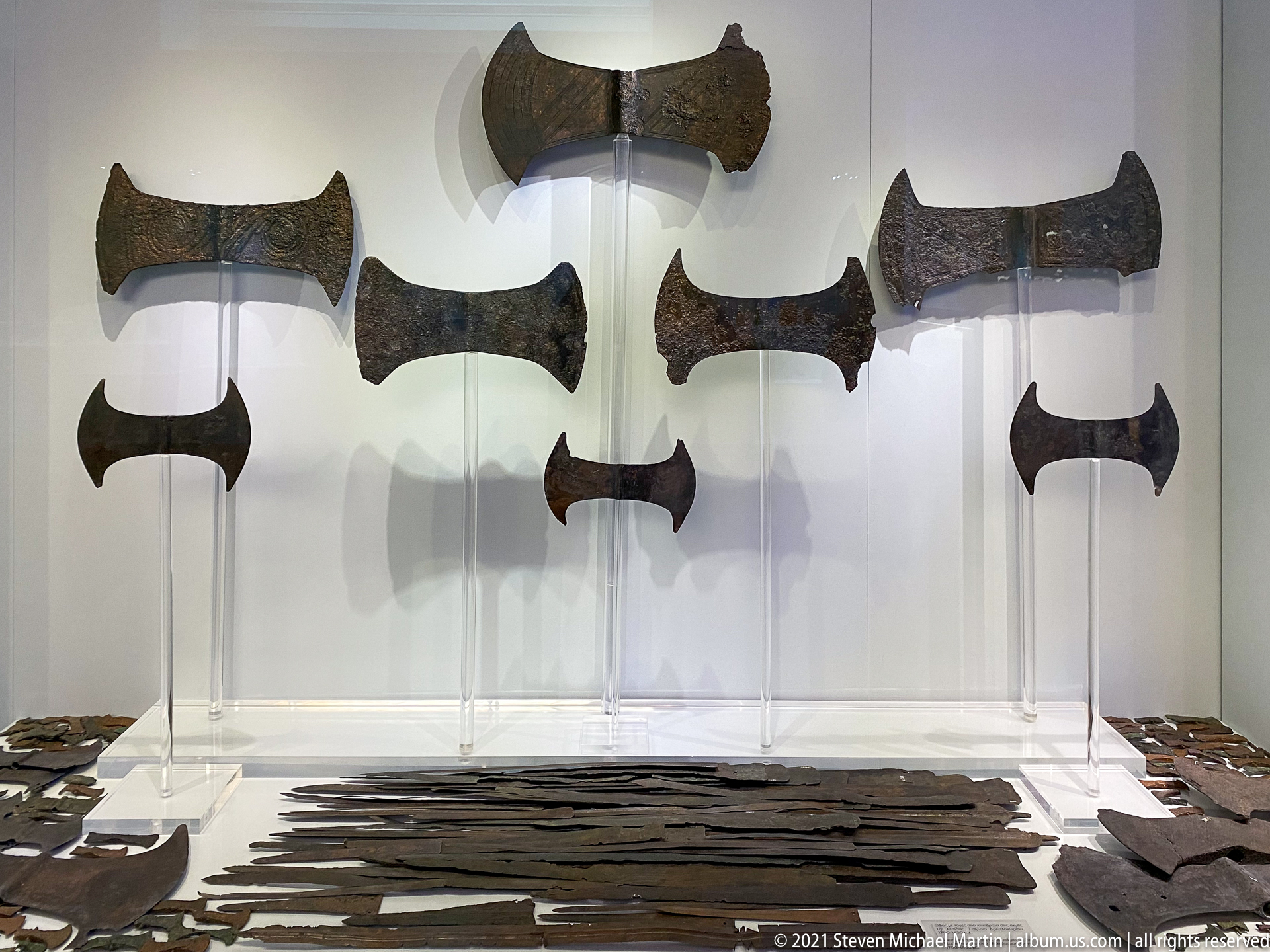
Large double axes are mounted upright above rows of long bronze blades and smaller metal implements. The varied axe heads range from broad crescent forms to narrower, more compact profiles, while the horizontal blades below emphasize differences in length and taper. Together, the objects create a comparative display of ancient Cretan bronze-working across weapon, tool, and ceremonial forms.
Caption
Large double axes are mounted upright above rows of long bronze blades and smaller metal implements. The varied axe heads range from broad crescent forms to narrower, more compact profiles, while the horizontal blades below emphasize differences in length and taper. Together, the objects create a comparative display of ancient Cretan bronze-working across weapon, tool, and ceremonial forms.
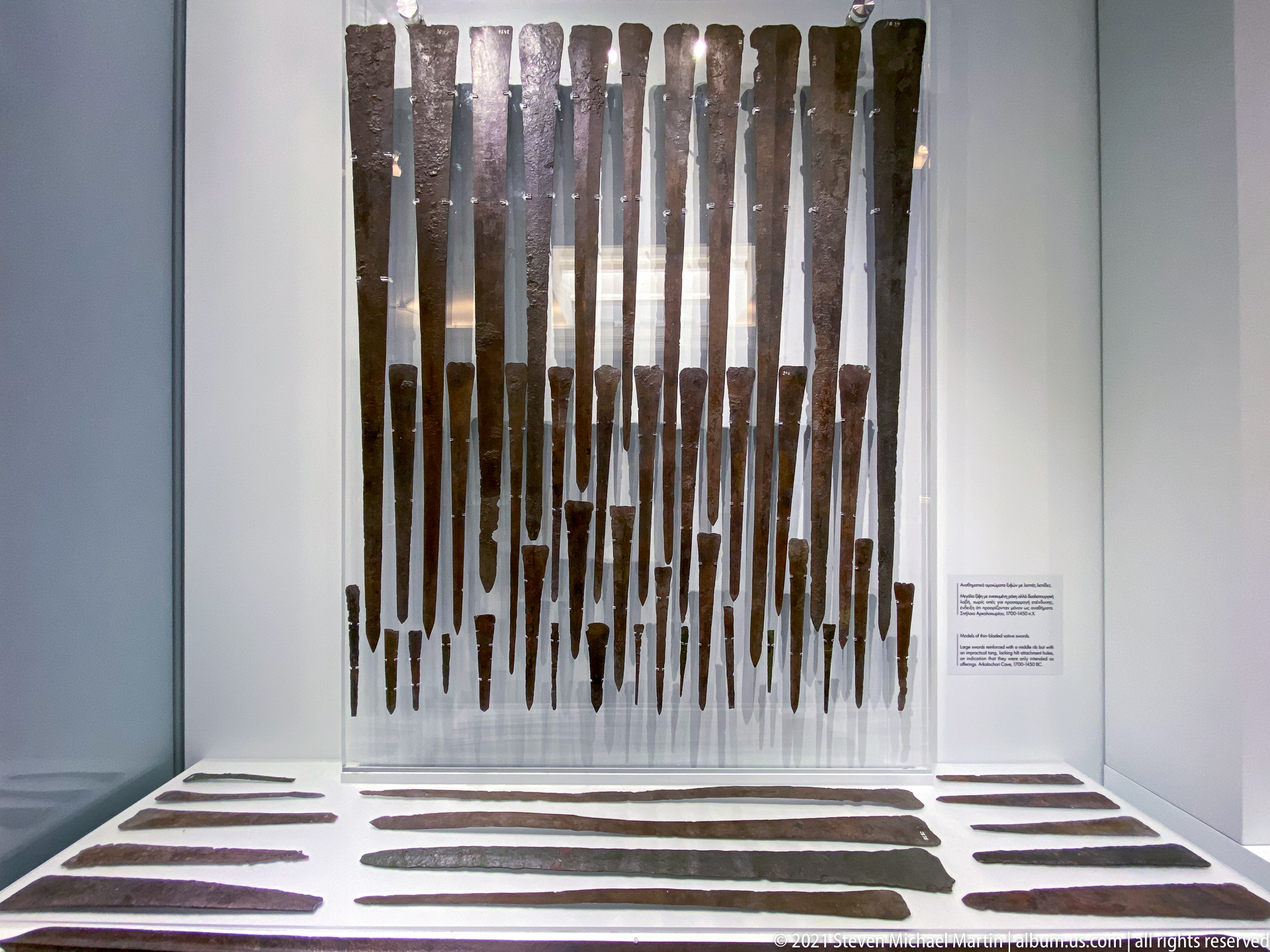
Long bronze swords and blades are arranged vertically in close ranks, with additional examples laid horizontally along the base of the case. Their straight profiles, broad shoulders, tangs, and varying lengths are easy to compare in the ordered display. Dark brown and green patination records centuries of corrosion while preserving the essential geometry of the weapons.
Caption
Long bronze swords and blades are arranged vertically in close ranks, with additional examples laid horizontally along the base of the case. Their straight profiles, broad shoulders, tangs, and varying lengths are easy to compare in the ordered display. Dark brown and green patination records centuries of corrosion while preserving the essential geometry of the weapons.
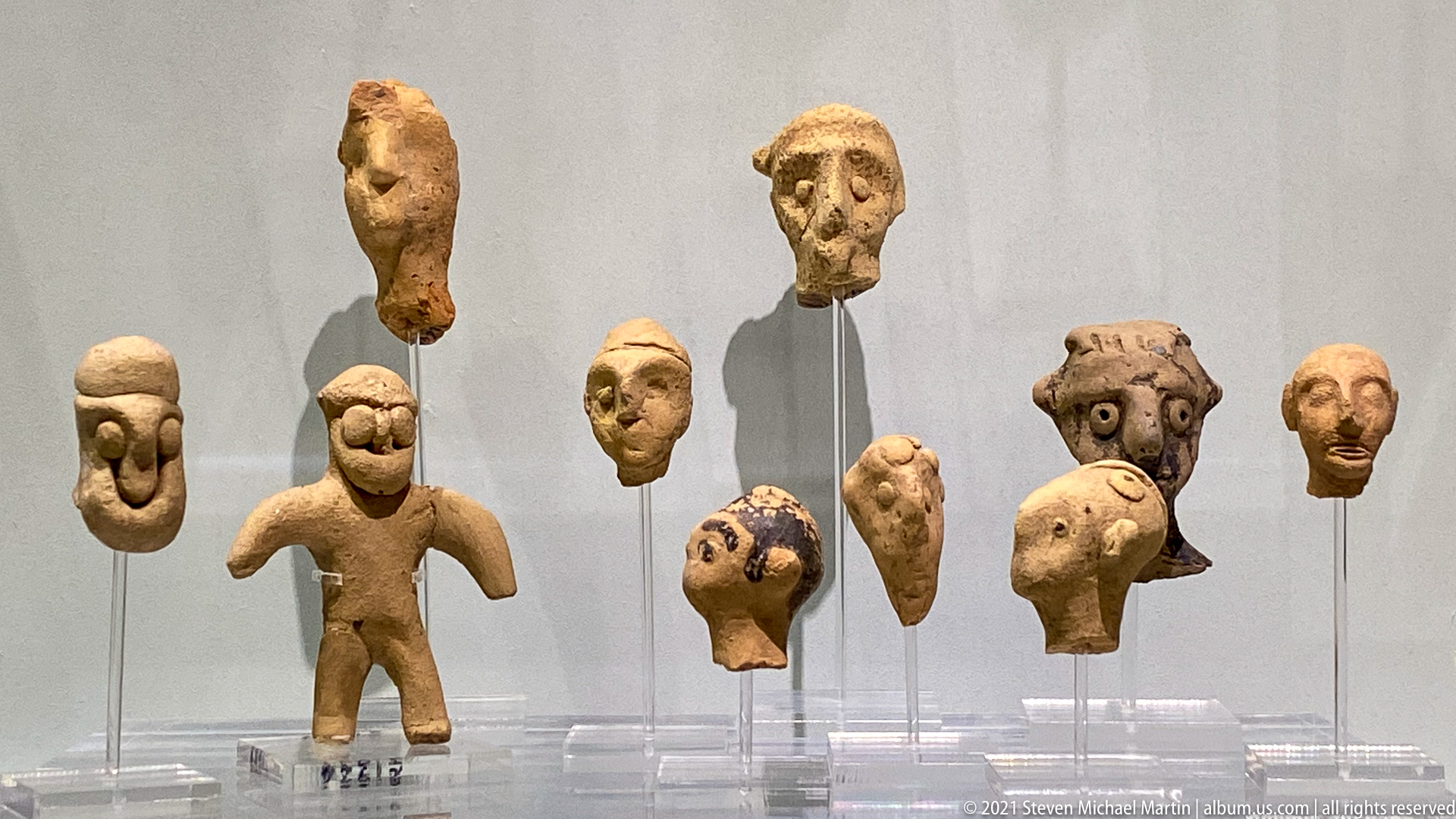
A group of small terracotta heads surrounds a single standing human figurine, presenting a wide range of facial types and modeling. Some heads are elongated or mask-like, others preserve painted details, and one has a broad, almost animal-like face. The varied expressions and proportions make the case a compact study in small-scale coroplastic work rather than a single unified figure group.
Caption
A group of small terracotta heads surrounds a single standing human figurine, presenting a wide range of facial types and modeling. Some heads are elongated or mask-like, others preserve painted details, and one has a broad, almost animal-like face. The varied expressions and proportions make the case a compact study in small-scale coroplastic work rather than a single unified figure group.
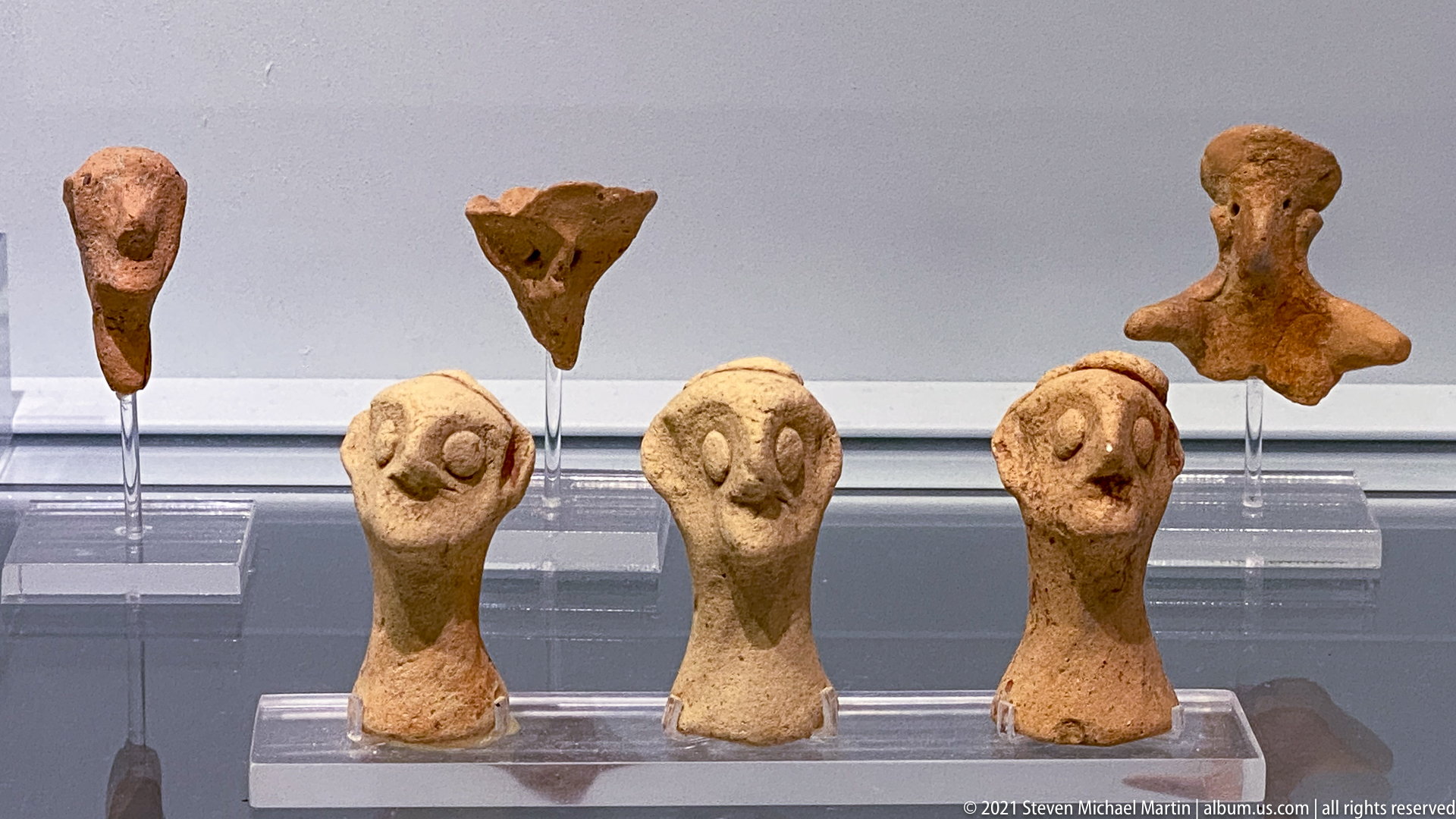
Six small terracotta heads are arranged in two rows, three of them with strikingly enlarged circular eyes and elongated necks. The upper examples are more fragmentary, preserving only portions of faces or necks, while the lower row reads as a deliberate sequence of stylized bust-like forms. Their exaggerated features emphasize abstraction over naturalistic portraiture.
Caption
Six small terracotta heads are arranged in two rows, three of them with strikingly enlarged circular eyes and elongated necks. The upper examples are more fragmentary, preserving only portions of faces or necks, while the lower row reads as a deliberate sequence of stylized bust-like forms. Their exaggerated features emphasize abstraction over naturalistic portraiture.
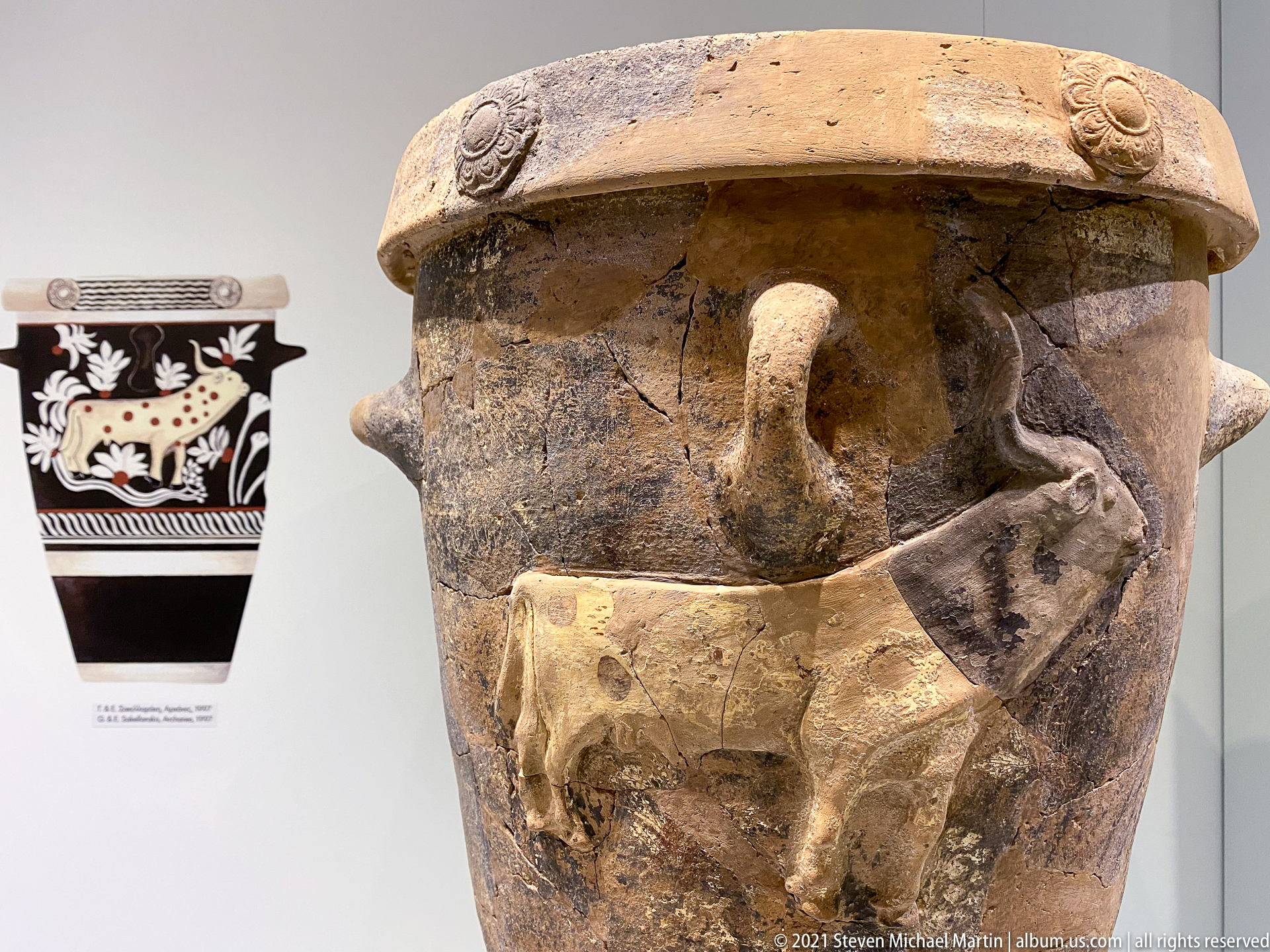
A large reconstructed ceramic vessel preserves a projecting animal figure attached to its exterior, while fragments of the original dark surface remain embedded in extensive lighter restoration. The broad rim carries circular impressed motifs, and the surviving relief suggests that the vessel was intended to be visually prominent as well as functional. A reconstruction drawing at left helps indicate the larger decorative scheme.
Caption
A large reconstructed ceramic vessel preserves a projecting animal figure attached to its exterior, while fragments of the original dark surface remain embedded in extensive lighter restoration. The broad rim carries circular impressed motifs, and the surviving relief suggests that the vessel was intended to be visually prominent as well as functional. A reconstruction drawing at left helps indicate the larger decorative scheme.

The so-called “Ring of Minos,” dated to 1500–1400 BC, compresses a complex Minoan religious vision into its engraved gold bezel. Female divine figures appear in episodes associated with tree worship and epiphany, while the lower register includes a deity traveling by boat across a patterned sea. The miniature composition links air, land, and sea and is one of the museum’s richest sources for Minoan religious iconography.
Caption
The so-called “Ring of Minos,” dated to 1500–1400 BC, compresses a complex Minoan religious vision into its engraved gold bezel. Female divine figures appear in episodes associated with tree worship and epiphany, while the lower register includes a deity traveling by boat across a patterned sea. The miniature composition links air, land, and sea and is one of the museum’s richest sources for Minoan religious iconography.
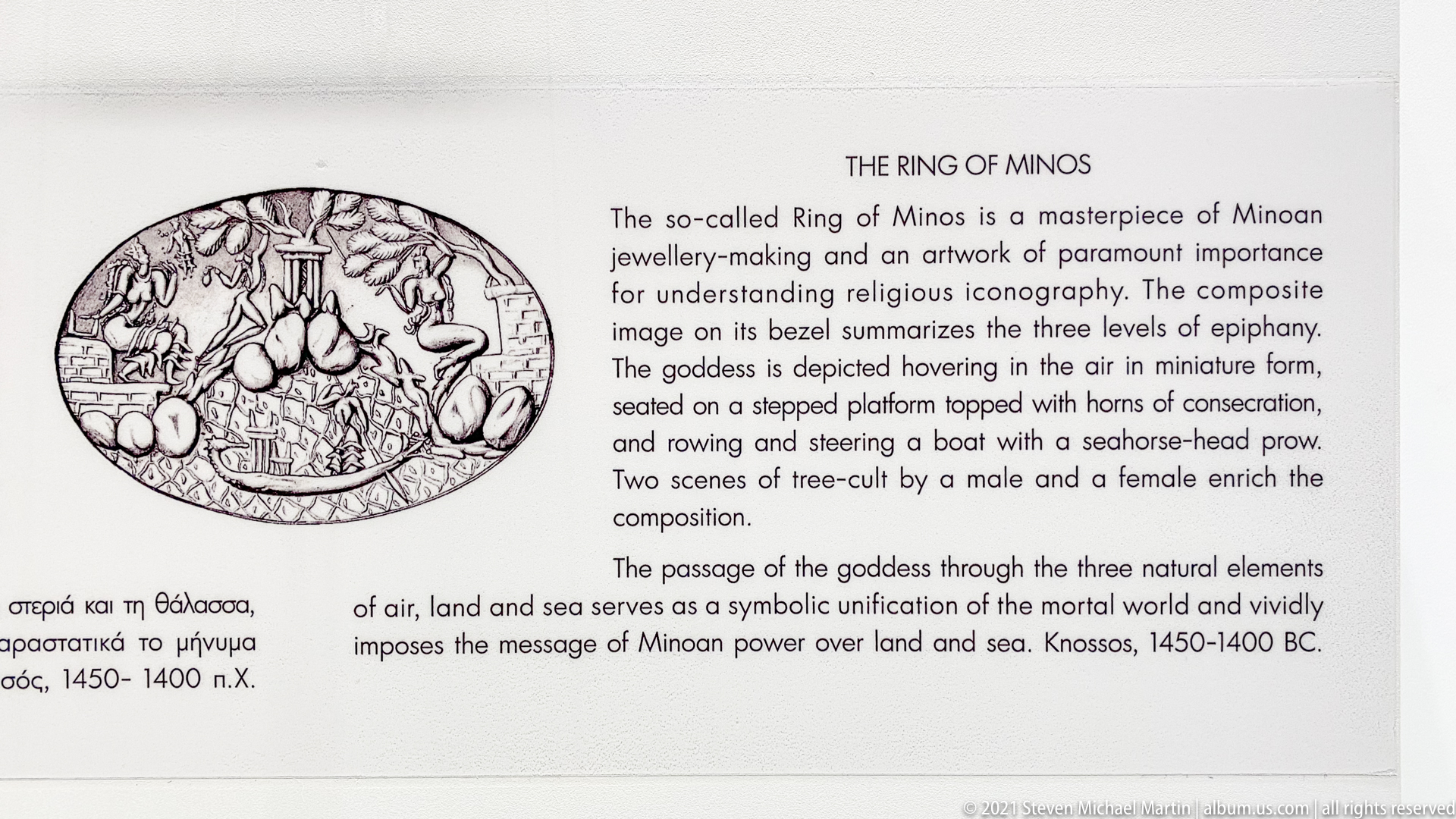
The museum panel presents the Ring of Minos as a masterpiece of Minoan jewelry and an important source for religious iconography. It explains the composite scene as combining multiple levels of epiphany and interprets the passage of a goddess through air, land, and sea. The label also gives Knossos as the provenance and dates the ring to 1450–1400 BC.
Caption
The museum panel presents the Ring of Minos as a masterpiece of Minoan jewelry and an important source for religious iconography. It explains the composite scene as combining multiple levels of epiphany and interprets the passage of a goddess through air, land, and sea. The label also gives Knossos as the provenance and dates the ring to 1450–1400 BC.
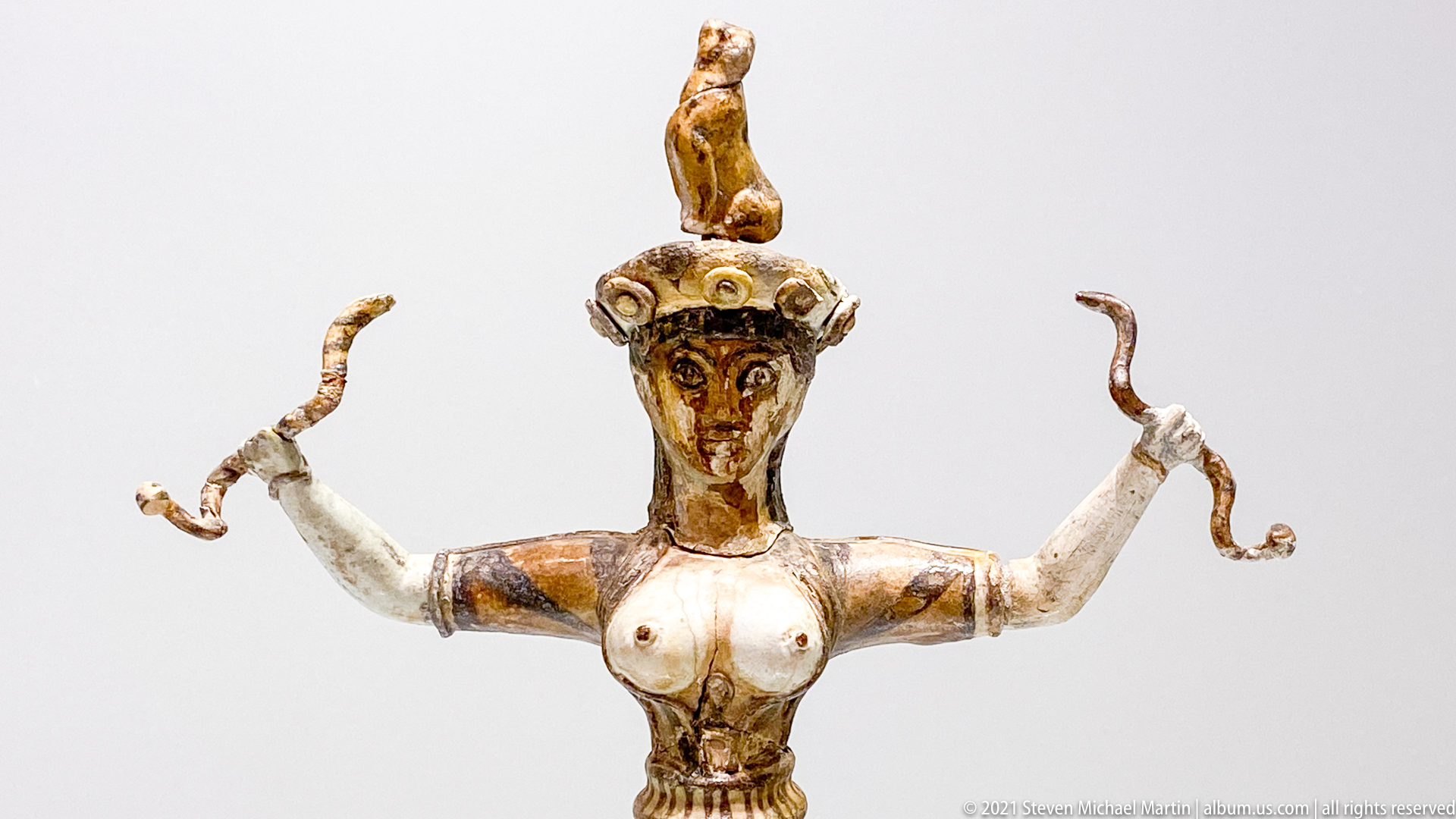
The smaller of the famous painted-faience “Snake Goddesses” from the Temple Repositories at Knossos, dated to 1600–1500 BC, raises snakes in both hands beneath a feline perched on her head. She wears the characteristic Minoan costume of fitted bodice, exposed breasts, apron, and flounced skirt. The snakes and feline emphasize the figure’s association with the divine protection and mastery of the natural world.
Caption
The smaller of the famous painted-faience “Snake Goddesses” from the Temple Repositories at Knossos, dated to 1600–1500 BC, raises snakes in both hands beneath a feline perched on her head. She wears the characteristic Minoan costume of fitted bodice, exposed breasts, apron, and flounced skirt. The snakes and feline emphasize the figure’s association with the divine protection and mastery of the natural world.
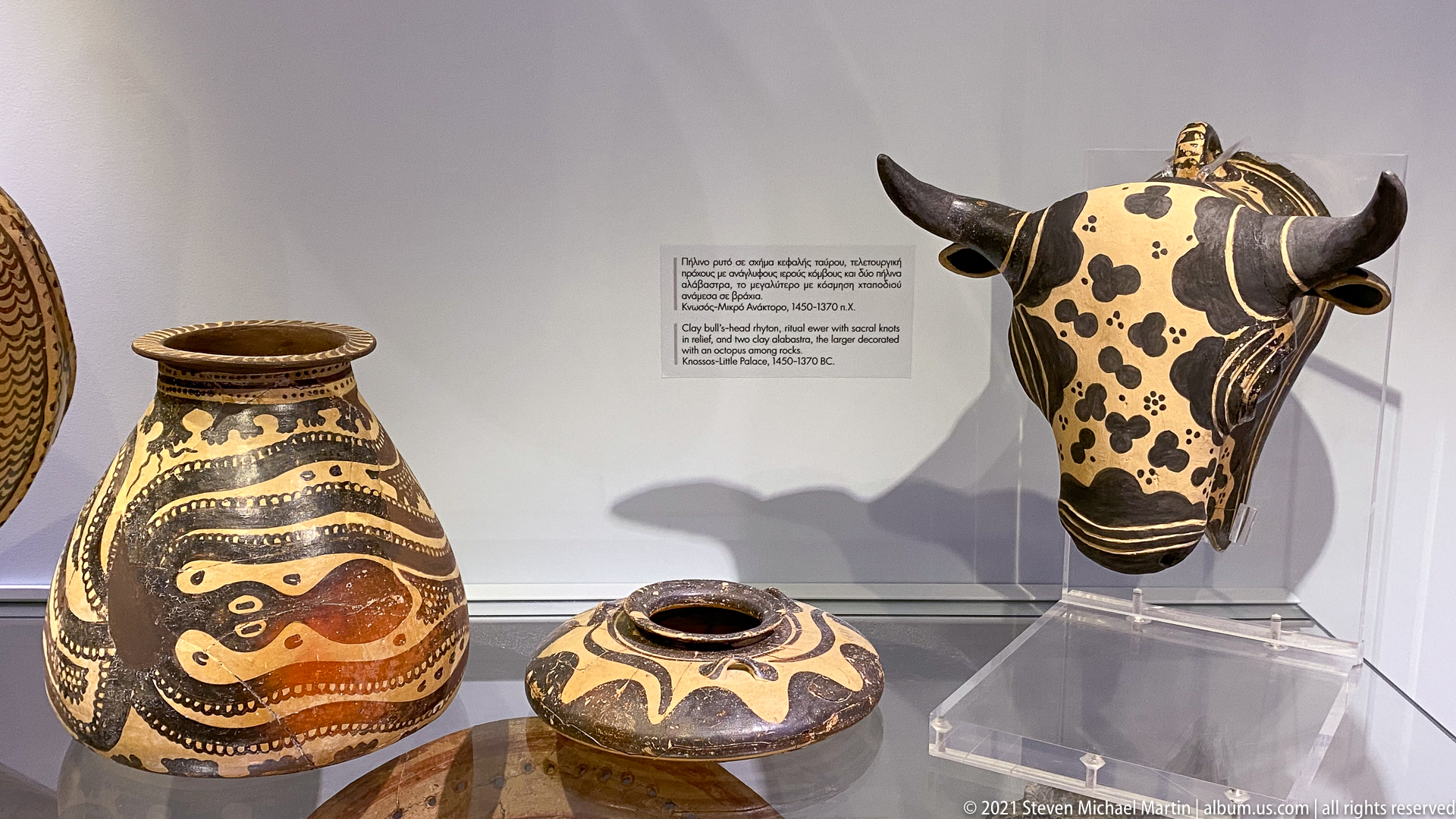
Three painted ceramic forms share a dark ground enlivened by pale and reddish decoration. The tall jar at left carries undulating marine or serpentine motifs, the low round vessel is organized around radiating bands, and the animal-head form at right is covered with spots, stripes, and outlined details. Their juxtaposition highlights the inventive transfer of painted pattern across both conventional and zoomorphic ceramic shapes.
Caption
Three painted ceramic forms share a dark ground enlivened by pale and reddish decoration. The tall jar at left carries undulating marine or serpentine motifs, the low round vessel is organized around radiating bands, and the animal-head form at right is covered with spots, stripes, and outlined details. Their juxtaposition highlights the inventive transfer of painted pattern across both conventional and zoomorphic ceramic shapes.
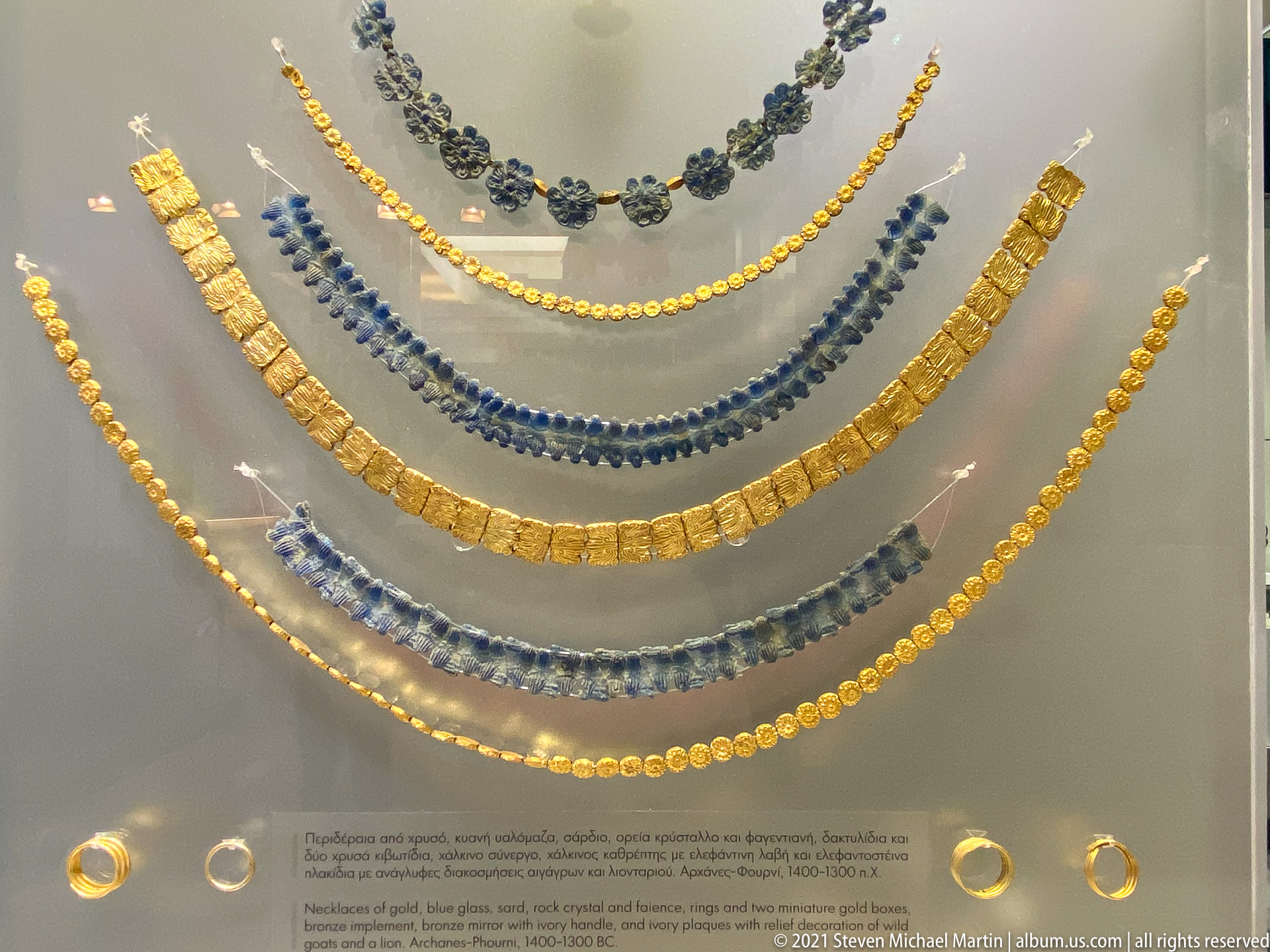
Multiple necklaces are arranged in parallel arcs, alternating gold beads and rectangular plaques with strands of deep blue stone or glass. The display allows the contrast between luminous metal and saturated blue materials to dominate the composition, while several rings are positioned along the lower edge. The close view emphasizes workmanship, repetition, and the deliberate sequencing of bead shapes within ancient personal adornment.
Caption
Multiple necklaces are arranged in parallel arcs, alternating gold beads and rectangular plaques with strands of deep blue stone or glass. The display allows the contrast between luminous metal and saturated blue materials to dominate the composition, while several rings are positioned along the lower edge. The close view emphasizes workmanship, repetition, and the deliberate sequencing of bead shapes within ancient personal adornment.
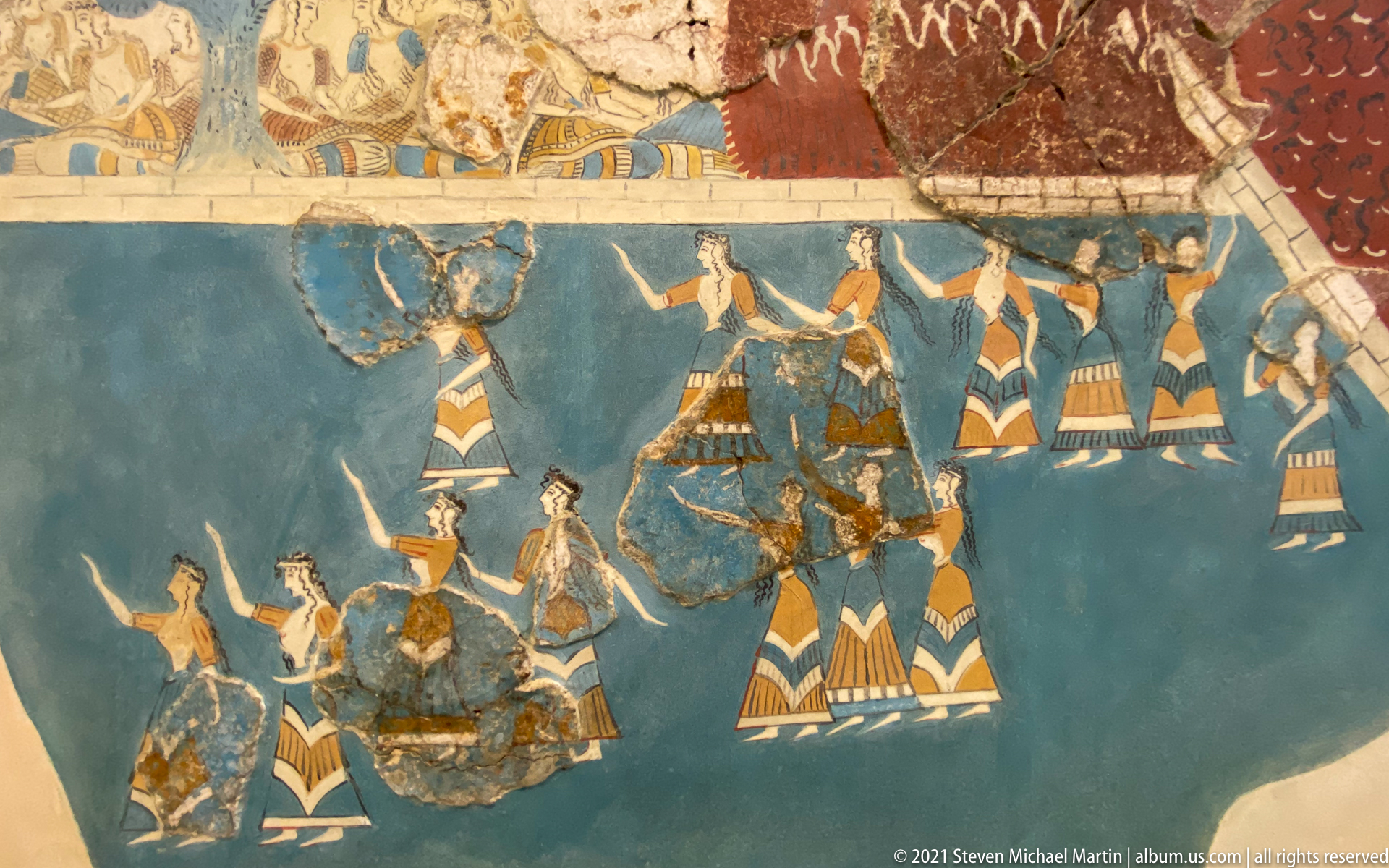
The Sacred Grove and Dance Fresco reconstructs a large Minoan gathering in which numerous women in elaborate patterned skirts participate in a collective ceremonial event. Very few original plaster fragments survive, so much of the displayed scene is restored, yet the clustered figures, raised arms, and blue ground preserve the impression of organized public movement. The composition is one of the principal miniature frescoes associated with Knossos.
Caption
The Sacred Grove and Dance Fresco reconstructs a large Minoan gathering in which numerous women in elaborate patterned skirts participate in a collective ceremonial event. Very few original plaster fragments survive, so much of the displayed scene is restored, yet the clustered figures, raised arms, and blue ground preserve the impression of organized public movement. The composition is one of the principal miniature frescoes associated with Knossos.
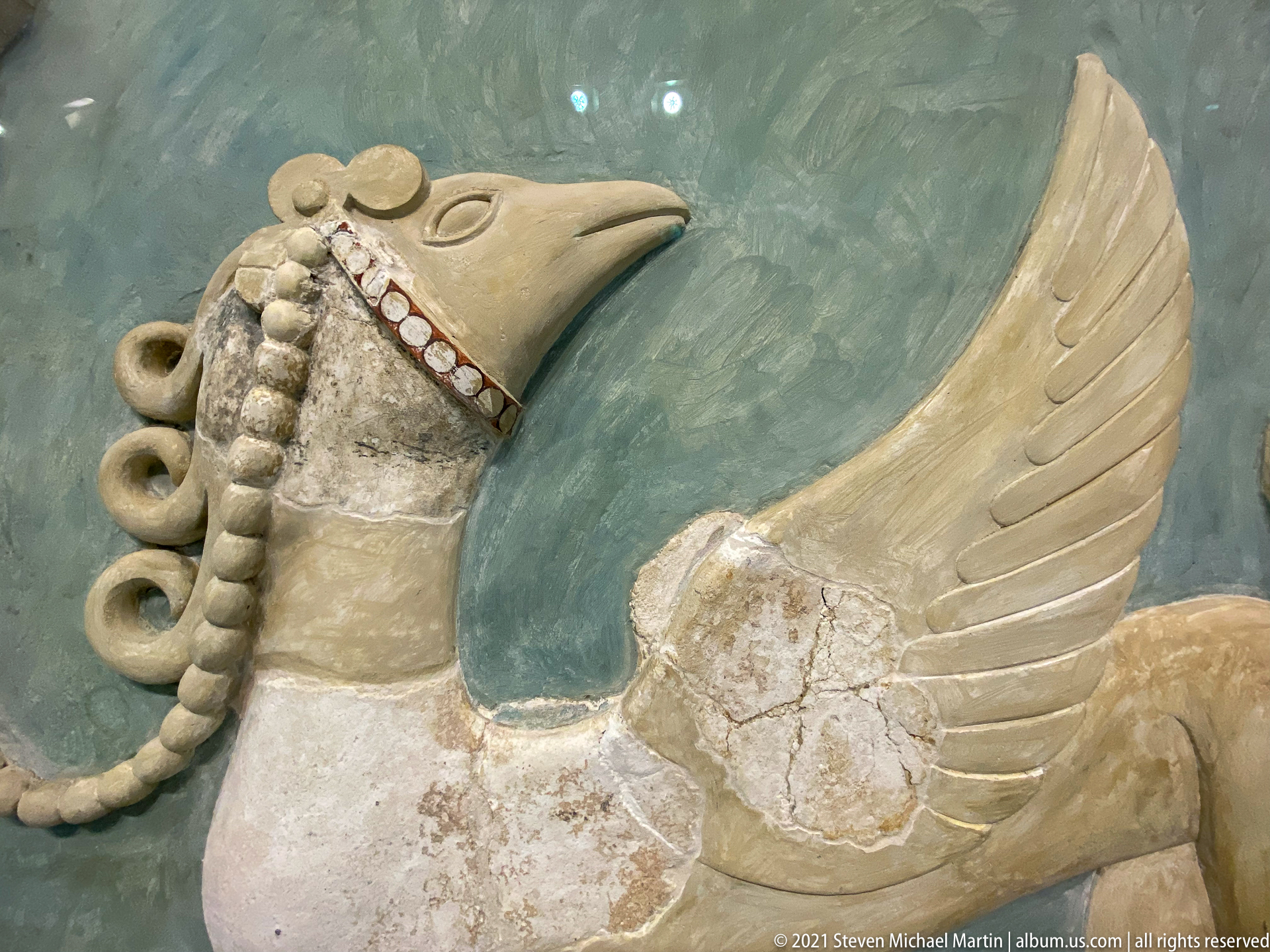
A winged griffin fills the composition in profile, combining a long-beaked head, curling crest, feathered wing, and pale feline body. A red-and-white collar circles the neck, while the muted blue-green background isolates the fantastic creature from surrounding decoration. The close framing concentrates on the griffin’s hybrid anatomy, one of the most distinctive supernatural forms in Minoan elite imagery.
Caption
A winged griffin fills the composition in profile, combining a long-beaked head, curling crest, feathered wing, and pale feline body. A red-and-white collar circles the neck, while the muted blue-green background isolates the fantastic creature from surrounding decoration. The close framing concentrates on the griffin’s hybrid anatomy, one of the most distinctive supernatural forms in Minoan elite imagery.
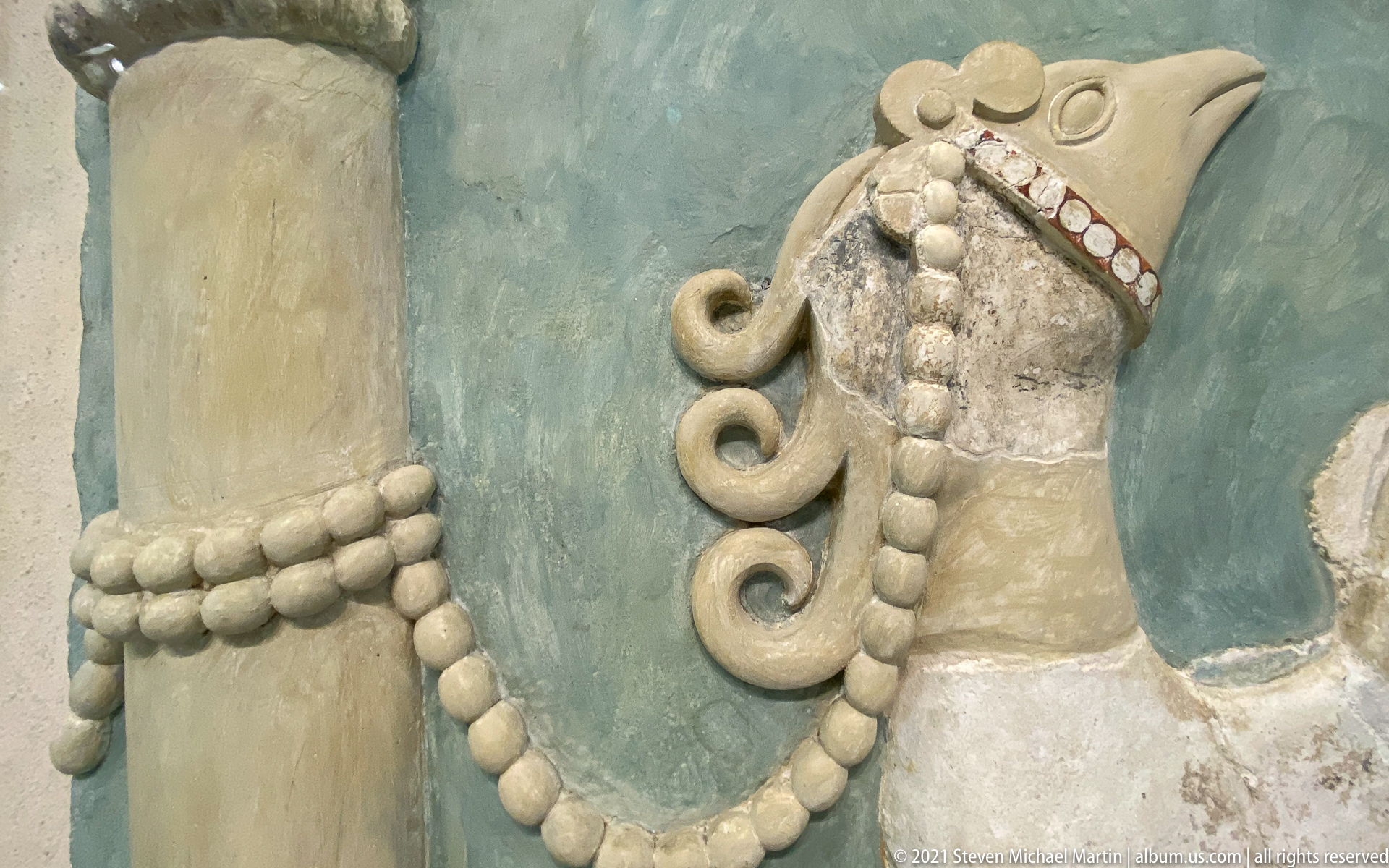
A high-relief griffin from the Great East Hall of the Palace of Knossos stands in profile beside a column, connected to it by a beaded tether. The pale hybrid creature combines a bird-like head and wing with a feline body, while its curling crest and collar add ceremonial detail. The griffins formed part of the architectural decoration of a hall associated by Arthur Evans with official ceremonies.
Caption
A high-relief griffin from the Great East Hall of the Palace of Knossos stands in profile beside a column, connected to it by a beaded tether. The pale hybrid creature combines a bird-like head and wing with a feline body, while its curling crest and collar add ceremonial detail. The griffins formed part of the architectural decoration of a hall associated by Arthur Evans with official ceremonies.
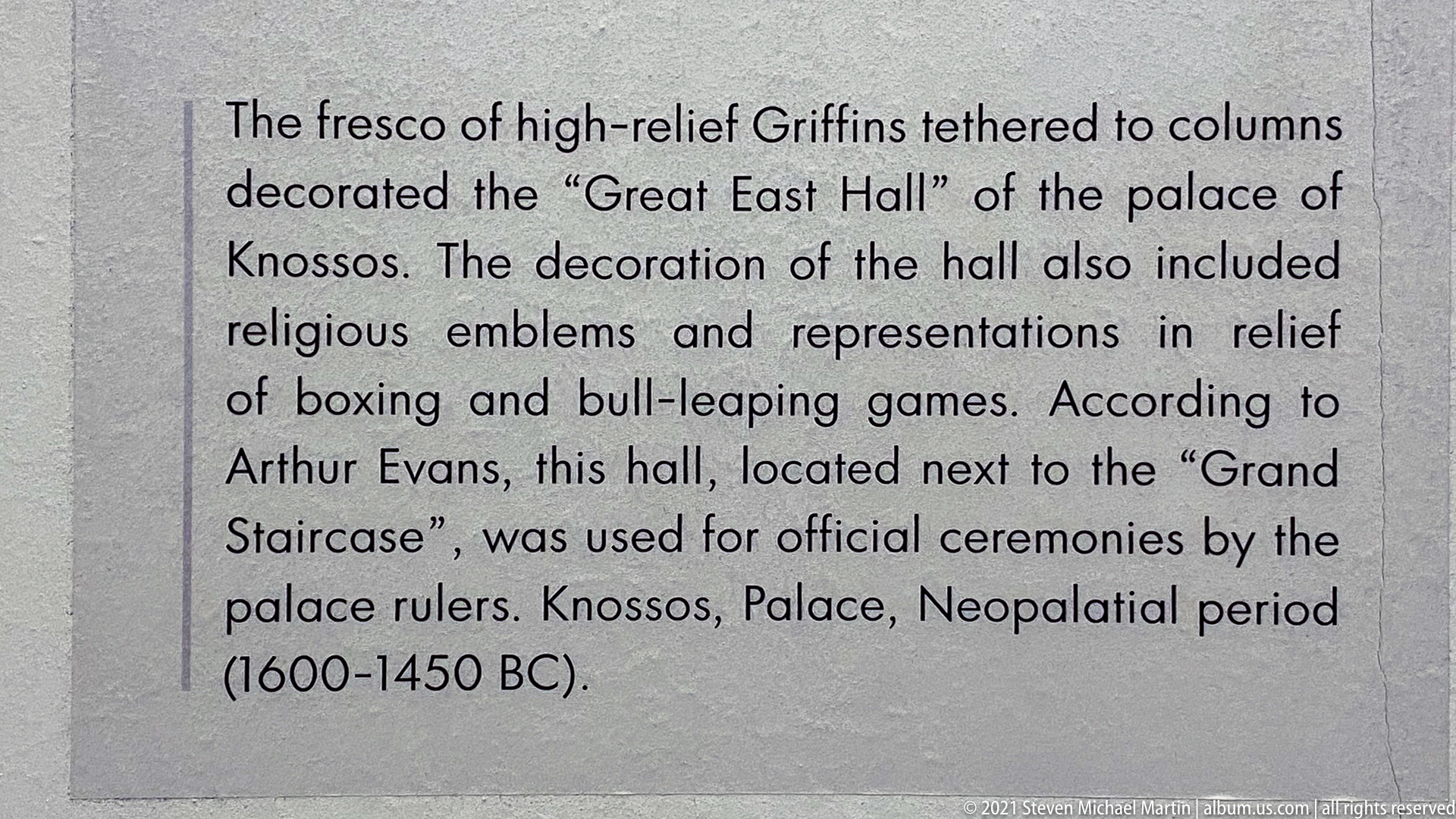
The museum text explains that high-relief griffins tethered to columns decorated the “Great East Hall” of the Palace of Knossos. It also notes relief representations of boxing and bull-leaping and records Arthur Evans’s interpretation of the hall as a setting for official ceremonies. The panel dates the context to the Neopalatial period, 1600–1450 BC, providing direct interpretation for the adjacent fresco reconstruction.
Caption
The museum text explains that high-relief griffins tethered to columns decorated the “Great East Hall” of the Palace of Knossos. It also notes relief representations of boxing and bull-leaping and records Arthur Evans’s interpretation of the hall as a setting for official ceremonies. The panel dates the context to the Neopalatial period, 1600–1450 BC, providing direct interpretation for the adjacent fresco reconstruction.

A richly dressed woman appears in profile, seated and extending one arm to hold a tall stemmed cup. Dark curling hair, a pale face with a large outlined eye, jewelry, and patterned clothing give the figure a formal, courtly presence. The surviving painted fragments and reconstructed areas preserve a moment of poised gesture, with the vessel serving as the clearest focus of her action.
Caption
A richly dressed woman appears in profile, seated and extending one arm to hold a tall stemmed cup. Dark curling hair, a pale face with a large outlined eye, jewelry, and patterned clothing give the figure a formal, courtly presence. The surviving painted fragments and reconstructed areas preserve a moment of poised gesture, with the vessel serving as the clearest focus of her action.
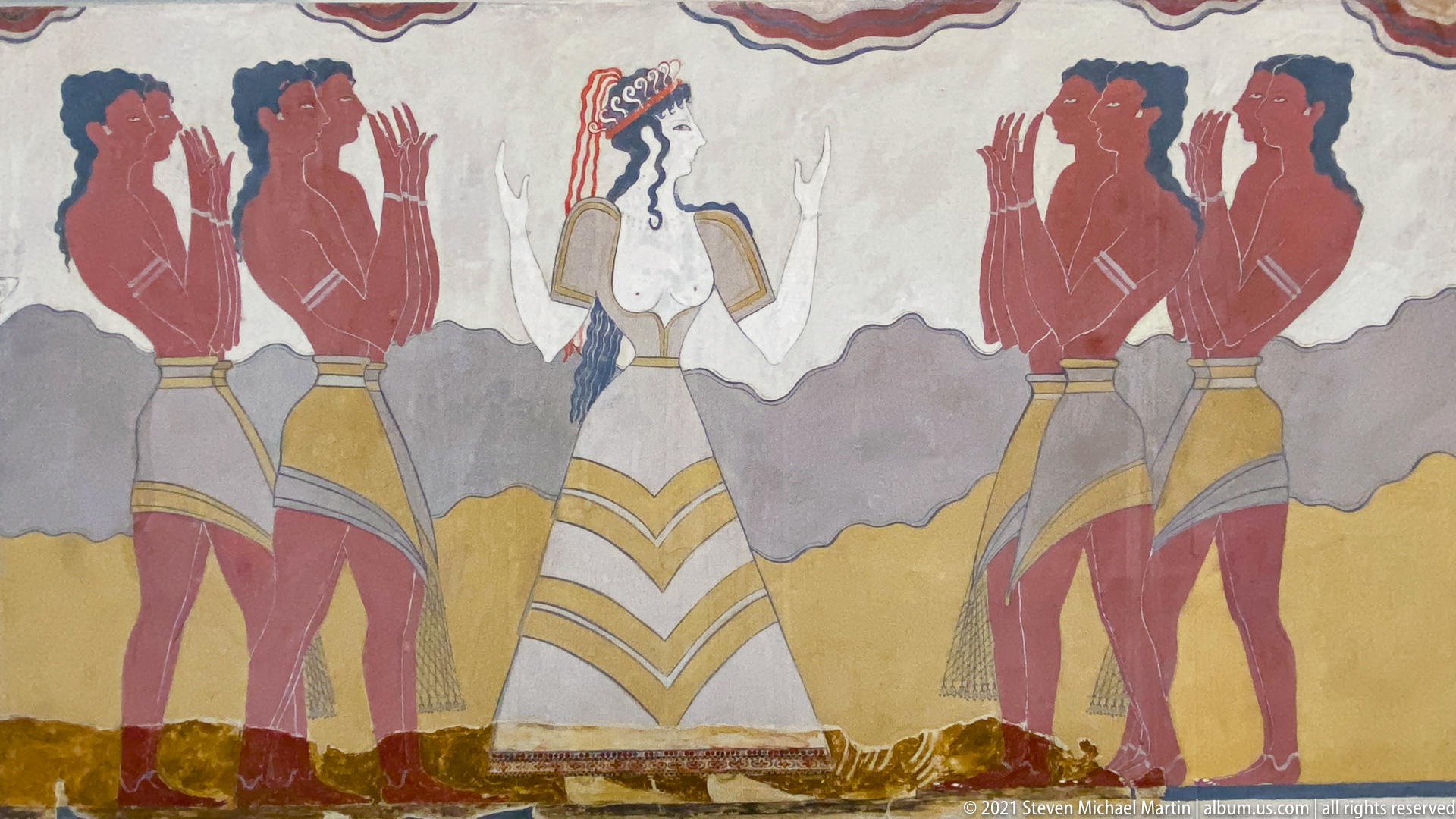
A pale-skinned female figure stands at the center of a reconstructed Minoan fresco, framed by pairs of red-skinned male figures approaching from both sides. Her long patterned skirt and raised hands contrast with the men’s short garments and repeated gestures. The symmetrical arrangement creates a ceremonial focus around the woman, while surviving fragments interrupt the modern reconstruction and reveal the fresco’s archaeological condition.
Caption
A pale-skinned female figure stands at the center of a reconstructed Minoan fresco, framed by pairs of red-skinned male figures approaching from both sides. Her long patterned skirt and raised hands contrast with the men’s short garments and repeated gestures. The symmetrical arrangement creates a ceremonial focus around the woman, while surviving fragments interrupt the modern reconstruction and reveal the fresco’s archaeological condition.
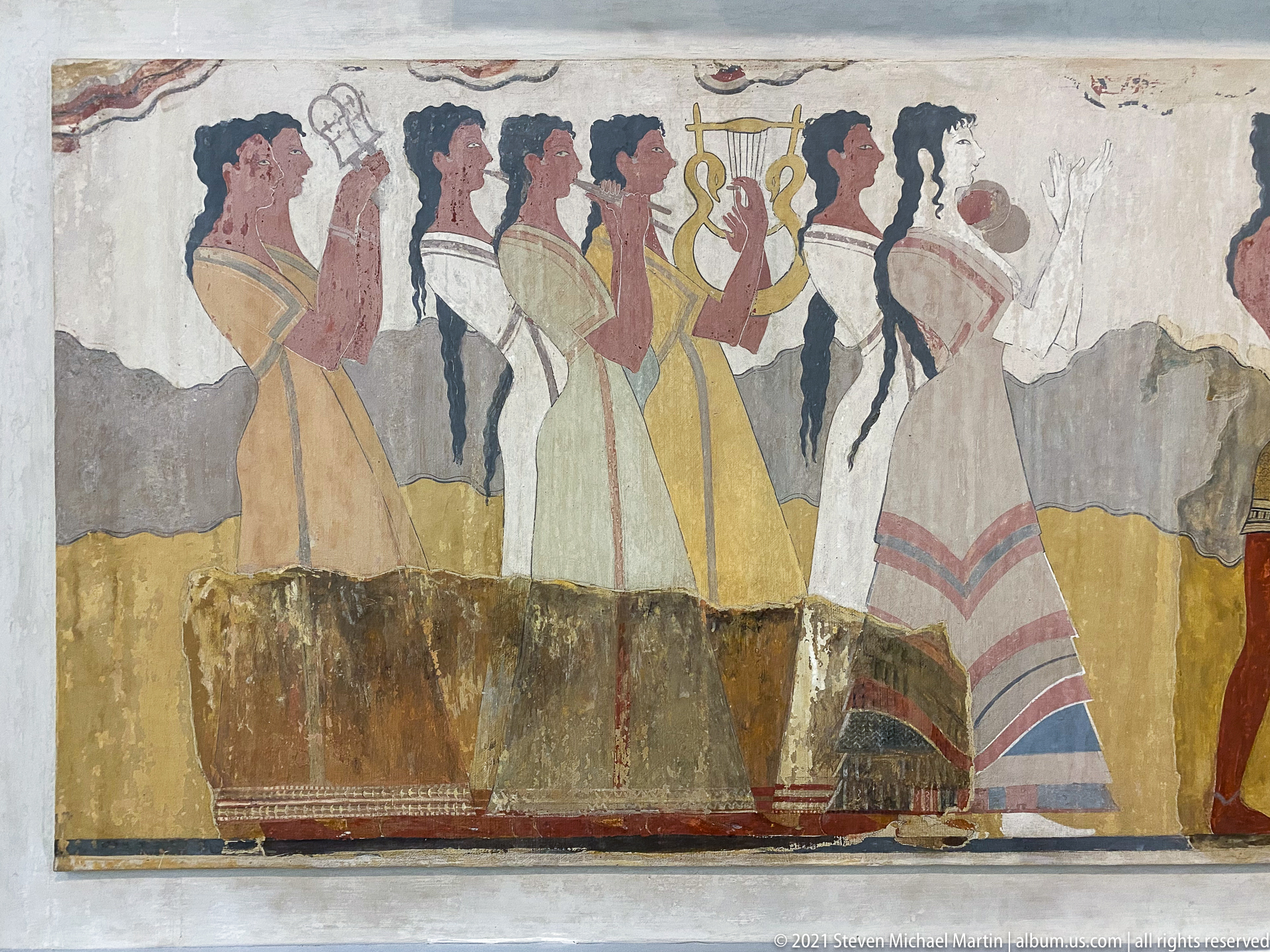
This section of the Procession Fresco from the Palace of Knossos presents elaborately dressed figures advancing in profile while carrying or raising objects. Long dark hair, patterned garments, jewelry, and repeated directional poses create the measured rhythm of a formal procession. The displayed reconstruction integrates surviving painted-plaster fragments into complete bodies, allowing the ceremonial sequence to be read while still making the fragmentary archaeological evidence visible.
Caption
This section of the Procession Fresco from the Palace of Knossos presents elaborately dressed figures advancing in profile while carrying or raising objects. Long dark hair, patterned garments, jewelry, and repeated directional poses create the measured rhythm of a formal procession. The displayed reconstruction integrates surviving painted-plaster fragments into complete bodies, allowing the ceremonial sequence to be read while still making the fragmentary archaeological evidence visible.
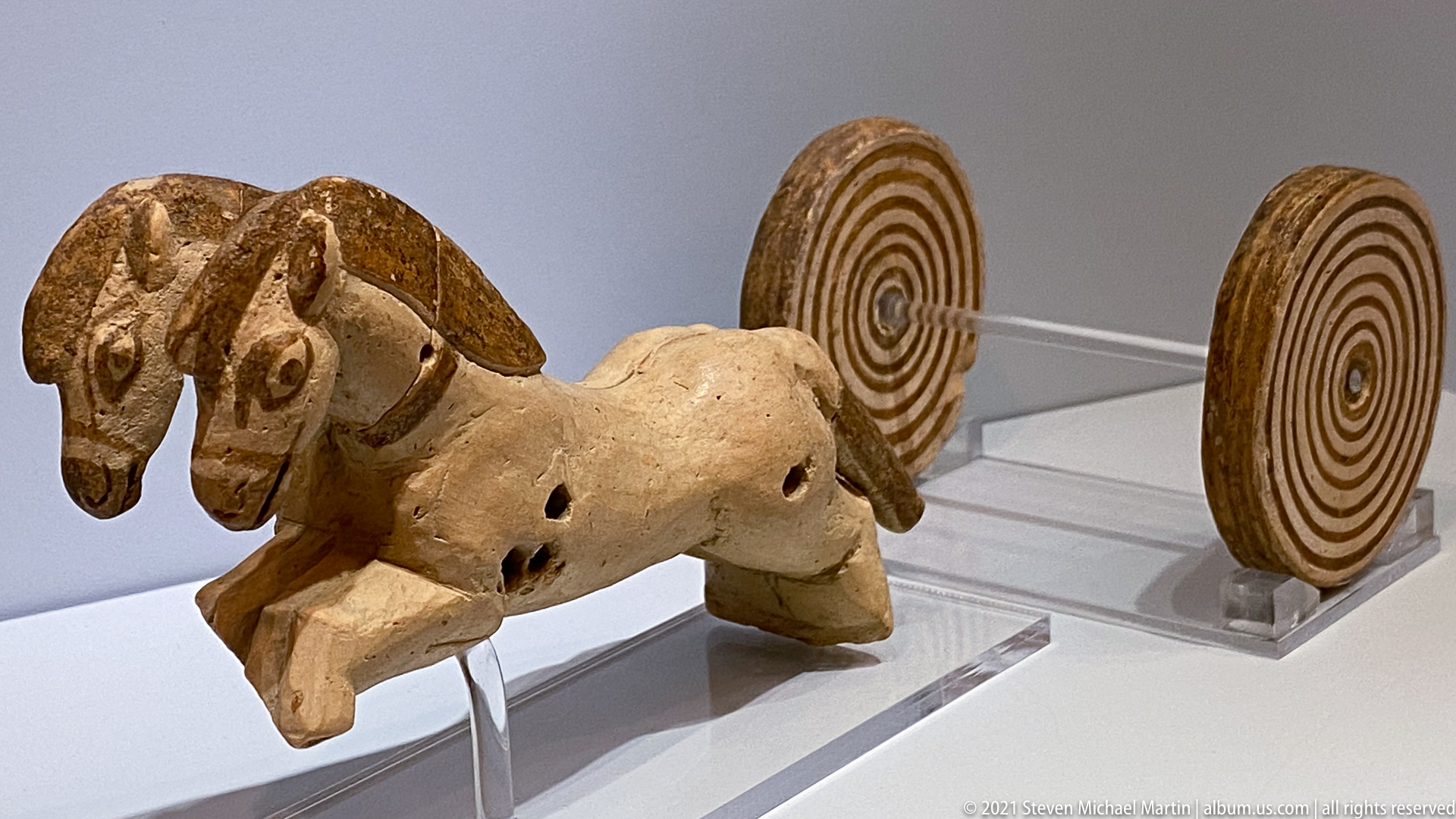
A compact terracotta animal with curled horns is mounted between large disk-shaped wheels painted with concentric circles. The modeled head, short legs, and rounded body suggest a ram or similarly horned quadruped, while the axle-and-wheel arrangement turns the figurine into a miniature movable object. Its combination of animal modeling and simple mechanical construction distinguishes it from static zoomorphic vessels and figurines nearby.
Caption
A compact terracotta animal with curled horns is mounted between large disk-shaped wheels painted with concentric circles. The modeled head, short legs, and rounded body suggest a ram or similarly horned quadruped, while the axle-and-wheel arrangement turns the figurine into a miniature movable object. Its combination of animal modeling and simple mechanical construction distinguishes it from static zoomorphic vessels and figurines nearby.
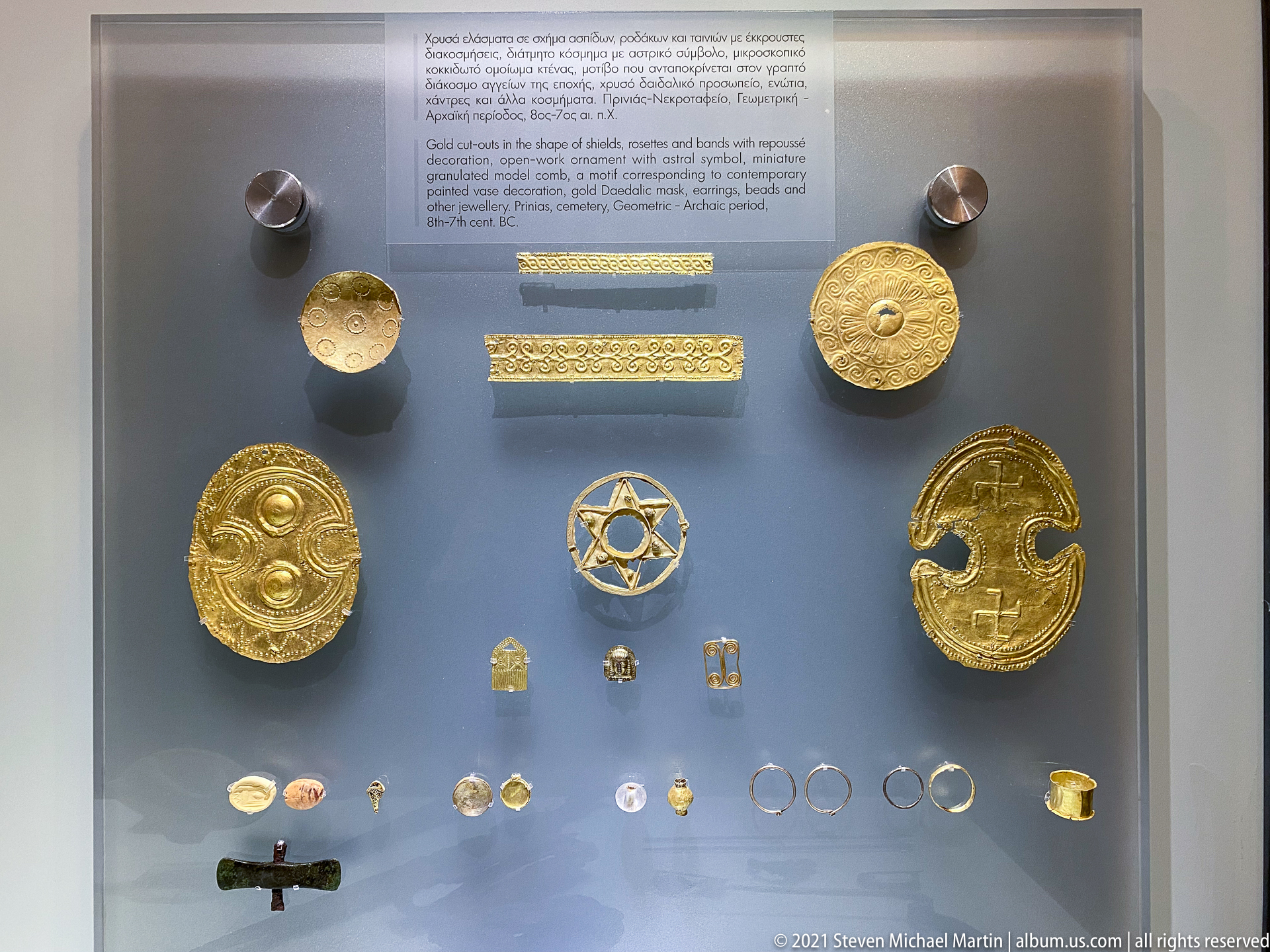
A museum case assembles thin gold cut-outs and sheet ornaments with rings and smaller jewelry components. Large circular and crescent-like plaques dominate the upper display, while a star-shaped element, embossed strips, and tiny fittings demonstrate a wide range of goldworking techniques. The arrangement emphasizes the lightness of sheet-gold ornament and the precision of repoussé, cutting, and patterned decoration.
Caption
A museum case assembles thin gold cut-outs and sheet ornaments with rings and smaller jewelry components. Large circular and crescent-like plaques dominate the upper display, while a star-shaped element, embossed strips, and tiny fittings demonstrate a wide range of goldworking techniques. The arrangement emphasizes the lightness of sheet-gold ornament and the precision of repoussé, cutting, and patterned decoration.
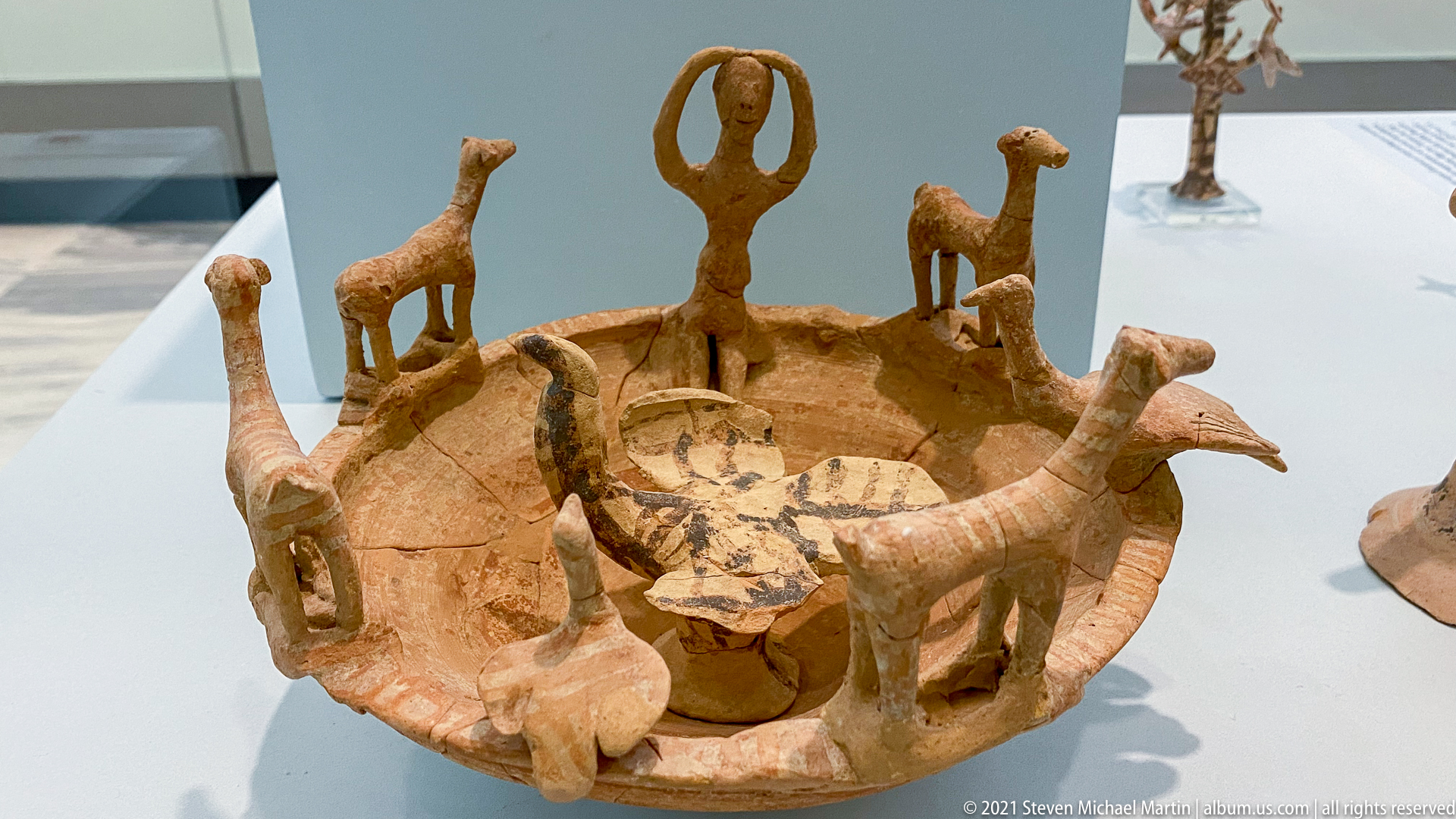
A shallow circular terracotta model is crowded with modeled animals and human figures around its rim and interior. At the center rear, a standing person raises both arms overhead, while long-necked quadrupeds and other figures face inward toward a central painted feature. The miniature creates a densely populated ritual or communal scene, though the exact activity represented cannot be determined from the proof sheet alone.
Caption
A shallow circular terracotta model is crowded with modeled animals and human figures around its rim and interior. At the center rear, a standing person raises both arms overhead, while long-necked quadrupeds and other figures face inward toward a central painted feature. The miniature creates a densely populated ritual or communal scene, though the exact activity represented cannot be determined from the proof sheet alone.
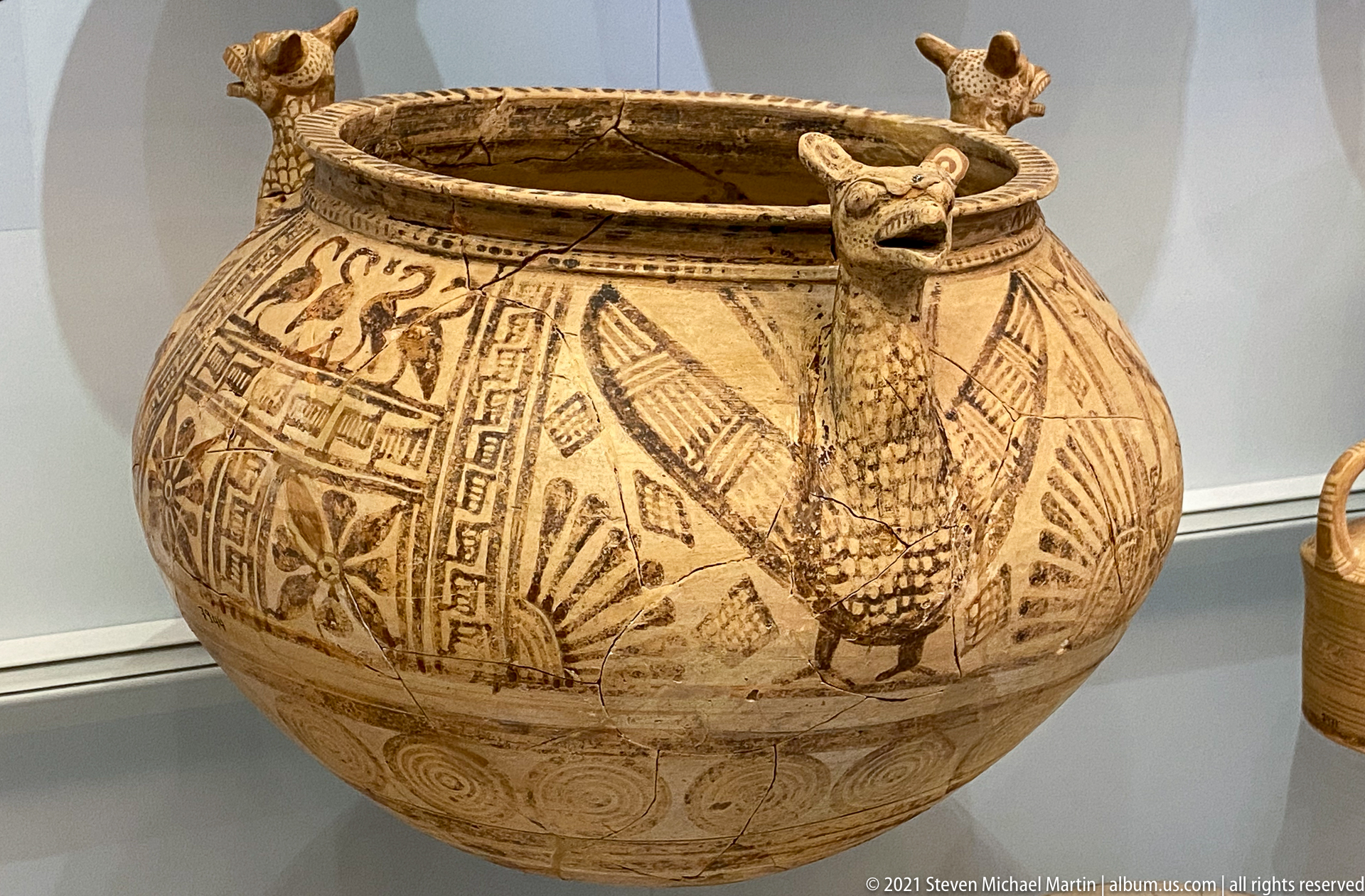
A large rounded ceramic vessel is covered with dense geometric decoration organized into horizontal and vertical panels. A modeled bird projects from the shoulder beneath the rim, its long neck and feather-like painted pattern integrated into the vessel’s surface design. Spirals, hatched triangles, and meanders fill the surrounding fields, combining sculptural attachment with an exceptionally busy painted program.
Caption
A large rounded ceramic vessel is covered with dense geometric decoration organized into horizontal and vertical panels. A modeled bird projects from the shoulder beneath the rim, its long neck and feather-like painted pattern integrated into the vessel’s surface design. Spirals, hatched triangles, and meanders fill the surrounding fields, combining sculptural attachment with an exceptionally busy painted program.
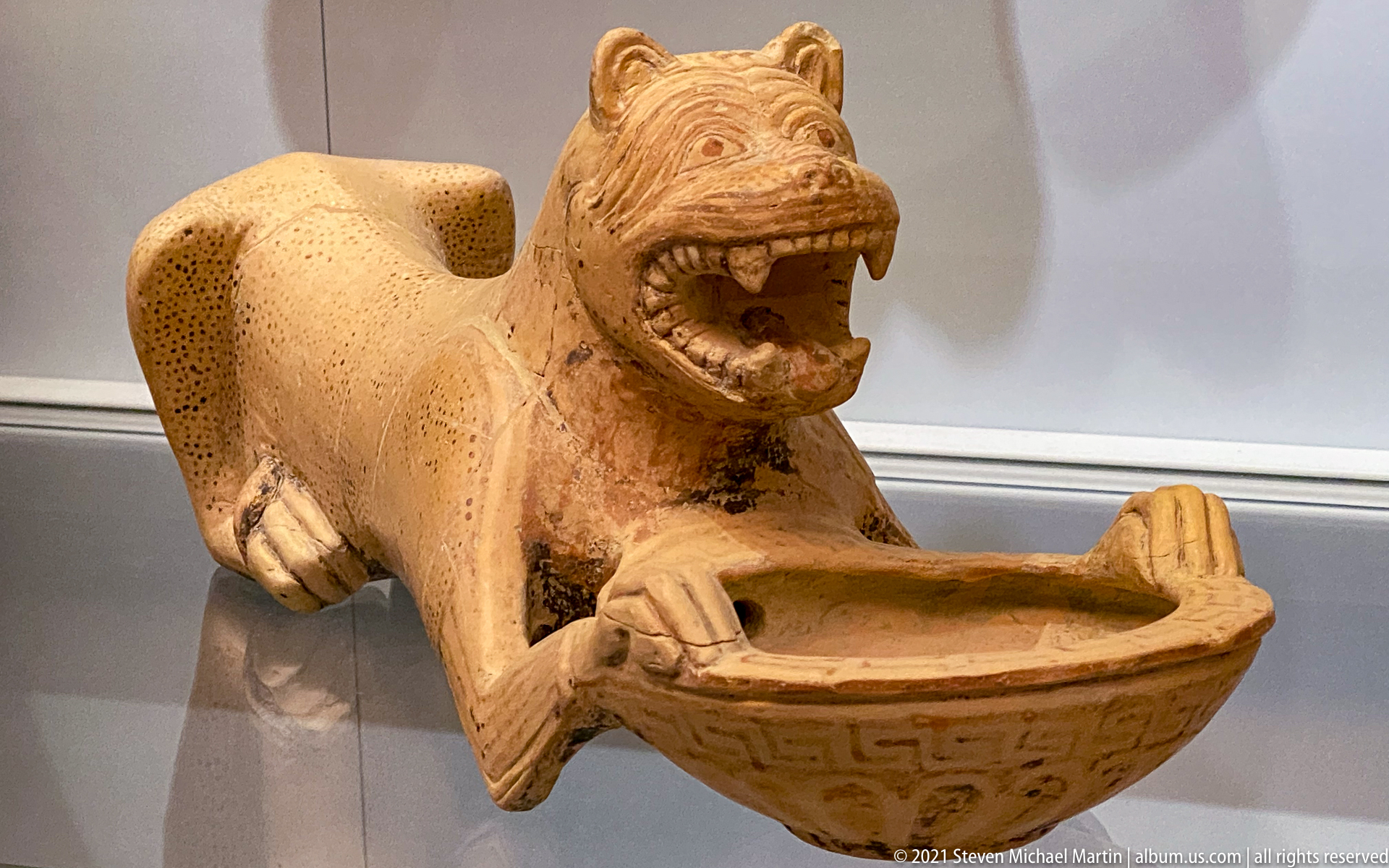
A crouching feline forms the body and support of an unusual terracotta vessel, its forepaws gripping the rim of a shallow bowl. The animal’s open mouth, bared teeth, rounded ears, and dotted coat create a forceful lion-like appearance, while the patterned bowl projects forward from its chest. The combination of sculpted predator and functional container makes the object both expressive and technically inventive.
Caption
A crouching feline forms the body and support of an unusual terracotta vessel, its forepaws gripping the rim of a shallow bowl. The animal’s open mouth, bared teeth, rounded ears, and dotted coat create a forceful lion-like appearance, while the patterned bowl projects forward from its chest. The combination of sculpted predator and functional container makes the object both expressive and technically inventive.
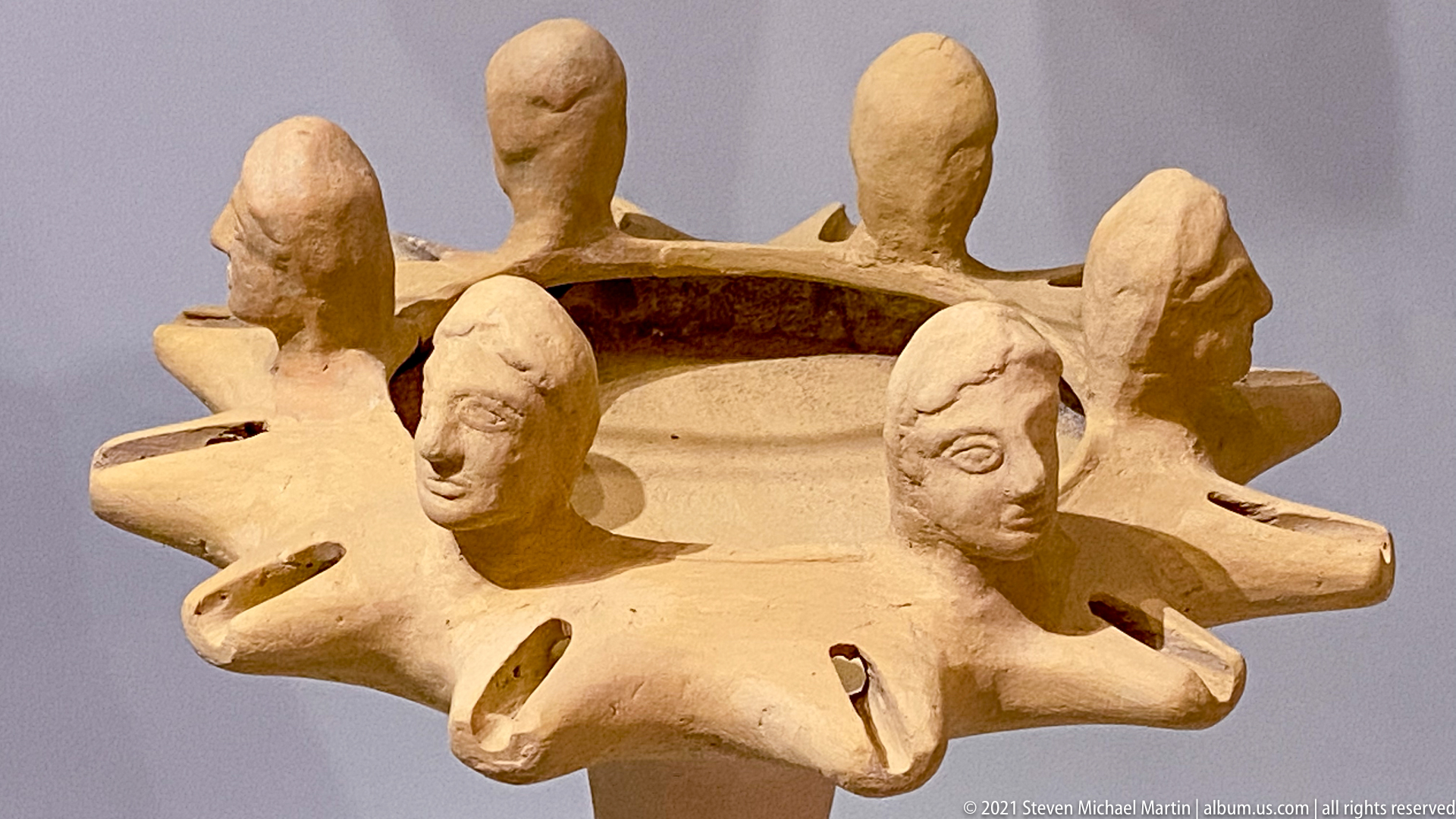
A circular terracotta vessel is surrounded by projecting points and a ring of modeled human heads, some facing outward and others inward. Tall rounded elements rise from the rear rim, while openings between the projections create a crown-like silhouette. The repeated faces transform the vessel into a strongly figurative object whose ceremonial or votive purpose is suggested by its elaborate construction but not visually proven.
Caption
A circular terracotta vessel is surrounded by projecting points and a ring of modeled human heads, some facing outward and others inward. Tall rounded elements rise from the rear rim, while openings between the projections create a crown-like silhouette. The repeated faces transform the vessel into a strongly figurative object whose ceremonial or votive purpose is suggested by its elaborate construction but not visually proven.
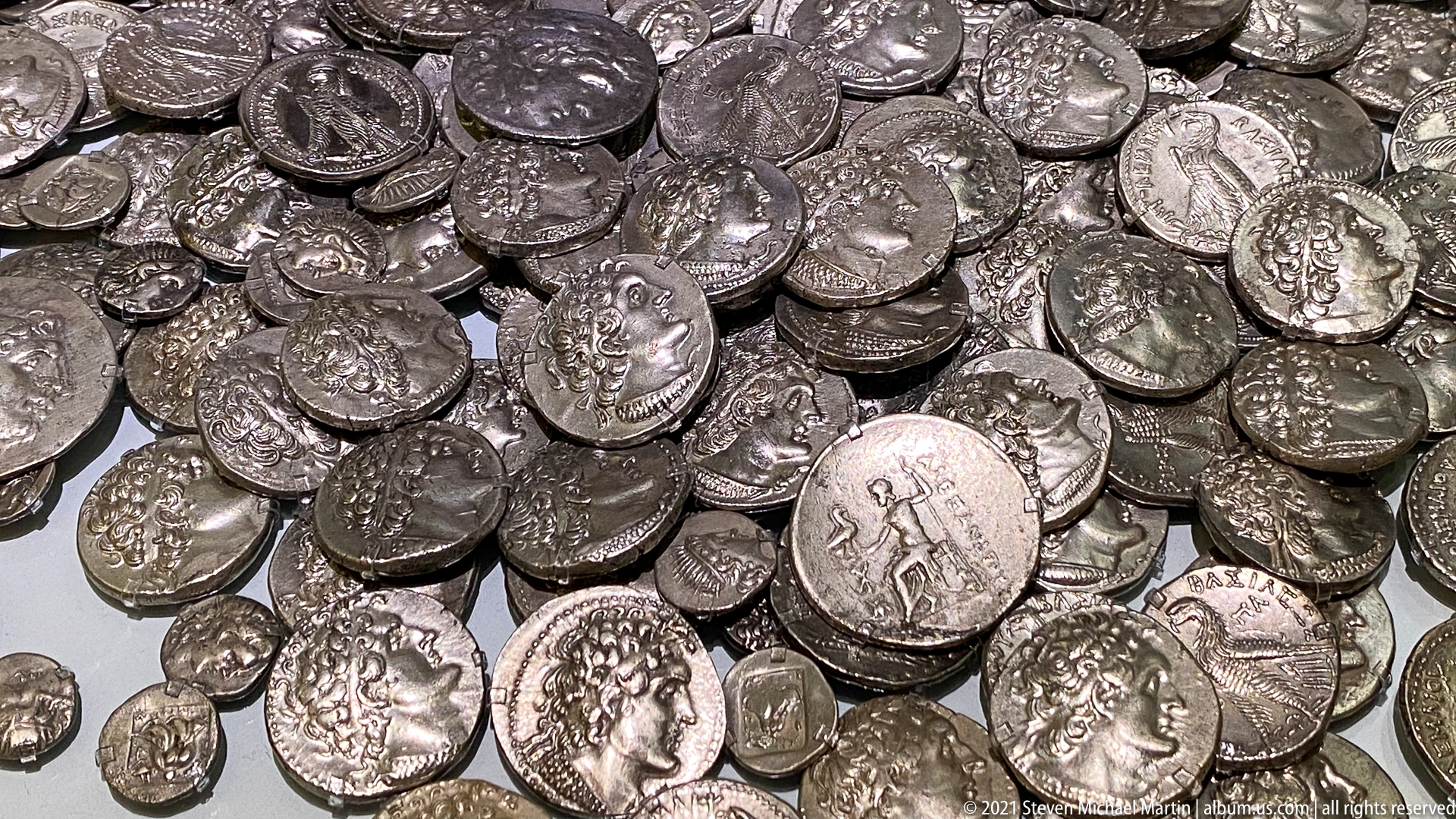
A dense mass of ancient silver coins fills the frame, overlapping in layers that expose both portrait heads and varied reverse designs. Differences in diameter, edge shape, centering, and wear reveal the hand-struck character of the coinage, while repeated profile busts create a strong visual rhythm across the hoard. The close view favors numismatic detail over the archaeological container or broader display context.
Caption
A dense mass of ancient silver coins fills the frame, overlapping in layers that expose both portrait heads and varied reverse designs. Differences in diameter, edge shape, centering, and wear reveal the hand-struck character of the coinage, while repeated profile busts create a strong visual rhythm across the hoard. The close view favors numismatic detail over the archaeological container or broader display context.
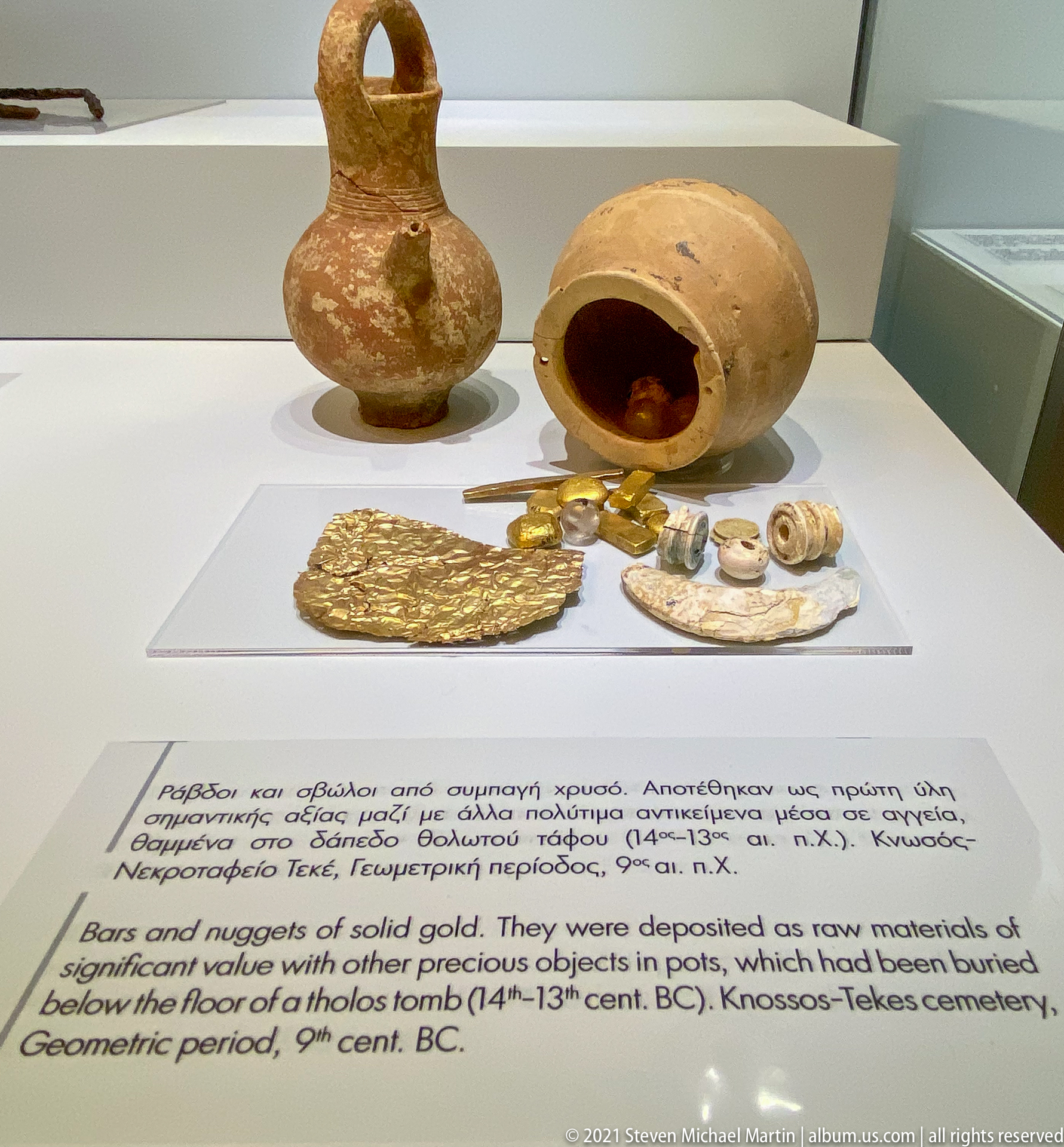
Two ceramic containers lie beside a spread of gold coins and other small valuables in a display explaining a concealed hoard. The museum label identifies the coins as Byzantine gold solidi and notes that they were deposited as raw material alongside precious objects in pots hidden beneath the floor of a tholos tomb at Gortyna. The arrangement preserves both the wealth of the deposit and its archaeological context.
Caption
Two ceramic containers lie beside a spread of gold coins and other small valuables in a display explaining a concealed hoard. The museum label identifies the coins as Byzantine gold solidi and notes that they were deposited as raw material alongside precious objects in pots hidden beneath the floor of a tholos tomb at Gortyna. The arrangement preserves both the wealth of the deposit and its archaeological context.
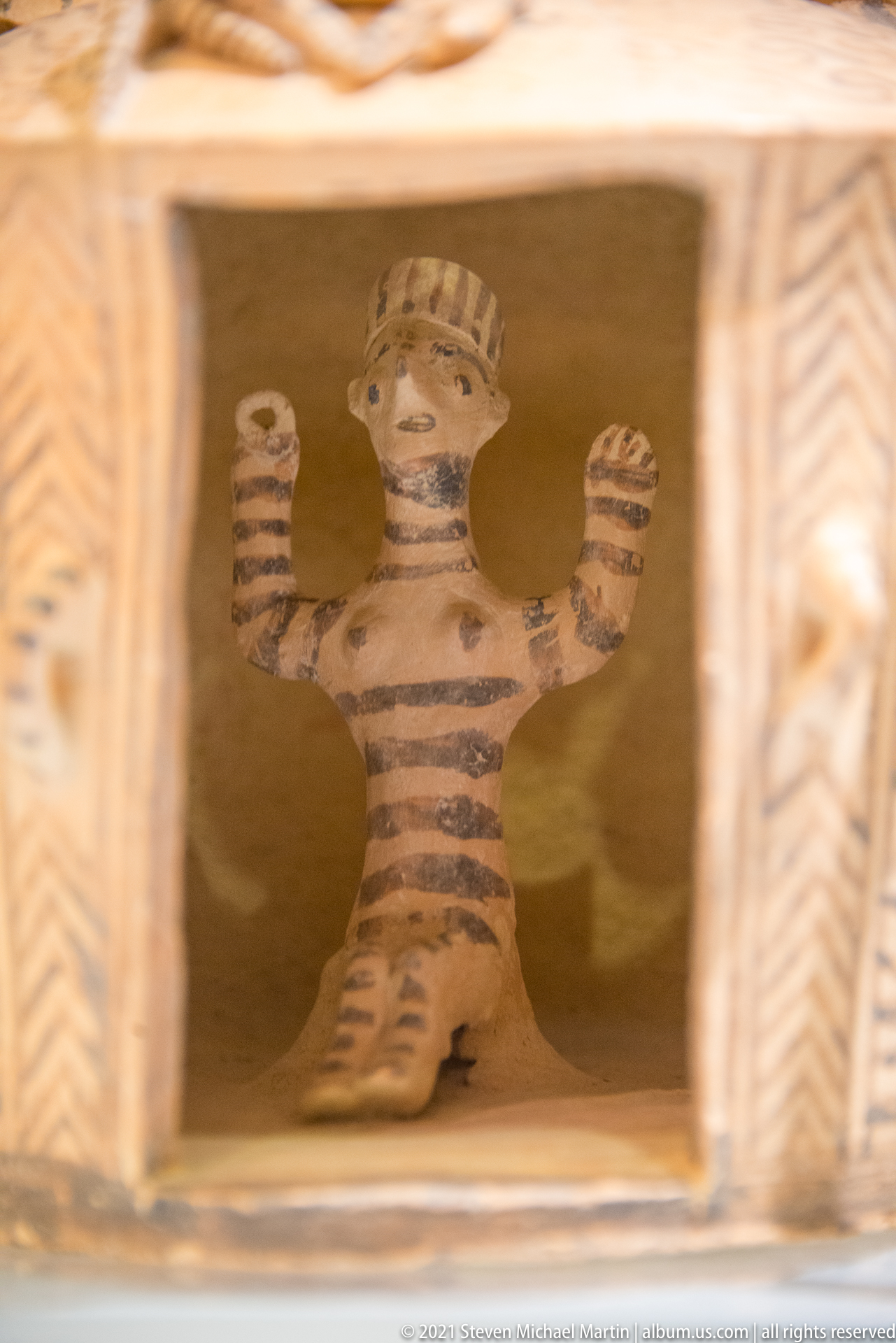
A small terracotta human figure stands within the rectangular opening of a miniature architectural model, both arms raised to shoulder height. Dark horizontal bands stripe the torso, arms, and head, while painted geometric patterns cover the surrounding frame. The tight view concentrates on the figure’s frontal pose and its deliberate placement inside an enclosed built setting, suggesting a ritualized scene rather than an isolated figurine.
Caption
A small terracotta human figure stands within the rectangular opening of a miniature architectural model, both arms raised to shoulder height. Dark horizontal bands stripe the torso, arms, and head, while painted geometric patterns cover the surrounding frame. The tight view concentrates on the figure’s frontal pose and its deliberate placement inside an enclosed built setting, suggesting a ritualized scene rather than an isolated figurine.
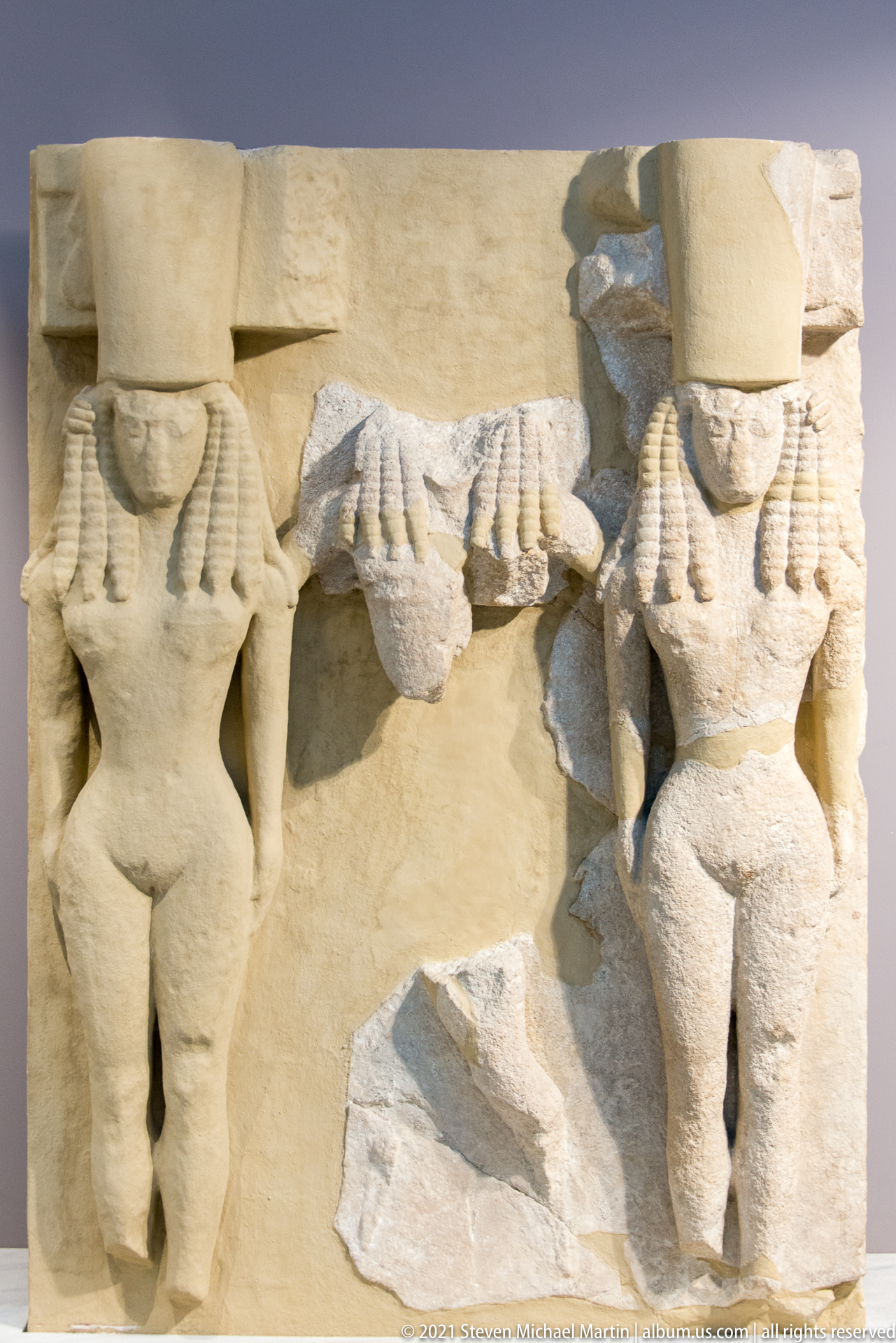
Two carved female figures survive at either side of a fragmentary architectural composition, each standing frontally beneath a heavy rectangular block. Their long, vertically patterned hair or headdress falls beside the face and shoulders, while the central portion between them is largely lost. The surviving arrangement suggests that the figures served as decorative supports within a larger stone monument rather than as freestanding statues.
Caption
Two carved female figures survive at either side of a fragmentary architectural composition, each standing frontally beneath a heavy rectangular block. Their long, vertically patterned hair or headdress falls beside the face and shoulders, while the central portion between them is largely lost. The surviving arrangement suggests that the figures served as decorative supports within a larger stone monument rather than as freestanding statues.
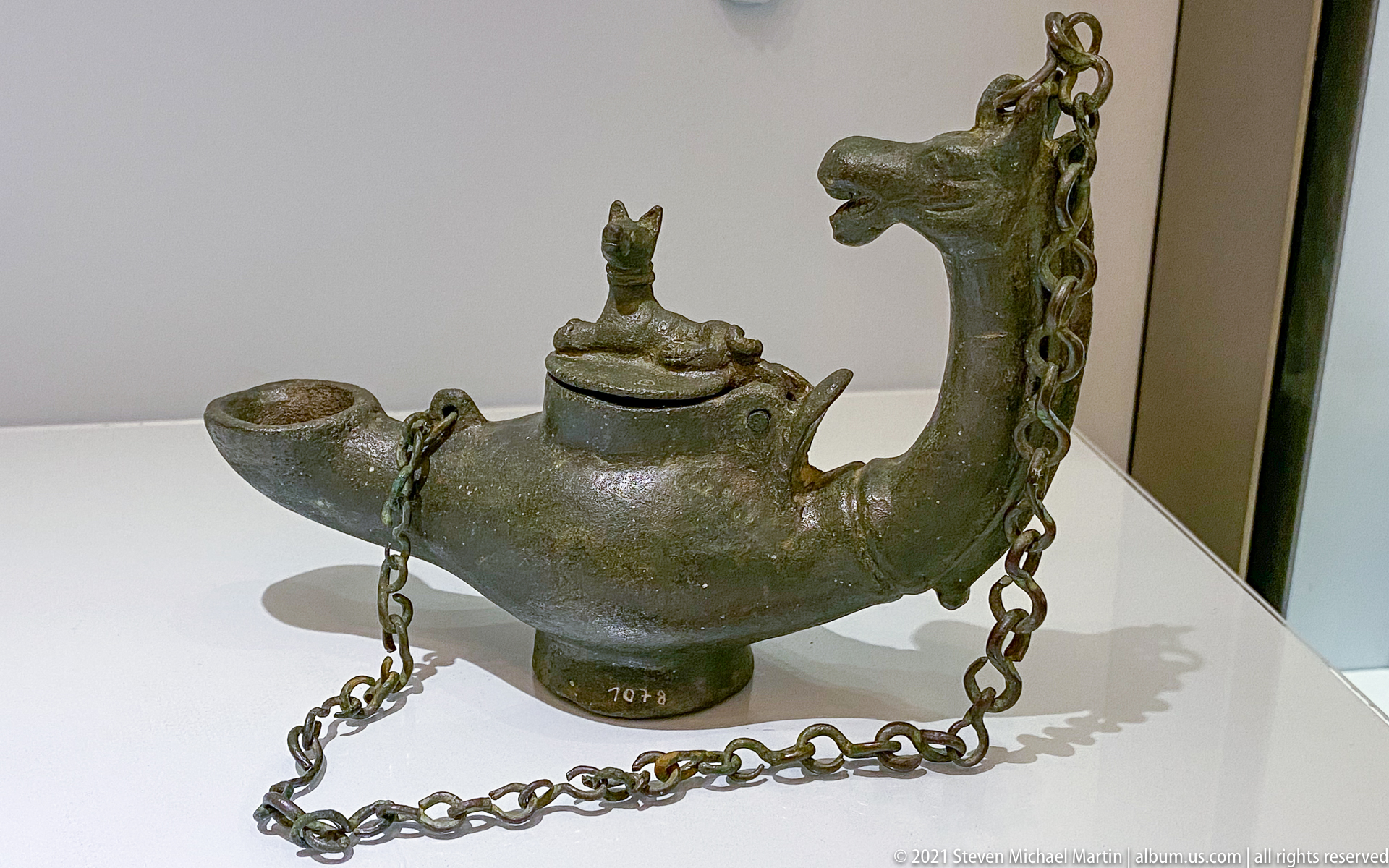
This bronze hanging oil lamp combines a long projecting nozzle with a tall zoomorphic handle and a small modeled animal on its hinged lid. Suspension chains attached around the body allowed the lamp to hang, while the green-brown patina records the metal’s age. The object joins practical lighting technology with carefully modeled animal ornament, making its functional fittings an integral part of the sculptural design.
Caption
This bronze hanging oil lamp combines a long projecting nozzle with a tall zoomorphic handle and a small modeled animal on its hinged lid. Suspension chains attached around the body allowed the lamp to hang, while the green-brown patina records the metal’s age. The object joins practical lighting technology with carefully modeled animal ornament, making its functional fittings an integral part of the sculptural design.
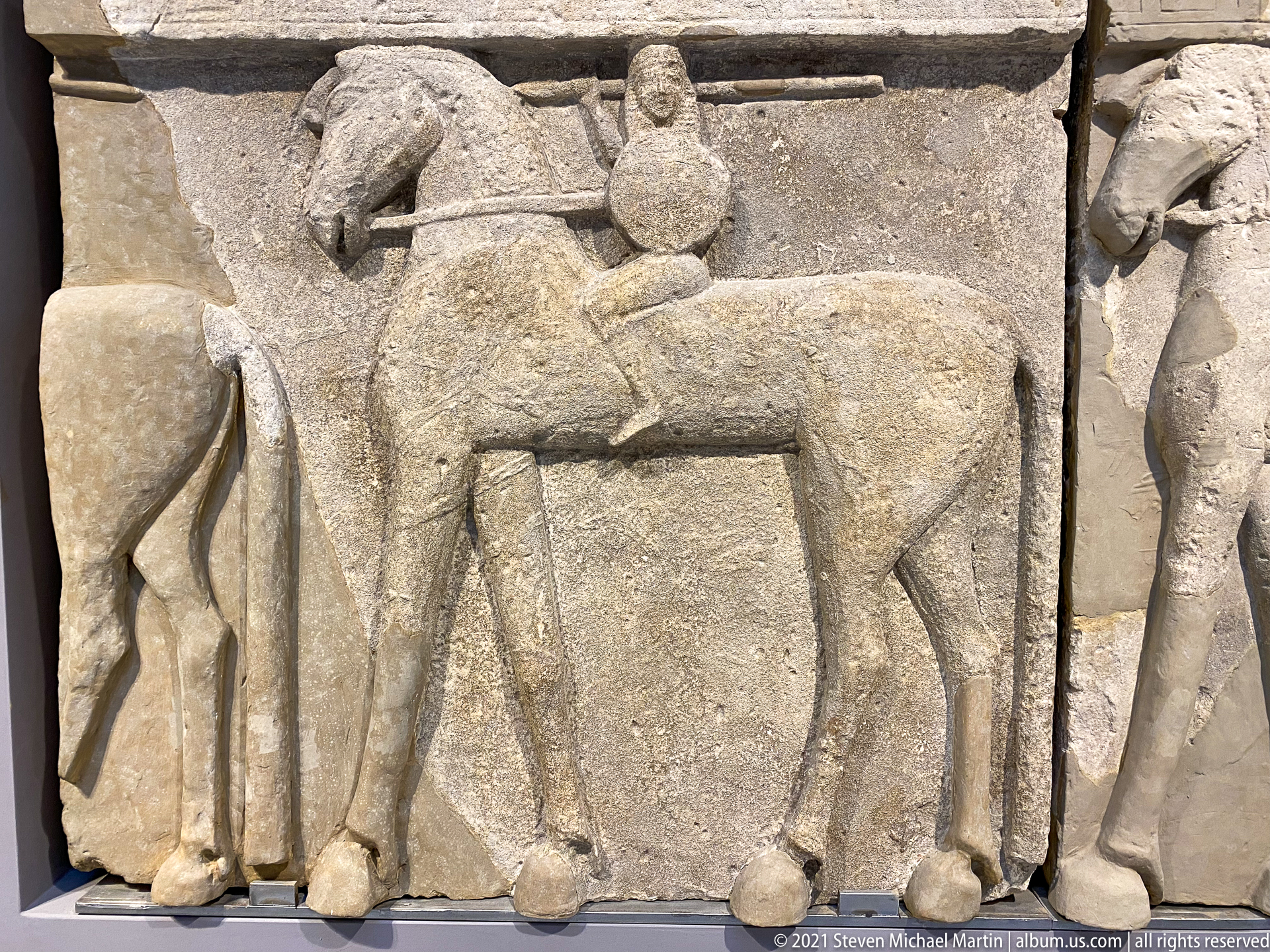
A horse and rider occupy the center of a worn stone relief, the rider seated upright while the horse advances in profile. Additional fragmentary figures survive at both edges, suggesting that the mounted figure belonged to a larger procession or narrative composition. Weathering has softened facial and costume details, but the horse’s legs, body, and the rider’s posture remain readily legible.
Caption
A horse and rider occupy the center of a worn stone relief, the rider seated upright while the horse advances in profile. Additional fragmentary figures survive at both edges, suggesting that the mounted figure belonged to a larger procession or narrative composition. Weathering has softened facial and costume details, but the horse’s legs, body, and the rider’s posture remain readily legible.
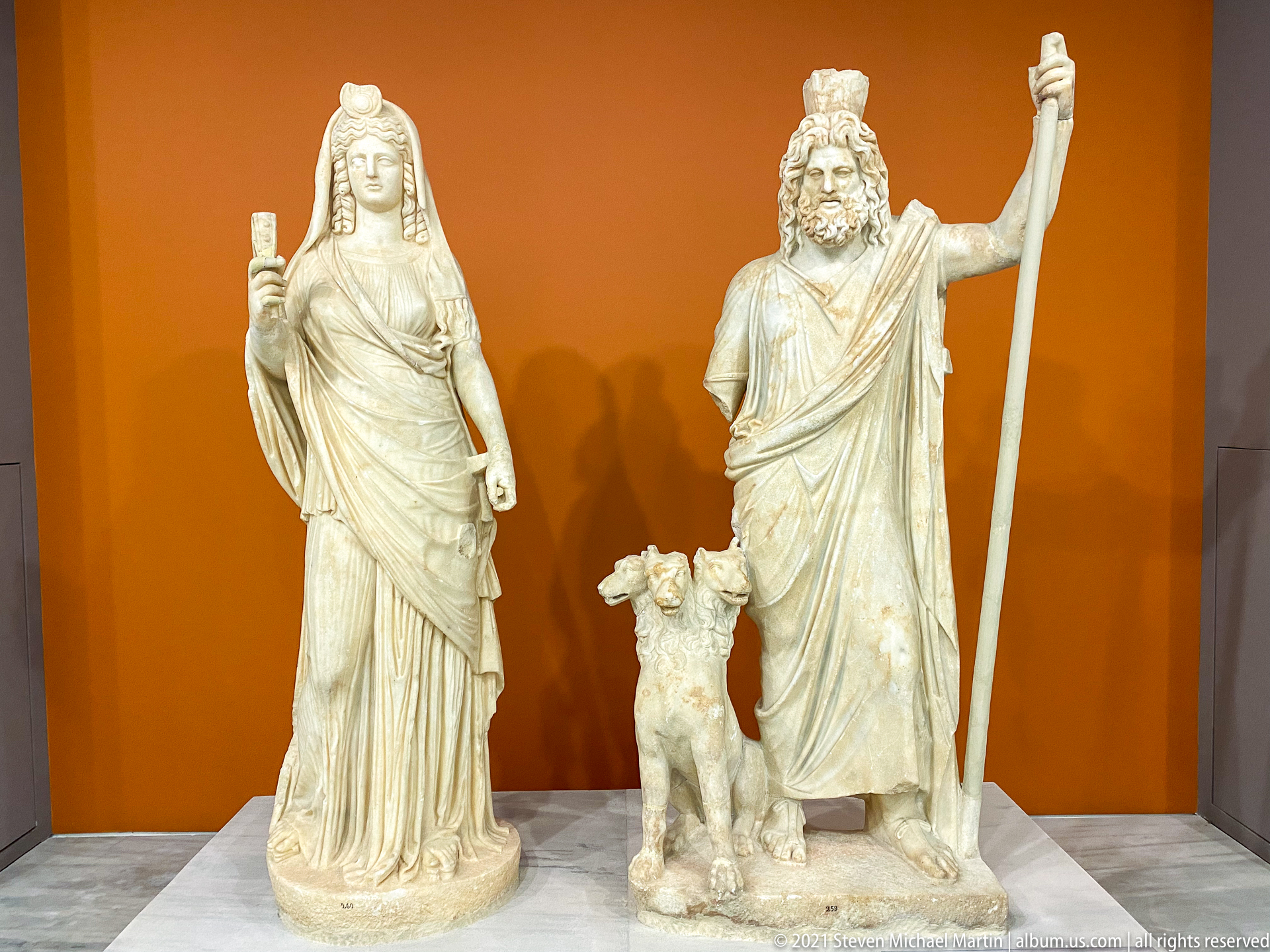
This marble statue group represents Isis-Persephone beside Sarapis-Hades, a syncretic divine pair associated with Egyptian cults in the Roman world. The goddess is enveloped in long drapery, while the bearded god wears his characteristic high headdress, holds a tall staff, and stands beside a small animal. Their paired presentation and distinctive attributes permit a much more precise identification than a generic description of male and female deities.
Caption
This marble statue group represents Isis-Persephone beside Sarapis-Hades, a syncretic divine pair associated with Egyptian cults in the Roman world. The goddess is enveloped in long drapery, while the bearded god wears his characteristic high headdress, holds a tall staff, and stands beside a small animal. Their paired presentation and distinctive attributes permit a much more precise identification than a generic description of male and female deities.
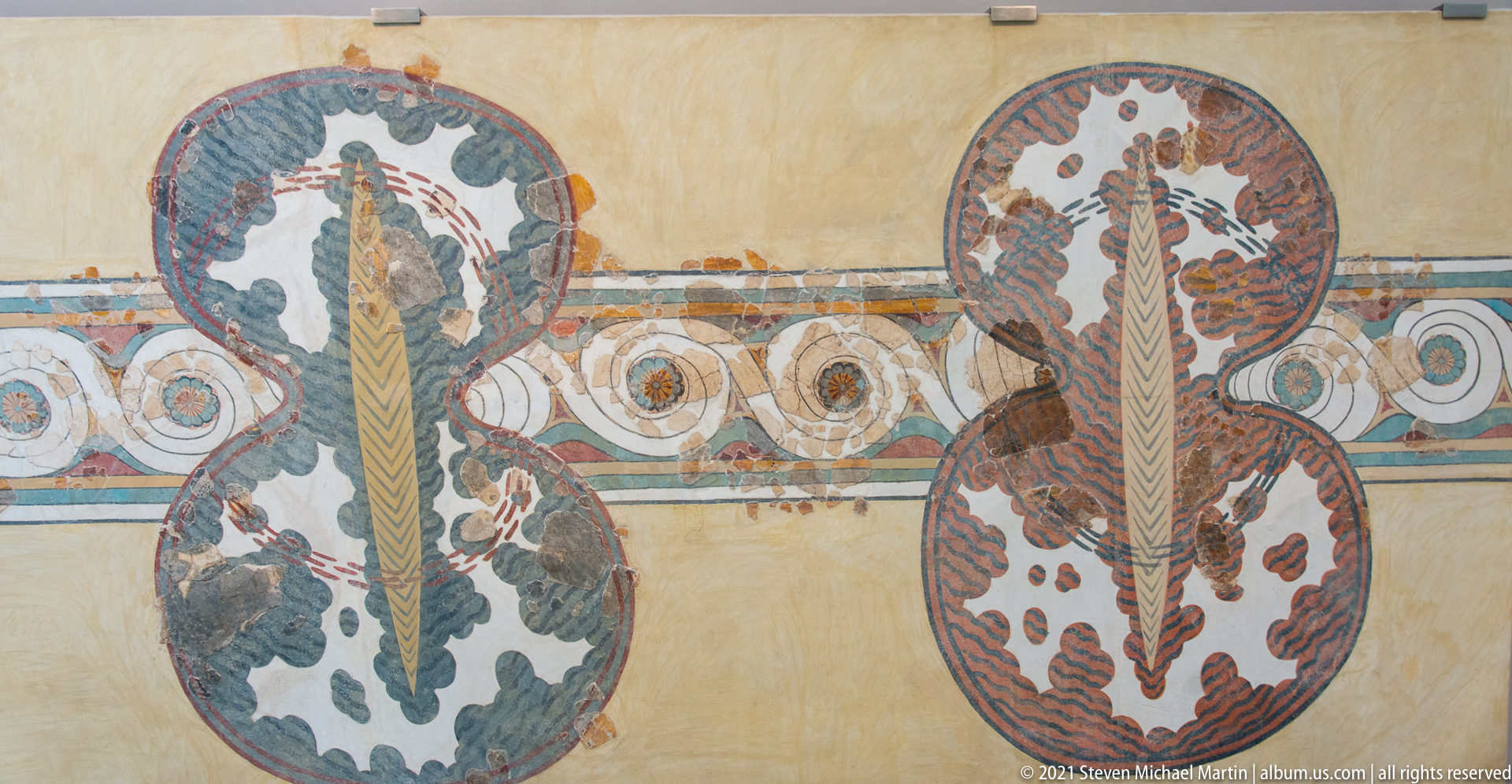
Two large stylized plant forms rise vertically within rounded fields, each built from a central feathered or leaf-like stem surrounded by dark foliage and reddish accents. A horizontal band of rosettes and circular motifs crosses behind them, linking the repeated compositions. The reconstructed fresco emphasizes Minoan interest in rhythmic natural forms transformed into highly ordered decorative patterns.
Caption
Two large stylized plant forms rise vertically within rounded fields, each built from a central feathered or leaf-like stem surrounded by dark foliage and reddish accents. A horizontal band of rosettes and circular motifs crosses behind them, linking the repeated compositions. The reconstructed fresco emphasizes Minoan interest in rhythmic natural forms transformed into highly ordered decorative patterns.