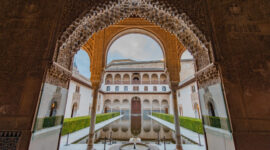
Petra – Jordan
The ancient city of Petra lies hidden among the desert mountains of southern Jordan and is one of the most extraordinary archaeological sites in the world. Founded more than two thousand years ago, Petra was the capital of the Nabataean Kingdom, whose merchants controlled important trade routes across the Arabian desert.
The city is famous for its monumental buildings carved directly into the rose-colored sandstone cliffs. Visitors enter Petra through the narrow canyon known as the Siq, which opens dramatically onto the iconic façade of Al-Khazneh (The Treasury).
Today Petra is recognized as a UNESCO World Heritage Site and remains one of the most remarkable examples of ancient rock-cut architecture.
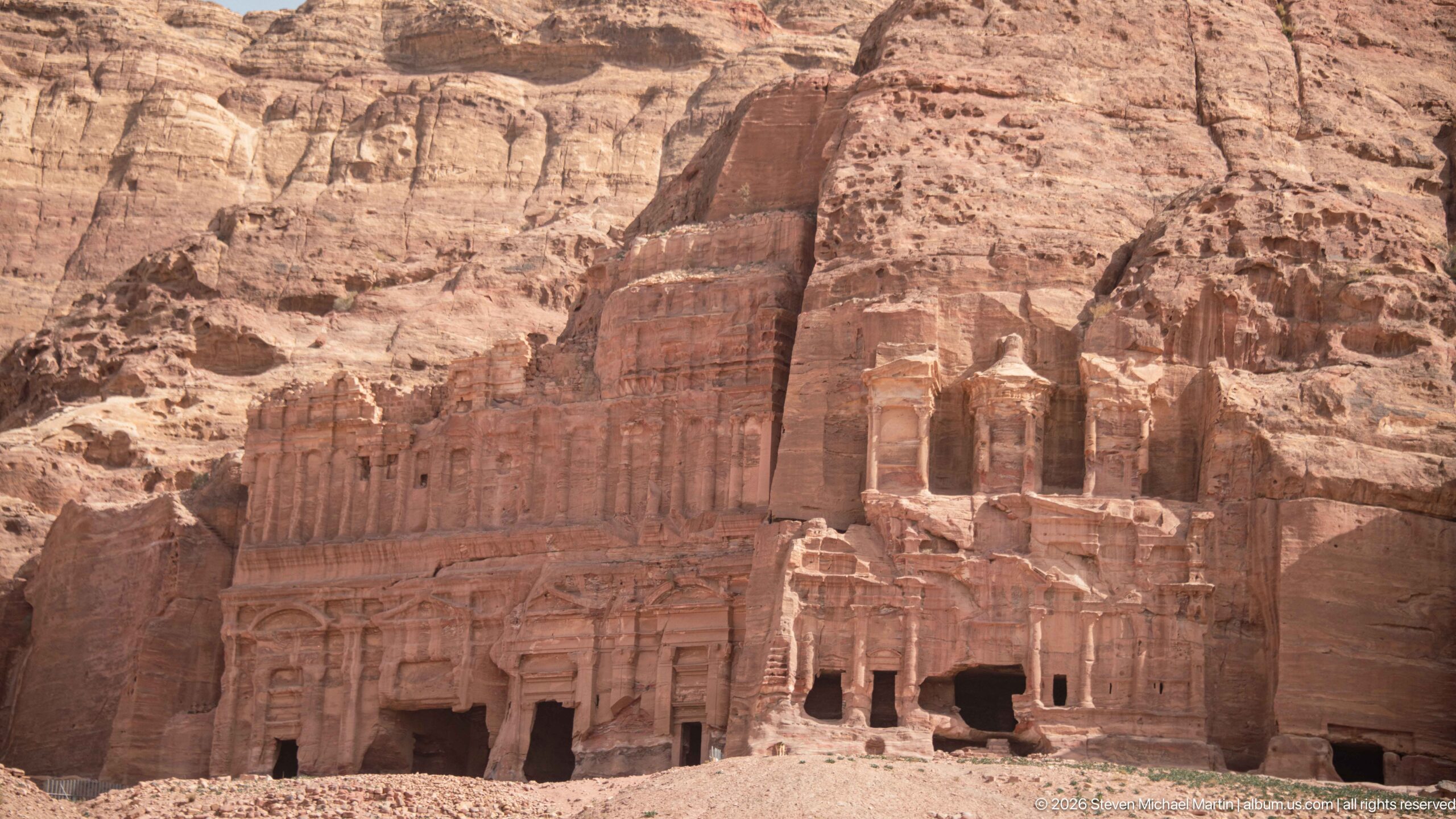
Petra’s Royal Tombs form a monumental sequence of façades carved into the western slope of Jabal al-Khubtha overlooking the city center. The official Petra authority identifies the principal group as the Urn, Silk, Corinthian, and Palace Tombs. Seen together across the cliff, their contrasting scale, carving, and sandstone coloration demonstrate the variety within Petra’s elite Nabataean funerary architecture.
Caption
Petra’s Royal Tombs form a monumental sequence of façades carved into the western slope of Jabal al-Khubtha overlooking the city center. The official Petra authority identifies the principal group as the Urn, Silk, Corinthian, and Palace Tombs. Seen together across the cliff, their contrasting scale, carving, and sandstone coloration demonstrate the variety within Petra’s elite Nabataean funerary architecture.
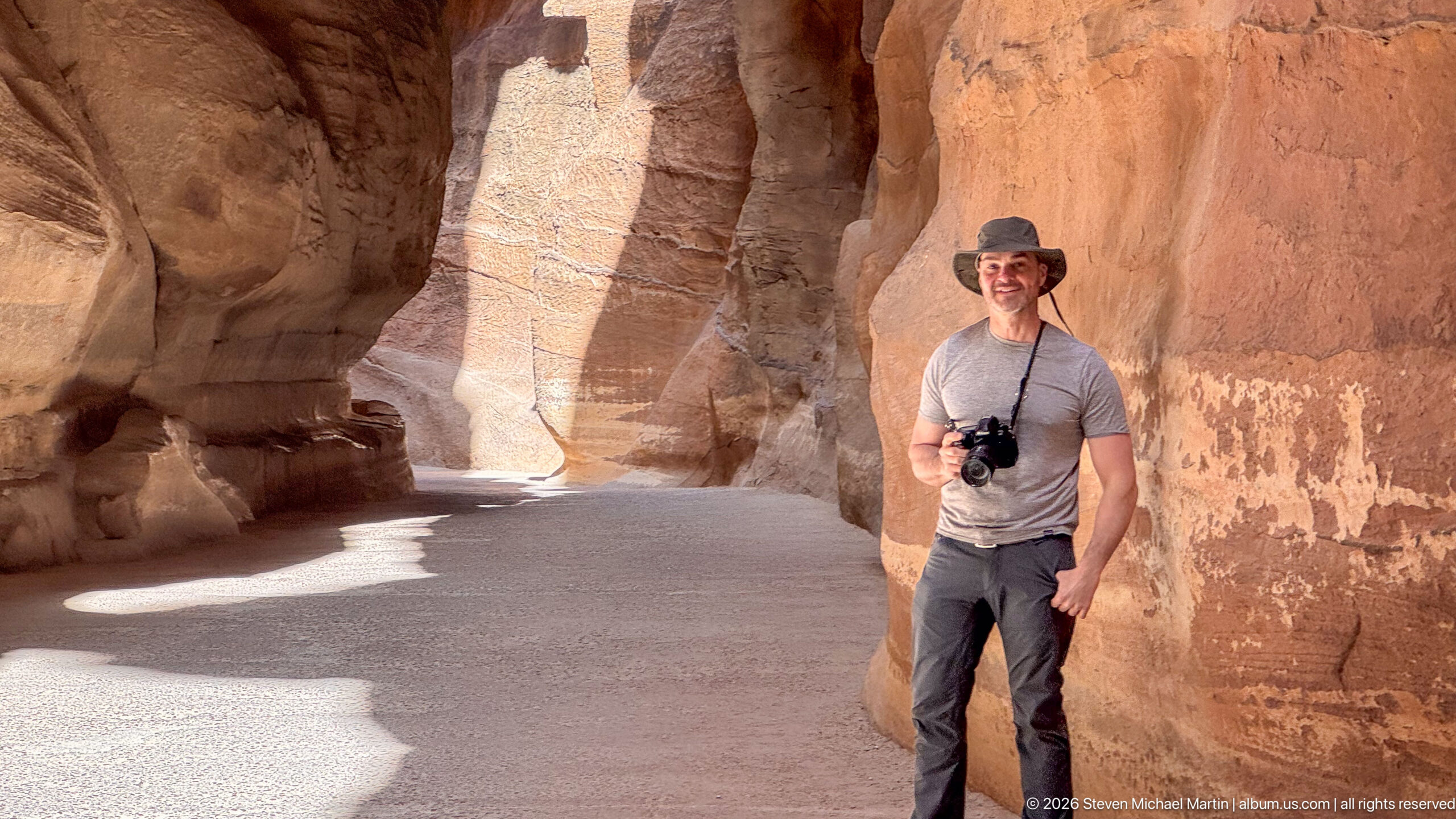
A visitor pauses beside the warm sandstone wall of Petra’s Siq, where the canyon broadens briefly before narrowing again in the distance. The curving passage, alternating sun and shade, and high sculpted rock faces preserve the scale of the approach while making the standing figure the focal point.
Caption
A visitor pauses beside the warm sandstone wall of Petra’s Siq, where the canyon broadens briefly before narrowing again in the distance. The curving passage, alternating sun and shade, and high sculpted rock faces preserve the scale of the approach while making the standing figure the focal point.
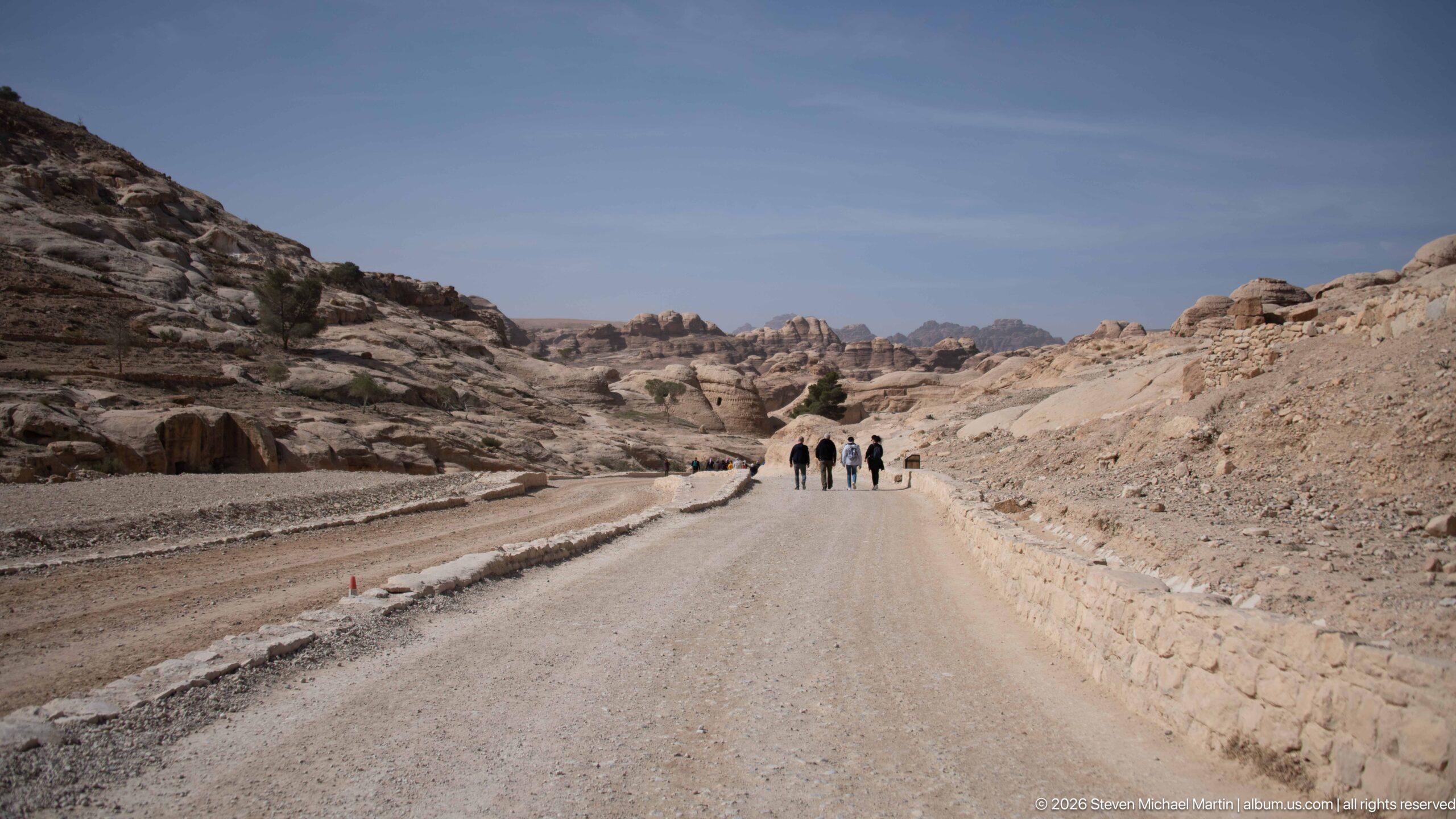
A broad gravel road leads through Petra’s open sandstone landscape, with a small group of visitors walking toward the distant ridges. Low retaining walls edge the route, while eroded outcrops on both sides mark the transition between the modern visitor approach and the denser archaeological monuments ahead.
Caption
A broad gravel road leads through Petra’s open sandstone landscape, with a small group of visitors walking toward the distant ridges. Low retaining walls edge the route, while eroded outcrops on both sides mark the transition between the modern visitor approach and the denser archaeological monuments ahead.
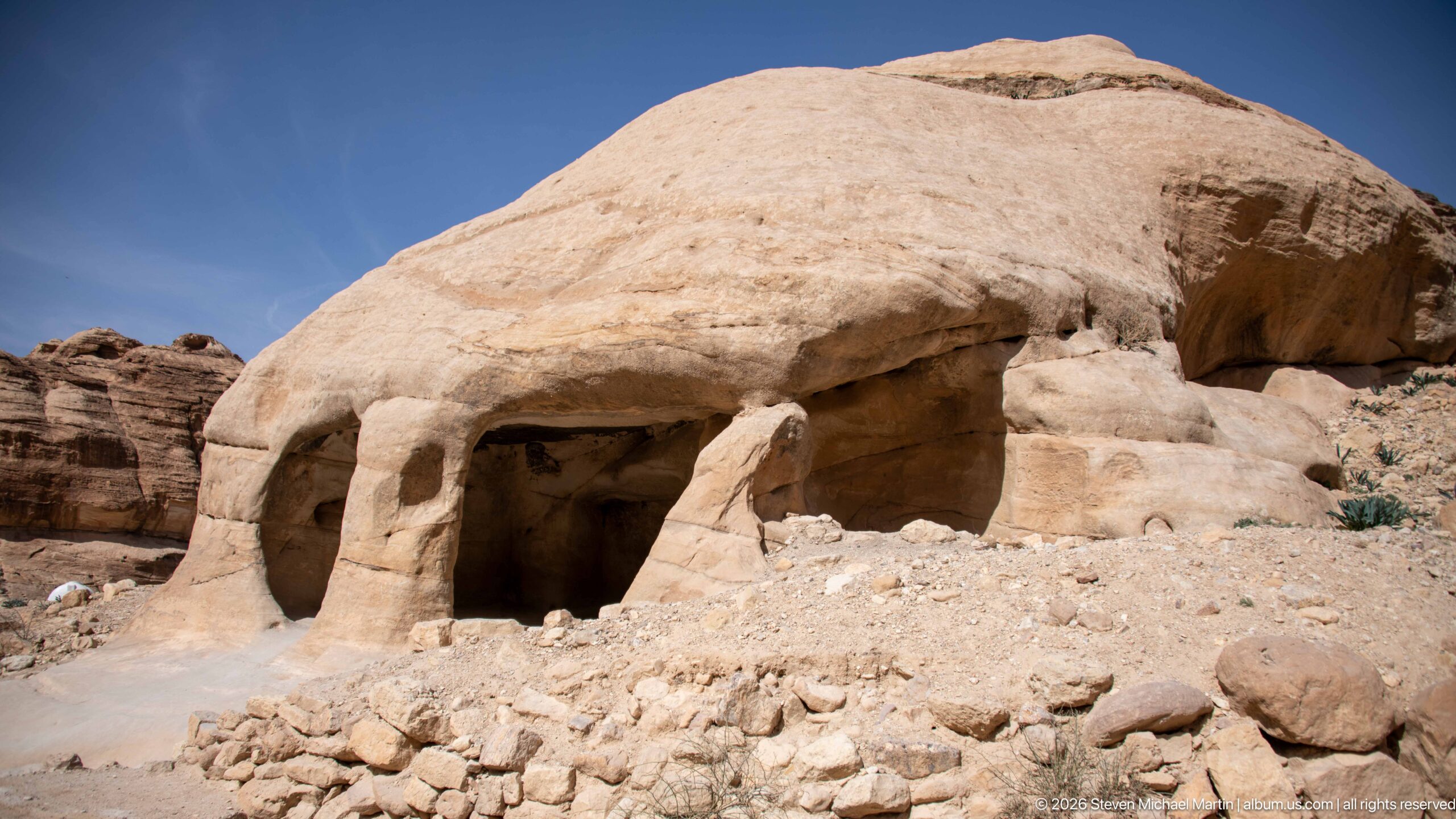
A broad chamber opens beneath a rounded sandstone outcrop, its entrance partly defined by squared rock-cut supports and a deep shadowed interior. Heavy erosion has softened the exterior into almost natural forms, making the contrast between the cut opening and the weathered cliff especially pronounced.
Caption
A broad chamber opens beneath a rounded sandstone outcrop, its entrance partly defined by squared rock-cut supports and a deep shadowed interior. Heavy erosion has softened the exterior into almost natural forms, making the contrast between the cut opening and the weathered cliff especially pronounced.
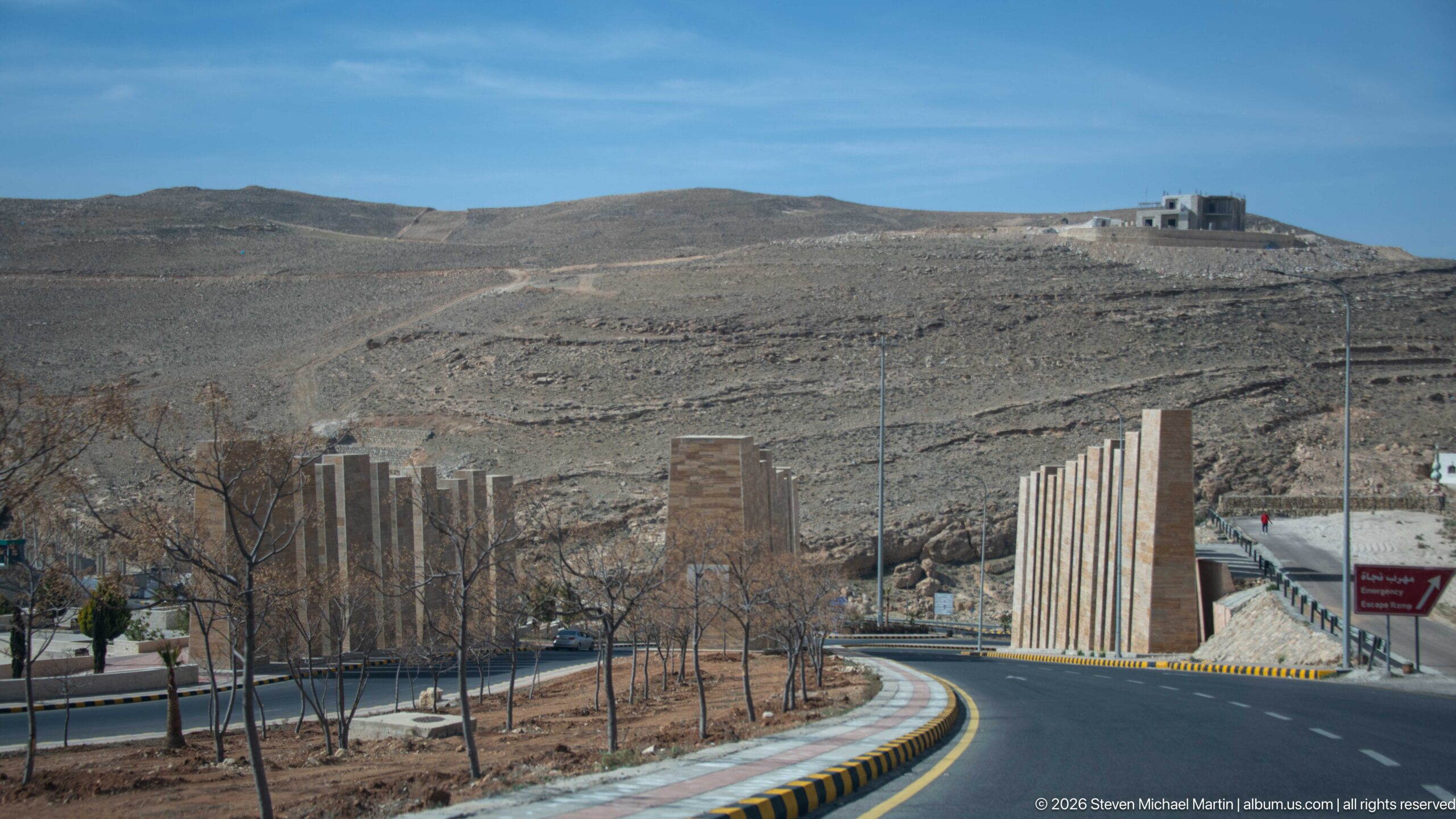
A modern divided roadway curves through the barren hills near Petra, bordered by patterned paving, young trees, and a long sequence of vertical stone or concrete elements. The engineered corridor contrasts sharply with the sparsely vegetated slopes, documenting the contemporary transportation infrastructure that channels visitors through the high desert landscape.
Caption
A modern divided roadway curves through the barren hills near Petra, bordered by patterned paving, young trees, and a long sequence of vertical stone or concrete elements. The engineered corridor contrasts sharply with the sparsely vegetated slopes, documenting the contemporary transportation infrastructure that channels visitors through the high desert landscape.
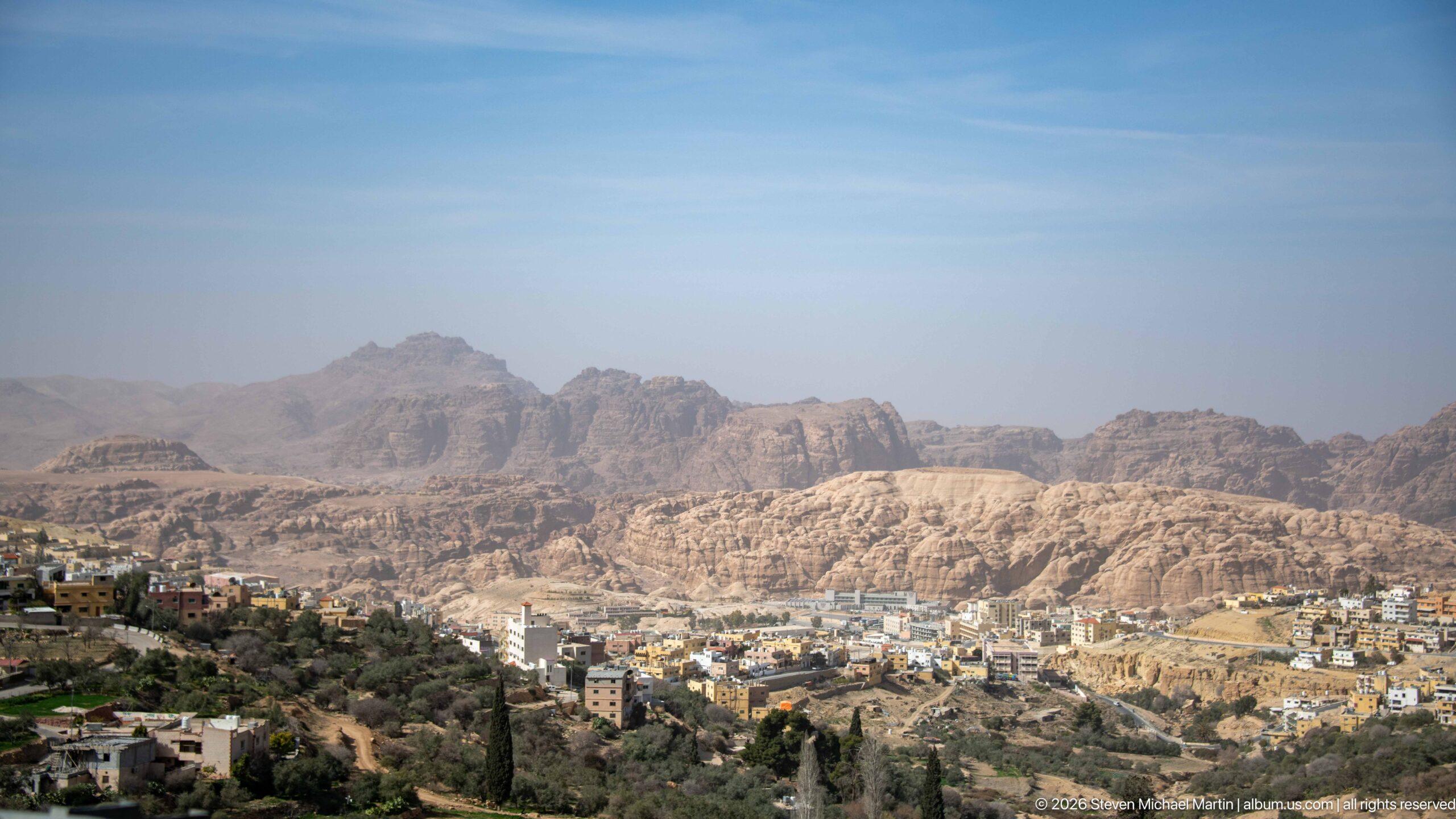
Rugged, deeply weathered mountains dominate the horizon beyond Wadi Musa, their folded and broken profiles rising above the town and patches of green vegetation. The wide view emphasizes Petra’s setting within a mountainous desert landscape, where modern settlement occupies the lower slopes beneath a much older geological framework.
Caption
Rugged, deeply weathered mountains dominate the horizon beyond Wadi Musa, their folded and broken profiles rising above the town and patches of green vegetation. The wide view emphasizes Petra’s setting within a mountainous desert landscape, where modern settlement occupies the lower slopes beneath a much older geological framework.
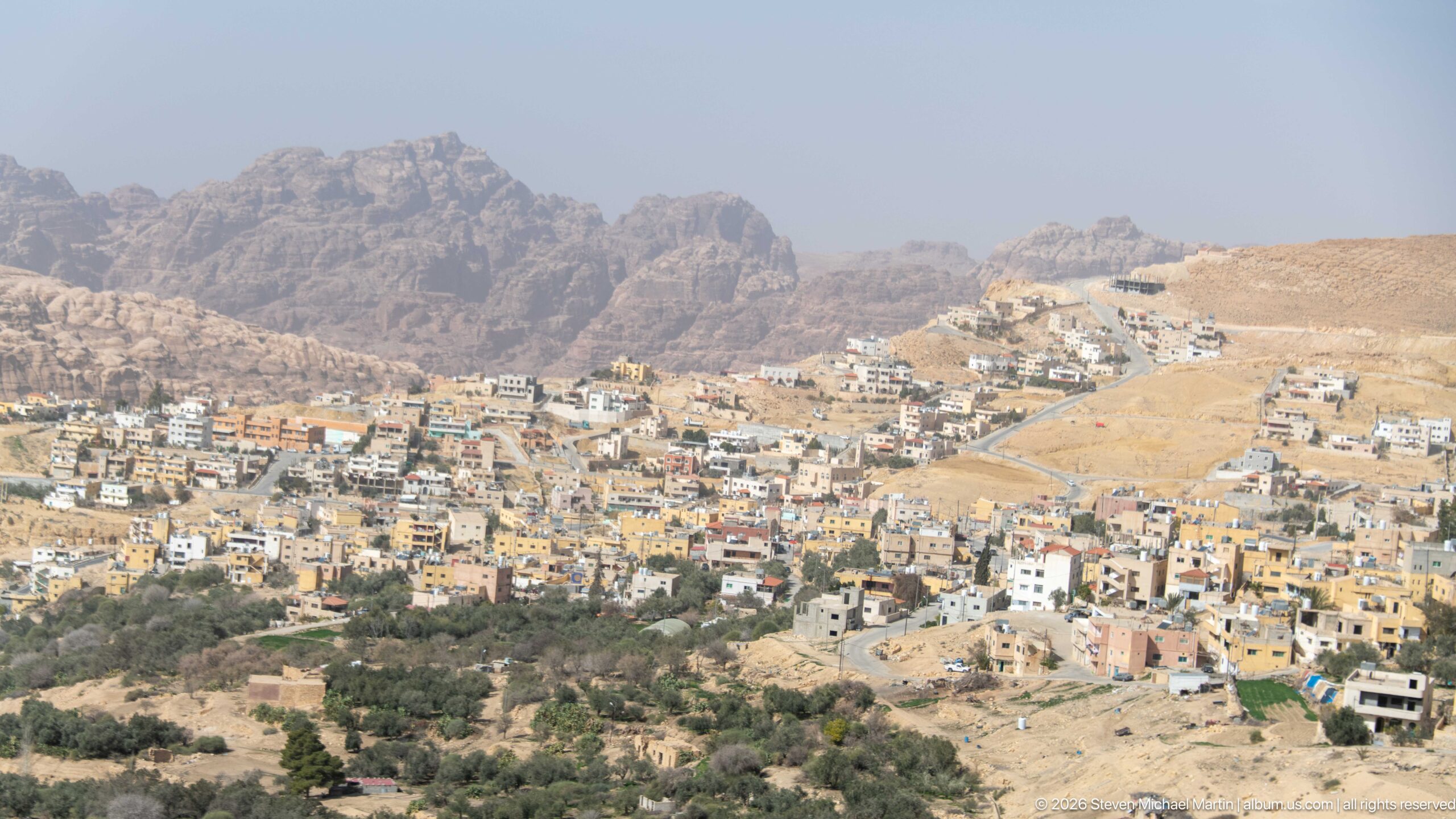
Wadi Musa spreads across rolling arid hills beneath the rugged mountain mass surrounding Petra. Dense clusters of low-rise buildings occupy the middle ground while darker cultivated patches fill the lower slopes, creating a broad panorama of the modern town set against the dramatically eroded highland landscape.
Caption
Wadi Musa spreads across rolling arid hills beneath the rugged mountain mass surrounding Petra. Dense clusters of low-rise buildings occupy the middle ground while darker cultivated patches fill the lower slopes, creating a broad panorama of the modern town set against the dramatically eroded highland landscape.
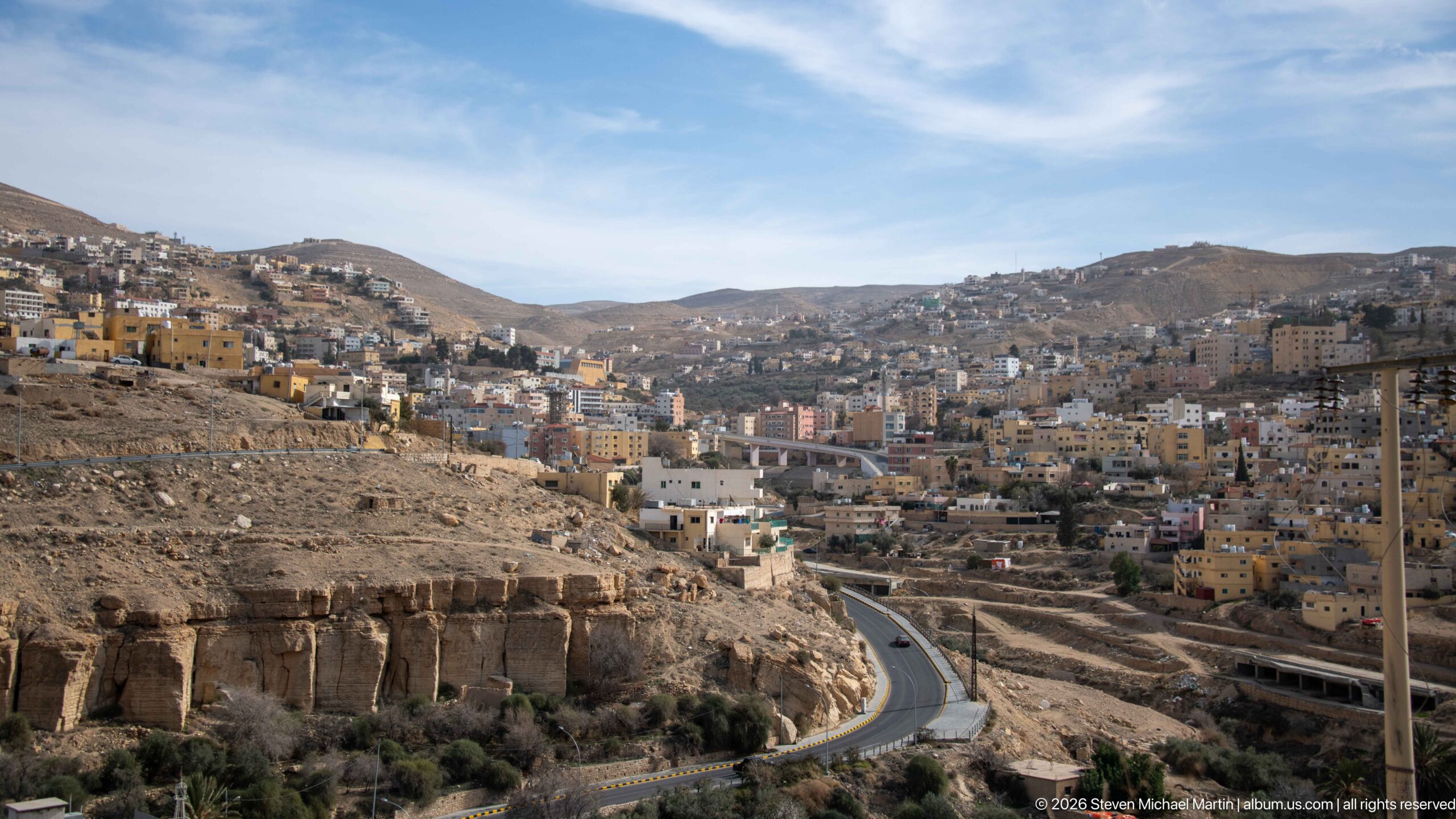
Wadi Musa spreads across the dry hills above Petra, its dense blocks of pale stone and concrete buildings stepping up the slopes around a winding modern road. The elevated view places the contemporary gateway town in its rugged highland setting, contrasting urban development with exposed rock terraces and the arid terrain surrounding the archaeological landscape.
Caption
Wadi Musa spreads across the dry hills above Petra, its dense blocks of pale stone and concrete buildings stepping up the slopes around a winding modern road. The elevated view places the contemporary gateway town in its rugged highland setting, contrasting urban development with exposed rock terraces and the arid terrain surrounding the archaeological landscape.
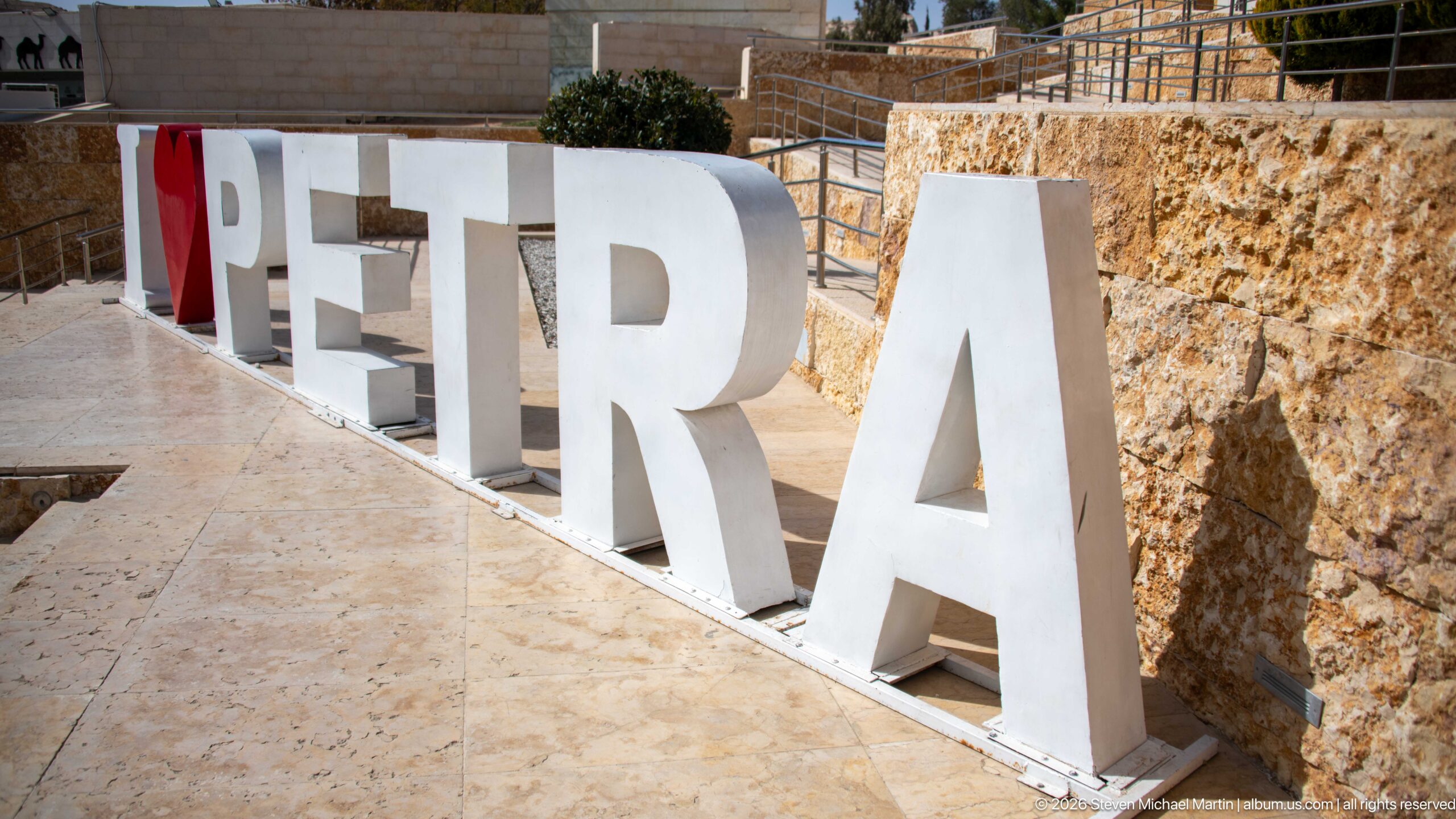
Freestanding white letters spelling PETRA line a pale stone walkway beside rough-cut retaining walls near the visitor complex. Viewed from an oblique angle, the oversized letters create strong depth and shadows, turning the site name into a sculptural element within the modern arrival landscape.
Caption
Freestanding white letters spelling PETRA line a pale stone walkway beside rough-cut retaining walls near the visitor complex. Viewed from an oblique angle, the oversized letters create strong depth and shadows, turning the site name into a sculptural element within the modern arrival landscape.
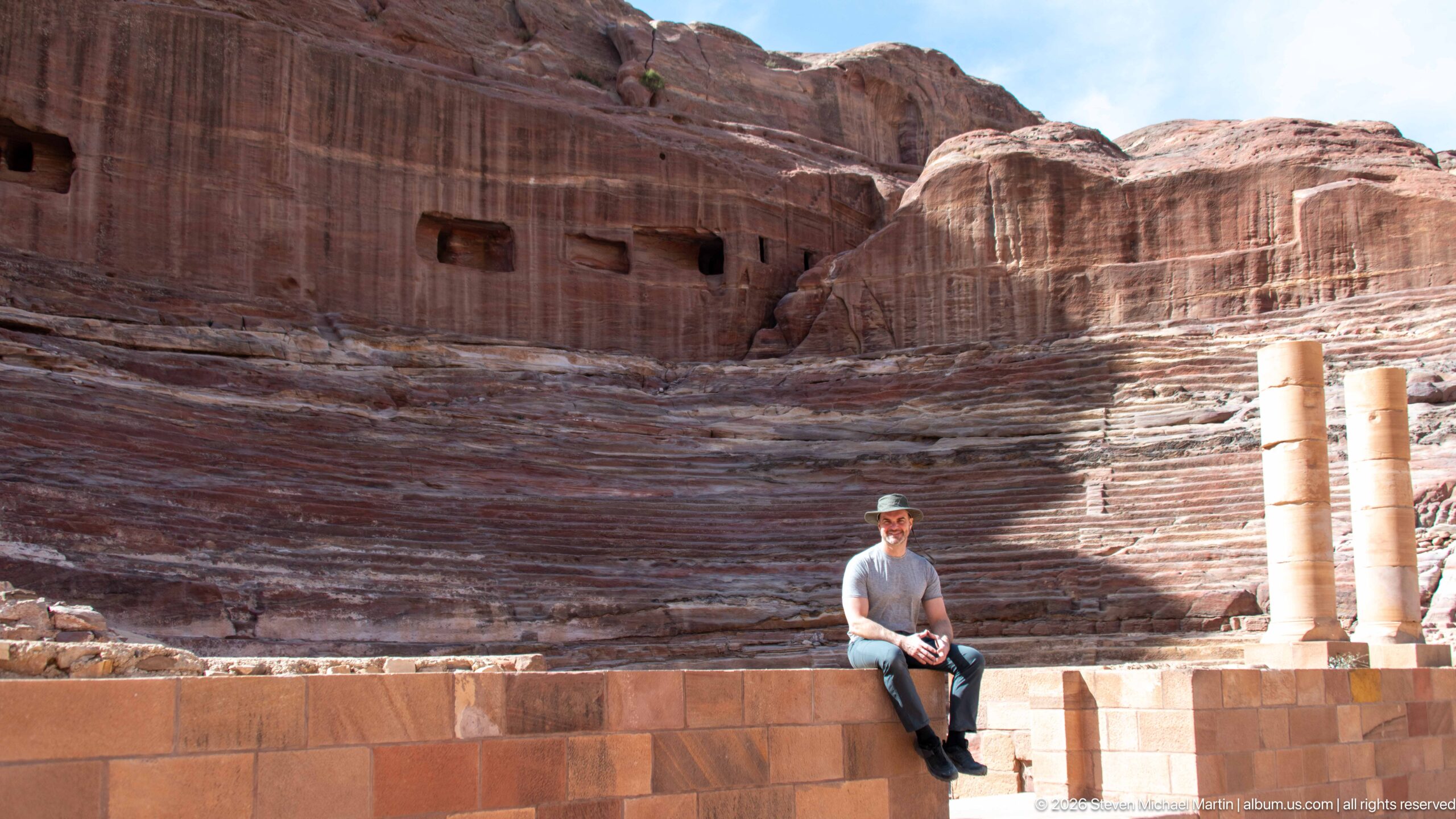
Petra’s theater is carved directly into the sandstone slope, with stepped seating descending toward the stage area. The monument belongs to the city’s Nabataean phase but reflects the theater form associated with the Hellenistic and Roman world; UNESCO includes it among Petra’s important Graeco-Roman civic remains. The surviving seating makes the adaptation of classical public architecture to Petra’s rock-cut setting immediately legible.
Caption
Petra’s theater is carved directly into the sandstone slope, with stepped seating descending toward the stage area. The monument belongs to the city’s Nabataean phase but reflects the theater form associated with the Hellenistic and Roman world; UNESCO includes it among Petra’s important Graeco-Roman civic remains. The surviving seating makes the adaptation of classical public architecture to Petra’s rock-cut setting immediately legible.
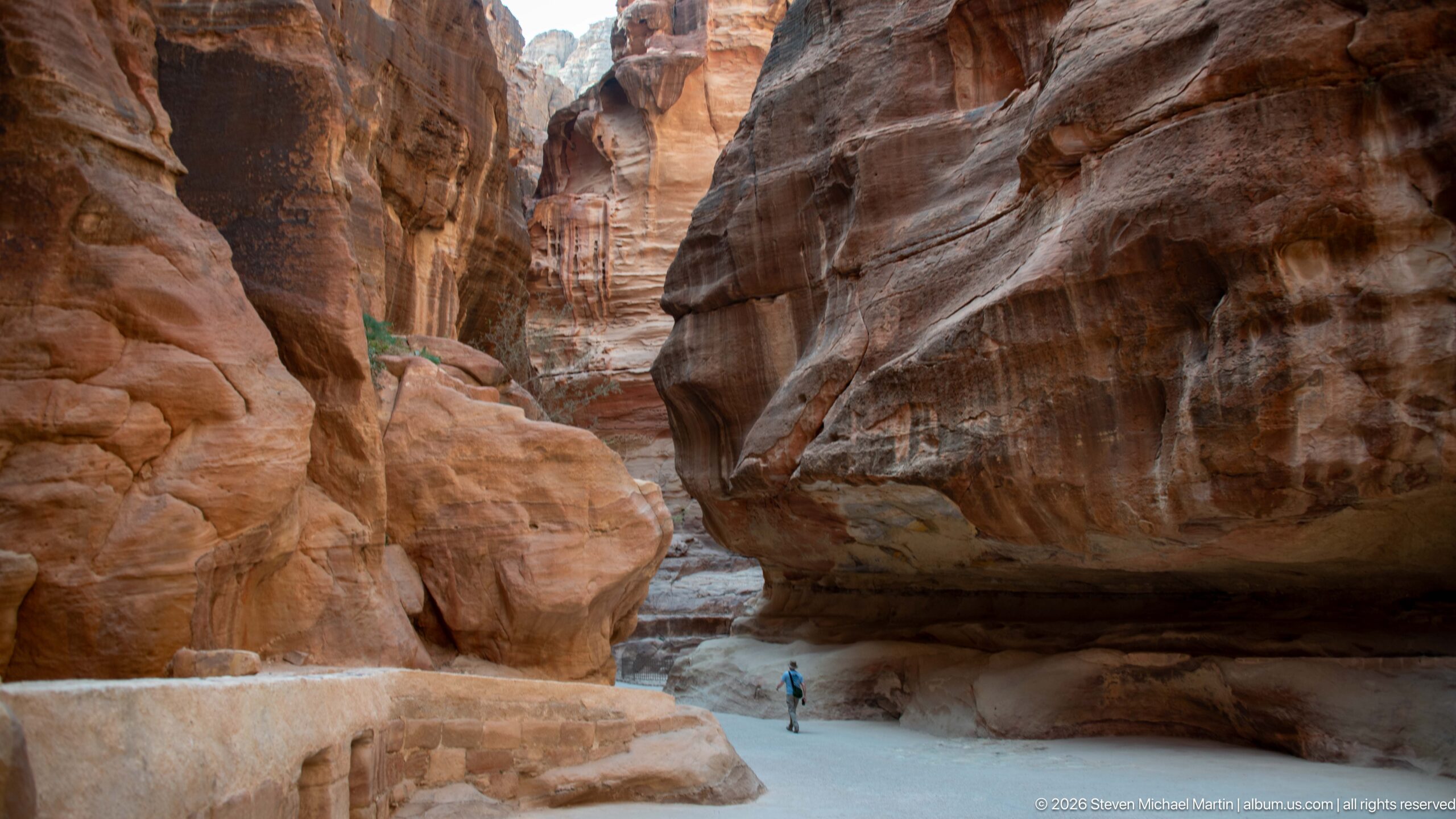
The Siq narrows between towering sandstone walls whose banded surfaces, undercut ledges, and rounded projections create a strongly sculptural passage. A lone visitor provides scale near the center, while the pale pathway follows the canyon floor through alternating shadow and reflected light.
Caption
The Siq narrows between towering sandstone walls whose banded surfaces, undercut ledges, and rounded projections create a strongly sculptural passage. A lone visitor provides scale near the center, while the pale pathway follows the canyon floor through alternating shadow and reflected light.
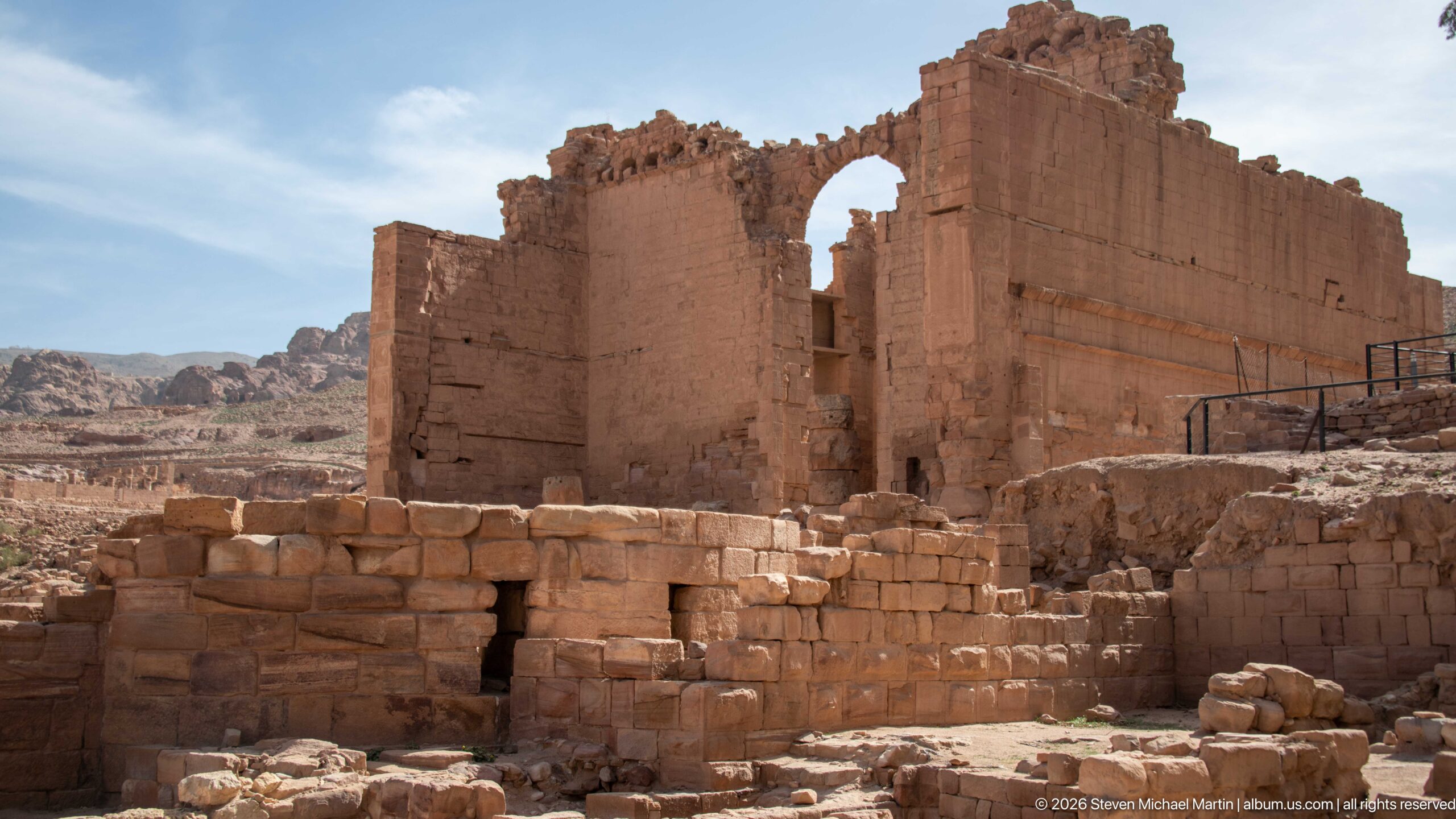
The massive freestanding walls of Qasr al-Bint rise above Petra’s central basin, distinguishing the sanctuary from the city’s better-known rock-cut monuments. Petra’s official site identifies Qasr al-Bint as the city’s principal Nabataean temple, an almost square structure raised on a podium and surviving to about 23 meters. The masonry shell seen here preserves the imposing scale of this major sacred complex.
Caption
The massive freestanding walls of Qasr al-Bint rise above Petra’s central basin, distinguishing the sanctuary from the city’s better-known rock-cut monuments. Petra’s official site identifies Qasr al-Bint as the city’s principal Nabataean temple, an almost square structure raised on a podium and surviving to about 23 meters. The masonry shell seen here preserves the imposing scale of this major sacred complex.
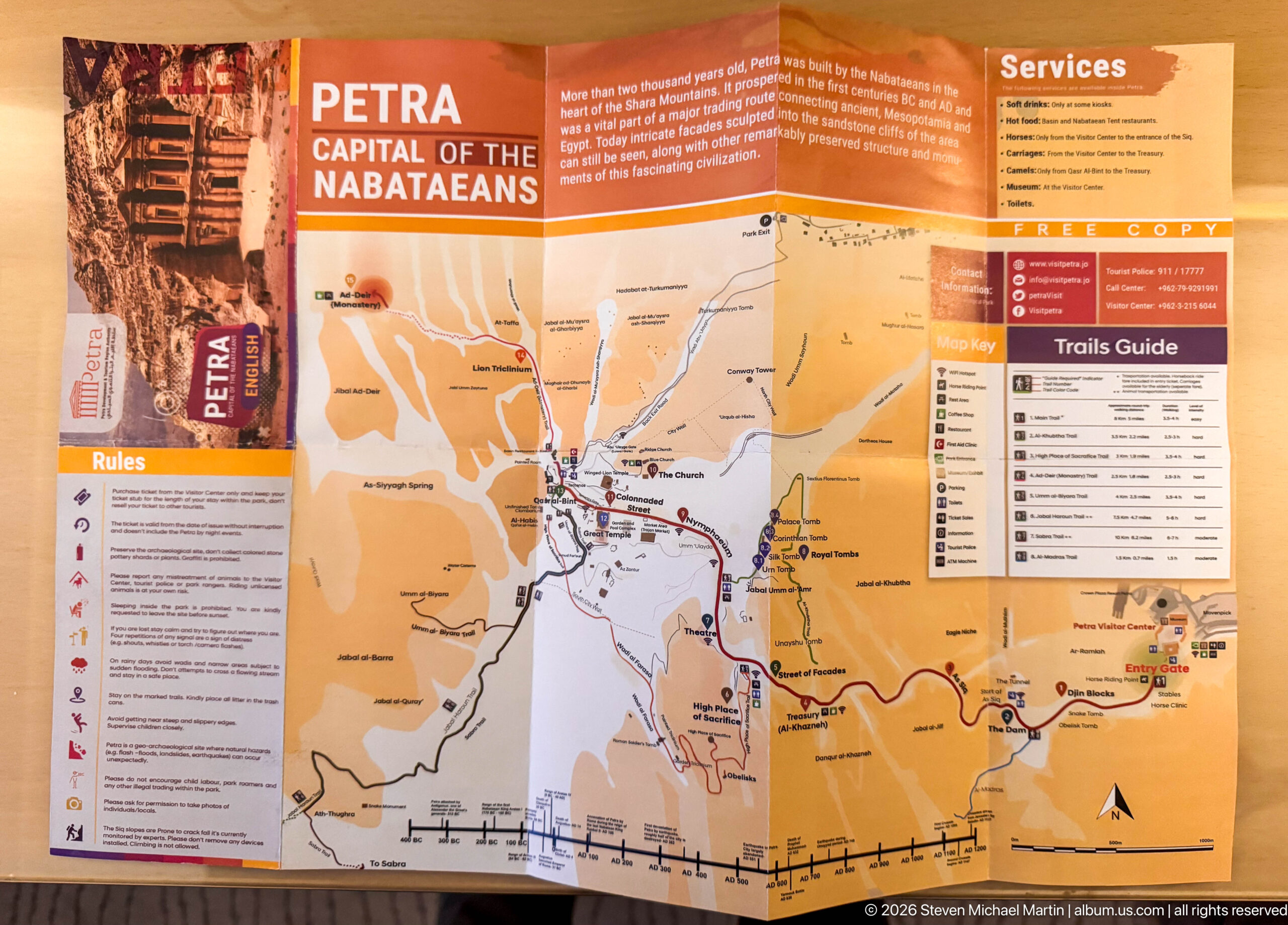
A visitor map and trail guide at Petra lays out the archaeological city, walking routes, services, rules, and principal monuments. The large printed plan provides practical orientation before entering the site, with the main visitor route traced through Petra’s valleys and monumental core and a keyed list of trails and facilities arranged around the map.
Caption
A visitor map and trail guide at Petra lays out the archaeological city, walking routes, services, rules, and principal monuments. The large printed plan provides practical orientation before entering the site, with the main visitor route traced through Petra’s valleys and monumental core and a keyed list of trails and facilities arranged around the map.
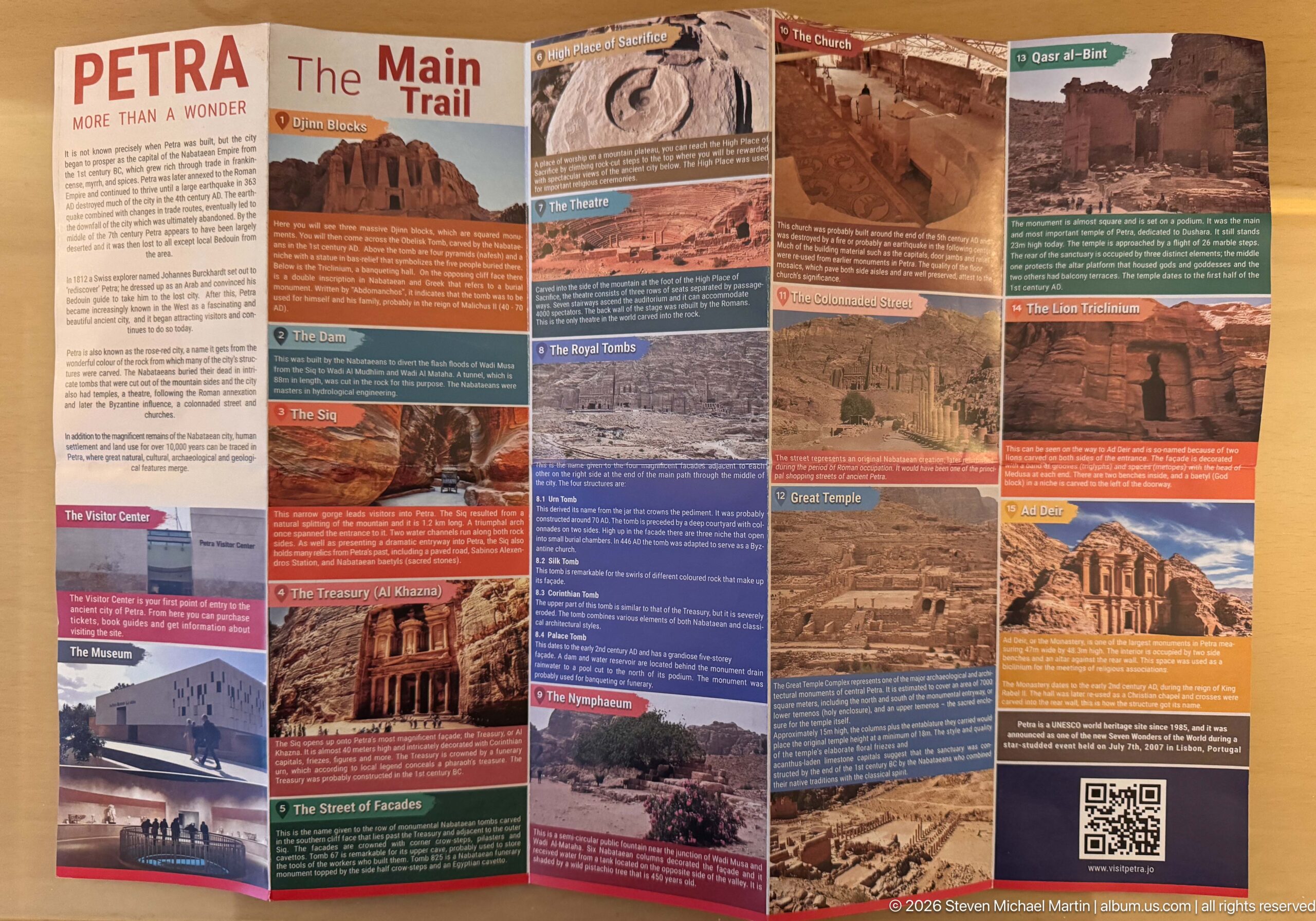
An interpretive panel introduces Petra’s Main Trail through photographs, diagrams, and short descriptions of major monuments encountered along the route. The display functions as a compact visual index to the archaeological landscape, pairing recognizable rock-cut façades and structural remains with visitor information that helps relate individual monuments to the broader path through the ancient city.
Caption
An interpretive panel introduces Petra’s Main Trail through photographs, diagrams, and short descriptions of major monuments encountered along the route. The display functions as a compact visual index to the archaeological landscape, pairing recognizable rock-cut façades and structural remains with visitor information that helps relate individual monuments to the broader path through the ancient city.
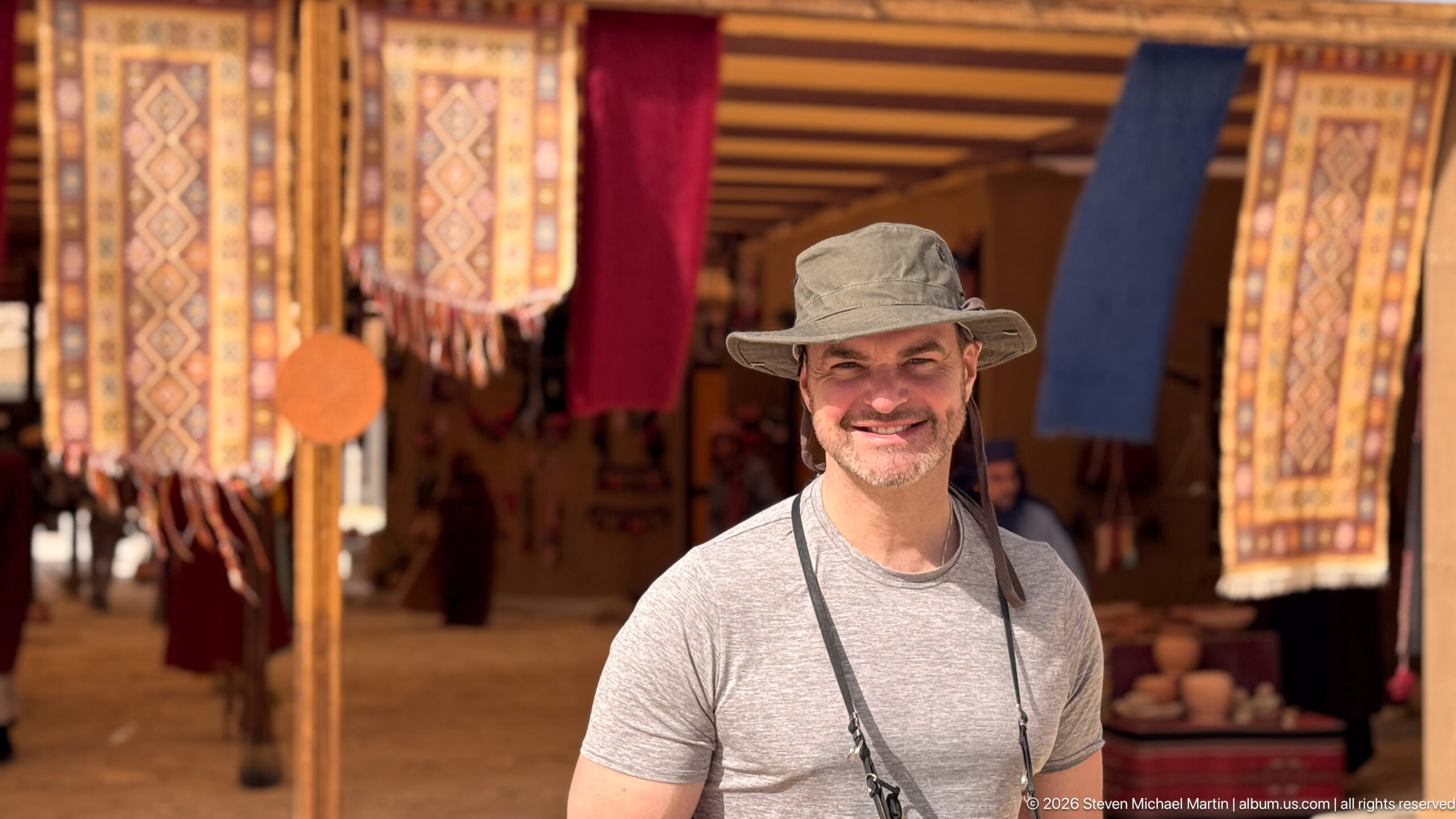
A visitor stands beneath the shade of a Petra market stall, framed by hanging woven textiles and richly patterned rugs. The close portrait shifts attention from the archaeological landscape to the contemporary visitor economy around the site, where colorful fabrics, pottery, and souvenirs create a warm, enclosed contrast to Petra’s sunlit sandstone surroundings.
Caption
A visitor stands beneath the shade of a Petra market stall, framed by hanging woven textiles and richly patterned rugs. The close portrait shifts attention from the archaeological landscape to the contemporary visitor economy around the site, where colorful fabrics, pottery, and souvenirs create a warm, enclosed contrast to Petra’s sunlit sandstone surroundings.
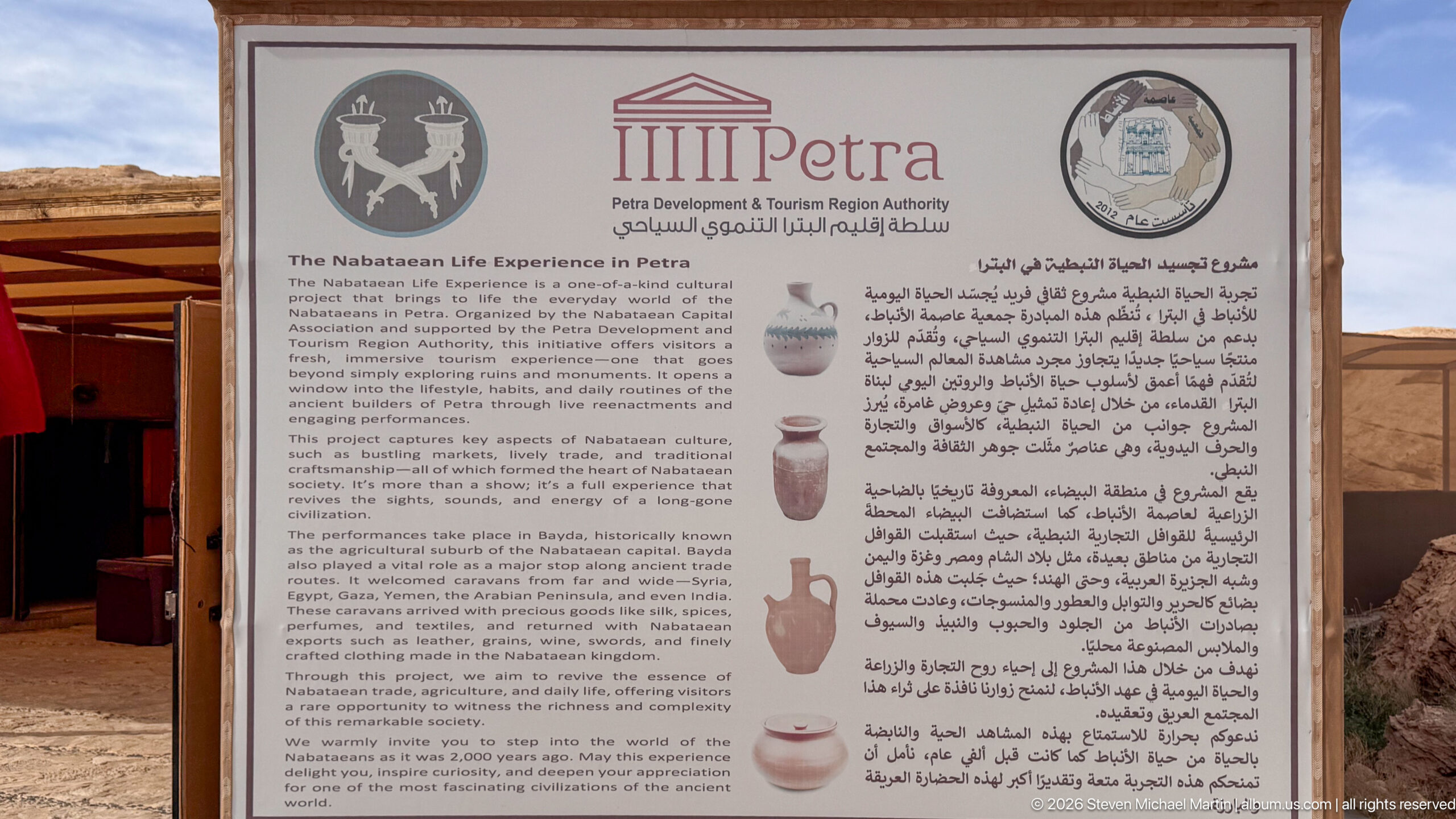
An interpretive sign for the “Nabataean Life Experience in Petra” describes a cultural presentation associated with the Petra Development and Tourism Region Authority. Illustrated vessel forms accompany Arabic and English text, linking the modern visitor program with demonstrations of Nabataean-associated crafts and daily-life traditions rather than with a surviving ancient monument.
Caption
An interpretive sign for the “Nabataean Life Experience in Petra” describes a cultural presentation associated with the Petra Development and Tourism Region Authority. Illustrated vessel forms accompany Arabic and English text, linking the modern visitor program with demonstrations of Nabataean-associated crafts and daily-life traditions rather than with a surviving ancient monument.
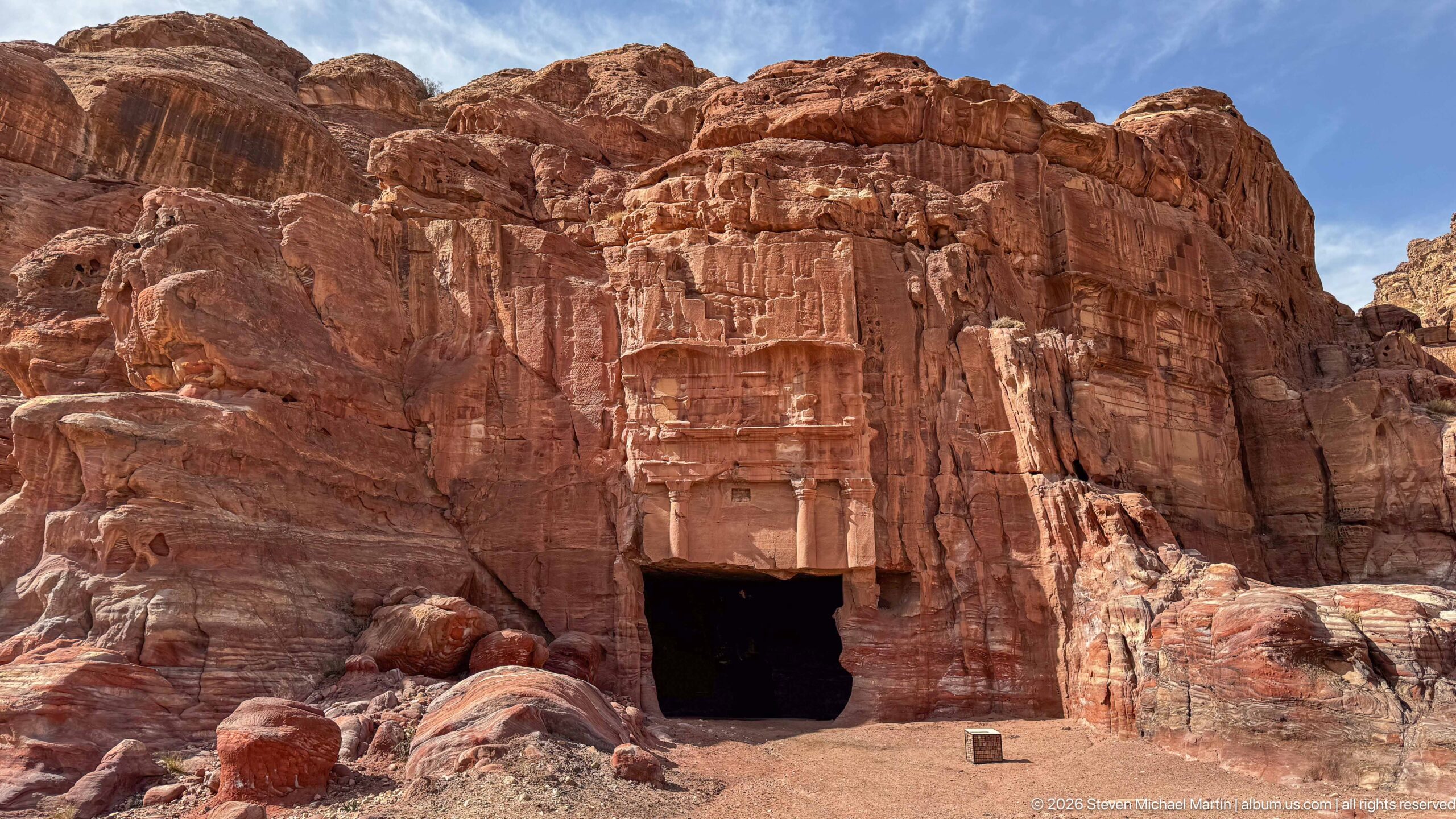
A compact Nabataean tomb façade is carved directly into Petra’s banded sandstone, its architectural frame weathered but still legible above a deep rectangular doorway. The close frontal view emphasizes the contrast between the carefully cut monument and the naturally rounded, striated rock surrounding it, showing how Petra’s funerary architecture was integrated into the cliff itself.
Caption
A compact Nabataean tomb façade is carved directly into Petra’s banded sandstone, its architectural frame weathered but still legible above a deep rectangular doorway. The close frontal view emphasizes the contrast between the carefully cut monument and the naturally rounded, striated rock surrounding it, showing how Petra’s funerary architecture was integrated into the cliff itself.
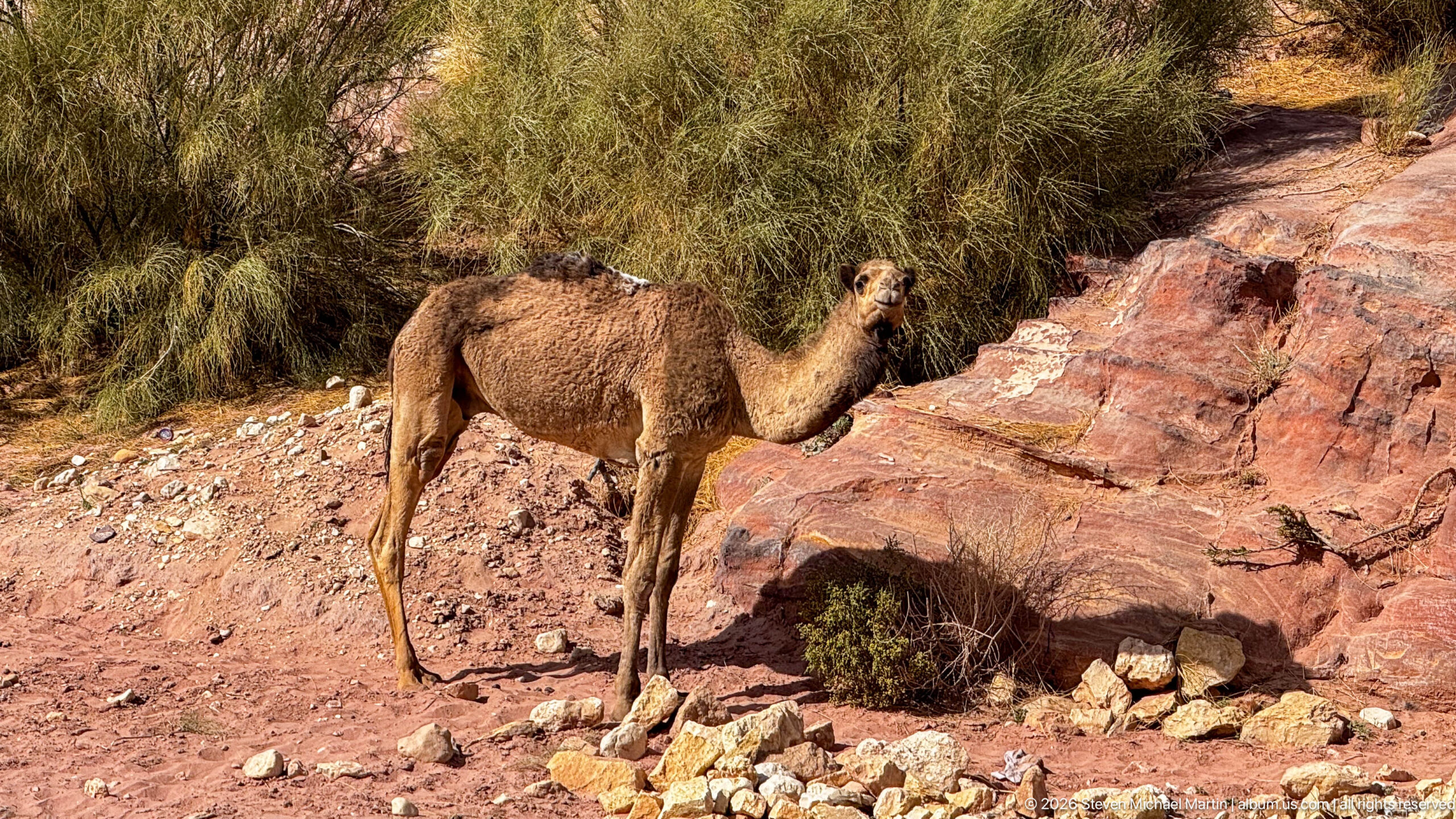
A dromedary camel stands on a rocky patch beside low shrubs and vividly banded sandstone at Petra. Its single hump, long legs, and narrow head are clearly visible in profile, placing a familiar working and transport animal of the region within the archaeological site’s arid landscape rather than presenting it as an isolated wildlife portrait.
Caption
A dromedary camel stands on a rocky patch beside low shrubs and vividly banded sandstone at Petra. Its single hump, long legs, and narrow head are clearly visible in profile, placing a familiar working and transport animal of the region within the archaeological site’s arid landscape rather than presenting it as an isolated wildlife portrait.
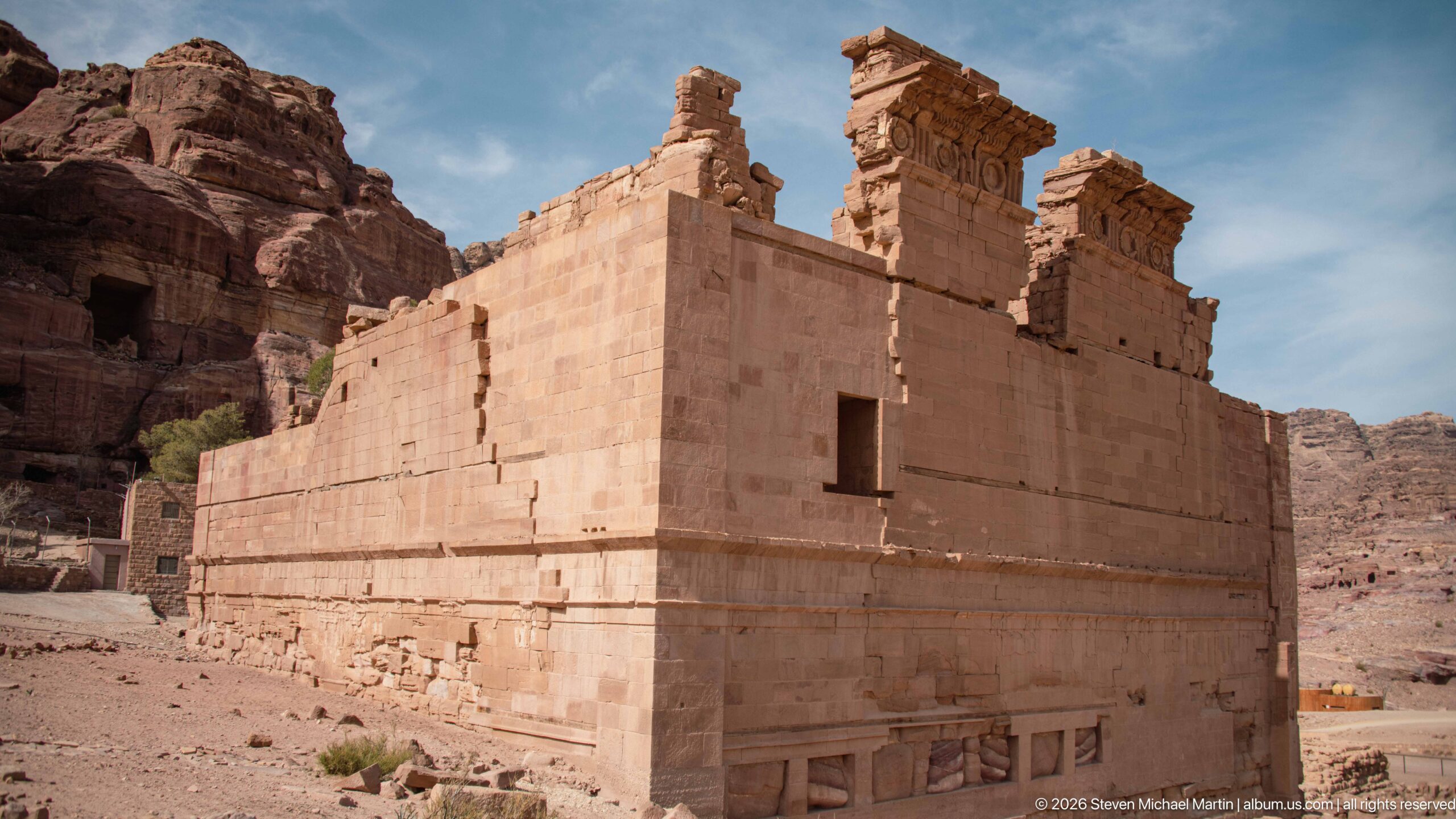
Qasr al-Bint’s tall freestanding masonry walls dominate this view of Petra’s central sacred precinct. Unlike the city’s façades carved directly into sandstone cliffs, the temple was constructed as a monumental building on a podium. The official Petra authority dates the complex to the first half of the first century AD and describes it as Petra’s main temple, probably associated with the Nabataean deity Dushara.
Caption
Qasr al-Bint’s tall freestanding masonry walls dominate this view of Petra’s central sacred precinct. Unlike the city’s façades carved directly into sandstone cliffs, the temple was constructed as a monumental building on a podium. The official Petra authority dates the complex to the first half of the first century AD and describes it as Petra’s main temple, probably associated with the Nabataean deity Dushara.
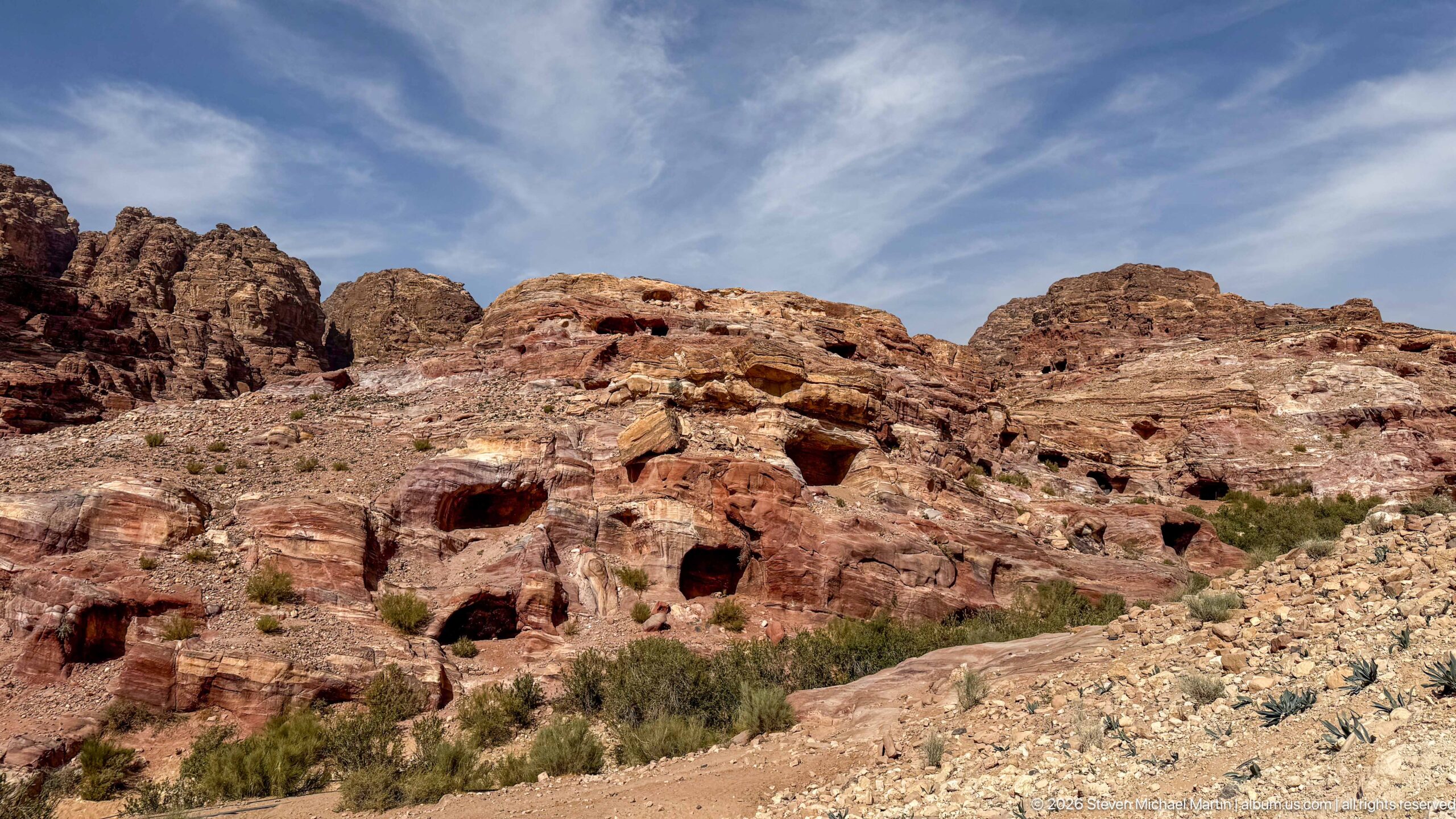
Small dark doorways and cavities puncture a low ridge of richly banded sandstone, forming a dispersed group of rock-cut chambers amid Petra’s eroded cliffs. The broad landscape view gives equal weight to geology and archaeology: horizontal red, rose, and cream strata wrap around the openings, while sparse shrubs occupy the sandy drainage below.
Caption
Small dark doorways and cavities puncture a low ridge of richly banded sandstone, forming a dispersed group of rock-cut chambers amid Petra’s eroded cliffs. The broad landscape view gives equal weight to geology and archaeology: horizontal red, rose, and cream strata wrap around the openings, while sparse shrubs occupy the sandy drainage below.
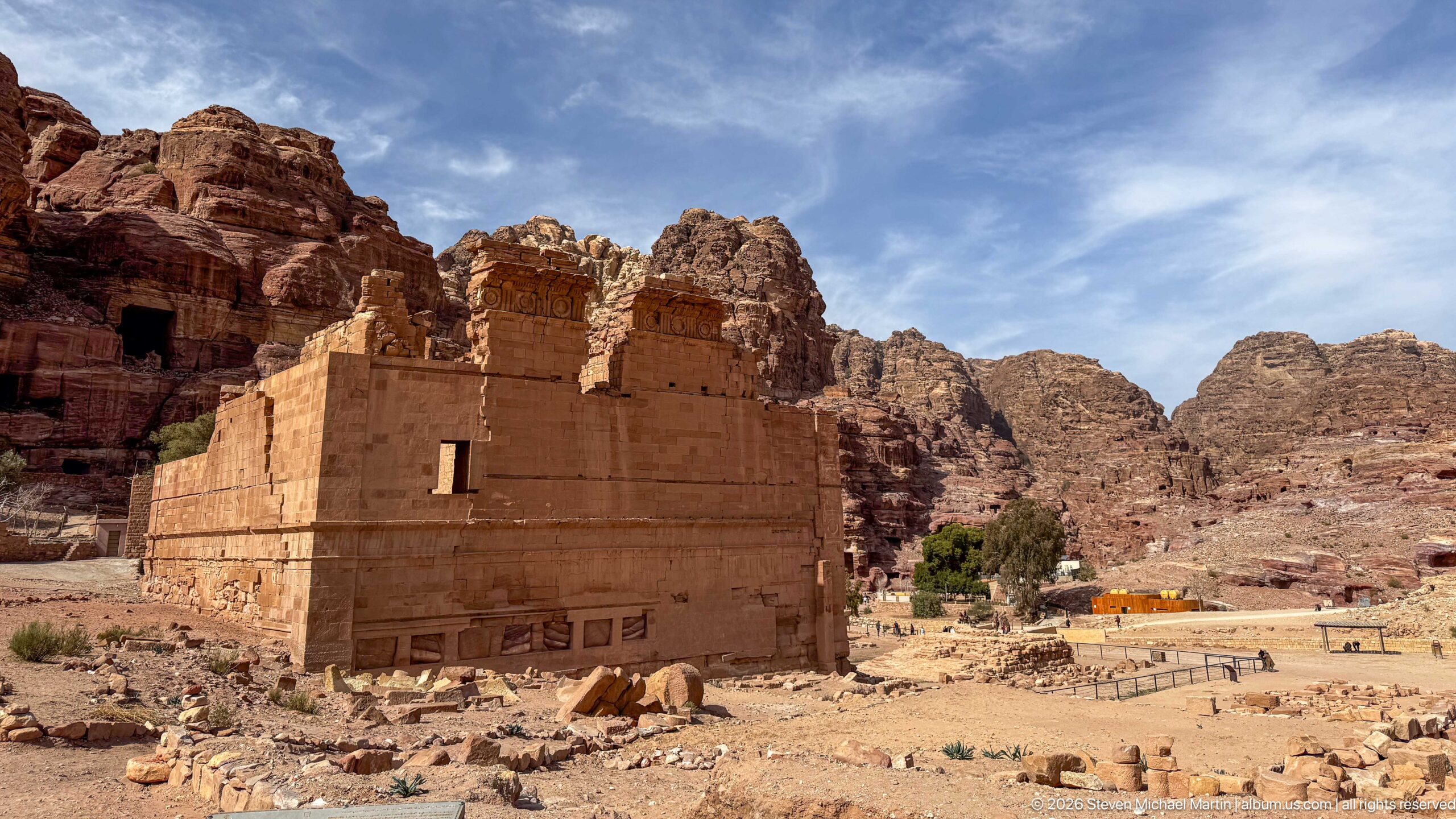
Qasr al-Bint rises amid foundations and scattered architectural remains in Petra’s central basin, with the surrounding mountains reinforcing the temple’s freestanding character. The nearly square Nabataean sanctuary stands on a podium and survives to roughly 23 meters, making it one of the clearest surviving examples of Petra’s built—rather than rock-cut—monumental architecture.
Caption
Qasr al-Bint rises amid foundations and scattered architectural remains in Petra’s central basin, with the surrounding mountains reinforcing the temple’s freestanding character. The nearly square Nabataean sanctuary stands on a podium and survives to roughly 23 meters, making it one of the clearest surviving examples of Petra’s built—rather than rock-cut—monumental architecture.
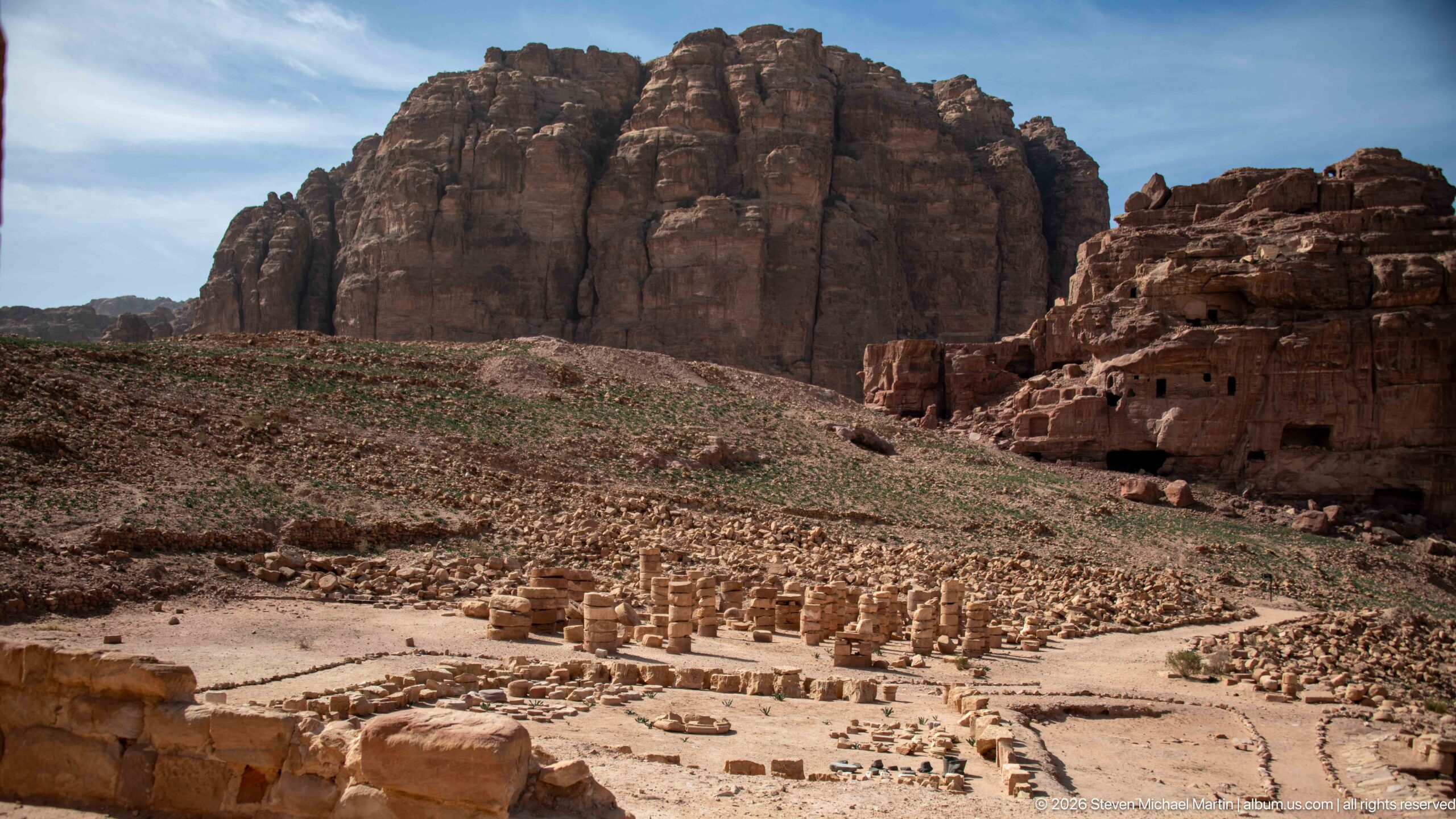
Column bases, walls, and excavated terraces spread across Petra’s Great Temple complex beneath the sandstone cliffs. Despite its traditional name, the official Petra authority notes that the 7,560-square-meter complex may have served primarily civic functions: its upper precinct contained a small semicircular theater that may have functioned as a council or judicial assembly hall. The extensive remains reveal the scale of Petra’s monumental city center.
Caption
Column bases, walls, and excavated terraces spread across Petra’s Great Temple complex beneath the sandstone cliffs. Despite its traditional name, the official Petra authority notes that the 7,560-square-meter complex may have served primarily civic functions: its upper precinct contained a small semicircular theater that may have functioned as a council or judicial assembly hall. The extensive remains reveal the scale of Petra’s monumental city center.
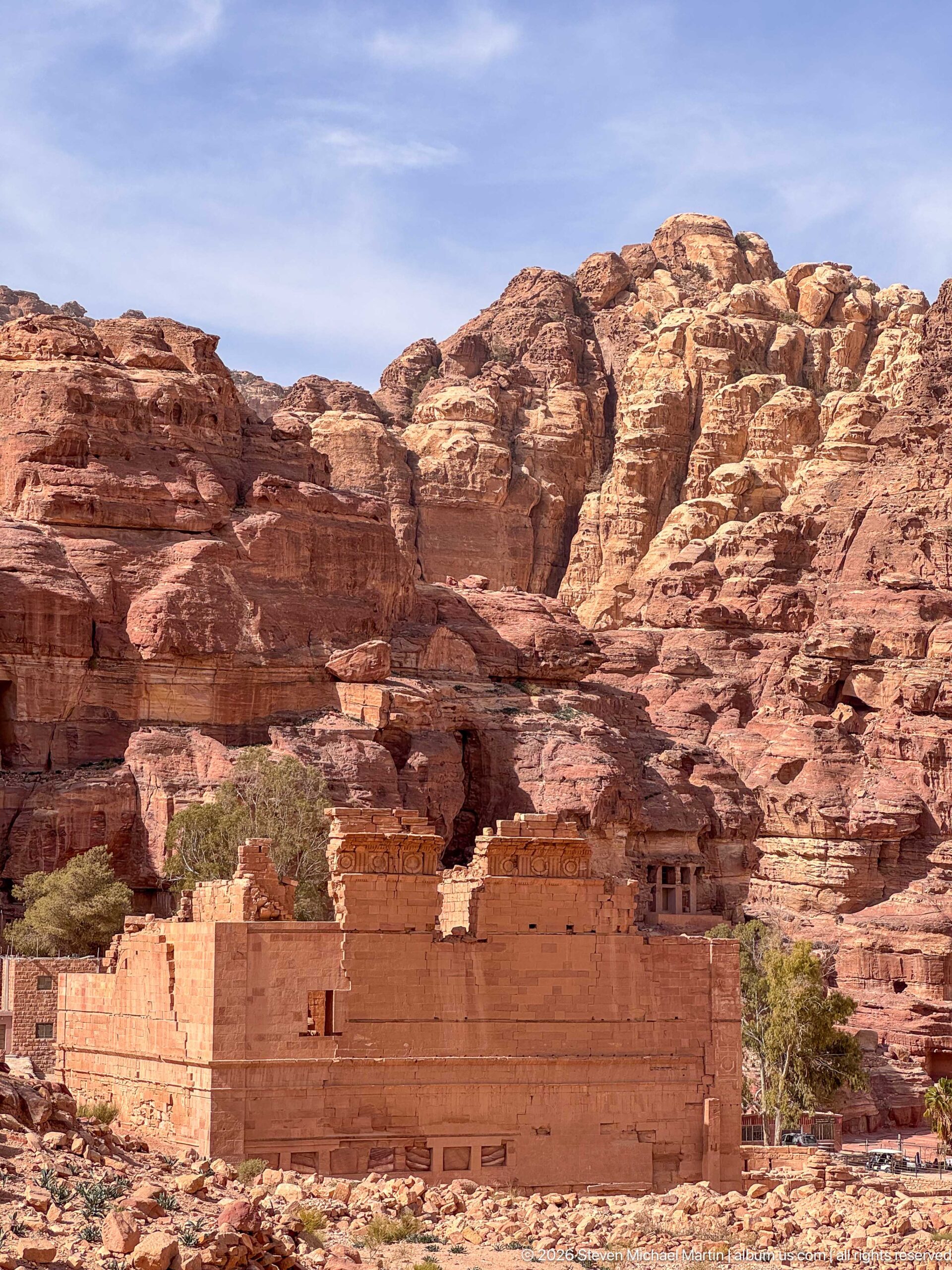
Qasr al-Bint forms a strong horizontal mass across the center of the frame, its freestanding sandstone walls set against Petra’s deeply weathered mountain backdrop. The distant viewpoint emphasizes the temple’s unusual built volume within a city celebrated for rock-cut architecture, while small tomb façades and openings in the cliffs provide archaeological context behind it.
Caption
Qasr al-Bint forms a strong horizontal mass across the center of the frame, its freestanding sandstone walls set against Petra’s deeply weathered mountain backdrop. The distant viewpoint emphasizes the temple’s unusual built volume within a city celebrated for rock-cut architecture, while small tomb façades and openings in the cliffs provide archaeological context behind it.
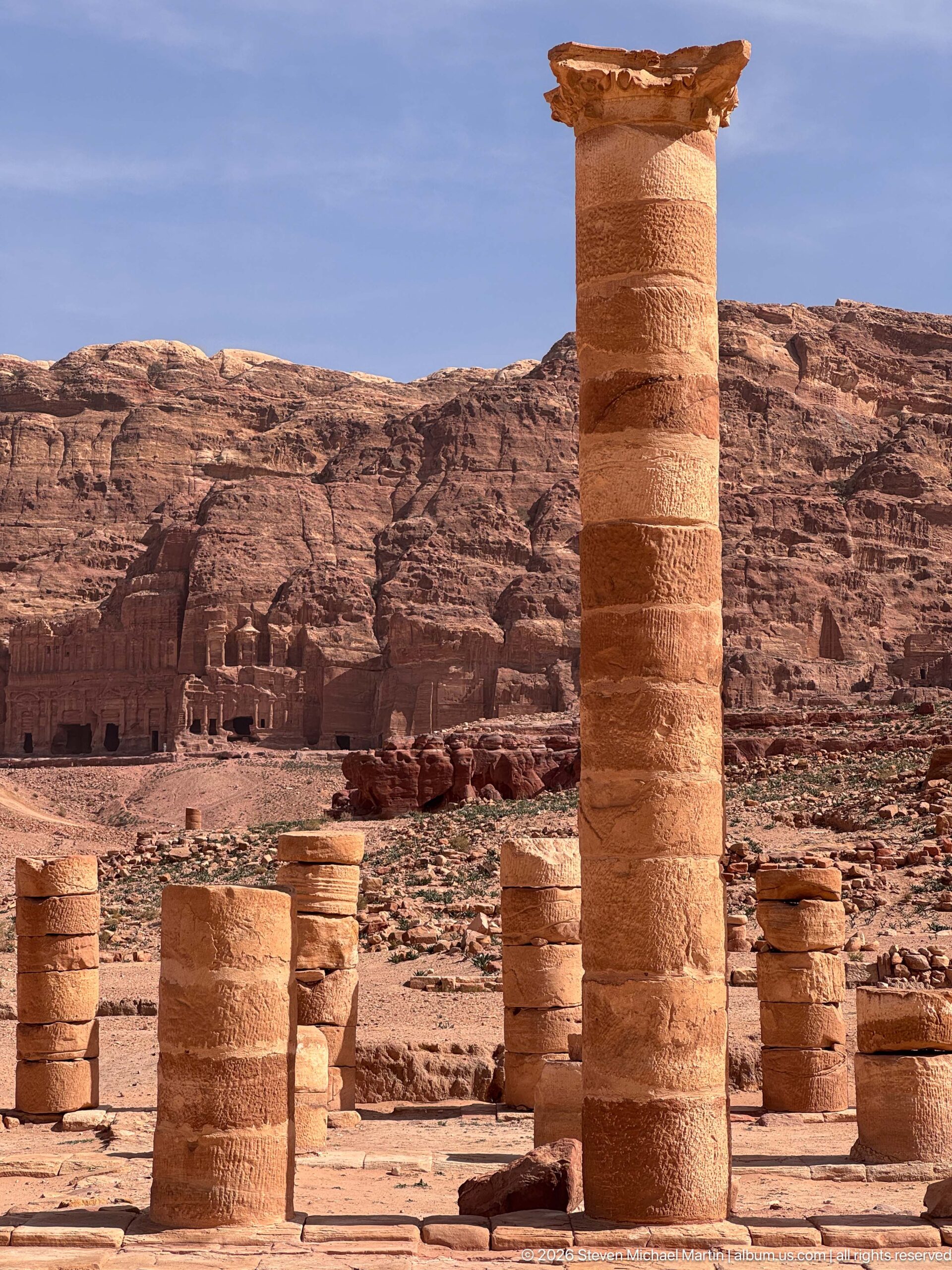
A re-erected sandstone column rises above shorter drums and bases in Petra’s Great Temple complex, restoring part of the vertical scale of its lower courtyard. The precinct was bordered by triple colonnades assembled from carved column drums; excavations also revealed a small semicircular theater in the upper precinct, evidence that the complex may have had an important civic or administrative role.
Caption
A re-erected sandstone column rises above shorter drums and bases in Petra’s Great Temple complex, restoring part of the vertical scale of its lower courtyard. The precinct was bordered by triple colonnades assembled from carved column drums; excavations also revealed a small semicircular theater in the upper precinct, evidence that the complex may have had an important civic or administrative role.
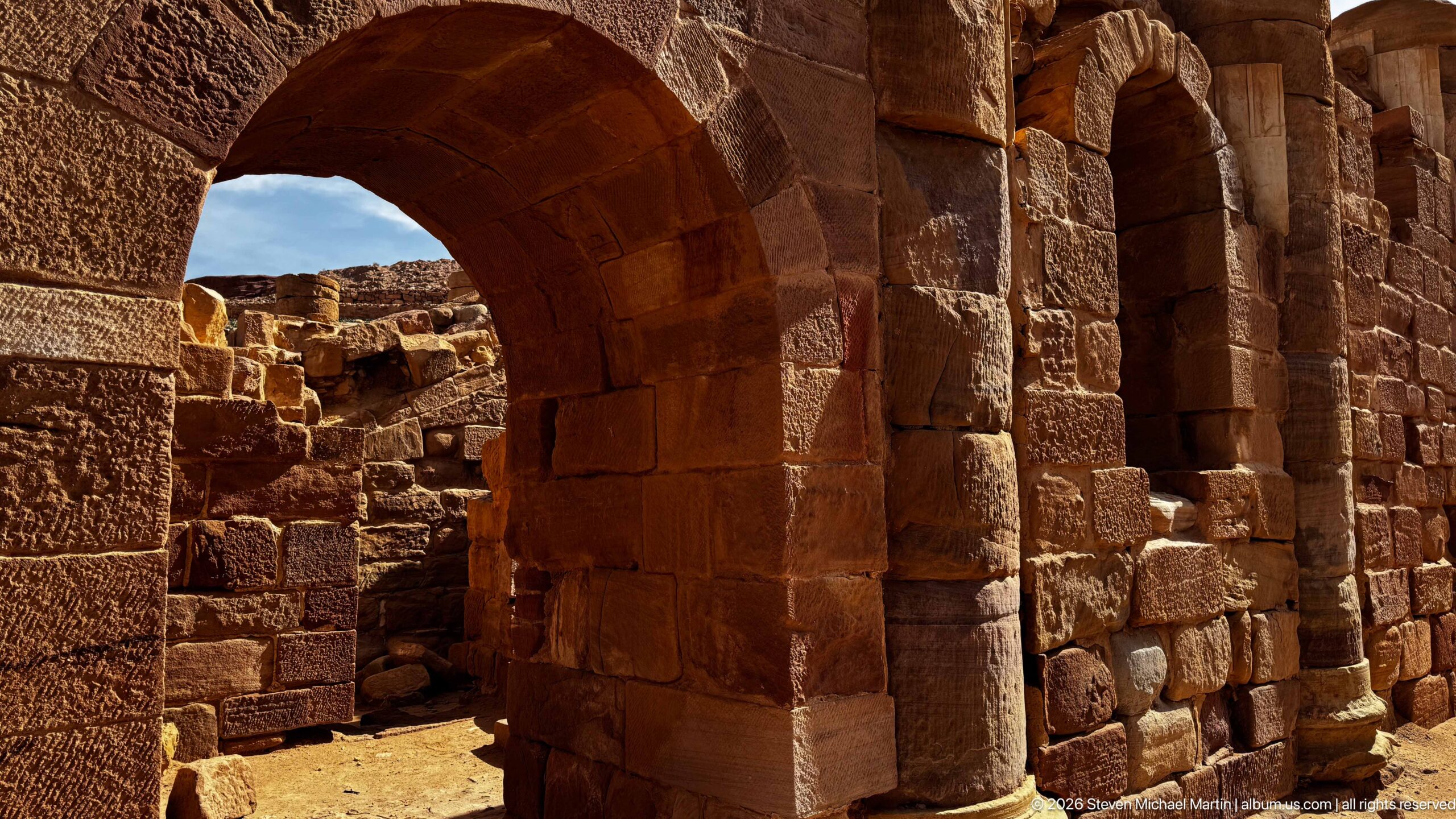
Heavy semicircular stone arches frame a narrow passage through block-built ruins at Petra, their warm sandstone surfaces alternating between sun and deep shadow. The close architectural study highlights voussoir construction, thick masonry piers, and the irregular survival of adjacent walls, focusing on building technique and spatial sequence rather than a distant monumental façade.
Caption
Heavy semicircular stone arches frame a narrow passage through block-built ruins at Petra, their warm sandstone surfaces alternating between sun and deep shadow. The close architectural study highlights voussoir construction, thick masonry piers, and the irregular survival of adjacent walls, focusing on building technique and spatial sequence rather than a distant monumental façade.
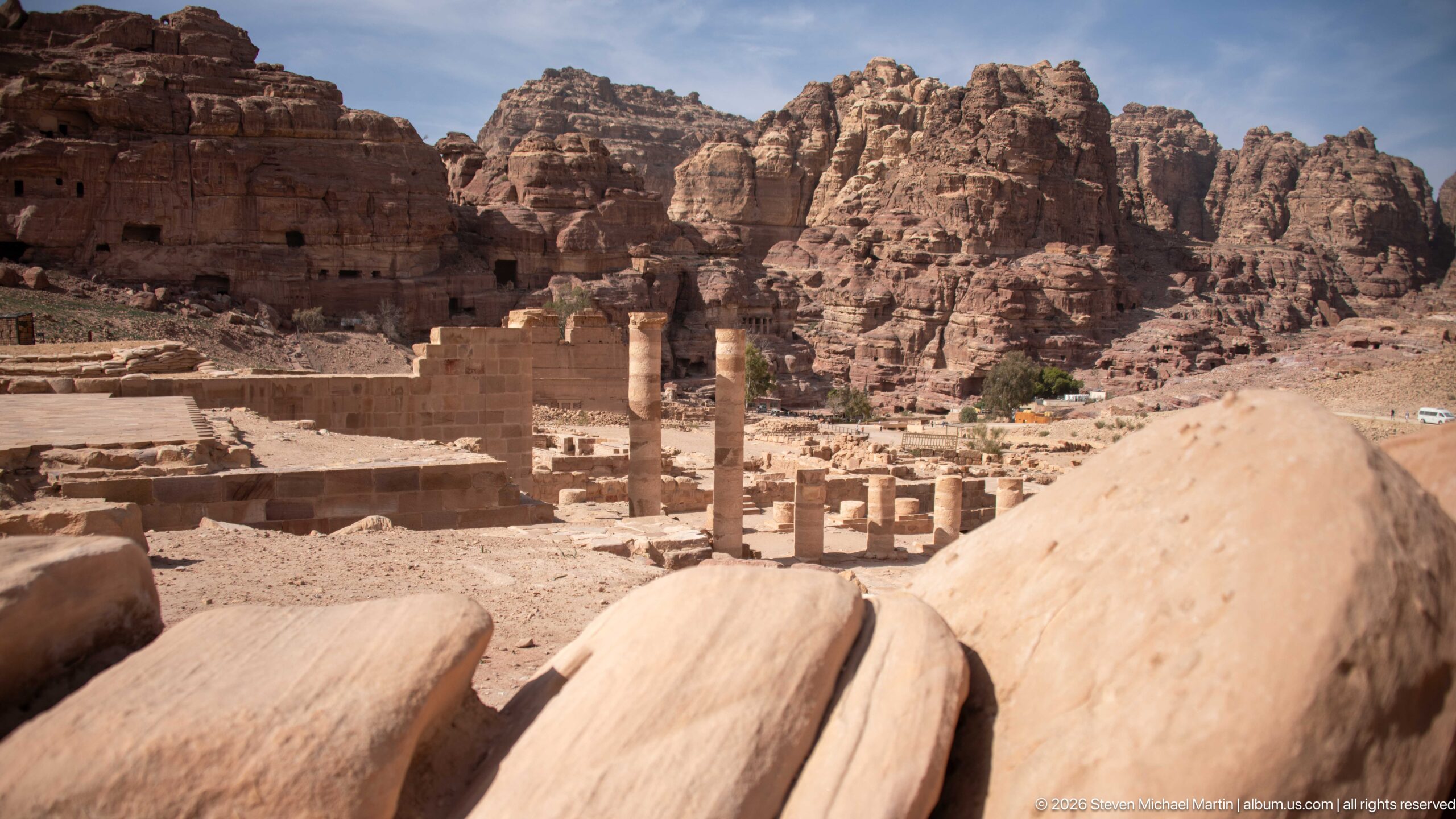
Standing columns and fallen architectural blocks mark the lower precinct of Petra’s Great Temple, where a paved courtyard was once flanked by triple colonnades. The official Petra authority records sixty columns in each colonnade, some with imported limestone capitals carved with elephant heads. This view preserves the dense architectural rhythm of the complex while showing how excavation has exposed its successive spaces.
Caption
Standing columns and fallen architectural blocks mark the lower precinct of Petra’s Great Temple, where a paved courtyard was once flanked by triple colonnades. The official Petra authority records sixty columns in each colonnade, some with imported limestone capitals carved with elephant heads. This view preserves the dense architectural rhythm of the complex while showing how excavation has exposed its successive spaces.
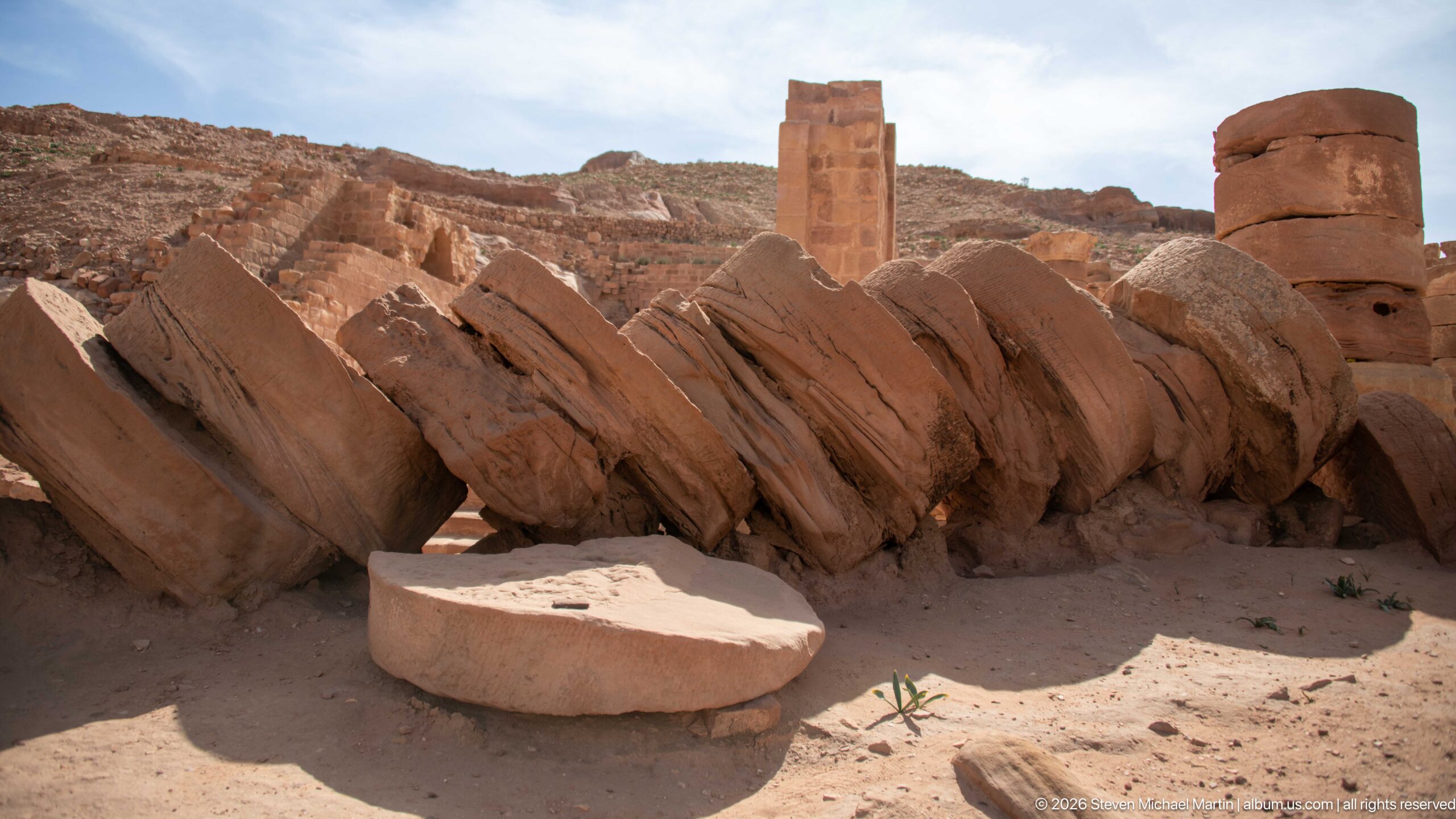
Fallen cylindrical column drums lie across the excavated Great Temple complex, remnants of the monumental colonnades that enclosed its lower courtyard. Petra’s official interpretation describes triple colonnades containing rows of columns assembled from carved drums, several of which have been partially re-erected. The close view makes the modular construction of these once-towering supports especially clear.
Caption
Fallen cylindrical column drums lie across the excavated Great Temple complex, remnants of the monumental colonnades that enclosed its lower courtyard. Petra’s official interpretation describes triple colonnades containing rows of columns assembled from carved drums, several of which have been partially re-erected. The close view makes the modular construction of these once-towering supports especially clear.
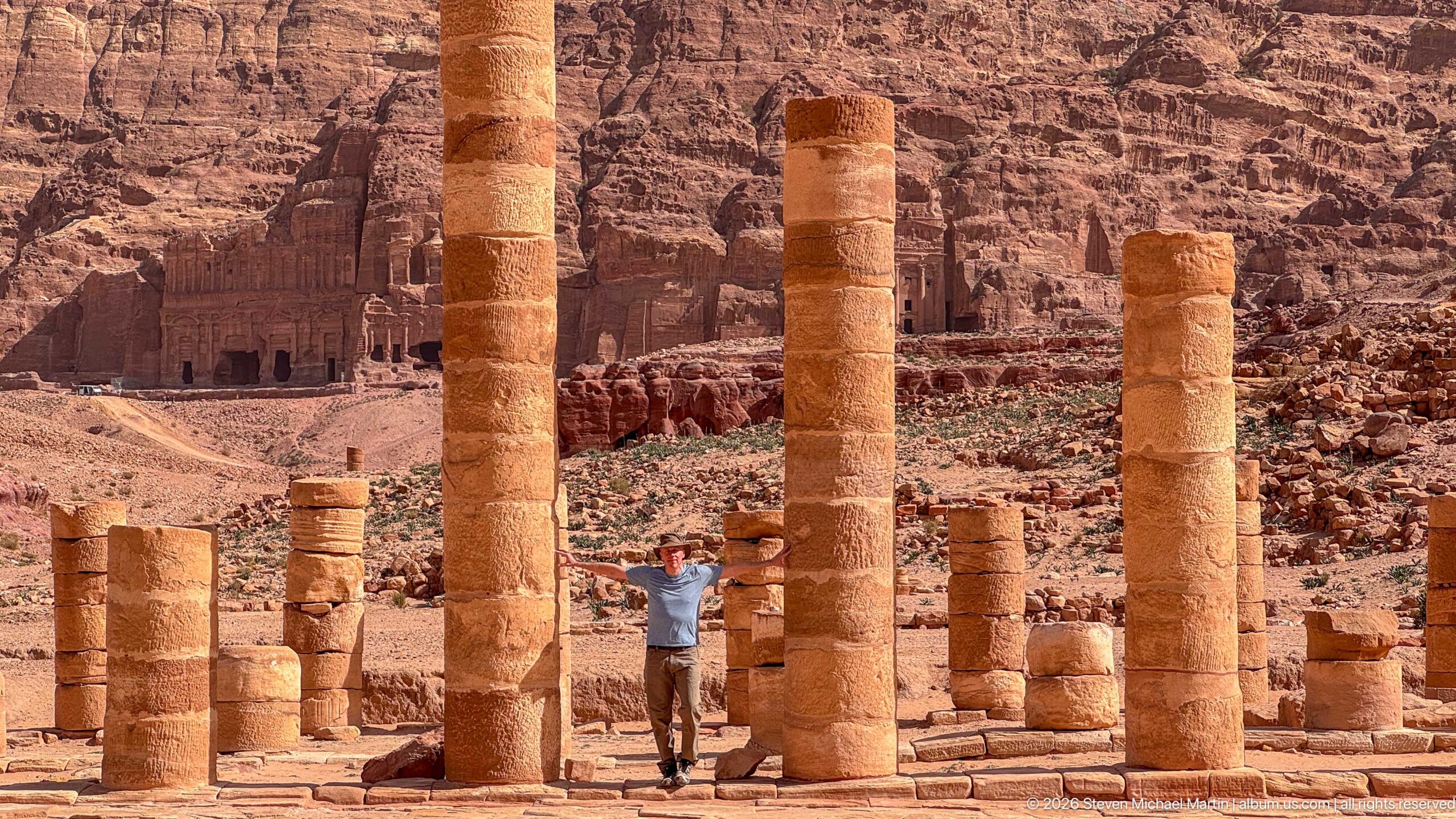
Re-erected columns rise above the Great Temple’s excavated precinct while a visitor provides an immediate sense of scale. The complex covered about 7,560 square meters and included a paved lower courtyard bordered by triple colonnades. These reconstructed vertical elements help restore the spatial rhythm of a building whose upper precinct also contained a small semicircular assembly space.
Caption
Re-erected columns rise above the Great Temple’s excavated precinct while a visitor provides an immediate sense of scale. The complex covered about 7,560 square meters and included a paved lower courtyard bordered by triple colonnades. These reconstructed vertical elements help restore the spatial rhythm of a building whose upper precinct also contained a small semicircular assembly space.
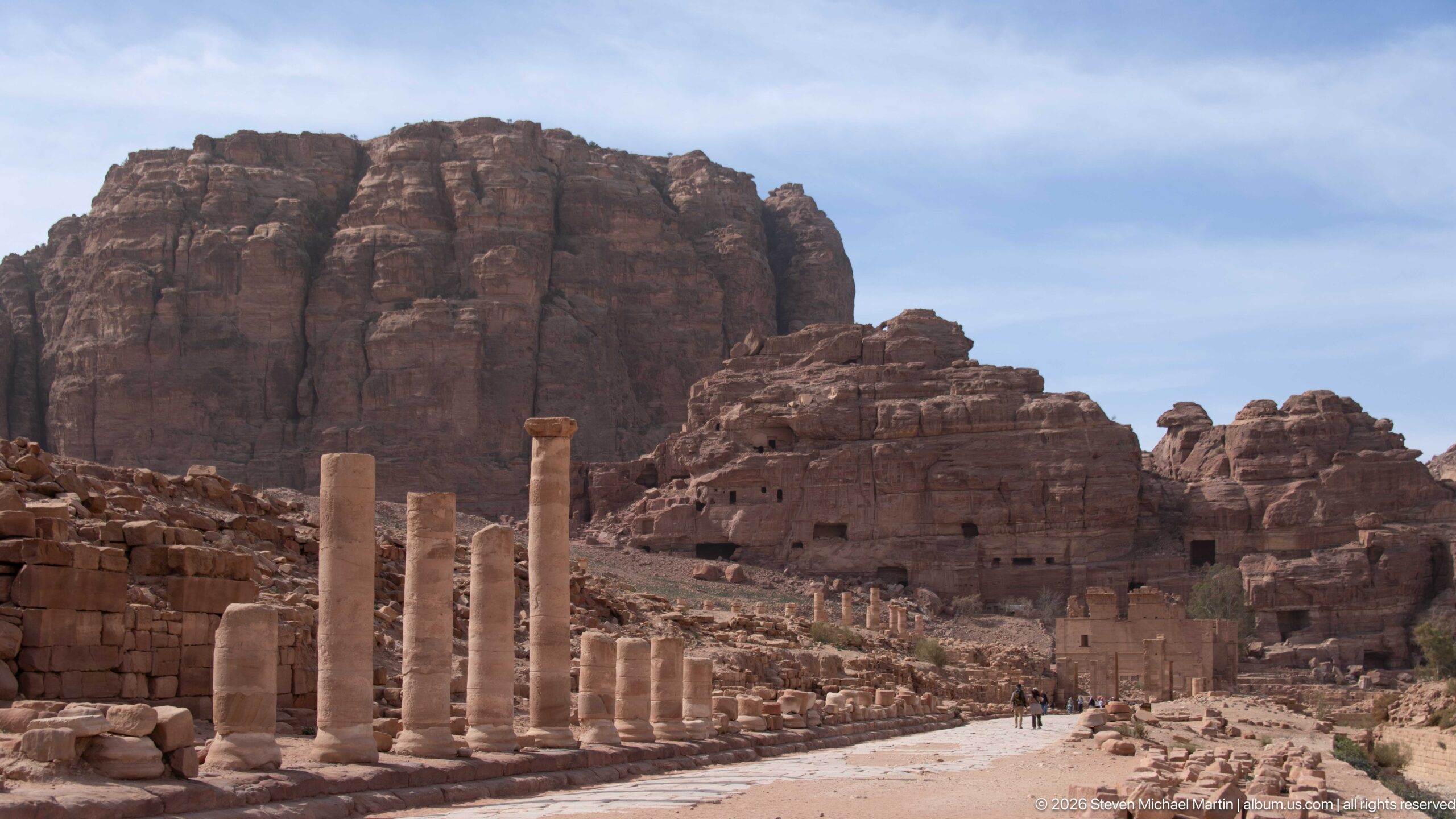
Surviving and re-erected columns trace Petra’s Colonnaded Street through the heart of the ancient city. The official Petra authority states that the Romans rebuilt the street in the second century AD, replacing an earlier Nabataean route that followed the winding course of Wadi Musa. The long axial view records the more formal civic planning introduced into Petra’s central urban landscape.
Caption
Surviving and re-erected columns trace Petra’s Colonnaded Street through the heart of the ancient city. The official Petra authority states that the Romans rebuilt the street in the second century AD, replacing an earlier Nabataean route that followed the winding course of Wadi Musa. The long axial view records the more formal civic planning introduced into Petra’s central urban landscape.
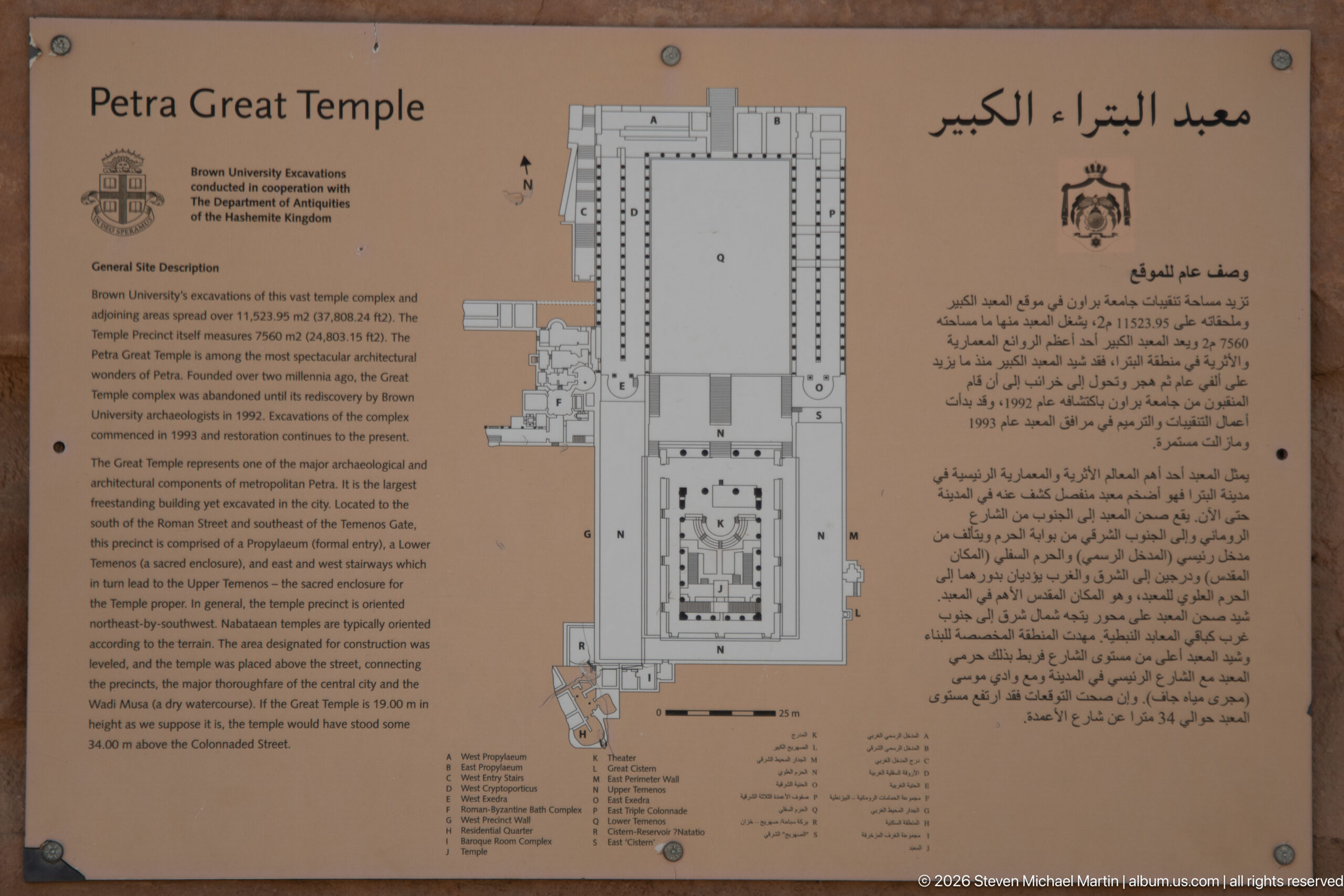
A bilingual interpretive panel presents the plan of Petra’s Great Temple, pairing a measured architectural drawing with explanatory text and a keyed list of features. The diagram clarifies the monument’s organized courts, colonnades, stairways, and central structures, providing a schematic counterpart to the surrounding excavated remains visible elsewhere in the site.
Caption
A bilingual interpretive panel presents the plan of Petra’s Great Temple, pairing a measured architectural drawing with explanatory text and a keyed list of features. The diagram clarifies the monument’s organized courts, colonnades, stairways, and central structures, providing a schematic counterpart to the surrounding excavated remains visible elsewhere in the site.
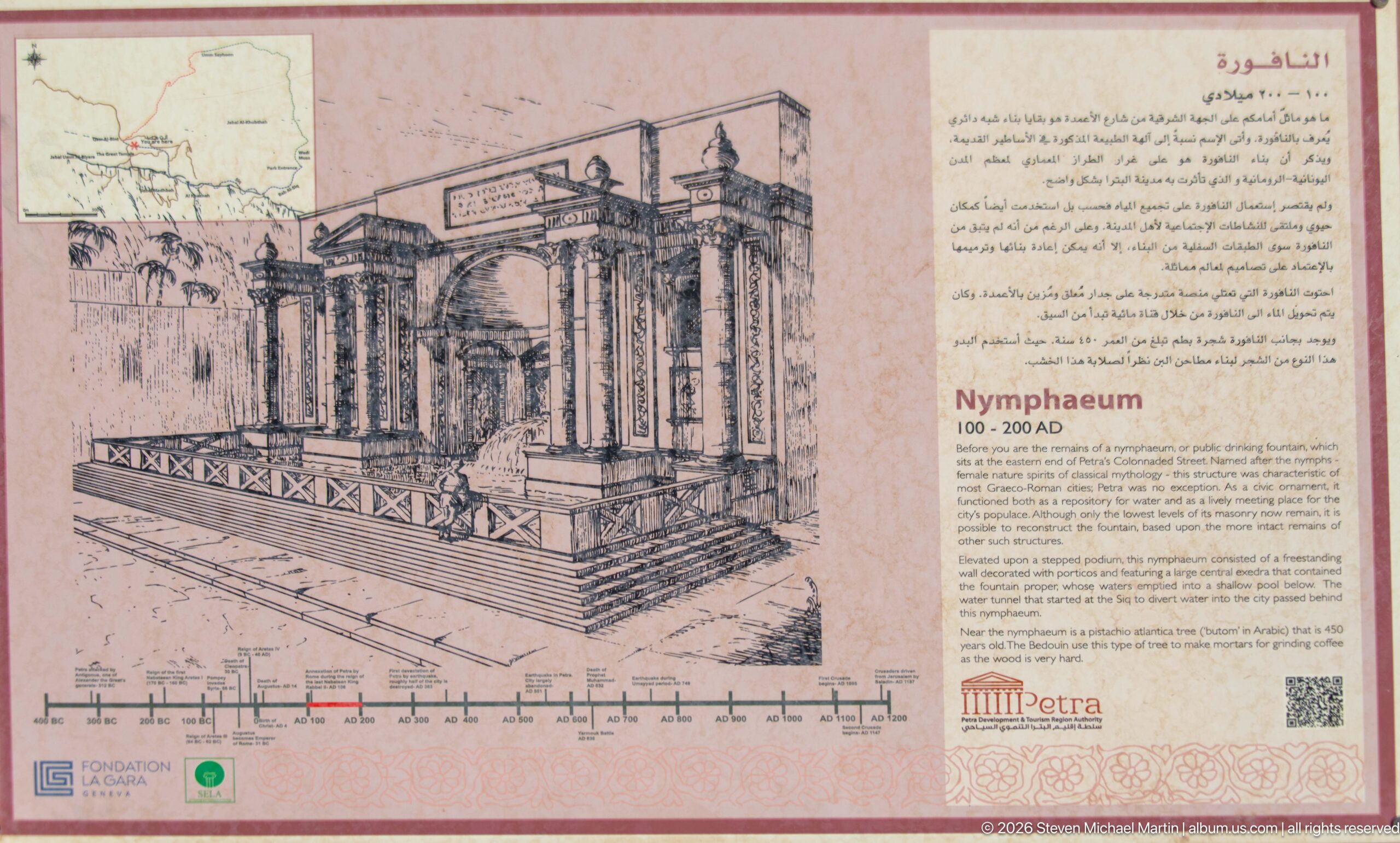
This interpretive panel reconstructs Petra’s Nymphaeum, the monumental public fountain that formed part of the ancient city’s civic and water-management landscape. UNESCO highlights Petra’s channels, tunnels, cisterns, and reservoirs as an exceptional water-engineering system that supported extensive settlement in an arid environment. The reconstruction helps connect that larger hydraulic achievement with a public architectural feature in the city center.
Caption
This interpretive panel reconstructs Petra’s Nymphaeum, the monumental public fountain that formed part of the ancient city’s civic and water-management landscape. UNESCO highlights Petra’s channels, tunnels, cisterns, and reservoirs as an exceptional water-engineering system that supported extensive settlement in an arid environment. The reconstruction helps connect that larger hydraulic achievement with a public architectural feature in the city center.
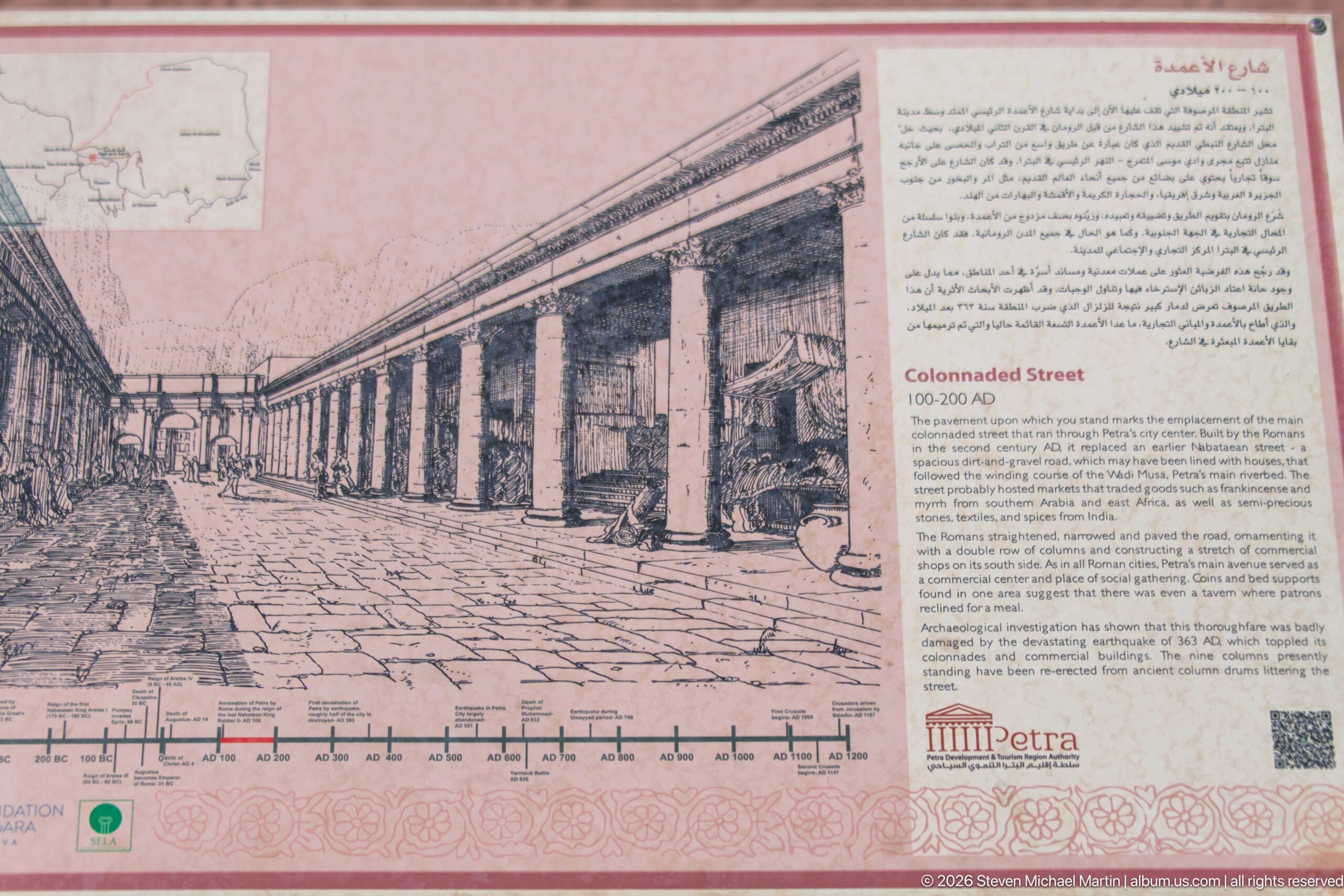
An interpretive reconstruction presents Petra’s Colonnaded Street as a formal urban avenue lined with columns. Archaeological evidence cited by the official Petra authority indicates that the Romans rebuilt the street in the second century AD over an earlier Nabataean route following Wadi Musa. The drawing gives visitors a visual counterpart to the surviving paving, column bases, and re-erected shafts seen across the city center.
Caption
An interpretive reconstruction presents Petra’s Colonnaded Street as a formal urban avenue lined with columns. Archaeological evidence cited by the official Petra authority indicates that the Romans rebuilt the street in the second century AD over an earlier Nabataean route following Wadi Musa. The drawing gives visitors a visual counterpart to the surviving paving, column bases, and re-erected shafts seen across the city center.
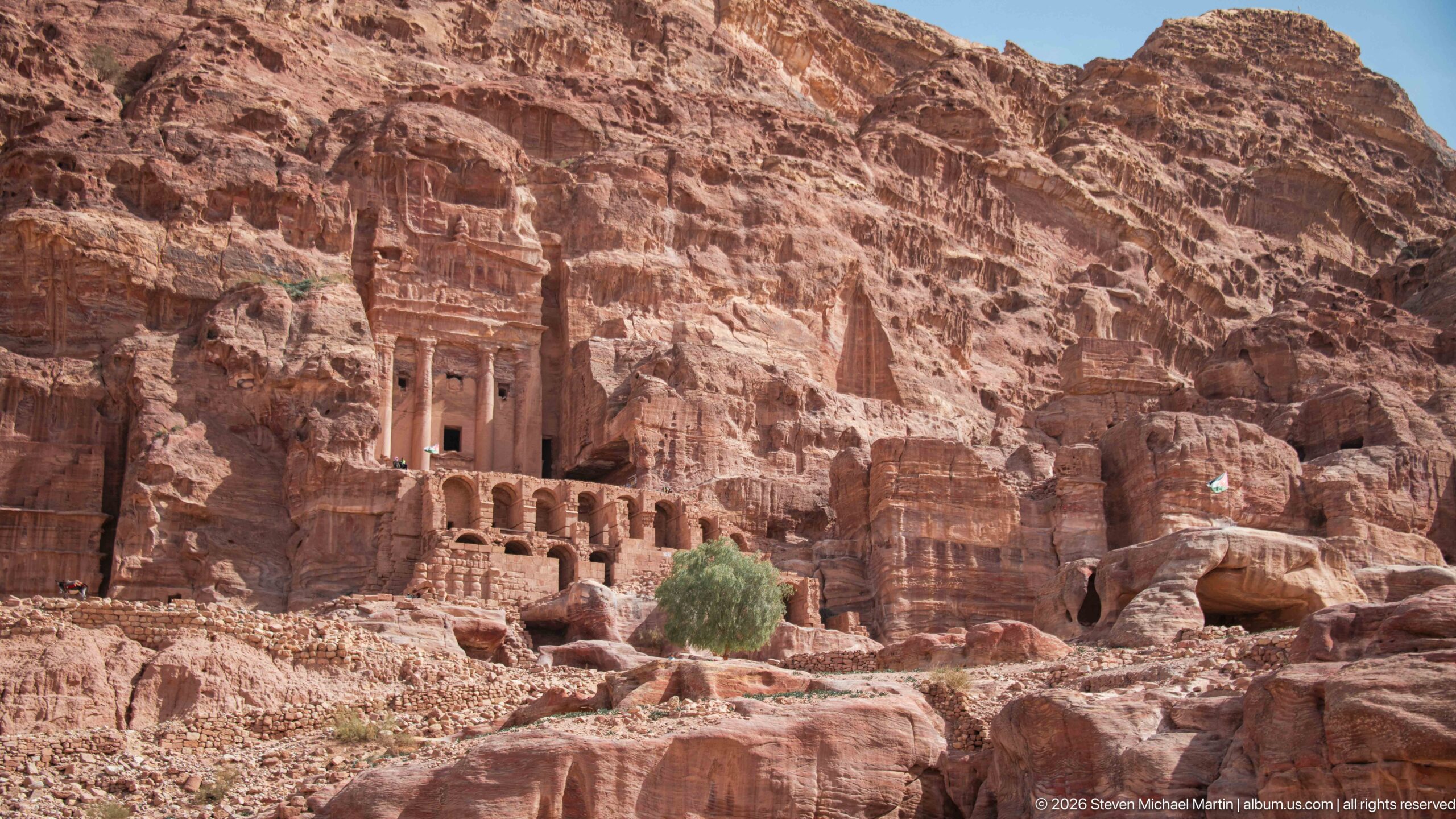
Ornate multi-story façades in Petra’s Royal Tombs occupy the western slope of Jabal al-Khubtha. The group includes the Corinthian Tomb, named for the Corinthian-style capitals of its upper story, and the much broader Palace Tomb, whose façade evokes Hellenistic or Roman palatial architecture. The close grouping shows how individual monuments merge visually into a continuous carved cliff from many viewpoints.
Caption
Ornate multi-story façades in Petra’s Royal Tombs occupy the western slope of Jabal al-Khubtha. The group includes the Corinthian Tomb, named for the Corinthian-style capitals of its upper story, and the much broader Palace Tomb, whose façade evokes Hellenistic or Roman palatial architecture. The close grouping shows how individual monuments merge visually into a continuous carved cliff from many viewpoints.
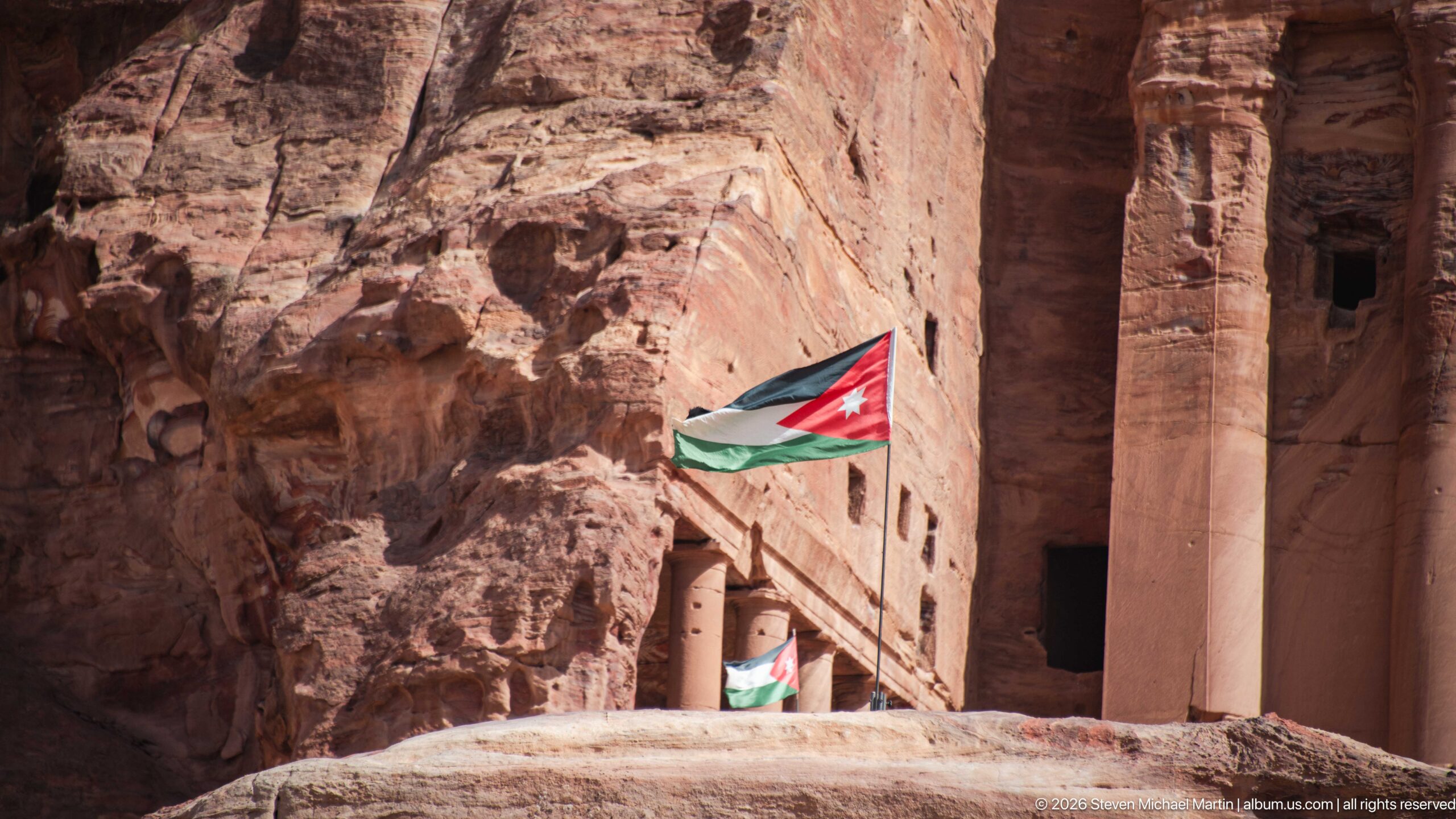
A monumental rock-cut entrance and Jordanian flag fill this close view within Petra’s Royal Tombs. The surrounding cliff belongs to the celebrated funerary ensemble on Jabal al-Khubtha, where the Urn, Silk, Corinthian, and Palace Tombs overlook the city center. The tight framing emphasizes the scale of the carved sandstone while avoiding a more specific tomb attribution than the visible evidence securely supports.
Caption
A monumental rock-cut entrance and Jordanian flag fill this close view within Petra’s Royal Tombs. The surrounding cliff belongs to the celebrated funerary ensemble on Jabal al-Khubtha, where the Urn, Silk, Corinthian, and Palace Tombs overlook the city center. The tight framing emphasizes the scale of the carved sandstone while avoiding a more specific tomb attribution than the visible evidence securely supports.
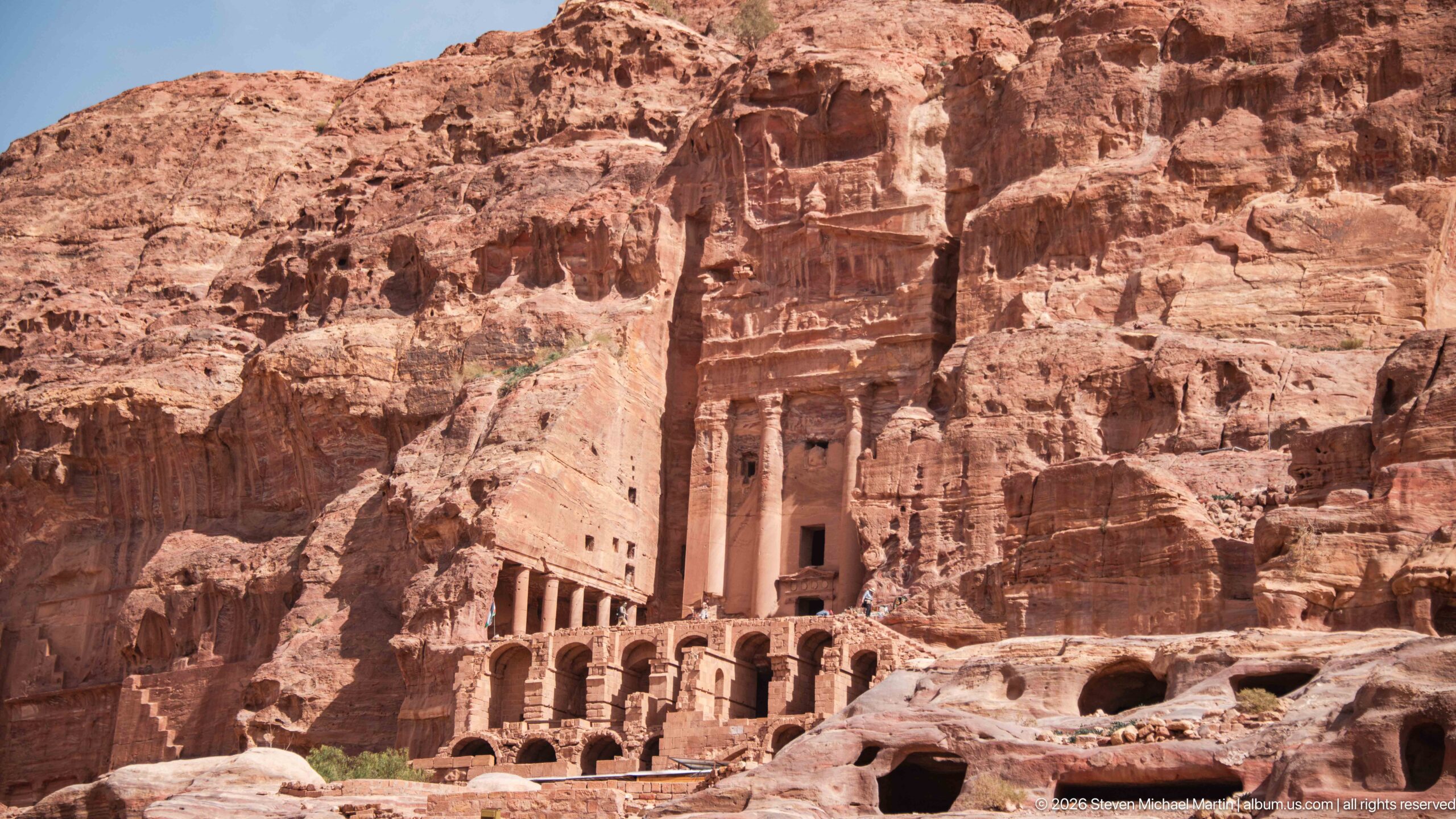
The Palace Tomb spreads across the cliff in a monumental multi-level façade, the largest and most elaborate of Petra’s four principal Royal Tombs. Petra’s official site describes a five-story composition about 49 meters wide and 46 meters high, with five lower doorways and an upper level partly completed in built ashlar masonry where the rock face was insufficient. Erosion now softens much of its once-architectural surface.
Caption
The Palace Tomb spreads across the cliff in a monumental multi-level façade, the largest and most elaborate of Petra’s four principal Royal Tombs. Petra’s official site describes a five-story composition about 49 meters wide and 46 meters high, with five lower doorways and an upper level partly completed in built ashlar masonry where the rock face was insufficient. Erosion now softens much of its once-architectural surface.
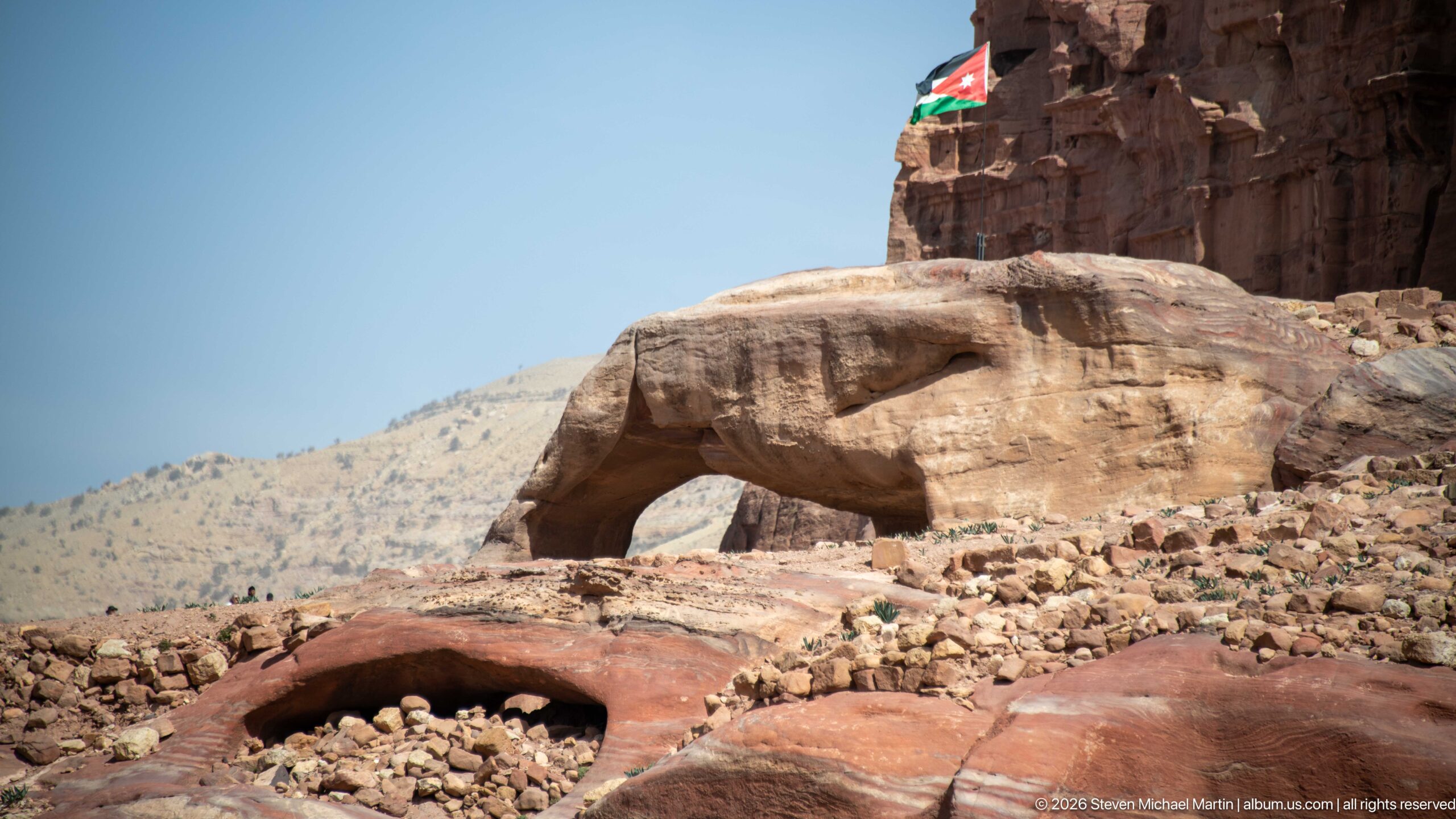
Wind and water erosion have opened a broad arch-like void through a low sandstone outcrop below Petra’s monumental cliffs. Rounded surfaces, shallow cavities, and contrasting red rock in the foreground highlight the site’s sculptural geology, while a Jordanian flag and part of a carved façade appear high above, linking the natural formation to the Royal Tombs landscape.
Caption
Wind and water erosion have opened a broad arch-like void through a low sandstone outcrop below Petra’s monumental cliffs. Rounded surfaces, shallow cavities, and contrasting red rock in the foreground highlight the site’s sculptural geology, while a Jordanian flag and part of a carved façade appear high above, linking the natural formation to the Royal Tombs landscape.
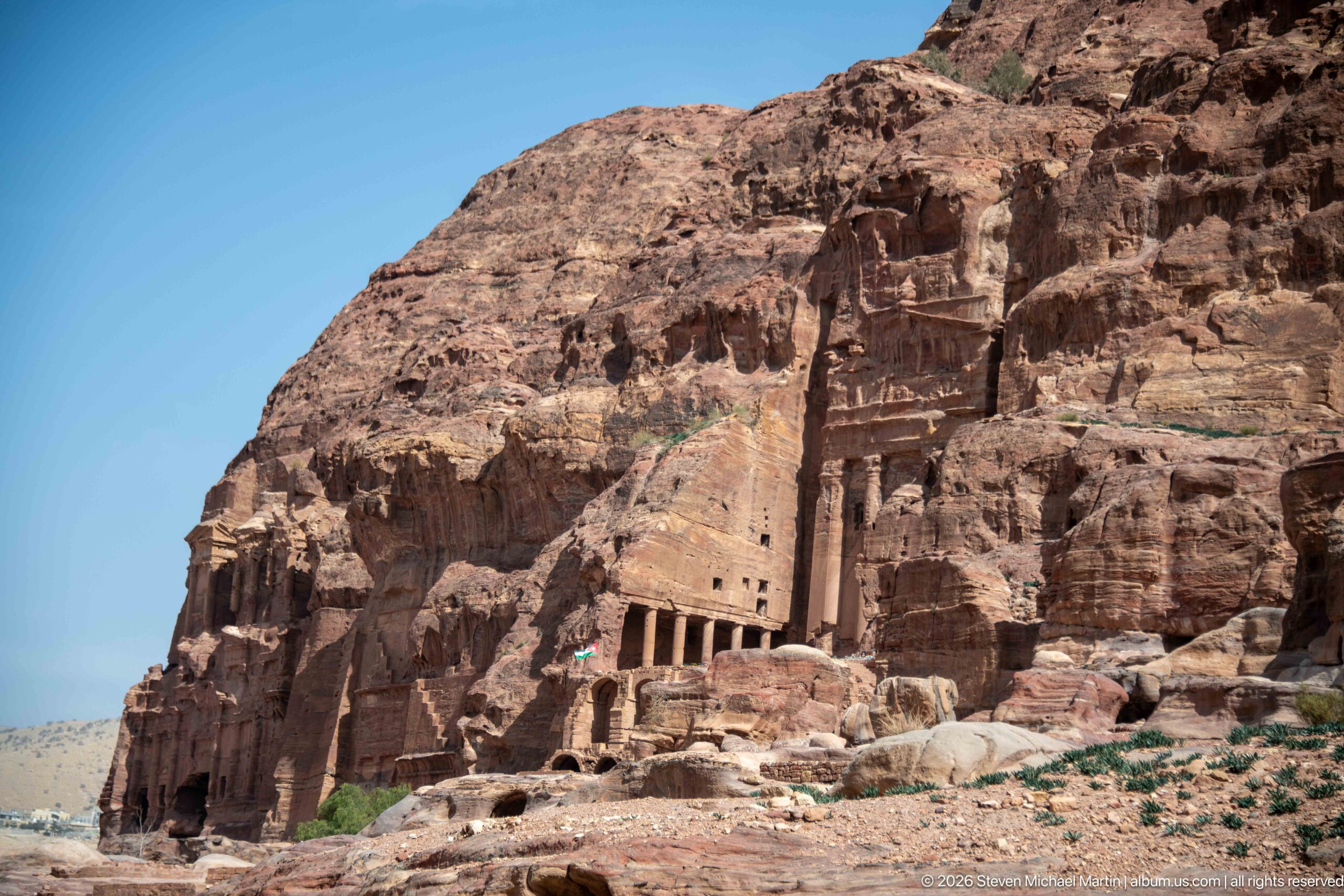
Seen in its cliff setting, the Palace Tomb dominates the Royal Tombs with a broad, multi-story façade carved into Jabal al-Khubtha. Its five-level design is unusually architectural in conception, and portions of the upper façade were completed with built masonry where the natural rock face did not extend high enough. The wider view reveals how the monument was composed as both sculpture and architecture on a landscape scale.
Caption
Seen in its cliff setting, the Palace Tomb dominates the Royal Tombs with a broad, multi-story façade carved into Jabal al-Khubtha. Its five-level design is unusually architectural in conception, and portions of the upper façade were completed with built masonry where the natural rock face did not extend high enough. The wider view reveals how the monument was composed as both sculpture and architecture on a landscape scale.
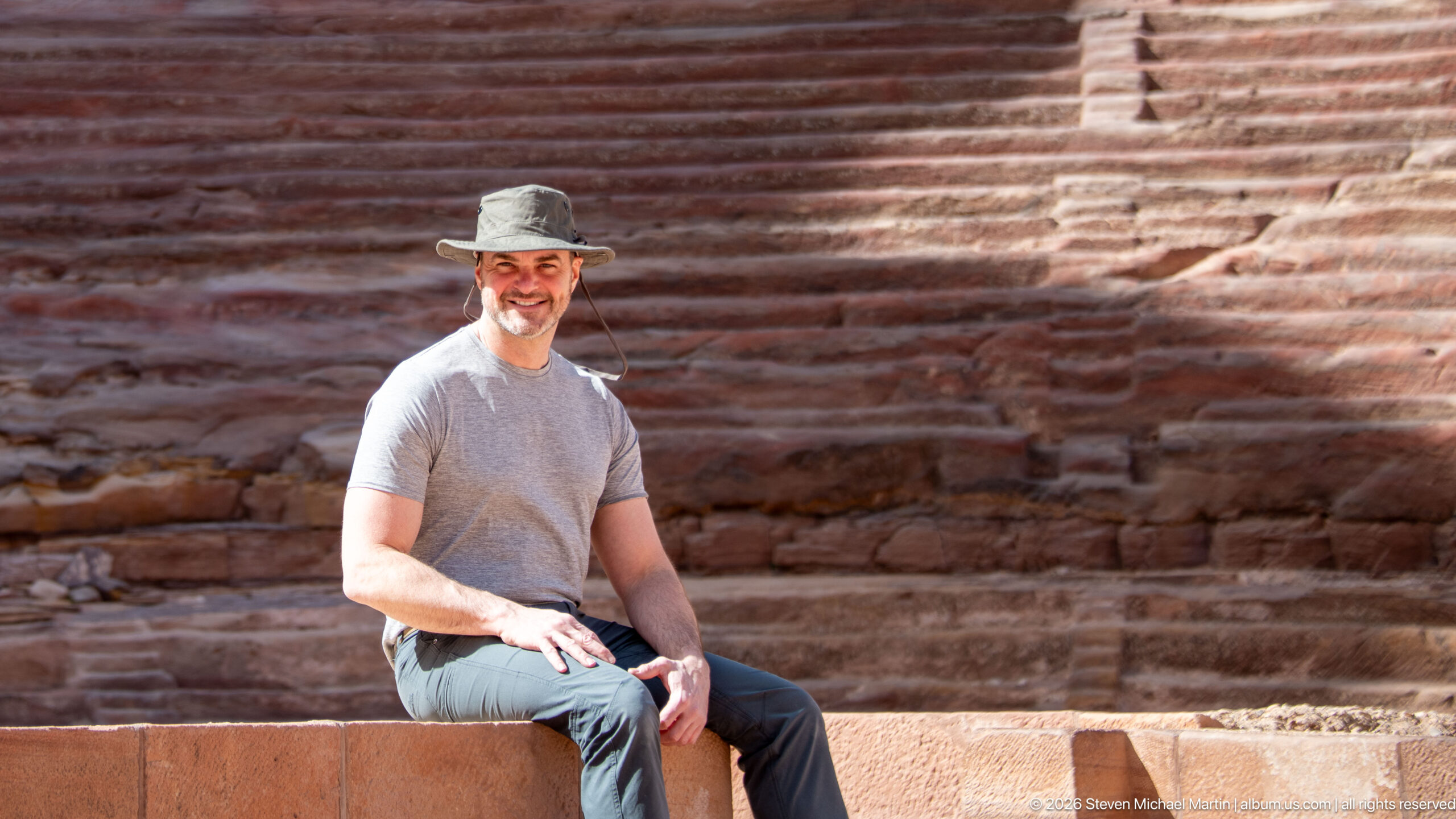
A visitor pauses on a low sandstone ledge in front of broad rock-cut steps at Petra. The relaxed portrait uses the repetitive horizontal bands of the carved stone as a textured backdrop, placing a contemporary human scale against the monumental surfaces of the archaeological site without relying on a specific monument for the composition.
Caption
A visitor pauses on a low sandstone ledge in front of broad rock-cut steps at Petra. The relaxed portrait uses the repetitive horizontal bands of the carved stone as a textured backdrop, placing a contemporary human scale against the monumental surfaces of the archaeological site without relying on a specific monument for the composition.
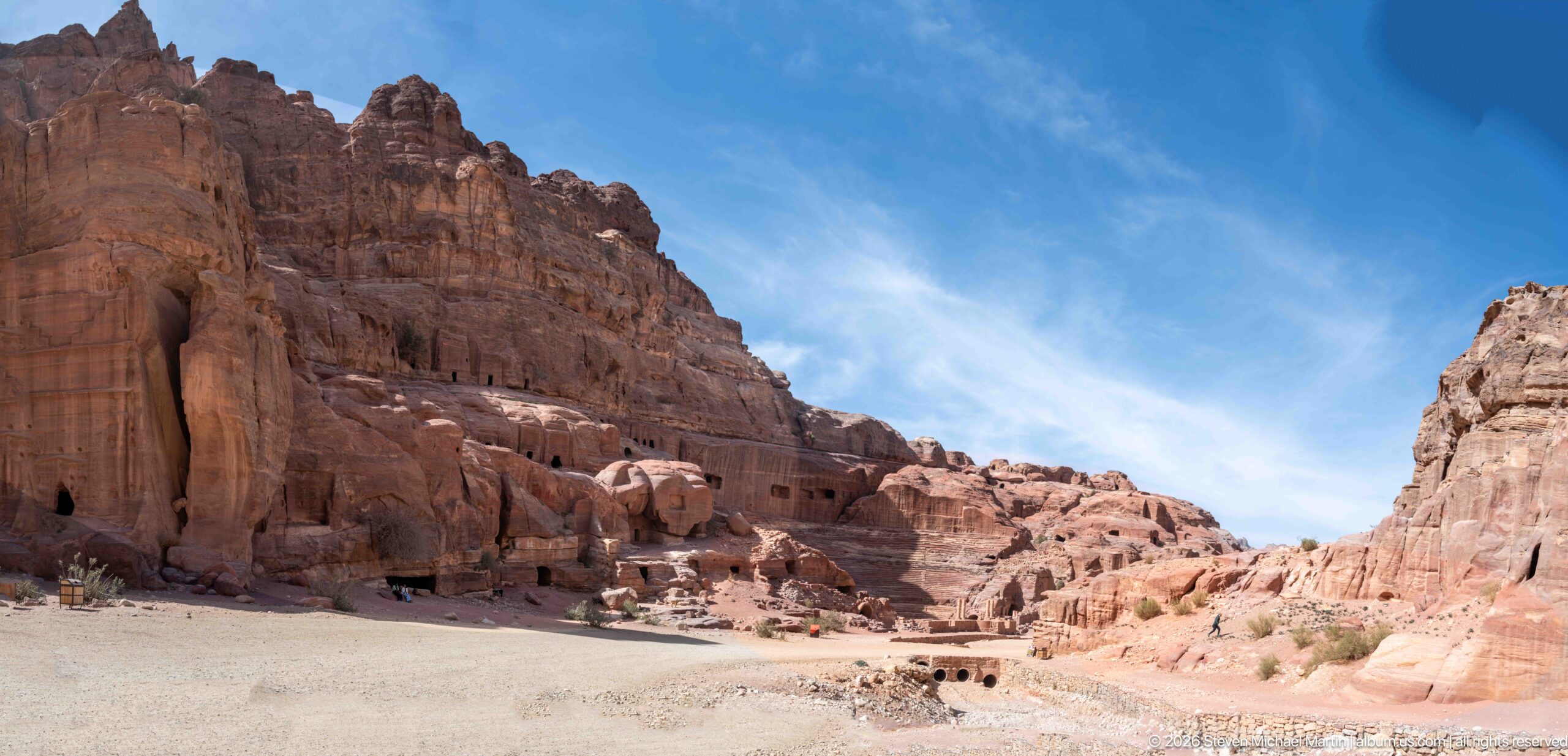
A broad sandy route winds between Petra’s towering sandstone walls, with rock-cut façades and chambers appearing along the left-hand cliff. The wide-angle landscape emphasizes the ancient city’s integration with its natural valleys: monumental carved surfaces, eroded rock forms, and open circulation space merge into a single archaeological and geological setting beneath a high blue sky.
Caption
A broad sandy route winds between Petra’s towering sandstone walls, with rock-cut façades and chambers appearing along the left-hand cliff. The wide-angle landscape emphasizes the ancient city’s integration with its natural valleys: monumental carved surfaces, eroded rock forms, and open circulation space merge into a single archaeological and geological setting beneath a high blue sky.
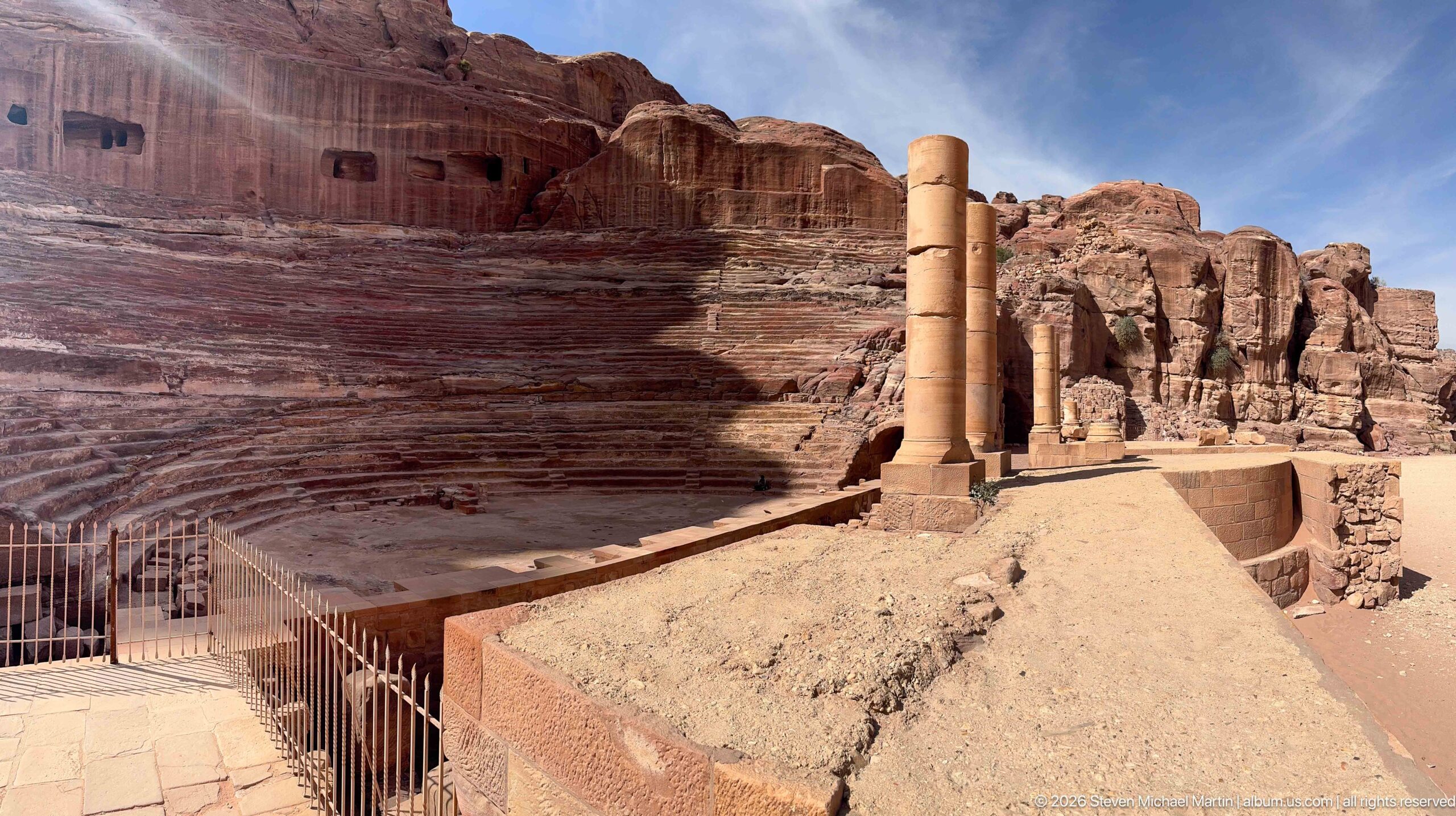
From the side, Petra’s Theater reveals the relationship between its rock-cut seating and the masonry architecture around the stage. UNESCO identifies the theater among the site’s significant Graeco-Roman civic remains, while the monument’s excavation directly into the sandstone slope gives it a distinctly Petran character. Standing columns and archaeological barriers mark the surviving performance and circulation areas below the auditorium.
Caption
From the side, Petra’s Theater reveals the relationship between its rock-cut seating and the masonry architecture around the stage. UNESCO identifies the theater among the site’s significant Graeco-Roman civic remains, while the monument’s excavation directly into the sandstone slope gives it a distinctly Petran character. Standing columns and archaeological barriers mark the surviving performance and circulation areas below the auditorium.
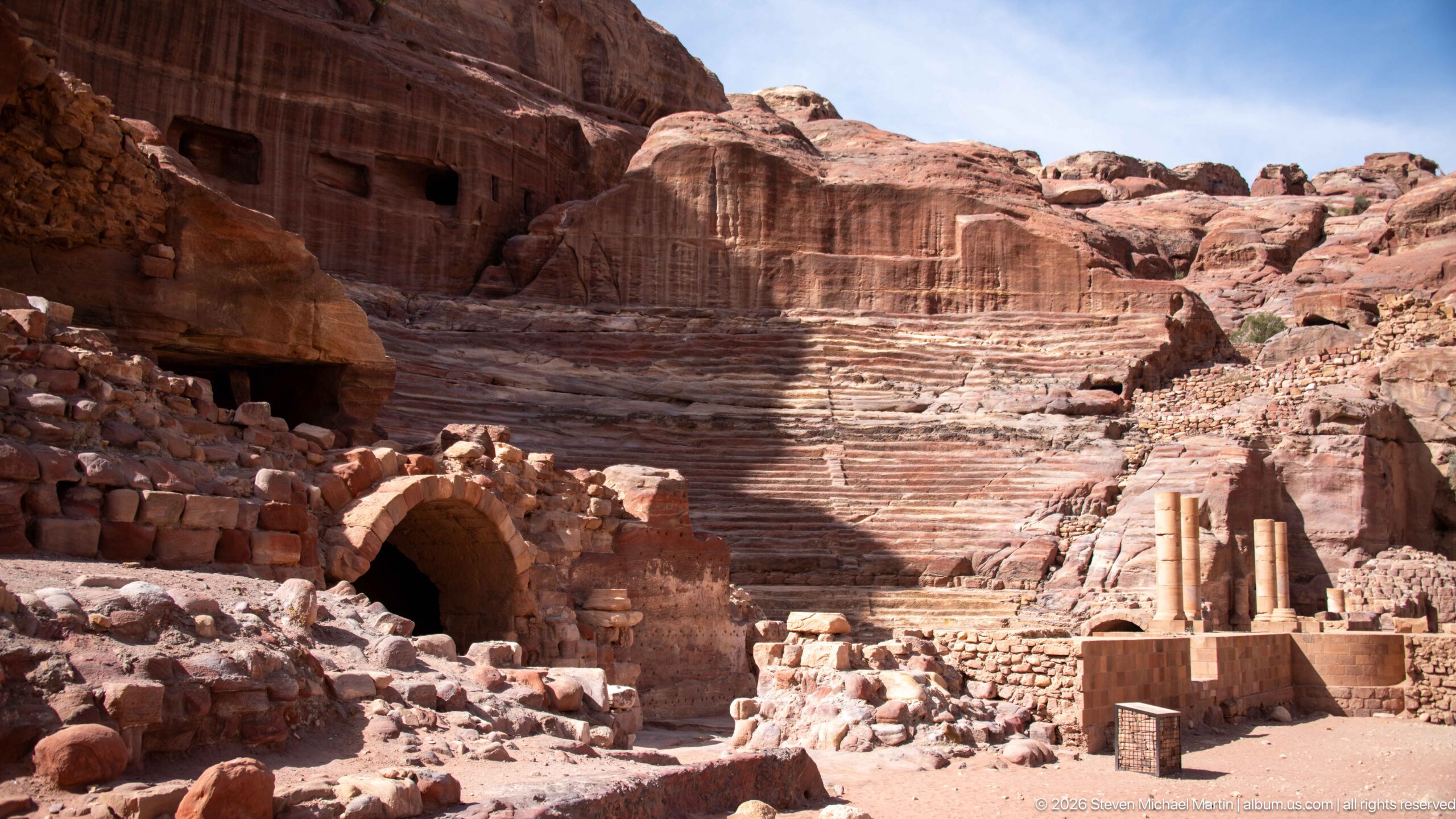
A broad view of Petra’s Theater brings together its carved auditorium, masonry arches, columns, and surrounding archaeological remains. The monument demonstrates how classical civic architecture was adapted to Petra’s sandstone terrain: much of the seating was cut from the living rock rather than built as a freestanding structure. UNESCO lists the theater among the important Graeco-Roman elements preserved within the Nabataean city.
Caption
A broad view of Petra’s Theater brings together its carved auditorium, masonry arches, columns, and surrounding archaeological remains. The monument demonstrates how classical civic architecture was adapted to Petra’s sandstone terrain: much of the seating was cut from the living rock rather than built as a freestanding structure. UNESCO lists the theater among the important Graeco-Roman elements preserved within the Nabataean city.
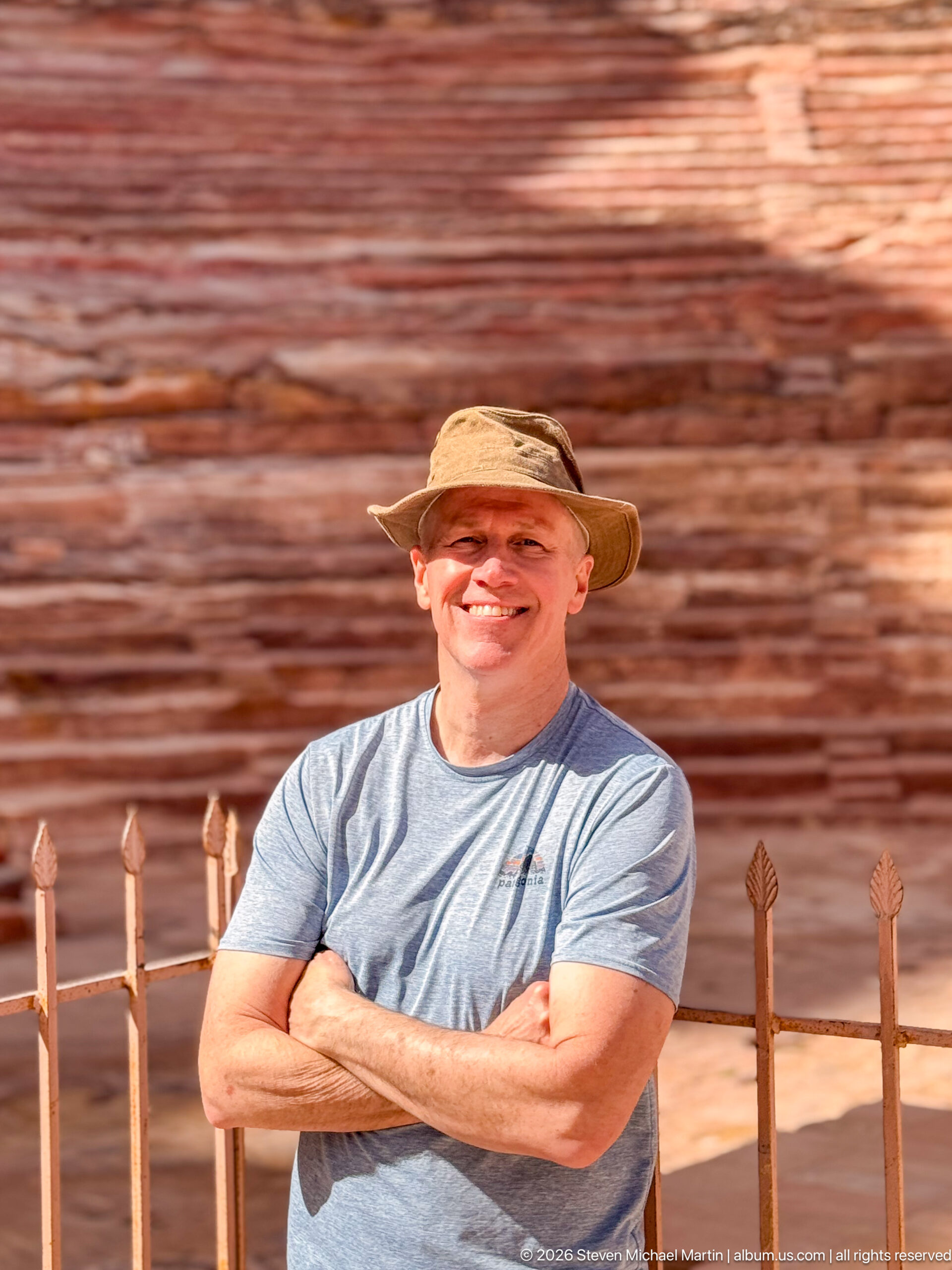
A visitor stands with arms folded before the closely spaced sandstone seating tiers of Petra’s theater. The shallow depth of field isolates the figure while retaining the monument’s distinctive horizontal bands as context, turning the archaeological setting into a textured backdrop rather than an architectural survey.
Caption
A visitor stands with arms folded before the closely spaced sandstone seating tiers of Petra’s theater. The shallow depth of field isolates the figure while retaining the monument’s distinctive horizontal bands as context, turning the archaeological setting into a textured backdrop rather than an architectural survey.
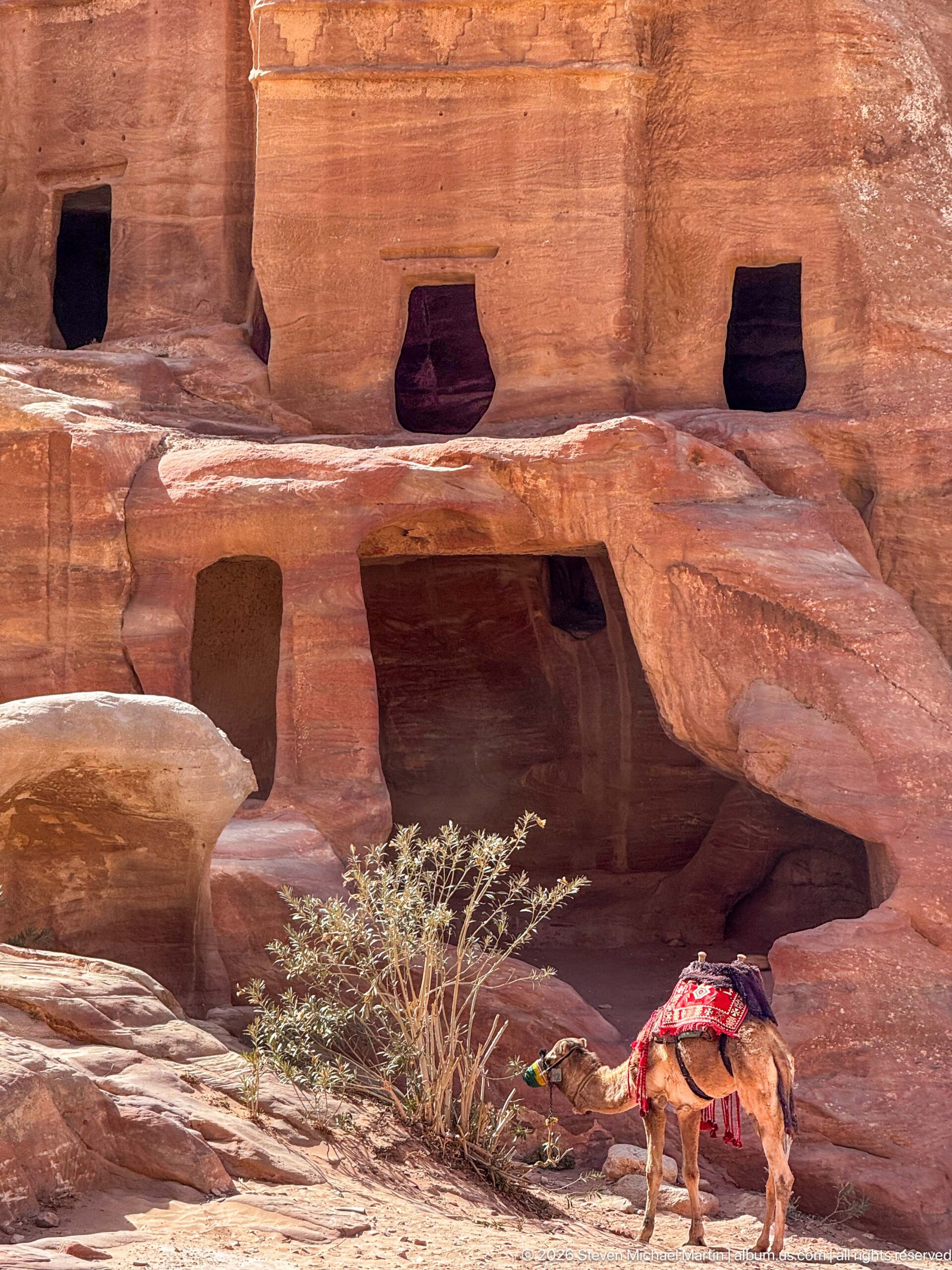
Rectangular chambers and niches cut into Petra’s banded sandstone form a stark architectural backdrop for a resting camel wearing a colorful woven saddle covering. The juxtaposition of ancient rock-cut spaces and present-day animal transport illustrates the continuing visitor activity woven through the archaeological landscape.
Caption
Rectangular chambers and niches cut into Petra’s banded sandstone form a stark architectural backdrop for a resting camel wearing a colorful woven saddle covering. The juxtaposition of ancient rock-cut spaces and present-day animal transport illustrates the continuing visitor activity woven through the archaeological landscape.

A camel rests on the sandy ground at Petra beneath an elaborate red, black, and white woven saddle covering trimmed with tassels. The close view concentrates on the animal, tack, and textile decoration, with the rose-colored stone surroundings softly blurred behind it.
Caption
A camel rests on the sandy ground at Petra beneath an elaborate red, black, and white woven saddle covering trimmed with tassels. The close view concentrates on the animal, tack, and textile decoration, with the rose-colored stone surroundings softly blurred behind it.
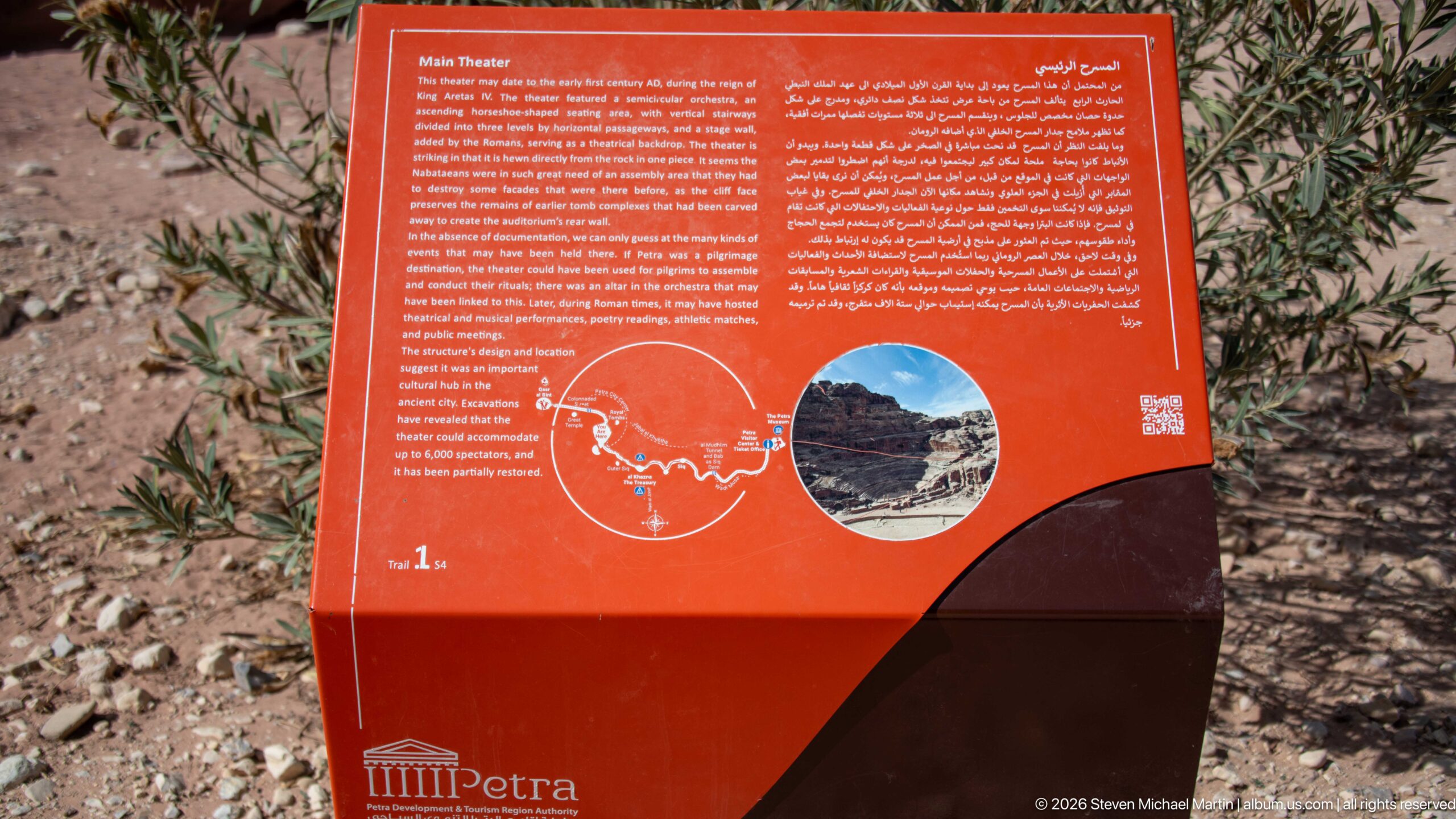
An interpretive panel beside Petra’s theater presents bilingual Arabic and English text, a site diagram, and an inset photograph of the monument. Positioned among low vegetation and gravel, the sign records the visitor infrastructure used to explain the theater’s form and history within the archaeological park.
Caption
An interpretive panel beside Petra’s theater presents bilingual Arabic and English text, a site diagram, and an inset photograph of the monument. Positioned among low vegetation and gravel, the sign records the visitor infrastructure used to explain the theater’s form and history within the archaeological park.
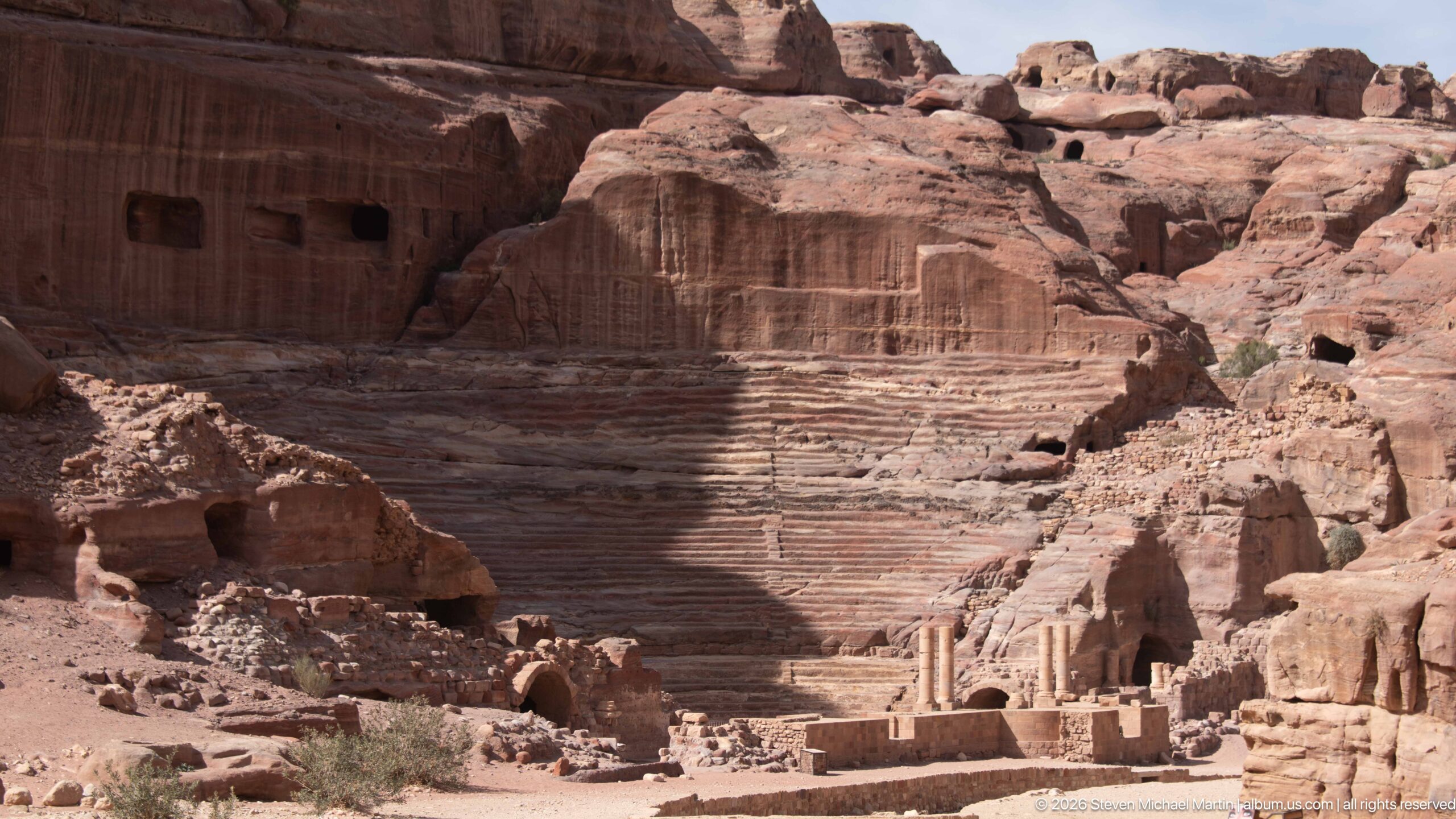
The full sweep of Petra’s Theater is visible against the sandstone cliff, showing how the auditorium was cut into the natural slope while built architectural elements occupied the stage area below. UNESCO cites the theater among the city’s significant Graeco-Roman civic remains. Its placement within a landscape already crowded with tombs and façades illustrates the density of public and funerary architecture in Petra’s urban core.
Caption
The full sweep of Petra’s Theater is visible against the sandstone cliff, showing how the auditorium was cut into the natural slope while built architectural elements occupied the stage area below. UNESCO cites the theater among the city’s significant Graeco-Roman civic remains. Its placement within a landscape already crowded with tombs and façades illustrates the density of public and funerary architecture in Petra’s urban core.
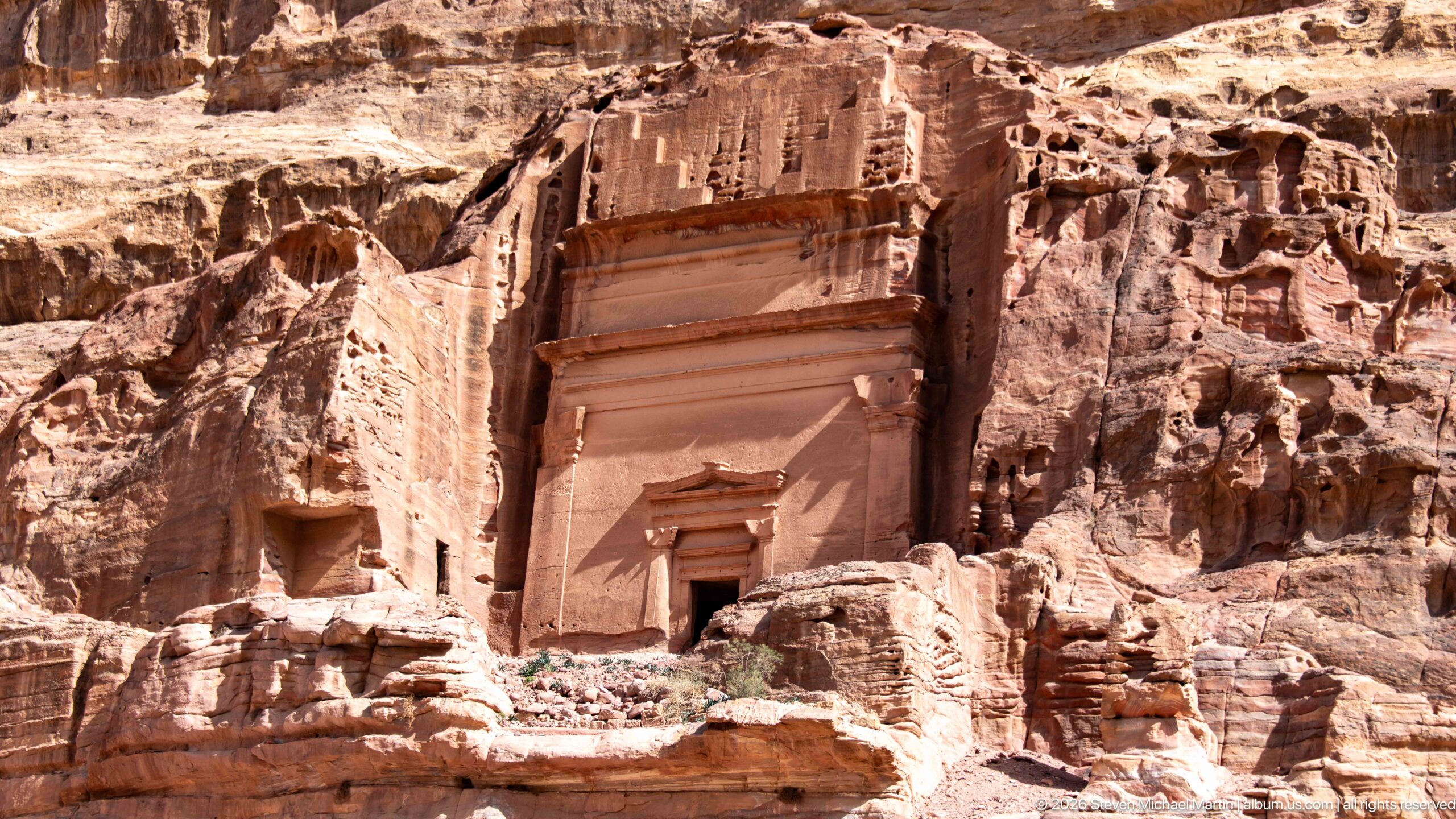
A monumental tomb façade is carved deeply into Petra’s sandstone cliff, its tall rectangular composition framing a small doorway beneath layered architectural moldings. Weathering and adjacent rock-cut openings reveal the façade’s direct relationship to the living stone, while its formal symmetry distinguishes it from the irregular cliff around it.
Caption
A monumental tomb façade is carved deeply into Petra’s sandstone cliff, its tall rectangular composition framing a small doorway beneath layered architectural moldings. Weathering and adjacent rock-cut openings reveal the façade’s direct relationship to the living stone, while its formal symmetry distinguishes it from the irregular cliff around it.
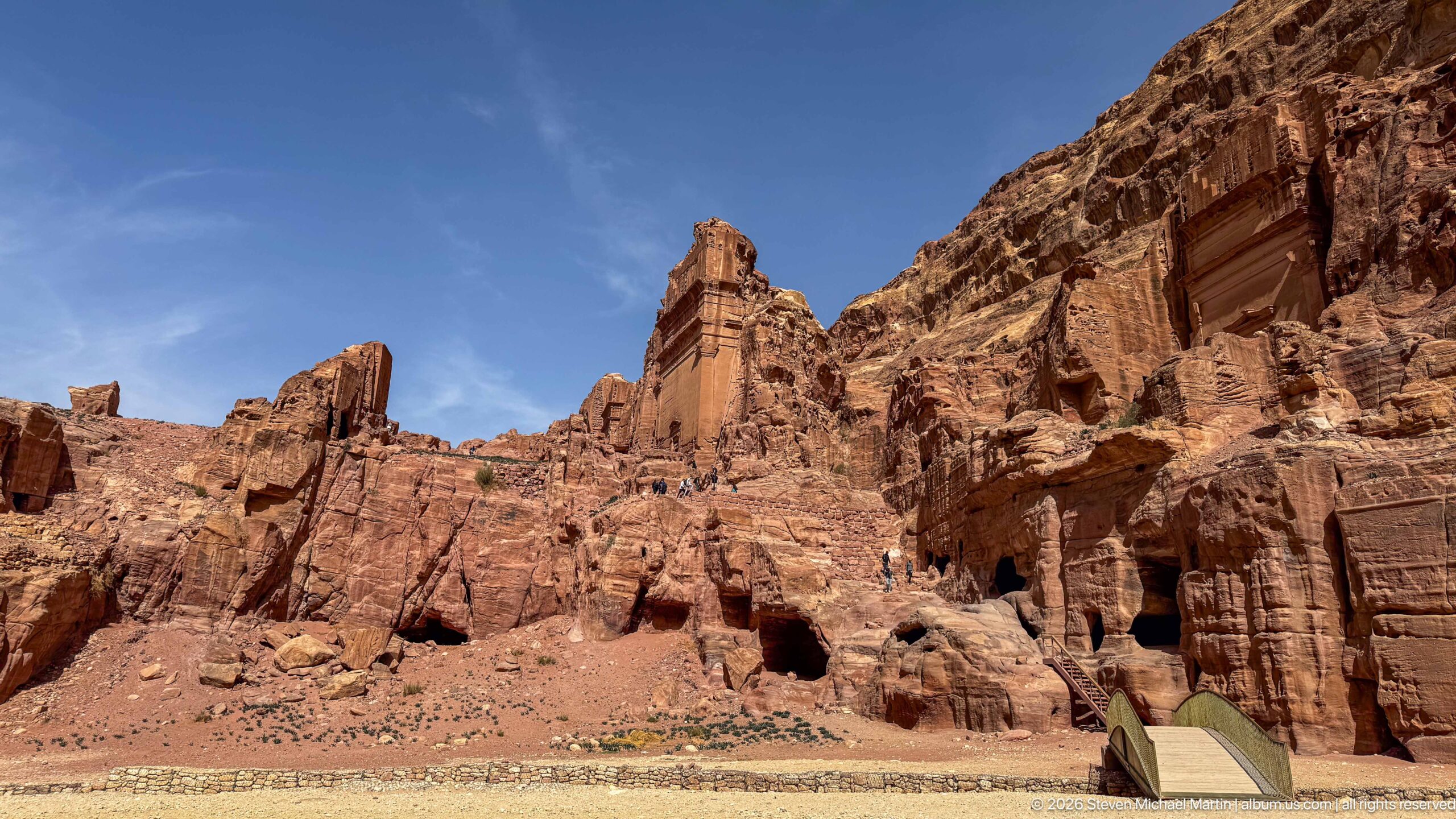
Visitors climb a steep path through a cliff face crowded with rock-cut façades, chambers, and eroded architectural remnants. The low viewpoint emphasizes the vertical scale of Petra’s carved sandstone landscape, where monumental tomb fronts and smaller openings occupy successive levels above the valley floor.
Caption
Visitors climb a steep path through a cliff face crowded with rock-cut façades, chambers, and eroded architectural remnants. The low viewpoint emphasizes the vertical scale of Petra’s carved sandstone landscape, where monumental tomb fronts and smaller openings occupy successive levels above the valley floor.
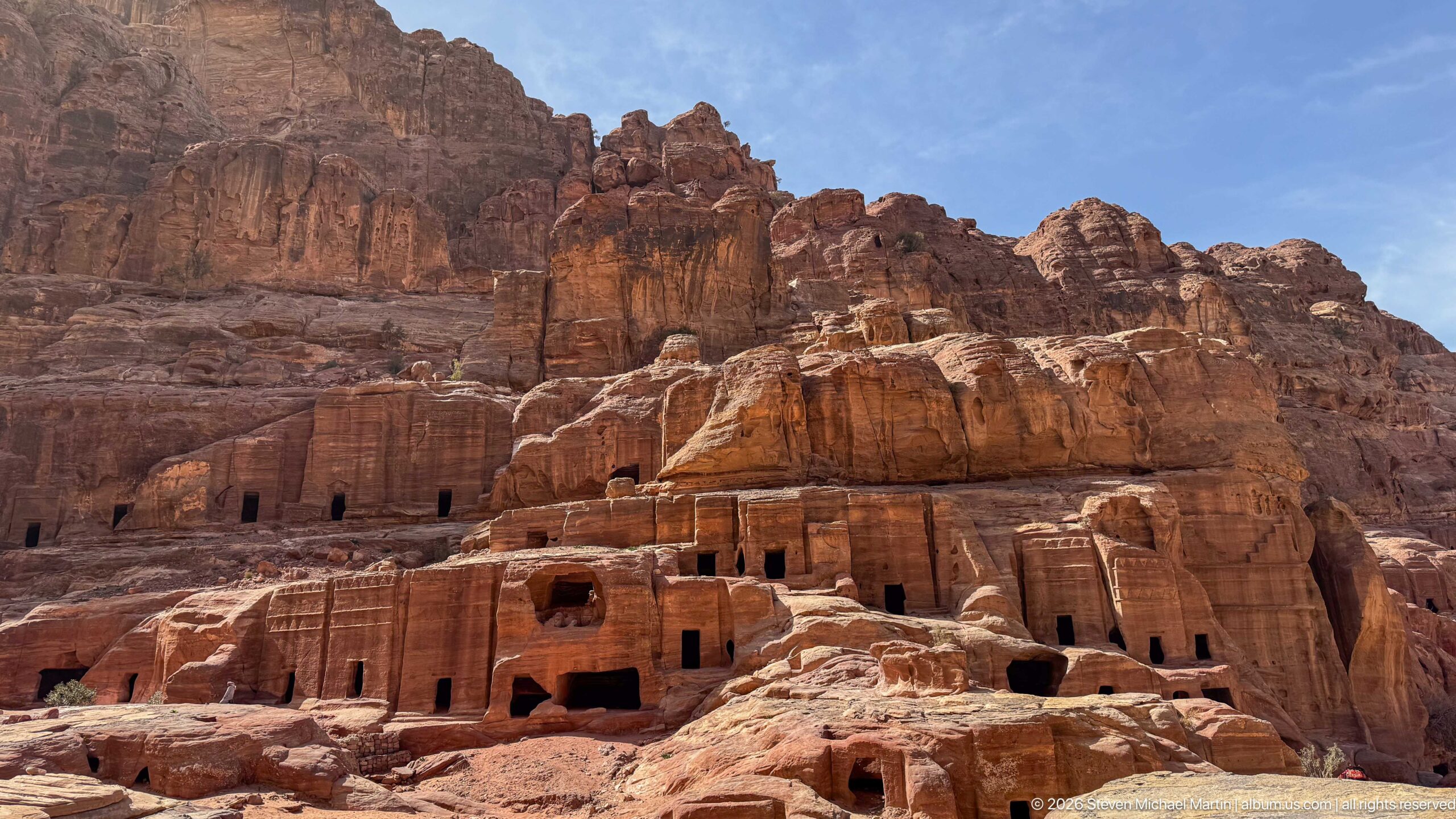
Rows of rectangular doorways and chambers puncture a broad sandstone cliff, creating a multi-level funerary landscape of rock-cut spaces. Some openings retain squared façades while others have weathered into irregular forms, making the photograph especially useful for reading the density and vertical organization of Petra’s carved architecture.
Caption
Rows of rectangular doorways and chambers puncture a broad sandstone cliff, creating a multi-level funerary landscape of rock-cut spaces. Some openings retain squared façades while others have weathered into irregular forms, making the photograph especially useful for reading the density and vertical organization of Petra’s carved architecture.
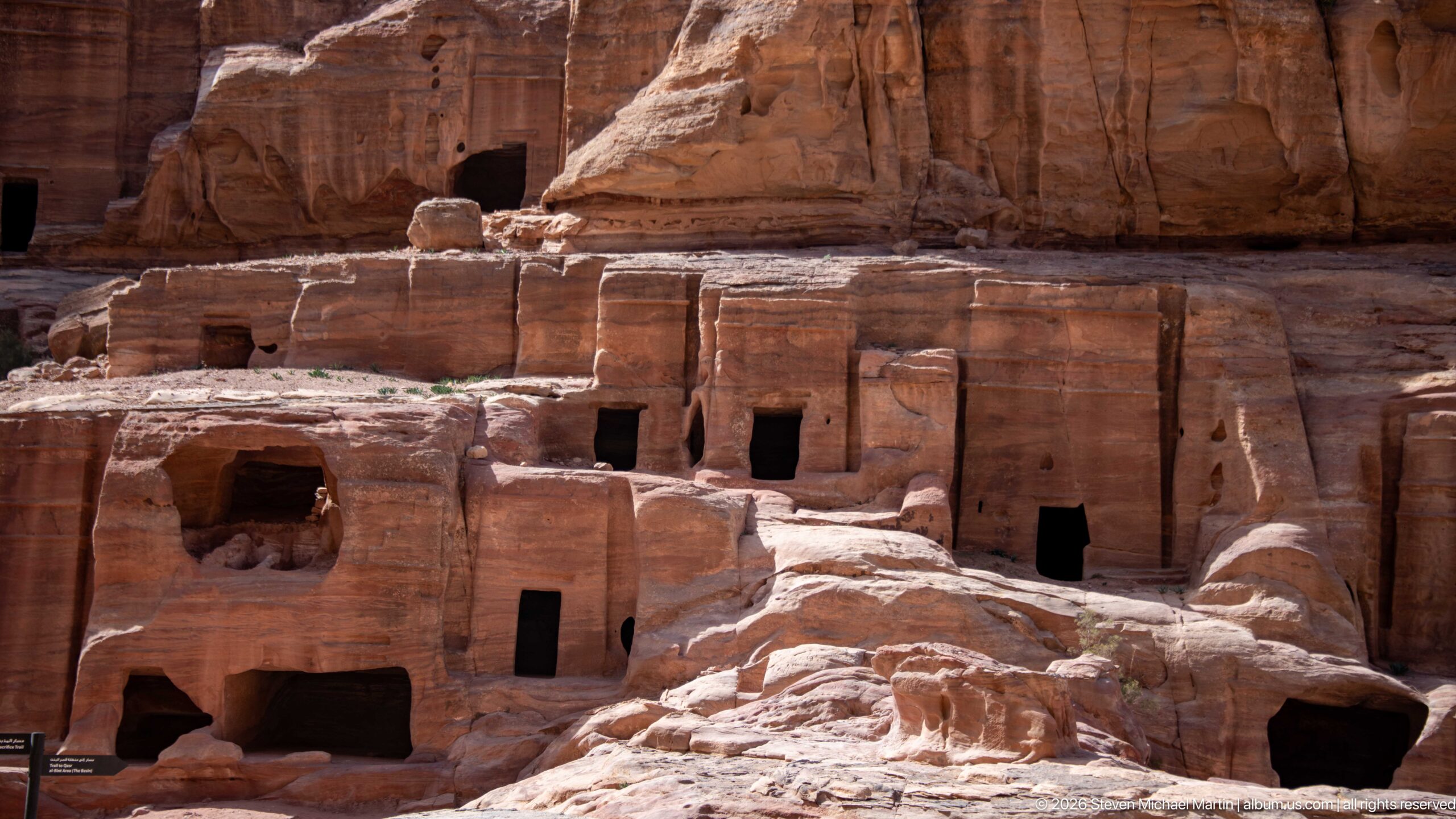
A closer view isolates a cluster of Petra’s rock-cut chambers, where dark rectangular doorways open from smooth, warm-toned sandstone façades. Erosion has softened ledges and architectural edges around the entrances, revealing the contrast between deliberately cut surfaces and the naturally weathered rock.
Caption
A closer view isolates a cluster of Petra’s rock-cut chambers, where dark rectangular doorways open from smooth, warm-toned sandstone façades. Erosion has softened ledges and architectural edges around the entrances, revealing the contrast between deliberately cut surfaces and the naturally weathered rock.
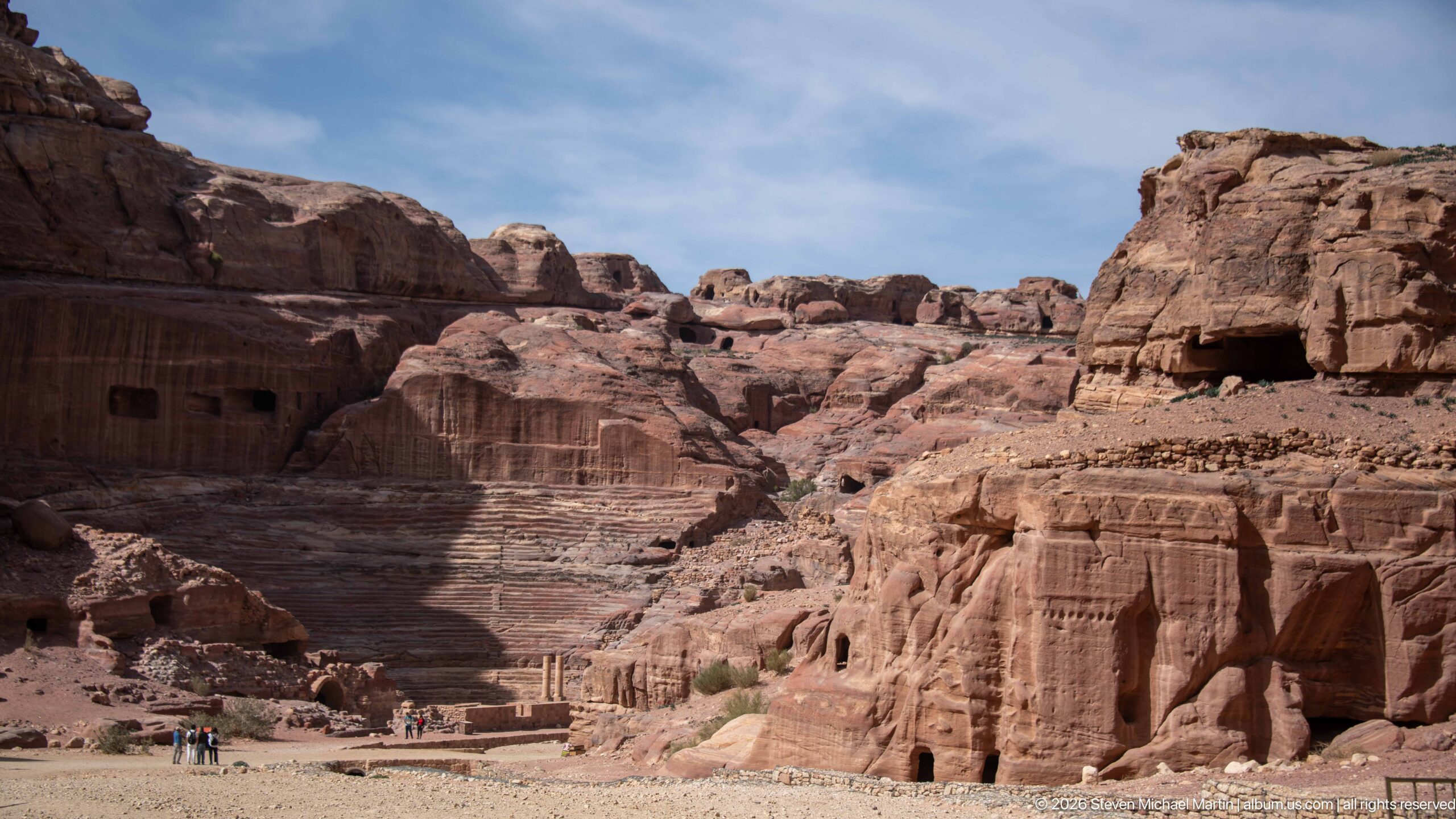
Petra’s carved monuments spread across the valley in a broad contextual view, with the theater’s tiered seating visible at left and tall rock-cut façades rising at right. Small visitors provide scale against the sandstone walls, linking several distinct architectural zones within a single view of the ancient city.
Caption
Petra’s carved monuments spread across the valley in a broad contextual view, with the theater’s tiered seating visible at left and tall rock-cut façades rising at right. Small visitors provide scale against the sandstone walls, linking several distinct architectural zones within a single view of the ancient city.
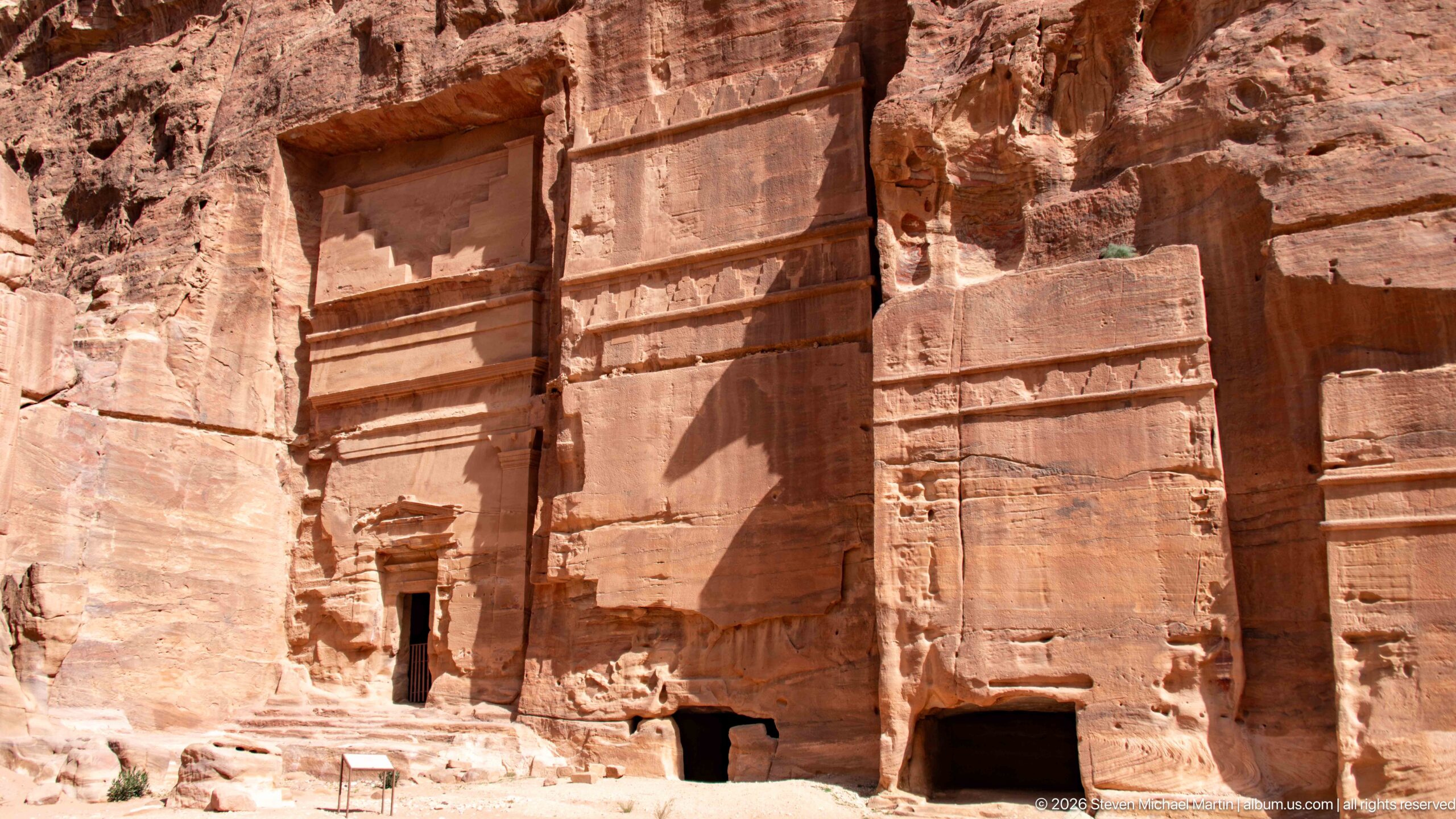
Closely spaced monumental façades are cut directly into Petra’s sandstone wall, each organized with broad recessed panels, projecting moldings, and small doorways at ground level. Their side-by-side arrangement makes the cliff read almost as an architectural street front, despite being carved from a continuous mass of rock.
Caption
Closely spaced monumental façades are cut directly into Petra’s sandstone wall, each organized with broad recessed panels, projecting moldings, and small doorways at ground level. Their side-by-side arrangement makes the cliff read almost as an architectural street front, despite being carved from a continuous mass of rock.
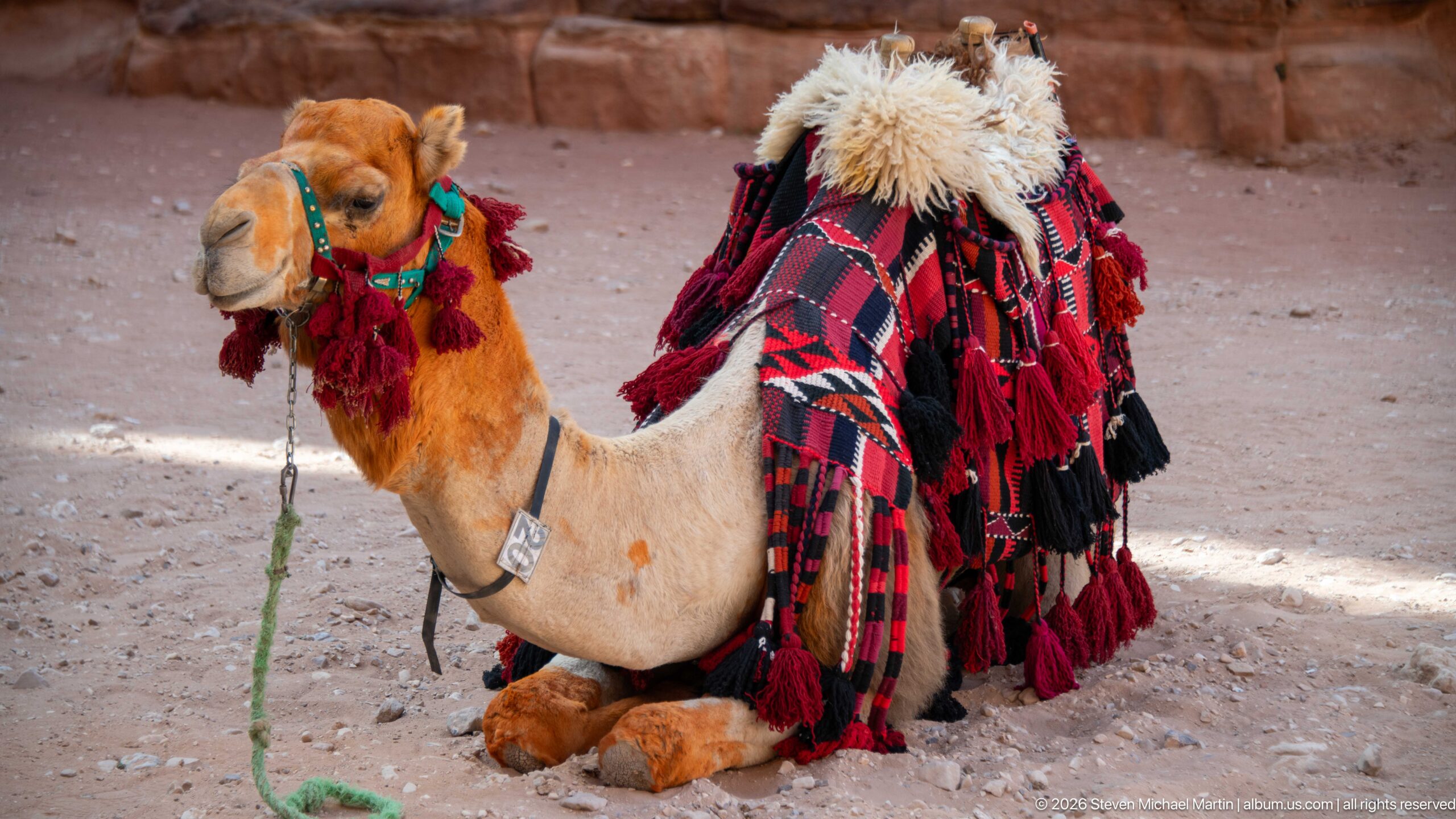
A seated camel turns its head toward the camera while layered red-and-black textiles, tassels, and a pale saddle pad cover its back. Photographed at close range against Petra’s muted sandstone setting, the portrait records the decorative tack associated with camel rides offered to visitors at the site.
Caption
A seated camel turns its head toward the camera while layered red-and-black textiles, tassels, and a pale saddle pad cover its back. Photographed at close range against Petra’s muted sandstone setting, the portrait records the decorative tack associated with camel rides offered to visitors at the site.
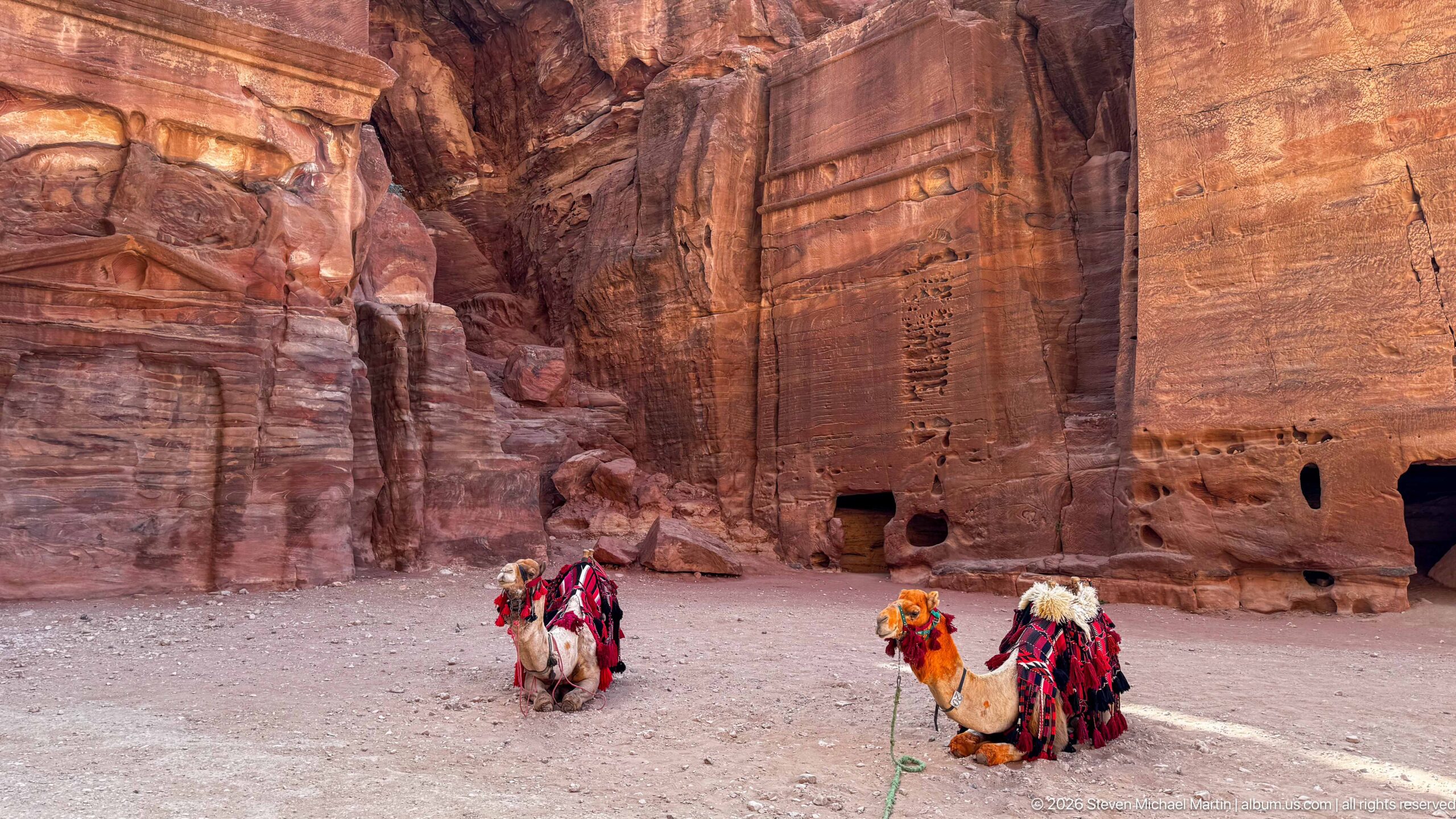
Two decorated camels rest on the open ground before Petra’s towering rock-cut façades. The animals provide an immediate scale reference for the immense sandstone walls, whose recessed panels, doorways, and vertical carved surfaces rise behind them in warm bands of red and ocher stone.
Caption
Two decorated camels rest on the open ground before Petra’s towering rock-cut façades. The animals provide an immediate scale reference for the immense sandstone walls, whose recessed panels, doorways, and vertical carved surfaces rise behind them in warm bands of red and ocher stone.
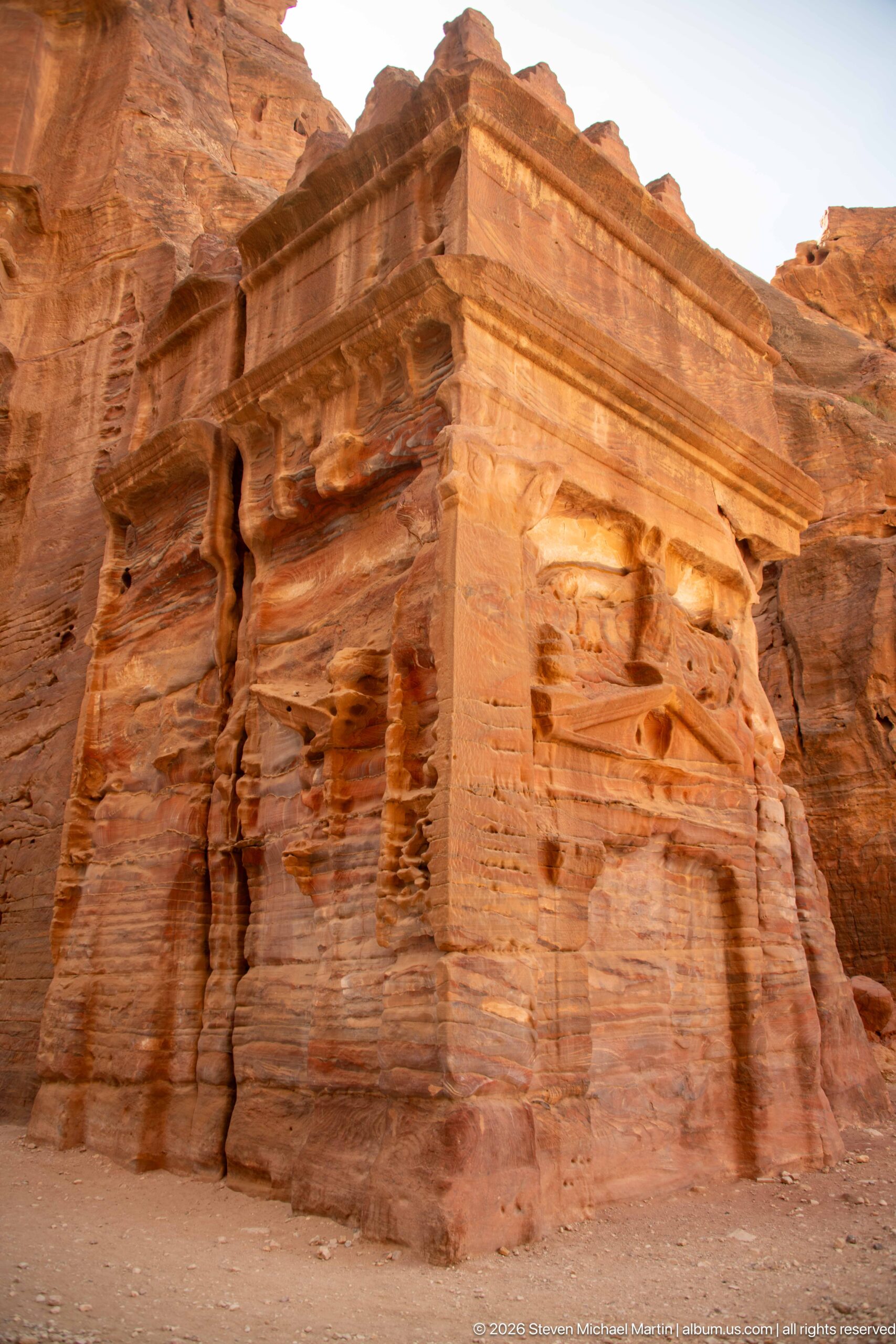
A projecting architectural corner emerges from Petra’s banded sandstone, capped by a broad horizontal cornice above heavily eroded vertical surfaces. Wind and water have rounded the carved edges and opened cavities in the rock, creating a striking meeting of formal masonry-like geometry and natural sandstone weathering.
Caption
A projecting architectural corner emerges from Petra’s banded sandstone, capped by a broad horizontal cornice above heavily eroded vertical surfaces. Wind and water have rounded the carved edges and opened cavities in the rock, creating a striking meeting of formal masonry-like geometry and natural sandstone weathering.
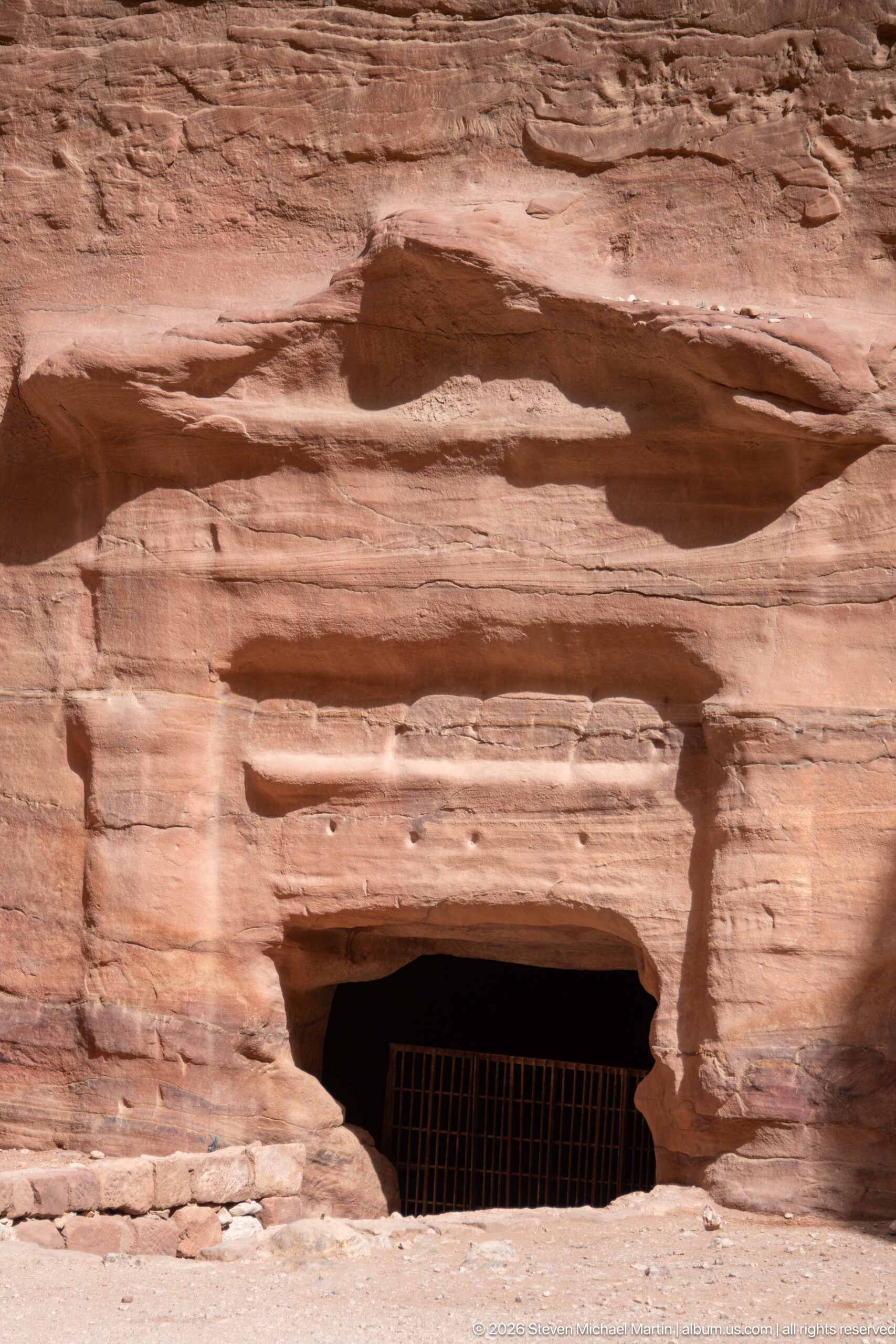
A low, broad opening has been cut into a horizontally banded sandstone wall, its dark interior protected by a metal grille. Natural erosion has rounded the rock above and beside the entrance, making the contrast between the rectangular human-made opening and sculpted geological surfaces especially clear.
Caption
A low, broad opening has been cut into a horizontally banded sandstone wall, its dark interior protected by a metal grille. Natural erosion has rounded the rock above and beside the entrance, making the contrast between the rectangular human-made opening and sculpted geological surfaces especially clear.
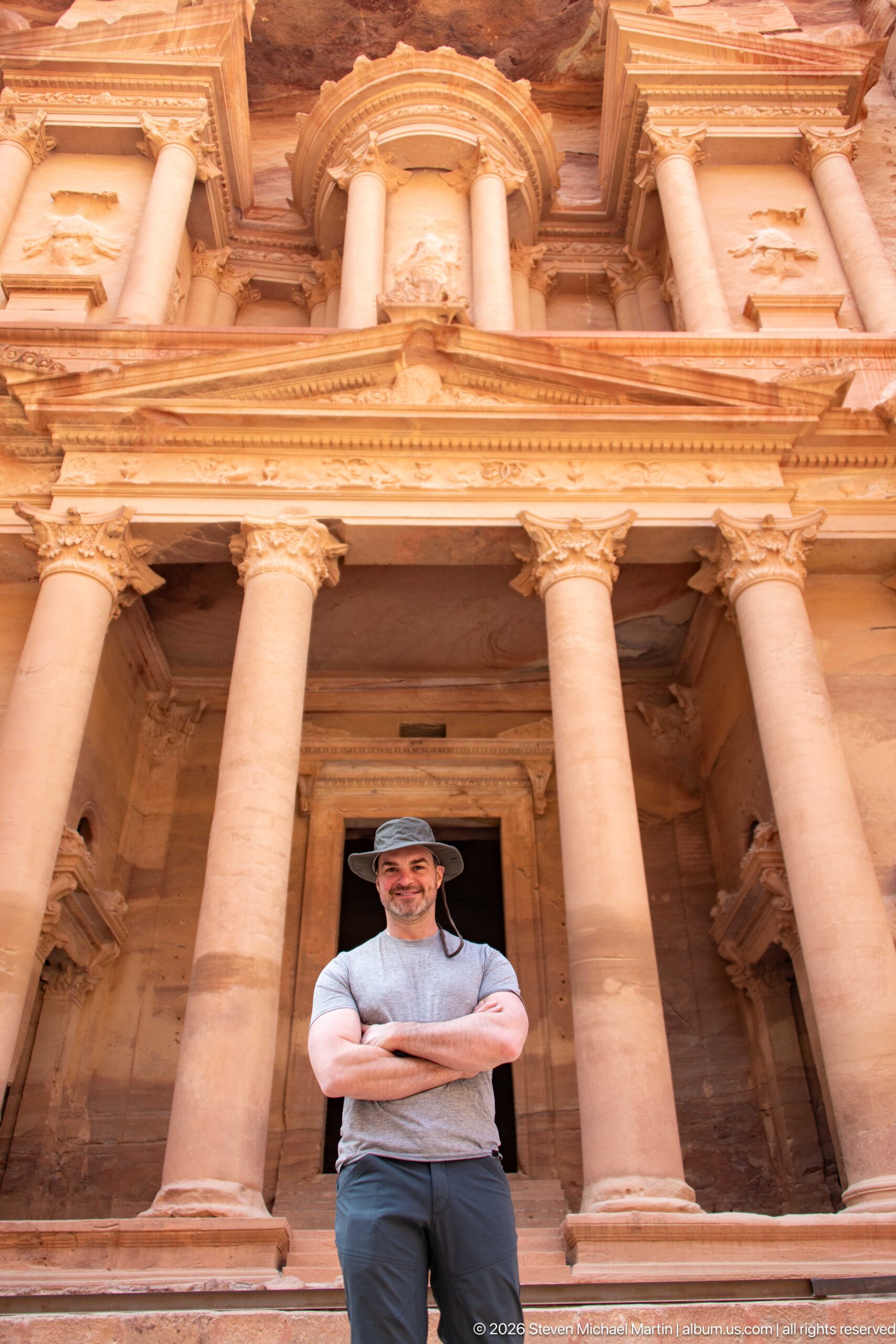
A visitor standing beneath Al-Khazneh gives human scale to the Treasury’s towering rock-cut façade. UNESCO identifies the monument as part of Petra’s exceptional fusion of Hellenistic architectural forms with Nabataean traditions. At the eastern end of the Siq, its columned lower story and deeply shadowed doorway transform the cliff face into an architectural front whose scale is especially apparent beside a single person.
Caption
A visitor standing beneath Al-Khazneh gives human scale to the Treasury’s towering rock-cut façade. UNESCO identifies the monument as part of Petra’s exceptional fusion of Hellenistic architectural forms with Nabataean traditions. At the eastern end of the Siq, its columned lower story and deeply shadowed doorway transform the cliff face into an architectural front whose scale is especially apparent beside a single person.
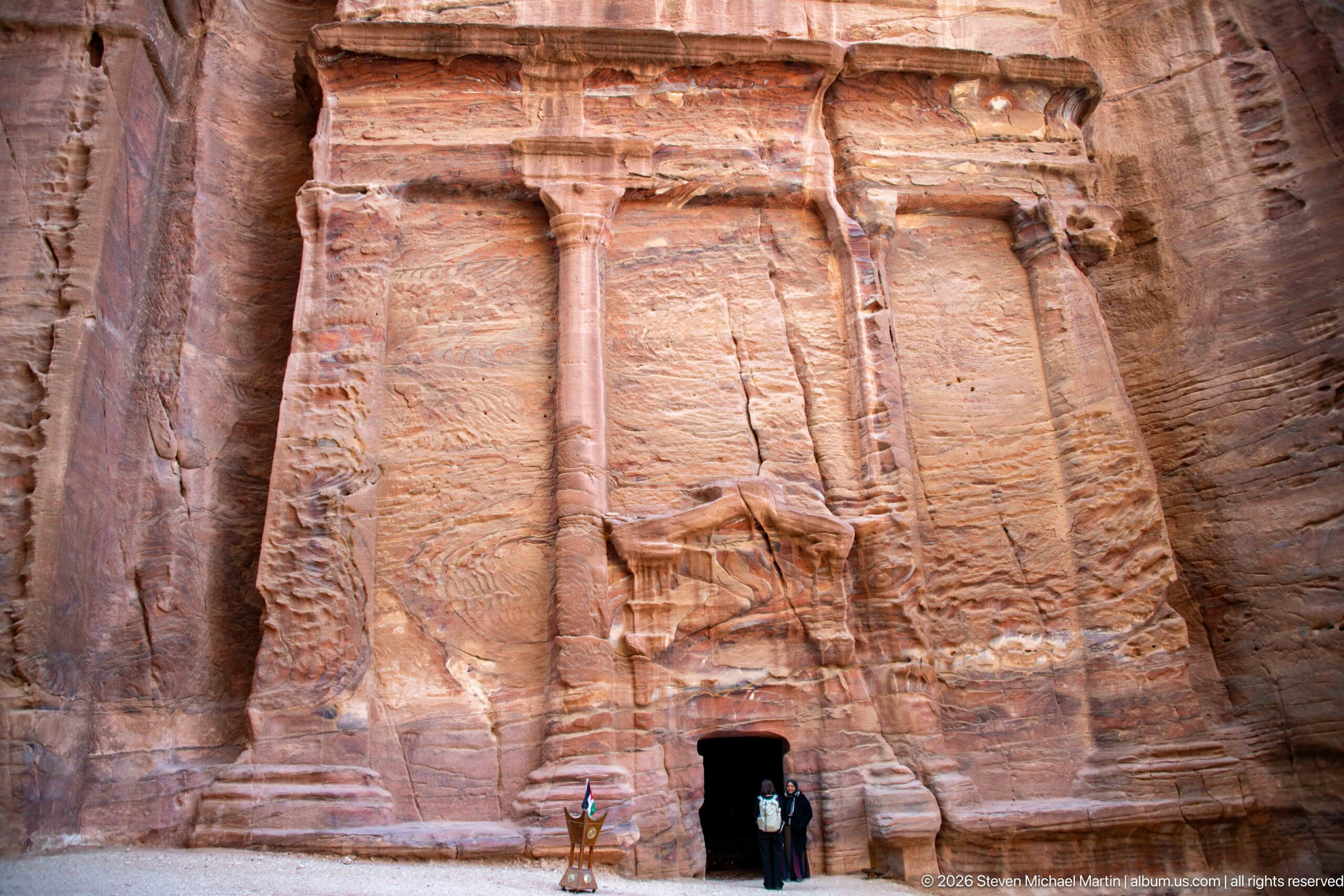
A tall rock-cut façade frames a dark central doorway between slender engaged columns and weathered architectural moldings. Two visitors at the entrance establish the monument’s scale, while fractures and horizontal color bands in the sandstone remain visible across the carved surface.
Caption
A tall rock-cut façade frames a dark central doorway between slender engaged columns and weathered architectural moldings. Two visitors at the entrance establish the monument’s scale, while fractures and horizontal color bands in the sandstone remain visible across the carved surface.
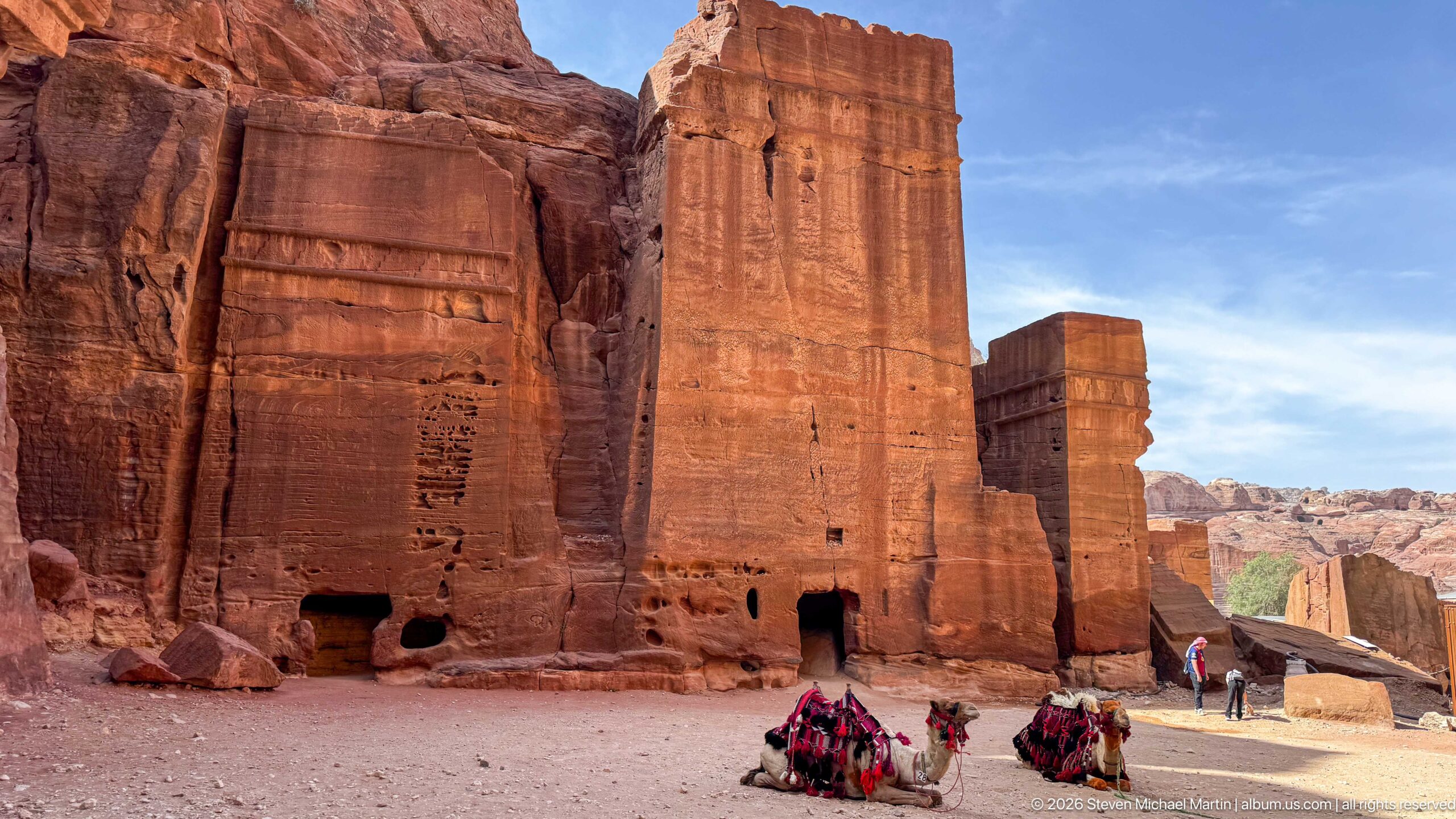
Decorated camels rest at the base of Petra’s tall, rectilinear rock-cut monuments, whose smooth sandstone faces are articulated by shallow moldings, narrow openings, and deeply recessed doorways. The open forecourt and distant mountains extend the scene beyond the façades, showing their imposing scale within the valley.
Caption
Decorated camels rest at the base of Petra’s tall, rectilinear rock-cut monuments, whose smooth sandstone faces are articulated by shallow moldings, narrow openings, and deeply recessed doorways. The open forecourt and distant mountains extend the scene beyond the façades, showing their imposing scale within the valley.
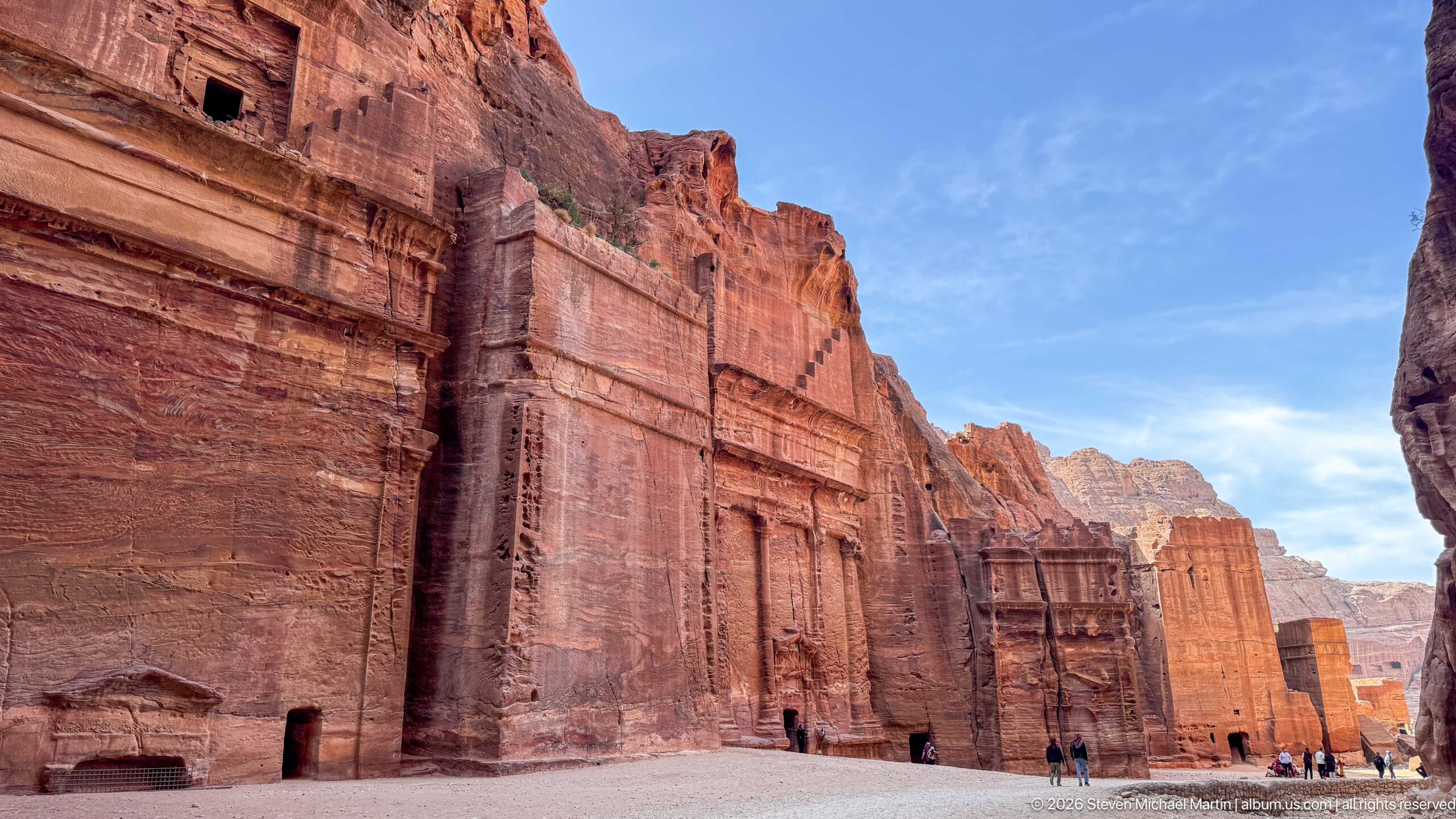
An oblique view follows a sequence of monumental façades carved into Petra’s sandstone wall, their doorways, pilasters, and horizontal moldings receding toward the open valley. Visitors at ground level provide scale and underscore the extraordinary height of the continuous architectural cliff face.
Caption
An oblique view follows a sequence of monumental façades carved into Petra’s sandstone wall, their doorways, pilasters, and horizontal moldings receding toward the open valley. Visitors at ground level provide scale and underscore the extraordinary height of the continuous architectural cliff face.
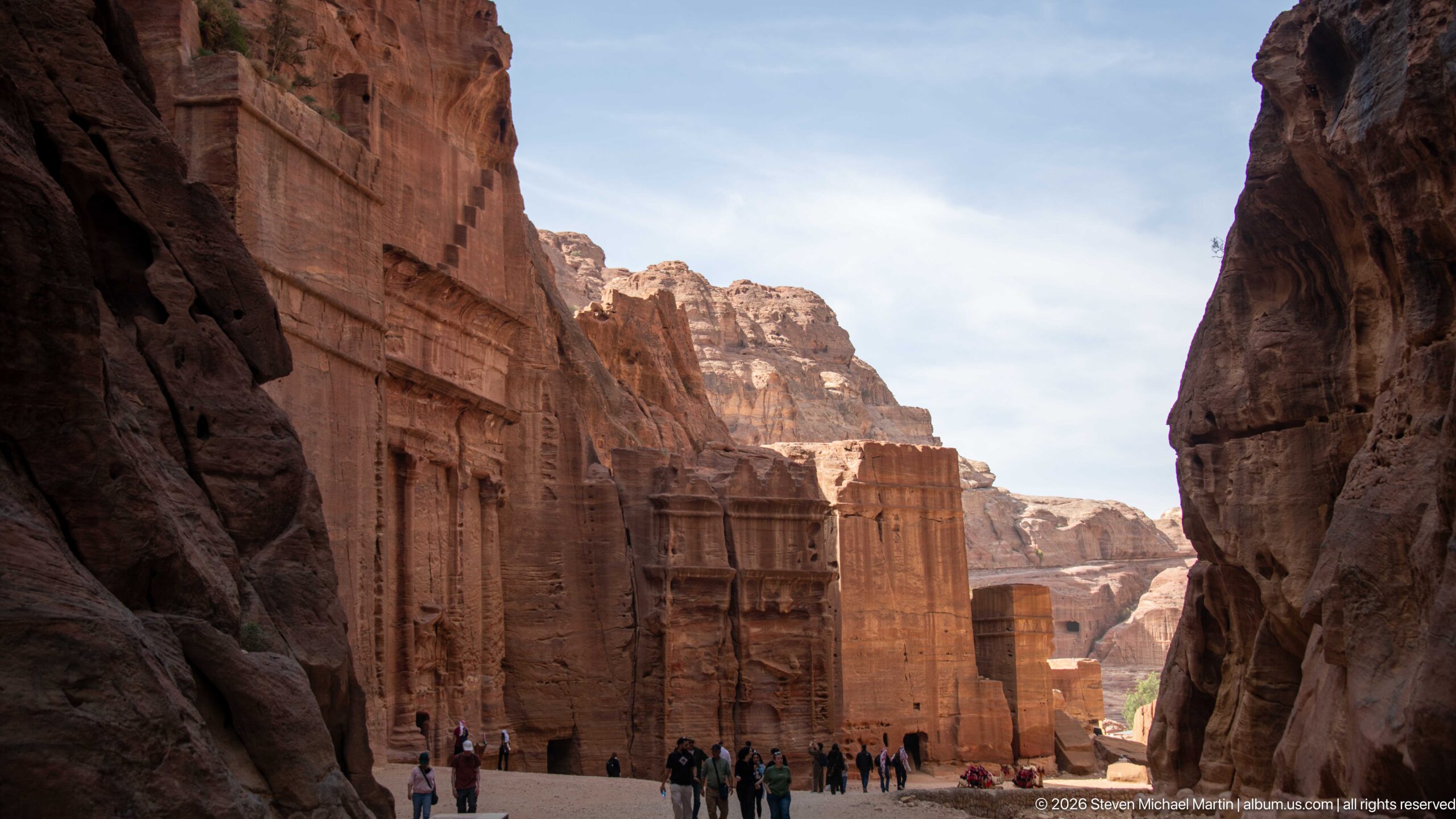
Dark rock walls frame a long view toward Petra’s monumental carved façades, where repeated rectangular masses and recessed doorways line the left side of the passage. A stream of visitors occupies the sandy route, adding scale and depth to the strongly converging architectural perspective.
Caption
Dark rock walls frame a long view toward Petra’s monumental carved façades, where repeated rectangular masses and recessed doorways line the left side of the passage. A stream of visitors occupies the sandy route, adding scale and depth to the strongly converging architectural perspective.
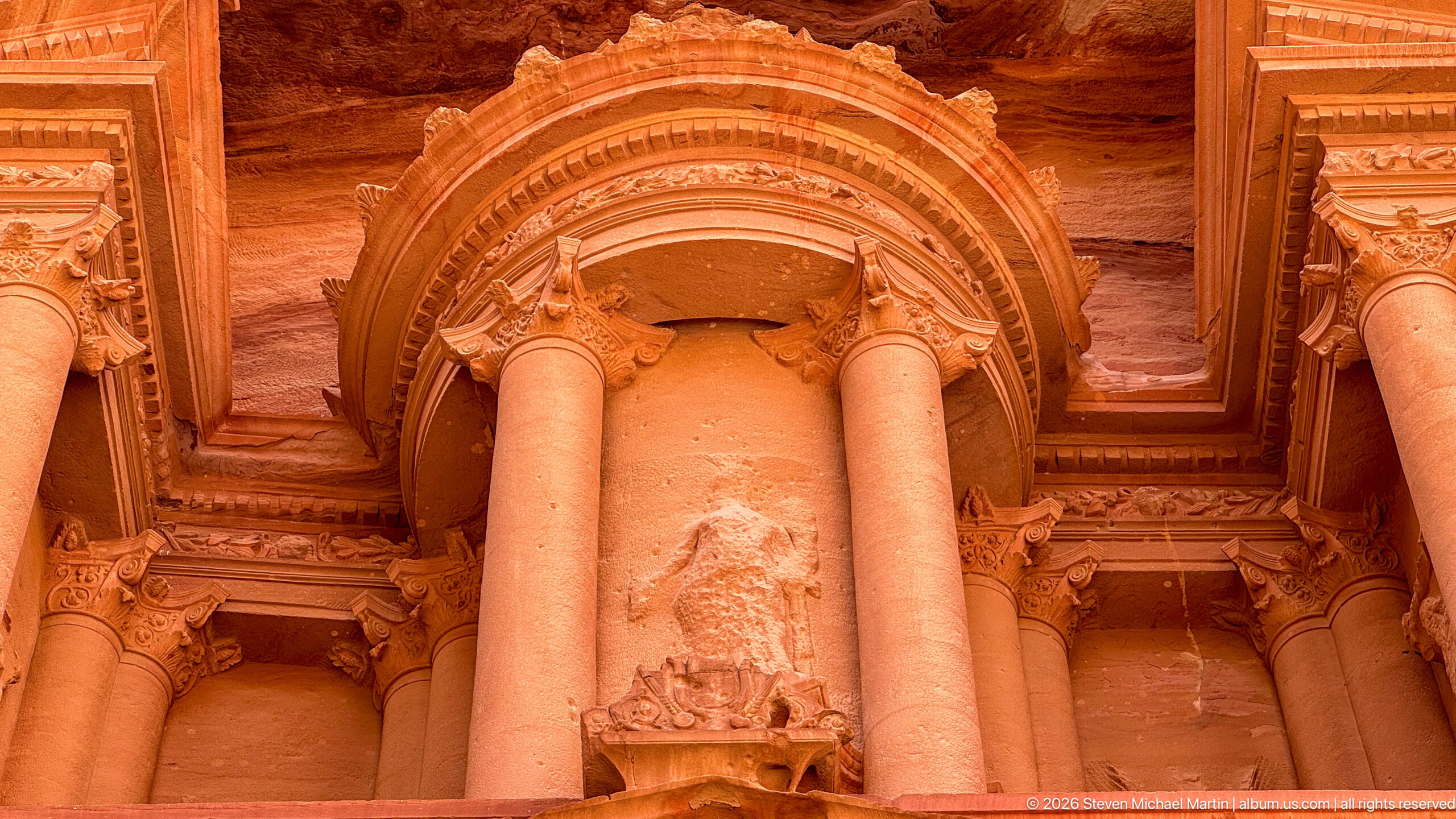
Looking upward, the central tholos of Al-Khazneh rises between broken pediments on the Treasury’s upper story, crowned by the large urn that has long shaped the monument’s popular name and legends. UNESCO recognizes Al-Khazneh as a leading example of Petra’s fusion of Hellenistic architectural forms with Nabataean rock-cut tradition. The steep angle isolates the façade’s most distinctive upper composition against the sandstone cliff.
Caption
Looking upward, the central tholos of Al-Khazneh rises between broken pediments on the Treasury’s upper story, crowned by the large urn that has long shaped the monument’s popular name and legends. UNESCO recognizes Al-Khazneh as a leading example of Petra’s fusion of Hellenistic architectural forms with Nabataean rock-cut tradition. The steep angle isolates the façade’s most distinctive upper composition against the sandstone cliff.
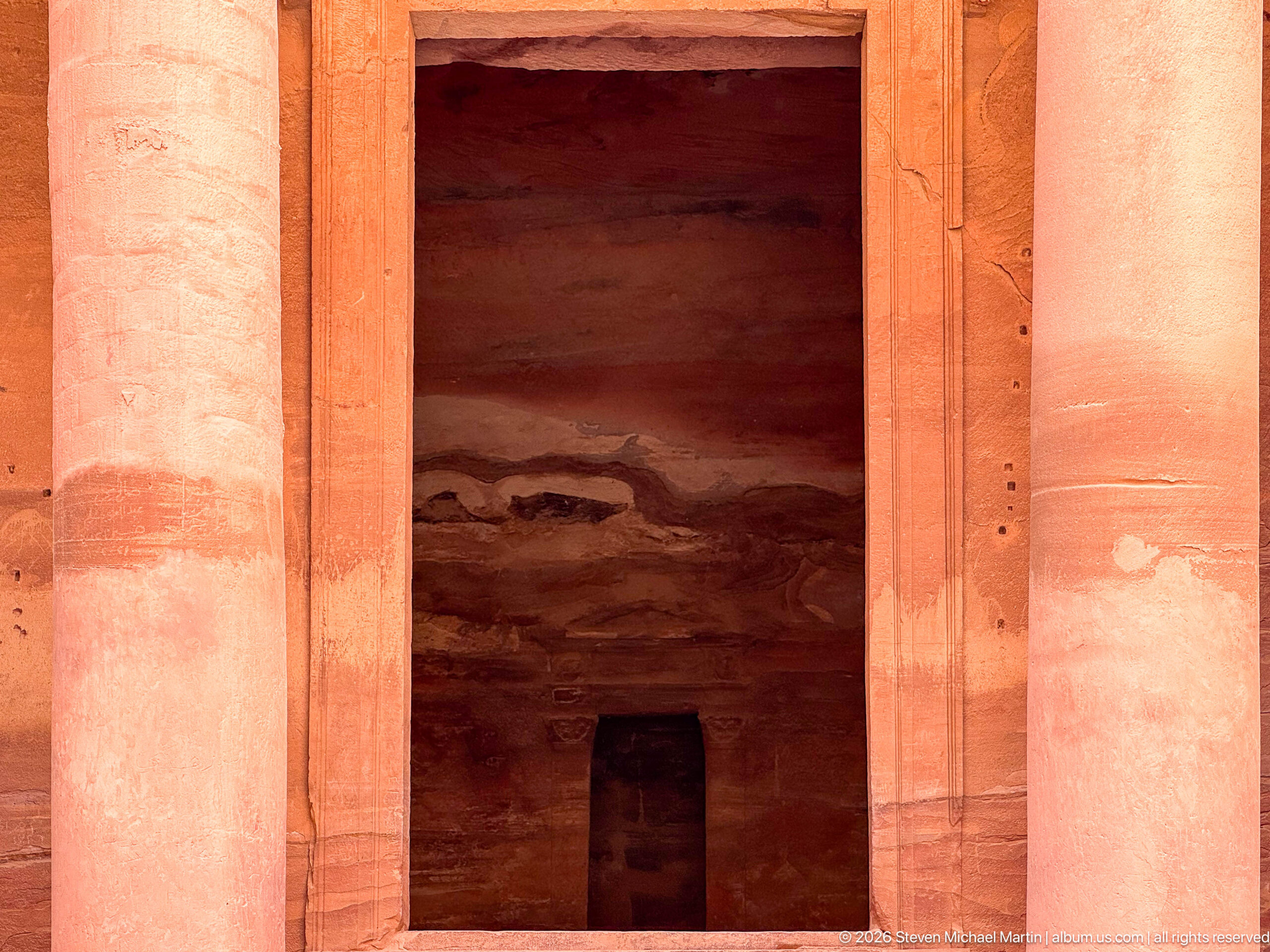
The shadowed entrance of Al-Khazneh opens between the monumental columns of its lower order. Carved directly into the cliff at the end of the Siq, the Treasury is one of Petra’s most accomplished combinations of Nabataean rock-cut construction and Hellenistic architectural vocabulary. This close view shifts attention from the famous full façade to the depth of the doorway and the scale of its surrounding columns.
Caption
The shadowed entrance of Al-Khazneh opens between the monumental columns of its lower order. Carved directly into the cliff at the end of the Siq, the Treasury is one of Petra’s most accomplished combinations of Nabataean rock-cut construction and Hellenistic architectural vocabulary. This close view shifts attention from the famous full façade to the depth of the doorway and the scale of its surrounding columns.
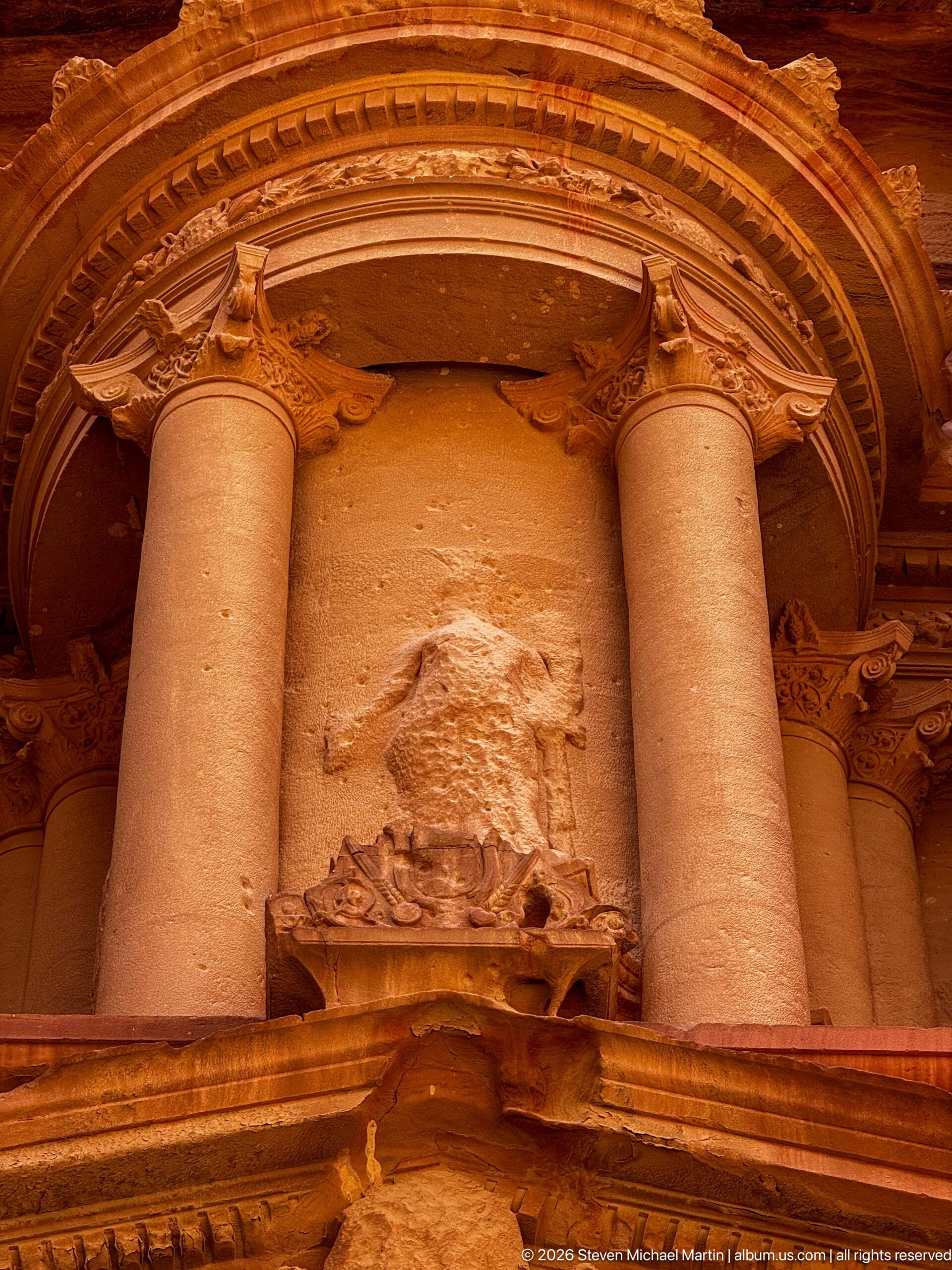
The central tholos of Al-Khazneh’s upper story is framed by Corinthian columns and crowned by the monumental urn. Weathering has softened the carved figure in the central niche, but the arrangement still demonstrates the façade’s sophisticated use of Hellenistic architectural forms. UNESCO cites the Treasury as a major example of the artistic fusion between classical façade design and Nabataean rock-cut tradition at Petra.
Caption
The central tholos of Al-Khazneh’s upper story is framed by Corinthian columns and crowned by the monumental urn. Weathering has softened the carved figure in the central niche, but the arrangement still demonstrates the façade’s sophisticated use of Hellenistic architectural forms. UNESCO cites the Treasury as a major example of the artistic fusion between classical façade design and Nabataean rock-cut tradition at Petra.
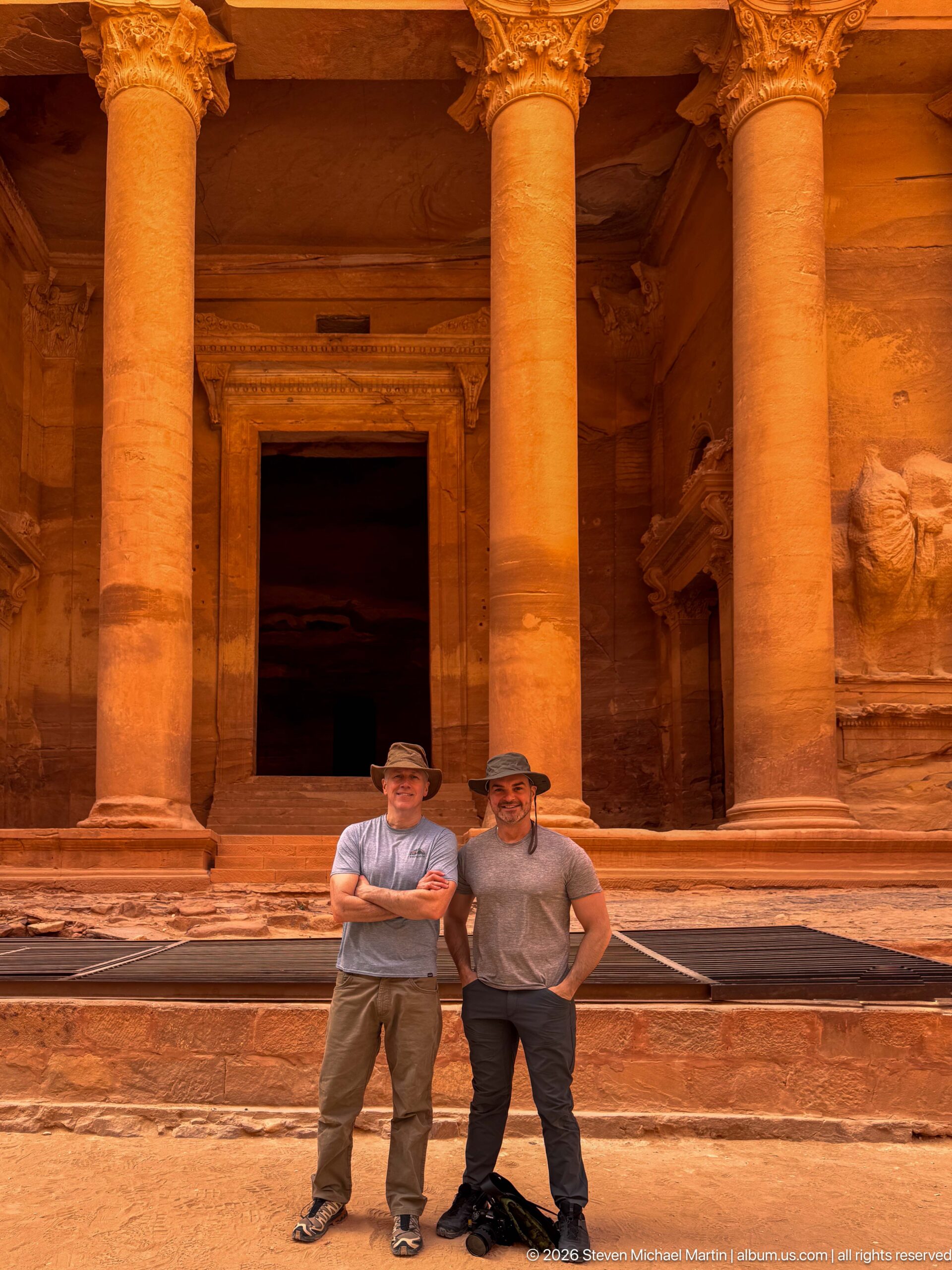
Two visitors stand at the base of Al-Khazneh beneath its immense lower columns, centered against the Treasury’s shadowed doorway. The close architectural framing emphasizes the diameter and height of the column shafts and makes the people a direct scale reference for the rock-cut façade.
Caption
Two visitors stand at the base of Al-Khazneh beneath its immense lower columns, centered against the Treasury’s shadowed doorway. The close architectural framing emphasizes the diameter and height of the column shafts and makes the people a direct scale reference for the rock-cut façade.
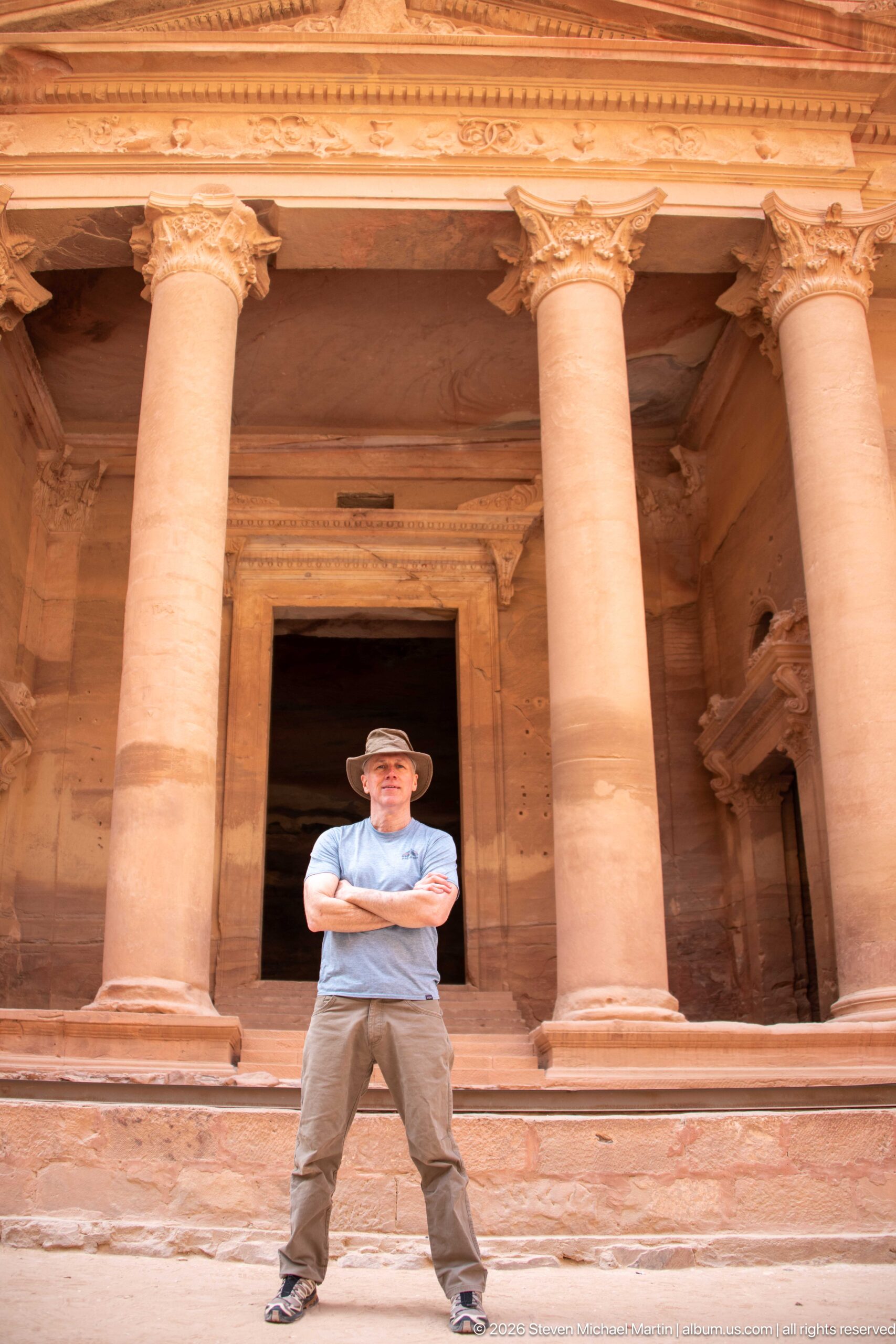
A visitor stands with folded arms directly before the lower order of Al-Khazneh, framed by two massive columns and the dark central doorway. The close composition emphasizes the scale of the Treasury’s rock-cut portico and the warm tonal variation of Petra’s sandstone, while the figure provides an immediate human measure for the architecture.
Caption
A visitor stands with folded arms directly before the lower order of Al-Khazneh, framed by two massive columns and the dark central doorway. The close composition emphasizes the scale of the Treasury’s rock-cut portico and the warm tonal variation of Petra’s sandstone, while the figure provides an immediate human measure for the architecture.
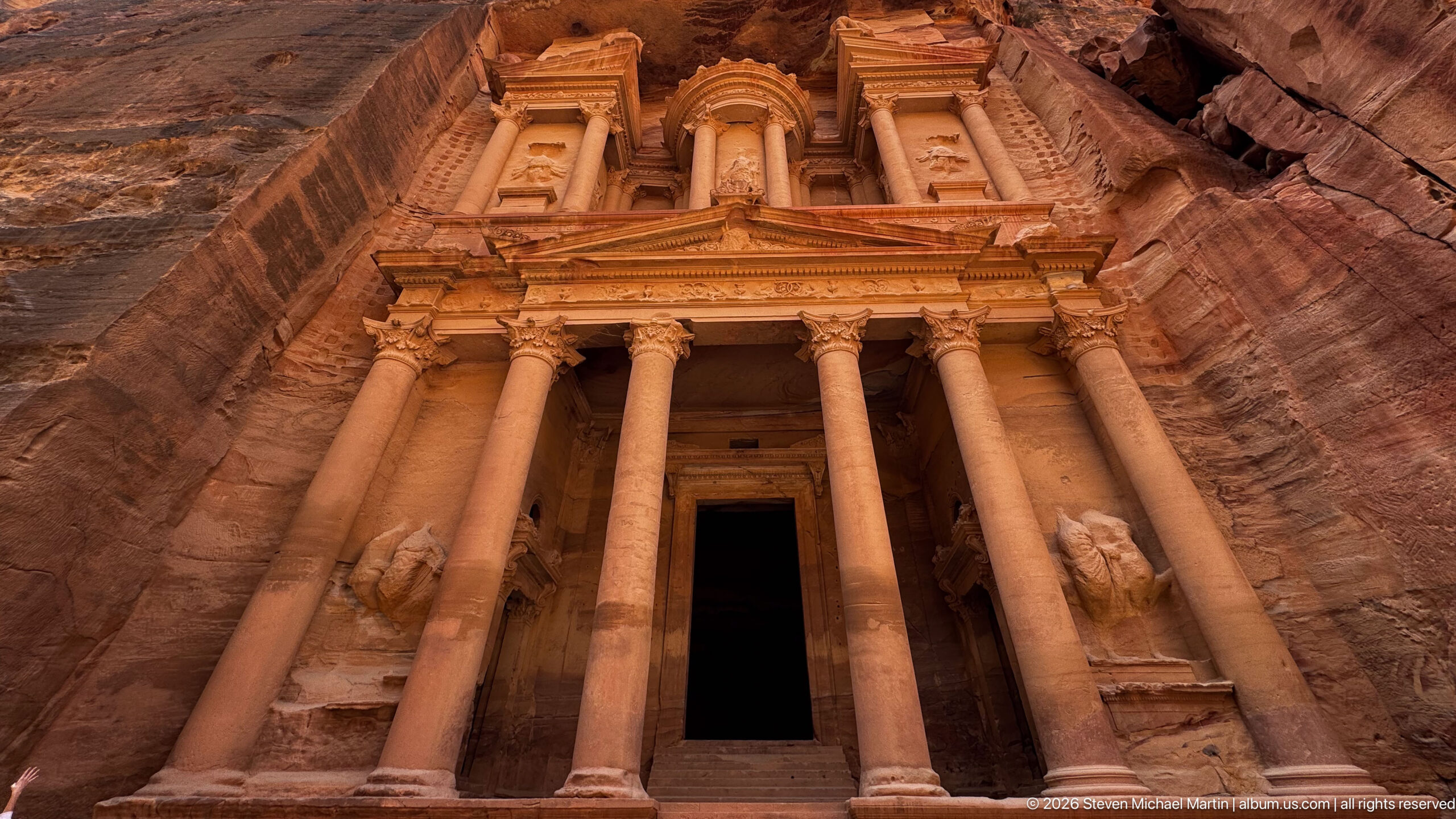
Al-Khazneh fills the cliff face at the end of Petra’s Siq, its two-story façade carved directly from rose-colored sandstone. Columns, pediments, niches, and the central tholos draw on Hellenistic architectural vocabulary while remaining inseparable from the rock itself. UNESCO identifies the Treasury as one of Petra’s defining achievements in the fusion of classical forms with Nabataean rock-cut architecture.
Caption
Al-Khazneh fills the cliff face at the end of Petra’s Siq, its two-story façade carved directly from rose-colored sandstone. Columns, pediments, niches, and the central tholos draw on Hellenistic architectural vocabulary while remaining inseparable from the rock itself. UNESCO identifies the Treasury as one of Petra’s defining achievements in the fusion of classical forms with Nabataean rock-cut architecture.
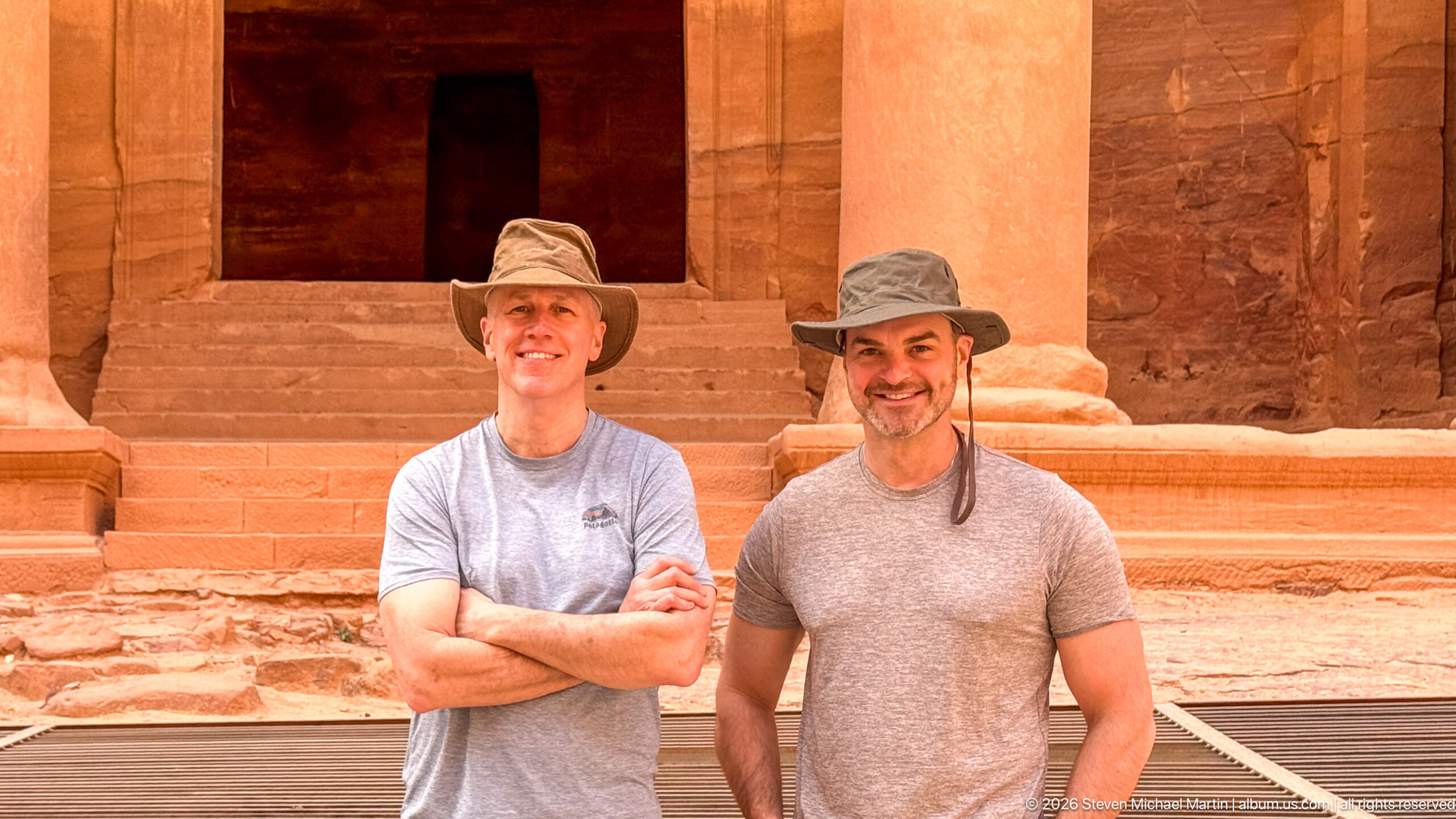
Two visitors pose together before the lower façade of Al-Khazneh, with the Treasury’s broad sandstone steps, columns, and recessed entrance behind them. The portrait keeps enough architectural context to identify the setting while using the figures to convey the scale of the monument’s carved lower order.
Caption
Two visitors pose together before the lower façade of Al-Khazneh, with the Treasury’s broad sandstone steps, columns, and recessed entrance behind them. The portrait keeps enough architectural context to identify the setting while using the figures to convey the scale of the monument’s carved lower order.
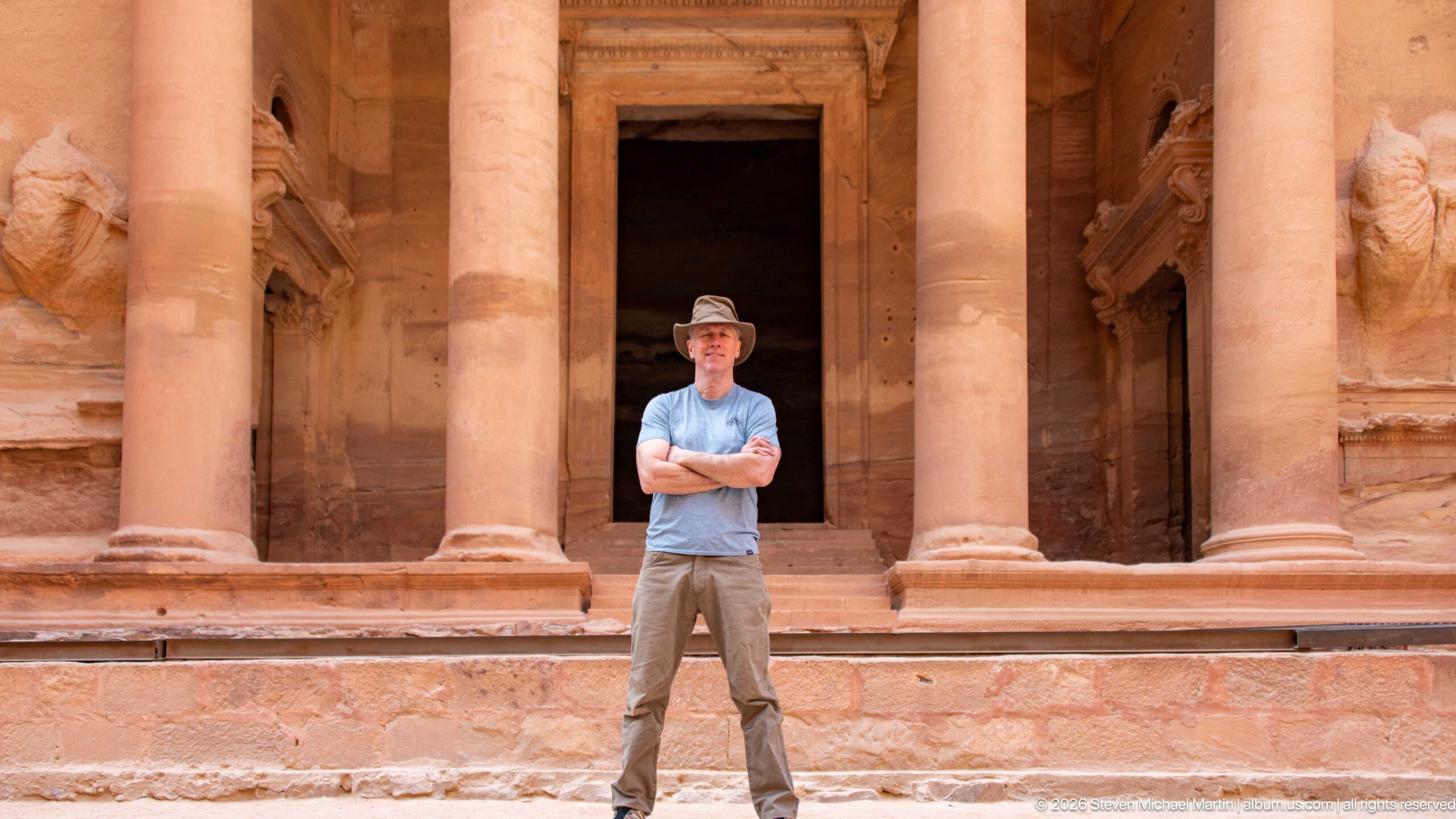
A single visitor stands centered between the lower columns of Al-Khazneh, directly in front of the Treasury’s deep rectangular entrance. Cropped tightly around the portico, the composition turns the column bases, smooth shafts, doorway, and warm sandstone surfaces into a monumental frame around the figure.
Caption
A single visitor stands centered between the lower columns of Al-Khazneh, directly in front of the Treasury’s deep rectangular entrance. Cropped tightly around the portico, the composition turns the column bases, smooth shafts, doorway, and warm sandstone surfaces into a monumental frame around the figure.
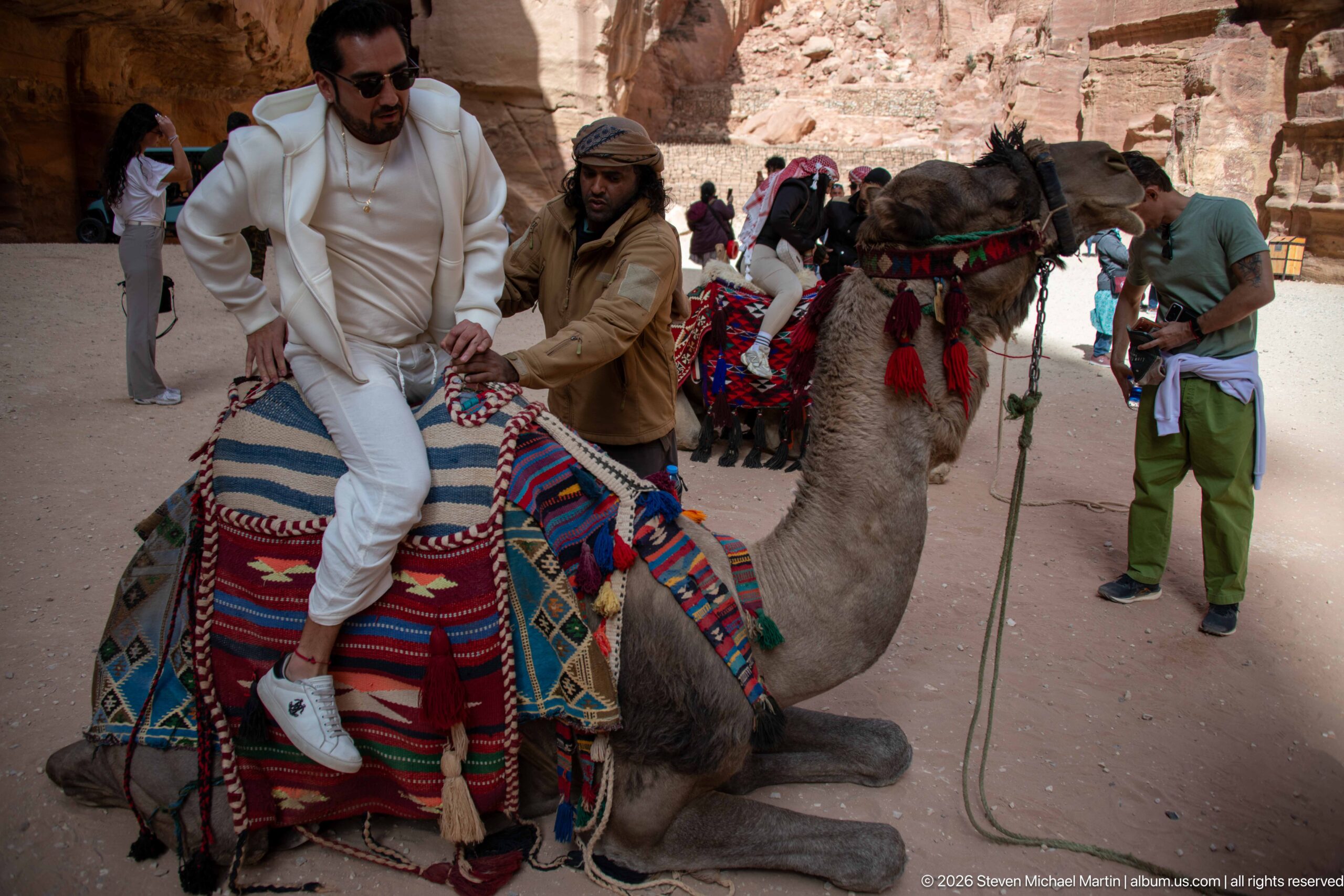
A visitor mounts a kneeling camel fitted with brightly patterned saddle blankets while a handler steadies the animal in Petra’s archaeological precinct. Other decorated camels and visitors fill the background, recording the contemporary tourism activity that takes place among the sandstone monuments and pathways of the site.
Caption
A visitor mounts a kneeling camel fitted with brightly patterned saddle blankets while a handler steadies the animal in Petra’s archaeological precinct. Other decorated camels and visitors fill the background, recording the contemporary tourism activity that takes place among the sandstone monuments and pathways of the site.
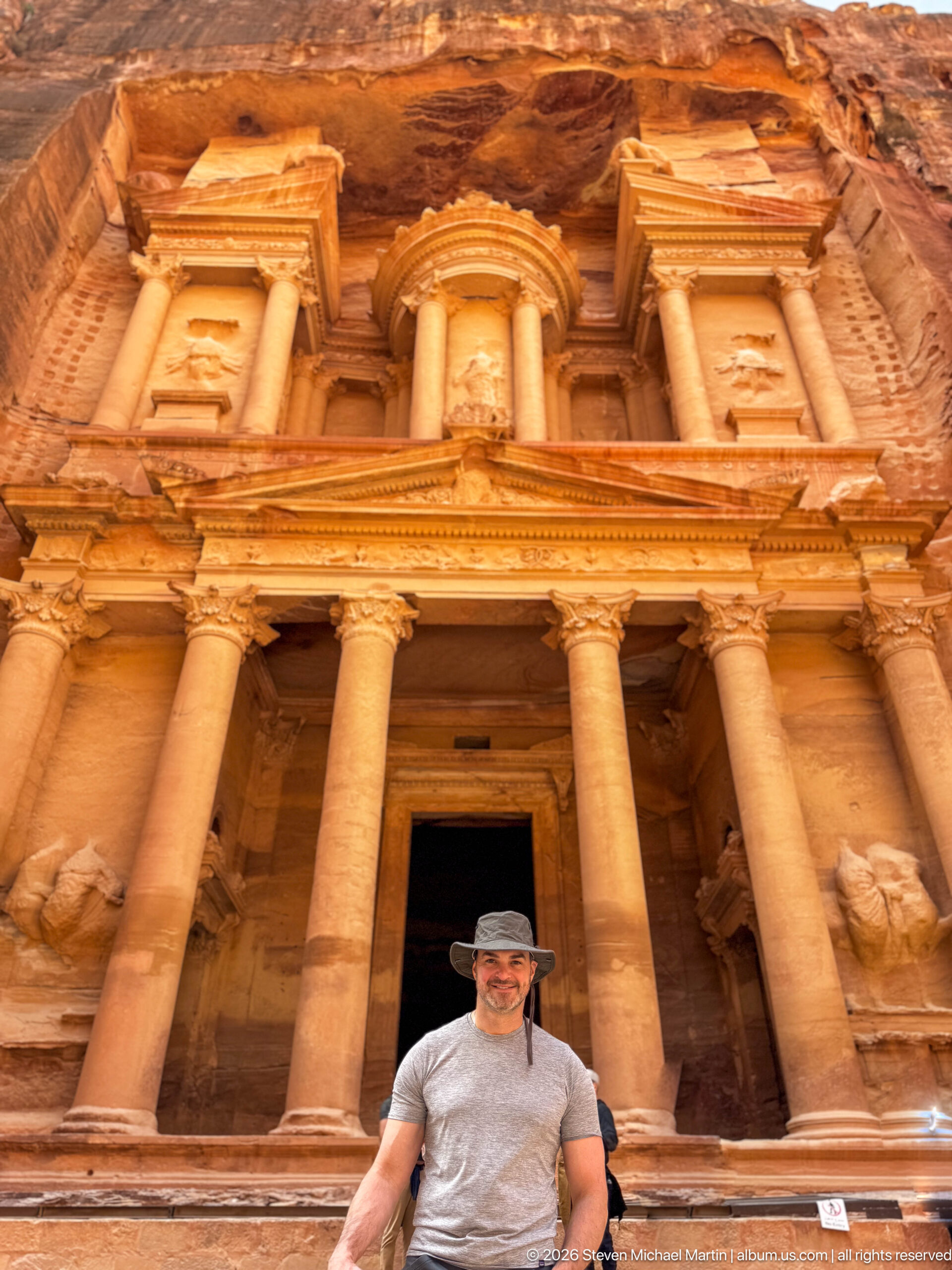
Al-Khazneh towers above a visitor standing near the center of its forecourt, allowing the Treasury’s lower colonnade, triangular pediment, and upper tholos to be read together. The upward perspective accentuates the monument’s height and the precision with which its classical architectural forms were carved directly into Petra’s sandstone cliff.
Caption
Al-Khazneh towers above a visitor standing near the center of its forecourt, allowing the Treasury’s lower colonnade, triangular pediment, and upper tholos to be read together. The upward perspective accentuates the monument’s height and the precision with which its classical architectural forms were carved directly into Petra’s sandstone cliff.
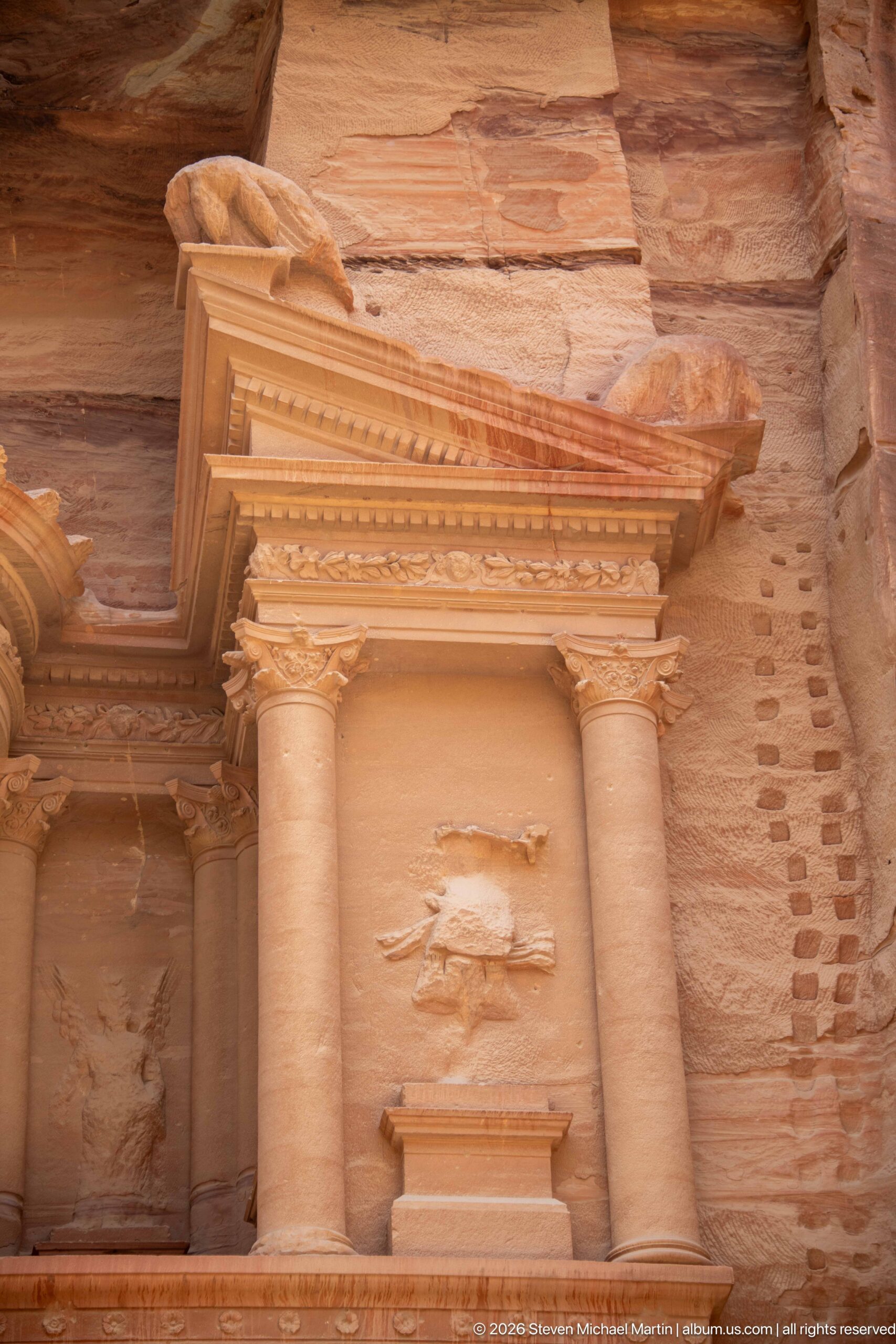
One side of Al-Khazneh’s upper façade fills the frame, with paired columns supporting a projecting pediment above a weathered sculptural niche. The close view reveals the crisp geometry of cornices and moldings against the naturally banded cliff, while erosion has softened the carved figure and portions of the surrounding architectural ornament.
Caption
One side of Al-Khazneh’s upper façade fills the frame, with paired columns supporting a projecting pediment above a weathered sculptural niche. The close view reveals the crisp geometry of cornices and moldings against the naturally banded cliff, while erosion has softened the carved figure and portions of the surrounding architectural ornament.
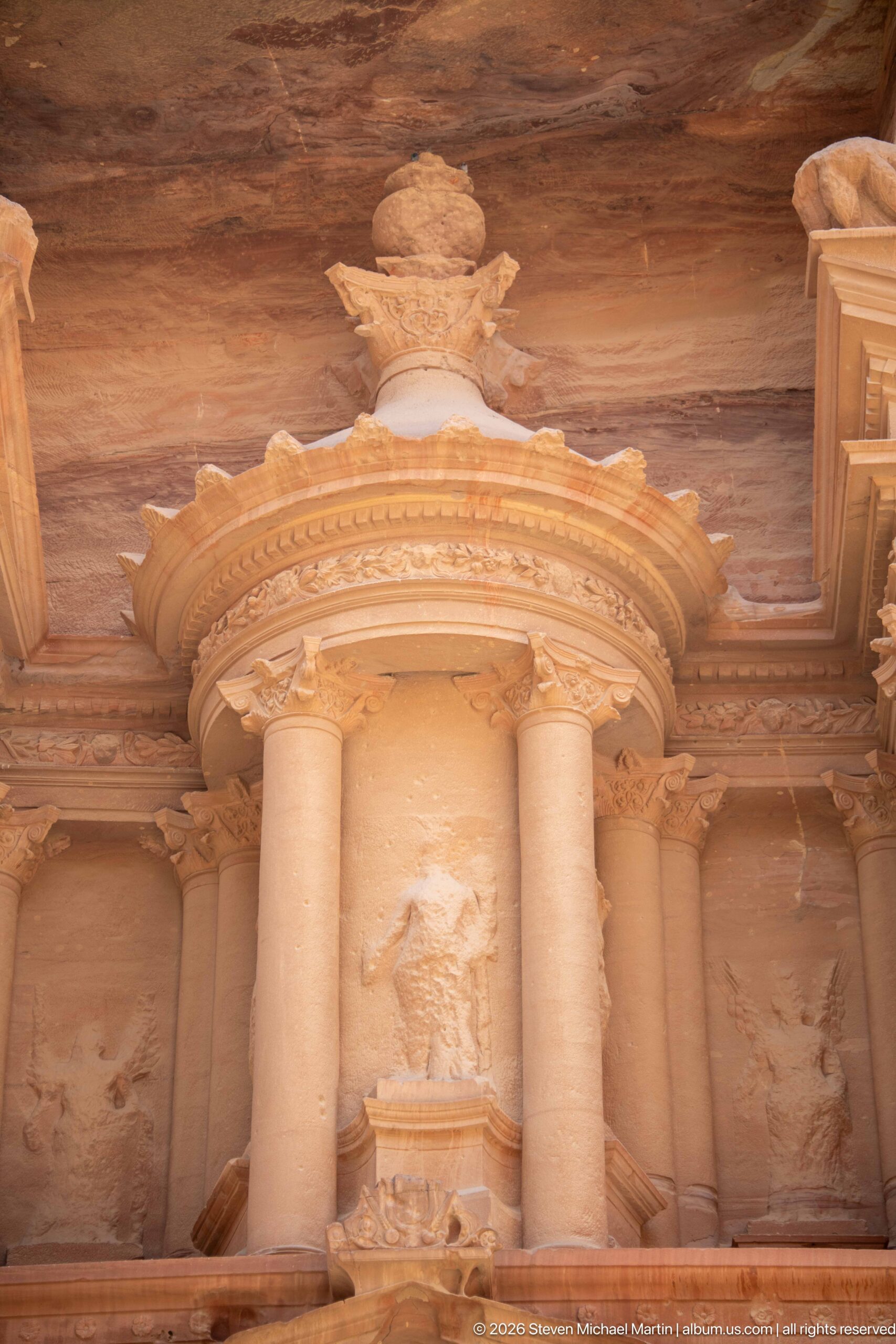
The circular tholos at the center of Al-Khazneh’s upper story rises on slender columns beneath the façade’s famous crowning urn. Flanked by broken pediments, this composition is among the Treasury’s most distinctive Hellenistic-inspired features. UNESCO recognizes Al-Khazneh as an outstanding example of the meeting of classical architectural design and Nabataean rock-cut craftsmanship at Petra.
Caption
The circular tholos at the center of Al-Khazneh’s upper story rises on slender columns beneath the façade’s famous crowning urn. Flanked by broken pediments, this composition is among the Treasury’s most distinctive Hellenistic-inspired features. UNESCO recognizes Al-Khazneh as an outstanding example of the meeting of classical architectural design and Nabataean rock-cut craftsmanship at Petra.
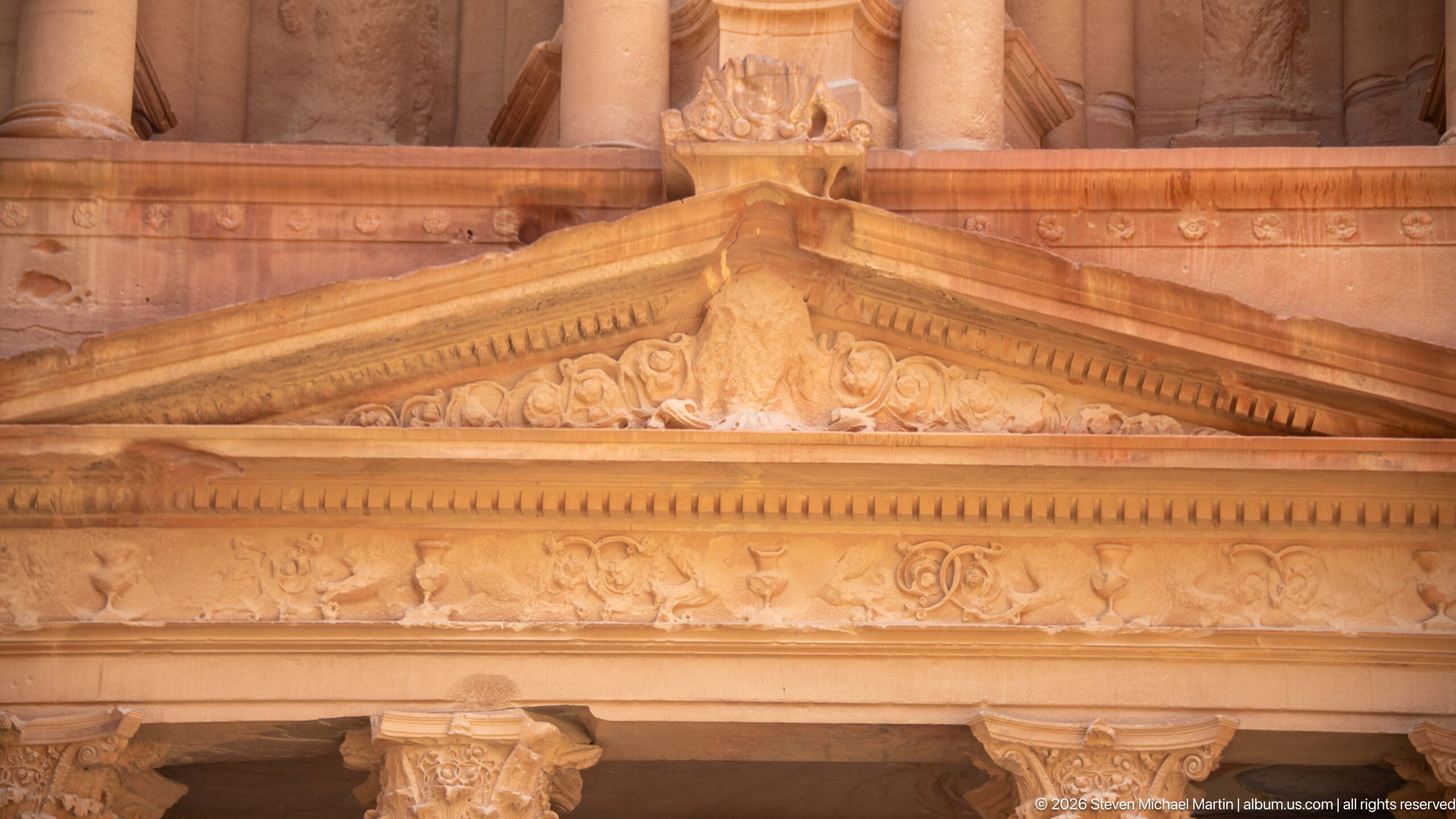
A close view isolates the triangular pediment and entablature of Al-Khazneh’s lower story, where weathered relief carving survives above the monumental entrance. The Treasury’s architectural vocabulary draws heavily on Hellenistic forms, yet every element was carved from the sandstone cliff. At this scale, the precision of moldings and the effects of erosion become more apparent than in the familiar full-façade view.
Caption
A close view isolates the triangular pediment and entablature of Al-Khazneh’s lower story, where weathered relief carving survives above the monumental entrance. The Treasury’s architectural vocabulary draws heavily on Hellenistic forms, yet every element was carved from the sandstone cliff. At this scale, the precision of moldings and the effects of erosion become more apparent than in the familiar full-façade view.
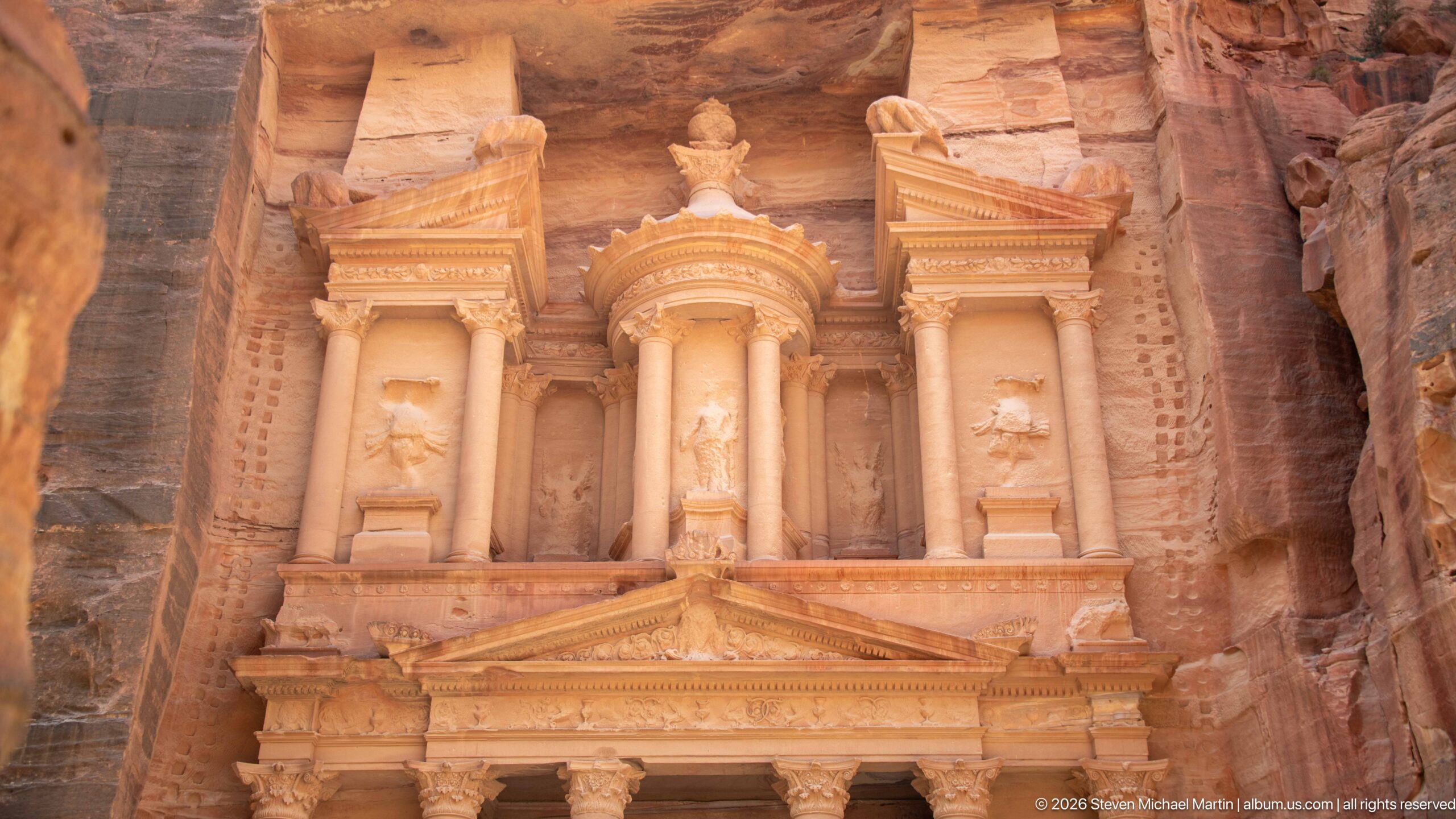
Al-Khazneh’s upper story is organized around a central circular tholos, flanked by projecting columned bays and broken pediments. The symmetrical composition translates Hellenistic architectural forms into a façade carved entirely from Petra’s sandstone cliff. UNESCO highlights this fusion of classical and Nabataean traditions as one of the qualities that gives Petra its exceptional architectural significance.
Caption
Al-Khazneh’s upper story is organized around a central circular tholos, flanked by projecting columned bays and broken pediments. The symmetrical composition translates Hellenistic architectural forms into a façade carved entirely from Petra’s sandstone cliff. UNESCO highlights this fusion of classical and Nabataean traditions as one of the qualities that gives Petra its exceptional architectural significance.
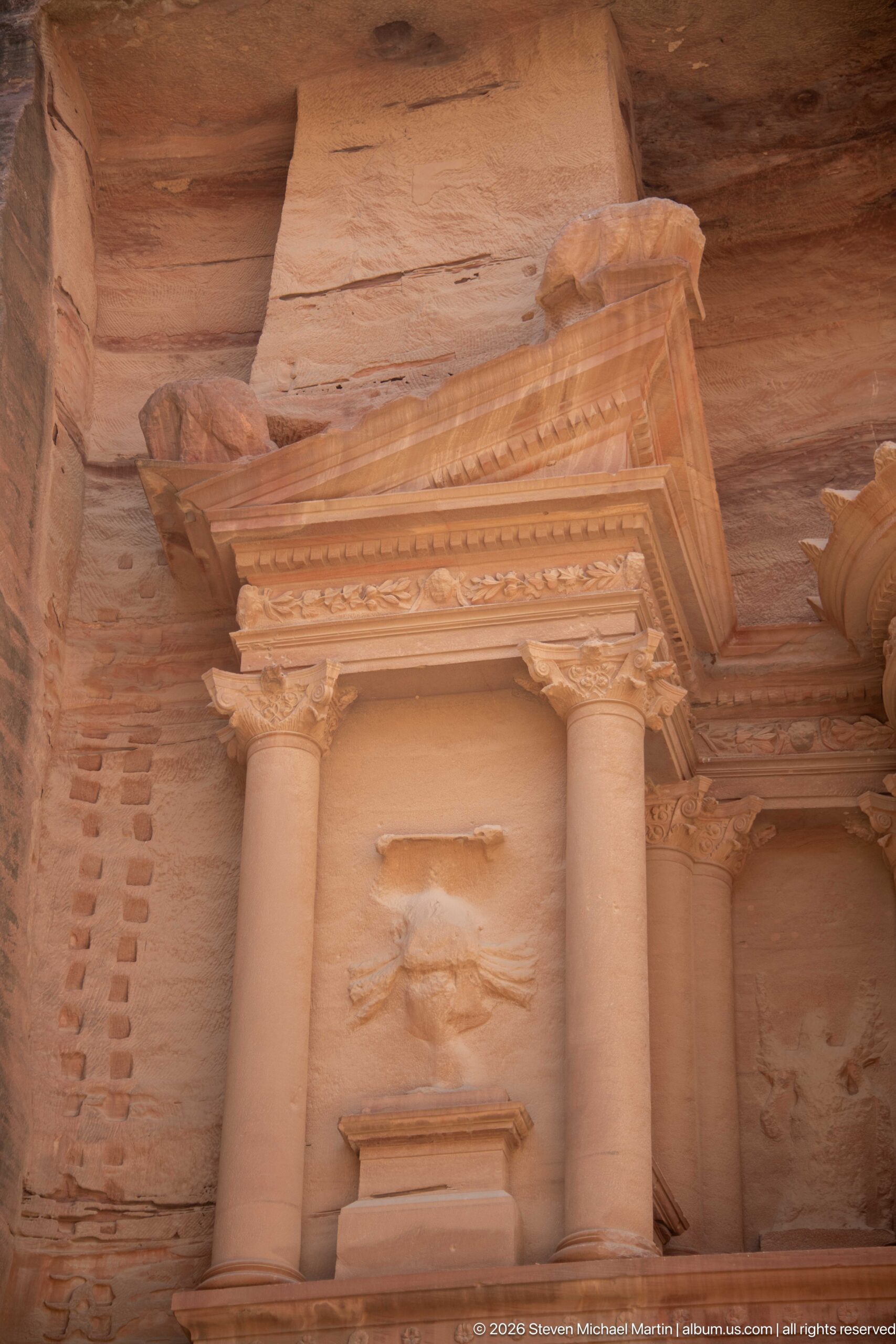
A close view of Al-Khazneh’s upper order centers on a recessed sculptural niche between paired columns beneath a projecting triangular pediment. Weathered relief survives within the niche, while crisp cornice lines and the adjacent curved architecture of the central tholos show how the Treasury’s upper façade alternates angular and rounded forms.
Caption
A close view of Al-Khazneh’s upper order centers on a recessed sculptural niche between paired columns beneath a projecting triangular pediment. Weathered relief survives within the niche, while crisp cornice lines and the adjacent curved architecture of the central tholos show how the Treasury’s upper façade alternates angular and rounded forms.
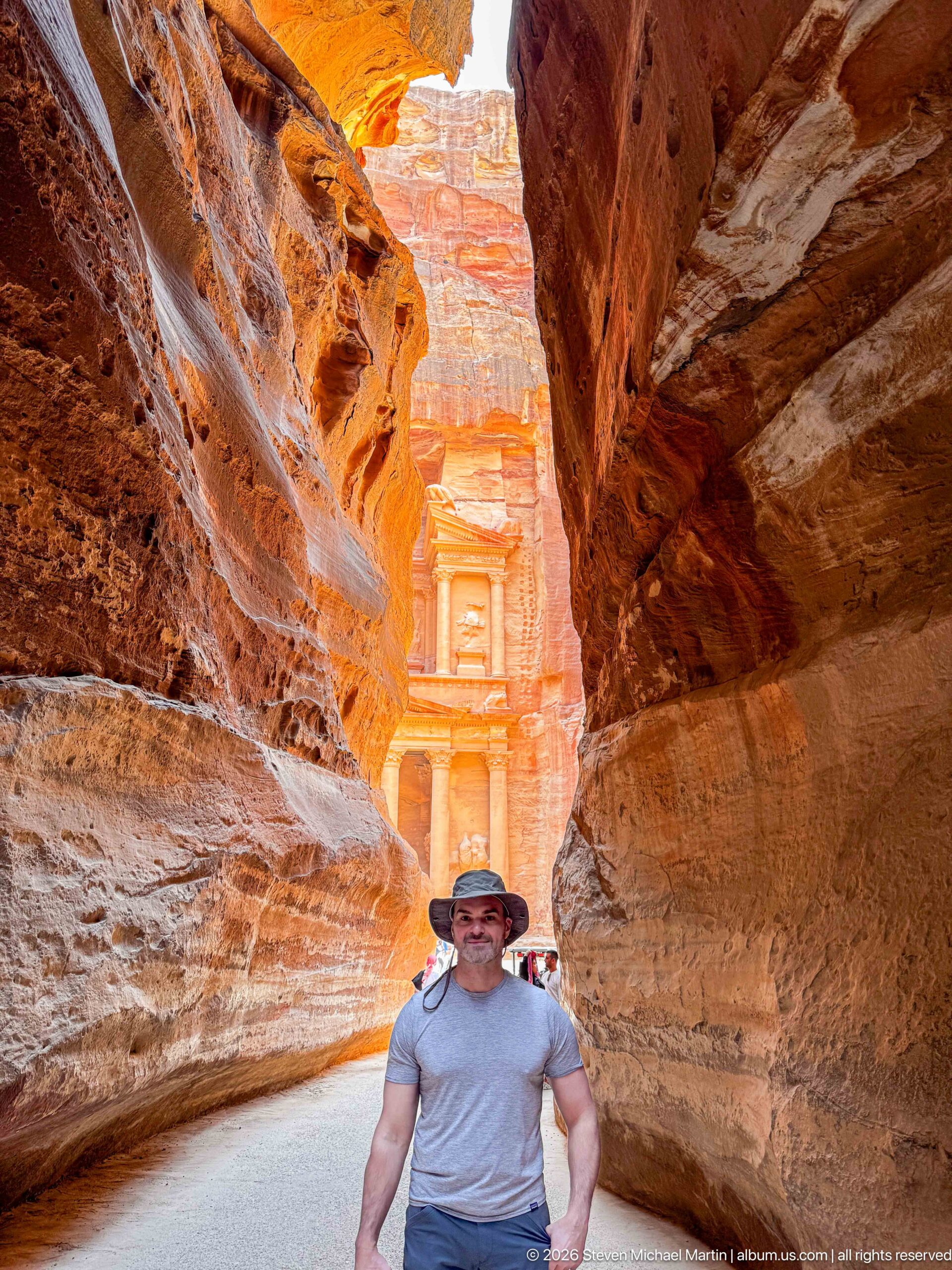
A visitor stands in the narrow Siq while the sunlit façade of Al-Khazneh appears beyond the enclosing sandstone walls. The composition uses the canyon’s curving rock surfaces as a natural frame, recreating the dramatic first glimpse of the Treasury from Petra’s principal approach.
Caption
A visitor stands in the narrow Siq while the sunlit façade of Al-Khazneh appears beyond the enclosing sandstone walls. The composition uses the canyon’s curving rock surfaces as a natural frame, recreating the dramatic first glimpse of the Treasury from Petra’s principal approach.
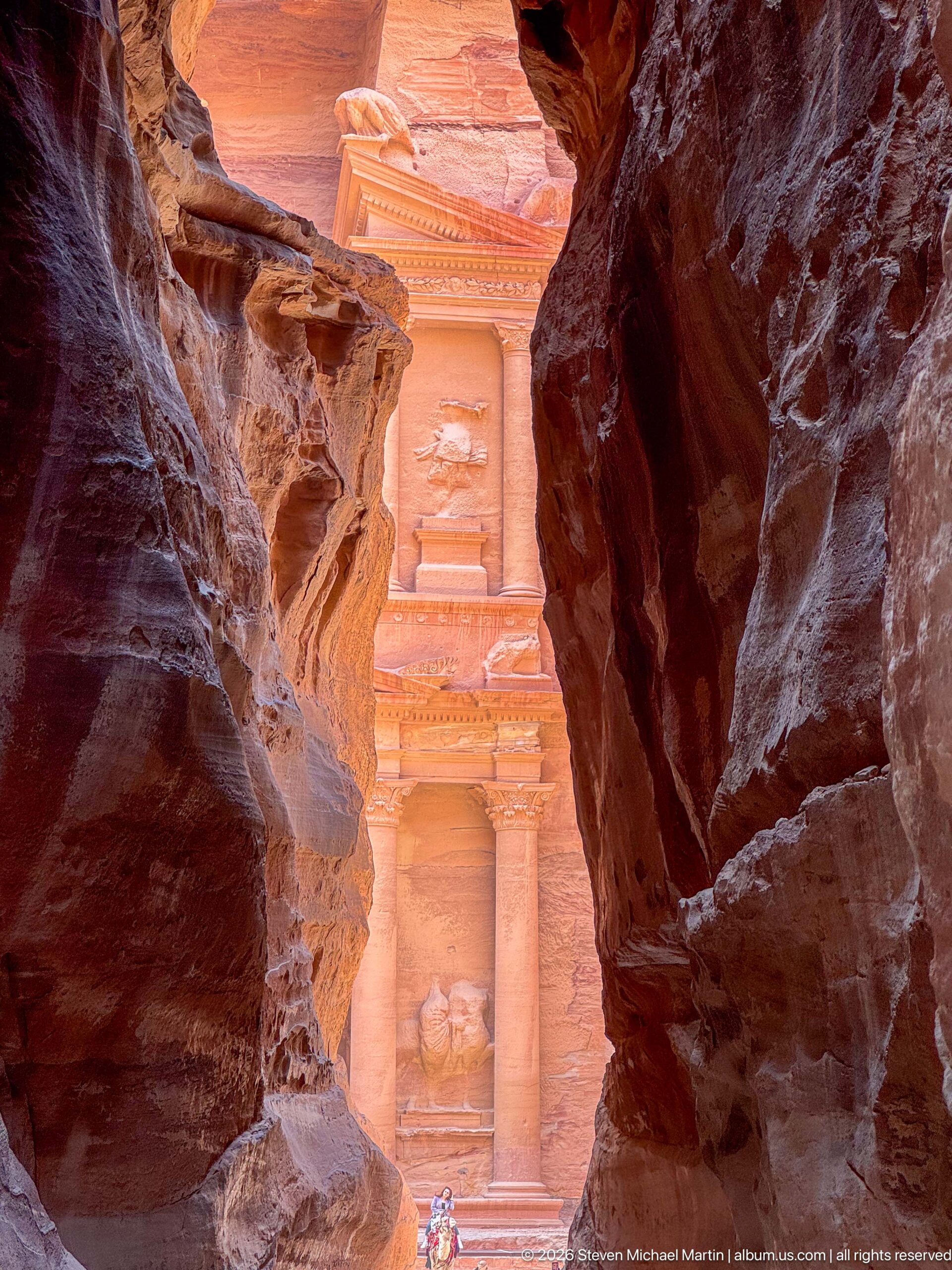
Only part of Al-Khazneh is visible through the constricted walls of the Siq, where dark, sculpted sandstone nearly closes around the sunlit façade beyond. The glimpse of columns and pediment turns the canyon itself into the dominant subject, emphasizing the controlled reveal experienced on Petra’s approach.
Caption
Only part of Al-Khazneh is visible through the constricted walls of the Siq, where dark, sculpted sandstone nearly closes around the sunlit façade beyond. The glimpse of columns and pediment turns the canyon itself into the dominant subject, emphasizing the controlled reveal experienced on Petra’s approach.
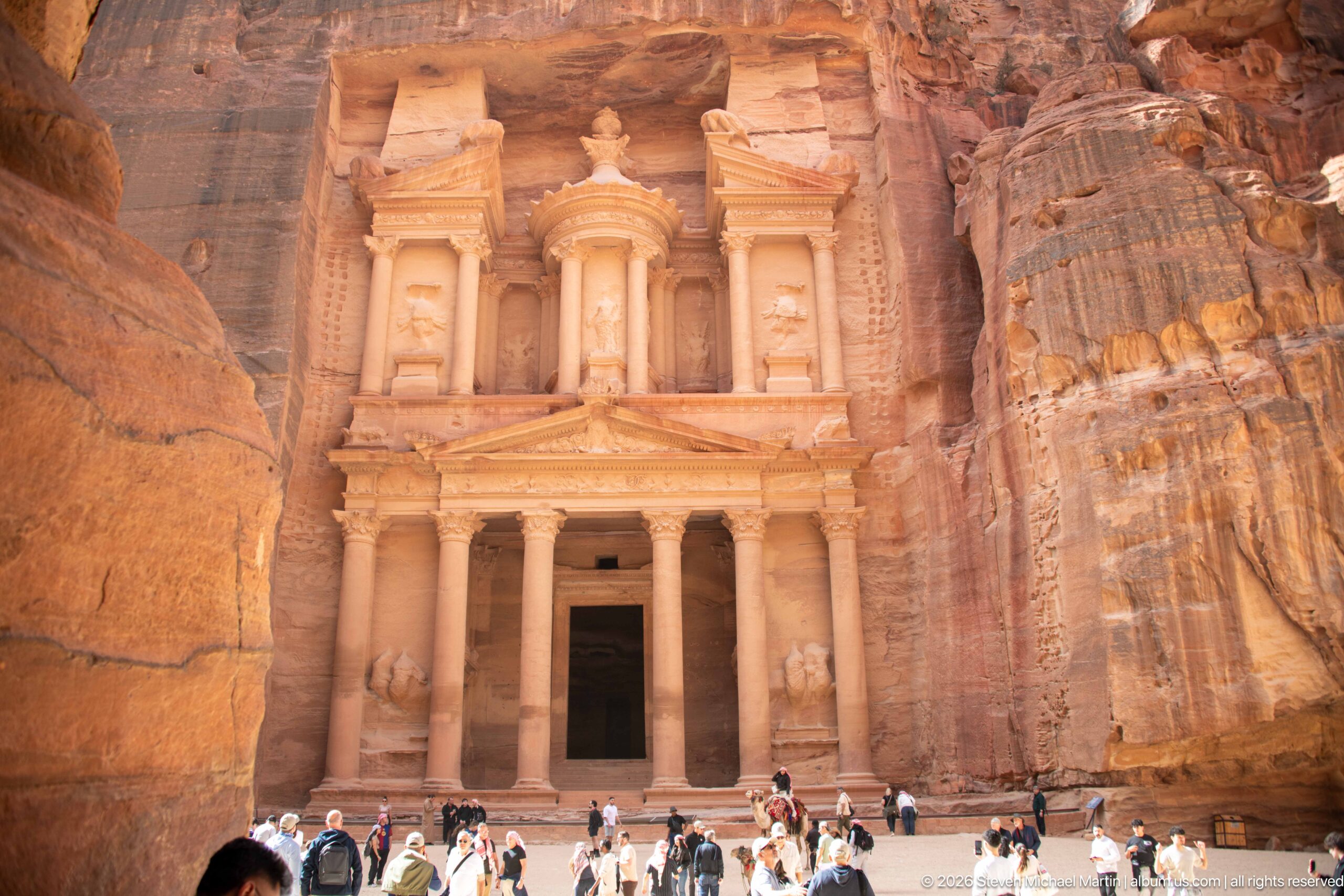
Visitors gathered at the base of Al-Khazneh make the extraordinary scale of the Treasury immediately legible. The two-story façade is carved directly into the sandstone cliff at the end of the Siq, combining columns, pediments, niches, and a central tholos in a Hellenistic-inspired design. UNESCO regards this fusion of classical forms and Nabataean rock-cut tradition as a defining achievement of Petra.
Caption
Visitors gathered at the base of Al-Khazneh make the extraordinary scale of the Treasury immediately legible. The two-story façade is carved directly into the sandstone cliff at the end of the Siq, combining columns, pediments, niches, and a central tholos in a Hellenistic-inspired design. UNESCO regards this fusion of classical forms and Nabataean rock-cut tradition as a defining achievement of Petra.
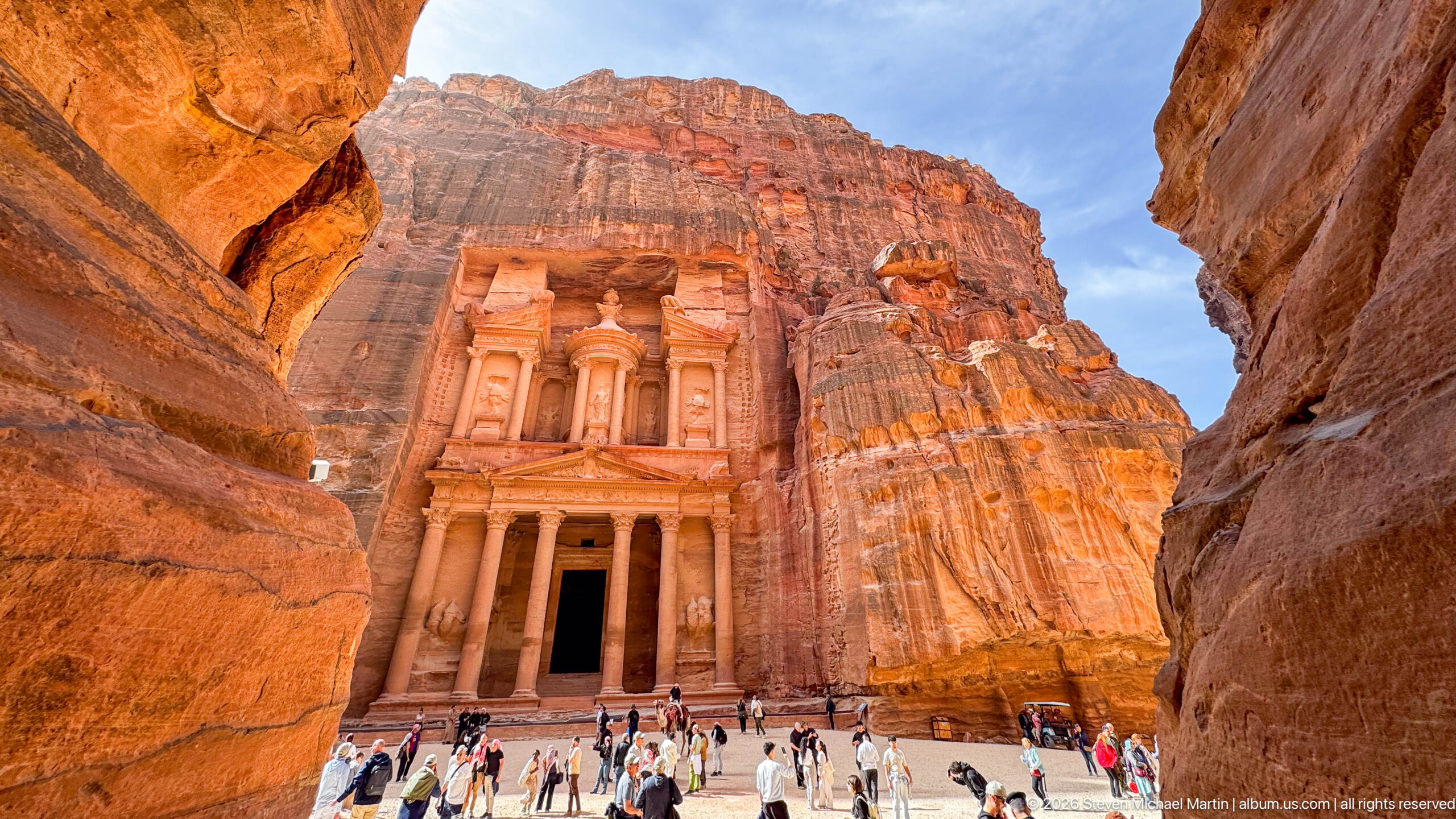
Al-Khazneh appears through the narrowing sandstone walls at the end of the Siq, creating Petra’s most celebrated transition from natural gorge to monumental architecture. UNESCO specifically emphasizes the approach to the Nabataean city through this winding rocky cleft and the dramatic rock-cut temple-tombs beyond. The framing canyon reveals only part of the Treasury at first, heightening the contrast between shadowed passage and carved façade.
Caption
Al-Khazneh appears through the narrowing sandstone walls at the end of the Siq, creating Petra’s most celebrated transition from natural gorge to monumental architecture. UNESCO specifically emphasizes the approach to the Nabataean city through this winding rocky cleft and the dramatic rock-cut temple-tombs beyond. The framing canyon reveals only part of the Treasury at first, heightening the contrast between shadowed passage and carved façade.

The Treasury’s façade dominates this vertical view from the forecourt, with four lower columns framing the dark entrance and the ornate upper tholos set against the rose-colored cliff. By cropping out much of the surrounding canyon, the composition concentrates attention on the monument’s architectural symmetry and carved surface.
Caption
The Treasury’s façade dominates this vertical view from the forecourt, with four lower columns framing the dark entrance and the ornate upper tholos set against the rose-colored cliff. By cropping out much of the surrounding canyon, the composition concentrates attention on the monument’s architectural symmetry and carved surface.

A small calico-and-white cat sits alert on a sandstone ledge within Petra’s canyon, sharply isolated against softly blurred rock walls. Its upright posture and curled tail make the animal the clear subject, while the warm stone background retains enough context to place the portrait within the archaeological landscape.
Caption
A small calico-and-white cat sits alert on a sandstone ledge within Petra’s canyon, sharply isolated against softly blurred rock walls. Its upright posture and curled tail make the animal the clear subject, while the warm stone background retains enough context to place the portrait within the archaeological landscape.
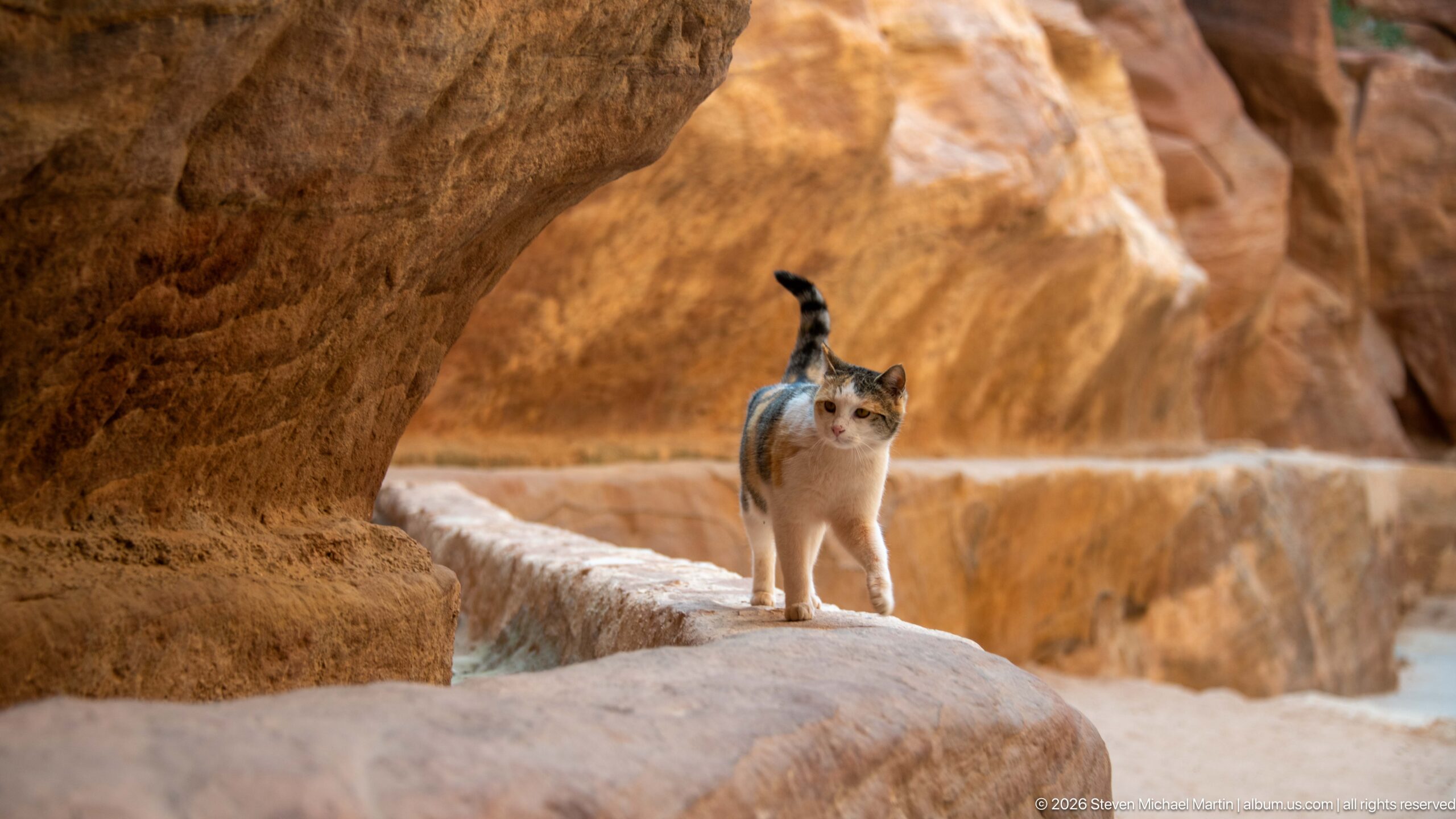
A calico-and-white cat walks toward the camera along a narrow sandstone ledge beneath an overhanging rock wall. The low viewpoint follows the ledge as it curves through the canyon, giving the animal a strong sense of movement while revealing the worn pathway and layered stone around it.
Caption
A calico-and-white cat walks toward the camera along a narrow sandstone ledge beneath an overhanging rock wall. The low viewpoint follows the ledge as it curves through the canyon, giving the animal a strong sense of movement while revealing the worn pathway and layered stone around it.
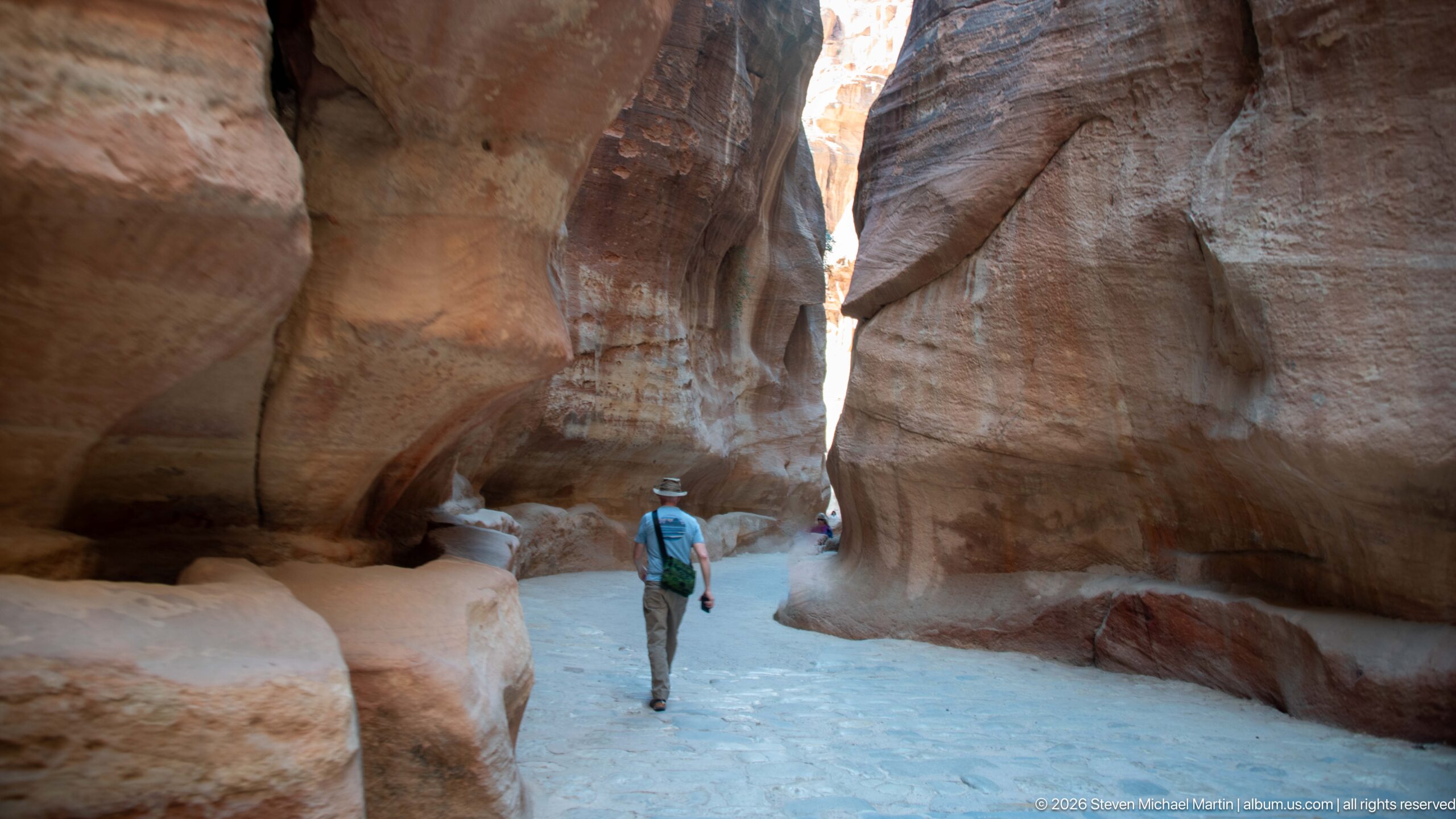
A visitor walks away through the Siq where the canyon walls constrict into a tall, sinuous corridor of banded sandstone. Light entering from above picks out the vertical folds and polished lower surfaces of the rock, while the figure underscores the extraordinary height and narrowness of the passage.
Caption
A visitor walks away through the Siq where the canyon walls constrict into a tall, sinuous corridor of banded sandstone. Light entering from above picks out the vertical folds and polished lower surfaces of the rock, while the figure underscores the extraordinary height and narrowness of the passage.
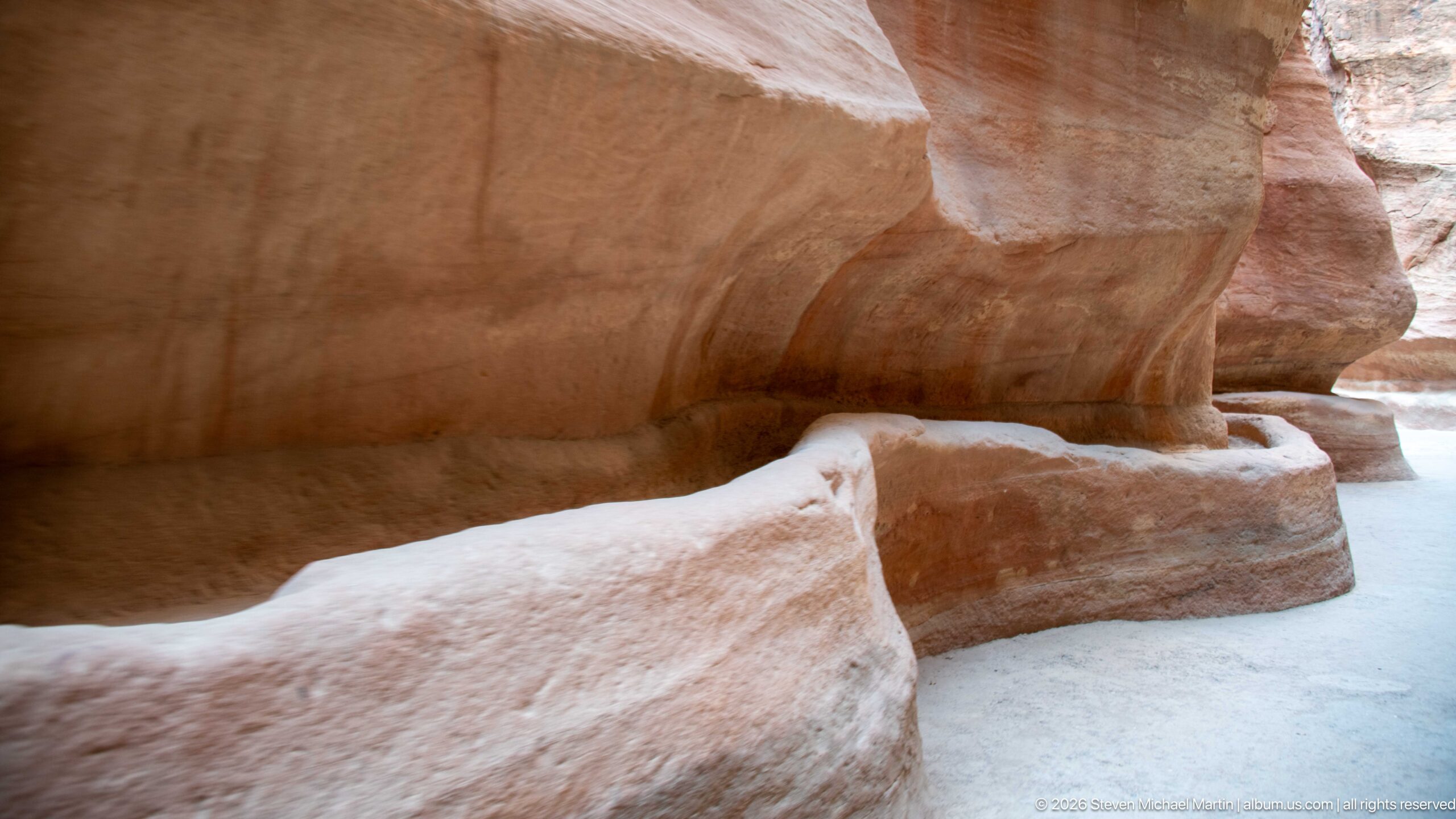
A rock-cut channel runs along the wall of the Siq, part of the hydraulic infrastructure that made sustained settlement at Petra possible. UNESCO identifies the city’s channels, tunnels, diversion dams, cisterns, and reservoirs as an exceptional water-management system designed to control and conserve seasonal rainfall in an arid landscape. The close view shows this engineering integrated directly into the gorge used as Petra’s principal eastern approach.
Caption
A rock-cut channel runs along the wall of the Siq, part of the hydraulic infrastructure that made sustained settlement at Petra possible. UNESCO identifies the city’s channels, tunnels, diversion dams, cisterns, and reservoirs as an exceptional water-management system designed to control and conserve seasonal rainfall in an arid landscape. The close view shows this engineering integrated directly into the gorge used as Petra’s principal eastern approach.
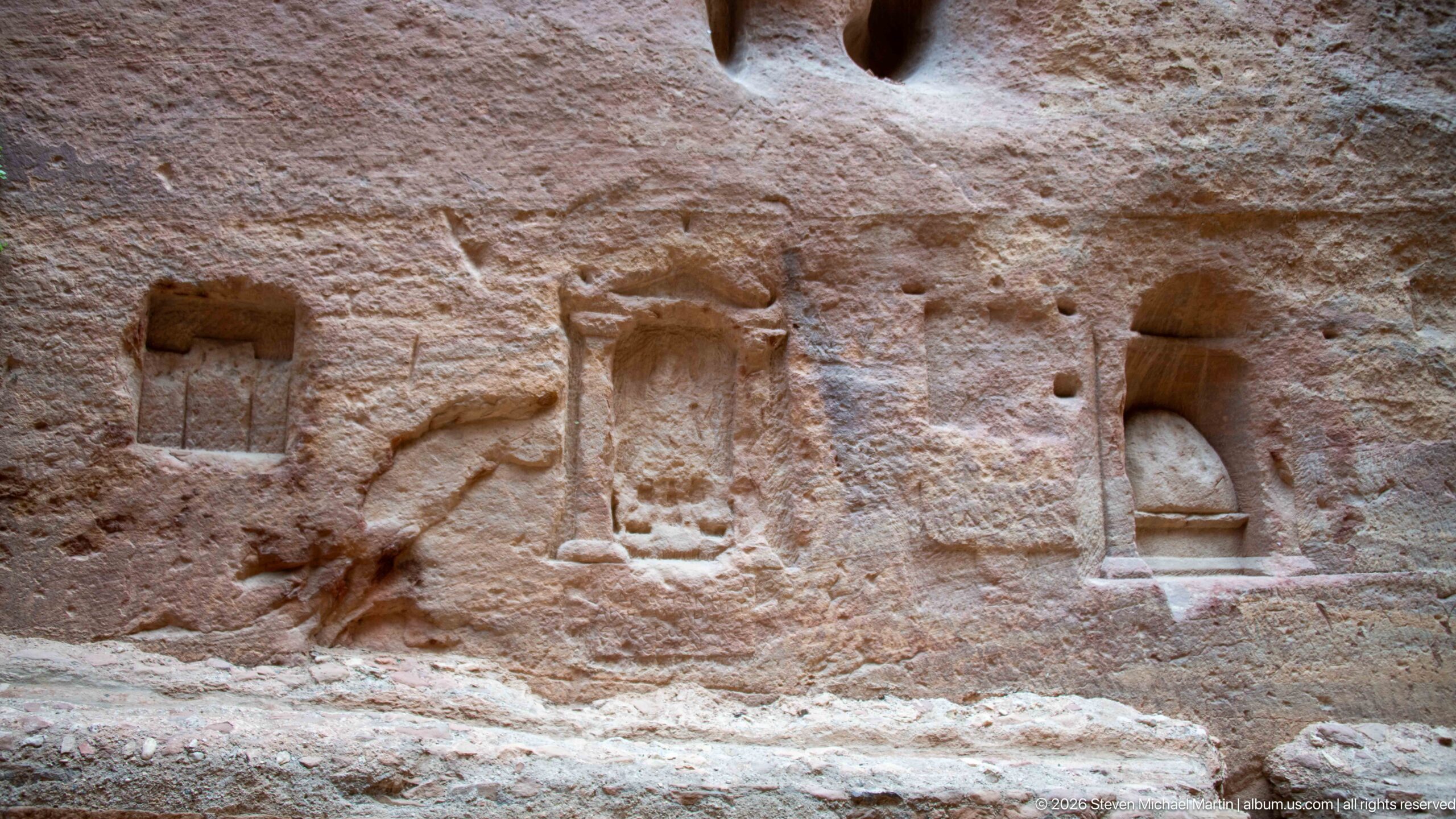
Small niches and worn relief carving punctuate the sandstone wall of the Siq, evidence that Petra’s entrance gorge was more than a passageway. Rock-cut sacred features accompanied the route into the Nabataean capital, integrating ritual markers with the engineered channels and natural cliffs of the approach. The close view preserves the weathered outlines while avoiding a more specific dedication that cannot be securely read from the photograph.
Caption
Small niches and worn relief carving punctuate the sandstone wall of the Siq, evidence that Petra’s entrance gorge was more than a passageway. Rock-cut sacred features accompanied the route into the Nabataean capital, integrating ritual markers with the engineered channels and natural cliffs of the approach. The close view preserves the weathered outlines while avoiding a more specific dedication that cannot be securely read from the photograph.
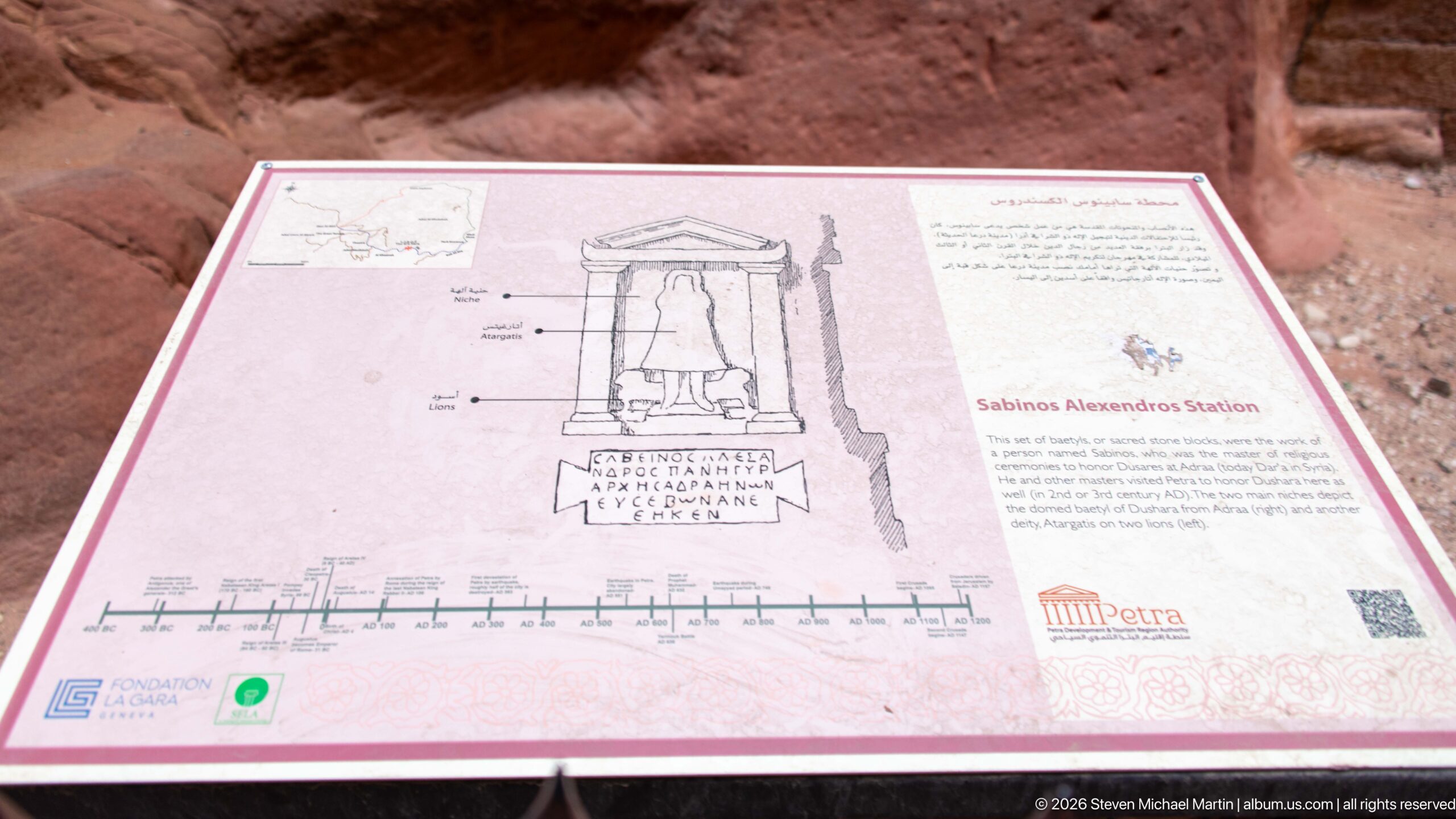
An interpretive panel titled “Sabinos Alexandros Station” presents a line drawing of a rock-cut niche, explanatory text in Arabic and English, a site plan, and a chronological graphic. The sign identifies and contextualizes one of the Siq’s carved commemorative or cultic features for visitors moving through Petra’s approach canyon.
Caption
An interpretive panel titled “Sabinos Alexandros Station” presents a line drawing of a rock-cut niche, explanatory text in Arabic and English, a site plan, and a chronological graphic. The sign identifies and contextualizes one of the Siq’s carved commemorative or cultic features for visitors moving through Petra’s approach canyon.
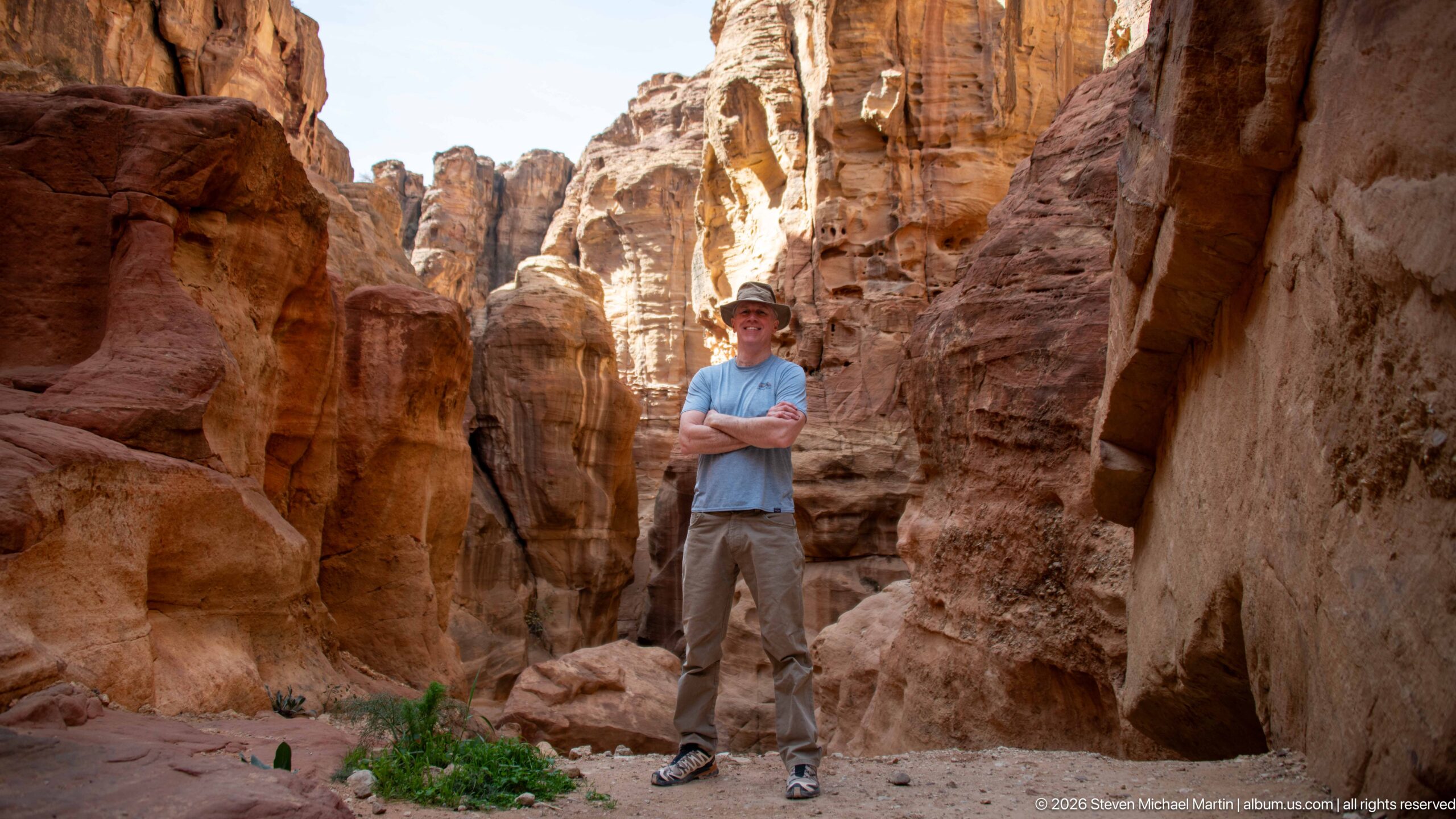
A visitor stands with folded arms on a sandy ledge within Petra’s Siq, surrounded by deeply weathered walls and projecting sandstone masses. The full-length portrait preserves the canyon’s scale, with narrow openings and vertical rock faces rising behind the figure.
Caption
A visitor stands with folded arms on a sandy ledge within Petra’s Siq, surrounded by deeply weathered walls and projecting sandstone masses. The full-length portrait preserves the canyon’s scale, with narrow openings and vertical rock faces rising behind the figure.
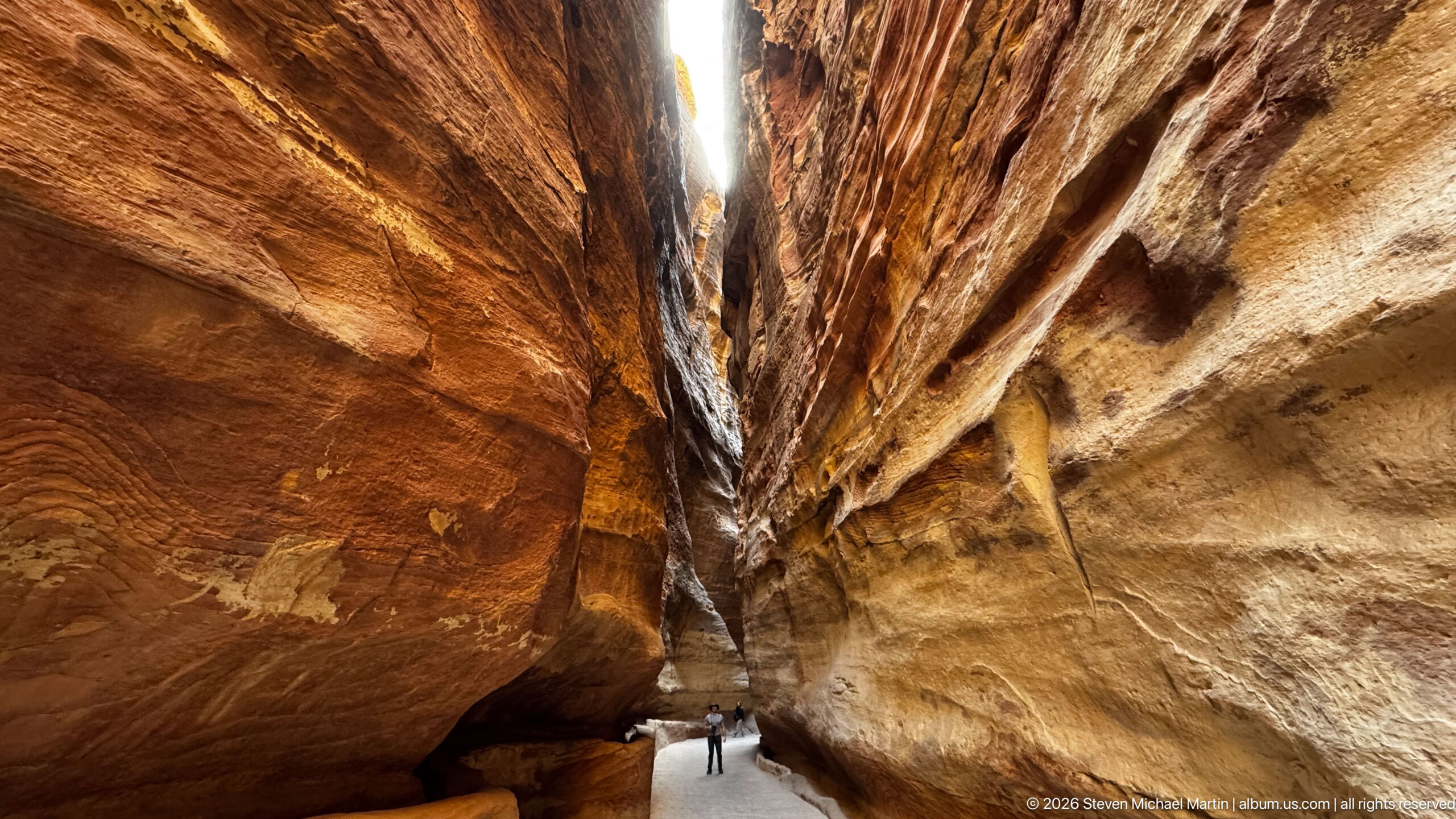
The Siq rises as a narrow slot between immense sandstone walls, their sweeping bands and polished curves converging toward a thin strip of daylight overhead. Tiny visitors at the base provide scale, while the upward emphasis makes the geological architecture of Petra’s entrance canyon the dominant subject.
Caption
The Siq rises as a narrow slot between immense sandstone walls, their sweeping bands and polished curves converging toward a thin strip of daylight overhead. Tiny visitors at the base provide scale, while the upward emphasis makes the geological architecture of Petra’s entrance canyon the dominant subject.
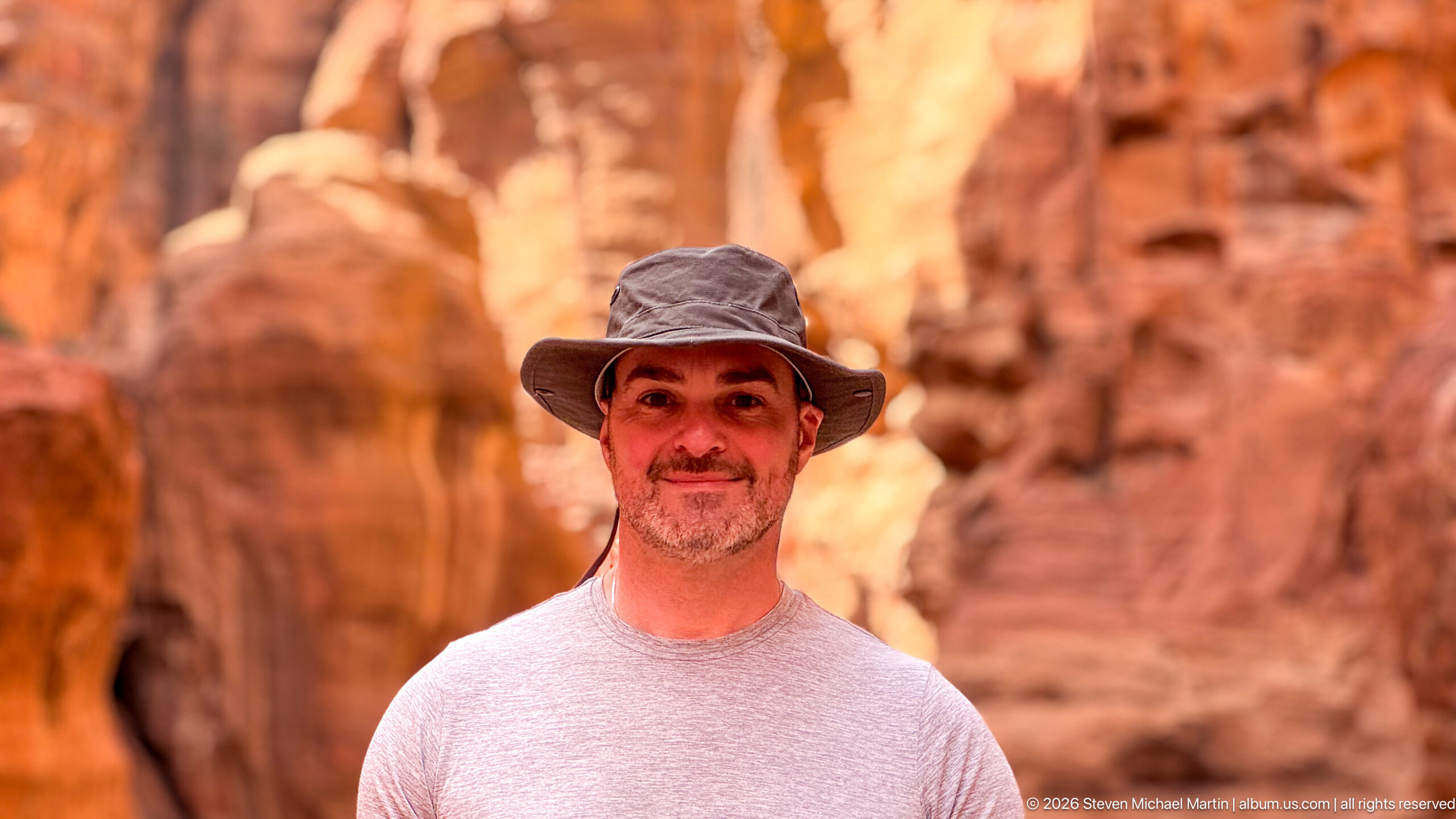
A visitor wearing a broad-brimmed sun hat faces the camera in a close portrait, with Petra’s warm sandstone walls rendered as a soft, luminous background. The shallow depth of field isolates the face and upper body while retaining the distinctive red-rock setting as contextual color and texture.
Caption
A visitor wearing a broad-brimmed sun hat faces the camera in a close portrait, with Petra’s warm sandstone walls rendered as a soft, luminous background. The shallow depth of field isolates the face and upper body while retaining the distinctive red-rock setting as contextual color and texture.
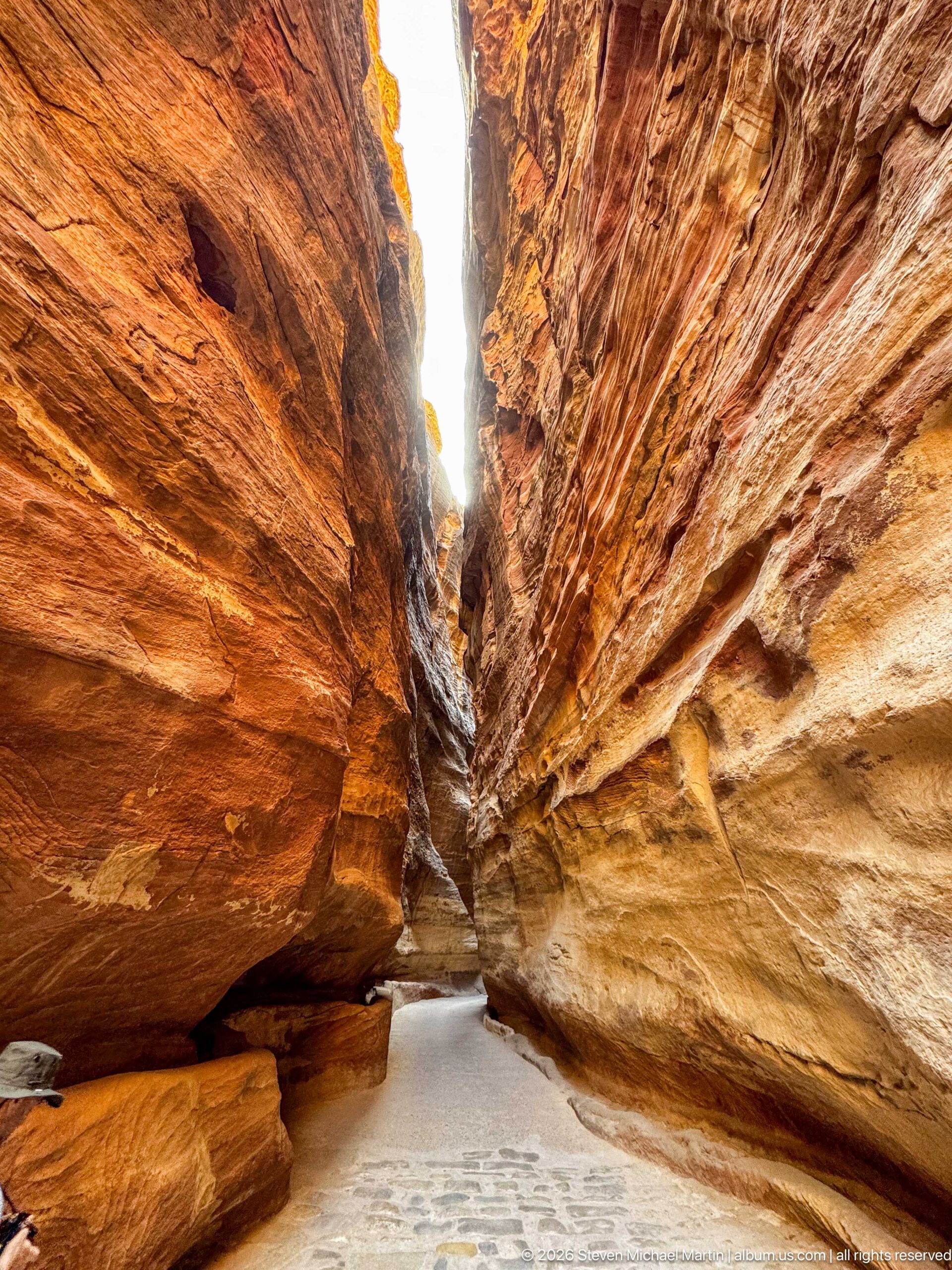
The pale pathway curves gently through the Siq beneath walls striped with red, ocher, and gray sandstone. Deep undercutting at left and smoothly flowing erosion patterns at right give the canyon a sculpted appearance, while the empty foreground allows the geological textures and scale of the passage to dominate.
Caption
The pale pathway curves gently through the Siq beneath walls striped with red, ocher, and gray sandstone. Deep undercutting at left and smoothly flowing erosion patterns at right give the canyon a sculpted appearance, while the empty foreground allows the geological textures and scale of the passage to dominate.
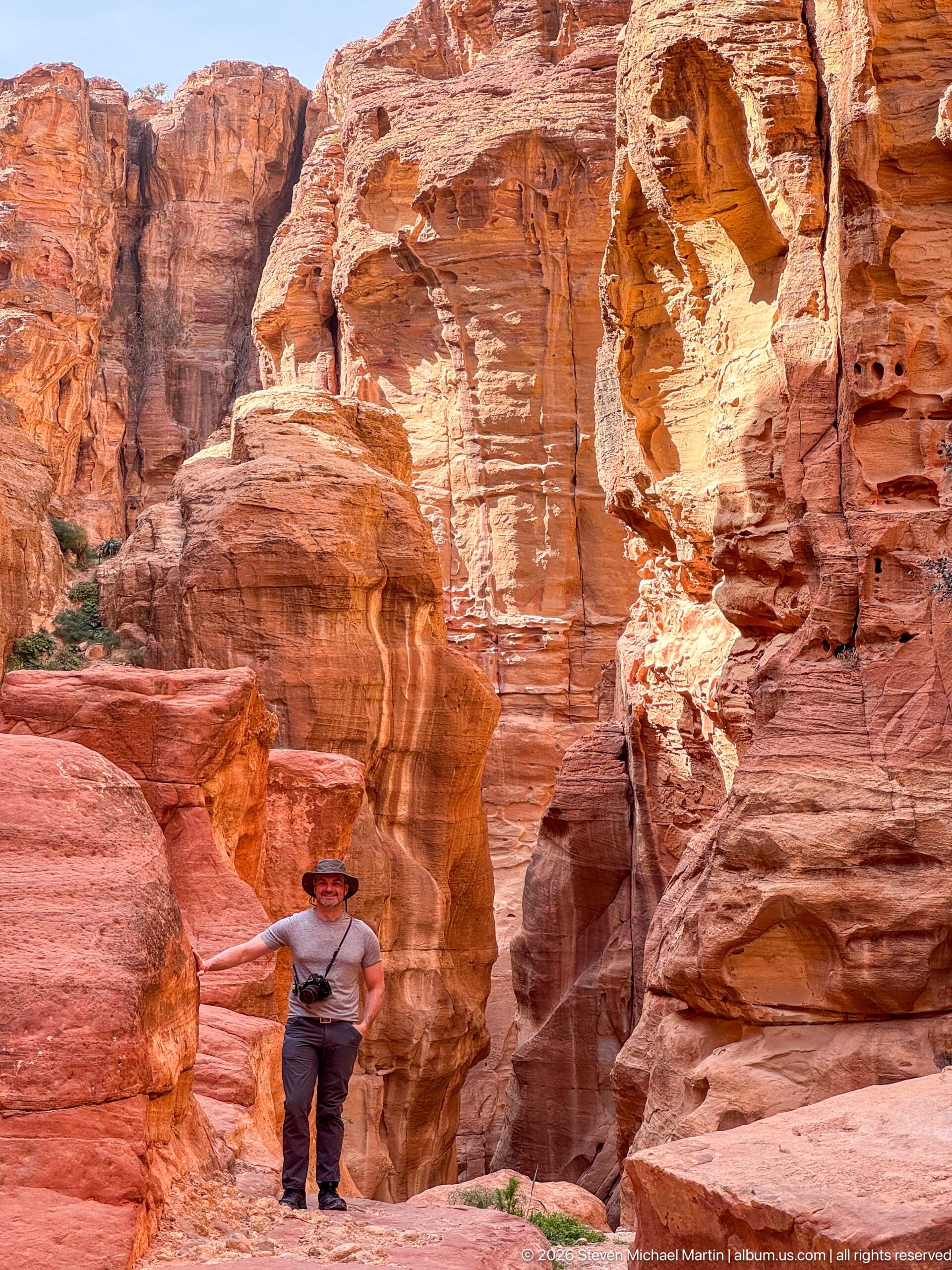
A visitor stands on a rocky ledge beneath intensely banded sandstone cliffs, where sweeping white, red, and ocher layers curve through cavities and rounded projections. The photograph emphasizes Petra’s geology as much as its archaeology, using the figure to show the scale of the naturally sculpted rock.
Caption
A visitor stands on a rocky ledge beneath intensely banded sandstone cliffs, where sweeping white, red, and ocher layers curve through cavities and rounded projections. The photograph emphasizes Petra’s geology as much as its archaeology, using the figure to show the scale of the naturally sculpted rock.
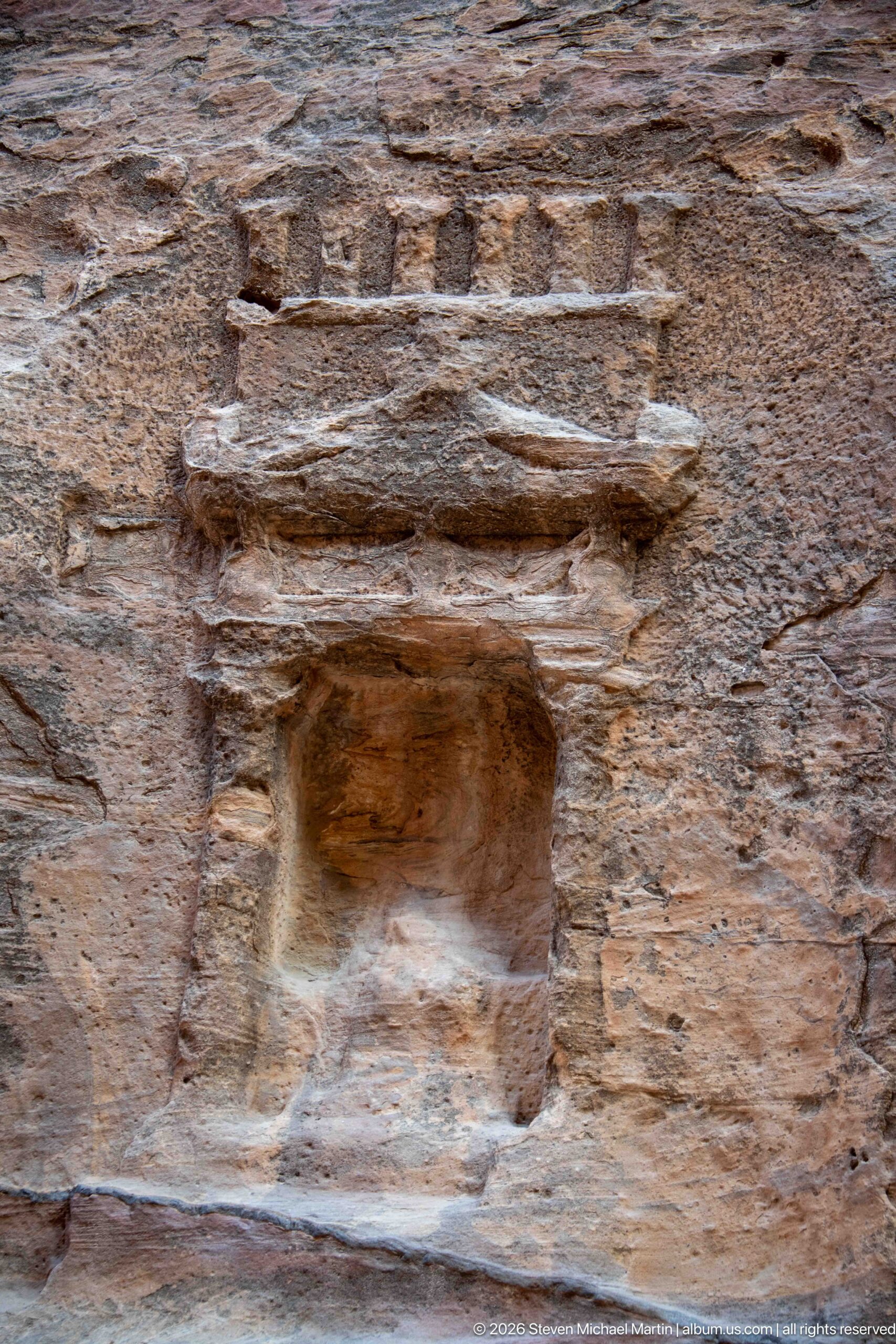
A small architectural niche is carved into Petra’s sandstone wall, framed by shallow vertical elements and the eroded remains of a pediment-like top. Heavy weathering has softened the original details, but the deliberate symmetry and recessed central field remain visible against the rougher surrounding rock.
Caption
A small architectural niche is carved into Petra’s sandstone wall, framed by shallow vertical elements and the eroded remains of a pediment-like top. Heavy weathering has softened the original details, but the deliberate symmetry and recessed central field remain visible against the rougher surrounding rock.
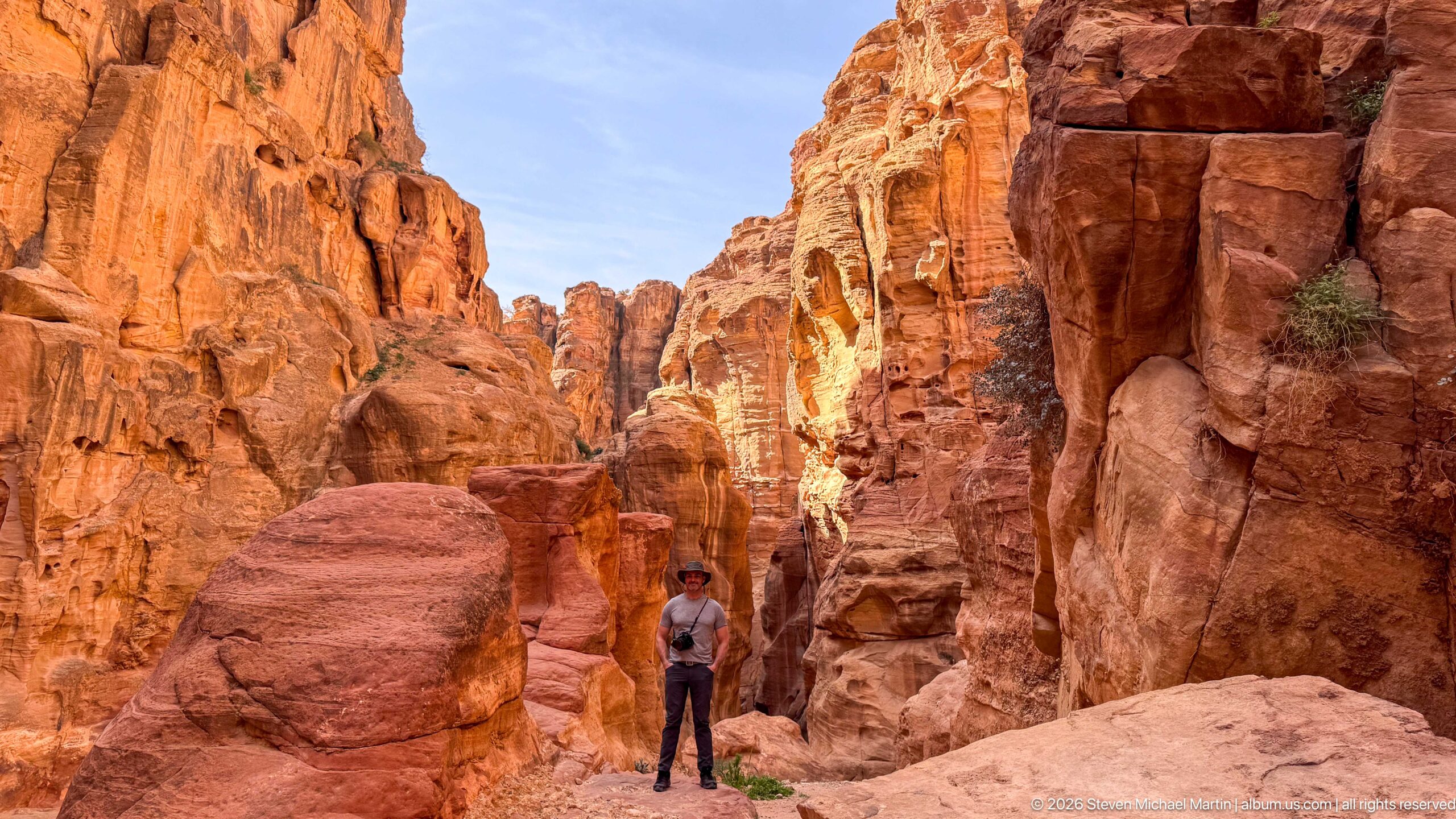
A visitor stands among massive red sandstone formations where narrow passages, rounded projections, and vertical cliff faces create a layered canyon landscape. The broad composition gives equal weight to the human figure and the surrounding geology, emphasizing the scale and sculptural weathering of Petra’s entrance terrain.
Caption
A visitor stands among massive red sandstone formations where narrow passages, rounded projections, and vertical cliff faces create a layered canyon landscape. The broad composition gives equal weight to the human figure and the surrounding geology, emphasizing the scale and sculptural weathering of Petra’s entrance terrain.
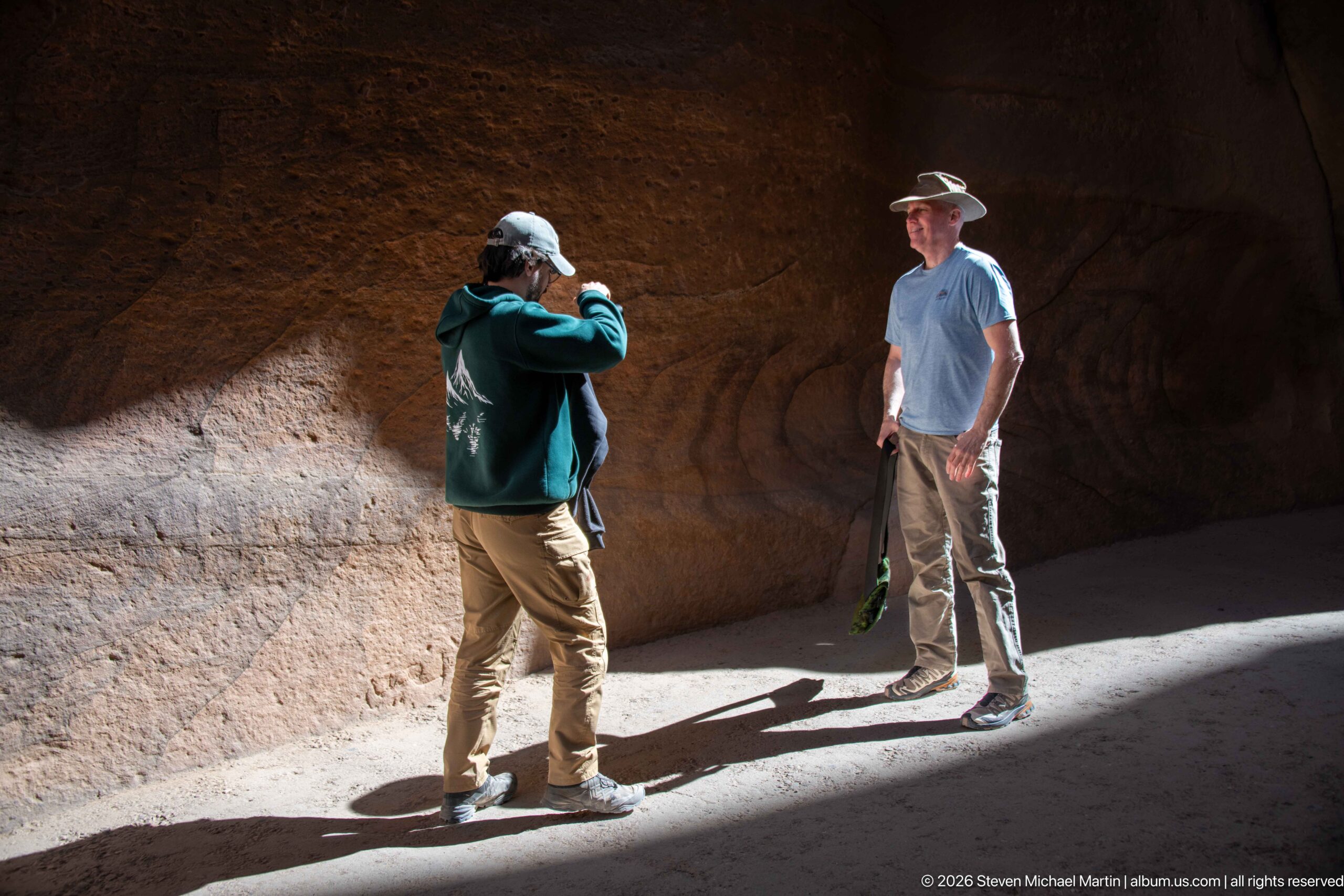
A visitor raises a camera or phone to photograph a companion standing in a shaft of sunlight within Petra’s sandstone canyon. Strong contrast between the illuminated path and dark rock wall creates a theatrical pool of light, turning an ordinary travel moment into a study of scale, shadow, and human activity in the Siq.
Caption
A visitor raises a camera or phone to photograph a companion standing in a shaft of sunlight within Petra’s sandstone canyon. Strong contrast between the illuminated path and dark rock wall creates a theatrical pool of light, turning an ordinary travel moment into a study of scale, shadow, and human activity in the Siq.
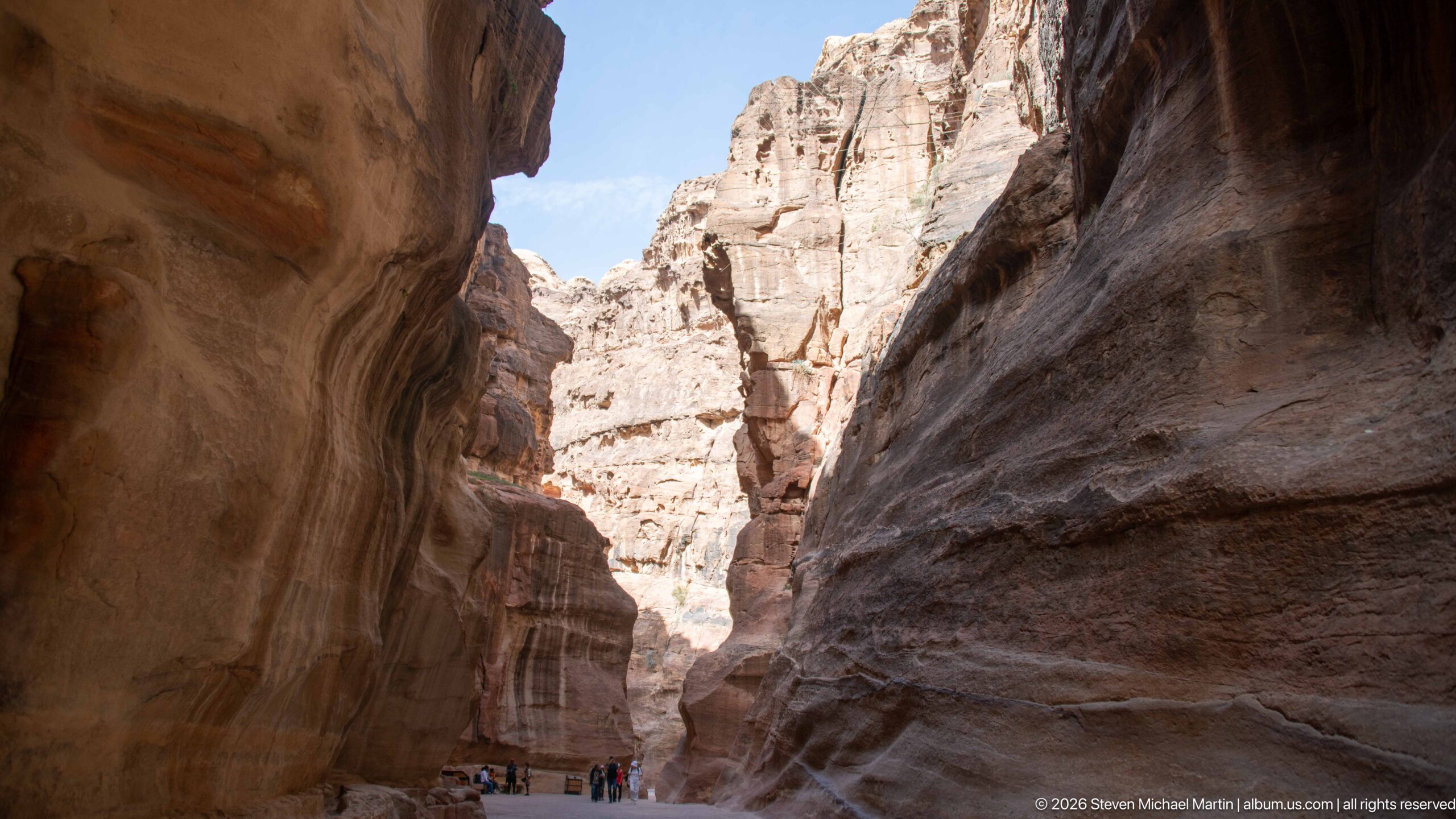
The Siq opens slightly in this view, revealing tall rock walls that still dominate the passage while a brighter cliff face rises beyond. A small group of visitors near the base provides scale, and the contrast between shaded foreground walls and the sunlit distance gives the canyon strong spatial depth.
Caption
The Siq opens slightly in this view, revealing tall rock walls that still dominate the passage while a brighter cliff face rises beyond. A small group of visitors near the base provides scale, and the contrast between shaded foreground walls and the sunlit distance gives the canyon strong spatial depth.
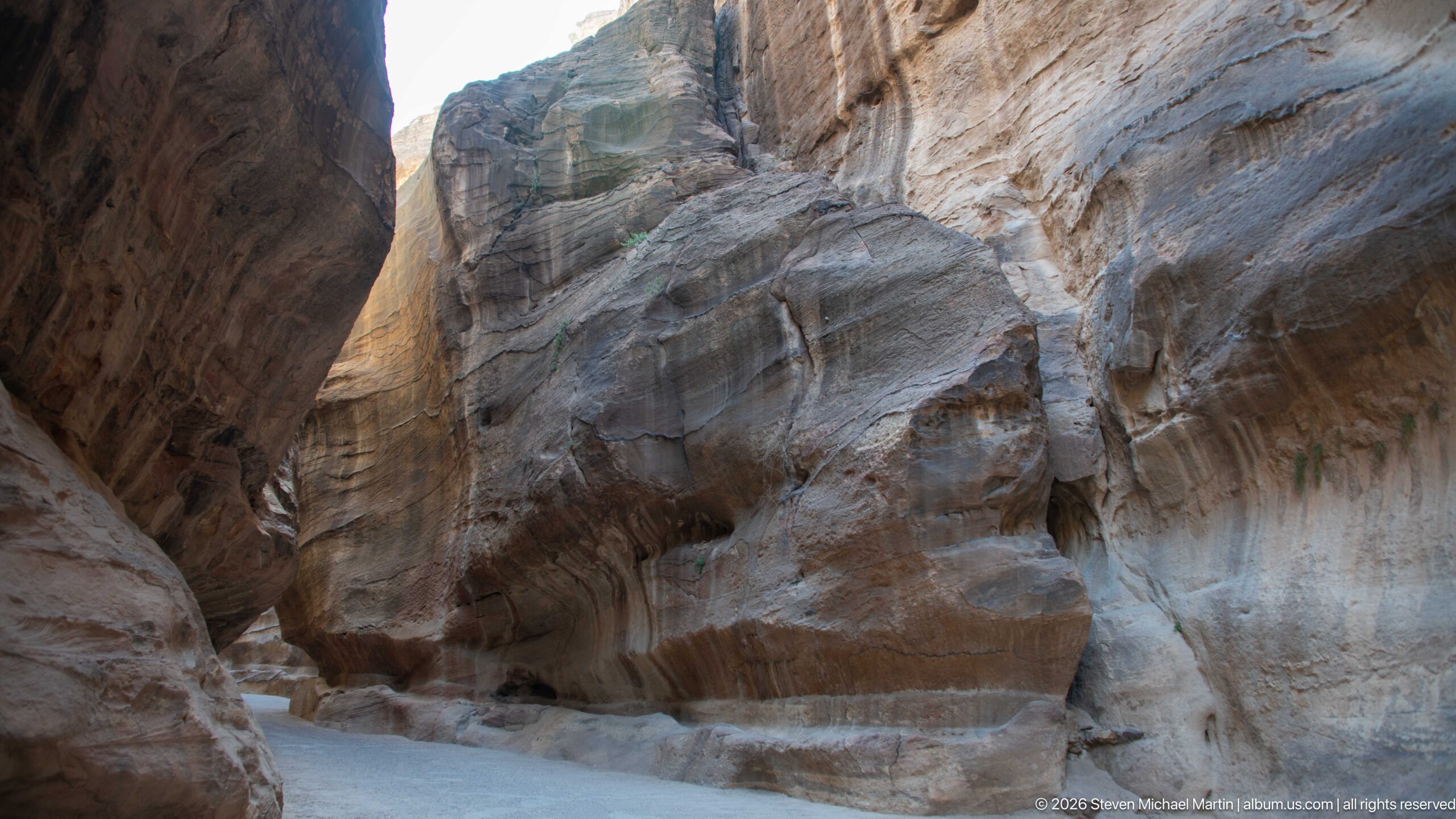
Massive sandstone walls constrict the Siq into a shaded corridor, their surfaces carved by erosion into bulges, recesses, and horizontal bands. A pale path winds between the rock faces toward a brighter opening, emphasizing the canyon’s changing width and the geological forms that shape Petra’s ceremonial approach.
Caption
Massive sandstone walls constrict the Siq into a shaded corridor, their surfaces carved by erosion into bulges, recesses, and horizontal bands. A pale path winds between the rock faces toward a brighter opening, emphasizing the canyon’s changing width and the geological forms that shape Petra’s ceremonial approach.
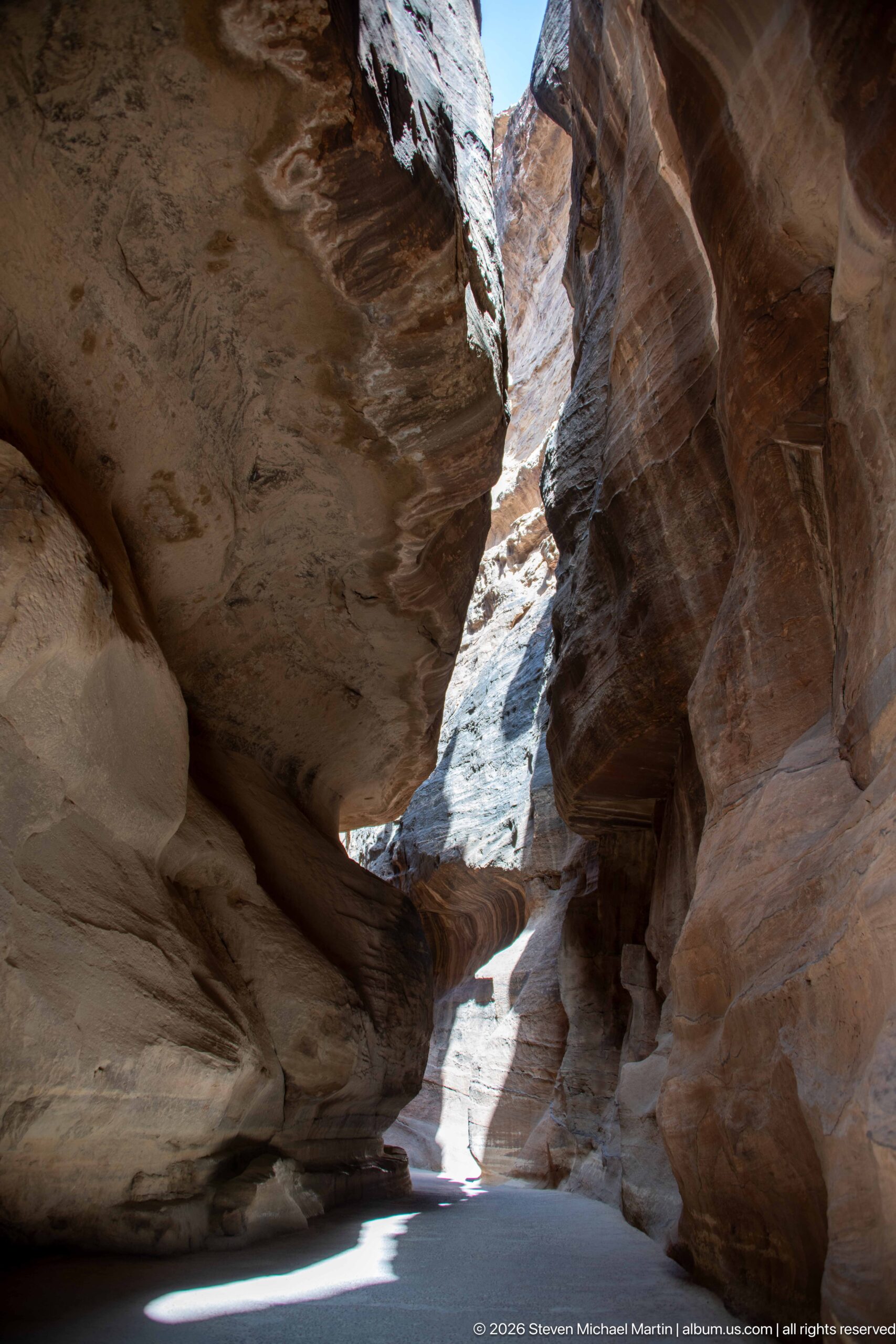
A shaded bend in the Siq is enclosed by overhanging sandstone masses that almost bridge the passage overhead. Sunlight cuts into the canyon farther ahead, illuminating smooth lower walls and revealing the sharp transition between dark sheltering rock and the bright corridor beyond.
Caption
A shaded bend in the Siq is enclosed by overhanging sandstone masses that almost bridge the passage overhead. Sunlight cuts into the canyon farther ahead, illuminating smooth lower walls and revealing the sharp transition between dark sheltering rock and the bright corridor beyond.
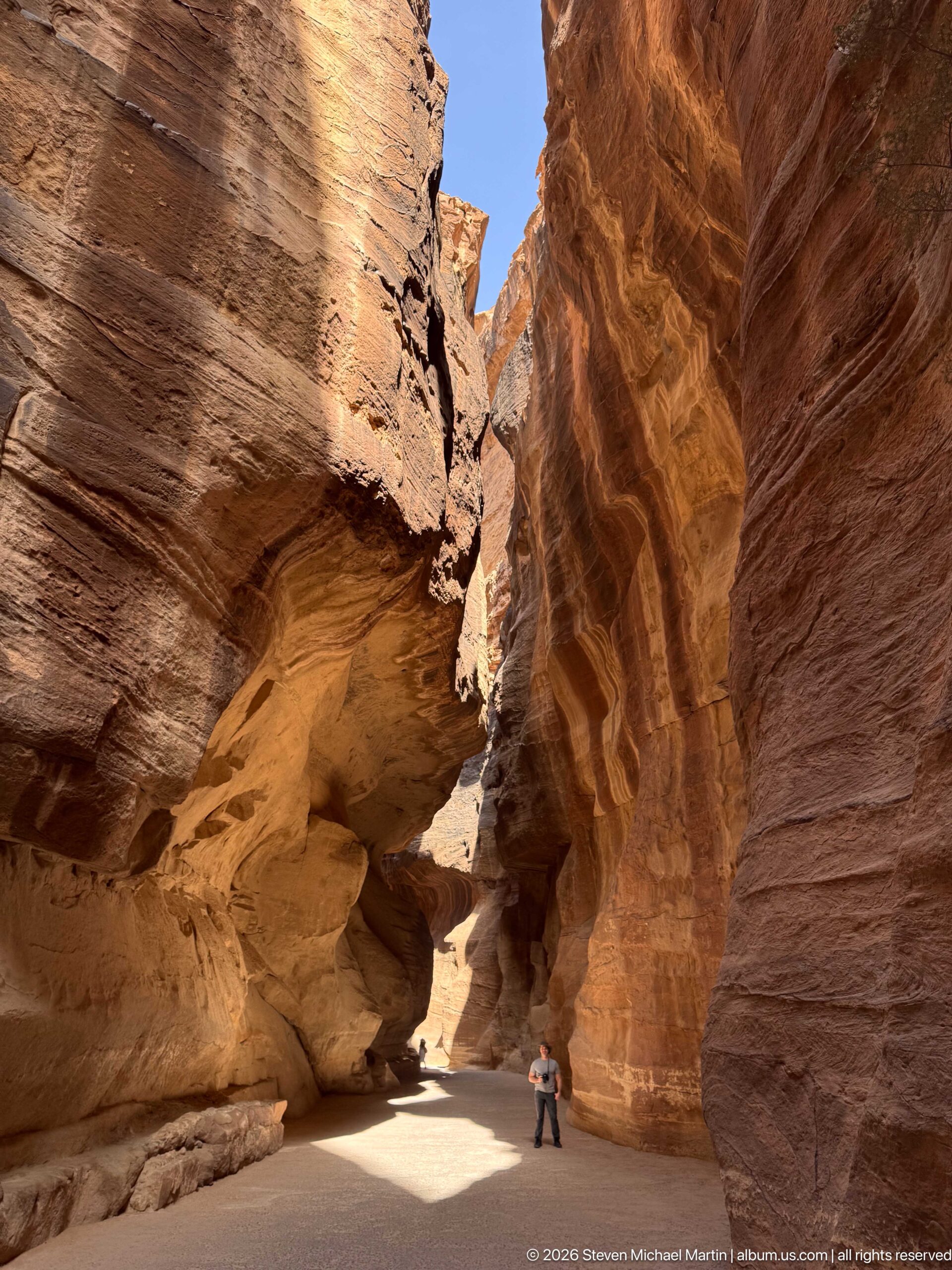
Layered sandstone walls sweep inward above the Siq, creating dramatic overhangs and deep recesses along the canyon route. Sunlight reaches the floor at a bend ahead, while small visitors near the opening provide scale against the immense, horizontally banded rock surfaces.
Caption
Layered sandstone walls sweep inward above the Siq, creating dramatic overhangs and deep recesses along the canyon route. Sunlight reaches the floor at a bend ahead, while small visitors near the opening provide scale against the immense, horizontally banded rock surfaces.
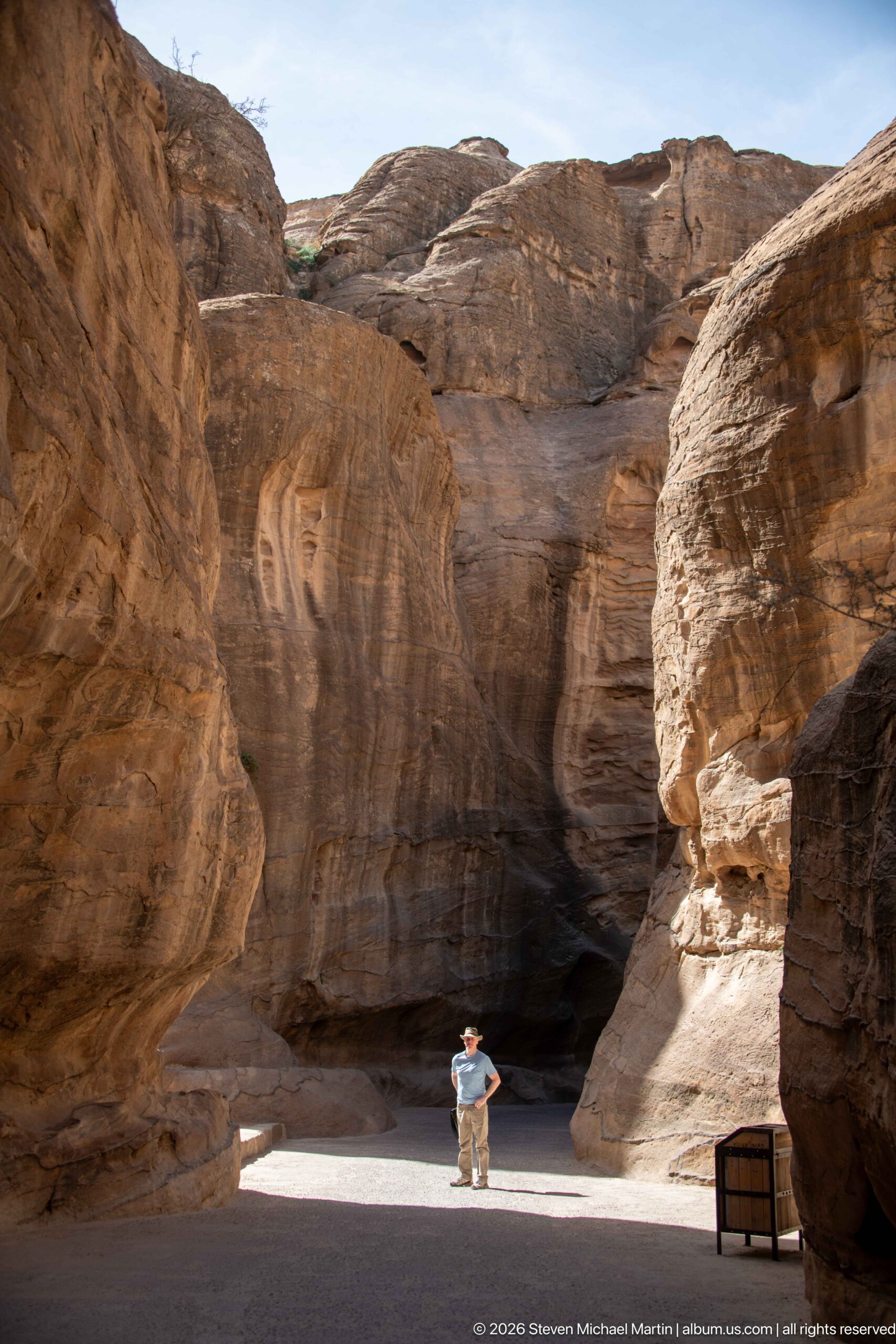
A visitor stands in a wider, amphitheater-like opening along the Siq, surrounded by high sandstone walls streaked with dark mineral bands. A deep shadowed recess opens behind the figure, and the strong midday light reveals the canyon’s broad transition from confined passage to small open chamber.
Caption
A visitor stands in a wider, amphitheater-like opening along the Siq, surrounded by high sandstone walls streaked with dark mineral bands. A deep shadowed recess opens behind the figure, and the strong midday light reveals the canyon’s broad transition from confined passage to small open chamber.
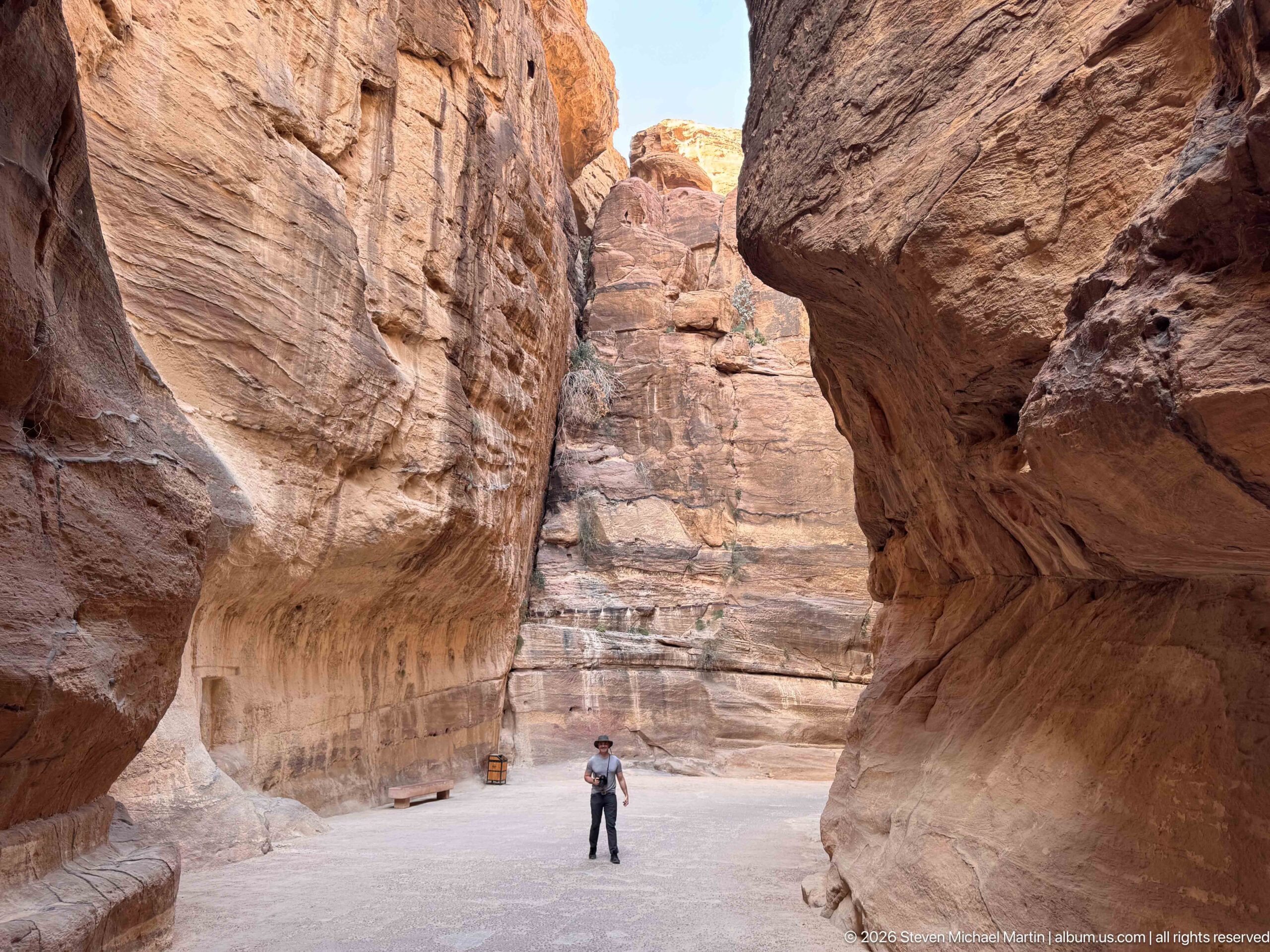
A lone visitor stands in the open floor of the Siq beneath enormous sandstone walls that curve inward from both sides. The human figure gives scale to the canyon’s height and undercut rock forms, while the brighter cliff beyond marks another turn in Petra’s winding entrance passage.
Caption
A lone visitor stands in the open floor of the Siq beneath enormous sandstone walls that curve inward from both sides. The human figure gives scale to the canyon’s height and undercut rock forms, while the brighter cliff beyond marks another turn in Petra’s winding entrance passage.
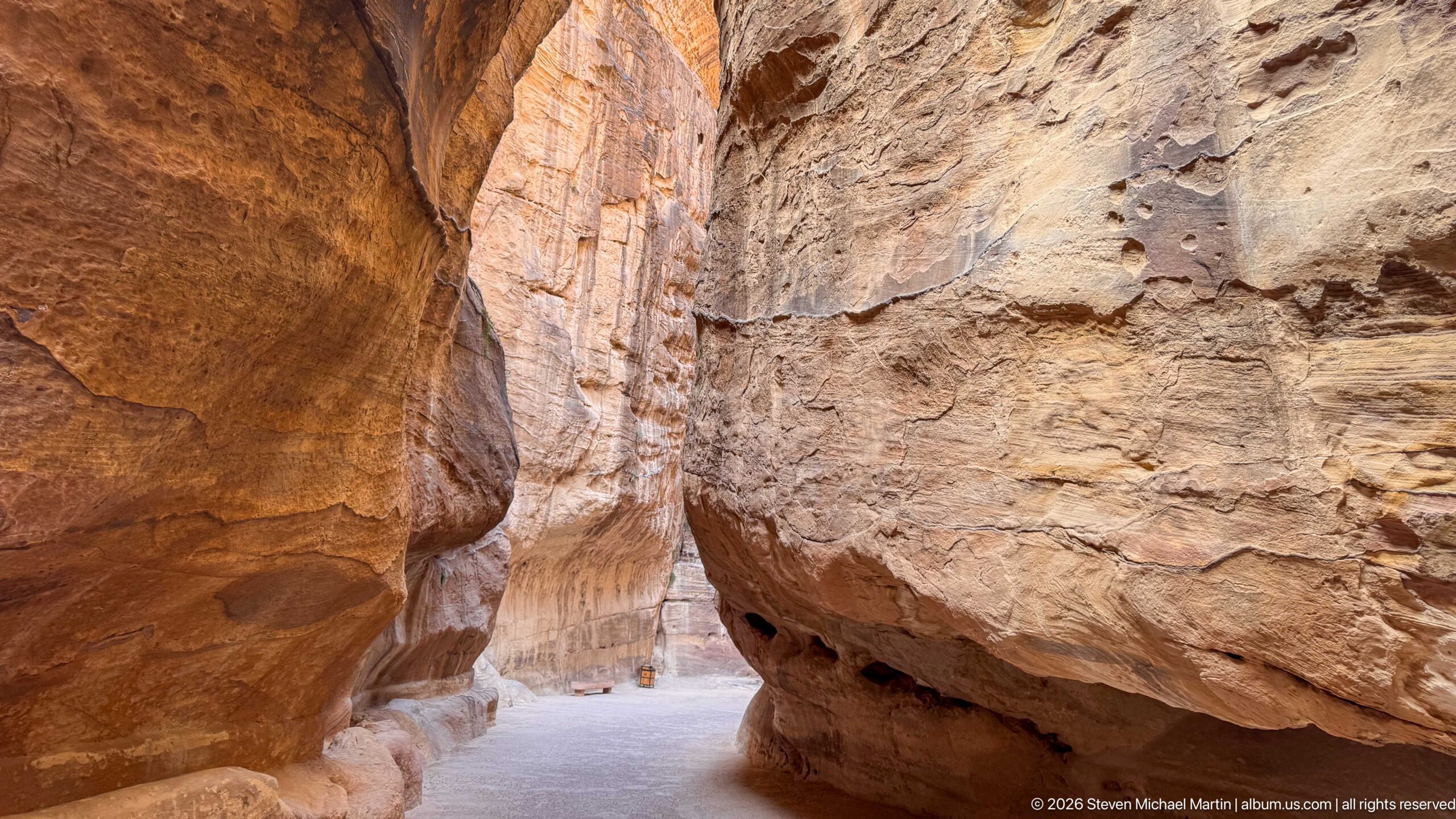
The Siq narrows around an enormous weathered sandstone projection that nearly divides the passage. Pale abrasion and undercutting mark the lower rock surfaces, while the shaded corridor continues around the obstruction, illustrating the canyon’s irregular, naturally sculpted course.
Caption
The Siq narrows around an enormous weathered sandstone projection that nearly divides the passage. Pale abrasion and undercutting mark the lower rock surfaces, while the shaded corridor continues around the obstruction, illustrating the canyon’s irregular, naturally sculpted course.
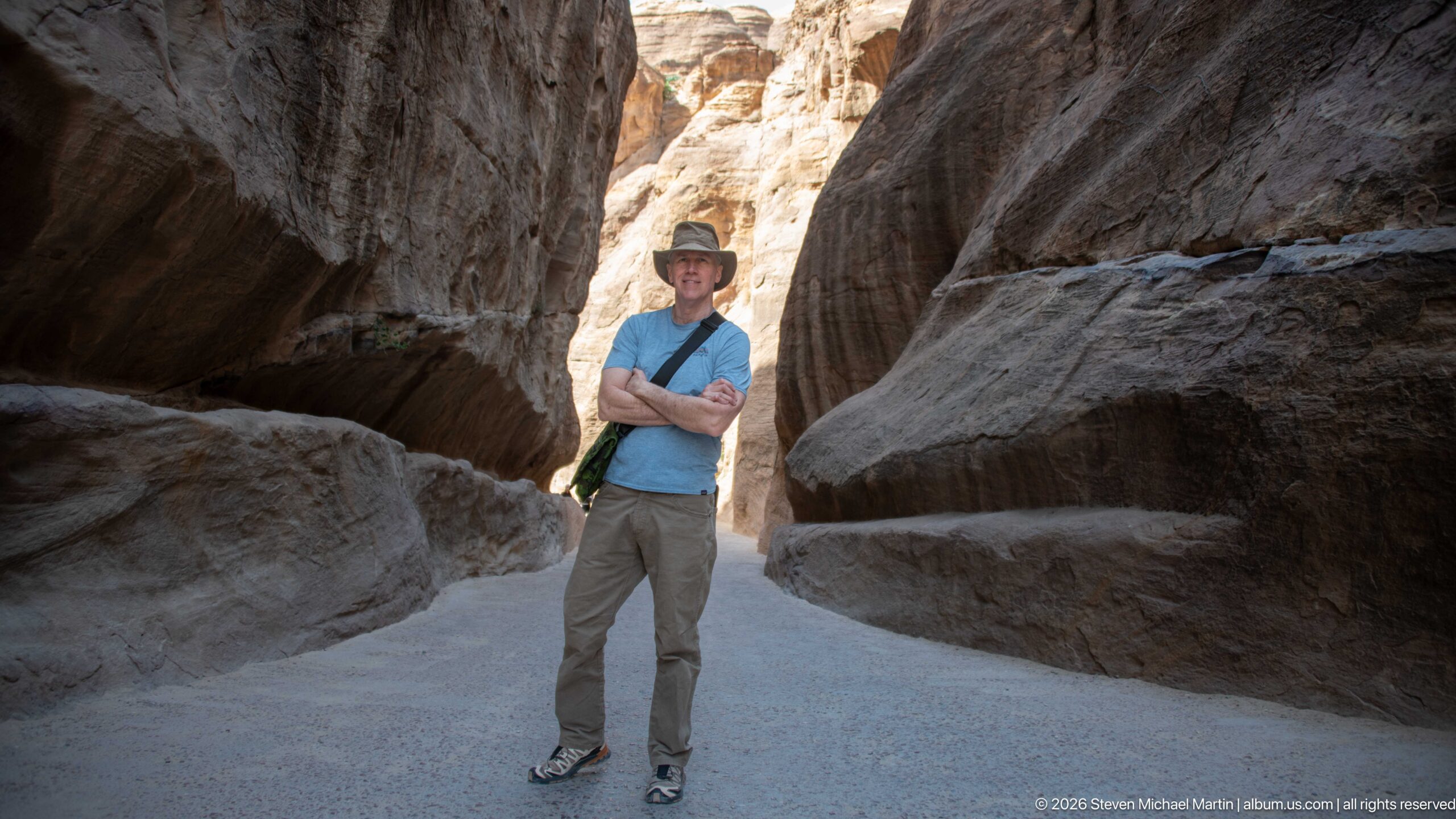
A visitor stands with arms folded in a shaded section of Petra’s Siq, framed by smoothly worn sandstone walls that pinch toward a brighter opening behind. The full-length portrait retains the canyon’s scale and reveals the pale pathway cut between massive rock projections.
Caption
A visitor stands with arms folded in a shaded section of Petra’s Siq, framed by smoothly worn sandstone walls that pinch toward a brighter opening behind. The full-length portrait retains the canyon’s scale and reveals the pale pathway cut between massive rock projections.
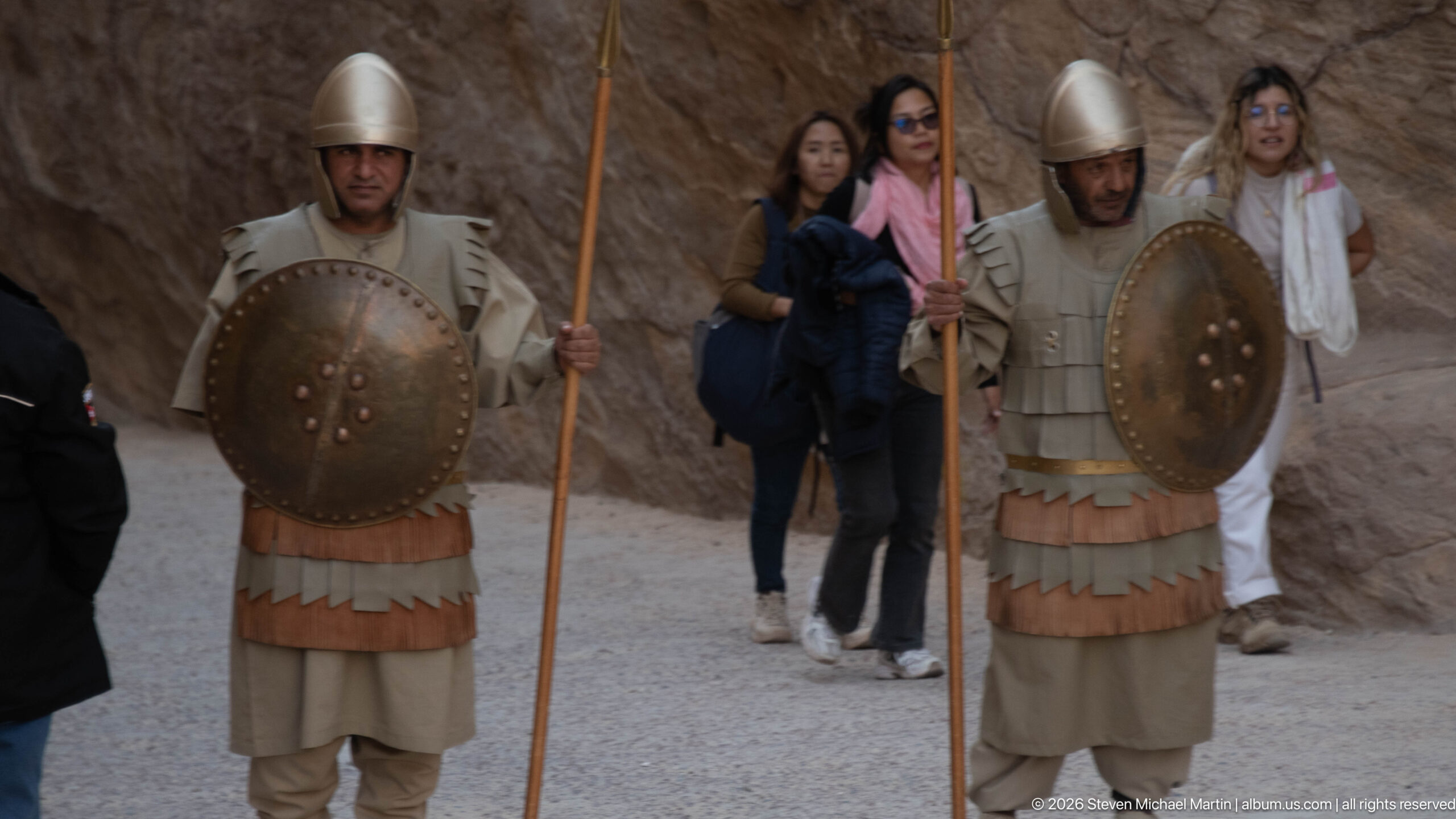
Two performers dressed in ancient-style military costumes stand along Petra’s visitor route holding long spears and round shields. Their layered tunics, helmets, and studded shields evoke historical soldiers for visitors, while contemporary tourists passing behind them make the staged nature of the presentation clear.
Caption
Two performers dressed in ancient-style military costumes stand along Petra’s visitor route holding long spears and round shields. Their layered tunics, helmets, and studded shields evoke historical soldiers for visitors, while contemporary tourists passing behind them make the staged nature of the presentation clear.
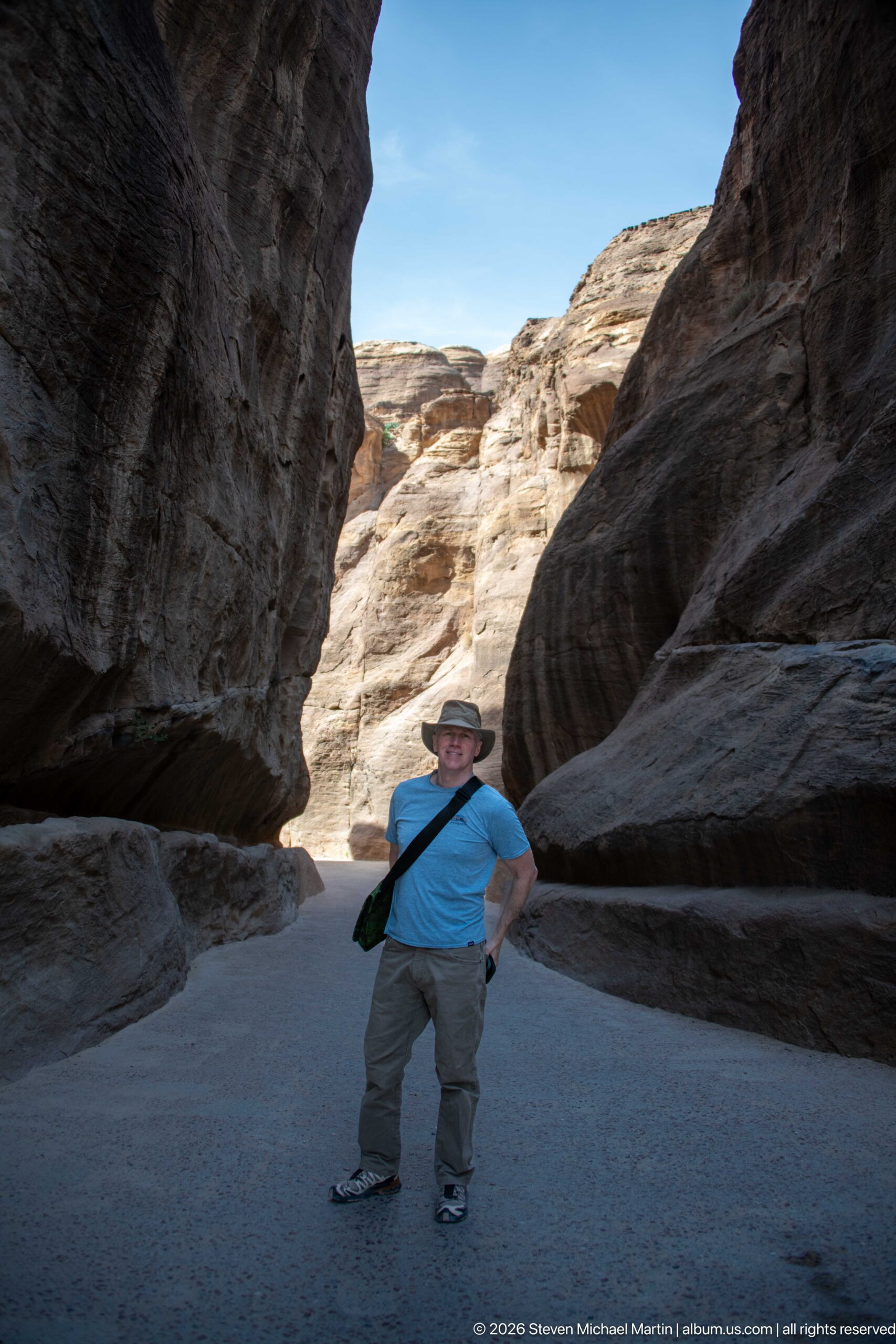
A visitor poses playfully in the center of the Siq beneath dark overhanging sandstone masses. The bright canyon opening behind separates the figure from the shadowed foreground and highlights the contrast between the narrow passage and the sunlit rock beyond.
Caption
A visitor poses playfully in the center of the Siq beneath dark overhanging sandstone masses. The bright canyon opening behind separates the figure from the shadowed foreground and highlights the contrast between the narrow passage and the sunlit rock beyond.
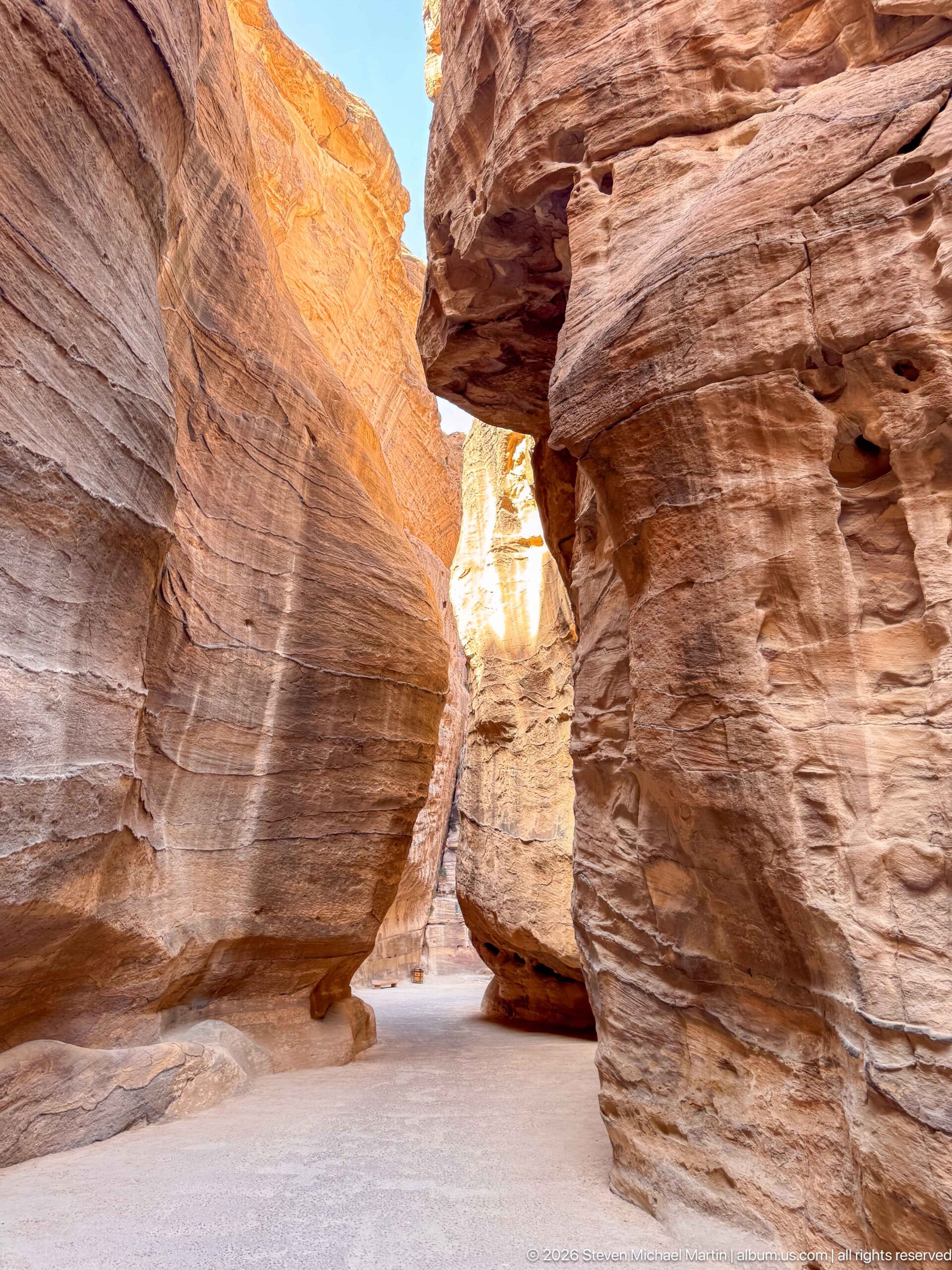
Thin horizontal bands sweep across the walls of the Siq, meeting a massive projecting rock mass that narrows the route to a small opening. Warm reflected light brings out the red and orange layers, while a distant visitor gives scale to the sinuous sandstone corridor.
Caption
Thin horizontal bands sweep across the walls of the Siq, meeting a massive projecting rock mass that narrows the route to a small opening. Warm reflected light brings out the red and orange layers, while a distant visitor gives scale to the sinuous sandstone corridor.
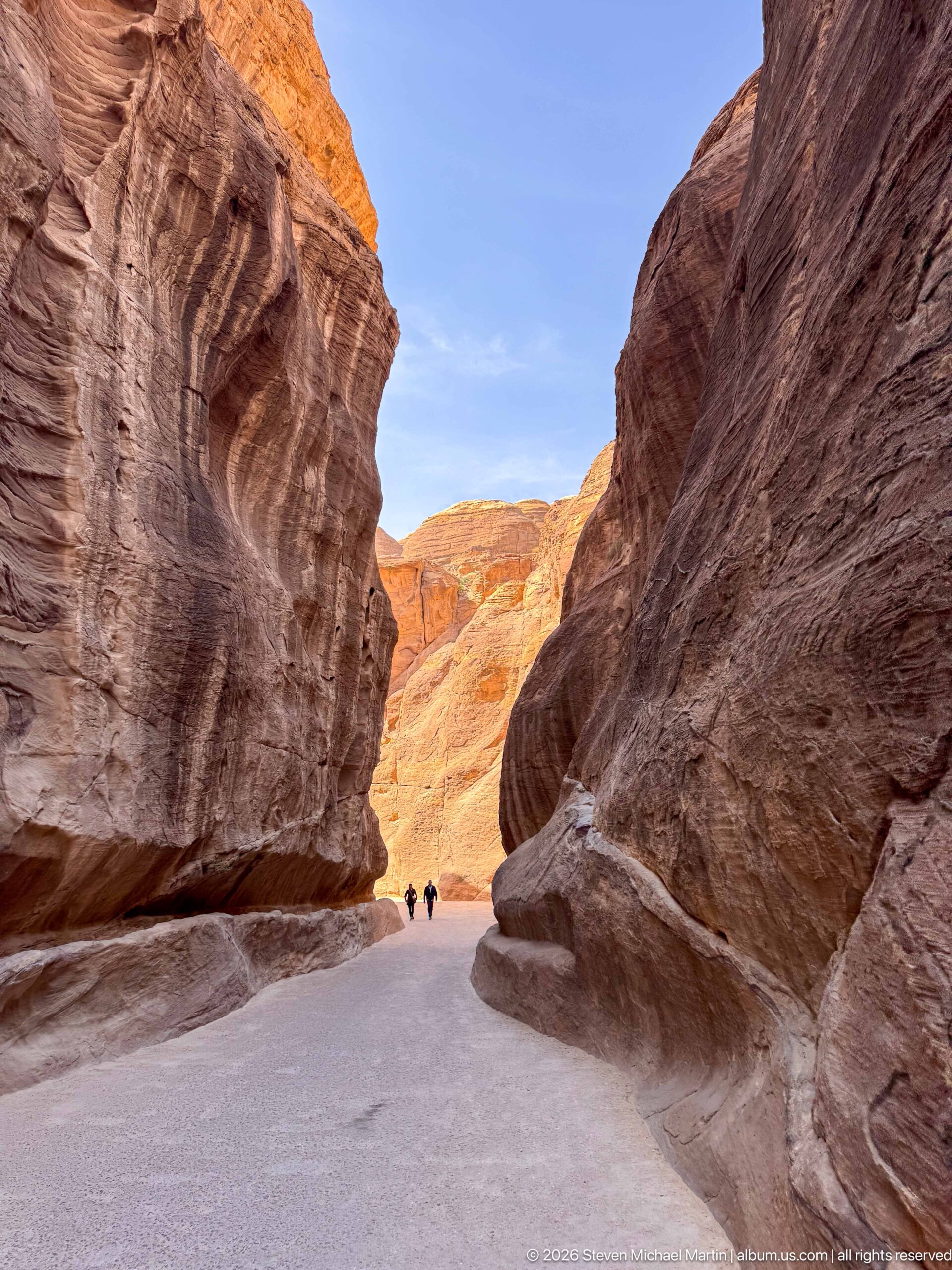
The Siq opens into a broad, sunlit bend where two immense sandstone walls sweep apart around the pale pathway. Small visitors in the distance emphasize the scale, and the clear blue sky above the opening contrasts with the shaded rock faces in the foreground.
Caption
The Siq opens into a broad, sunlit bend where two immense sandstone walls sweep apart around the pale pathway. Small visitors in the distance emphasize the scale, and the clear blue sky above the opening contrasts with the shaded rock faces in the foreground.
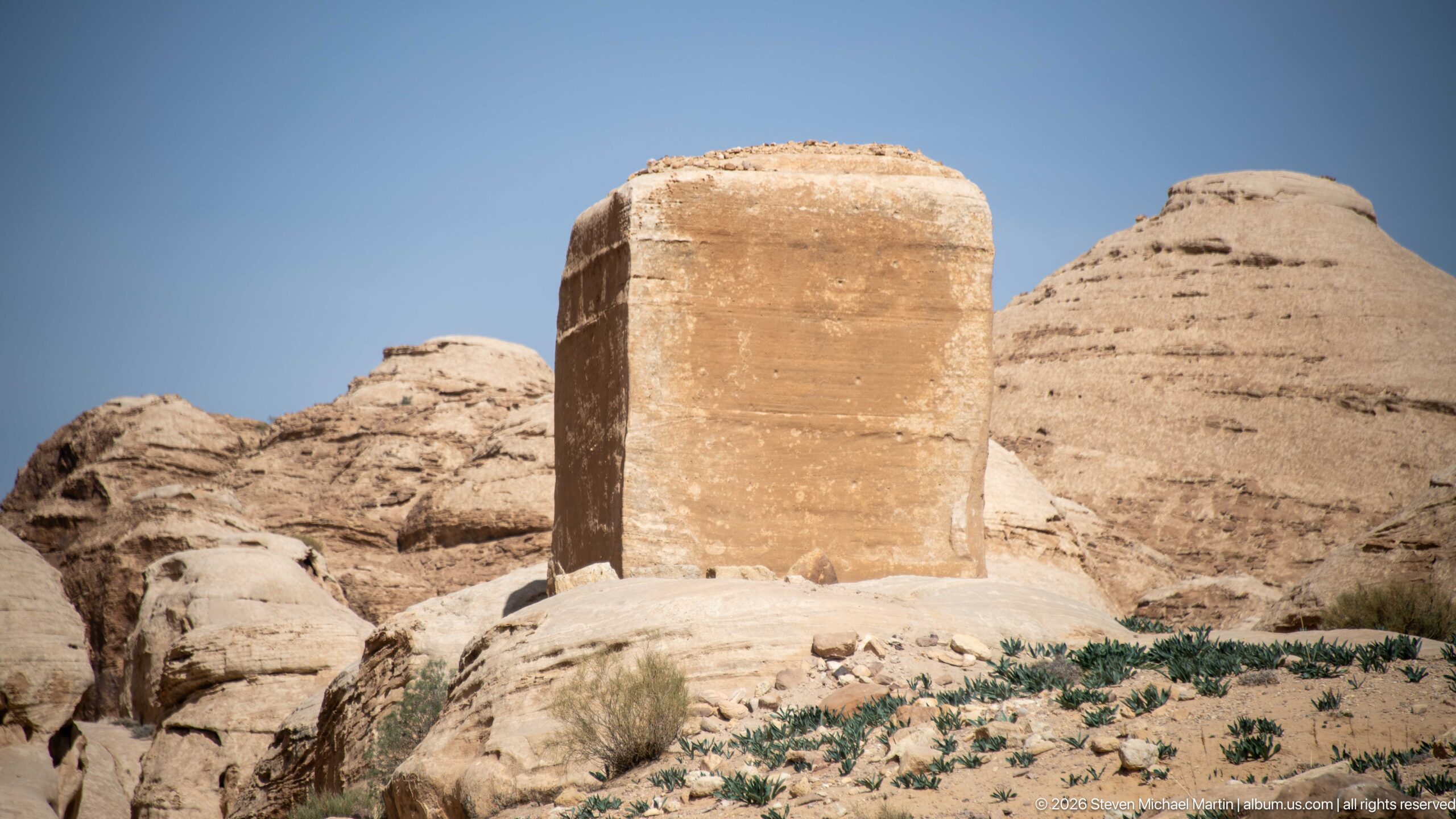
A freestanding rectangular djin block rises from the rocky landscape near Bab as-Siq, one of the enigmatic carved monuments encountered before the narrow gorge. Its stark geometric form contrasts with Petra’s elaborate tomb façades farther inside the city. The block belongs to the broader Nabataean funerary and sacred landscape that UNESCO recognizes as an exceptional concentration of rock-cut monuments and religious features.
Caption
A freestanding rectangular djin block rises from the rocky landscape near Bab as-Siq, one of the enigmatic carved monuments encountered before the narrow gorge. Its stark geometric form contrasts with Petra’s elaborate tomb façades farther inside the city. The block belongs to the broader Nabataean funerary and sacred landscape that UNESCO recognizes as an exceptional concentration of rock-cut monuments and religious features.
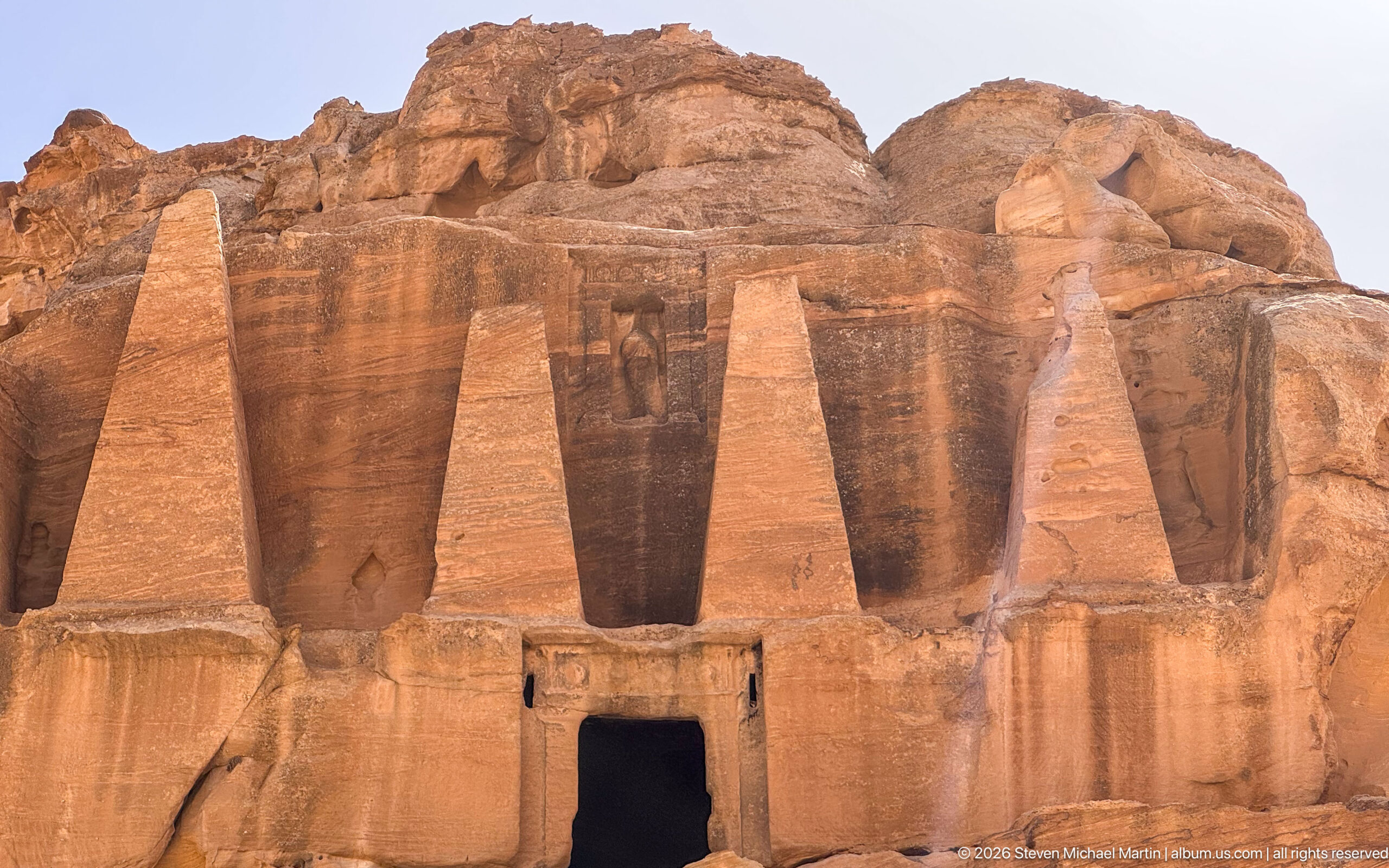
The upper façade of the Obelisk Tomb presents a central doorway beneath four tall, tapering rock-cut monuments that project from the sandstone cliff. Their distinctive pyramidal forms give the tomb its modern name and create one of the clearest architectural markers along Bab as-Siq, the approach between Petra’s entrance and the Siq.
Caption
The upper façade of the Obelisk Tomb presents a central doorway beneath four tall, tapering rock-cut monuments that project from the sandstone cliff. Their distinctive pyramidal forms give the tomb its modern name and create one of the clearest architectural markers along Bab as-Siq, the approach between Petra’s entrance and the Siq.
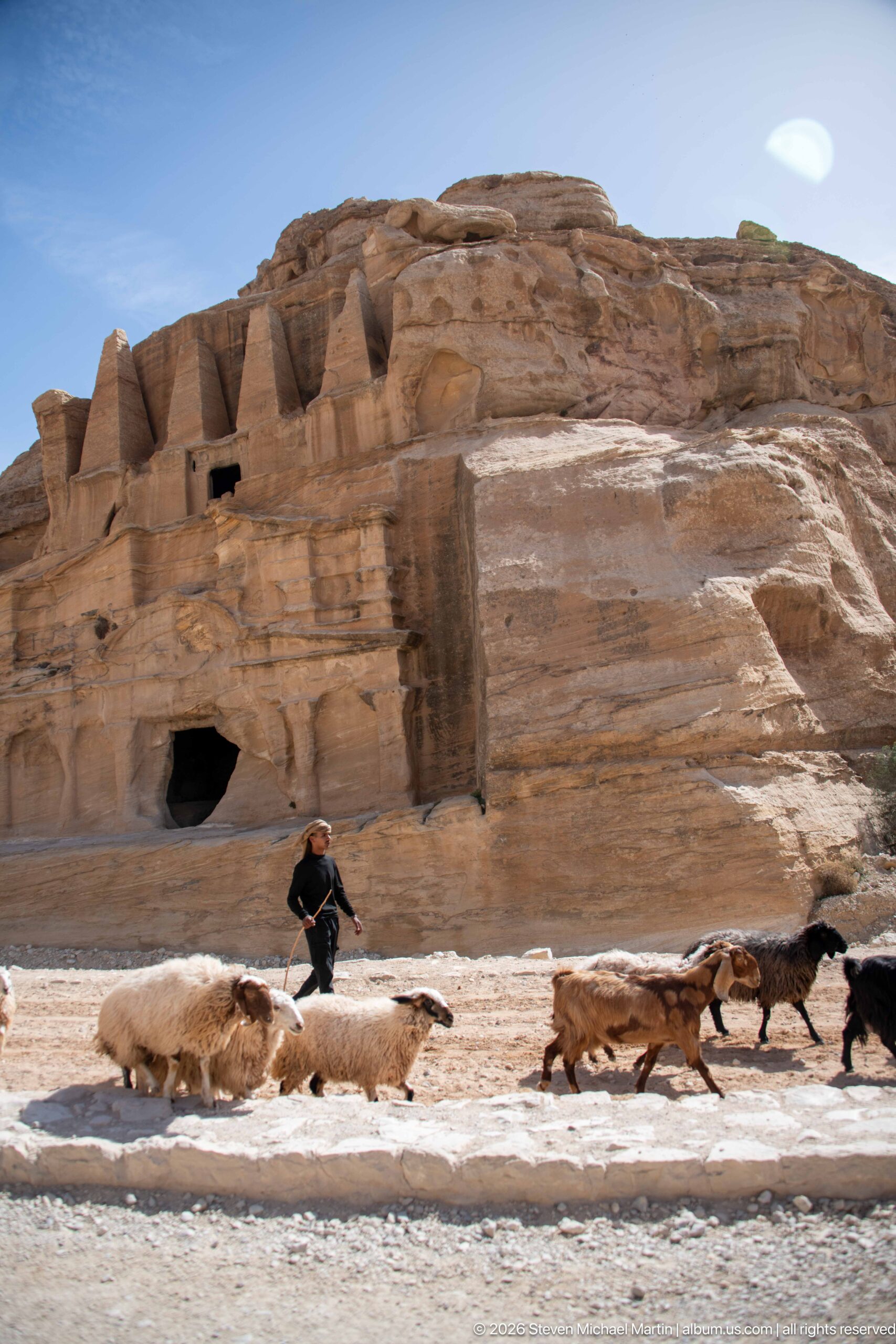
A herd of goats moves across the sandy foreground beneath Petra’s rock-cut tombs and weathered sandstone escarpment. A herder walks behind the animals, creating a lively contemporary scene against the ancient funerary landscape and showing the continuing pastoral use of the wider valley.
Caption
A herd of goats moves across the sandy foreground beneath Petra’s rock-cut tombs and weathered sandstone escarpment. A herder walks behind the animals, creating a lively contemporary scene against the ancient funerary landscape and showing the continuing pastoral use of the wider valley.
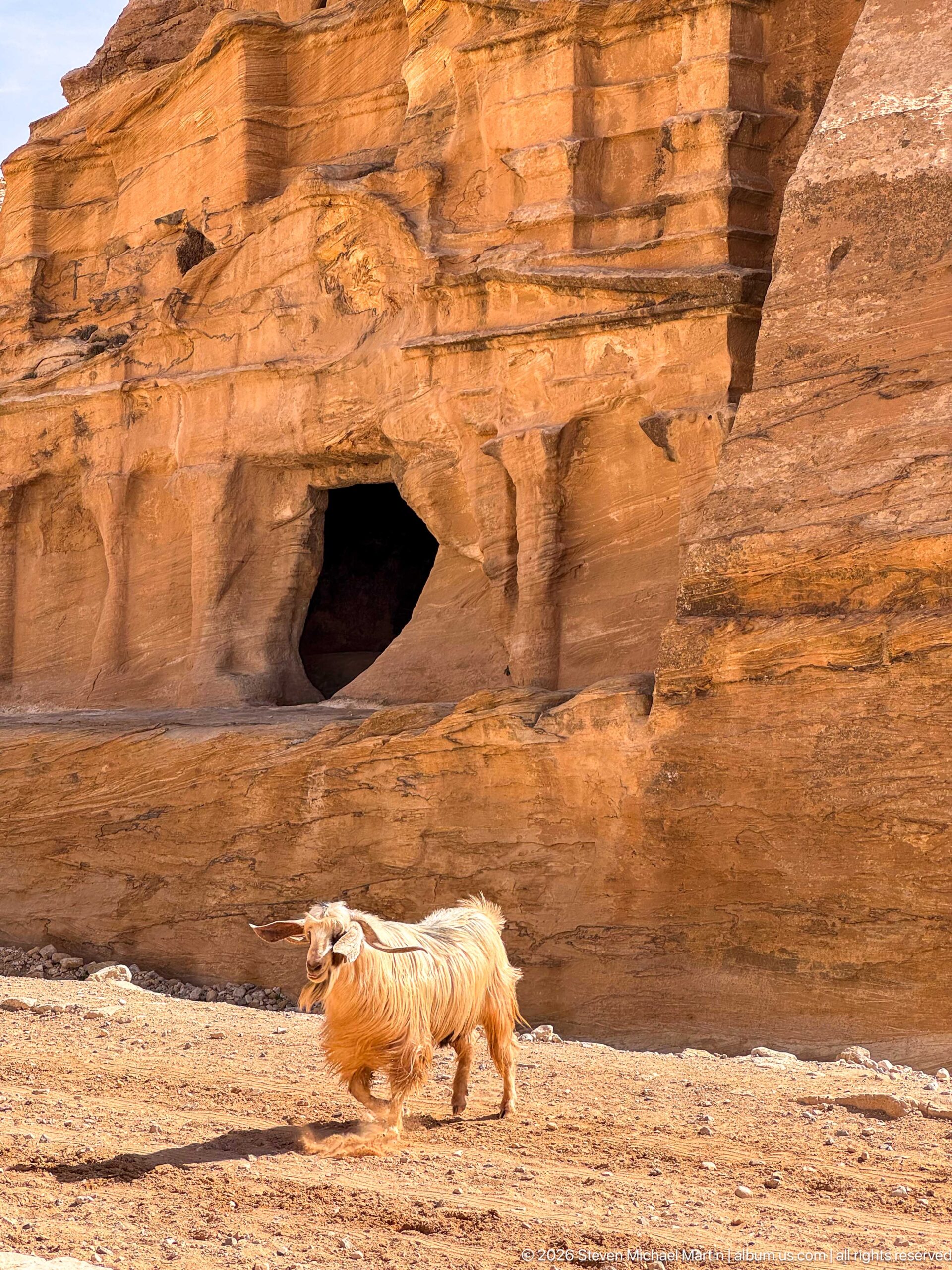
A long-haired goat walks across the stony ground with a dark rock-cut opening behind it in Petra’s sandstone cliff. The close, low composition isolates the animal from the larger herd and sets its pale coat against the warm orange-brown rock.
Caption
A long-haired goat walks across the stony ground with a dark rock-cut opening behind it in Petra’s sandstone cliff. The close, low composition isolates the animal from the larger herd and sets its pale coat against the warm orange-brown rock.
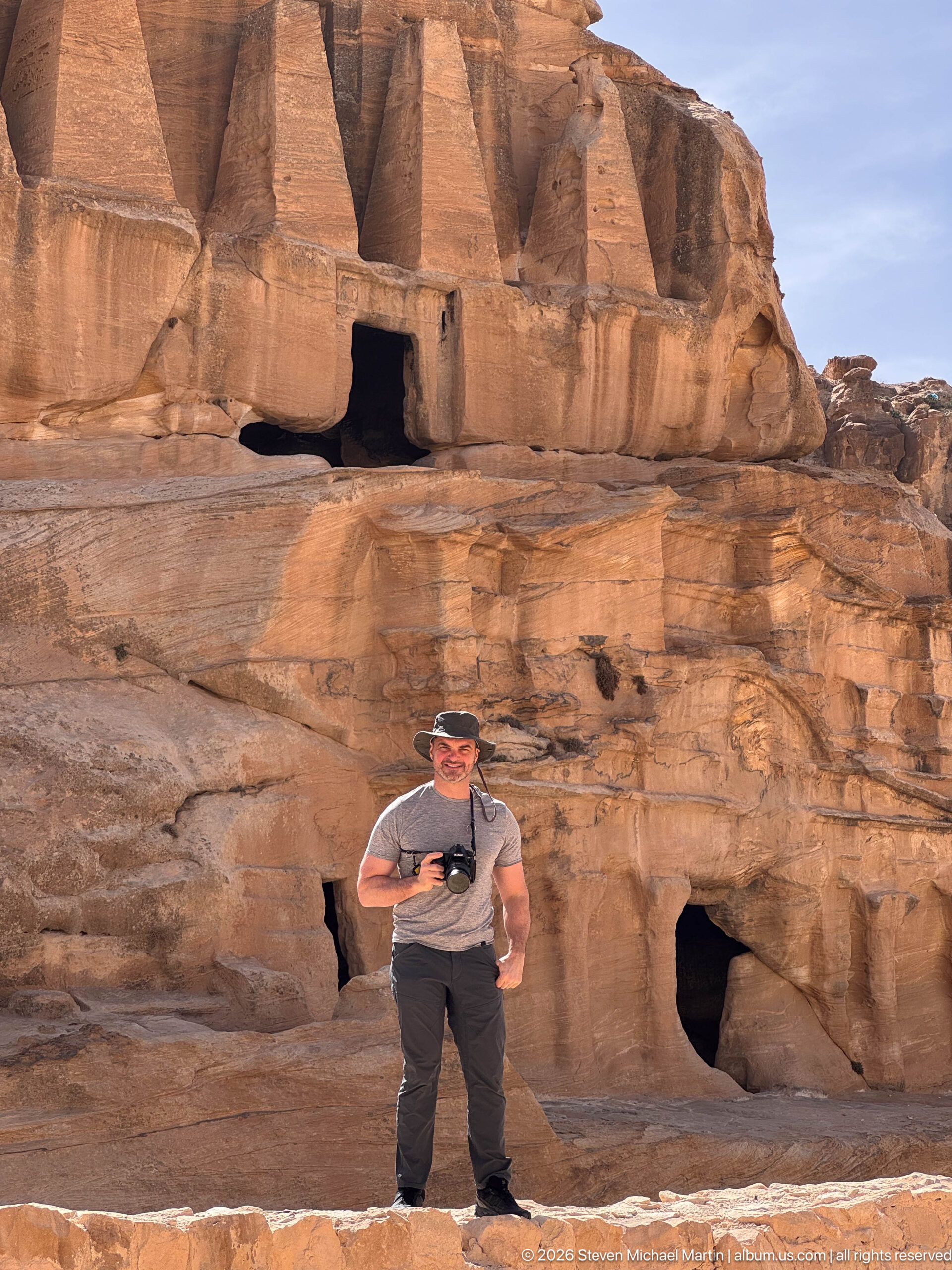
A visitor stands below the Obelisk Tomb complex, where the four tapering monuments of the upper façade rise above a lower level of rock-cut openings. The full-height view reveals how the tomb and associated chambers occupy successive ledges of the sandstone cliff at Bab as-Siq.
Caption
A visitor stands below the Obelisk Tomb complex, where the four tapering monuments of the upper façade rise above a lower level of rock-cut openings. The full-height view reveals how the tomb and associated chambers occupy successive ledges of the sandstone cliff at Bab as-Siq.
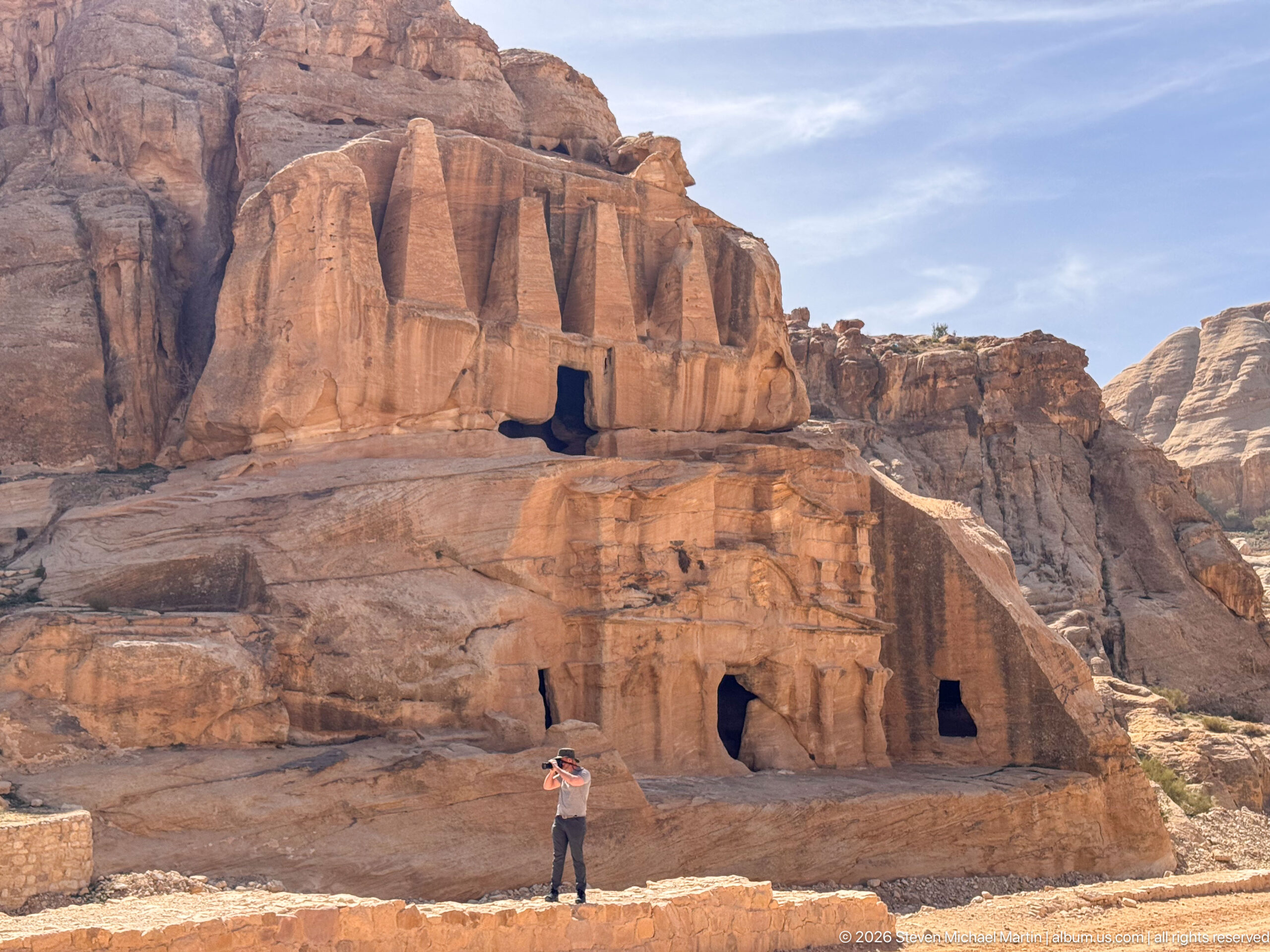
A broad view places the Obelisk Tomb high on the sandstone face above the lower rock-cut chambers traditionally associated with the Bab as-Siq Triclinium. A visitor at the base gives scale to the multi-level complex, while the surrounding cliffs show how the carved architecture was integrated into Petra’s rugged entrance landscape.
Caption
A broad view places the Obelisk Tomb high on the sandstone face above the lower rock-cut chambers traditionally associated with the Bab as-Siq Triclinium. A visitor at the base gives scale to the multi-level complex, while the surrounding cliffs show how the carved architecture was integrated into Petra’s rugged entrance landscape.
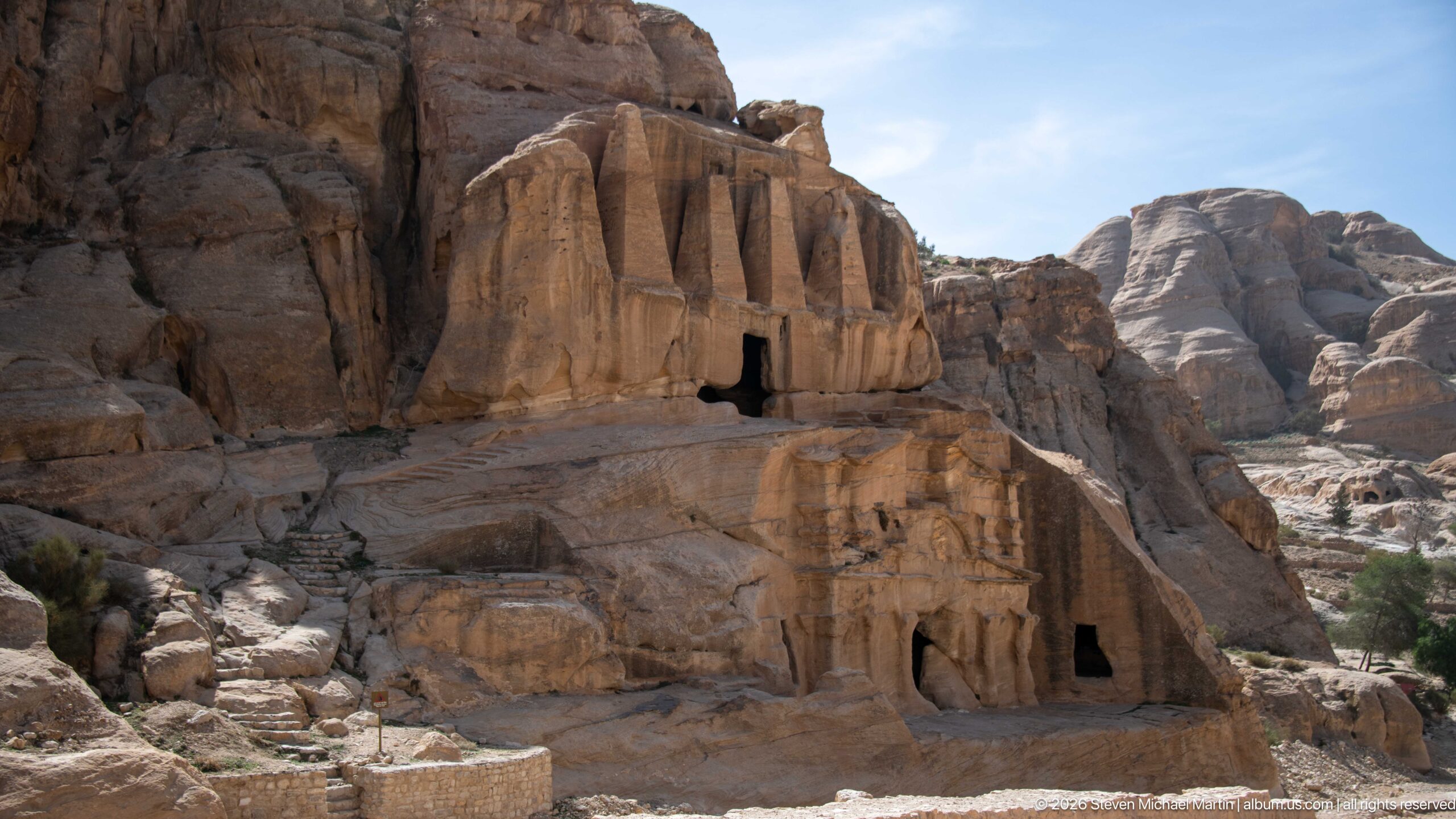
The Obelisk Tomb complex rises above rock-cut chambers near Bab as-Siq, its upper façade distinguished by tall carved obelisks. The composition layers funerary architecture vertically within the sandstone cliff, combining the prominent upper tomb with spaces cut below. Positioned before the Siq, the monument introduces the dense Nabataean funerary landscape that continues throughout Petra.
Caption
The Obelisk Tomb complex rises above rock-cut chambers near Bab as-Siq, its upper façade distinguished by tall carved obelisks. The composition layers funerary architecture vertically within the sandstone cliff, combining the prominent upper tomb with spaces cut below. Positioned before the Siq, the monument introduces the dense Nabataean funerary landscape that continues throughout Petra.
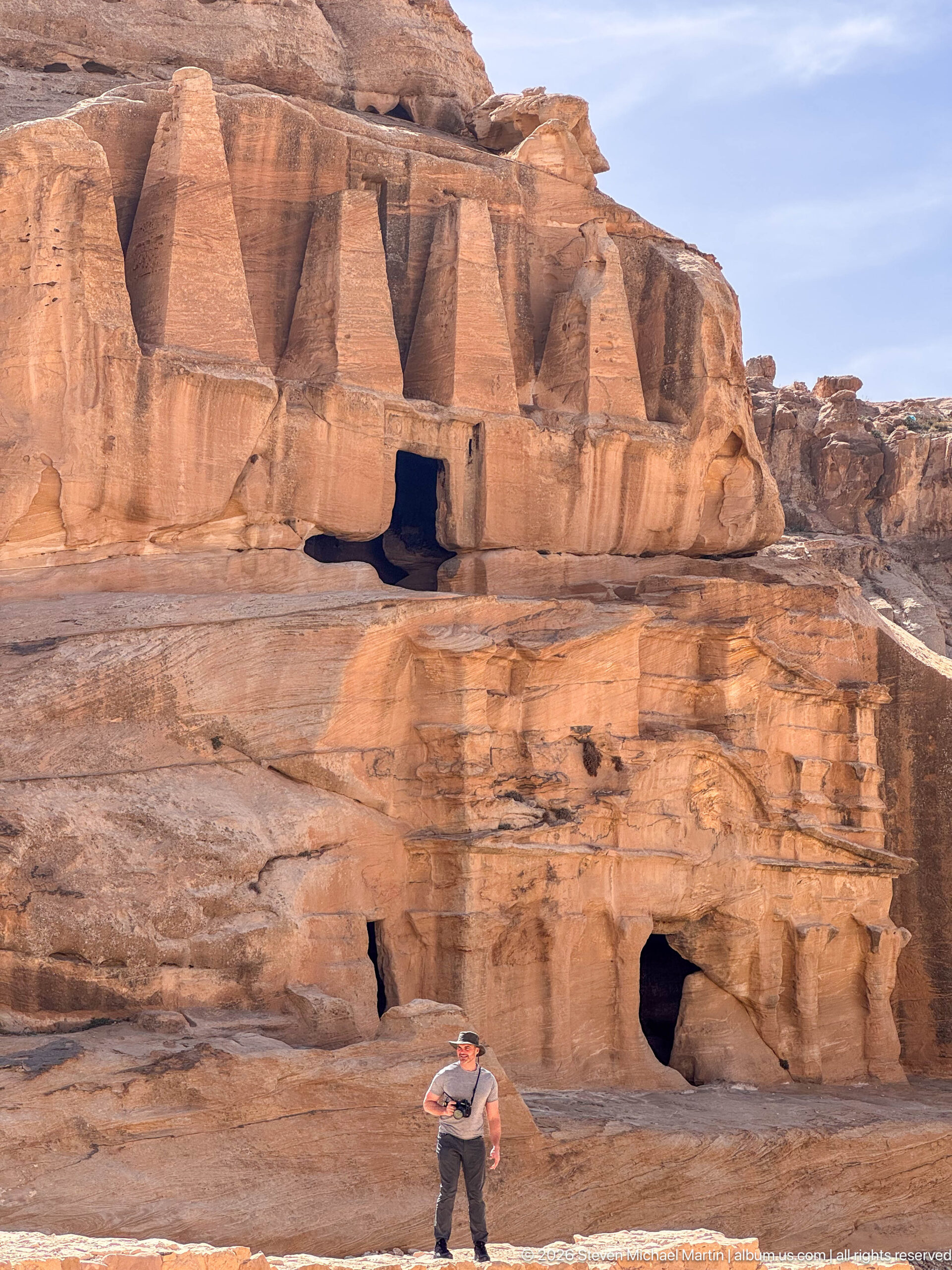
A visitor stands against the broad sandstone face below the Obelisk Tomb, dwarfed by its upper doorway and tapering monuments. Several lower openings punctuate the cliff beneath the tomb, and the frontal perspective makes the vertical layering of carved chambers and façade especially clear.
Caption
A visitor stands against the broad sandstone face below the Obelisk Tomb, dwarfed by its upper doorway and tapering monuments. Several lower openings punctuate the cliff beneath the tomb, and the frontal perspective makes the vertical layering of carved chambers and façade especially clear.
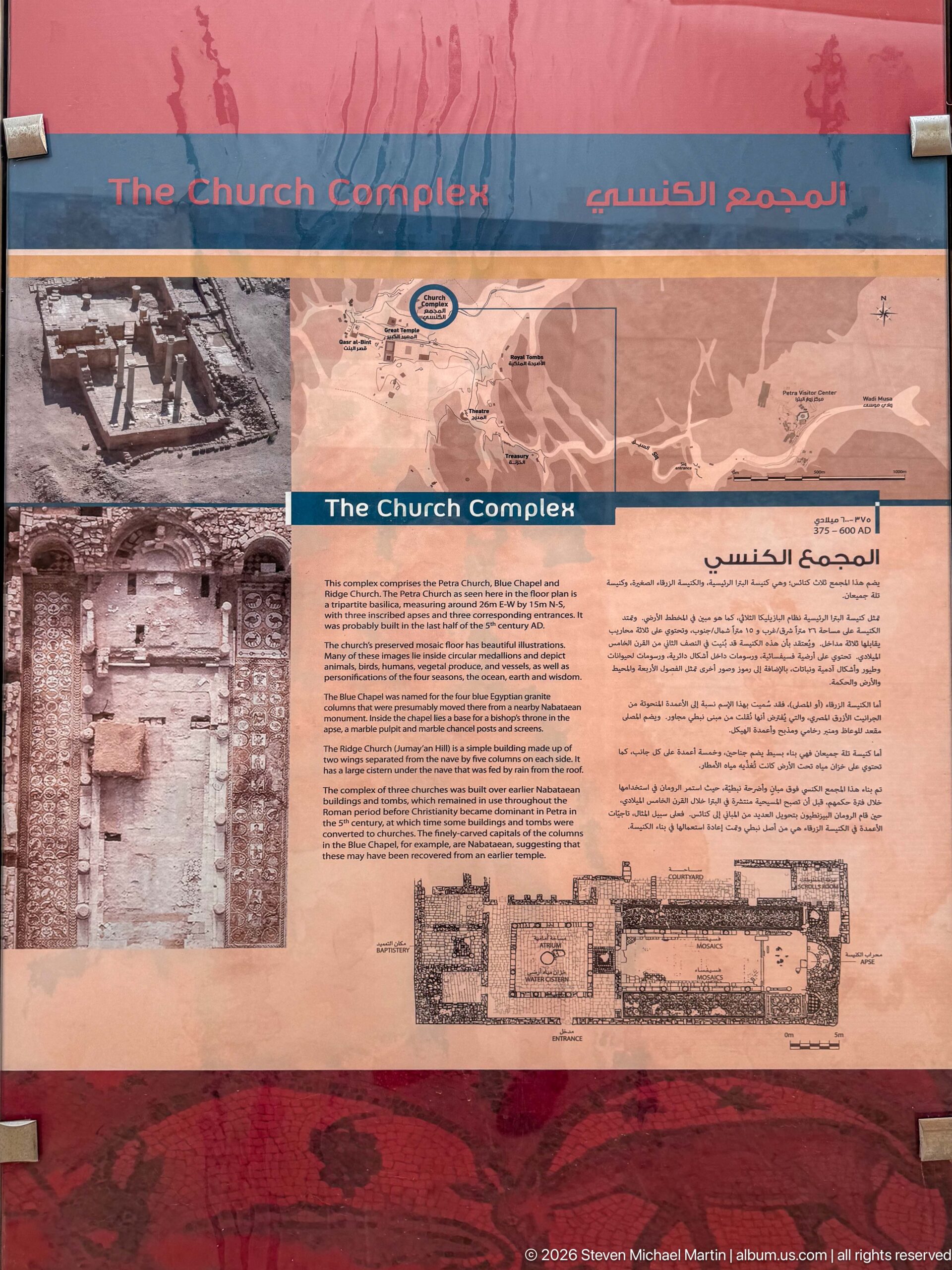
An interpretive panel titled “The Church Complex” combines an archaeological plan, site photographs, a location map, and bilingual explanatory text. The panel introduces Petra’s church remains as a distinct archaeological zone and shows visitors how the excavated structures relate to the surrounding city landscape.
Caption
An interpretive panel titled “The Church Complex” combines an archaeological plan, site photographs, a location map, and bilingual explanatory text. The panel introduces Petra’s church remains as a distinct archaeological zone and shows visitors how the excavated structures relate to the surrounding city landscape.
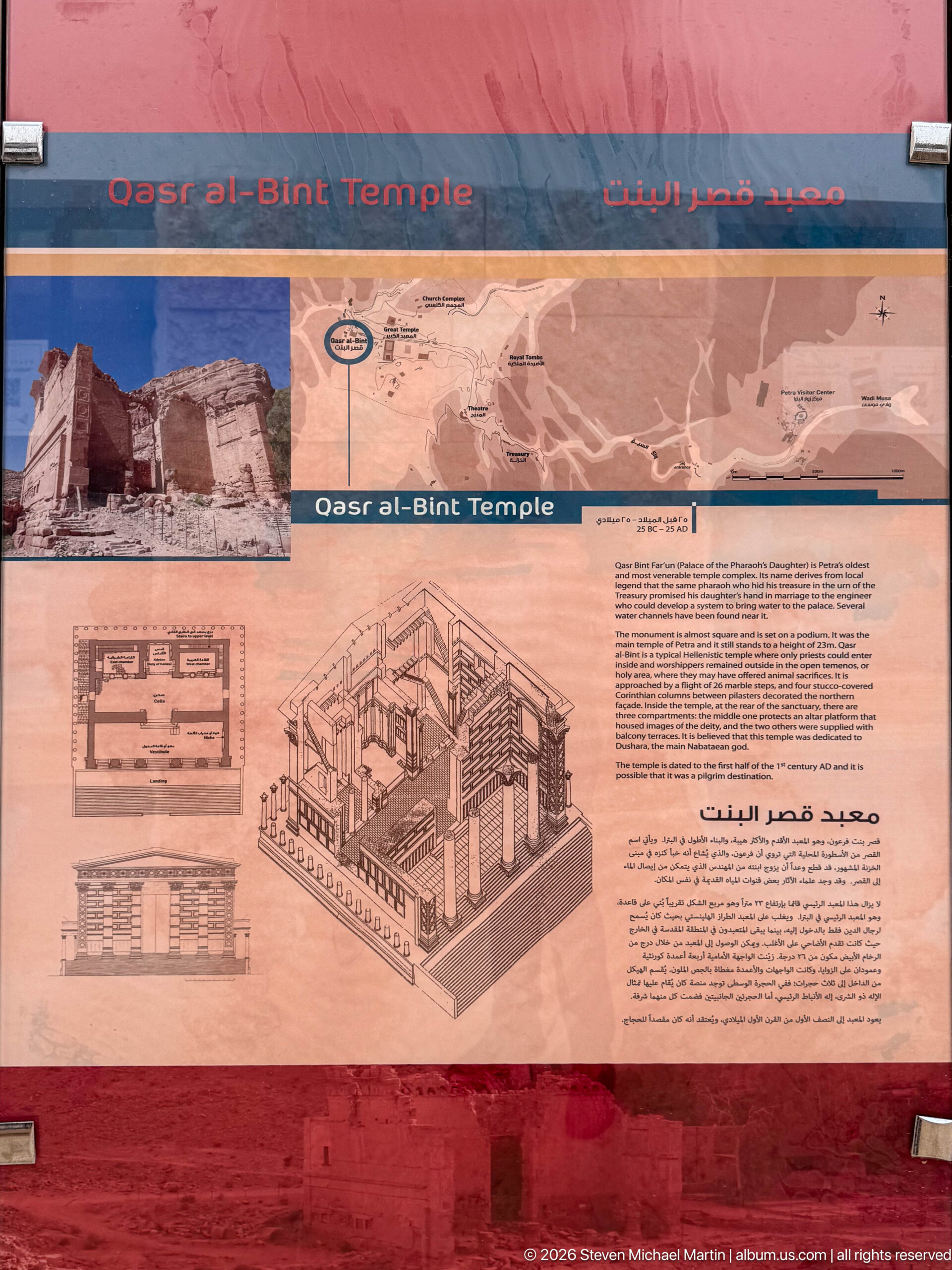
A bilingual interpretive panel for Qasr al-Bint Temple combines a site photograph, map, architectural plans, a reconstruction drawing, and explanatory text. The display helps visitors relate the temple’s surviving remains to its original built form and position within Petra, using both archaeological documentation and graphic reconstruction to explain a monument that is less immediately legible than the city’s rock-cut façades.
Caption
A bilingual interpretive panel for Qasr al-Bint Temple combines a site photograph, map, architectural plans, a reconstruction drawing, and explanatory text. The display helps visitors relate the temple’s surviving remains to its original built form and position within Petra, using both archaeological documentation and graphic reconstruction to explain a monument that is less immediately legible than the city’s rock-cut façades.
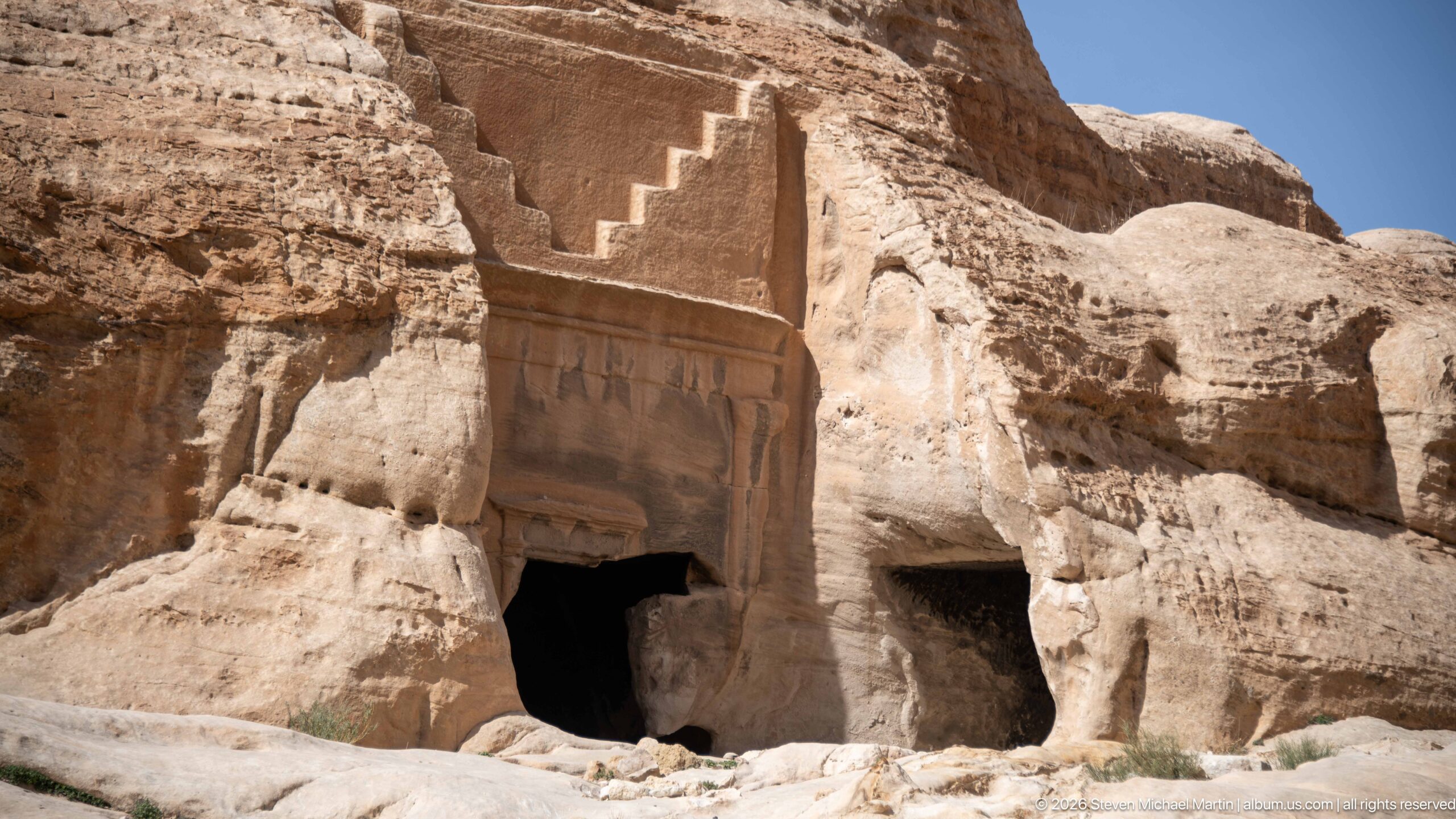
A rock-cut tomb façade is crowned by a stepped motif above a shallow entablature and rectangular doorway. The surrounding cliff has weathered into rounded pale masses, making the crisp geometric crown and framed entrance stand out as deliberate architectural carving within Petra’s entrance-area funerary landscape.
Caption
A rock-cut tomb façade is crowned by a stepped motif above a shallow entablature and rectangular doorway. The surrounding cliff has weathered into rounded pale masses, making the crisp geometric crown and framed entrance stand out as deliberate architectural carving within Petra’s entrance-area funerary landscape.
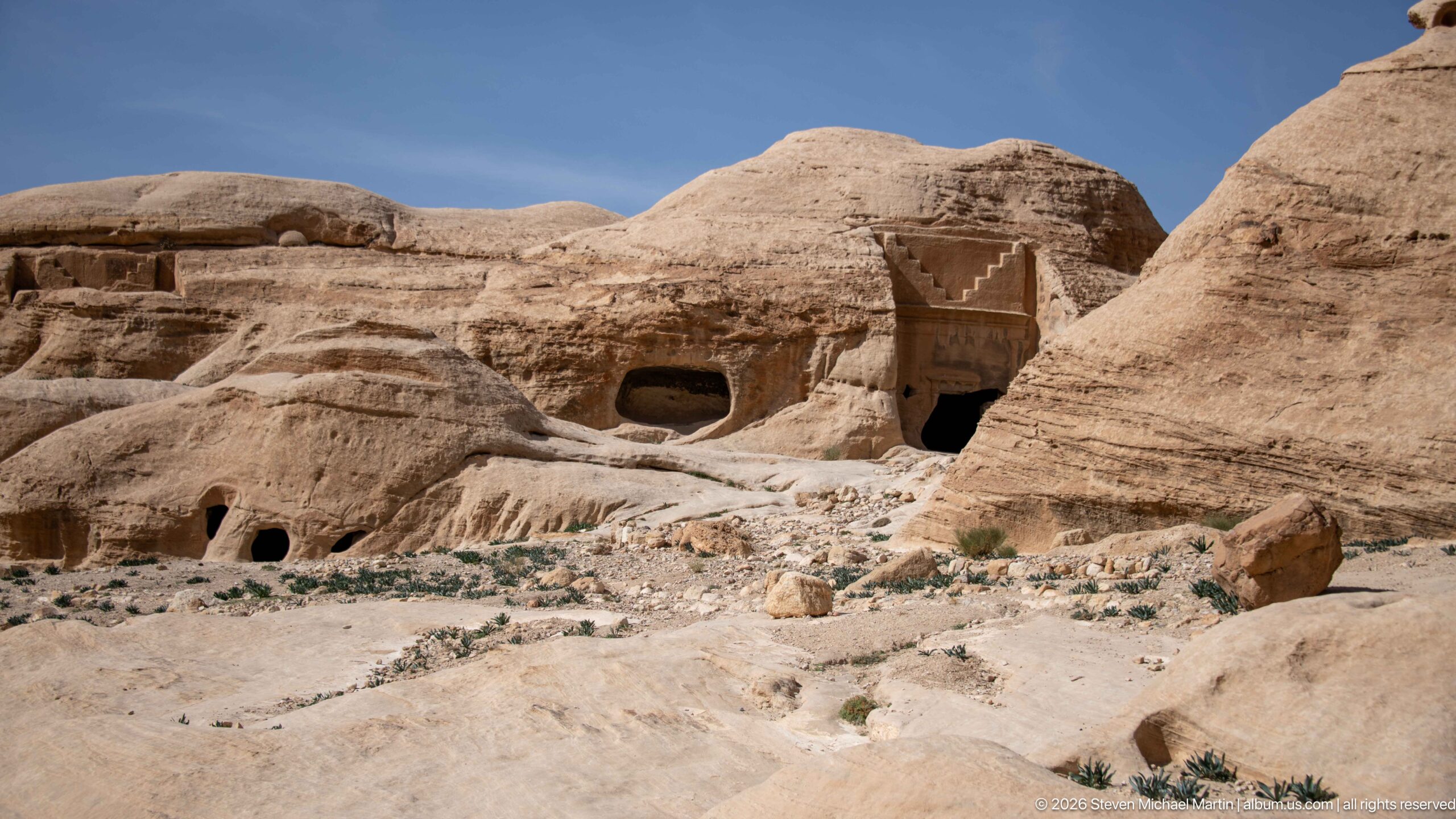
Several tombs and chambers are cut into a pale, rounded sandstone hillside, including one façade with a stepped crown and another broad dark opening. The wide view shows the density and variety of Petra’s entrance-area funerary architecture, where formal façades and simpler chambers occupy adjacent outcrops.
Caption
Several tombs and chambers are cut into a pale, rounded sandstone hillside, including one façade with a stepped crown and another broad dark opening. The wide view shows the density and variety of Petra’s entrance-area funerary architecture, where formal façades and simpler chambers occupy adjacent outcrops.
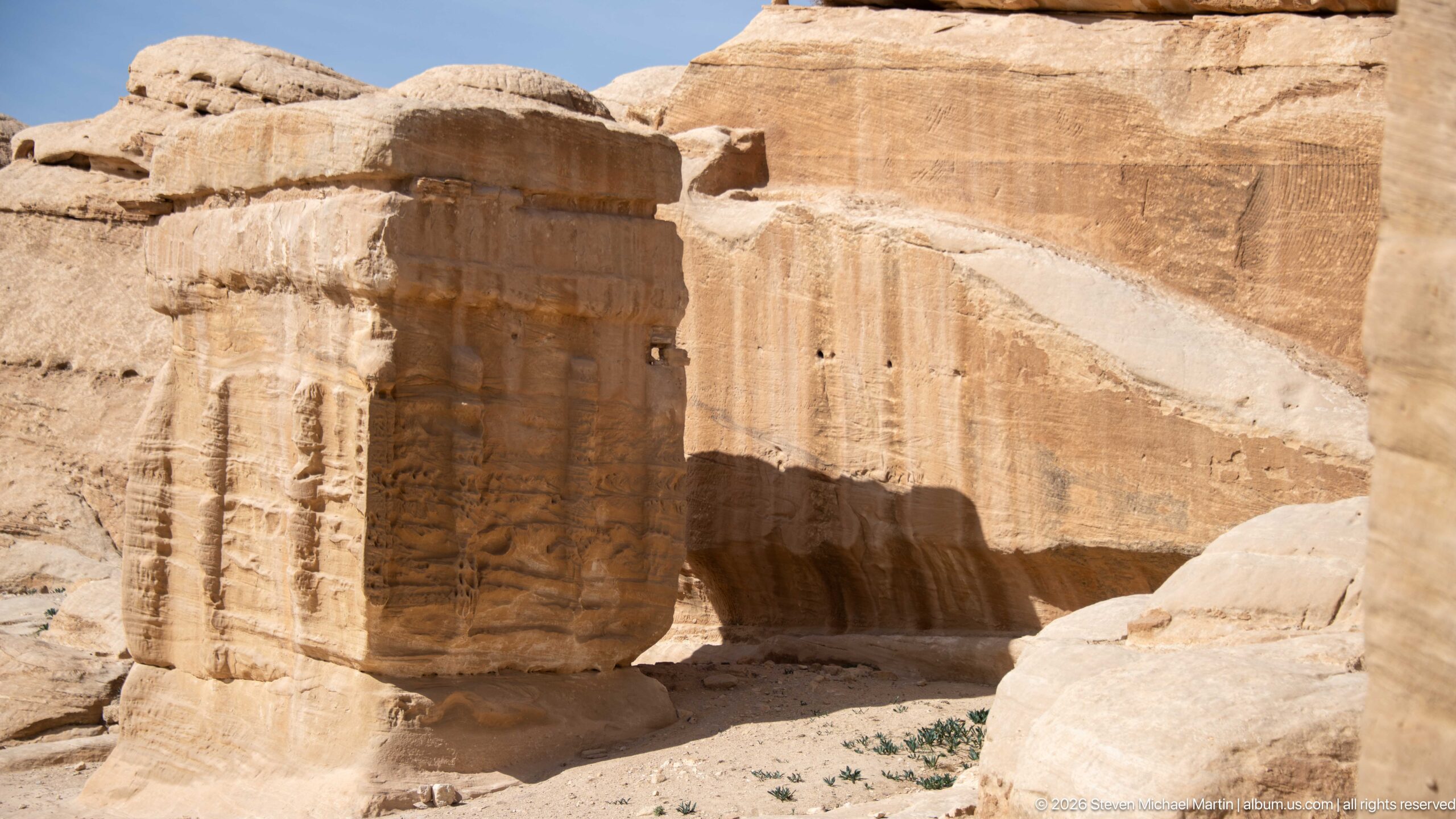
A compact tomb façade projects from Petra’s sandstone, its doorway framed by shallow pilasters and horizontal moldings beneath a heavily weathered upper section. The side-lit surface reveals vertical tool-cut planes alongside natural erosion, distinguishing the architectural face from the adjoining cliff.
Caption
A compact tomb façade projects from Petra’s sandstone, its doorway framed by shallow pilasters and horizontal moldings beneath a heavily weathered upper section. The side-lit surface reveals vertical tool-cut planes alongside natural erosion, distinguishing the architectural face from the adjoining cliff.
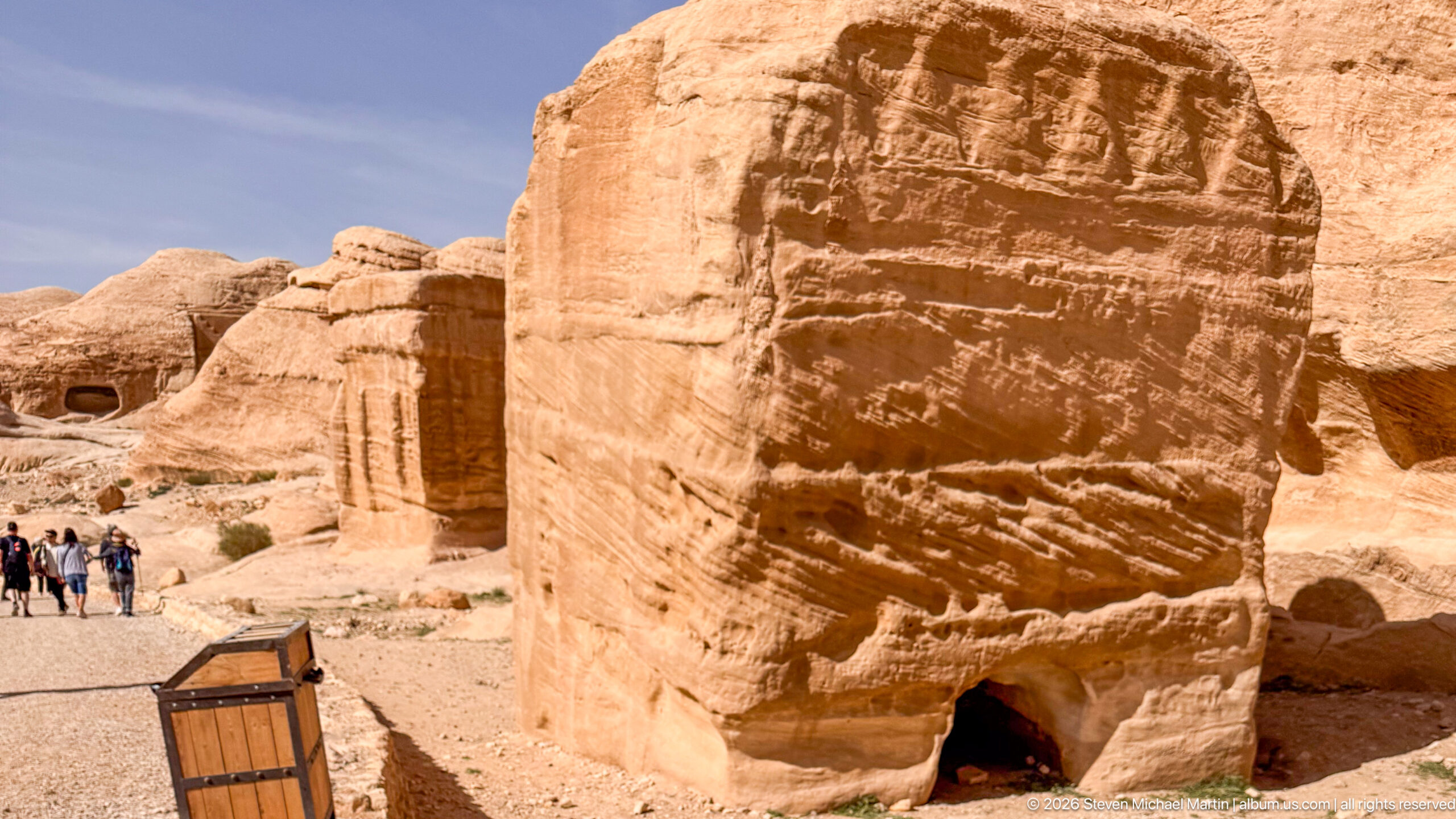
A massive freestanding block of sandstone dominates the foreground, its smoothed faces deeply streaked by centuries of weathering and a small opening cut near the base. Visitors and another carved block in the background provide scale, placing the monument among the Djinn Blocks of Petra’s Bab as-Siq entrance landscape.
Caption
A massive freestanding block of sandstone dominates the foreground, its smoothed faces deeply streaked by centuries of weathering and a small opening cut near the base. Visitors and another carved block in the background provide scale, placing the monument among the Djinn Blocks of Petra’s Bab as-Siq entrance landscape.
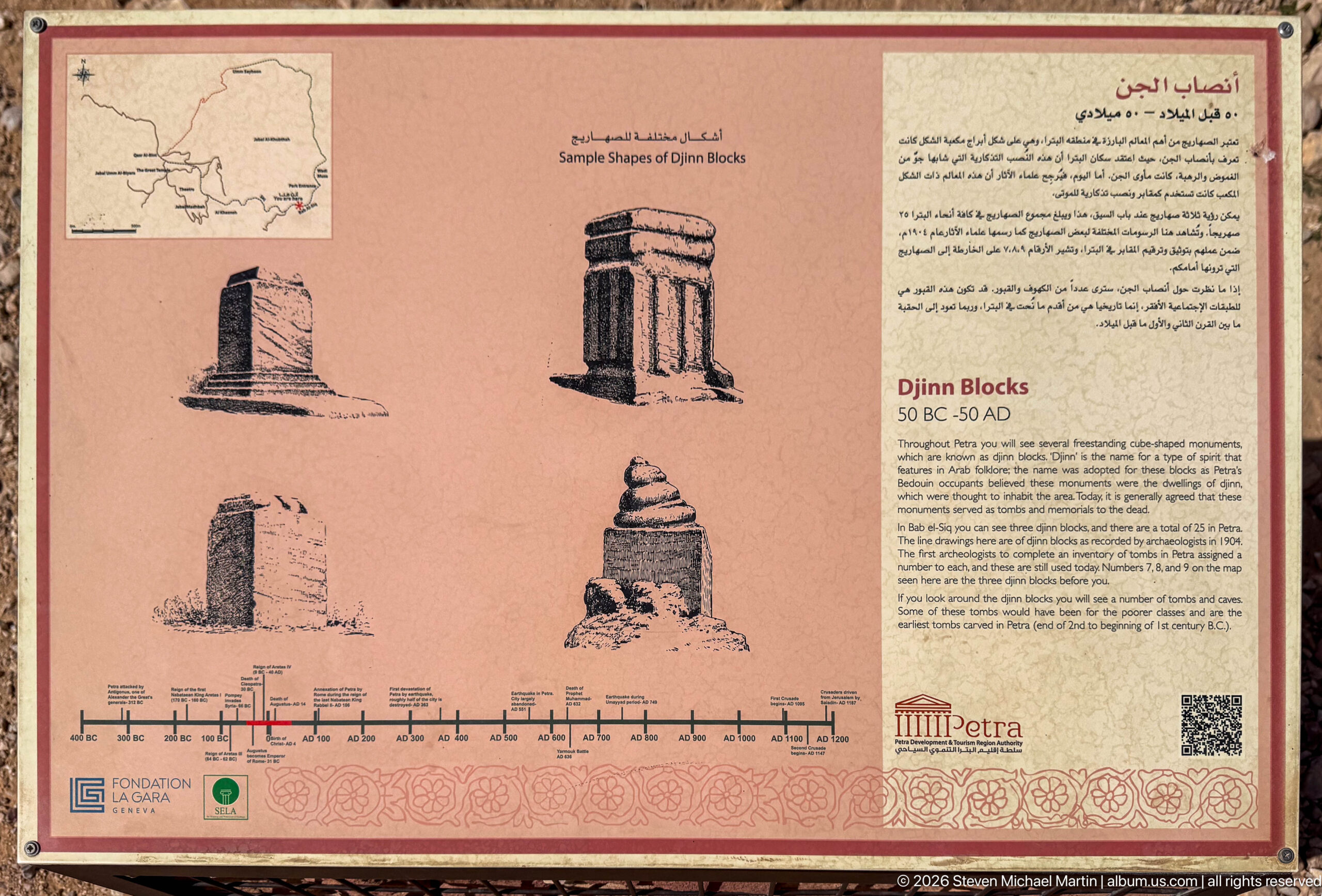
An interpretive panel titled “Djinn Blocks 50 BC–50 AD” illustrates several characteristic forms of Petra’s freestanding carved blocks and provides bilingual Arabic and English explanation. The drawings, chronology, and site information identify the monuments encountered near Bab as-Siq and frame them within Petra’s Nabataean funerary landscape.
Caption
An interpretive panel titled “Djinn Blocks 50 BC–50 AD” illustrates several characteristic forms of Petra’s freestanding carved blocks and provides bilingual Arabic and English explanation. The drawings, chronology, and site information identify the monuments encountered near Bab as-Siq and frame them within Petra’s Nabataean funerary landscape.
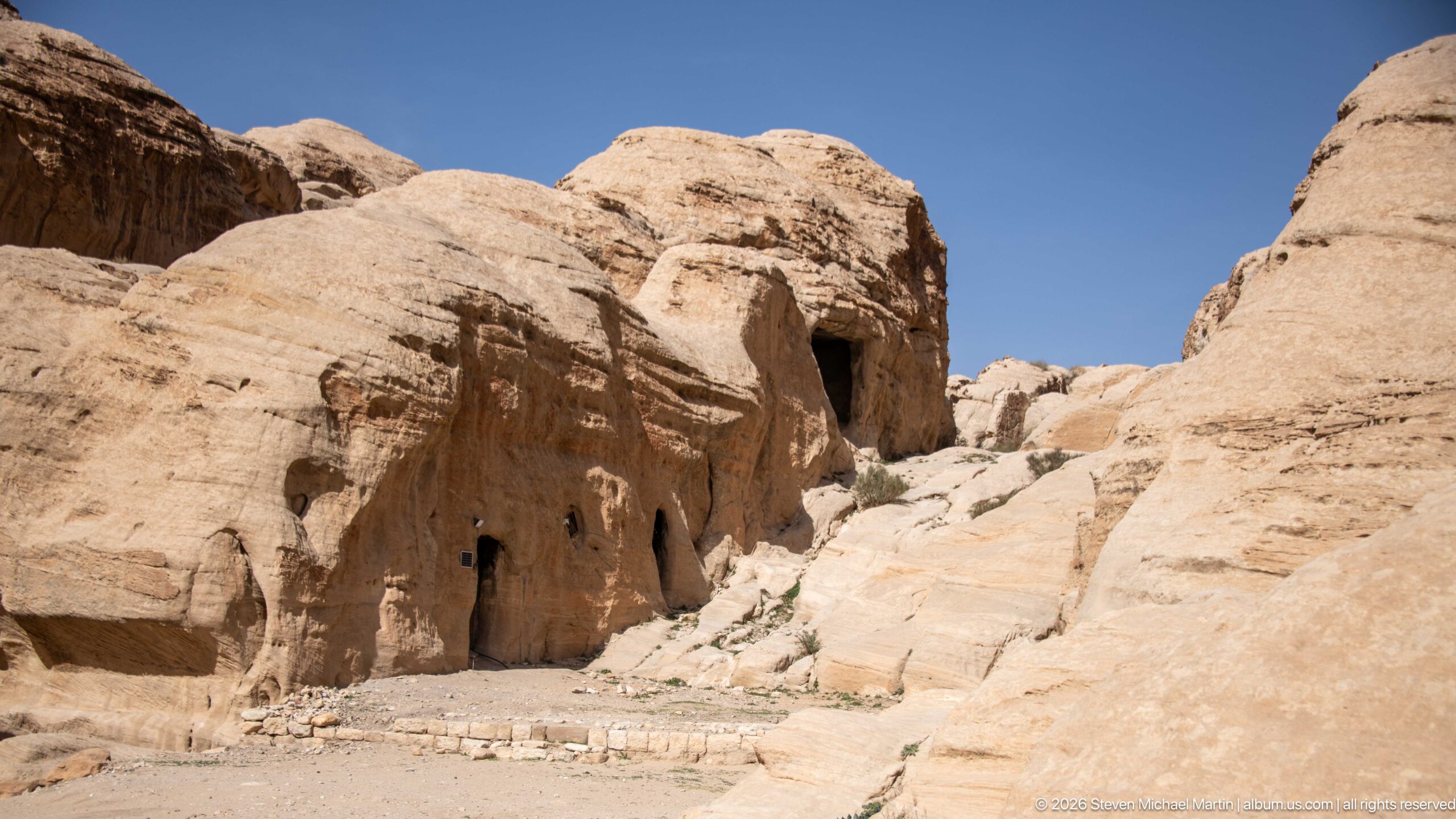
Rock-cut openings and weathered architectural traces occupy a pale sandstone outcrop near Petra’s entrance. The broad daylight view shows how tomb chambers, façades, and natural erosion merge across the rounded cliff, with the path rising through the archaeological terrain to the right.
Caption
Rock-cut openings and weathered architectural traces occupy a pale sandstone outcrop near Petra’s entrance. The broad daylight view shows how tomb chambers, façades, and natural erosion merge across the rounded cliff, with the path rising through the archaeological terrain to the right.
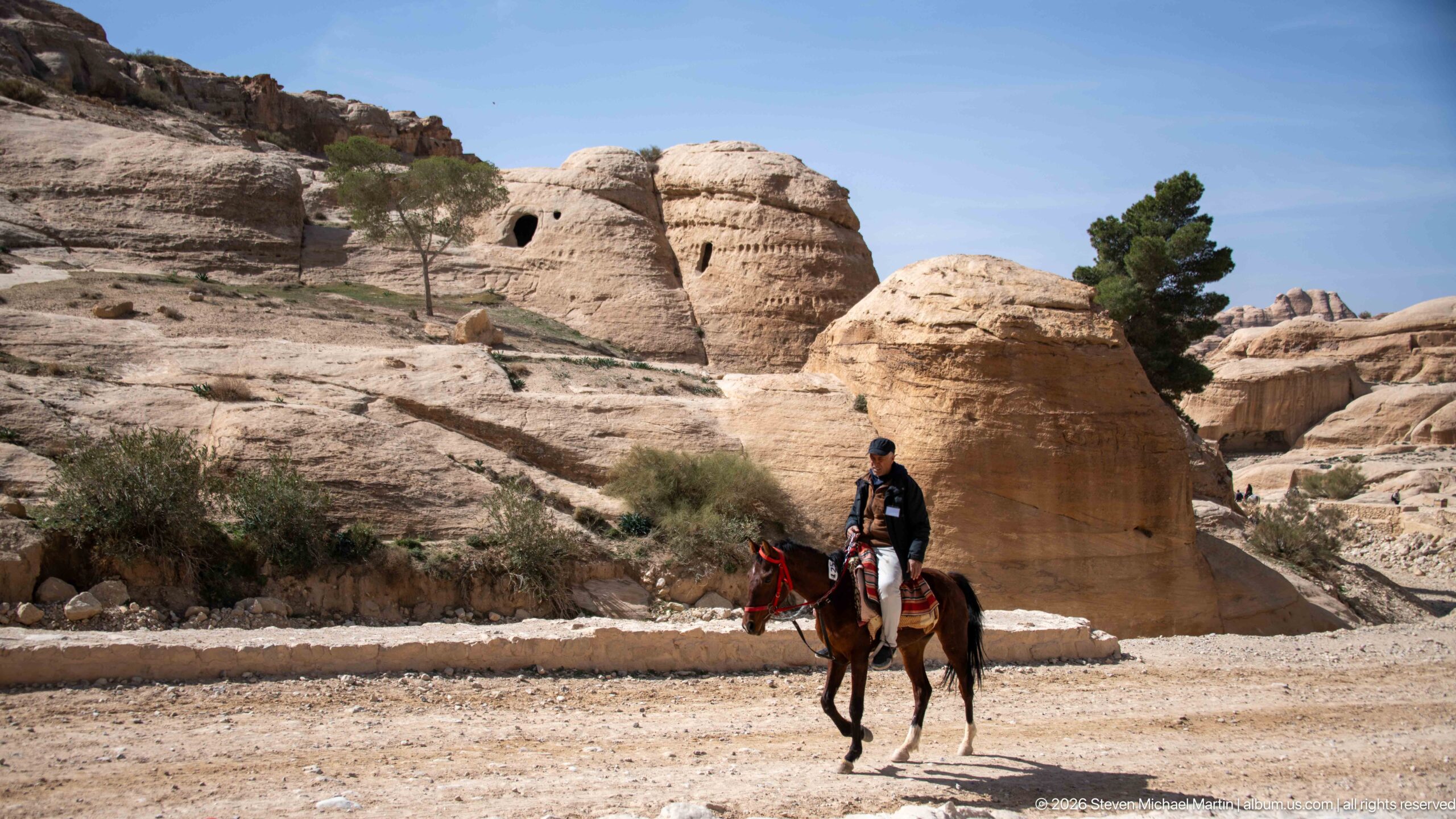
A rider crosses Petra’s entrance landscape on horseback, passing weathered sandstone outcrops pierced by rock-cut openings. The animal and rider occupy the foreground while the pale cliffs and a lone tree provide archaeological and environmental context for contemporary transport through the site.
Caption
A rider crosses Petra’s entrance landscape on horseback, passing weathered sandstone outcrops pierced by rock-cut openings. The animal and rider occupy the foreground while the pale cliffs and a lone tree provide archaeological and environmental context for contemporary transport through the site.
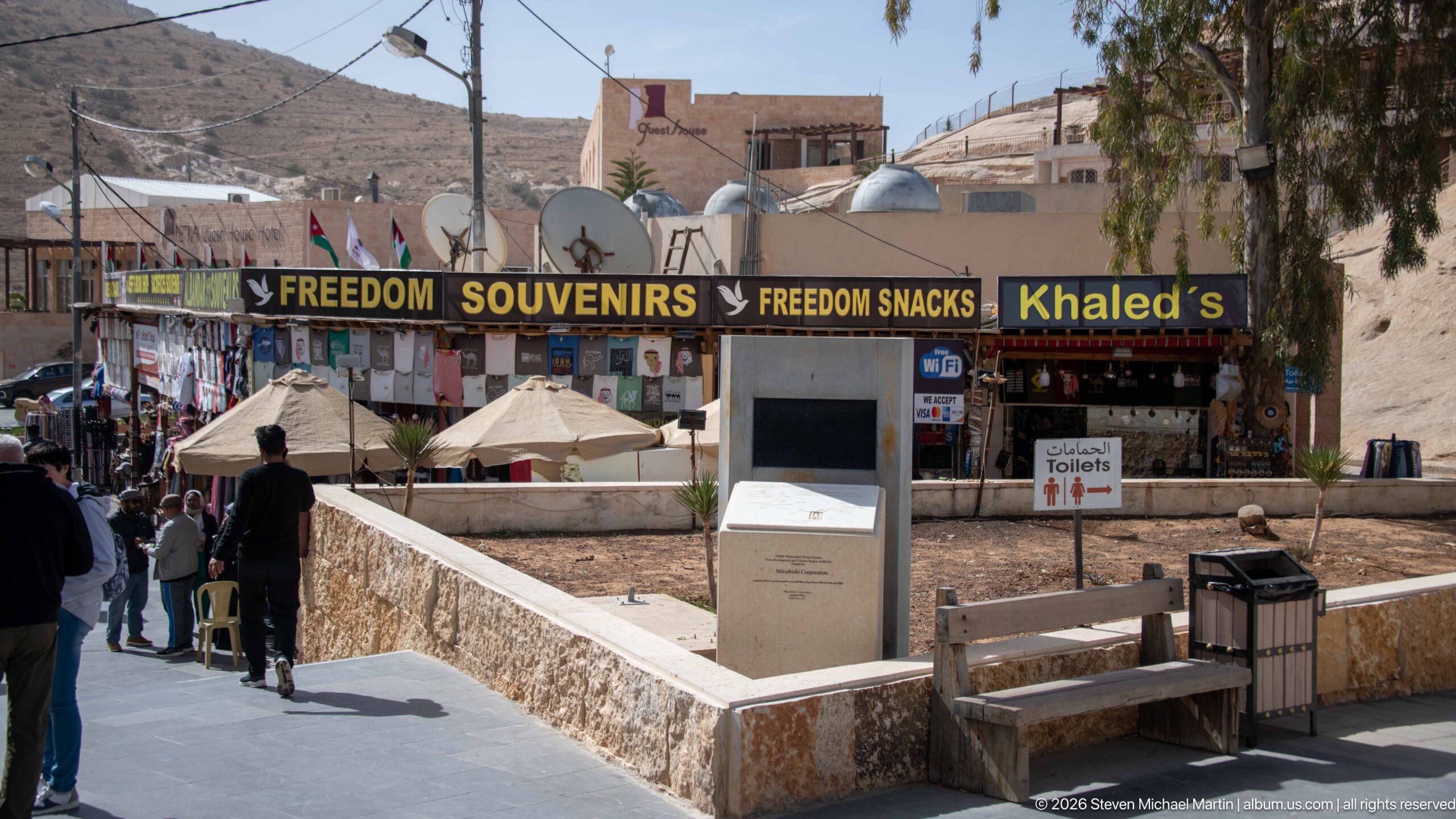
Visitors pass a row of small souvenir and snack shops near Petra’s entrance, their bright commercial signs contrasting with the pale stone walls and archaeological setting. Benches, umbrellas, a toilet sign, and a freestanding interpretive marker document the practical visitor infrastructure surrounding the route into the site.
Caption
Visitors pass a row of small souvenir and snack shops near Petra’s entrance, their bright commercial signs contrasting with the pale stone walls and archaeological setting. Benches, umbrellas, a toilet sign, and a freestanding interpretive marker document the practical visitor infrastructure surrounding the route into the site.
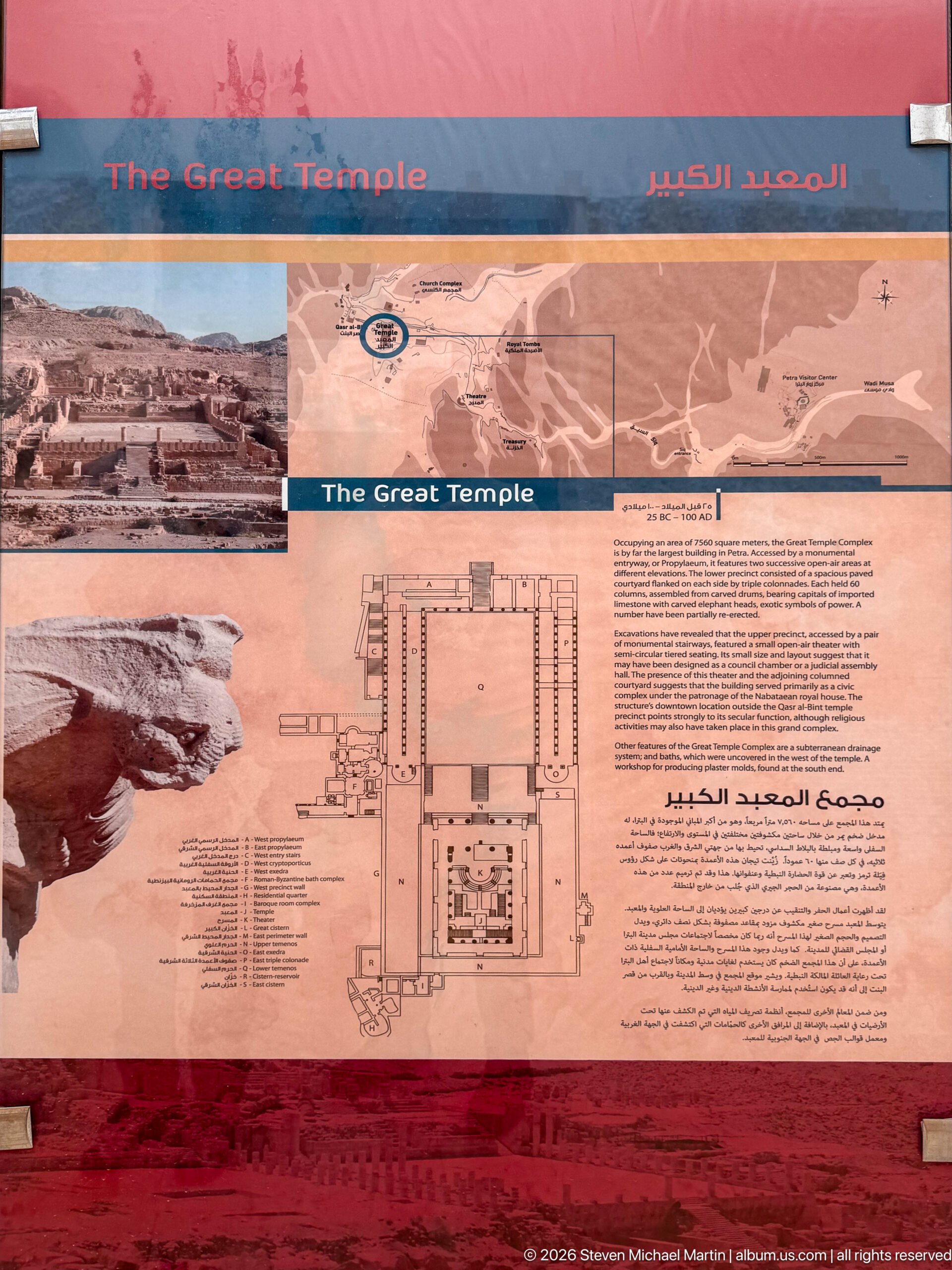
The Great Temple is presented here through a large bilingual site panel that pairs a landscape photograph with plans, diagrams, a location map, and explanatory text. The display emphasizes the scale and organization of the complex, allowing visitors to compare the excavated architectural footprint with its wider setting in Petra’s central archaeological zone.
Caption
The Great Temple is presented here through a large bilingual site panel that pairs a landscape photograph with plans, diagrams, a location map, and explanatory text. The display emphasizes the scale and organization of the complex, allowing visitors to compare the excavated architectural footprint with its wider setting in Petra’s central archaeological zone.
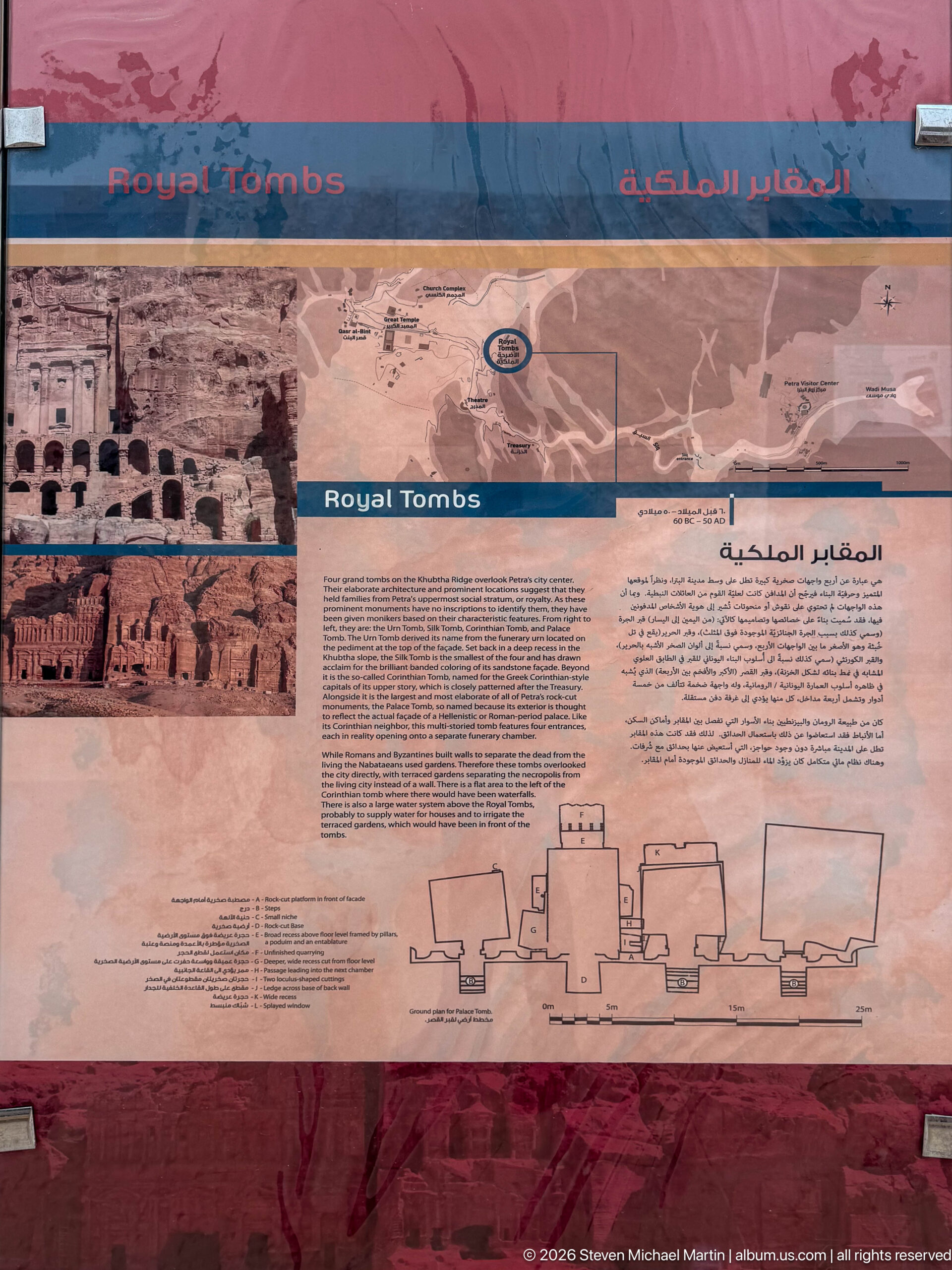
A visitor panel titled Royal Tombs uses photographs, a location map, bilingual text, and a drawn elevation to explain the monumental funerary façades cut into Petra’s cliffs. The graphic presentation links individual tombs with their position along the rock face, helping distinguish a group that can appear visually continuous when viewed from across the valley.
Caption
A visitor panel titled Royal Tombs uses photographs, a location map, bilingual text, and a drawn elevation to explain the monumental funerary façades cut into Petra’s cliffs. The graphic presentation links individual tombs with their position along the rock face, helping distinguish a group that can appear visually continuous when viewed from across the valley.
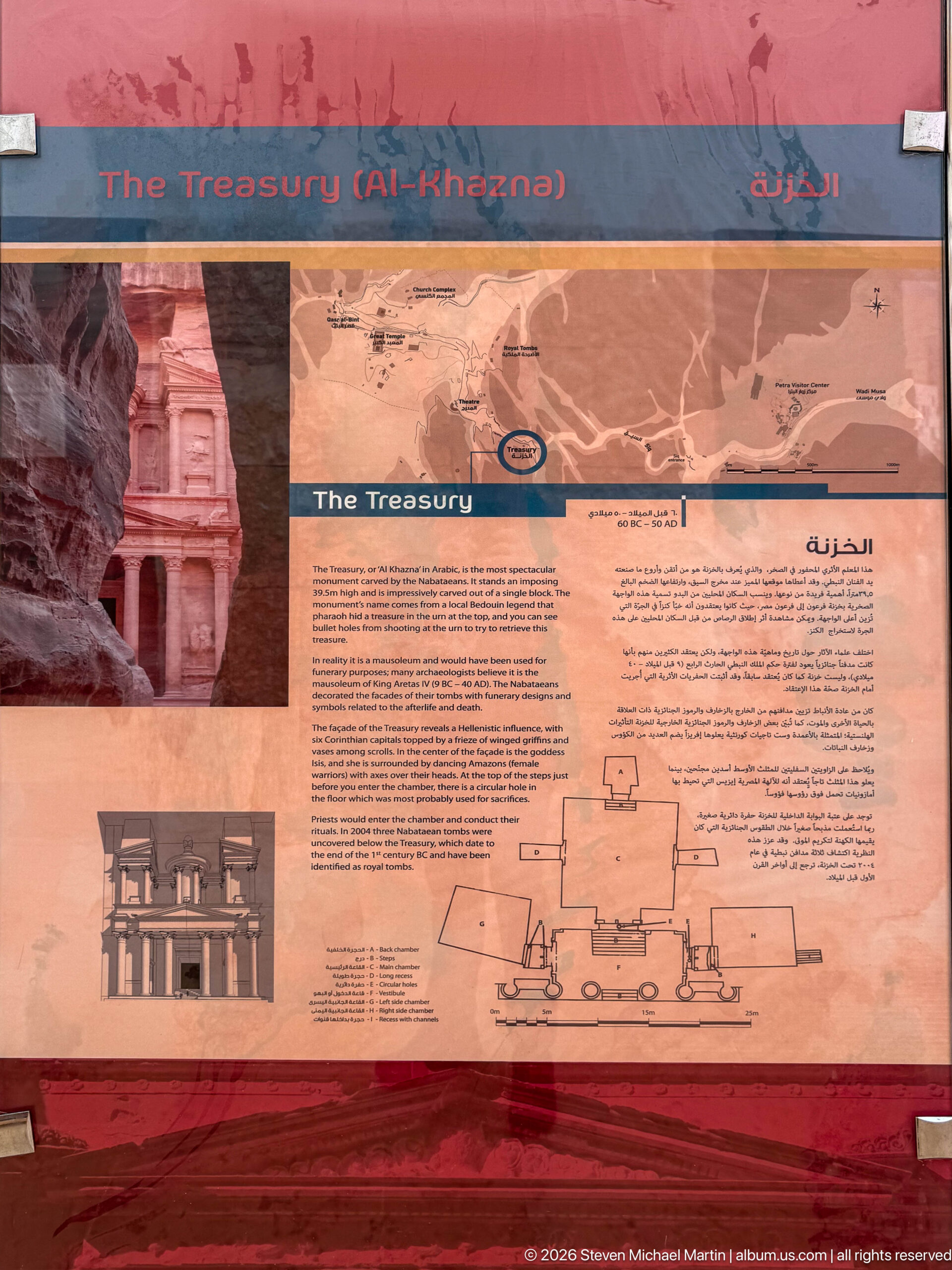
The Treasury, or Al-Khazneh, is explained on this bilingual interpretive panel through a façade photograph, location map, architectural elevation, and plan. The combination of visual documentation and measured drawing highlights the monument’s elaborate two-story composition while situating it at the end of Petra’s principal entrance route through the Siq.
Caption
The Treasury, or Al-Khazneh, is explained on this bilingual interpretive panel through a façade photograph, location map, architectural elevation, and plan. The combination of visual documentation and measured drawing highlights the monument’s elaborate two-story composition while situating it at the end of Petra’s principal entrance route through the Siq.
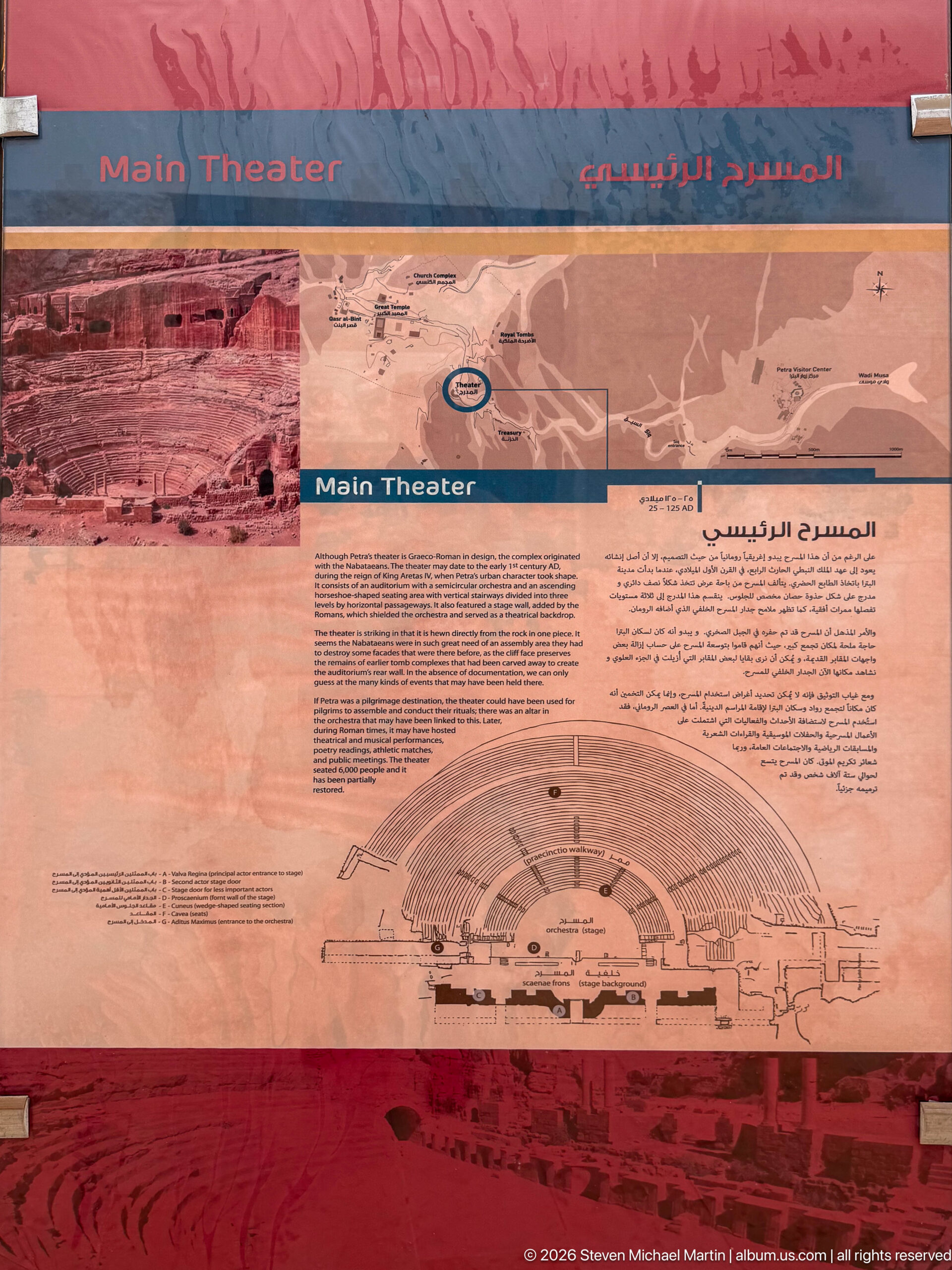
Petra’s Main Theater is documented on a large bilingual panel featuring a site photograph, location map, descriptive text, and a detailed semicircular plan of the auditorium and stage area. The drawing makes the theater’s curved seating arrangement especially clear, complementing the monument’s more fragmentary appearance when seen among surrounding rock-cut and masonry remains.
Caption
Petra’s Main Theater is documented on a large bilingual panel featuring a site photograph, location map, descriptive text, and a detailed semicircular plan of the auditorium and stage area. The drawing makes the theater’s curved seating arrangement especially clear, complementing the monument’s more fragmentary appearance when seen among surrounding rock-cut and masonry remains.
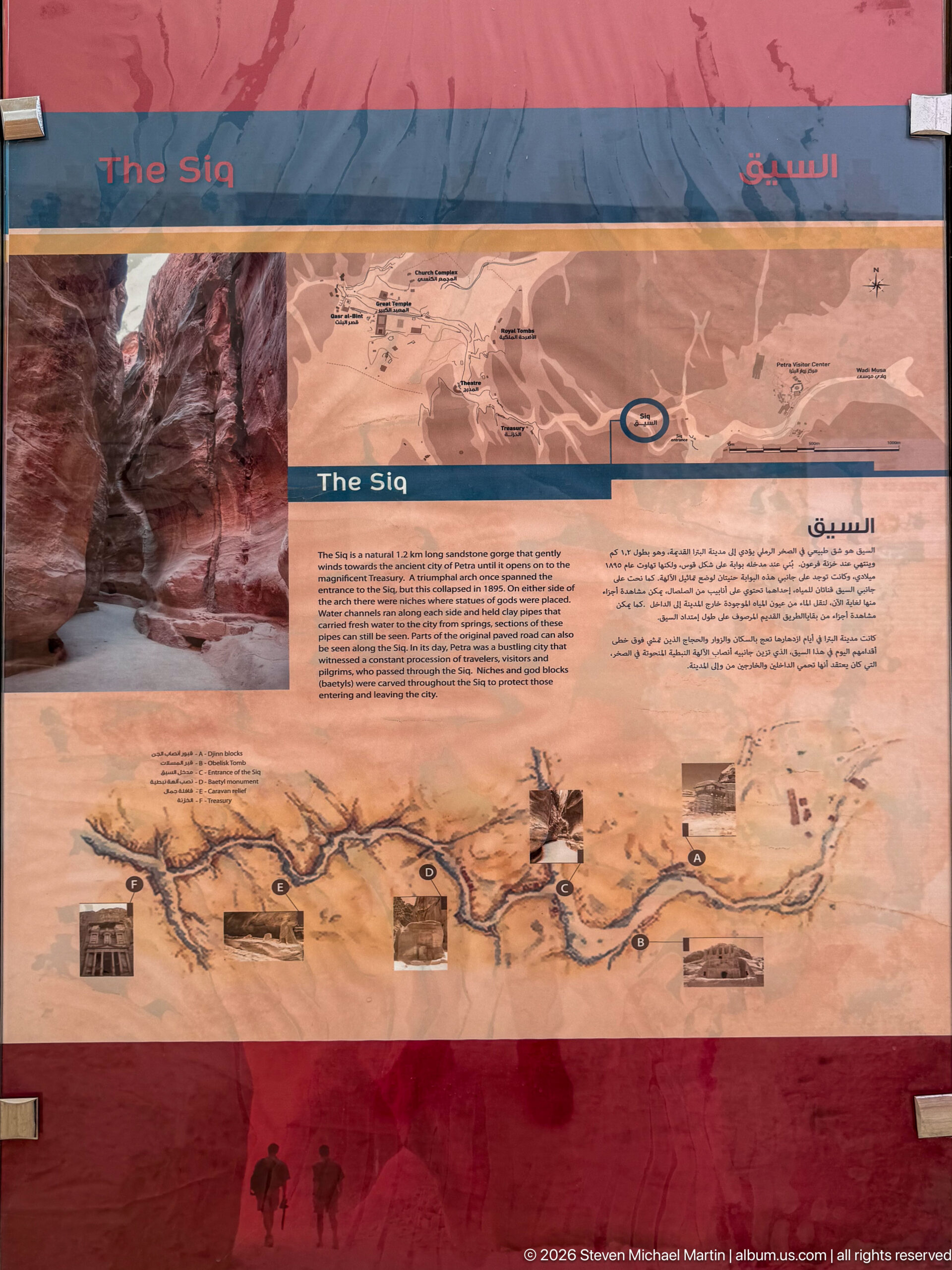
An interpretive panel titled The Siq combines a canyon photograph, route map, descriptive text, and illustrated diagram tracing Petra’s narrow ceremonial approach. The display presents the Siq as both a natural sandstone gorge and an engineered passage, giving visitors a wider spatial understanding of the route before or after walking between its towering rock walls.
Caption
An interpretive panel titled The Siq combines a canyon photograph, route map, descriptive text, and illustrated diagram tracing Petra’s narrow ceremonial approach. The display presents the Siq as both a natural sandstone gorge and an engineered passage, giving visitors a wider spatial understanding of the route before or after walking between its towering rock walls.
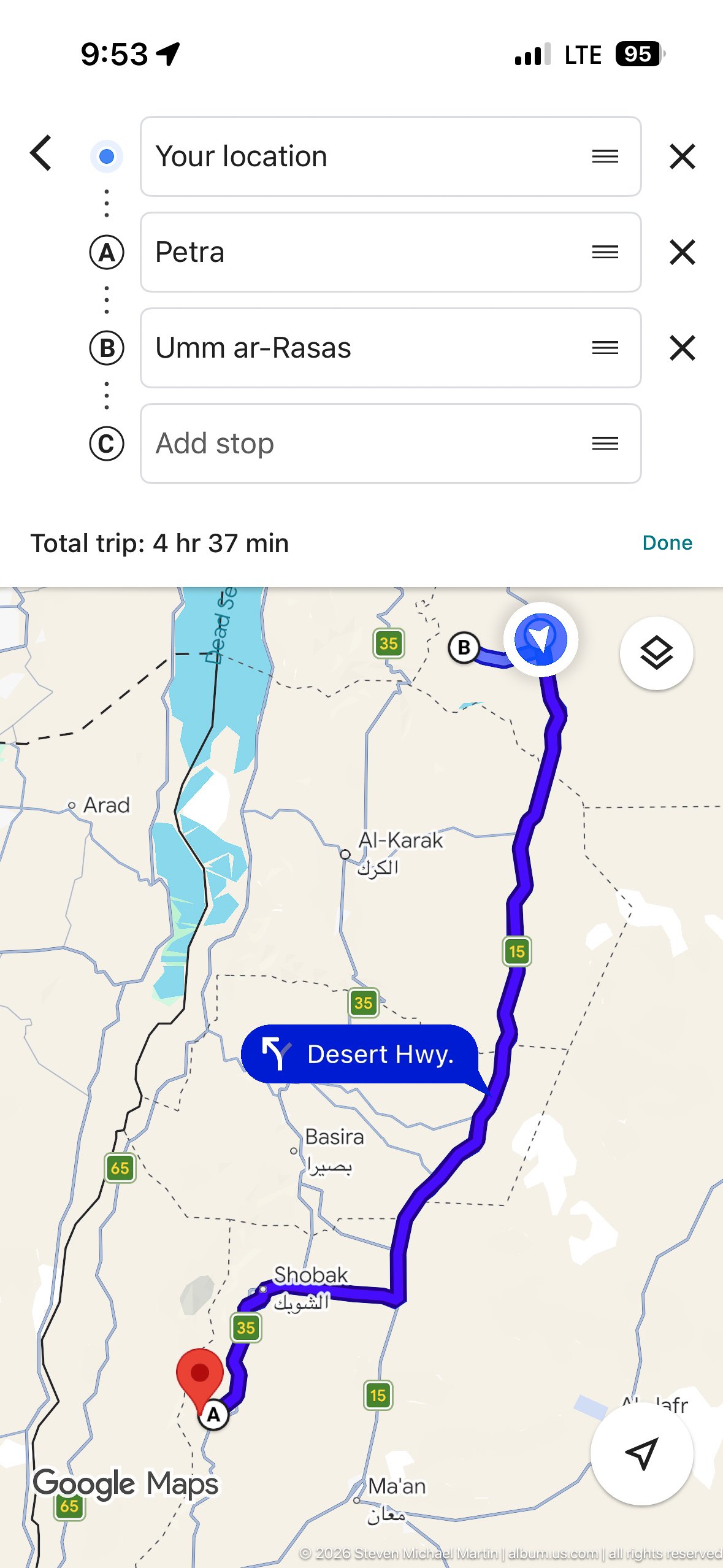
A smartphone navigation screen shows a driving route toward Petra, with the route traced in purple across southern Jordan and a total trip time displayed above the map. The utilitarian screenshot records the modern journey to the archaeological site, contrasting digital wayfinding with the ancient routes encountered on arrival.
Caption
A smartphone navigation screen shows a driving route toward Petra, with the route traced in purple across southern Jordan and a total trip time displayed above the map. The utilitarian screenshot records the modern journey to the archaeological site, contrasting digital wayfinding with the ancient routes encountered on arrival.
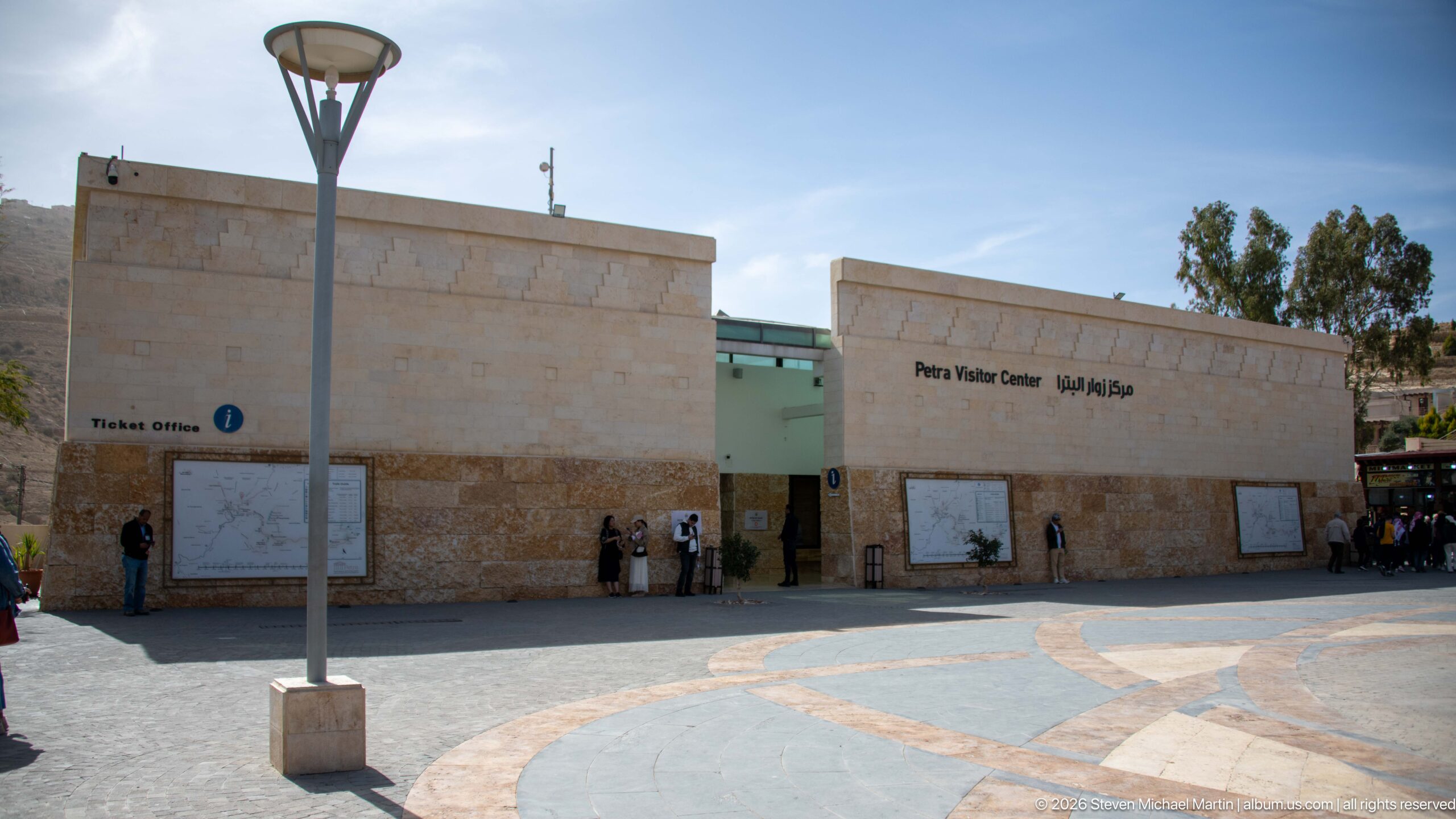
The Petra Visitor Center faces an open paved plaza near the archaeological site entrance, its pale stone walls marked by bilingual signage and ticketing information. The restrained modern architecture and broad forecourt contrast with the rock-cut monuments beyond, establishing the practical arrival point where visitors obtain orientation and access before entering Petra.
Caption
The Petra Visitor Center faces an open paved plaza near the archaeological site entrance, its pale stone walls marked by bilingual signage and ticketing information. The restrained modern architecture and broad forecourt contrast with the rock-cut monuments beyond, establishing the practical arrival point where visitors obtain orientation and access before entering Petra.
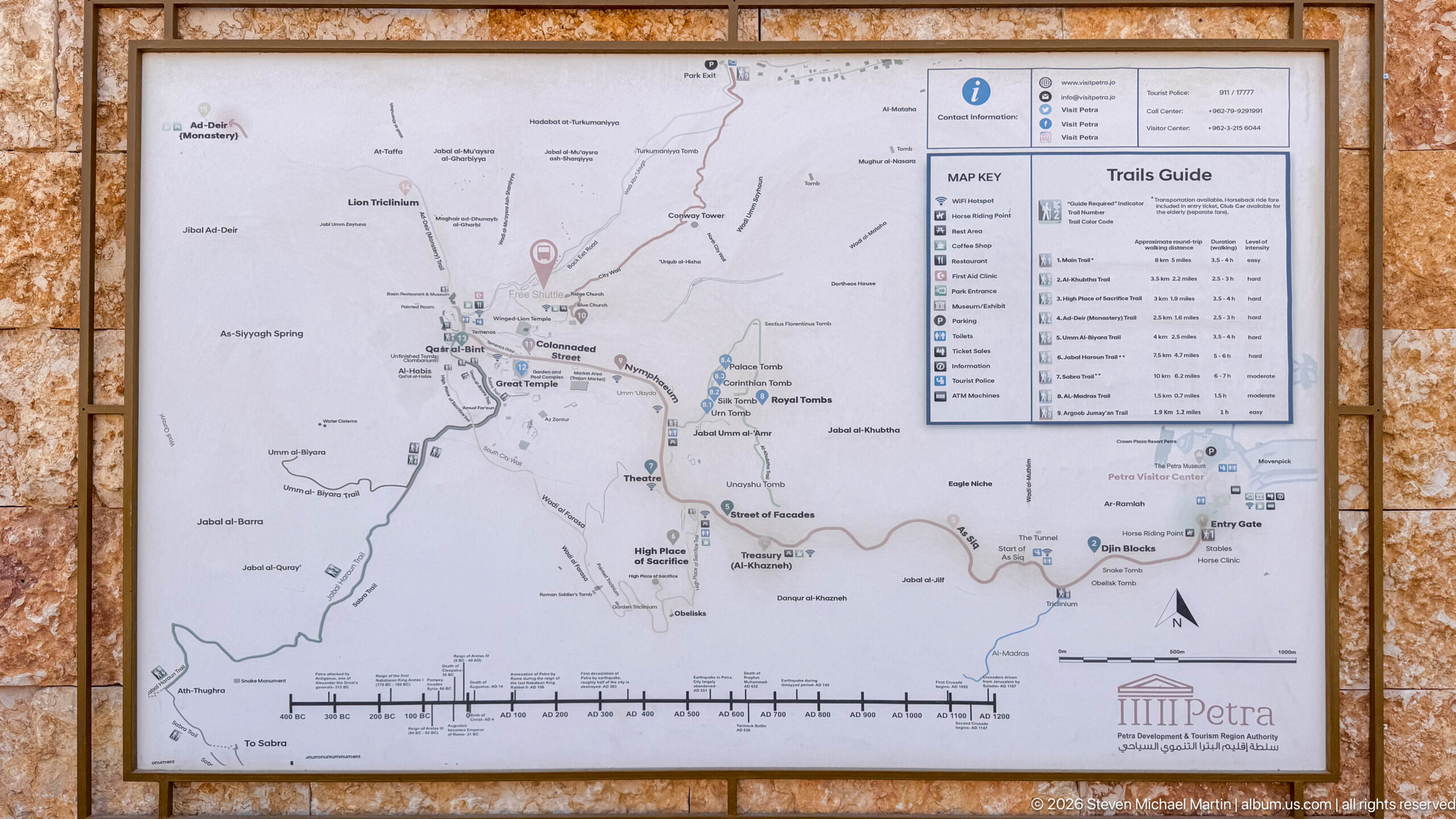
A mounted Petra trails guide maps the archaeological landscape and surrounding walking routes, pairing place names and path lines with a legend of trail difficulty and estimated times. The orientation board provides a practical overview of the site’s dispersed monuments and high viewpoints, emphasizing how much of Petra is experienced on foot beyond the central entrance corridor.
Caption
A mounted Petra trails guide maps the archaeological landscape and surrounding walking routes, pairing place names and path lines with a legend of trail difficulty and estimated times. The orientation board provides a practical overview of the site’s dispersed monuments and high viewpoints, emphasizing how much of Petra is experienced on foot beyond the central entrance corridor.
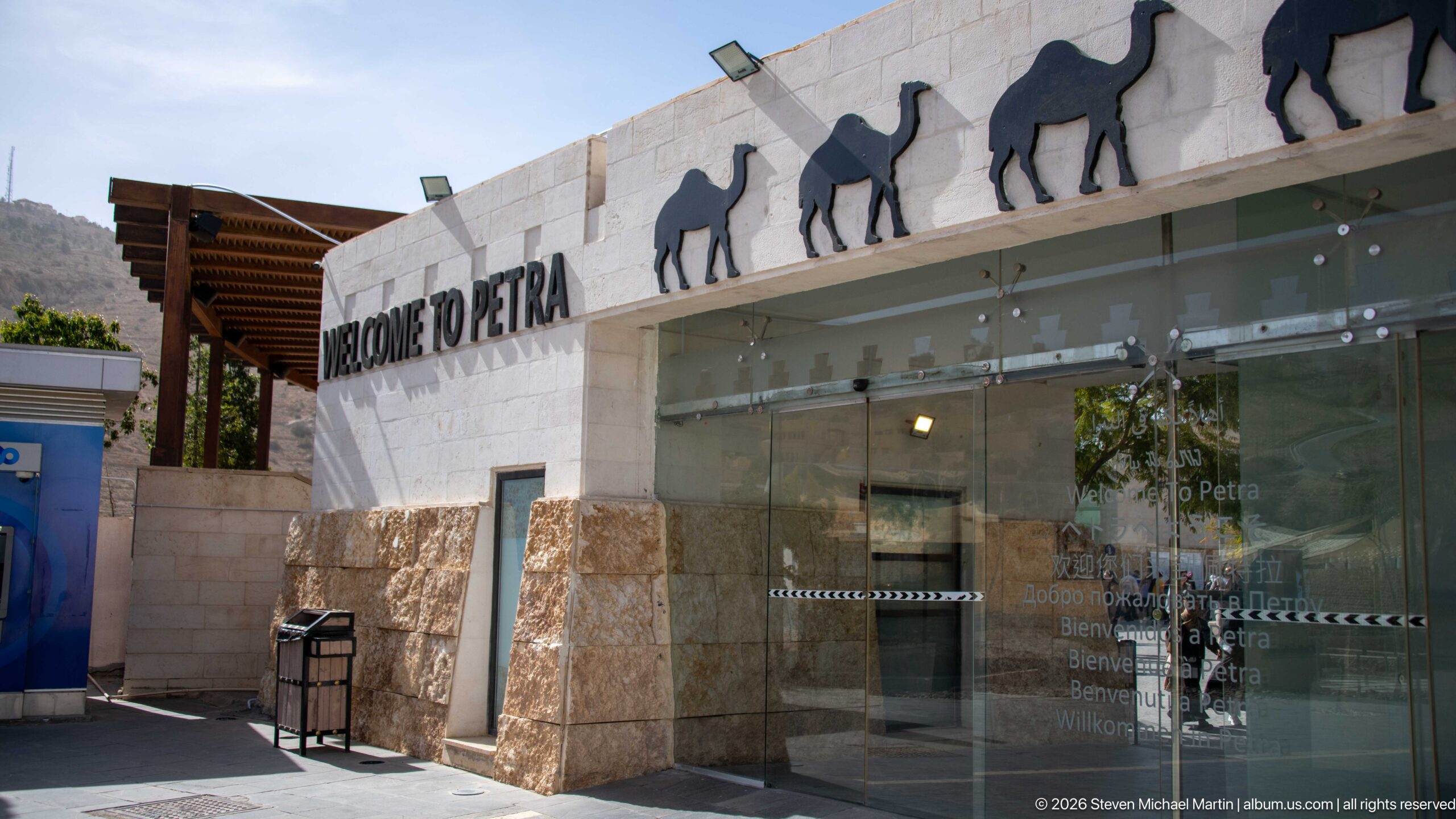
A modern entrance marked “WELCOME TO PETRA” uses pale stone, glass doors, and a row of camel silhouettes along the roofline to signal the transition into the visitor complex. The decorative animal motif references the transport and desert imagery associated with Petra while the transparent entry façade keeps the structure visually light and contemporary.
Caption
A modern entrance marked “WELCOME TO PETRA” uses pale stone, glass doors, and a row of camel silhouettes along the roofline to signal the transition into the visitor complex. The decorative animal motif references the transport and desert imagery associated with Petra while the transparent entry façade keeps the structure visually light and contemporary.
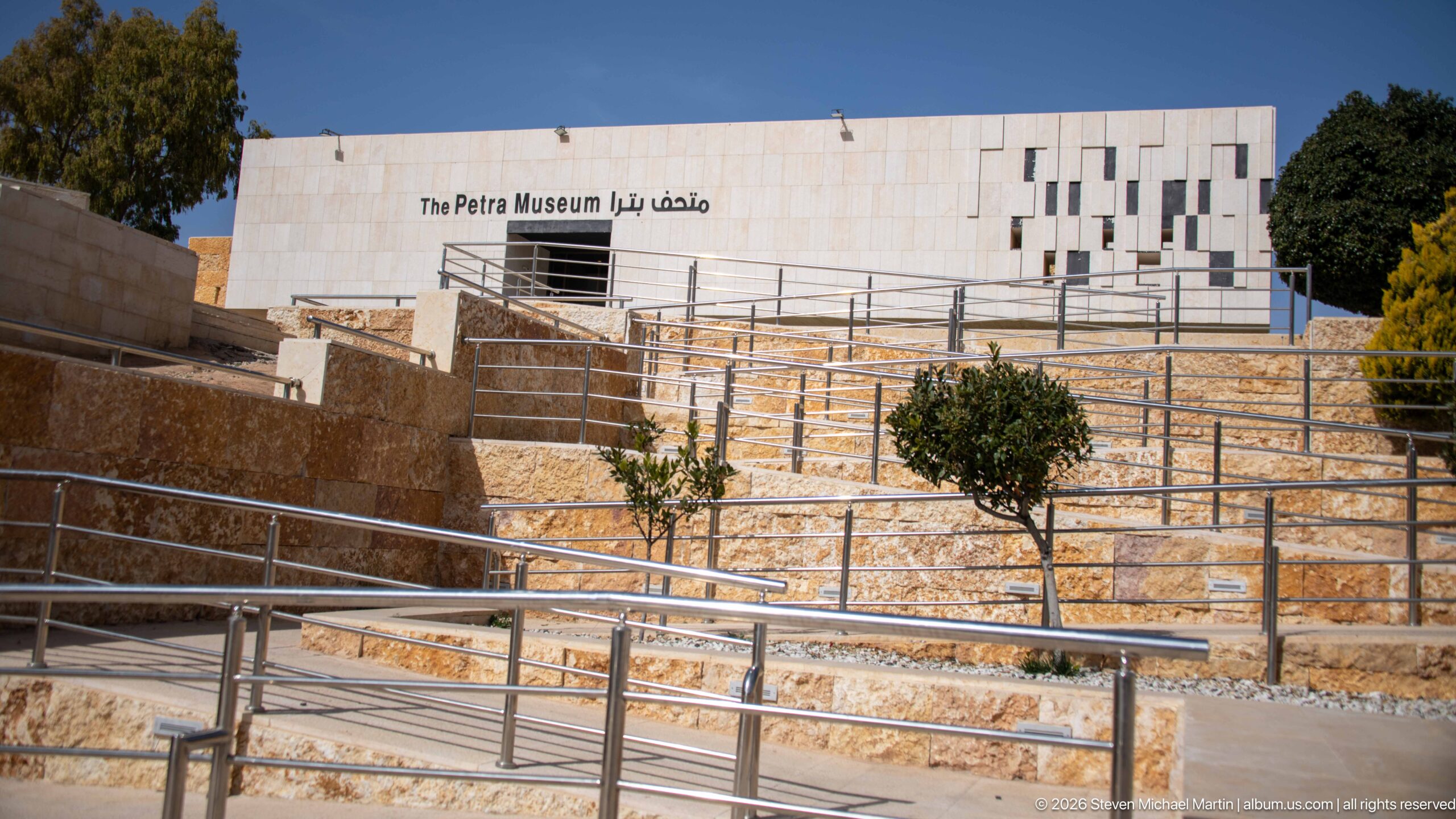
The Petra Museum rises above terraced stone landscaping and a network of accessible ramps, its pale rectilinear façade bearing the museum’s name in English and Arabic. The building’s contemporary geometry is softened by planted trees and local stone retaining walls, linking a modern interpretive institution to the historic landscape it presents.
Caption
The Petra Museum rises above terraced stone landscaping and a network of accessible ramps, its pale rectilinear façade bearing the museum’s name in English and Arabic. The building’s contemporary geometry is softened by planted trees and local stone retaining walls, linking a modern interpretive institution to the historic landscape it presents.
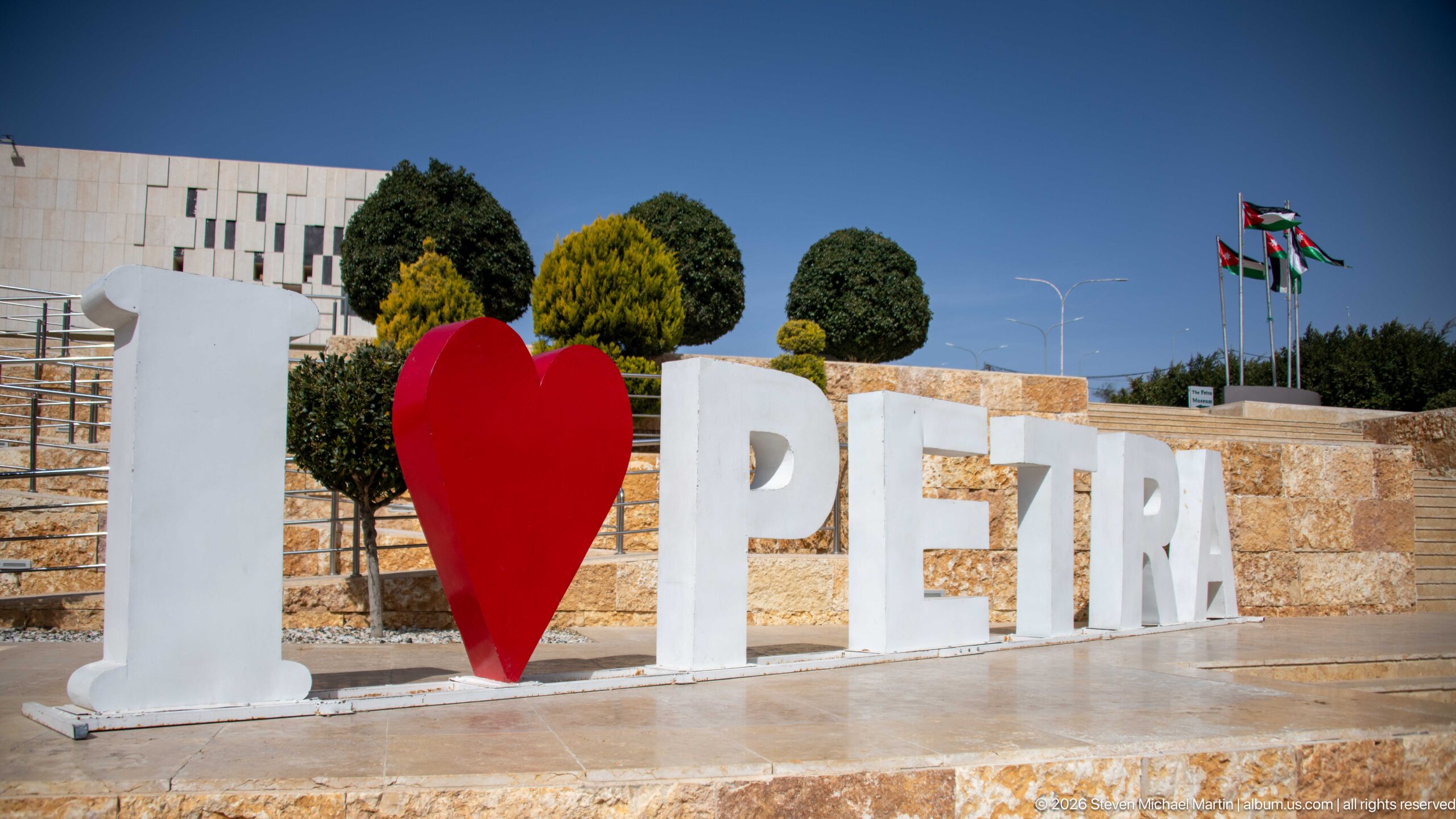
Large white letters spelling PETRA are paired with a bright red heart to form an “I love Petra” sign near the visitor complex. Carefully clipped trees, stone terraces, and Jordanian flags frame the installation, placing a contemporary photo opportunity beside the formal infrastructure of the archaeological park.
Caption
Large white letters spelling PETRA are paired with a bright red heart to form an “I love Petra” sign near the visitor complex. Carefully clipped trees, stone terraces, and Jordanian flags frame the installation, placing a contemporary photo opportunity beside the formal infrastructure of the archaeological park.
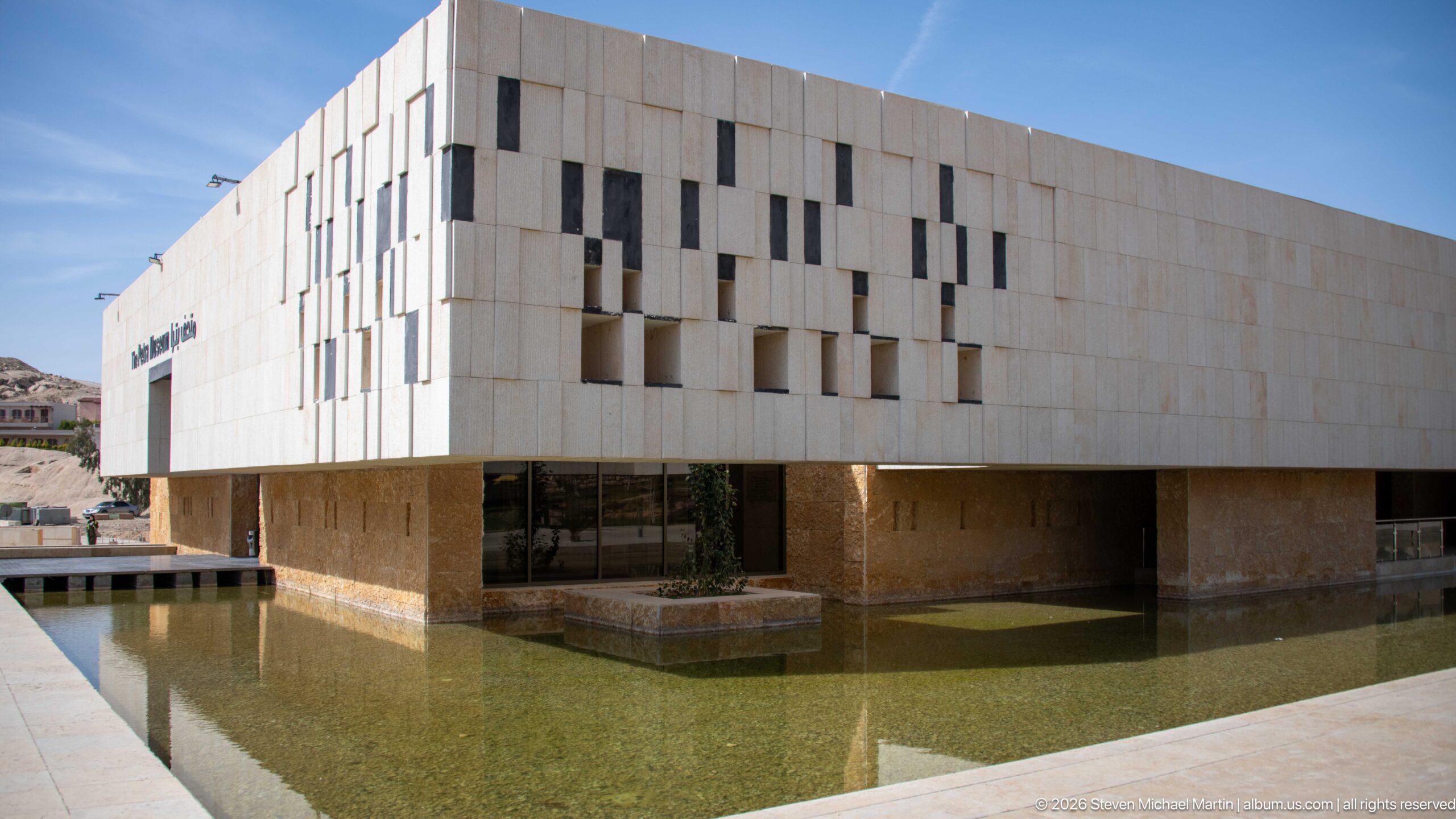
The Petra Museum appears as a long, pale modern volume raised above a shallow reflecting pool, with irregular window openings punctuating the upper façade. The water mirrors portions of the building and softens the hard geometry, presenting the museum as a contemporary architectural counterpoint to the ancient sandstone city nearby.
Caption
The Petra Museum appears as a long, pale modern volume raised above a shallow reflecting pool, with irregular window openings punctuating the upper façade. The water mirrors portions of the building and softens the hard geometry, presenting the museum as a contemporary architectural counterpoint to the ancient sandstone city nearby.
A small metal sign bears the Petra logo and the bilingual name of the Petra Development and Tourism Region Authority. Mounted on a simple fence with vegetation behind, the sign documents the governmental body responsible for managing the wider Petra tourism region rather than an archaeological monument within the site itself.
Caption
A small metal sign bears the Petra logo and the bilingual name of the Petra Development and Tourism Region Authority. Mounted on a simple fence with vegetation behind, the sign documents the governmental body responsible for managing the wider Petra tourism region rather than an archaeological monument within the site itself.
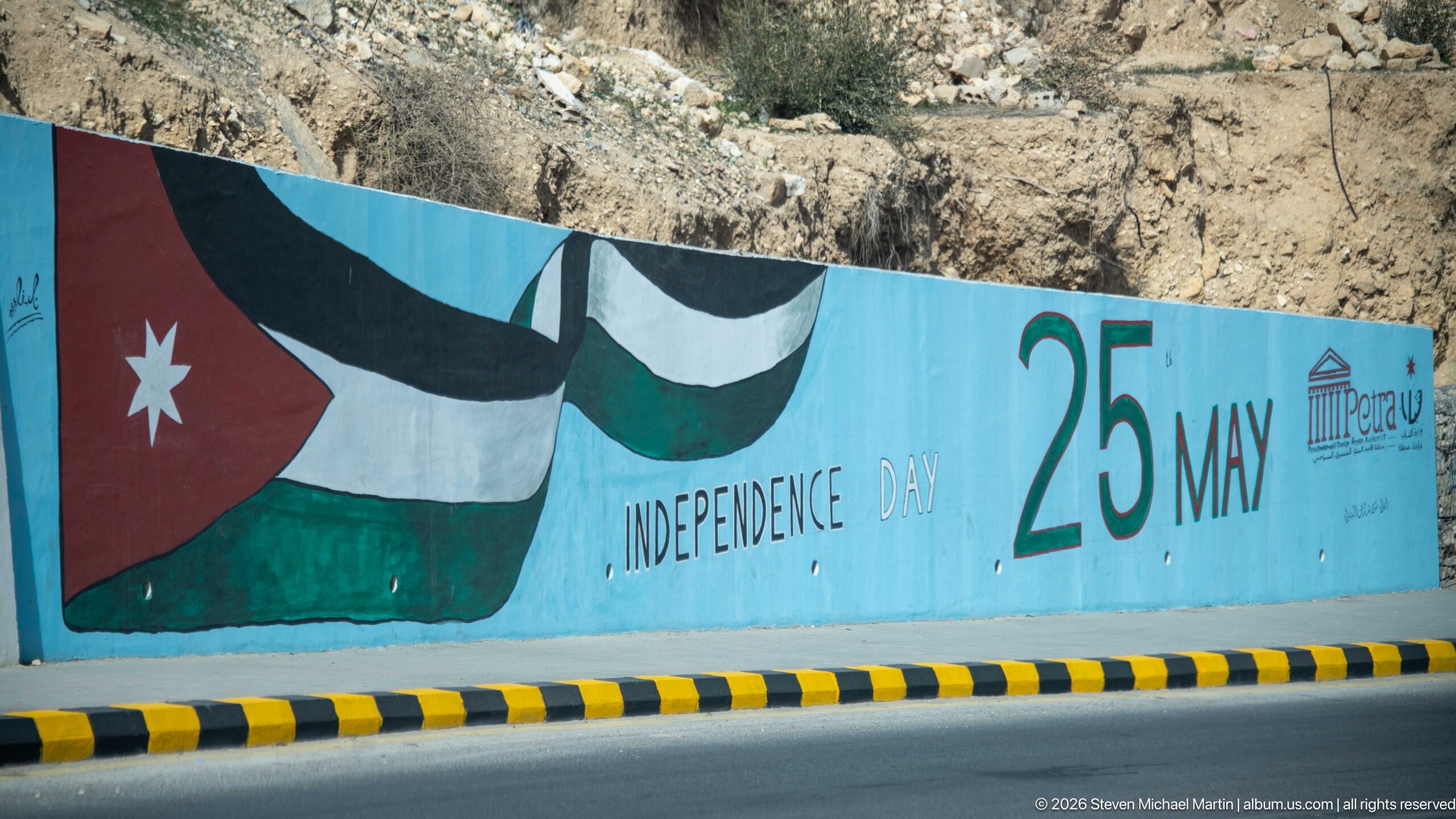
A roadside mural combines the Jordanian flag with the words “Independence Day” and the date “25 May,” commemorating Jordan’s national holiday. Painted in broad blocks of red, black, white, and green against a turquoise wall, the graphic adds a civic and national layer to the urban landscape around Petra.
Caption
A roadside mural combines the Jordanian flag with the words “Independence Day” and the date “25 May,” commemorating Jordan’s national holiday. Painted in broad blocks of red, black, white, and green against a turquoise wall, the graphic adds a civic and national layer to the urban landscape around Petra.
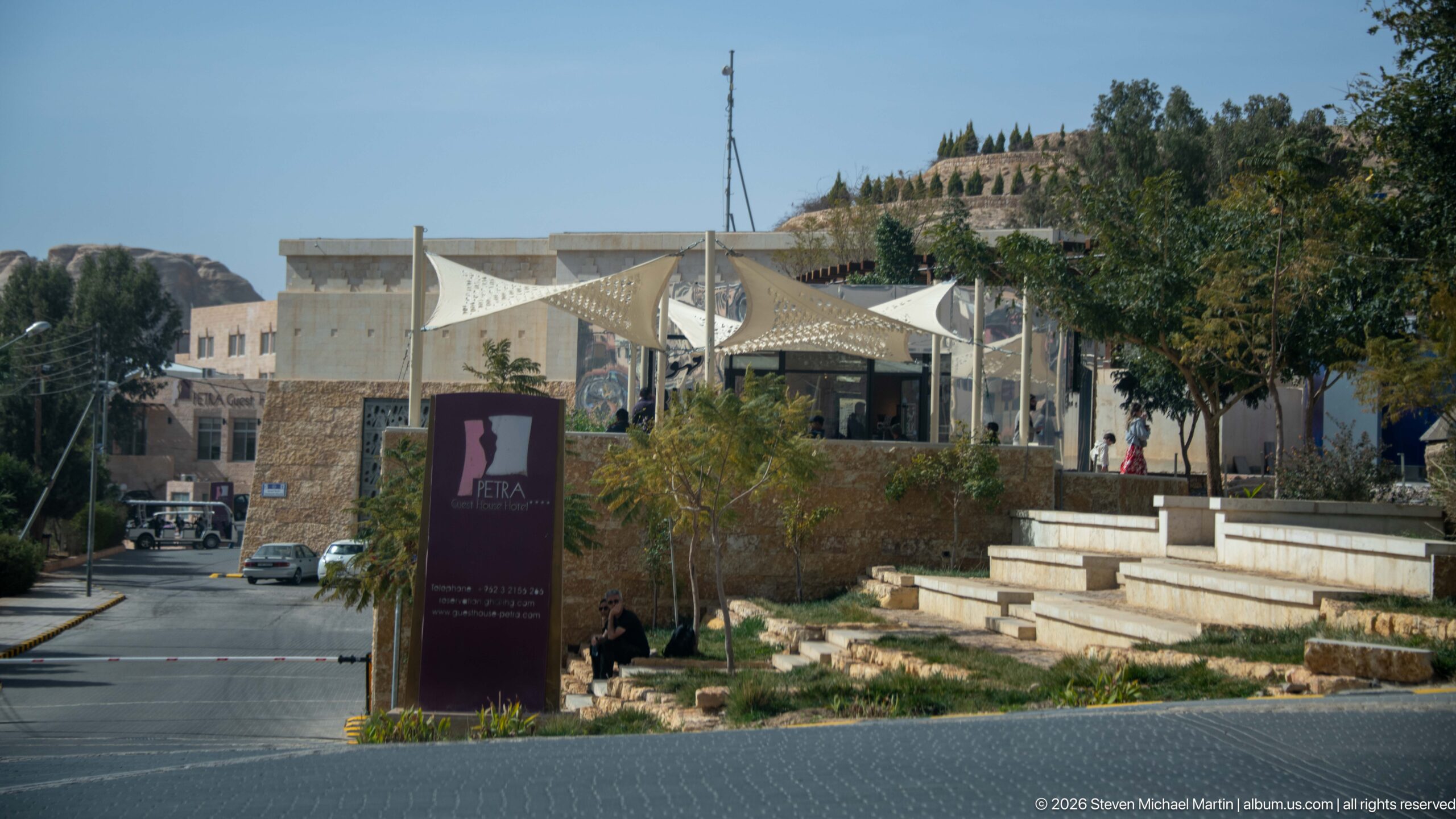
A landscaped road descends through Petra’s visitor district beneath modern shade canopies, stone walls, and informational signage. The mix of pedestrian terraces, palms, parked vehicles, and contemporary service buildings shows the developed urban edge that supports access to the archaeological park before the ancient landscape begins.
Caption
A landscaped road descends through Petra’s visitor district beneath modern shade canopies, stone walls, and informational signage. The mix of pedestrian terraces, palms, parked vehicles, and contemporary service buildings shows the developed urban edge that supports access to the archaeological park before the ancient landscape begins.
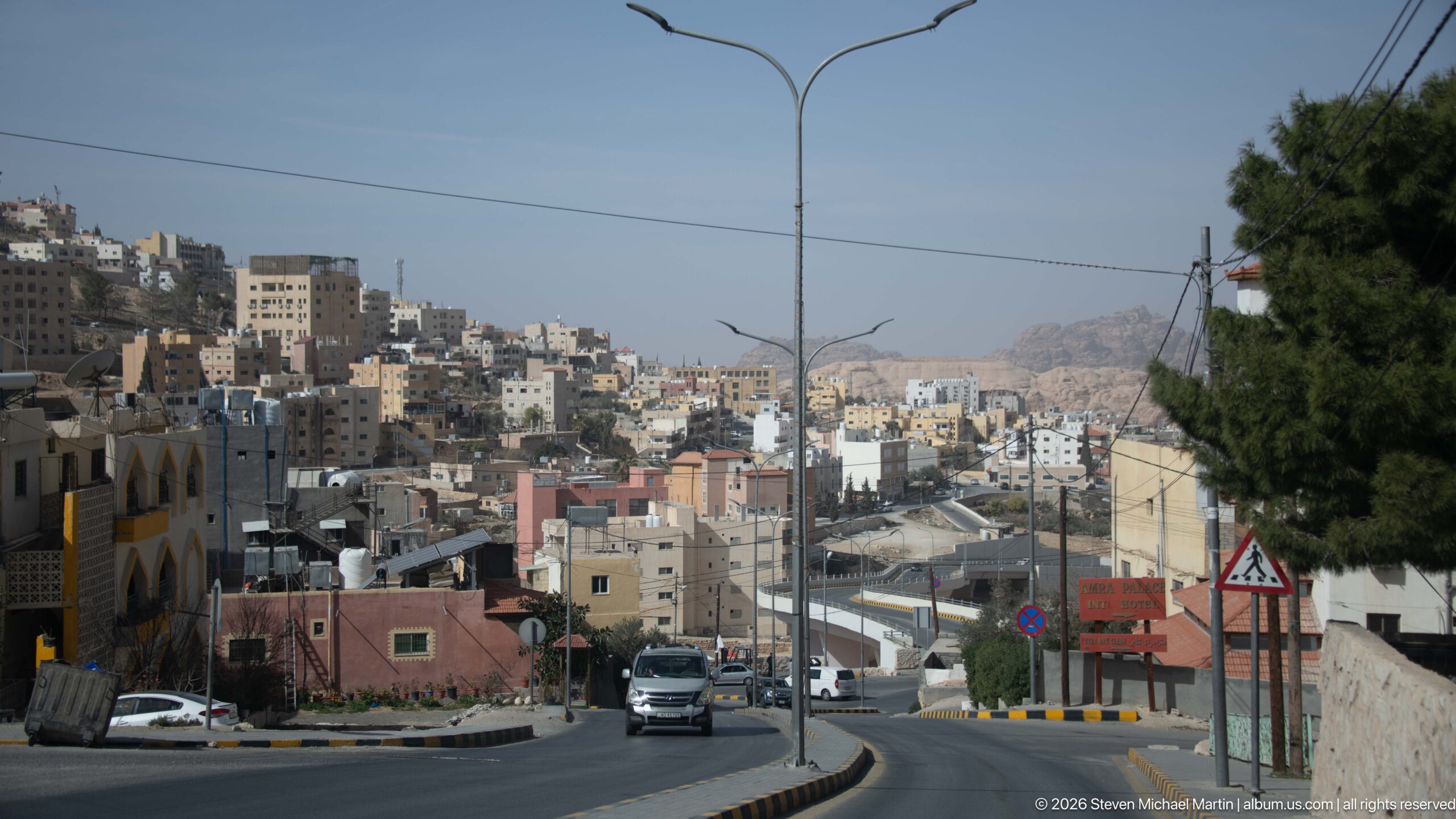
A descending urban road passes through the dense hillside town adjoining Petra, with closely packed pale buildings, streetlights, traffic signs, and parked cars climbing the surrounding slopes. The scene records Wadi Musa as the modern service town at Petra’s edge, contrasting everyday urban infrastructure with the rugged mountains visible in the distance.
Caption
A descending urban road passes through the dense hillside town adjoining Petra, with closely packed pale buildings, streetlights, traffic signs, and parked cars climbing the surrounding slopes. The scene records Wadi Musa as the modern service town at Petra’s edge, contrasting everyday urban infrastructure with the rugged mountains visible in the distance.
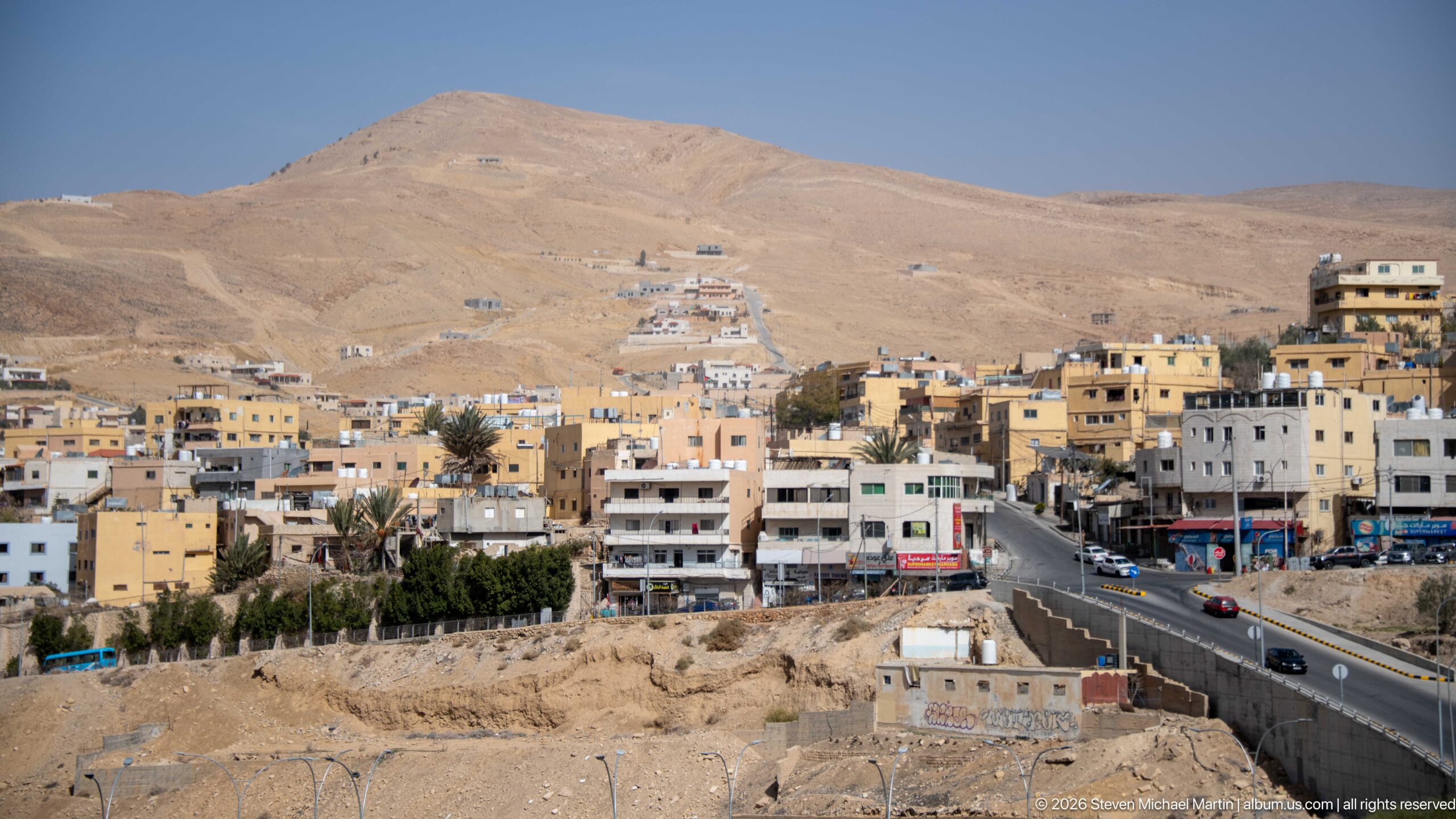
Low-rise buildings spread across the dry slopes of Wadi Musa, where paved roads weave between tan, white, and pastel-colored structures beneath barren mountain ridges. The broad view places Petra’s modern gateway community within the same arid topography that shapes the archaeological landscape beyond it.
Caption
Low-rise buildings spread across the dry slopes of Wadi Musa, where paved roads weave between tan, white, and pastel-colored structures beneath barren mountain ridges. The broad view places Petra’s modern gateway community within the same arid topography that shapes the archaeological landscape beyond it.
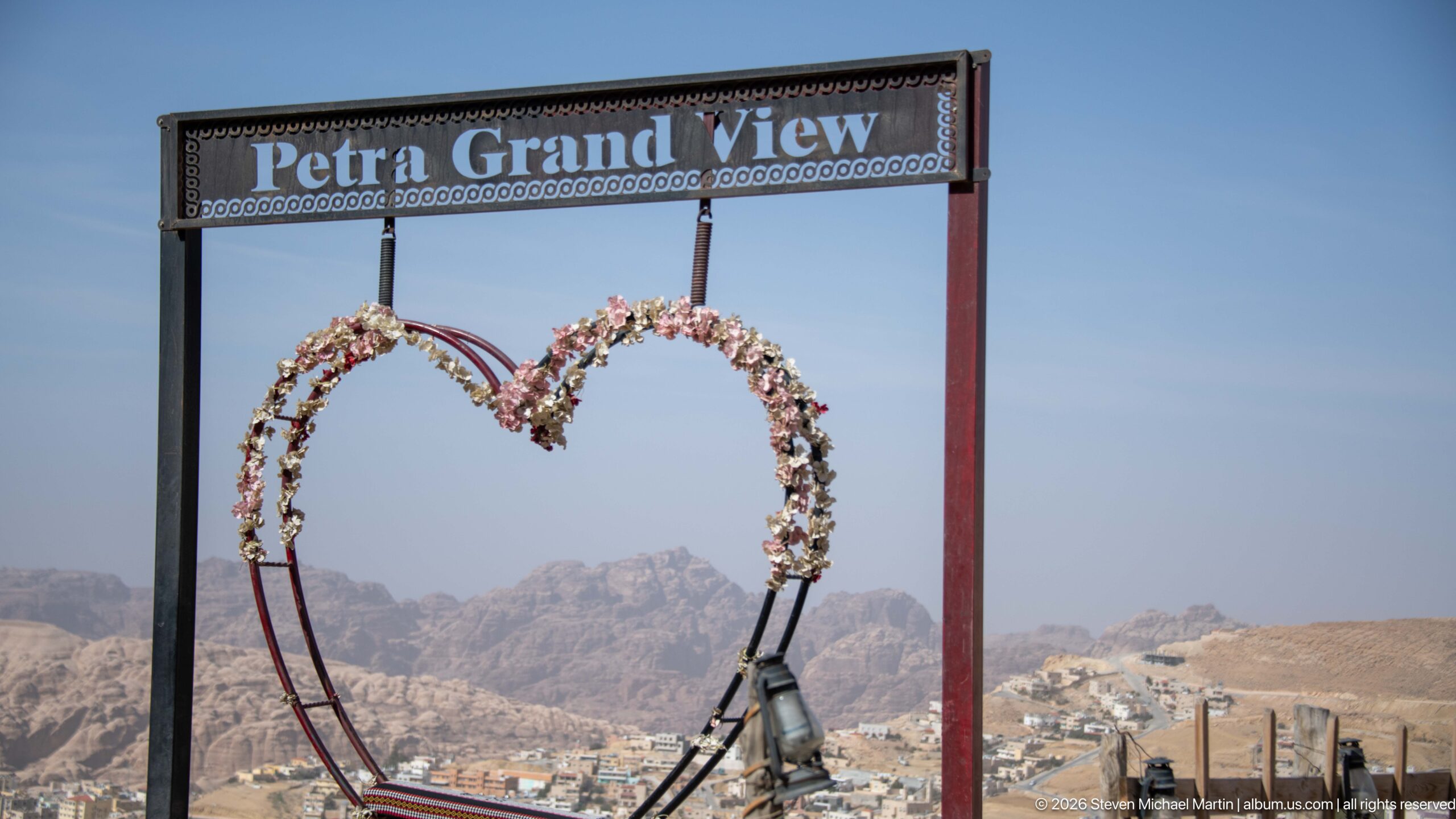
A decorative heart-shaped frame covered with artificial flowers stands beneath a sign reading “Petra Grand View,” positioned to frame distant mountains and the town below. The installation turns the overlook into a contemporary photo stop, using Petra’s surrounding landscape as the backdrop for a deliberately staged visitor experience.
Caption
A decorative heart-shaped frame covered with artificial flowers stands beneath a sign reading “Petra Grand View,” positioned to frame distant mountains and the town below. The installation turns the overlook into a contemporary photo stop, using Petra’s surrounding landscape as the backdrop for a deliberately staged visitor experience.
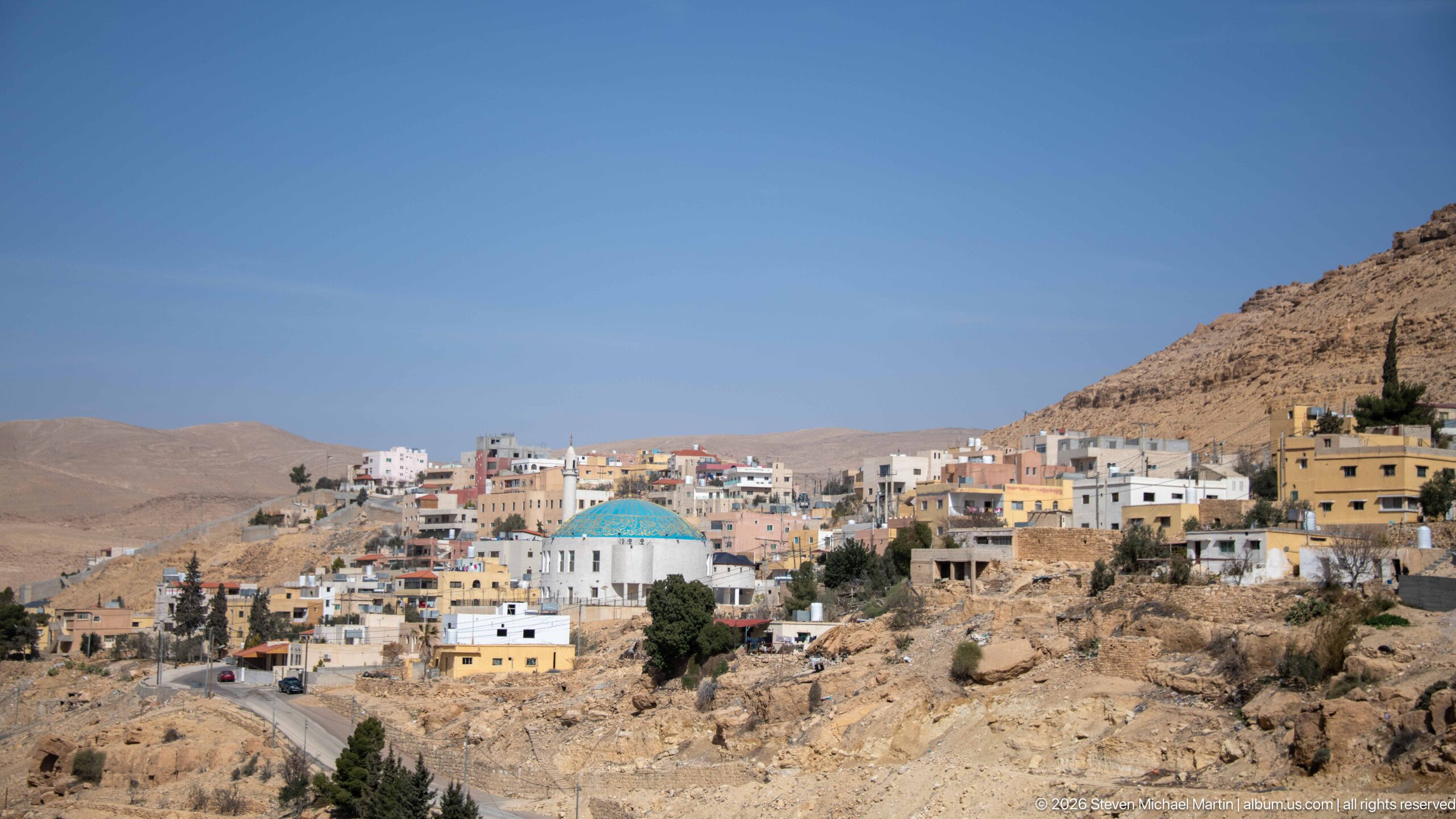
A hillside neighborhood of Wadi Musa climbs a dry rocky slope, its tan and white buildings gathered around a mosque marked by a turquoise-blue dome. The winding road and compact development show how the modern town adapts to steep terrain on Petra’s eastern approaches.
Caption
A hillside neighborhood of Wadi Musa climbs a dry rocky slope, its tan and white buildings gathered around a mosque marked by a turquoise-blue dome. The winding road and compact development show how the modern town adapts to steep terrain on Petra’s eastern approaches.
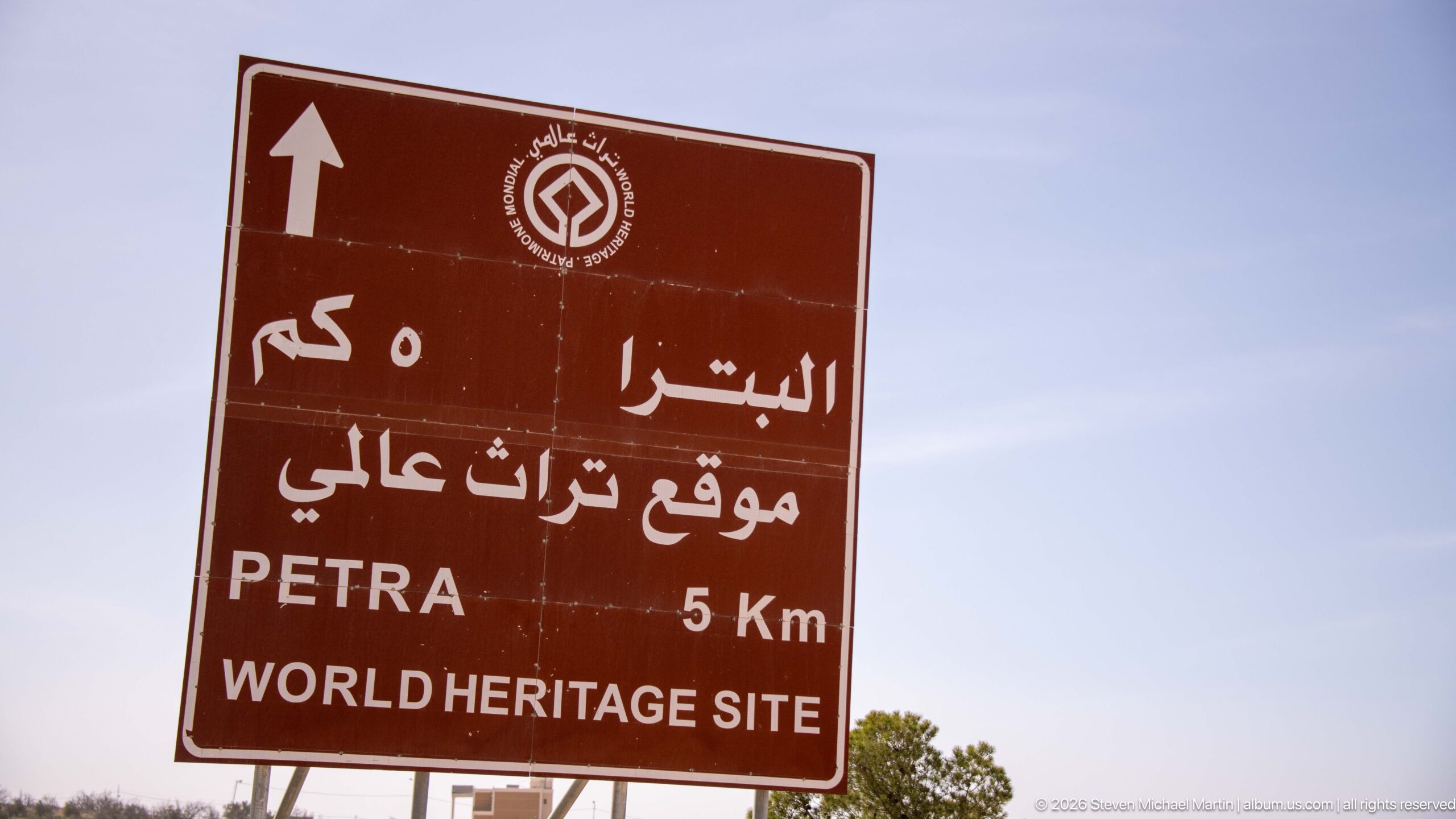
A brown tourist-direction sign announces “PETRA 5 Km” and “WORLD HERITAGE SITE” in English beneath Arabic text and a heritage emblem. Seen against open sky, the sign marks the transition from the surrounding road network toward Petra and foregrounds the archaeological site’s internationally recognized heritage status.
Caption
A brown tourist-direction sign announces “PETRA 5 Km” and “WORLD HERITAGE SITE” in English beneath Arabic text and a heritage emblem. Seen against open sky, the sign marks the transition from the surrounding road network toward Petra and foregrounds the archaeological site’s internationally recognized heritage status.
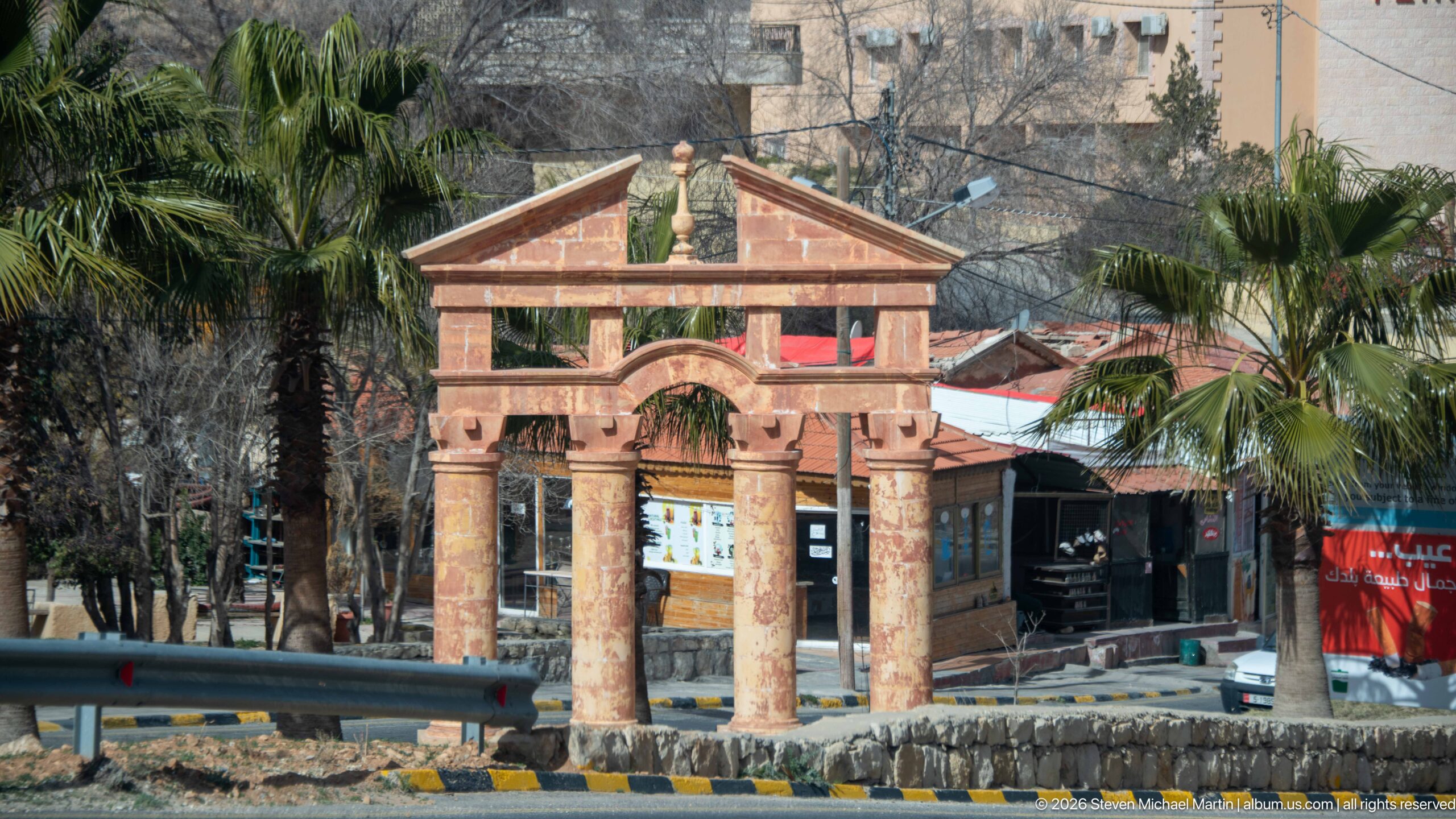
A small freestanding gateway uses columns, an arched opening, a triangular pediment, and pink-and-tan stonework to evoke Petra’s monumental architecture. Set beside palms, roadside barriers, and modern buildings, the structure functions as a decorative urban marker rather than an ancient ruin, translating Nabataean-inspired forms into the contemporary streetscape around Wadi Musa.
Caption
A small freestanding gateway uses columns, an arched opening, a triangular pediment, and pink-and-tan stonework to evoke Petra’s monumental architecture. Set beside palms, roadside barriers, and modern buildings, the structure functions as a decorative urban marker rather than an ancient ruin, translating Nabataean-inspired forms into the contemporary streetscape around Wadi Musa.
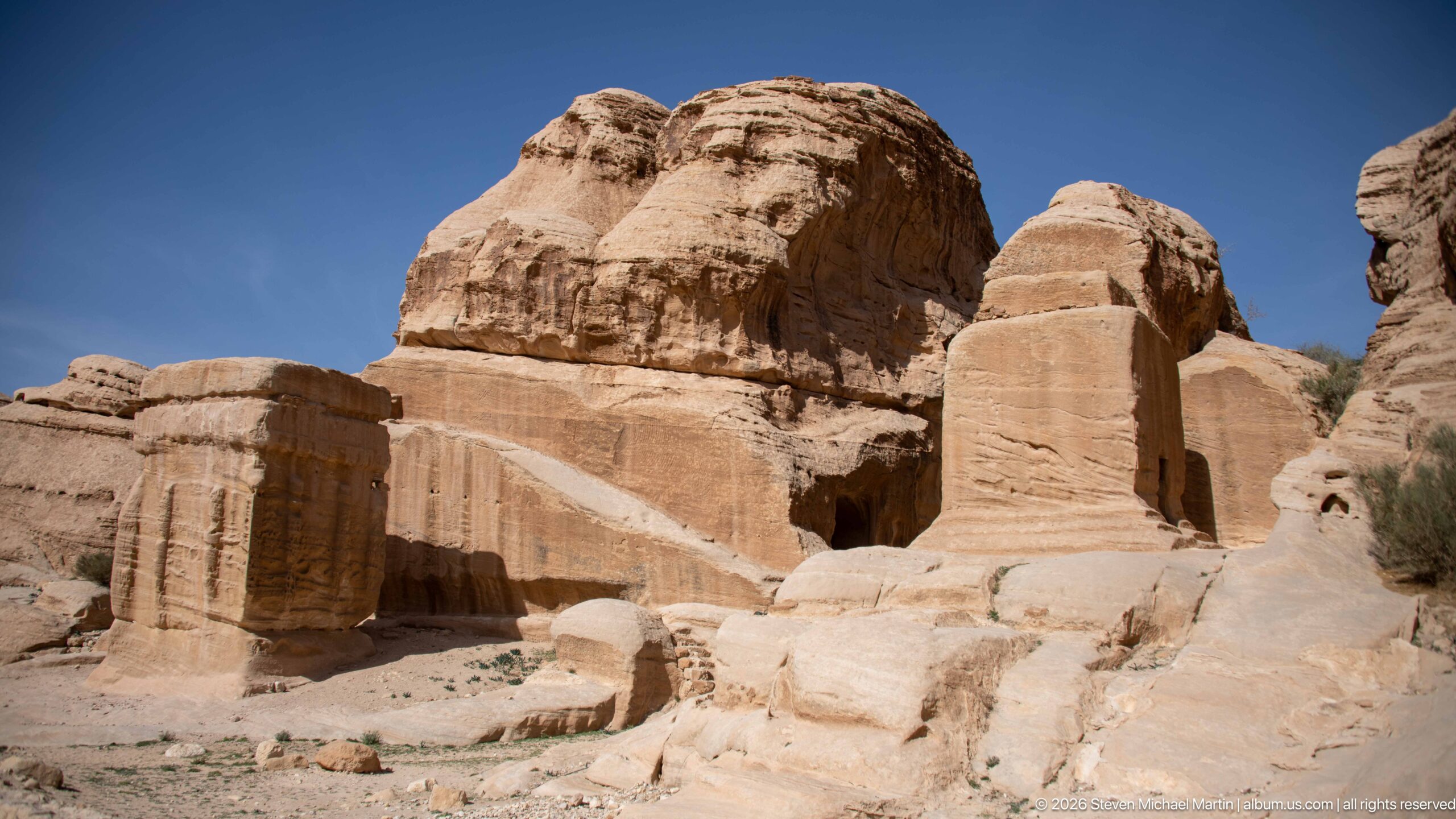
Massive sandstone outcrops rise in rounded, deeply weathered forms against a clear blue sky, with smooth lower surfaces contrasting with rougher, fractured crowns. The close geological view draws attention away from Petra’s carved monuments and toward the natural rock masses from which the archaeological landscape was shaped.
Caption
Massive sandstone outcrops rise in rounded, deeply weathered forms against a clear blue sky, with smooth lower surfaces contrasting with rougher, fractured crowns. The close geological view draws attention away from Petra’s carved monuments and toward the natural rock masses from which the archaeological landscape was shaped.
⭐ Highlights
- The Siq: A narrow sandstone canyon that creates one of the most dramatic approaches to any archaeological site in the world.
- Al-Khazneh (The Treasury): Petra’s most iconic façade, carved directly into the rose-red rock and revealed suddenly at the end of the Siq.
- The Street of Facades: A corridor of tombs and carved openings that reveals Petra as a vast city rather than a single monument.
- The Royal Tombs: Monumental cliffside tombs reflecting the wealth and status of the Nabataean elite.
- Ad-Deir (The Monastery): A massive and more remote structure that rivals the Treasury in scale and presence.
- Nabataean Engineering: Water channels, cisterns, and pathways that made life possible in a harsh desert environment.
🏛️ Petra Heritage Field Guide
Major features observed during this visit:
Petra is one of the most remarkable archaeological landscapes in the world, where natural sandstone mountains were transformed into a monumental city by the Nabataeans more than two thousand years ago. Hidden within the desert of southern Jordan, Petra combined trade, engineering, and architecture in a setting that still feels both remote and theatrical.
🏛️ Signature Structures
- The Siq – A winding canyon that serves as Petra’s ceremonial entrance and defines the experience of arrival.
- Al-Khazneh (The Treasury) – The most recognizable structure in Petra, admired for its symmetry, scale, and dramatic reveal.
- The Street of Facades – A long row of tombs and chambers carved into the cliffs, emphasizing the scale of the ancient city.
- The Royal Tombs – Large and ornate burial structures carved high into the rock face.
- Ad-Deir (The Monastery) – One of the largest monuments in Petra, more remote and less crowded than the Treasury.
🧠 Historical Significance
- Nabataean Capital – Petra was the center of a powerful trading civilization that controlled routes across Arabia and the Mediterranean.
- Trade Wealth – The city prospered through the movement of incense, spices, and luxury goods.
- Roman Influence – Petra later became part of the Roman Empire, adding architectural and cultural layers.
- UNESCO World Heritage Site – Recognized globally for its cultural and historical importance.
🌄 Architecture & Landscape
- Rock-Cut Design – Structures carved directly into sandstone cliffs define Petra’s visual identity.
- Desert Terrain – Surrounded by rugged mountains, canyons, and open basins.
- Water Systems – Advanced engineering allowed a large population to thrive in an arid climate.
- Light and Color – The rose-red stone shifts dramatically with changing light throughout the day.