Arc de Triomphe
The Arc de Triomphe stands at the western end of the Champs-Élysées in Paris and commemorates military achievements associated with the Napoleonic era. Inspired by classical Roman triumphal arches, the monument reflects the revival of classical forms during the early nineteenth century. Its prominent location emphasizes the symbolic importance of national memory within the urban landscape.
Reliefs carved into the stone surfaces depict scenes representing victory, sacrifice, and national identity. The arch forms part of a larger system of ceremonial avenues designed to highlight political authority and civic pride. The structure demonstrates how architectural monuments contribute to the shaping of public space.
The Arc de Triomphe illustrates the influence of classical antiquity on modern European architecture. Its continued role as a commemorative site reflects the ongoing significance of historical memory in shaping national identity.

A second full-height view of the Arc de Triomphe presents the monumental opening and attic against a clear blue sky, with paired sculptural groups anchored to the lower piers. The more centered, less traffic-filled foreground gives the façade a cleaner architectural reading than the earlier establishing view. Pedestrians gathered at the base underscore the scale of the limestone monument and its immense single arch.
Caption
A second full-height view of the Arc de Triomphe presents the monumental opening and attic against a clear blue sky, with paired sculptural groups anchored to the lower piers. The more centered, less traffic-filled foreground gives the façade a cleaner architectural reading than the earlier establishing view. Pedestrians gathered at the base underscore the scale of the limestone monument and its immense single arch.

Looking upward beneath the Arc de Triomphe, the coffered barrel vault curves between inner pier surfaces densely inscribed with names. Repeated square coffers create a disciplined geometric rhythm overhead, while carved lists on the vertical stone faces transform the passage into a commemorative interior. A wedge of open sky at the end of the arch emphasizes the depth and scale of the vaulted opening.
Caption
Looking upward beneath the Arc de Triomphe, the coffered barrel vault curves between inner pier surfaces densely inscribed with names. Repeated square coffers create a disciplined geometric rhythm overhead, while carved lists on the vertical stone faces transform the passage into a commemorative interior. A wedge of open sky at the end of the arch emphasizes the depth and scale of the vaulted opening.

A steep low-angle view isolates one of Antoine Étex’s monumental high-relief groups on the Arc de Triomphe. Large allegorical and martial figures project deeply from the pier, their bodies, drapery, and gestures forming a compact pyramidal composition against the pale limestone wall. The oblique viewpoint emphasizes the physical depth of the carving and the way the sculptural group projects beyond the architecture’s otherwise flat masonry surface.
Caption
A steep low-angle view isolates one of Antoine Étex’s monumental high-relief groups on the Arc de Triomphe. Large allegorical and martial figures project deeply from the pier, their bodies, drapery, and gestures forming a compact pyramidal composition against the pale limestone wall. The oblique viewpoint emphasizes the physical depth of the carving and the way the sculptural group projects beyond the architecture’s otherwise flat masonry surface.

Jean-Pierre Cortot’s Le Triomphe de 1810 presents Napoleon at the center of an allegorical victory scene on the Arc de Triomphe. The emperor stands prominently while surrounding figures embody triumph, history, and imperial achievement. Compared with Rude’s more turbulent neighboring group, the composition is more controlled and classically ordered, using idealized anatomy, drapery, and layered figures to monumentalize Napoleonic success.
Caption
Jean-Pierre Cortot’s Le Triomphe de 1810 presents Napoleon at the center of an allegorical victory scene on the Arc de Triomphe. The emperor stands prominently while surrounding figures embody triumph, history, and imperial achievement. Compared with Rude’s more turbulent neighboring group, the composition is more controlled and classically ordered, using idealized anatomy, drapery, and layered figures to monumentalize Napoleonic success.

François Rude’s Le Départ des volontaires de 1792, commonly known as La Marseillaise, fills one pier of the Arc de Triomphe with a forceful Romantic composition. A winged personification of Liberty surges above clustered volunteers, her raised sword and sweeping wings creating a strong diagonal movement. The deeply undercut limestone figures turn the monument’s surface into a dramatic call to collective action.
Caption
François Rude’s Le Départ des volontaires de 1792, commonly known as La Marseillaise, fills one pier of the Arc de Triomphe with a forceful Romantic composition. A winged personification of Liberty surges above clustered volunteers, her raised sword and sweeping wings creating a strong diagonal movement. The deeply undercut limestone figures turn the monument’s surface into a dramatic call to collective action.

An axial upward view beneath the Arc de Triomphe combines its coffered barrel vault with the dense memorial inscriptions carved across both inner piers. The converging walls draw the eye toward the smaller arch opening beyond, while repeated coffers create a measured ceiling pattern overhead. The photograph makes the commemorative names especially prominent, showing how text occupies large architectural surfaces rather than functioning as a minor decorative detail.
Caption
An axial upward view beneath the Arc de Triomphe combines its coffered barrel vault with the dense memorial inscriptions carved across both inner piers. The converging walls draw the eye toward the smaller arch opening beyond, while repeated coffers create a measured ceiling pattern overhead. The photograph makes the commemorative names especially prominent, showing how text occupies large architectural surfaces rather than functioning as a minor decorative detail.

Centered directly beneath the Arc de Triomphe, the camera looks into the crossing geometry of its coffered arches. Repeated square panels cover the curved surfaces while moulded borders mark the transitions between vault, arch, and pier. The balanced composition makes the structure appear almost abstract, yet the pale limestone edges and glimpses of sky preserve a clear sense of the monument’s enormous physical scale.
Caption
Centered directly beneath the Arc de Triomphe, the camera looks into the crossing geometry of its coffered arches. Repeated square panels cover the curved surfaces while moulded borders mark the transitions between vault, arch, and pier. The balanced composition makes the structure appear almost abstract, yet the pale limestone edges and glimpses of sky preserve a clear sense of the monument’s enormous physical scale.

A nearly symmetrical upward composition frames the underside of the Arc de Triomphe between two massive piers. The central coffered surface is bordered by curved transverse arches and carved architectural mouldings, with pale stone inscriptions visible along the sides. Open blue sky fills the right edge, sharpening the contrast between the monument’s heavy masonry and the airy void passing through it.
Caption
A nearly symmetrical upward composition frames the underside of the Arc de Triomphe between two massive piers. The central coffered surface is bordered by curved transverse arches and carved architectural mouldings, with pale stone inscriptions visible along the sides. Open blue sky fills the right edge, sharpening the contrast between the monument’s heavy masonry and the airy void passing through it.

The Arc de Triomphe rises above the Place Charles de Gaulle in a frontal view that shows the monument’s massive central opening, attic story, and large sculptural groups set against the lower piers. The broad limestone surfaces, deep arch, and relief decoration express the monument’s triumphal-arch form while traffic and pedestrians at street level provide a clear sense of its monumental scale.
Caption
The Arc de Triomphe rises above the Place Charles de Gaulle in a frontal view that shows the monument’s massive central opening, attic story, and large sculptural groups set against the lower piers. The broad limestone surfaces, deep arch, and relief decoration express the monument’s triumphal-arch form while traffic and pedestrians at street level provide a clear sense of its monumental scale.
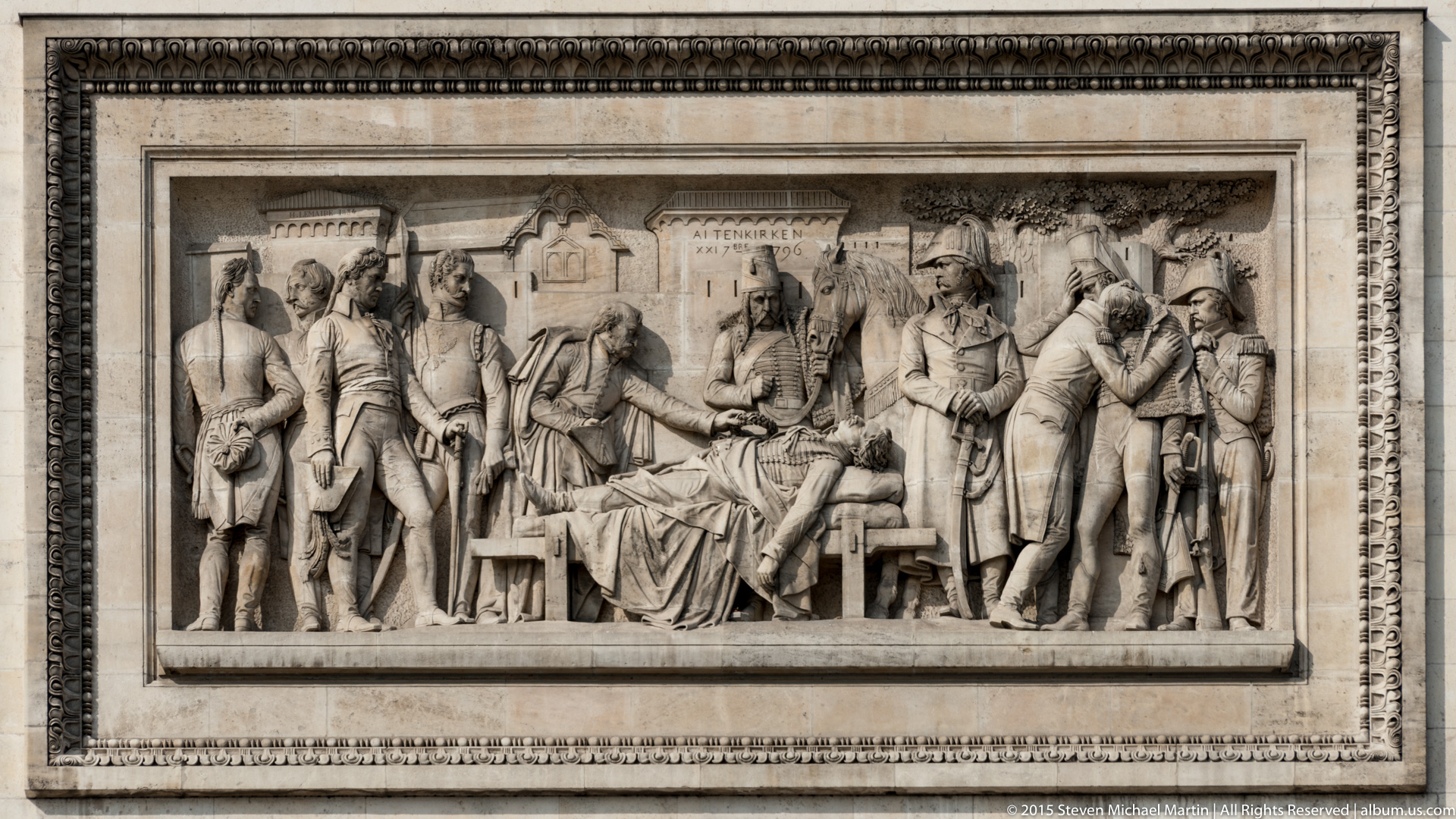
A rectangular bas-relief on the Arc de Triomphe presents a dense historical scene framed like a monumental stone picture. Uniformed and civilian figures gather around a seated central figure, with architectural forms and inscriptions embedded in the background. The shallow carving, tightly packed bodies, and formal framing distinguish this narrative panel from the much deeper sculptural groups mounted lower on the monument’s piers.
Caption
A rectangular bas-relief on the Arc de Triomphe presents a dense historical scene framed like a monumental stone picture. Uniformed and civilian figures gather around a seated central figure, with architectural forms and inscriptions embedded in the background. The shallow carving, tightly packed bodies, and formal framing distinguish this narrative panel from the much deeper sculptural groups mounted lower on the monument’s piers.

This framed bas-relief on the Arc de Triomphe compresses a military narrative into a shallow stone field crowded with soldiers, weapons, and overlapping bodies. The central figures are surrounded by a tightly organized procession of combatants, giving the panel a strongly horizontal rhythm. Its restrained projection and architectural border contrast with the freestanding depth and dramatic silhouettes of the monument’s larger pier sculptures.
Caption
This framed bas-relief on the Arc de Triomphe compresses a military narrative into a shallow stone field crowded with soldiers, weapons, and overlapping bodies. The central figures are surrounded by a tightly organized procession of combatants, giving the panel a strongly horizontal rhythm. Its restrained projection and architectural border contrast with the freestanding depth and dramatic silhouettes of the monument’s larger pier sculptures.
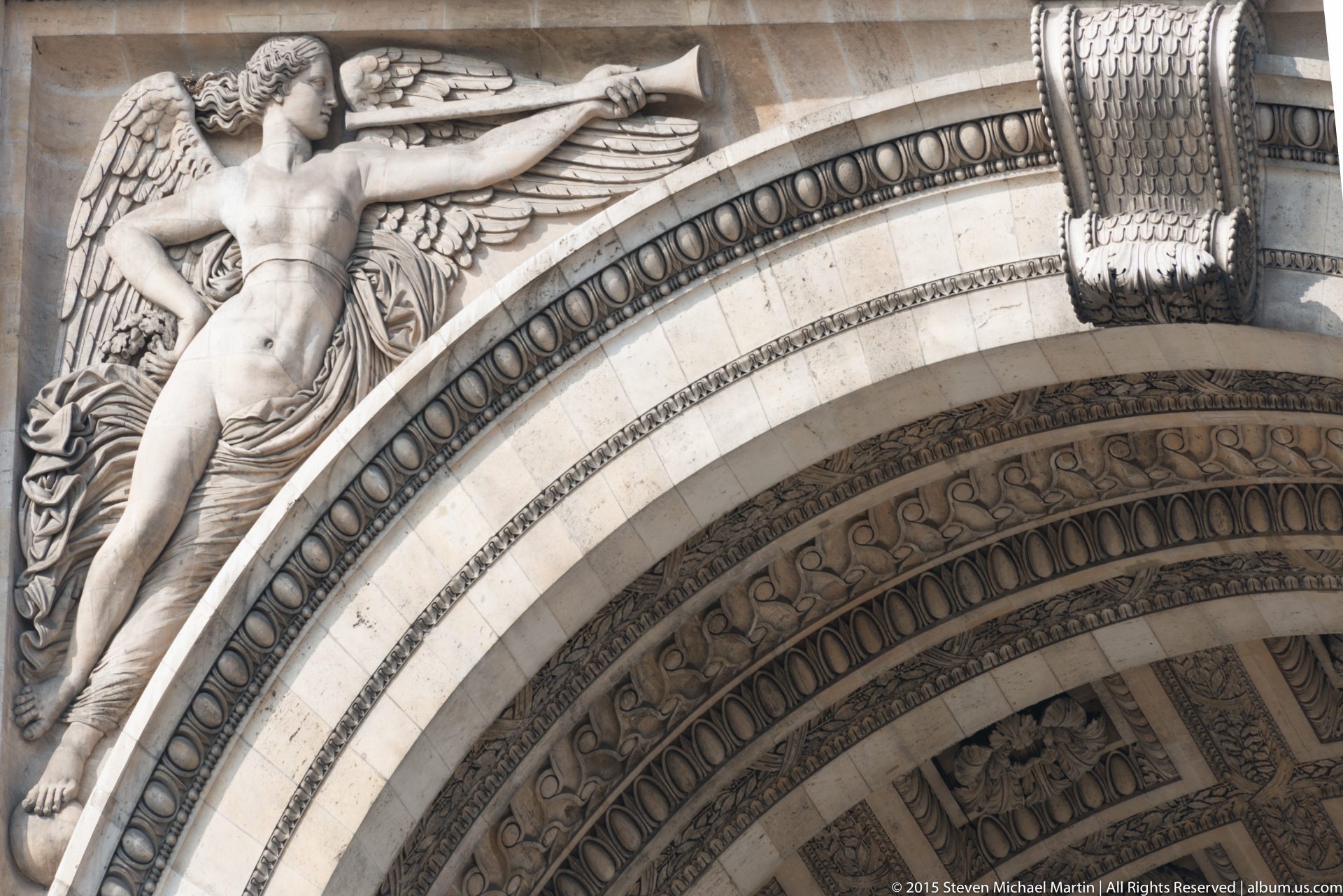
A close upward view isolates the Arc de Triomphe’s layered arch mouldings and adjoining sculptural decoration. Bands of geometric and vegetal ornament follow the curve of the opening, while part of a large carved figure enters from the upper edge. The tight framing reveals how repeated mouldings, bead-like motifs, and figurative sculpture are integrated into the monument’s limestone surface at a scale difficult to perceive from across the plaza.
Caption
A close upward view isolates the Arc de Triomphe’s layered arch mouldings and adjoining sculptural decoration. Bands of geometric and vegetal ornament follow the curve of the opening, while part of a large carved figure enters from the upper edge. The tight framing reveals how repeated mouldings, bead-like motifs, and figurative sculpture are integrated into the monument’s limestone surface at a scale difficult to perceive from across the plaza.

An oblique low-angle view turns the Arc de Triomphe’s underside into intersecting planes of stone, shadow, and sky. The coffered vault sweeps diagonally across the frame, while the pier and arch edges reveal the depth of the masonry construction. This off-center perspective emphasizes the monument as a three-dimensional structure rather than a frontal façade, with the open arch framing the surrounding daylight.
Caption
An oblique low-angle view turns the Arc de Triomphe’s underside into intersecting planes of stone, shadow, and sky. The coffered vault sweeps diagonally across the frame, while the pier and arch edges reveal the depth of the masonry construction. This off-center perspective emphasizes the monument as a three-dimensional structure rather than a frontal façade, with the open arch framing the surrounding daylight.

The underside of the Arc de Triomphe stretches horizontally across this wide low-angle view, with the coffered vault forming a patterned bridge between inscribed stone piers. Curving arch profiles frame a broad opening to the sky, while rows of names climb the pale masonry at both sides. The composition highlights the relationship between commemorative inscription and architectural ornament within the monument’s passage.
Caption
The underside of the Arc de Triomphe stretches horizontally across this wide low-angle view, with the coffered vault forming a patterned bridge between inscribed stone piers. Curving arch profiles frame a broad opening to the sky, while rows of names climb the pale masonry at both sides. The composition highlights the relationship between commemorative inscription and architectural ornament within the monument’s passage.

A steep vertical view through the Arc de Triomphe places its inscribed inner piers on either side of the vaulted opening. Columns of carved names rise toward the coffered arch, whose repeated square panels recede overhead toward a patch of blue sky. The strong upward perspective turns the commemorative surfaces into towering walls and emphasizes how closely text and structure are joined in the monument’s design.
Caption
A steep vertical view through the Arc de Triomphe places its inscribed inner piers on either side of the vaulted opening. Columns of carved names rise toward the coffered arch, whose repeated square panels recede overhead toward a patch of blue sky. The strong upward perspective turns the commemorative surfaces into towering walls and emphasizes how closely text and structure are joined in the monument’s design.

Seen almost frontally from below, this monumental high-relief group by Antoine Étex fills the pier with overlapping figures, expressive gestures, and deeply carved drapery. The central standing figure dominates a surrounding cluster of adults and children, while projecting limbs and folds create strong shadows in the midday light. The tighter framing gives close attention to the sculptural storytelling rather than the overall architecture of the arch.
Caption
Seen almost frontally from below, this monumental high-relief group by Antoine Étex fills the pier with overlapping figures, expressive gestures, and deeply carved drapery. The central standing figure dominates a surrounding cluster of adults and children, while projecting limbs and folds create strong shadows in the midday light. The tighter framing gives close attention to the sculptural storytelling rather than the overall architecture of the arch.