Banff Lake Minnewanka Introduction
Lake Minnewanka stretches deep into the mountains northeast of Banff, its long blue-green waters framed by the steep slopes of the Palliser and Fairholme ranges. Fed by mountain streams and the Cascade River, the lake occupies a broad valley that feels markedly wilder than its proximity to Banff might suggest. From the shoreline, the view follows the water toward distant peaks and the narrowing passage of Devil’s Gap, while trails climb above the lake and trace its rocky margins through forests of lodgepole pine.
The landscape also holds one of the deepest human histories in Banff National Park. People have hunted and camped along these shores for more than 10,000 years, and the Stoney Nakoda knew the lake as Minn-waki, or “Lake of the Spirits.” European settlement brought a different chapter: by the late nineteenth century, Minnewanka Landing had developed into a small resort community with hotels, cottages, restaurants, wharves, and excursion boats. Successive dams altered the shoreline, culminating in the construction of the present hydroelectric dam in 1941. Rising waters submerged Minnewanka Landing, leaving the remains of the former townsite beneath the lake, where they can still be explored by divers.
Today, Lake Minnewanka combines that layered history with one of Banff’s grandest mountain settings. Roads and walking paths provide easy access to the western end of the lake, but the reservoir quickly extends beyond the developed shoreline into a landscape dominated by water, forest, and bare limestone ridges. Boats crossing the lake emphasize its scale, while the changing light continually reshapes the surrounding mountains in the water. More than simply another of Banff’s celebrated lakes, Minnewanka is a place where Indigenous history, early tourism, twentieth-century engineering, and the enduring presence of the Canadian Rockies remain unusually visible within a single landscape.
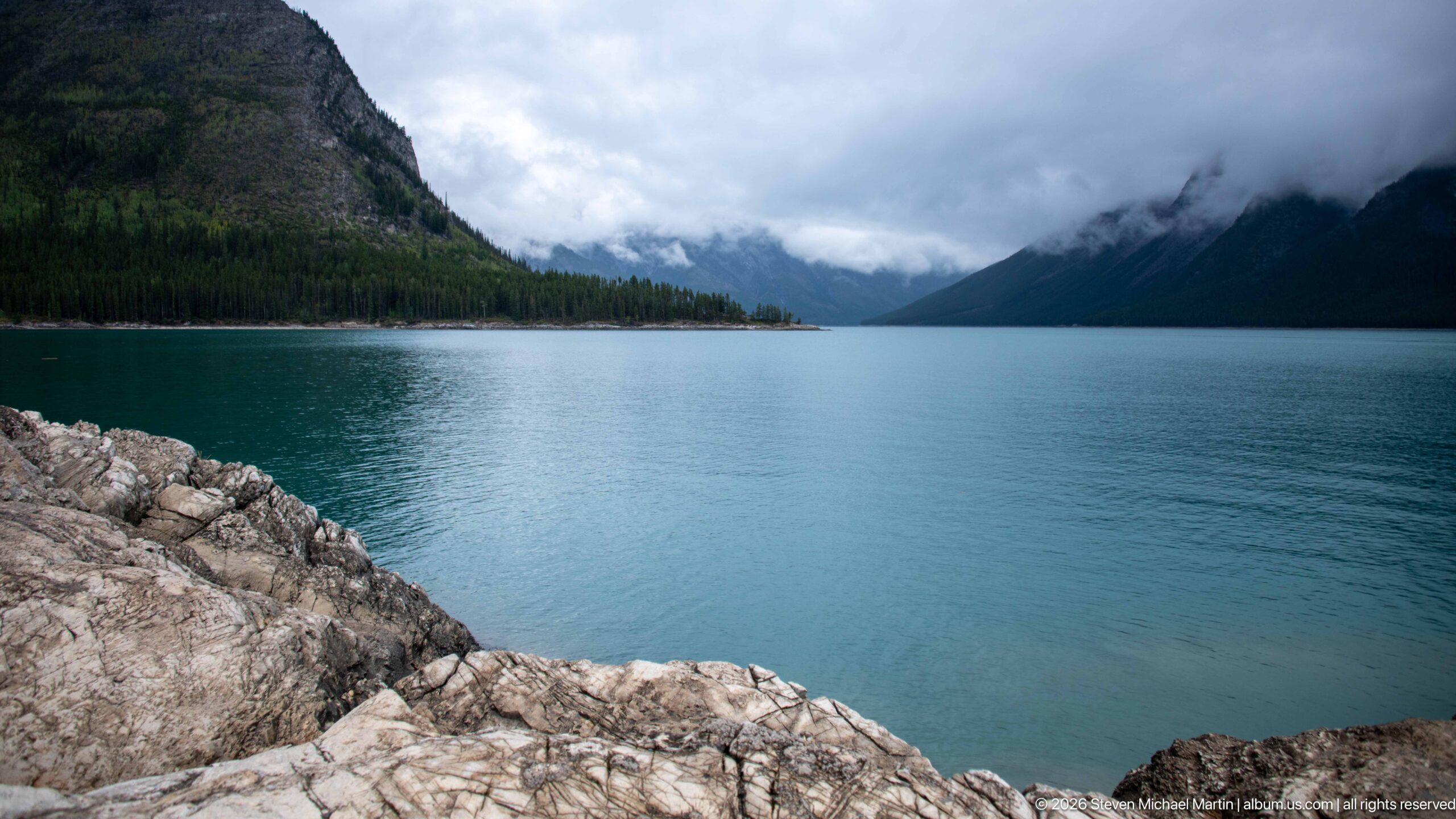
Lake Minnewanka fills the frame from a pale rocky foreground to a distant, cloud-filled mountain corridor. Forested slopes enclose the long reach of blue-green water, while the subdued sky and mist flatten the far peaks and emphasize the lake’s length and mountain setting.
Caption
Lake Minnewanka fills the frame from a pale rocky foreground to a distant, cloud-filled mountain corridor. Forested slopes enclose the long reach of blue-green water, while the subdued sky and mist flatten the far peaks and emphasize the lake’s length and mountain setting.
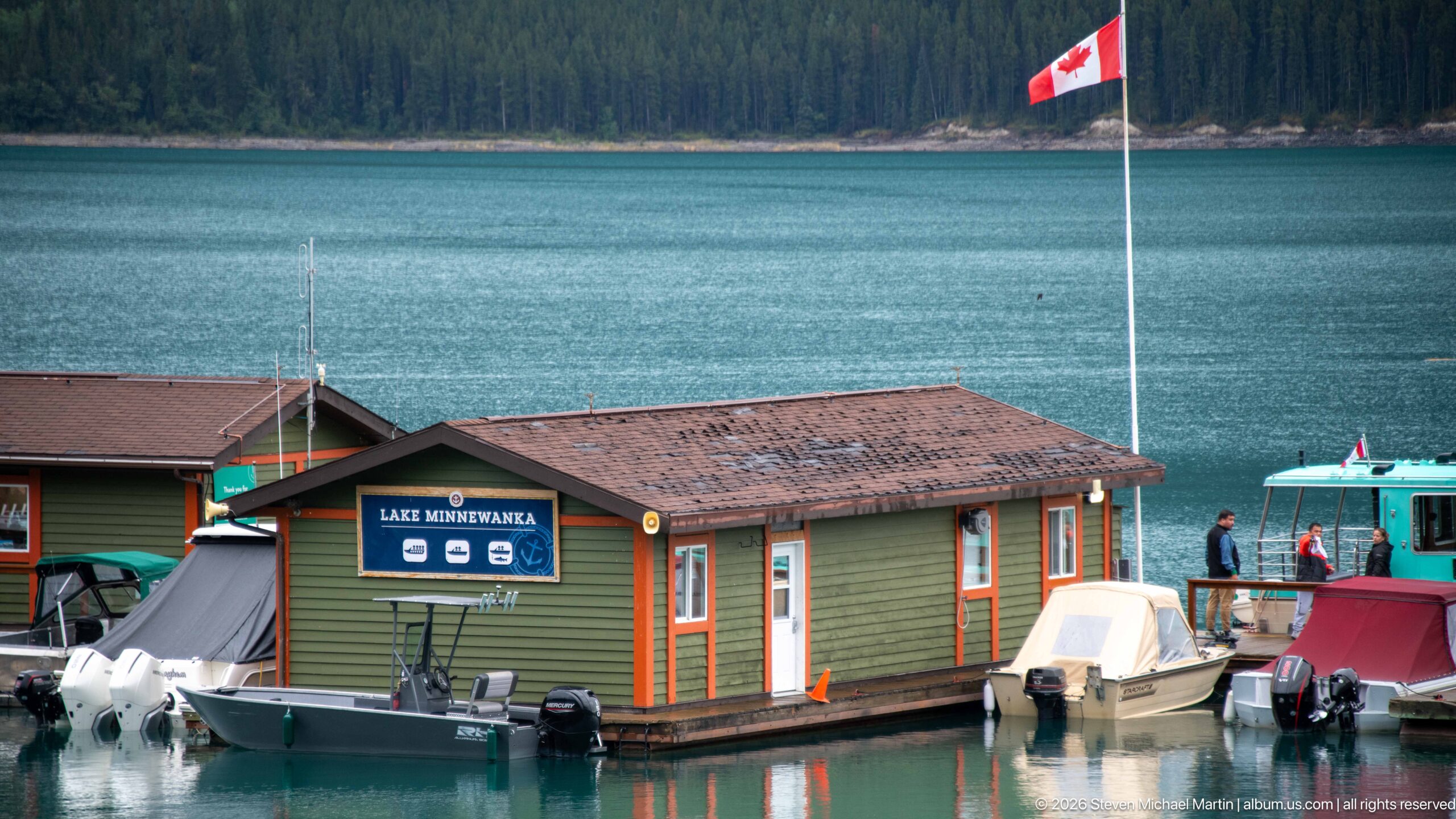
A compact marina building and moored motorboats sit directly against the turquoise water of Lake Minnewanka. A Canadian flag rises above the dock complex, while a tour boat is partly visible to the right and forest lines the opposite shore. The close waterfront view emphasizes the working infrastructure that supports boating and sightseeing on the reservoir.
Caption
A compact marina building and moored motorboats sit directly against the turquoise water of Lake Minnewanka. A Canadian flag rises above the dock complex, while a tour boat is partly visible to the right and forest lines the opposite shore. The close waterfront view emphasizes the working infrastructure that supports boating and sightseeing on the reservoir.
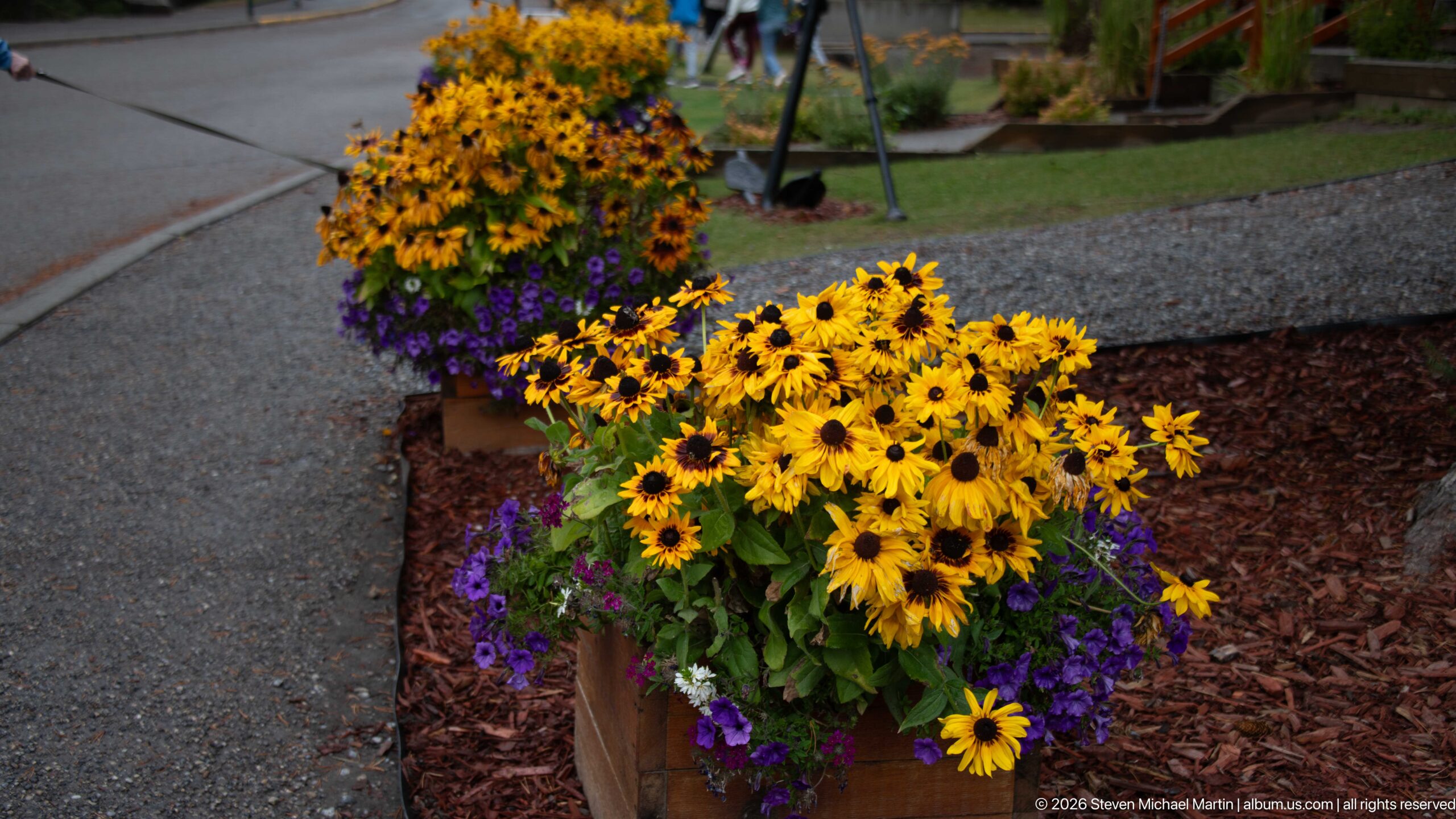
Yellow black-eyed Susans spill from a wooden planter above clusters of purple flowers in the Lake Minnewanka visitor area. The close composition records the ornamental landscaping used around the developed lakeshore facilities, with another planter and the anchor display softly visible behind.
Caption
Yellow black-eyed Susans spill from a wooden planter above clusters of purple flowers in the Lake Minnewanka visitor area. The close composition records the ornamental landscaping used around the developed lakeshore facilities, with another planter and the anchor display softly visible behind.
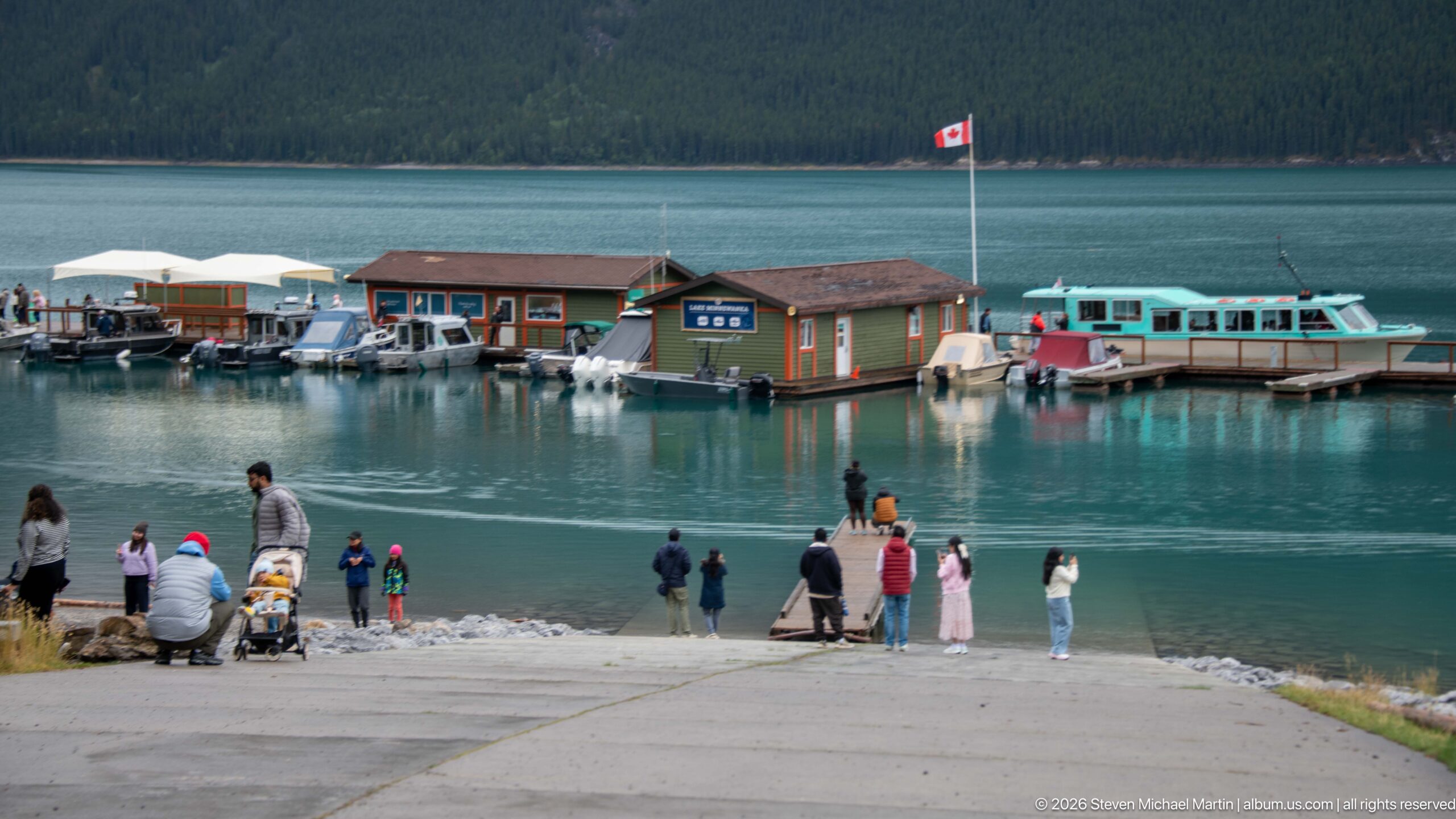
Visitors gather along the sloping public shoreline at Lake Minnewanka while the marina, tour boats, and Canadian flag occupy the water beyond. Families and small groups stand at the water's edge, giving the scene a human scale and showing how the developed western shore functions as both a boating hub and an accessible lakeside recreation area.
Caption
Visitors gather along the sloping public shoreline at Lake Minnewanka while the marina, tour boats, and Canadian flag occupy the water beyond. Families and small groups stand at the water's edge, giving the scene a human scale and showing how the developed western shore functions as both a boating hub and an accessible lakeside recreation area.
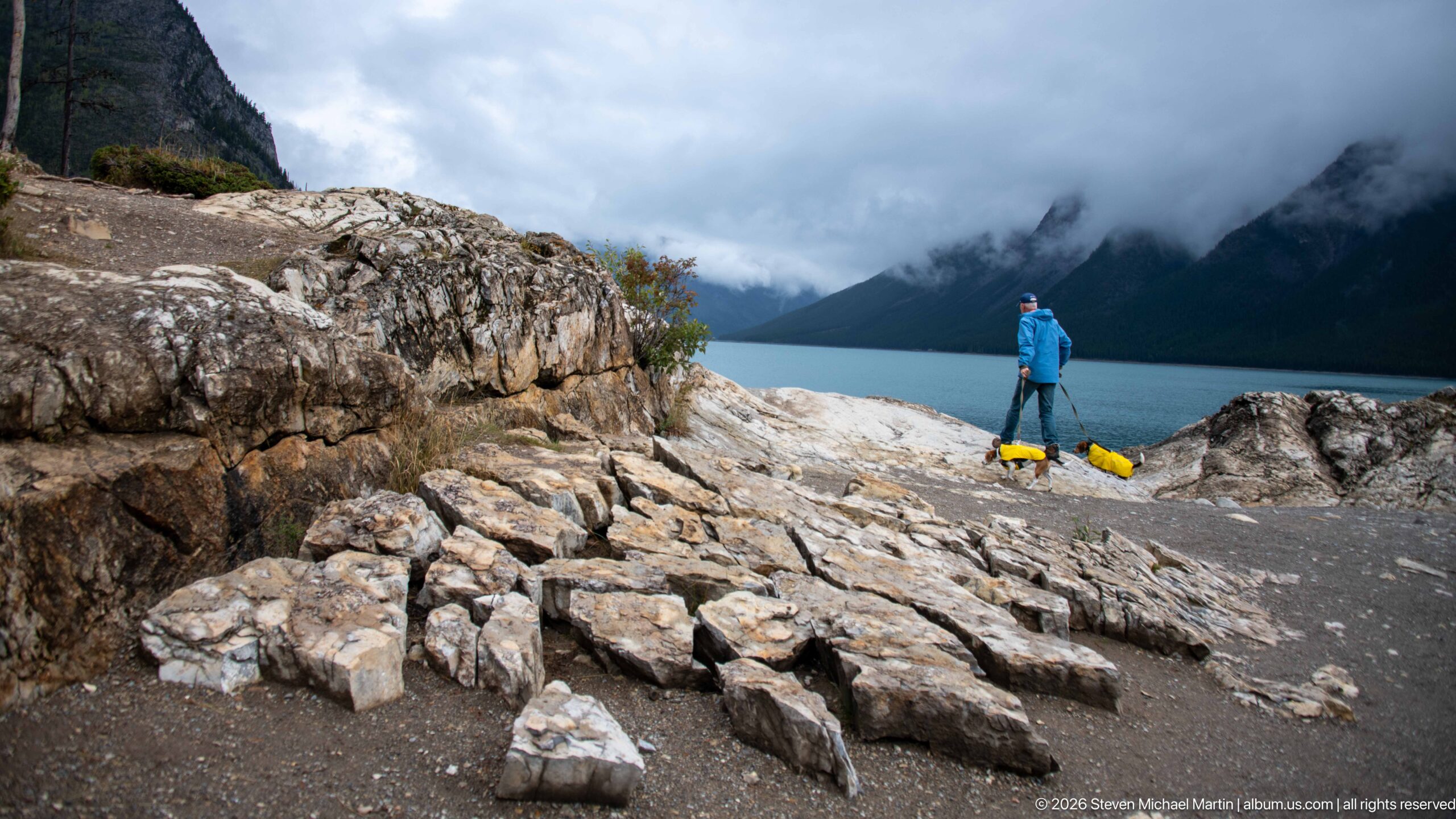
Broken rock ledges dominate this wider shoreline view at Lake Minnewanka, with a visitor and two yellow-coated dogs reduced to small figures near the water. The composition shifts attention from the portrait session to the rough, fractured terrain along the lake’s accessible edge.
Caption
Broken rock ledges dominate this wider shoreline view at Lake Minnewanka, with a visitor and two yellow-coated dogs reduced to small figures near the water. The composition shifts attention from the portrait session to the rough, fractured terrain along the lake’s accessible edge.
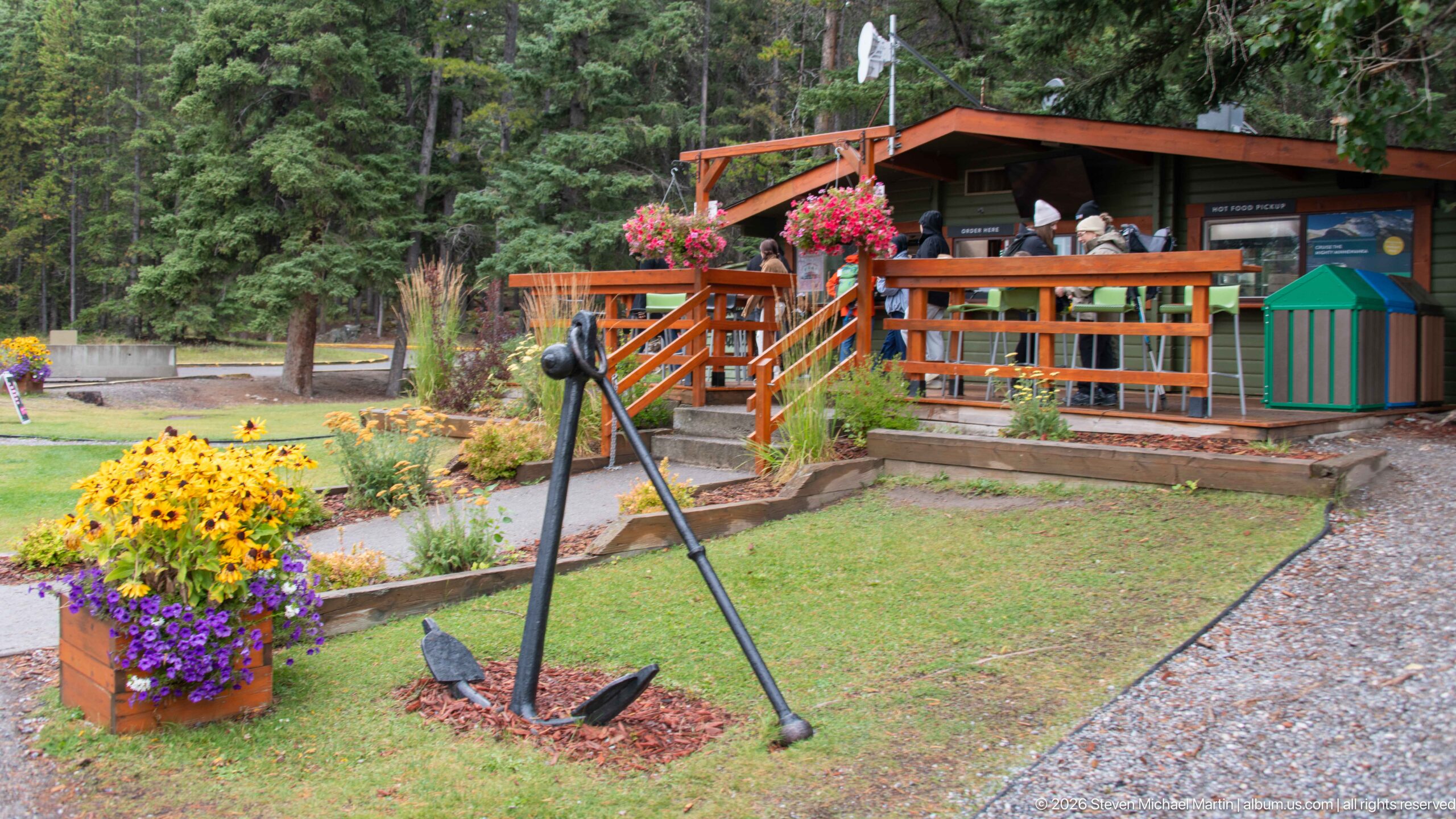
A landscaped corner of the Lake Minnewanka visitor area combines a rustic service building with bright flower planters and a large decorative anchor. The nautical object reinforces the lake’s boating culture, while the carefully maintained beds contrast with the surrounding conifer forest.
Caption
A landscaped corner of the Lake Minnewanka visitor area combines a rustic service building with bright flower planters and a large decorative anchor. The nautical object reinforces the lake’s boating culture, while the carefully maintained beds contrast with the surrounding conifer forest.
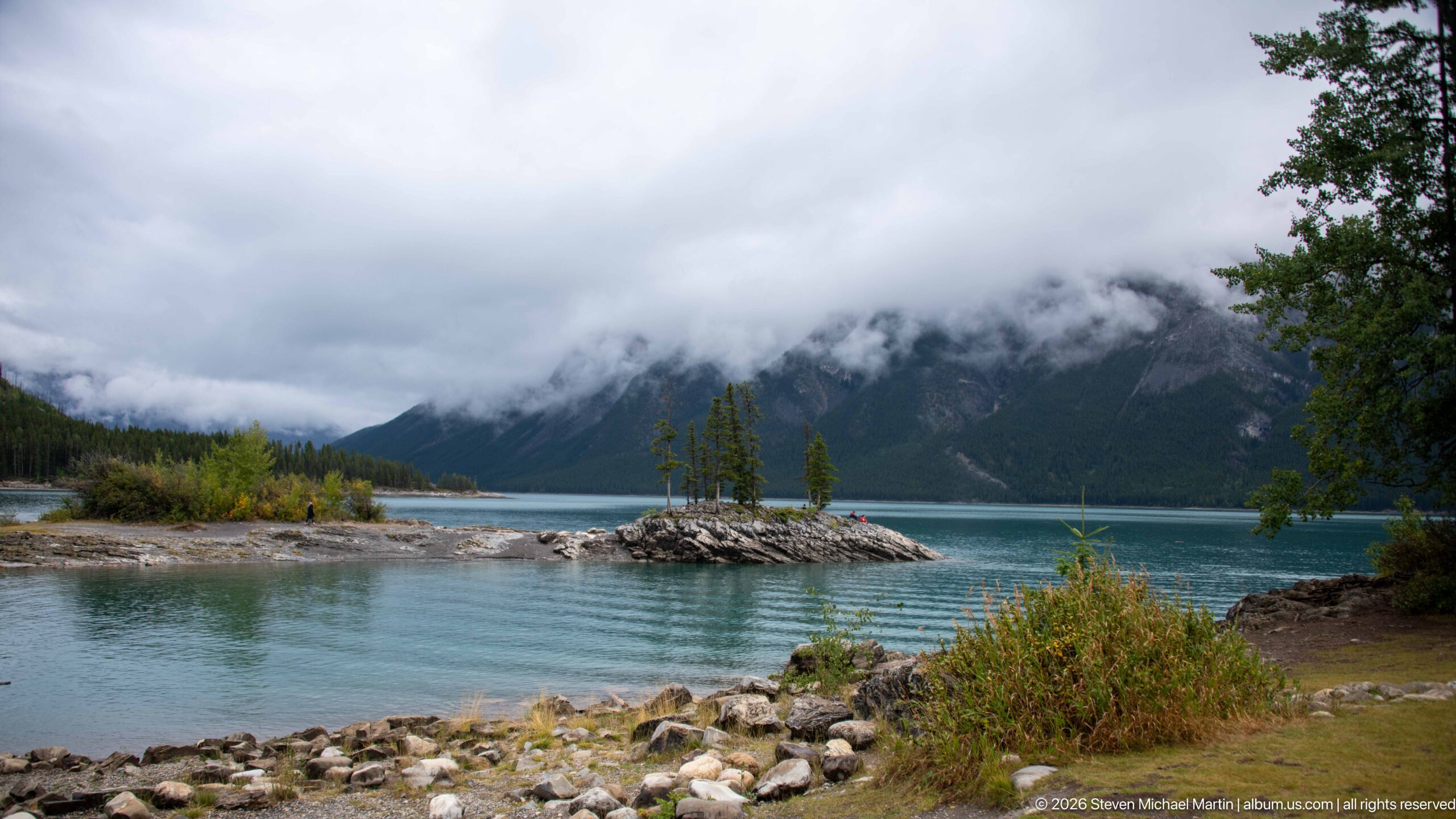
From the rocky shore, the view opens across calm Lake Minnewanka toward low conifer-covered islets and a mountain wall wrapped in cloud. Foreground stones and shrubs frame the water, giving the scene a layered progression from shoreline vegetation to lake, islands, and misted peaks.
Caption
From the rocky shore, the view opens across calm Lake Minnewanka toward low conifer-covered islets and a mountain wall wrapped in cloud. Foreground stones and shrubs frame the water, giving the scene a layered progression from shoreline vegetation to lake, islands, and misted peaks.
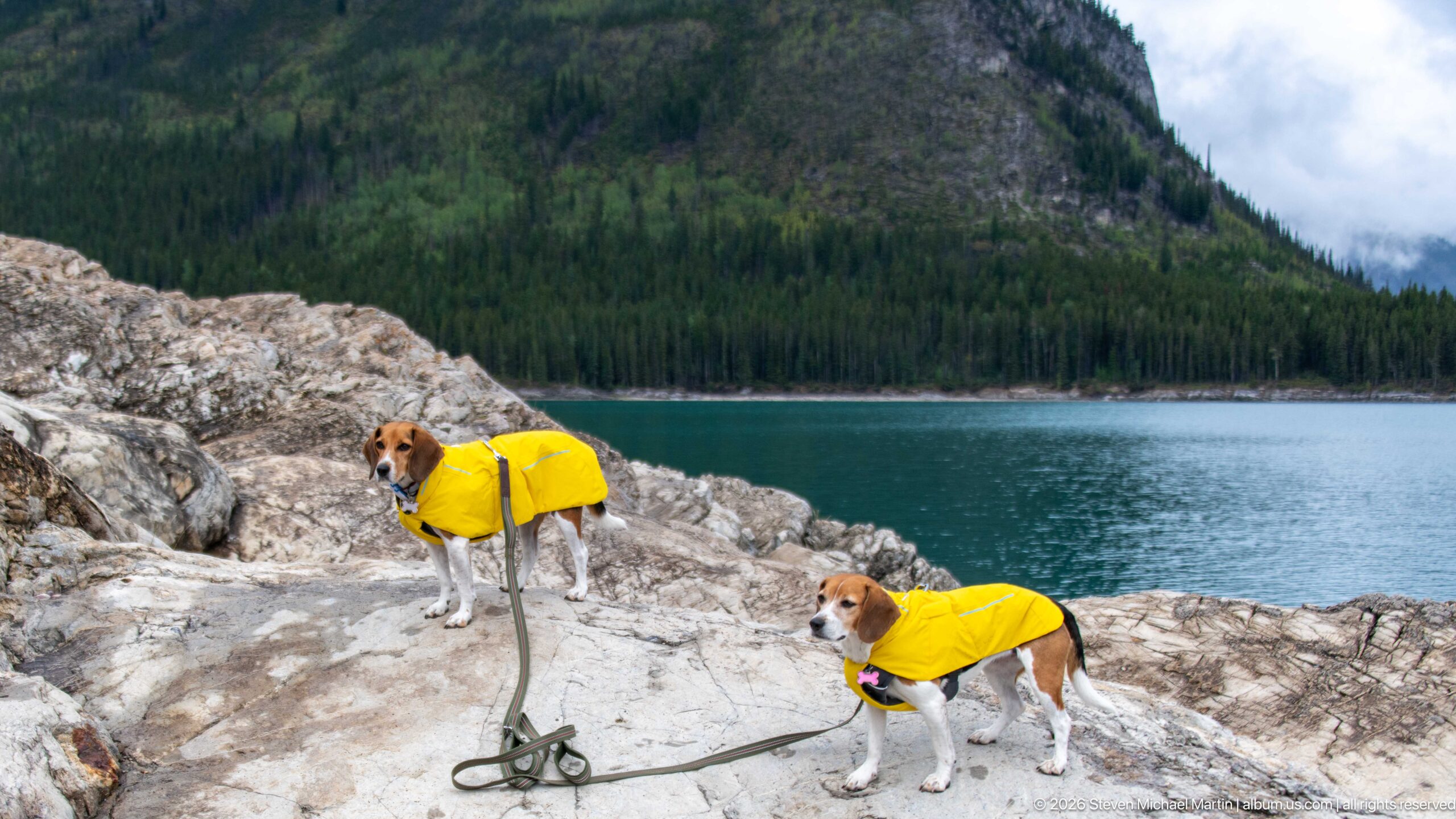
Two beagles stand on a pale lakeside rock shelf in bright yellow raincoats, facing the camera with Lake Minnewanka behind them. The closer composition gives the dogs greater prominence while retaining the turquoise water, forested slope, and overcast mountain setting.
Caption
Two beagles stand on a pale lakeside rock shelf in bright yellow raincoats, facing the camera with Lake Minnewanka behind them. The closer composition gives the dogs greater prominence while retaining the turquoise water, forested slope, and overcast mountain setting.
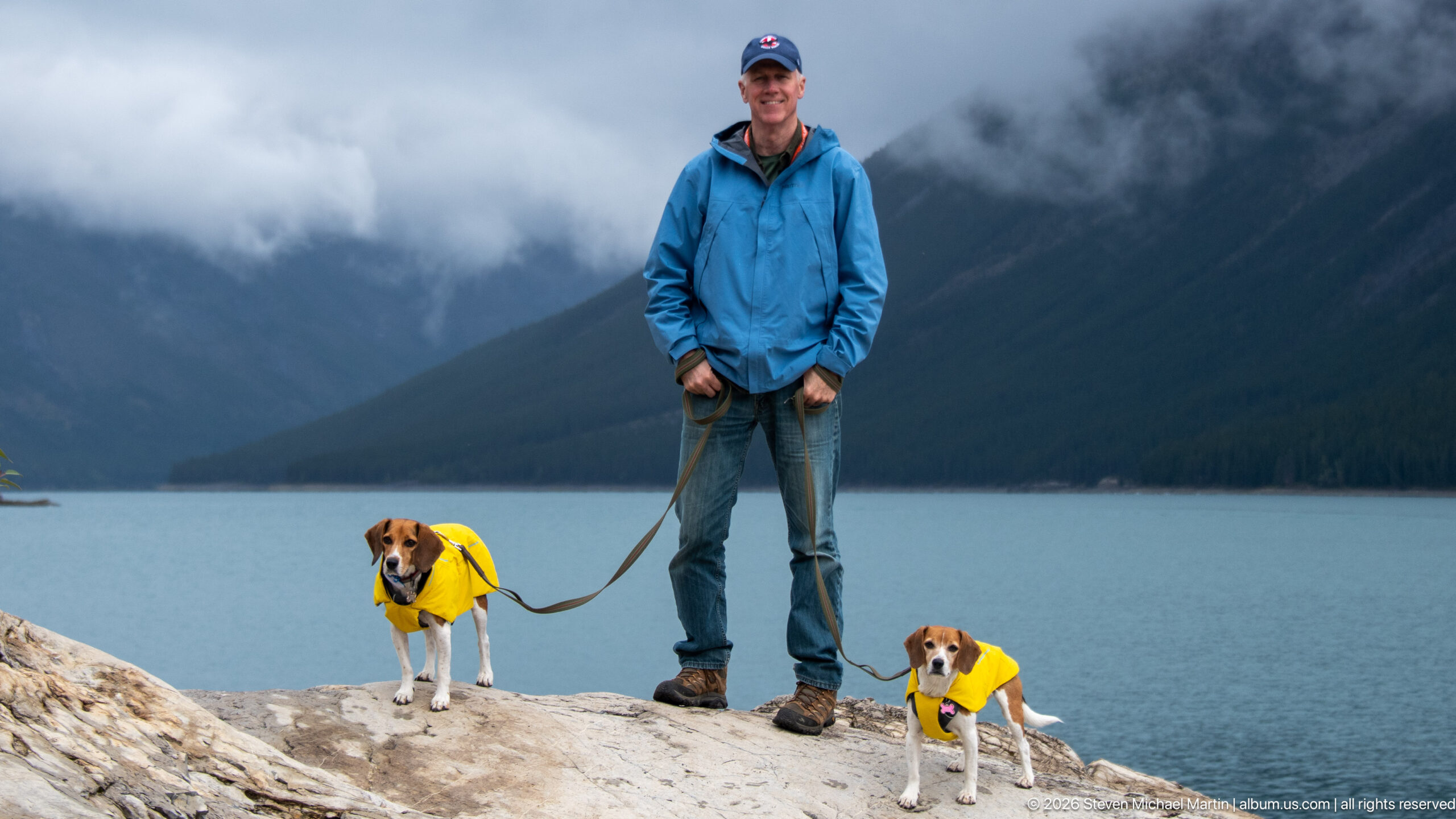
A visitor stands on the pale rock shoreline with two leashed beagles in yellow raincoats, Lake Minnewanka and cloud-wrapped mountains filling the background. The posed group portrait places the human and canine travelers within the scale of the broad mountain lake.
Caption
A visitor stands on the pale rock shoreline with two leashed beagles in yellow raincoats, Lake Minnewanka and cloud-wrapped mountains filling the background. The posed group portrait places the human and canine travelers within the scale of the broad mountain lake.
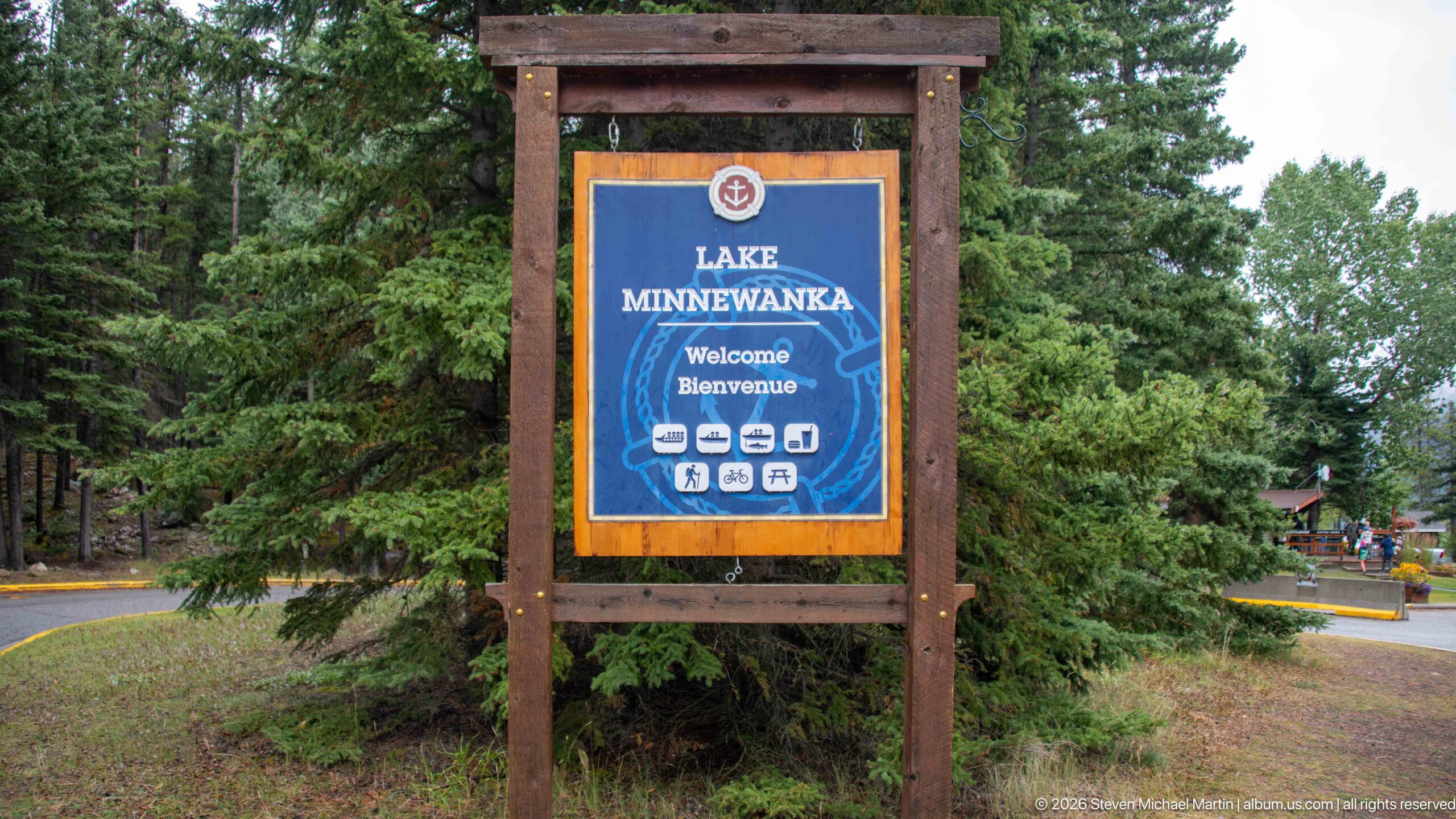
A timber-framed Parks Canada welcome sign marks the visitor area at Lake Minnewanka. Set among conifers beside the access road, the bilingual sign establishes the destination and identifies visitor services with a row of pictograms, introducing the developed western end of the lake.
Caption
A timber-framed Parks Canada welcome sign marks the visitor area at Lake Minnewanka. Set among conifers beside the access road, the bilingual sign establishes the destination and identifies visitor services with a row of pictograms, introducing the developed western end of the lake.
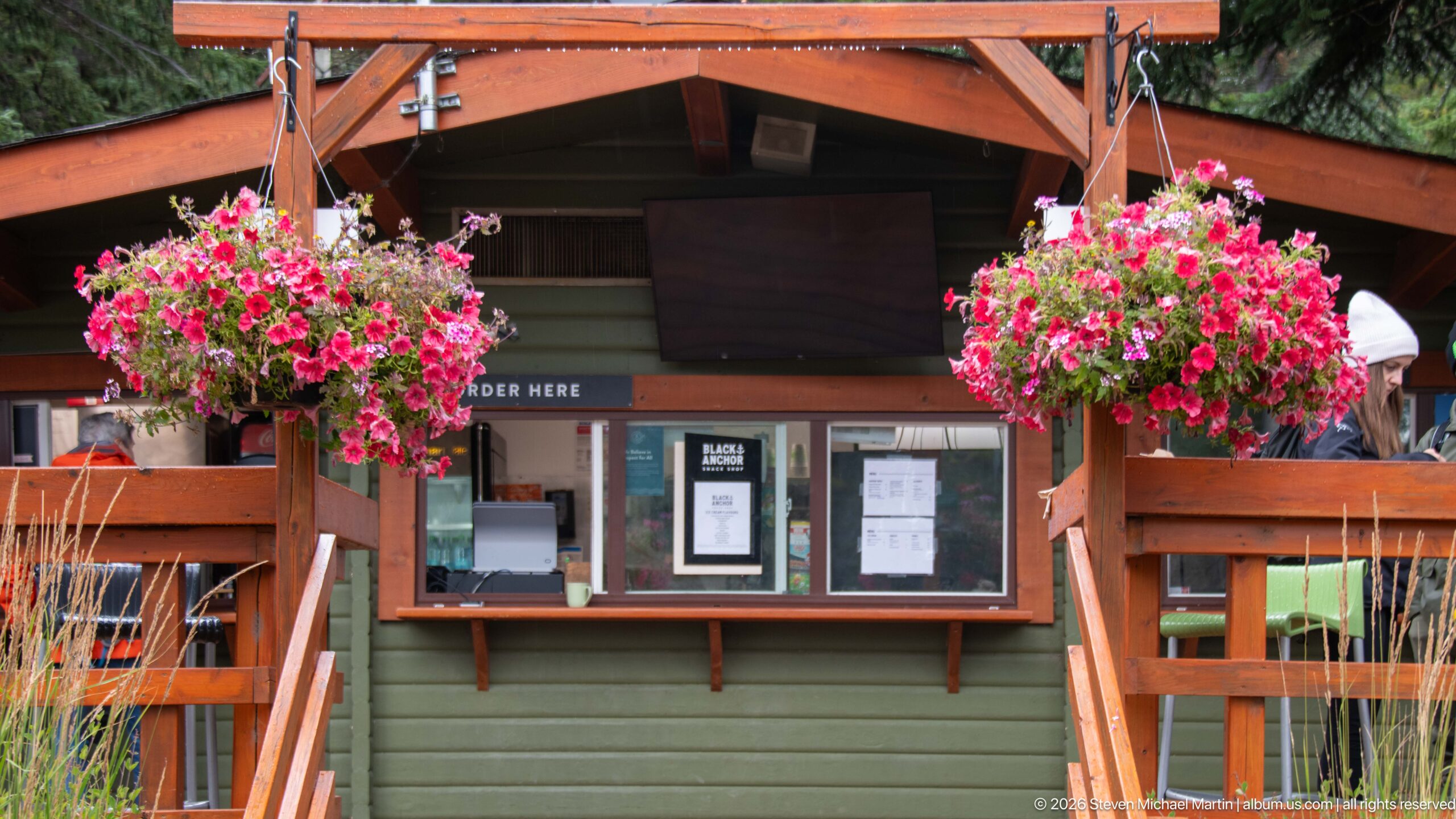
Hanging baskets of vivid flowers frame a small timber service kiosk at Lake Minnewanka. The open counter, posted notices, and order window show the visitor-oriented facilities near the lakeshore, while the rustic wood construction fits the recreational setting of Banff National Park.
Caption
Hanging baskets of vivid flowers frame a small timber service kiosk at Lake Minnewanka. The open counter, posted notices, and order window show the visitor-oriented facilities near the lakeshore, while the rustic wood construction fits the recreational setting of Banff National Park.
White Lake Minnewanka lettering and a green tree emblem appear across the dark side panel of a service vehicle. The close view isolates the destination branding from the broader landscape and records the visual identity used around the lake’s developed visitor facilities.
Caption
White Lake Minnewanka lettering and a green tree emblem appear across the dark side panel of a service vehicle. The close view isolates the destination branding from the broader landscape and records the visual identity used around the lake’s developed visitor facilities.
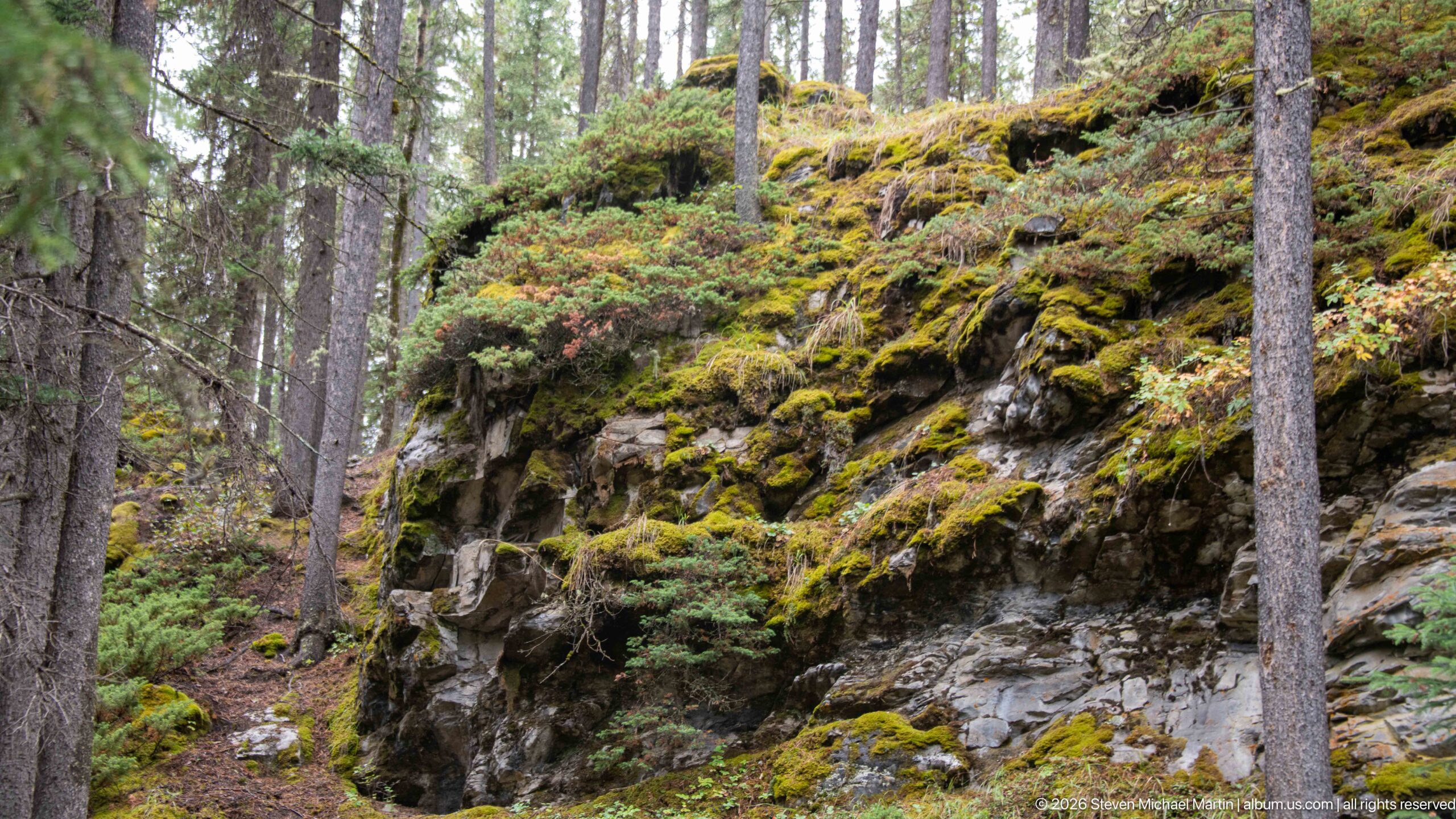
A broken rock outcrop rises through the conifer forest near Lake Minnewanka, its ledges softened by mosses, low shrubs, and groundcover. The exposed stone and thin forest soil reveal the rugged substrate beneath the otherwise densely vegetated lakeshore landscape.
Caption
A broken rock outcrop rises through the conifer forest near Lake Minnewanka, its ledges softened by mosses, low shrubs, and groundcover. The exposed stone and thin forest soil reveal the rugged substrate beneath the otherwise densely vegetated lakeshore landscape.
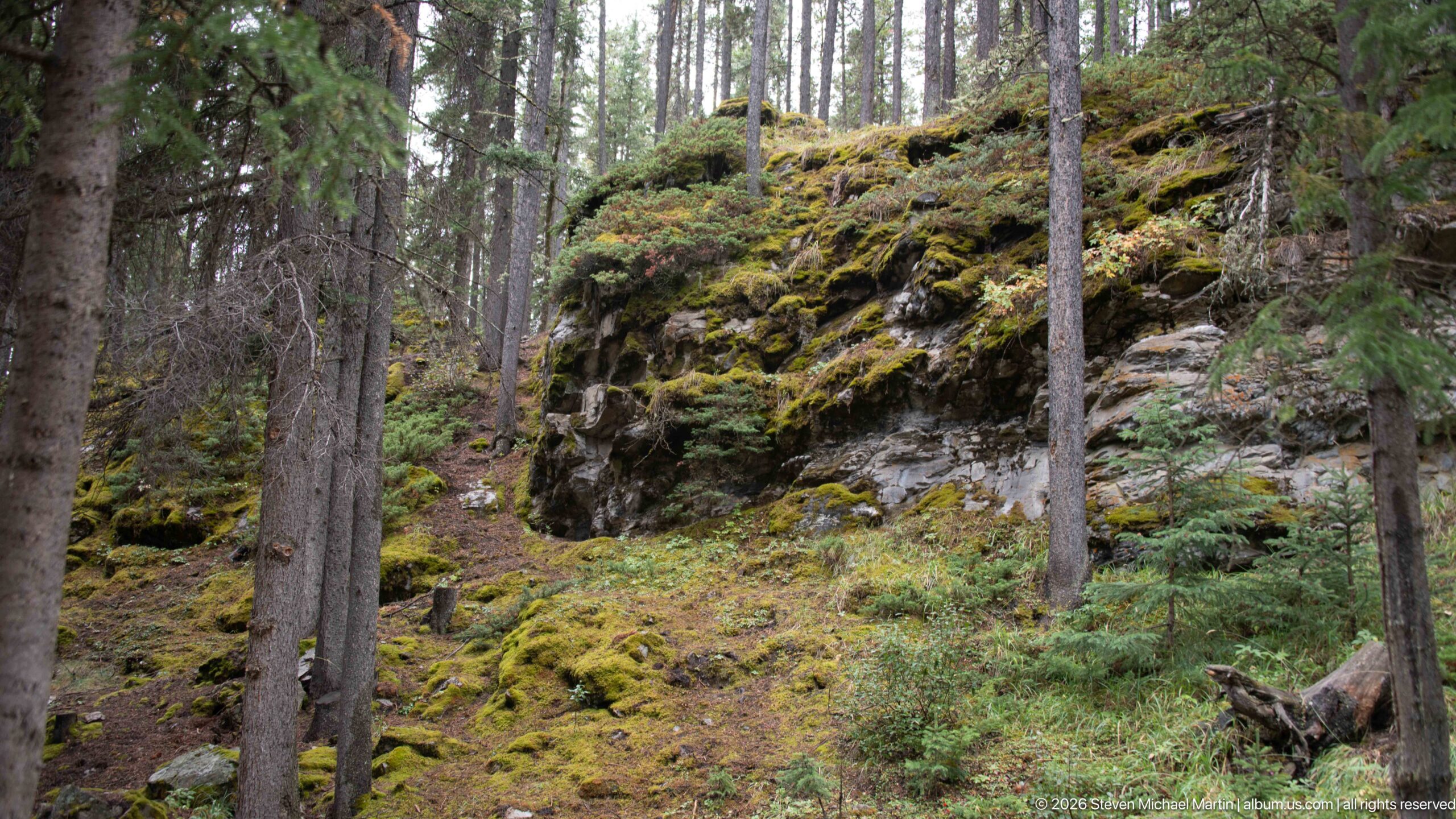
A larger view of the forest outcrop shows layered, fractured stone forming a low escarpment beneath tall conifers. Moss blankets much of the rock and adjacent ground, while a narrow opening at the base emphasizes how vegetation occupies cracks, shelves, and pockets of shallow soil.
Caption
A larger view of the forest outcrop shows layered, fractured stone forming a low escarpment beneath tall conifers. Moss blankets much of the rock and adjacent ground, while a narrow opening at the base emphasizes how vegetation occupies cracks, shelves, and pockets of shallow soil.
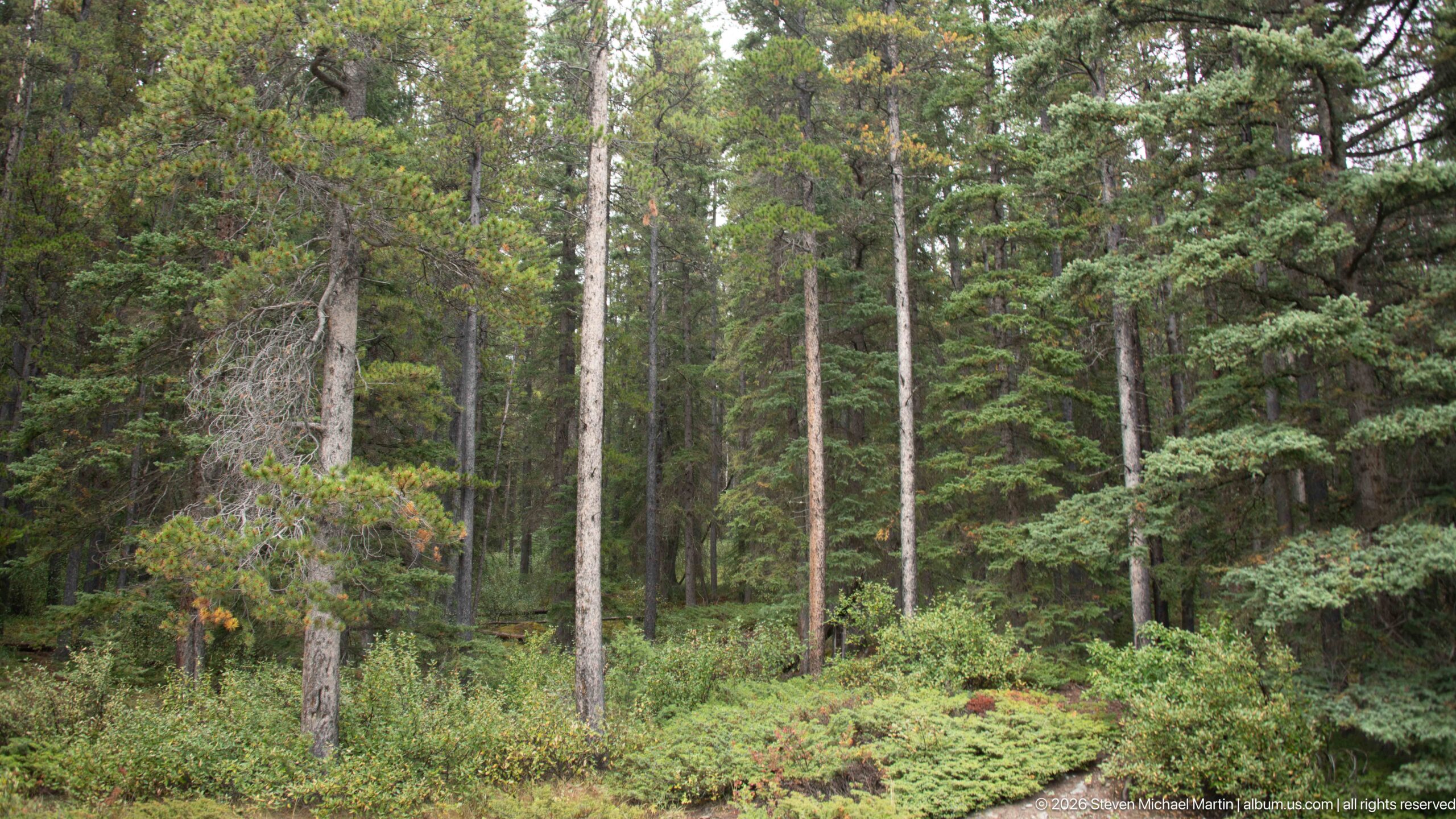
Mixed-height conifers and dense understory fill the forest near Lake Minnewanka. Straight trunks rise above low shrubs and mossy ground, presenting the sheltered woodland that borders sections of the lakeshore and separates developed visitor areas from the water.
Caption
Mixed-height conifers and dense understory fill the forest near Lake Minnewanka. Straight trunks rise above low shrubs and mossy ground, presenting the sheltered woodland that borders sections of the lakeshore and separates developed visitor areas from the water.
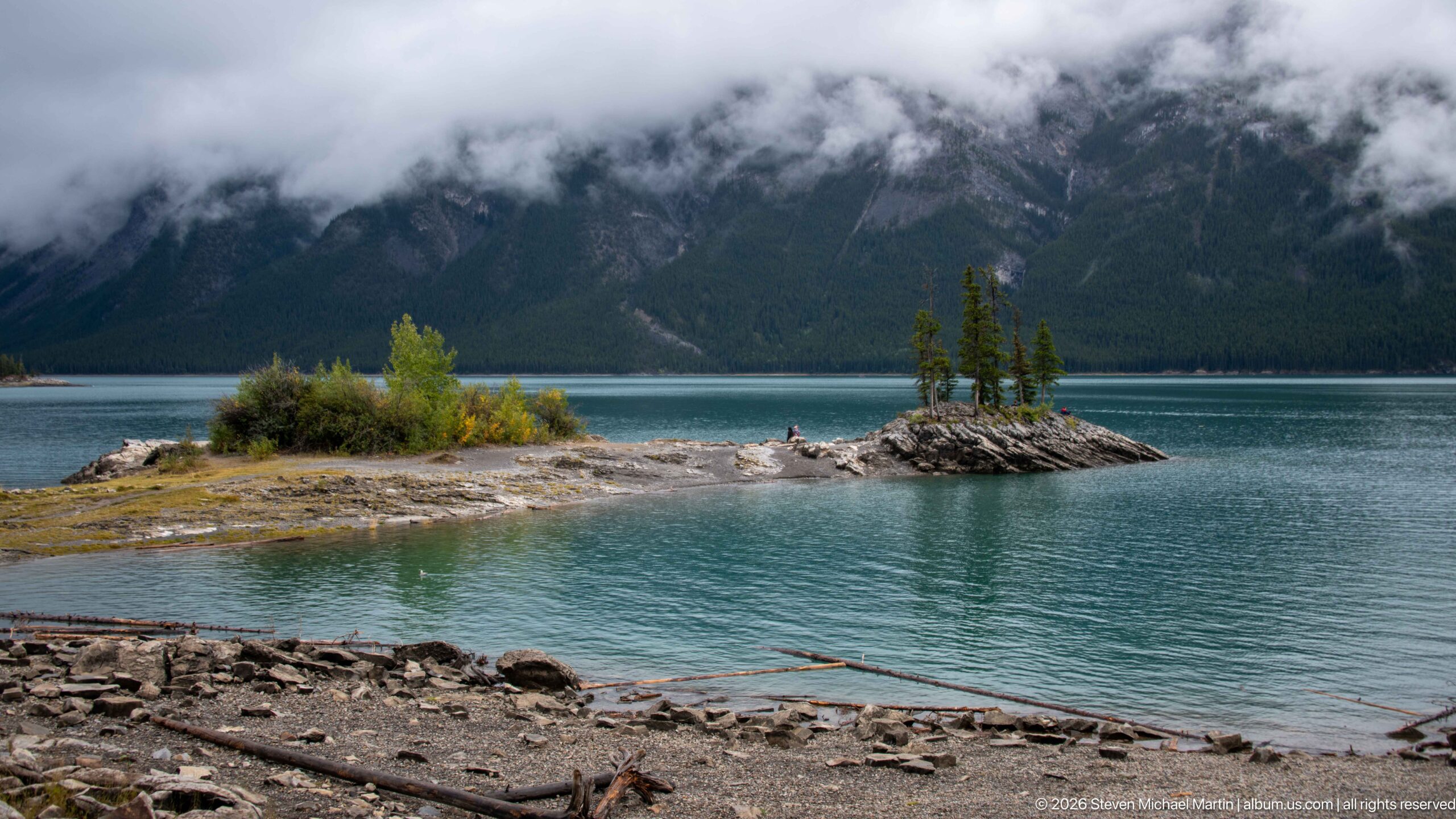
Small rocky islets punctuate the turquoise water of Lake Minnewanka beneath mountains partly erased by low cloud. Sparse conifers cling to the exposed stone, creating an intimate foreground against the broad, mist-darkened slopes on the opposite shore.
Caption
Small rocky islets punctuate the turquoise water of Lake Minnewanka beneath mountains partly erased by low cloud. Sparse conifers cling to the exposed stone, creating an intimate foreground against the broad, mist-darkened slopes on the opposite shore.
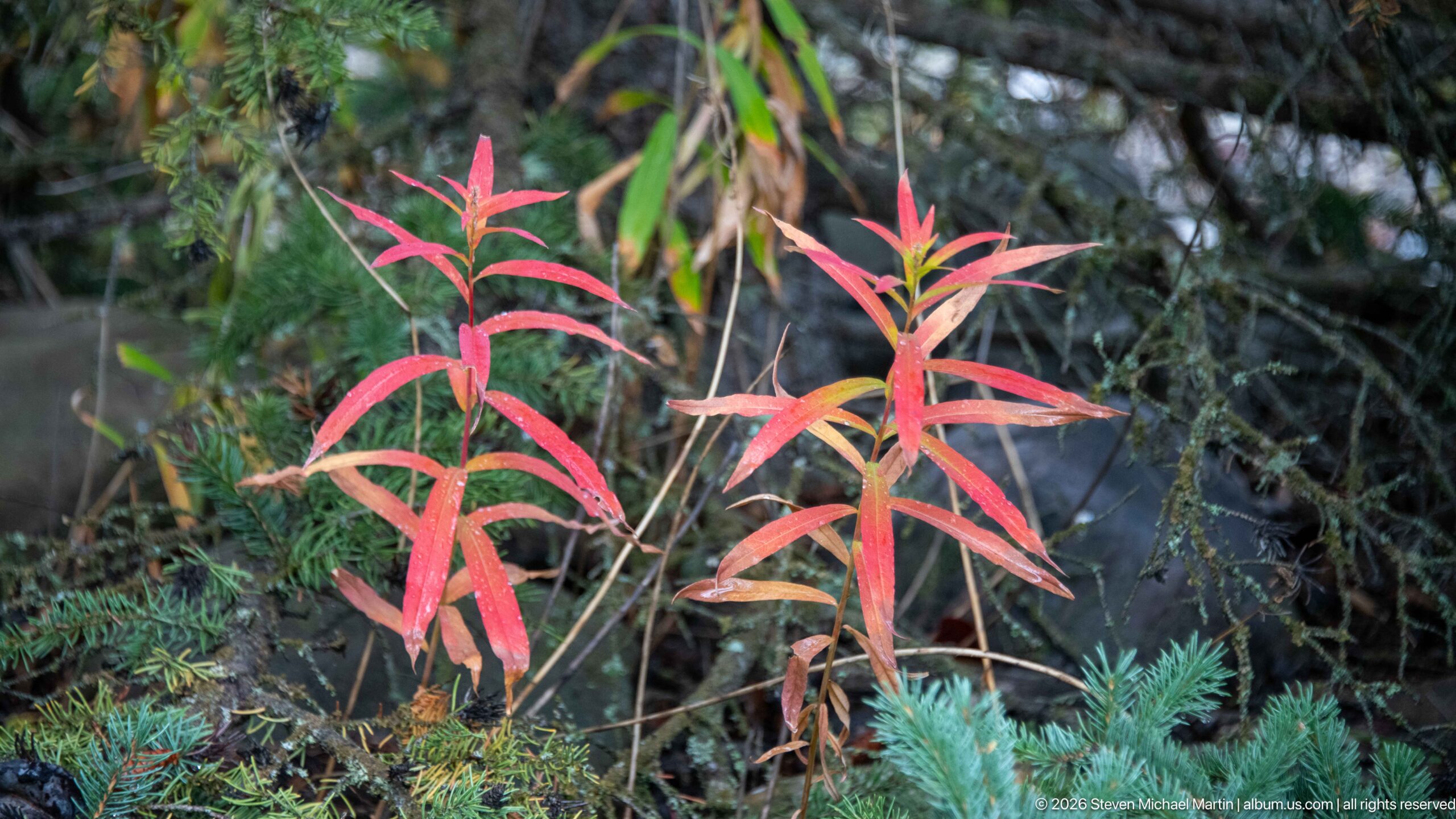
Slender leaves turn vivid red and orange among evergreen branches near Lake Minnewanka, providing a close seasonal detail within the predominantly coniferous landscape. The isolated stems show the onset of autumn color at understory level rather than in the forest canopy.
Caption
Slender leaves turn vivid red and orange among evergreen branches near Lake Minnewanka, providing a close seasonal detail within the predominantly coniferous landscape. The isolated stems show the onset of autumn color at understory level rather than in the forest canopy.
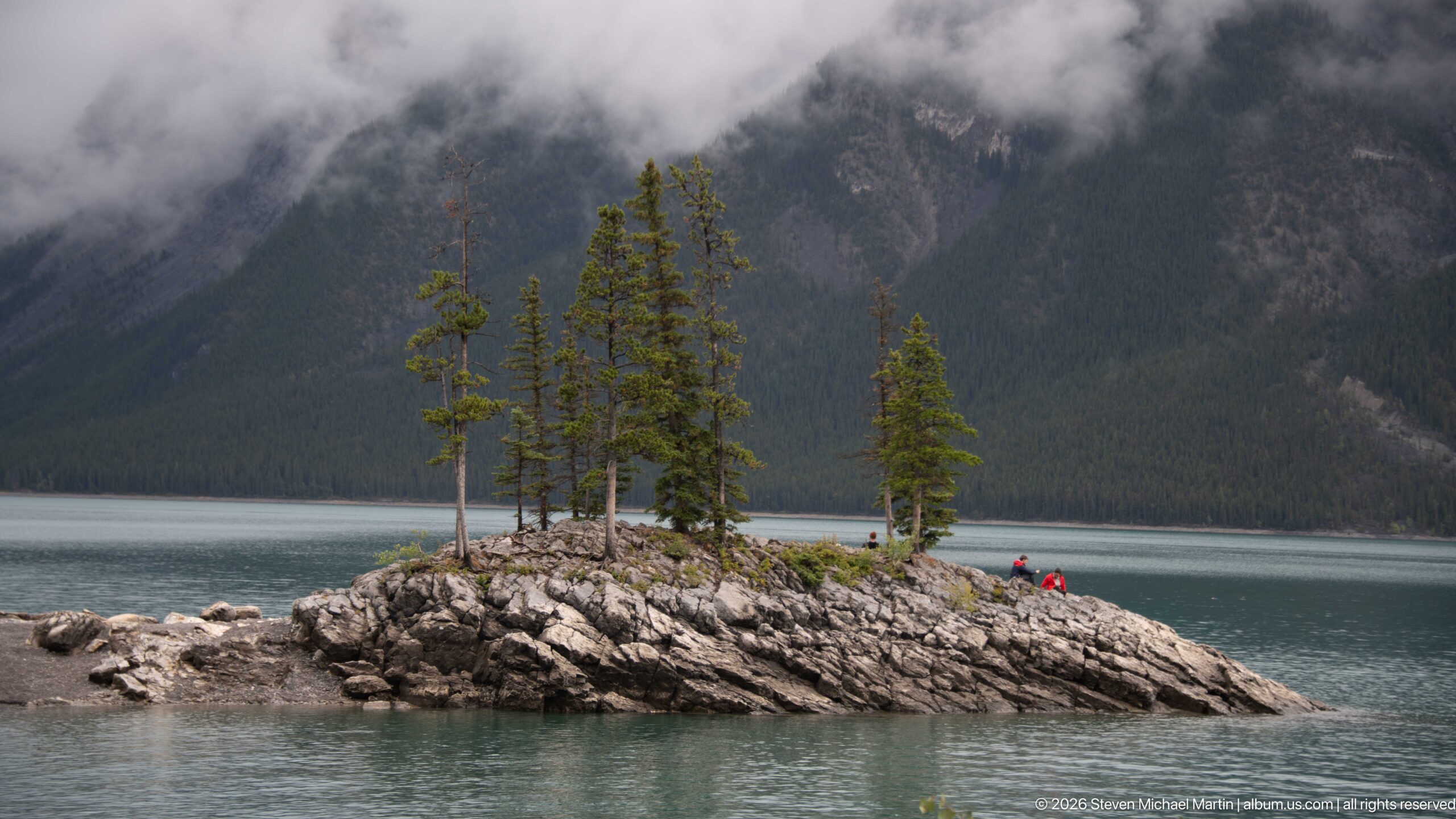
A narrow limestone islet rises just above Lake Minnewanka, supporting a small stand of conifers despite its exposed, rocky surface. Figures at the far end provide scale, while cloud presses low against the steep mountain wall beyond the water.
Caption
A narrow limestone islet rises just above Lake Minnewanka, supporting a small stand of conifers despite its exposed, rocky surface. Figures at the far end provide scale, while cloud presses low against the steep mountain wall beyond the water.
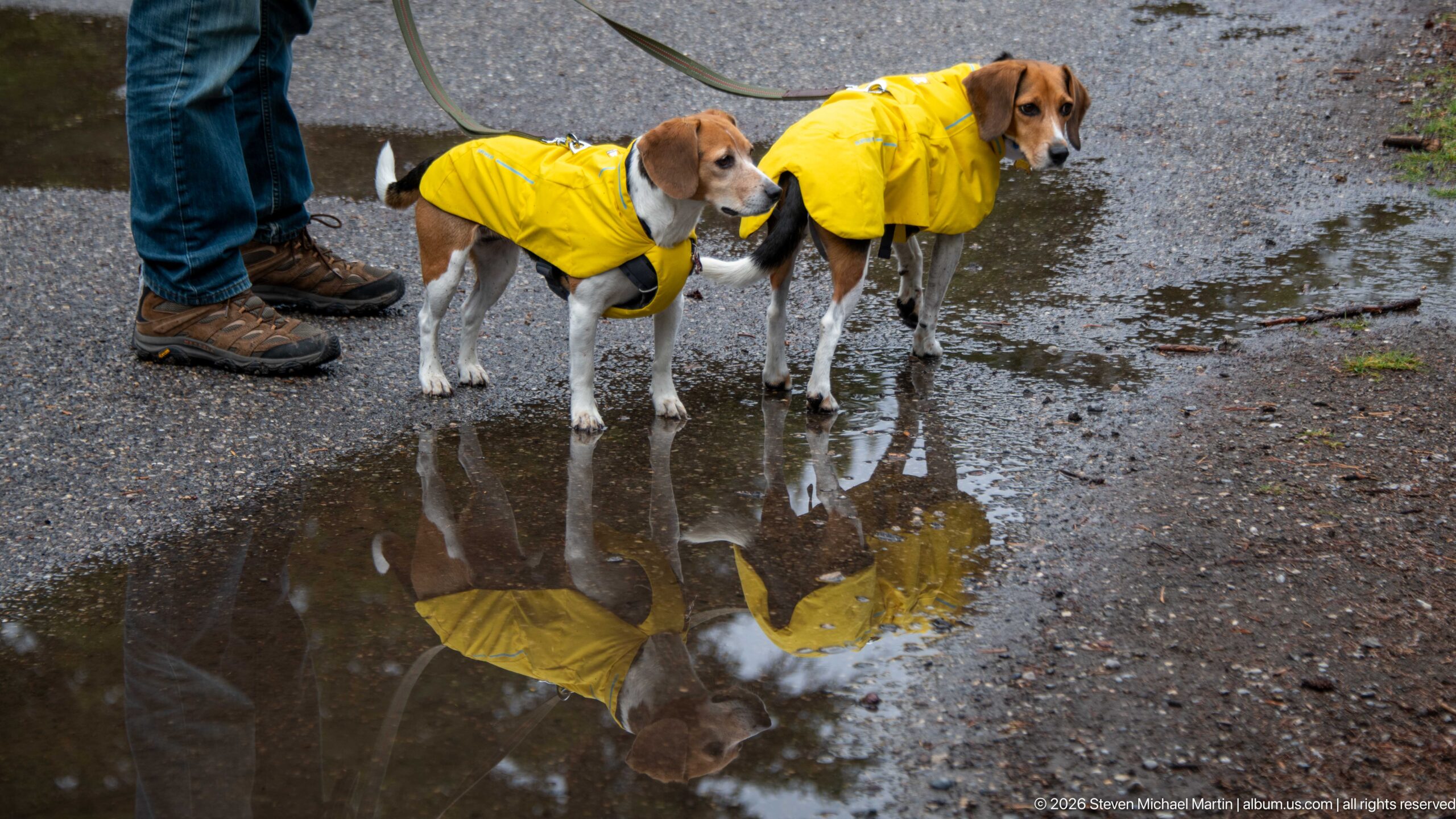
Two beagles pause side by side in yellow raincoats on rain-darkened pavement near Lake Minnewanka. A large puddle mirrors their coats and legs, turning a practical wet-weather moment into a tightly framed portrait of the dogs during the lakeside outing.
Caption
Two beagles pause side by side in yellow raincoats on rain-darkened pavement near Lake Minnewanka. A large puddle mirrors their coats and legs, turning a practical wet-weather moment into a tightly framed portrait of the dogs during the lakeside outing.
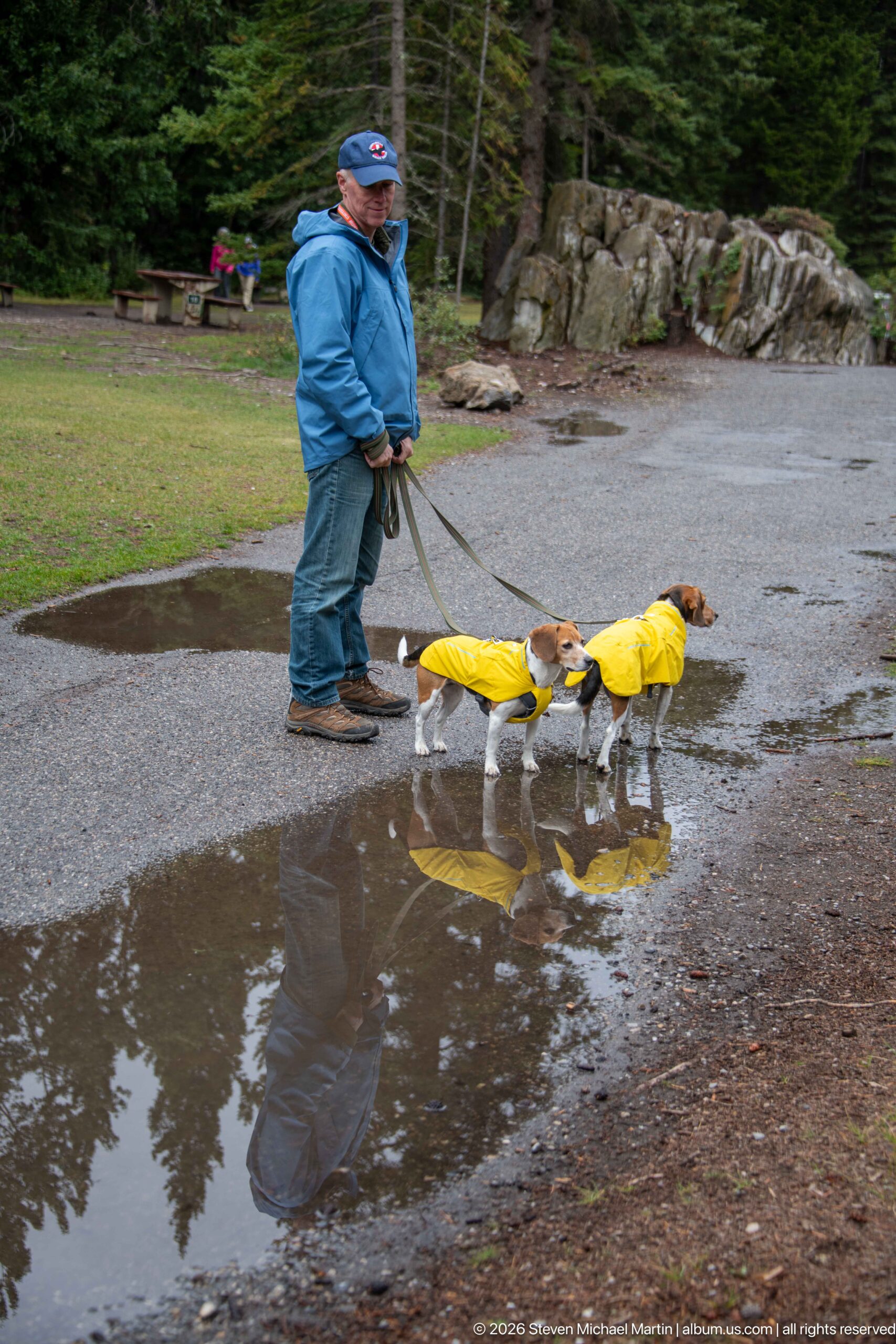
Two beagles in bright yellow raincoats walk through a broad puddle on a wet path at Lake Minnewanka while their handler holds the leashes. Their reflections stretch across the water, recording the rainy conditions that shaped this visit to the lakeshore.
Caption
Two beagles in bright yellow raincoats walk through a broad puddle on a wet path at Lake Minnewanka while their handler holds the leashes. Their reflections stretch across the water, recording the rainy conditions that shaped this visit to the lakeshore.
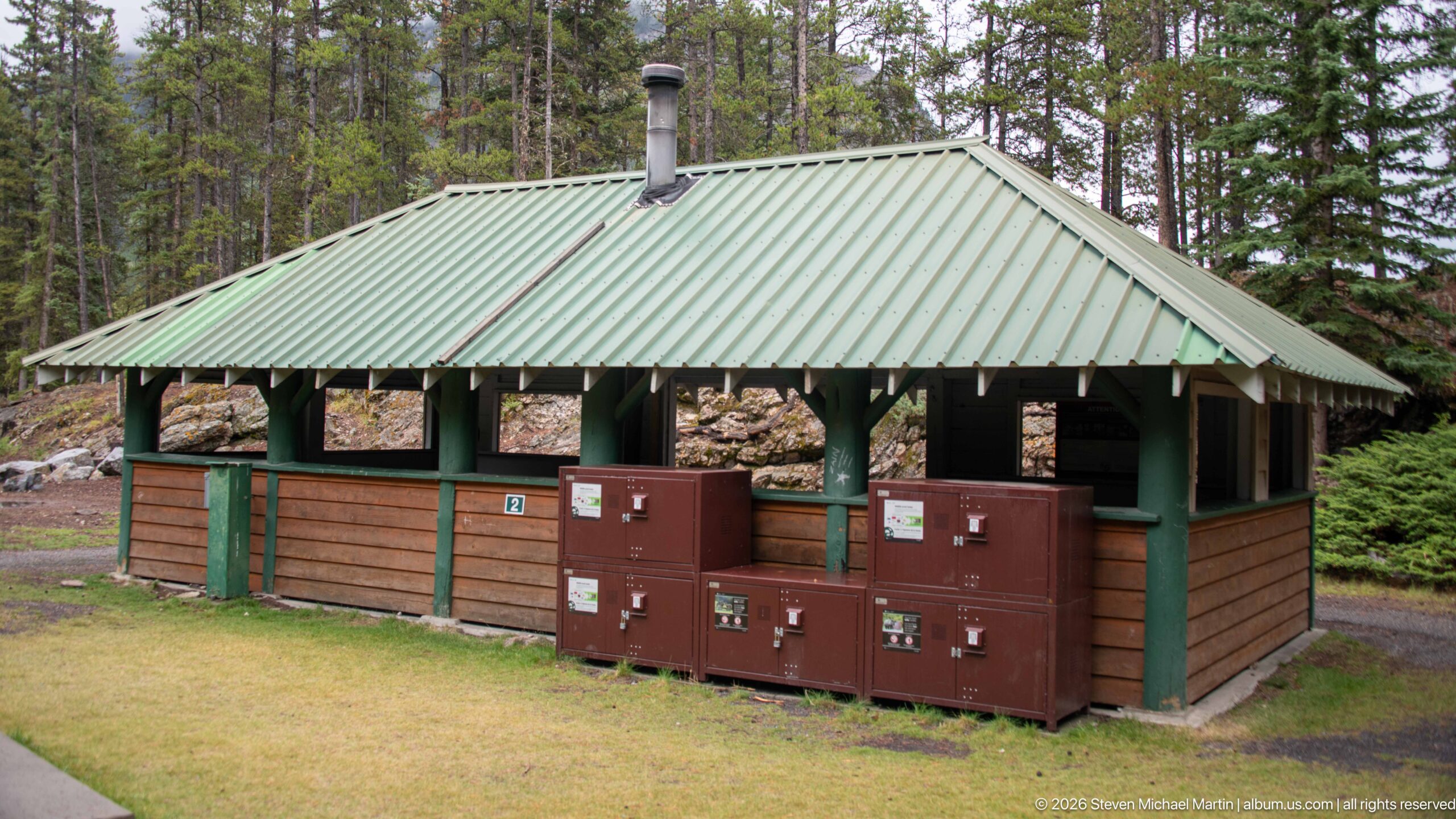
A compact open-sided timber shelter with a green metal roof stands among conifers near Lake Minnewanka. Brown utility cabinets line its exterior wall, identifying the structure as functional park infrastructure rather than a visitor pavilion, despite its rustic architectural treatment.
Caption
A compact open-sided timber shelter with a green metal roof stands among conifers near Lake Minnewanka. Brown utility cabinets line its exterior wall, identifying the structure as functional park infrastructure rather than a visitor pavilion, despite its rustic architectural treatment.
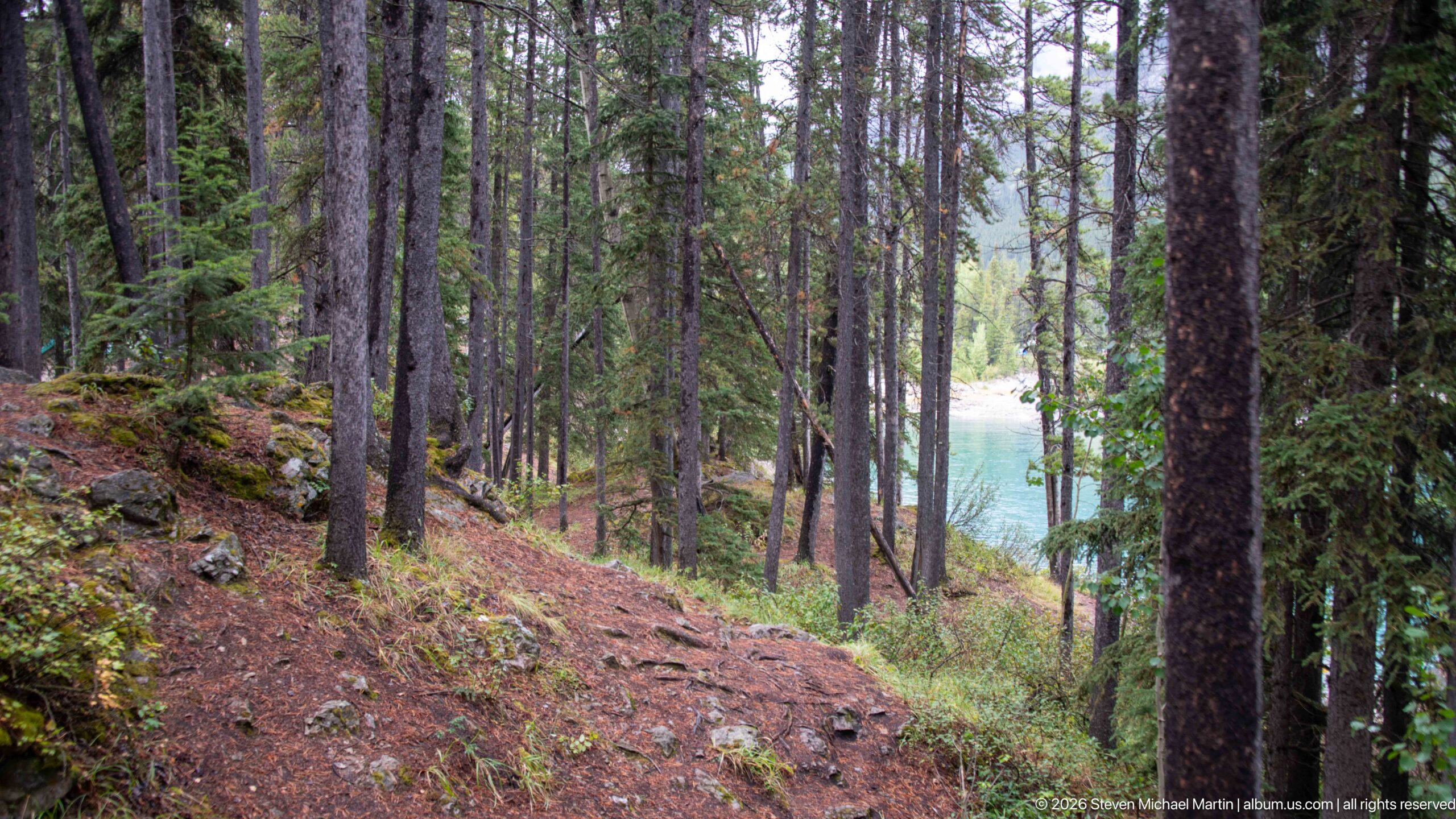
A narrow earth path traverses the wooded slope above Lake Minnewanka, where the turquoise water appears intermittently through straight conifer trunks. The view emphasizes the close relationship between forested shoreline trails and the lake rather than the expansive mountain panorama.
Caption
A narrow earth path traverses the wooded slope above Lake Minnewanka, where the turquoise water appears intermittently through straight conifer trunks. The view emphasizes the close relationship between forested shoreline trails and the lake rather than the expansive mountain panorama.
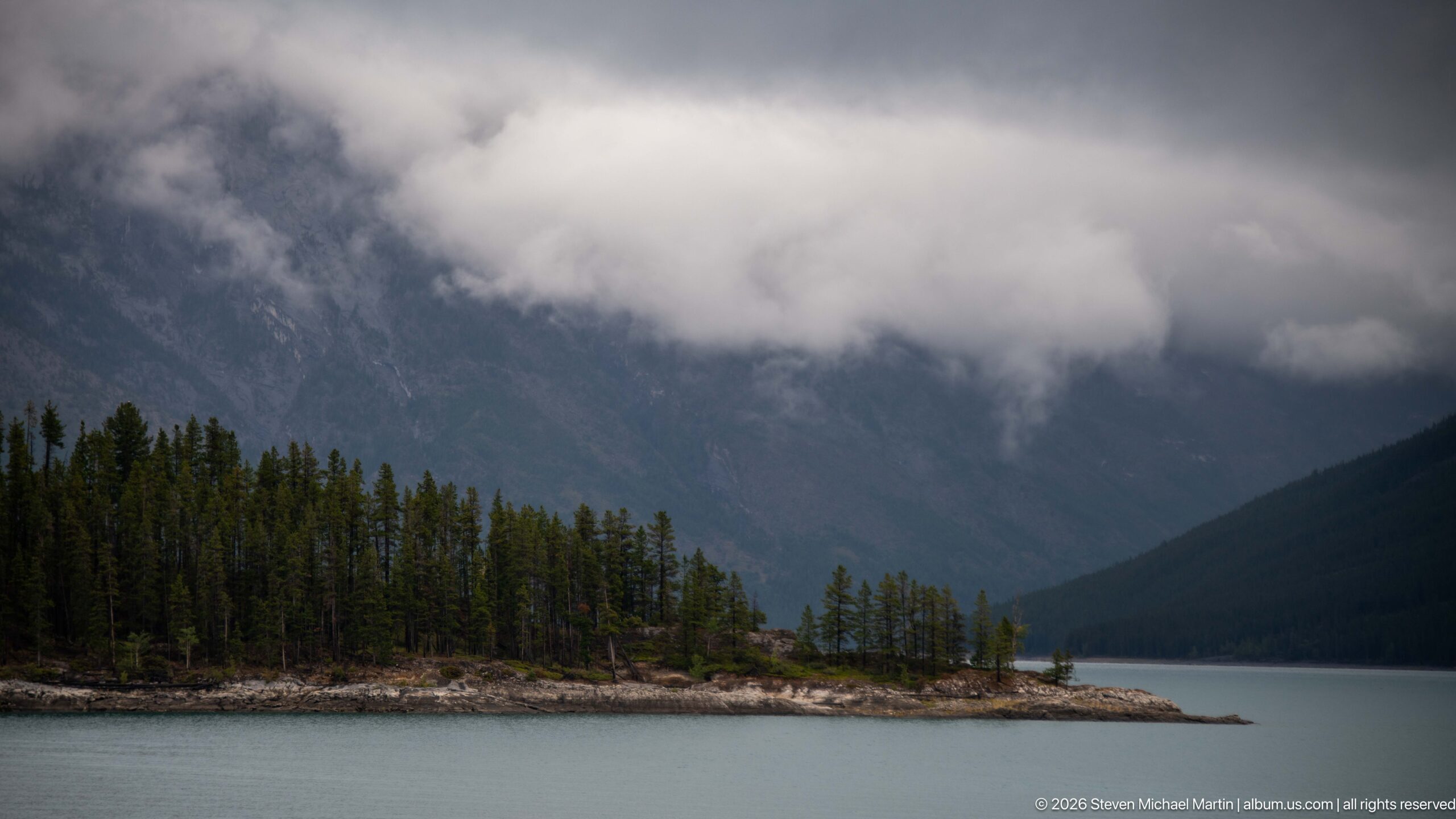
A low forested point extends into Lake Minnewanka beneath a heavy ceiling of cloud. The dark conifers form a crisp horizontal edge against pale water, while the mountain behind dissolves into mist, conveying the subdued scale and weather of the lake during the visit.
Caption
A low forested point extends into Lake Minnewanka beneath a heavy ceiling of cloud. The dark conifers form a crisp horizontal edge against pale water, while the mountain behind dissolves into mist, conveying the subdued scale and weather of the lake during the visit.
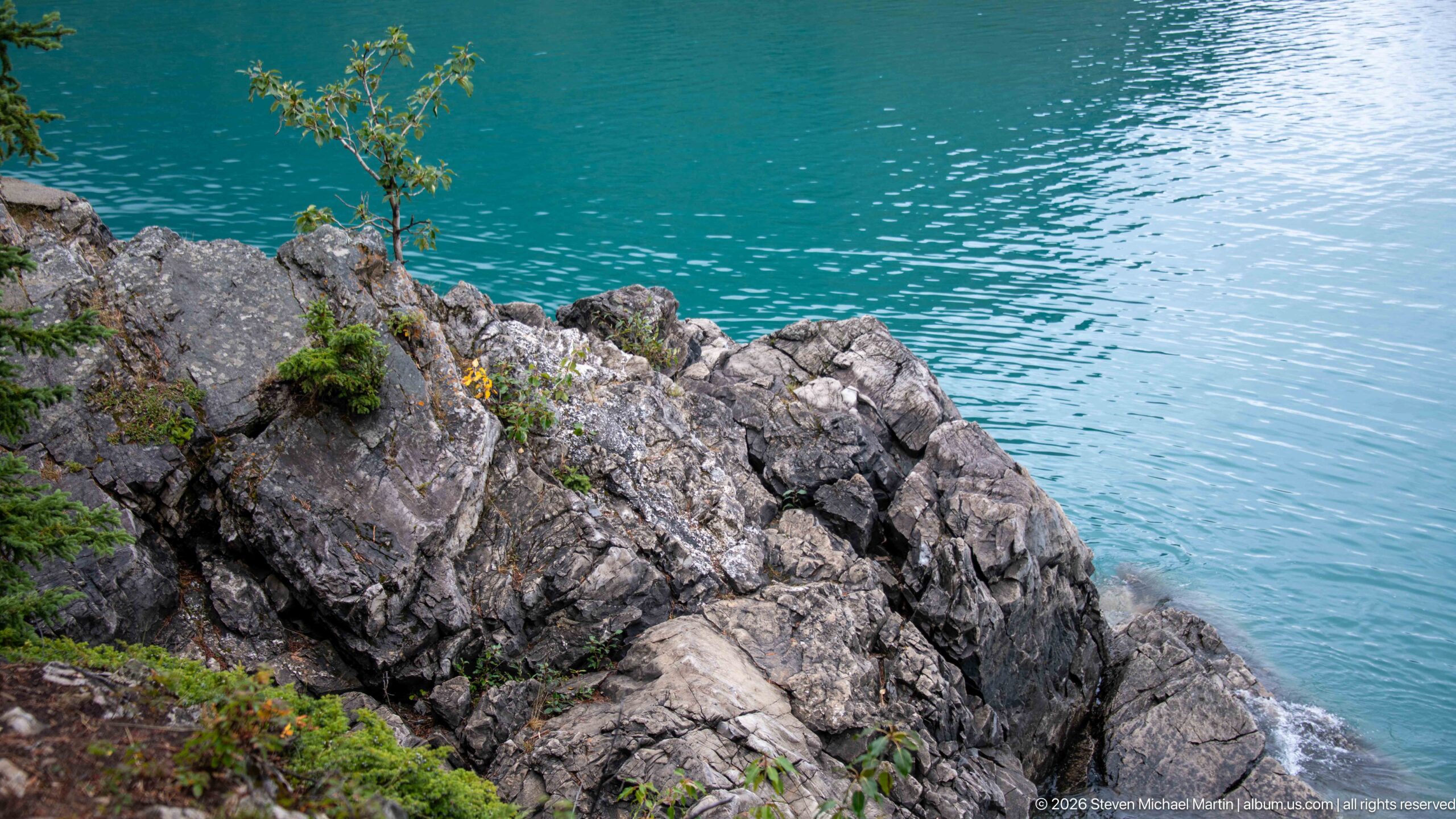
Pale, fractured shoreline rock drops directly into the intensely turquoise water of Lake Minnewanka. Small plants root in cracks and ledges, highlighting the contrast between hard exposed stone, sparse lakeside vegetation, and the saturated color of the water immediately below.
Caption
Pale, fractured shoreline rock drops directly into the intensely turquoise water of Lake Minnewanka. Small plants root in cracks and ledges, highlighting the contrast between hard exposed stone, sparse lakeside vegetation, and the saturated color of the water immediately below.
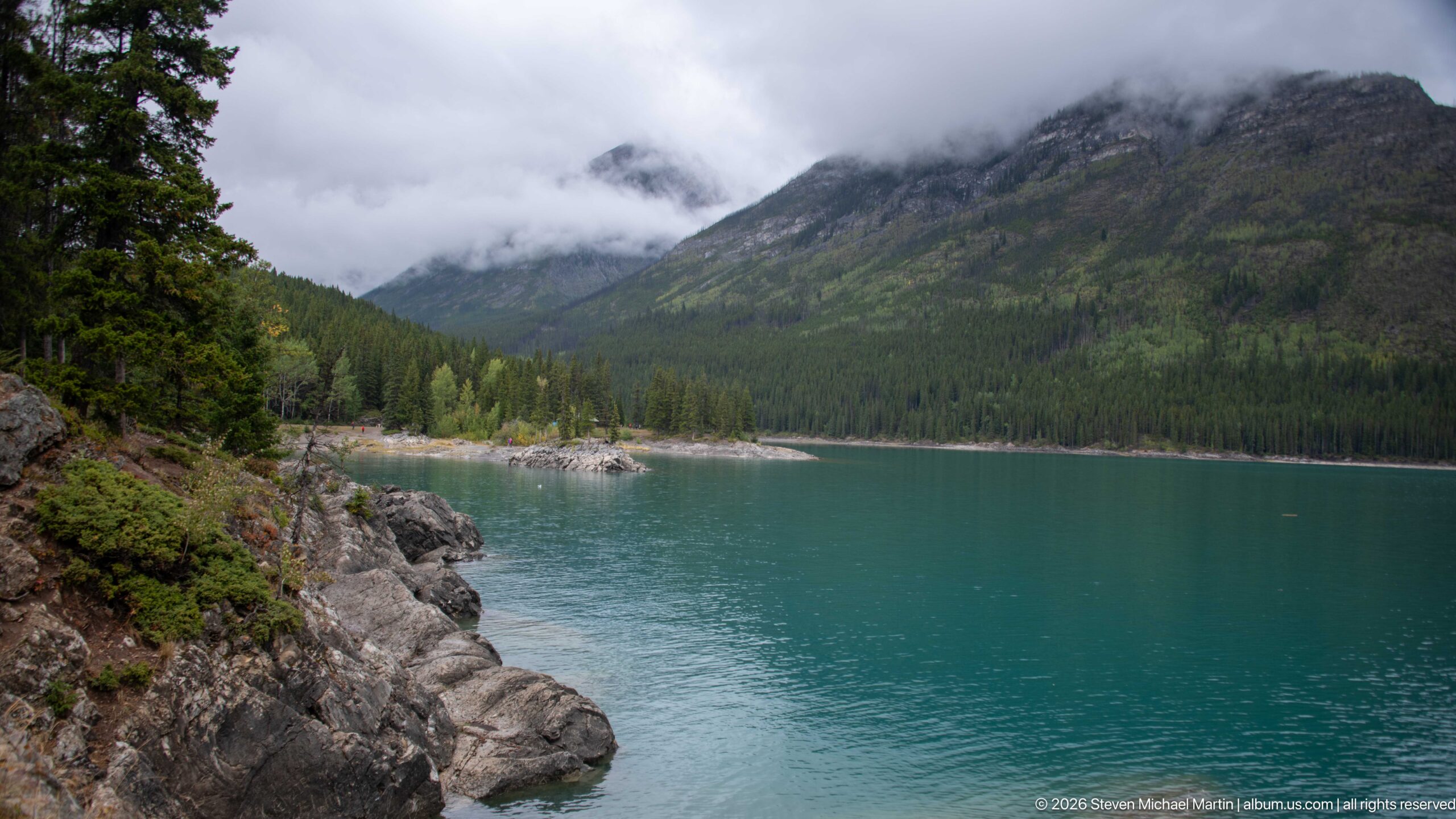
A rocky shoreline curves into the turquoise water of Lake Minnewanka as forest climbs the lower mountain slopes opposite. Low clouds skim the ridges and obscure the higher summits, giving this broad lakeside view a strong contrast between pale stone, saturated water, and dark forest.
Caption
A rocky shoreline curves into the turquoise water of Lake Minnewanka as forest climbs the lower mountain slopes opposite. Low clouds skim the ridges and obscure the higher summits, giving this broad lakeside view a strong contrast between pale stone, saturated water, and dark forest.
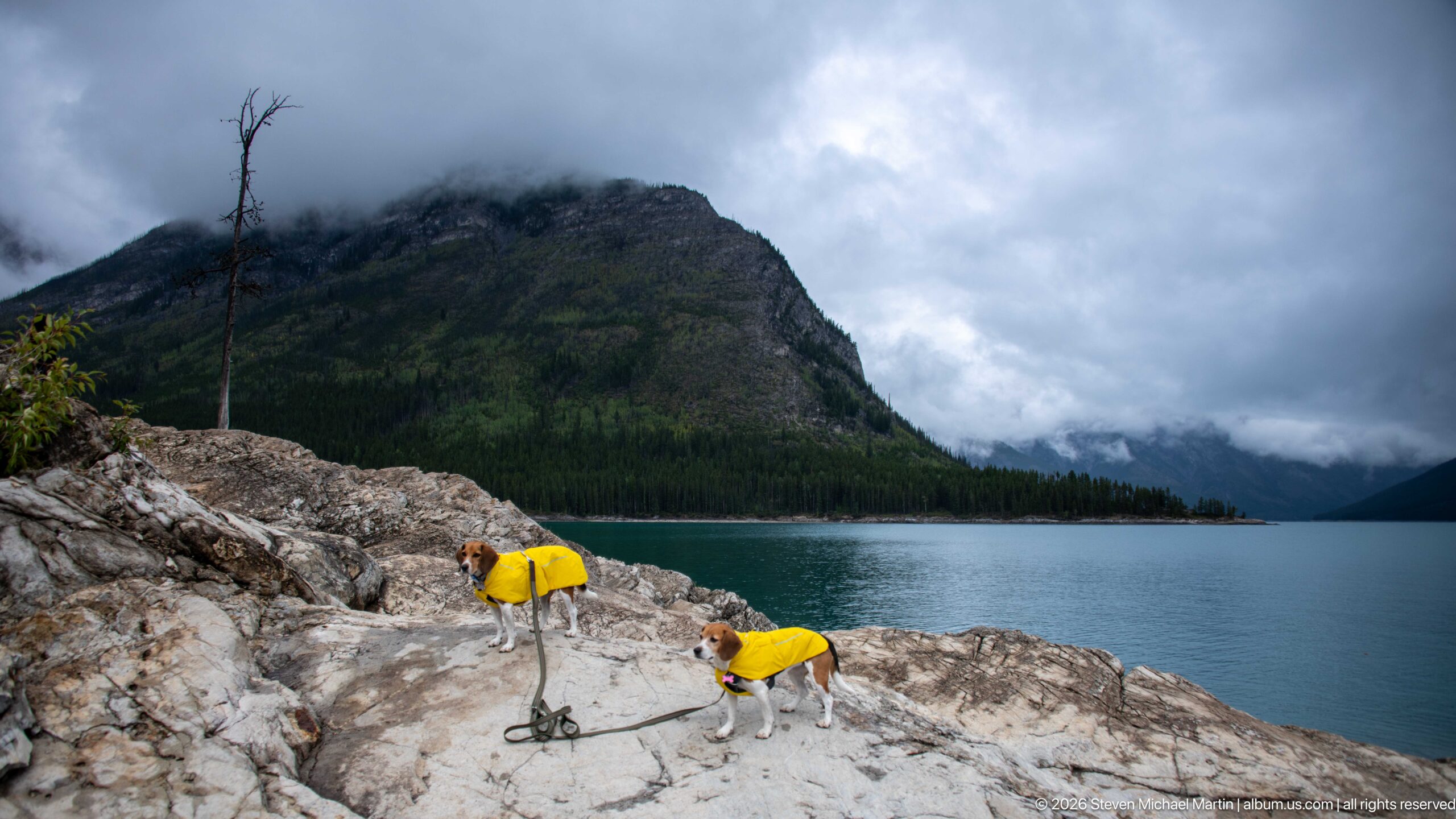
Two beagles in matching yellow raincoats explore the pale rock ledges at Lake Minnewanka. Their small figures provide scale against the broad water and steep forested mountain beyond, combining the day’s wet-weather conditions with the rugged character of the accessible shoreline.
Caption
Two beagles in matching yellow raincoats explore the pale rock ledges at Lake Minnewanka. Their small figures provide scale against the broad water and steep forested mountain beyond, combining the day’s wet-weather conditions with the rugged character of the accessible shoreline.
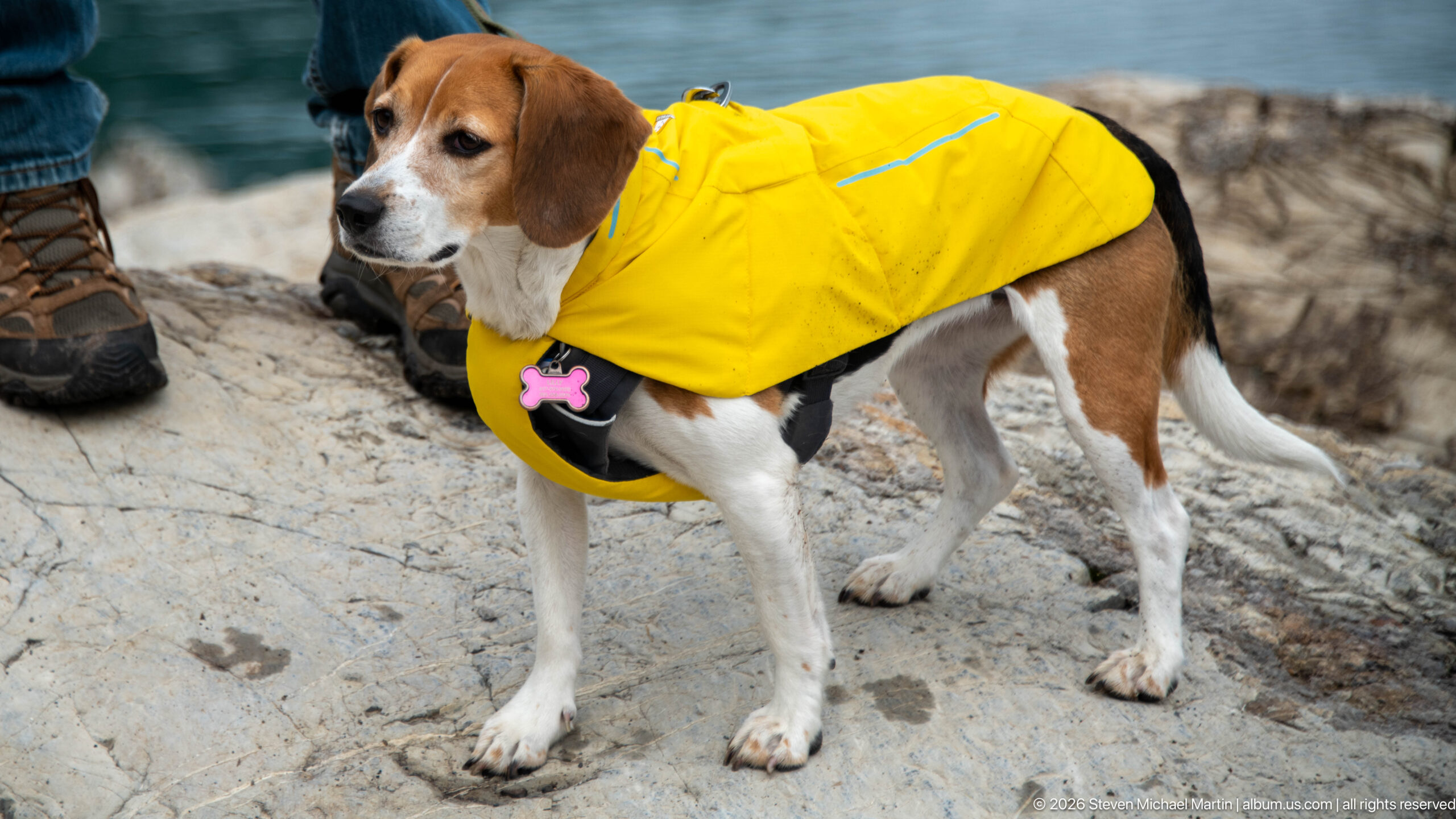
A beagle in a bright yellow raincoat stands alert on the pale rock shoreline at Lake Minnewanka. The close portrait records wet-weather gear and the dog’s tri-color markings, with only a narrow suggestion of the lake and stone setting remaining behind.
Caption
A beagle in a bright yellow raincoat stands alert on the pale rock shoreline at Lake Minnewanka. The close portrait records wet-weather gear and the dog’s tri-color markings, with only a narrow suggestion of the lake and stone setting remaining behind.
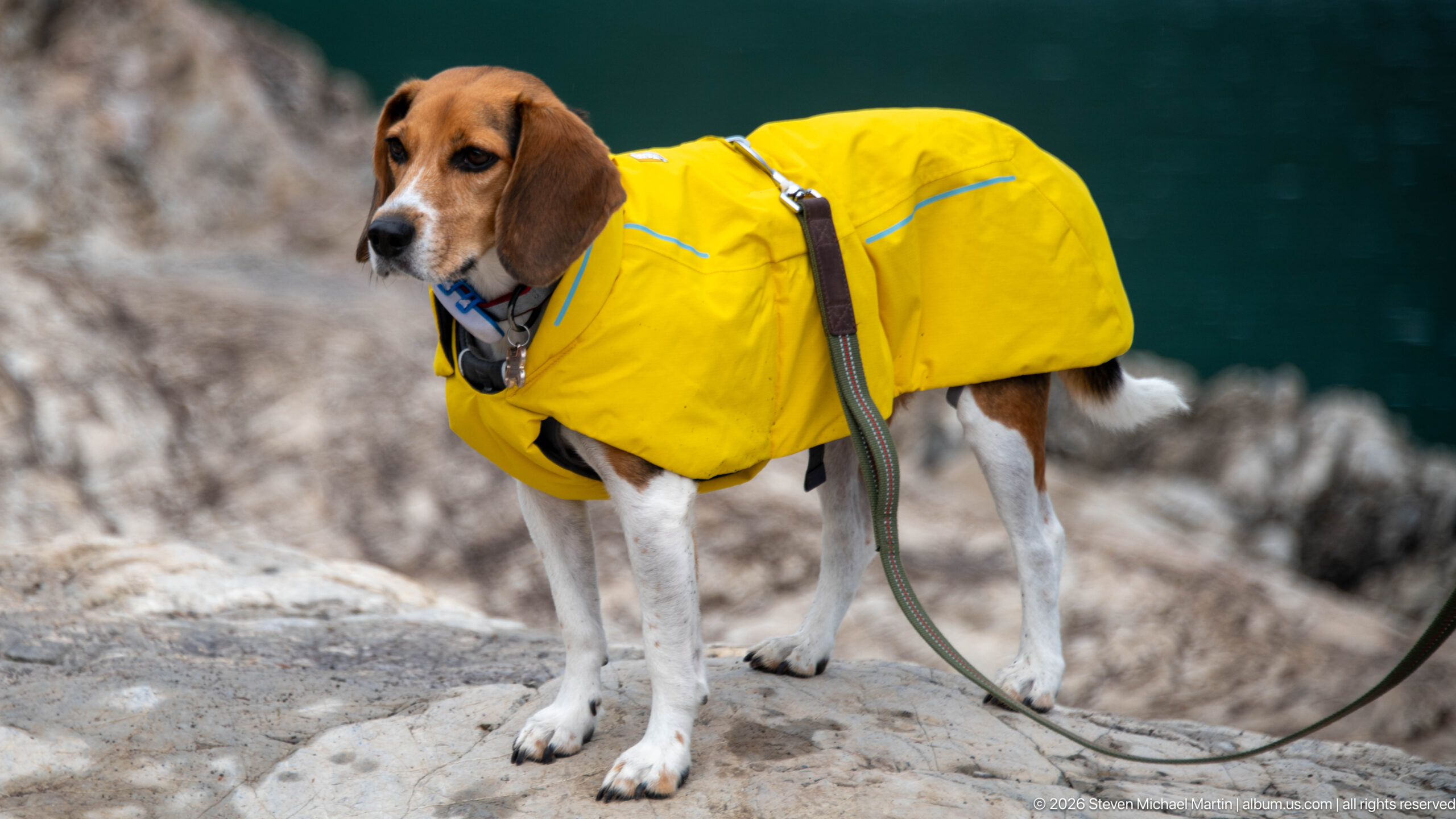
A second close portrait isolates a beagle in a yellow raincoat against the dark turquoise surface of Lake Minnewanka. The shallow background and pale rock beneath its paws emphasize the dog’s expression, harness, leash, and protective coat rather than the broader landscape.
Caption
A second close portrait isolates a beagle in a yellow raincoat against the dark turquoise surface of Lake Minnewanka. The shallow background and pale rock beneath its paws emphasize the dog’s expression, harness, leash, and protective coat rather than the broader landscape.
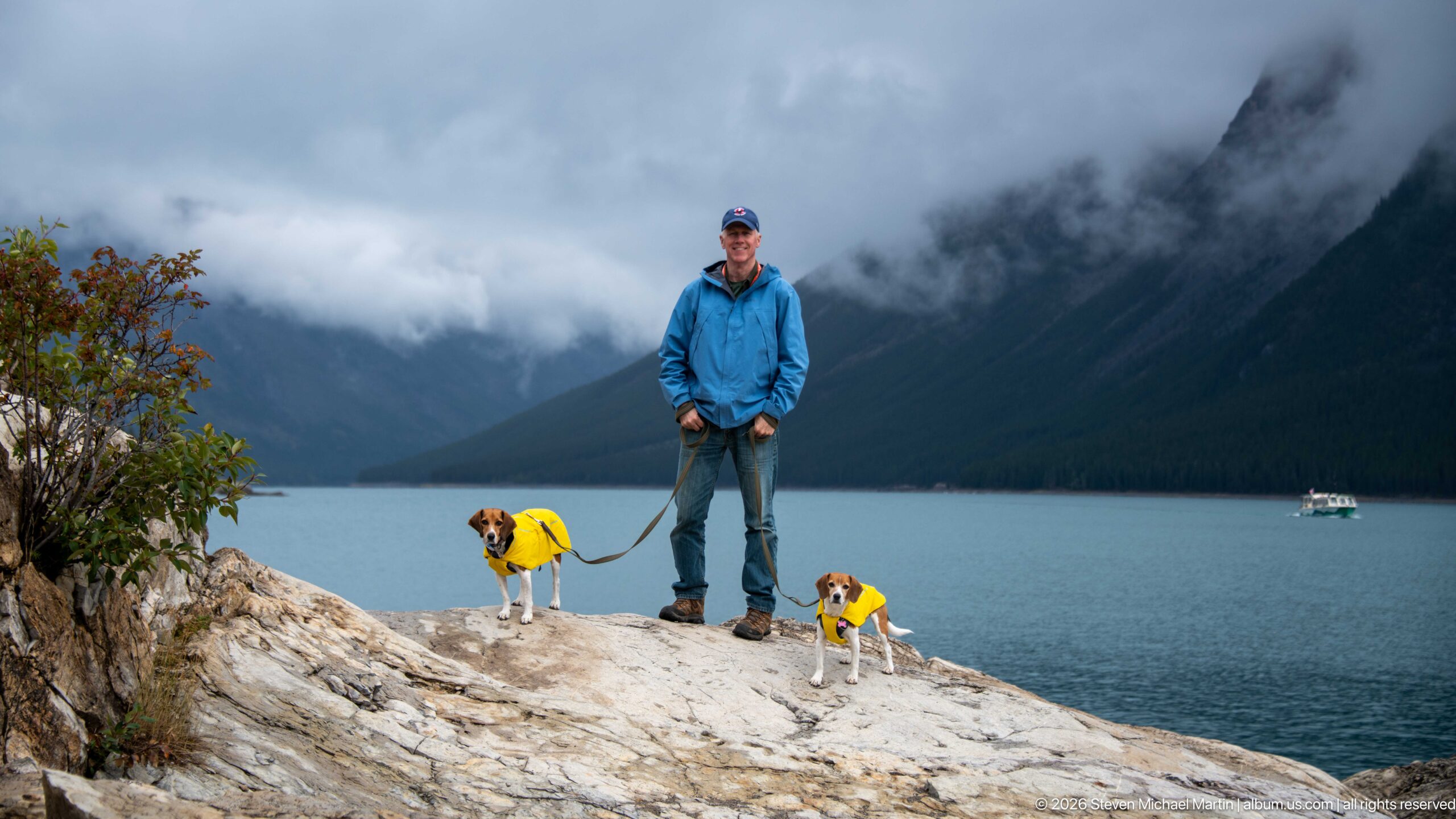
From a slightly wider viewpoint, a visitor and two beagles occupy a projecting rock shelf above Lake Minnewanka. A small boat appears far across the water, while low clouds cling to the mountain slopes, adding depth and activity to the group portrait.
Caption
From a slightly wider viewpoint, a visitor and two beagles occupy a projecting rock shelf above Lake Minnewanka. A small boat appears far across the water, while low clouds cling to the mountain slopes, adding depth and activity to the group portrait.
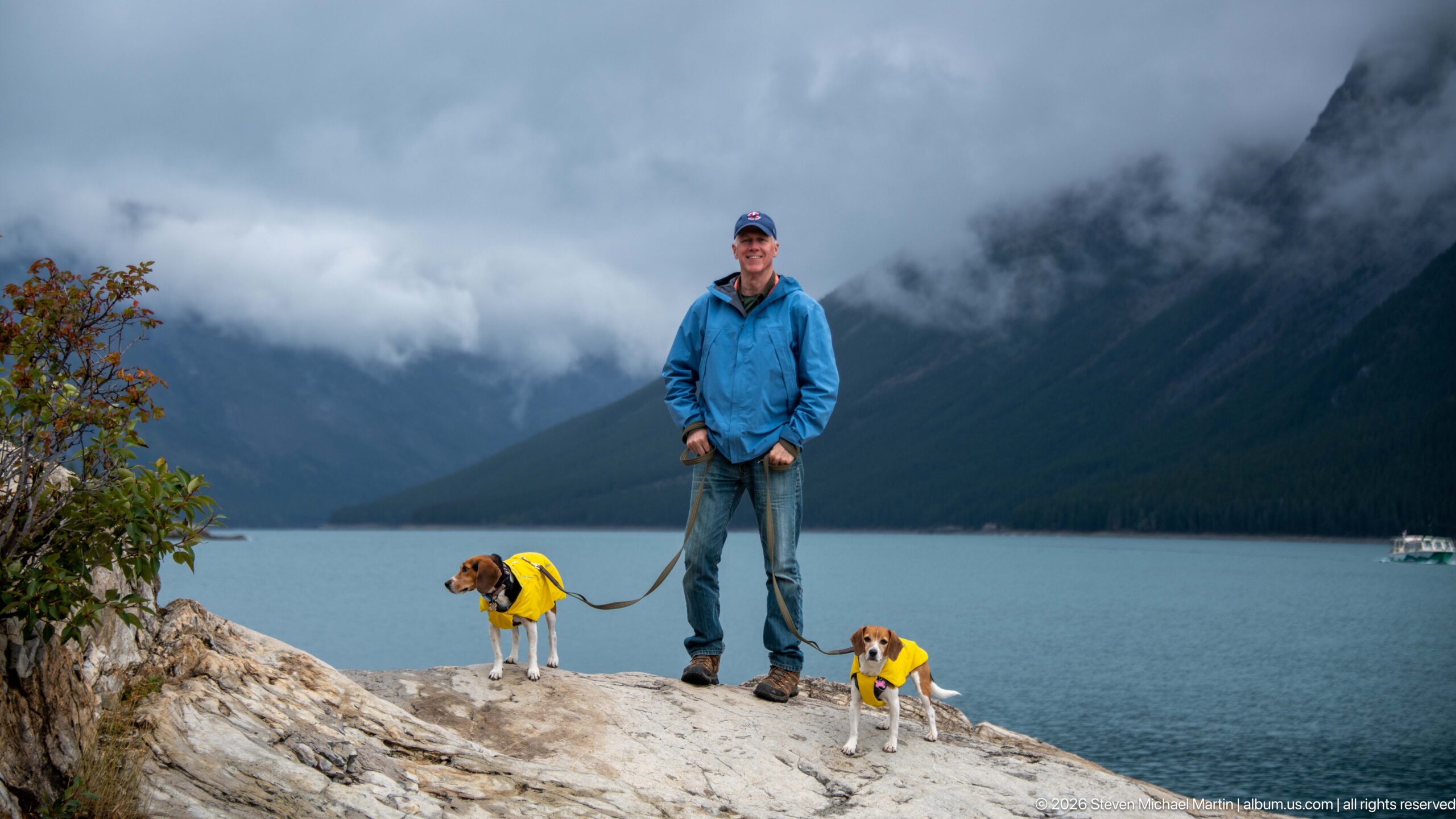
A visitor holds the leashes of two beagles on the exposed limestone shore of Lake Minnewanka. Framed by a shrub at left and clouded mountains beyond, the composition balances the posed figures with a clear view down the lake’s broad, enclosed mountain corridor.
Caption
A visitor holds the leashes of two beagles on the exposed limestone shore of Lake Minnewanka. Framed by a shrub at left and clouded mountains beyond, the composition balances the posed figures with a clear view down the lake’s broad, enclosed mountain corridor.
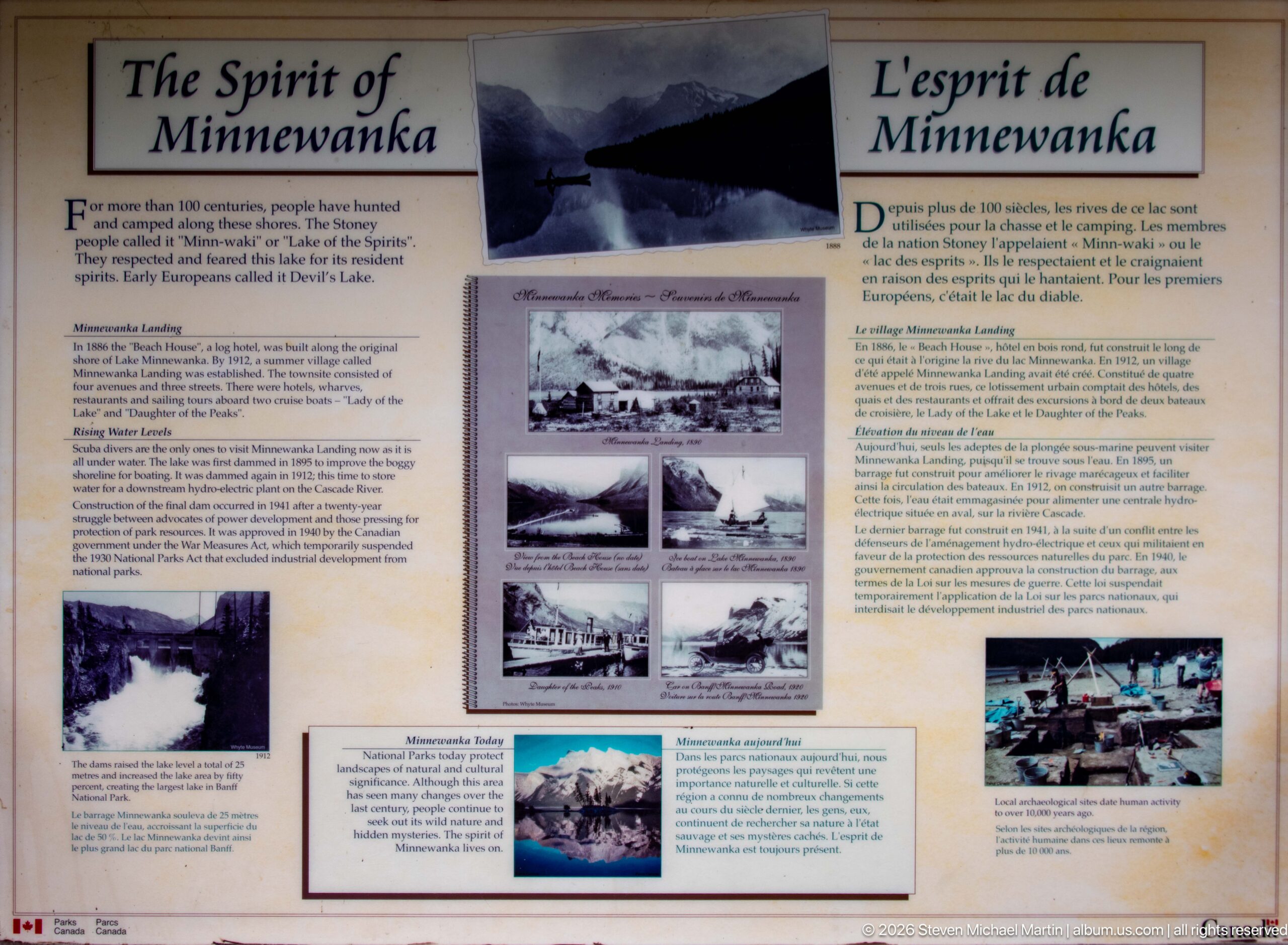
A bilingual interpretive panel titled “The Spirit of Minnewanka” presents historic photographs and text about the lake’s human history. The display connects the present-day recreation area with earlier settlement and development around Minnewanka, using archival images to make that history visible on site.
Caption
A bilingual interpretive panel titled “The Spirit of Minnewanka” presents historic photographs and text about the lake’s human history. The display connects the present-day recreation area with earlier settlement and development around Minnewanka, using archival images to make that history visible on site.
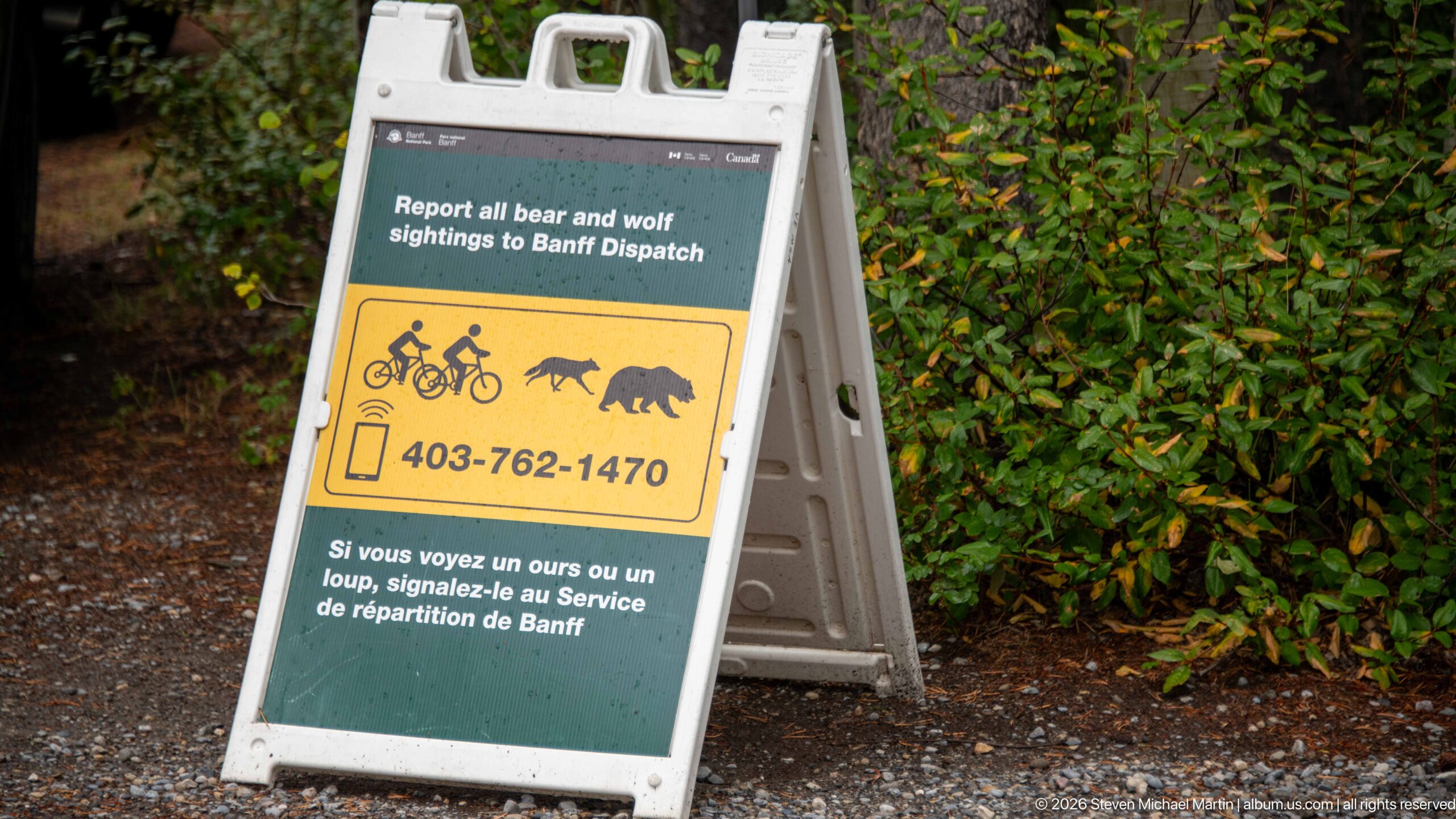
A portable Parks Canada sign asks visitors to report bear and wolf sightings to Banff Dispatch, displaying silhouettes of a cyclist, wolf, and bear above the contact number. Positioned beside dense vegetation, the notice records the active wildlife-safety messaging used in Banff National Park.
Caption
A portable Parks Canada sign asks visitors to report bear and wolf sightings to Banff Dispatch, displaying silhouettes of a cyclist, wolf, and bear above the contact number. Positioned beside dense vegetation, the notice records the active wildlife-safety messaging used in Banff National Park.
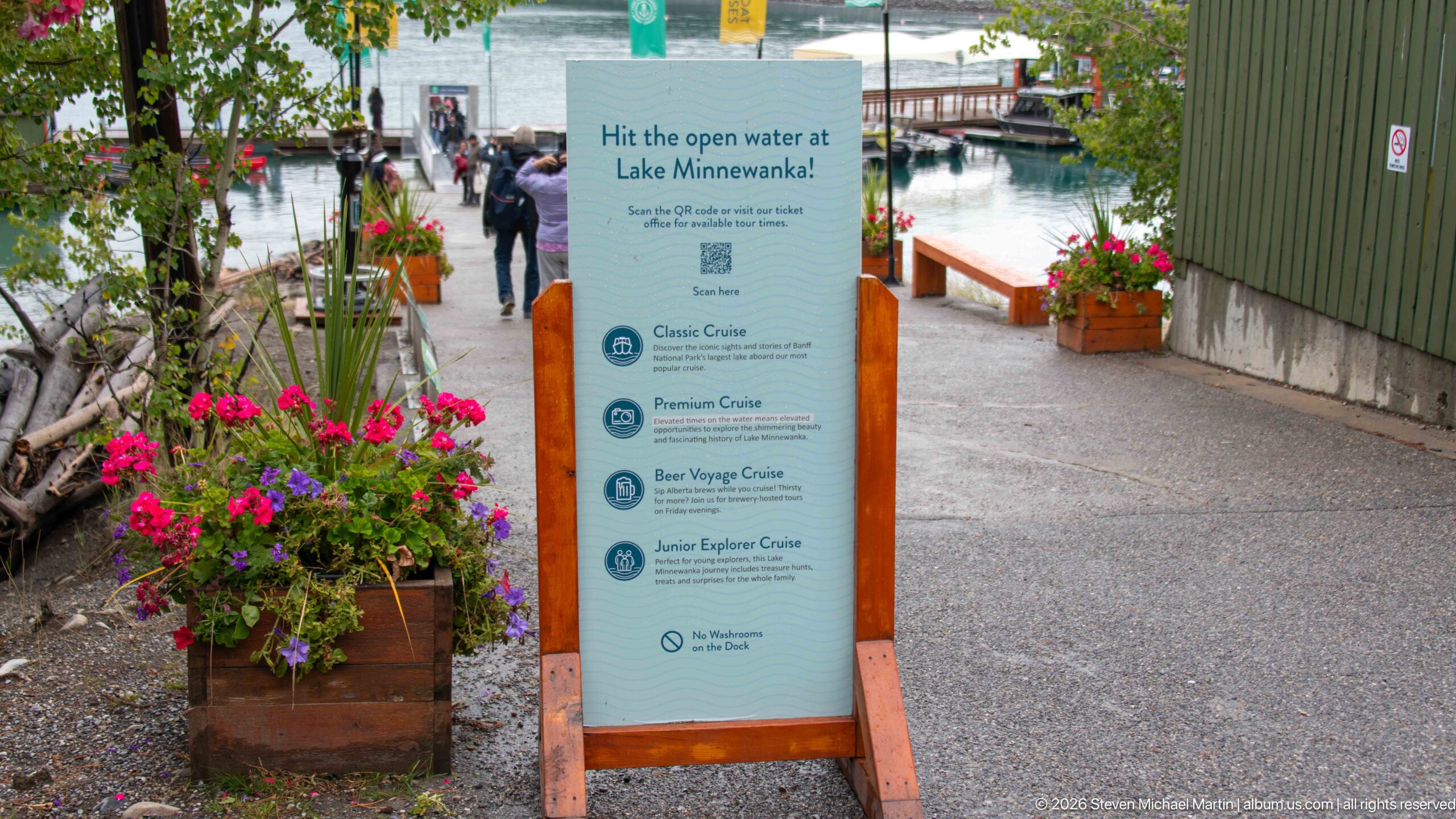
A freestanding sign at the Lake Minnewanka waterfront lists sightseeing options beside the marina approach, with flower planters, docks, and visitors visible beyond. The display advertises several cruise formats, including a classic cruise and specialty excursions, making this view a record of the organized visitor services operating at the lake's developed western shore.
Caption
A freestanding sign at the Lake Minnewanka waterfront lists sightseeing options beside the marina approach, with flower planters, docks, and visitors visible beyond. The display advertises several cruise formats, including a classic cruise and specialty excursions, making this view a record of the organized visitor services operating at the lake's developed western shore.
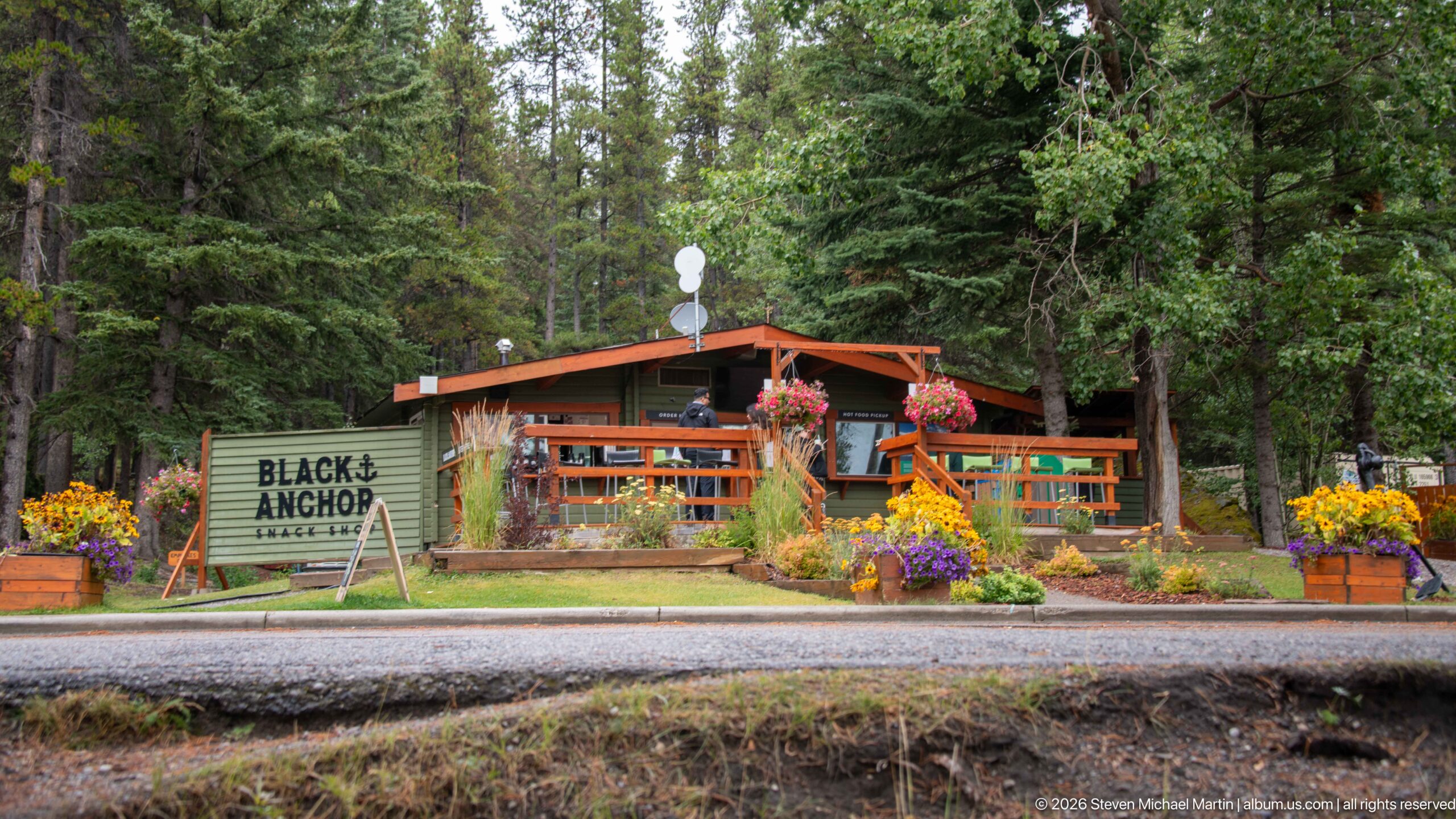
The Black Anchor occupies a low, rustic building set among dense conifers near the Lake Minnewanka waterfront. Bright flower baskets and planters soften the timber deck and orange-brown trim, while a roadside sign identifies the establishment. The scene documents the small-scale food and visitor-service facilities clustered around the lake's principal recreation area.
Caption
The Black Anchor occupies a low, rustic building set among dense conifers near the Lake Minnewanka waterfront. Bright flower baskets and planters soften the timber deck and orange-brown trim, while a roadside sign identifies the establishment. The scene documents the small-scale food and visitor-service facilities clustered around the lake's principal recreation area.
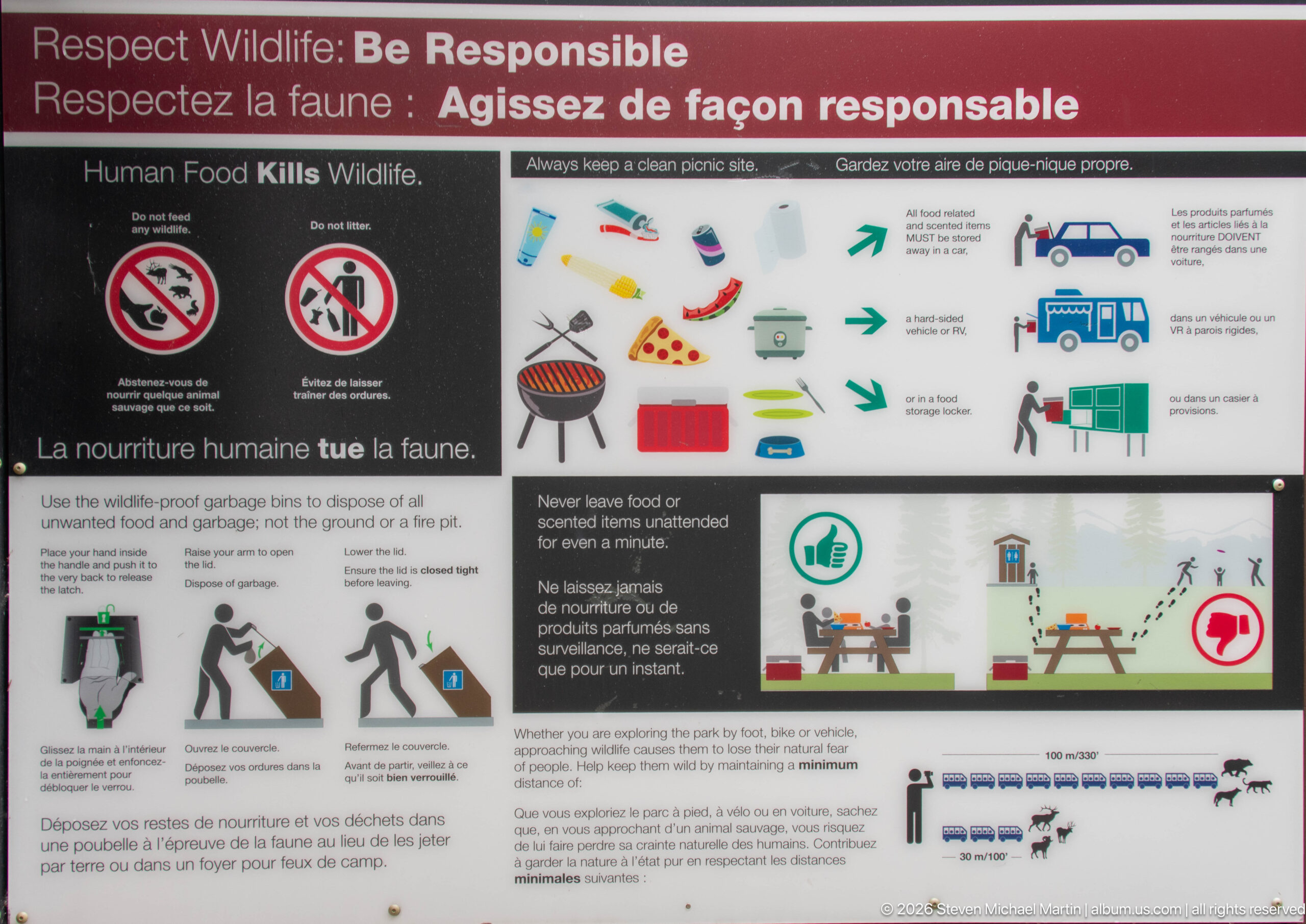
A bilingual interpretive panel explains how food, garbage, and campsite behavior can affect wildlife in Banff National Park. Diagrams contrast unsafe practices with responsible storage and cleanup, while additional graphics address picnicking and campground behavior. The panel makes human-wildlife conflict prevention a direct part of the visitor experience at the heavily used Lake Minnewanka recreation area.
Caption
A bilingual interpretive panel explains how food, garbage, and campsite behavior can affect wildlife in Banff National Park. Diagrams contrast unsafe practices with responsible storage and cleanup, while additional graphics address picnicking and campground behavior. The panel makes human-wildlife conflict prevention a direct part of the visitor experience at the heavily used Lake Minnewanka recreation area.
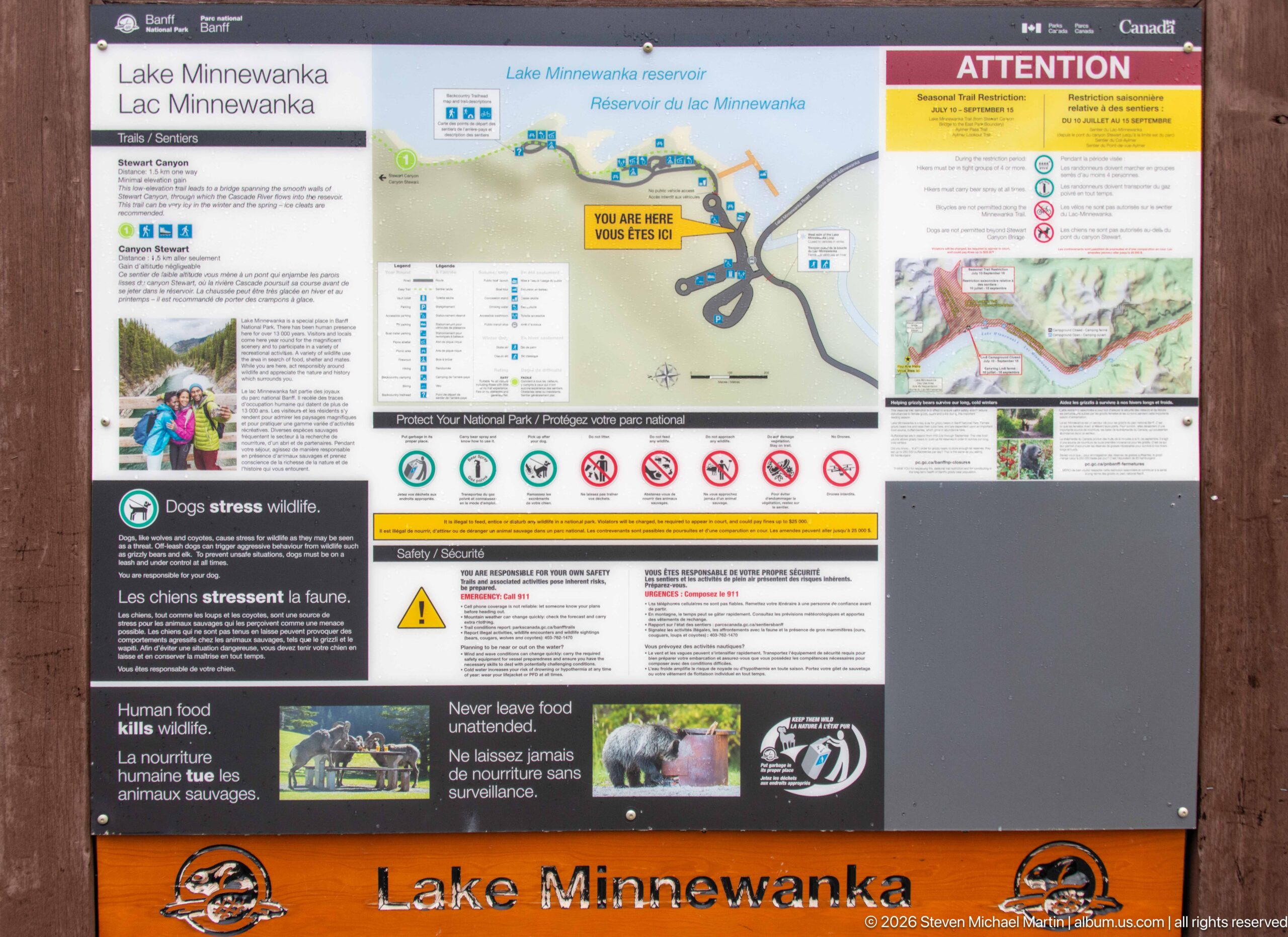
Maps, regulations, safety notices, and visitor guidance fill this large Lake Minnewanka information board. The central reservoir map situates recreation facilities and routes, while surrounding panels address wildlife, dogs, human food, and site rules. Mounted above a carved Lake Minnewanka name panel, the display serves as an orientation point before visitors enter the shoreline and trail network.
Caption
Maps, regulations, safety notices, and visitor guidance fill this large Lake Minnewanka information board. The central reservoir map situates recreation facilities and routes, while surrounding panels address wildlife, dogs, human food, and site rules. Mounted above a carved Lake Minnewanka name panel, the display serves as an orientation point before visitors enter the shoreline and trail network.
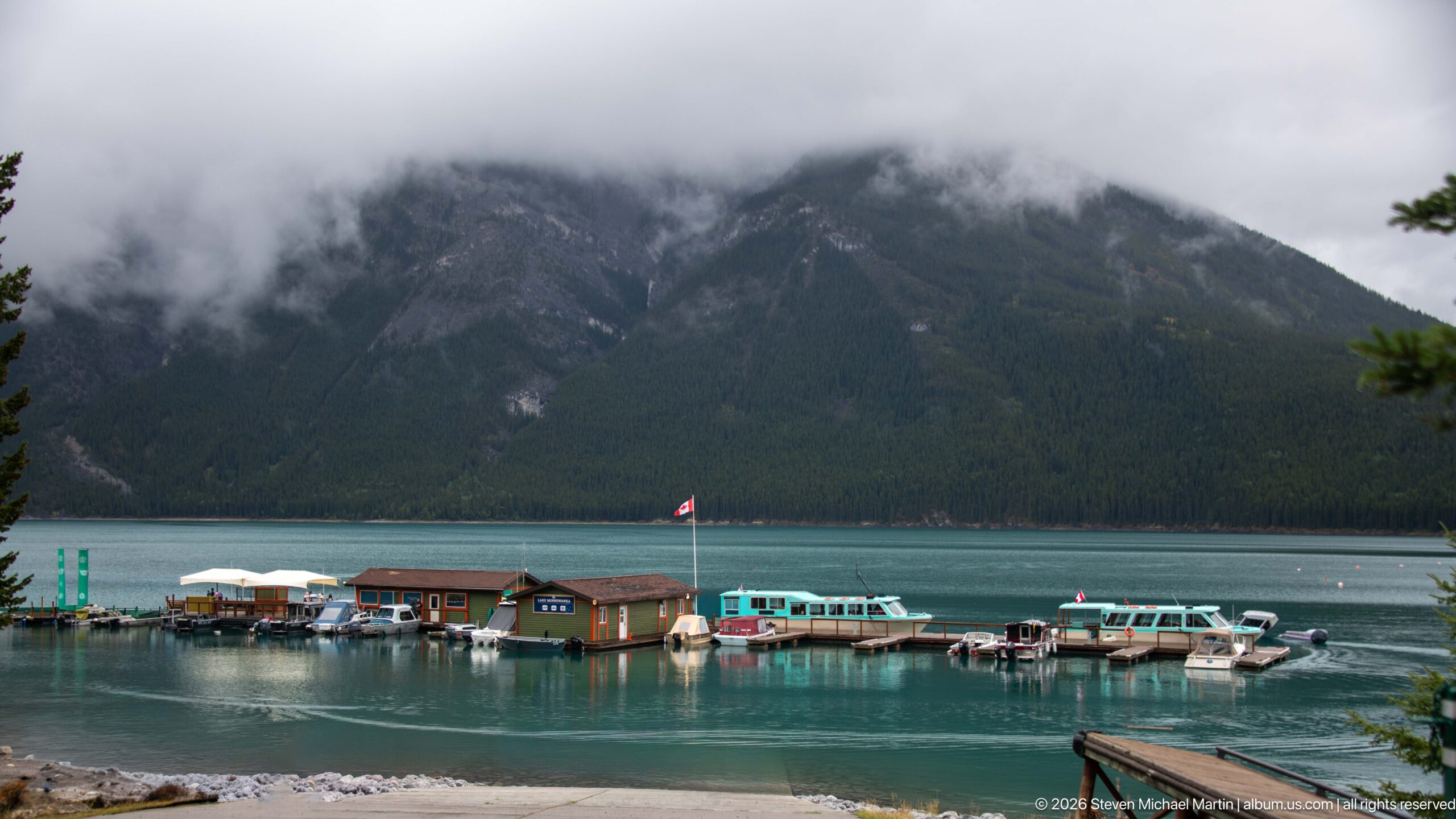
Low cloud drapes the steep mountain slopes beyond the Lake Minnewanka marina, reducing the distant ridges to dark, misty forms. Tour boats and floating buildings cluster along the sheltered shoreline below, their small scale contrasting with the mountain wall across the water. The subdued weather gives this wider view a distinctly different character from the marina's close operational details.
Caption
Low cloud drapes the steep mountain slopes beyond the Lake Minnewanka marina, reducing the distant ridges to dark, misty forms. Tour boats and floating buildings cluster along the sheltered shoreline below, their small scale contrasting with the mountain wall across the water. The subdued weather gives this wider view a distinctly different character from the marina's close operational details.
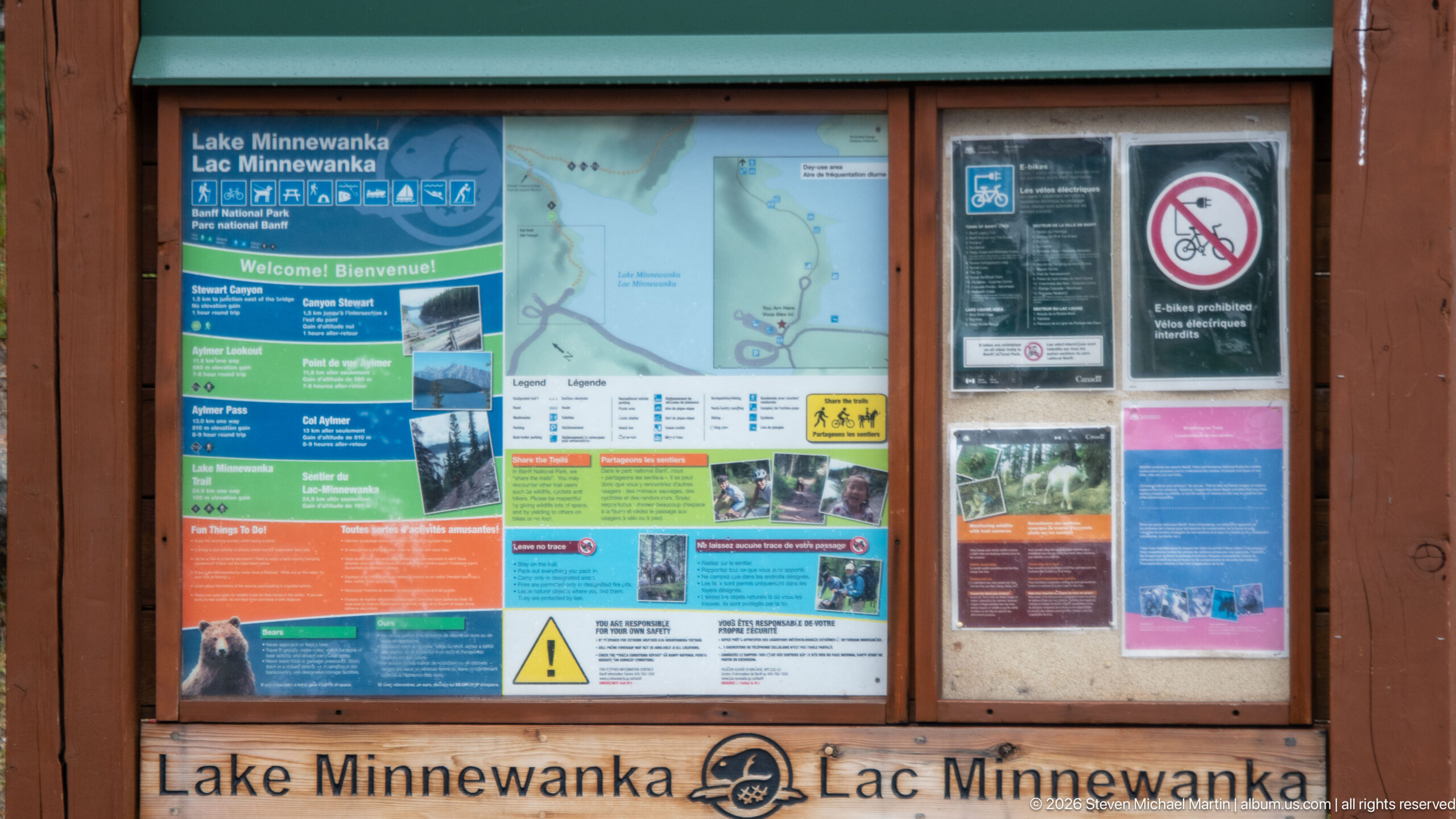
A bilingual Lake Minnewanka kiosk combines orientation maps, recreation information, safety guidance, and regulatory notices at the visitor area. Color-coded panels summarize activities and conditions, while adjacent postings include cycling and wildlife-related rules. The carved Lake Minnewanka / Lac Minnewanka name along the timber frame clearly anchors the information to this specific Banff National Park site.
Caption
A bilingual Lake Minnewanka kiosk combines orientation maps, recreation information, safety guidance, and regulatory notices at the visitor area. Color-coded panels summarize activities and conditions, while adjacent postings include cycling and wildlife-related rules. The carved Lake Minnewanka / Lac Minnewanka name along the timber frame clearly anchors the information to this specific Banff National Park site.
🏞️ National Park Field Guide
📍 Overview
Lake Minnewanka combines a broad mountain reservoir, forested shoreline, rocky points and a developed recreation area within Banff National Park. During this visit, low clouds frequently concealed the higher ridges, drawing attention instead to the turquoise water, conifer-covered slopes, exposed shoreline rock and small wooded islets. The western shore is also an active visitor hub, with trails, interpretive displays, a marina, sightseeing boats, food service and shoreline access bringing human activity directly into the mountain setting.
🏔️ Landscape
The lake is experienced as a long corridor of water enclosed by steep, forested mountain slopes. From the accessible western shoreline, views pass across pale rock ledges and intensely blue-green water toward wooded points, small rocky islets and mountains that rise abruptly beyond the opposite shore. Low cloud and mist transformed many of these views during the visit, obscuring summits and reducing distant slopes to dark layered forms. Closer to shore, conifer forest, moss-covered rock, shrubs and narrow trails create a more intimate landscape before the lake opens into its larger mountain setting.
🪨 Geology
Exposed rock is a conspicuous part of the Lake Minnewanka shoreline and surrounding forest. Pale, fractured ledges descend directly into the water in several places, while broken outcrops and low rocky escarpments emerge beneath the conifers farther inland. Mosses, shrubs and other plants occupy cracks, shelves and pockets of shallow soil, making the relationship between bedrock and vegetation particularly easy to see. Small rocky islets continue this pattern offshore, where exposed stone supports scattered conifers despite the limited growing surface.
🌿 Ecology
Conifer forest forms the dominant ecological setting around the photographed portions of Lake Minnewanka. Tall trees, mixed-height woodland, mossy ground and a dense understory extend from sheltered forest slopes toward the rocky lakeshore, while small conifers also establish themselves on exposed offshore islets. Seasonal change appears at a smaller scale in red and orange understory foliage among the evergreens. Visitor signage emphasizes the importance of responsible food storage, garbage disposal and clean recreation areas in reducing human-wildlife conflict where heavily used facilities meet surrounding habitat.
🦌 Wildlife
Wildlife is represented in the visitor landscape primarily through Parks Canada education and safety messaging. Signs ask visitors to report bear and wolf sightings to Banff Dispatch and explain how food, garbage, picnicking and campsite practices can affect wild animals. These displays place wildlife conservation and conflict prevention alongside recreation as part of the Lake Minnewanka visitor experience. The photographs from this visit do not document a direct wildlife encounter; the animals appearing repeatedly along the shoreline are two leashed beagles traveling with the visitors.
🧭 Human History
Interpretation at Lake Minnewanka connects the present recreation area with the lake’s human past. A bilingual panel titled “The Spirit of Minnewanka” uses historic photographs and explanatory text to introduce earlier settlement and development around the lake. Elsewhere, the modern waterfront records another layer of human use: marina buildings, docks, motorboats, tour vessels, visitor kiosks and service facilities occupy the developed western shore. Together, these elements present Lake Minnewanka not only as a mountain landscape but also as a place shaped by successive forms of access, recreation and infrastructure.
🥾 Visitor Experience
The developed western shore provides several ways to experience Lake Minnewanka at close range. Visitors can follow forested paths above the water, walk onto pale shoreline rock, gather at the public waterfront or continue toward the marina and sightseeing-boat departure area. Orientation boards provide reservoir maps, trail information, regulations and safety guidance, while the Black Anchor and other small-scale services support the busy recreation area. Rain and low cloud shaped this particular visit, producing wet trails and reflective puddles while repeatedly hiding the higher mountains and giving the lake a subdued, mist-filled atmosphere.
📷 Photography Notes
The portfolio moves deliberately between broad landscape views and close observations of the Lake Minnewanka environment. Wide compositions use rocky foregrounds, wooded points and small islets to establish depth across the water, while tighter photographs isolate fractured shoreline stone, moss-covered outcrops, autumn foliage and visitor infrastructure. Low clouds became an important visual element, simplifying distant mountains and strengthening the contrast among pale rock, dark conifers and turquoise water. Photographs of the two beagles in yellow raincoats and their reflections in rainwater add a recurring human-scale element to the otherwise expansive mountain setting.