Lucerne – Switzerland
Lucerne lies along the shores of Lake Lucerne (Vierwaldstättersee) where the Reuss River flows out from the lake into the surrounding valley. The city sits at the edge of the Swiss Alps, with dramatic mountain peaks such as Mount Pilatus and Mount Rigi rising above the water.
The historic center of Lucerne is famous for its preserved medieval architecture and scenic waterfront setting. One of its most recognizable landmarks is the Kapellbrücke (Chapel Bridge), a covered wooden bridge that spans the Reuss River and connects the old town with the surrounding districts.
With its colorful buildings, historic squares, and alpine backdrop, Lucerne is often considered one of the most picturesque cities in Switzerland.

A second sepia historical view looks down over Lucerne’s river corridor and fortified edge, with towers, walls, bridges, and clustered buildings arranged along the water. The elevated perspective clarifies the relationship between defensive architecture and the historic city, while the stylized rendering distinguishes it from the preceding riverfront elevation.
Caption
A second sepia historical view looks down over Lucerne’s river corridor and fortified edge, with towers, walls, bridges, and clustered buildings arranged along the water. The elevated perspective clarifies the relationship between defensive architecture and the historic city, while the stylized rendering distinguishes it from the preceding riverfront elevation.

A squat square medieval tower stands beyond a pedestrian bridge, backed by wooded and snow-dusted Alpine foothills. Its rough stone walls and steep pyramidal roof contrast with the open river setting and the moving pedestrians below. The photograph sets Lucerne’s surviving defensive architecture against the broader mountain landscape that frames the city.
Caption
A squat square medieval tower stands beyond a pedestrian bridge, backed by wooded and snow-dusted Alpine foothills. Its rough stone walls and steep pyramidal roof contrast with the open river setting and the moving pedestrians below. The photograph sets Lucerne’s surviving defensive architecture against the broader mountain landscape that frames the city.

Low cloud drifts in horizontal bands across the mountains beyond Lake Lucerne, partially concealing the slopes and peaks. A dark, tree-lined shore forms a narrow foreground boundary beneath the mist. The photograph emphasizes the rapidly changing weather and atmospheric depth characteristic of Lucerne’s Alpine lake setting.
Caption
Low cloud drifts in horizontal bands across the mountains beyond Lake Lucerne, partially concealing the slopes and peaks. A dark, tree-lined shore forms a narrow foreground boundary beneath the mist. The photograph emphasizes the rapidly changing weather and atmospheric depth characteristic of Lucerne’s Alpine lake setting.

A closer lakeside view centers the KKL Luzern beneath a dramatic ceiling of clouds, with excursion boats moored along the right-hand quay and mountain slopes beyond. The composition emphasizes Lucerne’s working passenger waterfront as much as its cultural architecture, with the calm lake occupying most of the foreground.
Caption
A closer lakeside view centers the KKL Luzern beneath a dramatic ceiling of clouds, with excursion boats moored along the right-hand quay and mountain slopes beyond. The composition emphasizes Lucerne’s working passenger waterfront as much as its cultural architecture, with the calm lake occupying most of the foreground.

A steep snow-covered Alpine ridge emerges through bands of low cloud and mist above Lucerne. Dark rock faces cut through the fresh snow while drifting cloud obscures portions of the summit, creating a layered view of mountain, weather, and atmosphere. The telephoto composition removes nearly all urban context and concentrates on the dramatic natural setting surrounding the city.
Caption
A steep snow-covered Alpine ridge emerges through bands of low cloud and mist above Lucerne. Dark rock faces cut through the fresh snow while drifting cloud obscures portions of the summit, creating a layered view of mountain, weather, and atmosphere. The telephoto composition removes nearly all urban context and concentrates on the dramatic natural setting surrounding the city.

Lucerne’s Wasserturm rises prominently above the Reuss, its pale stone shaft and steep dark roof reflected faintly in the water. The adjoining Kapellbrücke extends along the left bank, while modern riverfront buildings form a quieter backdrop. The composition isolates the tower as the principal vertical landmark within the bridge ensemble.
Caption
Lucerne’s Wasserturm rises prominently above the Reuss, its pale stone shaft and steep dark roof reflected faintly in the water. The adjoining Kapellbrücke extends along the left bank, while modern riverfront buildings form a quieter backdrop. The composition isolates the tower as the principal vertical landmark within the bridge ensemble.

A sepia-toned historical illustration reconstructs old Lucerne along the Reuss, showing closely packed timber-framed buildings, riverfront houses, a bridge, and defensive or civic structures. The inscription “Alt Luzern” identifies the subject as old Lucerne. Architectural density and the broad river foreground make the image useful as a visual record of the city’s earlier urban form.
Caption
A sepia-toned historical illustration reconstructs old Lucerne along the Reuss, showing closely packed timber-framed buildings, riverfront houses, a bridge, and defensive or civic structures. The inscription “Alt Luzern” identifies the subject as old Lucerne. Architectural density and the broad river foreground make the image useful as a visual record of the city’s earlier urban form.

Château Gütsch crowns the wooded slope above Lucerne, its white walls, steep roofs, turrets, and tall central tower forming a castle-like silhouette. Large hillside letters spelling “GÜTSCH” make the location explicit, while autumn foliage softens the transition between the elevated hotel complex and the city below.
Caption
Château Gütsch crowns the wooded slope above Lucerne, its white walls, steep roofs, turrets, and tall central tower forming a castle-like silhouette. Large hillside letters spelling “GÜTSCH” make the location explicit, while autumn foliage softens the transition between the elevated hotel complex and the city below.

Lucerne’s Rathaus complex rises above the street with its robust stone clock tower, colorful clock face, and adjoining historic building. The architecture combines the defensive weight of a medieval tower with the more domestic scale and elaborate windows of the civic structure beside it, illustrating the layered character of the Old Town.
Caption
Lucerne’s Rathaus complex rises above the street with its robust stone clock tower, colorful clock face, and adjoining historic building. The architecture combines the defensive weight of a medieval tower with the more domestic scale and elaborate windows of the civic structure beside it, illustrating the layered character of the Old Town.

Autumn woodland rises steeply behind Lucerne’s lower city, with a prominent white historic complex and slender tower set high on the slope. In the foreground, timber structures, roofs, and a riverside passage create a layered transition from the urban waterfront to the wooded hillside. The view emphasizes Lucerne’s compressed relationship between old-town fabric and surrounding terrain.
Caption
Autumn woodland rises steeply behind Lucerne’s lower city, with a prominent white historic complex and slender tower set high on the slope. In the foreground, timber structures, roofs, and a riverside passage create a layered transition from the urban waterfront to the wooded hillside. The view emphasizes Lucerne’s compressed relationship between old-town fabric and surrounding terrain.

The open side of the Spreuer Bridge frames a long view down the Reuss toward the twin green-domed towers of Lucerne’s Jesuit Church. Dark timber posts and carved edge details form a natural border around the bright riverfront cityscape. The composition uses the covered bridge itself as an architectural frame for one of the historic center’s most recognizable church views.
Caption
The open side of the Spreuer Bridge frames a long view down the Reuss toward the twin green-domed towers of Lucerne’s Jesuit Church. Dark timber posts and carved edge details form a natural border around the bright riverfront cityscape. The composition uses the covered bridge itself as an architectural frame for one of the historic center’s most recognizable church views.

A cylindrical stone tower rises above adjoining historic buildings, capped by a steep conical roof and pierced by small, deeply set openings. A projecting lower gallery wraps part of the masonry. The upward perspective emphasizes the tower’s mass and defensive character while withholding enough context to avoid an unsupported exact landmark identification.
Caption
A cylindrical stone tower rises above adjoining historic buildings, capped by a steep conical roof and pierced by small, deeply set openings. A projecting lower gallery wraps part of the masonry. The upward perspective emphasizes the tower’s mass and defensive character while withholding enough context to avoid an unsupported exact landmark identification.

A painted heraldic panel on a Lucerne façade pairs two standing wild men with a crowned shield and the date 1568. The figures, framed by painted columns and foliage, flank a richly colored coat of arms between barred windows. The image records the city’s tradition of using historic building fronts as surfaces for civic and family heraldry.
Caption
A painted heraldic panel on a Lucerne façade pairs two standing wild men with a crowned shield and the date 1568. The figures, framed by painted columns and foliage, flank a richly colored coat of arms between barred windows. The image records the city’s tradition of using historic building fronts as surfaces for civic and family heraldry.

Lake Lucerne opens beneath a low, clouded sky, with the dark horizontal mass of the KKL cultural complex along the waterfront and snow-dusted mountains rising behind the city. The broad expanse of water and subdued autumn light place Lucerne’s urban center in its defining lakeside and Alpine setting.
Caption
Lake Lucerne opens beneath a low, clouded sky, with the dark horizontal mass of the KKL cultural complex along the waterfront and snow-dusted mountains rising behind the city. The broad expanse of water and subdued autumn light place Lucerne’s urban center in its defining lakeside and Alpine setting.

Lucerne’s Kapellbrücke crosses the Reuss beside the octagonal Wasserturm, its long timber roof forming a low diagonal across the river. Historic buildings line the opposite bank, while the twin green-capped towers of the Jesuit Church appear farther right. This view brings together several of the city’s best-known elements in a single waterfront composition.
Caption
Lucerne’s Kapellbrücke crosses the Reuss beside the octagonal Wasserturm, its long timber roof forming a low diagonal across the river. Historic buildings line the opposite bank, while the twin green-capped towers of the Jesuit Church appear farther right. This view brings together several of the city’s best-known elements in a single waterfront composition.

The covered Kapellbrücke stretches along the Reuss toward Lucerne’s Wasserturm, whose tall stone shaft and steep pyramidal roof dominate the center of the frame. A row of closely packed historic façades lines the left bank. The nearer viewpoint emphasizes the bridge’s timber construction, roofline, and relationship to the riverfront city.
Caption
The covered Kapellbrücke stretches along the Reuss toward Lucerne’s Wasserturm, whose tall stone shaft and steep pyramidal roof dominate the center of the frame. A row of closely packed historic façades lines the left bank. The nearer viewpoint emphasizes the bridge’s timber construction, roofline, and relationship to the riverfront city.

A traveler stands beside a blue roadside sign marked “Zug,” with the canton’s cherry emblem mounted below. The urban roadside setting contrasts sharply with Lucerne’s historic center and Alpine waterfront, documenting movement through central Switzerland and the visual language of Swiss municipal signage.
Caption
A traveler stands beside a blue roadside sign marked “Zug,” with the canton’s cherry emblem mounted below. The urban roadside setting contrasts sharply with Lucerne’s historic center and Alpine waterfront, documenting movement through central Switzerland and the visual language of Swiss municipal signage.

Modern mid- and high-rise blocks frame a landscaped Lucerne street, their dark façades and projecting balconies contrasting with the historic architecture seen elsewhere in the city. Slender autumn trees soften the rectilinear composition. The photograph documents Lucerne as a contemporary urban center rather than only a preserved Old Town.
Caption
Modern mid- and high-rise blocks frame a landscaped Lucerne street, their dark façades and projecting balconies contrasting with the historic architecture seen elsewhere in the city. Slender autumn trees soften the rectilinear composition. The photograph documents Lucerne as a contemporary urban center rather than only a preserved Old Town.
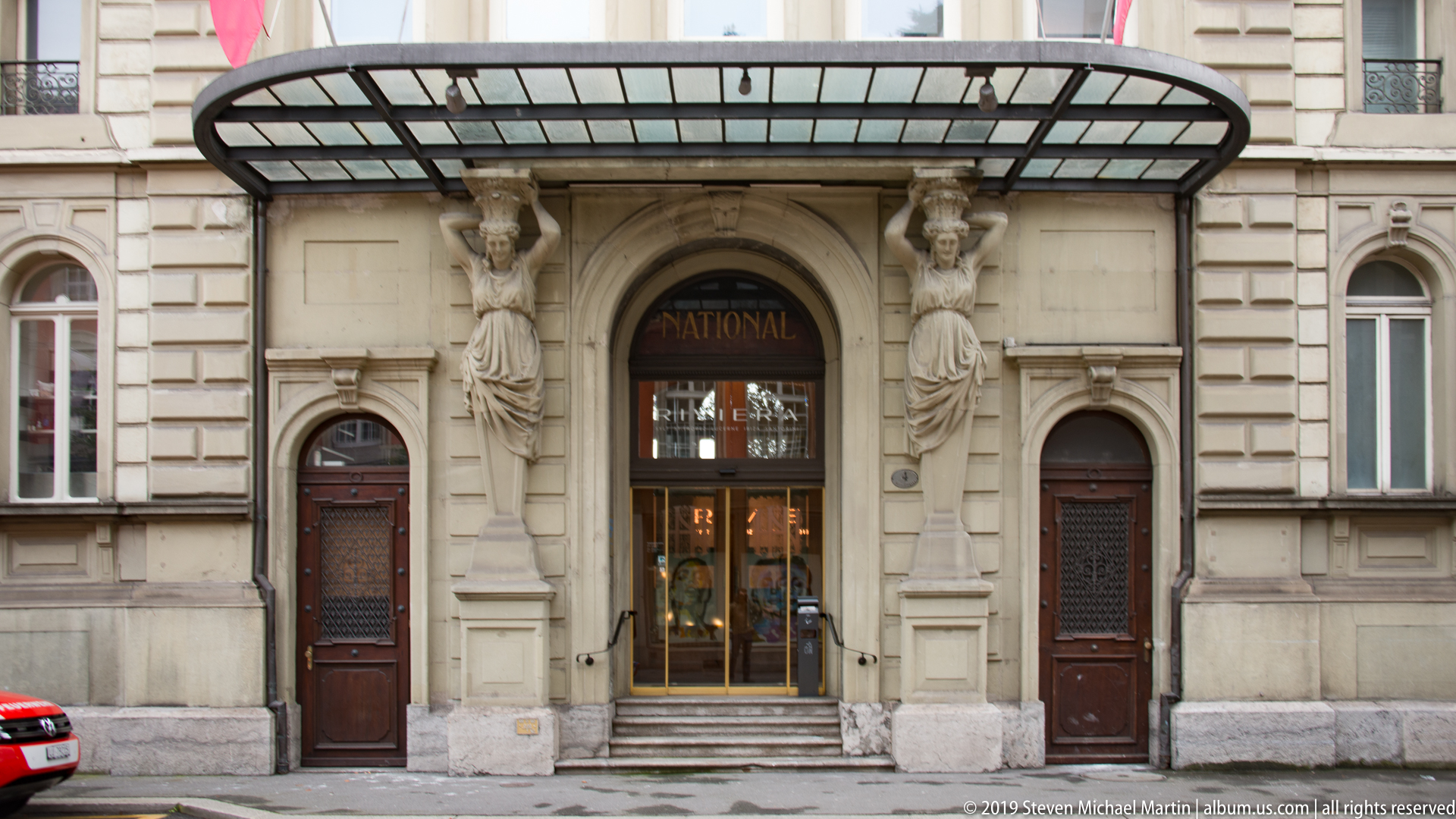
The entrance of the Grand Hotel National Lucerne is framed by sculpted female figures supporting the canopy and by richly modeled historic masonry. “NATIONAL” is visible above the central doorway. Brass and glass doors, flanking side entrances, and ornamental façade details convey the formal character of Lucerne’s long-established lakefront hotel architecture.
Caption
The entrance of the Grand Hotel National Lucerne is framed by sculpted female figures supporting the canopy and by richly modeled historic masonry. “NATIONAL” is visible above the central doorway. Brass and glass doors, flanking side entrances, and ornamental façade details convey the formal character of Lucerne’s long-established lakefront hotel architecture.

Snow-covered Mount Pilatus rises steeply behind Lucerne’s lakeshore, its rugged summit partly softened by low cloud. Passenger boats and waterfront buildings occupy a narrow band below the mountain, emphasizing the abrupt meeting of city, lake, and Alpine relief that defines many views across Lucerne.
Caption
Snow-covered Mount Pilatus rises steeply behind Lucerne’s lakeshore, its rugged summit partly softened by low cloud. Passenger boats and waterfront buildings occupy a narrow band below the mountain, emphasizing the abrupt meeting of city, lake, and Alpine relief that defines many views across Lucerne.
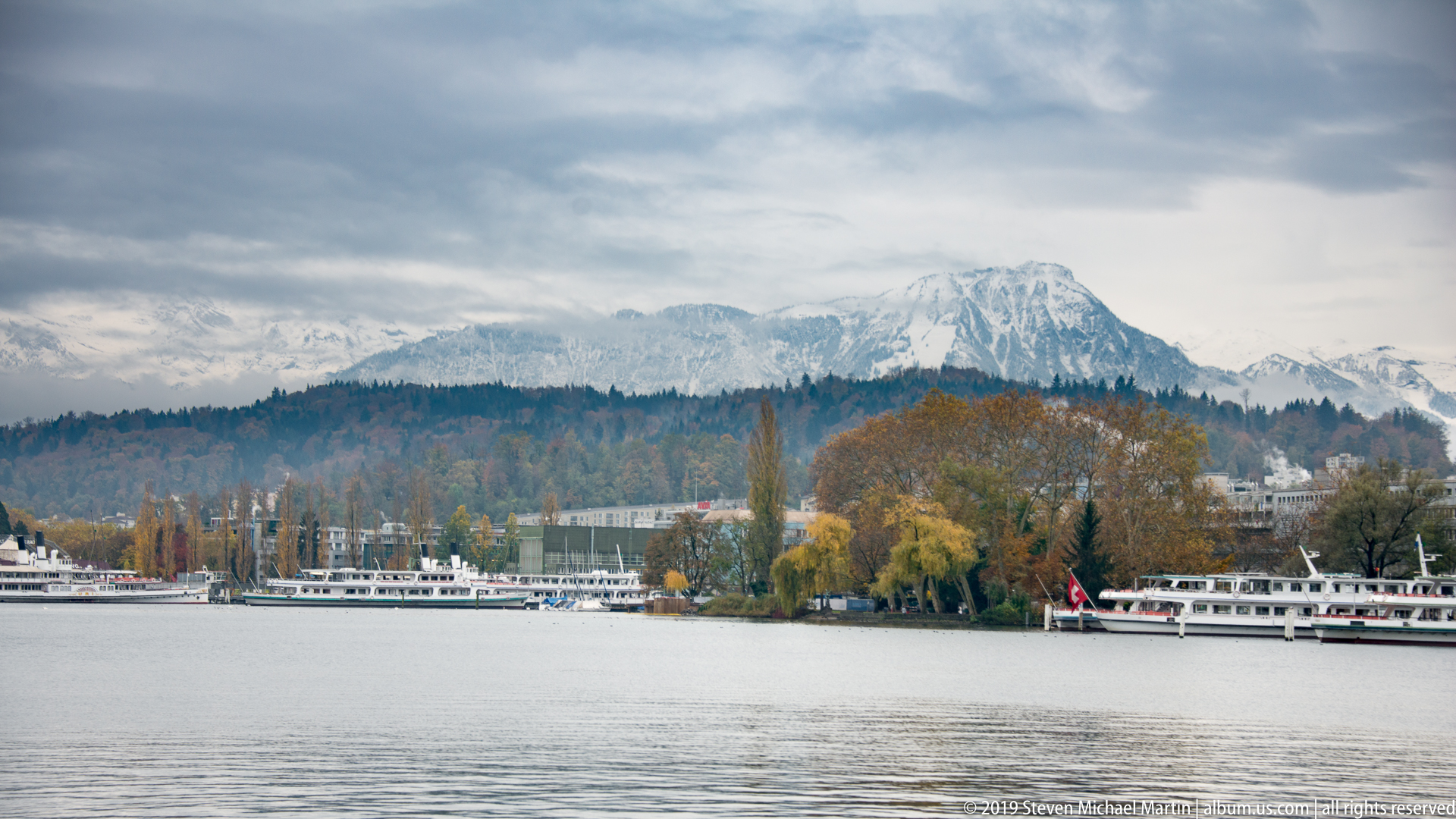
An autumn shoreline stretches across Lake Lucerne, with moored passenger vessels, trees in muted yellow and brown, and a broad pale mountain rising beyond the wooded ridge. The subdued overcast light flattens the layers of water, city edge, forest, and Alpine terrain into a calm seasonal landscape.
Caption
An autumn shoreline stretches across Lake Lucerne, with moored passenger vessels, trees in muted yellow and brown, and a broad pale mountain rising beyond the wooded ridge. The subdued overcast light flattens the layers of water, city edge, forest, and Alpine terrain into a calm seasonal landscape.

A steep, forested mountain rises through bands of mist above the autumn-colored shore of Lake Lucerne. The compressed view isolates the layered topography—lake edge, trees, fog, and rock—rather than the city itself, turning Lucerne’s surroundings into an atmospheric study of Alpine weather and relief.
Caption
A steep, forested mountain rises through bands of mist above the autumn-colored shore of Lake Lucerne. The compressed view isolates the layered topography—lake edge, trees, fog, and rock—rather than the city itself, turning Lucerne’s surroundings into an atmospheric study of Alpine weather and relief.

A Eurasian coot floats on the lake while pulling strands of green aquatic vegetation from the water. Its black body, contrasting white bill and frontal shield, and rounded profile are clearly visible. The close view records one of the common waterbirds using Lucerne’s urban lake habitat.
Caption
A Eurasian coot floats on the lake while pulling strands of green aquatic vegetation from the water. Its black body, contrasting white bill and frontal shield, and rounded profile are clearly visible. The close view records one of the common waterbirds using Lucerne’s urban lake habitat.
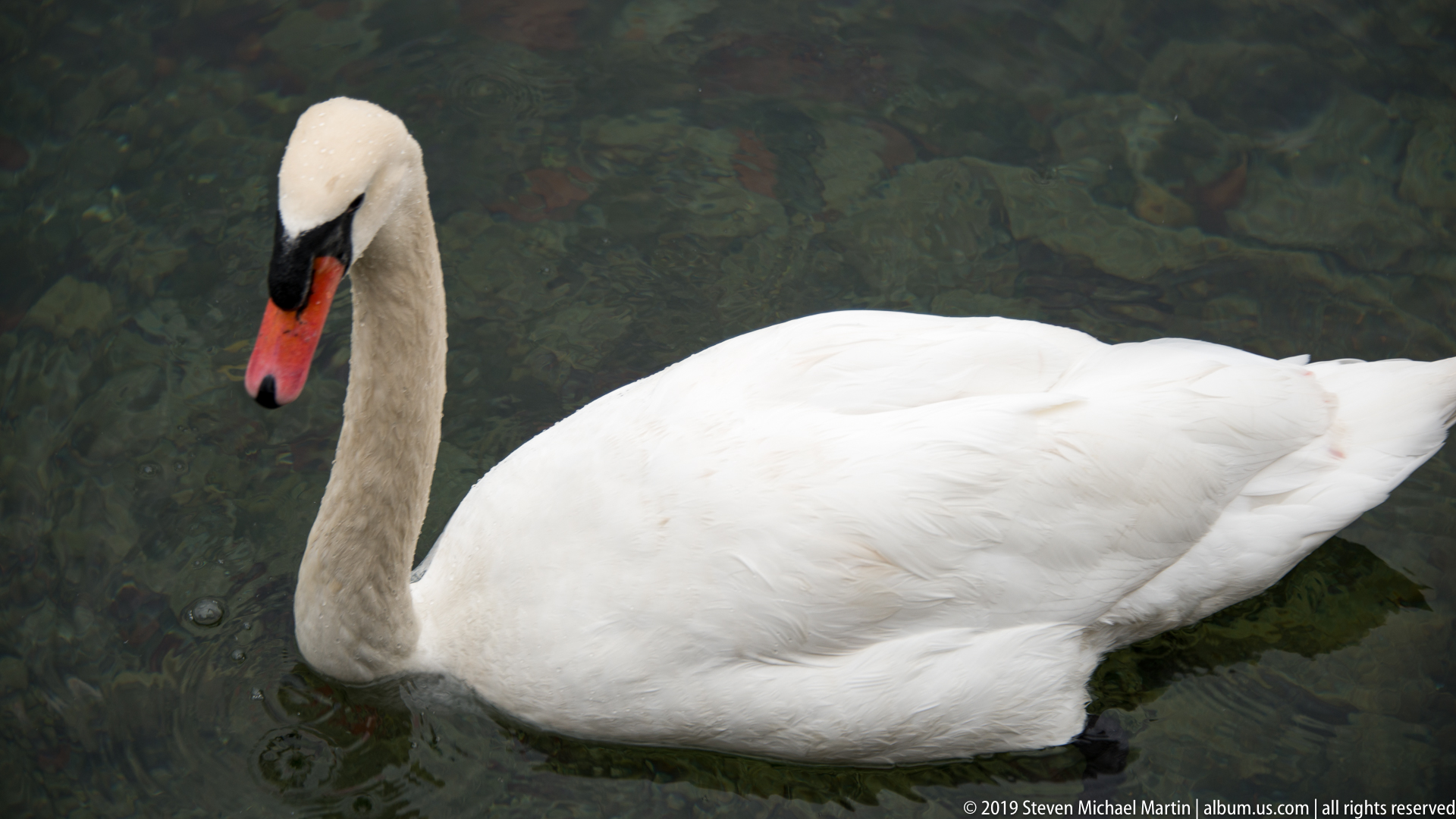
An adult mute swan glides through clear water close to shore, its white plumage, long curved neck, orange-red bill, and black facial markings sharply visible from above. The tight framing turns a common Lake Lucerne bird into a detailed species portrait.
Caption
An adult mute swan glides through clear water close to shore, its white plumage, long curved neck, orange-red bill, and black facial markings sharply visible from above. The tight framing turns a common Lake Lucerne bird into a detailed species portrait.

A great crested grebe moves across the lake, its white neck, dark crest, and warm chestnut facial ruff standing out against the gray-blue water. Slight motion blur conveys the bird’s forward movement. The image adds a close wildlife observation to Lucerne’s broader lakeside landscape sequence.
Caption
A great crested grebe moves across the lake, its white neck, dark crest, and warm chestnut facial ruff standing out against the gray-blue water. Slight motion blur conveys the bird’s forward movement. The image adds a close wildlife observation to Lucerne’s broader lakeside landscape sequence.

A mute swan tips forward to feed in the shallow water, leaving its white back and folded wings above the surface while its long neck reaches down below. The unusual feeding posture shifts attention from the swan’s familiar profile to its behavior and the clear, stony water of the lakeshore.
Caption
A mute swan tips forward to feed in the shallow water, leaving its white back and folded wings above the surface while its long neck reaches down below. The unusual feeding posture shifts attention from the swan’s familiar profile to its behavior and the clear, stony water of the lakeshore.

An ornate green-patinated rooftop structure frames a round clock and small bell beneath a decorative canopy. Sculptural supports, curved metalwork, and the weathered copper finish give the feature a distinctly historic character. The tight upward view isolates this architectural ornament from the surrounding Lucerne streetscape.
Caption
An ornate green-patinated rooftop structure frames a round clock and small bell beneath a decorative canopy. Sculptural supports, curved metalwork, and the weathered copper finish give the feature a distinctly historic character. The tight upward view isolates this architectural ornament from the surrounding Lucerne streetscape.

A richly detailed historic building anchors a Lucerne street lined with a mix of older and modern commercial façades. Painted and carved ornament, a steep roof, and a small central turret distinguish the building from its neighbors, while pedestrians, traffic lights, and storefronts place it firmly in the contemporary city.
Caption
A richly detailed historic building anchors a Lucerne street lined with a mix of older and modern commercial façades. Painted and carved ornament, a steep roof, and a small central turret distinguish the building from its neighbors, while pedestrians, traffic lights, and storefronts place it firmly in the contemporary city.

The richly ornamented façade of Hotel Schweizerhof Lucerne is dressed with bright orange Lucerne Festival banners. Stone balconies, sculpted pediments, and a green-patinated central clock feature give the lakeside hotel a formal late-historic presence, while the festival signage records the building’s role in the city’s contemporary cultural life.
Caption
The richly ornamented façade of Hotel Schweizerhof Lucerne is dressed with bright orange Lucerne Festival banners. Stone balconies, sculpted pediments, and a green-patinated central clock feature give the lakeside hotel a formal late-historic presence, while the festival signage records the building’s role in the city’s contemporary cultural life.

The Kapellbrücke approaches Lucerne’s Wasserturm across the Reuss, its covered timber span supported on angled piles above the water. Snowy mountains rise behind the city, while the bridge roof shows the mottled greens and browns of weathering and moss. The view emphasizes the bridge as both urban infrastructure and historic timber architecture.
Caption
The Kapellbrücke approaches Lucerne’s Wasserturm across the Reuss, its covered timber span supported on angled piles above the water. Snowy mountains rise behind the city, while the bridge roof shows the mottled greens and browns of weathering and moss. The view emphasizes the bridge as both urban infrastructure and historic timber architecture.

Viewed at a steep angle from below, a round masonry tower rises beside a pale historic building with shuttered windows. The tower’s narrow openings, heavy stonework, projecting gallery, and pointed roof suggest a structure inherited from Lucerne’s older urban fabric. The oblique composition highlights the physical junction between tower and adjoining residence.
Caption
Viewed at a steep angle from below, a round masonry tower rises beside a pale historic building with shuttered windows. The tower’s narrow openings, heavy stonework, projecting gallery, and pointed roof suggest a structure inherited from Lucerne’s older urban fabric. The oblique composition highlights the physical junction between tower and adjoining residence.

A close side view of the Kapellbrücke reveals the heavy timber posts, diagonal braces, roof trusses, and pile supports that carry the covered bridge across the Reuss. Modern railings and access elements in the foreground contrast with the weathered wood. The photograph shifts attention from the landmark silhouette to the bridge’s construction and structural rhythm.
Caption
A close side view of the Kapellbrücke reveals the heavy timber posts, diagonal braces, roof trusses, and pile supports that carry the covered bridge across the Reuss. Modern railings and access elements in the foreground contrast with the weathered wood. The photograph shifts attention from the landmark silhouette to the bridge’s construction and structural rhythm.

An interpretive panel labeled “Kapellbrücke” stands beside the covered bridge, presenting text and historic images about Lucerne’s Chapel Bridge. The timber span and its supports remain visible behind the sign, linking the visitor information directly to the monument it explains.
Caption
An interpretive panel labeled “Kapellbrücke” stands beside the covered bridge, presenting text and historic images about Lucerne’s Chapel Bridge. The timber span and its supports remain visible behind the sign, linking the visitor information directly to the monument it explains.

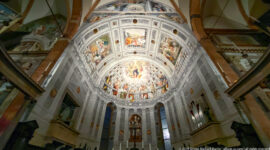
A low, wide viewpoint expands the Jesuit Church interior into a sweeping Baroque space, with the high altar centered beneath a sequence of ceiling frescoes and stucco ornament. Rows of pews converge toward the sanctuary, while symmetrical chandeliers and side architectural bays reinforce the carefully staged axial design.
Caption
A low, wide viewpoint expands the Jesuit Church interior into a sweeping Baroque space, with the high altar centered beneath a sequence of ceiling frescoes and stucco ornament. Rows of pews converge toward the sanctuary, while symmetrical chandeliers and side architectural bays reinforce the carefully staged axial design.

The Kapellbrücke leads toward the Wasserturm while the twin green-domed towers of Lucerne’s Jesuit Church rise across the Reuss. Birds wheel above the bridge and low mountains sit behind the riverfront. The composition layers timber bridge, defensive tower, Baroque church, and Alpine setting into a compact view of central Lucerne.
Caption
The Kapellbrücke leads toward the Wasserturm while the twin green-domed towers of Lucerne’s Jesuit Church rise across the Reuss. Birds wheel above the bridge and low mountains sit behind the riverfront. The composition layers timber bridge, defensive tower, Baroque church, and Alpine setting into a compact view of central Lucerne.

The Wasserturm stands beside the Kapellbrücke across a broad stretch of the Reuss, with Lucerne’s Jesuit Church and riverfront buildings beyond. Gulls cross the water in the foreground. The wider view gives the tower more visual weight and shows how the covered bridge forms part of a larger ensemble along the river.
Caption
The Wasserturm stands beside the Kapellbrücke across a broad stretch of the Reuss, with Lucerne’s Jesuit Church and riverfront buildings beyond. Gulls cross the water in the foreground. The wider view gives the tower more visual weight and shows how the covered bridge forms part of a larger ensemble along the river.
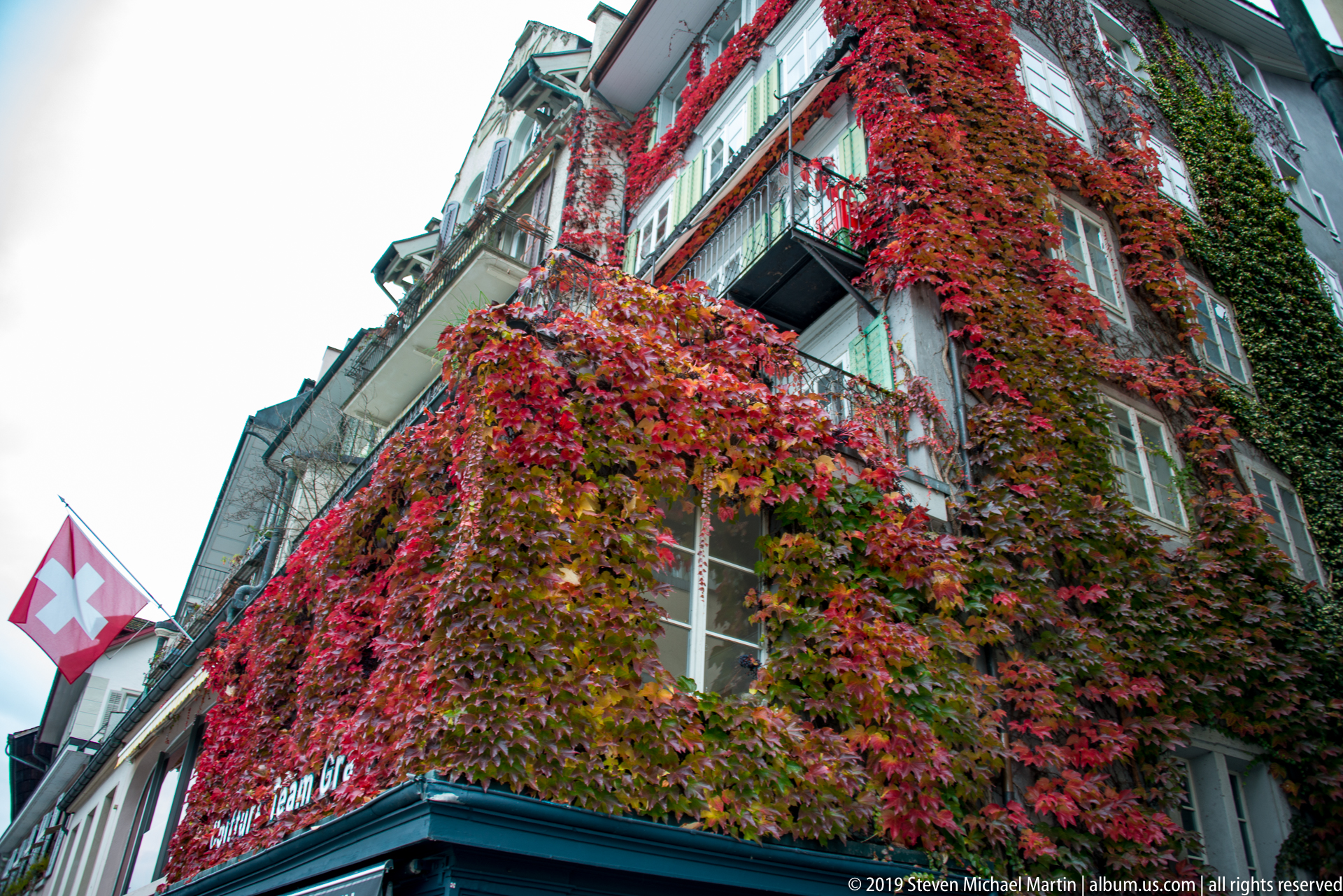
An urban façade is almost engulfed by autumn foliage, with climbing vines shifting from green to vivid red and crimson around rows of windows and balconies. A Swiss flag projects from the lower corner. The upward view turns seasonal plant growth into the dominant architectural surface, softening the building’s regular geometry.
Caption
An urban façade is almost engulfed by autumn foliage, with climbing vines shifting from green to vivid red and crimson around rows of windows and balconies. A Swiss flag projects from the lower corner. The upward view turns seasonal plant growth into the dominant architectural surface, softening the building’s regular geometry.

Lucerne’s Jesuit Church of St. Francis Xavier faces the Reuss with its symmetrical Baroque façade and twin green onion-domed towers. In the foreground, pedestrians cross a metal footbridge crowded with love locks. The scene combines one of the city’s major sacred landmarks with contemporary riverfront life.
Caption
Lucerne’s Jesuit Church of St. Francis Xavier faces the Reuss with its symmetrical Baroque façade and twin green onion-domed towers. In the foreground, pedestrians cross a metal footbridge crowded with love locks. The scene combines one of the city’s major sacred landmarks with contemporary riverfront life.

The Jesuit Church of St. Francis Xavier stands prominently on the Reuss riverfront, its pale Baroque façade framed by twin onion-domed towers. The broad nave, rhythmic pilasters, and sculpted portal establish the church as a major architectural presence along Lucerne’s historic waterfront, while the adjoining institutional wing extends the complex toward the old town.
Caption
The Jesuit Church of St. Francis Xavier stands prominently on the Reuss riverfront, its pale Baroque façade framed by twin onion-domed towers. The broad nave, rhythmic pilasters, and sculpted portal establish the church as a major architectural presence along Lucerne’s historic waterfront, while the adjoining institutional wing extends the complex toward the old town.

A row of historic buildings lines the Reuss, presenting Lucerne’s old-town riverfront as a layered ensemble of steep roofs, dormers, painted façades, and varied tower forms. The water creates a reflective foreground, while the compact urban fabric shows how civic and commercial buildings press directly against the river edge.
Caption
A row of historic buildings lines the Reuss, presenting Lucerne’s old-town riverfront as a layered ensemble of steep roofs, dormers, painted façades, and varied tower forms. The water creates a reflective foreground, while the compact urban fabric shows how civic and commercial buildings press directly against the river edge.

The Reuss opens through Lucerne’s historic center, bordered by tightly packed riverfront façades and crossed by a low bridge in the middle distance. Above the roofs, Château Gütsch rises on the wooded hillside, giving the scene a strong vertical relationship between the river, old-town buildings, and the elevated landmark.
Caption
The Reuss opens through Lucerne’s historic center, bordered by tightly packed riverfront façades and crossed by a low bridge in the middle distance. Above the roofs, Château Gütsch rises on the wooded hillside, giving the scene a strong vertical relationship between the river, old-town buildings, and the elevated landmark.

Lucerne’s riverfront compresses several landmarks into one view: rows of historic façades line the Reuss, the twin onion-domed towers of the Jesuit Church rise in the distance, and the covered roofline of the Chapel Bridge enters from the right. The layered composition links sacred architecture, civic waterfront, and the city’s famous timber crossing.
Caption
Lucerne’s riverfront compresses several landmarks into one view: rows of historic façades line the Reuss, the twin onion-domed towers of the Jesuit Church rise in the distance, and the covered roofline of the Chapel Bridge enters from the right. The layered composition links sacred architecture, civic waterfront, and the city’s famous timber crossing.

A carved heraldic lion projects from an ornate stone surround above an arched opening, its forepaws braced around a shield-like central element. Scrollwork, layered moldings, and heavy masonry give the detail a ceremonial character, while protective netting reveals the practical conservation measures used on the façade.
Caption
A carved heraldic lion projects from an ornate stone surround above an arched opening, its forepaws braced around a shield-like central element. Scrollwork, layered moldings, and heavy masonry give the detail a ceremonial character, while protective netting reveals the practical conservation measures used on the façade.

The nave of Lucerne’s Jesuit Church leads directly toward the monumental high altar, framed by white stucco architecture, pale peach accents, chandeliers, side pulpits, and a richly frescoed vault. Wooden pews establish the long axial perspective, emphasizing the theatrical Baroque progression from restrained white walls to the darker, gilded altar ensemble.
Caption
The nave of Lucerne’s Jesuit Church leads directly toward the monumental high altar, framed by white stucco architecture, pale peach accents, chandeliers, side pulpits, and a richly frescoed vault. Wooden pews establish the long axial perspective, emphasizing the theatrical Baroque progression from restrained white walls to the darker, gilded altar ensemble.

This upward-angled view of the Jesuit Church nave brings the side altars into the composition, showing how richly colored altar structures punctuate the otherwise pale stucco interior. The high altar remains centered in the distance beneath the frescoed ceiling, while paired arches and pilasters create a deep architectural rhythm along the nave.
Caption
This upward-angled view of the Jesuit Church nave brings the side altars into the composition, showing how richly colored altar structures punctuate the otherwise pale stucco interior. The high altar remains centered in the distance beneath the frescoed ceiling, while paired arches and pilasters create a deep architectural rhythm along the nave.

An especially steep upward perspective turns the Jesuit Church nave into a study of vertical Baroque ornament. Side altars and archways rise toward the clerestory, while painted ceiling medallions draw the eye along the vault to the gilded high altar. The composition highlights the church’s integration of architecture, sculpture, painting, and light.
Caption
An especially steep upward perspective turns the Jesuit Church nave into a study of vertical Baroque ornament. Side altars and archways rise toward the clerestory, while painted ceiling medallions draw the eye along the vault to the gilded high altar. The composition highlights the church’s integration of architecture, sculpture, painting, and light.

The camera tilts upward along the Jesuit Church nave, shifting attention from the high altar to the painted vault overhead. Oval and shaped fresco panels are embedded within exuberant peach-and-white stucco decoration, while clerestory windows, chandeliers, and side arches frame the ceiling’s long sequence above the central aisle.
Caption
The camera tilts upward along the Jesuit Church nave, shifting attention from the high altar to the painted vault overhead. Oval and shaped fresco panels are embedded within exuberant peach-and-white stucco decoration, while clerestory windows, chandeliers, and side arches frame the ceiling’s long sequence above the central aisle.

From between the pews, the rear of Lucerne’s Jesuit Church appears as a balanced Baroque composition of tall white pilasters, three arched lower bays, wrought-iron screens, and the pipe organ above. Ceiling frescoes and chandeliers extend the decorative program overhead, linking the gallery wall to the broader rhythm of the nave.
Caption
From between the pews, the rear of Lucerne’s Jesuit Church appears as a balanced Baroque composition of tall white pilasters, three arched lower bays, wrought-iron screens, and the pipe organ above. Ceiling frescoes and chandeliers extend the decorative program overhead, linking the gallery wall to the broader rhythm of the nave.

The Jesuit Church high altar rises as a dense Baroque assemblage of reddish marble-like columns, gilded capitals, sculpted ornament, and a large central altarpiece. Its darker palette contrasts dramatically with the pale nave walls and frescoed vault, concentrating visual attention on the sanctuary at the eastern end of the church.
Caption
The Jesuit Church high altar rises as a dense Baroque assemblage of reddish marble-like columns, gilded capitals, sculpted ornament, and a large central altarpiece. Its darker palette contrasts dramatically with the pale nave walls and frescoed vault, concentrating visual attention on the sanctuary at the eastern end of the church.

The rear of the Jesuit Church is organized as a monumental gallery wall, with a pipe organ centered high above three arched openings. Tall white pilasters divide the bays, while wrought-iron gates, stucco reliefs, medallions, and chandeliers continue the church’s coordinated Baroque decorative vocabulary across the entrance end of the nave.
Caption
The rear of the Jesuit Church is organized as a monumental gallery wall, with a pipe organ centered high above three arched openings. Tall white pilasters divide the bays, while wrought-iron gates, stucco reliefs, medallions, and chandeliers continue the church’s coordinated Baroque decorative vocabulary across the entrance end of the nave.

This frontal view isolates the Jesuit Church sanctuary, placing the high altar directly behind a richly decorated freestanding altar table. Reddish architectural columns, gilded relief, sculptural details, and the large altarpiece create a layered backdrop, while the white side walls make the sanctuary’s color and material richness especially pronounced.
Caption
This frontal view isolates the Jesuit Church sanctuary, placing the high altar directly behind a richly decorated freestanding altar table. Reddish architectural columns, gilded relief, sculptural details, and the large altarpiece create a layered backdrop, while the white side walls make the sanctuary’s color and material richness especially pronounced.

Looking away from the sanctuary, the Jesuit Church nave terminates at the organ gallery, visible above the central entrance bays. Rows of wooden pews guide the eye through a sequence of white arches and pilasters, while fresco medallions, chandeliers, and side altars preserve the Baroque visual richness even in the rearward view.
Caption
Looking away from the sanctuary, the Jesuit Church nave terminates at the organ gallery, visible above the central entrance bays. Rows of wooden pews guide the eye through a sequence of white arches and pilasters, while fresco medallions, chandeliers, and side altars preserve the Baroque visual richness even in the rearward view.

The Jesuit Church pipe organ fills the upper gallery with a symmetrical façade of tall metal pipes, reddish structural cases, gilded carving, and a smaller central section projecting forward. A painted scene and additional decorative sculpture crown the ensemble, integrating the instrument into the church’s elaborate Baroque interior rather than treating it as a purely functional installation.
Caption
The Jesuit Church pipe organ fills the upper gallery with a symmetrical façade of tall metal pipes, reddish structural cases, gilded carving, and a smaller central section projecting forward. A painted scene and additional decorative sculpture crown the ensemble, integrating the instrument into the church’s elaborate Baroque interior rather than treating it as a purely functional installation.

A close architectural study of the Jesuit Church focuses on a broad arched bay framed by white moldings, peach-colored stucco ornament, and two oval painted devotional medallions. Small projecting sculptural details and layered cornices demonstrate how even secondary gallery surfaces participate in the church’s highly coordinated Baroque decorative scheme.
Caption
A close architectural study of the Jesuit Church focuses on a broad arched bay framed by white moldings, peach-colored stucco ornament, and two oval painted devotional medallions. Small projecting sculptural details and layered cornices demonstrate how even secondary gallery surfaces participate in the church’s highly coordinated Baroque decorative scheme.

A large shaped ceiling fresco is set within a sculpted white stucco frame, surrounded by peach, gold, and green ornamental motifs. The painting combines architecture, clouds, and multiple figures in an illusionistic Baroque composition, using the vault as a theatrical extension of the church interior rather than a flat decorative surface.
Caption
A large shaped ceiling fresco is set within a sculpted white stucco frame, surrounded by peach, gold, and green ornamental motifs. The painting combines architecture, clouds, and multiple figures in an illusionistic Baroque composition, using the vault as a theatrical extension of the church interior rather than a flat decorative surface.

This tighter view reveals the Jesuit Church ceiling fresco as a complex multi-figure scene organized around dramatic clouds and foreshortened architectural forms. The lobed stucco frame pushes into the painted illusion, while groups of figures at the edges and a brighter central zone create the upward, visionary effect characteristic of Baroque ceiling decoration.
Caption
This tighter view reveals the Jesuit Church ceiling fresco as a complex multi-figure scene organized around dramatic clouds and foreshortened architectural forms. The lobed stucco frame pushes into the painted illusion, while groups of figures at the edges and a brighter central zone create the upward, visionary effect characteristic of Baroque ceiling decoration.

Two gilded putti flank a crowned heraldic shield set against polished reddish stone, creating a compact burst of Baroque ornament. Scrollwork, carved foliage, and the contrast between gold and veined stone emphasize the emblem as a prestigious decorative device within the church interior, even though the shield’s exact heraldic attribution is not established here.
Caption
Two gilded putti flank a crowned heraldic shield set against polished reddish stone, creating a compact burst of Baroque ornament. Scrollwork, carved foliage, and the contrast between gold and veined stone emphasize the emblem as a prestigious decorative device within the church interior, even though the shield’s exact heraldic attribution is not established here.

A dark rectangular plaque carries the gilded Latin inscription “PIORVM SVBSIDIO ET LIBERALITATE CONDITVM,” set within a carved stone frame of scrolls and small sculptural faces. The formal lettering and architectural placement present the text as a commemorative statement crediting pious support and generosity for the building’s establishment.
Caption
A dark rectangular plaque carries the gilded Latin inscription “PIORVM SVBSIDIO ET LIBERALITATE CONDITVM,” set within a carved stone frame of scrolls and small sculptural faces. The formal lettering and architectural placement present the text as a commemorative statement crediting pious support and generosity for the building’s establishment.

A striking red-and-white half-timbered building stands directly along the Reuss, its dense timber grid and repeated window bays contrasting with neighboring pale masonry façades. A deep roof with dormers crowns the riverfront elevation, while a terrace at water level reinforces the intimate connection between Lucerne’s historic architecture and the river.
Caption
A striking red-and-white half-timbered building stands directly along the Reuss, its dense timber grid and repeated window bays contrasting with neighboring pale masonry façades. A deep roof with dormers crowns the riverfront elevation, while a terrace at water level reinforces the intimate connection between Lucerne’s historic architecture and the river.

The Reuss waterfront stretches toward central Lucerne, with painted historic façades and the broad roofline of the Rathaus complex lining the left bank. A low bridge spans the river in the middle distance, while a stone tower-like element at the right edge anchors the foreground. The broad view emphasizes the river as the organizing spine of the old city.
Caption
The Reuss waterfront stretches toward central Lucerne, with painted historic façades and the broad roofline of the Rathaus complex lining the left bank. A low bridge spans the river in the middle distance, while a stone tower-like element at the right edge anchors the foreground. The broad view emphasizes the river as the organizing spine of the old city.

A projecting corner bay combines painted gray-and-white geometric decoration with a small red onion-shaped roof, creating a highly distinctive element above the street. Swiss and local flags hang from the neighboring masonry façade, while the bay’s molded panels, shuttered windows, and compact turret-like profile enliven the narrow historic streetscape.
Caption
A projecting corner bay combines painted gray-and-white geometric decoration with a small red onion-shaped roof, creating a highly distinctive element above the street. Swiss and local flags hang from the neighboring masonry façade, while the bay’s molded panels, shuttered windows, and compact turret-like profile enliven the narrow historic streetscape.

The Zytturm rises above Lucerne’s Musegg Wall with its distinctive red-roofed upper stage and two prominent clock faces. The lower dial is especially large and vividly colored, while the smaller upper clock sits beneath the tower’s central cupola. The layered masonry, tiled roofs, and projecting turret forms preserve the defensive character of the medieval wall complex.
Caption
The Zytturm rises above Lucerne’s Musegg Wall with its distinctive red-roofed upper stage and two prominent clock faces. The lower dial is especially large and vividly colored, while the smaller upper clock sits beneath the tower’s central cupola. The layered masonry, tiled roofs, and projecting turret forms preserve the defensive character of the medieval wall complex.

A carved stone lion sits upright with its forepaws resting on a broad shield, its stylized mane and slightly open mouth giving the figure a heraldic character. Scaffolding and protective structures around the sculpture indicate an active conservation setting, allowing the photograph to document both the emblematic carving and its preservation context.
Caption
A carved stone lion sits upright with its forepaws resting on a broad shield, its stylized mane and slightly open mouth giving the figure a heraldic character. Scaffolding and protective structures around the sculpture indicate an active conservation setting, allowing the photograph to document both the emblematic carving and its preservation context.

An interpretive panel titled “Löwenbrunnen” documents the history and restoration of a Lucerne fountain. Historic photographs, a small image of the fountain sculpture, and bilingual or multilingual explanatory text are arranged beneath the heading, with a restoration period noted for October to November 2019. The panel records conservation work as part of the site’s public presentation.
Caption
An interpretive panel titled “Löwenbrunnen” documents the history and restoration of a Lucerne fountain. Historic photographs, a small image of the fountain sculpture, and bilingual or multilingual explanatory text are arranged beneath the heading, with a restoration period noted for October to November 2019. The panel records conservation work as part of the site’s public presentation.

The same decorated corner oriel is seen from below, revealing its structural relationship to the façade. A slender column supports the projecting bay, while gray-and-white geometric panels wrap around the windows beneath the curved red roof. The low viewpoint emphasizes how Lucerne’s historic streetscape uses painted timber and projecting upper stories to animate tight urban corners.
Caption
The same decorated corner oriel is seen from below, revealing its structural relationship to the façade. A slender column supports the projecting bay, while gray-and-white geometric panels wrap around the windows beneath the curved red roof. The low viewpoint emphasizes how Lucerne’s historic streetscape uses painted timber and projecting upper stories to animate tight urban corners.

Flags and pedestrians animate a narrow Lucerne street beside a substantial historic corner building with projecting eaves, irregular stonework, arched ground-floor openings, and painted façade details. The view emphasizes the layered commercial character of the old town, where civic heraldry, shopfronts, and centuries-old architecture occupy the same compact streetscape.
Caption
Flags and pedestrians animate a narrow Lucerne street beside a substantial historic corner building with projecting eaves, irregular stonework, arched ground-floor openings, and painted façade details. The view emphasizes the layered commercial character of the old town, where civic heraldry, shopfronts, and centuries-old architecture occupy the same compact streetscape.

Seen from closer range, this historic Lucerne building combines a rough-plastered upper façade with stone-framed windows, a small balcony, deep projecting eaves, and an arched ground-floor arcade. Decorative painted and sculptural elements enliven the corner, while hanging signs and street-level businesses show the continued commercial use of the old urban fabric.
Caption
Seen from closer range, this historic Lucerne building combines a rough-plastered upper façade with stone-framed windows, a small balcony, deep projecting eaves, and an arched ground-floor arcade. Decorative painted and sculptural elements enliven the corner, while hanging signs and street-level businesses show the continued commercial use of the old urban fabric.

Two bronze lion-head spouts project from a stone fountain wall, each sending a narrow stream of water forward. Greenish patina spreads across the sculpted faces and metal fittings, contrasting with the pale masonry behind. The close view isolates the functional and decorative detail, showing how animal imagery is integrated directly into Lucerne’s historic fountain design.
Caption
Two bronze lion-head spouts project from a stone fountain wall, each sending a narrow stream of water forward. Greenish patina spreads across the sculpted faces and metal fittings, contrasting with the pale masonry behind. The close view isolates the functional and decorative detail, showing how animal imagery is integrated directly into Lucerne’s historic fountain design.
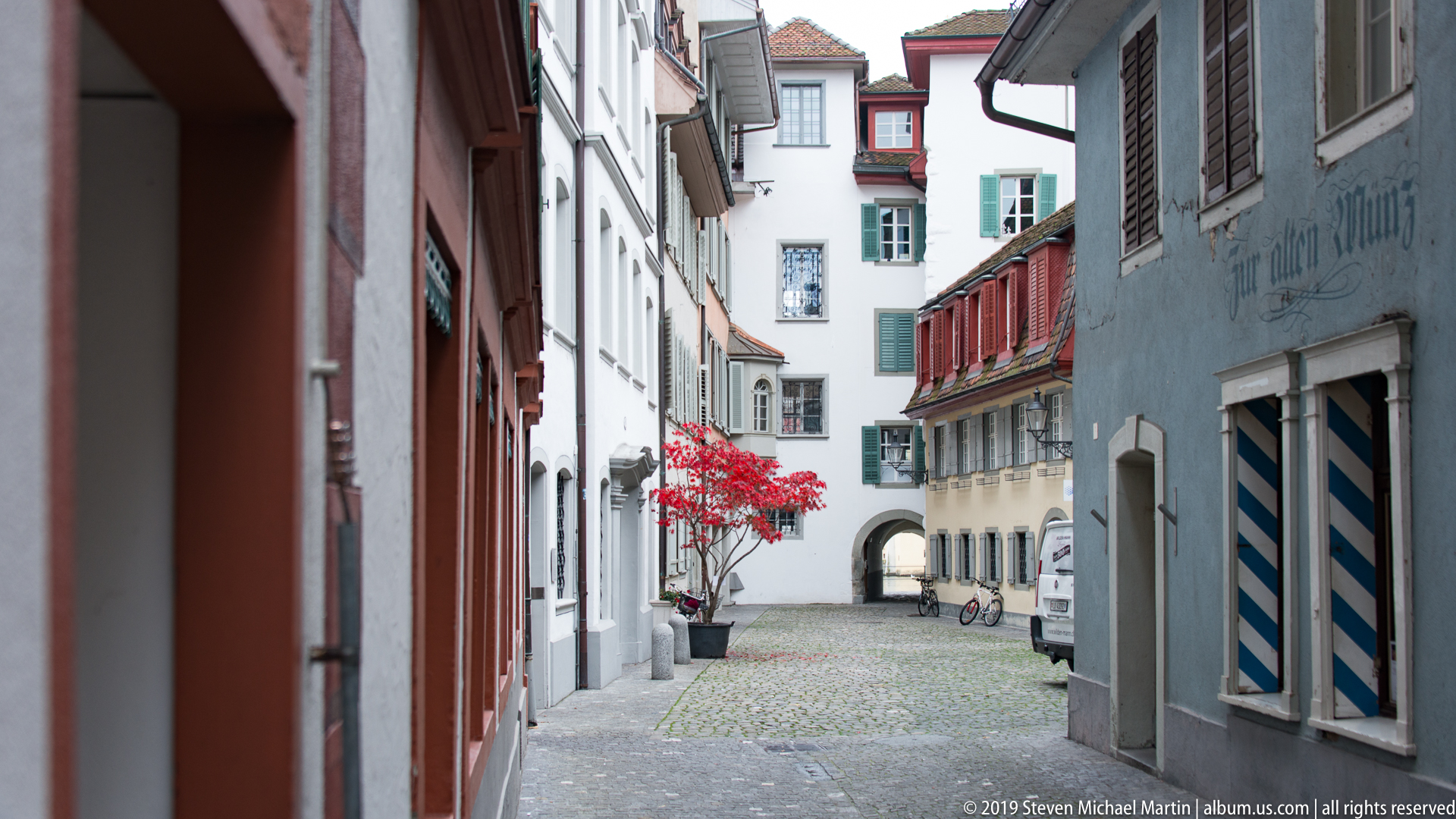
A quiet cobbled lane threads between closely spaced historic houses in Lucerne’s old town. Painted walls, shuttered windows, projecting timber elements, flower boxes, and a small arched passage create a layered pedestrian-scale scene, distinct from the busier commercial streets nearby. The composition records the intimate texture of the medieval street network rather than a single landmark.
Caption
A quiet cobbled lane threads between closely spaced historic houses in Lucerne’s old town. Painted walls, shuttered windows, projecting timber elements, flower boxes, and a small arched passage create a layered pedestrian-scale scene, distinct from the busier commercial streets nearby. The composition records the intimate texture of the medieval street network rather than a single landmark.

A wrought-metal hanging sign projects from a textured wall, its silhouette formed as a winged dragon above a suspended panel. The sign advertises a pharmacy and represents the tradition of projecting trade emblems that remain a distinctive feature of many European old-town streets, where symbolic forms helped identify businesses from a distance.
Caption
A wrought-metal hanging sign projects from a textured wall, its silhouette formed as a winged dragon above a suspended panel. The sign advertises a pharmacy and represents the tradition of projecting trade emblems that remain a distinctive feature of many European old-town streets, where symbolic forms helped identify businesses from a distance.

Branching stone supports spread upward like stylized tree limbs beneath a projecting rounded section of a historic building. The close architectural view isolates the structural and decorative treatment of the overhang, showing how masonry ribs and corbels were used to carry the upper volume while creating an unusually sculptural street-level detail.
Caption
Branching stone supports spread upward like stylized tree limbs beneath a projecting rounded section of a historic building. The close architectural view isolates the structural and decorative treatment of the overhang, showing how masonry ribs and corbels were used to carry the upper volume while creating an unusually sculptural street-level detail.

An elaborately carved wooden entrance stands beneath a painted blue-and-gold “Apotheke” sign on a historic façade. Curved stonework frames the upper windows, while the dense carving of the doorway gives the pharmacy frontage a crafted, almost cabinet-like character. The image records a surviving commercial detail integrated into Lucerne’s old-town architecture.
Caption
An elaborately carved wooden entrance stands beneath a painted blue-and-gold “Apotheke” sign on a historic façade. Curved stonework frames the upper windows, while the dense carving of the doorway gives the pharmacy frontage a crafted, almost cabinet-like character. The image records a surviving commercial detail integrated into Lucerne’s old-town architecture.

A brightly painted relief displays a double-headed eagle on a shield beneath a turbaned or wrapped head, framed by a shallow architectural niche. The date 1480 appears below. Rather than treating it as a generic ornament, the photograph records a specific heraldic device embedded in Lucerne’s streetscape, combining civic or guild symbolism with vivid polychrome carving.
Caption
A brightly painted relief displays a double-headed eagle on a shield beneath a turbaned or wrapped head, framed by a shallow architectural niche. The date 1480 appears below. Rather than treating it as a generic ornament, the photograph records a specific heraldic device embedded in Lucerne’s streetscape, combining civic or guild symbolism with vivid polychrome carving.

A carved stone basin and tall central column form a historic fountain at the intersection of narrow Lucerne streets. Sculptural details around the basin and column contrast with the surrounding painted façades, balconies, and shopfronts. The photograph places the fountain within its everyday urban setting, where public water features also function as visual anchors in small squares and street junctions.
Caption
A carved stone basin and tall central column form a historic fountain at the intersection of narrow Lucerne streets. Sculptural details around the basin and column contrast with the surrounding painted façades, balconies, and shopfronts. The photograph places the fountain within its everyday urban setting, where public water features also function as visual anchors in small squares and street junctions.

A stone clock tower rises above tiled roofs along Lucerne’s historic fortifications, its large painted clock face and mural-like decoration dominating the upper façade. The tower belongs to the Musegg Wall, one of the city’s defining surviving defensive features. From this lower viewpoint, domestic roofs partially conceal the wall while the tower remains visually prominent.
Caption
A stone clock tower rises above tiled roofs along Lucerne’s historic fortifications, its large painted clock face and mural-like decoration dominating the upper façade. The tower belongs to the Musegg Wall, one of the city’s defining surviving defensive features. From this lower viewpoint, domestic roofs partially conceal the wall while the tower remains visually prominent.

A broad polygonal stone fountain stands near the Reuss, its raised central column silhouetted against bridges, riverfront buildings, and a hillside tower. The low viewpoint gives the fountain unusual visual weight while keeping the city beyond in context. Decorative relief panels on the basin add civic ornament to a utilitarian public feature.
Caption
A broad polygonal stone fountain stands near the Reuss, its raised central column silhouetted against bridges, riverfront buildings, and a hillside tower. The low viewpoint gives the fountain unusual visual weight while keeping the city beyond in context. Decorative relief panels on the basin add civic ornament to a utilitarian public feature.

An ornate stone façade rises behind a sculpted lion perched on a projecting corner element. Horizontal bands of relief, window surrounds, and classical ornament create a richly modeled surface, while the lion adds a dramatic civic or heraldic accent. The steep upward viewpoint emphasizes the sculpture’s position above street level and the vertical layering of the façade.
Caption
An ornate stone façade rises behind a sculpted lion perched on a projecting corner element. Horizontal bands of relief, window surrounds, and classical ornament create a richly modeled surface, while the lion adds a dramatic civic or heraldic accent. The steep upward viewpoint emphasizes the sculpture’s position above street level and the vertical layering of the façade.

A richly modeled doorway punctuates an otherwise restrained white façade. The carved stone surround rises into a curved pediment-like crown, while the wooden door panels carry their own decorative relief. Iron-grilled windows on either side create a balanced composition, making this a focused study of craftsmanship and symmetry in Lucerne’s historic architecture.
Caption
A richly modeled doorway punctuates an otherwise restrained white façade. The carved stone surround rises into a curved pediment-like crown, while the wooden door panels carry their own decorative relief. Iron-grilled windows on either side create a balanced composition, making this a focused study of craftsmanship and symmetry in Lucerne’s historic architecture.

A stone fountain occupies the foreground of a Lucerne square, while a substantial historic building behind it carries pharmacy signage and deep projecting eaves. The composition links two characteristic elements of the old town—public fountains and long-lived commercial premises—within a compact streetscape of arcades, shutters, painted signs, and masonry façades.
Caption
A stone fountain occupies the foreground of a Lucerne square, while a substantial historic building behind it carries pharmacy signage and deep projecting eaves. The composition links two characteristic elements of the old town—public fountains and long-lived commercial premises—within a compact streetscape of arcades, shutters, painted signs, and masonry façades.

The façade of Lucerne’s Historisches Museum is marked by striped blue-and-white shutters and a matching diagonal pattern on the large ground-floor doors. The inscription “Historisches Museum” appears on the wall, while the otherwise plain plastered exterior preserves the massing of an older civic structure. Contemporary graffiti introduces a sharp contrast with the museum’s historic fabric.
Caption
The façade of Lucerne’s Historisches Museum is marked by striped blue-and-white shutters and a matching diagonal pattern on the large ground-floor doors. The inscription “Historisches Museum” appears on the wall, while the otherwise plain plastered exterior preserves the massing of an older civic structure. Contemporary graffiti introduces a sharp contrast with the museum’s historic fabric.
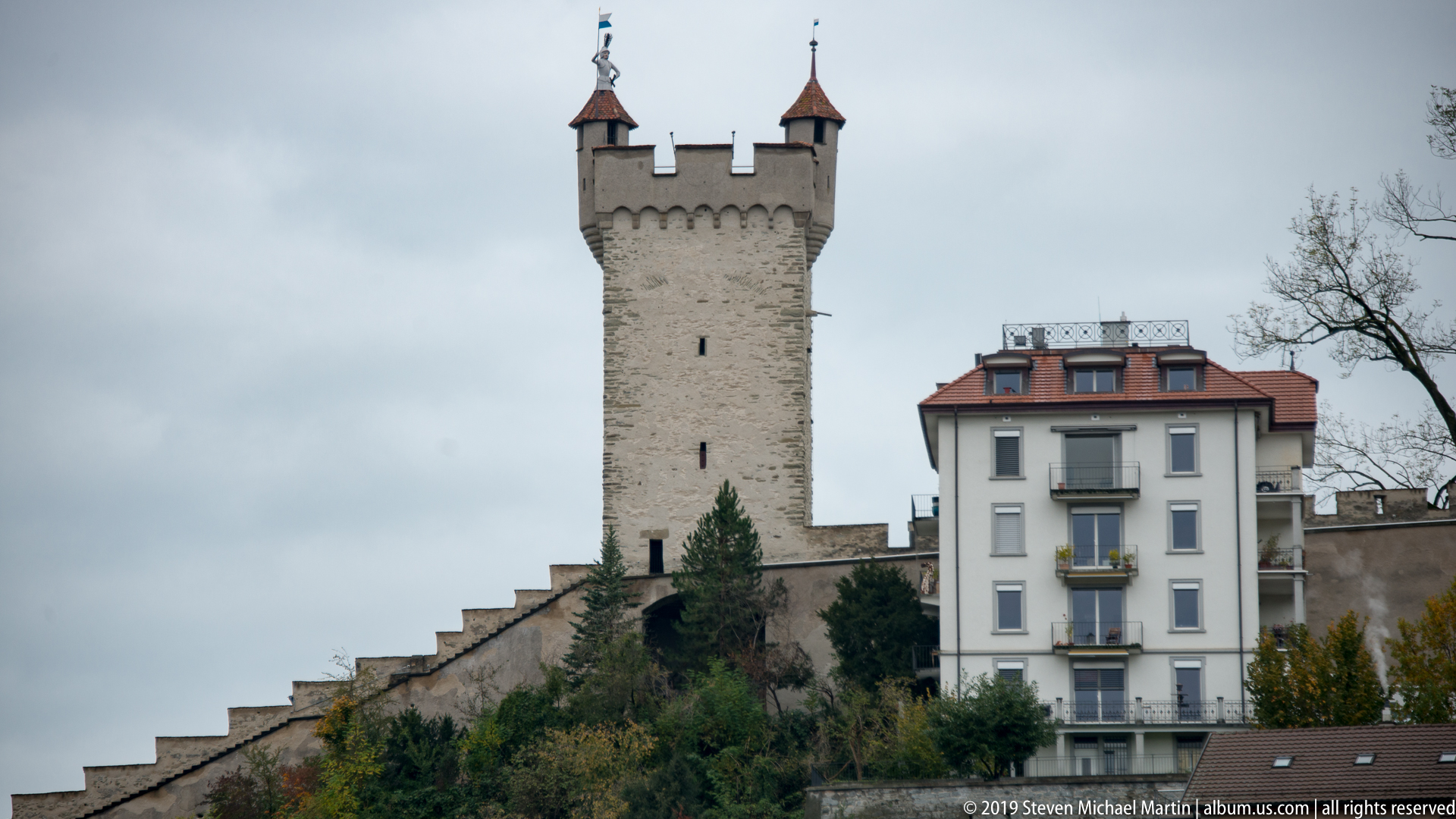
A tall square stone tower rises from Lucerne’s historic defensive line, with crenellated walls descending the hillside beside it. Small roofed turrets crown the corners and emphasize the tower’s vertical profile. Residential buildings immediately below show how closely the medieval fortifications are woven into the modern city rather than standing apart from it.
Caption
A tall square stone tower rises from Lucerne’s historic defensive line, with crenellated walls descending the hillside beside it. Small roofed turrets crown the corners and emphasize the tower’s vertical profile. Residential buildings immediately below show how closely the medieval fortifications are woven into the modern city rather than standing apart from it.

Pastel and white historic houses line the Reuss behind a riverside walkway, their shuttered windows and steep roofs forming a dense old-town frontage. Autumn trees and café seating soften the architectural edge. The photograph emphasizes Lucerne’s close relationship between domestic buildings, pedestrian embankments, and the river that structures the historic center.
Caption
Pastel and white historic houses line the Reuss behind a riverside walkway, their shuttered windows and steep roofs forming a dense old-town frontage. Autumn trees and café seating soften the architectural edge. The photograph emphasizes Lucerne’s close relationship between domestic buildings, pedestrian embankments, and the river that structures the historic center.

A tightly grouped row of tall historic houses rises directly from the Reuss embankment, with green and red shutters punctuating pale façades. Their irregular rooflines and narrow footprints reflect the compressed urban fabric of Lucerne’s center. Mountain slopes appear faintly beyond, reinforcing the city’s distinctive meeting of river, dense architecture, and Alpine setting.
Caption
A tightly grouped row of tall historic houses rises directly from the Reuss embankment, with green and red shutters punctuating pale façades. Their irregular rooflines and narrow footprints reflect the compressed urban fabric of Lucerne’s center. Mountain slopes appear faintly beyond, reinforcing the city’s distinctive meeting of river, dense architecture, and Alpine setting.
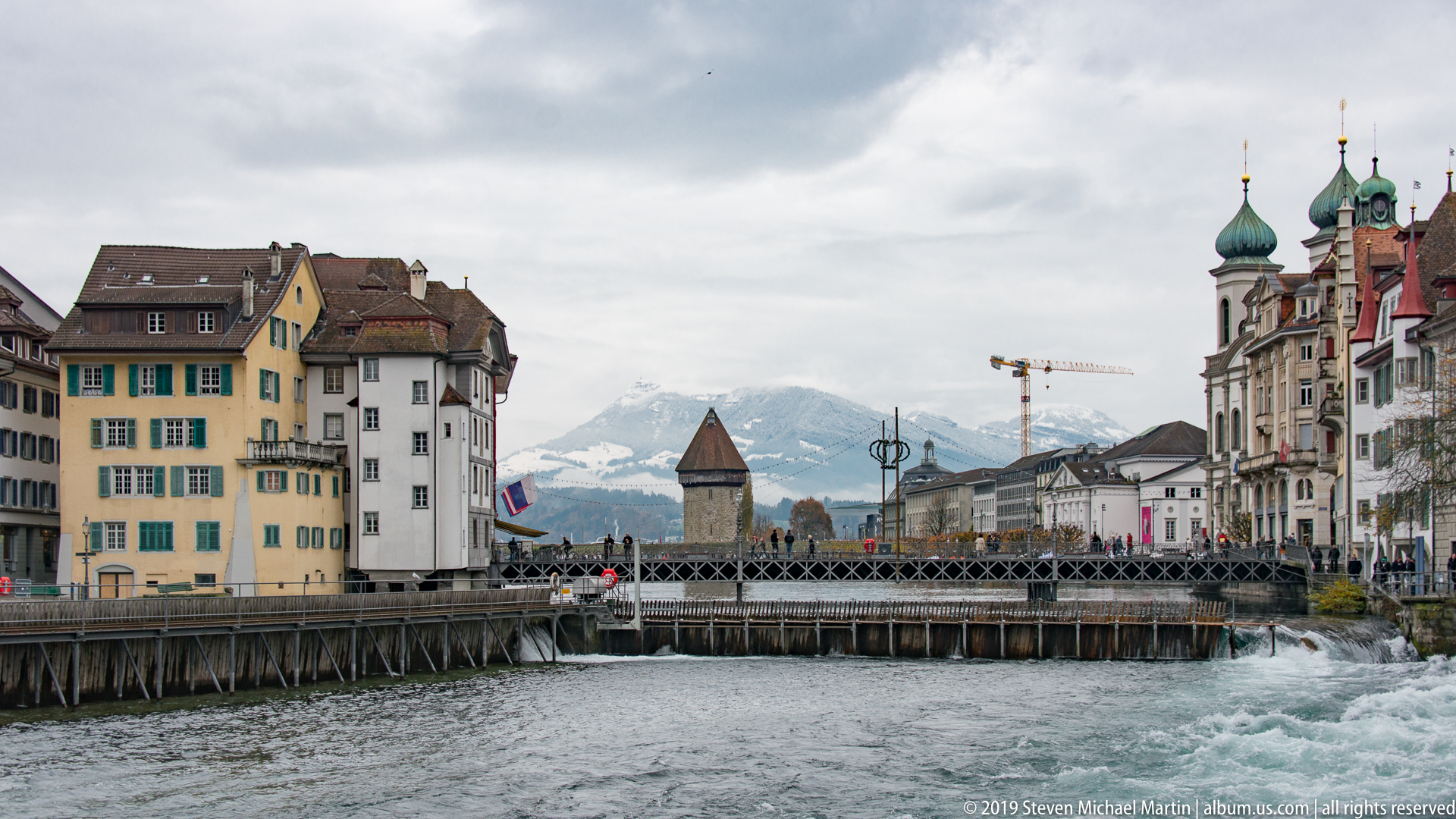
The Reuss flows through Lucerne beneath a pedestrian bridge, framed by historic riverfront buildings and the twin green onion domes of the Jesuit Church farther downstream. A pointed bridge tower and distant mountains add vertical landmarks to the layered view. The image brings together the city’s river engineering, sacred architecture, and Alpine setting in a single composition.
Caption
The Reuss flows through Lucerne beneath a pedestrian bridge, framed by historic riverfront buildings and the twin green onion domes of the Jesuit Church farther downstream. A pointed bridge tower and distant mountains add vertical landmarks to the layered view. The image brings together the city’s river engineering, sacred architecture, and Alpine setting in a single composition.

A small bronze creature projects from a stone fountain, channeling a clear arc of water from its open mouth. The sculptural spout joins a second animal form to a wall-mounted human or mask-like head, turning a functional water outlet into an expressive piece of street ornament. Tight framing isolates the craftsmanship and movement of the flowing water.
Caption
A small bronze creature projects from a stone fountain, channeling a clear arc of water from its open mouth. The sculptural spout joins a second animal form to a wall-mounted human or mask-like head, turning a functional water outlet into an expressive piece of street ornament. Tight framing isolates the craftsmanship and movement of the flowing water.

A broad multi-story building displays an exposed timber structural grid across its façade, with rows of closely spaced windows and deep overhanging eaves. The strongly rhythmic wood framing gives the building a distinctly traditional character despite modern storefronts at street level. The frontal view is especially useful for reading its construction pattern and symmetrical organization.
Caption
A broad multi-story building displays an exposed timber structural grid across its façade, with rows of closely spaced windows and deep overhanging eaves. The strongly rhythmic wood framing gives the building a distinctly traditional character despite modern storefronts at street level. The frontal view is especially useful for reading its construction pattern and symmetrical organization.

A carved wooden opening along the covered bridge is filled by a diamond-pattern metal lattice, offering a partial glimpse of colorful buildings and river scenery beyond. Rosettes and geometric relief decorate the surrounding woodwork. The tight composition shifts attention from the bridge’s overall structure to its crafted enclosure and the way framed views connect the interior passage to the city outside.
Caption
A carved wooden opening along the covered bridge is filled by a diamond-pattern metal lattice, offering a partial glimpse of colorful buildings and river scenery beyond. Rosettes and geometric relief decorate the surrounding woodwork. The tight composition shifts attention from the bridge’s overall structure to its crafted enclosure and the way framed views connect the interior passage to the city outside.

A dark metal figure appears to sit directly on the vertical wall, legs extended outward and arms open in a deliberately unconventional pose. The simplified clothing, expressive hands, and projecting body give the sculpture a playful tension with the flat white architectural surface behind it. The close view isolates the artwork from its surrounding streetscape.
Caption
A dark metal figure appears to sit directly on the vertical wall, legs extended outward and arms open in a deliberately unconventional pose. The simplified clothing, expressive hands, and projecting body give the sculpture a playful tension with the flat white architectural surface behind it. The close view isolates the artwork from its surrounding streetscape.

A white historic façade with pale shutters is punctuated by multiple rows of small dark sculptural projections fixed between the windows. A curved metal downspout adds another unusual detail at the roof edge. The close view documents an idiosyncratic decorative treatment that would be easy to miss in a wider streetscape photograph.
Caption
A white historic façade with pale shutters is punctuated by multiple rows of small dark sculptural projections fixed between the windows. A curved metal downspout adds another unusual detail at the roof edge. The close view documents an idiosyncratic decorative treatment that would be easy to miss in a wider streetscape photograph.

Heavy timber posts, braces, and rafters create the long covered passage of Lucerne’s Spreuer Bridge. Painted triangular panels are set beneath the roof at regular intervals, producing a distinctive sequence above the walkway. The central perspective emphasizes the bridge’s repetitive wooden structure and the intimate, enclosed experience of crossing the Reuss on foot.
Caption
Heavy timber posts, braces, and rafters create the long covered passage of Lucerne’s Spreuer Bridge. Painted triangular panels are set beneath the roof at regular intervals, producing a distinctive sequence above the walkway. The central perspective emphasizes the bridge’s repetitive wooden structure and the intimate, enclosed experience of crossing the Reuss on foot.

A second view down the Spreuer Bridge concentrates on the triangular painted panels mounted beneath the roof trusses. Their dark narrative scenes punctuate the warm timber structure at regular intervals, while the receding posts and braces create a strong tunnel-like perspective. This angle gives greater prominence to the bridge’s pictorial program than the preceding structural view.
Caption
A second view down the Spreuer Bridge concentrates on the triangular painted panels mounted beneath the roof trusses. Their dark narrative scenes punctuate the warm timber structure at regular intervals, while the receding posts and braces create a strong tunnel-like perspective. This angle gives greater prominence to the bridge’s pictorial program than the preceding structural view.
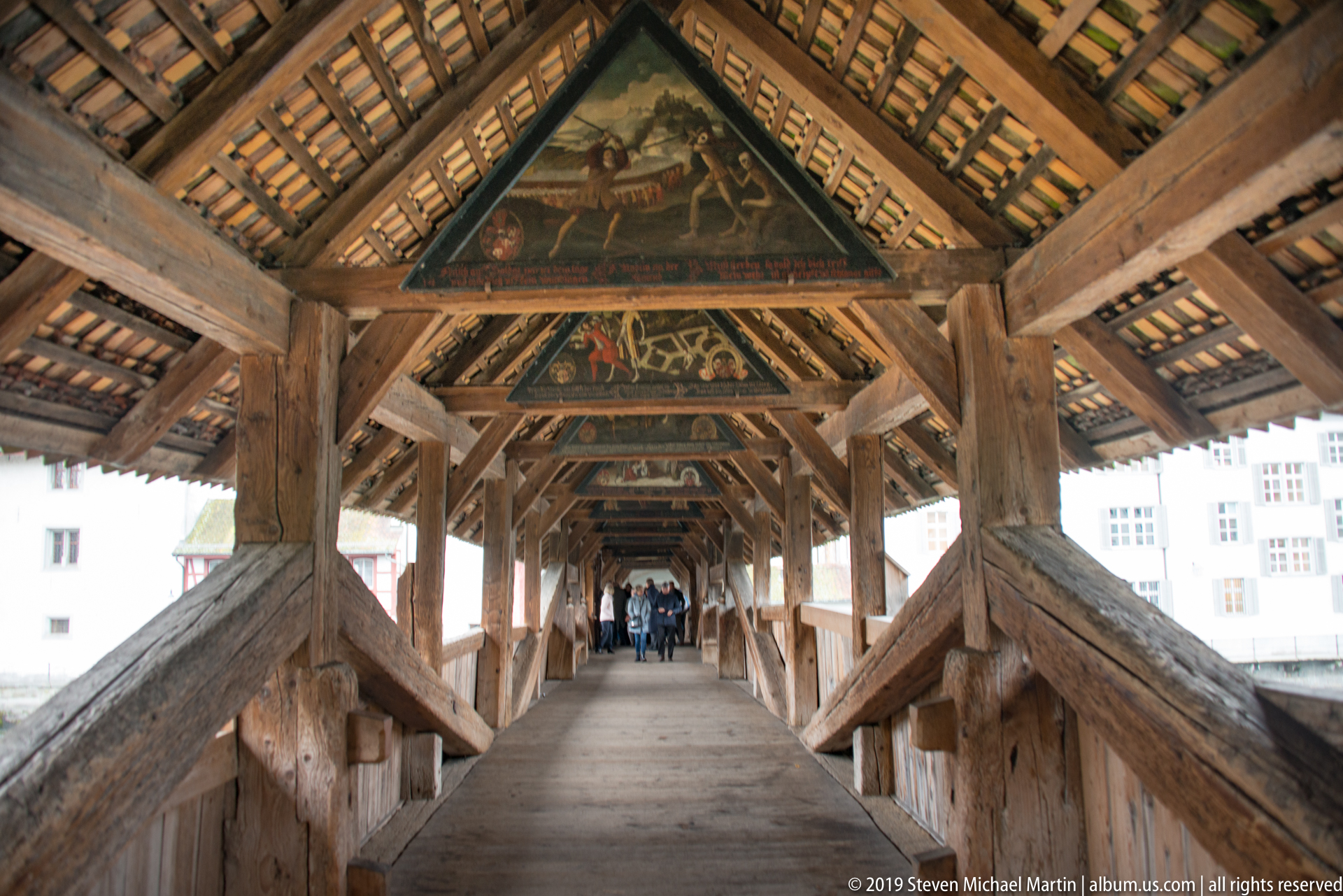
The timber passage of the Spreuer Bridge stretches toward a distant group of pedestrians, with painted triangular scenes alternating beneath the roof. Massive posts and diagonal braces form a repeated structural rhythm along both sides. Compared with the closer views, this photograph emphasizes the full depth of the crossing and the relationship between its construction, artwork, and everyday pedestrian use.
Caption
The timber passage of the Spreuer Bridge stretches toward a distant group of pedestrians, with painted triangular scenes alternating beneath the roof. Massive posts and diagonal braces form a repeated structural rhythm along both sides. Compared with the closer views, this photograph emphasizes the full depth of the crossing and the relationship between its construction, artwork, and everyday pedestrian use.

The Reuss drops over Lucerne’s historic needle dam in the foreground while the Jesuit Church rises beyond the river with its paired green onion domes. Walkways, control structures, and urban embankments reveal how river management is integrated into the center of the city. The view brings infrastructure and sacred architecture together within the same historic river corridor.
Caption
The Reuss drops over Lucerne’s historic needle dam in the foreground while the Jesuit Church rises beyond the river with its paired green onion domes. Walkways, control structures, and urban embankments reveal how river management is integrated into the center of the city. The view brings infrastructure and sacred architecture together within the same historic river corridor.

A broad view across the Reuss centers the Jesuit Church’s twin green domes among a dense row of historic riverfront buildings. A fountain jet arcs into the foreground, adding movement to the placid water. The composition emphasizes the church’s role in Lucerne’s skyline while preserving the varied rooflines, façades, and embankments that define the old city along the river.
Caption
A broad view across the Reuss centers the Jesuit Church’s twin green domes among a dense row of historic riverfront buildings. A fountain jet arcs into the foreground, adding movement to the placid water. The composition emphasizes the church’s role in Lucerne’s skyline while preserving the varied rooflines, façades, and embankments that define the old city along the river.

An elaborately carved stone fountain terminal fills the frame, with two metal spouts pouring water beneath a scrollwork cartouche and mask-like relief. Softly focused historic façades and autumn foliage remain visible behind it. The close view highlights the sculptural treatment of a functional water source and the layered ornamental vocabulary of Lucerne’s public fountains.
Caption
An elaborately carved stone fountain terminal fills the frame, with two metal spouts pouring water beneath a scrollwork cartouche and mask-like relief. Softly focused historic façades and autumn foliage remain visible behind it. The close view highlights the sculptural treatment of a functional water source and the layered ornamental vocabulary of Lucerne’s public fountains.

A restrained white façade is centered on a wooden doorway framed by carved gray stone and crowned with a gilded heraldic ensemble. Small circular emblems and sculpted figures flank the larger gold medallion above, giving the entrance a ceremonial character that contrasts with the modern shop windows on either side. The close frontal view isolates the surviving historic portal within a contemporary commercial frontage.
Caption
A restrained white façade is centered on a wooden doorway framed by carved gray stone and crowned with a gilded heraldic ensemble. Small circular emblems and sculpted figures flank the larger gold medallion above, giving the entrance a ceremonial character that contrasts with the modern shop windows on either side. The close frontal view isolates the surviving historic portal within a contemporary commercial frontage.

Three adjoining Lucerne façades present contrasting treatments of the historic streetscape: plain cream plaster, a green-shuttered central building with painted friezes, and a pale neighboring façade with vertical decorative bands. Restaurants and shops occupy the ground floors. The frontal composition is especially useful for comparing façade painting, window rhythm, shutters, and the continued commercial use of old-town buildings.
Caption
Three adjoining Lucerne façades present contrasting treatments of the historic streetscape: plain cream plaster, a green-shuttered central building with painted friezes, and a pale neighboring façade with vertical decorative bands. Restaurants and shops occupy the ground floors. The frontal composition is especially useful for comparing façade painting, window rhythm, shutters, and the continued commercial use of old-town buildings.

A narrow old-town square is anchored by a tall sculpted fountain in front of a green-gabled building covered with figurative wall painting. Pedestrians circulate between closely spaced façades and shopfronts, giving the scene a lived-in urban scale. The composition links two characteristic Lucerne features—decorated historic houses and elaborate public fountains—in one compact streetscape.
Caption
A narrow old-town square is anchored by a tall sculpted fountain in front of a green-gabled building covered with figurative wall painting. Pedestrians circulate between closely spaced façades and shopfronts, giving the scene a lived-in urban scale. The composition links two characteristic Lucerne features—decorated historic houses and elaborate public fountains—in one compact streetscape.

An exceptionally richly decorated Lucerne façade fills the view with painted figures, architectural trompe-l'œil, patterned borders, and warm ochre-red tones. Rows of windows are integrated into the pictorial scheme rather than interrupting it. The photograph documents how façade painting can transform an ordinary multi-story urban elevation into a highly legible civic and decorative surface.
Caption
An exceptionally richly decorated Lucerne façade fills the view with painted figures, architectural trompe-l'œil, patterned borders, and warm ochre-red tones. Rows of windows are integrated into the pictorial scheme rather than interrupting it. The photograph documents how façade painting can transform an ordinary multi-story urban elevation into a highly legible civic and decorative surface.

A steep green gable crowns a historic Lucerne house whose façade is arranged as a sequence of painted narrative scenes. Figures and architectural motifs occupy the wall between pink-trimmed windows, while inscriptions and decorative bands connect the compositions. The closer view makes the mural program more legible than the wider square scene and emphasizes the building as a painted historical document.
Caption
A steep green gable crowns a historic Lucerne house whose façade is arranged as a sequence of painted narrative scenes. Figures and architectural motifs occupy the wall between pink-trimmed windows, while inscriptions and decorative bands connect the compositions. The closer view makes the mural program more legible than the wider square scene and emphasizes the building as a painted historical document.

A polygonal stone fountain column rises from a broad basin, fitted with multiple bronze spouts projecting from mask-like mounts. Water arcs into the basin from both sides, while a carved face occupies the central panel. The close composition concentrates on the sculptural hardware and weathered stone rather than the overall fountain monument.
Caption
A polygonal stone fountain column rises from a broad basin, fitted with multiple bronze spouts projecting from mask-like mounts. Water arcs into the basin from both sides, while a carved face occupies the central panel. The close composition concentrates on the sculptural hardware and weathered stone rather than the overall fountain monument.

A bronze spout modeled as a snarling dragon or fantastic beast projects from the fountain column, sending a narrow stream of water from its mouth. The shallow depth of field isolates the sculptural head against a softly blurred storefront, revealing scales, ears, open jaws, and the ornate mount connecting it to the stone.
Caption
A bronze spout modeled as a snarling dragon or fantastic beast projects from the fountain column, sending a narrow stream of water from its mouth. The shallow depth of field isolates the sculptural head against a softly blurred storefront, revealing scales, ears, open jaws, and the ornate mount connecting it to the stone.

A carved stone figure in historic dress stands high on a fountain column, holding a large shield and wearing layered armor or ceremonial clothing. Other sculpted forms cluster around the figure, while old-town façades and a red-and-white flag blur behind. The upward angle emphasizes the monument’s verticality and the weathered surface of the carving.
Caption
A carved stone figure in historic dress stands high on a fountain column, holding a large shield and wearing layered armor or ceremonial clothing. Other sculpted forms cluster around the figure, while old-town façades and a red-and-white flag blur behind. The upward angle emphasizes the monument’s verticality and the weathered surface of the carving.
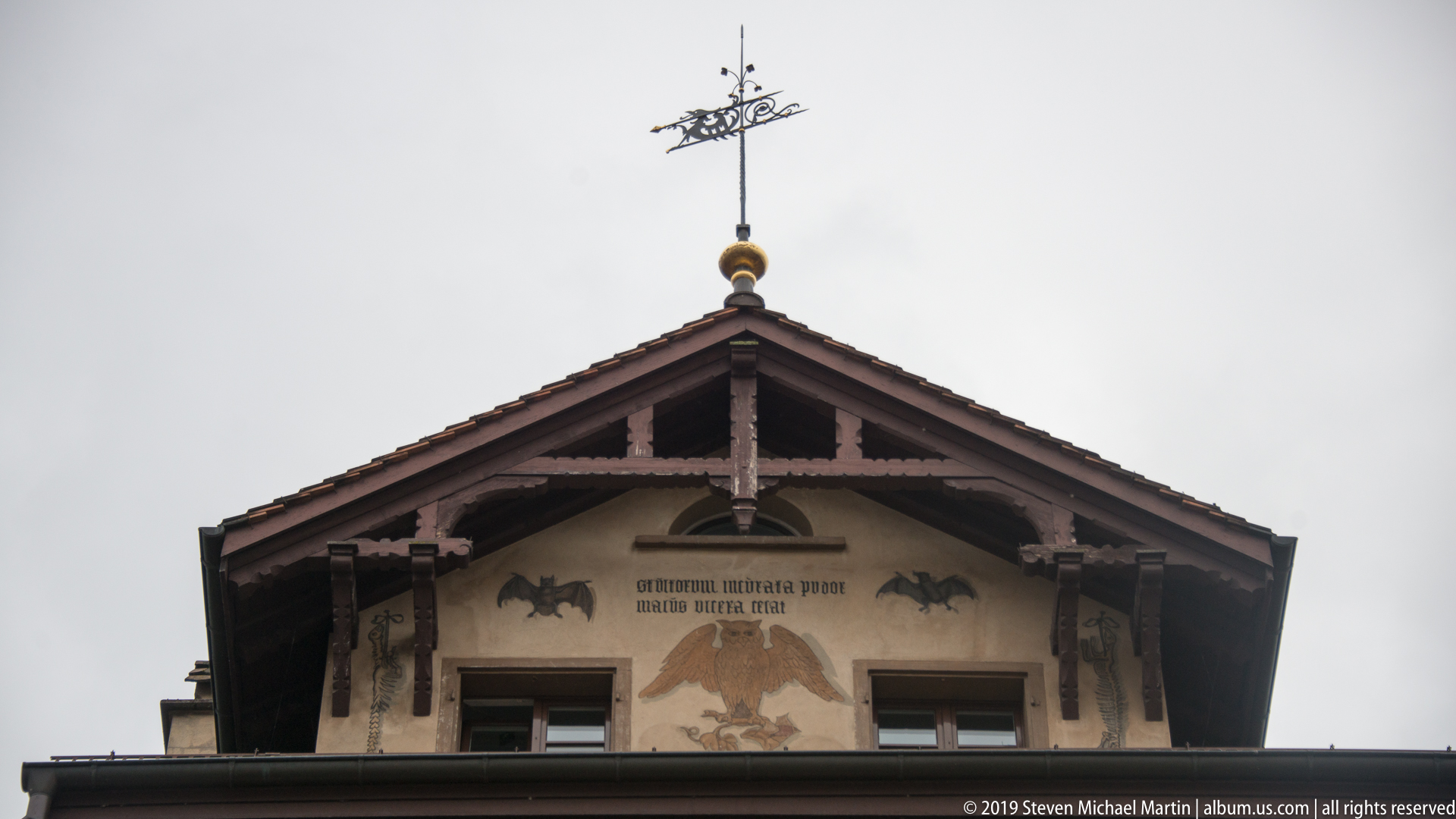
A small gabled roof section carries painted birds and a central inscription beneath a timber-framed pediment, while an ornate weather vane rises from the ridge. The restrained composition contrasts with Lucerne’s more densely frescoed façades, concentrating decoration in a symbolic band directly below the roofline.
Caption
A small gabled roof section carries painted birds and a central inscription beneath a timber-framed pediment, while an ornate weather vane rises from the ridge. The restrained composition contrasts with Lucerne’s more densely frescoed façades, concentrating decoration in a symbolic band directly below the roofline.

A broad Lucerne façade combines stone-framed arcades at street level with extensive painted decoration across the upper stories. Heraldic shields, scrolling ornament, figures, and circular medallions are distributed around the windows beneath deep projecting eaves. The image records the building as a complete decorated elevation, showing how painting, masonry, and commercial frontage are integrated.
Caption
A broad Lucerne façade combines stone-framed arcades at street level with extensive painted decoration across the upper stories. Heraldic shields, scrolling ornament, figures, and circular medallions are distributed around the windows beneath deep projecting eaves. The image records the building as a complete decorated elevation, showing how painting, masonry, and commercial frontage are integrated.

A carved figure crowns a tall fountain monument, holding a pole with a blue-and-white banner while balancing above a sculpted capital. The weathered stone figure, feathered headpiece, and billowing garment are silhouetted against the pale sky. The tight upward view isolates the civic symbolism and vertical flourish at the fountain’s summit.
Caption
A carved figure crowns a tall fountain monument, holding a pole with a blue-and-white banner while balancing above a sculpted capital. The weathered stone figure, feathered headpiece, and billowing garment are silhouetted against the pale sky. The tight upward view isolates the civic symbolism and vertical flourish at the fountain’s summit.
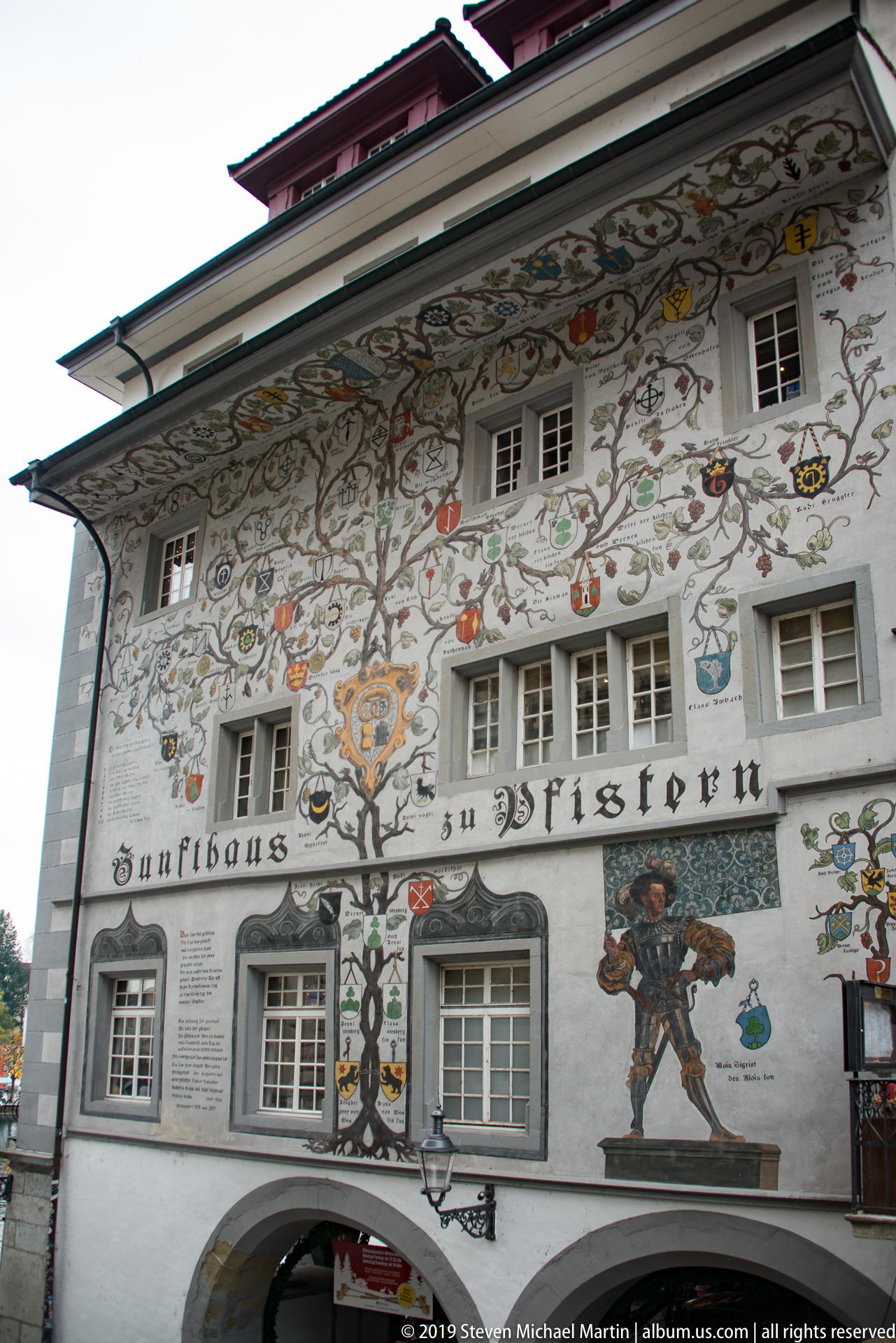
The façade of Lucerne’s Zunfthaus zu Pfistern is covered with elaborate painted ornament, heraldic shields, scrolling vines, and historical figures. The inscription across the wall identifies the guild house, while the dense pictorial program turns the building into a visual record of civic identity and craft tradition. The photograph shows the decoration as a complete architectural surface rather than as an isolated mural detail.
Caption
The façade of Lucerne’s Zunfthaus zu Pfistern is covered with elaborate painted ornament, heraldic shields, scrolling vines, and historical figures. The inscription across the wall identifies the guild house, while the dense pictorial program turns the building into a visual record of civic identity and craft tradition. The photograph shows the decoration as a complete architectural surface rather than as an isolated mural detail.
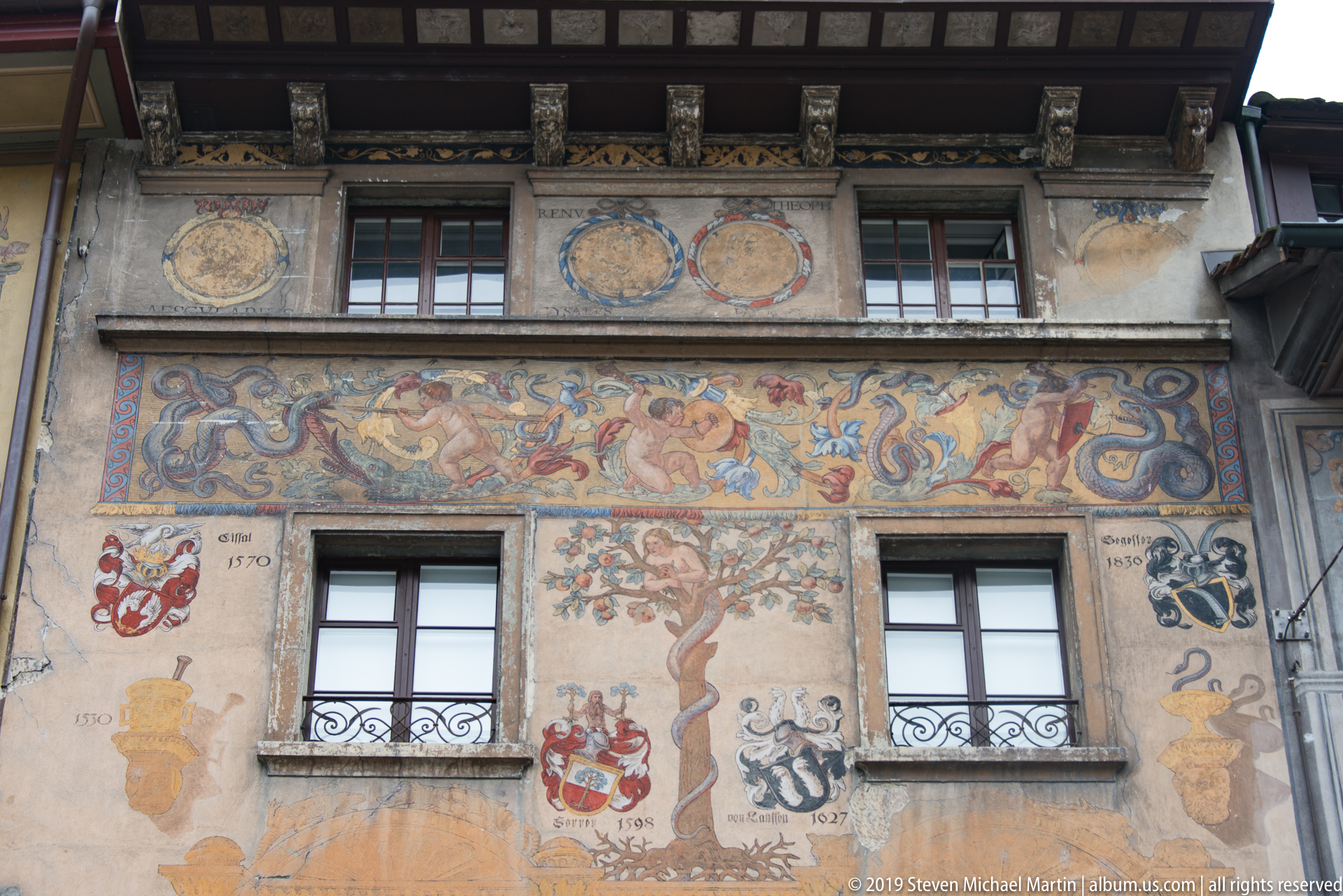
A richly painted wall section combines heraldic shields dated across several centuries with a stylized tree rising between two windows. Above, a broad frieze of scrolling foliage and fantastic forms runs beneath the upper story. The photograph isolates the building’s visual genealogy, where coats of arms and decorative painting turn the façade into a layered record of ownership, alliance, or civic memory.
Caption
A richly painted wall section combines heraldic shields dated across several centuries with a stylized tree rising between two windows. Above, a broad frieze of scrolling foliage and fantastic forms runs beneath the upper story. The photograph isolates the building’s visual genealogy, where coats of arms and decorative painting turn the façade into a layered record of ownership, alliance, or civic memory.

A closer view centers on a stylized tree painted between two historic coats of arms, each accompanied by names and dates. Branches spread upward toward floral ornament while the shield forms occupy the lower wall between two windows. The composition reveals the hand-painted linework, aging plaster, and subtle differences between the heraldic emblems.
Caption
A closer view centers on a stylized tree painted between two historic coats of arms, each accompanied by names and dates. Branches spread upward toward floral ornament while the shield forms occupy the lower wall between two windows. The composition reveals the hand-painted linework, aging plaster, and subtle differences between the heraldic emblems.

A cluster of carved stone figures in historic dress crowds the upper section of a fountain monument. The central figure grips a long staff or weapon, while companions stand closely behind with hats, shields, and layered clothing. The compressed grouping and weathered carving create a strong sense of civic pageantry, distinct from the individual figure shown on the preceding page.
Caption
A cluster of carved stone figures in historic dress crowds the upper section of a fountain monument. The central figure grips a long staff or weapon, while companions stand closely behind with hats, shields, and layered clothing. The compressed grouping and weathered carving create a strong sense of civic pageantry, distinct from the individual figure shown on the preceding page.

Two adjoining historic façades present contrasting painted programs: one with large standing figures and inscriptions between windows, the other with dense heraldic and ornamental decoration beneath a projecting gable. Green shutters on the neighboring building extend the colorful street rhythm. The wider framing shows how Lucerne’s painted architecture forms a continuous visual ensemble rather than isolated decorated houses.
Caption
Two adjoining historic façades present contrasting painted programs: one with large standing figures and inscriptions between windows, the other with dense heraldic and ornamental decoration beneath a projecting gable. Green shutters on the neighboring building extend the colorful street rhythm. The wider framing shows how Lucerne’s painted architecture forms a continuous visual ensemble rather than isolated decorated houses.

A narrow Lucerne street is compressed by closely spaced façades, shutters, hanging signs, and a richly carved projecting bay. A large ornate Hotel Krone sign and striped flags extend over the street, emphasizing the vertical layering of commercial identity above pedestrian level. The long perspective captures the visual density typical of the old town’s narrower lanes.
Caption
A narrow Lucerne street is compressed by closely spaced façades, shutters, hanging signs, and a richly carved projecting bay. A large ornate Hotel Krone sign and striped flags extend over the street, emphasizing the vertical layering of commercial identity above pedestrian level. The long perspective captures the visual density typical of the old town’s narrower lanes.

An elaborate gilded hanging sign with a double-headed eagle projects from a white façade beside a painted commemorative figure. The inscription states that Johann Wolfgang von Goethe lodged here in 1779, turning the wall into both hotel advertisement and literary memorial. The combination of sign, figure, and text gives the building a strong historic identity within the old-town streetscape.
Caption
An elaborate gilded hanging sign with a double-headed eagle projects from a white façade beside a painted commemorative figure. The inscription states that Johann Wolfgang von Goethe lodged here in 1779, turning the wall into both hotel advertisement and literary memorial. The combination of sign, figure, and text gives the building a strong historic identity within the old-town streetscape.

A dark bronze figure in early-modern dress stands atop a fountain base, hands set at the hips while thin streams of water arc outward on either side. The figure’s cap, tunic, boots, and confident stance give the small sculpture a strong character. Stone architectural relief behind it provides a formal backdrop for the lively water display.
Caption
A dark bronze figure in early-modern dress stands atop a fountain base, hands set at the hips while thin streams of water arc outward on either side. The figure’s cap, tunic, boots, and confident stance give the small sculpture a strong character. Stone architectural relief behind it provides a formal backdrop for the lively water display.

A small dark metal creature clings to the end of a roofline or gutter, its curled body, wings, and open mouth forming a dragon-like silhouette against the pale wall. The ornament transforms a practical roof-edge fitting into a piece of playful metalwork, echoing the fantastic beasts seen elsewhere in Lucerne’s fountains and façade decoration.
Caption
A small dark metal creature clings to the end of a roofline or gutter, its curled body, wings, and open mouth forming a dragon-like silhouette against the pale wall. The ornament transforms a practical roof-edge fitting into a piece of playful metalwork, echoing the fantastic beasts seen elsewhere in Lucerne’s fountains and façade decoration.

A lively façade painting stages a hunt within dense scrolling foliage: a hunter aims a long firearm while hounds pursue deer through intertwined branches. Heraldic ornament appears above the scene. The flattened, decorative treatment merges narrative action with vegetal pattern, turning the wall surface into an animated frieze rather than a naturalistic landscape.
Caption
A lively façade painting stages a hunt within dense scrolling foliage: a hunter aims a long firearm while hounds pursue deer through intertwined branches. Heraldic ornament appears above the scene. The flattened, decorative treatment merges narrative action with vegetal pattern, turning the wall surface into an animated frieze rather than a naturalistic landscape.

A closer section of the hunting mural shows a hunter bracing a long firearm while deer move through curling branches and leafy scrollwork. The enlarged view reveals the painter’s use of outline, muted earth colors, and stylized movement. Compared with the wider mural view, this photograph concentrates on the confrontation between hunter and game.
Caption
A closer section of the hunting mural shows a hunter bracing a long firearm while deer move through curling branches and leafy scrollwork. The enlarged view reveals the painter’s use of outline, muted earth colors, and stylized movement. Compared with the wider mural view, this photograph concentrates on the confrontation between hunter and game.

Two elongated painted dragons face inward across the upper wall of a historic building, their bodies linked visually by a looping band that surrounds an eye-like central motif. The decorative strip sits directly beneath the roofline, where the fantastic animals create a compact heraldic or protective-looking composition above the windows.
Caption
Two elongated painted dragons face inward across the upper wall of a historic building, their bodies linked visually by a looping band that surrounds an eye-like central motif. The decorative strip sits directly beneath the roofline, where the fantastic animals create a compact heraldic or protective-looking composition above the windows.

A substantial stone civic building presents a formal Renaissance-style façade with rusticated corners, tall rectangular windows, dormers, and several richly carved doorways. The structure stands directly beside rougher medieval masonry, making the contrast in construction and architectural finish especially clear. Pedestrians at the entrances provide a useful sense of scale.
Caption
A substantial stone civic building presents a formal Renaissance-style façade with rusticated corners, tall rectangular windows, dormers, and several richly carved doorways. The structure stands directly beside rougher medieval masonry, making the contrast in construction and architectural finish especially clear. Pedestrians at the entrances provide a useful sense of scale.

A tall square masonry tower with a large painted clock face rises immediately beside an ornate historic civic building. The juxtaposition of rough medieval stonework and more refined Renaissance-style architecture creates a layered civic ensemble. Street-level pedestrians emphasize the tower’s height while the steep roof and dormers of the adjoining building add visual complexity to the square.
Caption
A tall square masonry tower with a large painted clock face rises immediately beside an ornate historic civic building. The juxtaposition of rough medieval stonework and more refined Renaissance-style architecture creates a layered civic ensemble. Street-level pedestrians emphasize the tower’s height while the steep roof and dormers of the adjoining building add visual complexity to the square.

An ornate stone portal frames a heavy carved wooden door, using paired columns, scrollwork, floral relief, and a broken or curved upper composition to create a deeply modeled entrance. Rough medieval masonry at the left edge heightens the contrast with the finely worked façade. The close frontal view emphasizes craftsmanship, symmetry, and the depth of the stone carving.
Caption
An ornate stone portal frames a heavy carved wooden door, using paired columns, scrollwork, floral relief, and a broken or curved upper composition to create a deeply modeled entrance. Rough medieval masonry at the left edge heightens the contrast with the finely worked façade. The close frontal view emphasizes craftsmanship, symmetry, and the depth of the stone carving.

Two carved lions rear toward a central oval shield above the entrance of a historic stone building. Their bodies and manes are modeled in high relief and framed by large scrolling volutes, creating a forceful heraldic centerpiece. A vertical staff or pole crosses the composition, but the symmetrical lions and shield remain the dominant decorative elements.
Caption
Two carved lions rear toward a central oval shield above the entrance of a historic stone building. Their bodies and manes are modeled in high relief and framed by large scrolling volutes, creating a forceful heraldic centerpiece. A vertical staff or pole crosses the composition, but the symmetrical lions and shield remain the dominant decorative elements.

Three grotesque bronze masks project from a bright blue fountain column, each fitted with a horn-like spout that sends water outward. Rope-like white-and-blue bands frame the painted shaft, intensifying the theatrical effect of the dark metal faces. The close view isolates the fountain’s sculptural plumbing and vivid polychrome treatment.
Caption
Three grotesque bronze masks project from a bright blue fountain column, each fitted with a horn-like spout that sends water outward. Rope-like white-and-blue bands frame the painted shaft, intensifying the theatrical effect of the dark metal faces. The close view isolates the fountain’s sculptural plumbing and vivid polychrome treatment.

A vividly painted fountain rises from a blue cylindrical base into a richly ornamented green-and-gold column crowded with masks, scrolling forms, and heraldic decoration. A small figure and finial crown the upper structure. Seen against modern buildings, the fountain’s intense color and sculptural complexity stand out as a distinctive piece of Lucerne’s historic streetscape.
Caption
A vividly painted fountain rises from a blue cylindrical base into a richly ornamented green-and-gold column crowded with masks, scrolling forms, and heraldic decoration. A small figure and finial crown the upper structure. Seen against modern buildings, the fountain’s intense color and sculptural complexity stand out as a distinctive piece of Lucerne’s historic streetscape.

A carved angelic head with curling hair spreads broad feathered wings across the curved pediment above a doorway or window. The pale stone relief is set within a restrained gray architectural surround, making the expressive face and layered feathers the dominant features. The tight framing emphasizes the craftsmanship of this small Baroque-style decorative element.
Caption
A carved angelic head with curling hair spreads broad feathered wings across the curved pediment above a doorway or window. The pale stone relief is set within a restrained gray architectural surround, making the expressive face and layered feathers the dominant features. The tight framing emphasizes the craftsmanship of this small Baroque-style decorative element.

Across the Reuss, a covered timber bridge runs along the waterfront beneath a hillside crowded with historic buildings and towers. Autumn trees soften the stone and plaster architecture, while the river fills the foreground. The view emphasizes how Lucerne’s bridges, defensive landmarks, and sloping old-town neighborhoods stack closely together above the water.
Caption
Across the Reuss, a covered timber bridge runs along the waterfront beneath a hillside crowded with historic buildings and towers. Autumn trees soften the stone and plaster architecture, while the river fills the foreground. The view emphasizes how Lucerne’s bridges, defensive landmarks, and sloping old-town neighborhoods stack closely together above the water.

A vaulted passage opens directly onto the Reuss beside the timber-covered Spreuer Bridge, with a stairway climbing at the left and the bridge structure extending across the water beyond. The arch frames a red-roofed tower and autumn foliage on the opposite bank. This unusual viewpoint records the bridge as part of a layered pedestrian route rather than only as a river crossing.
Caption
A vaulted passage opens directly onto the Reuss beside the timber-covered Spreuer Bridge, with a stairway climbing at the left and the bridge structure extending across the water beyond. The arch frames a red-roofed tower and autumn foliage on the opposite bank. This unusual viewpoint records the bridge as part of a layered pedestrian route rather than only as a river crossing.
⭐ Highlights
- Chapel Bridge (Kapellbrücke): The city’s most iconic landmark and one of the oldest covered wooden bridges in Europe.
- Water Tower: A historic tower that has served as a prison, treasury, and watchtower.
- Old Town (Altstadt): A preserved medieval center with frescoed buildings and cobblestone streets.
- Lion Monument: A powerful rock carving commemorating Swiss Guards killed during the French Revolution.
- Jesuit Church: One of the first Baroque churches built in Switzerland north of the Alps.
- Lake Lucerne Setting: A dramatic location where the city meets the lake and surrounding mountains.
🏞️ Lucerne Field Guide
Major features observed during this visit:
Lucerne is one of Switzerland’s most picturesque cities, located where the Reuss River flows out of Lake Lucerne and into a landscape framed by the Alps. Originating from a small monastic settlement in the 8th century, the city developed into a key crossing point between northern and southern Europe. Today, its well-preserved medieval core, historic bridges, and dramatic natural setting combine to create one of the most visually cohesive urban environments in Europe.
🏛️ Signature Landmarks
- Chapel Bridge (Kapellbrücke) – A covered wooden bridge built in the 14th century, featuring historic interior paintings.
- Water Tower – An octagonal tower that has served multiple roles, including prison, treasury, and archive.
- Lion Monument – A sandstone sculpture commemorating Swiss Guards killed in 1792.
- Jesuit Church – A prominent Baroque church reflecting the Counter-Reformation period.
- Spreuer Bridge – Another historic covered bridge decorated with 17th-century paintings.
🧠 Historical Significance
- Medieval Origins – Developed from a monastery settlement into a key trading and transit hub.
- Strategic Location – Positioned along important north–south trade routes through the Alps.
- Swiss Confederation – Played a role in the formation and defense of early Switzerland.
- Cultural Center – Today a major hub for tourism and regional identity in central Switzerland.
🌄 Landscape & Setting
- Lake Lucerne – The city sits at the edge of a large alpine lake, shaping its visual identity.
- Reuss River – Divides the city and is crossed by several historic bridges.
- Alpine Backdrop – Mountains surround the city, creating a dramatic setting.
- Compact Old Town – A dense and walkable historic center with preserved medieval architecture.