Lübeck – Germany
Lübeck stands along the Trave River near the Baltic coast and was one of the most powerful and influential cities of the Hanseatic League. Often referred to as the “Queen of the Hanseatic League,” the city served as a central hub for trade throughout northern Europe during the medieval period.
The historic old town sits on an island surrounded by waterways and is famous for its distinctive brick Gothic architecture. One of the city’s most recognizable landmarks is the Holstentor, a massive medieval gate that once guarded the western entrance to the city.
Today the beautifully preserved historic center of Lübeck is recognized as a UNESCO World Heritage Site.
The Danse Macabre (Dance of Death) associated with St. Mary’s Church in Lübeck was one of the most famous medieval artworks of northern Europe. The original painting, created around 1463 by the artist Bernt Notke, stretched across a long wall of the church’s chapel and depicted a haunting procession in which figures from every level of society—popes, emperors, merchants, and peasants—were led in a dance by skeletal representations of death.
The mural reflected a powerful theme common in late medieval Europe: the reminder that death comes equally to all people, regardless of rank or wealth. Each living figure in the procession was paired with a skeleton, symbolizing the inevitability of mortality and the fleeting nature of earthly power.
The original artwork was tragically destroyed during the bombing of Lübeck in 1942 during World War II, when much of St. Mary’s Church was severely damaged. Fortunately, photographs and earlier copies of the painting preserved its design, allowing later reconstructions to convey the appearance and message of the original work.
Today the Danse Macabre of Lübeck remains an important example of medieval religious art and a powerful reminder of the themes of mortality and humility that were central to European culture during the Middle Ages.

A tall brick gateway closes the street with a central arched passage beneath a multi-story square tower. Rows of small arched openings and decorative brick bands articulate the upper stages, while adjoining gabled buildings and the narrow approach reinforce the structure’s role as a historic entrance through the urban fabric.
Caption
A tall brick gateway closes the street with a central arched passage beneath a multi-story square tower. Rows of small arched openings and decorative brick bands articulate the upper stages, while adjoining gabled buildings and the narrow approach reinforce the structure’s role as a historic entrance through the urban fabric.

Lübeck’s old town glows across the Trave, its illuminated waterfront façades reflected in the dark water beneath a skyline punctuated by copper-green church spires. The paired towers at left and the separate tower at right demonstrate the vertical landmarks that define the UNESCO-listed city from across the river, while colored architectural lighting adds a distinctly contemporary layer to the historic panorama.
Caption
Lübeck’s old town glows across the Trave, its illuminated waterfront façades reflected in the dark water beneath a skyline punctuated by copper-green church spires. The paired towers at left and the separate tower at right demonstrate the vertical landmarks that define the UNESCO-listed city from across the river, while colored architectural lighting adds a distinctly contemporary layer to the historic panorama.

A broad exterior view places Lübeck Cathedral behind leafless trees, revealing the long red-brick body of the church, green-patinated roofs, projecting chapels, and the paired western towers. The cathedral’s extended profile contrasts with the more vertically concentrated silhouettes of Lübeck’s other great churches and shows the scale of the medieval episcopal complex within the southern old town.
Caption
A broad exterior view places Lübeck Cathedral behind leafless trees, revealing the long red-brick body of the church, green-patinated roofs, projecting chapels, and the paired western towers. The cathedral’s extended profile contrasts with the more vertically concentrated silhouettes of Lübeck’s other great churches and shows the scale of the medieval episcopal complex within the southern old town.

A monumental brick church rises behind the street, dominated by two tall square towers with steep green-patinated copper roofs. Buttresses, pointed windows, and the long red-brick nave create a strongly vertical Gothic profile, while the oblique street-level viewpoint emphasizes the scale of the structure within Lübeck’s historic center.
Caption
A monumental brick church rises behind the street, dominated by two tall square towers with steep green-patinated copper roofs. Buttresses, pointed windows, and the long red-brick nave create a strongly vertical Gothic profile, while the oblique street-level viewpoint emphasizes the scale of the structure within Lübeck’s historic center.

Pointed brick arcades open beneath Lübeck Town Hall, their pale vaulted interiors framed by patterned red-and-dark masonry and circular decorative insets. The passage belongs to the complex architectural fabric of the Rathaus, where medieval Brick Gothic construction was repeatedly extended and reshaped over centuries. Seen at night, the illuminated vaults emphasize the rhythmic sequence of arches that links the building to the surrounding streets and market.
Caption
Pointed brick arcades open beneath Lübeck Town Hall, their pale vaulted interiors framed by patterned red-and-dark masonry and circular decorative insets. The passage belongs to the complex architectural fabric of the Rathaus, where medieval Brick Gothic construction was repeatedly extended and reshaped over centuries. Seen at night, the illuminated vaults emphasize the rhythmic sequence of arches that links the building to the surrounding streets and market.

A slender church tower with a green spire and clock face closes the view down a narrow commercial street. Modern storefronts and pollarded trees line the foreground, creating a layered streetscape in which medieval or early-modern ecclesiastical architecture remains a dominant visual landmark.
Caption
A slender church tower with a green spire and clock face closes the view down a narrow commercial street. Modern storefronts and pollarded trees line the foreground, creating a layered streetscape in which medieval or early-modern ecclesiastical architecture remains a dominant visual landmark.

A large red-brick church fills the frame with polygonal chapels, steep copper roofs, and two tall towers rising behind the eastern mass. Layered rooflines and repeated pointed openings create a complex silhouette, while the street-level viewpoint emphasizes the monumental scale of the sacred building within the city.
Caption
A large red-brick church fills the frame with polygonal chapels, steep copper roofs, and two tall towers rising behind the eastern mass. Layered rooflines and repeated pointed openings create a complex silhouette, while the street-level viewpoint emphasizes the monumental scale of the sacred building within the city.

A small stylized model labeled “Lübeck” reduces the city to bright geometric forms, with red-roofed blocks, green church spires, and simplified towers arranged on a narrow base. The playful souvenir treatment condenses Lübeck’s skyline into its most recognizable vertical landmarks.
Caption
A small stylized model labeled “Lübeck” reduces the city to bright geometric forms, with red-roofed blocks, green church spires, and simplified towers arranged on a narrow base. The playful souvenir treatment condenses Lübeck’s skyline into its most recognizable vertical landmarks.

A tighter nighttime view across the Trave isolates a pair of illuminated brick church towers above the old-town waterfront. Rows of historic houses form a low horizontal band beneath the steep green spires, while broken reflections shimmer across the river. The compression of waterfront, rooftops, and towers captures the characteristic vertical profile of Lübeck’s historic center.
Caption
A tighter nighttime view across the Trave isolates a pair of illuminated brick church towers above the old-town waterfront. Rows of historic houses form a low horizontal band beneath the steep green spires, while broken reflections shimmer across the river. The compression of waterfront, rooftops, and towers captures the characteristic vertical profile of Lübeck’s historic center.

A square red-brick church tower rises above the rooftops, its large clock faces set just beneath a steep green copper spire. The tower’s simple paired openings and patinated roof stand out sharply against the pale overcast sky, forming a prominent orientation point in Lübeck’s historic center.
Caption
A square red-brick church tower rises above the rooftops, its large clock faces set just beneath a steep green copper spire. The tower’s simple paired openings and patinated roof stand out sharply against the pale overcast sky, forming a prominent orientation point in Lübeck’s historic center.

The Holstentor rises between its two massive conical-roofed round towers, its central stepped gable and arched passage forming one of Lübeck’s most recognizable medieval silhouettes. Brick bands, small windows, and the slight inward lean of the towers underscore the gate’s fortified character, while nearby gabled buildings place it within the historic cityscape.
Caption
The Holstentor rises between its two massive conical-roofed round towers, its central stepped gable and arched passage forming one of Lübeck’s most recognizable medieval silhouettes. Brick bands, small windows, and the slight inward lean of the towers underscore the gate’s fortified character, while nearby gabled buildings place it within the historic cityscape.

A broad brick wall with two large ground-level arches stretches between a tall square tower and a rounded corner structure. The tower’s stacked arcades and pyramidal roof create a fortress-like silhouette, while the weathered masonry and adjoining wall reveal several phases of construction.
Caption
A broad brick wall with two large ground-level arches stretches between a tall square tower and a rounded corner structure. The tower’s stacked arcades and pyramidal roof create a fortress-like silhouette, while the weathered masonry and adjoining wall reveal several phases of construction.

Lübeck Hauptbahnhof presents a richly modeled red-brick entrance façade, its central arched portals framed by pale stone bands and capped by green-patinated copper towers. The clock and layered roofline give the station a civic monumentality, while bicycles, signage, and the covered entrance canopy anchor the historic architecture in everyday urban use.
Caption
Lübeck Hauptbahnhof presents a richly modeled red-brick entrance façade, its central arched portals framed by pale stone bands and capped by green-patinated copper towers. The clock and layered roofline give the station a civic monumentality, while bicycles, signage, and the covered entrance canopy anchor the historic architecture in everyday urban use.

A near-frontal view of the Holstentor emphasizes the symmetry of its twin cylindrical towers, steep slate roofs, horizontal brick bands, and ornate central gable. The deep central arch remains the compositional focus, revealing the gate’s dual role as a monumental city entrance and a powerful statement of Lübeck’s late-medieval urban defenses.
Caption
A near-frontal view of the Holstentor emphasizes the symmetry of its twin cylindrical towers, steep slate roofs, horizontal brick bands, and ornate central gable. The deep central arch remains the compositional focus, revealing the gate’s dual role as a monumental city entrance and a powerful statement of Lübeck’s late-medieval urban defenses.

A large public Stadtplan presents central Lübeck as an island-like historic core encircled by waterways, with streets, landmarks, green spaces, and transportation routes mapped in dense detail. The bright red frame and “Hansestadt Lübeck” branding turn the practical wayfinding panel into a useful overview of the city’s compact urban geography.
Caption
A large public Stadtplan presents central Lübeck as an island-like historic core encircled by waterways, with streets, landmarks, green spaces, and transportation routes mapped in dense detail. The bright red frame and “Hansestadt Lübeck” branding turn the practical wayfinding panel into a useful overview of the city’s compact urban geography.

A green-patinated equestrian bronze dominates the foreground while two massive red-brick church towers with copper-clad spires rise behind it. The layered composition places civic sculpture against Lübeck’s characteristic Brick Gothic skyline, contrasting the flowing silhouette of horse and rider with the rigid vertical geometry of the towers.
Caption
A green-patinated equestrian bronze dominates the foreground while two massive red-brick church towers with copper-clad spires rise behind it. The layered composition places civic sculpture against Lübeck’s characteristic Brick Gothic skyline, contrasting the flowing silhouette of horse and rider with the rigid vertical geometry of the towers.

A weathered stone allegorical figure stands outdoors beneath bare branches, gripping a long staff or implement while a small animal presses against his leg. The muscular body, classical nudity, and narrative attributes suggest an emblematic rather than portrait subject, part of Lübeck’s tradition of sculptural decoration in public space.
Caption
A weathered stone allegorical figure stands outdoors beneath bare branches, gripping a long staff or implement while a small animal presses against his leg. The muscular body, classical nudity, and narrative attributes suggest an emblematic rather than portrait subject, part of Lübeck’s tradition of sculptural decoration in public space.

A crowned female figure in layered classical drapery stands in a poised, frontal stance, one arm bent across her chest and a small animal or sculptural attribute at her side. The carefully carved folds and regal headpiece emphasize the statue’s allegorical character, set against open sky and distant Lübeck architecture.
Caption
A crowned female figure in layered classical drapery stands in a poised, frontal stance, one arm bent across her chest and a small animal or sculptural attribute at her side. The carefully carved folds and regal headpiece emphasize the statue’s allegorical character, set against open sky and distant Lübeck architecture.

Several monumental stone figures occupy a landscaped urban setting, viewed from behind and in profile, while a tall red-brick church tower rises beyond Lübeck’s tiled roofs. The composition shows how freestanding civic sculpture and the medieval city skyline overlap visually within the historic center.
Caption
Several monumental stone figures occupy a landscaped urban setting, viewed from behind and in profile, while a tall red-brick church tower rises beyond Lübeck’s tiled roofs. The composition shows how freestanding civic sculpture and the medieval city skyline overlap visually within the historic center.

A robust stone figure bends forward beside a squared masonry block, holding a rounded vessel while drapery wraps around the waist and a broad-brimmed hat shades the face. The workmanlike pose and tools or containers give the statue an occupational, allegorical character rather than the formality of a portrait monument.
Caption
A robust stone figure bends forward beside a squared masonry block, holding a rounded vessel while drapery wraps around the waist and a broad-brimmed hat shades the face. The workmanlike pose and tools or containers give the statue an occupational, allegorical character rather than the formality of a portrait monument.

A seated stone female figure gathers heavy classical drapery around her while holding a long, narrow attribute diagonally across her lap. Bare winter branches frame the sculpture and heighten the contrast between the pale carved stone and the blue sky, emphasizing the statue’s silhouette and restrained monumental pose.
Caption
A seated stone female figure gathers heavy classical drapery around her while holding a long, narrow attribute diagonally across her lap. Bare winter branches frame the sculpture and heighten the contrast between the pale carved stone and the blue sky, emphasizing the statue’s silhouette and restrained monumental pose.

An extreme upward angle compresses two tall red-brick church towers into the frame, their copper-clad pyramidal spires converging dramatically against the sky. Rows of narrow openings, recessed panels, and white decorative accents emphasize the verticality typical of Lübeck’s monumental Brick Gothic churches while the viewpoint turns architecture into an abstract study of height and geometry.
Caption
An extreme upward angle compresses two tall red-brick church towers into the frame, their copper-clad pyramidal spires converging dramatically against the sky. Rows of narrow openings, recessed panels, and white decorative accents emphasize the verticality typical of Lübeck’s monumental Brick Gothic churches while the viewpoint turns architecture into an abstract study of height and geometry.

A slender octagonal lantern rises from a brick roofline, capped by a dark conical roof and delicate gilded finial. Open arches, miniature corner pinnacles, and metal detailing give the turret a light, skeletal appearance above the heavier masonry below, creating a refined vertical accent in Lübeck’s historic skyline.
Caption
A slender octagonal lantern rises from a brick roofline, capped by a dark conical roof and delicate gilded finial. Open arches, miniature corner pinnacles, and metal detailing give the turret a light, skeletal appearance above the heavier masonry below, creating a refined vertical accent in Lübeck’s historic skyline.

A man in a dark jacket stands centered before the Holstentor, giving human scale to the gate’s massive twin towers and stepped central gable. The portrait balances personal travel documentation with architectural context, keeping the landmark fully legible while the figure occupies the foreground lawn.
Caption
A man in a dark jacket stands centered before the Holstentor, giving human scale to the gate’s massive twin towers and stepped central gable. The portrait balances personal travel documentation with architectural context, keeping the landmark fully legible while the figure occupies the foreground lawn.

The gilded inscription “CONCORDIA DOMI FORIS PAX” stretches across the Holstentor’s patterned brickwork above the gateway. Framed by alternating red-and-dark masonry, decorative terracotta bands, and small arched openings, the motto becomes both text and ornament within the gate’s carefully articulated façade.
Caption
The gilded inscription “CONCORDIA DOMI FORIS PAX” stretches across the Holstentor’s patterned brickwork above the gateway. Framed by alternating red-and-dark masonry, decorative terracotta bands, and small arched openings, the motto becomes both text and ornament within the gate’s carefully articulated façade.

A close view of the Holstentor reveals a terracotta frieze set into dark brickwork, with a heraldic eagle flanked by small standing figures and dense vegetal ornament. The warm molded clay contrasts sharply with the glazed-looking masonry, demonstrating how figural and heraldic decoration enriches the gate’s otherwise defensive architecture.
Caption
A close view of the Holstentor reveals a terracotta frieze set into dark brickwork, with a heraldic eagle flanked by small standing figures and dense vegetal ornament. The warm molded clay contrasts sharply with the glazed-looking masonry, demonstrating how figural and heraldic decoration enriches the gate’s otherwise defensive architecture.

An interpretive plaque mounted on historic brickwork summarizes the Holsten Gate’s late-medieval construction, its role within Lübeck’s former gate complex, later reconstructions, and present use as a museum of municipal history. The photograph preserves both the explanatory text and the rough masonry surface against which the sign is installed.
Caption
An interpretive plaque mounted on historic brickwork summarizes the Holsten Gate’s late-medieval construction, its role within Lübeck’s former gate complex, later reconstructions, and present use as a museum of municipal history. The photograph preserves both the explanatory text and the rough masonry surface against which the sign is installed.

A tightly framed section of the Holstentor façade shows paired and grouped arched windows recessed within patterned brickwork above a terracotta ornamental band. Below, the dates “1477” and “1871” flank the initials “S.P.Q.L.,” turning restoration history and civic identity into part of the gate’s decorative fabric.
Caption
A tightly framed section of the Holstentor façade shows paired and grouped arched windows recessed within patterned brickwork above a terracotta ornamental band. Below, the dates “1477” and “1871” flank the initials “S.P.Q.L.,” turning restoration history and civic identity into part of the gate’s decorative fabric.

A gilded sailing ship rides stylized blue waves at the crest of a curving pale-green gable, its masts, rigging, and hull rendered as a bold emblem. White molded trim and the sculptural roofline frame the maritime device, linking Lübeck’s built environment to the visual language of seafaring and commerce.
Caption
A gilded sailing ship rides stylized blue waves at the crest of a curving pale-green gable, its masts, rigging, and hull rendered as a bold emblem. White molded trim and the sculptural roofline frame the maritime device, linking Lübeck’s built environment to the visual language of seafaring and commerce.

Two sculptural bronze fittings project from a large patinated metal church door, each formed as a compact group of standing figures beneath angular canopy-like forms. Rivets and seams divide the door into broad panels, while turquoise oxidation and polished high points reveal the long handling and weathering of the metal surface.
Caption
Two sculptural bronze fittings project from a large patinated metal church door, each formed as a compact group of standing figures beneath angular canopy-like forms. Rivets and seams divide the door into broad panels, while turquoise oxidation and polished high points reveal the long handling and weathering of the metal surface.

An ornate brass wall sconce projects from a red-brick pier, its scrolling arms supporting two tall white candles. Relief ornament, reflective metal surfaces, and a shield-like central element stand out against the textured masonry and carved stonework behind, showing the rich small-scale furnishing details embedded within the church interior.
Caption
An ornate brass wall sconce projects from a red-brick pier, its scrolling arms supporting two tall white candles. Relief ornament, reflective metal surfaces, and a shield-like central element stand out against the textured masonry and carved stonework behind, showing the rich small-scale furnishing details embedded within the church interior.

A long Brick Gothic church interior recedes toward a tall window, defined by red-brick piers, white plaster walls, pointed arches, and a ribbed vault patterned with painted ornament. The nearly empty aisle and uninterrupted floor accentuate the building’s scale and the rhythmic repetition of its medieval structural bays.
Caption
A long Brick Gothic church interior recedes toward a tall window, defined by red-brick piers, white plaster walls, pointed arches, and a ribbed vault patterned with painted ornament. The nearly empty aisle and uninterrupted floor accentuate the building’s scale and the rhythmic repetition of its medieval structural bays.

A massive striped brick pier rises between tall windows into painted rib vaults, seen from a steep upward angle that emphasizes structural height. Soft beams of light cut across the interior, revealing the contrast between red masonry ribs, pale wall surfaces, and delicate ceiling ornament within Lübeck’s Gothic ecclesiastical architecture.
Caption
A massive striped brick pier rises between tall windows into painted rib vaults, seen from a steep upward angle that emphasizes structural height. Soft beams of light cut across the interior, revealing the contrast between red masonry ribs, pale wall surfaces, and delicate ceiling ornament within Lübeck’s Gothic ecclesiastical architecture.

An elaborate wall-mounted epitaph combines a central painted portrait medallion with pale sculpted figures, dark architectural framing, scrolls, and a large inscribed tablet. Reclining and seated figures gather around the portrait while an upper allegorical group crowns the composition, creating a dense Baroque memorial ensemble against the church’s white wall.
Caption
An elaborate wall-mounted epitaph combines a central painted portrait medallion with pale sculpted figures, dark architectural framing, scrolls, and a large inscribed tablet. Reclining and seated figures gather around the portrait while an upper allegorical group crowns the composition, creating a dense Baroque memorial ensemble against the church’s white wall.

A large pipe organ occupies the western end of the church, with ranks of silver pipes arranged in multiple wooden cases above a tall pointed opening and stained-glass window. Brick piers and painted vaults frame the instrument, making its modern geometric cabinetry a strong focal point within the much older Gothic interior.
Caption
A large pipe organ occupies the western end of the church, with ranks of silver pipes arranged in multiple wooden cases above a tall pointed opening and stained-glass window. Brick piers and painted vaults frame the instrument, making its modern geometric cabinetry a strong focal point within the much older Gothic interior.

Tall clustered brick piers and pointed arches frame a luminous church bay where an altar stands beneath large windows. Blue accent lighting washes portions of the masonry, while railings and upper openings reveal multiple vertical levels. The composition emphasizes the soaring proportions and layered spatial organization of Lübeck’s Brick Gothic church architecture.
Caption
Tall clustered brick piers and pointed arches frame a luminous church bay where an altar stands beneath large windows. Blue accent lighting washes portions of the masonry, while railings and upper openings reveal multiple vertical levels. The composition emphasizes the soaring proportions and layered spatial organization of Lübeck’s Brick Gothic church architecture.

A large framed panel presents a complex monochrome narrative with multiple groups of kneeling and reclining figures arranged across a broad landscape. Dark inscription bands at the top and lower edge structure the composition, suggesting a commemorative or devotional function within the church while preserving numerous individualized figures and heraldic details.
Caption
A large framed panel presents a complex monochrome narrative with multiple groups of kneeling and reclining figures arranged across a broad landscape. Dark inscription bands at the top and lower edge structure the composition, suggesting a commemorative or devotional function within the church while preserving numerous individualized figures and heraldic details.

The nave rises through red-brick arcades to a pale, ornamented rib vault, creating a powerful perspective toward a pipe organ at the far end. Repeating pointed arches and slender wall shafts draw the eye upward and forward, while the restrained furnishings leave the medieval structural system unusually exposed and legible.
Caption
The nave rises through red-brick arcades to a pale, ornamented rib vault, creating a powerful perspective toward a pipe organ at the far end. Repeating pointed arches and slender wall shafts draw the eye upward and forward, while the restrained furnishings leave the medieval structural system unusually exposed and legible.

A row of large crucifixes stands on simple wooden support frames along a church wall, each carved figure of Christ varying in pose, condition, and surface treatment. Presented together rather than mounted at altars, the works read as a concentrated sculptural display, allowing comparison of scale, carving style, and preservation.
Caption
A row of large crucifixes stands on simple wooden support frames along a church wall, each carved figure of Christ varying in pose, condition, and surface treatment. Presented together rather than mounted at altars, the works read as a concentrated sculptural display, allowing comparison of scale, carving style, and preservation.

A pale carved relief compresses a turbulent biblical scene into a shallow rectangular field, with clustered robed figures surrounding a central fallen or kneeling body. Deep undercutting and overlapping gestures create dramatic movement, while a pierced ornamental border frames the narrative panel like an architectural screen.
Caption
A pale carved relief compresses a turbulent biblical scene into a shallow rectangular field, with clustered robed figures surrounding a central fallen or kneeling body. Deep undercutting and overlapping gestures create dramatic movement, while a pierced ornamental border frames the narrative panel like an architectural screen.

A Gothic rib vault blossoms overhead in a symmetrical star-like pattern, its red structural ribs dividing pale plaster fields decorated with delicate floral and foliate painting. Tall windows rise into the lower edges of the composition, emphasizing how color, geometry, and daylight combine to enliven the otherwise austere Brick Gothic interior.
Caption
A Gothic rib vault blossoms overhead in a symmetrical star-like pattern, its red structural ribs dividing pale plaster fields decorated with delicate floral and foliate painting. Tall windows rise into the lower edges of the composition, emphasizing how color, geometry, and daylight combine to enliven the otherwise austere Brick Gothic interior.

A large winged altarpiece fills the view, its opened panels presenting a sequence of densely populated painted scenes within dark, gilded frames. Set against the church’s pale brick interior and leaded windows, the work reads as a narrative devotional object whose individual episodes are arranged for close, sequential viewing.
Caption
A large winged altarpiece fills the view, its opened panels presenting a sequence of densely populated painted scenes within dark, gilded frames. Set against the church’s pale brick interior and leaded windows, the work reads as a narrative devotional object whose individual episodes are arranged for close, sequential viewing.

Three pale stone figures stand against a bare brick wall, each modeled in long drapery and differentiated by pose and gesture. The central figure is partially unclothed and raises one arm, while the flanking figures wear fuller robes, creating a compact sculptural grouping within the otherwise austere interior.
Caption
Three pale stone figures stand against a bare brick wall, each modeled in long drapery and differentiated by pose and gesture. The central figure is partially unclothed and raises one arm, while the flanking figures wear fuller robes, creating a compact sculptural grouping within the otherwise austere interior.

A deeply carved relief presents Christ and the apostles gathered around a long table for the Last Supper. The clustered figures, plates and vessels, and compressed architectural setting create a crowded narrative scene, while the pale material and elaborate side ornament frame the biblical episode as a devotional focal point.
Caption
A deeply carved relief presents Christ and the apostles gathered around a long table for the Last Supper. The clustered figures, plates and vessels, and compressed architectural setting create a crowded narrative scene, while the pale material and elaborate side ornament frame the biblical episode as a devotional focal point.

A pale relief shows a large company gathered tightly around a table, with standing and seated figures pressing into a shallow, almost theatrical space. Drapery, hand gestures, vessels, and the curved outline of the plaque animate the composition, which is framed by a dark border against the church wall.
Caption
A pale relief shows a large company gathered tightly around a table, with standing and seated figures pressing into a shallow, almost theatrical space. Drapery, hand gestures, vessels, and the curved outline of the plaque animate the composition, which is framed by a dark border against the church wall.

A tall Gothic window is filled with small stained-glass panels combining heraldic devices, figures, and decorative motifs in vivid reds, blues, yellows, and greens. The narrow lancets and dark stone tracery divide the imagery into vertical registers, making the glazing read as both architectural ornament and a collection of individual emblems.
Caption
A tall Gothic window is filled with small stained-glass panels combining heraldic devices, figures, and decorative motifs in vivid reds, blues, yellows, and greens. The narrow lancets and dark stone tracery divide the imagery into vertical registers, making the glazing read as both architectural ornament and a collection of individual emblems.

Another tall stained-glass window presents a dense patchwork of heraldic shields, animals, costumed figures, and ornamental motifs. Brilliant color is concentrated within the narrow lights, while the surrounding pale brickwork and dark mullions emphasize the vertical rhythm of the glazing inside the church.
Caption
Another tall stained-glass window presents a dense patchwork of heraldic shields, animals, costumed figures, and ornamental motifs. Brilliant color is concentrated within the narrow lights, while the surrounding pale brickwork and dark mullions emphasize the vertical rhythm of the glazing inside the church.

Alfred Mahlau’s towering Dance of Death window in St. Mary’s Church translates the lost Lübeck Totentanz into stained glass. Designed in 1956/57 as a memorial to the frieze destroyed in 1942, it stacks figures of Death and the living vertically rather than in the original horizontal procession. The brilliant colors and stark white background give the postwar work a graphic intensity rooted in Bernt Notke’s medieval model.
Caption
Alfred Mahlau’s towering Dance of Death window in St. Mary’s Church translates the lost Lübeck Totentanz into stained glass. Designed in 1956/57 as a memorial to the frieze destroyed in 1942, it stacks figures of Death and the living vertically rather than in the original horizontal procession. The brilliant colors and stark white background give the postwar work a graphic intensity rooted in Bernt Notke’s medieval model.

A detail of Alfred Mahlau’s postwar Dance of Death window shows richly dressed representatives of human society alternating with animated figures of Death. Mahlau deliberately borrowed costumes, gestures, and social types from the destroyed Lübeck Totentanz while compressing the medieval procession into the vertical geometry of the Gothic window. The result preserves the old work’s confrontation between worldly rank and universal mortality in a new medium.
Caption
A detail of Alfred Mahlau’s postwar Dance of Death window shows richly dressed representatives of human society alternating with animated figures of Death. Mahlau deliberately borrowed costumes, gestures, and social types from the destroyed Lübeck Totentanz while compressing the medieval procession into the vertical geometry of the Gothic window. The result preserves the old work’s confrontation between worldly rank and universal mortality in a new medium.

Six figures from Alfred Mahlau’s Dance of Death glazing occupy separate leaded compartments, pairing historical dress with the gaunt, restless presence of Death. The 1956/57 windows recall the medieval Lübeck Totentanz destroyed during the Second World War, but Mahlau simplified and reorganized its social procession for stained glass. Strong reds, ochres, blues, and blacks turn the old memento-mori theme into a forceful postwar image.
Caption
Six figures from Alfred Mahlau’s Dance of Death glazing occupy separate leaded compartments, pairing historical dress with the gaunt, restless presence of Death. The 1956/57 windows recall the medieval Lübeck Totentanz destroyed during the Second World War, but Mahlau simplified and reorganized its social procession for stained glass. Strong reds, ochres, blues, and blacks turn the old memento-mori theme into a forceful postwar image.

Armored and courtly figures appear within Alfred Mahlau’s Lübeck Dance of Death window, surrounded by the macabre companions who overturn distinctions of status and profession. Mahlau based the postwar glazing on the figures and gestures of the historic Totentanz while reducing and sharpening the sequence for a modern audience. Its vertical arrangement adapts the long medieval frieze to the narrow Gothic lancets of the chapel.
Caption
Armored and courtly figures appear within Alfred Mahlau’s Lübeck Dance of Death window, surrounded by the macabre companions who overturn distinctions of status and profession. Mahlau based the postwar glazing on the figures and gestures of the historic Totentanz while reducing and sharpening the sequence for a modern audience. Its vertical arrangement adapts the long medieval frieze to the narrow Gothic lancets of the chapel.

Markus Lüpertz’s 2002 tympanum window above the north portal of the Dance of Death Chapel gathers symbols of death and resurrection into a compact modern composition. A skull confronts the dove of peace, while a fish, water vessel, snail or ammonite, rose, and seven flame-like lights evoke Christ, life, mortality, renewal, and the Apocalypse. The work extends Lübeck’s centuries-long Totentanz tradition without attempting to recreate the lost medieval frieze.
Caption
Markus Lüpertz’s 2002 tympanum window above the north portal of the Dance of Death Chapel gathers symbols of death and resurrection into a compact modern composition. A skull confronts the dove of peace, while a fish, water vessel, snail or ammonite, rose, and seven flame-like lights evoke Christ, life, mortality, renewal, and the Apocalypse. The work extends Lübeck’s centuries-long Totentanz tradition without attempting to recreate the lost medieval frieze.

Three figures from Alfred Mahlau’s Dance of Death window bring the postwar cycle close to its medieval source: a living figure is confronted by gaunt, animated embodiments of Death. Mahlau often placed skeletal figures on both sides of a human subject, intensifying the sense of mockery and warning found in the earlier Totentanz. The white glass background and colored shrouds make the figures read with unusual clarity and urgency.
Caption
Three figures from Alfred Mahlau’s Dance of Death window bring the postwar cycle close to its medieval source: a living figure is confronted by gaunt, animated embodiments of Death. Mahlau often placed skeletal figures on both sides of a human subject, intensifying the sense of mockery and warning found in the earlier Totentanz. The white glass background and colored shrouds make the figures read with unusual clarity and urgency.

A living figure in yellow bends between neighboring figures of Death in Alfred Mahlau’s stained-glass reinterpretation of the Lübeck Totentanz. Created in 1956/57, the windows draw directly on the lost medieval cycle’s social types, gestures, and costumes but heighten the number and visual pressure of the skeletal figures. Their restless poses contrast with the more rigid humans, renewing the old warning about mortality after the destruction of war.
Caption
A living figure in yellow bends between neighboring figures of Death in Alfred Mahlau’s stained-glass reinterpretation of the Lübeck Totentanz. Created in 1956/57, the windows draw directly on the lost medieval cycle’s social types, gestures, and costumes but heighten the number and visual pressure of the skeletal figures. Their restless poses contrast with the more rigid humans, renewing the old warning about mortality after the destruction of war.

A human figure carrying an instrument or object stands between two animated Death figures in Alfred Mahlau’s Lübeck Dance of Death window. The arrangement reflects Mahlau’s postwar reworking of the medieval Totentanz, in which the dead increasingly outnumber and surround the living. Angular gestures, colored shrouds, and hard black leading create a graphic, almost theatrical rhythm that suits the cycle’s mixture of mockery, warning, and remembrance.
Caption
A human figure carrying an instrument or object stands between two animated Death figures in Alfred Mahlau’s Lübeck Dance of Death window. The arrangement reflects Mahlau’s postwar reworking of the medieval Totentanz, in which the dead increasingly outnumber and surround the living. Angular gestures, colored shrouds, and hard black leading create a graphic, almost theatrical rhythm that suits the cycle’s mixture of mockery, warning, and remembrance.

A crowned ruler raises both hands as two shrouded figures of Death close in from either side in Alfred Mahlau’s Dance of Death window. The composition preserves one of the central ideas of the Lübeck Totentanz: rank offers no protection from mortality. Mahlau’s 1956/57 glazing deliberately recalls the historic figures and costumes while intensifying their confrontation through the vertical format and the greater numerical presence of Death.
Caption
A crowned ruler raises both hands as two shrouded figures of Death close in from either side in Alfred Mahlau’s Dance of Death window. The composition preserves one of the central ideas of the Lübeck Totentanz: rank offers no protection from mortality. Mahlau’s 1956/57 glazing deliberately recalls the historic figures and costumes while intensifying their confrontation through the vertical format and the greater numerical presence of Death.

Armored, courtly, and female figures appear beside Death in this section of Alfred Mahlau’s Lübeck Totentanz glazing. The window preserves the medieval cycle’s procession through social ranks while adapting it to postwar stained glass, where historical costumes are reduced to bold shapes and saturated color. Mahlau used the familiar hierarchy of human types not to celebrate status, but to show its collapse before the universality of death.
Caption
Armored, courtly, and female figures appear beside Death in this section of Alfred Mahlau’s Lübeck Totentanz glazing. The window preserves the medieval cycle’s procession through social ranks while adapting it to postwar stained glass, where historical costumes are reduced to bold shapes and saturated color. Mahlau used the familiar hierarchy of human types not to celebrate status, but to show its collapse before the universality of death.

The concluding imagery of Alfred Mahlau’s Dance of Death window transforms the medieval warning into a postwar statement of hope. Mahlau interprets the cradle child at the end of the historic procession as the Christ Child, who raises a hand in blessing and overcomes Death. The closing words “GLORIA IN EXCELSIS DEO. AMEN” reinforce that redirection from destruction and mortality toward peace, resurrection, and consolation.
Caption
The concluding imagery of Alfred Mahlau’s Dance of Death window transforms the medieval warning into a postwar statement of hope. Mahlau interprets the cradle child at the end of the historic procession as the Christ Child, who raises a hand in blessing and overcomes Death. The closing words “GLORIA IN EXCELSIS DEO. AMEN” reinforce that redirection from destruction and mortality toward peace, resurrection, and consolation.

An elaborate warm-toned wooden structure rises against the whitewashed brick interior, articulated with columns, sculpted figures, projecting cornices, and a central elevated figure. Its vertical tiers and architectural ornament give the ensemble the appearance of a monumental organ case or gallery integrated into the church wall.
Caption
An elaborate warm-toned wooden structure rises against the whitewashed brick interior, articulated with columns, sculpted figures, projecting cornices, and a central elevated figure. Its vertical tiers and architectural ornament give the ensemble the appearance of a monumental organ case or gallery integrated into the church wall.

A deep blue circular dial displays gilded zodiac figures around its perimeter, with Roman numerals and a central sunburst-like motif. The crisp celestial imagery, framed by warm wood paneling, forms the upper component of the church’s modern astronomical clock ensemble.
Caption
A deep blue circular dial displays gilded zodiac figures around its perimeter, with Roman numerals and a central sunburst-like motif. The crisp celestial imagery, framed by warm wood paneling, forms the upper component of the church’s modern astronomical clock ensemble.

The lower circular dial of the astronomical clock is arranged as a complex calendar of concentric rings, with dense inscriptions, numerals, lunar phases, and a golden central sun. Four small corner medallions add figural decoration, while a pointer extends across the blue outer ring.
Caption
The lower circular dial of the astronomical clock is arranged as a complex calendar of concentric rings, with dense inscriptions, numerals, lunar phases, and a golden central sun. Four small corner medallions add figural decoration, while a pointer extends across the blue outer ring.

A close view of the astronomical clock’s lower dial centers on a golden sun surrounded by rings of moon phases and dense calendrical text. Alternating dark and pale lunar disks create a precise visual rhythm, while red and black inscriptions fill the outer circles with chronological information.
Caption
A close view of the astronomical clock’s lower dial centers on a golden sun surrounded by rings of moon phases and dense calendrical text. Alternating dark and pale lunar disks create a precise visual rhythm, while red and black inscriptions fill the outer circles with chronological information.

The astronomical clock is shown as a complete architectural ensemble, with the zodiac dial mounted above a larger calendar and lunar dial in a tall wooden case. Sculptural decoration crowns the structure, while the paired circles reveal how celestial timekeeping and calendrical information are combined in a single church display.
Caption
The astronomical clock is shown as a complete architectural ensemble, with the zodiac dial mounted above a larger calendar and lunar dial in a tall wooden case. Sculptural decoration crowns the structure, while the paired circles reveal how celestial timekeeping and calendrical information are combined in a single church display.

The vast brick Gothic nave of St. Mary’s opens toward the choir beneath soaring pointed vaults and tall clustered piers. Rows of wooden pews define the central aisle, while pale light from the high windows softens the red-brick structure; a large dark bronze vessel stands prominently in the foreground.
Caption
The vast brick Gothic nave of St. Mary’s opens toward the choir beneath soaring pointed vaults and tall clustered piers. Rows of wooden pews define the central aisle, while pale light from the high windows softens the red-brick structure; a large dark bronze vessel stands prominently in the foreground.

An interpretive panel titled with the construction history of St. Mary’s presents a sequence of axonometric building drawings numbered through successive stages. The diagrams trace changes in the church’s massing and plan over time, turning architectural development into a compact visual chronology.
Caption
An interpretive panel titled with the construction history of St. Mary’s presents a sequence of axonometric building drawings numbered through successive stages. The diagrams trace changes in the church’s massing and plan over time, turning architectural development into a compact visual chronology.

Three coats of arms appear side by side in a stained-glass window, each set beneath a black-letter inscription. Strongly contrasting fields of gold, red, blue, black, and green distinguish the shields, while diamond-patterned clear glazing surrounds the heraldic panels.
Caption
Three coats of arms appear side by side in a stained-glass window, each set beneath a black-letter inscription. Strongly contrasting fields of gold, red, blue, black, and green distinguish the shields, while diamond-patterned clear glazing surrounds the heraldic panels.

A massive dark bronze basin stands on small sculptural supports above the brick floor. Its cylindrical body is wrapped in rows of raised figures and ornamental relief, while a broad circular cover or rim carries a star-like motif, making the vessel one of the most visually imposing movable furnishings in the nave.
Caption
A massive dark bronze basin stands on small sculptural supports above the brick floor. Its cylindrical body is wrapped in rows of raised figures and ornamental relief, while a broad circular cover or rim carries a star-like motif, making the vessel one of the most visually imposing movable furnishings in the nave.

Four black-and-white photographs document earlier views of St. Mary’s interior, including the nave, choir, and major furnishings. Presented together as an interpretive display, they preserve evidence of the church’s appearance before later destruction, reconstruction, or restoration altered parts of the interior.
Caption
Four black-and-white photographs document earlier views of St. Mary’s interior, including the nave, choir, and major furnishings. Presented together as an interpretive display, they preserve evidence of the church’s appearance before later destruction, reconstruction, or restoration altered parts of the interior.

A display assembles black-and-white views of the damaged church, including roofless or ruined architectural sections and exposed interior spaces. The images emphasize structural loss rather than intact decoration, providing documentary evidence of a period when the building stood in a heavily damaged condition.
Caption
A display assembles black-and-white views of the damaged church, including roofless or ruined architectural sections and exposed interior spaces. The images emphasize structural loss rather than intact decoration, providing documentary evidence of a period when the building stood in a heavily damaged condition.

A compact bronze devil sits with arms folded and knees apart against a stone wall, its pointed ears, broad grin, and squat body giving the figure an intentionally mischievous character. The polished areas and green patina reveal frequent contact with visitors, reinforcing its role as an approachable piece of public folklore sculpture.
Caption
A compact bronze devil sits with arms folded and knees apart against a stone wall, its pointed ears, broad grin, and squat body giving the figure an intentionally mischievous character. The polished areas and green patina reveal frequent contact with visitors, reinforcing its role as an approachable piece of public folklore sculpture.

Looking straight upward, the church’s pale vaults spread across the frame in a geometric web of ribs and red painted lines. Small floral and star-like ornaments punctuate the cream surfaces, while tall clerestory windows and brick supports anchor the composition around the edges.
Caption
Looking straight upward, the church’s pale vaults spread across the frame in a geometric web of ribs and red painted lines. Small floral and star-like ornaments punctuate the cream surfaces, while tall clerestory windows and brick supports anchor the composition around the edges.

Broken bell fragments lie where they fell on the brick floor, dramatically lit against a dark wall. Their cracked bronze bodies and detached sections are preserved as a memorial to the destruction suffered by St. Mary’s during the Second World War, transforming damaged church equipment into a powerful historical witness.
Caption
Broken bell fragments lie where they fell on the brick floor, dramatically lit against a dark wall. Their cracked bronze bodies and detached sections are preserved as a memorial to the destruction suffered by St. Mary’s during the Second World War, transforming damaged church equipment into a powerful historical witness.

A carved skull emerges from billowing drapery-like forms with a large feathered wing extending to one side, creating a striking emblem of mortality. Mounted high against a pale wall, the theatrical composition combines death imagery with airborne movement and belongs to the same macabre visual tradition seen elsewhere in Lübeck’s ecclesiastical art.
Caption
A carved skull emerges from billowing drapery-like forms with a large feathered wing extending to one side, creating a striking emblem of mortality. Mounted high against a pale wall, the theatrical composition combines death imagery with airborne movement and belongs to the same macabre visual tradition seen elsewhere in Lübeck’s ecclesiastical art.

A richly gilded heraldic achievement hangs beneath a pointed arch, centered on a shield bearing a stag and crowned by a three-dimensional stag crest. Mantling curls around the shield, while a ribbon with partially legible lettering links the display to a named family or commemorative context within the church.
Caption
A richly gilded heraldic achievement hangs beneath a pointed arch, centered on a shield bearing a stag and crowned by a three-dimensional stag crest. Mantling curls around the shield, while a ribbon with partially legible lettering links the display to a named family or commemorative context within the church.

An English-language plaque recounts the Lübeck legend of the devil helping to build St. Mary’s after mistaking it for a wine bar, then hurling a boulder when he discovered the truth. The text also identifies a nearby devil sculpture by Rolf Goerler, linking local folklore, the church, and the public artwork.
Caption
An English-language plaque recounts the Lübeck legend of the devil helping to build St. Mary’s after mistaking it for a wine bar, then hurling a boulder when he discovered the truth. The text also identifies a nearby devil sculpture by Rolf Goerler, linking local folklore, the church, and the public artwork.

The small bronze devil sits at the base of a tall barred window set into striped red-and-dark brickwork. Seen at architectural scale, the figure appears almost miniature beside the massive wall and pointed arch, showing how the playful folklore sculpture is tucked into the monumental exterior of St. Mary’s.
Caption
The small bronze devil sits at the base of a tall barred window set into striped red-and-dark brickwork. Seen at architectural scale, the figure appears almost miniature beside the massive wall and pointed arch, showing how the playful folklore sculpture is tucked into the monumental exterior of St. Mary’s.

A long covered passage recedes through a rhythmic sequence of brick vaults supported by pale stone columns. Hanging lanterns mark the centerline while the tiled walkway narrows toward a bright opening in the distance, creating a strong perspective through the sheltered urban arcade.
Caption
A long covered passage recedes through a rhythmic sequence of brick vaults supported by pale stone columns. Hanging lanterns mark the centerline while the tiled walkway narrows toward a bright opening in the distance, creating a strong perspective through the sheltered urban arcade.

A dark brick institutional façade is arranged in tall vertical bays, with repeated pointed-arch window motifs, narrow pinnacles, and a central entrance set beneath ornate tracery. The disciplined symmetry and dense Gothic detailing give the building a monumental civic character within the surrounding historic complex.
Caption
A dark brick institutional façade is arranged in tall vertical bays, with repeated pointed-arch window motifs, narrow pinnacles, and a central entrance set beneath ornate tracery. The disciplined symmetry and dense Gothic detailing give the building a monumental civic character within the surrounding historic complex.

An elaborate brick civic building presents a tall stepped gable animated by rows of recessed arches, windows, and decorative vertical projections. A lower wing and polygonal corner turret extend to the right, while the warm red and ochre masonry gives the façade a strongly modeled late-medieval or historicist character.
Caption
An elaborate brick civic building presents a tall stepped gable animated by rows of recessed arches, windows, and decorative vertical projections. A lower wing and polygonal corner turret extend to the right, while the warm red and ochre masonry gives the façade a strongly modeled late-medieval or historicist character.

A low, elongated brick building combines broad ground-floor arches with an upper band of white-framed windows and a plain gabled central section. Weathered masonry, exposed timber or infill elements, and service activity at street level give the structure a utilitarian character shaped by repeated adaptation.
Caption
A low, elongated brick building combines broad ground-floor arches with an upper band of white-framed windows and a plain gabled central section. Weathered masonry, exposed timber or infill elements, and service activity at street level give the structure a utilitarian character shaped by repeated adaptation.

A green-spired brick church tower rises behind an ornate brick residence with a projecting multi-story bay. The low-angle composition compresses ecclesiastical and domestic architecture into one view, emphasizing Lübeck’s dense historic fabric and the close relationship between major church landmarks and surrounding townhouses.
Caption
A green-spired brick church tower rises behind an ornate brick residence with a projecting multi-story bay. The low-angle composition compresses ecclesiastical and domestic architecture into one view, emphasizing Lübeck’s dense historic fabric and the close relationship between major church landmarks and surrounding townhouses.

A bilingual plaque identifies St. Jacob’s Church and summarizes its building history, noting a first mention in 1227, replacement of an older Romanesque hall church, completion with a non-constructional ridge turret, and later renewal and renovation. Mounted directly on brick, the sign provides concise documentary context for the church’s architectural development.
Caption
A bilingual plaque identifies St. Jacob’s Church and summarizes its building history, noting a first mention in 1227, replacement of an older Romanesque hall church, completion with a non-constructional ridge turret, and later renewal and renovation. Mounted directly on brick, the sign provides concise documentary context for the church’s architectural development.

A compact red-brick façade rises in a symmetrical stepped gable punctuated by rows of small arched openings and rectangular windows. At ground level, a carved stone portal and broad arched windows anchor the composition, while flags and street activity place the building firmly within the active historic center.
Caption
A compact red-brick façade rises in a symmetrical stepped gable punctuated by rows of small arched openings and rectangular windows. At ground level, a carved stone portal and broad arched windows anchor the composition, while flags and street activity place the building firmly within the active historic center.

St. Jacob’s green-spired tower rises above a long brick church roof and a row of low historic buildings edging an open square. Red contemporary benches occupy the foreground, creating a vivid contrast between modern street furniture and the medieval church complex behind it.
Caption
St. Jacob’s green-spired tower rises above a long brick church roof and a row of low historic buildings edging an open square. Red contemporary benches occupy the foreground, creating a vivid contrast between modern street furniture and the medieval church complex behind it.

The Heiligen-Geist-Hospital presents its distinctive Brick Gothic front as a cluster of steep gables and slender pinnacled turrets around a central clock and arched entrances. The broad square opens directly onto the complex, allowing the façade’s church-like verticality and institutional scale to be read in a single frontal view.
Caption
The Heiligen-Geist-Hospital presents its distinctive Brick Gothic front as a cluster of steep gables and slender pinnacled turrets around a central clock and arched entrances. The broad square opens directly onto the complex, allowing the façade’s church-like verticality and institutional scale to be read in a single frontal view.

A formal entrance is framed by three pointed arches built in alternating red and dark brick bands. Slender columns with carved capitals support the arches, while tall paired windows and decorative brick tracery above continue the vertical Gothic rhythm across the façade.
Caption
A formal entrance is framed by three pointed arches built in alternating red and dark brick bands. Slender columns with carved capitals support the arches, while tall paired windows and decorative brick tracery above continue the vertical Gothic rhythm across the façade.

Two painted heraldic shields flank the apex of a central pointed arch, set into a façade of alternating red and dark brick. Carved capitals, nested arches, and precise masonry patterns give the entrance a highly decorative civic character, with the coats of arms adding an explicit institutional emblem.
Caption
Two painted heraldic shields flank the apex of a central pointed arch, set into a façade of alternating red and dark brick. Carved capitals, nested arches, and precise masonry patterns give the entrance a highly decorative civic character, with the coats of arms adding an explicit institutional emblem.

A picturesque courtyard is enclosed by weathered brick buildings with stepped and curving gables, arched ground-floor openings, and an elevated enclosed passage bridging two wings. Varied window shapes and masonry phases give the ensemble an accretive character typical of long-used institutional complexes.
Caption
A picturesque courtyard is enclosed by weathered brick buildings with stepped and curving gables, arched ground-floor openings, and an elevated enclosed passage bridging two wings. Varied window shapes and masonry phases give the ensemble an accretive character typical of long-used institutional complexes.

Low stone and brick foundations are preserved beneath a modern museum interior, with black railings and illuminated walkways guiding visitors through the exposed remains. The contrast between rough archaeological fabric and contemporary exhibition architecture makes the surviving walls legible as the physical base of an earlier structure.
Caption
Low stone and brick foundations are preserved beneath a modern museum interior, with black railings and illuminated walkways guiding visitors through the exposed remains. The contrast between rough archaeological fabric and contemporary exhibition architecture makes the surviving walls legible as the physical base of an earlier structure.

A large bilingual museum panel introduces the Hanseatic League with explanatory text and a map of northern Europe highlighting its trading sphere. Dense interpretation, route graphics, and regional labeling frame the Hanse not as a single state but as a network of merchants and cities linked across the Baltic and North Sea worlds.
Caption
A large bilingual museum panel introduces the Hanseatic League with explanatory text and a map of northern Europe highlighting its trading sphere. Dense interpretation, route graphics, and regional labeling frame the Hanse not as a single state but as a network of merchants and cities linked across the Baltic and North Sea worlds.

A luminous museum map titled “Long-Distance Trade Routes” traces a web of routes stretching from western and northern Europe deep into Russia. Highlighted lines connect major commercial zones and cities, with Novgorod prominently marked, visualizing the extraordinary geographic reach of Hanseatic exchange.
Caption
A luminous museum map titled “Long-Distance Trade Routes” traces a web of routes stretching from western and northern Europe deep into Russia. Highlighted lines connect major commercial zones and cities, with Novgorod prominently marked, visualizing the extraordinary geographic reach of Hanseatic exchange.

A large orange-and-red museum map explains political and religious expansion around the Baltic, with route lines, dates, and blocks of multilingual interpretation. The display situates Lübeck and the Hanseatic world within the wider transformations of the medieval Baltic region rather than treating trade in isolation.
Caption
A large orange-and-red museum map explains political and religious expansion around the Baltic, with route lines, dates, and blocks of multilingual interpretation. The display situates Lübeck and the Hanseatic world within the wider transformations of the medieval Baltic region rather than treating trade in isolation.

A handwritten parchment document is displayed vertically above a small pendant seal, accompanied by interpretive text below. Dense lines of script cover the sheet, while the seal provides a tangible mark of authentication, illustrating the documentary mechanisms through which medieval or early-modern agreements were formalized.
Caption
A handwritten parchment document is displayed vertically above a small pendant seal, accompanied by interpretive text below. Dense lines of script cover the sheet, while the seal provides a tangible mark of authentication, illustrating the documentary mechanisms through which medieval or early-modern agreements were formalized.

A broad-faced male bust carved from wood wears a close-fitting cap and heavy, stylized facial hair. The segmented construction, worn surface, and surviving traces of finish emphasize the object’s material history, while the direct frontal gaze gives the figure a forceful sculptural presence.
Caption
A broad-faced male bust carved from wood wears a close-fitting cap and heavy, stylized facial hair. The segmented construction, worn surface, and surviving traces of finish emphasize the object’s material history, while the direct frontal gaze gives the figure a forceful sculptural presence.

A brightly colored museum map divides northern and eastern Europe into overlapping commercial regions associated with Hanseatic trade. Bold color fields, route lines, and explanatory text visualize the geographic reach of merchant networks and the way trading spheres connected the Baltic, North Sea, and inland markets.
Caption
A brightly colored museum map divides northern and eastern Europe into overlapping commercial regions associated with Hanseatic trade. Bold color fields, route lines, and explanatory text visualize the geographic reach of merchant networks and the way trading spheres connected the Baltic, North Sea, and inland markets.

Bolts and folded lengths of brightly colored cloth fill a reconstructed historic room furnished with wooden chests, benches, barrels, and simple shelving. The display evokes the handling and storage of textiles as valuable trade goods, using a domestic or mercantile interior to make everyday commercial life tangible.
Caption
Bolts and folded lengths of brightly colored cloth fill a reconstructed historic room furnished with wooden chests, benches, barrels, and simple shelving. The display evokes the handling and storage of textiles as valuable trade goods, using a domestic or mercantile interior to make everyday commercial life tangible.

Rows of animal pelts hang from hooks in a museum reconstruction devoted to historic commerce. White, tan, brown, and dark furs vary in size and texture, presenting the material character of a commodity that moved through northern European trading networks rather than reducing it to a label or diagram.
Caption
Rows of animal pelts hang from hooks in a museum reconstruction devoted to historic commerce. White, tan, brown, and dark furs vary in size and texture, presenting the material character of a commodity that moved through northern European trading networks rather than reducing it to a label or diagram.

A long vaulted passage is covered with elaborate red, green, and ochre painted decoration across its ribs, bosses, and webbing. Slender supports divide the corridor into repeated bays, while the restrained furnishings and white walls below allow the surviving medieval-style ceiling ornament to dominate the view.
Caption
A long vaulted passage is covered with elaborate red, green, and ochre painted decoration across its ribs, bosses, and webbing. Slender supports divide the corridor into repeated bays, while the restrained furnishings and white walls below allow the surviving medieval-style ceiling ornament to dominate the view.

A sequence of low pointed vaults recedes through a long brick-floored passage, supported by heavy columns and wall responds with surviving traces of painted decoration. Natural light enters from repeated openings along one side, turning the corridor into a rhythmic progression of arches and illuminated bays.
Caption
A sequence of low pointed vaults recedes through a long brick-floored passage, supported by heavy columns and wall responds with surviving traces of painted decoration. Natural light enters from repeated openings along one side, turning the corridor into a rhythmic progression of arches and illuminated bays.

A fragmentary wall painting survives within exposed brickwork, showing at least two haloed figures against a blue-green ground. Losses interrupt the scene and reveal masonry beneath, while a modern support post nearby underscores the painting’s preserved archaeological character rather than presenting it as a complete devotional composition.
Caption
A fragmentary wall painting survives within exposed brickwork, showing at least two haloed figures against a blue-green ground. Losses interrupt the scene and reveal masonry beneath, while a modern support post nearby underscores the painting’s preserved archaeological character rather than presenting it as a complete devotional composition.

Historic stained-glass fragments are reassembled within a modern black framework, preserving colorful portions of figures, drapery, and ornament while leaving deliberate blank areas between surviving sections. The display makes the fragmentary state itself legible, distinguishing conserved original glass from missing portions of the former composition.
Caption
Historic stained-glass fragments are reassembled within a modern black framework, preserving colorful portions of figures, drapery, and ornament while leaving deliberate blank areas between surviving sections. The display makes the fragmentary state itself legible, distinguishing conserved original glass from missing portions of the former composition.

Separate panels of historic stained glass show costumed figures, floral scrollwork, and heraldic or decorative motifs within a stark modern support frame. Large gaps expose the white wall behind, making the surviving pieces read as conserved fragments rather than a reconstructed complete window.
Caption
Separate panels of historic stained glass show costumed figures, floral scrollwork, and heraldic or decorative motifs within a stark modern support frame. Large gaps expose the white wall behind, making the surviving pieces read as conserved fragments rather than a reconstructed complete window.

A standing religious figure wears a long pale robe beneath a blue-gray mantle, with one hand held near the chest. The sculpture is displayed on a dark pedestal within the vaulted historic interior, allowing the worn surface, restrained color, and simplified drapery to be viewed independently of an altar setting.
Caption
A standing religious figure wears a long pale robe beneath a blue-gray mantle, with one hand held near the chest. The sculpture is displayed on a dark pedestal within the vaulted historic interior, allowing the worn surface, restrained color, and simplified drapery to be viewed independently of an altar setting.

A broad rectangular opening frames a distant brick church tower with a green spire, using the dark interior passage as a visual border around the brighter courtyard beyond. Brick walls, massive doors, and a low connecting arch emphasize the layered sequence of enclosed institutional space, open court, and city skyline.
Caption
A broad rectangular opening frames a distant brick church tower with a green spire, using the dark interior passage as a visual border around the brighter courtyard beyond. Brick walls, massive doors, and a low connecting arch emphasize the layered sequence of enclosed institutional space, open court, and city skyline.

A museum display reproduces a black-and-white Lübeck street scene dominated by large swastika banners suspended above the roadway. Historic architecture remains visible beneath the political spectacle, turning the image into evidence of how National Socialist symbols occupied and transformed everyday urban space.
Caption
A museum display reproduces a black-and-white Lübeck street scene dominated by large swastika banners suspended above the roadway. Historic architecture remains visible beneath the political spectacle, turning the image into evidence of how National Socialist symbols occupied and transformed everyday urban space.

A slender green-spired church tower rises beyond a patchwork of historic roofs, brick walls, and a tall ochre-colored house. The composition juxtaposes monumental ecclesiastical architecture with smaller domestic and service buildings, showing how Lübeck’s church towers remain embedded in the close-grained city fabric.
Caption
A slender green-spired church tower rises beyond a patchwork of historic roofs, brick walls, and a tall ochre-colored house. The composition juxtaposes monumental ecclesiastical architecture with smaller domestic and service buildings, showing how Lübeck’s church towers remain embedded in the close-grained city fabric.

A narrow residential street leads directly toward a tall brick church tower capped by a green spire. Closely spaced pastel and white façades create a strong linear perspective, while the tower rises above the roofline as the dominant landmark at the end of the view.
Caption
A narrow residential street leads directly toward a tall brick church tower capped by a green spire. Closely spaced pastel and white façades create a strong linear perspective, while the tower rises above the roofline as the dominant landmark at the end of the view.

A large black double-headed eagle spreads its wings across a pale wall, carrying a small gold-edged shield striped in red and white. The rigid heraldic symmetry, orange beaks and talons, and sharply modeled feathers give the emblem the appearance of a civic or imperial armorial device mounted as architectural decoration.
Caption
A large black double-headed eagle spreads its wings across a pale wall, carrying a small gold-edged shield striped in red and white. The rigid heraldic symmetry, orange beaks and talons, and sharply modeled feathers give the emblem the appearance of a civic or imperial armorial device mounted as architectural decoration.

An open identification document is displayed behind glass, with a black-and-white portrait on the right page surrounded by stamps, handwriting, and official entries. The worn paper, repeated seals, and multilingual printed fields emphasize the bureaucratic record of an individual life within the museum’s twentieth-century historical narrative.
Caption
An open identification document is displayed behind glass, with a black-and-white portrait on the right page surrounded by stamps, handwriting, and official entries. The worn paper, repeated seals, and multilingual printed fields emphasize the bureaucratic record of an individual life within the museum’s twentieth-century historical narrative.

A framed Nobel Peace Prize diploma records the Norwegian Nobel Committee’s award to Willy Brandt in 1971. The formal calligraphic text is paired with a monochrome illustration on the facing page, presenting the award as both an official document and a ceremonial work of graphic art.
Caption
A framed Nobel Peace Prize diploma records the Norwegian Nobel Committee’s award to Willy Brandt in 1971. The formal calligraphic text is paired with a monochrome illustration on the facing page, presenting the award as both an official document and a ceremonial work of graphic art.

A long Brick Gothic church stands behind leafless trees and an open lawn, with a tall green-spired tower anchoring one end of the complex. Pointed windows, red-brick walls, and layered roof forms are visible across the broad side elevation, offering a contextual view of the church within its urban green space.
Caption
A long Brick Gothic church stands behind leafless trees and an open lawn, with a tall green-spired tower anchoring one end of the complex. Pointed windows, red-brick walls, and layered roof forms are visible across the broad side elevation, offering a contextual view of the church within its urban green space.

Two massive brick towers rise almost vertically from a low-angle viewpoint, their plain masonry walls punctuated by small openings and capped with steep green-patinated roofs. The foreshortened perspective strips away much of the surrounding church, concentrating attention on the weight, height, and austere geometry of the paired towers.
Caption
Two massive brick towers rise almost vertically from a low-angle viewpoint, their plain masonry walls punctuated by small openings and capped with steep green-patinated roofs. The foreshortened perspective strips away much of the surrounding church, concentrating attention on the weight, height, and austere geometry of the paired towers.

A massive circular brick tower rises beside a roadway, its thick walls pierced by only small openings and capped by a broad dark conical roof. The battered masonry, minimal fenestration, and defensive massing distinguish it from Lübeck’s more ornate civic and ecclesiastical architecture.
Caption
A massive circular brick tower rises beside a roadway, its thick walls pierced by only small openings and capped by a broad dark conical roof. The battered masonry, minimal fenestration, and defensive massing distinguish it from Lübeck’s more ornate civic and ecclesiastical architecture.

A monumental female figure stands against the blue evening sky, wrapped in layered garments with one arm raised across her chest. Warm artificial light exaggerates the folds and solid mass of the sculpture, while the low viewpoint gives the figure a commanding presence above the surrounding public space.
Caption
A monumental female figure stands against the blue evening sky, wrapped in layered garments with one arm raised across her chest. Warm artificial light exaggerates the folds and solid mass of the sculpture, while the low viewpoint gives the figure a commanding presence above the surrounding public space.

A symmetrical brick synagogue façade is marked by a prominent Star of David high in the central gable. Large arched ground-floor windows, paired rectangular upper windows, and a restrained central entrance create a dignified institutional front, with the Jewish emblem providing the clearest indication of the building’s religious identity.
Caption
A symmetrical brick synagogue façade is marked by a prominent Star of David high in the central gable. Large arched ground-floor windows, paired rectangular upper windows, and a restrained central entrance create a dignified institutional front, with the Jewish emblem providing the clearest indication of the building’s religious identity.

A row of tall brick warehouses presents irregular stepped gables, small arched windows, and weathered masonry along the Trave waterfront. Their repeated narrow bays and substantial storage volumes preserve the visual character of Lübeck’s historic salt storehouses, closely tied to the city’s commercial landscape beside the Holstentor.
Caption
A row of tall brick warehouses presents irregular stepped gables, small arched windows, and weathered masonry along the Trave waterfront. Their repeated narrow bays and substantial storage volumes preserve the visual character of Lübeck’s historic salt storehouses, closely tied to the city’s commercial landscape beside the Holstentor.

Lübeck’s main railway station glows at dusk behind three large arched entrance windows. Brick corner towers, green-capped cupolas, and a central clock tower give the transportation building a monumental civic profile, while illuminated interiors and waiting vehicles emphasize its continuing role as an active gateway to the city.
Caption
Lübeck’s main railway station glows at dusk behind three large arched entrance windows. Brick corner towers, green-capped cupolas, and a central clock tower give the transportation building a monumental civic profile, while illuminated interiors and waiting vehicles emphasize its continuing role as an active gateway to the city.

The Holstentor stands brightly illuminated at blue hour, its twin round towers and steep conical roofs flanking the central stepped-gable passage. The symmetrical frontal view emphasizes the gate’s massive defensive form while nearby church spires and city lights place it within Lübeck’s historic skyline.
Caption
The Holstentor stands brightly illuminated at blue hour, its twin round towers and steep conical roofs flanking the central stepped-gable passage. The symmetrical frontal view emphasizes the gate’s massive defensive form while nearby church spires and city lights place it within Lübeck’s historic skyline.

A large male figure leans forward over a block-like form, carrying a bulky pack or bundle and wearing a broad hat. Dramatic warm lighting models the muscular figure against the blue dusk sky, emphasizing physical labor, movement, and the weight of the load.
Caption
A large male figure leans forward over a block-like form, carrying a bulky pack or bundle and wearing a broad hat. Dramatic warm lighting models the muscular figure against the blue dusk sky, emphasizing physical labor, movement, and the weight of the load.

The view rises through a vast Brick Gothic interior where clustered red-brick piers support pale, intricately patterned vaults far overhead. Tall pointed windows admit cool daylight, and restrained furnishings leave the enormous vertical scale of the nave and crossing as the dominant experience.
Caption
The view rises through a vast Brick Gothic interior where clustered red-brick piers support pale, intricately patterned vaults far overhead. Tall pointed windows admit cool daylight, and restrained furnishings leave the enormous vertical scale of the nave and crossing as the dominant experience.

A closer frontal view isolates the Holstentor against the deep blue evening sky. Floodlighting reveals bands of patterned brick, rows of narrow windows, the central stepped gable, and the slight inward lean of the round towers, while the open arch remains a visible passage through the medieval gate.
Caption
A closer frontal view isolates the Holstentor against the deep blue evening sky. Floodlighting reveals bands of patterned brick, rows of narrow windows, the central stepped gable, and the slight inward lean of the round towers, while the open arch remains a visible passage through the medieval gate.
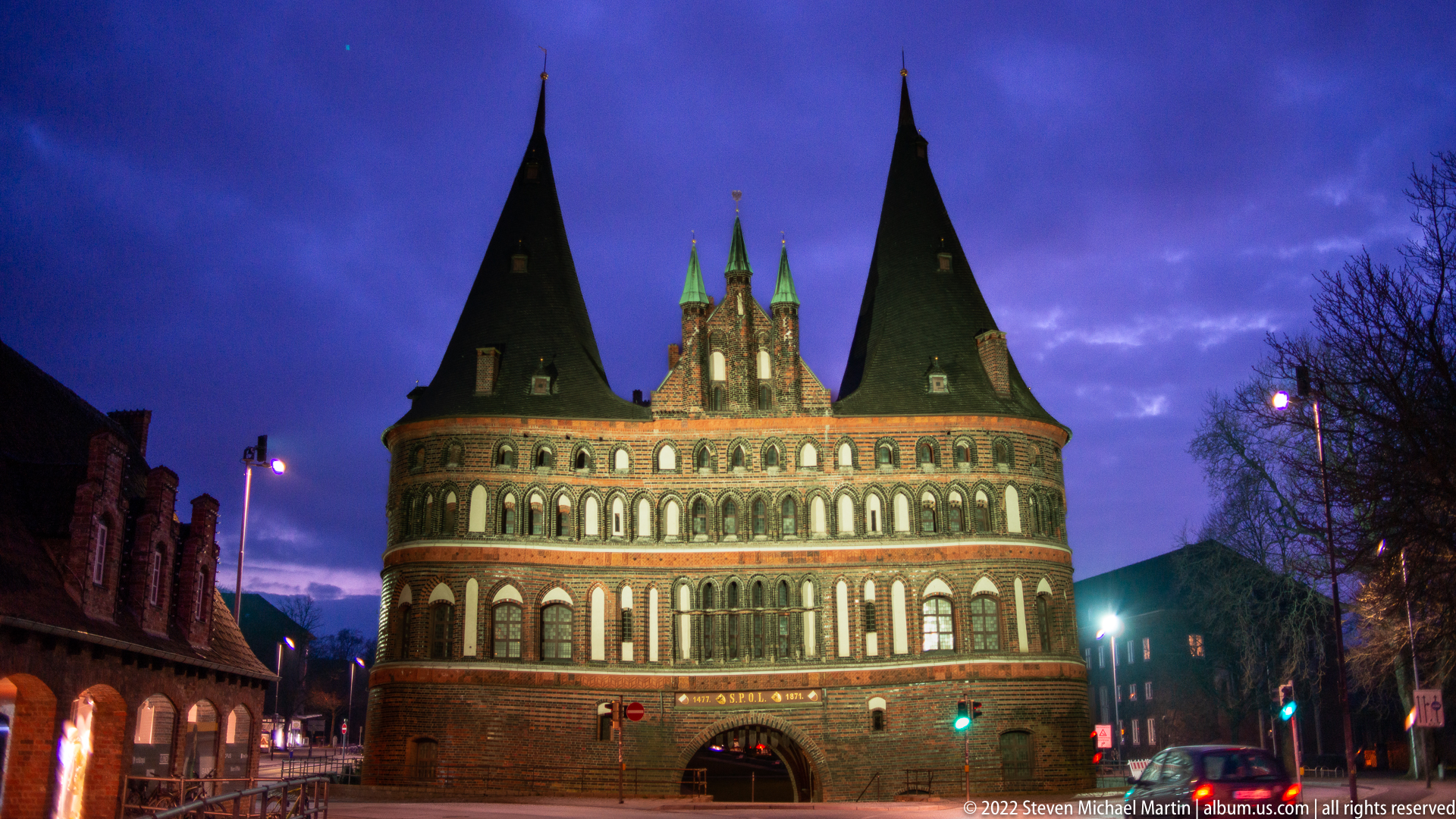
Seen from the opposite side at night, the Holstentor presents a long band of illuminated arched windows beneath its twin dark roofs. The central stepped gable rises between the towers, while traffic lights and adjoining buildings reveal the medieval gate functioning within the modern city street network.
Caption
Seen from the opposite side at night, the Holstentor presents a long band of illuminated arched windows beneath its twin dark roofs. The central stepped gable rises between the towers, while traffic lights and adjoining buildings reveal the medieval gate functioning within the modern city street network.

Wim Trompert’s 2021 artistic reconstruction restores the lost Lübeck Dance of Death to its historic setting as a long painted procession of Death and representatives of society. The project drew on surviving visual evidence, including the related Tallinn fragment, while reviving the older Middle Low German dialogue beneath the figures. It recalls Bernt Notke’s 1463 frieze, whose worn original was replaced in 1701 and whose successor was destroyed in the 1942 fire.
Caption
Wim Trompert’s 2021 artistic reconstruction restores the lost Lübeck Dance of Death to its historic setting as a long painted procession of Death and representatives of society. The project drew on surviving visual evidence, including the related Tallinn fragment, while reviving the older Middle Low German dialogue beneath the figures. It recalls Bernt Notke’s 1463 frieze, whose worn original was replaced in 1701 and whose successor was destroyed in the 1942 fire.

Another section of Wim Trompert’s 2021 artistic reconstruction continues the Lübeck Dance of Death across the chapel wall, pairing skeletal Death figures with men and women of different social ranks before the city landscape. Trompert’s reconstruction makes the lost sequence legible again while distinguishing itself from the destroyed historical fabric: Notke’s 1463 work had already been replaced by Anton Wortmann’s copy in 1701, and that copy burned in 1942.
Caption
Another section of Wim Trompert’s 2021 artistic reconstruction continues the Lübeck Dance of Death across the chapel wall, pairing skeletal Death figures with men and women of different social ranks before the city landscape. Trompert’s reconstruction makes the lost sequence legible again while distinguishing itself from the destroyed historical fabric: Notke’s 1463 work had already been replaced by Anton Wortmann’s copy in 1701, and that copy burned in 1942.

St. Petri’s massive west tower rises above Lübeck at blue hour, its medieval brick shaft crowned by a tall green-copper spire and four smaller corner turrets. Bands of pale stone and paired arched openings articulate the masonry, while warm floodlighting brings out the weathered brickwork. The tower belongs to the five-aisled Brick Gothic church of St. Petri, whose elevated viewing platform now overlooks the old town.
Caption
St. Petri’s massive west tower rises above Lübeck at blue hour, its medieval brick shaft crowned by a tall green-copper spire and four smaller corner turrets. Bands of pale stone and paired arched openings articulate the masonry, while warm floodlighting brings out the weathered brickwork. The tower belongs to the five-aisled Brick Gothic church of St. Petri, whose elevated viewing platform now overlooks the old town.

St. Petri is seen at blue hour with its soaring copper-clad west spire rising above the red-brick church and neighboring modern buildings. Four smaller corner turrets mark the base of the main spire, while the long roof and Gothic windows reveal the scale of the medieval church. The contrast between historic masonry and contemporary commercial architecture places the landmark firmly within present-day Lübeck.
Caption
St. Petri is seen at blue hour with its soaring copper-clad west spire rising above the red-brick church and neighboring modern buildings. Four smaller corner turrets mark the base of the main spire, while the long roof and Gothic windows reveal the scale of the medieval church. The contrast between historic masonry and contemporary commercial architecture places the landmark firmly within present-day Lübeck.

Seen from outside St. Mary’s Church, Alfred Mahlau’s tall 1956/57 stained-glass windows fill the north wall of the Dance of Death Chapel above the portal. Their vertically stacked figures of Death and the living reinterpret the celebrated Lübeck Totentanz as a postwar memorial. Mahlau drew on the historical figures while placing the dance above imagery of wartime destruction and ultimately directing the cycle toward hope.
Caption
Seen from outside St. Mary’s Church, Alfred Mahlau’s tall 1956/57 stained-glass windows fill the north wall of the Dance of Death Chapel above the portal. Their vertically stacked figures of Death and the living reinterpret the celebrated Lübeck Totentanz as a postwar memorial. Mahlau drew on the historical figures while placing the dance above imagery of wartime destruction and ultimately directing the cycle toward hope.

A row of narrow historic townhouses lines the street at blue hour, led by an especially ornate red-and-cream façade with tall grouped windows, sculptural trim, and a richly modeled gable. The neighboring white and brick façades show the variety of later architectural treatments layered onto Lübeck’s medieval street plan, while illuminated shopfronts keep the scene connected to the living commercial city.
Caption
A row of narrow historic townhouses lines the street at blue hour, led by an especially ornate red-and-cream façade with tall grouped windows, sculptural trim, and a richly modeled gable. The neighboring white and brick façades show the variety of later architectural treatments layered onto Lübeck’s medieval street plan, while illuminated shopfronts keep the scene connected to the living commercial city.

The celebrated Renaissance staircase on the Breite Straße side of Lübeck Town Hall climbs across the brick Kriegsstubenbau in a dense display of carved stone, heraldic ornament, grotesques, and glazed windows. Originally added in 1594 and associated with the Flemish sculptor Robert Coppens, the stair provided access to the former Kriegsstube and forms one of the Town Hall’s most elaborate Renaissance interventions within its older Brick Gothic fabric.
Caption
The celebrated Renaissance staircase on the Breite Straße side of Lübeck Town Hall climbs across the brick Kriegsstubenbau in a dense display of carved stone, heraldic ornament, grotesques, and glazed windows. Originally added in 1594 and associated with the Flemish sculptor Robert Coppens, the stair provided access to the former Kriegsstube and forms one of the Town Hall’s most elaborate Renaissance interventions within its older Brick Gothic fabric.

A richly painted and carved wooden oriel projects from the dark brick façade of Lübeck Town Hall, its small-paned windows framed by herm pilasters, masks, heraldic devices, and colorful ornamental panels. Dating from the late sixteenth-century Renaissance embellishment of the Rathaus, the oriel demonstrates how sculpted and polychrome decoration was layered onto Lübeck’s older Brick Gothic civic architecture.
Caption
A richly painted and carved wooden oriel projects from the dark brick façade of Lübeck Town Hall, its small-paned windows framed by herm pilasters, masks, heraldic devices, and colorful ornamental panels. Dating from the late sixteenth-century Renaissance embellishment of the Rathaus, the oriel demonstrates how sculpted and polychrome decoration was layered onto Lübeck’s older Brick Gothic civic architecture.

St. Mary’s Church rises in monumental Brick Gothic mass, its red-brick walls reinforced by deep buttresses and pierced by tall pointed windows beneath green-patinated copper roofs. One of the great western towers appears at left while a slender roof turret rises farther east. This exterior view helps establish the architectural setting of the nearby Dance of Death Chapel and its postwar stained-glass program.
Caption
St. Mary’s Church rises in monumental Brick Gothic mass, its red-brick walls reinforced by deep buttresses and pierced by tall pointed windows beneath green-patinated copper roofs. One of the great western towers appears at left while a slender roof turret rises farther east. This exterior view helps establish the architectural setting of the nearby Dance of Death Chapel and its postwar stained-glass program.

A second view along the north side of St. Mary’s Church emphasizes the enormous buttresses, tall Gothic window bays, and layered copper roofs of Lübeck’s principal civic church. The western tower anchors the composition while the wall surfaces lead toward the Dance of Death Chapel area, where modern glazing commemorates the celebrated Lübeck Totentanz destroyed during the 1942 bombing.
Caption
A second view along the north side of St. Mary’s Church emphasizes the enormous buttresses, tall Gothic window bays, and layered copper roofs of Lübeck’s principal civic church. The western tower anchors the composition while the wall surfaces lead toward the Dance of Death Chapel area, where modern glazing commemorates the celebrated Lübeck Totentanz destroyed during the 1942 bombing.

Warm light spills through a long sequence of round arches beneath a historic brick wing at night, creating a sheltered passage around the cobbled court. Repeated vaulted bays and the restrained upper-story windows give the building an almost monastic rhythm. The photograph records the quieter architectural fabric surrounding Lübeck’s major monuments rather than forcing a building identification not securely established by the visible evidence.
Caption
Warm light spills through a long sequence of round arches beneath a historic brick wing at night, creating a sheltered passage around the cobbled court. Repeated vaulted bays and the restrained upper-story windows give the building an almost monastic rhythm. The photograph records the quieter architectural fabric surrounding Lübeck’s major monuments rather than forcing a building identification not securely established by the visible evidence.

Markus Lüpertz’s 2002 tympanum window above the north portal of St. Mary’s Dance of Death Chapel centers a staring skull amid vivid symbols of mortality and renewal. A dove, red rose, fish, blue water vessel, snail-like form, and seven flame-like lights draw Christian ideas of death, resurrection, peace, and the Last Judgment into a compact modern composition that deliberately complements, rather than recreates, the lost Lübeck Totentanz.
Caption
Markus Lüpertz’s 2002 tympanum window above the north portal of St. Mary’s Dance of Death Chapel centers a staring skull amid vivid symbols of mortality and renewal. A dove, red rose, fish, blue water vessel, snail-like form, and seven flame-like lights draw Christian ideas of death, resurrection, peace, and the Last Judgment into a compact modern composition that deliberately complements, rather than recreates, the lost Lübeck Totentanz.

The Heiligen-Geist-Hospital presents its extraordinary Brick Gothic façade to Koberg at night, with a steep central gable, tall lancet windows, four slender façade turrets, and the green spire rising behind. Completed in the thirteenth century, the complex combined a three-aisled hospital church with the long hall of the residents and remains one of Lübeck’s outstanding monuments to medieval charitable care.
Caption
The Heiligen-Geist-Hospital presents its extraordinary Brick Gothic façade to Koberg at night, with a steep central gable, tall lancet windows, four slender façade turrets, and the green spire rising behind. Completed in the thirteenth century, the complex combined a three-aisled hospital church with the long hall of the residents and remains one of Lübeck’s outstanding monuments to medieval charitable care.

A clock crowns the stepped brick gable of a wing of Lübeck’s Heiligen-Geist-Hospital, while an arched passage opens beneath the building and pale decorative bands cross the façade. The medieval hospital complex at Koberg, completed in the thirteenth century and still associated with care for the elderly, is one of Lübeck’s most important surviving institutions of medieval social welfare.
Caption
A clock crowns the stepped brick gable of a wing of Lübeck’s Heiligen-Geist-Hospital, while an arched passage opens beneath the building and pale decorative bands cross the façade. The medieval hospital complex at Koberg, completed in the thirteenth century and still associated with care for the elderly, is one of Lübeck’s most important surviving institutions of medieval social welfare.

A painted figure labeled “BLAUBART” appears as a crowned, white-bearded ruler in a red robe, raising one arm above a German verse written across the wall below. The theatrical image treats the Bluebeard legend in a deliberately colorful, storybook manner, while the painted ceiling and surrounding interior indicate that it belongs to a larger decorative program. The visible inscription securely identifies the character even though the precise site and artist are not established here.
Caption
A painted figure labeled “BLAUBART” appears as a crowned, white-bearded ruler in a red robe, raising one arm above a German verse written across the wall below. The theatrical image treats the Bluebeard legend in a deliberately colorful, storybook manner, while the painted ceiling and surrounding interior indicate that it belongs to a larger decorative program. The visible inscription securely identifies the character even though the precise site and artist are not established here.

The Burgtor closes the nighttime street vista with its tall, many-storied brick tower rising above the arched gateway. Rows of paired openings and decorative arcading animate the medieval tower, while adjoining stepped-gable buildings preserve the sense of an urban gate complex. One of Lübeck’s surviving city gates, the Burgtor marks the historic northern approach to the old town.
Caption
The Burgtor closes the nighttime street vista with its tall, many-storied brick tower rising above the arched gateway. Rows of paired openings and decorative arcading animate the medieval tower, while adjoining stepped-gable buildings preserve the sense of an urban gate complex. One of Lübeck’s surviving city gates, the Burgtor marks the historic northern approach to the old town.

A long brick wing of the Heiligen-Geist-Hospital extends away from its clock-gabled end, with repeated ground-floor arches forming a sheltered arcade along the street. Pale decorative panels and white-framed windows relieve the red masonry, while the nighttime lighting reveals the complex as more than its famous church façade: a substantial institutional ensemble built around care, worship, and communal life.
Caption
A long brick wing of the Heiligen-Geist-Hospital extends away from its clock-gabled end, with repeated ground-floor arches forming a sheltered arcade along the street. Pale decorative panels and white-framed windows relieve the red masonry, while the nighttime lighting reveals the complex as more than its famous church façade: a substantial institutional ensemble built around care, worship, and communal life.

A visitor stands beside a brightly painted wooden play structure labeled “ARCHE NO…,” apparently invoking Noah’s Ark. The timber construction, rope-net window, curved painted trim, and playful lettering contrast with the surrounding historic brick setting. The photograph records a contemporary, human-scale element within the broader architectural exploration of Lübeck.
Caption
A visitor stands beside a brightly painted wooden play structure labeled “ARCHE NO…,” apparently invoking Noah’s Ark. The timber construction, rope-net window, curved painted trim, and playful lettering contrast with the surrounding historic brick setting. The photograph records a contemporary, human-scale element within the broader architectural exploration of Lübeck.

Lübeck Cathedral is seen close to its richly articulated north porch, traditionally known as the Paradise porch, with the cathedral’s twin green spires rising behind. Rounded arches, clustered pale stone columns, patterned brickwork, and blind arcading preserve the Romanesque character of this entrance against the later Gothic development of the larger church, making the façade a particularly clear record of the cathedral’s layered medieval construction.
Caption
Lübeck Cathedral is seen close to its richly articulated north porch, traditionally known as the Paradise porch, with the cathedral’s twin green spires rising behind. Rounded arches, clustered pale stone columns, patterned brickwork, and blind arcading preserve the Romanesque character of this entrance against the later Gothic development of the larger church, making the façade a particularly clear record of the cathedral’s layered medieval construction.
⭐ Highlights
- Hanseatic Capital: The leading city of the Hanseatic League during the Middle Ages.
- UNESCO Old Town: A remarkably preserved historic center built on an island.
- Holstentor Gate: One of Germany’s most iconic medieval city gates.
- Brick Gothic Architecture: A defining architectural style across the Baltic region.
- “City of Seven Towers”: A skyline dominated by the towers of major churches.
- Merchant Heritage: Historic warehouses and houses reflecting centuries of trade.
🏰 Lübeck Field Guide
Major features observed during this visit:
Lübeck is one of the most historically important cities in northern Europe, located near the Baltic Sea in northern Germany. Founded in the 12th century, it developed into the principal city of the Hanseatic League, a powerful network of trading cities that dominated commerce across the Baltic and North Seas. Today, Lübeck’s Old Town preserves its medieval layout, architecture, and identity, offering one of the most complete examples of a historic trading city.
🏛️ Signature Landmarks
- Holstentor – A massive brick gate that served as a western entrance to the city.
- St. Mary’s Church – A model for Brick Gothic architecture throughout northern Europe.
- Lübeck Cathedral – One of the earliest large brick churches in the Baltic region.
- Town Hall – A historic administrative center reflecting the city’s political importance.
- Salt Storehouses – Warehouses that supported the trade networks of the Hanseatic League.
🧠 Historical Significance
- Hanseatic League Capital – Lübeck served as the central hub of a powerful medieval trading network.
- Trade Dominance – Controlled key trade routes between eastern and western Europe.
- Urban Influence – Its laws and city model influenced many other Baltic cities.
- Preservation – The Old Town remains one of the best examples of a medieval commercial city.
🌄 Urban Landscape & Setting
- Island City – The historic center is surrounded by the Trave River and waterways.
- Medieval Layout – Streets and plots reflect the original urban plan.
- Brick Architecture – Buildings constructed primarily of brick define the city’s visual identity.
- Skyline of Towers – Church spires dominate the cityscape and define its silhouette.