Munyaga – Uganda
The region of Munyaga lies within the forested landscapes of western Uganda where dense vegetation, rivers, and hills create an ideal habitat for a variety of wildlife species. The area forms part of the broader network of forests and protected lands that support Uganda’s rich biodiversity.
Visitors traveling through this region encounter lush green hillsides, rural villages, and patches of rainforest that illustrate the ecological diversity of southwestern Uganda. The forests here are home to numerous bird species and primates that thrive in the tropical environment.
Munyaga represents the quieter, less visited landscapes that connect Uganda’s larger national parks and conservation areas.
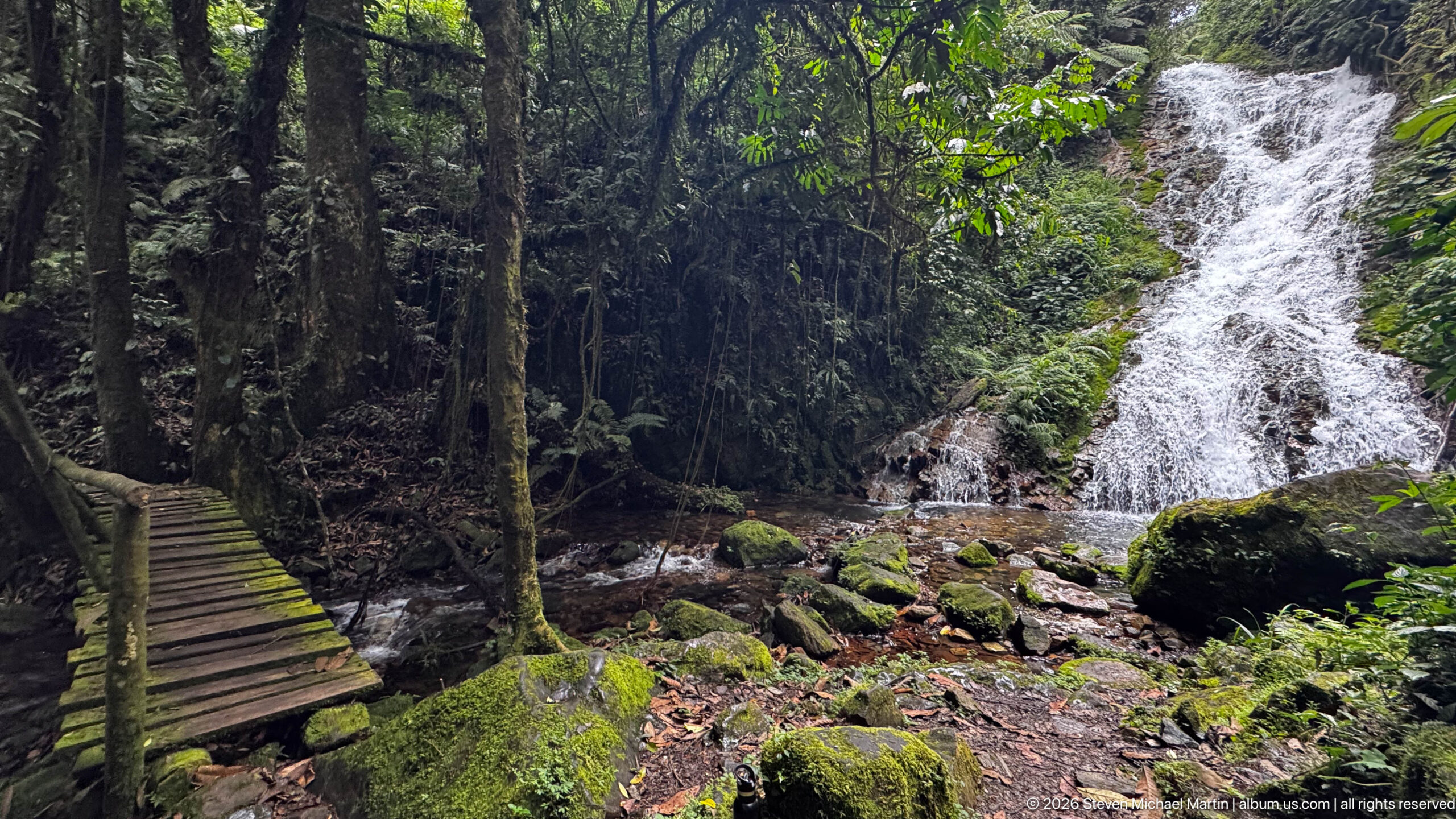
A white cascade descends over dark rock at the edge of dense forest, while a narrow wooden footbridge crosses the stream in the lower left. Moss-covered boulders, exposed roots and wet ground surround the water, linking the trail infrastructure directly to the steep, humid drainage approaching Munyaga Falls.
Caption
A white cascade descends over dark rock at the edge of dense forest, while a narrow wooden footbridge crosses the stream in the lower left. Moss-covered boulders, exposed roots and wet ground surround the water, linking the trail infrastructure directly to the steep, humid drainage approaching Munyaga Falls.
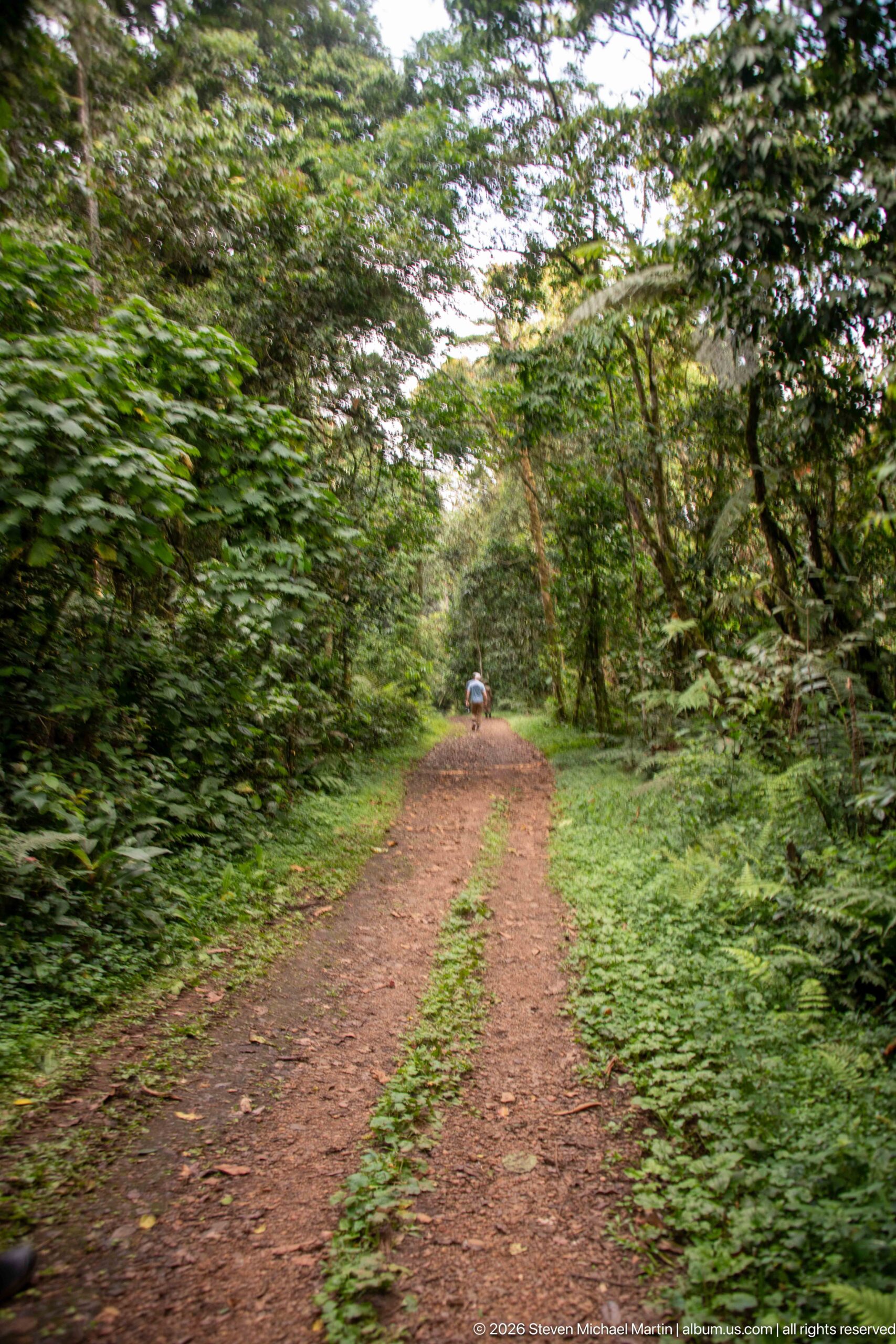
A reddish-brown track runs straight through a corridor of dense green vegetation, narrowing toward a distant walker. The broad, gently graded route contrasts with the tangled understory and arching canopy, providing an establishing view of the forest approach associated with the Munyaga Falls walk in Bwindi.
Caption
A reddish-brown track runs straight through a corridor of dense green vegetation, narrowing toward a distant walker. The broad, gently graded route contrasts with the tangled understory and arching canopy, providing an establishing view of the forest approach associated with the Munyaga Falls walk in Bwindi.

A visitor stands in front of a broad white cascade, with the waterfall softened behind him by shallow depth of field. The close portrait sets human scale against the humid forest setting while keeping the rushing water recognizable as the environmental backdrop along the Munyaga Falls trail.
Caption
A visitor stands in front of a broad white cascade, with the waterfall softened behind him by shallow depth of field. The close portrait sets human scale against the humid forest setting while keeping the rushing water recognizable as the environmental backdrop along the Munyaga Falls trail.
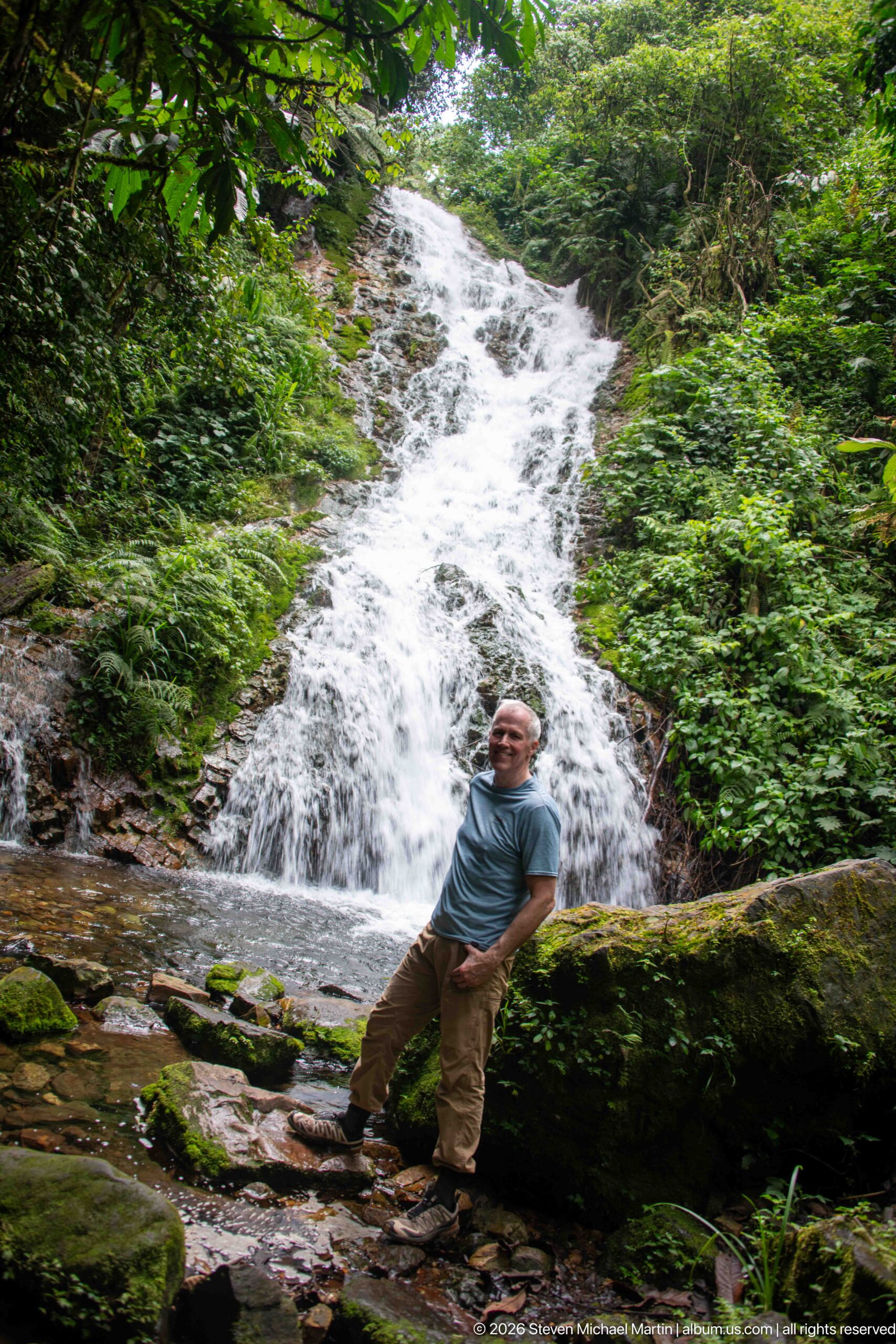
A visitor leans against a moss-covered fallen trunk in front of Munyaga Falls, using the foreground log as a natural frame. Behind him, the broad cascade descends over the sloping rock face into the forest stream, combining a human-scale travel portrait with a clear view of the waterfall and its lush setting.
Caption
A visitor leans against a moss-covered fallen trunk in front of Munyaga Falls, using the foreground log as a natural frame. Behind him, the broad cascade descends over the sloping rock face into the forest stream, combining a human-scale travel portrait with a clear view of the waterfall and its lush setting.
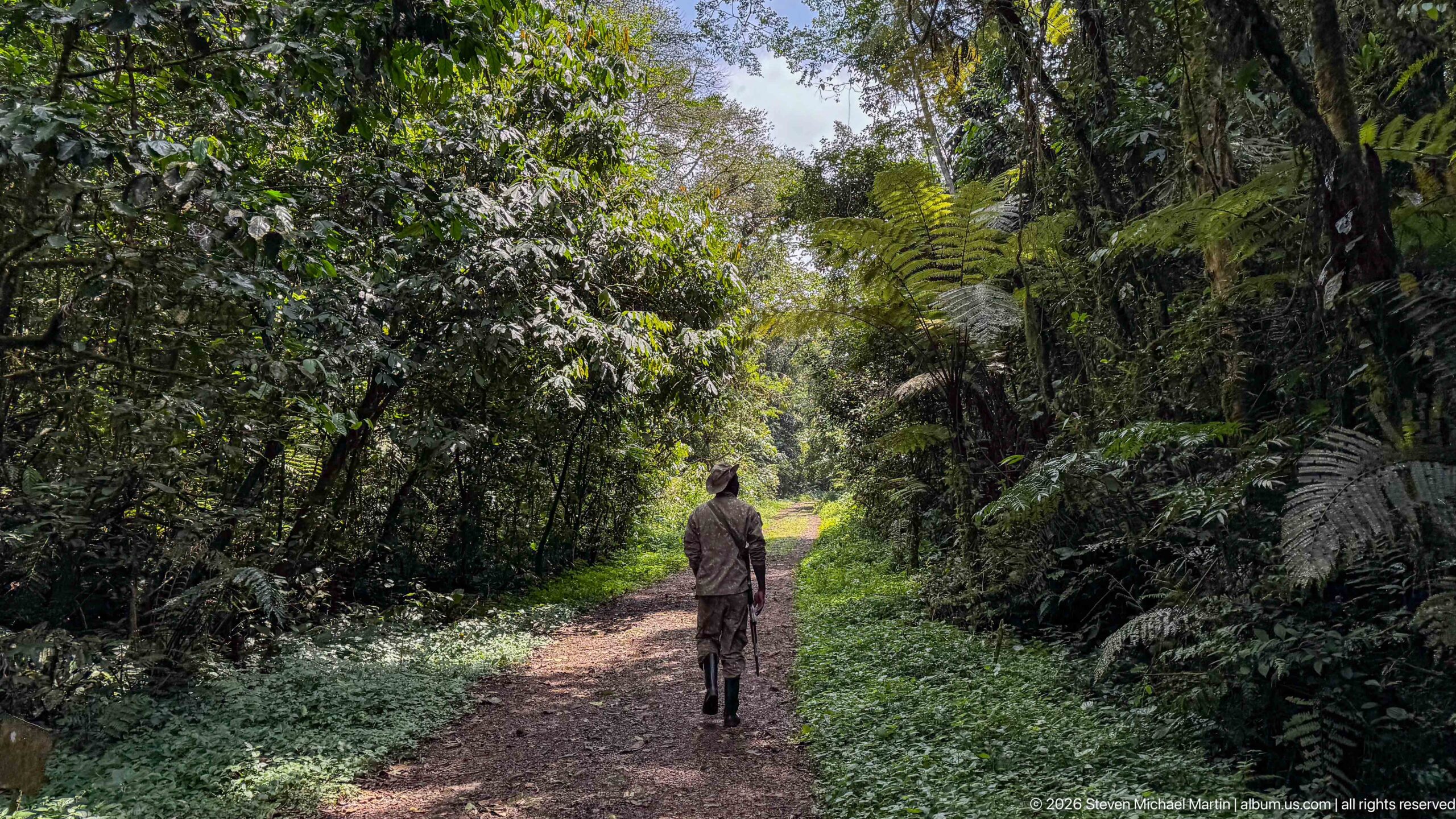
A guide walks away along a broad earthen trail enclosed by dense forest, with ferns, shrubs, and mature trees forming a layered green corridor. The open path and solitary figure provide scale for the vegetation and convey the quieter walking conditions encountered along the Munyaga Falls route through Bwindi’s humid forest landscape.
Caption
A guide walks away along a broad earthen trail enclosed by dense forest, with ferns, shrubs, and mature trees forming a layered green corridor. The open path and solitary figure provide scale for the vegetation and convey the quieter walking conditions encountered along the Munyaga Falls route through Bwindi’s humid forest landscape.
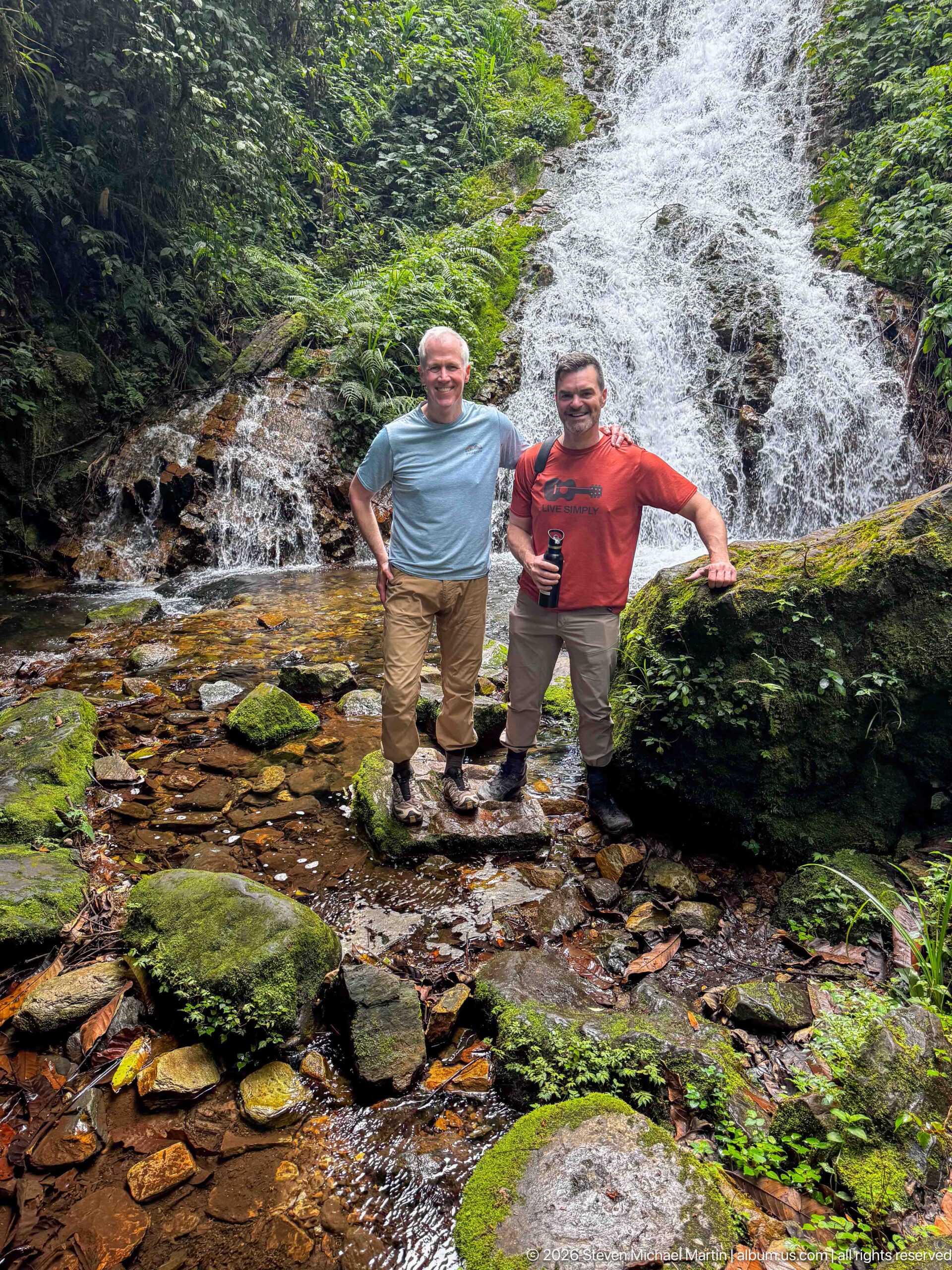
Two visitors stand on the rocky streambed below the broad white cascade of Munyaga Falls. Moss-covered boulders and a fallen trunk frame the foreground while dense forest encloses the watercourse, giving both a sense of the falls’ scale and the wet, shaded setting reached by the forest trail.
Caption
Two visitors stand on the rocky streambed below the broad white cascade of Munyaga Falls. Moss-covered boulders and a fallen trunk frame the foreground while dense forest encloses the watercourse, giving both a sense of the falls’ scale and the wet, shaded setting reached by the forest trail.
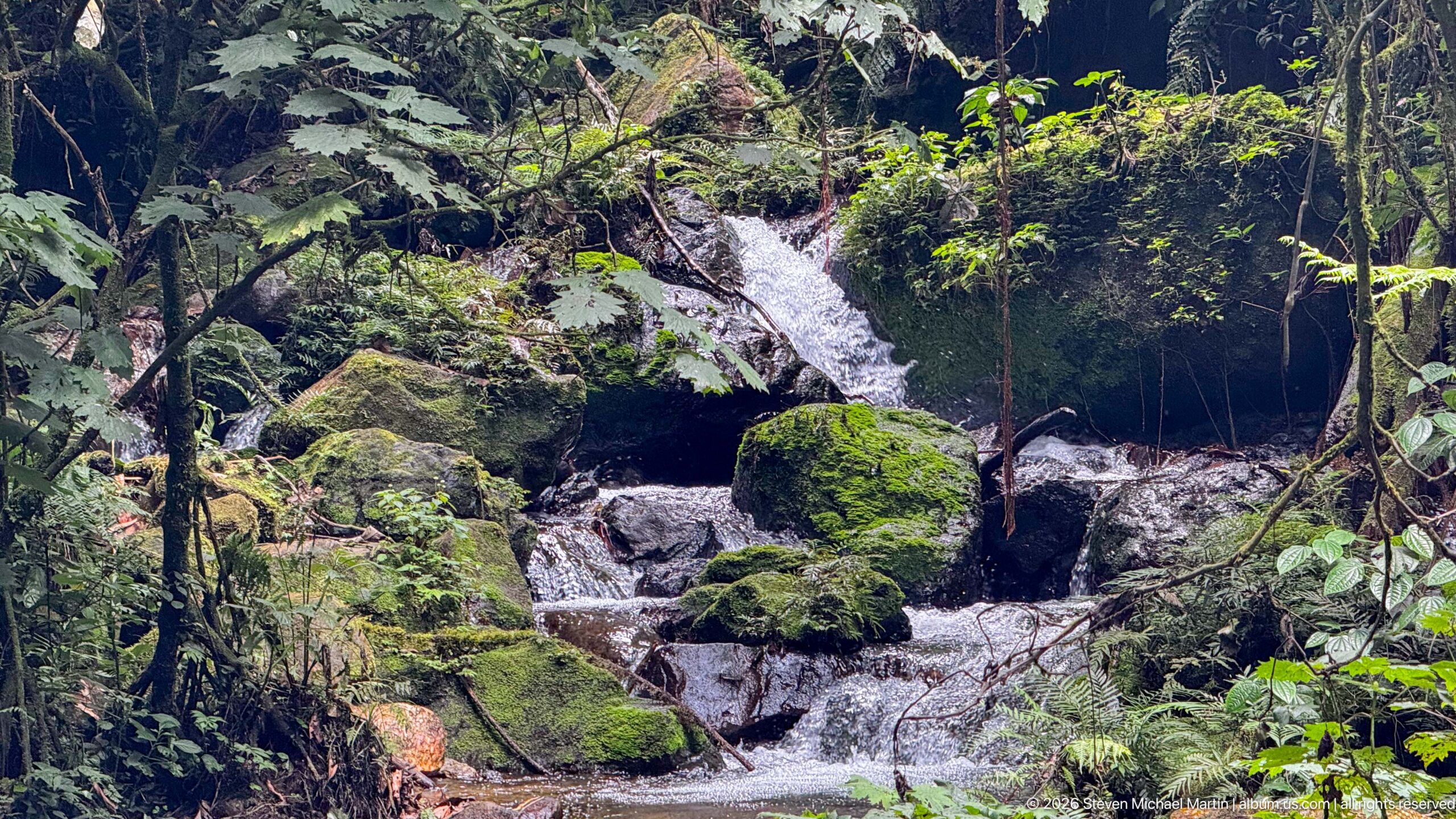
White water descends through a steep, shaded forest channel, breaking around large moss-covered boulders before continuing over dark rock ledges. Ferns, vines, and broadleaf vegetation crowd the banks, while the vivid moss records the persistently damp conditions around the cascade. The close landscape view emphasizes the relationship between flowing water, rock, and dense Bwindi forest vegetation.
Caption
White water descends through a steep, shaded forest channel, breaking around large moss-covered boulders before continuing over dark rock ledges. Ferns, vines, and broadleaf vegetation crowd the banks, while the vivid moss records the persistently damp conditions around the cascade. The close landscape view emphasizes the relationship between flowing water, rock, and dense Bwindi forest vegetation.
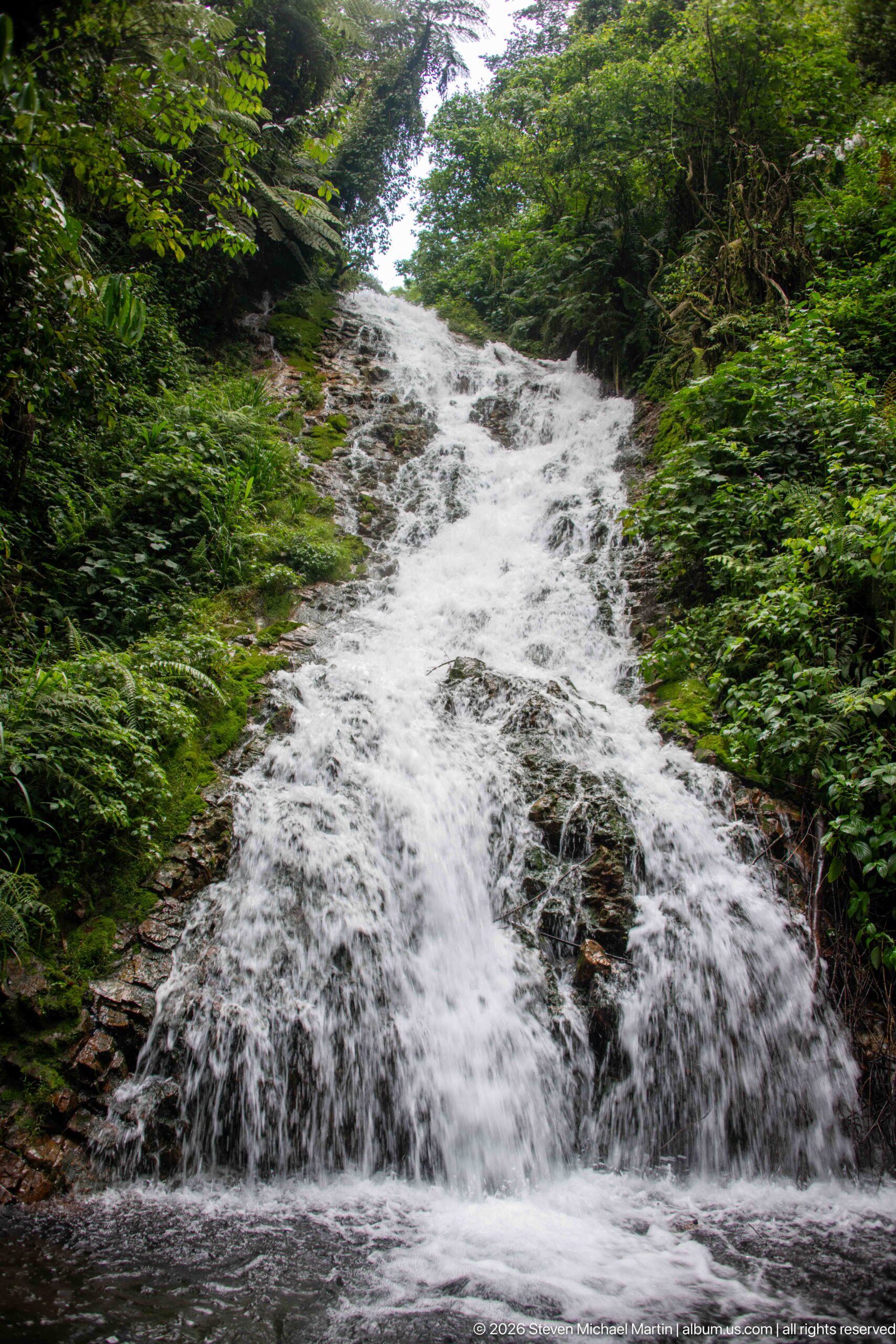
Munyaga Falls spreads in a broad white sheet over a sloping rock face, descending through dense green forest into a dark pool at its base. The frontal view gives the clearest establishing portrait in this sequence, showing the cascade’s stepped flow pattern and the vegetation pressing closely around both sides.
Caption
Munyaga Falls spreads in a broad white sheet over a sloping rock face, descending through dense green forest into a dark pool at its base. The frontal view gives the clearest establishing portrait in this sequence, showing the cascade’s stepped flow pattern and the vegetation pressing closely around both sides.
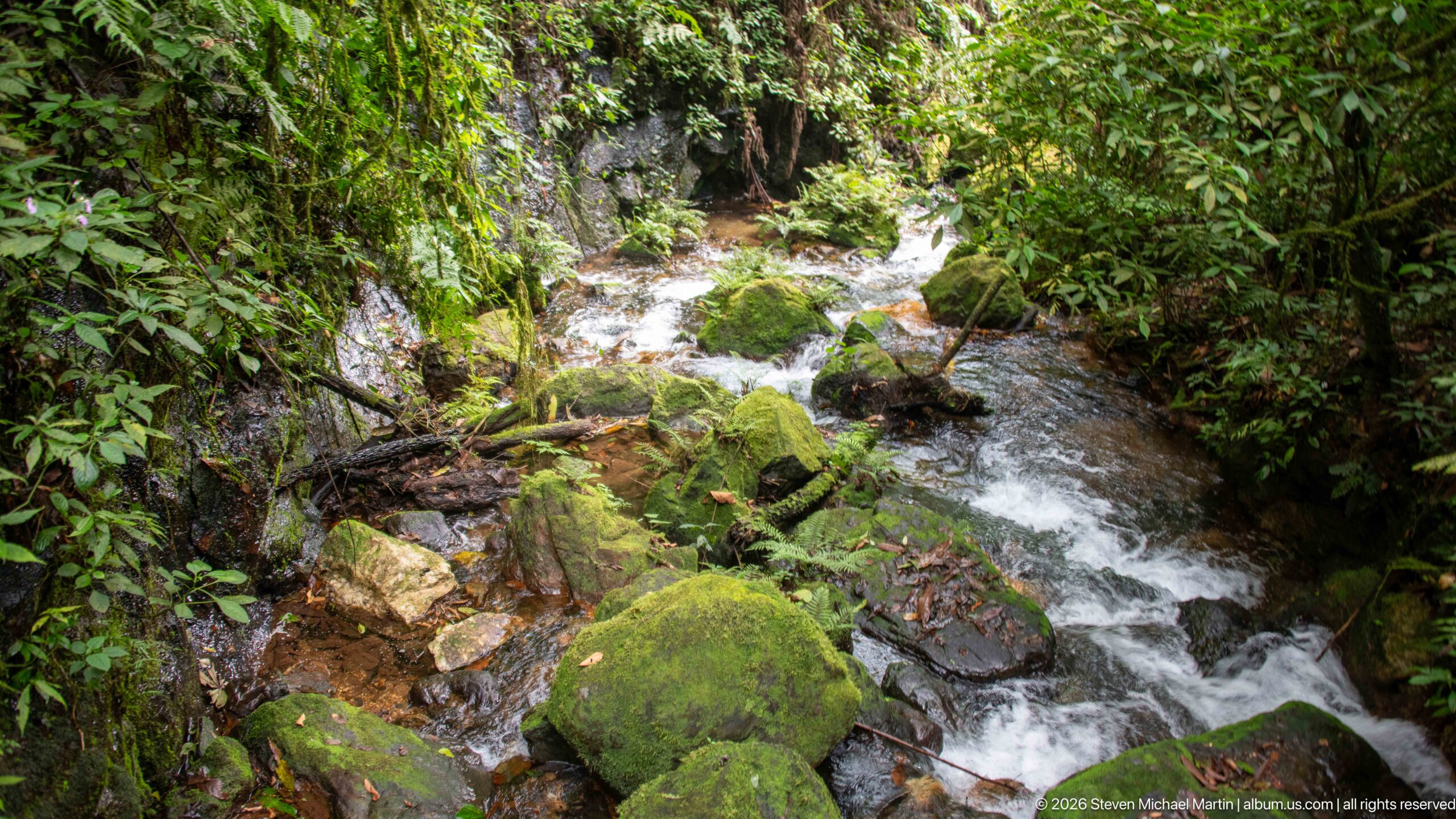
A narrow stream courses downhill through a jumble of moss-covered boulders beneath dense forest cover. Small rapids weave between stones rather than forming a single waterfall, revealing the broken, rocky channel that carries water away from the larger cascades along the Munyaga Falls route.
Caption
A narrow stream courses downhill through a jumble of moss-covered boulders beneath dense forest cover. Small rapids weave between stones rather than forming a single waterfall, revealing the broken, rocky channel that carries water away from the larger cascades along the Munyaga Falls route.
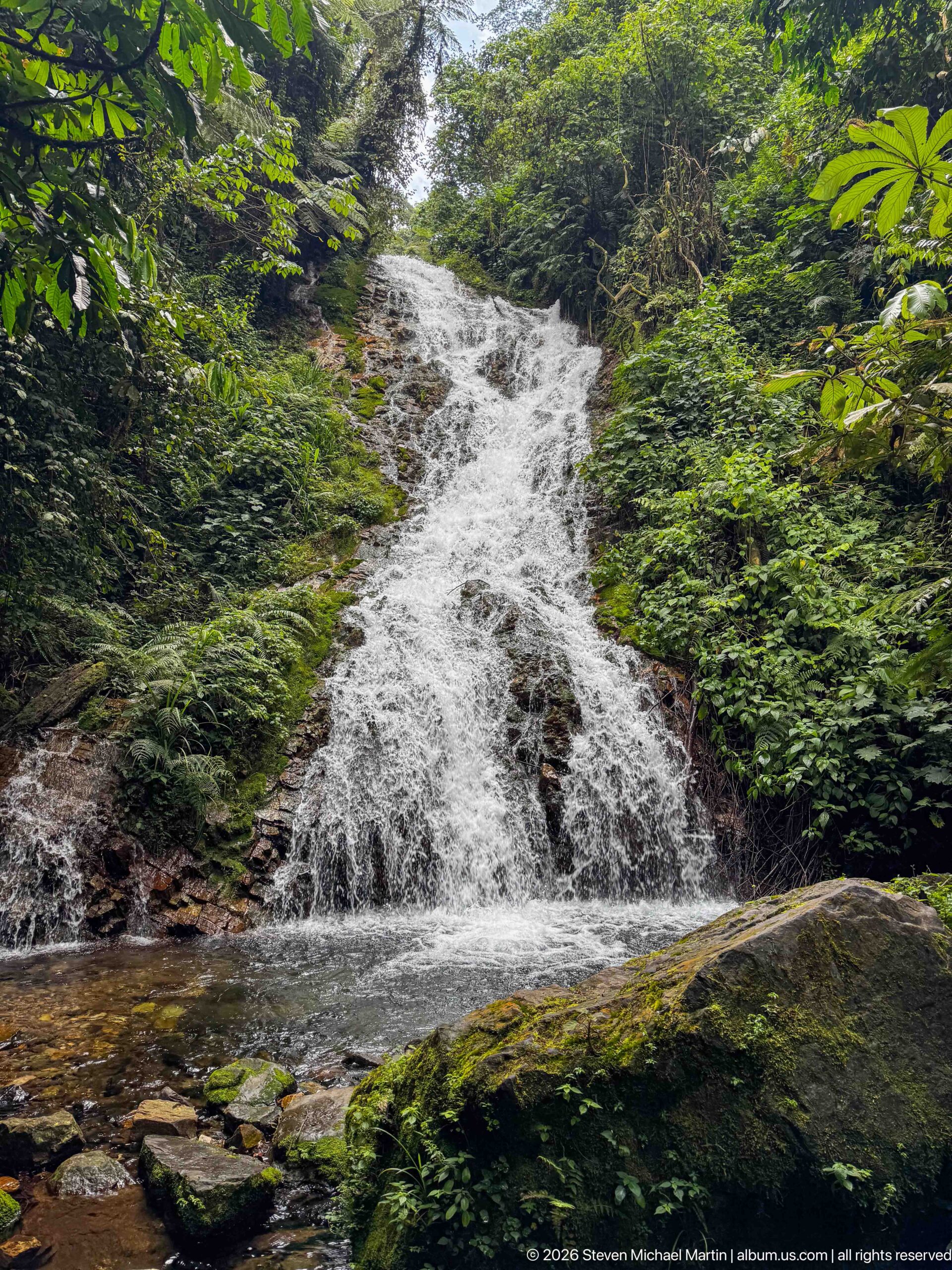
Water fans down a long inclined rock face at Munyaga Falls, gathering into a shallow basin behind a large moss-coated boulder. The vertical framing follows the cascade uphill through dense vegetation, emphasizing the continuous descent of water through the forest rather than a single abrupt drop.
Caption
Water fans down a long inclined rock face at Munyaga Falls, gathering into a shallow basin behind a large moss-coated boulder. The vertical framing follows the cascade uphill through dense vegetation, emphasizing the continuous descent of water through the forest rather than a single abrupt drop.
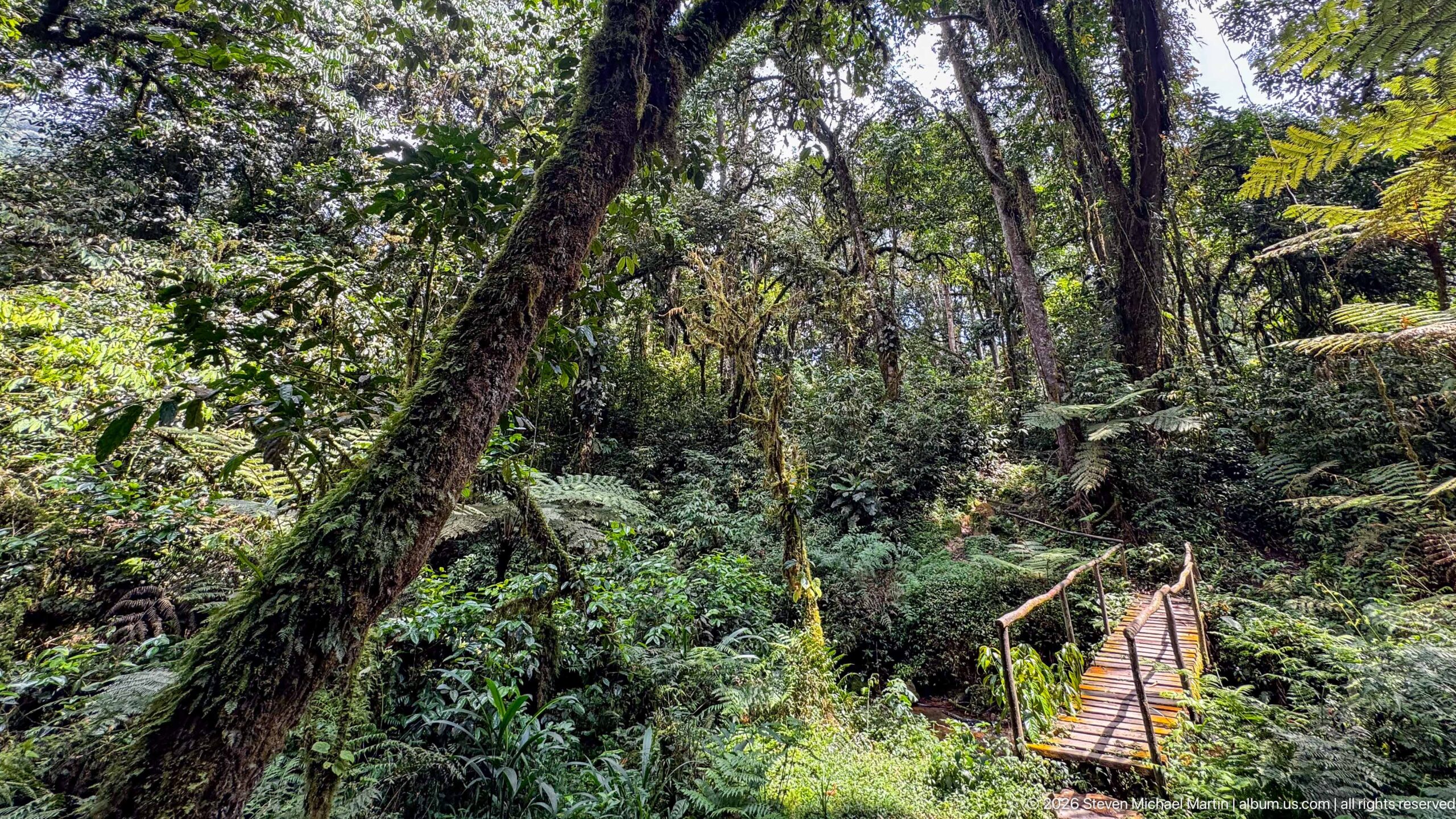
A rustic footbridge descends through a pocket of mature forest, dwarfed by twisting trunks, epiphyte-covered branches, ferns, and deep green understory. The wide view gives the crossing a small scale within the surrounding vegetation, emphasizing the enclosed character of the Munyaga Falls trail and the structural complexity of Bwindi’s moist forest.
Caption
A rustic footbridge descends through a pocket of mature forest, dwarfed by twisting trunks, epiphyte-covered branches, ferns, and deep green understory. The wide view gives the crossing a small scale within the surrounding vegetation, emphasizing the enclosed character of the Munyaga Falls trail and the structural complexity of Bwindi’s moist forest.
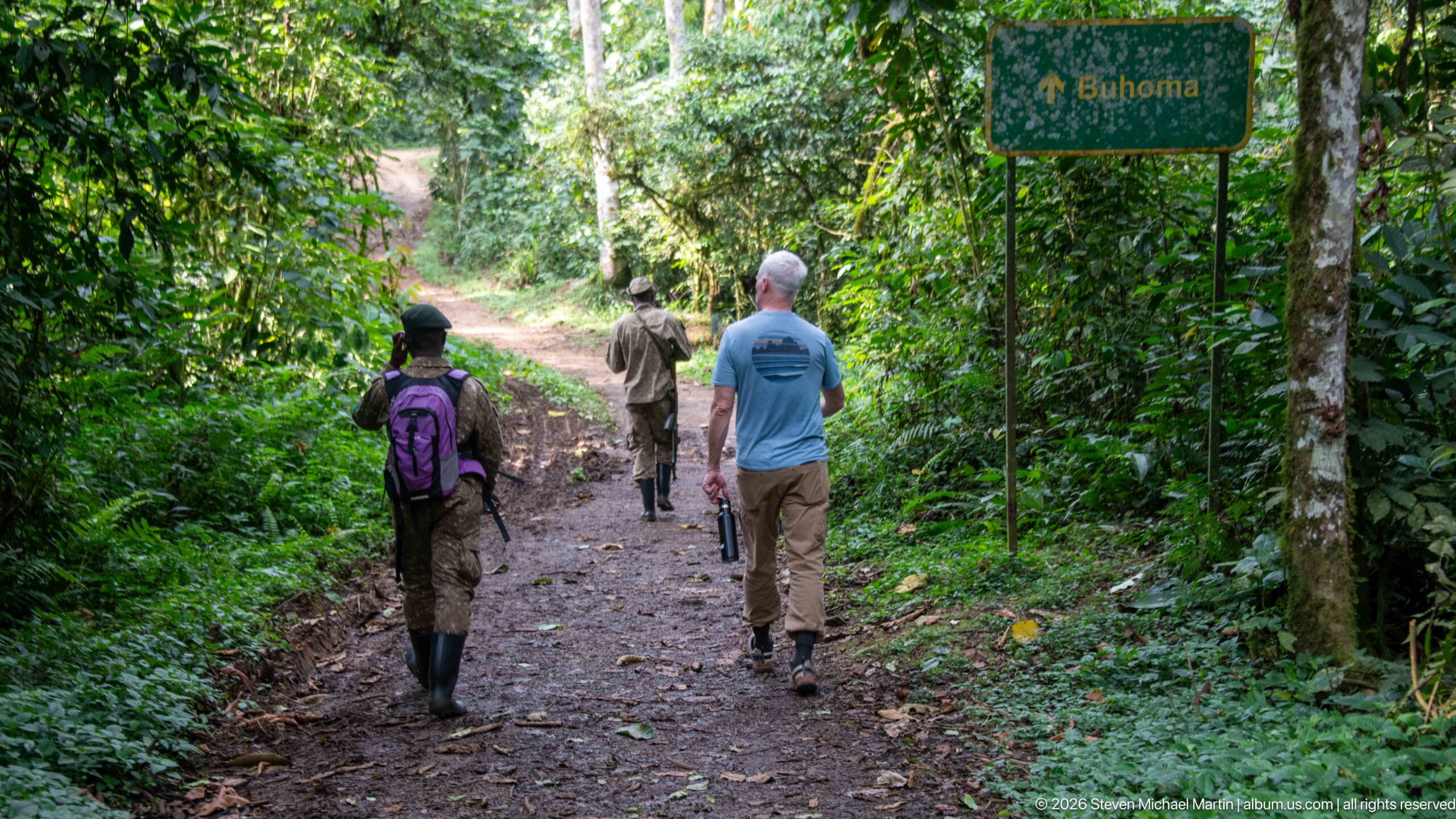
Three walkers follow a broad earthen path beneath dense tropical forest, passing a green Buhoma directional sign. The scene establishes the human scale and shaded vegetation of the approach to Munyaga Falls in Bwindi, with vines, shrubs and tall trunks enclosing the route on both sides.
Caption
Three walkers follow a broad earthen path beneath dense tropical forest, passing a green Buhoma directional sign. The scene establishes the human scale and shaded vegetation of the approach to Munyaga Falls in Bwindi, with vines, shrubs and tall trunks enclosing the route on both sides.
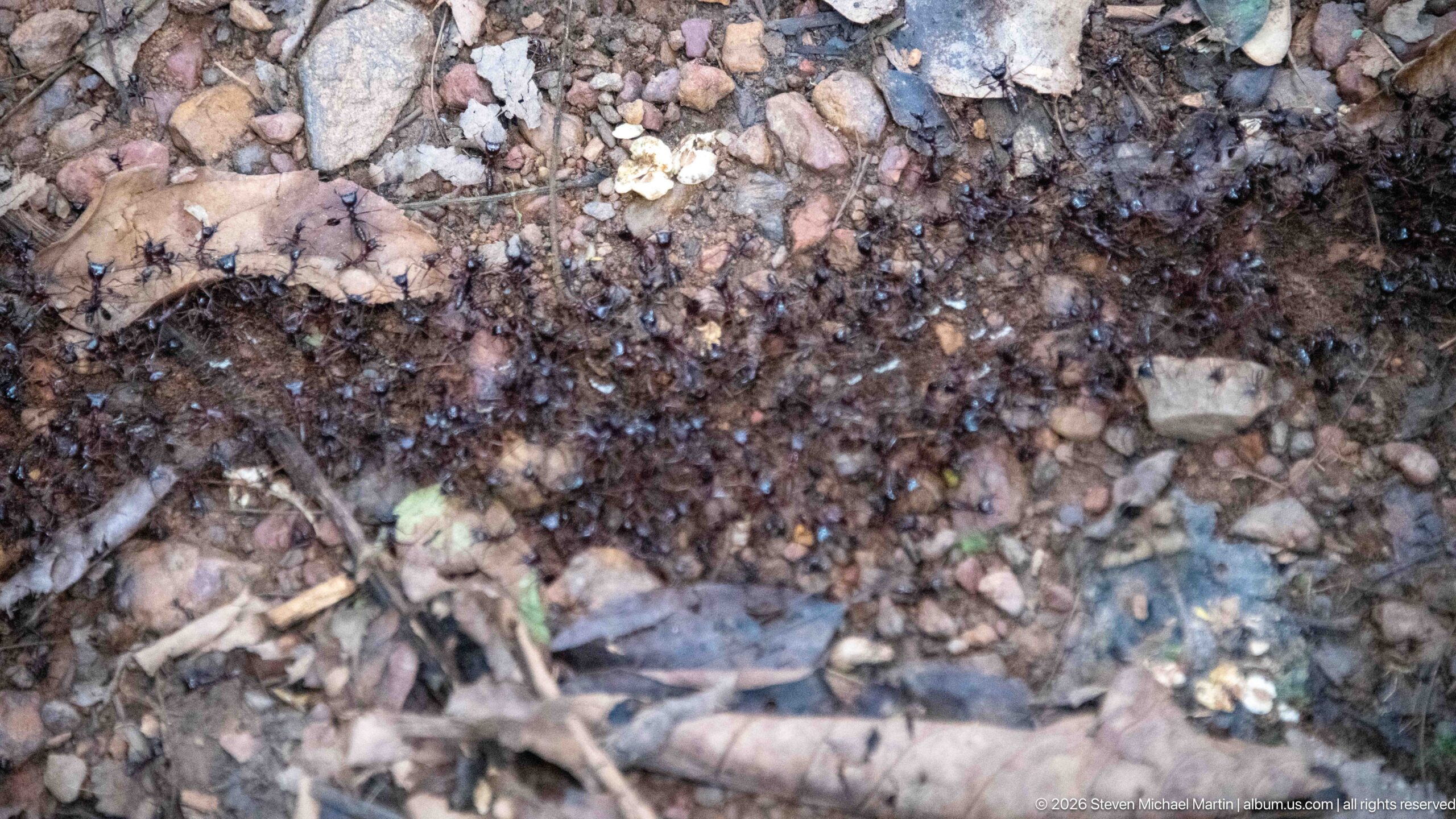
A dense concentration of small dark ants spreads across damp leaf litter, soil, twigs and stones on the forest floor. The close viewpoint shifts attention from Bwindi’s large-scale forest scenery to invertebrate activity at ground level, where decomposing plant material and moist substrate form a complex microhabitat.
Caption
A dense concentration of small dark ants spreads across damp leaf litter, soil, twigs and stones on the forest floor. The close viewpoint shifts attention from Bwindi’s large-scale forest scenery to invertebrate activity at ground level, where decomposing plant material and moist substrate form a complex microhabitat.
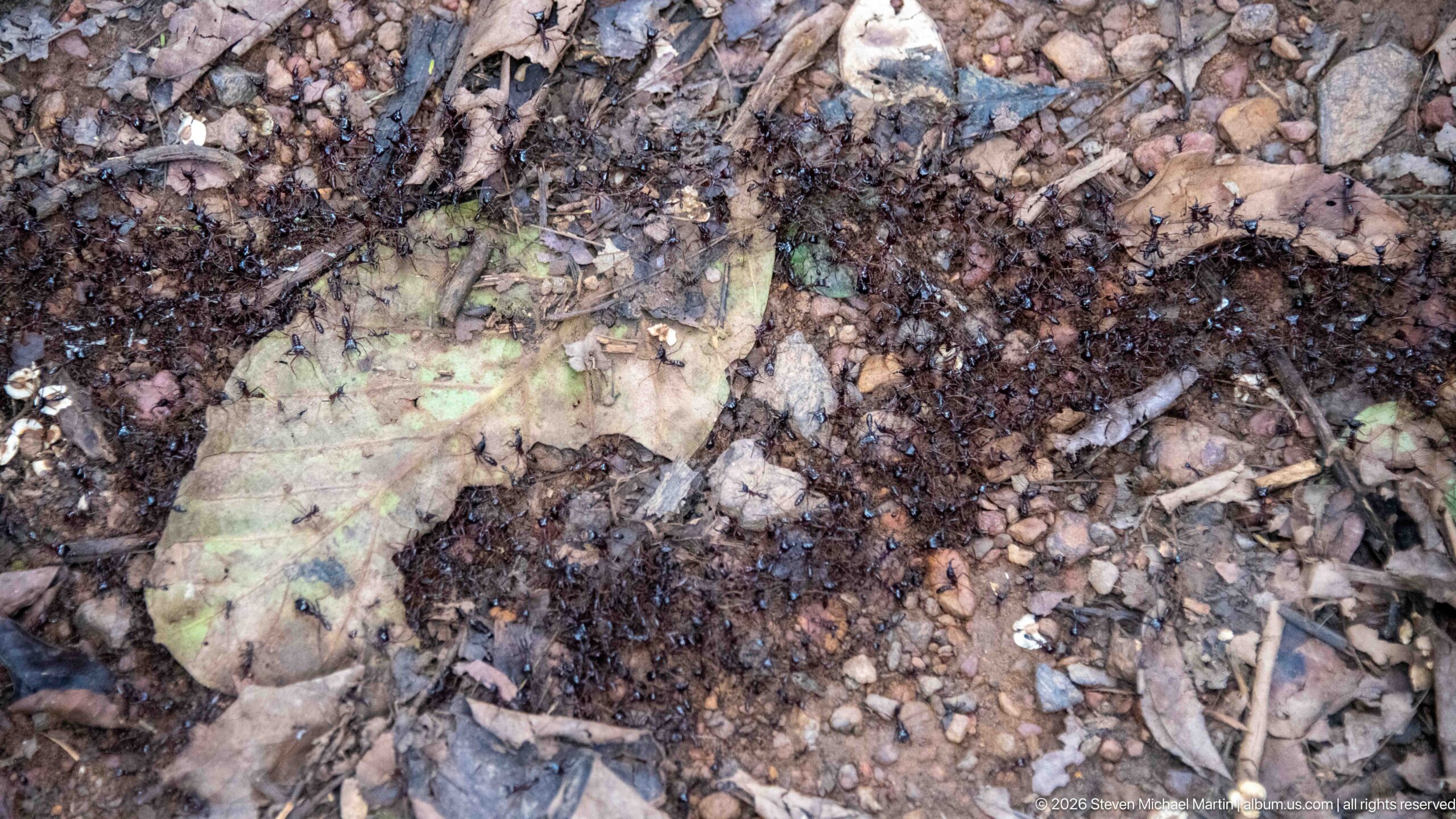
Small dark ants cluster thickly around a pale fallen leaf and surrounding decomposing litter. Pebbles, fragments of bark and damp organic material fill the frame, creating a close natural-history study of forest-floor activity along the Munyaga Falls route without requiring a species-level identification.
Caption
Small dark ants cluster thickly around a pale fallen leaf and surrounding decomposing litter. Pebbles, fragments of bark and damp organic material fill the frame, creating a close natural-history study of forest-floor activity along the Munyaga Falls route without requiring a species-level identification.
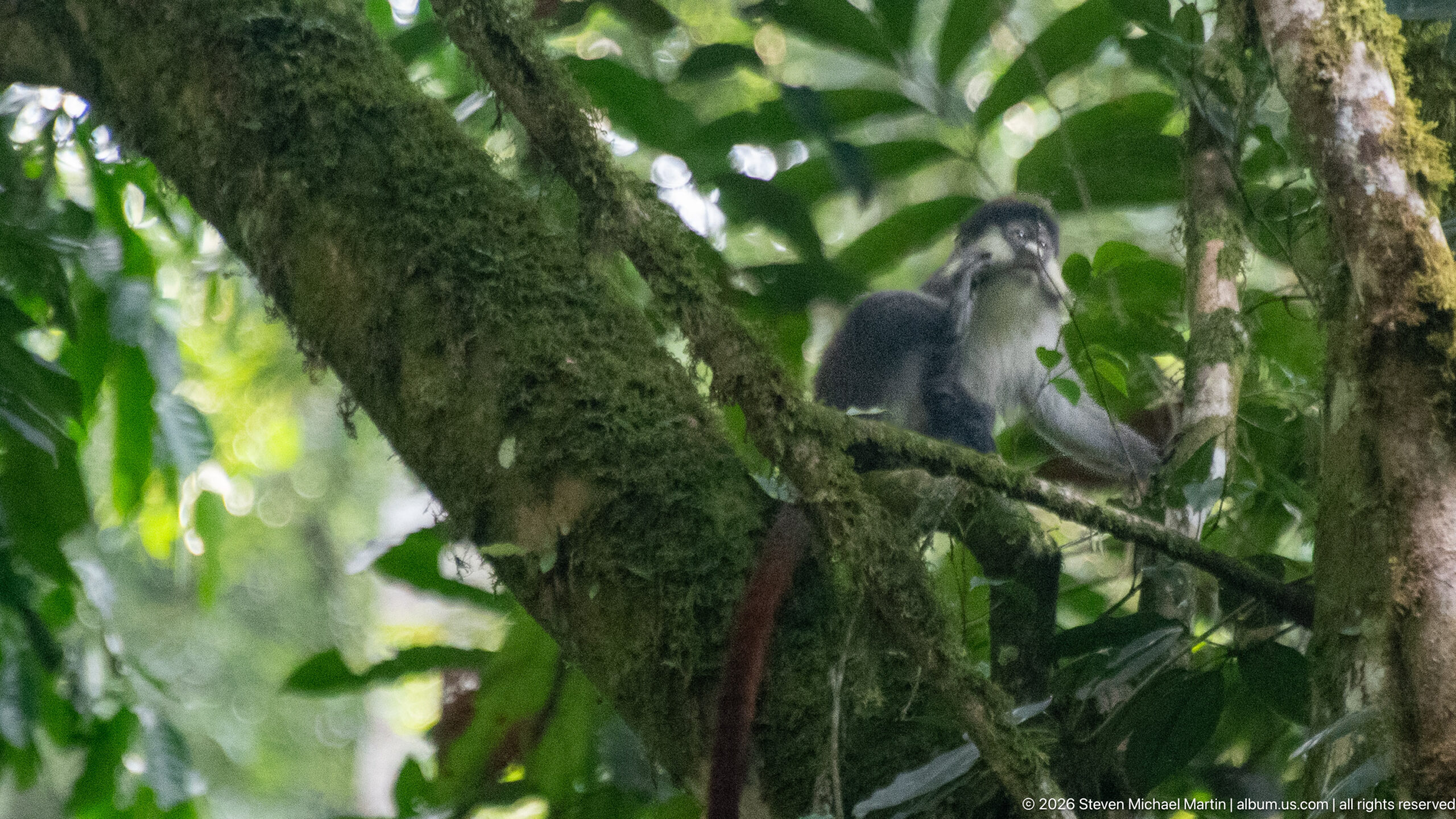
A red-tailed monkey perches on a mossy branch in the shaded canopy, its pale facial markings and long rusty-red tail visible through surrounding leaves. The partially screened viewpoint reflects the species’ arboreal setting in Bwindi, where branches and dense foliage create both travel routes and cover above the forest floor.
Caption
A red-tailed monkey perches on a mossy branch in the shaded canopy, its pale facial markings and long rusty-red tail visible through surrounding leaves. The partially screened viewpoint reflects the species’ arboreal setting in Bwindi, where branches and dense foliage create both travel routes and cover above the forest floor.
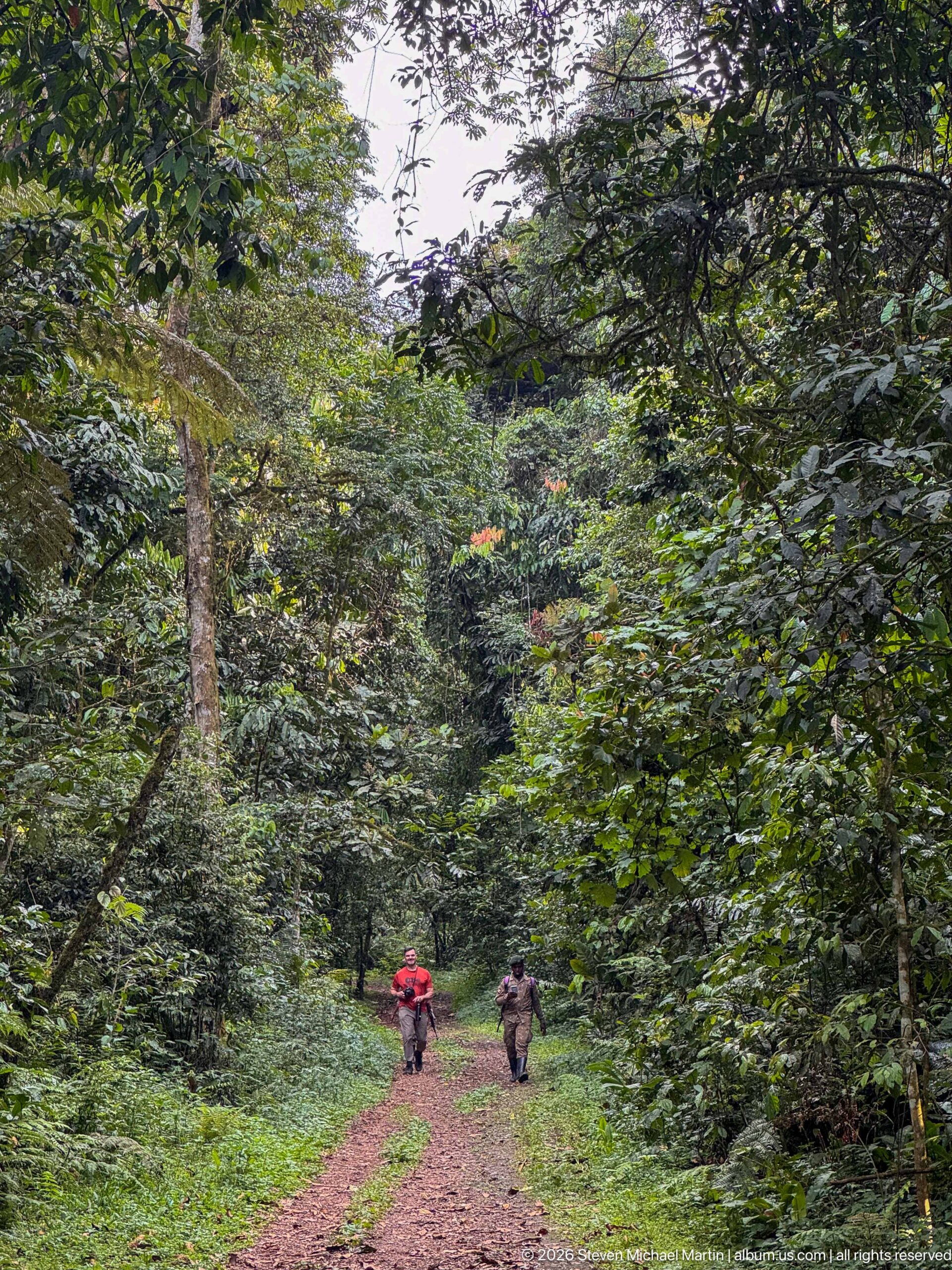
Two hikers appear small against the dense forest as they move along a reddish earthen track. Layered shrubs, vines and mature trees crowd the route, emphasizing the enclosed character of the Munyaga Falls walk and the transition from a broad access track into Bwindi’s humid forest environment.
Caption
Two hikers appear small against the dense forest as they move along a reddish earthen track. Layered shrubs, vines and mature trees crowd the route, emphasizing the enclosed character of the Munyaga Falls walk and the transition from a broad access track into Bwindi’s humid forest environment.
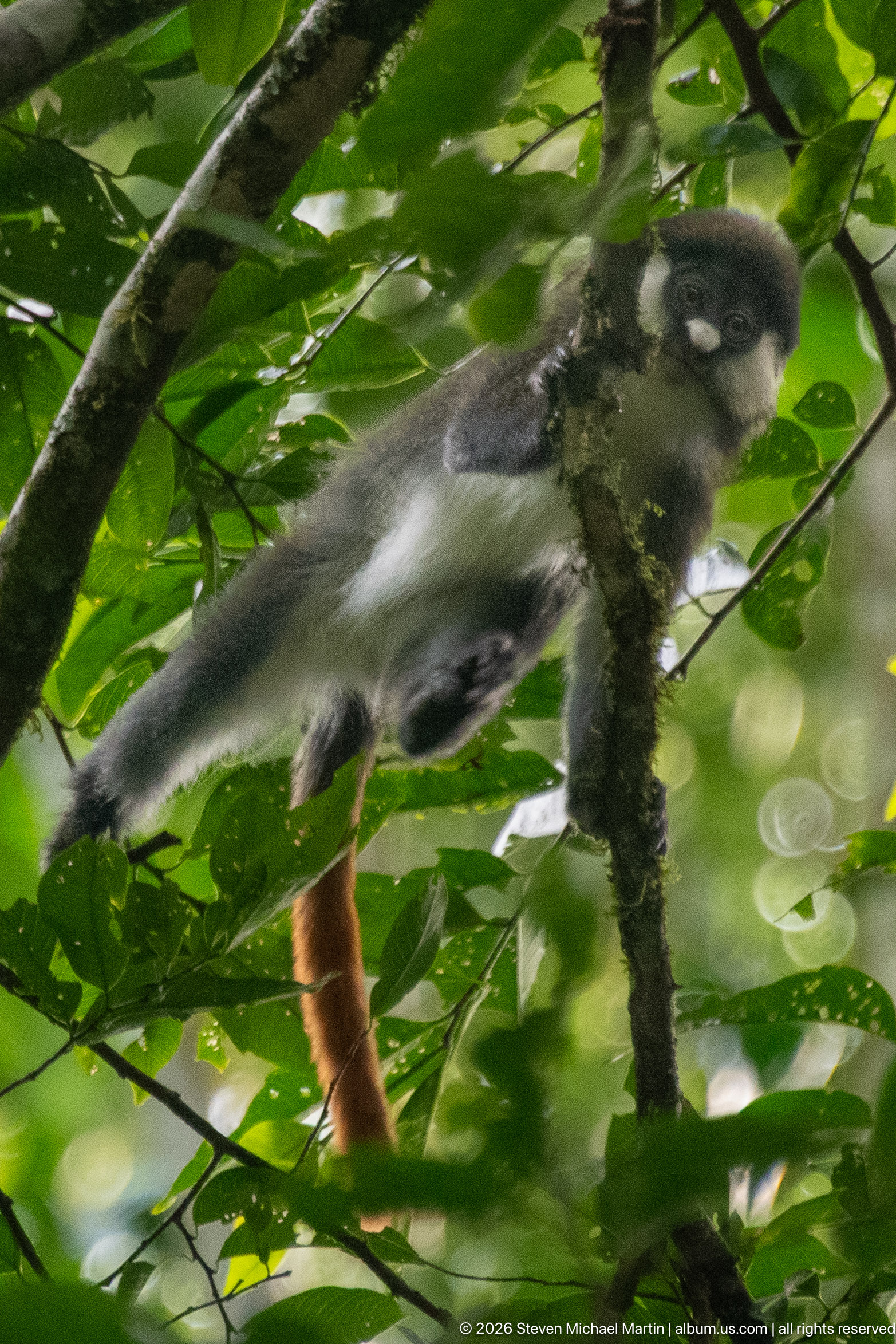
A red-tailed monkey stretches between slender branches in a dynamic canopy movement, its body elongated and tail dropping behind. Motion softness and intervening leaves convey the speed and complexity of arboreal travel, while the pale face and reddish tail remain the clearest identifying features.
Caption
A red-tailed monkey stretches between slender branches in a dynamic canopy movement, its body elongated and tail dropping behind. Motion softness and intervening leaves convey the speed and complexity of arboreal travel, while the pale face and reddish tail remain the clearest identifying features.
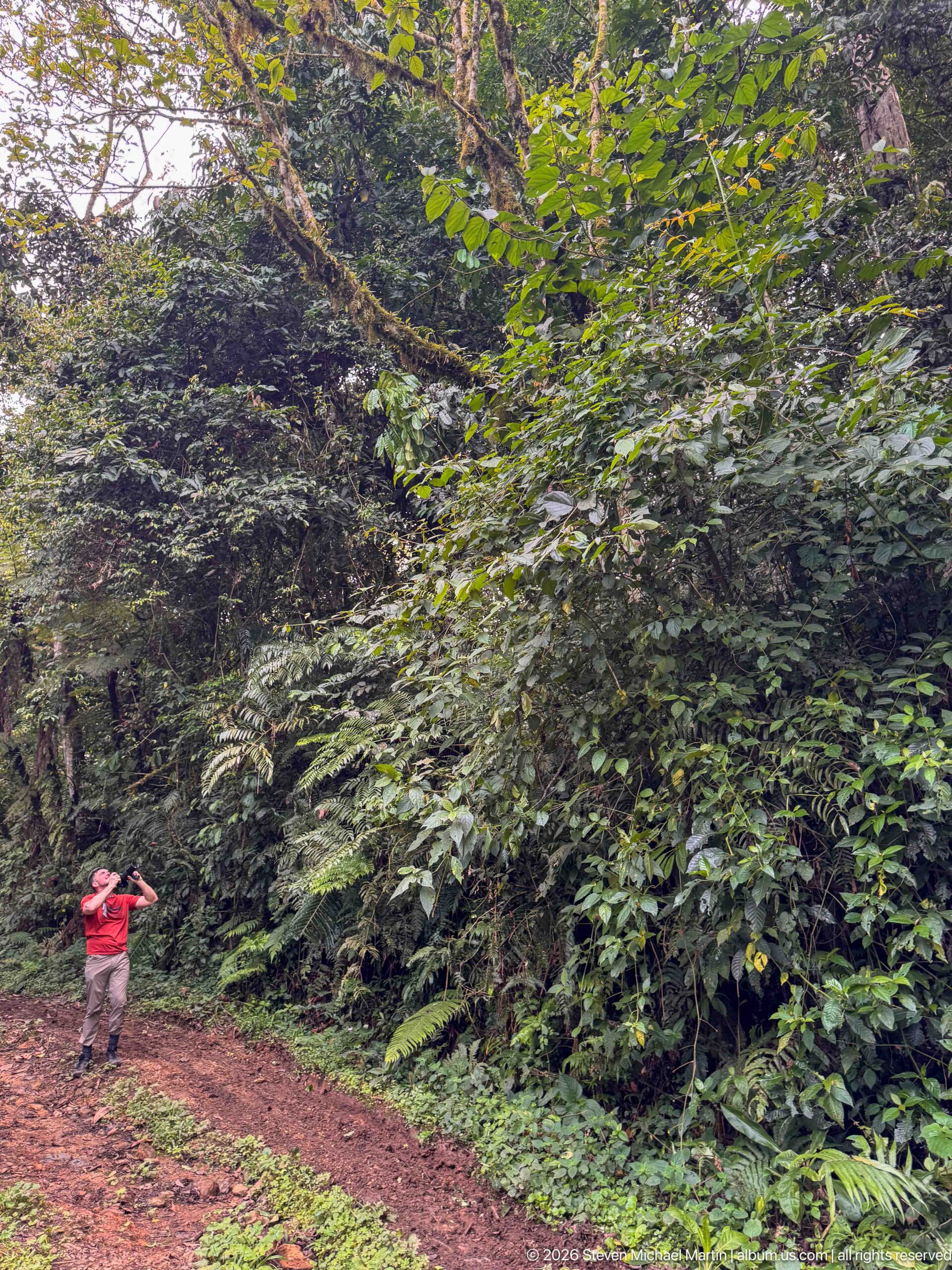
A visitor in a red shirt stands at the edge of a curving forest path, dwarfed by dense shrubs, vines and tall trees. The wide composition emphasizes the scale and enclosure of Bwindi’s vegetation, with the human figure providing a clear reference for the height and depth of the forest along the Munyaga Falls route.
Caption
A visitor in a red shirt stands at the edge of a curving forest path, dwarfed by dense shrubs, vines and tall trees. The wide composition emphasizes the scale and enclosure of Bwindi’s vegetation, with the human figure providing a clear reference for the height and depth of the forest along the Munyaga Falls route.
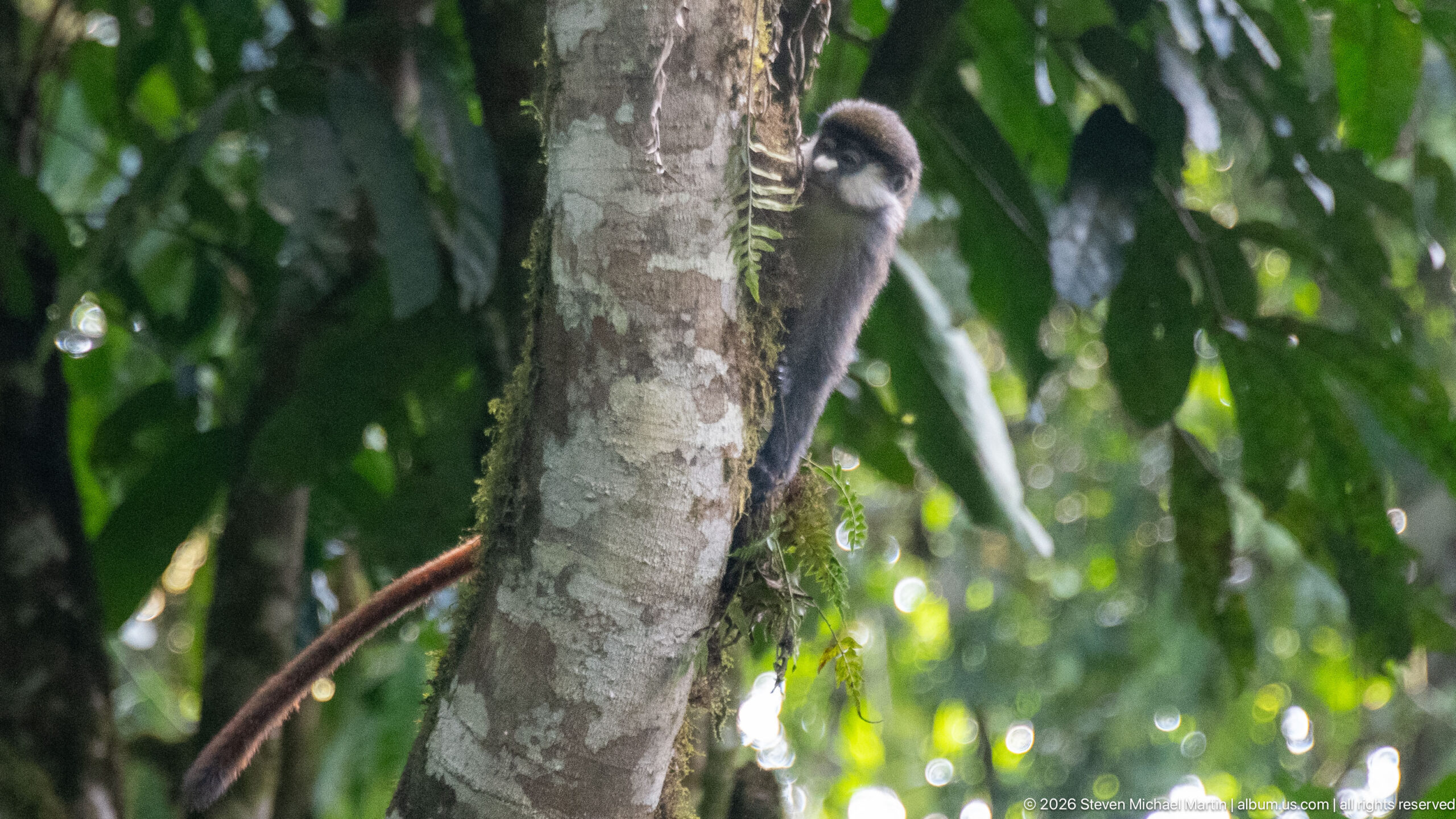
A red-tailed monkey peers from behind a lichen-marked trunk, with its face and upper body partly concealed and its reddish tail curving through the foliage. The composition shows the animal using the vertical structure of Bwindi’s canopy while remaining visually broken up by bark, leaves and branches.
Caption
A red-tailed monkey peers from behind a lichen-marked trunk, with its face and upper body partly concealed and its reddish tail curving through the foliage. The composition shows the animal using the vertical structure of Bwindi’s canopy while remaining visually broken up by bark, leaves and branches.
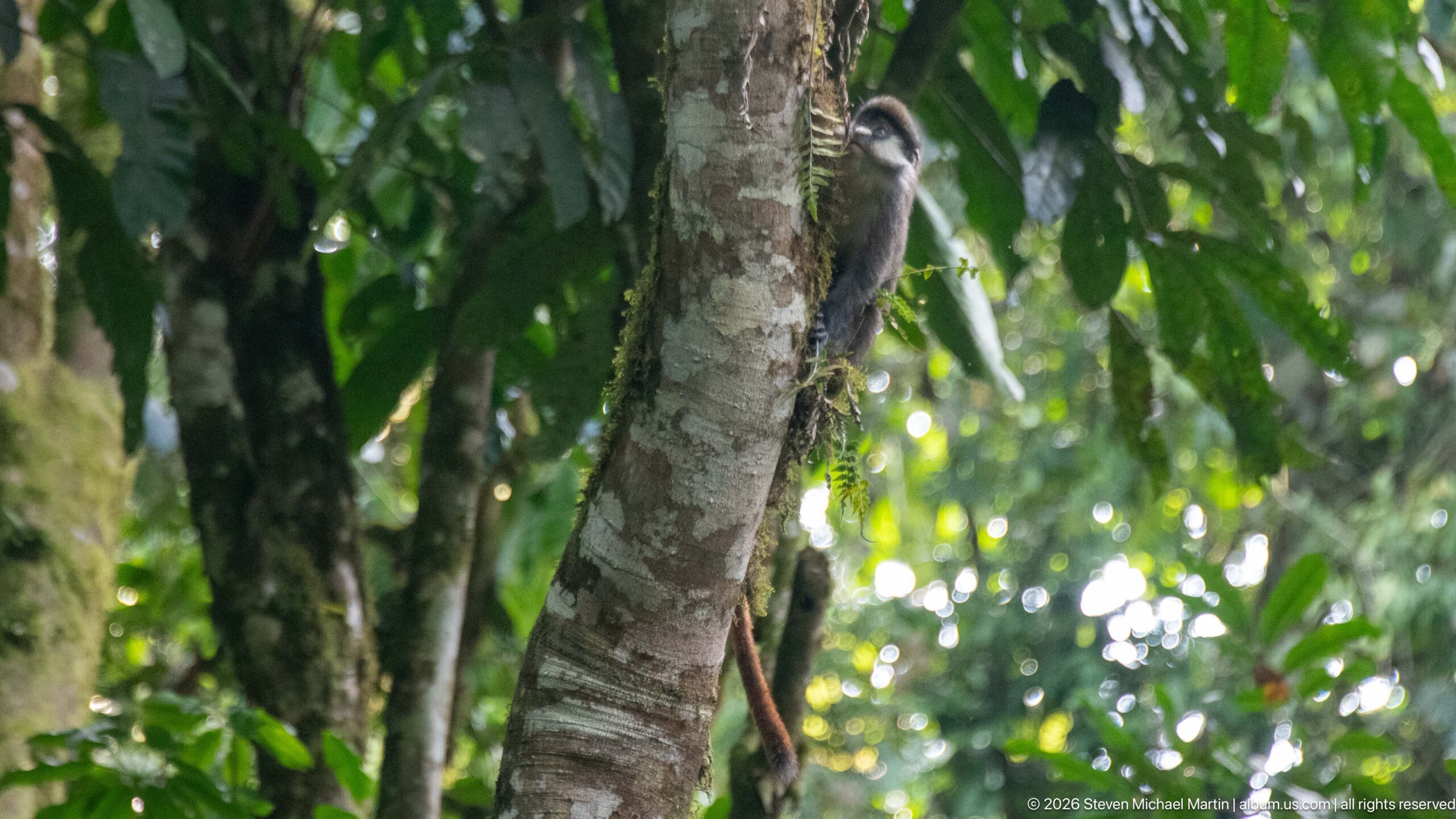
A red-tailed monkey clings high on a tree trunk amid sunlit canopy foliage. Seen at greater distance than the preceding view, the animal’s slim body and long reddish tail stand out against the mottled bark while bright gaps in the leaves reveal the layered forest beyond.
Caption
A red-tailed monkey clings high on a tree trunk amid sunlit canopy foliage. Seen at greater distance than the preceding view, the animal’s slim body and long reddish tail stand out against the mottled bark while bright gaps in the leaves reveal the layered forest beyond.
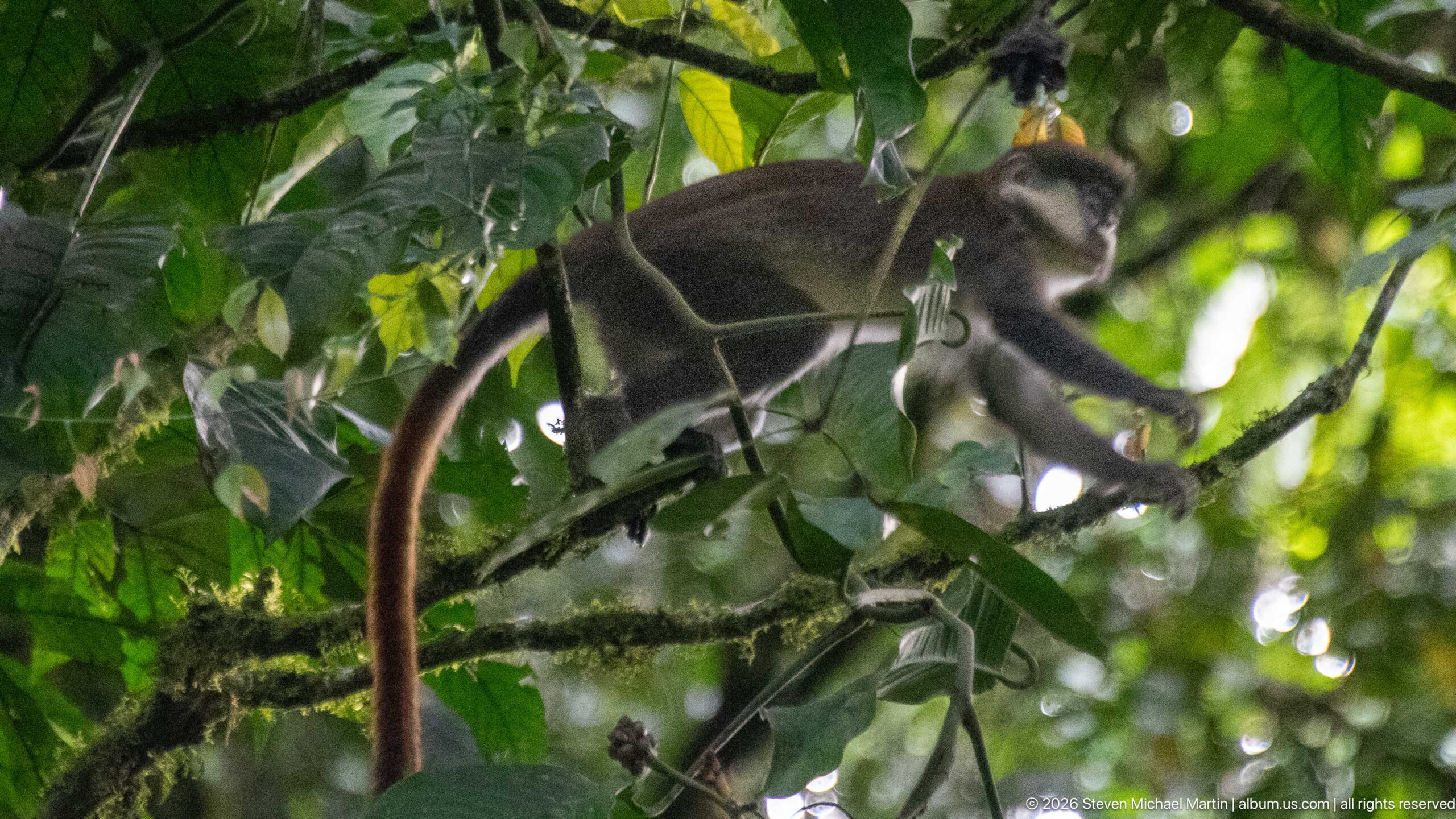
A red-tailed monkey advances along a moss-coated branch, body stretched forward and one forelimb reaching into the surrounding foliage. Its pale facial markings and long reddish tail remain visible despite the dense leaves, giving a clear behavioral view of arboreal movement through Bwindi’s forest canopy.
Caption
A red-tailed monkey advances along a moss-coated branch, body stretched forward and one forelimb reaching into the surrounding foliage. Its pale facial markings and long reddish tail remain visible despite the dense leaves, giving a clear behavioral view of arboreal movement through Bwindi’s forest canopy.
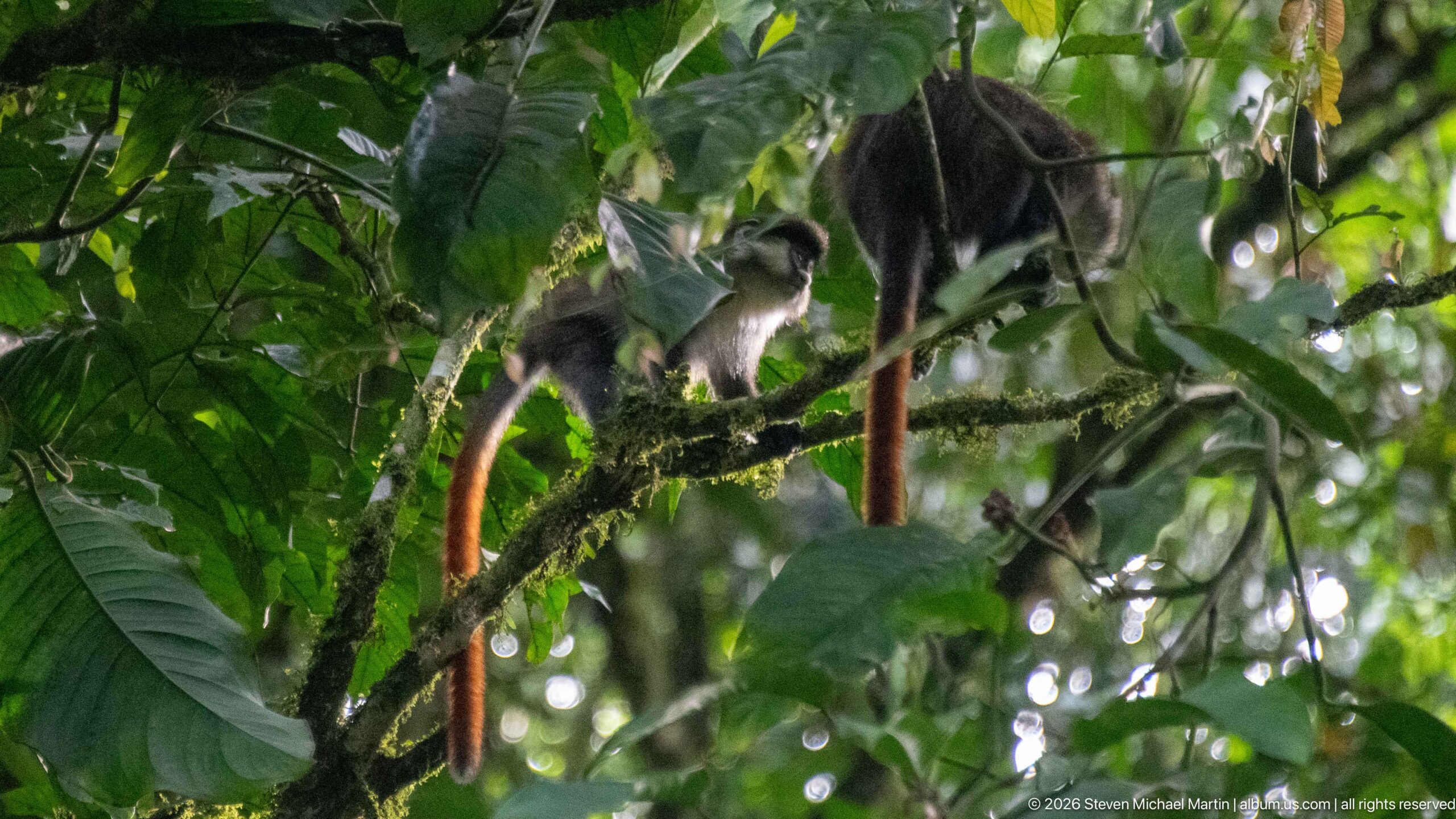
Two red-tailed monkeys share a mossy branch within dense forest foliage, one lower and more exposed while the second is partly obscured above. Their long reddish tails descend through the greenery, making the pair especially legible against the dark branch and emphasizing social proximity in the canopy.
Caption
Two red-tailed monkeys share a mossy branch within dense forest foliage, one lower and more exposed while the second is partly obscured above. Their long reddish tails descend through the greenery, making the pair especially legible against the dark branch and emphasizing social proximity in the canopy.
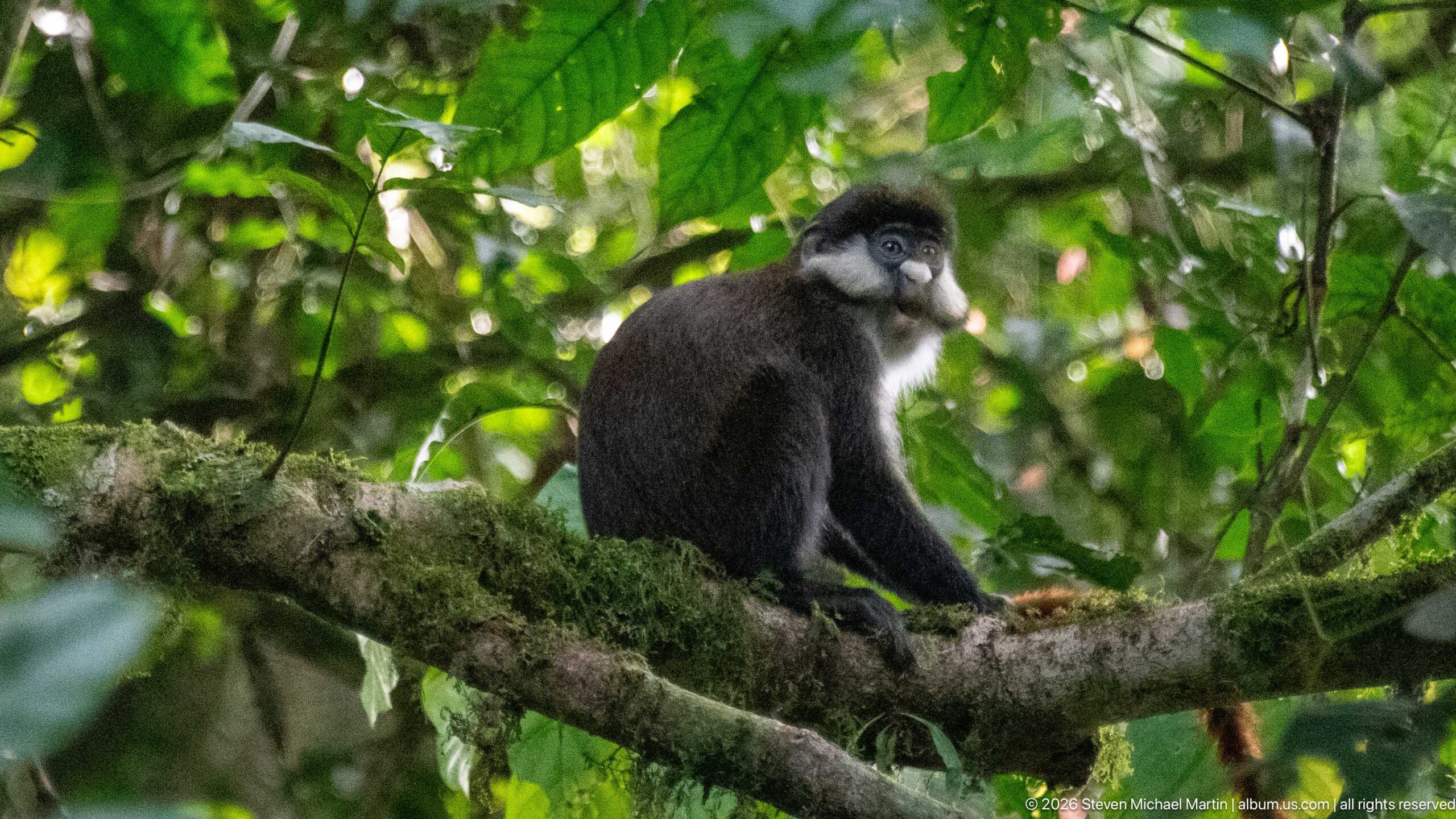
A red-tailed monkey sits upright on a thick moss-covered limb, facing slightly toward the camera. The unobstructed pose reveals its dark grizzled coat, pale cheek and nose markings, compact hands and long tail, while overlapping green leaves frame the animal in its humid forest habitat.
Caption
A red-tailed monkey sits upright on a thick moss-covered limb, facing slightly toward the camera. The unobstructed pose reveals its dark grizzled coat, pale cheek and nose markings, compact hands and long tail, while overlapping green leaves frame the animal in its humid forest habitat.
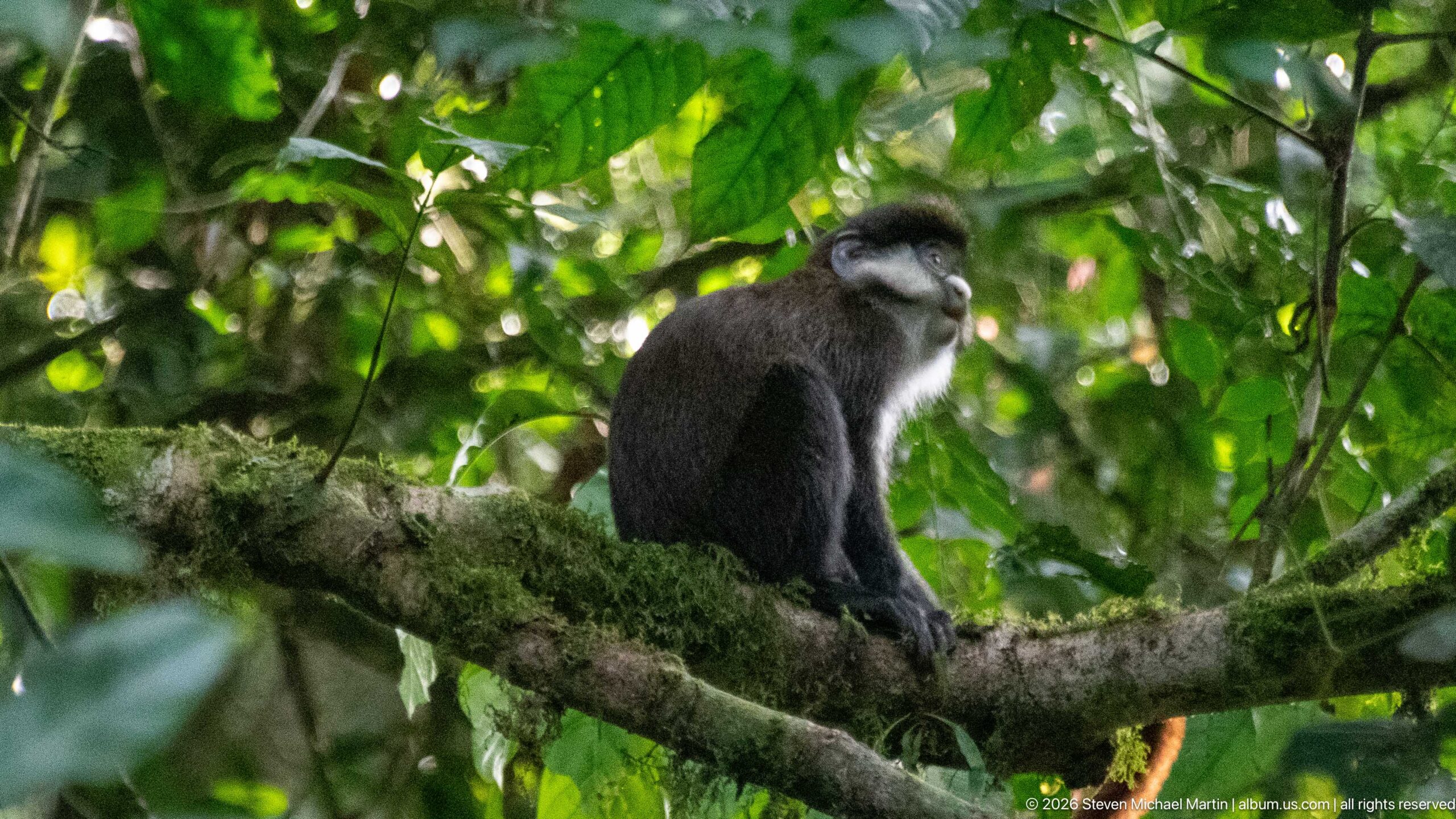
A seated red-tailed monkey is isolated against luminous green foliage, its pale muzzle and cheek markings sharply visible above the mossy branch. The close view concentrates on facial features and posture while retaining enough surrounding canopy to place the primate within Bwindi’s forest habitat.
Caption
A seated red-tailed monkey is isolated against luminous green foliage, its pale muzzle and cheek markings sharply visible above the mossy branch. The close view concentrates on facial features and posture while retaining enough surrounding canopy to place the primate within Bwindi’s forest habitat.
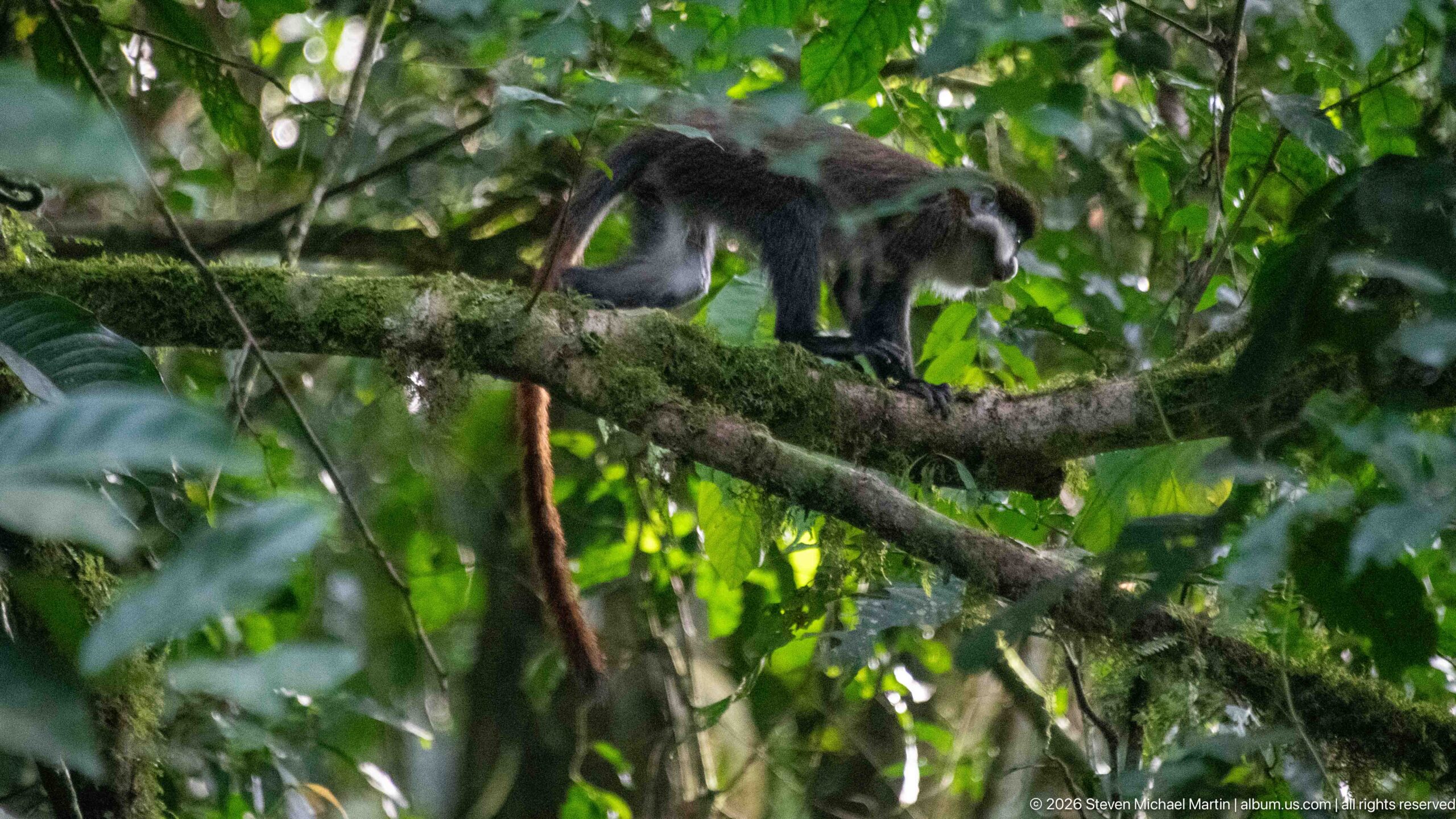
Two red-tailed monkeys move along a broad mossy branch, their bodies partly overlapped by foliage. One animal is more fully visible while another follows behind, and the hanging reddish tails create strong vertical accents beneath the branch in this wider canopy view.
Caption
Two red-tailed monkeys move along a broad mossy branch, their bodies partly overlapped by foliage. One animal is more fully visible while another follows behind, and the hanging reddish tails create strong vertical accents beneath the branch in this wider canopy view.
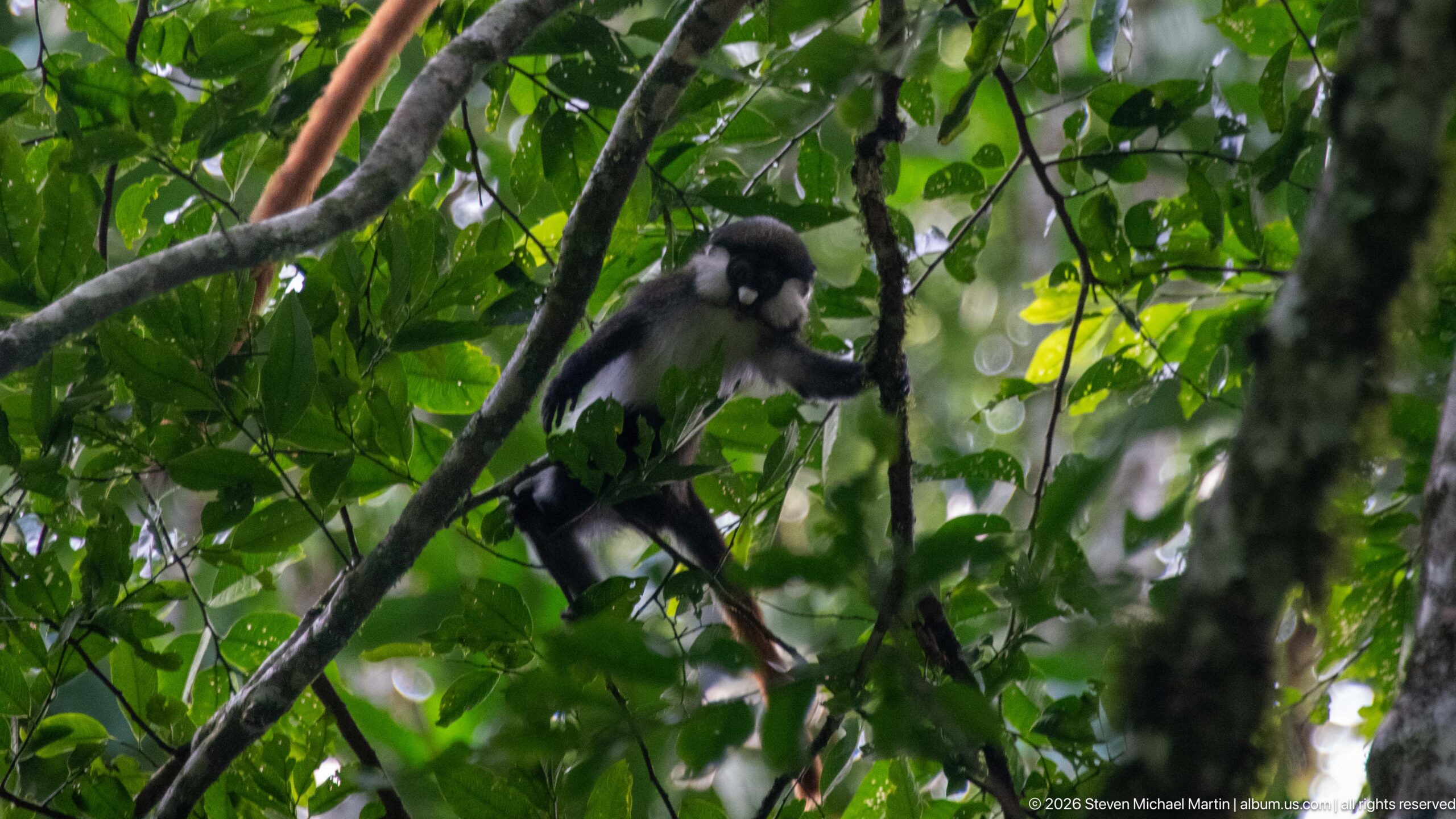
A red-tailed monkey climbs through a lattice of thin branches and vines, gripping a vertical stem while stepping upward. Its pale face contrasts with the shaded coat, and the reddish tail curves behind leaves, illustrating the animal’s agile use of small supports within dense canopy vegetation.
Caption
A red-tailed monkey climbs through a lattice of thin branches and vines, gripping a vertical stem while stepping upward. Its pale face contrasts with the shaded coat, and the reddish tail curves behind leaves, illustrating the animal’s agile use of small supports within dense canopy vegetation.
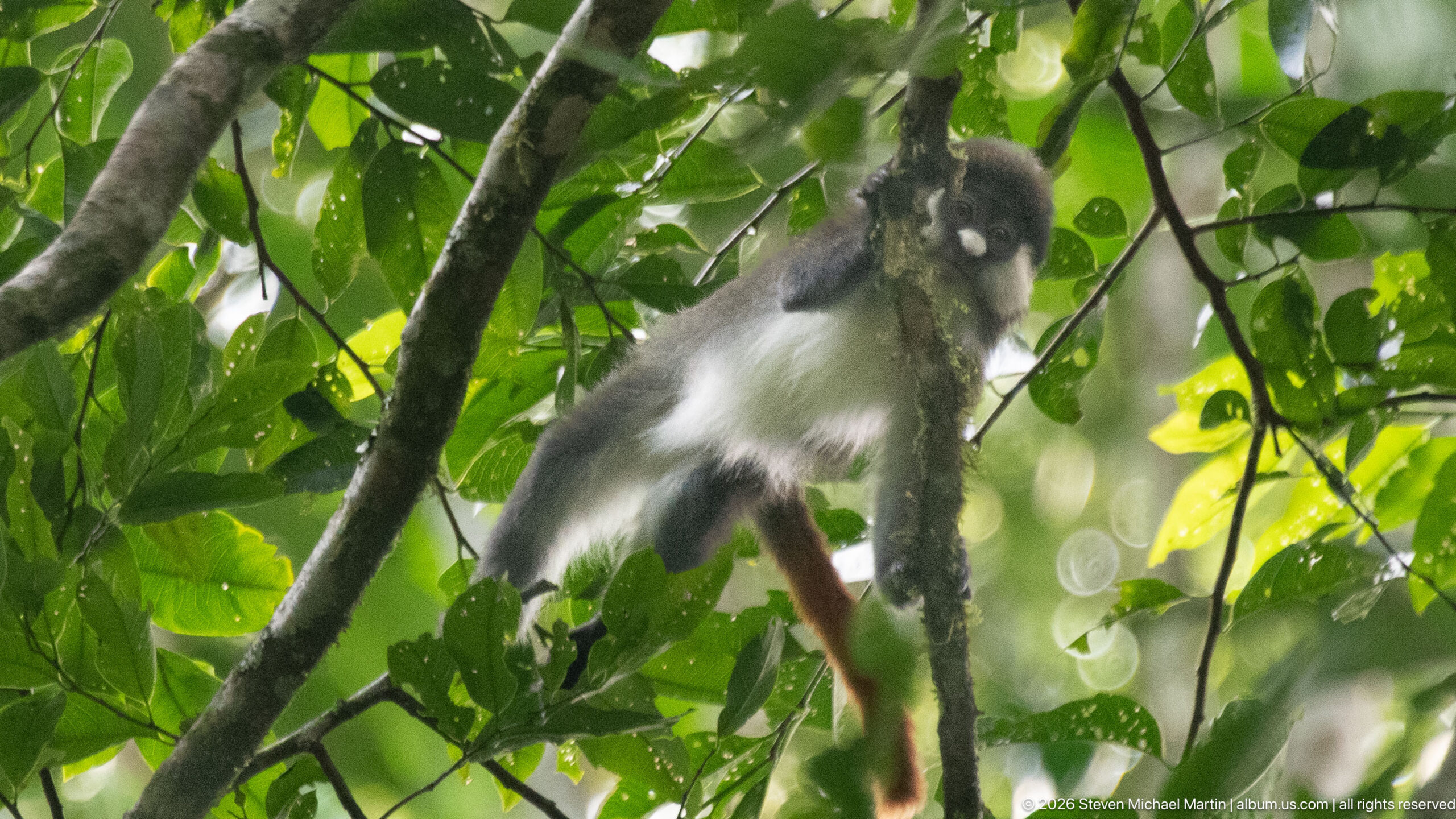
A red-tailed monkey braces against a near-vertical trunk or vine, body extended upright beneath a ceiling of leaves. Backlighting brightens the pale underside and facial markings while the reddish tail drops below, creating a distinct vertical portrait of canopy locomotion.
Caption
A red-tailed monkey braces against a near-vertical trunk or vine, body extended upright beneath a ceiling of leaves. Backlighting brightens the pale underside and facial markings while the reddish tail drops below, creating a distinct vertical portrait of canopy locomotion.

A red-tailed monkey steadies itself between a diagonal branch and a slender vertical stem, extending one arm while looking downward through the foliage. The pale face and chest stand out against the shaded coat, with the reddish tail partly visible behind the leaves.
Caption
A red-tailed monkey steadies itself between a diagonal branch and a slender vertical stem, extending one arm while looking downward through the foliage. The pale face and chest stand out against the shaded coat, with the reddish tail partly visible behind the leaves.
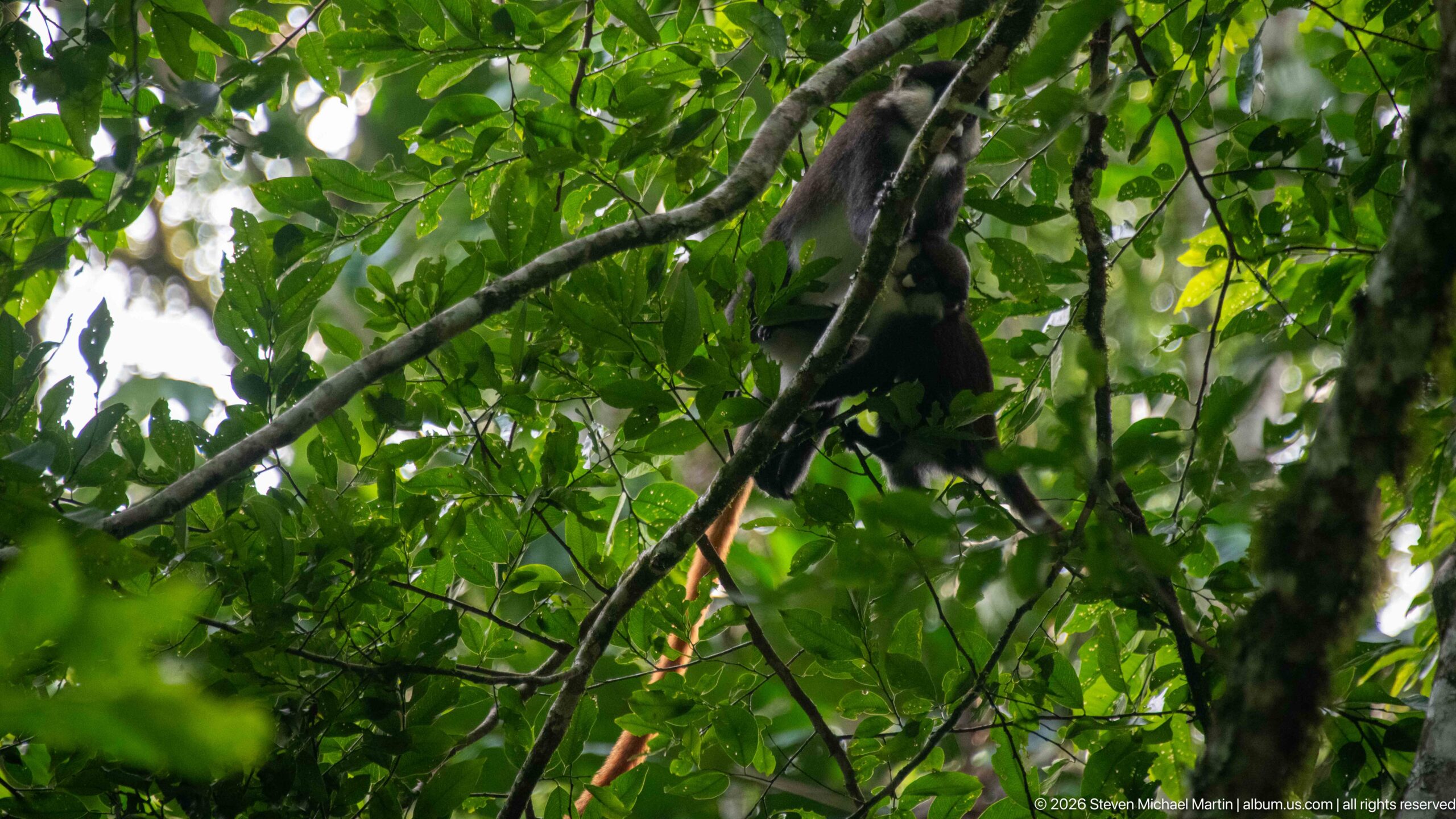
A red-tailed monkey appears high among intersecting branches and broad leaves, more deeply screened by vegetation than in the preceding portraits. Its dark body and reddish tail are visible through gaps, placing the animal within the layered structure of Bwindi’s canopy rather than isolating it from its habitat.
Caption
A red-tailed monkey appears high among intersecting branches and broad leaves, more deeply screened by vegetation than in the preceding portraits. Its dark body and reddish tail are visible through gaps, placing the animal within the layered structure of Bwindi’s canopy rather than isolating it from its habitat.
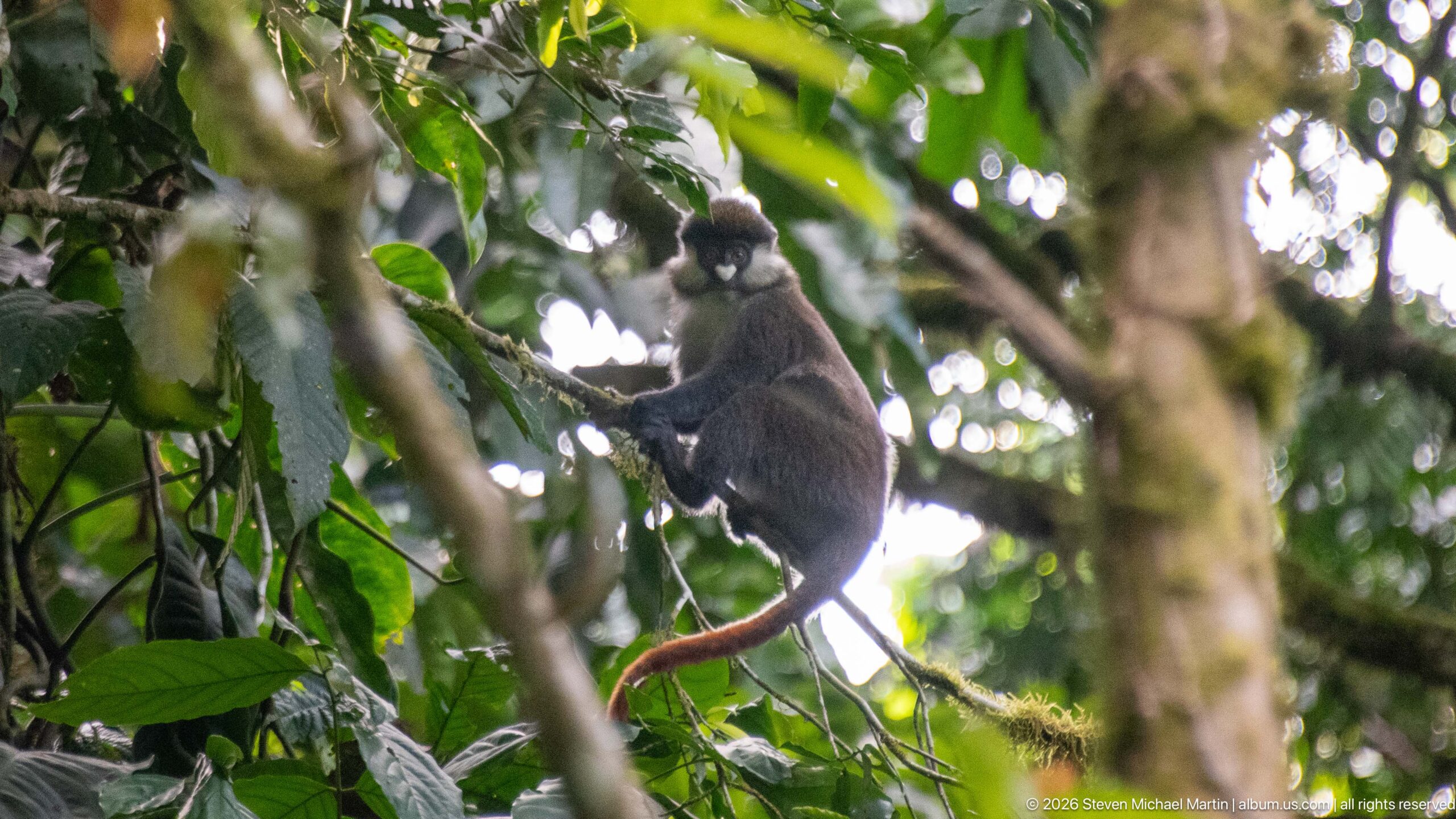
A red-tailed monkey sits sideways on a branch, framed by trunks and foreground leaves. The profile shows its compact body, pale facial markings and long reddish tail, while the surrounding mossy wood and filtered light retain the depth and clutter of the forest canopy.
Caption
A red-tailed monkey sits sideways on a branch, framed by trunks and foreground leaves. The profile shows its compact body, pale facial markings and long reddish tail, while the surrounding mossy wood and filtered light retain the depth and clutter of the forest canopy.
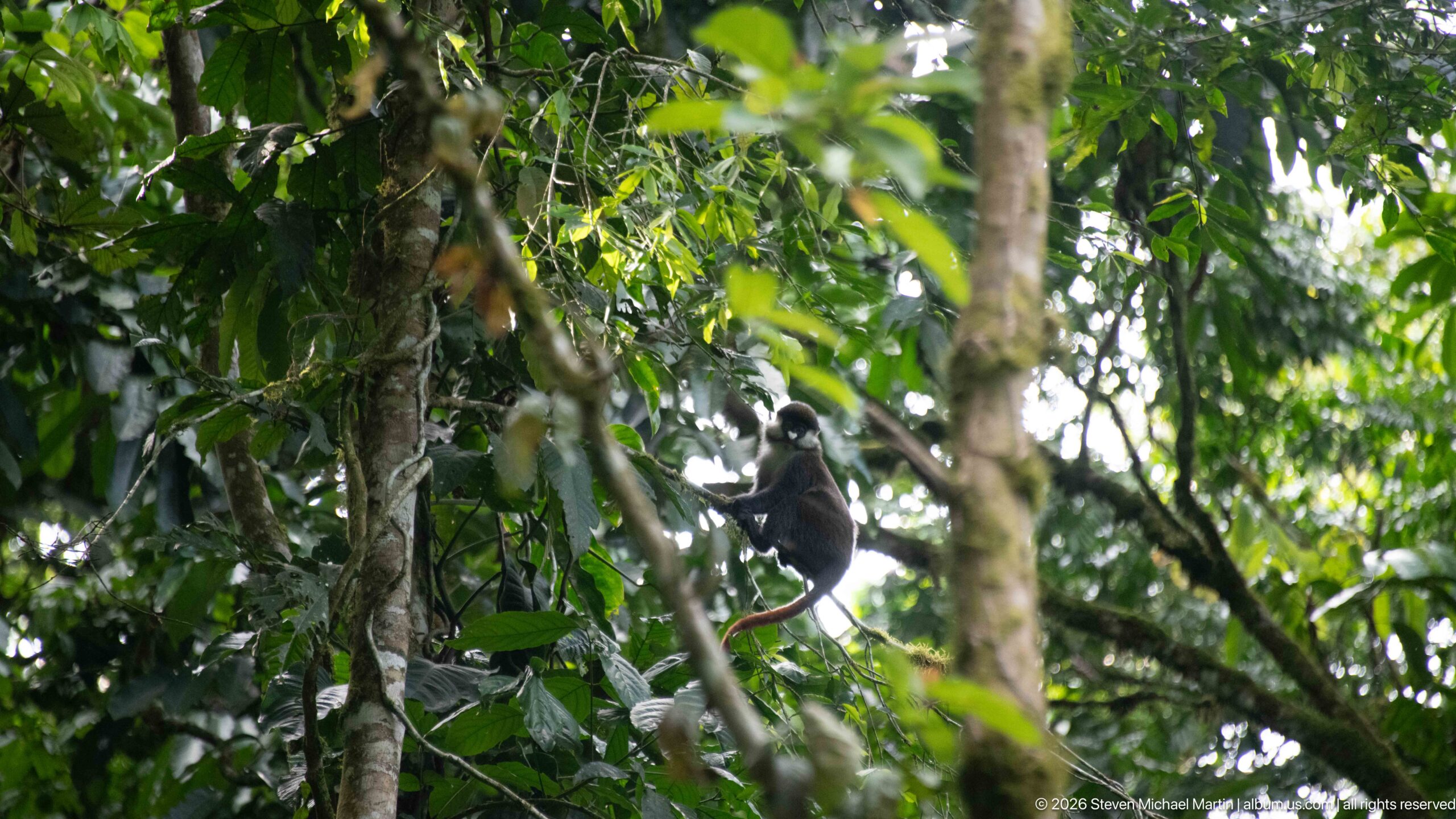
A red-tailed monkey perches amid a wider tangle of trunks, vines and leaves, appearing small within the forest structure. The broader composition emphasizes habitat context: the animal’s pale face and reddish tail provide the main visual cues against a deep field of green vegetation and mottled bark.
Caption
A red-tailed monkey perches amid a wider tangle of trunks, vines and leaves, appearing small within the forest structure. The broader composition emphasizes habitat context: the animal’s pale face and reddish tail provide the main visual cues against a deep field of green vegetation and mottled bark.
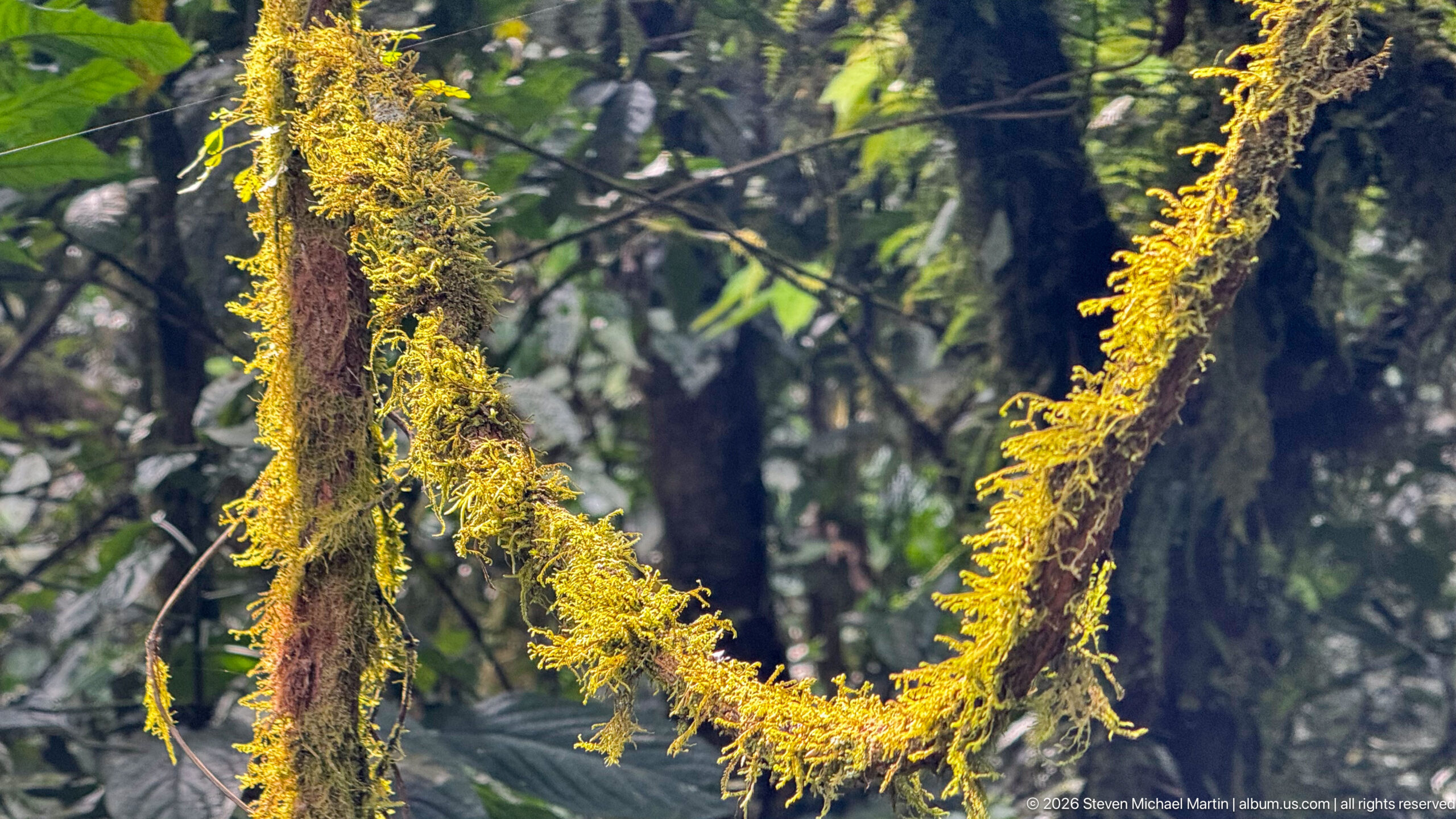
Golden-green moss and fine epiphytic growth hang thickly from intersecting branches, catching warm light against the darker forest behind. The close study highlights the moisture-laden microhabitats created on bark and limbs in Bwindi’s humid forest, where living surfaces support dense layers of non-woody vegetation.
Caption
Golden-green moss and fine epiphytic growth hang thickly from intersecting branches, catching warm light against the darker forest behind. The close study highlights the moisture-laden microhabitats created on bark and limbs in Bwindi’s humid forest, where living surfaces support dense layers of non-woody vegetation.
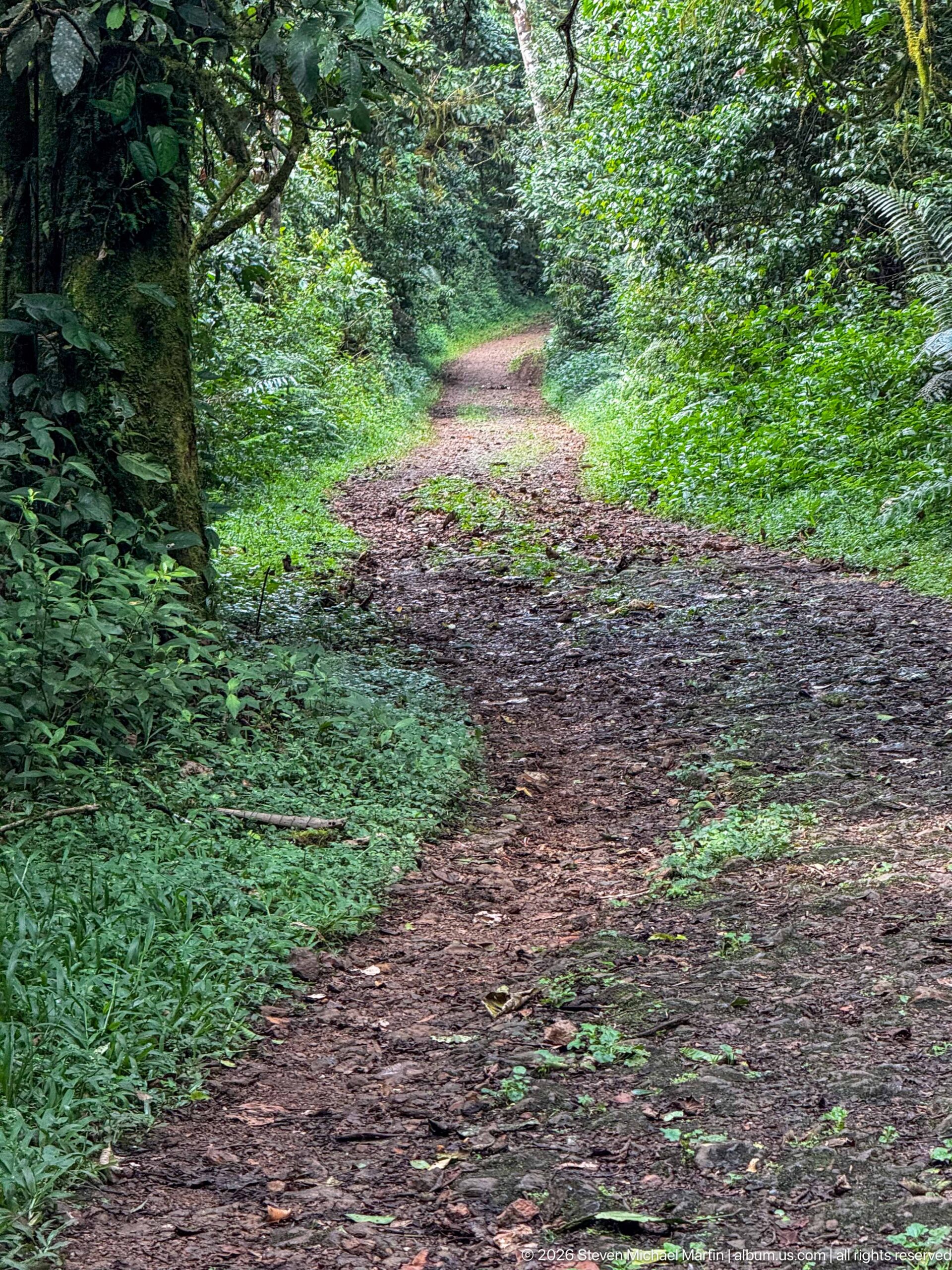
A damp, uneven track curves gently through thick groundcover and shaded forest. Ruts, leaf litter and exposed earth mark the walking surface, while shrubs and low vegetation close in from both sides, giving a ground-level view of trail conditions on the route toward Munyaga Falls.
Caption
A damp, uneven track curves gently through thick groundcover and shaded forest. Ruts, leaf litter and exposed earth mark the walking surface, while shrubs and low vegetation close in from both sides, giving a ground-level view of trail conditions on the route toward Munyaga Falls.
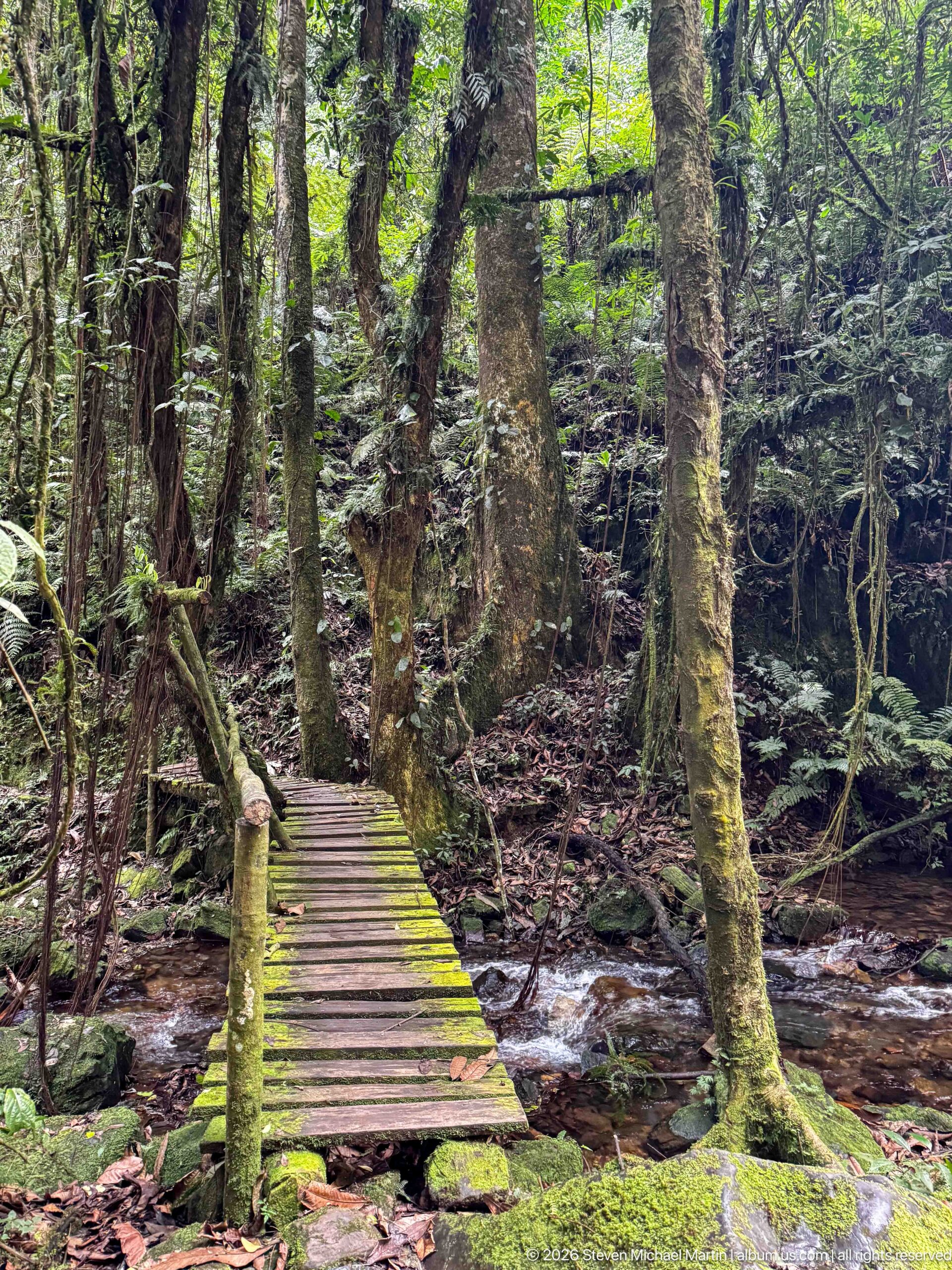
A simple wooden footbridge spans a shallow, fast-moving forest stream beneath tall mossy trunks. The narrow planks lead directly into dense vegetation, while wet rocks and leaf litter line the banks, documenting the trail infrastructure used to cross watercourses on the Munyaga Falls walk.
Caption
A simple wooden footbridge spans a shallow, fast-moving forest stream beneath tall mossy trunks. The narrow planks lead directly into dense vegetation, while wet rocks and leaf litter line the banks, documenting the trail infrastructure used to cross watercourses on the Munyaga Falls walk.
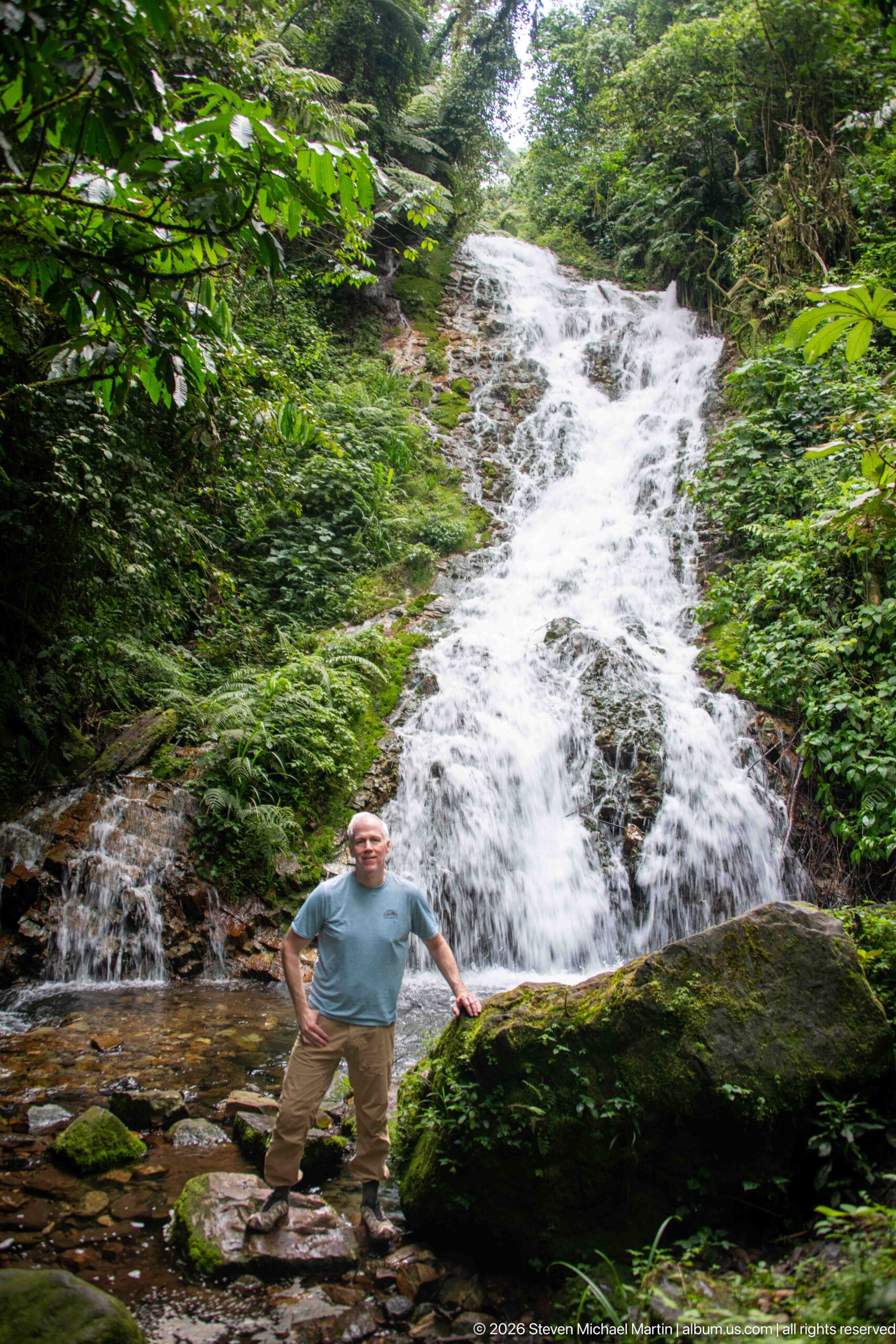
A visitor stands on wet rocks at the foot of a long, sloping cascade, using a moss-covered boulder for balance. Water spreads over dark bedrock behind him, while dense vegetation encloses the channel and gives this view a clear sense of the waterfall’s height and forest setting.
Caption
A visitor stands on wet rocks at the foot of a long, sloping cascade, using a moss-covered boulder for balance. Water spreads over dark bedrock behind him, while dense vegetation encloses the channel and gives this view a clear sense of the waterfall’s height and forest setting.
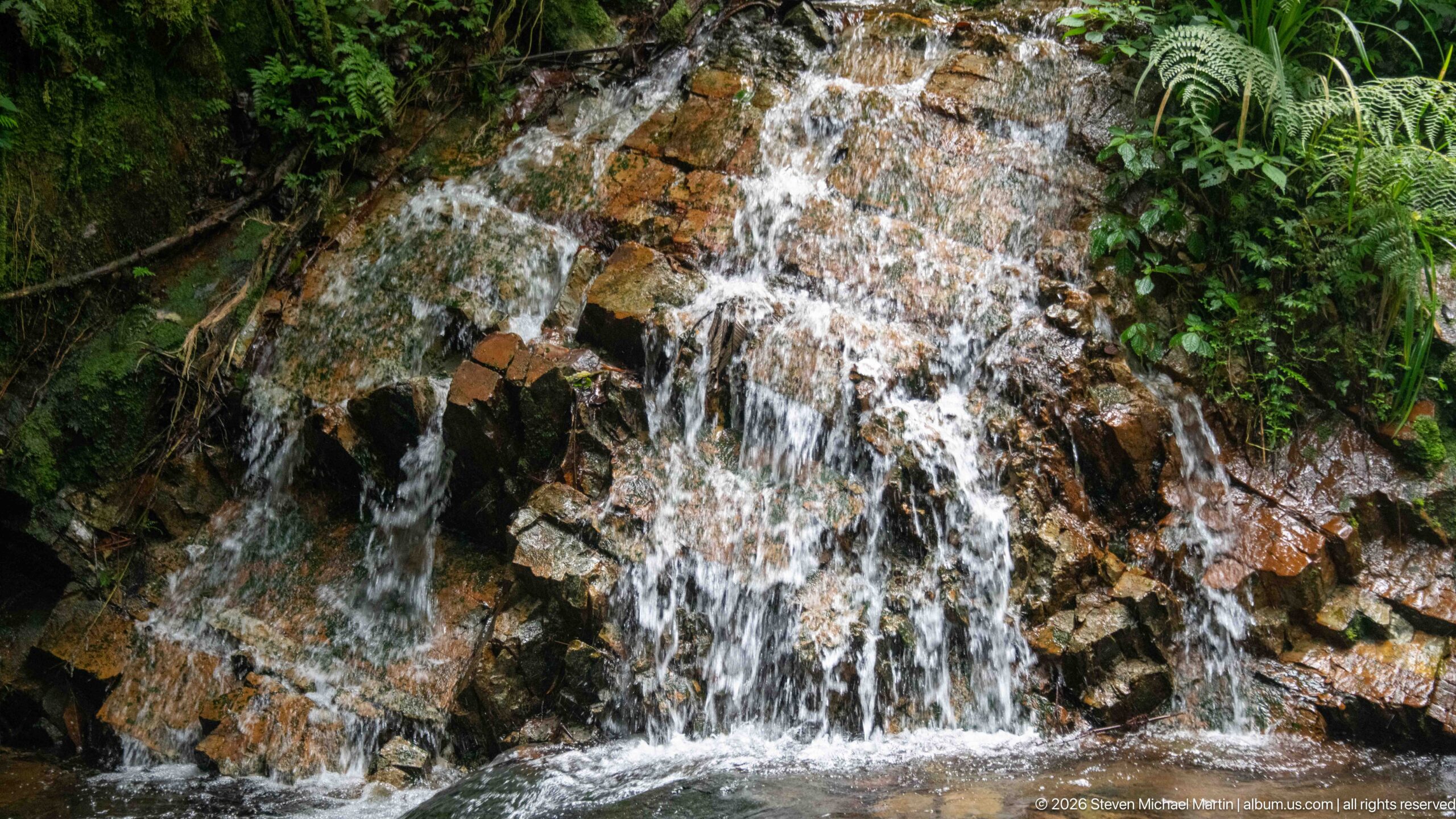
Water fans across a stepped face of reddish-brown rock, breaking into narrow white rivulets before reaching a shallow pool. Ferns and other forest plants crowd the upper edge, while dark wet stone marks the active flow paths, offering a close geological and hydrological detail from the Munyaga Falls drainage.
Caption
Water fans across a stepped face of reddish-brown rock, breaking into narrow white rivulets before reaching a shallow pool. Ferns and other forest plants crowd the upper edge, while dark wet stone marks the active flow paths, offering a close geological and hydrological detail from the Munyaga Falls drainage.
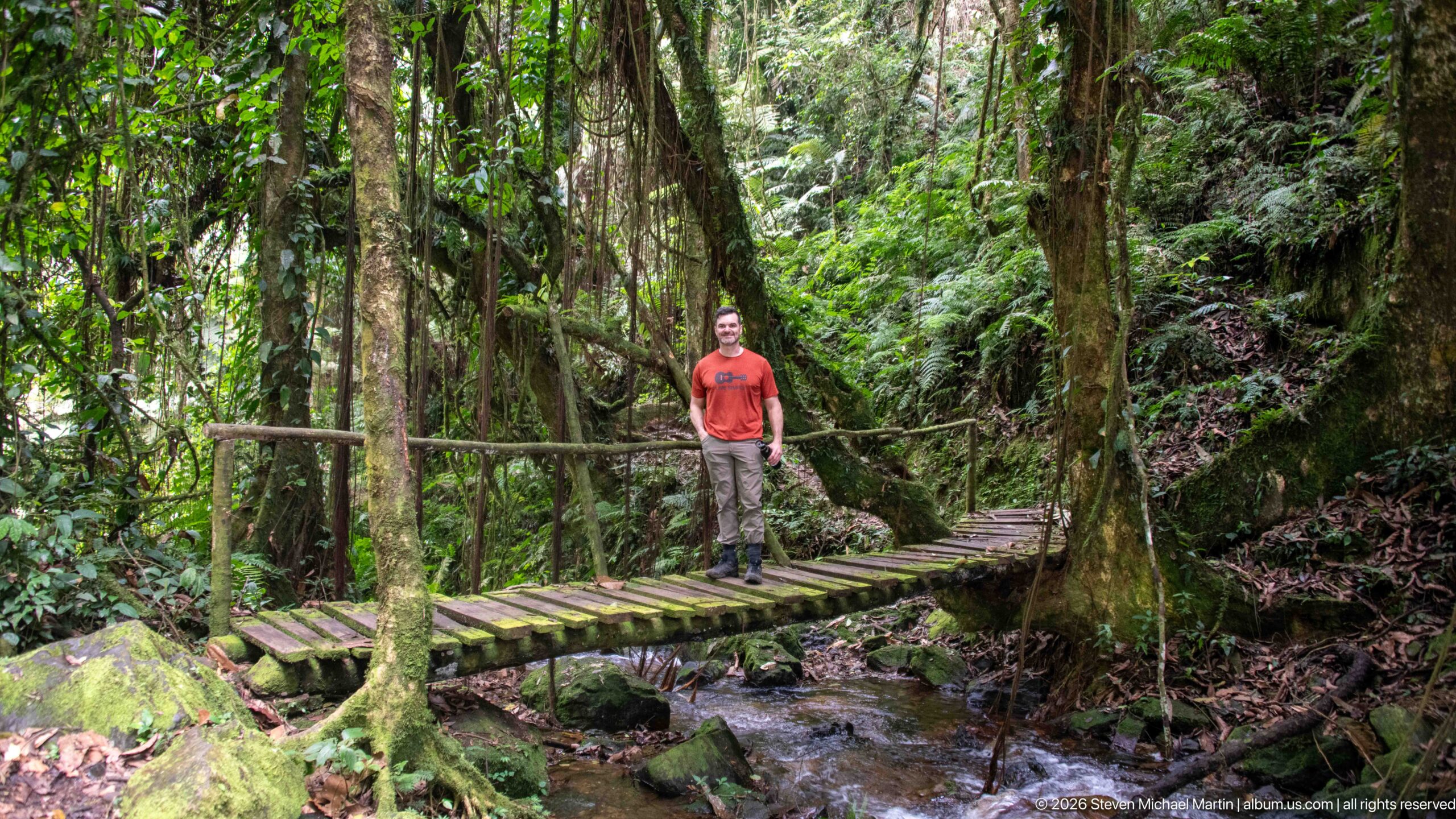
A visitor stands on a narrow wooden footbridge above a rocky forest stream, surrounded by hanging vines, mossy trunks and dense vegetation. The composition places the trail crossing within the steep, humid ravine environment near Munyaga Falls and shows the modest scale of the bridge against the enclosing forest.
Caption
A visitor stands on a narrow wooden footbridge above a rocky forest stream, surrounded by hanging vines, mossy trunks and dense vegetation. The composition places the trail crossing within the steep, humid ravine environment near Munyaga Falls and shows the modest scale of the bridge against the enclosing forest.
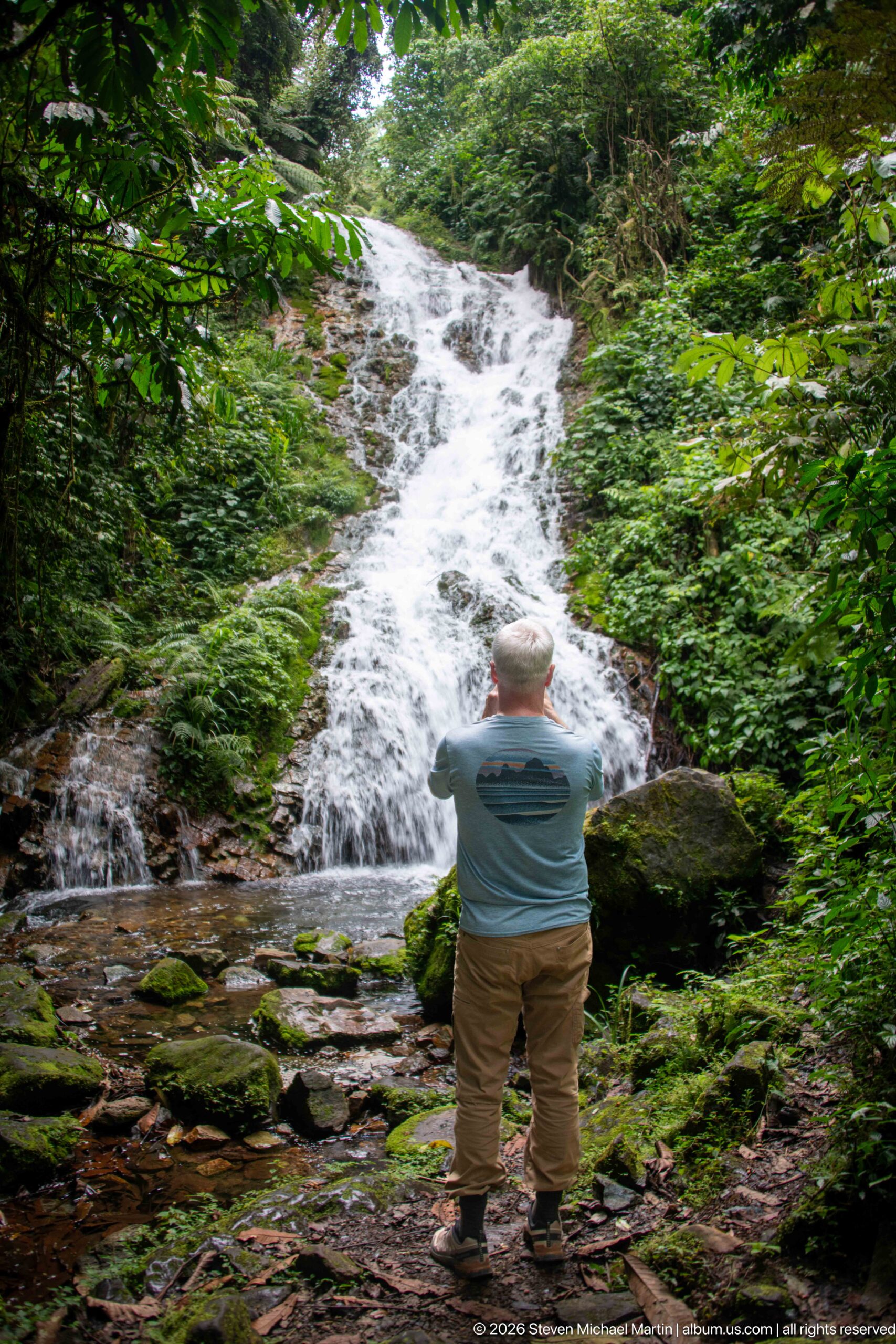
Seen from behind, a visitor faces the waterfall from the rocky streambed, turning the composition toward observation rather than portraiture. The pale cascade rises through the center of the frame, bordered by mossy stones and thick forest growth that emphasize the enclosed character of the Munyaga Falls trail.
Caption
Seen from behind, a visitor faces the waterfall from the rocky streambed, turning the composition toward observation rather than portraiture. The pale cascade rises through the center of the frame, bordered by mossy stones and thick forest growth that emphasize the enclosed character of the Munyaga Falls trail.
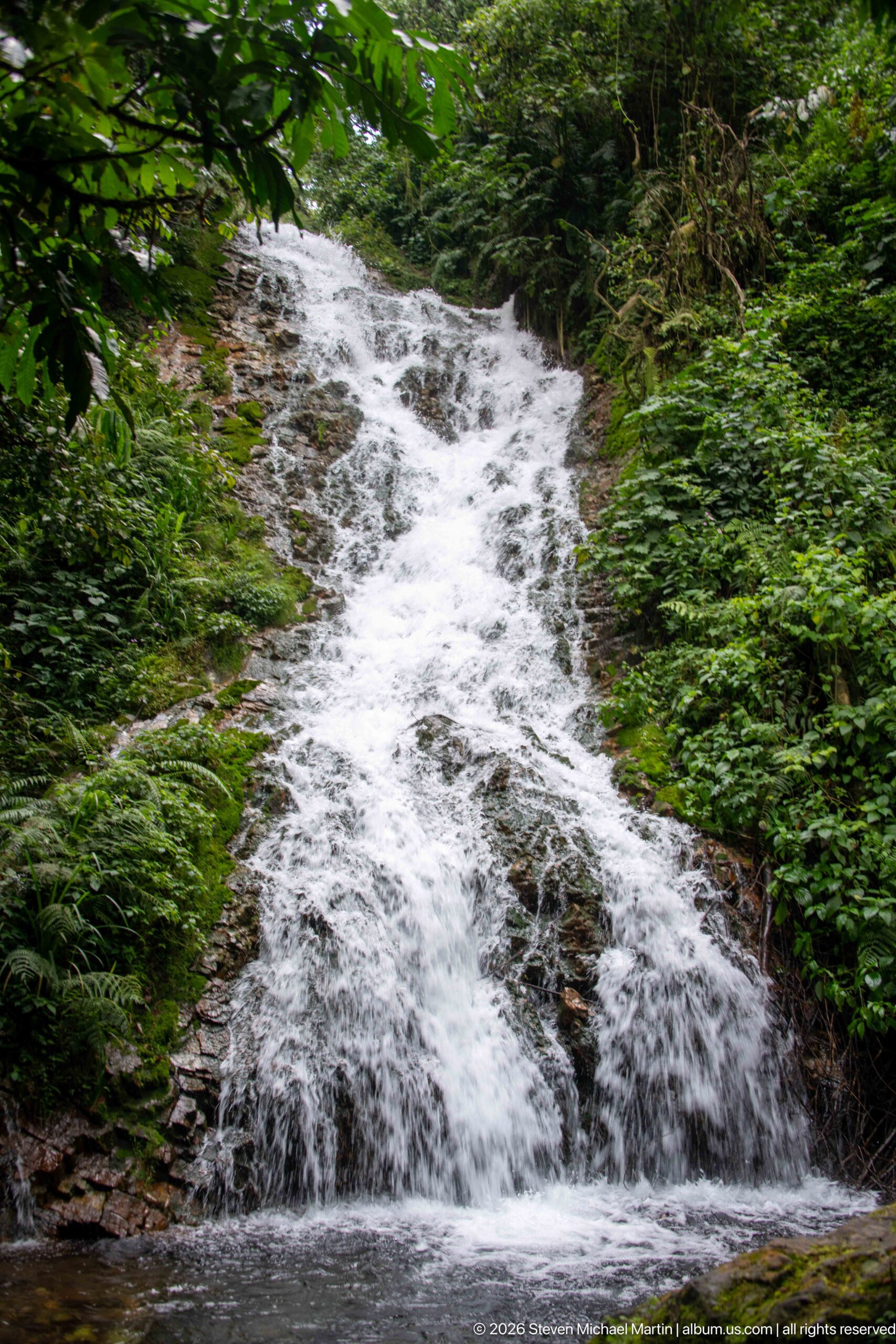
A broad section of Munyaga Falls descends in multiple sheets over dark, irregular bedrock before reaching a small pool. The near-frontal view removes human scale and concentrates on the watercourse itself, with dense foliage and moss tracing the humid margins of the cascade.
Caption
A broad section of Munyaga Falls descends in multiple sheets over dark, irregular bedrock before reaching a small pool. The near-frontal view removes human scale and concentrates on the watercourse itself, with dense foliage and moss tracing the humid margins of the cascade.
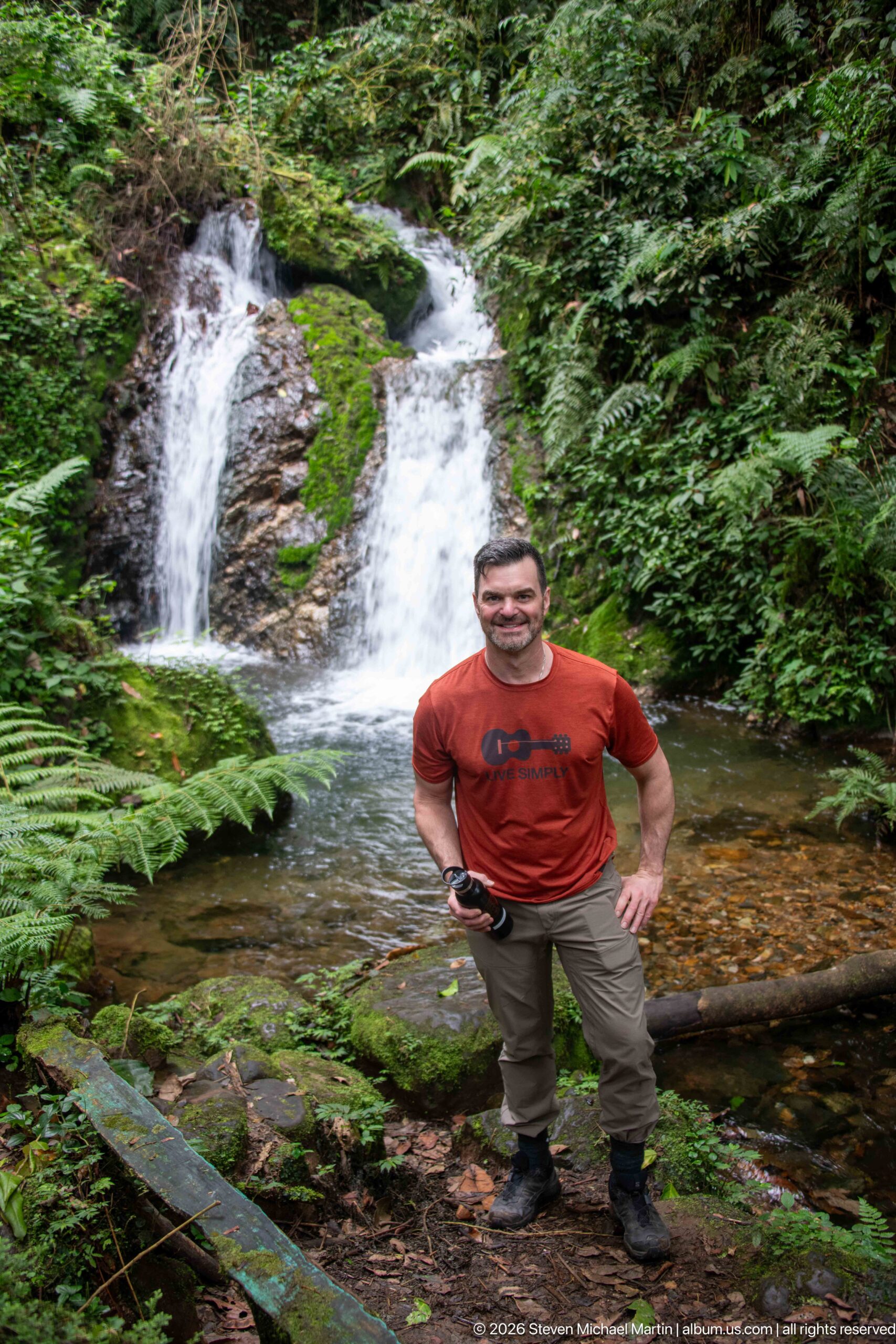
A visitor in a red shirt stands beside a shallow pool where two adjacent streams of water drop over mossy rock. The lower, more intimate viewpoint distinguishes this section from the larger sloping falls, showing the trail’s close relationship with small cascades, wet stones, ferns, and forest vegetation.
Caption
A visitor in a red shirt stands beside a shallow pool where two adjacent streams of water drop over mossy rock. The lower, more intimate viewpoint distinguishes this section from the larger sloping falls, showing the trail’s close relationship with small cascades, wet stones, ferns, and forest vegetation.
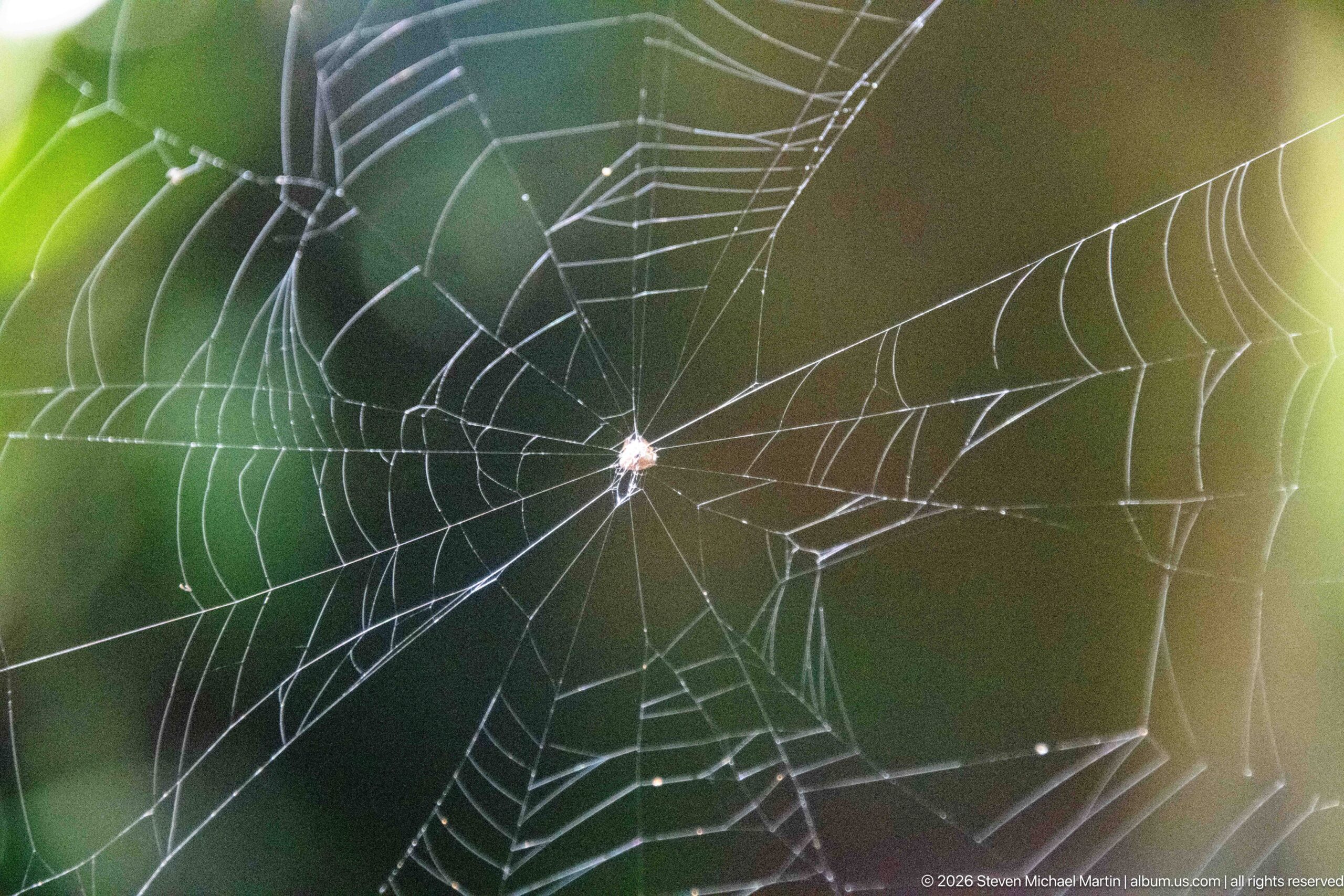
A small spider rests near the hub of a nearly complete orb web suspended against softly blurred forest vegetation. Radiating spokes and curved capture threads remain clearly visible, making the web architecture the dominant subject; the proof sheet does not provide enough detail for a defensible species-level identification.
Caption
A small spider rests near the hub of a nearly complete orb web suspended against softly blurred forest vegetation. Radiating spokes and curved capture threads remain clearly visible, making the web architecture the dominant subject; the proof sheet does not provide enough detail for a defensible species-level identification.
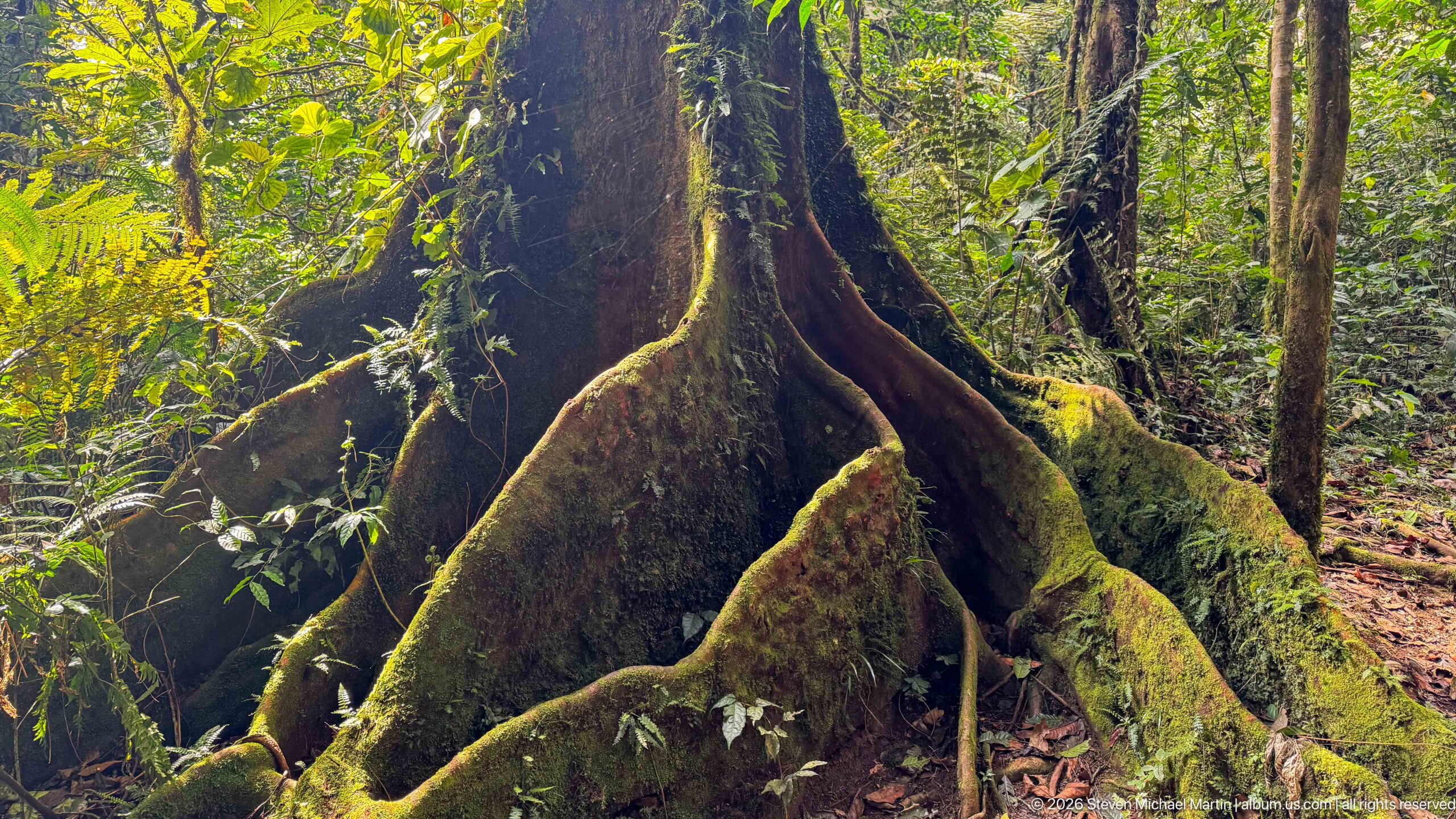
Large buttress roots flare from the base of a mature rainforest tree, their ridges coated with moss and small epiphytes. Light entering from the left picks out the sculptural root surfaces against the darker understory, showing an important structural feature of a large tree growing in Bwindi’s humid forest.
Caption
Large buttress roots flare from the base of a mature rainforest tree, their ridges coated with moss and small epiphytes. Light entering from the left picks out the sculptural root surfaces against the darker understory, showing an important structural feature of a large tree growing in Bwindi’s humid forest.
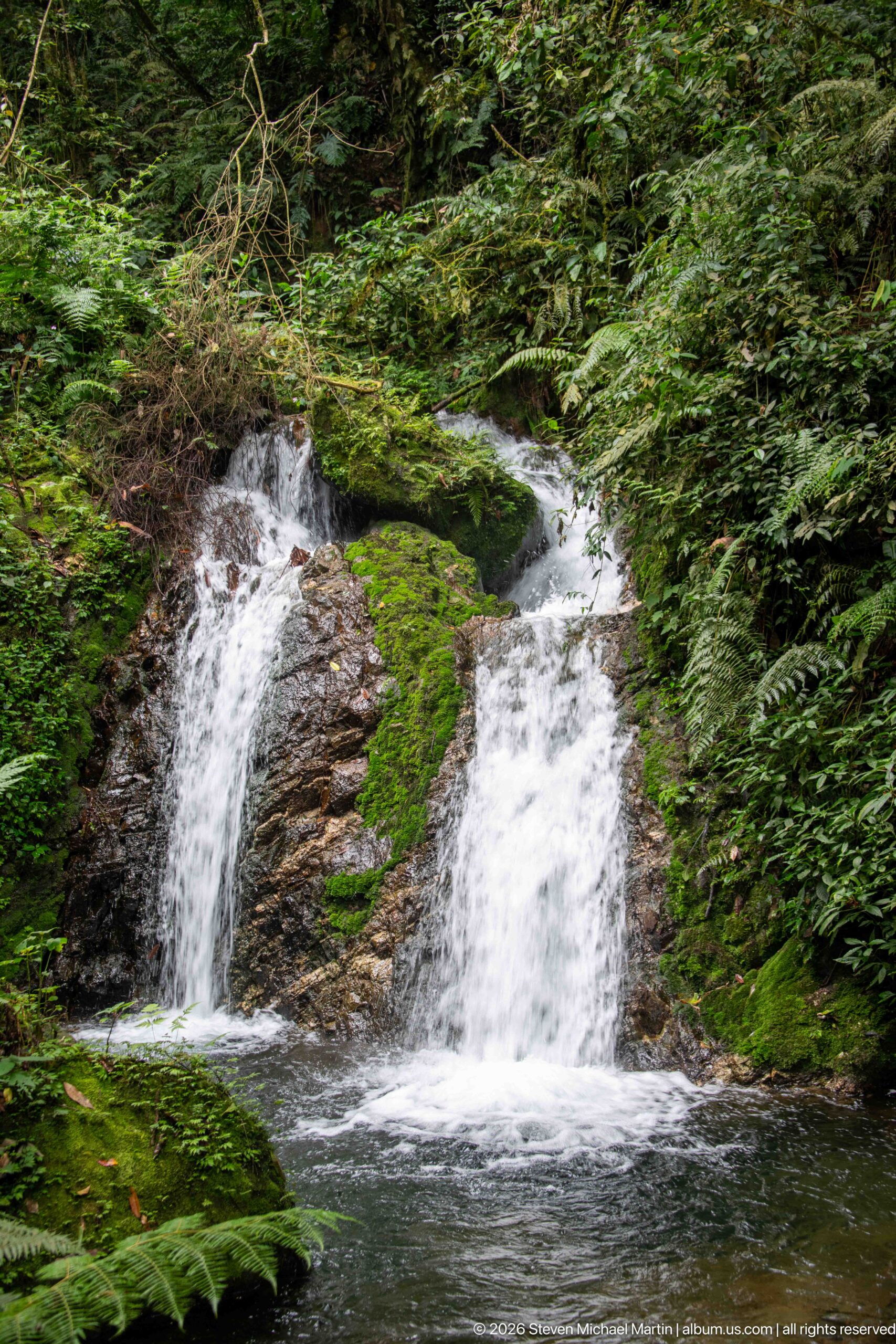
Two neighboring cascades pour over dark, moss-edged rock into a shared forest pool. The left flow is narrower and more vertical, while the right carries a broader sheet of water, creating a paired composition framed tightly by saturated vegetation and the rocky banks of the stream.
Caption
Two neighboring cascades pour over dark, moss-edged rock into a shared forest pool. The left flow is narrower and more vertical, while the right carries a broader sheet of water, creating a paired composition framed tightly by saturated vegetation and the rocky banks of the stream.
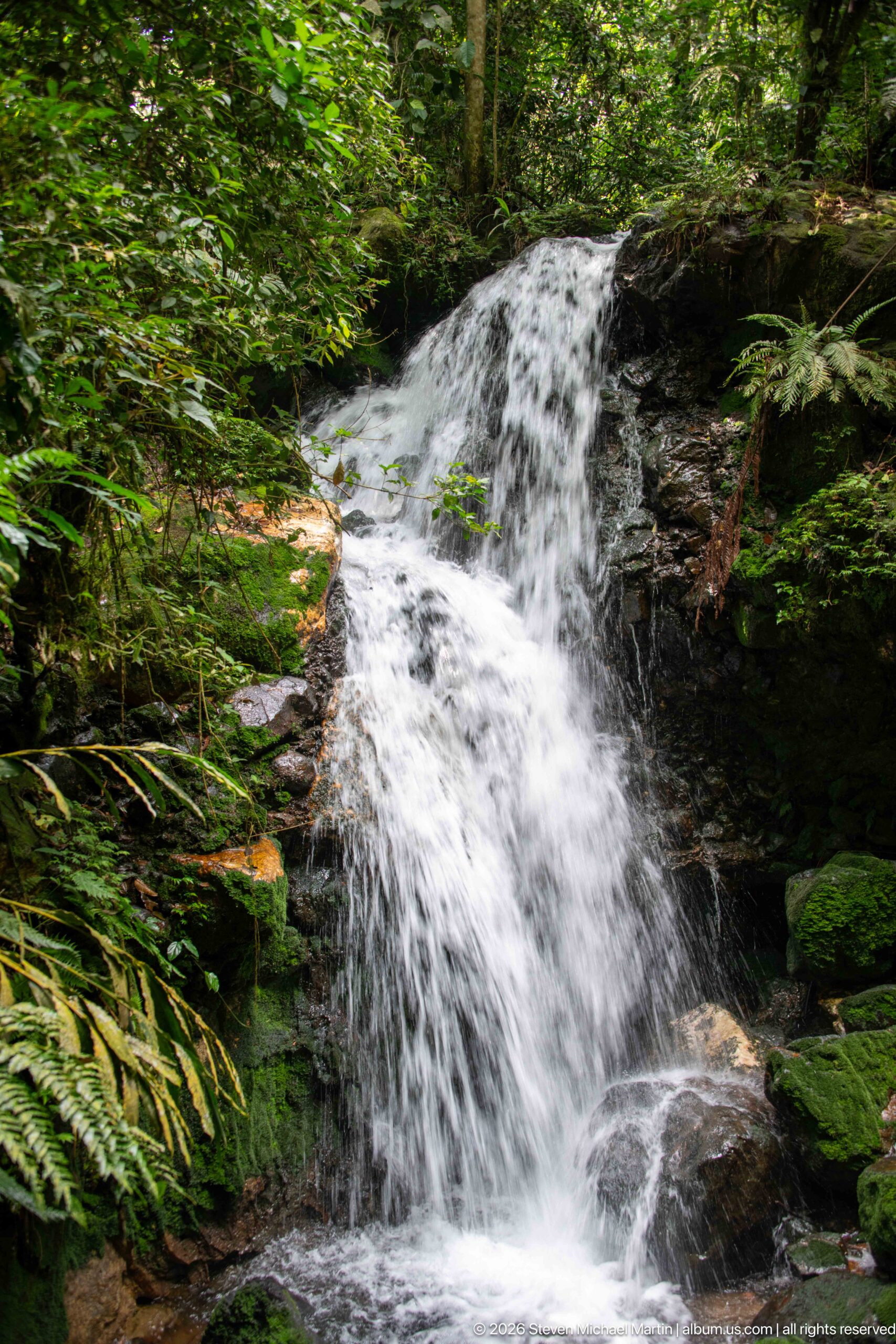
A compact two-tier cascade slides over dark rock beneath a leafy forest canopy. The upper flow spreads across a shallow ledge before dropping more steeply into the lower channel, while ferns and moss line both banks and reinforce the shaded, moisture-rich character of the site.
Caption
A compact two-tier cascade slides over dark rock beneath a leafy forest canopy. The upper flow spreads across a shallow ledge before dropping more steeply into the lower channel, while ferns and moss line both banks and reinforce the shaded, moisture-rich character of the site.
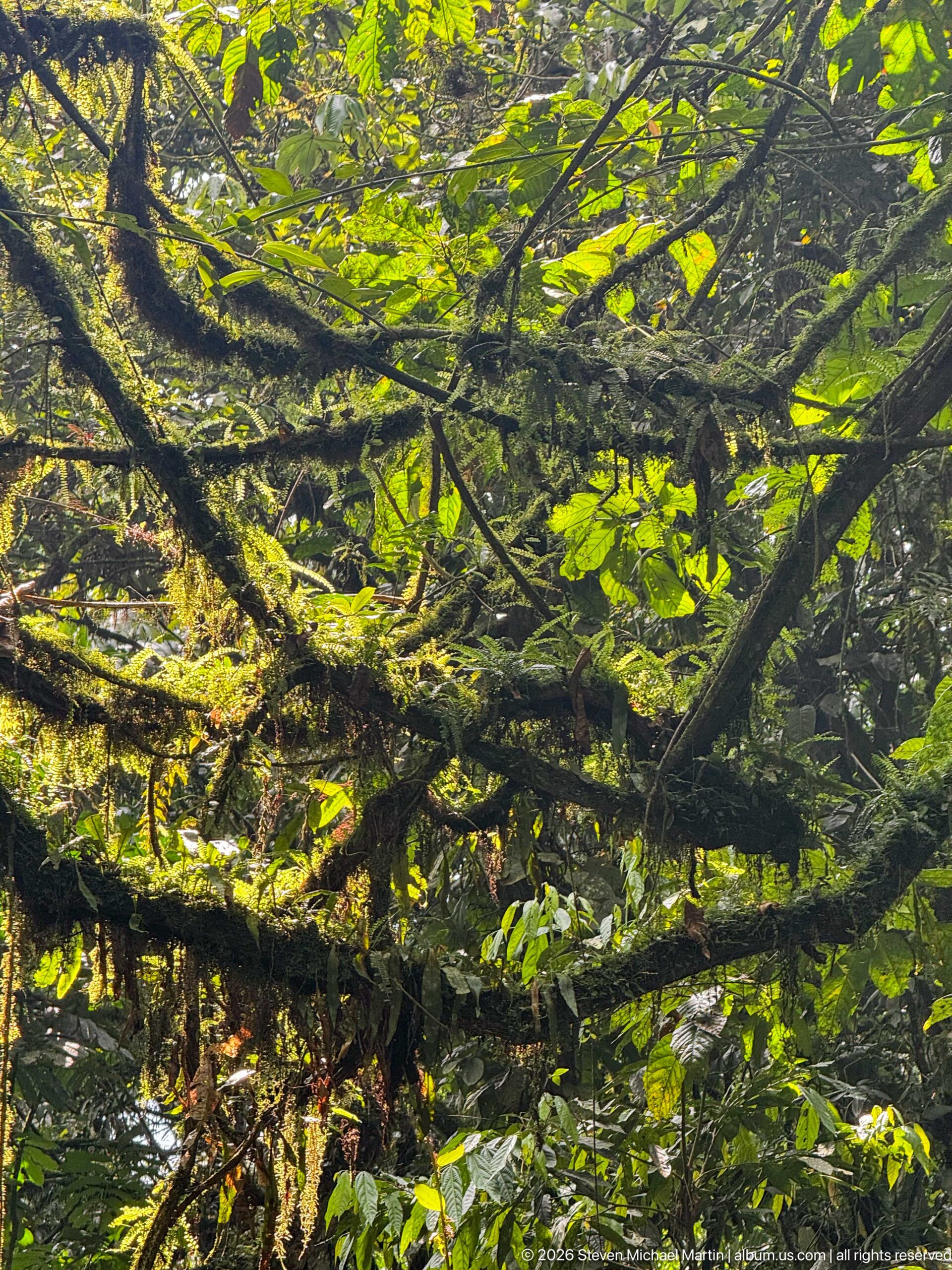
Interlacing branches cross the frame beneath a bright green canopy, many carrying moss and small epiphytes. Backlighting outlines leaves and tangled growth while the forest floor remains hidden, shifting attention upward to the complex architecture and moisture-loving vegetation of Bwindi’s woodland canopy.
Caption
Interlacing branches cross the frame beneath a bright green canopy, many carrying moss and small epiphytes. Backlighting outlines leaves and tangled growth while the forest floor remains hidden, shifting attention upward to the complex architecture and moisture-loving vegetation of Bwindi’s woodland canopy.
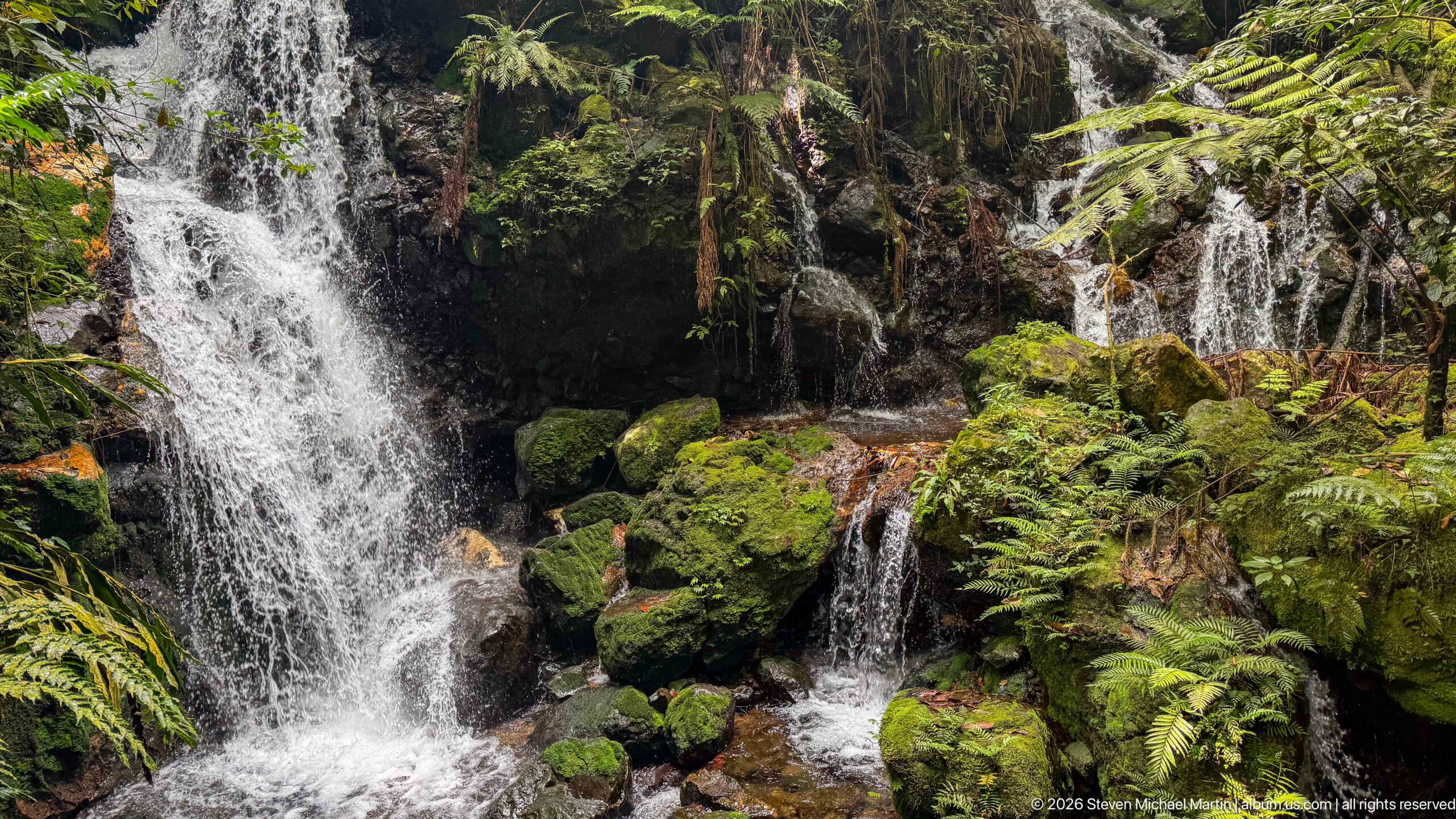
A narrow waterfall drops beside a cluster of angular, moss-covered boulders, then divides into smaller runnels at their base. Ferns and hanging vegetation crowd the wet rock faces, producing a close study of water, stone, and plant growth within the shaded Munyaga Falls forest.
Caption
A narrow waterfall drops beside a cluster of angular, moss-covered boulders, then divides into smaller runnels at their base. Ferns and hanging vegetation crowd the wet rock faces, producing a close study of water, stone, and plant growth within the shaded Munyaga Falls forest.
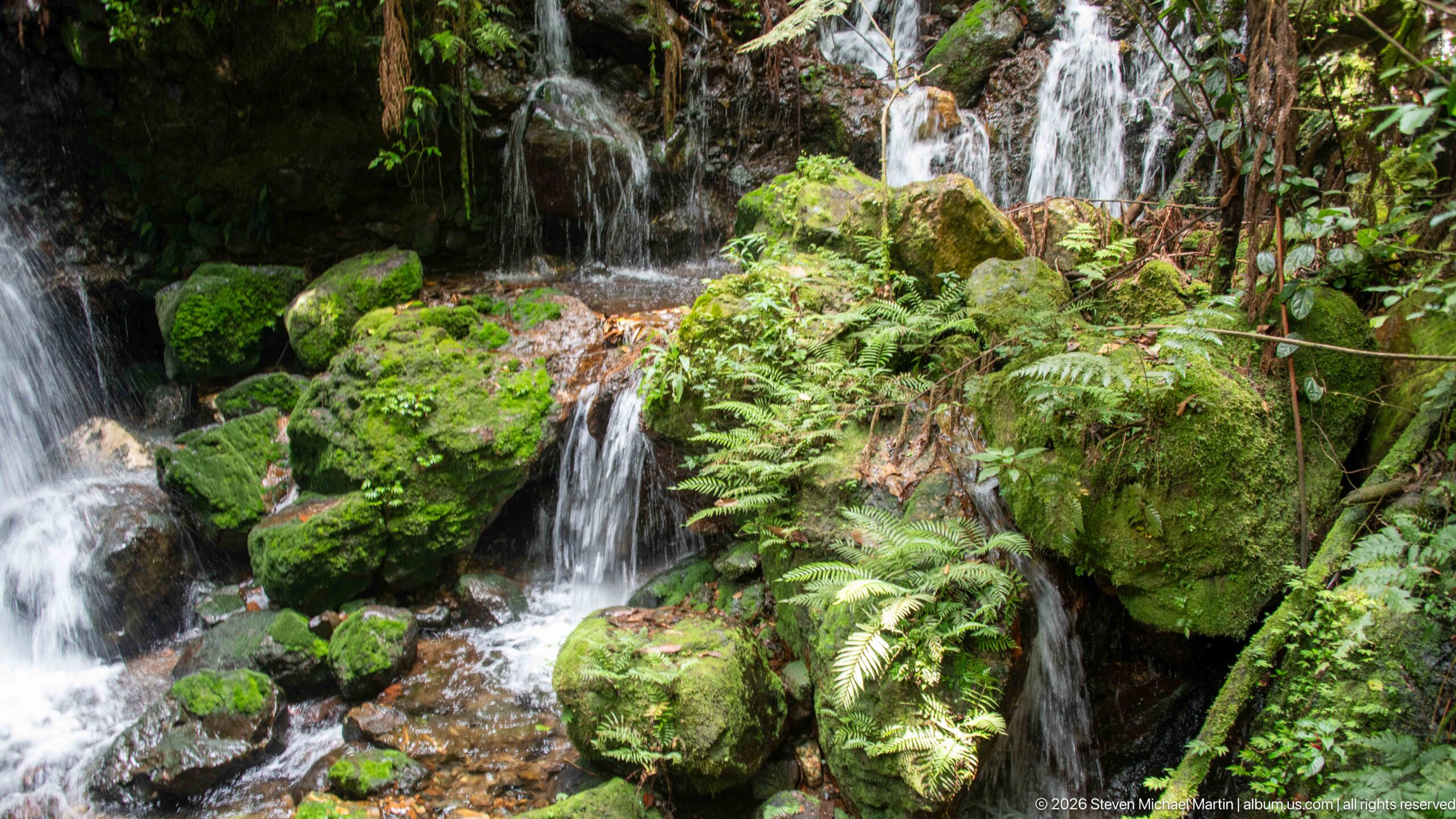
Several small streams of water spill between rounded boulders thickly coated in moss. The tight composition gives equal weight to the cascades and luxuriant fern growth, illustrating the persistently wet microhabitat along the Munyaga Falls watercourse without implying a specific named drop within the larger falls system.
Caption
Several small streams of water spill between rounded boulders thickly coated in moss. The tight composition gives equal weight to the cascades and luxuriant fern growth, illustrating the persistently wet microhabitat along the Munyaga Falls watercourse without implying a specific named drop within the larger falls system.
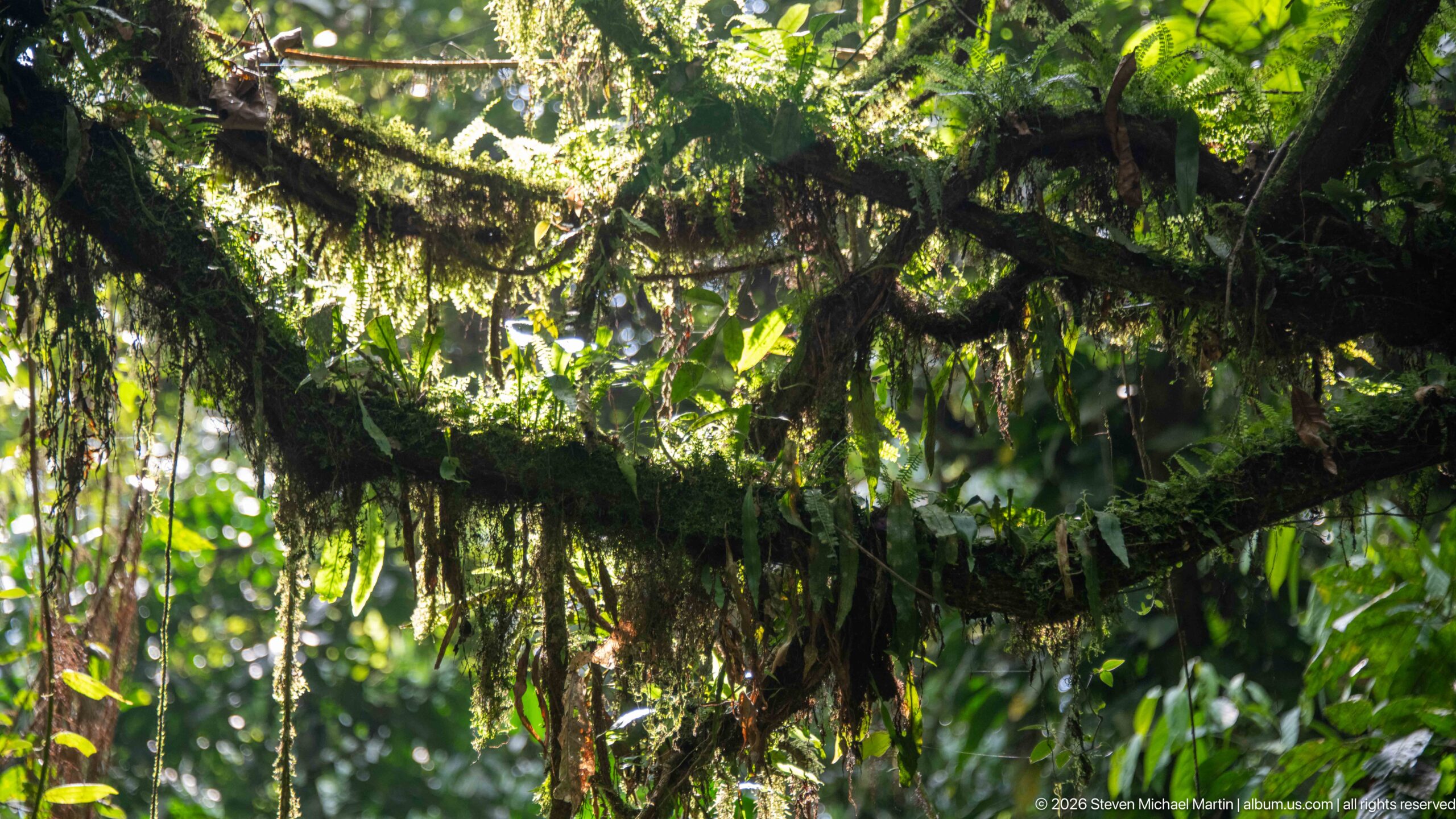
A heavy horizontal branch is densely draped with mosses and epiphytic vegetation, silhouetted against bright gaps in the forest canopy. Hanging growth and layered leaves create a textured view of the humid forest environment, where persistent moisture supports plants on trunks and branches above the ground.
Caption
A heavy horizontal branch is densely draped with mosses and epiphytic vegetation, silhouetted against bright gaps in the forest canopy. Hanging growth and layered leaves create a textured view of the humid forest environment, where persistent moisture supports plants on trunks and branches above the ground.
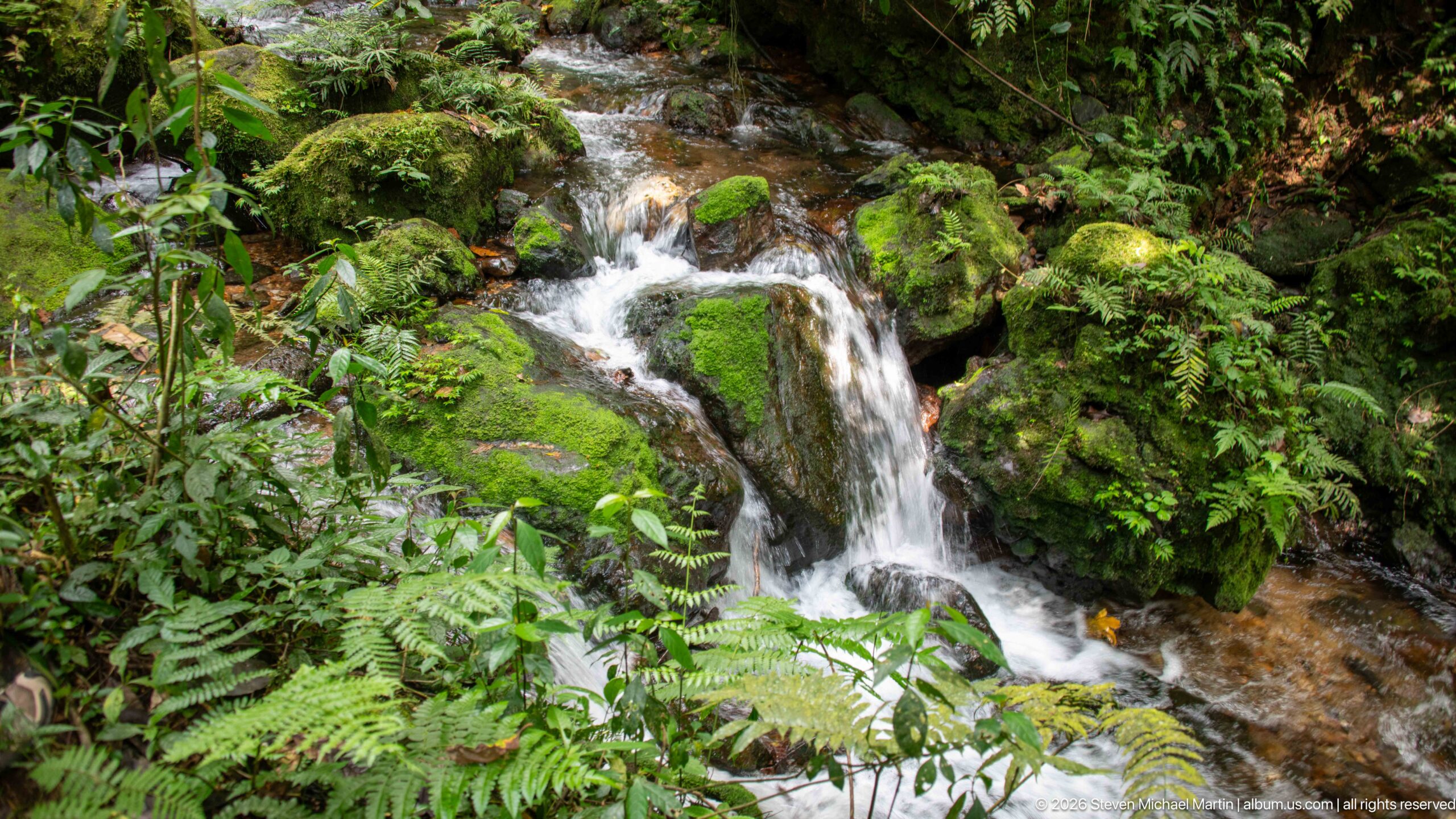
Water descends through a steep cluster of moss-coated rocks in a sequence of short drops. Fern fronds fill the foreground and banks, partially screening the stream and giving this view a layered depth distinct from the more open waterfall compositions elsewhere along the Munyaga Falls trail.
Caption
Water descends through a steep cluster of moss-coated rocks in a sequence of short drops. Fern fronds fill the foreground and banks, partially screening the stream and giving this view a layered depth distinct from the more open waterfall compositions elsewhere along the Munyaga Falls trail.
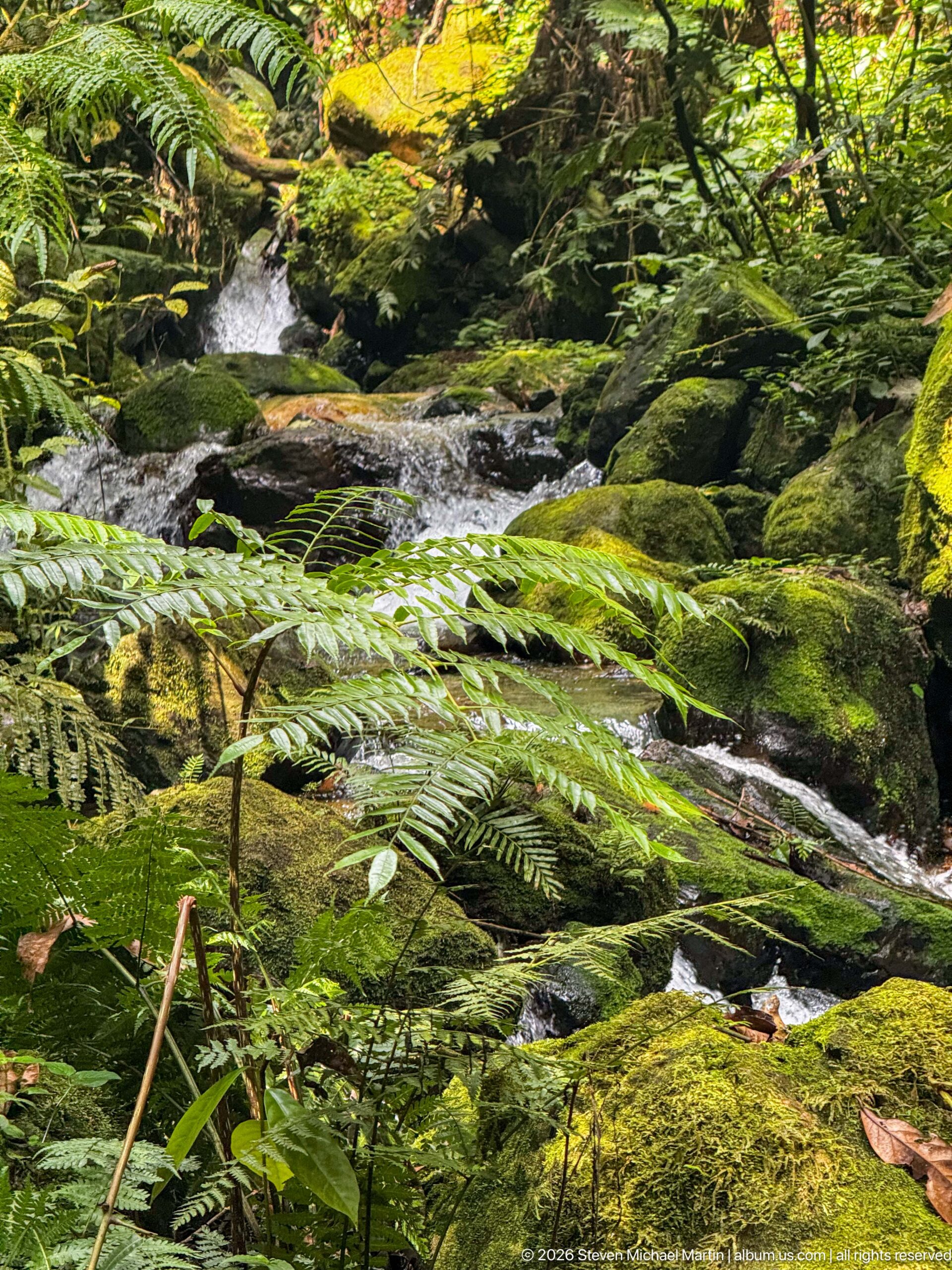
Broad fern fronds arch across a shallow rocky stream whose water slips between moss-covered stones. The low viewpoint makes vegetation dominate the composition, presenting the Munyaga Falls watercourse as an intimate forest habitat rather than a dramatic waterfall and highlighting the dense ground-layer growth along its banks.
Caption
Broad fern fronds arch across a shallow rocky stream whose water slips between moss-covered stones. The low viewpoint makes vegetation dominate the composition, presenting the Munyaga Falls watercourse as an intimate forest habitat rather than a dramatic waterfall and highlighting the dense ground-layer growth along its banks.
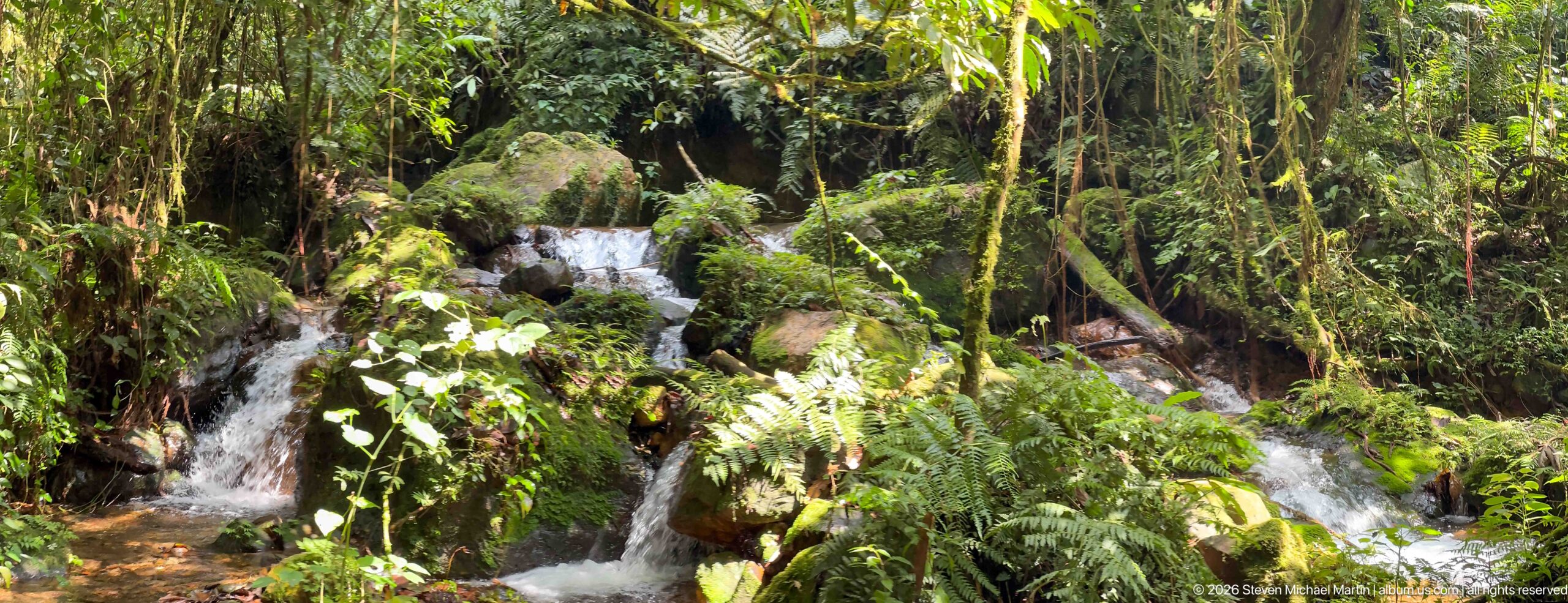
Several narrow cascades break around large moss-covered boulders beneath hanging vegetation. Rather than one dominant fall, the water divides into separate channels across the frame, creating a detailed study of the rocky streambed and the thick plant growth sustained by spray and persistent moisture.
Caption
Several narrow cascades break around large moss-covered boulders beneath hanging vegetation. Rather than one dominant fall, the water divides into separate channels across the frame, creating a detailed study of the rocky streambed and the thick plant growth sustained by spray and persistent moisture.
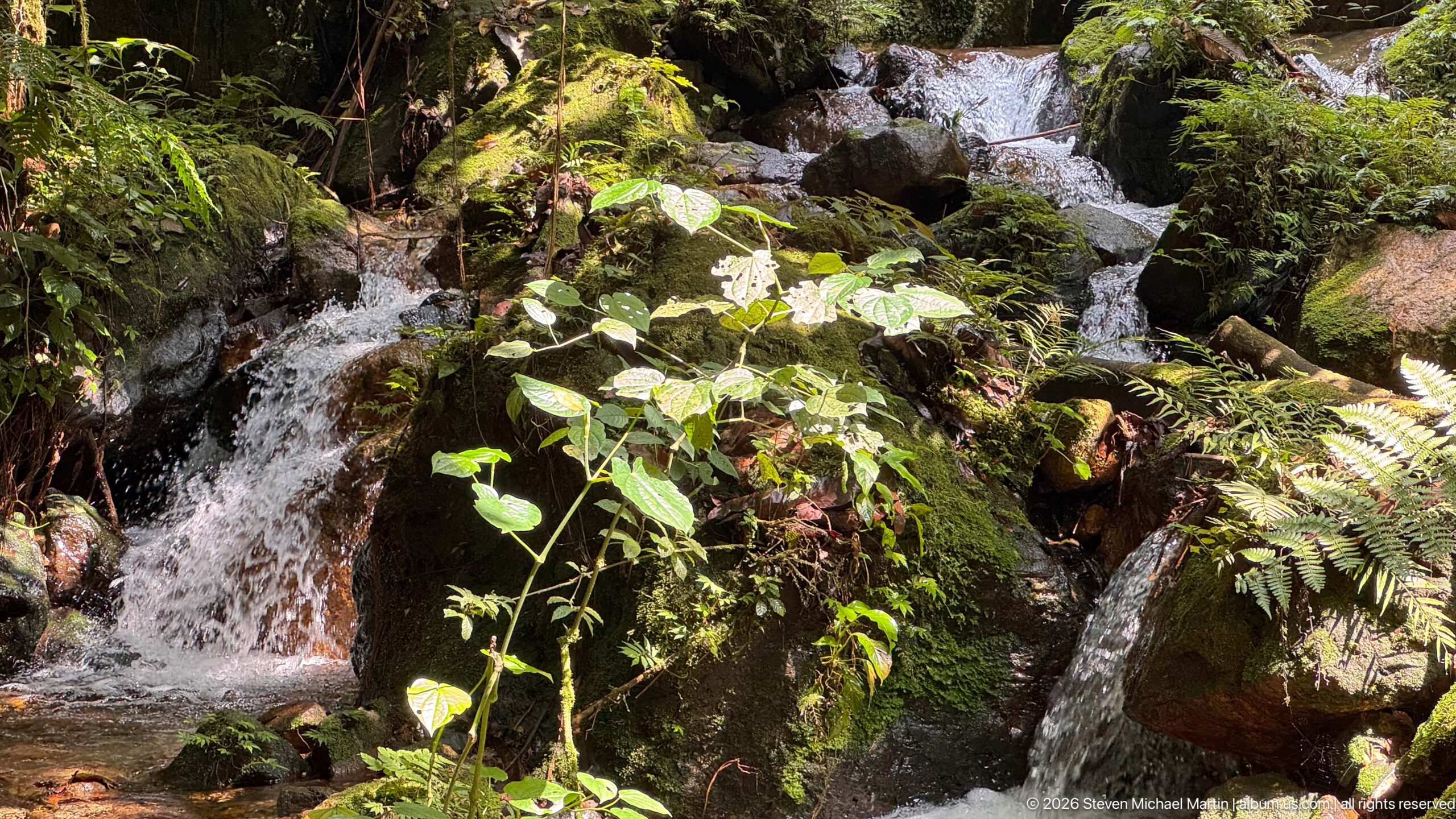
A lively stream divides around dark, moss-coated boulders, producing several short cascades and narrow channels. A leafy plant rises from the center foreground while ferns edge the rocks, giving this composition a close, detailed view of the wet stream habitat below the Munyaga Falls cascades.
Caption
A lively stream divides around dark, moss-coated boulders, producing several short cascades and narrow channels. A leafy plant rises from the center foreground while ferns edge the rocks, giving this composition a close, detailed view of the wet stream habitat below the Munyaga Falls cascades.
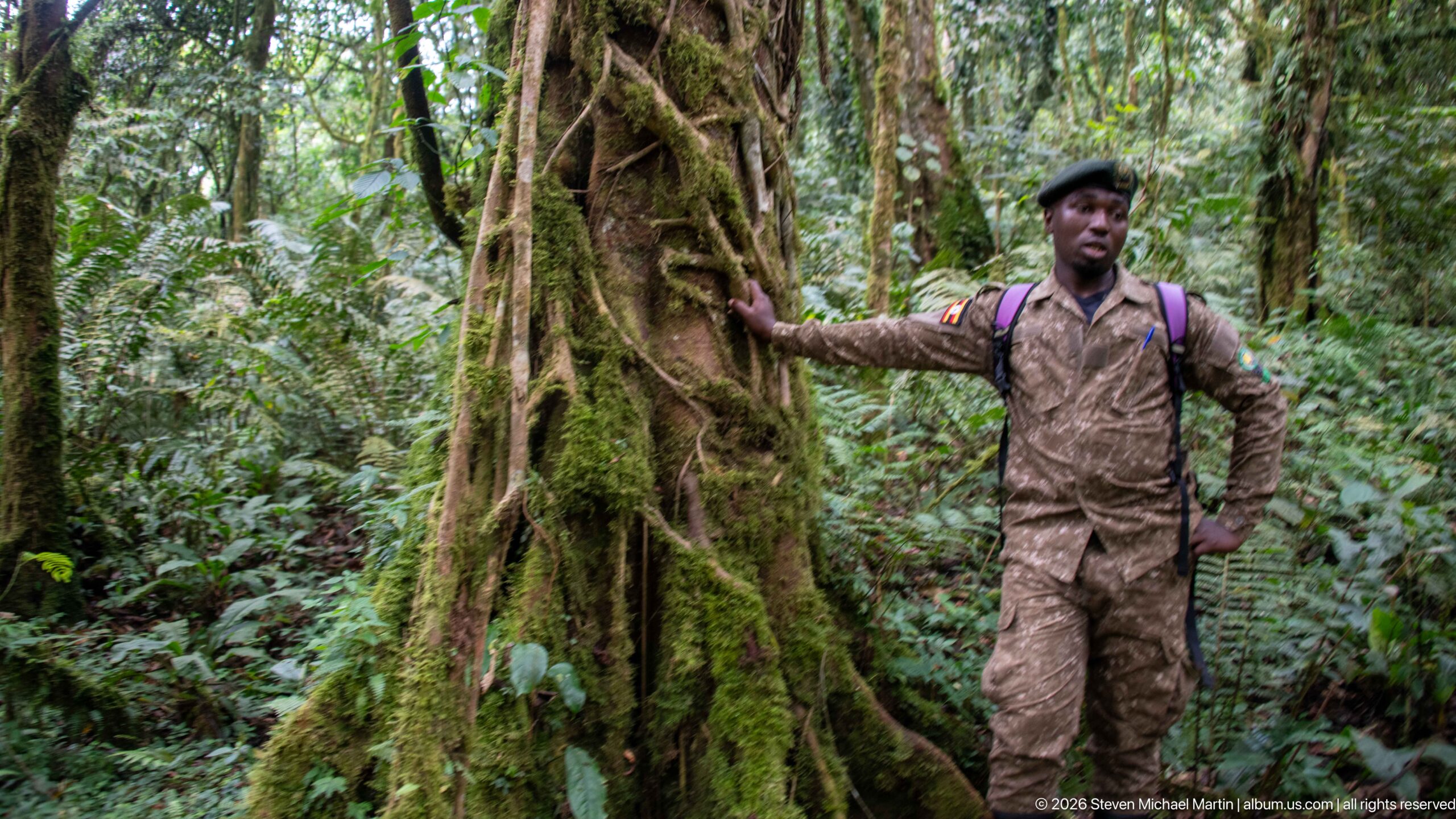
A uniformed forest guide stands beside the buttressed base of a large tree, resting one hand against the trunk as he addresses companions out of frame. The scene links human interpretation with the forest itself, while moss, vines, and dense understory vegetation reveal the humid setting around the Munyaga Falls trail.
Caption
A uniformed forest guide stands beside the buttressed base of a large tree, resting one hand against the trunk as he addresses companions out of frame. The scene links human interpretation with the forest itself, while moss, vines, and dense understory vegetation reveal the humid setting around the Munyaga Falls trail.
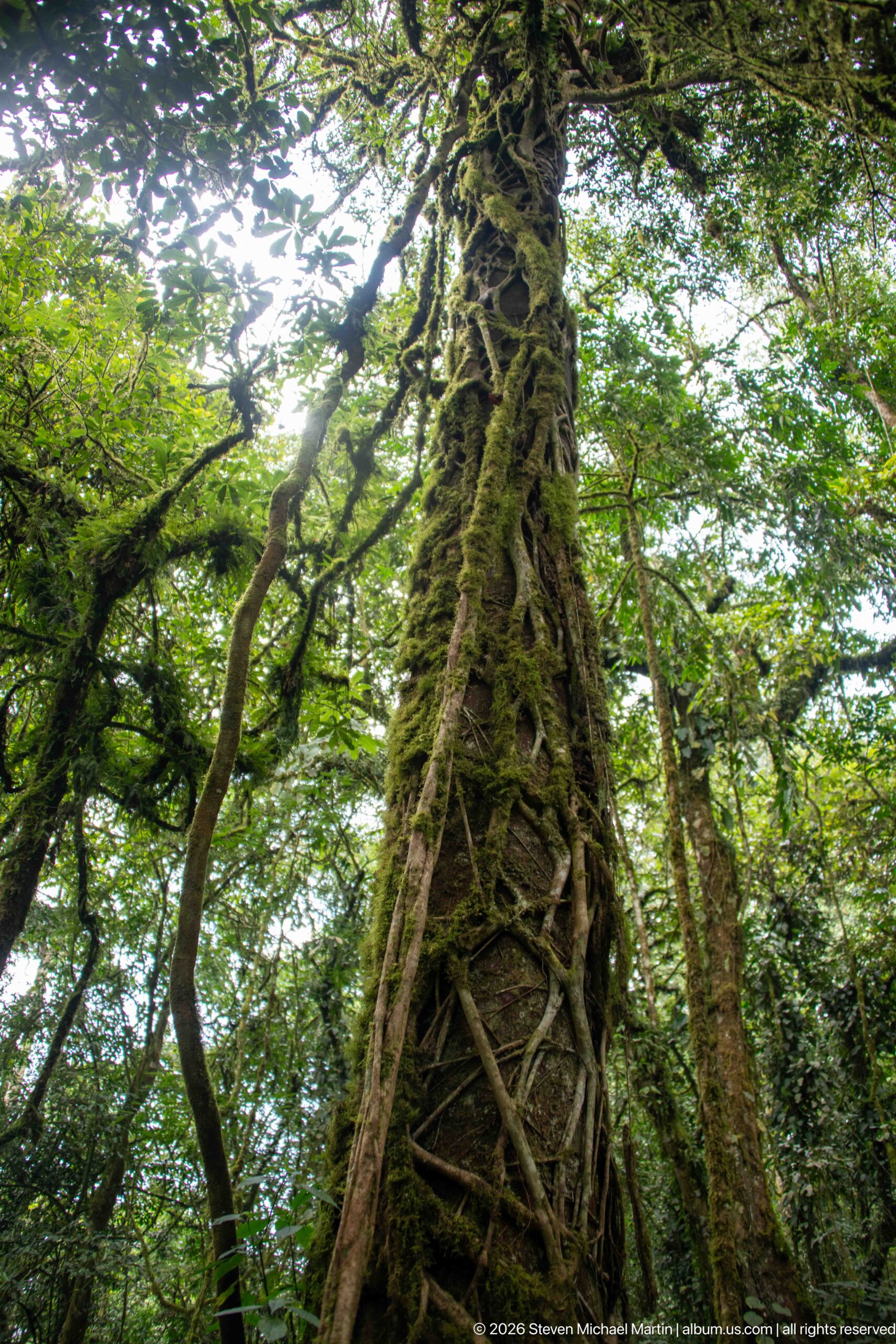
A tall forest tree rises toward the canopy with woody vines and climbing plants wrapped around its trunk. Viewed steeply upward from the forest floor, the composition emphasizes vertical height and the layered relationships among trunk, lianas, branches, and surrounding foliage in Bwindi’s dense humid forest.
Caption
A tall forest tree rises toward the canopy with woody vines and climbing plants wrapped around its trunk. Viewed steeply upward from the forest floor, the composition emphasizes vertical height and the layered relationships among trunk, lianas, branches, and surrounding foliage in Bwindi’s dense humid forest.
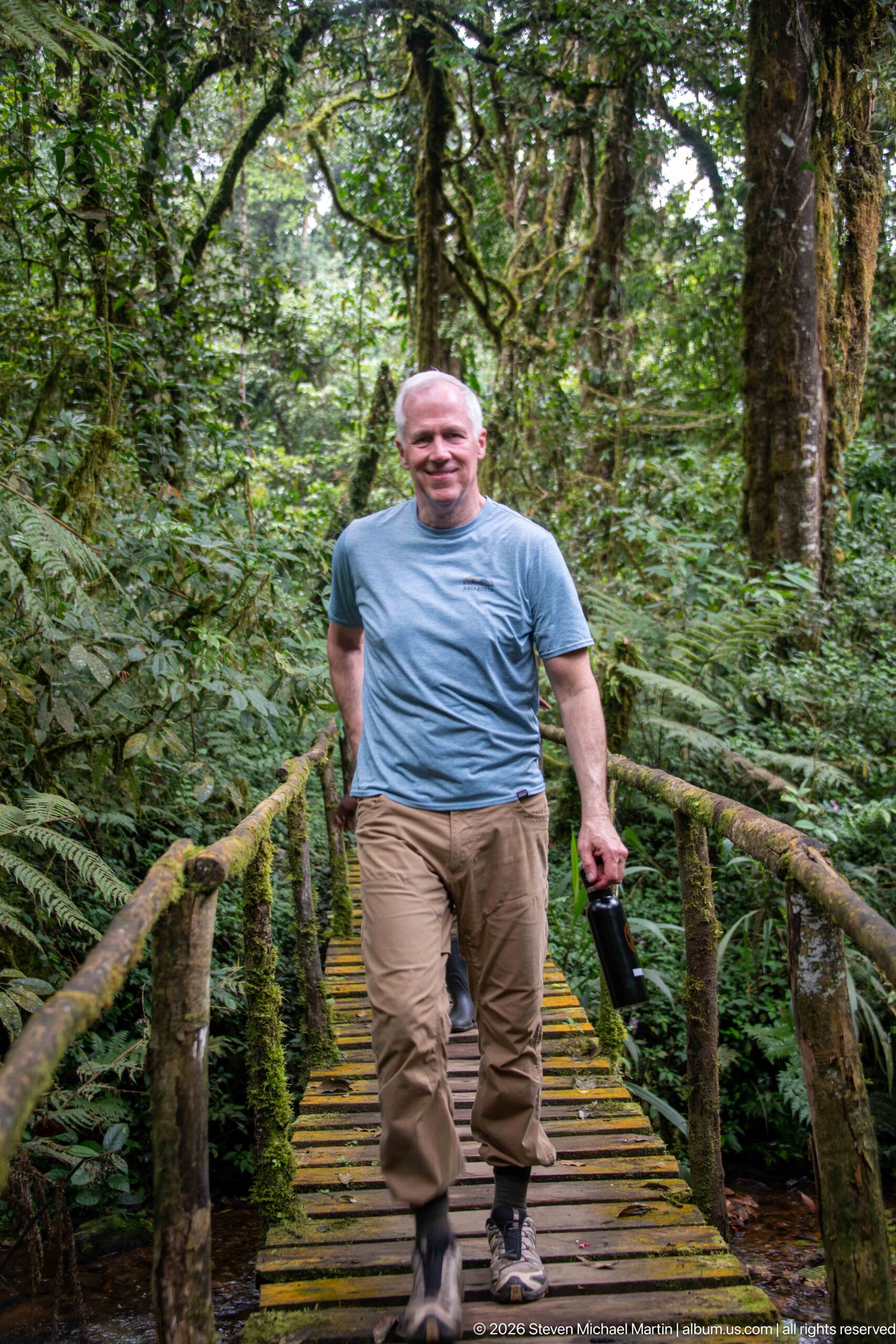
A visitor stands on a narrow timber footbridge with rustic handrails, surrounded closely by ferns and forest trees. The bridge carries the trail across a small watercourse, and the frontal composition shows how simple built infrastructure threads through the dense vegetation of the Munyaga Falls route.
Caption
A visitor stands on a narrow timber footbridge with rustic handrails, surrounded closely by ferns and forest trees. The bridge carries the trail across a small watercourse, and the frontal composition shows how simple built infrastructure threads through the dense vegetation of the Munyaga Falls route.
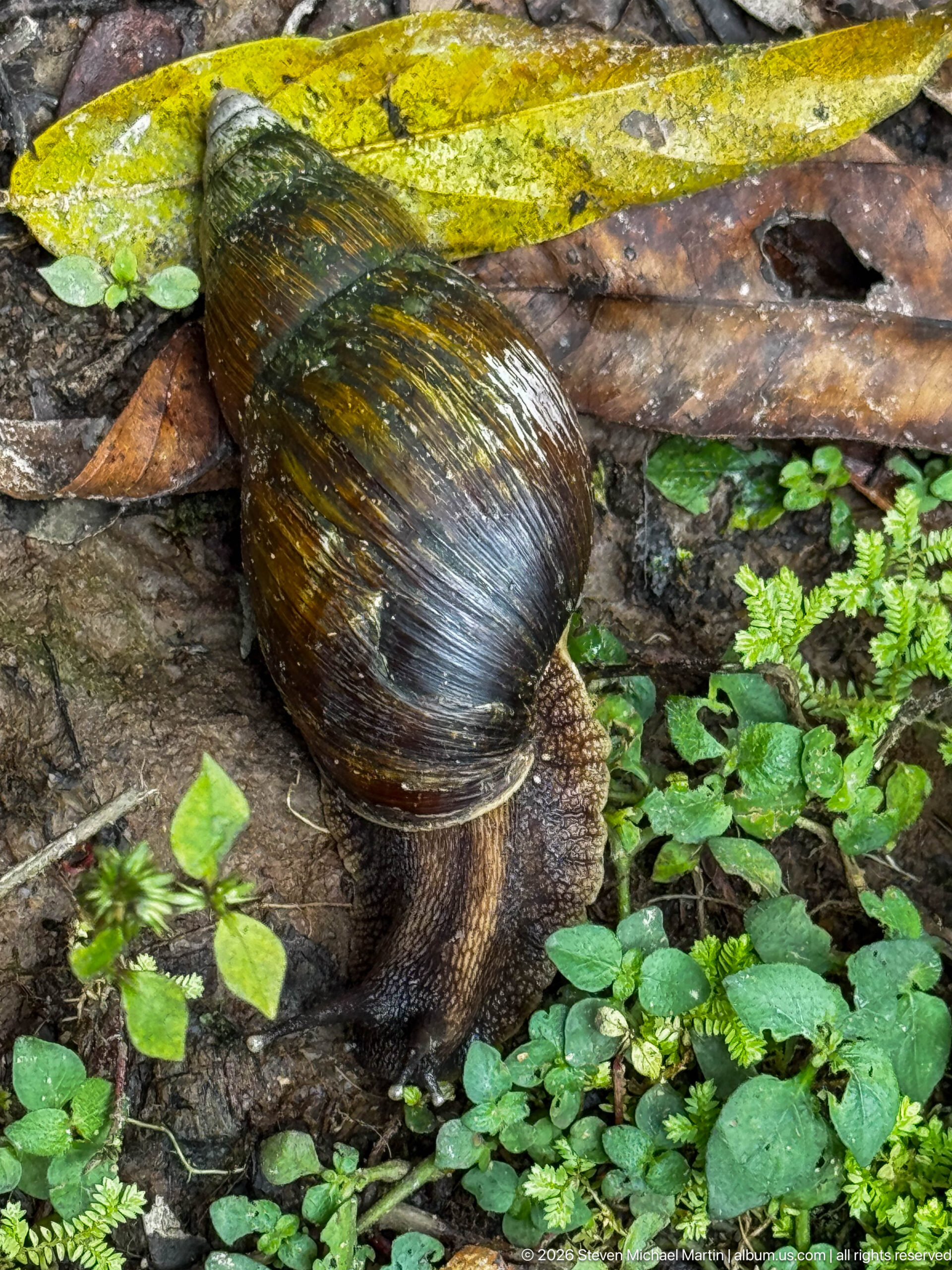
A large terrestrial snail extends its textured body beneath a glossy, dark brown shell while moving through low forest-floor vegetation. The close view clearly shows the rounded shell, muscular foot, and damp substrate; species-level identification would require diagnostic details beyond those visible here.
Caption
A large terrestrial snail extends its textured body beneath a glossy, dark brown shell while moving through low forest-floor vegetation. The close view clearly shows the rounded shell, muscular foot, and damp substrate; species-level identification would require diagnostic details beyond those visible here.
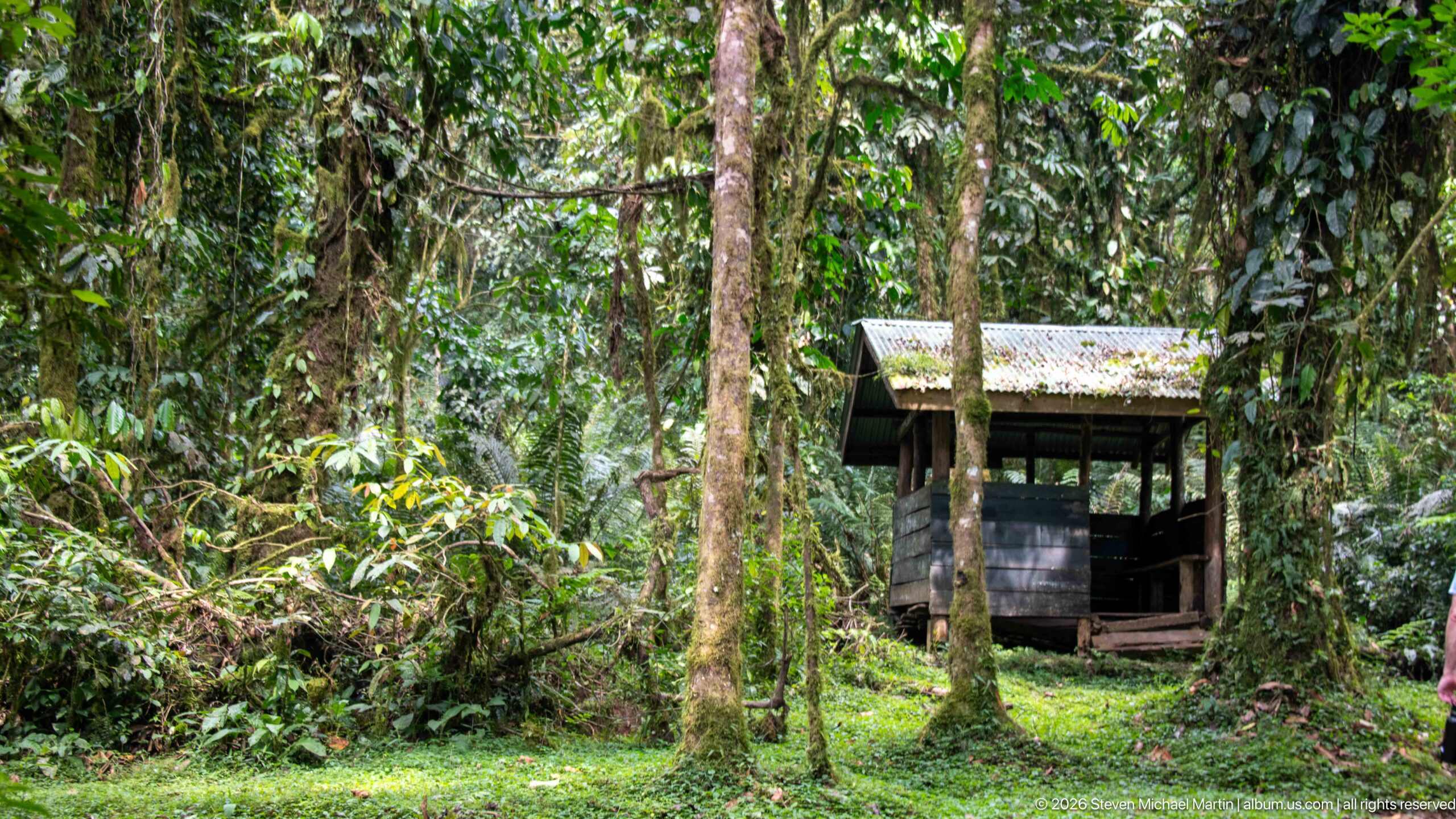
A small open-sided timber shelter with a corrugated roof stands in a clearing surrounded by dense forest. Its simple raised structure and dark interior contrast with the surrounding trunks and understory, documenting a modest human-made feature along the route without assigning a function not evident from the proof sheet.
Caption
A small open-sided timber shelter with a corrugated roof stands in a clearing surrounded by dense forest. Its simple raised structure and dark interior contrast with the surrounding trunks and understory, documenting a modest human-made feature along the route without assigning a function not evident from the proof sheet.
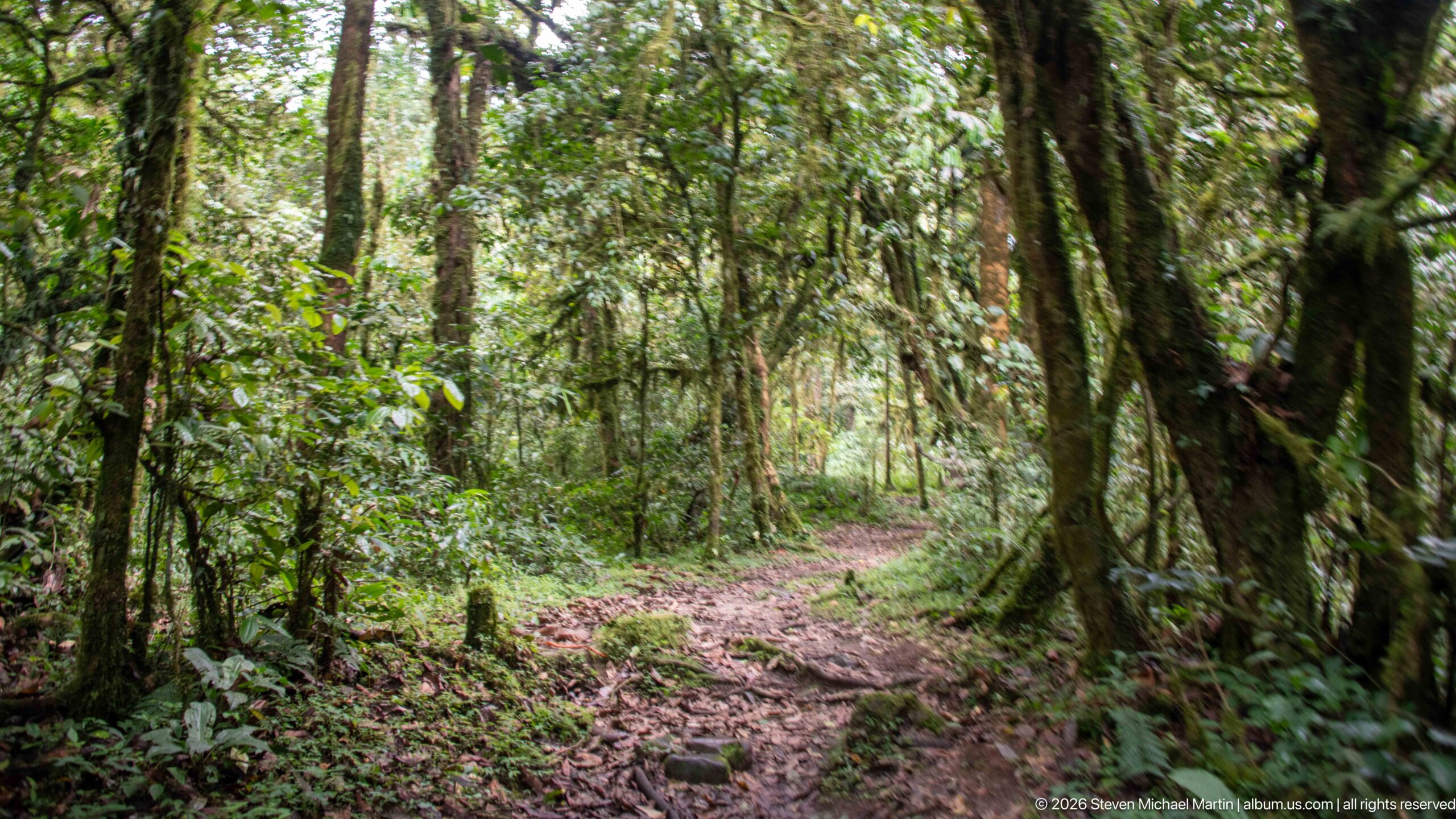
A narrow earthen path curves through dense forest, its surface scattered with leaves and exposed roots. Tall trunks, vines, and layered understory vegetation enclose the route on both sides, presenting the Munyaga Falls approach as a shaded walking trail immersed in Bwindi’s humid woodland.
Caption
A narrow earthen path curves through dense forest, its surface scattered with leaves and exposed roots. Tall trunks, vines, and layered understory vegetation enclose the route on both sides, presenting the Munyaga Falls approach as a shaded walking trail immersed in Bwindi’s humid woodland.
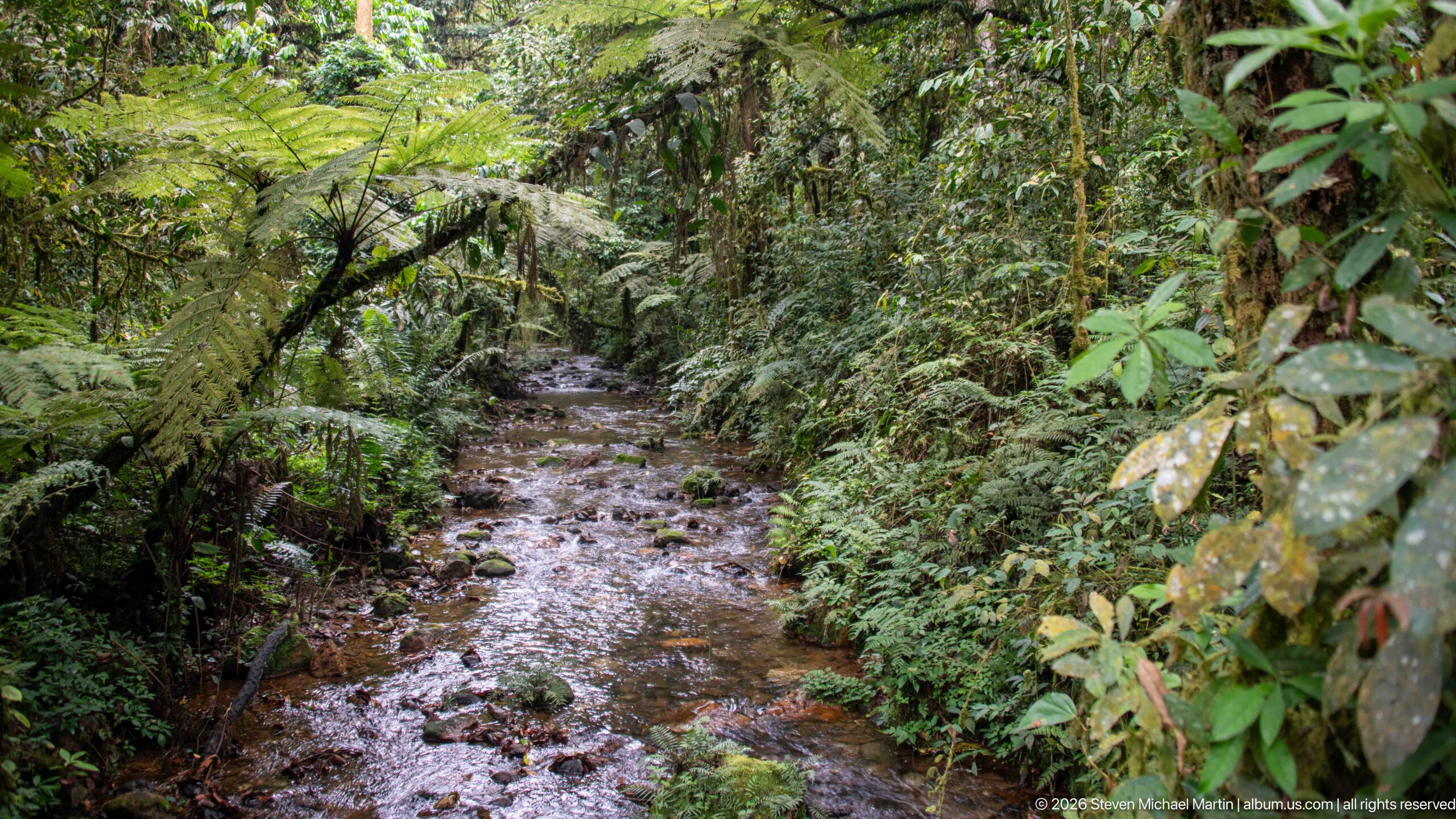
A shallow stream runs over stones beneath an arching canopy of branches and dense understory growth. The channel is calm compared with the nearby cascades, offering a wider environmental view of the watercourse as it winds through Bwindi’s forest and disappears into deep shade.
Caption
A shallow stream runs over stones beneath an arching canopy of branches and dense understory growth. The channel is calm compared with the nearby cascades, offering a wider environmental view of the watercourse as it winds through Bwindi’s forest and disappears into deep shade.
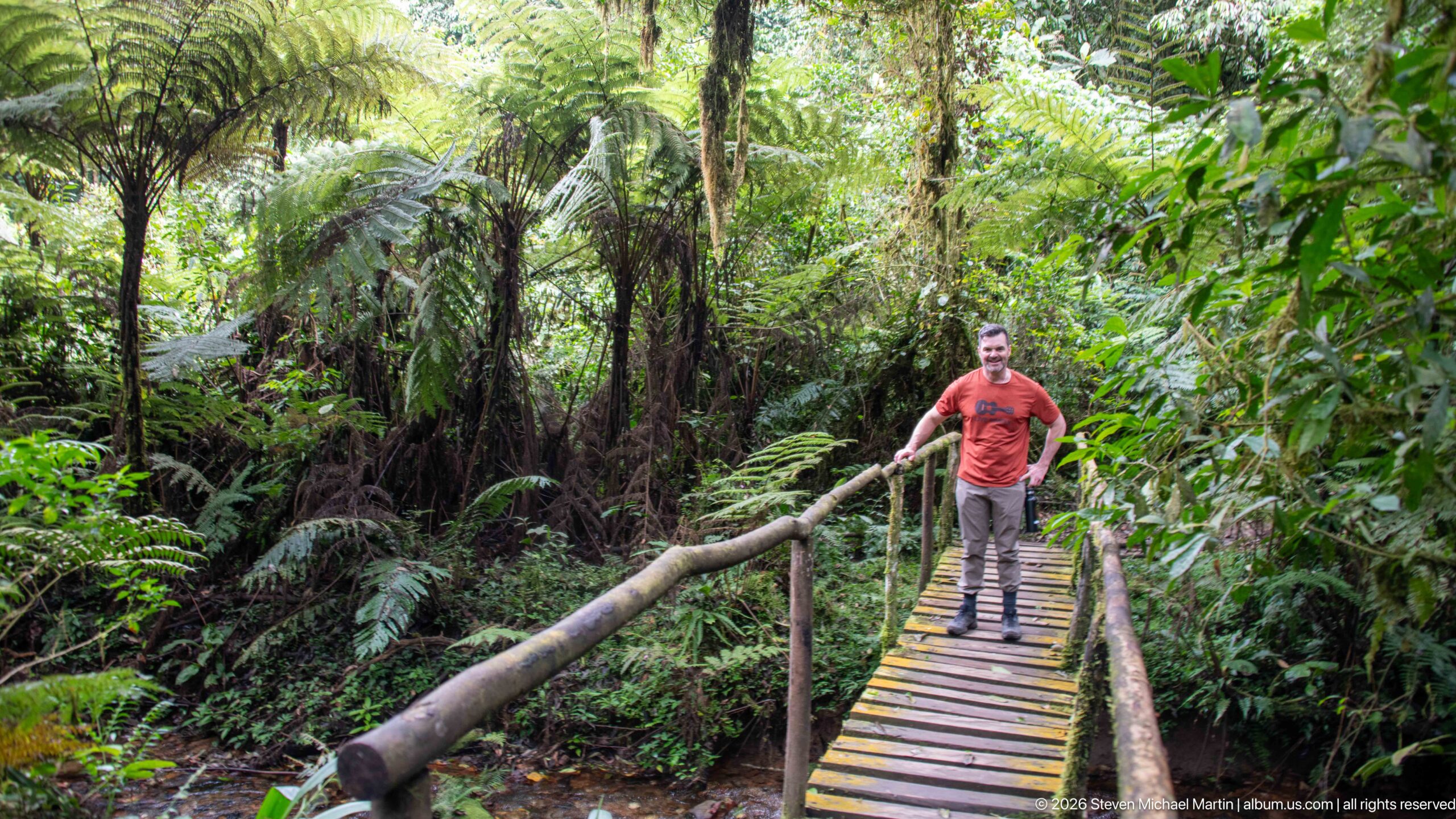
A visitor in a red shirt walks toward the camera across a narrow slatted footbridge with rustic wooden rails. Tall tree ferns and broad-leaved plants crowd the crossing, making the bridge a clear element of the hiking route through the wet forest surrounding Munyaga Falls.
Caption
A visitor in a red shirt walks toward the camera across a narrow slatted footbridge with rustic wooden rails. Tall tree ferns and broad-leaved plants crowd the crossing, making the bridge a clear element of the hiking route through the wet forest surrounding Munyaga Falls.
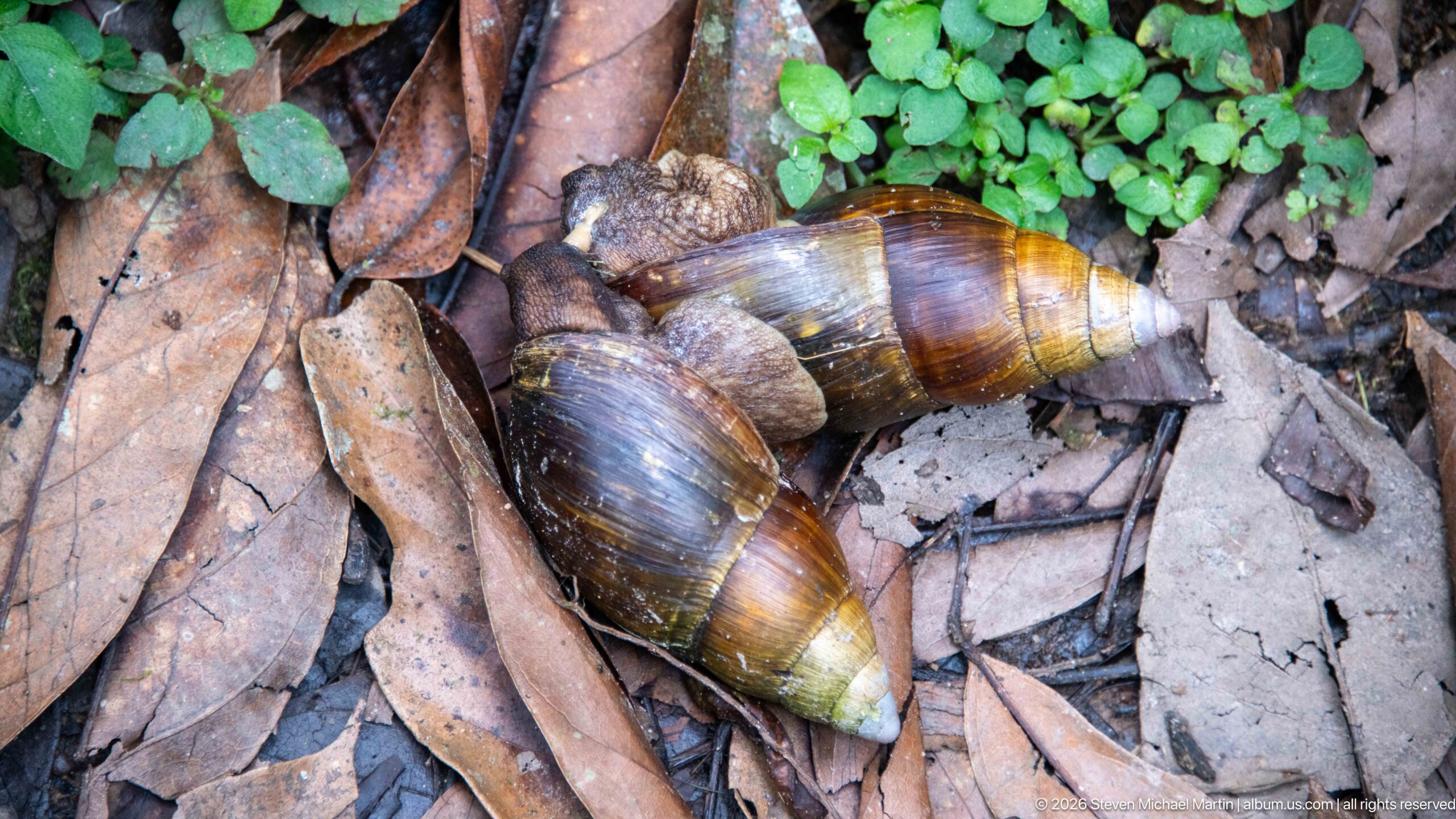
Two large terrestrial snails lie close together among damp leaf litter and small green plants. Their elongated, banded brown shells taper to pointed spires, a morphology consistent with large African land snails, but the proof-sheet view does not support a reliable species-level identification.
Caption
Two large terrestrial snails lie close together among damp leaf litter and small green plants. Their elongated, banded brown shells taper to pointed spires, a morphology consistent with large African land snails, but the proof-sheet view does not support a reliable species-level identification.
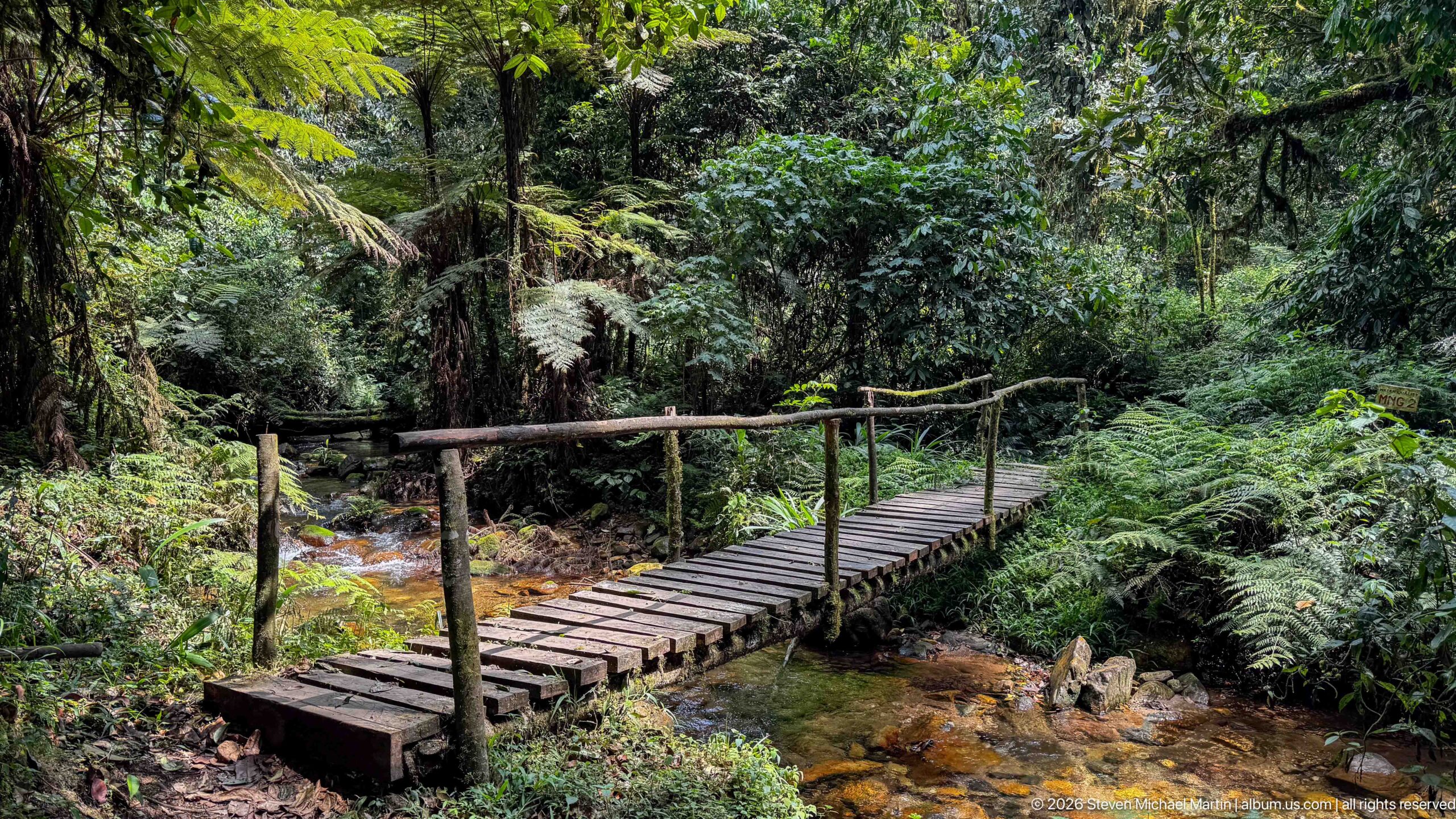
A narrow slatted footbridge spans a shallow forest stream, its rough wooden rails following a slight bend through thick ferns and trees. With no people present, the composition concentrates on the trail infrastructure and its small footprint within the dense vegetation and rocky watercourse near Munyaga Falls.
Caption
A narrow slatted footbridge spans a shallow forest stream, its rough wooden rails following a slight bend through thick ferns and trees. With no people present, the composition concentrates on the trail infrastructure and its small footprint within the dense vegetation and rocky watercourse near Munyaga Falls.
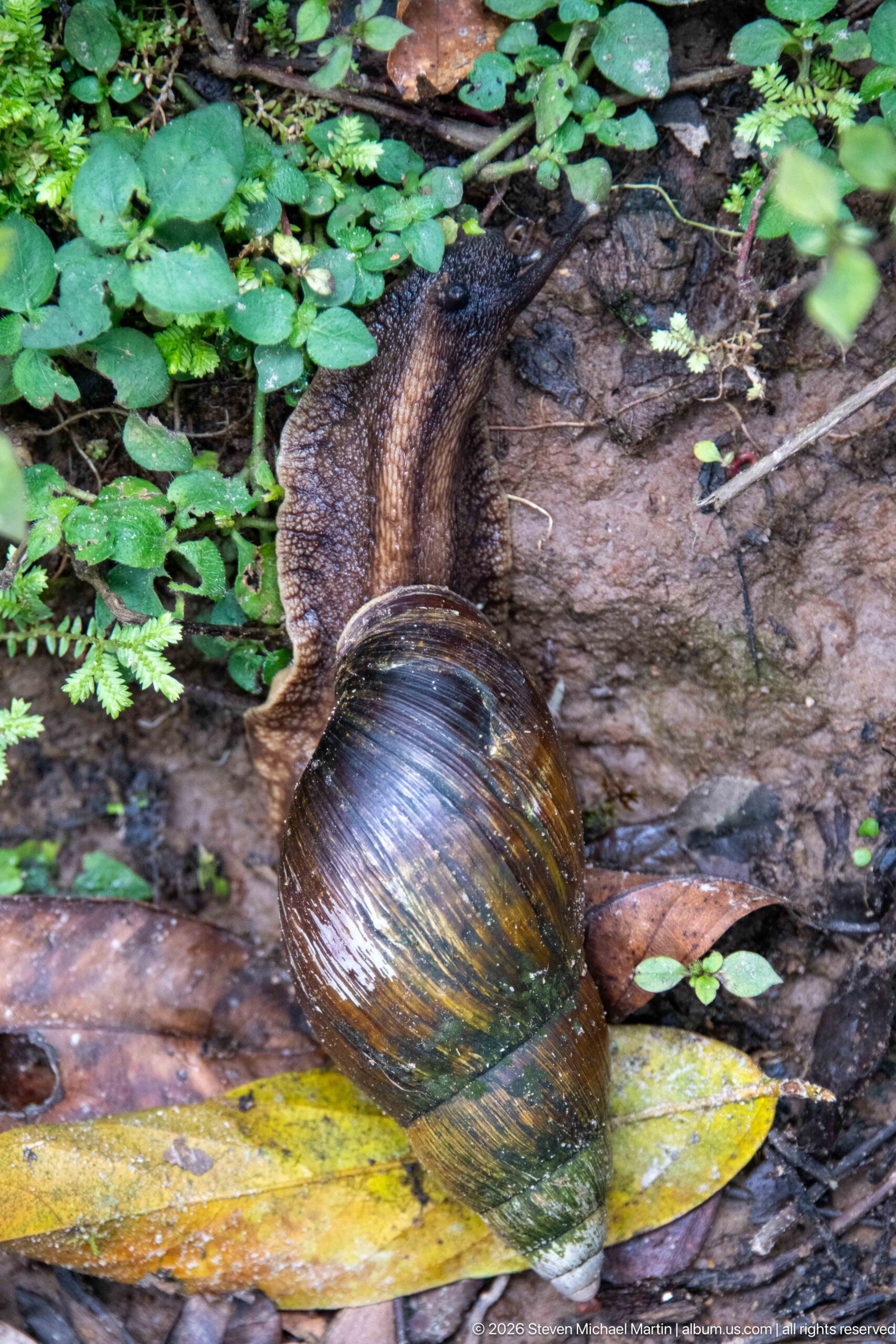
A large land snail moves across wet forest litter, its dark rounded shell dominating the lower frame while the extended body leads toward groundcover above. The unusual rear-quarter angle emphasizes the scale and sheen of the shell and provides a behavioral view distinct from the more lateral snail portraits in the sequence.
Caption
A large land snail moves across wet forest litter, its dark rounded shell dominating the lower frame while the extended body leads toward groundcover above. The unusual rear-quarter angle emphasizes the scale and sheen of the shell and provides a behavioral view distinct from the more lateral snail portraits in the sequence.
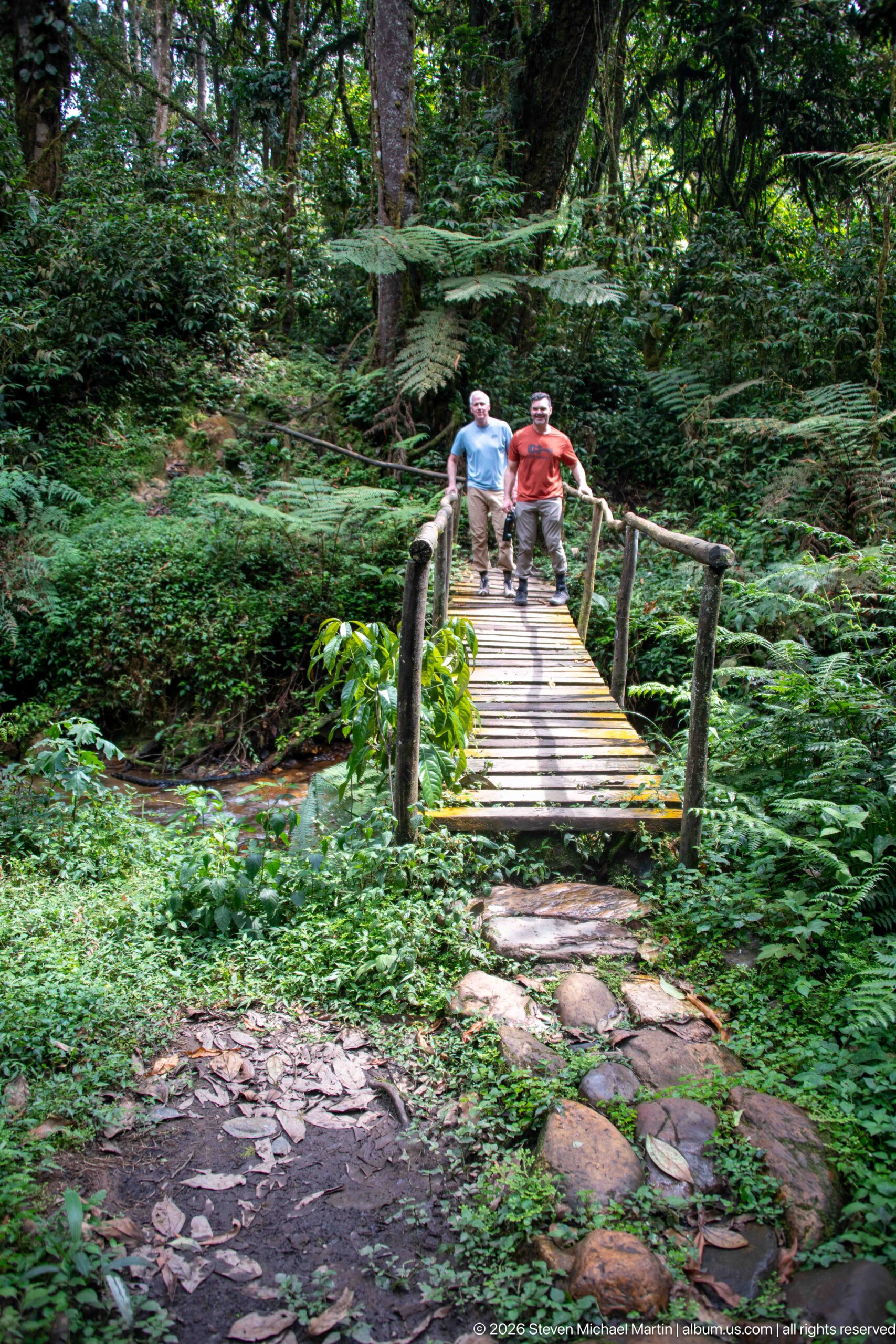
A small plank bridge spans a narrow drainage in the forest, framed by large ferns, mossy trunks, and a stone-and-earth approach. Two people stand at the far end, giving scale to the crossing. Seen from lower on the trail, the composition emphasizes the bridge’s simple timber construction and its integration into Bwindi’s dense understory.
Caption
A small plank bridge spans a narrow drainage in the forest, framed by large ferns, mossy trunks, and a stone-and-earth approach. Two people stand at the far end, giving scale to the crossing. Seen from lower on the trail, the composition emphasizes the bridge’s simple timber construction and its integration into Bwindi’s dense understory.
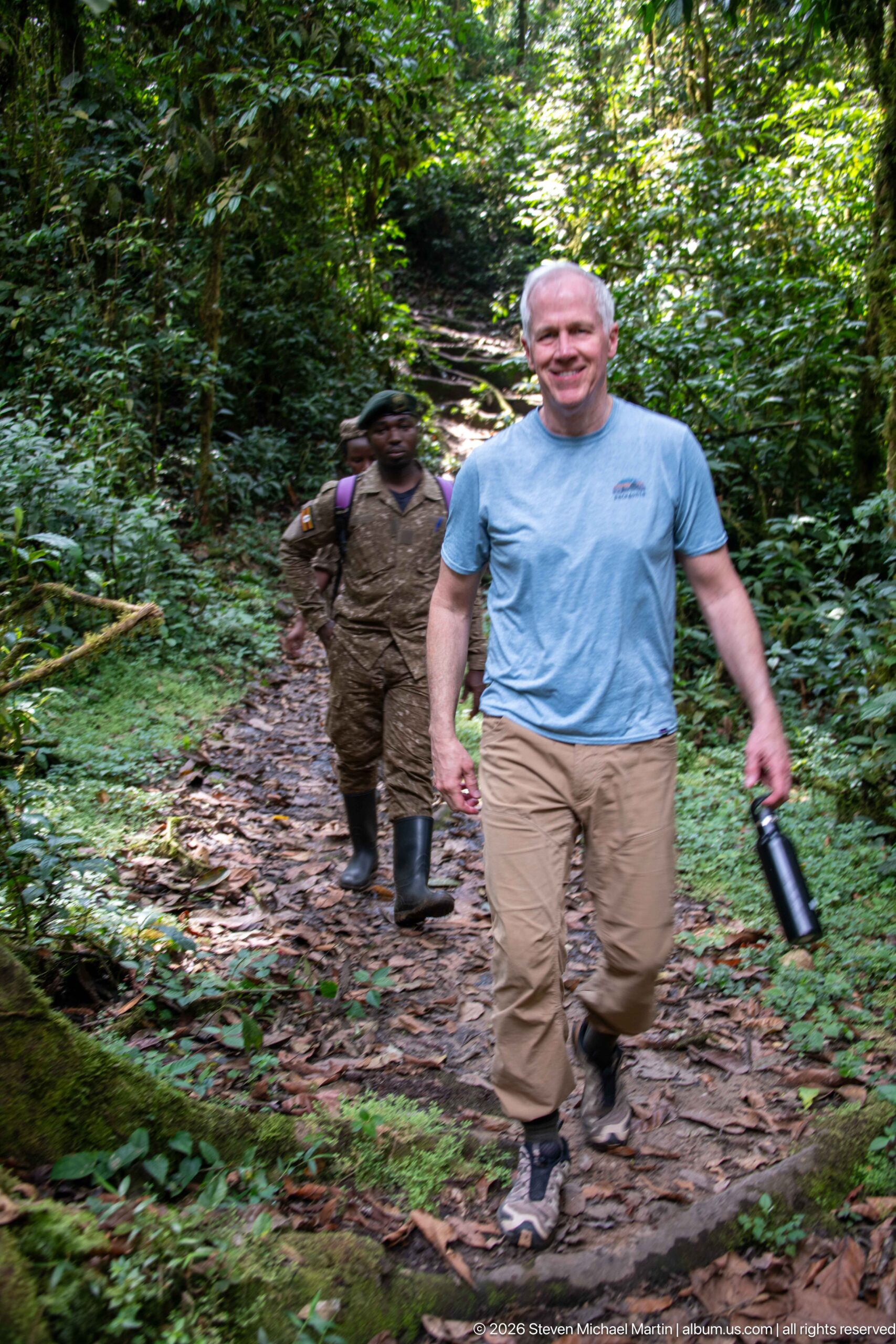
A visitor walks uphill along the muddy forest path with a uniformed local guide following behind. Their movement through dense vegetation gives a human-scale view of the Munyaga Falls trail and its uneven, root-strewn footing. The guide’s field clothing and boots contrast with the visitor’s trekking attire, reinforcing the practical nature of guided travel in the forest.
Caption
A visitor walks uphill along the muddy forest path with a uniformed local guide following behind. Their movement through dense vegetation gives a human-scale view of the Munyaga Falls trail and its uneven, root-strewn footing. The guide’s field clothing and boots contrast with the visitor’s trekking attire, reinforcing the practical nature of guided travel in the forest.
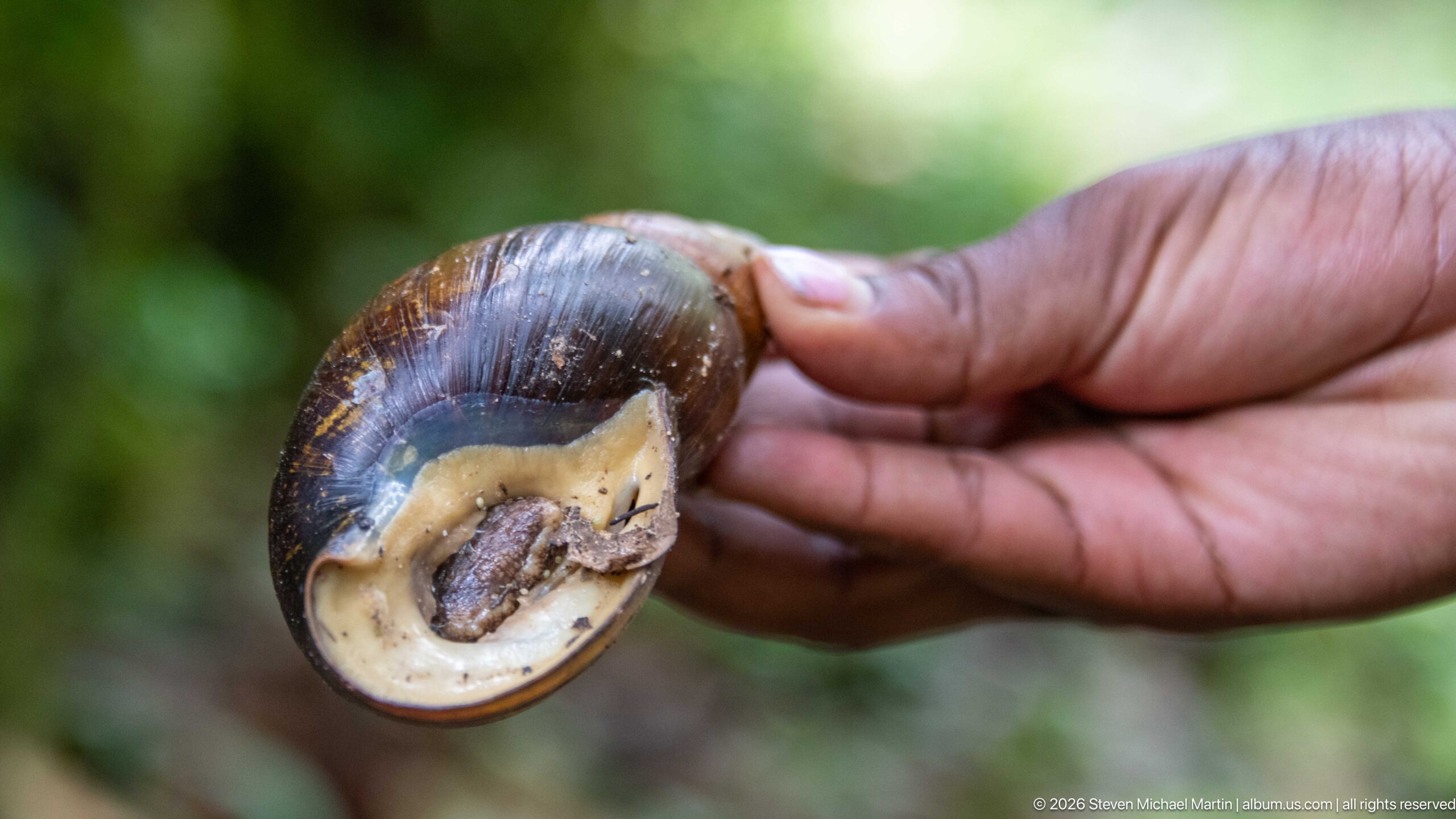
A large terrestrial snail is held close to the camera, revealing its glossy dark shell, pale aperture, and fleshy foot against a softly blurred forest background. The intimate scale records one of the moist-forest invertebrates encountered along the Munyaga Falls route and emphasizes shell form, texture, and the animal’s substantial size.
Caption
A large terrestrial snail is held close to the camera, revealing its glossy dark shell, pale aperture, and fleshy foot against a softly blurred forest background. The intimate scale records one of the moist-forest invertebrates encountered along the Munyaga Falls route and emphasizes shell form, texture, and the animal’s substantial size.
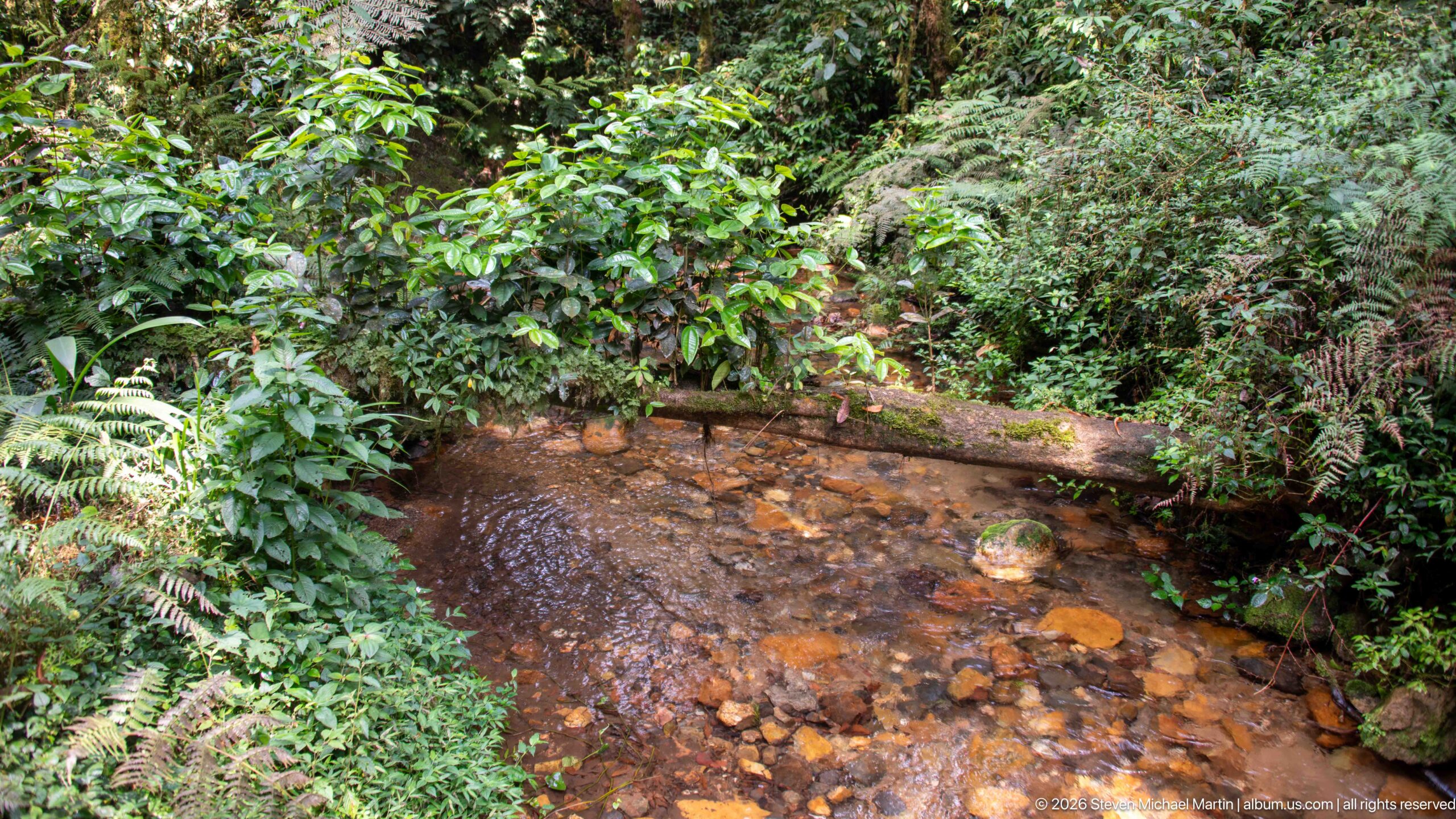
A shallow forest stream threads through dense vegetation, its clear brown-tinted water passing over rounded stones beneath ferns, shrubs, and overhanging trees. The view places the Munyaga Falls walk within Bwindi’s humid interior landscape, where small watercourses and saturated vegetation shape the trail environment before the main falls.
Caption
A shallow forest stream threads through dense vegetation, its clear brown-tinted water passing over rounded stones beneath ferns, shrubs, and overhanging trees. The view places the Munyaga Falls walk within Bwindi’s humid interior landscape, where small watercourses and saturated vegetation shape the trail environment before the main falls.
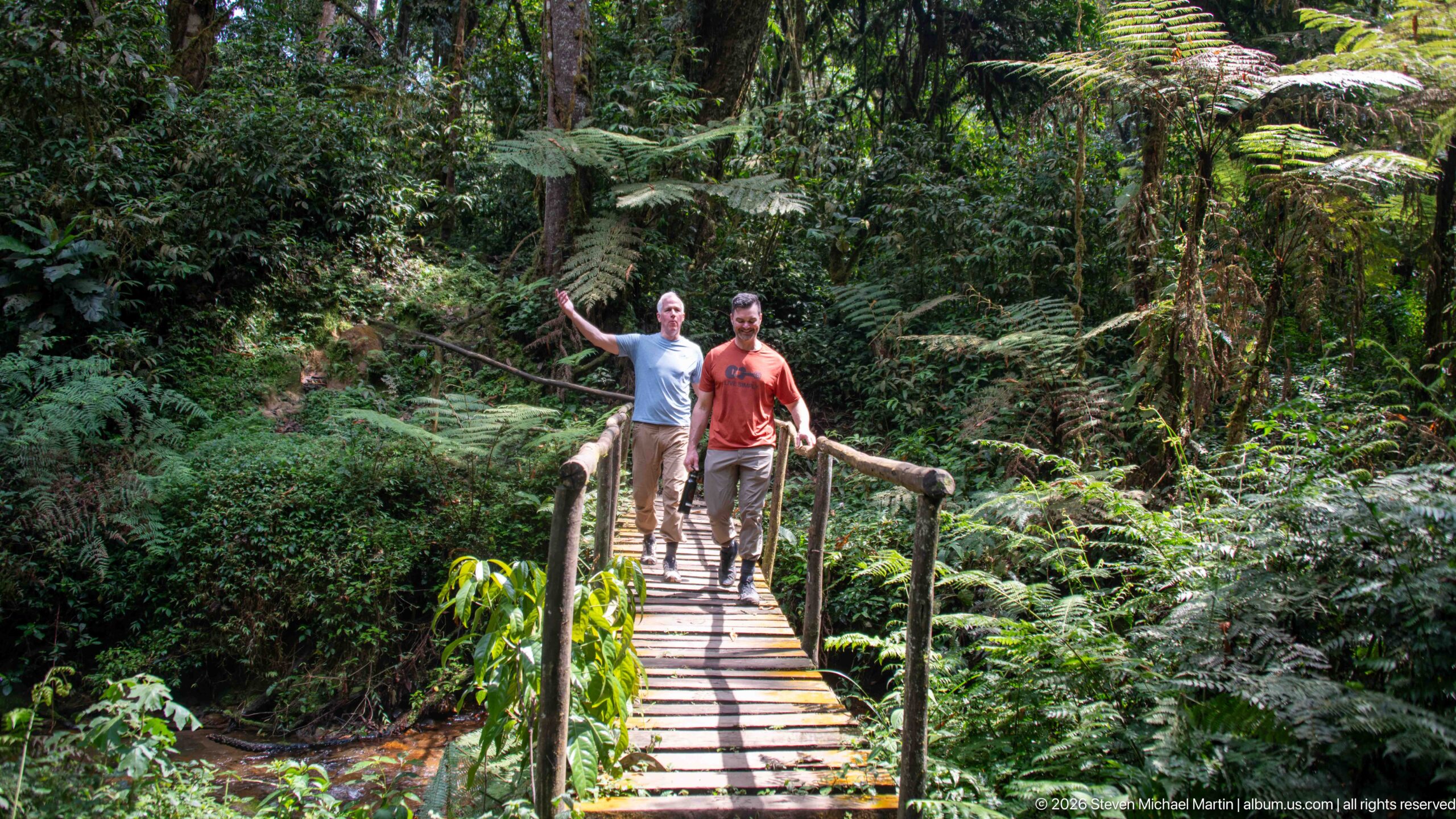
Two hikers cross a narrow wooden footbridge above a forest watercourse, surrounded by layered ferns and dense tropical vegetation. Rough timber rails and closely spaced planks underscore the practical trail infrastructure used on the Munyaga Falls walk, while the elevated viewpoint shows how the route negotiates wet ground and stream channels.
Caption
Two hikers cross a narrow wooden footbridge above a forest watercourse, surrounded by layered ferns and dense tropical vegetation. Rough timber rails and closely spaced planks underscore the practical trail infrastructure used on the Munyaga Falls walk, while the elevated viewpoint shows how the route negotiates wet ground and stream channels.
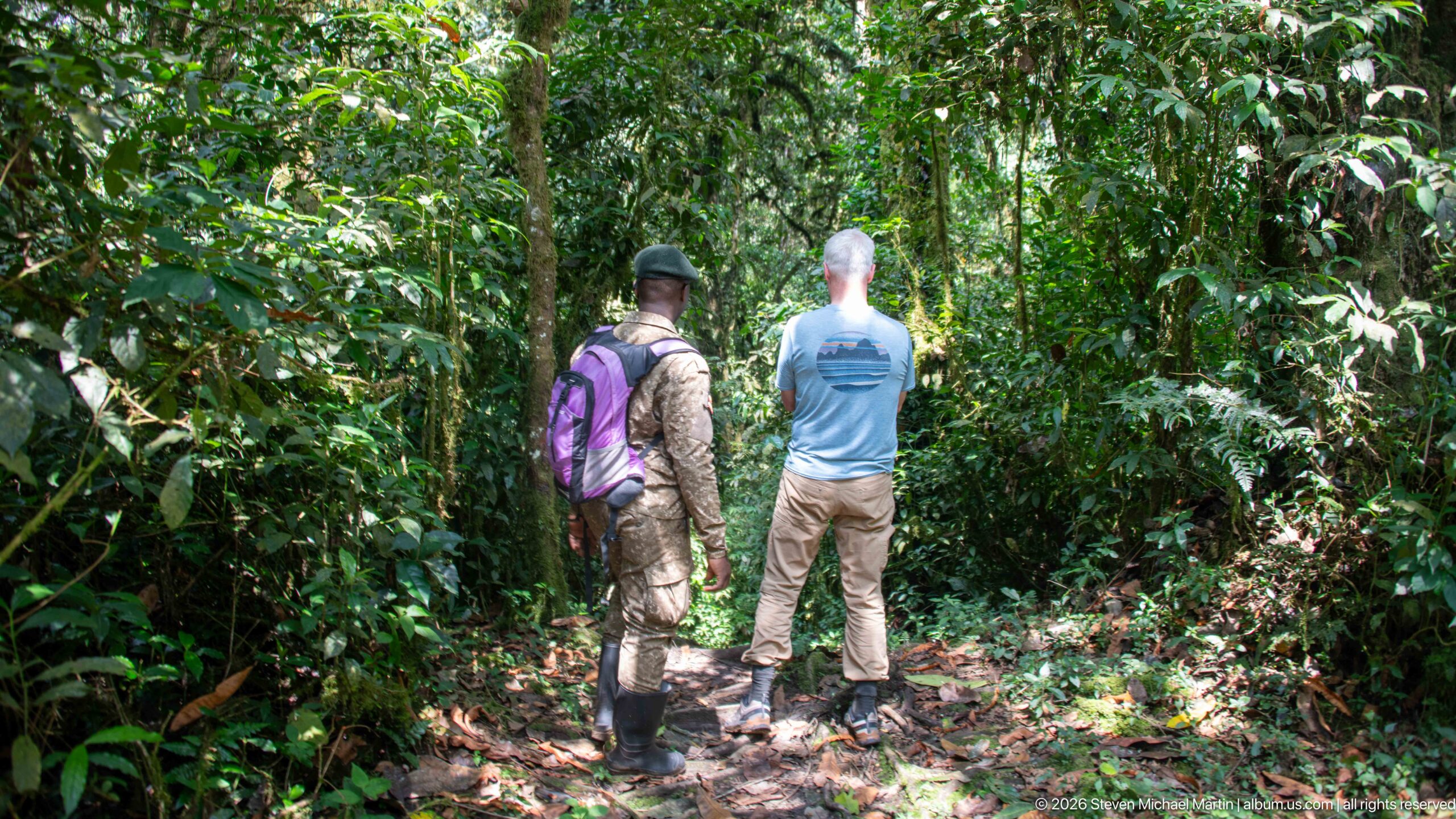
A visitor and a uniformed guide pause with their backs to the camera on a narrow, shaded forest path. Dense foliage closes around the route, and broken sunlight filters through the canopy ahead. The quiet pause contrasts with the earlier bridge crossings and records the guided, observational character of travel along the Munyaga Falls trail.
Caption
A visitor and a uniformed guide pause with their backs to the camera on a narrow, shaded forest path. Dense foliage closes around the route, and broken sunlight filters through the canopy ahead. The quiet pause contrasts with the earlier bridge crossings and records the guided, observational character of travel along the Munyaga Falls trail.
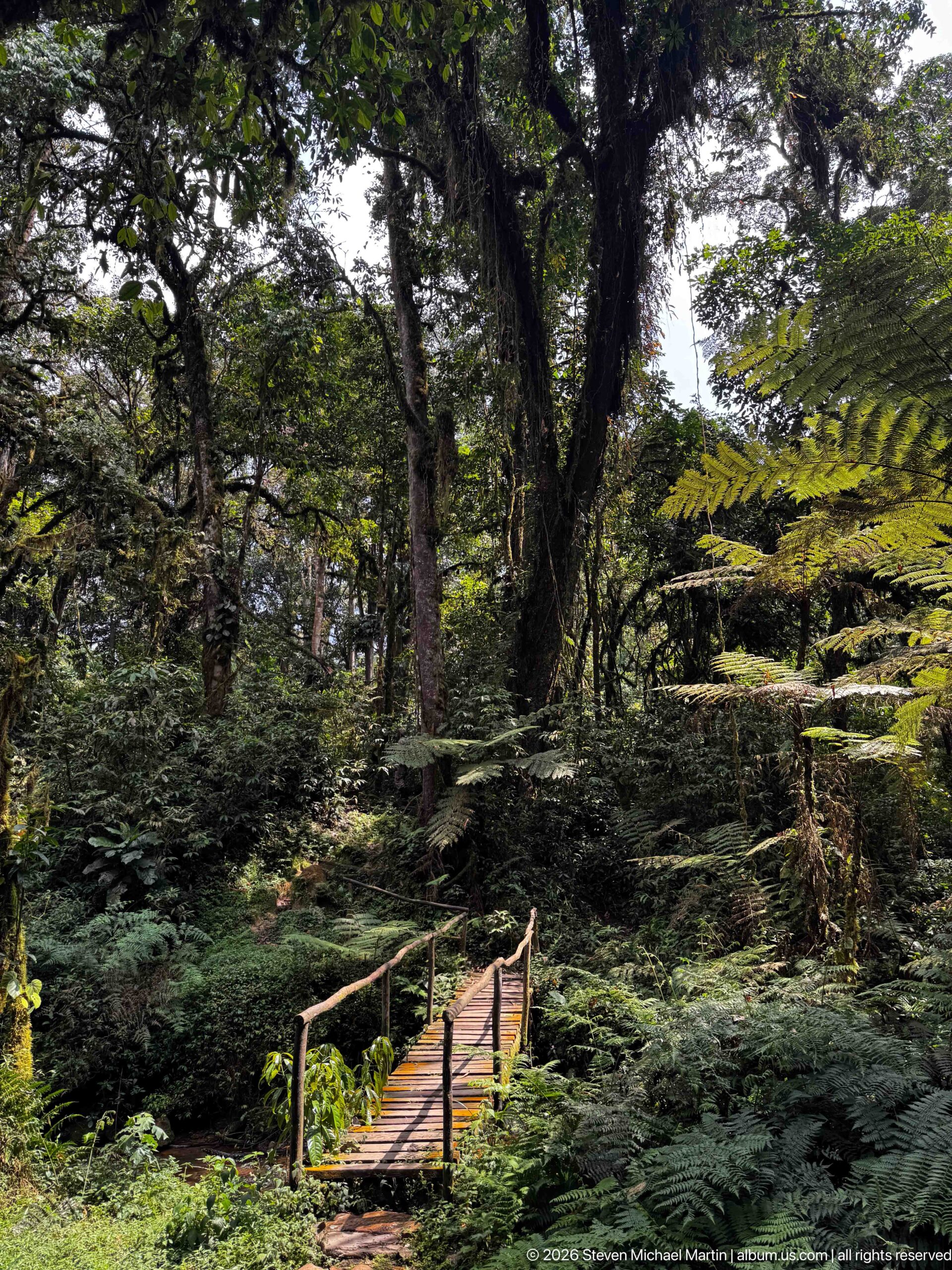
A narrow wooden bridge recedes beneath tall, moss-darkened forest trees and a canopy of broadleaf vegetation. With no people in the frame, attention shifts to the trail itself and to the layered understory of ferns and shrubs. The crossing appears as a modest built element within the much larger, humid forest environment of the Munyaga Falls route.
Caption
A narrow wooden bridge recedes beneath tall, moss-darkened forest trees and a canopy of broadleaf vegetation. With no people in the frame, attention shifts to the trail itself and to the layered understory of ferns and shrubs. The crossing appears as a modest built element within the much larger, humid forest environment of the Munyaga Falls route.
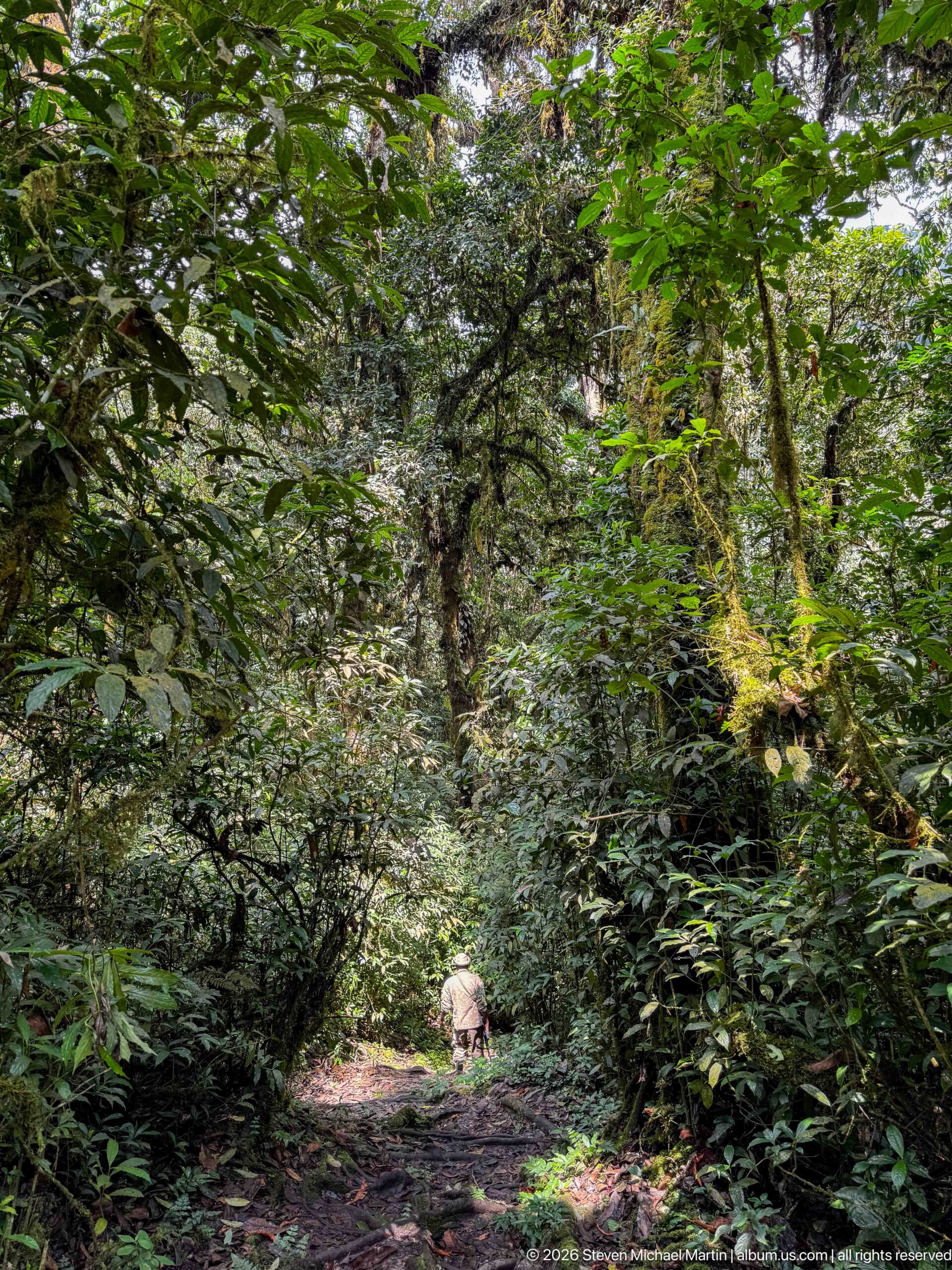
A lone person walks away along a dark earthen path as the forest closes overhead in layers of broad leaves, vines, and tall trunks. The small figure near the center provides scale and draws the eye into the depth of the trail, conveying the enclosed, tunnel-like character of Bwindi’s dense vegetation along the Munyaga Falls route.
Caption
A lone person walks away along a dark earthen path as the forest closes overhead in layers of broad leaves, vines, and tall trunks. The small figure near the center provides scale and draws the eye into the depth of the trail, conveying the enclosed, tunnel-like character of Bwindi’s dense vegetation along the Munyaga Falls route.

A smiling visitor is shown in a close portrait against softly focused ferns and bright green forest vegetation. Sunlight falls across his face and red shirt while the background remains distinctly tropical. The tight framing shifts attention away from trail infrastructure and landscape to the personal experience of the Munyaga Falls forest walk.
Caption
A smiling visitor is shown in a close portrait against softly focused ferns and bright green forest vegetation. Sunlight falls across his face and red shirt while the background remains distinctly tropical. The tight framing shifts attention away from trail infrastructure and landscape to the personal experience of the Munyaga Falls forest walk.
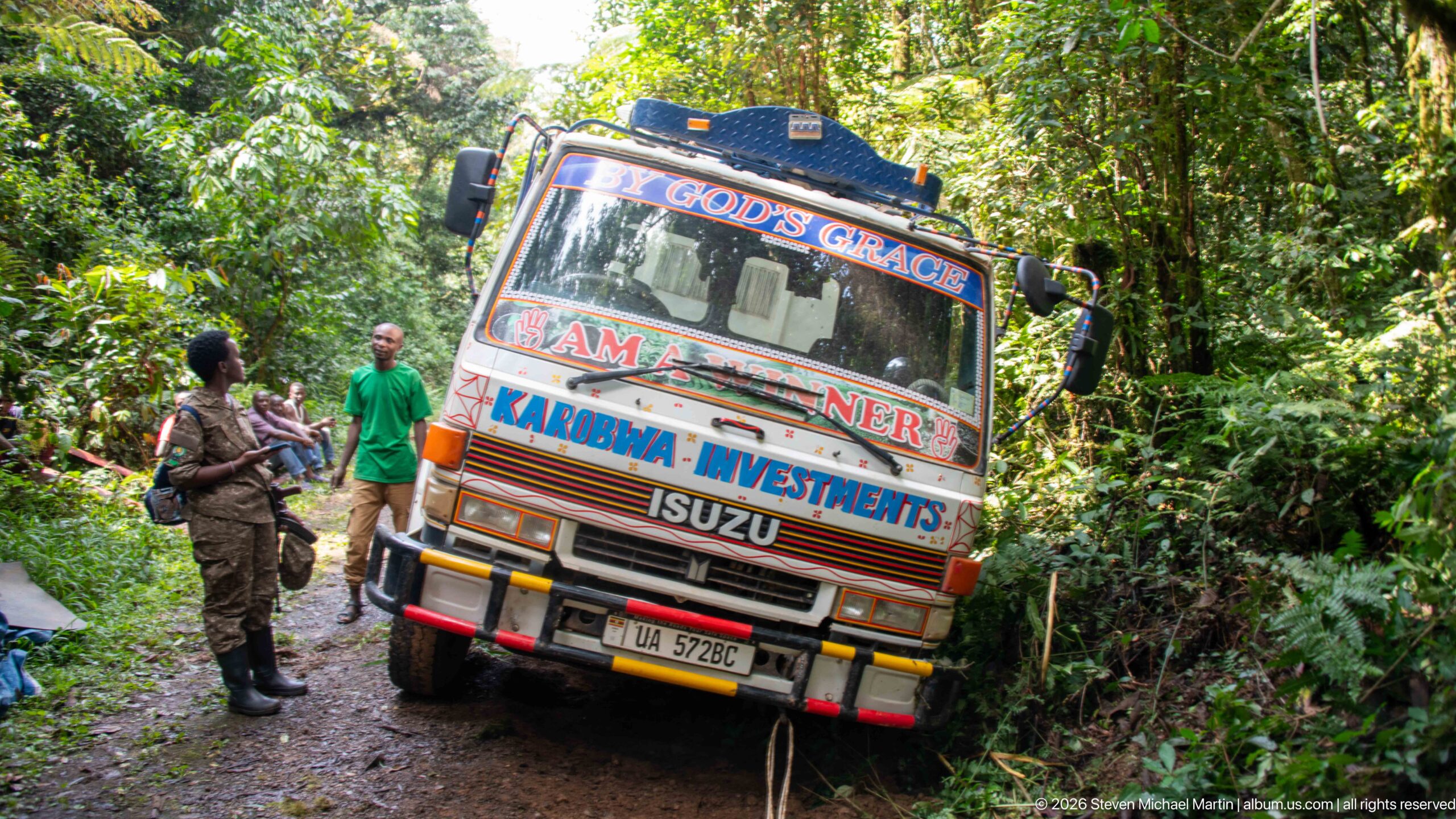
A brightly painted Isuzu truck occupies most of a narrow, deeply enclosed forest road while several people stand beside it. Hand-painted lettering and ornamental trim cover the cab, creating a vivid contrast with the surrounding vegetation. The scene records road access at the forest edge or along a confined approach route rather than the pedestrian trail itself.
Caption
A brightly painted Isuzu truck occupies most of a narrow, deeply enclosed forest road while several people stand beside it. Hand-painted lettering and ornamental trim cover the cab, creating a vivid contrast with the surrounding vegetation. The scene records road access at the forest edge or along a confined approach route rather than the pedestrian trail itself.
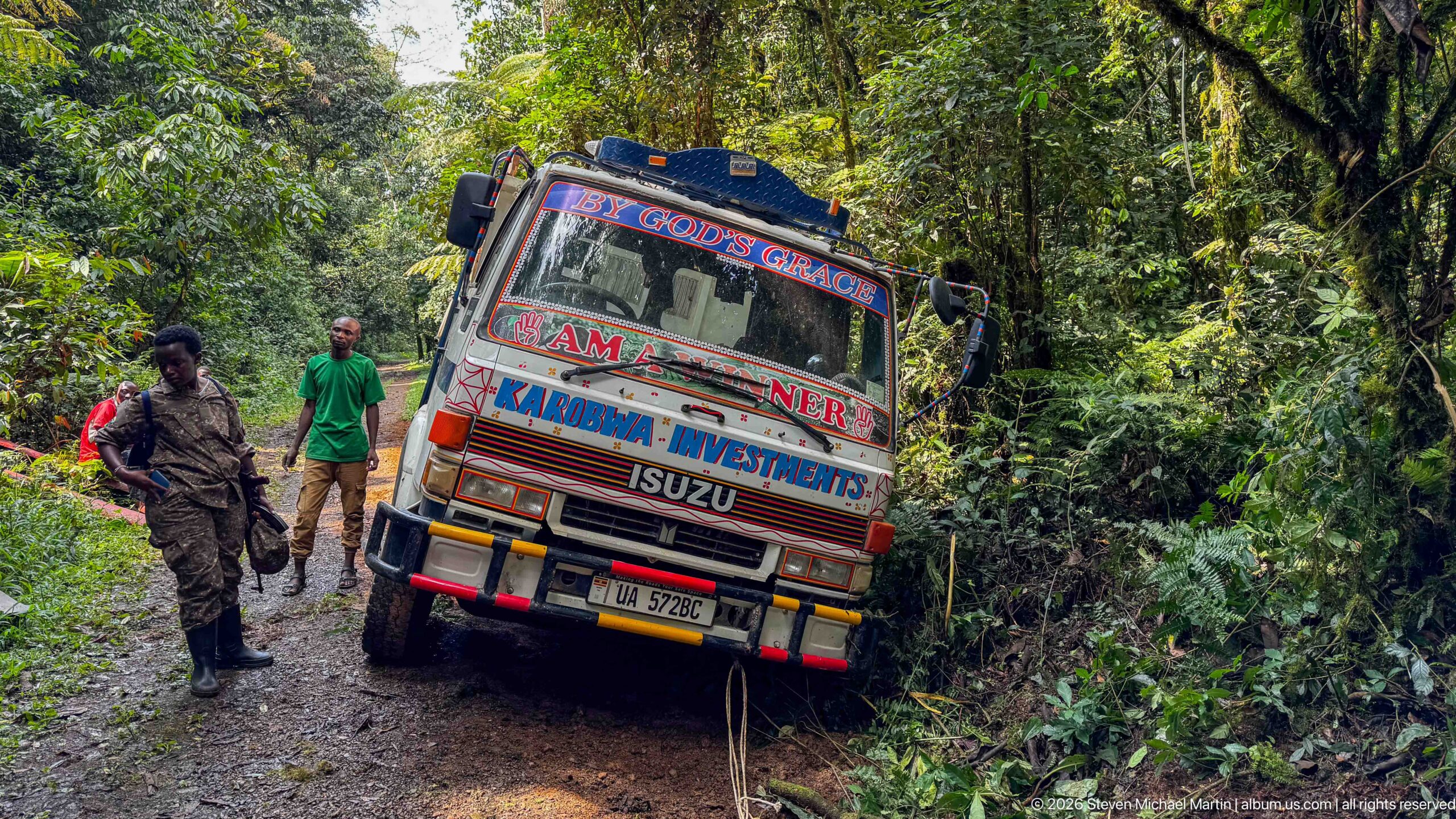
A decorated Isuzu truck sits at an angle on the confined dirt track while people stand nearby, emphasizing the narrowness and uneven footing of the road. Dense forest vegetation rises immediately on both sides. Compared with the closer frontal view, this frame gives more context for the vehicle’s position within the constrained approach route.
Caption
A decorated Isuzu truck sits at an angle on the confined dirt track while people stand nearby, emphasizing the narrowness and uneven footing of the road. Dense forest vegetation rises immediately on both sides. Compared with the closer frontal view, this frame gives more context for the vehicle’s position within the constrained approach route.
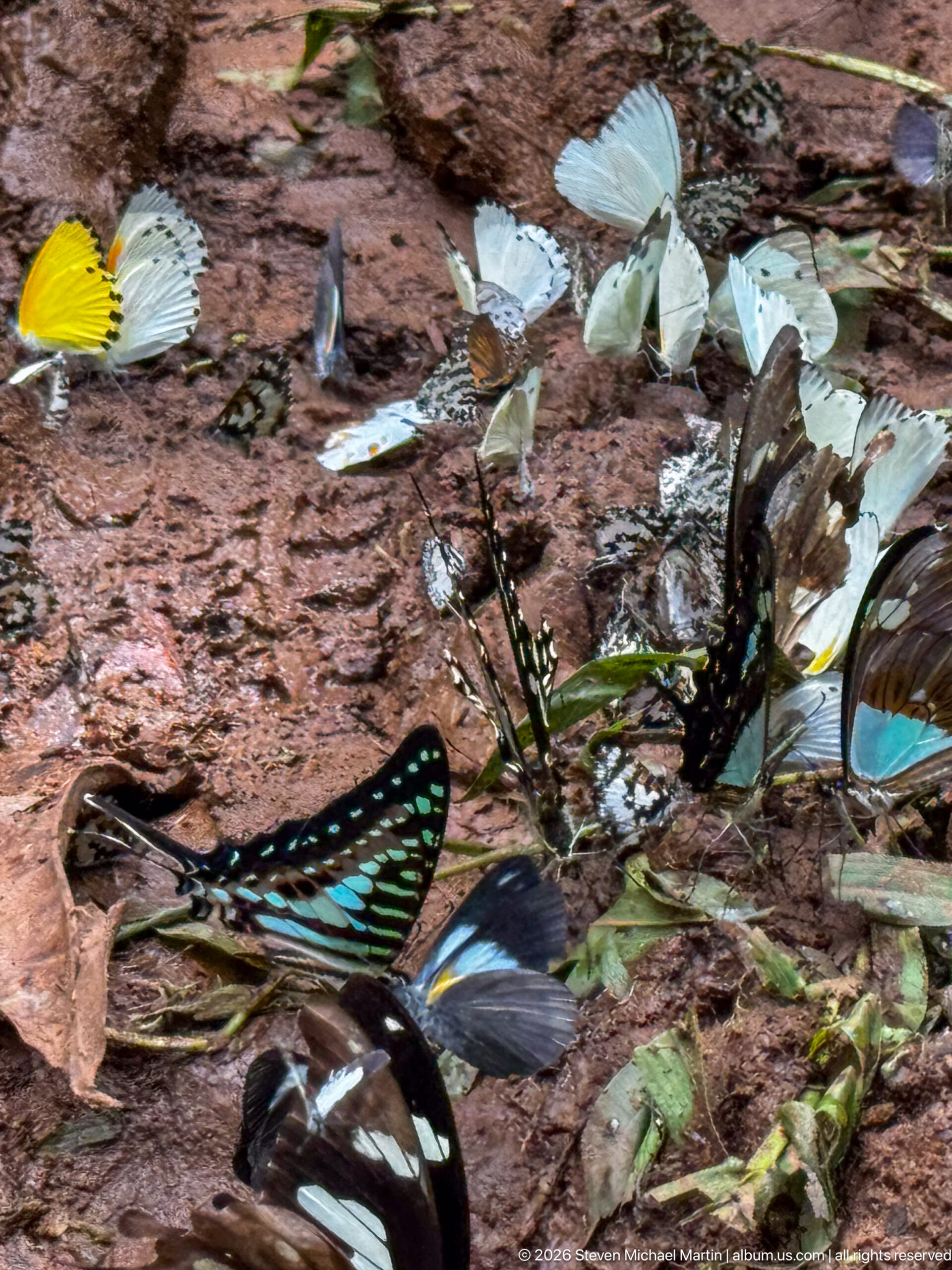
A mixed aggregation of butterflies gathers on damp, mineral-rich soil, with turquoise-banded swallowtails, pale white butterflies, and other patterned species feeding close together. The tightly framed ground-level view records mud-puddling behavior, in which butterflies congregate on wet earth to obtain dissolved salts and other nutrients.
Caption
A mixed aggregation of butterflies gathers on damp, mineral-rich soil, with turquoise-banded swallowtails, pale white butterflies, and other patterned species feeding close together. The tightly framed ground-level view records mud-puddling behavior, in which butterflies congregate on wet earth to obtain dissolved salts and other nutrients.
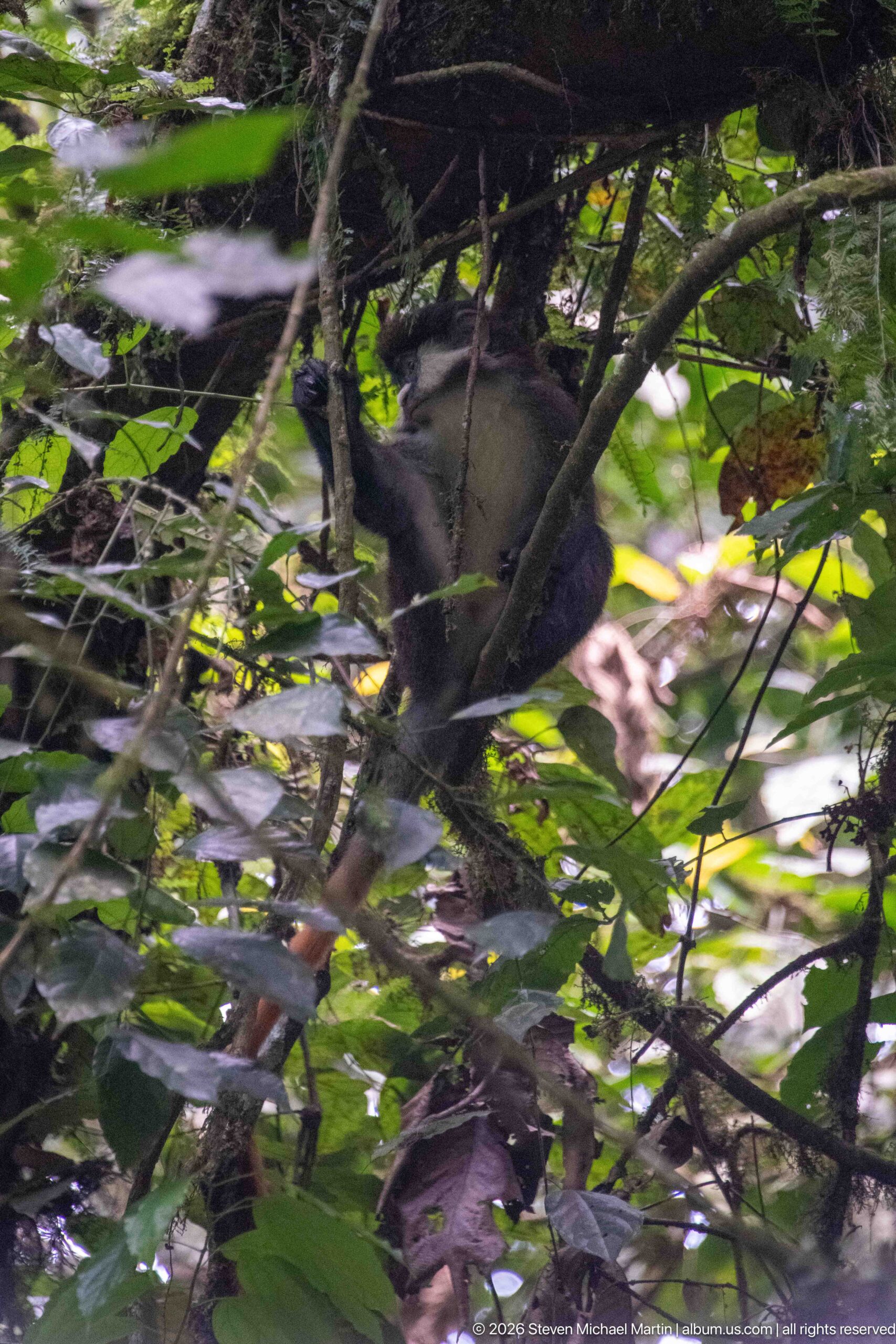
A dark-furred monkey moves through tangled branches high in the understory, partly obscured by leaves and vines. Its long limbs and tail are visible against patches of green foliage, but the animal’s face and diagnostic markings are not clearly resolved. The frame emphasizes the difficulty of observing arboreal primates within Bwindi’s dense vegetation.
Caption
A dark-furred monkey moves through tangled branches high in the understory, partly obscured by leaves and vines. Its long limbs and tail are visible against patches of green foliage, but the animal’s face and diagnostic markings are not clearly resolved. The frame emphasizes the difficulty of observing arboreal primates within Bwindi’s dense vegetation.
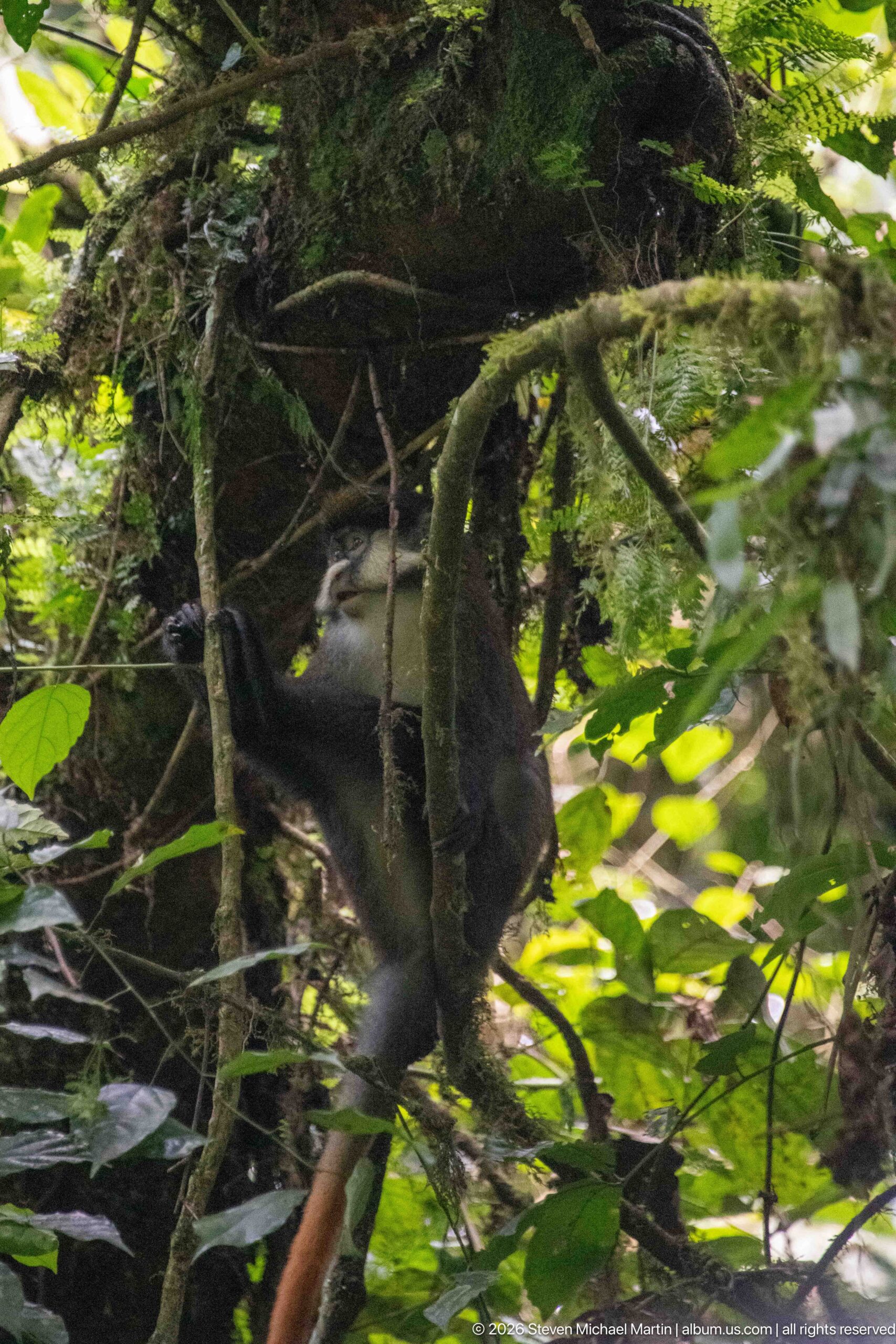
A monkey climbs through a dense lattice of branches and vines, its body silhouetted against brighter foliage. The animal is closer than in the preceding frame, yet vegetation still conceals much of the head and torso. The photograph records movement rather than a diagnostic portrait, making the forest structure itself an important part of the wildlife encounter.
Caption
A monkey climbs through a dense lattice of branches and vines, its body silhouetted against brighter foliage. The animal is closer than in the preceding frame, yet vegetation still conceals much of the head and torso. The photograph records movement rather than a diagnostic portrait, making the forest structure itself an important part of the wildlife encounter.
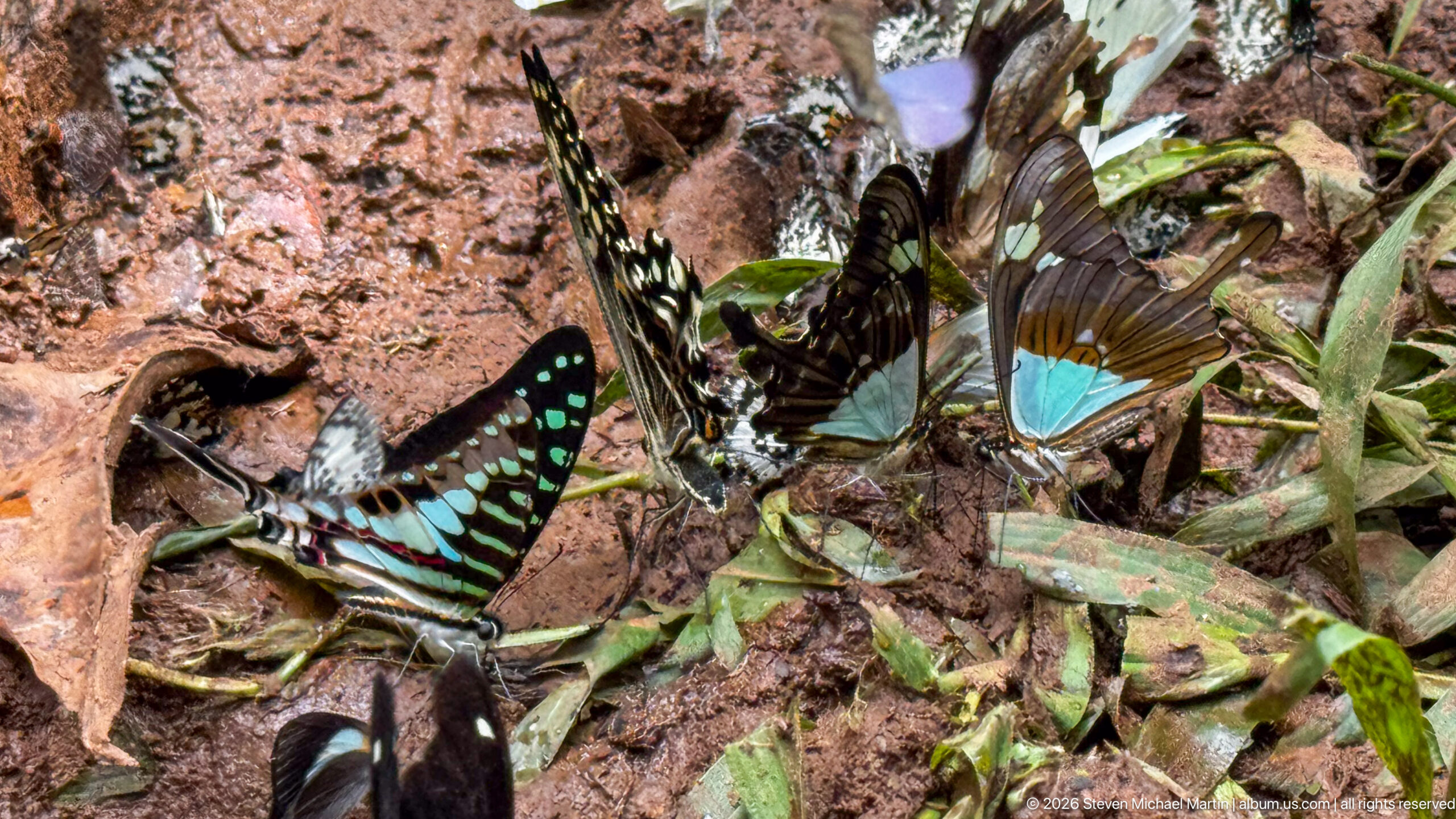
Several butterflies crowd a patch of wet soil and leaf litter, dominated by dark swallowtails marked with luminous blue-green bands. Paler butterflies and differently patterned individuals share the feeding site. The close view highlights the diversity of forms within a single mud-puddling aggregation and the repeated use of moist ground as a nutrient source.
Caption
Several butterflies crowd a patch of wet soil and leaf litter, dominated by dark swallowtails marked with luminous blue-green bands. Paler butterflies and differently patterned individuals share the feeding site. The close view highlights the diversity of forms within a single mud-puddling aggregation and the repeated use of moist ground as a nutrient source.
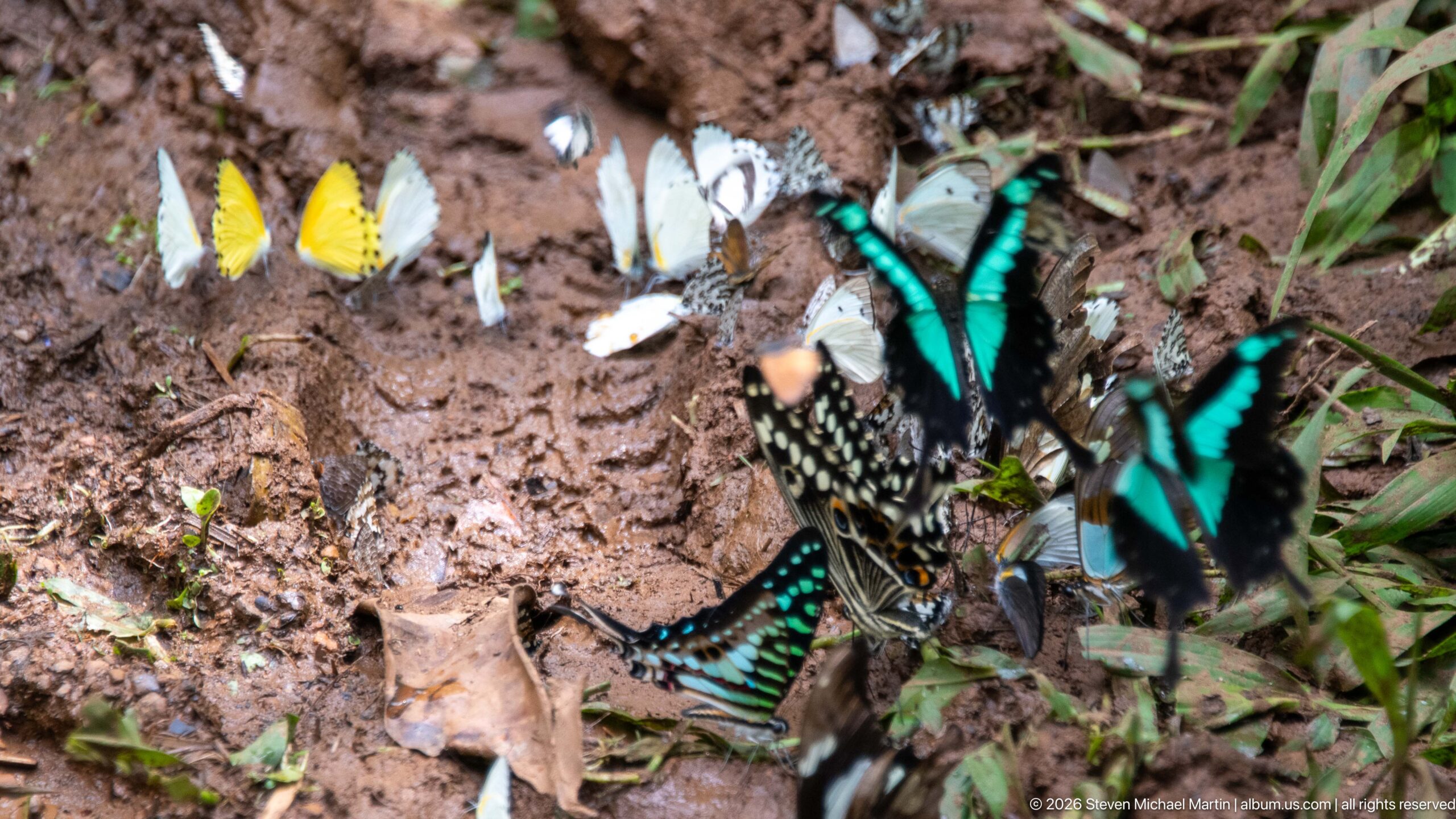
Bright yellow, white, black, and blue-green butterflies gather across a small patch of moist forest ground. Several swallowtails overlap near the center while lighter butterflies feed around them. The vertical composition shows how densely individuals can concentrate at a favorable mud-puddling site, creating a localized burst of color on the otherwise brown forest floor.
Caption
Bright yellow, white, black, and blue-green butterflies gather across a small patch of moist forest ground. Several swallowtails overlap near the center while lighter butterflies feed around them. The vertical composition shows how densely individuals can concentrate at a favorable mud-puddling site, creating a localized burst of color on the otherwise brown forest floor.
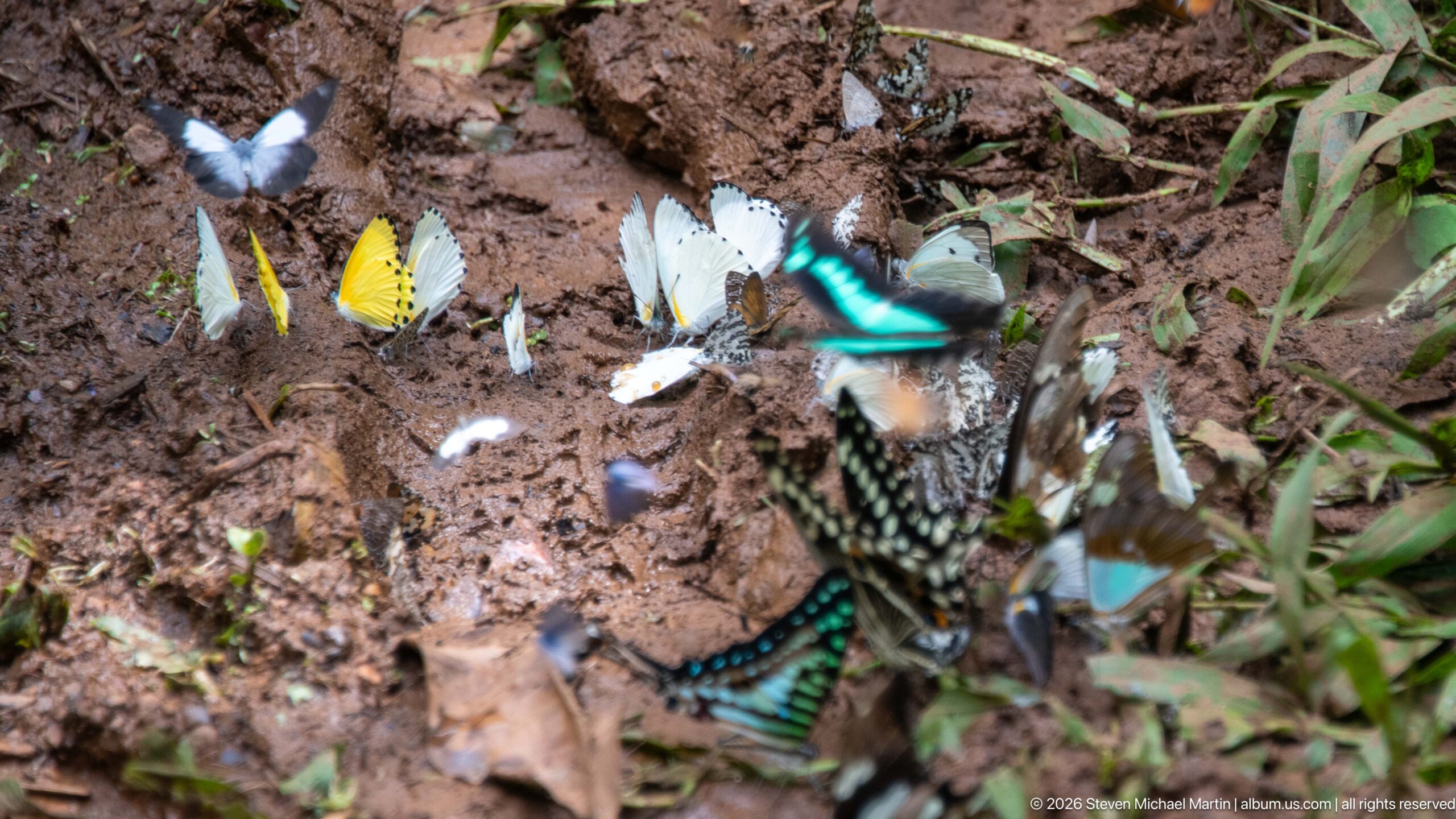
A loose ring of pale butterflies surrounds several darker swallowtails on wet, trampled soil. One blue-green butterfly crosses the upper right in motion, adding a sense of constant activity around the mineral patch. The composition records both settled and flying individuals at the same feeding site, illustrating the dynamic nature of a mud-puddling congregation.
Caption
A loose ring of pale butterflies surrounds several darker swallowtails on wet, trampled soil. One blue-green butterfly crosses the upper right in motion, adding a sense of constant activity around the mineral patch. The composition records both settled and flying individuals at the same feeding site, illustrating the dynamic nature of a mud-puddling congregation.
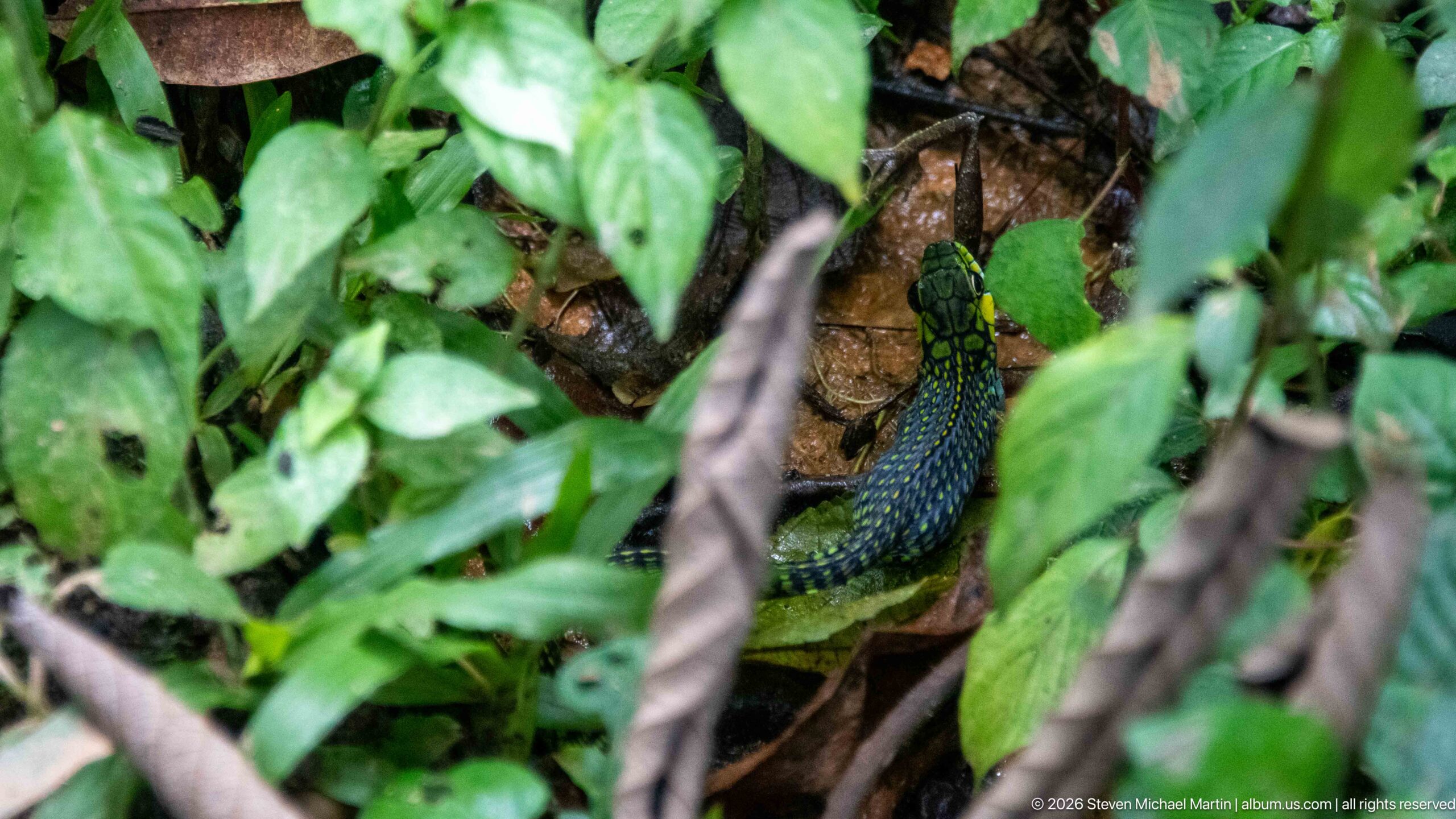
A slender snake with vivid green-and-black scaling moves through wet leaves and low vegetation on the forest floor. Only part of the body and head region is visible between foliage, but the contrasting coloration stands out sharply against the brown litter. The proof-sheet view supports a forest-snake identification without resolving enough diagnostic detail for a confident species name.
Caption
A slender snake with vivid green-and-black scaling moves through wet leaves and low vegetation on the forest floor. Only part of the body and head region is visible between foliage, but the contrasting coloration stands out sharply against the brown litter. The proof-sheet view supports a forest-snake identification without resolving enough diagnostic detail for a confident species name.
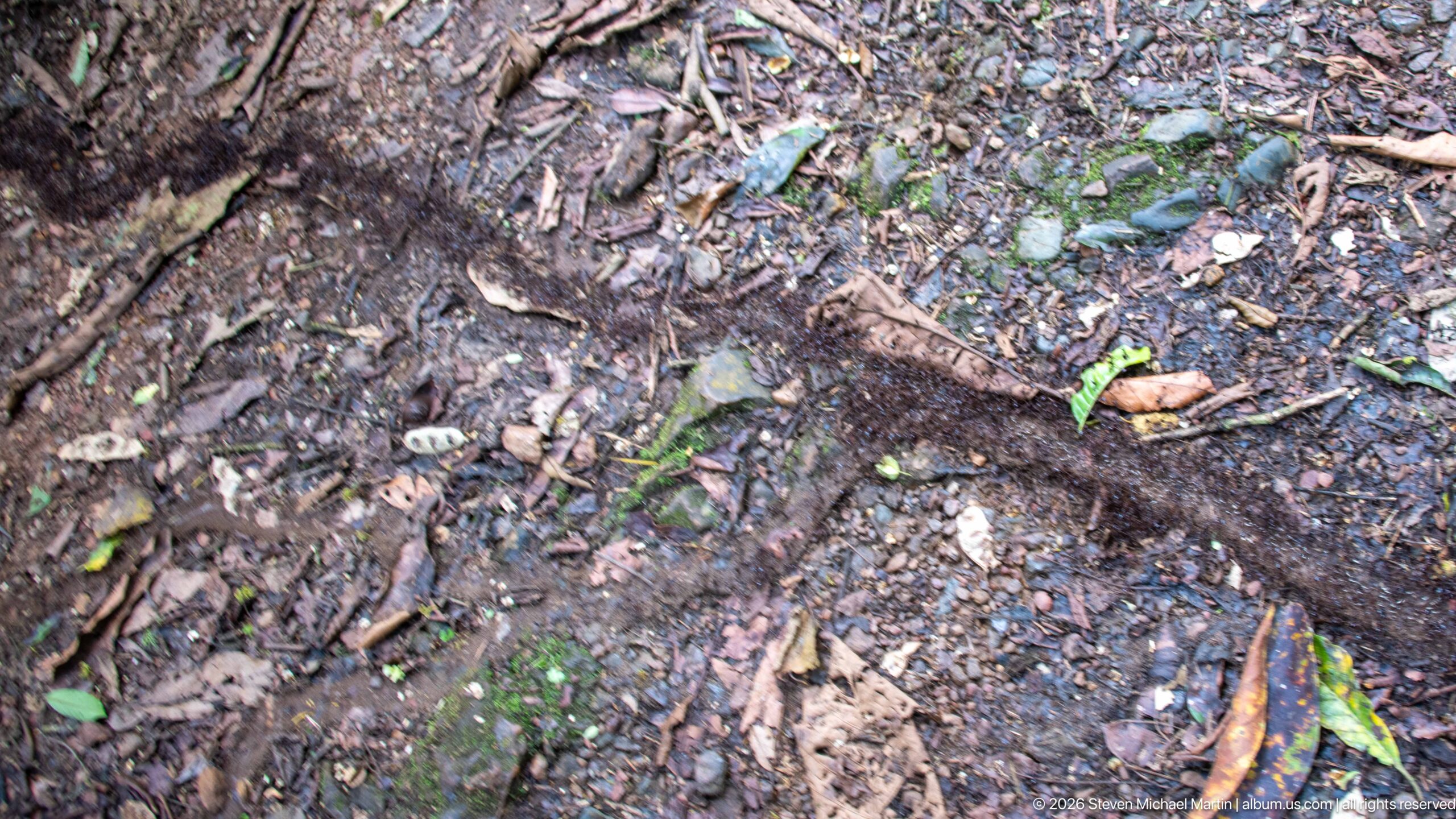
A broad, deep track-like depression interrupts the damp forest path among exposed roots, stones, and leaf fragments. The mark appears larger and more defined than surrounding surface irregularities, suggesting passage by a substantial animal, but the proof-sheet resolution does not preserve enough toe, pad, or hoof detail for a defensible identification.
Caption
A broad, deep track-like depression interrupts the damp forest path among exposed roots, stones, and leaf fragments. The mark appears larger and more defined than surrounding surface irregularities, suggesting passage by a substantial animal, but the proof-sheet resolution does not preserve enough toe, pad, or hoof detail for a defensible identification.
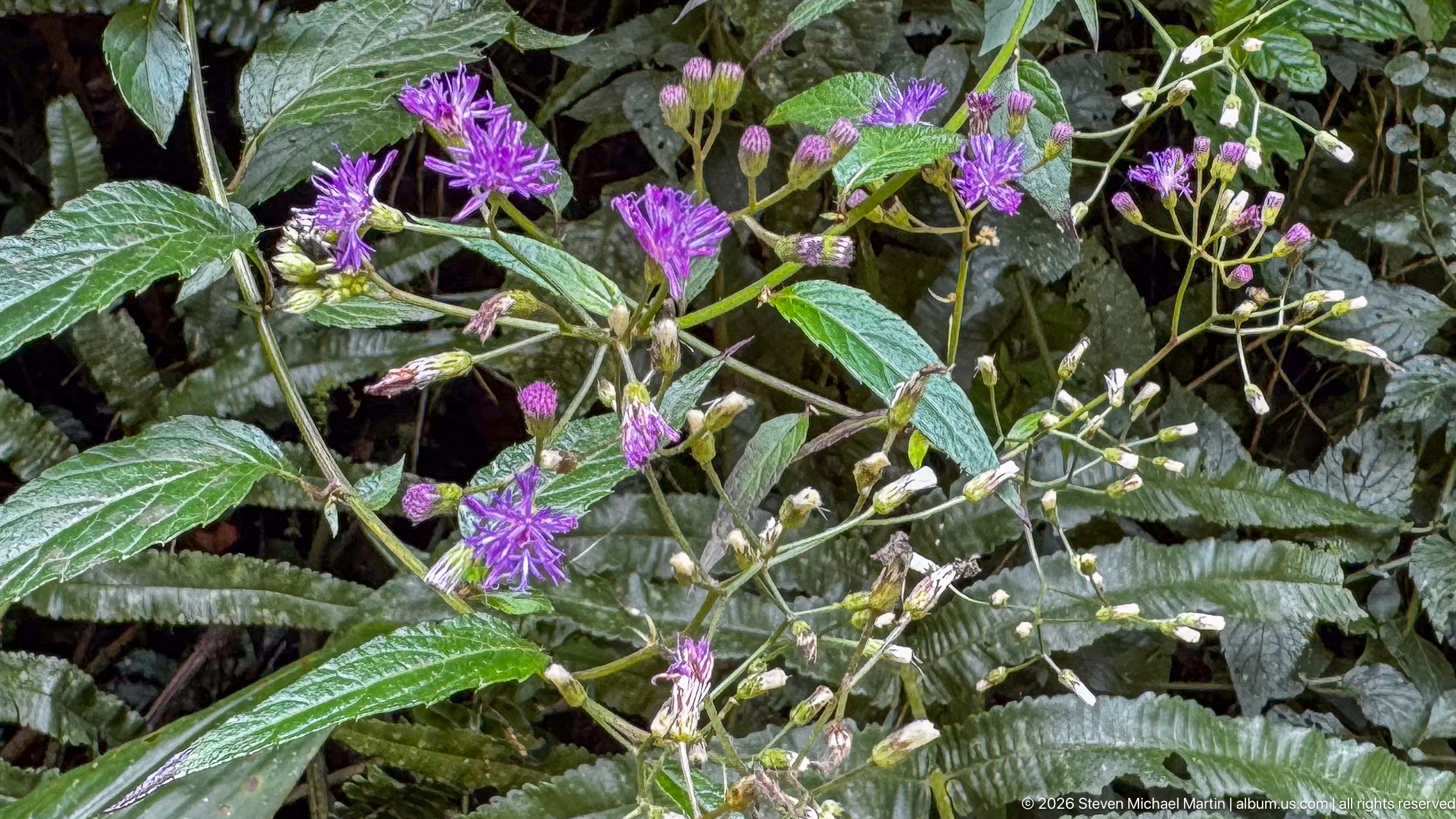
Clusters of small purple flower heads rise above serrated green leaves in a patch of moist vegetation. Buds at different stages surround the open blooms, giving the frame a botanical-study quality. The flower form suggests a member of the daisy family, but the proof-sheet image does not provide enough diagnostic detail for a secure genus or species assignment.
Caption
Clusters of small purple flower heads rise above serrated green leaves in a patch of moist vegetation. Buds at different stages surround the open blooms, giving the frame a botanical-study quality. The flower form suggests a member of the daisy family, but the proof-sheet image does not provide enough diagnostic detail for a secure genus or species assignment.
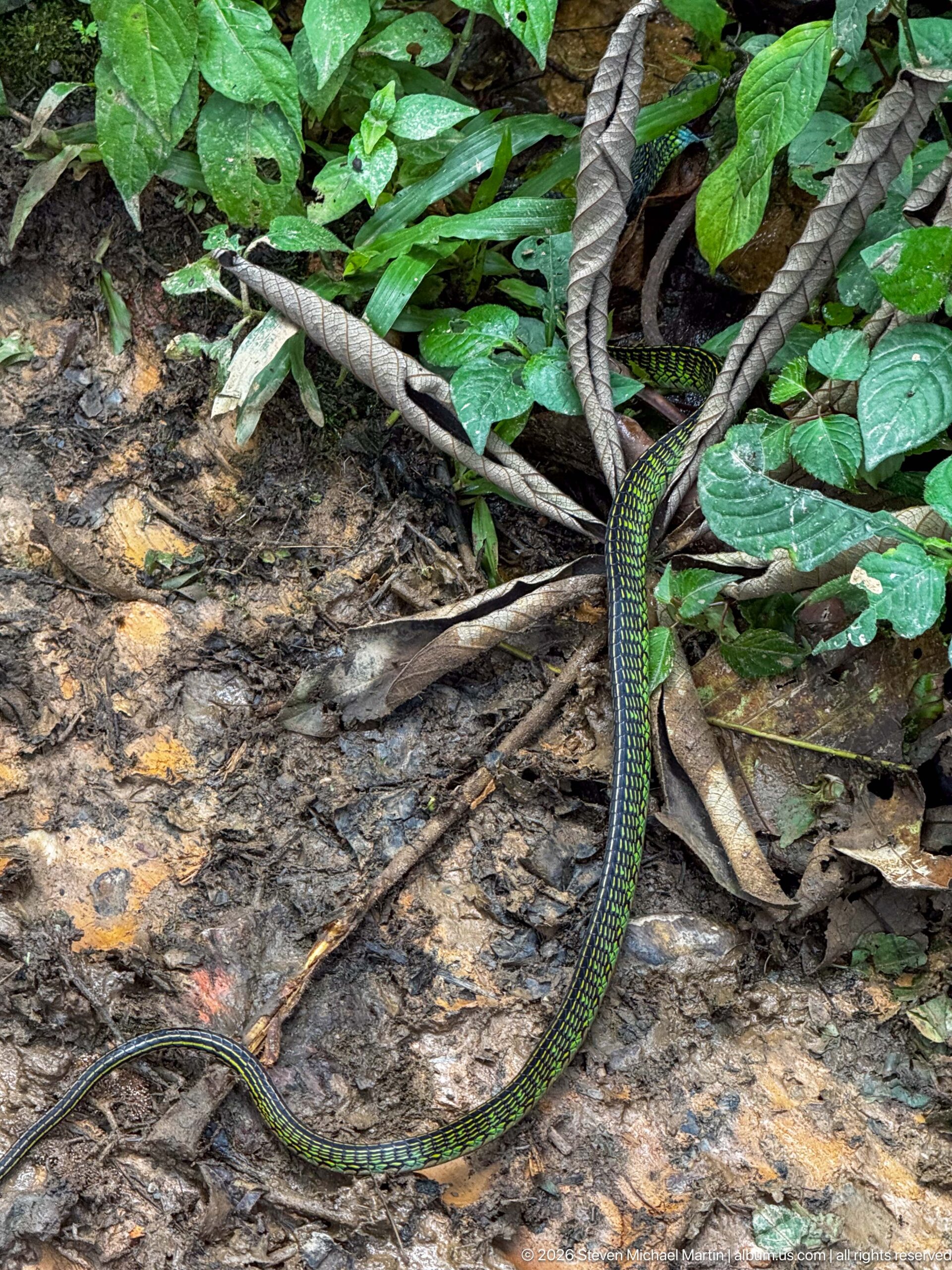
A long, slender snake lies partly extended across the damp forest margin, its green-and-dark patterned body contrasting with brown soil, exposed roots, and broad leaves. This wider view shows more of the snake’s length than the preceding close frame, but the head remains too indistinct for reliable species-level identification.
Caption
A long, slender snake lies partly extended across the damp forest margin, its green-and-dark patterned body contrasting with brown soil, exposed roots, and broad leaves. This wider view shows more of the snake’s length than the preceding close frame, but the head remains too indistinct for reliable species-level identification.
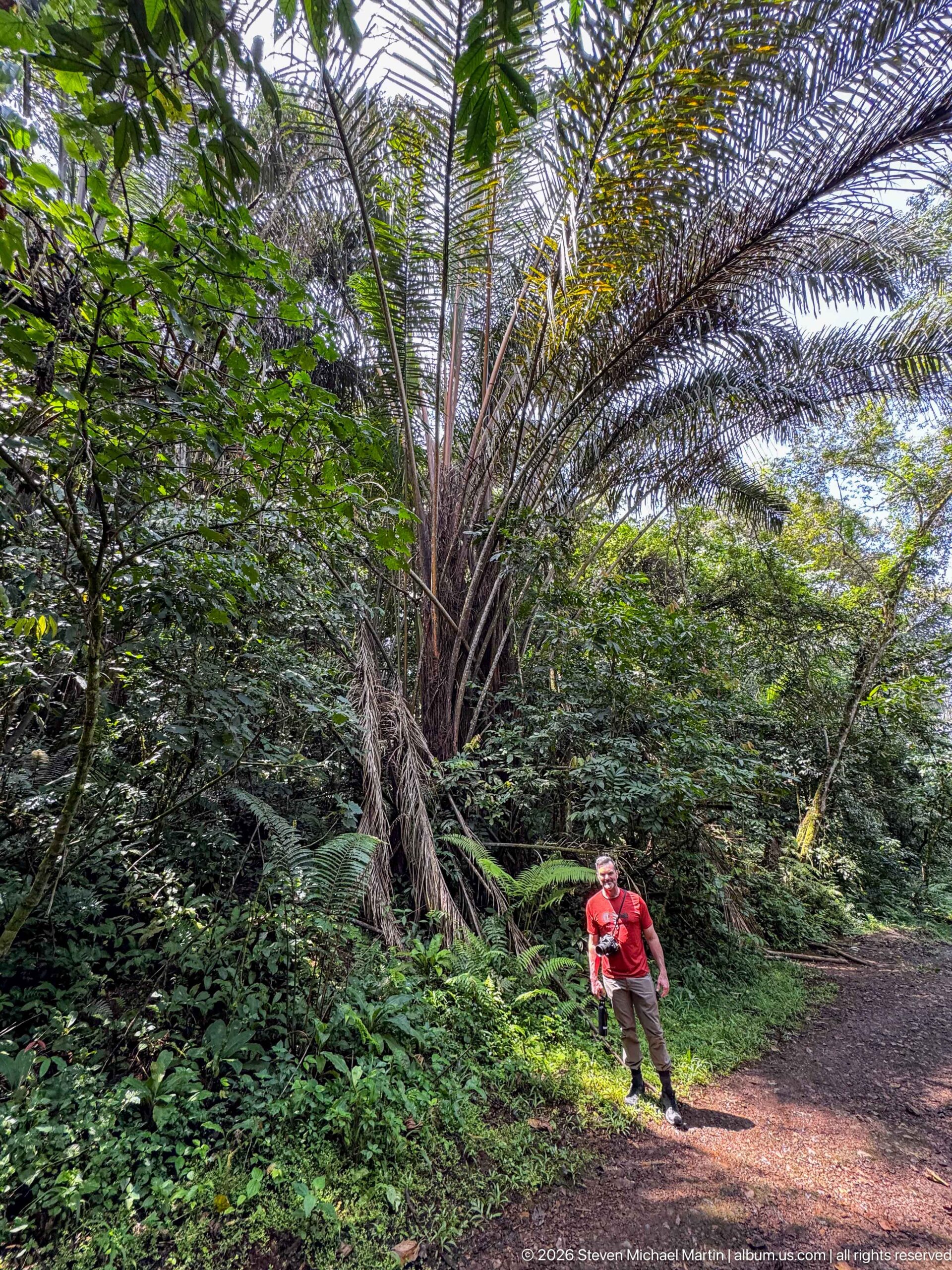
A visitor stands beneath the spreading fronds of a large palm-like plant at the edge of a forest path, providing a strong sense of scale. The broad composition opens slightly compared with the enclosed trail views, showing a small clearing framed by dense vegetation and the dramatic radial structure of the plant’s crown.
Caption
A visitor stands beneath the spreading fronds of a large palm-like plant at the edge of a forest path, providing a strong sense of scale. The broad composition opens slightly compared with the enclosed trail views, showing a small clearing framed by dense vegetation and the dramatic radial structure of the plant’s crown.
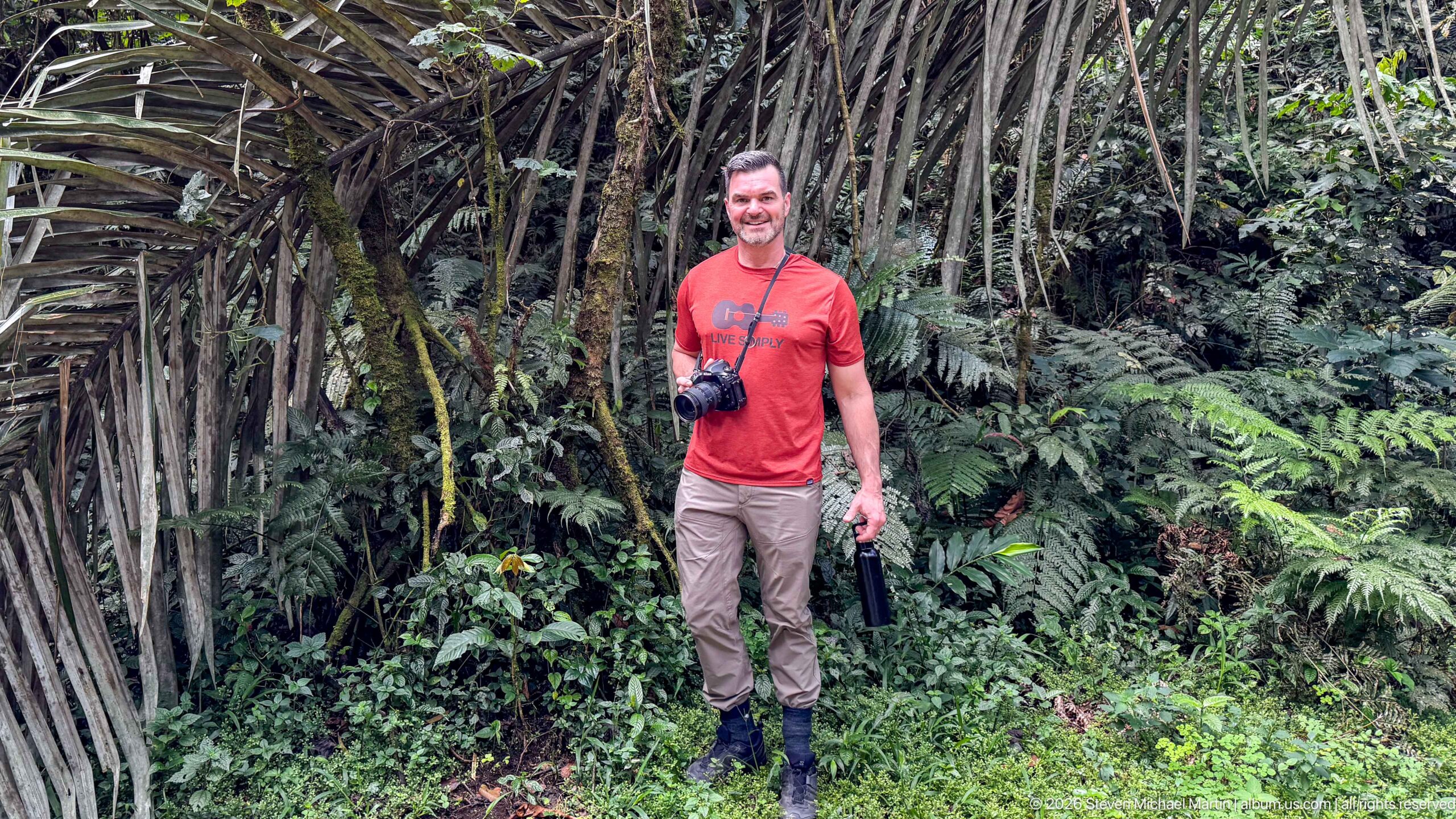
A visitor stands on the trail beside a dense wall of tall, cane-like stems, with ferns and other understory plants filling the background. Camera gear hangs at his chest and a bottle is carried at his side. The portrait provides scale for the thick vegetation and records the human experience of moving through Bwindi’s varied forest structure.
Caption
A visitor stands on the trail beside a dense wall of tall, cane-like stems, with ferns and other understory plants filling the background. Camera gear hangs at his chest and a bottle is carried at his side. The portrait provides scale for the thick vegetation and records the human experience of moving through Bwindi’s varied forest structure.
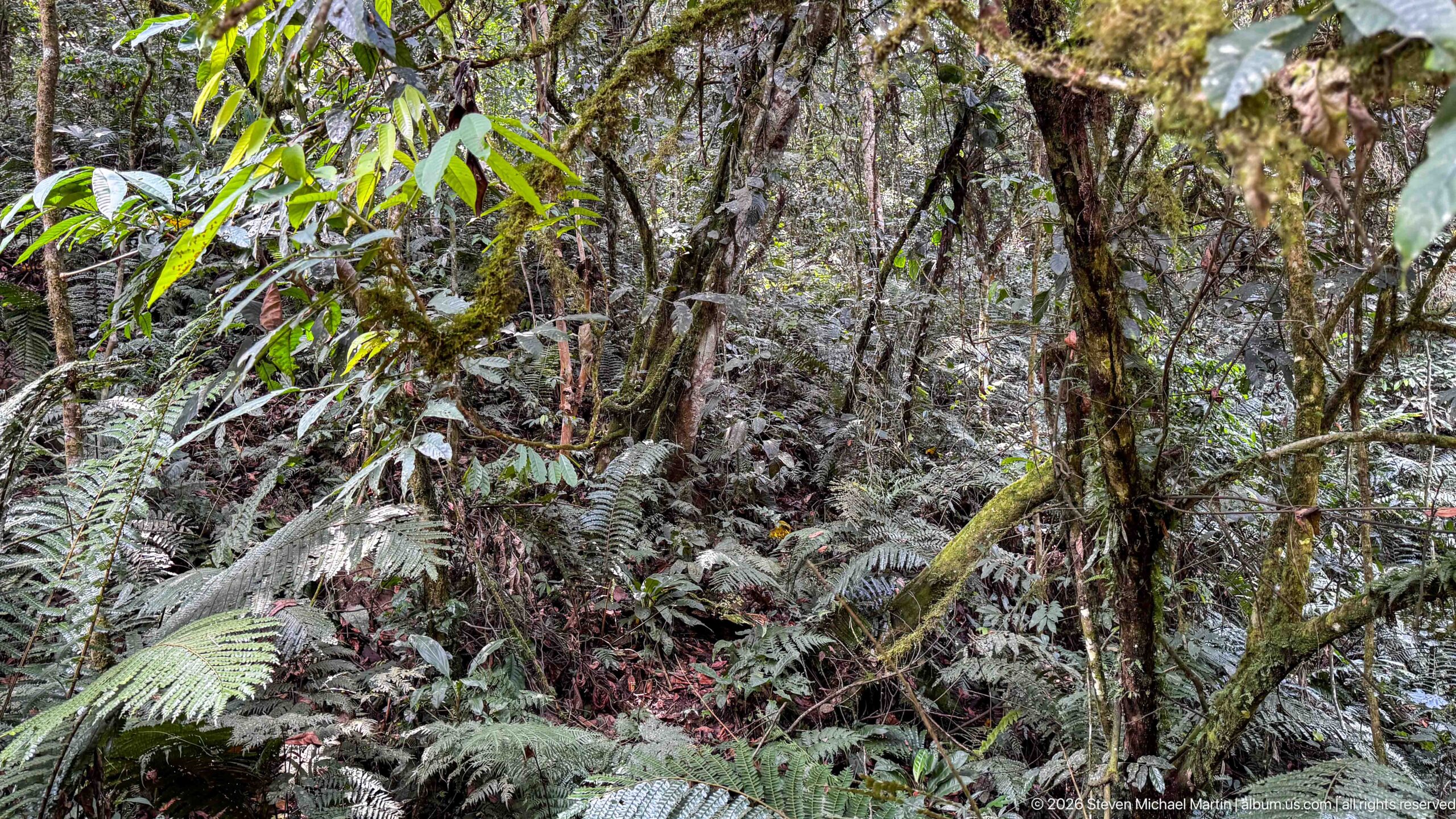
An intricate forest interior fills the frame with moss-coated trunks, arching branches, ferns, vines, and layered broadleaf vegetation. No single tree dominates; instead, the composition emphasizes the density and vertical complexity of Bwindi’s humid forest. The view functions as an environmental study of the vegetation encountered along the Munyaga Falls route.
Caption
An intricate forest interior fills the frame with moss-coated trunks, arching branches, ferns, vines, and layered broadleaf vegetation. No single tree dominates; instead, the composition emphasizes the density and vertical complexity of Bwindi’s humid forest. The view functions as an environmental study of the vegetation encountered along the Munyaga Falls route.
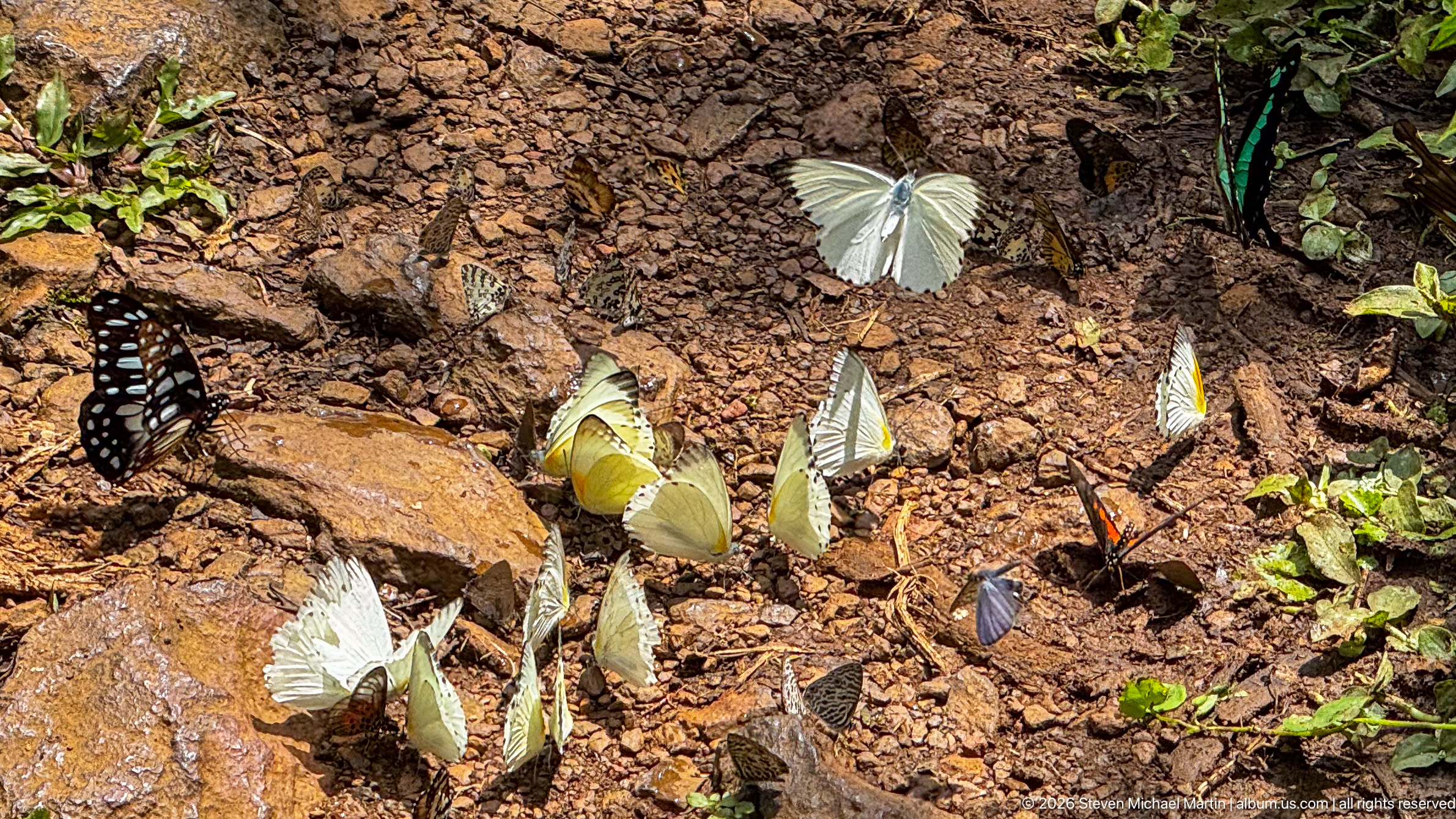
White, yellow, black, and green-blue butterflies crowd a sunlit patch of moist earth and small stones. Some rest with wings closed while others expose bold dorsal patterns, creating a varied study of form and color. The congregation is characteristic of mud-puddling behavior at a mineral-rich spot on the forest floor.
Caption
White, yellow, black, and green-blue butterflies crowd a sunlit patch of moist earth and small stones. Some rest with wings closed while others expose bold dorsal patterns, creating a varied study of form and color. The congregation is characteristic of mud-puddling behavior at a mineral-rich spot on the forest floor.
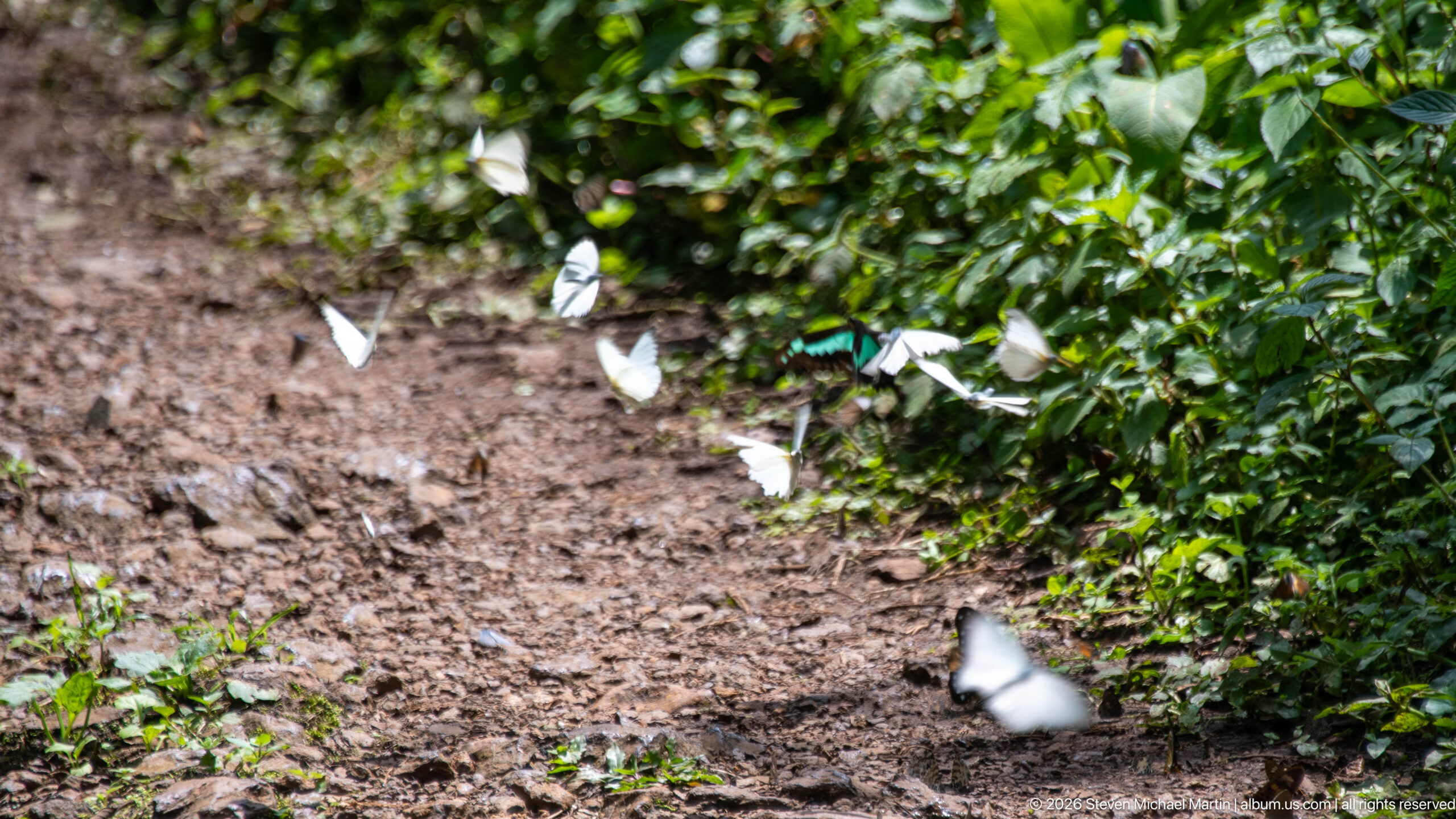
A loose cloud of pale butterflies lifts from the damp forest track, with several individuals frozen in flight against the darker vegetation. Unlike the tightly packed feeding groups, this frame emphasizes movement and dispersal around the mud-puddling site. The shallow path and low greenery provide context for the insects’ activity at ground level.
Caption
A loose cloud of pale butterflies lifts from the damp forest track, with several individuals frozen in flight against the darker vegetation. Unlike the tightly packed feeding groups, this frame emphasizes movement and dispersal around the mud-puddling site. The shallow path and low greenery provide context for the insects’ activity at ground level.
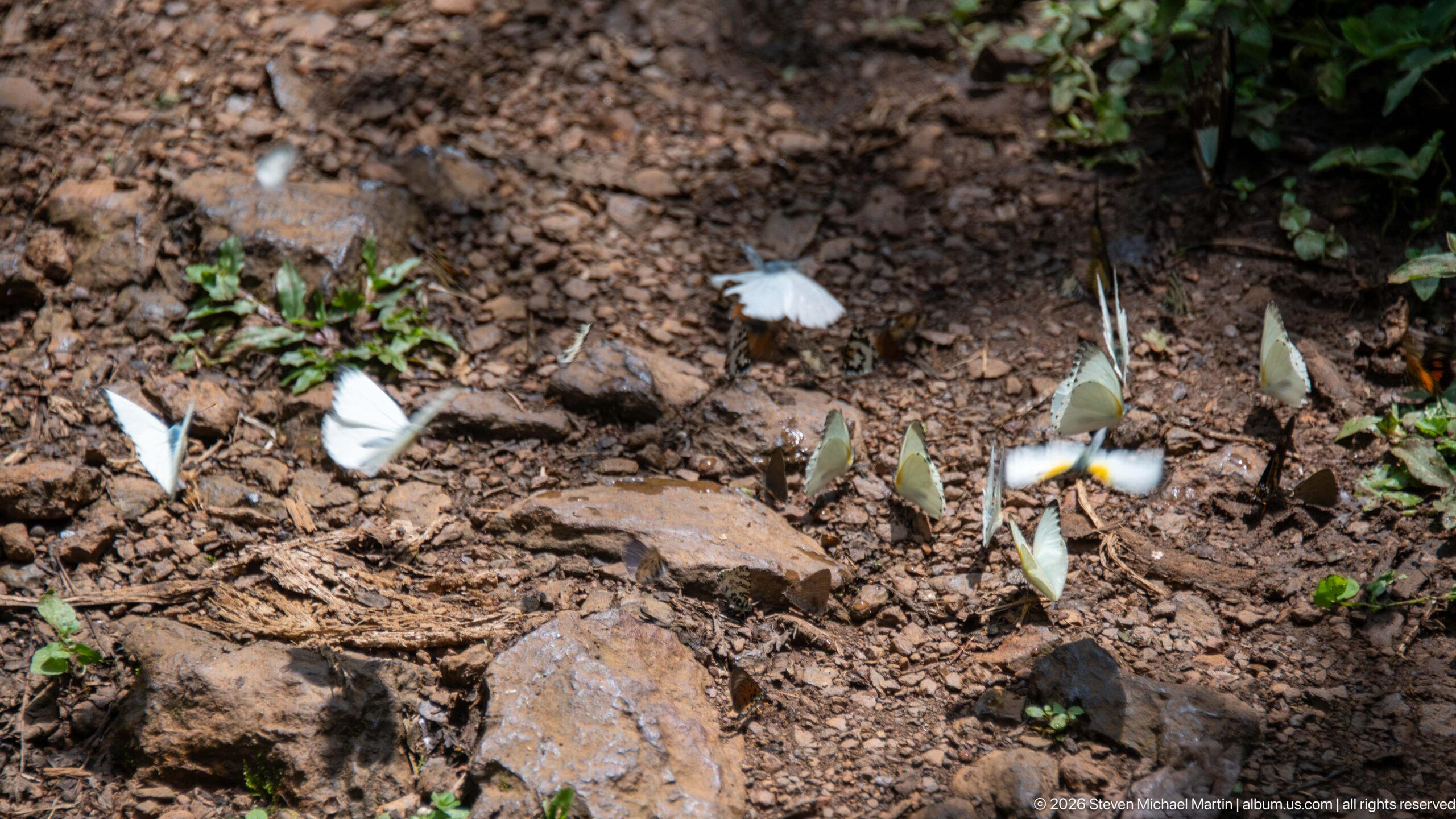
Several pale butterflies feed on a rough patch of wet earth broken by stones and leaf fragments. Most are seen with wings closed or partly open, while one small blue individual adds contrast near the center. The restrained composition isolates a smaller section of the larger mud-puddling congregation and shows the substrate they are using.
Caption
Several pale butterflies feed on a rough patch of wet earth broken by stones and leaf fragments. Most are seen with wings closed or partly open, while one small blue individual adds contrast near the center. The restrained composition isolates a smaller section of the larger mud-puddling congregation and shows the substrate they are using.
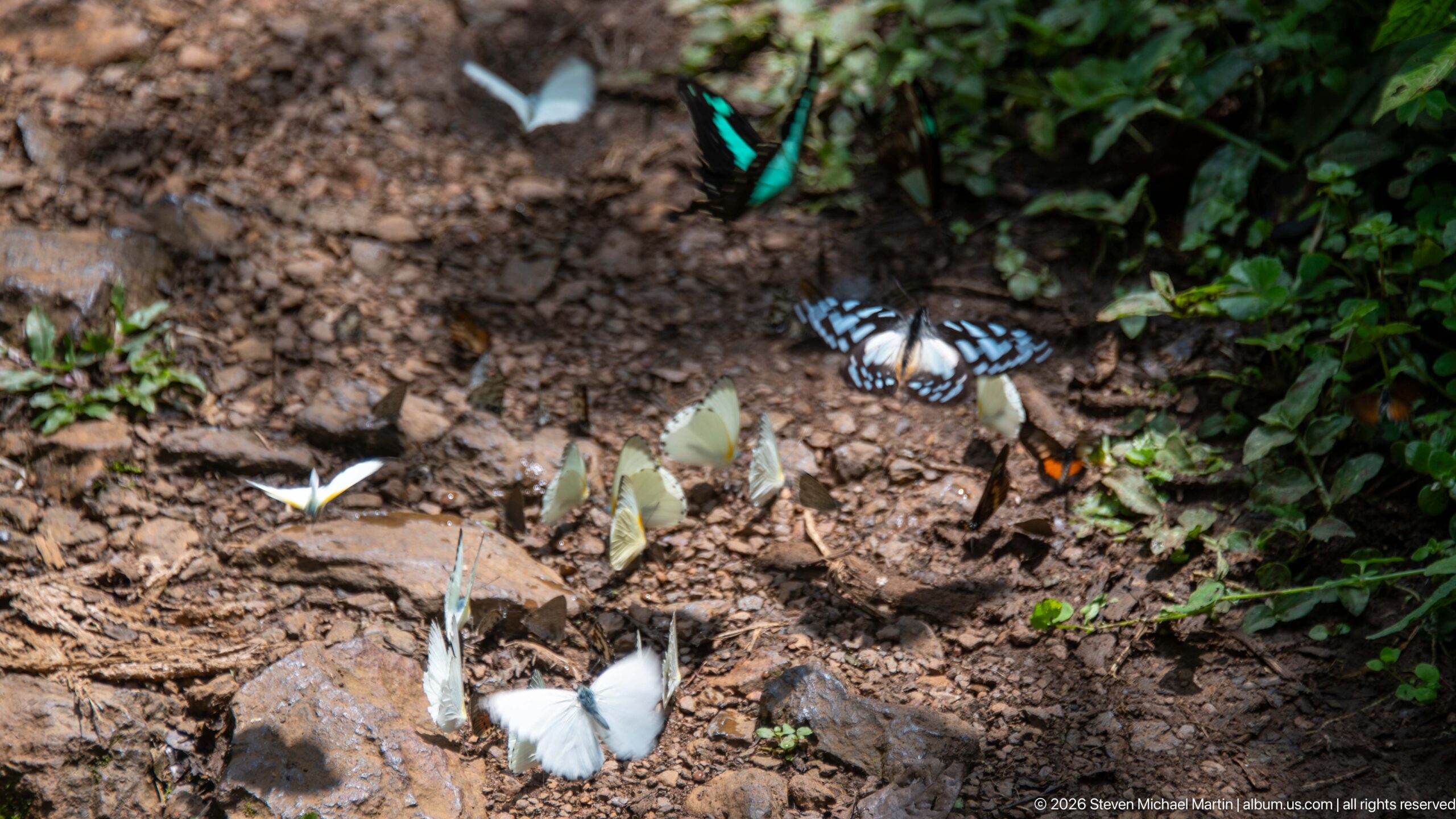
A turquoise-banded swallowtail and a pale blue-and-black butterfly stand out among smaller white and yellow butterflies feeding on damp soil. The darker insects occupy the center and upper portion of the frame, while paler individuals cluster lower on the ground. This view highlights the diversity present within the same mineral-feeding assemblage.
Caption
A turquoise-banded swallowtail and a pale blue-and-black butterfly stand out among smaller white and yellow butterflies feeding on damp soil. The darker insects occupy the center and upper portion of the frame, while paler individuals cluster lower on the ground. This view highlights the diversity present within the same mineral-feeding assemblage.
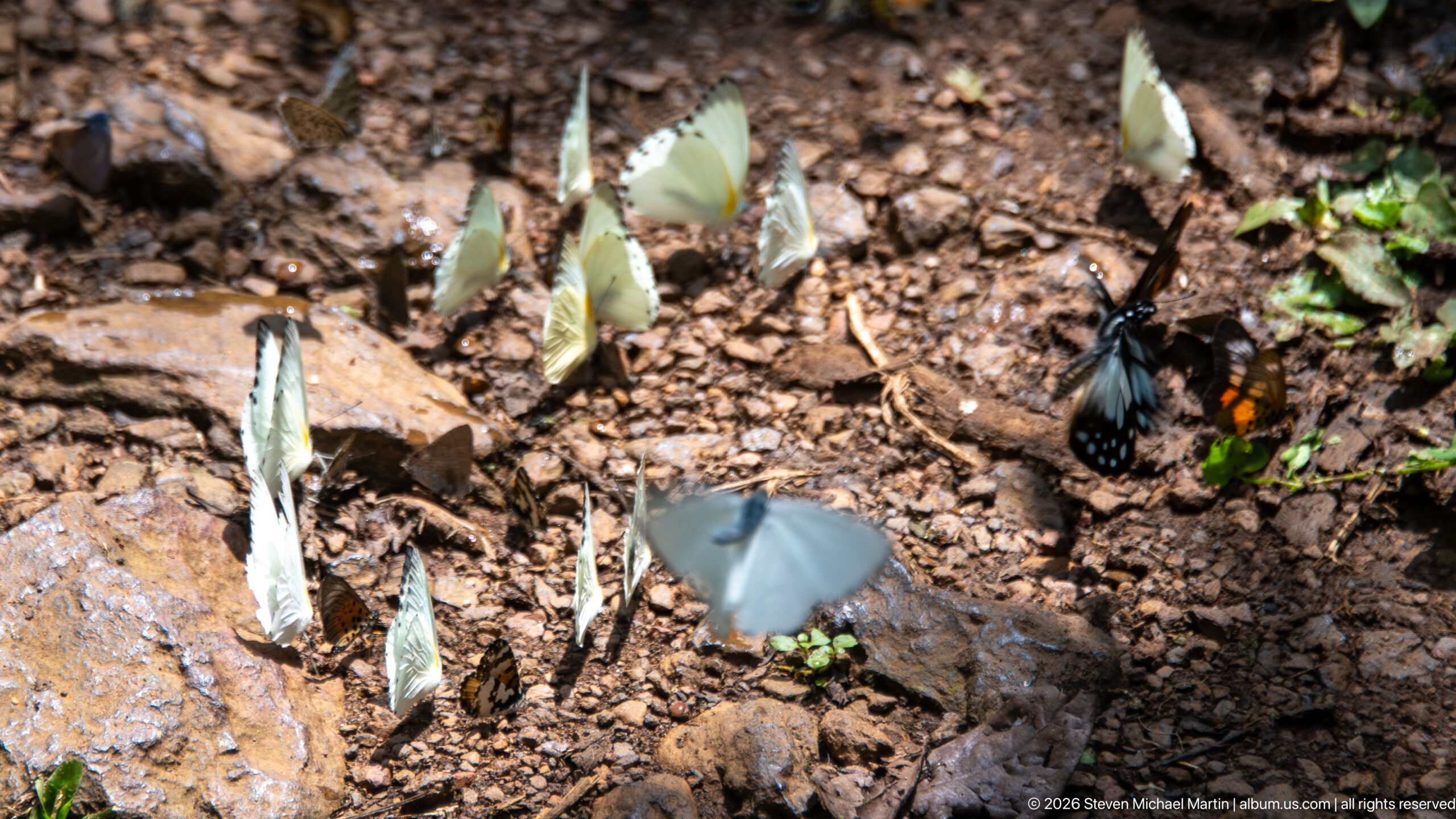
Pale butterflies cluster upright around damp soil while darker patterned individuals occupy the edges of the feeding patch. One light butterfly crosses the foreground in motion, partially obscuring the group. The layered composition captures both feeding and flight at the mud-puddling site, emphasizing the constant turnover of individuals around the mineral-rich ground.
Caption
Pale butterflies cluster upright around damp soil while darker patterned individuals occupy the edges of the feeding patch. One light butterfly crosses the foreground in motion, partially obscuring the group. The layered composition captures both feeding and flight at the mud-puddling site, emphasizing the constant turnover of individuals around the mineral-rich ground.
A forest walk through Bwindi’s dense canopy leads to Munyaga Falls, where sound, water, and vegetation create one of the park’s most peaceful experiences.
Highlights
- Guided forest walk through Bwindi Impenetrable Forest
- Munyaga Falls hidden within dense vegetation
- Rich plant life including ferns, moss, and towering trees
- Opportunities to observe birds, monkeys, and insects
- A quieter complement to gorilla trekking experiences
Field Guide
Location
Munyaga Falls lies within Bwindi Impenetrable National Park in southwestern Uganda. The walk typically begins near Buhoma and follows forest trails through one of Africa’s most biodiverse ecosystems.
Landscape
Bwindi is a dense montane rainforest characterized by thick vegetation, steep slopes, and constant humidity. The forest contains layers of plant life ranging from ground cover to towering canopy trees.
The Falls
Munyaga Falls is not large, but its setting makes it memorable. Water flows over rock shelves surrounded by dense greenery, with the sound of moving water echoing through the forest.
Wildlife
Although gorillas are the park’s most famous residents, the forest also supports monkeys, birds, butterflies, and countless plant species. Many sightings are subtle and reward slow observation.
Walking Conditions
Trails may be uneven, muddy, or steep in places. The walk is generally manageable but requires attention to footing, especially after rain.
Photography Notes
- Low light conditions favor higher ISO settings
- Look for textures in leaves, bark, and moss
- Water movement can be captured with slower shutter speeds
- Wide compositions work well for forest atmosphere
- Watch for condensation on lenses due to humidity
Story & Experience
Entering the Forest
The walk begins along narrow trails that quickly disappear into thick vegetation. The canopy filters light into soft green tones, and the forest feels immediately immersive.
Movement through Bwindi is slow by necessity. Roots, mud, and changing elevation encourage careful steps and quiet observation.
Forest Details
Much of the experience is found in small details — layered leaves, textured bark, filtered light, and the constant sound of insects and distant birds. The forest feels alive even when wildlife is not immediately visible.
Reaching Munyaga Falls
The sound of water signals the approach to the falls. Munyaga emerges gradually, framed by vegetation and rock. The setting feels intimate, shaped as much by the surrounding forest as by the water itself.
Rather than dramatic scale, the appeal of Munyaga Falls lies in atmosphere — a quiet moment within one of the most biologically rich forests in Africa.
Photography Notes
- Expect low light under the canopy
- Look for natural framing with branches and leaves
- Water textures work well with slower shutter speeds
- Capture environmental context rather than isolating subjects
- Include trail perspectives to show depth of forest
Tips for Visiting
- Wear sturdy footwear suitable for mud and uneven ground
- Bring rain protection even in dry season
- Move slowly and allow time for observation
- Keep camera gear protected from moisture
- Enjoy the quieter pace compared to gorilla trekking
Quick Facts
- Country: Uganda
- Location: Bwindi Impenetrable National Park
- Experience Type: Guided forest walk
- Main Feature: Munyaga Falls
- Difficulty: Easy to Moderate walking trail