Ndutu – Southern Serengeti, Tanzania
The Ndutu region lies in the southern part of the Serengeti ecosystem, near the border between Serengeti National Park and the Ngorongoro Conservation Area. The area consists of open grasslands, seasonal lakes, and scattered acacia trees.
Ndutu is especially famous as the calving grounds of the Great Migration, where hundreds of thousands of wildebeest give birth during the early months of the year. The abundance of newborn animals also attracts predators such as lions, cheetahs, and hyenas, making this one of the most dynamic wildlife environments in Africa.
The wide open plains of Ndutu provide excellent opportunities to observe wildlife across the landscape.
Ndutu Lake lies within the Ngorongoro Conservation Area on the edge of the southern Serengeti, forming part of the seasonal migration route of wildebeest and zebra. During the wet season, the surrounding plains transform into one of the most active wildlife regions in East Africa, attracting predators, grazing herds, and abundant birdlife.
Game drive through Ndutu Lake in the Ngorongoro Conservation Area, highlighting wildlife and landscape observed in sequence.
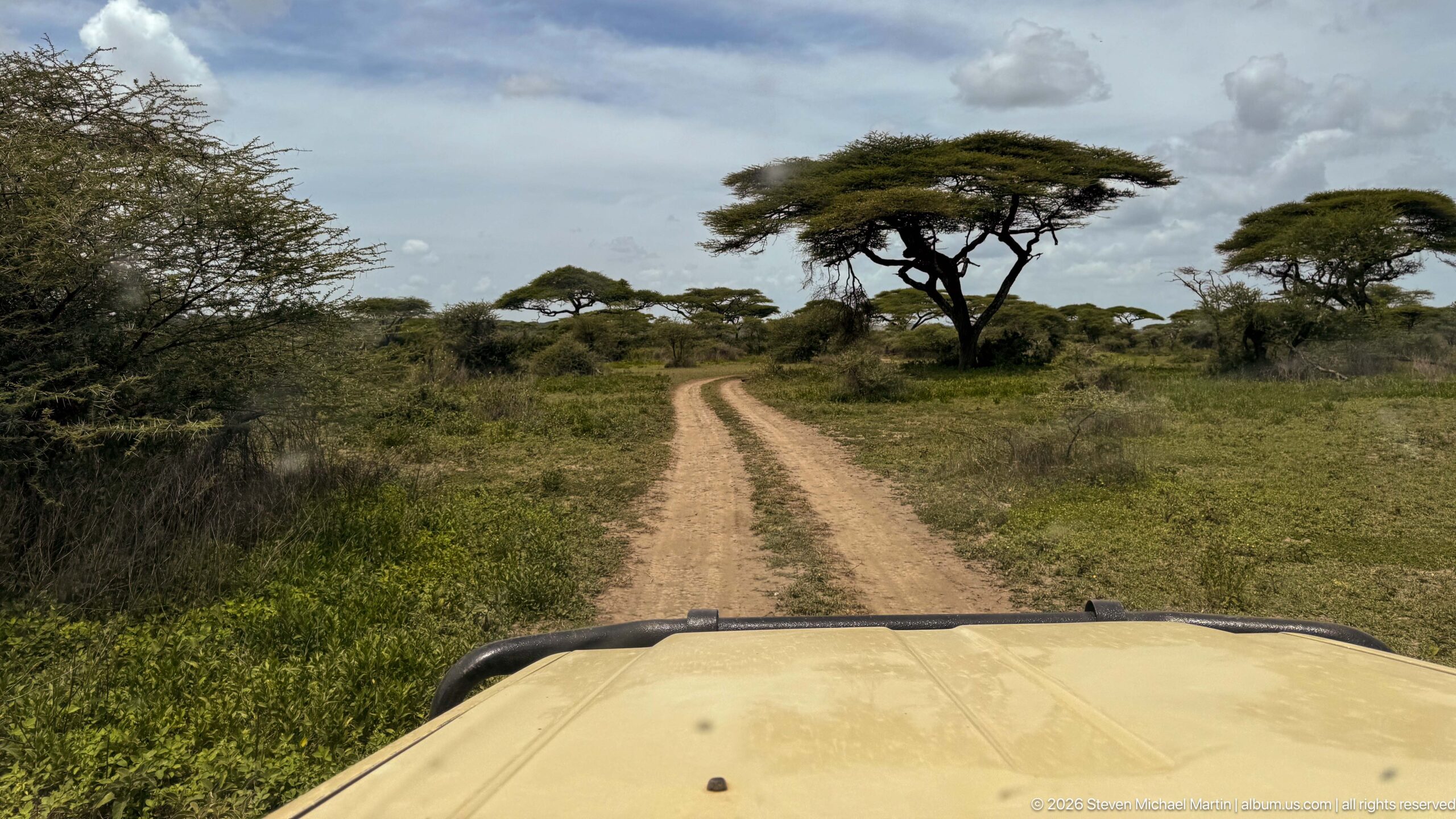
A narrow two-track road runs straight through low savanna vegetation toward broad, flat-topped acacias, viewed over the hood of a safari vehicle. The composition shifts from wildlife portraiture to habitat context, showing the scrub and open woodland through which game drives approach the Ndutu Lake area beneath a building bank of clouds.
Caption
A narrow two-track road runs straight through low savanna vegetation toward broad, flat-topped acacias, viewed over the hood of a safari vehicle. The composition shifts from wildlife portraiture to habitat context, showing the scrub and open woodland through which game drives approach the Ndutu Lake area beneath a building bank of clouds.
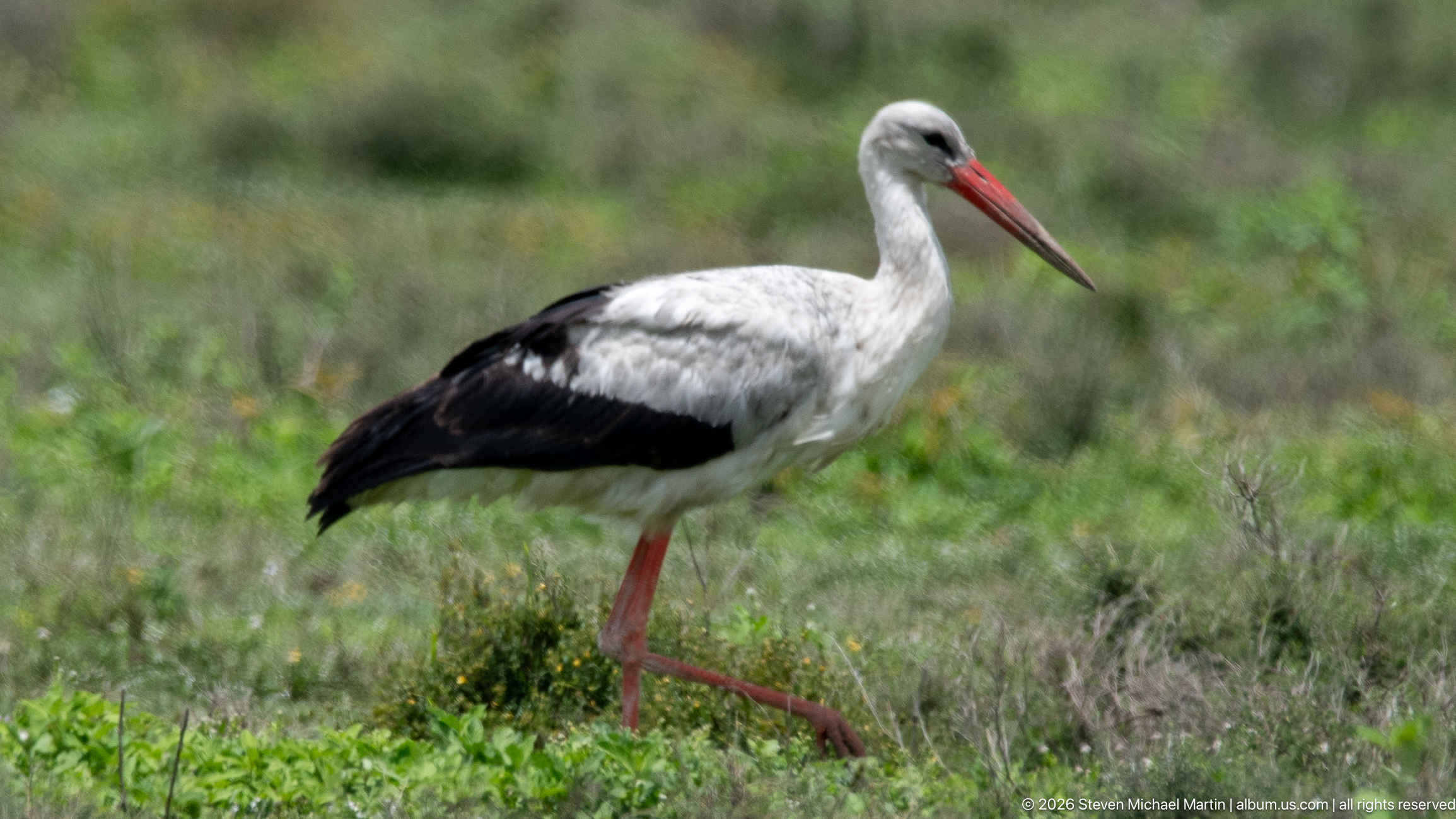
A white stork fills the frame in profile as it strides through lakeside groundcover near Ndutu Lake. Fine details of the red bill and legs, pale head and body, and folded black flight feathers are visible at close range. The shallow depth of field isolates the bird while retaining enough vegetation to establish its wetland-margin setting.
Caption
A white stork fills the frame in profile as it strides through lakeside groundcover near Ndutu Lake. Fine details of the red bill and legs, pale head and body, and folded black flight feathers are visible at close range. The shallow depth of field isolates the bird while retaining enough vegetation to establish its wetland-margin setting.
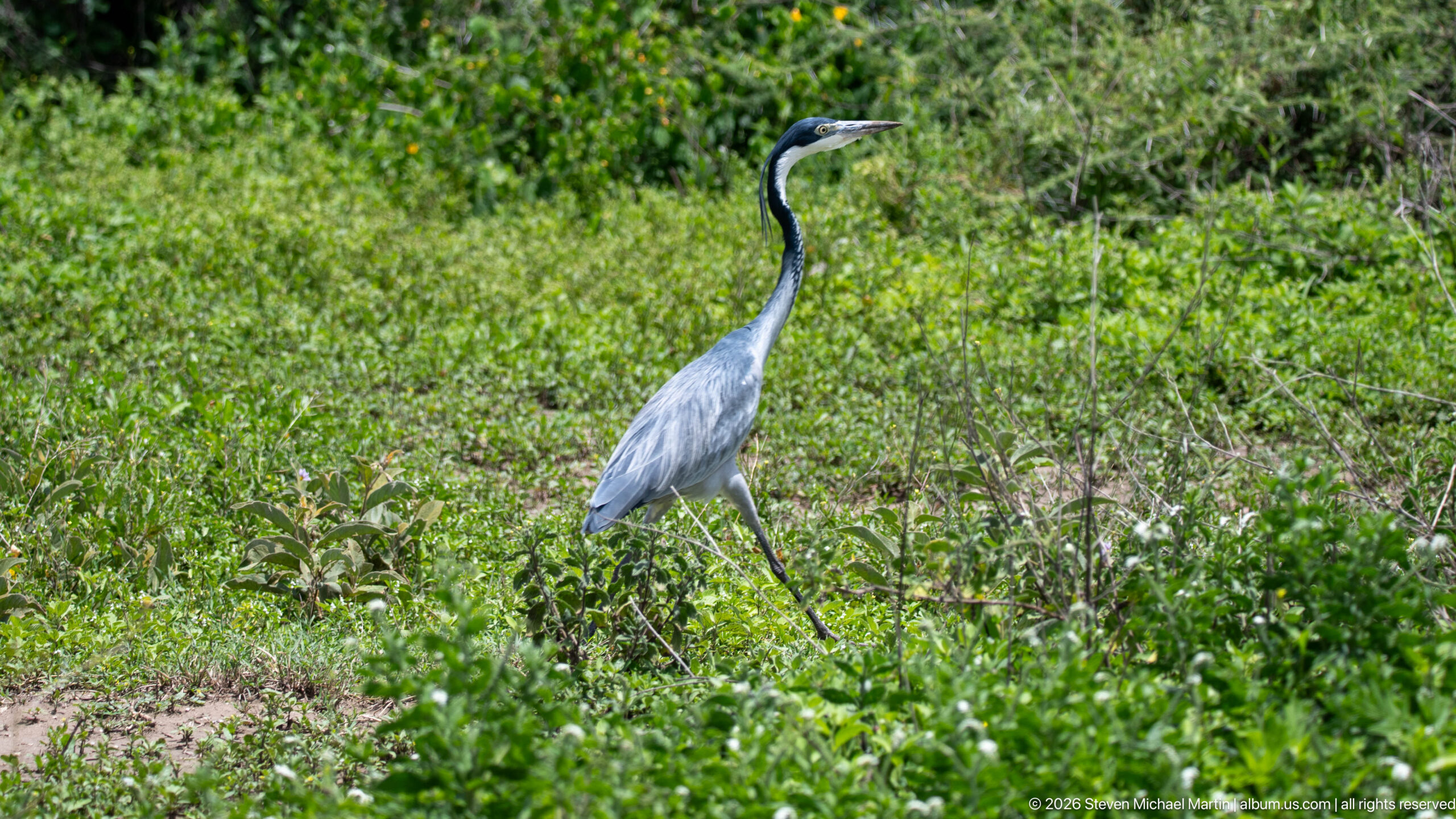
A black-headed heron stands upright amid dense green groundcover near Ndutu Lake, its long neck extended as it scans the vegetation. The slate-gray body, dark crown and hindneck, pale face, and dagger-like bill are clearly separated from the bright habitat, showing the species in a terrestrial foraging setting rather than in open water.
Caption
A black-headed heron stands upright amid dense green groundcover near Ndutu Lake, its long neck extended as it scans the vegetation. The slate-gray body, dark crown and hindneck, pale face, and dagger-like bill are clearly separated from the bright habitat, showing the species in a terrestrial foraging setting rather than in open water.
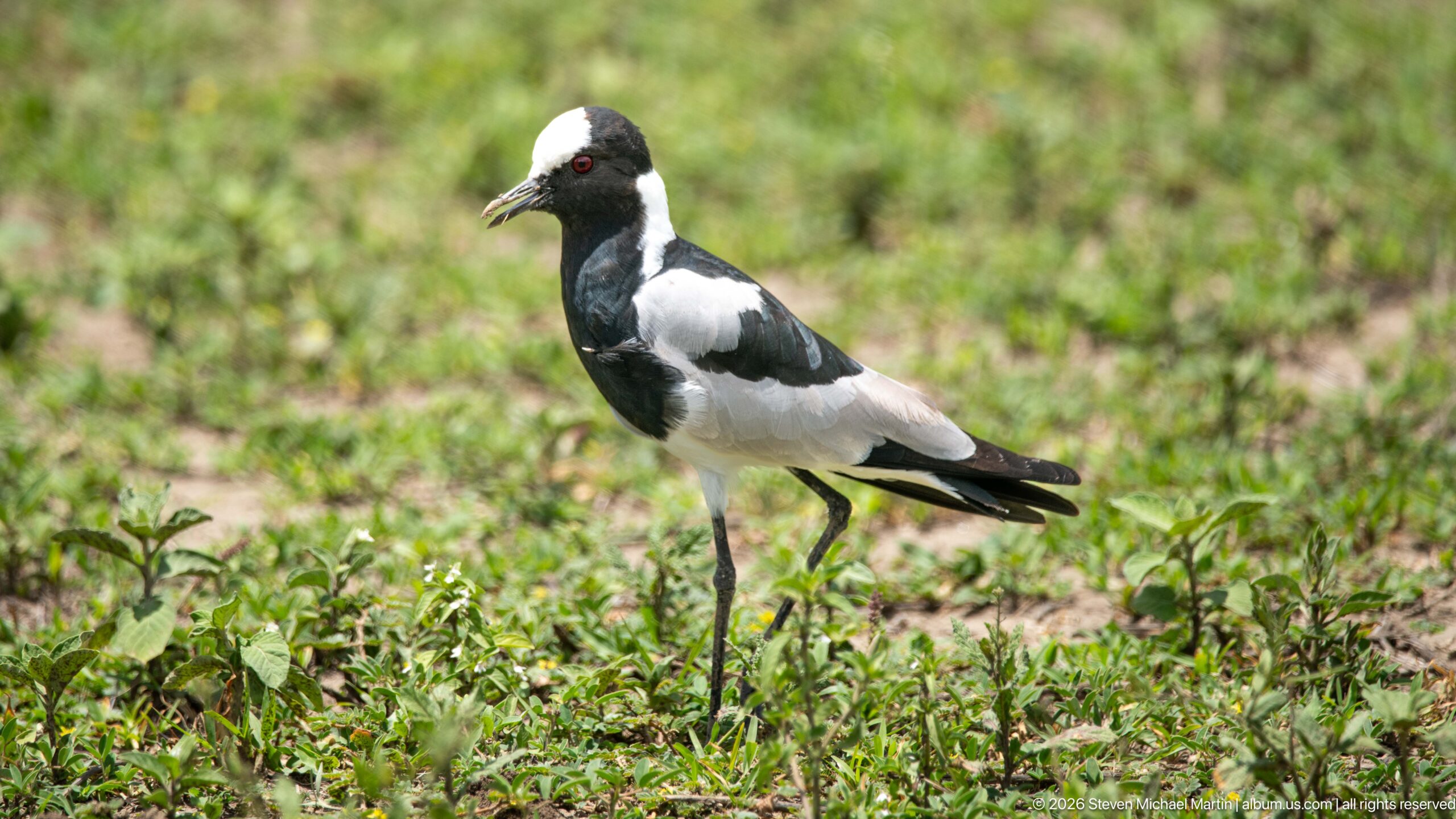
A blacksmith lapwing stands on short, damp-looking ground near Ndutu Lake. Its bold black-and-white plumage, red eye, and long gray legs create a sharply patterned profile against the green-brown substrate. The close view records a familiar East African wetland and grassland shorebird away from the waterline.
Caption
A blacksmith lapwing stands on short, damp-looking ground near Ndutu Lake. Its bold black-and-white plumage, red eye, and long gray legs create a sharply patterned profile against the green-brown substrate. The close view records a familiar East African wetland and grassland shorebird away from the waterline.
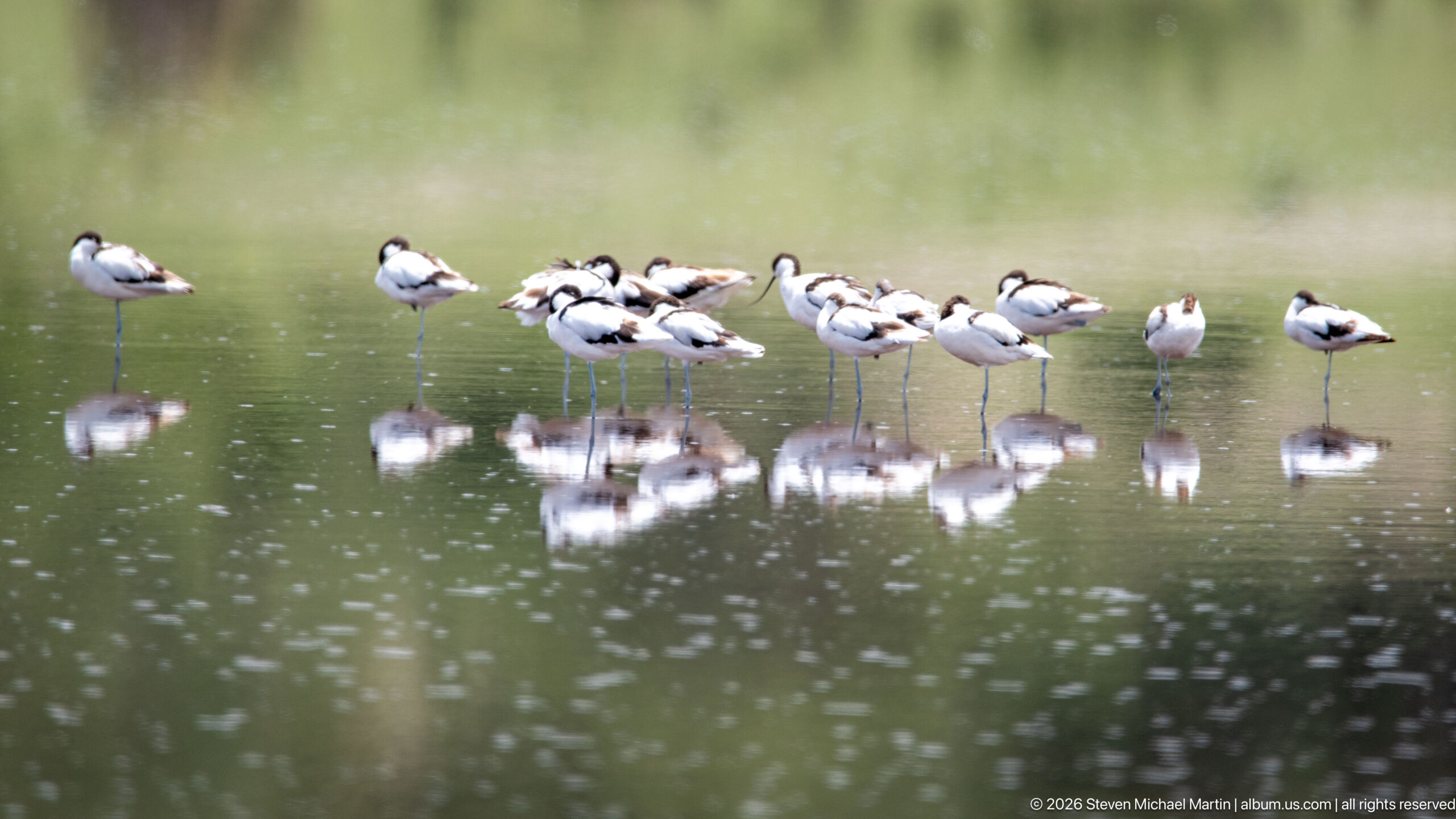
Pied avocets rest in a compact line across shallow, glassy water near Ndutu Lake. Several birds stand on one leg or tuck their bills into their plumage while their long blue-gray legs and black-and-white bodies produce crisp reflections below. The distant framing emphasizes the flock’s quiet arrangement within the wetland.
Caption
Pied avocets rest in a compact line across shallow, glassy water near Ndutu Lake. Several birds stand on one leg or tuck their bills into their plumage while their long blue-gray legs and black-and-white bodies produce crisp reflections below. The distant framing emphasizes the flock’s quiet arrangement within the wetland.
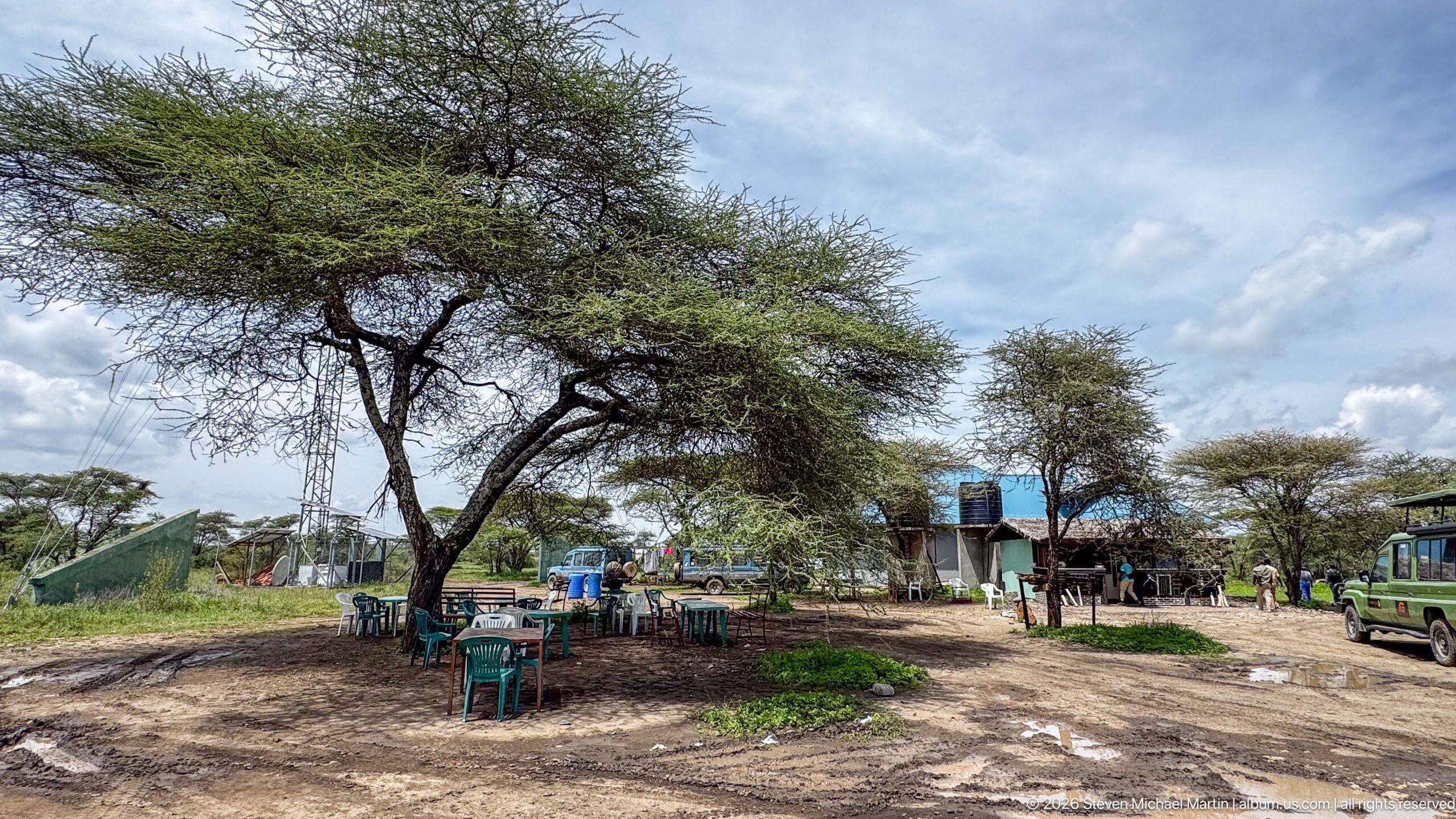
Acacia trees shade an informal outdoor service and gathering area at the Ndutu registration stop, where scattered plastic chairs, small structures, utility equipment, people, and a safari vehicle occupy the sandy clearing. The broad contextual view shows how visitor and field infrastructure is dispersed beneath the savanna canopy rather than concentrated in a large developed complex.
Caption
Acacia trees shade an informal outdoor service and gathering area at the Ndutu registration stop, where scattered plastic chairs, small structures, utility equipment, people, and a safari vehicle occupy the sandy clearing. The broad contextual view shows how visitor and field infrastructure is dispersed beneath the savanna canopy rather than concentrated in a large developed complex.
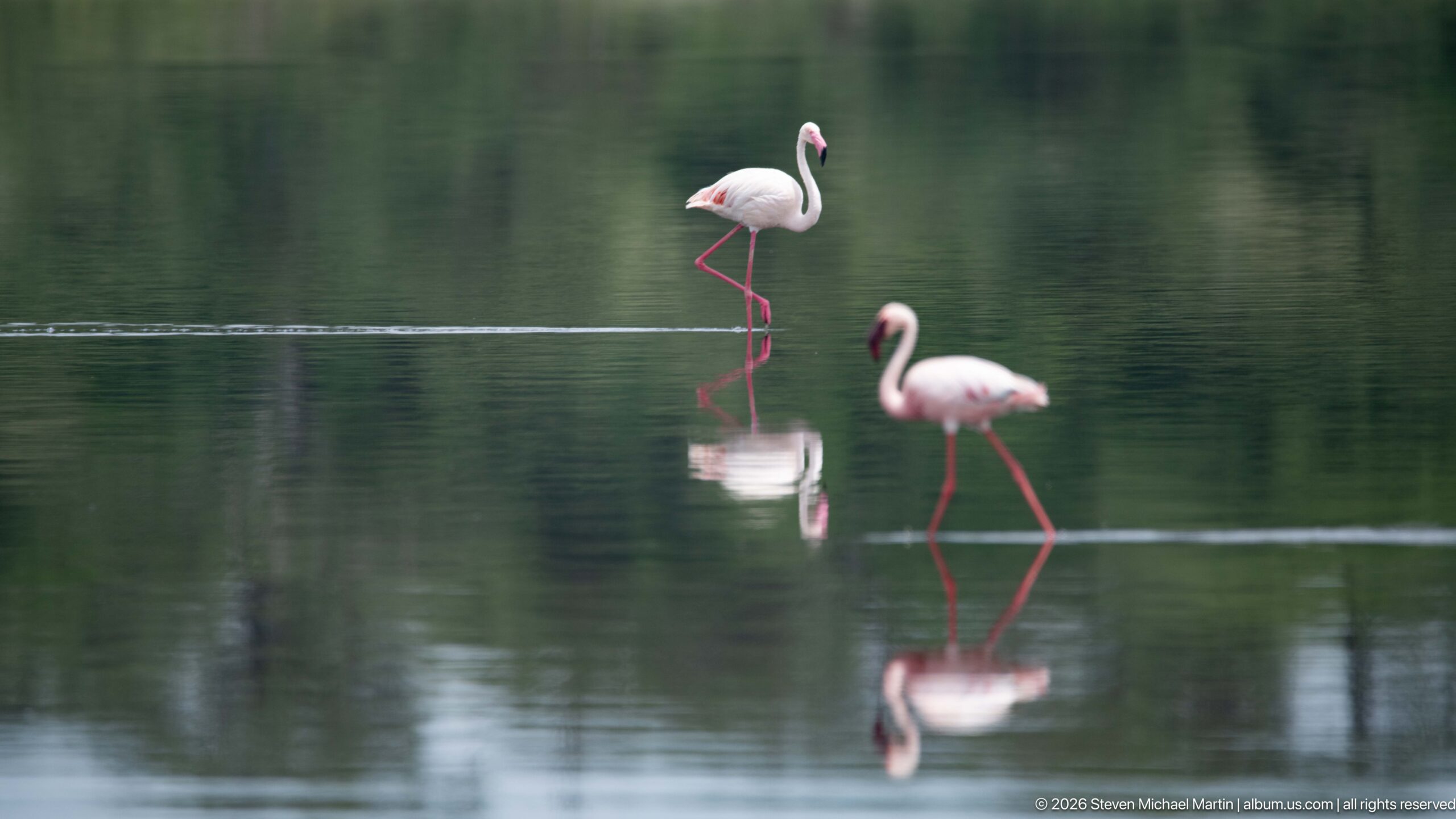
Two greater flamingos cross the shallows at different distances, one upright in the background and the nearer bird stepping through the foreground. Their pink legs and pale bodies cast elongated reflections on the dark water, while thin wakes trace each bird’s path. The staggered placement gives depth to the otherwise minimal wetland scene.
Caption
Two greater flamingos cross the shallows at different distances, one upright in the background and the nearer bird stepping through the foreground. Their pink legs and pale bodies cast elongated reflections on the dark water, while thin wakes trace each bird’s path. The staggered placement gives depth to the otherwise minimal wetland scene.
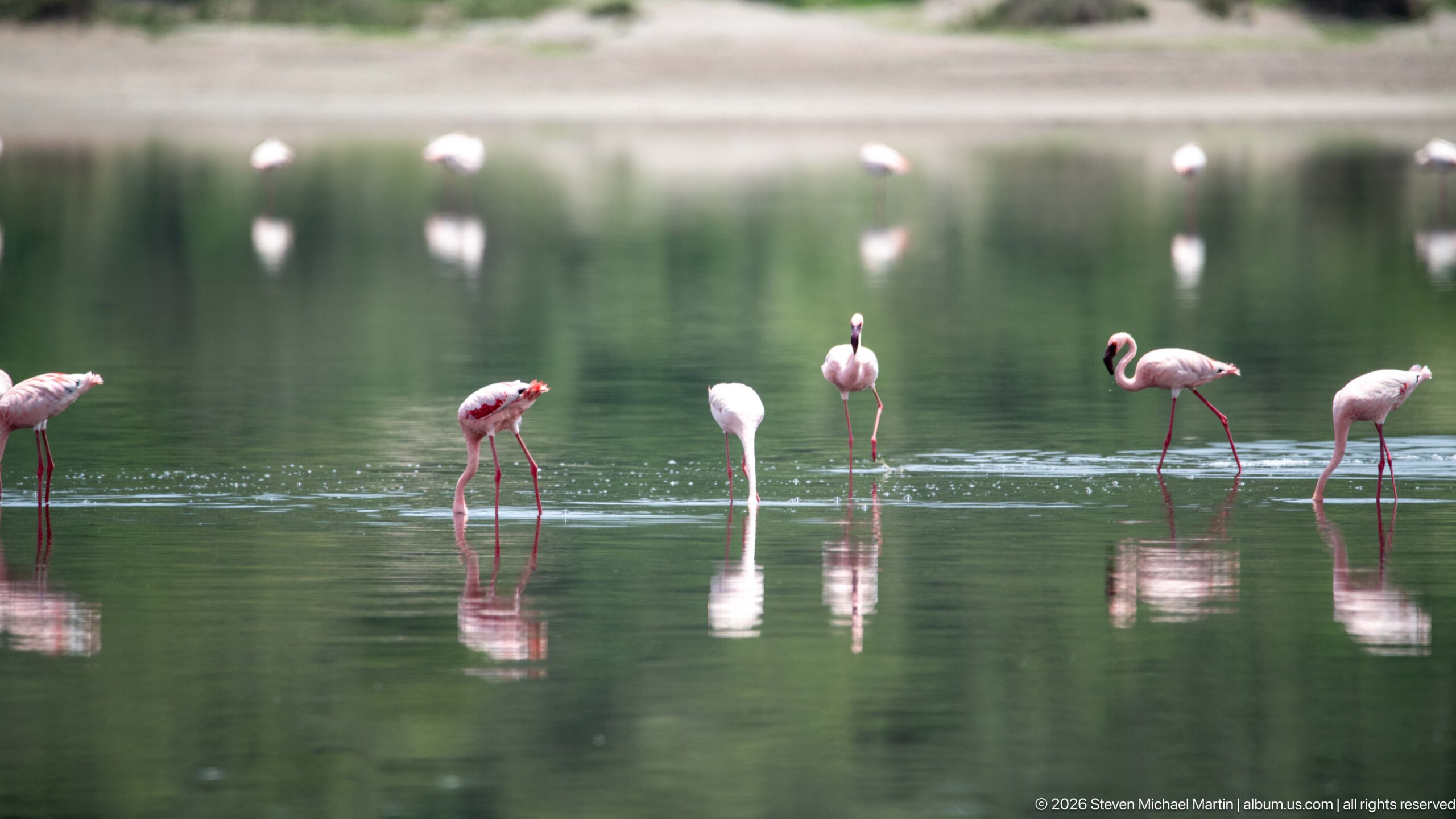
Greater flamingos forage in shallow water, several lowering their curved bills to feed while others stand upright. Pale pink bodies, long rose-colored legs, and bright reflections punctuate the dark green surface, with additional flamingos softly out of focus behind them. The scene shows the flock spread loosely across a feeding area rather than densely massed.
Caption
Greater flamingos forage in shallow water, several lowering their curved bills to feed while others stand upright. Pale pink bodies, long rose-colored legs, and bright reflections punctuate the dark green surface, with additional flamingos softly out of focus behind them. The scene shows the flock spread loosely across a feeding area rather than densely massed.
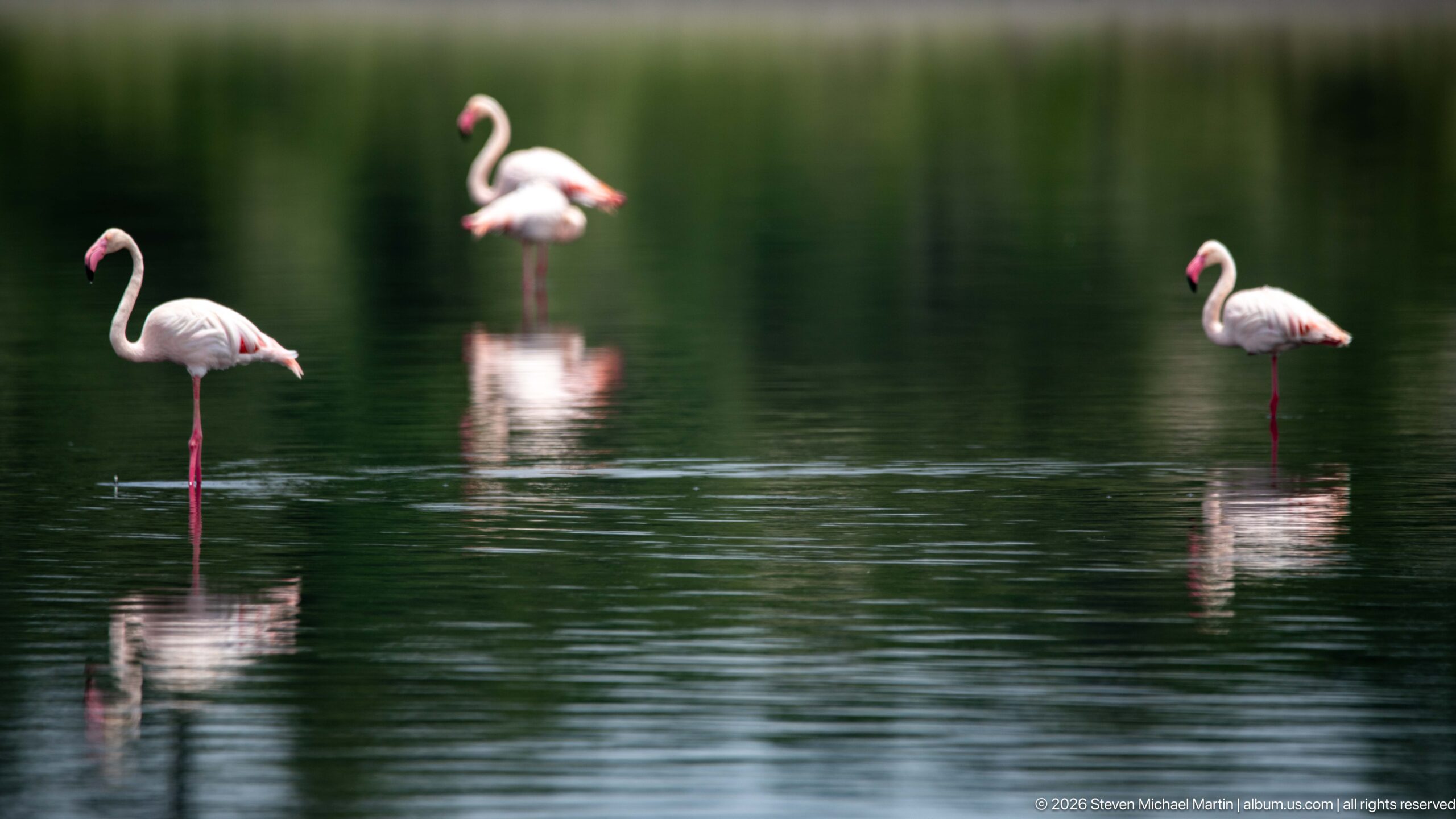
Three greater flamingos stand widely spaced in calm water, each mirrored on the dark green surface. Their different postures—upright, resting, and head lowered—create a quiet behavioral sequence within one frame. The sparse composition emphasizes long pink legs and the birds’ pale bodies against the reflective wetland.
Caption
Three greater flamingos stand widely spaced in calm water, each mirrored on the dark green surface. Their different postures—upright, resting, and head lowered—create a quiet behavioral sequence within one frame. The sparse composition emphasizes long pink legs and the birds’ pale bodies against the reflective wetland.
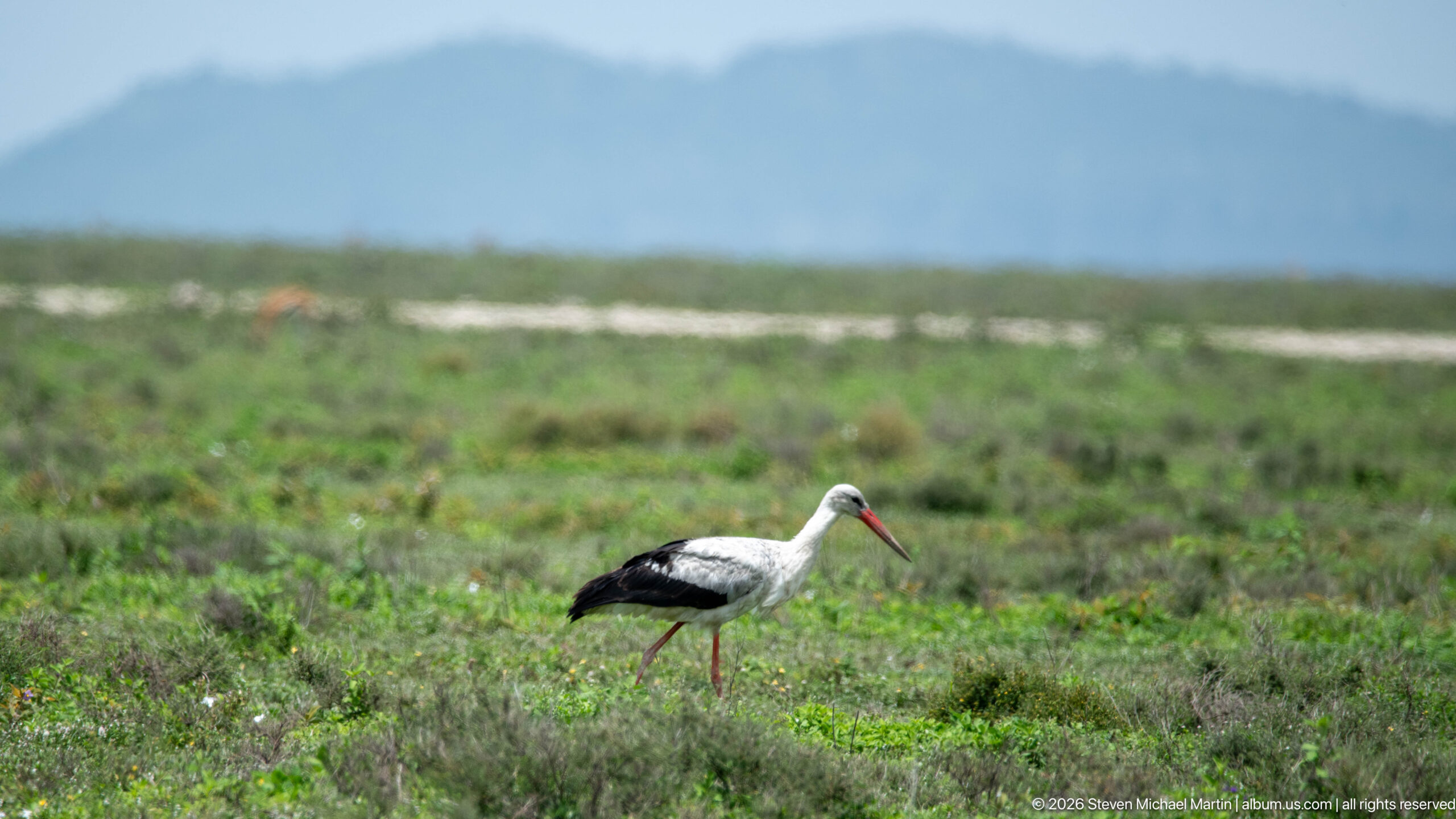
A white stork walks through low green lakeshore vegetation near Ndutu Lake, its white body, black flight feathers, long red bill, and red legs standing out against the muted plain. The ground-level view places the migratory wader within the open wetland-edge habitat used by large waterbirds and grazing wildlife in the Ngorongoro–Ndutu landscape.
Caption
A white stork walks through low green lakeshore vegetation near Ndutu Lake, its white body, black flight feathers, long red bill, and red legs standing out against the muted plain. The ground-level view places the migratory wader within the open wetland-edge habitat used by large waterbirds and grazing wildlife in the Ngorongoro–Ndutu landscape.
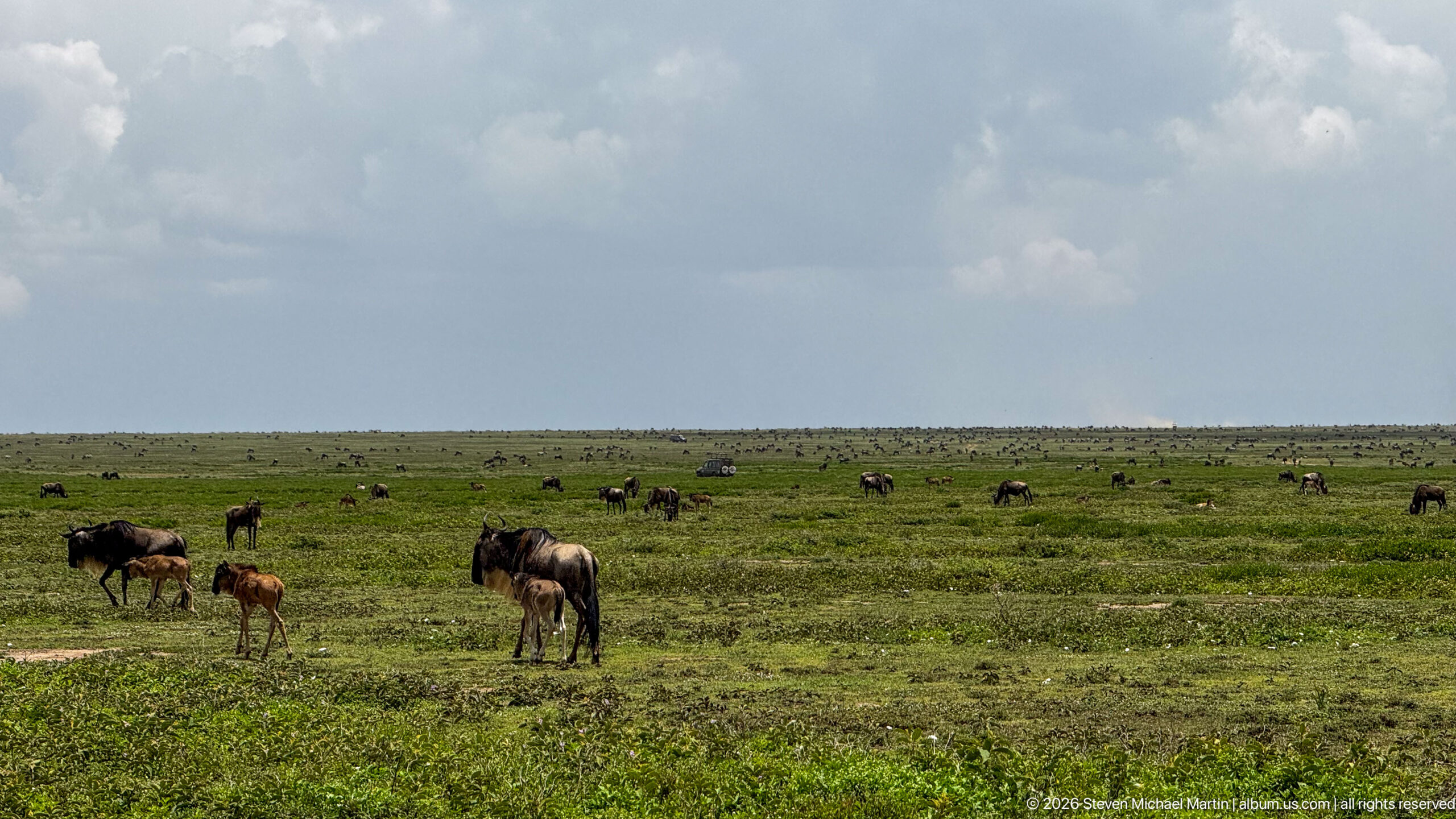
Blue wildebeest are scattered across the broad green plain near Ndutu Lake, with several animals grazing in the foreground and a much larger herd extending toward the horizon. The wide composition emphasizes the open short-grass landscape and the loose spacing of herd animals beneath a cloud-filled sky, a characteristic wildlife scene of the greater Serengeti–Ngorongoro ecosystem.
Caption
Blue wildebeest are scattered across the broad green plain near Ndutu Lake, with several animals grazing in the foreground and a much larger herd extending toward the horizon. The wide composition emphasizes the open short-grass landscape and the loose spacing of herd animals beneath a cloud-filled sky, a characteristic wildlife scene of the greater Serengeti–Ngorongoro ecosystem.
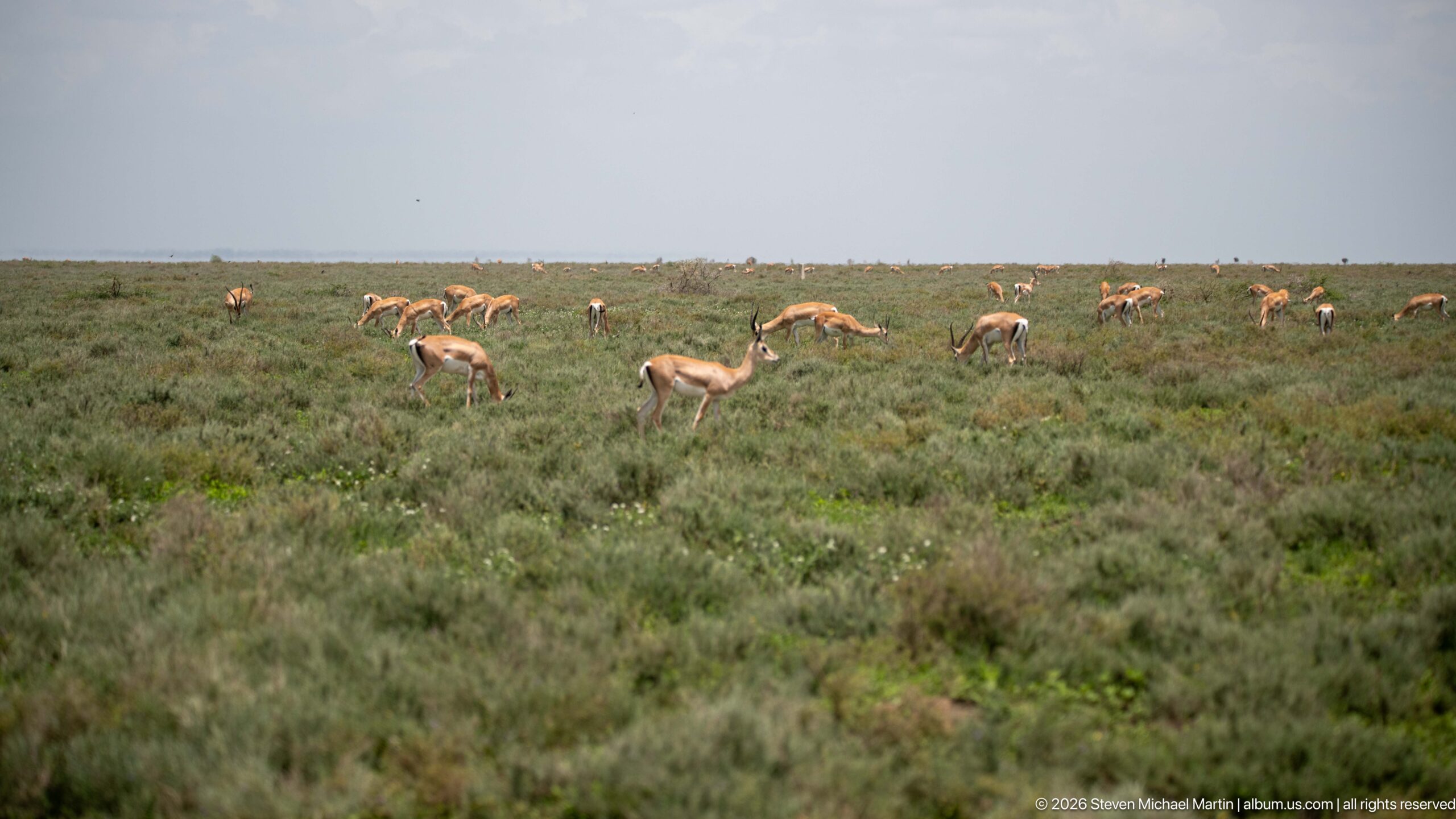
A loose herd of Thomson’s gazelles grazes across low, gray-green vegetation on the Ndutu plains. Several animals bend to feed while others stand alert, their tan backs, white underparts, and dark flank markings visible across the open terrain. The dispersed group and low horizon convey the scale of the short-grass habitat surrounding the seasonal lake.
Caption
A loose herd of Thomson’s gazelles grazes across low, gray-green vegetation on the Ndutu plains. Several animals bend to feed while others stand alert, their tan backs, white underparts, and dark flank markings visible across the open terrain. The dispersed group and low horizon convey the scale of the short-grass habitat surrounding the seasonal lake.
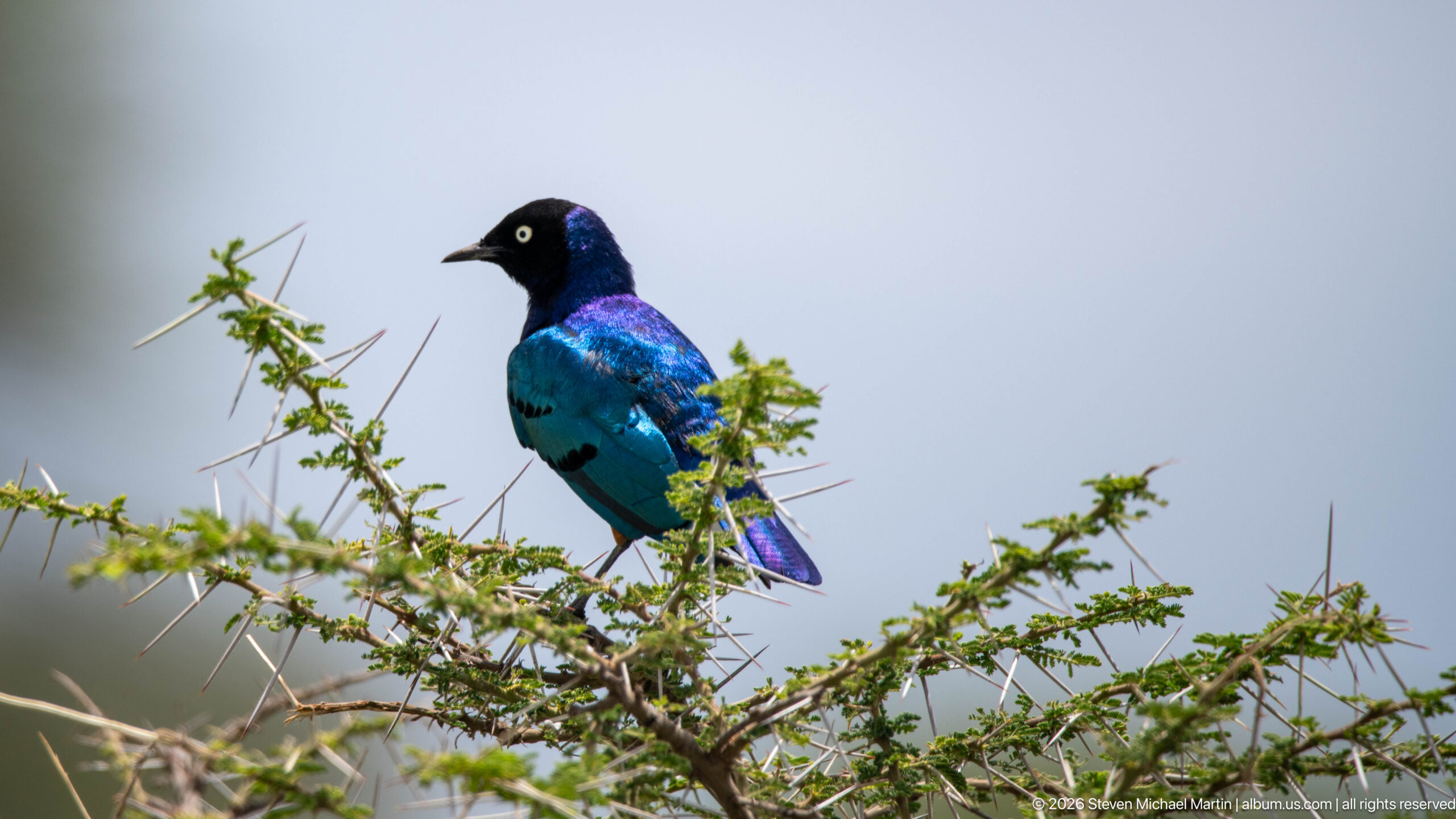
A superb starling perches on a thorny acacia branch, its iridescent blue-green breast and wings contrasting with a black head and pale eye. The tight portrait highlights the glossy structural colors that make this East African starling conspicuous in dry savanna and thorn-scrub habitats around Ndutu.
Caption
A superb starling perches on a thorny acacia branch, its iridescent blue-green breast and wings contrasting with a black head and pale eye. The tight portrait highlights the glossy structural colors that make this East African starling conspicuous in dry savanna and thorn-scrub habitats around Ndutu.
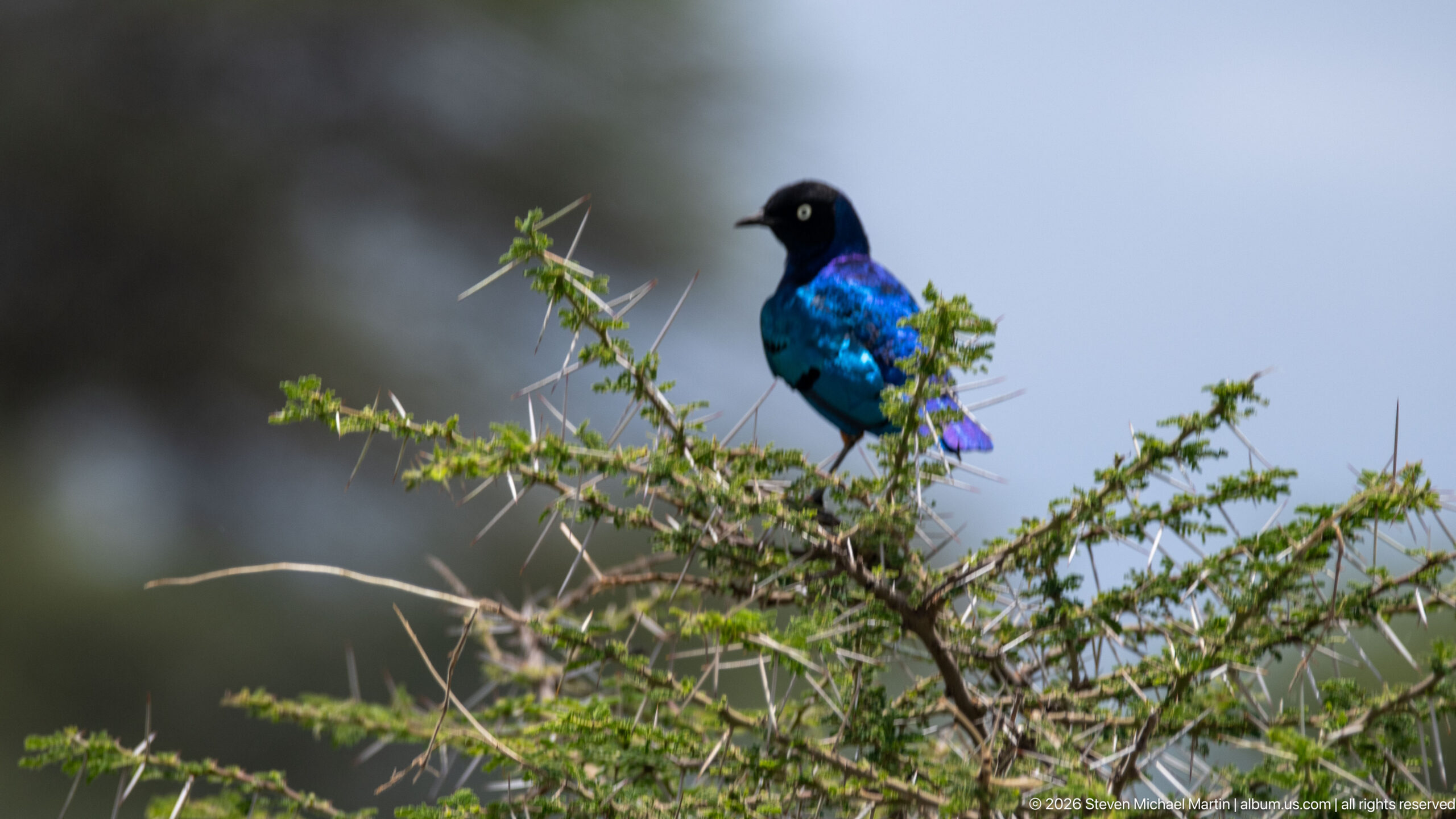
A superb starling sits high on a thorny acacia, framed against a softly blurred background. Its black head and vivid blue-turquoise body remain the visual focus while the branching thorns establish the dry savanna vegetation around Ndutu. This more distant portrait complements the closer starling view by showing the bird’s typical exposed perch.
Caption
A superb starling sits high on a thorny acacia, framed against a softly blurred background. Its black head and vivid blue-turquoise body remain the visual focus while the branching thorns establish the dry savanna vegetation around Ndutu. This more distant portrait complements the closer starling view by showing the bird’s typical exposed perch.
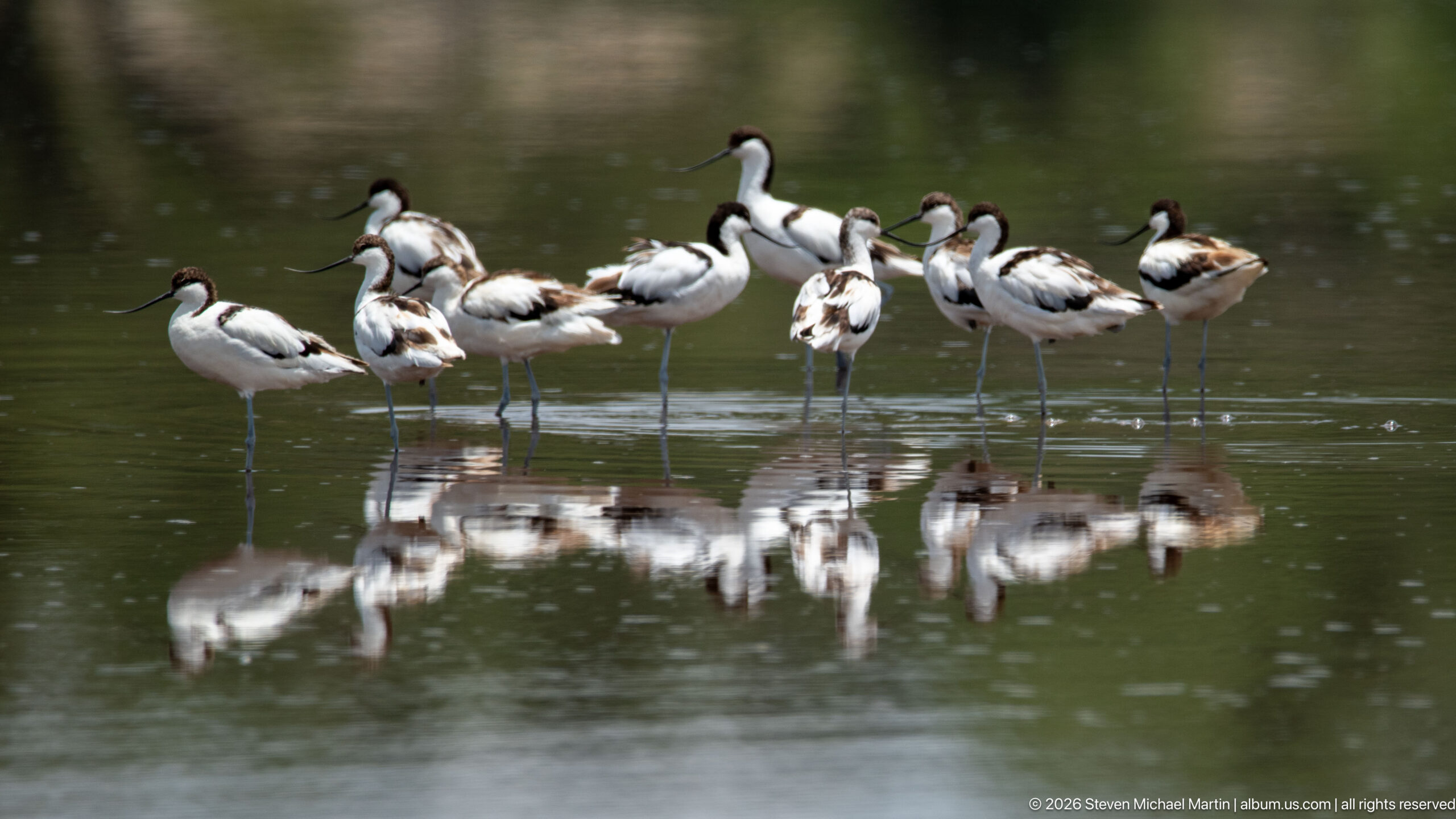
A cluster of pied avocets stands and preens in shallow water, their black-and-white bodies and slender upcurved bills mirrored on the calm surface. Closely grouped birds face different directions, creating an active study of resting and maintenance behavior along the lake margin. The reflections double the graphic pattern of their plumage.
Caption
A cluster of pied avocets stands and preens in shallow water, their black-and-white bodies and slender upcurved bills mirrored on the calm surface. Closely grouped birds face different directions, creating an active study of resting and maintenance behavior along the lake margin. The reflections double the graphic pattern of their plumage.
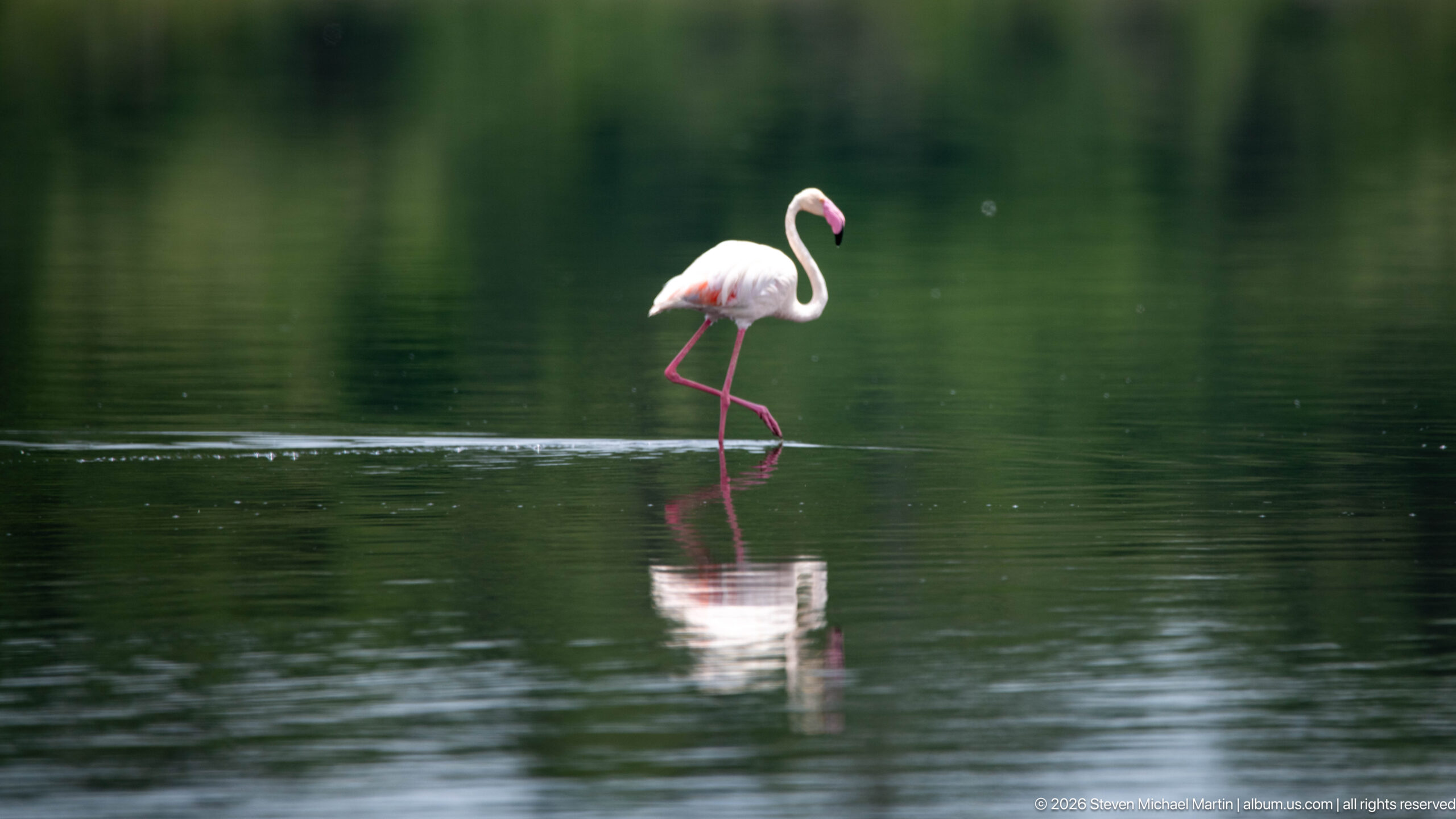
A single greater flamingo wades through calm water, lifting one long pink leg as its reflection stretches beneath it. The isolated bird and dark green background reveal the species’ pale pink body, S-curved neck, and distinctive downcurved bill while a narrow wake records its slow movement through the shallows.
Caption
A single greater flamingo wades through calm water, lifting one long pink leg as its reflection stretches beneath it. The isolated bird and dark green background reveal the species’ pale pink body, S-curved neck, and distinctive downcurved bill while a narrow wake records its slow movement through the shallows.
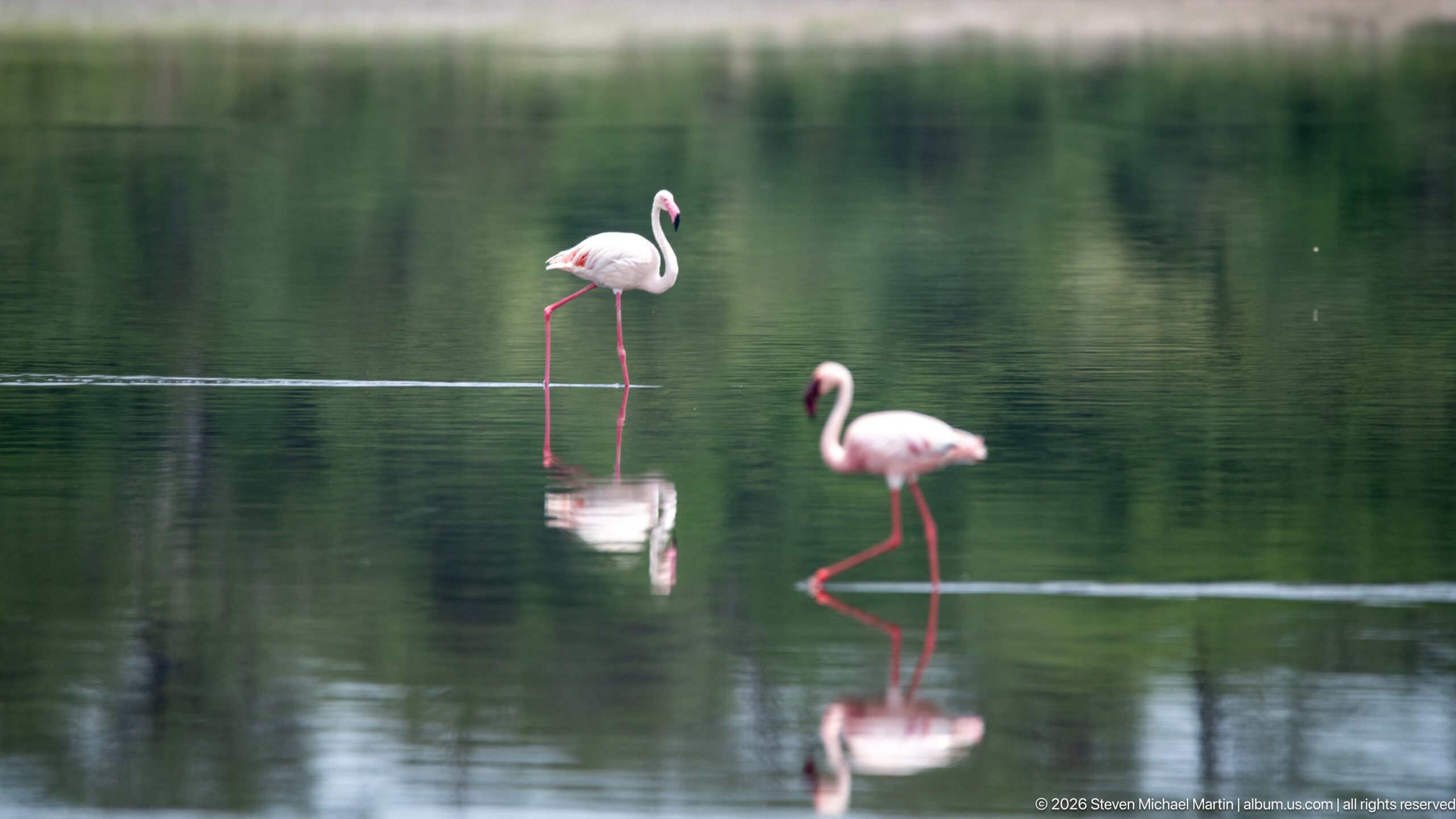
Two greater flamingos move in opposite visual planes across Ndutu’s reflective shallows. The rear bird pauses upright while the nearer flamingo advances with its neck lowered, each leaving a narrow wake. Their mirrored forms and generous surrounding water make this a spatial study of solitary movement within a shared feeding area.
Caption
Two greater flamingos move in opposite visual planes across Ndutu’s reflective shallows. The rear bird pauses upright while the nearer flamingo advances with its neck lowered, each leaving a narrow wake. Their mirrored forms and generous surrounding water make this a spatial study of solitary movement within a shared feeding area.
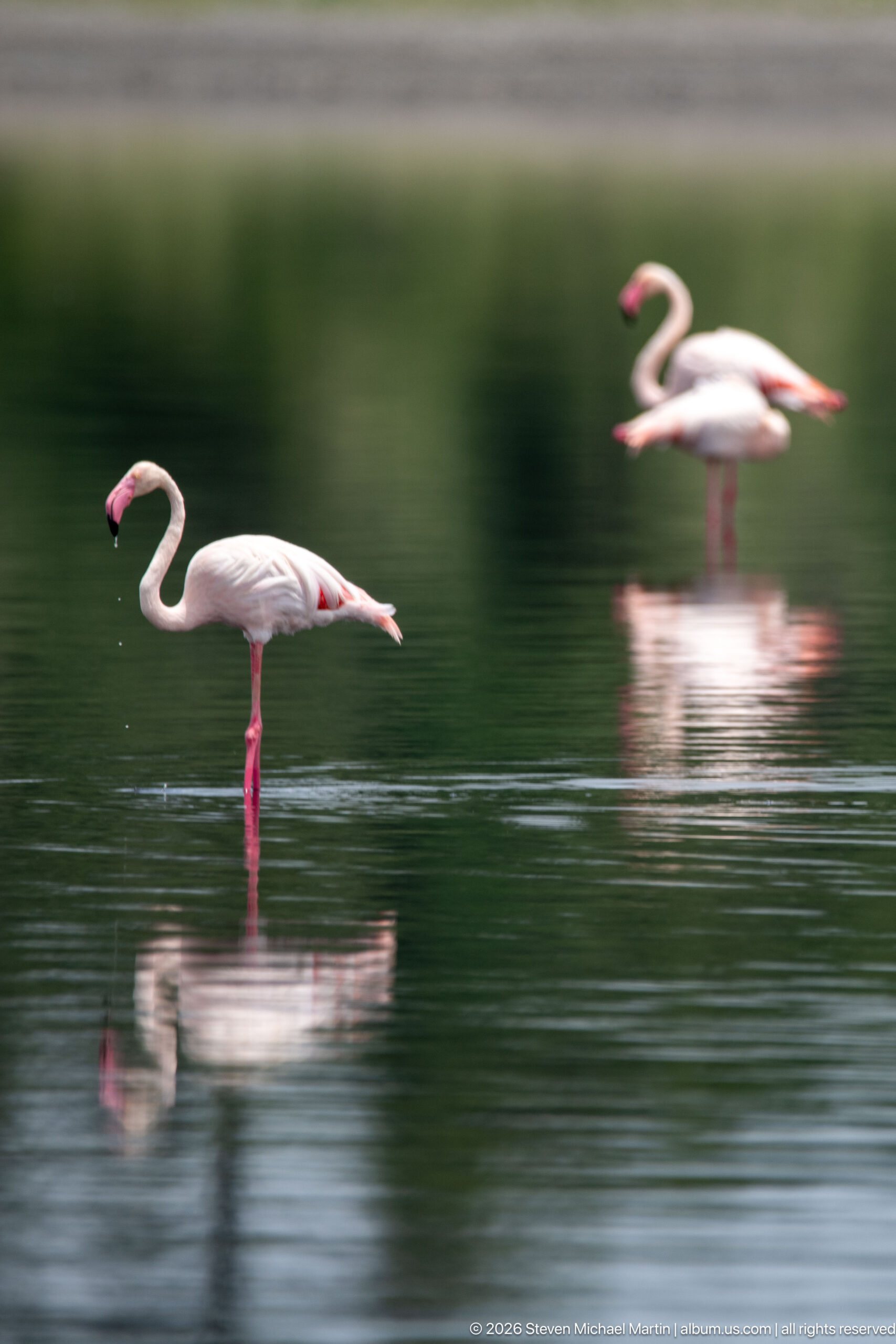
One greater flamingo walks through the foreground shallows while a second passes behind, both reflected in the smooth surface of Ndutu Lake. The foreground bird’s lowered head and elongated neck suggest active searching or feeding, while motion blur on the rear bird separates the two planes of movement.
Caption
One greater flamingo walks through the foreground shallows while a second passes behind, both reflected in the smooth surface of Ndutu Lake. The foreground bird’s lowered head and elongated neck suggest active searching or feeding, while motion blur on the rear bird separates the two planes of movement.
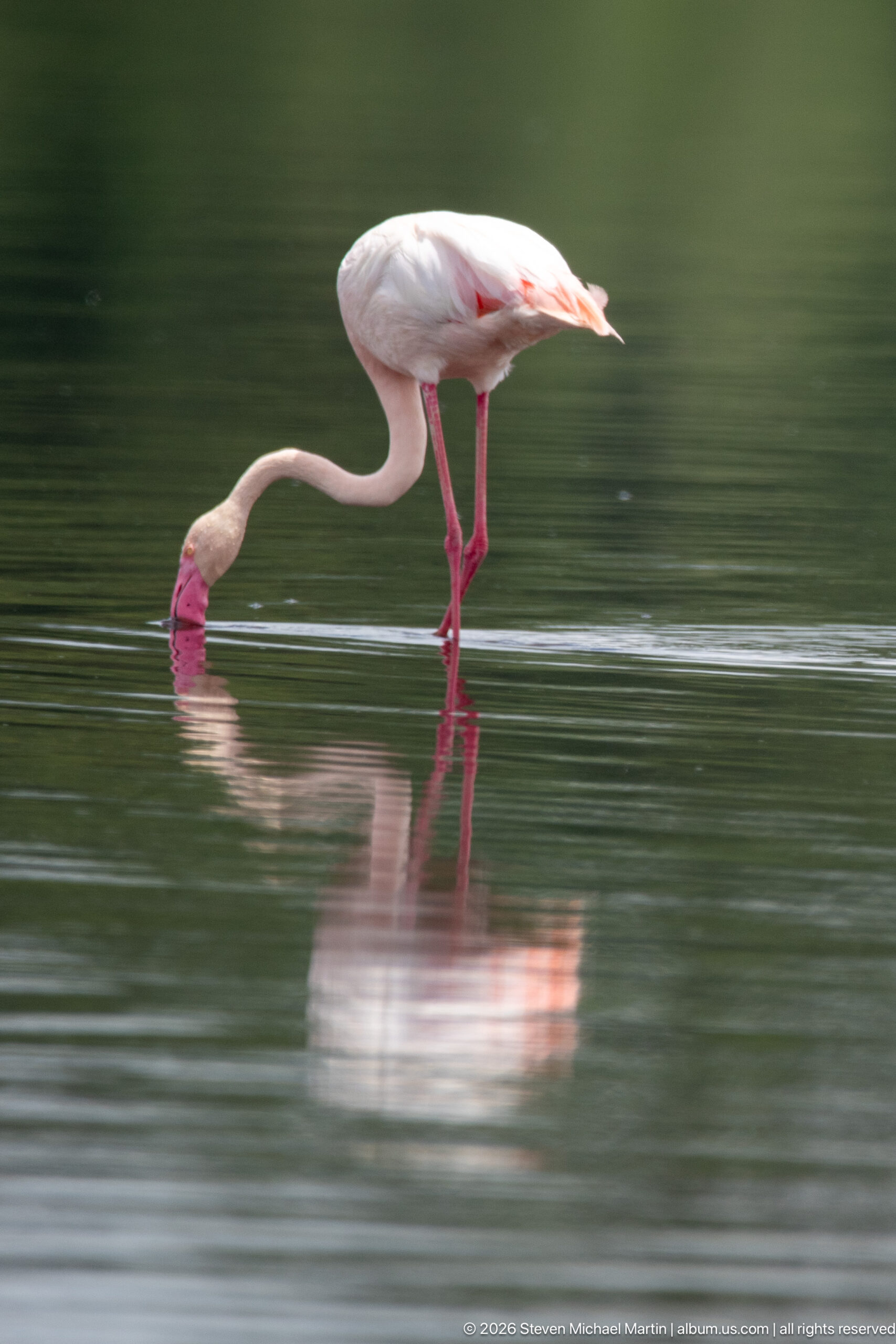
A greater flamingo bends deeply to feed, submerging its downcurved bill while its long pink legs remain planted in the shallows. Concentric ripples spread from the bill and feet, and the bird’s pale body is reflected beneath it. The close side view makes the specialized inverted feeding posture the central subject.
Caption
A greater flamingo bends deeply to feed, submerging its downcurved bill while its long pink legs remain planted in the shallows. Concentric ripples spread from the bill and feet, and the bird’s pale body is reflected beneath it. The close side view makes the specialized inverted feeding posture the central subject.
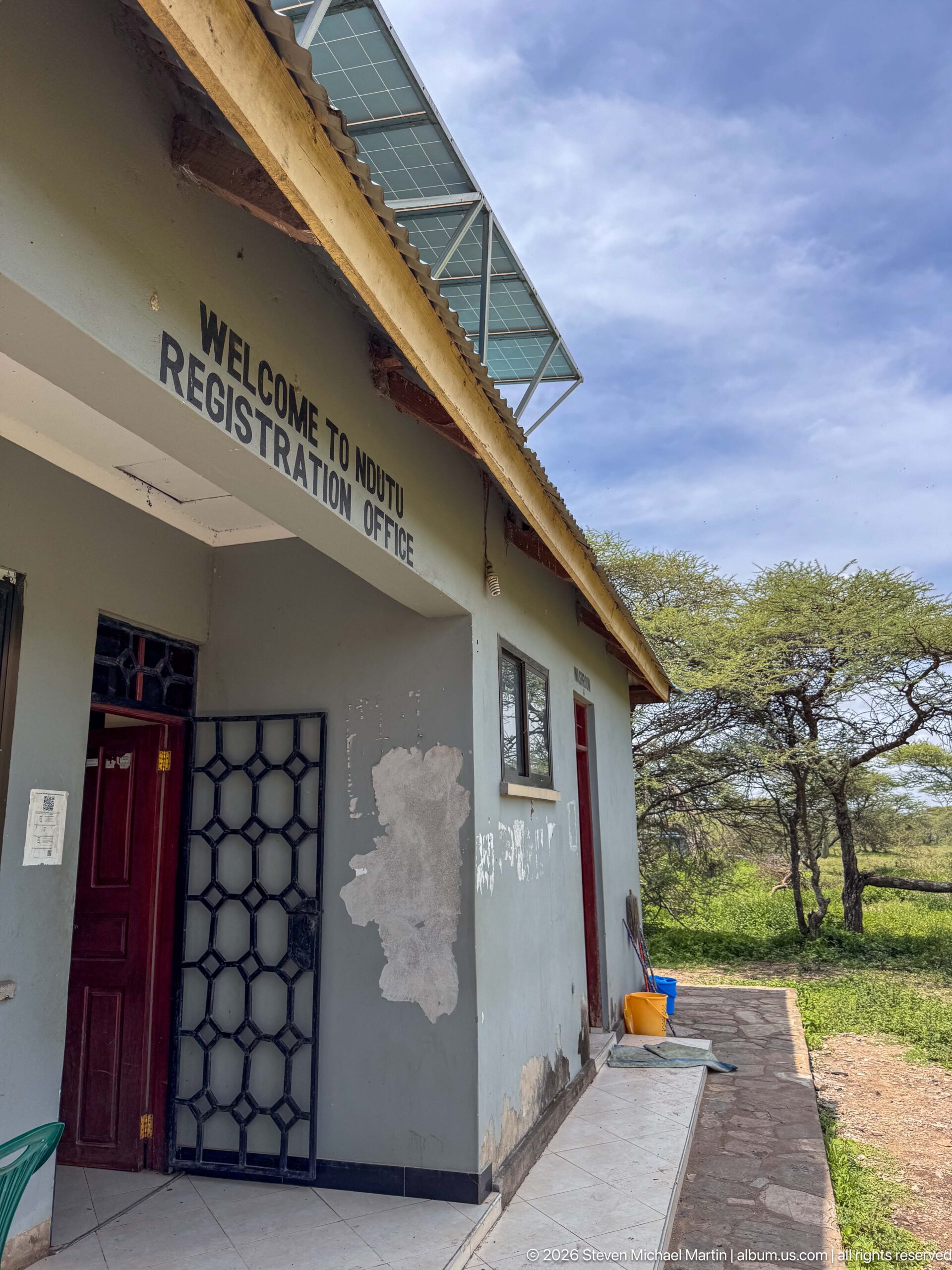
The Ndutu Registration Office stands beside the open savanna, its entrance identified by the painted words “WELCOME TO NDUTU REGISTRATION OFFICE” beneath the eaves. A red door, metal security grille, weathered exterior walls, and a broad solar-panel canopy define the modest field building, while flat-topped acacias beyond connect the administrative stop directly to the surrounding Ndutu landscape.
Caption
The Ndutu Registration Office stands beside the open savanna, its entrance identified by the painted words “WELCOME TO NDUTU REGISTRATION OFFICE” beneath the eaves. A red door, metal security grille, weathered exterior walls, and a broad solar-panel canopy define the modest field building, while flat-topped acacias beyond connect the administrative stop directly to the surrounding Ndutu landscape.
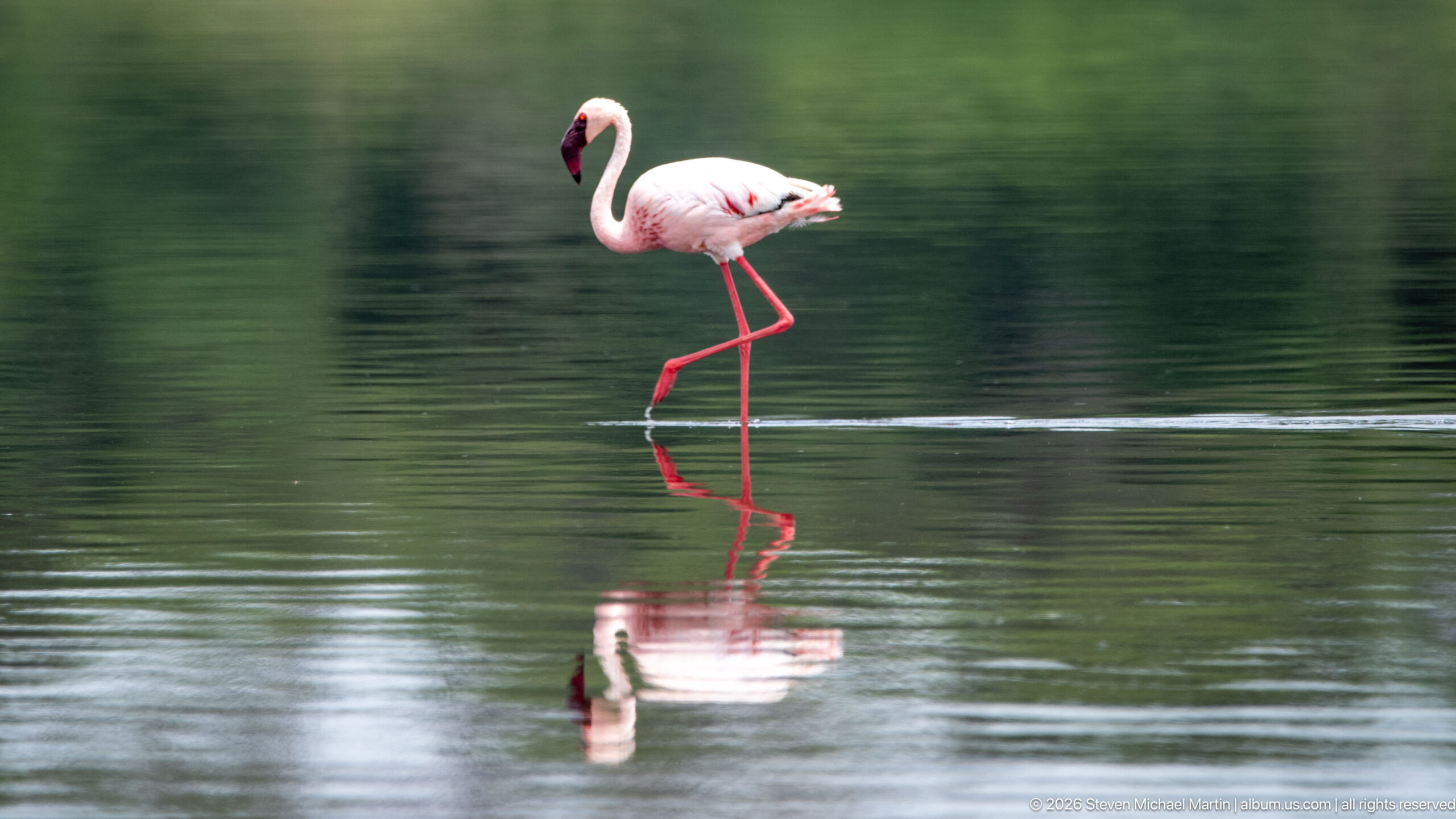
A greater flamingo strides across shallow water with one long pink leg raised mid-step. Its neck is held in a relaxed curve and black on the folded wing contrasts with the otherwise pale pink body. A bright reflection and thin wake beneath the bird accentuate the measured movement through the lake margin.
Caption
A greater flamingo strides across shallow water with one long pink leg raised mid-step. Its neck is held in a relaxed curve and black on the folded wing contrasts with the otherwise pale pink body. A bright reflection and thin wake beneath the bird accentuate the measured movement through the lake margin.
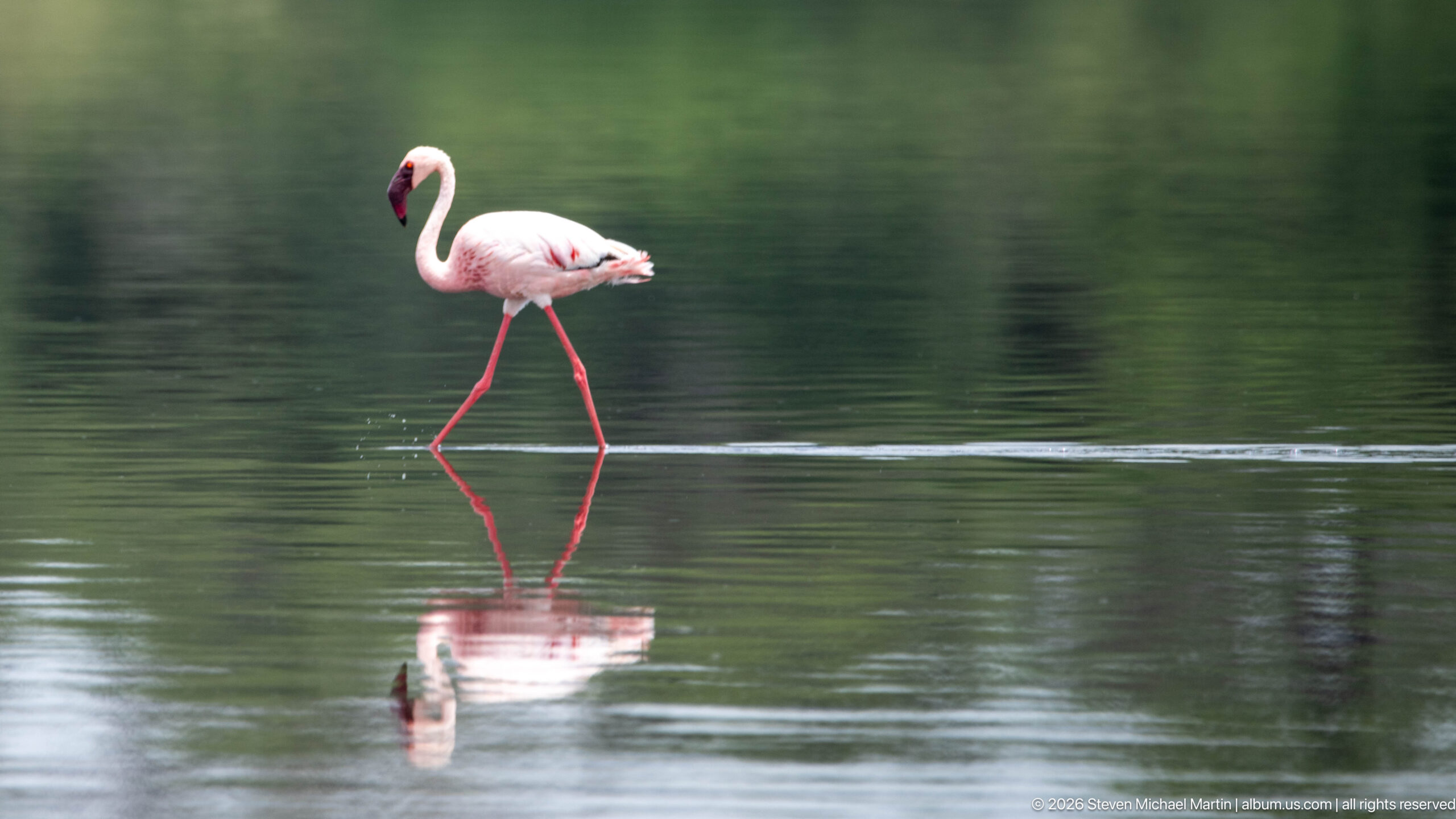
A greater flamingo walks in profile through still, shallow water, its raised foot just breaking the surface. The nearly symmetrical reflection below and narrow wake behind turn the solitary bird into a graphic study of balance and movement. Pale pink plumage and long red-pink legs stand against the deep green reflected shoreline.
Caption
A greater flamingo walks in profile through still, shallow water, its raised foot just breaking the surface. The nearly symmetrical reflection below and narrow wake behind turn the solitary bird into a graphic study of balance and movement. Pale pink plumage and long red-pink legs stand against the deep green reflected shoreline.
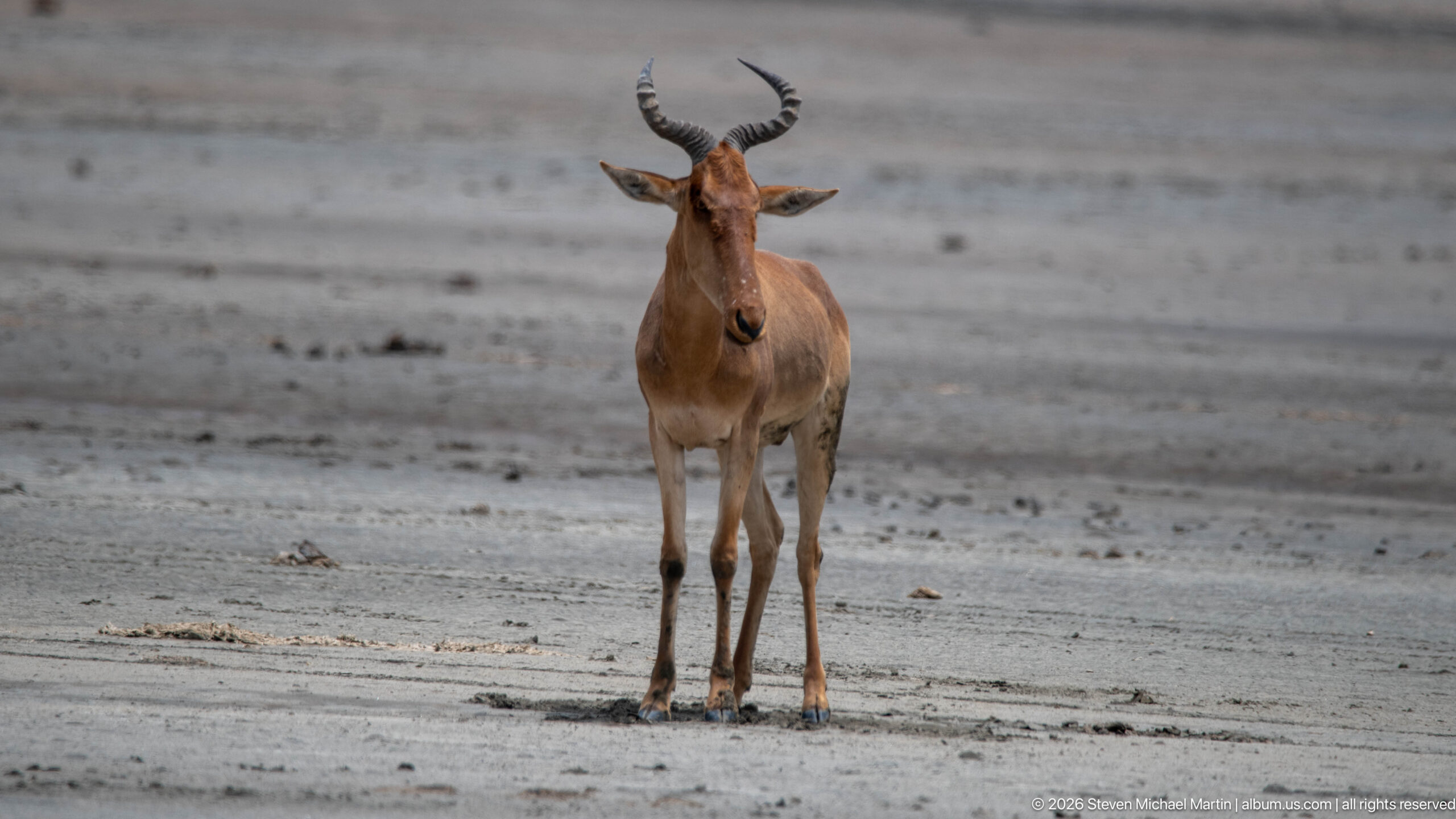
A Coke’s hartebeest faces the camera on a broad, pale expanse of bare ground near Ndutu. Its elongated face, high shoulders, sloping back, tawny coat, and strongly ridged horns are clearly visible in the frontal stance. The sparse setting isolates the antelope’s distinctive proportions from the surrounding short-grass ecosystem.
Caption
A Coke’s hartebeest faces the camera on a broad, pale expanse of bare ground near Ndutu. Its elongated face, high shoulders, sloping back, tawny coat, and strongly ridged horns are clearly visible in the frontal stance. The sparse setting isolates the antelope’s distinctive proportions from the surrounding short-grass ecosystem.
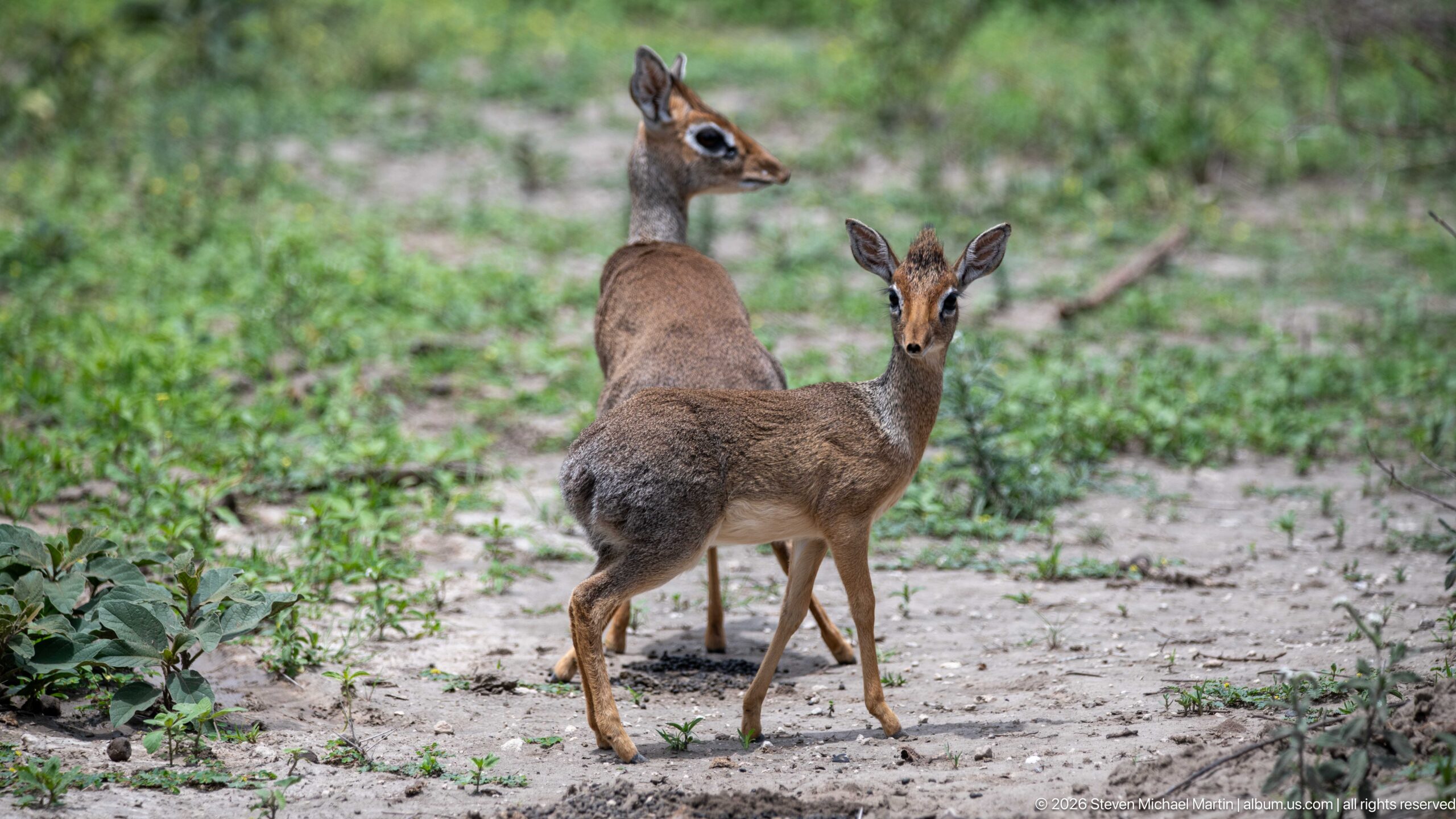
Two Kirk’s dik-diks stand close together on sandy ground amid low green vegetation, one facing the camera while the other watches to the side. Their very small size, pointed muzzles, large eyes, and oversized ears are prominent. The paired portrait records these diminutive antelope within the scrubby woodland habitat bordering the Ndutu plains.
Caption
Two Kirk’s dik-diks stand close together on sandy ground amid low green vegetation, one facing the camera while the other watches to the side. Their very small size, pointed muzzles, large eyes, and oversized ears are prominent. The paired portrait records these diminutive antelope within the scrubby woodland habitat bordering the Ndutu plains.

Two Kirk’s dik-diks occupy a patch of sandy, sparsely vegetated ground, the nearer animal alert in profile while its companion lowers its head to forage. Their contrasting postures reveal the species’ compact body, long legs, pointed muzzle, and large ears while also showing quiet feeding behavior at the woodland edge.
Caption
Two Kirk’s dik-diks occupy a patch of sandy, sparsely vegetated ground, the nearer animal alert in profile while its companion lowers its head to forage. Their contrasting postures reveal the species’ compact body, long legs, pointed muzzle, and large ears while also showing quiet feeding behavior at the woodland edge.
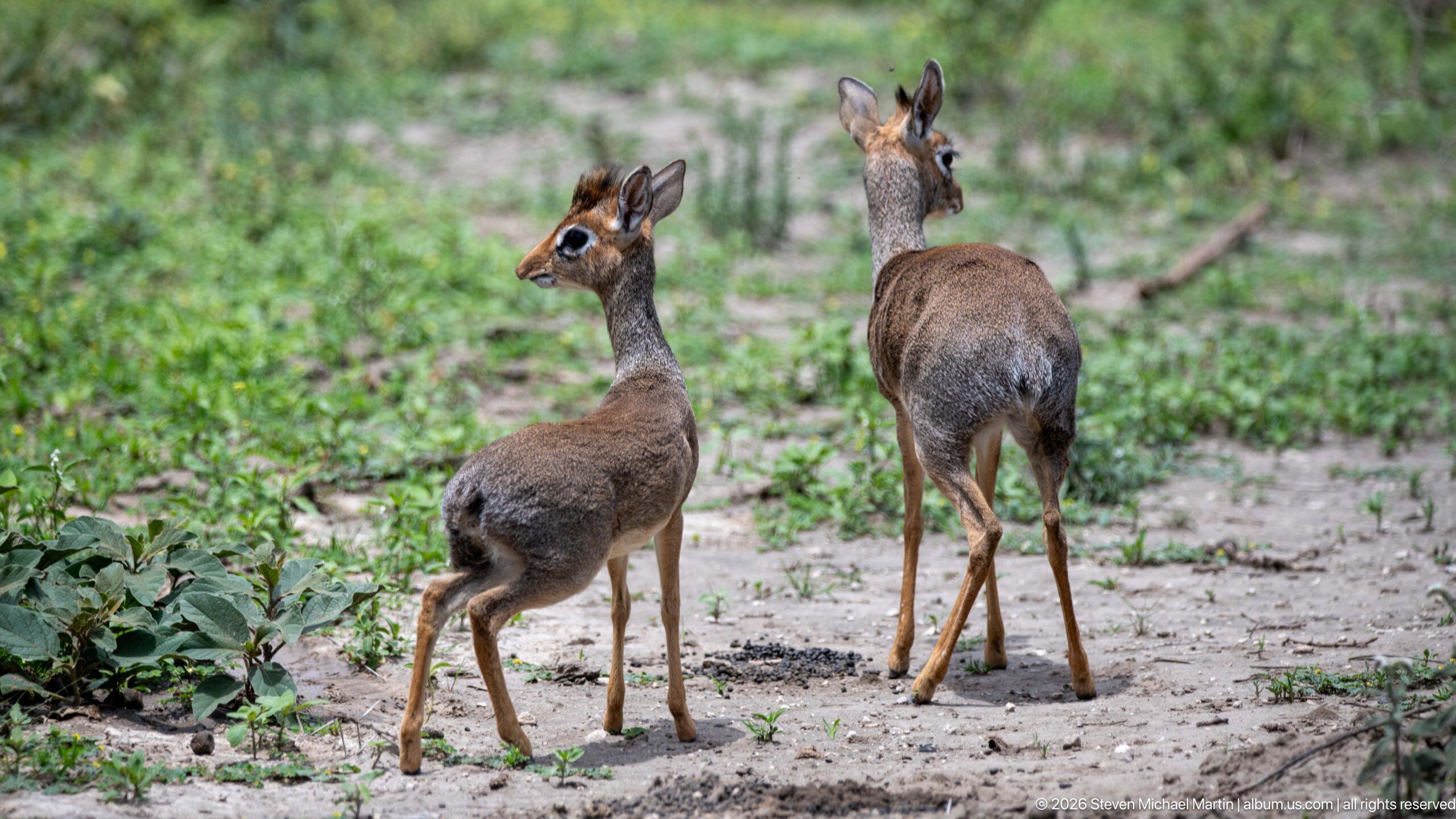
Two Kirk’s dik-diks stand side by side on a sandy clearing, both upright and alert but oriented in different directions. Their large ears, fine legs, compact gray-brown bodies, and pointed faces are especially clear in this unobstructed view. The paired stance suggests vigilance within the lightly vegetated scrub near Ndutu.
Caption
Two Kirk’s dik-diks stand side by side on a sandy clearing, both upright and alert but oriented in different directions. Their large ears, fine legs, compact gray-brown bodies, and pointed faces are especially clear in this unobstructed view. The paired stance suggests vigilance within the lightly vegetated scrub near Ndutu.
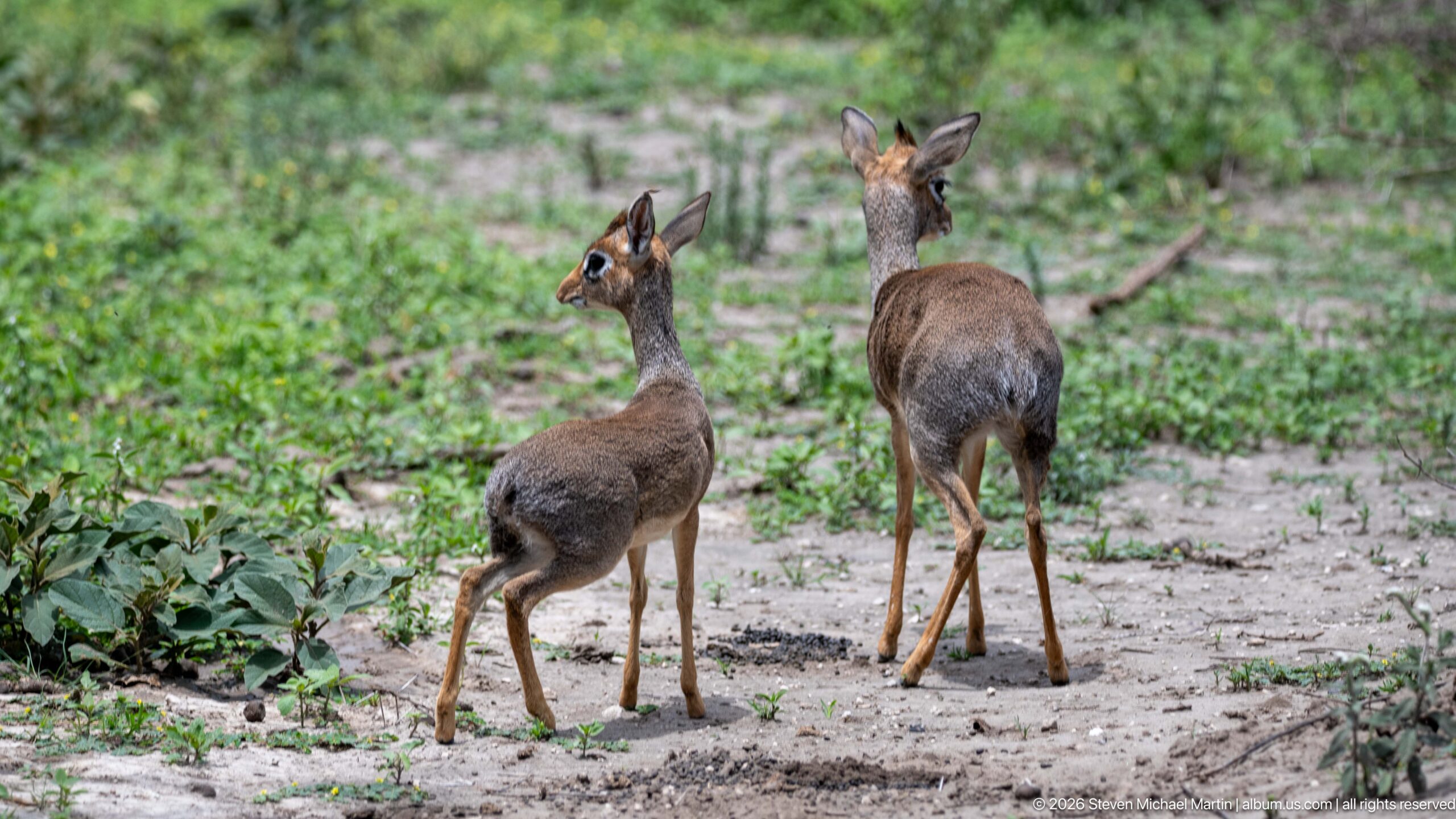
A pair of Kirk’s dik-diks pauses on pale sandy ground at the edge of green scrub. One animal looks left in profile while the other faces away with its head turned, presenting complementary views of the species’ small stature, rounded hindquarters, long legs, and oversized ears. The sparse clearing keeps both animals fully visible.
Caption
A pair of Kirk’s dik-diks pauses on pale sandy ground at the edge of green scrub. One animal looks left in profile while the other faces away with its head turned, presenting complementary views of the species’ small stature, rounded hindquarters, long legs, and oversized ears. The sparse clearing keeps both animals fully visible.
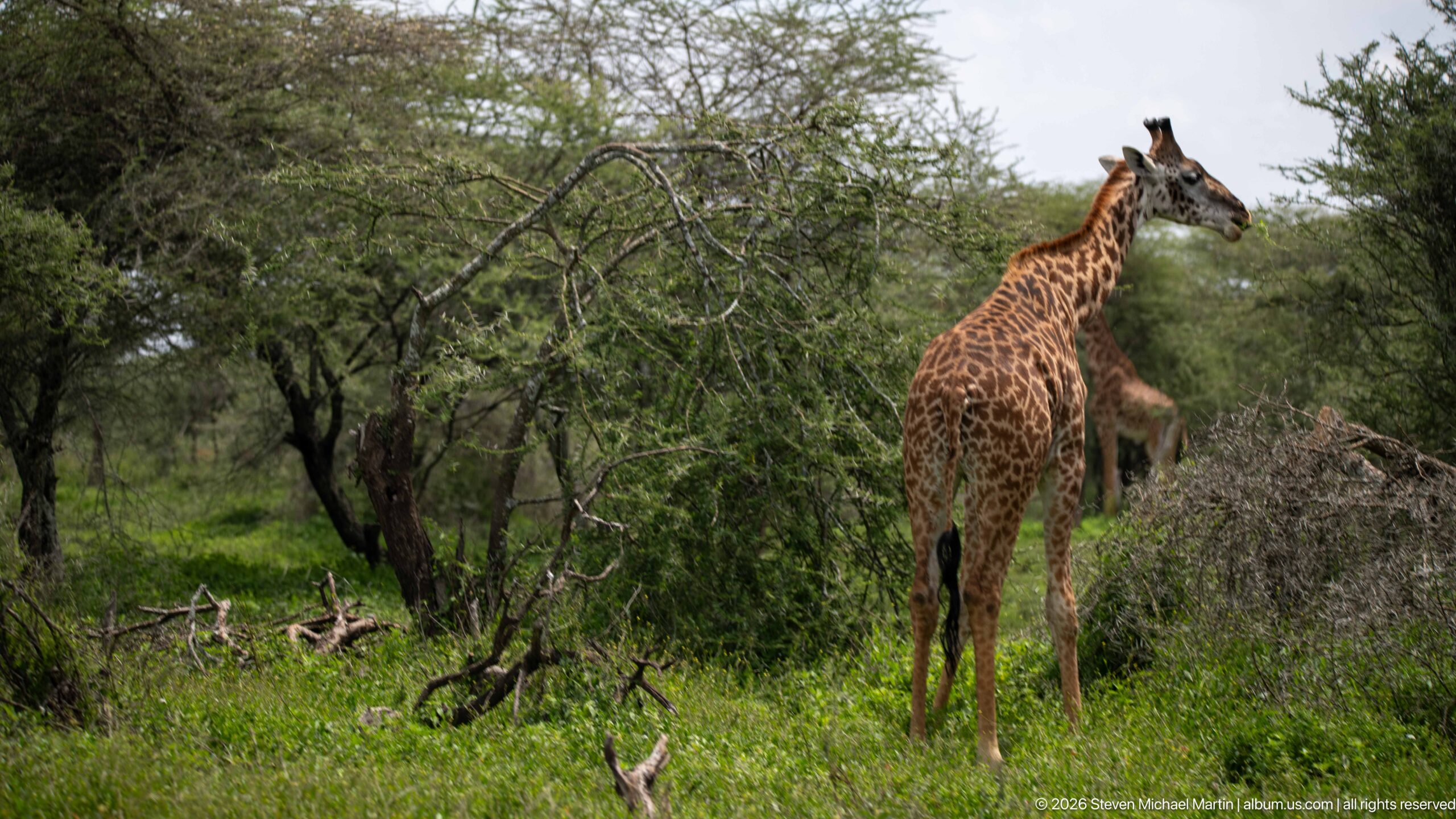
A Masai giraffe stands among dense acacia scrub, its tall patterned body rising above the surrounding vegetation while it looks to the right. Irregular, jagged-edged dark patches on the coat are visible despite partial screening by branches. The woodland setting shows how giraffes use the browse-rich margins around the open Ndutu plains.
Caption
A Masai giraffe stands among dense acacia scrub, its tall patterned body rising above the surrounding vegetation while it looks to the right. Irregular, jagged-edged dark patches on the coat are visible despite partial screening by branches. The woodland setting shows how giraffes use the browse-rich margins around the open Ndutu plains.
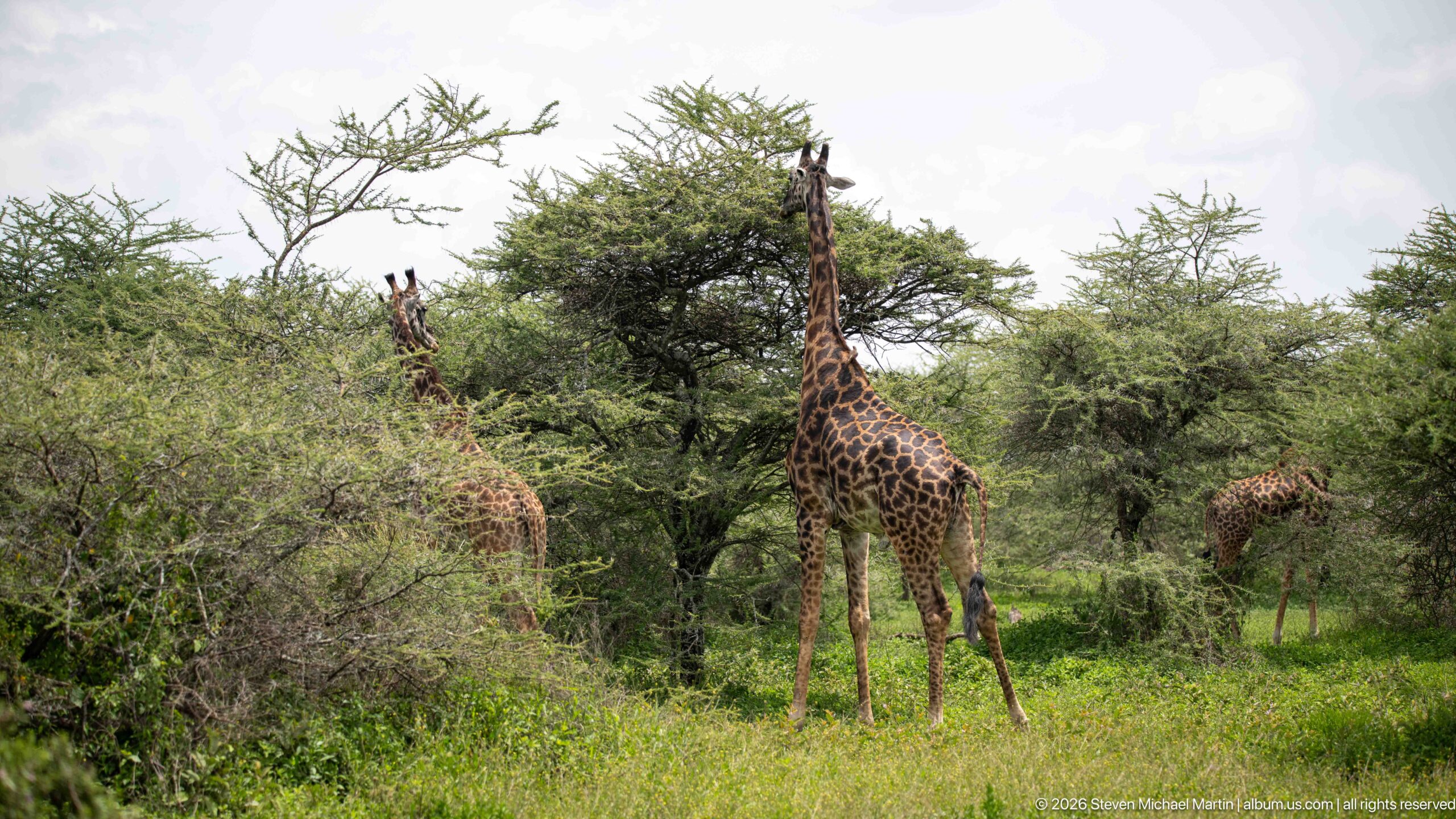
Several Masai giraffes are distributed through green acacia woodland, with one tall animal prominent near center and others partly concealed by foliage. The wider view emphasizes their vertical scale against the thorn trees and shows a loose group using dense browsing habitat rather than the open plain. Irregular dark coat patches remain visible on the nearest giraffes.
Caption
Several Masai giraffes are distributed through green acacia woodland, with one tall animal prominent near center and others partly concealed by foliage. The wider view emphasizes their vertical scale against the thorn trees and shows a loose group using dense browsing habitat rather than the open plain. Irregular dark coat patches remain visible on the nearest giraffes.
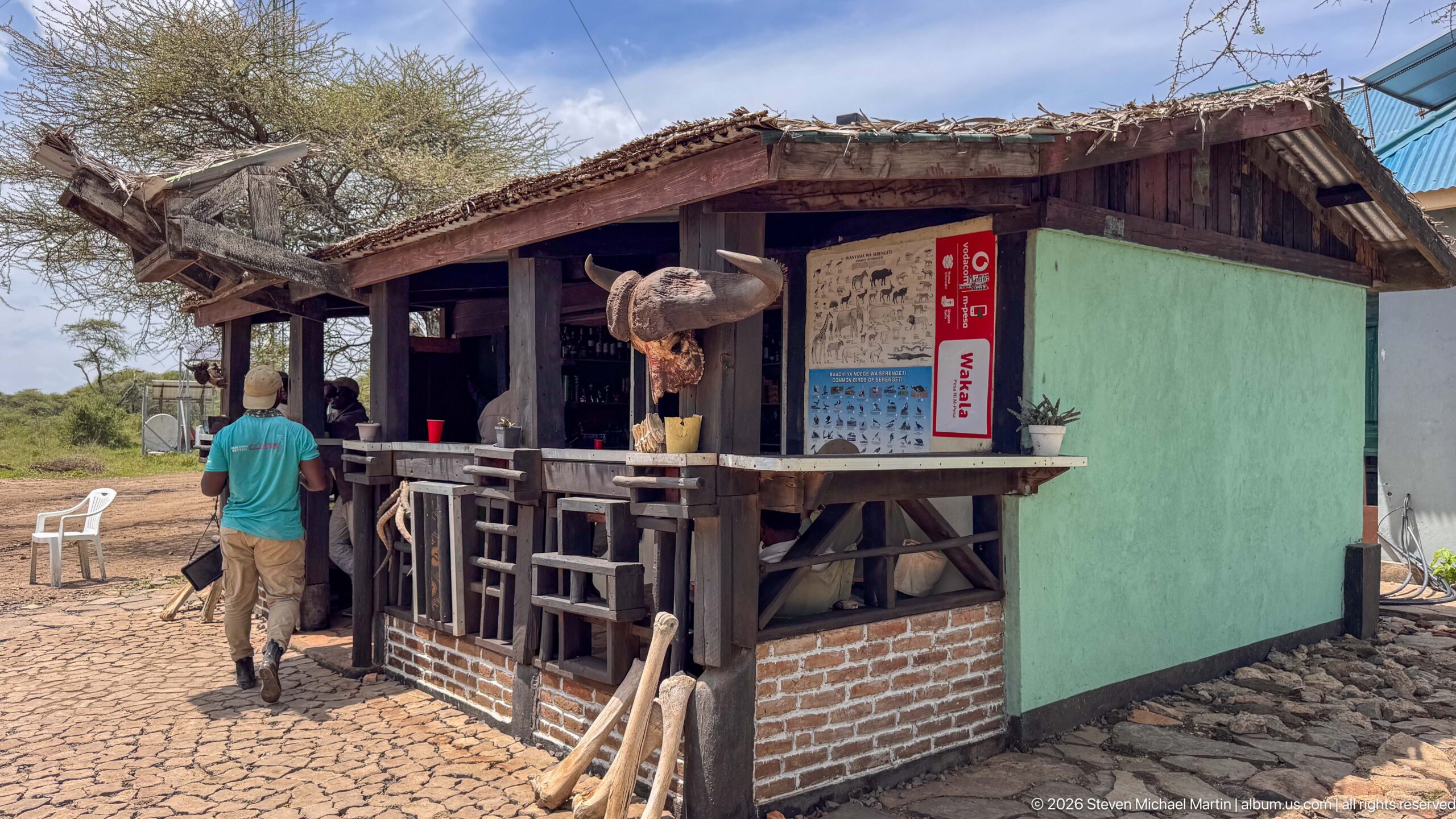
A small open-fronted refreshment kiosk stands beside a paved or stone-set outdoor area near Ndutu, with a visitor approaching the counter. Rustic timber posts, a low brick base, green-painted side wall, beverage signage, stools, and decorative animal bones or horned skull elements give the stop a distinctly safari-route character.
Caption
A small open-fronted refreshment kiosk stands beside a paved or stone-set outdoor area near Ndutu, with a visitor approaching the counter. Rustic timber posts, a low brick base, green-painted side wall, beverage signage, stools, and decorative animal bones or horned skull elements give the stop a distinctly safari-route character.
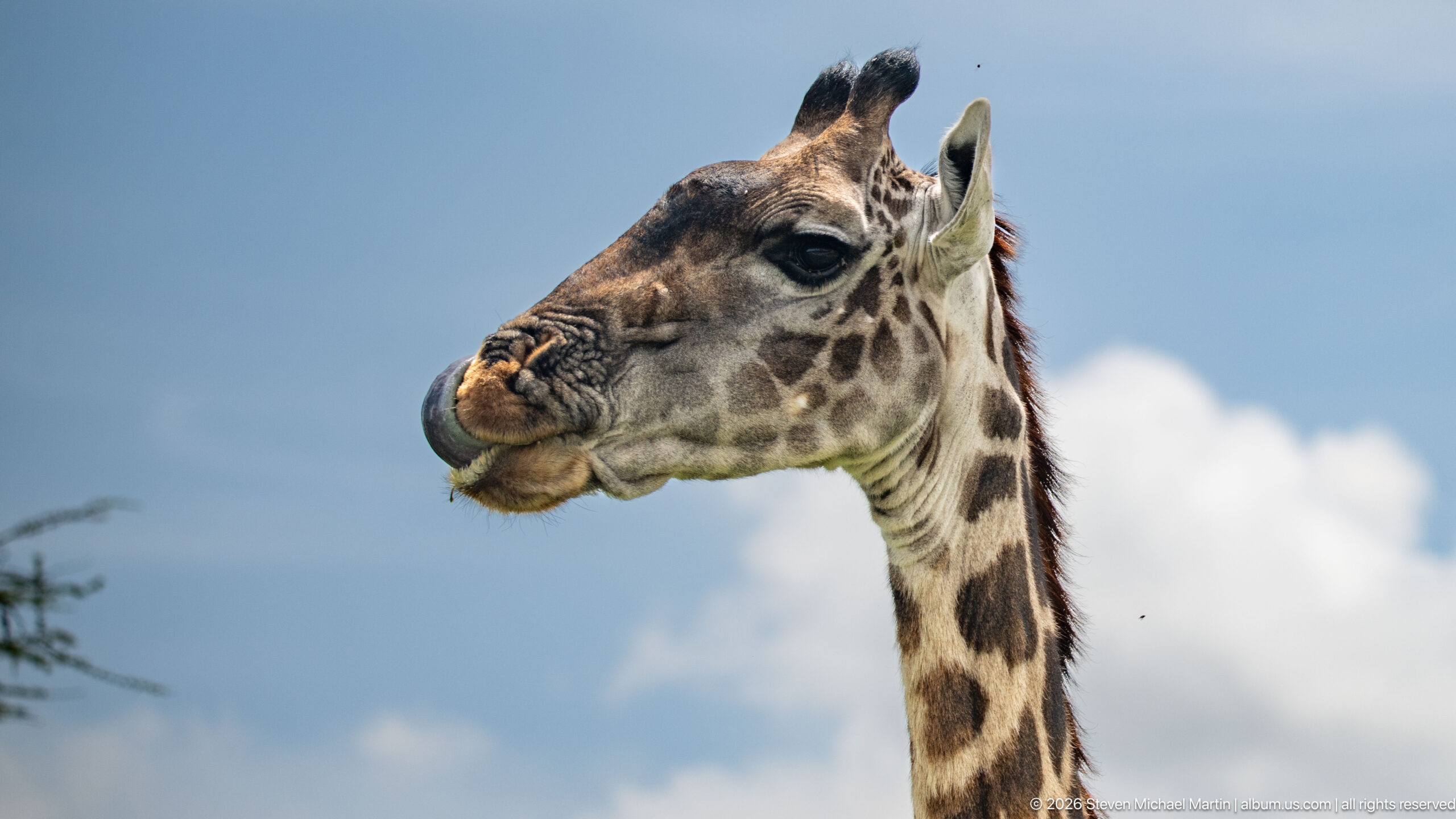
A close portrait isolates the head and upper neck of a Masai giraffe against blue sky and soft white cloud. The view reveals the animal’s large dark eye, long lashes, ossicones, tufted mane, muzzle, and irregular brown coat pattern in fine detail. Its slightly turned head gives the portrait a calm, attentive expression without losing anatomical clarity.
Caption
A close portrait isolates the head and upper neck of a Masai giraffe against blue sky and soft white cloud. The view reveals the animal’s large dark eye, long lashes, ossicones, tufted mane, muzzle, and irregular brown coat pattern in fine detail. Its slightly turned head gives the portrait a calm, attentive expression without losing anatomical clarity.
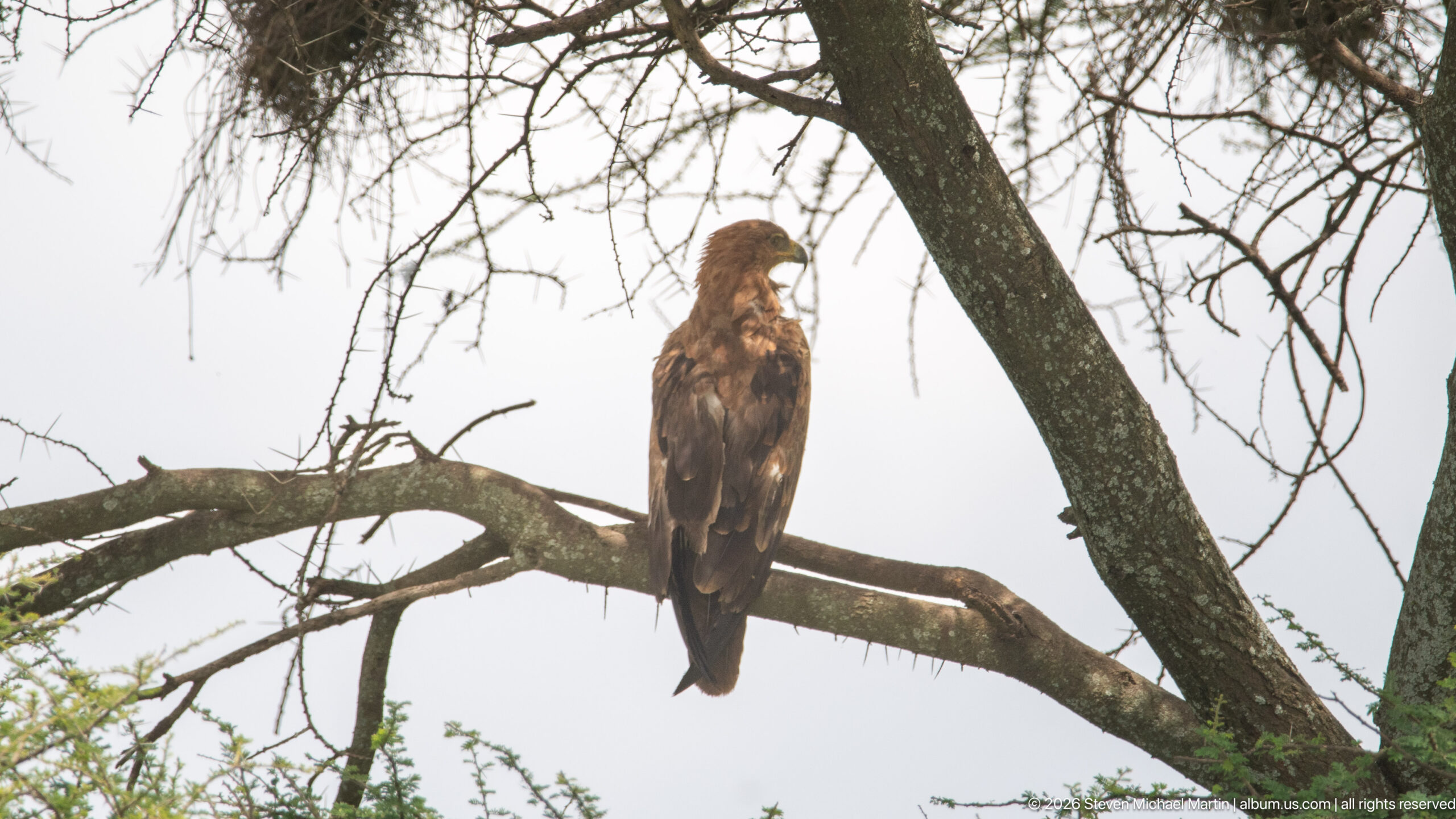
A large brown eagle perches upright on a horizontal tree branch, backlit against a pale sky and framed by a network of bare twigs. Its heavy body, hooked bill, broad folded wings, and feathered legs suggest a tawny eagle, a widespread raptor of East African savanna. Strong backlighting, however, obscures finer plumage and facial details needed for complete certainty.
Caption
A large brown eagle perches upright on a horizontal tree branch, backlit against a pale sky and framed by a network of bare twigs. Its heavy body, hooked bill, broad folded wings, and feathered legs suggest a tawny eagle, a widespread raptor of East African savanna. Strong backlighting, however, obscures finer plumage and facial details needed for complete certainty.
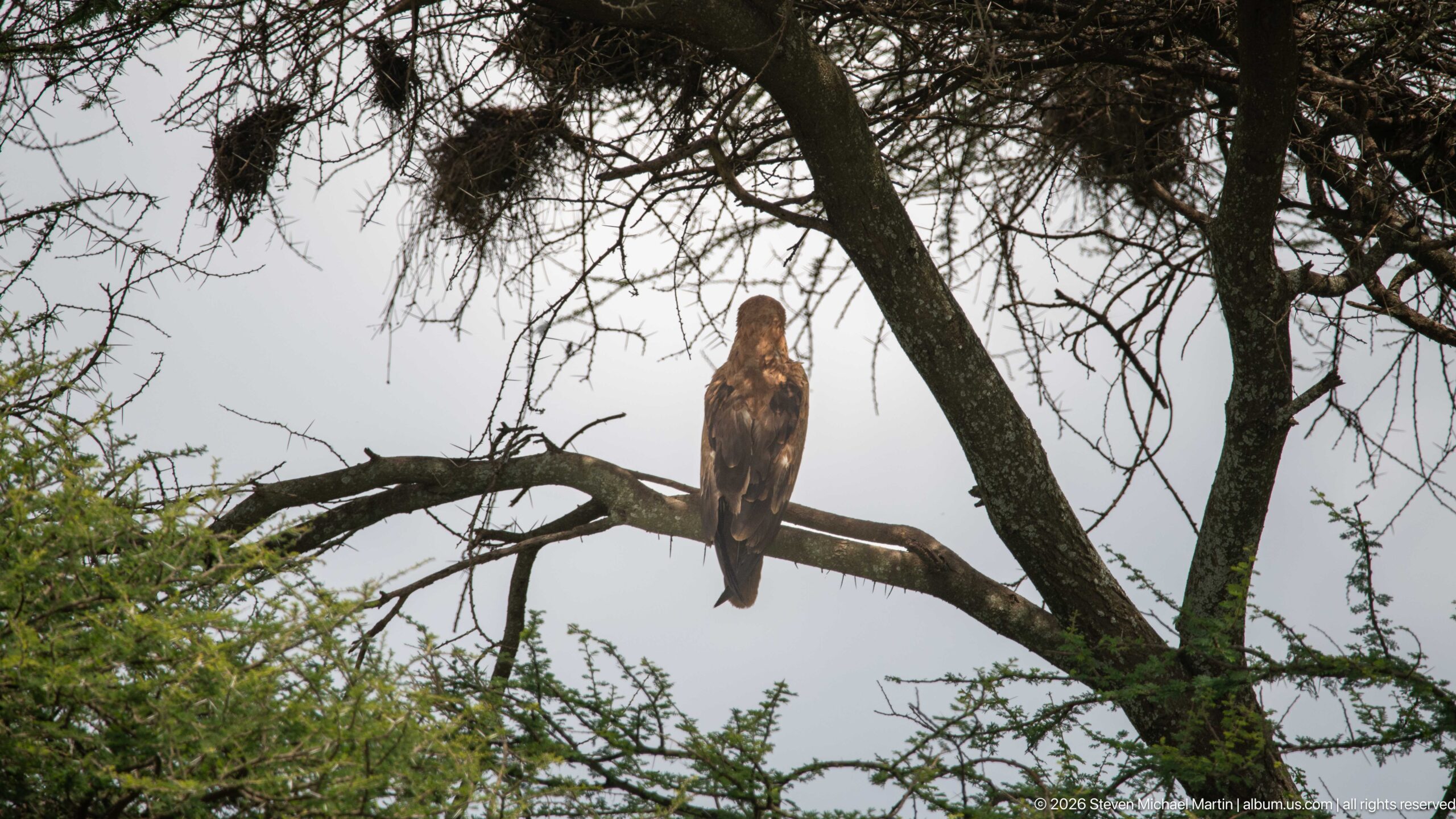
A large brown raptor perches upright on a horizontal acacia branch in the Ndutu landscape, framed by a lattice of dark limbs and sparse foliage. Its heavy body, hooked bill, and long folded wings give it the proportions of a large eagle, while the backlit view leaves the finer plumage and facial markings needed for a confident species-level identification unresolved.
Caption
A large brown raptor perches upright on a horizontal acacia branch in the Ndutu landscape, framed by a lattice of dark limbs and sparse foliage. Its heavy body, hooked bill, and long folded wings give it the proportions of a large eagle, while the backlit view leaves the finer plumage and facial markings needed for a confident species-level identification unresolved.
🐘 Ndutu Lake Wildlife Field Guide
Wildlife observed during this game drive:
The Ndutu Lake region forms part of the southern Serengeti ecosystem, where seasonal wetlands and open plains support a high concentration of wildlife. During the wet season, this area becomes a focal point for grazing herds, birdlife, and predators, creating a dynamic environment defined by movement, feeding activity, and ecological interaction.
🦁 Predators & Raptors
- Tawny Eagle – A powerful raptor often seen perched in trees or scanning open ground for prey, adding an aerial predator presence to the Ndutu ecosystem.
🐘 Large Mammals
- Masai Giraffe – Frequently observed browsing acacia trees, giraffes highlight the transition between wooded areas and open plains.
🦓 Plains Game & Grazers
- Wildebeest – A key species of the Great Migration, wildebeest graze across the plains and form the foundation of the predator-prey system.
- Topi – Fast and alert antelope adapted to open plains, often seen standing prominently on slightly elevated ground.
- Thomson’s Gazelle – Small and agile grazers commonly found in groups across the plains.
- Kirk’s Dik-dik – Tiny antelope typically seen in pairs, favoring lightly vegetated areas near the edges of open plains.
🪶 Waterbirds & Shorebirds
- Lesser Flamingo – Often seen in groups feeding in shallow alkaline water, creating striking reflections and color across the lake surface.
- Greater Flamingo – Larger and paler than the lesser flamingo, typically feeding individually or in smaller groups.
- Black-winged Stilt – Long-legged waders commonly seen in flocks along the water’s edge.
- Spur-winged Lapwing – A distinctive shorebird often found near wetlands and open ground.
- White Stork – Large migratory bird seen foraging in open grasslands.
- Grey Heron – Solitary wading bird often found in shallow water or marshy areas.
🪶 Other Birdlife
- Superb Starling – A vividly colored bird commonly seen perched on branches or moving through vegetation.
🌄 Habitat
- Ndutu Lake – A seasonal alkaline lake attracting waterbirds and grazing wildlife.
- Seasonal Wetlands – Shallow water areas supporting feeding birds and migratory species.
- Open Grass Plains – Expansive grazing areas central to the migration ecosystem.
- Acacia Woodland – Scattered trees providing food, shelter, and perches for wildlife.