Lisbon
Lisbon developed as one of Europe’s most important maritime capitals during the Age of Exploration, serving as a departure point for voyages to Africa, Asia, and the Americas. Its position along the Tagus River provided access to Atlantic trade routes that supported Portugal’s emergence as a global naval power. The city reflects the expansion of European influence through overseas exploration.
Historic districts illustrate architectural influences shaped by Roman, Islamic, and Christian traditions across multiple historical periods. Churches, monasteries, and civic buildings reflect the wealth generated through maritime commerce and global trade networks. Lisbon became a center for navigation, cartography, and shipbuilding innovation.
Lisbon represents the transition from medieval Iberian kingdoms to early modern global empires. Its preserved historic environment illustrates the connection between maritime exploration and cultural exchange across continents.

A visitor poses at a high viewpoint on São Jorge Castle with central Lisbon spreading across the background. Dense pale façades and terracotta roofs descend through the city, while the elevated perspective explains the fortress's commanding position above the historic center.
Caption
A visitor poses at a high viewpoint on São Jorge Castle with central Lisbon spreading across the background. Dense pale façades and terracotta roofs descend through the city, while the elevated perspective explains the fortress's commanding position above the historic center.

The crenellated walls and square towers of Castelo de São Jorge crown a wooded hill above Lisbon’s red-roofed neighborhoods. Seen from across the city, the medieval fortification reads as a continuous defensive complex commanding the historic center and the approaches to the Tagus.
Caption
The crenellated walls and square towers of Castelo de São Jorge crown a wooded hill above Lisbon’s red-roofed neighborhoods. Seen from across the city, the medieval fortification reads as a continuous defensive complex commanding the historic center and the approaches to the Tagus.

A yellow-and-green commuter train approaches along tracks set between multi-lane roads near the Belém waterfront. Cars move in both directions while marina masts and pedestrians appear to the right, showing how rail, road, and riverfront activity converge along Lisbon’s western corridor.
Caption
A yellow-and-green commuter train approaches along tracks set between multi-lane roads near the Belém waterfront. Cars move in both directions while marina masts and pedestrians appear to the right, showing how rail, road, and riverfront activity converge along Lisbon’s western corridor.

A broad arched opening in the castle masonry frames trees, rooftops, and distant church towers across Lisbon. The dark interior stonework acts as a natural border around the brighter city beyond, turning a defensive architectural opening into a carefully layered urban vista.
Caption
A broad arched opening in the castle masonry frames trees, rooftops, and distant church towers across Lisbon. The dark interior stonework acts as a natural border around the brighter city beyond, turning a defensive architectural opening into a carefully layered urban vista.

From within São Jorge Castle, crenellated walls and towers step across the foreground while Lisbon spreads over the hills beyond. A Portuguese flag rises above the ramparts, and mature trees soften the defensive masonry, creating a contextual view that links fortress, city, and elevated terrain.
Caption
From within São Jorge Castle, crenellated walls and towers step across the foreground while Lisbon spreads over the hills beyond. A Portuguese flag rises above the ramparts, and mature trees soften the defensive masonry, creating a contextual view that links fortress, city, and elevated terrain.
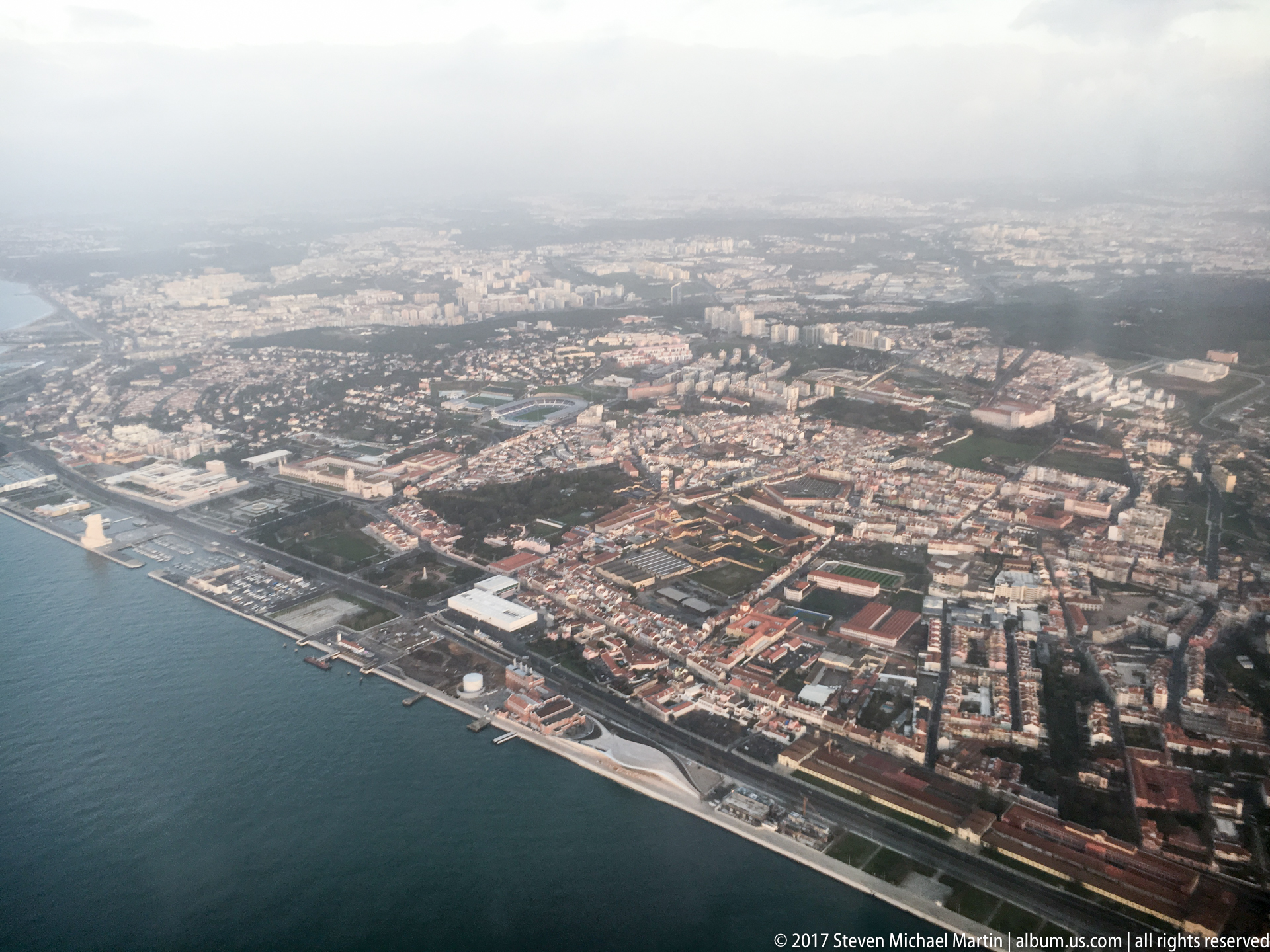
An aerial view looks across Lisbon’s dense urban fabric toward a long developed waterfront, with roads, rail corridors, large blocks, and open river-edge spaces tracing the shore. The elevated perspective shifts attention from individual monuments to the city’s broader relationship with the Tagus and its linear transport infrastructure.
Caption
An aerial view looks across Lisbon’s dense urban fabric toward a long developed waterfront, with roads, rail corridors, large blocks, and open river-edge spaces tracing the shore. The elevated perspective shifts attention from individual monuments to the city’s broader relationship with the Tagus and its linear transport infrastructure.

A steep downward view follows tightly clustered houses with terracotta roofs along the slope below São Jorge Castle. Stairs, retaining walls, small courtyards, and trees reveal how residential fabric adapts to Lisbon's abrupt terrain, with the broader city spreading beyond at the upper edge.
Caption
A steep downward view follows tightly clustered houses with terracotta roofs along the slope below São Jorge Castle. Stairs, retaining walls, small courtyards, and trees reveal how residential fabric adapts to Lisbon's abrupt terrain, with the broader city spreading beyond at the upper edge.

A massive elevated roadway crosses above a narrow Lisbon street on tall concrete piers, its red structural underside contrasting with older low-rise buildings below. Tram or utility wires, parked cars, and a yellow civic-looking building show how modern transport infrastructure cuts through the established urban fabric.
Caption
A massive elevated roadway crosses above a narrow Lisbon street on tall concrete piers, its red structural underside contrasting with older low-rise buildings below. Tram or utility wires, parked cars, and a yellow civic-looking building show how modern transport infrastructure cuts through the established urban fabric.

Terracotta roofs descend toward the broad Tagus River in a hillside view across eastern Lisbon. Pale residential buildings cluster along the slope, while a striking group of blue, yellow, and red modern volumes stands out near the center, introducing contemporary color into the traditional roofscape.
Caption
Terracotta roofs descend toward the broad Tagus River in a hillside view across eastern Lisbon. Pale residential buildings cluster along the slope, while a striking group of blue, yellow, and red modern volumes stands out near the center, introducing contemporary color into the traditional roofscape.

Lisbon’s red-roofed neighborhoods descend toward the Tagus River, where the 25 de Abril Bridge spans the background. The elevated view links the historic urban fabric to the broad estuary and the modern suspension bridge that defines the city’s western river horizon.
Caption
Lisbon’s red-roofed neighborhoods descend toward the Tagus River, where the 25 de Abril Bridge spans the background. The elevated view links the historic urban fabric to the broad estuary and the modern suspension bridge that defines the city’s western river horizon.

The twin towers of the Monastery of São Vicente de Fora rise beyond red-tiled roofs and weathered walls on a Lisbon hillside. Framed by a twisting tree and foreground graffiti, the view layers monumental religious architecture with the dense, irregular fabric of the surrounding historic city.
Caption
The twin towers of the Monastery of São Vicente de Fora rise beyond red-tiled roofs and weathered walls on a Lisbon hillside. Framed by a twisting tree and foreground graffiti, the view layers monumental religious architecture with the dense, irregular fabric of the surrounding historic city.

Red tile roofs cascade across Lisbon’s hills in this broad daytime panorama, with tightly packed houses and larger civic blocks extending toward distant ridges. Foreground walls and terraces establish the elevated viewpoint and reinforce the city’s characteristic relationship between steep terrain and dense development.
Caption
Red tile roofs cascade across Lisbon’s hills in this broad daytime panorama, with tightly packed houses and larger civic blocks extending toward distant ridges. Foreground walls and terraces establish the elevated viewpoint and reinforce the city’s characteristic relationship between steep terrain and dense development.

An illuminated ornamental fountain sends arcing jets across its basin in Lisbon’s Rossio Square, with sculpted figures silhouetted against the surrounding historic façades. The nighttime view emphasizes the fountain’s tiered composition and the lively urban setting of one of the city center’s principal public spaces.
Caption
An illuminated ornamental fountain sends arcing jets across its basin in Lisbon’s Rossio Square, with sculpted figures silhouetted against the surrounding historic façades. The nighttime view emphasizes the fountain’s tiered composition and the lively urban setting of one of the city center’s principal public spaces.

A close view isolates the sculpted figures supporting the upper basin of a Rossio Square fountain. Water streams and sprays around the weathered stone forms, turning an urban monument into a study of texture, movement, and reflected nighttime light rather than an establishing view of the square.
Caption
A close view isolates the sculpted figures supporting the upper basin of a Rossio Square fountain. Water streams and sprays around the weathered stone forms, turning an urban monument into a study of texture, movement, and reflected nighttime light rather than an establishing view of the square.

Weathered sculptural figures emerge behind a curtain of cascading water in this tight detail of a Rossio Square fountain. The framing concentrates on modeled anatomy, mineral-stained surfaces, and flowing water, distinguishing the decorative sculpture from the broader nighttime views of the monument.
Caption
Weathered sculptural figures emerge behind a curtain of cascading water in this tight detail of a Rossio Square fountain. The framing concentrates on modeled anatomy, mineral-stained surfaces, and flowing water, distinguishing the decorative sculpture from the broader nighttime views of the monument.

The neoclassical façade of the Teatro Nacional D. Maria II faces Rossio Square under nighttime illumination. A temporary projection spans the columned entrance while the pediment, sculptural decoration, and formal symmetry remain legible behind it, showing the historic theater in active contemporary use.
Caption
The neoclassical façade of the Teatro Nacional D. Maria II faces Rossio Square under nighttime illumination. A temporary projection spans the columned entrance while the pediment, sculptural decoration, and formal symmetry remain legible behind it, showing the historic theater in active contemporary use.

The tall Monument to Pedro IV rises above Rossio Square at night, its fluted column crowned by the standing figure of the Portuguese king and Brazilian emperor. The illuminated pedestal and column create a vertical counterpoint to the low façades around the square.
Caption
The tall Monument to Pedro IV rises above Rossio Square at night, its fluted column crowned by the standing figure of the Portuguese king and Brazilian emperor. The illuminated pedestal and column create a vertical counterpoint to the low façades around the square.

The roofless Gothic walls of the Carmo Convent stand above illuminated buildings in central Lisbon. Pointed openings and surviving masonry remain visible against the night sky, giving the ruined church a distinctive silhouette above the lower commercial blocks of the Baixa and Chiado area.
Caption
The roofless Gothic walls of the Carmo Convent stand above illuminated buildings in central Lisbon. Pointed openings and surviving masonry remain visible against the night sky, giving the ruined church a distinctive silhouette above the lower commercial blocks of the Baixa and Chiado area.

A broad arched passage cuts through the center of a symmetrical historic building, opening from a quiet paved square into a brightly lit street beyond. Pedestrians crossing the arch emphasize the gateway’s role as an urban connector within Lisbon’s dense central districts.
Caption
A broad arched passage cuts through the center of a symmetrical historic building, opening from a quiet paved square into a brightly lit street beyond. Pedestrians crossing the arch emphasize the gateway’s role as an urban connector within Lisbon’s dense central districts.

A Rossio Square fountain and the Monument to Pedro IV share the frame at night, pairing the fountain’s bright arcs of water with the monument’s slender illuminated column. The composition shows how sculpture, water, and civic monuments structure the open space of this central Lisbon square.
Caption
A Rossio Square fountain and the Monument to Pedro IV share the frame at night, pairing the fountain’s bright arcs of water with the monument’s slender illuminated column. The composition shows how sculpture, water, and civic monuments structure the open space of this central Lisbon square.

The monument to Luís de Camões anchors its namesake square at night. The poet stands atop a high pedestal ringed by smaller historical figures, while surrounding façades and street life frame the sculptural ensemble at the meeting point of Chiado and Bairro Alto.
Caption
The monument to Luís de Camões anchors its namesake square at night. The poet stands atop a high pedestal ringed by smaller historical figures, while surrounding façades and street life frame the sculptural ensemble at the meeting point of Chiado and Bairro Alto.

The iron tower of the Santa Justa Lift rises dramatically between narrow Baixa streets, its stacked openings and upper observation structure brightly illuminated against the night sky. Designed as vertical urban transport, the elevator links the lower Baixa with the higher Carmo area.
Caption
The iron tower of the Santa Justa Lift rises dramatically between narrow Baixa streets, its stacked openings and upper observation structure brightly illuminated against the night sky. Designed as vertical urban transport, the elevator links the lower Baixa with the higher Carmo area.

A classic yellow-and-white Lisbon electric tram marked route 28 pauses on street tracks at night. Overhead wires, rails, passengers, and closely packed façades place the vehicle within the city’s working transit landscape rather than presenting it simply as a nostalgic icon.
Caption
A classic yellow-and-white Lisbon electric tram marked route 28 pauses on street tracks at night. Overhead wires, rails, passengers, and closely packed façades place the vehicle within the city’s working transit landscape rather than presenting it simply as a nostalgic icon.

A small funicular car covered in layered graffiti occupies steep rails on a narrow Lisbon street. Pedestrians climb alongside the track, while dense façades and overhead infrastructure emphasize the practical role of inclined transport in negotiating the city’s pronounced hills.
Caption
A small funicular car covered in layered graffiti occupies steep rails on a narrow Lisbon street. Pedestrians climb alongside the track, while dense façades and overhead infrastructure emphasize the practical role of inclined transport in negotiating the city’s pronounced hills.

Black-and-white calçada portuguesa forms a maritime pavement design, with a stylized sea creature set above undulating wave bands. The small limestone and dark-stone tesserae demonstrate the graphic paving tradition that gives many Lisbon sidewalks and squares their distinctive patterned surfaces.
Caption
Black-and-white calçada portuguesa forms a maritime pavement design, with a stylized sea creature set above undulating wave bands. The small limestone and dark-stone tesserae demonstrate the graphic paving tradition that gives many Lisbon sidewalks and squares their distinctive patterned surfaces.

A close view of the Monument to Luís de Camões concentrates on the standing historical figures arranged around the pedestal below the poet. Their varied dress and attributes form a sculptural program honoring figures associated with Portuguese letters and culture, here isolated from the wider square.
Caption
A close view of the Monument to Luís de Camões concentrates on the standing historical figures arranged around the pedestal below the poet. Their varied dress and attributes form a sculptural program honoring figures associated with Portuguese letters and culture, here isolated from the wider square.

A sailing ship rendered in black-and-white calçada portuguesa fills the pavement, its masts, sails, hull, and stylized waves assembled from small contrasting stones. The maritime imagery connects Lisbon’s decorative paving tradition with the city’s long association with Atlantic navigation and trade.
Caption
A sailing ship rendered in black-and-white calçada portuguesa fills the pavement, its masts, sails, hull, and stylized waves assembled from small contrasting stones. The maritime imagery connects Lisbon’s decorative paving tradition with the city’s long association with Atlantic navigation and trade.

Long escalators descend through a broad vaulted transit passage lined with small tiles and warm artificial lighting. Repeating arches, handrails, and ceiling surfaces draw the eye toward passengers below, emphasizing the engineered interior geometry of Lisbon’s underground transport system.
Caption
Long escalators descend through a broad vaulted transit passage lined with small tiles and warm artificial lighting. Repeating arches, handrails, and ceiling surfaces draw the eye toward passengers below, emphasizing the engineered interior geometry of Lisbon’s underground transport system.

Fresh laundry hangs from lines and balcony rails across a weathered residential façade, where faded shutters, patched masonry, and climbing vegetation reveal the layered texture of an older Lisbon neighborhood. The domestic scene records everyday use of limited exterior space within the dense historic city.
Caption
Fresh laundry hangs from lines and balcony rails across a weathered residential façade, where faded shutters, patched masonry, and climbing vegetation reveal the layered texture of an older Lisbon neighborhood. The domestic scene records everyday use of limited exterior space within the dense historic city.

A traditional Lisbon tram approaches along embedded rails between closely spaced buildings. The frontal view emphasizes the compact vehicle, overhead electrical connection, and narrow street corridor, all characteristic of surface transit adapted to the older city’s constrained urban fabric.
Caption
A traditional Lisbon tram approaches along embedded rails between closely spaced buildings. The frontal view emphasizes the compact vehicle, overhead electrical connection, and narrow street corridor, all characteristic of surface transit adapted to the older city’s constrained urban fabric.

An aging multi-story townhouse presents a symmetrical façade of arched openings, iron balcony rails, worn stonework, and patched surfaces. Street-level storefronts remain in use beneath upper floors marked by weathering, illustrating the mixed commercial and residential fabric of central Lisbon.
Caption
An aging multi-story townhouse presents a symmetrical façade of arched openings, iron balcony rails, worn stonework, and patched surfaces. Street-level storefronts remain in use beneath upper floors marked by weathering, illustrating the mixed commercial and residential fabric of central Lisbon.

A richly gilded side altar frames a painted devotional statue within an architectural niche of fluted columns, scrollwork, and layered moldings. The concentrated ornament and polychrome figure form a close study of Lisbon church decoration, distinct from the broader sanctuary views in this sequence.
Caption
A richly gilded side altar frames a painted devotional statue within an architectural niche of fluted columns, scrollwork, and layered moldings. The concentrated ornament and polychrome figure form a close study of Lisbon church decoration, distinct from the broader sanctuary views in this sequence.

A narrative stained-glass panel presents robed figures in a devotional scene beneath a richly patterned architectural border. Saturated blue, amber, green, and red glass is organized by dark lead lines, while heraldic and ornamental motifs fill the lower register.
Caption
A narrative stained-glass panel presents robed figures in a devotional scene beneath a richly patterned architectural border. Saturated blue, amber, green, and red glass is organized by dark lead lines, while heraldic and ornamental motifs fill the lower register.

Layered graffiti spreads across retaining walls, stairs, and deteriorated façades along a sloping Lisbon street. Pedestrians and tram wires keep the scene connected to the active city, while vacant-looking upper structures and painted surfaces reveal a transitional urban landscape.
Caption
Layered graffiti spreads across retaining walls, stairs, and deteriorated façades along a sloping Lisbon street. Pedestrians and tram wires keep the scene connected to the active city, while vacant-looking upper structures and painted surfaces reveal a transitional urban landscape.

An overgrown open lot is enclosed by walls and fragments of structures almost completely covered in colorful graffiti. Vegetation pushes through the abandoned space while laundry remains visible on an occupied building above, creating a sharp juxtaposition between vacancy, street art, and everyday residential life.
Caption
An overgrown open lot is enclosed by walls and fragments of structures almost completely covered in colorful graffiti. Vegetation pushes through the abandoned space while laundry remains visible on an occupied building above, creating a sharp juxtaposition between vacancy, street art, and everyday residential life.

A monumental mural transforms a blank apartment wall into a stylized tree whose twisting trunk opens into layered blue-gray foliage. Two pedestrians at the base provide scale, showing how large-format street art can reshape an otherwise utilitarian urban surface.
Caption
A monumental mural transforms a blank apartment wall into a stylized tree whose twisting trunk opens into layered blue-gray foliage. Two pedestrians at the base provide scale, showing how large-format street art can reshape an otherwise utilitarian urban surface.

An elevated panorama spreads across central Lisbon, compressing rows of red-tiled roofs, pale façades, civic blocks, and distant hills into a dense urban field. The view emphasizes the city’s varied topography and tightly layered historic fabric rather than a single landmark.
Caption
An elevated panorama spreads across central Lisbon, compressing rows of red-tiled roofs, pale façades, civic blocks, and distant hills into a dense urban field. The view emphasizes the city’s varied topography and tightly layered historic fabric rather than a single landmark.

Two adjoining white-stone ecclesiastical façades rise at close range, one marked by a bell tower and balustrade and the other by an ornate portal and tall arched windows. The oblique viewpoint highlights carved architectural detail and the compact relationship of the connected structures.
Caption
Two adjoining white-stone ecclesiastical façades rise at close range, one marked by a bell tower and balustrade and the other by an ornate portal and tall arched windows. The oblique viewpoint highlights carved architectural detail and the compact relationship of the connected structures.

Castelo de São Jorge dominates the hilltop beyond a foreground of pastel buildings and red roofs. The closer framing makes the castle’s crenellated curtain walls, towers, and wooded slopes more legible, emphasizing its fortified perimeter and elevated position over central Lisbon.
Caption
Castelo de São Jorge dominates the hilltop beyond a foreground of pastel buildings and red roofs. The closer framing makes the castle’s crenellated curtain walls, towers, and wooded slopes more legible, emphasizing its fortified perimeter and elevated position over central Lisbon.

A long church nave leads toward the high altar beneath a painted and molded vault, flanked by richly gilded side chapels set into pale stone and colored-marble architecture. Rows of dark wooden pews create a strong central axis through the elaborate Baroque interior.
Caption
A long church nave leads toward the high altar beneath a painted and molded vault, flanked by richly gilded side chapels set into pale stone and colored-marble architecture. Rows of dark wooden pews create a strong central axis through the elaborate Baroque interior.

A row of deeply recessed side chapels forms a rhythmic sequence along the nave wall, each framed by carved and gilded Baroque ornament and containing a devotional figure. Dark wooden pews fill the foreground, contrasting with the pale stone piers and elaborate gold-toned altarpieces.
Caption
A row of deeply recessed side chapels forms a rhythmic sequence along the nave wall, each framed by carved and gilded Baroque ornament and containing a devotional figure. Dark wooden pews fill the foreground, contrasting with the pale stone piers and elaborate gold-toned altarpieces.

The nave opens toward an elaborate chancel lined with carved and gilded side structures, pale stone and pink-toned wall panels, and a high altar set beneath a decorated barrel-vaulted apse. The axial view records the scale and ceremonial organization of a historic Lisbon church interior.
Caption
The nave opens toward an elaborate chancel lined with carved and gilded side structures, pale stone and pink-toned wall panels, and a high altar set beneath a decorated barrel-vaulted apse. The axial view records the scale and ceremonial organization of a historic Lisbon church interior.

A weathered, roofless masonry façade retains two tall window openings and wrought-iron balconies while the interior behind it has disappeared. Exposed stone, patched plaster, vegetation, and a chair improbably caught high on the wall create a record of urban decay and adaptive change in Lisbon.
Caption
A weathered, roofless masonry façade retains two tall window openings and wrought-iron balconies while the interior behind it has disappeared. Exposed stone, patched plaster, vegetation, and a chair improbably caught high on the wall create a record of urban decay and adaptive change in Lisbon.

An ornate ceiling is divided into elongated geometric compartments filled with scrolling plasterwork and small painted figurative medallions. The oblique viewpoint emphasizes the repeating decorative system and warm rose, cream, and gray palette rather than the church interior as a whole.
Caption
An ornate ceiling is divided into elongated geometric compartments filled with scrolling plasterwork and small painted figurative medallions. The oblique viewpoint emphasizes the repeating decorative system and warm rose, cream, and gray palette rather than the church interior as a whole.

A polychrome female saint stands within an elaborate carved niche, holding a balance scale in one raised hand. Painted garments, gilded accents, and the surrounding scrollwork give the figure a theatrical presence typical of richly furnished Catholic interiors, while the close framing isolates the sculpture from its architectural setting.
Caption
A polychrome female saint stands within an elaborate carved niche, holding a balance scale in one raised hand. Painted garments, gilded accents, and the surrounding scrollwork give the figure a theatrical presence typical of richly furnished Catholic interiors, while the close framing isolates the sculpture from its architectural setting.

A formal stone gateway punctures the fortified precinct of São Jorge Castle, its round arch framed by rusticated masonry, carved panels, an inscription tablet, and a royal coat of arms. Visitors passing through the opening provide scale while umbrella pines rise above the wall.
Caption
A formal stone gateway punctures the fortified precinct of São Jorge Castle, its round arch framed by rusticated masonry, carved panels, an inscription tablet, and a royal coat of arms. Visitors passing through the opening provide scale while umbrella pines rise above the wall.

Derelict masonry buildings and broken walls occupy an open patch of ground, their surviving plaster and stone surfaces covered with layers of graffiti. A traditional streetlamp and scattered vegetation contrast with the damaged fabric, recording a less-restored edge of Lisbon's historic hill neighborhoods.
Caption
Derelict masonry buildings and broken walls occupy an open patch of ground, their surviving plaster and stone surfaces covered with layers of graffiti. A traditional streetlamp and scattered vegetation contrast with the damaged fabric, recording a less-restored edge of Lisbon's historic hill neighborhoods.

Large outlined letters spelling “DONT BE MEAN” cover a pale plaster wall. The informal hand-drawn message, uneven letterforms, stains, and cracks turn an ordinary urban surface into a direct piece of street expression, sharply contrasting with the monumental architecture elsewhere in the Lisbon sequence.
Caption
Large outlined letters spelling “DONT BE MEAN” cover a pale plaster wall. The informal hand-drawn message, uneven letterforms, stains, and cracks turn an ordinary urban surface into a direct piece of street expression, sharply contrasting with the monumental architecture elsewhere in the Lisbon sequence.

From an elevated viewpoint, the arcaded yellow façades of Praça do Comércio border Lisbon's riverfront beside the broad Tagus. Dense red roofs fill the foreground, while the open water and opposite bank reveal the city's long-standing physical relationship with its estuary and maritime approaches.
Caption
From an elevated viewpoint, the arcaded yellow façades of Praça do Comércio border Lisbon's riverfront beside the broad Tagus. Dense red roofs fill the foreground, while the open water and opposite bank reveal the city's long-standing physical relationship with its estuary and maritime approaches.

The roofless Gothic church of the Carmo Convent stands prominently amid Lisbon's tightly packed red-roofed buildings. Tall pointed windows, buttressed masonry, and the open nave distinguish the medieval ruin from the surrounding urban blocks, preserving one of the city's most conspicuous architectural scars.
Caption
The roofless Gothic church of the Carmo Convent stands prominently amid Lisbon's tightly packed red-roofed buildings. Tall pointed windows, buttressed masonry, and the open nave distinguish the medieval ruin from the surrounding urban blocks, preserving one of the city's most conspicuous architectural scars.

The iron Santa Justa Lift rises among tiled roofs directly below the roofless Gothic walls of the Carmo Convent. Seen from above, the pairing shows two distinctive structures in close urban relationship: the vertical industrial-era elevator and the pale medieval church ruin behind it.
Caption
The iron Santa Justa Lift rises among tiled roofs directly below the roofless Gothic walls of the Carmo Convent. Seen from above, the pairing shows two distinctive structures in close urban relationship: the vertical industrial-era elevator and the pale medieval church ruin behind it.

An incised inscription on a worn metal or stone surface includes a small crown-like emblem, the letter P, the date 1824, and additional scored characters. The tight framing records the marks as an artifact detail without assigning an unsupported function or ownership to the object.
Caption
An incised inscription on a worn metal or stone surface includes a small crown-like emblem, the letter P, the date 1824, and additional scored characters. The tight framing records the marks as an artifact detail without assigning an unsupported function or ownership to the object.

Massive stone walls and a square crenellated tower form part of the defensive circuit of São Jorge Castle. The battered lower wall, irregular masonry, and projecting metal ties emphasize the fortification's physical construction, while a narrow strip of lawn separates the rampart from the viewer.
Caption
Massive stone walls and a square crenellated tower form part of the defensive circuit of São Jorge Castle. The battered lower wall, irregular masonry, and projecting metal ties emphasize the fortification's physical construction, while a narrow strip of lawn separates the rampart from the viewer.

A compact red three-wheeled vehicle has been converted into a mobile wine stand, its box body carrying the slogan “wine with a view” and an invitation to relax with a glass. Parked against old stonework, the contemporary vendor adds a playful commercial note to the historic setting.
Caption
A compact red three-wheeled vehicle has been converted into a mobile wine stand, its box body carrying the slogan “wine with a view” and an invitation to relax with a glass. Parked against old stonework, the contemporary vendor adds a playful commercial note to the historic setting.

A visitor stands beneath a broad brick-lined arch set into rough stone masonry at São Jorge Castle. The portrait uses the surviving fortification as an architectural frame, with the alternating brick and rubble construction clearly visible around the shallow vaulted recess.
Caption
A visitor stands beneath a broad brick-lined arch set into rough stone masonry at São Jorge Castle. The portrait uses the surviving fortification as an architectural frame, with the alternating brick and rubble construction clearly visible around the shallow vaulted recess.

The Portuguese national flag flies from a tall mast above the crenellated stone skyline of São Jorge Castle. Cropped tightly against an overcast sky, the composition reduces the fortress to rugged battlements and makes the red-and-green flag the dominant element.
Caption
The Portuguese national flag flies from a tall mast above the crenellated stone skyline of São Jorge Castle. Cropped tightly against an overcast sky, the composition reduces the fortress to rugged battlements and makes the red-and-green flag the dominant element.

An elevated view isolates the ornate Neo-Manueline façade of Rossio railway station, where paired horseshoe-shaped entrances open onto a busy forecourt. Crowds and vehicles gather below the pale stone elevation, while surrounding roofs compress the landmark into Lisbon's dense central fabric.
Caption
An elevated view isolates the ornate Neo-Manueline façade of Rossio railway station, where paired horseshoe-shaped entrances open onto a busy forecourt. Crowds and vehicles gather below the pale stone elevation, while surrounding roofs compress the landmark into Lisbon's dense central fabric.

The Portuguese flag streams above a square crenellated tower of São Jorge Castle. Seen from below, the rough golden-brown masonry and narrow openings dominate the composition, while the flag introduces movement against a heavy gray sky.
Caption
The Portuguese flag streams above a square crenellated tower of São Jorge Castle. Seen from below, the rough golden-brown masonry and narrow openings dominate the composition, while the flag introduces movement against a heavy gray sky.

Stone crenellations in the foreground frame a broad panorama across Lisbon from São Jorge Castle. Layers of terracotta roofs and pale façades fill the hills beyond, with trees and fortress masonry anchoring the elevated viewpoint and emphasizing the castle's relationship to the surrounding city.
Caption
Stone crenellations in the foreground frame a broad panorama across Lisbon from São Jorge Castle. Layers of terracotta roofs and pale façades fill the hills beyond, with trees and fortress masonry anchoring the elevated viewpoint and emphasizing the castle's relationship to the surrounding city.

Bold blue, yellow, orange, and red wall planes form a compact modern building tucked among older Lisbon roofs and masonry. Rectangular openings and sharply defined volumes contrast with the surrounding terracotta tiles, chimneys, and pale façades, making color and geometry the principal subjects of this close view.
Caption
Bold blue, yellow, orange, and red wall planes form a compact modern building tucked among older Lisbon roofs and masonry. Rectangular openings and sharply defined volumes contrast with the surrounding terracotta tiles, chimneys, and pale façades, making color and geometry the principal subjects of this close view.

The white twin-towered façade of São Vicente de Fora dominates the foreground, while the large dome of the National Pantheon rises just behind and to the right. The Tagus forms a muted blue-gray backdrop, bringing two major monuments of Lisbon's eastern historic skyline into a single compressed view.
Caption
The white twin-towered façade of São Vicente de Fora dominates the foreground, while the large dome of the National Pantheon rises just behind and to the right. The Tagus forms a muted blue-gray backdrop, bringing two major monuments of Lisbon's eastern historic skyline into a single compressed view.

Two visitors appear between tall merlons on the battlements of São Jorge Castle, their figures tightly framed by rough stone masonry. The close composition emphasizes the human scale of the defensive parapet and the thickness and irregular texture of the historic fortification.
Caption
Two visitors appear between tall merlons on the battlements of São Jorge Castle, their figures tightly framed by rough stone masonry. The close composition emphasizes the human scale of the defensive parapet and the thickness and irregular texture of the historic fortification.

Several peafowl perch along thick horizontal branches in the wooded grounds of São Jorge Castle. Long folded tail feathers drape behind the birds, and iridescent blue-green plumage is visible through the canopy, recording the free-roaming peafowl that visitors encounter within the castle precinct.
Caption
Several peafowl perch along thick horizontal branches in the wooded grounds of São Jorge Castle. Long folded tail feathers drape behind the birds, and iridescent blue-green plumage is visible through the canopy, recording the free-roaming peafowl that visitors encounter within the castle precinct.

A bronze figure in medieval-style armor stands with a long sword and shield against a backdrop of trees. The close, slightly low viewpoint stresses the figure’s mail-like surface, cloak, helmet, and defensive equipment, while the castle setting connects the sculpture to Lisbon’s long military history without requiring a more specific attribution.
Caption
A bronze figure in medieval-style armor stands with a long sword and shield against a backdrop of trees. The close, slightly low viewpoint stresses the figure’s mail-like surface, cloak, helmet, and defensive equipment, while the castle setting connects the sculpture to Lisbon’s long military history without requiring a more specific attribution.

A bright orange souvenir-style graphic pairs cartoon figures in traditionalized Portuguese dress with the large script word “Portugal.” The simplified costumes, smiling faces, and bold flat colors present a playful commercial image of national identity rather than a documentary view of Lisbon itself.
Caption
A bright orange souvenir-style graphic pairs cartoon figures in traditionalized Portuguese dress with the large script word “Portugal.” The simplified costumes, smiling faces, and bold flat colors present a playful commercial image of national identity rather than a documentary view of Lisbon itself.

A large painted portrait of a woman’s face hangs from iron bars within a rounded stone arch. The weathered masonry, narrow barred opening, and highly realistic eyes create a striking contrast between old architectural fabric and contemporary street art, turning the sealed entrance into an improvised exhibition surface.
Caption
A large painted portrait of a woman’s face hangs from iron bars within a rounded stone arch. The weathered masonry, narrow barred opening, and highly realistic eyes create a striking contrast between old architectural fabric and contemporary street art, turning the sealed entrance into an improvised exhibition surface.

A steep stone stairway climbs between worn plaster façades marked by layers of graffiti and small patches of vegetation. The narrow passage, improvised repairs, railings, and irregular paving convey the compressed vertical character of Lisbon’s older hillside neighborhoods, where pedestrian routes often rise sharply between closely packed buildings.
Caption
A steep stone stairway climbs between worn plaster façades marked by layers of graffiti and small patches of vegetation. The narrow passage, improvised repairs, railings, and irregular paving convey the compressed vertical character of Lisbon’s older hillside neighborhoods, where pedestrian routes often rise sharply between closely packed buildings.

A small three-wheeled sightseeing vehicle waits at the curb while its driver sits at the controls and another man stands beside it. Red-and-white patterned bodywork, promotional lettering, and the compact open-sided form mark the tuk-tuk as part of Lisbon’s modern tourist transport scene.
Caption
A small three-wheeled sightseeing vehicle waits at the curb while its driver sits at the controls and another man stands beside it. Red-and-white patterned bodywork, promotional lettering, and the compact open-sided form mark the tuk-tuk as part of Lisbon’s modern tourist transport scene.

The broad nave of São Vicente de Fora leads through massive pale-stone arches toward an elaborate high altar at the far end. A coffered barrel vault, side chapels, and strong axial symmetry emphasize the monumental scale of the church, while dark wood furnishings and gilded altar details concentrate attention on the sanctuary.
Caption
The broad nave of São Vicente de Fora leads through massive pale-stone arches toward an elaborate high altar at the far end. A coffered barrel vault, side chapels, and strong axial symmetry emphasize the monumental scale of the church, while dark wood furnishings and gilded altar details concentrate attention on the sanctuary.

A pale stone figure of a robed saint stands on a pedestal within a monumental architectural niche framed by pilasters, columns, and a deep shell-like recess. The sculpture’s outward gesture and swirling drapery animate the otherwise formal stone setting, suggesting a devotional or commemorative placement within a major Lisbon religious complex.
Caption
A pale stone figure of a robed saint stands on a pedestal within a monumental architectural niche framed by pilasters, columns, and a deep shell-like recess. The sculpture’s outward gesture and swirling drapery animate the otherwise formal stone setting, suggesting a devotional or commemorative placement within a major Lisbon religious complex.

A resident leans from an upper window while a visitor below looks up from the cobbled street, creating a moment of everyday interaction in Lisbon’s older residential fabric. Peeling plaster, patched doors, a striped hanging cloth, and close-set façades emphasize the lived, informal character of the hillside neighborhood.
Caption
A resident leans from an upper window while a visitor below looks up from the cobbled street, creating a moment of everyday interaction in Lisbon’s older residential fabric. Peeling plaster, patched doors, a striped hanging cloth, and close-set façades emphasize the lived, informal character of the hillside neighborhood.

A classic yellow Lisbon tram approaches head-on along a narrow residential street, its destination board reading “Prazeres 28.” Overhead wires, close façades, and the single-car body show the tight-scale operation of the city’s historic electric tram network through the older hill districts.
Caption
A classic yellow Lisbon tram approaches head-on along a narrow residential street, its destination board reading “Prazeres 28.” Overhead wires, close façades, and the single-car body show the tight-scale operation of the city’s historic electric tram network through the older hill districts.

The high altar of São Vicente de Fora fills the chancel beneath a towering dark wood and gilded architectural canopy. Candlesticks, sculptural figures, carved columns, and layered ornament create a dense ceremonial focus against the church’s pale stone walls, while the framing arch emphasizes the altar’s vertical scale.
Caption
The high altar of São Vicente de Fora fills the chancel beneath a towering dark wood and gilded architectural canopy. Candlesticks, sculptural figures, carved columns, and layered ornament create a dense ceremonial focus against the church’s pale stone walls, while the framing arch emphasizes the altar’s vertical scale.

A blue vertical banner reading “São Vicente de Fora” hangs beside a richly molded white stone entrance. Scrollwork, carved floral details, urn-like finials, and a cross crown the portal, providing a close architectural transition between the monastery’s street-facing exterior and its monumental interior.
Caption
A blue vertical banner reading “São Vicente de Fora” hangs beside a richly molded white stone entrance. Scrollwork, carved floral details, urn-like finials, and a cross crown the portal, providing a close architectural transition between the monastery’s street-facing exterior and its monumental interior.

Steel tram rails curve sharply through a narrow cobbled street lined by yellow and white façades. A parked car partly occupies the tight roadway, underscoring how Lisbon’s historic tram system shares confined neighborhood streets with ordinary traffic and residential access.
Caption
Steel tram rails curve sharply through a narrow cobbled street lined by yellow and white façades. A parked car partly occupies the tight roadway, underscoring how Lisbon’s historic tram system shares confined neighborhood streets with ordinary traffic and residential access.

A black compact car turns across tram rails on a narrow cobbled Lisbon street, nearly filling the available roadway. The close fit between automobile, track, curb, and surrounding façades illustrates how modern traffic negotiates infrastructure laid through the city’s older, constrained street pattern.
Caption
A black compact car turns across tram rails on a narrow cobbled Lisbon street, nearly filling the available roadway. The close fit between automobile, track, curb, and surrounding façades illustrates how modern traffic negotiates infrastructure laid through the city’s older, constrained street pattern.

A yellow heritage tram advances through a narrow street beneath a web of overhead electrical wires. Residential balconies press close to the rails while a domed or towered church façade rises in the distance, layering Lisbon’s everyday transit system with the dense historic architecture of its hillside neighborhoods.
Caption
A yellow heritage tram advances through a narrow street beneath a web of overhead electrical wires. Residential balconies press close to the rails while a domed or towered church façade rises in the distance, layering Lisbon’s everyday transit system with the dense historic architecture of its hillside neighborhoods.

A circular convex traffic mirror reflects pedestrians, parked vehicles, and a curving street beside a tiled wall. Next to it, a black sign reads “RUA DAS ESCOLAS GERAIS,” anchoring the composition to a specific Lisbon street while the patterned azulejo surround adds a distinctly local architectural texture.
Caption
A circular convex traffic mirror reflects pedestrians, parked vehicles, and a curving street beside a tiled wall. Next to it, a black sign reads “RUA DAS ESCOLAS GERAIS,” anchoring the composition to a specific Lisbon street while the patterned azulejo surround adds a distinctly local architectural texture.

A yellow Lisbon tram rounds a tight curve in rails set directly into the street, passing a large blue-and-white tiled corner building. The angled car body, overhead wiring, and closely packed façades convey the precise maneuvering required of the historic tram service through Lisbon’s steep, irregular neighborhoods.
Caption
A yellow Lisbon tram rounds a tight curve in rails set directly into the street, passing a large blue-and-white tiled corner building. The angled car body, overhead wiring, and closely packed façades convey the precise maneuvering required of the historic tram service through Lisbon’s steep, irregular neighborhoods.

A yellow tram marked “Prazeres 28” enters a tight curve, filling the foreground as its wheelset follows rails embedded in the cobbled roadway. Commercial advertising wraps the lower body, while the route board above the windshield preserves the traditional destination display of Lisbon’s famous hill tram service.
Caption
A yellow tram marked “Prazeres 28” enters a tight curve, filling the foreground as its wheelset follows rails embedded in the cobbled roadway. Commercial advertising wraps the lower body, while the route board above the windshield preserves the traditional destination display of Lisbon’s famous hill tram service.

A heritage plaque identifies the “Portal de Nossa Senhora da Conceição Velha” and summarizes the monument’s significance in Portuguese and English. Mounted directly on weathered stone, the sign functions as documentary evidence for the richly carved portal photographed in the preceding frame.
Caption
A heritage plaque identifies the “Portal de Nossa Senhora da Conceição Velha” and summarizes the monument’s significance in Portuguese and English. Mounted directly on weathered stone, the sign functions as documentary evidence for the richly carved portal photographed in the preceding frame.

Two yellow Lisbon trams squeeze past one another on a narrow residential street, one signed for route 28. Their close spacing, overhead electrical equipment, and rails running almost wall-to-wall demonstrate the compact geometry of the historic network as it threads through older neighborhoods.
Caption
Two yellow Lisbon trams squeeze past one another on a narrow residential street, one signed for route 28. Their close spacing, overhead electrical equipment, and rails running almost wall-to-wall demonstrate the compact geometry of the historic network as it threads through older neighborhoods.

Black stencil lettering reading “pura poesia” appears on a plain white wall, flanked by small star-like marks and underlined for emphasis. The minimal graphic turns an otherwise blank surface into a concise piece of street poetry, with the Portuguese phrase itself serving as both message and visual subject.
Caption
Black stencil lettering reading “pura poesia” appears on a plain white wall, flanked by small star-like marks and underlined for emphasis. The minimal graphic turns an otherwise blank surface into a concise piece of street poetry, with the Portuguese phrase itself serving as both message and visual subject.

An ornate black wall lantern projects from a whitewashed façade above a cluster of tightly packed Lisbon houses. Overhead wires, television antennas, small balconies, and strings of hanging decorations fill the background, creating a layered study of everyday infrastructure in an older hillside neighborhood.
Caption
An ornate black wall lantern projects from a whitewashed façade above a cluster of tightly packed Lisbon houses. Overhead wires, television antennas, small balconies, and strings of hanging decorations fill the background, creating a layered study of everyday infrastructure in an older hillside neighborhood.

A short flight of worn stone steps rises between modest residential façades, iron railings, and narrow doors. Patchy plaster, moss staining, cobblestone paving, and the constrained width of the lane reveal the practical, layered character of Lisbon’s historic hillside street network.
Caption
A short flight of worn stone steps rises between modest residential façades, iron railings, and narrow doors. Patchy plaster, moss staining, cobblestone paving, and the constrained width of the lane reveal the practical, layered character of Lisbon’s historic hillside street network.

The pink façade of the Museu do Fado is organized around a tall central arched window and a clearly signed entrance. Large pale trim, regular ground-floor openings, and the bold green museum sign give the former industrial-looking building a distinctive civic presence in the Alfama district.
Caption
The pink façade of the Museu do Fado is organized around a tall central arched window and a clearly signed entrance. Large pale trim, regular ground-floor openings, and the bold green museum sign give the former industrial-looking building a distinctive civic presence in the Alfama district.

A ceramic neighborhood map labeled “Alfama” is framed by blue, black, and white patterned tiles. Streets, landmarks, suggested itineraries, and bilingual visitor information turn the traditional azulejo medium into a practical orientation panel for exploring Lisbon’s historic hill district.
Caption
A ceramic neighborhood map labeled “Alfama” is framed by blue, black, and white patterned tiles. Streets, landmarks, suggested itineraries, and bilingual visitor information turn the traditional azulejo medium into a practical orientation panel for exploring Lisbon’s historic hill district.

A long pale stone façade is articulated by pilasters, recessed panels, heraldic reliefs, lamps, and small water outlets, with a dedicatory inscription set into the right side. The weathered masonry records the monumental street frontage of the historic Chafariz d’El-Rei, one of Lisbon’s old public water sources near the Alfama waterfront.
Caption
A long pale stone façade is articulated by pilasters, recessed panels, heraldic reliefs, lamps, and small water outlets, with a dedicatory inscription set into the right side. The weathered masonry records the monumental street frontage of the historic Chafariz d’El-Rei, one of Lisbon’s old public water sources near the Alfama waterfront.

The historic stone frontage of Chafariz d’El-Rei stretches across the lower frame while the exuberantly tiled Palacete Chafariz d’El-Rei rises behind it. Patterned ceramic surfaces, arched windows, and a small tower contrast sharply with the austere fountain wall, bringing two layers of Lisbon’s waterfront architecture into one view.
Caption
The historic stone frontage of Chafariz d’El-Rei stretches across the lower frame while the exuberantly tiled Palacete Chafariz d’El-Rei rises behind it. Patterned ceramic surfaces, arched windows, and a small tower contrast sharply with the austere fountain wall, bringing two layers of Lisbon’s waterfront architecture into one view.

A carved relief of a multi-masted sailing ship occupies an ornate scroll-edged cartouche in the weathered stonework of the Chafariz d’El-Rei. The vessel’s high hull, rigging, and furled or stylized sails provide a maritime emblem well suited to the fountain’s location near Lisbon’s historic riverfront.
Caption
A carved relief of a multi-masted sailing ship occupies an ornate scroll-edged cartouche in the weathered stonework of the Chafariz d’El-Rei. The vessel’s high hull, rigging, and furled or stylized sails provide a maritime emblem well suited to the fountain’s location near Lisbon’s historic riverfront.

The richly carved portal of Nossa Senhora da Conceição Velha is packed with late-Gothic and Manueline ornament. Sculpted figures, foliage, heraldic and sacred motifs, and layered archivolts surround the opening, preserving one of Lisbon’s most elaborate surviving church portals in a tightly framed architectural study.
Caption
The richly carved portal of Nossa Senhora da Conceição Velha is packed with late-Gothic and Manueline ornament. Sculpted figures, foliage, heraldic and sacred motifs, and layered archivolts surround the opening, preserving one of Lisbon’s most elaborate surviving church portals in a tightly framed architectural study.

A long sequence of stone arches and shallow groin vaults recedes beneath the arcaded buildings of Praça do Comércio. Yellow wall panels, hanging lamps, shop entrances, and pedestrians create a strong one-point perspective through the sheltered walkway that edges Lisbon’s monumental riverfront square.
Caption
A long sequence of stone arches and shallow groin vaults recedes beneath the arcaded buildings of Praça do Comércio. Yellow wall panels, hanging lamps, shop entrances, and pedestrians create a strong one-point perspective through the sheltered walkway that edges Lisbon’s monumental riverfront square.

A carved elephant rises behind a reclining male allegorical figure on the sculptural pedestal of King José I’s equestrian monument in Praça do Comércio. Shields, drapery, and deeply modeled stone forms crowd the base, linking the royal monument’s imagery to Portugal’s global imperial and maritime reach.
Caption
A carved elephant rises behind a reclining male allegorical figure on the sculptural pedestal of King José I’s equestrian monument in Praça do Comércio. Shields, drapery, and deeply modeled stone forms crowd the base, linking the royal monument’s imagery to Portugal’s global imperial and maritime reach.

The bronze equestrian monument to King José I stands before the monumental Arco da Rua Augusta in Praça do Comércio. White sculptural groups cluster around the pedestal while the triumphal arch opens toward the Baixa street grid, bringing royal commemoration and the planned Pombaline riverfront square into a single axial composition.
Caption
The bronze equestrian monument to King José I stands before the monumental Arco da Rua Augusta in Praça do Comércio. White sculptural groups cluster around the pedestal while the triumphal arch opens toward the Baixa street grid, bringing royal commemoration and the planned Pombaline riverfront square into a single axial composition.

King José I appears mounted on horseback atop the tall sculptural pedestal at the center of Praça do Comércio. The low viewpoint isolates the dark bronze figure against the pale Arco da Rua Augusta and its crowning sculpture, while pedestrians at ground level convey the scale of the royal monument.
Caption
King José I appears mounted on horseback atop the tall sculptural pedestal at the center of Praça do Comércio. The low viewpoint isolates the dark bronze figure against the pale Arco da Rua Augusta and its crowning sculpture, while pedestrians at ground level convey the scale of the royal monument.

Seen obliquely across Praça do Comércio, the equestrian statue of King José I rises from its elaborate white pedestal, with allegorical sculpture gathered around the base. The Arco da Rua Augusta appears offset behind, creating a layered view of the square’s principal commemorative and architectural landmarks.
Caption
Seen obliquely across Praça do Comércio, the equestrian statue of King José I rises from its elaborate white pedestal, with allegorical sculpture gathered around the base. The Arco da Rua Augusta appears offset behind, creating a layered view of the square’s principal commemorative and architectural landmarks.

The Arco da Rua Augusta anchors the center of Praça do Comércio between long symmetrical yellow façades and ground-floor arcades. Visitors cross the broad open paving in the foreground, emphasizing the immense scale of Lisbon’s reconstructed riverfront square and the formal axis leading north through the arch.
Caption
The Arco da Rua Augusta anchors the center of Praça do Comércio between long symmetrical yellow façades and ground-floor arcades. Visitors cross the broad open paving in the foreground, emphasizing the immense scale of Lisbon’s reconstructed riverfront square and the formal axis leading north through the arch.

A tight upward view isolates the bronze equestrian figure of King José I against the sky. The king wears ceremonial armor and a plumed helmet while the horse lifts one foreleg, allowing the modeling of harness, drapery, and riding posture to dominate without the surrounding square.
Caption
A tight upward view isolates the bronze equestrian figure of King José I against the sky. The king wears ceremonial armor and a plumed helmet while the horse lifts one foreleg, allowing the modeling of harness, drapery, and riding posture to dominate without the surrounding square.

A symmetrical upward view centers the star-like geometry of the vaulted passage beneath the Arco da Rua Augusta. Curved arch bands, square coffers, and a circular floral boss organize the pale stone ceiling, emphasizing the precise classical geometry of the gateway rather than its exterior façade.
Caption
A symmetrical upward view centers the star-like geometry of the vaulted passage beneath the Arco da Rua Augusta. Curved arch bands, square coffers, and a circular floral boss organize the pale stone ceiling, emphasizing the precise classical geometry of the gateway rather than its exterior façade.

A tall stone monument with a spiraling shaft rises from a sculpted pedestal in a Lisbon square, backed by formal pale façades and a church front. A metal armillary-like finial crowns the column, while low contemporary sculpture and pedestrians animate the surrounding paved space.
Caption
A tall stone monument with a spiraling shaft rises from a sculpted pedestal in a Lisbon square, backed by formal pale façades and a church front. A metal armillary-like finial crowns the column, while low contemporary sculpture and pedestrians animate the surrounding paved space.

The upper section of the Arco da Rua Augusta displays Portugal’s royal arms above the archway and a crowning allegorical group beneath the Latin inscription “VIRTVTIBVS MAIORVM VT SIT OMNIBVS DOCVMENTO.” Tight framing reveals the dense carved ornament and monumental sculpture that complete the triumphal gateway into Lisbon’s Baixa.
Caption
The upper section of the Arco da Rua Augusta displays Portugal’s royal arms above the archway and a crowning allegorical group beneath the Latin inscription “VIRTVTIBVS MAIORVM VT SIT OMNIBVS DOCVMENTO.” Tight framing reveals the dense carved ornament and monumental sculpture that complete the triumphal gateway into Lisbon’s Baixa.
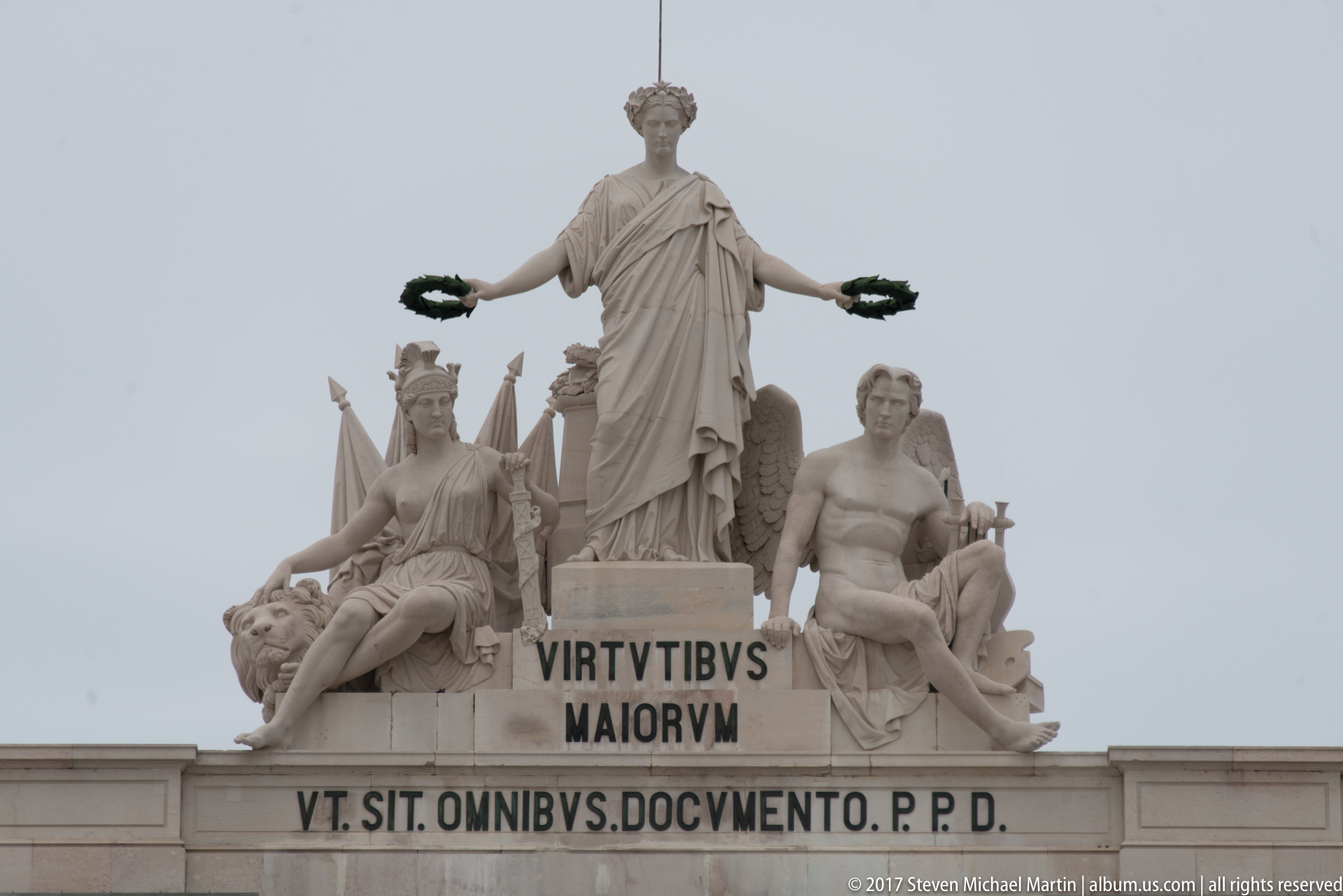
The crowning sculptural group of the Arco da Rua Augusta centers on a standing female personification of Glory holding wreaths above seated figures traditionally identified as Valor and Genius. Below, the Latin inscription invokes the virtues of the ancestors, integrating sculpture and text into the arch’s commemorative program.
Caption
The crowning sculptural group of the Arco da Rua Augusta centers on a standing female personification of Glory holding wreaths above seated figures traditionally identified as Valor and Genius. Below, the Latin inscription invokes the virtues of the ancestors, integrating sculpture and text into the arch’s commemorative program.

Portugal’s crowned royal coat of arms fills an elaborate stone relief above the main opening of the Arco da Rua Augusta. Palm-like sprays, ribbons, floral carving, and symmetrical scrollwork surround the shield, demonstrating the dense decorative program applied to the monumental gateway.
Caption
Portugal’s crowned royal coat of arms fills an elaborate stone relief above the main opening of the Arco da Rua Augusta. Palm-like sprays, ribbons, floral carving, and symmetrical scrollwork surround the shield, demonstrating the dense decorative program applied to the monumental gateway.

Looking directly upward beneath the Arco da Rua Augusta, the underside resolves into geometric stone panels, molded coffers, and a central rosette. The steep perspective turns the monumental passage into an abstract study of structural depth and carved neoclassical ornament.
Caption
Looking directly upward beneath the Arco da Rua Augusta, the underside resolves into geometric stone panels, molded coffers, and a central rosette. The steep perspective turns the monumental passage into an abstract study of structural depth and carved neoclassical ornament.

Repeated pale-stone arches and suspended black lanterns recede along the sheltered perimeter of Praça do Comércio. The rhythmic vaults create a strong one-point perspective, while yellow-painted wall sections and shop openings connect the gallery to the square’s characteristic Pombaline façades.
Caption
Repeated pale-stone arches and suspended black lanterns recede along the sheltered perimeter of Praça do Comércio. The rhythmic vaults create a strong one-point perspective, while yellow-painted wall sections and shop openings connect the gallery to the square’s characteristic Pombaline façades.

Black basalt and pale limestone setts form a bold interlocking geometric border in traditional Portuguese pavement. The oblique close view emphasizes the hand-laid texture and strong contrast of calçada portuguesa, a defining feature of Lisbon’s public streets and squares.
Caption
Black basalt and pale limestone setts form a bold interlocking geometric border in traditional Portuguese pavement. The oblique close view emphasizes the hand-laid texture and strong contrast of calçada portuguesa, a defining feature of Lisbon’s public streets and squares.

A pale stone male figure in draped clothing raises a rounded object in his right hand while holding folded material at his side. Photographed from below against sky and trees, the sculpture’s gesture and classical dress dominate the frame, but no inscription or contextual marker establishes a secure identity.
Caption
A pale stone male figure in draped clothing raises a rounded object in his right hand while holding folded material at his side. Photographed from below against sky and trees, the sculpture’s gesture and classical dress dominate the frame, but no inscription or contextual marker establishes a secure identity.

A cat sits quietly on the sill of an open window behind an ornate wrought-iron balcony. The pink façade, pale stone window surround, green trim, and partially raised blind create an intimate domestic detail amid Lisbon’s dense urban architecture.
Caption
A cat sits quietly on the sill of an open window behind an ornate wrought-iron balcony. The pink façade, pale stone window surround, green trim, and partially raised blind create an intimate domestic detail amid Lisbon’s dense urban architecture.

A deeply weathered pair of red wooden doors sits within an ornate pale-stone surround dated “1834” above the opening. A large carved or applied heraldic motif spans the upper panels, while peeling paint and a worker at the base foreground the doorway’s age and ongoing maintenance.
Caption
A deeply weathered pair of red wooden doors sits within an ornate pale-stone surround dated “1834” above the opening. A large carved or applied heraldic motif spans the upper panels, while peeling paint and a worker at the base foreground the doorway’s age and ongoing maintenance.

A ceremonial guard stands at attention in a dark dress uniform with white cross-belts, gloves, plumed helmet, and a curved sword held upright. The green sentry shelter behind him isolates the figure and emphasizes the polished equipment, formal posture, and ceremonial character of the uniform.
Caption
A ceremonial guard stands at attention in a dark dress uniform with white cross-belts, gloves, plumed helmet, and a curved sword held upright. The green sentry shelter behind him isolates the figure and emphasizes the polished equipment, formal posture, and ceremonial character of the uniform.

The monumental south portal of the Jerónimos church is crowded with saints, pinnacles, canopies, and deeply carved architectural tracery. Its sculptural program rises around the twin entrance doors and central pier, demonstrating the extraordinary density of Manueline stone carving at the monastery’s principal ceremonial façade.
Caption
The monumental south portal of the Jerónimos church is crowded with saints, pinnacles, canopies, and deeply carved architectural tracery. Its sculptural program rises around the twin entrance doors and central pier, demonstrating the extraordinary density of Manueline stone carving at the monastery’s principal ceremonial façade.

A richly colored stained-glass window presents a central standing figure surrounded by kneeling and attendant figures beneath heraldic and decorative motifs. Deep blues, reds, greens, and golds stand out against the dark church interior, making the narrative glass a luminous counterpoint to the pale carved stone of Jerónimos.
Caption
A richly colored stained-glass window presents a central standing figure surrounded by kneeling and attendant figures beneath heraldic and decorative motifs. Deep blues, reds, greens, and golds stand out against the dark church interior, making the narrative glass a luminous counterpoint to the pale carved stone of Jerónimos.

The richly carved south façade of the Church of Santa Maria de Belém at the Jerónimos Monastery stretches beneath a deep blue sky. Tall traceried windows, pinnacles, sculpted niches, and the projecting Manueline portal transform the pale limestone elevation into a dense display of late Gothic and maritime-era ornament.
Caption
The richly carved south façade of the Church of Santa Maria de Belém at the Jerónimos Monastery stretches beneath a deep blue sky. Tall traceried windows, pinnacles, sculpted niches, and the projecting Manueline portal transform the pale limestone elevation into a dense display of late Gothic and maritime-era ornament.

Slender carved piers rise into an extraordinary network of ribbed vaulting inside the Church of Santa Maria de Belém at the Jerónimos Monastery. The long nave leads toward the chancel, while the almost continuous stone canopy overhead creates the spacious, unified interior associated with Portugal’s mature Manueline architecture.
Caption
Slender carved piers rise into an extraordinary network of ribbed vaulting inside the Church of Santa Maria de Belém at the Jerónimos Monastery. The long nave leads toward the chancel, while the almost continuous stone canopy overhead creates the spacious, unified interior associated with Portugal’s mature Manueline architecture.

The main chapel of the Jerónimos church is framed by massive carved piers and a rounded coffered apse. Large paintings occupy the upper walls around the altar, contrasting with the darker stone of the nave and concentrating the axial view on the sanctuary at the eastern end of Santa Maria de Belém.
Caption
The main chapel of the Jerónimos church is framed by massive carved piers and a rounded coffered apse. Large paintings occupy the upper walls around the altar, contrasting with the darker stone of the nave and concentrating the axial view on the sanctuary at the eastern end of Santa Maria de Belém.

The monumental tomb traditionally identified as that of King Manuel I occupies a side area of the Jerónimos church, its pale stone sarcophagus enriched with heraldic shields, foliage, and sculpted supports. A recumbent royal effigy rests above, while a large religious painting on the adjacent wall places the memorial within the church’s devotional setting.
Caption
The monumental tomb traditionally identified as that of King Manuel I occupies a side area of the Jerónimos church, its pale stone sarcophagus enriched with heraldic shields, foliage, and sculpted supports. A recumbent royal effigy rests above, while a large religious painting on the adjacent wall places the memorial within the church’s devotional setting.

A closer view records the richly carved side of a royal tomb in the Jerónimos church. Heraldic shields, vegetal scrolls, small figures, and architectural motifs cover the pale stone sarcophagus beneath a recumbent effigy, revealing the craftsmanship of the memorial more clearly than the wider contextual view.
Caption
A closer view records the richly carved side of a royal tomb in the Jerónimos church. Heraldic shields, vegetal scrolls, small figures, and architectural motifs cover the pale stone sarcophagus beneath a recumbent effigy, revealing the craftsmanship of the memorial more clearly than the wider contextual view.

A tall stained-glass window glows within the limestone wall of the Jerónimos church, combining richly colored figurative imagery with a prominent Portuguese heraldic shield near the lower center. The narrow vertical composition and surrounding carved stonework emphasize the contrast between luminous glass and the monastery church’s massive masonry.
Caption
A tall stained-glass window glows within the limestone wall of the Jerónimos church, combining richly colored figurative imagery with a prominent Portuguese heraldic shield near the lower center. The narrow vertical composition and surrounding carved stonework emphasize the contrast between luminous glass and the monastery church’s massive masonry.

An upward view concentrates on the intricate rib vaulting and a massive carved pier inside Santa Maria de Belém. Stone ribs branch across the ceiling in complex geometric patterns, while the pier’s sculpted bands and clustered forms demonstrate the structural and ornamental integration characteristic of the Jerónimos interior.
Caption
An upward view concentrates on the intricate rib vaulting and a massive carved pier inside Santa Maria de Belém. Stone ribs branch across the ceiling in complex geometric patterns, while the pier’s sculpted bands and clustered forms demonstrate the structural and ornamental integration characteristic of the Jerónimos interior.

Three large vertical religious paintings fill a curved chapel wall between pale stone pilasters. The central panel repeats the lamentation scene, while flanking works show additional episodes from Christ’s Passion. Seen together, the ensemble reveals how painting and architecture were coordinated within a devotional space at the Jerónimos Monastery.
Caption
Three large vertical religious paintings fill a curved chapel wall between pale stone pilasters. The central panel repeats the lamentation scene, while flanking works show additional episodes from Christ’s Passion. Seen together, the ensemble reveals how painting and architecture were coordinated within a devotional space at the Jerónimos Monastery.

A tiered stone tomb monument stands in a shallow arched bay between classical pilasters inside the Jerónimos church. A long inscription runs across the central band, while dark animal-like sculptural supports flank the base and a small finial crowns the restrained architectural composition.
Caption
A tiered stone tomb monument stands in a shallow arched bay between classical pilasters inside the Jerónimos church. A long inscription runs across the central band, while dark animal-like sculptural supports flank the base and a small finial crowns the restrained architectural composition.

The altar of the Jerónimos church stands beneath the rounded architecture of the main chapel, surrounded by large painted panels set between pale classical columns. Warm light, gilded liturgical objects, and the curved upper register create a distinct Renaissance and later intervention within the broader Manueline church interior.
Caption
The altar of the Jerónimos church stands beneath the rounded architecture of the main chapel, surrounded by large painted panels set between pale classical columns. Warm light, gilded liturgical objects, and the curved upper register create a distinct Renaissance and later intervention within the broader Manueline church interior.

Looking back through the Jerónimos church, tall carved piers carry a continuous web of ribbed vaulting toward the western gallery. A large circular opening admits light above the gallery, while the low viewpoint emphasizes the soaring height and near-canopy effect of the Manueline stone ceiling.
Caption
Looking back through the Jerónimos church, tall carved piers carry a continuous web of ribbed vaulting toward the western gallery. A large circular opening admits light above the gallery, while the low viewpoint emphasizes the soaring height and near-canopy effect of the Manueline stone ceiling.

A large devotional painting shows the dead Christ supported by mourners, with grieving women gathered at the left and additional figures behind. The dark, compressed composition emphasizes human sorrow and the physical weight of Christ’s body, while the surrounding pale stone places the work within the monastic setting of Jerónimos.
Caption
A large devotional painting shows the dead Christ supported by mourners, with grieving women gathered at the left and additional figures behind. The dark, compressed composition emphasizes human sorrow and the physical weight of Christ’s body, while the surrounding pale stone places the work within the monastic setting of Jerónimos.

A gilded chapel altar glows with dense carved scrollwork, fluted columns, and a domed canopy surrounding a dark-robed devotional figure. Below, a recumbent figure lies within a glass-fronted reliquary case, adding a funerary or saintly focus to the richly theatrical Baroque ensemble.
Caption
A gilded chapel altar glows with dense carved scrollwork, fluted columns, and a domed canopy surrounding a dark-robed devotional figure. Below, a recumbent figure lies within a glass-fronted reliquary case, adding a funerary or saintly focus to the richly theatrical Baroque ensemble.

A broad Manueline-Revival entrance within the Jerónimos complex is flanked by exhibition banners and crowned by arcaded windows. The ground paving carries large museum lettering, while the white limestone façade and shared monastic architecture connect Portugal’s national archaeology museum to the historic Belém complex.
Caption
A broad Manueline-Revival entrance within the Jerónimos complex is flanked by exhibition banners and crowned by arcaded windows. The ground paving carries large museum lettering, while the white limestone façade and shared monastic architecture connect Portugal’s national archaeology museum to the historic Belém complex.

A richly ribbed stone vault springs from clustered supports above a rectangular chamber lined with religious paintings. A continuous series of smaller narrative panels runs around the lower wall, while larger canvases hang above, creating a layered display of painting beneath the monastery’s sculptural late-Gothic ceiling.
Caption
A richly ribbed stone vault springs from clustered supports above a rectangular chamber lined with religious paintings. A continuous series of smaller narrative panels runs around the lower wall, while larger canvases hang above, creating a layered display of painting beneath the monastery’s sculptural late-Gothic ceiling.

A framed religious painting presents a group of clerics and attendants gathered around a seated figure in an architectural interior. The arrangement of standing and kneeling participants, liturgical dress, and altar-like setting suggests a ceremonial or sacramental subject, though the precise episode is not legible at proof-sheet scale.
Caption
A framed religious painting presents a group of clerics and attendants gathered around a seated figure in an architectural interior. The arrangement of standing and kneeling participants, liturgical dress, and altar-like setting suggests a ceremonial or sacramental subject, though the precise episode is not legible at proof-sheet scale.

A close detail isolates the folded hands of a recumbent stone effigy resting on a funerary monument. The carved sleeves, fingers, and draped body emphasize the prayerful pose traditionally associated with elite Christian tomb sculpture, while the shallow depth of field removes most of the monument’s surrounding context.
Caption
A close detail isolates the folded hands of a recumbent stone effigy resting on a funerary monument. The carved sleeves, fingers, and draped body emphasize the prayerful pose traditionally associated with elite Christian tomb sculpture, while the shallow depth of field removes most of the monument’s surrounding context.

An elaborately carved pale-stone tomb supports a recumbent effigy above a sarcophagus covered with heraldic, vegetal, and figurative ornament. Lion heads and sculpted feet anchor the base, while inscriptions run along the upper and lower bands, making the monument a dense study of Renaissance funerary craftsmanship within Jerónimos.
Caption
An elaborately carved pale-stone tomb supports a recumbent effigy above a sarcophagus covered with heraldic, vegetal, and figurative ornament. Lion heads and sculpted feet anchor the base, while inscriptions run along the upper and lower bands, making the monument a dense study of Renaissance funerary craftsmanship within Jerónimos.

A pale stone relief presents the Nativity beneath a shallow architectural canopy: the infant lies at the center while Mary and Joseph kneel or lean toward the child, accompanied by animal figures and decorative carving. The relief is integrated into a larger sculptural framework of columns, foliage, and heraldic forms.
Caption
A pale stone relief presents the Nativity beneath a shallow architectural canopy: the infant lies at the center while Mary and Joseph kneel or lean toward the child, accompanied by animal figures and decorative carving. The relief is integrated into a larger sculptural framework of columns, foliage, and heraldic forms.

An upward exterior view isolates the ornate towers and pinnacles of the Jerónimos Monastery against a saturated blue sky. Finials, pierced stonework, clustered decorative elements, and pale limestone surfaces reveal the exuberant vertical detailing that gives the Belém complex its unmistakable Manueline silhouette.
Caption
An upward exterior view isolates the ornate towers and pinnacles of the Jerónimos Monastery against a saturated blue sky. Finials, pierced stonework, clustered decorative elements, and pale limestone surfaces reveal the exuberant vertical detailing that gives the Belém complex its unmistakable Manueline silhouette.

The long pale-stone façade of the Jerónimos complex stretches across Belém in a rhythmic sequence of arcades, windows, pinnacles, and projecting towers. Seen from across the roadway, the broad view emphasizes the monastery’s scale and the continuity between its religious and museum wings.
Caption
The long pale-stone façade of the Jerónimos complex stretches across Belém in a rhythmic sequence of arcades, windows, pinnacles, and projecting towers. Seen from across the roadway, the broad view emphasizes the monastery’s scale and the continuity between its religious and museum wings.

A high plume of water rises from the fountain in Praça do Império, catching sunlight to form a rainbow across the spray. Behind it, the pale towers and façades of the Jerónimos Monastery anchor the scene, linking the formal public garden of Belém with one of Lisbon’s principal monuments.
Caption
A high plume of water rises from the fountain in Praça do Império, catching sunlight to form a rainbow across the spray. Behind it, the pale towers and façades of the Jerónimos Monastery anchor the scene, linking the formal public garden of Belém with one of Lisbon’s principal monuments.

The limestone prow of the Padrão dos Descobrimentos carries a procession of explorers, navigators, clerics, and patrons associated with Portugal’s maritime expansion. Seen from below, the ranked figures advance along the sloping flank beneath the monument’s soaring central mass, turning historical memory into a monumental ship-like composition.
Caption
The limestone prow of the Padrão dos Descobrimentos carries a procession of explorers, navigators, clerics, and patrons associated with Portugal’s maritime expansion. Seen from below, the ranked figures advance along the sloping flank beneath the monument’s soaring central mass, turning historical memory into a monumental ship-like composition.

A closer view of the Monument to the Discoveries isolates the dense procession of carved figures climbing the monument’s prow. Swords, books, maps, crosses, and period dress differentiate navigators, soldiers, clerics, and patrons, reinforcing the monument’s symbolic narrative of Portugal’s overseas expansion.
Caption
A closer view of the Monument to the Discoveries isolates the dense procession of carved figures climbing the monument’s prow. Swords, books, maps, crosses, and period dress differentiate navigators, soldiers, clerics, and patrons, reinforcing the monument’s symbolic narrative of Portugal’s overseas expansion.

The Padrão dos Descobrimentos rises in full side elevation, its tall central slab curving outward above a long procession of carved figures. The ship-like base and upward thrust evoke a vessel departing the Tagus, visually connecting the monument’s form to Portugal’s maritime history and the Belém waterfront.
Caption
The Padrão dos Descobrimentos rises in full side elevation, its tall central slab curving outward above a long procession of carved figures. The ship-like base and upward thrust evoke a vessel departing the Tagus, visually connecting the monument’s form to Portugal’s maritime history and the Belém waterfront.

Prince Henry the Navigator leads a tightly packed group of historical figures along the sloping flank of the Padrão dos Descobrimentos. Navigators, clerics, soldiers, and patrons cluster behind him, their varied objects and poses creating a sculptural summary of the people later commemorated in Portugal’s overseas expansion narrative.
Caption
Prince Henry the Navigator leads a tightly packed group of historical figures along the sloping flank of the Padrão dos Descobrimentos. Navigators, clerics, soldiers, and patrons cluster behind him, their varied objects and poses creating a sculptural summary of the people later commemorated in Portugal’s overseas expansion narrative.

At the leading edge of the Monument to the Discoveries, Prince Henry the Navigator stands above the procession holding a model ship. His broad hat, long robe, and commanding placement at the prow distinguish him from the supporting figures below and behind.
Caption
At the leading edge of the Monument to the Discoveries, Prince Henry the Navigator stands above the procession holding a model ship. His broad hat, long robe, and commanding placement at the prow distinguish him from the supporting figures below and behind.

A tapered cylindrical brick tower rises in alternating bands of red masonry and pale stone, capped by a circular metal-railed platform. Small rectangular openings punctuate the shaft, giving the structure the appearance of a compact lighthouse or navigational tower near Lisbon’s Belém waterfront.
Caption
A tapered cylindrical brick tower rises in alternating bands of red masonry and pale stone, capped by a circular metal-railed platform. Small rectangular openings punctuate the shaft, giving the structure the appearance of a compact lighthouse or navigational tower near Lisbon’s Belém waterfront.

The Torre de Belém rises from the water in a calm, nearly frontal view, its square fortified tower and lower bastion mirrored in the Tagus. Corner turrets, battlements, carved balconies, and pale limestone surfaces distinguish the Manueline fortress that guarded Lisbon’s historic river approach.
Caption
The Torre de Belém rises from the water in a calm, nearly frontal view, its square fortified tower and lower bastion mirrored in the Tagus. Corner turrets, battlements, carved balconies, and pale limestone surfaces distinguish the Manueline fortress that guarded Lisbon’s historic river approach.

The Monument to the Discoveries rises beside the Tagus under a broad blue sky, while the red 25 de Abril Bridge spans the river in the distance. The composition links two very different eras of Lisbon’s waterfront infrastructure: a twentieth-century memorial to maritime expansion and the modern suspension bridge crossing the estuary.
Caption
The Monument to the Discoveries rises beside the Tagus under a broad blue sky, while the red 25 de Abril Bridge spans the river in the distance. The composition links two very different eras of Lisbon’s waterfront infrastructure: a twentieth-century memorial to maritime expansion and the modern suspension bridge crossing the estuary.

A side view of the Torre de Belém emphasizes the tall square keep rising behind the elongated riverside bastion. Repeated battlements, cylindrical corner turrets, and carved stone details reveal how defensive and ceremonial architecture are combined along the fortress’s Tagus-facing perimeter.
Caption
A side view of the Torre de Belém emphasizes the tall square keep rising behind the elongated riverside bastion. Repeated battlements, cylindrical corner turrets, and carved stone details reveal how defensive and ceremonial architecture are combined along the fortress’s Tagus-facing perimeter.

A small projecting balcony on the Torre de Belém is framed by twisted columns, knotted stonework, and a shell-like canopy. Openwork roundels in the parapet and heavily carved brackets below compress many of the fortress’s Manueline motifs into a single architectural detail.
Caption
A small projecting balcony on the Torre de Belém is framed by twisted columns, knotted stonework, and a shell-like canopy. Openwork roundels in the parapet and heavily carved brackets below compress many of the fortress’s Manueline motifs into a single architectural detail.

A pale stucco residence is decorated with delicate painted or relief motifs beneath balconies and around the lower windows. Dark green shutters, black iron railings, and symmetrical window placement contrast with the floral and scroll-like façade ornament, creating a carefully composed domestic exterior.
Caption
A pale stucco residence is decorated with delicate painted or relief motifs beneath balconies and around the lower windows. Dark green shutters, black iron railings, and symmetrical window placement contrast with the floral and scroll-like façade ornament, creating a carefully composed domestic exterior.

The monumental dome of the Basílica da Estrela rises in pale stone, ringed by oval windows, sculpted finials, and a tall lantern crowned by a cross. The close upward view emphasizes the church’s late-Baroque massing and finely articulated drum against a bright Lisbon sky.
Caption
The monumental dome of the Basílica da Estrela rises in pale stone, ringed by oval windows, sculpted finials, and a tall lantern crowned by a cross. The close upward view emphasizes the church’s late-Baroque massing and finely articulated drum against a bright Lisbon sky.

A tight close-up isolates the lower portion of a Manueline balcony on the Torre de Belém. Circular openwork panels, rope-like moldings, clustered columns, and deeply carved supporting brackets show the extraordinary density of decorative stonework applied to the fortress’s exterior.
Caption
A tight close-up isolates the lower portion of a Manueline balcony on the Torre de Belém. Circular openwork panels, rope-like moldings, clustered columns, and deeply carved supporting brackets show the extraordinary density of decorative stonework applied to the fortress’s exterior.

Two sharply angled stone pylons rise toward one another above a shallow reflecting pool at the Monumento aos Combatentes do Ultramar in Belém. Their dark slatted upper faces form a narrow central gap, creating a restrained geometric memorial to Portuguese service members who died in overseas conflicts.
Caption
Two sharply angled stone pylons rise toward one another above a shallow reflecting pool at the Monumento aos Combatentes do Ultramar in Belém. Their dark slatted upper faces form a narrow central gap, creating a restrained geometric memorial to Portuguese service members who died in overseas conflicts.

A salmon-pink residential façade is animated by wrought-iron balconies crowded with potted plants and flowers. White-trimmed windows, aging plaster, laundry-sized balcony spaces, and the long top-floor railing create a richly inhabited streetscape detail typical of Lisbon’s older neighborhoods.
Caption
A salmon-pink residential façade is animated by wrought-iron balconies crowded with potted plants and flowers. White-trimmed windows, aging plaster, laundry-sized balcony spaces, and the long top-floor railing create a richly inhabited streetscape detail typical of Lisbon’s older neighborhoods.

A web of suspended electrical wires and junction fittings cuts across a dramatic sky of blue and bright clouds. With buildings cropped almost entirely away, the infrastructure itself becomes the subject, revealing the layered overhead network that supports Lisbon’s electrically powered urban transport.
Caption
A web of suspended electrical wires and junction fittings cuts across a dramatic sky of blue and bright clouds. With buildings cropped almost entirely away, the infrastructure itself becomes the subject, revealing the layered overhead network that supports Lisbon’s electrically powered urban transport.

Viewed from below, the pale stone façade of the Basílica da Estrela rises between twin bell towers. Sculpted saints occupy niches around the central entrance, while a triangular pediment, clocks, columns, and rooftop statuary build the ornate vertical composition of one of Lisbon’s major late-Baroque churches.
Caption
Viewed from below, the pale stone façade of the Basílica da Estrela rises between twin bell towers. Sculpted saints occupy niches around the central entrance, while a triangular pediment, clocks, columns, and rooftop statuary build the ornate vertical composition of one of Lisbon’s major late-Baroque churches.

The pale limestone façade of the Basílica da Estrela rises between two bell towers, its central pediment and sculptural program framed by richly carved pilasters, niches, clocks, and rooftop statuary. Seen from a low angle, the composition emphasizes the church’s late-Baroque monumentality and the strong vertical rhythm of its twin-towered front.
Caption
The pale limestone façade of the Basílica da Estrela rises between two bell towers, its central pediment and sculptural program framed by richly carved pilasters, niches, clocks, and rooftop statuary. Seen from a low angle, the composition emphasizes the church’s late-Baroque monumentality and the strong vertical rhythm of its twin-towered front.

The nave of the Basílica da Estrela opens toward the main chapel beneath a luminous dome. Massive marble-clad piers, side arches, gilded lamps, and the richly framed altar create a strongly axial interior, while the broad cupola above the crossing draws light into the otherwise monumental Baroque space.
Caption
The nave of the Basílica da Estrela opens toward the main chapel beneath a luminous dome. Massive marble-clad piers, side arches, gilded lamps, and the richly framed altar create a strongly axial interior, while the broad cupola above the crossing draws light into the otherwise monumental Baroque space.

A lateral interior view of the Basílica da Estrela reveals the soaring wall beneath the dome, with a tall window, curved marble surfaces, and a dark pipe-organ case projecting from the left. Sculpted angels and a radiant emblem crown the upper architecture, giving the transept wall a theatrical Baroque finish.
Caption
A lateral interior view of the Basílica da Estrela reveals the soaring wall beneath the dome, with a tall window, curved marble surfaces, and a dark pipe-organ case projecting from the left. Sculpted angels and a radiant emblem crown the upper architecture, giving the transept wall a theatrical Baroque finish.

The high altar of the Basílica da Estrela stands within a deep, marble-lined apse framed by paired columns and an elaborate broken pediment. Sculpted angels, a radiant emblem above the arch, and a large religious painting behind the altar create a ceremonial focal point at the end of the basilica’s nave.
Caption
The high altar of the Basílica da Estrela stands within a deep, marble-lined apse framed by paired columns and an elaborate broken pediment. Sculpted angels, a radiant emblem above the arch, and a large religious painting behind the altar create a ceremonial focal point at the end of the basilica’s nave.

A closer view of the basilica’s altar concentrates on its pale marble mensa, gilded tabernacle, suspended lamps, and large devotional painting framed by monumental columns. Decorative metalwork and veined stone give the chapel a dense material richness, while the painting becomes the principal narrative element of the composition.
Caption
A closer view of the basilica’s altar concentrates on its pale marble mensa, gilded tabernacle, suspended lamps, and large devotional painting framed by monumental columns. Decorative metalwork and veined stone give the chapel a dense material richness, while the painting becomes the principal narrative element of the composition.

A tight architectural detail isolates two sculpted angels flanking a radiant sacred emblem high above a curved marble pediment in the Basílica da Estrela. Strongly modeled white figures, dark veined stone, and the burst of gilded or pale rays combine sculpture and architecture into a dramatic devotional ensemble.
Caption
A tight architectural detail isolates two sculpted angels flanking a radiant sacred emblem high above a curved marble pediment in the Basílica da Estrela. Strongly modeled white figures, dark veined stone, and the burst of gilded or pale rays combine sculpture and architecture into a dramatic devotional ensemble.

A blue-gray historic building occupies a street corner behind leafless plane trees, with pale stone trim, arched ground-floor openings, wrought-iron railings, and a red-tiled roof. The restrained façade and walled forecourt present a quieter institutional or residential face of Lisbon beyond the city’s monumental landmarks.
Caption
A blue-gray historic building occupies a street corner behind leafless plane trees, with pale stone trim, arched ground-floor openings, wrought-iron railings, and a red-tiled roof. The restrained façade and walled forecourt present a quieter institutional or residential face of Lisbon beyond the city’s monumental landmarks.

A broad elevated panorama spreads across Lisbon’s tightly packed historic center, where red-tiled roofs, pale façades, church towers, and occasional modern blocks climb a series of hills. The compressed roofscape conveys the city’s dense topography and layered urban fabric more than any single monument.
Caption
A broad elevated panorama spreads across Lisbon’s tightly packed historic center, where red-tiled roofs, pale façades, church towers, and occasional modern blocks climb a series of hills. The compressed roofscape conveys the city’s dense topography and layered urban fabric more than any single monument.