Seville
Seville developed as one of the most important cultural and commercial centers of southern Spain, shaped by Roman foundations, Islamic rule, and later Christian influence following the Reconquista. Its location along the Guadalquivir River allowed the city to become a major center of trade and administration. Architectural landmarks reflect centuries of cultural exchange between Islamic and European traditions.
During the Age of Exploration, Seville became the primary port regulating Spanish trade with the Americas. Wealth generated through overseas expansion contributed to the construction of churches, civic buildings, and royal institutions. The city’s historic center illustrates the connection between global exploration and urban development in early modern Europe.
Seville represents the intersection of medieval Iberian history and the expansion of maritime empires. Its preserved architecture reflects the cultural influences that shaped Spain during periods of religious transformation and global exploration.

The Giralda rises beside the richly ornamented Gothic exterior of Seville Cathedral, where pinnacles, tracery, and a large dark window fill the right side of the frame. Trees occupy the lower foreground and soften the meeting of the two structures. The view is especially useful for showing the tower’s physical relationship to the cathedral complex.
Caption
The Giralda rises beside the richly ornamented Gothic exterior of Seville Cathedral, where pinnacles, tracery, and a large dark window fill the right side of the frame. Trees occupy the lower foreground and soften the meeting of the two structures. The view is especially useful for showing the tower’s physical relationship to the cathedral complex.

A horse-drawn sightseeing carriage crosses the broad paved plaza in front of the sweeping arcaded façade of Seville’s Plaza de España. The carriage, driver, and pair of horses give the monumental civic setting an active street-level scale, while the central pavilion and long Renaissance Revival composition form a symmetrical architectural backdrop under a clear blue sky.
Caption
A horse-drawn sightseeing carriage crosses the broad paved plaza in front of the sweeping arcaded façade of Seville’s Plaza de España. The carriage, driver, and pair of horses give the monumental civic setting an active street-level scale, while the central pavilion and long Renaissance Revival composition form a symmetrical architectural backdrop under a clear blue sky.

A monumental arched doorway rises between sculpted figures and richly carved stonework in the Seville Cathedral precinct. The tall dark doors, patterned arch, devotional sculpture, and inset relief panel create a strongly vertical composition under warm nighttime illumination. The close, upward view isolates the ceremonial entrance from the larger cathedral complex and foregrounds its layered decoration.
Caption
A monumental arched doorway rises between sculpted figures and richly carved stonework in the Seville Cathedral precinct. The tall dark doors, patterned arch, devotional sculpture, and inset relief panel create a strongly vertical composition under warm nighttime illumination. The close, upward view isolates the ceremonial entrance from the larger cathedral complex and foregrounds its layered decoration.

A richly carved Gothic portal of Seville Cathedral rises behind a freestanding sculptural monument composed of a pale stone base, dark globe-like element, and vertical metalwork. Floodlighting reveals the portal’s pointed arches, tracery, and sculptural detail, while the monument occupies the foreground as a contrasting modern or later addition to the cathedral precinct.
Caption
A richly carved Gothic portal of Seville Cathedral rises behind a freestanding sculptural monument composed of a pale stone base, dark globe-like element, and vertical metalwork. Floodlighting reveals the portal’s pointed arches, tracery, and sculptural detail, while the monument occupies the foreground as a contrasting modern or later addition to the cathedral precinct.

The immense gilded Retablo Mayor fills the sanctuary of Seville Cathedral with a dense grid of carved religious scenes, pinnacles, and sculptural figures. Seen through the choir-screen framework, the altarpiece rises behind the altar in a luminous wall of gold. Its scale and intricate narrative carving make it one of the cathedral interior’s most visually dominant ensembles.
Caption
The immense gilded Retablo Mayor fills the sanctuary of Seville Cathedral with a dense grid of carved religious scenes, pinnacles, and sculptural figures. Seen through the choir-screen framework, the altarpiece rises behind the altar in a luminous wall of gold. Its scale and intricate narrative carving make it one of the cathedral interior’s most visually dominant ensembles.

Seville Cathedral and the Giralda rise dramatically above Plaza Virgen de los Reyes at night. The cathedral’s massive Gothic apse occupies the center while the illuminated former minaret-turned-bell tower dominates the right side; an ornate plaza lamp enters from the left. Warm floodlighting reveals buttresses, pinnacles, and patterned tower openings against the black sky.
Caption
Seville Cathedral and the Giralda rise dramatically above Plaza Virgen de los Reyes at night. The cathedral’s massive Gothic apse occupies the center while the illuminated former minaret-turned-bell tower dominates the right side; an ornate plaza lamp enters from the left. Warm floodlighting reveals buttresses, pinnacles, and patterned tower openings against the black sky.

The Puerta del León forms the principal public entrance to Seville’s Real Alcázar, framed here by crenellated stone walls and square towers. A red-orange wall surrounds the horseshoe-arched doorway, and the ceramic lion emblem above the entrance gives the gate its name. Night illumination sharpens the contrast between the gate’s painted surface and its older masonry defenses.
Caption
The Puerta del León forms the principal public entrance to Seville’s Real Alcázar, framed here by crenellated stone walls and square towers. A red-orange wall surrounds the horseshoe-arched doorway, and the ceramic lion emblem above the entrance gives the gate its name. Night illumination sharpens the contrast between the gate’s painted surface and its older masonry defenses.

A street performer moves energetically on a bright red mat in a Seville plaza, one arm lifted high while one leg kicks outward. A small container sits near the edge of the performance area, and passersby occupy the sunlit pavement behind. The low, dynamic pose conveys the improvised character of public performance in the city center.
Caption
A street performer moves energetically on a bright red mat in a Seville plaza, one arm lifted high while one leg kicks outward. A small container sits near the edge of the performance area, and passersby occupy the sunlit pavement behind. The low, dynamic pose conveys the improvised character of public performance in the city center.

The Giralda rises above the cathedral complex in a steep low-angle view, its pale masonry articulated by paired openings, decorative latticework, and successive upper stages. Originally formed from an Almohad minaret and later adapted as the cathedral bell tower, it remains one of Seville’s most recognizable architectural silhouettes; foreground foliage partly masks the adjoining cathedral fabric.
Caption
The Giralda rises above the cathedral complex in a steep low-angle view, its pale masonry articulated by paired openings, decorative latticework, and successive upper stages. Originally formed from an Almohad minaret and later adapted as the cathedral bell tower, it remains one of Seville’s most recognizable architectural silhouettes; foreground foliage partly masks the adjoining cathedral fabric.

A massive stone arch curves across the foreground, framing a seated sculptural figure on a pedestal with a tall brick tower rising beyond. Layered architectural elements compress monument, gateway, and skyline into a single composition, while hard midday light emphasizes carved stone surfaces and the warm masonry of the distant tower.
Caption
A massive stone arch curves across the foreground, framing a seated sculptural figure on a pedestal with a tall brick tower rising beyond. Layered architectural elements compress monument, gateway, and skyline into a single composition, while hard midday light emphasizes carved stone surfaces and the warm masonry of the distant tower.

The tomb of Christopher Columbus stands within Seville Cathedral as four larger-than-life heraldic bearers support the explorer’s sarcophagus on their shoulders. Richly patterned robes, crowns, and staffs distinguish the figures, while the white stone pedestal and surrounding cathedral architecture set the polychrome monument apart as a freestanding sculptural ensemble.
Caption
The tomb of Christopher Columbus stands within Seville Cathedral as four larger-than-life heraldic bearers support the explorer’s sarcophagus on their shoulders. Richly patterned robes, crowns, and staffs distinguish the figures, while the white stone pedestal and surrounding cathedral architecture set the polychrome monument apart as a freestanding sculptural ensemble.

A richly faced chapel wall combines veined marble, gilded and painted architectural details, metal grilles, portrait busts, and a central devotional image. The frontal view emphasizes the carefully ordered symmetry of the ensemble, in which contrasting stone colors and sculptural elements frame the sacred image as the visual focus.
Caption
A richly faced chapel wall combines veined marble, gilded and painted architectural details, metal grilles, portrait busts, and a central devotional image. The frontal view emphasizes the carefully ordered symmetry of the ensemble, in which contrasting stone colors and sculptural elements frame the sacred image as the visual focus.

A narrow street of whitewashed houses rises toward a substantial crenellated stone fortress on a rocky hill. Iron balconies, tiled roofs, wall-mounted lanterns, and the steep approach establish a traditional Andalusian townscape, while the fortified enclosure dominates the skyline. The proof sheet supports the relationship between town and castle but not a secure identification of the specific fortress.
Caption
A narrow street of whitewashed houses rises toward a substantial crenellated stone fortress on a rocky hill. Iron balconies, tiled roofs, wall-mounted lanterns, and the steep approach establish a traditional Andalusian townscape, while the fortified enclosure dominates the skyline. The proof sheet supports the relationship between town and castle but not a secure identification of the specific fortress.

Whitewashed houses and red-tiled roofs spread across a shallow valley beneath low wooded hills and a cloud-heavy sky. A rough stone wall runs across the foreground, emphasizing the elevated viewpoint and separating the viewer from the compact settlement below. The scene functions as an establishing view of the surrounding Andalusian landscape rather than a single monument.
Caption
Whitewashed houses and red-tiled roofs spread across a shallow valley beneath low wooded hills and a cloud-heavy sky. A rough stone wall runs across the foreground, emphasizing the elevated viewpoint and separating the viewer from the compact settlement below. The scene functions as an establishing view of the surrounding Andalusian landscape rather than a single monument.

A whitewashed church stands at the base of older stone fortifications, its simple bell gable and sloping exterior wall contrasting with the rough masonry and crenellated tower behind it. A stone cross on a pedestal marks the open foreground. The layered composition records the close physical relationship between religious and defensive architecture in this hilltop settlement.
Caption
A whitewashed church stands at the base of older stone fortifications, its simple bell gable and sloping exterior wall contrasting with the rough masonry and crenellated tower behind it. A stone cross on a pedestal marks the open foreground. The layered composition records the close physical relationship between religious and defensive architecture in this hilltop settlement.

A weathered stone cross fills the foreground in a low-angle view, its rough surface and simple arms silhouetted against an overcast sky. Behind it rises the whitewashed bell gable of a church, deliberately softened by depth and distance. The close framing turns a wider hill-town religious setting into a study of devotional marker, texture, and vertical form.
Caption
A weathered stone cross fills the foreground in a low-angle view, its rough surface and simple arms silhouetted against an overcast sky. Behind it rises the whitewashed bell gable of a church, deliberately softened by depth and distance. The close framing turns a wider hill-town religious setting into a study of devotional marker, texture, and vertical form.

An illuminated civic façade presents two levels of arches, a balustraded balcony, and a central clock beneath a small pediment. Andalusian, Spanish, and municipal flags hang across the upper arcade, while paired trees frame the ground-floor entrance. The frontal nighttime view emphasizes symmetry and ceremonial public architecture rather than the activity of the surrounding square.
Caption
An illuminated civic façade presents two levels of arches, a balustraded balcony, and a central clock beneath a small pediment. Andalusian, Spanish, and municipal flags hang across the upper arcade, while paired trees frame the ground-floor entrance. The frontal nighttime view emphasizes symmetry and ceremonial public architecture rather than the activity of the surrounding square.

Four flags fly above the parapet of a rough stone structure: the European Union flag, a white-and-green local or municipal flag, Spain’s national flag, and the green-and-white flag of Andalusia. Their windblown forms provide a concise civic and regional marker against a pale sky, while the masonry below connects the display to a historic fortified setting.
Caption
Four flags fly above the parapet of a rough stone structure: the European Union flag, a white-and-green local or municipal flag, Spain’s national flag, and the green-and-white flag of Andalusia. Their windblown forms provide a concise civic and regional marker against a pale sky, while the masonry below connects the display to a historic fortified setting.

A pointed-arch doorway opens in a massive wall of irregular stone masonry, with crenellations and a square defensive tower rising behind it. The rocky slope at the base reinforces the fortified character of the complex, while the carefully molded portal introduces a Gothic architectural note. The view concentrates on the junction of religious-style entrance design and defensive construction.
Caption
A pointed-arch doorway opens in a massive wall of irregular stone masonry, with crenellations and a square defensive tower rising behind it. The rocky slope at the base reinforces the fortified character of the complex, while the carefully molded portal introduces a Gothic architectural note. The view concentrates on the junction of religious-style entrance design and defensive construction.

A rough stone cross is isolated sharply against the gray sky, with a whitewashed bell gable receding behind it. The low viewpoint exaggerates the cross’s scale and allows its weathered, lichen-marked surface to become the principal subject. The composition is a tighter counterpart to the earlier cross view, emphasizing material detail rather than the surrounding architecture.
Caption
A rough stone cross is isolated sharply against the gray sky, with a whitewashed bell gable receding behind it. The low viewpoint exaggerates the cross’s scale and allows its weathered, lichen-marked surface to become the principal subject. The composition is a tighter counterpart to the earlier cross view, emphasizing material detail rather than the surrounding architecture.

A row of historic multistory façades lines the edge of a broad Seville square after dark. Individual buildings vary in height, color, balcony treatment, and roofline, creating a layered urban frontage beneath warm architectural lighting. The largely open foreground and scattered pedestrians make this an establishing nighttime streetscape rather than a portrait of any single building.
Caption
A row of historic multistory façades lines the edge of a broad Seville square after dark. Individual buildings vary in height, color, balcony treatment, and roofline, creating a layered urban frontage beneath warm architectural lighting. The largely open foreground and scattered pedestrians make this an establishing nighttime streetscape rather than a portrait of any single building.

A monumental stone pedestal rises from a patterned plaza at night, crowned by a sculptural group silhouetted against the dark sky. Heraldic reliefs and carved architectural ornament animate the tall base, while palms, street lighting, and a modern building form the surrounding urban context. The centered view records the monument as a civic focal point without relying on an uncertain dedication.
Caption
A monumental stone pedestal rises from a patterned plaza at night, crowned by a sculptural group silhouetted against the dark sky. Heraldic reliefs and carved architectural ornament animate the tall base, while palms, street lighting, and a modern building form the surrounding urban context. The centered view records the monument as a civic focal point without relying on an uncertain dedication.

An ornate fountain-lamp rises in Plaza Virgen de los Reyes before the long red-and-ochre façade of the Archbishop’s Palace. Multiple lamps branch from the sculpted central column above the basin, while the palace’s regular windows and elaborate stone portal extend across the background. Night lighting turns the plaza fixture into the dominant foreground element.
Caption
An ornate fountain-lamp rises in Plaza Virgen de los Reyes before the long red-and-ochre façade of the Archbishop’s Palace. Multiple lamps branch from the sculpted central column above the basin, while the palace’s regular windows and elaborate stone portal extend across the background. Night lighting turns the plaza fixture into the dominant foreground element.

The Giralda fills the frame in a close low-angle night view, its warm-lit masonry revealing paired openings, decorative panels, and the transition from the former Almohad minaret to later upper stages. A portion of Seville Cathedral remains at left, but the composition is primarily an architectural portrait of the tower’s massive vertical shaft and patterned surfaces.
Caption
The Giralda fills the frame in a close low-angle night view, its warm-lit masonry revealing paired openings, decorative panels, and the transition from the former Almohad minaret to later upper stages. A portion of Seville Cathedral remains at left, but the composition is primarily an architectural portrait of the tower’s massive vertical shaft and patterned surfaces.

An ornate multistory stone façade glows under nighttime illumination, its central bay marked by stacked balconies, an arched entrance, sculptural figures, and elaborate cornice work. Regular window bays and wrought or stone balustrades give the building a formal urban presence. The upward viewpoint concentrates attention on its vertical composition and richly modeled exterior decoration.
Caption
An ornate multistory stone façade glows under nighttime illumination, its central bay marked by stacked balconies, an arched entrance, sculptural figures, and elaborate cornice work. Regular window bays and wrought or stone balustrades give the building a formal urban presence. The upward viewpoint concentrates attention on its vertical composition and richly modeled exterior decoration.

The Giralda towers above the eastern end of Seville Cathedral in a steep low-angle nighttime view. Its illuminated masonry, paired openings, and decorative upper stages contrast with the darker, heavier Gothic mass of the cathedral apse at left. By excluding most of the plaza, the composition emphasizes the tower’s height and its visual relationship to the cathedral fabric.
Caption
The Giralda towers above the eastern end of Seville Cathedral in a steep low-angle nighttime view. Its illuminated masonry, paired openings, and decorative upper stages contrast with the darker, heavier Gothic mass of the cathedral apse at left. By excluding most of the plaza, the composition emphasizes the tower’s height and its visual relationship to the cathedral fabric.

A wider view of Plaza Virgen de los Reyes centers the ornate fountain-lamp against the Archbishop’s Palace, whose long red façade stretches across the square. Small groups of people and clipped orange trees establish the scale of the public space, while the glowing lamps punctuate the dark sky. The composition records the plaza as an active urban setting rather than an isolated architectural detail.
Caption
A wider view of Plaza Virgen de los Reyes centers the ornate fountain-lamp against the Archbishop’s Palace, whose long red façade stretches across the square. Small groups of people and clipped orange trees establish the scale of the public space, while the glowing lamps punctuate the dark sky. The composition records the plaza as an active urban setting rather than an isolated architectural detail.

Seville Cathedral’s Gothic apse and the illuminated Giralda fill the left and center of this nighttime composition, while the ornate fountain-lamp of Plaza Virgen de los Reyes rises at right. Bringing the plaza fixture and cathedral together in one frame emphasizes the spatial relationship between civic open space and the monumental cathedral complex at the heart of historic Seville.
Caption
Seville Cathedral’s Gothic apse and the illuminated Giralda fill the left and center of this nighttime composition, while the ornate fountain-lamp of Plaza Virgen de los Reyes rises at right. Bringing the plaza fixture and cathedral together in one frame emphasizes the spatial relationship between civic open space and the monumental cathedral complex at the heart of historic Seville.

A tall carved stone cross rises behind an iron enclosure in a brightly lit historic square. Decorative street lamps flank the monument, while a pale institutional façade with a small roofline cross forms the background. The frontal composition emphasizes the monument’s layered pedestal, protective railing, and role as a devotional marker embedded in the urban fabric.
Caption
A tall carved stone cross rises behind an iron enclosure in a brightly lit historic square. Decorative street lamps flank the monument, while a pale institutional façade with a small roofline cross forms the background. The frontal composition emphasizes the monument’s layered pedestal, protective railing, and role as a devotional marker embedded in the urban fabric.

Rows of doughnuts fill a glass-fronted shop display, ranging from sugar-dusted rings to chocolate-coated, striped, spiral, and bright blue iced varieties. Shelf labels divide the assortment into named flavors, while metal racks and repeated circular forms create a graphic retail composition. The close view shifts the portfolio briefly from architecture to everyday commercial food culture.
Caption
Rows of doughnuts fill a glass-fronted shop display, ranging from sugar-dusted rings to chocolate-coated, striped, spiral, and bright blue iced varieties. Shelf labels divide the assortment into named flavors, while metal racks and repeated circular forms create a graphic retail composition. The close view shifts the portfolio briefly from architecture to everyday commercial food culture.

An elaborate historic tower rises against a clear blue sky, its stacked levels enriched with arcades, columns, balustrades, patterned panels, and projecting corner ornaments. At the summit, an equestrian figure crowns the composition. The close upward view isolates the tower’s sculptural silhouette and dense historicist decoration from the rest of the building.
Caption
An elaborate historic tower rises against a clear blue sky, its stacked levels enriched with arcades, columns, balustrades, patterned panels, and projecting corner ornaments. At the summit, an equestrian figure crowns the composition. The close upward view isolates the tower’s sculptural silhouette and dense historicist decoration from the rest of the building.

The same Seville Cathedral precinct is viewed more vertically, placing the foreground monument directly beneath the soaring carved portal and upper Gothic masonry. The tighter alignment draws attention to the contrast between the monument’s smooth pale forms and dark spherical element and the cathedral’s dense tracery, pinnacles, and sculpted stone surfaces above.
Caption
The same Seville Cathedral precinct is viewed more vertically, placing the foreground monument directly beneath the soaring carved portal and upper Gothic masonry. The tighter alignment draws attention to the contrast between the monument’s smooth pale forms and dark spherical element and the cathedral’s dense tracery, pinnacles, and sculpted stone surfaces above.

A monumental Gothic doorway on Seville Cathedral is shown frontally under warm night lighting. Multiple archivolts, ranks of carved figures, a sculpted tympanum, and a tall central doorway create a dense stone frame around the dark entrance. The close architectural view excludes most of the surrounding plaza to concentrate on the portal’s sculptural program and deeply recessed pointed arch.
Caption
A monumental Gothic doorway on Seville Cathedral is shown frontally under warm night lighting. Multiple archivolts, ranks of carved figures, a sculpted tympanum, and a tall central doorway create a dense stone frame around the dark entrance. The close architectural view excludes most of the surrounding plaza to concentrate on the portal’s sculptural program and deeply recessed pointed arch.

A brightly branded Dunkin’ Coffee occupies the ground floor of a traditional Seville corner building, beneath wrought-iron balconies and pale upper façades. The open storefront reveals counters, menu boards, and customers, while the chain’s modern signage contrasts with the older residential architecture above. The street-level view records contemporary commercial life within the historic city center.
Caption
A brightly branded Dunkin’ Coffee occupies the ground floor of a traditional Seville corner building, beneath wrought-iron balconies and pale upper façades. The open storefront reveals counters, menu boards, and customers, while the chain’s modern signage contrasts with the older residential architecture above. The street-level view records contemporary commercial life within the historic city center.

A formal red-and-cream historic façade faces a busy Seville street, its central entrance marked by a visible Cajasol sign. Regular arched windows, balconies, pilasters, and a triangular pediment create a symmetrical composition, while orange trees, parked scooters, and pedestrians crowd the lower edge. The view records the building as part of the active contemporary streetscape.
Caption
A formal red-and-cream historic façade faces a busy Seville street, its central entrance marked by a visible Cajasol sign. Regular arched windows, balconies, pilasters, and a triangular pediment create a symmetrical composition, while orange trees, parked scooters, and pedestrians crowd the lower edge. The view records the building as part of the active contemporary streetscape.

A richly carved stone window surround combines slender columns, scrolling foliage, heraldic and figurative reliefs, and a broad horizontal frieze. Colored leaded glass fills the central arched opening, while the warm stone surface reveals dense Renaissance or Plateresque-style ornament. The close framing is devoted entirely to craftsmanship and iconographic detail rather than the larger façade.
Caption
A richly carved stone window surround combines slender columns, scrolling foliage, heraldic and figurative reliefs, and a broad horizontal frieze. Colored leaded glass fills the central arched opening, while the warm stone surface reveals dense Renaissance or Plateresque-style ornament. The close framing is devoted entirely to craftsmanship and iconographic detail rather than the larger façade.

A piebald horse stands harnessed beneath a shade tree to a black sightseeing carriage with bright yellow wheels. The empty upholstered passenger compartment, lantern, shafts, and harness are shown in clear profile, offering a close street-level study of the traditional carriages that remain a familiar part of central Seville’s visitor landscape.
Caption
A piebald horse stands harnessed beneath a shade tree to a black sightseeing carriage with bright yellow wheels. The empty upholstered passenger compartment, lantern, shafts, and harness are shown in clear profile, offering a close street-level study of the traditional carriages that remain a familiar part of central Seville’s visitor landscape.

An ornate stone-and-plaster entrance in Seville combines a dark horseshoe-shaped arch with sculpted figures, heraldic emblems, a rectangular religious relief, and an upper bell stage. The layered façade brings together architectural framing and devotional imagery, while the two exposed bells and bright white upper wall create a strong vertical termination against the blue sky.
Caption
An ornate stone-and-plaster entrance in Seville combines a dark horseshoe-shaped arch with sculpted figures, heraldic emblems, a rectangular religious relief, and an upper bell stage. The layered façade brings together architectural framing and devotional imagery, while the two exposed bells and bright white upper wall create a strong vertical termination against the blue sky.

A slender iron weather vane crowns a stone pinnacle, combining directional letters, an arrow, scrolling ironwork, and a heraldic silhouette. Isolated against the pale blue sky, the metalwork reads almost as a drawing in profile, revealing the practical and decorative character of a rooftop fitting within Seville’s historic architectural landscape.
Caption
A slender iron weather vane crowns a stone pinnacle, combining directional letters, an arrow, scrolling ironwork, and a heraldic silhouette. Isolated against the pale blue sky, the metalwork reads almost as a drawing in profile, revealing the practical and decorative character of a rooftop fitting within Seville’s historic architectural landscape.

A wider view places the tomb of Christopher Columbus beneath an elevated clock and richly carved architectural screen. The four bearers cluster around the raised sarcophagus at center, while flanking grilles, pale stone ornament, and a large wall painting establish the monument’s position within the cathedral interior rather than isolating it as a sculptural object.
Caption
A wider view places the tomb of Christopher Columbus beneath an elevated clock and richly carved architectural screen. The four bearers cluster around the raised sarcophagus at center, while flanking grilles, pale stone ornament, and a large wall painting establish the monument’s position within the cathedral interior rather than isolating it as a sculptural object.

A sharply tilted composition sets the Giralda against the massive exterior of Seville Cathedral, emphasizing the contrast between the tower’s ordered openings and the cathedral’s dense Gothic buttresses, pinnacles, and roofline. The oblique viewpoint turns the adjoining monuments into a study of vertical mass, architectural layering, and the long transformation of Seville’s sacred center.
Caption
A sharply tilted composition sets the Giralda against the massive exterior of Seville Cathedral, emphasizing the contrast between the tower’s ordered openings and the cathedral’s dense Gothic buttresses, pinnacles, and roofline. The oblique viewpoint turns the adjoining monuments into a study of vertical mass, architectural layering, and the long transformation of Seville’s sacred center.

A bronze figure holding a staff stands dramatically against the carved stonework of Seville Cathedral, viewed from below so that the sculpture overlaps an elaborate Gothic portal. The close perspective isolates the figure’s costume and metal surface while the cathedral’s tracery, niches, and sculptural ornament form a densely worked architectural backdrop.
Caption
A bronze figure holding a staff stands dramatically against the carved stonework of Seville Cathedral, viewed from below so that the sculpture overlaps an elaborate Gothic portal. The close perspective isolates the figure’s costume and metal surface while the cathedral’s tracery, niches, and sculptural ornament form a densely worked architectural backdrop.

Seen at close range from below, a bronze figure in historical dress dominates the frame, with a staff or pole rising beside the head and a small sculpted figure visible at the shoulder. The tight crop emphasizes modeled facial features, costume, and weathered metal, separating the sculpture from the broader cathedral setting shown in adjacent views.
Caption
Seen at close range from below, a bronze figure in historical dress dominates the frame, with a staff or pole rising beside the head and a small sculpted figure visible at the shoulder. The tight crop emphasizes modeled facial features, costume, and weathered metal, separating the sculpture from the broader cathedral setting shown in adjacent views.

A pale stone grotesque projects from the cathedral fabric, its muscular animal body, spread wings, curled tail, and open-mouthed head carved in high relief. The close detail reveals the sculptor’s treatment of fur, feathers, claws, and foliage, turning a small architectural element into an expressive creature set against the smooth surrounding masonry.
Caption
A pale stone grotesque projects from the cathedral fabric, its muscular animal body, spread wings, curled tail, and open-mouthed head carved in high relief. The close detail reveals the sculptor’s treatment of fur, feathers, claws, and foliage, turning a small architectural element into an expressive creature set against the smooth surrounding masonry.

Soaring clustered piers and ribbed vaults frame the interior of Seville Cathedral, with the richly ornamented choir enclosure occupying the center of the nave. Visitors at floor level provide scale for the immense Gothic space, while warm illumination across the vaults draws the eye through successive bays toward the lit crossing and sanctuary.
Caption
Soaring clustered piers and ribbed vaults frame the interior of Seville Cathedral, with the richly ornamented choir enclosure occupying the center of the nave. Visitors at floor level provide scale for the immense Gothic space, while warm illumination across the vaults draws the eye through successive bays toward the lit crossing and sanctuary.

An elongated bronze memorial slab is set into the cathedral pavement, framed by scrolling relief ornament and centered on heraldic devices and a long Latin inscription. Photographed almost straight down, the composition records the plaque as an object within the floor and preserves the relationship between text, coats of arms, and decorative border.
Caption
An elongated bronze memorial slab is set into the cathedral pavement, framed by scrolling relief ornament and centered on heraldic devices and a long Latin inscription. Photographed almost straight down, the composition records the plaque as an object within the floor and preserves the relationship between text, coats of arms, and decorative border.

A steep upward view follows Seville Cathedral’s clustered piers into an intricate web of late Gothic ribbed vaulting. Dark carved choir stalls and screens rise along the lower edges, while warm light intensifies toward the distant bay, emphasizing the extraordinary height and layered geometry of the cathedral interior.
Caption
A steep upward view follows Seville Cathedral’s clustered piers into an intricate web of late Gothic ribbed vaulting. Dark carved choir stalls and screens rise along the lower edges, while warm light intensifies toward the distant bay, emphasizing the extraordinary height and layered geometry of the cathedral interior.

An elaborate screen fills the frame with radiating iron bars, gilded accents, sculpted figures, and dense architectural ornament. Above the paired grille sections, carved reliefs and statuary merge with the cathedral’s stonework, creating a layered boundary that is simultaneously functional, ceremonial, and decorative.
Caption
An elaborate screen fills the frame with radiating iron bars, gilded accents, sculpted figures, and dense architectural ornament. Above the paired grille sections, carved reliefs and statuary merge with the cathedral’s stonework, creating a layered boundary that is simultaneously functional, ceremonial, and decorative.

A luminous rose window punctuates the high stone wall of Seville Cathedral, its colored glass suspended above a crucifix and small sculpted figures. Massive piers and pointed arches frame the composition, while the relatively spare wall surface directs attention to the circular stained glass and devotional group below.
Caption
A luminous rose window punctuates the high stone wall of Seville Cathedral, its colored glass suspended above a crucifix and small sculpted figures. Massive piers and pointed arches frame the composition, while the relatively spare wall surface directs attention to the circular stained glass and devotional group below.

From beside a massive pier, the view rises through Seville Cathedral’s ribbed vaults and carved wooden screens toward a warmly illuminated bay. The off-center perspective emphasizes how monumental stone supports, dark woodwork, iron grilles, and patterned vaulting define separate zones within the vast Gothic interior.
Caption
From beside a massive pier, the view rises through Seville Cathedral’s ribbed vaults and carved wooden screens toward a warmly illuminated bay. The off-center perspective emphasizes how monumental stone supports, dark woodwork, iron grilles, and patterned vaulting define separate zones within the vast Gothic interior.

A monumental pipe organ rises above richly paneled woodwork inside Seville Cathedral. Banks of silver-colored pipes are embedded in an exuberantly carved dark wooden case populated by sculptural ornament, while the lower architectural screen forms a broad base that underscores the instrument’s scale and ceremonial presence.
Caption
A monumental pipe organ rises above richly paneled woodwork inside Seville Cathedral. Banks of silver-colored pipes are embedded in an exuberantly carved dark wooden case populated by sculptural ornament, while the lower architectural screen forms a broad base that underscores the instrument’s scale and ceremonial presence.

A low viewpoint looks up at two of the richly dressed bearers supporting the tomb of Christopher Columbus, bringing their embroidered robes, crowns, staffs, and the underside of the sarcophagus into sharp relief. A clock and cathedral wall ornament rise behind them, giving the monumental figures a particularly imposing presence.
Caption
A low viewpoint looks up at two of the richly dressed bearers supporting the tomb of Christopher Columbus, bringing their embroidered robes, crowns, staffs, and the underside of the sarcophagus into sharp relief. A clock and cathedral wall ornament rise behind them, giving the monumental figures a particularly imposing presence.

Viewed from beneath, the tomb of Christopher Columbus becomes a study in the physical act of bearing the sarcophagus. The decorated underside of the coffin stretches across the frame while crowned figures in patterned robes support it at the corners, revealing details of the monument that are less apparent in conventional frontal views.
Caption
Viewed from beneath, the tomb of Christopher Columbus becomes a study in the physical act of bearing the sarcophagus. The decorated underside of the coffin stretches across the frame while crowned figures in patterned robes support it at the corners, revealing details of the monument that are less apparent in conventional frontal views.

An elaborate multi-tiered altarpiece occupies the end wall of a vaulted cathedral chapel, framed by large arches and dark paintings along the side walls. Columns, niches, gilded ornament, and devotional imagery concentrate attention at the sanctuary, while the high window and pale vault admit a restrained wash of daylight from above.
Caption
An elaborate multi-tiered altarpiece occupies the end wall of a vaulted cathedral chapel, framed by large arches and dark paintings along the side walls. Columns, niches, gilded ornament, and devotional imagery concentrate attention at the sanctuary, while the high window and pale vault admit a restrained wash of daylight from above.

A group of devotional paintings is arranged on a pale stone cathedral wall, including tall vertical panels of sacred figures and smaller works below. Differences in scale, framing, and format make the installation read as a compact gallery of religious imagery rather than a single unified altarpiece.
Caption
A group of devotional paintings is arranged on a pale stone cathedral wall, including tall vertical panels of sacred figures and smaller works below. Differences in scale, framing, and format make the installation read as a compact gallery of religious imagery rather than a single unified altarpiece.

Two registers of carved standing figures line a richly paneled wooden architectural surface, with larger sculptures above and a dense sequence of smaller figures below. The frontal composition emphasizes repetition, individualized poses, drapery, and the warm tonal unity of the carved ensemble within Seville Cathedral.
Caption
Two registers of carved standing figures line a richly paneled wooden architectural surface, with larger sculptures above and a dense sequence of smaller figures below. The frontal composition emphasizes repetition, individualized poses, drapery, and the warm tonal unity of the carved ensemble within Seville Cathedral.

Looking directly upward, the camera centers a circular coffered dome surrounded by pendentives, sculpted reliefs, cornices, and tall arched windows. Pale monochrome decoration allows the complex geometry and profusion of molded figures and vegetal ornament to dominate, creating a highly ordered architectural study within Seville’s cathedral complex.
Caption
Looking directly upward, the camera centers a circular coffered dome surrounded by pendentives, sculpted reliefs, cornices, and tall arched windows. Pale monochrome decoration allows the complex geometry and profusion of molded figures and vegetal ornament to dominate, creating a highly ordered architectural study within Seville’s cathedral complex.

A broad upward view reveals a richly modeled dome above shell-like vaults and carved arches, with a green-toned sculptural or painted element visible beyond the central opening. Coffering, relief panels, pilasters, and curved windows create a layered transition from the supporting walls into the circular ceiling.
Caption
A broad upward view reveals a richly modeled dome above shell-like vaults and carved arches, with a green-toned sculptural or painted element visible beyond the central opening. Coffering, relief panels, pilasters, and curved windows create a layered transition from the supporting walls into the circular ceiling.

A framed religious narrative painting hangs within a deep arched niche lined in richly veined reddish stone. Gilded moldings, a wreath-like crest, and decorative foliage give the work a formal architectural setting, while the painted scene itself centers on several dramatically posed figures around a fallen body.
Caption
A framed religious narrative painting hangs within a deep arched niche lined in richly veined reddish stone. Gilded moldings, a wreath-like crest, and decorative foliage give the work a formal architectural setting, while the painted scene itself centers on several dramatically posed figures around a fallen body.

A circular dome unfolds in a precise radial pattern of gilded coffers, painted medallions, and small stained-glass windows around a bright central oculus. A devotional image occupies the lower axis, while the symmetrical ceiling design creates a richly layered transition between sacred imagery and Renaissance architectural geometry.
Caption
A circular dome unfolds in a precise radial pattern of gilded coffers, painted medallions, and small stained-glass windows around a bright central oculus. A devotional image occupies the lower axis, while the symmetrical ceiling design creates a richly layered transition between sacred imagery and Renaissance architectural geometry.

An elaborate silver processional cross stands upright in a softly lit display niche, its tall shaft rising from a densely worked architectural base. The isolated presentation highlights the object’s symmetrical arms, applied figures, pinnacles, and intricate metalwork, transforming a liturgical furnishing into a museum-like treasury display.
Caption
An elaborate silver processional cross stands upright in a softly lit display niche, its tall shaft rising from a densely worked architectural base. The isolated presentation highlights the object’s symmetrical arms, applied figures, pinnacles, and intricate metalwork, transforming a liturgical furnishing into a museum-like treasury display.

A life-size figure in ornate armor stands beneath a richly carved pale architectural canopy, holding a long sword in one hand and an orb in the other. The crown-like headgear, moustached face, metal cuirass, and ceremonial attributes present the figure as a royal or saintly warrior within the cathedral’s sculptural program.
Caption
A life-size figure in ornate armor stands beneath a richly carved pale architectural canopy, holding a long sword in one hand and an orb in the other. The crown-like headgear, moustached face, metal cuirass, and ceremonial attributes present the figure as a royal or saintly warrior within the cathedral’s sculptural program.

A long, luminous chamber is covered by a densely patterned coffered barrel vault, with sculpted figures, medallions, relief panels, and inscriptions arranged along the pale walls below. The symmetrical viewpoint stresses the Renaissance-style geometry of the ceiling and the carefully ordered decorative program leading toward the doorway at the far end.
Caption
A long, luminous chamber is covered by a densely patterned coffered barrel vault, with sculpted figures, medallions, relief panels, and inscriptions arranged along the pale walls below. The symmetrical viewpoint stresses the Renaissance-style geometry of the ceiling and the carefully ordered decorative program leading toward the doorway at the far end.

A wider view of the same ornate dome includes its decorated drum, sculptural reliefs, pilasters, and encircling architectural framework. Alternating stained-glass windows and painted roundels punctuate the coffered ceiling, while the expanded composition shows how the dome crowns an elaborately articulated ceremonial interior.
Caption
A wider view of the same ornate dome includes its decorated drum, sculptural reliefs, pilasters, and encircling architectural framework. Alternating stained-glass windows and painted roundels punctuate the coffered ceiling, while the expanded composition shows how the dome crowns an elaborately articulated ceremonial interior.

A tall stone wall inside Seville Cathedral combines framed religious paintings with an elaborate sculptural frieze above. Massive clustered piers rise on either side, while small barred windows and carved architectural details break up the pale masonry. The view emphasizes the cathedral’s layered interior decoration, where painting, sculpture, and Gothic structure occupy the same vertical surface.
Caption
A tall stone wall inside Seville Cathedral combines framed religious paintings with an elaborate sculptural frieze above. Massive clustered piers rise on either side, while small barred windows and carved architectural details break up the pale masonry. The view emphasizes the cathedral’s layered interior decoration, where painting, sculpture, and Gothic structure occupy the same vertical surface.

Dark carved wooden choir stalls line both sides of the choir in Seville Cathedral, creating a long, symmetrical passage toward a bright stained-glass window. Richly carved canopies and figures crown the seating, while a central lectern-like furnishing anchors the patterned floor. The low viewpoint draws attention to the craftsmanship and enclosed ceremonial character of the choir.
Caption
Dark carved wooden choir stalls line both sides of the choir in Seville Cathedral, creating a long, symmetrical passage toward a bright stained-glass window. Richly carved canopies and figures crown the seating, while a central lectern-like furnishing anchors the patterned floor. The low viewpoint draws attention to the craftsmanship and enclosed ceremonial character of the choir.

A monumental silver-gilt custodia stands on a raised platform inside Seville Cathedral, its radiant circular center surrounded by intricate metalwork and a crown-like finial. The object is presented ceremonially against red drapery and pale stone architecture, underscoring its role as an important liturgical treasury piece rather than ordinary church furnishing.
Caption
A monumental silver-gilt custodia stands on a raised platform inside Seville Cathedral, its radiant circular center surrounded by intricate metalwork and a crown-like finial. The object is presented ceremonially against red drapery and pale stone architecture, underscoring its role as an important liturgical treasury piece rather than ordinary church furnishing.

An expansive interior view of Seville Cathedral shows massive stone piers supporting high ribbed vaults above a patterned marble floor. Visitors crossing the open space provide a sense of scale, while a richly decorated architectural screen closes the distant end of the nave. The composition stresses the cathedral’s breadth and the vertical force of its Gothic structure.
Caption
An expansive interior view of Seville Cathedral shows massive stone piers supporting high ribbed vaults above a patterned marble floor. Visitors crossing the open space provide a sense of scale, while a richly decorated architectural screen closes the distant end of the nave. The composition stresses the cathedral’s breadth and the vertical force of its Gothic structure.

A brightly colored stained-glass window in Seville Cathedral depicts an enthroned, crowned figure surrounded by dense heraldic and ornamental motifs. Deep blues, reds, and golds dominate the glass, while a visitor’s dark silhouette crosses the lower center. The contrast between luminous glass and foreground shadow gives the window a strong devotional presence.
Caption
A brightly colored stained-glass window in Seville Cathedral depicts an enthroned, crowned figure surrounded by dense heraldic and ornamental motifs. Deep blues, reds, and golds dominate the glass, while a visitor’s dark silhouette crosses the lower center. The contrast between luminous glass and foreground shadow gives the window a strong devotional presence.

A silver-toned devotional sculpture shows a seated female saint holding a slender cross or crucifix-like object. The figure’s flowing robes are rendered in deeply modeled folds, and the compact base is enriched with scrollwork and relief ornament. Seen against a pale interior wall, the sculpture reads as a small but richly worked object of church devotion.
Caption
A silver-toned devotional sculpture shows a seated female saint holding a slender cross or crucifix-like object. The figure’s flowing robes are rendered in deeply modeled folds, and the compact base is enriched with scrollwork and relief ornament. Seen against a pale interior wall, the sculpture reads as a small but richly worked object of church devotion.

Intricate stone tracery and sculptural ornament frame a lofty arch inside Seville Cathedral, with three stained-glass windows glowing above the opening. Dark carved choir elements rise at the sides, intensifying the contrast between wood, stone, and colored glass. The upward-looking composition isolates the decorative transition between the choir enclosure and the cathedral vaulting beyond.
Caption
Intricate stone tracery and sculptural ornament frame a lofty arch inside Seville Cathedral, with three stained-glass windows glowing above the opening. Dark carved choir elements rise at the sides, intensifying the contrast between wood, stone, and colored glass. The upward-looking composition isolates the decorative transition between the choir enclosure and the cathedral vaulting beyond.

A carved funerary slab in Seville Cathedral marks the burial of Hernando Colón, son of Christopher Columbus. Above the Spanish inscription, sailing ships flank a heraldic shield with a castle motif, directly linking the memorial’s imagery to exploration and lineage. The detail combines epigraphy, heraldry, and maritime symbolism in a compact commemorative design.
Caption
A carved funerary slab in Seville Cathedral marks the burial of Hernando Colón, son of Christopher Columbus. Above the Spanish inscription, sailing ships flank a heraldic shield with a castle motif, directly linking the memorial’s imagery to exploration and lineage. The detail combines epigraphy, heraldry, and maritime symbolism in a compact commemorative design.

One of the monumental crowned bearers supporting the tomb of Christopher Columbus in Seville Cathedral is shown in close view. The figure wears elaborate armor and heraldic costume while grasping a staff-like object, with a richly carved shield rising behind. The dramatic upward angle emphasizes the sculpture’s ceremonial scale and strongly modeled metal surface.
Caption
One of the monumental crowned bearers supporting the tomb of Christopher Columbus in Seville Cathedral is shown in close view. The figure wears elaborate armor and heraldic costume while grasping a staff-like object, with a richly carved shield rising behind. The dramatic upward angle emphasizes the sculpture’s ceremonial scale and strongly modeled metal surface.

A crowned figure from the tomb of Christopher Columbus bends beneath one of the sarcophagus supports, hands raised to the load above. The close crop concentrates on the downcast face, crown, patterned armor, and sculpted hands. This intimate view reveals how the monument translates the idea of royal kingdoms literally into human figures carrying the explorer’s tomb.
Caption
A crowned figure from the tomb of Christopher Columbus bends beneath one of the sarcophagus supports, hands raised to the load above. The close crop concentrates on the downcast face, crown, patterned armor, and sculpted hands. This intimate view reveals how the monument translates the idea of royal kingdoms literally into human figures carrying the explorer’s tomb.

Another crowned bearer from the tomb of Christopher Columbus stands in frontal close-up, holding a staff or standard while a large sculpted shield rises behind one shoulder. Carefully modeled hair, armor, and royal regalia give the figure an almost portrait-like presence. The photograph isolates the personification from the larger funerary monument, highlighting its heraldic symbolism.
Caption
Another crowned bearer from the tomb of Christopher Columbus stands in frontal close-up, holding a staff or standard while a large sculpted shield rises behind one shoulder. Carefully modeled hair, armor, and royal regalia give the figure an almost portrait-like presence. The photograph isolates the personification from the larger funerary monument, highlighting its heraldic symbolism.

A circular stained-glass window glows blue and red within an elaborate stone arch in Seville Cathedral. Carved figures, foliage, and tracery densely frame the round window, creating a layered border of Gothic sculpture around the glass. The composition centers the luminous window while preserving enough surrounding stonework to show its architectural setting.
Caption
A circular stained-glass window glows blue and red within an elaborate stone arch in Seville Cathedral. Carved figures, foliage, and tracery densely frame the round window, creating a layered border of Gothic sculpture around the glass. The composition centers the luminous window while preserving enough surrounding stonework to show its architectural setting.

A polychromed religious sculpture presents a crowned male figure with moustache and pointed beard, his face framed by a radiant metal halo. The ornate crown, ruff-like collar, and richly modeled costume suggest ceremonial status. The tightly cropped portrait emphasizes expressive facial carving and the combination of painted flesh tones with gilded metal attributes.
Caption
A polychromed religious sculpture presents a crowned male figure with moustache and pointed beard, his face framed by a radiant metal halo. The ornate crown, ruff-like collar, and richly modeled costume suggest ceremonial status. The tightly cropped portrait emphasizes expressive facial carving and the combination of painted flesh tones with gilded metal attributes.

Three richly dressed, crowned devotional figures are seen from a low angle beneath a bright church interior. Their gilded garments, halos, and ceremonial attributes create a compact sculptural group, while a smaller face appears between the larger figures. The viewpoint emphasizes the theatrical height and painted surfaces of the ensemble rather than its architectural setting.
Caption
Three richly dressed, crowned devotional figures are seen from a low angle beneath a bright church interior. Their gilded garments, halos, and ceremonial attributes create a compact sculptural group, while a smaller face appears between the larger figures. The viewpoint emphasizes the theatrical height and painted surfaces of the ensemble rather than its architectural setting.

An ornate Gothic portal of Seville Cathedral rises behind orange trees, its pointed arch layered with carved moldings and framed by dense tracery and sculptural decoration. The fruit and foliage partly obscure the lower opening, contrasting living greenery with the pale stone façade. The close architectural view emphasizes the portal’s vertical ornament and intricate late-Gothic surface treatment.
Caption
An ornate Gothic portal of Seville Cathedral rises behind orange trees, its pointed arch layered with carved moldings and framed by dense tracery and sculptural decoration. The fruit and foliage partly obscure the lower opening, contrasting living greenery with the pale stone façade. The close architectural view emphasizes the portal’s vertical ornament and intricate late-Gothic surface treatment.

A circular pale-stone relief depicts a kneeling figure before a dramatic heavenly apparition, framed by carved clouds, angels, and landscape-like forms. The surrounding architectural panel uses contrasting dark insets to sharpen the round composition. Fine low-relief modeling gives the scene a restrained, almost monochrome narrative quality.
Caption
A circular pale-stone relief depicts a kneeling figure before a dramatic heavenly apparition, framed by carved clouds, angels, and landscape-like forms. The surrounding architectural panel uses contrasting dark insets to sharpen the round composition. Fine low-relief modeling gives the scene a restrained, almost monochrome narrative quality.

A large painting of the Immaculate Conception occupies the center of an elaborate gilded architectural frame, with the Virgin shown in blue and white among angels. Oval portraits and Latin inscriptions flank the central image, while gilded cherubs and scrollwork crowd the surrounding decoration. The ensemble is presented as an integrated devotional program rather than an isolated painting.
Caption
A large painting of the Immaculate Conception occupies the center of an elaborate gilded architectural frame, with the Virgin shown in blue and white among angels. Oval portraits and Latin inscriptions flank the central image, while gilded cherubs and scrollwork crowd the surrounding decoration. The ensemble is presented as an integrated devotional program rather than an isolated painting.

The upper stages of the Giralda rise against a clear blue sky, revealing the tower’s layered Renaissance belfry above its patterned masonry shaft. Decorative arches, columns, and finials step upward toward the weather-vane figure at the summit. The tight crop concentrates on the architectural transition from the former minaret to the later Christian bell tower.
Caption
The upper stages of the Giralda rise against a clear blue sky, revealing the tower’s layered Renaissance belfry above its patterned masonry shaft. Decorative arches, columns, and finials step upward toward the weather-vane figure at the summit. The tight crop concentrates on the architectural transition from the former minaret to the later Christian bell tower.

A rounded corner façade in Seville is wrapped with arcaded balconies, patterned ceramic panels, and black wrought-iron railings. Horseshoe-like arches and colored tilework create a neo-Mudéjar visual vocabulary, while the curving plan makes the balconies read as stacked bands around the building. The image is primarily a study of urban ornament and façade rhythm.
Caption
A rounded corner façade in Seville is wrapped with arcaded balconies, patterned ceramic panels, and black wrought-iron railings. Horseshoe-like arches and colored tilework create a neo-Mudéjar visual vocabulary, while the curving plan makes the balconies read as stacked bands around the building. The image is primarily a study of urban ornament and façade rhythm.

A red-and-cream classical façade in Seville is organized around tall windows, pilasters, a triangular pediment, and a central relief panel. The word “Cajasol” is visible above the lower level, providing a direct commercial identifier. The symmetrical composition and heraldic-style relief give the building an institutional character despite the modern corporate signage.
Caption
A red-and-cream classical façade in Seville is organized around tall windows, pilasters, a triangular pediment, and a central relief panel. The word “Cajasol” is visible above the lower level, providing a direct commercial identifier. The symmetrical composition and heraldic-style relief give the building an institutional character despite the modern corporate signage.

The Giralda is viewed from near Seville Cathedral, its tall patterned shaft and bell tower framed by orange-laden branches at left and Gothic stonework at right. This contextual composition places the tower within the cathedral precinct rather than isolating it against the skyline. The contrast between foliage, pale stone, and blue sky gives the landmark a strong vertical emphasis.
Caption
The Giralda is viewed from near Seville Cathedral, its tall patterned shaft and bell tower framed by orange-laden branches at left and Gothic stonework at right. This contextual composition places the tower within the cathedral precinct rather than isolating it against the skyline. The contrast between foliage, pale stone, and blue sky gives the landmark a strong vertical emphasis.

A smiling man in a blue jacket stands close to the camera while the Giralda and Seville Cathedral recede softly out of focus behind him. The shallow depth of field shifts attention to the portrait while retaining the city landmark as recognizable context. The composition works as a personal travel image rather than a strict architectural study.
Caption
A smiling man in a blue jacket stands close to the camera while the Giralda and Seville Cathedral recede softly out of focus behind him. The shallow depth of field shifts attention to the portrait while retaining the city landmark as recognizable context. The composition works as a personal travel image rather than a strict architectural study.

Ornamental balconies project from a richly decorated Seville façade, combining blue-and-white ceramic tile panels with dark wrought-iron railings. Slender supports, patterned surfaces, and cream-colored masonry create a highly layered exterior. The upward-looking composition isolates the repetitive balcony design and highlights the decorative use of glazed tile in urban architecture.
Caption
Ornamental balconies project from a richly decorated Seville façade, combining blue-and-white ceramic tile panels with dark wrought-iron railings. Slender supports, patterned surfaces, and cream-colored masonry create a highly layered exterior. The upward-looking composition isolates the repetitive balcony design and highlights the decorative use of glazed tile in urban architecture.

The pale stone façade of Seville City Hall faces a busy urban square, its richly carved central section rising above rows of arched windows and doorways. The composition shows the building at street scale, with pedestrians, lampposts, and vehicles animating the foreground. The ornate Plateresque stonework contrasts with the open plaza and surrounding city fabric.
Caption
The pale stone façade of Seville City Hall faces a busy urban square, its richly carved central section rising above rows of arched windows and doorways. The composition shows the building at street scale, with pedestrians, lampposts, and vehicles animating the foreground. The ornate Plateresque stonework contrasts with the open plaza and surrounding city fabric.

A long section of richly carved pale-stone façade displays the dense Plateresque ornament associated with Seville City Hall. Repeated arched windows are framed by pilasters, medallions, grotesques, and relief panels, while ornate streetlamps stand along the pavement. The oblique perspective makes the façade’s repetitive sculptural program especially legible.
Caption
A long section of richly carved pale-stone façade displays the dense Plateresque ornament associated with Seville City Hall. Repeated arched windows are framed by pilasters, medallions, grotesques, and relief panels, while ornate streetlamps stand along the pavement. The oblique perspective makes the façade’s repetitive sculptural program especially legible.

Close architectural detail reveals two levels of carved stonework on a richly ornamented Seville façade. Upper windows are framed by sculpted pilasters and relief panels, while lower arched openings contain dark metal grilles beneath bands of medallions and grotesques. The tighter crop isolates the craftsmanship and iconographic density of the façade from the surrounding square.
Caption
Close architectural detail reveals two levels of carved stonework on a richly ornamented Seville façade. Upper windows are framed by sculpted pilasters and relief panels, while lower arched openings contain dark metal grilles beneath bands of medallions and grotesques. The tighter crop isolates the craftsmanship and iconographic density of the façade from the surrounding square.

A seated street performer faces the camera beside a small puppet or figurine positioned on a dark wooden box at his feet. Café chairs and tables occupy the background, placing the scene in a public pedestrian setting. The image focuses on the informal relationship between performer and prop rather than on a landmark or architectural feature.
Caption
A seated street performer faces the camera beside a small puppet or figurine positioned on a dark wooden box at his feet. Café chairs and tables occupy the background, placing the scene in a public pedestrian setting. The image focuses on the informal relationship between performer and prop rather than on a landmark or architectural feature.

A waiter in a burgundy apron stands just inside a warmly lit restaurant, arms folded as he presses a cloth to his face. The polished wood counter, glass display case, framed décor, and tiled floor establish an indoor service setting, while his still posture and off-duty gesture create a candid moment distinct from the formal presentation of staff elsewhere in the sequence.
Caption
A waiter in a burgundy apron stands just inside a warmly lit restaurant, arms folded as he presses a cloth to his face. The polished wood counter, glass display case, framed décor, and tiled floor establish an indoor service setting, while his still posture and off-duty gesture create a candid moment distinct from the formal presentation of staff elsewhere in the sequence.

An elaborately modeled church façade rises at the end of a narrow Seville street, its warm ocher-and-white surface articulated by scrollwork, niches, pilasters, and a richly framed central portal. A bell stage and small upper tower rise above the roofline. The compressed urban viewpoint shows how monumental religious architecture is encountered within the city’s tight street fabric.
Caption
An elaborately modeled church façade rises at the end of a narrow Seville street, its warm ocher-and-white surface articulated by scrollwork, niches, pilasters, and a richly framed central portal. A bell stage and small upper tower rise above the roofline. The compressed urban viewpoint shows how monumental religious architecture is encountered within the city’s tight street fabric.

Two restaurant servers pause at the entrance to a Seville establishment, one holding a phone and the other balancing two tall glasses of orange-colored drinks. Matching brown aprons, white shirts, bow ties, and name badges give the pair a coordinated front-of-house appearance, while the doorway and reflective glass place them directly at the threshold between street and interior service.
Caption
Two restaurant servers pause at the entrance to a Seville establishment, one holding a phone and the other balancing two tall glasses of orange-colored drinks. Matching brown aprons, white shirts, bow ties, and name badges give the pair a coordinated front-of-house appearance, while the doorway and reflective glass place them directly at the threshold between street and interior service.

Rows of lottery tickets and promotional cards cover a compact street sales display, creating a dense grid of numbers, logos, and small notices. A woman stands beside the kiosk, partially framed by the ticket boards and storefront. The composition emphasizes the visual abundance of Spain’s everyday lottery trade rather than a single ticket or draw.
Caption
Rows of lottery tickets and promotional cards cover a compact street sales display, creating a dense grid of numbers, logos, and small notices. A woman stands beside the kiosk, partially framed by the ticket boards and storefront. The composition emphasizes the visual abundance of Spain’s everyday lottery trade rather than a single ticket or draw.

Two women attend closely to a sleeping newborn wrapped in a pale blanket inside a brightly stocked shop. One woman steadies the infant while the other adjusts the baby’s clothing near the face, creating an intimate family moment against shelves of colorful merchandise. The shallow depth of field keeps attention on the three figures and their careful interaction.
Caption
Two women attend closely to a sleeping newborn wrapped in a pale blanket inside a brightly stocked shop. One woman steadies the infant while the other adjusts the baby’s clothing near the face, creating an intimate family moment against shelves of colorful merchandise. The shallow depth of field keeps attention on the three figures and their careful interaction.

An older woman turns in profile inside a shop filled with brightly painted ceramics, fans, mugs, and small souvenirs. Her brown coat and composed expression contrast with the colorful merchandise arranged across the background shelves. The close framing presents a quiet portrait of local retail life without assigning a specific business or role beyond the visible shop context.
Caption
An older woman turns in profile inside a shop filled with brightly painted ceramics, fans, mugs, and small souvenirs. Her brown coat and composed expression contrast with the colorful merchandise arranged across the background shelves. The close framing presents a quiet portrait of local retail life without assigning a specific business or role beyond the visible shop context.

A man seated at a restaurant table raises two fingers in a playful gesture toward the camera. Behind him, an embroidered apron or textile reads “En Cocina con Javier,” linking the portrait visually to a culinary setting. The shallow focus isolates his face and hand while surrounding tableware and pale interior tones keep the scene informal and conversational.
Caption
A man seated at a restaurant table raises two fingers in a playful gesture toward the camera. Behind him, an embroidered apron or textile reads “En Cocina con Javier,” linking the portrait visually to a culinary setting. The shallow focus isolates his face and hand while surrounding tableware and pale interior tones keep the scene informal and conversational.

Two older men converse on the street in front of a shop window filled with decorative folding fans. Their coats, scarves, and close stance suggest a cool-weather encounter, while the colorful semicircular fans form a distinctive backdrop. The frame centers everyday social life in Seville, pairing the men’s animated exchange with a traditional retail display.
Caption
Two older men converse on the street in front of a shop window filled with decorative folding fans. Their coats, scarves, and close stance suggest a cool-weather encounter, while the colorful semicircular fans form a distinctive backdrop. The frame centers everyday social life in Seville, pairing the men’s animated exchange with a traditional retail display.

An older man in a tan leather jacket and patterned flat cap walks past a dark metal storefront shutter, supporting himself with a wooden cane. Strong sunlight strikes his clothing and face while the background falls into near-black shadow, producing a sharply graphic street portrait centered on movement, texture, and the contrast between sunlit figure and shaded façade.
Caption
An older man in a tan leather jacket and patterned flat cap walks past a dark metal storefront shutter, supporting himself with a wooden cane. Strong sunlight strikes his clothing and face while the background falls into near-black shadow, producing a sharply graphic street portrait centered on movement, texture, and the contrast between sunlit figure and shaded façade.

Two women walk away from the camera arm in arm along a narrow sidewalk, one carrying a blue shopping bag. Their close pace and linked posture create a quiet scene of companionship amid shopfronts, barred windows, and muted street façades. The low viewpoint emphasizes their synchronized movement and the intimate scale of the pedestrian corridor.
Caption
Two women walk away from the camera arm in arm along a narrow sidewalk, one carrying a blue shopping bag. Their close pace and linked posture create a quiet scene of companionship amid shopfronts, barred windows, and muted street façades. The low viewpoint emphasizes their synchronized movement and the intimate scale of the pedestrian corridor.

A blue-and-yellow glazed ceramic finial rises sharply in the foreground, its painted bands and floral motifs set against the softly blurred brick architecture of Plaza de España. The shallow depth of field turns the ornamental vessel-like form into the primary subject, highlighting how polychrome ceramics animate the balustrades and bridges of Seville’s monumental plaza.
Caption
A blue-and-yellow glazed ceramic finial rises sharply in the foreground, its painted bands and floral motifs set against the softly blurred brick architecture of Plaza de España. The shallow depth of field turns the ornamental vessel-like form into the primary subject, highlighting how polychrome ceramics animate the balustrades and bridges of Seville’s monumental plaza.

A marked Policía Local van is parked along a Seville street, its white body covered with blue-and-yellow high-visibility graphics, municipal insignia, emergency markings, and a roof light bar. The close side view makes the vehicle’s civic function unmistakable and provides a documentary record of local policing infrastructure within the historic city.
Caption
A marked Policía Local van is parked along a Seville street, its white body covered with blue-and-yellow high-visibility graphics, municipal insignia, emergency markings, and a roof light bar. The close side view makes the vehicle’s civic function unmistakable and provides a documentary record of local policing infrastructure within the historic city.

A pastry counter presents two contrasting sweets side by side: dark rolled barquillos stacked in a metal tray and pale, sugar-dusted almond pastries arranged behind a handwritten price card. The close focus highlights cylindrical wafers, powdered surfaces, and handwritten labeling, turning a shop display into a compact study of Seville’s confectionery textures and everyday food retail.
Caption
A pastry counter presents two contrasting sweets side by side: dark rolled barquillos stacked in a metal tray and pale, sugar-dusted almond pastries arranged behind a handwritten price card. The close focus highlights cylindrical wafers, powdered surfaces, and handwritten labeling, turning a shop display into a compact study of Seville’s confectionery textures and everyday food retail.

Glossy orange pieces of batata sit in a round metal bowl beneath a small handwritten sign reading “Batatas en Almíbar.” Syrup pools around the elongated pieces, giving the display a lacquered sheen. Tight framing keeps attention on the preserved sweet potatoes and their shop label, documenting a traditional prepared food through color, texture, and presentation.
Caption
Glossy orange pieces of batata sit in a round metal bowl beneath a small handwritten sign reading “Batatas en Almíbar.” Syrup pools around the elongated pieces, giving the display a lacquered sheen. Tight framing keeps attention on the preserved sweet potatoes and their shop label, documenting a traditional prepared food through color, texture, and presentation.

Three tall arches fitted with decorative wrought-iron grilles frame a view into a lush interior courtyard. A hanging lantern centers the composition, while palms and greenery beyond the gates draw the eye through the shaded entrance toward a brighter open space. The symmetrical view emphasizes the transition from formal masonry interior to planted courtyard rather than a single decorative detail.
Caption
Three tall arches fitted with decorative wrought-iron grilles frame a view into a lush interior courtyard. A hanging lantern centers the composition, while palms and greenery beyond the gates draw the eye through the shaded entrance toward a brighter open space. The symmetrical view emphasizes the transition from formal masonry interior to planted courtyard rather than a single decorative detail.

A richly ornamented pavilion rises behind palms and mature trees, capped by a broad tiled dome and a lantern-like cupola. Arched windows, pale walls, and warm decorative bands give the building a ceremonial presence within the landscaped setting. The frontal composition presents the structure as an architectural destination while surrounding foliage softens its formal symmetry.
Caption
A richly ornamented pavilion rises behind palms and mature trees, capped by a broad tiled dome and a lantern-like cupola. Arched windows, pale walls, and warm decorative bands give the building a ceremonial presence within the landscaped setting. The frontal composition presents the structure as an architectural destination while surrounding foliage softens its formal symmetry.

A man poses at the tiled edge of the canal in Plaza de España, with one of the plaza’s brick towers and arcaded façades rising behind him. Bright winter light and a clear blue sky separate the figure from the monumental background, combining a personal travel portrait with a recognizable view of Seville’s grand civic ensemble.
Caption
A man poses at the tiled edge of the canal in Plaza de España, with one of the plaza’s brick towers and arcaded façades rising behind him. Bright winter light and a clear blue sky separate the figure from the monumental background, combining a personal travel portrait with a recognizable view of Seville’s grand civic ensemble.

The central pavilion of Plaza de España stretches across the frame beneath a cloudless blue sky, flanked by long arcaded wings and twin towers. Sparse pedestrians crossing the broad open plaza provide scale, while the frontal symmetry foregrounds the monumental planning of this landmark complex in Seville’s Parque de María Luisa.
Caption
The central pavilion of Plaza de España stretches across the frame beneath a cloudless blue sky, flanked by long arcaded wings and twin towers. Sparse pedestrians crossing the broad open plaza provide scale, while the frontal symmetry foregrounds the monumental planning of this landmark complex in Seville’s Parque de María Luisa.

A blue-and-yellow ceramic finial and tiled balustrade occupy the foreground beside the canal at Plaza de España. Across the water, the central pavilion and long arcades form a broad horizontal backdrop. The composition links the plaza’s small-scale decorative ceramics to its monumental architecture, showing how patterned tilework continues from bridges and railings into the wider civic ensemble.
Caption
A blue-and-yellow ceramic finial and tiled balustrade occupy the foreground beside the canal at Plaza de España. Across the water, the central pavilion and long arcades form a broad horizontal backdrop. The composition links the plaza’s small-scale decorative ceramics to its monumental architecture, showing how patterned tilework continues from bridges and railings into the wider civic ensemble.

The canal curves through Plaza de España beneath ornate bridges and tiled railings, leading the eye toward one of the plaza’s tall brick towers and the sweeping arcaded façade. Shot from near water level, the view emphasizes the relationship between canal, bridges, lamps, and architecture rather than the plaza’s central symmetry.
Caption
The canal curves through Plaza de España beneath ornate bridges and tiled railings, leading the eye toward one of the plaza’s tall brick towers and the sweeping arcaded façade. Shot from near water level, the view emphasizes the relationship between canal, bridges, lamps, and architecture rather than the plaza’s central symmetry.

A broad staircase rises beneath a dark coffered timber ceiling within Plaza de España, divided by slender pale columns and flanked by walls inset with colorful ceramic panels. The upward view emphasizes the building’s layered materials—brick, carved stone, wood, iron, and tile—and reveals the craftsmanship of an interior circulation space often overshadowed by the plaza’s exterior panorama.
Caption
A broad staircase rises beneath a dark coffered timber ceiling within Plaza de España, divided by slender pale columns and flanked by walls inset with colorful ceramic panels. The upward view emphasizes the building’s layered materials—brick, carved stone, wood, iron, and tile—and reveals the craftsmanship of an interior circulation space often overshadowed by the plaza’s exterior panorama.

A long upper-level arcade curves away beneath a dark coffered ceiling, its columns and balustrade framing a sunlit view toward the central pavilion of Plaza de España. Repetition of arches, columns, and floor tiles creates strong perspective, while the shaded gallery contrasts with the bright open square beyond.
Caption
A long upper-level arcade curves away beneath a dark coffered ceiling, its columns and balustrade framing a sunlit view toward the central pavilion of Plaza de España. Repetition of arches, columns, and floor tiles creates strong perspective, while the shaded gallery contrasts with the bright open square beyond.

A round polychrome ceramic medallion is set into a brick balustrade beneath tall pale columns and a dark coffered ceiling at Plaza de España. The low-angle view isolates the heraldic-style decoration against the structural rhythm of the arcade, emphasizing the integration of glazed tile ornament into the plaza’s brick-and-stone architectural vocabulary.
Caption
A round polychrome ceramic medallion is set into a brick balustrade beneath tall pale columns and a dark coffered ceiling at Plaza de España. The low-angle view isolates the heraldic-style decoration against the structural rhythm of the arcade, emphasizing the integration of glazed tile ornament into the plaza’s brick-and-stone architectural vocabulary.

A low arched bridge spans the canal at Plaza de España, its white balusters and colorful ceramic tilework set against the plaza’s sweeping brick façades and towers. Tall ornamental lamps line the walkway beside the water. The oblique composition follows the canal toward the bridge, making circulation and decorative infrastructure as important as the monumental buildings beyond.
Caption
A low arched bridge spans the canal at Plaza de España, its white balusters and colorful ceramic tilework set against the plaza’s sweeping brick façades and towers. Tall ornamental lamps line the walkway beside the water. The oblique composition follows the canal toward the bridge, making circulation and decorative infrastructure as important as the monumental buildings beyond.

A visitor leans on the white balustrade of a Plaza de España bridge, above bands of blue, yellow, and green ceramic ornament. The close oblique view makes the bridge’s tiled surface and turned balusters the dominant subject, while a brick tower and pavilion rise in the background under a deep blue sky.
Caption
A visitor leans on the white balustrade of a Plaza de España bridge, above bands of blue, yellow, and green ceramic ornament. The close oblique view makes the bridge’s tiled surface and turned balusters the dominant subject, while a brick tower and pavilion rise in the background under a deep blue sky.

From an elevated viewpoint, Plaza de España opens across the frame in a broad oblique sweep: canal, bridge, central pavilion, arcaded wings, and twin towers all register under a high blue sky. The perspective reveals the scale and curvature of the ensemble more clearly than ground-level views, while the relative emptiness of the plaza keeps attention on its spatial design.
Caption
From an elevated viewpoint, Plaza de España opens across the frame in a broad oblique sweep: canal, bridge, central pavilion, arcaded wings, and twin towers all register under a high blue sky. The perspective reveals the scale and curvature of the ensemble more clearly than ground-level views, while the relative emptiness of the plaza keeps attention on its spatial design.

An arcaded brick pavilion rises directly beside the canal at Plaza de España, its lower loggia reflected subtly in the water. Upper levels are articulated by arched openings, pilasters, balconies, and decorative ceramic accents. The tight architectural view concentrates on one segment of the vast complex, revealing the layered façade rather than the plaza’s full semicircular sweep.
Caption
An arcaded brick pavilion rises directly beside the canal at Plaza de España, its lower loggia reflected subtly in the water. Upper levels are articulated by arched openings, pilasters, balconies, and decorative ceramic accents. The tight architectural view concentrates on one segment of the vast complex, revealing the layered façade rather than the plaza’s full semicircular sweep.

A bulbous blue-and-yellow glazed ceramic finial fills the foreground, its painted scrolls, bands, and rounded lobes sharply rendered against a heavily blurred Plaza de España pavilion. The shallow focus isolates the decorative object from the architecture, turning a small element of the plaza’s balustrade system into a study of polychrome ceramic form and surface.
Caption
A bulbous blue-and-yellow glazed ceramic finial fills the foreground, its painted scrolls, bands, and rounded lobes sharply rendered against a heavily blurred Plaza de España pavilion. The shallow focus isolates the decorative object from the architecture, turning a small element of the plaza’s balustrade system into a study of polychrome ceramic form and surface.

A monumental Plaza de España pavilion is framed through the shadowed arches and columns of an upper gallery. The dark coffered ceiling and stone balustrade create a strong architectural frame around the sunlit brick tower and fountain area beyond. This layered view emphasizes the plaza’s sequence of interior arcade, open square, and opposite façade.
Caption
A monumental Plaza de España pavilion is framed through the shadowed arches and columns of an upper gallery. The dark coffered ceiling and stone balustrade create a strong architectural frame around the sunlit brick tower and fountain area beyond. This layered view emphasizes the plaza’s sequence of interior arcade, open square, and opposite façade.

A corner tower and richly ornamented façade of Hotel Alfonso XIII rise above palms under a clear Seville sky. Horseshoe-arched openings, patterned wall panels, projecting balconies, and tiled rooflines give the building its distinctive neo-Mudéjar character. The low viewpoint emphasizes the tower’s vertical profile while the surrounding palms place the architecture within the landscaped urban setting near Seville’s historic center.
Caption
A corner tower and richly ornamented façade of Hotel Alfonso XIII rise above palms under a clear Seville sky. Horseshoe-arched openings, patterned wall panels, projecting balconies, and tiled rooflines give the building its distinctive neo-Mudéjar character. The low viewpoint emphasizes the tower’s vertical profile while the surrounding palms place the architecture within the landscaped urban setting near Seville’s historic center.
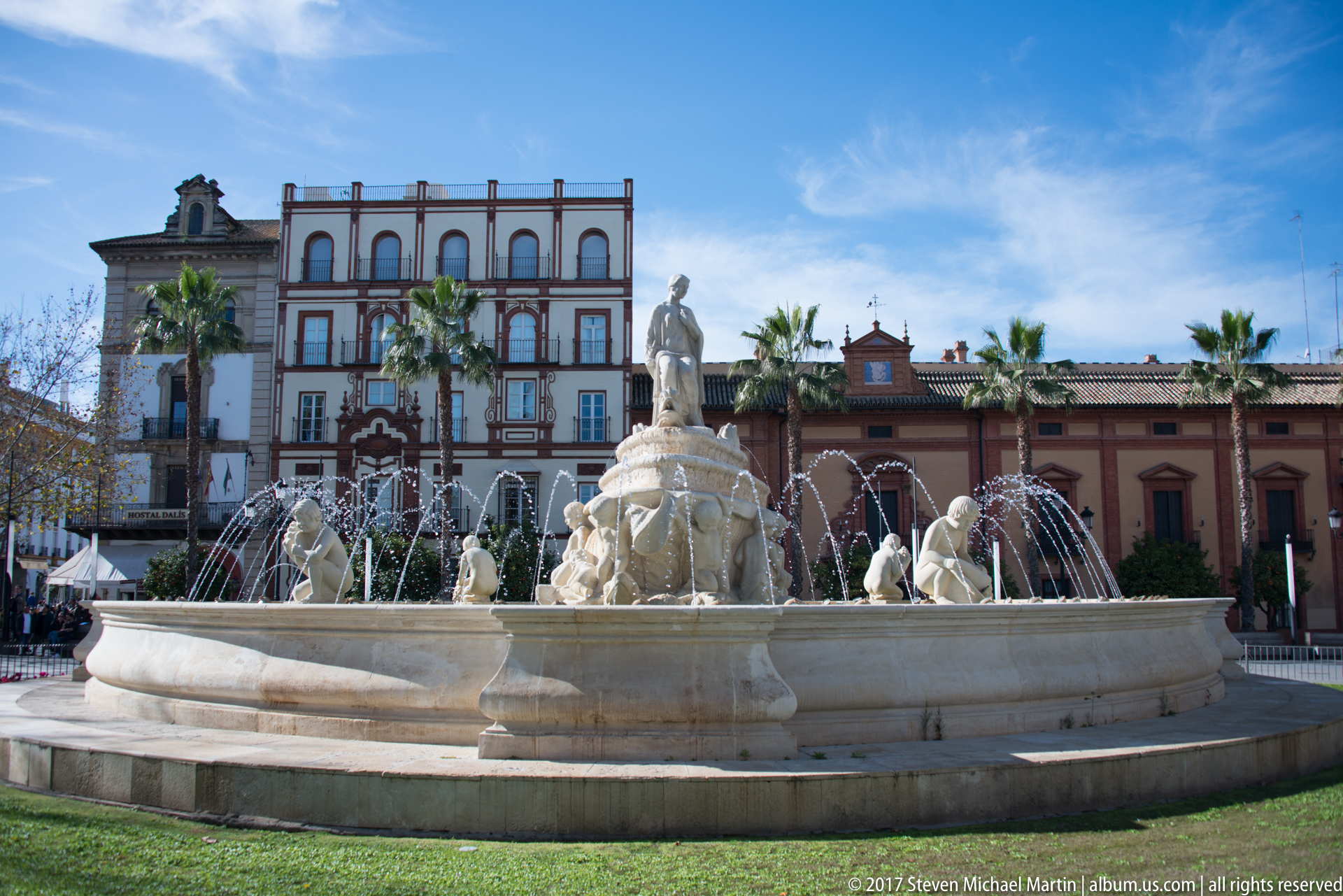
A broad circular fountain anchors an open Seville square, with a standing female figure raised above clustered sculptural forms and multiple arcing water jets. Historic façades and palms create an urban backdrop, while the low basin and symmetrical spray pattern give the composition a ceremonial character. The photograph records the fountain as part of the city’s public realm rather than isolating a single sculptural detail.
Caption
A broad circular fountain anchors an open Seville square, with a standing female figure raised above clustered sculptural forms and multiple arcing water jets. Historic façades and palms create an urban backdrop, while the low basin and symmetrical spray pattern give the composition a ceremonial character. The photograph records the fountain as part of the city’s public realm rather than isolating a single sculptural detail.
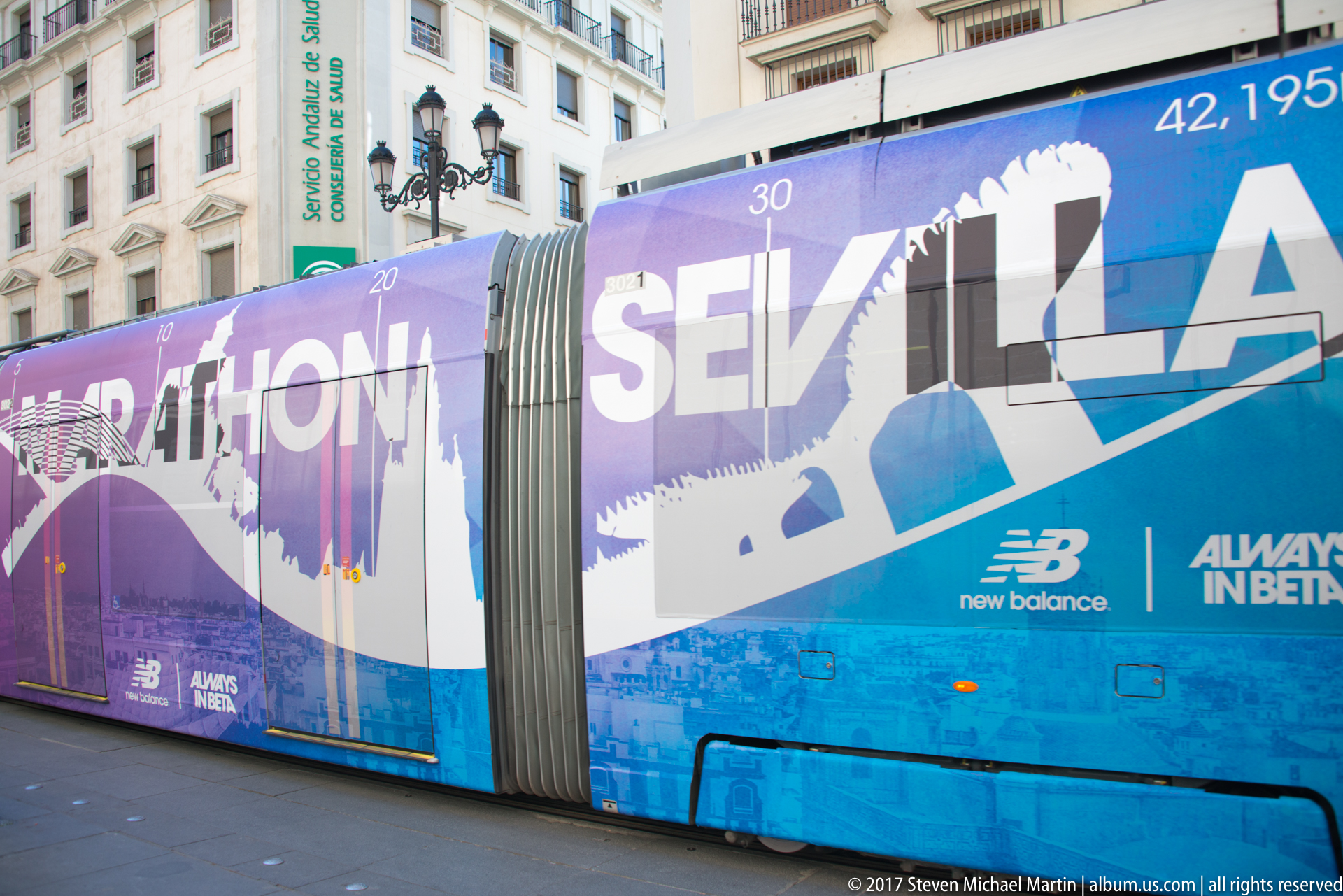
A large articulated sightseeing vehicle fills the frame with a bold blue-and-purple wrap reading “SEVILLA.” Stylized skyline graphics, oversized lettering, and sponsor logos turn the vehicle itself into a moving advertisement for the city. Seen at street level beside apartment façades, it illustrates the infrastructure of contemporary tourism operating within Seville’s historic urban fabric.
Caption
A large articulated sightseeing vehicle fills the frame with a bold blue-and-purple wrap reading “SEVILLA.” Stylized skyline graphics, oversized lettering, and sponsor logos turn the vehicle itself into a moving advertisement for the city. Seen at street level beside apartment façades, it illustrates the infrastructure of contemporary tourism operating within Seville’s historic urban fabric.

A compact Seville newsstand is densely layered with newspapers, magazines, snacks, drinks, and tobacco displays around a central service window. Spanish mastheads and product signs crowd nearly every available surface, with the vendor framed inside the kiosk. The scene records a traditional form of street commerce in which press, refreshments, and small everyday purchases are concentrated into a highly visible neighborhood storefront.
Caption
A compact Seville newsstand is densely layered with newspapers, magazines, snacks, drinks, and tobacco displays around a central service window. Spanish mastheads and product signs crowd nearly every available surface, with the vendor framed inside the kiosk. The scene records a traditional form of street commerce in which press, refreshments, and small everyday purchases are concentrated into a highly visible neighborhood storefront.

A numbered entrance on the exterior of Seville’s Plaza de Toros de la Real Maestranza combines the bullring’s characteristic whitewashed walls, ochre-yellow trim, and deep red studded doors. The tightly framed view concentrates on the functional rhythm of the arena perimeter rather than its grand entrance, showing how decorative color and repeated numbered gates organize access around the historic ring.
Caption
A numbered entrance on the exterior of Seville’s Plaza de Toros de la Real Maestranza combines the bullring’s characteristic whitewashed walls, ochre-yellow trim, and deep red studded doors. The tightly framed view concentrates on the functional rhythm of the arena perimeter rather than its grand entrance, showing how decorative color and repeated numbered gates organize access around the historic ring.

A bronze matador stands in a poised, formal stance, one hand held near the chest and a cape falling beside the figure. The sculpture is set outdoors against the white-and-ochre architecture and iron fencing associated with Seville’s bullring district. Rather than showing an arena spectacle, the monument presents bullfighting through commemorative portraiture in the public space surrounding the Real Maestranza.
Caption
A bronze matador stands in a poised, formal stance, one hand held near the chest and a cape falling beside the figure. The sculpture is set outdoors against the white-and-ochre architecture and iron fencing associated with Seville’s bullring district. Rather than showing an arena spectacle, the monument presents bullfighting through commemorative portraiture in the public space surrounding the Real Maestranza.

Seville’s Torre del Oro rises behind palms as a compact, many-sided defensive tower capped by a smaller upper stage. Its pale masonry, narrow openings, crenellated edge, and projecting upper section preserve the monument’s fortress-like character even within a landscaped riverfront setting. The upward view emphasizes the tower’s mass and geometry, linking the surviving structure to the city’s long relationship with the Guadalquivir.
Caption
Seville’s Torre del Oro rises behind palms as a compact, many-sided defensive tower capped by a smaller upper stage. Its pale masonry, narrow openings, crenellated edge, and projecting upper section preserve the monument’s fortress-like character even within a landscaped riverfront setting. The upward view emphasizes the tower’s mass and geometry, linking the surviving structure to the city’s long relationship with the Guadalquivir.

An oblique, low-angle view of the Real Maestranza bullring emphasizes the sweep of its white façade, ochre architectural trim, red doors, and black iron perimeter fence. Circular windows and small decorative roof finials punctuate the elevation, while the tilted perspective makes the enclosure feel especially immediate. The composition focuses on the arena’s street-facing architecture rather than the interior ring.
Caption
An oblique, low-angle view of the Real Maestranza bullring emphasizes the sweep of its white façade, ochre architectural trim, red doors, and black iron perimeter fence. Circular windows and small decorative roof finials punctuate the elevation, while the tilted perspective makes the enclosure feel especially immediate. The composition focuses on the arena’s street-facing architecture rather than the interior ring.

The principal street façade of Seville’s Plaza de Toros de la Real Maestranza is centered on a tall red gate beneath a stone portal inscribed “PLAZA DE TOROS.” Two circular windows, ochre trim, and repeated rooftop finials create a balanced white-and-gold composition. The frontal viewpoint makes the arena’s formal entrance architecture legible while the iron fence marks the boundary between the sidewalk and the bullring precinct.
Caption
The principal street façade of Seville’s Plaza de Toros de la Real Maestranza is centered on a tall red gate beneath a stone portal inscribed “PLAZA DE TOROS.” Two circular windows, ochre trim, and repeated rooftop finials create a balanced white-and-gold composition. The frontal viewpoint makes the arena’s formal entrance architecture legible while the iron fence marks the boundary between the sidewalk and the bullring precinct.

A tall white monument column rises from a landscaped park, its lower shaft wrapped with shallow carved relief figures. Palms, clipped shrubs, flower beds, and a fountain place the vertical sculpture within a carefully maintained civic garden. The close framing excludes the monument’s summit, drawing attention instead to the textured narrative carving at the base and the contrast between pale stone and surrounding greenery.
Caption
A tall white monument column rises from a landscaped park, its lower shaft wrapped with shallow carved relief figures. Palms, clipped shrubs, flower beds, and a fountain place the vertical sculpture within a carefully maintained civic garden. The close framing excludes the monument’s summit, drawing attention instead to the textured narrative carving at the base and the contrast between pale stone and surrounding greenery.

A bronze figure of Juan Sebastián Elcano stands before a pale stone wall inscribed “SEVILLA A JUAN SEBASTIAN ELCANO.” The explorer is represented upright with one hand raised, set against a textured relief backdrop and a row of fountain jets. Seville’s dedication connects the monument to the city’s maritime memory and to the era of oceanic voyages associated with Spain’s global expansion.
Caption
A bronze figure of Juan Sebastián Elcano stands before a pale stone wall inscribed “SEVILLA A JUAN SEBASTIAN ELCANO.” The explorer is represented upright with one hand raised, set against a textured relief backdrop and a row of fountain jets. Seville’s dedication connects the monument to the city’s maritime memory and to the era of oceanic voyages associated with Spain’s global expansion.

A modern white road bridge crosses a broad lowland corridor on a sequence of sweeping steel arches, with wooded hills rising beyond the urban edge. The elevated viewpoint isolates the bridge’s sculptural structural rhythm against the darker landscape, emphasizing contemporary transport infrastructure rather than historic Seville. Its repeated curved spans create a strong visual counterpoint to the horizontal roadway and distant terrain.
Caption
A modern white road bridge crosses a broad lowland corridor on a sequence of sweeping steel arches, with wooded hills rising beyond the urban edge. The elevated viewpoint isolates the bridge’s sculptural structural rhythm against the darker landscape, emphasizing contemporary transport infrastructure rather than historic Seville. Its repeated curved spans create a strong visual counterpoint to the horizontal roadway and distant terrain.