Malta Harbors – Malta
The historic harbors of Malta have long served as one of the most strategic maritime locations in the Mediterranean Sea. The natural harbors surrounding the capital city of Valletta provided safe anchorage for fleets and became central to the island’s long naval history.
For centuries the harbors were defended by massive fortifications constructed by the Knights Hospitaller, who ruled the island beginning in the 16th century. These defensive walls and bastions still dominate the waterfront landscape.
Today the harbors remain one of the most dramatic historic maritime settings in the Mediterranean.

The Malta Maritime Museum’s long limestone façade rises behind the yacht masts of Vittoriosa marina, its central clock tower and flanking tower elements creating a distinctive waterfront silhouette. Housed in the former Royal Naval Bakery, the building provides an apt architectural endpoint to a harbor sequence centered on Malta’s intertwined histories of navigation, naval infrastructure, and port life.
Caption
The Malta Maritime Museum’s long limestone façade rises behind the yacht masts of Vittoriosa marina, its central clock tower and flanking tower elements creating a distinctive waterfront silhouette. Housed in the former Royal Naval Bakery, the building provides an apt architectural endpoint to a harbor sequence centered on Malta’s intertwined histories of navigation, naval infrastructure, and port life.

Historic cannon line the edge of Valletta’s Saluting Battery while the view opens eastward across Grand Harbour toward its fortified entrance and the Mediterranean beyond. The broad expanse of blue water, low limestone defenses, and outward-facing artillery emphasize the strategic relationship between the city’s elevated batteries and the harbor approaches.
Caption
Historic cannon line the edge of Valletta’s Saluting Battery while the view opens eastward across Grand Harbour toward its fortified entrance and the Mediterranean beyond. The broad expanse of blue water, low limestone defenses, and outward-facing artillery emphasize the strategic relationship between the city’s elevated batteries and the harbor approaches.

A wider blue-hour view places Valletta’s historic skyline above the harbor, with the Carmelite dome and St Paul’s Anglican Pro-Cathedral spire forming the dominant vertical accents. Ferries and smaller craft occupy the foreground water, setting the monumental limestone city against the everyday movement of Marsamxett Harbour.
Caption
A wider blue-hour view places Valletta’s historic skyline above the harbor, with the Carmelite dome and St Paul’s Anglican Pro-Cathedral spire forming the dominant vertical accents. Ferries and smaller craft occupy the foreground water, setting the monumental limestone city against the everyday movement of Marsamxett Harbour.

Historic cannon line the foreground of Valletta’s Saluting Battery above a sweeping Grand Harbour panorama. Fort St Angelo occupies the central promontory, while Vittoriosa and neighboring harbor settlements spread densely behind it; the elevated view unites artillery, fortification, marina activity, and urban development within a single defensive maritime landscape.
Caption
Historic cannon line the foreground of Valletta’s Saluting Battery above a sweeping Grand Harbour panorama. Fort St Angelo occupies the central promontory, while Vittoriosa and neighboring harbor settlements spread densely behind it; the elevated view unites artillery, fortification, marina activity, and urban development within a single defensive maritime landscape.

A line of historic cannon at Valletta’s Saluting Battery points toward Grand Harbour, with Fort Manoel-like? fortified harbor structures and dense urban development beyond. The elevated composition makes the artillery and waterway part of a single defensive landscape, illustrating how commanding views over the harbor were integral to Malta’s fortified capital.
Caption
A line of historic cannon at Valletta’s Saluting Battery points toward Grand Harbour, with Fort Manoel-like? fortified harbor structures and dense urban development beyond. The elevated composition makes the artillery and waterway part of a single defensive landscape, illustrating how commanding views over the harbor were integral to Malta’s fortified capital.

Malta’s national flag billows strongly against a cloudless deep-blue sky, its white and red vertical fields clearly visible and the George Cross appearing in the upper hoist corner. The isolated composition removes the surrounding architecture and harbor context, turning the flag itself into a concise national symbol within the portfolio.
Caption
Malta’s national flag billows strongly against a cloudless deep-blue sky, its white and red vertical fields clearly visible and the George Cross appearing in the upper hoist corner. The isolated composition removes the surrounding architecture and harbor context, turning the flag itself into a concise national symbol within the portfolio.

Small boats and moorings fill the foreground beneath the densely built slopes of Vittoriosa. Above the marina, a long limestone defensive wall separates the water from tightly packed houses, balconies, and church towers, illustrating the close relationship between everyday harbor activity and the fortified urban fabric of Malta’s Three Cities.
Caption
Small boats and moorings fill the foreground beneath the densely built slopes of Vittoriosa. Above the marina, a long limestone defensive wall separates the water from tightly packed houses, balconies, and church towers, illustrating the close relationship between everyday harbor activity and the fortified urban fabric of Malta’s Three Cities.

A small white tourist road train stands at the curb beside Malta’s limestone streetscape, its locomotive-shaped front turning a road vehicle into a playful imitation of rail transport. Rocky landscaping, low walls, and harbor-side development surround the vehicle, documenting one of the visitor transport services used around the historic waterfront districts.
Caption
A small white tourist road train stands at the curb beside Malta’s limestone streetscape, its locomotive-shaped front turning a road vehicle into a playful imitation of rail transport. Rocky landscaping, low walls, and harbor-side development surround the vehicle, documenting one of the visitor transport services used around the historic waterfront districts.

Grand Harbour opens below Valletta’s fortified edge, with historic bastions, harbor installations, and the dense urban fabric of the Three Cities spread across the water. The elevated viewpoint also includes a line of historic artillery in the foreground, linking the harbor panorama to Malta’s long history of coastal defense and control of this strategically important Mediterranean anchorage.
Caption
Grand Harbour opens below Valletta’s fortified edge, with historic bastions, harbor installations, and the dense urban fabric of the Three Cities spread across the water. The elevated viewpoint also includes a line of historic artillery in the foreground, linking the harbor panorama to Malta’s long history of coastal defense and control of this strategically important Mediterranean anchorage.

A slender stone sentry box projects from the corner of a limestone bastion, supported beneath its enclosed lookout chamber and capped by a carved finial. The tighter composition emphasizes the vertical profile, masonry joints, and exposed corner position of this defensive feature against the intensely blue Maltese sky.
Caption
A slender stone sentry box projects from the corner of a limestone bastion, supported beneath its enclosed lookout chamber and capped by a carved finial. The tighter composition emphasizes the vertical profile, masonry joints, and exposed corner position of this defensive feature against the intensely blue Maltese sky.

Bronze Tritons support the great basin of Valletta’s Triton Fountain, dramatically illuminated in turquoise against the night sky. Water spills from the raised bowl while lower jets arc across the composition, emphasizing the sculptural figures and the fountain’s theatrical nighttime presentation near the principal approach to Valletta.
Caption
Bronze Tritons support the great basin of Valletta’s Triton Fountain, dramatically illuminated in turquoise against the night sky. Water spills from the raised bowl while lower jets arc across the composition, emphasizing the sculptural figures and the fountain’s theatrical nighttime presentation near the principal approach to Valletta.

Valletta’s Triton Fountain is seen as a complete nighttime composition, its three bronze figures rising above a broad illuminated basin. Blue arcs of water sweep around the fountain while warm light washes the lower stonework, showing how the monumental sculpture functions as both civic landmark and animated public space after dark.
Caption
Valletta’s Triton Fountain is seen as a complete nighttime composition, its three bronze figures rising above a broad illuminated basin. Blue arcs of water sweep around the fountain while warm light washes the lower stonework, showing how the monumental sculpture functions as both civic landmark and animated public space after dark.

An open hand fills the foreground of a restaurant scene, held close to the camera and obscuring most of the person behind it. Warm pendant lighting, dining tables, and upholstered chairs establish the indoor setting, while the shallow depth of field turns the gesture itself into the dominant visual subject.
Caption
An open hand fills the foreground of a restaurant scene, held close to the camera and obscuring most of the person behind it. Warm pendant lighting, dining tables, and upholstered chairs establish the indoor setting, while the shallow depth of field turns the gesture itself into the dominant visual subject.

A seated diner smiles toward the camera in a contemporary restaurant, framed by neatly set tables and warm interior lighting. A display with small maritime signal flags appears behind him, providing a subtle nautical reference appropriate to the harbor setting while keeping the portrait firmly grounded in the evening dining environment.
Caption
A seated diner smiles toward the camera in a contemporary restaurant, framed by neatly set tables and warm interior lighting. A display with small maritime signal flags appears behind him, providing a subtle nautical reference appropriate to the harbor setting while keeping the portrait firmly grounded in the evening dining environment.

A diner sits smiling across a restaurant table, with two inverted stemmed glasses dominating the foreground. The close table-level viewpoint creates a layered composition of reflective glassware, dark clothing, and warm wood surfaces, while the softly lit dining room recedes behind the seated figure.
Caption
A diner sits smiling across a restaurant table, with two inverted stemmed glasses dominating the foreground. The close table-level viewpoint creates a layered composition of reflective glassware, dark clothing, and warm wood surfaces, while the softly lit dining room recedes behind the seated figure.

Successive rectangular stone openings recede toward a bright square of daylight, creating a striking geometric view through the thickness of Malta’s fortifications. The sharply stepped masonry reveals the depth and mass of the defensive structure while transforming a functional opening into an abstract study of light, repetition, and limestone construction.
Caption
Successive rectangular stone openings recede toward a bright square of daylight, creating a striking geometric view through the thickness of Malta’s fortifications. The sharply stepped masonry reveals the depth and mass of the defensive structure while transforming a functional opening into an abstract study of light, repetition, and limestone construction.

An ornate limestone building stands against the deep blue sky near Valletta’s harbor defenses, its symmetrical façade organized around arched openings, projecting cornices, carved ornament, and a raised central parapet. Weathered stone and the adjacent fortified wall place this refined architectural detail within the rugged military landscape of the harbor edge.
Caption
An ornate limestone building stands against the deep blue sky near Valletta’s harbor defenses, its symmetrical façade organized around arched openings, projecting cornices, carved ornament, and a raised central parapet. Weathered stone and the adjacent fortified wall place this refined architectural detail within the rugged military landscape of the harbor edge.

Fort Manoel’s massive limestone bastions rise from Manoel Island across the dark water of Marsamxett Harbour. Selective floodlighting picks out the angular defensive walls and central entrance zone, while the surrounding urban lights emphasize the fort’s low, commanding position within the harbor approaches.
Caption
Fort Manoel’s massive limestone bastions rise from Manoel Island across the dark water of Marsamxett Harbour. Selective floodlighting picks out the angular defensive walls and central entrance zone, while the surrounding urban lights emphasize the fort’s low, commanding position within the harbor approaches.

Warm floodlighting reveals an ornate limestone church façade crowned by a triangular pediment and cross. A large circular window with a bold black-and-white radial motif anchors the center, flanked by sculpted figures and niches with saints; the tight framing concentrates attention on the richly modeled upper façade rather than the surrounding streetscape.
Caption
Warm floodlighting reveals an ornate limestone church façade crowned by a triangular pediment and cross. A large circular window with a bold black-and-white radial motif anchors the center, flanked by sculpted figures and niches with saints; the tight framing concentrates attention on the richly modeled upper façade rather than the surrounding streetscape.

A closer view isolates the church’s central façade: paired sculpted figures flank a heraldic shield above a circular black-and-white window, while saint figures occupy niches on either side. Corinthian capitals, carved moldings, and warm limestone surfaces show the dense decorative program of Malta’s ecclesiastical architecture under nighttime illumination.
Caption
A closer view isolates the church’s central façade: paired sculpted figures flank a heraldic shield above a circular black-and-white window, while saint figures occupy niches on either side. Corinthian capitals, carved moldings, and warm limestone surfaces show the dense decorative program of Malta’s ecclesiastical architecture under nighttime illumination.

Streetlights trace the curving Sliema waterfront beside Marsamxett Harbour at blue hour, their reflections stretching across the darkening water. Mid-rise buildings line the promenade while the harbor opens toward the distant shoreline, presenting the modern urban edge that faces Valletta across one of Malta’s principal natural harbors.
Caption
Streetlights trace the curving Sliema waterfront beside Marsamxett Harbour at blue hour, their reflections stretching across the darkening water. Mid-rise buildings line the promenade while the harbor opens toward the distant shoreline, presenting the modern urban edge that faces Valletta across one of Malta’s principal natural harbors.

Valletta glows across Marsamxett Harbour at blue hour, with the great dome of the Carmelite church and the slender spire of St Paul’s Anglican Pro-Cathedral rising above the illuminated bastions and waterfront buildings. A passenger vessel crosses the foreground, reinforcing the harbor’s continuing role as an active maritime corridor.
Caption
Valletta glows across Marsamxett Harbour at blue hour, with the great dome of the Carmelite church and the slender spire of St Paul’s Anglican Pro-Cathedral rising above the illuminated bastions and waterfront buildings. A passenger vessel crosses the foreground, reinforcing the harbor’s continuing role as an active maritime corridor.

Fort St Angelo occupies its commanding promontory at the center of Grand Harbour, its pale limestone ramparts rising directly from the water beside Vittoriosa. Layered defensive walls, compact upper works, and nearby moored vessels show the fortress as both a major element of Malta’s historic harbor defenses and a continuing landmark within an active port.
Caption
Fort St Angelo occupies its commanding promontory at the center of Grand Harbour, its pale limestone ramparts rising directly from the water beside Vittoriosa. Layered defensive walls, compact upper works, and nearby moored vessels show the fortress as both a major element of Malta’s historic harbor defenses and a continuing landmark within an active port.

A visitor stands at a high overlook above Grand Harbour, with the fortified harbor entrance and pale limestone shoreline receding behind him beneath a clear blue sky. The shallow depth of field keeps the figure prominent while retaining enough of the maritime landscape to establish the elevated Valletta setting.
Caption
A visitor stands at a high overlook above Grand Harbour, with the fortified harbor entrance and pale limestone shoreline receding behind him beneath a clear blue sky. The shallow depth of field keeps the figure prominent while retaining enough of the maritime landscape to establish the elevated Valletta setting.

Vittoriosa rises steeply from the Grand Harbour waterfront, its layered limestone buildings punctuated by church domes and twin bell towers. The stone quay and the visible “Vittoriosa” name anchor the view in Birgu, one of Malta’s historic Three Cities, where dense urban fabric developed immediately behind the fortified harbor edge.
Caption
Vittoriosa rises steeply from the Grand Harbour waterfront, its layered limestone buildings punctuated by church domes and twin bell towers. The stone quay and the visible “Vittoriosa” name anchor the view in Birgu, one of Malta’s historic Three Cities, where dense urban fabric developed immediately behind the fortified harbor edge.

Fort St Angelo’s immense pale limestone walls rise directly from Grand Harbour at the tip of Vittoriosa. The low, angular bastions and massive upper works dominate the frame, while Maltese and other flags mark the skyline, emphasizing the fortress’s commanding position over the harbor’s central waterways.
Caption
Fort St Angelo’s immense pale limestone walls rise directly from Grand Harbour at the tip of Vittoriosa. The low, angular bastions and massive upper works dominate the frame, while Maltese and other flags mark the skyline, emphasizing the fortress’s commanding position over the harbor’s central waterways.

Valletta’s fortified shoreline stretches above the harbor, with tall limestone curtain walls supporting a dense line of civic and residential buildings. A small classical lookout structure punctuates the bastion edge, while the water-level viewpoint makes clear the dramatic vertical relationship between the harbor and the elevated city.
Caption
Valletta’s fortified shoreline stretches above the harbor, with tall limestone curtain walls supporting a dense line of civic and residential buildings. A small classical lookout structure punctuates the bastion edge, while the water-level viewpoint makes clear the dramatic vertical relationship between the harbor and the elevated city.

The Siege Bell Memorial stands prominently on Valletta’s seaward bastions, its great bell sheltered beneath a freestanding classical colonnade. Seen from the water, the memorial is isolated against the blue sky and pale rock, creating a clear silhouette above the harbor edge and marking one of the city’s most recognizable modern commemorative structures.
Caption
The Siege Bell Memorial stands prominently on Valletta’s seaward bastions, its great bell sheltered beneath a freestanding classical colonnade. Seen from the water, the memorial is isolated against the blue sky and pale rock, creating a clear silhouette above the harbor edge and marking one of the city’s most recognizable modern commemorative structures.

A projecting stone sentry box crowns the corner of a massive limestone fortification, its small openings and domed cap extending beyond the wall on corbels. The close view highlights a characteristic element of early modern defensive architecture, designed to give guards a protected vantage along the face of the bastion.
Caption
A projecting stone sentry box crowns the corner of a massive limestone fortification, its small openings and domed cap extending beyond the wall on corbels. The close view highlights a characteristic element of early modern defensive architecture, designed to give guards a protected vantage along the face of the bastion.

The varnished wooden bow of a traditional Maltese harbor boat points across bright blue water toward the fortified shoreline. A tall stem post, pale gunwales, coiled line, and an oar frame the passenger’s low viewpoint, turning the crossing itself into the subject and evoking the small craft that continue to move through Malta’s historic harbors.
Caption
The varnished wooden bow of a traditional Maltese harbor boat points across bright blue water toward the fortified shoreline. A tall stem post, pale gunwales, coiled line, and an oar frame the passenger’s low viewpoint, turning the crossing itself into the subject and evoking the small craft that continue to move through Malta’s historic harbors.

Grand Harbour’s Vittoriosa waterfront is layered vertically from formal waterside façades to massive defensive walls and the upper city beyond. The composition shows how civic architecture, quayside activity, and fortification were compressed into the narrow harbor edge, creating the dense built landscape characteristic of Malta’s Three Cities.
Caption
Grand Harbour’s Vittoriosa waterfront is layered vertically from formal waterside façades to massive defensive walls and the upper city beyond. The composition shows how civic architecture, quayside activity, and fortification were compressed into the narrow harbor edge, creating the dense built landscape characteristic of Malta’s Three Cities.

A brightly painted traditional Maltese boat rides among modern pleasure craft with Fort St Angelo’s pale bastions filling the background. The juxtaposition brings together vernacular maritime tradition, contemporary harbor use, and monumental coastal defense in a compact Grand Harbour scene centered on the waters off Vittoriosa.
Caption
A brightly painted traditional Maltese boat rides among modern pleasure craft with Fort St Angelo’s pale bastions filling the background. The juxtaposition brings together vernacular maritime tradition, contemporary harbor use, and monumental coastal defense in a compact Grand Harbour scene centered on the waters off Vittoriosa.

A red-and-blue traditional Maltese boat rests at its mooring in Grand Harbour, its high upturned stem and stern framing a covered interior. Fort St Angelo rises across the water behind it, giving the small vernacular craft a monumental defensive backdrop and linking surviving harbor traditions to the historic maritime landscape of Vittoriosa.
Caption
A red-and-blue traditional Maltese boat rests at its mooring in Grand Harbour, its high upturned stem and stern framing a covered interior. Fort St Angelo rises across the water behind it, giving the small vernacular craft a monumental defensive backdrop and linking surviving harbor traditions to the historic maritime landscape of Vittoriosa.

The former Royal Naval Bakery, now home to the Malta Maritime Museum, faces Vittoriosa’s marina behind a forest of yacht masts. Its long symmetrical limestone façade, central clock tower, and flanking tower elements give the building a commanding industrial-civic presence on the historic waterfront, where naval infrastructure and modern leisure boating now share the same harbor.
Caption
The former Royal Naval Bakery, now home to the Malta Maritime Museum, faces Vittoriosa’s marina behind a forest of yacht masts. Its long symmetrical limestone façade, central clock tower, and flanking tower elements give the building a commanding industrial-civic presence on the historic waterfront, where naval infrastructure and modern leisure boating now share the same harbor.

A long limestone waterfront building extends beside the marina, its repeated arched openings and enclosed balconies forming a formal façade above the blue harbor. Yachts and small craft cluster along the quay, placing the architecture within Malta’s active maritime landscape and showing the close relationship between historic urban development and sheltered harbor space.
Caption
A long limestone waterfront building extends beside the marina, its repeated arched openings and enclosed balconies forming a formal façade above the blue harbor. Yachts and small craft cluster along the quay, placing the architecture within Malta’s active maritime landscape and showing the close relationship between historic urban development and sheltered harbor space.

Twin bell towers and a red-domed church rise behind a marina crowded with yacht masts, creating a layered view of Malta’s religious architecture and maritime waterfront. The rigging cuts vertically across the ornate limestone façade, emphasizing how closely the historic city and modern pleasure harbor occupy the same compact urban edge.
Caption
Twin bell towers and a red-domed church rise behind a marina crowded with yacht masts, creating a layered view of Malta’s religious architecture and maritime waterfront. The rigging cuts vertically across the ornate limestone façade, emphasizing how closely the historic city and modern pleasure harbor occupy the same compact urban edge.

A passenger smiles from a low seat aboard a traditional wooden harbor boat, with varnished gunwales and an oar crossing the foreground. Sailboats and limestone waterfront buildings fill the background, making the portrait also an intimate record of small-craft travel through Malta’s densely developed harbor environment.
Caption
A passenger smiles from a low seat aboard a traditional wooden harbor boat, with varnished gunwales and an oar crossing the foreground. Sailboats and limestone waterfront buildings fill the background, making the portrait also an intimate record of small-craft travel through Malta’s densely developed harbor environment.

Fort St Angelo’s broad limestone bastions dominate the harbor horizon, rising in successive defensive tiers above the water. Modern yachts and small craft at the base provide scale and contrast with the fortress’s massive masonry, underscoring the continuing coexistence of historic military architecture and contemporary harbor activity around Vittoriosa.
Caption
Fort St Angelo’s broad limestone bastions dominate the harbor horizon, rising in successive defensive tiers above the water. Modern yachts and small craft at the base provide scale and contrast with the fortress’s massive masonry, underscoring the continuing coexistence of historic military architecture and contemporary harbor activity around Vittoriosa.
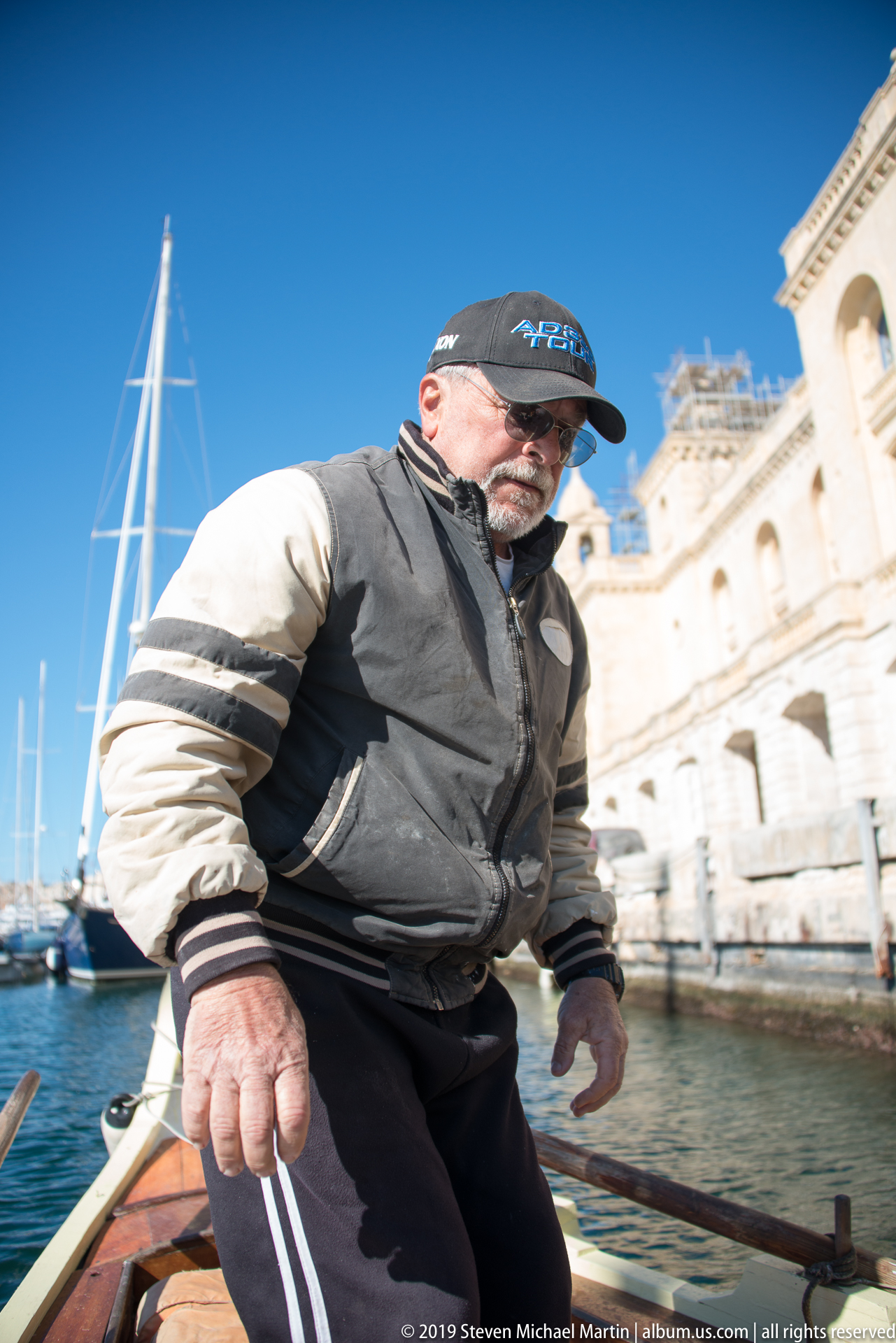
A boatman stands close to the camera while handling a line aboard a small traditional craft in the marina. His working posture, weathered clothing, and the wooden boat edge contrast with the bright yachts and historic limestone architecture behind him, giving the scene a direct human connection to everyday harbor transport.
Caption
A boatman stands close to the camera while handling a line aboard a small traditional craft in the marina. His working posture, weathered clothing, and the wooden boat edge contrast with the bright yachts and historic limestone architecture behind him, giving the scene a direct human connection to everyday harbor transport.

The pointed bow of a traditional wooden harbor boat leads directly toward a marina crowded with sailing yachts. Long wooden oars extend along both sides, while painted gunwales and the varnished interior frame the low water-level perspective, conveying the experience of crossing Malta’s harbor in a small local craft.
Caption
The pointed bow of a traditional wooden harbor boat leads directly toward a marina crowded with sailing yachts. Long wooden oars extend along both sides, while painted gunwales and the varnished interior frame the low water-level perspective, conveying the experience of crossing Malta’s harbor in a small local craft.

A broad, weathered limestone arch frames a view outward toward roads, parked cars, marina masts, and historic harbor buildings. The contrast between the thick defensive masonry and the open urban landscape beyond makes the gateway a visual threshold between Malta’s fortified enclosure and the modern waterfront outside.
Caption
A broad, weathered limestone arch frames a view outward toward roads, parked cars, marina masts, and historic harbor buildings. The contrast between the thick defensive masonry and the open urban landscape beyond makes the gateway a visual threshold between Malta’s fortified enclosure and the modern waterfront outside.

A carved royal coat of arms fills the triangular pediment of a limestone harbor building, with the crowned shield flanked by lion and unicorn and the motto “Dieu et mon droit” below. The heraldic ensemble records a visible layer of British-era institutional presence within Malta’s maritime architectural landscape.
Caption
A carved royal coat of arms fills the triangular pediment of a limestone harbor building, with the crowned shield flanked by lion and unicorn and the motto “Dieu et mon droit” below. The heraldic ensemble records a visible layer of British-era institutional presence within Malta’s maritime architectural landscape.

Prickly pear and other succulents grow among rough limestone rocks below a monumental historic wall and arched opening. The garden’s drought-tolerant vegetation reflects Malta’s dry Mediterranean environment, while the juxtaposition of cultivated plants and heavy masonry softens the edge of the fortified architectural setting.
Caption
Prickly pear and other succulents grow among rough limestone rocks below a monumental historic wall and arched opening. The garden’s drought-tolerant vegetation reflects Malta’s dry Mediterranean environment, while the juxtaposition of cultivated plants and heavy masonry softens the edge of the fortified architectural setting.

A deeply carved military trophy centers on a crowned shield surrounded by crossed weapons, standards, armor, and martial emblems. Executed in pale limestone, the relief transforms a building façade into a statement of institutional authority and military identity, fitting the defensive and naval history that shaped Malta’s harbor districts.
Caption
A deeply carved military trophy centers on a crowned shield surrounded by crossed weapons, standards, armor, and martial emblems. Executed in pale limestone, the relief transforms a building façade into a statement of institutional authority and military identity, fitting the defensive and naval history that shaped Malta’s harbor districts.

Two green enclosed timber balconies project from a honey-colored limestone façade, paired with green shutters and delicate metal railings. Their deep box-like forms provide shade and privacy while animating the otherwise flat masonry wall, making the composition a close architectural study of a characteristic feature of Malta’s historic urban streets.
Caption
Two green enclosed timber balconies project from a honey-colored limestone façade, paired with green shutters and delicate metal railings. Their deep box-like forms provide shade and privacy while animating the otherwise flat masonry wall, making the composition a close architectural study of a characteristic feature of Malta’s historic urban streets.

Two cannon muzzles project from low rectangular embrasures in a heavily weathered limestone defensive work. Layered masonry platforms and thick walls emphasize the compact geometry of the battery, while the close view shows how artillery positions were protected within Malta’s extensive harbor fortifications.
Caption
Two cannon muzzles project from low rectangular embrasures in a heavily weathered limestone defensive work. Layered masonry platforms and thick walls emphasize the compact geometry of the battery, while the close view shows how artillery positions were protected within Malta’s extensive harbor fortifications.

A Maltese flag flies above a broad limestone fortification whose arched entrance opens onto a paved forecourt. Palm trees, low plantings, and modern posts soften the military geometry, while the heavy walls and recessed gateway retain the unmistakable character of a historic defensive complex adapted to contemporary public use.
Caption
A Maltese flag flies above a broad limestone fortification whose arched entrance opens onto a paved forecourt. Palm trees, low plantings, and modern posts soften the military geometry, while the heavy walls and recessed gateway retain the unmistakable character of a historic defensive complex adapted to contemporary public use.

Dense limestone buildings rise above a sheltered marina packed with sailboats, while massive defensive walls anchor the left edge of the scene. The elevated viewpoint reveals how tightly Malta’s historic urban fabric, fortifications, and modern yachting infrastructure interlock around the narrow waterways of the Grand Harbour complex.
Caption
Dense limestone buildings rise above a sheltered marina packed with sailboats, while massive defensive walls anchor the left edge of the scene. The elevated viewpoint reveals how tightly Malta’s historic urban fabric, fortifications, and modern yachting infrastructure interlock around the narrow waterways of the Grand Harbour complex.

Hundreds of masts create a dense vertical pattern across the marina below Vittoriosa’s tightly packed limestone townscape. White yachts occupy nearly every berth, while historic buildings climb the opposite shore, presenting a contemporary recreational harbor embedded within one of Malta’s oldest fortified urban environments.
Caption
Hundreds of masts create a dense vertical pattern across the marina below Vittoriosa’s tightly packed limestone townscape. White yachts occupy nearly every berth, while historic buildings climb the opposite shore, presenting a contemporary recreational harbor embedded within one of Malta’s oldest fortified urban environments.

The Maltese flag flies above a monumental limestone gateway decorated with carved military trophies and an inscription dated MDCCXXI. Heavy rusticated masonry and the recessed arched passage give the entrance a strongly defensive character, while the heraldic panels turn the façade into a formal statement of military authority at the threshold of the fortified complex.
Caption
The Maltese flag flies above a monumental limestone gateway decorated with carved military trophies and an inscription dated MDCCXXI. Heavy rusticated masonry and the recessed arched passage give the entrance a strongly defensive character, while the heraldic panels turn the façade into a formal statement of military authority at the threshold of the fortified complex.

A white stone statue of a robed saint occupies a deep arched niche, one arm raised while the other holds devotional attributes. An inscription and dedicatory tablet sit beneath the pedestal, integrating the sculpture into the surrounding limestone architecture and marking the façade with a conspicuous expression of public religious devotion.
Caption
A white stone statue of a robed saint occupies a deep arched niche, one arm raised while the other holds devotional attributes. An inscription and dedicatory tablet sit beneath the pedestal, integrating the sculpture into the surrounding limestone architecture and marking the façade with a conspicuous expression of public religious devotion.

A monumental double door is constructed from richly toned wood panels framed by pale dressed stone. Curving carved elements cross the upper central panels, while narrow ornamental side panels and deep moldings give the entrance a formal, carefully composed appearance suited to an important civic or institutional building.
Caption
A monumental double door is constructed from richly toned wood panels framed by pale dressed stone. Curving carved elements cross the upper central panels, while narrow ornamental side panels and deep moldings give the entrance a formal, carefully composed appearance suited to an important civic or institutional building.

Crossed weapons fill the relief above a fortified gateway marked MDCCXXI, while tall carved trophy panels flank the arched opening. The closer view reveals the crisp military symbolism embedded in the limestone façade and makes the 1721 date a central element of the composition, distinguishing this detail from the broader entrance view beside it.
Caption
Crossed weapons fill the relief above a fortified gateway marked MDCCXXI, while tall carved trophy panels flank the arched opening. The closer view reveals the crisp military symbolism embedded in the limestone façade and makes the 1721 date a central element of the composition, distinguishing this detail from the broader entrance view beside it.

An elevated view looks across massive honey-colored fortifications toward an arched bridge and recessed gateway, with Malta’s flag flying above the walls. Trees and modern harbor infrastructure appear beyond, revealing the defensive complex as part of a larger urban and maritime landscape rather than an isolated monument.
Caption
An elevated view looks across massive honey-colored fortifications toward an arched bridge and recessed gateway, with Malta’s flag flying above the walls. Trees and modern harbor infrastructure appear beyond, revealing the defensive complex as part of a larger urban and maritime landscape rather than an isolated monument.

A shallow stone barrel vault covers a gated passage through a substantial limestone building. Repeated arches draw the eye toward bright daylight at the far end, while black iron gates, dressed masonry, and thick walls emphasize the controlled circulation typical of fortified or institutional architecture.
Caption
A shallow stone barrel vault covers a gated passage through a substantial limestone building. Repeated arches draw the eye toward bright daylight at the far end, while black iron gates, dressed masonry, and thick walls emphasize the controlled circulation typical of fortified or institutional architecture.

A circular carved medallion bears the word “VERITAS” above an elaborate symbolic composition of crossed and entwined objects, foliage, and a central sculptural motif. Set into the architectural surround above an entrance, the relief functions as an institutional emblem whose fine carving contrasts with the smooth surrounding stonework.
Caption
A circular carved medallion bears the word “VERITAS” above an elaborate symbolic composition of crossed and entwined objects, foliage, and a central sculptural motif. Set into the architectural surround above an entrance, the relief functions as an institutional emblem whose fine carving contrasts with the smooth surrounding stonework.

A blue enclosed timber balcony projects above a matching doorway on a honey-colored limestone residence. Deeply paneled woodwork, narrow side windows, stone brackets, and climbing greenery create a compact study of Malta’s characteristic gallarija tradition and the strong color contrasts used to individualize historic façades.
Caption
A blue enclosed timber balcony projects above a matching doorway on a honey-colored limestone residence. Deeply paneled woodwork, narrow side windows, stone brackets, and climbing greenery create a compact study of Malta’s characteristic gallarija tradition and the strong color contrasts used to individualize historic façades.

A standing stone figure crowns an elaborate white monument, holding a long staff or weapon while sculpted trophies and decorative finials surround the pedestal below. Historic balconies and green shutters form the backdrop, placing the monument within a dense Maltese streetscape and emphasizing its ceremonial prominence in the public space.
Caption
A standing stone figure crowns an elaborate white monument, holding a long staff or weapon while sculpted trophies and decorative finials surround the pedestal below. Historic balconies and green shutters form the backdrop, placing the monument within a dense Maltese streetscape and emphasizing its ceremonial prominence in the public space.

An armored stone figure stands on a tall pedestal decorated with carved shields and heraldic devices. The upward viewpoint silhouettes the sculpture against an intense blue sky while surrounding balconies and façades establish its urban setting, allowing the monument’s costume, stance, and heraldic base to dominate the composition.
Caption
An armored stone figure stands on a tall pedestal decorated with carved shields and heraldic devices. The upward viewpoint silhouettes the sculpture against an intense blue sky while surrounding balconies and façades establish its urban setting, allowing the monument’s costume, stance, and heraldic base to dominate the composition.

A circular window is divided into dark radial panes by pale spokes converging on a carved central boss. Concentric stone moldings frame the opening, while weathering and fine cracks in the surrounding limestone give the close architectural detail a strong sense of age and material texture.
Caption
A circular window is divided into dark radial panes by pale spokes converging on a carved central boss. Concentric stone moldings frame the opening, while weathering and fine cracks in the surrounding limestone give the close architectural detail a strong sense of age and material texture.

A richly paneled wooden double door fills a formal limestone portal crowned by a shallow triangular pediment and circular emblem. Fluted side elements, layered moldings, and symmetrical carved panels give the entrance a restrained monumental character, distinguishing it from the more domestic balconies and doorways elsewhere in the harbor district.
Caption
A richly paneled wooden double door fills a formal limestone portal crowned by a shallow triangular pediment and circular emblem. Fluted side elements, layered moldings, and symmetrical carved panels give the entrance a restrained monumental character, distinguishing it from the more domestic balconies and doorways elsewhere in the harbor district.

A weathered pale double door sits deep within a projecting limestone surround capped by a simple cornice. Small dark eight-pointed cross motifs punctuate the central panels, while sun and shadow reveal worn paint, layered moldings, and the substantial depth of the stone frame.
Caption
A weathered pale double door sits deep within a projecting limestone surround capped by a simple cornice. Small dark eight-pointed cross motifs punctuate the central panels, while sun and shadow reveal worn paint, layered moldings, and the substantial depth of the stone frame.

A formal limestone entrance combines a paneled double door with small eight-pointed cross motifs, a projecting classical surround, and a circular radial window set high beneath a triangular pediment. Strong sunlight rakes across the honey-colored masonry, revealing weathering, layered moldings, and the careful symmetry of this institutional or religious façade.
Caption
A formal limestone entrance combines a paneled double door with small eight-pointed cross motifs, a projecting classical surround, and a circular radial window set high beneath a triangular pediment. Strong sunlight rakes across the honey-colored masonry, revealing weathering, layered moldings, and the careful symmetry of this institutional or religious façade.

Two dark eight-pointed crosses are mounted symmetrically on pale paneled doors, their sharply pointed arms standing out against weathered cream paint. The tight crop removes the surrounding architecture and concentrates attention on the Maltese-cross form as a decorative and institutional emblem embedded directly in the entrance woodwork.
Caption
Two dark eight-pointed crosses are mounted symmetrically on pale paneled doors, their sharply pointed arms standing out against weathered cream paint. The tight crop removes the surrounding architecture and concentrates attention on the Maltese-cross form as a decorative and institutional emblem embedded directly in the entrance woodwork.

Two monumental entrances face a narrow open space between substantial limestone buildings, each using classical moldings and heraldic ornament to mark an important threshold. The left doorway is crowned by an elaborate coat of arms, while the more distant entrance includes a circular window and pediment, showing variation within a coordinated historic architectural complex.
Caption
Two monumental entrances face a narrow open space between substantial limestone buildings, each using classical moldings and heraldic ornament to mark an important threshold. The left doorway is crowned by an elaborate coat of arms, while the more distant entrance includes a circular window and pediment, showing variation within a coordinated historic architectural complex.

An elaborate polychrome crest projects from the limestone façade, centered on a red shield bearing a white rearing horse and surrounded by carved scrollwork. A large white eight-pointed cross forms the backing, while the Latin motto “FIDELIS ET VERAX” is visible beneath the shield, making the heraldic ensemble the dominant subject.
Caption
An elaborate polychrome crest projects from the limestone façade, centered on a red shield bearing a white rearing horse and surrounded by carved scrollwork. A large white eight-pointed cross forms the backing, while the Latin motto “FIDELIS ET VERAX” is visible beneath the shield, making the heraldic ensemble the dominant subject.

The same heraldic emblem crowns a monumental doorway framed by deeply modeled limestone moldings and large scrolled brackets. Seen from below, the white eight-pointed cross, red horse shield, and carved surround sit prominently above paneled doors, placing the crest within its full architectural setting rather than isolating it as a decorative detail.
Caption
The same heraldic emblem crowns a monumental doorway framed by deeply modeled limestone moldings and large scrolled brackets. Seen from below, the white eight-pointed cross, red horse shield, and carved surround sit prominently above paneled doors, placing the crest within its full architectural setting rather than isolating it as a decorative detail.

A richly modeled limestone church rises behind mature trees, its symmetrical façade framed by two tall bell towers and punctuated by a small central dome. Columns, niches, cornices, and a high central pediment create a strongly vertical composition, while scaffolding on one tower records active maintenance of the historic structure.
Caption
A richly modeled limestone church rises behind mature trees, its symmetrical façade framed by two tall bell towers and punctuated by a small central dome. Columns, niches, cornices, and a high central pediment create a strongly vertical composition, while scaffolding on one tower records active maintenance of the historic structure.

Evening light fades behind a busy waterfront promenade as a visitor photographs the harbor from the stone edge. Streetlamps and hotel or apartment façades begin to glow along the curving shoreline, while dark rippled water fills the foreground, shifting the portfolio from daylight architecture to the lived atmosphere of Malta’s harbor after sunset.
Caption
Evening light fades behind a busy waterfront promenade as a visitor photographs the harbor from the stone edge. Streetlamps and hotel or apartment façades begin to glow along the curving shoreline, while dark rippled water fills the foreground, shifting the portfolio from daylight architecture to the lived atmosphere of Malta’s harbor after sunset.

Fort St Angelo projects into the brilliant blue water of Grand Harbour, backed by the dense limestone fabric and marinas of Vittoriosa. A single historic cannon occupies the near corner of the elevated Valletta terrace, providing a restrained defensive foreground while the harbor’s fortified geography unfolds across the middle distance.
Caption
Fort St Angelo projects into the brilliant blue water of Grand Harbour, backed by the dense limestone fabric and marinas of Vittoriosa. A single historic cannon occupies the near corner of the elevated Valletta terrace, providing a restrained defensive foreground while the harbor’s fortified geography unfolds across the middle distance.

Massive honey-colored defensive walls rise directly from Grand Harbour, with later urban buildings stepping upward behind them. Arched lower-level openings, projecting masonry, flags, and waterside terraces reveal the layered character of Malta’s fortified harbor settlements, where military architecture and subsequent civic development occupy the same narrow shoreline.
Caption
Massive honey-colored defensive walls rise directly from Grand Harbour, with later urban buildings stepping upward behind them. Arched lower-level openings, projecting masonry, flags, and waterside terraces reveal the layered character of Malta’s fortified harbor settlements, where military architecture and subsequent civic development occupy the same narrow shoreline.

Fort St Angelo rises almost sheer from the water at the tip of Vittoriosa, its broad pale bastions stacked in powerful horizontal tiers. Malta’s flag and another standard fly above the upper works, while the low water-level viewpoint emphasizes the fortress’s mass and commanding control of the central Grand Harbour waterways.
Caption
Fort St Angelo rises almost sheer from the water at the tip of Vittoriosa, its broad pale bastions stacked in powerful horizontal tiers. Malta’s flag and another standard fly above the upper works, while the low water-level viewpoint emphasizes the fortress’s mass and commanding control of the central Grand Harbour waterways.

Valletta’s limestone cityscape stretches along a fortified peninsula above the deep blue water of Grand Harbour. Continuous bastion walls support dense historic buildings on the ridge, while a red navigation marker stands near the harbor entrance, emphasizing the city’s close relationship to both coastal defense and maritime navigation.
Caption
Valletta’s limestone cityscape stretches along a fortified peninsula above the deep blue water of Grand Harbour. Continuous bastion walls support dense historic buildings on the ridge, while a red navigation marker stands near the harbor entrance, emphasizing the city’s close relationship to both coastal defense and maritime navigation.

Fort St Angelo’s monumental limestone bastions fill the shoreline behind a large white motor yacht, sharply contrasting centuries of defensive architecture with contemporary luxury navigation. Flags fly from the fortress above the waterline, while the low harbor viewpoint emphasizes both the scale of the historic stronghold and the active maritime traffic surrounding Vittoriosa.
Caption
Fort St Angelo’s monumental limestone bastions fill the shoreline behind a large white motor yacht, sharply contrasting centuries of defensive architecture with contemporary luxury navigation. Flags fly from the fortress above the waterline, while the low harbor viewpoint emphasizes both the scale of the historic stronghold and the active maritime traffic surrounding Vittoriosa.