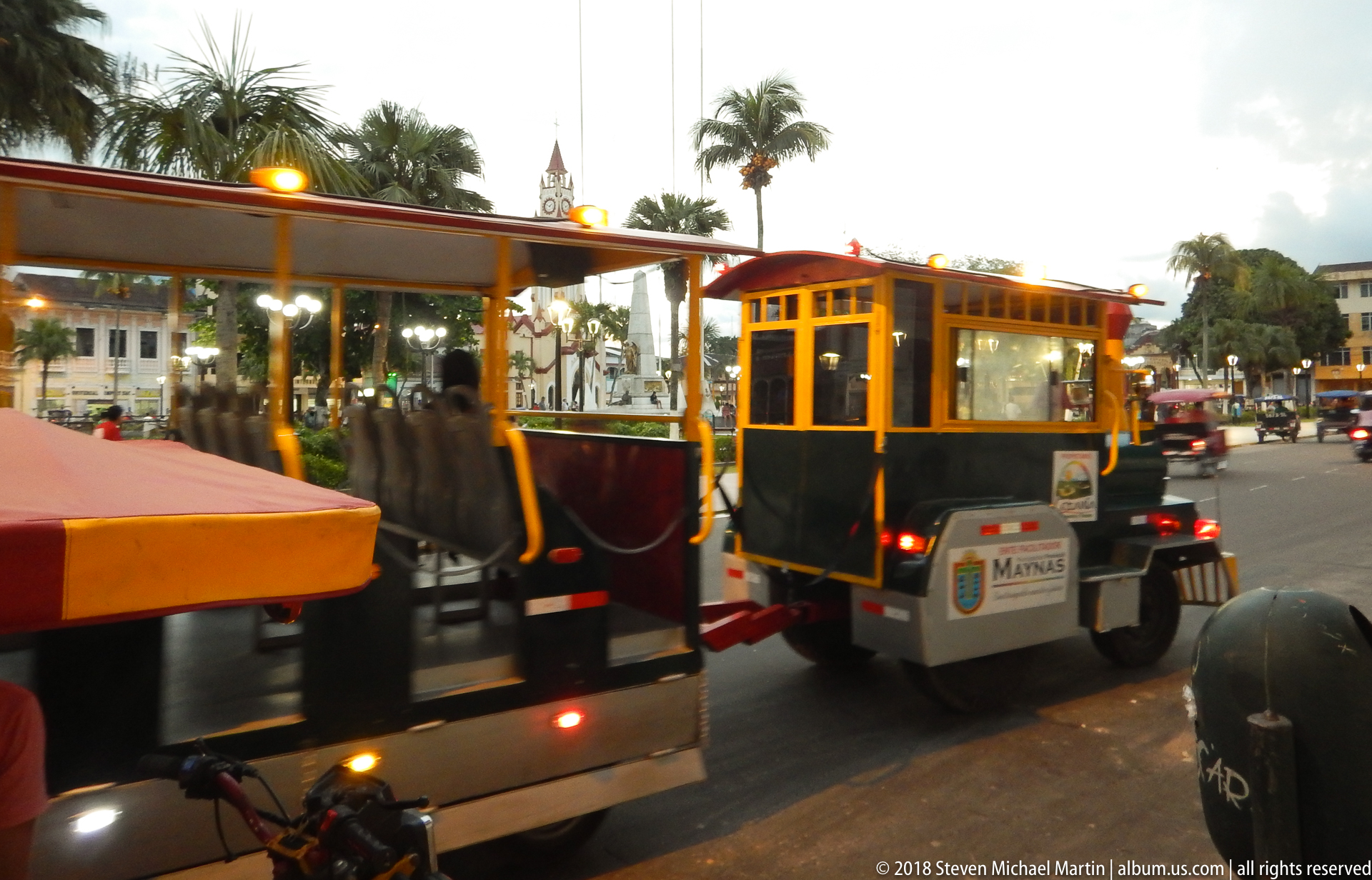
A small road-going tourist train with orange-and-green carriages moves around a landscaped city square at dusk. Municipal crests and the word “Maynas” appear on the vehicle, while palms, lamps, traffic, and civic buildings frame the route. The playful train-like transport contrasts with the mototaxis seen elsewhere in Iquitos and serves a recreational rather than ordinary transit role.
Caption
A small road-going tourist train with orange-and-green carriages moves around a landscaped city square at dusk. Municipal crests and the word “Maynas” appear on the vehicle, while palms, lamps, traffic, and civic buildings frame the route. The playful train-like transport contrasts with the mototaxis seen elsewhere in Iquitos and serves a recreational rather than ordinary transit role.
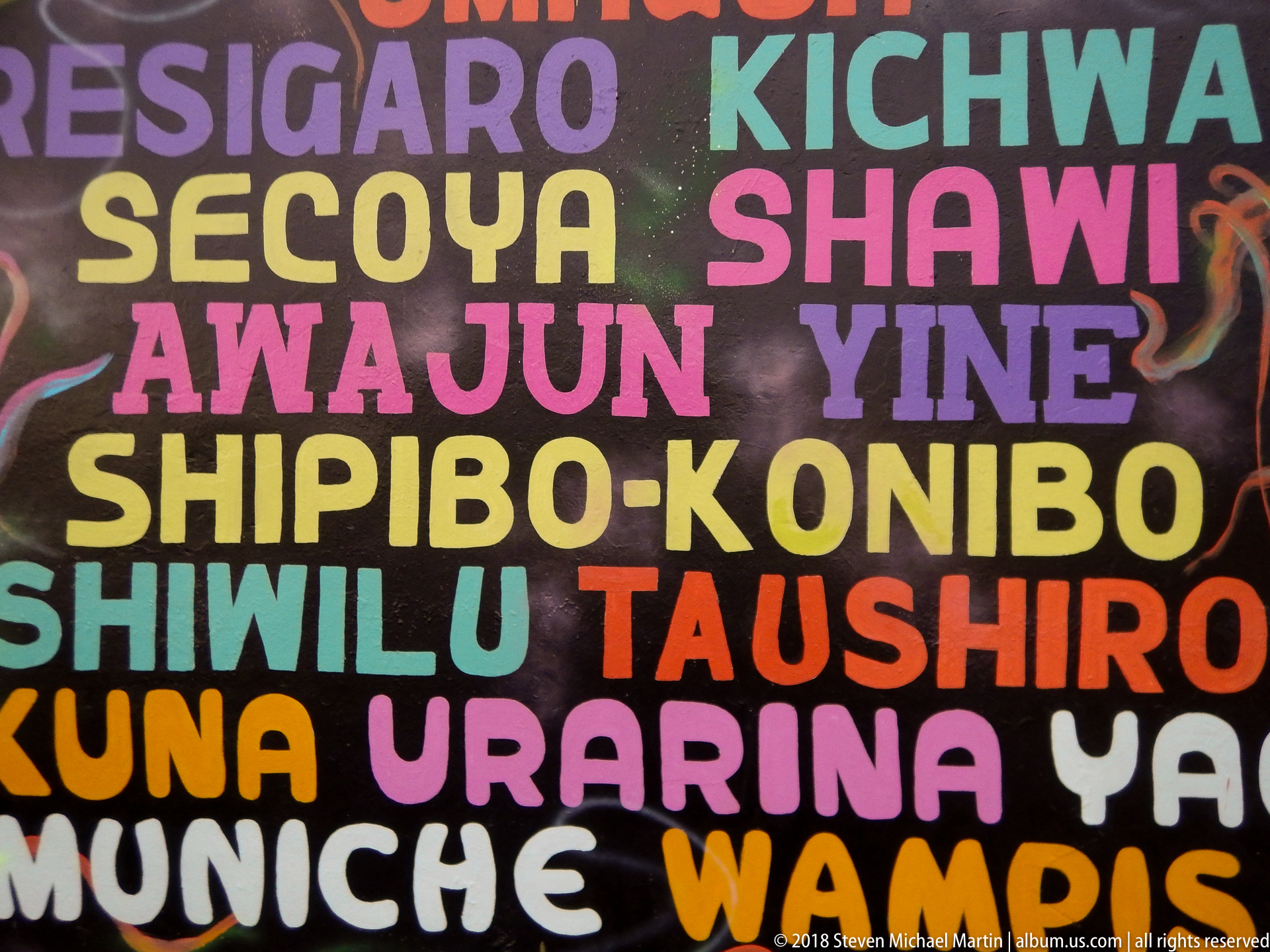
Large hand-painted words in vivid colors fill a dark wall, including “Kichwa,” “Secoya,” “Shawi,” “Aina Jun,” “Yine,” “Shipibo-Konibo,” “Shiwilu,” “Taushiro,” “Kuna,” “Urarina,” and “Muniche.” The dense typographic mural foregrounds the names of Indigenous peoples and languages associated with Peru’s Amazonian cultural landscape, using color and scale as its primary visual language.
Caption
Large hand-painted words in vivid colors fill a dark wall, including “Kichwa,” “Secoya,” “Shawi,” “Aina Jun,” “Yine,” “Shipibo-Konibo,” “Shiwilu,” “Taushiro,” “Kuna,” “Urarina,” and “Muniche.” The dense typographic mural foregrounds the names of Indigenous peoples and languages associated with Peru’s Amazonian cultural landscape, using color and scale as its primary visual language.
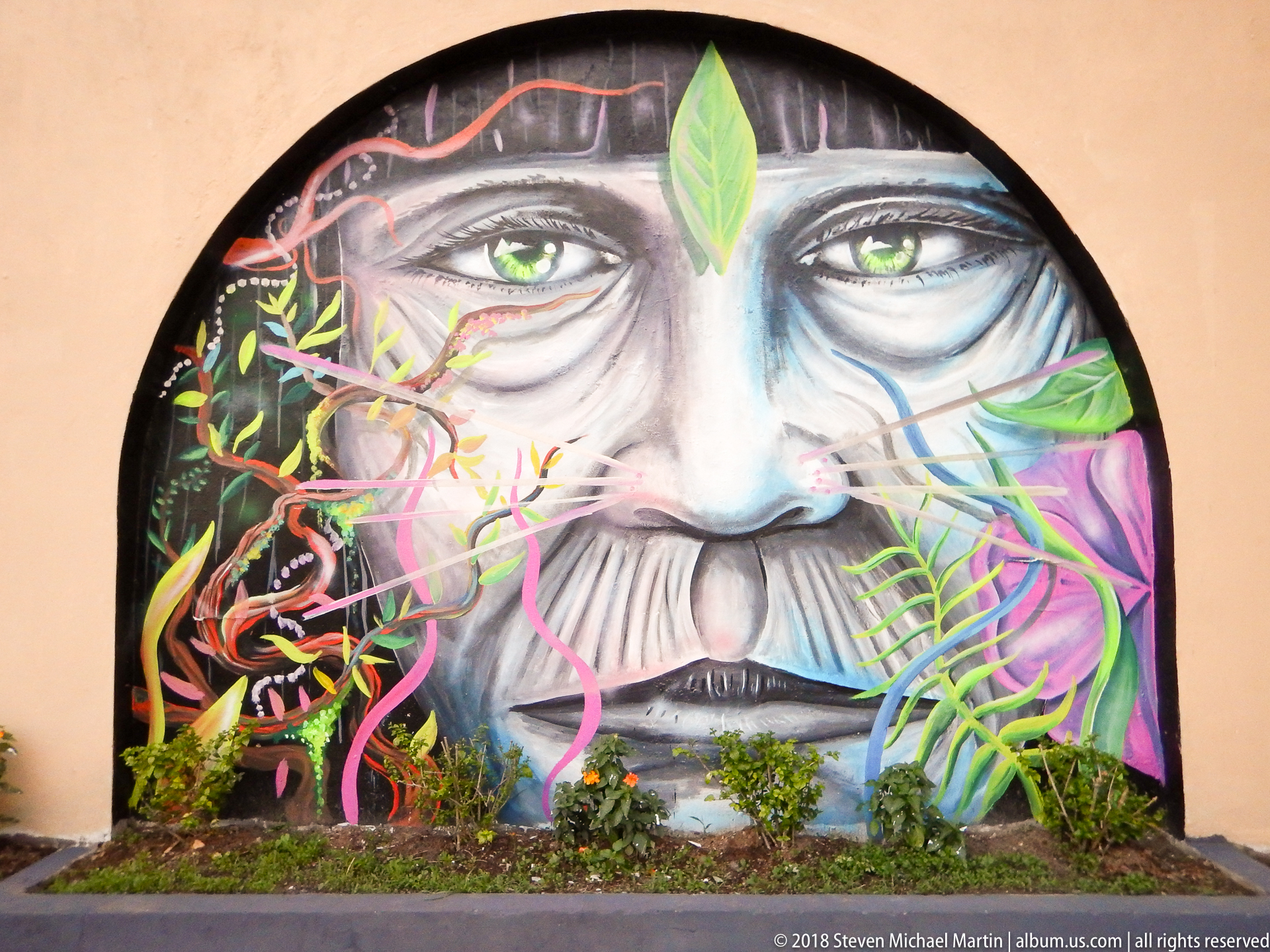
A monumental painted face fills an arched recess, rendered in pale blue, gray, and black with luminous green eyes. Colorful vines, leaves, and abstract botanical forms spread across the cheeks and around the head, while a green leaf motif rests on the forehead. The mural combines portraiture and rainforest imagery in a highly theatrical architectural setting.
Caption
A monumental painted face fills an arched recess, rendered in pale blue, gray, and black with luminous green eyes. Colorful vines, leaves, and abstract botanical forms spread across the cheeks and around the head, while a green leaf motif rests on the forehead. The mural combines portraiture and rainforest imagery in a highly theatrical architectural setting.
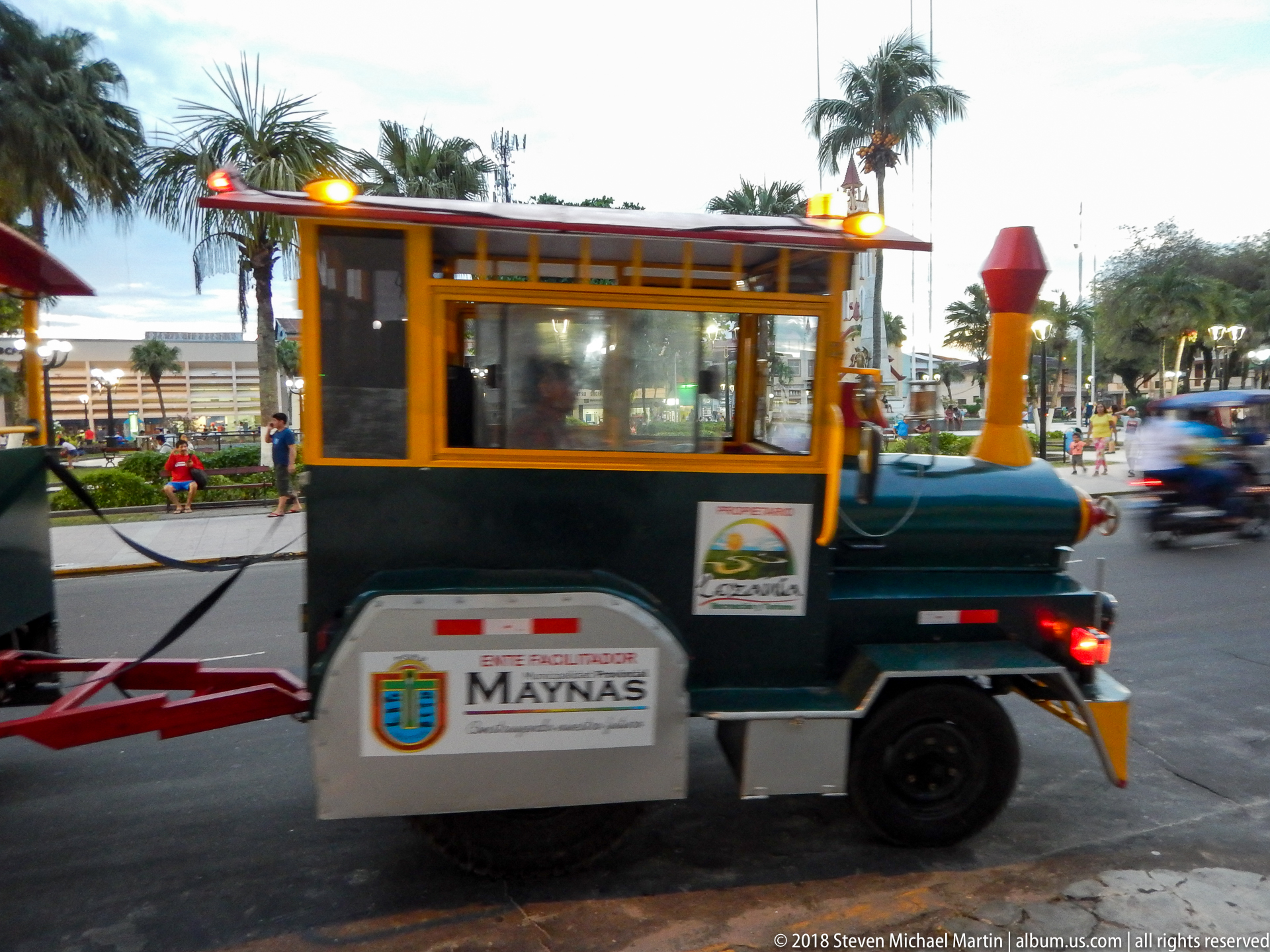
The locomotive-shaped front unit of a municipal road train passes close to the camera, painted green, orange, and black with a tall stylized smokestack. A panel on the side carries the crest and name of the Municipalidad Provincial de Maynas. The tight profile view isolates the whimsical design and municipal identity from the larger plaza context.
Caption
The locomotive-shaped front unit of a municipal road train passes close to the camera, painted green, orange, and black with a tall stylized smokestack. A panel on the side carries the crest and name of the Municipalidad Provincial de Maynas. The tight profile view isolates the whimsical design and municipal identity from the larger plaza context.
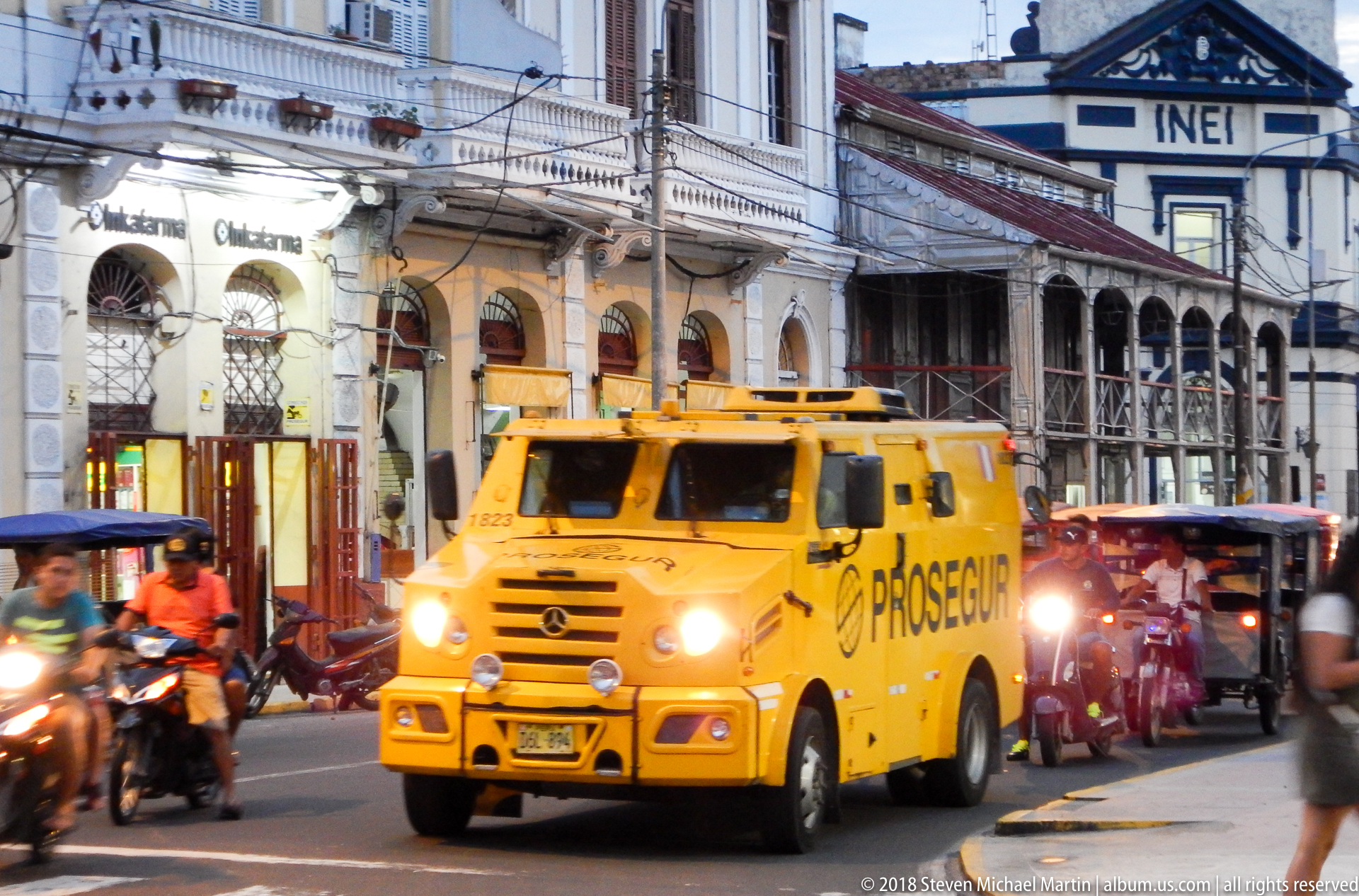
A bright yellow Prosegur armored truck moves through a busy Iquitos street at dusk, surrounded by mototaxis, motorcycles, and pedestrians. Historic-looking commercial façades and an upper sign marked “INEI” form the background. The truck’s heavy bodywork and security branding stand out sharply against the smaller, open vehicles crowding the roadway.
Caption
A bright yellow Prosegur armored truck moves through a busy Iquitos street at dusk, surrounded by mototaxis, motorcycles, and pedestrians. Historic-looking commercial façades and an upper sign marked “INEI” form the background. The truck’s heavy bodywork and security branding stand out sharply against the smaller, open vehicles crowding the roadway.
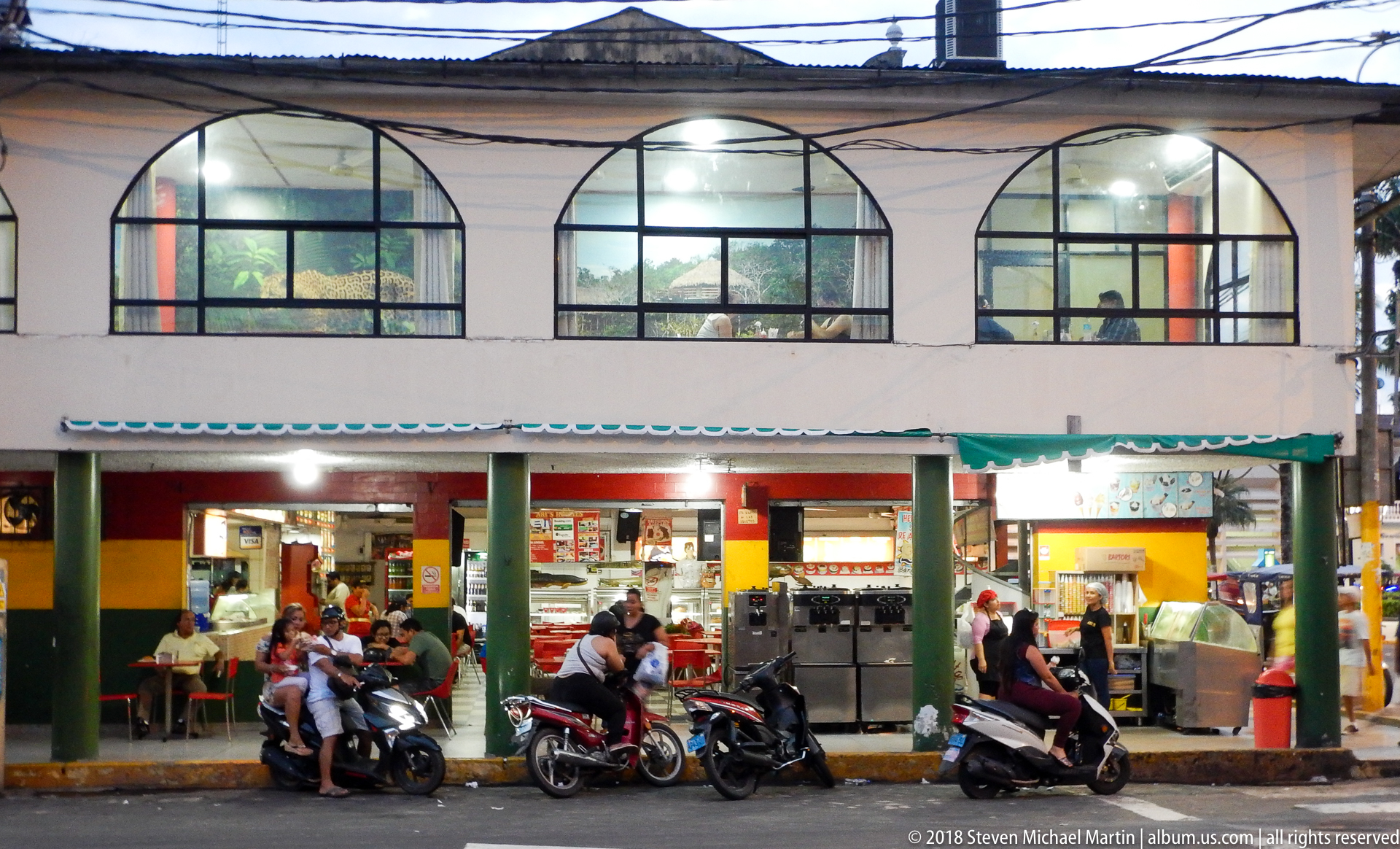
An open-front restaurant glows at street level beneath a second story of three broad arched windows. Diners sit at tables inside while motorcycles and scooters park along the curb, merging the eating area with the evening streetscape. The façade’s repeated arches and simple green columns give the building a strong visual rhythm without providing enough signage for a secure business identification.
Caption
An open-front restaurant glows at street level beneath a second story of three broad arched windows. Diners sit at tables inside while motorcycles and scooters park along the curb, merging the eating area with the evening streetscape. The façade’s repeated arches and simple green columns give the building a strong visual rhythm without providing enough signage for a secure business identification.
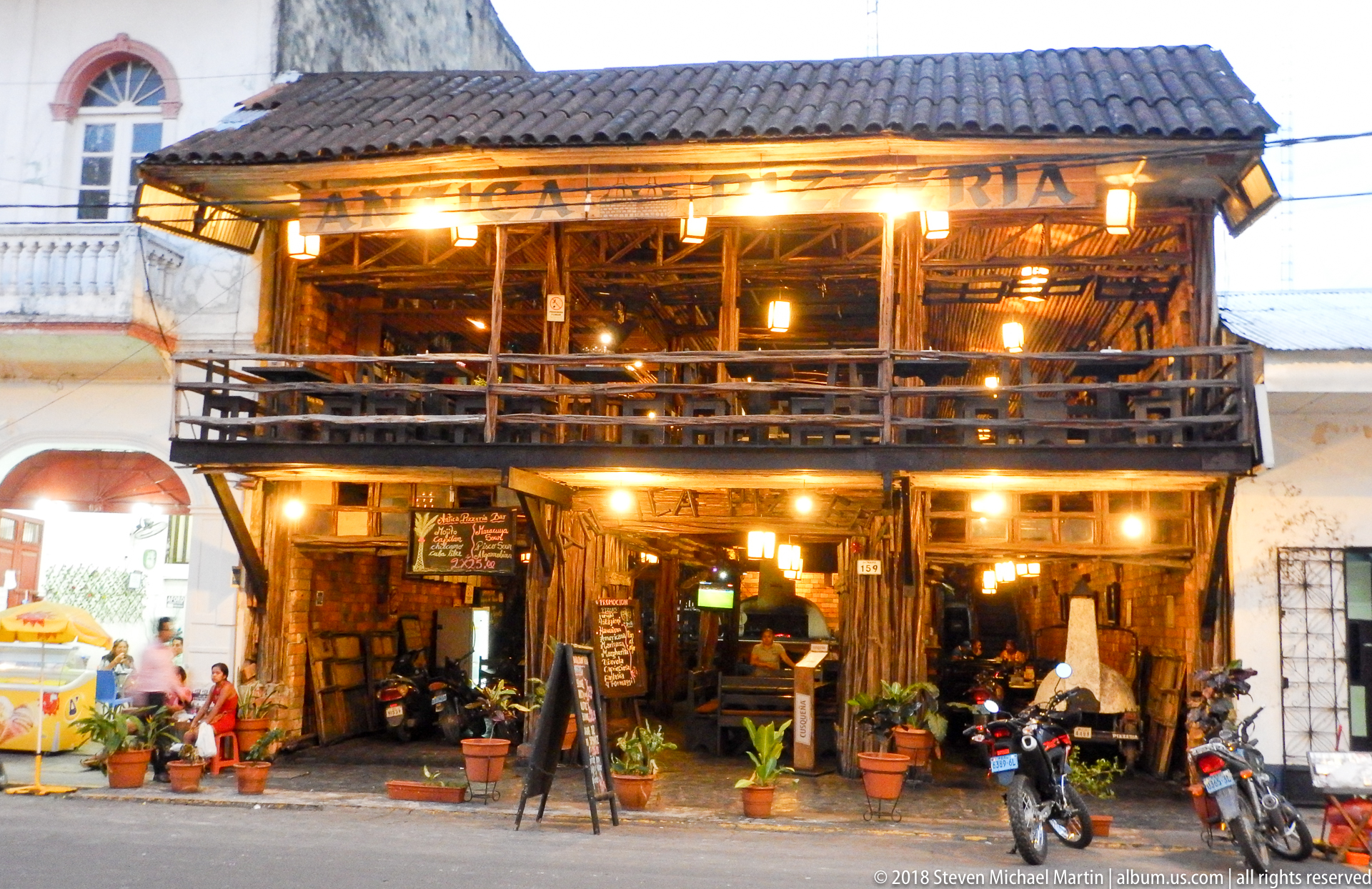
A rustic two-story restaurant or café glows warmly at dusk, its open timber balcony, exposed wood structure, potted plants, hanging lights, and chalkboard menus creating a layered street frontage. Motorcycles are parked beside the entrance. The tightly framed façade contrasts natural wood and handmade signage with the masonry buildings adjoining it.
Caption
A rustic two-story restaurant or café glows warmly at dusk, its open timber balcony, exposed wood structure, potted plants, hanging lights, and chalkboard menus creating a layered street frontage. Motorcycles are parked beside the entrance. The tightly framed façade contrasts natural wood and handmade signage with the masonry buildings adjoining it.
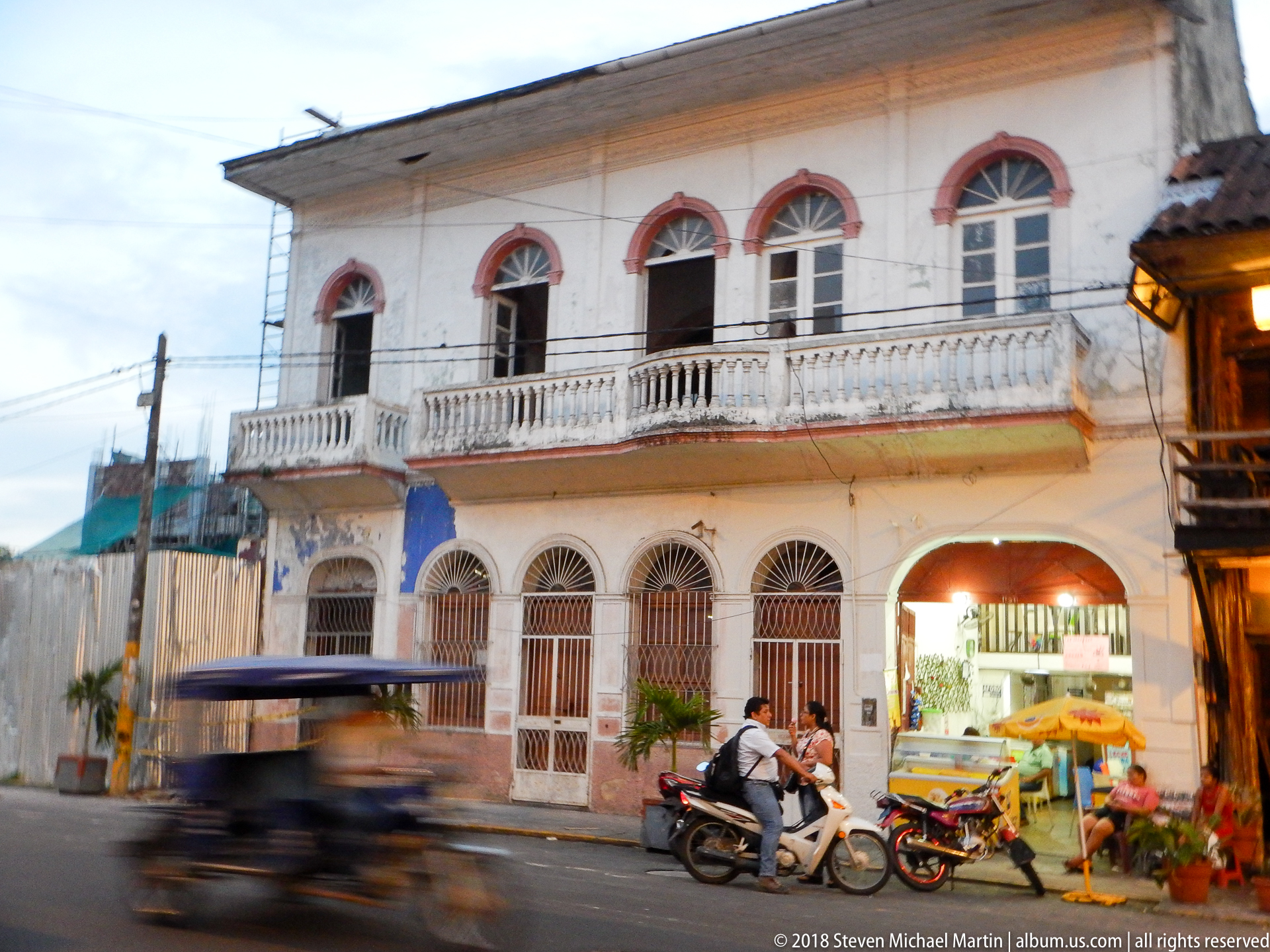
A two-story white stucco building presents a long balustraded balcony above a ground floor of arched doorways protected by metal grilles. Upper windows repeat the arch motif with red trim and fanlight-like divisions. A passing mototaxi blurs across the foreground, setting the formal historic façade within the movement of an active Iquitos street.
Caption
A two-story white stucco building presents a long balustraded balcony above a ground floor of arched doorways protected by metal grilles. Upper windows repeat the arch motif with red trim and fanlight-like divisions. A passing mototaxi blurs across the foreground, setting the formal historic façade within the movement of an active Iquitos street.
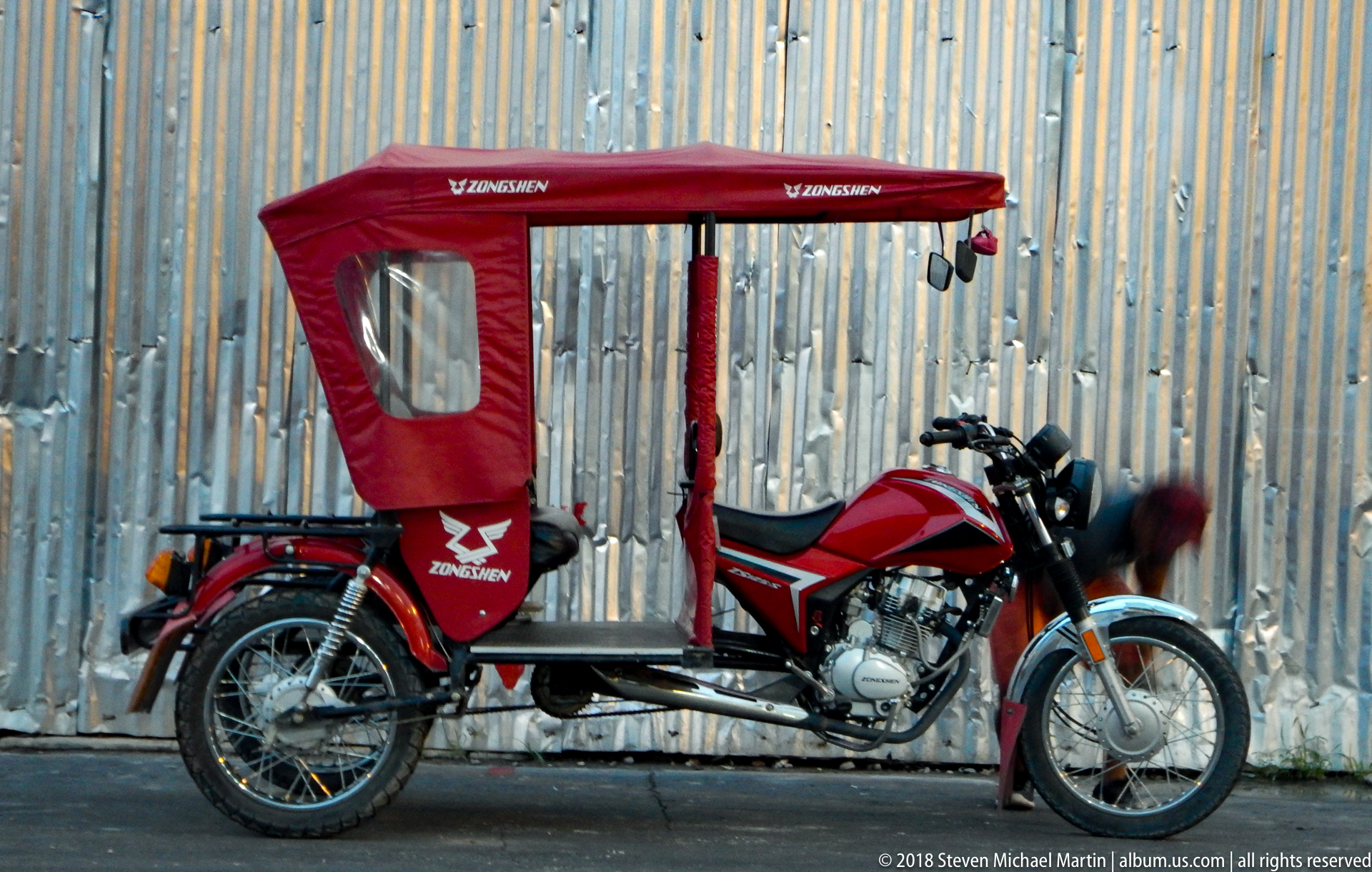
A red mototaxi is shown in strict side profile against a tall corrugated-metal wall, separating the vehicle from Iquitos’s normally crowded street context. The composition clearly reveals the motorcycle front half, rear passenger compartment, canopy supports, two rear wheels, and simple bodywork. The isolated view functions almost as a typological portrait of the city’s ubiquitous three-wheeled taxi.
Caption
A red mototaxi is shown in strict side profile against a tall corrugated-metal wall, separating the vehicle from Iquitos’s normally crowded street context. The composition clearly reveals the motorcycle front half, rear passenger compartment, canopy supports, two rear wheels, and simple bodywork. The isolated view functions almost as a typological portrait of the city’s ubiquitous three-wheeled taxi.
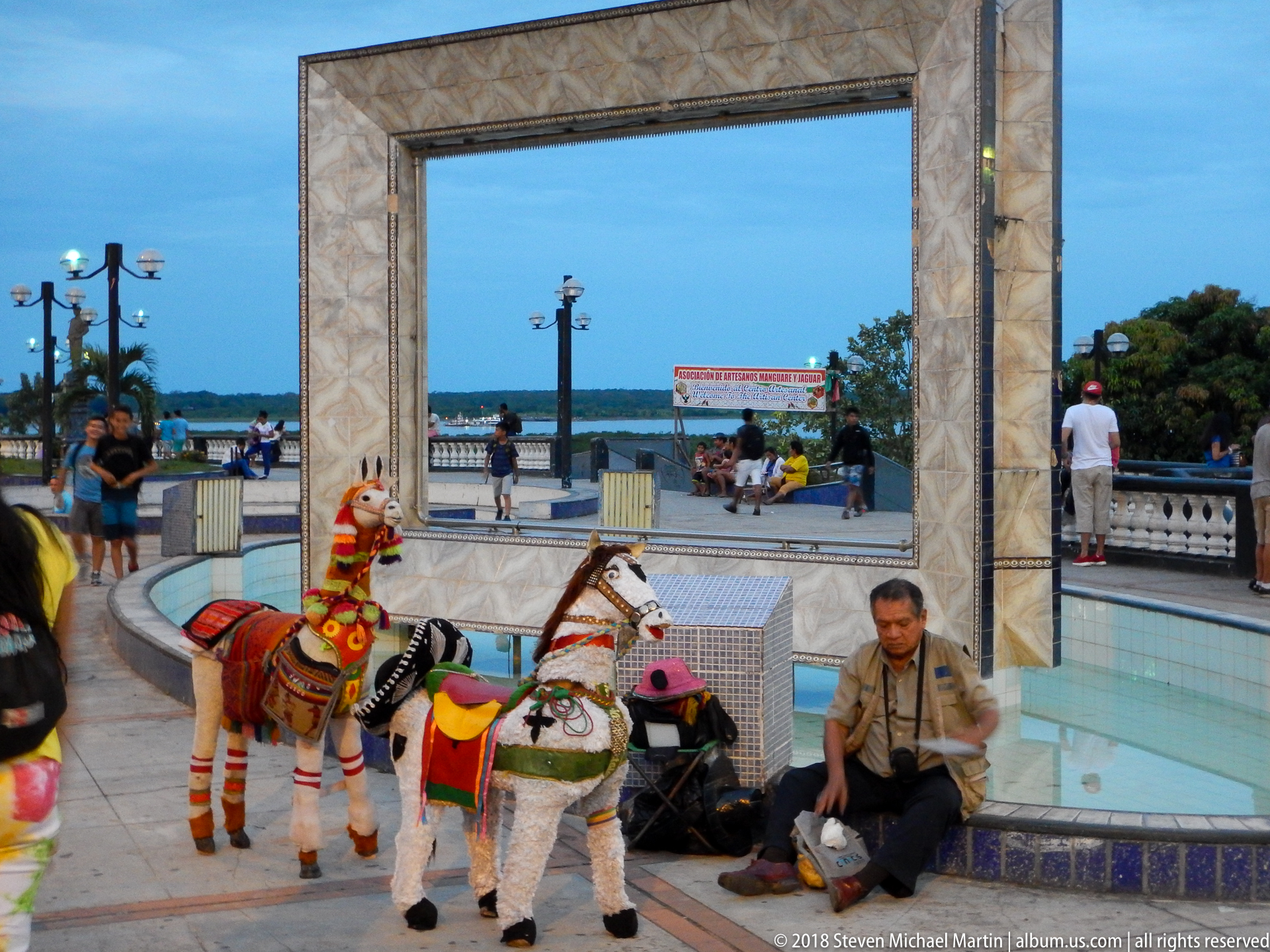
Two small ponies fitted with brightly colored saddles and decorative coverings wait beside an open paved plaza near the water. A seated handler rests beside them while people gather along the balustrade and distant riverbank. The scene combines family recreation with the broad public waterfront, framed by an ornamental stone portal in the foreground.
Caption
Two small ponies fitted with brightly colored saddles and decorative coverings wait beside an open paved plaza near the water. A seated handler rests beside them while people gather along the balustrade and distant riverbank. The scene combines family recreation with the broad public waterfront, framed by an ornamental stone portal in the foreground.
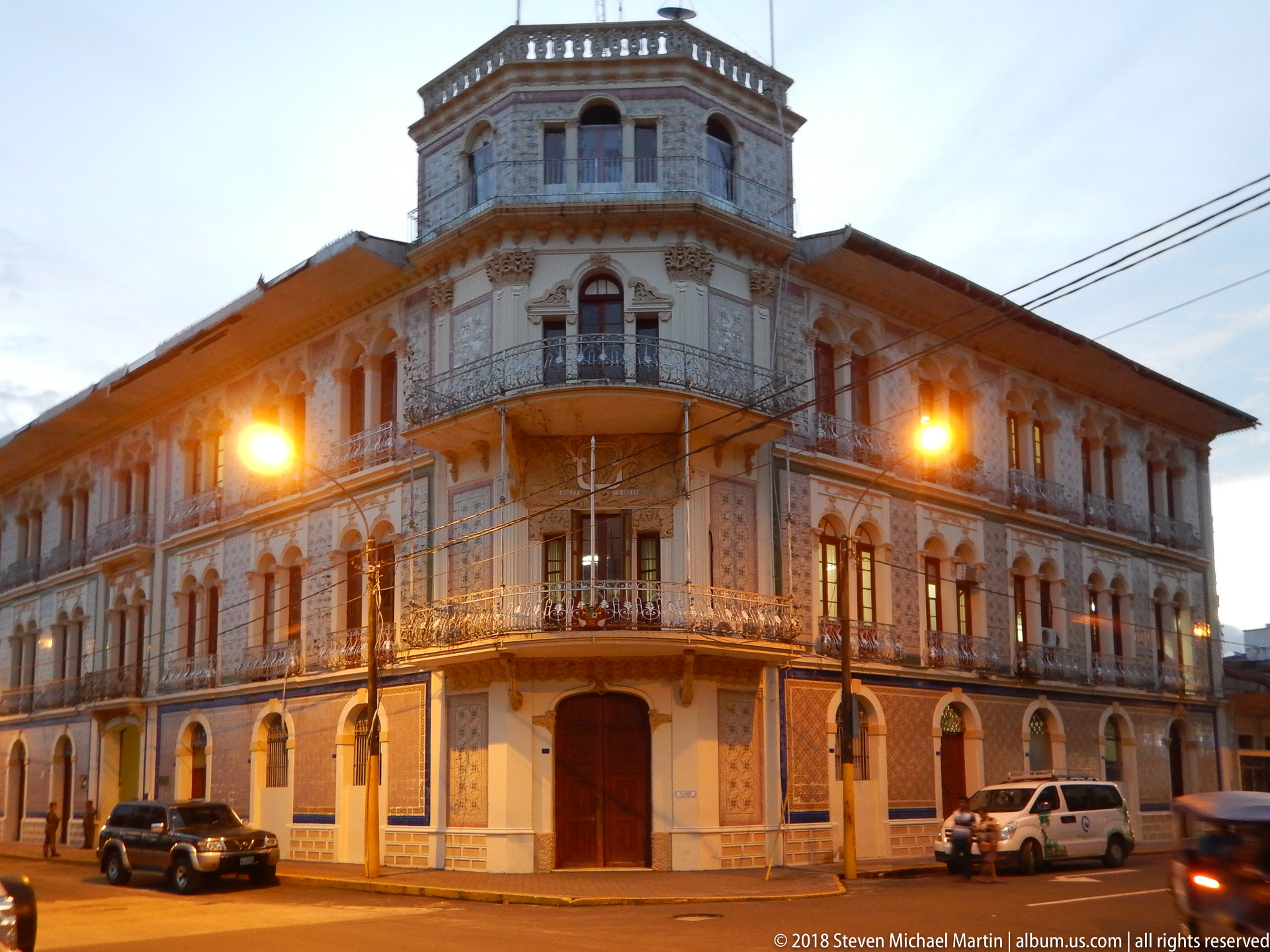
An ornate multi-story corner building rises above an Iquitos intersection, distinguished by continuous iron balconies, arched openings, patterned wall surfaces, projecting cornices, and a square tower-like upper pavilion. Warm streetlights illuminate the lower façade at dusk. The oblique view emphasizes the building’s prominent corner massing and elaborate late-19th- or early-20th-century decorative character without forcing a landmark name.
Caption
An ornate multi-story corner building rises above an Iquitos intersection, distinguished by continuous iron balconies, arched openings, patterned wall surfaces, projecting cornices, and a square tower-like upper pavilion. Warm streetlights illuminate the lower façade at dusk. The oblique view emphasizes the building’s prominent corner massing and elaborate late-19th- or early-20th-century decorative character without forcing a landmark name.
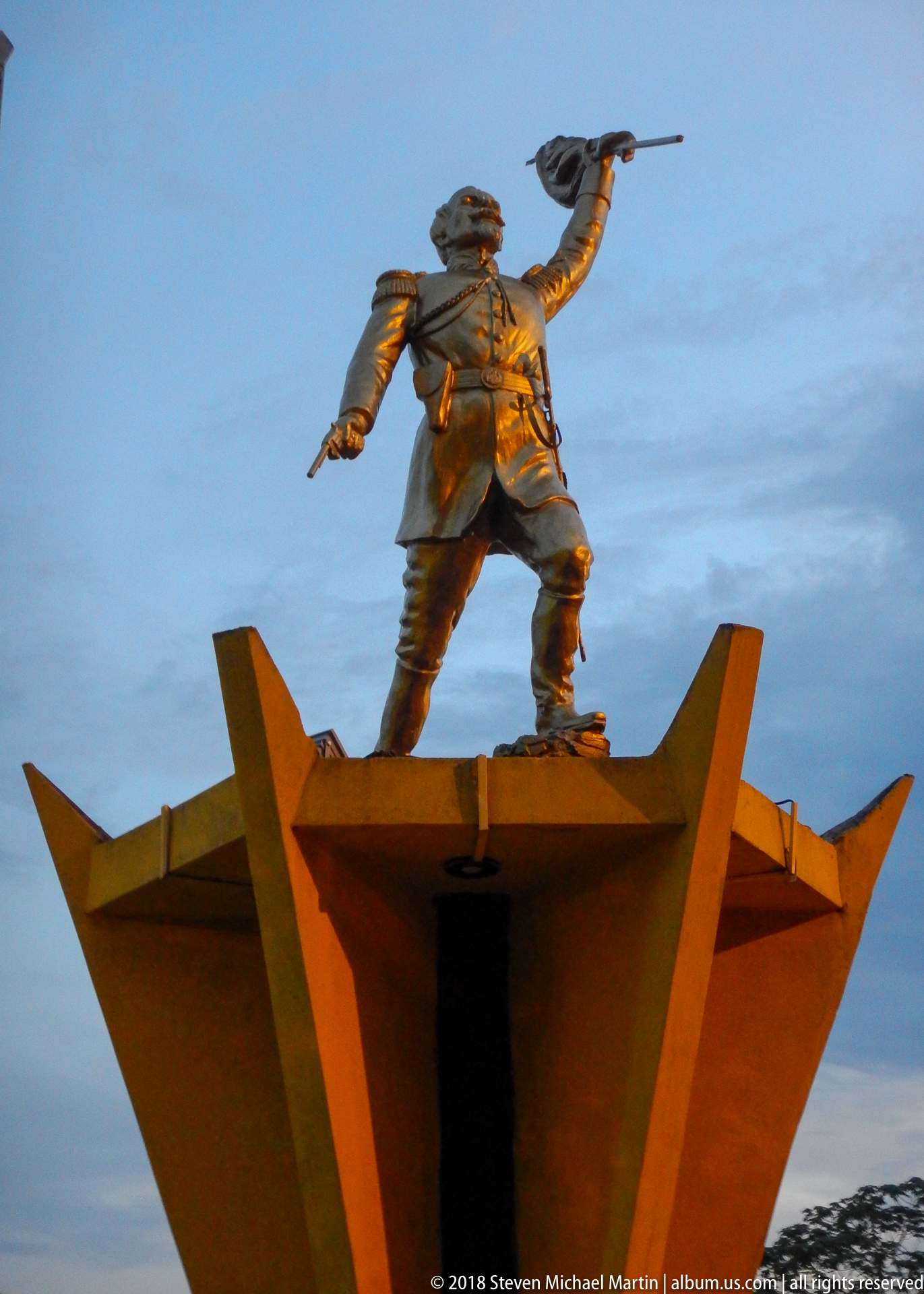
A bronze-colored male figure stands high on a dramatic angular pedestal, one arm extended to point outward while the other holds a long object at his side. The monument is silhouetted against a blue evening sky, and the low upward viewpoint turns the statue and faceted base into a forceful civic landmark. No inscription is visible enough here to identify the commemorated person securely.
Caption
A bronze-colored male figure stands high on a dramatic angular pedestal, one arm extended to point outward while the other holds a long object at his side. The monument is silhouetted against a blue evening sky, and the low upward viewpoint turns the statue and faceted base into a forceful civic landmark. No inscription is visible enough here to identify the commemorated person securely.

A two-story historic façade combines a ground-floor arcade with arched openings, an ornate iron balcony, and a broad projecting roof. Outdoor tables shaded by white umbrellas occupy the sidewalk, turning the lower level into an evening dining area. The oblique view links decorative architecture with contemporary hospitality use in central Iquitos.
Caption
A two-story historic façade combines a ground-floor arcade with arched openings, an ornate iron balcony, and a broad projecting roof. Outdoor tables shaded by white umbrellas occupy the sidewalk, turning the lower level into an evening dining area. The oblique view links decorative architecture with contemporary hospitality use in central Iquitos.
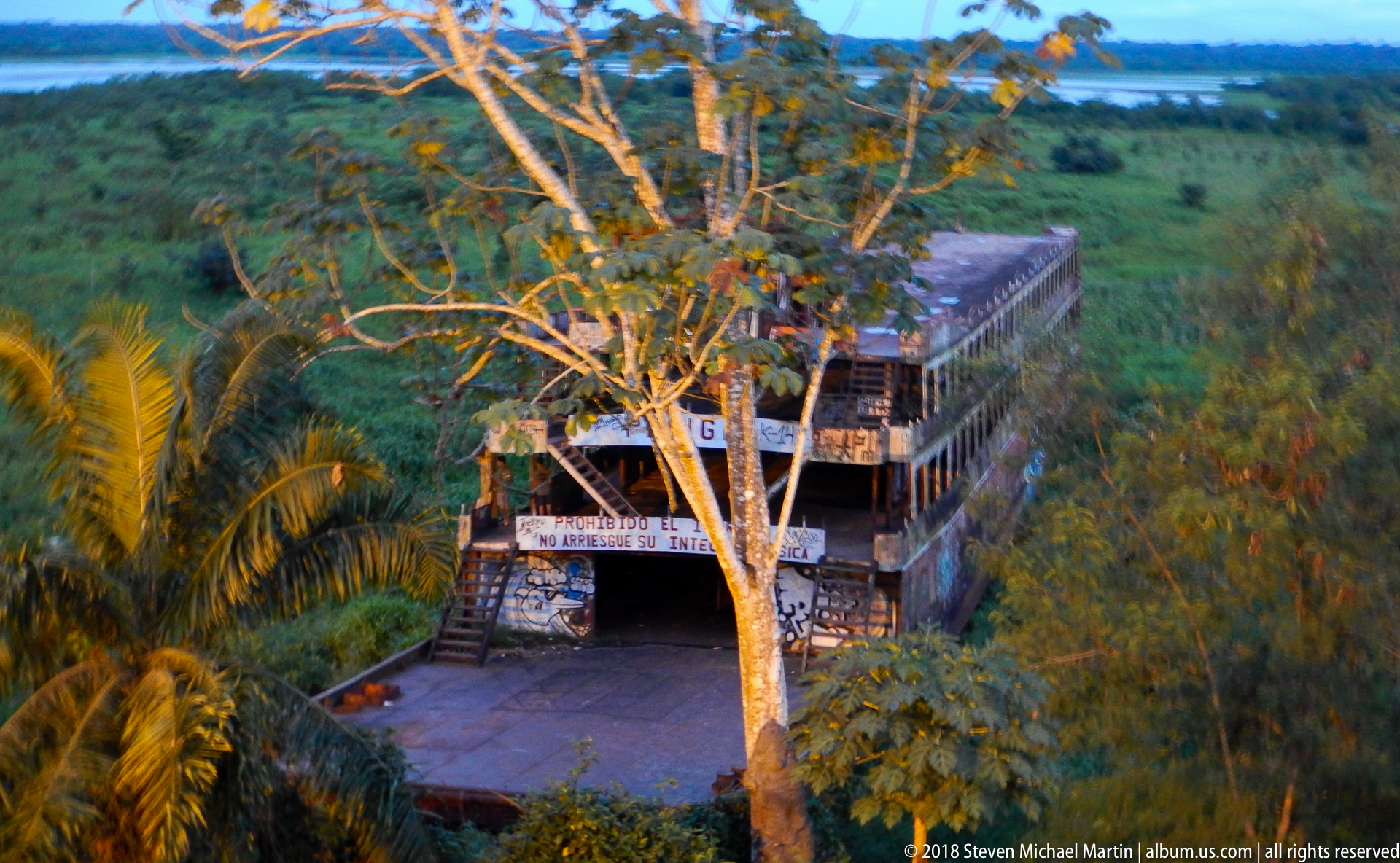
An elevated, open-sided wooden structure stands among tall trees at the edge of a broad green floodplain, with a distant ribbon of water visible beyond. Exterior stairs lead to an upper viewing level, while painted signage marks the entrance below. The elevated construction and open galleries suit the humid lowland environment and provide a vantage over the surrounding Amazonian landscape.
Caption
An elevated, open-sided wooden structure stands among tall trees at the edge of a broad green floodplain, with a distant ribbon of water visible beyond. Exterior stairs lead to an upper viewing level, while painted signage marks the entrance below. The elevated construction and open galleries suit the humid lowland environment and provide a vantage over the surrounding Amazonian landscape.
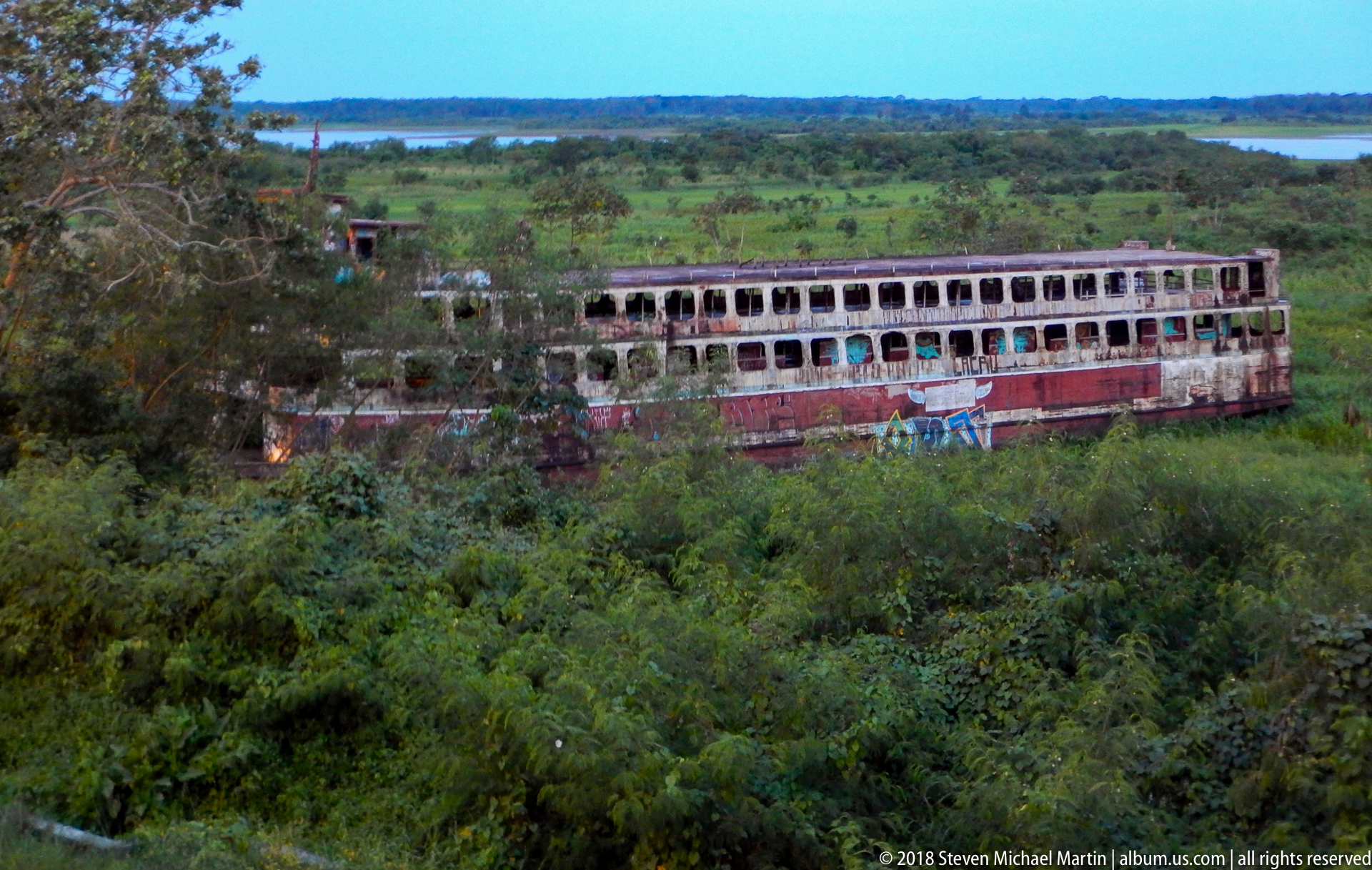
A long, multi-deck passenger vessel sits immobile amid dense tropical vegetation, its weathered white-and-red sides lined with repeated window openings and open galleries. The unusual setting suggests a retired or stranded boat rather than an active river craft. The distant river and floodplain beyond reinforce the vessel’s connection to the waterways around Iquitos.
Caption
A long, multi-deck passenger vessel sits immobile amid dense tropical vegetation, its weathered white-and-red sides lined with repeated window openings and open galleries. The unusual setting suggests a retired or stranded boat rather than an active river craft. The distant river and floodplain beyond reinforce the vessel’s connection to the waterways around Iquitos.
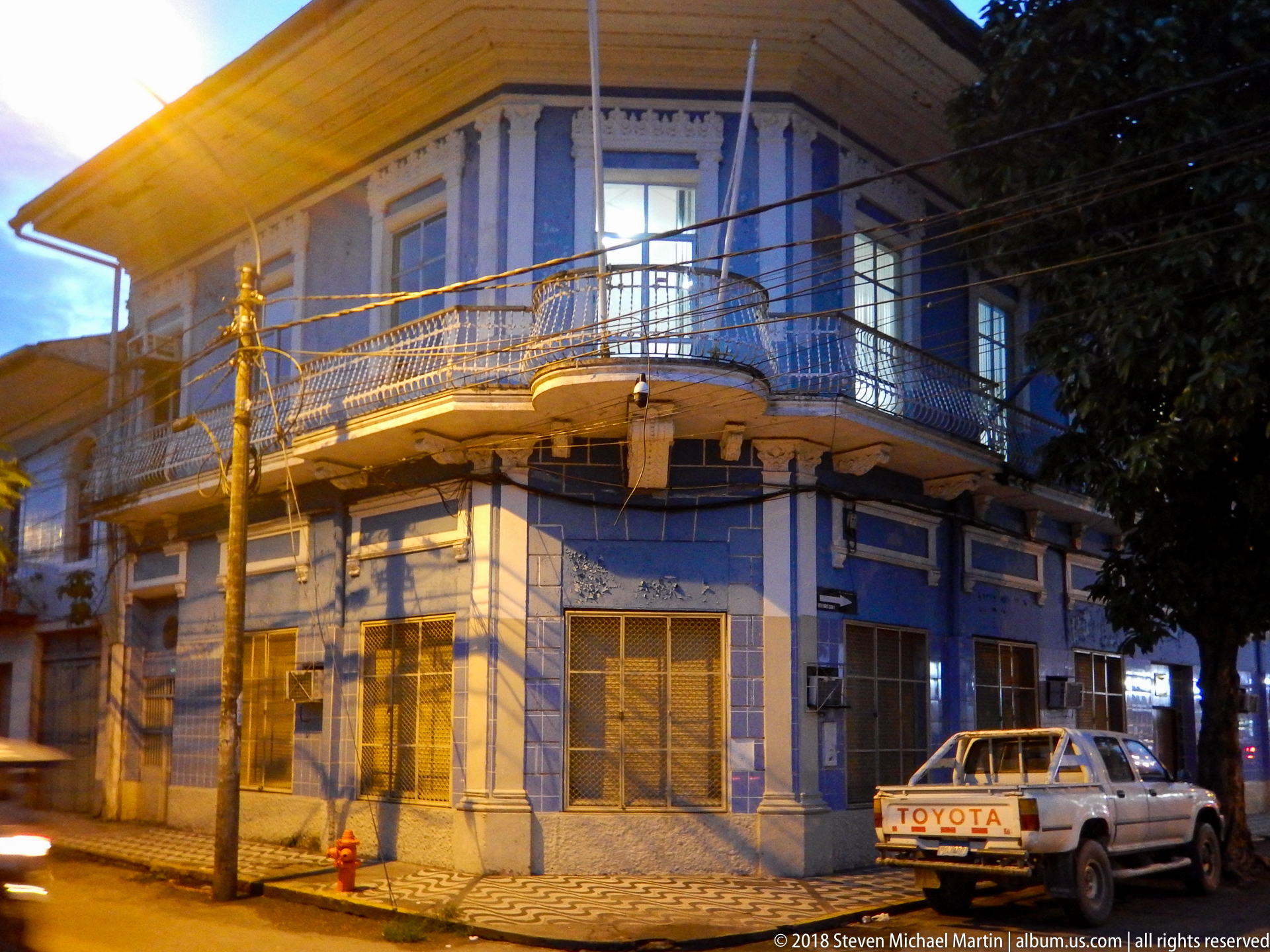
A blue-and-white two-story corner building is wrapped by a delicate metal balcony above tall ground-floor openings. Decorative trim follows the cornice and window bays, while utility wires cross the façade and a pickup truck waits at the curb. Evening light emphasizes the projecting corner and the layered ironwork of this historic Iquitos streetscape.
Caption
A blue-and-white two-story corner building is wrapped by a delicate metal balcony above tall ground-floor openings. Decorative trim follows the cornice and window bays, while utility wires cross the façade and a pickup truck waits at the curb. Evening light emphasizes the projecting corner and the layered ironwork of this historic Iquitos streetscape.
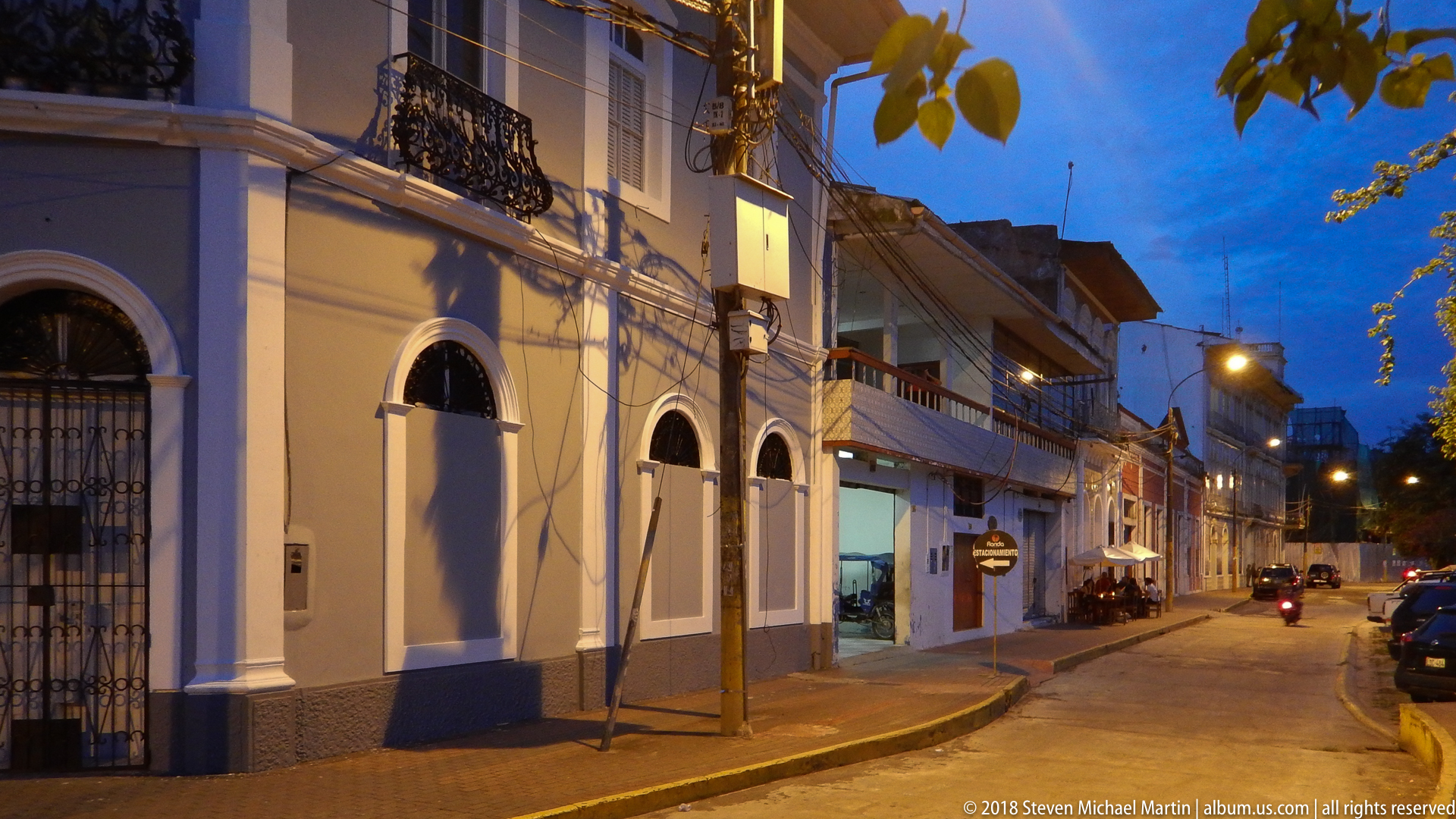
A pale historic façade with tall arched ground-floor openings lines a relatively quiet Iquitos street at dusk. Dark metal grilles protect the doors and windows, while upper balconies and dense utility lines continue down the block. Warm street lamps and a deep blue sky give the scene a transitional evening atmosphere distinct from the busier daytime commercial views.
Caption
A pale historic façade with tall arched ground-floor openings lines a relatively quiet Iquitos street at dusk. Dark metal grilles protect the doors and windows, while upper balconies and dense utility lines continue down the block. Warm street lamps and a deep blue sky give the scene a transitional evening atmosphere distinct from the busier daytime commercial views.
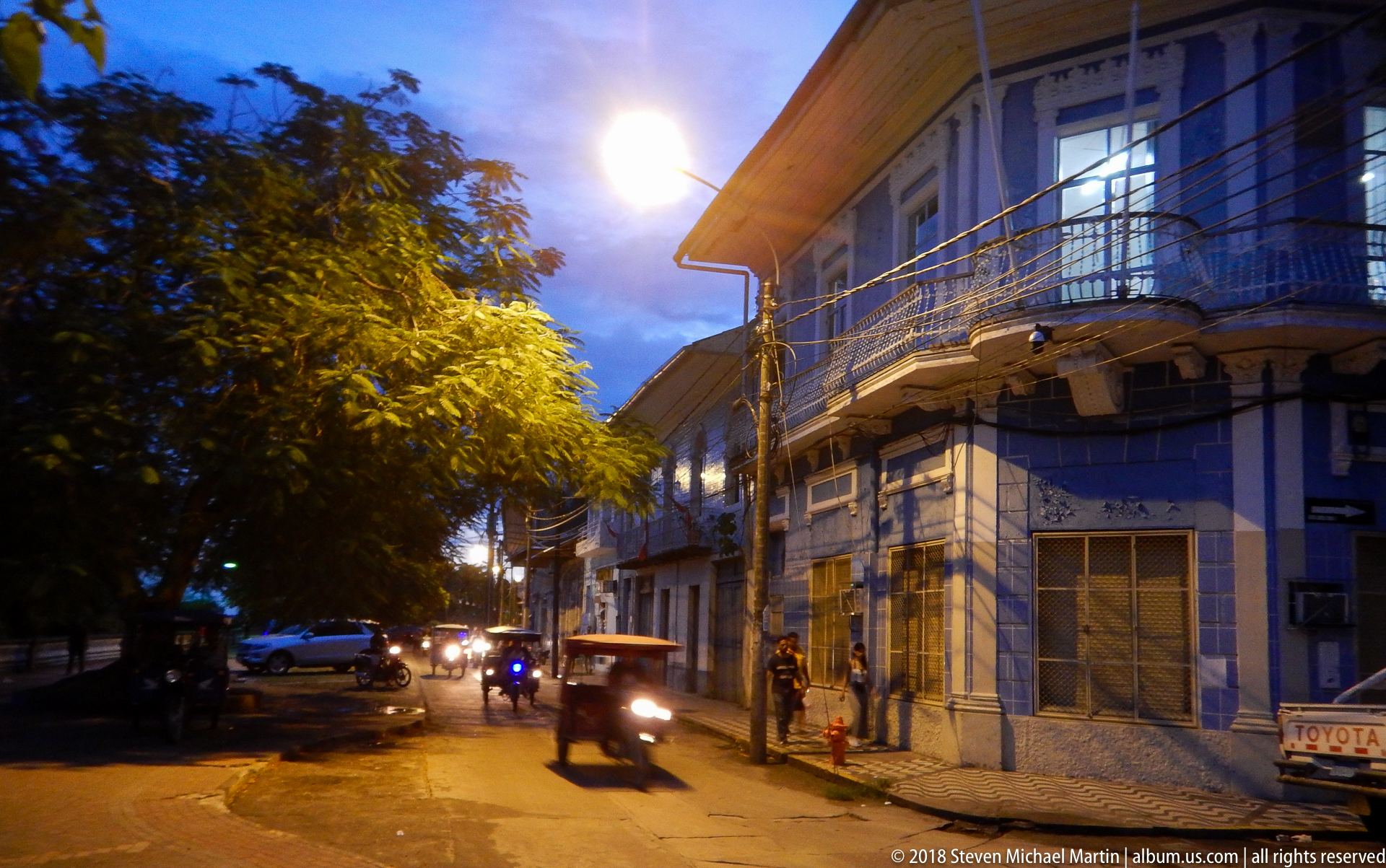
A mototaxi moves through a dimly lit intersection beside the blue-and-white historic corner building seen in the preceding view. Street lamps cast warm pools of light beneath dense tree canopy, while headlights approach from farther down the block. The wider composition places the ornate balcony building within everyday evening traffic and neighborhood circulation.
Caption
A mototaxi moves through a dimly lit intersection beside the blue-and-white historic corner building seen in the preceding view. Street lamps cast warm pools of light beneath dense tree canopy, while headlights approach from farther down the block. The wider composition places the ornate balcony building within everyday evening traffic and neighborhood circulation.
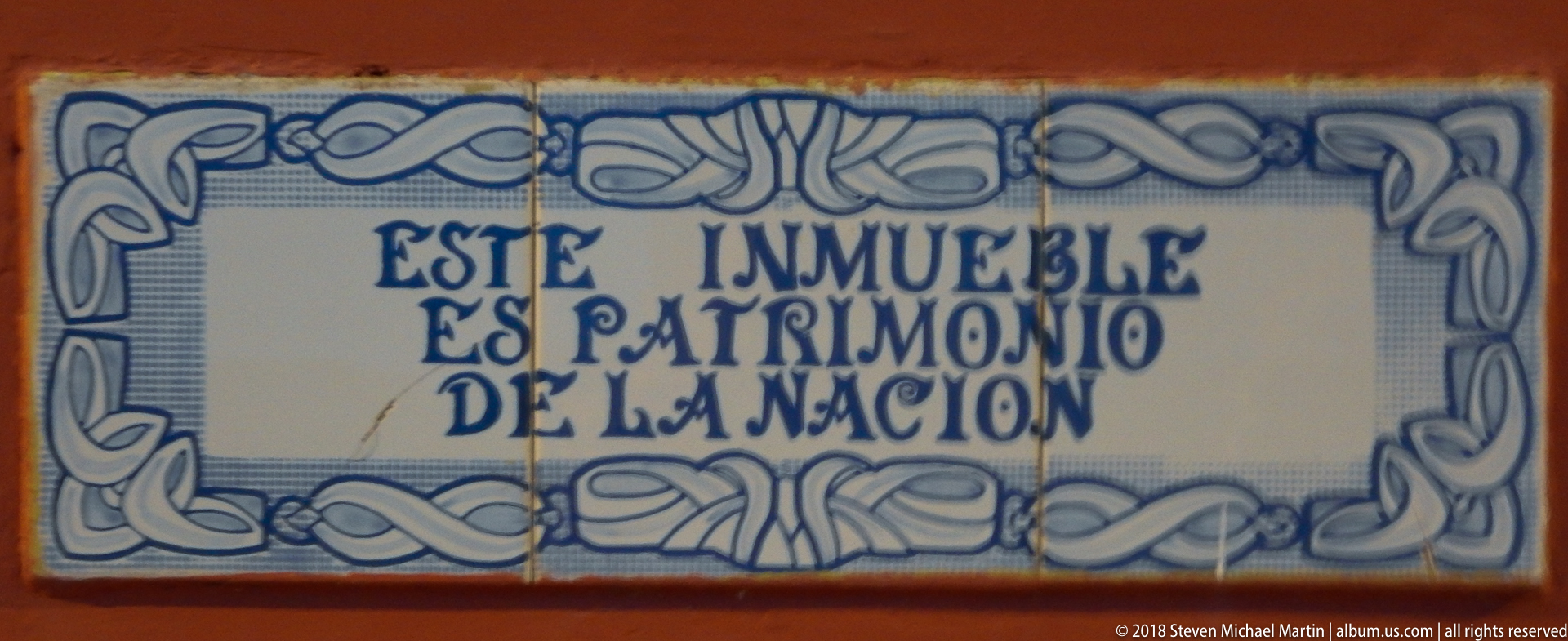
A blue-and-white ceramic tile plaque reads “Este inmueble es patrimonio de la nación,” identifying the associated building as part of Peru’s national heritage. Decorative ribbon-like borders frame the hand-painted lettering. The close crop turns the official heritage designation itself into the subject, emphasizing the preservation status of historic architecture in Iquitos.
Caption
A blue-and-white ceramic tile plaque reads “Este inmueble es patrimonio de la nación,” identifying the associated building as part of Peru’s national heritage. Decorative ribbon-like borders frame the hand-painted lettering. The close crop turns the official heritage designation itself into the subject, emphasizing the preservation status of historic architecture in Iquitos.
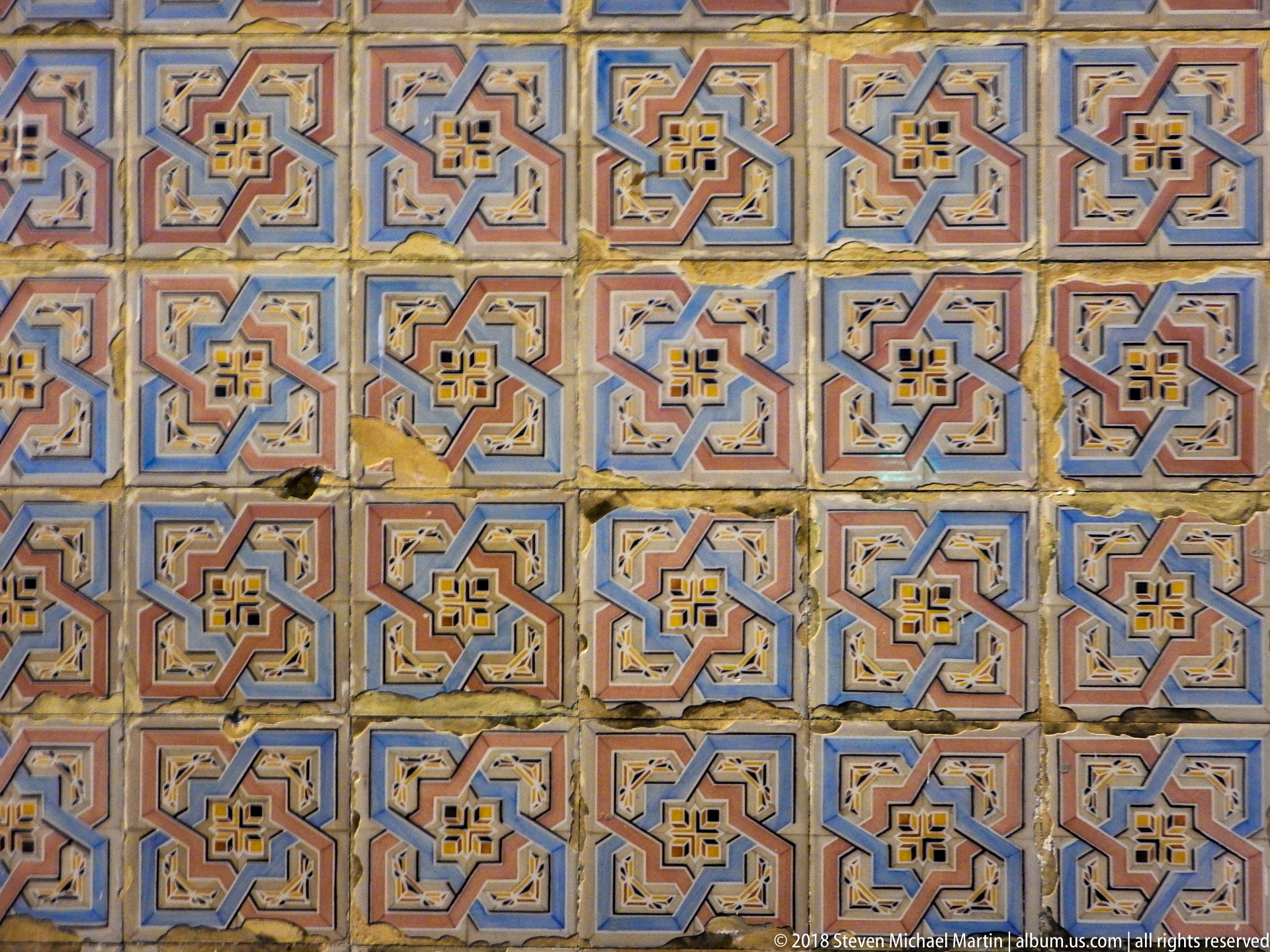
Rows of square ceramic tiles form a dense geometric pattern in muted blue, ochre, cream, and red. Each tile repeats an interlocking star-and-cross motif, creating a continuous decorative skin across the façade. Weathering and small chips reveal the age and use of the surface while preserving the overall rhythm of the pattern.
Caption
Rows of square ceramic tiles form a dense geometric pattern in muted blue, ochre, cream, and red. Each tile repeats an interlocking star-and-cross motif, creating a continuous decorative skin across the façade. Weathering and small chips reveal the age and use of the surface while preserving the overall rhythm of the pattern.
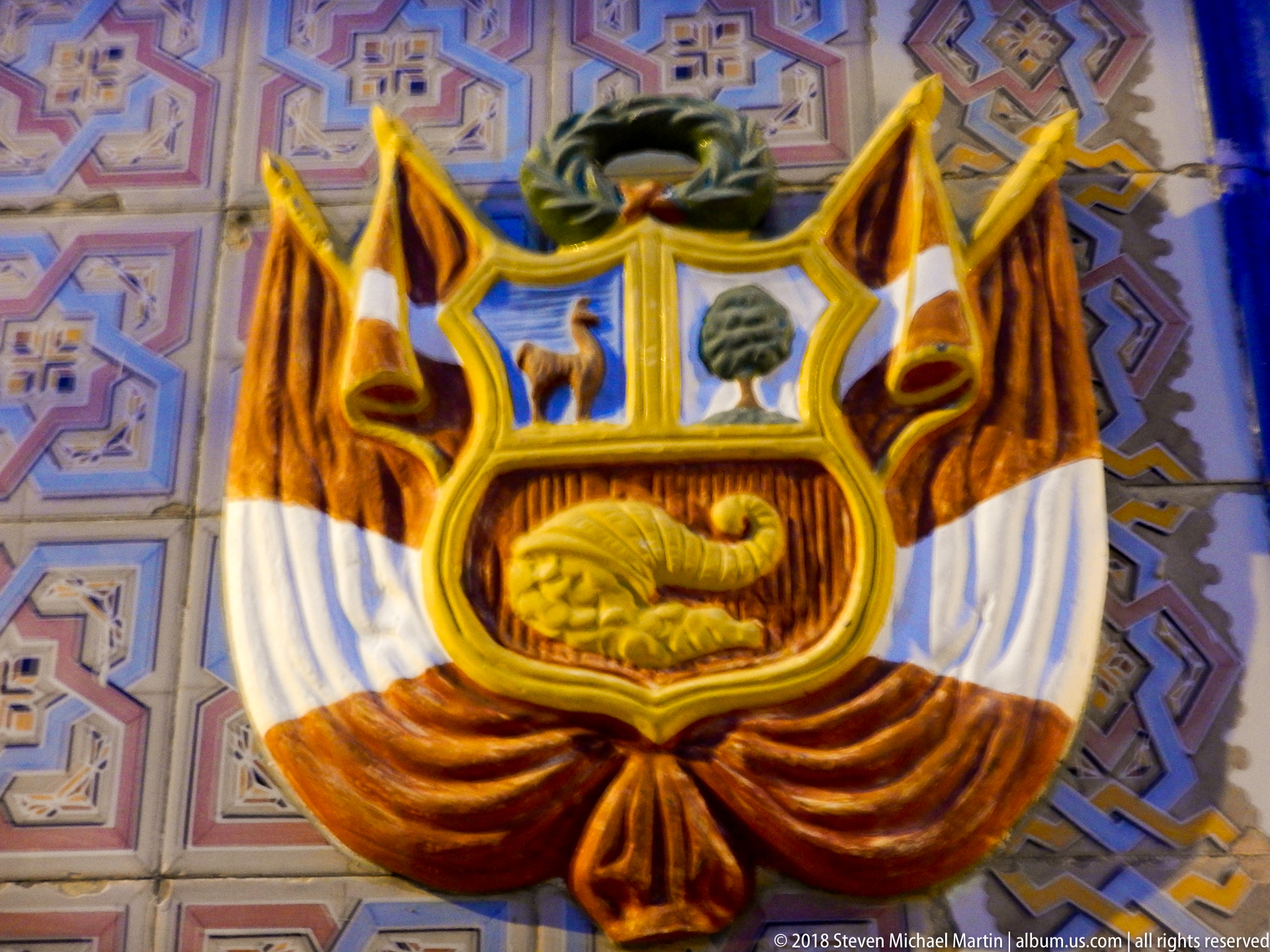
A sculpted Peruvian coat of arms projects from a wall of patterned ceramic tiles. The vicuña, cinchona tree, and cornucopia appear within the shield, framed by draped red-and-white flags and a wreath above. The close view combines a national emblem with the decorative tilework of the surrounding historic façade.
Caption
A sculpted Peruvian coat of arms projects from a wall of patterned ceramic tiles. The vicuña, cinchona tree, and cornucopia appear within the shield, framed by draped red-and-white flags and a wreath above. The close view combines a national emblem with the decorative tilework of the surrounding historic façade.
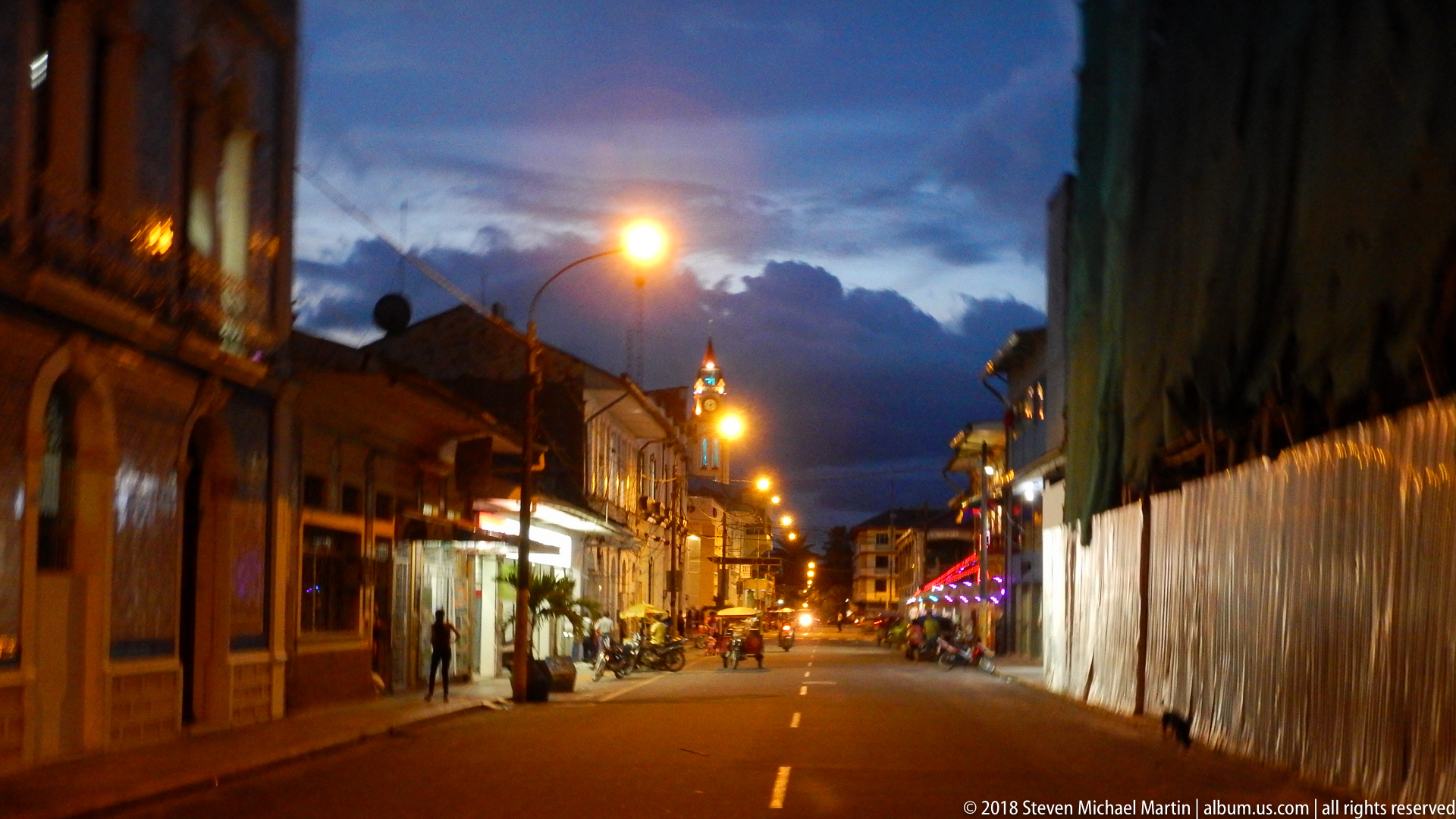
A straight Iquitos street recedes beneath evenly spaced lamps into a stormy blue-hour sky, with low historic façades lining both sides. Pedestrians and motorcycles gather near illuminated shops while distant headlights punctuate the road. The central perspective emphasizes the rhythm of streetlights and the transition from daylight to evening activity.
Caption
A straight Iquitos street recedes beneath evenly spaced lamps into a stormy blue-hour sky, with low historic façades lining both sides. Pedestrians and motorcycles gather near illuminated shops while distant headlights punctuate the road. The central perspective emphasizes the rhythm of streetlights and the transition from daylight to evening activity.
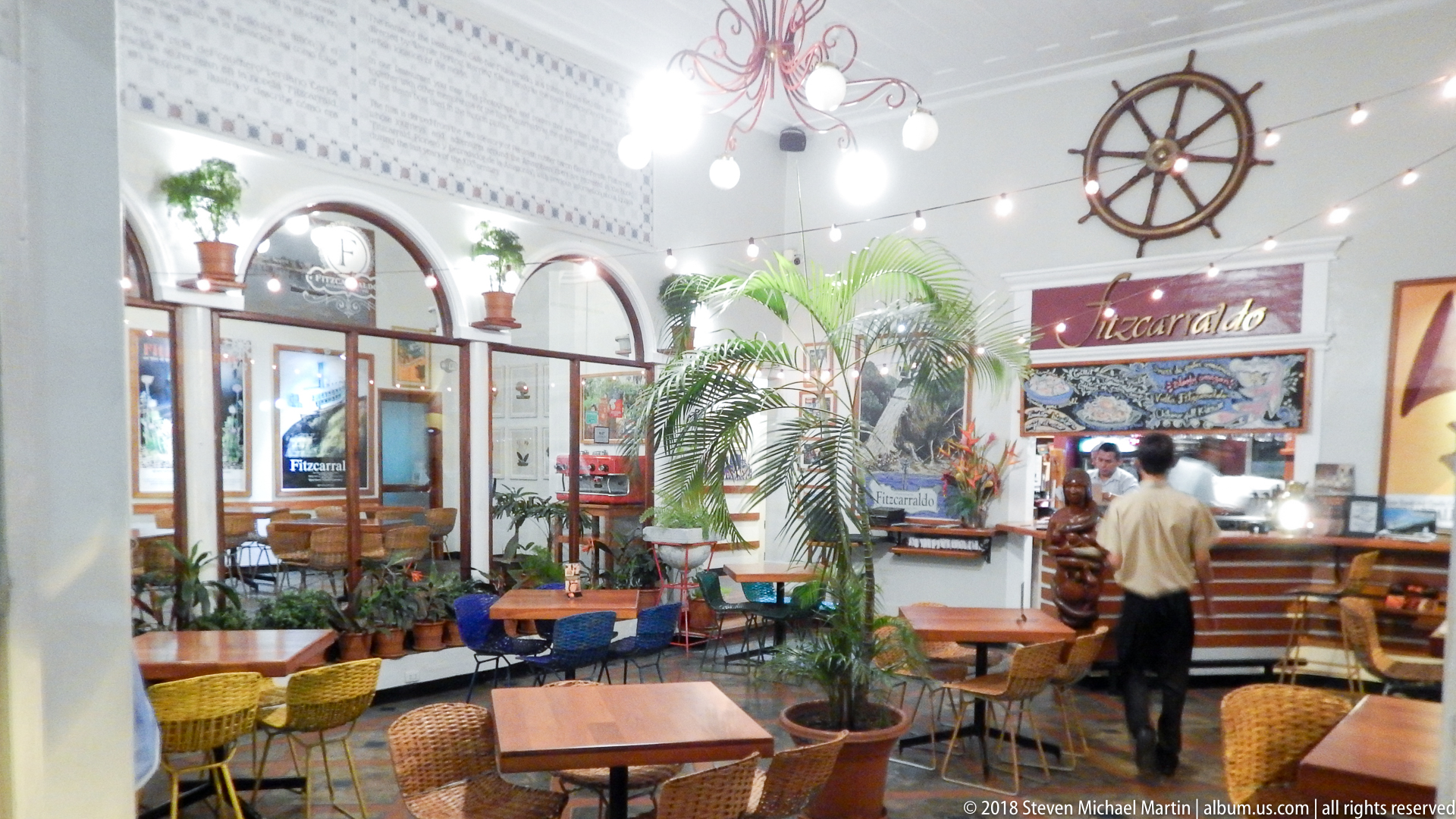
A bright restaurant or café interior is furnished with mismatched woven chairs, wooden tables, potted palms, and arched interior openings. A large ship’s wheel hangs high on the wall above a bar or service counter, reinforcing a nautical decorative theme. The relaxed, plant-filled room contrasts with the darker evening streets immediately outside.
Caption
A bright restaurant or café interior is furnished with mismatched woven chairs, wooden tables, potted palms, and arched interior openings. A large ship’s wheel hangs high on the wall above a bar or service counter, reinforcing a nautical decorative theme. The relaxed, plant-filled room contrasts with the darker evening streets immediately outside.
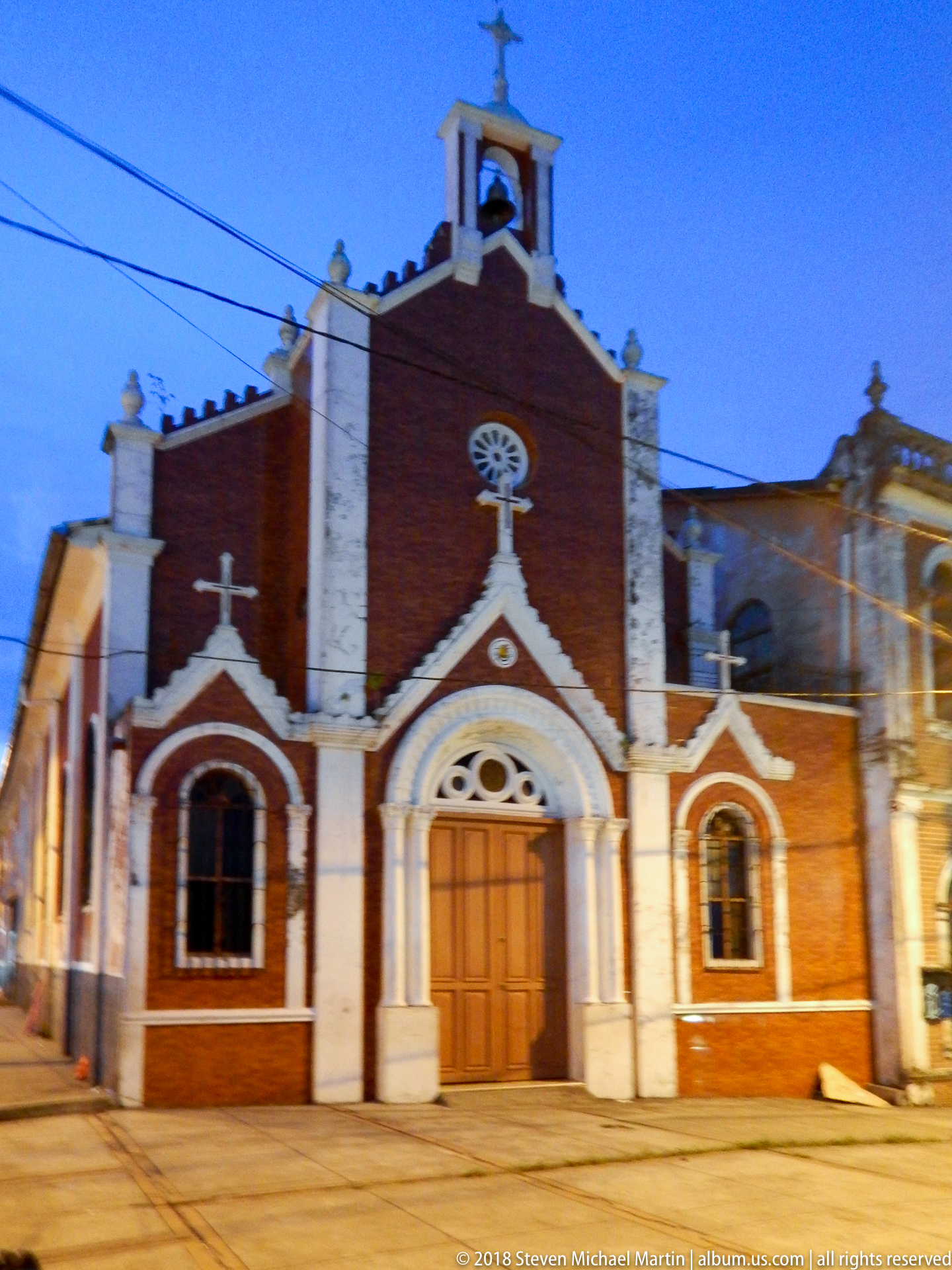
A compact red-brick church presents a symmetrical street façade with a central arched doorway, flanking arched windows, white stucco trim, and a small bell opening above the roofline. Circular tracery-like details enliven the gable. The frontal dusk view isolates the church’s modest scale and ornamental contrast between brick and pale masonry.
Caption
A compact red-brick church presents a symmetrical street façade with a central arched doorway, flanking arched windows, white stucco trim, and a small bell opening above the roofline. Circular tracery-like details enliven the gable. The frontal dusk view isolates the church’s modest scale and ornamental contrast between brick and pale masonry.
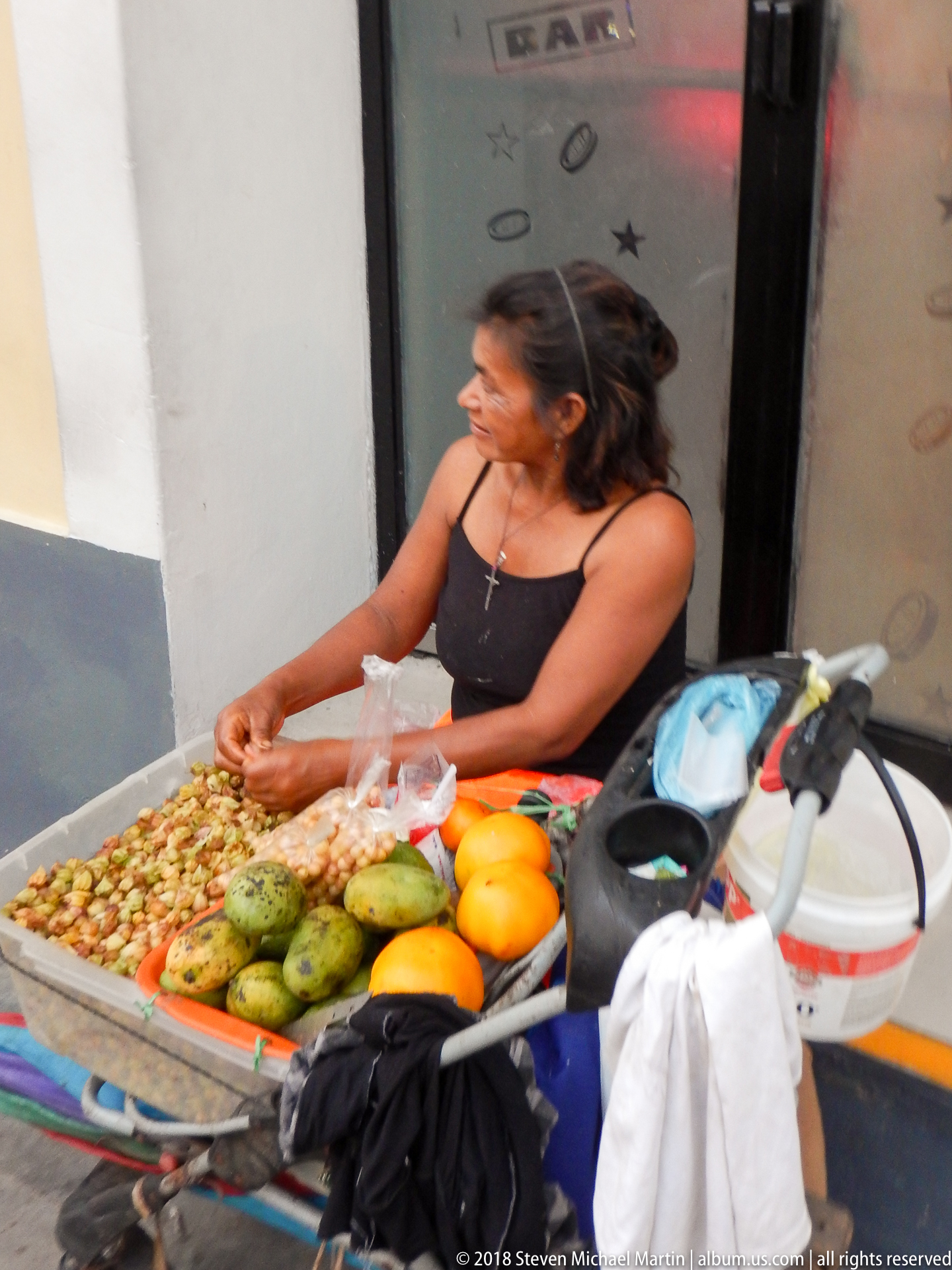
A woman sits beside a compact sidewalk cart piled with tropical fruit, including large green fruits, yellow papayas or mangoes, and many small round fruits packaged in clear bags. She works with her hands over the display while traffic blurs behind her. The close street portrait highlights informal food vending and the vivid produce of the Amazonian city.
Caption
A woman sits beside a compact sidewalk cart piled with tropical fruit, including large green fruits, yellow papayas or mangoes, and many small round fruits packaged in clear bags. She works with her hands over the display while traffic blurs behind her. The close street portrait highlights informal food vending and the vivid produce of the Amazonian city.
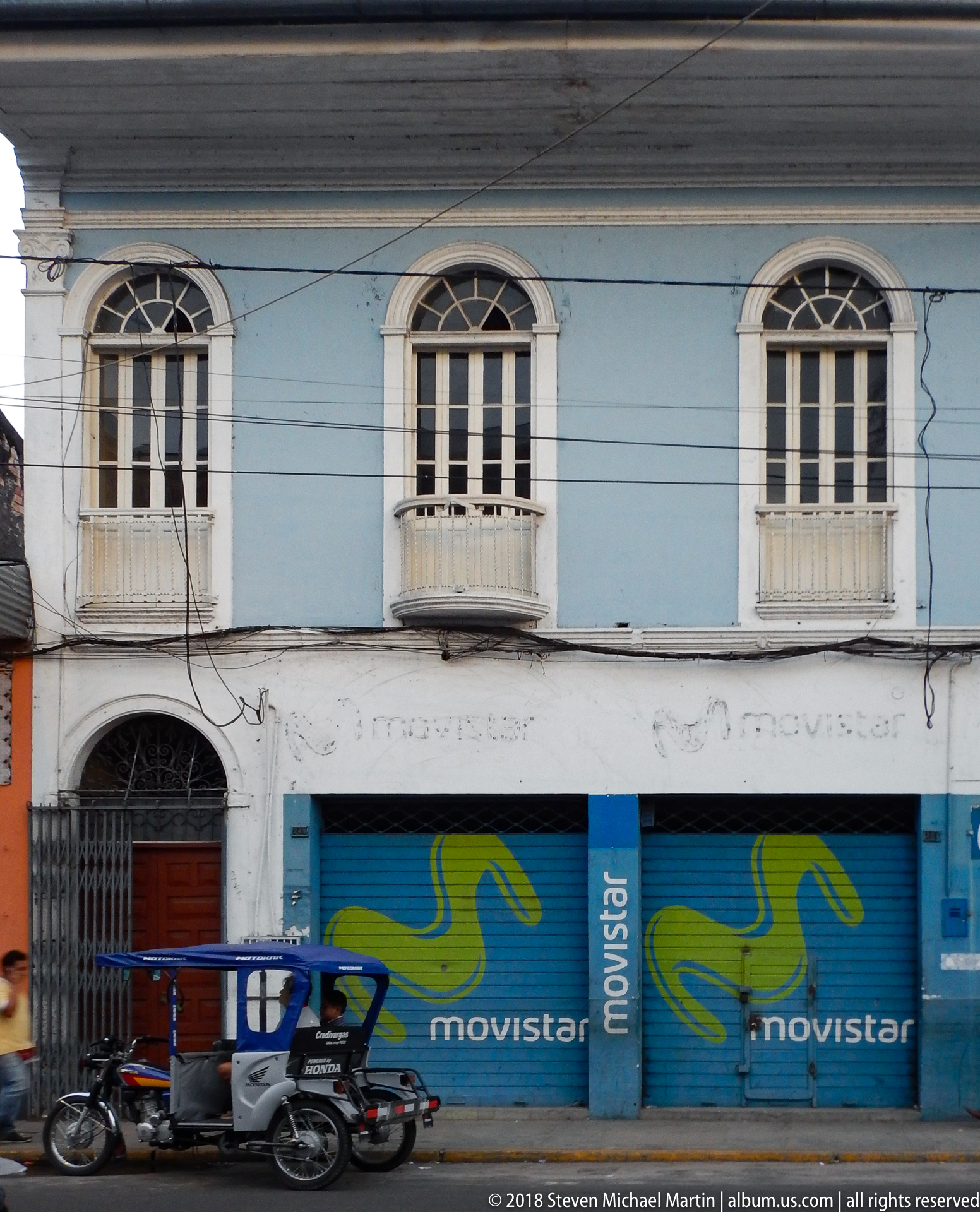
A pale blue-and-white two-story façade rises above ground-floor Movistar shutters, with three tall arched upper windows opening onto narrow projecting balconies. Decorative fanlights and molded trim preserve the historic character of the upper level despite the modern telecommunications branding below. A mototaxi passing at street level underscores the building’s continued commercial use.
Caption
A pale blue-and-white two-story façade rises above ground-floor Movistar shutters, with three tall arched upper windows opening onto narrow projecting balconies. Decorative fanlights and molded trim preserve the historic character of the upper level despite the modern telecommunications branding below. A mototaxi passing at street level underscores the building’s continued commercial use.
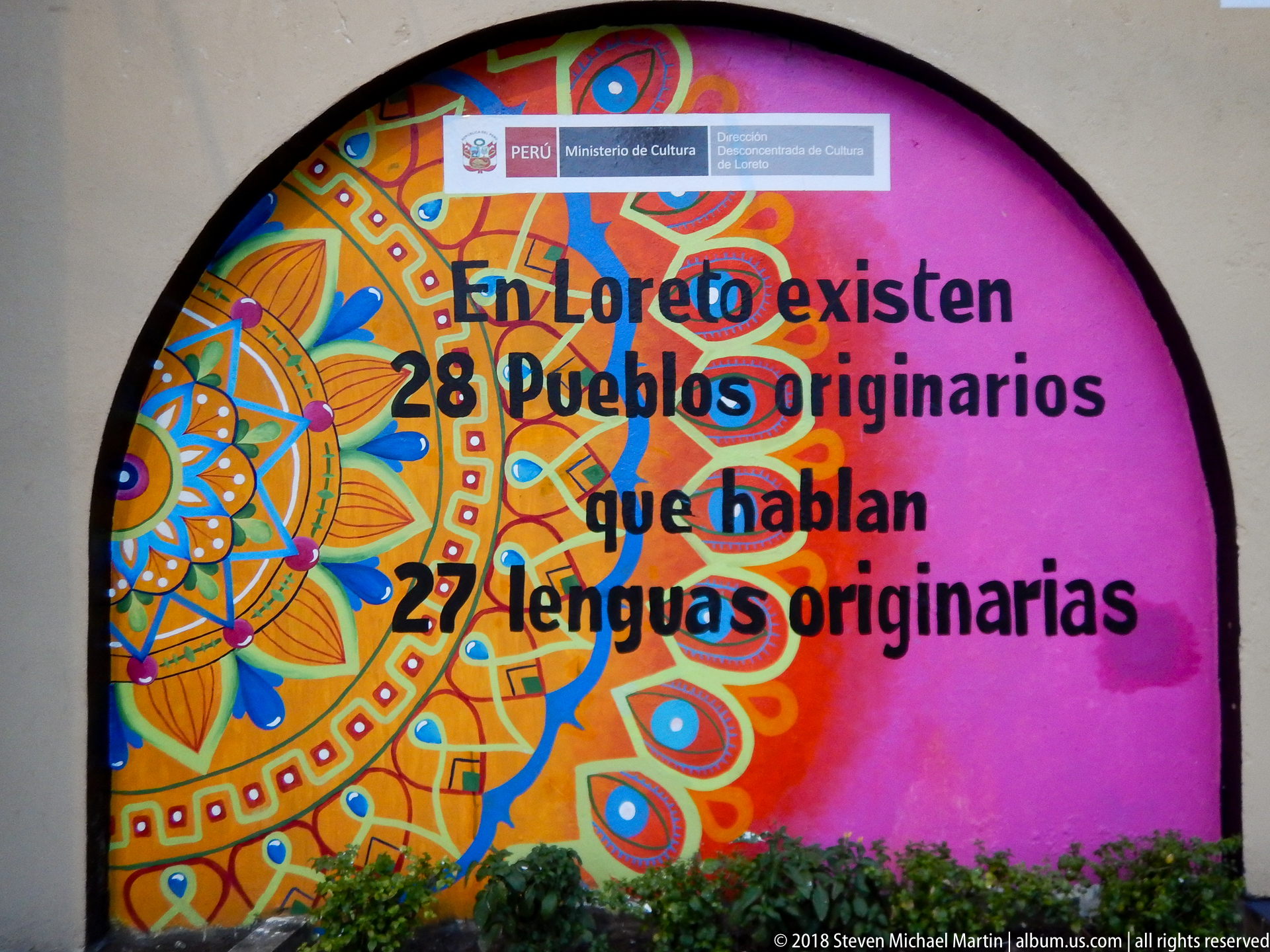
A brightly painted arched mural states, “En Loreto existen 28 pueblos originarios que hablan 27 lenguas originarias,” over a vivid field of floral and geometric motifs. Government cultural logos appear along the upper edge. The mural makes linguistic and cultural diversity the central message, using large black lettering against saturated pink, orange, and blue.
Caption
A brightly painted arched mural states, “En Loreto existen 28 pueblos originarios que hablan 27 lenguas originarias,” over a vivid field of floral and geometric motifs. Government cultural logos appear along the upper edge. The mural makes linguistic and cultural diversity the central message, using large black lettering against saturated pink, orange, and blue.
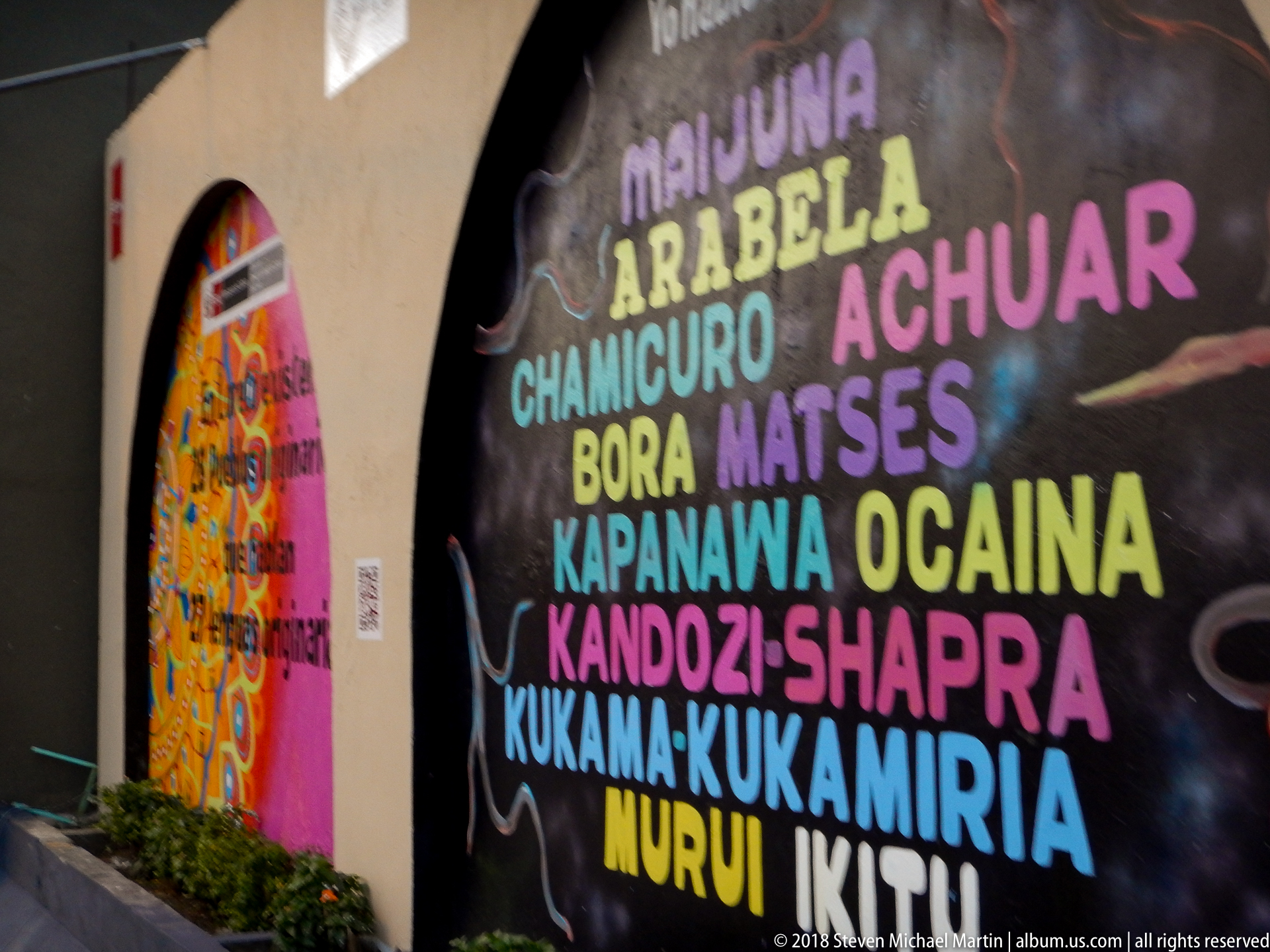
Names including Maijuna, Arabela, Achuar, Chamicuro, Bora, Matsés, Kapanawa, Ocaina, Kandozi-Shapra, Kukama-Kukamiria, Murui, and Ikitu appear in large multicolored letters on a dark wall. The mural functions as a visual inventory of Indigenous peoples and languages connected with Loreto, complementing the numerical statement on the adjacent arch.
Caption
Names including Maijuna, Arabela, Achuar, Chamicuro, Bora, Matsés, Kapanawa, Ocaina, Kandozi-Shapra, Kukama-Kukamiria, Murui, and Ikitu appear in large multicolored letters on a dark wall. The mural functions as a visual inventory of Indigenous peoples and languages connected with Loreto, complementing the numerical statement on the adjacent arch.
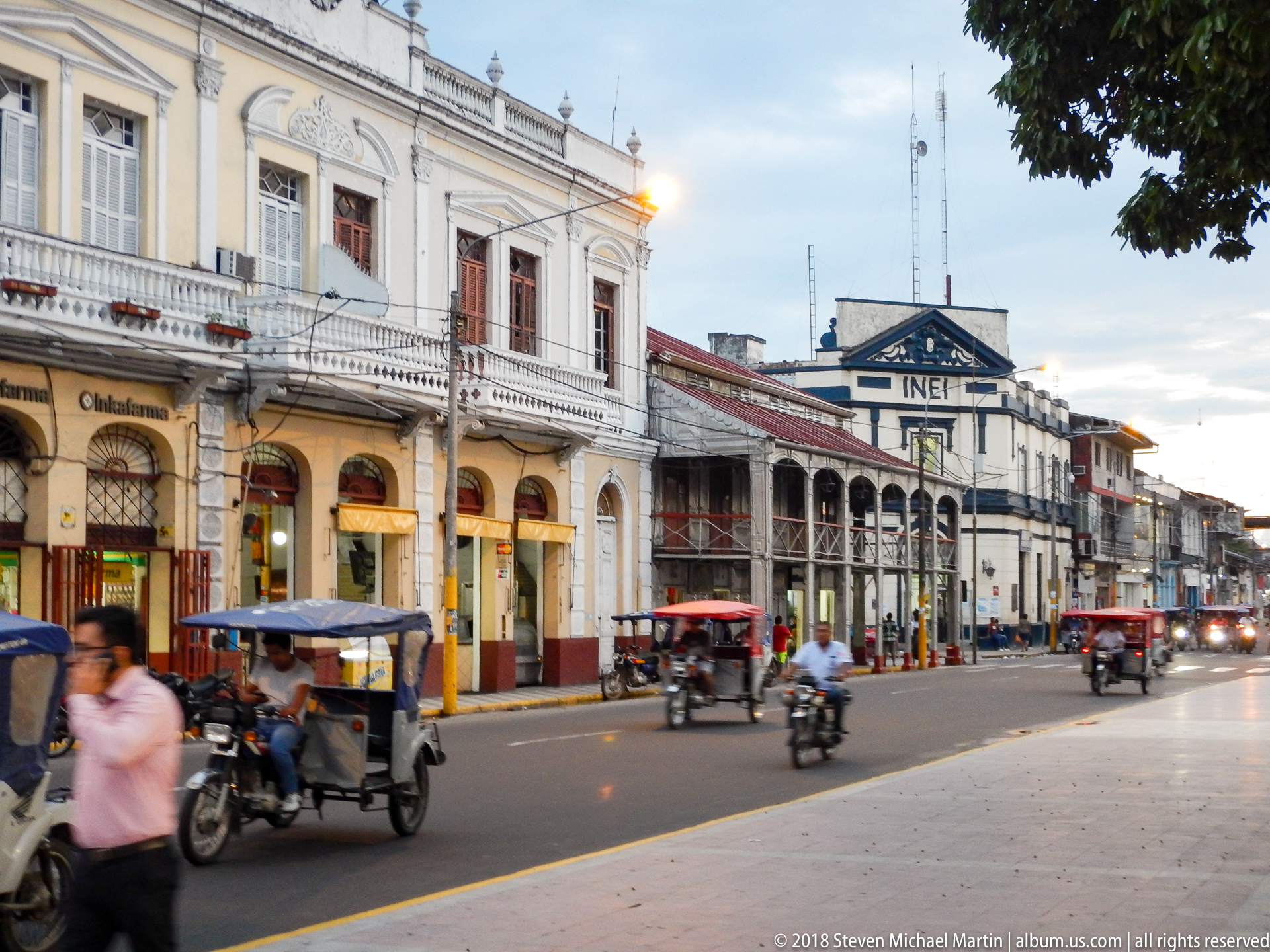
Historic two-story façades with arched storefronts and ornate balconies line a busy Iquitos street filled with mototaxis and motorcycles. Farther down the block, the letters “INEI” appear on a prominent building. Evening light begins to glow from street lamps and shop interiors, combining civic architecture with the city’s intense street traffic.
Caption
Historic two-story façades with arched storefronts and ornate balconies line a busy Iquitos street filled with mototaxis and motorcycles. Farther down the block, the letters “INEI” appear on a prominent building. Evening light begins to glow from street lamps and shop interiors, combining civic architecture with the city’s intense street traffic.
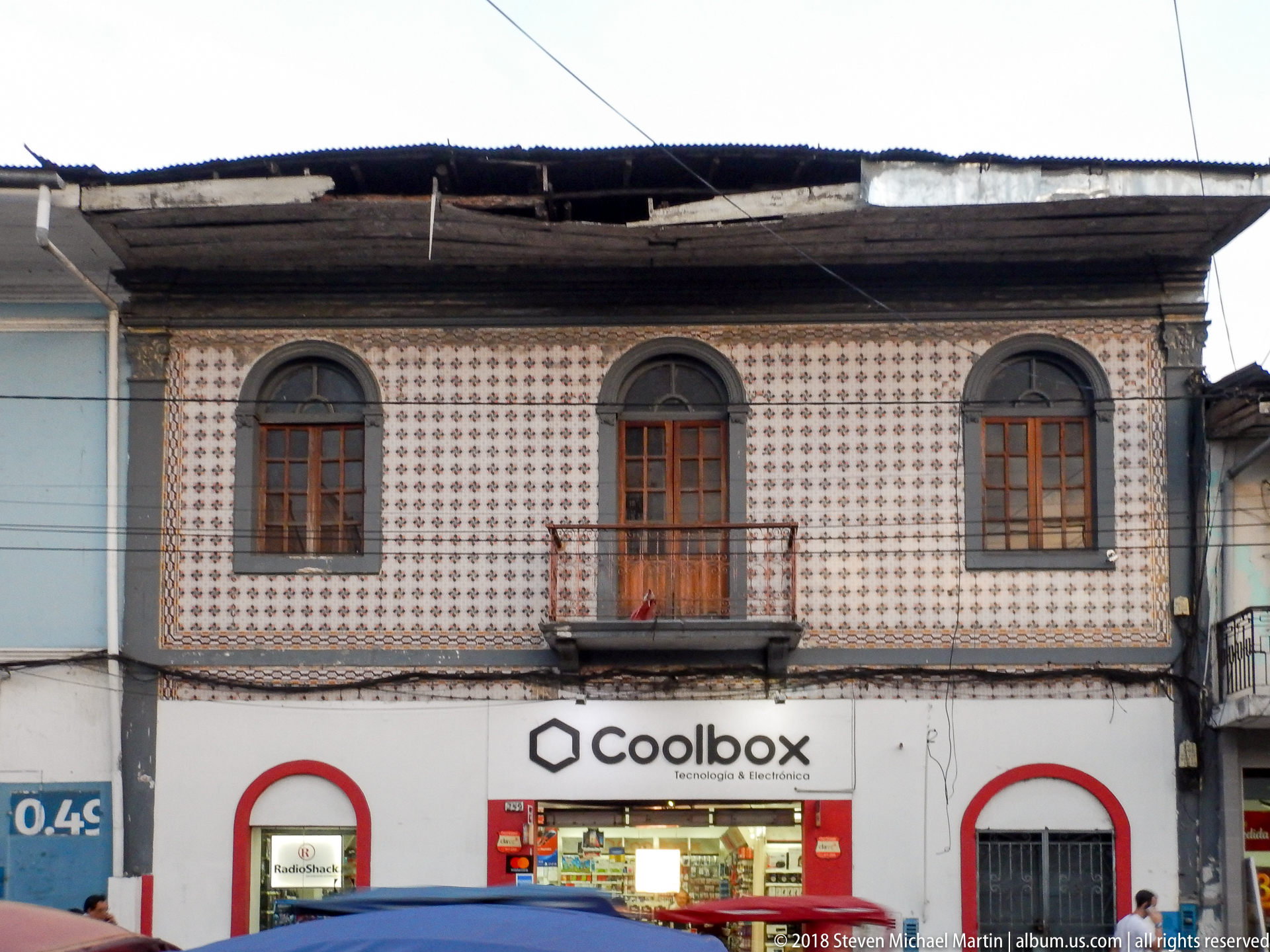
A two-story building is faced across its upper level with dense repeating geometric tiles, punctuated by three tall arched windows and a central balcony. The modern Coolbox electronics storefront occupies the ground floor beneath red-trimmed arches. The contrast between historic decorative tilework and contemporary retail signage illustrates the adaptive commercial life of central Iquitos architecture.
Caption
A two-story building is faced across its upper level with dense repeating geometric tiles, punctuated by three tall arched windows and a central balcony. The modern Coolbox electronics storefront occupies the ground floor beneath red-trimmed arches. The contrast between historic decorative tilework and contemporary retail signage illustrates the adaptive commercial life of central Iquitos architecture.
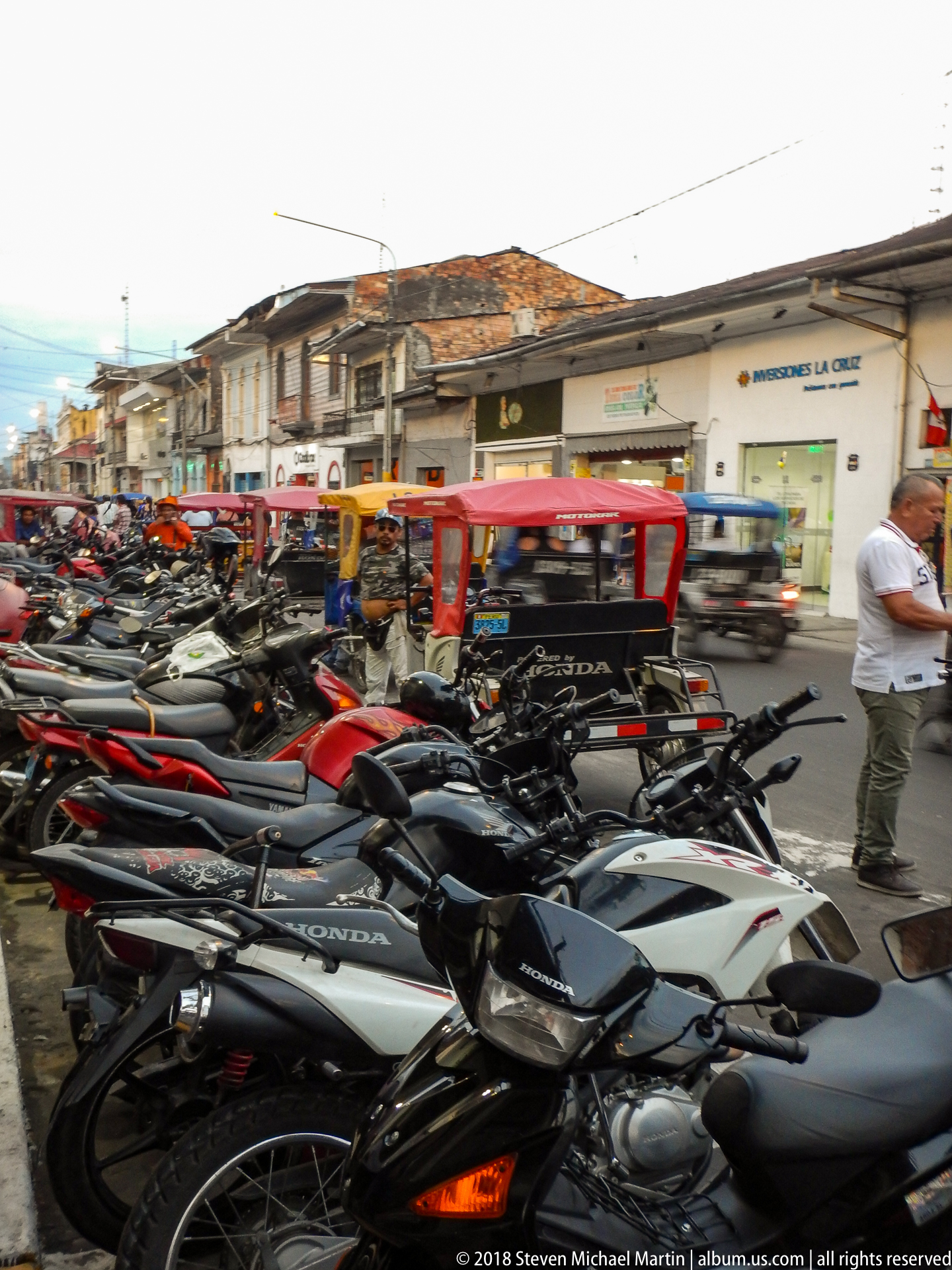
Motorcycles are parked wheel-to-wheel in dense rows along a busy Iquitos curb, with red-canopied mototaxis and storefronts behind them. The compressed foreground is dominated by fuel tanks, handlebars, mirrors, and front wheels, visually conveying the extraordinary concentration of motorcycle-based transport in the city’s commercial core.
Caption
Motorcycles are parked wheel-to-wheel in dense rows along a busy Iquitos curb, with red-canopied mototaxis and storefronts behind them. The compressed foreground is dominated by fuel tanks, handlebars, mirrors, and front wheels, visually conveying the extraordinary concentration of motorcycle-based transport in the city’s commercial core.
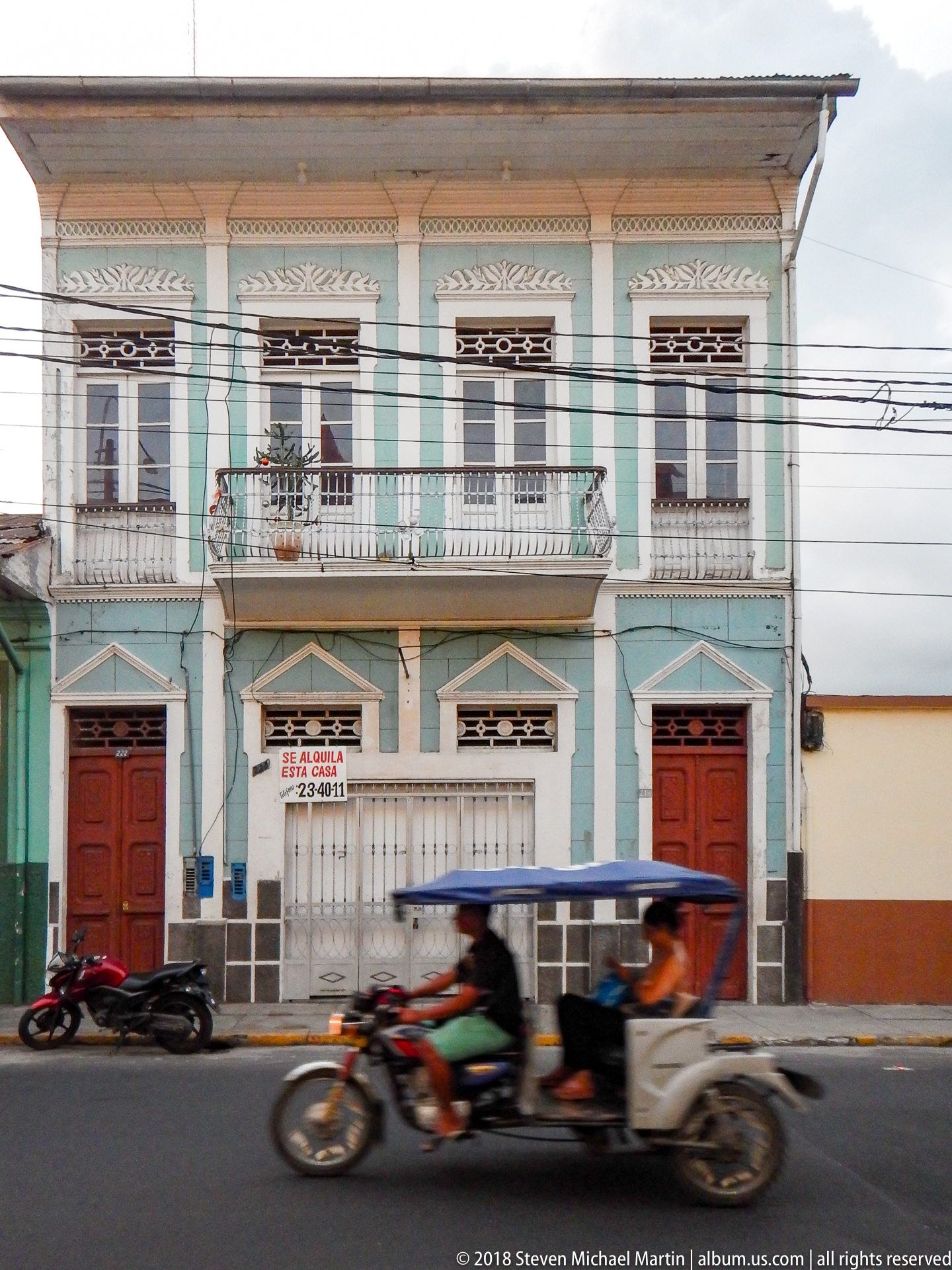
A mint-green and white two-story house presents three upper windows framed by elaborate molded decoration and shallow iron balconies. Below, red wooden doors flank a central gated opening, while a mototaxi blurs past the façade. The symmetrical elevation combines pastel color, ornament, and traditional street-facing proportions characteristic of older Iquitos architecture.
Caption
A mint-green and white two-story house presents three upper windows framed by elaborate molded decoration and shallow iron balconies. Below, red wooden doors flank a central gated opening, while a mototaxi blurs past the façade. The symmetrical elevation combines pastel color, ornament, and traditional street-facing proportions characteristic of older Iquitos architecture.

A woman reaches across a glass-fronted street cart heaped with freshly popped corn and surrounded by large red-and-white bags of additional popcorn. Passing motorcycles blur across the roadway behind her, emphasizing the vendor’s stationary workspace against constant traffic. The close view records a familiar form of mobile snack vending in central Iquitos.
Caption
A woman reaches across a glass-fronted street cart heaped with freshly popped corn and surrounded by large red-and-white bags of additional popcorn. Passing motorcycles blur across the roadway behind her, emphasizing the vendor’s stationary workspace against constant traffic. The close view records a familiar form of mobile snack vending in central Iquitos.
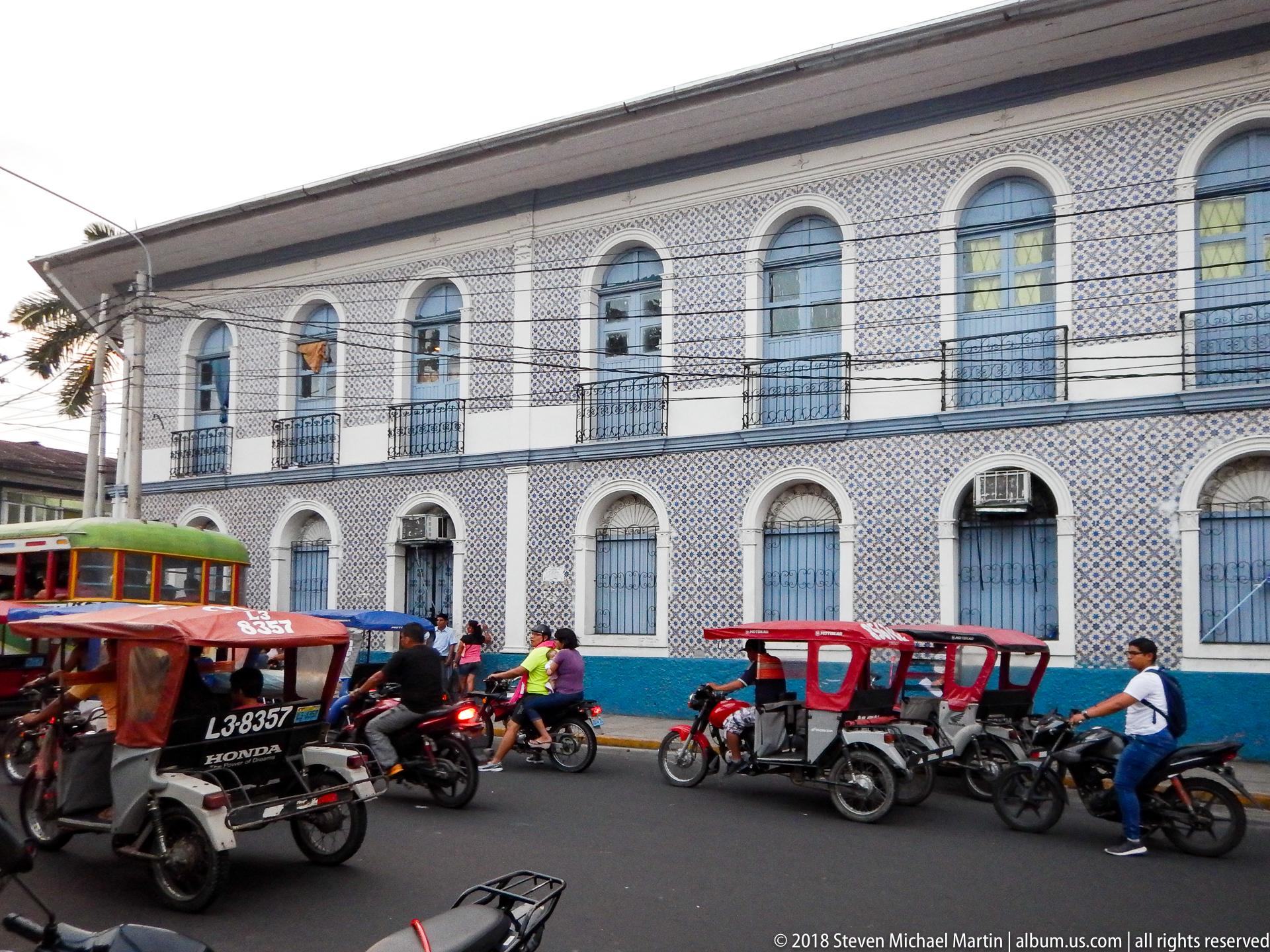
A broad two-story façade is covered in small blue-and-white patterned tiles and organized by two tiers of tall arched windows. Narrow iron balconies project from several upper openings while mototaxis and motorcycles line the street below. The straight-on view emphasizes the building’s repetitive bays, decorative surface, and scale within central Iquitos.
Caption
A broad two-story façade is covered in small blue-and-white patterned tiles and organized by two tiers of tall arched windows. Narrow iron balconies project from several upper openings while mototaxis and motorcycles line the street below. The straight-on view emphasizes the building’s repetitive bays, decorative surface, and scale within central Iquitos.
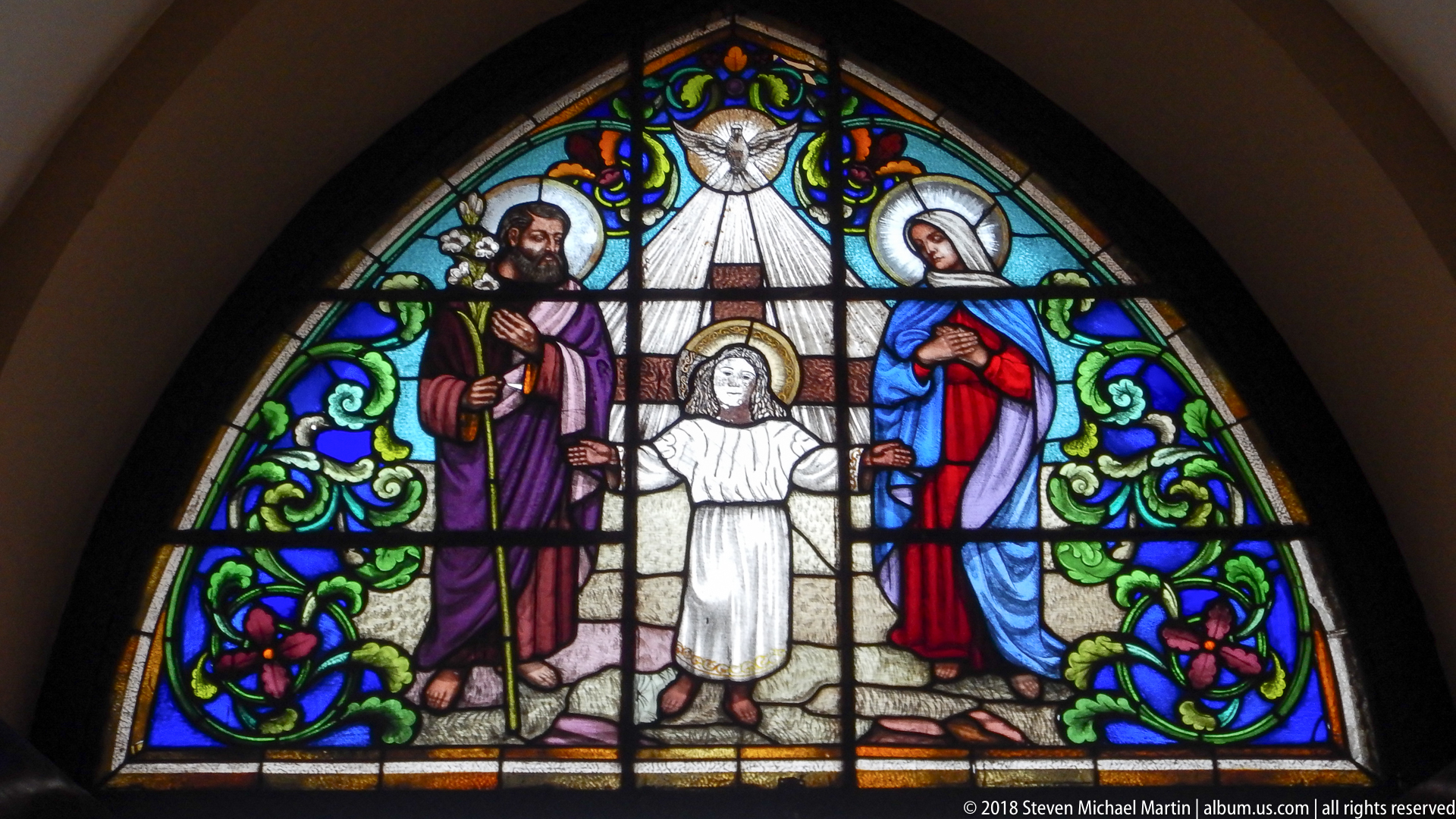
An arched stained-glass window presents the Holy Family: Joseph at left, Mary at right, and the child Jesus standing between them beneath a radiant heavenly figure and descending light. Dense blue, green, red, and purple foliage frames the scene. The window combines familial devotion with richly colored ornamental glass and serves as a prominent feature of the church interior.
Caption
An arched stained-glass window presents the Holy Family: Joseph at left, Mary at right, and the child Jesus standing between them beneath a radiant heavenly figure and descending light. Dense blue, green, red, and purple foliage frames the scene. The window combines familial devotion with richly colored ornamental glass and serves as a prominent feature of the church interior.
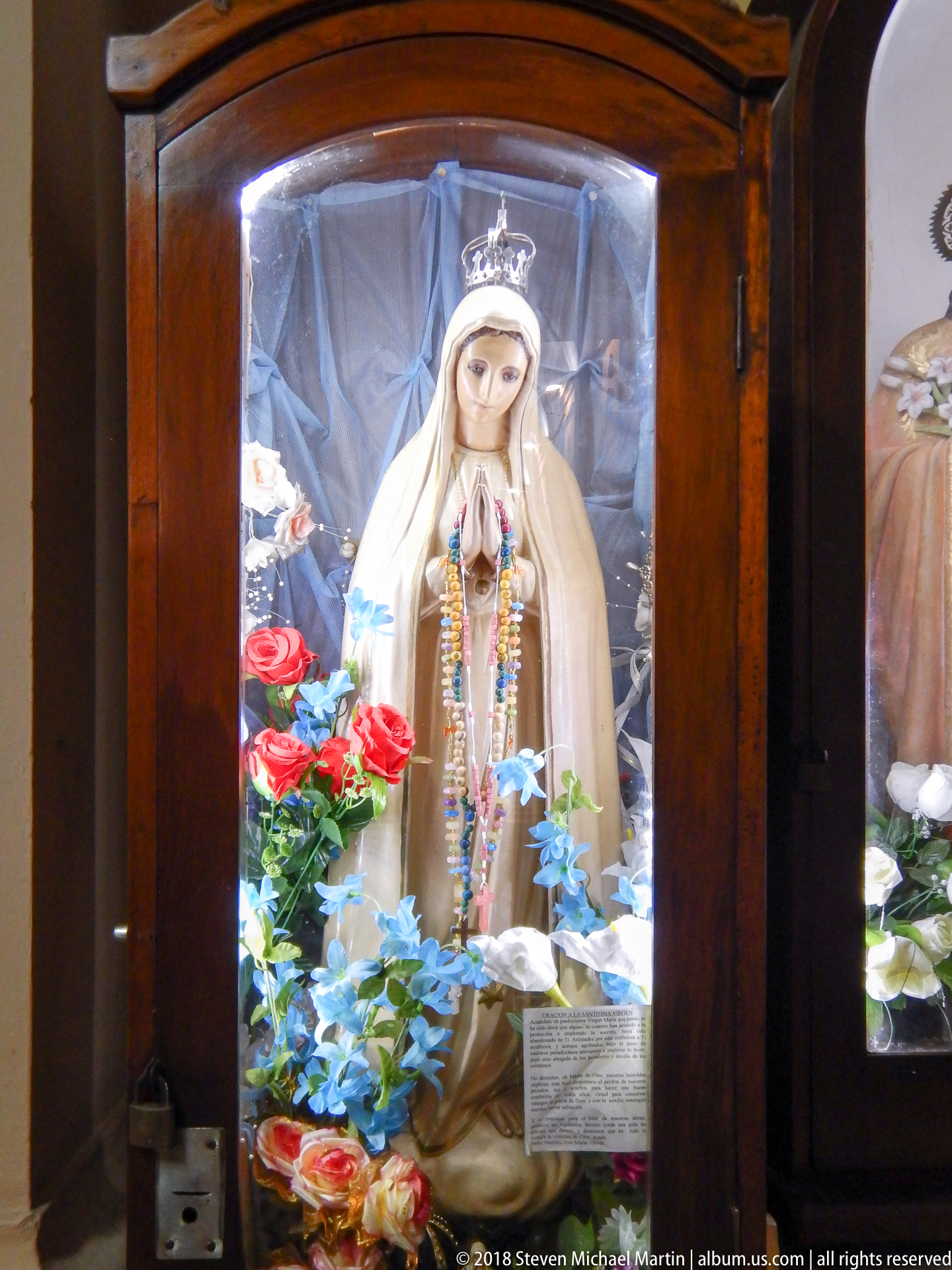
A crowned statue of the Virgin Mary stands inside a wooden-and-glass devotional case, hands joined in prayer and long rosaries hanging down the front of her white mantle. Artificial roses and blue flowers surround the figure. The intimate display emphasizes private or parish devotion through the combination of Marian imagery, rosary beads, crown, and floral offerings.
Caption
A crowned statue of the Virgin Mary stands inside a wooden-and-glass devotional case, hands joined in prayer and long rosaries hanging down the front of her white mantle. Artificial roses and blue flowers surround the figure. The intimate display emphasizes private or parish devotion through the combination of Marian imagery, rosary beads, crown, and floral offerings.
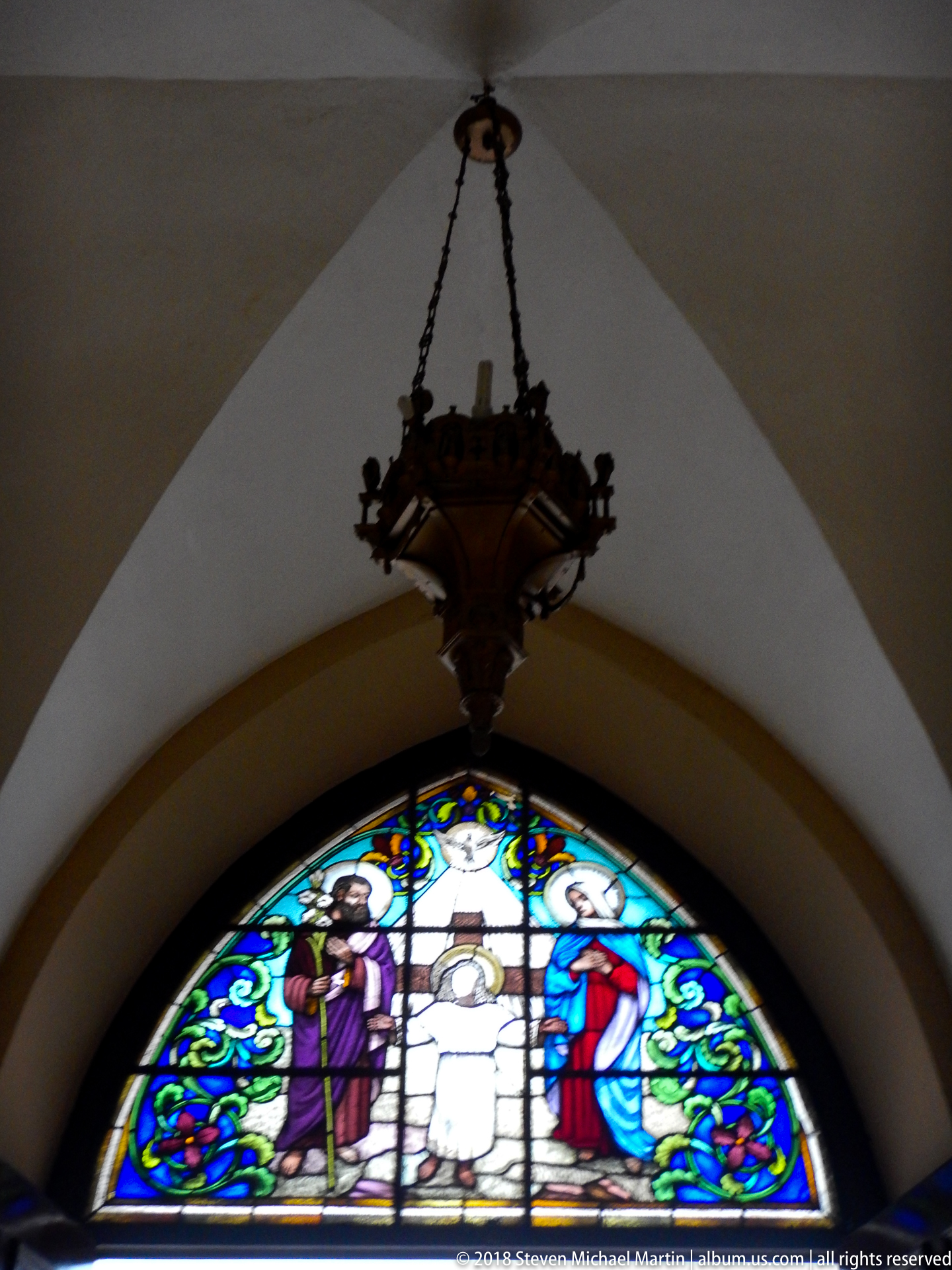
A dark metal hanging lamp descends from the vaulted ceiling directly above the arched Holy Family stained-glass window. The lower window glows with saturated blues, greens, reds, and whites, while the surrounding cream arch remains in shadow. The vertical composition links liturgical furnishing and stained glass within the church interior.
Caption
A dark metal hanging lamp descends from the vaulted ceiling directly above the arched Holy Family stained-glass window. The lower window glows with saturated blues, greens, reds, and whites, while the surrounding cream arch remains in shadow. The vertical composition links liturgical furnishing and stained glass within the church interior.
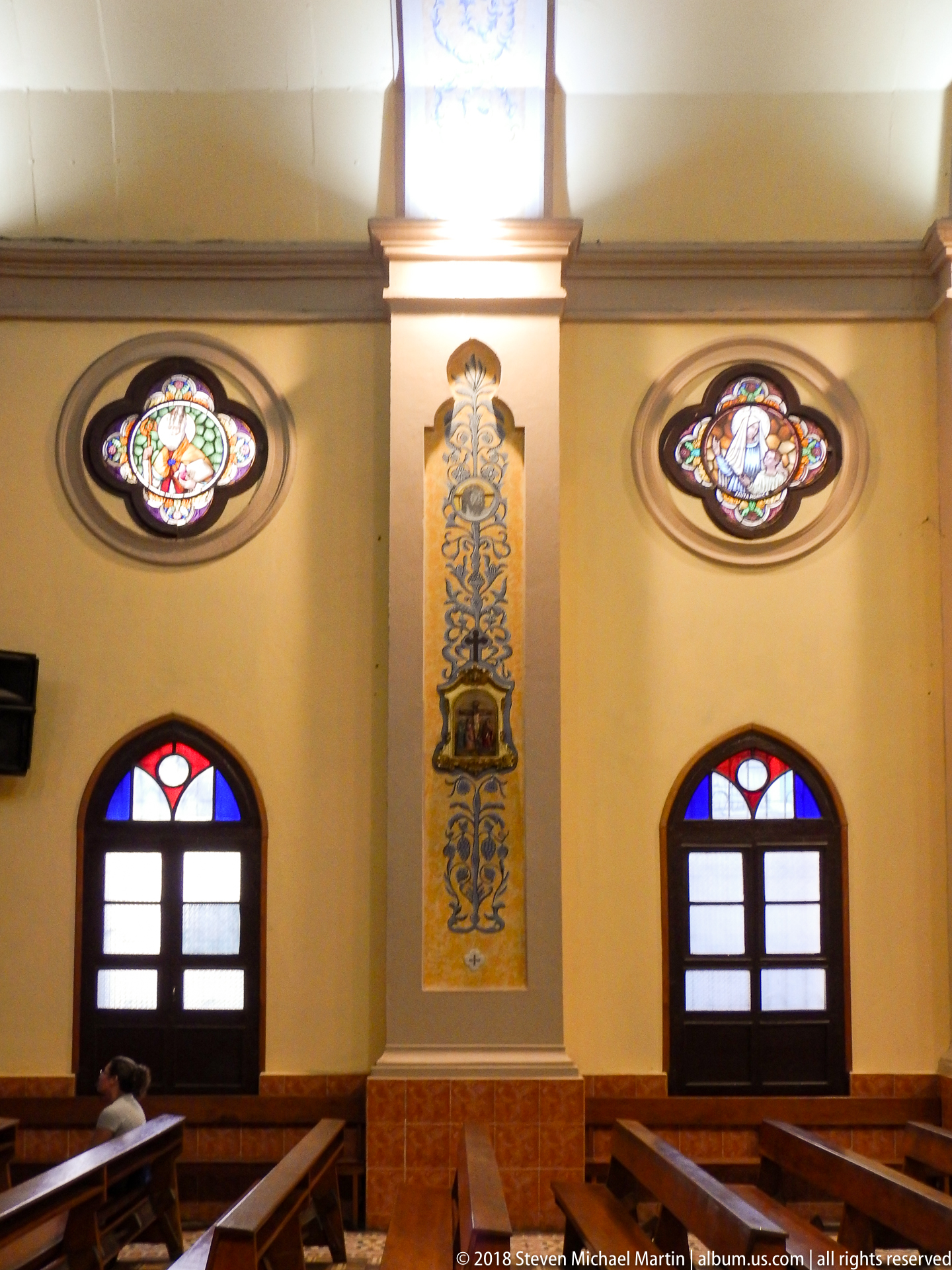
Two oval stained-glass medallions flank a tall wall panel painted with blue-and-gold scrollwork and a small central devotional image. Below them, dark arched windows punctuate the cream wall above wooden pews. The symmetrical composition highlights the church’s decorative wall treatment, combining stained glass, painted ornament, and architectural framing.
Caption
Two oval stained-glass medallions flank a tall wall panel painted with blue-and-gold scrollwork and a small central devotional image. Below them, dark arched windows punctuate the cream wall above wooden pews. The symmetrical composition highlights the church’s decorative wall treatment, combining stained glass, painted ornament, and architectural framing.

A barrel-vaulted church ceiling is divided into painted rectangular panels containing religious scenes and decorative motifs, bordered by dark carved-looking bands and pale blue ornament. At the far end, a broad mural rises above a white balustraded gallery. The upward view emphasizes the richly decorated ceiling program and the layered architecture of the nave.
Caption
A barrel-vaulted church ceiling is divided into painted rectangular panels containing religious scenes and decorative motifs, bordered by dark carved-looking bands and pale blue ornament. At the far end, a broad mural rises above a white balustraded gallery. The upward view emphasizes the richly decorated ceiling program and the layered architecture of the nave.
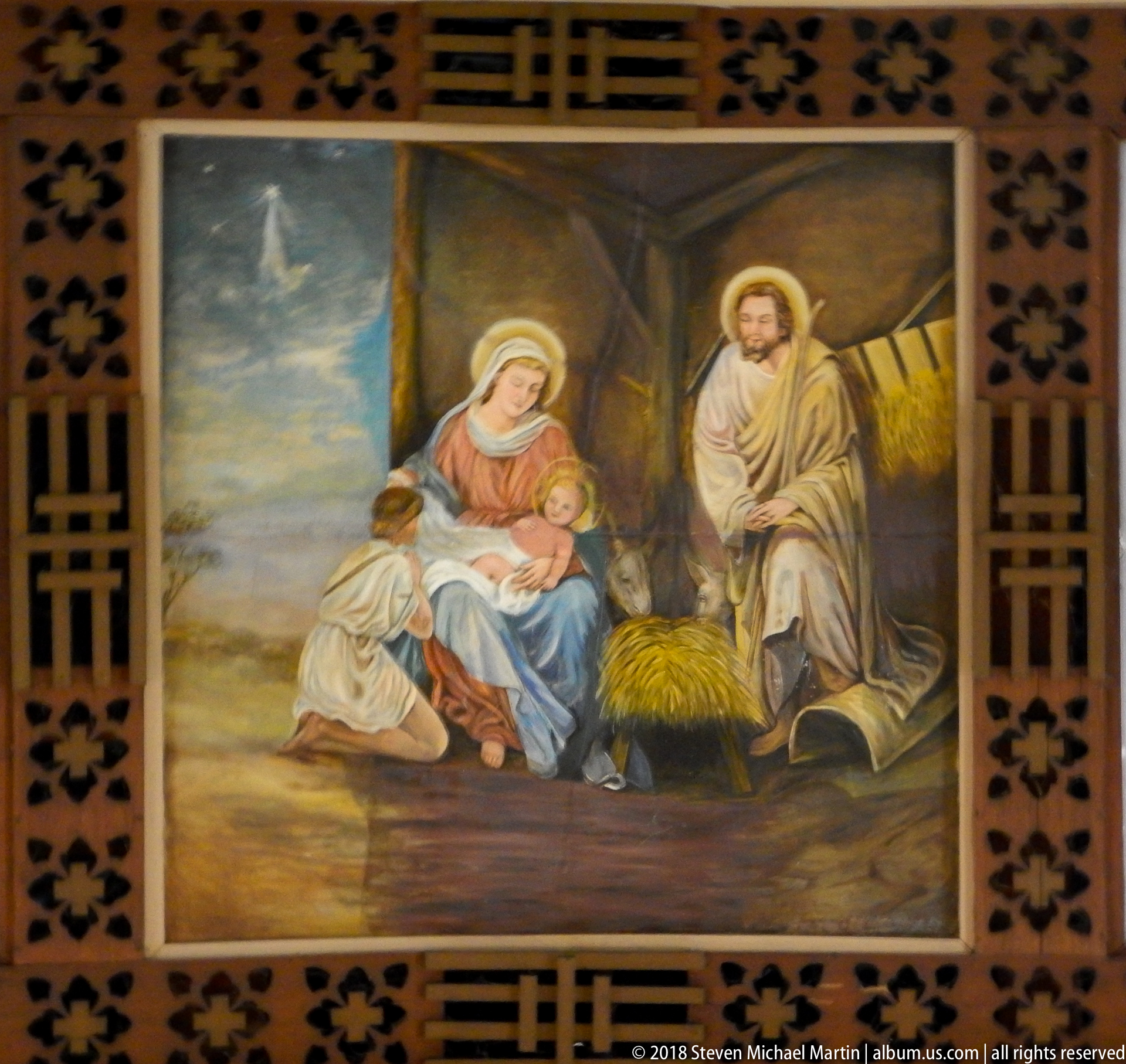
A devotional painting portrays the Nativity, with Mary seated beside the infant Jesus, Joseph standing to the right, and another kneeling figure at the child’s side. Straw and stable elements fill the background, while a dark carved or pierced frame surrounds the image. The composition focuses on tenderness and domestic intimacy within the traditional Christian birth narrative.
Caption
A devotional painting portrays the Nativity, with Mary seated beside the infant Jesus, Joseph standing to the right, and another kneeling figure at the child’s side. Straw and stable elements fill the background, while a dark carved or pierced frame surrounds the image. The composition focuses on tenderness and domestic intimacy within the traditional Christian birth narrative.

Square floor tiles repeat a complex star-and-cross pattern in pink, cream, brown, and black. Each unit combines an eight-pointed floral star with angular borders, producing a continuous geometric carpet across the floor. The close view isolates the historic decorative surface and reveals slight wear, color variation, and grout lines from prolonged use.
Caption
Square floor tiles repeat a complex star-and-cross pattern in pink, cream, brown, and black. Each unit combines an eight-pointed floral star with angular borders, producing a continuous geometric carpet across the floor. The close view isolates the historic decorative surface and reveals slight wear, color variation, and grout lines from prolonged use.
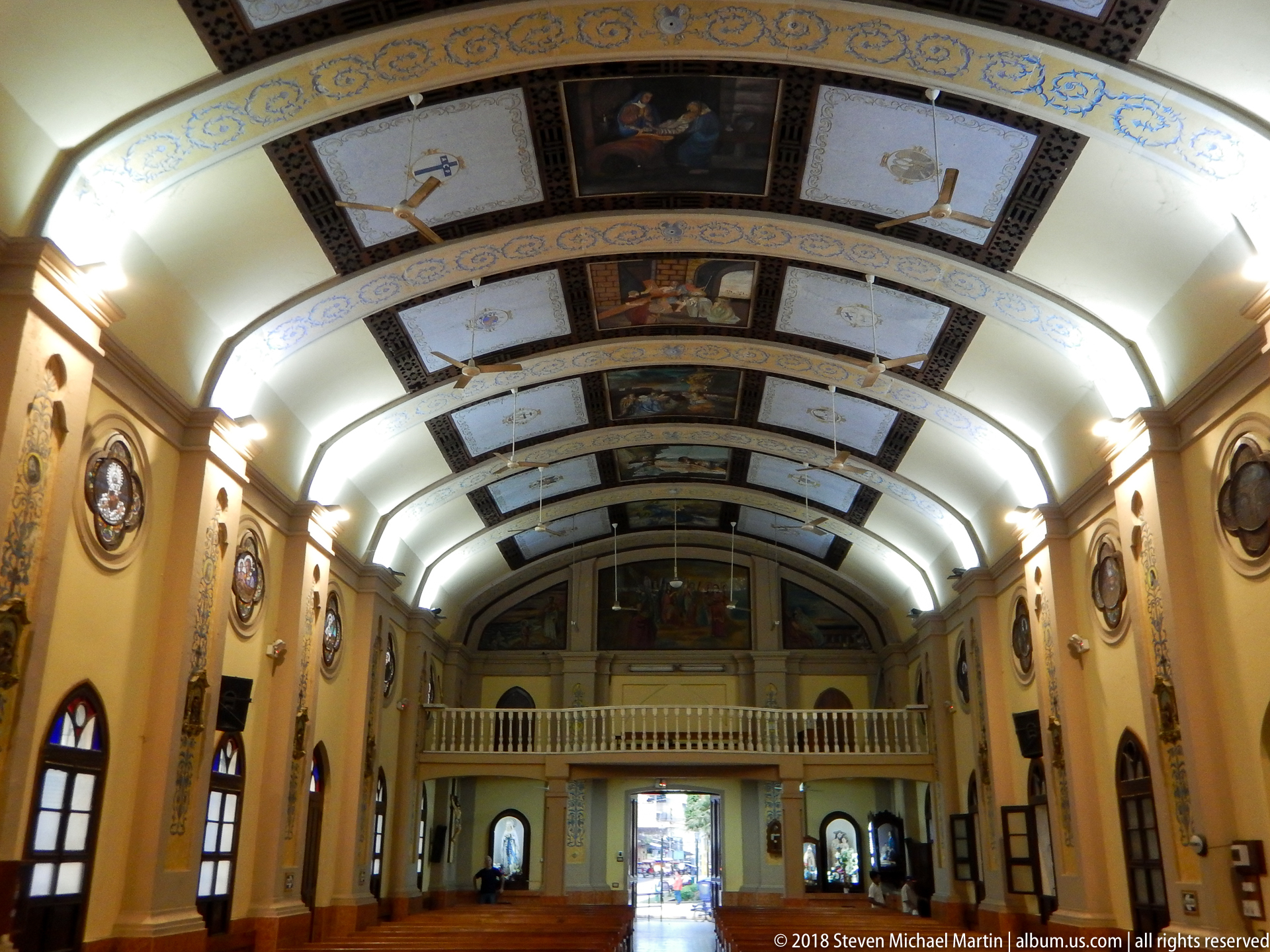
A long church nave extends toward a bright open entrance beneath a richly painted barrel-vault ceiling divided into framed religious panels. Oval stained-glass medallions and arched windows repeat along the side walls above rows of wooden pews, while a white gallery spans the far end. The centered view brings the entire decorative interior program into a single architectural perspective.
Caption
A long church nave extends toward a bright open entrance beneath a richly painted barrel-vault ceiling divided into framed religious panels. Oval stained-glass medallions and arched windows repeat along the side walls above rows of wooden pews, while a white gallery spans the far end. The centered view brings the entire decorative interior program into a single architectural perspective.
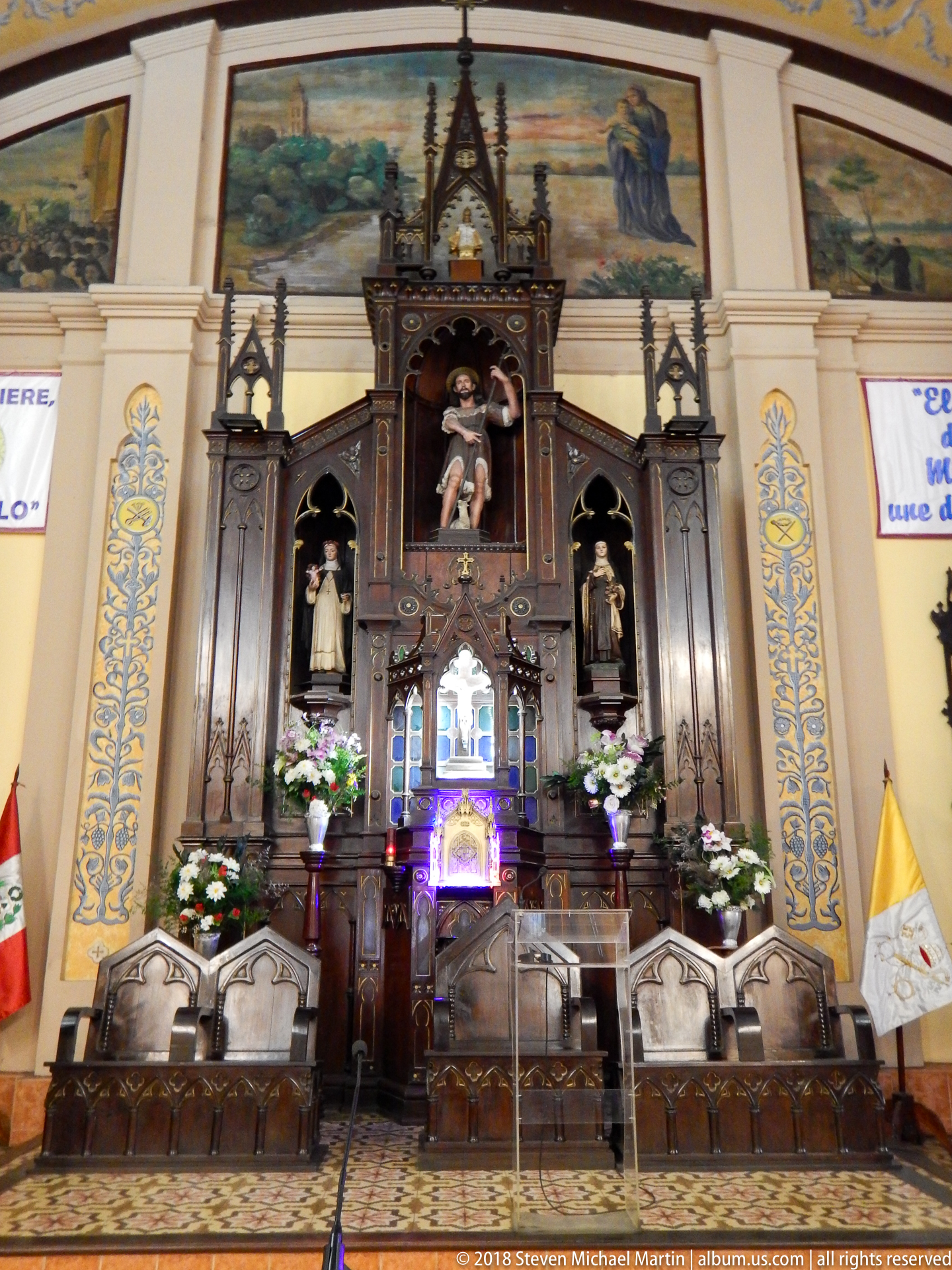
A dark carved wooden high altar rises against a cream church wall enriched with blue-and-gold painted ornament. Niches hold devotional statues, while flowers flank a small illuminated tabernacle or shrine at the center. Painted religious scenes occupy the curved wall above, and rows of ceremonial chairs line the sanctuary in front, giving the view a formal liturgical focus.
Caption
A dark carved wooden high altar rises against a cream church wall enriched with blue-and-gold painted ornament. Niches hold devotional statues, while flowers flank a small illuminated tabernacle or shrine at the center. Painted religious scenes occupy the curved wall above, and rows of ceremonial chairs line the sanctuary in front, giving the view a formal liturgical focus.