Amazon Research Center – Peru
The Amazon Research Center supports scientific study and conservation within the ecosystems of the Peruvian Amazon. Researchers and conservationists working in the region study wildlife populations, forest ecology, and sustainable management of the rainforest.
Programs conducted at research facilities in the Amazon focus on protecting endangered species, monitoring biodiversity, and understanding the complex interactions between plants, animals, and climate within the rainforest ecosystem.
These research efforts play an important role in preserving the extraordinary biodiversity of the Amazon Basin.

A local canoeist propels a narrow wooden dugout along the river margin with a single-bladed paddle. The exposed, cracked bank and dense vegetation behind him frame a practical form of Amazonian transportation, while the low freeboard and elongated hull show a craft adapted to quiet waterways and shallow approaches.
Caption
A local canoeist propels a narrow wooden dugout along the river margin with a single-bladed paddle. The exposed, cracked bank and dense vegetation behind him frame a practical form of Amazonian transportation, while the low freeboard and elongated hull show a craft adapted to quiet waterways and shallow approaches.

A Neotropical river otter approaches from farther out, its small dark head barely breaking the water beside the pale bank. The wider framing makes the animal easy to overlook and emphasizes how little of an otter is exposed while it travels through calm river water.
Caption
A Neotropical river otter approaches from farther out, its small dark head barely breaking the water beside the pale bank. The wider framing makes the animal easy to overlook and emphasizes how little of an otter is exposed while it travels through calm river water.

Across a broad expanse of dark reflective water, a Cocoi heron stands near the vegetated shoreline while pale dead branches rise in the foreground. The composition emphasizes distance, stillness, and wetland structure, with the solitary heron serving as a scale reference within the Amazonian river-edge landscape.
Caption
Across a broad expanse of dark reflective water, a Cocoi heron stands near the vegetated shoreline while pale dead branches rise in the foreground. The composition emphasizes distance, stillness, and wetland structure, with the solitary heron serving as a scale reference within the Amazonian river-edge landscape.

A passenger seated in a canoe adjusts a broad-brimmed sun hat while facing away from the camera. Printed text on the shirt identifies “Tahuayo Lodge” and “Amazon Research Center Lodge,” tying the closing frame directly to the research-and-lodging operation associated with the portfolio and to river travel through the Peruvian Amazon.
Caption
A passenger seated in a canoe adjusts a broad-brimmed sun hat while facing away from the camera. Printed text on the shirt identifies “Tahuayo Lodge” and “Amazon Research Center Lodge,” tying the closing frame directly to the research-and-lodging operation associated with the portfolio and to river travel through the Peruvian Amazon.

A narrow wooden canoe powered by an outboard motor carries three people along a calm forest-lined waterway near the Amazon Research Center. The boat’s wake cuts across the otherwise reflective surface, while low vegetation and overhanging trees define the sheltered river channel used for transport and wildlife observation.
Caption
A narrow wooden canoe powered by an outboard motor carries three people along a calm forest-lined waterway near the Amazon Research Center. The boat’s wake cuts across the otherwise reflective surface, while low vegetation and overhanging trees define the sheltered river channel used for transport and wildlife observation.

From across the water, a Capped heron stands alone on a grassy bank framed by large fallen trunks. Its pale body and dark crown remain conspicuous at distance, while the broad foreground reflection and woody debris place the bird within the quiet, structurally complex margin of an Amazonian waterway.
Caption
From across the water, a Capped heron stands alone on a grassy bank framed by large fallen trunks. Its pale body and dark crown remain conspicuous at distance, while the broad foreground reflection and woody debris place the bird within the quiet, structurally complex margin of an Amazonian waterway.

Only the head and neck of a Neotropical river otter rise above the opaque river water as it swims close to an eroded bank. Its nostrils, eyes, small rounded ears, and pale chin remain above the surface, an efficient posture for watching the shoreline while keeping most of the body submerged.
Caption
Only the head and neck of a Neotropical river otter rise above the opaque river water as it swims close to an eroded bank. Its nostrils, eyes, small rounded ears, and pale chin remain above the surface, an efficient posture for watching the shoreline while keeping most of the body submerged.

A Cocoi heron stands deep within a tangle of leafy branches, its long neck and bill forming a pale diagonal against the darker forest. The broad environmental framing makes the bird deliberately difficult to spot, emphasizing the complexity of the river-edge vegetation rather than a clean species portrait.
Caption
A Cocoi heron stands deep within a tangle of leafy branches, its long neck and bill forming a pale diagonal against the darker forest. The broad environmental framing makes the bird deliberately difficult to spot, emphasizing the complexity of the river-edge vegetation rather than a clean species portrait.

A Neotropical river otter surfaces beside a sloping mud bank with its mouth open, exposing the pale chin and teeth. The waterline reaches the shoulders, while the animal’s forward-facing eyes and rounded ears remain above the surface in an alert, animated portrait.
Caption
A Neotropical river otter surfaces beside a sloping mud bank with its mouth open, exposing the pale chin and teeth. The waterline reaches the shoulders, while the animal’s forward-facing eyes and rounded ears remain above the surface in an alert, animated portrait.

A giant river otter surfaces close to a rocky, forested bank, its rounded ears, broad muzzle, prominent whiskers, and sleek dark coat clearly visible above the still water. The low viewpoint places the viewer at water level and emphasizes the otter’s semi-aquatic form within the Amazonian river-edge habitat.
Caption
A giant river otter surfaces close to a rocky, forested bank, its rounded ears, broad muzzle, prominent whiskers, and sleek dark coat clearly visible above the still water. The low viewpoint places the viewer at water level and emphasizes the otter’s semi-aquatic form within the Amazonian river-edge habitat.

A giant river otter stands on a fallen trunk amid tangled riverside branches, offering a full-bodied view of its dense brown coat, muscular torso, short legs, webbed feet, and whiskered face. The terrestrial pause beside the water reveals features that are often concealed when the animal is swimming.
Caption
A giant river otter stands on a fallen trunk amid tangled riverside branches, offering a full-bodied view of its dense brown coat, muscular torso, short legs, webbed feet, and whiskered face. The terrestrial pause beside the water reveals features that are often concealed when the animal is swimming.

A Cocoi heron flies through shaded river-edge forest with broad gray wings extended and its long neck folded into the characteristic heron flight posture. White neck plumage and the dark crown remain visible despite motion blur, conveying the speed of the bird’s passage through dense riparian vegetation.
Caption
A Cocoi heron flies through shaded river-edge forest with broad gray wings extended and its long neck folded into the characteristic heron flight posture. White neck plumage and the dark crown remain visible despite motion blur, conveying the speed of the bird’s passage through dense riparian vegetation.

A Cocoi heron descends toward the forest floor or river margin, legs extended and wings spread wide to brake its landing. Its pale neck, black crown, gray upperwings, and long dagger-like bill stand out against the dark understory, distinguishing this action view from the preceding flight sequence.
Caption
A Cocoi heron descends toward the forest floor or river margin, legs extended and wings spread wide to brake its landing. Its pale neck, black crown, gray upperwings, and long dagger-like bill stand out against the dark understory, distinguishing this action view from the preceding flight sequence.

A Cocoi heron stands upright at the edge of dense Amazonian vegetation, revealing the species’ tall proportions and strongly patterned neck. The long yellowish bill, dark crown, pale head, streaked fore-neck, and gray wings are seen in profile as the bird pauses on the shaded ground.
Caption
A Cocoi heron stands upright at the edge of dense Amazonian vegetation, revealing the species’ tall proportions and strongly patterned neck. The long yellowish bill, dark crown, pale head, streaked fore-neck, and gray wings are seen in profile as the bird pauses on the shaded ground.

A giant river otter floats almost horizontally beside a pale bank, gripping reddish prey between its jaws and forepaws. Its head is turned sideways at the surface, allowing the feeding action to dominate the frame while the dark overhanging log compresses the river-edge setting above it.
Caption
A giant river otter floats almost horizontally beside a pale bank, gripping reddish prey between its jaws and forepaws. Its head is turned sideways at the surface, allowing the feeding action to dominate the frame while the dark overhanging log compresses the river-edge setting above it.

A giant river otter remains low in the water beside the bank as it works on prey held near its mouth. The animal’s flattened surface posture, wet fur, visible muzzle, and reddish food item create a quieter feeding study, with ripples and scattered foam marking the surrounding water.
Caption
A giant river otter remains low in the water beside the bank as it works on prey held near its mouth. The animal’s flattened surface posture, wet fur, visible muzzle, and reddish food item create a quieter feeding study, with ripples and scattered foam marking the surrounding water.

A giant river otter steps forward along a pale fallen trunk, head lowered and forefeet planted on the wood. The oblique view emphasizes its elongated, muscular body, dense wet-looking coat, broad muzzle, and powerful webbed feet, placing the animal within the woody structure of a flooded-forest margin.
Caption
A giant river otter steps forward along a pale fallen trunk, head lowered and forefeet planted on the wood. The oblique view emphasizes its elongated, muscular body, dense wet-looking coat, broad muzzle, and powerful webbed feet, placing the animal within the woody structure of a flooded-forest margin.

A giant river otter surfaces beneath an overhanging log at a pale, eroded bank while holding prey at its mouth. Only the head and upper neck rise above the brown water, making the feeding behavior and the sheltering geometry of log, bank, and river the dominant features of the scene.
Caption
A giant river otter surfaces beneath an overhanging log at a pale, eroded bank while holding prey at its mouth. Only the head and upper neck rise above the brown water, making the feeding behavior and the sheltering geometry of log, bank, and river the dominant features of the scene.

A giant river otter raises its head at the waterline with jaws open around dark prey, exposing teeth and the muscular muzzle. The close view concentrates on active feeding behavior, with the pale bank and dark fallen timber forming a tight natural enclosure around the animal.
Caption
A giant river otter raises its head at the waterline with jaws open around dark prey, exposing teeth and the muscular muzzle. The close view concentrates on active feeding behavior, with the pale bank and dark fallen timber forming a tight natural enclosure around the animal.

A giant river otter faces the camera from shallow water beneath a dark log, holding a substantial piece of prey against the pale bank. Its rounded ears, forward-set eyes, whiskered muzzle, and dexterous forepaws are clearly visible in this direct study of feeding behavior.
Caption
A giant river otter faces the camera from shallow water beneath a dark log, holding a substantial piece of prey against the pale bank. Its rounded ears, forward-set eyes, whiskered muzzle, and dexterous forepaws are clearly visible in this direct study of feeding behavior.

A giant river otter surfaces beside the bank with a dark prey item held close to its mouth. The tight crop records wet facial fur, pale whiskers, rounded ears, and exposed teeth, while the smooth brown water and shadowed timber isolate the animal’s feeding activity.
Caption
A giant river otter surfaces beside the bank with a dark prey item held close to its mouth. The tight crop records wet facial fur, pale whiskers, rounded ears, and exposed teeth, while the smooth brown water and shadowed timber isolate the animal’s feeding activity.

A giant river otter swims in profile carrying a dark prey item at its mouth. Head and shoulders rise above the reflective water while the body trails just beneath the surface, producing a clear behavioral portrait that shows how the species transports food while remaining buoyant and mobile.
Caption
A giant river otter swims in profile carrying a dark prey item at its mouth. Head and shoulders rise above the reflective water while the body trails just beneath the surface, producing a clear behavioral portrait that shows how the species transports food while remaining buoyant and mobile.

A giant river otter surfaces head-on beneath a low overhanging log, with only its eyes, ears, muzzle, and upper head breaking the water. The compressed composition emphasizes the animal’s low swimming profile and its close relationship with woody cover along the Amazonian river margin.
Caption
A giant river otter surfaces head-on beneath a low overhanging log, with only its eyes, ears, muzzle, and upper head breaking the water. The compressed composition emphasizes the animal’s low swimming profile and its close relationship with woody cover along the Amazonian river margin.

A giant river otter lifts its head and opens its jaws while swimming, with long pale whiskers splayed against the wet muzzle. The upright head posture and visible teeth create an expressive behavioral moment, while the submerged body leaves only a low dark line across the water.
Caption
A giant river otter lifts its head and opens its jaws while swimming, with long pale whiskers splayed against the wet muzzle. The upright head posture and visible teeth create an expressive behavioral moment, while the submerged body leaves only a low dark line across the water.

A giant river otter faces forward at the surface with its mouth wide open, exposing teeth and pink oral tissue beneath a fan of pale whiskers. The nearly symmetrical head-on view isolates facial anatomy and behavior against softly rippled water, with the body largely concealed below.
Caption
A giant river otter faces forward at the surface with its mouth wide open, exposing teeth and pink oral tissue beneath a fan of pale whiskers. The nearly symmetrical head-on view isolates facial anatomy and behavior against softly rippled water, with the body largely concealed below.

A Neotropic cormorant perches upright on a sunlit branch against a clear blue sky, its long tail braced below the body and slender hooked bill angled upward. Warm light picks out the yellow-orange facial skin and brown-black plumage, creating a clean profile of a widespread Amazonian waterbird.
Caption
A Neotropic cormorant perches upright on a sunlit branch against a clear blue sky, its long tail braced below the body and slender hooked bill angled upward. Warm light picks out the yellow-orange facial skin and brown-black plumage, creating a clean profile of a widespread Amazonian waterbird.

A yellow-headed caracara walks across open ground at the forest edge, showing its pale cream head and breast, dark brown wings and back, long tail, and orange-yellow facial skin. The low side view emphasizes the species’ terrestrial foraging posture rather than the more familiar image of a raptor perched above the landscape.
Caption
A yellow-headed caracara walks across open ground at the forest edge, showing its pale cream head and breast, dark brown wings and back, long tail, and orange-yellow facial skin. The low side view emphasizes the species’ terrestrial foraging posture rather than the more familiar image of a raptor perched above the landscape.

A yellow-headed caracara sits at the top of a tall dead branch, small within an expansive blue sky. The distant view emphasizes the exposed lookout perch and the bird’s upright raptor profile, with the pale head and warm facial area just discernible above the dark body.
Caption
A yellow-headed caracara sits at the top of a tall dead branch, small within an expansive blue sky. The distant view emphasizes the exposed lookout perch and the bird’s upright raptor profile, with the pale head and warm facial area just discernible above the dark body.

Three Neotropic cormorants share a bare, sunlit branch high against a cloudless blue sky. Two cluster at the raised left end while a third stands apart to the right, allowing differences in posture and orientation to animate an otherwise spare composition centered on communal perching behavior.
Caption
Three Neotropic cormorants share a bare, sunlit branch high against a cloudless blue sky. Two cluster at the raised left end while a third stands apart to the right, allowing differences in posture and orientation to animate an otherwise spare composition centered on communal perching behavior.

A yellow-headed caracara stands alert on bare ground before tangled riverside vegetation. Its cream-colored head and underparts contrast sharply with the dark brown mantle, wings, and tail, while the orange-yellow bare skin around the eye and bill provides a conspicuous facial marker.
Caption
A yellow-headed caracara stands alert on bare ground before tangled riverside vegetation. Its cream-colored head and underparts contrast sharply with the dark brown mantle, wings, and tail, while the orange-yellow bare skin around the eye and bill provides a conspicuous facial marker.

A yellow-headed caracara rests low on the ground with its body settled and tail extended behind. The pale head and breast, dark brown upperparts, and bright orange-yellow facial skin remain prominent, while the relaxed posture offers a distinct behavioral contrast to the adjacent standing and walking views.
Caption
A yellow-headed caracara rests low on the ground with its body settled and tail extended behind. The pale head and breast, dark brown upperparts, and bright orange-yellow facial skin remain prominent, while the relaxed posture offers a distinct behavioral contrast to the adjacent standing and walking views.

A yellow-headed caracara perches on the tip of a bare snag against an uninterrupted blue sky. Seen from behind and slightly below, the bird shows brown upperparts, a paler head, and a long tail; the isolated perch turns the frame into a simple study of silhouette and lookout behavior.
Caption
A yellow-headed caracara perches on the tip of a bare snag against an uninterrupted blue sky. Seen from behind and slightly below, the bird shows brown upperparts, a paler head, and a long tail; the isolated perch turns the frame into a simple study of silhouette and lookout behavior.

A Neotropic cormorant flies across a clear blue sky with neck stretched forward, feet trailing behind, and broad dark wings raised near the top of a wingbeat. The side profile clearly shows the species’ streamlined flight shape and yellow-orange throat area, separating this aerial view from the earlier perched studies.
Caption
A Neotropic cormorant flies across a clear blue sky with neck stretched forward, feet trailing behind, and broad dark wings raised near the top of a wingbeat. The side profile clearly shows the species’ streamlined flight shape and yellow-orange throat area, separating this aerial view from the earlier perched studies.

A Neotropic cormorant crosses the blue sky in a downstroke, one wing sweeping below the body while the other angles back. Its long neck and bill point forward and the legs trail straight behind, producing a dynamic view of the asymmetrical wing positions within the bird’s flight cycle.
Caption
A Neotropic cormorant crosses the blue sky in a downstroke, one wing sweeping below the body while the other angles back. Its long neck and bill point forward and the legs trail straight behind, producing a dynamic view of the asymmetrical wing positions within the bird’s flight cycle.

A Neotropic cormorant glides through a blue sky with both wings lifted and slightly flexed, neck fully extended and tail aligned behind the body. Sunlight catches the flight feathers and yellow-orange throat, giving this frame a clearer view of feather structure than the neighboring aerial photographs.
Caption
A Neotropic cormorant glides through a blue sky with both wings lifted and slightly flexed, neck fully extended and tail aligned behind the body. Sunlight catches the flight feathers and yellow-orange throat, giving this frame a clearer view of feather structure than the neighboring aerial photographs.

Several passengers travel in a long, narrow wooden canoe across calm water beside dense Amazonian forest. Reflections double the hull and figures on the dark surface, while the low craft, simple seating, and forest-lined channel provide an environmental view of river transport associated with the Amazon Research Center.
Caption
Several passengers travel in a long, narrow wooden canoe across calm water beside dense Amazonian forest. Reflections double the hull and figures on the dark surface, while the low craft, simple seating, and forest-lined channel provide an environmental view of river transport associated with the Amazon Research Center.

A yellow-headed caracara perches on an angled branch within dense green forest, one foot lifted toward its body. Its pale head and breast, dark wings, long barred-looking tail, and orange-yellow face stand out against layered foliage, shifting the sequence from open-sky views to a shaded canopy setting.
Caption
A yellow-headed caracara perches on an angled branch within dense green forest, one foot lifted toward its body. Its pale head and breast, dark wings, long barred-looking tail, and orange-yellow face stand out against layered foliage, shifting the sequence from open-sky views to a shaded canopy setting.

A yellow-headed caracara sits upright on a slanting branch framed by dense Amazonian foliage. The more distant composition places the pale-headed raptor within its forest environment, with dark wings, long tail, and orange-yellow facial skin remaining visible among intersecting branches and leaves.
Caption
A yellow-headed caracara sits upright on a slanting branch framed by dense Amazonian foliage. The more distant composition places the pale-headed raptor within its forest environment, with dark wings, long tail, and orange-yellow facial skin remaining visible among intersecting branches and leaves.

An adult yellow-headed caracara perches on a low branch in dense riverside forest, its pale cream head, dark brown wings, and strongly barred tail clearly visible. The hooked bill and long-legged stance identify this widespread South American caracara, a versatile raptor often associated with open woodland, river margins, and human-modified landscapes.
Caption
An adult yellow-headed caracara perches on a low branch in dense riverside forest, its pale cream head, dark brown wings, and strongly barred tail clearly visible. The hooked bill and long-legged stance identify this widespread South American caracara, a versatile raptor often associated with open woodland, river margins, and human-modified landscapes.

A juvenile yellow-headed caracara rests along a horizontal branch, showing the streaked buff-and-brown plumage that distinguishes immature birds from the cleaner-headed adult. Its barred flight feathers, hooked bill, and long legs remain evident even at rest, providing a useful age comparison within this sequence from the Amazon Research Center.
Caption
A juvenile yellow-headed caracara rests along a horizontal branch, showing the streaked buff-and-brown plumage that distinguishes immature birds from the cleaner-headed adult. Its barred flight feathers, hooked bill, and long legs remain evident even at rest, providing a useful age comparison within this sequence from the Amazon Research Center.

A juvenile yellow-headed caracara stands broadside on a branch, its pale streaked underparts contrasting with dark brown wings and a barred tail. The side profile makes the hooked bill and elongated body proportions especially clear, helping distinguish this immature raptor from the pale-headed adult shown nearby in the sequence.
Caption
A juvenile yellow-headed caracara stands broadside on a branch, its pale streaked underparts contrasting with dark brown wings and a barred tail. The side profile makes the hooked bill and elongated body proportions especially clear, helping distinguish this immature raptor from the pale-headed adult shown nearby in the sequence.

Facing the camera from a shaded branch, this juvenile yellow-headed caracara reveals a streaked face and breast, dark mantle, and long barred tail. The frontal posture emphasizes the bird’s alert expression and upright stance while the surrounding trunks place it within dense lowland vegetation near the research center.
Caption
Facing the camera from a shaded branch, this juvenile yellow-headed caracara reveals a streaked face and breast, dark mantle, and long barred tail. The frontal posture emphasizes the bird’s alert expression and upright stance while the surrounding trunks place it within dense lowland vegetation near the research center.

A white-winged swallow perches at the tip of a bare vertical snag against dark riverside forest. Its small scale in the frame emphasizes the open perch favored by aerial insectivores, while the blue-green upperparts and white underparts remain visible despite the distance.
Caption
A white-winged swallow perches at the tip of a bare vertical snag against dark riverside forest. Its small scale in the frame emphasizes the open perch favored by aerial insectivores, while the blue-green upperparts and white underparts remain visible despite the distance.

This close side view isolates a juvenile yellow-headed caracara against softly blurred trunks. Fine streaking across the head and breast, dark chocolate-brown wing coverts, and the black-and-cream tail barring are especially visible, making the photograph a detailed study of immature plumage rather than simply another perched-bird view.
Caption
This close side view isolates a juvenile yellow-headed caracara against softly blurred trunks. Fine streaking across the head and breast, dark chocolate-brown wing coverts, and the black-and-cream tail barring are especially visible, making the photograph a detailed study of immature plumage rather than simply another perched-bird view.

A white-winged swallow balances on the end of a slanting twig, photographed with slight motion blur that softens the head and wing edges. Its dark iridescent upperparts and white underparts remain recognizable, while the long pointed wings extend toward the tail.
Caption
A white-winged swallow balances on the end of a slanting twig, photographed with slight motion blur that softens the head and wing edges. Its dark iridescent upperparts and white underparts remain recognizable, while the long pointed wings extend toward the tail.

Leaning forward from a bare perch, a white-winged swallow presents a streamlined side profile with iridescent blue-green upperparts, white throat and belly, and elongated pointed wings. The posture suggests alertness before flight and distinguishes this frame from the more upright portraits in the sequence.
Caption
Leaning forward from a bare perch, a white-winged swallow presents a streamlined side profile with iridescent blue-green upperparts, white throat and belly, and elongated pointed wings. The posture suggests alertness before flight and distinguishes this frame from the more upright portraits in the sequence.

Perched upright on a broken twig, this white-winged swallow shows glossy blue-green upperparts, a bright white throat and belly, and long pointed wings. The uncluttered pose and blurred forest background make the plumage contrast and compact swallow profile especially clear.
Caption
Perched upright on a broken twig, this white-winged swallow shows glossy blue-green upperparts, a bright white throat and belly, and long pointed wings. The uncluttered pose and blurred forest background make the plumage contrast and compact swallow profile especially clear.

Two Neotropic cormorants perch together on a sunlit dead branch against a clear blue sky, both holding their long bills open. Their dark bodies, slender necks, long tails, and yellow-orange facial skin are characteristic of this widespread South American waterbird, commonly seen resting above rivers and oxbow lakes.
Caption
Two Neotropic cormorants perch together on a sunlit dead branch against a clear blue sky, both holding their long bills open. Their dark bodies, slender necks, long tails, and yellow-orange facial skin are characteristic of this widespread South American waterbird, commonly seen resting above rivers and oxbow lakes.

Seen from farther back, a white-winged swallow rests near the tip of a long diagonal snag against a layered forest background. The wider composition places the small bird in its riverside habitat, where exposed branches provide convenient launch points for catching insects over open water.
Caption
Seen from farther back, a white-winged swallow rests near the tip of a long diagonal snag against a layered forest background. The wider composition places the small bird in its riverside habitat, where exposed branches provide convenient launch points for catching insects over open water.

A pair of Neotropic cormorants shares a bare branch high above the water, their dark plumage silhouetted cleanly against a blue sky. One bird faces slightly upward while the other holds its bill open, revealing yellow-orange throat skin and emphasizing the species’ long-necked, long-tailed profile.
Caption
A pair of Neotropic cormorants shares a bare branch high above the water, their dark plumage silhouetted cleanly against a blue sky. One bird faces slightly upward while the other holds its bill open, revealing yellow-orange throat skin and emphasizing the species’ long-necked, long-tailed profile.

Two Neotropic cormorants face one another on the same dead limb, both with bills open in a moment of apparent calling or thermoregulation. The close framing highlights their brown-black plumage, slim necks, pointed bills, and warm yellow-orange facial skin against an uninterrupted blue sky.
Caption
Two Neotropic cormorants face one another on the same dead limb, both with bills open in a moment of apparent calling or thermoregulation. The close framing highlights their brown-black plumage, slim necks, pointed bills, and warm yellow-orange facial skin against an uninterrupted blue sky.

From a wider viewpoint, two Neotropic cormorants occupy opposite ends of a curving dead branch, creating a balanced silhouette against the sky. Their upright posture and long tails are particularly clear, while the greater negative space distinguishes this habitat-oriented frame from the tighter behavioral portraits preceding it.
Caption
From a wider viewpoint, two Neotropic cormorants occupy opposite ends of a curving dead branch, creating a balanced silhouette against the sky. Their upright posture and long tails are particularly clear, while the greater negative space distinguishes this habitat-oriented frame from the tighter behavioral portraits preceding it.

A small dark forest bird with a conspicuous red bill sits high amid a lattice of branches and leaves. The wider composition emphasizes its canopy setting rather than fine plumage detail; the bird appears consistent with a red-billed nunbird of the genus Monasa, though the distant view prevents a confident species assignment.
Caption
A small dark forest bird with a conspicuous red bill sits high amid a lattice of branches and leaves. The wider composition emphasizes its canopy setting rather than fine plumage detail; the bird appears consistent with a red-billed nunbird of the genus Monasa, though the distant view prevents a confident species assignment.

A dark chestnut-brown forest bird perches lengthwise on a branch beneath broad green leaves, its long coral-red bill and reddish feet standing out strongly against the foliage. The bird’s compact body and stout, nearly straight bill suggest a nunbird in the genus Monasa, but the proof sheet does not resolve the plumage details needed for a secure species-level identification.
Caption
A dark chestnut-brown forest bird perches lengthwise on a branch beneath broad green leaves, its long coral-red bill and reddish feet standing out strongly against the foliage. The bird’s compact body and stout, nearly straight bill suggest a nunbird in the genus Monasa, but the proof sheet does not resolve the plumage details needed for a secure species-level identification.

A rear three-quarter view shows a dark brown nunbird-like bird perched among crossing branches, with the long coral-red bill projecting toward the foliage. The rounded body and short, broad tail are visible, while the angle hides much of the face and throat, limiting the photograph’s value for exact species identification.
Caption
A rear three-quarter view shows a dark brown nunbird-like bird perched among crossing branches, with the long coral-red bill projecting toward the foliage. The rounded body and short, broad tail are visible, while the angle hides much of the face and throat, limiting the photograph’s value for exact species identification.

Perched upright beneath a broad leaf, this dark nunbird-like bird angles its long coral-red bill upward. The photograph provides a clearer view of the rounded chest and reddish bill than the neighboring rear view, but branch overlap and soft detail still prevent a fully reliable species-level determination.
Caption
Perched upright beneath a broad leaf, this dark nunbird-like bird angles its long coral-red bill upward. The photograph provides a clearer view of the rounded chest and reddish bill than the neighboring rear view, but branch overlap and soft detail still prevent a fully reliable species-level determination.

Viewed through crossing branches, a dark brown nunbird-like bird raises its coral-red bill toward the canopy. The portrait shows a compact body, long straight bill, and reddish facial and foot coloration, but intervening twigs obscure enough plumage detail that identification is best retained at the genus level.
Caption
Viewed through crossing branches, a dark brown nunbird-like bird raises its coral-red bill toward the canopy. The portrait shows a compact body, long straight bill, and reddish facial and foot coloration, but intervening twigs obscure enough plumage detail that identification is best retained at the genus level.

A Cocoi heron stands near the far bank of a quiet forest pool, dwarfed by a fallen trunk and dense vegetation. Its reflection extends into the calm water, making this a habitat-rich view that shows the large wader in relation to the sheltered margins it uses for feeding.
Caption
A Cocoi heron stands near the far bank of a quiet forest pool, dwarfed by a fallen trunk and dense vegetation. Its reflection extends into the calm water, making this a habitat-rich view that shows the large wader in relation to the sheltered margins it uses for feeding.

A Cocoi heron stands in shallow, still water near a forested bank, its pale gray body and long white neck reflected on the dark surface. The black crown, dagger-like yellowish bill, and long legs identify this large South American heron, photographed here in a classic foraging posture along an Amazonian wetland edge.
Caption
A Cocoi heron stands in shallow, still water near a forested bank, its pale gray body and long white neck reflected on the dark surface. The black crown, dagger-like yellowish bill, and long legs identify this large South American heron, photographed here in a classic foraging posture along an Amazonian wetland edge.

A Cocoi heron wades slowly through shallow water along a green forest margin, its long legs partly submerged and pale reflection stretching beneath it. The side view clearly shows the gray wings, white neck, dark crown, and long spear-shaped bill used to strike at aquatic prey.
Caption
A Cocoi heron wades slowly through shallow water along a green forest margin, its long legs partly submerged and pale reflection stretching beneath it. The side view clearly shows the gray wings, white neck, dark crown, and long spear-shaped bill used to strike at aquatic prey.

A Neotropical river otter surfaces beside a muddy, root-laced bank, its head and upper back breaking the still water. The open mouth, long whiskers, rounded ears, and pale muzzle are sharply visible at close range, while ripples around the body record the animal’s movement along the sheltered Amazonian shoreline.
Caption
A Neotropical river otter surfaces beside a muddy, root-laced bank, its head and upper back breaking the still water. The open mouth, long whiskers, rounded ears, and pale muzzle are sharply visible at close range, while ripples around the body record the animal’s movement along the sheltered Amazonian shoreline.

A Neotropical river otter moves along a muddy, root-strewn bank at the water’s edge, body stretched low and tail trailing behind. Its sleek dark-brown coat, elongated form, tapered tail, and pale muzzle fit this semi-aquatic mustelid, photographed during a brief shoreline excursion from the surrounding Amazonian waterway.
Caption
A Neotropical river otter moves along a muddy, root-strewn bank at the water’s edge, body stretched low and tail trailing behind. Its sleek dark-brown coat, elongated form, tapered tail, and pale muzzle fit this semi-aquatic mustelid, photographed during a brief shoreline excursion from the surrounding Amazonian waterway.

Walking parallel to the waterline, a Neotropical river otter lowers its head toward the muddy bank as if scenting or searching among sticks and exposed soil. The broadside view shows the streamlined body, short limbs, rounded head, and long narrowing tail particularly well.
Caption
Walking parallel to the waterline, a Neotropical river otter lowers its head toward the muddy bank as if scenting or searching among sticks and exposed soil. The broadside view shows the streamlined body, short limbs, rounded head, and long narrowing tail particularly well.

From above, a Neotropical river otter descends a steep exposed bank toward the water, weaving between roots and loose soil. Sunlight catches the wet-looking dark coat and highlights the animal’s narrow head and flexible body as it negotiates the uneven shoreline.
Caption
From above, a Neotropical river otter descends a steep exposed bank toward the water, weaving between roots and loose soil. Sunlight catches the wet-looking dark coat and highlights the animal’s narrow head and flexible body as it negotiates the uneven shoreline.

A quiet stretch of dark water mirrors the dense green forest along an eroded riverbank near the Amazon Research Center. Exposed roots, leaning trunks, and low shoreline vegetation reveal the dynamic edge between terrestrial forest and the seasonally changing aquatic environment.
Caption
A quiet stretch of dark water mirrors the dense green forest along an eroded riverbank near the Amazon Research Center. Exposed roots, leaning trunks, and low shoreline vegetation reveal the dynamic edge between terrestrial forest and the seasonally changing aquatic environment.

A Neotropical river otter surfaces close to the bank, facing the camera with whiskered muzzle, small rounded ears, and wet fur visible above the muddy water. The head-on perspective provides a close behavioral portrait and shows the facial features used for sensing prey and surroundings at the water’s surface.
Caption
A Neotropical river otter surfaces close to the bank, facing the camera with whiskered muzzle, small rounded ears, and wet fur visible above the muddy water. The head-on perspective provides a close behavioral portrait and shows the facial features used for sensing prey and surroundings at the water’s surface.

A Neotropical river otter pauses half-submerged beside a muddy bank, head and upper back rising above the water. Its wet brown fur, rounded ears, pale muzzle, and streamlined shoulder line stand out against the textured earth, offering a quieter counterpart to the earlier walking and descending views.
Caption
A Neotropical river otter pauses half-submerged beside a muddy bank, head and upper back rising above the water. Its wet brown fur, rounded ears, pale muzzle, and streamlined shoulder line stand out against the textured earth, offering a quieter counterpart to the earlier walking and descending views.

A paddler propels a narrow wooden canoe through a shaded Amazonian channel, using a single-bladed paddle close to the muddy bank. The wider view places the small craft within tangled roots, fallen branches, and reflected forest, showing the human scale of travel through the research center’s river environment.
Caption
A paddler propels a narrow wooden canoe through a shaded Amazonian channel, using a single-bladed paddle close to the muddy bank. The wider view places the small craft within tangled roots, fallen branches, and reflected forest, showing the human scale of travel through the research center’s river environment.

Seen in profile, a paddler drives a wooden paddle into the water from a narrow canoe, the close framing emphasizing the physical motion of travel rather than the surrounding landscape. Sunlight catches the figure’s shoulders and forearms while the soft riverbank background keeps attention on the stroke and traditional low-profile craft.
Caption
Seen in profile, a paddler drives a wooden paddle into the water from a narrow canoe, the close framing emphasizing the physical motion of travel rather than the surrounding landscape. Sunlight catches the figure’s shoulders and forearms while the soft riverbank background keeps attention on the stroke and traditional low-profile craft.

A close portrait isolates a canoe paddler holding a wooden paddle above his shoulder, with strong side light defining his face, hand, and forearm. The shallow depth of field removes most environmental detail, turning this frame into a study of the person and the tool used to move through the Amazonian waterways.
Caption
A close portrait isolates a canoe paddler holding a wooden paddle above his shoulder, with strong side light defining his face, hand, and forearm. The shallow depth of field removes most environmental detail, turning this frame into a study of the person and the tool used to move through the Amazonian waterways.

A Cocoi heron balances on a sloping branch amid dense green foliage, giving an unusually elevated view of a species more often photographed standing in water. Its gray wings, white neck, black crown, and long pale bill remain distinct against the leaves.
Caption
A Cocoi heron balances on a sloping branch amid dense green foliage, giving an unusually elevated view of a species more often photographed standing in water. Its gray wings, white neck, black crown, and long pale bill remain distinct against the leaves.

Resting nearly horizontal along a branch, a Cocoi heron extends its long bill forward beneath a canopy of leaves. The side view clearly separates the dark wing panel from the pale neck and head, while the branch perch shows the species using vegetation above the water as a resting site.
Caption
Resting nearly horizontal along a branch, a Cocoi heron extends its long bill forward beneath a canopy of leaves. The side view clearly separates the dark wing panel from the pale neck and head, while the branch perch shows the species using vegetation above the water as a resting site.

A canoe paddler smiles and raises one hand in a lively gesture during a close portrait beside the river. A green garment drapes around his shoulders and another figure appears softly out of focus behind him, giving the frame a spontaneous human dimension within the wildlife-centered Amazon Research Center sequence.
Caption
A canoe paddler smiles and raises one hand in a lively gesture during a close portrait beside the river. A green garment drapes around his shoulders and another figure appears softly out of focus behind him, giving the frame a spontaneous human dimension within the wildlife-centered Amazon Research Center sequence.

A Cocoi heron peers through dense foliage from a concealed perch, its pale gray neck, black crown, and long yellowish dagger bill emerging between glossy leaves. The close, partially screened view shows how a large wader can disappear into riverside vegetation despite its size.
Caption
A Cocoi heron peers through dense foliage from a concealed perch, its pale gray neck, black crown, and long yellowish dagger bill emerging between glossy leaves. The close, partially screened view shows how a large wader can disappear into riverside vegetation despite its size.

A Cocoi heron crosses the river in flight with broad gray wings raised, long legs trailing, and its neck retracted into the characteristic heron profile. The dark forest backdrop makes the pale body and flight feathers stand out while preserving a sense of the bird’s movement along the waterway.
Caption
A Cocoi heron crosses the river in flight with broad gray wings raised, long legs trailing, and its neck retracted into the characteristic heron profile. The dark forest backdrop makes the pale body and flight feathers stand out while preserving a sense of the bird’s movement along the waterway.

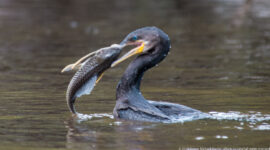
An Anhinga swims low in the river with only its long neck and head above the surface while holding a sizable fish crosswise in its spear-like bill. The submerged body and serpentine neck illustrate the species’ distinctive underwater hunting strategy, with fallen timber and muddy bank framing the feeding event.
Caption
An Anhinga swims low in the river with only its long neck and head above the surface while holding a sizable fish crosswise in its spear-like bill. The submerged body and serpentine neck illustrate the species’ distinctive underwater hunting strategy, with fallen timber and muddy bank framing the feeding event.

An Anhinga raises a large fish above the water while keeping most of its body submerged near a fallen trunk. The bird’s elongated neck and sharply pointed bill are fully exposed, and the prey hangs crosswise as the bird maneuvers it for swallowing.
Caption
An Anhinga raises a large fish above the water while keeping most of its body submerged near a fallen trunk. The bird’s elongated neck and sharply pointed bill are fully exposed, and the prey hangs crosswise as the bird maneuvers it for swallowing.

With its neck arched into an S-curve, an Anhinga grips a fish crosswise and lifts it above the water beside a bleached fallen log. The tight crop emphasizes the contrast between the bird’s slender neck and the bulky prey, capturing the difficult handling stage between spearing or seizing a fish and swallowing it.
Caption
With its neck arched into an S-curve, an Anhinga grips a fish crosswise and lifts it above the water beside a bleached fallen log. The tight crop emphasizes the contrast between the bird’s slender neck and the bulky prey, capturing the difficult handling stage between spearing or seizing a fish and swallowing it.

An Anhinga works a fish into position at the surface, its neck coiled and bill clamped around the prey. Only the bird’s back and long neck rise above the water, reinforcing the low-swimming profile that gives Anhingas their familiar snakebird appearance.
Caption
An Anhinga works a fish into position at the surface, its neck coiled and bill clamped around the prey. Only the bird’s back and long neck rise above the water, reinforcing the low-swimming profile that gives Anhingas their familiar snakebird appearance.

An Anhinga holds a large fish almost vertically at the tip of its bill, apparently repositioning the prey for swallowing. The bird’s head and neck rise sharply from the water while the fish’s body hangs downward, creating the clearest view in the sequence of the feeding challenge posed by oversized prey.
Caption
An Anhinga holds a large fish almost vertically at the tip of its bill, apparently repositioning the prey for swallowing. The bird’s head and neck rise sharply from the water while the fish’s body hangs downward, creating the clearest view in the sequence of the feeding challenge posed by oversized prey.

An Anhinga rises slightly higher in the water as it lifts a fish at the end of its long bill. Motion blur and the bright bank behind it convey the speed of the feeding action, while the dark sinuous neck remains the visual anchor of the frame.
Caption
An Anhinga rises slightly higher in the water as it lifts a fish at the end of its long bill. Motion blur and the bright bank behind it convey the speed of the feeding action, while the dark sinuous neck remains the visual anchor of the frame.

A Neotropical river otter rises higher beside the bank and brings both forepaws toward its mouth, creating an intimate view of grooming or object handling at the water’s edge. Wet fur, short rounded ears, and dexterous forefeet are especially clear in the close crop.
Caption
A Neotropical river otter rises higher beside the bank and brings both forepaws toward its mouth, creating an intimate view of grooming or object handling at the water’s edge. Wet fur, short rounded ears, and dexterous forefeet are especially clear in the close crop.

A Neotropical river otter glides along the edge of a sloping bank, with its head, neck, and a narrow ridge of back above the surface. The side-on angle shows the pale throat and sleek head profile while the surrounding water mirrors the bright bank.
Caption
A Neotropical river otter glides along the edge of a sloping bank, with its head, neck, and a narrow ridge of back above the surface. The side-on angle shows the pale throat and sleek head profile while the surrounding water mirrors the bright bank.

A Neotropical river otter swims close to the muddy bank with only its head and a short section of wet back above the surface. The small rounded ears, pale muzzle, dark crown, and alert forward gaze are visible in a compact portrait that returns the sequence from fishing bird to mammal.
Caption
A Neotropical river otter swims close to the muddy bank with only its head and a short section of wet back above the surface. The small rounded ears, pale muzzle, dark crown, and alert forward gaze are visible in a compact portrait that returns the sequence from fishing bird to mammal.

A Neotropical river otter faces the camera from shallow water near a steep muddy bank, the head reflected faintly beneath it. Its small ears, broad nose, and pale whiskered muzzle are centered in the frame, creating a direct portrait of an animal otherwise mostly concealed below the surface.
Caption
A Neotropical river otter faces the camera from shallow water near a steep muddy bank, the head reflected faintly beneath it. Its small ears, broad nose, and pale whiskered muzzle are centered in the frame, creating a direct portrait of an animal otherwise mostly concealed below the surface.

Almost fully afloat, a Neotropical river otter moves parallel to the bank with its nose low to the surface. The tight profile emphasizes the streamlined head, small ear, dense wet fur, and pale lower jaw, while motion softens the shoreline behind.
Caption
Almost fully afloat, a Neotropical river otter moves parallel to the bank with its nose low to the surface. The tight profile emphasizes the streamlined head, small ear, dense wet fur, and pale lower jaw, while motion softens the shoreline behind.

A cluster of long woven nests hangs from the outer branches of a tall tree against open blue sky. Their pendant, pouch-like construction and colonial grouping are characteristic of oropendolas and related icterids, which suspend nests from flexible branch tips above the forest floor.
Caption
A cluster of long woven nests hangs from the outer branches of a tall tree against open blue sky. Their pendant, pouch-like construction and colonial grouping are characteristic of oropendolas and related icterids, which suspend nests from flexible branch tips above the forest floor.

A large dark guan perches within dense green foliage, its long tail, heavy body, and slightly crested head forming a distinctive cracid silhouette. Subtle pale markings around the face and throat are visible, but leaves obscure diagnostic details, so the bird is best treated as a likely Spix’s guan pending confirmation from a sharper frame or field record.
Caption
A large dark guan perches within dense green foliage, its long tail, heavy body, and slightly crested head forming a distinctive cracid silhouette. Subtle pale markings around the face and throat are visible, but leaves obscure diagnostic details, so the bird is best treated as a likely Spix’s guan pending confirmation from a sharper frame or field record.

A large epiphytic bromeliad grows from the fork of a tree, its stiff rosette of banded leaves surrounding vivid red flower spikes. The plant’s elevated position and water-holding leaf bases are characteristic of tank-forming bromeliads, which create small arboreal reservoirs within humid tropical forest.
Caption
A large epiphytic bromeliad grows from the fork of a tree, its stiff rosette of banded leaves surrounding vivid red flower spikes. The plant’s elevated position and water-holding leaf bases are characteristic of tank-forming bromeliads, which create small arboreal reservoirs within humid tropical forest.

A Neotropical river otter walks along a steep sandy-mud bank beneath a fallen log, its entire body visible out of the water. The elongated torso, short legs, dark glossy coat, and long tapering tail provide one of the clearest full-body views in the portfolio and distinguish this slender otter from the bulkier giant river otter.
Caption
A Neotropical river otter walks along a steep sandy-mud bank beneath a fallen log, its entire body visible out of the water. The elongated torso, short legs, dark glossy coat, and long tapering tail provide one of the clearest full-body views in the portfolio and distinguish this slender otter from the bulkier giant river otter.

A Neotropical river otter pauses on a steep eroded bank just above the waterline, body angled uphill between exposed roots and small saplings. Sunlight reveals the glossy brown coat, pale muzzle, muscular shoulders, and long tail, showing how readily the animal moves between aquatic and terrestrial habitat.
Caption
A Neotropical river otter pauses on a steep eroded bank just above the waterline, body angled uphill between exposed roots and small saplings. Sunlight reveals the glossy brown coat, pale muzzle, muscular shoulders, and long tail, showing how readily the animal moves between aquatic and terrestrial habitat.

A Neotropical river otter moves diagonally across an exposed bank scattered with roots, sticks, and leaf litter. The elevated viewpoint shows the animal’s low-slung gait and long tail in relation to the rough shoreline terrain, contrasting with the nearly submerged swimming views on the preceding pages.
Caption
A Neotropical river otter moves diagonally across an exposed bank scattered with roots, sticks, and leaf litter. The elevated viewpoint shows the animal’s low-slung gait and long tail in relation to the rough shoreline terrain, contrasting with the nearly submerged swimming views on the preceding pages.

A Neotropical river otter appears small within a broad view of the exposed riverbank, moving between fallen branches and sparse vegetation above the water. The environmental composition places the animal within the steep, erosion-shaped shoreline and shows how easily its brown coat blends into mud and woody debris.
Caption
A Neotropical river otter appears small within a broad view of the exposed riverbank, moving between fallen branches and sparse vegetation above the water. The environmental composition places the animal within the steep, erosion-shaped shoreline and shows how easily its brown coat blends into mud and woody debris.

A Neotropical river otter crosses an exposed sandy-mud bank beneath tangled roots and fallen timber, its elongated body held low and its tapered tail trailing behind. The full-body view shows the animal away from the water and emphasizes the steep, erosion-shaped shoreline that links aquatic and terrestrial habitat along the Amazonian channel.
Caption
A Neotropical river otter crosses an exposed sandy-mud bank beneath tangled roots and fallen timber, its elongated body held low and its tapered tail trailing behind. The full-body view shows the animal away from the water and emphasizes the steep, erosion-shaped shoreline that links aquatic and terrestrial habitat along the Amazonian channel.

Numerous long, woven nests hang in clusters from the outer branches of a large canopy tree. Their elongated pouch form and colonial arrangement are characteristic of oropendolas, which suspend nests from flexible branch tips; the composition also includes a large pale, lichen-covered trunk or branch that contrasts with the brown fiber structures.
Caption
Numerous long, woven nests hang in clusters from the outer branches of a large canopy tree. Their elongated pouch form and colonial arrangement are characteristic of oropendolas, which suspend nests from flexible branch tips; the composition also includes a large pale, lichen-covered trunk or branch that contrasts with the brown fiber structures.

A wider view shows several pendant oropendola nests distributed across the crown of a broad tropical tree. The fibrous nests hang like narrow sacks from exposed branch tips, while surrounding foliage and blue sky provide the habitat context missing from tighter nest studies.
Caption
A wider view shows several pendant oropendola nests distributed across the crown of a broad tropical tree. The fibrous nests hang like narrow sacks from exposed branch tips, while surrounding foliage and blue sky provide the habitat context missing from tighter nest studies.

Seen from a slightly different angle, the same type of large dark guan stands upright among sunlit leaves. The long tail, robust body, and hooked profile of the head are clearer here, while the mottled foliage still conceals the throat and fine feather pattern needed for a secure species-level diagnosis.
Caption
Seen from a slightly different angle, the same type of large dark guan stands upright among sunlit leaves. The long tail, robust body, and hooked profile of the head are clearer here, while the mottled foliage still conceals the throat and fine feather pattern needed for a secure species-level diagnosis.

A Capped heron stands in bright green marsh vegetation beside a quiet Amazonian channel, its white-to-cream body contrasting with a black crown and turquoise-blue facial skin. The upright side view clearly shows the long, pale bill and relatively short neck that distinguish this tropical South American heron.
Caption
A Capped heron stands in bright green marsh vegetation beside a quiet Amazonian channel, its white-to-cream body contrasting with a black crown and turquoise-blue facial skin. The upright side view clearly shows the long, pale bill and relatively short neck that distinguish this tropical South American heron.

A Capped heron stands near the forest floor or wetland edge, photographed with substantial motion blur. Even so, the pale cream body, dark cap, blue facial skin, and long straight bill remain recognizable, providing a transitional frame before the clearer shoreline views on the next proof-sheet page.
Caption
A Capped heron stands near the forest floor or wetland edge, photographed with substantial motion blur. Even so, the pale cream body, dark cap, blue facial skin, and long straight bill remain recognizable, providing a transitional frame before the clearer shoreline views on the next proof-sheet page.

Two people stand beside a narrow canoe at a muddy riverside landing where numerous chickens and ducks gather along the bank. The scene shifts the portfolio from wildlife observation to everyday domestic activity, showing poultry moving freely between the forest edge and water while the canoe remains the principal means of access.
Caption
Two people stand beside a narrow canoe at a muddy riverside landing where numerous chickens and ducks gather along the bank. The scene shifts the portfolio from wildlife observation to everyday domestic activity, showing poultry moving freely between the forest edge and water while the canoe remains the principal means of access.

An unidentified man is shown in a close outdoor portrait near the river, wearing a pale open shirt over a blue-and-white top. Soft green foliage and a sandy bank dissolve into the background, keeping attention on his face and expression without assigning an identity not supported by the photograph.
Caption
An unidentified man is shown in a close outdoor portrait near the river, wearing a pale open shirt over a blue-and-white top. Soft green foliage and a sandy bank dissolve into the background, keeping attention on his face and expression without assigning an identity not supported by the photograph.